This book is the fruits of a visit to Canada
in which the author crossed the country from
Montreal to Vancouver, and returned from
Halifax, Nova Scotia. As a journalist and
National President of the Brotherhood Movement,
which advises Brotherhood emigrants
going out, and arranges for their welcome by
Canadian Brotherhood men, he found all
doors open to him. He had countless talks
with men of all classes, native Canadians and
British settlers who had been in the country
from two or three to forty years. Ministers
of the Dominion and Provincial Governments
freely answered his numerous questions as to
the wisest course to be adopted by various
classes of emigrants, and Dominion and
Provincial State officials gave him all possible
information in frank talk and by placing
at his disposal valuable State publications.
Ministers of religion, prominent business and
professional men, journalists, “real estate”
men, hosts and hostesses in whose homes he
was graciously received, heads of Emigration
Departments, leading officials of the great
transcontinental railways, all contributed to
his accumulating stock of information; and,
needless to say, he lost no opportunity of
seeing things for himself and forming his own
judgments. In his railway journeys, amounting
to 10,000 miles, he fraternised with
the commercial travellers on the trains, and
from them, and their discussions and comparison
of notes among themselves, he picked
up a vast amount of invaluable information
as to the development, the trading methods,
and the prospects of the country. It has been
a long business digesting and reducing the
material to order, but the author hopes that
the book will prove helpful to those seeking
a career in a land of illimitable possibilities,
and to the increasing number of people at
home who are tempted to invest money in
Canadian undertakings. He is specially concerned
to help those who decide on making
Canada their homeland.
MAKING GOOD IN
CANADA
WHY PEOPLE GO TO CANADA
Between 350,000 and 400,000 people every
year enter Canada with the intention of making
Canada their home: 60,000 of these cross the
border from the United States. Probably
50,000 to 70,000 are emigrants from the
various non-British countries. The remainder
are from the British Isles, and chiefly from
England, Scotland, and Wales. The Irish
prefer to go to the United States, where some
twelve millions of people of Irish blood are
already settled, and nearly every Irish family
in the homeland has some representative in
the States who will lend a helping hand.
During the emigration season—from March
to the middle of November—from 10,000 to
15,000 a week leave Glasgow, Liverpool,
Bristol, and Southampton by the various lines
for Canada. The steerage of an emigrant ship,
viewed from one standpoint, is a melancholy
spectacle. There would be from 700 to 1,500
people, men and women mostly under the
age of twenty-five, and even whole families,
leaving the Old Country behind them in order
to make themselves citizens of a new country
3,000 miles across the Atlantic. In Parliament,
and out of Parliament, there is dismal
talk about “draining the country of its best
blood,” and of “sending the cream of the
working manhood and womanhood of our
nation to become rival producers with our
British farmers and workers in factories
that will compete with ourselves.” Such
talk is natural enough, but who can blame
these people for leaving a land where they
have seemed to be hopelessly pressed down
by force of circumstances, with no prospect
of ever rising, to a land that offers all sorts of
opportunities to the man or woman with
capacity, good character and grit? The way
to quench the desire for emigration is to open
wider the doors of opportunity at home, but
that opening of the doors seems to baffle the
wisest and most progressive and the most
humanitarian of our statesmen. We live in
a state of society that is the resultant of
fifteen hundred years of social evolution, and
evolution that has not always proceeded on
right lines. We are a small country with a
very great population, and the land for the
most part is held up by a handful of owners,
few of whom have had the vision to see that
the real wealth of Great Britain lies not in its
property but in its people. We have given
rights to property and denied rights to people.
Horses, cattle, sheep, pigs, deer, and pheasants
must be taken great care of, for they have a
saleable value, or they provide pleasure for
the rich in their happy hunting grounds; but
in our villages, country towns, and great
cities hundreds of thousands of men and
women with capable hands and willing hearts
are either denied the right to earn a living
wage or are compelled to work under such
conditions as rob life of its joy and buoyancy.
What wonder if the townsman whose wages
are at starvation level, and whose employment
is most precarious, who may be thrown
out of work at any moment, who is dependent
for his daily bread on the power or the will of
an employer to provide him with a few
miserable shillings a week in return for his
labour, gets tired of it, and when he hears that
in Canada there is work for all, and well-paid
work, with opportunities to rise out of the
ruck of the wage-earners into the proud
position of landownership, should decide to
try his luck and should find himself soon
afterwards in the steerage of one of the great
Atlantic liners with hundreds of like-minded
companions? If we would stop emigration
from the towns we must tackle the employment
question, we must make employment
secure, we must raise wages to a level that
will make it worth a man’s while to stay in
the homeland amid familiar surroundings.
We must tackle the slums question. We
create slums by our conditions of industry
and employment. The unemployed rapidly
degenerate physically, mentally and morally,
and drift into the slums, consorting there with
other hopeless and helpless ones who have
been cast on to the social scrap-heap. London
is the great wealth-producing, wealth-distributing
and wealth-exchanging centre of the
world. The Chancellor of the Exchequer
recently said in the City of London that
values to the extent of seventeen thousand
millions passed through the Bank Clearing
House of London in 1912, and yet there are
districts in North, East and South London
where in street after street whole families are
herded in single rooms, sarcastically called
“homes,” in house after house, living under
conditions of misery which would be unendurable
were it not that the misery is so
continuous that the sense of pain has been
dulled almost out of existence.
In our villages, which, it is complained, are
being depopulated by the increasing emigration
of the labourers to Canada, what has
been done to induce the young countryman
to remain at home? There are few characteristic
agricultural villages in which the
worker on the land receives as much as 15s.
a week, and he is taught to regard himself
as a very happy man if anybody is good
enough to employ him at all. The housing
and the sanitary conditions in many of these
villages are still of the most repulsive character.
The land often belongs to one or two owners
who decline either to part with plots of it
for building cottages or to build themselves.
Young men wishing to marry are prevented
from realising the desire because there is no
cottage vacant in which they can start
housekeeping. I was told that from one
village of little more than a thousand population
half-a-dozen young men migrated in
little more than a year because they wanted
to get married and would have to wait until
somebody died and vacated a cottage. The
land question will have to be settled in a
revolutionary way, a way that will make it
possible for a labourer to become a small-holder
in his own country, and to occupy a
decent house which shall either be his own
freehold or shall be let to him at a reasonable
rent, if the emigration from the villages to
Canada and the increasing emigration to
Australia is to be checked. Why should a
young fellow who has been educated at the
expense of the State, who reads his halfpenny
paper and perhaps frequents the village
reading-room and has learned to think for
himself, remain in the village, submitting to
the humiliating conditions which would be
imposed upon him, and to the closing of the
door of hope to his legitimate aspiration to
better himself? Young fellows of the middle
class and the upper class naturally look to the
prospect of bettering themselves. They are
educated with that object in view, and in
every possible way are encouraged to make
the most of their natural capacity and their
education; but to the village labourer, as to
the average wage-earner in the city, education
in the vast majority of cases only sharpens
the sting of misery and deepens the sense of
humiliation. We must take human nature
as it is. We must accept the logic of our
social system. If we are not prepared at
whatever cost to make Great Britain worth
remaining in to the more intelligent and
aspiring of our young men and young women
we have no right to complain if they leave
Great Britain, and if, by leaving the homeland,
the country is drained of its best blood.
But, after all, ought we to take so tragic
a view of the situation? We are coming to
understand that the world to-day is not
divided into so many water-tight compartments.
The old idea of a country and a
nation as an isolated entity, enjoying its own
advantages and regarding other countries as
rivals, whose gains were its loss, has gone by
the board. The world has been wonderfully
opened up in these later years. The seas are
ploughed by countless ships, carrying from
country to country the products of their
agriculture and their manufacturing industries.
Wealth is made all round by the
mutual exchange of those products. If France
prospers, or Germany, or Russia, England
gains, for those countries have the more to
spend on the things that England manufactures.
Still more is this the case with the
British dominions beyond the seas. South
Africa, Australia, New Zealand, and Canada
are countries of our kinsmen. Blood is thicker
than water. Those people look naturally to
the home country as the country that offers
them the most valuable market and as the
country from which they shall obtain what
they themselves desire to buy and use. Take
Canada, for instance. Year by year it is
increasing not only its selling but its buying
power; it is becoming a most valuable
customer to the homeland. Those who go
out from us become our customers. The
more they prosper the more they purchase
from the Old Country. The farm labourer
earning his 15s. a week goes to Manitoba,
Saskatchewan, Alberta, or British Columbia
and takes a pre-empted homestead of 160 acres.
He has served, probably, a year or two on a
farm, learning the methods, studying the
situation, developing his manhood. If “the
magic of property turns sand into gold,” what
can it not do for 160 acres of fertile prairie?
The labourer “breaks the prairie,” plants his
corn, reaps his harvest, sends it to the elevator,
fills his pocket with the price, and is so satisfied
with himself that he wants to increase his
holding. He does increase it. He spends
money on stock, machinery, all the necessaries
and some of the luxuries of life, and much of
the money that he spends comes to the Old
Country to stimulate our manufactures and
our commerce. A young fellow who has left
a Warwickshire or Berkshire or Leicestershire
village returns to his village five years afterwards
on a winter holiday after he has disposed
of his crops. He spends his money freely.
He is as independent as the biggest farmer in
the district. The other young fellows of the
village talk with him and hear his story.
“Why don’t you fellows go out?” he says
to them. “Why do you stop here? You will
never be any better off here. Do as I did—go
to Canada. There are farmers there almost
fighting each other for every good man going
out who can do anything on the land. You
will find a job at once with good wages, and
there is no reason why in four or five years
you should not be doing as well as I am.”
The village lads listen with both ears and
with eyes and mouths open. Their latent
discontent with the conditions under which
they work and live is roused to activity.
Whenever two labourers meet together in the
field or on the road, in the barber’s shop, in
the public-house, the talk is of “how well
Tom Jenkins or Sam Brown has done” in
Saskatchewan or Alberta. He is besieged
with inquirers who bombard him with questions
about the country, the climate, the prospects,
and what steps they should take to get out
and what they ought to do when they arrive.
There are old schoolmates whom he encourages
and tells them that if they will only come out
to his district he will see to it that they get
a job immediately on their arrival—very
likely he will be able to give them a job
himself. One such labourer’s return—and
there are few villages in the country in which
you do not hear of such returns—sets up a
stream of emigration to Canada from that
village, and the stream, unless a thorough-going
scheme of land reform is carried out, and
carried out soon, is bound to deepen and
broaden.
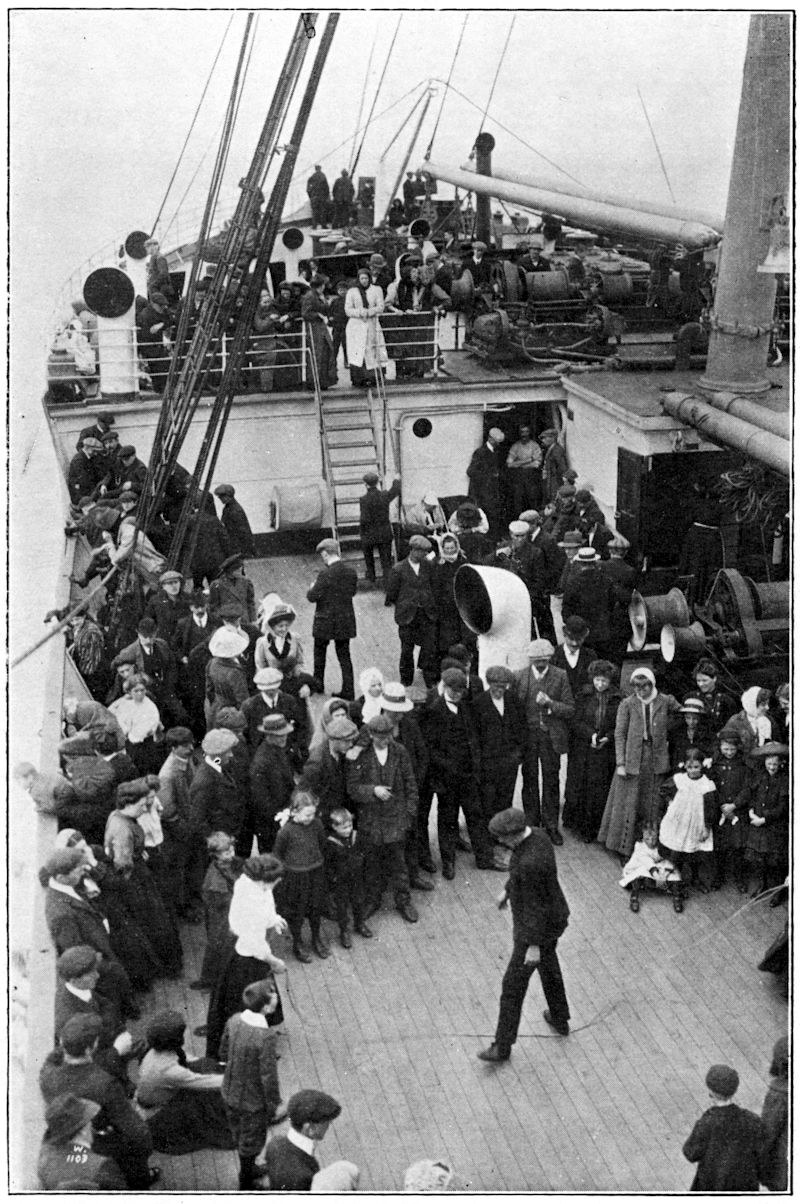
“THE EMPRESS OF BRITAIN,” WITH EMIGRANTS, AT RIMOUSKI, MOUTH OF THE ST. LAWRENCE.
Then there are the tenant farmers and their
sons. In the Old Country good land is
highly rented and the conditions of tenure
often such as to make farming one of the
riskiest of occupations. A man wants security
of tenure if he is to get the best out of his land.
The old rough-and-ready methods of agriculture
are little good in these days. Intensive
culture is the means of making money to-day.
Brains and capital must be put into the land
if the land is to yield a profit. The farmers
who are making most money in our country
are those in districts where it is possible to
secure the freehold of the farms they cultivate.
Quite recently I was in Leicestershire in a
district where almost all the farming land is
freehold property. There I found a farming
family who were making large profits out of
the intensive culture of open land and out of
the growing of tomatoes, cucumbers, and
grapes under glass. A member of the family
told me that this could not or would not have
been done on rented land, for a man will not
be fool enough to invest capital in the land,
and people will not lend him the money to
invest, unless he can look forward for several
years to getting the return. It is little
wonder, therefore, that the farmer, still young,
heavily rented, with one or two experiences
of a bad season, with the fluctuation of prices
inevitable in a country like our own, and
always at the mercy of a landlord, should look
longingly across the seas to Canada, when he
has heard of the ease with which there a man
may become owner of his farm and may make
money in all sorts of ways if he has the farming
instinct properly developed, is a good business
man, is able to adapt himself to the circumstances
of the district in which he settles, and
is prepared to put brains and “elbow grease”
into the land.
The Governments of all the Provinces of
Canada just now are offering large inducements
to such men to settle in the territories
of the Dominion. Within the last year or
two the Legislatures of Nova Scotia and New
Brunswick have passed Acts under which
large farms may be purchased, in a condition
ready to yield immediate profits, by loans,
80 per cent. of which will be guaranteed by
the Province, to suitable men. Thousands
of small farmers and farmers’ sons are now
doing exceedingly well in the Provinces of
Canada who went out with very little capital,
but, being the right sort of men, every
opportunity was given them to show of what
metal they were made.
Probably, at this moment, three millions
of the seven millions and a half of the population
of Canada were British-born. This means
that hundreds of thousands of families in
the Old Country are linked by ties of tender
relationship to the citizenship of Canada.
The British-born Canadians return home to
spend their Christmases. The winter is their
holiday season, and they have alike plenty of
time and plenty of money to dispose of.
They tell their stories of their success in
Canada, they remove prejudices against the
people, the country and the climate, and they
awaken the ambition of young and ambitious
members of their families to “go and do
likewise.”
Again, Canada has offered a field for the
investment of British surplus profits second
to none in the world. During the last few
years our country has been passing through
a period of unprecedented prosperity. It has
been impossible to find employment in the
industries of our country for the annual two
hundred millions or so of surplus profits, and
much of that surplus has been pouring in a
river of gold into Canadian channels for the
development of the country.
There are tens of thousands of business men
and financiers in Great Britain who are
deeply interested in the exploitation of
Canadian land, railways, and manufacturing
industries. They pay frequent visits to
Canada to look after their interests there,
and Canadian representatives of those interests
are continually coming over to this country
to propose further developments and to open
up new channels for investment. These
business firms and financial concerns are the
means of increasing the stream of emigration
into Canada. They send their travellers,
clerks, expert engineers, mechanics, and what not
to Canada to assist in the development of
their interests. It is said that Canada has
taken almost more British capital during the
last ten or fifteen years than it has been able
to absorb and that there may be a temporary
set-back. The set-back could not be more
than temporary, for everybody who has investigated
the resources of Canada is convinced
that those resources are rich beyond all
calculation and that thousands of millions
of capital can be profitably employed in
developing them. I hope that incidentally
this little book may be of some use to those
who have legitimate financial interests in
Canada as well as to those who may be
thinking of emigrating and to those who are
interested in emigrants.
The Canadian Governments are all very
keenly alive to the social and economic value
of every immigrant of the right sort. Every
man able and willing to work and to adapt
himself to the conditions means an addition
to the economic development power of the
country. He is alike a producer and a
consumer. He makes a home, and that
home means increased trade to the producer
and consumer of every necessary of life. This
is why not only the Dominion but all the
Provincial Governments are offering inducements
to the right sort of emigrant to make
his home in Canada. There are many
emigrants who are not of the right sort.
The man who is shiftless, aimless, addicted
to self-indulgent vices at home, who shirks
work, who is always grumbling, is not wanted
in Canada. The man who can work, but
whose ideas are limited, who has been
employed in some specialised branch of a
specialised industry at home, and who expects
to find employment in that specialised branch
of that identical industry in Canada, and
thinks himself deceived and deeply wronged
if he cannot find employment in that specialised
branch—he, too, ought not to go to Canada.
The man who succeeds is either the man
willing to go on the land and who is prepared
to stand the racket of a little hardship until
he has learnt the ropes, or else the man—clerk,
mechanic or what not—who is willing
to take the best job that offers and to work
at it until something more congenial and
offering greater opportunity turns up. Men
such as these, granted that they have good
health and a reasonable amount of intelligence,
simply cannot fail in Canada.
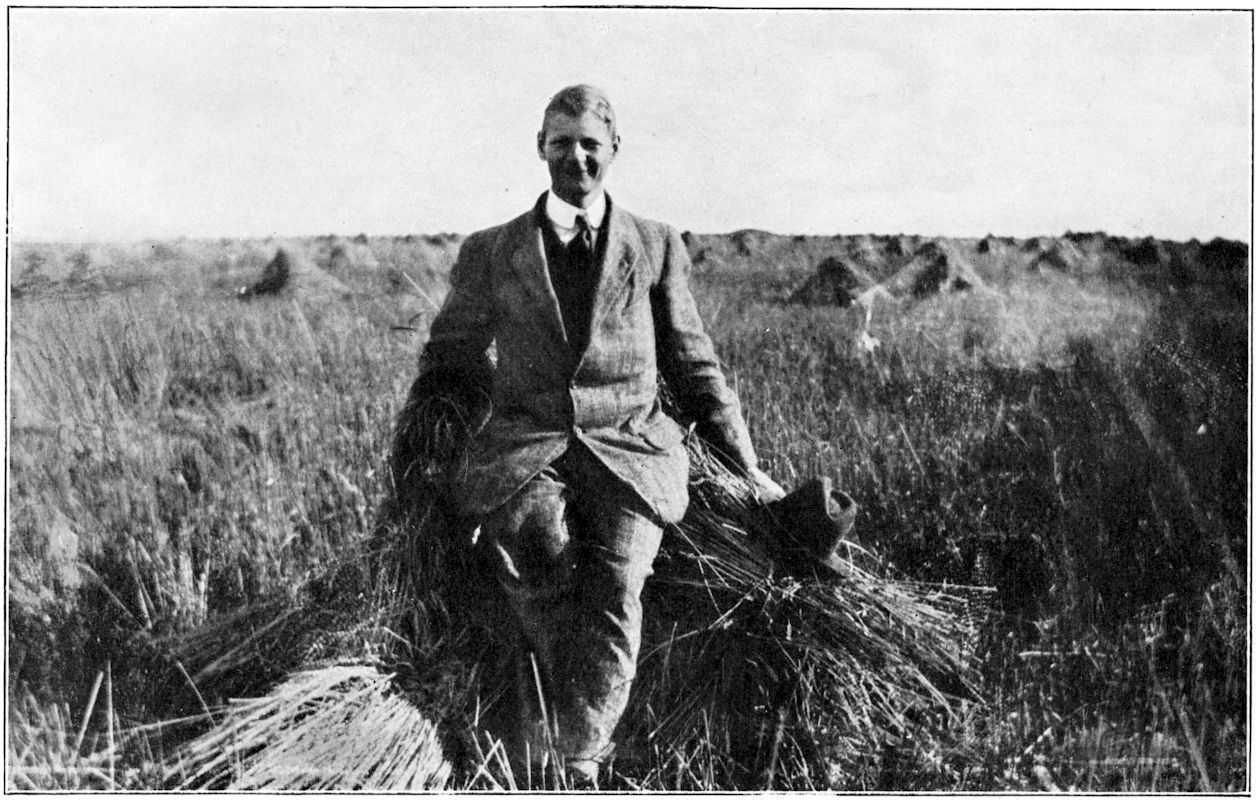
SIX MONTHS OUT FROM HOME.
THE HOME OF A NATION
Canada is the splendid and spacious home
of a great nation now in the making. It is
not so much a country as half a continent.
It marches conterminously with the United
States for 4,000 miles at a latitude corresponding
to that of the south of Europe. Its
Eastern Provinces are washed by the Atlantic
waves and blown on by the Atlantic breezes:
3,000 miles westward British Columbia and
the Yukon territory face the Pacific: northward
from the United States Canada stretches
into the Arctic Ocean. It is curious to think
that the first English hold on what is now
Canada was limited to three or four forts and
trading stations on the Hudson’s Bay. Trading
stations are still there in charge of servants of
the Hudson’s Bay Company, but that Company
has been shorn of its glory, although
it is still doing a prosperous trade between
its collection of furs from the Indians, its
Stores in the Prairie Provinces, and the selling
of its lands. North Central Canada, however,
with the development of its Prairie Provinces,
ceased to be the mere commercial backyard
of the Hudson’s Bay Company. It has
ceased also to be a collection of British
“Colonies.” You cannot offend the modern
Canadian more than by describing him as
a “Colonial.” He is a Canadian—an Imperialist,
a man who claims his full share
in the concerns of the British Empire—a man
who has firmly convinced himself that within
a hundred years Canada, so far from being
a British Dependency, will be the most
stalwart protector of the Mother Country.
The epoch-making offer of a gift of seven
millions for the addition of three super-Dreadnoughts
to the British Navy is the first
expression of the Canadian sense of Imperial
destiny. That offer will certainly be only the
first of many Canadian contributions to
Imperial defence and British supremacy on
the seas. It was not merely inspired by the
feeling of men of all political parties in the
Dominion that the Atlantic and Pacific coasts
must be safeguarded against foreign attack
and the blocking up of the outlets and inlets
of Canadian trade, but by the over-mastering
consciousness of the Canadian people that they
are a Nation of Destiny and that in the near
future they will play a great and increasing
part in the shaping of the industrial and
political history of the world.
Already there is the keenest sense of
nationality in the Canadian people. There
has grown up in recent years an interest in
the history of Canada which would have
surprised the fathers and grandfathers of
the present generation. An illustration of
this interest is the arrangement by Dr. Lock
(the very able Public Librarian at Toronto)
of gatherings of school children two or three
times a week to hear stories from Canadian
history told in ways that will make the future
citizens proud of being Canadians. In talks
that I had with public men in all the Provinces
the necessity of keeping the Anglo-Saxon
type and Anglo-Saxon ideals dominant was
continually urged. Canada opens wide its
doors to men of all nations seeking a larger
life and richer opportunities in the spacious
Provinces and the freer air of the Dominion.
But there is the firm resolve that in the
composite nation now in its infancy the
Anglo-Saxon type shall not be swamped or
weakened by the infusion of foreign blood.
This is why the Dominion and Provincial
Governments give the heartiest welcome to
immigrants from the American side as well
as from Great Britain. At least 100,000
Americans are pouring yearly into the Prairie
Provinces and British Columbia. They bring
with them Anglo-Saxon ideas, Anglo-Saxon
religion, the Anglo-Saxon spirit of democracy,
Anglo-Saxon energy and inventiveness in
industry, and Anglo-Saxon solid and scientific
methods of agriculture. The Americans in
three or four years are blended with the
native-born population, and the blend is
considered the finest possible from the point
of view of the development of the Dominion
along Anglo-Saxon lines. As a matter of
fact, the Americans a few years after arrival
are almost more Canadian than the Canadians
themselves—it is the Americans rather than
the Canadians who show jealousy at the
flocking in of people of other nationalities and
raise the cry of “Canada for the Canadians.”
There is ample room, however, in the Provinces
(most of which equal or exceed in size the area
of France or Germany) for immigration from
every nation under the sun, and there is no
reason why the process of assimilation should
not be even more complete than it has been
in the United States. Canada believes in
churches and schools. The Governments of
the Dominion and of the Provinces see to it
that the schools are put up among the first
buildings that arise in the new towns and that
they are richly provided with all the equipment
they need and all the funds that ensure their
being carried on in the highest state of
efficiency. These schools catch the children
of the immigrants and manufacture them into
citizens with Anglo-Saxon democratic ideals.
The people themselves provide the churches.
I was surprised during my tour in Canada to
find how many churches there are, and how
fine are the church buildings even in cities
that cover what twenty years ago was virgin
prairie. The Canadians are fully alive to the
part played by religion in the development of
nationhood and civilisation. The churches
catch the immigrants, especially the bright
young fellows and young women who are
settling in the Dominion. They are not only
spiritual hearths, but they are social centres,
and nothing is more needful than social
centres of the right kind in a new country with
a rapidly flowing-in population. It is in the
churches that the ideals are held up and kept
alive which will save Canadian nationality
from being materialised in its cradle. There
is a possibility that the very richness of the
resources of Canada, the variety and greatness
of the opportunities it presents for getting on
in the material sense, may lead to a coarsening
of the national fibre which would prejudice
the whole future of Canada. Canadians must
be made to realise that a nation, like an
individual, “lives not by bread alone,” that
it has a soul to be saved as well as a body to
be fed. Canada must be preserved from the
national tragedy of growing to be a giant in
bulk with the strength of a giant—but a giant
without a soul.
THE MAKING OF MODERN CANADA
Though Canada, as a country explored and
occupied by white men, is more than three
centuries old, it is only within the last half
century that its possibilities have begun to
be realised even by its own settlers. There
are reasons to explain this tardy awakening
to the significance of the country. During
the French occupation, which was decided on
that dark night of 1759 when Wolfe’s army
scaled the Heights of Abraham at Quebec
and sent its crashing volleys into the regiments
of Montcalm, Canada was as badly governed
as any dependency of a Western nation has
ever been. So far from encouraging colonisation
and laying the foundation of a French
nation on American soil, the French Government
of Canada did everything, both positively
and negatively, to strangle the child in its
cradle. The France of Louis XV. especially
did worse than neglect Canada. It sent to
Quebec and Montreal men who were not
merely incompetent, but who ruthlessly
pillaged the Canadians by every legal and
illegal means. The story told by Parkman
and other recent historians who have examined
the contemporary historical material of the
way in which, with the connivance of the
Quebec Government, the people were almost
flayed alive by the malpractices of agents
and contractors, is unparalleled in the history
of wholesale robbery and corruption. The
Verres of Cicero’s impeachment was a heaven-sent
benefactor of the Sicilians compared with
the Canadian Intendant of Finances, Bigot.
The Canadian farmers had not only no
encouragement to wring its riches from the
soil, but they were punished for their success.
They were made to pay over and over and
over again for everything that was necessary
to agriculture in order that the Governor-General,
the Intendant, and their swarm of
male and female satellites might strut as in
a miniature Versailles, mimicking alike the
manners and the morals of Versailles. The
French Colonials fought well, in spite of all
they suffered from the French Government,
for the French dominion of Canada, but when,
after the capitulation and the Treaty of Peace,
the horde of ruffianly officials were sent back
to France, they soon reconciled themselves
to the British Government. They found
that the alien Government was at least a
Government and not a systematised official
brigandage, and they settled down to their
farming and to the enjoyment of their legal
parochial self-government and of their complete
liberty for their Roman Catholic worship.
The French Canadians to-day number two
millions, mostly concentrated in the Province
of Quebec, though there is an increasing
movement westward of the young French-speaking
Canadians who have had their
appetites whetted by the stories of fortunes
to be made in the Prairie Provinces. The
old folk at home and the Roman Catholic
parochial clergy look askance at this movement
of population, as they do at the increasing
proportion of British and other non-French
settlers in the Province. It is useless for them
to fight against it. Quebec Province contrives
to combine the most intense conservatism
with regard to religion, language, methods of
farming and manner of life with political
Liberalism of a peculiar kind. The French
claim that they are the real Canadians. “We
were here before you,” they say to the English.
They are proud of the fact that a French
Canadian, Sir Wilfrid Laurier, was Prime
Minister of the Dominion for fourteen years,
and that during his term of office the country
sprang forward by leaps and bounds. They
are the backbone of the Liberal Party of
the Dominion, they are Imperialists of the
Imperialists, and yet at the same time they
are Home Rulers of the Home Rulers. A
saying of a French Canadian has been often
quoted, that “The last rifle fired in defence
of the British dominion in Canada will be
fired by a French Canadian,” and yet it is the
French Canadian Liberals who have made it
an article of their political creed that the
future Canadian Navy shall be a Canadian
Navy and not an integral part of the British
Navy; that is, that it shall be built, manned,
and be under the control of Canada and not
be regarded as merged in the ships of and
directly controlled by the British Admiralty.
By a curious reversion of position, Liberalism
in Quebec Province means Provincial Home
Rule carried to the extreme limit, while
Liberalism in the Prairie Provinces means
the maintenance of Dominion control of the
Provincial land tax, and Prairie Province
Conservatism means Provincial control of
land tax raised in the Province.
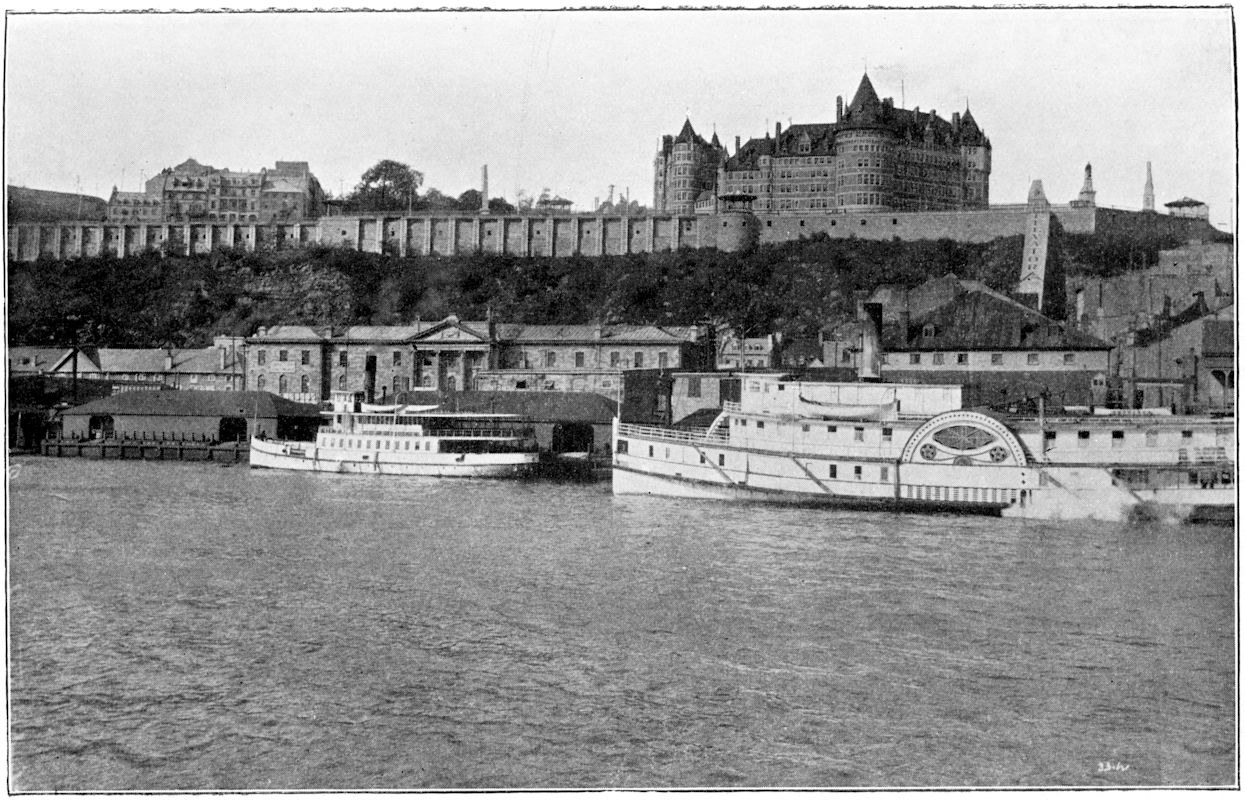
QUEBEC FROM THE RIVER.
The French Canadians have good reason to
be satisfied with British government, for under
it they have privileges with regard to self-government
and the maintenance of their
religion such as are not possessed by any
section of the population in any of the other
Provinces. There is no country in the world
where the Roman Catholic Church is in such
complete possession as in Quebec Province,
where it has a parochial system so thoroughly
and so completely worked, and the people
are so submissive to the parish priests, that
the priests generally, to use a vulgarism,
“boss the show.” One of the difficulties at
present confronting the Dominion Government
is the marriage law in Quebec Province. The
Catholic Hierarchy of the Province have put
into force the Ne Temere Decree of the Vatican,
designed to check marriages between Roman
Catholics and Protestants, and the Supreme
Court of the Province has had to bend, as
always, to the will of the Hierarchy. The
Dominion Government desires to unify the
marriage law throughout the Dominion, but
it is brought up against the stone wall of the
Roman Catholic Hierarchy and of Home Rule
in Quebec Province. At present there seems
no way of getting over the difficulty, but it
is pretty certain, as years go by, that the
strong grip of the Hierarchy will be relaxed,
as it is already relaxing with the broader ideals
with which the minds of the young French
Canadians are infused as a result of travelling
outside the Province, and so many of them
seeking careers in the English-speaking
Provinces.
It was fortunate for British supremacy in
Canada that the French Canadians had been
so often at war with the Yankees that at the
War of Independence they were all instinctively
on the side of the Power that was
hostile to the Yankees. The French Canadians
could have wished for nothing less than
incorporation with the Puritan New England
States and the Quaker State of Pennsylvania.
They were already feeling the good effects of
English government and were settling down
to the peaceful development of their lands.
There might have been danger of them
instinctively favouring France in future wars
between England and France, but the Revolution
of 1789 put an end to all that. The
Revolution was the end of the ancient régime
in France and with it of the colonial domination
of the Gallican Catholic Church. The French
Canadians belonged to the ancient régime and
had been preserved from the worst vices and
corruptions of the Roman Catholic Church in
the Old Country. Canada offered a refuge to
a large number of priests and émigrés, and
the French Roman Catholics brought with
them appalling stories of the horrors and
blasphemies of the Revolution. The French
Canadians regarded the English, during their
long war with the Republic and then with
Napoleon, as the restorers alike of Royalty
and Catholicism in France, and they thanked
heaven every day that they were living under
the Union Jack rather than under the Imperial
standard of the Corsican usurper.
When in 1812 the United States declared
war against Great Britain, the French
Canadians fought as patriotically and valiantly
as the English Canadians against the Yankee
invaders, and shared in the glory of driving
back the Americans and defeating them on
their own soil. A long period followed in
which little interest was taken by the Old
Country in Canada. England attached small
value to its Dominion across the Atlantic.
Then there came political troubles which
might have led to serious insurrection and
civil war between the English Colonials and
the French Canadians. The population was
increasing and the French were not satisfied
with the share they were taking in the
government. The troubles were settled by
a wise measure of conciliation which led
to the laying of the foundation for the
federation of the Canadian Provinces in the
present Dominion. Now, though the French
Canadians still keep themselves very much to
themselves and regard their religion and their
language almost as superstitiously as savages
their fetishes, the only rivalry between the
French and English-speaking Canadians is
rivalry as to which are the best Canadians,
the most fervent patriots, and the most loyal
British Imperialists.
One reason for the late development of
Canada was the flow of immigration during
the greater part of the nineteenth century to
the United States. The States had nearly
three centuries start of Canada. Since 1772
they were an independent nation. They
governed illimitable areas of cultivable land.
Centres of manufacturing industry were early
established and grew at an amazing rate.
There was enormous railway development,
facilitating intercommunication between the
various States and encouraging settlement
along the lines of railway construction. Along
both the Atlantic and Pacific coasts there was
an interminable seaboard offering farmers and
manufacturers harbours and rivers for the
carrying on of sea trade. The great emigrant
nations of the world—Ireland, Scotland, Italy,
Germany—found the United States a congenial
country in which to settle their surplus
population, and those already settled sent
home glowing stories of the prospects and
much money for their relatives and friends
to follow them. The United States grew
populous, rich and great by these feeders from
the Old World. Canada, on the contrary,
held out few inducements for settlement. Its
people were satisfied with a moderate degree
of comfort and showed little disposition to
welcome new-comers. So Canada would have
remained till to-day had it not been for the
opening up of the country by railway construction,
to the story of which a future chapter
will be devoted. Somehow the idea had got
into the mind of the world that Canada was
a country of intolerable cold, covered in
the Eastern Provinces with monotonous and
depressing woods and practically a desert as
to Central Canada, while only the Indians and
a few Scotsmen of iron constitution in the
service of the Hudson’s Bay Company endured
the terrors of the arctic North. Certain
novelists, who had drawn their material partly
from the facts of the life of the Canadian Far
West, but mainly from their fertile imaginations,
conveyed the impression that Canada
was infested with tomahawking Indians and
that no man’s life and no woman’s life was
worth much if they settled outside the bounds
of Old Canada. The Hudson’s Bay Company,
during its hold of the Far West, rather
encouraged such ideas. It did its utmost to
keep immigrants at arms’ length and to
prevent any rivalry with its profitable fur
trade, even from enterprising Scotsmen and
French Canadians at Quebec and Montreal
who were not disposed to recognise the rights
which Charles II. lightly gave away when he
granted the charter to the Hudson’s Bay
Company in 1672, conferring on them the
lordship of all lands watered by streams
running into Hudson’s Bay. Fort Garry,
where now is Winnipeg, the capital of the
Prairie cornlands, was the western boundary
of known Canada, and to get even to Fort
Garry before the Canadian Pacific struck
across the continent was a most tremendous
adventure. When the Canadian Pacific
pioneers, however, opened up the country,
and the Red River Rebellion, inspired by
the unfortunate half-breed Louis Riel, was
suppressed by the expedition in which Sir
Garnet Wolseley’s name first became known
to fame, the Hudson’s Bay Company saw the
days of its supremacy at an end. Its rights
were bought out, though it received magnificent
concessions as the price of surrender, and
very soon the incalculable possibilities of the
prairie and of British Columbia began to be
realised and the stream of immigration set in
which is now gathering strength every year.
Within the last five years the rate of annual
immigration has increased from 300,000 to
nearly 400,000. The population of Canada
is still under eight millions, but even cautious
Canadians predict that in less than twenty
years it will be twenty millions, and that by
1930 the immigrant population will exceed the
native-born population.
English interest in Canada naturally grows
with the growth of English immigration into
the Dominion. There are tens of thousands
of families now represented in the Dominion
where a dozen years ago such families might
have been counted by hundreds, and the type
of immigrant is changed. Time was, not
long since, when Canada was considered the
most suitable dumping ground for the social
wreckage of Great Britain. Immigrants
might have been divided into two classes.
First there were the scapegraces of good
families—young fellows who had gone the
pace at home and had either gone to Canada
to keep out of the clutches of creditors or
the police, or were sent to Canada by relatives
who were none too fond of them, but were
glad to be rid of them even though it meant
sending remittances to keep them going in
the new country until they settled down to
something honest, if they developed any
disposition to try work for a change. Then
there were the out-of-works, the unemployables,
the “social problems,” the men
of the proletariat who were the despair of
the Old Country and whom the Salvation
Army and other philanthropic societies
got hold of, and sent to Canada with the
optimistic belief that men who had failed in
the Old Country might possibly succeed in
a new. Canada proved a good testing ground
for emigrants so sent out. If they were
caught young and had received some moral
training and some training in industry before
they were shipped they did well; but men
whose moral backbone had been broken, and
whose physical stamina was weakened by
self-indulgence at home, too often found that
success to a moral and physical weakling
was no more possible in Canada than in
England. During the last few years the
Dominion and Provincial Governments have
been setting their faces sternly against the
making of Canada a dumping ground for the
scapegraces and social wreckage of Great
Britain and the world, and they have given
strict instructions to societies and institutions
receiving grants and commissions from
Canadian Government funds that only suitable
men must be sent out, while an eye is kept on
unsuitables who get in with a view to returning
them, after a couple of years or so, as
undesirables, to the countries of their origin.
It is quite easy to understand the dislike which
not only the Dominion and Provincial Governments,
but Canadians as a whole, have of
immigrants of the types referred to. They
give a bad name to the country and prejudice
it in the minds of people at home and people
in other countries in whose estimation the
Canadians desire to stand well. Canada
requires and desires immigrants of the best
type—physically, intellectually and morally—to
contribute towards the making of the
Canadian nation that is to be. Only such
men can play a worthy and valuable part in
developing the amazing resources of the
country and making the population of the
great cities which are springing up in all
the Provinces. During the last few years
emigrants have been going out from the best
families in the Old Country—young men of
education and with a certain amount of
capital at their disposal. Canada offers to
these a career unequalled in its opportunities,
while at the same time such men are a contribution
to the future prosperity of Canada
even more valuable than the placing in
Canada of British capital, which is flowing
into the Dominion in ever deepening and
widening streams.
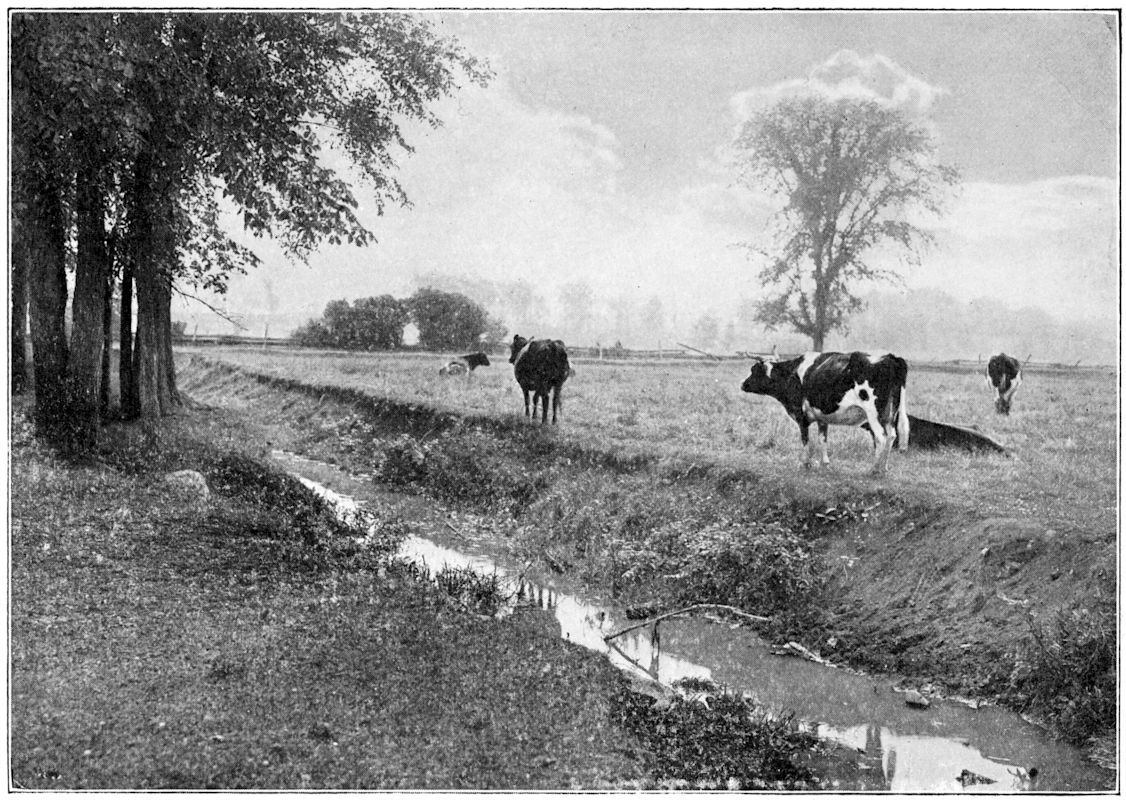
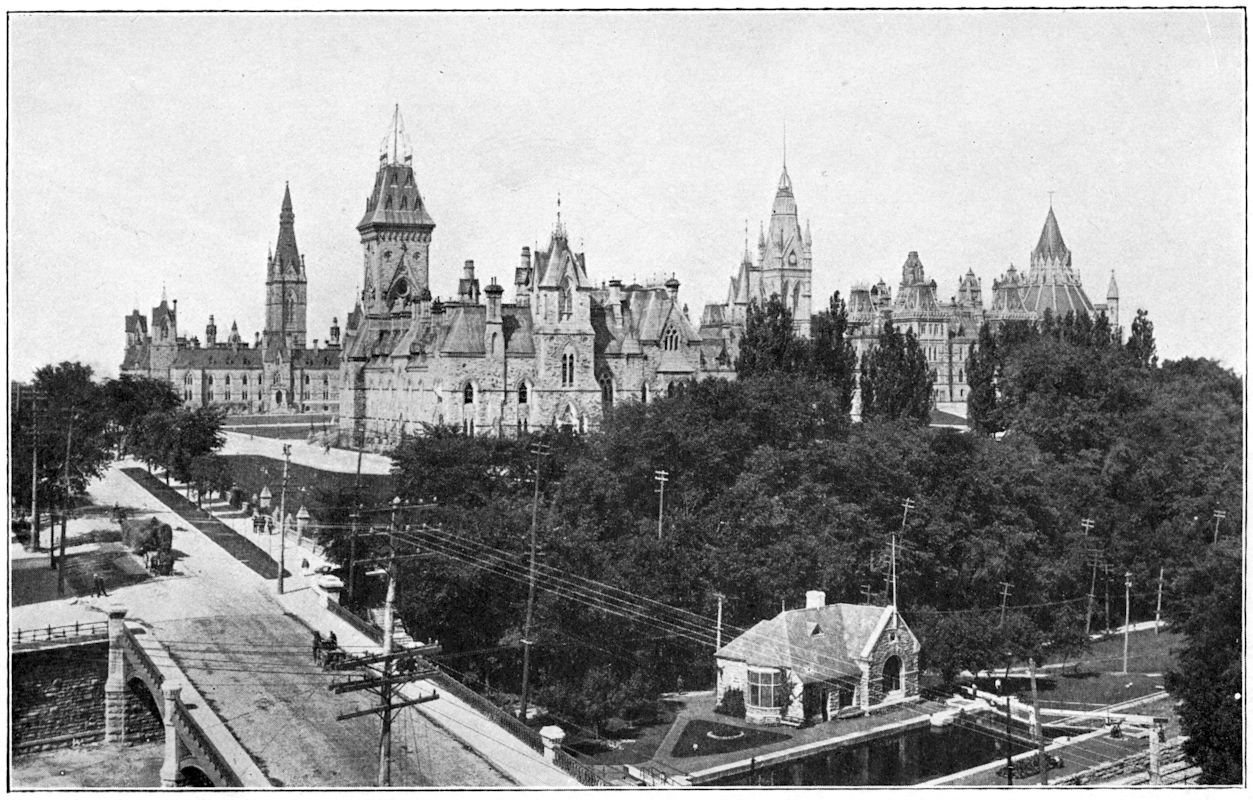
A COUNTRY SCENE IN OTTAWA.
That inflow of British capital into Canada
is one of the most significant of the developments
of the last few years. British noblemen,
who have found it increasingly difficult
to get profits out of the land in the Old
Country, have been prospecting in Canada.
They have bought up large blocks of land
along the lines of railway development, and
have been making large profits out of the
reselling and the settlement of their estates.
Not that Canada will tolerate in the Dominion
the creation of a feudal land system such as
we have in the Old Country. Land ownership,
not tenancy from a landlord, is the rule
in Canada, and if there were any danger of
landlord monopoly being created in Canada
public opinion would soon force the Dominion
and Provincial Governments to put a stop to
it, but in land purchase and the reselling, in
railway construction and in the development
of the rapidly-growing industrial concerns of
Canada, hundreds of millions of British capital
have already been absorbed and the cry is
still for more. Everywhere on my tour in
the Dominion I heard the complaint, “All
we want is capital. We have all the natural
resources that any country could desire, but
for years to come every penny we can get hold
of has to go into capital expenditure.” The
head of a great firm of agricultural implement
manufacturers at Hamilton told me that his
firm, a branch of an American firm, has spent
within five years something like five million
dollars in opening branches at various centres,
and he said, “I might almost say we have not
yet got back a dollar. The farmers are making
large profits, but they have no money to
spend. As soon as they sell their wheat they
need money to increase their holdings, to
buy machinery and stock, and we have to
let them have our machines on long credit,
or to be paid for on the instalment principle.
But,” said my informant, “we are absolutely
sure that we shall reap our reward, and a very
rich reward, within a year or two.” The
commercial travellers told me the same story.
They are doing a great and increasing trade
in the new cities that are springing up at the
rate of one a day along the lines of railway
construction. “But,” they said, “at present
the traders, the farmers, the business men,
have to be putting all the money they can
make or borrow into the land, into building
and into stock. They will give us their orders
on condition that we allow them a year, two
years, three years to pay for the stuff. We
know they will pay and we let them have the
stuff, confident that we are getting in our
footing for a trade that will be enormously
and increasingly profitable as years go by.”
Travellers of Canadian and American firms
told me that here is where British firms are
being beaten just now. They have not taken
the trouble to understand the conditions in
which trade has to be done in a new country
with a rapidly increasing population and with
its resources only beginning to be developed.
British firms want to do trade as in the Old
Country and with their European continental
customers on practically cash down or short
credit terms, and if they cannot do trade on
these terms they do not think it worth while
doing it at all. The consequence, so the
Canadian and American commercials assured
me, will be that the trade will be almost
monopolised by the Canadians and Americans
and European firms that recognise the
necessity of meeting Canadian customers on
their own ground. Long credit and easy
instalment terms must be regarded in the
light of initial capital expenditure. Waiting
for the money for what seems to English
traders an exasperating and inordinate time
is the only condition on which Canadian
connections can be built up. British traders
will have only themselves to blame if they
refuse to conform to the conditions and find
within five years or so that the ground has
been hopelessly cut from under their feet.
The increasing immigration of British young
people into Canada, the increasing inflow of
British capital, are of course making Canada
a country of surpassing interest to people in
the homeland. My hope in these chapters—based
on my personal observation and on
talks with a large number of men “in the
know” in all the Provinces of the Dominion—is
that this book will prove useful to British
readers. There is an earnest desire alike on
the part of those who are considering Canada
as a country offering careers to bright and
energetic young men, and on the part of those
with capital to invest, and who want a larger
profit than capital usually yields in our own
country, to learn what are the real facts
about Canada—the country, the people, the
resources, the development, the prospects.
My desire is to make this book thoroughly
practical, with a view to meeting the wants
of such readers.
THE ROMANCE OF RAILWAY CONSTRUCTION
Modern Canada, as has been intimated, is
the creation of railway enterprise. But for
the railway, not only the Prairie Provinces
and British Columbia, but the larger portion
of the Eastern Provinces must have remained
unpopulated and undeveloped. In pre-railway
days population followed the banks of the
St. Lawrence and the shores of the Great
Lakes. There were a few small scattered
inland villages kept in communication with
the world by different “portages.” What
was the use of cultivating the land, felling the
timber, and working the minerals when there
were no means for their conveyance and
marketing? With the coming of the railway,
however, a great and glorious future dawned
upon Canada. Millions of square miles of
“acreage” of what had been considered
worthless wilderness were seen to be rich
in untold potentialities of corn-raising. The
interminable forests presented themselves as
sources of inexhaustible wealth. The lakes,
other than the Great Lakes, scattered through
the Provinces, and the rivers navigable for
hundreds of miles, were seen through the eyes
of practical imagination as equally sources
of wealth to vast populations of the future
who should reap the harvest of the fish and
use the waters, in conjunction with the railways,
as means of transport.
The first railway in Canada was the short
local line between Laprairie, Quebec Province,
opposite Montreal, and St. John, on the
Richelieu River, a distance of just under
seventeen and a half miles. This railway was
incorporated into the system of the Grand
Trunk Railway, which received its Charter
in 1852 from the Provinces of Upper and
Lower Canada. For a long time, however,
railway construction hung fire, partly due to
the political troubles which came to an end
with the reconciliation of the French and
English and the creation of the Dominion of
Canada by the Act of Confederation. It was
the daring enterprise of the Canadian Pacific
Company that really inaugurated the development
of Canada to which the Dominion owes
its present prosperity and its great future.
We are not accustomed in the Old Country
to talk affectionately about a railway as a
friend of the people and the country, but I
had not been long in Canada before I found
that everybody talks of the “C.P.R.” as if
it were a personal friend. As I travelled
westward through the Prairie Provinces to
Vancouver, farmers, commercial travellers,
business men, politicians, everybody kept
bringing up what the Canadian Pacific Railway
has done for the Dominion. “The C.P.R.
has made Canada,” “The C.P.R. is at the
back of Canada,” “Canada owes its future
to the C.P.R.,” and such expressions are
heard all the while with monotonous reiteration.
The C.P.R. appears to fulfil the function
in Canada discharged by the weather in
England of bridging awkward pauses in
conversation. It might be imagined that
fairy financiers with no sordid thought of
dividends devised the scheme and carried
through the construction of the C.P.R. out
of sheer benevolent desire to do good. But
financiers are not built that way. The fathers
of the C.P.R. were just men with vision who
had a great dream, and they persuaded
investors to back the dream with
millions of
capital in the face of the pessimistic
cawings of a grand army of croakers.
“The earnings of the C.P.R.,” it was said,
“will not pay for the axle-grease that it
will use.”
Forty years ago Canada was practically
the Canada of the British conquest of Quebec
and the French cession to England. Even
to-day the entire population of the Dominion,
from the Atlantic to the Pacific, is not more
than that of Greater London. West of
Ontario stretched for nearly 1,500 miles the
level prairie land, many hundreds of miles
from the United States border northwards
to the regions of Hudson’s Bay. The prairie
was roamed by buffalo, moose and caribou,
who found rich feeding in the abundant grass
of the most productive soil of the world.
Few besides the Indians and the Hudson’s Bay
traders, following certain traditional trails,
traversed the prairie. It was regarded as
for ever a waste as the sea is a waste. What
was the use of cultivating an inland wilderness
1,500 miles from the populated part of
Ontario, and cut off by the Rocky Mountains
from British Columbia and the Pacific?
But the projectors of the C.P.R., in their
dream, saw the prairie waving with harvests;
they saw cities rising amid the “waste,” and
their financial souls rejoiced in visions of
phantom trains conveying wheat enough to
feed hundreds of millions along the phantom
“steel” of the as yet unsubstantial dream
of the C.P.R. They convinced the Government
that there was “something in it,” and
the Government gave every encouragement
to them to “go ahead.” To-day it might
seem to some that the Government was too
generous in the concession of miles of land
on either side of the line to be constructed,
but then the land had no value at all at the
time, and it never would have value till the
“steel” was laid, and lots of people who were
considered shrewd judges prophesied that
even then the line would stretch for thousands
of miles through country doomed for ever to
be uninhabited and profitless. To-day, for
3,800 miles, the C.P.R. “steel” spans Canada
from Halifax, Nova Scotia, on the Atlantic,
to Vancouver, on the Pacific. Its sleepers
are laid a foot apart. Its sectional construction
parties have their wooden houses and
workshops at convenient intervals along the
route. Thousands of towns and villages have
sprung up on either side and several of them
are leaping ahead to the size of cities running
into hundreds of thousands of population.
The C.P.R. literally created four new Provinces
of the Dominion, each now with a Government
of its own, Prime Minister, Cabinet and
Parliament complete—Manitoba, Saskatchewan,
Alberta and British Columbia. Other
railways are striking across Canada—the
Canadian Northern and the Grand Trunk are
racing each other to the Pacific, which they
expect to reach this year—but the C.P.R. was
the prophet pioneer, and on running down by
its line from the Rockies into Vancouver I
found, thirty to forty miles out of Vancouver,
the construction men at work on the double
track, which is to duplicate the single line
from the Pacific to the Atlantic. The C.P.R.
feels that it has got to be “on its mettle,”
as well as on its metal. Quite apart from
rivalry, which it does not fear, for the new
lines will open up new country and get their
traffic from the new towns and villages and
farming and lumber districts, the present
resources of the C.P.R. are heavily overtaxed
to meet the growing traffic of the Prairie
Provinces, while the opening of the Panama
Canal is certain to set in a tremendous flow
of traffic towards the Pacific, as well as through
the Lakes to the States and westward to the
St. Lawrence and the Atlantic.
People tell stories of the ubiquity and
omniscience of the C.P.R.; of its grandmotherly
benevolence to the farmers, and its
liberal treatment of its employés. One
shrewd settler at Regina told me that the
C.P.R. has rather “spoiled” the farmers by
doing too much for them. There is the
matter of grain elevators, for instance. Grain
is stored in these huge tin-plate structures until
it can be removed by the freight trains. The
farmers, said the critic, ought not to depend
on a railway for the storing of their grain.
They should combine to provide their own
elevators. As it is, scores of millions of
bushels have to remain in ear on the prairie
waiting to be threshed until the elevators are
empty, or the freight trains are available in
the sidings. Prompt transit is necessary, or
the best of the market may be missed. The
C.P.R. has encouraged settlement on its
concessions on the easiest terms to suitable
men. Just now it is creating “ready-made
farms,” with house, etc., all provided, for
men with a little capital to enter into possession
of at once. Then it has its hotels all
along the line. At a pleasure resort in the
Rockies a Canadian “drummer” said “the
C.P.R. is running up a sixteen-storey two-million
dollar hotel at Lake Louise.” It even
regulates the time along the route. There
is “C.P.R.” time, changing in the central
part of Canada to the European-Continental
twenty-four hour system. The story is told
of a visitor who got tired of having C.P.R.
“deepos,” elevators, hotels, and the rest
pointed out to him, and when he asked what
hour it was, and was told “22.18 C.P.R.
time,” he answered, “Good heavens! Does
the C.P.R. own the sun and the time, too?”
The piercing of the Rocky Mountains and
the construction of the line through 800
miles of mountainous country down to Vancouver
was one of the most audacious and
successful pieces of railway engineering ever
done. British Columbia was worthless before
the railway; to-day Vancouver City has a
population of 100,000, risen from 5,000 in less
than twenty years, and Victoria, the capital,
on Vancouver Island, is even larger, and one
of the most beautiful cities of the world. It
was a wonderful revelation to see freight
trains of a hundred wagons laden with the
lumber of British Columbia, and equally long
trains on the prairie laden with grain. Most
of the grain is shipped at Fort William and
Port Arthur, the “twin cities” at the north-west
angle of Lake Superior. It is carried on
ships rising from 12,000 and 15,000 tons
through the chain of the Great Lakes to the
great distributing centres of the Dominion
and the United States.
A journey across Canada by the C.P.R.
gives the finest bird’s-eye view of the Dominion.
Space fails to tell of experiences in the sleeping-cars,
and the dining-cars, which serve first-class
hotel menus, with such native specialities
as turkey and cranberry sauce, prairie chicken,
and trout and white fish of the lakes. But it
takes an English visitor, to whom a journey
from London to Edinburgh is an adventure,
some time to get used to stages of 1,400 miles,
890 miles, and 1,110 miles, which are samples
of those we took.
The Grand Trunk Railway was never a
financial success until it was taken in hand
by Mr. Charles Hays, one of the victims of
the Titanic tragedy. Mr. Hays was trained
in the United States. It was a fortunate day
for the Grand Trunk when, at the period
of the reconstruction of the company in
1895, Mr. Hays, then Vice-President and
General Manager of the Wabash Railroad,
was appointed General Manager with headquarters
at Montreal, and given the fullest
freedom to go ahead. He began by acquiring
various local lines which were incorporated
into the Grand Trunk system. Many English
capitalists were interested in the Grand Trunk,
and it has been very heavily financed with
English money. Mr. Hays completely revolutionised
the whole system, had the single
line doubled, struck out branch lines in all
directions, linked the Grand Trunk up with
other systems, and induced the company to
follow the example of the C.P.R. and strike
straight across the continent to the Pacific.
By 1908 the Grand Trunk system included
5,192 miles of line. Its Grand Trunk Pacific
route lies partly in Canada and partly in the
United States, and the Pacific line is fed with
passengers and freight from both countries.
The Grand Trunk struck into the Prairie
Provinces with depots at Fort William, Port
Arthur, and many other strategic centres.
Mr. Hays had a great idea of the value of
bridges. One of his conceptions was a single-span
double-track bridge crossing the Niagara
Gorge. This was opened in 1897, replacing
the suspension bridge opened in 1853. The
Gorge Bridge is a splendid piece of engineering,
the span of the arch being 550 feet and the
width of the railway flooring 32 feet, the lines
being 245 feet above water. The Jubilee
Bridge across the St. Lawrence River is one
of the great bridges of the world. It is 9,144
feet long with twenty-four piers 66 feet in
width and 60 feet above the water. Two
other famous bridges are the International
Bridge across the Niagara between Fort Erie
and Buffalo, 2,400 feet in length with ten
piers, and the bridge across the St. Lawrence
at Coteau Landing, which is 4,025 feet long.
The once despised Grand Trunk is now a
formidable rival of the C.P.R. Mr. Hays’
ambition to make it a trans-continental
railway has been realised, for the “steel”
has been carried to the Pacific, opening up a
vast stretch of new country for settlement
and development. Its terminal on the Pacific
coast is Prince Rupert, British Columbia,
which is destined to run Vancouver very close
as a great western gateway of Canadian trade.
The Grand Trunk is developing hundreds of
thousands of miles of the most fertile country
of the Prairie Provinces, and expects to play
a leading part in the development of the
British Columbia resources of forestry, fruit
farming, mining and manufacturing industries.
In Alberta it is looking to take a very large
share of the railway profit from the working
of the inexhaustible coal supplies and the
manufacturing centres that will be consequent
on the development of the coal. Central
Alberta, from Edmonton to the Rocky Mountains,
is likely in the future to be the Canadian
“Black Country,” far more extensive and
productive than even the original Black
Country. It is calculated that the areas
known as the Edmonton coal district cover
at least 10,000 square miles and contain at
least sixty million tons of workable coal.
Already branch lines are running to districts
where the coal is even now being got, eastward
from Winnipeg to Moncton, the capital of
New Brunswick. Main lines are being constructed
by the Canadian Government for
leasing to the Grand Trunk Pacific for a
period of fifty years on conditions which ensure
alike the Government receiving a fair return
for its money and the users of the railway
getting the fullest advantage of the lines.
Altogether there is every prospect of the Grand
Trunk Railway fulfilling the most sanguine
dreams of the railway king who perished in
the Titanic.
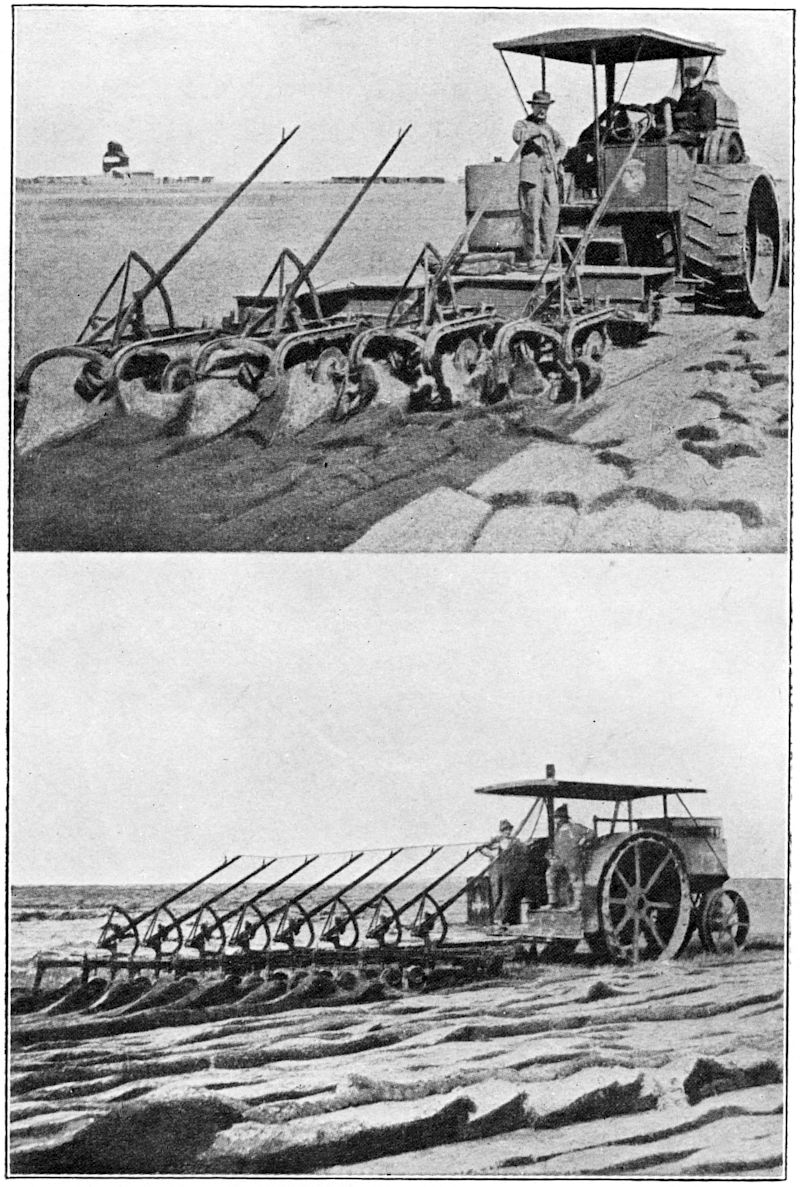
THE POWER PLOUGH IN SASKATCHEWAN.
The third great Canadian Railway and
youngest of the three, the Canadian Northern,
is forging ahead at a marvellous rate. The
pioneers of the Canadian Pacific struck through
3,000 miles of country practically unpopulated,
always with the Pacific as the object of their
ambition. The Canadian Northern promoters
also had from the first in view the construction
of a trans-continental line, but their policy
was not quite the same as that of the C.P.R.
founders. Their idea was to make their
line pay from the first by creating passenger
and freightage traffic as they went. This
meant that the trans-continental ideal must
wait for realisation while the profit producing
sections of the line were establishing their
earning capacity. The policy of the C.N.R.
has steadily justified itself. The main lines
have been constructed section by section,
with branch lines striking out from them,
each branch line opening up productive
new country. The Canadian Northern has
specialised, so to speak, on the Prairie
Provinces, with Winnipeg as its centre of
operations, and the development of the West
is largely due to the enterprise of the C.N.R.
It has linked up the West with the northern
part of Ontario, and its lines are ministering
alike to the agricultural prosperity of the
West and the manufacturing and commercial
prosperity of the East. The C.N.R. runs
through great forest regions and makes the
most of the lumber traffic. At Prince Albert,
for instance, in the centre of Saskatchewan,
it has opened up an area of forest country
into which the widening stream of immigrants
is always flowing. Prince Albert—as I know
from a Prince Albertian I met on the homeward
voyage—believes that it is “It.” Its
ambition is to be a great distributing centre
for a territory as large as France and at the
same time a magnificent residential city on
a site beautiful for situation. The mills of
the Prince Albert Lumber Company are the
largest in Canada, driven by electrical power
supplied at an incredibly cheap rate.
The C.N.R. figures largely at Port Arthur,
on the western shore of Lake Superior, one of
the great twin grain ports where hundreds of
thousands of bushels of the prairie crops are
annually shipped. Port Arthur owes its great
and growing prosperity largely to the C.N.R.,
which has there an elevator capable of storing
7,250,000 bushels of wheat. A 5,000-ton
steamer can lie alongside the elevator and be
loaded up within an hour or two and steam
through the Great Lakes with its food freight
to the most important points in Canada and
the United States.
The C.N.R., again, opens up new country
in British Columbia, and is certain to capture
a very lucrative trade in that most beautiful
Province.
Each of these three railways, with continual
construction, is founding almost daily towns
and cities of the future. Every three or four
miles there is a station. Immigrants and
traders are encouraged in every possible way
to settle along the line. The station, the
elevators, facilities to acquire stock and land
and to erect houses, are held out as irresistible
baits. The baits are eagerly seized by the
more enterprising men keen on taking advantage
of the opportunities offered by places at
their very beginning. It is well recognised in
Canada that a man with grit, enterprise, ideas,
willing to endure a little temporary hardship,
is bound to get on if he is in at the birth of an
infant community. He arrives with a few
dollars in his pocket or with nothing. Within
ten years he may be the proprietor of a big
hotel, a flourishing newspaper, or may be
mayor of a city with a population of anything
between 3,000 to 10,000. The fascination
of the new life to a man whose habits have
not been crystallised in the environment of a
populous city, who likes a free and unconventional
life, and who is prepared to devote his
attention exclusively to business until he has
laid a solid foundation for the future “pile,”
is particularly attractive to one who has youth
and strength. I heard endless stories of men
who in a phenomenally short time had established
themselves in such new cities, and are
now rich men able to give themselves, if they
choose, a summer in Europe or to spend the
winter in Toronto or Montreal. Commercial
travellers hunting up trade in the new towns
springing up along the lines of construction
told me many stories of the changes a year or
two makes in these new towns. You go to
the end of the “steel” in course of construction.
You find a few shacks and a rough
shanty that calls itself an hotel. You return
a year later when the line has advanced
another hundred or two hundred miles, and
you find a street a third of a mile long of
wooden houses. There are several stores very
likely; there is an infant newspaper. There
is an hotel, still primitive in its simplicity, but
tolerable. You can sleep on the beds and
you can eat the rough food. You return at
the end of another couple of years—the street
is a mile long, several of the wooden houses
have given place to houses of brick and
stone; the newspaper has quite established
itself. Its editorials, its “notes” and its
“personals” have the breezy audacity and
the intimate personal touch which are characteristic
of Canadian journalism. There is a
municipality which has learnt the art of
“boosting,” and the Real Estate man is well
in evidence. He has snapped up enticing
plots, and in Winnipeg, Toronto, Montreal
and other centres he is “boosting” the town
and its unequalled possibilities for all he is
worth. This springing up and rapid growth
of new cities is repeating itself hundreds of
times a year in all the Provinces of Canada,
from Nova Scotia to the Pacific.
There is a fourth railway, the Intercolonial,
constructed and owned by the Dominion
Government. This runs from Montreal to
the Atlantic coast, serving the Provinces of
Quebec, New Brunswick, and Nova Scotia.
It is managed by a department of the Ministry
of the Interior at Ottawa. The Intercolonial
is considered by Canadians rather slow-going.
Nationalisation and State control of railways
is not yet a particularly popular proposition
in Canada; in fact, throughout all the
Provinces, and especially the Prairie Provinces
and British Columbia, the idea of State
control and management of anything is
regarded with increasing suspicion. The
Canadian prides himself on his independence
and on his ability to manage his own affairs.
To the financing of railways by the Dominion
Government, and the great inducements held
out to the C.P.R., Grand Trunk and the
C.N.R. to push on with their construction, the
phenomenal railway development has been
largely due.
As indicated in my account of the C.P.R.,
there are dangers to the country through the
powers granted to the companies in their
early years of constructive enterprise, but I
found a very optimistic belief on the part of
Canadians that the Canadian people will be
strong enough to grapple with the railway
companies if they show any signs of seriously
abusing their privileges. The competition
between the three great companies at present
is so strong and so keen that the danger of
their uniting for the oppressive exploitation of
the people by a trust combining them all seems
a possibility of the dim future. It is likely
enough that some Napoleon of finance in the
United States, Canada, or Great Britain may
conceive and try to carry out the idea of such
a Dominion Railway Trust. If and when that
happens a very interesting situation will be
created. He will not only have the public
opinion of the Dominion expressing itself and
bringing itself to bear upon the Dominion
Parliament and Government, but he will have
to deal with the public opinion of the several
Provinces, and this is a power that will more
and more have to be reckoned with. The
Provinces are not at all likely to consent to
the Dominion Government bartering away
their Provincial rights in the use of the
railways. It will be a very dangerous thing
to the Dominion Government if it provokes a
conflict between itself and the Governments
of the Provinces. All the probabilities point
to the continuance of the independent companies.
There is room enough and to spare
for a good fifty years to come for each of them
to use all the capital it can command in the
development of its own spheres of influence,
and while that is so there seems no necessity
for any big combine that would compromise
the interests either of the passengers or the
manufacturing and industrial users of the
railways.
SETTLING ON THE LAND
The largest proportion of emigrants to
Canada go with the intention of settling on
the land. The villages of England, Scotland,
and Wales are sending out tens of thousands
of labourers’ and farmers’ sons dreaming
golden dreams of success in the mixed farming
of Nova Scotia, New Brunswick, Quebec and
Ontario, in the wheat growing and cattle
raising of the Prairie Provinces, or in the fruit
farming of British Columbia. They have
been brought up in British methods of agriculture
in a country where land is monopolised
by the few, is rented by the cultivators, is
subject to heavy taxation, and in which the
drain upon the land for centuries has been
so heavy that the soil has to be continually
enriched with expensive fertilisers, and even
then there must be rotation of crops. British
agriculture is a most hazardous speculation
in view of the uncertainty of our seasons, the
increasing importation of foreign supplies,
the fluctuation of prices, the nature of the soil,
our climatic conditions, and our methods of
agriculture. Of late years the tendency has
been towards intensive cultivation and cultivation
of early crops and fruit and vegetables
under glass. We are naturally a conservative-minded
people, and nobody is so conservative
as the man bred on the land. The first thing
to be impressed upon the British emigrant
deciding to settle on the land in Canada is
that he should keep on assuring himself that
he knows nothing about farming at all, that
when he reaches Canada he will have everything
to learn and a very great deal to unlearn.
This is a primary and essential condition of
success. I was told many stories of immigrants
from the Old Country who have
arrived full of assurance, prepared to “knock
spots” off the Canadians with their primitive
methods of agriculture. They took a farm,
they refused to ask or to take advice, and at
the end of the first year they were poorer and
sadder but wiser men. A good many of this
type dropped farming altogether when their
small stock of money was exhausted, and they
were at their wits’ end to know how to carry
on. They got a job on the railway, in a
business house, or in some other occupation
and had time to think about their mistakes,
and if their desire was to resume farming they
resumed it when they had saved a little
money with the profitable wisdom of their
past experience.
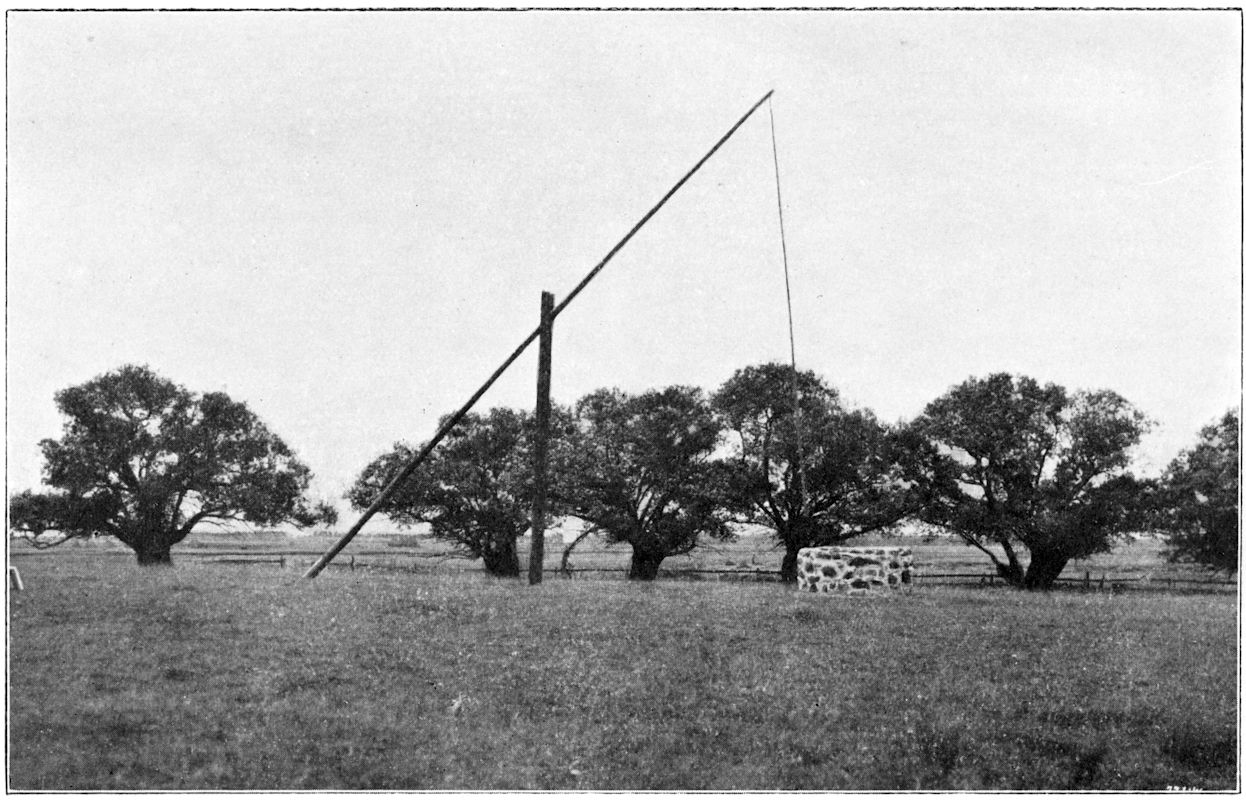
EVANGELINE’S WELL, ANNAPOLIS VALLEY, NOVA SCOTIA.
Canada is a land of inconceivable distances.
This alone means much modification of English
methods of marketing produce, and every
wise farmer knows that skilful marketing is
as essential as skilful growing. The English
farmer hates nothing more than co-operation
with other farmers. Almost every attempt
to induce the English farmer to co-operate
has failed in the face of his invincible objection
to “allow anybody to come round ordering
him what to grow and how to grow it,” what
breeds of cattle, sheep, pigs, and poultry he
should raise and how he should feed them,
when and how he should milk his cows and
so on. His father and grandfather made their
own butter and cheese in their own way,
and he is going to make his in his way—he
will be hanged if he will send his milk to a
co-operative dairy for the butter and cheese
to be made by these new-fangled methods.
The Canadian farmer realises that apart from
a considerable co-operation he is going to
fail. He belongs to a little district commonwealth
of farmers and is prepared to fall in
with the commonwealth view of things.
Then the climate of Canada completely
nonplusses the Britisher until he has learned
to understand it. What are you to make of
a temperature of forty below zero in winter
and a foot and a half of snow frozen to the
solidity of marble on the ground for three
months at a time? And what are you to think
of summer heat waves with the temperature
mounting up beyond a hundred in the shade
until you feel as if you were in a baker’s oven;
and on the prairie, from 1,500 to 4,000 feet
above sea level, the atmosphere for long
periods is so dry that the surface soil is like
dust and you have such incidents as hail-storms
with stones from the size of a pea to
the size of an egg, and “electrical storms”
with an occasional cyclone thrown in? The
agriculture of the prairie is “dry agriculture,”
which is a science in itself. Canadian farmers
accustomed to the conditions know how to
deal with the conditions and make profits at
which the British farmer’s mouth would
water, and all they have to pay out of the
profits beyond the cost of the growing is the
cost of sending the produce to the nearest
elevator or railway siding. Rent and rates
do not worry them. The seasons are
remarkably alike. Once in a dozen years,
there may be a too dry or too wet summer
with serious consequences to the quantity
and quality of the corn they raise. There is
practically little fluctuation in prices to worry
them, for the more corn Canada produces the
greater appears to be the world demand, and
prices are much more likely to advance than
to recede.
Let it be repeated, then, that the British
labourer or farmer’s son or townsman impatient
to adopt the simple life had better go out with
a perfectly open mind, prepared to learn from
those who know. I had many talks with
farmers, business men who know the conditions
of the country, and with the Ministers
and Assistant Ministers of Agriculture of two
of the Prairie Provinces. I wanted them to
give me the best advice that I could pass on
to different types of men thinking of emigrating
from the Old Country and settling on the land
in Canada. They were unanimous that the
only wise course to adopt, whether the man
were at home a wage-earning labourer or a
farmer’s son whose father could give him a
little capital, was to take the position of a
farm hand under a Canadian farmer for at
least a year. This would give him an insight
into the conditions, and there need be no
sense of humiliation, even to the son of a
prosperous farmer at home, in taking the
position of farm hand. The distinction
between classes in Canada is almost obliterated.
Most of the well-to-do farmers themselves
started as farm hands. The independence of
the working man is so developed that he thinks
himself as good as the man who employs him.
It is not considered a privilege conferred upon
a farm hand to employ him, a privilege so
great that he should regard his employer as
an awful being holding his men’s fate in his
hands. I heard of University men, young
barristers, young journalists, young doctors,
who had got tired of waiting at home for an
opportunity that was slow to come, or who
found themselves of too energetic and restless
a temper to settle down under the conditions
of British life, who had gone out to Canada
and hired themselves to farmers in Ontario or
the Prairie Provinces and were soon working
on the land as to the manner born. It is
the man with this willingness to learn and adapt
himself to the conditions of work cheerfully,
not counting the hours or the strenuousness
of his labour in busy times, who is bound
to get on as a settler on the land in Canada.
Let me take first the prospects of an
English farm labourer. Of course, if he is
a haunter of the public-house, if he only works
because he must, if he has in him the soul of
a slave, if he is a born shirker, he is not likely
to do in Canada unless a moral transformation
should take place and change him to a new
man altogether. The ideal labourer emigrant
is the man who works in his own garden and
in his allotment in his own time, who lives a
decent life, keeps away from the drink, and
out of his wages and what he grows in his
garden and allotment contrives all the while
to be putting a little by. Such a man,
revelling in work, with a fair amount of
intelligence and some ambition, can scarcely
fail in Canada. He is the man who will be
received and welcomed with open arms by
the farmers competing with each other for
competent, willing labour. I was told in the
Ministries of Agriculture at Winnipeg and
Regina that lists are kept of hundreds of
farmers who are applying for such men and
are willing to guarantee them work during
the six months between sowing time and the
gathering in of the harvest. The Ministries
of Agriculture are more than willing to assist
such men in every way to find suitable
situations. Many of the farmers are prepared
to advance the passage money to really good
men willing to sign on for the season. They
are boarded and fed and receive a wage equal
to £4 or £5 a month.
The difficulty, of course, will be with the
married man, having a wife and children.
It would be best for him to make arrangements
to leave the wife and children at home
for a year if he can possibly manage it. By
the end of a year, if he is the right sort of
fellow, he will see his way and perhaps be
able either to take a homestead or to enter
on an arrangement for a year or two of
continuous employment and to make a home
for the wife and children. Such a man, with
the money he may save in a couple of years,
would find it quite easy, if he does not desire
to take a homestead which may be in a lonely
district and may mean considerable hardship
for two or three years, to take on easy instalment
terms a ready-made farm within an
area that affords a certain amount of society.
It is the woman rather than the man who finds
the loneliness of the homestead on the fresh-broken
prairie almost unbearable. She cannot
live without the company-keeping and social
gossip of the village. The man is busy on the
land; he has the inspiring sense that his foot
is on the ladder of success; he dreams of
going on from little to more, and from more
to much, and of ultimately becoming a very
substantial man. It is not always so with
the woman. She finds it far more difficult
to reconcile herself to the lonely conditions.
Of course, if she is the right sort of woman to
be a farmer’s wife, and can find her interest
in raising chickens and such occupations, she
will, after settling down, be happy enough;
but there is always the risk, and if the man
can possibly secure a ready-made farm he
considerably reduces the risk of the woman’s
moping and wanting to return to the familiar
village in the Old Country again, even though
it may mean returning to 15s. a week and no
prospect but the old age 5s. a week at seventy.
The Provincial Governments, agricultural
associations, and a number of financial corporations
are very willing to give every
assistance to a bona-fide settler on the land.
When he has established the fact that he is
a safe man to trust, he may get his stock and
implements on credit, and the land will be
broken at a nominal charge to lessen the
burden of his first effort.
A Canadian writer says he knows of specific
cases in which English immigrant buyers paid
$30 and $15 an acre respectively for farms.
“One case was a very choice piece of land
near to the social and educational advantages
of a large town, and another enjoyed the same
favourable position but was not quite such
good land throughout, but had the very best
grazing where it could not be used for cereals
or root crops. In the one case the payments
($30 an acre) were completed in seven years,
and in the other ($15) five years were found
sufficient to acquire a clean bill of the rights
to the property, and both men are wealthy
citizens to-day. This does give assurance
that is certainly needed in the face of the
misrepresentative and conflicting statements
which have been circulated in the Motherland,
where it is impossible to verify on the spot one
account or another. It provides an opening
at once for the family or for the young couple
without children, who are rightly advised that
they should not take up a homestead at a
point far distant from social life, at least
until they have had experience, which they
can only acquire by living in close touch with
neighbours who are farming to some purpose.
“Candidly, the homesteads now available,
and until the railway system has been further
developed, are too far away from the railway
track. But it is only a question of a
few years of legitimate development until these
points have been opened up, where some of
the finest land on the continent will be brought
within easy reach of the world’s markets. In
the meantime, and while the new-comer is
gaining experience and paying by his labour
for a piece of land that can never depreciate
in value, he is not precluded from selecting
and acquiring his homestead. But the writer
cannot advise penniless individuals to come
out in the hope of taking up homestead duties
at a remote point from the railway with the
expectation of making good on it right away.
The man with a bit of capital cannot fail to
employ it to far better purpose in Canada than
he is ever likely to use it at home. He need
not ‘risk’ it until he has had every opportunity
to test his investments on the spot.
It is broadly on the land, the value of which
by the legitimate process continues to increase
with every season in which it has come under
the hand of the cultivator. In the more
thickly populated centres land values have
increased enormously within the short period
of five years; many of these, no doubt, have
been rushed up to a fictitious figure by real
estate jobbers, but where large manufacturing
and wholesale houses have been compelled to
establish themselves in response to a demand
that is almost unprecedented in its all but
instantaneous growth, these values are at once
legitimate and permanent.”
From a very informative booklet issued
in connection with the “International Dry
Farming Congress” at Lethbridge, Alberta,
in October, 1912, I extract these interesting
particulars about the conditions of prairie
settlement and farming:—
“Settlement progresses so rapidly that
pioneering is shorn of its desolation. It is
no uncommon event to find a whole township
or an entire district taken up in a single
summer. The pioneer will always have neighbours
in his new Alberta home. Roads and
schools follow in due course. Recent legislation
has established a system of local government
which affords all the machinery necessary
to a local community to carry out public
improvements. Commercial life develops very
rapidly. The settlement of a district is
invariably followed by the extension of the
telephone and the railway.
“Land is cleared and prepared for cultivation
at comparatively small cost. In the
southern part of the province no clearing is
necessary. In the central and northern part,
where there is considerable scrub and timber,
the cost of preparing the land for crops is
higher and will vary from $5 to $10 per acre.
The trees are nearly all surface rooted, and
in a few years the most thickly wooded farm
will be as free from roots as a market garden.
Raw homesteads in a year or two become
profitable farms. Towns spring up along the
railway as if by magic, and the erstwhile
wilderness is transformed into a populous and
prosperous community.
“From the earliest times explorers have
expressed the greatest hope in the future of
Alberta. It was the home of the most powerful
and civilized Indian tribes of the whole
North-West. Its luxuriant pastures supported
vast herds of antelope, deer and buffalo,
while its mountains, lakes and canyons comprised
the richest territory exploited by the
fur companies.
“Ninety-six different varieties of wild
grasses have been identified, of which forty-six
make excellent hay. Of the sedges and rushes
there are at least ninety-four varieties, many
of which make good hay, and all make splendid
pasture during the spring and the early part
of the summer. The sedges grow on the lower
lands and marshes, and are diligently sought
for by stock in the early spring, and during
those seasons when the upland grasses harden.
Cultivated grasses also do well, timothy,
alfalfa, western rye grass, and blue grass
having been introduced and all proving
very successful.
“The establishment of agriculture depends
upon many natural resources, such as extent
of fertile soil, rainfall, and energy of the
people. All these elements are compounded
in the case of Alberta. The soil is deep and
black, composed of a covering of vegetable
humus which sits undisturbed since it was
laid down many centuries ago. The chief
nutriments are nitrogen, potash and phosphoric
acid, but what is of principal importance
is the lime contained in the soil whereby the
nitrogen is set free and ready to be absorbed
by vegetable organism. The richness of the
soil is illustrated in the number of grains in
the cluster found in the heads of the wheat
plant. Three, four and five grains occur in
each spikelet, a fact which explains the large
average yield of the Alberta wheat fields.
“The rainfall is sufficient to nourish crops,
and the climate is dry and equable for long
seasons. The rainy season coincides with the
growing season. There is abundance of rain
and heat during June and July. As the
weather cools the rainy season ceases, the
air becomes dry, hardening the grain and
giving it a colour and hardness which accounts
for the splendid quality of Canadian wheat.
Even the frost of winter exerts a beneficial
influence, as it pulverizes the ground and
puts it in ideal condition for the rains of the
following season. A prominent scientific
authority says: As long as the West is
blessed with winter frosts and summer rains,
teeming crops will be the product of her
soils.’”
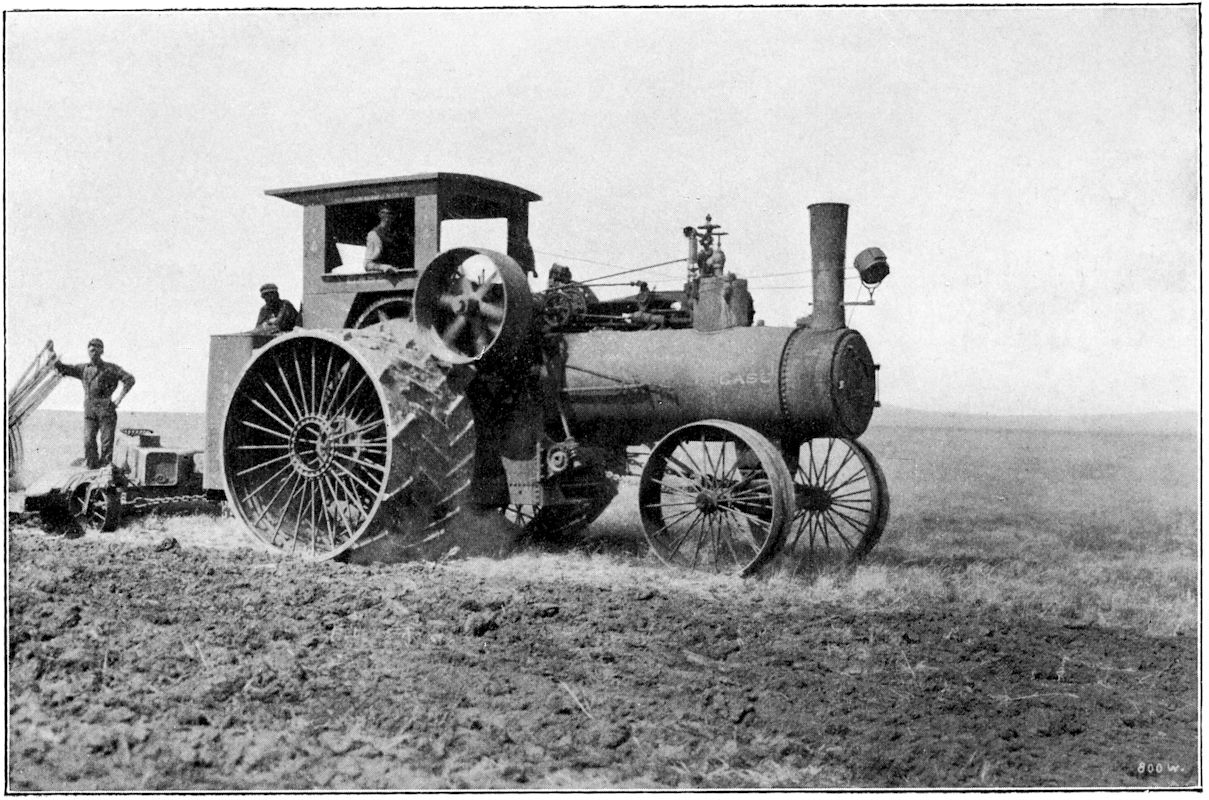
STEAM PLOUGH IN ALBERTA.
On the question of wages a publication of
the Ontario Government says—and the wages
will not vary much from this rule in the
Prairie Provinces:—
“The standard of wages at present for a
twelve months’ engagement is as follows:—
“Experienced Men.—Farm labourers, well
able to plough, to milk, and to do general farm-work,
£4 to £5 and over per month.
“Partly experienced.—Eighteen years of age
and upwards, strong, well able to handle
horses, £3 to £4 and over per month.
“Inexperienced.—Eighteen years and upwards,
strong, unused to any kind of farm
work, £2 to £3 per month, according to
ability.
“Each class is supplied with board, lodging
and washing free.
“Families, as a rule, are provided with
cottages and such extras as milk, firewood and
vegetables in season. They are expected to
board themselves and sometimes the hired
men, but getting payment for the latter. The
man accustomed to farm work receives from
£50 to £70 per year. Where the wife assists
the farmer in housework, milking, &c., she is
paid in proportion to her services. Part
experienced and inexperienced married couples
are paid according to the scale. Children are
often more of an asset than a liability, and
receive payment when able to render any
assistance in the work of the farm.”
| | Per month. | |
| Female domestics | (General servants) | £2 to £3 | |
| ” ” | (Cooks) | £2 9s. to £5 | |
| ” ” | (Housemaids) | £2 1s. to £3 | |
| ” ” | (Tablemaids) | £2 9s. to £4 | |
| | | |
The man who should take up a homestead,
prepared to rough it for a year or two, is the
young, unmarried man, steady, determined,
with a strong inclination for the life on the
land. To him, even if he goes out penniless,
the Provincial Governments offer the position
of a farmer on his own land—land for which
he need not pay a penny piece. He has only
to conform to certain regulations as to living
on the land for part of the year, building some
sort of a shanty in which he can sleep, and
bringing a stipulated number of acres under
cultivation, and at the end of three years the
land becomes his freehold. In addition to
that there are many districts in which, having
secured the freehold of his homestead, the
homesteader is permitted to pre-empt a
second 160 acres at the nominal price of $3 an
acre. For the benefit of such a man I quote
a synopsis of the Canadian North-West Land
Regulations, for which I am indebted to a
pamphlet issued by the Grand Trunk Railway:
“1. Any person who is the sole head of a
family, or any male over eighteen years old,
may homestead a quarter section (160 acres,
more or less) of available Dominion land in
Manitoba, Saskatchewan or Alberta. The
applicant, who must be a British subject or
declare his intention of becoming one, must
appear in person at the Dominion Lands
Agency or Sub-Agency for the district. Entry
by proxy may be made at any agency, by
father, mother, son, daughter, brother or
sister of intending homesteader, when duly
authorised on proper form.
“2. A widow having minor children of her
own dependent upon her for support is
permitted to make homestead entry as the sole
head of a family.
“Duties.—Six months’ residence upon and
cultivation of the land in each of three years.
A homesteader may live within nine miles
of his homestead on a farm of at least 80 acres
solely owned and occupied by him or by his
father, mother, son, daughter, brother or
sister.
“3. In certain districts a homesteader in
good standing may pre-empt a quarter-section
alongside his homestead. Price $3
per acre. Duties.—Must reside six months
in each of six years from date of homestead
entry (including the time required to earn
homestead patent) and cultivate 50 acres more
than required on his homestead, which cultivation
may be on both his homestead and
pre-emption or either.
“4. A homesteader who has exhausted his
homestead right by already homesteading and
cannot obtain a pre-emption may acquire a
homestead by purchase in certain districts.
Price $3 per acre. Such homesteads may be
acquired on any available lands on either odd
or even numbered sections south of township
45, east of the railway from Calgary to
Edmonton, and the west line of range 26, and
west of the third meridian. Duties.—Must
reside six months in each of three years,
cultivate 50 acres, and erect a house worth
$300.
“The entry fee for a homestead is ten ($10)
dollars.
“Low rates for settlers’ effects apply from
Eastern Canada and many United States
points to Winnipeg and West.”
The best thing an unmarried man settler
can do is to go out with one or more settlers
similar to himself who shall take up neighbouring
homesteads. If they go out from the
same village or district they will immediately
form a congenial society and will have the
common interest of old acquaintance and of
common knowledge of the people among
whom they have been brought up. A great
number of homesteads have been taken up
by such companions, who, when they have
“made good,” have sent for their brothers
and friends to come and do likewise, with the
result that a neighbourhood becomes in a
sense a replica, as far as the settlers are
concerned, of the familiar village or country-side
out of which they have gone.
As has been said, if they are the right sort
of men, they will find it quite easy to get the
first 30 acres, which is a condition of taking
the homestead, ploughed for them, either by
a neighbouring farmer or by the Farmers’
Association of the district. Such homesteaders
usually work for a neighbouring
farmer during their first year, saving money,
learning the business, and putting in odd time
on their own land. The requisite first home,
which is also a condition of the tenure, may
be simply a few rough boards knocked together
or a turf hut. This is the familiar “shack.”
The shack serves very well for a single young
fellow whose necessities are reduced to the
barest minimum. If he is an adventurous
spirit with a dash of humour he relishes his
life, and if he has two or three companions
settling at the same time as himself on neighbouring
homesteads they will work together
and tide each other over the roughing period.
The shack at the end of the second year will
give place to a wooden house—small it may
be, just a combined living-room and kitchen,
a washing-up place and one or a couple of
bed-rooms, but if there is a “girl he has left
behind him” this will be sufficient to warrant
sending out for her, and a sensible practical
wife is a very valuable asset to the homestead
if she is prepared to accept the conditions.
Some of the largest farmers in the Far West
began in this way less than a dozen years ago.
They have added “quarter section” to
“quarter section” to the original homestead,
until now they may be farming a square mile
or a square mile and a half and making money
enough every year to allow them to spend
three months in the Eastern Provinces or to
visit the Old Country, putting up at the best
hotels, and spending money with a free hand.
I come now to the farmer’s son or to the
enterprising young fellow with a bit of money,
say £100 to £500, at his disposal. As I have
said, if he is a wise man, he will start as a farm
hand and get his experience in the only certain
way before he disposes of his money in taking
a ready-made farm, or even in taking a
homestead and spending his money on the
machinery and stock required to work it.
The Canadian Pacific Railway, the Grand
Trunk Pacific, the Hudson’s Bay Company,
and a number of land companies offer ready-made
farms of various sizes under the most
attractive conditions. The land has been
broken, a house has been built upon it. It
has been fenced and irrigated, if irrigation is
necessary. The man can step on to the farm,
occupy the house and immediately commence
operations, making the profit of the harvest
the very first year. Suppose a man with a
bit of money wants to buy a farm ready for
cultivation. Mr. E. S. Bayard, editor of
The National Stockman and Farmer, Pittsburg,
Penn., a famous American breeder of prize
cattle, who studied the question along the line
of the Grand Trunk Pacific, says:—
“Much of the farm land is now selling at
from $15 to $25 per acre. Lands can be
found, well-improved and favourably located,
which sell from $40 to $60 per acre. And
homestead lands can also be found within
reasonable distance from the Winnipeg-Edmonton
line of the Grand Trunk Pacific
and the branch lines of this road. In the
spring of 1911, there were still available for
homestead some 8,000 farms of 160 acres each.
Many of these were settled on during the spring
and summer of 1911.
“One method of selling land in this new
country is the payment of a certain amount
per acre down and the balance of the purchase
price is extended over a period of years. One
typical illustration is cited. A farm of 320
acres, unimproved, was purchased with a
payment of $3 per acre down, or $960. For
breaking and discing the land the cost was
$5 per acre, or $1,600. That is what it costs
when the buyer hires it done. The second
payment and interest amounted to $1,170,
and the buildings complete are estimated to
cost about $2,000. This made a total outlay
the first year of $5,730. Over against this
the first year 300 acres of wheat yielded thirty
bushels to the acre, or 9,000 bushels at 60 cents
per bushel, or $5,400. And 20 acres of oats
produced 70 bushels to the acre, or 1,400
bushels at 25 cents per bushel, amounting to
$350, or a total from the farm of $5,750.
Thus the farm the first year more than paid
for its original cost and the profits the second
year more than paid for the improvements and
all other expenses, leaving a goodly profit.
“Thus it is that the low prices asked for
this productive land are one of the conditions
which strike a man from the States most
forcibly. He comes from a region where the
farm lands sell from $100 to $200 per acre,
well improved, productive and favourably
located to be sure, but to find such a vast area
of wonderfully productive land, with good
markets available and prices as high on the
average as in the States, is positive proof that
there are big opportunities for money-making
in Canada.
“These lands are advancing in value quite
naturally. With the tremendous immigration
into Western Canada, the great railroad
development and the money which is being
invested in this new country, the vast prairie
region is developing not alone rapidly but
substantially. This of course means increased
land values, and when it is remembered that
the land is now very low in price, it is readily
seen that there is every reason why it will
advance steadily from year to year.”
Having got his land the farmer will, of
course, require machinery, stock, seed, &c.,
to work it. If he has, say, £200, he can
purchase a farm quite as large as he will be
able to manage at first on the instalment plan,
the payments to cover, say, a period of five
to ten years. He may have to learn the art
of doing without a good many things to which
he has been accustomed during the first year
or so, but if he reduces his wants, uses “elbow
grease,” and is not ashamed to earn a hundred
or couple of hundred dollars by working for
established farmers, he will win through, and
after the first year he will see daylight and
be the stronger man for the endurance of
a little hardship. I quote an expert estimate
of the minimum amount required to start
farming right away with the best prospects:—
| $ | |
| 1 team of horses | 350 | |
| 1 set harness | 32 | |
| 1 farm waggon | 75 | |
| 1 sleigh | 25 | |
| 1 breaking plough | 25 | |
| 1 stubble plough | 18 | |
| 1 3-section harrow | 15 | |
| 1 disc harrow | 25 | |
| 1 seeder | 85 | |
| 1 mowing machine | 50 | |
| 1 harvester | 135 to 155 | |
| Other implements and tools | 50 | |
| 4 good cows at $40 | 160 | |
| 4 good pigs at $15 | 60 | |
| 4 good sheep at $5 | 20 | |
| Poultry | 10 | |
| ------ | |
| Total $1,155 | |
| ------ | |
| = £235 | |
| ------ | |
| | |
Let me close this chapter by quoting the
stories told by some sample settlers from the
Old Country who went out within the last
seven years. I take them from a pamphlet
issued from the office of the Dominion Ministry
of the Interior.
Arthur Newman went out to Alberta in
1907 from New Shildon, County Durham,
England, and at once took up a homestead.
He writes:—
“My father and brothers came out and we
were in partnership, but I pushed ahead, as
we had some drawbacks like all homesteaders.
We had everything to haul from Lloydminster,
forty-two miles either way, but we have a
town twelve miles from us now. We have
about 100 acres in crop this year, 57 wheat,
and about 43 oats, besides potatoes and a
garden patch. If the season permits, we
hope to break about 100 acres more. Our
wheat turned out 35 bushels to the acre and
the oats 70 bushels to the acre. This was our
second year’s crop; our first was hailed out.
Our stock is getting along finely. I lost a
fine mare the first year, but am still ahead.
We have four oxen, four fine mares in foal,
about fifteen head of cattle, seven pigs, and
about seventy hens. I might also say we have
all the machinery that is wanted for the farm,
&c., and all of it is paid for. So if our crops
turn out well this year, we shall be all right
and making fine success. I often have letters
from friends at home asking me if I should
not like to come back, and I always tell them
just for a holiday but not to stay. This is
the home I prefer.”
W. Hordern, a native of Leicester, who
settled in Saskatchewan, writes:—
“I came out six years ago. The first three
years were mostly spent in learning by defeats.
We earned very little at first, and my capital
of £400 disappeared after buying horses, &c.,
but I knew I was getting on the right line.
Then, with a family of six young children,
we made a comfortable living. Now I value
my farm and stock little short of £2,000. I
have six work horses and three others, fourteen
head of cattle, twelve hogs, hens, and the full
outfit of farm machinery, some in double sets,
and three waggons. By last summer we had
150 acres broken and in crop. The total
earnings were £460; total farm expenses
were £140, leaving a clear income of £320.
“I am now fifty-five, and was far gone
towards being a worn-out man before leaving
Old England. The first year I broke 15 acres
with a yoke of oxen; had a one-room house,
14 feet by 16 feet of bought prepared timber,
cost £30, and dug a 23-foot well. Next year
was in England eight months and did little
good here. Third year my eldest boy took
up the heavy work. I am practically a
gentleman farmer in these days—ride around
in a light four-wheeler and do the errands to
town and about. My hobby is the school
board, of which I am also the clerk and
collector. My second lad helps in stable
work and odd jobs, and a third lad assisted
in the fall. Between them my lads earned
£55 out, mostly helping other farmers, which
I have included in the income.
“Last year we raised 239 bushels of linseed,
1,030 bushels oats, 12 acres barley, 1,818
bushels of wheat. After keeping enough for
seed, sold the wheat for £300, freight cost £33
to Port Arthur, on Lake Superior. My
threshing bill was £45, twine for tying up
sheaves £6, rates, all told, £8 10s. My family
have cost nothing yet in doctoring, and we
all have good health. We produce, free of
charge, our own butter, milk, fuel, water,
stock and meat, and these items save us 25s.
a week. I have carefully kept a record of
every cent coming in and going out last year.
My farm is now 415 acres. I bought 164
acres three years ago, which is now worth
twice what I gave for it. My son has 200
acres also, worth £800, outside my own property.”
Joseph Williams, formerly of Abergele,
came to Canada three years ago. After
working in Eastern Canada for a while he went
West. He writes:—
“I got a job at Yorkton which was the
turning point to success. I may say here that
when I arrived at Yorkton I had the enormous
sum of 3 cents (1½d.) in my pocket. Six months
later I started business there, butchering, with
my brother Arthur as a partner, and twelve
months later sold out at a good sum, and
to-day I am pleased to say I can sit and look at
my crop growing, from which I hope to receive
somewhere from $2,000 to $3,000 (£400 to
£600) next fall, besides being the owner of
three fine mares and foals, and all necessary
farming implements.
“You can show this letter to all my old
friends at Abergele, and if you like you can
send it to the press, if you think it will
benefit any young men or women who think of
coming to Canada. I can say without the least
hesitation that this is a much better country
than the Old Country, and there is no reason
whatever why a young man or woman could
not succeed here.
“I may say that there is a Welsh colony
here, with about 200 Welsh families, Welsh
chapels, Sunday schools, and literary meetings,
Welsh store-keepers and restaurants, and
plenty of land for sale right in the centre of
the colony. Anyone wishing to buy an
improved farm can do so with a small cash
deposit, and the balance in yearly crop payments;
or there are homesteads, further West,
in Alberta, which are available for entry.”
J. G. Lindsay, a Saskatchewan homesteader,
writes:—
“I belonged to Stonehaven, Kincardineshire,
Scotland, came out here in June, 1905.
I used to work on a farm in Auchinblae
district on Kennell and Chapelton farm;
average wages about £10 to £20. I arrived
at Indian Head, Saskatchewan, and worked on
a threshing rig that year, receiving 7s. a day,
and then came up here, took a homestead,
and stayed here ever since. I landed out on
my land with about $300, or £60, built a small
shack, bought a team of horses, part on time,
worked around here during ploughing for new
settlers the first summer to pay for the horses.
I now own five all paid for, all the necessary
implements to work a farm. I have 100 acres
ready for crop this spring. I could never have
had an acre in Scotland in crop, let alone own
the land, which is worth $20, or £4, an acre.
I am seven miles from town and a new railroad
from Saskatoon to Calgary. I would not
take £700 for my rights to-day. I find there
are many here just the same. I will put a
word for my brother. He has done better
than me. He came here with £20 and team
of oxen; now he has five horses and 130 acres
for crop this spring. We were well known in
Rickarton, Stonehaven, as my father had a
farm there. My opinion of this country is
to all get hold of land, work hard for two or
three years to start on, then all is right.”
Joseph Watson, who was head game-keeper
and general manager to the late
Sir James Musgrave, County Donegal, Ireland,
came to Saskatchewan in 1905. He writes:—
“I arrived at File Hills in the end of March,
1905, and the first thing I did was to buy two
good milk cows at the calving and a horse and
mare. I then commenced to build a log
house, 30 feet by 14 feet inside, and two
stories high with a lean-to kitchen at back,
and soon had a good comfortable dwelling. I
then built stables for cattle.
“In the fall I bought ten of the best
yearling heifers I could get and a few steers.
The total outlay was about £140. From that
number of stock I have now fifty head of
cattle and five horses, and if all goes well
I should have another twenty calves and two
colts this spring. I think anyone should be
satisfied with that increase.
“I milked all my best cows, and the proceeds
of butter practically paid the household
expenses for the last two years. Last year
I made nearly £80 off butter, and I expect
to make as much this year, and besides I hope
to sell ten steers at an average price of £8 a
head.
“I am well satisfied with the progress I
have made, and I may say that I am now
independent, as my income is now much
greater than the expenditure. I have 160
acres of good grazing and hay land, and as
practically none of the company lands are
occupied, there is plenty of grazing for cattle
on every side of me.
“I estimate the value of my farm, stock,
buildings, &c., now to be $5,000. I have done
no cropping except a few acres of oats for
feed and the kitchen garden, but I intend to
go in more for cropping in future. The soil
is rich and grows heavy crops.
“The climate is very healthy. I have
enjoyed better health since coming to Canada
than I had for many years before leaving the
Old Country.”
CANADIAN INDUSTRIAL DEVELOPMENT
On the voyage up the St. Lawrence to
Montreal a leading citizen of London, Ontario,
discussed with me the question of Protection
and Free Trade. We were passing French
Canadian villages and towns on either side
of the river in the Province of Quebec. The
French Canadians now, as ever, are agriculturists,
living a quiet rural life, raising their
crops, fattening their cattle, breeding their
pigs, which contribute so largely to their own
larders. Said my London friend, “I have
been spending six months in Europe, partly
on the Continent, but with frequent visits
to England. I have been amazed at the
evidences of the overpowering prosperity of
your British industries under the system of
Free Trade. If I were living in Great Britain
I should be a Free Trader out and out. You
have the instinct of manufacturing industry.
You had a long start of all your rivals.
Geographically you are marked out to be the
great manufacturing, producing and distributing
centre of the world. You would be most
foolish to attempt to overthrow a fiscal system
under which you have done so well. But when
I come to Canada I am a Protectionist out
and out. You see those villages and towns.
From the agricultural point of view Quebec
is a flourishing Province enough, but you
cannot build up a modern nation out of a race
of agriculturists pure and simple. You must
have manufacturing industries, and at present,
as a manufacturing country, Canada is in its
infancy. Our people have to acquire the
manufacturing instinct. Until they have
acquired it, if we allowed our country to be
flooded with the manufacturing products of
the United States, of the Old Country, and
of France, Germany, and other countries, we
should be beaten hands down and our rising
manufacturing industries would be strangled
in their cradle. You Britishers do not understand
why we Canadians favour Protection.
Protection really means that we are compelling
the United States and yourselves to teach us
how to become a manufacturing nation.” This
will not satisfy, perhaps, English Free Traders,
among whom I confess myself to be a
convinced believer in the open market, but
it is the view-point from which I found
Canadians throughout the Eastern Provinces
generally looked at the question. When I
visited some of the manufacturing cities and
saw the factories, through several of which
I was taken, I was forced to think there was
something after all in the views of the Ontario
Londoner.
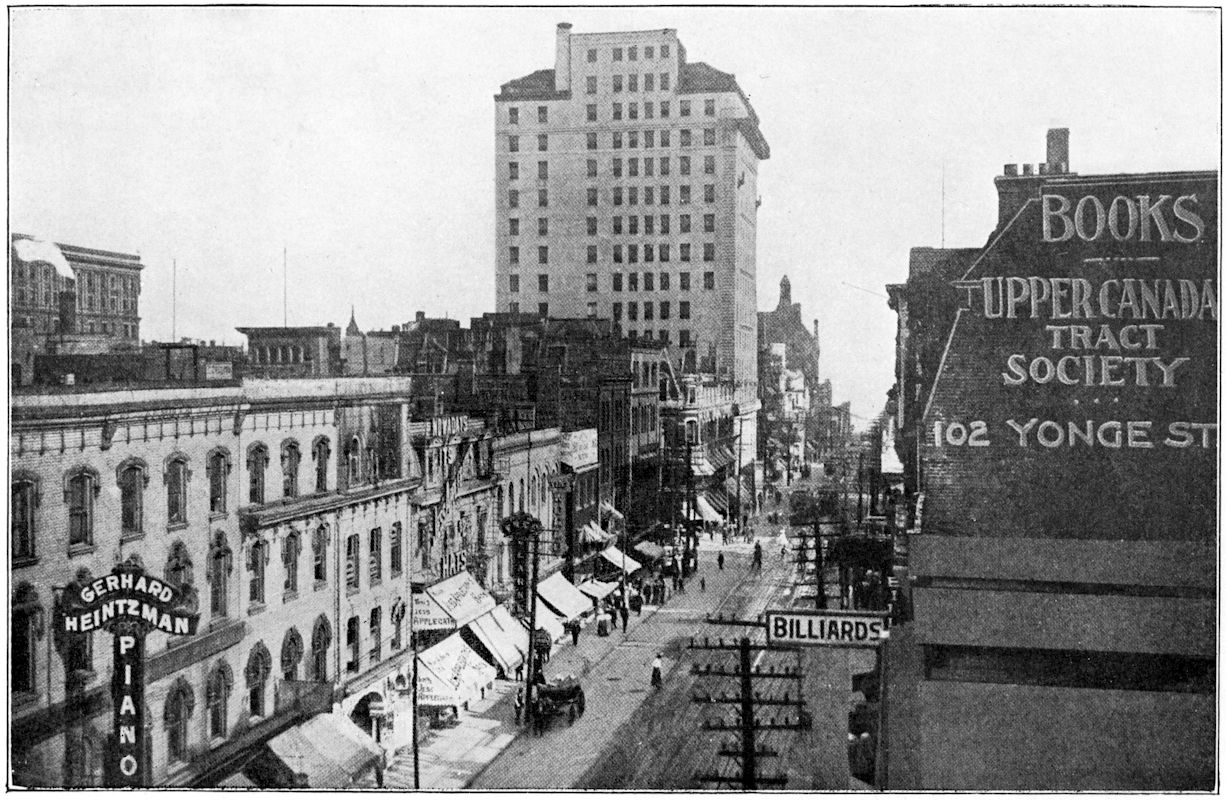
TORONTO. YONGE STREET, LOOKING SOUTH FROM ADELAIDE STREET.
Take Hamilton, Ontario, for instance. This
flourishing city is one of the oldest in Canada.
It is magnificently situated for trading on the
shores of Hamilton Bay, a land-locked harbour
at the head of Lake Ontario. The manufacturing
quarter is well away from the beautiful
residential quarters, where the prosperous
Hamiltonians live in handsomely-built houses,
each isolated on its own freehold plot, surrounded
by a border of grass or shrubs with
abundance of forest trees. It rises to the
Mountain, as a steep hill is called, from the
summit of which there is a very striking view
of the city and a picturesque outlook over one
of the most fruitful parts of the Dominion,
abounding in peach and apple orchards and
vineyards. Hamilton is only forty miles
from Niagara Falls, and its interest in the
Falls is utilitarian as well as artistic and
sentimental, for it is the electric power
generated at the Falls which drives the works
of Hamilton, lights its streets and houses, and
supplies the heating power. On my visit to
the Falls I saw the great power-house in which
the mighty rush of the Rapids is harnessed and
tamed by the engineering skill of man and
compelled to serve alike the industrial prosperity,
the domestic comfort, the tram service,
and the house and street lighting not only
of Hamilton, but of Toronto and of many
other cities. The first thing that strikes a
visitor to Hamilton, if he should arrive after
dark, is what he will consider the scandalous
luxury of the brilliant electric lighting with
which the fronts of business houses and places
of entertainment literally blaze, but should
the visitor express his concern at such apparent
wicked waste he will be told that electricity
is so cheap that its cost is practically negligible.
It is to the cheapness of natural sources of
power, that is given without stint, that the
growing manufacturing prosperity of Canada
is largely due.
It was my privilege to be convoyed around
Hamilton and to be introduced to the heads
of departments of some of the principal
factories by Mr. H. M. Marsh, Commissioner
of Industries. Through him I learned that
there are no less than 400 manufacturing
industries in the city, with four suburban
electric railways having a combined mileage
of eighty-three. There are seventy-eight
churches, thirty public and four private schools,
not counting a technical school, a college of
music, a normal school, and a collegiate
institute. There are six steamship lines connecting
Hamilton with the chain of the Great
Lakes and enabling it to send its products
cheaply right into the centre of Canada and far
south and west into the heart of the United
States. Seven steam railways also enable
Hamilton to send its manufactures by land
transit over the North American continent
and to the principal ports of the Dominion and
the United States. The extent of the turnover
of money in the city is shown by the fact that
the bank clearings in 1911 were $125,250,000,
an increase of more than $24,000,000, or nearly
£5,000,000, over 1910.
A more significant fact forcibly driven home
to me is that some of the largest and most
rapidly advancing factories are branches of
American firms. More than thirty-five
American firms have invested an enormous
amount of capital in buildings and plant to
produce their specialities in Hamilton. On
the Canadian side at Niagara Falls I found
the same significant fact. The explanation is
that given by my London, Ontario, friend.
The Canadians are compelling the Americans
to plant their factories in Canada in order that
they may employ Canadian labour and teach
the Canadians how to become a manufacturing
nation. At the Falls I was told that
by manufacturing on the Canadian side the
American firms save from 10 to 35 per cent.
duty which they would have to pay if their
goods crossed the river. It pays them better
to build and manufacture in Canada than to
pay the duty.
The manufacture of agricultural implements
of the most modern type for culture on the
wholesale scale plays a very large part in the
industrial life of Hamilton. I went over the
Oliver Chilled Plough Works, an undertaking
of the last year or two, but which is already
doing business on an enormous scale. The
works, I was told, are more up to date than
even the parent works in the States, for with
the ground at their disposal, and with the
experience of the past, it was possible to
eliminate everything that was disadvantageous
and so to construct the factory and to lay down
the plant as to meet exactly the requirements
of the business alike in Canada and in other
markets. Nothing could be more ideal than
the conditions under which this industry is
carried on. The ploughs produced are power
ploughs furnished each with a number of
coulters, from half-a-dozen to nine or more,
capable of dealing with the most refractory
surface. The coulters are modified to meet
the varying conditions of heavy or light soil.
I saw a vast number of the component parts,
witnessed the processes of manufacture, the
dipping of parts into baths of paint, and
complete ploughs ready to be sent out either
to break the virgin prairie or to replough land
that had been harvested.
On a still greater scale were the works of the
International Harvester Company, another
branch of a famous American firm. More than
three-quarters of a century ago Mr. McCormick,
forbear of the present controlling McCormick—he
was a pious Presbyterian with the Scottish
instinct for getting on—invented a reaping
machine which answered so well in a Virginia
wheatfield that it led to a revolution in
agricultural machinery. All sorts of machines
were produced and have been continuously
improved for all the principal operations of
agriculture on the grand scale. To-day
McCormick’s International Harvester Company
is the greatest agricultural machinery
industry in the world. The firm saw the
opportunities offered by the development of
the Prairie Provinces and were quick to take
advantage of them. I was told that farmers
can get all the machinery they need without
paying a cent down. The firm looks to the
future rather than to the present. It knows
that its money is safe and will fructify in the
fields of the farmers, to whom it gives the
longest credit. Again I saw the processes of
manufacture of the parts of reapers, binders,
tedders, self-dumping and other rakes, hay
lubbers, huskers and shredders, harrows, drills,
and ploughs. I was shown a forty-five horse
power plough driven by a gasolene engine.
It is furnished with twelve coulters, each
14 inches deep. It will plough twenty acres
a day of ten hours, and if necessary can be
run throughout the whole twenty-four hours
at certain seasons. Anything more perfect
and capable of getting through so much work
at such a small expenditure of human labour
it would be impossible to conceive. It is
such machinery as that turned out by the
Oliver Chilled Plough Works and the International
Harvester Works that has made the
marvellous wheat production of the Prairie
Provinces, increasing constantly at the rate
of millions of bushels a year, possible.
Hamilton is also the scene of enormous
works of the Canadian Westinghouse Brake
Company, a branch of the Pittsburg Company,
whose brakes are necessities of existence to
every railway company and to most of the
electrical tram systems of the world.
A constant stream of immigrants pours
into Hamilton. The demand for labour is
insatiable. I noticed in the International
Harvester Works that warnings and regulations
for the guidance of the employés were
printed in seven languages. It was evident
that the workmen were a cosmopolitan mixture
of races. They included many men from the
Balkan States, Italians, Russians, and others
who in Canada take more kindly to manufacturing
and railway construction employment
than to the life of agriculture. Mr. Marsh
informed me that in March 1,200 men could
readily be found employment in the various
Hamilton factories.
Ontario, with its four millions of population
out of the seven millions of Canada, is the
great manufacturing Province, although there
are growing manufactures in the Eastern
Provinces of Nova Scotia, New Brunswick,
and Quebec. A Government publication
summarising the industries of Ontario states
that, in addition to Hamilton and in and
around Toronto, at London, further west on
its own river Thames; at Brantford, Chatham,
Guelph, Kingston, Ottawa, Peterborough, St.
Catharines, St. Thomas, Stratford, Berlin,
Collingwood, Galt, Ingersoll, Oshawa, Sarnia,
Sault Ste. Marie, Woodstock, and scores of
other centres, the mills and factories are
busy. They produce vast quantities of iron
and everything that iron makes, from a tin-tack
to a locomotive. The agricultural
machinery made in Canada stands so high
in reputation that it finds a market not only
in South America and in the sister realms
of Australia and New Zealand and in the
Mother Country itself, but in continental
Europe. Several other special lines of manufacture,
including parlour organs, are now
well known abroad; but in most branches
the Canadians themselves use all that their
manufacturers produce; and here in the towns
of Ontario are produced not only such wares
as we have just mentioned, but cotton,
woollen and leather goods and clothing;
waggons and carriages, on wheels or runners;
furniture, paper, and almost everything else
that is made of wood; foodstuffs, plain and
fancy—but really there is no end to the list.
These manufacturing towns are spread over
the Province in a way rather strange to Old
Country men, whose centres of industry are
generally to be found clustering in a few
districts marked out for such a purpose by
particular local advantage. There is no
“Black Country” in Ontario. There is,
however, one district where manufacturing
towns are particularly numerous, in the south-west
part of the Province. There is no coal-field
here, but the great coal-fields of Pennsylvania
lie just across Lake Erie; and this
region has the enormous advantage of lying
within easy reach of Niagara Falls. The
glory of the Falls is their beauty, and it is to
be hoped that their beauty and grandeur will
be religiously preserved for ever. The Falls,
however, provide an enormous force, which
can be used without destroying or greatly
injuring their appearance. This force is
already being developed by the Ontario
Government and private enterprise, and is
being conducted through electric cables to
the manufacturing towns, where it will provide
motive power for almost unlimited
machinery.
At Sault Ste. Marie, where the water of
Lake Superior pours out into Lake Huron,
a gigantic iron and steel industry is being
developed. At the upper end of Lake Superior
again are the twin seaports, Fort William and
Port Arthur, where millions of bushels of
prairie grain are loaded yearly in a multitude
of steamers and shipped down to ports on
the eastern shores of Lake Huron.
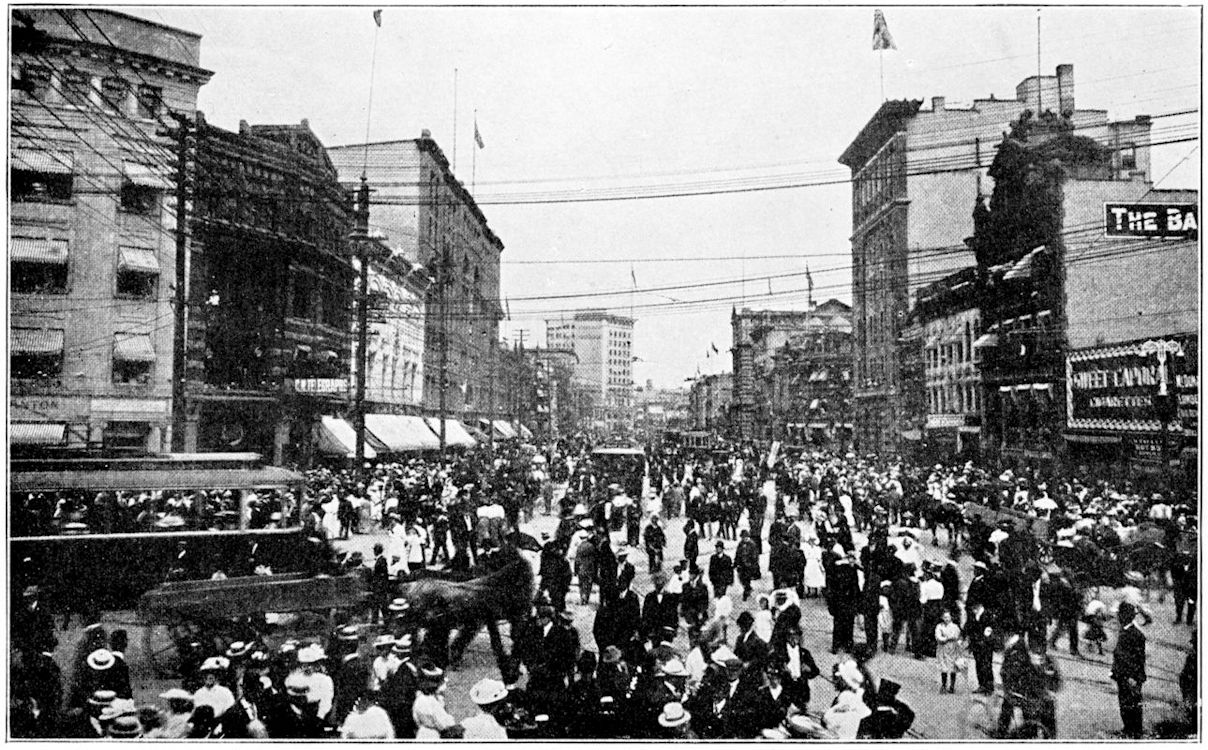
GALA DAY AT WINNIPEG.
Travelling westward I passed out of Ontario
with its lakes and wooded hills into Manitoba,
the first of the Prairie Provinces. Within the
memory of middle-aged men Manitoba and
all west of it was practically a grass-grown
wilderness, spangled during the summer
months with a succession of flowers of many
varieties that grow magnificently—some of
them such as are the pride of gardens at home.
There is a picture of the Provincial capital,
Winnipeg—which is now as large as Bradford—in
1872, showing a tiny market town of
about 2,000 population. Among the figures
in the picture is that of the late Lord
Strathcona, then the directing spirit of the
Hudson’s Bay Company. To his enterprise
is largely due the subsequent development
of the country. The population to-day exceeds
200,000, and the city, at the fork of the Red
River and the Assiniboine, in addition to
being the corn exchange of the West, is
becoming a manufacturing centre of the first
importance. Main Street, Winnipeg, is a
scene of surpassing interest to the English
visitor. I was told that, if you knew how to
distinguish them, you might meet in a walk
along Main Street people of forty nationalities.
At night it dazzles with the glare of its electric
lights. There are hotels to suit every pocket,
great departmental stores employing each
their 500 to 2,000 “clerks,” shops fitted up
in the most modern American style and
offering the world’s best to the Winnipeg
folk and visitors to the city, who appear to
have inexhaustible supplies of dollar bills.
The money turned over in Winnipeg would
make a handsome revenue for a fair-sized
kingdom. Its citizens build churches without
counting the cost, and the churches,
with such preachers as the Congregational
Dr. J. L. Gordon, a flaming orator, with a
rush of rainbow rhetoric, and the Presbyterian
“Sky Pilot,” Dr. C. R. Gordon, draw crowded
congregations and often turn away hundreds
from their services. There are no fewer than
115 churches and five colleges, including the
Wesley Training College for ministers. At
St. Boniface, near by, is a large French
settlement with a fine cathedral church,
recalling the fact that here was a famous
Roman Catholic mission to the Indians and
half-breeds. In the burial ground of the
cathedral I saw the tomb of Louis Riel, the
French half-breed who, at the beginning of
the development of the West, raised the
Indians and half-breeds against the Canadian
Government and paid for the rebellion with
his life. It is the development of the West
with its increasing population that has been
the making of Winnipeg. It does a wholesale
trade of more than £6,000,000 a year, and has
more than 400 factories, employing something
like 20,000 workers. A very large number of
English immigrants have settled in Winnipeg,
and many of them have rapidly become rich
men, while they have sent for their young
relatives and friends to join with them in
taking advantage of the wonderful opportunities
offered to men with grit and business
enterprise. For young men not disposed to
go on the land, but desiring a business career,
I should say there is not a better place to
make for than Winnipeg. Such departmental
stores as Eaton’s and the Hudson’s Bay
Company’s establishments, with the scores
of huge concerns in every department of trade,
with the sixty banks and the offices of professional
men, Real Estate agents and the like,
are always on the look-out for young fellows
who are not afraid of work and are willing
to adapt themselves to the conditions of the
country. I did not gather from what I saw
of business methods in Montreal, Toronto,
Winnipeg and the cities farther west that the
work is more exacting than it is in the Old
Country. The hours usually are certainly
shorter. What is demanded is the willing
heart, a quick intelligence and the ability to
do just what is required. The “slacker”
in Canada hangs fire as he does in England.
I heard some comparisons between native
Canadians and English new-comers in business
houses, which were rather in favour of the
new-comers. It is said that the young
Canadian is much more ready to get time off
for a baseball match or a pool contest than is
his English competitor. It may be that the
English competitor is usually a young fellow
with ambition and energy above the average,
or he would have stayed in the Old Country,
where the temptations to slacking are so
numerous and so fascinating.
On the journey of 300 miles odd from
Winnipeg to Regina, the capital of the central
Prairie Province of Saskatchewan, the traveller
sees the prairie stretching out on either side
of the line to the horizon. Early in the
summer it is a sea of green growing wheat;
towards harvest time it is a sea of gold, with
the wheat to the height of a man; after harvest
the prairie presents the appearance of a vast
encampment with the wheat stooks waiting
for the threshing. The threshing over, the
prairie glows at night with conflagrations as
if a hostile army was marching through the
land destroying as it went, but all that is
happening is the burning of waste straw and
refuse from the threshing, the ashes being the
only fertiliser that the soil has so far received.
There are brand-new towns and villages at
every three or four miles, each the centre of
a rapidly-growing trade with the farmers and
other settlers in the district. What will most
strike the English visitor, however, is the
succession of elevators along the line, resembling
huge square or oblong towers with a
turret on the top. The elevators are the
receptacles of the corn ready for the market.
Each will hold an enormous quantity, ranging
from scores of thousands to millions of
bushels. Many of the elevators belong to the
wholesale buyers or to great milling firms.
A large number have been built, however,
by the railway companies to hold the grain
until transport is available to convey it to
the markets. So great is the pressure between
the harvest and Christmas time that all the
freightage rolling stock of the companies is
called into service, and all the elevators are
crammed to bursting point with the wheat
and oats, and even then the farmers complain
that wheat has to remain in the fields week
after week because the elevator accommodation
is insufficient. It is a revelation to
the travelling visitor of the inconceivable
food-growing capacity of Central Canada, of
which as yet scarcely the half of the cultivable
soil has been broken. It is easy to
understand and to believe the boast that
Canada, when its cornlands are fully cultivated,
will be able to feed four-hundred-millions
of the world’s population.
This enormous agricultural production means,
of course, great and expanding demands
for the products of manufacturing industries.
In the early years of the Prairie Provinces’
development the needs were all supplied from
the East, but the Prairie Provinces, like the
Eastern Provinces, have their own industrial
ambitions, and they are setting to work to
become as far as possible manufacturing
suppliers of their own necessities. Let me
describe as illustrations what is taking place
at Moose Jaw and Regina, the latter the
capital of Saskatchewan Province.
Moose Jaw, as the name of a city, provokes
smiles. It derives its name, according to
local belief, from the discovery of the jaw of
a moose on its site before the Canadian Pacific
Railway drove its steel across the prairie.
Moose Jaw was an insignificant village, and,
but for the railway, an insignificant village it
would have remained, its only population a
few Indians and a handful of half-breeds,
with an occasional visitor in the person of
a Hudson’s Bay or Eastern trader or a mounted
police trooper. The railway pioneers, however,
saw in Moose Jaw a strategic position for
a railway centre, and immediately the village
began to grow by leaps and bounds. The
C.P.R. has spent millions of dollars in Moose
Jaw on its fifty-three miles of trackage, its
stock-yards, its freight sheds and its trains
and depots, built prophetically with a view to
the needs of the future great manufacturing
and distributing city. The Grand Trunk and
Canadian Northern Railways are now entering
Moose Jaw, and within a year or two fourteen
lines will radiate from the city, linking it up
with all Canada and the United States.
Great flour mills have been established, and
huge meat-packing plants, bridge and iron
works are among other manufacturing concerns.
The applications for building permits
for new factories, mills, banks, business
houses and the like are increasing with a
rapidity that makes the people early on the
spot smile their broadest and shake hands
with each other at the stream of gold flowing
into their bank accounts. To the Englishman,
accustomed to the harmonious lines of
handsomely-built business streets and
macadamised roads, with their hard surface
and the broad pavement, Moose Jaw does
not make a particularly favourable first
impression.
Moose Jaw is at present a muddy place,
with “side walks” only just making their
appearance. With sewage construction, water
and gas supply and other necessaries in progress,
the roads are always “up,” but the
automobile owners who kindly “run us round”
care nothing for a foot depth of mud and
ruts such as were never seen in English lanes.
They are “cross country” riders of the most
fearless type, and bump English visitors in
and out of the ruts and up and down folds of
the prairie in a fashion that puts British
courage to a severe test. Moose Jaw mud,
like all prairie mud, is of the fattest, stickiest
kind, but, as a leading citizen said to me,
“Our streets five years ago were just muddy
tracks, but it was prairie mud; it grew our
‘No. 1 Hard,’ the world’s standard in wheat;
it gave us our money, and we cheerfully put
up with it.”
Moose Jaw has boundless confidence in
itself. It believes, like all the cities of the
West, that it is the city with a future. Other
cities may be going ahead, but Moose Jaw
will always show them the way. The pride
of local patriotism is nowhere so highly
developed as in these Western cities.
“Have you been at Winnipeg lately?”
asked a Winnipegian of a man on the train.
“Yes, I was there at the beginning of last
week. It’s a growing city.” “Ah!” said
the Winnipegian, “but you should see it
now!” And here, be it said, the people of
all these provinces and cities are consummate
masters of the art of “boosting.” They
have boundless faith in their cities and themselves,
and they try to infuse their faith into
others. They say, in effect, as a firm that
opened a new shop in one of the cities inscribed
across the frontage, “We are It. Watch us
Grow.”
Moose Jaw, I am certain, would never
dream of yielding the palm to Winnipeg or
any other city of the prairie. Those other
cities might have got the start, but Moose
Jaw will catch them up and overtake them.
Since my return it is reported that an inexhaustible
supply of natural gas has been
discovered near to the city. If this be so,
then the cheapening of power which the gas
will cause will certainly justify Moose Jaw in
its most optimistic anticipations of its future.
As to Regina, it is bound, as the capital
city, to go ahead alike as a business, a manufacturing,
and a social centre. It is the
commercial centre—the Railway Junction
City—of millions of acres of corn-growing
prairie. At Regina I had an insight into the
municipal life of a Western Canadian city.
We are discussing at home town planning,
the land question, the education question and
all sorts of social reforms which to carry out
make heavy demands on the rates and taxes.
We are a very ancient country with a most
complicated web of vested interests and
an overcrowded population. There is sharp
division between class and class, Church
and Church, party and party. Canada, and
especially Western Canada, with its unlimited
area of land, originally the property of the
State, is able to deal with all such questions
and problems in a way that is impossible in
our own country. “Single tax” and “town
planning” go together in these new cities.
The newborn municipal authority decides what
shall be the area of the city. The lines of
development are decided on. The city surveyor
draws up a plan of the sections, which
are sub-divided into convenient lots. The
plots are then assessed. Those purchasing a
plot must pay the tax on the assessment,
whether it is built on or not. Plots are
reserved not only as sites for schools, city
hall, parks, and other public purposes, but
to provide by their sale, when the value has
enhanced by natural increment, for the
building and possibly the maintenance of the
schools and other public institutions. Thus,
at Regina, I was shown the new City Hall,
built at a cost of £100,000, and was told it
had not cost a penny in rates, for the whole
of the cost was met by the sale of municipal
reservations of land. In those cities schools,
as soon as families arrive, are among the first
and finest buildings to be erected, but the
cities grow so fast that the school accommodation
is soon out-distanced, and temporary
schools spring up, to give way at the earliest
possible moment to splendid permanent
buildings. It was good to see the youngsters
romping in their playtime, and to be told that
“There’s not a poor person in our city, Sir,
and we don’t mean there to be one. Sure!”
Banks are numerous, with very handsome
buildings, but one soon understands why they
multiply. The banks finance the builders of
the great hotels, “departmental stores,” the
builders of their own homes on the residential
lots secured—for every householder wants to
live in his own detached freehold house on
his own freehold plot—and they also finance
the farmers and others engaged in gathering
the “gold of the prairie.”
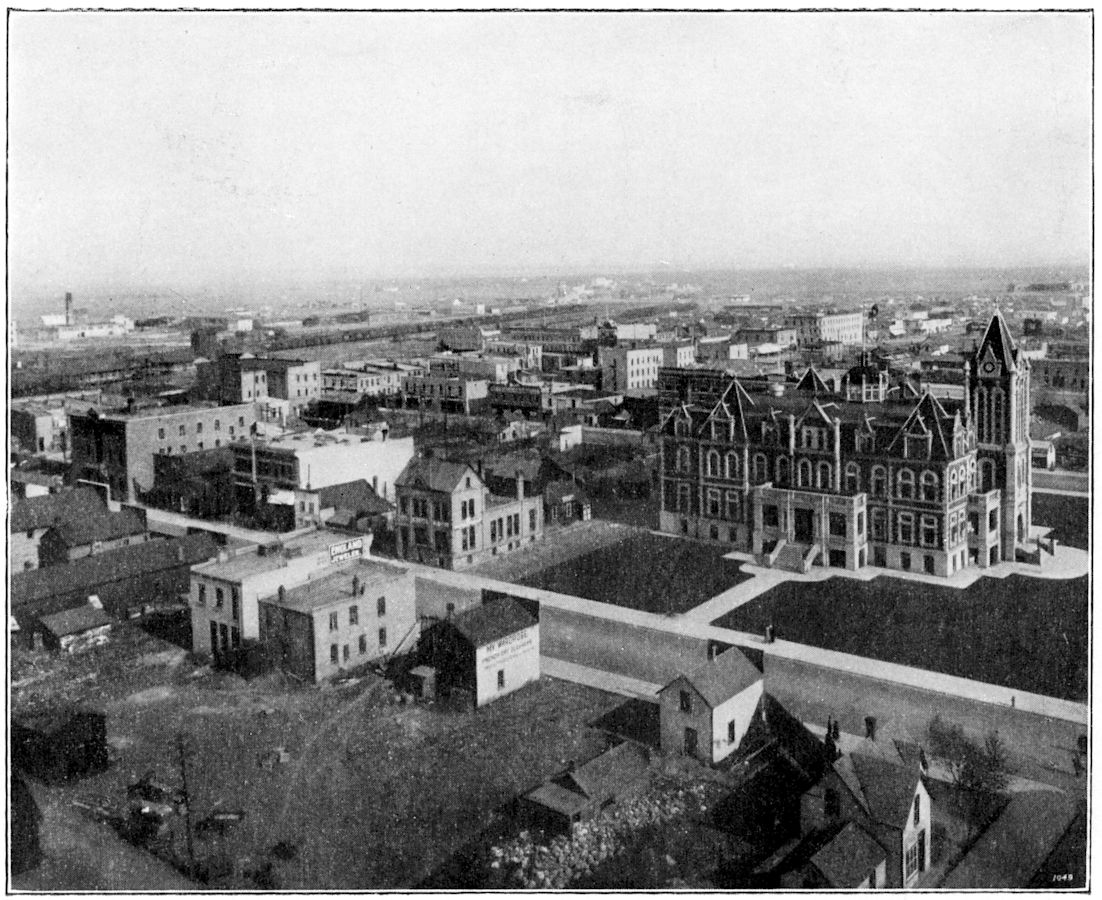
REGINA.
Regina is laid out on the best lines with
wise prevision of the needs of the future. In
the town planning quarters are reserved for
manufacturing industries, business centres,
residential streets and suburbs, schools and
churches. The quarters are being rapidly
occupied, but the city, of course, is still in a
very unfinished condition. Like Winnipeg
and Moose Jaw, however, it believes that
Regina is “It.” It has a brand-new Parliament
House, a long, spacious building, with
a handsome façade facing a grassy park with
a lake fed by the Waskanna rivulet. I had
a chat with Mr. Motherwell, Minister of
Agriculture, himself a model farmer, a prairie
Cincinnatus, who is deservedly held in the
highest estimation by his fellow-citizens. Those
Ministers of State of the Prairie Provinces, and
even those of the Dominion Government at
Ottawa, are not the awful unapproachable
beings that Ministers of State are in the
European Governments. They are men of
the people, sprung from the people, not
usually educated in colleges and universities,
but educated practically in the school of the
world. They understand thoroughly the conditions
and the needs of their country, and
my talks with Mr. Motherwell and other
public men, with the information in the shape
of Government publications which they placed
at my disposal, were a revelation of the
practical foresight and wisdom with which
the Canadian Governments are laying the
foundations of the vast populations which
within a few years will occupy the Provinces.
Nowhere in the world is the necessity of an
educated people more keenly realised, and
nowhere is such generous provision made for
the education. The best lots on the surveyed
sites of the town to be laid out by newly-formed
municipalities are reserved for schools—not
only the spots on which the schools are
to be built, but spots which by their unearned
increment, as the town develops, shall be
sold and the proceeds applied to the maintenance
of the schools. This avoids trouble
over the levying of rates for educational
purposes, for it was impressed upon me that
the schools and their maintenance, and other
public services, do not cost a penny to the
ratepayer. My Regina cicerone, a migrant
from the East, “ran me round” on an automobile,
and continually called my attention to
buildings just finished or in process of construction,
such as “Our City Hall—$500,000; a
new bank at that corner, $600,000; a new
church, $70,000; a departmental stores going
up there, $1,000,000; a railway company is
to build a million dollars hotel there.” In the
early summer of 1912 a cyclone cut a path
through the centre of the city, destroying
three churches, with much private property.
At five on the morning following the cyclone,
architects, builders and owners of the destroyed
property were surveying the ruins and planning
the buildings to rise on the cleared site. At
a “turkey supper” the Mayor of Regina,
Mr. M’Ara, told how the city has advanced in
civilisation since, a very few years ago, a
predecessor in the mayoral chair went to
welcome the first religious convention held in
the town. That mayor had been a “Wild
Westerner,” more at home at the poker table
than at a gathering of grave divines, but he
did his best to make them feel at ease. “You
are very welcome,” he said, “to our city.
I hope you will make yourselves thoroughly
at home. In order that you may feel perfectly
free, I have given orders to lock up the entire
police force.” Regina has three daily papers
and a weekly.
Regina’s manufacturing quarter is already
a hive of most profitable industry. As at
Hamilton, the workers are a very cosmopolitan
company. There are something like 10,000
people from the Balkan States and other
countries of Eastern Europe, while there is a
large and prosperous German colony. The
English and American elements of the Regina
population are somewhat concerned over the
growth of the non-Saxon element. They are
taking steps to Canadianise these people by
means of schools, missions, and other educational
and moralising forces. There is no
reason why, within half a century, the present
population of 50,000 to 60,000 of Regina should
not swell to half a million. I must not forget
the Methodist College, opened in 1912 at a
cost of something like £120,000, to give the
best possible higher school education to the
lads and girls of prosperous families of the
Province. The Presbyterians are following
suit with a proposed college on even a greater
scale. A Regina correspondent tells me that
within a month £100,000 was promised towards
the Presbyterian college. Men so keenly
alive to the educational needs of the city and
Province may be trusted not to let the grass
grow under their feet in matters of industrial
development.
Beyond Saskatchewan is the Province of
Alberta. Alberta, Canadian fashion, firmly
believes that it is “It.” Not only is the
Province destined to become one of the richest
cornfields and most luscious ranching grounds
of Canada, but it is enormously rich in mineral
resources, which will be the basis of great
manufacturing industries in the future.
Already coal-fields covering an area of at least
11,000 square miles have been located. Alike
in North and South Alberta, towns are growing
with mushroom rapidity, and new towns are
being planted every week with the rapid
pushing of the “steel” of the railway companies.
An American journalist, Mr. W.
J. Shunks, of Chicago, has described in
picturesque American fashion how towns are
“built while you wait,” so to speak, in these
amazing Western Provinces:—
“Half-way between Lake Superior and the
Manitoba prairies, in the heart of the virgin
forest, the Grand Trunk Pacific town-builders
put their pencils on the map and gave orders.
Presto! The new town of Graham, with its
divisional railway shops, its roundhouses, its
stores and banks, springs into being. At the
edge of the prairie section they decree another
larger railway city, with immense repair shops,
car works and foundries. Transcona is born!
As the rails are flung Pacificward, across the
prairies, there spring into being a string of
communities, with important divisional centres
of the Melville, Watrous, Wainwright and
Edson type, at regular intervals.
“I don’t know whether these Grand Trunk
town-builders deliberately planned a de luxe
edition or not. Certainly, they got one out
when they put Mirror, Alberta, on the map.
Mirror is about half-way between Calgary and
Edmonton. It is almost in the geographical
centre of the Province of Alberta—in the
heart of one of the richest agricultural sections.
It is to be an important divisional centre, on
the Grand Trunk Pacific’s line connecting
Calgary and Southern Alberta with the main
trans-continental line from Winnipeg to
Edmonton.
“The town site of Mirror is natural—that
is, the railway company did not have
to look for one in that particular location.
They found it, ready made, on the west
bank of Buffalo Lake, the largest body of
fresh water in the province, and a natural
summer resort. The town site is on a ridge
with gentle slopes—eastward to the lake,
and westward to the railway right of
way.
“Mirror—though it borrows its name from
an English publication, The London Mirror—will
be a typically cosmopolitan town of the
Canadian west. Around it are farming
districts of marvellous prosperity. There are
rich and vast coal mines in the immediate
vicinity. Scientists say that this district is in
the heart of the gas and oil belts of Alberta.
In natural resources, beauty of location, and
future prospects, Mirror is a blue ribboner
among the new municipalities.
“When the town site of Mirror was first
placed on the market—July 11 and 12, 1911—there
were 577 lots sold at auction in
660 minutes. The aggregate purchase price
of these lots was $250,000. That was the
beginning. Many more lots have been sold
since. Before Mirror was a month old it
had two banks, five stores, three lumber
yards, one hotel, three restaurants, two pool
rooms, a sash and door factory and a newspaper.
When it reaches the mature age of
one year it will be a wonder.
“The really important feature in all this
town building is that conditions require it.
The country is being thickly settled with
prosperous farmers. Merchants, manufacturers,
bankers, artisans, doctors, lawyers,
ministers—all the factors in urban population—follow
the trails the farmers blaze. It is
their door of opportunity.”
In Southern Alberta is the city of Medicine
Hat, whose name is a constant joke to the
Englishman who knows it only as a name.
I must confess to sharing in the ribald joking
until I made the acquaintance of Medicine
Hat. Having seen it, how can I describe it?
I had chaffed a London journalist—standing
in the front rank of newspaper globe trotters—until
he scowled savagely at the mention of
it. I shall joke about it no longer. Medicine
Hat has got to be taken very seriously indeed.
Locally its name is familiarly shortened
to “The Hat.” It gets its name from its
extraordinary location. There is a large
circular depression of the prairie, surrounded
by sharply-rising sandy walls. The depression,
with the prairie stretching out above from
the rim of the walls, bears a rough resemblance
to an inverted low-crowned hat, with an
endless Quaker brim. Through the depression
runs the broad silver belt of the South Saskatchewan
River. The depression suggests a
worn-down volcano crater, and the speciality
of Medicine Hat confirms the suggestion.
Underneath is pent up an inexhaustible
storage of natural gas. The Indians knew of
the gas, and associated it with magic and
devilry, hence the name of “Medicine Hat.”
Rudyard Kipling’s imagination was impressed
by Medicine Hat, and he styled it “City born
fortunate, built upon hell.” No wonder the
hollow crown is being filled with huge flour
mills and factories, while the brim is being
eagerly snapped up for residential purposes.
The gas is pure and ready for use to supply
alike power, light and heat. There are “gas
wells,” from which the gas rushes at a tremendous
pressure, but it is tamed and made to do
its work, at a cost to the consumer of only
7½d. per thousand cubic feet. That means
to the householder fuel as well as light.
Manufacturers are encouraged to settle in
“The Hat” by the offer of “free power” for
five years. As it costs nothing to generate
the power, and the supply is unlimited, it pays
the authorities to make the concession. Last
winter four huge flour mills were to be put
up by different companies, and about thirty
factories are already at work, while inquiries
are crowding in from other firms. “The Hat”
expects to have a population of half-a-million
by the time its young men are middle-aged.
The South Saskatchewan gives it the purest
drinking water, and in the summer the prairie
will be making gold for the farmers, much of
which will gravitate into “The Hat.” I
might add that the street lamps burn all day
because it is cheaper to let them burn than to
employ labour in putting them out and
relighting them.
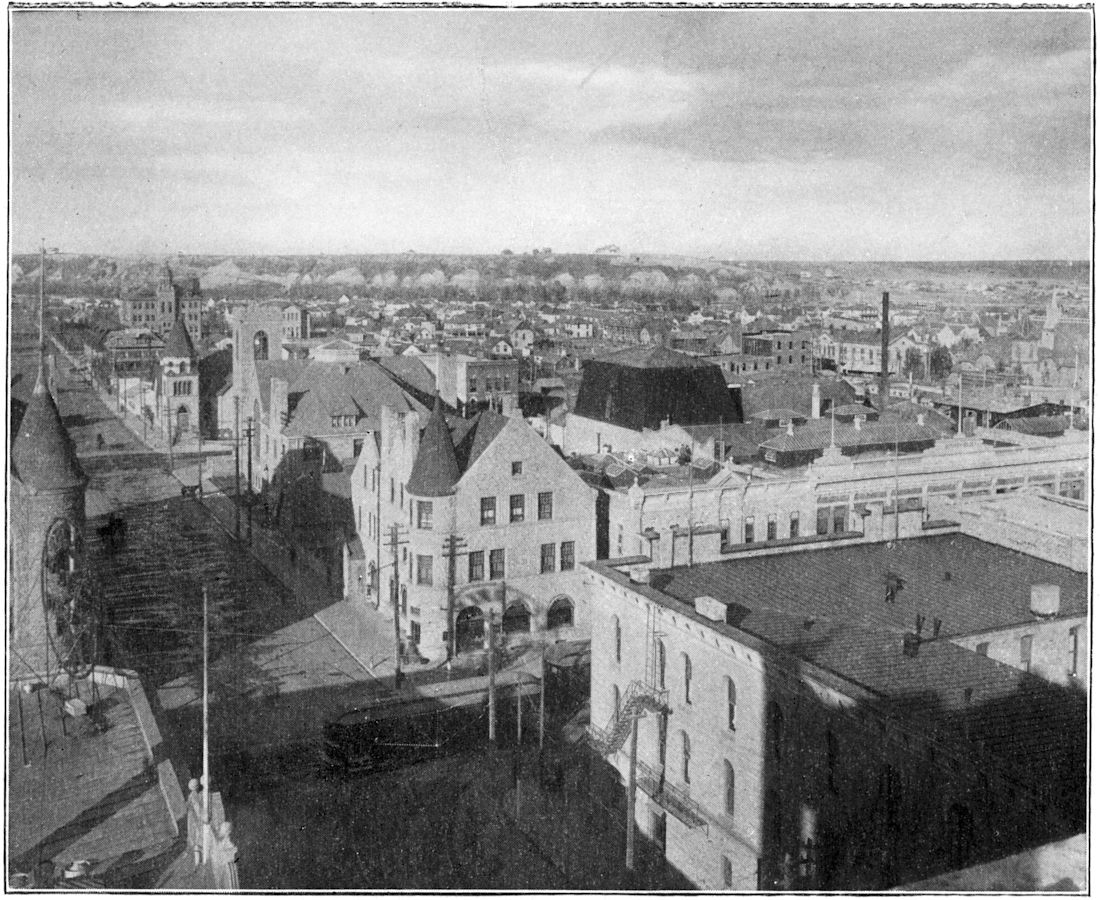
CALGARY.
I found further on, at Calgary, that that
city is also utilising natural gas, but in this
case it has to be brought in pipes some 200
miles. I was told that the work of trenching,
laying the pipes, and putting on the gas supply
had been done within two months—a fact
of which Calgary was properly proud. At
Calgary, a cattle and horse-raising centre, I
saw the month-old University of Calgary,
housed in a modest temporary building, with
some seventy students. The Dean, Dr. Braithwaite,
showed me a syllabus of some seventy
subjects, and the plan of a block of University
buildings that might well make Oxford or
Cambridge “sit up and take notice.” It
would take at least $50,000,000 (£10,000,000)
to realise the scheme, but the Dean said, “It
may take fifty years, but it will be done.”
Already a few citizens have subscribed
450 acres of land, in a glorious situation, on
high ground a few miles from the centre of
the city, with the serrated line of the Rocky
Mountains cutting the western horizon seventy
miles away, and $500,000 are given as a
beginning. There is a strong rivalry between
Calgary and Edmonton and Saskatoon, further
north in Alberta. The State University is at
Saskatoon, but Calgary is going ahead with
its University for South Alberta, and will
worry the Government for a charter empowering
it to confer degrees when its students are
ready for the degrees.
Central Alberta, unfortunately, I was unable
to see, but I heard much about it even on the
Atlantic before I landed in Canada. There
were on board two of the leading citizens of
Edmonton, Alberta. They told me of the
inexhaustible natural resources of the western-most
Prairie Province, backing on to the
Rocky Mountains—land that yields 36 to 40
bushels of wheat and 50 and more bushels of
oats to the acre, and under the surface thousands
of square miles of the best coal waiting
to be mined. “And there are other things,”
said an ex-City Commissioner. “We have a
lake—Cold Lake—scarcely noticed on the map,
yet I have seen forty teams a day drawing the
white fish from that lake for the American
market. When the great lakes, such as the
Great Slave and the Lesser Slave, are opened
up, they will yield inexhaustible supplies of
fish, of enormous value. It’s marvellous!
I’ve been ten years farming at Edmonton—that
is to be an old-timer in a city that has
risen in population from 5,000 to 55,000 within
the decade—and I never cease to marvel at
what both land and water give us.” That
“It’s marvellous!” I kept hearing from
Canadian lips all the way across.
As to British Columbia, it is destined to be
a great holiday resort alike of Canada and of
the North-Western American States. We
catch sight of the serrated line of the Rockies
at Calgary, clearly visible through the transparent
atmosphere at a distance of seventy
miles. From Calgary over the Rockies, and
the descent through British Columbia to
Vancouver, is a run of twenty-six hours.
The scenery surpasses even that of Switzerland.
Canadians who have spent a holiday at
Lake Louise or other centres for mountain
climbing and glacier exploration find even
their abundant and eloquent vocabulary insufficient
to express their ecstatic admiration.
I passed through British Columbia and back
in the middle of November, but even then the
hours of daylight were hours of continuous
delight. From the windows or the platform
of the observation car rise on either side
the shaggy sides of mountains and beyond
them peaks and peaks towering above each
other over the snow line, until they are
lost in the dim distance. Anything more
exquisitely lovely than sunrise in the Rocky
Mountains it is impossible to imagine. The
gilded snow peaks look like cubes and pyramids
of glittering gold. The railway itself is a
continual wonder. It is a triumph of the
mind, the resolute will, the skilful hands, and
the Napoleonic organisation of labour and
mechanical ingenuity over the forces of Nature,
which it would almost seem intended to place
the Rockies as an everlasting barrier between
the prairie and the Pacific. The railway now
tunnels through the living rock, now corkscrews
up apparently impossible gradients,
now throws itself across terrific chasms, now
winds along the edge of precipitous cliffs,
now runs through gloomy ravines as it makes
its westward journey to the coast.
British Columbia is as confident of its
magnificent future as are its sister Provinces.
With the opening of the Panama Canal it
looks forward to such an outlet for its agricultural
and manufacturing products as will
draw millions of people to the country and
make it not only by its scenic glories a gem
of the Imperial crown, but one of the Empire’s
richest wealth-producers. As the railway
descends to the lower slopes of the Rockies
the country opens out. There are large and
lovely lakes swarming with fish, a country
abounding with valleys that rival Annapolis
valley of Nova Scotia and the Niagara country
of South Ontario in their fitness for fruit
growing, while the humidity of the atmosphere,
the soft Pacific breezes, the flood of
summer sunshine, and the mildness of the
winter give British Columbia enormous advantages
over its eastern fruit-producing rivals.
Fruit alike of temperate and sub-tropical
climates ripens to perfection with marvellous
rapidity, yields incredible crops, and is of the
richest flavour. In the autumn of 1912 and
again in 1913 collections of British Columbia
fruit won the gold medal of the Royal Horticultural
Society in London. Already British
Columbia is sending its apples and other fruit to
Australia and New Zealand, having the profitable
advantage of producing its fruit during
the antipodean winter. Large numbers of
British and American farmers are settling in
the valleys of British Columbia, and millions
of British capital are being invested in the
purchase and development of farms.
Then British Columbia is one of the greatest
lumber producing countries of the world.
Millions of square miles of forests are waiting
to be utilised. One of the sights of British
Columbia is the freight train, sometimes a
hundred waggons long, drawn by two powerful
engines, conveying the prepared lumber to
the coast for shipment to the States, or climbing
the Rockies eastward for the prairie. The
country is fabulously rich also in minerals,
including gold. Scarcely the surface of the
mineral richness has yet been scratched.
When the mining resources are fully developed
those resources alone would mean that British
Columbia will be one of the richest States of
the Dominion. The population of a country
more than twice the size of Great Britain is as
yet only about 600,000, and more than a third
of its population is that of Vancouver city
and Victoria in Vancouver island. I spent
some time in Vancouver city, which, within
a dozen years, has grown from 12,000 to over
100,000. Its main streets, such as Hastings
Street, with its splendid shops, would do
credit to Leeds or Manchester. The “sky
scraper” is evident in Vancouver, and will
be more evident if land values continue to
increase as they are increasing now. During
my stay a record in land values was made by
the sale of a site on Hastings Street at $7,500
per foot frontage. The site was already
occupied by a fine block of buildings, but the
block was scarcely considered in the transaction.
It was to be torn down in order that
a new block of palatial magnificence might
be erected upon it. It is clear as the day that
with its possibilities British Columbia within
fifty years will be the home of a people exceeding
the population of Belgium and Holland,
and even richer than the people of those two
most industrious countries. The Grand Trunk
and the Canadian Northern “steels” have
already reached, or are about to reach, the
coast, opening up huge tracts of country that
will be developed after the Canadian fashion,
towns being started every other day of the
week and becoming within ten years places
of importance as centres for the supply of
the surrounding country. A great number
of these towns will become centres of manufacturing
industry, for in British Columbia, as
in the other Provinces, the desire for manufacturing
industries is almost a fever. The
banks, the great insurance companies, and
other financial concerns express their faith in
the future of British Columbia by their
willingness to advance millions for its agricultural
and industrial development. The
visitor to British Columbia soon discovers
that the Province might well be named the
Nova Scotia of the Pacific, for, as men of
Scottish blood were among the pioneers,
discoverers and settlers, so Scotsmen by the
thousand, with their keen scent for places
where money is to be made, have flocked, and
are flocking, into British Columbia. The outstanding
names in Vancouver and Victoria
are Scottish names. I met one Scotsman
in the timber trade just arrived from Glasgow.
He had done well in Glasgow, but he told me
that Glasgow was nothing compared to British
Columbia.
The notes I have given with regard to the
industrial development and the industrial
prospects of the Provinces of Canada are
scanty enough, but I hope that the glimpse
given of the conditions and the outlook will
prove serviceable alike to those in the Old
Country seeking homes and careers in Canada,
and to those also with loose money, who cherish
a legitimate desire to invest that money in
something more remunerative and less precarious
than are most of the openings for
investment in Great Britain. A Lethbridge
man told me that for ten years he had been
trying to convince his friends in England that
the current rate of 8 per cent. interest on
mortgage loans in the Canadian Far West
was as safe as 4 or 5 per cent. invested in
gilt-edged securities in the Old Country. He
had succeeded at last in so persuading them,
and several of his friends had commissioned
him to take charge of their savings and make
fructifying use of them in assisting the agricultural
and industrial development of the
Far West.
The warning, of course, must be given that
land sharks and sharks of other descriptions
run in hungry troops in Canada, and that a
man in England with money to invest should
be quite sure that his agents or friends in
Canada are in the know and can be thoroughly
relied upon.
“REAL ESTATE”
Before leaving for Canada a word of
advice was given to me by a Member of
Parliament friend who had recently returned
from a tour through the Dominion. “If you
meet a Real Estate man,” he said, “and he
wants to talk to you, get into the next street
as soon as you can.” I bore the warning in
mind, but the difficulty that presented itself
in Canada was that there are not enough next
streets in the whole Dominion in which to
take refuge from the Real Estate man. He
has his offices in every street of every town
and almost in every village. His windows
are decorated with maps and plans showing
districts of new towns and suburban districts
of the older towns ripe for development.
Facts and figures about the unequalled opportunities
are put before you in ways more
enticing than are those of a London company
promoter. You are told how the population
has increased within five years from 5,000 to
17,000, and it is bound to increase in a sort
of geometrical progression. You are advised
to “get in early,” secure “snips,” and your
fortune is made. You may be a shy fly and
decide to keep out of the spider’s parlour, but
that does not save you. In the entrance hall
of your hotel, with its great windows like
those of an hotel or boarding house front at
Ostend, the Real Estate man, the picture of
prosperity, evidently feeling that all is for
the best in the best of all possible worlds, is
smoking his Havana. In the affable manner
which the Canadian shares with the Yankee
he gets into conversation with you without
introduction and without encouragement. How
can you resist a man so stuffed with interesting
information, so genial and so pleasant? He
asks you if you have been in “our city”
before, what you think about the city and the
Province, how long you have been in Canada,
when do you propose to return to the Old
Country, are you on pleasure or on business
bent, and if on business, what business?
Having taken such a friendly interest in you,
you naturally reciprocate the interest and
inquire in what line your affable friend is.
“Real Estate, sir,” he says, “and if you want
to be put on to a good thing you have hit
on the right man, sure.” He dives into his
pocket or opens his dispatch case and out
comes a plan of an estate showing hundreds
of lots in a chequer a yard and a half or two
yards square. He tells you that you have to
be careful when you deal in Real Estate, for
there are mighty cute men in Canada, and
before you can say “snap” they have you.
He, of course, as you have gathered from his
conversation, does his business on purely
philanthropic principles. So pleasant a man
could not deceive you. He is soon pointing
out the choicest bits on his map and telling
you, as a friend rather than as a seller, that if
you want half-a-dozen, or a dozen, or a score
of lots he can let you have the cream of the
bunch at a giving-away price. “They are
real snips, sir, you can take it from me. I
know what I am talking about. I have it on
the best authority that the C P.R. is going to
make that town a divisional point, or is going
to connect up with the Canadian Northern or
the Grand Trunk. It is going to build a
two million dollar ‘deepo’ there and arrange
a freightage shed that will astonish creation
in that part of the country. Do you know,
sir, that I sold six lots there three months
ago at $10 a foot”—which means foot
frontage—“to a friend of mine, and when I
saw him only last Thursday he told me he had
just refused $20 a foot for those lots. Now
I can let you have these lots at $12 a foot, and
you can take my word for it that within three
months you will either have sold them for
double the amount or you will have come to
me for another dozen or score of lots. They
are going just like hot cakes.” You wonder
why a man with such gold mines in his
possession should be willing to part with
them at all.
It is not only Real Estate men, however,
who talk Real Estate. Everybody talks it.
In the hotel, at the street corner, in the
departmental store, on the railway, you hear
Real Estate, Real Estate, Real Estate all
the time. It is a subject of the most thrilling
and never-fading interest to the Canadian.
You meet men everywhere who have been
dabbling in lots, and to a certain extent they
confirm the Real Estate man’s rosy pictures of
the money to be made out of this form of
speculation. A man not a year out from
England told me, for instance, that he had
bought four lots at $300 a lot and within six
months had refused $2,500 for them. Real
Estate has become not only a Canadian
business, but a Canadian pastime, rivalling
baseball and pool in its capture of the imagination
and the absorbing interest that its
votaries take in it.
There is money to be made out of Real
Estate—endless money, profits that grow as
Jonah’s gourd grew, if you only understand
the game. “If only!” But there is the rub.
You want to be the man on the spot with
access to all sources of information, a man with
sound judgment who can forecast developments
in the near future, if you are to dabble
in Real Estate without getting your fingers
badly burned. Or if you are not the man on
the spot you should know the man on the spot
and be thoroughly convinced that he has the
judgment and is straight, or you should deal
only with a company or agency of unblemished
reputation—a reputation of not taking wild-cat
risks, but of buying only where there is a
reasonable prospect of increased increment and
selling at a fair rate to customers who will be
content with a reasonable profit—the word
“reasonable” to be interpreted in the
Canadian sense. With such provisos there
is perhaps no form of investment which will
yield such large profits in so short a time as
investments in Canadian Real Estate. It is
gambling, of course, as much as speculation
in futures on the Stock Exchange or the buying
and selling of shares in industrial concerns with
rapid vicissitudes is gambling, but after all
the Real Estate business is playing an important
part in the economic development of
Canada. The Real Estate men are champion
“Boosters,” the most enterprising and effective
publicity men of the towns and districts
where the lots lie. There are plenty of honest
Real Estate men who have found that honesty
pays, because clients for whom they have made
profits come to them again and introduce their
moneyed friends to them.
The peculiarity of the Real Estate business
in Canada is the undoubted incredible increase
of unearned increment due to the miraculous
growth of towns and the continual opening
up of fertile country. In the new towns of
Canada the Single Tax system lends itself to
the Real Estate man’s activities. A town site
is surveyed by the municipal surveyor. It is
cut up into thousands of lots which are
registered. The rateable value of the lots is
estimated, and the purchaser of each lot
purchases it with the obligation of paying the
rate on the assessed value as soon as he takes
possession, whether he builds on it or not.
The Real Estate man carefully studies the
municipal map. He estimates the value of
the lots for himself. He collects all the
information available as to the directions
in which the town is likely to spread from the
centre. He finds out, as far as possible, what
are the probabilities of railways coming to
the town. He decides to take a batch of
lots—50, 100, or 250. The process is so
simple and so free from legal technicalities
and costs that he soon finds himself in possession.
The municipality wants a rate income,
and in the early years of its existence favours
the Real Estate man or anybody else who will
risk taking the lots and begin contributing
the rates upon them. The Real Estate man,
having secured his block of, say, 250 lots,
has his map drawn with the block coloured
and issues the map, probably with a booklet
designed to demonstrate that his lots are the
snippiest of all the snips in that town. Having
to pay the rates and to pay quarterly instalments
on the price of the land beyond the rates,
if the municipality puts a value on the lots,
it is to his interest to dispose of them as
speedily as possible. He does not want to
build, and certainly he does not want to go on
paying those rates and instalments on unproductive
land. He sets a value on the lots.
If for houses of about 25 to 30 feet frontage
and a depth, say, of 120 feet, the value may
be $10 to $20 per foot frontage. He disposes
of them at this price to new-comers and others
wanting to build their houses or to men
desirous of having a little fling in the way of
a speculation in unearned increment. It is
these speculators on increment out of whom
the Real Estate man relies to make his main
profit. A few lots are sold at $10 and $12
a foot to be paid in one payment down, and
the rest in quarterly instalments spread over
three, four, or five years. A man buys, say,
half-a-dozen lots and pays his first instalment.
The agreement is signed then and there in the
Real Estate man’s office, and the transaction
is entered and a trifling fee paid in the Land
Titles Office of the municipality. The whole
thing may have been discussed, agreed upon,
the deed signed, and the transaction legally
concluded within an hour. The purchaser
has got his half-a-dozen lots at $300 each and
has paid a twelfth of the price. The first
instalment may have exhausted the whole of
his available money. His hope is that before
the next instalment is due he will re-sell to a
purchaser and make $5 or more profit per
foot out of the purchaser. The second buyer
is also a speculator in increments. He pays
his instalment with the same hope of selling
at a satisfactory advance price before the
second or third instalment becomes due. So
it goes on. It is all right if you are one of the
early purchasers and get rid of the lots
according to your expectation, but if the
speculation fever is very high and the expectations
as to the future of the town or the district
of the town in which the estate is situated are
too rosy, the lots are sure, within a limited
time, to be forced up to a selling price far
beyond their intrinsic value, and a too sanguine
buyer at last will find himself in possession
of them and have them left unsaleable upon
his hands. As it was put to me by a shrewd
man very familiar with the business, “It is
the last man who will get the pinch.” If you
go in for Real Estate speculation you must
take care not to be the last man.
The head of a great Canadian financial
corporation said to me, “There is plenty of
money to be made out of Real Estate if you
can trust the man you deal with, but my
advice to all my friends is to avoid as far as
they can long-range Real Estate speculation.
It is safer to put money into good industrial
investments. The profits may not be so quick
or so great, but there is much less risk.”
Several Real Estate men were perfectly
frank in describing to me the dangers of Real
Estate investment by men not in the know
dealing with Real Estate men in whom they
have not the fullest reason to put confidence.
“The thing,” said one of them, “may look
all right on the map. The map shows you
that the lots for instance, are within two or
three minutes of the post office or the Town
Hall. So they are, but you want to know just
where the post office or the Town Hall is in its
relation to the business and the best residential
quarters of the town. It may be that the
location of the post office was fixed when
the township site was first laid out. It was
expected then that the town would grow from
the post office location as a centre, but for
some reason or other it has not grown all
round the post office, but has spread away,
say, east and south and has not spread north
and west. The lots shown to you on the
map may be north or west of the post office
and not be worth $10 a foot, whereas if they
were at an equal distance east or south they
would be worth $25 or $30 a foot. Or the
post office in those infant days may have
been given to somebody by a bit of favouritism
and been located just where it is because
the man happened to have a lot there, without
regard to the public convenience at all,
and it is now practically stranded. Again,
the Town Hall, by the same mysterious tendencies
of growth, may be three or four
hundred yards out of the profit-making
centre and the lots shown to you may be in
a comparatively unprofitable area. You want
to know such matters as these to be quite
sure that you have got the real snips.”
The Real Estate man has certainly nothing
to learn in the art of pushing his wares and
prevailing on customers anxious to get rich
quick. Every self-respecting Real Estate
man has his automobile in which “to run”
inquirers “round.” It is a very good automobile,
has probably cost him $2,000 or $3,000.
It runs as smoothly as an automobile can on
such roads as they have in and around the
new growing cities and the new suburbs of
the older cities. As you are being run to the
estate where the most attractive snips are to
be shown you the Real Estate man tells you
marvellous stories of profits made out of lots
purchased on an estate just this side of the
one you are going to. “Only three years
ago, sir, that estate was laid out. Lots were
sold at $13 a foot, and to-day the men who
have got them would not take $50 a foot for
them. There is no reason whatever why our
estate should not do as well and even better,
for the C.P.R. is putting down a station right
in the middle of it, and already the municipality
has determined to run its street car
track right through the estate to such and such
a bit of lake-side or river or wood that is
the favourite summer outing place for the
citizens.” You are so interested and the car
runs so smoothly that you seem to be on the
estate in no time. You see the lots. It is
impressed upon you that if you miss this
opportunity you will regret it all your life,
and unless you are amongst the “once bitten
twice shy” you are almost persuaded. The
Real Estate man completes the persuasion by
telling you “We are only seven minutes here
from the Town Hall.” You think seven minutes
is almost next door to the Town Hall. You
decide to buy and are driven back to the Real
Estate man’s office with mind full of happy
anticipation of the profit you will make when
selling time comes next spring. It is only
afterwards, when you meet a citizen of the
town, a commercial traveller or some other
frequent visitor who knows the distances,
that you learn the Real Estate man was quite
right when he told you the estate was only
seven minutes from the Town Hall, but he
forgot to tell you that it was also seven miles
which the automobile had covered in the seven
minutes. During my time in Canada I was
offered a good score of “snips,” and was
tempted to regret that I was not moneyed
man enough to take advantage of them.
Perhaps, if I had had the money and had
secured possession of the lots, I should by
now have reaped 50 per cent. on the investments—perhaps
I should have had the lots
still on my hands and been cudgelling my
brains to find the means of keeping up the
payment of the instalments.
In Moose Jaw one of the three or four
drunken men whom I saw in Canada—the
drunken woman, I am told, is happily an
unknown figure in the Dominion—was going
along the main street repeating joyously “I’ve
got some lots, I’ve got some lots.” Let us
hope he had secured them before he had taken
the liquor, otherwise he might wake up sober
and find he was amongst those who had burnt
their fingers.
It is not only in home or business sites,
however, that the Real Estate man deals.
There is a vast amount of Real Estate business
done in “acreage,” as the Canadian calls
agricultural land. A man or a company
secures 10,000, 15,000, 20,000 or 50,000 acres
of unbroken prairie. This is divided into
farms. The usual map is produced showing
the position of the farms. The railway line
in actual existence or in contemplation is
seen striking through the estate. There are
three or four or half-a-dozen stations shown
along the line within the boundary of the
estate. You are told that the Canadian
Northern or the Canadian Pacific Railway is
going to make one of the stations a divisional
point—you are further told that all around
the region towns are springing up and other
towns are certain to be started in a year or
two. Every farm on the estate will be within
three or four miles of a railway. These farms
can be had at the giving-away price of $20
an acre to be paid for by $2 an acre down now
and the remainder in instalments covering
five or ten years. I was offered my choice
in Toronto of as much as I liked to take of a
25,000 acre estate in Manitoba. The Real
Estate man spread out his map before me
and earnestly impressed upon me the quite
exceptional “snip” that this acreage proposition
was. I could not do better than to snap
up some farms for myself and persuade my
friends in England to do likewise. I am afraid
that the half-hour of that Estate man was
wasted, for reasons into which I need not
enter. Now the proposition may have been
all he stated it to be. A number of Anglo-Canadian
combines have purchased such
properties and divided them up into farms of
from 25 to 500 acres, and men who have taken
the land are fully satisfied with their bargains.
On the other hand, the same speculator, not
knowing much about acreage values, might
easily get badly burnt over acreage. As a
practical Canadian farmer said to me: “The
land may look all right on the map and the
visitor who does not know farming—especially
the Englishman who does not know Canadian
farming—may think it looks all right when he
is taken over the estate; but the practical
Canadian farmer has sharp eyes and wants
to be assured that the thing is as good in
reality as it looks on the map. You may buy
a farm, for instance, and find that the land
is stony and dry and that a lot of money will
have to be spent in irrigation if crops are to
be raised out of it. On the other hand, you
may find that it may be low-lying and swampy,
and that even more money will have to be
spent on draining the land if it is to be any
good for farming. Or it may be covered with
trees that want stumping out, or the good
surface soil may be very shallow and ten years
of cropping will exhaust it, or there may be
a dozen other things that will depreciate the
value of the land.” Again there is that
danger of “long-range speculation.” The
projected railway may never become a reality.
The station within four miles of your farm
may exist only in the imagination. You may
have to cart your stuff not four miles, but
seven or ten miles, and the extra cost of
cartage and of labour will considerably reduce
the margin of profit. You may be fifty miles
from a populous town which offers a market
for produce other than wheat, and if you want
to succeed in Canada it is well not to put all
your eggs into the wheat basket, but to have
dairying, chicken and egg-raising, and market
gardening as other resources. No English
farmer ought to buy land until, in the company
of an experienced Canadian farmer, he
has thoroughly examined it and studied its
capabilities. The English investor, knowing
nothing about Canadian acreage values and
still more ignorant about the actual value of
lots offered to him on this particular acreage
investment proposition, should not risk his
money without expert advice from the district.
Such expert advice is usually to be had, though
of course it has to be paid for, but no money
is better spent than that spent in gaining such
knowledge.
This chapter on Real Estate is written in
no unfriendly spirit to the Real Estate men.
I am convinced that many of those whom
I met, both those dealing in town sites and
those dealing in acreage, were men of sound
judgment and good commercial honesty;
but business is business, and the principle in
the minds of a large number of the Canadian
Real Estate men generally is caveat emptor—“let
the buyer keep his eyes skinned—my
business is to sell. I have to make my
profit—it is the buyer’s business to take care
that he makes his. If the land is not what he
expected that is his look out—he must find
somebody else as simple as himself to relieve
him of it.”
THE HOMES OF CANADA
The people on the great ocean liners leaving
the Clyde, the Mersey, and the Severn for
Canada cross the Atlantic to make homes
across the seas. The object of all business
and agriculture is home-making. If Canada
was simply a country in which money was to be
made under uncomfortable conditions, people
would soon get tired of going to Canada. There
are countries under the British flag and under
the flags of other colonising Governments
which are simply money-making countries.
The climate is unhealthy or enervating, the
conditions of life are such as are uncongenial
to those who have been brought up in
this great homeland of the world. It used to
be thought that Canada was not the kind of
country in which it would be possible to
settle down to such home life as is the ambition
of men in Old England, in Germany and
France, and in the older cities of America.
It was a legend that Canada for a great part
of the year was a country under the dominion
of unbearable cold—a country in which the
thermometer went down to arctic depths, in
which the icy atmosphere cut as with dagger
stabs to the marrow of the bones, a country
that was buried under fathomless depths of
snow. Well, during three or four months of
the winter—from the end of November to the
middle of March—the greater part of Canada
is decidedly cold. The thermometer does
sink to many degrees below zero, and the earth
is hidden by a thick wintry white mantle.
Canadians, however, laugh with huge enjoyment
when they are asked whether they feel
the cold—whether they ever keep warm in
winter. They declare to a man and a woman
that they never feel a quarter so cold in
Canada as they do when they visit the Old
Country, whether the visits are in an English
winter or in a wet and cold summer. They
resented Rudyard Kipling’s description of
Canada as “Our Lady of the Snows.” This,
they said, conveyed an entirely false impression
of their country. As a matter of fact, they
regard the winter as the most enjoyable
season of the year. The virgin whiteness of
the snow, the clear crisp air, the sunshine that
floods the country week after week and month
after month, the blueness of the sky, make it
joy to be alive. The most pessimistic of
curmudgeons feels happy and hopeful during
the Canadian winter. His blood circulates
briskly, his lungs drink in air of such purity
that he feels almost as if he were walking on
air with light and springy step. I met many
Canadians who told of having experienced
temperatures as low as 40 deg. F. below zero,
and yet, they said, they kept warm and never
experienced that marrow-chilling feeling that
they get during an English December or
March or even during an English summer,
with its leaden skies, with a temperature
somewhere in the 40’s or early 50’s, and the
gusts of wind that search out every weak place
in the body. The air is dry and still, and with
these conditions it does not matter how low
the thermometer may sink. The temperature
is not only tolerable, but enjoyable, providing,
of course, that the right clothing is worn, that
the house is equally warmed, and that reasonable
precautions are taken.
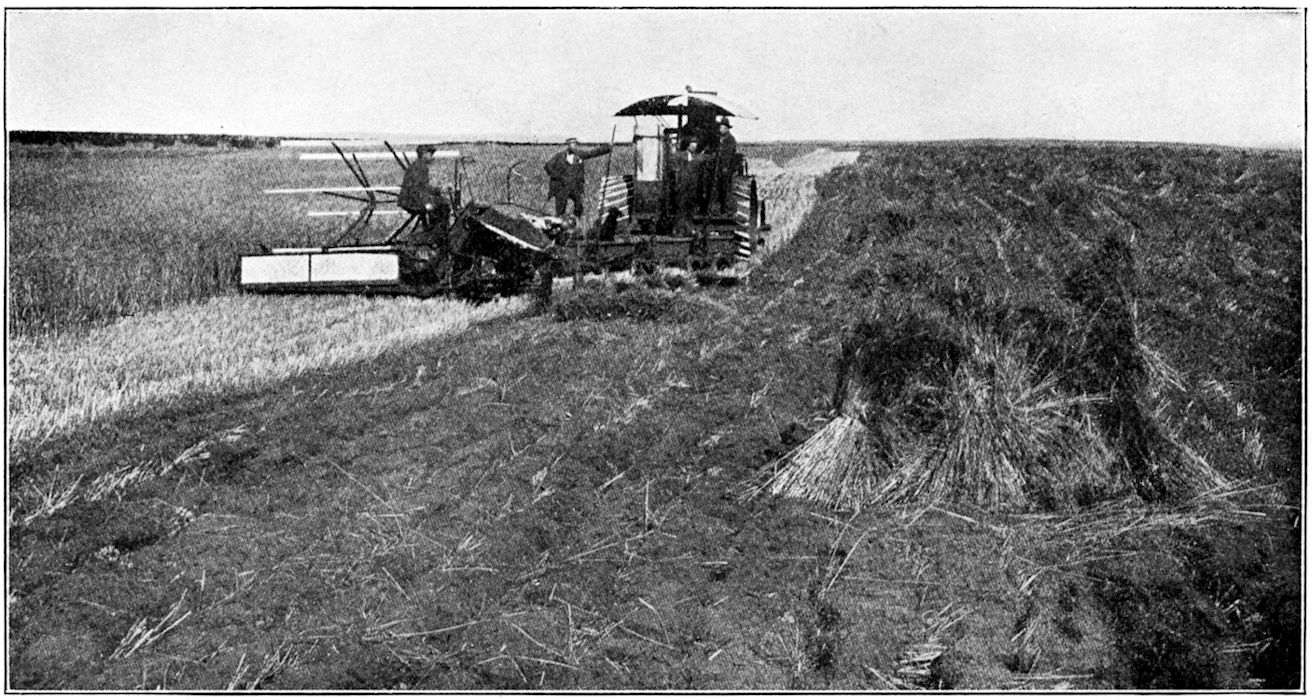
PLOUGHING AND HARVESTING.
As to houses, an indispensable institution
of Canadian home life is the heat-raiser—the
stove apparatus in the basement which supplies
the steam-pipes carried through every room
and also through every passage in the house.
The heat-raiser has been carried to the last
pitch of perfection to meet the needs of the
Canadian winter. As a Montreal resident
said to me, it would not do to go out of a room
heated to 60 or 70 degs. into a passage where
the temperature was below zero. It is this
equal heating that prevents Canadians feeling
cold in their homes, and Canadians coming to
this country always complain of the coldness
of our houses, and especially of the coldness
of unheated bedrooms. English visitors to
Canada, on the other hand, always complain
that the houses are too hot, and still more that
the railway trains, which are heated in the
same fashion, are too hot. My own experience
of railway travelling in Canada, of many nights
spent sleeping in Pullman cars, confirms the
testimony of English travellers. The temperature
at times in the railway trains is
almost unbearable, and it was a delight when
the train stopped for five or ten minutes to
alight on platforms sprinkled with snow and
to breathe the clear crisp air. I have no
doubt that the train-heating is as necessary
as the house-heating having regard to the
conditions. Canadians adapt themselves to
the conditions, and what is abnormal to us
becomes normal to them. The English visitor
to Canada misses the open grate; the
Canadian, and especially the Canadian housewife,
testifies that the absence of the open grate
is the greatest boon to the Canadian householder.
It means cleanliness, saving of trouble,
doing away with alternations of temperature
which mean colds and general malaise. The
cooking arrangements of Canadian home life
are simplified, as are the heating arrangements,
and in view of the difficulty—which is practically
an impossibility—of obtaining domestic
servants it is necessary to adopt every kind
of labour-saving appliance on the market.
The heating and cooking apparatus of Canadian
homes is due mostly to the inventiveness of
American manufacturers. Generally speaking
Canadian home conditions are, as the Scots
would say, “homologated” to the conditions
prevailing on the American side of the border.
With regard to the domestic servant difficult,
I had many talks with Canadian
housewives on the question. The problem is
solving itself by American ladies doing their
own housework and simplifying their domestic
arrangements accordingly. The wives of men
of high social position do most of their own
housework and seem to enjoy it. All this
has its effect on the social etiquette. Ladies
visiting each other in the afternoon, for
instance, do not expect to be asked to tea,
though of course if a lady chooses to ask her
most intimate friends to tea there is nothing
to prevent her. It is understood, however,
that to get tea for visitors means that the
hostess herself must prepare the meal and do
the necessary washing-up afterwards. The
servant problem is responsible also for
Canadians of good social position living in
houses much smaller than people in the same
station would occupy at home. Driving
round the “bon-ton” suburbs of rising cities
in the Prairie Provinces I was surprised at the
bijou residences in which I was told prominent
citizens who were credited with fortunes of
half a million to a million dollars were content
to live. You must never judge of a man’s
wealth in Canada by the size of his house and
the style of his living. It is a question of the
impossibility of getting servants, and Canadians
are sensible enough to realise that the impossibility
has its advantages. They have neither
the time nor the inclination to create a lot of
social duties such as are considered necessities
of social suburban life at home, which would
mean in Canada not only vast expense, but
the eating up of invaluable time without any
adequate compensation in the way of real
social enjoyment. Well-to-do Canadians do
not often invite mere acquaintances as guests
to their homes. What they do is to put their
guests up at a good hotel—and good hotels
are plentiful enough, even in towns which
have sprung up on the Prairie during the last
twenty years. There is a surprising number
of excellent hotels with a cuisine, attendance,
and bedroom arrangements that any reasonable
man should be satisfied with. When
religious or other conferences meet in a
Canadian town the delegates are not, as in
this country, placed out with hosts who give
them a bedroom, breakfast, and supper for
three, four or more days, but the hosts send
them to hotels. This practice has mutual
advantages. It is not always convenient for
a man to take in a stranger, though he may be
an angel unawares; very often, as hosts in
this country know to their cost, he is far from
being an angel. But though he might be the
most desirable of guests, the host, if a business
or professional man, might feel it irksome
to give his guest the attention he felt was
due from him. On the other hand, the guest
is free in the hotel to enjoy himself in his own
way with fellow delegates. At several towns
where I stayed there were groups of delegates
to synodal meetings of religious denominations,
trade conferences and the like, and it
struck me that their informal conferences
over the tables were contributing a good deal
to the success of the meetings which had
brought them to the towns.
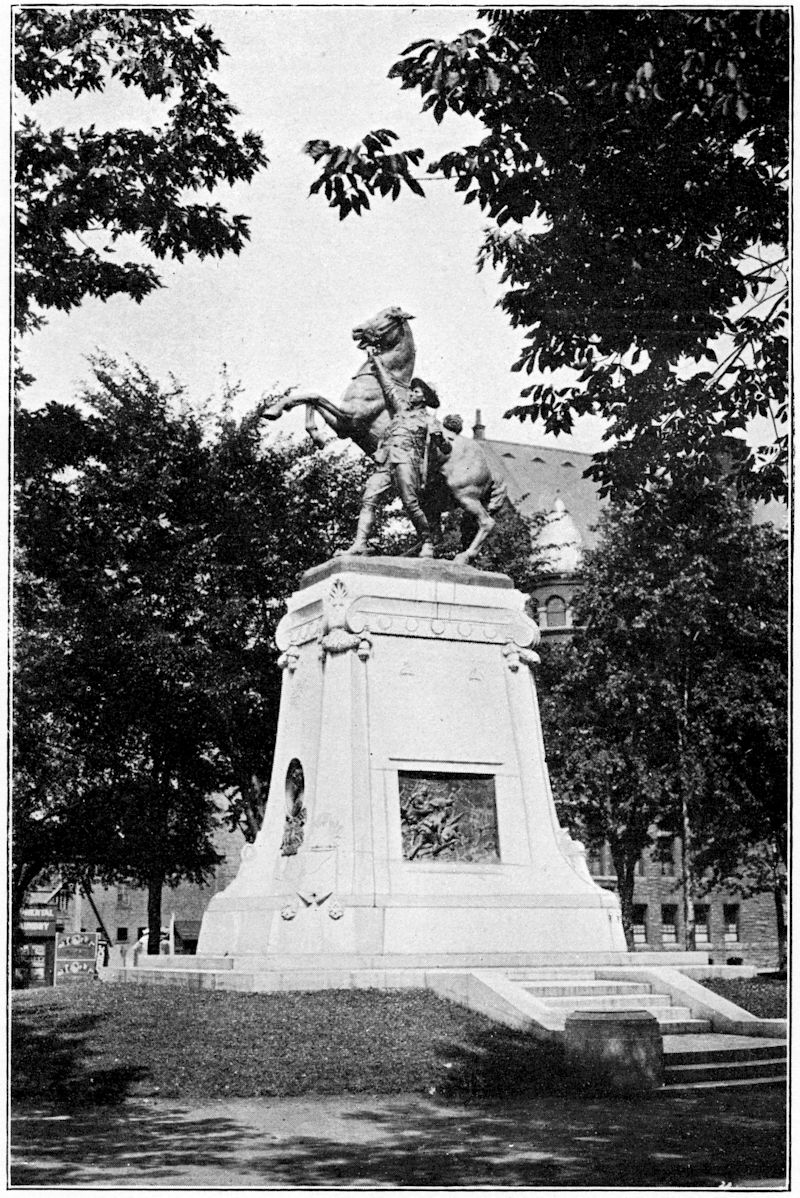
STRATHCONA MONUMENT AT MONTREAL.
A distinction has to be drawn between cities
and towns of Old Canada and the cities and
towns of the Prairie Provinces and British
Columbia. In Old Canada, at Quebec, Montreal,
Toronto, London, Hamilton, and many
other cities life has settled down; there are
traditions going back through several generations.
There are old families and family
relationships, old churches, institutions,
colleges and schools. The life in these old
cities has plenty of social intercourse and
social enjoyments, and yet there is a freshness
and exuberance which are missing in the
crowded cities of the Old Country with their
sharp social distinctions and their social
problems. In these old cities there is culture
of literature, art and music. The Toronto
University and the McGill University at
Montreal draw their thousands of students,
who receive an education that covers all the
departments of learning. Young men and
young women are brought together in the
various colleges, friendships are formed, wits
sharpen wits. These young men and women
are trained to become leaders of thought
and action in every department of business,
professional and social activity. Cultured
English people settling in Old Canada might
find to their surprise a keener appetite for
artistic and intellectual interests than is at
all common among the suburbanites of London
and the other British provincial cities. The
home life of these Canadian cities, judging by
what I saw of it, is very charming. During
the summer the fullest advantage is taken of
the opportunities which are offered for holidays,
week-ends and picnics on the rivers, lakes,
and among the hills and woodlands of the
beautiful Provinces of Quebec and Ontario.
Canadians grew enthusiastic as they told of
holidays spent canoeing on the rivers and lakes,
camping out in the woods, fishing and shooting—getting,
at a trifling cost and in a few hours
of railway travelling, right away from civilisation
into the heart of primeval forests, or
camping in tents or living in huts in some
Eden of an island embosomed in a lovely
lake; and then in the winter there are endless
sources of enjoyment such as we in the Old
Country have to spend expensive winter
holidays in Switzerland to be able to indulge
in. I was in Montreal when the first snow
of winter fell. It was a blizzard, with heavy
flakes driven before a fierce wind. The
blizzard began on a Sunday evening and
continued throughout the night. In the
morning the snow had ceased, but the appearance
of the city was transformed. Every
tree glittered outlined in dazzling whiteness,
every building was pointed and glistening with
the lodging snow. There was a foot of snow
of crystal purity in the streets. The people
of Montreal were as cheerful as if they had
just come into fortunes. They recognised the
snow as an old and welcome friend returned
to them. There was a hunting out of
“rubbers,” goloshes in which to envelop the
boots. There was a tinkling of bells in the
streets, reminding one of the “Alpine chimes”
heard on the pastures of Switzerland when the
cattle are let loose to browse as and where they
will. All wheels had been taken off vehicles,
and sledge methods of conveyance adopted
in their place. Wheels would not appear
again until the end of March. My Montreal
host regretted that I could not remain in the
city, for he was promising his family the most
delightful sledge outing over the new fallen
snow. Drays, tradesmen’s traps, automobiles,
taxis, handcarts, every kind of vehicle was
running on sleighs, and bells were jingling
from the neck of every horse and from every
vehicle. Sleighing is an ever-exhilarating
pastime during the Canadian winter. Then,
again, there are toboganning and all sorts of
winter sports to be enjoyed at home, and not
as the rare luxury of the rich, who can afford
to break away from business and put up at
expensive Swiss hotels. Skating, of course,
is an enjoyment within the reach of the poorest,
and it is an enjoyment available at least four
months of the year, and not, as in England,
the rarest of accidents following on a four
days’ frost and put an end to by the thaw
that inevitably comes when the skates are being
looked out from the place they were put three
years ago and polished of the gathered rust.
Out in the Prairie Provinces, where new
cities and towns are “rising like an exhalation,”
there is plenty of summer and winter
enjoyment, although, of course, many of the
people are far too busy in laying the foundations
of their future prosperity to be able
to sacrifice much time to mere recreation.
Prairie dwellers told me, however, that the
winter is to them, as to the people of the
Eastern Provinces, the playtime of the year.
The harvest of the prairie has been got in.
There is a slackening down of business until
the spring. The people in the rising cities
have more time at their disposal to foregather
at all sorts of meetings for social enjoyment.
The young man is a great institution of the
prairie town. He goes out in his thousands
from the Old Country; he crosses over from
the United States. The Y.M.C.A.’s (which
are run in Canada on the broadest and most
progressive lines) cater for the young man.
They and the churches, which appreciate the
value of the young man and realise that he
will not be content with purely religious
meetings alone, cater generously for him.
The Y.M.C.A.’s are splendid clubs provided
with gymnasia, swimming baths, facilities
for the playing of billiards, basket-ball, and
other competitive recreations. Then football
has solidly established itself in Canada, as
cricket has done during the summer months,
and the sportively inclined young man of
Regina, Medicine Hat, or Calgary is as keen
on playing or watching a good game as the
young man in Old England, though I believe
he does not allow his interest in such games
to become so absorbing as to distract his
attention from his business, in which he sees
the means of forcing his way to the front in
the new country of his settlement. The
young man of the Prairie Provinces is a great
camper-out in the summer and finds plenty
of interest on the prairies, whether in watching
the rapid growth of the harvests, in studying
the varied flora (which is exquisitely beautiful),
or in the Nimrod pursuit of wild birds and wild
animals. For the bookish young man there
are literary societies even in towns that are
not a dozen years old, and it is a very “one-horse”
prairie town indeed that does not
possess a theatre and an opera house, while
the picture palace is everywhere.
Returning to home life: One does not have
to be long in Canada before discovering that
nothing is more unpopular in the Dominion
than rent-paying, whether for land or for a
house. Every householder wants to own his
home, and the powers that be in the State
Governments and in the municipalities
encourage this ambition. It is this desire
to own the home that accounts for the ubiquity
of the Real Estate agent, who swarms all over
Canada. No sooner is it decided to lay out
a town, and the municipality is created and
invested with authority, than the Real Estate
man puts in an appearance. He snaps up the
tit-bits in the way of lots along the lines of
the streets and the roads that are being laid
out in the town planning. He is waiting for
the influx of population and knows that there
will be an increasing “home” hunger. Store-keepers
will come, with wives and children;
building contractors with their foremen and
staffs of workmen; banks with their managers,
cashiers and clerks; branches of Insurance
and other companies; lawyers, doctors, and
the like; all sorts and conditions of men,
middle-aged and young, migrate from the
older Canadian cities, young fellows irresistibly
attracted westward by the fascination of the
new, emigrants from the States, Great Britain
and the Continental countries. The married
men will want comfortable houses as soon as
possible. The young bachelors will want
“diggings.” “Rooming-house” keepers will
be laying themselves out to attract boarders
of both sexes. There is no fear that suitable
lots for homes will lack inquirers. There will
be quarters for cheap houses, better houses,
and the best houses, to suit the various social
positions. If there is a river running through
or by the town, the bankside lots, away from
the business or industrial quarters, will be in
demand for villas with gardens—the villas in
the Prairie capitals, and such cities as Medicine
Hat and Calgary, following very likely
“bungalow” or Californian models. On the
cheaper lots, at first, the houses may be only
“frame,” run up at small cost, to be replaced
later by brick and stone. On the outskirts of
the towns tiny frame cottages may be built by
two or more young fellows who will do their
own housekeeping, enjoying the independence
and the Robinson Crusoe conditions. This is
an excellent way of learning how to do without
things, and many such young fellows, by having
to cook, clean, and do everything for themselves,
are in training for model husbands,
ready to help their future wives in the most
diverse and practical ways. The Real Estate
man knows them all, and caters for all. His
voice quivers with sympathetic sentiment
when he dilates on the ideal situation of the
lot for a home—five minutes from a projected
public park or recreation ground, and only
three minutes from the street car line. Some
purchasers of lots put up houses to let
furnished, and in a new Prairie city they make
a very good thing of it, but every Canadian
wants to be his own landlord as soon as he
can manage it.
The Canadian’s determination to own his
own home at whatever cost, and to own the
land on which he builds his office, his store
or his factory, accounts for the apparently
extravagant prices cheerfully paid for these
lots. A contributory cause is the ease with
which at present, and in all likelihood for years
to come, money can be made in developing
the inexhaustible resources of this rich country.
Canadians admit that they are frightfully
extravagant. Money comes easily and goes
easily. If a man makes up his mind to build
his home in a certain situation that has taken
his fancy, no price, apparently, will stop him.
He must have that lot of 30 or 50 feet frontage
with its 120 or 130 feet depth, whether he has
to pay $10 or $50 a foot frontage. Perhaps
he has hesitated over the purchase of land
that had previously taken his fancy—he was
asked $20 a foot frontage and was not at the
moment disposed to go beyond $15. Three
months after he has changed his mind, has
gone to the agent and has been told that it
has been disposed of at $40 a foot frontage,
or that it is still available, but that it cannot
now be parted with under $45 or $50 a foot
frontage. The man, let us suppose a young
man getting on rapidly with a new business
or occupying an improving position in a bank
or a business house, wants to get married and
wants to get his house ready at the earliest
possible moment; whether it is $100, or
$200, or $300 extra does not matter if he can
only get what he has set his heart on. He
secures the wished-for lot, sees an architect,
has planned for him a picturesque bungalow
or bijou villa, with the inevitable verandah,
and has the happiest of times in watching the
home grow up. Most of these homes (the
property of their owners), standing on their
own lots, are detached. The streets of detached
houses are characteristic of the new cities and
towns and of the new suburbs of the older
cities. Canadians do not like the continuous
unbroken line of houses of our English towns.
As to this ownership of his home by the householder,
a resident of Berlin, Ontario, a city
of some 14,000 people, told me that 64 per
cent. of the houses in that flourishing town
belonged to their occupiers.
The furnishing of Canadian homes is tasteful
and practical. There is not the crowding
and the heaviness apparent in the furnishing
of many homes in the Old Country. I
gather that the Canadians like variety and
artistic merit in their furniture. They do not
go in for suites and extreme substantiality,
if I may so express it, although one or two
visits I paid to the furniture departments of
great departmental stores showed that, while
the furniture as a whole looks lighter in effect
than English furniture, it is well made and
calculated to stand a lot of wear and tear.
The manager of a furniture department of a
great departmental store at Toronto told me
that New England models are popular in
Canada. The old New Englanders developed
styles of their own, which lend themselves
admirably to modern imitation and fit in well
with the scheme of the Canadian house, with
its usually smaller rooms than those of an
English house of a middle-class family; but
old English and old French styles of furniture
compete with the New England models, so
that there is plenty of material on which the
Canadian man and the Canadian woman can
exercise taste in choosing furniture for the
use and ornament of the home.
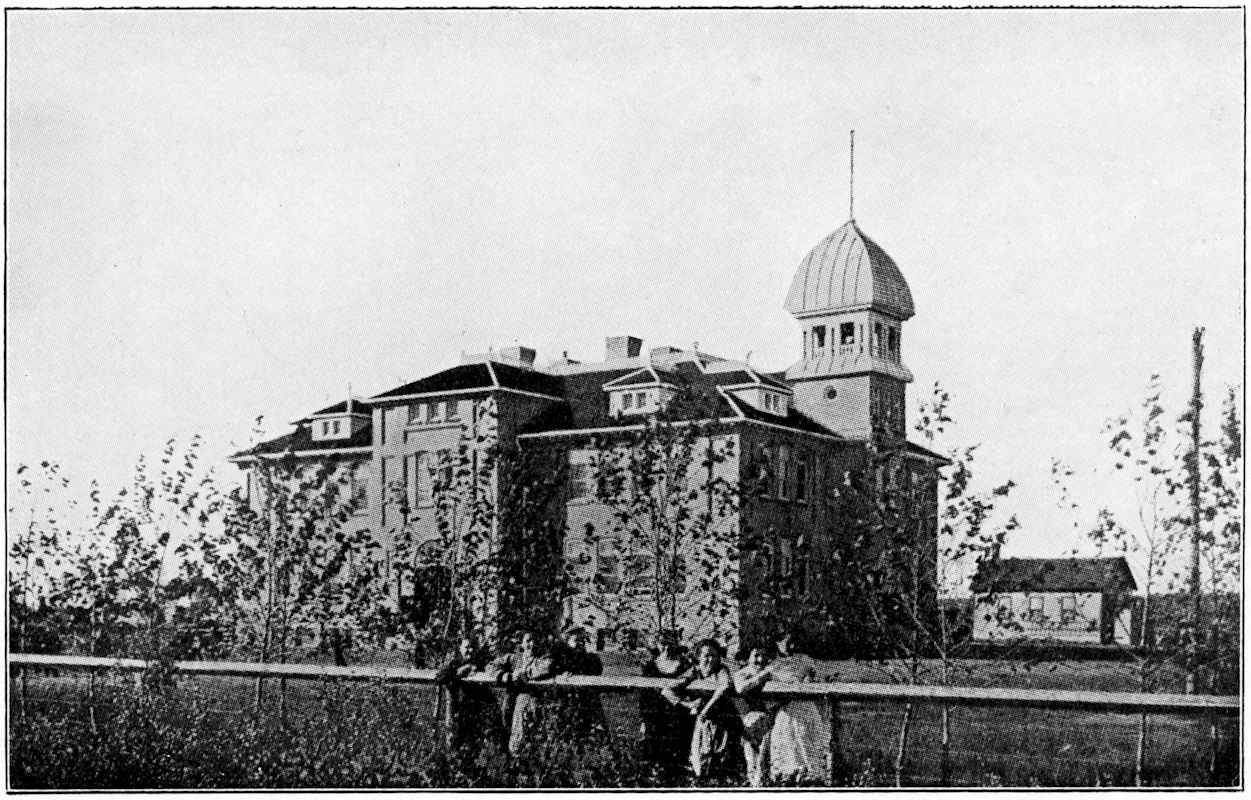
A SASKATOON SCHOOL (ACCOMMODATING 1,500 CHILDREN).
LEAVING THE OLD COUNTRY
When a man has made up his mind to
seek his fortune in Canada he naturally wants
to know the steps to be taken. The Dominion
Government is more than willing to assist him
in every possible way. It regards every man
able and willing to work, with a good character,
as a valuable asset to Canada. Not only the
Dominion Government, but the various Provincial
Governments have established agencies
and offices in this country to supply intending
emigrants with all the information they desire.
It will be useful to give here a list of the
Dominion offices and agencies:—
England and Wales.
Mr. J. Obed Smith, Assistant Superintendent
of Emigration, 11—12, Charing Cross,
London, S.W.
| Branch offices:— | 48, Lord Street, Liverpool. | |
| 139, Corporation Street, Birmingham. | |
| 81, Queen Street, Exeter. | |
| 16, Parliament Street, York. | |
| | |
| Scotland. | |
| | |
| 107, Hope Street, Glasgow. | |
| 26, Guild Street, Aberdeen. | |
| | |
| Ireland. | |
| | |
| 17—19, Victoria Street, Belfast. | |
| 44, Dawson Street, Dublin. | |
No fees are charged at these offices for the
information given. Inquirers should write,
stating what they want to know, and they
will receive replies to their inquiries and
literature which will further inform their
minds. A large number of booking agents
are appointed in various towns throughout
the country by the Canadian Immigration
Department. These local agents are also
commissioned and required to give all necessary
information and to arrange for the transportation
of emigrants by the various steamship
lines. It is forbidden to such agents to charge
fees for letters of introduction to officials on
the Canadian side and for other services
that fall within the duties for which they
are paid commission. The spring is far and
away the best time of the year to arrive in
Canada. It is when agricultural operations
are commencing that the demand for labour
invariably exceeds the supply and the activity
in industries other than agricultural is also at
its greatest. Through the winter there is a
general slackening both on the land and in
the cities. Farmers, farm labourers, and
female domestic servants are the classes who
are most encouraged by the Canadian Immigration
Department to go out. All others are
advised to get definite assurance of employment
in Canada before leaving home. They
should be provided with a few pounds for use
on the other side after all the expenses of
going out have been paid. As has been
indicated in an earlier chapter, there are
usually a large number of Canadian farmers
willing to advance the passage money if
necessary to well-recommended men. Lists
of such farmers are kept in the Departments
of Agriculture in the various Provinces. The
Dominion immigration agents on this side
would tell intending emigrants desiring such
assistance to whom to apply. The various
Canadian railway companies and their shipping
lines, with the great Cunard line, which
specialises in the emigrant business, are also
well furnished with information of value
to emigrants. At the offices of these lines
information with regard to employment and
getting the money for the passage advanced
to selected men, if that is absolutely necessary,
is also given.
As to the cost of going out, it may be put
down for those going steerage at from £6 10s.
and £10 to £12 for second class. On the other
side the railway companies convey settlers at
very cheap rates, and there are special
freightage rates for settlers’ goods. A steerage
passenger will be conveyed third class to
Winnipeg or Regina, for instance, involving
nearly 2,000 miles of land travel, for £10 or
£12 from Great Britain. The steerage accommodation,
as a rule, is necessarily somewhat
crowded, for the fares have been cut down
to such a low level that it is a wonder it can
be done at the price at all. A very great
improvement, however, has been effected as
compared with the emigrants’ accommodation
given only a dozen years ago. A steerage
emigrant must not mind a little roughing it
on board. He is assured, any way, of a
plentiful supply of wholesome and varied food,
and the ship’s doctor and stewards and
stewardesses are there to see that there is
proper attendance in case of sickness and that
the sanitary conditions are all right. I have
been through the steerage quarters of several
emigrant ships and seen the steerage passengers
at their meals. They seemed cheerful enough
provided the sea was moderately quiet. Of
course, in a gale or when the sea is swelling
in long rollers, even first-class passengers on
the most luxurious of modern ships are
bowled over and tempted to wish that they
had never left land. During the first two or
three days there is usually a good percentage
unable to take any interest in meals. When
they have found their sea-legs, however, and
the appetite for food returns, it is surprising
how cheerful the steerage passengers become.
There are games on the deck, sports are
arranged, boxing-gloves are produced, the
combatants being surrounded by a ring of
interested spectators. The young women
work off their exuberant vitality with the
skipping rope. The children of families going
out romp as freely as if they were in the streets
or in fields. In the evening sing-songs are
got up.
Great is the excitement when, on the sixth
day or so, land comes in sight, and when the
ship enters the Gulf of the St. Lawrence the
“steerage” during the daylight is all on deck,
scanning the scenery on either side. No
scenery can give a more favourable first
impression of the country. The ranges of
wooded hills, the towns and villages, each with
its church spire in the centre, the fishing boats,
are all objects of never-failing interest. Quebec
is the landing place for the immigrants. There
is no more picturesque approach to any city
than the approach up the river to Quebec,
the old capital of French Canada. The cliffs
rise sheer from the water’s edge, crowned by
the buildings of the Old Town. If the
approach is by night the lights of Quebec
give it a most picturesque appearance. It
is always the effort of the pilot who takes the
boat in to reach Quebec by six in the evening,
otherwise the immigrants have to remain on
board till the morning. The ship by which
I travelled, the Royal George of the Canadian
Northern Royal Line, did not reach Quebec
until two in the morning, when all but a few
of the passengers were sound asleep. They
could not be landed until the immigration
officials were at their duty at the immigration
landing stage. Breakfast was served at five
o’clock, and by half-past five the party of a
thousand or so steerage passengers were
waiting on the deck with their belongings to
go ashore. It was a dramatic and a pathetic
sight to see them crossing the gangway. A
large number of them were young fellows,
some well-dressed, educated-looking men of
the clerk or shop assistant type. They were
well set-up athletic fellows who had found the
competitive conditions of London and the
provincial cities and towns of the Old Country
such as gave them little, if any, hope of rising
above the earning of 30s. or £2 a week. In
Canada the world was before them, and they
landed with hope in their hearts, though no
doubt with heart pangs as they thought of
those they had left behind them. Then there
was a rougher class, the class that dispenses
with collars, wears a cap and very likely
corduroy trousers, labourers from the villages,
unskilled men from the towns, muscular
fellows—the men who rely upon their brawn
rather than their brains to make their way.
The young fellows of the clerk and shop
assistant type had trunks and portmanteaux—“grips,”
as the Canadians call them. The
men of the labourer type carried their scanty
belongings usually done up in a bundle or a
rough box. There were older men with wife
and sometimes children. These were the
most pathetic to watch as they crossed the
gangway—the man with the heaviest trunk,
the woman very often with a bundle or a big
cardboard box tied with string, the elder
children also carrying bundles, sometimes a
baby warmly wrapped up in a shawl—these
also had found the Old Country too hard for
them, and they had come to a country where,
in most cases, a situation was awaiting the
man and it would depend largely upon himself
whether, having got his foot on the lowest
rung of the ladder, he should climb up to the
highest. A large number of the skilled
artisans had had situations secured for them
before they left England—thirty joiners, for
instance, were going to situations at one town
in Ontario. Then there were a number of
rough-looking fellows on whom a master-builder
or an engineer’s ganger would have
had his eye at home. For this class there is
plenty of work in Canada, for railway construction
takes in an endless supply of labour.
Building is going on all over the Dominion at
an incredible rate, and the factories that are
springing up in the Eastern Provinces,
especially in Ontario, are taking on every
year thousands of additional employés.
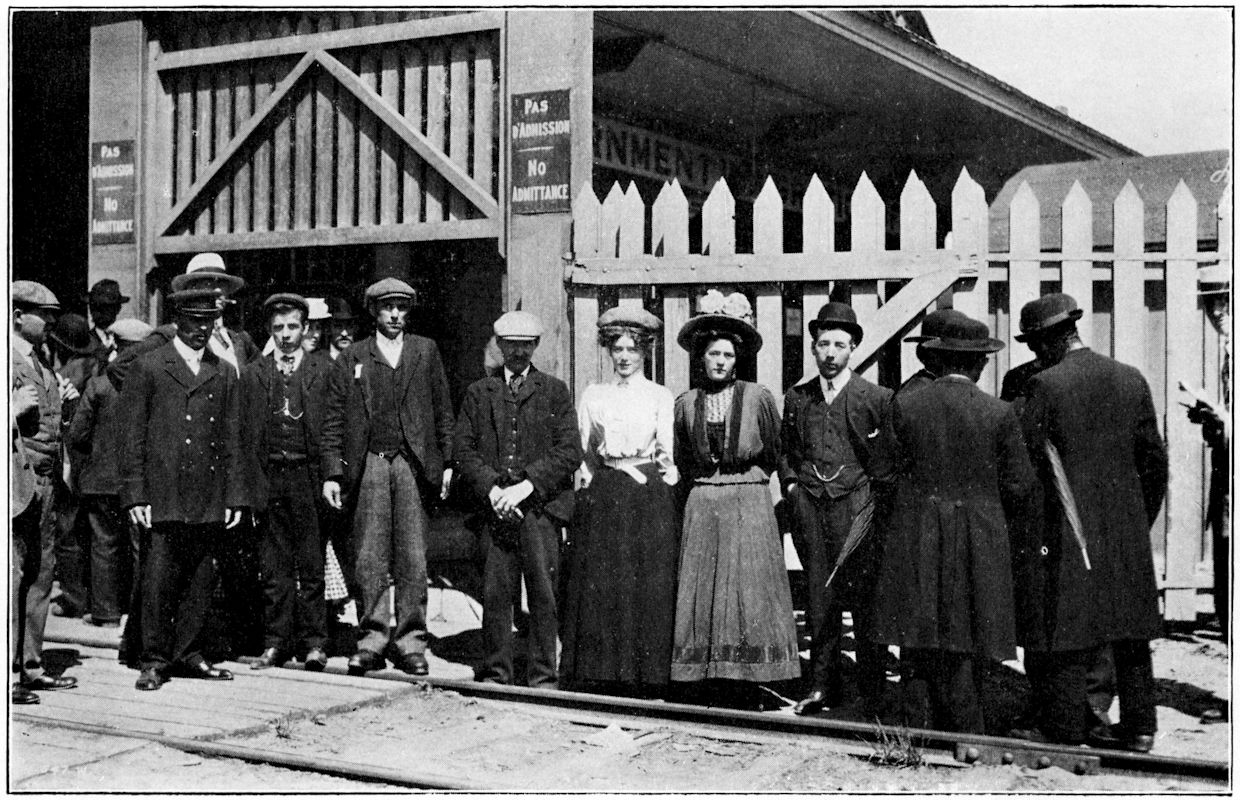
EMIGRANTS LANDED AT QUEBEC.
From Quebec the steerage passengers are
despatched by the various railways to their
destinations. There are representatives of the
immigration departments of the railway and
steamship companies to convoy parties westward
as far as Winnipeg, the great distributing
centre for the Prairie Provinces.
In addition to the Dominion, the Provincial
Governments’, and the railway and shipping
companies’ emigration agencies in Great
Britain, there are plenty of societies, institutions,
and religious organisations which have
organised emigration work. The Salvation
Army, for instance, sends out a large number
every year. Those men do best who have
received some preliminary training on a farm
colony at home. The Dominion and Provincial
Governments are much more exacting
than they formerly were with regard to the
quality of emigrants sent out. Canada does
not want the human refuse for which the Old
Country can find no use at home dumped on
its shores. A prospective immigrant has to
run the gauntlet of strict inquiry and examination
with regard to his health and habits.
This is as it should be, for it is no kindness to
send out men whose physique is unequal to
the climate and conditions of the country or
whose morals and intelligence unfit them to
become useful citizens. In the East of London
and elsewhere there are self-help emigration
societies through which a man is enabled to
save up the money requisite to go out and
otherwise prepare to become a successful
colonist. The Wesleyan Methodist Church,
the Presbyterian Churches in Scotland, and
other Churches have organised means to
assist emigrants to go out and to be received
and helped at the ports of landing and the
chief centres of distribution.
Latterly, the Brotherhood Movement of
England and Wales has undertaken the work
of assisting emigrants belonging to Brotherhoods
and Pleasant Sunday Afternoon Societies
by giving them reliable information and by
arranging for them to be assisted by representatives
of the Brotherhood Movement in
Canada when they land. It is a very great
advantage for a man going out to find somebody
willing to take a disinterested and
friendly interest in him on his arrival. He
naturally feels lonely on landing in a new
country, and if he arrives with only a pound
or two in his pocket and no situation awaiting
him and does not immediately get employment
he is distressed and humiliated. Mr.
R. J. Harry, hon. secretary of the International
Committee of the Brotherhood Movement,
is willing to give such advice as he has at his
disposal to members of Brotherhood, P.S.A.
and Sisterhood Societies who communicate
with him at the National Brotherhood Offices,
37, Norfolk Street, Strand, London, W.C.
The Brotherhood Movement has arranged
with influential men in the principal Canadian
cities to act as counsellors of Brotherhood
men accredited to them, assisting them to
obtain situations and lodgings and introducing
them to Churches and Brotherhoods where
such exist. I found that in Winnipeg, Vancouver,
and other Canadian cities the Brotherhoods
have devised the happy institution of
Sunday afternoon tea to which the new-comers
are invited. I was present at two
such teas, and heard from recently arrived
immigrants how their friendly reception at
this pleasant function and the fraternisation
with them of Canadians had made them feel
at once at home.
Let it be impressed on all emigrants to
Canada that the sooner they get into friendly
touch with Churches, Brotherhoods, the splendid
Y.M.C.A.’s, and other institutions of
the Dominion, the better it will be for them.
Canada is no more than any other country
a paradise without a serpent. There are
temptations, moral dangers, land sharks on
the look out for easy victims. The members
of the Canadian Churches, Brotherhoods and
Y.M.C.A.’s are willing and eager to safeguard
immigrants from the moment of their
arrival from all such dangers.
It will not be long after arriving in Canada
before homesickness makes itself felt. A
young man or a young woman never realises
how much home and relatives mean to them
until they find themselves 4,000 to 5,000
miles away from them. There is sure to be
a sinking of heart and a longing to be back
amid the old scenes and with the old friends,
and it may take months or a year before they
settle down with a fair amount of contentedness
to the new and strange conditions. The
best cure for homesickness is to take the coat
off and plunge at once into work with all the
physical and mental energy that one commands.
The work, the companionships that
will be formed, the social connections of
Church, Brotherhood or Y.M.C.A. membership,
will soon give the new-comer an interest
in the country. If he is made of the right
stuff it will not be long before, in the Canadian
phrase, he “makes good.” When he begins
to make good and to feel that he did well in
emigrating, and that there is a future for him
in his adopted country, the homesickness will
gradually wear away. A considerable number
of the young men leave the Old Country with
the idea as soon as possible of sending for a
wife. The prospect of making a home for the
girl he has left behind him is one of the best
inducements to “make good” in Canada.
On the train by which I travelled from
Montreal there were three prospective brides
who at different points of the route were to
meet their bridegrooms and be immediately
married. This is a romance of daily occurrence
in Canada. A minister told me that
he had often married couples on the bride’s
arrival at midnight or in the small hours of
the morning, for a girl coming out as an
immigrant bride of course knows nobody in
the town she is going to but her young man,
and it is best on every ground that the wedding
should be celebrated without delay.
On the subject of woman emigrants I heard
a great deal from many Canadian men and
women. The girl willing to engage in domestic
service is regarded in Canada as having a
price far above rubies. She will find in any
town of considerable size most flattering
competition for her services. The domestic
servant is, indeed, so rare that, as has been
indicated, Canadian families of high position
often have to contrive to do without female
help. Where a girl is willing to engage in
domestic service, however, she has the best
of good times. She is tempted, indeed, to
lose her head on finding what a jewel she is.
She enters Canada with the Old Country
ideas of dutiful submission to her mistress.
When she has been a month in her first
situation her mistress must not be surprised
if she asks for her wages to be doubled, for
every Sunday off, and for time off each
evening of the week. She does not expect
to polish boots, to carry coals, or to perform
other duties which the English domestic takes
as a matter of course. No domestic servant
need hesitate about going to Canada through
fear of not finding employment.
With regard to other young women I was
told that there is the keenest demand for
clever needlewomen who can earn usually $10
to $15 a week by plain sewing.
Canada, especially the Prairie Provinces
and British Columbia, is very largely a men’s
country, and the men will give almost any
price to a clever needlewoman for making
and mending their things. Laundry work
in Canada is done almost exclusively by
Chinese. They make plenty of work for a
woman who can mend shirts and the like,
for the Chinese methods of washing things
are simply disastrous to the things washed.
The clever typewriter is in the greatest
demand in the Canadian towns. She works
short hours, she receives high wages, and is
a particularly clever young person. Then the
great departmental stores employ girl “clerks”—that
is, shop assistants—by the hundred
and the thousand. These work under conditions
such as might well excite the envy
of their sisters in similar establishments in
the Old Country. The hours are short, the
business day usually closing at five o’clock.
It is one of the sights of Quebec, Montreal,
Toronto, Winnipeg, to see the street cars
between five and six o’clock simply swarming
with young women returning to their homes,
all remarkably well-dressed, looking as if
they got the maximum amount of enjoyment
out of life.
The teaching profession in Canada offers
an excellent career to trained teachers from
the Old Country. Magnificent primary,
secondary, and normal schools are springing
up like mushrooms everywhere, and it is
impossible to create teachers fast enough to
meet the needs. A trained girl teacher with
a good recommendation will be greedily
snapped up in scores of towns of any of the
Provinces and will have a career before her
infinitely more promising than is possible
under the conditions of the Old Country.
As to married women accompanying their
husbands, there is no reason why they should
not add materially to the family income. A
woman on the land is a most valuable asset.
She can raise chickens, sell eggs, collect and
sell cream, attend to the garden, do needlework
and laundry work for the farmers and
others, and in many other ways find occupation
at high rates of pay. If there is a daughter
or two capable of doing anything, they also
can earn from 10s. to 20s. a week to add to the
family exchequer.
Girls are employed in newspaper offices
and other printing works as linotype operators.
I was told that in some cities girls skilled in
the manipulation of the linotype are earning
from $20 to $25 a week. Altogether, there
is no country in the world that so fully
appreciates the value of women’s work and
is so cheerfully prepared to pay for it as
Canada.
One class of woman worker that Canada
has no use for is the barmaid. The employment
of women in drink shops is absolutely
forbidden. It may be added that for a woman
to enter a public-house in Canada is to write
herself down as a pariah. No Canadian
woman could enter a public-house without
being regarded as outside the ranks of decent
society. As a matter of fact, except perhaps
in Vancouver and one or two other cosmopolitan
ports, no woman does enter a public-house.
There is less drunkenness, perhaps,
in Canada than in any other country of the
world, and the attitude of Canadians with
regard to women and drink contributes
undoubtedly towards the general sobriety of
the country. In Ontario entire prohibition
of the drink trade prevails in many towns
under the Local Option Law. Public-houses
are closed, as in Scotland, from Saturday to
Monday. Most of the great hotels are run
on temperance lines. Canada realises that
its greatest asset is the working capacity, the
alert intelligence, and the moral character of
its people. It sets its face against drunkenness
and other vices that depreciate the value
of its human assets.
BRADBURY, AGNEW, & CO. LD., PRINTERS, LONDON AND TONBRIDGE.
A CATALOGUE OF THEOLOGICAL,
ILLUSTRATED AND GENERAL BOOKS
PUBLISHED BY JAMES CLARKE & CO.,
13 & 14, FLEET STREET, LONDON, E.C.
CLASSIFIED ACCORDING TO PRICES,
WITH INDEX OF TITLES AND AUTHORS AT THE END.
New Books and New Editions Marked with an Asterisk.
12/6 net
The Marprelate Tracts. By William Pierce, Author of “An
Historical Introduction to the Marprelate Tracts.” Demy
8vo, cloth, 12s. 6d. net.
The “Tracts” reprinted in this volume are among the
most famous in history. They were read eagerly everywhere
in England, from the Court to the country farmhouse, when
they appeared at the end of the sixteenth century. They
are racy in style, and the unknown author, “Martin Marprelate,”
brings great resources of wit, humour and argument
to bear in his tremendous onslaught upon the Bishops. Mr.
Pierce gives a very scholarly edition of the tracts, enriched by
many valuable and illuminating notes.
Dr. James Moffatt, in The British Weekly, says:—“Will rank as a standard
edition. It is not possible to convey any idea of the historical scholarship
and research which have gone to the making of this book, but Mr. Pierce
will have his reward in the consciousness of serving the cause of religious
liberty; and in the gratification of those who have to study the religious
situation of England during the sixteenth century. . . . Their historical
importance is considerable.”
“One of the most valuable contributions to our history ever made.”—Principal W. B. Selbie.
10/6 net
THE POLYCHROME BIBLE
A New English Translation of the Books of the Bible. Printed
in various colours, showing at a glance the composite nature
and the different sources of the Books. With many Notes and
Illustrations from Ancient Monuments, &c. Each volume is
the work of an eminent Biblical scholar of Europe or America,
and the whole work is under the general editorship of Paul
Haupt, of Johns Hopkins University, Baltimore, assisted by
Horace Howard Furness.
The Book of Ezekiel. Translated by the Rev. C. H. Toy, D.D.,
LL.D., Professor of Hebrew and other Oriental Languages,
and Lecturer on Biblical Literature in Harvard University.
208 pp. (89 pp. translation and 119 pp. notes). With nine
full-page Illustrations (including a Map of Western Asia) and
102 Illustrations in the Notes. Cloth, gilt top, 10s. 6d. net.
For other Volumes in this Series see page 4.
7/6 net
*A Chronicle of the Archbishops of Canterbury. By A. E.
McKilliam, M.A. Demy 8vo. Photogravure Portrait and 16
illustrations. Cloth boards, gilt top, 7s. 6d. net.
*Christ’s Vision of the Kingdom of Heaven. By James Stirling.
Author of “The Stewardship of Life,” “Finders of the Way,”
etc. Demy 8vo. Cloth boards, gilt top, 7s. 6d. net.
Hampstead: Its Historic Houses; Its Literary and Artistic Associations.
By Anna Maxwell. Large foolscap 4to. Cloth boards,
gilt top. Four illustrations in colour and 32 full-page illustrations.
7s. 6d. net.
7/6
A History of the United States. By John Fiske, Litt.D., LL.D.
For Schools. With Topical Analysis, Suggestive Questions and
Directions for Teachers, by Frank Alpine Hill, Litt.D.,
formerly Headmaster of the English High School in Cambridge,
and later of the Mechanic Arts, High School in Boston. With
180 Illustrations and 39 Maps. Crown 8vo, half leather, gilt
top, 7s. 6d.
6/- net
THE POLYCHROME BIBLE
The Book of Joshua. Translated by the Rev. W. H. Bennett,
M.A., Litt.D., Principal of Lancashire Independent College,
Manchester, formerly Fellow of St. John’s College, Cambridge.
94 pp., printed in nine colours (43 pp. translation and 51 pp.
notes, including an illustrated Excursus on the Tel-el-Amarna
Tablets and a List of Geographical Names). Eleven full-page
Illustrations (one in colours) and 25 Illustrations in the
Notes. Cloth, gilt top, 6s. net.
The Book of Judges. Translated with Notes, by G. F. Moore,
D.D., Professor of Hebrew in Andover Theological Seminary.
98 pp., printed in seven colours (42 pp. translation, 56 pp.
notes). Seven full-page Illustrations (including a Map in
colours and 20 Illustrations in the Notes). Cloth, gilt top,
price 6s. net.
For other Volumes in this Series see page 3.
The Person of Christ In Modern Thought. By E. Digges La Touche,
M.A., Litt.D. Donnellan Lecturer 1911-1912, Author of
“Christian Certitude,” etc. Demy 8vo, cloth boards, gilt
top, 6s. net.
“A full and exhaustive treatment. . . Dr. Digges La Touche has
produced a valuable introduction to the study of Christological speculation
of the Modern Period, as well as an apologia for the less fashionable confessional
Christology of the sixteenth century.”—The Commonwealth.
“A book of considerable immediate service. . . There is no side of the
subject unvisited.”—Expository Times.
6/-
By S. R. CROCKETT
Vida; or, The Iron Lord of Kirktown. Large crown 8vo, cloth
boards, gilt top, 6s.
“Not a dull page in it. . . . Remarkably exhilarating and well
knit. . . . Never done anything better.”—The Standard.
Kid McGhie. Large crown 8vo, cloth boards, gilt top, 6s.
“As smart and as pat as ever.”—The Times.
The Loves of Miss Anne. Large crown 8vo, 416 pp., cloth, gilt top,
6s.
“A fine rousing story, comedy and tragedy being admirably co-mingled,
and there are some excellent studies of character.”—Birmingham Post.
Cinderella. Illustrated. Crown 8vo, cloth, 6s.
“A decidedly pleasing tale.”—St. James’s Gazette.
Kit Kennedy: Country Boy. With Six Illustrations. Crown 8vo,
cloth, gilt top, 6s.
“Mr. Crockett has never given better evidence of originality and dramatic
power. . . .”—Manchester Guardian.
The Story of Clarice. By Katharine Tynan. Large crown 8vo,
cloth boards, 6s.
“A story which is on a level with the best Miss Tynan has yet written. It
is quiet and simple. We like ‘The Story of Clarice,’ and its reasonableness
and soundness mark it out for popularity.”—Morning Post.
Helga Lloyd. A Romance of Grasmere. By Edmund Lee. Large
crown 8vo, cloth boards, 6s.
The House of the Secret. By Katharine Tynan, Author of “For
Maisie,” “Her Ladyship,” &c. Large crown 8vo. Illustrated.
Cloth boards, 6s.
“Miss Katharine Tynan can always be depended upon for a good story
told in a quiet and charming manner. As ever, it has a well-developed and
well-constructed plot. We have thoroughly enjoyed this excellent story,
and can recommend it very strongly.”—Bookman.
A Popular History of the Free Churches. By C. Silvester Horne,
M.A. Crown 8vo, 464 pp. and 39 full-page Illustrations on
art paper. Art vellum, gilt top, 6s.
“A vigorous and interesting book by an enthusiastic believer in the
Puritan spirit and the need of religious equality.”—The Times.
The Black Familiars. By L. B. Walford, Author of “Stay-at-Homes,”
&c. Large crown 8vo, cloth boards, 6s.
Friend Olivia. By Amelia E. Barr. Crown 8vo, cloth boards, 6s.
Through Science to Faith. By Dr. Newman Smyth, Author of
“The Place of Death in Evolution,” “Old Faiths in New
Lights,” “The Reality of Faith,” &c. Large crown 8vo, cloth,
gilt top, 6s.
“We commend Dr. Smyth’s work to the attention of all thoughtful
readers.”—Liverpool Mercury.
America in the East. By William Elliot Griffis, formerly of
the Imperial University of Japan, Author of “The Mikado’s
Empire,” “Corea, the Hermit Nation,” &c. Crown 8vo,
cloth, gilt top, with 19 Illustrations, 6s.
“We need hardly say that there is much that is interesting in the book.”—Spectator.
The Rights of Man. A Study in Twentieth Century Problems.
By Lyman Abbott, D.D. Crown 8vo, cloth, 6s.
“This is one of his best books. It is good throughout.”—Expository Times.
Rev. T. T. Lynch: A Memoir. Edited by William White. With
Portrait. Crown 8vo, cloth, 6s.
Memorials of Theophilus Trinal. By T. T. Lynch. Crown 8vo,
cloth, 6s.
The Mornington Lecture. By T. T. Lynch. Thursday Evening
Addresses. Second Edition. Crown 8vo, cloth, 6s.
5/- net
Charles Darwin and other English Thinkers. With reference to their
Religious and Ethical value. By S. Parkes Cadman, D.D.
Large crown 8vo, cloth boards, gilt top, 5s. net.
Evolution, Life and Religion. By Edward Bruce Kirk, R.F.A.S.
(Membre de la Société Astronomique de France, David Elder
Lecturer on Astronomy, Glasgow and West of Scotland
Technical College). Cloth, 5s. net.
John Smith the Se-Baptist, Thomas Helwys, and the First Baptist
Church in England. By Walter H. Burgess, B.A. Large
crown 8vo, cloth, 5s. net.
5/-
Faith and Verification. With Other Studies in Christian Thought and
Life. By Principal E. Griffith-Jones, D.D. Large crown
8vo. with Photogravure Portrait, cloth boards, gilt top, 5s.
The Private Relationships of Christ. By T. Vincent Tymms, D.D.
Author of “The Mystery of God,” “The Christian Idea of
Atonement,” &c. Large crown 8vo, cloth boards, gilt top, 5s.
Theology and Truth. By Newton H. Marshall, M.A., Ph.D.
Large crown 8vo, cloth boards, gilt top, 5s.
“The book is masterly both in constructive power and in exposition.
. . . It is a book which ought to be widely read.”—Aberdeen Free Press.
The Growing Revelation. By Amory H. Bradford, D.D. Crown
8vo, cloth, 5s.
The Incarnation of the Lord. A Series of Discourses tracing the
unfolding of the Doctrine of the Incarnation in the New
Testament. By Charles Augustus Briggs, D.D., D.Litt.
Large crown 8vo, cloth extra, gilt top, 5s.
4/6 net
*Dante For the People. Selected Passages from the Divine
Comedy in English Verse. By Gauntlett Chaplin. Large
Crown 8vo. Cloth boards, gilt top, 4s. 6d. net.
J. B. Paton, M.A., D.D., Educational and Social Pioneer. By James
Marchant. Large crown 8vo, Photogravure Portrait, and
Illustrations on Art Paper, cloth boards, gilt top, 4s. 6d. net.
The Life and Letters of Alexander Mackennal, B.A., D.D. By D.
Macfadyen. Large crown 8vo, Photogravure Portrait, and
Illustrations on Art Paper. Bound in Art Vellum. 4s. 6d. net.
4/6
The Christian World Pulpit. Half-Yearly Volumes, cloth boards,
4s. 6d.
“A notable collection of the utterances of Protestant preachers on a
wide variety of subjects which many people will rejoice to ponder at leisure.”—The Glasgow Herald.
4/-
The Rosebud Annual for 1914. The Ideal Book for the Nursery.
Four coloured plates and printed in colour throughout.
Handsome cloth boards, 4s. Coloured paper boards, varnished,
3s.
“A veritable treasury of the best of good things.”—Liverpool Mercury.
Social Salvation. By Washington Gladden. Crown 8vo, cloth,
4s.
3/6 net
*Things that Matter Most. Short Devotional Readings. By J. H.
Jowett, M.A., D.D. Author of “The Transfigured Church,”
“Sharing His Sufferings,” “The Passion for Souls,” etc.
Handsomely bound in cloth, gilt edges, with headband and
marker, 3s. 6d. net.
*Sermons on God, Christ and Man. By W. E. Orchard, D.D.
Author of “Modern Theories of Sin,” “The Evolution of Old
Testament Religion.” Large crown 8vo, cloth boards, gilt
top, 3s. 6d. net.
*Constructive Natural Theology. By Dr. Newman Smyth. Author
of “Through Science to Faith,” “The Reality of Faith,” etc.
Cloth boards, 3s. 6d. net.
*Saint Paul and His Cities. By R. W. Pounder, Author of “Historical
Notes on the Book of Revelation.” Large crown 8vo,
cloth boards, gilt top, 3s. 6d. net.
*The Song of the Well, and other Sermons. By David Burns.
Author of “Sayings in Symbol.” Large crown 8vo, cloth
boards, 3s. 6d. net.
*Until the Day Dawn. The New Testament Basis for a Doctrine
of Inspiration. By Rev. J. Puleston Jones, M.A. Large
crown 8vo, cloth boards, gilt top, 3s. 6d. net.
*The Way of Understanding. Studies in the Book of Proverbs. By
J. Warschauer, M.A., D.Phil., Author of “What is the
Bible?” “Jesus: Seven Questions,” “Problems of Immanence,”
“The New Evangel,” etc. Large crown 8vo, cloth
boards, gilt top, 3s. 6d. net.
Illustrations from Art for Pulpit and Platform. By Rev. James
Burns, M.A. Author of “Sermons in Art.” Large crown
8vo, cloth boards, gilt top, 3s. 6d. net.
The Unfettered Word. A Series of Readings for the quiet hour. By
J. D. Jones, M.A., B.D. Author of “The Gospel of Grace,”
etc. Large crown 8vo, cloth boards, gilt top, 3s. 6d. net.
Heaven and the Sea. By Frank Elias. Large crown 8vo, cloth
boards, gilt top, 16 Illustrations, from classical paintings,
3s. 6d. net.
Concerning Conscience. Studies in Practical Ethics. By H. Jeffs.
Author of “The Art of Sermon Illustration,” “Practical Lay
Preaching and Speaking to Men,” etc. Large crown 8vo,
cloth boards, gilt top, 3s. 6d. net.
Voices of To-Day: Studies of Representative Modern Preachers.
By Hugh Sinclair. Large crown 8vo, cloth boards, gilt top,
3s. 6d. net.
Spoken Words of Prayer and Praise. A Book of Prayers. By
S. A. Tipple. Author of “Days of Old,” “Sunday Mornings
at Norwood,” etc. Cloth boards, 3s. 6d. net.
Fighters and Martyrs for the Freedom of Faith. By Luke S. Walmsley.
512 pp. Frontispiece in colour and 16 Illustrations on
art paper. Large crown 8vo, 3s. 6d. net.
Among the Malagasy. An unconventional Record of Missionary
Experience. By J. A. Houlder. Large crown 8vo, 320
pages. 16 Illustrations on art paper from original Drawings
and Photographs. Cloth boards, gilt top, 3s. 6d. net.
What Is the Bible? A Modern Survey. By J. Warschauer,
M.A., D.Phil., Author of “Jesus: Seven Questions,” “Problems
of Immanence,” &c. Large crown 8vo, cloth boards,
3s. 6d. net.
The Wisdom of God and the Word of God. By W. Harvey-Jellie,
M.A., B.D. Large crown 8vo, cloth boards, 3s. 6d. net.
Days of Old, and other Sermons. By S. A. Tipple, Author of
“Sunday Mornings at Norwood.” Large crown 8vo, cloth
boards, 3s. 6d. net.
Christ or Chaos? By E. S. Watson (“Deas Cromarty”). Large
crown 8vo, cloth boards, 3s. 6d. net.
The Transfigured Church. By J. H. Jowett, M.A., D.D., Author
of “The Passion for Souls,” &c. Large crown 8vo, cloth
boards, gilt top, 3s. 6d. net.
The Art Of Exposition. By H. Jeffs, Author of “The Art of Sermon
Illustration,” “Practical Lay Preaching,” &c. Large crown
8vo, cloth boards, gilt top, 3s. 6d. net.
Heavenly Visions. Studies in the Book of Revelation. By Rev.
Charles Brown, Author of “Letters of Christ,” &c. Large
crown 8vo, cloth boards, gilt top, 3s. 6d. net.
Westminster Sermons. Dean H. Hensley Henson, of S. Margaret’s,
Westminster. Large crown 8vo, cloth boards, gilt
top, 3s. 6d. net.
Religion and Miracle. By George A. Gordon, D.D., Author of
“Through Man to God,” “The Christ of To-day,” &c. Crown
8vo, cloth boards, gilt top, 3s. 6d. net.
A Working Woman’s Life. The Autobiography of Marianne
Farningham. Large crown 8vo, cloth boards, 3s. 6d. net.
The Gospel of Grace. By J. D. Jones, M.A., B.D., Author of
“Christ’s Pathway to the Cross,” &c. Large crown 8vo,
cloth boards, gilt top, 3s. 6d. net.
The Winning of Immortality. By Frederic Palmer, Author of
“Studies in Theologic Definition.” Cloth boards, gilt top,
3s. 6d. net.
Christian Certitude: Its Intellectual Basis. By E. Digges La
Touche, Litt.D. Large crown 8vo, cloth boards, gilt top,
3s. 6d. net.
Life In His Name. By David M. M’Intyre, Author of “The
Hidden Life of Prayer,” &c. Handsomely bound in cloth
boards, gilt edges, with headband and marker, 3s. 6d. net.
Interludes in a Time of Change: Ethical, Social, Theological. By
James Morris Whiton, Ph.D. (Yale), Author of “Divine
Satisfaction,” “Gloria Patri,” &c. Cloth boards, gilt top,
3s. 6d. net.
Modern Theories of Sin. By W. E. Orchard, D.D. Thesis
approved for the Degree of Doctor of Divinity in the University
of London. Demy 8vo, cloth boards, gilt top, 3s. 6d. net.
Evangelical Heterodoxy. By J. Morgan Gibbon, Author of
“The Epistle to the Galatians.” Large crown 8vo, cloth
boards, gilt top, 3s. 6d. net.
The Christian of To-day. A Brief Description of His Thought and
Life. By Robert Veitch, M.A., Author of “The First
Christians,” &c. Large crown 8vo, cloth boards, gilt top,
3s. 6d. net.
The Right Hon. H. H. Asquith, M.P. A Biography and Appreciation.
By Frank Elias. Large crown 8vo, cloth boards,
gilt top, 3s. 6d. net.
The Art of Sermon Illustration. By H. Jeffs, Editor of The
Christian World Pulpit. Large crown 8vo, cloth boards, gilt
top, 3s. 6d. net.
The First Things of Jesus. By John Reid, M.A., of Inverness,
Author of “Jesus and Nicodemus: a Study in Spiritual
Life.” Large crown 8vo, cloth boards, gilt top, 3s. 6d. net.
Jesus: Seven Questions. By J. Warschauer, M.A., D.Phil.,
Author of “The New Evangel,” &c. Large crown 8vo, cloth
boards, gilt top, 3s. 6d. net.
The Evolution of Old Testament Religion. By W. E. Orchard,
D.D. Large crown 8vo, cloth boards, gilt top, 3s. 6d. net.
The Church and Modern Life. By Washington Gladden, D.D.,
Author of “Who Wrote the Bible?” &c. Cloth boards, gilt
top, 3s. 6d. net.
My Belief. Answers to Certain Religious Difficulties. By R. F.
Horton, M.A., D.D., Author of “Cartoons of St. Mark,” &c.
Large crown 8vo, cloth boards, 3s. 6d. net.
The Story of Congregationalism in Surrey. By E. E. Cleal. Demy
8vo, 464 pages, 46 Illustrations on art paper and Map, cloth
bevelled boards, 3s. 6d. net.
Jesus and His Teaching. By Erich von Schrenck, Mag. Theol.
Translated by J. Warschauer, M.A., D.Phil. Crown 8vo,
cloth boards, 3s. 6d. net.
The Atonement in Modern Thought. A Theological Symposium.
By Professor Auguste Sabatier, Professor Harnack,
Professor Godet, Dean Farrar, Dr. P. T. Forsyth, Dr.
Marcus Dods, Dr. Lyman Abbott, Dr. John Hunter,
Dr. Washington Gladden, Dean Fremantle, Dr. Cave,
Dr. R. F. Horton, Rev. R. J. Campbell, Principal Adeney,
Rev. C. Silvester Horne, Rev. Bernard J. Snell, and
Dr. T. T. Munger. Cheap Edition. Large crown 8vo,
cloth boards, 3s. 6d. net.
“This interesting work. . . . Among the writers are men of great
distinction. . . . Deserves careful attention.”—The Spectator.
A Voice from China. By Griffith John, D.D.Edin., Hankow.
Large crown 8vo, cloth boards, 3s. 6d. net.
The Inward Light. By Amory H. Bradford, D.D., Author of
“The Growth of the Soul,” &c. Large crown 8vo, cloth
boards, 3s. 6d. net.
“A work of real spiritual and intellectual power.”—Dundee Advertiser.
The Story of the English Baptists. By J. C. Carlile. Large
crown 8vo, 320 pages, 8 Illustrations on art paper, 3s. 6d. net.
The Courage of the Coward. By C. F. Aked, D.D., Author of
“Changing Creeds and Social Problems,” Crown 8vo, cloth
boards, with Photogravure Portrait, 3s. 6d. net.
The First Christians; or, Christian Life in New Testament Times.
By Robert Veitch, M.A. Crown 8vo, cloth boards, gilt top,
3s. 6d. net.
3/6 net
By J. BRIERLEY (“J. B.”)
*Religion and To-day. Large crown 8vo, cloth boards, gilt top,
3s. 6d. net.
The Life of the Soul. Large crown 8vo, cloth boards, gilt top,
3s. 6d. net.
“Vigorous in thought, rich in literary allusions, and incisive in style. . .
Mr. Brierley is always convincing as well as ingenious.”—Methodist Recorder.
The Secret of Living. Large crown 8vo, cloth boards, gilt top,
3s. 6d. net.
“This author has given several thoughtful volumes, but not one in
which the ideal and the practical are so well blended and go skilfully contrasted
as in the present.”—Liverpool Courier.
Life and the Ideal. Large crown 8vo, cloth boards, gilt top, 3s. 6d.
net.
“This book is a book to read, and each section is food for constant
reference and continued thought.”—Manchester Courier.
Aspects of the Spiritual. Large crown 8vo, cloth boards, gilt top,
3s. 6d. net.
“These essays are equal to the best he has yet produced. They cover
an immense variety of subjects.”—Daily News.
Sidelights on Religion. Large crown 8vo, cloth boards, gilt top,
3s. 6d. net.
“Delightfully optimistic, a description which sums up as a whole this
very interesting and helpful volume. It deserves to be widespread.”—Pall Mall Gazette.
3/6
By J. BRIERLEY, (“J. B.”)
Religion and Experience. Crown 8vo, cloth boards, 3s. 6d.
“This book is quite worthy to be placed alongside of Mr. Brierley’s best
work.”—Daily News.
The Eternal Religion. Second Edition. Crown 8vo, cloth boards,
3s. 6d.
“Well written and helpful.”—The Times.
The Common Life. Second Edition. Crown 8vo, cloth boards,
3s. 6d.
“A book which every minister ought to possess.”—British Weekly.
Problems of living. Third Edition. Crown 8vo, cloth boards, 3s. 6d.
“These beautiful and charming essays.”—Hibbert Journal.
Ourselves and the Universe: Studies in Life and Religion. Sixth
Edition. Crown 8vo, cloth, 3s. 6d.
“We have not for a long time read a brighter, cheerier, or wiser book.”—Daily News.
Studies of the Soul. Eighth Edition. Crown 8vo, cloth, 3s. 6d.
Dr. Horton says:—“I prefer this book to the best-written books I have
lighted on for a year past.”
Our City of God. Crown 8vo, cloth boards, 3s. 8d.
“We say without hesitation that this is a most inspiring work.”—Westminster Gazette.
3/6
A Gamble with Life. By Silas K. Hocking, Author of “To Pay the
Price.” Large crown 8vo, bevelled boards, 3s. 6d.
One of the best stories written by this popular author.
The Pearl Divers of Roncador Reef, and Other Stories. By Louis
Becke, Author of “Tom Wallis,” &c. Large crown 8vo,
cloth boards. Illustrated, 3s. 6d.
Gloria Patri: or, Our Talks About the Trinity. By J. M. Whiton.
Cloth, 3s. 6d.
The Christ that is To Be: A Latter-Day Romance. By Sir J.
Compton-Rickett, M.P. New Edition. Demy 8vo, cloth,
3s. 6d.
Family Prayers for Morning Use, and Prayers for Special Occasions.
Compiled and Edited by J. M. G. Cloth, pott quarto, 3s. 6d.
Preaching to the Times. By Dean H. Hensley Henson. Crown
8vo, cloth extra, 3s. 6d.
“Sound sense and scholarly solidity.”—Dundee Courier.
The Dutch in the Medway. By Charles Macfarlane. Author
of “The Camp of Refuge,” &c. With a Foreword by S. R.
Crockett. Crown 8vo, cloth, 3s. 6d.
The Quickening of Caliban. A Modern Story of Evolution. By Sir
J. Compton-Rickett, M.P., Author of “Christianity in
Common Speech,” &c. Large crown 8vo, cloth, 3s. 6d.
Nineteen Hundred? A Forecast and a Story. By Marianne
Farningham, Author of “The Clarence Family,” &c. Crown
8vo, cloth boards, 3s. 6d.
EMMA JANE WORBOISE’S NOVELS
Crown 8vo, uniformly bound in cloth, 3s. 6d. each.
Violet Vaughan.
Singlehurst Manor.
Overdale.
Mr. Montmorency’s Money.
Chrystabel.
Robert Wreford’s Daughter.
Sissie.
Esther Wynne.
His Next of Kin.
See page 21 for Popular Edition.
AMELIA E. BARR’S NOVELS
Crown 8vo, cloth extra, 3s. 6d. each.
The Beads of Tasmer.
She Loved a Sailor.
The Last of the MacAllisters.
Woven of Love and Glory.
A Border Shepherdess.
Paul and Christina.
The Squire of Sandal Side.
Between Two Loves.
For other books by this Author see pages 6 and 22.
3/6
THE MESSAGES OF THE BIBLE
Edited by Frank Knight Sanders, Ph.D., Woolsey Professor
of Biblical Literature in Yale University, and Charles
Foster Kent, Ph.D., Professor of Biblical Literature and
History in Brown University. Super royal 16mo, cloth, red
top, 3s. 6d. a vol. (To be completed in 12 Volumes.)
| I. | The Messages of the Earlier Prophets. By Frank Knight Sanders, Ph.D., and Charles Foster Kent, Ph.D. | |
| | |
| II. | The Messages of the Later Prophets. By Frank Knight Sanders, Ph.D., and Charles Foster Kent, Ph.D. | |
| | |
| III. | The Messages of Israel’s Law Givers. By Charles Foster Kent, Ph.D. | |
| | |
| IV. | The Messages of the Prophetical and Priestly Historians. By John Edgar McFadyen, M.A.(Glas.), B.A.(Oxon.) | |
| | |
| V. | The Messages of the Psalmists. By John Edgar McFadyen, M.A.(Glas.), B.A.(Oxon). | |
| | |
| VII. | The Messages of the Poets. By Nathaniel Schmidt, M.A. | |
| | |
| VIII. | The Messages of the Apocalyptical Writers. By Frank Chamberlin Porter, Ph.D., D.D. | |
| | |
| IX. | The Messages of Jesus according to the Synoptists. By Thomas Cuming Hall, D.D. | |
| | |
| X. | The Messages of Jesus according to the Gospel of John. By James Stevenson Riggs, D.D. | |
| | |
| XI. | The Messages of Paul. By George Barker Stevens, Ph.D., D.D. | |
| | |
| XII. | The Messages of the Apostles. By George Barker Stevens, Ph.D., D.D. | |
| | |
| Volume VI. will appear shortly. | |
“Such a work is of the utmost service to every student of the Scriptures.”—The Dundee Advertiser.
3/- net
Church Questions of our Time. By J. B. Paton, M.A., D.D.,
Author of “The Unemployable and Unemployed,” &c. Crown
8vo, cloth boards, 3s. net.
The Personality of Jesus. By Charles H. Barrows. Large
crown 8vo, cloth boards, 3s. net.
Poems. By Madame Guyon. Translated from the French by the
late William Cowper, with a Prefatory Essay by D. Macfadyen,
M.A. F’cap 8vo, handsomely bound in leather, 3s. net.
Quiet Hints to Growing Preachers in My Study. By Charles
Edward Jefferson, Pastor of Broadway Tabernacle Church,
New York. Small crown 8vo, cloth, 3s. net.
3/-
The Rosebud Annual for 1914. The Ideal Book for the Nursery.
Four Coloured Plates and printed in colour throughout.
Coloured paper boards, varnished, 3s.; cloth boards, 4s.
“A rich fund of enjoyment for the nursery.”—Aberdeen Free Press.
School Hymns, for Schools and Missions. With Music. Compiled
by E. H. Mayo Gunn. Harmonies Revised by Elliott
Button. Large Imp. 16mo, 3s.
2/6 net
*Christian Union in Social Service. By J. C. Carlile, Author of
“The Story of the English Baptists,” etc. Crown 8vo, cloth
boards, 2s. 6d. net.
*Self-Realisation. By C. H. Betts, LL.D., Author of “Fragments
of Thought,” “The Education of a Soul,” “Living Pleasures,”
etc. Crown 8vo, cloth boards, 2s. 6d. net.
*Who was Jesus? The Answer of the New Testament. By D. H.
Maconachie, B.A., B.D. Crown 8vo, cloth boards, 2s. 6d. net.
*The Translation of Faith. By H. Bulcock, B.A., B.D. Crown
8vo, cloth boards, 2s. 6d. net.
*Studies in Christian Mysticism. By Rev. W. H. Dyson. Crown
8vo, cloth boards, 2s. 6d. net.
*Astronomy Simplified. By Rev. Alex. C. Henderson, B.D.,
F.R.A.S. Crown 8vo, cloth boards, 2s. 6d. net.
*Phyllistrata, and other Poems. By E. Cecil Roberts. Crown
8vo, cloth boards, 2s. 6d. net.
*Spirit and Power. By Rev. D. M. M’Intyre, Author of “Life
in His Name,” “The Hidden Life of Prayer,” etc. Crown
8vo, cloth boards, 2s. 6d. net.
*Led by a Child; and other Sermons. By Rev. Alfred Holborn,
M.A. Crown 8vo, cloth boards, 2s. 6d. net.
Our Protestant Faith. By Rev. J. Stephens Roose, M.A. Crown
8vo, cloth boards, 2s. 6d. net.
Living Pleasures; or, the Constituents of a Life of Pleasure. By
C. H. Betts, Author of “Fragments of Thought,” “Education
of a Soul,” “The Universal Over-Presence.” Crown 8vo,
cloth boards, 2s. 6d. net.
The Story of the Twelve: A Dramatic Poem in eight books. By
Arthur Hay Storrow. Crown 8vo, cloth boards, gilt top,
2s. 6d. net.
The Waiting Life: By the River of Waters. By Hubert Foston,
M.A., D.Lit. Crown 8vo, cloth boards, 2s. 6d. net.
The Uplifting of life. By Rev. John Reid, M.A., Author of
“The First Things of Jesus,” etc. Crown 8vo, cloth boards,
2s. 6d. net.
The Unveiled Glory; or, Sidelights on the Higher Evolution. By Rev.
Luther Winther Caws, Author of “The Unrecognised
Stranger, “The Unfolding Dawn.” Crown 8vo, cloth
boards, 2s. 6d. net.
Looking Inwards: Words Addressed to the Soul of the Church.
By Edward Shillito, M.A. Crown 8vo, cloth boards, 2s. 6d.
net.
Eucken and Bergson. Their Significance for Christian Thought.
By E. Hermann. Crown 8vo, cloth boards, 2s. 6d. net.
Messages of Hope. By George Matheson, D.D., LL.D., F.R.S.E.
Author of “Thoughts for Life’s Journey,” &c. Handsomely
bound in cloth boards, gilt edges, 2s. 6d. net; leather, 4s. net.
Problems and Perplexities. By W. E. Orchard, D.D., Author of
“Modern Theories of Sin,” “Evolution of Old Testament
Religion,” etc. 304 pages, printed on India paper, cloth
boards, 2s. 6d. net.
The Main Points in Christian Belief. By Charles Reynolds
Brown. Crown 8vo, cloth boards, 2s. 6d. net.
The Imperishable Word. By W. Charter Piggott. Crown 8vo,
cloth boards, 2s. 6d. net.
Constructive Christianity. By William Souper, M.A. Crown 8vo,
cloth boards, 2s. 6d. net.
Peter in the Firelight. By William Allen Knight, Author of
“Our Syrian Guest,” “No Room in the Inn,” etc. Illustrated
in Colours. Fancy Cover. Large crown 8vo, 2s. 6d. net.
A Young Man’s Ideal. By William Watson, M.A., Author of
“Prayer,” &c. Crown 8vo, cloth boards, 2s. 6d. net.
Modern Minor Prophets. Edited, with a Chapter on “Lay Preaching
and its By-Products,” by H. Jeffs, Author of “The
Art of Sermon Illustration,” “Practical Lay Preaching and
Speaking to Men.” Crown 8vo, cloth boards, 2s. 6d. net.
Fifty Years’ Reminiscences of a Free Church Musician. By E.
Minshall. Crown 8vo, Photogravure Portrait, 2s. 6d. net.
Problems of Immanence. Studies Critical and Constructive. By
J. Warschauer, M.A., D.Phil., Author of “The New Evangel,”
“Jesus: Seven Questions,” &c. Crown 8vo, cloth boards,
2s. 6d. net.
Sculptors of Life. A Book for Young Men and Young Women.
By Thomas Yates. Crown 8vo, cloth boards, 2s. 6d. net.
The Education of a Soul. By Charles H. Betts, Author of
“Fragments of Thought.” Crown 8vo, cloth boards, 2s. 6d.
net.
2/6 net
An Impregnable Faith. A Modern Pilgrim’s Progress from Scepticism
through Morality and Religious Optimism to Jesus
Christ and the “Good Kingdom.” By Rev. David Melville
Stewart. Crown 8vo, cloth boards, 2s. 6d. net.
A Lifted Veil. A Novel. By J. G. Stevenson. Cheap Edition.
Crown 8vo, 4 Illustrations, cloth boards, 2s. 6d. net.
Augustinian Revolution in Theology. By Rev. Thomas Allin,
D.D., Author of “Race and Religion.” Illustrated by
Comparison with the Teaching of the Antiochene Divines
of the Fourth and Fifth Centuries. Crown 8vo, cloth boards,
2s. 6d. net.
The Beatitudes and the Contrasts. By Hubert Foston, M.A.,
D. Litt. Crown 8vo, cloth boards, 2s. 6d. net.
King George and Queen Mary. By Henry Warwick. Illustrated
by latest portraits on art paper. Crown 8vo, cloth boards,
2s. 6d. net.
Letters to a Ministerial Son. By A Man of the World. Crown
8vo, cloth boards, 2s. 6d. net.
Christian Life and Belief. By A. E. Garvie, M.A., D.D. Crown
8vo, cloth boards, 2s. 6d. net.
Religion: The Quest of the Ideal. By J. M. Hodgson, M.A., D.Sc.,
D.D. Crown 8vo, cloth boards, 2s. 6d. net.
The Universal Over-Presence. By C. H. Betts, Author of “Fragments
of Thought” and “The Education of a Soul.” Crown
8vo, cloth boards, 2s. 6d. net.
Thoughts for Life’s Journey. By George Matheson, D.D., LL.D.,
F.R.S.E., Author of “Leaves for Quiet Hours.” Cheap
Edition. Cloth boards, gilt edges, 2s. 6d. net; leather, 4s. net.
Life’s Beginnings. Wisdom and Counsel for Daily Guidance.
Printed on India paper and handsomely bound in leather,
round corners and gilt edges, boxed, 2s. 6d. net (uniform
with “The Pilot”). Also in silk grain cloth, 1s. 6d. net.
Velvet calf, round corners, gilt edges, 3s. 6d. net.
“One can easily understand how a compendium of the thoughts of
master minds such as this may be a real stimulus in these days of stress.
The battle of the world will be entered upon with a cheerful heart after
a thoughtful perusal of the most noble passages allotted to each day by
these discriminating anthologists. Should be in constant demand. One
of the prettiest and most acceptable gift-books this busy season has seen.”—Dundee Advertiser.
The True Christ, and other Studies in “Whatsoever things are true.”
By W. L. Walker, Author of “The Teaching of Christ,”
&c. Crown 8vo, cloth boards, 2s. 6d. net.
Christ in Everyday Life. By Edward Increase Bosworth, Dean
of Oberlin Theological Seminary. F’cap 8vo, India paper,
cloth boards, round corners, 2s. 6d. net.
2/6 net
Things Most Surely Believed. By J. D. Jones, M.A., B.D., Author
of “The Gospel of Grace,” &c. Crown 8vo, cloth boards,
2s. 6d. net.
Lyrics of the Soul. A Book of Poems. By Marianne Farningham,
Author of “Harvest Gleanings,” &c. Crown 8vo, cloth
boards, gilt edges, 2s. 6d. net.
Conquering Prayer: or, The Power of Personality. By L. Swetenham,
Author of “Religious Genius.” Crown 8vo, cloth boards,
2s. 6d. net.
The Immanence of Christ in Modern Life. By Frederick R.
Swan. With Introduction by J. Brierley, B.A. Crown
8vo, cloth boards, 2s. 6d. net.
The New Evangel: Studies in the “New Theology.” By Rev.
J. Warschauer, M.A., D.Phil. Second Edition. Crown
8vo, cloth boards, 2s. 6d. net.
“May be studied with advantage.”—Spectator.
Health in the Home Life. By Honnor Morten, Author of “A
Complete Book of Nursing,” “How to Treat Accidents and
Illnesses,” &c. Crown 8vo, art leather cloth, 2s. 6d. net.
Ungilded Gold; or, Nuggets from the King’s Treasury. Selected
Passages from the Bible, arranged for Daily Devotional Reading
(uniform with “The Pilot”). 384 pages, leather boxed,
2s. 6d. net; also silk grain cloth, gilt lettering, red edges,
1s. 6d. net.
Practical Lay-Preaching and Speaking to Men. By H. Jeffs,
Editor of The Christian World Pulpit. Crown 8vo, cloth
boards, 2s. 6d. net.
The Challenge, and Other Stories for Boys and Girls. By Rev. J. G.
Stevenson, Author of “The Christ of the Children.” 4to,
cloth boards, 240 pp. Eight Illustrations. 2s. 6d. net.
Leaves for Quiet Hours. By George Matheson, F.R.S.E., D.D.,
LL.D., Author of “Words by the Wayside,” &c. New and
cheap edition. Handsomely bound in cloth boards, with
chaste design in gold, and gilt edges, 2s. 6d. net. Leather,
4s. net.
The Pilot. A Book of Daily Guidance from Master Minds. Contains
nearly 2,000 of the choicest extracts systematically
arranged for every day of the year. Printed on India paper
and handsomely bound in leather, with round corners and gilt
edges, 2s. 6d. net; velvet calf, 3s. 6d. net.
“A book of real daily value.”—Sheffield Telegraph.
My Neighbour and God. A Reply to Robert Blatchford’s “God
and My Neighbour.” By W. T. Lee. Crown 8vo, cloth
boards, 2s. 6d. net.
Liberty and Religion. By P. Whitwell Wilson, Author of “Why
We Believe,” &c. Crown 8vo, cloth boards, 2s. 6d. net.
2/6 net
Why We Believe. Papers on Religion and Brotherhood. By
P. Whitwell Wilson. Crown 8vo, cloth boards, 2s. 6d. net.
A Popular History of the Free Churches. By C. Silvester Horne,
M.A. Cheap Edition. Crown 8vo, 464 pp. and 8 full-page
Illustrations on art paper. Cloth boards, 2s. 6d. net.
The New Testament In Modern Speech. With notes. An idiomatic
translation into everyday English from the text of “The
Resultant Greek Testament.” By the late Richard Francis
Weymouth, M.A., D.Litt., Fellow of University College,
London, and formerly Head Master of Mill Hill School, Editor
of “The Resultant Greek Testament.” Edited and partly
revised by Ernest Hampden-Cook, M.A., formerly Exhibitioner
and Prizeman of St. John’s College, Cambridge. New and
revised Edition. Cloth boards, 2s. 6d. net. Leather 4s. net.
Thumb Indexed, cloth, 3s. 6d. net. Leather 5s. net. Also
on Oxford India paper, cloth boards, 3s. 6d. net. Leather,
5s. net. Persian morocco, yapp, leather lined and silk sewn,
round corners, red under gold, 8s. net. Turkey morocco,
limp, 8s. 6d. net.
A Young Man’s Religion and his Father’s Faith. By N. McGhee
Waters. Small crown 8vo, cloth boards, gilt top, 2s. 6d. net.
“It is an earnestly religious and well-written work.”—The Scotsman.
The Resultant Greek Testament. Exhibiting the Text in what
the majority of Modern Editors are agreed. By the late
Richard Francis Weymouth, D.Litt. Cloth boards, 2s. 6d. net.
Harvest Gleanings. A Book of Poems. By Marianne Farningham,
Author of “Girlhood,” &c. Crown 8vo, cloth boards,
2s. 6d. net.
“A delightful sheaf of little poems. They are messages of love, of comfort,
of sympathy, of hope, and of encouragement.”—Northampton Herald.
2/6
The Good New Times. By H. Jeffs, Author of “Practical Lay
Preaching and Speaking to Men.” Crown 8vo, cloth boards,
2s. 6d.
The Rise of Philip Barrett. By David Lyall, Author of “The
Land o’ the Leal,” &c. Cheap Edition. Crown 8vo, cloth
boards, 2s. 6d.
The Ten Commandments. By G. Campbell Morgan, D.D. Pott.
8vo, cloth, 2s. 6d.
A Popular Argument for the Unity of Isaiah. By John Kennedy,
D.D. With an Examination of the Opinions of Canons
Cheyne and Driver, Dr. Delitzsch, the Rev. G. A. Smith, and
others. Crown 8vo, 2s. 6d.
The Epistle to the Galatians. By J. Morgan Gibbon. The Ancient
Merchants’ Lecture for January, 1895. F’ cap 8vo, cloth
elegant, gilt top, 2s. 6d.
2/6
The Earliest Christian Hymn. By George S. Barrett, D.D.
Pott 8vo, cloth, gilt top, 2s. 6d.
Nonconformist Church Buildings. By James Cubitt. Cloth limp,
2s. 6d.
2/- net
The Inner Mission Pamphlets. By J. B. Paton, M.A., D.D. Volumes
I. and II., cloth boards, 2s. net.
The Church and the Next Generation. By Richard Roberts,
M.A. Crown 8vo, cloth boards, 2s. net.
The Story of Joseph the Dreamer, told by Himself, and Other Poems.
By Alfred Capes Tarbolton. Crown 8vo, cloth boards,
2s. net.
The Judges of Jesus: Judas, Annas, Peter, Caiaphas, Herod,
Pilate’s Wife, Pontius Pilate. By Rev. J. G. Stevenson,
Crown 8vo, cloth boards, 2s. net.
The Value of the Old Testament. By Bernard J. Snell, M.A.,
Author of “The Value of the Apocrypha,” “Gain or Loss?”
&c. Crown 8vo, cloth boards, 2s. net.
The Purpose of the Cross. By B. G. Collins. Crown 8vo, cloth
boards, 2s. net.
Atonement and Progress. By Newton H. Marshall, M.A., Ph.D.,
Author of “Theology and Truth.” Crown 8vo, cloth boards,
2s. net.
Authority and the Light Within. By Edward Grubb, M.A. Crown
8vo, cloth boards, 2s. net.
Ideals for Girls. By the Rev. H. R. Haweis, M.A., Author of
“Music and Morals.” New Edition, crown 8vo, handsomely
bound in bevelled boards, gilt edges, 2s. net.
“A book that all parents should place in the hands of their daughters.”
The Glorious Company of the Apostles. Being Studies in the
Characters of the Twelve. By the Rev. J. D. Jones, M.A.,
B.D. Cloth boards, gilt top, 2s. net.
“Many think that a readable sermon is a contradiction in terms. Let
them read these pages and discover their mistake.”—Examiner.
The Model Prayer. A Series of Expositions on the Lord’s Prayer.
By Rev. J. D. Jones, M.A., B.D. New Edition, cloth boards,
gilt top, 2s. net.
“Mr. Jones brings a cultured mind, a well-stored memory, and a gift
of spiritual insight to the illustration of the Lord’s Prayer.”—Sunday School Chronicle.
2/-
Simple Cookery. Comprising “Tasty Dishes ” and “More Tasty
Dishes.” Over 500 Tested Receipts. Crown 8vo, cloth
boards, 2s.
“A book that should be in every household.”
2/-
The Children’s Paul. A Life of St. Paul specially written for the
Young. By Rev. J. G. Stevenson, Author of “The Christ
of the Children.” 4to, cloth boards, 8 Illustrations on art
paper, 2s.
The Christ of the Children. A Life of Jesus for Little People. By
Rev. J. G. Stevenson. Cheap Edition. 4to, cloth boards,
12 Illustrations, 2s.
“It is the very loveliest life of Jesus for children ever written by a long
way.”—Rev. Kingscote Greenland in The Methodist Recorder.
Stories of Old. Bible Stories Retold. By C. D. Michael, Author
of “Noble Deeds,” “Deeds of Daring,” &c. Cheap Edition.
4to, 288 pp., cloth boards, 8 illustrations, 2s.
Early Pupils of the Spirit, and What of Samuel? By J. M. Whiton,
Ph.D. New Edition, Crown 8vo, cloth, 2s.
The Religion of Jesus. By J. Allanson Picton, MA., J.P. Crown
8vo, 2s.
CLARKE’S COPYRIGHT LIBRARY
Crown 8vo, tastefully bound in cloth boards, 2s.
The Loves of Miss Anne. By S. R. Crockett.
Kit Kennedy. By S. R. Crockett.
Cinderella. By S. R. Crockett.
Flower-o’-the-Corn. By S. R. Crockett.
The Black Familiars. By L. B. Walford.
Kid McGhie. By S. R. Crockett.
POPULAR EDITION OF EMMA JANE WORBOISE’S NOVELS
Crown 8vo, cloth boards, 2s.; bevelled boards, 2s. 6d.
Abbey Mill, The.
Brudenells of Brude, The.
Canonbury Holt.
Chrystabel.
Emilia’s Inheritance.
Esther Wynne.
Father Fabian.
Fortune’s Favourite.
Fortunes of Cyril Denham, The.
Grey and Gold.
Grey House at Endlestone, The.
Heirs of Errington, The.
His Next of Kin.
House of Bondage.
Husbands and Wives.
Joan Carisbroke.
Lady Clarissa.
Margaret Torrington.
Millicent Kendrick.
Mr. Montmorency’s Money.
Nobly Born.
Oliver Westwod.
Overdale.
St. Beetha’s.
Singlehurst Major.
Sissie.
Story of Penelope, The.
Thornycroft Hall.
Violet Vaughan.
Warleigh’s Trust.
A Woman’s Patience.
For other books by this Author see page 13.
2/-
NEW SERIES OF COPYRIGHT BOOKS
Crown 8vo, cloth gilt, 2s.
Woven of Love and Glory. By Amelia E. Barr.
The Last of the MacAllisters. By Amelia E. Barr.
The Beads of Tasmer. By Amelia E. Barr.
A Morning Mist. By Sarah Tytler.
A Sister to Esau. By Amelia E. Barr.
The Debt of the Damerals. By Bessie Marchant.
A Town Romance; or, On London Stones. By C. C. Andrews.
The Pride of the Family. By Ethel F. Heddle.
Unknown to Herself. By Laurie Lansfeldt.
The Squire of Sandal Side. By Amelia E. Barr.
The Bow of Orange Ribbon. By Amelia E. Barr.
The Scourge of God. By J. Bloundelle-Burton.
The New Mrs. Lascelles. By L. T. Meade.
Miss Devereux, Spinster. By Agnes Giberne.
Jan Vedder’s Wife. By Amelia E. Barr.
1/9 net
The New Testament in Modern Speech. By the late Richard
Francis Weymouth, M.A., D.Litt. Pocket Edition (without
notes), cloth boards, 1s. 9d. net. Also on Oxford India
paper, cloth boards, round corners, gilt edges, 2s. 6d. net.
1/6 net
THE “FREEDOM OF FAITH” SERIES
F’cap 8vo, 128 pp., handsomely bound in Green Leather, with
chaste design in gold. Price 1s. 6d. net.
The Simple Things of the Christian Life. By G. Campbell Morgan,
D.D.
The Letters of Christ. By Charles Brown.
Christ’s Pathway to the Cross. By J. D. Jones, M.A., B.D.
The Crucible of Experience. By F. A. Russell.
The Passion for Souls. By J. H. Jowett, M.A.
The Value of the Apocrypha. By Bernard J. Snell, M.A.
Inspiration in Common Life. By W. L. Watkinson, M.A.
Prayer. By William Watson, M.A.
A Reasonable View of Life. By J. M. Blake, M.A.
“There are precious things in every volume, and the Series deserves
success.”—Dundee Advertiser.
1/6 net
*Life’s Little Lessons. Addresses to Children. By Vernon
Gibberd. Crown 8vo, cloth boards, 1s. 6d. net.
*For Childhood and Youth. Ideals of the Modern Sunday School.
By Thiselton Mark, D.Lit., B.Sc., Author of “The Teacher
and the Child,” etc. Crown 8vo, cloth boards, 1s. 6d. net.
Facets of Faith. Aspects of Spiritual Life and Thought. By
A. W. Blue. Crown 8vo, cloth boards, 1s. 6d. net.
Life’s Beginnings. Wisdom and Counsel for Daily Guidance. Silk
grain cloth, 1s. 6d. net. Also printed on India paper and
handsomely bound in leather, round corners and gilt edges,
boxed, 2s. 6d. net (uniform with “The Pilot”). Velvet calf,
round corners, gilt edges, 3s. 6d. net.
“An admirable compilation. The authors have read widely and their
selections from modern religious writers are made with taste and judgment.
A very attractive and helpful little book.”—British Weekly.
The Wayfarer at the Cross Roads. By Arthur Pringle. Author
of “The Faith of a Wayfarer.” Crown 8vo, cloth boards,
1s. 6d. net.
Old Testament Stories in Modern Light. A Bible Guide for the
Young. By T. Rhondda Williams, Author of “The Christ
Within,” &c. Crown 8vo, cloth boards, 1s. 6d. net.
J. H. Jowett, M.A., D.D. A Character Study. By Frank
Morison. Illustrations on art paper. Fancy paper boards,
1s. 6d. net.
No Room In the Inn. By William Allen Knight, Author of “The
Song of our Syrian Guest.” Fancy boards, gilt top, illustrated,
1s. 6d. net.
The Way of Prayer. By John Edgar McFadyen, D.D., Author
of “The Divine Pursuit,” “Prayers of the Bible.” Fancy
boards, gilt top, 1s. 6d. net.
Chats with Women on Everyday Subjects. By Edith C. Kenyon,
Author of “A Queen of Nine Days,” &c. Crown 8vo, cloth
boards, 1s. 6d. net.
Faith and Form. An Attempt at a Plain Re-statement of Christian
Belief in the Light of To-day. By Henry Varley, B.A.
Crown 8vo, cloth boards, 1s. 6d. net.
The Invisible Companion and Other Stories for Children. By Edward
W. Lewis, M.A., B.D., Author of “The Unescapeable Christ,”
&c. Crown 8vo, cloth boards, 1s. 6d. net.
Sharing His Sufferings. By J. H. Jowett, M.A., D.D., Author
of “The Passion for Souls,” &c. Small crown 8vo, cloth
boards, 1s. 6d. net; leather 2s. 6d. net.
The Reasonableness of Jesus. By Frank Y. Leggatt, M.A.
Crown 8vo, cloth boards, 1s. 6d. net.
1/6 net
The Making of Heaven and Hell. By J. M. Blake, M.A., Author
of “A Reasonable View of Life,” &c. Small 8vo, cloth boards,
1s. 6d. net.
Ideals in Sunday School Teaching. By Alfred H. Angus, B.Sc.
With Foreword by J. H. Jowett, M.A., D.D. Crown 8vo,
cloth boards, 1s. 6d. net.
Notes on the Life and Teaching of Jesus. By Edward Grubb, M.A.,
Author of “Authority and the Light Within.” Crown 8vo,
cloth boards, 1s. 6d. net; limp cloth, 1s. net.
The Faith of a Wayfarer. By Arthur Pringle. Crown 8vo, cloth
boards, 1s. 6d. net.
Jesus or Christ? By Rev. J. Warschauer, M.A., D.Phil., Author
of “The New Evangel,” “Jesus: Seven Questions.” Crown
8vo, cloth boards, 1s. 6d. net.
Who Wrote the Bible? By Washington Gladden, D.D., Author
of “The Growing Revelation,” &c. New and cheap edition,
256 pages, cloth boards, 1s. 6d. net.
Reasons Why for Congregationalists. By Rev. J. D. Jones, M.A.,
B.D. Crown 8vo, cloth boards, 1s. 6d. net.
Ungilded Gold; or, Nuggets from the King’s Treasury. Selected
Passages from the Bible, arranged for Daily Devotional Reading
(uniform with “The Pilot”). 384 pages, silk grain cloth, gilt
lettering, red edges, 1s. 6d. net; leather, boxed, 2s. 6d. net.
Women and their Work. By Marianne Farningham, Author
of “Harvest Gleanings,” “Women and their Saviour”’ Crown
8vo, cloth boards, 1s. 6d. net.
The Inner Mission Leaflets. By J. B. Paton, M.A., D.D. Two
Series in one Volume, cloth, 1s. 6d. net.
Sunny Memories of Australasia. By Rev. W. Cuff. Crown 8vo,
cloth boards. Portraits and Illustrations. 1s. 6d. net.
Britain’s Hope, Concerning the Pressing Social Problems. By Julie
Sutter, Author of “Britain’s Next Campaign,” &c. Cloth
boards, 1s. 6d. net.
Burning Questions. By Washington Gladden. Cheap Edition.
Crown 8vo, cloth, 1s. 6d. net.
Reform in Sunday School Teaching. By Professor A. S. Peake.
Crown 8vo, cloth boards, 1s. 6d. net.
1/6
Storehouse for Preachers and Teachers. A Treasury of Outline
Texts and Sermons. By J. Ellis, Author of “The Seed
Basket,” &c., &c. Cloth boards, 1s. 6d.
Words by the Wayside. By George Matheson, D.D., LL.D.,
F.R.S.E., Author of “Leaves for Quiet Hours,” “Thoughts
for Life’s Journey,” &c. New Edition. Oblong, cloth boards,
gilt top, 1s. 6d.
1/6
Ancient Musical Instruments. A popular Account of their Development,
as illustrated by Typical Examples in the Galpin Collection
at Hatfield Broad Oak, Essex, by William Lynd. Linen
cover, 1s. 6d.; cloth, 2s.
The Church and the Kingdom. By Washington Gladden. Crown
8vo, cloth, 1s. 6d.
“The most interesting little book is heartily welcome.”—Morning Leader.
The Children’s Pace; and other Addresses to Children. By Rev.
J. S. Maver, M.A., of Paisley. F’cap, 8vo, cloth, 1s. 6d.
“Mr. Maver has produced one of the best books of the kind published
for some time.”—Banffshire Journal.
SMALL BOOKS ON GREAT SUBJECTS
Pott 8vo, bound in buckram cloth, 1s. 6d. each.
The Christ Within. By Rev. T. Rhondda Williams.
Old Pictures In Modern Frames. By J. G. Greenhough, M.A.
The Taste of Death and the Life of Grace. By P. T. Forsyth,
M.A., D.D.
The Conquered World. By R. F. Horton, M.A., D.D.
Social Worship an Everlasting Necessity. By John Clifford, D.D.
Types of Christian Life. By E. Griffith-Jones, D.D.
Faith the Beginning, Self-Surrender the Fulfilment of the Spiritual
Life. By James Martineau, D.D., D.C.L. Second Edition.
Sixth Thousand.
How to Become like Christ. By Marcus Dods, D.D. Second
Edition.
The Kingdom of the Lord Jesus. By Alexander Mackennal, D.D.
The Way of Life. By H. Arnold Thomas, M.A.
The Christian Life. By W. M. Sinclair, D.D.
Character Through Inspiration. By T. T. Munger, D.D.
Infoldings and Unfoldings of the Divine Genius, in Nature and Man.
By John Pulsford, D.D. New Edition.
The Jealousy of God. By John Pulsford, D.D.
Martineau’s Study of Religion. By Richard A. Armstrong.
The Supreme Argument for Christianity. By W. Garrett Horder.
Reconsiderations and Reinforcements. By James Morris Whiton,
Ph.D. (Yale).
1/- net
*The Great Embassy. Studies in the Growth of Christianity. By
Cuthbert McEvoy, M.A. Foolscap 8vo, cloth boards, 1s. net.
Everychild. By Harold Begbie, Author of “Broken Earthenware.”
Crown 8vo, Frontispiece and cover in colours. 1s. net.
The Christian World Album of Sacred Songs. Containing 94 Sacred
Songs, in old notation and tonic-sol-fa, selected from the
choicest works of the most eminent composers. Edited by
W. H. Jude. 160 pages, paper cover, 1s. net; cloth boards,
2s. net.
The Seed of the Kingdom. Devotional readings from the letters of
Isaac Penington. Selected by Jennie Street (Editor of the
Sunday School Times). Fancy Boards, 1s. net.
How to Cook. The Art of Cooking made easy, with a chapter on
the use of a gas oven; By J. S. Marshall. Crown 8vo, cloth
boards, 1s. net.
Our Life Beyond. By J. D. Jones, M.A., B.D., Author of “Christ’s
Pathway to the Cross,” “The Gospel of Grace,” etc., etc.
cloth boards, gilt lettering, 1s. net.
Flowers from the Master’s Garden. By A. E. Winter. Cloth boards,
gilt lettering, 1s. net.
Ecce Vir: Jesus and Modern Manhood. By D. Melville Stewart.
Author of “An Impregnable Faith.” F’cap 8vo, cloth boards,
1s. net.
Mors Janua Vitæ. By A. Layman. Being Speculations on the
Destiny of the Human Race after Death, with all humility
and reverence; to which are appended a Creed and some
Obiter Dicta. Crown 8vo, fancy paper covers, 1s. net.
The Life, Faith and Prayer of the Church. By J. B. Paton, M.A.,
D.D., Author of “Applied Christianity,” &c. Cloth boards,
1s. net.
The Garrisoned Soul. Meditations on “Peace, Perfect Peace,” by
C. E. P. Antram. Fancy cloth, 1s. net.
“It is just the sort of book, chaste and beautiful, contents and binding
alike, that would make a pretty present on a birthday or a Church festival.
Its size and its type make it suitable also to send to an invalid. Indeed,
its cheering chapters would to many such, we are sure, act like a tonic,
and be an efficient co-worker with the physician.”—Sheffield Telegraph.
Women and their Saviour. Thoughts of a Minute for a Month.
By Marianne Farningham, Author of “Harvest Gleanings,”
&c. Cloth, 1s. net.
“These ‘thoughts of a minute for a month of mornings,’ are the
outpourings of an entirely unaffected piety.”—Glasgow Herald.
Reasons Why for Free Churchmen. By Rev. J. D. Jones, M.A.,
B.D. Small 8vo, cloth boards, 1s. net.
1/- net
The Price of Priestcraft. By Howard Evans. Crown 8vo, paper
covers, 1s. net; cloth, 1s. 6d. net.
“We wish for it a very large circulation. No one has served the cause
of religious freedom better than Mr. Howard Evans by his labours in the
Press and elsewhere.”—British Weekly.
Sunday Afternoon Song Book, with Tunes. Compiled by H. A.
Kennedy and R. D. Metcalfe. 1s. net. Words only,
12s. 6d. per hundred net.
“The airs have been selected and arranged under the editorship of Mr.
E. D. Metcalfe, and add so much to the value of the collection that this
edition will easily supersede all others and give the work a new popularity
with choral societies and others interested in church music.”—The Scotsman.
1/-
Oliver Cromwell. By R. P. Horton, D.D., Author of “John Howe,”
“The Teaching of Jesus,” &c., &c. Sixth Edition. Nineteenth
Thousand. 1s.
“Worthy a place in the library of every Christian student.”—Methodist Recorder.
Rome from the Inside; or, The Priests’ Revolt. Translated and
Compiled by “J. B.” of The Christian World. Third Thousand.
F’cap. 8vo, 1s.
This pamphlet may be described in brief as a record of the
new revolt in the French priesthood. Its contents are chiefly
letters and addresses from priests and ex-priests. These, it
will be recognized at once, are a testimony of the very first
order as to what modern Rome really stands for in relation
to spiritual life, to morality, and to intellectual progress.
The Bible Definition of Religion. By George Matheson, M.A.,
D.D. Printed on deckle-edged paper, with red border lines
and decorated wrapper, in envelope. Price 1s.
The Awe of the New Century. By R. F. Horton, M.A., D.D. F’cap.
8vo, 1s. Decorated parchment cover and decorated margins
to each page printed in colours. Gilt top. Each copy in
Envelope. Second Edition.
“A most impressive and delightful little book, displaying all the best
qualities of the popular pastor of Hampstead.”—The Western Mercury.
The Sceptre Without a Sword. By Dr. George Matheson. In
envelope. Pott 8vo, 1s.
“This is a very charming little book—both externally and internally.”—Ardrossan and Saltcoats Herald.
Our Girls’ Cookery. By the Author of “Tasty Dishes.” Crown 8vo,
linen, 1s.
“A most artistic-looking little volume, filled with excellent recipes, that
are given so clearly and sensibly that the veriest tyro in the culinary art
will be able to follow them as easily as possible.”—The Lady.
PICTURE BOOKS FOR THE YOUNG
Pictures by LOUIS WAIN, HARRY B. NEILSON, J. A. SHEPHERD, ELSIE BLOMFIELD, etc.
Printed in colour, varnished boards, 1s.
1/-
*Animal Happyland.
Merry Times in Animal Land.
Animals in Fun-Land.
The Merry Animal Picture Book.
Holidays in Animal Land.
Animal Playtime.
Animal Gambols.
Fireside Fairy Tales. Full of Appropriate Pictures.
Outline Text Lessons for Junior Classes. By Gladys Davidson,
Author of “Kindergarten Bible Stories,” &c. F’cap 8vo,
cloth boards, 1s.
“The book is simple and practical, and will be found suggestive and
helpful by teachers.”—Sunday School Chronicle.
How to Read the Bible. Hints for Sunday School Teachers and other
Bible Students. By W. F. Adeney, M.A. New and Revised
Edition. Cloth boards, 1s.
“A most admirable little work. We know of no book which deals with
this subject so clearly and adequately within so small a compass. It speaks
of itself modestly as ”Hints for Sunday-school Teachers and other Bible
Students,“ but it is one of the very few manuals which are well worth the
study of the clergy.”—The Guardian.
Short Talks to Boys and Girls. By J. C. Carlile, Author of “Talks
to Little Folks.” Crown 8vo, cloth boards, 1s.
A Religion that will Wear. A Layman’s Confession of Faith.
Addressed to Agnostics, by a Scottish Presbyterian. Crown
8vo, cloth boards, 1s.
The Divine Satisfaction. A Review of what should and what should
not be thought about the Atonement. By J. M. Whiton.
Crown 8vo, paper, 1s.
1/-
Health and Home Nursing. By Mrs. Lessels Mather, Health
Lecturer to the Northumberland County Council. F’cap. 8vo,
cloth, 1s.
A book that should be in every household. Contains
chapters on The Care of the Invalid, Homely Local Applications,
Feeding the Invalid, Infection and Disinfection, Care
of the Teeth, The Value of Foods, Influenza, its Causes and
Prevention, Consumption, its Causes and Prevention, Digestion
and Indigestion, Headaches, Home Nursing of Sick Children,
What to do till the Doctor Comes, Habit in Relation to Health,
The Health of the Town Dweller.
Helps to Health and Beauty. Two Hundred Practical Prescriptions
by a Pharmaceutical Chemist. Price 1s.
“This little book contains two hundred practical prescriptions or formulæ,
for preparations for the hair, hands, nails, feet, skin, teeth, and bath, in
addition to perfumes, insecticides, and medicaments for various ailments.
As far as possible technical language is avoided, and the directions are clear
and concise.”—Pharmaceutical Journal.
Morning, Noon and Night. By R. F. Horton, M.A., D.D. F’cap
8vo, parchment cover with gold lettering, 1s.
“Deeply suggestive, and as earnest as its fancies are pleasing and quaint.”—Dundee Advertiser.
Wayside Angels, and Other Sermons. By W. K. Burford. Pott 8vo,
cloth, 1s.
Tasty Dishes. A Choice Selection of Tested Recipes, showing what
we can have for Breakfast, Dinner, Tea and Supper. It is
designed for people of moderate means who desire to have
pleasant and varied entertainment for themselves and their
friends. It is a book of genuine and tested information. New
Edition. Thoroughly revised and brought up to date. 130th
Thousand. Crown 8vo, 1s.
“No home ought to be without this timely, useful, and practical family
friend.”—Brighton Gazette.
More Tasty Dishes. A Book of Tasty, Economical and Tested
Recipes. Including a Section on Invalid Cookery. A Supplement
to “Tasty Dishes.” New Edition. Price 1s.
“Every recipe is so clearly stated that the most inexperienced cook could
follow them and make dainty dishes at a small cost.”—Pearson Weekly.
“The recipes given have been carefully tried and not been found wanting.”—The Star.
Talks to Little Folks. A Series of Short Addresses. By Rev. J. C.
Carlile. Crown 8vo, art vellum, 1s.
“No one who reads this book can reasonably doubt that Mr. Carlile is
master of the difficult art of catching and sustaining the interest of young
people. He is wise enough to dispense with the preacher’s framework, texts,
introductions, &c., and at once he arrests attention by a direct question
or a brief story.”—Literary World.
Christianity In Common Speech: Suggestions for an Every-day
Belief. By Sir J. Compton-Rickett, M.P. Demy 8vo, 1s.
1/-
RECITATION BOOKS
By MARY E. MANNERS
Crown 8vo, Linen Covers, 1s. each.
A Tale of a Telephone, and Other Pieces.
“Narrative pieces, suitable for recitation.”—Outlook.
Aunt Agatha Ann: and other Ballads. Illustrations by Ernold A.
Mason and Louis Wain.
“Excellent pieces for recitation from a popular pen.”—Lady’s Pictorial.
SMALL BOOKS ON GREAT SUBJECTS
(Cheap Edition).
Bound in red cloth, 1s. each.
Social Worship an Everlasting Necessity. By John Clifford.
The Taste of Death and the Life of Grace. By P. T. Forsyth, M.A., D.D.
The Conquered World. By R. F. Horton, M.A., D.D.
The Christian Life. By W. M. Sinclair, D.D.
The Way of Life. By H. Arnold Thomas, M.A.
Faith and Self-Surrender. By James Martineau, D.D., D.C.L.
Martineau’s Study of Religion. By Richard A. Armstrong.
The Kingdom of the Lord Jesus. By Alexander A. Mackennal, D.D.
6d. net
The Birthday of Hope. By J. D. Jones, M.A., B.D. Illustrated.
Printed on art paper, with fancy cover and ribbon, 6d. net.
Padded white cloth, lettering in gold, boxed, 1s. 6d. net.
The Ship’s Engines. A Parable. By the late T. Campbell Finlayson,
D.D. In vellum cover, 6d. net.
Rev. J. H. Jowett says:—“I am so glad you are issuing the article in
the shape of the little booklet. I am sure it will be very helpful to many
people, and will bring light and leading to many bewildered souls,”
6d.
England’s Danger. By R. F. Horton, M.A., D.D. Price 6d.
Contents: Romanism and National Decay; St. Peter
and the Rock; Truth; Protestantism; Holy Scripture;
Purgatory.
“Good fighting discourses. They contend that Roman Catholicism has
ruined every country in which it prevails and controvert the leading positions
taken by Roman theologians.”—Scotsman.
6d.
CLARKE’S SIXPENNY SERIES
Demy 8vo, Paper Covers.
Margaret Torrington. By Emma Jane Worboise.
Between Two Loves. By Amelia E. Barr.
Studies of the Soul. By J. Brierley, B.A.
Violet Vaughan. By Emma Jane Worboise.
The Bow of Orange Ribbon. By Amelia E. Barr.
The Fortunes of Cyril Denham. By Emma Jane Worboise.
Jan Vedder’s Wife. By Amelia E. Barr.
St. Beetha’s. By Emma Jane Worboise.
A Daughter of Fife. By Amelia E. Barr.
Ourselves and the Universe. By J. Brierley.
4d. net
Holy Christian Empire. By Rev. Principal Forsyth, M.A., D.D.,
of Hackney College, Hampstead. Crown 8vo, paper cover,
4d. net.
“Rich in noble thought, in high purpose, in faith and in courage. Every
sentence tells, and the whole argument moves onward to its great conclusion.
Dr. Forsyth has put the argument for missions in a way that will nerve
and inspire the Church’s workers at home and abroad for fresh sacrifice.”—London Quarterly Review.
The Unique Class Chart and Register. By Rev. J. H. Riddette.
Specially arranged and absolutely indispensable for keeping
a complete record of the scholars according to the requirements
of the Meggitt Scheme of Sunday School Reform. Linen
cover, 4d. net.
3d. net
School Hymns, for Schools and Missions. Words only. Compiled
by E. H. Mayo Gunn. Cloth limp, 3d.; cloth boards, 6d.;
music, 3s.
2d. net
The Sunday Afternoon Song Book. Containing 137 Hymns. For
use at “Pleasant Sunday Afternoons,” and Other Gatherings.
Compiled by H. A. Kennedy, of the Men’s Sunday Union,
Stepney Meeting House. Twentieth Thousand, 2d; music,
1s.
“Contains 137 hymns, the catholic character of which, in the best sense
of the term, may be gathered from the names of the authors, which include
Tennyson, Ebenezer Elliott, Whittier, G. Herbert, C. Wesley, Thomas
Hughes, J. H. Newman, Longfellow, Bonar, and others. While the purely
dogmatic element is largely absent, the Christian life, in its forms of
aspiration, struggle against sin and love for the true and the good, is well
illustrated.”—Literary World.
Headley Brothers, Printers, Ashford, Kent; and Bishopsgate, E.C.