There is one form of entertainment which perhaps makes a stronger
appeal to the average boy and young man than almost any other. It
would not, in a sense, be wrong to say that ventriloquism is, and has
been for a great number of years, the most envied of all accomplishments
incidental to the art of the amateur and semi-professional
entertainer.
True, ventriloquism for many centuries was regarded as an adjunct
to wizardry, and the exponents of black magic, but the great success
achieved by the writer of “Valentine Vox,” the central character in
which was endowed with the most wonderful and extraordinary powers
of voice throwing, brought the subject of ventriloquism at once under
general notice, and ever since it has steadily won its way into universal
favor, with the result that, at the present time, it easily eclipses in
popularity most other forms of amusement.
Despite this, however, the misconceptions existing regarding this
branch of vocal phonetics are extraordinarily numerous and widespread,
due, perhaps, in a measure to the fact that the amount of valuable
written instruction on ventriloquism is so small, while the number of
people who have swallowed the fascinating and improbable adventures
dealt with in the book just referred to are correspondingly large.
To a very considerable extent, then, it is the object of this chapter
primarily to dispose of the many existing fallacies concerning ventriloquism,
because by so doing alone is it possible to commence a study of
the subject with the hope of attaining proficiency and success.
The first idea which the would-be ventriloquist has to dismiss from
his mind is that, by following out a stated course of exercises, he will be
able to “throw” his voice or, in other words, to upset the equanimity
of peaceable old gentlemen snoring quietly in the furthest corner of the
railway carriage—or ruffle the temper of some aged lady by producing
facetious remarks concerning her appearance—from a long distance
away; not that those who approach this subject have any particular
desire to be a disturbing influence to other people, but it is safe to say
that more take up ventriloquism with the idea of practical joking than
for any other purpose.
In point of truth, the real art of Valentine Vox does not lend itself
very easily to the production of such illusions; even when the performer
is capable of producing ventriloquial sound, he will discover that the
“distant” effect depends almost entirely upon his situation at the
moment of utterance, and whether or not those around him are prepared
to give the credence he desires to his efforts. In other words, a
ventriloquist cannot throw his voice wheresoever he will as if it were
sound bottled up only to come out and be heard when it is some
distance away; the best he can hope for is to make that sound so
deceptive to the ears of his audience that, to them, it seems to come
from some one other than the actual speaker.
It cannot, however, be denied that the stock-in-trade of the clever
ventriloquist is so unusual and superior to that of his fellow-worker in
any other branch of entertainment, that he is capable of producing the
most humorous and arresting situations. Moreover, it is a power which
once gained can never be lost, and although a ventriloquist may, from
various causes, give up the pursuit of his favorite subject for a period
of many years, yet he can pick it up again at the point where he left it
and find himself still possessed of the same wonderful and extraordinary
skill.
Unhappily there are other very prevalent misconceptions to be
removed before instruction can be either given or undertaken. The
marvelous and almost incomprehensible powers attributed by the late
Mr. Henry Cockton to his popular character, doubtless gave rise to the
idea that ventriloquism was a gift natural only to those possessing unusual
formation of the throat and vocal organs. Modern research and investigation,
however, have proved that every one is a born ventriloquist,
that the power to make sounds appear to emanate at a point remote
from the speaker is universal—and that all those who study the subject
from a proper and sensible standpoint can easily acquire the art.
Then, again, it has long been supposed by the uninitiated that
ventriloquial practice is injurious to the throat, and capable of harming
the lungs. Exactly the opposite is the case; the exercises necessitated
by the proper study of the art are such as will serve not only to train
the vocal organs, but also to induce proper breathing—a practice
neglected by many—and to strengthen and invigorate the lungs.
From many years’ personal experience the author can testify to
the truth of this fact; he has known a number of young men who,
possessing lung and throat troubles, and acting on the foregoing
advice, have followed out a practical course of ventriloquial training,
and have obtained much material benefit thereby.
Of course it cannot be denied that some possess a natural aptitude
for the correct expression of ventriloquial sound, and it is they
who make the cleverest exponents. Therefore, from the start it should
be assumed that a ventriloquist has only to cultivate the vocal qualifications
with which he has been endowed in order to shine as a
popular entertainer.
Careful and systematic attention to the instructions subjoined will
not only strengthen the throat and respiratory organs, but will also
endow any one young man, or young woman, with the power of giving
a highly amusing entertainment. Probably many who give this
chapter attention will do so with the idea of taking up the subject for
the purpose of making a living, and in that respect it may truthfully
be said that ventriloquism is one of the most paying forms of entertainment.
While the number of conjurors, comic singers, &c., is
legion, those capable of giving a really good ventriloquial entertainment
are comparatively few, with the result that a clever ventriloquist is
always certain of obtaining engagements at fees which he, himself, can
fix and command. The popularity of the subject is so widespread
that the chances of exhibiting it are increasing every year.
Just as the successful illusionist is called upon to devote many
many hours of his time to the speedy and finished manipulation of
cards, coins, and billiard balls, so the young ventriloquist has an
equally uninteresting course to traverse. It is, however, possible for
the initial stages of the work to be accomplished in less time than is
the case with conjuring, and while the work has to be done all the
same, dry and tiresome though it may be, after it is once accomplished
the performer can put it behind him for ever.
The primary difficulty to be overcome is incorrect breathing.
Possibly nine out of ten, when they come to read this chapter, will
discover that their method of breathing is faulty. Most people, from
lack of proper instruction and through carelessness, breathe through
the mouth—and this fault must be remedied at once.
For ventriloquism, as with singing, breathing must take place
through the nostrils. The necessity for this—apart from hygienic
reasons—is that because the ventriloquist, particularly when he is
performing with a “lay” figure, is called upon to conduct a dual
conversation, and the supposed interchange of remarks between him
and the automaton is so rapid that mouth breathing would interfere
with the continuous flow of words. Only by taking in deep inhalations
through the nostrils and filling the lungs to their utmost capacity
is it possible to carry on one part of the conversation with moving
lips, and the other with the face immutably set.
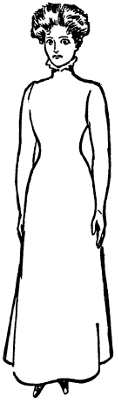
These should be undertaken regularly every day, preferably early
in the morning and in the open air. Stand erect, shoulders drawn
well back, arms hanging loosely at the sides, and then, closing the
mouth tightly, draw in a deep breath, retaining it for some seconds
in the lungs. Not infrequently it happens, that the ventriloquist
when performing is called upon to keep a conversation going for
quite a minute and a half without the opportunity of recharging the
lung cells with a fresh supply of oxygen; from this it will easily be
understood how important deep and sustained breathing is.
At first difficulty will be experienced in holding the breath for more
than five or six seconds; by the end of a week, after ten minutes’
practice every morning, the chest will be so expanded and strengthened
that “half minute breaths” may be taken with ease. Continue the
practice of this exercise until only one inhalation and exhalation takes
place every forty or fifty seconds. Somewhat dry, indeed, sounds this
part of the ventriloquial study; nevertheless it is of the utmost importance,
and will well repay the time, trouble, and perseverance
devoted to it.
As a number of minor acquirements must be gained before ventriloquial
effects can be produced, the breathing exercises may be alternated
with the most necessary adjunct of learning to speak without
moving the lips.
It has previously been said that ventriloquism largely partakes of
the nature of an illusion, and this effect is produced by the performer
uttering sounds without giving visible indications of the fact. Consequently,
when the audience have before them two figures, a live and
a dummy one, and the mouth of the “dummy” opens and shuts to
correspond with the words used, whilst the face of the ventriloquist
remains mask-like and passive—the illusion that it is the “automaton,”
and not the man who is speaking, is complete.
So important indeed is the ability to do this properly, that speaking
without facial movement ranks of equal importance with the placing
of the vocal chords in such a position that “distant” effect is given to
sound. In fact, one might almost say that a most amusing entertainment
can be given without this latter power at all.
Many ventriloquists or polyphonists, as they more correctly designate
themselves, rely solely for their entertainment on a “knee” figure
and speech without facial expression.
Those who do not aspire to become really first-class and proficient
ventriloquists may conclude their instruction at this point, and rest
quite assured that they have learned sufficient, at any rate, to give a
creditable drawing-room performance.
Naturally the beginner would like to have some idea of the time it
would take to gain a practical working knowledge of ventriloquism.
Well, the student who would take the trouble and devote sufficient
time to the initial and most difficult stages of the work would be in a
position to give a very creditable performance long before his painstaking
brother who, as fast as he seems to be getting on, will find he
has to go back again and again over the early ground.
However, after devoting say a week to the elementary stages, a
“knee” figure might be purchased, and within a very few days a
private entertainment might safely be entered upon. As, however, the
course herewith outlined will take in several different kinds of “voices”
for automata, together with the various modifications of the “distant”
voice, the student should not expect to gain proficiency under a month.
Of course, to give a really finished entertainment consisting of an
exhibition of the “near” and “distant” voices, together with instrumental
and vocal mimicry equal in skill to the average product of the
professional entertainer, many months’ practice are required.
A study of the alphabet reveals that difficulties lie in the path of
pronouncing certain letters—a, e, i, o, u, c, d, g, h, j, k, l, n, q, r, s, t, x,
and z—issue from the mouth quite easily; but b, f, m, p, v, w, y all
make a demand upon the muscles of the lips and cheeks. Unfortunately
these letters often recur in ordinary speech, and as it is almost impossible
to speak them distinctly without facial movement, appropriate vocal
substitutes have to be made.
On the border line is “b,” which is generally pronounced by bringing
the upper row of teeth down to the under lip and forcing the
breath out between the lip and teeth; by giving greater force to the
exhalation, and, opening the mouth, it will be found that almost identically
the same sound can be gained, and it is this one which has to be
used for all words commencing with “v” and “b.” Thus the word
“brother” is really pronounced ventriloquially as “vruther”; in the
hurry of conversation the substitution passes notice, and the audience
hear only the correct word.
For “f” an accentuated aspirate makes a very passable substitution—i.e.
“fool” becomes “hool,” “feel” becomes “heel,” and so on.
“m” will be found rather more difficult, but if the lips are formed
into an orifice, and the breath drawn sharply in, the sound of the “m”
can be made inside the mouth instead of by the lips.
As it is almost an impossibility to sound the initial “p” unless the
lips come together, words commencing with it should be studiously
avoided. Another plan is to drop the first letter altogether; but the
former is the better.
“w” is amenable to a little tongue-twisting, and is accomplished by
moving the tongue twice in quick succession to the roof of the mouth
making the sound at the back of the throat. This is as regards the
letter itself, but words commencing with “w” are quite easy. Practice
on “which,” “when,” “what.”
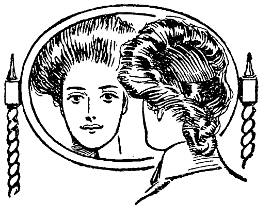
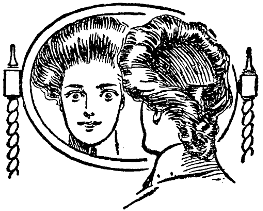
“y,” however, is a fairly certain test, and if you can comfortably
manage this without betraying the fact to the looking-glass (before
which you should carry out your practice) then you have mastered
a great difficulty. A quick exhalation should take place while words
commencing with it are being uttered.
Ventriloquism may be divided into two classes—the first and more
easy of acquirement known as “near,” i.e. including all those vocal
illusions produced with the aid of automata; and “distant,” which
takes in the various illusions achieved by what is known as “throwing
the voice.”
The most finished exponent of both these branches, of this or any
other age, was the great Lieutenant Walter Cole, and he introduced into
his entertainment such an exquisite blending of the two styles that his
example might well be imitated by other followers of the art.
When carrying on an animated conversation with the “lay” figures
placed at near quarters the proceedings would suddenly be interrupted
by the low sound of voices coming from afar, and this would gradually
increase in volume as the speakers were supposed to draw near, until at
last they would be heard outside the very room in which the entertainment
was taking place.
This is alluded to now, as showing the latitude which ventriloquism
allows its exponents.
Of the two branches, “near” ventriloquism is much the simpler
to acquire, although some might hold that, in order to justify the title,
“distant” sounds should first be mastered.
For the purpose of adding interest to the work, students are
recommended to give precedence to the “near” effects. Briefly, the
“near” voices come from the mouth, the “distant” from the throat.
For the former five modified voices are generally used. These are:
“The old man,” “the old woman,” “the little boy,” “the little girl,”
and “the darky” or “the longshoreman.”
The first is a foundation for the last two. It has been spoken of as
the “grunt,” because, being the vocal production of an aged and uneducated
man, in its initial stages it much resembles the familiar
grunting of a pig.
And here it should be noted that the speech of ventriloquial figures
is always harsh and toneless because the efforts to produce the sound
in the mouth without moving the lips rob them of that music and
modulation invariably associated with the speech of educated persons.
Do not attempt to speak ventriloquially, as you would naturally
but slur the endings of your words. Grunt and drag them out slowly,
just as do many countrymen and those unacquainted with the rules of
proper speech.
To give the sound the necessary depth and loudness, keep the lips
slightly apart, the tongue lying loosely in the mouth; then make the
grunt, using some vowel sound like “ah!” fairly far back.
To a certain extent the vocal chords will have to be contracted and
the chin drawn slightly down into the chest.
At first only a spasmodic jerkiness of the breath will come, but
after a little practice “ah!” can be said quite easily, and then other and
longer words follow as a matter of course.
Known as the “theek” or “rush” voice, it partakes of the nature of
the squeaky, shrill sound produced by a reed instrument. Most people
are gifted with the power of singing “falsetto,” and the “theek” voice
simply consists of falsetto tones somewhat exaggerated. Either the
words “queek” or “theek” may be used for the preliminary practice,
the latter perhaps being preferable.
As it is not intended in these chapters to enter into a practical
discourse on the anatomy of the throat and vocal chords, technical
terms relating to such will be avoided as far as possible. However,
the larynx must now be mentioned—this is the part of the throat often
spoken of as Adam’s apple, and is the convex portion of the first
cartilage of the larynx. It is, then, this part of the larynx that has to
be compressed by muscular contraction in order to give the “theek”
voice its proper quality; by a slight pressure with the hand on the
“apple” you will realize the position which this part of the throat
should occupy when muscular contraction takes place.
Now, taking in a deep breath and contracting the larynx, it will
naturally curl up the tongue, until the tip presses tightly against the
roof of the mouth. Open the lips fairly wide and say the word
“theek” in a high-pitched falsetto tone, sustaining the vowel sound
as long as you can.
Your first efforts will probably end in dismal failure, but after a
few attempts the full sound settles down to the long drawn-out sound
of full roundness and tone.
Now you have acquired the “theek” voice, which is also the basis
of the voices used with the figures of little boys and little girls.
Very possibly your practice in the elementary stages of ventriloquism
will result in a slight soreness of the throat. To alleviate this, and, at
the same time, to strengthen the vocal chords, gargle with a weak solution
of salt and water, or better still, get a druggist to make up a gargle
for you.
Curiously enough, the mere effort of gargling is in itself a valuable
aid to the production of ventriloquism, inasmuch as the subject is
forced to emit sounds while the water is in the throat, and these will
be found to possess quite a “distant” effect.
Having mastered the “grunt” and “theek” voices, use words
consisting of vowels, changing the words into sentences as progress
is made.
At this point the young ventriloquist is sufficiently well equipped to
undertake a public exhibition of his powers, and this being so, it is
perhaps better to make mention of ventriloquial figures before the
remaining “near” voices are dealt with.
As a matter of fact, the practice of ventriloquism in its earlier stages
is not the most interesting of occupations, and not until the beginner
awakens to the full realization of his powers—as he does only when
he is working with automata—is the real fascination of the art felt.
Perhaps it is hardly right to assume that every one has seen a
ventriloquial figure; certainly many will be unacquainted with its
peculiarities and modes of working.
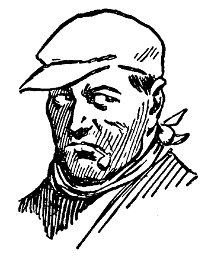
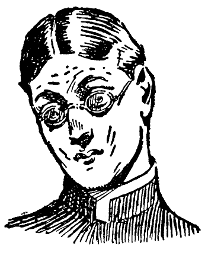
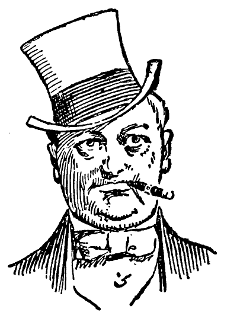
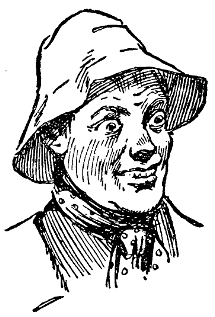
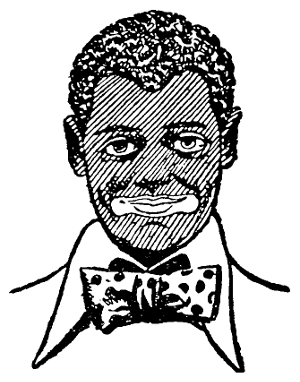
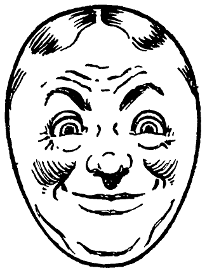
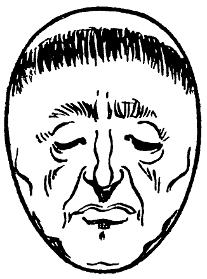
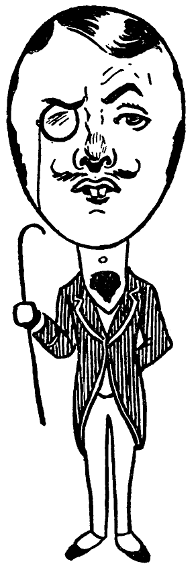
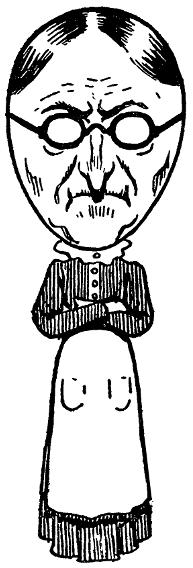
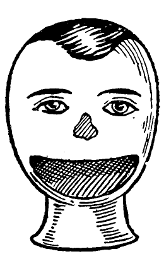
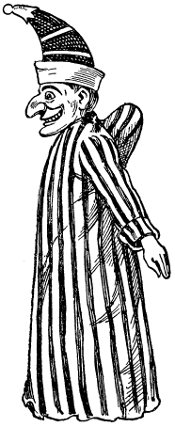
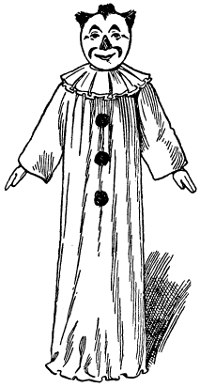
The dummy is usually a humorous representation of some grotesque
character—an old man, with strongly accentuated peculiarities,
such as a red nose, wrinkled skin, and big jaws; an old woman, with
thin, pointed nose, sharp eyes, and scanty locks; a little boy grinning
saucily, and having the appearance of possessing the wisdom of all the
ages; the little “miss,” of perky manner; the good-natured, rollicking
black man; and the longshoreman, square jowled and cheeky.
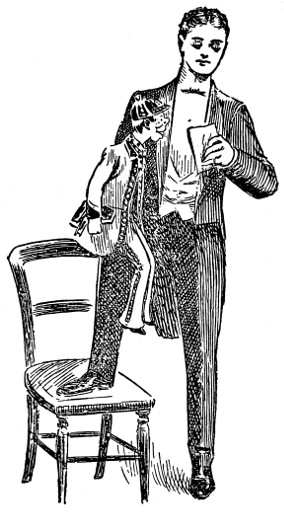
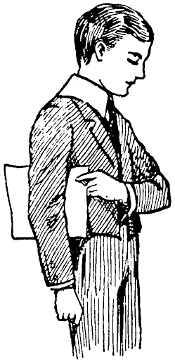
Fig. 1.—Ventriloquist with knee figure.
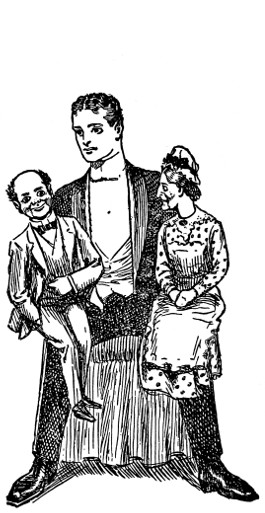
Fig. 2.—Working with two figures.
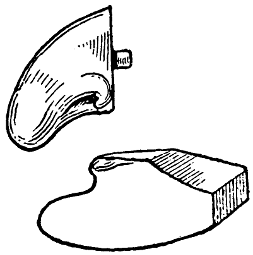
The one essential about the ventriloquial figure is that it shall have
a moving mouth. In reality the chin is cut away from the face, and
the movable portion working on a pivot or string, gives the same effect
as when a person is speaking.
There are many different forms of ventriloquial figures, some of
which are shown on this page (Figs. 1 and 2), but for the amateur the
kind which possesses only a moving mouth is quite suitable.
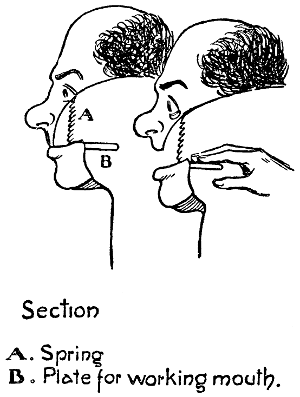
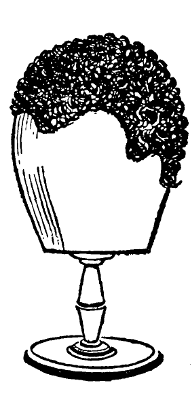
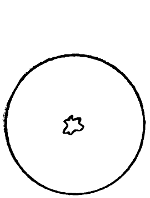
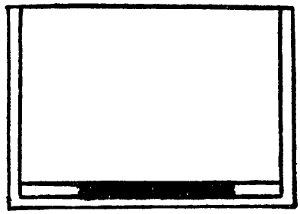
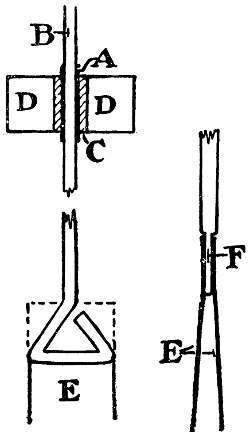
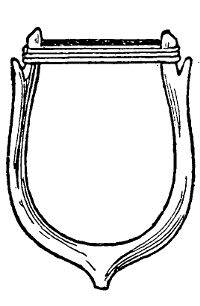
Fig. 3.—Showing construction of
ventriloquial head.
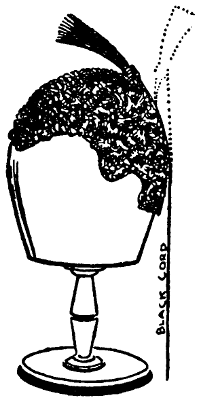
By means of a little ingenuity and the expenditure of a few cents
a movable tuft of hair may be added to the wig, but as the working of
this is liable at first somewhat to hamper the manipulation of the
automaton, it should perhaps be left until proficiency is more assured.
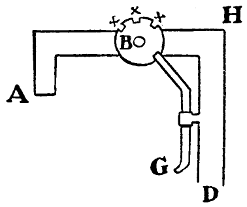
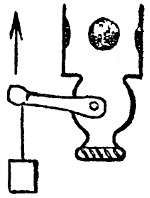
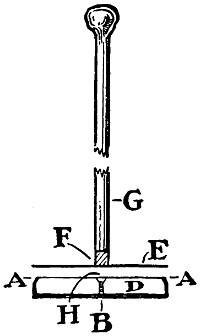
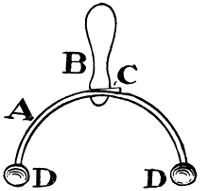
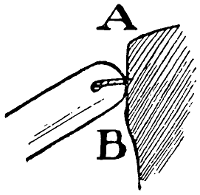
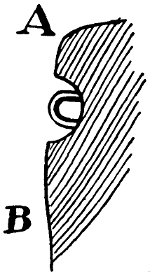
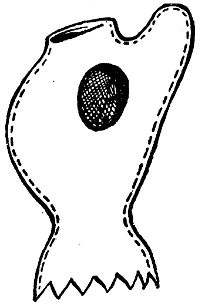
The hole in the back of the head or body permits of the hand of the
performer pressing either upon a plate or upon a circle of wire, which
in turn moves down the movable mouth, closing automatically by
means of a spring. Figs. 3, 4
and 5 respectively show the construction
of ventriloquial figure heads
and another principle of ventriloquial
figure manipulation.
The number of mouth movements
made by the figure should,
of course, coincide as nearly as
possible with the number made by
the mouth in ordinary speech; thus
a natural effect will be gained.
Placing a “dummy” on each
knee, the ventriloquist opens up an
amusing conversation. The aim of
the figures is to destroy the effect of
the performer’s remarks by the interpolation
of absurd interruptions.
The whole matter resolves itself into
a witty dialogue between three or
four people, of whom the entertainer
is the central character. Such a
dialogue should be brisk and sparkling
with humor, all vulgarity being
carefully eliminated. It is as well to write the dialogue out and learn
it by heart.
Always adhere to a prearranged order of ventriloquial figures.
If you commence your entertaining career with the old man on the
right knee and the old woman on the left, keep to that arrangement
all along. A change will inevitably result in putting the wrong voice
into the wrong mouth, and the result will be disastrous.
Bear in mind that all the while the endeavors of the figures are
to make you appear ridiculous in the eyes of the audience, and they
should turn all your sensible remarks into nonsensical ones, so that the
laugh is always against yourself. Of course the audience will join
in the laugh against you, and it is the taking of this in the proper
spirit that will signalize your success as a ventriloquist.
When putting words into the mouth of an automaton, its face
should be turned towards you; inversely, whilst you yourself are
talking the automaton should be engaged in looking curiously about
him at the audience, as if taking not the slightest interest in your
remarks. Suddenly, however, he will snatch the opportunity of
scoring off you, to the great enjoyment of his partner, the old woman.

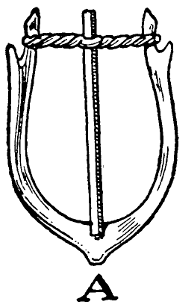
| A. |
Pull |
Fig.
4.—Construction of laughing darky’s head. |
| B. |
Spring |
| C. |
Pin |
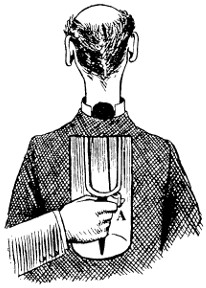
Fig. 5.—Principle of ventriloquial
figure manipulation.
Immediately you have
finished speaking in your
natural voice, keep your
lips absolutely fixed during
the time the figure is
supposed to be talking.
It is not proposed
here to give specimens
of ventriloquial dialogue,
because the humor of
these depends so much
upon the natural ability
of the performer in presenting
the joke or funny
story.
Undoubtedly the best
plan is to form a cutting-book
out of the tit-bits
extracted from the humorous periodicals of the day, and to paste
them in. In this way a voluminous collection of anecdotes, tales,
and riddles will be made, and by a judicious
combination and selection of these,
enough material can be speedily gained
to last months without fear of repetition.
The most entertaining form of presenting
riddles is for the “old man” or
“little boy,” whichever is being used, to
propound them, and the entertainer to
give some practical answer to them. The
real point of the joke should be brought
out by the “lay” figure, to the accompaniment
of considerable mirth.
Home-made automata are not recommended,
because the cost of purchasing
really serviceable “dummies” is so small
as not to make it worth while spending
a deal of time and trouble, to say
nothing of money, on their construction. Moreover, the great point
about the “lay figure” is that it should possess a funny face, and
such expressions are rather difficult for an amateur to obtain.
Many entertainment emporiums deal largely in ventriloquian outfits,
and reliable “dolls” ought to be procured fully dressed for about $5
each.
When a child speaks he almost invariably does so in a high-pitched
tone, more or less directing the sound through his nose.
This being so, the “theek” voice is the one most suitable for him.
The similarity between it and the speech used for the “old woman”
may be avoided by speaking in a somewhat lower tone, and in a
simpler and more disjointed fashion.
Suppose, for instance, that you ask the little boy a question?
Get him to repeat that question after you, and give the answer in
short, jerky, broken sentences.
For the “little girl” use a slightly higher tone, without directing
the sound through the nose. In her case also the mode of expression
must be childish, but with slightly more refinement.
The voice for the “longshoreman” and the “darky” are both of
the “grunt” order. For the former, the “old man” voice is used, with
the addition of the peculiar “tough” twang; whilst for the latter, employ
speech of a much lower and more resonant tone.
Place the chords as when using the “grunt” voice, breathing rather
heavily, and force the sound as far back in the throat as possible, at
the same time contracting the muscles of the stomach while the breath
is being expelled.
The word “yah! yah!” is a very good one upon which to practice,
and the vowel sound should be sustained to some length.
By this time the young ventriloquist should have attained sufficient
proficiency in the art of manipulating “knee” figures to feel confident
of venturing on the far more difficult and relatively more important
“distant” voices.
The real test of ventriloquial power is when the performer is
capable of making sounds appear to come from a distance, i.e. so
modify his utterances that they appear to the audience to proceed from
some point remote both from the entertainer and from themselves.
The basis of real ventriloquism, as apart from polyphony, i.e.
“near” effects, is known as the “bee drone,” because the first sound
of which the vocal chords are capable when placed in the required
position much resembles the droning of a bee in full flight.
The “bee drone” should be practiced in loosely fitting clothing,
so that neither the muscles of the throat nor of the chest are unduly
hampered.
From a natural, upright position, inhale in a short, jerky manner,
making what is best described as a retching noise at the back of the
throat. Unpleasant as the practice of this undoubtedly is for the first
few minutes, after a short while the noise emitted will settle down to
a softly sustained hum. The tongue should lie flat, so that the sound
waves produced partly in the larynx and partly in the back of the
throat are forced upwards by the action of the abdominal muscles and
directed towards the roof of the mouth, the latter acting somewhat as
a sounding board—modifying the sound and conveying to the ears of
a listener some distance away a “distant” effect.
The continuous practice of the word “ah,” with the vocal chords
in the position just described, will speedily produce the necessary
droning quality.
It remains now only by a contraction of the throat to regulate the
quality of the tone and the distance from which you wish it to appear
to come.
From this point progress will be found rapid and satisfactory.
The various modifications of the bee drone produce respectively,
1. The “roof” voice.
2. The “level” voice.
3. The “floor” voice.
The “roof” voice is extremely useful for illusions of all kinds, and
perhaps is the easiest of the three to acquire. Its purpose is to make
sound appear to come from any point above the audience, and the
entertainer practices it at first by standing erect, taking in a deep
breath, and then drawing backwards and downwards the lower jaw,
holding it by muscular contraction in that position. With the lips
about an inch apart say your words, whatever they may be, just as
you would the “ah!” of the bee drone, concentrating your mind on
the effort of directing the sound waves towards the roof of the mouth.
In this case, however, exhalation should take place very slowly, while
the speech is uttered with unusual clearness.
The effect of the illusion, however, is destroyed if whilst using the
“roof” voice you look either straight before you or down to the
ground.
The ventriloquist must bear in mind that it is important to deceive
the audience, just as a conjurer does, but the former has this
advantage over his magic brother, that the deception is both optical
and oral.
Let him, therefore, when “throwing his voice” to the roof, glance
sharply upwards as soon as the words are uttered, and turn his head
in a listening attitude; his example will be followed immediately by
the audience, who naturally fall into the trap prepared for them, and,
for the time being, are quite satisfied that the sounds do really come
from the roof.
This is an advantage on which the ventriloquist can trade to an
enormous extent, because the ear is so easily deceived. How difficult
it is, when listening from within a closed room to a street organ playing
outside, to tell whether the music comes from up or down the road.
So with ventriloquism—the performer has but to modify the position
of the vocal chords as indicated, and to fix his eyes upon the roof,
when lo and behold! everybody is perfectly satisfied that the speech
does come from above.
Of the three “distant” voices, the “level” is, perhaps, the most
useful and the most generally successful, because the mere fact of the
entertainer being on the same plane as the door and the windows,
from behind which people are supposed to converse with him, provides
him with opportunities for using the facial muscles and for
distorting sounds, and so heightening the illusion.
For instance, whereas he must turn full or three-quarter face
when using the “roof” voice, he can carry on a dialogue on the
“level,” sideways to the audience; or in the case where the stage
possesses a door at the rear, he may often be permitted for a moment
to turn his back.
Practice as before in the “bee drone” voice, without endeavoring
to any great extent to shut off the sound in the throat. This may be
done by curling up the tongue so that its tip presses against the back
of the upper teeth.
If you are practicing by the side of the door, as you open it towards
you the ventriloquially uttered sounds must be raised in tone and made
more distinct by lifting the shutter from the throat, or, in other words,
by allowing the tongue to resume its normal position, and the sounds
to issue forth on the principle of the “bee drone.”
This voice is extremely useful for such illusions as “the man in the
cellar attending to the gas meter,” &c. It calls particularly for a display
of histrionic powers, and the mere fact of bending down, as the sounds
appear to come from below, helps to give it the necessary subdued and
“distant” effect. Whilst speaking very slowly in the “bee drone”
thrust the chin forward, contracting the larynx as much as you possibly
can; roll back the tongue to stifle the sound in the throat, and the
illusion will be complete. Immediately you change from the “floor”
to the natural voice, resume the standing position and speak with
unusual distinctness. The contrast cannot fail to escape the notice
of the audience, who will be quite convinced that you have indeed
carried on a conversation with some one below.
Although imitations can hardly be classed under the heading of
pure ventriloquism, yet they may be pressed into the service of the
entertainer to promote variety in his performance. They serve, too,
another very useful purpose, inasmuch as they provide a relief from
what must inevitably prove a strain on the vocal chords. As has
already been said, ventriloquism necessitates the placing of the vocal
chords in a somewhat unnatural position, and the result is that the
exponent, particularly in the early stages of the work, is apt speedily
to become tired.
As a break between an exhibition of “near” ventriloquism—that
is, with the automata—and an exposition of distant effects, one or
two vocal or instrumental imitations will prove welcome both to the
entertainer and the entertained.
A witty person once remarked that the secret of success lies not so
much in what you can do, as in what you can induce other people to
think you can do. In other words, a little knowledge in the hands of
a ready-witted and competent ventriloquist can be turned to great
advantage and become a valuable asset in his undertakings. For
successful imitations, self-confidence is perhaps of even greater importance
than the possession of real ventriloquial powers. Self-confidence
is a trump card that the ventriloquist should always hold in his
hand, because it will take all the tricks. Success is impossible without
it, and easy with it!
Perhaps there are few branches of entertaining in which self-assurance
is so necessary as in ventriloquial mimicry. The border-line
between a successful imitation and a ludicrous failure is oft-times so
narrow, that a sensitive soul would soon be disheartened.
The only difference between the efforts of the ordinary and the
ventriloquial mimic is that the latter, when giving expression to sounds
vocally produced, should place the chords in the same position as for
the “bee drone” and the “distant” voice.
A very good study is that of a hen as she cackles immediately
before laying an egg, and again after having done so. You will notice
that the first sounds are mostly of a guttural nature, and they should
come from well back in the throat, starting moderately high and descending
four or five notes. Of course the lips will have to be kept slightly
opened, and for the final jubilant crow considerably extended. To
avoid the necessary facial movement, it is as well when uttering the
“crow” to turn sideways to the audience. Again, while the first note
of the cackling should be loud, the successive notes grow quieter.
An imitation of a dog fight will form a spirited item in your programme.
By your actions you may suggest, for instance, a small
cur yapping vigorously until a larger and more ferocious animal
endeavors to quiet him.
To produce the higher notes of the dog-bark, the falsetto or
“thick” voice must be used, while the deeper guttural tones already
explained for use with the “darky” serve for the larger dog.
It is a little difficult to intersperse the two sets of sounds without
expressing facial contortion, but you may obtain for yourself a certain
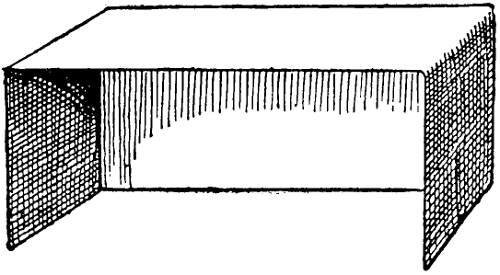
amount of license by pretending that the dog fight is taking place
beneath a covered table, behind which you may stoop in your supposed
endeavors to stop the tumult.
It is but natural to turn from dogs to cats. Whereas you have
just given an imitation, perhaps, of a fierce duel, your next effort
should endeavor to portray a feline courtship. This should be made
as funny as possible. The lady’s “marr-rr-ows” and “mia-a-a-ows”
are easily copied after you have been kept awake a night or two
listening to the genuine article, whilst the deeper tones of Mr. Tom
are included in the repertory of every well-educated schoolboy.
The mouth should be kept fairly wide open and a kind of sideways
motion given to it, whilst the cry should be drawled until the lips form
for the final “ow.” The spittings and growlings necessitate the
bringing together of the lips and teeth, a freedom which your audience
on this occasion must permit you. The doleful moans with which
our feline friends endeavor to solace one another can be produced by
making the mouth very hollow, the lips into the form of a large O,
slowly contracted to a very small one.
For the die-away, distant effect, moaning more or less in the throat
must be resorted to. The finale can consist of a number of fierce
spittings and growlings, suddenly interrupted by an unmistakably
human voice (your own) “shoo-ing” the night visitants away.
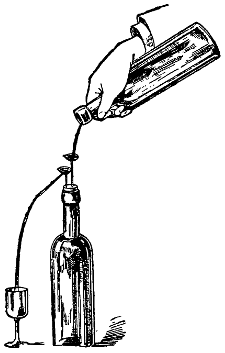
A variation can be made by giving an imitation of pouring out a
glass of wine. To produce the illusion of drawing the cork from the
bottle, turn slightly round, thrust the forefinger into the mouth against
the cheek, close the lips around the finger, slowly bring the end of the
finger round inside the cheek, and force it smartly out through the lips.
The result will be a loud pop. By moving the tongue from the back
of the mouth quickly backwards and forwards, making it strike against
the inside of the gums, the “glug, glug” of the wine being poured out
will be plainly heard.
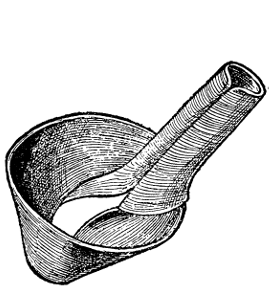
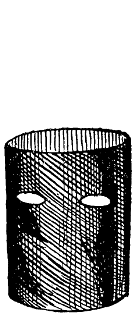
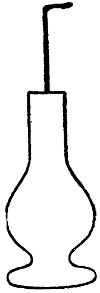
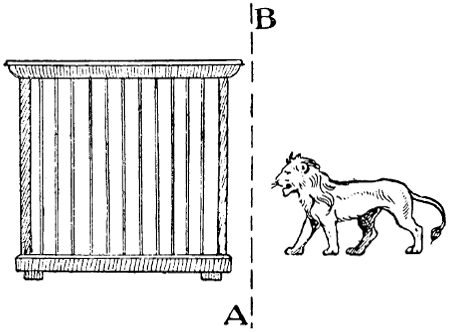
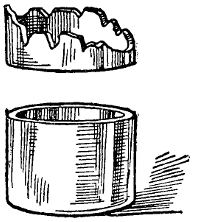
Under the cover of a screen, the roaring of a lion is simple of
accomplishment. Use an ordinary lamp chimney, and give vent to a
series of deep-throated roars from this. The effect will both be
natural and startling. With the same instrument the deep lowing of
a cow can be perfectly imitated, the lips producing the familiar “moo,”
the sound being gradually drawled through the glass chimney.
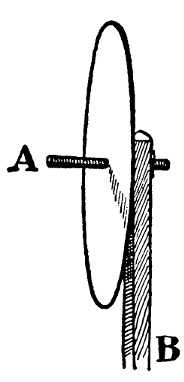
To copy a saw at work is quite easy. Get a ruler, or some similar
article, to represent the saw, and draw it backwards and forwards as
though cutting a piece of wood. The sound is best made by clenching
the teeth, placing the tongue a little forward between the upper and
lower teeth, quickly inhaling and exhaling the air. The resultant noise
will be an exact imitation of the saw cutting its way through the
wood.
Quite an effective item is the ascent of a rocket. By blowing hard
through pursed lips, and striking the mouth rapidly with sharp little
blows with closed fingers, the curious sound of an ascending rocket
may be reproduced with perfect fidelity. This slowly fades away,
there is a moment’s pause, and then the final pop as the stars burst.
Naturally such an imitation should be performed in the shelter of
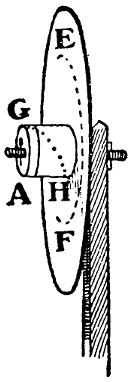
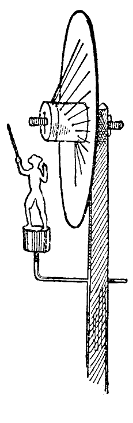
the screen. As a last example, an imitation of the itinerant knife-grinder
may be attempted. Keep the lips and the teeth closed to
produce the rasping up and down of the steel upon the grindstone,
the while working an imaginary treadle with the right foot.
By this time the young ventriloquist should have at his command
both “near” and “distant” voices and imitations. It only remains to
say a few words regarding the manner of giving an entertainment.
Although smart dialogue is very entertaining, it is apt, after a little
while, to pall; and to obviate this it will be found well to introduce
an occasional song or comic recitation. In both cases these may take
the form of parodies, but in the former a serious song really well sung
by the ventriloquial figure will evoke both admiration and applause.
Those not possessed of particularly good vocal qualifications may
feel that the singing of a song successfully is beyond their capabilities.
They should, however, bear in mind that nothing like “finish” or
cleverness in execution is expected from a wooden figure. One or
two verses and the chorus are quite enough to venture upon, as singing
ventriloquially is extremely tiring.
The best time to introduce a song is when dialogue between
yourself and the automata has been in progress for seven or eight
minutes. Either the little boy or the old man or the old woman can
essay to try his or her skill as a vocalist, or the affair may be competitive.
Much amusement may be caused by the little boy extolling
his own skill as a vocalist, and the darky challenging him. To settle
the matter, let one sing the first verse of a song and the other the
second, the little boy making a terrible hash of his part of the performance.
If his mistakes are greeted with groans of derision from
the old man, or cries of horror from the old woman, the audience will
be immensely pleased.
While the song is in progress, the ventriloquist should look about
him unconcernedly, feigning total disinterestedness in the affair.
Towards the end of the song he may glance sharply once or twice at
the singer and applaud him for his effort, which applause it is to be
hoped the audience will generously supplement.
It is not intended that these few observations on the art of ventriloquism
should be taken as covering all the ground over which this
fascinating subject spreads. Enough has been said, however, to show
any one who is sufficiently interested how to give a really pleasing
drawing-room performance which shall earn for him the reputation of
being quite a creditable exponent of the wondrous and mystifying art
of Valentine Vox.


























 .


 .