F. W. Preston and William J. McGrath, Jr.
Although John Peate was born when Holcomb was
only 33, and before that pioneer telescope-maker had
produced his first instrument, he lived well into the
time when American telescope-making had come of age.
Before Peate’s death George Ellery Hale had begun his
career as a promoter of large telescopes; indeed, the
Yerkes 40-inch refractor was completed a year prior to
Peate’s delivery of his own magnum opus, a 62-inch
reflector, to The American University. For 34 years
the University sought funds to finance the installation
of this mirror, until it finally became obsolete as a
result of advances in the technology of glass mirror
making.
In 1934 it was sent by the American University to
the Smithsonian Institution. About this time Dr.
F. W. Preston undertook the difficult task of reconstructing
Peate’s career and particularly the story of
the great mirror. His results were published in the
Bulletin of the American Ceramic Society in 1936.
With the gracious permission of Dr. Preston and
the Bulletin, this article has been condensed, and
augmented, for publication here by William J.
McGrath, Jr., of the United States National
Museum staff.
John Peate, bricklayer, Methodist minister, and
amateur extraordinary in the art of telescope
making, was the first born of Thomas and Mary Peate.[14]
He was born on May 6, 1820, in the small northern
Irish town of Drumskelt. When John was seven,
his father, a mason, emigrated to Quebec, Canada,
the first of several moves to cities in Canada and the
United States, terminating in 1836 in Buffalo, New
York, where the father was to spend the last seven
years of his life.[15]
Nothing is known of the circumstances of John’s
life during these early years, nor of his education.
In 1836, at the age of 16, he entered his father’s trade
as an apprentice bricklayer. He worked at this
trade for about sixteen years, apparently intermittently,
for he seems to have been a student at Oberlin
College part of the time between 1842 and 1845.[16]
In the latter year he married Mary Elizabeth Tilden
of Buffalo.
Peate’s career as a bricklayer ended in 1851, when
he became a full-time minister, having been converted
to his mother’s religion. This came about in consequence
of his attendance, when he was about 20
years old, at a Methodist revival. There he was
“converted,” and, with characteristic energy and
enthusiasm, plunged into his new religion. His
attendance at Oberlin may have been connected
with his preparation for the ministry. In any case,
he started to preach in 1849, on trial with the Methodist
Erie Conference, was ordained a deacon in 1851,
and an elder two years later. From this time until
he was made a supernumerary in 1894 he worked
full-time as a minister.
The mobility which marked his early life was repeated
in his ministerial career. Including his probationary
term he held 19 different appointments
in 14 cities and towns in northwestern Pennsylvania,
northeastern Ohio, and southwestern New York.
He was a successful and popular minister, and is said
to have converted some 500 persons at one revival
in Jamestown, New York. J. N. Fradenburgh,
historian of the Erie Conference, begins his sketch of
Peate’s life with the phrase, “Who has not heard of
John Peate?”[17]
In 1859 Peate journeyed to Europe, visiting England
and Ireland, and making a walking tour of
western Europe and the Middle East. His biographer
Fradenburgh hints that his interest in astronomy
was aroused on this trip. In any event,
upon his return home, he took up the study of
the science. His fellow minister, R. N. Stubbs reported
that “his library reveals that difficult and abstruse
works became his delight.” At some point in
the perusal of these “abstruse works,” Peate decided
to concentrate on that basic tool, the telescope. It
is possible that he first made a telescope, as many
amateurs do, to advance himself in the study of
astronomy, and only after completing it realized that
his primary interest lay in the instruments rather than
in the theoretical science. His natural aptitude for
craftsmanship probably exerted a strong influence in
this decision.
His first instrument was a 3-inch refractor which
he made and mounted for his own use. This was
about 1870. He next made either a 6-inch refractor
or a 6-inch reflector, or perhaps both. One of these,
if there were two, was mounted by Peate for use at
Chautauqua and Jamestown, New York, and then
used in his own observatory at Greenville. After his
death it was taken to Salina, Kansas, by W. F. Hoyt,
for a small observatory there.[18]
Thereafter Peate made reflectors exclusively. It
is possible that he was influenced by the treatise on
the making of silvered glass reflectors, by Dr. Henry
Draper, published by the Smithsonian Institution
in 1865, a work which led to a great improvement
in the construction of reflectors in this country.[19]
Attempts to trace Peate’s mirrors have been
singularly inconclusive. A 7-inch reflector sent to
India was still in use in 1903.[20] A 12-inch reflector
made for “Harriman University, Tennessee,” was
evidently mounted, but no record even of the observatory
has been found at the present time [1936].[21]
A 15-inch mirror in a reflector located at Allegheny
College in 1935 was probably made by Peate,
although the College records do not show its origin,
nor do they mention a 30.5-inch mirror which Peate
was making for Allegheny College in 1891, according
to an article in The Scientific American.[22] Definitely
Peate’s was a 22-inch reflector found in about 1935,
still in its packing case, at Thiel College, Greenville,
Pennsylvania.[23]
Altogether, 10 lenses and mirrors (sometimes also
described as “lenses”) have been traced. As many
as 20 were ascribed to him by some sources at the
time of his death. Of these only his magnum opus,
the 62-inch mirror now in the Smithsonian Institution,
can now be found. Most of them seem never to
have been used, but this is not necessarily an indication
of defects in the instruments. As our consideration
of the 62-inch mirror will show, Peate
was a competent maker. Nor is it a consequence of
his being an amateur. Many of the large telescopes
in the world in the mid-nineties had lenses and
mirrors made by two other Americans, John Brashear
and Alvin Clark, who, like Peate, entered telescope
making as amateurs.[24] But they had the fortune
to become associated with well known professional
astronomers. Peate may have erred in presenting
his reflectors to institutions unable to finance their
installation. Perhaps his error was in presenting
rather than selling them.
We come now to Dr. Peate’s greatest mirror, the
62-inch reflector. In September 1893 the annual
meeting of the Erie Conference was held at Dubois,
Pennsylvania. This was to be Dr. Peate’s last meeting
as an active minister. In 1894 he would become
a supernumerary, a position of semiretirement, after
which he would retire. In order to honor the old
minister and to mark the opening of a new Methodist
university, American University, at Washington,
D.C., it was decided to commission Peate to make a
telescope mirror for the school. This was to be no
ordinary reflector but the largest in the world.
While the facts surrounding this commission and
its accomplishment are astounding in themselves it
has inspired an even more remarkable legend, which,
although rather unjust to the ability and good sense
of Dr. Peate, indicates the impression his hobby had
made on his contemporaries. According to this legend,
John suddenly realized at the age of seventy-three
that he must have something to occupy his
time while retired.
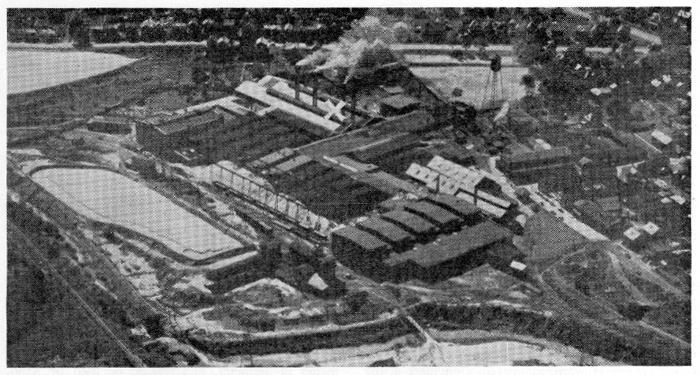
Figure 11.—Standard Plate
Glass Company, Butler, Pennsylvania, with x marking building where
Peate’s 62-inch disc was cast. (From Preston, fig. 1.)
“What am I to do all the rest of my life?” he asked
of the presiding officer of the meeting, Bishop Hurst,
who was also chancellor of the newly founded
University.
“Oh, study astronomy,” said the Bishop.
“Make a big telescope lens,” said Dr. Wythe.
Dr. Wythe, whose doctorate was in medicine, was
a minister well known in the conference as an inventor
and technologist. The legend continues that,
urged on by Wythe, Peate announced to the conference,
“I will make for the new University the largest
telescope lens in the world, if you will defray the out
of pocket expenses.”
“Well, how big a lens can you make?” asked the
Bishop.
“Oh, as big as that chart on the wall,” said Peate.
“Get a rule and measure the chart.”
The chart was 62 inches across.
“Offer accepted. One 62-inch reflecting telescope
from Dr. Peate,” ordered the Bishop.[25]
The minutes of the conference state:[26]
Proposition of John Peate … John Peate made a
proposition to manufacture a large reflecting lens for the
University providing material for the same was furnished
him … a committee of 5 was appointed to take the same
into consideration. R. N. Stubbs, G. H. Humason, N. T.
Arnold, G. P. Hukill, and G. B. Chase were appointed to
that committee.
Although he was 73 years old Peate was in good
health and had tremendous vitality for one his age.
He had already made a number of large mirrors, so
that he could estimate the amount of time and energy
he would expend in this work. He knew that if he
retained his health for the next few years he could
complete it.
With his typical planned enthusiasm he started his
preparations. He wrote to his usual supplier St.
Gobain of France asking the price of a glass blank
large enough for a mirror of this size.[27] They quoted
a price of $18,000—more, obviously, than he could
afford. He then canvassed the glassmakers of Pittsburgh,
the center of American glassmaking. However,
the Pittsburgh firms had little experience in
optical glass, especially of this size, and none would
consider making the blank.
Having been rebuffed in Pittsburgh, he approached
the Standard Plate Glass Company of Butler, Pennsylvania.
Plate glass making, at least profitable plate
glass making, was new in America and the Standard
was one of the newer companies. Moreover, it was
reputed one of the best plate glass makers in the country.
Peate wrote to H. C. Tilton, general manager
of the plant, asking him for a disc of glass without
bubble or flaw 62 inches in diameter and 7 inches
thick. He further advised him that he would see him
in a few days. Tilton’s experience and that of his
top supervisors was limited to the business of making
ordinary plate glass. Therefore, he sought advice as
to the feasibility of this fantastic project. He consulted
George Howard, maintenance engineer of the
plant, who had graduated from Cornell only a year
before. George Howard, later to become noted as an
inventor of glassmaking machinery, was at this time
simply an optimistic young engineer.
“Howard, here’s a man at Greenville who wants us
to cast him a disc 62 inches in diameter and 7 inches
thick. Is that possible?”
Howard calculated the cubical contents of the proposed
disc and replied that it was just barely possible.
He didn’t see any particular difficulty in it. He
thought the first few attempts might fail but felt that
they could cast it successfully. Howard was later to
ascribe his success more to his optimism and ignorance,
rather than to any particular innovation he made.
After being reassured by Howard, Tilton continued
“Well, this Dr. Peate is coming down here tomorrow
and he wants a quotation. How much do you think
we ought to ask?”
“We’ll have some special apparatus to make and
some experimenting to do. Then we’ll probably
lose two or three pots of glass. I think you’d better
ask him $800.” Howard thought that this was
plenty. Tilton, however, was more cautious and
doubled the price. Peate arrived in Butler on
schedule. When Tilton named his price, Peate, of
course, agreed instantly. Tilton was somewhat
shocked and probably would have been more so had
he known what St. Goubain had asked. At any rate
the contract was placed with Standard, apparently
in October 1894.
Having obtained a maker for his disc Peate immediately
began making arrangements to prepare
the disc. He contracted with the machine shop of a
John Hodge for the tools with which the mirror would
be worked. This small firm, The Hodge Manufacturing
Co., employed only four men besides the
owner. Among these was Frank A’Hearn, then just
a boy, who became the prime source for details of the
tools used by Peate in this work. Starting in November
1894 notes such as, “worked for Dr. Peate 3½
hours” begin to appear in his workbook.[28]
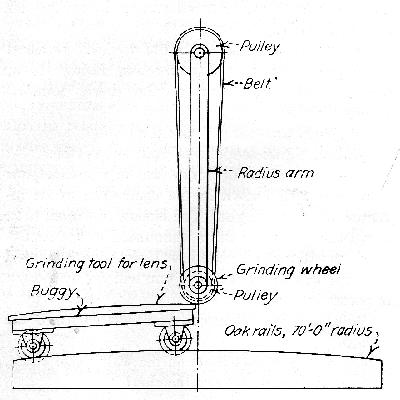
Figure 12.—Hodge’s method of
cutting the checker grooves. (From Preston, fig. 6.)
The Hodge company made several (probably
three) grinding tools for Peate. One was about 12
inches in diameter, and was to be used by hand.
Two of the larger tools were provided with the male
member of a ball and socket joint and were to be
power driven. They were 30 and 48 inches in diameter,
respectively. The largest was grooved to a
waffle-like surface on its convex face. These grooves
were about ½ inch wide and 3/16 inch deep. This
pattern was ground by placing the tool face up on a
wheeled buggy, which rode on cambered oak rails.
As it was pushed along the length of the rail the
grinding wheel on the radius arm cut one groove.
When the groove had been cut, the radius arm was
moved 2 inches along a line shaft and another groove
cut. When all the grooves had been cut in one
direction the tool was turned 90 degrees on the buggy
and the other set of grooves was ground. The
grinding of this tool took many weeks, and making
the tools and apparatus for Peate may have kept
Hodge busy for nearly six months.[29]
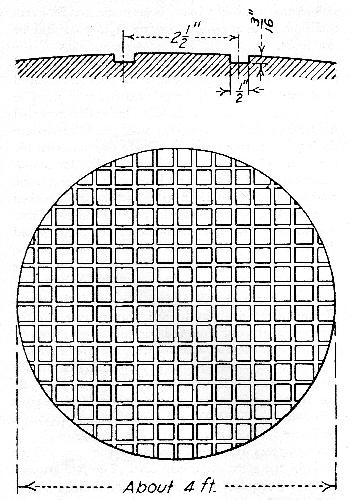
Figure 13.—Face of largest
grinding tool made by Hodge for Peate. (From Preston, fig. 5b.)
The history of Peate’s 62-inch mirror probably
would have remained as obscure as that of his others
except for the furor which arose over casting the disc.
The Erie Conference made no attempt to publicize
this project, and both Hodge Manufacturing and
Standard Plate Glass accepted Dr. Peate’s contracts
as somewhat unusual but hardly newsworthy jobs.
But when the glass trade became aware of Standard’s
intention to cast this disc, a mighty outcry arose.
Instead of encouraging Standard to complete this
novel task the National Glass Budget, one of the leading
trade journals, reviled them as “bumpkins” for attempting
something that even the great glassmakers of
Europe would not do.
It is hard to imagine why the trade journal so
strenuously objected to Standard’s attempt. It has
been suggested that it derived from the fact that
Standard Plate Glass just previous to that time had
refused to join in a combination of Pittsburgh companies
which had set up a glass trust.[30] Or it is
possible that the young industry was afraid that an
overly ambitious project doomed to failure might
open American glassmaking to European ridicule
and so harm the entire American industry. Whatever
the reason, the Budget ridiculed Standard
Plate Glass, and later Dr. Peate, for the attempt.
They argued that it could not be done, but that if it
were possible Pittsburgh would be the logical place
to try it. Criticism and unfavorable comment came
from other sources also, including “university professors
from Meadville” (evidently Allegheny College).[31]
Nonetheless, Standard Plate Glass started
the project.
George Howard was in charge of the casting operation.
He planned to use the glass from a pot
regularly used in the routine manufacture of plate
glass. However, certain modifications were introduced
in the procedure. The glass was to be poured
on the traveling casting table, upon which was placed
a circular mold made up of two semicircles of a special
charcoal iron obtained from Philadelphia. This iron
was not apt to generate bubbles of gas when in contact
with the molten glass.
The iron mold was hinged at one joint of the
semicircles, and the other joint was bolted. After
the cast was poured it would be allowed to cool
somewhat. When it was judged cool enough, it
would be pushed into a kiln to be annealed. After
it had remained in the kiln a certain length of time—again
based simply on judgement—a quantity of
pre-heated sand was to be poured over the mold as
insulation. A further innovation was the use of a
zinc sheet placed on the underside of the mold to
avoid the possibility of trouble from grease on the
casting table. This was the initial plan of operation.
Sometime early in 1895 the first attempt was
made. It was an immediate failure. The zinc
sheet, intended to protect the cast from grease,
volatilized when the molten glass was poured on it,
bubbled up through the glass, and, of course, ruined
the cast.
The second attempt was evidently made sometime
in March. The casting itself was successful. Sand
had been substituted for the zinc sheet. The cast
was placed in the kiln, and when it was thought to
be set the insulating sand was poured over it. After
a time variously estimated at from 4 to 11 days,
the cast was considered sufficiently annealed, and
was examined.
When the sand was removed, the disc was found
in fragments. There was also a large concavity in
what would have been the face of the disc. The
sand had been poured over it before the glass was
sufficiently set. However, the disc had been destroyed
by its iron mold. The mold had contracted
against the disc, bending the bolt and deforming
the hinges, and this tremendous pressure had
shattered the glass. The next issue of the trade
paper jubilantly noted the failures. They also
included Dr. Peate in their derision. They said in
effect that at least this experience would save the
old preacher the waste of many years of time and
effort.[32]
This slur on their most esteemed citizen brought
the Greenville papers into the battle. The Budget
had also made the mistake of implying that any
number of Pittsburgh manufacturers were willing
and able to make the disc. John Morrison, at that
time editor of the Greenville Advance Argus, and
source of much of our information regarding this
controversy, immediately called the bluff of the trade
paper, which was able to supply but one name, that
of a George A. McBeth Company. This firm
promptly declined without qualification. Later the
name of the Phillips Semner Co. was given, and this
firm guaranteed a perfect disc within 60 days for a
“remunerative price,” but would not state what this
price was.[33] Therefore Dr. Peate could not deal
with the firm.
Although the hue and cry continued for a few more
weeks, the battle was really over, for Howard was soon
to cast his disc. He had replaced the iron bolts in
his mold with bolts of red oak dipped in nitric acid and
then charred. The purpose of this was to relieve the
strain on the glass by having the wooden pegs break
as the mold contracted.
The third cast was in the kiln and in process of
being annealed when Howard read in the Budget
an article that set forth the difficulties of successfully
casting optical glass. This article was anonymous
and was obviously the work of an expert; it is thought
to have been written by John Brashear.[34] Although
Howard was thoroughly discouraged by this
article, the cast had already been made and no harm
could be done now by allowing it to cool and be
examined.
In May 1895 Howard, with the workmen, opened
the kiln. The mold was loose, so the pegs had sheared
as expected. When the sand was removed the disc
was found to be whole. A close inspection revealed
no obvious faults. The disc was gently carried to
an inspection room and Dr. Peate was immediately
sent for. He arrived, examined the disc for a moment,
then said, “Give me a hammer.” Before anyone
could move he seized a nearby hatchet and knocked
off the sprue, or tail left as the pot was removed from
the mold. The onlookers feared the lens would
“explode,” as predicted by its detractors, but the
only result was the removal of the tail, as Dr. Peate
expected.[35]
The Budget was still saying it couldn’t be done.
Commenting on a May 1, 1895, announcement of the
removal of the disc from the kiln, the paper seized on
the fact that the disc was still warm to predict that it
would be shattered before Peate could examine it,
and reiterated its low opinion of Standard Plate. By
the time this issue was in the hands of its readers
however, the disc had been inspected and approved
by Peate.
Newspapers in Pittsburgh and elsewhere carried the
news of the great American disc. The embarrassed
Budget replied that it was not talking about the mere
casting of the disc but the completion of the mirror.
It feigned surprise that this was all that was to be
done in Butler. Even as late as May 24, 1895, the
Butler Democratic Herald was still defending its town.
It concluded an editorial on the issue thus:
… we have a feeling he [The Budget] has set his foot in it
when he goes to poke fun at the Standard about casting the
biggest mold on earth, and the end of it may be a repetition
of the old saw “he who laughs last laughs best.”
A week before this, however, the success of this casting
had been made more or less official by an announcement
to that effect in the May 17, 1895, issue
of Science, a publication of the American Association
for the Advancement of Science and probably the
most highly regarded scientific paper of the time.
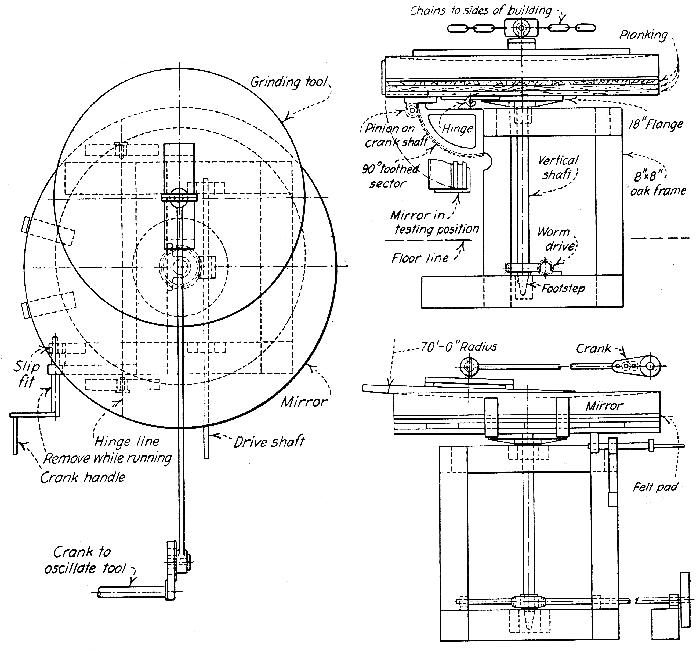
Figure 14.—Surfacing machine
used by Peate. (From Preston, fig. 4.)
On June 1, 1895, Standard Plate rendered Peate an
invoice, not for $1600, but for $450. Evidently their
work was done at cost. The disc was now removed to
Greenville where Dr. Peate had erected a shop to
grind, polish, and figure it. As the disc was slightly
out of round the first operation was to make it perfectly
circular. Peate did this roughly by spalling off
pieces of the edge with his bricklayer’s hammer. The
final rounding was done with the aid of the iron
hoops that had made the mold. Dr. Peate fed steel
shot between the edge of the disc and the iron semicircles.
He rotated the disc on the turntable and thus
rounded it off.
After this had been done he commenced the rough
grinding. Using the large checkerboard tool, steel
shot, and levigated emery Dr. Peate ground out a
rough hollow. This took only a few days. George
Howard stated that the depth of the concavity was
about ⅝ inch and the shape correct to within about
1/10,000 inch. The calculated concavity of the mirror
would be 6/10 inch. Peate evidently used the
usual method in polishing the large mirror, that is,
he covered the tool face with pitch and used rouge
(iron oxide) as the abrasive. This method had been
used for many years before this time and is still in use
today.
The figuring, which consists of removing high spots
to achieve a truly parabolic contour, probably took
the longest time to complete. A mirror must be continually
tested as this polishing is being done, and
since the polishing warms the glass and distorts its
shape, it is necessary to allow a long time for the glass
to cool before it can be tested. Peate estimated that
polishing and figuring the mirror took 750 hours.[36]
We do not have a really accurate account of how
he tested the mirror. Unfortunately none of the
eyewitnesses to these tests had any knowledge of optics
or of standard testing procedure. The information
of those who had such knowledge is all at least secondhand
and sometimes even more remote. J. W.
Fecker, successor to Brashear,[37] who was one of a
group that examined the mirror in 1923, states that
Peate did not use the knife edge test but that he did
use a pin with a hole in its head in one of the tests
used at that time.
A variety of different tests and diversions with the
mirror have been reported. Dr. Peate would entertain
visitors in various ways. One of these was to
train the mirror on an apple orchard in a valley a
few miles away. In another Peate would pull out one
of his whiskers and hang it on a fence nearly a quarter
of a mile away. Peate himself tells of the time spent
in testing the mirror, but does not go into detail
about the procedure. He does mention a testing
table that stood about 75 feet away from the revolving
table on which the mirror rested. He says further
that the mirror was tested “in all ways known, in the
shop and on a pin and a watch dial a thousand feet
distant.” Of these only the pin test seems to have
been a conventional one.[38]
After the polishing, the mirror was silvered. Said
Peate: “It was silvered and tried on the heavens in
the starless region under Corvus, and under the very
imperfect management of the mirror on telescopic
stars, the report was as good as could be expected.”[39]
Dr. Peate must have spent some time testing it on the
stars. The mirror was evidently completed sometime
late in summer of 1897, and when Peate was satisfied
that it was as perfect as possible, he made arrangements
to send it to American University. He also
designed the shipping case to protect it on the trip to
Washington. It is described in the University paper
as follows:[40]
This consists of a box in which the glass is packed and a
wheeled truck in which it is swung. It is swung on its edge
by iron bands, which go around it over an iron belt which
encircles it.
After waiting for the case, he encountered a further
delay by reason of the fact that the express company
had no office at Greenville. However the great glass
finally was loaded on the train, and on August 24,
1898, it arrived safely at American University.
Although all parties concerned in this project
seemed optimistic, no provision for mounting the
mirror had yet been made. The University paper
which announced the safe arrival of the glass hoped,
at a later date, that—
some day, we trust before long, a noble and generous
giver will appear, who will provide for the proper mounting
of this mirror and also build a worthy housing.
This donor was never to appear. Five years later,
in announcing the death of Peate, the Courier was
still appealing for funds to mount the mirror. Late
in 1903 it announced that a gentleman in Pennsylvania
would contribute $100,000 to defray the cost of an
observatory to house the mirror, but nothing further
was ever heard of this gentleman. Earlier, before
the mirror had been made, the Reverend H. G.
Sedgwick of Nashville, Tennessee, had offered to
mount and equip the mirror on the same terms
under which Peate had made it. That is, he would
do the work if someone would donate the cost and
the material. But of this offer, too, nothing further
was heard. Possibly he died before the mirror was
completed.
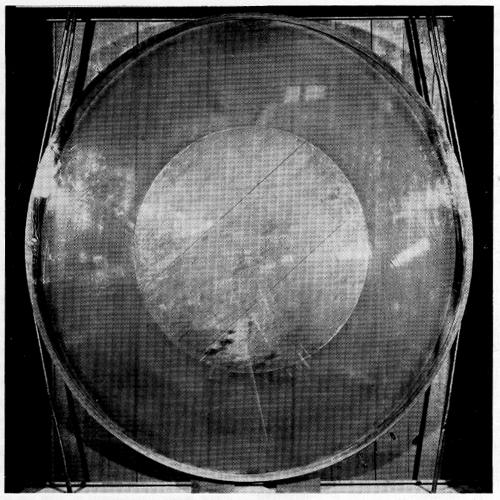
Figure 15.—The 62-inch
telescope reflector disc (USNM 310899), cast by Standard Plate Glass
Company, April 20, 1895, and figured by John Peate. It weighs 2500
pounds. Shown here as it hangs in its protective crate, this clear green
glass mirror will be a feature of the exhibit of optics and astronomy
now being prepared for the Smithsonian’s new Museum of History and
Technology, scheduled to open soon after 1962. (Smithsonian photo
41172)
The mirror was to remain untouched for some 24
years. In 1922 the “Greenville Roundtable,” a
group reportedly founded by Dr. Peate, allocated
$90 to the Reverend H. G. Dodds to investigate
the disposition of the mirror. In that same year
the Erie Conference appointed Dodds a committee
of one to report on the same matter. Dodds visited
American University and conferred with the chancellors.
They checked the mirror and it seemed to
be in good shape. Dodds then went to Warner
and Swasey, in Cleveland, Ohio, where he attempted
to discover what it would cost to mount the mirror
and provide an observatory. But he learned nothing
there. Dodds knew nothing either of astronomy
or of glass and his lack of knowledge did not inspire
confidence in his mission. He did note a peculiar
phenomenon, that people seemed suspicious of the
mirror in itself without knowing anything about its
actual condition.[41]
Shortly after Dodds’ failure to secure a user for
the mirror the Perkins Observatory at Ohio Wesleyan
University, which planned to add a large reflecting
telescope, became interested in it. Dr. Clifford C.
Crump, director of the Perkins Observatory, J. W.
Fecker, then president of the J. W. Fecker Company,
and A. N. Finn and A. Q. Tool, of the National
Bureau of Standards, inspected the glass at American
University. They found it remarkably free of
bubbles and similar defects. Due to a lack of facilities
they were unable to test the mirror optically, so
that no comment was made on either the polishing
or the correctness of the figure. It was, however,
found badly strained due to poor annealing, and
Fecker advised against using it, as it would have to
be re-annealed. If this were done, some refiguring
would also be necessary. After this rather expensive
renovation it would remain a rather thin,
flexible glass and not equal to modern standards.
The Perkins Observatory consequently decided
rather to use a mirror cast and finished under the
supervision of the Bureau of Standards.[42]
This was the last attempt to use the mirror. It
remained at American University until the mid 30’s,
when it was placed in the Smithsonian Institution.
It was still, in February 1935, the largest mirror
ever cast and polished in the United States.
Let us return now to Dr. Peate. After seeing the
mirror safely stored at American University he
returned to Greenville, Pennsylvania. Then 78
years old, still in good health and very active, he was
to live for 5 more years.
To the end of his life he maintained his interest in
astronomy, and was optimistic about the possibility
of his great mirror eventually being mounted and
used. In 1900 at the age of 80 he decided to see
Europe once again. His prime objective on this
trip was undoubtedly the Paris Exposition of 1900,
where one of the main attractions was a huge telescope
made by Gautier. It had a refracting objective
of 49.2 inches, mounted horizontally, the largest
refractor yet made. Strangely enough this much
publicized telescope was never used either. After
the exposition was over the backers became bankrupt
and the instrument was dismantled and sold for
scrap.
Dr. Peate with his wide range of knowledge and
his conversational ability delighted and puzzled his
fellow passengers on the boat to and from Europe.
They guessed that he was an educator, a scientist,
or statesman but he denied all this saying, “no, I’m
only a bricklayer.”
Dr. Peate lived three years after this trip, dying
on March 24, 1903. His good health and physical
vigor never left him till almost the moment of his
death; as shortly as a week before, he had conducted
a funeral service.
It would be rather easy to dismiss him as a harmless
fanatic except that everything known of him indicates
that he was not. It is reasonable to believe that
his mirrors were made more in the hope than in the
certain expectation that they would stimulate the
study of astronomy in the institutions receiving them.
He was probably well aware of the difficulties of
establishing so large a telescope at a newly founded
institution such as American University, and, content
in the knowledge that he had done his part,
could only hope that others might be inspired to
do likewise.
Dr. Peate’s great mirror will shortly be put to
use in a manner that could hardly have been predicted
by its maker. It has been in the Smithsonian
Institution for over 20 years. The huge glass will
form a part of the exhibition of optics and astronomy
in the new Museum of History and Technology
that the Smithsonian Institution will open to the
public about 1962. There it will be seen by some
millions of persons each year. Because of its spectacular
size it should catch the attention of most museum
visitors. Surely it will awaken in more than
one potentially able worker an interest in astronomy.
If so, it will have accomplished Dr. Peate’s purpose.