The versatility of Hogarth’s genius is a recurring surprise. His
satires and moralities seem natural, the unforced expression of his
vigorous, observant nature. Natural, too, seem the less inspired of
his portraits, and the Conversation Pieces which employed the early
years of his life; but the technical qualities of the best of his
portraits and groups, and passages in the Progresses, are a recurring
surprise. “The Harlot’s Progress” was finished in his thirty-fourth
year. The paintings of this series “were consumed in the fire which
burnt down Mr. Beckford’s house at Fonthill in 1755,” although there
seems to be some doubt if all six pictures were destroyed.
The Progresses were a development of the Conversation Pieces, of which
“The Wanstead Assembly” was probably the first. This, which is now in
the South London Art Gallery, proves to be “The Dance,” one of the
illustrations to the “Analysis of Beauty.” I confess to finding the
stiff and elegant breeding of these Conversation Pieces more
attractive and certainly more amusing than many of his livelier
scenes. Almost any of the Conversation Pieces could appositely
illustrate a novel by Miss Ferrier. There was one at the Old Masters’
Exhibition of 1910, “The Misses Cotton and their Niece,” quite
accurately described as “four ladies seated near a tea-table, with
their backs to the fireplace; a fifth is standing, and a servant on
the left is bringing a chair for her.” Equally “nice,” I am sure,
were “The Rich Family,” “The Wood Family,” “The Cock Family,” and “The
Jones Family,” and at the opposite pole to the bad Hogarth that was
exhibited in the same room at Burlington House, supposed to be a
memory of his five days’ trip down the river to Sheppey. But it is
unfair to judge Hogarth by “The Disembarkation”: that was a jeu
d’esprit, composed of “amusing incidents.”
The Conversation Pieces having novelty, succeeded for a few years. We
esteem them as the ‘prentice work of a man of abounding energy and
versatility, who was as conspicuous for his taste as for his lack of
it. Hogarth seems to have had no particular prepossession towards
beauty, but beauty occurs again and again in his paintings.
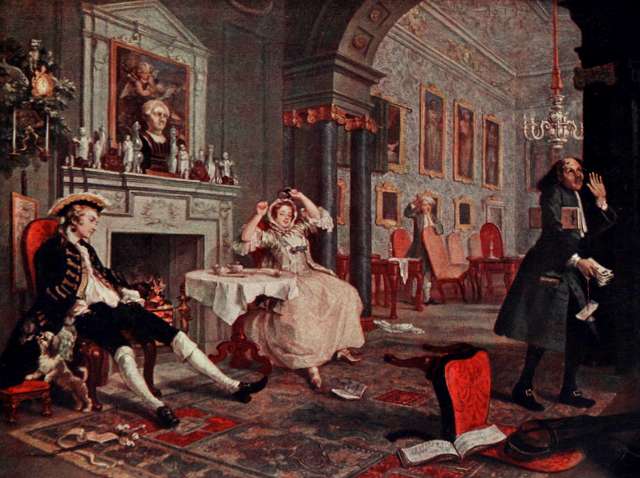
The face of the little wanton lady in the second scene of “Marriage à
la Mode” is a delight; some of the heads of his servants are haunting.
Leslie has drawn attention to the exquisite prettiness of Juno in
“Strolling Actresses Dressing in a Barn,” and Mr. Dion Calthorp has
written a whole charming article on the handsome drummeress of
“Southwark Fair.” Every student of Hogarth must have been struck by
his sudden statements of beauty in ugly places, and of atrocities of
bad taste anywhere. There is an episode in the “Night Scene, Charing
Cross,” that is disgusting, and I confess that the gobbling alderman
in one of the “Industrious Apprentice” series gives me nausea. But he
is never commonplace or feeble. This astonishing man will paint a head
here with the finish of a Terburg, there with the gusto of a Raeburn.
I never seem to get used to his incursions into beauty. The surprise
recurred in Paris at the exhibition of the “Cent Portraits de Femmes.”
I walked round the galleries playing the game of suggesting the names
of the painters without referring to the catalogue. Among the
portraits was one quite small, the head of a girl, fresh as a lark’s
song, an impromptu, a premier coup, colour simple, drawing gay. I
ascribed it to Raeburn. It was Hogarth’s “Miss Rich,” owned by M. Max
Michaelis. Then I paused and looked at the other Hogarths. Ah! there
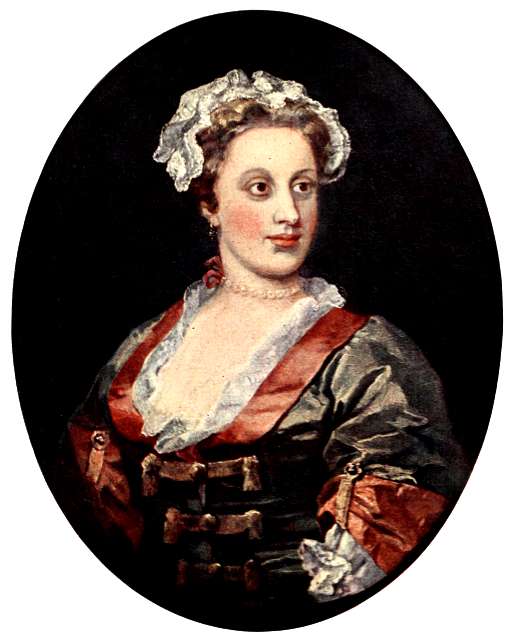
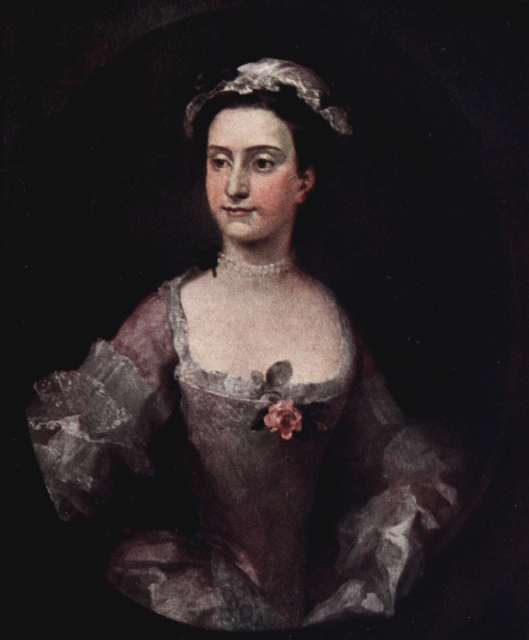
was that rendering, one of the most delightful of his portraits, of
“Peg Woffington,” lent by Sir Edward Tennant, not “dallying and
dangerous” on a couch as in the version at the Garrick Club, but very
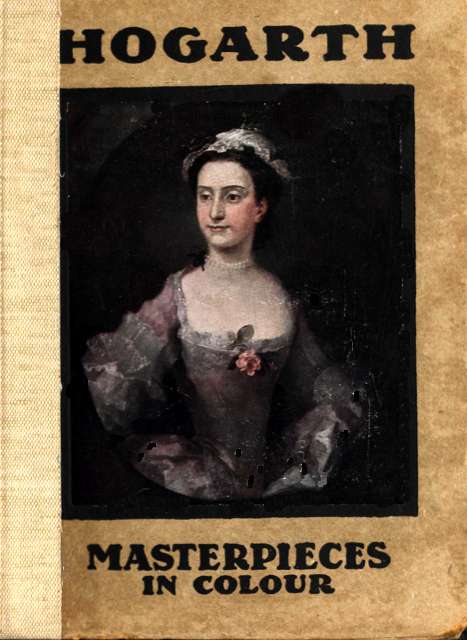
charming, with a touch of primness that suits her. Here is Hogarth
as true artist, the vision clear, the treatment direct. Note the
daintiness of the flower in her bosom, the delicious colour of the
dress, and the importance of the accent of the knot of black ribbon
against the gleaming pearls. Oh yes! Hogarth knew his business!
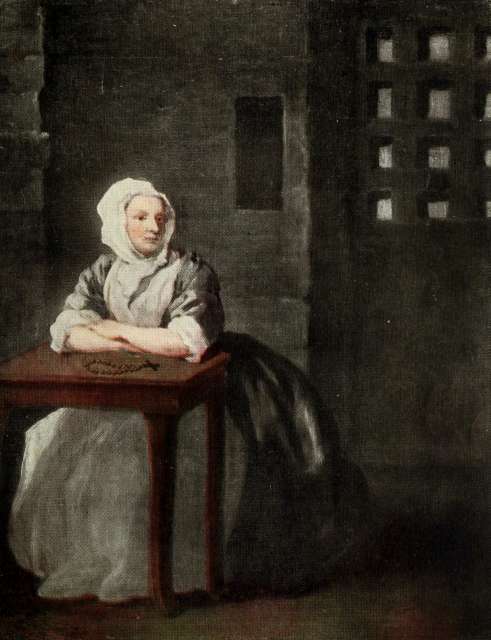
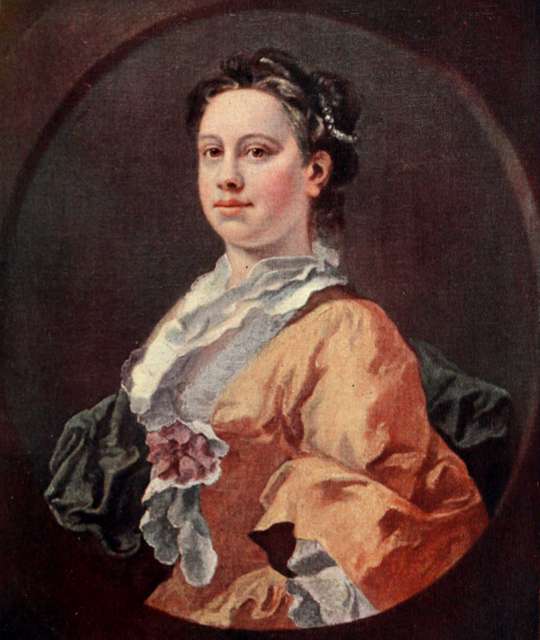
PLATE VI.—SARAH MALCOLM
(In the National Gallery of Scotland, Edinburgh)
A portrait of the notorious Sarah Malcolm, charwoman and murderess,
who was hanged near Mitre Court, Fleet Street, in 1733, for a triple
murder. She was painted by Hogarth, in the condemned cell, two days
before her execution. Mrs. Malcolm looks rather an attractive if a
somewhat cunning matron, and her dress is certainly becoming. The
painting, in tone and characterisation, is very pleasant, and we can
forgive her the ostentatious display of the rosary.
He painted Mrs. Woffington eight times. This one, pretty, plain Peg,
with the rose in her corset, is my choice. The other two Hogarths at
the “Cent Portraits de Femmes” exhibition were “Miss Arnold” from the
Fitzwilliam Museum, Cambridge, a robust work, forceful and somewhat
heavy, and lacking the naïveté and charm of “Peg Woffington,” and the
notorious “Sarah Malcolm,” charwoman and murderess, who was hanged
near Mitre Court, Fleet Street, on the 7th of March 1733, for a triple
murder. Says Dr. Trusler: “The portrait of this murderess was painted
by Hogarth, to whom she sat for her picture two days before
execution.” Mrs. Malcolm is rather an attractive if a somewhat cunning
matron, and her dress is certainly becoming. The painting, in tone and
quiet characterisation, is very pleasant, and we can forgive her the
ostentatious display of the rosary.
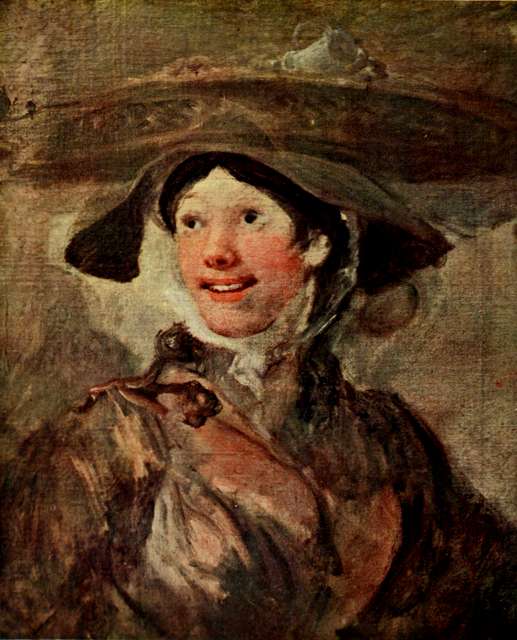
If only it had been possible to send “The Shrimp Girl” to Paris. That
brilliant impressionist sketch, done long before the era of
impressionism, would have astonished the French critics who are not
already acquainted with it. Indeed, “The Shrimp Girl” is something of
a miracle. She cries out from Hogarth’s works, a tour de force, done
without premeditation, in some happy hour when the unerring hand
unerringly followed the quick eye. It is an inspiration. One may say
of it as Northcote said of Frans Hals: “He was able to shoot the bird
flying—so to speak—with all its freshness about it, which even
Titian does not seem to have done....” “The Shrimp Girl” was sold at
Mrs. Hogarth’s sale in April 1790 for four pounds ten shillings, and
was purchased for the National Gallery in 1884 for two hundred and
sixty-two pounds ten shillings. After Mr. Sidney Colvin’s eulogy in
The Portfolio, one may go to almost any extreme in expressing
admiration for “The Shrimp Girl” and other of Hogarth’s paintings.
Said Mr. Colvin: “Even Reynolds and Gainsborough, colourists often of
an inexpressible loveliness, tenderness, and charm, were fumblers in
their method compared with Hogarth.... Without a school, and without
a precedent (for he is no imitator of the Dutchman), he has found a
way of expressing what he sees with the clearest simplicity, richness,
and directness.”
Simple, rich, and direct is his portrait of “Garrick and his Wife” at
Windsor Castle, a finished epic, quite unlike that lyrical sketch of
“The Shrimp Girl.” “Garrick and his Wife” was painted in 1757, when
Hogarth was sixty. It is a flamboyant, decorative picture. Garrick, in
blue and gold, is seen seated at a table in a moment of inspiration,
pen in hand, cogitating the prologue to Foote’s “Comedy of Taste.” His
wife, in a pink dress and white fichu, stands behind him, preparing to
take the pen from his hand. She is alert and gay, he is invoking the
muse; a charming picture, but if you look closely you will observe
that Garrick’s eyes are coarsely painted, “evidently by another hand.”
Thereby hangs a tale, a typical Hogarthian tale of wars in words, and
in this case in deed too. Hogarth painted Garrick many times,
receiving as much as two hundred pounds for his fine portrait of the
“English Roscius” as Richard III.; but they quarrelled over the
“Garrick and his Wife,” and Hogarth in a fit of irritation drew his
brush across the face, disfiguring the eyes. The picture was never
delivered, never paid for, and on Hogarth’s death his widow generously
gave it to Garrick. It passed into the possession of Mr. Locker of
Greenwich Hospital, who sold it to George IV. In the memoirs of Mr.
Locker’s son is the following passage: “This picture is so lifelike
that as little children we were afraid of it; so much so that my
mother persuaded my father to sell it to George IV.” That is a strange
way for a picture to arrive in a royal collection. The King also owns
the quaint, merry, crowded, landscape conversation-picture called “A
View of the Mall, St. James’s Park,” but this evocation of the beau
monde of the day promenading in cinnamon coats and peach-bloom
breeches, and the ladies in every Chanticler colour and vagary, has
been attributed by some authorities to Samuel Wale, R.A.
Mr. Fairfax Murray is the fortunate owner of “A Fishing Party,” a
small picture, nineteen by twenty-one and a half inches, which shows
that Hogarth, besides his other gifts, was a master in romantic
composition. On the border of a lake sit the fishing party—a charming
lady, a nurse, and a child in the full light, and a reflective
gentleman in the shade. The baby holds the rod, the pretty mother
guides it, and the float toys with the water. I protest that you
rarely if ever see in these days so charming a portrait group
composition as this designed by the Father of English Painting, who
virtually had no forebears, and who turned from one branch of art to
another with something of the ease of myriad-minded Leonardo. I
suspect he studied the grace of Van Dyck’s compositions.
Some of the early Victorian members of the New English Art Club would
find it disadvantageous to pit themselves against the technical
accomplishment of his tight, highly-finished “Lady’s Last Stake.” The
subject is banal, and half-a-dozen Dutchmen could have painted this
interior with more quality of surface and closer observance of light,
but it is “done,” and the paint has not faded and cracked as have so
many works painted two hundred years later.
“The Lady’s Last Stake” was a commission from Lord Charlemont. In
1757, in one of his periodical fits of vexation, Hogarth said he would
“employ the rest of his time in portrait painting,” but three years
afterwards we find him, in weathercock mood, “determined to quit the
pencil for the graver.” Lord Charlemont begged him, before he “bade a
final adieu to the pencil,” to paint him one picture. The result was
this morality of the handsome, wicked officer, and the young and
virtuous married lady. Mrs. Thrale was wont to allege that she sat for
the fair gambler.
“The Stay Maker” should hang beside Watteau’s “Gersaint’s Sign,” each
a representation of a costumier’s shop, each a masterpiece, but as it
is impossible to bring together these two works by these two geniuses
who were contemporaries, and who brought about the rebirth of art in
France and England, I am quite content that “The Stay Maker” should
remain where it is, helping to decorate an exquisite room in Mr.
Edmund Davis’s house. There is only one other picture on the wall—a
Gainsborough portrait. “The Stay Maker” is a sketch, almost in
monochrome, showing a man-milliner measuring a lady, while another
mondaine kisses a baby fondly, but not on its chubby face. This little
picture (thirty-five by twenty-seven inches) is full of life and
gaiety, and is as delicate in its humour as “The Enraged Musician” at
Oxford is forcible.
When I first saw the “George II. and his Family” at the Dublin
National Gallery, I had a thrill similar to that I experienced when I
first saw “Miss Rich.” It is an unfinished sketch, made when Hogarth
was Sergeant Painter. Looking at it, again we wonder what heights this
man might have reached had he received the encouragement that is given
to eminent painters of our day. But, as it was, in spite of
everything, Hogarth boxed the compass, and when he wrote “genius is
nothing but labour and diligence,” the “ingenious Mr. Hogarth,” as
Fielding called him, did not take into account that something else
(which is genius) that was born in him, and that he struggled to
express, and succeeded in expressing so triumphantly. And the end of
all was “The Bathos,” his last design, humorous, cynical, his finis,
inscribed to his old enemies, “the dealers in dark pictures.” Game to
the end was William Hogarth!