"The snares are set, the plot is laid,
Ruin awaits thee, hapless maid!
Seduction sly assails thine ear,
And gloating, foul desire is near;
Baneful and blighting are their smiles,
Destruction waits upon their wiles:
Alas! thy guardian angel sleeps,
Vice clasps her hands, and virtue weeps."—E.
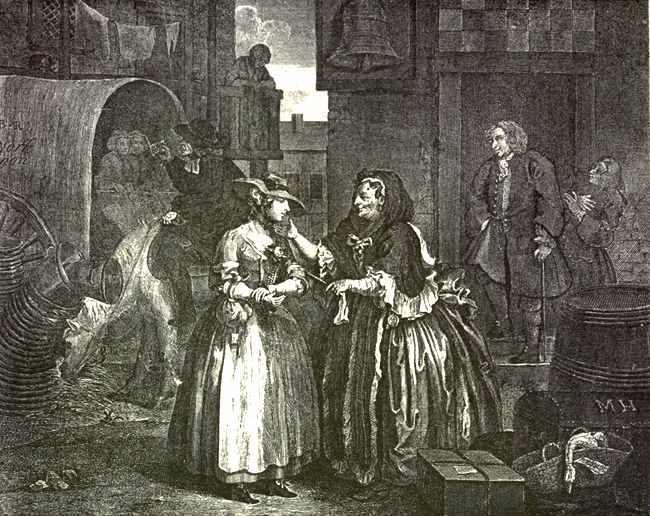
THE HARLOT'S PROGRESS, PLATE I.
The general aim of historical painters has
been to emblazon some signal exploit of
an exalted and distinguished character.
To go through a series of actions, and conduct their
hero from the cradle to the grave, to give a history
upon canvas, and tell a story with the pencil, few of
them attempted. Mr. Hogarth saw with the intuitive
eye of genius, that one path to the temple of Fame
was yet untrodden: he took Nature for his guide,
and gained the summit. He was the painter of
nature; for he gave not merely the ground-plan of
the countenance, but marked the features with every
impulse of the mind. He may be denominated the
biographical dramatist of domestic life. Leaving
those heroic monarchs who have blazed through their
day with the destructive brilliancy of a comet to
their adulatory historians, he, like Lillo, has taken his
scenes from humble life, and rendered them a source
of entertainment, instruction, and morality.
This series of prints gives the history of a Prostitute.
The story commences with her arrival in
London, where, initiated in the school of profligacy,
she experiences the miseries consequent to her situation,
and dies in the morning of life. Her variety of
wretchedness forms such a picture of the way in which
vice rewards her votaries, as ought to warn the young
and inexperienced from entering this path of infamy.
The first scene of this domestic tragedy is laid at
the Bell Inn, in Wood Street, and the heroine may
possibly be daughter to the poor old clergyman who
is reading the direction of a letter close to the York
waggon, from which vehicle she has just alighted.
In attire, neat, plain, unadorned; in demeanour,
artless, modest, diffident; in the bloom of youth,
and more distinguished by native innocence than
elegant symmetry; her conscious blush and downcast
eyes attract the attention of a female fiend who
panders to the vices of the opulent and libidinous.
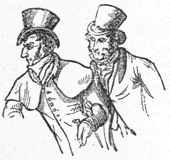
Coming out of the door of the inn we discover two
men, one of whom is eagerly gloating on the devoted
victim. This is a portrait, and said to be a strong
resemblance of Colonel Francis Chartres,[45] whose
epitaph was written by Doctor Arbuthnot: in that
epitaph his character is most emphatically described.[46]
The old procuress, immediately after the girl's
alighting from the waggon, addresses her with the
familiarity of a friend rather than the reserve of one
who is to be her mistress.
Had her father been versed in even the first rudiments
of physiognomy, he would have prevented her
engaging with one of so decided an aspect; for this
also is the portrait of a woman infamous in her day:[47]
but he, good, easy man, unsuspicious as Fielding's
Parson Adams, is wholly engrossed in the contemplation
of a superscription to a letter addressed to the
bishop of the diocese. So important an object prevents
his attending to his daughter, or regarding the
devastation occasioned by his gaunt and hungry
Rozinante having snatched at the straw that packs up
some earthenware, and produced
"The wreck of flower-pots, and the crash of pans!"
From the inn she is taken to the house of the procuress,
divested of her home-spun garb, dressed in the
gayest style of the day, and the tender native hue of
her complexion encrusted with paint and disguised
by patches. She is then introduced to Colonel
Chartres, and by artful flattery and liberal promises
becomes intoxicated with the dreams of imaginary
greatness. A short time convinces her of how light a
breath these promises were composed. Deserted by
her keeper, and terrified by threats of an immediate
arrest for the pompous paraphernalia of prostitution,
after being a short time protected by one of the tribe
of Levi, she is reduced to the hard necessity of
wandering the streets for that precarious subsistence
which flows from the drunken rake or profligate
debauchee. Here her situation is truly pitiable!
Chilled by nipping frost and midnight dew, the
repentant tear trickling on her heaving bosom, she
endeavours to drown reflection in draughts of destructive
poison. This, added to the contagious
company of women of her own description, vitiates
her mind, eradicates the native seeds of virtue, destroys
that elegant and fascinating simplicity which
gives additional charms to beauty, and leaves in its
place art, affectation, and impudence.
Neither the painter of a sublime picture nor the
writer of an heroic poem should introduce any
trivial circumstances that are likely to draw the
attention from the principal figures. Such compositions
should form one great whole: minute detail will
inevitably weaken their effect. But in little stories
which record the domestic incidents of familiar life,
these accessory accompaniments, though trifling in
themselves, acquire a consequence from their situation;
they add to the interest, and realize the scene.
In this, as in almost all that were delineated by Mr.
Hogarth, we see a close regard paid to things as they
then were; by which means his prints become a sort
of historical record of the manners of the age.
The balcony, with linen hanging to dry; the York
waggon, which intimates the county that gave birth
to our young adventurer; parcels lying on the ground,
and a goose, directed To my lofen coosin in Tems Stret
London, prove the peculiar attention he paid to the
minutiæ. The initials M. H. on one of the trunks
give us the name of the heroine of this drama,—Hackabout
was a character then well known, and infamous
for her licentiousness and debauchery.[48]
Of elegant beauty Mr. Hogarth had not much idea;
but he has marked his heroine with natural simplicity.
To the old procuress he has given her physiognomical
distinction, and to the Colonel his appropriate stamp.[49]
"Ah! why so vain, though blooming in thy spring;
Thou shining, frail, adorn'd, but wretched thing!
Old age will come; disease may come before,
And twenty prove as fatal as threescore!"
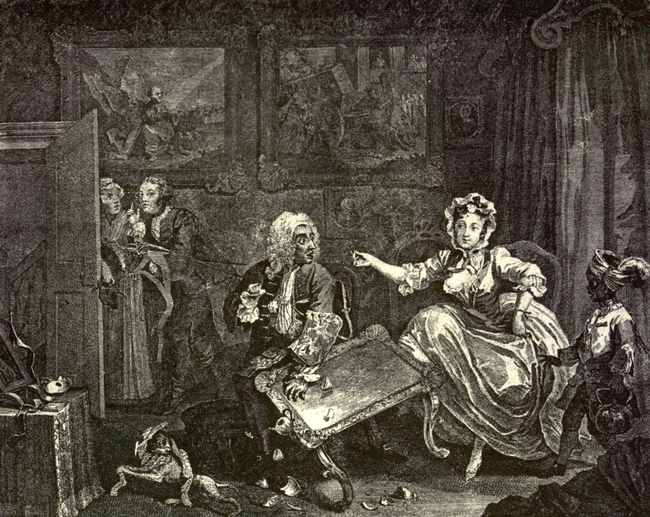
THE HARLOT'S PROGRESS, PLATE II.
Entered into the path of infamy, the next scene
exhibits our young heroine the mistress of a rich
Jew, attended by a black boy,[50] and surrounded with
the pompous parade of tasteless profusion. Her
mind being now as depraved as her person is
decorated, she keeps up the spirit of her character
by extravagance and inconstancy. An example of
the first is exhibited in the monkey being suffered
to drag her rich head-dress round the room, and of
the second in the retiring gallant. The Hebrew
is represented at breakfast with his mistress; but
having come earlier than was expected, the favourite
has not departed. To secure his retreat, is an exercise
for the invention of both mistress and maid.
This is accomplished by the lady finding a pretence
for quarrelling with the Jew, kicking down the tea-table,
and scalding his legs, which, added to the noise
of the china, so far engrosses his attention, that the
paramour, assisted by the servant, escapes discovery.
The subjects of two pictures with which the room
is decorated are, David dancing before the ark, and
Jonah seated under a gourd.[51] They are placed there,
not merely as circumstances which belong to Jewish
story, but as a piece of covert ridicule on the old
masters, who generally painted from the ideas of
others, and repeated the same tale ad infinitum. On
the toilet-table we discover a mask, which well enough
intimates where she had passed part of the preceding
night, and that masquerades, then a very fashionable
amusement, were much frequented by women of this
description; a sufficient reason for their being avoided
by those of an opposite character.
Under the protection of this disciple of Moses she
could not remain long. Riches were his only attraction,
and though profusely lavished on this unworthy
object, her attachment was not to be obtained, nor
could her constancy be secured; repeated acts of
infidelity are punished by dismission; and her next
situation shows that, like most of the sisterhood, she
had lived without apprehension of the sunshine of
life being darkened by the passing cloud, and made
no provision for the hour of adversity.
In this print the characters are marked with a
master's hand. The insolent air of the harlot, the
astonishment of the Jew,[52] eagerly grasping at the
falling table, the start of the black boy, the cautious
trip of the ungartered and barefooted retreating gallant,
and the sudden spring of the scalded monkey, are
admirably expressed. To represent an object in its
descent has been said to be impossible: the attempt
has seldom succeeded; but in this print, the tea
equipage really appears falling to the floor.[53]
"Reproach, scorn, infamy, and hate,
On all thy future steps shall wait;
Thy form be loathed by every eye,
And every foot thy presence fly."
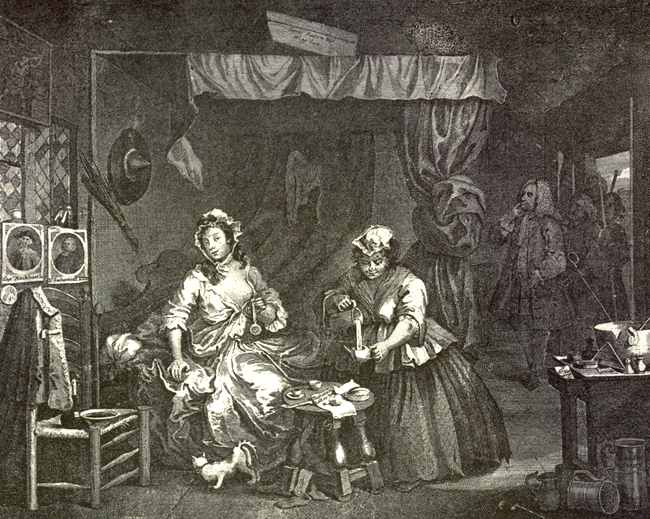
THE HARLOT'S PROGRESS, PLATE III.
We here see this child of misfortune fallen from her
high estate! Her magnificent apartment is quitted
for a dreary lodging in the purlieus of Drury Lane:
she is at breakfast, and every object exhibits marks
of the most wretched penury; her silver tea-kettle is
changed for a tin-pot, and her highly-decorated toilet
gives place to an old leaf-table, strewed with the
relics of the last night's revel, and ornamented with
a broken looking-glass. Around the room are scattered
tobacco-pipes, gin measures, and pewter pots,—emblems
of the habits of life into which she is
initiated, and the company which she now keeps:
this is further intimated by the wig-box of James
Dalton, a notorious street-robber, who was afterwards
executed. In her hand she displays a watch, which
might be either presented to her, or stolen from her
last night's gallant. By the nostrums which ornament
the broken window, we see that poverty is not her
only evil. The dreary and comfortless appearance of
every object in this wretched receptacle, the bit of
butter on a piece of paper,[54] the candle in a bottle, the
basin upon a chair, the punch-bowl and comb upon
the table, and the tobacco-pipes, etc. strewed upon
the unswept floor, give an admirable picture of the
style in which this pride of Drury Lane ate her
matin meal. The pictures which ornament the room
are, Abraham offering up Isaac, and a portrait of
the Virgin Mary; Dr. Sacheverell[55] and Macheath
the highwayman are companion prints. There is
some whimsicality in placing the two ladies under a
canopy,[56] formed by the unnailed valance of the bed,
and characteristically crowned by the wig-box of
a highwayman.
A magistrate,[57] cautiously entering the room with
his attendant constables, commits her to an house of
correction, where our legislators wisely suppose, that
being confined to the improving conversation of her
associates in vice, must have a powerful tendency
towards the reformation of her manners!
"With pallid cheek and haggard eye,
And loud laments, and heartfelt sigh,
Unpitied, hopeless of relief,
She drinks the bitter cup of grief.
In vain the sigh, in vain the tear,
Compassion never enters here;
But justice clanks her iron chain,
And calls forth shame, remorse, and pain."—E.
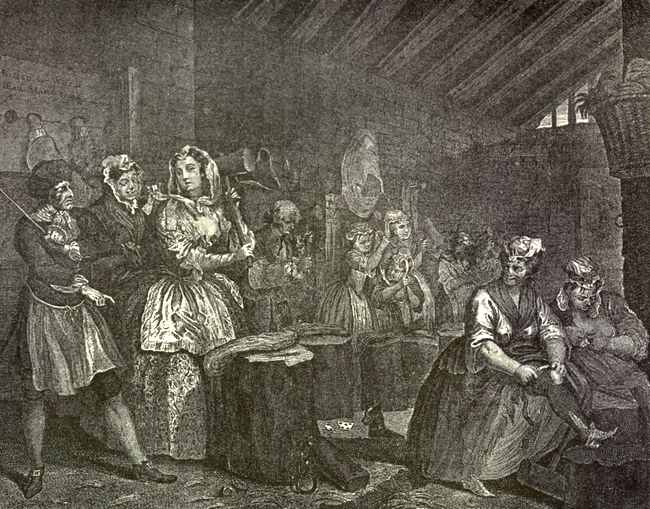
THE HARLOT'S PROGRESS, PLATE IV.
The situation in which the last plate exhibited our
wretched female was sufficiently degrading, but in
this her misery is greatly aggravated. We now see
her suffering the chastisement due to her follies;
reduced to the wretched alternative of beating hemp,
or receiving the correction of a savage taskmaster.[58]
Exposed to the derision of all around, even her own
servant, who is well acquainted with the rules of the
place, appears little disposed to show any return of
gratitude for recent obligations, though even her
shoes, which she displays while tying up her garter,
seem by their gaudy outside to have been a present
from her mistress. The civil discipline of the stern
keeper has all the severity of the old school.[59] With
the true spirit of tyranny, he sentences those who will
not labour to the whipping post, to a kind of picketing
suspension by the wrists, or having a heavy log fastened
to their leg. With the last of these punishments he
at this moment threatens the heroine of our story;
nor is it likely that his obduracy can be softened
except by a well-applied fee. How dreadful, how
mortifying the situation! These accumulated evils
might perhaps produce a momentary remorse, but a
return to the path of virtue is not so easy as a departure
from it. The Magdalen hospital has been
since instituted, and the wandering female sometimes
finds it an asylum from wretchedness, and a refuge
from the reproaches of the world.
To show that neither the dread nor endurance of
the severest punishment will deter from the perpetration
of crimes, a one-eyed female, close to the keeper,
is picking a pocket. The torn card may probably
be dropped by the well-dressed gamester, who has
exchanged the dice-box for the mallet, and whose
laced hat is hung up as a companion trophy to the
hoop-petticoat.
One of the girls appears scarcely in her teens. To
the disgrace of our police, these unfortunate little
wanderers are still suffered to take their nocturnal
rambles in the most public streets of the metropolis.
What heart so void of sensibility as not to heave a
pitying sigh at their deplorable situation? Vice is
not confined to colour, for a black woman is ludicrously
exhibited as suffering the penalty of those frailties
which are imagined peculiar to the fair.
The figure chalked as dangling upon the wall, with
a pipe in his mouth, is intended as a caricatured
portrait of Sir John Gonson, and probably the production
of some wou'd-be artist whom the magistrate
had committed to Bridewell as a proper academy for
the pursuit of his studies. The inscription upon the
pillory, BETTER TO WORK THAN STAND THUS, and
that on the whipping-post, near the laced gambler,
THE REWARD OF IDLENESS, are judiciously introduced.
In this print the composition is tolerably good: the
figures in the background, though properly subordinate,
sufficiently marked; the lassitude of the principal
character well contrasted by the austerity of the
rigid overseer. There is a fine climax of female
debasement, from the gaudy heroine of our drama to
her maid, and from thence to the still lower object
who is represented as destroying[60] one of the plagues
of Egypt.
"With keen remorse, deep sighs, and trembling fears,
Repentant groans, and unavailing tears,
This child of misery resigns her breath,
And sinks, despondent, in the arms of death."—E.
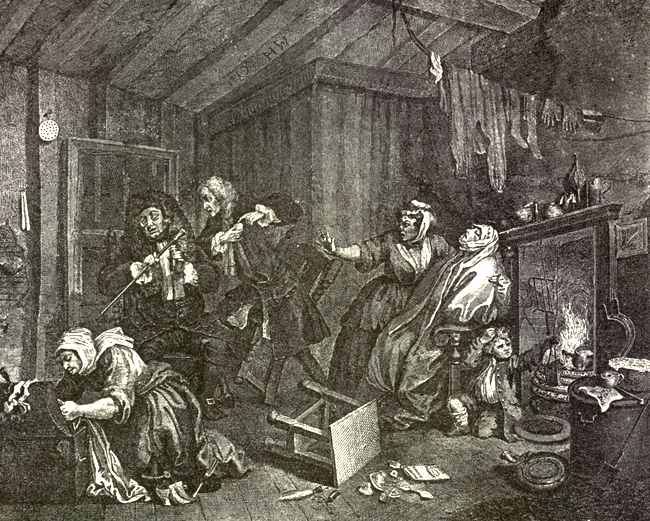
THE HARLOT'S PROGRESS, PLATE V.
Released from Bridewell, we now see this victim
to her own indiscretion breathe her last sad sigh, and
expire in all the extremity of penury and wretchedness.
The two quacks, whose injudicious treatment has
probably accelerated her death, are vociferously supporting
the infallibility of their respective medicines,
and each charging the other with having poisoned her.[61]
While the maid-servant is entreating them to cease
quarrelling, and assist her dying mistress, the nurse
plunders her trunk of the few poor remains of former
grandeur. Her little boy turning a scanty remnant of
meat hung to roast by a string; the linen hanging to
dry; the coals deposited in a corner; the candles, bellows,
and gridiron hung upon nails; the furniture of
the room, and indeed every accompaniment, exhibit
a dreary display of poverty and wretchedness. Over
the candles hangs a cake of Jew's bread, once perhaps
the property of her Levitical lover, and now used
as a fly-trap. The initials of her name, M. H., are
smoked upon the ceiling as a kind of memento mori
to the next inhabitant. On the floor lies a paper
inscribed ANODYNE NECKLACE, at that time deemed
a sort of CHARM against the disorders incident to
children;[62] and near the fire, a tobacco-pipe and
paper of pills.
A picture of general, and, at this awful moment, indecent
confusion, is admirably represented. The noise
of two enraged quacks disputing in bad English, the
harsh vulgar scream of the maid-servant, the table
falling, and the pot boiling over, must produce a combination
of sounds dreadful and dissonant to the ear.
In this pitiable situation, without a friend to close her
dying eyes or soften her sufferings by a tributary
tear,—forlorn, destitute, and deserted,—the heroine of
this eventful history expires; her premature death
brought on by a licentious life, seven years of which
had been devoted to debauchery and dissipation, and
attended by consequent infamy, misery, and disease.
The whole story affords a valuable lesson to the
young and inexperienced, and proves this great, this
important truth, that A DEVIATION FROM VIRTUE IS
A DEPARTURE FROM HAPPINESS.
The emaciated appearance of the dying figure, the
boy's thoughtless inattention, and the rapacious, unfeeling
eagerness of the old nurse, are naturally and
forcibly delineated.
The figures are well grouped; the curtain gives
depth, and forms a good background to the doctor's
head; the light is judiciously distributed, and each
accompaniment highly appropriate.
"No friend's complaint, no kind domestic tear,
Pleas'd thy pale ghost, or grac'd thy mournful bier:
By harlots' hands thy dying eyes were clos'd;
By harlots' hands thy decent limbs compos'd;
By harlots' hands thy humble grave adorn'd;
By harlots honoured, and by harlots mourn'd."
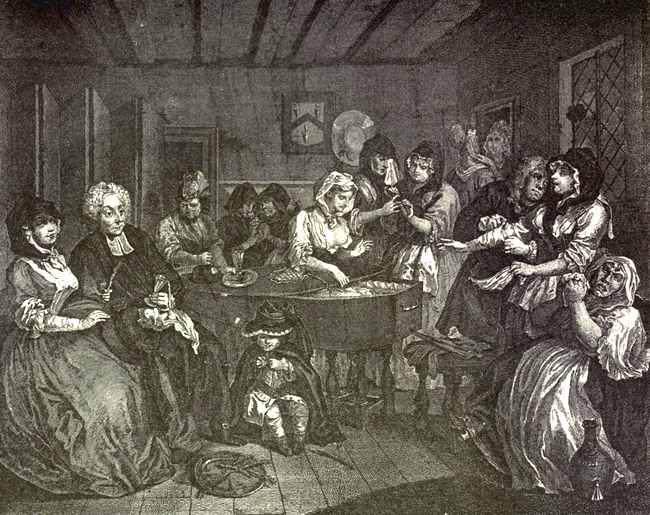
THE HARLOT'S PROGRESS, PLATE VI.
The adventures of our heroine are now concluded.
She is no longer an actor in her own tragedy; and
there are those who have considered this print as a
farce at the end of it: but surely such was not the
author's intention.
The ingenious writer of Tristram Shandy begins
the life of his hero before he is born; the picturesque
biographer of Mary Hackabout has found an opportunity
to convey admonition, and enforce his moral,
after her death. A wish usually prevails, even among
those who are most humbled by their own indiscretion,
that some respect should be paid to their
remains; that their eyes should be closed by the
tender hand of a surviving friend, and the tear of
sympathy and regret shed upon the sod which covers
their grave; that those who loved them living should
attend their last sad obsequies, and a sacred character
read over them the awful service which our religion
ordains with the solemnity it demands. The memory
of this votary of prostitution meets with no such
marks of social attention or pious respect. The
preparations for her funeral are as licentious as the
progress of her life, and the contagion of her example
seems to reach all who surround her coffin. One of
them is engaged in the double trade of seduction and
thievery; a second is contemplating her own face in a
mirror. The female who is gazing at the corpse displays
some marks of concern, and feels a momentary
compunction at viewing the melancholy scene before
her: but if any other part of the company are in a
degree affected, it is a mere maudlin sorrow, kept
up by glasses of strong liquor. The depraved priest
does not seem likely to feel for the dead that hope
expressed in our liturgy.[63] The appearance and
employment of almost every one present at this
mockery of woe, is such as must raise disgust in the
breast of any female who has the least tincture of
delicacy, and excite a wish that such an exhibition
may not be displayed at her own funeral.
In this plate there are some local customs which
mark the manners of the times when it was engraved,
but are now generally disused, except in some of the
provinces very distant from the capital; sprigs of
rosemary were then given to each of the mourners:
to appear at a funeral without one, was as great an
indecorum as to be without a white handkerchief.
This custom might probably originate at a time when
the plague depopulated the metropolis, and rosemary
was deemed an antidote against contagion. It must
be acknowledged that there are also in this print
some things which, though they gave the artist an opportunity
of displaying his humour, are violations of
propriety and custom: such is her child, but a few
removes from infancy, being habited as chief mourner,
to attend his parent to the grave; rings presented,
and an escutcheon hung up in a garret at the funeral
of a needy prostitute.[64] The whole may be intended
as a burlesque upon ostentatious and expensive
funerals, which were then more customary than they
are now. Mr. Pope has well ridiculed the same
folly:
"When Hopkins dies, a thousand lights attend
The wretch who, living, saved a candle's end."
The figures have much characteristic discrimination:
the woman looking into the coffin has more beauty
than we generally see in the works of this artist.
The undertaker's gloating stare, his companion's leer,
the internal satisfaction of the parson and his next
neighbour, are contrasted by the Irish howl of the
woman at the opposite side, and evince Mr. Hogarth's
thorough knowledge of the operation of the passions
upon the features. The composition forms a good
shape, has a proper depth, and the light is well
managed.
Sir James Thornhill's opinion of this series may
be inferred from the following circumstance. Mr.
Hogarth had without consent married his daughter:
Sir James, considering him as an obscure artist, was
much displeased with the connection. To give him a
better opinion of his son-in-law, a common friend one
morning privately conveyed the six pictures of the
"Harlot's Progress" into his drawing-room. The
veteran painter eagerly inquired who was the artist;
and being told, cried out, "Very well! Very well
indeed! The man who can paint such pictures as
these, can maintain a wife without a portion." This
was the remark of the moment; but he afterwards
considered the union of his daughter with a man of
such abilities an honour to his family, was reconciled,
and generous.
When the publication was advertised, such was the
expectation of the town, that above twelve hundred
names were entered in the subscription book. When
the prints appeared, they were beheld with astonishment.
A subject so novel in the idea, so marked
with genius in the execution, excited the most eager
attention of the public. At a time when England
was coldly inattentive to everything which related to
the arts, so desirous were all ranks of people of seeing
how this little domestic story was delineated, that
there were eight piratical imitations,—besides two
copies in a smaller size than the original, published,
by permission of the author, for Thomas Bakewell.
The whole series were copied on fan-mounts, representing
the six plates, three on one side, and three
on the other. It was transferred from the copper to
the stage, in the form of a pantomime, by Theophilus
Cibber; and again represented in a ballad opera,
entitled, The Jew Decoyed, or the Harlot's Progress.
A Joseph Gay, and several other wretched rhymers,
published what they called poetical illustrations of
Mr. Hogarth's six plates: but these effusions of dulness
do not deserve enumeration; nor would they
deserve mention, but as collateral proofs of the great
estimation in which these prints were held, when
their popularity could force the sale of such miserable
productions. Happily they are now consigned to
those two high priests of the temple of oblivion, the
trunkmaker and the pastrycook.
The six original pictures were sold on the 25th of
January 1744-5, and produced eighty-eight pounds
four shillings. Mr. Beckford, a late Lord Mayor of
London, was, I believe, the purchaser. At a fire
which burnt down his house at Fonthill, Wiltshire,
in the year 1755, five of them were consumed.
When a messenger brought him intelligence of this
unfortunate event, he said nothing, but took out his
pocket-book, and wrote down a number of figures,
which he seemed inspecting with the cool precision
of a true disciple of Cocker, when a friend who was
present, expressing some surprise at his being so collected
after so heavy a loss, asked him what was the
subject of his meditation? to which he answered, with
the most philosophical indifference, "I am calculating
how much it will cost me to rebuild my house."
"Oh, vanity of age untoward!
Ever spleeny, ever froward!
Why these bolts and massy chains,
Squint suspicions, jealous pains?
Why, thy toilsome journey o'er,
Lay'st thou up an useless store?
Hope along with Time is flown;
Nor canst thou reap the field thou'st sown.
Had'st thou a son? In time be wise;
He views thy toil with other eyes.
Needs must thy kind paternal care,
Lock'd in thy chests, be buried there?
Whence, then, shall flow that friendly ease,
That social converse, heartfelt peace,
Familiar duty without dread,
Instruction from example bred,
Which youthful minds with freedom mend,
And with the father mix the friend.
Uncircumscrib'd by prudent rules,
Or precepts of expensive schools;
Abus'd at home, abroad despis'd,
Unbred, unletter'd, unadvis'd;
The headstrong course of life begun,
What comfort from thy darling son?"
—Hoadley.[65]
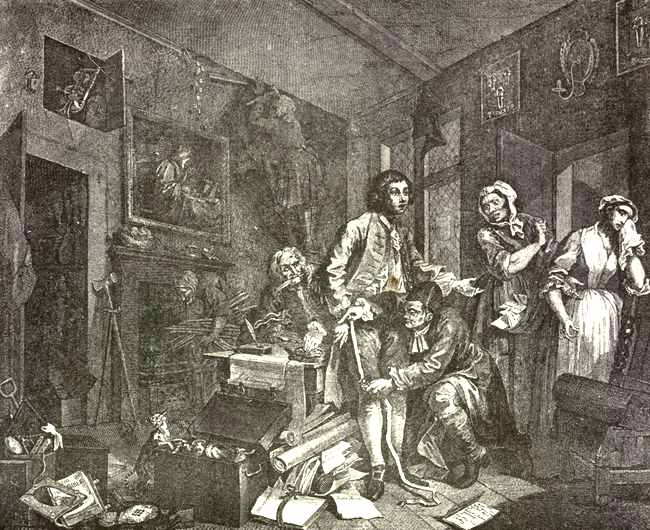
THE RAKE'S PROGRESS, PLATE I.
In the last series of prints Mr. Hogarth delineated,
with a master's hand, the miseries
attendant upon a female's deviation from
virtue. In this he presents to us the picture of a young
man, thoughtless, extravagant, and licentious; and,
in colours equally impressive, paints the destructive
consequences of his conduct. The first print most
forcibly contrasts two opposite passions,—the unthinking
negligence of youth, and the sordid avaricious
rapacity of age. It brings into one point of
view what Mr. Pope so exquisitely describes in his
Epistle to Lord Bathurst:
"Who sees pale Mammon pine amidst his store,
Sees but a backward steward for the poor;
This year a reservoir, to keep and spare;
The next a fountain, spouting through his heir."
It represents a young man taking possession of a
rich miser's effects, and is crowded with the monuments
of departed avarice. Everything, valuable
or not valuable, has been hoarded. A chest of old
plate, an old coat, a worn-out boot, and the caul
of a periwig, are preserved with equal care. The
thread-bare garments are hung up; the rusty spur
put into a closet; and even a spectacle-frame, without
glasses, is thought worthy of preservation. The contents
of his armoury are curious, and valuable as the
lumbering furniture of his room: they consist of two
swords, which may be considered as trophies of his
youthful prowess, or protectors of his cankered pelf.
The crutch and walking-stick, those unequal supporters
of his feeble frame, now lean unheeded against
the wall. His fur cap and greatcoat seem to have
been winter substitutes for fire, as the grate in which
a withered Sibyl is laying wood has no marks of even
a remaining cinder. The remnant of candle in a
save-all, the Jack taken down as an useless piece of
furniture, and, with the spit, hoisted into a high cupboard,
give strong indications of the manner in which
this votary of Mammon existed, for such a being could
scarcely be said to live. The gaunt appearance of an
half-starved cat proves not only the rigid abstinence
practised by this wretched slave to his wealth, but
that in his miserable mansion
"No mouse e'er lurk'd, no rat e'er sought for food."
The iron-bound chests, the hidden gold falling from
the breaking cornice, and indeed every article that is
displayed in this dreary tomb of buried wealth, give
additional marks of a suspicious and sordid disposition.
The picture of a miser counting his gold; the
escutcheons, those gloomy ornaments of departed
wretchedness, with the armorial bearings of avarice,
three vices hard screwed, are adjuncts highly appropriate
to the place; the motto, BEWARE, inscribed
under the arms, is a well-directed caution, and ought
to be seriously considered by those who feel a propensity
to this meanest of passions. An old shoe,
soled with the cover of a Bible, and the little memorandum,
May 5th, 1721, put off my bad shilling,
are strong proofs that extreme avarice destroys all
reverence for religion, and eradicates every principle
of honesty.
The introduction to this history is well delineated,
and the principal figure marked with that easy, unmeaning
vacancy of face which speaks him formed by
nature for a DUPE. Ignorant of the value of money,
and negligent in his nature, he leaves his bag of
untold gold in the reach of an old and greedy pettifogging
attorney,[66] who is making an inventory of
bonds, mortgages, indentures, etc. This man, with the
rapacity so natural to his profession, seizes the first
opportunity of plundering his employer. Hogarth
had a few years before been engaged in a lawsuit,
which gave him some experience of the PRACTICE
of those pests of society.
The figure of the young woman with a wedding-ring
is not alluring, neither is her face attractive; but
her being pregnant, and accompanied by her mother
with an apron full of letters, gives her a claim to our
pity, as it clearly intimates that this is meant as a
visit to entreat the promised hand of her seducer;
but he violates every former protestation, refuses her
marriage, and attempts by a bribe to get a release
from the obligation. Her mother violently reproaches
him for his conduct, and invokes the curses of offended
Heaven upon his falsehood.
In this print the drawing and disposition of the
figures are tolerably good, the light is properly distributed,
and the perspective accurately represented;
but the whole wants mass. To display the hoards,
it was necessary to open the boxes and doors; and
though an exhibition of the heterogeneous collection
heaped together by this wretched defrauder of himself
most forcibly describes the disposition of the
man, it hurts the repose of the picture. Breaking
the background into so many parts, destroys that
breadth which ought to be considered as a leading
excellence.
"Prosperity (with harlot's smiles,
Most pleasing when she most beguiles),
How soon, sweet foe, can all thy train
Of false, gay, frantic, loud, and vain,
Enter the unprovided mind,
And memory in fetters bind?
Load faith and love with golden chain,
And sprinkle Lethe o'er the brain!
Pleasure, on her silver throne,
Smiling comes, nor comes alone;
Venus comes with her along,
And smooth Lyæus, ever young;
And in their train, to fill the press,
Come apish Dance, and swoln Excess,
Mechanic Honour, vicious Taste,
And Fashion in her changing vest."
—Hoadley.
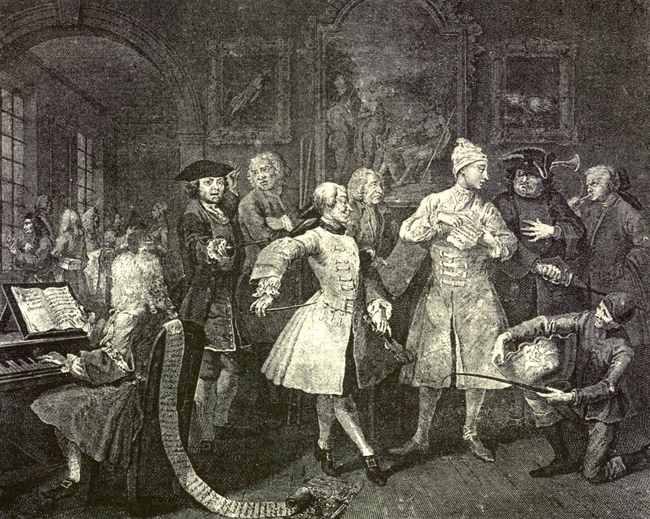
THE RAKE'S PROGRESS, PLATE II.
The sordid avarice of the wretched miser is in this
print contrasted by the giddy profusion of his prodigal
heir. The old man pined in the midst of plenty,
starved while surrounded by abundance, and refused
himself enjoyment of the absolute necessaries of life
from an apprehension of future poverty.
"Not so his son; he mark'd this oversight,
And quite mistook reverse of wrong for right."
Three years have elapsed, and our giddy spendthrift,
throwing of the awkwardness of a rustic,
assumes the character and apes the manners of a
modern fine gentleman. To qualify himself for performing
the part, he is attended by a French tailor, a
milliner, a Parisian dancing-master,[67] a Gallic fencing-master,[68]
an English prize-fighter,[69] and a teacher of
music.[70] Besides this crowd of masters of arts, he has
at his levee a blower of the French horn, an improver
of gardens,[71] a bravo,[72] a jockey,[73] and a poet! the latter
having written a panegyric in honour of this exalted
character, already anticipates approbation and reward.
Surrounded by such a multitude of attentive friends
and warm admirers, the dissolution of his fortune
is inevitable; it must melt like snow beneath the
solar beam.
How exactly does Bramston describe the character
in his Man of Taste:
"Without Italian, and without an ear,
To Bononcini's music I adhere.
To boon companions I my time would give,
With players, pimps, and parasites I'd live;
I would with jockeys from Newmarket dine,
And to rough riders give my choicest wine.
My evenings all I would with sharpers spend,
And make the thief-taker my bosom friend;
In Figg the prize-fighter by day delight,
And sup with Colley Cibber every night."
On the back of the musician's chair hangs a list of
presents which Farinelli, an Italian singer, received
the day after his performance of a favourite character
at the Opera House. Among others, a gold snuff-box,
chased with the story of Orpheus charming the
brutes, from T. Rakewell, Esq.
Another memento of musical extravagance is the
frontispiece to a poem lying on the floor, and dedicated
to Esquire Rakewell, in which the ladies of
Great Britain are represented as sacrificing their
hearts to this idol of sound, and crying out with great
earnestness, One God, one Farinelli! This intimates
the violent rage of the fashionable world for that most
frivolous of all amusements, the Italian Opera. The
taste which our prodigal has imbibed for the turf is
pointed out by the jockey presenting a silver punch-bowl,
which one of his horses is supposed to have
won; his passion for another royal amusement, by
the portraits of two fighting-cocks, hung up as the
ornaments of his saloon. A picture which he has
placed between them bears a whimsical allusion; it
is the "Judgment of Paris."[74] The figures in the
background consist of such persons as are general
attendants in the ante-chamber of a dissipated man
of fashion. The whole is a high-wrought satire on
those men of rank and fortune whose follies render
them a prey to the artful and rapacious.
Of the expression in this print we cannot speak
more highly than it deserves. Every character is
marked with its proper and discriminative stamp. It
has been said by a very judicious critic,[75] from whom
it is not easy to differ without being wrong, that the
hero of this history, in the first plate of the series, is
unmeaning; and in the second, ungraceful. The fact
is admitted; but, for so delineating him, the author
is entitled to our praise rather than our censure.
Rakewell's whole conduct proves he was a fool, and
at that time he had not learned how to perform
an artificial character; he therefore looks as he is,
unmeaning and uninformed. But in the second plate
he is ungraceful—granted. The ill-educated son of
so avaricious a father could not have been introduced
into very good company; and though, by the different
teachers who surround him, it evidently appears that
he wishes to assume the character of a gentleman,
his internal feelings tell him he has not attained it.
Under that consciousness, he is properly and naturally
represented as ungraceful and embarrassed in his
new situation.
The light, it must be acknowledged, is very ill distributed,
and the figures most inartificially grouped.
To infer from hence, with Mr. Gilpin, that the artist
was at a loss how to group them, is not quite fair:
his others compositions prove that he was not ignorant
of the art, but in many of them he has been
inattentive to it. In this he may have introduced
in his print figures which were not inserted in the
sketch, merely because they were appropriate to his
story. The expression of the actors in his drama
was always his leading object; composition he considered
as secondary, and was little solicitous about
their situation on the stage.
"O vanity of youthful blood,
So by misuse to poison good!
Woman, framed for social love,
Fairest gift of powers above,
Source of every household blessing;
All charms in innocence possessing:
But, turn'd to vice, all plagues above;
Foe to thy being, foe to love!
Guest divine, to outward viewing;
Ablest minister of ruin!
And thou, no less of gift divine,
Sweet poison of misused wine!
With freedom led to every part,
And secret chamber of the heart,
Dost thou thy friendly host betray,
And show thy riotous gang the way
To enter in, with covert treason,
O'erthrow the drowsy guard of reason,
To ransack the abandoned place,
And revel there with wild excess?"
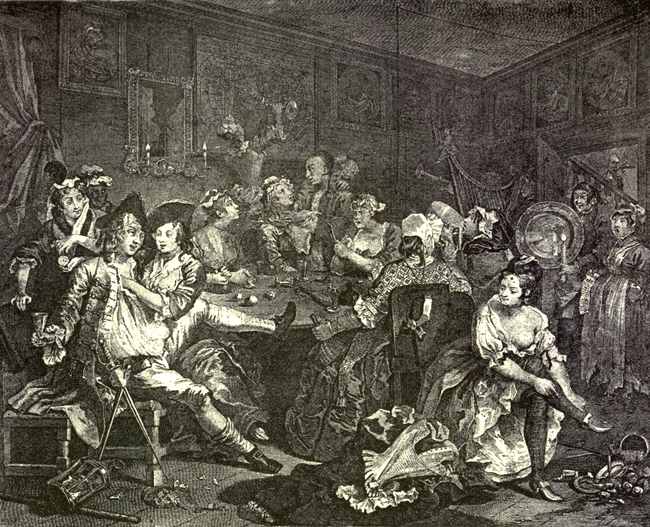
THE RAKE'S PROGRESS, PLATE III.
This plate exhibits our licentious prodigal engaged
in one of his midnight festivities: forgetful of the
past, and negligent of the future, he riots in the
present. Having poured his libation to Bacchus, he
concludes the evening orgies in a sacrifice at the
Cyprian shrine; and, surrounded by the votaries of
Venus, joins in the unhallowed mysteries of the place.
The companions of his revelry are marked with that
easy, unblushing effrontery which belongs to the
servants of all work in the isle of Paphos;—for the
maids of honour, they are not sufficiently elevated.
He may be supposed, in the phrase of the day, to
have beat the rounds, overset a constable, and conquered
a watchman, whose staff and lanthorn he has
brought into the room as trophies of his prowess.
In this situation he is robbed of his watch by the
girl whose hand is in his bosom; and, with that
adroitness peculiar to an old practitioner, she conveys
her acquisition to an accomplice, who stands behind
the chair.
Two of the ladies are quarrelling; and one of them
delicately spouts wine in the face of her opponent,
who is preparing to revenge the affront with a knife,
which, in a posture of threatening defiance, she grasps
in her hand. A third, enraged at being neglected,
holds a lighted candle to a map of the globe, determined
to set the world on fire though she perish in
the conflagration! A fourth is undressing. The
fellow bringing in a pewter dish,[76] as part of the
apparatus of this elegant and attic entertainment, a
blind harper,[77] a trumpeter, and a ragged ballad-singer
roaring out an obscene song, completes this motley
group.
This design may be a very exact representation of
what were then the nocturnal amusements of a
brothel;—so different are the manners of the year
1805 from those of 1734, that I much question
whether a similar exhibition is now to be seen in any
tavern of the metropolis. That we are less licentious
than our predecessors, I dare not affirm; but we are
certainly more delicate in the pursuit of our pleasures.
The room is furnished with a set of Roman emperors,—they
are not placed in their proper order;
for in the mad revelry of the evening this family of
frenzy have decollated all of them except Nero; and
his manners had too great a similarity to their own
to admit of his suffering so degrading an insult: their
reverence for virtue induced them to spare his head.
In the frame of a Cæsar they have placed the portrait
of Pontac, an eminent cook, whose great talents being
turned to heightening sensual rather than mental
enjoyments, he has a much better chance of a votive
offering from this company than would either Vespasian
or Trajan.
The shattered mirror, broken wine-glasses, fractured
chair and cane; the mangled fowl, with a fork stuck
in its breast, thrown into a corner, and indeed every
accompaniment, shows that this has been a night of
riot without enjoyment, mischief without wit, and
waste without gratification.
With respect to the drawing of the figures in this
curious female coterie, Hogarth evidently intended
several of them for beauties; and of vulgar, uneducated,
prostituted beauty, he had a good idea. The
hero of our tale displays all that careless jollity which
copious draughts of maddening wine are calculated
to inspire; he laughs the world away, and bids it
pass. The poor dupe without his periwig, in the
background, forms a good contrast of character: he
is maudlin drunk, and sadly sick. To keep up the
spirit of unity throughout the society, and not leave
the poor African girl entirely neglected, she is making
signs to her friend the porter, who perceives, and
slightly returns, her love-inspiring glance. This print
is rather crowded,—the subject demanded it should
be so; some of the figures thrown into shade might
have helped the general effect, but would have injured
the characteristic expression.
"O vanity of youthful blood,
So by misuse to poison good!
Reason awakes, and views unbarr'd
The sacred gates he wish'd to guard;
Approaching, see the harpy Law,
And Poverty, with icy paw,
Ready to seize the poor remains
That vice has left of all his gains.
Cold penitence, lame after-thought,
With fear, despair, and horror fraught,
Call back his guilty pleasures dead,
Whom he hath wrong'd, and whom betray'd."
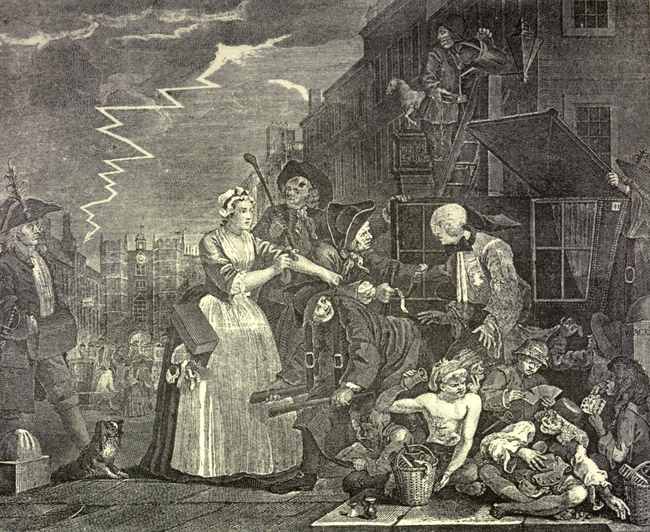
THE RAKE'S PROGRESS, PLATE IV.
The career of dissipation is here stopped. Dressed
in the first style of the ton, and getting out of a sedan
chair, with the hope of shining in the circle, and perhaps
forwarding a former application for a place or a
pension, he is arrested! To intimate that being plundered
is the certain consequence of such an event, and
to show how closely one misfortune treads upon the
heels of another, a boy is at the same moment picking
his pocket.
The unfortunate girl whom he basely deserted is
now a milliner, and naturally enough attends in the
crowd to mark the fashions of the day. Seeing his
distress, with all the eager tenderness of unabated
love, she flies to his relief. Possessed of a small sum
of money, the hard earnings of unremitted industry,
she generously offers her purse for the liberation of her
worthless favourite. This releases the captive beau,
and displays a strong instance of female affection,
which, being once planted in the bosom, is rarely
eradicated by the coldest neglect or harshest cruelty.
The high-born, haughty Welshman, with an enormous
leek, and a countenance keen and lofty as his
native mountains, establishes the chronology, and
fixes the day to be the first of March; which, being
sacred to the titular saint of Wales, was observed at
court.[78]
The background exhibits a view of St James's
Palace, and White's Chocolate House, then the rendezvous
of the first gamesters in London. At this
fountainhead of dissipation the artist has aimed a
flash of lightning; and to show the contagion of example,
and how much this ruinous vice prevails even
in the lowest ranks of society, he has in one corner of
the print represented an assembly composed of shoe-blacks,
chimney-sweepers, etc.,[79] who, aping the vices
of their superiors, are engaged at cards, dice, cups
and balls, and pricking in the belt. To intimate how
eagerly these minor gamblers enter into the spirit of
what they are engaged in, one of them is naked, and
having staked and lost his clothes, is now throwing
for his stock in trade, a basket, brushes, and blacking.
The little smutty smoking politician is reading the
Farthing Post; his attention is exquisitely marked;
his whole soul is engaged; and, regardless of the confusion
which reigns around, he contemplates
"The fate of empires, and the fall of kings."
A chimney-sweeper peeping at the postboy's cards,
and informing his adversary that he has two honours,
by holding up two fingers, is a fine stroke of humour;
as the inscription Black's, being on a post[80] close
to where this congress of the privileged orders are
assembled, is an excellent antithesis when contrasted
to White's, on the opposite side.
The grouping is good, the perspective agreeable,
and the expression admirable. The trembling terror
of the beau, agitated to the very soul, is well contrasted
by the hard unfeeling insolence of two bailiffs;
and that, again, opposed by the tender solicitude of
the poor girl. The gunpowder mark of a star on the
side of the naked shoe-black, who is putting his last
stake on the hazard of a die, is another well-pointed
piece of satire on the conduct of those high-born
gamesters, who at the opposite house, with a dignified
disregard for the future fate of themselves or their
families, put their last acre on the same issue. The
boy with a pipe and little pewter measure and glass
by his side, shows that smoking and drinking drams
was not peculiar to adults, but sometimes practised
by young gentlemen before their attainment of what
the law calls years of discretion.
"New to the school of hard mishap,
Driven from the ease of fortune's lap,
What schemes will nature not embrace
T' avoid less shame of drear distress?
Gold can the charms of youth bestow,
And mask deformity with show:
Gold can avert the sting of shame,
In Winter's arms create a flame:
Can couple youth with hoary age,
And make antipathies engage."
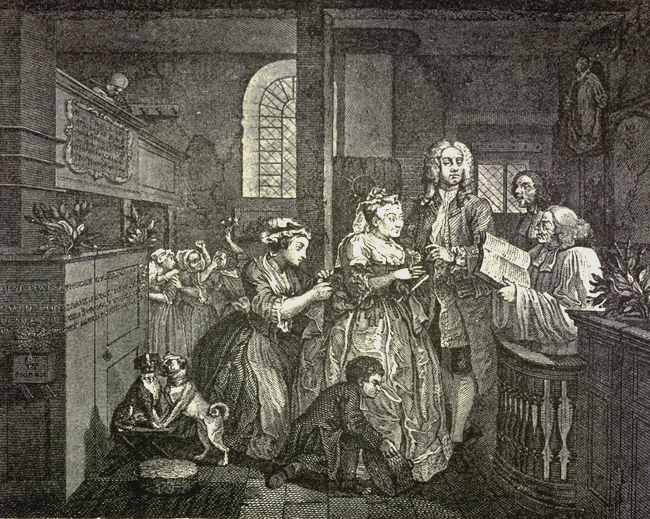
THE RAKE'S PROGRESS, PLATE V.
To be thus degraded by the rude enforcement of the
law, and relieved from an exigence by one whom he
had injured, would have wounded, humbled, I had
almost said reclaimed, any man who had either feeling
or elevation of mind; but, to mark the progression
of vice, we here see this depraved, lost character,
hypocritically violating every natural feeling of the
soul to recruit his exhausted finances, and marrying
an old and withered Sibyl, at the sight of whom
nature must recoil.
The ceremony passes in Marybone Church, which
was then considered at such a distance from London,
as to become the usual resort of those who wished to
be privately married.[81] That such was the view of this
prostituted young man, may be fairly inferred from a
glance at the object of his choice. Her charms are
heightened by the affectation of an amorous leer,
which she directs to her youthful husband, in grateful
return for a similar compliment which she supposed
paid to herself. This gives her face much meaning,
but meaning of such a sort, that an observer being
asked, "How dreadful must be this creature's hatred?"
would naturally reply, "How hateful must be her
love!"
In his demeanour we discover an attempt to appear
at the altar with becoming decorum: but internal
perturbation darts through assumed tranquillity; for
though he is plighting his troth to the old woman, his
eyes are fixed on the young girl who kneels behind
her.[82]
The parson and clerk seem made for each other:
a sleepy, stupid solemnity marks every muscle of
the divine, and the nasal droning of the lay brother
is most happily expressed. Accompanied by her
child and mother, the unfortunate victim of his
seduction is here again introduced, endeavouring to
enter the church and forbid the banns. The opposition
made by an old pew-opener, with her bunch
of keys, gave the artist a good opportunity for
indulging his taste in the burlesque, and he has not
neglected it.
A dog[83] paying his addresses to a one-eyed quadruped
of his own species, is a happy parody of the
unnatural union going on in the church.
The Commandments are broken:[84] a crack runs
near the tenth, which says, "Thou shalt not covet thy
neighbour's wife;" a prohibition in the present case
hardly necessary. The Creed is destroyed by the
damps of the church; and so little attention has
been paid to the poor's box, that—it is covered with
a cobweb!!! These three high-wrought strokes of
satirical humour were perhaps never equalled by an
exertion of the pencil; excelled they cannot be.
On one of the pew-doors is the following curious
specimen of churchyard poetry and mortuary orthography:—
These : pewes : vnscrud : and tane : in : svnder
In : stone : thers : grauen : what : is : vnder
To : wit : a valt : for : burial : there : is
Which : Edward : Forset : made : for : him : and : his.[85]
A glory over the bride's head is whimsical.
The bay and holly, which decorate the pews, give
a date to the period, and determine this preposterous
union of January with June to have taken place
about the time of Christmas,
"When Winter linger'd in her icy veins."
Addison would have classed her among the evergreens
of the sex.
It has been observed, that "the church is too small,
and that the wooden post, which seems to have no
use, divides the picture very disagreeably."[86] This
cannot be denied: but it appears to be meant as an
accurate representation of the place, and the artist
delineated what he saw.
The grouping is good, and the principal figure has
the air of a gentleman. The light is well distributed,
and the scene most characteristically represented.
"Gold, thou bright son of Phœbus, source
Of universal intercourse;
Of weeping Virtue soft redress:
And blessing those who live to bless:
Ye oft behold this sacred trust,
The tool of avaricious lust;
No longer bond of human kind,
But bane of every virtuous mind.
What chaos such misuse attends,
Friendship stoops to prey on friends;
Health, that gives relish to delight,
Is wasted with the wasting night;
Doubt and mistrust is thrown on Heaven,
And all its power to chance is given.
Sad purchase of repentant tears,
Of needless quarrels, endless fears,
Of hopes of moments, pangs of years!
Sad purchase of a tortur'd mind,
To an imprison'd body join'd."
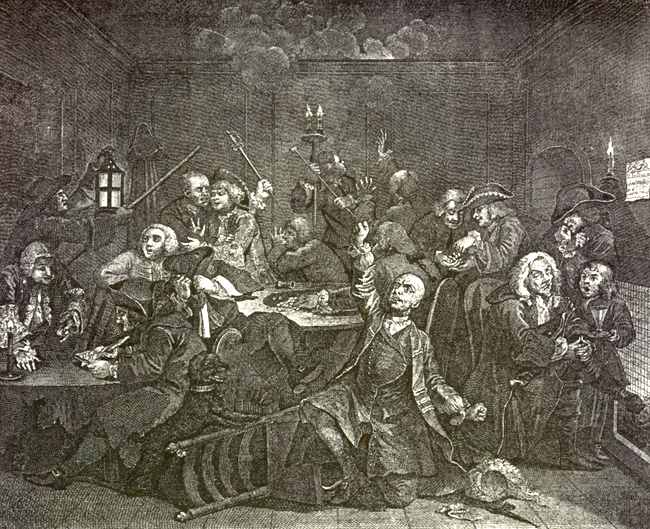
THE RAKE'S PROGRESS, PLATE VI.
Though now, from the infatuated folly of his
antiquated wife, in possession of a fortune, he is still
the slave of that baneful vice which, while it enslaves
the mind, poisons the enjoyments, and sweeps away
the possessions of its deluded votaries. Destructive
as the earthquake which convulses nature, it overwhelms
the pride of the forest, and engulfs the
labours of the architect.
Newmarket and the cock-pit were the scenes of his
early amusements; to crown the whole, he is now
exhibited at a gaming-table, where all is lost! His
countenance distorted with agony, and his soul
agitated almost to madness, he imprecates vengeance
upon his own head.
"In heartfelt bitter anguish he appears,
And from the bloodshot ball gush purpled tears!
He beats his brow, with rage and horror fraught;
His brow half bursts with agony of thought!"
That he should be deprived of all he possessed in
such a society as surround him, is not to be wondered
at. One of the most conspicuous characters appears,
by the pistols in his pocket, to be a highwayman:
from the profound stupor of his countenance, we are
certain he also is a losing gamester; and so absorbed
in reflection, that neither the boy who brings him a
glass of water, nor the watchman's cry of Fire! can
arouse him from his reverie. Another of the party
is marked for one of those well-dressed Continental
adventurers, who, being unable to live in their own
country, annually pour into this, and with no other
requisites than a quick eye, an adroit hand, and an
undaunted forehead, are admitted into what is absurdly
enough called good company.
At the table a person in mourning grasps his hat,
and hides his face in the agony of repentance,[87] not
having, as we infer from his weepers, received that
legacy of which he is now plundered more than a
little month. On the opposite side is another on
whom fortune has severely frowned, biting his nails
in the anguish of his soul. The fifth completes the
climax; he is frantic, and with a drawn sword
endeavours to destroy a pauvre miserable whom he
supposes to have cheated him, but is prevented by
the interposition of one of those staggering votaries
of Bacchus who are to be found in every company
where there is good wine; and gaming, like the rod
of Moses, so far swallows up every other passion, that
the actors, engrossed by greater objects, willingly
leave their wine to the audience.
In the background are two collusive associates
eagerly dividing the profits of the evening.
A nobleman in the corner is giving his note to an
usurer.[88] The lean and hungry appearance of this
cent. per cent. worshipper of the golden calf is well
contrasted by the sleek contented vacancy of so well-employed
a legislator of this great empire. Seated
at the table, a portly gentleman,[89] of whom we see
very little, is coolly sweeping off his winnings.
So engrossed is every one present by his own situation,
that the flames which surround them are disregarded,[90]
and the vehement cries of a watchman
entering the room are necessary to rouse their attention
to what is generally deemed the first law of
nature, self-preservation.[91]
The grouping of the figures in this print is masterly;
but the light, being reflected from various sources,
overbalances the shadow, and fatigues the eye. The
perspective, though formal, is natural.
"Happy the man whose constant thought
(Though in the school of hardship taught)
Can send remembrance back to fetch
Treasures from life's earliest stretch;
Who, self-approving, can review
Scenes of past virtues, which shine through
The gloom of age, and cast a ray
To gild the evening of his day!
Not so the guilty wretch confin'd:
No pleasures meet his conscious mind;
No blessings brought from early youth,
But broken faith, and wrested truth;
Talents idle and unus'd,
And every trust of Heaven abus'd,
In seas of sad reflection lost,
From horrors still to horrors toss'd,
Reason the vessel leaves to steer,
And gives the helm to mad Despair."
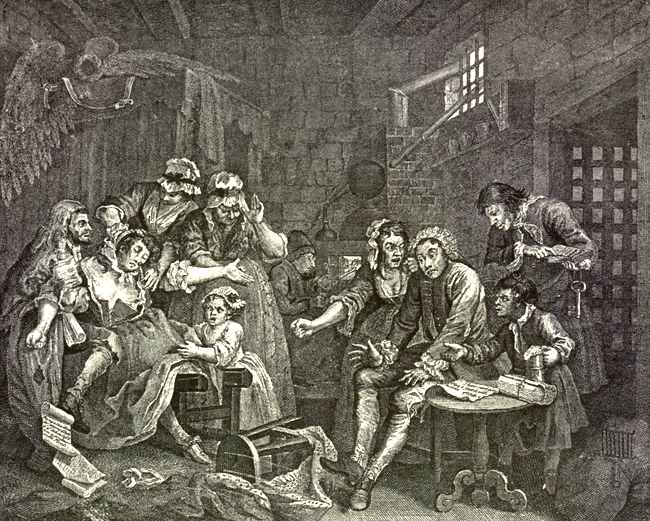
THE RAKE'S PROGRESS, PLATE VII.
It is pithily and profitably observed by Mr. Hugh
Latimer, or some other venerable writer of his day,
that "the direct path from a gaming-house is unto a
prisonne, for the menne who doe neeste themselves
in these pestiferous hauntes, being either fooles or
cheates, be punished: if fooles, by their own undoing;
if cheates, by the biting lash of the beadle,
and the durance of their vile bodies."
In the plate before us this remark is verified.
Our improvident spendthrift is now lodged in that
dreary receptacle of human misery—a prison. His
countenance exhibits a picture of despair; the forlorn
state of his mind is displayed in every limb, and
his exhausted finances by the turnkey's demand of
prison fees not being answered, and the boy refusing
to leave a tankard of porter unless he is paid for it.
We learn by a letter upon the table, that a play
which he sent for the manager's inspection "will not
doe;"[92] and we see by the enraged countenance of
his wife, that she is violently reproaching him for
having deceived and ruined her. To crown this catalogue
of human tortures, the poor girl whom he deserted
is come with her child,—perhaps to comfort
him, to alleviate his sorrows, to soothe his sufferings:
but the agonizing view is too much for her agitated
frame; shocked at the prospect of that misery which
she cannot remove, every object swims before her
eyes, a film covers the sight, the blood forsakes
her cheeks, her lips assume a pallid hue, and she
sinks to the floor of the prison in temporary death.
What a heart-rending prospect for him by whom
this is occasioned! Should he in the anguish of
his soul inquire, "Who is it that hath caused this?"
that inward monitor, which to him must be a perpetual
torment, would reply in the words that Nathan
said unto David, "Thou art the man!" Such an
accumulation of woe must shake reason from her
throne. The thin partitions which divide judgment
from distraction are thrown down, the fine fibres of
the brain are overstrained, and in the place of godlike
apprehension,
"Chaos and anarchy assume the sway."
That balm of a wounded mind,—the recollection of
connubial love, parental joys, and all the nameless tender
sympathies which calm the troubled soul,—in his
blank and blotted memory find no place. Remorse
and self-abhorrence rankle in his bosom! his groans,
heaved from the heart, pierce the air! he is chained!
rages! gnashes his teeth, and tears his quivering
flesh! At this dreadful crisis he sees, or seems to
see,
"A fiend, in evil moments ever nigh,
Death in her hand, and frenzy in her eye!
Her eye all red, and sunk! A robe she wore,
With life's calamities embroidered o'er.
From me (she cries), pale wretch, thy comfort claim,
Born of Despair, and Suicide my name."
He attempts to take away that life which is become
hateful to him; is prevented, and removed to a cell
more dreadful than even a prison:
"Where Misery and Madness hold their court."
But let us for a moment return to the present scene.
The wretched, squalid inmate who is assisting the
fainting female, bears every mark of being naturalized
to the place: out of his pocket hangs a scroll,
on which is inscribed, "A scheme to pay the national
debt, by J. L., now a prisoner in the Fleet." So attentive
was this poor gentleman to the debts of the
nation, that he totally forgot his own. The cries of
the child, and the good-natured attentions of the two
women, heighten the interest, and realize the scene.
Over the group are a large pair of wings, with which
some emulator of Dedalus intended to escape from
his confinement; but finding them inadequate to the
execution of his project, has placed them upon the
tester of his bed. They would not exalt him to the
regions of air, but they o'er-canopy him on earth. A
chemist in the background, happy in his views, watching
the moment of projection, is not to be disturbed
from his dream by anything less than the fall of the
roof or the bursting of his retort; and if his dream
affords him felicity, why should he be awakened?
The bed and gridiron, those poor remnants of our
miserable spendthrift's wrecked property, are brought
here as necessary in his degraded situation; on one
he must try to repose his wearied frame, on the other
he is to dress his scanty meal.
The grated gate, secured with tenfold bars of iron,
reminds us of Milton's
"Infernal doors, that on their hinges grate
Harsh thunder!"
The principal figure is wonderfully delineated.
Every muscle is marked, every nerve is unstrung;
we see into his very soul. The poor prisoner who is
assisting the fainting woman is ill drawn; the group
of which she is the principal figure is unskilfully
contrived: it forms a round heavy mass. The opposite
group, though better, is not pleasing.
"Madness! thou chaos of the brain,
What art? that pleasure giv'st and pain,
Tyranny of fancy's reign!
Mechanic fancy! that can build
Vast labyrinths and mazes wild,
With rule disjointed, shapeless measure,
Fill'd with horror, fill'd with pleasure!
Shapes of horror, that would even
Cast doubt of mercy upon Heaven;
Shapes of pleasure, that but seen,
Would split the shaking sides of Spleen.
O vanity of age! here see
The stamp of Heaven effac'd by thee!
The headstrong course of youth thus run,
What comfort from this darling son?
His rattling chains with terror hear,
Behold death grappling with despair!
See him by thee to ruin sold,
And curse thyself, and curse thy gold!"
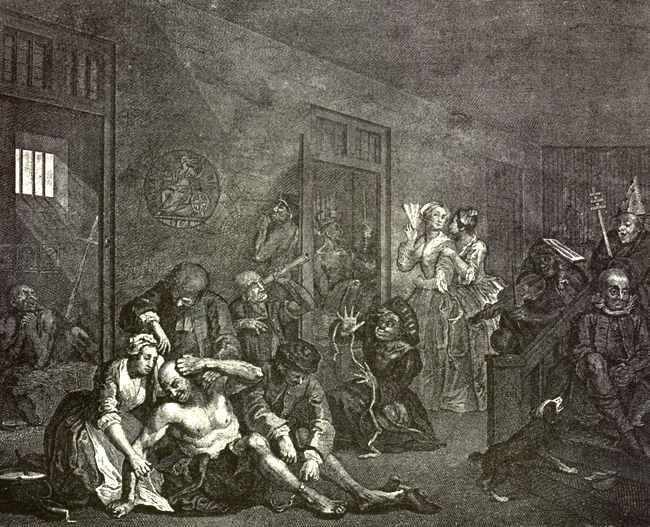
THE RAKE'S PROGRESS, PLATE VIII.
"Last scene of all,—which ends this strange eventful
history!"
But in this scene, dreary and horrid as are its
accompaniments, he is attended by the faithful and
kind-hearted female whom he so basely betrayed.
In the first plate we see him refuse her his promised
hand. In the fourth she releases him from the harpy
fangs of a bailiff; she is present at his marriage. In
the hope of relieving his distress, she follows him to a
prison. Wishing to soothe his misery and alleviate
his woe, she here attends him in a madhouse!
What a return for deceit and desertion!
The Reverend Mr. Gilpin, in his elucidation of these
eight prints, asserts that "this thought is rather
unnatural, and the moral certainly culpable."[93] With
the utmost deference for his critical abilities, I must
entertain a different opinion. We have had many
similar examples of female attachment. If it be
culpable to forgive those which have despitefully
used us, to free those which are in bonds, to visit
those which are in prison, and to comfort those
which are in affliction, what meaning have the divine
precepts of our holy religion?
The female mind is naturally credulous, affectionate,
and—in its attachments—ardent. If, in her
peculiar situation, her assiduities must be deemed in
any degree culpable, let us remember that this is
but a frail vessel of refined clay. When the awful
record of her errors is unrolled, may that sigh which
was breathed for the misery of a fellow-mortal waft
away the scroll, and the tears which flowed for the
calamities of others float the memorial down the
stream of oblivion!
On the errors of women, let us look with the allowance
and humanity of men. Enchanting woman!
thou balm of life! soother of sorrow! solace of the
soul! how dost thou lessen the load of human misery,
and lead the wretched into the valley of delight!
Without thee, how heavily would man drag through
a dreary world; but if the white hand of a fascinating
female be twined round his arm, how joyous, how
lightly doth he trip along the path!
That warm and tender friend, who in the most trying
situations retains her enthusiastic fondness, and
in every change of fortune preserves unabated love,
ought to be embraced as the first bension of heaven,
the completion of earthly happiness! Let man but
draw such a prize in the lottery of life, and glide down
the stream of existence with such a partner, and neither
the cold averted eye of a summer friend, nor the frowns
of an adverse fortune, should ever produce a pang or
excite a murmur. But enough,—let not the chaste
feelings of blushing innocence be wounded by this
rhapsody, or for a moment suppose that the episode,
or effusion, or e'en whatever she pleases, is intended
as a vindication of female folly; in good truth it is
not. The writer would not wish it delivered to the
cold-fingered portress of Diana's temple, but it may
be laid upon that altar which is sacred to Friendship,
to Hymen, to Love.—There we will leave it, and
return to the plate before us.
A gentleman[94] from whom I have once or twice reluctantly
presumed to differ, says that "the drawing
of the principal figure is a more accurate piece of
anatomy than we commonly find in the works of this
master." The observation is perfectly just, but the
inaccuracies of Mr. Hogarth did not arise from inability,
but from inattention. He says further, that
"the expression of the principal figure is rather unmeaning."
The late and ever to be lamented Mr.
Mortimer, whose wonderful abilities as an artist were
only equalled by his amiable and kind-hearted virtues
as a man,—the late Mr. Mortimer, of whom I can
never think without a sigh of regard and regret,
thought very differently. He was once requested to
delineate several of the passions, as they are personified
by Mr. Gray. One of the subjects proposed
was,—
"Moody madness, laughing wild, amid severest woe."
The instant this line was read to him, he opened a
portfolio, took out the eighth plate of the "Rake's
Progress," and pointing to the principal figure, exclaimed,
"Sir, if I had never seen this print, I should
say it was not possible to paint these contending
passions in the same countenance. Having seen this,
which exactly displays Mr. Gray's idea, I dare not
attempt it. I could only make a correct copy; for
the alteration of a single line would be a departure
from the character."
The reclining figure, with a cross leaning near him,
is in a high degree terrific.[95]
"With horror wild,
'Tis Devotion's ruin'd child,
Sunk in the emphasis of grief;
Nor can he feel, nor dares he ask relief."
In the cell are the portraits of three saints, whose
systems were built on the necessity of propagating the
religion of mercy by the sword and the wheel.
Near him are two astronomers, one with a paper
rolled up to imitate a telescope, gazing at the roof, in
the idea that it is
"The spacious canopy of heaven, fretted with golden fires."
The other, delineating the firing off a bomb and a
ship moored at a distance, is an immediate ridicule of
Whiston's project for the discovery of the longitude,—an
object which at this time engaged the attention
of the philosophical world, and in the fruitless search
after which many a feeble head hath become mad,
north—north-west!
The opposite group form a whimsical trio. A mad
musician, a counterfeit presentment of St. Peter, and
a poor gentleman, with his hands clasped together,
that appears by the inscription of "Charming
Betty Careless," which he has chalked upon a board,
to be
"Craz'd with care, and cross'd by hopeless love."
He is absorbed in thought, and his whole soul so
engrossed by the charms of his Dulcinea, that neither
the discordant sounds of the fiddler, whose trembling
strings
"Grate harshly on the nerve auricular,"
nor the roar of the pope, who is furiously denouncing
destruction on all heretics, nor the ear-piercing noise
of a barking cur, can awake him from his reverie.
A crazy tailor and a mimic monarch complete this
congregation of calamity.
Two women, impelled by a most unaccountable
curiosity, are walking in the background. Devoid
of that delicacy which gives beauty new attractions,
they forget that an eagerness to witness woe which
they cannot alleviate, gives strong indication of an
hardened and unfeeling heart.
The halfpenny stuck against a wall, and dated
1763, was inserted by Mr. Hogarth the year before
his death, and is designed to intimate that Britannia
was then mad. This is one of the few instances
wherein he has called in the aid of allegory, but his
allegory was always seasoned with wit.
Of the expression I have already spoken. The
disposition of the figures is good. That group in
which the usurper of St. Peter's chair is the principal
object, is well contrived. There is great simplicity
and breadth in the background, and the light and
perspective are judicious.
"Protract not, curious ears, the mournful tale;
But o'er the hapless group low drop Compassion's veil."
The eight prints of the "Rake's Progress," with
"Southwark Fair," were advertised in the London
Daily Post to be delivered June 25th, 1735, with an
apology for the publication being deferred, which Mr.
Hogarth states to have been occasioned by his waiting
until the royal assent was given to an Act intended
to secure all new invented prints from being
copied, etc.
This series are in every respect superior to those
which preceded them, but were not honoured with an
equal attention by the public.
From what did this arise? Were the town more
interested in the story of an harlot than in the adventures
of a rake, or had this new mode of engraving
history lost its novelty?
On this occasion was published an octavo pamphlet,
entitled, "The Rake's Progress, or the Humours of
Drury Lane, a Poem in eight Cantos, in Hudibrastic
verse; being the Rambles of a modern Oxonian:
which is a complete Key to the eight Prints lately
published by the celebrated Mr. Hogarth. Printed
for John Chetwood, and sold at Inigo Jones' Head,
against Exeter Change, Strand, 1735." This is a most
contemptible and indecent performance. In some of
the copies are inserted eight prints; but they are
only the designs of Hogarth mutilated, and perhaps
were originally engraved for the decoration of some
other work.
There is reason to believe that the artist once intended
to have introduced the ceremony of a marriage
contract, instead of the levee, as an unfinished painting
of the scene is still preserved. In this sketch he
appears to have thought of taking the same ground
with Mr. Pope:
"What brought Sir Visto's ill-got wealth to waste?
Some demon whisper'd, 'Visto, have a taste.'"
For our Rake is there turned connoisseur; and
among a number of articles which prove him a man
of virtu, is a canvas containing the representation of
a human foot.[96]
In the year 1745 the eight pictures were sold by
auction, at Mr. Hogarth's in Leicester Fields, and produced
twenty-two guineas each; total, one hundred
and eighty-four pounds, sixteen shillings. They are
now, I believe, in the possession of Mr. Beckford of
Fonthill, in Wiltshire.
"The crowded scene will please us then,
And the busy hum of men;
The Thespian throng, and champions bold,
Their jubilee of triumph hold:
With store of wenches, whose bright eyes
Rain influence, and judge the prize
Of hat or shirt,—while all contend
To catch her glance whom all commend.
Come, Sport, that wrinkled Care derides;
And Laughter, holding both his sides;
And puppet-show, and quaint device,
And Troy in flames, and rattling dice:
And Comedy, with wreathed smiles;
And Music, that dull care beguiles;
Here let the droning bagpipe be,
And there the cheerful fiddle see.
Nor be our joys to earth confin'd,—
But, light as air, swift as the wind,
Let Cadman cut the liquid sky,
And on the rope Violante fly.
Our trumpet's loud clangour
Excites not to arms;
No shrill notes of anger,
No horrid alarms,
The double, double, double beat
Of the thundering drum,
Tells—the actors are come;
Let us follow, nor think of retreat.
I'll to the well-trod stage anon,
If Settle's[97] 'cumber'd sock be on;
Or heavy Howard,[98] Folly's child,
In native nonsense soareth wild.
These joys if Southwark Fair can give,
In Southwark Fair a week I'll live."
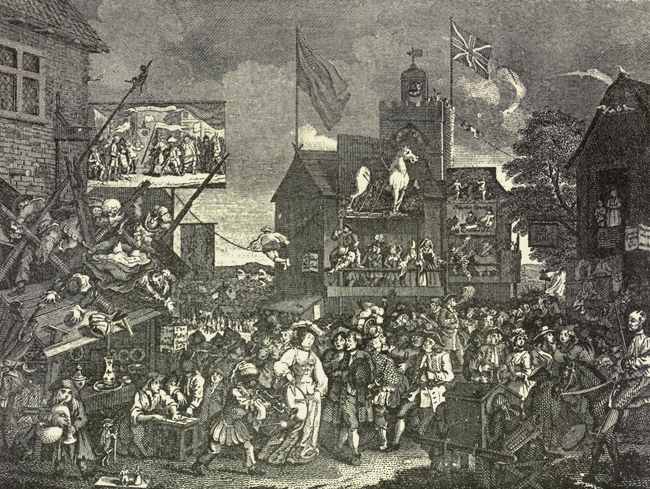
SOUTHWARK FAIR.
At a time when martial hardihood was the
only accomplishment likely to confer distinction,
when war was thought to be the
most honourable pursuit, and agriculture deemed the
only necessary employment, there was little social
intercourse, and so few retail dealers, that men had no
very easy means of procuring those articles which they
occasionally wanted. To remove this inconvenience,
it was found necessary to establish some general mart,
where they might be supplied. Fairs were therefore
instituted, as a proper medium between the buyer and
seller, and were at first considered as merely places of
trade.[99] They were generally held on saints' days.
Some of them continued open many weeks, and had
peculiar privileges to encourage the attendance of
those who had goods upon sale. The pedlar travelled
from city to city, or from town to town, with his moveable
warehouse, and furnished his customers with
what served them until his periodical return.
As men grew more polished their wants increased,
their intercourse became more general, and the importance
of commerce was better understood. The
merchant deposited his goods in a warehouse, and the
trader opened a shop. Fairs, deserted by men of
business, gradually changed their nature, and, instead
of being crowded by the active and the industrious,
were the haunts of the idle and the dissolute.[100] Such
were they at the time of this delineation, which was
made about the year 1733, and may be considered as
a true picture of the holiday amusements of that
period. At the head of these we must place what
were than called stage-plays,—a most favourite diversion
of your Englishman ever since the time
"When sweetest Shakspeare, Fancy's child,
Warbled his native woodnotes wild."
In these humble representations some of our greatest
actors made their first appearance; and not a few
of them, even after they had attained high eminence,
ranted, strutted, and bellowed through all the days
the fairs were kept open, to their own emolument,
and the heartfelt pleasure of the Wapping beaux
and the black-eyed beauties of Saltpetre Bank.
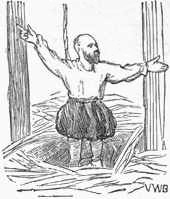
The play now enacting appears to be the Fall of
Bajazet,[101]—and it is performed to the life; for the
unsure scaffolding, not being built to bear the terror-working
stamps of the furious Turk, tumbles to the
ground. The tyrant's turban is shaken from his head,
the truncheon is dropped from his hand, and with the
moralizing Tamerlane he joins the general crash, and
threatens destruction to the china jars and bowls
which are beneath. Not only the heroes and heroine
of the drama, but both band and musical instruments
are involved in the ruin. The band, it is true, consists
of—a solitary fiddler; and the instruments are—a
violin and a salt-box. The monkey and the merry-andrew
seem the only two animals likely to evade
injury in this universal wreck. Corporeal dexterity
at such a time is more useful than mental acquirements.
The Amazonian, with a hat, feather, and drum, is a
beauty of Mr. Hogarth's school, belongs to a company
of comedians, and is beating up for an audience. The
gaping astonishment of two rustics who are looking
at her is inimitably described. One of them, awe-struck
by her figure, has pulled off his hat in reverence
of her charms; the other "wonders with a foolish
face of praise."
A buskined hero, arrayed perhaps for an Alexander,
has his career of glory stopped by a sheriff's
officer, who pays no respect
"To Macedonia's madman, or the Swede."
The hero puts his hand to his sword, but the bailiffs
follower secures his other arm, and aims a bludgeon
at his head.
A younger branch of the family of the Simples,
with a whip in one hand and the other hooked on a
young girl's arm, is so lost in gaping astonishment at
the variety of objects around him, that he neglects
his pockets, which an adroit candidate for Tyburn is
clearing of their contents. While one fellow kisses a
girl,[102] another endeavours to decoy her two companions.
A prize-fighter, furrowed with scars, makes
his triumphal entry on a blind horse, and, calling up a
face of terror, and grasping his sword, hurls a proud
defiance to all who dare appear as his competitors.
A juggler, in a senatorial wig, displays magic wonders
with the cups and balls; and above him is a
fellow with a pair of artificial legs extended on a
board: one of these legs a man beneath is either attempting
to break, or using as a lever to give a summerset
to a tumbler, who kneels upon the other. A
hat displayed on the end of a pole is the prize of the
best wrestler on the green; and a holland chemise
will reward the fair racer swiftest of foot.
A quack doctor, in laced hat, long periwig, and
embroidered coat, mounted upon a stage and attended
by his merry-andrew, dispenses his infallible
medicines. To attract the notice of a gaping crowd,
this iron-throated descendant of Paracelsus eats fire.
That ancient puppet-show joke of Mr. Punch's horse
picking the pocket of the chequered fool of the farce,
is exhibited in a balcony, on one side of which is a
bout at cudgels by puppets all alive!
Under a show-cloth, which announces "The Siege
of Troy[103] is here," are a company rehearsing some
part of the play. By a sun upon the breast of the
figure in a mitre, we know him to be the high-priest
of Apollo, the venerable Chryses. While one arm of
this sage of many sorrows is twined round the pole
which supports the wooden horse, the other is
stretched out in moving supplication, entreating the
hearers to
"Relieve a wretched parent's pain,
And give Chryseïs to his arms again."
Chryseïs, however, is perfectly satisfied with her situation.
Seated in all the pride of conscious beauty
close to the haughty Atrides, and glorying in his
protection, she prefers the lover to the parent. The
inexorable chief nods his plumed crest, grasps his
truncheon, and "looks with threatening brow on all
around."
"No tears subdue him, no entreaties move,
He dares avenging Phœbus, son of Jove."
A little fellow with long hair, playing upon the
bagpipes,[104] is attended by a dancing dog, dressed
en militaire, and with his foot dances his Fantoccini
figures. His Madame Catharina does not excite the
attention she merits: the woman with a dice-box has
superior attractions; and a country fellow, in a coat
which seems to have been the Sunday habiliment of
his forefathers for many generations, is trying his fortune,
though earnestly dissuaded by his more prudent
son from putting his pence in so perilous a situation.
The woman, with that energetic eloquence which
marks the orators of Billingsgate, rates the boy for
daring to doubt her honesty. On the other side, a
Savoyard music-grinder, with her galante show, is
attended by a dwarf drummer, and collecting pence
from the little people who prefer a wonderful and
surprising prospect of every court in Europe to a
pennyworth of gingerbread. In the distance, a set of
figures have been engaged at quarter-staff, then a
favourite amusement; and the conqueror, waving his
flag of victory, is hoisted upon the shoulders of
another man; and thus triumphantly exalted, the
air echoes with loud and reiterated acclamations in
honour of his prowess.
Having despatched the herd[105] of characters who
people the scene on earth, I reserved to a class by
themselves those who are buoyant in the air. The
figure vaulting on a rope was designed for Signora
Violante, who signalized herself in the reign of George
I. She was followed by some inferior performers;
but the science of rope-dancing and riding has now
arrived at its acme, and is rising into such estimation
with the public, that Dr. Johnson's prophecy may, at
a future day, be wholly fulfilled in our royal theatres.
In part it has been already verified:
"Perhaps where Lear has rav'd and Hamlet died,
On flying cars new sorcerers may ride;
Perhaps (for who can guess th' effects of chance?)
Here Hunt may box, or Mahomet may dance."
The man descending from a steeple represents one
Cadman, who, in the memory of some persons now
living, performed the same feat at St. Martin's in the
Fields, from the steeple of which he descended into
the Mews. In an experiment of the like nature at
Shrewsbury, the rope breaking, he was dashed to
pieces.
A show-cloth over the Fall of Bajazet is almost a
direct copy from a very coarse etching made by John
Laguerre, son of Louis Laguerre, whom Pope has immortalized
for his sprawling saints. On the upper
part of the print is inscribed, "The Stage Mutiny."
It alludes to some disputes between the managers of
Drury Lane and such of the actors as were spirited
up to rebellion by Theophilus Cibber, and seceded to
the Haymarket in 1733. As this made much noise
in its day, it may not be unentertaining to narrate
some of the circumstances which occasioned it.
The patent for Drury Lane being renewed, Mr.
Booth, who found his health decline, began to think
it was time to dispose of his share and interest in the
theatre. The purchaser was John Highmore, Esq.,
a gentleman who had unhappily contracted an attachment
to the stage, from having one night performed
the part of Lothario for a wager.[106] He gave Booth
£2500 for half his share in the property, and his
whole right in the management. Mr. Wilkes had
previously appointed Ellis his deputy; and Colley
Cibber, extremely displeased that two strangers
should be thus empowered to interfere, authorized his
son to act for him in everything that concerned his
share in the management. The first season ended
with some profit to the new patentees; but Mr.
Highmore being disgusted by the impertinence of
young Cibber, determined to exonerate himself from
his interference, and, for the sum of three thousand
guineas, purchased the elder Cibber's right in the
theatre. Two years had hardly passed before the
principal actors, encouraged by Theophilus Cibber,
determined to revolt from the patentee; and as the
little theatre in the Haymarket was then unoccupied,
agreed to rent it from the proprietor, and opened
their campaign with the comedy of Love for Love, at
which they were attended by an elegant and crowded
audience. The patentees, though weakened by this
desertion, began to act at the usual time. To supply
the place of those who had left their service, they had
recourse to such actors as could be procured from the
itinerant companies. With all the help they could
obtain, their performances were inferior to those exhibited
at the Haymarket, and losses came so heavy
upon Mr. Highmore, that he was under the necessity
of giving up the contest, and sold the whole property
to Mr. Charles Fleetwood for about half the sum he
had originally paid for it.'
Upon this circumstance is built the print from
which the show-cloth was copied; it probably announces
the performance of a farce entitled "The
Stage Mutineers, a tragi-comic farcical ballad opera,
acted at Covent Garden in 1733;" which is a burlesque
on the whole contest. Theophilus Cibber,
who was the leader of the malcontents, is in this
farce characterized by the name of Ancient Pistol,
all his speeches being in that high-flown mock-heroic
style with which Shakspeare has marked that boasting
coward. The scene is supposed to be in the
playhouse, and the time, during a rehearsal.
In 1740, a pamphlet was published for J. Mechell, at
the King's Arms, Fleet Street, entitled, "An Apology
for the Life of T—— C——, Comedian; being a proper
sequel to the Apology for the Life of Mr. Colley
Cibber; with an historical view of the stage to the
present year. Supposed to be written by himself, in
the style and manner of the poet-laureate:" but in
reality the work of Harry Fielding. The following
passage, relative to this subject, occurs in page 16,
etc:—"In that year, when the stage fell into great
commotions, and the Drury Lane company, asserting
the glorious cause of liberty and property, made a
stand against the oppressions of the patentees;—in
that memorable year, when the theatric dominions
fell in labour of a revolution, under the conduct of
myself; that revolt gave occasion to several pieces of
wit and satirical flirts at the conductor of the enterprise.
I was attacked, as my father had been before
me, in the public papers and journals; and the
burlesque character of Pistol was attributed to me as
a real one. Out came a print of Jack Laguerre's,
representing, in most vile designing, this expedition
of ours, under the name of 'The Stage Mutiny;' in
which, gentle reader, your humble servant, in the
Pistol character, was the principal figure. This I
laughed at, knowing it only a proper embellishment
for one of those necessary structures to which persons
out of necessity repair." Again, p. 88: "At the
fair of Bartholomew we gained some recruits; but,
besides those advantages over the enemy, I myself
went there in person, and publicly exposed myself.
This was done to fling defiance in the patentees' teeth;
for, on the booth where I exhibited, I hung out 'The
Stage Mutiny,' with Pistol at the head of his troop;
our standard bearing the motto, 'We eat.'" Whether
this account which Cibber is made to give of his
own conduct is entirely jocular, or contains a mixture
of truth and falsehood, cannot now be ascertained.
Hogarth may have transferred a circumstance from
Bartholomew to Southwark Fair; or Fielding, by
design, may have misrepresented it, alluding at the
same time to Hogarth's print.
To return to the show-cloth. The figure seated in
the corner, with his head bound with laurel, is intended
to represented old Cibber, then poet-laureate. With
a bag of money upon his knee, he rejoices in the sum
he has realized, and laughs at those who are enduring
the storm. Under his feet is inscribed "Quiet and
snug." The tall, thin figure, stooping, is meant for
Mr. Highmore. He holds in his hand a scroll, on
which is written, "It cost 6000 pounds." He is
again characterized in the figure of a monkey astride
the sign-iron of the Rose Tavern, with a label, on
which is written, "I am a gentleman."[107]—The man in
his shirt, with a paint-pot and brushes at his feet, who
takes up the cudgels for the new patentees, is John
Ellis the painter. He was the pupil of Sir James
Thornhill, deputy-manager for Mr. Wilkes, and principal
scene painter to the theatre. By the favour of
the Duke of Montagu and Sir Robert Walpole, he
was appointed to be great master of the wardrobe,
and keeper of the lions in the Tower. He was
much happier in attending a pugilistic exhibition at
Broughton's academy than in the exercise of his
profession. His figure appears muscular, but hardly
leads one to suppose, what is yet certainly a fact,
that Rysbrack—when he produced what Mr. Walpole
very emphatically calls that exquisite summary of
his skill, knowledge, and judgment, the "Hercules,"
now in Mr. Hoare's temple at Stourhead—modelled
the legs of the god from those of Ellis.—The figure
in the background, with a tremendous plume of
feathers, and a flowing periwig, grasping his truncheon
in a style of defiance, may be Mills, in the character
of Bajazet. On the flag which is borne between Mr.
Highmore and Ellis, is inscribed, "We'll starve them
out." On that borne in the rear of the seceders, on
the opposite side, is written, "We eat." The figure
near it is probably intended to represent Johnson, in
Sir Hugh Evans; as that with a truncheon in his
hand, who stands next him, may be intended for
Bardolph; but who the performer was, I am not well
enough versed in dramatic history to determine: it
would probably be known at that time, by the ends
of two cudgels, which rise in parallel lines immediately
behind his head, and may perhaps intimate
that this gentleman, as well as Theophilus Cibber,
was under some obligations to his wife for giving him
a title he was not born with.—The Sir John Falstaff
was certainly intended for Harper,[108] who was eminent
in that character; as Pistol, with the inscription,
"Pistol's alive," was indisputably meant for the
younger Cibber. The masculine gentlewoman, waving
a flag on which is inscribed "Liberty and Property,"
is, I think, clearly intended as a portraiture
of the notorious Mistress Doll Tearsheet; but who
was the actress that personated this fair friend of
the fat knight, I really do not know.[109]
The show-cloth underneath, with the tall figure
and two spectators, is a representation of Maximilian,
a giant from Upper Saxony. That with the wooden
horse is explained by the inscription above it, "The
Siege of Troy is here." Mr. Victor, in an eulogium
upon Boheme the actor, says that "his first appearance
was at a booth in Southwark Fair, which in those
days lasted two weeks, and was much frequented by
persons of all ranks and both sexes. He acted the
part of Menelaus, in the best droll I ever saw, called
The Siege of Troy."
The Adam and Eve upon another show-cloth
may probably allude to the representation of somewhat
compiled from an old mystery called The
Creation.[110]
The old puppet-show joke of Punch wheeling his
wife into the jaws of destruction, which is underneath,
is well known. By the paper lantern, dwarf drummer,
and little figure at a temporary door, it appears that
the royal waxwork and whole Court of France are at
the Royal Oak.
It is a little remarkable, that in this almost endless
variety of holiday amusements there should be no
exhibition of wild beasts[111] or wonderful quadrupeds.
A roaring lion, raging tiger, and fierce cat a-mountain,
would have had a large audience; and a learned pig
or an overgrown Lincolnshire ox might have made
the proprietors' fortunes at that time, as they have
done at this.
The amusements of the fair at this period continued
a fortnight,[112] and were unquestionably attended with
much loss of time, and productive of some habits of
dissipation among the lower ranks of people who attended
them. A visit to a family in the vicinity must
have been a delightful entertainment, and the pleasure
much heightened if the lady of the mansion happened
to be fond of dumb creatures. A whistle, drum, and
trumpet, in the possession of three little masters, with
a barking lap-dog, screaming parrot, and canary bird
in full song, must form a concert of such heavenly
harmony, as
"Would bring an angel down!"
For those who delight in pointing out examples of
Hogarth's bad spelling, this print affords a fine field.
The name of Cibber is spelt with only one b. In the
Fall of Bajazet, the z appears to have been originally
an s. "We'l starve them out." The e final
in waxworke, these syllable dissectors may perhaps
deign to acknowledge was then customary.
In my enumeration of some of the actors who appear
on the show-cloth, etc., I may sometimes be
wrong: let it be received as conjecture founded on
the best information I could obtain; and let it be remembered,
that to procure positive information of
circumstances which happened near fifty years ago
is not easy. The memoranda to be found in magazines,
and other perishable prints of the day, are not
always to be depended upon. Even now these authentic
documents sometimes lead those who implicitly
believe them into error.[113]
"Think not to find one meant resemblance there;
We lash the vices, but the persons spare.
Prints should be priz'd, as authors should be read,
Who sharply smile prevailing Folly dead.
So Rabelais laught, and so Cervantes thought;
So Nature dictated what Art has taught."
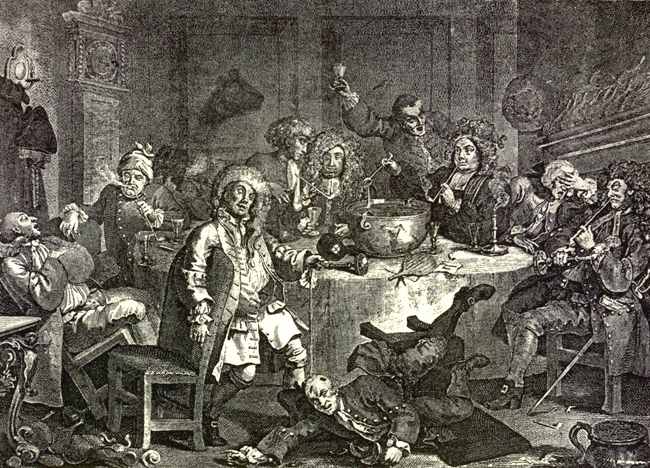
MIDNIGHT MODERN CONVERSATION.

Notwithstanding this inscription,
which was engraved on the plate some
time after its publication, it is very certain
that most of these figures were intended for individual
portraits; but Mr. Hogarth, not wishing to be considered
as a personal satirist, and fearful of making
enemies among his contemporaries, would never
acknowledge who were the characters. Some of them
the world might perhaps mistake; for though the
author was faithful in delineating whatever he intended
to portray, complete intoxication so far caricatures
the countenance, that, according to the old though
trite proverb, "the man is not himself." His portrait,
though given with the utmost fidelity, will scarcely
be known by his most intimate friends, unless they
have previously seen him in this degrading disguise.
Hence it becomes difficult to identify men whom the
painter did not choose to point out at the time; and
sixty years having elapsed, it becomes impossible,—for
all who composed the group, with the artist by
whom it was delineated,
"Shake hands with dust, and call the worm their kinsman."
Mrs. Piozzi told me that the divine with a corkscrew,[114]
occasionally used as a tobacco-stopper, hanging
upon his little finger, was the portrait of Parson Ford,
Dr. Johnson's uncle; though upon the authority of
Sir John Hawkins, of anecdotish memory, it has been
generally supposed to be intended for Orator Henley.[115]
As I have been told that both these worthies were
distinguished by that clerical rubicundity of face with
which it is marked, the reader may decree the honour
of a sitting to which he pleases. We may say of
either one or the other:
"No loftier theme his thought pursues,
Than punch, good company, and dues.
Easy, and careless what may fall,
He hears, assents, and fills to all;
Proving it plainly by his face,
That cassocks are no signs of grace."[116]
The roaring Bacchanalian who stands next him,
waving his glass in the air, has pulled off his wig, and
in the zeal of his friendship crowns the divine's head.
He is evidently drinking destruction to fanatics and
success to Mother Church, or a mitre to the jolly
parson whom he addresses.
The lawyer who sits near him is a portrait of one
Kettleby, a vociferous bar-orator, who, though an utter
barrister, chose to distinguish himself by wearing an
enormous full-bottom wig, in which he is here represented.
He was further remarkable for a diabolical
squint and a Satanic smile. In the Causidicade are
a number of lines dedicated to the honour of this
amiable person. They begin with—
"Up Kettleby starts with a horrible stare."
A poor maudlin miserable who is addressing him,
when sober, must be a fool; but, in this state, it
would puzzle Lavater to assign him a proper class.
He seems endeavouring to demonstrate to the lawyer
that in a poi—poi—point of law he has been most
cruelly cheated, and lost a cau—cau—cause that he
ought to have got,—and all this was owing to his
attorney being an infernal villain. This may very
probably be true; for the poor man's tears show that,
like the person relieved by the good Samaritan, he has
been among thieves. The barrister grins horribly at
his misfortunes, and tells him he is properly punished
for not employing a gentleman.
Next to him sits a gentleman in a black periwig.
He politely turns his back to the company, that he
may have the pleasure of smoking a sociable pipe.
The justice, "in fair round belly, with good capon
lin'd,"—the justice, having hung up his hat, wig, and
cloak, puts on his nightcap, and with a goblet of superior
capacity before him, sits in solemn cogitation.
Meditating severe punishments on the dissolute
peasant who tipples ale or viler liquors, he resolves
for the future to act with magisterial harshness, that
he may convince his neighbours of his zeal for the
law, and detestation of drunkenness. His left elbow
supported by the table and his right by a chair, with
a pipe in one hand and a stopper in the other, he
puffs out the bland vapour with the dignity of an
alderman, and fancies himself as great as Jupiter
seated upon the summit of Mount Olympus, enveloped
by the thick cloud which his own breath has
created.
With folded arms and open mouth another leans
back in his chair.[117] His wig is dropped from his
head, and he is asleep: but though speechless, he is
sonorous; for you clearly perceive that where nasal
sounds are the music, he is qualified to be leader of
the band.
The fallen hero, who with his chair and goblet has
tumbled to the floor, by the cockade in his hat we
suppose to be an officer. His forehead is marked,
perhaps with honourable scars. To wash his wounds
and cool his head, the staggering apothecary bathes it
with brandy.
A gentleman in the corner, who, from having the
Craftsman and London Evening in his pocket, we
determine to be a politician, very unluckily mistakes
his ruffle for the bowl of his pipe, and sets fire
to it.
The person in a bag-wig and solitaire, with his
hand upon his head,[118] would not now pass for a fine
gentleman, but in the year 1735 was a complete beau.
Unaccustomed to such joyous company, he appears
to have drank rather more than agrees with him.
The company consists of eleven,[119] and on the
chimney-piece, floor, and table, are three-and-twenty
empty flasks. These, added to a bottle which the
apothecary holds in his hand, prove that this select
society have not lost a moment. The overflowing
bowl, full goblets, and charged glasses, prove that
they think "'tis too early to part," though the dial
points to four in the morning!
"What have we with day to do?
Sons of Care, Sons of Care, 'twas made for you."
The clock, like the company, is irregular; for the
minute finger and hour hand do not agree. Over
the chimney-piece is a picture, of which we can discover
enough to guess that it has once been a landscape;
but, like the understandings of the gentlemen
present, is so obscured by smoke and vapour as to
appear a mere chaos, without one clear and distinct
form. The fumes of punch, the smoke of pipes, and
effluvia of candles sunk into the sockets, must render
the air delightfully balmy, and produce ambrosial
fragrance.
The different degrees of drunkenness are well discriminated,
and its effects admirably described. The
poor simpleton who is weeping out his woes to honest
lawyer Kettleby, it makes mawkish; the beau it
makes sick; and the politician it stupifies. One is
excited to roaring, and another lulled to sleep. It
half closes the eyes of justice, renders the footing of
physic unsure, and lays prostrate the glory of his
country and the pride of war.
On the 22d of March 1742, for the benefit of Mr.
Hippisley, was acted at Covent Garden Theatre a
new scene, called A Modern Midnight Conversation,
taken from Hogarth's print, in which was introduced
Hippisley's Drunken Man, with a comic tale of what
really passed between him and his old aunt, at her
house on Mendip Hills, in Somersetshire.
Having described the individuals of which this print
is composed, let us for a moment reflect upon the vice
it is intended to satirize; and considered in a moral
point of view, it may have as good an effect as the
sight of an intoxicated slave had upon the young
men of Sparta. This people sometimes made a slave
drunk, that their sons, disgusted by the sight, might
avoid the practice.
In a book published about a century and a half
ago, I remember to have read a tale, which recounteth
that, "Once uponne a tyme, the Divelle was permitted
to tempte a yonge manne. Sathanne had noe
sooner power gyven hym, than hee didde appeere in
the guyze of a grave bencher of Graie's Inne, and
didde tell himme that hee was impoweryd to compelle
hys doing one of these three thynges: eyther
he shoulde morthere his fathere, lie wythe his
mothere, or gette dronke. The young manne," saith
my author, "shockyd atte the two first proposycyons,
didde ymbrace the laste. He gotte verie dronke, and
in thatte state, havying neyther the use of reasonne
nor the dredde of sinne, hee was guyltie offe bothe
the unaturalle deedes hee hadde before soe shudderydde
atte, and for hys naughtinesse and wyckednesse
hee was hangydde."
I have been told that the original picture was some
years since found at an inn in Gloucestershire, and
is now in the possession of J. Calverley, Esq., of Leeds,
in Yorkshire.
"Beneath this antique roof, this hallow'd shade,
Where wearied rustics holy Sabbath keep,
Compos'd as if on downy pillows laid,
The sons and daughters of the hamlet sleep."
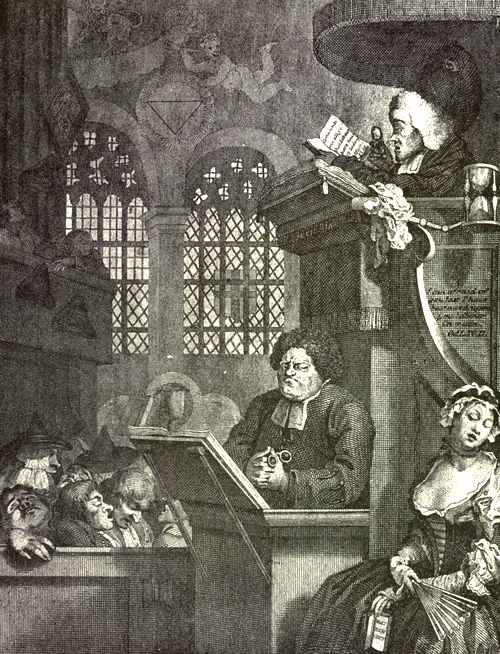
THE SLEEPING CONGREGATION.

The shepherd is not much more awake than
his sleeping flock, whose appearance convinces
us that, though there is no organ,
there is much melody. The nasal music of the congregation,
joined to the languid monotony of the
preacher,[120] which sounds like the drowsy hum of a
drone bee, must form such a concert as neither Tubal
Cain nor Sir John Hawkins ever dreamed of. The
text is perfectly applicable to the audience, "Come
unto me, all ye that are weary and heavy laden, and
I will give you rest." His parishioners have not
troubled themselves much about the Greek version;
good, easy men, they take these words in their literal
sense, and, after the toil of six days, find the church
a comfortable and convenient dormitory. By the
preacher's aspect and attitude, we are convinced that
he would lull to soft repose the most lively assembly
that ever congregated in the capital. How, then,
must his manner operate here? As an opiate more
powerful than poppies. It is as composing as are the
very descriptive lines that conclude the second book
of Pope's Dunciad; which are so perfectly an echo to
the sense, that they ought to be inscribed on the front
of the first temple which is dedicated to Somnus. He
"In one lazy tone,
Through the long, heavy, painful page, drawls on.
Soft creeping words on words the sense compose;
At every line they stretch, they yawn, they doze.
As to soft gales top-heavy pines bow low
Their heads, and lift them as they cease to blow,
Thus oft they rear, and oft the head decline,
As breathe or pause by fits the airs divine:
And now to this side, now to that they nod," etc.
The clerk,[121] infinitely more important than the
divine, is kept awake by contemplating the charms of
a voluptuously blooming damsel, who, in studying
the Service of Matrimony, has sighed her soul to
rest. The eyes of this pronouncer of Amen are
visibly directed to her.
In the pew opposite are five swains of the village;
"Each mouth distended, and each head reclin'd,
They soundly sleep."
To render this rural scene more pastoral, they are
accompanied by two women who have once been
shepherdesses, and perhaps celebrated by some neighbouring
Theocritus as the Chloe and Daphne of their
day. Being now in the wane of their charms, poetical
justice will not allow us to give them any other
appellation than old women. They are awake.
Whether the artist intended by this to show that
they are actuated by the spirit of contradiction, for
the preacher entreats them to go to rest, or meant it
as a compliment to the softer sex, as being more
attentive than men, I cannot tell; let those who have
studied their characters more than I have, determine
as seemeth best in their eyes.
In the gallery are two men joining in chorus with
the band below. One of them has the decency to
hide his face; but the other is evidently in full
song.
The heavy architecture and grotesque decorations
lead us to conjecture that this now venerable edifice
was once the cottage of Baucis and Philemon, so
exquisitely described by Swift:
"Grown to a church by just degrees—
—— The ballads pasted on the wall,
Of Joan of France, and English Moll,
Fair Rosamond, and Robin Hood,
The little Children in the Wood,
Now seem to look abundance better,
Improv'd in picture, size, and letter,
And, high in order plac'd, describe
The heraldry of every tribe."
The "Children in the Wood" are now exalted
above the Gothic windows. One of them we see
transformed to an angel; which, to prove its being of
a more exalted species, and no longer a mere mortal,
has four thighs.
"The pretty Robin Redbreasts, which
Did cover them with leaves,"
have undergone a transmigration much to their
advantage. It has somewhat sullied their plumage,
but they have assumed a more important appearance,
and the loss of beauty is compensated by an abundant
increase in bulk and dignity. Exalted to the
upper part of a fluted pillar, and seated in heraldic
state, they seem to mortal eyes the emblems of
wisdom, the symbols of Minerva.[122]
A lion and companion unicorn, concealed by the
pillar, was originally an headpiece to that excellent
old ballad, beginning with
"The fierce lyon of faire Englonde
Didde swallowe the lillie of France."
With jaws extended wide enough to swallow a bed of
lilies, he is one of the supporters to the king's arms.
The pews carry evident marks of having been once
a Gothic bedstead. The cumbrous load of oak with
which it was canopied, still supported by large square
posts, is become a gallery. The lower part retains
much of its original form, and answers its original
purpose; but why should I attempt to describe that
which is already described by the Dean?
"A bedstead of the antique mode,
Compact of timber many a load;
Such as our ancestors did use,
Is metamorphos'd into pews,
Which still their ancient nature keep,
Of lodging folks dispos'd to sleep."
The pulpit in which our dozing divine is groaning
out the gospel, was once a groaning-chair for the
good wife of the cottage. The cushion on which she
sat for many a winter's eve is now ornamented with
tassels. The arm still retains its original form, though
somewhat more upright than when it served for a
rest to the old dame's elbow. Swift describes the
exact manner of the metamorphosis:
"The groaning-chair began to crawl,
Like an huge snail against the wall;
There stuck aloft, in public view,
And with small change a pulpit grew."
The crutches, which erst supported Dame Baucis,
now prop the clerk's reading-desk.
The triangle, environed by a glory, was placed in
the church by old Philemon. In his youth he had
been a very good carpenter, and, when become a
divine, retained so much of his original disposition
as to suppose he could explain an awful mystery by
a mechanical representation. The only misfortune
which attended this curious delineation was, that not
one of his parishioners could understand it: they
however, were silent; they thought it too serious
an affair to dispute or call names about. It would
perhaps have been as well if many of our learned and
right grave divines had been silent upon this subject
on the same principle.
Swift says that the jack was turned to a clock; in
this circumstance he must have been mistaken, for
the hour-glass, which was the constant companion of
Dame Baucis at her wheel, retains its old form, and
is placed at the parson's left hand.[123] Underneath it
is the following applicable inscription from St. Paul's
Epistle to the Galatians: "I am afraid of you, lest I
have bestowed upon you labour in vain."
The windows are evidently intended for companions,
but there is a considerable difference in their
proportions, panes of glass, etc. At the time this
massy temple was erected, our countrymen neither
studied Vitruvius, nor considered uniformity as a
requisite in architecture.
This print was published on the 26th of October
1736; but we learn, by an inscription on the sinister
side of the plate, that on the 21st April 1762 it was
retouched and improved by the author.
There is a printed copy, tolerably executed, but
not quite so large, nor has it any price affixed beneath.
The original picture was in Sir Edward Walpole's
collection; who is the present proprietor I do not
know. There are some variations in it; the face of
the clerk is different from the print, and he does not
appear leering at the girl, but, to keep in unison with
the rest of the congregation, is half asleep.
"Furnish'd with paper, pen, and ink,
He gravely sat him down—to think:
He bit his nails, and scratch'd his head,
But wit and fancy both were dead:
Or, if with more than usual pain,
A thought came slowly from his brain,
It cost him Lord knows how much time
To shape it into sense or rhyme;
And what was yet a greater curse,
Long thinking made his fancy worse."
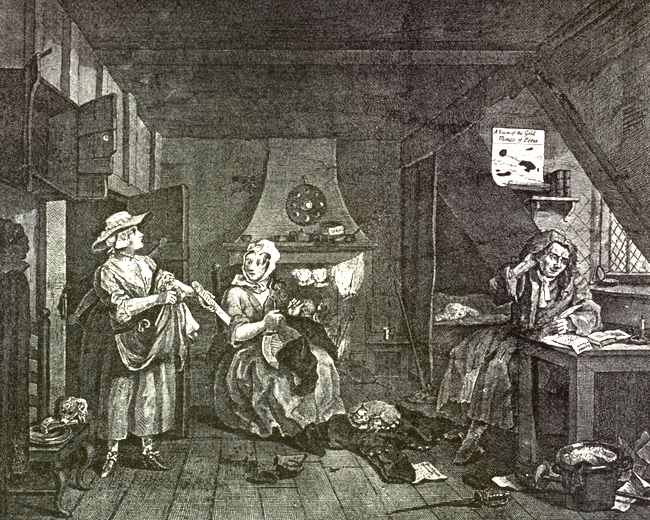
THE DISTRESSED POET.

Such is the fate of many a miserable scribbler
who usurps the sacred name of a
poet. Parnassus must be peopled, and
the fashionable versifiers that have no other aim than
feeding on the mountain have sometimes cropped
better pasturage at the foot of the hill than has been
found by those hallowed bards who have attained the
summit. Of gentle readers that demand the strains
of gentle writers, there are in this our city an innumerable
host. They are sober and well-disposed
persons, good subjects to their king, and useful
members of the community; but being by their
various avocations confined to a smoky town, are
debarred from the cheering prospects of purling
streams, waving woods, and shady groves. They
have nevertheless great comfort and delectation in
reading descriptions of scenes so profusely beautified
with the amenities of nature. Happily for such admirers
of rural simplicity, there is a band of pastoral
poets who make the press groan with description.
Seated like this unfortunate labourer of the Muses
in their attic storey, and scarcely ever seeing a green
tree except in the Moorfields Mall, they daily present
the public with amplifications of verdant meads,
glistening dew-drops, and liquid rains. In the sublime
strains of these gentlemen,
"The misty mountains lift their cloud-capt heads;
The enamell'd mead its velvet carpet spreads;
The groves appear all drest with wreaths of flowers,
And from their leaves drop aromatic showers."[124]
Upon the same principle with our town-made
rhymers, who have generally written about things
which they have neither seen, felt, heard, nor understood,
this our distressed poet is now spinning a poem
upon riches. Of their use he probably knoweth little;
and of their abuse, if judgment can be formed from
externals, certes he knoweth less.
Seated upon the side of his bed, without a shirt,
but wrapped in an old night-gown,—enchanted, impressed,
inspired with his subject,—he is disturbed
by a nymph of the Lactarium. Her shrill sounding
voice awakes one of the little loves, whose chorus
disturbs his meditations. A link of the golden chain
is broken!—a thought is lost! To recover it, his hand
becomes a substitute for the barber's comb: enraged
at the noise, he tortures his head for the fleeting idea;
but, ah! no thought is there!
Proudly conscious that the lines already written
are sterling, he possesses by anticipation the mines of
Peru, a view of which hangs over his head. Upon
the table we see Byshe's Art of Poetry;[125] for, like
the packhorse who cannot travel without his bells,
he cannot climb the hill of Parnassus without his
jingling-book. On the floor lies the Grub Street
Journal,[126] to which valuable repository of genius and
taste he is probably a contributor. To show that he
is a master of the profound, and will envelope his
subject in a cloud, his pipe and tobacco-box—those
friends to cogitation deep—are close to him.
His wife, mending that part of his dress in the
pockets of which the affluent keep their gold, is
worthy of a better fate. Her figure is peculiarly
interesting.[127] Her face, softened by adversity, and
marked with domestic care, is at this moment agitated
by the appearance of a boisterous woman,
insolently demanding payment of the milk-tally.
In the excuse she returns, there is a mixture of
concern, complacency, and mortification. As an
addition to the distresses of this poor family, a dog
is stealing the remnant of mutton incautiously left
upon a chair.
The sloping roof and projecting chimney prove
the throne of this inspired bard to be high above the
crowd;—it is a garret. The chimney is ornamented
with a dare for larks; and a book, a loaf, the tea-equipage,
and a saucepan, decorate the shelf. Before
the fire hangs half a shirt and a pair of ruffled sleeves.
His sword lies on the floor; for though our professor
of poetry waged no war, except with words, a sword
was in the year 1740 a necessary appendage to every
thing which called itself gentleman. At the feet of
his domestic seamstress, the full-dress coat is become
the resting-place of a cat and two kittens: in the same
situation is one stocking; the other is half immersed
in the washing-pan. The broom, bellows, and mop
are scattered round the room. The open door shows
us that their cupboard is unfurnished, and tenanted by
an hungry and solitary mouse. In the corner hangs
a long cloak, well calculated to conceal the threadbare
wardrobe of its fair owner.
Mr. Hogarth's strict attention to propriety of
scenery is evinced by the cracked plastering of the
walls, broken window, and uneven floor, in the miserable
habitation of this poor weaver of madrigals.[128]
The original picture is in the collection of Lord
Grosvenor.
"With thundering noise the azure vault they tear,
And rend, with savage roar, the echoing air:
The sounds terrific he with horror hears;
His fiddle throws aside,—and stops his ears."—E.
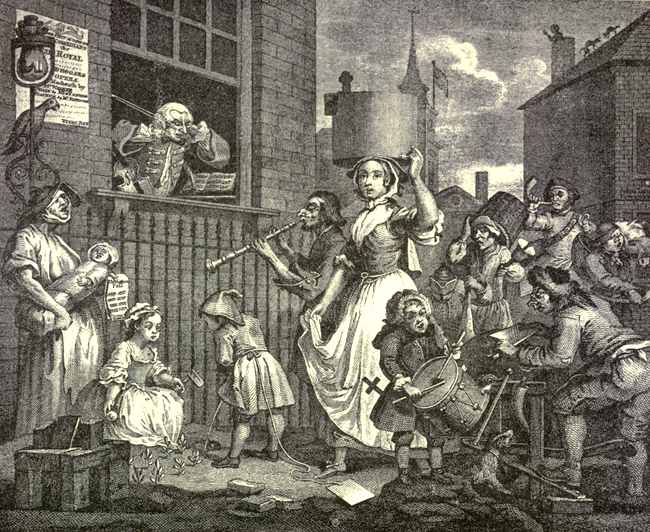
THE ENRAGED MUSICIAN.
The last plate displayed the distress of a
poet; in this the artist has exhibited the
rage of a musician. Our poor bard bore
his misfortunes with patience, and, rich in his Muse,
did not much repine at his poverty. Not so this
master of harmony—of heavenly harmony! To the
evils of poverty he is now a stranger; his adagios and
cantabiles have procured him the protection of nobles;
and, contrary to the poor shirtless mendicant of the
Muses that we left in a garret, he is arrayed in a coat
decorated with frogs, a bag-wig, solitaire, and ruffled
shirt. Waiting in the chamber of a man of fashion,
whom he instructs in the divine science of music,
having first tuned his instrument, he opens his
crotchet-book, shoulders his violin, flourishes his
fiddlestick, and
"Softly sweet, in Lydian measure,
Soon he soothes his soul to pleasure."
Rapt in Elysium at the divine symphony, he is
awakened from his beatific vision by noises that
distract him:
"An universal hubbub wild,
Of stunning sounds, and voices all confus'd,
Assails his ears with loudest vehemence."
Confounded with the din, and enraged by the interruption,
our modern Terpander starts from his seat,
and opens the window. This operates as air to a
kindling fire; and such a combination of noises burst
upon the auricular nerve that he is compelled to stop
his ears,—but to stop the torrent is impossible!
"A louder yet, and yet a louder strain,
Break his bands of thought asunder!
And rouse him, like a rattling peal of thunder,
At the horrible sound
He has rais'd up his head,
As awak'd from the dead,
And amazed he stares all around."
In this situation he is delineated; and those who
for a moment contemplate the figures before him,
cannot wonder at his rage:
"A crew of hell-hounds never ceasing bark,
With wide Cerberean mouth, full loud, and ring
A hideous peal."
Of the dramatis personæ who perform the vocal
parts, the first is a fellow in a tone that would rend
hell's concave, bawling, "Dust, ho! dust, ho! dust!"
Next to him, an amphibious animal, who nightly
pillows his head on the sedgy bosom of old Thames,
in a voice that emulates the rush of many waters,
or the roaring of a cataract, is bellowing, "Flounda-a-a-rs!"
A daughter of May-day, who dispenses
what in London is called milk, and is consequently a
milkmaid, in a note pitched at the very top of her
voice, is crying, "Be-louw!" While a ballad-singer
dolefully drawls out The Ladie's Fall, an infant in her
arms joins its treble pipe in chorus with the screaming
parrot, which is on a lamp-iron over her head.
On the roof of an opposite house are two cats, performing
what an amateur of music might perhaps call
a bravura duet; near them appears
A sweep, shrill twittering on the chimney-top.
A little French drummer, singing to his rub-a-dub,
and the agreeable yell of a dog, complete the vocal
performers.
Of the instrumental, a fellow blowing a horn with
a violence that would have almost shaken down the
walls of Jericho claims the first notice; next to him,
the dustman rattles his bell with ceaseless clangour,
until the air reverberates the sound.
The intervals are filled up by a pavior, who to
every stroke of his rammer adds a loud, distinct, and
echoing "Haugh!" The pedestrian cutler is grinding
a butcher's cleaver with such earnestness and
force, that it elicits sparks of fire. This, added to the
agonizing howls of his unfortunate dog, must afford
a perfect specimen of the ancient chromatic. The
poor animal,[129] between a man and a monkey, piping
harsh discords upon a hautboy, the girl whirling her
crepitaculum, or rattle, and the boy beating his drum,
conclude the catalogue of this harmonious band.
Thus much we may be almost said to hear; and
we see, by the flag displayed at the church, that the
fanciers of corals for grown gentlemen are performing
a round of double bob-majors in the belfry. "John
Long, pewterer," is inscribed over a door, and intimates
the business going on in the house, where the
strokes of some thirty or forty hammers ringing incessantly
upon pewter, produce a sound more sonorous
than that which is echoed from the forge of Vulcan.
This delineation originated in a story which was
told to Hogarth by the late Mr. John Festin,[130] who is
the hero of the print. He was eminent for his skill
in playing upon the German flute and hautboy, and
much employed as a teacher of music. To each of his
scholars he devoted one hour each day. "At nine
o'clock in the morning," said he, "I once waited upon
my Lord Spencer; but his lordship being out of
town, from him I went to Mr. V——n, now Lord
V——n. It was so early, that he was not arisen. I
went into his chamber, and, opening a shutter, sat
down in the window-seat. Before the rails was a
fellow playing upon the hautboy. A man with a
barrow full of onions offered the piper an onion if he
would play him a tune. That ended, he offered a
second onion for a second tune; the same for a
third, and was going on: but this was too much,—I
could not bear it,—it angered my very soul—'Zounds!'
said I, 'stop here! This fellow is ridiculing
my profession—he is playing on the hautboy
for onions!'"
The whole of this bravura scene is admirably represented.
A person quaintly enough observed that
it deafens one to look at it.
The roar of the fisherman, with one hand so placed
as to become a sort of sounding-board, and give reverberation,
is admirably depicted. You perceive
that he has, professionally speaking, not merely a
volume, but a folio volume of voice. As well as that
of the dustman, it is a thorough bass; and, added to
the tenor and treble of the other performers, must
form a concert, though not quite so harmonious, yet
nearly as loud, as those which have been graced with
the royal presence in Westminster Abbey.
The scene seems to be taken from the lower part
of St. Martin's Lane; it is certainly intended to represent
the steeple of St. Martin's Church.
A heap of bricks, scientifically piled up close to the
little girl, have been said to be a contrivance of some
boy to catch birds. Is it not more likely that the
modern architecture of this little Babel, as well as
the adjoining plantation and pond, originated in the
united efforts of the young lady and young gentleman
in a corner cap? The latter has been dragging
a slate fastened to a string, and tied round his waist,
over a rough pavement, that he also might make a
pretty noise.
A play-bill on the wall describes the unaccountable
run of that very popular and pernicious performance,
The Beggar's Opera, to have been sixty-two nights.
In a copy of this opera, published in 1729, the dramatis
personæ are printed as here written; and the good
fortune which followed Miss Fenton's attractions in
Polly are universally known.
The figures are well grouped and judiciously characterized:
those in the background have great force;
but the boy with a drum is ill drawn, and the milk-pail
is too large.
In the London Daily Post for November 24, 1740, is
the following advertisement:—"Shortly will be published,
a new print, called The Provoked Musician,
designed and engraved by Mr. William Hogarth;
being a companion to a print representing a Distressed
Poet, published some time since. To which
will be added, a third on painting, which will complete
the set; but as this subject may turn upon an
affair depending between the Right Hon. the Lord
Mayor and the author, it may be retarded for some
time."
Humphry Parsons was at that time Lord Mayor;
but the business alluded to not being in the city
records, must remain obscure until some one who
knows more about it than I do shall explain it.
In Dr. Beattie's Essay on Laughter and Ludicrous
Composition, quarto edition, p. 608, speaking of the
modes of combination by which incongruous qualities
may be presented to the eye or the fancy, so as to
provoke laughter, he observes, that "this extraordinary
group form a very comical mixture of incongruity
and relation: of incongruity, owing to the
dissimilar employment and appearances of the several
persons, and to the variety of dissonance of their
respective noises; and of relation, owing to their being
all united in the same place, and for the same
purpose of tormenting the poor fiddler. From the
various sounds co-operating to this one end, the
piece becomes more laughable than if their meeting
were conceived to be without any particular destination;
for the greater number of relations, as well as
of contrarieties, that take place in any ludicrous
assembly, the more ludicrous it will generally appear.
Yet though this group comprehends not any mixture
of meanness and dignity, it would, I think, be allowed
to be laughable to a certain degree, merely from the
juxtaposition of the objects, even though it were supposed
to be accidental."
Of the immense fortunes realized by the Italian
professors of music, we have many examples in this
island; but the success of Lully, in France, was
greater than any of his countrymen ever experienced
here. He was by birth a Florentine. By his fiddle
and his impudence, he raised himself from the Queen
of France's kitchen to be chief of the band of music,
and carried the art to a degree of perfection hitherto
unknown in that kingdom. Louis XIV. gave him
letters of nobility, and on his account enacted that the
profession of music should consist with the quality of
a gentleman. He died by excessive drinking, and
left an immense fortune. The nobleman who had
entertained him when he drank what proved his
quietus, paying him a visit, "Ah! my lord," said his
wife, with a deep sigh, "you are the last who made
my husband drunk." Lully, who was dying, heard
the remark, and had just voice enough left to add,
"He shall be the first who makes me so again, when
I get upon my legs!"

In the "Progress of an Harlot," and the
"Adventures of a Rake," Mr. Hogarth
displayed his powers of painting history.
Holding the mirror up to Nature, he shows
"Virtue her own feature, Vice her own image, and the very age and
body of the time his form and pressure."
Had he exhibited no other specimen of his art, these
fourteen prints would have given him a right to the
title of a moral painter; and thus was he denominated
by the late Mr. Fielding, in his Adventures of Joseph
Andrews.
In the series before us he treads poetic ground. A
description of the day, particularly the morning, has
been generally deemed the bard's peculiar province.
Considering Homer as the father of poesy, the whole
family of Apollo have echoed his notes, and run their
divisions of fancy upon his scale. With one of them,
"The morn, wak'd by the circling hours,
Unbars the gates of light."
With another, she "sows the earth with orient pearl."
At one time, with a star as her gentleman usher, she
"Draws night's humid curtains, and proclaims
The new-born day forth dawning from the east;"
is now the grey Aurora, then the meek-ey'd morn,
array'd in a dewy robe, with saffron streamers, placed
in a glittering chariot, and drawn by etherial coursers,
where, holding the reins with her red hands, she drives
the day.
These heathenish descriptions may be very beautiful
in their way; but hear our own Shakspeare:
"Night's tapers are burnt out, and jocund day
Stands tiptoe on the misty mountain's top."
Again:
"The glow-worm shows the matin to be near,
And 'gins to pale her ineffectual fire."
This comes home to all men's business and bosoms:
it is picturesque, it is poetical; it is intelligible to the
peasant or the philosopher, to the classic admirer of
ancient mythology, or the man who never heard that
the gates which Aurora unbars are made of the purest
crystal.
The pictures drawn by Homer, and those feeble
imitators who debase his splendid images by the mixture
of their own dross, have their scenes laid in the
country; but Hogarth has represented his dramatis
personæ in the centre of a great city. Had the learned
author of Hudibras been a painter, I believe he would
have done the same. It will not be easy to select two
lines that have more wit than his description of the
morning:
"Now, like a lobster boil'd, the morn
From black to red began to turn."
This is appropriate to either city or country.
In Mr. Hogarth's "Four Times of the Day" there
is only one scene laid out of town; and that may, I
think, be properly enough called a London pastoral,
for it is at the pleasant village of Islington. The three
others are described as in the most public parts of the
metropolis, and exhibit a picture which will give a
very correct idea of the dresses and pursuits of the
inhabitants of London in the year 1738.
"Keen blows the blast, and eager is the air;
With flakes of feather'd snow the ground is spread;
To step, with mincing pace, to early prayer,
Our clay-cold vestal leaves her downy bed.
. . . . . . .
And here the reeling sons of Riot see,
After a night of senseless revelry.
. . . . . . .
Poor,—trembling,—old,—her suit the beggar plies;
But frozen chastity the little boon denies."—E.
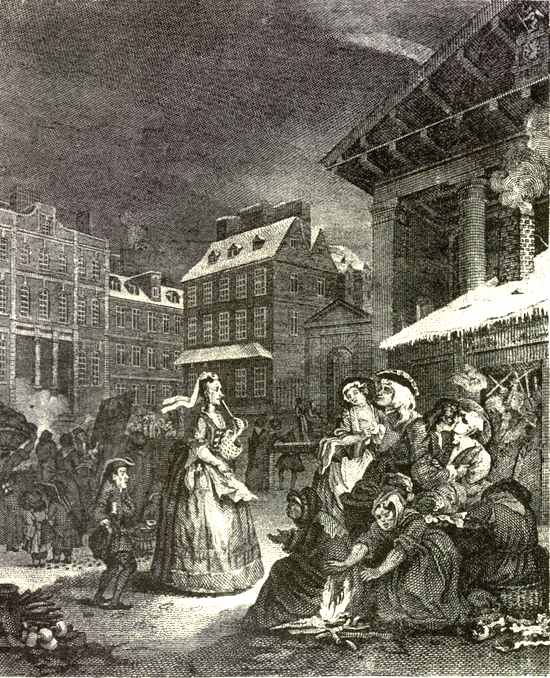
MORNING.
This withered representative of Miss Bridget Alworthy,
with a shivering footboy carrying her prayer-book,
never fails in her attendance at morning service.
She is a symbol of the season,
"Chaste as the icicle
That's curdled by the frost from purest snow,
And hangs on Dian's temple,"
she looks with scowling eye, and all the conscious
pride of severe and stubborn virginity, on the poor
girls who are suffering the embraces of two drunken
beaux that are just staggered out of Tom King's
Coffeehouse. One of them, from the basket on her
arm, I conjecture to be an orange girl: she shows no
displeasure at the boisterous salute of her Hibernian
lover. That the hero in a laced hat is from the banks
of the Shannon, is apparent in his countenance. The
female whose face is partly concealed, and whose
neck has a more easy turn than we always see in the
works of this artist, is not formed of the most inflexible
materials.
An old woman, seated upon a basket; the girl,
warming her hands by a few withered sticks that are
blazing on the ground; and a wretched mendicant,[131]
wrapped in a tattered and party-coloured blanket,
entreating charity from the rosy-fingered vestal who
is going to church, complete the group. Behind them,
at the door of Tom King's Coffeehouse, are a party
engaged in a fray likely to create business for both
surgeon and magistrate; we discover swords and
cudgels in the combatants' hands.
On the opposite side of the print are two little
schoolboys. That they have shining morning faces
we cannot positively assert, but each has a satchel at
his back, and, according with the description given by
the poet of nature, is
"Creeping like snail unwillingly to school."
The lantern appended to the woman who has a
basket on her head, proves that these dispensers of
the riches of Pomona rise before the sun, and do part
of their business by an artificial light. Near her, that
immediate descendant of Paracelsus, Doctor Rock,[132] is
expatiating to an admiring audience on the never-failing
virtues of his wonder-working medicines. One
hand holds a bottle of his miraculous panacea, and the
other supports a board, on which is the king's arms, to
indicate that his practice is sanctioned by royal letters
patent. Two porringers and a spoon, placed on the
bottom of an inverted basket, intimate that the woman
seated near them is a vendor of rice-milk, which was
at that time brought into the market every morning.
A fatigued porter leans on a rail; and a blind
beggar is going towards the church: but whether he
will become one of the congregation, or take his
stand at the door, in the hope that religion may have
warmed the hearts of its votaries to "pity the sorrows
of a poor blind man," is uncertain.
The clock in the front of Inigo Jones' barn has
the motto, "SIC TRANSIT GLORIA MUNDI." Had
Mr. Hervey of Weston Favel written upon the
works of Hogarth, he would have expatiated for ten
pages upon the relation which this motto has to the
smoke which is issuing from the chimney beneath;
he would have written about it, and about it, and told
his readers that the glory of this world is typified by
the smoke, and like the smoke it passeth away; that
man himself is a mere vapour, etc. etc. etc.
Snow on the ground, and icicles hanging from the
pent-house, exhibit a very chilling prospect; but, to
dissipate the cold, there is happily a shop where
spirituous liquors are sold pro bono publico, at a very
little distance. A large pewter measure is placed
upon a post before the door, and three of a smaller
size hung over the window of the house.
The character of the principal figure[133] is admirably
delineated. She is marked with that prim and
awkward formality which generally accompanies her
order, and is an exact type of a hard winter; for
every part of her dress, except the flying lappets and
apron, ruffled by the wind, is as rigidly precise as if
it were frozen. Extreme cold is very well expressed
in the slipshod footboy,[134] and the girl who is warming
her hands. The group of which she is a part
is well formed, but not sufficiently balanced on the
opposite side.
The church dial, a few minutes before seven; marks
of little shoes and pattens in the snow; and various
productions of the season in the market, are an additional
proof of that minute accuracy with which this
artist inspected and represented objects which painters
in general have neglected.
Covent Garden is the scene, but in the print every
building is reversed.[135] This was a common error with
Hogarth; not from his being ignorant of the use of
the mirror, but from his considering it as a matter of
little consequence.
The propriety of exhibiting a scene of riot in Tom
King's Coffeehouse is proved by the following quotation
from the Weekly Miscellany for June 9, 1739:—"Monday,
Mrs. Mary King, of Covent Garden, was
brought up to the King's Bench bar, at Westminster,
and received the following sentence for keeping a disorderly
house, viz. to pay a fine of two hundred pounds,
to suffer three months' imprisonment, to find security
for her good behaviour for three years, and to remain
in prison till the fine be paid." When her imprisonment
ended, she retired from trade, built three houses
on Haverstock Hill, near Hampstead, and in one of
them, on the 10th of September 1747, she died. Her
mansion was afterwards the residence of Nancy
Dawson, and with the two others constitutes what is
still distinguished by the appellation of Moll King's
Row.
"Hail, Gallia's daughters! easy, brisk, and free;
Good-humour'd, debonnaire, and degagée:
Though still fantastic, frivolous, and vain,
Let not their airs and graces give us pain:
Or fair, or brown, at toilet, prayer, or play,
Their motto speaks their manners,—'Toujours gai.'
But for that powder'd compound of grimace,
That capering he-she thing of fringe and lace;
With sword and cane, with bag and solitaire,
Vain of the full-dress'd dwarf,—his hopeful heir,
How does our spleen and indignation rise,
When such a tinsell'd coxcomb meets our eyes,
So twisted out of God and Nature's plan,—
Yet know that coxcomb must be call'd a man!"—E.
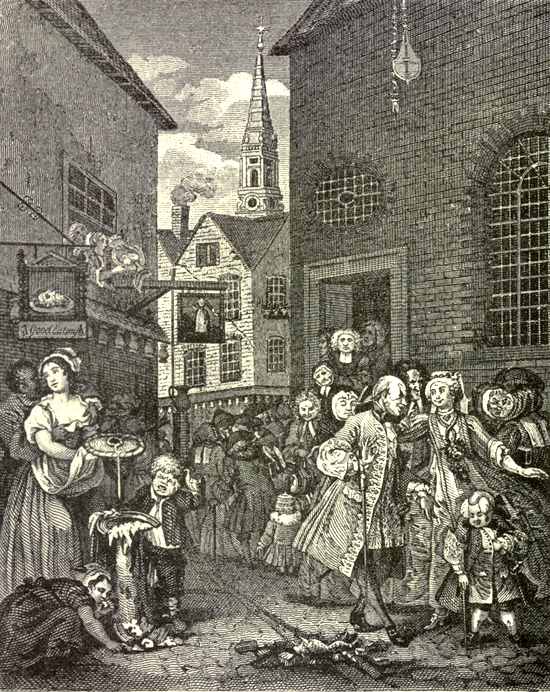
NOON.
Among the figures who are coming out of church,
an affected, flighty Frenchwoman, with her fluttering
fop of an husband, and a boy, habited à-la-mode
de Paris, claim our first attention. In dress,
air, and manner, they have a national character.
The whole congregation, whether male or female,
old or young, carry the air of their country in
countenance, dress, and deportment. Like the three
principal figures, they are all marked with some
affected peculiarity. Affectation in a woman is supportable
upon no other ground than that general
indulgence we pay to the omnipotence of beauty,
which in a degree sanctifies whatever it adopts. In a
boy, when we consider that the poor fellow is attempting
to copy what he has been taught to believe
praiseworthy, we laugh at it—the largest portion of
ridicule falls upon his tutors; but in a man, it is contemptible!
The old fellow in a black periwig has a most
vinegar-like aspect, and looks with great contempt at
the frippery gentlewoman immediately before him.
The woman with a demure countenance seems very
piously considering how she can contrive to pick the
embroidered beau's pocket. Two old sibyls joining
their withered lips in a chaste salute, is nauseous
enough, but, being a national custom, must be forgiven.
The divine seems to have resided in this
kingdom long enough to acquire a roast-beef countenance.
A little boy, whose woollen night-cap is
pressed over a most venerable flowing periwig, and the
decrepid old man, leaning upon a crutch-stick, who is
walking before him, I once considered as two vile
caricatures, out of nature, and unworthy the artist.
Since I have seen the peasantry of Flanders and the
plebeian youth of France, I have in some degree
changed my opinion, but still think them rather outré.
Under a sign of the Baptist's Head is written,
"Good Eating;" and on each side of the inscription
is a mutton chop. In opposition to this head without
a body, unaccountably displayed as a sign at an
eating-house, there is a body without a head, hanging
out as the sign of a distiller's. This, by common
consent, has been quaintly denominated "The Good
Woman."[136] At a window above, one of the softer sex
proves her indisputable right to the title by her
temperate conduct to her husband, with whom having
had a little disagreement, she throws their
Sunday's dinner into the street.
A girl, bringing a pie from the bakehouse, is
stopped in her career by the rude embraces of a
blackamoor, who eagerly rubs his sable visage against
her blooming cheek.
Good eating is carried on to the lower part of the
picture. A boy,[137] placing a baked pudding upon a
post with rather too violent an action, the dish
breaks, the fragments fall to the ground; and while
he is loudly lamenting his misfortune, and with
tears anticipating his punishment, the smoking remnants
are eagerly snatched up by a poor girl. Not
educated according to the system of Jean Jacques
Rousseau, she feels no qualms of conscience about
the original proprietor, and destitute of that fastidious
delicacy which destroys the relish of many a fine
lady, eagerly swallows the hot and delicious morsels
with all the concomitants.
The scene is laid at the door of a French chapel
in Hog Lane,—a part of the town at that time
almost wholly peopled by French refugees or their
descendants.
A kite blown from an adjacent field,[138] being entangled
on the roof of the chapel, hangs pendant
on the wall. One of Mr. Hogarth's commentators
asserts, that "this is introduced only to break the
disagreeable uniformity of a wall."[139] It certainly has
that effect; but Hogarth so rarely presents any
object without a particular and pointed allusion, that
I am inclined to think he had some other meaning.
May it not be designed to intimate that the good
people who compose the congregation, after being
blown out of their own country by a religious storm,
found a peaceful harbour under this roof, safely
sheltered from the hurricanes of enthusiasm and the
blasts of superstition?
By the dial of St. Giles' Church, in the distance,
we see that it is only half-past eleven. At this early
hour, in those good times, there was as much good
eating as there is now at six o'clock in the evening.
From twenty pewter measures, which are hung up
before the houses of different distillers, it seems that
good drinking was considered as equally worthy of
their serious attention.
The dead cat and choked kennels mark the little
attention shown to the streets by the scavengers of
St. Giles'. At that time noxious effluvia was not
peculiar to this parish. The neighbourhood of Fleet
Ditch, and many other parts of the city, were equally
polluted.
Even at this refined period, there would be some
use in a more strict attention to the medical police
of a city so crowded with inhabitants. We ridicule
the people of Paris and Edinburgh for neglecting so
essential and salutary a branch of delicacy, while the
kennels of a street in the vicinity of St. Paul's Church
are floated with the blood of slaughtered animals
every market day. Moses would have managed
these things better: but in those days there was no
physician in Israel!
"One sultry Sunday, when no cooling breeze
Was borne on Zephyr's wing to fan the trees;
One sultry Sunday, when the torrid ray
O'er nature beam'd intolerable day;
When raging Sirius warn'd us not to roam,
And Galen's sons prescrib'd—cool draughts at home;
One sultry Sunday, near those fields of fame
Where weavers dwell, and Spital is their name,
A sober wight, of reputation high
For tints that emulate the Tyrian dye,
Wishing to take his afternoon's repose
In easy-chair, had just began to doze,
When, in a voice that sleep's soft slumbers broke,
His oily helpmate thus her wishes spoke:
"'Why, spouse, for shame!—my stars! what's this about?
You's ever sleeping!—come, we'll all go out;—
At that there garden,—pr'ythee, do not stare!—
We'll take a mouthful of the country air;
In the yew bower an hour or two we'll kill;
There you may smoke, and drink what punch you will.
Sophy and Billy each shall walk with me,
And you must carry little Emily.
Veny is sick, and pants, and loathes her food;
The grass will do the pretty creature good.
Hot rolls are ready as the clock strikes five—
And now 'tis after four, as I'm alive!'
"The mandate issued, see the tour begun,
And all the flock set out for Islington.
Now the broad sun, refulgent lamp of day,
To rest with Thetis, slopes his western way,
O'er every tree embrowning dust is spread,
And tipt with gold is Hampstead's lofty head.
The passive husband, in his nature mild,
To wife consigns his hat, and takes the child;
But she,—a day like this hath never felt—
'Oh! that this too, too solid flesh would melt,
Thaw, and resolve itself into a dew!'—
Such monstrous heat—dear me!—she never knew.
'Adown her innocent and beauteous face,
The big, round pearly drops each other chase;'
Thence trickling to those hills, erst white as snow,
That now like Ætna's mighty mountains glow,
They hang like dew-drops on the full-blown rose,
And to the ambient air their sweets disclose.
Fever'd with pleasure, thus she drags along;
Nor dares her antler'd husband say 'tis wrong;
The blooming offspring of this blissful pair,
In all their parents' attic pleasures share.
Sophy the soft, the mother's earliest joy,
Demands her froward brother's tinsell'd toy;
But he, enrag'd, denies the glittering prize,
And rends the air with loud and piteous cries.
Thus far we see the party on their way;
What dire disasters mark'd the close of day,
'Twere tedious, tiresome, endless to obtrude:
Imagination must the scene conclude."—E.
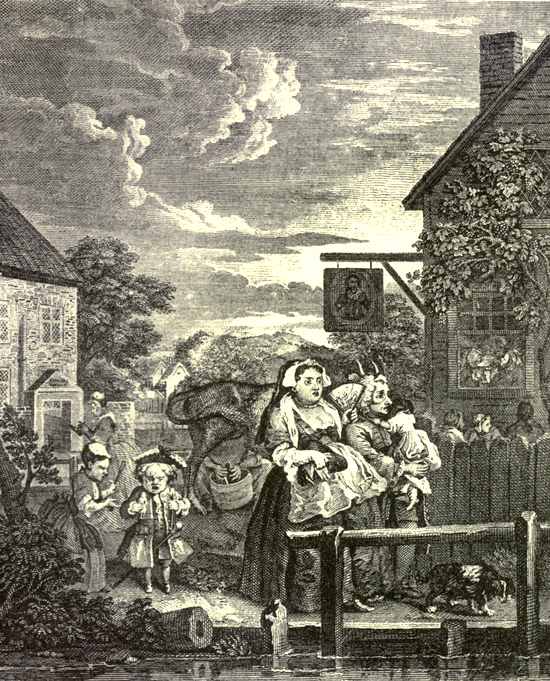
EVENING.
It is not easy to imagine fatigue better delineated
than in the appearance of this amiable pair. In
a few of the earliest impressions, Mr. Hogarth
printed the hands of the man in blue, to show
that he was a dyer, and the face and neck of the
woman in red, to intimate her extreme heat.[140] The
lady's aspect lets us at once into her character;
we are certain that she was born to command.
As to her husband, "God made him, and he must
pass for a man;" what his wife has made him is
indicated by the cow's horns, which are so placed
as to become his own. The hope of the family, with
a cockade in his hat, and riding upon papa's cane,
seems much dissatisfied with female sway. A face
with more of the shrew in embryo than that of the
girl, it is scarcely possible to conceive. Upon such a
character, the most casual observer pronounces with
the decision of a Lavater.
Nothing can be better imagined than the group in
the alehouse. They have taken a refreshing walk into
the country, and, being determined to have a cooling
pipe, seat themselves in a chair-lumbered closet with
a low ceiling; where every man pulling off his wig,
and throwing a pocket-handkerchief over his head,
inhales the fume of hot punch, the smoke of half a
dozen pipes, and the dust from the road. If this is
not rural felicity, what is? The old gentleman in a
black bag-wig, and the two women near him, sensibly
enough, take their seats in the open air.
From a woman milking a cow, we conjecture the
hour to be about five in the afternoon; and from the
same circumstance, I am inclined to think this agreeable
party are going to their pastoral bower rather
than returning from it.
The cow and dog appear as much inconvenienced
by heat as any of the party: the former is whisking
off the flies; and the latter creeps unwillingly along,
and casts a longing look at the crystal river in which
he sees his own shadow. A remarkably hot summer
is intimated by the luxuriant state of a vine creeping
over an alehouse window. On the side of the New
River, where the scene is laid, lies one of the wooden
pipes employed in the waterworks. Opposite Sadler's
Wells there still remains a sign[141] of Sir Hugh
Middleton's head, which is here represented.
This print is engraved by Baron, but some touches
of Mr. Hogarth's burin are visible on the faces.
Dr. Johnson, I think it is, who observes, that an
ardent pursuit of pleasure generally defeats its own
purpose; for when we have wasted days and nights,
and exhausted our strength in the chase, it eludes
our grasp, and vanishes from our view.
"Now burst the blazing bonfires on the sight,
Through the wide air their coruscations play;
The windows beam with artificial light,
And all the region emulates the day.
"The moping mason, from yon tavern led,
In mystic words doth to the moon complain
That unsound port distracts his aching head,
And o'er the waiter waves his clouded cane."—E.
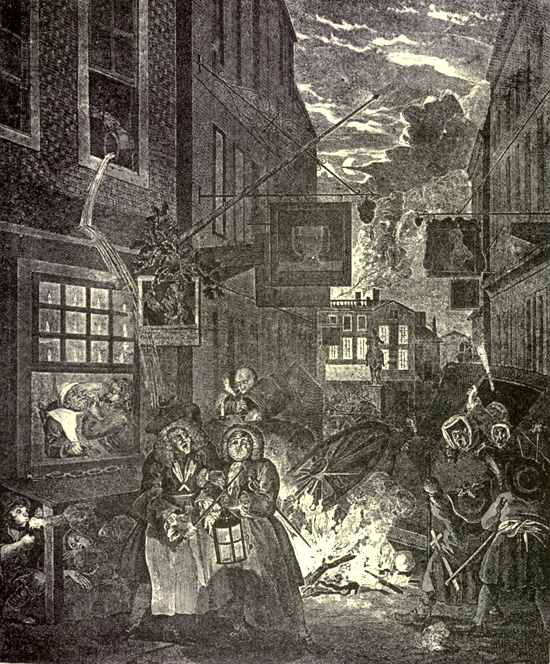
NIGHT.
Mr. Walpole very truly observes, that this print
is inferior to the three others; there is, however,
broad humour in some of the figures.
The wounded freemason, who, in zeal of brotherly
love, has drank his bumpers to the craft till he is unable
to find his way home, is under the guidance of a
waiter. This has been generally considered as intended
for Sir Thomas de Veil, and, from an authenticated
portrait which I have seen, I am inclined to
think it is, notwithstanding Sir John Hawkins asserts
that "he could discover no resemblance." When the
knight saw him in his magisterial capacity, he was
probably sober and sedate: here he is represented a
little disguised. The British Xantippe showering her
favours from the window upon his head, may have
its source in that respect which the inmates of such
houses as the Rummer Tavern had for a justice of
peace.[142]
The waiter who supports his worship seems, from
the patch upon his forehead, to have been in a recent
affray; but what use he can have for a lantern it is
not easy to divine, unless he is conducting his charge
to some place where there is neither moonlight nor
illumination.
The Salisbury flying coach oversetting and broken,
by passing through the bonfire, is said to be an intended
burlesque upon a right honourable peer, who
was accustomed to drive his own carriage over hedges,
ditches, and rivers; and has been sometimes known
to drive three or four of his maid-servants into a deep
water, and there leave them in the coach to shift for
themselves.
The butcher and little fellow who are assisting the
terrified passengers, are possibly free and accepted
masons. One of them seems to have a mop in his
hand;—the pail is out of sight!
To crown the joys of the populace, a man with a
pipe in his mouth is filling a capacious hogshead with
British Burgundy.
The joint operation of shaving and bleeding, performed
by a drunken 'prentice on a greasy oilman,
does not seem a very natural exhibition on a rejoicing
night.
The poor wretches under the barber's bench display
a prospect of penury and wretchedness which I hope
is not so common now as it was then.
In the distance is a cart laden with furniture, which
some unfortunate tenant is removing out of the reach
of his landlord's execution.
There is humour in the barber's sign and inscription:
"Shaving, bleeding, and teeth drawn with a
touch. Ecce signum!"
The Rummer Tavern still retains its old situation.
It was then quaintly distinguished as the New
Bagnio.
By the oaken boughs on the sign, and the oak
leaves in the freemasons' hats, it seems that this rejoicing
night is the 29th of May, the anniversary of
our second Charles's restoration; that happy day
when, according to our excellent old ballad, "the
king enjoyed his own again." This might be one
reason for the artist choosing a scene contiguous to
the beautiful equestrian statue[143] of Charles I.
In the distance we see a house on fire,—an accident
very likely to happen on such a night as this.
The original pictures of "Morning" and "Noon"
were sold to the Duke of Ancaster for fifty-seven
guineas; "Evening" and "Night" to Sir William
Heathcote for sixty-four guineas.
As the Act prohibiting performance of any
play or interlude which was not sanctioned
by the Lord Chamberlain passed about
the time that this print was published, and is particularly
referred to in the engraving, a short view of the
English drama, and the circumstances which occasioned
the Bill's being brought into the House of
Commons, seems immediately connected with the
subject.
Our first theatrical exhibitions had a religious tendency;[144]
they were under the direction of the clergy,
represented a story compiled from the Bible, or some
legendary tale of a canonized saint, and were denominated
mysteries. In the year 1378, the scholars
of Paul's School presented a petition to Richard II.,
praying his Majesty to prohibit some unexpert people
from presenting the History of the Old Testament, to
the great prejudice of the clergy, who had been at much
expense in order to represent it publicly at Christmas.
In 1390, interludes were played at Skinner's Well;
and again, in 1409, the parish clerks of London performed
plays for eight days successively at Clerkenwell,
which took its name from these right learned
and worthy performers. Their play had for its subject
the creation of the world, and was honoured with
the presence of most of the nobility in the kingdom,
and very many gentry also attended. This unenlightened
period has been properly called "the dead
sleep of the Muses." They did not presently awake:
the moralities which followed were produced in a
kind of morning dream. They, however, had some
shadow of meaning, which is more than can be said
of the exhibitions which preceded them. The mysteries
represented, in a confused and senseless manner,
some incredible tale; but in the moralities a plan
was aimed at, and something like poetry was attempted.
The virtues, vices, and affections of the
mind were frequently personified; good actions were
rewarded, and wickedness chastised. Religion was
at that time professed to be the leading object, and
even their amusements had a tendency to promote it:
were moralities performed now, they would unquestionably
turn upon politics.
In the reign of that most righteous prince Henry
VIII., very properly distinguished from the monarchs
who preceded him as "Defender of the Faith," and
so forth, an Act was made for the promoting of true
religion. In this Act a clause is inserted, "restraining
all rimours or plaiers from singing in songs, or playing
in interludes, anything that should contradict the
acknowledged doctrines."
It was customary at this time to enact these moral
and religious dramas in private houses; and the
dramatis personæ were so contrived, that five or six
actors might represent twenty characters. "Players,"
says honest John Stowe, "were in former times retainers
to noblemen; and none had the privilege to
act plays but such as were so retained. These
divertissements were then a recreation, and used,
therefore, now and then occasionally; but afterwards,
by abuse, they became a trade and calling, and so
remain unto this day."
In 1574, Sir James Hawes being Mayor, the Common
Council of London passed an Act, wherein it was
ordained that no play should be openly acted within
the liberties of the city, wherein should be uttered
any words, examples, or doings, of any unchastity,
sedition, or such like unfit or uncomely matters, under
the penalty of five pounds, and fourteen days' imprisonment.
And further, that no plays should be
acted till first perused and allowed by the Lord
Mayor and Court of Aldermen. But even these
sagacious and judicious laws failed in their effect, for
the drama remained not only dead, dull, and unprofitable,
but depraved; when, like the sun bursting
through a cloud,
"Immortal Shakspeare rose;
Each change of many-colour'd life he drew,
Exhausted worlds, and then imagin'd new:
Existence saw him spurn her bounded reign,
And panting Time toil'd after him in vain:
His pow'rful strokes presiding truth confess'd,
And unresisted passion storm'd the breast."
From that period to this, theatrical amusements
have undergone many changes, which do not come
into my plan to relate, and the Legislature have passed
many Acts to check their licentiousness, which it is
not my province to enumerate.
A short time previous to the publication of this
print, our dramatic writers thought proper to dip
their pens in the sea of politics. To check this growing
evil, it has been said that the minister contrived
to have a very indecent performance (fabricated for
the express purpose of showing the enormities of
writers for the theatre) presented to one of the
managers. It was brought from the manager to the
minister, shown to a number of persons in power, and
made a pretence for bringing in a Bill to prohibit the
performance of any play or interlude until it had
been perused and received the sanction of the Lord
Chamberlain for the time being. By the friends of
the ministers of that day this account has been contradicted.
They assert that a piece called the Golden
Rump, containing much personal abuse of George
II. and Queen Caroline, was on the point of being
acted at the theatre in the Haymarket. Sir Robert
Walpole having notice of it, procured a copy, in consequence
of which the performance was stopped, and
the Act passed. It was introduced as intended to
explain, amend, and enforce so much of an Act made
in the twelfth year of the reign of Queen Anne as
related to rogues, vagabonds, and common players
of interludes.
Lord Chesterfield, in a very long speech, reprobated
the principle upon which it was founded, and exerted
all his eloquence to prevent its passing into a law.
This oration gave a temporary popularity to the
speaker, but did not serve the cause for which it
was made. The Bill passed; but the people were so
irritated that the power which it gave the Lord
Chamberlain should be exerted in favour of foreigners,
that in the year 1738, when some French actors,
authorized by his licence, attempted to perform a
French play at the Haymarket, a mob in the street
broke the windows, and attempted to pull down the
house, though many persons of high rank, and the
French ambassador, were in the boxes.
The print to which this little account is introductory,
receives a title from its female performers only;
and yet in this theatrical house of commons we discover
at least four representatives of the other sex,
viz. Apollo, Cupid, and two male devils.

"Since Thespis, mighty father of the art,
Declaim'd, and rav'd, and ranted in a cart,
His wandering offspring, to their parent true,
Have kept their great original in view:
Patents they scorn, as modern innovation,
And here have humbly made a barn their station:
A barn!—in which though time has made a breach,
They cleave the general air with horrid speech.
"The wearied rustic now the flail suspends,
And the drum's thunder all the region rends;
Where erst the reapers sung their Harvest Home,
The martial trumpet echoes through the dome;
Remov'd, the chaff-dispersing, winnowing fly,
Lo! the Norwegian banners flout the sky:[145]
Where perch'd the moping owl, we now behold
The Roman eagle wave his wings in gold;
And where the circling bat each night was seen,
Medea's dragons draw their barbarous queen:
On that oak floor, once pil'd with sheaves of corn,
See Juliet's bier in sad procession borne;
Where the sleek rat was wont to pilfer grain,
The fiery Tibbald falls, and Hamlet's slain!
And where each night the cunning weazel crept,
Richard has roar'd, and Desdemona wept."—E.
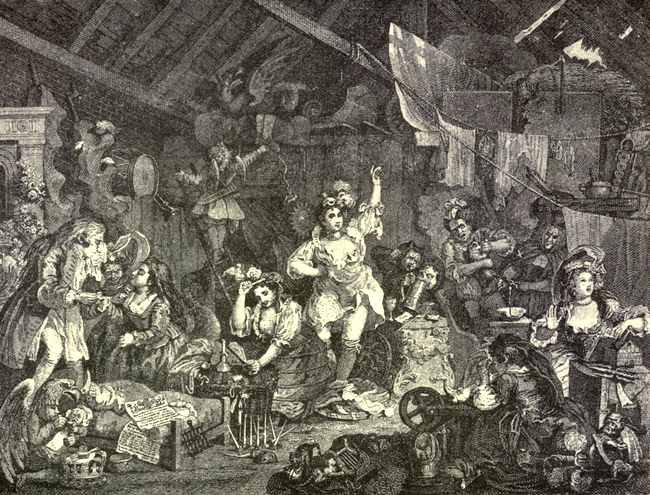
STROLLING ACTRESSES DRESSING IN A BARN.
Mr. Horace Walpole thinks that this print,
for wit and imagination, without any other
end, ought to be ranked as the first of
Hogarth's works; and Rouquet, in the only mention
he makes of it, says: "Les comédiens de campagne
sont représentés dans une grange, au milieu d'un
mélange ridicule de misere et de pompe théatrale,
se préparant à jouer une tragédie."
The scene is laid in a barn,[146] and intended to represent
the state dressing-room of a strolling company.
Here at one hour the gallant Hotspur laces on his
leathern armour, and at another the lively Beatrice
laces on her stays. The time is evening, and the
actors from the London theatres are preparing to
perform a farce, which, by the play-bill, is declared
to be The Devil to pay in Heaven. The dramatis personæ
are principally deities, and deities of the first
order. On the bill are the names of Jupiter, Juno,
Diana, Flora, Night, Siren, Aurora, Eagle, Cupid,
two devils, a ghost, and attendants. To this divine
catalogue is added rope-dancing, tumbling, etc. The
inferior performers are: two musical kittens, a pair
of fiery dragons, one Roman eagle, and though last
mentioned, not least in consequence, a venerable
monkey.
Seated upon an inverted wheel-barrow, which may
occasionally serve for a triumphal car, a lady, who
by her haughty demeanour and imperial crown we
know to be the ox-eyed Juno, is majestically stretching
out her leg, and pathetically rehearsing her part.
Descended from her ebon car, with a sooty face, and
star-bespangled robe sweeping the ground, the sable
goddess Night is mending her majesty's stocking.
The Star of Evening, which sheds its sober light above
her head, is apparently formed of a brass instrument
used in making pastry. A venerable female, with
one eye, who by the dagger in her mantle we conjecture
to be the Tragic Muse,[147] is cutting off a cat's tail,
in order to extract a sanguine stream for some
murderous representation, or that
"The mailed Mars may on his altar sit
Up to the ears in blood."
But this savage amputation, which seems to excite no
emotion in the operator, is warmly resented by the
feline sufferer, who, enraged at the pain, revenges this
barbarous indignity by tearing, with teeth and talons,
the female tumbler who holds her; and, could she
speak, would vehemently exclaim, in the words of
Shakspeare,
"Cursed the blood that let this blood from hence."
Two little devils, with horns just budded, are
eagerly contesting the right in a flagon of ale, out of
which one is drinking, and seems determined to get
to the bottom, if it were a mile. The flagon has been
placed on a Grecian altar, with a loaf of bread and a
pipe of tobacco, which being still lighted, the smoke
ascends in curling eddies; the grateful incense is inhaled
by all present,
"And heavenly fragrance fills the circuit wide."
The fascinating female stripped to her chemise, her
head decorated with feathers and flowers, is marked
by her crescent to be the goddess of the silver bow—the
chaste Diana. A principal figure in the picture,
with one foot resting upon her hoop, the other behind
the altar,
"She stands like feather'd Mercury
New lighted on a heaven-kissing hill;"
impressed with the dignity of her character, and inspired
with divine fervour, she is rehearsing her part.
At her right hand the blooming Flora is seated at
her toilet: and the toilet of Flora is a wicker hamper,
to which is appended a label inscribed Jewels; from
whence we may naturally infer that it contains the
glittering regalia of the company. "Her robe of
various dyes" is carelessly thrown over it as a veil;
and placed upon it is somewhat like part of a coffee-mill
with a candle in it, a broken looking-glass, a
broken ivory comb, and an oyster-shell, containing
what Mr. Warren emphatically calls "love-inspiring
rouge," "to dye the white rose to a bloody red."
One hand holds a candle, with which she delicately
pastes up her hair—"sweets to the sweet!" the other
grasps a dredger to powder her head.
Apollo and Cupid are jointly engaged in reaching
down a pair of stockings that are hung to dry on a
cloud. The little archer—
"Regent of love-rhymes, lord of folded arms,
The anointed sovereign of sighs and groans,
Liege of all loiterers and malcontents"—
the little archer has wings, but they will not exalt
him to the clouded canopy; he is obliged to mount a
ladder.
On the ground, beneath him, is Aurora, designated
by "the bright morning star, day's harbinger," glittering
in her hair. Her rosy fingers are employed in the
service of the charming though intoxicated siren,
who offers the hero (that is perhaps intended to personate
Ganymede) a glass of spirits. This the cupbearer
of Jupiter very gladly accepts, in the hope of
relief from an aching tooth, the agony of which is
intimated by his countenance, and the handkerchief,
which was once lost by the chaste Desdemona, being
held up to his face:
"There was never yet philosopher
That could endure the toothache patiently;
However they have writ the style of gods,
And made a pish at chance and sufferance."
In one corner a lady, who personates Jove's eagle,
is feeding a child.
"Within the hollow crown
That rounds the mortal temples of a king,"
is placed a tin saucepan with the infant's food. The
child, terrified with the enormous beak hanging over
its head, refuses the proffered nourishment. This
crown once pressed the brow of haughty Bolingbroke:
"And when young Harry did the crown purloin,
He wept—because it was not current coin."
In the other corner, a monkey, in a long cloak, a
bag-wig, and solitaire, is degrading the plumed helmet
of Alexander.
Two kittens seem happily engaged: one of them,
in a style that shows she has a fine finger, "touches
the trembling lyre;" the other rolls an orb imperial.
Near them are a number of balls,[148] and two cups;
which intimate that this company of comedians practise
sleight of hand, and to fill their house will sometimes
condescend to play legerdemain tricks. In the
same part of the print are three emblems of the
law—two judges' periwigs, and a halter.
A mitre filled with tragedies and farces, and a dark
lantern, are placed upon a pulpit-cushion. Whether
the artist intended these for symbols of the church,
and designed to hint at the dark cloud which long
enveloped the mysteries of religion, or had any other
meaning, must be determined by those who have
studied polemic divinity, and considered ecclesiastical
history.
A trunk, which has occasionally served for the
concealment of Iachimo, and been displayed as the
coffin of Juliet, is now placed with the end upwards,
and become the reading-desk of the ox-eyed Juno.
Upon it is a tinder-box, and the thunderbolt of Jove,
a salt-box, and a rolling-pin. The two last articles
have much importance in the catalogue of the properties
of their orchestra. Their leading musical instrument,
the sonorous bass-viol, leans against the
altar, and the sweet-sounding lyre lies on the floor.
Ten small tallow candles, stuck in clay, will be
fastened to a hoop, which, suspended by a packthread
over the centre of the stage, must form a most magnificent
chandelier.
On that bed which has been pressed by the gentle
Desdemona, and softened the sleep of beauteous
Imogen, are two play-bills and four eggs. One of
the eggs is broken: the others may perhaps be intended
to render the silver-toned siren's voice more
softly musical.
Two sets of waves, which gave the tempest-tossed
vessel an appearance of being suspended
"'Twixt the green sea and cloudy canopy
Of o'er-arching heaven,"
are in a dead calm, resting against the wall. One
of them is become the roosting place of a hen and
chickens.
The frieze, festooned column, and arched door, form
part of their grand scene; but they, as well as the
vase with flowers, are in too elegant a style for their
accompaniments.
The spirit-stirring drum, martial trumpet, and
enchanted besom, make an admirable trophy. The
two first may serve to call the shallow Richmond to
arms, or rouse Macbeth to more than mortal deeds;
the latter is unquestionably used in the incantations
of Hecate, and may be sometimes bestrid by one of
the weird sisters, to "ride in the whirlwind, and direct
the storm."
The two dragons will astonish a rustic audience;
and the rattling car, rolled over elastic planks, will
make dreadful thunder.[149]
The British flag must wave for every nation upon
earth;[150] may be borne before Macedonia's madman
in his triumphal entry, or wave upon the battlements
of Macbeth's castle. It is either the ensign of Henry
or the standard of Coriolanus.
The straw deposited in a corner may serve for the
bed of Lear, the head of Edgar, or the hands of the
fair Ophelia.
Canopied by an opaque cloud, inscribed "Oedipus"
and "Jocasta," and evidently intended as a scene in
Lee's mad play,[151] we discover the heads of two figures
reposing in the straw, instead of the garden, "as was
their custom in the afternoon."
A fellow, clambered to the top of the barn, is profanely
prying into the hallowed mysteries of the
green-room. A little lower is the Roman eagle and
standard; close to them a paint-pot, palette, and
pencils. The very natural appearance of two rural
scenes which lean against the wooden wall, evince that
some eminent artist has united the two professions,
and is both painter and hero to the company. "Hills
and dales are of his dressing." He can delineate the
blasted oak or nodding turret, the lofty castle or
humble cottage, with such brilliancy of colouring and
splendour of effect, that the astonished connoisseur
sometimes exclaims,
"There is something in this more than nature,
If philosophy could find it out."
A target, close to the altar, is richly embossed with
Medusa's head. A salt-box, before the divine Juno,
is chalked with hieroglyphic marks that might have
been originally made by this sovereign daughter of
the drama as a check upon an alehouse score. This
economical attention to Cocker's Arithmetic is very
necessary with even a royal revenue; for
"He who to-night is seated on a throne,
Calls subjects, empires, kingdoms, all his own,
Who wears the diadem and regal robe,
Next morning shall awake as poor as Job.
"Hard is the fortune of a strolling player,
Necessity's rough burden doom'd to bear;
And scanty is the pittance he can earn,
Wandering from town to town, from barn to barn.
Where are my forty knights? cries frantic Lear.
A page replies, Your majesty, they're here,—
When, lo! two bailiffs, and a writ appear."[152]
The chemise, apron, cap, and ruffles, hanging upon
a rope to dry, display marks of a laudable industry,
and prove that these dignified personages, maugre
their exalted rank, wash their own linen. The
gridiron, close to the bed, intimates that they are not
above broiling their own beefsteaks.
The expression of the figures in this print is admirable.
Nothing can exceed the mock-heroic dignity
of Juno;[153] she is as haughty as one of her own
peacocks. The Tragic Muse has been so frequently
up to the ears in blood, that she laughs at the tortures
of the poor quadruped whose tail she is cutting off.
The faces of the tumbler, the cat, and the Medusa, in
beauty and character, "contend for mastery."
A little devil, who has his fist clenched, and
threatens the other for drinking so deep, is admirably
marked; from the eyes of his twin-brother, with the
vessel to his mouth, we see that he highly relishes
and greedily inhales the delicious draught.
The group, formed by the five preceding characters,
is well composed, and their various dispositions most
forcibly delineated. In the ranting representative of
the pale moon, unblushing, unabashed impudence;
in the siren, mawkish intoxication; and in Ganymede,
an appearance of that agony which arises from the
toothache.
Notwithstanding the candle that is near setting fire
to the hamper of jewels, we see through a breach in
the thatch that this is a daylight picture; in so shattered
a tenement, it is not easy to determine from
what source the figures are illuminated.
From the Act of Parliament which lies upon the
bed, we learn that this diabolical drama will be their
last performance; and when this abstract and brief
chronicle of the times have fretted their little hour
upon the stage, and made their exit, the barn will
be appropriated to its proper uses:
"Rich harvests bury all their pride has plann'd,
And laughing Ceres reassume the land."
That time come,
"This glittering show
Of canvas, paint, and plaister shall lie low;
These gorgeous palaces, yon cloud-capt scene—
This barn itself will be a barn again:
The spirit-stirring drum will cease to roar,
The prompter's whistle will be heard no more;
But echoing sounds of rustic toil prevail,
The winnowing hiss, and clapping of the flail:
Hither once more may unhous'd vagrants fly,
To shun the inclement blast and pelting sky:
On Lear's own straw gipsies may rest their head,
And trulls lie snug in Desdemona's bed."
The original picture is in the possession of Mr.
Wood of Lyttlecote, who purchased it for twenty-six
guineas!
"Give me another horse,—bind up my wounds,—
Have mercy, Jesu!—Soft; I did but dream.—
O coward conscience, how dost thou afflict me!—
The lights burn blue!—Is it not dead midnight?
Cold, fearful drops hang on my trembling flesh."
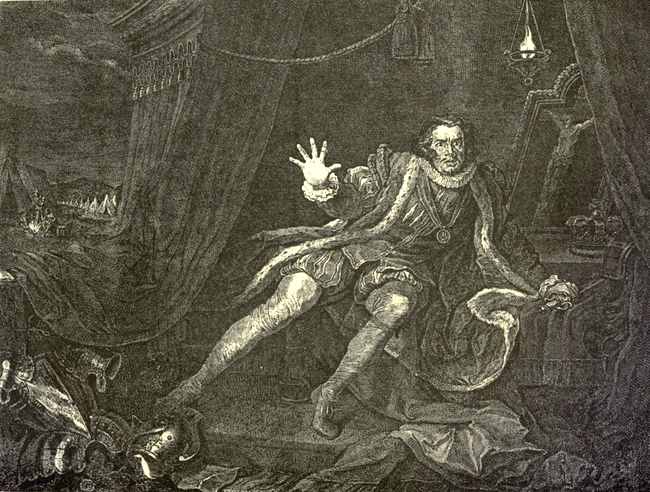
GARRICK AS RICHARD III.
Such is the exclamation of Richard, and
such is the disposition of his mind at the
moment of this delineation. In character
and expression of countenance the artist has succeeded,
but in resemblance—he has failed. The features
have no likeness to the features of Mr. Garrick,
and the figure gives an idea of a larger and more
muscular man. The lamp, diffusing a dim religious
light through the tent, the crucifix placed at his head,
the crown and unsheathed sword at his hand, and
the armour lying on the ground, are judicious and
appropriate accompaniments. His helmet is crested
with a boar passant, the armorial ensign of his family.
Near it lies a piece of paper, on which is written,
"Jockey of Norfolk, be not too bold,
For Dickon thy master is bought and sold."
This paper was put in the Duke of Norfolk's tent the
night before the engagement; but not being brought
to Richard until after the time represented in this
scene, can only be admitted by that poetical licence
which has been generally allowed to poets and
painters.
The figures in the distance, two of whom,
"Like sacrifices by their fires of watch,
With patience sit, and inly ruminate
The morning's danger,"
are properly introduced, and highly descriptive.
The tents of Richmond are so near,
"That the fix'd sentinels almost receive
The secret whispers of each other's watch."
Considered as a whole, the composition is simple,
and the figures well drawn. The drapery illustrates
his own precepts in the Analysis, where he says: "The
robes of state are always made large and full, because
they give a grandeur of appearance suitable to offices
of the greatest distinction. The judges' robes have
an awful dignity given them by the quantity of their
contents; and when the train is held up, there is a
noble waving line descending from the shoulders of
the judge to the hand of his train-bearer. So, when
the train is gently thrown aside, it generally falls into
a great variety of folds, which again employ the eye,
and fix its attention.
"The grandeur of the Eastern dress, which so far
surpasses the European, depends as much on quantity
as costliness. In a word, it is quantity which adds
greatness to grace."
There was some propriety in Hogarth choosing to
paint Mr. Garrick in this character. It was the first
he appeared in, on the 19th of October 1741, at Goodman's
Fields, and his performance gave proof of
talents which merited the celebrity he afterwards attained.
At that time Quin was the popular player;
but his laboured action, hollow tones, and the manner
in which he heaved up his words, were not borne
after Garrick's easy, familiar, and yet forcible style
had been seen by the town. The surly actor's remark
upon this heresy of the critics was, that "all
this was a new religion; but though Whitfield was
followed for a time, the people would soon return to
the true church." Garrick's epigram, in reply, has
some point:
"Poor Quin, who damns all churches but his own,
Complains that heresy corrupts the town:
'Schism,' he cries, 'has turned the nation's brain;
But eyes will open,—and to church again!'
Thou great infallible forbear to roar,
Thy bulls and errors are rever'd no more;
When doctrines meet with general approbation,
It is not heresy, but reformation."
His soliloquy, written in the character of Quin, on
seeing Duke Humphrey at St. Albans, has humour:
"A plague on Egypt's arts, I say,
Embalm the dead!—on senseless clay
Rich wines and spices waste!
Like sturgeon, or like brawn, shall I
Drown'd in a precious pickle lie,
Which I can never taste!
"Let me embalm this flesh of mine
With turtle fat and Bourdeaux wine,
And spoil the Egyptian trade;
Than Humphrey's Duke, more happy I—
Embalm'd alive, old Quin shall die,
A mummy ready made."
By Lord Orrery's[154] persuasions, Mr. Pope went to
Goodman's Fields and saw Garrick in the first dawn
of his fame. This great poet, who had formed his
taste upon the solemn and dignified elevation of
voice which distinguished Betterton (to whom he was
so partial, that he once painted his portrait, which,
until it was burnt in the riots of 1780, was in the possession
of Lord Mansfield);—this great poet was so
struck with the natural elocution of Mr. Garrick, that
he exclaimed, "The young man will be flattered, and
ruined; for there will be no competitor that can
excite his emulation." His prophecy was in part
fulfilled; for though Garrick had many competitors,
he had no equal. In the course of his theatrical
career he had frequent attacks, but they were generally
foiled. One great source of his success was,
that Shakspeare's plays were at that time becoming
much more popular than they had been at any preceding
period. Let it be recorded to the honour of
our fair countrywomen, that this was in some degree
owing to several ladies of the first rank and most distinguished
taste, who had some years before formed
themselves into a society to support, by their presence
and encouragement, all the best plays of Shakspeare.
They were called the Shakspeare Club, and every week
ordered some favourite play of our divine bard; but
the feeble powers of the performers were not sufficient
to support the reviving taste of the public. The best
among them thought that the whole art of playing
consisted in measured, pompous periods, and that an
approach to nature was a departure from eloquence.
The pellucid stream of Avon was congealed by the
coldness of their declamation, and the beams of
Shakspeare enveloped in the vapour of their mock-heroic
recitative. Until the appearance of this our
Newton of the theatre, the drama was under a dense
cloud: "he came, and all was light."
Mr. Garrick's profession was not adopted from
necessity, but choice; and to him the profession is
very materially obliged, for he has placed it in a
much more respectable point of view than it ever
had before.
His various powers as an actor, to those who have
seen him, it is unnecessary to describe; to those who
have not, it is impossible. His abilities as a writer
were not of the first order, but they were by no
means of the last. It has been remarked, that his
prologues and epilogues had generally some allusion
to eating: considered as local and temporary compositions,
they have merit; and his epigrams, which
usually turned upon some little circumstance of the
day, have point. They sometimes drew forth additional
flashes from his friends, and sometimes the
retort of those at whom they were aimed; as in the
following, addressed to the redoubted and eccentric
Doctor Hill:—
"For physic and farces,
Thy equal there scarce is;
Thy farces are physic,
Thy physic a farce is."
The two next were afterwards inserted in the public
prints, and said to be the productions of some of Mr.
Garrick's friends:—
"Thou essence of dock, of valerian, and sage,
At once the disgrace and the pest of this age,
The worst that we wish thee for all thy d—-d crimes,
Is to take thy own physic, and read thy own rhymes.
—"The Junto."
Answer to the Junto.
"Their wish in form must be revers'd
To suit the doctor's crimes;
For he who takes his physic first,
Will never read his rhymes.
—"Another Junto."
This was too bad, and the Doctor sent the following
answer to one of the papers:—
"Ye desperate Junto, ye great, or ye small,
Who combat dukes, doctors, the devil and all,
Whether gentlemen scribblers, or poets in jail,
Your impertinent curses shall never prevail:
I'll take neither sage, dock, nor balsam of honey:
Do you take the physic, and I'll take the money.
—"Anti-Junto."
Like his brethren of the sock and buskin, our
English Roscius was honoured with much attention
from the public prints. They gave us critical examinations
of his powers, and critical disquisitions
upon his defects; from an enumeration of which it
was proved, clearly proved, that he would never be a
good actor. The remarks of these ingenious gentlemen
were soon forgotten: the testimony of an applauding
public answered and refuted them. By way
of antidote to these poisons, it must be acknowledged
that Mr. Garrick's friends nearly surfeited the town
with injudicious praise. Their flattery was gross
enough to have disgusted any other man; but he had
been so accustomed to strong doses of panegyric, that
he could at last swallow them double distilled. I
have said that he was an actor by choice; I might
have added, that he was always an actor. Goldsmith's
lines in retaliation are a true portrait:
"Of praise a mere glutton, he swallow'd what came,
And the puff of a dunce—he mistook it for fame;
Till his relish grown callous almost to disease,
Who pepper'd the highest was surest to please.
But let us be candid, and speak out our mind,
If dunces applauded, he paid them in kind:
Ye Kenricks, ye Kellys, ye Woodfalls so grave,
What a commerce was yours, while you got and you gave!
How did Grub Street re-echo the shouts that you rais'd,
While he was be-Roscius'd, and you were be-prais'd!
But peace to his spirit, wherever it flies,
To act as an angel, and mix with the skies," etc.
The ode to the memory of Shakspeare, which he
wrote and spoke at Stratford, with many weak lines,
has some that show strong marks of a fervid imagination
and vigorous mind. To instance the following:
"When Philip's fam'd, all-conquering son,
Had every blood-stain'd laurel won,
He sigh'd that his creative word,
Like that which rules the skies,
Could not bid other nations rise,
To glut his yet unsated sword.
"But when our Shakspeare's matchless pen,
Like Alexander's sword, had done with men,
He heav'd no sigh, he made no moan;
Not limited to human kind,
He fir'd his wonder-teeming mind,
Rais'd other worlds and beings of his own."[155]
Many of his jeu d'esprits are related; the following
I never saw recorded. When he and Quin strutted
at the same theatre, and in the same play, the performance
ending, and the night being rainy, each of
them ordered a chair, and walked to the door of the
playhouse. To the mortification of Quin, Garrick's
chair came first: "Let me get into the chair," cried
the surly veteran, "let me get into the chair, and put
little Davy into the lantern." "By all means," replied
Garrick, "I shall be happy to give Mr. Quin
light in anything."
The little tribute which Doctor Johnson has paid
to his memory is written from the heart: I cannot
resist transcribing it:—
"At this man's (Mr. Walmsley's) table I enjoyed
many cheerful and instructive hours with companions
such as are not often to be found; with one who
has heightened, and who has gladdened life: with
Dr. James, whose skill in physic will be long remembered;
and with David Garrick, whom I hoped to
have gratified with this character of our common
friend. But what are the hopes of man! I am disappointed
by that stroke of death, which has eclipsed
the gaiety of nations, and impoverished the public
stock of harmless pleasure."—Life of Edmund Smith.
Mr. Hogarth lived in habits of intimacy with David
Garrick, who being President of the Shakspeare
Club at the time of the Stratford Jubilee, our painter
made him a drawing of a chair, which was afterwards
wrought in mahogany. A medallion of Shakspeare,
carved by Hogarth from a piece of the Stratford
mulberry-tree, is suspended to the back of it.
The paintings of the "Harlot's Progress," and
"Strolling Players," produced little more than a
hundred guineas; but in such estimation are portraits,
that the original picture from which this print was
copied, in every point of view inferior, was purchased
by the late Mr. Duncombe, of Duncombe Park, Yorkshire,
at two hundred pounds! It still remains in his
family. The print, by Mr. Hogarth's permission, was
copied for a watch-paper.
The following description of Mr. Hogarth's
design in these twelve plates is copied
from his own handwriting:—
"Industry and Idleness exemplified in the conduct
of two fellow-'prentices; where the one by taking
good courses, and pursuing points for which he was
put apprentice, becomes a valuable man, and an ornament
to his country; the other, by giving way to
idleness, naturally falls into poverty, and ends fatally,
as is expressed in the last print. As the prints were
intended more for use than ornament, they were done
in a way that might bring them within the purchase
of those whom they might most concern; and lest
any print should be mistaken, the description of each
print is engraved at top."
Such is the professed intention of the artist, and
such his apology for the manner in which these plates
are engraved; for, as Mr. Walpole justly remarks,
they have more merit in their intention than execution.
As a contrast to an idle and vicious character, who
is brought to consequent misery and shame, his fellow-'prentice
is depicted moral, attentive, and industrious;
and, by regular and natural gradations, attains the
highest dignities of the greatest city in Europe. This
is making the pencil an instrument in the cause of
virtue, holding up the mirror of morality and truth,
and showing the fair reward of industry and integrity
to be happiness, honour, and independence; and the
inevitable consequences of idleness and vice to be
poverty, misery, and shame.
The hint for contrasting these two very opposite
characters is taken from the old play of Eastward
Hoe, written by Ben Jonson, George Chapman, and
John Marston, printed for William Aspley, 1605, and
reprinted in Dodsley's collection. In this comedy,
Touchstone, a plain and honest old citizen and goldsmith,
has two apprentices, Golding and Quicksilver:
the former is a counterpart of Hogarth's Goodchild,
and the latter has many of the dispositions of Mr.
Thomas Idle. Touchstone, in a proverbial and formal
style, advises all who wish to become respectable,
and acquire independence, to conduct themselves on
the same principles that he had done, and by adherence
to which he had gained his fortune:
"I hired me a little shop, bought low, took small
profits, kept no debt book; garnished my shop (instead
of plate) with good, wholesome, thrifty sentences:
such as, 'Touchstone, keep thy shop, and thy
shop will keep thee;' 'Light gains make a heavy
purse;' 'It is good to be merry and wise,' etc. etc.
'Seek not to go beyond your tether,
But cut your thong unto your leather;
So shall you thrive by little and little,
'Scape Tyburn, Counter, and the Spittal.'"
The prologue concludes with what may serve as
an explanatory apology for the prints as well as the
play:
"Bear with our willing pains,—or dull or witty,
We only dedicate it to the City."
Golding marries Touchstone's favourite daughter;
and the old citizen, in the quaint style of that day,
wishes he may live to see him "one of the monuments
of the city, and reckoned among her worthies; to be
remembered the same day with Lady Ramsey and
grave Gresham, when the famous fable of Whittington
and his puss shall be forgotten, and thou and thy acts
become the posies for hospitals; when thy name shall
be written upon conduits, and thy deeds played i' thy
lifetime by the best company of actors, and be called
their 'Get-penny;' this I divine and prophesy."
In the comedy, as in the prints, one of the scenes
is laid at Cuckold's Haven; young Golding becoming
a magistrate, Quicksilver is brought before him as a
criminal, etc. etc.
THE FELLOW-'PRENTICES AT THEIR LOOMS.
"The drunkard shall come to poverty; and drowsiness shall clothe
a man with rags."—Proverbs xxiii. 21.
"The hand of the diligent maketh rich."—Proverbs x. 4.
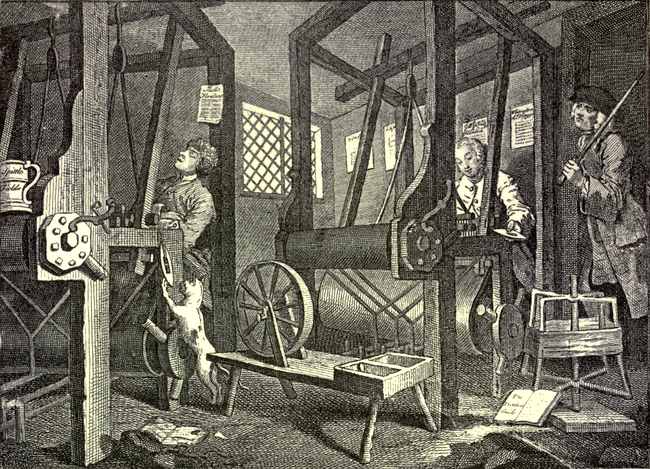
INDUSTRY AND IDLENESS, PLATE I.
At the time these twelve prints were published, the
business of a silk weaver was considered as much
more respectable and important than it has been since
the general fashion of wearing linen. The first view
we have of the two heroes of our history, is at the
looms of their master, an inhabitant of Spitalfields.
The assiduity of one of these young artisans is manifested
in his countenance, and attention to the business
he is engaged in. Over his head hang those two
excellent old ballads, Turn again, Whittington, Lord
Mayor of London, and The Valiant Apprentice. On
the floor near him is the 'Prentice's Guide, a book
which our citizen probably presented to every young
man he had under his care; for we see the same title
on a mutilated volume at the feet of Mr. Thomas
Idle, who, being asleep, has dropped his shuttle, which
a cat is playing with. On the wall hangs the ballad
of Moll Flanders, and very near him is a tobacco-pipe[156]
and a porter pot; the somniferous qualities of
these two narcotics have perhaps contributed to close
his eyes. His appearance is consonant to his disposition;
hair uncombed, collar unbuttoned, and worn-out
coat, are strong indications of negligence and
sloth. With angry eye, and cane lifted up, the master,
just entering the room, seems very well disposed to
punish his indolence and drowsiness; but these habits
are too strongly rooted to be eradicated by chastisement.
Thus far is admirably thought, and intelligibly
depicted; but the delineation, as far as regards the
picturesque effect, is beneath criticism. The head of
Master Francis Goodchild, placed between two square
posts, looks as if it were stuck in the pillory; the
physiognomy of Mister Thomas Idle is correctly
correspondent with his depraved character; but the
introduction of such a number of angles and parallel
lines as the scene demanded, the artist's eye could
never have borne upon any other principle than that
given in his introductory declaration, "that the prints
were intended for use more than ornament."
THE INDUSTRIOUS 'PRENTICE PERFORMING THE DUTY OF A
CHRISTIAN.
"O how I love Thy law! it is my meditation all the day."—Psalm
cxix. 97.
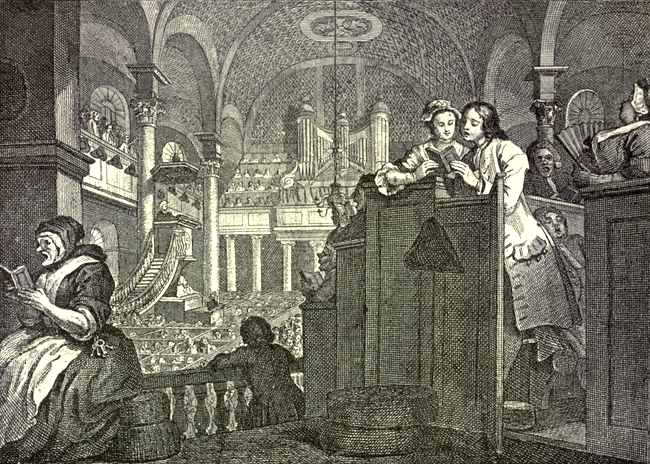
INDUSTRY AND IDLENESS, PLATE II.
This plate displays our industrious young man
attending divine service, in the same pew with his
master's daughter, where he shows every mark of
decent and devout attention.
Mr. Hogarth's strong bias to burlesque was not
to be checked by time or place. It is not easy to
imagine anything more whimsically grotesque than
the female Falstaff. A fellow near her, emulating the
deep-toned organ, and the man beneath, who, though
asleep, joins his sonorous tones in melodious chorus
with the admirers of those two pre-eminent poets,
Hopkins and Sternhold. The pew-opener is a very
prominent and principal figure; two old women adjoining
Miss West's seat are so much in shadow, that
we are apt to overlook them: they are, however, all
three making the dome ring with their exertions.
"Ah! had it been King David's fate
To hear them sing...."
The preacher, reader, and clerk, with many of the
small figures in the gallery and beneath, are truly
ludicrous; and we regret their being on so reduced a
scale, that they are scarce perceptible to the naked
eye. It was necessary that the artist should exhibit
a crowded congregation, but it must be acknowledged
he has neglected the rules of perspective. The print
wants depth. In the countenance of Miss West and
her lover there is a resemblance. Their faces have
not much expression, but this is atoned for by a
natural and pleasing simplicity. Character was not
necessary.
THE IDLE 'PRENTICE AT PLAY IN THE CHURCHYARD DURING
DIVINE SERVICE.
"Judgments are prepared for scorners, and stripes for the back of
fools."—Proverbs xix. 29.
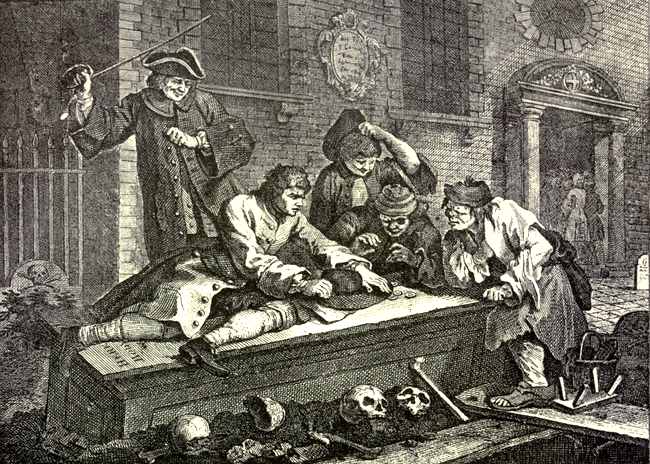
INDUSTRY AND IDLENESS, PLATE III.
While the industrious and sedate apprentice is engaged
in such exercises as mend the heart and improve
the understanding; while properly devoting
the seventh day to the praise of his Creator, he
attends divine service, returns thanks for the blessings
he enjoys, and prays for their continuance, an inmate
of the same house, about the same age, and of the
same rank in society, who might have participated
in all his advantages, is stretched upon a grave-stone
in the churchyard, and gambling with a group of
mendicants. Their amusement seems to be the favourite
old English game of hustle-cap, and our idle
and unprincipled youth is endeavouring to cheat, by
concealing some of the halfpence under the broad
brim of his hat. This is perceived by the shoeblack,
and warmly resented by the fellow with the black
patch over his eye, who loudly insists on the hats
being fairly removed. The eager anxiety which marks
these mean gamblers is equal to that of two peers
playing for an estate. The latter could not have
more solicitude for the turn of a die which was to
determine who was the proprietor of ten thousand
acres, than is displayed in the countenance of Mr.
Thomas Idle. Their debate has been loud, and their
attention is so much engrossed, that they have not
heard the cautious steps of a beadle, who seems
likely to terminate the dispute by a smart stroke from
his rattan, which is aimed with apparent goodwill at
the back of our disciple of indolence. His three
associates are of the lowest order; among them is a
half-naked shoeblack. Like his companion, with one
hand lifted up to his head, he is disturbing part of
that clan who have been always distinguished for
their tenacious adherence to the slothful. The tombstone—inscribed,
"Here lies the body of"—applies
very well to the young gentleman who, in an attitude
highly expressive of idleness, is recumbent upon
it. Even the skulls, on the ground near the new-opened
grave, have character. These, with the other
mementos of mortality, are indiscriminately scattered
on the earth, and trampled upon by the most contemptible
survivors. "How rich, how honoured once,
avails them not."
The figures in this print are well grouped, and the
countenances of the gamblers and beadle admirably
marked.
THE INDUSTRIOUS 'PRENTICE A FAVOURITE, AND ENTRUSTED
BY HIS MASTER.
"Well done, thou good and faithful servant; thou hast been faithful
over a few things, I will make thee ruler over many things."—Matthew
xxv. 21.
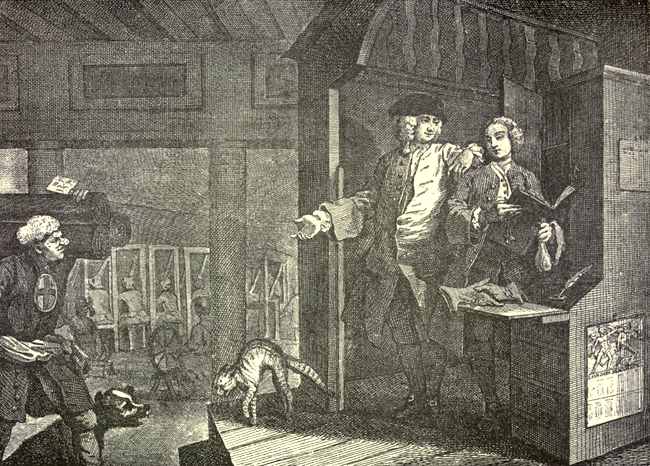
INDUSTRY AND IDLENESS, PLATE IV.
From attention to business and propriety of conduct,
the industrious apprentice has gained the confidence
of his employer. He is now in the counting-house,
entrusted with the management of the business; has
the day-book, purse, and keys in his hands, and attentively
listens to the directions of his friendly master,
who, with a face expressive of the highest partiality
and regard, familiarly leans upon his shoulder. A
partnership, on the eve of taking place, is covertly
intimated by a pair of gloves upon the writing-desk.
The young merchant's sedulous application is well
hinted at by an headpiece to the London Almanac,
"Industry taking time by the forelock." A city
porter, bringing in bales of goods, has a true
Bardolphian face. The mastiff that attends him is
violently opposed by the domestic cat, who, considering
this house as her own peculiar domain, and
having an hereditary dislike to the canine species,
endeavours to drive him from the premises. Neither
cat, dog, nor porter are well drawn, nor is much regard
paid to perspective; but the general design is
carried on by such easy and natural gradations, and
the consequent success of an attentive conduct displayed
in colours so plain and perspicuous, that little
errors in execution should be overlooked or forgiven.
THE IDLE 'PRENTICE TURNED AWAY AND SENT TO SEA.
"A foolish son is the heaviness of his mother."—Proverbs x. 1.
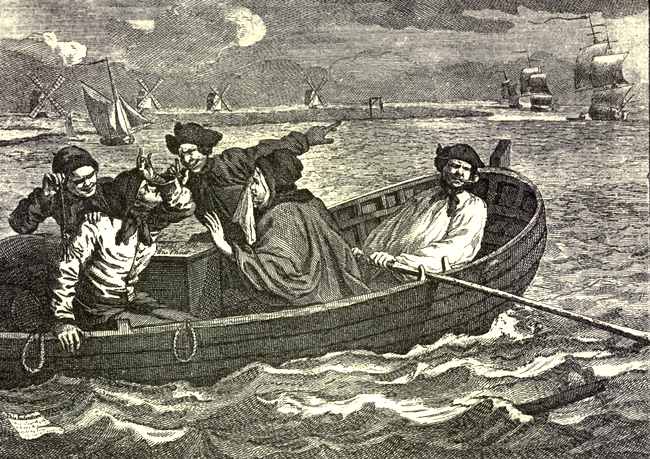
INDUSTRY AND IDLENESS, PLATE V.
Corrupted by sloth, and contaminated by bad
company, the idle apprentice, having forfeited the
regard and tired the patience of his master, is sent to
sea, in the hope that a separation from his associates,
joined to the inevitable hardships of a maritime life,
may in some degree reclaim him. He is exhibited in
the ship's boat, accompanied by his afflicted mother,
whose dress intimates that she is a widow, and who
had naturally formed hopes of this boy's being a comfort
to her old age. The waterman, with a significant
face, points to a figure on a gibbet, advising him to
look at it as emblematical of his future fate. A boy
shows him a cat-o'-nine tails as a specimen of the discipline
on board a ship; this water-wit the abandoned
young man returns by holding up two fingers in the
form of horns, and recommending this Joe Miller of
the Thames to look at Cuckold's Point, which is in
the distance. Having forfeited his indentures, he has
thrown them into the river, is totally lost to reflection,
and insensible to the grief of his mother, the ridicule
of his companions, or his own unhappy situation.
That great geographer of the human face, Lavater
of Zurich, has very properly thought a copy of this
print worthy a place in his Essays on Physiognomy.
His observations deserve attention:—
"Here are the traits of drunkenness combined with
thoughtless stupidity. Who can look without disgust?
Would these wretches have been what they
are, had they not by vice erased nature's marks?
Can perversion be more apparent than in the middle
profile?"
THE INDUSTRIOUS 'PRENTICE OUT OF HIS TIME, AND MARRIED TO
HIS MASTER'S DAUGHTER.
"The virtuous woman is a crown to her husband."—Proverbs xiii. 4.
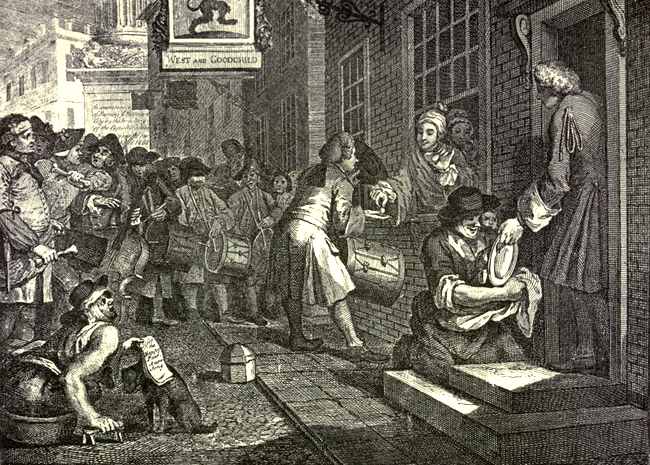
INDUSTRY AND IDLENESS, PLATE VI.
The reward of industry is success. Our prudent and
attentive youth is now become partner with his
master,[157] and married to his daughter. To show that
plenty reigns in this mansion, a servant distributes
the remains of the table to a poor woman, and the
bridegroom pays one of the drummers, who, according
to ancient custom, attend with their thundering
gratulations the day after a wedding. A performer
on the bass viol, and a herd of butchers armed with
marrow-bones and cleavers, form an English concert![158]
A cripple, with the ballad of Jesse, or the Happy Pair,
represents a man known by the name of Philip in
the Tub, who had visited Ireland and the United
Provinces, and in the memory of some persons now
living was a general attendant at weddings. From
those votaries of Hymen, who were honoured with
his epithalamiums, he received a small reward. To
show that Messieurs West and Goodchild's habitation
is near the Monument,[159] the base of that stately
column appears in the background.
A footman and butcher at the opposite corner,
compared with the other figures, are gigantic; they
might serve for the Gog and Magog of Guildhall.
It has been said that the thoughts in this print are
trite, and the actions mean, which must be in part
acknowledged; but they are natural and appropriate
to the rank and situation of the parties, and to the
fashions of the time at which it was published.
THE IDLE 'PRENTICE RETURNED FROM SEA, AND IN A GARRET WITH
A COMMON PROSTITUTE.
"The sound of a shaken leaf shall chase him."—Leviticus xxvi. 36.
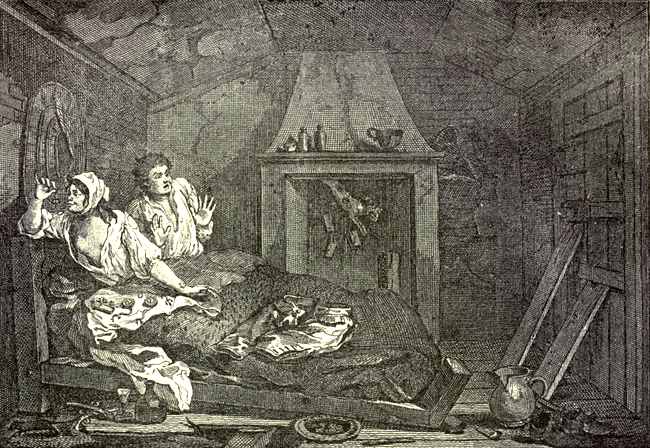
INDUSTRY AND IDLENESS, PLATE VII.
The profligate and degraded apprentice, returned
from his voyage, is now exhibited in a garret with a
common prostitute. Tired of a seafaring life, where
we may naturally suppose he met with punishment
adequate to his crimes, he returns to London. By
the pistols, watches, etc. which lie upon and near the
bed, it seems evident that the source of his present
subsistence is from robbery on the highway. Horror
and dismay are strongly depicted in his agitated and
terrified face.—What a contrast to the serenity displayed
in the countenance of his fellow-'prentice!
To prevent surprise, the door is locked, double bolted,
and barricaded with planks from the floor; notwithstanding
these precautions, the noise occasioned by a
cat having slipped down a ruinous chimney, throws
him into the utmost terror. Not so his depraved
companion; solely engrossed by the plunder upon the
bed,[160] she looks with delighted eyes at a glittering
earring. The broken jug, pipe, knife, plate, dram-bottle,
glass, and pistols, are very properly introduced;
and the rat, who makes a precipitate retreat, instinctively
conscious that its natural enemy is near, renders
this filthy and disgusting scene still more nauseous.
The lady's hoop is a good specimen of the fashion of
that day, when this cumbrous, inconvenient, and ungraceful
combination of whales' bones was worn by
women of the lowest as well as the highest rank.
THE INDUSTRIOUS 'PRENTICE GROWN RICH, AND SHERIFF
OF LONDON.
"With all thy gettings, get understanding. Exalt her; and she shall
promote thee; she shall bring thee to honour, when thou dost embrace
her."—Proverbs iv. 7, 8.
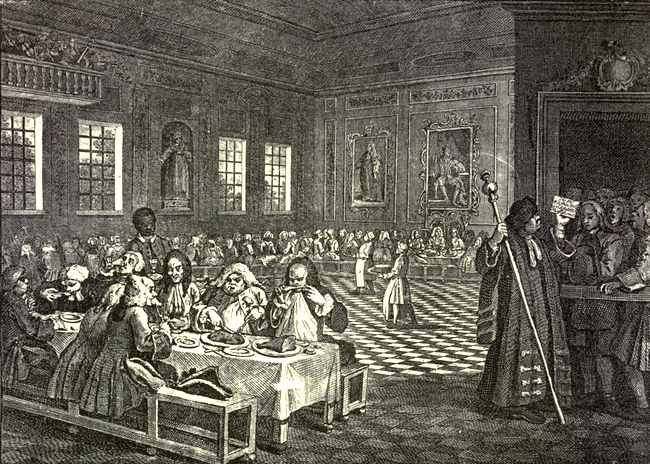
INDUSTRY AND IDLENESS, PLATE VIII.
From industry become opulent, from integrity and
punctuality respectable, our young merchant is now
Sheriff of London, and dining with the different
companies in Guildhall. A group on the left side
are admirably characteristic; their whole souls seem
absorbed in the pleasures of the table. A divine,[161]
true to his cloth, swallows his soup with the highest
goût. Not less gratified is the gentleman palating a
glass of wine. The man in a black wig is a positive
representative of famine; and the portly and oily
citizen, with a napkin tucked in his button-hole,[162] has
evidently burnt his mouth by extreme eagerness.
The backs of those in the distance, behung with
bags, major perukes, pinners, etc., are most laughably
ludicrous. Every person present is so attentive to
business, that one may fairly conclude "they live to
eat, rather than eat to live."
But though this must be admitted to be the case
with this party here exhibited, the following recent
instance of city temperance proves that there are now
some exceptions:—
When the Lord Mayor, Sheriffs, Aldermen, Chamberlain,
etc. of the city of London were once seated
round the table at a public and splendid dinner at
Guildhall, Mr. Chamberlain Wilkes lisped out, "Mr.
Alderman B—ll, shall I help you to a plate of turtle
or a slice of the haunch,—I am within reach of both,
sir?" "Neither one nor t'other, I thank you, sir," replied
the Alderman; "I think I shall dine on the beans
and bacon which are at this end of the table." "Mr.
Alderman A——n," continued the Chamberlain,
"which would you choose, sir?" "Sir, I will not
trouble you for either, for I believe I shall follow the
example of my Brother B—ll, and dine on beans and
bacon," was the reply. On this second refusal the
old Chamberlain rose from his seat, and with every
mark of astonishment in his countenance, curled up
the corners of his mouth, cast his eyes round the
table, and in a voice as loud and articulate as he was
able, called "Silence!" which being obtained, he thus
addressed the prætorian magistrate, who sat in the
chair: "My Lord Mayor, the wicked have accused
us of intemperance, and branded us with the imputation
of gluttony. That they may be put to open
shame, and their profane tongues be from this day
utterly silenced, I humbly move that your lordship
command the proper officer to record in our annals,
that 'two Aldermen of the city of London prefer
beans and bacon to either turtle-soup or venison.'"
Notwithstanding all this, there are men who, looking
on the dark side, and perhaps rendered splenetic,
and soured by not being invited to these sumptuous
entertainments, have affected to fear that their frequent
repetition would have a tendency to produce a
famine, or at least to check the increase, if not extirpate
the species of those birds, beasts, and fish with
which the tables of the rich are now so plentifully
supplied.[163] But these half-reasoners do not take into
their calculation the number of gentlemen so laudably
associated for encouraging cattle being fed so
fat that there is no lean left; or that more ancient
association, sanctioned and supported by severe Acts
of Parliament, for the preservation of the game.
From the exertions of these and similar societies, we
may reasonably hope there is no occasion to dread
any such calamity taking place; though the Guildhall
tables, often groaning under such hecatombs as are
recorded in the following account, may make a man
of weak nerves and strong digestion shake his head,
and shudder a little:—
"On the 29th October 1727, when George II. and
Queen Caroline honoured the city with their presence
at Guildhall, there were nineteen tables covered with
1075 dishes. The whole expense of this entertainment
to the city was £4889, 4s."
To return to the print! A self-sufficient and consequential
beadle, reading the direction of a letter to
Francis Goodchild, Esq., Sheriff of London, has all
the insolence of office. The important and overbearing
air of this dignified personage is well contrasted
by the humble simplicity of the straight-haired messenger
behind the bar. The gallery is well furnished
with musicians busily employed in their vocation.
"Music hath charms to soothe the savage breast,
And therefore proper at a sheriff's feast."
Besides a portrait of William III. and a judge, the
hall is ornamented with a full length of that illustrious
hero Sir William Walworth; in commemoration
of whose valour, the weapon with which he slew
Wat Tyler was introduced into the city arms.
THE IDLE 'PRENTICE BETRAYED BY A PROSTITUTE, AND TAKEN IN
A NIGHT-CELLAR WITH HIS ACCOMPLICE.
"The adulteress will hunt for the precious life."—Proverbs vi. 26.
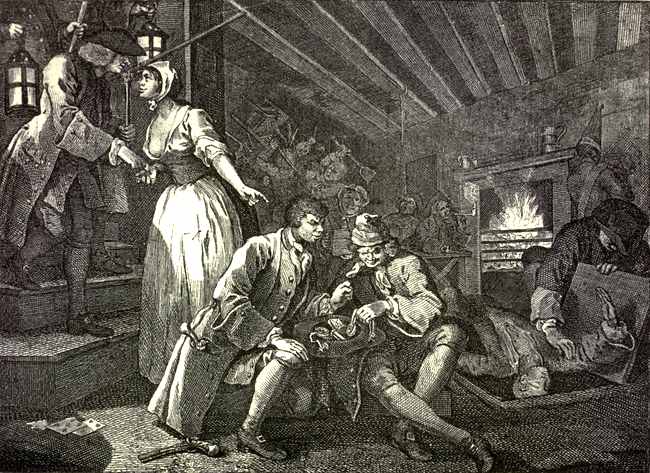
INDUSTRY AND IDLENESS, PLATE IX.
From a picture of the reward of diligence, we return
to the consequence of sloth. The idle and incorrigible
outcast, mature in vice, and lost to society, is
here represented in a night-cellar.[164] In this dreary
and horrid cavern of vice and infamy he is dividing
the spoil produced by robbery with one of his
wretched accomplices. The woman that seems his
favourite, and in whose garret we saw him in the
seventh plate, deliberately betrays him. The officers
of justice are entering, and he is on the point of being
seized. The corpse of a gentleman, who has been
murdered, is with unfeeling indifference put down a
cavity made in the floor for the purposes of concealment.
To show that the grenadiers company were
then, as now, a virtuous body of men, one of them, in
a true Dutch attitude, is smoking in the corner. A
scene of riot, likely to terminate in blood, passes in the
background. The countenances of the combatants,
and a noseless woman bringing the porter, are finely
marked. A rope, hanging immediately over a fellow
who is asleep, should not be overlooked. The
watches, which are in a hat, exhibit another instance
of Hogarth's peculiar accuracy; each of them is a
little after ten. Some cards scattered on the floor
show the amusements of this earthly Pandemonium.
THE INDUSTRIOUS 'PRENTICE ALDERMAN OF LONDON; THE IDLE ONE
BROUGHT BEFORE HIM, AND IMPEACHED BY HIS ACCOMPLICE.
"Thou shalt do no unrighteousness in judgment."—Leviticus
xix. 15.
"The wicked is snared in the work of his own hands."—Psalm
xix. 16.
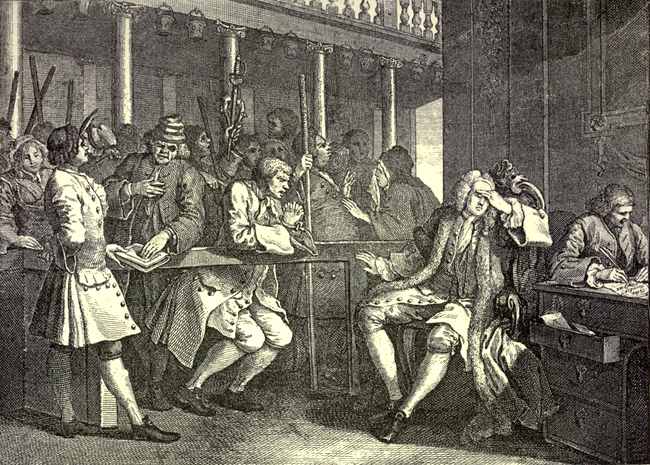
INDUSTRY AND IDLENESS, PLATE X.
He who was an industrious apprentice is now an
alderman and a magistrate; his depraved and atrocious
contrast, who was once his fellow-'prentice,
and the last plate exhibited in a night-cellar, is
now brought handcuffed before him, and accused of
robbery, aggravated by murder. Shocked at seeing
the companion of his youth in so degraded a situation,
he instinctively covers his eyes. Agitated,
trembling, terrified, self-convicted, and torn by remorse,
the wretched culprit is unable to support his
tottering frame. Did he not lean upon the bar, he
would sink to the earth.
His distressed and heart-broken mother intercedes
with the swollen and important constable to use his
interest for her unhappy son. This application the
mighty magistrate of the night answers by—"We
that are in power must do justice!" A number of
watchmen attend the examination, and one of them
holds up the sword and pistols which were found on
the prisoner. A young woman[165] bribes the swearing
clerk to befriend the one-eyed wretch who has turned
evidence against his accomplice, by suffering him to
take the usual oath with his left hand laid upon the
book, instead of his right.[166]
This debased villain was first introduced to us
gambling on a grave-stone; his second appearance
was in a night-cellar, where he divided the evening's
plunder with the man he now deliberately betrays!
The alderman's clerk is making out a warrant of
commitment directed to the turnkey of Newgate.
THE IDLE 'PRENTICE EXECUTED AT TYBURN.
"When fear cometh as desolation, and their destruction cometh as a
whirlwind: when distress cometh upon them, then they shall call upon
God, but He will not answer."—Proverbs i. 27, 28.
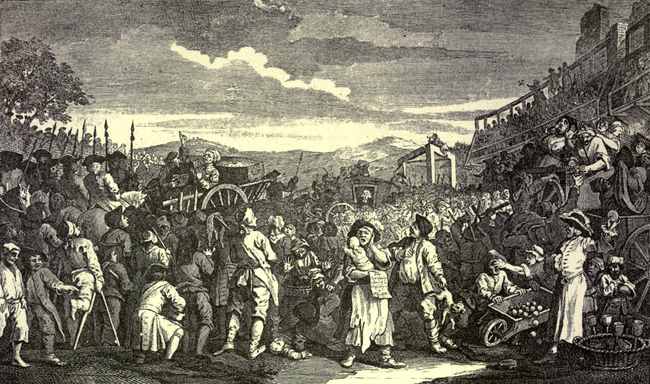
INDUSTRY AND IDLENESS, PLATE XI.
After a life of sloth, wretchedness, and vice, the
career of our degraded character terminates at
Tyburn. His pale and ghastly look denotes the remorse
and horror of his mind; and it must embitter
his last moments to hear a Grub Street orator proclaim
his dying speech. The ordinary of Newgate
leads the procession, but the criminal's spiritual concerns
are left to an enthusiastic follower of John
Wesley, who zealously exhorts him to repentance.[167]
On the right side of the print we see his afflicted
mother: her coming to view this dreadful spectacle
does not seem consonant to strict propriety, but there
have been similar examples. In a cart above her is
a curious trio of females; an old beldam, who might
have been Sam. Foote's model for Mother Cole,
breathing out a pious ejaculation, and swallowing a
bumper of spirits at the same moment; a young
woman taking a glass from beneath, and a third dissuading
a fellow from ascending the vehicle. While
a vendor of gingerbread[168] expatiates on the excellence
of his delicious cakes, a minor pickpocket purloins
his handkerchief. A female grimalkin, enraged at a
man oversetting her orange-barrow, is literally tearing
his eyes out. To show the reverence which an English
mob have for anything that bears the appearance
of religion, and the effects which this exhibition has
upon their minds, an inmate of St. Giles' seizes a dog
by the tail, and is on the point of throwing it at the
Methodist parson. A female pugilist, near the centre
of the print, is so earnest in punishing a fellow who
has offended her, that she neglects her child, which,
lying on the ground, is probably destined to be
crushed to death. A tall butcher has suspended an
old legal periwig on the end of his cudgel: in this,
the artist might intend to display an emblem of the
sanguinary complexion which marks our courts of
justice.[169] The porter, with his pipe; a cripple; the
soldier sunk knee-deep in a bog, and two boys laughing
at him, are well imagined. Among the figures in
the background, we must not overlook a gentleman
emphatically called the "Finisher of the law," who
sedately smokes his best Virginia upon the gallows.
A carrier pigeon is despatched at the time the
criminal arrives at Tyburn.[170] Two initials on the
coffin, not having been reversed from the original
drawing, are wrong in the print; I. T. instead of T. I.
In the background we have a view of Highgate
and Hampstead hills.
The arch look of a young pickpocket, the savage
ferocity of a woman tearing a fellow's face, and the
yell of another crying the dying speech, are admirably
expressed. Many of the smaller figures are
full fraught with character; for the grouping, let us
hear Mr. Gilpin, with whom I entirely agree:—
"We seldom see a crowd more beautifully managed
than in this print. If the sheriff's officers had not
been placed in a line, and had been brought a little
lower in the picture, so as to have formed a pyramid
with the cart, the composition had been unexceptionable."—Gilpin's
Essay.
Two skeletons hanging on the outside of the frame
are emblematical; the body of a murderer being
usually consigned to Surgeon's Hall.[171]
The trophies, composed of fetters, whips, and
halters, with the swords, maces, gold chains, etc., with
which the framework of the preceding prints are
decorated, must be admitted to be beneath the dignity
of historical painting; but considered as addressed
to young persons, and exhibiting a view of the different
consequences of industry and sloth, are strictly
proper.
THE INDUSTRIOUS 'PRENTICE LORD MAYOR OF LONDON.
"Length of days is in her right hand, and in her left hand riches and
honour."—Proverbs iii. 16.
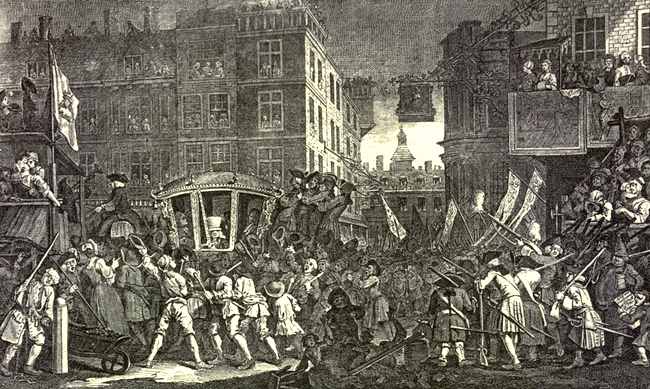
INDUSTRY AND IDLENESS, PLATE XII.
In the last print we saw a crowd witnessing the
ignominious death of a murderer; in this are a
cheerful assembly joining the procession of a chief
magistrate; some reeling, some roaring, and all
rejoicing.[172]
The scene is laid at the east side of St. Paul's
Church, just turning into Cheapside; and in particular
honour of this day, the artist has introduced the late
Prince and Princess of Wales at a balcony, in view of
the pageant. A group on the scaffolding beneath is
formed of the most comic characters. Who can
abstain from laughter at the city militia, which are
below? They were at that time composed of undisciplined
men, of all ages and descriptions; young,
old, tall, short, crooked, straight, fat, and lean, made
up the motley band.
The man in a grenadier's cap, with a pot of porter
in his left hand, might perform the part of Sir
Tunbelly Clumsy.[173] A neighbouring gentleman, in
a cut wig, is scarcely able to support his firelock.
The fellow firing off his musket exclaims, "Who's
afraid?" The next may be a very great man,
though nature has treated his exterior, as she did
that of our third Richard, rather unkindly, by
placing an envious mountain on his back. The
hero in a bag-wig, resting upon his arms, is made
from a splinter of the monument; "his dimensions
to any thick sight are invisible." Far different
is the strong-built man of war at his left hand:
by his back front he seems to have grown out at
the sides; what nature denied in height, she has
abundantly made up in breadth. His long sword
is so placed as to give the idea of a bluebottle
impaled on a pin. A plank, supported by a tub
and stool, having given way, two of the fair sex
fall to the ground. The most obtrusive figure in his
lordship's coach is Mr. Swordbearer, in a cap like a
reversed saucepan, which this great officer wears on
these grand occasions. The company of journeymen
butchers, with their marrow-bones and cleavers, appear
to be the most active, and are infinitely the most
noisy of any who grace this solemnity.
Near the left corner, a blind man, conscious that
he has but a poor chance in a crowd, endeavours
to preserve his hat and wig from the depredating
multitude. The Bunhill Fields trooper, who leans
against a post, with one of his bandeliers in his left
hand, has made a little mistake. A young man
in the booth above, not having the fear of dignity
before his eyes, is eagerly kissing a girl: the lady,
irritated at this indecorum, seems likely to leave
marks of her talons upon his forehead. At the
opposite corner, a vendor of the Grub Street classics
proclaims "a full, true, and particular account of
the ghost of Thomas Idle, which appeared to the
Lord Mayor."
Numberless spectators, upon every house, and at
every window, dart their desiring eyes on the procession.
Of the figures on a tapestry, hanging from
a balcony[174] at the King's Head, I cannot discover the
meaning. Two flags beneath are blazoned with the
arms of the Stationers' Company; and that in a stand
which exhibits the ardent salutation before mentioned,
belongs to the pinners and needlers. The cornucopiæ
on the outside of the frame are symbolical of
that abundance which fills the hands of the diligent.
Many of the characters in this and the foregoing
print bear a strong resemblance to some which Mr.
Hogarth etched about twenty years before for Butler's
Hudibras.
The following year was published a pamphlet,
entitled, "The Effects of Industry and Idleness, illustrated
in the life, adventures, and various fortunes of
two fellow-'prentices of the city of London: showing
the different paths, as well as rewards, of virtue and
vice," etc. Printed for C. Corbet, at Addison's Head,
Fleet Street.
In the chamber of London where the apprentices
are bound, these twelve prints very properly ornament
the room.
The late Mr. James Love, comedian (otherwise
Dance), dramatized this eventful history, and Mr.
King performed the good apprentice.
"O the roast beef of Old England," etc.
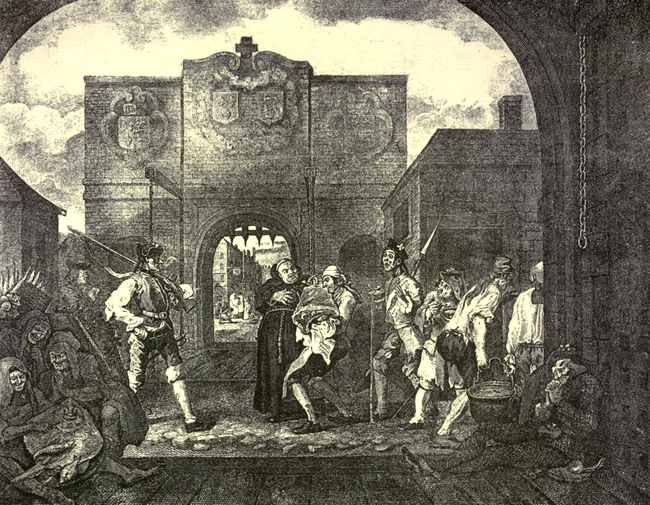
ROAST BEEF AT THE GATE OF CALAIS.
The thought on which this whimsical and
highly characteristic print is founded,
originated in Calais, to which place Mr.
Hogarth, accompanied by some of his friends, made
an excursion in the year 1747.
Extreme partiality for his native country was the
leading trait of his character; he seems to have begun
his three hours' voyage with a firm determination
to be displeased at everything he saw out of Old
England. For a meagre powdered figure, hung with
tatters, à-la-mode de Paris, to affect the airs of a coxcomb
and the importance of a sovereign, is ridiculous
enough; but if it makes a man happy, why should he
be laughed at? It must blunt the edge of ridicule
to see natural hilarity defy depression; and a whole
nation laugh, sing, and dance under burdens that
would nearly break the firm-knit sinews of a Briton.
Such was the picture of France at that period, but it
was a picture which our English satirist could not
contemplate with common patience. The swarms of
grotesque figures who paraded the streets excited his
indignation, and drew forth a torrent of coarse abusive
ridicule not much to the honour of his liberality. He
compared them to Callot's Beggars, Lazarus on the
painted cloth, the Prodigal Son, or any other object
descriptive of extreme contempt. Against giving
way to these effusions of national spleen in the open
street he was frequently cautioned, but advice had no
effect; he treated admonition with scorn, and considered
his monitor unworthy the name of Englishman.
These satirical ebullitions were at length
checked. Ignorant of the customs of France, and
considering the gate of Calais merely as a piece of
ancient architecture, he began to make a sketch.
This was soon observed; he was seized as a spy, who
intended to draw a plan of the fortification, and
escorted by a file of musqueteers to M. la Commandant.
His sketch-book was examined leaf by leaf,
and found to contain drawings that had not the most
distant relation to tactics. Notwithstanding this
favourable circumstance, the Governor with great
politeness assured him, that had not a treaty between
the nations been actually signed, he should have been
"under the disagreeable necessity of hanging him
upon the ramparts:" as it was, he must be permitted
the privilege of providing him a few military attendants,
who should do themselves the honour of waiting
upon him while he resided in the dominions of the
Grande Monarque. Two sentinels were then ordered
to escort him to his hotel, from whence they conducted
him to the vessel; nor did they quit their
prisoner until he was a league from shore, when,
seizing him by the shoulders, and spinning him round
upon the deck, they said he was now at liberty to
pursue his voyage without further molestation.
So mortifying an adventure he did not like to hear
recited, but has in this print recorded the circumstance
which led to it. In one corner he has given a portrait
of himself, making the drawing; and to show the
moment of arrest, the hand of a serjeant is upon his
shoulder.
Mr. Hogarth's friend Forest soon afterwards wrote
the following cantata, which contains so whimsical a
description of the principal figures, that I make no
apology for inserting it:—
THE ROAST BEEF AT THE GATE OF CALAIS.
RECITATIVE.
'Twas at the gate of Calais, Hogarth tells,
Where sad despair and famine always dwells;
A meagre Frenchman, Madame Grandsire's cook,
As home he steer'd, his carcase that way took,
Bending beneath the weight of fam'd sirloin,
On whom he often wished in vain to dine;
Good Father Dominick by chance came by,
With rosy gills, round paunch, and greedy eye;
And when he first beheld the greasy load,
His benediction on it he bestow'd;
And while the solid fat his fingers press'd,
He lick'd his chops, and thus the knight address'd:
AIR.
O rare roast beef, lov'd by all mankind,
Was I but doom'd to have thee,
Well dress'd, and garnish'd to my mind,
And swimming in thy gravy;
Not all thy country's force combined,
Should from my fury save thee!
Renown'd sirloin! ofttimes decreed
The theme of English ballad,
E'en kings on thee have deign'd to feed,
Unknown to Frenchman's palate;
Then how much must thy taste exceed
Soup-meagre, frogs, and salad!
RECITATIVE.
A half-starv'd soldier, shirtless, pale, and lean,
Who such a sight before had never seen,
Like Garrick's frighted Hamlet gaping stood,
And gaz'd with wonder at the British food;
His morning mess forsook the friendly bowl,
And in small streams along the pavement stole;
He heav'd a sigh, which gave his heart relief,
And thus in plaintive tones declar'd his grief:
AIR.
Ah, sacre Dieu! vat do I see yonder,
Dat look so tempting red and vite?
Begar, it is the roast beef from Londre!
O grant to me one letel bite.
But to my guts if you give no heeding,
And cruel fate this boon denies,
In kind compassion to my pleading,
Return, and let me feast mine eyes.
RECITATIVE.
His fellow guard, of right Hibernian clay,
Whose brazen front his country did betray,
From Tyburn's fatal tree had hither fled,
By honest means to get his daily bread:
Soon as the well-known prospect he espy'd,
In blubb'ring accents dolefully he cried:
AIR.
Sweet beef that now causes my stomach to rise,
Sweet beef that now causes my stomach to rise,
So taking thy sight is,
My joy, that so light is,
To view thee, by pailfuls runs out of my eyes.
While here I remain my life's not worth a farthing,
While here I remain my life's not worth a farthing,
Ah! hard-hearted Lewy,
Why did I come to ye?
The gallows, more kind, would have saved me from starving.
RECITATIVE.
Upon the ground hard by poor Sawney sate,
Who fed his nose and scratched his ruddy pate;
But when old England's bulwark he descried,
His dear lov'd mull, alas! was thrown aside.
With lift'd hands he blest his native place,
Then scrubb'd himself, and thus bewailed his case:
AIR.
How hard, O Sawney, is thy lot,
Who was so blithe of late,
To see such meat as can't be got,
When hunger is so great.
O the beef, the bonny bonny beef,
When roasted nice and brown,
I wish I had a slice of thee,
How sweet it would gang down!
Ah, Charley! had'st thou not been seen,
This ne'er had hapt to me;
I would the de'il had pick'd mine e'en
Ere I had gang'd with thee.
O the beef, etc.
RECITATIVE.
But see my muse to England takes her flight,
Where health and plenty cheerfully unite;
Where smiling Freedom guards great George's throne
(And chains, and racks, and tortures are not known),
Whose fame superior bards have often wrote,
An ancient fable give me leave to quote:
AIR.
As once on a time a young frog pert and vain,
Beheld a large ox grazing over the plain,
He boasted his size he could quickly attain.
O the roast beef of Old England,
And O the Old English roast beef!
Then eagerly stretching his weak little frame,
Mamma, who stood by like a knowing old dame,
Cried, 'Son, to attempt it you're greatly to blame.'
O the roast beef, etc.
But deaf to advice, he for glory did thirst,
An effort he ventur'd more strong than the first,
'Till swelling and straining too hard, made him burst.
O the roast beef, etc.
Then, Britons, be valiant, the moral is clear,
The ox is Old England, the frog is Monsieur,
Whose puffs and bravadoes we never need fear.
O the roast beef, etc.
For while by our commerce and arts we are able
To see the sirloin smoking hot on our table,
The French may e'en croak, like the frog in the fable.
O the roast beef, etc.
The French sentinel is so situated as to give some
idea of a figure hanging in chains: his ragged shirt
is trimmed with a pair of paper ruffles, on which is
written "Grand Monarch. P." The old woman,
and a fish which she is pointing at, have a striking
resemblance. The abundance of parsnips and other
vegetables indicate what are the leading articles in a
Lenten feast.
Mr. Pine the painter sat for the friar, and from
thence acquired the title of Father Pine. This distinction
did not flatter him, and he frequently requested
that the countenance might be altered, but
the artist peremptorily refused.
Part of the print was engraved by C. Mosley, but
the heads are evidently by Hogarth.[175]
A copy has been repeatedly engraven as an head-piece
to the cantata before mentioned: the profile of
the artist was traced for a watch-paper; and a wooden
representation of the starved soldier has frequently
decorated advertisements for recruits, where it is
opposed to the figure of a well-fed gourmand, characteristically
christened a valiant British soldier.
The original picture is in the possession of Lord
Charlemont.
Soon after this painting was finished, a nail was
by some accident run through the cross at the top
of the gate. Hogarth strove in vain to repair the
blemish with paint of the same colour; he therefore
introduced a half-starved crow looking down on the
beef, and thus completely covered the defect.
"The poet's adage, 'All the world's a stage,'
Has stood the test of each revolving age;
Another simile perhaps will bear,
'Tis a Stage-coach, where all must pay the fare;
Where each his entrance and his exit makes,
And o'er life's rugged road his journey takes.
Some unprotected must their tour perform,
'And bide the pelting of the pitiless storm:'
While others, free from elemental jars,
By fortune favour'd, and propitious stars,
Secure from storms, enjoy their little hour,
Despise the whirlwind, and defy the shower.
Such is our life,—in sunshine or in shade,
From evil shelter'd, or by woe assay'd:
Whether we sit, like Niobe, all tears,
Or calmly sink into the vale of years:
With houseless, naked Edgar, sleep on straw,
Or keep, like Cæsar, subject worlds in awe,—
To the same port our devious journeys tend,
Where airy hopes and sickening sorrows end;
Sunk every eye, and languid every breast,
Each wearied pilgrim sighs, and sinks to rest."—E.
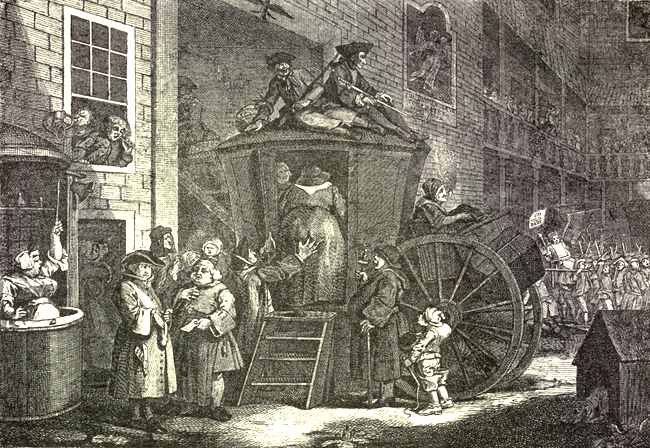
THE COUNTRY INN YARD.

Among the writers of English novels, Henry
Fielding holds the first rank. He was the
novelist of nature, and has described some
scenes which bear a strong resemblance to that which
is here delineated. The artist, like the author, has
taken truth for his guide, and given such characters as
are familiar to all our minds. The scene is a country
inn yard, at the time passengers are getting into a
stage-coach, and an election procession passing in the
background. Nothing can be better described; we
become of the party.—The vulgar roar of our landlady
is no less apparent than the grave, insinuating, imposing
countenance of mine host. Boniface solemnly
protests that a bill he is presenting to an old gentleman
in a laced hat is extremely moderate. This does
not satisfy the paymaster, whose countenance shows
that he considers it as a palpable fraud, though the
Act against bribery, which he carries in his pocket,
designates him to be of a profession not very liable
to suffer imposition: they are in general "less sinned
against than sinning." An ancient lady getting into
the coach is, from her breadth, a very inconvenient
companion in such a vehicle; but to atone for her
rotundity, an old maid of a spare appearance, and in
a most grotesque habit, is advancing towards the
steps.
A portly gentleman, with a sword and cane in one
hand, is deaf to the entreaties of a poor little deformed
postilion, who solicits his customary fee. The old
woman smoking her short pipe in the basket, pays
very little attention to what is passing around her:
cheered by the fumes of her tube, she lets the vanities
of the world go their own way. Two passengers on
the roof of the coach afford a good specimen of
French and English manners. Ben Block, of the
Centurion, surveys the subject of La Grande Monarque
with ineffable contempt.
In the window are a very curious pair: one of them
blowing a French horn, and the other endeavouring,
but without effect, to smoke away a little sickness,
which he feels from the fumes of his last night's punch.
Beneath them is a traveller taking a tender farewell
of the chambermaid, who is not to be moved by the
clangour of the great bar-bell, or the more thundering
sound of her mistress's voice.
The background is crowded with a procession of
active citizens; they have chaired a figure with a horn-book,
a bib, and a rattle, intended to represent Child,
Lord Castlemain, afterwards Lord Tylney, who, in a
violent contest for the county of Essex, opposed Sir
Robert Abdy and Mr. Bramston. The horn-book,
bib, and rattle are evidently displayed as punningly
allusive to his name.[176]
Under the sign of an angel, who seems dancing a
minuet on a cloud, is inscribed, "The Old Angle In
Toms Bates from London."
Some pains have been taken to discover in what
part of Essex this scene is laid; but from the many
alterations made by rebuilding, removal, etc., it has
not been positively ascertained, though it is probably
Chelmsford.
END OF VOL. I.
SEASON 1874.
A LIST OF BOOKS
PUBLISHED BY
Chatto & Windus
(Successors to John Camden Hotten),
74 & 75, PICCADILLY, LONDON, W.
THE FAMOUS FRASER PORTRAITS.
MACLISE'S GALLERY OF
ILLUSTRIOUS LITERARY CHARACTERS.
With Notes by the late WILLIAM MAGINN, LL.D.
Edited, with copious Notes, by William Bates, B.A., Professor of
Classics in Queen's College, Birmingham. The volume contains the
whole 83 Splendid and most Characteristic Portraits, now
first issued in a complete form. In demy 4to, over 400 pages,
cloth gilt and gilt edges, 31s. 6d.; or, in morocco elegant, 70s.
"What a truly charming book of pictures and prose, the quintessence, as it were,
of Maclise and Maginn, giving the very form and pressure of their literary time,
would this century of illustrious characters make."—Notes and Queries.
THE PRINCE OF CARICATURISTS.
—————
THE WORKS OF
JAMES GILLRAY,
The Caricaturist,
With the Story of his Life and Times,
and full and Anecdotal Descriptions
of his Engravings.
Edited by THOS. WRIGHT, Esq.,
M.A., F.S.A.
Illustrated with 90 full-page Plates,
and about 400 Wood Engravings.
Demy 4to, 600 pages, cloth extra,
31s. 6d.; or, in morocco elegant,
70s.
BEAUTIFUL PICTURES
BY BRITISH ARTISTS.
A Gathering of Favourites from our Picture Galleries, 1800-1870. By
Wilkie, Constable, J. M. W. Turner, Mulready, Sir Edwin
Landseer, Maclise, Leslie, E. M. Ward, Frith, Sir John
Gilbert, Ansdell, Marcus Stone, Sir Noel Paton, Eyre
Crowe, Faed, Madox Brown. All Engraved in the highest style
of Art. With Notices of the Artists by Sydney Armytage, M.A.
A New Edition. Imperial 4to, cloth gilt and gilt edges, 21s.; or,
in morocco elegant, 65s.
Uniform with "Beautiful Pictures."
COURT BEAUTIES OF THE
REIGN OF CHARLES II.
From the Originals in the Royal Gallery at Windsor, by Sir
Peter Lely. Engraved in the highest style of Art by Thomson,
Wright, Scriven, B. Holl, Wagstaff, and T. A. Deane.
With Memoirs by Mrs. Jameson, Author of "Legends of the
Madonna." New and sumptuous "Presentation Edition." Imp.
4to, cloth gilt and gilt edges, 21s.; or, in morocco elegant, 65s.
"This truly beautiful and splendid production is equally a gem among the Fine
Arts and in Literature."—Quarterly Review.
Companion to the "History of Signboards."
Advertising: its History, in all Ages and
Countries, with many very Amusing Anecdotes and Examples of
Successful Advertisers. Crown 8vo, with numerous Illustrations,
coloured and plain, cloth extra, 7s. 6d.
[In preparation.
Are You Engaged? If so, get
Advice to Parties
About to Marry. A Series
of Instructions in Jest and
Earnest. By the Hon. Hugh
Rowley. With Humorous Illustrations.
Price 3s. 6d., elegantly
bound, and enclosed in
tinted wrapper, beautifully
scented by Rimmel.
⁂ Before taking the "awful plunge"
be sure to consult this little work. If it
is not a guarantee against life-long
misery, it will at least be found of
great assistance in selecting a partner
for life.
American Happy Thoughts. The
finest collection of American Humour ever made. Foolscap 8vo,
illustrated covers, 1s.
[Preparing.
Anacreon. Illustrated by
the Exquisite Designs of Girodet. Translated
by Thomas Moore. Bound in vellum
cloth and Etruscan gold, 12s. 6d.
⁂ A beautiful and captivating volume. The
well-known Paris house, Firmin Didot, a few years
since produced a miniature edition of these exquisite
designs by photography, and sold a large number at
£2 per copy. The Designs have been universally
admired by both artists and poets.
Armorial Register of the Order of
the Garter, from Edward III, to the Present Time. The several
Shields beautifully emblazoned in Gold and Colours from the Original
Stall Plates in St. George's Chapel, Windsor. All emblazoned by
hand. A sumptuous volume, bound in crimson morocco, gilt, £20.
ARTEMUS WARD'S WORKS.
Artemus Ward,
Complete. The Works of Charles
Farrer Browne, better known as
"Artemus Ward," now first collected.
Crown 8vo, with fine Portrait,
facsimile of handwriting, &c.,
540 pages, cloth neat, 7s. 6d.
⁂ Comprises all that the humourist has
written in England or America. Admirers
of Artemus Ward will be glad to possess
his writings in a complete form.
—————————
Artemus Ward's
Lecture at the Egyptian Hall,
with the Panorama. Edited by the
late T. W. Robertson, Author of "Caste," &c., and E. P. Hingston.
Small 4to, exquisitely printed, bound in green and gold, with
numerous Tinted Illustrations, 6s.
Artemus Ward: his Book. With Notes
and Introduction by the Editor of the "Biglow Papers." One of
the wittiest books published for many years. Fcap. 8vo, illustrated
cover, 1s.
The Saturday Review says:—"The author combines the powers of Thackeray
with those of Albert Smith. The salt is rubbed in by a native hand—one which has
the gift of tickling."
Artemus Ward: his Travels among
the Mormons and on the Rampage. Edited by E. P. Hingston,
the Agent and Companion of A. Ward whilst "on the
Rampage." New Edition, price 1s.
⁂ Some of Artemus's most mirth-provoking papers are to be found in this
book. The chapters on the Mormons will unbend the sternest countenance. As
bits of fun they are IMMENSE!
Artemus Ward's Letters to "Punch,"
Among the Witches, and other Sketches. Cheap Popular Edition.
Fcap. 8vo, in illustrated cover, 1s.; or, 16mo, bound in cloth extra, 2s.
⁂ The volume contains, in addition, some quaint and humorous compositions
which were found upon the author's table after his decease.
Artemus Ward among the Fenians:
with the Showman's Experiences of Life at Washington, and Military
Ardour at Baldinsville. Toned paper, price 6d.
Army Lists of the Roundheads and
Cavaliers in the Civil War, 1642. Second Edition, Considerably
Enlarged and Corrected. Edited, with Notes, by Edward Peacock,
F.S.A. 4to, half-Roxburghe, 7s. 6d.
⁂ Very interesting to Antiquaries and Genealogists.
The Art of Amusing.
A Collection of Graceful Arts,
Games, Tricks, Puzzles, and
Charades, intended to amuse
everybody, and enable all to
amuse everybody else. By
Frank Bellew. With nearly
300 Illustrations. Crown 8vo,
4s. 6d.
⁂ One of the most entertaining handbooks
of amusements ever published.
——————————
Awful Crammers.
A New American Joke Book.
Edited by Titus A. Brick,
Author of "Shaving Them."
Fcap. 8vo, with numerous
curious Illustrations, 1s.
A Fine Edition is also published, in crown 8vo, printed on toned
paper, and bound in cloth gilt, at 3s. 6d.
"Rarer than the phœnix is the virtuous man who will consent to lose a good
anecdote because it isn't true."—De Quincy.
Babies and Ladders:
Essays on Things in General. By
Emmanuel Kink. A New Work
of Irresistible Humour (not American),
which has excited considerable
attention. Fcap. 8vo, with
numerous Vignettes by W. S.
Gilbert and others, 1s.
Bayard Taylor's Diversions of the
Echo Club. A Delightful Volume of Refined Literary Humour.
In 16mo, paper cover, with Portrait of the Author, 1s. 6d.; cloth
extra, 2s.
Uniform with Mr. Ruskin's Edition of "Grimm."
Bechstein's As Pretty as Seven, and
other Popular German Stories. Collected by Ludwig Bechstein.
With Additional Tales by the Brothers Grimm, 100 Illustrations by
Richter. Small 4to, green and gold, 6s. 6d.; gilt edges, 7s. 6d.
⁂ One of the most delightful books for children ever published. It is, in every
way, a Companion to the German Stories of the Brothers Grimm, and the tales
are equally pure and healthful. The quaint simplicity of Richter's engravings
will charm every lover of legendary lore.
The Biglow Papers. By James Russell
Lowell. The Best Edition, with full Glossary, of these extraordinary
Verses. Fcap. 8vo, illustrated cover, 1s.
Uniform with our "Rabelais."
Boccaccio's Decameron.
Now fully translated into English,
with Introduction by Thomas Wright,
F.S.A. Crown 8vo, with the Beautiful
Engravings by Stothard which
adorned Pickering's fine Edition, published
at £2 12s. 6d. This New
Edition is only 7s. 6d.
⁂ A faithful translation, in which are
restored many passages omitted in former
Editions.
Book of Hall-Marks; or, Manual of
Reference for the Goldsmith and Silversmith. By Alfred Lutschaunig,
Manager of the Liverpool Assay Office. Crown 8vo, with
46 Plates of the Hall-Marks of the different Assay Towns of the
United Kingdom, as now stamped on Plate and Jewellery, 7s. 6d.
⁂ This work gives practical methods for testing the quality of gold and silver.
It was compiled by the author for his own use, and as a Supplement to "Chaffers."
Booksellers, A History of. A Work
giving full Accounts of the Great Publishing Houses and their
Founders, both in London and the Provinces, the History of
their Rise and Progress, and descriptions of the special class of
Literature dealt in by each. Crown 8vo, over 500 pages, with frontispiece
and numerous Portraits and Illustrations, cloth extra, 7s. 6d.
"In these days, ten ordinary Histories of Kings and Courtiers were well exchanged
against the tenth part of one good History of Booksellers."—Thomas Carlyle.
Booth's Epigrams: Ancient and Modern,
Humorous, Witty, Satirical, Moral, and Panegyrical. Edited by
the Rev. John Booth, B.A. A New Edition. Pott 8vo, cloth gilt, 6s.
"Is our civilization a failure, or is the Caucasian played out?"
BRET HARTE'S WORKS.
Widely known for their Exquisite Pathos and Delightful Humour.
Bret Harte's Complete Works, in Prose
and Poetry. Now First Collected. With Introductory Essay by
J. M. Bellew, Portrait of the Author, and 50 Illustrations. Crown
8vo, 650 pages, cloth extra, 7s. 6d.
Bret Harte's Luck of Roaring Camp,
and other Stories. Fcap. 8vo, illustrated cover, 1s.
Bret Harte's That Heathen Chinee,
and other Humorous Poems. Fcap. 8vo, illustrated cover, 1s. 6d.
Bret Harte's Sensation Novels Condensed.
Fcap. 8vo, illustrated cover, 1s. 6d.
⁂ A most enjoyable book, only surpassed, in its special class, by Thackeray's
Burlesque Novels.
Bret Harte's Lothaw; or, The Adventures
of a Young Gentleman in Search of a Religion. By Mr. Benjamins
(Bret Harte). Price 6d. Curiously Illustrated.
Bret Harte's East and West. Fcap.
8vo, illustrated cover, 1s.
Bret Harte's Stories of the Sierras, and
other Sketches. With a Wild Story of Western Life by Joaquin
Miller, Author of "Songs of the Sierras." Illustrated cover, 1s.
NEW EDITIONS OF SIR DAVID BREWSTER'S WORKS.
Brewster's More Worlds than One,
the Creed of the Philosopher and the Hope of the Christian.
Eleventh Edition. Crown 8vo, cloth, very neat, 4s. 6d.
Brewster's Martyrs of Science:
Galileo, Tycho Brahe, Kepler. Crown 8vo, cloth, very neat, 4s. 6d.
Brewster's The Kaleidoscope Practically
Described. Crown 8vo, with numerous Illustrations,
cloth, very neat, 4s. 6d.
Brewster's The Stereoscope Practically
Described. Crown 8vo, numerous Illustrations, cloth
neat, 4s. 6d.
⁂ This was the great philosopher's last contribution to practical science.
Bright's (Rt. Hon. J., M.P.) Speeches
on Public Affairs of the last Twenty Years. Collated with the
best Public Reports. Royal 16mo, 370 pages, cloth extra, 1s.
⁂ A book of special interest at the present time, and wonderfully cheap.
COLMAN'S HUMOROUS WORKS.
Broad Grins. My Nightgown and Slippers,
and other Humorous Works, Prose and Poetical, of George Colman
the Younger. Now first collected, with Life and Anecdotes of
the Author, by George B. Buckstone. Crown 8vo, 500 pp., 7s. 6d.
⁂ Admirers of genuine English wit and humour will be delighted with this
edition of George Colman's humorous works. As a wit, he has had no equal in
our time; and a man with a tithe of his ability could, at the present day, make
the fortune of any one of our so-called "comic journals," and bankrupt the rest.
NEW BOOK FOR BOYS.
The Conquest of the Sea: A History
of Divers and Diving, from the Earliest Times to the Present Day.
By Henry Siere. Profusely Illustrated with fine Wood Engravings.
Small crown 8vo, cloth extra, 4s. 6d.
Uniform with the 2s. Edition of his Works.
Carlyle (T.) on the Choice of Books.
With a New Life and Anecdotes of the Author. Brown cloth,
1s. 6d.; paper cover, 1s.
Chips from a Rough Log. Fcap. 8vo,
illustrated cover, 1s.
Christmas Songs and Ballads. Selected
and Edited by Joshua Sylvester. A New Edition, beautifully
printed and bound in cloth, extra gilt, gilt edges, 3s. 6d.
Clerical Anecdotes and Pulpit Eccentricities.
An entirely New Gathering. Square 16mo, in illustrated
paper wrapper, 1s. 4d.; or cloth neat, 1s. 10d.
The Country of the Dwarfs. By Paul
du Chaillu. A Book of Startling Interest. Fcap. 8vo, illustrated
with full-page Engravings, in fancy wrapper, 1s.
Cruikshank's Comic Almanack.
First Series, 1835-43. A Gathering of the Best Humour, the
Wittiest Sayings, the Drollest Quips, and the Best Things of
Thackeray, Hood, Mayhew, Albert Smith, A'Beckett,
Robert Brough, &c. With about One Thousand Woodcuts and Steel
Engravings by the inimitable Cruikshank, Hine, Landells, &c.
Crown 8vo, cloth gilt, a very thick volume, price 7s. 6d.
Cruikshank's Comic Almanack.
Second Series, 1844-53, Completing the work. Uniform with the
First Series, and written and illustrated by the same humorists.
Crown 8vo, cloth gilt, a very thick volume, price 7s. 6d.
⁂ The two volumes (each sold separately) form a most extraordinary gathering
of the best wit and humour of the past half-century. The work forms a "Comic
History of England" for twenty years.
THE BEST GUIDE TO HERALDRY.
Cussans' Handbook of
Heraldry; with Instructions for Tracing
Pedigrees and Deciphering Ancient MSS.;
also, Rules for the Appointment of Liveries,
&c., &c. By John E. Cussans. Illustrated
with 360 Plates and Woodcuts. Cr.
8vo, cloth extra, gilt and emblazoned, 7s. 6d.
⁂ This volume, beautifully printed on toned paper,
contains not only the ordinary matter to be found
in the best books on the science of Armory, but several
other subjects hitherto unnoticed. Amongst
these may be mentioned:—1. Directions for
Tracing Pedigrees. 2. Deciphering Ancient
MSS., illustrated by Alphabets and Facsimiles.
3. The Appointment of Liveries.
4. Continental and American Heraldry, &c.
VERY IMPORTANT COUNTY HISTORY.
Cussans' History of Hertfordshire.
A County History, got up in a very superior manner, and ranging
with the finest works of its class. Illustrated with full-page Plates
on Copper and Stone, and a profusion of small Woodcuts. Parts
I. to VI. are now ready, price 21s. each.
⁂ An entirely new History of this important County, great attention being
given to all matters pertaining to the Family History of the locality.
Uniform With the "Charles Dickens Edition."
Dickens: The Story
of his Life. By Theodore Taylor,
Author of the "Life of
Thackeray." Uniform with the
"Charles Dickens Edition" of his
Works, and forming a Supplementary
Volume to that Issue. Cr.
8vo, crimson cloth, 3s. 6d.
"Anecdotes seem to have poured in upon
the author from all quarters.... Turn where
we will through these 370 pleasant pages,
something worth reading is sure to meet the
eye."—The Standard.
Also Published:
The "Best Edition" of the above Work, illustrated by Photographic
Frontispiece of "Dickens as Captain Bobadil," Portraits,
Facsimiles, &c. Crown 8vo, cloth extra, 7s. 6d.
The "Cheap Edition," in 16mo, paper wrapper, with Frontispiece
and Vignette, 2s.
Uniform with the "Charles Dickens Edition."
Dickens' Speeches, Social and Literary,
now first collected. Uniform with, and forming a Supplementary
Volume to, the "Charles Dickens Edition." Crown 8vo,
crimson cloth, 3s. 6d.
"His speeches are as good as any of his printed writings."—The Times.
Also Published:
The "Best Edition," in crown 8vo, with fine Portrait by Count
D'Orsay, cloth extra, 7s. 6d.
The "Cheap Edition," without Portrait, in 16mo, paper wrapper,
2s.
Dickens' Life and Speeches, in One Volume, 16mo, cloth extra,
2s. 6d.
BALZAC'S CONTES DROLATIQUES.
Droll Stories, collected from the
Abbeys of Touraine. Now first Translated into English,
Complete and Unabridged, with the whole 425 Marvellous,
Extravagant, and Fantastic Illustrations (the finest he has ever done)
by Gustave Doré. Beautifully printed, in 8vo, cloth extra, gilt,
gilt top, 12s. 6d.
⁂ The most singular designs ever attempted by any artist. So crammed is
the book with pictures, that even the contents are adorned with thirty-three Illustrations.
A few copies of the French Original are still on sale, bound half-Roxburghe,
gilt top—a very handsome book—price 12s. 6d.
The Danbury Newsman. A Brief but
Comprehensive Record of the Doings of a Remarkable People, under
more Remarkable Circumstances, and Chronicled in a most Remarkable
Manner. By James M. Bailey. Uniform with Twain's
"Screamers." Fcap. 8vo, illustrated cover, 1s.
"A real American humorist."—Figaro.
The Derby Day. A Sporting Novel of
intense interest, by a well-known writer. Fcap. 8vo, illustrated
cover, 1s.
Disraeli's (Rt. Hon. B.) Speeches
on the Conservative Policy of the last Thirty Years, including the
Speech at the Literary Fund Dinner, specially revised by the Author.
Royal 16mo, paper cover, with Portrait, 1s. 4d.; in cloth, 1s. 10d.
D'Urfey's ("Tom") Wit and Mirth;
or, Pills to Purge Melancholy: Being a Collection of the
best Merry Ballads and Songs, Old and New. Fitted to all Humours,
having each their proper Tune for either Voice or Instrument:
most of the Songs being new set. London: Printed by W.
Pearson, for J. Tonson, at Shakespeare's Head, over-against Catherine
Street in the Strand, 1719.
An exact and beautiful reprint of this much-prized work, with the
Music to the Songs, just as in the rare original. In 6 vols., large
fcap. 8vo, antique boards, edges uncut, beautifully printed on laid
paper, made expressly for the work, price £3 3s.; or Large Paper
Copies (a limited number only printed), price £5 5s.
⁂ The Pills To Purge Melancholy have now retained their celebrity for a
century and a half. The difficulty of obtaining a copy has of late years raised sets
to a fabulous Price, and has made even odd volumes costly. Considering the classical
reputation which the book has thus obtained, and its very high interest as
illustrative of the manners, customs, and amusements of English life during the
half century following the Restoration, no apology is needed for placing such a work
more within the reach of general readers and students by re-issuing it for the first
time since its original appearance, and at about a tithe of the price for which
the old edition could now be obtained.
For drinking-songs and love-songs, sprightly ballads, merry stories, and political
squibs, there are none to surpass these in the language. In improvising such
pieces, and in singing them, D'urfey was perhaps never equalled, except in our
own century by Theodore Hook. The sallies of his wit amused and delighted
three successive English sovereigns; and while his plays are forgotten, his songs
and ballads still retain the light abandon and joyous freshness that recommended
them to the wits and beaux of Queen Anne's days. Nor can the warm and affectionate
eulogy of Steele and Addison be forgotten, and D'urfey may now take his
place on the bookshelves of the curious, side by side with the other worthies of
his age.
The Earthward Pilgrimage, from the
Next World to that which now is. By Moncure D. Conway.
Crown 8vo, beautifully printed and bound, 7s. 6d.
Edgar Allan Poe's Prose and Poetical
Works; including Additional Tales and the fine Essays by this
great Genius, now First Published in this Country. With
a Translation of Charles Baudelaire's "Essay on Poe." 750
pages, crown 8vo, with fine Portrait and Illustrations, cloth extra,
7s. 6d.
Poe's Cottage at Fordham.
Mrs. Ellis's Mothers of Great Men.
A New Edition of this well-known Work, with numerous very beautiful
Portraits. Crown 8vo, cloth gilt, over 500 pages, 7s. 6d.
[In preparation.
The Standard Work on the Subject.
Emanuel on Diamonds and Precious
Stones; Their History, Value, and Properties; with Simple
Tests for ascertaining their Reality. By Harry Emanuel, F.R.G.S.
With numerous Illustrations, Tinted and Plain. A New Edition,
with the Prices brought down to the Present Time. Crown 8vo, full
gilt, 6s.
"Will be acceptable to many readers."—Times.
"An invaluable work for buyers and sellers."—Spectator.
⁂ The present, which is greatly superior to the first edition, gives the latest
market value for Diamonds and Precious Stones of every size.
The Englishman's House, from a Cottage
to a Mansion. A Practical Guide to Members of Building
Societies, and all interested in Selecting or Building a House. By
C. J. Richardson, Architect, Author of "Old English Mansions,"
&c. Second Edition, Corrected and Enlarged, with nearly 600
Illustrations. Crown 8vo, 550 pages, cloth, 7s. 6d.
⁂ This Work might not inappropriately be termed "A Book of Houses." It
gives every variety of house, from a workman's cottage to a nobleman's palace.
The book is intended to supply a want long felt, viz., a plain, non-technical
account of every style of house, with the cost and manner of building.
Our English Surnames: Their Sources
and Significations. By Charles Wareing Bardsley, M.A.
Crown 8vo, about 600 pages, cloth extra, 9s.
Indispensable to every Household.
Everybody Answered. A Handy Book
for All; and a Guide to the Housewife, the Servant, the Cook, the
Tradesman, the Workman, the Professional Man, the Clerk, &c.,
&c., in the Duties belonging to their respective Callings. One
thick volume, crown 8vo, cloth gilt, 4s. 6d.
[In preparation.
Family Fairy Tales; or, Glimpses of Elfland
at Heatherstone Hall. Edited by Cholmondeley Pennell,
Author of "Puck on Pegasus," &c. Adorned with beautiful
Pictures of "My Lord Lion," "King Uggermugger," and other
Great Folks, by M. Ellen Edwards, and other artists. Handsomely
printed on toned paper, in cloth, green and gold, price 4s. 6d.
plain, 5s. 6d. coloured.
Faraday's Chemical History of a
Candle. Lectures delivered to a Juvenile Audience. A New
Edition of this well-known volume, which has been so long out of
print, Edited by W. Crookes, Esq., F.S.A., &c. Crown 8vo,
cloth extra, with all the Original Illustrations, price 4s. 6d.
Faraday's Various Forces of Nature.
A New Edition, with all the Original Illustrations, Edited by W.
Crookes, Esq., F.S.A., &c. Crown 8vo, cloth extra, 4s. 6d.
FLAGELLATION AND THE FLAGELLANTS.
A History of the Rod in all Countries,
from the Earliest Period to the Present Time. The use of the Rod
in the Church, Convent, Monastery, Prison, Army, Navy, in public
and private; the use of the Birch in the Family, Ladies' Seminaries,
Boys' Schools, Colleges, the Boudoir, Ancient and Modern. By the
Rev. W. Cooper, B.A. Second Edition, revised and corrected,
with numerous Illustrations. Thick crown 8vo, cloth extra gilt, 12s. 6d.
"A remarkable, and certainly a very readable volume."—Daily Telegraph.
The Fiend's Delight: A "Cold Collation"
of Atrocities. By Dod Grile. New Edition, in illustrated
wrapper, fcap. 8vo, 1s.; or crown 8vo, cloth extra, 3s. 6d.
"A specimen of 'American Humour' as unlike that of all other American
humourists, as the play of young human Merry-Andrews is unlike that of a young
and energetic demon whose horns are well budded."—New York Nation.
The Finish to Life in and out of
London; or, The Final Adventures of Tom, Jerry, and Logic.
By Pierce Egan. Royal 8vo, cloth extra, with Spirited Coloured
Illustrations by Cruikshank, 21s.
⁂ An extraordinary picture of "London by Night" in the Days of George
the Fourth. All the strange places of amusement in the neighbourhood of Covent
Garden and St. James's are fully described, and very queer places they were too!
Walk up! Walk up! and see the
Fools' Paradise; with the Many Wonderful
Adventures there, as seen in the strange, surprising
PEEP-SHOW OF PROFESSOR WOLLEY COBBLE,
Raree Showman these Five-and-Twenty Years.
Crown 4to, with nearly 200 immensely funny Pictures, all beautifully
coloured, bound in extra cloth gilt, price 7s. 6d.
The Professor's Leetle Music Lesson.
A Second Series is now Ready, called
Further Adventures in Fools' Paradise,
with the Many Wonderful Doings, as seen in the
PEEP-SHOW OF PROFESSOR WOLLEY COBBLE.
Crown 4to, with the Pictures beautifully Coloured, uniform with the
First Series, in extra cloth gilt, price 7s. 6d.
A Companion to all French
Dictionaries.
French Slang; or,
Eccentricities of the French
Language.
A DICTIONARY OF
PARISIAN ARGOT,
including all recent expressions,
whether of the Street, the
Theatre, or the Prison. Handsomely
bound in half-Roxburghe,
illustrated with 30
large Wood Engravings. Price
7s. 6d.
⁂ This book is indispensable to all
readers of modern French literature.
It is, besides, amusing in itself,
and may be taken up to while away
an idle half-hour. It does for French
what our "Slang Dictionary" does for
English.
Fun for the Million:
A Gathering of Choice
Wit and Humour, Good
Things, and Sublime Nonsense,
by Dickens, Jerrold,
Sam Slick, Chas.
H. Ross, Hood, Theodore
Hook, Mark Twain,
Brough, Colman, Titus
A. Brick, and a Host of
other Humourists. With
Pictures by Matt Morgan,
Gilbert, Nast,
Thompson, Cruikshank,
Jun., Brunton, &c. In
fcap. 4to, profusely illustrated,
with picture wrapper,
1s.
The Genial Showman; or, Show Life
in the New World. Adventures with Artemus Ward, and the Story
of his Life. By E. P. Hingston. Third Edition. Crown 8vo, Illustrated
by Brunton, cloth extra, 7s. 6d.
⁂ This is a most interesting work. It gives Sketches of Show-Life in the Far
West, on the Pacific Coast, among the Mines of California, in Salt Lake City,
and across the Rocky Mountains; with chapters descriptive of Artemus Ward's
visit to England.
RUSKIN AND CRUIKSHANK.
German Popular Stories. Collected by
the Brothers Grimm, and Translated by Edgar Taylor. Edited
by John Ruskin. With 22 Illustrations after the inimitable
designs of George Cruikshank. Both Series complete. Square
crown 8vo, 6s. 6d.; gilt leaves, 7s. 6d.
⁂ These are the designs which Mr. Ruskin has praised so highly, placing them
far above all Cruikshank's other works of a similar character. So rare had the
original book (published in 1823-1826) become, that £5 to £6 per copy was an ordinary
price. By the consent of Mr. Taylor's family a New Edition is now issued,
under the care and superintendence of the printers who issued the originals forty
years ago. A few copies for sale on Large Paper, price 21s.
Gesta Romanorum; or, Entertaining
Stories, invented by the Monks as a Fireside Recreation, and commonly
applied in their Discourses from the Pulpit. A New Edition,
with Introduction by Thomas Wright, Esq., M.A., F.S.A. Two
vols. large fcap. 8vo, only 250 copies printed, on fine ribbed paper,
18s.; or, Large Paper Edition (only a few copies printed), 30s.
Gladstone's (Rt. Hon. W. E.) Speeches
on Great Questions of the Day during the last Thirty Years. Collated
with the best public reports. Royal 16mo, paper cover, 1s. 4d.;
cloth extra, 1s. 10d.
Golden Treasury of Thought. The Best
Encyclopædia of Quotations and Elegant Extracts, from Writers of
all Times and all Countries, ever formed. Selected and Edited by
Theodore Taylor, Author of "Thackeray, the Humorist and
Man of Letters," "Story of Charles Dickens' Life." Crown 8vo,
very handsomely bound, cloth gilt, and gilt edges, 7s. 6d.
Grose's Dictionary of the Vulgar
Tongue. 1785. A genuine unmutilated Reprint of the First Edition.
Quarto, bound in half-Roxburghe, gilt top, price 8s.
⁂ Only a small number of copies of this very vulgar, but very curious, book
have been printed, for the Collectors of "Street Words" and Colloquialisms.
Hall's (Mrs. S. C.) Sketches of Irish
Character. With numerous Illustrations on Steel and Wood, by
Daniel Maclise, R.A., Sir John Gilbert, W. Harvey, and
G. Cruikshank. 8vo, pp. 450, cloth extra, 7s. 6d.
"The Irish sketches of this lady resemble Miss Mitford's beautiful English
Sketches in 'Our Village,' but they are far more vigorous and picturesque and
bright."—Blackwood's Magazine.
Companion to "The Secret Out."
Hanky-Panky. A New and Wonderful
Book of Very Easy Tricks, Very Difficult Tricks, White
Magic, Sleight of Hand; in fact, all those startling Deceptions
which the Great Wizards call "Hanky-Panky." Edited by W. H.
Cremer, of Regent Street. With nearly 200 Illustrations. Crown
8vo, cloth extra, price 4s. 6d.
Hans Breitmann's Ballads. By J. G.
Leland. The Complete Work, from the Author's revised Edition.
Royal 16mo, paper cover, 1s.; in cloth, 1s. 6d.
Hatton's (Jos.)
Kites and Pigeons. A
most amusing Novelette.
With Illustrations by Linley
Sambourne, of "Punch."
Fcap. 8vo, illustrated wrapper,
1s.
——————————
Hawthorne's
English and American
Note Books. Edited,
with an Introduction, by
Moncure D. Conway.
Royal 16mo, paper cover,
1s.; in cloth, 1s. 6d.
Holidays with Hobgoblins, and Talk of
Strange Things. By Dudley Costello. Fcap. 8vo, illustrated
boards, with Picture by George Cruikshank. 2s.
OLIVER WENDELL HOLMES' WORKS.
Holmes' Autocrat of the Breakfast
Table. An entirely New Edition of this Favourite Work. Royal
16mo, paper cover, 1s.; in cloth, neat, 1s. 6d.
Holmes' Poet at the Breakfast Table.
From January to June. Paper cover, 1s.
Holmes' Professor at the Breakfast
Table. A Companion Volume to the "Autocrat of the Breakfast
Table." Royal 16mo, paper cover, 1s.; cloth neat, 1s. 6d.
Holmes' Wit and Humour. Delightful
Verses, in the style of the elder Hood. Fcap. 8vo, illustrated
wrapper, 1s.
THE ONLY COMPLETE HOGARTH EVER PUBLISHED.
Hogarth's Works; with Life and Anecdotal
Descriptions of the Pictures, by John Ireland and John Nichols.
The Work includes 150 Engravings, reduced in exact facsimile of
the Original Plates, specimens of which have now become very
scarce. The whole in Three Series, 8vo, cloth, gilt, 22s. 6d. Each
series is, however, Complete in itself, and is sold separately at
7s. 6d.
Hogarth's Five Days' Frolic; or, Peregrinations
by Land and Water. Illustrated with Tinted Drawings,
made by Hogarth and Scott during the Journey. 4to, beautifully
printed, cloth, extra gilt, 10s. 6d.
⁂ A graphic and most extraordinary picture of the hearty English times
in which these merry artists lived.
Hood's Whims and Oddities. The
Entire Work. Now issued Complete, the Two Parts in One Volume,
with all the Humorous Designs. Royal 16mo, paper cover, 1s.; cloth
neat, 1s. 6d.
Hunt's (Leigh) Tale for a Chimney
Corner, and other charming Essays. With Introduction by Edmund
Ollier, and Portrait supplied by the late Thornton Hunt.
Royal 16mo, paper cover, 1s. 4d.; cloth neat, 1s. 10d.
Hunt's (Robert, F.R.S.) Drolls of Old
Cornwall; or, Popular Romances of the West of England.
New Edition, Complete in One Volume, with Illustrations
by George Cruikshank. Crown 8vo, extra cloth gilt,
7s. 6d.
⁂ "Mr. Hunt's charming book on the Drolls and Stories of the West of
England."—Saturday Review.
Jennings' (Hargrave)
One of the Thirty. With curious Illustrations.
Crown 8vo, cloth extra, 10s. 6d.
⁂ An extraordinary narrative, tracing down
one of the accursed pieces of silver for which Jesus of
Nazareth was sold. Through eighteen centuries is
this fated coin tracked, now in the possession of the
innocent, now in the grasp of the guilty, but everywhere
carrying with it the evil that fell upon Judas.
——————————
Jennings' (Hargrave)
The Rosicrucians: Their Rites and
Mysteries. With chapters on the Ancient Fire and Serpent
Worshippers, and Explanations of the Mystic Symbols represented
in the Monuments and Talismans of the Primeval Philosophers.
Crown 8vo, cloth extra, with about 300 Illustrations, 10s. 6d.
Joe Miller's Jests; or, The Wit's Vade
Mecum. Being a collection of the most brilliant Jests, the politest
Repartees, the most elegant Bon-Mots, and most pleasant short
Stories in the English Language. London: Printed by T. Read,
1739. A remarkable facsimile of the very rare Original Edition.
8vo, half-Roxburghe, 9s. 6d.
⁂ Only a very few copies of this humorous and racy old book have been reproduced.
Josh Billings: His Book of Sayings.
With Introduction by E. P. Hingston, Companion of Artemus
Ward when on his "Travels." Fcap. 8vo, illustrated cover, 1s.
Kalendars of Gwynedd; or, Chronological
Lists of Lords-Lieutenant, Sheriffs and Knights for Anglesey,
Caernarvon, and Merioneth. With Lists of the Lords-Presidents of
Wales, and the Constables of the Castles of Beaumaris, Caernarvon,
Conway, and Harlech. Compiled by Edward Breese, F.S.A.
With Notes by William Watkin Edward Wynne, Esq., F.S.A.,
of Penairth. Only a limited number printed. One volume, demy
4to, cloth extra, 28s.
Lamb's (Charles) Essays of Elia. The
Complete Work. Beautifully printed, and uniform with the "Essays
of Leigh Hunt." Royal 16mo, paper cover, 1s.; cloth neat, 1s. 6d.
Leigh's Carols of Cockayne. Vers de
Société, mostly descriptive of London Life. By Henry S. Leigh.
With numerous exquisite Designs by Alfred Concanen and the
late John Leech. Small 4to, elegant, uniform with "Puniana,"
6s.
Uniform with "Dr. Syntax."
Life in London; or,
The Day and Night Scenes of Jerry
Hawthorn and Corinthian Tom. With
the whole of Cruikshank's very
Droll Illustrations, in Colours,
after the Originals. Crown 8vo, cloth
extra, 7s. 6d.
⁂ One of the most popular books ever issued.
It was an immense favourite with George IV.,
and as a picture of London life fifty years ago
was often quoted by Thackeray, who devotes one
of his "Roundabout Papers" to a description of it.
Literary Scraps. A Folio Scrap-Book of
340 columns, with guards, for the reception of Cuttings from Newspapers,
Extracts, Miscellanea, &c. A very useful book. In folio,
half-roan, cloth sides, 7s. 6d.
Little Breeches, and other Pieces (Pike
County Ballads). By Colonel John Hay. Foolscap 8vo, illustrated
cover, 1s. 6d.
The Little London Directory of 1677.
The Oldest Printed List of the Merchants and Bankers of London.
Reprinted from the Exceedingly Rare Original, with an Introduction
by John Camden Hotten. 16mo, in a beautiful binding, after
the original, 6s. 6d.
The Log of the Water Lily, during Three
Cruises on the Rhine, Neckar, Main, Moselle, Danube, Saone, and
Rhone. By R. B. Mansfield, B.A. Illustrated by Alfred
Thompson, B.A. Fifth Edition, revised and considerably enlarged.
Crown 8vo, cloth extra, gilt, 5s.
Longfellow's Prose
Works, Complete, including his
Stories and Essays, now for the
first time collected. Edited, with
a Preface, by the Author of "Tennysoniana."
With Portrait and
Illustrations, drawn by Valentine
Bromley, and beautifully engraved,
650 pages, crown 8vo, cloth gilt,
7s. 6d.
Lost Beauties of the English Language.
An Appeal to Authors, Poets, Clergymen, and Public Speakers;
with an Introductory Essay. By Charles Mackay, LL.D. In
crown 8vo, cloth extra, uniform with the "Slang Dictionary," 6s. 6d.
Uniform with "The Magician's Own Book."
Magic and Mystery. A Splendid Collection
of Tricks with Cards, Dice, Balls, &c., with fully descriptive
working Directions. Crown 8vo, with numerous Illustrations, cloth
extra, 4s. 6d.
[Preparing.
Companion to "The Secret Out."
The Magician's Own Book. Containing
ample Instructions for Performances in Legerdemain with Cups and
Balls, Eggs, Hats, Handkerchiefs, &c. All from Actual Experience.
Edited by W. H. Cremer, Jun., of Regent Street. Cloth extra,
with 200 Illustrations, 4s. 6d.
MARK TWAIN'S WORKS.
Mark Twain's Choice Works. With
extra passages to the "Innocents Abroad," now first reprinted, and
a Life of the Author. 50 Illustrations by Mark Twain and other
Artists, and Portrait of the Author. 700 pages, cloth gilt, 7s. 6d.
Mark Twain's Innocents
Abroad: The Voyage Out.
Crown 8vo, cloth, fine toned paper,
3s. 6d.; or fcap. 8vo, illustrated
wrapper, 1s.
——————————
Mark Twain's New
Pilgrim's Progress: The Voyage
Home. Crown 8vo, cloth, fine
toned paper, 3s. 6d.; or fcap. 8vo,
illustrated wrapper, 1s.
——————————
Mark Twain's Burlesque
Autobiography, First
Mediæval Romance, and on Children. Fcap. 8vo, illustrated cover, 6d.
Mark Twain's Eye-Openers. A Volume
of immensely Funny Sayings, and Stories that will bring a smile upon
the gruffest countenance. Fcap. 8vo, illustrated wrapper, 1s.
Mark Twain's Jumping Frog, and other
Humorous Sketches. Fcap. 8vo, illustrated cover, 1s.
"An inimitably funny book."—Saturday Review.
Mark Twain's Pleasure Trip on the
Continent of Europe. (The "Innocents Abroad" and "New
Pilgrim's Progress" in one volume.) 500 pages, paper boards, 2s.;
or in cloth, 2s. 6d.
Mark Twain's Practical Jokes; or,
Mirth with Artemus Ward, and other Papers. By Mark Twain,
and other Humorists. Fcap. 8vo, illustrated cover, 1s.
Mark Twain's Screamers. A Gathering
of Delicious Bits and Short Stories. Fcap. 8vo, illustrated cover, 1s.
Mayhew's London Characters: Illustrations
of the Humour, Pathos, and Peculiarities of London Life.
By Henry Mayhew, Author of "London Labour and the London
Poor," and other Writers. With nearly 100 graphic Illustrations.
Crown 8vo, cloth gilt, about 500 pages, 7s. 6d.
[Preparing.
Magna Charta. An exact Facsimile of the
Original Document, preserved in the British Museum, very carefully
drawn, and printed on fine plate paper, nearly 3 feet long by 2 feet
wide, with the Arms and Seals of the Barons elaborately emblazoned
in Gold and Colours, A.D. 1215. Price 5s.; or, handsomely framed
and glazed, in carved oak, of an antique pattern, 22s. 6d.
A full Translation, with Notes, has been prepared, price 6d.
ENTIRELY NEW GAMES.
The Merry Circle, and How the Visitors
were entertained during Twelve Pleasant Evenings. A Book of
New Intellectual Games and Amusements. Edited by Mrs. Clara
Bellew. Crown 8vo, numerous Illustrations, cloth extra, 4s. 6d.
⁂ A capital Book of Household Amusements, which will please both old and
young. It is an excellent book to consult before going to an evening party.
Monumental Inscriptions of the West
Indies, from the Earliest Date, with Genealogical and Historical
Annotations, &c., from Original, Local, and other Sources. Illustrative
of the Histories and Genealogies of the Seventeenth Century,
the Calendars of State Papers, Peerages, and Baronetages. With
Engravings of the Arms of the principal Families. Chiefly collected
on the spot by the Author, Capt. J. H. Lawrence-Archer. One
volume, demy 4to, about 300 pages, cloth extra, 21s.
Mr. Brown on the Goings-on of Mrs.
Brown at the Tichborne Trial, &c. Fcap. 8vo, illustrated cover, 1s.
Mr. Sprouts: His Opinions. Fcap. 8vo,
illustrated cover, 1s.
Uniform with "Tom D'Urfey's Pills."
Musarum Deliciæ; or, The Muses' Recreation,
1656; Wit Restor'd, 1658; and Wit's Recreations, 1640.
The whole compared with the originals; with all the Wood Engravings,
Plates, Memoirs, and Notes. A New Edition, in 2 volumes,
post 8vo, beautifully printed 011 antique laid paper, and bound in
antique boards, 21s. A few Large Paper copies have been prepared,
price 35s.
⁂ Of the Poets of the Restoration, there are none whose works are more rare
than those of Sir John Mennis and Dr. James Smith. The small volume entitled
"Musarum Deliciæ; or, The Muses' Recreation," which contains the productions
of these two friends, was not accessible to Mr. Freeman when he compiled his
"Kentish Poets," and has since become so rare that it is only found in the cabinets
of the curious. A reprint of the "Musarum Deliciæ," together with several other
kindred pieces of the period, appeared in 1817, forming two volumes of Facetiæ,
edited by Mr. E. Dubois, author of "The Wreath," &c. These volumes having in
turn become exceedingly scarce, the Publishers venture to put forth the present new
edition, in which, while nothing has been omitted, no pains have been spared to
render it more complete and elegant than any that has yet appeared. The type,
plates, and woodcuts of the originals have been accurately followed; the notes of
the Editor of 1817 are considerably augmented, and indexes have been added,
together with a portrait of Sir John Mennis, from a painting by Vandyke in Lord
Clarendon's Collection.
The Mystery of Mr. E. Drood. An
Adaptation. By Orpheus C. Kerr. Fcap. 8vo, illustrated
cover, 1s.
The Mystery of the Good Old Cause:
Sarcastic Notices of those Members of the Long Parliament that
held Places, both Civil and Military, contrary to the Self-denying
Ordinance of April 3, 1645; with Sums of Money and Lands
they divided among themselves. Small 4to, half-morocco, 7s. 6d.
Never Caught in Blockade-Running.
An exciting book of Adventures during the American Civil War.
Fcap. 8vo, illustrated cover, 1s.
Napoleon III., the Man of His Time;
from Caricatures. Part I. The Story of the Life of Napoleon
III., as told by J. M. Haswell.
Part II. The Same Story, as told by the Popular Caricatures
of the past Thirty-five Years. Crown 8vo, with Coloured
Frontispiece and over 100 Caricatures, 400 pp., 7s. 6d.
⁂ The object of this Work is to give Both Sides of the Story. The Artist has
gone over the entire ground of Continental and English Caricatures for the last
third of a century, and a very interesting book is the result.
Nuggets and Dust, panned out in California
by Dod Grile. Edited by J. Milton Sloluck. A new
style of Humour and Satire. Fcap. 8vo, illustrated cover, 1s.
⁂ If Artemus Ward may be considered the Douglas Jerrold, and Mark
Twain the Sydney Smith of America, Dod Grile will rank as their Dean Swift.
The Old Prose Stories whence Tennyson's
"Idylls of the King" were taken. By B. M. Ranking. Royal
16mo, paper cover, 1s.; cloth extra, 1s. 6d.
THE OLD DRAMATISTS.
Ben Jonson's Works. With Notes, Critical
and Explanatory, and a Biographical Memoir by William
Gifford. Edited by Lieut.-Col. Francis Cunningham. Complete
in 3 vols., crown 8vo, Portrait. Cloth, 6s. each; cloth gilt,
6s. 6d. each.
George Chapman's Plays, Complete, from
the Original Quartos. With an Introduction by Algernon Charles
Swinburne. Crown 8vo, Portrait. Cloth, 6s.; cloth gilt, 6s. 6d.
[In preparation.
Christopher Marlowe's Works: Including
his Translations. Edited, with Notes and Introduction,
by Lieut.-Col. F. Cunningham. Crown 8vo, Portrait. Cloth, 6s.;
cloth gilt, 6s. 6d.
Philip Massinger's Plays. From the
Text of Wm. Gifford. With the addition of the Tragedy of
"Believe as You List." Edited by Lieut.-Col. Francis Cunningham.
Crown 8vo, Portrait. Cloth, 6s.; cloth gilt, 6s. 6d.
Original Lists of Persons of Quality;
Emigrants; Religious Exiles; Political Rebels; Serving Men Sold
for a Term of Years; Apprentices; Children Stolen; Maidens
Pressed; and others who went from Great Britain to the American
Plantations, 1600-1700. With their Ages, the Localities where they
formerly Lived in the Mother Country, Names of the Ships in
which they embarked, and other interesting particulars. From
MSS. preserved in the State Paper Department of Her Majesty's
Public Record Office, England. Edited by John Camden
Hotten. A very handsome volume, crown 4to, cloth gilt, 700
pages, 31s. 6d. A few Large Paper copies have been printed,
price 50s.
Parochial History of the County of
Cornwall. Compiled from the best authorities, and corrected and
improved from actual survey. 4 vols. 4to, cloth extra, £3 3s. the
set; or, separately, the first three volumes, 16s. each; the fourth
volume, 18s.
Companion to the "Bon Gaultier Ballads."
Puck on Pegasus. By H. Cholmondeley
Pennell. In 4to, printed within an India-paper tone, and elegantly
bound, gilt, gilt edges, price 10s. 6d.
⁂ This most amusing work has passed through Five Editions, receiving
everywhere the highest praise as "a clever and brilliant book." In addition
to the designs of George Cruikshank, John Leech, Julian Portch, "Phiz,"
and other artists, Sir Noel Paton, Millais, John Tenniel, Richard
Doyle, and M. Ellen Edwards have now contributed several exquisite
pictures, thus making the New Edition—which is Twice the Size of the old one—the
best book for the Drawing-room table published.
By the same Author.
Modern Babylon, and other Poems.
Small crown 8vo, cloth extra, gilt, 4s. 6d.
Companion to "Cussans' Heraldry."
The Pursuivant of Arms;
or, Heraldry founded upon Facts. A
Popular Guide to the Science of Heraldry.
By J. R. Planché, Esq., F.S.A.,
Somerset Herald. To which are added,
Essays on the Badges of the Houses of
Lancaster and York. A New Edition,
enlarged and revised by the Author, illustrated
with Coloured Frontispiece, five
full-page Plates, and about 200 Illustrations.
Beautifully bound in cloth, with
Emblematic Design, extra gilt, 7s. 6d.
PICCADILLY ANNUAL FOR 1874.
The Knowing
Ones at Home. Stories
of their Doings at a Local
Science Meeting, at the
Crystal Palace, at St.
Paul's, at a Foresters'
Fête, &c., &c. A New
and entirely Original Humorous
Story, crammed
with Fun from the first
page to the last. Profusely
Illustrated by
Brunton, Matt Morgan,
and other Artists.
4to, handsome wrapper, 1s.
Policeman Y: His Opinions on War
and the Millingtary. With Illustrations by the Author, John
Edward Soden. Cloth, very neat, 2s. 6d.; in paper, 1s.
For Gold and Silversmiths.
Private Book of Useful Alloys and
Memoranda for Goldsmiths and Jewellers. By James E.
Collins, C.E., of Birmingham. Royal 16mo, 3s. 6d.
⁂ The secrets of the Gold and Silversmiths' Art are here given, for the benefit
of young Apprentices and Practitioners. It is an invaluable book to the Trade.
"An Awfully Jolly Book for Parties."
Puniana: Thoughts
Wise and Otherwise. By the
Hon. Hugh Rowley. Best
Book of Riddles and Puns
ever formed. With nearly 100
exquisitely Fanciful Drawings.
Contains nearly 3000 of the
best Riddles, and 10,000 most
outrageous Puns, and is one of
the most Popular Books ever
issued. New Edition, small
quarto, uniform with the
"Bab Ballads." Price 6s.
"Enormous burlesque—unapproachable
and pre-eminent. We
venture to think that this very queer
volume will be a favourite. It
deserves to be so; and we should
suggest that, to a dull person desirous to get credit with the young holiday
people, it would be good policy to invest in the book, and dole it out by instalments."—Saturday
Review.
By the same Author.
A Second Series of Puniana: Containing
nearly 100 beautifully executed Drawings, and a splendid Collection
of Riddles and Puns, fully equal to those in the First Volume. Small
quarto, uniform with the First Series, cloth gilt, gilt edges, 6s.
[Nearly ready.
GUSTAVE DORÉ'S DESIGNS.
The Works of Rabelais. Faithfully translated
from the French, with variorum Notes, and numerous characteristic
Illustrations by Gustave Doré. Crown 8vo, cloth extra,
700 pages. Price 7s. 6d.
Uniform with "Wonderful Characters."
Remarkable Trials and Notorious
Characters. From "Half-Hanged Smith," 1700, to Oxford, who
shot at the Queen, 1840. By Captain L. Benson. With spirited
full-page Engravings by Phiz. 8vo, 550 pages, 7s. 6d.
⁂ A Complete Library of Sensation Literature! There are plots enough here
to produce a hundred "exciting" Novels, and at least five hundred "powerful"
Magazine Stories. The book will be appreciated by all readers whose taste lies in
this direction.
Rochefoucauld's Reflections and
Moral Maxims. With Introductory Essay by Sainte-Beuve, and
Explanatory Notes. Royal 16mo, elegantly printed, 1s.; cloth
neat, 1s. 6d.
Rogues and Vagabonds of the Racecourse.
Full Explanations how they Cheat at Roulette, Three
Cards, Thimble-rig; with some Account of the Welsher and Money-Lender.
By Alfred Toulmin, late 65th Regt. Fcap. 8vo, illustrated
cover, 1s.
Roll of Battle Abbey; or, A List of the Principal
Warriors who came over from Normandy with William the
Conqueror, and Settled in this Country, A.D. 1066-7. Carefully
drawn, and printed on fine plate paper, nearly three feet by two
feet, with the Arms of the principal Barons elaborately emblazoned
in Gold and Colours. Price 5s.; or, handsomely framed in carved
oak of an antique pattern, 22s. 6d.
Roll of Caerlaverock: the Oldest Heraldic
Roll; including the Original Anglo-Norman Poem, and an English
Translation of the MS. in the British Museum. By Thomas
Wright, M.A. The Arms emblazoned in gold and colours. In
4to, very handsomely printed, extra gold cloth, 12s.
Roman Catholics in the County of
York in 1604. Transcribed from the Original MS. in the Bodleian
Library, and Edited, with Genealogical Notes, by Edward Peacock,
F.S.A., Editor of "Army Lists of the Roundheads and
Cavaliers, 1642." Small 4to, handsomely printed and bound, 15s.
⁂ Genealogists and Antiquaries "will find much new and curious matter in
this work. An elaborate Index refers to every name in the volume, among which
will be found many of the highest local interest."
Ross's (Chas. H.) Unlikely Tales and
Wrong-Headed Essays. Fcap. 8vo, with numerous quaint and
amusing Illustrations, 1s.
Ross's (Chas. H.) Story of a Honeymoon.
A New Edition of this charmingly humorous book,
with numerous Illustrations by the Author. Fcap. 8vo, picture
boards, 2s.
School Life at Winchester College;
or, The Reminiscences of a Winchester Junior. By the Author of
"The Log of the Water Lily;" and "The Water Lily on the
Danube." Second Edition, Revised. Coloured Plates, 1s. 6d.
The Secret Out; or, One Thousand
Tricks with Cards, and other Recreations; with Entertaining Experiments
in Drawing Room or "White Magic." By the Author
of the "Magician's Own Book." Edited by W. H. Cremer, Jun.,
of Regent Street. With 300 Engravings. Crown 8vo, cloth, 4s. 6d.
⁂ Under the title of "Le Magicien des Salons," this book has long been a Standard
Magic Book with all French and German Professors of the Art. The tricks are
described so carefully, with engravings to illustrate them, that not the slightest
difficulty can be experienced in performing them.
Shaving Them; or, The Adventures of
Three Yankees. By Titus A. Brick. Fcap. 8vo, illustrated cover, 1s.
Shelley's Early Life. From Original
Sources. With Curious Incidents, Letters, and Writings, now
First Published or Collected. By Denis Florence Mac-Carthy.
Cheaper Edition, crown 8vo, with Illustrations, 440 pages, 7s. 6d.
⁂ A most interesting volume of new biographical facts. The work possesses
special interest to Irish readers, as the poet's political pamphlets, advocating
Home Rule and other rights, are here for the first time given in a
collected form. These pamphlets Shelley and his wife threw front the balcony
of a window in Sackville Street, as the best means of publishing the poet's
political principles.
THE POCKET SHELLEY.
Shelley, from the Godwin Sketch.
Shelley's Poetical Works. Now First
Reprinted from the Author's Original Editions. In Two Series, the
First containing "Queen Mab" and the Early Poems; the Second,
"Laon and Cythna," "The Cenci," and Later Poems. In royal
16mo, thick volumes. Price of the First Series, 1s. 8d. illustrated
cover, 2s. 2d. cloth extra; Second Series, 1s. 8d. illustrated cover,
2s. 2d. cloth extra.
The Third Series, completing the Work, will shortly be ready.
Sheridan's (Richard Brinsley) Complete
Works, with Life and Anecdotes. Including his Dramatic
Writings, printed from the Original Editions, his works in Prose
and Poetry, Translations, Speeches, Jokes, Puns, &c.; with a Collection
of Sheridaniana. Crown 8vo, cloth gilt, with Portrait and
Illustrations, 7s. 6d.
[Preparing.
Shirley Brooks' Amusing Poetry. A
Collection of Humorous Poems. Selected by Shirley Brooks,
Editor of Punch. Fcap. 8vo, paper boards, 2s.
[Preparing.
⁂ This work has for many years been out of print, and very scarce.
Signboards: Their History. With Anecdotes
of Famous Taverns and Remarkable Characters. By Jacob
Larwood and John Camden Hotten. Seventh Edition.
Crown 8vo, cloth extra, 580 pp., 7s. 6d.
Bull and Mouth.
"It is not fair on the part of a reviewer to pick out the plums of an author's book,
thus filching away his cream, and leaving little but skim-milk remaining; but, even if we
were ever so maliciously inclined, we could not in the present instance pick out all
Messrs. Larwood and Hotten's plums, because the good things are so numerous as
to defy the most wholesale depredation."—The Times.
⁂ Nearly 100 most curious illustrations on wood are given, showing the various
old signs which were formerly hung from taverns and other houses.
CHARLES DICKENS' EARLY SKETCHES.
Sketches of Young Couples, Young
Ladies and Young Gentlemen. By "Quiz" (Charles Dickens).
With 18 Steel-plate Illustrations by "Phiz" (H. K. Browne).
A New Edition, crown 8vo, cloth gilt, 4s. 6d.
[Preparing.
The Slang Dictionary:
Etymological, Historical, and Anecdotal.
An Entirely New Edition, revised
throughout, and considerably Enlarged,
containing upwards of a thousand more
words than the last edition. Crown 8vo,
with Curious Illustrations, cloth extra,
6s. 6d.
"Valuable as a work of reference."—Saturday
Review.
A KEEPSAKE FOR SMOKERS.
The Smoker's Text-Book. By J. Hamer,
F.R.S.L. Exquisitely printed from "silver-faced" type, cloth, very
neat, gilt edges, 2s. 6d., post free.
WEST-END LIFE AND DOINGS.
The Story of the London Parks. By
Jacob Larwood. With numerous Illustrations, Coloured and
Plain. In One thick Volume, crown 8vo, cloth extra, gilt, 7s. 6d.
⁂ A most interesting work, giving a complete History of these favourite out-of-door
resorts, from the earliest period to the present time.
CHARMING NEW TRAVEL-BOOK.
"It may be we shall touch the happy isles."
Summer Cruising in the South Seas.
By Charles Warren Stoddard. With nearly Thirty Engravings
on Wood, drawn by Wallis Mackay. Crown 8vo, cloth,
extra gilt, 7s. 6d.
⁂ Chapters descriptive of life and adventure in the South Sea Islands, in the
style made so popular by "The Earl and the Doctor."
ALGERNON CHARLES SWINBURNE'S WORKS.
Swinburne's William Blake: A Critical
Essay. With facsimile Paintings, Coloured by Hand, after the
Drawings by Blake and his Wife. Thick 8vo, cloth extra, price 16s.
Swinburne's Atalanta in Calydon.
New Edition. Foolscap 8vo, price 6s.
Swinburne's Bothwell. A New Poem.
[In preparation.
Swinburne's Chastelard. A Tragedy.
New Edition. Price 7s.
Swinburne's Poems and Ballads.
New Edition. Price 9s.
Swinburne's Notes on his Poems,
and on the Reviews which have appeared upon them. Price 1s.
Swinburne's Queen Mother and Rosamond.
New Edition. Foolscap 8vo, price 5s.
Swinburne's Song of Italy. Foolscap
8vo, toned paper, cloth, price 3s. 6d.
WILLIAM COMBE'S BEST WORK.
Dr. Syntax's Three Tours. With the
whole of Rowlandson's very droll full-page Illustrations,
in Colours, after the Original Drawings. Comprising
the well-known Tours—
1. In Search of the Picturesque.
2. In Search of Consolation.
3. In Search of a Wife.
The Three-Series Complete and Unabridged, with a Life of the
Author by John Camden Hotten. 8vo, cloth extra, gilt, in one
handsome volume, price 7s. 6d.
⁂ One of the most amusing and laughable books ever published.
A Smaller Edition, with Eight Coloured Plates, the text complete,
price 3s. 6d.
Theodore Hook's House, near Putney.
Theodore Hook's Ramsbottom
Papers. The whole 29 Letters, complete and unabridged,
precisely as they left the pen of their genial and witty Author. Fcap.
8vo, illustrated cover, 1s.
Taylor's History of Playing Cards.
With Sixty curious Illustrations, 550 pp., price 7s. 6d.
⁂ Ancient and Modern Games, Conjuring, Fortune-Telling, and Card Sharping,
Gambling and Calculation, Cartomancy, Old Gaming-Houses, Card Revels
and Blind Hookey, Picquet and Vingt-et-un, Whist and Cribbage, Tricks, &c.
Thackerayana. Notes
and Anecdotes illustrative of Scenes
and Characters in the Works of William
Makepeace Thackeray. With
nearly Four Hundred Illustrations,
coloured and plain. In 8vo, uniform
with the Library Edition of his works,
7s. 6d.
[Preparing.
——————————
Theodore Hook's
Choice Humorous Works, with his
Ludicrous Adventures, Bons-mots, Puns,
and Hoaxes. With a new Life of the
Author. Portraits, Facsimiles, and
Illustrations. Cr. 8vo, 600 pages,
cloth extra, 7s. 6d.
⁂ "As a wit and humorist of the highest order
his name will be preserved. His political songs
and jeux d'esprit, when the hour comes for collecting
them, will form a volume of sterling and
lasting attraction!"—J. G. Lockhart.
The Subscription Room at Brookes's.
Timbs' Clubs and Club Life in London.
With Anecdotes of its Famous Coffee Houses, Hostelries,
and Taverns. By John Timbs, F.S.A. New Edition,
with Numerous Illustrations, drawn expressly. Crown 8vo,
cloth extra, 600 pages, 7s. 6d.
⁂ A Companion to "The History of Sign-Boards." It abounds in quaint
stories of old London Clubs—the Blue Stocking, Kit Kat, Beef Steak, Robin Hood,
Mohocks, Scriblerus, One o'Clock, the Civil, and hundreds of others; together
with Tom's, Dick's, Button's, Ned's, Will's, and the famous Coffee Houses of the
last century. A full account of the great modern clubs of Pall Mall and St. James's
is also given. The book is a mine of anecdote.
Timbs' English Eccentrics and Eccentricities.
Stories of Wealth and Fashion, Delusions, Impostures
and Fanatic Missions, Strange Sights and Sporting Scenes,
Eccentric Artists, Theatrical Folks, Men of Letters, &c. By John
Timbs, F.S.A. An entirely New Edition, with numerous Illustrations.
Crown 8vo, cloth extra, 600 pages, 7s. 6d.
[Preparing.
Uniform with "The Turf, Chase, and Road."
"Tom Smith." Reminiscences of the late
Thomas Assheton Smith, Esq.; or, The Pursuits of an English
Country Gentleman. By Sir J. E. Eardley Wilmot, Bart. A
New and Revised Edition, with steel-plate Portrait, and plain and
coloured Illustrations. Crown 8vo, cloth extra, 7s. 6d.
Vers de Société. An entirely New Selection,
fuller and better than any hitherto made; introducing all the
Old Favourites, and many new ones. Edited by H. Cholmondeley
Pennell, Author of "Puck on Pegasus." Beautifully printed, and
bound in cloth, extra gilt, 6s.
[Preparing.
Victor Hugo's Les Misérables: Fantine.
Now first published in an English Translation, complete and
unabridged. Post 8vo, illustrated boards, 2s.
[Nearly ready.
The other Stories (each complete in itself) will follow.
Vyner's Notitia Venatica: A Treatise
on Fox-Hunting, the General Management of Hounds, and the
Diseases of Dogs; Distemper and Rabies; Kennel Lameness, &c.
Sixth Edition, Enlarged. By Robert C. Vyner, Esq., of Eathorpe
Hall, Warwickshire. With spirited Illustrations in Colours,
by Alken, of Memorable Fox-Hunting Scenes. Royal 8vo,
cloth extra, 21s.
⁂ An entirely new edition of the best work on Fox-Hunting.
Walt Whitman's Leaves of Grass.
The Complete Work, precisely as issued by the Author in Washington.
A thick volume, 8vo, green cloth, price 9s.
"Whitman is a poet who bears and needs to be read as a whole, and then the
volume and torrent of his power carry the disfigurements along with it and away.
He is really a fine fellow."—Chambers's Journal.
Warrant to Execute Charles I. An
exact Facsimile of this important Document, with the Fifty-nine
Signatures of the Regicides, and corresponding Seals, admirably
executed on paper made to imitate the original document, 22 in. by
14 in. Price 2s.; or, handsomely framed and glazed in carved oak
of antique pattern, 14s. 6d.
Warrant to Execute Mary Queen of
Scots. The Exact Facsimile of this important Document, including
the Signature of Queen Elizabeth and Facsimile of the Great
Seal, on tinted paper, made to imitate the Original MS. Price
2s.; or, handsomely framed and glazed in carved oak of antique
pattern, 14s. 6d.
Wonderful Characters: Memoirs and
Anecdotes of Remarkable and Eccentric Persons of Every Age and
Nation. From the text of Henry Wilson and James Caulfield.
Crown 8vo, cloth extra, with Sixty-one full-page Engravings of
Extraordinary Persons, 7s. 6d.
⁂ There are so many curious matters discussed in this volume, that any person
who takes it up will not readily lay it down until he has read it through.
The Introduction is almost entirely devoted to a consideration of Pig-Faced
Ladies, and the various stories concerning them.
Wright's (Andrew) Court-Hand Restored;
or, Student's Assistant in Reading Old Deeds, Charters,
Records, &c. Half Morocco, a New Edition, 10s. 6d.
⁂ The best guide to the reading of old Records, &c.
Wright's History of Caricature and
the Grotesque in Art, in Literature, Sculpture, and Painting, from
the Earliest Times to the Present Day. By Thomas Wright, Esq.,
F.S.A. Profusely illustrated by Fairholt. Small 4to, cloth
extra gilt, red edges, 21s.
Wright's Caricature History of the
Georges (House of Hanover). A very Entertaining Book of 640
pages, with 400 Pictures, Caricatures, Squibs, Broadsides, Window
Pictures, &c. By Thomas Wright, Esq., F.S.A. Crown 8vo,
cloth extra, 7s. 6d. A few copies of a Large Paper Edition are still
on sale, with extra Portraits, bound in half-morocco, 30s.
"A set of caricatures such as we have in Mr. Wright's volume brings the surface
of the age before us with a vividness that no prose writer, even of the highest power,
could emulate. Macaulay's most brilliant sentence is weak by the side of the little
woodcut from Gillray, which gives us Burke and Fox."—Saturday Review.
ALL THE BEST AMERICAN HUMOUR.
Yankee Drolleries. Edited by George
Augustus Sala. Containing Artemus Ward, His Book; Biglow
Papers; Orpheus C. Kerr; Major Jack Downing; and Nasby
Papers. 700 pages, cloth, 3s. 6d.
More Yankee Drolleries. A Second
Series of the best American Humourists. Containing Artemus
Ward's Travels; Hans Breitmann; The Professor at the
Breakfast Table; Biglow Papers, Part II.; and Josh Billings;
with an Introduction by George Augustus Sala. 700
pages, cloth, 3s. 6d.
A Third Supply of Yankee Drolleries.
Containing Artemus Ward's Fenians; The Autocrat of the
Breakfast Table; Bret Harte's Stories; The Innocents
Abroad; and New Pilgrim's Progress; with an Introduction by
George Augustus Sala. 700 pages, cloth, 3s. 6d.
Popular Shilling Books, mostly Humorous,
In Illustrated Covers.
(See also under alphabetical arrangement.)
American Happy Thoughts.
Artemus Ward: Among the Mormons.
———— His Book.
———— Letters to Punch.
Awful Crammers. By Titus A. Brick.
Babies and Ladders. By Emmanuel Kink.
Biglow Papers.
Bret Harte's East and West.
———— Luck of Roaring Camp.
———— Stories of the Sierras.
Bright's Speeches, cloth.
Brown (Mr.) on the Goings on of Mrs. Brown.
Byron in Love. By Howard Paul.
Carlyle (Thomas) on the Choice of Books.
Chips from a Rough Log.
Danbury Newsman. By J. M. Bailey.
Derby Day: a Sporting Novel.
Dod Grile's Fiend's Delight.
———— Nuggets and Dust.
Du Chaillu's Country of the Dwarfs.
Fun for the Million. By the best Humourists of the Day.
Hans Breitmann's Ballads.
Hatton's Kites and Pigeons. Illustrated.
Holmes' Autocrat of the Breakfast Table.
—— Poet at the Breakfast Table.
—— Professor at the Breakfast Table.
—— Wit and Humour.
Hood's Whims and Oddities. Both Series, complete.
Josh Billings: his Book of Sayings.
Lamb's Essays of Elia. Both Series, complete.
Mr. Sprouts: His Opinions.
Mark Twain's Innocents Abroad.
———— Jumping Frog.
———— New Pilgrim's Progress.
———— Practical Jokes.
———— Screamers.
Mystery of Mr. E. Drood. By O. C. Kerr.
Never Caught. The Blockade-runner's Story.
Orpheus C. Kerr Papers.
Piccadilly Annual for 1874: Knowing Ones at Home.
Policeman Y: Ballads. Illustrated.
Rochefoucauld's Maxims, with Sainte-Beuve's Essay.
Rogues and Vagabonds of the Racecourse.
Ross's Unlikely Tales and Wrong-headed Essays.
Shaving Them. By Titus A. Brick.
Theodore Hook's Ramsbottom Papers.
The Golden Library of the Best Authors.
⁂ A charming collection of Favourite Works, elegantly printed in Handy
Volumes, uniform with the Tauchnitz Series.
(See also under alphabetical arrangement.)
Bayard Taylor.—Diversions of the Echo Club. 1s. 6d.;
cloth, 2s.
Carlyle.—On the Choice of Books. 1s.; cloth, 1s. 6d.
Charles Lamb.—The Essays of Elia. Complete. Both
Series. 1s.; cloth, 1s. 6d.
Holmes.—Autocrat of the Breakfast Table. 1s.; cloth,
1s. 6d.
——— Professor at the Breakfast Table. 1s.;
cloth, 1s. 6d.
Hood.—Whims and Oddities. 80 Illustrations. Two Series,
complete. 1s.; cloth, 1s. 6d.
Leigh Hunt.—A Tale for a Chimney Corner, and
other Essays. 1s. 4d.; cloth, 1s. 10d.
Leland.—Hans Breitmann's Ballads, Complete. 1s.;
cloth, 1s. 6d.
Rochefoucauld. Reflections and Moral Maxims.
With Essay by Sainte-Beuve. 1s.; cloth, 1s. 6d.
Shelley.—Poetical Works. From the Author's Original
Editions. First Series, Queen Mab and Early Poems. Second
Series, Laon and Cythna, the Cenci, and Later Poems. Each
Series 1s. 8d.; in cloth, 2s. 2d.
Sir T. Mallory.—The Old Prose Stories from which
Tennyson took his "Idylls of the King." 1s.; cloth, 1s. 6d.
J. OGDEN AND CO., PRINTERS, 172, ST. JOHN STREET, E.C.
TRANSCRIBER'S NOTE
Obvious typographical errors and punctuation errors have been
corrected after careful comparison with other occurrences within
the text and consultation of external sources.
Footnotes have been moved to the end of the book text, and before
the publisher's Book Catalog. Some Footnotes are very long.
The 3-star asterism symbol in the Catalog is denoted by ⁂. On
some handheld devices it may display as a space.
To avoid duplication, the page numbering in the publisher's Book
Catalog at the back of the book has a suffix C added, so that for
example page [23] in the Catalog is denoted as [23C].
Footnotes [13] and
[29] are referenced from
the prior Footnotes [12]
and [28], not from the text itself.
For consistency and to follow the intent of the publisher, the PLATE
illustrations have been moved to the beginning of the section
describing them. In most cases this was only one or two paragraphs
earlier than the original book layout.
Except for those changes noted below, all misspellings in the text,
and inconsistent or archaic usage, have been retained. For example,
enniched; biasses; dismission; disquisitions; threadbare, thread-bare;
shoeblack, shoe-black.
Pg 17, 'Leonarda da Vinci' replaced by 'Leonardo da Vinci'.
Pg 18, 'reply the monarch' replaced by 'replied the monarch'.
Pg 18, 'Leonarda da Vinci' replaced by 'Leonardo da Vinci'.
Pg 46, Footnote [12], 'Albert Durer' replaced by 'Albrecht Durer'.
Pg 57, 'Gobelines' replaced by 'Gobelins'.
Pg 60, Illustration caption: 'BEAUTY, PLATE II.' replaced by
'BEAUTY, PLATE I.'.
Pg 74, 'Corregio's Sigismunda' replaced by 'Correggio's Sigismunda'.
Pg 76, 'even by Corregio' replaced by 'even by Correggio'.
Pg 140, 'similiar compliment' replaced by 'similar compliment'.
Pg 217, 'artifical light' replaced by 'artificial light'.
Catalog of Books:
Pg 15C, 'very beau-ful' replaced by 'very beautiful'.
Pg 38C, 'wholesale de redation' replaced by 'wholesale depredation'.
Pg 43C, 'booh is a mine' replaced by 'book is a mine'.