HOGARTH'S INDUCEMENT TO PAINTING THE PICTURE OF SIGISMUNDA.
HIS CORRESPONDENCE WITH LORD GROSVENOR ON
THIS SUBJECT, CONTRASTED BY TWO LETTERS FROM LORD
CHARLEMONT, FOR WHOM HE HAD PREVIOUSLY PAINTED AN
INTERESTING SCENE. ORIGIN OF THE QUARREL WITH WILKES
AND CHURCHILL, WHICH GAVE RISE TO THE PRINT OF THE
BEAR, ETC.; AND THE ARTIST'S DEATH.
The particulars relative to the picture of
"Sigismunda," Hogarth has himself inserted
in his subscription-book, on the leaves of
which he has pasted his correspondence with Lord
Charlemont and Lord Grosvenor, and a proof print
of MacArdell's copy from Correggio's picture. In a
little blue memorandum book he resumes the subject,
and concludes with a narrative of his quarrel with
Wilkes and Churchill, which ends with the word Finis.
In these and some other loose papers, after having
stated the professional injury which he had sustained
from his opponents asserting, and the public
believing, that he could not paint portraits, he continues:—
"Being thus driven out of the only profitable
branch of my profession, I at first thought of attaching
myself to history-painting; but in this there was
no employment, for in forty years I had only two
orders of any consequence for historical pictures.
This was rather mortifying; and being, by the profits
of my former productions and the office of serjeant
painter, tolerably easy in my circumstances, and
thoroughly sick of the idle quackery of criticism, I
determined to quit the pencil for the graver. In this
humble walk I had one advantage; the perpetual
fluctuations in the manners of the times enabled me
to introduce new characters, which being drawn from
the passing day, had a chance of more originality and
less insipidity than those which are repeated again,
and again, and again from old stories. Added to
this, the prints which I had previously engraved were
now become a voluminous work, and circulated not
only through England, but over Europe. These
being secured to me by an Act which I had previously
got passed, were a kind of an estate; and as
they wore, I could repair and re-touch them, so that
in some particulars they became better than when
first engraved.[72]
"While I was making arrangements to confine
myself entirely to my graver, an amiable nobleman
(Lord Charlemont) requested that, before I bade a
final adieu to the pencil, I would paint him one
picture; the subject to be my own choice, and the
reward—whatever I demanded. The story I pitched
upon was a young and virtuous married lady, who,
by playing at cards with an officer, loses her money,
watch, and jewels; the moment when he offers them
back in return for her honour, and she is wavering at
his suit, was my point of time.[73]
"The picture was highly approved of, and the
payment was noble; but the manner in which it was
made, by a note enclosed in one of the following
letters, was to me infinitely more gratifying than
treble the sum:—
From Lord Charlemont to Mr. Hogarth.
"Mount Street, 19th Aug. 1759.
"Dear Sir,—I have been so excessively busied
with ten thousand troublesome affairs, that I have
not been able to wait upon you according to my
promise, nor even to find time to sit for my picture.
As I am obliged to set out for Ireland to-morrow, we
must defer that till my return, which will be in the
latter end of January, or in the beginning of February
at furthest. I am still your debtor, more so indeed
than I ever shall be able to pay; and did intend to
have sent you before my departure what trifling
recompense my abilities permit me to make you.
But the truth is, having wrong calculated my expenses,
I find myself unable for the present even to
attempt paying you. However, if you be in any
present need of money, let me know it, and as soon
as I get to Ireland I will send you, not the price of
your picture, for that is inestimable, but as much as
I can afford to give for it.—Sir, I am, with the most
sincere wishes for your health and happiness, your
most obedient humble servant,
Charlemont.
To Mr. Hogarth.
"Dublin, 29th January 1760.
"Dear Sir,—Enclosed I send you a note upon
Nesbitt for one hundred pounds; and considering the
name of the author, and the surprising merit of your
performance, I am really much ashamed to offer such
a trifle in recompense for the pains you have taken,
and the pleasure your picture has afforded me. I
beg you would think that I by no means attempt to
pay you according to your merit, but according to
my own abilities. Were I to pay your deserts, I fear
I should leave myself poor indeed. Imagine that
you have made me a present of the picture, for
literally as such I take it, and that I have begged
your acceptance of the enclosed trifle. As this is
really the case, with how much reason do I subscribe
myself, Your most obliged humble servant,
Charlemont.
"This elevating circumstance had its contrast, and
brought on a train of most dissatisfactory circumstances,
which by happening at a time when I thought
myself, as it were, landed, and secure from tugging
any longer at the oar, were rendered doubly distressing.
"A gentleman (now a nobleman) seeing this picture,
pressed me with much vehemence to paint
another for him upon the same terms. To this I
reluctantly assented; and as I had been frequently
flattered for my power of giving expression, I thought
the figure of Sigismunda weeping over the heart of
her lover would enable me to display it. Impressed
with this idea, I fixed upon this very difficult subject.
My object was dramatic, and my aim to draw tears
from the spectator,—an effect I have often witnessed
at a tragedy; and it therefore struck me that it was
worth trying if a painter could not produce the same
effect, and touch the heart through the eye, as the
player does through the ear.[74] Thus far I have been
gratified: I have more than once seen the tear of
sympathy trickle down the cheek of a female while
she has been contemplating the picture.
"As four hundred pounds had a short time before
been bid for a picture of 'Sigismunda,' painted by a
French master, but falsely ascribed to Correggio, four
hundred pounds was the price at which I rated this.[75]
"By any other of my pursuits I could have got
twice the sum in the time I devoted to it; nor was
it more than half what a fashionable face-painter
would have gained in the same period. Upon these
grounds I put it at this sum; see the letter, and see
the answer. It ended by my keeping the picture in
my painting-room, and his Lordship keeping his
money in his pocket. Had it been Charlemont!"
This transaction having given rise to many ridiculous
falsehoods, the following unvarnished tale will
set the whole in its true light:—
"January 1764.
"The picture of 'Sigismunda' was painted at the
earnest request of Sir Richard Grosvenor (now Lord
Grosvenor) in the year 1759, at a time when Mr.
Hogarth had fully determined to leave off painting,
partly on account of ease and retirement, but more
particularly because he had found by thirty years'
experience that his pictures—except in an instance
or two, mentioned in the note[76]—had not produced
him one quarter of the profit that arose from his
engravings. However, the flattering compliments,
as well as generous offers, made him by the above
gentleman (who was immensely rich), prevailed upon
the unwary artist to undertake this difficult subject,
which being seen and fully approved of by his Lordship
whilst in hand, was, after much time, and the
utmost efforts, finished. But how! the painter's
death (as usual) can only positively determine. The
price required for it was therefore not on account of
its value as a picture, but proportioned to the value
of the time it took in painting.
"This nobleman in the interim fell into the clutches
of the dealers in old pictures; the treatment a man
who painted new ones was to expect where these
gentry once get a footing[77] so much alarmed the
artist, that he thought it best to set his Lordship at
full liberty to take or reject the picture by writing
the following letter, and putting him in mind of the
agreement which was made when the work was
undertaken:—
Mr. Hogarth's Letter to Sir Richard Grosvenor.
"Sir,—I have done all I can to the picture of
'Sigismunda.' You may remember you was pleased
to say you would give me what price I should think
fit to set upon any subject I would paint for you;
and at the time that you made this generous offer,
I in return made it my request that you would use
no ceremony in refusing the picture when done, if
you should not be thoroughly satisfied with it. This
you promised should be as I pleased, which I now
entreat you will comply with, without the least hesitation,
if you think four hundred too much money
for it.[78] One more favour I have to beg, which is,
that you will determine on this matter as soon as you
can conveniently, that I may resolve whether I shall
go about another picture for Mr. Hoare the banker,
on the same conditions, or stop here.—I am, etc.
"June 13, 1757.
Sir Richard Grosvenor to Mr. Hogarth.
"Sir,—I should sooner have answered yours of the
13th instant, but have been mostly out of town. I
understand by it that you have a commission from
Mr. Hoare for a picture. If he should have taken a
fancy to the 'Sigismunda,' I have no sort of objection
to your letting him have it; for I really think
the performance so striking and inimitable, that the
constantly having it before one's eyes would be too
often occasioning melancholy ideas to arise in one's
mind, which a curtain's being drawn before it would
not diminish in the least.—I am, Sir, your most
obedient servant,
Richard Grosvenor.
"Grosvenor Square,
Sunday morning, June 17.
Mr. Hogarth's Reply.
"Sir Richard,—As your obliging answer to my
letter in regard to the picture of 'Sigismunda' did
not seem to be quite positive, I beg leave to conclude
you intend to comply with my request if I
do not hear from you within a week.—I am, etc.
W. H.
"His Lordship not thinking fit to take any further
notice of the affair, here it must have ended; but
things having been represented in favour of his Lordship,
and much to Mr. Hogarth's dishonour, the foregoing
plain tale is therefore submitted to such as
may at any time think it worth while to see the whole
truth in what has been so publicly talked of."
To vindicate his fame, Hogarth at one time determined
to have the picture engraved, and Mr.
Ravenet undertaking it, "a subscription for the print
was begun March 2d, 1761;[79] but, some time afterwards,
finding that Mr. Ravenet was under articles
not to work for any one except Mr. Boydell for
three years then to come, the subscription was put
a stop to, and the money returned to the subscribers,
there being no other engraver at leisure capable of
doing it as it should be done."
"January 2, 1764.
"All efforts to this time to get the picture finely
engraved proving in vain, Mr. Hogarth humbly hopes
his best endeavours to engrave it himself will be
acceptable to his friends."
"Mute, solemn sorrow, free from female noise."
—Dryden's Sigismunda.
On the comparative merit of the two pictures of
"Sigismunda" there have been various opinions. By
the foregoing narrative it appears that Hogarth never
paid so much attention to any preceding production;
but in works of imagination success is not always
proportionate to labour, and his performance might
not be equal to his exertions. Be that as it may, this
was the criterion by which he estimated its worth;
and by the political disputes in which he was afterwards
engaged with Wilkes and Churchill, this estimation
was turned against himself. His opponents
discovered his parental partiality for "Sigismunda;"
and to wound the artist in his most vulnerable part,
they mangled her without mercy.
Mr. Walpole's critique did not appear until after
Hogarth's death; but when he gravely states Hogarth's
performance to be more ridiculous than anything the
artist had ever ridiculed, it ceases to be criticism.
The best reply to so extravagant an assertion, is
the original picture now in the possession of Messrs.
Boydell, which, though not well coloured, and rather
French, is marked with mind, and would probably
have been better had it not been so often altered
on the suggestions of different critical friends. Mr.
Walpole contrasts it with that painted by Correggio
(or Furino), on which, at the expense of the poor
English artist, he bestows most extravagant and unqualified
praise; asserting that it is impossible "to
see the picture, or read Dryden's inimitable tale, and
not feel that the same spirit animated both poet and
painter." That the reader may form his own opinion
by comparison, I have annexed a copy from MacArdell's
admirable print; and as both sides ought to
be heard, I have subjoined the following remarks
from the Monthly Register of Literature, vol. ii., in
which is a critique (possibly written by Mr. Joshua
Kirby), as extravagant in the abuse of this picture as
Mr. Walpole is in its praise. It is here stated that
these observations were written for private use by a
professional man whose name is well known as the
author of a treatise on painting and perspective; it
begins with some remarks on Miss Edwards' sale in
1746, and concludes with several strictures on Sir
Luke Schaub's in April 1756: "Sir Luke's pictures
(only 178) sold for £7784! a lucky collection for his
heir, but unlucky for Sir Luke's reputation as a judge
of painting." After several severe remarks on some
of the preceding lots, the writer observes of "No. 59,—'Sigismunda
Weeping over the Heart of Tancred,'
called a Correggio,—that this picture is an undoubted
copy; nothing in the character of Sigismunda but
sorrow to recommend it. The painter might take it
from his cook-maid, there being nothing elegant or
delicate in her appearance. The virtuosi ran it up
to £400; but Sir Thomas Sebright, at the desire of
the proprietor, bought it in for £404, 5s. He soon
discovered his mistake, for in reality it was worth
no more than ten guineas."
Though I cannot consent to view this picture
through the medium of Mr. Walpole's overcharged
panegyric, which gives to the artist a power that is
not in the art, and seems heightened for the pure
purpose of sinking Hogarth by the contrast; yet I
by no means meet this indiscriminate and unfounded
censure. It is many years since I saw the picture
in the Duke of Newcastle's collection, and I then
thought it sublimely conceived and finely coloured.
MacArdell's print gives a faithful representation of
the character, and the annexed head is a correct
copy.
Hogarth still bearing in mind this transaction, in
which he thought himself very ill-used, continues his
narrative, and concludes with a recital of the circumstances
which occasioned his quarrel with Mr. Wilkes,
etc.; this much hurt his feelings, and in the progress
of it I have ever thought he was unjustly and most
inhumanly treated:—
"As the most violent and virulent abuse thrown
on 'Sigismunda' was from a set of miscreants, with
whom I am proud of having been ever at war, I mean
the expounders of the mysteries of old pictures, I
have been sometimes told they were beneath my
notice. This is true of them individually; but as
they have access to people of rank, who seem as
happy in being cheated as these merchants are in
cheating them, they have a power of doing much
mischief to a modern artist. However mean the
vendor of poisons, the mineral is destructive; to me
its operation was troublesome enough. Ill-nature
spread so fast, that now was the time for every little
dog in the profession to bark, and revive the old
spleen which appeared at the time of the Analysis.[80]
The anxiety that attends endeavouring to recollect
ideas long dormant, and the misfortunes which clung
to this transaction, coming at a time when nature
demands quiet, and something besides exercise to
cheer it, added to my long sedentary life, brought
on an illness which continued twelve months. But
when I got well enough to ride on horseback I soon
recovered. This being at a period when war abroad
and contention at home engrossed every one's mind,
prints were thrown into the background; and the
stagnation rendered it necessary that I should do
some timed thing, to recover my lost time and stop
a gap in my income. This drew forth my print of
'The Times,' a subject which tended to the restoration
of peace and unanimity, and put the opposers
of these humane objects in a light which gave great
offence to those who were trying to foment destruction
in the minds of the populace. One of the most
notorious among them, till now rather my friend
and flatterer, attacked me in a North Briton, in so
infamous and malign a style, that he himself, when
pushed even by his best friends, was driven to so
poor an excuse as to say, 'he was drunk when he
wrote it.' Being at that time very weak, and in a
kind of slow fever, it could not but seize on a feeling
mind. My philosophical friends advise me to laugh
at the nonsense of party writing—who would mind
it?—but I cannot rest myself:
'Who steals my gold steals trash; 'tis something, nothing;
'Twas mine, 'tis his, and has been slave to thousands:
But he that filches from me my good name,
Robs me of that which not enriches him,
And makes me poor indeed.'
"Such being my feelings, my great object was to
return the compliment, and turn it to some advantage.
"This renowned patriot's portrait drawn, like as I
could as to features, and marked with some indications
of his mind, fully answered my purpose. The
ridiculous was apparent to every eye. A Brutus!
a saviour of his country with such an aspect! was so
arrant a farce, that, though it gave rise to much
laughter in the lookers-on, galled both him and his
adherents to the bone. This was proved by the
papers being every day crammed with invectives
against the artist, till the town grew absolutely sick
of thus seeing me always at full length.
"Churchill, Wilkes' toad-eater, put the North
Briton into verse in an epistle to Hogarth; but as
the abuse was precisely the same, except a little
poetical heightening, which goes for nothing, it made
no impression, but perhaps in some measure effaced
or weakened the black strokes of the North Briton.
However, having an old plate by me, with some parts
ready, such as the background and a dog, I began to
consider how I could turn so much work laid aside
to some account; so patched up a print of Master
Churchill in the character of a Bear. The pleasure
and pecuniary advantage which I derived from these
two engravings, together with occasionally riding on
horseback, restored me to as much health as can be
expected at my time of life.
"Thus have I gone through the principal circumstances
of a life which, till lately, passed pretty much
to my own satisfaction, and, I hope, in no respect
injurious to any other man. This I can safely assert,
I have invariably endeavoured to make those about
me tolerably happy, and my greatest enemy cannot
say I ever did an intentional injury; though, without
ostentation, I could produce many instances of men
that have been essentially benefited by me. What
may follow, God knows.—Finis."
Such is the candid and dispassionate appeal which
this unequalled artist and excellent man makes to
his contemporaries and to posterity.
In October 1764, he died of an aneurism at his
house in Leicester Fields. His remains were removed
to his family vault at Chiswick. The epitaph
by Dr. Johnson, and that written by Mr. Garrick and
inscribed on his monument, are in the first volume of
Hogarth Illustrated.
In the Public Ledger of November 19, 1764, his
friend Doctor Townley paid the following tribute to
his talents and virtues:—
"TO THE MEMORY OF WILLIAM HOGARTH,
WHO WAS SUCH AM ACCURATE OBSERVER OF
MANKIND THAT NO CHARACTER ESCAPED
HIM, AND SO HAPPY IN EXPRESSING HIS
CONCEPTIONS BY THE STRENGTH OF HIS
PENCIL, THAT, AS HIS OWN TIMES NEVER
PRODUCED A RIVAL, POSTERITY WILL SCARCE
EVER SEE AN EQUAL TO HIM. HIS THOUGHTS
WERE SO CONSTANTLY EMPLOYED IN THE
CAUSE OF TRUTH AND VIRTUE, THAT HE
MAY BE JUSTLY RANKED AMONGST THE
BEST MORAL AUTHORS. WHILST HE FAITHFULLY
FOLLOWED NATURE THROUGH ALL
HER VARIETIES, AND EXPOSED WITH INIMITABLE
SKILL THE INFINITE FOLLIES AND
VICES OF THE WORLD, HE WAS HIMSELF AN
EXAMPLE OF MANY VIRTUES; AND WHEN,
WITH UNIVERSAL ADMIRATION AND APPLAUSE,
HE HAD REPROVED, INSTRUCTED,
AND DELIGHTED THE AGE WHEREIN HE
LIVED, HE RESIGNED THE UNCOMMON GIFTS
WHICH HE POSSESSED, AND PAID THE GREAT
DEBT HE OWED TO NATURE, OCT. 27, 1764."


With talents equally honourable to himself,
his country, and the age in which he lived,
Hogarth did not leave his widow possessed
of much more than arose from the sale of his
prints. But during the twenty-five years which she
survived him, she had the higher and more exalted
gratification of finding that his reputation increased,
and his fame acquired stability by time.
In the year 1780, the late Horace Lord Orford
published his Anecdotes, in which he has introduced
Hogarth's catalogue and character. The volume
printed at Strawberry Hill, he (with the preceding
part of the work) presented to Mrs. Hogarth. The
books were accompanied with the following handsome
apology for his strictures on the genius of her
husband:[81]—
To Mrs. Hogarth.
"Berkeley Square, October 4, 1780.
"Mr. Walpole begs Mrs. Hogarth's acceptance of
the volume that accompanies this letter, and hopes
she will be content with his endeavours to do justice
to the genius of Mr. Hogarth. If there are some
passages less agreeable to her than the rest, Mr.
Walpole will regard her disapprobation only as
marks of the goodness of her heart, and proofs of her
affection to her husband's memory; but she will,
he is sure, be so candid as to allow for the duty
an historian owes to the public and himself, which
obliges him to say what he thinks, and which when
he obeys, his praise is corroborated by his censure.
The first page of his Preface will more fully make his
apology;[82] and his just admiration of Mr. Hogarth,
Mr. W. flatters himself, will, notwithstanding his impartiality,
still rank him in Mrs. Hogarth's mind as
one of her husband's most zealous and sincere
friends."
In nine years after the receipt of this letter, Mrs.
Hogarth died, bequeathing her property to her relation,
Mrs. Mary Lewis of Chiswick, by whose kindness
and friendship I am in possession of the manuscripts
which form the basis of the foregoing sheets, the
following most singular and curious print of "Enthusiasm
Delineated," etc. etc. etc.
CONTRASTED WITH THE PRINT ENTITLED
A MEDLEY;
TO WHICH HOGARTH AFTERWARDS ALTERED THE PLATE.[83]
"Idolatry is not only an accounting and worshipping that for God
which is not God, but it is also a worshipping the true God in a way
unsuitable to His nature, and particularly by the mediation of images
and corporeal resemblances."—South.
Such was the opinion of Dr. South, and such the
opinion of Hogarth, when he designed this very
extraordinary print, the intention of which is to give
"a lineal representation of the strange effects resulting
from literal and low conceptions of sacred beings,
as also of the idolatrous tendency of pictures in
churches, and prints in religious books," etc. To
exemplify this, he has parodied the productions of
several eminent masters, whose works, having been
generally painted under the direction of cardinals,
popes, etc., are chiefly on religious subjects; and by
the artists absurdly attempting to represent what
are not properly objects of sight, that which they
intended to be sublime is rendered in the highest
degree ridiculous. To burlesque the idolatrous symbols
with which they have peopled their canvas,
place the popish doctrine of transubstantiation[84] in
its true point of view, unmask hypocrisy, and check
the progress of those enthusiastic delusions which
Bishop Lavington properly terms "Religion run
Mad,"[85] are the author's leading objects.
To effect these purposes, he has delineated what
we may fairly denominate a powerful preacher, who
from his countenance, and what is hinted at in the
scale of vociferation at his left hand, seems treating
his congregation with a bull roar. He may be considered
as either a Methodistical Papist or a Popish
Methodist, for his shaven crown intimates that he is
a Jesuit; and the harlequin's jacket underneath his
gown denotes the versatility of his religious professions.
This Proteus of the pulpit poises a puppet
in each hand; that in the left represents the devil
grasping a gridiron; in his right he holds the triple
figure with the triangular emblem, by which Raphael
and some other painters have profanely presumed to
personify the Deity.[86]
Exemplifying sacred mysteries by these absurd
theorems is surely open to the severest satire; and
to heighten his ridicule, the artist has, by adding
three legs to the triangle, rendered it a complete
trivet, and given to his jesuitical and theatrical declaimer
(who, as his text intimates, "speaks as a
fool") a pointed antithesis,—"If you do not believe
in this trivet, you shall broil on that gridiron."
Dangling on pegs around the pulpit, and to be exhibited
as there shall be occasion, are six other puppets,
copied from the absurd misrepresentations which
some of the old masters have made of Adam and
Eve, Peter and Paul, Moses and Aaron. Adam and
Eve are a little caricatured, but evidently intended
to hint at the dry designs of Albert Durer. Adam,
though naked, has the air of a first-rate coxcomb.
Eve, encircled with a zone of fig leaves, has neither
grace in her step nor dignity in her gesture. Peter,
displaying his ponderous key, and pulling off Paul's
black periwig, is copied from Rembrandt, and to him
referred in Hogarth's inscription. Paul, with a beard
of Hudibrastic cut and dye, being low of stature, is
elevated by high-heeled shoes, and armed with two
swords: that in his hand, massy as the weapon
wielded by John a Gaunt; the other, which, like the
dagger of Hudibras, might serve as its page, tucked
to his side.
Moses and Aaron, one bearing the tables and the
other an incense pot, are retreating to the other side.
The Jewish lawgiver's having made many ordinances
concerning food, may be hinted at by his being
crowned with a porridge pot; the two feet may
serve for horns. The bells on the hem of Aaron's
garments are sufficiently obvious, and, as saith Master
Thomas Goodwin, in his Civil and Ecclesiastical
Rites—"By the bells are typed the sound of his
doctrine."
The nobleman in a pew beneath, unquestionably
refers to some known character; but for whom it is
meant I am unable to determine. He may either
be a peer who was at that time very constant in
his attendance at the Tabernacle, or a wolf who has
found his way into the fold, and is prowling among
the lambs of the flock. His face presents the index
of a mind in which hypocrisy is united with another
passion, and is in an eminent degree characteristic.
The holy fervour[87] of the female, who, seduced by the
tender touches of an earthly lover, lets her celestial
model fall to the ground, is equally remarkable. A
ragged figure[88] in the same pew, dropping his tears
into a bottle, we know, by his rueful countenance, his
handcuffs, and the letter T marked on his cheek, to
be a repentant thief. A tattered and coal-black
proselyte at the foot of the reading-desk, inspired
with the epidemical enthusiasm of the place, is embracing
the idolatrous image of her adoration, which
in colour is similar to herself.
As sculptors and painters have thought fit to denominate
a child's head, with duck wings, "Cherubin;"[89]
Hogarth, to one of these infantine fancies, has
whimsically enough added a pair of duck's feet. The
well-fed figure in the desk may perhaps be meant
as an overcharged portrait of Whitfield. The fainting
female in the corner of the print was intended
for Mrs. Douglas of the Piazza, who, after a most
licentious life, became a rigid devotee, and was Sam.
Foote's original for Mother Cole. The Jew, with an
insect between his nails, has a fine air of head. On
the book open before him is a print of "Abraham
offering up Isaac."[90]
The figures in the background it is not necessary
to enumerate: they are sighing, weeping, groaning!
The four most obtrusive convey a severe satire on
transubstantiation. A Turk looking through the
window, is evidently laughing at their absurdities,
and thanking Mahomet that he has been early
initiated in the Koran. A dog, with "Whitfield"
on his collar, seated upon a hassock, and howling in
concert with the preacher, is admirably designed.
The figure of a pigeon impressed on the Methodist's
brain, is intended to intimate that if the Holy
Spirit gets into the head instead of the heart, it will
create that confusion of intellect described in the
mental thermometer which rises out of it, and which
is crowned by a dove on the point of a triangle.
Thus did this great artist express his "First
Thought," but afterwards erased, or essentially altered
every figure except two, and on the same piece of
copper: we find his variations so multifarious as to
render it nearly a new print, which he entitled
A MEDLEY.
The preacher and the devil, except in a few
shadows added to a handkerchief, are left as in the
first state, and these are the only figures that are so
left; from them and the background it is positively
ascertained that the first and second engravings are
on the same copperplate. Raphael's strange symbol
of the Deity the artist has struck out, and in the
place of it inserted a witch upon a broomstick; instead
of the puppets representing Adam and Eve,
Peter and Paul, Moses and Aaron, we have Mrs.
Veale's ghost, Julius Cæsar's apparition, and the
shade of Sir George Villiers.
The nobleman, and lady dropping her deified
image in the pew beneath the pulpit, are discarded,
and a pair of vulgar and uninteresting characters put
in their room. The handcuffed felon is obliterated,
and his place supplied by two figures, one weeping,
the other asleep. The ragged woman hugging a
model is altered to the boy of Bilson; and on the
hassock, where was the howling dog, is a shoeblack's
basket, with Whitfield's Journal placed upon King
James's Demonology. The characters of cherubin and
seraph are changed; and though the duck's wings are
left, the legs are lopped off. In the place of the corpulent
and consequential clerk, the artist has inserted
a meagre and moon-eyed monster, with wings that
either grow out of his shoulders, or appertain to a
foul fiend planted behind him and acting as his
prompter. Mother Douglas is beaten out of the
copper, and in her room Hogarth has introduced Mrs.
Tofts and her rabbits, one of the popular impositions
of his own day. The smelling-bottle applied to recover
Mrs. Douglas from fainting, is with Mrs. Tofts
very properly changed to a dram glass. The Jew is
altered, and altered for the worse: the print of
"Abraham and Isaac," in a book before him, is
obliterated, and a knife inscribed "bloody," and laid
upon an altar, supplies its place. In the characters
of the common people of the congregation there are
several variations; the models which some of them
held in their arms are totally changed. The pigeon
in the Methodist's brain is discarded; in the place of
the inscription in the top division of the thermometer
he has inserted the Cock Lane ghost; and instead of
the glory, which in the "First Thought" crowned the
whole, we have the Tedworth Drummer, a tale which,
had it not given the subject for Addison's comedy,
would have been long since forgotten. On the scale
of vociferation and the chandelier, the names of
W—d and Romaine are only to be found in the
present state of the plate; in the scale of the
thermometer there are numerous alterations. In
"The Medley," the artist has made an addition, and
placed Wesley's Sermons and Glanville's book On
Witches as supporters to the Methodist's brain. To
do this, and introduce the rabbits on the foreground,
he has brought his work so near the bottom of his
plate as not to leave room for a title, which, with the
quotation from St. John, "Believe not every spirit,"
etc., is, in the present state of the plate, engraven on
another piece of copper.
Many little variations besides those I have noted
will appear by a comparison of the two designs; one
is worthy of particular attention. In the print of
"Enthusiasm Delineated," the inscriptions on the
thermometer, etc., are evidently from the burin of
Hogarth; in the print of "The Medley," every inscription,
even those which in each impression contain
the same words, are the work of a writing engraver,
from which I am inclined to believe, that in the first
state the artist never trusted the plate out of his own
hands.
With respect to the comparative merit of the two
prints, I think of the "First Thought" what Mr.
Walpole in his Anecdotes asserts of the "Second,"
that "for useful and deep satire, it is the most sublime
of all his works." It forms one great whole;
and the skill with which he has appropriated the absurd
symbols of painters, and combined the idolatrous
emblems of Popery with the mummery of modern
enthusiasts, presents a trait of his genius hitherto
unknown; displays the powers of his mind on subjects
new to his pencil, and shows an extent of information
and depth of thought that is not to be found
in any of his other works.
In "The Medley" the artist has changed his
ground, attacked follies of another description, and in
the place of Enthusiasm introduced Credulity, Superstition,
and Fanaticism. In his management of them
he has shown much genius, and by his transition from
one object to another, and the many metamorphoses
of his characters, displayed a power of assimilating,
aptness of appropriating, and versatility of pencil
hardly to be paralleled, and proved that his invention
was inexhaustible. With all this, it must be acknowledged
that some of the local credulities which he has
there depicted were of so temporary and trifling a
nature, that even now they are hardly recollected by
any other circumstances than having been introduced
in this print.
Ten or twelve figures engraved on the background
are not in the "First Thought:" two of them, viz. a
crazed convert terrified by a lay preacher, are admirably
descriptive; but as to the residue of this half-price
audience, met together to be miserable, they add
to the number without much increasing the force,
destroy the pyramid, and hurt the general effect;—if
they are intended to stand on the floor, they are too
high; if on benches, too low. The effect of this
print is further injured by the alteration of the clerk.
In the first state, his ample breadth of face and black
periwig render him a leading character, and give him
the rank of principal figure. The thin-visaged,
hungry harpy in "The Medley" has no importance,
neither is there any principal figure in that print. A
little cherub Mercury, crowned with a postilion's cap,
and bearing in his mouth a letter directed to St.
Moneytrap, is an afterthought, and only to be found
in the second impression.
If I am asked what were the artist's inducements
for making so many alterations, I can account for it
in no other way than by supposing some friend suggested
that the satire would be mistaken, and that
there might be those who would suppose his arrows
were aimed at religion, though every shaft is pointed
at the preposterous masquerade habit in which it has
been frequently disguised.
Considering the time that must have been employed
in beating out the old figures, the trouble of
polishing the copper, etc., it seems rather extraordinary
that he should not have wholly discarded
his plate of the "First Thought," and taken another
piece of copper for the second. It is probable that
the alterations were made by degrees, and before the
author was fully satisfied with his design, became
much more numerous than he had at first intended.[91]
IN THE YEAR 1742.
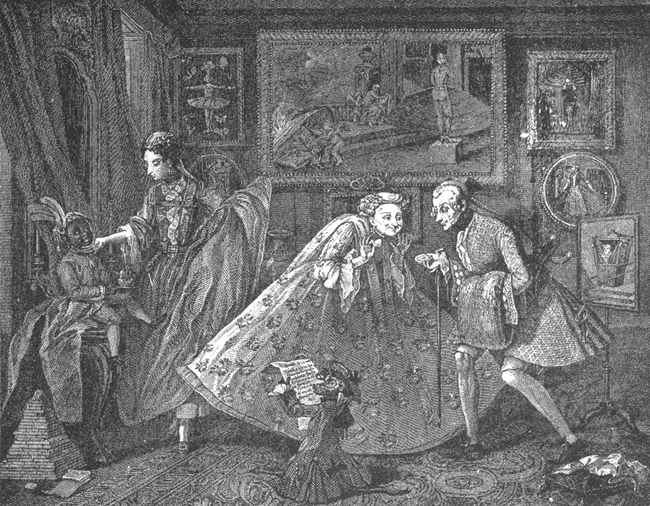
TASTE IN HIGH LIFE.
The picture from which this print was copied,
Hogarth painted by the order of Miss Edwards, a
woman of large fortune, who, having been laughed
at for some singularities in her manners, requested
the artist to recriminate on her opponents, and paid
him sixty guineas for his production.
It is professedly intended to ridicule the reigning
fashions of high life in the year 1742. To do this the
painter has brought into one group an old beau and
an old lady of the Chesterfield school, a fashionable
young lady, a little black boy, and a full-dressed
monkey. The old lady, with a most affected air,
poises between her finger and thumb a small tea-cup,
with the beauties of which she appears to be highly
enamoured.
The gentleman, gazing with vacant wonder at that
and the companion saucer which he holds in his
hand, joins in admiration of its astonishing beauties!
"Each varied colour of the brightest hue,
The green, the red, the yellow, and the blue,
In every part their dazzled eyes behold,
Here streak'd with silver—there enrich'd with gold."
This gentleman is said to be intended for Lord
Portmore, in the habit he first appeared at Court
on his return from France. The cane dangling from
his wrist, large muff, long queue, black stock, feathered
chapeau, and shoes, give him the air of
"An old and finish'd fop,
All cork at heel, and feather all at top."
The old lady's habit, formed of stiff brocade, gives
her the appearance of a squat pyramid, with a grotesque
head at the top of it. The young one is
fondling a little black boy, who on his part is playing
with a petite pagoda. This miniature Othello has
been said to be intended for the late Ignatius Sancho,
whose talents and virtues were an honour to his
colour. At the time the picture was painted he
would have been rather older than the figure; but
as he was then honoured by the partiality and protection
of a noble family, the painter might possibly
mean to delineate what his figure had been a few
years before.
The little monkey, with a magnifying glass, bag-wig,
solitaire, laced hat, and ruffles, is eagerly inspecting
a bill of fare, with the following articles pour
dinner: cocks' combs, ducks' tongues, rabbits' ears,
fricasey of snails, grande d'œuts beurre.[92]
In the centre of the room is a capacious china jar;
in one corner a tremendous pyramid composed of
packs of cards; and on the floor, close to them, a bill
inscribed, "Lady Basto Dr to John Pip, for cards—£300."
The room is ornamented with several pictures;
the principal represents the Medicean Venus on a
pedestal, in stays and high-heeled shoes, and holding
before her a hoop petticoat somewhat larger than a
fig-leaf; a Cupid paring down a fat lady to a thin
proportion, and another Cupid blowing up a fire to
burn a hoop petticoat, muff, bag, and queue wig, etc.
On the dexter side is another picture representing
Monsieur Desnoyer, operatically habited, dancing in
a grand ballet, and surrounded by butterflies, etc.,
inscribed "Insects," and evidently of the same genus
with this deity of dance. On the sinister is a drawing,
denominated "Exotics," consisting of queue and
bag-wigs, muffs, solitaires, petticoats, French-heeled
shoes, and other fantastic fripperies.
Beneath this is a lady in a pyramidical habit walking
the park; and, as the companion picture, we
have a blind man walking the streets.
The fire-screen is adorned with a drawing of a
lady in a sedan chair—
"To conceive how she looks, you must call to your mind
The lady you've seen in a lobster confin'd,
Or a pagod in some little corner enshrin'd."
As Hogarth made this design from the ideas of
Miss Edwards, it has been said that he had no great
partiality for his own performance, and that, as he
never would consent to its being engraved, the drawing
from which the print is copied was made by the
connivance of one of her servants.[93] Be that as it
may, his ridicule on the absurdities of fashion,—on
the folly of collecting old china,—cookery,—card-playing,
etc., is pointed, and highly wrought.
At the sale of Miss Edwards' effects at Kensington,
the original picture was purchased by the father of
Mr. Birch, surgeon, of Essex Street, Strand.
IN THE CHARACTERS OF
PTOLEMY, CLEOPATRA, AND JULIUS CÆSAR.
"To banish nature and to vary art,
To fix the ear but never reach the heart,
To mangle sense and dress up meagre sound,
While the same tasteless unison goes round;
And still the point of excellence to place
In execution, cadence, and grimace;
To ravish with unnatural sounds the ear,
While beaux applaud and belles with rapture hear,[94]
The song we raise."
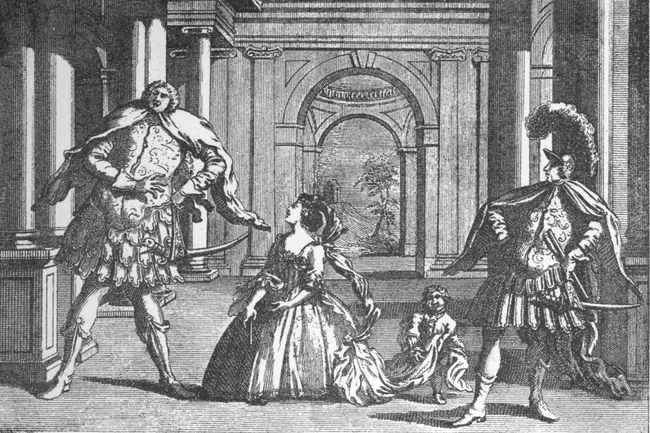
FARINELLI, CUZZONI, & SENESINO.
This dignified heroine and the two heroes—of a
class—
"By their smooth chins and simple simper known,"
are here the representatives of "the majesty of Egypt,
a morsel for a monarch," and "the foremost man of
all this world;"[95] they were the three principal performers
in Handel's opera of Ptolomeo, performed in
the year 1728. There have been some suspicions of
its not being Hogarth's design, and from the characters
more than bordering on caricature, etc., I
once inclined to that opinion; but from the general
spirit of the satire, and the same figures being introduced
in nearly the same attitudes in the first print
Hogarth ever published (see p. 22), there is little
doubt of its being his production.
The position (for it can hardly be called an attitude)
in which the painter has placed Farinelli, is fully warranted
by the writer of a pamphlet, entitled Reflections
on Theatrical Expression in Tragedy, etc.,
published in 1755. These Reflections are admirably
contrasted by the exaggerated compliment with
which the author of the Divine Legation honours
the divine Senesino. The two quotations follow:—
"I shall therefore, in my further remarks on this
article, go back to the old Italian theatre, when
Farinelli drew everybody to the Haymarket. What
a pipe! what modulation! what ecstasy to the ear!—but,
heavens! what clumsiness! what stupidity!
what offence to the eye! Reader, if of the city, thou
mayst probably have seen in the fields of Islington
or Mile-End, or if thou art in the environs of St.
James's, thou must have observed in the park, with
what ease and agility a cow, heavy with calf, has rose
up at the command of the milkwoman's foot. Thus
from the mossy bank sprung up the divine Farinelli.
Then with long strides, advancing a few paces, his
left hand settled upon his hip in a beautiful bend,
like that of an old-fashioned caudle-cup, his right
hand remained immoveable across his manly breast
till numbness called its partner to supply its place,
when it relieved itself in the position of the other
handle to the caudle-cup, etc."—Reflections, etc.
With respect to the other genius of Italian song,
Mr. Nichols very justly observes that his dignity
must have been wonderful, or the following passage
in Dr. Warburton's Inquiry into the Causes of Prodigies
and Miracles (printed in 1727) affords a most
notorious example of the bathos:—
"Observe," says he (p. 60), "Sir Walter Raleigh's
great manner of ending the first part of the History
of the World: 'By this, which we have already set
down, is seen the beginning and end of the three first
monarchies of the world, whereof the founders and
erectors thought that they never could have ended;
that of Rome, which made the fourth, was also at
this time almost at the highest. We have left it
flourishing in the middle of the field, have rooted
up or cut down all that kept it from the eyes and
admiration of the world; but after some continuance
it shall begin to lose the beauty it had, the storms of
ambition shall beat the great boughs and branches
one against another, her leaves shall fall off, her
limbs wither, and a rabble of barbarous nations enter
the field and cut her down.' What strength of
colouring! what grace, what nobleness of expression!
with what a majesty does he close his immortal
labour! It puts one in mind of the so much
admired exit of the late famed Italian singer!"
(Senesino.[96]) What a climax!
"Here Justice triumphs in his elbow chair,
And makes his market of the trading fair;
His office shelves with parish laws are grac'd,
But spelling-books and guides between 'em plac'd.[97]
Here pregnant madam screens the real sire,
And falsely swears her bastard child for hire
Upon a rich old leecher, who denies
The fact, and vows the naughty hussif lies.
His wife enrag'd, exclaims against her spouse,
And swears she'll be reveng'd upon his brows;
The jade, the justice, and churchward'ns agree,
And force him to provide security."
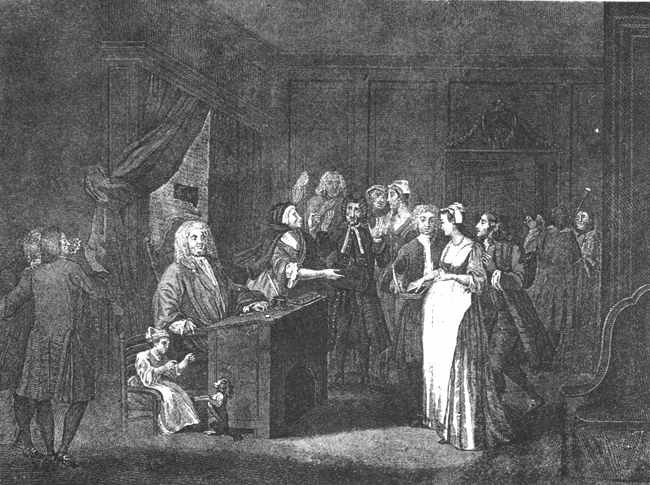
WOMAN SWEARING A CHILD.
These curious rhymes, engraven under the original
print, in a degree describe the plot of the play, and
the characters of the performers in this religious
ceremony; for as such does Picart class a copy which
he has introduced in the fourth volume of his work,[98]
accompanied with the following explanation:—
"Many other customs might find a place here, and
delight the readers by their comical singularity, but we
dare not crowd in too great a number of those trifles,
as not being properly religious ceremonies; which
therefore, till approved of by the church, or by the
governor of it, prescribed by ecclesiastical laws or
formularies, we shall omit, except two or three of the
most remarkable. The first is what the description
here annexed calls the breeding woman's oath,—a
custom not to be met with in other countries,—which
is so fantastical, or rather unjust, that it would be a
prejudice to the laws of England if we were to judge
of their equity by that practice. Suppose any of
these girls, which may be called amphibious (being
neither wives nor virgins), is found to be with child.
She does not, or will not, pretend to know the father
of this child. In order to free herself from the
trouble of maintaining it when born, she looks out
for some rich man, upon whom she intends to father
it. Generally they say she pitches upon some good
citizen, though she does not know him, or maybe
has never seen him. Then she goes before a Justice
of the Peace, summons the pretended father to
appear before him, and in his presence swears upon
the Bible, which the clerk holds to her, that she
owns and declares that such a one whom she has
summoned to appear is the father of the child. How
far the equivocal expressions and restrictions of that
oath may excuse her from perjury, let a good casuist
be the judge. However, the man thus named and
sworn to by this formality of law is obliged to pay
an arbitrary fine, and to agree upon a sum of money
for the maintenance of the child."—Picart's Religious
Ceremonies, p. 83.
The original picture from which this print was
engraven was one of Hogarth's early productions,
and is in the possession of the Rev. Mr. Whalley, at
Ecton, Northamptonshire. In the disposition of the
figures, etc., it has a more than accidental resemblance
to a picture by Heemskirk, which was in the
possession of Mr. Watson, surgeon, Rathbone Place,
where all the male figures are monkeys; all the
females, cats; and which in the year 1772 was engraved
in mezzotinto by Dickinson, and entitled
"The Village Magistrate."
A small copy from Hogarth's print is introduced
as the headpiece to a tale printed in Banks' Works,
vol. i. p. 248, entitled "The Substitute Father."
"No mother's care
Shielded our infant innocence with prayer;
No father's guardian hand our youth maintain'd,
Call'd forth our virtues, and from vice restrain'd;
But strangers,—pitying strangers,—hear our cry,
And with parental care each want supply."
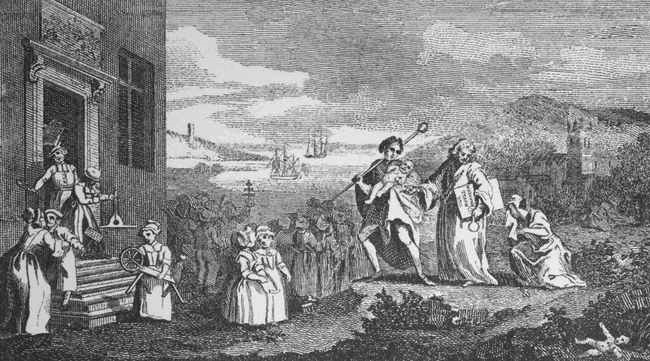
THE FOUNDLINGS.
The last print represented what Mr. Picart chose to
call a religious ceremony,—in this we have a scene
which may properly be so denominated; for surely
rescuing deserted, unoffending, and helpless innocence
from destruction, providing an asylum for childhood,
initiating youth in habits of industry, and rendering
those whose parents were unable to protect them
useful members of society, is a religious as well as a
political institution.
"Cold on Canadian hills or Minden's[99] plain,
Perhaps the mother mourn'd her soldier slain,
Bent o'er her babe, her eye dissolv'd in dew,
The big drop mingling with the milk it drew;
Gave the sad presage of his future years,
The child of misery, baptiz'd in tears."
Hogarth, by presenting some of his works to the
Foundling Hospital, was in fact an early benefactor
to the charity. He made the annexed design for
the use of this institution; it was engraved by F.
Morellon la Cave, as the headpiece to a power of
attorney from the trustees of the charity to those
gentlemen who were appointed to receive subscriptions
towards the building, etc.
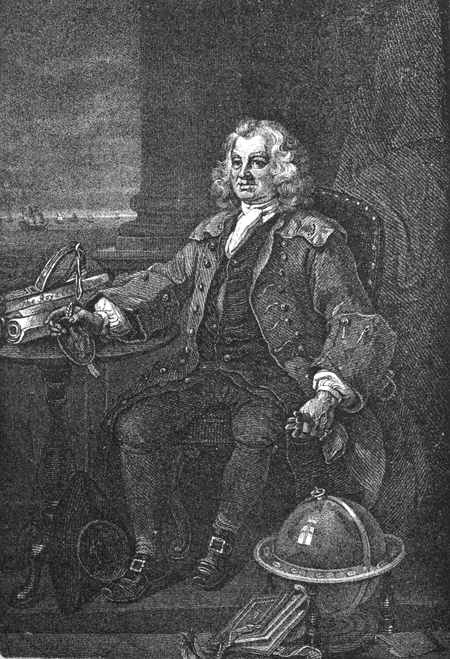
CAPTAIN THOMAS CORAM.
The artist has made his old friend Captain Coram
a principal figure; and as this excellent and venerable
man was in fact the founder of the charity, it is
with great propriety he is introduced. Before him
the beadle of the Hospital carries an infant, whose
mother, having dropped a dagger with which she
might have been momentarily tempted to destroy
her child, kneels at his feet; while he, with that
benevolence with which his countenance was so
eminently marked, bids her be comforted, for her
babe will be nursed and protected.
On the dexter side of the print is a new-born
infant, left close to a stream of water, which runs
under the arch of a bridge. Near a gate, on a little
eminence in the pathway above, a woman leaves
another child to the casual care of the next person
who passes by. In the distance is a village with a
church.
In the other corner are three boys coming out of a
door with the king's arms over it; as emblems of
their future employments, one of them poises a
plummet, a second holds a trowel, and a third, whose
mother is fondly pressing him to her bosom, has in
his hand a card for combing wool. The next group,
headed by a lad elevating a mathematical instrument,
are in sailors' jacket and trousers; those on their
right hand, one of whom has a rake, are in the uniform
of the school.
The attributes of the three little girls in the foreground—a
spinning-wheel, sampler, and broom—indicate
female industry and ingenuity.
It must be admitted that the scene here represented
is a painter's anticipation, for the charter was
not granted until October 1739, and this design was
made only three years afterwards; but the manner
in which the charity has been since conducted has
realized the scene.
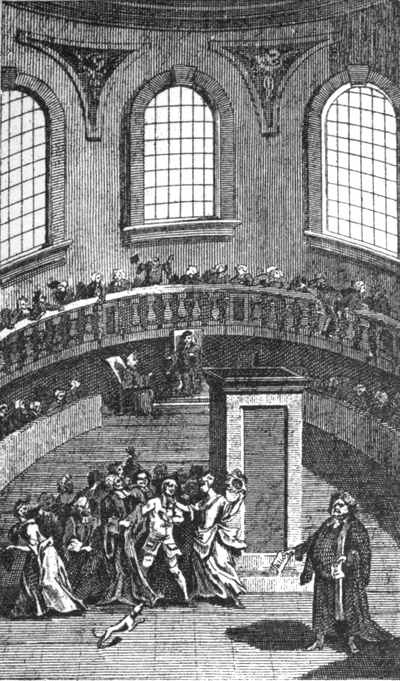
TERRÆ FILIUS.
The work to which this is a frontispiece was written
by Nicholas Amhurst, author of the Craftsman, and
published in the year 1726. The leading object of
this writer is to satirize the Tory principles of the
University of Oxford; but as the book does not
abound in subjects for the pencil, Hogarth has
selected a scene described in No. 33, published 8th
May 1721, which contains "Advice to all gentlemen
schoolboys, etc., who are designed for the University
of Oxford." In the part which forms the subject for
this print, the writer thus cautions them:—
"Have a particular regard how you speak of those
gaudy things which flutter about Oxford in prodigious
numbers in summer time, called 'Toasts;'
take care how you reflect on their parentage, their
condition, their virtue, or their beauty,—ever remembering
that
'Hell has no fury like a woman scorn'd;'
especially when they have spiritual bravoes on their
side, to revenge their cause on every audacious contemner
of Venus and her altars.
"Not long ago a bitter lampoon was published on
the most celebrated of these petticoat professors. As
soon as it came out the town was in an uproar, and a
very severe sentence was passed upon the author of
this anonymous libel, to discover whom no pains were
spared. All the disgusted ill-natured fellows in the
University were, one after another, suspected upon
this occasion. At last, I know not how, it was
peremptorily fixed upon one, whether justly or not I
cannot say; but the parties offended resolved to
make an example of somebody for such an enormous
crime, and one of them (more enraged than the rest)
was heard to declare, 'that right or wrong, that impudent
scoundrel (mentioning his name) should be
expelled by G—; and that she had interest enough
with the President and Senior Fellows of his College
to get his business done.' Accordingly, within a year
after this, he was (almost unanimously) expelled from
his fellowship, in the presence of some of the persons
injured, who came thither to see the execution.
'Felix quam faciunt aliena pericula cautum'
was the thesis pitched upon by the excluding doctors
for the under-graduates to moralize upon, in a public
exercise upon this occasion; and as it is a very wholesome
maxim, I leave it, my little lads, to your serious
meditation."
To the figures introduced in this print the original
artist has given a spirit worthy of Callot; and the
copy hereto annexed has been thought correct and
animated.
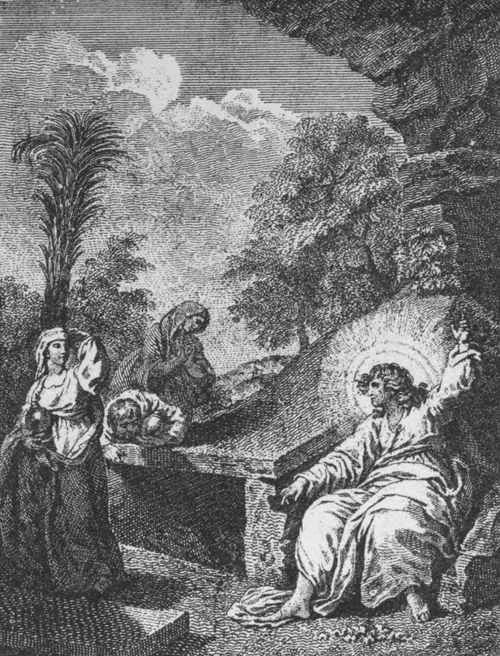
THE SEPULCHRE.
It has been frequently and truly remarked, that in
either historical or serious subjects Hogarth did not
excel; but to prove that even in this walk he was
considerably above mediocrity, and that the reader
may be enabled to judge for himself, I have selected
the annexed print, which forms one compartment of
the altar-piece to St. Mary Redcliffe's, Bristol, for the
painting of which he received five hundred pounds.
The centre division, which is much the largest, represents
the Ascension. The rays emanating from
the ascending Deity, and beaming through the interstices
of the surrounding clouds, are tenderly and
brilliantly touched. In the foreground, St. Thomas
on one knee, with his hands clasped together, is
eagerly looking up with an expression of wonder and
astonishment. On the other side is St. Peter, in a
reclining posture. Near the centre, St. John, with a
group made up of the other Apostles, attentively
listening to the two men in white, who appeared on
this occasion. The background is on one side closed
with tremendous rocks; on the other, under the skirts
of low-hung clouds in the distance, appears part of
the magnificent city of Jerusalem, illuminated by a
flash of lightning, which, darting from a darkened
sky, casts a livid gloom over the whole.
The compartment on the right hand represents the
rolling of the stone and sealing the sepulchre in the
presence of the high priest; the exertion displayed
in this is happily contrasted by the tenderness and
elegant softness displayed in the companion picture
here copied, where the Marys approach the empty
sepulchre. The angel, speaking and pointing up to
heaven with an expression which explains itself—to
singular beauty, sweetness, and benevolence,
unites great elevation of character, and the native
dignity of a superior being.
The foregoing remarks, with some little variations,
are extracted from an article in the Critical Review
for June 1756, which, being written while the artist
was living, were possibly seen and approved by himself.
The writer concludes by remarking, that the purchasing
such a picture for their church does great
honour to the opulent city for which it was painted,
and is the likeliest means to raise a British School of
Artists; though it would be a just subject of public
regret if Mr. Hogarth should abandon a branch of
painting in which he stands alone, unrivalled and
inimitable, to pursue another in which so many have
already excelled.
From the "Sealing the Sepulchre" and this print
there are two large mezzotintos by J. Jenner. The
centre compartment has not been engraved.
A politician should (as I have read)
Be furnished in the first place with a head!
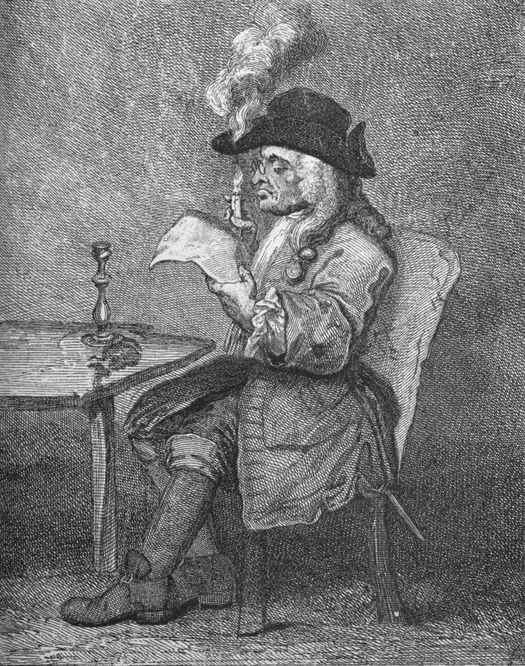
THE POLITICIAN.
One of our old writers gives it as his opinion, that
"there are only two subjects which are worthy the
study of a wise man, i.e. religion and politics." For
the first, it does not come under inquiry in this print;
but certain it is, that too sedulously studying the
second has frequently involved its votaries in many
most tedious and unprofitable disputes, and been
the source of much evil to many well-meaning and
honest men. Under this class comes the "Quidnunc"
here portrayed; it is said to be intended for a Mr.
Tibson, laceman in the Strand, who paid more attention
to the affairs of Europe than to those of his own
shop. He is represented in a style somewhat similar
to that in which Schalcken painted William the
Third,[100]—holding a candle in his right hand, and
eagerly inspecting the Gazetteer of the day. Deeply
interested in the intelligence it contains concerning
the flames that rage on the Continent, he is totally
insensible of domestic danger, and regardless of a
flame which, ascending to his hat,
"Threatens destruction to his three-tail'd wig."
From the tie-wig, stockings, high-quartered shoes,
and sword, I should suppose it was painted about the
year 1730, when street robberies were so frequent in
the metropolis that it was customary for men in trade
to wear swords; not as now (1803), to preserve their
religion and liberty from foreign invasion, but to
defend their own pockets from domestic collectors.
The original sketch Hogarth presented to his friend
Forrest; it was etched by Sherwin, and published
1775.
"Wanted immediately—A Husband."
—Vide the daily papers.
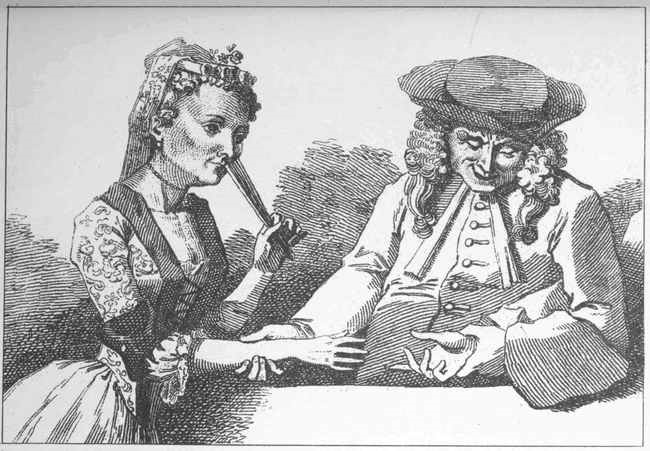
THE MATCH MAKER.
The two agreeable persons here introduced formed
part of a group in an unfinished picture painted by
Hogarth. They were some years since engraved on
two copperplates; but as I thought that was placing
still further apart the hands of those twain whom the
holy service of matrimony was soon to unite, I have
here brought them into one, and in this we are presented
with the bride and that useful agent of Hymen,
denominated a Matchmaker. We see nothing of the
bridegroom but his hand and arm; from which, the
countenance of the lady, and the character of the go-between,
we may fairly infer he is young, and regret
that the artist did not complete the trio, and place
him as a contrast to the antiquated virgin with whom
he is to be united. By the beauty spots on her
face, she wishes to conceal the ravages of time; and
from her laced lappets, cuffs, robings, and brocaded
silk, we may suppose she is rich. As to the share
which the venerable person who provides her with
a husband is to have for his reward—it depends upon
the bargain. I have been told that in this masquerade
matrimony, the master of the ceremonies, or lord of
the bedchamber (which the reader pleases), is paid by
both the contracting parties.
Some of my readers may possibly imagine that
the tribe of Matchmakers, like the race of wolves, is
extinct in England; but this is so far from being
the case, that there is now in the neighbourhood of
Piccadilly a regular office,[101] where any gentleman
or gentlewoman, first paying a stipulated sum for
entrance money, may disclose their virtuous wishes,
and be provided with partners for life,—or as long as
they can agree.
THE MAN OF TASTE.
The circumstance on which this print is built is thus
described by Dr. Johnson:—
"Mr. Pope published in 1731 a poem called False
Taste, in which he very particularly and severely
criticises the house, the furniture, the gardens, and
the entertainments of Timon, a man of great wealth
and little taste. By Timon he was universally supposed,
and by the Earl of Burlington, to whom the
poem is addressed, was privately said, to mean the
Duke of Chandos, a man perhaps too much delighted
with pomp and show, but of a temper kind and
beneficent, and who had consequently the voice of
the public in his favour. A violent outcry was therefore
raised against the ingratitude and treachery of
Pope, who was said to have been indebted to the
patronage of Chandos for a present of a thousand
pounds, and who gained the opportunity of insulting
him by the kindness of his invitation. The receipt of
the thousand pounds Pope publicly denied; but from
the reproach which the attack on a character so
amiable brought upon him, he tried all means of
escaping. The name of Cleland was employed in
an apology[102] by which no man was satisfied; and he
was at last reduced to shelter his temerity behind
dissimulation, and endeavoured to make that disbelieved
which he never had confidence openly to
deny. He wrote an exculpatory letter to the Duke,
which was answered with great magnanimity by a
man who accepted his excuse without believing his
professions. He said, that to have ridiculed his taste
or his buildings had been an indifferent action in
another man, but that in Pope, after the reciprocal
kindness that had been exchanged between them, it
had been less easily excused."—Johnson's Life of
Pope.
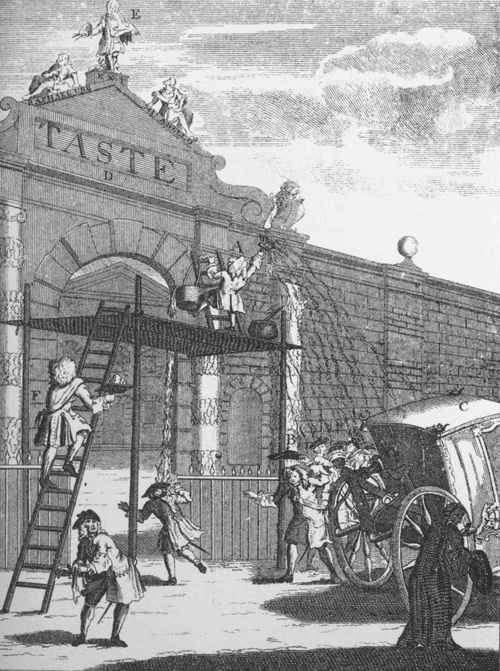
Soon after the publication of the poem alluded to,
Hogarth made this design, which presents a view of
Burlington Gate. On the front, as a crooked compliment
to the noble proprietor, he has inscribed the
word "Taste;" and as a standing proof of the projector
being entitled to the appellation, placed a
statue of his grand favourite William Kent triumphantly
brandishing his palette and pencils on the
summit, with two reclining figures representing
Raphael and Michael Angelo for his supporters.[103]
Standing on a scaffold board beneath them, Mr.
Pope, in the character of a plasterer, is whitewashing
the front, and whirling his brush with a spirit that
produces a shower of liquid pearl which dismays and
defiles the passengers beneath; the principal of these,
intended for the Duke of Chandos, holds his hat over
his head to shelter himself in his retreat. The torrent
is not confined to his Grace's person, but lavishly
scattered over his carriage and attendants, among
whom is a blackamoor in the way of being whitewashed.
The clergyman, whom I believe intended for
the duke's chaplain,[104] is escaping round the carriage.
An old military character, who as well as the chaplain
is got out of the poet's vortex, is rubbing off the
stains which he has previously contracted.
Climbing a ladder reared against the scaffold, we
have Lord Burlington doing the office of a labourer,
and arrayed in a tie-wig, with a pair of compasses[106]
suspended to the riband of his order, and carrying to
his little active workman a hand-hawk, on which is
a portion of what I am told the bricklayers call "fine
stuff," to mix up more whitening for beautifying the
front of his own gate, and defiling the garments of
every passenger. This, it must be acknowledged,
our poetical plasterer performs with distinguished
dexterity: he at the same time covers the corrosions
in the front, dashes a plenteous shower on those that
come near it, and so kicks the bottom of a pail which
hangs to his short ladder, that a copious stream flows
on the head of a gentleman beneath.
This double distribution of flattery and satire is
amply exemplified in the Epistle to Lord Burlington;
where the poet, by contrasting the feeble and imperfect
efforts of those he abuses with the superior and
superlative genius of the peer,[107] elevates the powers
of his own patron, and sinks those of all his competitors.
The print from which this is copied was prefixed
to a pamphlet, entitled A Miscellany of Taste, by Mr.
Pope, etc., containing his epistles, with notes, etc.
There are two other engravings from the same
design, one larger and one smaller than the print
annexed. In the former of these, Mr. Pope has a
tie-wig on.[109]
HENRY FIELDING.
This admirable writer was born at Sharpham Park,
in Somersetshire, near Glastonbury, April 22, 1707.
His father, Edmund Fielding, served in the wars
under the Duke of Marlborough, and arrived at the
rank of lieutenant-general at the latter end of George
I. or beginning of George II. He was grandson to
an Earl of Denbigh, and nearly related to the Duke
of Kingston, and many other noble families. His
mother was the daughter of Judge Gould, the grandfather
of Sir Henry Gould, one of the Barons of the
Exchequer.
Henry received the first rudiments of his education
from the Rev. Mr. Oliver, to whom we may judge he
was not under very considerable obligations, from the
humorous and striking portrait given of him afterwards,
under the name of Parson Trulliber, in Joseph
Andrews. From Mr. Oliver's care he was removed
to Eton school, where he had the advantage of being
early known to many of the first people in the kingdom,—namely,
Lord Lyttelton, Mr. Fox, Mr. Pitt,
Sir Charles Hanbury Williams, and the late Mr.
Winnington.
At this great seminary of education he gave distinguished
proofs of strong and peculiar powers; and
when he left the place, was said to be uncommonly
versed in the Greek authors, and an early master of
the Latin classics: for both which he retained a
strong predilection in all the subsequent periods of
his life. Thus accomplished, he went from Eton to
Leyden, and there continued to show an eager thirst
for knowledge, and to study the civilians with unwearied
assiduity for two years; when, remittances
failing, he was obliged to return to London, not then
quite twenty years old.
The comedy called Don Quixote in England,
was planned at Leyden, and completed on his return
to London; where, from some cause or other, he
was induced to bring it on the stage before it was
properly wrought up, so that by this first essay he
gained no dramatic reputation. Nor were his other
productions for the playhouse much more popular;
for though he wrote eight comedies and fifteen farces,
they have not generally proved what are termed
stock plays;[110] and yet from several of them, particularly
Pasquin, succeeding and successful writers for
the stage have borrowed some of their best speeches.
He died at Lisbon, to which place he went for the
recovery of his health, in the year 1754, aged 47.
Of his talents, he has left memorials that will
never die while the English nation retains a taste for
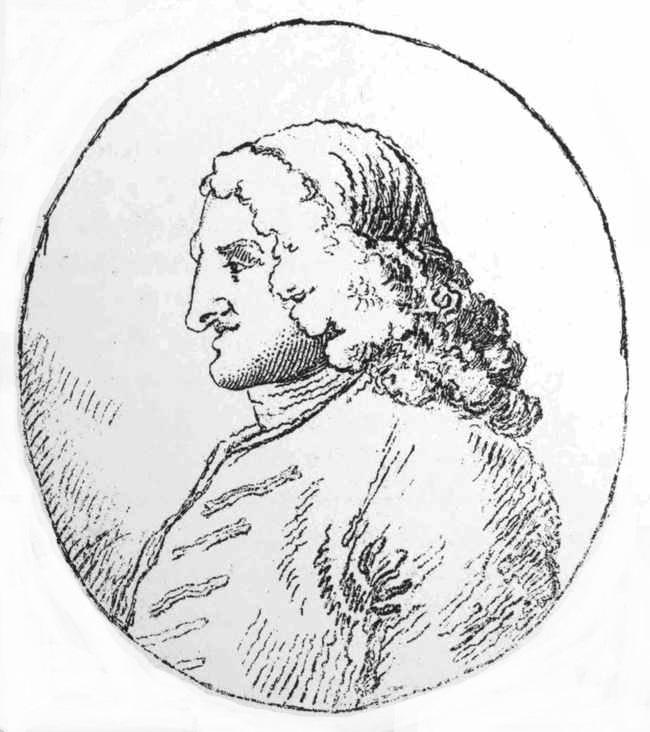
genuine and Cervantic humour: his features posterity
would have only known by description, had not his
friend Hogarth, to whom he had often promised to
sit, made this drawing; for, singular as it may seem,
though this admirable writer lived on intimate terms
with the best artists of the day, no portrait of him
was ever painted.
Many strange stories have been told of the manner
in which the drawing was made, such as, the hint
being taken from a shade which a lady cut with
scissors; of Mr. Garrick having put on a suit of his
old friend's clothes, and making up his features and
assuming his attitude for the painter to copy, etc. etc.
These are trifling tales to please children, and echoed
from one to another, because the multitude love the
marvellous.
The simple fact is, that the painter of the "Distressed
Poet," and the author of Tom Jones, having
talents of a similar texture, lived in habits of strict
intimacy; and Hogarth being told, after his friend's
death, that a portrait was wanted as a frontispiece to
his works, sketched this from memory.
The drawing was engraved by Mr. Basire, and is
said, by those who knew the original, to be a faithful
resemblance. This print is copied from a proof I
had from Mrs. Lewis, and taken before the ornaments
were inserted.[111]
SIMON, LORD LOVAT.
Simon Lord Lovat was born in the year 1667;
his father was the twenty-second person who had
enjoyed the title of Lovat in lineal descent. His
mother was Dame Sybilla Macleod, daughter of the
Chief of the clan of the Macleods, so famous for its
unalterable loyalty to its princes.
Buchanan relates a marvellous story of the family
at the battle of Loch Lochlie, 1544. In this battle
Lord Lovat, his four brothers, his three sons, and the
whole clan of the Frazers, were cut to pieces; but
if we are to believe this tale, the clan was afterwards
restored by a kind of miracle. The passage is
curious:—
"About this time, by the instigation, as it is
thought, of the Earl of Huntly, a battle was fought
in which almost the whole clan of the Frazers was
exterminated. There was an old quarrel between
the Frazers and the Macdonalds, which had been
rendered illustrious by the many bloody engagements
to which it had given birth. Huntly, in the
meantime, was deeply irritated that the Frazers alone,
among so many neighbouring clans, should reject his
protection. He had just collected the neighbouring
islanders, and made an incursion upon the estates of
the Earl of Argyll; and while every other clan had
exerted its whole force in his favour, there was
scarcely an individual in the whole clan of Frazer
that had not ranged himself under the enemy's
standard. For this time, however, the feud was composed
without an engagement; and the forces of
each party having disbanded themselves, returned to
the respective clans. The Macdonalds meantime, instructed
by the Earl of Huntly, collected their whole
force, and, having taken their enemy by surprise,
engaged in a most obstinate battle. The unfortunate
clan, overpowered by the greatest inequality of numbers,
were killed to a man. Thus a family the most
numerous, and who had often deserved well of the
Scottish weal, had wholly perished, unless, as it
seems just to believe, the Divine Providence had not
interfered in their favour. Of the heads of the clan,
eighty persons had left their wives pregnant at home,
and each of them in her turn was delivered of a male
child, who all attained safe to man's estate."—Buchanan,
lib. xv. p. 532. Pity but they had been twins!
Thus much may suffice for the character of his
progenitors; as to his own,[112] he wrote a narrative in
French stating his conduct, connections, treatment at
the Court of St. Germains, etc. These memoirs,[113]
which are brought no further than the year 1715,
were translated and printed several years ago; but, for
some political or family reasons, not published until
1797. They contain many curious particulars of his
life, much of which, both then and in every subsequent
period, had great need of an apology. On his
tergiversation in the rebellion of 1745, Sir William
Young, one of the managers appointed for conducting
the prosecution, makes the following observations:—"Your
Lordships have already done
national justice on some of the principal traitors
who appeared in open arms against his Majesty by
the ordinary course of law; but this noble Lord, who
in the whole course of his life has boasted of his
superior cunning in wickedness, and his ability to commit
frequent treasons with impunity, vainly imagined
that he might possibly be a traitor in private, and
rebel only in his heart, by sending his son and his
followers to join the Pretender, and remaining at
home himself, to endeavour to deceive his Majesty's
faithful subjects; hoping he might be rewarded for
his son's services if successful, or his son alone be
the sufferer for his offences if the undertaking failed.
Diabolical cunning! Atrocious impiety!"—State
Trials, vol. iv. p. 627.
These are hard and heavy accusations; but the
fact is, that whoever becomes the biographical advocate
of Lord Lovat will find it useful to adopt the
plan recommended to the writer who wished to draw
a fair character of that all-accomplished statesman,
William Pulteney, Earl of Bath:
"Leave a blank here and there, in each page,
To enrol the fair deeds of his youth!
When you mention the acts of his age,
Leave a blank for his honour and truth."
Notwithstanding all this, his conduct previous to
execution was manly and spirited. When advised
by his friends to throw himself at his Majesty's feet
and petition for mercy, he absolutely refused, said
that he was old and infirm, and his life not worth
asking. When informed that an engine was to be
made for his execution like that called "the Maiden,"
provided long since for state criminals in Scotland,
he commended the contrivance, observing that, as
his neck was short, the executioner would be puzzled
to find it out with his axe; and if such a machine
were used, it would get the name of "Lord Lovat's
Maiden."[114]
When he was brought from Scotland to be tried in
London, Hogarth having previously known him, went
to meet him at St. Albans for the purpose of taking
his portrait, and at the "White Hart" in that town
found the hoary peer under the hands of his barber.
The old nobleman rose to salute him (according to
the Scotch and French fashion) with so much eagerness,
that he left a large portion of the lather from
his beard on the face of his old friend.
He is drawn in the attitude of enumerating by his
fingers the rebel forces, "Such a general had so many
men," etc.; and I am informed the portrait is in air,
character, and feature, a most faithful resemblance of
the original.
The first of these prints is copied from a plate in
Jarvis' quarto translation of this inimitable work;
it has neither painter nor engraver's name, but carries
indisputable marks of the pencil and burin of
Hogarth. The second is from an unfinished print in
my possession, which I think by the same artist. The
six which follow were designed for Lord Carteret's
Spanish edition, published in the year 1738; but as
they are etched in a bold and masterly style, I suppose
the noble peer did not think they were pretty
enough to embellish his volume, and therefore laid
them aside for Vandergucht's engravings from Vanderbank's
designs. Hogarth's six plates remaining
in the hands of Mr. Tonson, his Lordship's publisher,
were at his death bought by Mr. Dodsley, from
whom they were purchased by Messrs. Boydell, in
whose possession they now remain. While in Dodsley's
hands, references to the chapters and corresponding
pages in Jarvis' translation were engraved
under each.
The last scene, representing "Sancho's Feast," is
copied from an incomparable print engraved at an
early period of Hogarth's life, and published by
Overton and Hoole, price one shilling. The subject
of this is exactly consonant to Hogarth's genius, and
was probably selected by the artist to show how
happily he could enter into the spirit of a writer
whose turn of mind seems so congenial to his own.
Had Cervantes been an Englishman, I think he would
have contemplated our national follies through the
same medium that they were seen by Hogarth, and
probably selected similar scenes as subjects for his
satire. He lived in an age and country where one
gigantic folly
"In proud pre-eminence stalk'd through the land!"
He touched the phantom with his pen, and it
vanished; but as folly is in some cases the parent of
virtue, may not chivalry and romance, ridiculous as
they are in the eye of reason, give birth to an ardour
of spirit which aggrandizes and elevates a nation?
To a sedate and saturnine people, a spice of absurdity
may have its use, were it only to give motion to those
virtues which without it might stagnate. Divested
of that frenzy, which at the same time that it ruffles
and impairs their reason, awakes and rouses their
spirits, a whole nation, like a man-of-war becalmed,
may be undulated by ineffectual motion, until they
drop into a sort of mental stupor, unmarked by any
other distinctions than those that arise from stately
indolence, haughty solemnity, and supercilious dignity.
I will not presume to say that Spain is exactly in
this situation; but if it were, other causes may have
contributed to the change. If such are to be the
consequences of a nation's becoming wise, a tincture
of folly is rather to be desired than dreaded.
As to the hero of this admirable tale, the Knight
of the Sorrowful Countenance, who has been the
cause of more laughter than either the Knights of
Arthur's Round Table, or any other knights ancient
or modern, how can we sufficiently admire him! A
paragon of patience and perseverance, unconquerable
fortitude and proud honour, who in his lucid
intervals reasoned like a philosopher, and was invariably
actuated by the most exalted motives;
deemed himself bound to defend the weak against
the strong, chastise indolence, redress injuries, and
free those who were in bonds! That this ardent,
heroic, and dignified character, with motives so pure,
an heart so excellent, and virtues that elevate, adorn,
and irradiate human nature, should be led by an
enthusiasm which fevered his imagination into absurdities
that expose him to derision, and, like Samson,
brought forth to make sport for the multitude, is
mortifying to humanity; and I must confess, that
with me, the laugh which the author's irresistible
humour invariably excites is accompanied by a pitying
sigh for the hero of this history, who is, after all,
so superlatively happy in his ideal importance, that
there is a degree of cruelty in destroying the illusion.
The adage, "You think you are happy because you
are wise; I think I am wise because I am happy," is
not easily confuted.[115]
But this admirable romance carries me further than
I intended. I was led into it by considering the
comparative merit of Cervantes and Hogarth, in
doing which, it is proper to observe that the motley
follies of England (diametrically opposite to those of
Spain) are changeable as an April day. Our English
moralist (for surely he is worthy of the title) transferred
them to his canvas or copper, and exposed
them by pointed ridicule.
But his satiric histories had a higher and still more
useful direction. They were calculated to encourage
industry, and promote humanity in the lower orders of
society, by exhibiting the baneful consequences of
idleness and cruelty; and to check the ostentatious
follies of those in a higher rank, by pointing out the
happiness attendant on the practice of virtue, and the
consequent misery of dissipation, sensuality, and vice.
I hope the warmest admirers of Cervantes will not
be offended if I venture to assert that these were
objects of more national and individual importance
than was the extirpation of knight-errantry.
Both these great men may be considered as universal
classics; for while Cervantes delights the
learned and the illiterate in his own country, and is
translated and eagerly read in France, Italy, Germany,
and England, while the artists of all these
nations emulate each other in delineating the scenes
he has described, and every age and rank peruse Don
Quixote with pleasure,—the fame of Hogarth is not
bounded by the shores of Albion, but takes as wide
a circuit through Europe, and his pictured stories are
contemplated with admiration by men of every
clime.[116]
Could their congenial spirits witness the tribute
posterity pay to their talents, how would they be
gratified! Large as is their portion of fame, they were
little favoured by fortune. Hogarth, after a long life
of persevering industry, died comparatively poor.
As to the maimed hero of Spain, when the learned
Don Gregorio Mayans y Siscar, at the request of
Lord Carteret, collected materials for his life, he
could neither learn where he was born nor where he
died. Sevilla, Madrid, Esquivias, Toledo, Lucena,
and Alcazor de San Juan, contended for the honour
of his birth, whom living they had suffered to languish
in a prison.
He was born in Alcala de Henares, in the year
1547, and died at Madrid, April 23, 1616, on the same
nominal day with Shakspeare; so that Spain and
England lost their two great luminaries at the same
period, nor have succeeding centuries produced a successor
worthy of ascending either of their vacant
thrones.
From the similarity of their genius, it was reasonable
to expect that Hogarth would excel in delineating
the scenes described by Cervantes; and though our
great painter of nature succeeded better in subjects
drawn from the rich storehouse of his own mind than
in those described by others, yet in the portraits of
the knight, and knight companions, he has adhered
very closely to their leading characteristics, which are
thus depicted by Cervantes:—
"The age of our gentleman bordered upon fifty
years; he was of a robust constitution, spare-bodied,
of a meagre visage, and a very keen sportsman.
"Rozinanté was so long and lank, so thin and lean,
so like one labouring with an incurable consumption,
as did clearly show with what propriety his master
so entitled him. Sancho Panza, or Canzas, was so
called, because he had a great belly, a short stature,
and thick legs."[117]
To attempt a description of the nine following
prints in any other words than those of Cervantes,
would be absurd and vain; to suppose that the
greatest part of my readers had not perused Don
Quixote, would be an insult on their taste. I will
therefore take it for granted that the following scenes
are in their recollection. The few that have not read
this admirable romance have a pleasure to come; as
an inducement to their embracing it, I will insert
little more than a reference to the page in Shelton,
whose quaint old English has perhaps more serious
Cervantic humour than either Jarvis' or Smollett's
modern translations. My edition is that of 1675.
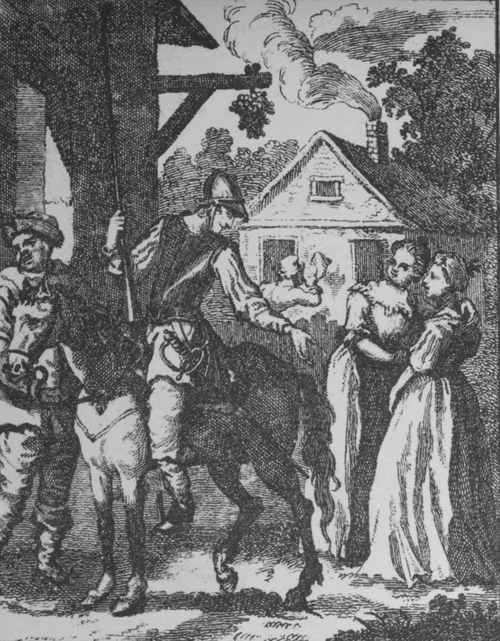
DON QUIXOTE PLATE I.
The original from which this plate is copied is in
Jarvis' quarto translation, without either painter's or
engraver's name; but the style of the etching, and air
of the figures, indisputably determine the artist. It
represents our heroic candidate for fame, before he
had received the honour of knighthood, at the door
of an inn, which he considered as a castle; the host
holding his horse's bridle, and two young female
travellers looking with astonishment at his figure.
In the distance is a swineherd blowing his horn,
which our adventurer mistakes for a trumpet sounded
by a dwarf on the battlements, to announce his
approaching the portico of the castle.—Vide Shelton,
p. 3.
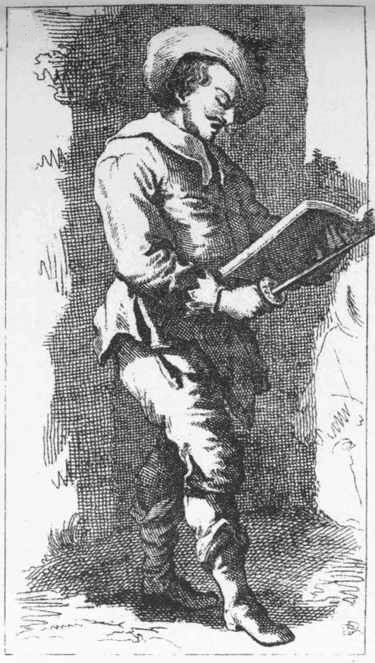
DON QUIXOTE PLATE II.
The original of this print is in my possession, and
was designed to represent the innkeeper conferring
the order of knighthood on Don Quixote, but for
some cause, not now known, never finished. The
artist probably intended that it should form a part of
the series begun for Lord Carteret, but the other six
being discarded, never completed his design; though
a slight outline of the Don kneeling to receive his
new honours is discernible in the corner of the print.
Mine host, though a large man, is a less portly
personage than the author describes. This print is
not in any of the catalogues of Hogarth's works, but
the style leaves little doubt of the artist.
In the plate from Vanderbank, in Jarvis' quarto,
representing the whole scene, the innkeeper has a
more than accidental resemblance to this figure.
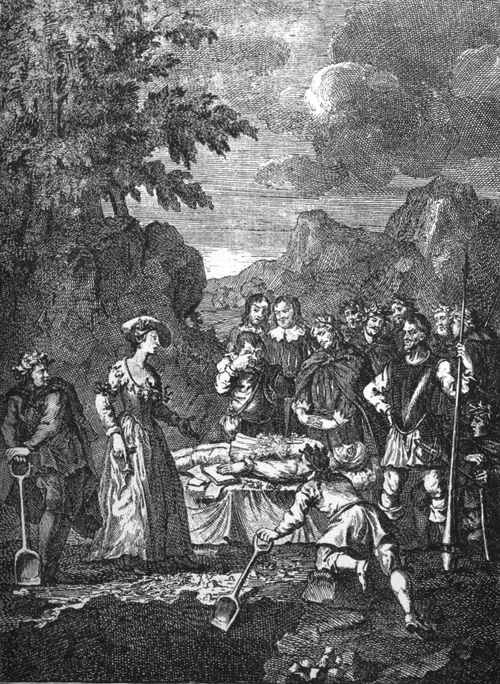
DON QUIXOTE PLATE III.
The stern attention which our Don gives to the
Shepherdess Marcella, who is vindicating herself to
those that surround the corpse, well expresses his
determination to defend her cause, and protect her
from insult. The shepherd in a similar attitude to
the soldier in Vandyke's "Belisarius," and Sancho
blubbering with his finger in his eye, are well-imagined;
but the figure of Marcella is affected and
stiff, and the shepherd on her right hand has more
city pertness than rural simplicity.
Vanderbank has taken this scene for one of the
prints in Jarvis' translation, and by placing Marcella
where she ought to be, on the summit of the rock,
rendered his design more picturesque than Hogarth's.—Vide
Shelton, p. 10.
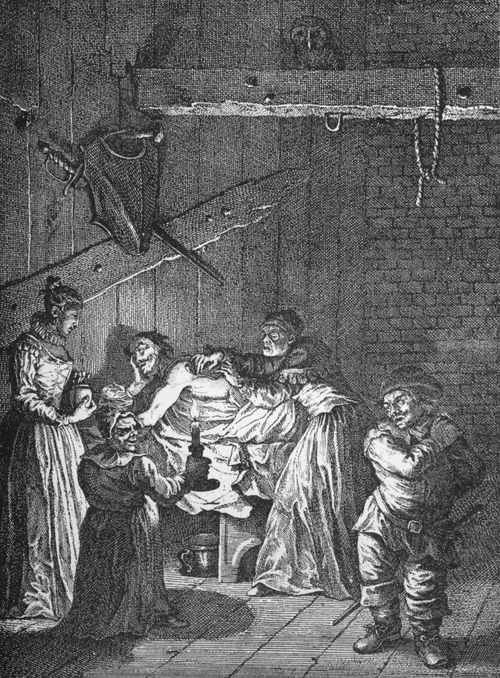
DON QUIXOTE PLATE IV.
Don Quixote's adventure with the Yanguessian
carriers having terminated in his being most bountifully
beaten, he is here represented in the hay-loft of
a very sorry inn, attended by the hostess and her
daughter, Maritornes, and his faithful squire; the
two former administering comfort to his sufferings,
the third holding a candle; and the last, with a most
rueful countenance, bewailing his own unfortunate
participation in the buffetings of his lord and master.
The picture which Cervantes draws of Maritornes,
Hogarth has well transferred to the copper. Thus is
she portrayed:—
"From head to heel she was not seven palms[118]
high, and burdened with shoulders that forced her
to look down more than she wished. Added to this,
she was broad-faced, flat-pated, saddle-nosed, blind of
one eye, and could scarcely see out of the other."
The hostess could not have been better marked by
the pencil of Teniers; the owl perched over her head
should not be overlooked. That, as well as the rope
hung to a beam, cracked walls, etc. etc., added to the
miserable figure of the knight reclined on his hard
pallet, display variety of wretchedness. I do not
recollect to have seen a print in which the light is
more judiciously distributed; in this and every other
particular, I think it much superior to the same scene
designed by Vanderbank in Jarvis' quarto translation.—Vide
Shelton, p. 29.
DON QUIXOTE PLATE V.
In this print the face and figure of the fierce knight
is spirited; the terror and astonishment of the discomfited
barber well expressed, and the triumphant
shout of Sancho in the distance admirably characteristic.
Notwithstanding this, I think that Vanderbank's
design for Jarvis, where the squire is brought
into the foreground, contemplating the glittering
prize, is a better chosen point of time. To Sancho
he has given a mixture of cunning and simplicity
which I have seldom seen so happily displayed; and
taken as a whole, it is perhaps a superior plate to
Hogarth's.—Vide Shelton, p. 42.
DON QUIXOTE PLATE VI.
The moment taken in this busy scene is when our
valorous knight, after having unhorsed one of the
guards, is engaged with the other; while Sancho,
willing to bear his part in the adventure, helps to
extricate Gines de Passamonte from his bonds.
In this, as in some other of Hogarth's designs, the
artist not having taken the trouble of reversing his
drawing, the figures are left-handed. The character
of Sancho, and two or three of the slaves, is admirable.
I think the whole design much superior to Vanderbank's
in Jarvis' translation, where the scene is
chosen after the discomfiture of the Guards; for to
two or three of the thieves Vanderbank has given the
countenances of apostles. His whole print is tame,
feeble, and spiritless.—Vide Shelton, p. 47.
DON QUIXOTE PLATE VII.
This interview, which took place in the mountains
of Sierra Morena, Cervantes thus describes:—
"Cardenio approached with a grave pace, and in a
hoarse voice saluted them with great courtesy. Don
Quixote returned his greeting with no less complaisance,
and pressed him strongly in his arms, as
if they had been long acquainted. The Knight of
the Rock, after he had been thus embraced, retreated
a few steps, and, laying his hand on the Don's
shoulder, perused his face with such earnestness,
as though he were desirous of recollecting if he had
ever seen him before, and no less admired Don
Quixote's strange figure than himself was admired
by our heroic knight-errant."
This is the point of time which Hogarth has
chosen; and the wild eye of Cardenio, the placid
benevolence of Don Quixote, and the shrewdness
of the goatherd, are well opposed. From the air,
attitude, and action of Sancho, I should have
imagined the period to be after he had been mauled
by the madman, did not the two knights so strongly
determine it to be before.
In Vanderbank's design of the same subject (vide
Jarvis' quarto), the figure of Sancho is tolerable, but
the Don is vapid and ill-drawn; and Cardenio's head,
like that of Medusa, looks as if it were encircled
with snakes.—Vide Shelton, p. 51.
DON QUIXOTE PLATE VIII.
Don Quixote's old neighbours, the curate and
barber, being desirous of checking his wandering
disposition, are here disguising themselves for an interview,
in which they hoped to bring him home, where
they trusted he might again live as an old Christian
ought to do. In pursuance of this plan, the barber
procured an ample beard made from the tail of a
pied ox; and the curate assumed the habit of a distressed
virgin, and framed a tale of having been
wronged by a naughty knight, to punish whom the
Don was to be entreated to follow wherever this
afflicted fair one should lead.
The dressing-room for this masquerade is the
kitchen of an inn; out of the door, astride on a
bench, inhaling copious draughts from a leathern
bottle, Sancho gives some life to a little landscape
in the distance.—Vide Shelton, p. 60.
"Sancho's dread doctor and his wand were there."
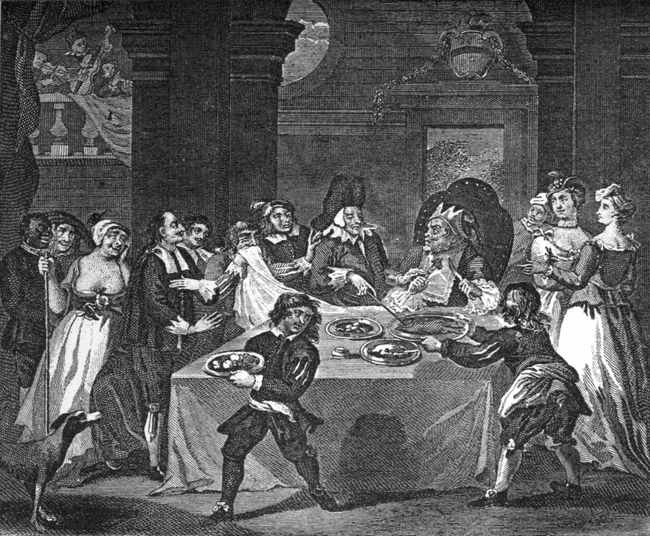
DON QUIXOTE PLATE IX.
Though Don Quixote is the ostensible hero of this
admirable history, I have sometimes thought that
Sancho was the author's favourite character. He
is here represented as Governor of Barataria, and
seated in the spacious hall of a sumptuous palace,
surrounded with all the pompous parade of high
rank, and encircled by numerous attendants.[119] A
band of musicians in an adjoining gallery strike up
a symphony to gratify his ear, and a table is spread
with every dainty to feast his eye and fret his soul;
for however magnificent the appendages of this mock
monarch, the instant he attempts to taste the solid
comforts of government, the loaves and fishes evade
his grasp, are touched by the black rod, and vanish!
"In plenty starving, tantaliz'd in state,"
he curses the gaudy unsubstantial pageant, vows
vengeance on the Doctor, and swears that he will
offer up both him and every physical impostor in
the island as a sacrifice to his injured and insulted
appetite.
Hogarth has here caught the true spirit of the
author, and given to this scene the genuine humour
of Cervantes. The rising choler of our Governor is
admirably contrasted by the assumed gravity of
Doctor Pedro Rezio. The starch and serious solemnity
of a straight-haired student who officiates as chaplain,
is well opposed by the broad grin of a curl-pated
blackamoor. The suppressed laughter of a man who
holds a napkin to his mouth forms a good antithesis
to the open chuckle of a fat cook. Sancho's two
pages bear a strong resemblance to the little punch-maker
in the Election Feast, and though well conceived,
might have had more variety; they present
a front and back view of the same figure. To two
females on the Viceroy's right hand there may be a
similar objection.
The original print was designed and engraved at
a very early period of Hogarth's life. As it was
finished with more neatness than any of the eight
which he afterwards etched for the same work, the
copy is attempted in a similar style.
In the drawing, Sancho was originally portrayed
with a full face; but Hogarth, judiciously thinking
a profile would be preferable, fixed a bit of paper
over his first thought, and altered it to the state in
which it is here engraved.
The design that Vanderbank made from the same
scene is cold and uninteresting; in another by
Hayman, prefixed to Smollett's coarse translation,
Sancho is fat enough for Falstaff, and the Doctor
looks like a fellow dressed up to play the part of a
conjuror in a puppet-show.—Vide Shelton, p. 221.
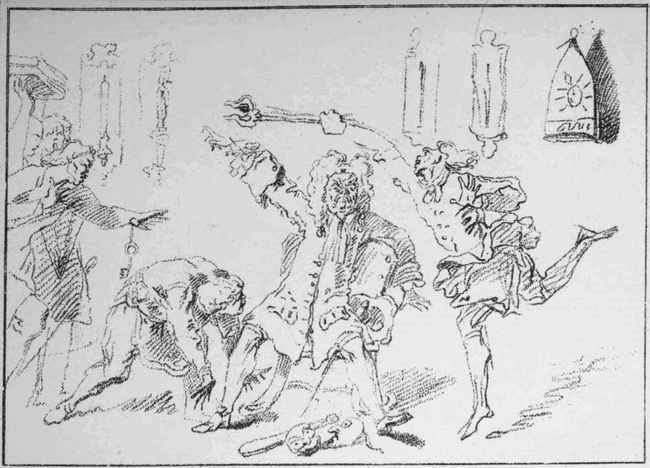
HEIDEGGER IN A RAGE.
The spirited sketch from which this is copied has
been thought the work of P. Mercier; but some of
my subscribers thinking it bore a strong resemblance
to Hogarth, I at their request submitted it to public
opinion. It arose from the following circumstance:—
The late Duke of Montagu invited Heidegger to
a tavern, where he was made drunk, and fell asleep;
in that situation a mould of his face was taken, from
which was made a mask; and the Duke provided a
man of the same stature to appear in a similar dress,
and wear it to personate Heidegger on the night of
the next masquerade, when George the Second (who
was apprised of the plot) was to be present. On his
Majesty's entrance, Heidegger, as was usual, bade the
music play "God save the King;" but no sooner
was his back turned, than the impostor, assuming his
voice and manner, ordered them to play "Charley
over the Water." On this Heidegger raged, stamped,
swore, and commanded "God save the King." The
instant he retired, the impostor returned and ordered
them to resume "Charley." The musicians thought
their master drunk, but durst not disobey. The
scene now became truly comic. Shame! shame!
resounded from all parts of the theatre. Heidegger
offered to discharge his band, when the impostor
advanced and cried out in a plaintive tone, Sire, the
whole fault lies with that devil in my likeness. This
was too much: poor Heidegger turned round, grew
pale, but could not speak. The Duke, seeing it take
so serious a turn, ordered the fellow to unmask.
Heidegger retired in great wrath, seated himself in
an arm-chair, furiously commanded his attendants
to extinguish the lights, and swore he would never
again superintend the masquerade, unless the mask
was defaced and the mould broken in his presence.
For this purpose the man on his knee has a mallet
stuck in his girdle.
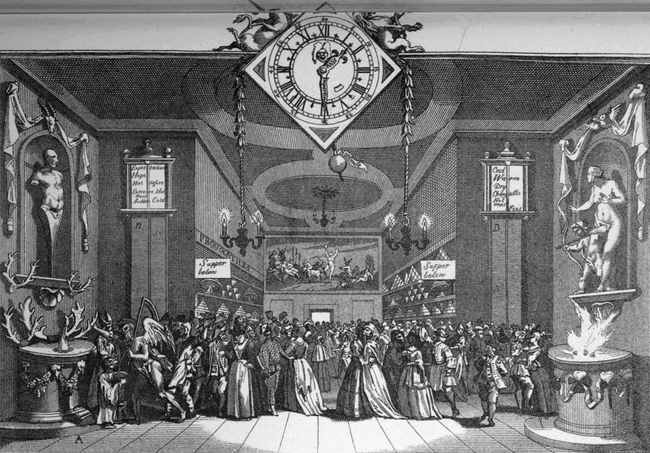
MASQUERADE TICKET.
As the first print which Hogarth published on his
own account, usually denominated "The Small Masquerade
Ticket," represents a large company eagerly
pressing to the door of a masquerade, we have here
the interior of the room crowded with a countless
multitude of grotesque characters, celebrating the
orgies of the place, which, in the following references
engraved under the original print, are thus described:—
"A, a sacrifice to Priapus. B, a pair of Lecherometors,
showing ye company's inclinations as they approach
'em. Invented for the use of ladys and gentlemen
by ye ingenious Mr. H——r" (Heidegger).
This titular divinity of the gardens being thus considered
as the god of their idolatry, his Term is
entitled to the first notice. The arched niche in
which it is placed is terminated by a goat's head,
ornamented with a pair of branching antlers, and
decorated with festooned curtains. Beneath is an
altar, the base of which is relieved with rams' heads
and flowers; and three pair of stags' horns are fixed
to the top.
As a companion to it, the united statues of a Venus
and Cupid, both of them masked, are placed on the
opposite side of the print. Cupid, who is a very
well-drawn and spirited little figure, "has bent his
bow to shoot at random," and Venus seems contemplating
the rise and fall of the mercury in one of
those instruments which the reference informs us is to
show the inclinations of all that approach it. The
niche in which these divinities are placed is not only
decorated with curtains, but crowned with cooing
doves. An altar beneath has on it three or four
bleeding hearts, which, being close to the blaze, are in
the way of being broiled. On the base are queue-wigs,
bag-wigs, etc.
This may suffice for the presiding deities of the
diversion; the head of their high priest, the renowned
Heidegger, master of the mysteries and manager in
chief, is placed on the front of a large dial, fixed
lozenge-fashion at the top of the print, and I believe
intended to vibrate with the pendulum, the ball of
which hangs beneath, and is labelled "Nonsense."
On the minute finger is written "Impertinence," and
on the hour hand, "Wit:" which seems to intimate
nonsense every second, impertinence every minute,
and wit once an hour! The time is half-past one—the
witching hour of night; 1727, the date of
the year this print was published, is on the corners of
the clock.
Recumbent on the upper line of this print, and
resting against the sides of the dial, the artist has
placed our British lion and unicorn renverse (such, I
think, is the term in heraldry), lying on their backs,
and each of them playing with its own tail; the lion
sinister, and the unicorn dexter. The supporters of
our regal arms being thus ludicrously introduced,
may perhaps allude to the encouragement George the
Second gave to Heidegger, who at that period might
be said to
"Teach kings to fiddle, and make senates dance;"
and who, by thus kindly superintending the pleasures
of our nobles, gained an income of £5000 a year, and,
as he frequently boasted, laid out the whole in this
country.
Beneath is a framed picture of a Bacchanalian
scene; and on each side, shelves with pyramids of
jellies, sweetmeats, etc., inscribed "Provocatives." On
two labels placed before them is written, "Supper
below."
A pair of instruments, somewhat similar to the
mental thermometer in "The Medley," are fixed on
each side: on that next to Venus and Cupid is
written, "cool, warm, dry, changeable, hot, moist,
fixt;" on the other, "expectation, hope, hot desire,
extreme hot, moist, sudden cold."
The motley crew who make up the crowd it is not
easy to describe, for every one present assumes a
false character.
"Here tottering old age essays to prance
With feeble feet, and joins th' imperfect dance;
There, supercilious youth assumes the air
And reverend mien which hoary sages wear.
'Tis thus, like Proteus, Folly joys to range,
Her name to vary, and her shape to change."
Here are priests of all persuasions—Brahmins,
friars, drones, monks, and monkeys not a few.
A figure of Time with his scythe, eagerly pressing
towards the altar with rams' heads, is arrested in his
course by a sort of slaughterman, with a mask, shaven
crown, and short apron, who violently grasps his wing
with one hand, and with the other lifts up a hatchet,
which with fatal force he aims at his head. For
sanctuary, this feeble figure lays hold of one of the
horns of the altar, but is frustrated in his attempt to
reach the steps by a bishop, who, with his sacrificing
knife, coolly stabs him to the heart; while a monkey,
in the habit of a chorister, holds a basin to catch the
blood, the fumes from which he snuffs up with ineffable
delight. This I apprehend to be a metaphorical
view of a prelate killing Time at a masquerade.
Next to this group is a Mother Shipton, hooking
on the arms of a clown; and near them a harlequin
endeavouring to draw the attention of a graceful
columbine from a turban'd Turk, who attempts to
seduce her from her party-coloured gallant. A
female, with the mask of a monkey's head, salutes a
nun in a black veil; and while an old Capuchin, with
the face of an ape, whispers soft things to a young
girl, a fellow somewhat like Tiddy-doll draws up her
head-dress to a point, like a fool's cap. A man in the
right-hand corner, solicitous to give a glass of wine to
one of the sisterhood, lifts up her veil for the purpose
of her drinking it.[120]
ADDENDA.
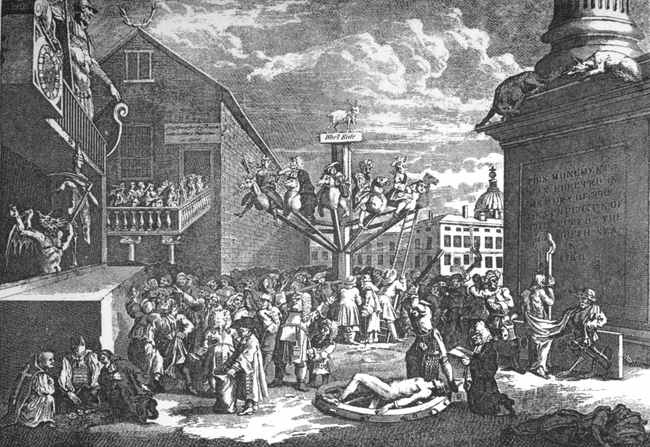
THE SOUTH SEA BUBBLE.
The two prints here given are selected as
two of the earliest avowed productions of
Hogarth. The allegory in both is somewhat
obscure; but the figures are in the manner of
Callot, and in a spirited and masterly style. They
were both published in 1721, and are a proof that
at this early period the admirable vein of satire
which he possessed was directed against the vices
and follies of the age.
In the first of them we see (to use an expression
of Mr. Walpole) "the Devil cutting Fortune into
collops," to gratify the avaricious hopes of the adventurers
in the South Sea Bubble; and persons ascending
the ladder to ride upon wooden horses; alluding
to the desperate game which was played by the
South Sea Directors in England in the year 1720,
to the utter destruction of many opulent families.
The little figure with his hand in the pocket of a
fat personage was supposed by Mr. Steevens to have
been intended for Pope, who profited by the South
Sea scheme; and the fat man to be meant for Gay,
who was a loser in that iniquitous project. Mr. John
Law, a native of Edinburgh, was the projector of this
bubble; and was also author of the famous Mississippi
scheme in France, by which he ruined thousands.
To escape popular vengeance he fled to Venice, where
he died in poverty in 1729.
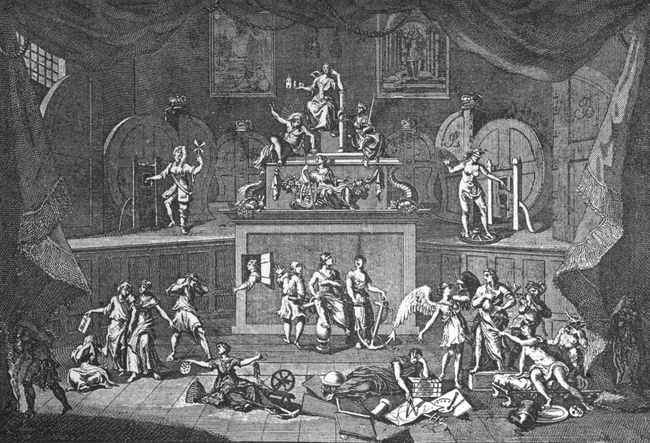
THE LOTTERY.
Under the print of "The Lottery," the artist has
given a full description of his own ideas, which otherwise,
at this distance of time, it would have been
difficult to elucidate.
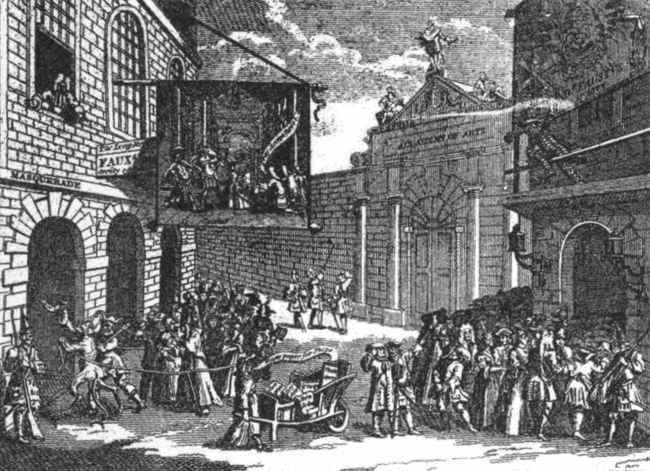
MASQUERADES & OPERAS, BURLINGTON GATE.
This satirical performance of Hogarth, which is commonly
called "The Small Masquerade Ticket," is
supposed to have been invented and drawn at the
instigation of Sir James Thornhill, out of revenge,
because Lord Burlington had preferred Mr. Kent
before him to paint for George the Second at his
palace at Kensington; and the leader of the figures
hurrying to a masquerade, crowned with a cap and
bells, and a garter round his right leg, has been said
to be intended for that monarch, who was very
partial to those nocturnal amusements, and bestowed
a thousand pounds towards their support. The
purse with a label "£1000," which the satyr holds
immediately before him, gives some probability to
the supposition.
The kneeling figure on the show-cloth, pouring
gold at the feet of Cuzzoni the Italian singer (who
is drawing the money towards her with a rake),
represents the Earl of Peterborough; and on the
label is written, "Pray accept £8000." Mr. Heidegger,
the regulator of the masquerade, is also
exhibited at a window, with the letter H under him.
Of the three figures in the centre of the plate, the
middle one is Lord Burlington, a nobleman of considerable
taste in painting and architecture. On one
side of him is Mr. Campbell the architect; on the
other, some artist now unknown. On a board is a
display of the words, "Long Room: Fawkes' dexterity
of hand." On the opposite corner is the
figure of Harlequin, pointing to a label, on which is
written, "Dr. Faustus is here." This was a pantomime
performed to crowded houses throughout two
seasons.
In this print all the figures have a strong resemblance
to those of Callot; and the follies of the town
are very severely satirized by the representation of
multitudes, properly habited, crowding to the masquerade,
opera, and pantomime; whilst the works of
our greatest dramatic writers are trundled through
the streets in a wheel-barrow, and cried as waste
paper for shops; among these may be distinguished
Shakspeare, Ben Jonson, Dryden, Congreve, Otway,
Farquhar, and Addison. In the first copy of this
print, instead of Ben Jonson's name on a label, we
have "Pasquin, No XI." This was a periodical
paper published in 1722-3; and the number specified
is particularly severe on operas, etc.
As a further illustration of the taste of the times,
the artist has given a view of Burlington Gate, with
a figure, I believe, intended to represent the then
fashionable artist William Kent, on the summit,
brandishing his palette and pencils, and placed in a
more elevated situation than either Michael Angelo
or Raphael, who, seated beneath, become the two
supporters to this favourite of Lord Burlington.
Some verses (and those not always the same) engraved
on a separate piece of copper are found under
the first impressions. For example, under the earliest
impressions of 1724:
"Could now dumb Faustus, to reform the age,
Conjure up Shakspeare's or Ben Jonson's Ghost,
They'd blush for shame, to see the English stage
Debauch'd by fool'ries, at so great a cost.
"What would their manes say, should they behold
Monsters and masquerades, where useful plays
Adorn'd the fruitful theatre of old,
And rival wits contended for the bays?"
Under another impression:
"Long has the stage productive been
Of offsprings it could brag on,
But never till this age was seen
A windmill and a dragon.
"O Congreve! lay thy pen aside,
Shakspeare, thy works disown,
Since monsters grim, and nought beside,
Can please this senseless town."
I have been the more particular in describing this
plate, as it appears to have been the first which
Hogarth published on his own account, and respecting
which he pathetically says: "I had to encounter
a monopoly of printsellers, equally mean and destructive
to the ingenious; for the first plate I published,
called 'The Taste of the Town,' in which
the reigning follies were lashed, had no sooner begun
to take a run, than I found copies of it in the print-shops
vending at half price, while the original prints
were returned to me again; and I was thus obliged
to sell the plate for whatever these pirates pleased to
give me, as there was no place of sale but their shops.
Owing to this and other circumstances, by engraving,
until I was near thirty, I could do little more than
maintain myself; but even then I was a punctual
paymaster."
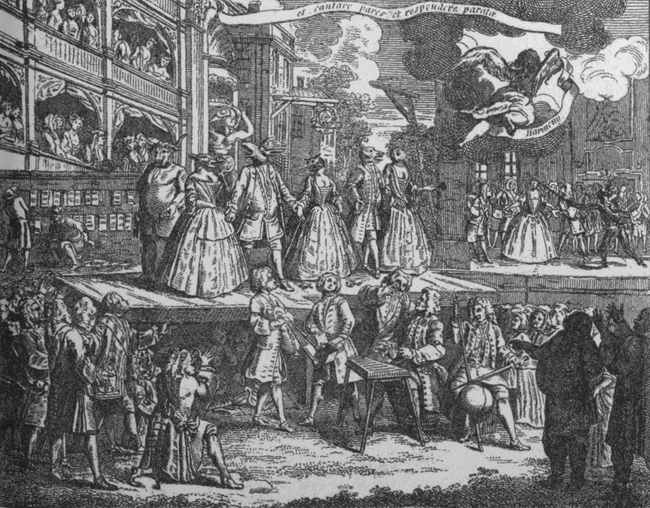
BEGGARS' OPERA BURLESQUED.
This plate seems at once to represent the exhibition
of The Beggars' Opera, and the rehearsal of an
Italian one. In the former, all the characters are
drawn with the heads of different animals: as Polly
with a cat's; Lucy with a sow's; Macheath with that
of an ass; Lockit, and Mr. and Mrs. Peachum, with
those of an ox, a dog, and an owl. In the latter,
several noblemen appear conducting the chief female
singer forward on the stage; and perhaps are offering
her money, or protection from a figure that is rushing
towards her with a drawn sword.
Harmony, flying in the air, turns her back on the
English playhouse, and hastens towards the rival
theatre. Musicians stand in front of the former,
playing on the Jew's harp, the salt-box, the bladder
and string, bagpipes, etc. On one side are people of
distinction, some of whom kneel, as if making an
offer to Polly, or paying their adorations to her. To
these are opposed a butcher, etc., expressing similar
applause. Apollo and one of the muses are fast
asleep beneath the stage. A man is indelicately
seated under a wall hung with ballads, and showing
his contempt of such compositions by the use he
makes of them. A sign of the star, a gibbet, and
some other circumstances less intelligible, appear in
the background.
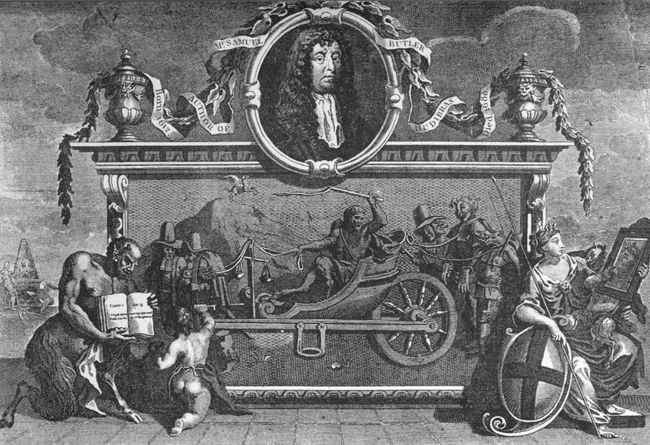
FRONTISPIECE TO HUDIBRAS PLATE I.
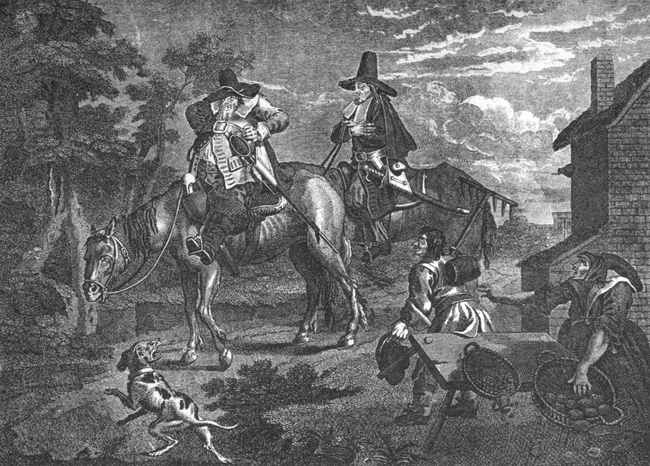
HUDIBRAS, PLATE II.
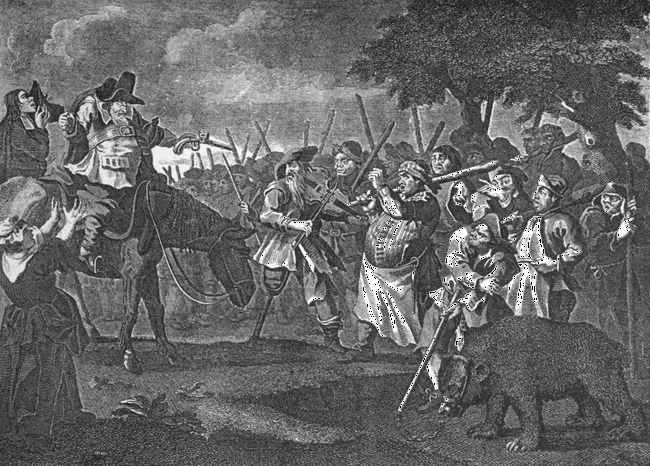
HUDIBRAS, PLATE III.
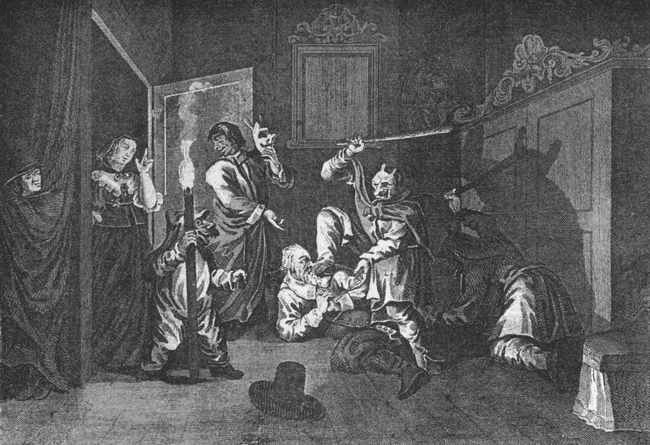
HUDIBRAS, PLATE IV.
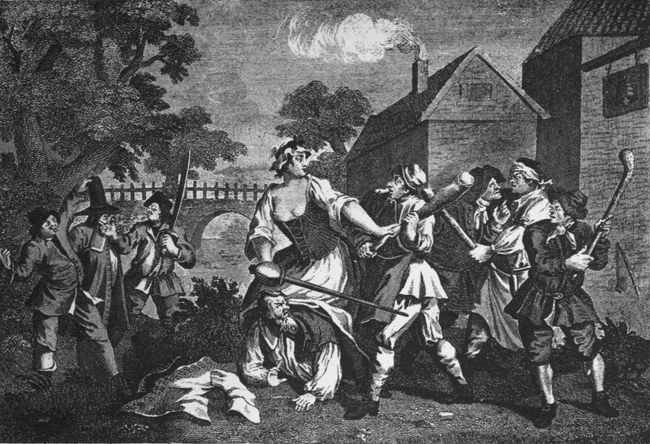
HUDIBRAS, PLATE V.
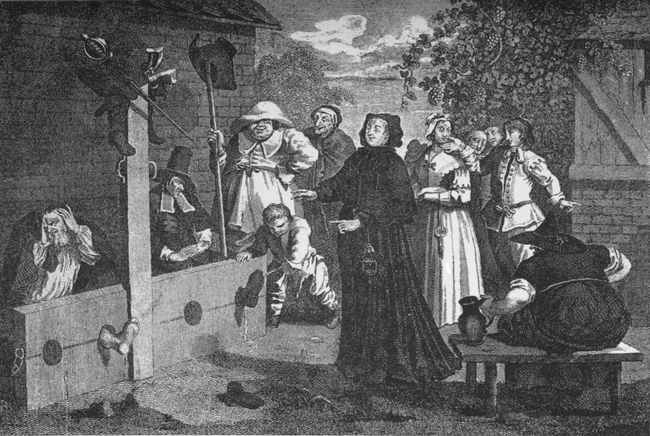
HUDIBRAS, PLATE VI.

HUDIBRAS, PLATE VII.
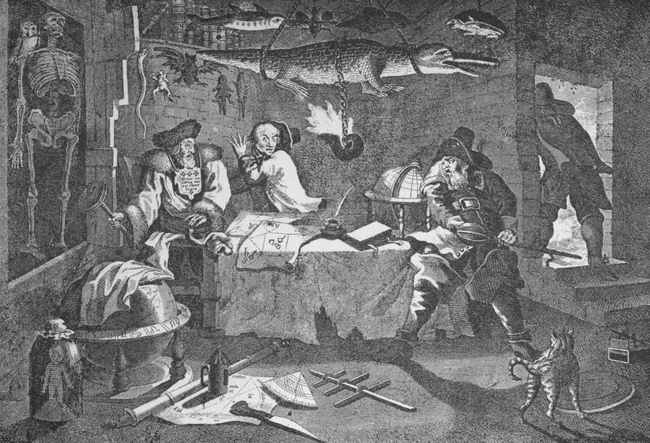
HUDIBRAS, PLATE VIII.
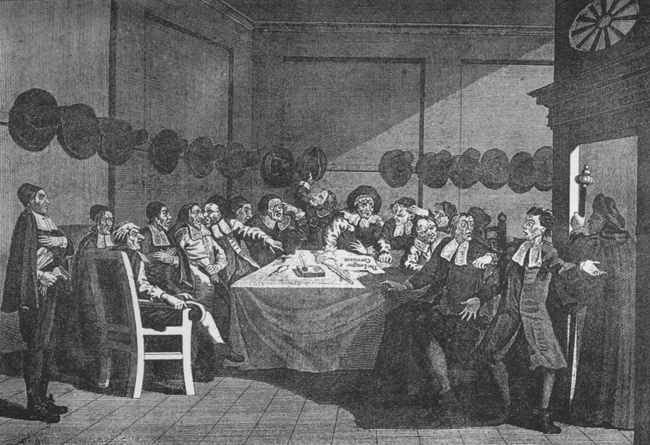
HUDIBRAS, PLATE IX.
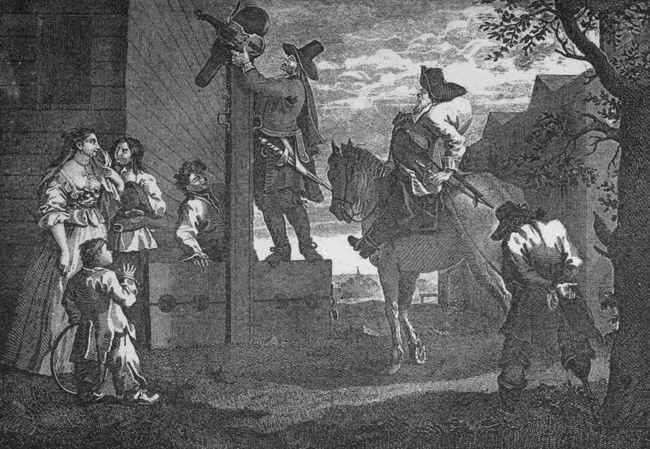
HUDIBRAS, PLATE X.
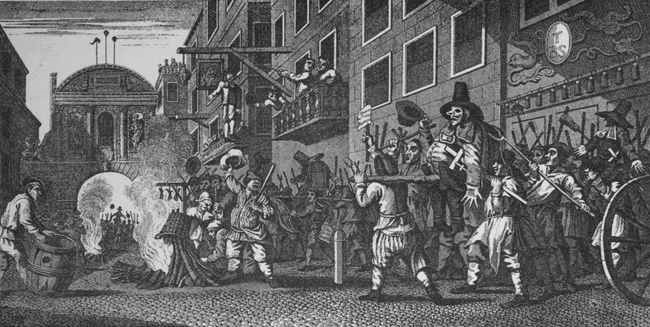
HUDIBRAS, PLATE XI.
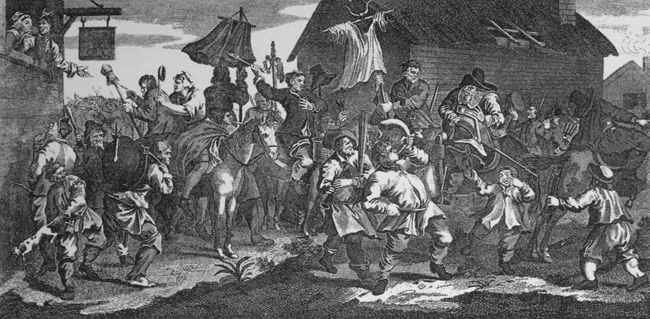
HUDIBRAS, PLATE XII.
This well-imagined series of plates was designed by
Hogarth, and engraved by himself, for the matchless
poem of Butler. Each plate is illustrated by an
appropriate quotation from the facetious satirist;
and as our ingenious artist formed his designs from
an attentive perusal of the poem, his engravings, and
the extracts selected under each of them, reciprocally
explain each other. "His 'Hudibras,'" says Mr.
Walpole, "was the first of his works that marked
him as a man above the common; yet," adds the
critic, somewhat too fastidiously, "what made him
then noticed now surprises us, to find so little humour
in an undertaking so congenial to his talents."
The original title ran thus: "Twelve excellent
and most diverting Prints, taken from the celebrated
Poem of Hudibras, wrote by Samuel Butler; exposing
the villany and hypocrisy of the times. Invented
and engraved on twelve copperplates by William
Hogarth; and are humbly dedicated to William
Ware, Esq., of Great Houghton, in Northamptonshire,
and Mr. Allan Ramsay, of Edinburgh."
"What excellence can brass or marble claim?
These papers better do secure thy fame;
Thy verse all monuments does far surpass,
No mausoleum's like thy 'Hudibras.'"
Allan Ramsay subscribed for thirty sets, and the
number of subscribers amounted to one hundred and
ninety-two. The original plates were afterwards
purchased by Mr. Philip Overton. They subsequently
passed into the hands of the late Mr. Robert
Sayer; and it is certain that Hogarth often lamented
the having parted with his property in them without
ever having had an opportunity to improve them.
In the first of these plates is a portrait inscribed,
"Mr. Samuel Butler, born 1612, Author of Hudibras,
died 1680." The basso-relievo of the pedestal represents
Butler's Genius in a car, lashing round Mount
Parnassus, in the persons of Hudibras and Ralpho,
Rebellion, Hypocrisy, and Ignorance, the reigning
vices and follies of the time. In the scene of the
Committee (Plate IX.), one of the members has his
gloves on his head. "I am told," says Mr. Steevens,
"this whimsical custom once prevailed among our
sanctified fraternity; but it is in vain, I suppose, to
ask the reason why." This doubt, however, has
since produced from a respectable divine an intimation
that he has frequently heard his father, who died
some years ago at an advanced age, notice the custom
of placing the gloves on the head at church as
not uncommon in cold weather.
In the earliest impressions of Plate XI., the words
"Down with the Rumps" are not inserted on the
scroll.
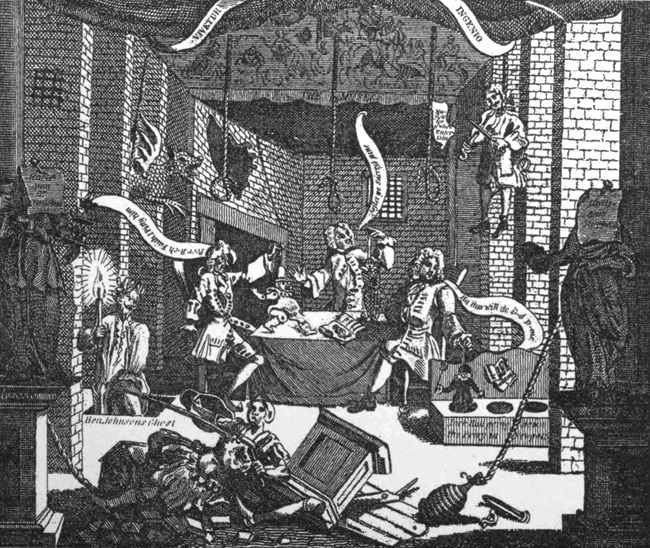
JUST VIEW OF THE BRITISH STAGE.
Mr. Walpole, in his Catalogue, thus describes this
plate: "Booth, Wilkes, and Cibber, contriving a
Pantomime; a Satire on Farces."
Though the inscription engraved under it is sufficiently
explanatory, it may be added that Mr. Devoto
was scene-painter either to Drury Lane or Lincoln's-Inn
Fields, and also to Goodman's Fields Theatre;
that the ropes mentioned in the inscription are no
other than halters, suspended over the heads of the
three managers; and that the labels issuing from
their respective mouths convey the following characteristic
words. The airy Wilkes, who dangles the
effigies of Punch, exclaims, "Poor R—ch! faith, I
pitty him." The Laureate Cibber, who is amusing
himself with playing with harlequin, invokes the
muse painted on the ceiling: "Assist, ye sacred
Nine!" And the solemn Booth, letting down the
figure of Jack Hall into the forica, is most tragically
exclaiming, with an oath, "Ha! this will do."
At the same instant Ben Jonson's ghost is rising
through the stage, and insulting a pantomime statue
fallen from its base. Over the figure of Hall is suspended
a parcel of waste paper, consisting of leaves
torn from The Way of the World, Hamlet, Macbeth,
and Julius Cæsar. A fiddler is seen hanging by a
cord in the air, and performing, with a scroll before
him, which proclaims, "Music for the What" [meaning
perhaps the "What d'ye call it"] entertainment.
A pamphlet on the table exhibits a print of Jack
Sheppard in confinement. A dragon is also preparing
to fly; a dog thrusts his head out of the kennel;
a flask acquires motion by machinery, etc. The
countenances of Tragedy and Comedy, on each side
of the stage, are concealed by the bills for Harlequin
Dr. Faustus, Harlequin Shepherd, etc.
Vivetur ingenio is the motto over the curtain.
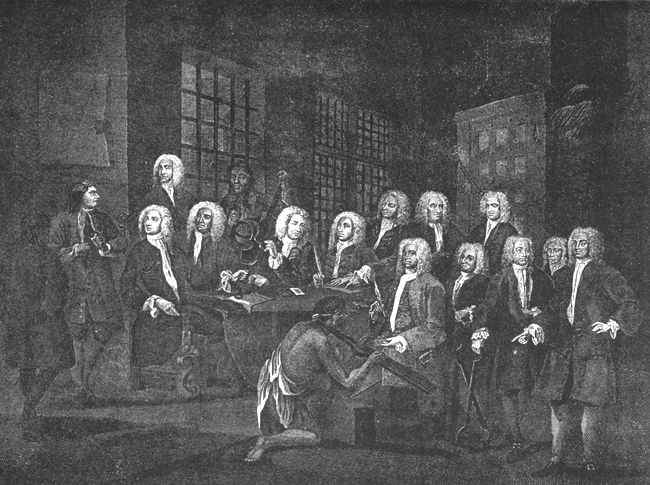
BAMBRIDGE ON TRIAL FOR MURDER.
This very fine picture, Hogarth himself tells us, was
painted in 1729 for Sir Archibald Grant of Monymusk,
Bart., at that time Knight of the Shire for
Aberdeen, and one of the Committee represented in
the painting,—many of whom attended daily, and
some of them twice a day.
That every other figure in this print is a genuine
portrait, there cannot be the least doubt, though
at this distant period it is not possible to identify
the particular persons; they are all, however, to be
found in the following list of the names of the
Committee:—
| James Oglethorpe, Esq., Chairman. |
|
The Right Hon.
the Lords |
| { Finch. | General Wade. |
| { Morpeth. | Humphrey Parsons, Esq. |
| { Inchequin. | Hon. Robert Byng. |
| { Percival. | Edward Houghton, Esq. |
| { Limerick. | (Judge-Advocate.) |
| Sir Robert Sutton. | Captain Vernon. |
| Sir Robert Clifton. | Charles Selwyn, Esq. |
| Sir Abraham Elton. | Velters Cornwall, Esq. |
| Sir Edward Knatchbull. | Thomas Scawen, Esq. |
| Sir Humphrey Herries. | Francis Child, Esq. |
| Hon. James Bertie. | William Hucks, Esq. |
| Sir Gregory Page. | Stampe Brooksbank, Esq. |
| Sir Archibald Grant. | Charles Withers, Esq. |
| Sir James Thomhill. | John La Roche, Esq. |
| Gyles Earle, Esq. | Mr. Thomas Martin. |
"The scene," says Mr. Walpole, "is the Committee.
On the table are the instruments of torture. A
prisoner in rags, half-starved, appears before them;
the poor man has a good countenance, that adds to
the interest. On the other hand is the inhuman
gaoler. It is the very figure that Salvator Rosa
would have drawn for Iago in the moment of detection.
Villany, fear, and conscience are mixed in
yellow and livid on his countenance; his lips are
contracted by tremor, his face advances as eager to
lie, his legs step back as thinking to make his escape;
one hand is thrust precipitately into his bosom, the
fingers of the other are catching uncertainly at his
button-holes. If this was a portrait, it is the most
striking that ever was drawn; if it was not, it is
still finer."
This Committee was first appointed, Feb. 25,
1728-9, to examine into the state of the gaols within
the kingdom; and the persons here represented
under examination were—Thomas Bambridge, then
Warden of the Fleet Prison, and John Huggins, his
predecessor in that office. Both were declared "notoriously
guilty of great breaches of trust, extortions,
cruelties, and other high crimes and misdemeanours."
It was the unanimous resolution of the Committee,
"That Thomas Bambridge, the acting Warden of
the Prison of the Fleet, hath wilfully permitted
several debtors to the Crown in great sums of money,
as well as debtors to divers of his Majesty's subjects,
to escape; hath been guilty of the most notorious
breaches of his trust, great extortions, and the highest
crimes and misdemeanours in the execution of his
said office; and hath arbitrarily and unlawfully
loaded with irons, put into dungeons, and destroyed,
prisoners for debt under his charge, treating them in
the most barbarous and cruel manner, in high violation
and contempt of the laws of this kingdom."
Bambridge was in consequence disqualified by Act
of Parliament; and he cut his throat twenty years
after.
It was also resolved, "That John Huggins, Esq.,
late Warden of the Prison of the Fleet, did, during
the time of his wardenship, wilfully permit several
considerable debtors in his custody to escape; and
was notoriously guilty of great breaches of his
trust, extortions, cruelties, and other high crimes and
misdemeanours, in the execution of the said office;"
and he was for some time committed to Newgate,
but afterwards lived in credit to the age of ninety.
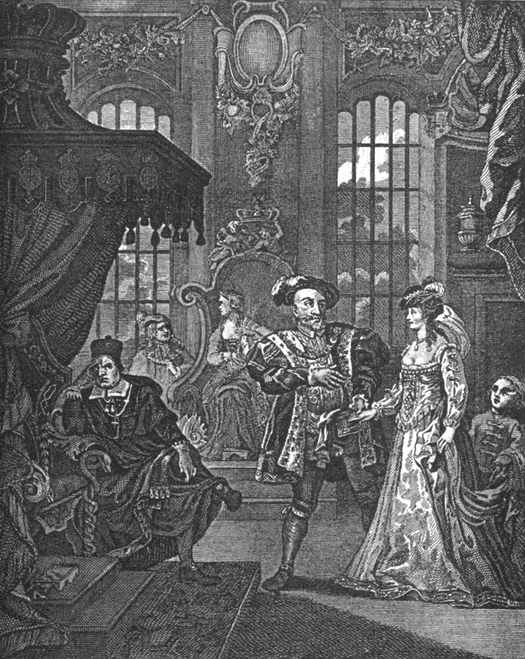
HENRY THE EIGHTH & ANNE BOLEYNE.
This plate, copied from a painting in the portico of
the old great room in Vauxhall Gardens, has very
idly been imagined to contain the portraits of
Frederick Prince of Wales, and the beautiful but
unfortunate Lady Vane; but the stature and faces
both of the lady and Henry are totally unlike their
supposed originals.
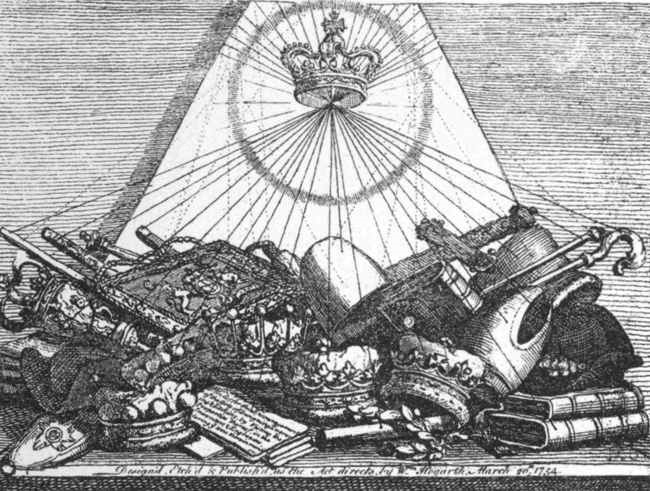
CROWNS, MITRES, MACES &c.
This plate forms so important a feature in the
annals of Hogarth, that it requires his own elucidation:—
"After having had my plates pirated in almost all
sizes, I applied to Parliament for redress, and obtained
it in so liberal a manner, as hath not only
answered my own purpose, but made prints a considerable
article in the commerce of this country,
there being now more business of that kind done
here than at Paris, or anywhere else, and as well."
The statute, which took place June 24, 1735, was
drawn up by our artist's friend Mr. Huggins, who took
for his model the eighth of Queen Anne in favour of
literary property. But it was not so accurately executed
as entirely to remedy the evil; for, in a cause
founded on it, which came before Lord Hardwicke
in Chancery, that excellent lawyer determined that
no assignee, claiming under an assignment from the
original inventor, could take any benefit by it.
Hogarth, immediately after the passing of the Act,
published this print with the following inscription:—
"In humble and grateful acknowledgment
of the grace and goodness of the Legislature,
manifested in the Act of Parliament for the Encouragement
of the Arts of Designing, Engraving, etc.,
obtained by the Endeavours, and almost at the sole Expense,
of the Designer of this Print in the Year 1735;
by which,
not only the Professors of those Arts were rescued
from the Tyranny, Frauds, and Piracies
of Monopolizing Dealers,
and legally entitled to the Fruits of their own Labours;
but Genius and Industry were also prompted
by the most noble and generous Inducements to exert themselves.
Emulation was excited;
Ornamental Compositions were better understood;
and every Manufacture, where Fancy has any concern,
was gradually raised to a pitch of Perfection before unknown;
insomuch, that those of Great Britain
are at present the most elegant
and the most in Esteem of any in Europe."
The royal Crown at the top is darting its rays
on mitres, coronets, the Chancellor's great seal, the
Speaker's hat, etc. etc.; and on a scroll is written,
"An Act for the Encouragement of the Arts of
Designing, Engraving, and Etching, by vesting the
properties thereof in the inventors and engravers,
during the time therein mentioned."
The plate was afterwards used as a receipt for the
subscriptions to his four prints of "The Election."
In 1767, three years after Hogarth's death, his
widow stated, in a petition to the House of Commons,
"that she was informed that a Bill was
depending in the House to amend an Act made in
the eighth year of the reign of his late Majesty, for
the encouragement of the arts of designing, engraving,
and etching: that her late husband was the
inventor, engraver, and publisher of various designs—moral,
humorous, and historical; the sole property
whereof was vested in him by the said Act for the
term of fourteen years; that her chief support arose
from the sale of her late husband's works; that, since
his decease, many persons had copied, printed, and
published several of those works, and still continued
to do so; and that the sale of those spurious copies,
both at home and for exportation, had already been
a great prejudice to the petitioner, and, unless timely
prevented, would deprive her of her chief support
and dependence; and praying that provision might
be made for vesting in her the property of her said
husband's works." The petition was thought reasonable;
and a clause was added to the Bill for "vesting
in, and securing to, Jane Hogarth, widow, the property
in certain prints."
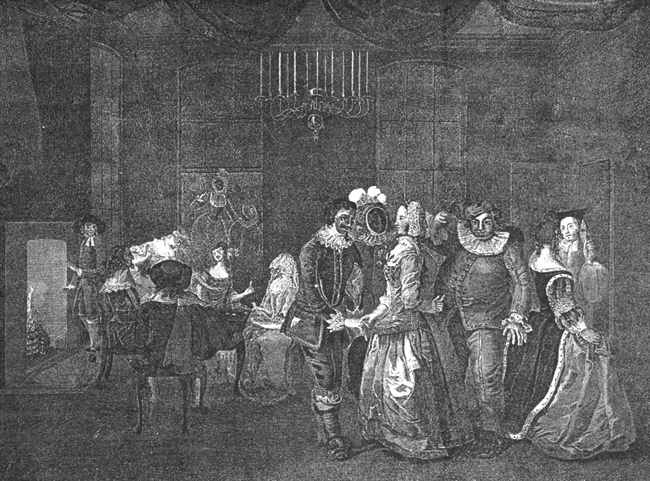
ROYAL MASQUERADE, SOMERSET HOUSE.
This very interesting scene, which may be dated
early in 1755, is thus anticipated by Mr. Walpole, in
a letter to Mr. Richard Bentley, Dec. 24, 1754:—"The
Russian ambassador is to give a masquerade
for the birth of the little great prince (the Czar,
Paul I.). The King lends him Somerset House: he
wanted to borrow the palace over against me, and
sent to ask it of the cardinal-nephew (Henry Earl of
Lincoln, nephew to the Duke of Newcastle, to whose
title he succeeded), who replied, 'Not for half
Russia!'"
The print abounds with real portraits of personages
of the first distinction, of whom several may be identified
by the following extract from the Gentleman's
Magazine, vol. xxv. p. 89:—"Feb. 6.—The Russian
ambassador gave a most magnificent ball at Somerset
House. His Majesty came a little after eight, dressed
in a black domino, tie-wig, and gold-laced hat. Her
Royal Highness the Princess of Wales was in a blue
and silver robe, and her head greatly ornamented
with jewels. The Prince of Wales was in a pink and
silver dress. Prince Edward in a pink satin waistcoat,
with a belt adorned with diamonds. Princess
Augusta in a rich gold stuff. The Duke (of Cumberland)
was in a Turkish dress, with a large bunch
of diamonds in his turban. A noble lady shone in
the habit of a nymph, embroidered over with stars
studded with brilliants to the amount of £100,000.
In short, the dresses of the whole assembly were the
richest that could possibly be devised upon such an
occasion; and the whole entertainment, particularly
the desert, was the most elegant that expense could
furnish. Few exhibitions of this kind have equalled
it,—none excelled it. The number of persons were
above a thousand."
The original painting formed part of the fine collection
of the late Roger Palmer, Esq., on whose
death it devolved, with the rest of a very ample property,
to his only sister, Elizabeth, wife of the brave
and benevolent Captain Joseph Budworth, who assumed
the name and arms of Palmer.
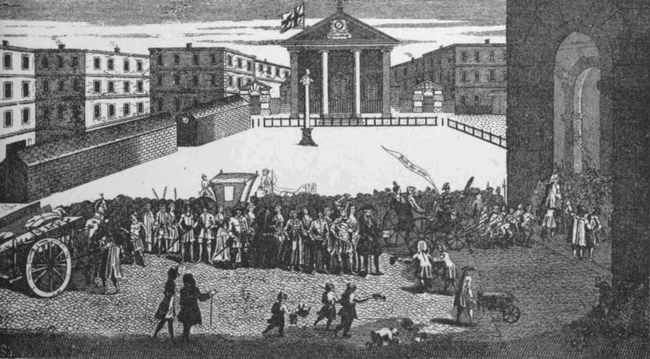
RICH'S TRIUMPHANT ENTRY.
This plate represents the removal of Rich, and his
scenery, authors, actors, etc., from Lincoln's-Inn
Fields to the new house. The scene is the area of
Covent Garden, across which, leading toward the
door of the theatre, is a long procession, consisting
of a cart loaded with thunder and lightning, performers,
etc.; and at the head of them Mr. Rich
(invested with the skin of the famous dog in Perseus
and Andromeda) riding with his mistress in a chariot
driven by harlequin, and drawn by satyrs.
Some indifferent verses, which accompanied the
original publication, allude to Walker and Hall, the
original Macheath and Lockit, and conclude thus:
"To the Piazza let us turn our eyes,
See Johnny Gay on Porter's shoulders rise,
Whilst a bright Man of Taste his works despise."
"Another author wheels his work with care,
In hopes to get a market at this fair,
For such a day he sees not every year."
By the "Man of Taste," Mr. Pope was apparently
designed. He is represented in his tie-wig, at a dark
corner of the Piazza, amusing himself (not very delicately)
with the Beggars' Opera. The letter P is
over his head; his little sword is significantly placed,
and the peculiarity of his figure is well preserved.
The reason why our artist has assigned such an
employment to him, we can only guess. It seems,
indeed, from Dr. Johnson's Life of Gay, that Pope
did not think the Beggars' Opera would succeed.
Swift, however, was of the same opinion; and yet
the former supported the piece on the first night of
exhibition, and the latter defended it in his Intelligencer
against the attacks of Dr. Herring, then
Preacher to the Society of Lincoln's-Inn, and afterwards
Archbishop of Canterbury. Hogarth might
be wanton in his satire, might have founded it on an
idle report, or might have sacrificed truth to the
prejudice of Sir James Thornhill, whose quarrel on
another occasion he is supposed to have taken up,
when he ridiculed the translator of Homer, in a view
of "The Gate of Burlington House."
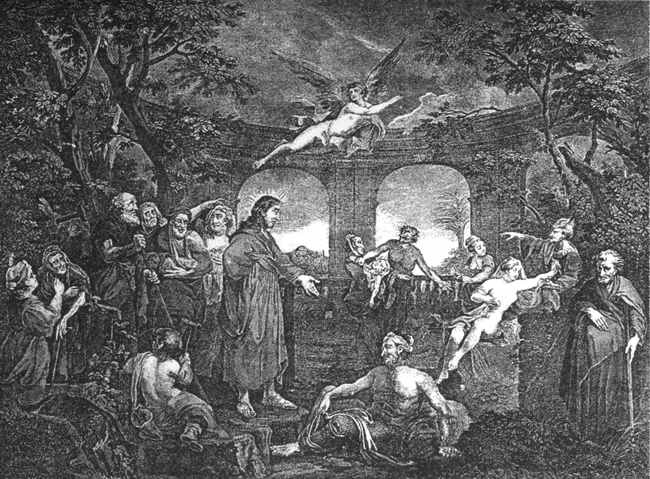
THE POOL OF BETHESDA.
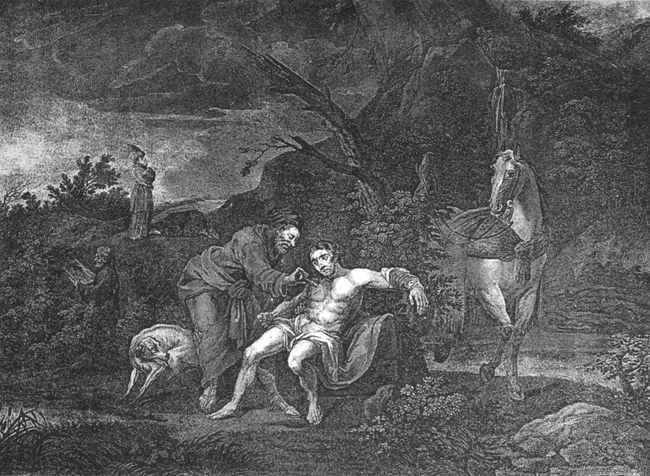
THE GOOD SAMARITAN.
These magnificent prints are placed among the early
productions of Hogarth, as the paintings from which
they are copied were completed in 1737; and in
1748 a small copy of the "Pool of Bethesda" was
engraved by Ravenet, as a frontispiece to Stackhouse's
Family Bible.
Mr. Walpole observes, that "the burlesque turn of
our artist's mind mixed itself with his most serious
compositions; and that, in the 'Pool of Bethesda,' a
servant of a rich ulcerated lady beats back a poor
man (perhaps woman) who sought the same celestial
remedy." To this I may add, that the figure of the
priest, in the "Good Samaritan," is supremely comic,
and rather resembles some purse-proud burgomaster,
than the character it was designed to represent.
In the "Pool of Bethesda" is introduced, as I was
assured by Dr. Ducarel, a faithful portrait of Nell
Robinson, a celebrated courtezan, at whose shrine
both Hogarth and the Doctor had in early life
occasionally paid their devoirs.
On the subject of these two very fine prints, it will
not only be candid, but amusing and instructive, to
transcribe Hogarth's own unvarnished remarks:—
"As I could not bring myself to act like some of
my brethren, and make the painting of small conversation
pieces a sort of manufactory to be carried
on by the help of background and drapery painters,
it was not sufficiently profitable to pay the expenses
my family required. I therefore turned my thoughts
to a still more novel trade, the painting and engraving
modern moral subjects, a field not broken up in
any country or any age. The reasons which induced
me to adopt this mode of designing were, that I
thought both writers and painters had, in the historical
style, totally overlooked that intermediate species
of subjects, which may be placed between the sublime
and grotesque. I therefore wished to compose pictures
on canvas, similar to representations on the
stage; and further hope that they will be tried by
the same test, and criticised by the same criterion.
Let it be observed, that I mean to speak only of
those scenes where the human species are actors;
and these, I think, have not often been delineated in
a way of which they are worthy and capable. In
these compositions, those subjects that will both
entertain and improve the mind bid fair to be of the
greatest public utility, and must therefore be entitled
to rank in the highest class. If the execution is
difficult (though that is but a secondary merit), the
author has a claim to a higher degree of praise. If
this be admitted, comedy, in painting as well as
writing, ought to be allotted the first place, as most
capable of all these perfections, though the sublime,
as it is called, has been opposed to it. Ocular demonstration
will carry more conviction to the mind of
a sensible man than all he would find in a thousand
volumes; and this has been attempted in the prints
I have composed. Let the decision be left to every
unprejudiced eye; let the figures in either pictures or
prints be considered as players, dressed either for the
sublime—for genteel comedy, or farce—for high or
low life. I have endeavoured to treat my subjects
as a dramatic writer; my picture is my stage, and
men and women my players, who, by means of certain
actions and gestures, are to exhibit a dumb show.
"Before I had done anything of much consequence
in this walk, I entertained some hopes of succeeding
in what the puffers in books call the great style of
history-painting; so that, without having had a stroke
of this grand business before, I quitted small portraits
and familiar conversations, and, with a smile at
my own temerity, commenced history-painter; and
on a great staircase at St. Bartholomew's Hospital,
painted two Scripture stories, 'The Pool of Bethesda'
and 'The Good Samaritan,' with figures seven feet
high. These I presented to the charity; and thought
they might serve as a specimen, to show that, were
there an inclination in England for encouraging historical
pictures, such a first essay might prove the
painting them more easily attainable than is generally
imagined. But as religion, the great promoter of this
style in other countries, rejected it in England, I was
unwilling to sink into a portrait-manufacturer; and,
still ambitious of being singular, dropped all expectations
of advantage from that source, and returned
to the pursuit of my former dealings with the public
at large. This I found was most likely to answer
my purpose, provided I could strike the passions,
and, by small sums from many, by the sale of prints
which I could engrave from my own pictures, thus
secure my property to myself."
While these pictures were in progress, it was
announced that "among the governors of St. Bartholomew's
Hospital was lately chosen Mr. William
Hogarth, the celebrated painter, who, we are told,
designs to paint the staircase of the said hospital,
and thereby become a benefactor to it by giving his
labours gratis." And a newspaper of July 14, 1737,
says, "Yesterday the scaffolding was taken down
from before the picture of 'The Good Samaritan,'
which is esteemed a very curious piece."
Hogarth paid his friend Lambert for painting the
landscape in this picture; and to the imaginary
merits of his coadjutor, the Analysis, p. 26, thus bears
testimony: "The sky always gradates one way or
other, and the rising or setting sun exhibits it in
great perfection; the imitating of which was Claude
de Lorraine's peculiar excellence, and it is now Mr.
Lambert's."
Both pictures, which appear of an oblong square
in the engravings, in the originals are surrounded
with scroll-work which cuts off the corners of them,
etc. All these ornaments, together with compartments
carved at the bottom, were the work of Mr.
Richards. These the late Mr. Alderman Boydell
caused to be engraved on separate plates, and appended
to those above them, on which sufficient
space had not been left. Hogarth requested that
these paintings might never be varnished. They
appear, therefore, to disadvantage, the decorations
about them having, within these few years past, been
highly glazed.
"The Pool of Bethesda" has suffered much from
the sun; and "The Good Samaritan," when cleaned
about the year 1780, was pressed so hard against the
straining frame, that several creases were made in
the canvas.
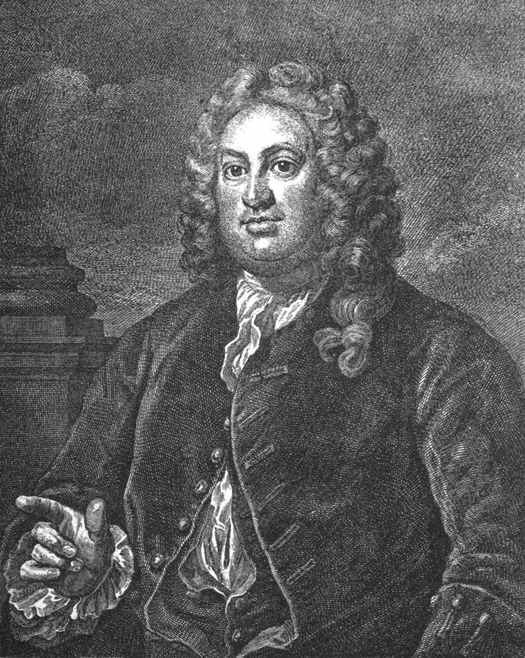
MARTIN FOLKES ESQRE
This elegant scholar was a mathematician and antiquary
of much celebrity in the philosophical annals
of literature. In 1713, at the early age of 24, he was
elected a Fellow of the Royal Society, and in 1741
was elected President. Mr. Folkes was also an early
Member of the Society of Antiquaries, having been
elected in 1719-20; and his communications to both
societies were numerous and valuable. His knowledge
in ancient and modern coins was very extensive;
and the most important work he produced, was
The History of the English Gold and Silver Coin,
from the Conquest to his own time.
Algernon, the famous Duke of Somerset, who had
been many years President of the Society of Antiquaries,
dying February 9, 1749-50, Mr. Folkes, who
was then one of the Vice-Presidents, was immediately
chosen to succeed his Grace; and was continued
President by the Charter of Incorporation of that
Society, November 2, 1751. But he was soon disabled
from presiding in person either in that or the
Royal Society, being seized, on the 26th of September
the same year, with a palsy, which deprived him of
the use of his left side. On the 30th of November
1753, he resigned the Presidentship of the Royal
Society; but continued President of the Society of
Antiquaries till his death. After having languished
nearly three years, a second attack of his disorder, on
the 25th of June 1754, put an end to his life on the
28th of that month.
The original portrait is preserved in the meeting-room
of the Royal Society.
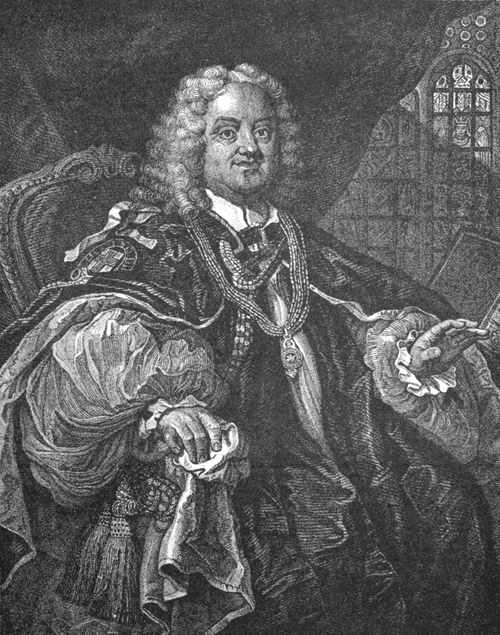
BISHOP HOADLEY.
This portrait is in grand style, though rather in the
French manner. The painting, and the plate engraved
from it by Baron, were carefully preserved in
the Bishop's family.
Dr. Benjamin Hoadley, a prelate of considerable
eminence, was born November 4, 1676; educated at
Catharine Hall, Cambridge; elected Lecturer of St.
Mildred, Poultry, 1701; Rector of St. Peter-le-Poor
in 1704, and of Streatham in 1710; King's Chaplain,
February 16, 1715-16; Bishop of Bangor, March 18
following; translated to Hereford in 1721, to Salisbury
in 1723, and in 1734 to Winchester, which he
held nearly twenty-seven years, till on April 17, 1761,
at his house at Chelsea, in the same calm he had
enjoyed amidst all the storms that blew around him,
he died, full of years and honours, beloved and regretted
by all good men, in the 85th year of his age.
Few writers of eminence have been so frequently or
so illiberally traduced; yet fewer still have had the
felicity of living till a nation became their converts,
and of knowing "that sons have blushed their fathers
were their foes." His useful labours, which will ever
be esteemed by all lovers of the natural, civil, and
religious rights of Englishmen, were collected in 1773,
in three folio volumes.
The Bishop had two sons: Benjamin Hoadley,
M.D., F.R.S., Physician to Frederick Prince of Wales,
and to George the Second; of high rank in his profession;
and well known by many valuable writings,
more especially by his comedy of The Suspicious
Husband. He died, in his father's lifetime, in 1757.
The other son, the Rev. Dr. John Hoadley, Chancellor
of Winchester, was also a most amiable man, and
an elegant poet. He was the editor of his father's
collected works, introduced by a well-digested biographical
memoir. He died March 10, 1776; and
with him the name of Hoadley became extinct. His
relict, who long survived him, possessed several
original paintings by Hogarth, which were afterwards
the property of the late Mr. Archdeacon D'Oyley.
MR RANBY'S HOUSE AT CHISWICK.
This view, etched by Hogarth in 1748 without any
inscription, was first published by his widow in 1781.
HYMEN & CUPID.
This neat plate was engraved as a ticket for the
masque of Alfred, performed in 1748, at Cliveden
House, before the Prince and Princess of Wales, on
the Princess Augusta's birthday. It was afterwards
intended as a receipt for "Sigismunda."
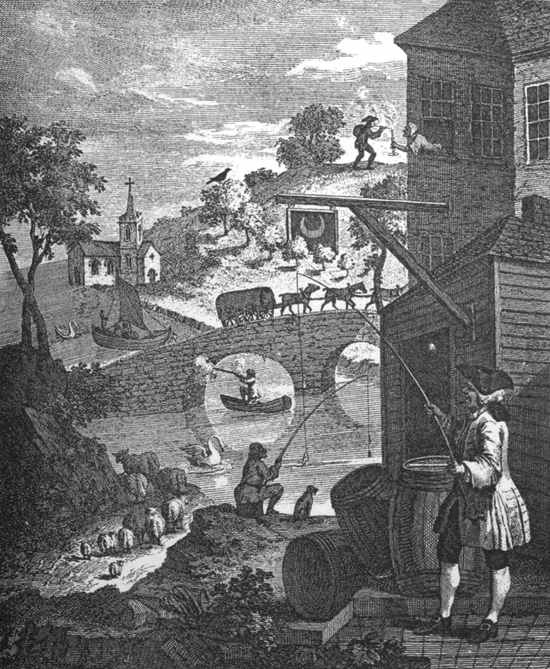
FALSE PERSPECTIVE.
Early in 1753, Hogarth presented to his friend Mr.
Joshua Kirby this whimsical satirical design; which
arose from the mistakes of Sir Edward Walpole, who
was learning to draw without being taught perspective:
an anecdote recorded by Mr. Steevens, on Sir
Edward's own authority.
To point out in a strong light the errors which
would be likely to happen from the want of acquaintance
with those principles, Hogarth's design
was produced.
A traveller is represented on an eminence, lighting
his pipe from a candle presented to him by a woman
from a chamber-window at the distance of at least a
mile. We are also astonished at the representation
near it, of a crow seated on the spray of a tree, without
incommoding by its weight the tender sprouts
issuing from its branches; and our astonishment
increases when we recollect that this tree, if weighed
in the balance with the bird, would hardly be found
to preponderate. The tree on which the feathered
animal is so securely stationed is, however, of a much
greater height and magnitude than those which are
nearer, and which gradually diminish as they approach
the foreground. The sheep, taking example from
the trees, are very large at a distance, but regularly
become minute by their proximity, the nearest being
almost invisible. Both ends of the church, the top,
and the whole extent of one side of it, are clearly
seen. To take the view which Hogarth has represented,
we must, at the same time, be above, at each
end, and in front of that parochial erection; but he
has not been so complaisant as to favour us with the
sight of the road on the bridge, which the vessel
seems determined to sail over, while the waggon and
horses appear floating on the other side. A fellow
in a boat, nearly under the bridge, is attempting to
shoot a swan on the other side of it; though, as he is
situated, he cannot possibly have a view of the object
whose destruction he pretends to be aiming at. The
waggon and horses, which are supposed to be on the
bridge, are more distant than the tree which grows on
the further side.
Many other absurdities are visible in this curious
perspective view, which are too obvious to escape
observation: such as the signpost extending to a
house at the distance of half a mile, and the remote
row of trees concealing part of the nearer sign of the
half-moon; the angler's line interfering with another
belonging to his patient brother, though at a considerable
distance from each other; and the tops and
bottoms of the barrels being equally visible.
The favour of this communication was gratefully
acknowledged by Kirby, who in 1754 prefixed it to
Dr. Brook Taylor's Method of Perspective made easy
both in Theory and Practice, with a dedication to
Hogarth, who subsequently furnished him with a
serious design for the plate which is described at
page 132.
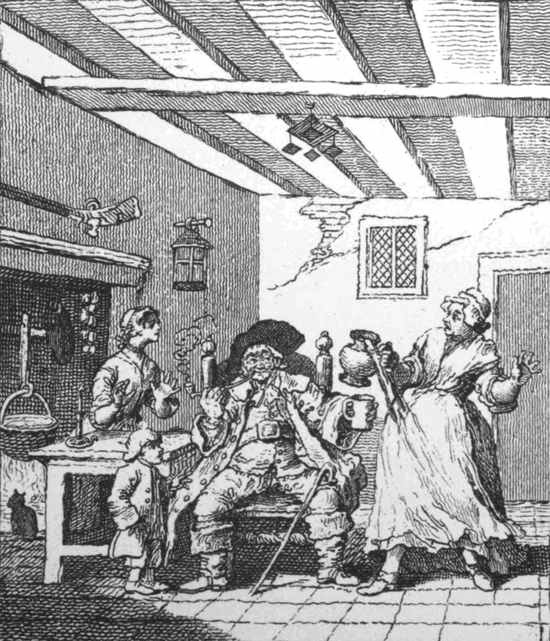
THE FARMER'S RETURN.
The little drama by Mr. Garrick, in which this exquisite
frontispiece first appeared, was thus prefaced:
"The following interlude was prepared for the stage,
merely with a view of assisting Mrs. Pritchard at her
benefit; and the desire of serving so good an actress
is a better excuse for its defects than the few days in
which it was written and represented. Notwithstanding
the favourable reception it has met with, the
author would not have printed it, had not his friend
Mr. Hogarth flattered him most agreeably, by thinking
the farmer and his family not unworthy of a
sketch of his pencil. To him, therefore, this trifle,
which he has so much honoured, is inscribed, as a
faint testimony of the sincere esteem which the writer
bears him, both as a man and an artist."
The original drawing was given to Mr. Garrick,
and was in the possession of his widow during her
life.
The receipt for "The March to Finchley," which
accompanies this plate, has been already described.

INHABITANTS OF THE MOON.
Rec'd. of 7s 6d being the whole
Payment for a Print Representing a March to Finchly in the Year
1746 which I promise to deliver when finished on sight hereof.
N.B. Each Print will be half a Guinea after the Subscription is over.
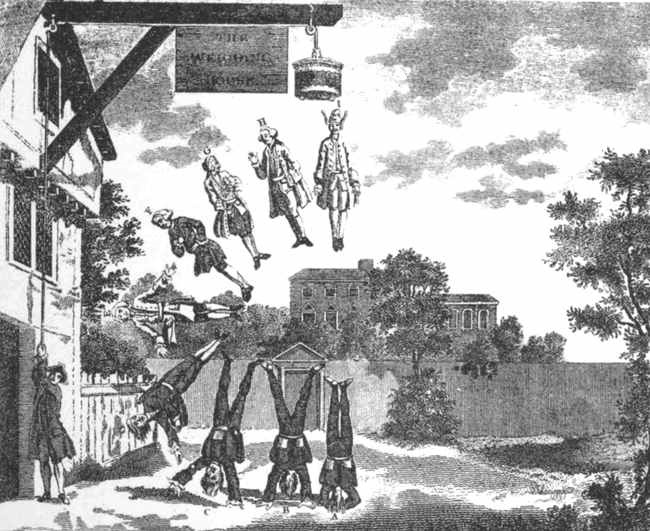
A. absolute Gravity. B. Conatus against absolute Gravity.
C. partial Gravity. D. comparative Gravity. E. horizontal, or good sense.
F. Wit. G. comparative Levity, or Coxcomb. H. partial Levity, or pert Fool.
I. absolute Levity, or stark Fool.
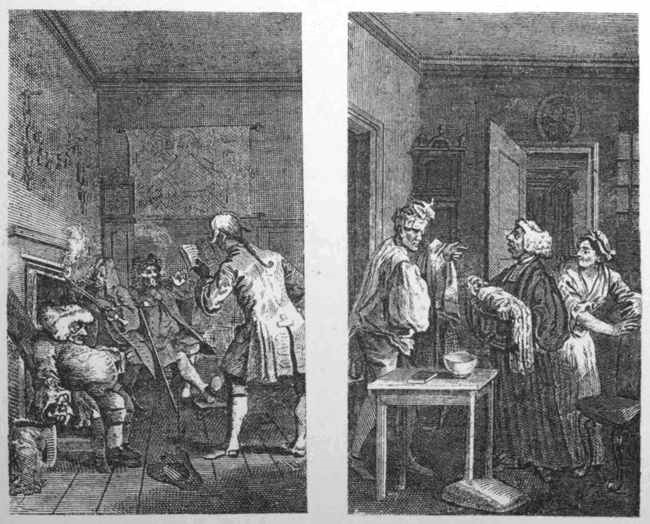
FRONTISPIECES TO TRISTRAM SHANDY.
For this popular work of his friend Lawrence Sterne,
Hogarth furnished two frontispieces; one in 1759,
for the second volume; the other in 1761, for the
fourth.
The first of these is taken from the chapter in
which Corporal Trim is represented reading a sermon
to Tristram's father, Uncle Toby, and Dr. Slop, the
latter of whom is fallen asleep, and who was intended
for Dr. John Burton, a physician of great eminence at
York, well known as an able and industrious antiquary,
and also as a sturdy Jacobite.
The second frontispiece represents the christening,
so humorously described in the fourteenth chapter
of the fourth volume of Tristram Shandy.
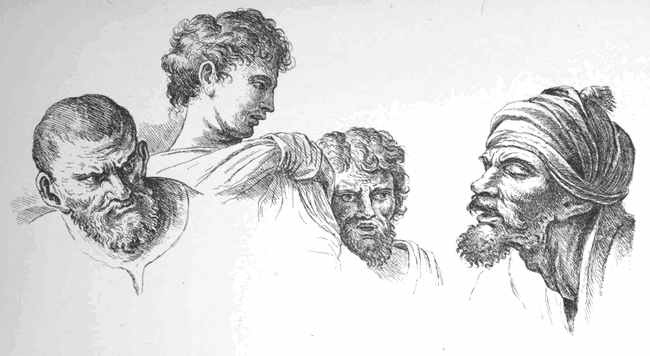
HEADS FROM RAFFAELLE'S CARTOONS.
These heads were copied from the cartoons at
Hampton Court; and Mr. Walpole, speaking of Sir
James Thornhill's attention to these celebrated pictures,
has the following remark: "He made copious
studies of the heads, hands, and feet, and intended to
publish an exact account of the whole for the use of
students; but his work never appeared."
As this plate was found among others engraved by
Hogarth, it might probably have been one of his
early performances. His widow, in 1781, directed
a few impressions to be taken from it; which were
sold in Leicester Square.
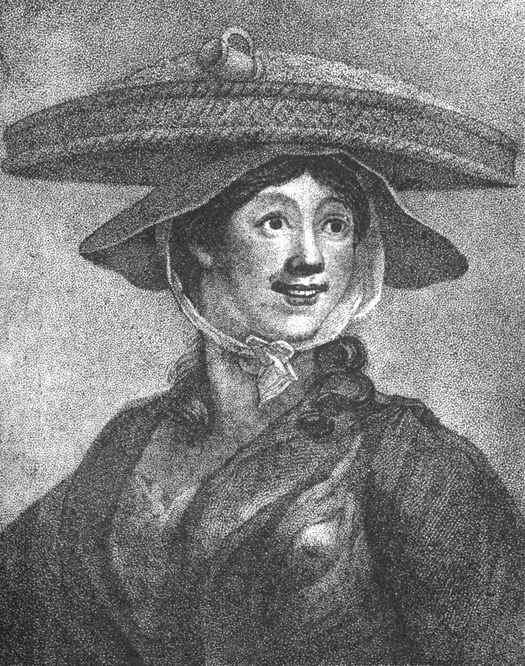
THE SHRIMP GIRL.
In this portrait from the life, first published in 1782,
from the original sketch in oil, are united the talents
of Hogarth and Bartolozzi; but the plate, which is
executed in the dotted manner then so much in
fashion, should have been etched, or engraved, like
those excellent performances by Bartolozzi after the
drawings of Guercino; as spirit, rather than delicacy,
is the characteristic of our artist's shrimp-girl.
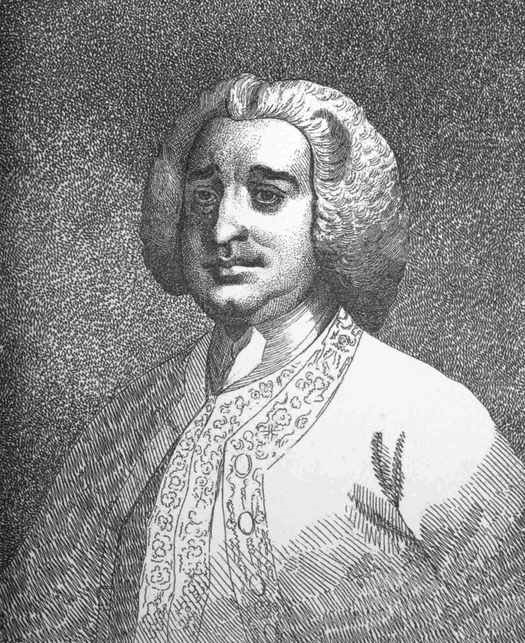
THE RIGHT HON. HENRY FOX. LORD HOLLAND.
This is a serious portrait, from a drawing by Hogarth
in 1757, of that celebrated nobleman, whom he
afterwards introduced in the second plate of "The
Times," as the powerful antagonist of Lord Bute.
The public life of this great statesman is too well
known to need recital here. Let it suffice to say,
that in 1756 he resigned the office of Secretary at
War to Mr. Pitt; and in the following year was
appointed Paymaster of the Forces, which he retained
until the commencement of the reign of King George
III. May 6, 1762, his lady was created Baroness
Holland; and April 16, 1763, he himself was advanced
to a peerage, by the title of Baron Holland
of Foxley, Wilts. In the latter part of his life he
amused himself by building, at a vast expense, a
fantastic villa at Kingsgate, and died July 1, 1774,
in his 69th year.

THE RIGHT HON. JAMES CAULFIELD. EARL OF CHARLEMOUNT.
James Caulfield, son of James Viscount Charlemont,
was born August 18, 1728; succeeded to his
hereditary honours, April 21, 1734; and in December
1782, was raised to an earldom. He was F.R.S.,
F.S.A., and LL.D.; and died August 4, 1799, aged 70.
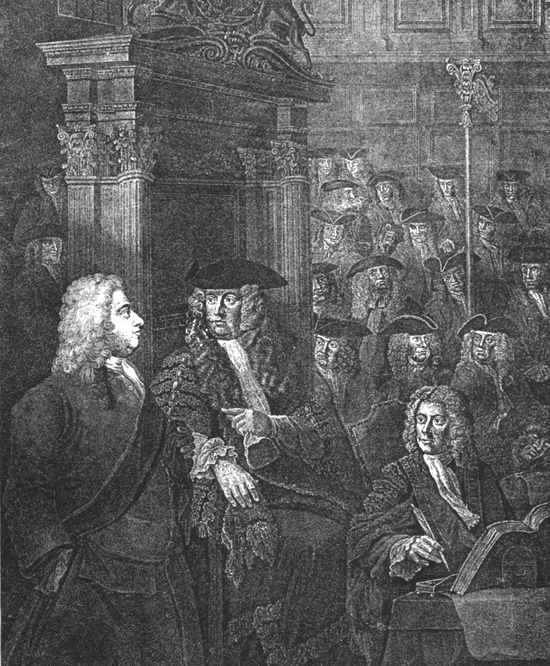
THE HOUSE OF COMMONS.
This fine print exhibits an inside view of the House
of Commons, from an original painting taken in 1726
or 1727, and now in the possession of the Earl of
Onslow.
The prominent portraits are those of the Right
Hon. Arthur Onslow, the then Speaker; Sir Robert
Walpole, the Prime Minister; Sidney Godolphin,
Esq., Father of the House; Colonel Onslow; Sir
James Thornhill; Sir Joseph Jekyll; Edward Stables,
Esq., Clerk of the House; Mr. Askew, Clerk-Assistant,
and several others in the background.

DEBATES ON PALMISTRY.
The figures employed in the study of palmistry seem
to have been designed for physicians and surgeons of
an hospital, who are debating on the most commodious
method of receiving a fee, inattentive to the
complaints of a lame female who solicits assistance.
A spectre, resembling the royal Dane, comes out
behind, perhaps to intimate that physic and poison
will occasionally produce similar effects. A glass-case
containing skeletons is open; a crocodile hangs
overhead; and an owl, emblematic of this sapient
consistory, is perched on a high stand.
Mr. Steevens conjectured that this might have been
a repented effort of hasty spleen against the officers
of St. Bartholomew's, who might not have treated
some recommendation of a patient from our artist
with all the respect and attention to which he thought
it was entitled: but this is mere supposition.
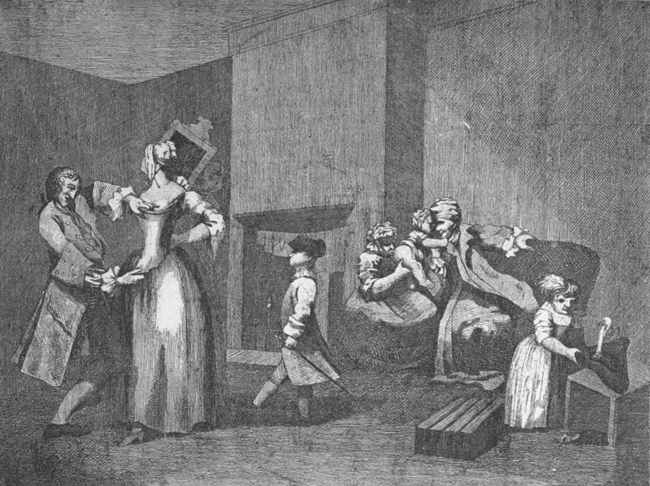
THE STAY MAKER.
The humour in this print is not very striking. The
male staymaker seems to be taking professional
liberties with a female in the very room where her
husband sits, who is playing with one of his children
presented to him by a nurse, perhaps with a view to
call off his attention from what is going forward.
The hag shows her pretended love for the infant by
the mode in which she is kissing him. A maidservant
holds a looking-glass for the lady, and peeps
significantly at the operator from behind it. A boy
with a cockade on, and a little sword by his side,
appears to observe the familiarities already mentioned,
and is strutting up fiercely towards the staymaker,
while a girl is spilling some liquor in his hat.
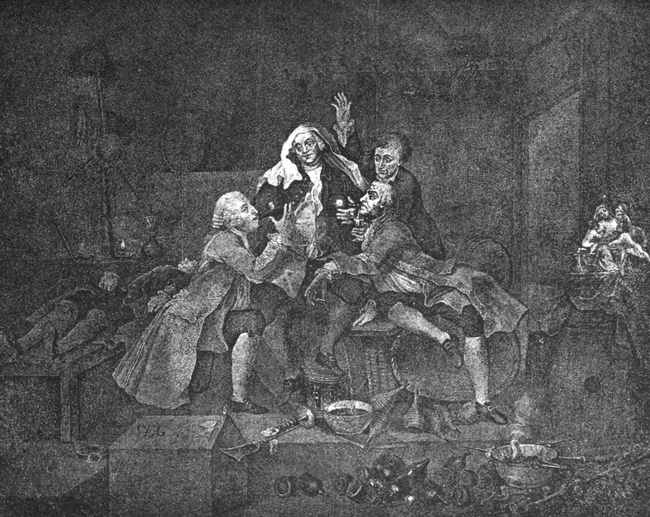
CHARITY IN THE CELLAR.
The original picture from which this print was engraved,
was painted for the late Lord Boyne. It
represents a convivial party assembled in a cellar
over a hogshead of claret, who, it is said, resolved
not to separate till they had drunk all the wine it
contained. Whether such a circumstance really gave
rise to the picture or not, it is unnecessary to inquire.
It is too well known that the habit of drinking to
excess, among all classes of society, existed at the
time of Hogarth to such a degree as to draw the
particular attention of this distinguished painter to
it; and it is not perhaps too much to say, that the
most distinguished preachers, or most able moral
writers, have not done more to drive this odious and
degrading vice from society than has been effected
by the valuable pencil of Hogarth. The individuals
here represented were members of a society well
known by the name of the "Hell-fire Club." In the
centre is the portrait of Sir Philip Hoby, seated on
the cask. Behind him, with his hand held up, is that
of Mr. De Grey, and below him is the portrait of
Lord J. Cavendish, who has drawn a spigot from the
cask to let the wine flow into a bowl. Opposite to
him Lord Sandwich is represented kneeling down to
draw in the intoxicating draught; and behind him
(extended on a form) is also Lord Galway. The
grouping of the four centre figures is an ingenious
imitation of a statue of Charity which is seen in the
cellar. The position of the bottles brings the comparison
still nearer, and is one of those little incidents
for which Hogarth was so particularly distinguished
from all other painters, in omitting nothing that
might carry out his intention and make himself
understood.
The devotedness of this group to the object for
which they are assembled is extremely well portrayed.
The positions of the figures are easy, and
the principle of observing the pyramidal form (so
often insisted upon as necessary to beauty in the
grouping of figures) is here strikingly exemplified.
It is impossible to show a more unconquerable love
for the intoxicating draught than is expressed in the
portrait of Lord Galway. Unable to stand, he has
placed himself on his back in such a manner that the
liquor from the cask above him is flowing into his
mouth; and he has perhaps been represented by
Hogarth as thus persevering in the fatal habit, in
order to show the excess to which it was then carried,
and is a forcible point in the painter's composition.
The picture is now in the possession of the present
Lord Boyne, and the print from it, which we have
added to our present edition, is not to be found in
any other of the collected works of Hogarth.
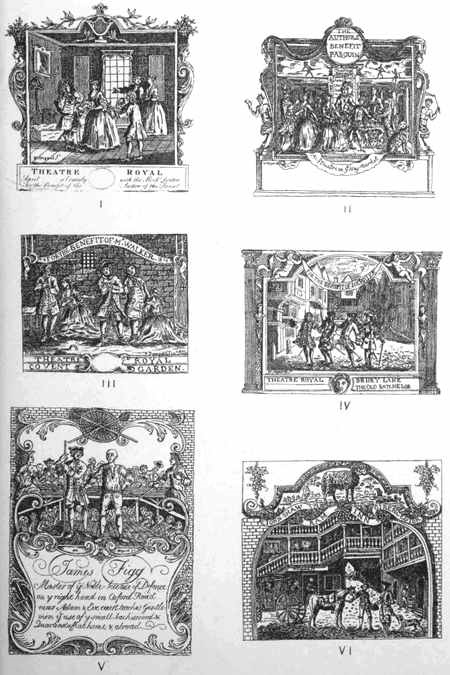
SIX TICKETS.
The several designs collected in this plate require
no particular description. They are given as specimens
of the facility with which Hogarth descended
to minor subjects, at the same time embellishing
them with strokes of his peculiar vein of pleasantry
and humour; and each of them sufficiently evinces
the purpose it was intended to recommend.
1. For the Mock Doctor. 2. For Pasquin. 3. For
the Beggars' Opera. 4. For Joe Miller. 5. Thomas
Figg, the noted prize-fighter. 6. The Ram Inn at
Cirencester.
The following hints are offered principally with a view to
assist in identifying such characters in Hogarth's prints as
are unnoticed, or but slightly described, in the preceding
volumes. A key to the whole (for many of the figures
not yet recognised were undoubtedly meant by the artist
as portraits) would, to the other merits of these inimitable compositions,
add the important one of making them an assemblage of the similitudes
of the leading remarkables of his day.
Vol. i. P. 162.
Although Hogarth, from a fear of creating himself enemies, disclaimed
individual portrait in his compositions, particularly of characters in the
higher walks of life, he was evidently not so scrupulous in indulging his
satire when representing more familiar scenes; and accordingly his
"Harlot's Progress," "Four Times of the Day," "Industry and Idleness,"
"March to Finchley," etc., are found to be less peopled with
ideal personages than the "Marriage à la Mode," and some others.
"Southwark Fair" was an annual assemblage of remarkables, whose
follies and peculiarities he could hold up to the derision of the public
without the danger of retaliation; and he has availed himself of the
opportunity by bringing together a number of persons then well known
on the town, and placing them in the most ludicrous situations.
This Fair, the humours of which an ingenious author truly observes,
"will never be forgotten while Hogarth's inimitable print of it exists,"
was anciently called "Our Lady Fair," and lasted fourteen days.
Like most others in the kingdom, it was originally established for the
purposes of trade; but having become in process of time a mere scene
of low riot and debauchery, its duration was shortened to three days;
and it was at length totally abolished as a nuisance to the neighbourhood,
and an encouragement to vice and dissipation. It was held at the top
of Blackman Street, on the open space opposite the walls of the King's
Bench prison, and began yearly a fortnight after Bartholomew Tide.
The following characters in this print have been identified, in addition
to others before noticed: Middle group.—The person whom the bailiffs
are arresting, and who is supposed to have been playing (not Alexander
the Great, but the part of Paris) in the Siege of Troy (announced for
representation on one of the neighbouring show-cloths), was intended
for Walker, afterwards the famous Macheath in the Beggars' Opera,
whose portrait it exactly resembles. It is introduced in this place with
strict propriety, as we learn that Walker kept a great theatrical booth
in Southwark Fair, as did Penkethman. "He also acted," says one
of his biographers, "in the same way at Bartholomew Fair, where
Booth saw him playing the part of Paris in the Siege of Troy."[121] The
painter probably placed him in the ridiculous situation we see him, on
account of his known extravagancy and consequent embarrassments,
which often procured him a visit from the bailiffs.
Figg, the prize-fighter, who in another part of the print is making
his triumphal entry on a blind horse, and brandishing his sword in
defiance, was a native of Thame in Oxfordshire, and attained so high a
celebrity as a master of the "noble science of defence," that we find
him praised in the Tatler, Guardian, Craftsman, and almost all the
periodical works of the time. The mezzotinto portrait of him by Faber
represents him exactly as here—with a bald head and open collar. His
own school was in Oxford Road, but he was probably accustomed to
exhibit his skill at fairs, or he may be introduced here merely as a well-known
character. The Bear Garden, a famous place for prize-fighting,
anciently stood in this neighbourhood, and had then been but recently
demolished. The manner of the combatants at this place, parading
the streets previous to their encounters, as described by a French
traveller in 1672, and the way in which Figg is represented, strictly
agree. "Commonly," says he, "when any fencing-masters belonging
to the Bear Garden are desirous of showing their courage and their
great skill, they issue mutual challenges; and before they engage,
parade the town on horseback, with drums and trumpets sounding, to
inform the public there is a challenge between two brave masters of the
science of defence, and that the battle will be fought on such a day."
Figg's public challenges were the very acme of bombast. This extraordinary
character died in the year 1734.
Miller, the tall man, whose effigies are exhibited on a show-cloth,
was a native of Saxony, and probably came into England in the reign
of George I. This gigantic personage was eight feet high, the stature,
within a few inches, of the late O'Brien. He died in 1734, aged 60.
Boitard engraved a portrait of him the year before his death.
The two jugglers in senatorial wigs, who are displaying their magic
wonders with cups and balls, etc., seem to have been intended likewise
for two real characters (Fawkes and Neve), the Breslaw and Katterfelto
of their day. Fawkes is most certainly introduced in the print of
"Burlington Gate," where, on a board, the "Long Room" is announced,
and "Fawkes' dexterity of hand." Portraits of these
worthies still exist, and bear a sufficient resemblance to identify them
with their representatives in the plate. Neve in a wood print prefixed
to his "Merry Companion, teaching tricks in legerdemain;" and Fawkes
in a large sheet print by Sutton Nichols, where he stands in the midst
of his performances. Fawkes was no indifferent wit. When Breslaw,
a more modern performer of the same kind, was at Canterbury, the
former requested permission to display his cunning a little longer,
promising Mr. Mayor that if he was indulged with permission, he
would give such a night (naming a particular one) for the benefit of
the poor. The benevolent magistrate acceded to the proposition,
and he had a crowded house. Hearing nothing about the money collected
on the specified evening, the Mayor waited on the man of trick,
and in a delicate way expressed his surprise. "Mr. Mayor, I have
distributed the money myself." Still more surprised, "Pray, Sir, to
whom?" "To my own company; none can be poorer." "This is
a trick." "We live, Sir, by tricks."
Vol. ii. P. 28.
Plate III.—The Procuress at the Quack's in this print is said to be
designed for the once celebrated Betty Careless, and the remark is
countenanced by the initials "B. C." on her bosom. This woman, by
a very natural transition, from being one of the most fashionable of the
Cyprian corps, became lady abbess of a brothel; and, after frequent
arrests and imprisonments, was buried from the poorhouse of St. Paul's,
Covent Garden, April 22, 1752. Fielding, in his Amelia, says: "It
is impossible to conceive a greater appearance of modesty, innocence,
and simplicity, than what nature had displayed in the countenance of
that girl,"—meaning her whom he in another place calls "the inimitable
Betsy Careless."
Ib. Plate IV.—A card on the floor in this print is inscribed:
"Count Basset desire to no how Lade Squander sleep last nite?"
A fashionable foreign adventurer, of the name of Count Basset,
occurs as one of the characters in the Provoked Husband, or a Journey
to London, which might have suggested the hint for this name. But,
query, whether a real person? or the artist might have meant to satirize
the game of Basset.
N.B.—The set of prints of "Marriage à la Mode" is said to have
furnished the idea for the comedy of the Clandestine Marriage.
Vol. i. Pp. 102-114.
Plate II.—The commentators on Hogarth do not seem to have
assigned a satisfactory reason for the particular subjects of the two
paintings which ornament the Harlot's apartment in this plate, viz.
"David dancing before the Ark," and "Jonah sitting under a Gourd."
One supposes them merely intended to convey a ridicule on the old
masters, or placed here to satirize the impropriety of adorning rooms
with inappropriate subjects. Another, as stories selected at random,
but having a reference to the nation of the Harlot's Jew keeper. But
as Hogarth's incidents have all a meaning, a better reason must be
sought for. They undoubtedly conceal a moral applicable to the two
principal figures in the print. David's known breach of chastity in the
affair of Uriah's wife, and "uncovering himself" when dancing before
the ark, "in the eyes of the handmaids of his servants, as one of the
vain fellows shamelessly uncovereth himself," which his wife charges
him with on that occasion, evidently typify the backsliding Jew; while
Jonah sitting under the shelter of his gourd, which sprang up in the
night, and which the worm destroyed in the morning, as ingeniously
points out the girl's upstart grandeur, and the frail nature of her protection,
which even now a worm (her infidelity to her keeper) is rapidly
undermining.
Plate V.—Dr. Misaubin, or Mizenbank as Trusler calls him (the
lean doctor in this print), was a notorious foreign quack of the day,
whose ignorant consequence Fielding thus laughably exposes in one of
his introductory chapters in Tom Jones:—"The learned Dr. Misaubin
used to say, that the proper direction to him was, 'To Dr. Misaubin,
in the world,' intimating that there were few people in it to whom his
great reputation was not known. And, perhaps, upon a nice examination
into the matter, we shall find that this circumstance bears no inconsiderable
part among the many blessings of human grandeur."
Watteau painted the portrait of this Esculapius, from which a print
was engraved by Pond. The likeness strikingly resembles Hogarth's
representation, and is inscribed "Prenez des pillules." The similitude
of his opponent Dr. Rock, though not authenticated in the same manner,
is, from the testimony of those who recollect him, equally correct.
This "great man" is said to have been originally a porter; for which
his strong, squat figure excellently adapted him. An anecdote, in some
degree confirmed, is told of him, that passing one day by the end of
Fleet Market, with his gold-laced hat and cane, a brother porter, who
knew his origin, and was resting his load near the spot, said, "Dr.
Rock, you once carried a knot as well as myself." "Yes; and had I
been as great a dunce as you," replied the pill merchant, "I should
have carried a knot still."
Vol. i. Pp. 132-154.
Plate III.—Tavern Scene.—In the second state of this plate, Pontac's
head is introduced in the place of a mutilated Cæsar. Pontac
was a celebrated purveyor at this time. In the "Hind and Panther"
transversed, Pontac's eating-house is mentioned with epicurean honours:
"When at Pontac's he may regale himself."
It was chiefly frequented as a chop-house, but every other luxury might
be had there.
Plate VIII.—The maniac chained to the floor of his cell in this print
is noticed by Mr. Ireland as being a copy from one of Cibber's figures
over the gate of Bedlam. He might have added, that the person of the
Rake himself, whose expression of madness Mr. Mortimer so much
admired, is, as to features, a copy of the companion figure over the
same gate. This plagiarism, if it may be so called, was to the credit
of Hogarth's taste; for with all his own amazing powers of expression,
he could scarcely have hoped to equal such inimitable representations.
Time, and an injudicious attempt, some years since, at restoration, have
wofully injured these masterpieces of Cibber's chisel.
It may be observed of this print (the inside of Bedlam), in addition
to what has been before said, that the scene portrayed is not only a most
faithful representation of those doleful regions, but that most of the
persons are certainly intended as real portraits. One at least may, with
every appearance of probability, be added to the list of names of those
already identified—the man sitting by the figure inscribed "Charming
Betty Careless," who is supposed to have gone mad for love. Such a
person was actually confined there for that malady some years previous,
whose history so exactly corresponds with Hogarth's representation,
and whom he must have remembered, that it can scarcely be doubted
but he had him in his eye. The portrait of the person alluded to is
thus described in a modern biographical work: "William Ellis.
Printed and sold by Sutton Nichols, in Aldersgate Street, Æt. 45,
1709." Sitting on the rails of Moorfields. Printed with his life and
character written by himself, etc. This poor maniac lost his reason
through love for his Betty, who seems to have been a real character.
Ellis is represented with a chaplet of laurel on his right, and a Cupid
drawing his bow on the left. Under the chaplet is inscribed—
"Tell her I burn with noble vestal fire,
Tell her she's all I wish or can desire."
And under the Cupid, amongst others, these lines:
"My years of minority I spent at school;
But love—that sweet passion—my reason would rule;
And yielding obedience to its potent sway,
The charming dear Betty my heart stole away.
Deny'd her enjoyment, at last I grew mad,
And nothing but Betty, dear Betty, I cry'd:
Such charms has that phœnix, she shall be my bride.
But Bedlam became my sad portion and lot,
By loving a fair one that knew of it not."
The eight paintings of "The Rake's Progress," which had been
originally purchased of Hogarth by Francis Beckford, Esq., for
£88, 4s., were, at the sale of William Beckford, Esq. of Fonthill, in
18—, sold by the elder Mr. Christie for the sum of 850 guineas. The
buyer was Colonel Fullarton, M.P.
Vol. i. P. 284.
Plate VIII.—Speaking of the disposition of a crowd in a picture, Mr.
Gilpin says:—"I do not recollect having seen a crowd better managed
than Hogarth has managed one in the last print of his 'Idle 'Prentice.'
In combining the multifarious company which attends the spectacle of
an execution, he hath exemplified all the observations I have made. I
have not the print before me, but I have often admired it in this light;
nor do I recollect observing anything offensive in it, which is rare in the
management of such a multitude of figures."—Observation on the Wye,
p. 123.
Vol. ii. P. 180.
The wild Indian painted on a show-cloth, with the inscription underneath,
"Alive from America," is meant as a satire on Alderman
Beckford, for whose recent uncourtly speech to Majesty (see the Guildhall
Statue) the painter has represented him as a savage.
Vol. i. Pp. 222-226.
Plate II.—Noon.—The boy who has had the misfortune to break the
baked pudding, a commentator on Hogarth asserts was the late Mr.
Henderson the player, who often sportively assured his friends that he
stood to Hogarth for the sketch when he was with Fournier the drawing-master.
But this is impossible, as the prints in the receipt are
promised to be delivered by Lady-day 1738, several years before
Henderson was born. A correspondent has assured us that he has
repeatedly heard his grandfather, an individual unknown to the public,
refer to that figure in the print as a portrait of himself, asserting that
he had just such an accident when a boy on the very spot, and was at
that period remarkable for such a head of hair (which was of a very
light colour) as is shown in the print.
But query.—With more certainty we may venture to suggest, that the
idea of the woman throwing the shoulder of mutton out of the window
is borrowed from the old song:
"Now John he was no great eater, and Joan she was no great glutton,
So the better to pamper their stomachs, they bought them a shoulder of mutton:
But Joan in an angry mood took the shoulder of mutton in hand,
And out of the window she threw it,—poor John, he was at a stand," etc.
Plate III.—Evening.—The scene of this picture is laid at Islington,
near Sadlers Wells, which was then a famous place for tea-drinking,
and the antitype for low dissipation of the late "Dog and Duck."
The view represents it correctly previous to its being rebuilt in its present
form, and exactly similar to a small copperplate delineation of it
over an old song, called "A Song in praise of Sadlers Wells," in which
its various amusements are described. The adjoining alehouse window,
in which we behold a group enveloped in their own smoke, is the "Sir
Hugh Middleton's Head," a sign still remaining. A celebrated knot
of drinkers and smokers actually met at this place about the period
alluded to, at the head of which was old Rosamond, the proprietor of
the Wells; and it is not improbable but that Hogarth might have
known and meant to satirize this fraternity. The portraits of these
gentlemen are still preserved in a large painting at the very same public-house,
under the name of the "Sadlers Wells Club."
Vol. i. P. 206.
Cervetto, well known by the name of "Nosee," has been generally
supposed to be intended by the character of the musician; but there are
others who apply it to Dr. Arne; for though not a strict likeness of
that great composer, the figure and face bear so near a resemblance
(and he was extremely remarkable) as fully to authorize the application.
The known irritability of the Doctor in musical business might not
have been the only cause of Hogarth's placing him in this ludicrous
situation; his habits of intrigue, and singularly plain person, made him
so fair an object for caricature, that one of his portraits, printed with a
song of his composing, has ironically written under it, "Beauty and
Virtue." This song, with the portrait, was eagerly purchased up, and
is now very scarce. Some years since Mr. Colman got up a little interlude
at the Haymarket Theatre from the idea of this print, called "Ut
Pictura Poesis, or the Enraged Musician," when the character of the
musician was purposely given to a performer who was thought in figure
and face to resemble Dr. Arne.
Vol. i. P. 75.
This celebrated picture, which, at the time of first publishing the preceding
volumes, was in the possession of Messrs. Boydell & Co., but
has since been in other hands, was advertised to be sold by auction,
with other effects, by Mr. Jacques, May 12, 1812, on the premises,
Great James Street, Bedford Row, and was to be seen by applying for
tickets for that purpose to the auctioneer.
Vol. ii. P. 292.
In addition to the value of this print as a collection of portraits, it may
be observed that it contains the only known representation of the inside
of the Lincoln's-Inn Fields Theatre. This playhouse was opened under
the management of Betterton, with the comedy of Love for Love, which
had a very considerable run. The Beggars' Opera, however, was of still
superior attraction, and it carried all before it. After continuing open
with various success for several seasons, the Lincoln's-Inn Fields playhouse
finally closed, on the removal of the company to the new theatre
in Covent Garden, and the building (the exterior of which is still entire)
is now occupied as Spode's pottery warehouse.
Vol. i. P. 192.
The clergyman preaching is supposed to represent Dr. Desaguliers.
But why Hogarth has assigned him this post of honour, does not appear.
This gentleman was the son of a French Protestant clergyman;
was educated at Cambridge, and held the donative of Whitchurch, in
Middlesex. He was the first lecturer on experimental philosophy in
the capital, and published his lectures in two vols. 4to. He died at his
lodgings at the Bedford Coffeehouse, Covent Garden, Feb. 29, 1744,
and was buried, March 26, at the Savoy. He is spoken of as a man of
considerable talents, but possibly might have had a peculiarly inanimate
mode of delivering his sermons, which occasioned Hogarth's satire.
The original painting from which this print was engraved was lately in
the possession of the late John Follett, Esq., of the Temple, London.
It differs in some little particulars from the print.
OF
HOGARTH'S WORKS,
WITH THE VARIATIONS, Etc.
1720.
1. W. Hogarth, engraver, with two figures and two Cupids,
"April ye 20. 1720." I have seen a print on which was written, in
Hogarth's hand, "Near the Black Bull, Long Lane." Of this card
there is a modern copy.
1721.
1. An Emblematic Print on the South Sea; W. Hogarth, inv. et sc.
Sold by Mrs. Chilcot in Westminster Hall, and B. Caldwell, printseller,
in Newgate Street. Second state—Printed for Bowles. Third
state—Without any publisher's name. Some wretched stanzas are
engraved beneath the print.
2. The Lottery; W. Hogarth, inv. et sculp. Sold by Chilcot and
Caldwell, price 1s. Second state—Printed for Chilcot. Third state—For
Sympson. And in a fourth—For Bowles—"price 1s." is erased.
An explanation with references is engraved beneath.
The allegory of both these prints is obscure, but the figures are in
the manner of Callot, and in a spirited and masterly style.
1723.
Eighteen plates to Aubry de la Mottraye's Travels. Hogarth's name
on fourteen of them. As these prints have such references as are
hardly intelligible, and as Mr. Nichols' numbers and mine do not
exactly agree, I have given a slight hint of the subject of each.
5. Vas mirabile ex integro Smaragdo, Genoæ, etc.
Tom. i. No. 9.—Tiara Patriarchalis Græca.
Tom. i. No. 10.—A Lady and Black in a Bath. No name legible.
Tom. i. No. 11.—Dance of Elegant Female Figures. Vide p. 125.
No. 15.—A Procession.
Tom. i. No. 17.—A Group of Figures in Turbans.
Tom. i. No. 18.—A Scene in the Seraglio.
Tom. ii. No. 3.—Park of the Artillery.
Tom. ii. No. 5.—"Bender."—Portrait of Charles XII.
Tom. ii. No. 8.—Head of Charles XII., etc.
Tom. ii. No. 9, Plate I.—Fodina Argentea Sahlensis.
Tom. ii. No. 9, Plate I.—Ditto.
Tom. ii. No. 11.—Fodina Terrea Danmorensis.
Tom. ii. No. 14.—A Lapland Hut, with Reindeer, etc.
To this catalogue, I think we may add No. 13, Tom. i., and Tom. i.
No. 16, as well as the figures at the comers of Tom. ii. No. 26 A,
and those in Tom. ii. C, of which there is a modern copy under the
name of The Five Muscovites.
1724.
1. Seven small prints to the new Metamorphosis of Lucius Apuleius
of Medaura; printed for Sam. Briscoe, 12mo, 2 vols.; one of the
plates without Hogarth's name. The hints for these figures are taken
from the prints in a translation, 2 vols. octavo, printed for the same
bookseller in 1708. A most contemptible modern imposition sometimes
appears under the title of An Eighth Apuleius.
2. Masquerades and Operas—Burlington Gate; W. Hogarth, inv.
et sculp. Vide p. 22. In the early impressions, the name of Pasquin,
No. 11, is inserted as a label on a book in a wheel-barrow, where we
have now Ben Jonson. Eight lines engraved on a separate piece of
copper are sometimes found under the first impression: they begin—
"Could now dumb Faustus, to reform the age," etc.
Beneath them is, "price 1s." To the second impression—
"O how refined, how elegant we're grown!" etc.
The print is sometimes found without any lines. In this Hogarth's
name is inserted within the frame of the plate. To the copy there are
also eight lines, beginning—
"Long has the stage productive been," etc.
1725.
1. Five Small Prints for the translation of Cassandra, in 5 vols.
duodecimo; W. Hogarth, inv. et sculp.
2. Fifteen Headpieces for the Roman Military Punishments, by
John Beaver, Esq., engraved in the style of Callot.
The Plate to chap. xvii., "Pay stopped wholly or in part," etc.,
differs from that sold with the set. At the bottom of the former, in
the book we read, "W. Hogarth, invent. sculpt.;" the latter has,
"W. Hogarth, invent. et fec." The former has a range of tents behind
the pay-table. These are omitted in the latter, which likewise
exhibits an additional soldier, attendant on measuring out the corn,
etc.
A little figure of a Roman General in the title-page may possibly be
by Hogarth, though his name is not to it.
3. A Copy from Kent's Altar-Piece, vide p. 23. This was usually
printed on blue paper. In the original the word "wings" is terminated
with a long ſ. In a modern copy this error is corrected.
4. A Scene in Handel's opera of Ptolomeo. Vide p. 184. There is
a copy of the same size.
5. Booth, Wilkes, and Cibber, contriving a Pantomime.
1726.
1. Frontispiece to Terræ-filius. Vide p. 193.
2. Twenty-six Figures on two large sheets; engraved for a Compendium
of Military Discipline, by J. Blackwell. No engraver's
name.
3. Twelve Prints for Hudibras—the large set. In Plate II (the
earliest impressions) the words, "Down with the Rumps," are not
inserted on the scroll. "Printed and sold by P. Overton, near St.
Dunstan's Church, in Fleet Street, and J. Cooper, in James Street,
Covent Garden."
Now printed for Sayer, Fleet Street.
A Print representing Hudibras and Sidrophel, and taken off in
colours, was in 1782 engraved by T. Gaugain.
3. Seventeen Small Prints for Hudibras, with Butler's head. The
portrait is evidently copied from White's mezzotinto of John Baptist
Monnoyer. The same designs on a large scale, with some slight
variations, were engraved by J. Mynde for Grey's edition of Hudibras,
published in 1724. Hogarth has evidently taken the hints for
his figures, grouping, etc., from a small edition of this poem published
in 1710.
Copies are inserted in Townley's translation of Hudibras into French,
published in 1757.
Many of them were copied by Ross, with violent alterations, for
Dr. Nashe's splendid edition of Hudibras, published in 1795.
4. Cunicularii, or the Wise Men of Godliman in Consultation. A
burlesque on the Believers in Mrs. Tofts, the rabbit-breeder.
1727.
1. Music introduced to Apollo by Minerva; Hogarth, fecit.
Frontispiece to some book of music, or ticket for a concert.
2. Large Masquerade Ticket. Vide Frontispiece and p. 230. In
the earliest impressions, the word "Provocatives" has instead of V the
open vowel U. It was afterwards amended, but the mark remains.
3. Frontispiece to Leveridge's Songs; no engraver's name. Mr.
Molteno informs me he has seen an impression of this, with the sky
partly erased, and a player's ticket engraved in the place. The title-page
to this work is, I believe, also by Hogarth.
1728.
1. Head of Hesiod, from the bust at Wilton; for Cook's translation.
Rich's Glory, or his Triumphant Entry into Covent Garden. W. H.
Et SULP. Contemptible!
Of this there is a modern copy.
3. The Beggars' Opera. The title over the print in letters disproportionably
large.
4. The same; the lines under it engraved in a different manner.
"Sold at the print shop in the Strand," etc.
5. A copy of the same, under the title of "The Opera House, or
the Italian Eunuchs' Glory," etc.
1729.
1. Henry Eighth and Anne Bullen; with lines by Allan Ramsay,
beginning—
"Here struts old pious Harry, once the Great."
2. The same plate without any verses.
There is a coarse copy, I think engraved on pewter.
The original picture was painted for the portico at Vauxhall.
3. Frontispiece to Miller's Comedy of the Humours of Oxford;
engraved by Vandergucht.
1730.
1. Two Prints for Perseus and Andromeda.
2. Gulliver presented to the Queen of Babilary; engraved by Vandergucht.
Frontispiece to Lockman's translation of John Gulliver's
Travels. A wretched design.
1731.
1. Frontispiece to Molière's L'Avare.
2. To Le Cocu Imaginaire; prefixed to Molière's Plays in French
and English.
3. Frontispiece to Fielding's Tom Thumb; engraved by Vandergucht.
Grotesque, and good.
4. Frontispiece to Mitchell's Opera of the Highland Fair; engraved
by Vandergucht.
1732.
1. Sarah Malcolm, executed March 7th, 1732, etc.; W. Hogarth
(ad vivum), pinxit et sculpsit.
2. An engraved copy of ditto.
3. Ditto mezzotinto.
4. Part graven and part mezzotinto.
5. Another copy, with the addition of a clergyman holding a ring.
6. A wooden cut in the Gentleman's Magazine for March 1733.
7. A small copy from a small whole length, in the possession of
Josiah Boydell, Esq.
The first, Hogarth sculpsit, is very scarce.
8. The Man of Taste. Pope with a tie-wig on.
9. The same in a smaller size; Pope in a cap. Prefixed to a
pamphlet entitled "A Miscellany of Taste, by Mr. Pope, etc." Vide
p. 201.
10. The same, in a still smaller size, coarsely engraved.
1733.
1. The Laughing Audience. Subscription-ticket to the Rake's
Progress, and Southwark Fair, which were originally delivered to subscribers
at a guinea and a half.
The receipt was afterwards cut off. Of this print there is a coarse
copy.
2. Southwark Fair. The show-cloth, representing the Stage Mutiny,
is copied from an etching by John Laguerre. The paint-pot and
brushes, which Hogarth has added to the figure with a cudgel in
his hand, has been said to allude to John Ellis the painter; is it not
quite as probable that it alludes to Jack Laguerre?
3. Judith and Holofernes. Engraved by Vandergucht. Frontispiece
to the Oratorio of Judith, by William Huggins, Esq.
4. Boys Peeping at Nature. Subscription-ticket to the Harlot's
Progress. The receipt was afterwards erased, and the following receipt,
very neatly engraved, supplied its place:
"Received ——, 1737, half a guinea, being the first payment for five
large prints—one representing a Strolling Company of Actresses dressing
themselves in a barn; and the other four—Morning, Noon, Evening,
and Night; which I promise to deliver on Lady-day next, on receiving
half a guinea more."
"N.B.—They will be twenty-five shillings after the subscription
is over."
A modern copy of this receipt in aquatinta was published in 1781.
2. Another print on the same subject, with considerable variations,
designed as a receipt for Moses brought to Pharaoh's Daughter, and
St. Paul before Felix, for which he afterwards substituted the burlesque
Paul.
In one of Hogarth's MSS., introductory to his intended description of
his prints, I find the following notices of the pictures of the Harlot's
and Rake's Progresses:
"Mr. Rouquet's account of my prints finishes with a description of
the March to Finchley. The picture was disposed of by lottery (the
only way a living painter has any chance of being paid for his time)
for three hundred pounds; by the like means most of my former
pictures were sold. Those of the Harlot's and Rake's Progress have,
it seems, been since destroyed by fire,[122] with many other fine pictures,
at the country house of the gentleman who bought them.[123] It is reported,
and very remarkable if true, that a most magnificent clock-work
organ, being left exposed to the conflagration, was heard in the midst
of the flames to play several pleasing airs."
1733 and 1734.
The Harlot's Progress, in six plates.
Plate 1. Second state—Feet to the old woman. Shadow thrown by
one house upon another. London added to the letter the parson is
reading. Cross put in the centre of the margin, as indeed it is to the
second state of the five that follow.
Plate 2. The shadows on the black boy's drapery, etc. are so
sudden that he looks like a magpie. I have a copy of this print, of
the same size, and well engraved; the situation of the figures reversed,
with the strange variations of a shepherd and shepherdess, in the two
pictures that were of Jonah and David, in the original.
Plate 3. A sort of sugar dish placed near the punch-bowl, in the
first state, is in the second changed to a bottle. In a set of wretched
copies, possibly made from the original pictures, and exhibited at
Christie's in the year 1792, the woman dangling a watch is painted
without stockings.
Plate 4. Second state—Damages in the ceiling stopped up: shadow
added on the wall close to the hoop petticoat: the dog much blacker.
In a print in my possession, the cross is inserted before any of these
variations were made.
Plate 5. Second state—Dr. Rock's name inscribed on the paper:
cap of the woman near the dying figure lowered.
Plate 6. The mask on the bottle inscribed "Nants," has a most
ludicrous appearance. The shadows, especially that on the forehead of
the girl near the clergyman, are much heightened in the second state.
2. Rehearsal of the Oratorio of Judith.
Ticket for a Modern Midnight Conversation. The singers of the
different parts of bass, tenor, and treble, may be easily distinguished;
and it is worthy of remark, that the notes before them are in the same
key with the performers' voices. The receipt was afterwards cut off
the plate.
3. A Midnight Modern Conversation.
Second state—The right hand and skirt of a man fallen on the
ground stronger shadowed, and the lines over a vessel in the corner
intersected.
1735.
1. The Rake's Progress, in eight plates.
Plate 1. First state—A book "Memdum 1721, May 3d. My son
Tom came from Oxford. 4th, dined at the French Ordinary. 5th of
June, put off my bad shilling." Second state—The book erased to
insert the cover of a Bible as the sole of a shoe. The girl's face altered
for the worse. Woollen-draper's shop-bill omitted.
Plate 2. First state—"Prosperity with Horlots smile." Second
state—Altered to Harlots.
Plate 3. First state—Dated June ye 24th, 1735. Second state—June
25th, and a laced hat put on the head of the girl sitting next to the
Rake. Pontac's head introduced in the place of a mutilated Cæsar.
Plate 4. Second state—Shoeblack stealing the cane, erased, and his
place supplied by a group of gambling boys. This design is unquestionably
much improved by the alterations.
Plate 5. Second state—The right foot of the bridegroom, which
gave a tottering awkwardness to the figure, omitted. The maidservant's
face altered. The hand of the figure looking out of the gallery
blackened. In this print the artist has introduced a portrait of his
favourite dog Trump.
Plate 6. Second state—Rays round the candle stronger.
In the original sketch, the principal figure was not, as now, upon his
knees, but seated.
Plate 7. In the very earliest impressions, Plate 7 is not inserted in
the margin.
Plate 8. Second state—Head of the woman with a fan altered,
and affectedly turning away from the mad monarch. A halfpenny,
with a figure of Britannia, 1763, fixed against the wall, to intimate
what the artist thought the state of the nation. "Retouch'd by the
author, 1763."
It should seem that the man sitting by the figure inscribed "Charming
Betty Careless," went mad for love. Dr. Monro, I am told, asserts
that not more than one or two men have become mad from love in the
course of a hundred years. Shakspeare has not, as I recollect, drawn
one man mad from that cause. I find by Hogarth's memorandum
that the original pictures were sold to Francis Beckford, Esq., for
£184, 16s.
1736.
1. Two prints of Before and After. See p. 26.
2. The Sleeping Congregation.
First state—"Dieu et mon droit," under the king's arms, not inserted:
the angel has a pipe in his mouth. Second state—The above
motto added, the angel's pipe effaced, and the lines of the triangle
doubled. Third state—Inscribed on the side of the print: "Retouched
and improved, April 21, 1762, by the author."
3. The Distressed Poet.
First state—Pope thrashing Curl, and four lines from the Dunciad
inscribed under the print. Second state—In the place of Pope, etc.,
view of the gold mines of Peru; and the four lines from the Dunciad
erased. This has been conjectured to be a portrait of Lewis Theobald,
and in 1794 a copy of the head with his name annexed to it was
published for Richardson. The original picture is in the collection of
Lord Grosvenor.
4. Right Honourable Frances Lady Byron.
Whole-length mezzotinto by Faber. The best impressions are
usually in brown ink. The plate was afterwards cut down to a half-length.
5. Arms of the Undertakers' Company.
The three figures at top are Dr. Ward, Chevalier Taylor, and Mrs.
Mapp, the bone-setter; though it has been said, that the figure supposed
to be Mrs. Mapp was intended for Sir Hans Sloane. First state—"One
compleat Docter," etc. Second state—The spelling corrected.
1737.
1. The Lecture, "Datur vacuum." In the early impressions, the
words "datur vacuum" are not printed. Hogarth sometimes wrote
them in with a pen.
Æneas in a Storm.
1738.
1. The four parts of the Day.
Morning. The sky singularly muddy to express snow. The figure
of the shivering boy was, in 1739, copied by F. Sykes, and is strangely
enough christened by collectors, The Half-starved Boy.
Noon. In the second state—Shadows heightened.
Evening. In early impressions the man's hands are printed in blue,
and the woman's face and neck in red; but they have been sometimes
so stamped in later impressions, where the rail-post is crossed
with intersecting lines, and the clearness of the water much injured.
In Hogarth's first design (engraved by Baron), the little girl with the
fan was omitted; but the artist thinking his delineation would be
improved by it, afterwards inserted it with his own burin. I have
seen three impressions in this state; one of them, then thought to be
unique, was purchased at Greenwood's Rooms, at Mr. Gulston's sale,
by Mr. Thane, for the late Mr. G. Stevens, at the price of £47.
Night. The Salisbury flying coach has been thought to be a burlesque
on a late noble peer, who delighted in driving his own horses.
I find by Hogarth's memorandum, that Sir William Heathcote purchased
the picture of Morning for twenty guineas, and that of Night
for £27, 6s. Noon was sold for £38, 17s., and Evening for £39, 18s.,
to the Duke of Ancaster.
2. Strolling Actresses dressing in a Barn.
Second state—The woman holding a cat has her coiffure lowered,
and the female greasing her hair with a candle is divested of her
feathers. Head of the sable goddess Night blacker, and her hair
more woolly. Damages in the roof of the barn repaired; all the
shallows darker.
By an account in one of Hogarth's books, the original picture was
first sold to Francis Beckford, Esq., for £27, 6s. By him, though at
so low a price, returned! and afterwards sold for the same sum to Mr.
Wood of Littleton, in whose possession it still remains.
1739.
1. The Foundlings.
Engraved by Morrellon la Cave. Vide p. 191.
1741.
The Enraged Musician.
Mr. Cricket has an impression, taken before the man blowing a
horn, cats, steeple, play-bill, or drag were introduced. In this very
curious, and I believe unique print, the dustman is without a nose, the
chimney-sweeper has a grenadier's cap on, and a doll is placed under
the trap, composed of bricks, etc.
In the early impressions, the horse's head is white; in its present
state, black: and the dog, drag, hatchet, etc. considerably darker
than when first engraved.
1742.
1. Martin Folks, Esq., half-length; W. Hogarth, pinxit et sculpsit.
In early impressions, the name of W. Hogarth, etc. is not inserted.
2. The same, in mezzotinto, engraved by Faber. The original
picture from which both these prints are taken is in the meeting-room
of the Royal Society, Somerset Place.
3. The Charmers of the Age. A sketch, no name.
Of this there is a spirited modern copy.
4. Taste in High Life. Vide p. 186.
1743.
1. Benjamin Hoadley, Bishop of Winchester; engraved by Baron.
A small oval from the same picture was, in 1759, engraved by
Sherlock.
2. Captain Thomas Coram; a three-quarters mezzotinto; admirably
engraved by M'Ardell.
3. Coarsely copied in the London Magazine.
A copy of the full-length picture in the Foundling Hospital was, in
1797, engraved by Nutter, and published by Mr. Cribb of Holborn.
Vide p. 47.
5. Characters and Caricaturas; subscription-ticket to Marriage à la
Mode. "For a further explanation of the difference betwixt Character
and Caricatura, see ye Preface to Joh Andrews."
"Received April ——, of ——, half a guinea, being the first payment
for six prints called Marriage à la Mode, which I promise to
deliver when finished, on receiving half a guinea more.
"N.B.—The price will be one guinea and an half after the time of
subscribing."
On this print Hogarth makes the following remark:—
"Being perpetually plagued, from the mistakes made among the
illiterate, by the similitude in the sound of the words character and
caricatura, I, ten years ago, endeavoured to explain the distinction by
the above print; and as I was then publishing Marriage à la Mode,
wherein were characters of high life, I introduced the great number
of faces there delineated (none of which are exaggerated), varied at
random, to prevent, if possible, personal application when the prints
should come out.
'We neither this nor that Sir Fopling call,
He's knight o' th' shire, and represents you all.'
This, however, did not prevent a likeness being found for each head, for
a general character will always bear some resemblance to a particular
one."
1745.
1. Marriage à la Mode, in six plates.
Plate 1. The coronet impressed on the dog in the print is not in
the picture. I have this series of prints in the state they were left by
the original engravers, and all of them, though delicately engraved, are
in some degree spotty. In the second state of Plate 1, there are evident
marks of the burin of Hogarth in the faces of the Citizen and Peer;
and each of the characters, especially the latter, is improved. The
French portrait he has designedly thrown more out of harmony than
it was at first; the fringe to the canopy over the nobleman is much
darker; a shadow thrown on the building seen out of the window, and
on the light parts of the two dogs. Third state—All the shadows
blacker. Engraved by G. Scotin. Guido's Judith, which forms the
subject of one of the pictures, Hogarth copied from a print engraved
by Dupuis.
Plate 2. First state—A lock of hair on the forehead of the lady,
generally inserted with Indian ink, but sometimes left without. Second
state—Lock of hair engraved, and shadows on the carpet, etc. stronger.
Engraved by B. Baron.
Plate 3. In the original picture, an alembic under the table is seen
through the cloth. In the second state of the print, the character of
the nobleman's face is altered; the bow under his chin is broader, and
the shadows on the sole of his right shoe considerably strengthened.
Girl's cloak and woman's apron darker than at first. Third state—I
discover no alterations, except the shadows being darkened. Engraved
by B. Baron.
Plate 4. One of the newspapers of March 1798, in a critique upon
the opera, remarked, that "in playing upon the pianoforte, the celebrated
Dusek displayed a brilliancy of finger which no eulogium could
do justice to!" This is lofty language, and might be very properly
applied to the figure of Carestini in this print, for that mountain of
mummy displays a glittering ring upon every finger of his left hand.
His face, as well as that of the Countess, is in the third impression
essentially altered; the curtains, frames, etc. are also of a much darker
hue. Engraved by S. Ravenet.
Plate 5. Second state—All the lights, figures on the tapestry,
etc., are kept down, and the whole print brought to a more still and
sombre hue. Woman's eye, eyebrow, and neck strengthened: nostril
made wider. Counsellor's leg and thigh intersected with black lines,
instead of the delicate marks and dots first inserted. Third state—Bears
evident marks of a coarser burin than that of Ravenet. Engraved
by R. F. Ravenet.[124]
Mr. Nichols states that this background was engraved by Ravenet's
wife; but I am informed by Mr. Charles Grignion, who at that period
knew the family intimately, that she could not engrave. That, concerning
the background of this print, Ravenet had a violent quarrel
with Hogarth; who, thinking the figures in the tapestry, etc. too obtrusive,
obliged him to bring them to a lower tone (without any additional
remuneration), a process that must have taken him up a length of time,
which no man but an engraver can form an idea of.
Plate 6. With a slight alteration, the crying old woman would be
very like one of the laughing old women in the Laughing Audience.
Second state—The whole of the print rendered less brilliant, but more
in harmony. Drapery of the dying woman improved. Third state—The
shadows of this, as of the other five, were rendered still stronger
by the last alterations, made a short time before Hogarth's death.
Of the original pictures, now in Mr. Angerstein's collection, I have
already spoken. If considered in the various relations of invention,
composition, drawing, colouring, character, and moral tendency, I do
not think it will be easy to point out any series of six pictures, painted
by any artist of either ancient or modern times, from which they will
not bear away the palm.
Among Mr. Lane's papers was found a written description of
Marriage à la Mode, which the family believe to be Hogarth's explanation,
either copied from his own handwriting, or given verbally to Mr.
Lane at the time he purchased the pictures. This was copied and
inserted in the second edition of Hogarth Illustrated, and may be had
gratis by any of the purchasers of the first.
Messrs. Boydell have employed Mr. Earlom to engrave the whole
series, in the same size as the original pictures.
2. A small portrait of Archbishop Herring, surrounded with a
trophy, placed as a headpiece to the printed speech addressed to the
Clergy of York, September 24th, 1745. William Hogarth, pinx.;
C. Mosely, sculp.
3. The same head was afterwards cut off the plate, and printed without
the speech.
A larger portrait was in the year 1750 engraved by Baron.
4. The Battle of the Pictures. Ticket to admit persons to bid for
his works at an auction.
5. Mask and Palette. Subscription-ticket to Garrick in Richard III.
A copy from this was published in 1781.
1746.
1. Simon Lord Lovat. Vide p. 209.
The second impressions are marked "price 1s."
Of this there have been several copies; I have one of the head in a
watch paper.
Lavater has introduced this print in his Essays on Physiognomy.
2. Mr. Garrick in the character of Richard III.
Engraved by Wm. Hogarth and C. Grignion.
Mr. Charles Grignion (whose professional talents have for more than
half a century been an honour to the arts) informed me that Hogarth
etched the head and hand, but finding the head too large, he erased it
and etched it a second time, when seeing it wrong placed upon the
shoulders, he again rubbed it out, and replaced it as it now stands,
remarking—"I never was right until I had been wrong."
3. Subscription-ticket to the March to Finchley, which was originally
published at 7s. 6d.
Among a stand of various weapons, bagpipes, etc., the artist has
introduced a pair of scissors cutting out the Arms of Scotland.
1747.
1. The Stage Coach, or Country Inn Yard. In the very earliest
impressions, a flag behind the wheel of the coach is without an inscription.
In the second, "No Old Baby;" which words, in the present
state of the plate, are done away, and the flag obliterated.
2. Industry and Idleness, in twelve plates, designed and engraved by
Wm. Hogarth.
Plate 1. In the very early impressions, Plate 1 is not inserted.
Second state—Shadows strengthened.
Plate 2. Second state—Shadows on the organ, etc. deeper.
Plate 3. Second state—Lines stronger.
Plate 4. Second state—Lines strengthened. The cat in this print is
vilely drawn.
Plate 5. Tender lines in the offing worn out, broader lines in the
faces. Lavater has introduced a small outline of this print in his
Essays on Physiognomy.
Plate 6. First state—Goodchild and West, instead of West and
Goodchild, to which the sign was afterwards altered.
Plate 7. Second state—Darker shadows behind the broken cup, and
bottles on the chimney-piece, etc.
Plate 8. Second state—Shadows strengthened. The head of the
fat Citizen in a tie-wig has been copied in a larger size by Bartolozzi.
The scene is laid in Fishmonger's Hall, where the effigies of Sir
William Walworth still remain, with the following quaint and memorable
inscription beneath:—
"Brave Walworth, knight, Lord Maior, that slew
Rebellious Tyler in his alarms;
The king therefore did give in lieu,
The dagger to the city arms."
Plate 9. Second state—Character of the woman taking a bribe
altered; the whole print more black.
Plate 10. Second state—Shadows heightened.
Plate 11. Second state—Shadows in the parson's face, pigeon, etc.,
stronger.
Plate 12. Second state—Coachman's coat darker, and a stripe of lace
down the arm obliterated. The mass of figures that surround the
coach made much darker. In the original they come too forward, but
the characters are now hurt by the intersecting lines.
Of these twelve plates there are tolerably correct copies of the same
size.
The following memoranda relative to this series, which I found among
Hogarth's papers, seems addressed to some one whom he intended to
continue Rouquet's descriptions:—
"The effects of Idleness and Industry, exemplified in the conduct of
two fellow-'prentices. These twelve prints were calculated for the
instruction of young people; and everything addressed to them is fully
described in words as well as figures. Yet to foreigners a translation
of the mottoes,[125] the intention of the story, and some little description
of each print, may be necessary. To this may be added, a slight
account of our customs—as boys being usually bound for seven
years, etc.
"Considering the persons they were intended to serve, I have endeavoured
to render them intelligible, and cheap as possible.[126] Fine
engraving is not necessary for such subjects, if what is infinitely more
material, viz. character and expression, is properly preserved. Suppose
the whole story were made into a kind of tale, describing in
episode the nature of a night-cellar, a marrow-bone concert, a Lord
Mayor's show, etc.
"These prints I have found sell much more rapidly at Christmas
than at any other season."
3. Jacobus Gibbs Architectus; W. Hogarth, delin.; J. M'Ardell,
fecit. Partly mezzotinto, partly graved. No date.
4. Ditto, engraved by Baron.
5. Ditto, by ditto.
6. Another copy, with the addition of "Architectus, A.M. and
F.R.S.," was published 1750. Of the last print I have an impression
where the background is completed, but nothing more of the head
than the bare outline. This is a curiosity somewhat similar to a
picture without a horse by Wouvermans.
Besides these, there is a small profile of Gibbs in a circle, which I
do not think Hogarth's,—at least it is uncertain.
7. Arms of the Foundling Hospital, printed on the tops of the
indenture.
8. The same in a smaller size, employed as a vignette to Psalms,
Hymns, and Anthems, and also to an account of the institution of the
hospital, etc.
Of the original pen-and-ink drawing there is a modern copy.
9. A Wooden Cut—headpiece to the Jacobites' Journal; a newspaper
set up and supported by Henry Fielding. This print (of which
there is a modern copy in aquatinta) was prefixed to six or seven of
the earliest papers, and then set aside. Mine is dated "2d January
1747. No. 5."
1748.
1. View of Mr. Ranby's House at Chiswick; etched by Hogarth,
without any inscription. Afterwards "published for Jane Hogarth,"
etc., 1st May 1781.
2. Hymen and Cupid; two figures, with the view of a magnificent
villa in the distance. No inscription. This was engraved as a
ticket for the Masque of Alfred, performed at Cliveden House before
the Prince and Princess of Wales on the Princess Augusta's birthday.
It was afterwards intended to be used as a receipt to the Sigismunda;
on the earliest impressions, "£2, 2s." is usually written.
1749.
The Gate of Calais; engraved by C. Mosely. The original picture
is in the possession of the Earl of Charlemont.
Of this print Hogarth thus writes:—"After the March to Finchley,
the next print I engraved was the Roast Beef of Old England,[127] which
took its rise from a visit I paid to France the preceding year. The
first time an Englishman goes from Dover to Calais, he must be struck
with the different face of things at so little a distance. A farcical
pomp of war, pompous parade of religion, and much bustle with very
little business. To sum up all, poverty, slavery, and innate insolence,
covered with an affectation of politeness, give you even here a true
picture of the manners of the whole nation. Nor are the priests less
opposite to those of Dover than the two shores. The friars are dirty,
sleek, and solemn; the soldiery are lean, ragged, and tawdry; and as
to the fishwomen, their faces are absolute leather.
"As I was sauntering about and observing them, near the gate
which, it seems, was built by the English when the place was in our
possession, I remarked some appearance of the arms of England on
the front. By this and idle curiosity I was prompted to make a sketch
of it, which being observed, I was taken into custody; but not attempting
to cancel any of my sketches or memorandums, which were
found to be merely those of a painter for his private use, without any
relation to fortification, it was not thought necessary to send me back
to Paris.[128] I was only closely confined to my own lodgings till the
wind changed for England, where I no sooner arrived than I set about
the picture; made the gate my background; and in one corner introduced
my own portrait,[129] which has generally been thought a correct
likeness, with the soldier's hand upon my shoulder. By the fat friar
who stops the lean cook that is sinking under the weight of a vast
sirloin of beef, and two of the military bearing off a great kettle of
soup maigre, I meant to display to my own countrymen the striking
difference between the food, priests, soldiers, etc. of two nations so
contiguous, that in a clear day one coast may be seen from the other.
The melancholy and miserable Highlander, browsing on his scanty
fare, consisting of a bit of bread and an onion, is intended for one of
the many that fled from this country after the rebellion in 1745."
2. Portrait of John Palmer, Esq.; W. Hogarth, pinx.; B. Baron,
sculp. A small head inserted under a view of the church of Ecton,
Northamptonshire.
3. Head of Hogarth in a cap, with a pug dog, and a palette with
the line of beauty, etc.; inscribed "Gulielmus Hogarth se ipse pinxit
et sculpsit, 1749."
The same portrait in mezzotinto.
(The engraving was copied from a picture now in the collection of
J. J. Angerstein, Esq., from which another copy, engraved by
Benjamin Smith, was in 1795 published by Messrs. Boydell. In this
the three books are lettered Shakspeare, Swift, Milton's Paradise Lost,
and the line on the palette inscribed, "The Line of Beauty and
Grace.")
In the year 1763 Hogarth erased his own head from the plate, and
in its place inserted "The Bruiser, C. Churchill (once the Revd.!), in
the character of a Russian Hercules, regaling himself after having
killed the monster Caricatura, that so sorely galled his virtuous friend
the heaven-born Wilkes."
First state—Three of the upper knots on the club are left white
(white lies), and a line inscribed "the line of Beauty," drawn on the
palette. Second state—The knots shaded, and a political print introduced
on the palette.
Third state—The letters "N. B.," and the word "Infamous"
inscribed on the club; and "Dragon of Wantley" added at the end
of "I warrant ye." "Price 1s. 6d." instead of "1s."
In the year 1758 Hogarth published a full-length of his own
portrait, painting the Comic Muse; inscribed "W. Hogarth, serjeant
painter to his Majesty,"—"Engraved by W. Hogarth." This being a
mistake of the writing engraver, the painter altered it to "the face
engraved by W. Hogarth." Third impression—"The face engraved
by W. Hogarth" omitted. Fourth state—"Serjeant painter," etc.
scratched over with the graver. Present state—The face retouched.
Comedy also has the face and mask marked with black; and on the
pillar is written, "Comedy, 1764." No other inscription beneath the
print but "W. Hogarth, 1764."
The original small whole-length picture from which it is copied was
sold by Greenwood after Mrs. Hogarth's death. The companion
portrait of Mrs. Hogarth is in the possession of Mrs. Lewis of
Chiswick.
A portrait of Hogarth was in 1781 engraved in mezzotinto by
Charles Townley from a picture painted by Weltdon, and finished by
Hogarth, now in the possession of James Townley, Esq. A portrait,
copied from that in the Gate of Calais, I have seen prefixed to a dull
pamphlet, published in 1781, entitled A Dissertation on Mr. Hogarth's
six Prints lately published, viz. Gin Lane, Beer Street, and the
Four Stages of Cruelty. I have a small engraving of his head, I
believe done for the Universal Magazine, in which he looks like a
village schoolmaster. An etching of his head by S. Ireland was prefixed
to a catalogue of Hogarth's works, sold by Christie, in May 1797.
Two small portraits have been engraved for watch-papers. A head in
the dotted style has been engraved for Mr. Jeffrey, Pall Mall, but is
not published.
1750.
The March to Finchley; engraved by Luke Sullivan. Dedicated
to the King of Prusia: thus was the word spelt in the prints delivered
to the subscribers. A few early impressions were dated 30th
December 1750; but the 30th being that year on a Sunday, it was
altered to the 31st. A print in the collection of Dr. Ford is inscribed
"Printed and published by Wm. Hogarth," instead of " Printed for
Wm. Hogarth, and published," etc. In the etching, of which very
few were struck off, the woman to whom an officer presents a letter on
the point of a pike, turns her head the contrary way to what she does
in the print.
Second impression—The spelling of Prussia corrected; bunch of
grapes at the Adam and Eve enlarged; catching lights given to the
laced hats in the group beneath it; belt added to the Duke of Cumberland's
portrait. Third state—"Retouched and improved by
Wm. Hogarth; and republished June 12th, 1761."
I have an early impression of this print in which the dedication to
the King of Prussia does not appear, and it might pass for a proof.
On inquiry I find that, upon one of Hogarth's fastidious friends objecting
to its being dedicated to a foreign potentate, he replied, "If you
disapprove of it, you shall have one without any dedication;" and took
off a few impressions, covering the dedication with fan paper.
Sullivan was so eccentric a character, that while he was employed in
engraving this print, Hogarth held out every possible inducement to his
remaining at his house in Leicester Square night and day; for if once
Luke quitted it, he was not visible for a month. It has been said, but
I know not on what authority, that for engraving it he was paid only
one hundred pounds.
In the original picture, which is in the Foundling Hospital, the old
man to whom a Frenchman is giving a letter has a plaid waistcoat.
1751.
1. Beer Street. In the first state—The blacksmith is lifting up a
Frenchman; in the second—The Frenchman is properly discarded, and
a shoulder of mutton supplies his place.
2. Gin Lane. I have been told that in a print in the collection
of Lord Exeter there are numerous though trifling variations; but I
never saw it.[130]
Of their intentions, Hogarth gives the following account:—"When
these two prints were designed and engraved, the dreadful consequences
of gin-drinking appeared in every street. In Gin Lane, every
circumstance of its horrid effects is brought to view in terrorem. Idleness,
poverty, misery, and distress, which drives even to madness and
death, are the only objects that are to be seen; and not a house in
tolerable condition but the pawnbroker's and gin-shop.
"Beer Street, its companion, was given as a contrast, where that
invigorating liquor is recommended in order to drive the other out of
vogue. Here all is joyous and thriving: industry and jollity go hand
in hand. In this happy place the pawnbroker's is the only house going
to ruin; and even the small quantity of porter that he can procure is
taken in at the wicket, for fear of further distress."
3. The Four Stages of Cruelty—
Plate 1. Shadows strengthened.
Plate 2. Shadows heightened.
Plate 3. The whole print somewhat darker.
Plate 4. This, and the five last-mentioned prints, were, on common
paper, marked "price 1s.;" on superior paper, "1s. 6d." The
stamp by which the artist marked the "6d." was cut by himself on a
halfpenny, now in my possession. Of Plates 3 and 4 there are
wooden cuts, which were engraved under Hogarth's inspection.
The motives by which Hogarth was induced to make the designs, he
thus describes:—
"The leading points in these as well as the two preceding prints,
were made as obvious as possible, in the hope that their tendency
might be seen by men of the lowest rank. Neither minute accuracy
of design nor fine engraving were deemed necessary, as the latter would
render them too expensive for the persons to whom they were intended
to be useful; and the fact is, that the passions may be more forcibly
expressed by a strong, bold stroke, than by the most delicate engraving.
To expressing them as I felt them, I have paid the utmost attention;
and as they were addressed to hard hearts, have rather preferred leaving
them hard, and giving the effect, by a quick touch, to rendering them
languid and feeble by fine strokes and soft engraving, which require
more care and practice than can often be attained, except by a man of
a very quiet turn of mind. Masson, who gave two strokes to every
particular hair that he engraved, merited great admiration; but at such
admiration I never aspired, neither was I capable of obtaining it if
I had.
"The prints were engraved with the hope of, in some degree, correcting
that barbarous treatment of animals, the very sight of which
renders the streets of our metropolis so distressing to every feeling
mind. If they have had this effect, and check the progress of cruelty,
I am more proud of having been the author than I should be of
having painted Raphael's Cartoons.
"The French, among their other mistakes respecting our tragedies,
etc., assert that such scenes could not be represented except by a
barbarous people. Whatever may be our national character, I trust
that our national conduct will be an unanswerable refutation."[131]
4. Paul before Felix; "designed and scratched in the true Dutch
taste by Wm. Hogarth." Under the second impression, "designed
and etched in the ridiculous manner of Rembrandt by Wm. Hogarth."
The drowsy angel was (I have been told) intended as a portrait of Luke
Sullivan. The advocate is said to be designed for Dr. King. See
Worlidge's View of Lord Westmoreland's Installation.
Second state—A little devil sawing off the leg of the apostle's stool.
This very whimsical print was originally given as a receipt to the
Pharaoh's Daughter and the serious Paul before Felix, and sealed with
a palette and pencils, engraven on a small ring which Hogarth usually
wore, and which Mrs. Lewis has since presented to me. The early
proofs are usually stained with bister. Hogarth always gave the print
to such of his friends as wished for it; but finding demands too frequent,
cut the engraved receipt from the copper, and sold it at 5s.
From this print in its first state he took a few reverses.
1752.
1. Paul before Felix.
"And as he reasoned of righteousness, temperance, and judgment
to come, Felix trembled."
"Engraved by Wm. Hogarth, from his original painting in Lincoln's-Inn
Hall, and published as the Act directs, Feb. 5, 1752."
2. The same subject, with fewer figures, and those reversed on the
plate. This, though not good, is, in arrangement, design, and engraving,
much superior to the preceding. The same text and inscription,
"from his original painting," etc., is continued, though that first
mentioned is the copy from the picture in Lincoln's-Inn Hall.
"Published Feb. 5, 1752. Engraved by Luke Sullivan."
In the second state—A quotation from Dr. Warton's Essay on the
Genius and Writings of Pope was inserted in one corner of the margin;
but the critique which it contained being founded in a mistake, which
the Doctor in the second edition very liberally retracted, Hogarth, in
some of the succeeding impressions, covered the quotation with paper
when the print was taken off, and afterwards entirely effaced it from
the copper.
In the present state of the plate, the date of publication and name
of the engraver are taken out.
3. Moses brought to Pharaoh's Daughter.
"From the original painting in the Foundling Hospital; engraved
by Willm. Hogarth and Luke Sullivan."
"Published Feb. 5, 1752, according to Act of Parliament; W.
Hogarth, pinxt."
The second state has the same quotation from Dr. Warton as the
preceding print, and for the same cause it was afterwards effaced from
the copper.
Third impression; "W. Hogarth, pinxt., and published according
to," etc., effaced, and its place supplied by "published as the Act
directs, Feb. 5, 1752."
Columbus breaking the Egg. Ticket to the Analysis. "Recd.
Novr. 30, 1752, of Nathl. Garland, Esq., five shillings, being the first
payment for a short tract in quarto, called the Analysis of Beauty,
wherein forms are considered in a new light," etc.
1753.
The receipt cut off and inscribed, "designed and etched by
Wm. Hogarth, Decr. 1, 1753."
2. Analysis of Beauty, two plates.
Plate 1. In an impression in the possession of Mr. Baker, "ET TU
BRUTE" is engraved on the pedestal on which Quin stands in the character
of Brutus.
In the second state, though this inscription is erased, on close inspection
some of the letters are still visible.
Plate 2. First state—A vacant chair under the figure of Henry VIII.
The principal figure is said to be a portrait of the Duke of Kingston.
Second state—Altered to a portrait of his present Majesty: the
position of the right hand, etc. changed; the riband to the necklace
of the principal female figure lengthened, and a sleeping figure put in
the vacant chair. In the present state—The necklace riband is made
still longer.
3. Frontispiece to Kilby's Perspective; engraved by Sullivan.
1754.
Election Entertainments, etc.
Hogarth's subscription-book, with the names of all, and autographs
of most of the subscribers, is in my possession; and by this it appears
that the subscription to the first print of an Election Entertainment, or
to the complete set, commenced 28th March 1754. From this time to
the 31st of May in the same year, there were 461 subscribers to the
first print, and 127 to the complete set. The leading names on the list
are the Prince of Wales, the Princess-Dowager of Wales, and Prince
Edward; but the first person that has any money annexed to his
signature is the Right Hon. Henry Fox, afterwards Lord Holland.
The subscription for the remaining three prints was opened 24th
Feb. 1755, and closed 28th August 1756. To this there were only
165 subscribers, so that there were 296 names to the first print who did
not continue to subscribe to the other three.
As a receipt to these prints, he gave the following engraving, with
emblematical devices of Crowns, Mitres, etc., published in the year
1736, as a headpiece to an inscription expressing his gratitude to the
Legislature for passing the Act to protect prints from piracy, etc.:—
Crowns, Mitres, Maces, etc.
"Received 4th May 1754, of Mr. King, 5s., being the first payment
for a print representing an Election Entertainment, which I promise to
deliver when finished on the receipt of five shillings and sixpence more.
Wm. Hogarth."
"N.B.—The price will be raised when the subscription is over."
Second state—Receipt for one guinea, being the first payment for
the four prints. In this, the receipt for 5s. appears to have been
covered with paper while the impressions were taken off, and that for
a guinea, engraved on another piece of copper, stamped beneath.
Third state—Receipt for 15s., being the first payment "for three
prints representing the polling," etc.
Four Prints of an Election.
Plate 1. An Election Entertainment.
It has been said that Hogarth attempted to finish this plate without
taking a single proof from it, to examine the effect as he proceeded in
his work. Be that as it may, the little alterations are more numerous
than in any of his other prints; and that in the inscription, stating the
whole to be engraved by Hogarth, being so often inserted and repeatedly
effaced, I am unable to account for.
First state—"Painted, and the whole engraved by Wm. Hogarth,"
"Published 24th Feb. 1755," and "Inscribed to the Right Honourable
Henry Fox, etc. etc. etc."
Seven cut lemons on a piece of paper close to the punch-tub; four
hats in the corner; "For our Country," on the riband in the striped
cap of the butcher pouring out gin. A salt-cellar and a bit of bread
near the fork upon the table.
Second state—The two words, "the whole," in the inscription,
scratched over with black lines; the drapery, stockings, etc. on the
table before Richard Slim made much darker; the hand of the fat old
woman, close to the candidate, removed from under her apron, and
hanging down by her side, by which the shoulder, elbow, etc. are thrown
out of drawing; her countenance less clear, and a single tooth, very
conspicuous in the first impression, is here removed. Shadow on the
top of the wainscot in the left corner effaced. Half a casement near
the painting of a landscape changed to a window-shutter; the king's
head, frame, and background behind it, lighter; the salt-cellar and bit
of bread removed from the table; lemons taken out, and the tub, pail,
and foreground below them much lighter; the boy's napkin darker.
The butcher's cap, in which was "For our Country," has now "PRO
PATRIA," and is not striped; the open-back chair in which he was seated
in the first state, is here filled up to a cushion back. The words,
"sure votes" and "doubtful," in the attorney's book, are re-engraved.
Both leaves are shadowed, and the centre line from top to bottom,
which in the first state was with the "sure votes," is here transferred
to the "doubtful." Two pearly drops are trickling from the parson's
forehead. Four windows are added to a house seen out of the open
casement; a pair of scissors suspended to the Methodist tailor's apron-string,
and the pen, stuck under the wig of the fellow who offers him a
bribe, which in the first state was with the feather outwards, is now
properly altered to the quill outwards. There are several other little
variations in the shadows which seem generally intended to bring the
print into harmony; and I think have their effect, for it is more still,
and in better keeping than in the first state.
Third state—The cross strokes of the graver on the words "the
whole," in the inscription, nearly burnished out. One hat added in
the corner, and another placed on the bench near the scabbard and
gloves. The face, knot, etc. of the little girl near the candidate
darkened; and the hair of the fellow smoking him much shadowed,
and rendered less woolly. Character of face of the boy pouring punch
altered, and hair made much darker.
Fourth state—The words "the whole" again inserted; the W is
different, and engraving not so good as in the first state: the shadow
on the top of the wainscot, close to the landscape, again restored. A
strong shadow on the lower part of the round table in the corner
burnished down.
Fifth, which is the present state—The words "the whole" again
completely effaced by black lines. The masses somewhat stronger, and
the shadows on the round table in the corner, especially on the edge,
made darker.
I have this print in all the states here described, and believe that the
third and fourth are very uncommon.
On the butcher with "PRO PATRIA" in his cap, and his wounded
companion, Hogarth makes the following remark:—
"These two patriots, who, let what party will prevail, can be no
gainers, yet spend their time, which is their fortune, for what they suppose
right, and for a glass of gin lose their blood, and sometimes their
lives, in support of the cause, are, as far as I can see, entitled to an
equal portion of fame with many of the emblazoned heroes of ancient
Rome; but such is the effect of prejudice, that though the picture of an
antique wrestler is admired as a grand character, we necessarily annex
an idea of vulgarity to the portrait of a modern boxer. An old blacksmith
in his tattered garb is a coarse and low being; strip him naked,
tie his leathern apron round his loins, chisel out his figure in freestone
or marble, precisely as it appears—he becomes elevated, and may pass
for a philosopher, or a Deity."
Plate 2. Canvassing for Votes.
"Engraved by C. Grignion, published 20th February 1757," and
inscribed to Sir Charles Hanbury Williams.
In this admirable print I discover no variations, except that the lion's
teeth are, in the second impression, removed; and the lines throughout
having been re-entered, are somewhat darker than in the first state.
Plate 3. The Polling.
"Engraved by Hogarth and Le Cave, published 20th February
1758," and inscribed to the Hon. Sir Ed. Walpole.
In an etching (touched in the shadows by Hogarth) which I have of
this plate, the blind voter going up the steps has not any bandage over
his eyes. The cockade of the sick figure just before him is not of
sufficient length for the words "true blue" now inserted, and probably
an afterthought. The fellow before him with a pipe in his mouth, in
the print is without a nose, but in the etching has a very large one;
while the man to whom this old smoker is presenting tobacco, and who
in the print has so speculative and carbuncled a proboscis, has, in the
etching, scarcely any nose at all. The book in the pocket of Dr.
Shebeare is so much intersected as not to admit of the inscription, afterwards
added, of ("the 6th letter to the"), without the strokes being
burnished out.
Second impression—"Milicia Bill," awkwardly inscribed on the
maimed voter's skirt, intended to appear as a paper hanging out of his
pocket.
Plate 4. Chairing the Members.
"Engraved by W. Hogarth and F. Aviline; published 1st January
1758," and inscribed to the Hon. George Hay, one of the Lords Commissioners
of the Admiralty.
Second impression—The word INDINTUR (indenture) written on the
scroll hanging out of the attorney's window.
1756.
1. France and England, in two plates, "designed and etched by
Hogarth," and published March 8, 1756.
In the very early impressions of these prints, the titles France and
England are not inserted.
1758.
The Bench, "designed and engraved by W. Hogarth," and published
4th September 1758.
This plate, in its first state, exhibits the inside of the Court of Common
Pleas, the king's arms at top. Portraits of the following judges
are beneath it:—Hon. William Noel; Sir John Willes, Lord Chief
Justice; Hon. Mr. Justice, afterwards Earl Bathurst; Sir Edward
Clive.
Over the print is written "Character;" under it, "Of the different
meanings of the words Character, Caricatura, and Outré, in painting
and drawing." This is followed by a long explanatory inscription
engraved on another piece of copper. The original picture, which is
somewhat different from the print, was once the property of Sir George
Hay, and is now in the possession of Mr. Edwards.
Present state of the plate—The word Character is effaced, and the
king's arms discarded, and its place supplied by eight caricatured
heads, on which the artist worked the day before he died. Below the
inscription is inserted—
"The unfinished group of heads in the upper part of this print
was added by the author in October 1764, and was intended as a further
illustration of what is here said concerning character, caricatura, and
outré. He worked upon it the day before his death, which happened
the 26th of that month."
The mistakes which Hogarth's friends frequently made in the meaning
of the words character, caricatura, etc., seem to have dwelt much
on his mind. In one of his MSS. he has given the following thoughts
on the subject:—
"I have ever considered the knowledge of character, either high or
low, to be the most sublime part of the art of painting or sculpture,
and caricatura as the lowest—indeed, as much so as the wild attempts
of children when they first try to draw: yet so it is, that the two
words, from being similar in sound, are often confounded. When I
was once at the house of a foreign face-painter, and looking over a
legion of his portraits, Monsieur, with a low bow, told me that he infinitely
admired my caricatures! I returned his congé, and assured
him that I equally admired his.
"I have often thought that much of this confusion might be done
away, by recurring to the three branches of the drama, and considering
the difference between comedy, tragedy, and farce. Dramatic dialogue,
which represents nature as it really is, though neither in the most
elevated nor yet the most familiar style, may fairly be denominated
comedy: for every incident introduced might have thus happened;
every syllable have been thus spoken, and so acted in common life.
Tragedy is made up of more extraordinary events. The language is in
a degree inflated, and the action and emphasis heightened. The performer
swells his voice, and assumes a consequence in his gait; even
his habit is full and ample, to keep it on a par with his deportment.
Every feature of his character is so much above common nature, that
were people off the stage to act, speak, and dress in a similar style,
they would be thought fit for Bedlam. Yet with all this, if the player
does not o'erstep the proper bounds, and, by attempting too much,
become swoln, it is not caricatura, but elevated character. I will go
further, and admit, that with the drama of Shakspeare, and action of
Garrick, it may be a nobler species of entertainment than comedy.
"As to farce, where it is exaggerated, and outré, I have no objection
to its being called caricature, for such is the proper title."
1759.
1. The Cockpit. "Designed and engraved by Wm. Hogarth," and
published November 5, 1759.
2. Frontispiece to Tristram Shandy, vol. 2; engraved by S. Ravenet.
3. Another copy, by the same engraver, in which a hat and cloak are
introduced, and the faces of his father and uncle Toby much inferior
to the former plate. A print for the 4th volume, representing the
christening, was published in 1761. "F. Ravanet, sculp."—for thus is
the name here written. A print of the same size was engraved from
the same design by J. Ryland. The original drawings are in the possession
of Mrs. Nicol.
1760.
1. Frontispiece to Brook Taylor's Perspective of Architecture. "W.
Hogarth, 1760; W. Woollet, sculp." Vide p. 132.
2. Mr. Huggins, a small circular plate. Hogarth, pinx.; Major,
sculp. Engraved for a translation of Dante, of which a specimen only
was published.
1761.
1. Frontispiece to the catalogue of pictures exhibited at Spring
Gardens; engraved by Grignion. Vide p. 77.
2. Another print from this design, by the same engraver.
3. Tail-piece to the catalogue. The word obiit spelt obit. Vide
p. 79. In a second plate this error is corrected.
4. Hogarth's Gate of Calais; and Relapse, or Virtue in Danger, and
three portraits, were in this exhibition.
5. Time Smoking a Picture. Subscription-ticket to Sigismunda.
I have seen an impression of this print without the name "Crates" in
the inscription.
6. "The Five Orders of Periwigs, as they were worn at the late
coronation, measured architectonically."
Second impression—The spelling in the word "advertisement"
corrected, by an e inserted on the neck of the Duchess of Northumberland.
This is a pointed ridicule on Stewart's Antiquities of Athens, in
which the measurements of all the members of the Greek architecture
are given with minute accuracy. Hogarth's opinion of his labours may
be gathered from the following fragment, which he wrote concerning
this print:—
"There is no great difficulty in measuring the length, breadth, or
height of any figures, where the parts are made up of plain lines. It
requires no more skill to take the dimensions of a pillar or cornice,
than to measure a square box; and yet the man who does the latter is
neglected, and he who accomplishes the former is considered as a
miracle of genius; but I suppose he receives his honours for the distance
he has travelled to do his business."
7. Frontispiece to the Farmer's Return from London; engraved by
J. Basire. Of this plate there is an admirable copy with the same
name, and a vile imitation without any name.
Enthusiasm Delineated.
A reduced copy and description of this very singular print, which
was the first thought for the Medley, is in p. 169. A copy of the same
size was published by the editor of this volume in 1796.
1762.
1. Credulity, Superstition, and Fanaticism: A Medley. "Designed
and engraved by Wm. Hogarth," and published March 15, 1762.
Vide p. 175.
2. The Times, Plate 1; "designed and engraved by W. Hogarth,"
and published Sept. 7, 1762. In the first impression—A figure of
Henry VIII. is exalted on stilts, and blowing up the flames; in the
second—The monarch is erased, and Mr. Pitt, afterwards Lord Chatham,
introduced in his place.
The Times, Plate 2, was engraved soon after, but withheld from
the public until Mrs. Hogarth's death, when the plate was purchased
by Messrs. Boydell, and published May 29, 1790. Part of the sky is
left unfinished.
3. T. Morell, S. T. P. S. S. A.; "W. Hogarth, delin.;" "James
Basire, sculp." Some impressions are without either the inscription
of "Thesaurus" or "Ætat. 60."
A correct copy has the same painter and engraver's name.
4. Henry Fielding, Ætatis 48; "W. Hogarth, delin.;" "James
Basire, sculp." A few impressions were taken off before the frame and
ornaments were inserted. The copy in p. 206 is taken from one of
them in my possession.
1763.
1. "John Wilkes, Esq., drawn from the life, and etched in aquafortis
by William Hogarth. Price 1s."
4. The Weighing House. Frontispiece to Clubbe's Physiognomy;
W. Hogarth, del.; Luke Sullivan, sculp.
Another copy, without either painter or engraver's name, which the
late W. Ryland told me was engraved by him, and the heads afterwards
touched upon by Hogarth. Prefixed to Clubbe's works, in two vols.
A small copy was engraved for an octavo edition of the same
pamphlet.
1764.
The Bathos. "Designed and engraved by Wm. Hogarth," and
published March 3, 1764.
1767.
Satan, Sin, and Death: Milton's Paradise Lost, B. 2. Engraved by
C. Townley, and intended to have been published April 15, 1767; but
when a few impressions were taken off, the plate was destroyed. One
of the copies of this strange and incomprehensible print is in the possession
of Mr. Bellamy, Charlotte Row.
A print of a smaller size, with some variations, has been since
engraved by Ogbourne, and I have seen one of a larger size, of a
similar description, without any name.
The Good Samaritan. Engraved by Ravenet and Delatre, and
published Feb. 24, 1772, by J. Boydell. Hogarth's first sketch is in
the possession of Mr. Bellamy.
The Pool of Bethesda. Engraved by Ravenet and Picot as a companion
to the preceding print. These engravings were copied from the
pictures in St. Bartholomew's Hospital. A small copy of the latter
was, in 1748, engraved by Ravenet for S. Austen, as a frontispiece to
Stackhouse's Bible.
1775.
The Politician; etched by J. K. Sherwin, and published by Jane
Hogarth, 1774, Oct. 31. Vide p. 197. In the early impressions the
figure "5" and 31st October, are usually inserted with a pen.
1781.
1. A small and slight etching, conjectured to be Solsull, a maker of
punches for engravers. "S. J. fecu., 1781."
2. Four Heads from the Cartoons at Hampton Court; an early etching
by Hogarth, published by Mrs. Hogarth, May 14, 1781.
The Matchmaker. Vide p. 199.
1782.
1. The Staymaker.
2. Debates in Palmistry.
3. Portrait of Henry Fox, Lord Holland.
4. Portrait of James Caulfield, Earl of Charlemont.
The four last articles are slightly etched by Joseph Haynes, from
very bald and unfinished sketches by Hogarth. The plates are in the
possession of Mr. Jeffrey, Pall Mall.
5. The Shrimp Girl. Engraved in the dotted style by Bartolozzi.
Had this unrivalled artist etched this print in the manner he did
Guercino's drawings, he would have transferred the true spirit of the
original. As it is, we have Hogarth translated into Italian.
It was published by Mrs. Hogarth in 1782, by subscription, with the
five following prints engraved by Livesay.
6 and 7. Portraits of Gabriel Hunt and Benjamin Read.
8, 9, and 10. Three plates from sketches by Hogarth, designed for
the monument and epitaph of George Taylor.
11. Nine prints for Hogarth's Tour, from drawings by Scott, etc.,
engraved by Livesay, accompanied with nine pages of letterpress.
12. Hogarth's Crest. A spiral shell painted on his carriage, and
since his death copied by Livesay.
13. Eta Beta Py. Prefixed to the title of the second edition of Mr.
Nichols' Anecdotes.
14. An Old Parson's Head, most admirably marked; engraved in
the dotted style.
1785.
The four which follow were etched by S. Ireland.
1. Orator Henley Christening a Child. From an unfinished sketch
by Hogarth.
2. A Small Landscape.
3. Head of a Female Moor.
4. Head of Diana.
The Portrait of a Young Girl, from a picture in the possession of
Mrs. Hogarth, was about this time very delicately engraved by Martha
Knight, Brompton.
1790.
1. The Beggars' Opera. Engraved by Blake, and published by
Messrs. Boydell, from a picture in the collection of the Duke of Leeds.
2. Sealing the Sepulchre: from the Altar-piece in St. Mary Redcliffe's,
Bristol; engraved in a large mezzotinto by J. Jenner.
3. The Sepulchre; engraved from the same altar-piece as a companion,
with the title of The Resurrection. Vide p. 195.
1792.
1. The Indian Emperor, or Conquest of Mexico; from the original
picture in the collection of Lord Holland; engraved by R. Dodd,
and published by Messrs. Boydell.
2. Sigismunda. Engraved by Benj. Smith, and published by
Messrs. Boydell, who possess the original picture, from which there
was an etching by Basire in Hogarth's lifetime; and from the sketch a
print in mezzotinto was a few years since engraved by Dunkarton.
Prints of Uncertain Date.
Some of the following prints are insignificant enough, others are
curious, but all derive their principal value from being the work of
Hogarth. I have noted the prices at which a few of them sold, and
think it probable that No. 30 produced more money at Mr. Gulston's
sale than the artist received for engraving the twenty-nine preceding
prints:—
Coats of Arms.
1. A Gryffon with a Flag. A crest.
2. Lord Aylmer's Coat of Arms. A copy sold for £7, 10s. in Mr.
Gulston's sale.
3. Lord Radnor's Coat of Arms.
4. A large Coat of Arms, with Terms of the Four Seasons.
5. A Coat of Arms, with two Slaves as trophies.
6. Another with two Boys as Terms.
7. Foreign Coat of Arms; supporters, a Savage and Angel.
8. The Duchess of Kendal's Arms. Vide p. 28. A copy sold in
Mr. Gulston's sale for £4.
9. Another, for a silver tea-table, larger, but not so neatly engraved.
Sold in the same sale for £6.
10. Another.
11. With a male shield, probably a mistake of the engraver's.
12. A Coat of Arms, engraved on a silver tea-table.
13. The same ornaments left, and Sir Gregory Page's arms inserted
in their place. At Sir Gregory's sale, the table was purchased by Mr.
Morrison, who, after taking off twenty-five impressions, melted the plate.
14. The Chudleigh Arms. Motto: Aut vincam, aut peribo.
15. Arms of Gore, engraved on a silver waiter.
16. Arms of John Holland, herald painter; a book plate. In the
second impressions the lion is of a smaller size, and eight fleur-de-lis
instead of the seven originally inserted.
17. Arms of George Lambart. Said to have been a book-plate for
Lambert the painter. If it was so, it is passing strange that the name
should be thus spelt.
Shop-bills.
18. A large Angel, holding a palm in his left hand: a shop-bill for
Ellis Gamble, at the Golden Angel, Cranbourn Street, Leicester Fields,
has sold for £7, 7s.
19. A contracted copy of the above.
20. Another, somewhat different, in the collection of Mr. Walpole.
21. A Turk's Head: a shop-bill for John Barker, goldsmith, Lombard
Street.
Of the head there is a modern copy.
22. A shop-bill for Mrs. Holt, at the Italian Warehouse in the
Strand; with the Duke of Tuscany's and the Florence arms; and
views of Naples, Venice, Genoa, and Leghorn at the four corners.
A copy sold in Mr. Gulston's sale for £6, 6s.
23. Shop-bill, for his sisters, Mary and Ann Hogarth, at the King's
Arms, joining to the Little Britain gate. People in a shop, etc., has
sold for £8, 8s.
Tickets, etc.
24. A Ticket for the benefit of Spiller the player.
25. A Ticket for the benefit of Millward.
26. Ticket for a burial. Sold in Gulston's sale for £5, 7s. 6d.
27. A Ticket for the school at Tiverton, Devonshire.
28. The Great Seal of England.
29. Impression from a tankard belonging to a club of artists, who, as
I have been told, met at the sign of a Shepherd and his Flock, Clare
Market. This design is in a good taste. On the dexter side, as a supporter,
a man making a drawing; and on the sinister, a man modelling
a figure. In the centre is a Shepherd and his Flock, etc. A copy sold
in Mr. Gulston's sale for £10.
Miscellaneous.
30. A small oval print of the Rape of the Lock, engraved on a
snuff-box. Vide p. 25. Sold, Feb. 7, 1786, at Mr. Gulston's sale for
£33.
31. An Emblematic Print, representing Agriculture, etc.
32. A Hieroglyphic Print, representing Royalty, Episcopacy, and
Law, composed of emblematic attributes, etc., abounds in wit and
satire. Of this there is a good copy by Samuel Ireland.
33. Two small prints for books 1st and 3d of Milton's Paradise Lost.
W. Hogarth, inv. et sculp. These two prints were in Mr. Gulston's
sale sold for sixteen guineas; but the original plate of that for book
3d has been lately discovered, and is now in the possession of Mr.
Vincent.
34. A Woman swearing a Child to a grave Citizen. W. Hogarth,
pinx.; J. Sympson, jun., fecit. Vide p. 188. Another copy is in
Picart's Religious Ceremonies.
35. Orator Henley Christening a Child. John Sympson, jun., fecit.
The impressions are usually taken off in green. A copy of this also is
in Picart's Religious Ceremonies.
36. The Mystery of Masonry brought to light by the Gormagons.
Hogarth, inv. et sculp.
The second impression published for Sayer.
37. The Political Glyster, "Nahtanoi Tfiws" (Swift's name spelt
backwards), engraved on one corner, and on the other, Dr. O'Garth,
sculp. It was originally inscribed, "the punishment inflicted on
Samuel Gulliver," etc.; but when the plate came into the hands of
Mr. Sayer, he added the present retrograde and ridiculous inscription.
38. Six small prints, engraved for an early edition of King's Pantheon.
Nine Prints for "Don Quixote."
39. Plate 1.—Is inserted without either painter or engraver's name,
is in Jarvis' quarto translation. Vide p. 220.
40. Plate 2.—Was probably engraved for Lord Carteret's Don
Quixote, but not introduced; one figure only being finished, and the
plate cut. Vide p. 221.
41. Plate 3.—Engraved for the same work, but never inserted.
Vide p. 222.
42. Plate 4.—Had the same fate. Vide p. 222.
43. Plate 5.—Was equally unfortunate. Vide p. 224.
44. Plate 6.—Not approved. Vide p. 224.
45. Plate 7.—Not inserted. Vide p. 225.
46. Plate 8.—Not introduced; but with the other five came into
the hands of Mr. Dodsley, who sold a few of the first impressions,
and afterwards inserted references corresponding with Jarvis' translation.
Vide p. 226.
47. Plate 9.—Sancho's Feast. Vide p. 227.
48. The Master of the Vineyard, engraved for Horneck's Happy
Ascetic.
49. Gustavus, Lord Viscount Boyne, etc. Whole-length mezzotinto,
engraved in Ireland. W. Hogarth, pinx.; Ford, fecit. The original
picture is in the possession of Mr. Bellamy. A copy of the print sold
in Gulston's sale for £2, 13s.
50. Mr. Pine (the mezzotinto engraver), in the manner of Rembrandt,
both his hands resting upon a cane. Printed for George Pulley, etc.
51. Another head of Mr. Pine; mezzotinto by M'Ardell. I am
much inclined to think that this is an alteration of the Plate No. 50.
Be that as it may, it is in every respect superior. Repaired copies,
with the inscription erased, are sometimes sold as Proofs.
52. Daniel Lock, Esq., F.S.A., mezzotinto. W. Hogarth, pinx.;
J. M'Ardell, fecit. Price 1s. 6d.
53. Ticket for the London Hospital, with Richmond Arms.
54. The same, larger, without the Arms, by Grignion.
55. Another, with a view of the London Hospital.
56. The London Infirmary for charitably relieving sick and diseased
manufacturers, seamen, etc. A blank certificate for pupils in surgery
and anatomy.
57. A Witch on a Broomstick. Frontispiece to a pamphlet written
by Dr. Gregory Sharpe, but never published, inscribed Front-is-piss.
58. The Discovery, or a Black Woman in Bed.
A copy from Hogarth's Piquet, or Virtue in Danger, has been engraved
by Cheesman, and will be shortly published. The portraits
of five gentlemen who met to drink a hogshead of claret, which they
finished before they separated; of a nobleman and gentleman fighting
with a watchman; and an etching, copied from a small picture on the
back of a copperplate, have been some years advertised.
A portrait of Sir Alexander Schomberg, engraved by Townley from
a portrait by Hogarth.
A work, consisting of copies, the same size as the original prints, and
modestly entitled "Hogarth Restored," is now publishing in numbers.
The twelve originals of Industry and Idleness, Hogarth published at
twelve shillings. In this Restoration, the twelve copies amount to
thirty!
An Illustration of Hogarth, in the German language, by J. C.
Lichtenberg, with reduced copies from the prints, by J. Ripenhausen,
has been published at Gottingen, in numbers at 15s. each. The same
plates are used for a work, also publishing at Gottingen, on a similar
plan, with the illustrations in French.
Many of the following articles, and others not worth enumeration,
imputed trash and libel not his own, have been foisted into auctioneers'
catalogues, sold for large sums, warranted originals, and
Ascribed to Hogarth.
1. Coat of Arms, from a large silver tea-table. Under the Arms
are a Shepherd and his Flock.
2. Shop-bill for Peter de la Fontaine.
3. The Oratory. Orator Henley on a scaffold.
4. A Ticket for H. Fielding. Scene Pasquin.
5. A Ticket for H. Fielding. Scene the Mock Doctor.
6. A Ticket for James Figg the prize-fighter.
7. A Ticket for the benefit of Joe Miller.
8. The Gin-drinkers.
9. Jack in Office; a Ticket-porter, etc.
10. The complicated Richardson. Nauseous!
11. Pug the Painter. Sometimes ascribed to Hogarth.
12. St. Mary's Chapel, 12 at Night. Probably Vandergucht's.
Sold as Hogarth's in Gulston's sale for £3, 4s.
13. Farinelli, Cuzzoni, and Heidegger: said to be designed by the
Countess of Burlington, and etched by Goupy.
14. Frontispiece to eight views in Richmond gardens.
15. Frontispiece to Love in a Hollow Tree.
16. Ten prints to Butler's posthumous works; published in 1730.
The same designs were published in 2 vols. twelves, in 1717. Some of
them are much like Hogarth.
17. Samuel Butler, author of Hudibras. Coarsely engraved in an
oval.
18. Thomas Pellet, M.D., President of the College of Physicians.
W. Hogarth, pinx.; C. Hall, sculp.
19. William Bullock, the comedian. W. Hogarth, pinx.; C. Hall,
sculp.
20. A scene of a pantomime entertainment lately exhibited, designed
by a Knight of Malta. Satire on the royal incorporated artists.
An etched outline of a larger size, with some additions, was afterwards
published, and inscribed No. 2.
21. The Calves' Head Club. I think, designed and engraved by
Vandergucht.
22. Rape of the Smock. A palpable imposition.
23. Lovat's Ghost on Pilgrimage. A mezzotinto copy was published
May 1, 1788.
24. Four small prints of Lord Lovat's Trial, etc.
25. A dotted print of Jenny Cameron.
26. Two figures, designed for Lord Melcombe and Lord Winchelsea.
Hogarth, inv.; F. B. (F. Bartolozzi), sculp.; designed by Lord
Townshend.
27. North and South of Great Britain. W. Hogarth, del.; F. B.
(Bartolozzi), sculp. Really designed by Sandby.
28. Inside of an Opera House, scene a prison, sold as Hogarth's at
Gulston's sale, March 1, 1786, for £2, 4s.
29. The Scotch Congregation.
30. The Search Night. J. Fielding, sculp. Two cards were afterwards
engraved from the same design.
31. Hogarth's cypher, with his name under it. A plate for books.
32. A living Dog is better than a dead Lion; or, the Vanity of
Human Glory: a design for the monument of General Wolfe, 1760.
33. The Five Muscovites. Copied from De la Mottraye's Travels.
A full-length print of a Savoyard Girl has been lately engraved from
a picture painted by Hogarth.
Prints Published to Ridicule the "Analysis," "Times," etc.
1. "A New Dunciad; done with a view of fixing the fluctuating
ideas of taste," etc.
2. A Mountebank demonstrating to his admiring audience that
crookedness is most beautiful.
3. The Author run mad.
4. An Author sinking under the weight of his Analysis.
5. "The Analyst," etc. etc. "in his own Taste." A vile, nauseous,
and vulgar print.
6. Pugg's Graces, etched from his original daubing.
7. The Temple of Ephesus in Flames, etc.; inscribed "A self-conceited
Dauber," etc., and extremely well etched.
8. "Burlesque sur le Burlesque," with a French inscription: a large
print.
9. "The second edition," with an English inscription, and some
slight variations.
10. Burlesque of the Burlesque Paul; magic lantern, etc.
11. The Painter's March from Finchley. "Dedicated to the King
of the Gypsies, as an encourager of Art, etc."
12. The Butifyer, a touch upon the Times, Plate 1.
13. The Times, Plate 2.
14. The Times, Plate 1, 1762. Hogarth's head, with the body of an
ass, at the top of a ballad.
15. The Raree Show, a political contrast to the Times.
16. The Boot and the Blockhead.
17. The Vision, or M——n—st—l Monster.
18. John Bull's House in Flames.
19. The Bruiser Triumphant, with a curtain inscribed, "A Harlot
blubbering over a Bullock's Heart."
20. Tit for Tat.
21. The Bear and Pugg: a small print.
22. The Snarling Cur chastised.
23. The Hungry Tribe of Scribblers and Etchers.
24. The Grand Triumvirate, or Champions of Liberty; with three
foolish acrostics of Wilkes, Bute, and Hogarth.
I had nearly forgotten two curiosities, which, though received in all
the catalogues, and unquestionably genuine, can hardly be classed as
prints. One is entitled Hogarth's Cottage, engraved for Mr. Camfield,
a surgeon, on a breeches button the size of a half-crown, from Hogarth's
design, of which an etched copy by S. Ireland was published March 1,
1786. The other, being impressions taken from nine quadrille fish, was
published in 1792, with the title of—
Pisces, one of the signs of the Zodiac.
To enter into the spirit of the last article, the reader must be informed
that Hogarth never played at cards; and that while his wife and a
party of friends were so employed, he occasionally took the quadrille
fish, and cut upon them scales, fins, heads, etc., so as to give them
some degree of character. Three of these little aquatic curiosities which
remained in the possession of Mrs. Lewis, she presented to me, and I
have ventured to insert them as
A Tail-piece.
TRANSCRIBER'S NOTE
Obvious typographical errors and punctuation errors have been
corrected after careful comparison with other occurrences within
the text and consultation of external sources.
Footnotes have been moved to the end of the book text. Some Footnotes are very long.
One occurrence of the 3-star asterism symbol is denoted by ⁂. On
some handheld devices it may display as a space.
One occurrence of the old long-form s is denoted by ſ.
Footnotes [105] and [108] are referenced from the prior Footnotes
[104] and [107], and not from the text itself.
Footnote [55] is referenced by two anchors in the same paragraph.
For consistency and to follow the intent of the publisher, the Plate
illustrations have been moved to the beginning of the section
describing them. In most cases this was only one or two paragraphs
earlier than the original book layout.
Quotations of Hogarth himself, and all letters, have been indented
in the main text (but not the Addenda, Notes, or Footnotes). All
other quotations have not. The original text was not completely
consistent in its use of vertical whitespace to end letters and
Hogarth quotations.
Three illustrations listed in the 'List of Plates' have no description
in the text, and have been placed after 'The Farmer's Return' section.
The three are:
'Inhabitants of the Moon'
'Receipt for Print of March to Finchley'
'Gravity'.
The item numbering in the 'Chronological List' at the end of the book
is sometimes inconsistent or incorrect. This has been left unchanged.
Except for those changes noted below, all misspellings in the text,
and inconsistent or archaic usage, have been retained. For example,
face-painter, face painter; Boleyne, Bulleyn; dissatisfactory;
confuting; unascertained; personate.
Pg vii, 'Martin Foulkes, Esq.' replaced by 'Martin Folkes, Esq.'.
Pg 38 Footnote [18], 'countenanced by by Sir' replaced by 'countenanced
by Sir'.
Pg 102, 'acquintance with men' replaced by 'acquaintance with men'.
Pg 107, 'A Monsieur Monsieur Reiffsten' replaced by 'A Monsieur
Reiffsten'.
Pg 170 Footnote [85], 'Enthasiasm of Methodists' replaced by 'Enthusiasm of
Methodists'.
Pg 233, 'jellies, sweatmeats' replaced by 'jellies, sweetmeats'.
Pg 289, 'Grostesque, and good' replaced by 'Grotesque, and good'.
Pg 292, 'June ye ' [subscript] replaced by 'June ye ' [superscript].
Pg 302, 'Churchil (once' replaced by 'Churchill (once'.
Pg 314, 'Vide 175' replaced by 'Vide p. 175'.
Pg 316, 'Vide 199' replaced by 'Vide p. 199'.
Pg 320, 'mezzottinto by' replaced by 'mezzotinto by'.
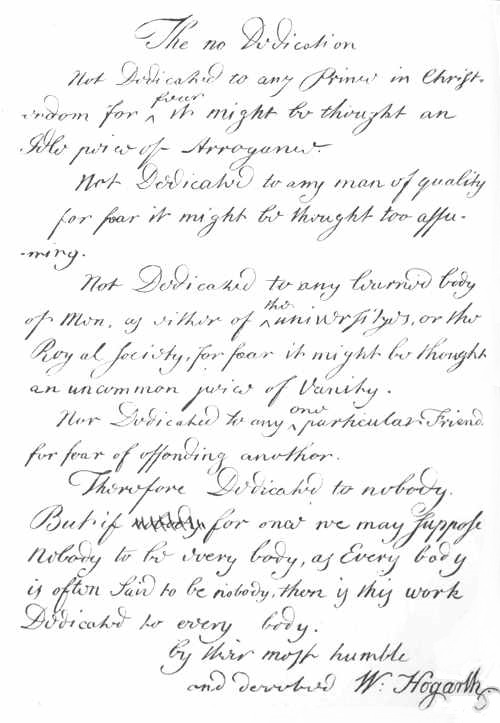




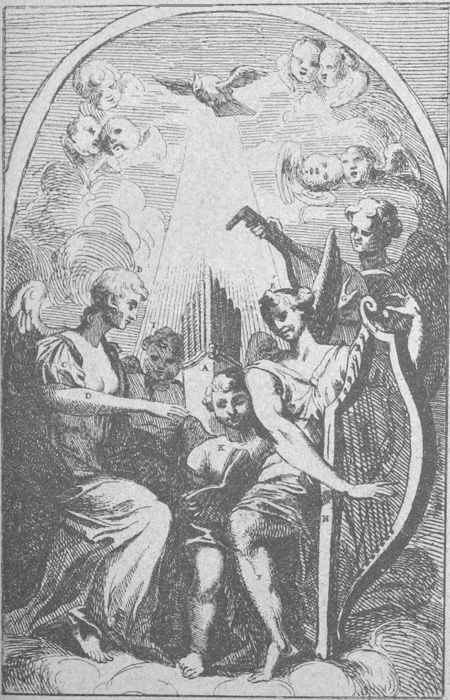
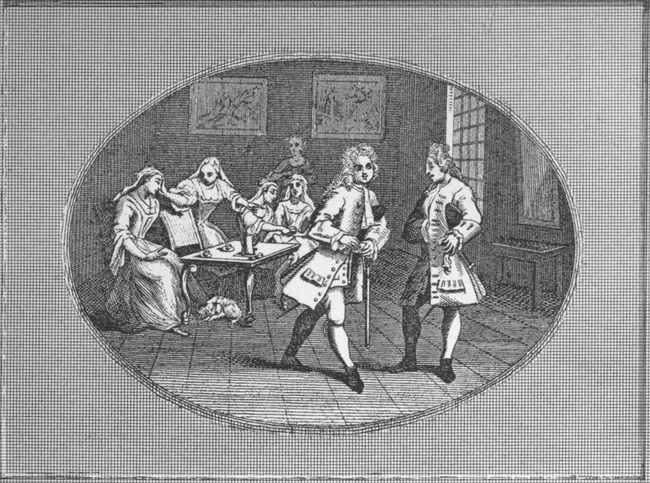


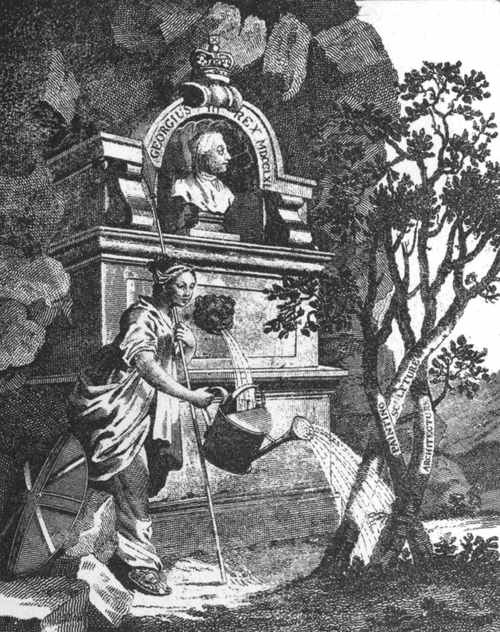
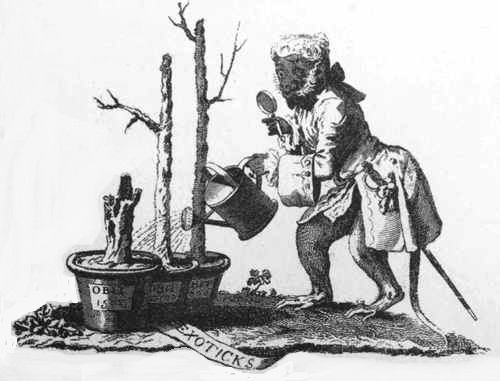

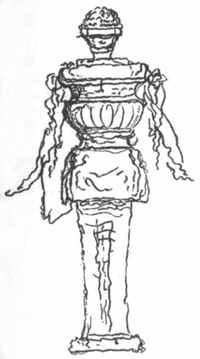
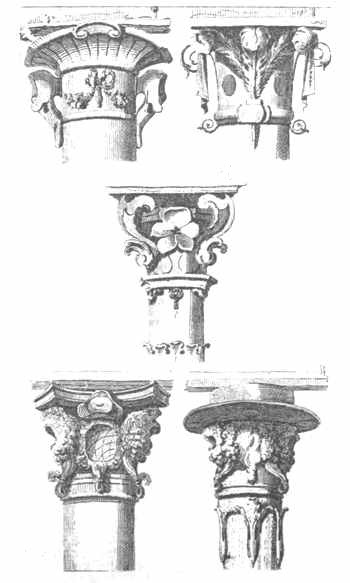
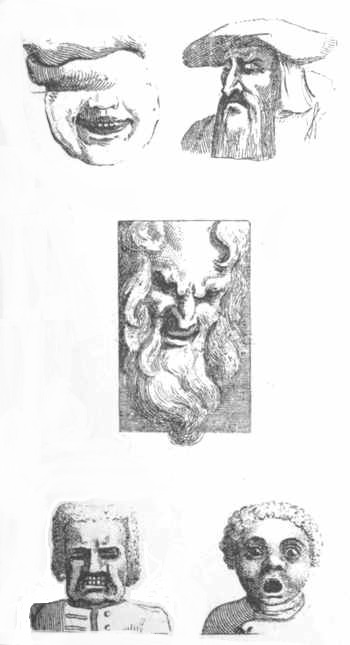
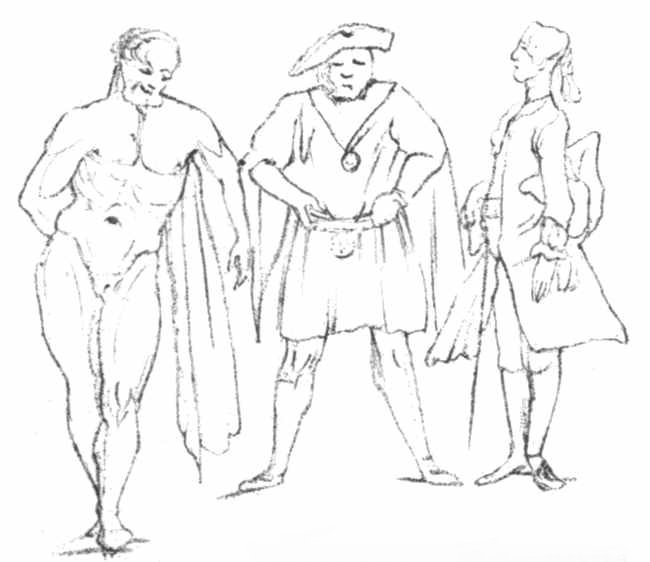
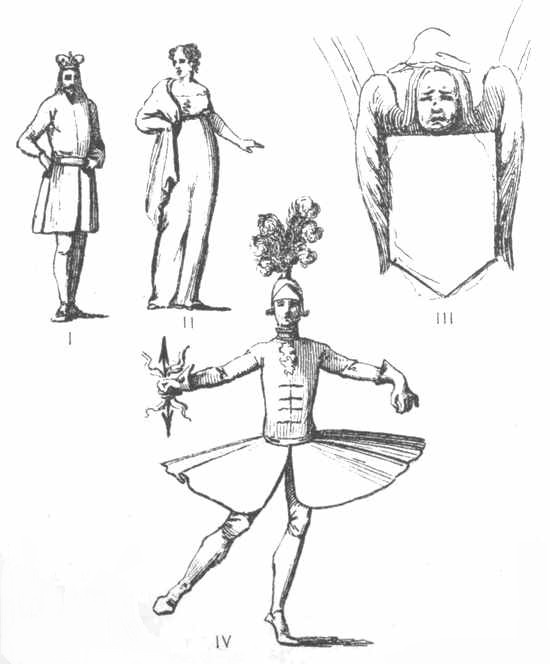
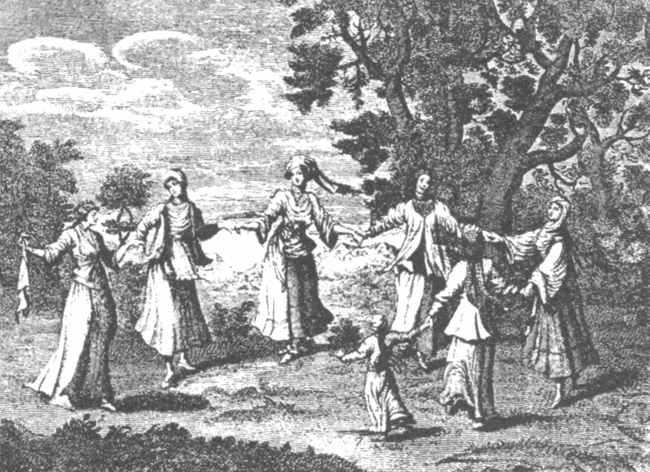
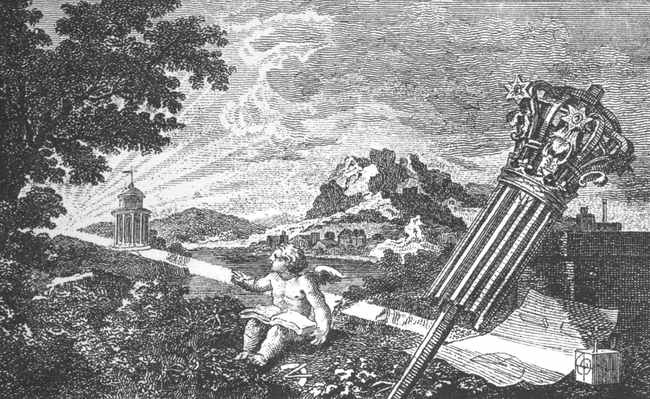



 . And
lastly, I will demonstrate that their systems show nothing of my line
of beauty.