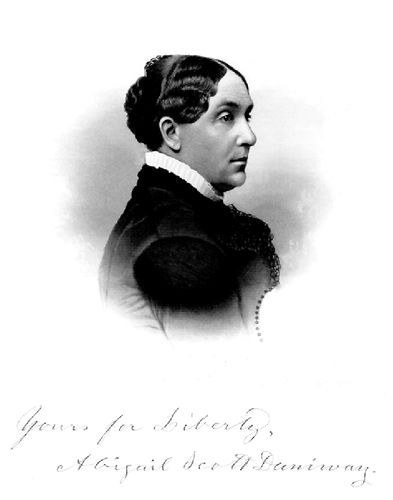
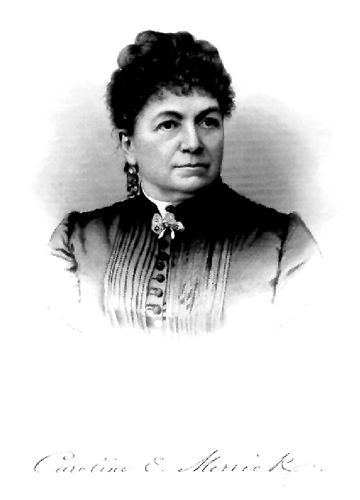
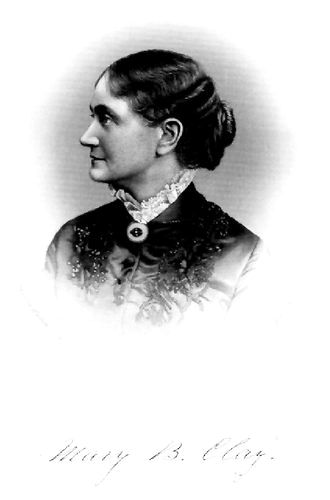
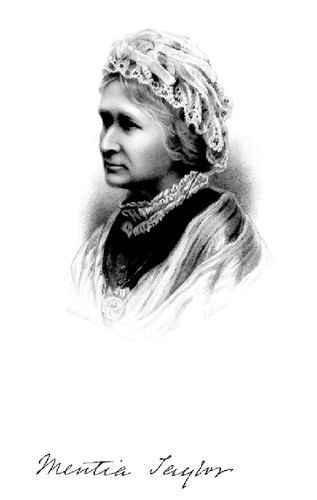
Among those who sent most cordial letters of greeting, with
requests that their names should be enrolled in the centennial
autograph-book as signers of the woman's declaration of sentiments,
were: Maine, Lavinia M. Snow, Lucy A. Snow; New Hampshire,
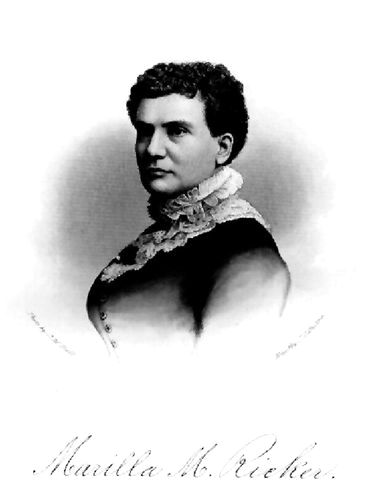
Marilla M. Ricker, Abby P. Ela; Massachusetts, E. T. Strickland,
Sarah E. Wall; Rhode Island, Paulina Wright Davis; Connecticut,
Isabella Beecher Hooker, Frances Ellen Burr, Julia and Abby Smith;
New York, Clemence S. Lozier, Henrietta Paine Westbrook, Nettie
A. Ford, Elizabeth B. Phelps, Charlotte A. Cleveland, Elizabeth M.
Atwell; Pennsylvania, E. A. Stetson Lozier, Anna Thomson; New
Jersey, Ellen Dickinson, S. Mary Clute, Mary M. Van Clief, S. H.
Cornell, Emma L. Wilde, Jennie Dixon, Casa Tonti, Marie Howland,
Lucinda B. Chandler; District of Columbia, Addie T. Holton,
Margaret E. Johnson, Sabra P. Abell, Ruth Carr Dennison, Ellen H.
Sheldon, Mary Shadd Cary and ninety-four others, Mary F. Foster,
Susan A. Edson; Virginia, Sally Holly, Carrie Putnam; Kentucky,
Annie Laurie Quinby; Tennessee, Elizabeth Avery Meriwether;
Louisiana, Elizabeth Lisle Saxon; Michigan, Sarah C. Owen,
Margaret J. E. Millar; Illinois, A. J. Grover, Edward P. Powell,
Cynthia A. Leonard, Susan H. Richardson; Missouri, Francis Minor,
Annie R. Irvine; California, Sarah L. Knox, Sarah J. Wallis,
Carrie M. Robinson, Mary E. Kellogg, Georgiana Bruce Kirby;
Oregon, Mrs. A. J. Johns, Eveline Merrick Roork, Charles A. Reed;
Washington Territory, Mary Olney Brown, Abby H. H. Stuart; Utah
Territory, Annie Godbe; Iowa, Amelia Bloomer, Submit C. Loomis,
Philo A. Lyon and seventy-five others of Humboldt, Jane A. Telker,
Nancy R. Allen, Margaret Euart Colby, Mrs. Ellen M. Robinson, Mrs.
G. R. Woodworth, Mrs. W. W. Johnson, Mrs. Caroline A. Ingham, Mrs.
Mabel A. Stough, Mrs. R. H. Spencer, Mrs. J. W. Kenyon, Mrs. A. M.
Horton, Miss L. T. Dood, Mary L. Watson, Mrs. Sarah A. McCoy, Mrs.
J. J. Wilson, Mrs. F. L. Calkins, Mrs. L. H. Smith, Mrs. Emma C.
Spear, Mrs. M. L. Burlingame, Mrs. G. W. Blanchard, Mrs. D. L.
Ford, Mrs. E. C. Buffam, Mrs. Cora A. Jones, Mrs. Clara M. Wilson;
Wisconsin, Laura Ross Wolcott, M. Josephine Pearce, Eliza T.
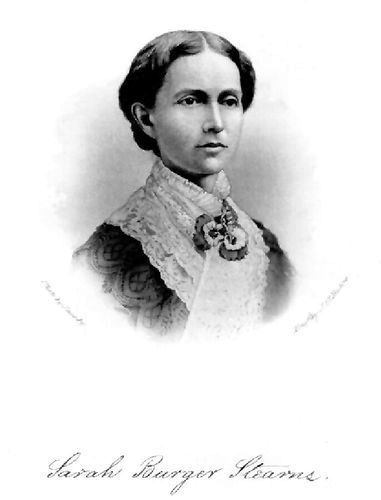
Wilson, H. S. Brown; Minnesota, Sarah Burger Stearns; Kansas,
Susan E. Wattles, Elsie Stewart, Henrietta L. Miller, Lottie
Griffin, Jane M. Burke, Malura Hickson, Elsie J. Miller;
Colorado, Alida C. Avery; Ohio, Sarah R. L. Williams, Margaret
V. Longley; England, Lydia E. Becker, Caroline A. Biggs, Jessie
M. Wellstood.
Article 1. This organization shall be called the National Woman
Suffrage Association.
Article 2. The object of this Association shall be to secure
National Protection for women in the exercise of their right to
vote.
Article 3. All citizens of the United States subscribing to this
Constitution, and contributing not less than one dollar annually,
shall be considered members of the Association, with the right to
participate in its deliberations.
Article 4. The officers of this Association shall be a President, a
Vice-President from each of the States and Territories,
Corresponding and Recording Secretaries, a Treasurer and an
Executive Committee of not less than five.
Article 5. A quorum of the Executive Committee shall consist of
nine, and all officers of this Association shall be ex-officio
members of the committee, with power to vote.
Article 6. All woman suffrage societies throughout the country
shall be welcomed as auxiliaries, and their accredited officers or
duly appointed representatives shall be recognized as members of
the National Association.
President—Elizabeth Cady Stanton, Tenafly, N. J.
Vice-Presidents-at-Large—Susan B. Anthony, Rochester, N. Y.;
Matilda Joslyn Gage, Fayetteville, N. Y.; Rev. Olympia Brown,
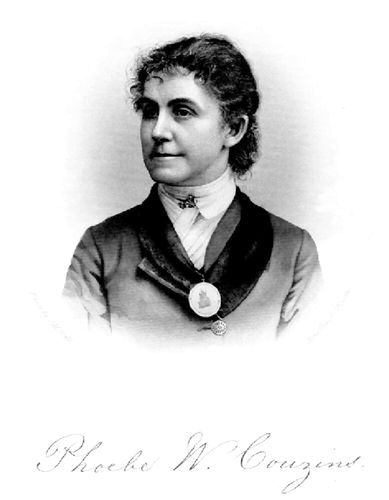
Racine, Wis.; Phœbe W. Couzins, St. Louis, Mo.; Abigail Scott
Duniway, Portland, Ore.
Honorary Vice-Presidents—Ernestine L. Rose, London, England;
Priscilla Holmes Drake, Huntsville, Ala.; Mrs. Perry Spear, Eureka
Springs, Ark.; Sarah. J. Wallis, Mayfield; Sarah Knox Goodrich, San
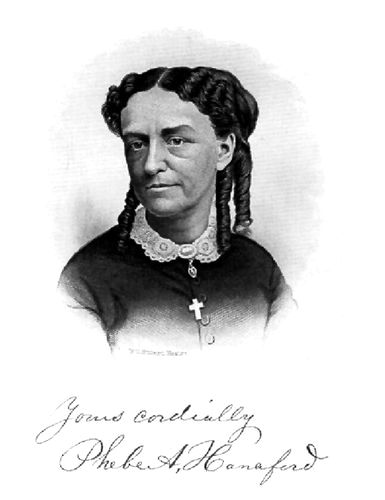
José, Cal.; Mary F. Shields, Colorado Springs, Col.; Rev. Phebe A.
Hanaford, New Haven, Conn.; Rev. Eliza Tupper Wilkes, Sioux Falls,
Dak. Ter.; Rosina M. Parnell, Susan A. Edson, M. D., Ellen M.
O'Connor, Washington, D. C.; Catherine V. Waite, Myra Bradwell,
Chicago, Ill.; Zerelda G. Wallace, Indianapolis; Eliza Hamilton,
Fort Wayne, Ind.; Amelia Bloomer, Council Bluffs; Mary V. Cowgill,
West Liberty, Ia.; Prudence Crandall Philleo, Elk Falls; Mary T.
Gray, Wyandotte; Mary A. Humphrey, Junction City, Kan.; Elizabeth
H. Duval, Rinaldo, Ky.; Ann T. Greeley, Ellsworth; Lucy A. Snow,
Rockland, Me.; Anna Ella Carroll, Baltimore, Md.; Sarah E. Wall,
Worcester; Paulina Gerry, Stoneham, Mass.; Catherine A. F.
Stebbins, Detroit, Mich.; Charlotte O. Van Cleve, Minneapolis,
Minn.; Caroline Johnson Todd, St. Louis, Mo.; Harriet S. Brooks,
Omaha, Neb.; Eliza E. Morrill, Sarah H. Pillsbury, Concord; Mary
Powers Filley, North Haverhill, N. H.; Sarah G. Hurn, Vineland;
Delia Stewart Parnell, Bordentown, N. J.; Clemence S. Lozier, M.
D., New York; Amy Post, Rochester; Sarah H. Hallock, Milton; Mary
R. Pell, Flushing, N. Y.; Elizabeth Oakes Smith, Hollywood, N. C.;
Sophia O. Allen, South Newbury; Sarah R. L. Williams, Toledo;
Louise Southworth, Cleveland, O.; Harriet W. Williams, Portland,
Ore.; M. Adeline Thomson, Philadelphia, Penn.; Catherine C.
Knowles, East Greenwich; Elizabeth B. Chace, Valley Falls, R. I.;
Elizabeth Van Lew, Richmond, Va.; Mary Olney Brown, Abbie H. H.
Stuart, Olympia, Wash. Ter.; Laura Ross Wolcott, Milwaukee; Emma C.
Bascom, Madison, Wis.
Vice-Presidents—Caroline M. Patterson, Harrison, Ark.; Ellen
Clarke Sargent, San Francisco, Cal.; Mrs. L. J. Terry, Pueblo,
Col.; Isabella Beecher Hooker, Hartford, Conn.; Marietta M. Bones,
Webster City, Dak.; Mary A. Stewart, Greenwood, Del.; Ruth C.
Dennison, Washington, D. C.; Mrs. C. B. S. Wilcox, Interlachen,
Fla.; Althea L. Lord, Savannah, Ga.; Dr. Jennie Bearby, Mountain
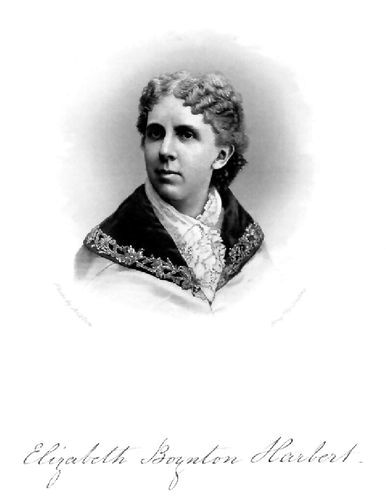
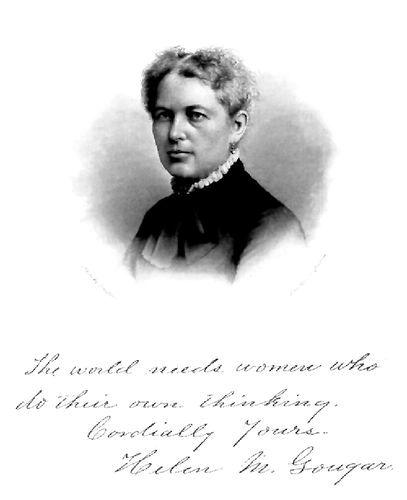
Home, Idaho; Elizabeth Boynton Harbert, Evanston, Ill.; Helen M.
Gougar, Lafayette, Ind.; Jane Amy McKinney, Decorah, Ia.; Laura M.
Johns, Salina Kan.; Mary B. Clay, Richmond, Ky.; Caroline E.
Merrick, New Orleans, La.; Sophronia C. Snow, Hampden Corners, Me.;
Caroline Hallowell Miller, Sandy Spring, Md.; Harriette R.
Shattuck, Malden, Mass.; Fannie Holden Fowler, Manistee, Mich.;
Sarah Burger Stearns, Duluth, Minn.; Olivia Fitzhugh, Vicksburg,
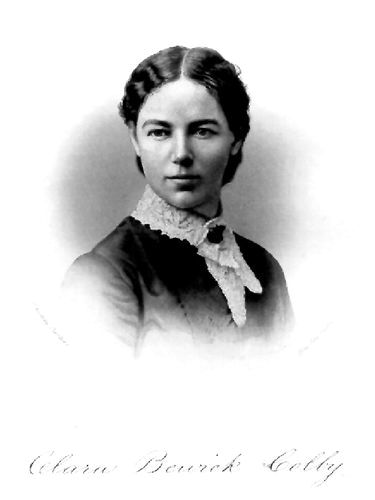
Miss.; Virginia L. Minor, St. Louis, Mo.; Clara Bewick Colby,
Beatrice, Neb.; Maria H. Boardman, Reno, Nev.; Ada M. Jarrett,
Magdalena, N. Mex.; Marilla M. Ricker, Dover, N. H.; Cornelia C.
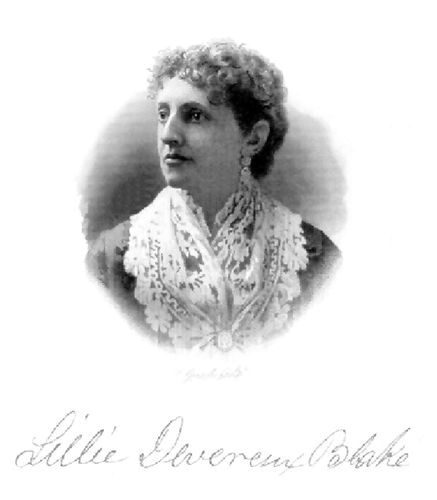
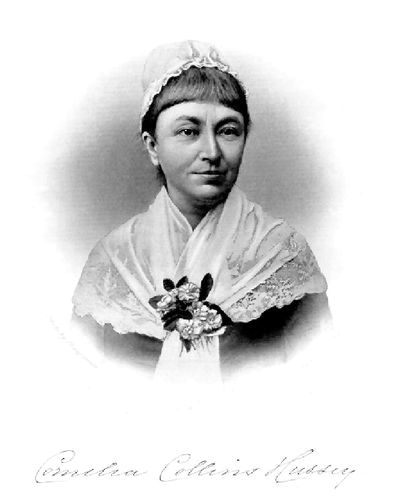
Hussey, East Orange, N. J.; Lillie Devereux Blake, New York, N. Y.;
Mary Bayard Clarke, New Berne, N. C.; Frances D. Casement,
Painesville, O.; Harriette A. Loughary, McMinneville, Ore.; Matilda
Hindman, Pittsburgh, Penn.; Anna S. Aldrich, Providence, R. I.;
Elizabeth Lisle Saxon, Memphis, Tenn.; Jennie Bland Beauchamp,
Denton, Tex.; Jennie A. Froiseth, Salt Lake City, Utah; Lydia
Putnam, Brattleboro', Vt.; Mrs. Roger S. Greene, Seättle, Wash.
Ter.: Alura C. Collins, Milwaukee, Wis.; Amalia B. Post, Cheyenne,
Wyoming.
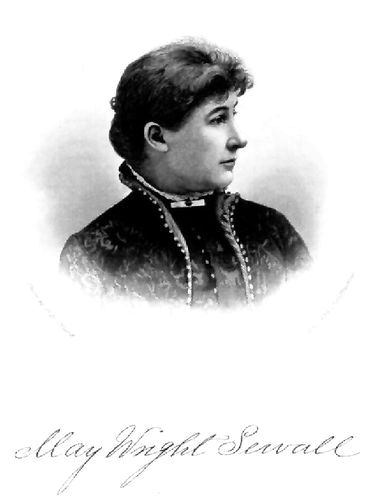
Executive Committee—May Wright Sewall, Chairman, 429 North New
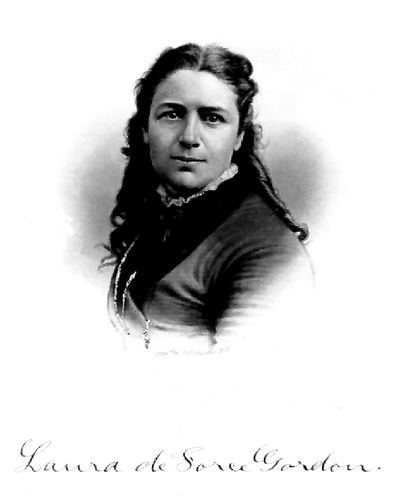
Jersey street, Indianapolis, Ind.; Laura DeForce Gordon, San
Francisco; Mary J. Channing, Pasadena, Cal.; Dr. Alida C. Avery,
Denver, Col.; Frances Ellen Burr, Emily P. Collins, Hartford,
Conn.; Mrs. J. S. Pickler, Falktown; Linda W. Slaughter, Bismark,
Dak. Ter.; Belva A. Lockwood, Dr. Caroline B. Winslow, Washington,
D. C.; Flora M. Wright, Drayton Island, Fla.; Julia Mills Dunn,
Moline; Rev. Florence Kollock, Englewood; Dr. Alice B. Stockham,
Ada C. Sweet, Chicago, Ill.; Mary E. Haggart, Mary E. N. Cary,
Indianapolis, Ind.; Narcisa T. Bemis, Independence; Mary J.
Coggeshall, Des Moines, Ia; Annie C. Wait, Lincoln Center;
Henrietta B. Wall, Mrs. S. A. Hauk, Hutchinson, Kan.; Sally Clay
Bennett, Mary A. Somers, Richmond; Laura White, Manchester, Ky.;
Maria I. Johnson, Mound, La.; Charlotte A. Thomas, Portland, Me.;
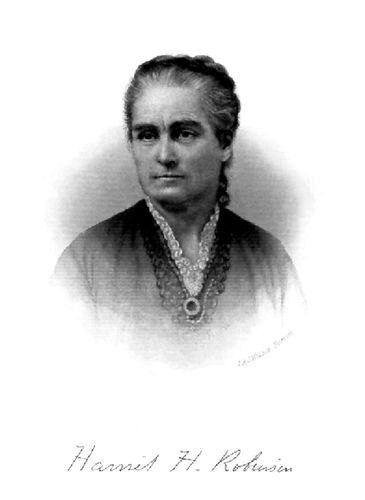
Amanda M. Best, Bright Seat, Md.; Harriet H. Robinson, Malden; Sara
A. Underwood, Dorchester Mass.; Julia Upton, Big Rapids; Cordelia
Fitch Briggs, Grand Rapids, Mich.; Julia Bullard Nelson, Red Wing:
Mrs. L. H. Hawkins, Shakopee; Mary P. Wheeler, Kasson, Minn.; Anne
R. Irvine, Oregon; Elizabeth A. Meriwether, St. Louis, Mo.; Jennie
F. Holmes, Tecumseh; Orpha C. Dinsmoore, Omaha, Neb.; Hannah R.
Clapp, Carson City, Nev.; Mrs. A. B. I. Roberts, Candia, N. H.;
Augusta Cooper Bristol, Vineland; Theresa A. Seabrook, Keyport, N.
J.; Mathilde F. Wendt, New York; Caroline G. Rogers, Lansingburgh;
Ellen S. Fray, Lewia C. Smith, Rochester, N. Y.; Sarah M. Perkins,
Elvira J. Bushnell, Cleveland; Sarah S. Bissell, Toledo, O.; Mrs.
J. M. Kelty, Lafayette, Ore.; Deborah L. Pennock, Kennett Square;
Harriet Purvis, Philadelphia, Penn.; Lillie Chace Wyman, Valley
Falls, R. I.; Lide Meriwether, Memphis, Tenn.; Mrs. D. Clinton
Smith, Middleboro', Vt.; Mrs. F. D. Gordon, Richmond, Va.; Eliza T.
Wilson, Menomonie; Laura James, Richland Center, Wis.; Barbara J,
Thompson, Tacoma, Wash. Ter.; Mrs. J. H. Hayford, Laramie City,
Wyoming Ter.
Recording Secretaries—Julia A. Wilbur, Caroline A. Sherman,
Washington, D. C.
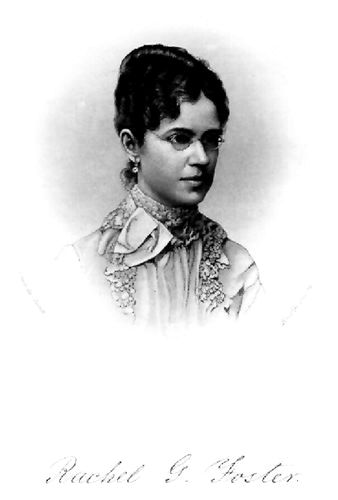
Corresponding Secretaries—Rachel G. Foster, Philadelphia, Penn.;
Ellen H. Sheldon, Washington, D. C.
Foreign Corresponding Secretaries—Caroline A. Biggs, London;
Lydia E. Becker, Manchester, England; Marguerite Berry Stanton,
Hubertine Auclert, Charlotte B. Wilbour, Paris, France; Clara
Neymann, Berlin, Germany.
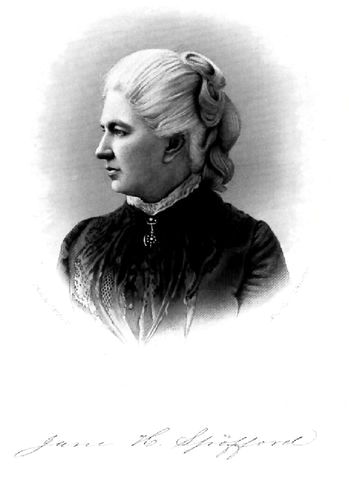
Treasurer—Jane H. Spofford, Riggs House, Washington, D. C.
Auditors—Eliza T. Ward, Ellen M. O'Connor, Washington, D. C.
Is the Family the Basis of the State?
BY JOHN HOOKER.
The proposition that the family is the basis of the State has come
down through many generations, so far as I know, unchallenged; but
in the sense in which it is ordinarily understood, and for the
purpose for which it is ordinarily used, it is entirely a fallacy.
The State depends upon the family for the continuance of its
population, just as it depends upon the school for the intelligence
of its people and on religious institutions for their morality.
But the State stands in no political relation to the family any
more than to the school and the church. What is meant by the
proposition as generally used is, that the State is politically an
aggregate of families and not of individuals. This is entirely
untrue, and if true the fact would be calamitous. Civil government
is supposed to have had its origin in family government, the
patriarch becoming chief of a tribe which was substantially the
outgrowth and expansion of a single family; but if a nation was to
be formed of such tribes it would be essential to its peace and
prosperity that they should as soon as possible mingle into one
homogeneous mass, and that no citizen should consider himself of
one tribe rather than another. It is the family idea in a
government like ours that makes the feuds which are handed down
from generation to generation in some parts of the country. It made
the frequent bloody contests of the clans in Scotland, and the
dissensions of the Hebrew tribes. In a republic nothing can be more
disastrous than that great political leaders should have large
family followings. The first duty of the citizen is to forget that
he belongs to any family in particular. He is an individual citizen
of the State, and when he becomes a magistrate he must practically
ignore the fact that he has family relatives who feel entitled to
his special favor. He must, like justice, be blind to every fact
except that the applicant for office or for justice is an
individual citizen and must stand wholly on his personal merits or
the justice of his cause.
The proposition that the family is the basis of the State thus
taken by itself is entirely false; but even if true, the use made
of it as an argument against giving suffrage to women is equally
fallacious. This can be shown by a single illustration. We will
suppose there are two families, in both of which the father dies,
leaving in one case a widow and one son, and in the other a widow
and six daughters. Where is now the family representation? The son
whom we will suppose to be of age, goes to the polls and we will
suppose sufficiently represents the family to which he belongs; but
where is the family representation for the other widow and her six
daughters? She may be the largest tax-payer in the State, and yet
she can have no voice in determining what taxes shall be laid, nor
to what purposes the money shall be appropriated.
The question whether the family is the basis of the State cannot be
made an abstract question of political philosophy. Indeed the
question is unmeaning when put as an abstract one. We might just as
well ask, "Is the climate cold in a State?" or, "Is the English
language spoken in a State?" It is only as we ask these questions
about a particular State that they have any meaning. "Is it cold
in Russia?" "Is English spoken in Connecticut?"
Take the case of a State ruled by a despot. Here the people are not
the political basis of the State, either as families or as
individuals. They have no political power whatever. The political
basis of the State is the will of the despot. He is himself and
alone the State politically. He makes the laws himself, and shoots
and hangs those who disobey them. The people are indispensable to
the State, and so in one sense its basis, just as the square miles
that compose its territory are its physical basis, but the people
stand in no political relation whatever to the State, any more than
the rocks and gravel of its territory. It is only where the people
of the State have the whole or a part of its political power, that
the question can possibly arise as to whether individuals or
families are its political basis. And when it thus arises, it comes
up wholly with reference to a particular State, and not as an
abstract question. And then it is wholly a question of fact, not
one of political philosophy; a matter for simple ascertainment, not
for speculation and reasoning. Thus, suppose the question to be,
"Is the family or the individual the political basis of the State
of Connecticut?" We are to answer the question solely by looking at
the constitution and laws of the State. We look there and find that
it is as clear as language can make it that the political basis of
the State is the individual and not the family. The individual is
made the voter—not the family—and that is the whole question. It
was perfectly easy for the people, if they had so desired, when
they were adopting a constitution, to make families and not
individuals the depositaries of political power, but they chose to
give the power to individuals, and thus the question is absolutely
settled for the State. It is true, the State does not carry out
completely its own theory, but this was its theory, and what it did
was wholly in this direction and away from the family theory. We go
to the constitution of the State to settle this question, just as
we would to settle the question whether the governor's term is one
year or two, or whether the judges hold office for a term of years
or for life. While considering whether either of these provisions
ought to be adopted, we are dealing with a matter proper for
opinions and argument, but when the provisions have been adopted,
the whole question becomes one of fact, and we look only to the
constitution to determine it, and treat it as a matter not for
discussion but for absolute ascertainment.
When one is advocating the theory that the family should be the
political basis of the State, he is simply saying that the
constitution ought to be amended and the right of voting taken away
from individuals and given to families. But it is idle to urge
this. Such a measure would not get even a respectable minority of
votes. It is decisive on this point that not a single
representative government, so far as the writer knows, has adopted
the theory that the family and not the individual should vote. A
law peculiar to Russia gives its villages, in the management of
their local matters, the right of voting by families—a perfect
illustration, on a very small scale, of the family as the political
basis of a State. But here woman suffrage is admitted as a
necessary result; and where there is no man to represent the
family, or he is unable to attend, the woman of the house casts the
vote.
The advocates of woman suffrage have no interest whatever in this
question, as it is idle to suppose that it can become a practical
one. The writer has taken what trouble he has in the matter solely
in the interest of correct thinking.
Hartford, May, 1879.
Brief on the Legislature's Power to Extend the Suffrage,
Submitted February 19, 1880, to the Judiciary Committee of the
Assembly of the State of New York.
BY HAMILTON WILCOX.
I. Legislature Omnipotent.—Unlike the Federal constitution, the
State constitution does not reserve all powers not expressly
delegated. It is held by the authorities that in the absence of
positive restriction the legislature is omnipotent.
"In a judicial sense, their authority is absolute and unlimited,
except by the express restrictions of the fundamental law" (Court
of Appeals, 1863, Bank of Chenango vs. Brown, 26 N. Y., 467; S. P.,
Cathcart vs. Fire Department of New York, Id., 529; Supreme Court,
1864, Clark vs. Miller, 42 Barb., 255; Luke vs. City of Brooklyn,
43 Id., 54).
"Only on the ground of express constitutional provisions limiting
legislative power, can courts declare void any legislative
enactment" (Court of Error. 1838, Cochran vs. Van Surlay, 29 Wend.,
365; Newell vs. People, 7 N. Y. [3 Seld.], 9, 109).
"Before proceeding to amend, by judicial sentence, what has been
enacted by the law-making power, it should clearly appear that the
act cannot be supported by any reasonable intendment or allowable
presumption" (Court of Appeals, 1858, People vs. Supervisors of
Orange, 17 N. Y., 235; affi'g, 27 Barb., 575).
II. Powers Undefined.—The constitution forbids the legislature to
do certain things. Otherwise it does not define or limit the
legislature's powers (Art. 3, §§ 3, 18, 19, 24).
III. No Prohibition.—No constitution of New York has ever
forbidden the legislature to extend the suffrage beyond the
classes specified by such constitution; nor has any ever forbidden
unspecified persons to vote. The constitution simply secures the
suffrage to certain classes, and there leaves the matter.
IV. Rule of Construction.—The constitution declares that the
object of its establishment is to secure the blessings of freedom
to the people (Preamble, Revised Statutes, vol. 1., p. 82). Hence
it, and all enactments under it, must be understood and construed,
where a contrary intent is not clearly expressed, to be aimed at
securing freedom to all.
V. Disfranchisement.—The constitution follows this declaration by
laying down at its outset, as its fundamental principle, that "No
member of this State shall be disfranchised or deprived of any of
the rights or privileges secured to any citizens thereof, except by
the law of the land" (Art. 1, § 1, do., do.). Disfranchisement,
then, must be express by the law. It cannot constitutionally be
inflicted through mere implication or silence.
Rules for the securing of freedom have often been found to cover
unforeseen cases. Such was the fact in the famous decision of Lord
Mansfield in 1774, that slavery was against the common law, under
which slavery was afterward abolished throughout the British
empire; and the decision of the highest court of Massachusetts,
that the terms of the constitution of 1780 conferred freedom on the
slaves of that State.
Women, it is now fully recognized, are citizens, and hence "members
of the State," entitled to the security guaranteed. The practice
under the constitution has been to treat as disfranchised all
persons not specified as entitled to vote. Though this practice
is plainly against the declared object and principle of the
constitution, it has been general and mostly continuous, and has
thus acquired the force of law. This, however, does not impair the
legislature's power to correct the practice by express enactment.
VI. Precedents.—The legislature has repeatedly corrected this
practice by express enactments securing freedom to various portions
of the people.
(a). Constitutional Convention, 1801.—The act calling this
convention extended the suffrage for members of that body—the
highest officers of the State—to "all free male citizens over
twenty-one years of age," while the constitution secured suffrage
only to male holders of and actual taxpayers on a fixed amount of
real estate (Session Law 1801, ch. 69, p. 151; constitution of
1777, do., 1, 39).
(b). Constitutional Convention, 1821.—The act providing for the
convention that framed the constitution of 1822, while the existing
constitution (as above) only specified as entitled to vote, holders
of and taxpayers on a fixed amount of real estate—this act allowed
all freeholders, however small the value of their holdings, all
actual taxpayers, all officers and privates, ex-officers and
ex-privates, in militia or in volunteer or uniform corps, all
persons exempt by law from taxation or militia duty, all workers on
public roads and highways, or payers of commutation for such work;
to vote on the question whether the convention should be held, to
vote in the choice of delegates thereto—again for the highest
officers of the State—and to vote on the question of adoption of
the new constitution—to exercise a voice in framing the State's
fundamental law. The council of revision, including the governor,
which opposed and defeated part of this act, made no objection to
this feature (Session Laws 1821, ch. 90, p. 83).
The vote for governor, 1820, was 93,437—the largest ever cast in
the State. That on the question of calling the convention in 1821
was 144,247. One act of the legislature thus enfranchised fifty
thousand persons. The vote on the new constitution stood: For,
74,732; against, 41,402; majority for, 33,330. Thus the votes of
fifty thousand persons—enfranchised, not by the constitution but
by the legislature—carried the adoption of a new constitution,
which further secured to them the freedom which the legislature had
opened to them. The vote for governor in 1824—the next
hotly-contested election—was 190,545; so that the immediate effect
of the legislature's act was to add 97,108 persons to the
constituency—to make a mass of new voters who outnumbered those
specified by the constitution.
(c). Aliens Voting.—The constitution specifies none but
"citizens" as entitled to vote; yet the legislature, by a school
law of many years' standing, allowed aliens to vote for school
functionaries, on filing with the secretary of state notice of
intention to become naturalized (1 R. S., art. 2, § 1, p. 65; 2 R.
S., 63, § 12; 2 R. S., 1,096, § 31).
(d). Northfield.—The proprietors of swamp-lands in the town of
Northfield, Richmond county, were authorized to elect directors of
drainage, without any restriction or qualification but ownership
(Session Laws 1862, ch. 80, § 2, p. 233).
(e). The taxpayers of Newport, Herkimer county, were authorized
to vote on the question of issuing bonds to raise money for a
town-house. Under this law women who were taxpayers voted (Act
April 9, 1873, Session Laws, ch. 187, § 3, p. 304).
(f). The taxpayers of Dansville, Livingston county, were
authorized to vote on the issue of water-bonds. Under this act
women voted (Act April 24, 1873, Session Laws, ch. 285, § 4, p.
409).
(g). The taxpayers of Saratoga Springs were authorized to vote on
the question of issuing bonds for the construction of an additional
water-main. Under this ninety-nine women voted (Act May 13, 1876,
Session Laws, ch. 254, § 4, p. 250).
VII. School Suffrage.—If the legislature can admit aliens to vote
at school-meetings, it can admit female citizens to do so.
VIII. Presidential Suffrage.—1. The federal constitution provides
that electors of president and vice-president shall be appointed
"in such manner as the legislature thereof may direct" (Art. 2, §
2).
2. It also provides that "this constitution shall be the supreme
law of the land, and the judges in every State shall be bound
thereby, anything in the constitution or laws of any State to the
contrary notwithstanding" (Art. 6, § 2).
3. The legislature has the power under the federal constitution to
provide whatever method it may choose for the appointment of the
electors. The courts have no power to interfere, and even an
executive veto would have no force. The legislature has sole and
full power to say who may vote for electors and how the election
shall be held.
BY CARRIE S. BURNHAM.
The common law of England as modified by English statutes prior to
the Revolution has been formally adopted either by constitutions
and statutes or assumed by courts of justice as the law of the land
in every State save Louisiana, and in the absence of positive
statutes is the common law of the United States. To understand the
legal status of woman in Pennsylvania it is therefore necessary,
First—To ascertain her condition under the common law;
Second—How this law has been modified in this State by statutes.
By the common law, which Lord Coke calls "the perfection of
reason," women arrive at the age of discretion at twelve, men at
fourteen; both sexes are of full age at twenty-one, entitled to
civil rights, and if unmarried and possessed of freehold, they are
equally entitled to the exercise of political rights (Blackstone,
I., 463; IV., 212; Bouvier's Institutes, 156, 157; Decisions of
English courts in 1612, quoted in 7 Mod. Rep., 264).
"By marriage, the husband and wife are one person in law"; that is,
the legal existence of the woman is "merged in that of her
husband." He is her "baron," or "lord," bound to supply her with
shelter, food, clothing and medicine, and is entitled to her
earnings—the use and custody of her person, which he may seize
wherever he may find it (Blackstone, I., 442, 443; Coke Litt., 112
a, 187 b; 8 Dowl., P. C., 632.)
The husband being bound to provide for his wife the necessaries of
life, and being responsible for "her morals" and the good order of
the household, may choose and govern the domicil, choose her
associates, separate her from her relatives, restrain her religious
and personal freedom, compel her to cohabit with him, correct her
faults by mild means and, if necessary, chastise her with
moderation, as though she was his apprentice or child. This is in
"respect to the terms of the marriage contract and the infirmity of
the sex" (Bl., I., 444; 1 Bishop on Mar. and Div., 758; 8 Dowl. P.
C., 632; Bouv. Insts., 277, 278, 2,283; 1 Wend. Bl., 442, note; 4
Petersdorf's A. B., 21, note).
Woman's character, exposed to the vilest slanders of "malignity and
falsehood," and her chastity are protected on account of the injury
sustained by the father, husband or master from loss of her
services, or wrongful entry of his house, rather than the injury
done to her as an individual (Bl. I., 445, note; III., 141, 143,
note; 3 Serg. and Rawle, Penn., 36; 3 Penn., 49; 2 Watts' Penn.,
474).
The husband is entitled to recover damages for "criminal
conversation with his wife," or for injury to her person whereby he
is deprived of his "marital rights," or of her "company and
assistance"; also an action of trespass vi et armis against the
individual enticing her away or encouraging her to live separately
from him; the offense implies force and constraint, "the wife
having no power to consent," and is punishable with fine and
imprisonment (Bl., III., 139; 2 Inst., 434; Bouvier's Institutes,
3,495).
The wife has no action for injuries to her husband as she is not
entitled to his services, neither has she any separate interest in
anything during her coverture. The law takes notice only of the
injuries done to the "superior of the parties related"; because
"the inferior has no kind of property in the company, care or
assistance of the superior, as the superior is held to have in
those of the inferior" (Blackstone, III., 143; Bouv. Insts.,
3,495).
The husband, by marriage, becomes entitled absolutely to the
personal property of his wife, which at his death goes to his
representatives; also to the rents and profits of her lands, to the
interest in her chattels real and choses in action, of which he
can dispose at pleasure, except by will. He acquires the same right
in any property whether real or personal of which she may become
possessed after marriage, and is liable during coverture for her
debts contracted before marriage (Bl., II., 434, 435; Bouv. Insts.,
4,005; Coke Litt., 46, 351).
At his death she becomes possessed of her wardrobe and jewels, such
of her chattels as remain undisposed of, and her own real estate;
also quarantine (i. e., forty days' residence in "his mansion"),
one-third of his personality absolutely and the use of one-third of
any real estate of which he is possessed during coverture for the
term of her natural life. His mansion, realty and personalty
includes what they have jointly earned as well as that of which he
was possessed at marriage. The widow's right to one-third of the
personal estate was abolished by English statutes prior to the
Revolution, but has since been revived by Pennsylvania statutes
(Blackstone, II., 129, 134, 139, 436, 492, 493; Coke Litt., 31, 34;
Bouvier's Institutes, 1,750; Brightley's Purdon, 806, 2 and 3).
At the death of the wife their joint earnings, also her chattels
real, vest absolutely in the husband, and if they have had a living
child the husband, as "tenant by the curtesy," becomes possessed of
her entire real estate for life. The wife loses her dower by
adultery, but the husband does not lose his curtesy on that
account. Her dower is also barred by his treason and by a divorce
grounded on his adultery (Blackstone, II., 127, 434; Roper, Husband
and Wife, 1,210; 2 Kent, 131; 7 Watts, 563; Bouvier's Institutes,
1,732).
A husband cannot convey real estate directly to his wife, but may
through a trustee; neither can he give "anything to her nor
covenant with her, for the grant would be to suppose her separate
existence, and to covenant with her would be to covenant with
himself." Their covenants or indebtedness to each other before
marriage are by the marriage extinguished (Blackstone, I., 442;
Coke Litt., 3, 30; 112 a; 187 b; Connyn. Dig. Baron and Feme, D).
The husband may devise any property to his wife, but the wife
cannot make a will, the law supposing her to be under his coercion;
neither can she bind her person or property, nor make nor enforce a
contract, nor can she be a witness in any matter in which her
husband is interested (Blackstone, II., 293, 498, 444; 2 Kent, 179;
Bouv. Insts., 1,441; Connyn. Dig. Pleader, 2 A, 1; Baron and Feme,
W; 2 Roper, Husband and Wife, 171).
A wife, with the consent of her husband, may act as his or other's
attorney, may be a guardian, trustee, administratrix or executrix,
but cannot sue in auter droit unless her husband join in the
suit. This incapacitates her to act independently in either
capacity (Blackstone, II., 503; 1 Anders., 117; 2 Story, Eq.
Juris., 1,367, note; 57 Penn. St. Rep., 356).
A wife cannot enforce her rights nor defend any action brought
against her, but must plead coverture in person, being incapable of
appointing an attorney (Bouv. Insts., 2,787, 2,907; 41 N. H., 106;
2 Saund., 209; c. n. 1).
When a woman marries after having commenced a suit, the suit
abates; but the husband may in equity sue her for his marital
rights in her property; marriage of a female partner dissolves the
partnership (Bouv. Insts., 4,037, 1,494; 4 Russ. Ch., 247; 3 Atk.
Ch., 478; 2 P. Will Ch., 243).
The father of legitimate children is bound for their maintenance
and education, is entitled to their labor and custody and has power
to dispose of them until twenty-one years of age, by deed or
legacy, even though they are unborn at his death. The testamentary
guardian's right to their custody supersedes that of their mother
(Bl., I., 447, 451, 453; 2 Kent, 191 and 193; Bouv. Insts., 344; 5
Rawle, 323; 2 Watts, 406; 5 East, 221; Purd. Dig., New Ed., 411,
29; 5 Pitts, L. J., 406; 1 Pitts, 412).
"A mother is entitled to no power, but to reverence and respect,
from her children"; she has no legal authority over them nor right
to their services, but her property is liable for their maintenance
if the father has not an estate. The mother's appointment of a
testamentary guardian is absolutely void (Bl., I., 453 and 461,
note by Chitty; Vaughan, 180; 1 Leg. Gaz. R., 56).
The mother of a "natural or illegitimate" child is its natural
guardian, entitled to its control and custody and her settlement is
its domicil (Bl., I., 459; 2 Kent, 216; 5 Term Rep., 278; Newton
vs. Braintree, 14 Mass., 382).
"Intestate personal property is divided equally between males and
females, but a son, though younger than all his sisters, is the
heir to the whole of real property" (Bl., I., 444, note by
Christian).
This "perfection of reason" (the common law) has been changed in
Pennsylvania in the following particulars:
All women, married and single, are deprived of political rights by
the use of the generic word "freeman" in the constitution (29 Legal
Intelligencer, 5).
Heir at common law is abolished by statute; however, the right to
administer vests in the male in preference to the female of the
same degree of consanguinity. Half-brothers are entitled to the
preference over own sisters (Purdon, 410, 27; Single's Appeal, 59
Penn. St. R., 55).
Any property belonging to a woman before marriage, or which accrues
to her during coverture by gift, bequest or purchase, continues, by
the act of April 11, 1848, to be her separate property after
marriage, and is not liable for the debts of her husband nor
subject to his disposal without her written consent, duly
acknowledged before one of the judges of the Court of Common Pleas
as voluntarily given; provided, that he is not liable for the
debts contracted before or after marriage, or for her torts
(Purdon's Dig., 1,005, 13).
"This act protects the wife's interest in her separate property
both as to title and possession," but "does not empower her to
convey her real estate by a deed in which her husband has not
joined," nor "create a lease without his concurrence," nor "execute
an obligation for the payment of money or the performance of any
other act," nor in any way dispose of her property save by gift or
loan to him; she may bind her separate estate for his debts, and in
security for the loan she may take a judgment or mortgage against
the estate of the husband in the name of a third person, who shall
act as her trustee (18 Penn. St. R., 506, 582; 21, 402; 1 Gr., 402;
6 Phila., 531; Pur. Dig., 1,007, 21).
The husband is the natural guardian or trustee of the property of
the wife; but by application "to the Court of Common Pleas of the
county where she was domiciled at the time of her marriage," the
court will appoint a trustee (not her husband) to take charge of
the property secured to her by the act of 1848. This act, however,
does not authorize the appointment of a trustee, to the exclusion
of her husband, of property owned by her prior to the passage of
the act, nor was it intended to affect vested rights of husbands
and does not protect them for the wife's benefit against the claims
of creditors (10 Penn. St. Rep., 398 and 505; 18, 392 and 509; 21,
260; 1 Jones, 272).
In a clear case the wife's real estate cannot be levied upon and
sold by a creditor of the husband, but the burden of proof is
upon her to show by evidence "which does not admit of a reasonable
doubt," that she owned the property before marriage or acquired it
subsequently by gift, bequest, or paid for it with funds not
furnished by her husband nor the result of their joint earnings.
The wife's possession of money is no evidence of her title to it
(18 Penn. St. Rep., 366; 7 Phila., 118).
If no property, or not sufficient property, of the husband can be
found, the separate property and goods of the wife may be levied
upon and sold for rent or for debts incurred for the support of the
family (Purd. Dig., 1,006, 15; 38 Penn. St. Rep., 344).
A married woman's bond and warrant of attorney are absolutely void,
nor can she make a valid contract except for a sewing-machine or
for the improvement of her separate property, and her bond given or
a judgment confessed by her for such debt is void (24 Penn. St.
Rep., 80; Act of 1872, Pur. Dig., 1,010).
She may sell and transfer shares of the capital stock of any
railroad company, but cannot herself or by attorney transfer
certificates of city loan (28 Leg. Int., 116; Act June 2, 1871).
A married woman cannot enforce her rights against third persons,
either for the performance of a contract or the recovery of her
property, without her husband join in the suit, although the party
contracting with her is liable to an action (1 Gr., 21; Act of 1850
and 1839; 6 Phila., 223).
If divorced or separated from her husband by his neglect or
desertion, she may protect her reputation by an action for slander
and libel; but if her husband is the defendant, this suit, as also
for alimony and divorce, must be in the name of a "next friend."
She is entitled to a writ of habeas corpus if unlawfully
restrained of her liberty (Purd. Dig., 510, 12; 513, 24; 754, 1).
The wife of a drunkard or profligate man by petitioning the Court
of Common Pleas, setting forth these facts and his desertion of her
and neglect to provide for her and their children, may be entitled
to the custody of her children, and, as a "feme sole trader,"
empowered to transact business and acquire a separate property,
which shall be subject to her own disposal during life, and liable
for the maintenance and education of her children. Her testimony
must be sustained "by two respectable witnesses" (Pur. Dig., 692,
5; Act of 1855, 2; 2 Roper, Husband and Wife, 171, 173).
By act of April, 1872, any married woman having first petitioned
the court, stating under oath or affirmation her intention of
claiming her separate earnings, is entitled to acquire by her labor
a separate property which shall not be subject to any legal claim
of her husband or of his creditors, she, however, being compelled
"to show title and ownership in the same." The husband's possession
of property is evidence of his title to it; not so with the wife
(Purd. Dig., 1,010, 38, 39; 4 Lansing, 164; 61 Barb., 145).
A married woman may devise her separate property by will, subject,
however, to the husband's curtesy, which in Pennsylvania attaches,
though there be no issue born alive, and which she cannot bar
(Purd. Dig., 806, 804; I Pars., 489; 26 Penn. St. R., 202, 203; 2
Brewster, 302).
The husband may bar the wife's dower by a bona fide mortgage
given by himself alone or by a judicial sale for the payment of his
debts. It is also barred by a divorce obtained by her on the ground
of his adultery, and in case of such divorce she is entitled to the
value of one-half of the money and property which the husband
received through her at marriage (Purd. Dig., 514; 2 Dall. 127; 12
Serg. and R., 21; I Yeates Pa., 300).
A single woman's will is revoked by her subsequent marriage, and is
not again revived by the death of her husband; a single man's will
is revoked by marriage absolutely only when he leaves a widow but
no known heirs or kindred (Purd. Dig., 1,477, 18 and 19; 47 Penn.
S. Rep., 144, 34, 483).
If the husband die intestate leaving a widow and issue, the widow
shall have one-third of his and their joint personalty absolutely,
and one-third of the real estate for life; if there are no
children, but collateral heirs, she is entitled to the use of
one-half the realty, including the mansion-house, for her life, and
one-half the personalty absolutely (Purd. Dig., 806, 2 and 3; Act
of 1833, 1).
If the wife die intestate leaving a husband and no issue, he is
entitled to her entire personalty and realty during his life; if
there are children her personal estate is divided between the
husband and children share and share alike; in either case he is
entitled to their entire joint estate (Purd. Dig., 806, 5; Act of
1848, 9).
Married women may be corporate members of any institution composed
of and managed by women, having as its object the care and
education of children or the support of sick and indigent women
(Purd. Dig., 283; Act of 1859, 1).
It is a crime, punishable by fine and imprisonment, to employ any
woman to attend or wait upon an audience in a theater, opera or
licensed entertainment, to procure or furnish commodities or
refreshments (Purd. Dig., 337, 112).
A man, by marriage, is subjected to no political, civil, legal or
commercial disabilities, but acquires all the rights and powers
previously vested in his wife. He is capable of all the offices of
the government from that of postmaster to the presidency, and of
transacting all kinds of business from the measuring of tape to the
practice of the most learned professions. Woman, deprived of
political power, is limited in opportunities for education, and, if
married, is incapable of making a contract; hence crippled in the
transaction of any kind of business.
Governor Porter made the following novel appointment: On August 30,
1882, Mrs. Georgia A. Ruggles, from Bartholomew county, presented
to Governor Porter an application for a requisition from the
governor of Indiana upon the governor of Kansas, for William J.
Beck, charged with the crime of bigamy. Beck had been living a few
months in Bartholomew county and had passed as an unmarried man;
had gained the affections of a young lady much younger than himself
and much superior to him by birth and education. After their
marriage the fact that Beck had already one wife became known and
he fled to Kansas. Mrs. Ruggles was a friend to the young lady who
had been thus duped, and upon learning the facts she called the
attention of the proper authorities to the matter, and begged them
to effect Beck's arrest. They were not disposed to do so, and upon
various excuses postponed action. She therefore determined to take
the matter into her own hands. Governor Porter granted her the
desired requisition; she went to Kansas, and on September 10, 1882,
she received Beck from Samuel Hamilton, sheriff of Ellsworth
county; she herself brought the prisoner, in cuffs, to Indiana,
and, September 13, she delivered him into the hands of Thomas E.
Burgess, sheriff of Bartholomew county. Beck was tried, convicted
and sent to the penitentiary. This bit of justice was the fruit of
a woman's pluck and a governor's good sense.
The people expect that they will in their own way and time
inaugurate such measures as will bring these questions in their
entire magnitude into the arena. I hope to see 10,000 women in
convention here. They can, if they will, create a public sentiment
in favor of their enfranchisement that will be irresistible. They
have the ears of the voters; they have access to the columns of the
newspapers; they control all the avenues of social life. What can
they not accomplish, if, with their whole hearts they set about it?
The sphere of public life has many vacant places to be filled by
women. Why shall they not serve upon the boards of trustees of our
great reformatory and benevolent institutions, as superintendents
in our hospitals, and as directors and inspectors in our prisons?
The last legislature conferred upon them the right to hold any
office in our great school system except one, that of State
superintendent of public instruction. From them may now be
selected, president of the State university, or of the Normal
School, or of Purdue University, school commissioners and county
superintendents. But the legislature should give them the power to
rescue our prisons, hospitals and asylums from the indescribable
horror of filth, neglect and cruelty which hangs like a murky cloud
over many of them. Men have tried it and failed. Stupidity or
partisanship or brutality or avarice, has transformed many a noble
foundation of benevolence into a hell of abomination. Some one must
step in to inspect; to enforce order, cleanliness and virtue; to
bring comfort and hope to the downcast and to the outcast of
society. This purpose must be backed up by the strong arm of power,
by the sanction of the law, and that law must have upon it the
stamp of woman's intellect. This year the women of Indiana can
place themselves in the van of human progress and dictate the
policy which mankind must recognize as just and true for ages to
come. The public mind is not unprepared for this measure. The
spread and the acceptance of great ideas is almost miraculous in
intelligent communities.
LEGAL OPINION BY W. D. WALLACE, ESQ., UPON THE POWER OF THE
LEGISLATURE TO AUTHORIZE WOMEN TO VOTE FOR PRESIDENTIAL ELECTORS.
Capt. W. DeWitt Wallace, Attorney-at-law, Lafayette, Ind.:
Dear Sir: You will confer a favor upon the friends of woman
suffrage in Indiana, if you will send me, in writing, your opinion,
as a lawyer, in answer to the following question, giving your
reasons therefor: Can the legislature of this State empower women
to vote for presidential electors?
Mary F. Thomas, President I. W. S. A.
Richmond, Ind., December 30, 1880.
Lafayette, Ind., January 5, 1881.
Dr. Mary F. Thomas, President of Indiana Woman Suffrage
Association, Richmond, Indiana:
Dear Madam: In your favor of the 30th ult., you ask my opinion
upon, to me, a novel and most interesting question, viz.: "Can the
legislature empower women to vote for presidential electors?" After
the most careful consideration which I have been able to give to
the subject, consistent with other duties, and with the aid of such
books as I have at command, I answer your question in the
affirmative. The grounds of my opinion I will proceed to state:
Section 1, article 2, of the Constitution of the United States,
which provides that the president and vice-president shall be
chosen by electors appointed by the several States, declares in
the following words how said electors shall be appointed:
Each State shall appoint in such manner as the legislature
thereof may direct, a number of electors, equal to the whole
number of senators and representatives to which said State may be
entitled in the congress, etc., etc.
Now, in the absence of any provision in the State constitution,
limiting or attempting to limit the discretion of the legislature
as to the manner in which the presidential electors shall be
chosen, there can be no doubt but that the legislature could
empower female, as well as male, citizens to participate in the
choice of presidential electors.
Section 2, article 2 of our State constitution is as follows: In
all elections, not otherwise provided for by this constitution,
every white male citizen of the United States, of the age of
twenty-one years, and upwards, who shall have resided in the State
during the six months immediately preceding such election * * * *
shall be entitled to vote in the township or precinct where he may
reside.
Two questions at once suggest themselves upon the reading of this
section: First—Does the section apply to elections of
presidential electors, and thus become a limitation upon the
discretion of the legislature in case it shall direct the
appointment of the electors by a popular vote? Second—If so, can
a State constitution thus limit the discretion which the
Constitution of the United States directs shall be exercised by the
legislature? I shall consider the last question first.
While the legislature is created by the State, all its powers are
not derived from, nor are all its duties enjoined by the State. The
moment the State brings the legislature into being, that moment
certain duties enjoined, and certain powers conferred, by the
nation, attach to it. Among the powers and duties of the
legislature, which spring from the national constitution, is the
power and duty of determining how the State shall appoint
presidential electors. The Constitution of the United States
declares in the most explicit terms that the State shall do this
"in such manner as the legislature may direct." In the case of
Ex-Parte Henry E. Hayne, et al., reported in volume 9, at page
106, of the Chicago Legal News, the Circuit Court of the United
States for the district of South Carolina, in speaking of the
authority upon which a State legislature acts in providing for the
appointment of presidential electors, says:
Section 1, article 2 of the constitution provides that electors
shall be appointed in such manner as the legislature of each State
may direct. When the legislature of a State, in obedience to that
provision, has, by law, directed the manner of appointment of the
electors, that law has its authorities solely from the Constitution
of the United States. It is a law passed in pursuance of the
constitution.
Hon. James A. Garfield, who was a member of the Electoral
Commission, in discussing before that body the source of the power
to appoint electors, said:
The constitution prescribes that States only shall choose
electors. * * * To speak more accurately, I should say that the
power is placed in the legislatures of the States; for if the
constitution of any State were silent upon the subject, its
legislature is none the less armed with plenary authority
conferred upon it directly by the national
constitution.—[Electoral Commission, p. 242.
That this section of the national constitution has always been
understood to lodge an absolute discretion in the legislature, is
proved by the practice in the different States. Chief Justice
Story, in his "Commentaries on the Constitution of the United
States," in speaking of this section of the constitution and the
practice under it, says:
Under this authority, the appointment of electors has been
variously provided for by the State legislatures. In some States
the legislatures have directly chosen the electors by themselves;
in others they have been chosen by the people by a general ticket
throughout the whole State, and in others by the people in
electoral districts fixed by the legislature, a certain number of
electors being apportioned to each district. No question has ever
arisen as to the constitutionality of either mode, except that of
a direct choice by the legislature. But this, though often
doubted by able and ingenious minds, has been firmly established
in practice ever since the adoption of the constitution, and does
not now seem to admit of controversy, even if a suitable tribunal
existed to adjudicate upon it.—[2 Story on Constitution, section
1,472.
Judge Strong, one of the justices of the Supreme Court of the
United States, and a member of the electoral commission, in
discussing the subject of this section, says:
I doubt whether they [the framers of the national constitution]
had in mind at all [in adopting this section] the idea of a
popular election as a mode of appointing State electors. They
used the word appoint, doubtless thinking that the legislatures
of the States would themselves select the electors, or empower
the governor or some other State officer to select them. The word
appoint is not the most appropriate word for describing the
result of a popular election. Such a mode of appointment, I
submit is allowable, but there is little reason to think it was
contemplated. * * * It was not until years afterward that the
electors were chosen by vote.—[Electoral Commission, p. 252.
Senator Frelinghuysen, also a member of the Electoral Commission,
thus speaks of the practice in the several States:
Under this power [the power given by the section of the national
constitution, which we are now considering] the legislature might
direct that the electors should be appointed by the legislature,
by the executive, by the judiciary, or by the people. In the
earliest days of the republic, electors were appointed by the
legislatures. In Pennsylvania they were appointed by the
judiciary. Now, in all the States except Colorado, they are
appointed by the people.—[Electoral Commission, p. 204.
If then it be true that the power to determine how the presidential
electors shall be appointed is derived from the national
constitution, and that power is a discretionary one, to be
exercised in such manner as the legislature may direct, how can it
be said that a State constitution can limit or control the
legislative discretion? If the State can limit that discretion in
one respect it can limit it in another, and in another, and in
another, until it may shut up the legislature to but a single mode
of appointment, which is to take away, and absolutely destroy all
its discretion, and this is nullification, pure and simple. One of
the questions before the electoral commission in the case of South
Carolina, was whether the electoral vote of that State should not
be rejected because the legislature, in providing for the
appointment of the electors, had failed to obey a requirement of
the State constitution in regard to a registry law. This raised, in
principle, the very question we are now considering, and on that
question Senator O. P. Morton, who was a member of the commission,
and who was an able lawyer as well as a great statesman, thus
expressed himself:
They [the presidential electors] are to be appointed in the
manner prescribed by the legislature of the State, and not by the
constitution of the State. The manner of the appointment of
electors has been placed by the Constitution of the United States
in the legislature of each State, and cannot be taken from that
body by the provisions of a State constitution. * * * The power
to appoint electors by a State, is conferred by the Constitution
of the United States, and does not spring from a State
constitution, and cannot be impaired or controlled by a State
constitution.—[Electoral Commission, p. 200.
The distinguished lawyer and statesman [Hon. William Lawrence] who
made the principle argument before the commission in favor of
admitting the vote of the State, took the same ground (Electoral
Commission, p. 186).
The opinion of Justice Story, expressed in the Massachusetts
constitutional convention of 1820, on a very similar question, and
one involving the same principle, quoted by Mr. Lawrence in his
argument, is very high authority, and I reproduce it here. He
(Justice Story) said:
The question then was whether we have a right to insert in our
constitution a provision which controls or destroys a discretion
which may be, nay must be, exercised by the legislature in
virtue of powers confided to it by the Constitution of the
United States. The fourth section of the first article of the
Constitution of the United States declares that the times, places
and manner of holding elections for senators and representatives
shall be prescribed by the legislature thereof. Here an express
provision was made for the manner of choosing representatives by
the State legislatures. They have an unlimited discretion on
the subject. They may provide for an election in districts
sending more than one, or by general ticket for the whole State.
Here is a general discretion, a power of choice. What is the
proposition on the table? It is to limit the discretion, to leave
no choice to the legislature, to compel representatives to be
chosen in districts; in other words to compel them to be chosen
in a specific manner, excluding all others. Were not this plainly
a violation of the constitution? Does it not affect to control
the legislature in the exercise of its powers? * * * It assumes a
control over the legislature, which the Constitution of the
United States does not justify. It is bound to exercise its
authority according to its own view of public policy and
principle; and yet this proposition compels it to surrender all
discretion. In my humble judgment * * * it is a direct and
palpable infringement of the constitutional provisions to which I
have referred.—[Electoral Commission, p. 186.
The conclusion seems irresistible that a State constitution cannot
determine for the legislature who shall, or shall not, participate
in the choice of presidential electors, and that in so far as our
State constitution may attempt to do so, it is an infringement of
the national constitution. The discretion of the legislature, by
virtue of the supreme law of the land, being (except in so far as
it is controlled by the national constitution itself) thus
absolutely unlimited, it may, without doubt, as I think, authorize
all citizens without regard to sex, to participate in the choice of
presidential electors. But it has been suggested to me that
possibly by the State legislature, as used in the section of the
national constitution which we have been considering, was meant the
whole people of the State in whom the legislative power originally
resides and not the organized legislative body which they may
create. We answer first that the language of the section will not
admit of this construction. It clearly recognizes a distinction
between the State or the people of the State, and its legislature.
The language is not "each State shall appoint in such manner as
it may direct," etc., but it is, "each State shall appoint in
such manner as the legislature thereof may direct," etc.
Again, it is a familiar canon of construction that in determining
the meaning of a statute, recourse may be had to the history of the
times in which it was enacted. When the Constitution of the United
States was framed, all of the States had organized legislatures, or
representative bodies who wielded the legislative power, and
without doing violence to language, we must suppose that it was to
them the constitution referred. Again, the State legislatures are
referred to not less than ten times in the national constitution,
and in each instance the reference is such as to make it clear that
the organized representative bodies are intended, and in article 5
they are, in express terms, distinguished from conventions of the
States. Indeed, the fundamental idea of the American government is
that of a representative republic as opposed to a pure democracy,
and it may well be doubted whether a State government, without a
representative legislative body of some kind, would, in the
American sense, be republican in form.
Finally, it is apparent from the debates in the constitutional
convention which framed the constitution, and from the whole plan
devised for the election of president and vice-president, that it
was not intended by the framers of the constitution to commit
directly to the whole people of a State the authority to determine
how the presidential electors should be chosen. Nothing seems to
have given the convention more trouble than the mode of selecting a
president. Many plans were proposed. Chief among these were:
election by congress; election by the executives of the States;
election by the people; election by the State legislatures; and
election by electors. These were presented in many forms. The
convention decided not less than three times, and once by a
unanimous vote, in favor of election by the national congress, and
as often reconsidered it (2 Madison Papers, pp. 770, 1,124, 1,190).
The proposition that the president should be elected directly by
the people, instead of by the national congress, received but one
vote, while the proposition that he should be appointed by the
State legislatures received two votes (2 Madison Papers, p. 1,124).
The most cursory examination of the debates will, I think, convince
any mind that it was to the organized legislature of the State,
and not to the people of a State, that the framers of the
constitution intended to commit the power of determining how the
presidential electors should be chosen. It seems, both from the
debates and the plan adopted, to have been their studied effort to
prevent the people from acting in the choice of their chief
magistrate otherwise than through their representatives, and in no
single step of the process are the people directly required or
authorized by the national constitution to act, but in every
instance the duty and the authority are devolved upon their
representatives. For these reasons I think it clear that it was
intended to invest the organized State legislatures with the power
of determining how the presidential electors should be chosen, and
that the discretion thus lodged in the legislature cannot be
limited or controlled by a State constitution.
W. De Witt Wallace.
In 1868, the Indiana (Friends) Yearly Meeting appointed Mrs. Sarah
J. Smith of Indianapolis, and Mrs. Rhoda M. Coffin of Richmond, to
visit the prisons of the State, with a view to ascertain the spirit
of the management of these institutions, and the moral condition of
their inmates. In obedience to this appointment the two ladies
visited both of the State prisons of Indiana, and made a
particularly thorough examination of the condition of the Southern
prison (at Jeffersonville) where all our women convicts were kept.
Here they found the vilest immoralities being practiced; they
discovered that the rumors which had induced their appointment were
far surpassed by the revolting facts.
They visited Gov. Conrad Baker and urged him to recommend the
General Assembly to make an appropriation for a separate prison for
women. With the full sympathy of Governor Baker, who was not only a
most honorable gentleman, but a sincere believer in the equal
political rights of women, Mrs. Smith and Mrs. Coffin appeared
before the legislature of 1869, and by an unvarnished account of
what they had witnessed and learned in the Southern prison, they
aroused the legislators to immediate action, and an act to
establish a "Reformatory Institution for Women and Girls" was
passed at that session (viz., that of 1869). By statute the new
institution was located at Indianapolis. It was opened in 1873, the
first separate prison for women in this country. Mrs. Sarah J.
Smith was made its first superintendent, and she retained that
office, discharging all its duties with great ability, until 1883,
when upon her resignation she was succeeded by Mrs. Elmina S.
Johnson, who had up to that time been associated with Mrs. Smith as
assistant superintendent.
The first managing board of women consisted of Mrs. Eliza C.
Hendricks (wife of Hon. Thomas A. Hendricks who was governor of
Indiana on the opening of the prison), Mrs. Rhoda M. Coffin and
Mrs. Emily A. Roach. The changes upon the board have been so
infrequent that in addition to those on the first board and to
those on the board at present, only three ladies can be mentioned
in this connection, viz.: Mrs. Eliza S. Dodd of Indianapolis, Mrs.
Mary E. Burson (a banker of Muncie) and Mrs. Sarah J. Smith, who,
after resigning the superintendency, served on the board for a
brief time.
The board at present consists of Mrs. Eliza C. Hendricks,
president, Mrs. Claire A. Walker and Mrs. M. M. James. From the
opening of this institution Mrs. Hendricks has been connected with
it; first as a member of the advisory board, for eight years a
member of the managing board and during a large part of the time
its president, she has served its interest with singular fidelity.
The position is no sinecure. The purchasing of all the supplies is
only a part of the board's work; the business meetings are held
monthly and often occupy half a day, sometimes an entire day. These
Mrs. Hendricks always attends whether she is in Indianapolis or in
Washington; from the latter point she has many times journeyed in
weather most inclement by heat and by cold, simply to look after
the prison and to transact the business for it imposed by her
position on its board. During the last eight years, since women
have had control of its affairs, Miss Anna Dunlop of Indianapolis
has served the institution as its secretary and treasurer. Perhaps
the highest tribute that can be paid to the ability with which Miss
Dunlop has discharged the responsible and complicated duties of her
double office, lies in the fact that with the General Assembly of
the State it has passed into a proverb that "The Woman's
Reformatory is the best and most economically managed of the State
institutions." The committees appointed to visit the penal
institutions always report that "The accounts of the reformatory
are kept so accurately that its financial status can always be
understood at a glance."
This institution has two distinct departments, the penal and the
reformatory, occupying two sides of one main building and joined
under one management. Convicts above sixteen years of age are
ranked as women and confined in the penal department; those under
sixteen years are accounted girls (children) and lodged in the
reformatory department.
The average number of girls in the institution from its opening has
been 150; the number of women 45. There are now (July, 1885,) over
200 inmates.
All of the work of the institution is done by its inmates. A school
is maintained in the building for the children; a few trades are
taught the girls; all are taught housework, laundry work, plain
sewing and mending; the greatest pains is taken to form in the
inmates habits of industry and personal tidiness, and to prepare
them to be good servants; and when their period of incarceration
has expired, the ladies interest themselves in finding homes and
employment for the discharged convicts whom they seek to restore to
normal relations to society. The secretary estimates that of those
who have been discharged from the institution during the last
twelve years, fully seventy-five per cent. have been really
restored and are leading honest and industrious lives.
Gov. Porter's Biennial Message, 1883: "I recommend that in the
department for women in this hospital it shall be required by law
that at least one of the physicians shall be a woman. There are now
in this State not a few women who bear diplomas from respectable
medical colleges, and who are qualified by professional attainments
and experience to fill places as physicians in public institutions
with credit and usefulness. It would be peculiarly fit that their
services should be sought in cases of insanity among members of
their own sex."
About the year 1867, Miss Lucinda B. Jenkins, formerly of Wayne
county, Indiana, left her work among the "Freedmen" in the South,
to accept the position of matron in "The Soldiers' Orphans' Home"
at Knightstown, Indiana. She afterwards became the wife of Dr.
Wishard, the superintendent; and when the office was vacated by his
death, she was authorized to assume his responsibilities, and
perform his duties, with the exception of receipting bills and
drawing appropriations, which latter duties, not being then
considered as within the province of a woman, were delegated to the
steward until the doctor's successor could be legally appointed.
She was a lady of intelligence and true moral worth, possessing a
dignified, pleasing manner, and other good qualities, which, with
her long experience as co-manager of the institution, admirably
fitted her for the position of superintendent; but she was a woman,
without a vote or political influence, and it was necessary that
"party debts" should be paid. She therefore continued her influence
for the good of the institution without public recognition until
1882, when she left to take charge of a private orphan asylum under
the management of ladies of Indianapolis.
Miss Susan Fussell is the daughter of the late Dr. B. Fussell of
Philadelphia, to whom, with his estimable wife, women are indebted
as the founder of the first medical college for women in the United
States. At that period of our civil war, when women were admitted
to the hospitals as nurses, Miss Fussell was at her brother's home
at Pendleton, Indiana. She immediately volunteered her services,
and was assigned to duty by the Indiana sanitary commission in the
military hospitals in Louisville, Kentucky, where she served
faithfully until the close of the war, giving the bloom of her
youth to her country without hope of reward other than that which
comes to all as the result of self-sacrificing devotion to the
cause of humanity.
At the close of the war she returned to Philadelphia, but learning
soon that an effort was being made to induce the State of Indiana
to provide a home for the soldiers' orphans, she again offered her
services in any useful capacity in that work. A benevolent
gentleman of Indianapolis who had been most urgent in calling the
attention of the officers of the State to their duty in that
matter, finding that there was no hope, offered to furnish Miss
Fussell with the money necessary to clothe, rear, educate and care
for a family of ten orphans of soldiers, and bring them up to
maturity, if she would furnish the motherly love, the years of hard
labor and self-sacrifice, the sleepless nights and endless patience
needed for the work. After a few days of prayerful consideration
she accepted, and in the fall of 1865 ten orphans were gathered
together in Indianapolis from various parts of the State from among
those who had no friends able or willing to care for them. In the
spring of 1866 they were removed to the Soldiers' Home near
Knightstown, where a small cottage and garden were assigned to
their use. In 1875, she placed the older boys in houses where their
growing strength could be better utilized, and moved with the girls
and younger boys to Spiceland to secure the benefit of better
schools. In 1877, all of the ten but one were self-supporting, and
have since taken useful and respectable positions in society. The
one exception was a little feeble-minded boy, who, with his
brother, had been found in the county poor-house; his condition and
wants very soon impressed her with the necessity for a State home
for feeble-minded children in Indiana, it having been found
necessary to send this boy to another State to be educated. He is
now in a neighboring State institution, and is almost
self-supporting. With her usual energy and directness, she went to
work to gather statistics on the subject of "Feeble-minded
Children" in this and other States, and to interest others in their
welfare. She at last found an active co-worker in Charles Hubbard,
the representative from Henry county in the legislature, and their
united efforts, aided by other friends of the cause, secured in
1876 the enactment of the law establishing the Home for
Feeble-minded Children, now in operation near Knightstown, Indiana.
Having seen all her children well provided for, she began to look
for further work, and soon conceived the idea of taking the
children from the county poor-houses of the State and forming them
into families. She offered to take the children in the Henry county
poor-house and provide for them home, food, clothing and education,
for the small sum of twenty-five cents per day for each child,
which her experience had proven to be the smallest sum that would
accomplish the good she desired; but the county commissioners would
only allow her twenty cents per day. She accepted their terms,
furnishing the deficit from her own means, and so earnest was she
and so completely did she demonstrate the superiority of her plan
for the care of these children, that she interested many others in
the work, and the result was the passage of a law by the
legislature of 1880-1881, giving to county commissioners the right
to place their destitute children under the care of a matron,
giving her sole charge of them and full credit for her work, and
providing for her salary and their support. Under that law Miss
Fussell now has all the destitute children of Henry county under
her care, and has created a model orphans' home. Thus has this one
woman been a power for good, and by following in the direct line of
her duty, has been obliged to "meddle in the affairs of State" and
to influence legislation.
If in giving this sketch we have exceeded the limits allotted us,
let us remember that our subject represents thousands of noble
women who care rather that their light shall carry with it comfort
and warmth, than be noted for its brilliancy, and who, having no
voice in the government, are obliged to work out their beneficent
ideas with much unnecessary labor.
The friends of woman's equality addressed the following petition to
each member of the State legislature:
Being personally acquainted with Mrs. Sarah A. Oren, and knowing
her to be a woman of refinement and culture, we can consistently
urge upon you a favorable consideration of her claims as a
candidate for election to the office of State librarian. She has
had the benefit of a collegiate education, and has been for several
years a successful teacher in Antioch College and in the public
high-school of Indianapolis. She is mainly dependent on her own
labor for the means to support and educate her children, who were
made fatherless by a rebel bullet at the siege of Petersburg. Her
education and experience have admirably fitted her for the
discharge of all the duties of the office of State librarian; and
by electing her to that office, the Republican party will secure a
faithful and efficient officer, and have the pleasure of making
another payment on the debt we owe to the widows and orphans of
those who died that our country might live.[586]
Mrs. Oren was elected to the office of State librarian and
performed the duties belonging to it with great efficiency and
fidelity. She has been succeeded by Mrs. Margaret Peele, Mrs. Emma
A. Winsor and Miss Lizzie H. Callis.
In the early days, long before the organization of either State or
local societies, there were, besides those mentioned in the main
chapter, a few earnest women who were ever ready to subscribe for
suffrage papers and circulate tracts and petitions to congress and
the State legislature, whose names should be honored with at least
a mention on the page of history. Among them were: Mrs. Addie
Ballou, Mrs. Ellis White, Mrs. Eliza Dutcher, Mrs. Sarah Clark,
Miss Amelia Heebner, Miss Emily A. Emerson, Mrs. Mary F. Mead, Mrs.
E. M. O'Brien, Miss Ellen C. Thompson, Miss R. J. Haner, Mrs. Mary
Hulett, Mrs. Gorham Powers, Mrs. C. A. Hotchkiss, Mrs. Emma Wilson,
Mrs. Mary Wilkins, Mrs. Anna D. Weeks, Mrs. Mary Leland, Mrs. Susan
C. Burger, Mrs. A. R. Lovejoy, and others.
Of the seventy-six organized counties in Minnesota we give the
following partial list of those that have elected women to the
office of superintendent of public schools: Mille Lacs County,
Olive R. Barker; Pine, Ella Gorton; Lac Qui Parle, Malena P.
Kirley; Anoka, Mrs. Catharine J. Pierce, Mrs. Ellen Conforth,
Miss Dailey; Benton, Mrs. Belle Graham, Mrs. E. K. Whitney;
Cottonwood, Mrs. E. C. Huntington, Mrs. B. J. Banks, Mrs. L.
Huntington; Dodge, Mrs. Mary Powell Wheeler, Mrs. P. L. Dart,
Mrs. J. W. Willard, Barbara Van Allen; Dakota, Mrs. Martha
Wallace, Harriet E. Jones, Mrs. C. H. Day, Mrs. C. Teachout, Nellie
Duff, Mary Mather, Anna Manners, Jennie Horton; Freeborn, Mrs. J.
B. Foote, Mrs. D. R. Hibbs, Mrs. A. W. Johnson, Mrs. J. H.
Pickard; Fillmore, Charlotte Taeor, Margaret Hood, Mrs. M. E.
Molstad, Mrs. A. E. Harsh; Fairbault, Jane Harris, Georgia Adams,
Mrs. A. B. Thorp, Mrs. Levi Crump, Mrs. R. C. Smith, Mary Rumage,
Mrs. L. A. Scott; Goodhue, Mrs. H. A. Hobart; Brown, Mrs. O. B.
Ingraham; Douglass, Mrs. M. C. Lewis, Mrs. J. B. Van Hoesen, Mrs.
Trask; Houston, Mrs. Annie M. Carpenter; Hennepin, Angelina
Dupont, Mrs. M. F. Taylor; Lyon, Louise M. Ferro, M. D., Mrs. W.
C. Robinson, Mertie Caley; Mower, Mrs. W. H. Parker, Mrs. V. J.
Duffy, Mrs. J. F. Rockwell, Mrs. E. Hoppin, Sarah M. Dean;
Marshall, Mrs. L. H. Stone; Meeker, Mrs. A. R. Jackman, Mrs.
Orin Whitney, Mary E. Ferguson; Martin, Mrs. J. W. Fuller, Mrs.
M. E. St. John, Mary E. Harvey, Mary A. McLean; Olmstead, Adelle
Moore, Jane Haggerty, Mrs. R. S. Carver; Polk, Mrs. M. C. Perrin,
Mrs. J. A. Barnum; Ramsey, Mrs. B. McGuire, Annie E. Dunn; St.
Louis, Sarah Burger Stearns; Winona, Dr. Adaline Williams;
Stevens county reports one lady serving as school-district
treasurer; Otter Tail county reports six ladies serving in
different places; Wright county, four serving as clerks of
school-districts; and in Beeker county it is said ladies
sometimes serve as deputies during their husbands' absence.
In a volume edited by Harriet N. R. Arnold, entitled, "The Poets
and Poetry of Minnesota," published in 1864, are the following
names: Mrs. Laura E. Bacon Hunt, Mrs. Emily F. Bugbee Moore, Miss
Eleanor C. Donnelly, Miss Jane Gray Fuller, Mrs. E. M. Harris, Miss
Ninetta Maine, Mrs. J. R. McMasters, Harriet E. Bishop, Irene
Galloway, Mary R. Lyon, Miss M. E. Pierson Smith, Mrs. Helen L.
Pandergast, Julia A. A. Wood. Among the later writers possessing
true poetic genius are Mrs. Julia Cooley Carruth, Miss Eva J.
Stickney, Miss Jennie E. M. Caine, Mrs. Emily Huntington Miller.
Among the authors who sent their books to the New Orleans
Exposition in 1885, are Frances A. Shaw, Marion Shaw, Minnie May
Lee, Eleanor G. Donnelly, Mrs. M. M. Sanford, Mrs. Julia Wood, Edna
A. Barnard, Mrs. Arnold, Miss Franc E. Babbett, Mrs. Henderson,
Miss Campbell, Mrs. C. H. Plummer, Mrs. Will E. Haskell, Mrs. Delia
Whitney Norton, Maria A. Drew, Mrs. Jennie Lynch, Miss Mary A.
Cruikshank.
Mrs. Winchell, wife of the president of the Minnesota State
University, kindly sent us the names of the fifty-six young women
who were graduated from that institution between 1875 and 1885:
Class of '75, Helen Mar Ely; '76, Martha Butler; '77, Matilda J.
Campbell, Viola Fuller, Charlotte A. Rollet, Mary A. Maes; '78,
Mary Robinson, Nettie Getchel; '79, Marian H. Roe, Caroline Rollet,
Martha J. West, Evelyn May Champlin, Etta Medora Eliot; '80, Lizzie
A. House, Bessie S. Lawrence, Minnie Reynolds, Lillian Todd, Cora
Inez Brown; '81, Emily Hough, Diana Burns, Sarah E. Palmer, Lilla
Ruth Williams; '82, Carrie Holt, Lydia Holt, Mary Eliza Holt, Alice
E. Demmon, Louise Lillian Hilbourn, Emily D. McMillan, Ada Eva
Pillsbury, Agnes V. Bonniwell, Grace W. Curtis, Marie Louise Henry,
Mary Nancy Hughes, Carrie D. Fletcher; '83, Annie Harriet
Jefferson, Kate Louise Kennedy, Sarah Pierrepont McNair, Anna
Calista Marston, Janet Nunn, Emma Frances Trussell, Helen Louise
Pierce, Martha Sheldon, Louise E. Hollister, Emma J. Ware; '84,
Hannah Sewall, Susie Sewall, Anna Bonfoy, Bessie Latho, Addie
Kingsbury, Belle Bradford, Emma Twinggi; '85, Mary Benton, Bertha
Brown, Ida Mann, Mary Irving, Mabel Smith.
Among the women who have been successful as preceptresses in the
State University are: Helen Sutherland, M. A., Mrs. Augusta Norwood
Smith, Matilda J. Campbell, B. L., Maria L. Sanford.
Among the teachers in the normal schools of the State are the
following:
Winona—Martha Brechbill, Sophia L. Haight, Jennie Ellis, Sarah
E. Whittaker, Kate L. Sprague, Vienna Dodge, Ada L. Mitchell, Anna
C. Foekens, Rena M. Mead, Mary E. Couse, B. S.
Mankato Normal School—Helen M. Philips, Defransa A. Swan, Anna
McCutcheon, Genevieve S. Hawley, Mary E. Hutcheson, Eliza A.
Cheney, Charity A. Green, M. Adda Holton.
St. Cloud Normal School—Isabel Lawrence, Ada A. Warner, Minnie
F. Wheelock, Rose A. Joclin, Mary L. Wright, Kittie W. Allen.
Nearly all of the above-named teachers were graduated from Eastern
colleges and universities.
Women occupy the same positions as men and receive corresponding
salaries. A recent report of Minneapolis schools names fifteen
women in the High School receiving from $650 to $900 per year;
twelve principals of ward schools, receiving from $750 to $1,000;
and eleven primary principals receiving from $650 to $800. At St.
Paul there were reported two principals getting $1,200 each, two
getting $900, and twelve others getting $600 each; of the five lady
assistants in the High School, one received $900, one $800, and
three received $700 each. The principal of the High School at
Duluth receives $750 per annum, and some of the assistants and
principals of ward schools, $600.
Miss Sarah E. Sprague, a graduate of St. Lawrence University, and
of the Normal and Training School at Oswego, N. Y., has been
employed since August, 1884, by the State Department of Public
Instruction, for institute work, at a salary of $1,260 per year and
expenses. Miss Sprague is a lady of rare ability and an honor to
her profession.
Prominent among private schools for young ladies is the Bennett
Seminary at Minneapolis, Mrs. B. B. Bennett, principal; also the
Wasioja Seminary, Mrs. C. B. P. Lang, preceptress, and Miss M. V.
Paine, instructor in music. The services of Miss Mary E. Hutcheson
have been highly valued as instructor in vocal music and elocution
in the Mankato Normal School. Miss Florence Barton at Minneapolis,
Mrs. Emily Moore of Duluth, are excellent teachers of music, and
Miss Zella D'Unger, of elocution.
Prominent among the kindergarten schools is that of Mrs. D. V. S.
Brown at St. Paul; Mrs. Mary Dowse, Duluth; Miss Endora Hailman,
Winona. The latter is director of the kindergarten connected with
the Winona State Normal School. Miss Fannie Wood, Miss Kate E.
Barry, Miss Ella P. McWhorter and Miss Abby E. Axtell, are reported
as having rendered very efficient service as teachers in the State
Deaf and Dumb Asylum; Miss Mary Kirk, Miss Alice Mott and Miss Emma
L. Rohow are spoken of as having been earnest and devoted teachers
in the State Institution for the Blind.
Mrs. Viola Fuller Miner of Minneapolis, graduated from the State
University, has long been known as a teacher and writer of much
ability. Her pen never touches the suffrage question except to its
advantage. Miss Eloise Butler, teaching in the High School of the
same city, would gladly have lent her personal aid to suffrage work
had time and strength permitted. We have at least the blessing of
her membership and influence. Mrs. Sadie Martin, likewise a teacher
of advanced classes and an easy writer, will be remembered as the
first president of the local suffrage society of Minneapolis, and
one much devoted to its interests. Mrs. Maggie McDonald, formerly a
teacher at Rochester and long a resident of St. Paul, has ever been
a devoted friend of the suffrage cause—commenced work as long ago
as '69, and is to-day unflagging in hope and zeal. Mrs. Caroline
Nolte of the same city, though much occupied as a teacher in the
High School, still found time to aid in forming the St. Paul
Suffrage Society. Miss Helen M. McGowan, a teacher at Owatonna, is
spoken of as "a grand woman who believes in the ballot as a means
to higher ends." Miss S. A. Mayo, a lady of fine culture and a
successful teacher of elocution, was also an active member of this
society while in the city. Miss Clara M. Coleman, a classical
scholar from Michigan University, for one year principal of the
Duluth High School, was a believer in equal rights for all and did
not hesitate to say so. Miss Louise Hollister, a graduate of the
Minnesota University, is Miss Coleman's successor and a friend of
suffrage for women, with an educational qualification; she is
vice-president of the Equal Rights League of Duluth. Miss Jenny
Lind Gowdy, graduated from the Winona Normal School, is an
excellent primary principal who teaches her pupils that girls
should have the same rights and privileges as boys—no more, no
less.
The names of the women who have been admitted to the Minnesota
State Medical Society are: Clara E. Atkinson, Ida Clark, Mary G.
Hood, A. M. Hunt, Harriet E. Preston, Belle M. Walrath, Annes F.
Wass, Lizzie R. Wass, Mary Twoddy Whetsone.
Among the women who have practiced medicine in Minnesota are:
Catharine Underwood Jewell, Lake City; E. M. Roys, Rochester;
Harriet E. Preston, M. Mason, Mary E. Emery, Jennie Fuller, Clara
E. Atkinson, St. Paul; Mary G. Hood, Mary J. Twoddy Whetsone, R. C.
Henderson, A. M. Hunt, Adele S. Hutchinson, Mary L. Swain, D. A.
Coombe, Minneapolis; E. M. Roys, Mary Whitney, Ida S. Clark,
Rochester; Augusta L. Rosenthal, Winona; Fannie E. Holden, Anna
Brockway Gray, Duluth.
The board of officers of the Sisters of Bethany has for many years
consisted of: President, Mrs. Charlotte O. Van Cleve;
Vice-President, Mrs. Euphemia N. Overlock; Secretary, Mrs.
Harriet G. Walker; Treasurer, Mrs. Abbie G. Mendenhall.
The city of Minneapolis takes the lead of all others in the State
in the number of its benevolent institutions. It has its Woman's
Industrial Exchange, as an aid to business women; its Woman's Home,
or pleasant boarding-house; for the care of sick women, its
Northwestern Woman's Hospital and training-school for nurses; also
a homeopathic hospital for women; for the care of homeless infants,
its Foundlings' Home; for unfortunate girls, its Bethany Home. All
of these institutions are in the hands of the best of women. Among
the most active are: Mrs. M. B. Lewis, Miss Abby Adair, Mrs. O. A.
Pray, Mrs. J. M. Robinson, Mrs. John Edwards, Mrs. L. Christian,
Mrs. S. W. Farnham, Mrs. Wm. Harrison, Mrs. H. M. Carpenter, Mrs.
D. Morrison, Mrs. John Crosby, Mrs. George B. Wright, Mrs. Moses
Marston, Mrs. Charlotte O. Van Cleve, Mrs. T. B. Walker, Dr. Mary
S. Whetsone, Mrs. C. S. Winchell, Dr. Mary G. Hood, Mrs. R. W.
Jordan, Miss A. M. Henderson.
In the city of Duluth there is a woman's home unlike any other in
the State. It is managed by a corporate body of ladies known as
home missionaries. The charter members are: Sarah B. Stearns, Laura
Coppernell, Jennie C. Swanstrom, Fanny H. Anthony, Olive Murphy,
Flora Davey, Jennie S. Lloyd, Fannie E. Holden, M. D. The work of
this corporation is to seek out all poor women needing temporary
shelter and employment. The classes chiefly cared for are poor
widows and deserted wives, and such small children as may belong to
them; also over-worked young women who may need a temporary
resting-place; also young girls thrown suddenly upon their own
resources without knowledge of how to care for themselves. These
ladies care also for the unfortunate of another class, but in a
retired place, unmarked by any sign. They prefer that to the usual
plan of caring for the victims of men.
Portrait and landscape-painters in oil and water-colors, who give
promise of success: Minneapolis, Miss Clara V. Shaw, Miss Mary E.
Neagle, Mrs. Frank Painter, Miss Mary Dunn, Mrs. Irene W. Clark,
Miss C. M. Lenora, Mrs. Arthur Clark, Mrs. A. M. West, Miss Myra H.
Twitchell, Mrs. A. L. Loring, Miss Luella Gurney, Mrs. Charles
Fairfield, Mrs. A. T. Rand, Miss E. Robeson, Miss Helen Goodwin,
Mrs. Sarah E. Corbett, Mrs. Lucille Hunkle, Miss Mary Kennedy, Mrs.
Frances A. Pray. Mrs. W. B. Mead, Miss Flora Edwards, Mrs. Knight,
Mrs. I. W. Mauley, Mrs. M. P. Hawkins; St. Paul, Miss Florence M.
Cole, Miss Mary Hollingshead, Miss A. M. Shavre, Miss Alice
Chandler, Mrs. Martha Griggs, Miss L. B. West, Mrs. Knox, Mrs.
Theodosia Rose Cleveland, Mrs. Genevieve Jefferson, Mrs. C. B.
Grant, Jennie Lynch, Miss Wilson, Miss Lilla Inness, Mrs. George
Eastman, Mrs. Paine, Mrs. Fannie Smith, Miss Alice Page, Mrs.
Hunter; Winona, Mrs. W. Ely, Mrs. Ella Newell, Miss D. E. Barr;
Lake City, Mrs. H. B. Sargent, Mrs. J. G. Richardson, Bessie
Milliken; Stillwater, Sadie S. Clark, Miss Field, Sarah Murdock;
Albert Lea, Birdie Slocum; Fairbault, Grace McKinster, Miss S.
E. Cook; Litchfield, Mrs. Carter; Alexandria, Mamie Lewis; St.
Cloud, Mary Clarke; Fergus Falls, Mrs. Wurtle; Owatonna, Mrs.
D. O. Searles; Duluth, Emma F. Shaw Newcome, Anna E. Gilbert,
Mrs. A. D. Frost, De Etta Evans, Mrs. Persis Norton, Addie W. L.
Barrow, Gertrude Olmstead, Addie Hunter, Fanny Woodbridge.
Doubtless there are many others of worth in other localities
improving their talents and finding real enjoyment and pecuniary
recompense in the pursuit of their loved art.
It is one of the imperfections of this chapter that the names
cannot be given of the many gifted young ladies who have gone from
Minnesota for a musical education to the New York and Boston
Conservatories of Music. Of those who have gone from Duluth, and
returned as proficients, may be named Mary Willis, Mary Ensign
Hunter, Mary Munger, Florence Moore and Jessie Hopkins. With this
beautiful thought in mind, "noblesse oblige," the christian
workers of Duluth call upon these talented young ladies for aid in
furnishing many entertainments for charity's sake, and are seldom
disappointed.
Among the occasional speakers and writers not mentioned in the main
chapter are: Abbie J. Spaulding, Mrs. M. M. Elliot, Miss A. M.
Henderson, Mrs. M. J. Warner, Lizzie Manson, Rebecca S. Smith,
Viola Fuller Miner, Harriet G. Walker, Eliza Burt Gamble, Emma
Harriman, Eva McIntyre, Mary Hall Dubois, Minnie Reed, Mrs. G. H.
Miller, Dr. Mary Whetsone, Mrs. M. C. Ladd, Mrs. M. A. Seely, Mrs.
E. S. Wright, Mrs. M. H. Drew, Mrs. E. J. Holly, Mrs. David
Sanford, Mrs. F. E. Russell, Lily Long. Zoe McClary, daughter of
Rev. and Mrs. Thomas McClary, gives promise of distinction.
Since the formation of the State and local societies there are many
women in their quiet homes who are ever ready to encourage any
effort toward making all women more free, helpful and happy. Let
this paragraph record the names of a few of these: Mary E. Chute,
Isabelle L. Blaisdell, Mary Partridge, Mrs. C. C. Curtis, Frances
A. Shaw, Lucy E. Prescott, Mrs. S. J. Squires, Minnie Reed, Mrs. E.
S. Wright, Nellie H. Hazeltine, Adelle J. Grow, Mrs. A. B. Cole,
Mrs. A. F. Bliss, Mrs. E. J. Holley, Frances P. Sawyer, Frances L.
James, Mrs. M. C. Clark, Lucy Gibbs, Prudence Lusk, Lizzie P.
Hawkins, M. Hammond, Mrs. E. Southworth, Josephine Strait, Kittie
Manson, Mrs. R. C. Watson, Alice B. Cash, Emma Drew, Helen M. Olds,
Mrs. W. W. Bilson, Adaline Smith, Mrs. L. A. Watts, Emily Moore,
Olive Murphy, Mrs. L. A. Wentworth, Gertrude L. Gow, Della W.
Norton, Mrs. V. A. Wright, Mrs. M. H. Wells, Aurelia Bassett, Kate
C. Stevens, Mary Vrouman, Belle Hazen, Mrs. D. C. Hunt, Mrs. L. H.
Young, Louisa Stevens, Esther Hayes, Sarah J. Crawford, Lucinda
Roberts, Carrie Rawson, Sarah Herrick, Kate Tabor, Charlotte
Herbert, Belle McClelland, Jane E. Knott, Margaret Bryson, Mary
McKnight, Emma Coleman, Sarah Ricker, Mary M. Pomeroy, Sarah
Pribble, Mary A. Grinnell, Eliza Van Ambden.
We give not only the names of the delegates present at the
convention of 1870, but also of a few of the most earnest friends
of the cause in the several counties of the State, not heretofore
mentioned in connection with the early conventions.
In San Francisco we must not omit the venerable Eliza Taylor, a
sweet-faced Quaker, eighty years of age, nor Fanny Green
McDougall—"Aunt" Fanny, as we loved to call her—nor Mrs. C. C.
Calhoun, Mary F. Snow, Minnie Edwards, Mrs. O. Fuller, Mrs. C. M.
Parker, Wm. R. Ryder, Mrs. M. J. Hendee, Kate Collins, Mary
Kellogg, Louise Fowler, M. J. Hemsley and Mrs. H. T. Perry. In
October, 1883, Elizabeth McComb, Mary Coggins, Mrs. J. V.
Drinkhouse, Dr. and Mrs. E. D. Smith, Mrs. E. Sloan, Mrs. C. J.
Furman, Elizabeth D. Layres, Miss Prince, Kate Kennedy, Carrie
Parker, Marion Hill,[587] Mrs. Olmstead, Mrs. Dr. White, Dr. Laura
P. Williams and Mrs. Olive Washburn were all members of the city
and State associations. There was the brilliant Sallie Hart, who
took such an active part in the "local option" contest in 1871, and
who as a newspaper reporter and correspondent in the State
legislature for two or three sessions was very active in urging the
claims of woman upon the consideration of our law-makers.
Hon. Philip A. Roach, often a prominent official of the State, and
for many years editor of the Daily Examiner, is an advocate of
woman's rights and was instrumental in getting an act, known as
"Senator Roach's bill to Punish Wife-whippers," passed. It provided
that such offenders should be punished by flogging upon the bare
back at the whipping-post. A wise and just law, but it was
afterward declared unconstitutional by the Supreme Court. Hon.
James G. Maguire, a brilliant and rising young lawyer, a member of
the legislature in 1875, now a judge of the Superior Court of San
Francisco, is a most reliable and talented advocate of equality for
women. Among the members of the bar and other prominent men of the
State are to be found a number who are either pronounced in their
views of woman's right to vote, or are inclined to favor all
measures tending to ameliorate woman's condition in life; of whom
are Judge G. M. Clough, Judge Darwin, D. J. Murphy, Judge L. Quint,
Col. J. P. Jackson of the Daily Post, Hon. Charles Gildea of the
Board of Equalization, Judge Toohey, the late Judge Charles Wolff,
Rev. Dr. F. F. Jewell, Dr. R. H. McDonald, the prominent temperance
advocate; Hon. J. T. Wharton, P. S. Dorney, esq., Judge J. B.
Lamar, Rev. Dr. Robert McKenzie, Capt. Walker of the City Argus,
Hon. Frank Pixley of the Argonaut, ex-Gov. James A. Johnson of
the Daily Alta, Alfred Cridge, esq., Dr. R. B. Murphy, N. Hawks,
W. H. Barnes of The Call, O. Dearing, Hon. W. W. Marrow, Hon.
Charles A. Sumner, representative in congress; Hon. J. B. Webster
of the California Patron, in San Francisco. In other parts of the
State are; Senator Cross of Nevada county, Assemblyman Cominette of
Amador, Judge G. G. Clough, and Senator Kellogg of Plumas county,
Hon. H. M. Larue, Speaker of the House, and Assemblyman Doty of
Sacramento county, Senator Del Valle of Los Angeles, Hon. O. B.
Hitchcock of Tulare county, Judge McCannaughy and Judge E. Steele
of Siskyon county, Hon. T. B. Wigginton, Judge Charles Marks, R. J.
Steele, esq., of Merced county; John Mitchell, John T. Davis and
Capt. Gray of Stanislaus; Hon. J. McM. Shafter of Marin county;
Senator Brooks and Judge J. D. Hinds of Ventura county.
Sacramento county contains a large number of progressive men and
women, though the good work has consisted mainly in the efforts
made by committees appointed by the State society to attend the
biënnial sessions of the legislature, most of whom were not
residents of the county. But among those who have done good service
in Sacramento, the first and most active for many years has been
Mrs. L. G. Waterhouse, now of Monterey. She espoused the cause in
early life, and when many added years compelled her to retire from
active service, her efforts in behalf of women were still
continued. Miss Dr. Kellogg is not only a successful practitioner
of medicine, but is gifted with eloquent speech, and has on several
occasions addressed the legislature of the State; Dr. Jennie
Bearby, for some years a resident of Sacramento, now of Idaho, is
worthy of mention; Mrs. M. J. Young, attorney-at-law since June,
1879; Annie G. Cummings and daughter, have been among the earliest
and most faithful adherents to our cause. Mrs. E. B. Crocker has,
through her social position, exerted great influence in a quiet
way, and has contributed liberally from her vast wealth to aid the
cause; she founded the Marguerite Home for aged women. Dr. and Mrs.
Bowman, now of Oakland, were pioneers in this work; while Mesdames
Jackson, Hontoon, Perley Watson, and Miss Hattie Moore are among
the recent converts. Hon. Grove L. Johnson has been one of the most
eloquent of all the fearless champions of women who have occupied a
seat in the legislature; Hon. Creed Haymond deserves to rank with
the foremost, as an able advocate of woman's political rights; Hon.
S. J. Finney of Santa Cruz, Talbot Wallis, State Librarian, Judge
Taylor, a prominent lawyer, and his brilliant wife, are also among
our friends. Sarah A. Montgomery, Mattie A. Shaw, Mrs. A. Wilcox,
Mary B. Lewis, Judge and Mrs. McFarland, Judge J. W. Armstrong,
encouraged by his devoted and talented wife, and a large number of
others, favor in a quiet way the ballot for women.
San Joaquin county has been the home of Laura De Force Gordon since
1870, and much of her practice as a lawyer has been in the courts
at Stockton. Among the earliest advocates of suffrage were Mr. and
Mrs. William Condy, Mr. and Mrs. Harry, Judge Brush, Hattie Brush,
Judge Roysdon, William Hickman and wife, Mrs. E. Emery, William
Israel, Hannah Israel, Miss E. Clifford, Dr. Holden, Richard Condy
and his noble wife Elizabeth, who was the first president of the
San Joaquin county society. Among a host of others are Mr. and Mrs.
W. F. Freeman and their bright young daughter Sophronia, who gives
promise of future usefulness in the lecture-field; Mr. and Mrs. J.
C. Gage, whose daughter Hattie possesses marked artistic ability,
and though still in her teens has produced oil paintings of rare
beauty; Dr. Brown, physician in charge of the State Insane Asylum;
Dr. Phœbe Tabor, for many years a successful medical
practitioner; Mrs. N. G. Cary, Mrs. M. S. Webb, Mrs. Zignago, a
successful business woman; Mr. and Mrs. H. B. Loomis, R. B. Lane,
Mr. and Mrs. H. M. Bond, and Mr. and Mrs. W. L. Overhiser, both of
whom are active members of that liberal woman's rights order, the
Patrons of Husbandry. Hon. R. C. Sargent, a member of the
legislature for several terms, has always aided the woman's cause
by his vote and influence. Dr. J. L. Sargent and his intelligent
wife are also friends to every measure tending to benefit woman.
Hon. S. L. Terry, Senator F. T. Baldwin, James A. Lontitt, esq.,
Judge J. H. Budd, Judge A. Van R. Patterson, George B. McStay,
Judge Buckley and a number of other prominent officials and members
of the legal profession, are all in favor of equal rights.
Sonoma county has a few fearless friends of woman suffrage. Mary
Jewett, Mrs. Prince, Fannie M. Wertz and Miss E. Merrill were
officers in the first organization formed at Healdsburg in that
county in 1870, and together with J. G. Howell and wife, who were
proprietors of the Russian River Flag, kept up the society for
years. At Petaluma, Mrs. A. A. Haskell, Mr. and Mrs. A. L. Hatch,
Kate Lovejoy and Mrs. Judge Latimer organized a society in 1869. In
Solano county are Mr. and Mrs. Denio and Mrs. E. L. Hale of
Vallejo; Mrs. Elizabeth Ober and Mrs. Celia Geddes of Fairfield.
Napa county soon became an objective point for lecturers; a society
was organized at St. Helena in 1871, with Mr. and Mrs. John
Lewellyn, Charles King, Mrs. Potter and Dr. and Mrs. Allyn as
officers; at Napa were Joseph Eggleton and wife and Mrs. Ellis. In
San Mateo county was Mrs. Dr. Kilpatrick. Contra Costa county was
organized in 1870, and Mrs. Phebe Benedict, Mrs. Abbott, Mary
O'Brien, Sarah Sellers, Dr. and Mrs. Howard, Hannah Israel, an able
writer and lecturer, and Capt. Kimball of Antioch, took an active
part therein. Mrs. J. H. Chase of Martinez, E. H. Cox and wife of
Danville, were pioneers in the cause, and Henry and Abigail Bush of
Martinez, were most prominent in the first meetings held there.
Mrs. Bush had the honor to preside over the second woman suffrage
convention ever held in the United States, that at Rochester, N.
Y., in 1848. O. Alley and wife, also of Martinez, extended their
hospitality to lecturers who visited that place, and fully
sympathized in the cause.
In Marin county a society was formed in 1870, with Isabella Irwin,
Mrs. Barney, Flora Whitney, Mrs. M. Dubois and Mary Battey Smith,
as officers; Mrs. McM. Shafter, a gifted and influential lady, was
also an active worker in the good cause. Alameda county—Rev. John
Benton and wife, Professor E. Carr and wife, Mrs. C. C. Calhoun,
Mrs. M. L. S. Duncan, Mrs. S. S. Allen, Dr. and Mrs. Powers, Mr.
and Mrs. Ingersoll, Angie Eager, Mary Kenny, George and Martha
Parry and Mr. and Mrs. William Stevens, were interested in the
earlier agitation of the question; Mrs. Sanford, Mrs. A. M.
Stoddard and Mrs. M. Johnson are among the later converts. Merced
county the home of Rowena Granice Steele, the author, and publisher
of the San Joaquin Valley Argus, has furnished the State with a
worthy and capable advocate of woman suffrage, both as a speaker
and writer. In her cozy, rose-embowered cottage at Merced, she
generously entertains her numerous guests, who always seek out this
distinguished and warm-hearted friend of woman. Stanislaus county
is the present home of Jennie Phelps Purvis, a talented and
brilliant woman, well known in literary circles in an early day and
for some years a prominent officer and member of the State society.
At Modesto are Mrs. Lapham and daughter Amel, and Mr. and Mrs.
Brown, good friends to suffrage. In San Diego are Mrs. F. P.
Kingsbury, Mrs. Tallant. In Santa Cruz county, Georgiana Bruce
Kirby, Mrs. H. M. Blackburn, Mrs. M. E. Heacock, Rev. D. G.
Ingraham, Ellen Van Valkenburg. In Los Angeles county, Mrs. Eliza
J. Hall, M. D. Ingo county, J. A. Jennings. Santa Clara county, J.
J. Owen, the able editor of the San José Mercury; Laura J.
Watkins, Hon. O. H. Smith and wife, Mrs. G. B. McKee, Mrs.
McFarland, Mrs. Herman, Mrs. Montgomery, Mrs. Miller, Mrs. J. J.
Crawford, Mrs. R. B. Hall, Mrs. Knox, Mrs. Wallis, Mrs. C. M.
Putney, Mrs. Damon, Miss Walsh, and many others, have all helped
the good cause in San José; while Louisa Smith of Santa Clara, a
lady of advancing years, was ever a faithful friend of the cause,
as was also Miss Emma S. Sleeper of Mountain View, formerly of Mt.
Morris, N. Y. In Nevada county, originally the home of Senator A.
A. Sargent, the question of woman suffrage was agitated at an early
day. The most active friends were: Ellen Clark Sargent, Emily
Rolfe, Mrs. Leavett, Mrs. E. P. Keeney, Mrs. E. Loyed, Elmira Eddy,
Mr. and Mrs. William Stevens, Mrs. Hanson, Judge Palmer and Mrs.
Cynthia Palmer.
A CHRONOLOGICAL TABLE OF THE SUCCESSIVE STEPS OF PROGRESS TOWARDS
FREEDOM FOR WOMEN.
1848. Queen's College, Harley street, London, founded for girls.
1849. Bedford College, London, founded; incorporated, 1869.
1850. North London Collegiate School for girls opened by Miss
Buss, April 4.
1854. Cheltenham Ladies' College commenced.... Miss Nightingale
goes to Sentari; from hence may be dated the beginning of
training schools for nurses, metropolitan associations for
nursing the poor, etc., etc.
1856. Female Artists' Society founded.
1857. Divorce and Matrimonial Causes act passed, by which divorce
and judicial separation became attainable in course of law....
Ladies' Sanitary Association, founded October 1.
1858. Englishwoman's Journal started (now Englishwoman's
Review) by Bessie R. Parkes and Mdme. Bodichon, March 2....
First swimming bath for ladies, opened in Marylebone, July 14.
1859. Society for the Employment of Women established in London,
June 22.
1860. Law-copying Office for women opened February 15....
Victoria Printing Press, established March 26.... Institution for
the Employment of Needle-women commenced.... First admission of
women students to the Royal Academy (Miss Herford).
1861. Lectures on Physiology to ladies at University College,
April.
1862. Social Science Congress in London; though not the first
time ladies had read papers at the congress—this was remarkable
for the increased share they took in its proceedings.... Ladies'
Negro Emancipation Society commenced.... New church order of
deaconesses founded on the model of Kaiserwerth.... First voyage
of Miss Rye to Australia, and commencement of her system of
emigration.
1863. Establishment of Queen's Institute, Dublin, for industrial
training of women.
1864. Female Medical and Obstetrical Society begun.... Working
Women's College, Queen's Square, opened October 26.
1865. Miss Garrett receives her medical diploma from
Apothecaries' Hall.
1866. A petition of 1,500 women for the franchise presented, and
the first women's suffrage society formed.
1867. Mr. Mill's motion in the House of Commons to give the
suffrage to women.... Lily Maxwell voted in Manchester for Mr.
Jacob Bright.
1868. In the general election many women who were left on the
register voted. Women's suffrage was declared illegal by the
Court of Common Pleas, November 9.... London University
establishes a women's examination.
1869. Ladies' Educational Association begun in London, which was
dissolved July 18, 1878, upon London University College admitting
women as regular students.... Women's College established at
Hitchin, October ... The telegraph service was transferred to
government, and women clerks were retained, thus entering the
civil service.... Municipal Franchise act passed; women first
voted under it November 1.
1870. Publication of Women's Suffrage Journal commenced March
1.... Women's Disabilities Removal bill introduced by Mr. Jacob
Bright, M.P., read a second time, but rejected in committee,
May.... Lectures for women begun in Cambridge.... First
examinations of women in Queen's University, Ireland.... Married
Women's Property act (England) passed, August 9.... National
Indian Association established by Mary Carpenter (principal
object: the improvement of women's education in India),
September.... Vigilance Association established, October; mainly
occupied in women's questions.... Elementary Education act
passed.... First school-board election in London, November 25
(Miss Garrett and Miss Emily Davies elected in London; Miss
Becker, Manchester, etc.).
1871. Ladies' National Health Association commenced by Dr.
Elizabeth Blackwell.... Law of Ireland amended slightly with
regard to married women's property.... National Union for
improving the education of women established by Mrs. Grey,
November.
1872. New Hospital for Women, opened February, in Marylebone
(women doctors).... Girls' Public Day School Company formed.
First school opened January 1, at Chelsea; there are now
fifteen.... Girton College, Cambridge, incorporated. Hitchin
College subsequently removed to it.... New Bastardy act, passed
August 10, affording a greater measure of relief to unmarried
mothers.
1873. Mrs. Nassau Senior, appointed assistant inspector of
workhouses, January; the first government appointment of a lady;
made permanent, February, 1874.... First school-board election in
Scotland, February (twenty ladies elected).... Second English
school-board.... Custody of Infants act passed, which enables a
man, having a deed of separation from his wife, to give up the
custody of the children to her if he chooses.
1874. Women's Peace and Arbitration Auxiliary of the London Peace
Society formed, April.... Women's Protection and Provident League
formed, July 8 (benefit societies and trades unions for working
women).... Protection Orders given to wives in Scotland, July
19.... College for Working Women, Fitzroy street, London, opened
October.... London School of Medicine for Women, opened October
12.
1875. A lady first elected as poor-law guardian (Miss Merington,
in Kensington), April.... Albemarle Club opened for ladies and
gentlemen, May 29.... Newnham College, Cambridge, opened....
Employment of Women Office, opened in Brighton.... Female
clerkships in Post-Office Savings Bank.... Pharmaceutical Society
of Ireland admitted women to examinations.... Madras Medical
School opened to women.... First woman lawyer's office opened in
London (Miss Orme).... Metropolitan and National Nursing
Association formed.... Women delegates from women's unions first
admitted to Trades' Congress in Glasgow, October.
1876. Admission of women to Manchester New College, February
9.... First qualified woman pharmacist established in London
(Miss Isabella Clarke).... Plan-tracing office for women opened
(Miss Crosbie).... Employment of Women Office, opened in
Glasgow.... Scholarship for women established in Bristol
University College.... British Women's Temperance Association
commenced.... Passing of the act, known as Russell-Gurney's act,
enabling universities to admit women to degrees, August....
Resolutions of King and Queen's College of Physicians in Ireland
to confer medical degrees on women; five ladies passed their
examinations and received degrees in the following spring.... A
memorial, signed by 45,000 women, presented to the queen on
behalf of the Bulgarians.
1877. Teachers, Training and Registration Society inaugurated,
February 2.... Trinity College, London, decided to throw open its
musical examinations to women.... St. Andrew's University offered
"Literate in Arts" degrees to women.... A bill to amend the
Married Women's Property Law (Scotland) passed; came into force
January 1, 1878.... International Congress on Public Morality met
at Geneva, September.... Admission of women medical students to
the Royal Free Hospital, October 1.... Manchester and Salford
College for women (now affiliated to the Victoria University)
opened, October.
1878. Society to extend the knowledge of law among women
started.... Matrimonial Causes Amendment act passed; a clause
being inserted by Lord Penzance enabling magistrates to grant a
judicial separation to women if brutally treated by their
husbands, a maintenance to be given them, and the children to
remain under their mother's care.... Admission of women to London
University degrees and examinations, July 1.... Intermediate
Education act, Ireland; participation of girls in its benefits.
1879. Victoria University charter grants degrees to women....
Oxford, Somerville and Lady Margaret Halls opened, October....
Nine ladies elected on London school-board, November....
Pharmaceutical Society admits women as members, October.... Order
of St. Katherine for nurses established.... School for
wood-engraving and one for wood-carving established.
1880. Charter of Irish University gives degrees to women....
Demonstration of women in Manchester in favor of the suffrage,
February 3; followed by London, Bristol and Nottingham in the
same year.... Bill to give further protection to little girls
under 13 passed.... Mason College in Birmingham founded; equal
facilities to girls and boys.... First lady B. A. in London
University, October.... Melbourne University matriculates women,
March 22.... The Burial bill gives women the right to conduct
funeral services.... The House of Keys in the Isle of Man passed
women's suffrage for women who are owners of property, November
5.
1881. Suffrage bill in the Isle of Man received royal assent
January 5; seven hundred women are electors; general election
began March 21.... Cambridge University admits women students to
formal examinations by a vote of 398 against 32, February 24....
Durham University votes that women may become members.
1881. Sydney University (New South Wales) admits women to
matriculation and degrees.... New Zealand University confers
title of M. A. on a woman, August.... Poor-law Guardian
Association for promoting the election of ladies established,
March; seven ladies elected in London.... Somerville Club for
women opened.... Women clerks admitted to the civil service by
open competition.... Municipal Franchise act for Scotland, passed
June 3; came into operation January 1, 1882.... Married Women's
Property act for Scotland, passed July 18.
1882. London University Convocation resolves to admit women as
graduates, January 17.... Twelve women elected in London as
poor-law guardians, April; fifteen in the country.... Married
Women's Property act passed by the Lords and brought down to the
Commons May 22; passed and returned to the Lords August 16;
received royal assent August 18.... Addition to Municipal
Franchise act (Scotland) by inclusion of police burghs.... Women
first voted in Scotland under the new act, November 8....
Appointment of women as registrars of births and deaths in four
parishes.
1883. Married Women's Property act comes into operation January
1.... Appointment of Miss E. Shove as physician to female staff
in post-office; first appointment by government of a woman....
Poor-law guardian elections, April; thirteen ladies in London,
two in Scotland for the first time; thirteen in other towns in
England.... Mr. Stansfeld's resolution against the Contagious
Diseases acts carried in the House of Commons by a majority of
72, April 26; the acts consequently are suspended....
May.—Memorial to the Prime Minister signed by 110 independent
Liberal members, asking that women's suffrage shall be included
in the coming Reform bill.... Mr. Mason's resolution for women's
suffrage thrown out by a majority of only 16.... Great conference
of Liberal associations at Leeds on parliamentary reform votes
for woman suffrage, October 17, followed by similar votes at
Edinburgh, November 16; Manchester, November 21; Bristol,
November 26, and in many smaller places.... Guarantee-fund raised
in Bombay for lady physicians and hospitals for women commenced;
Calcutta University opened to women.
1884. Second reading of the bill for the Custody and Guardianship
of children carried, March 26, by a majority of 134.... First
lady, Mrs. Bryant, obtained degree of Doctor of Science in London
University.... Nine ladies obtain B. A. degree in Royal Irish
University.
1885. College of Surgeons, Ireland, opens its degrees to
women.... Criminal-law Amendment Bill passed in August, raising
the age of protection for girls, and giving increased facilities
for rescuing them from ruin.... Municipal suffrage granted to
women in Madras.... Miss Mason appointed inspector of workhouses
by local government board, November.