NOTICE
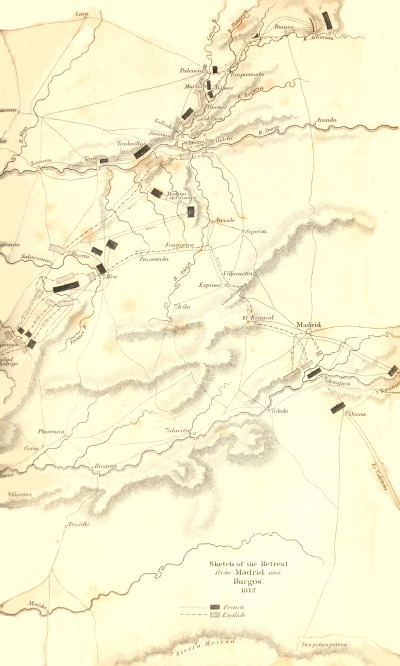
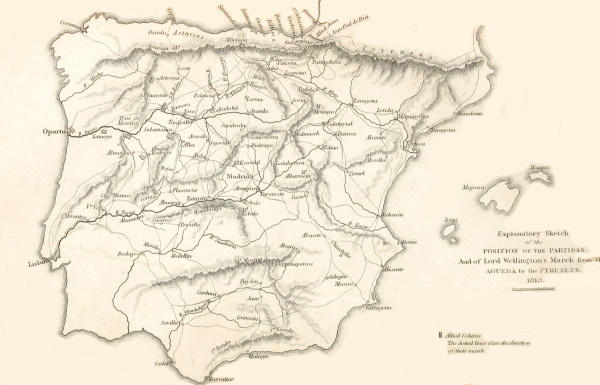
1º. In the present volume will be found a plan of the
Peninsula on a very small scale, yet sufficient to indicate
the general range of operations. A large map would be
enormously expensive without any correspondent advantages
to the reader; and it would only be a repetition of
errors, because there are no materials for an accurate plan.
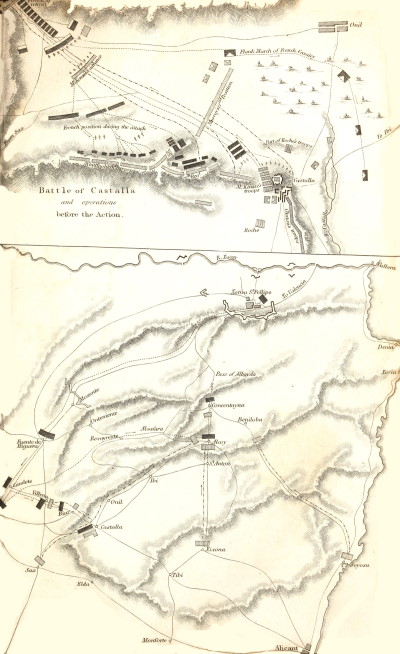
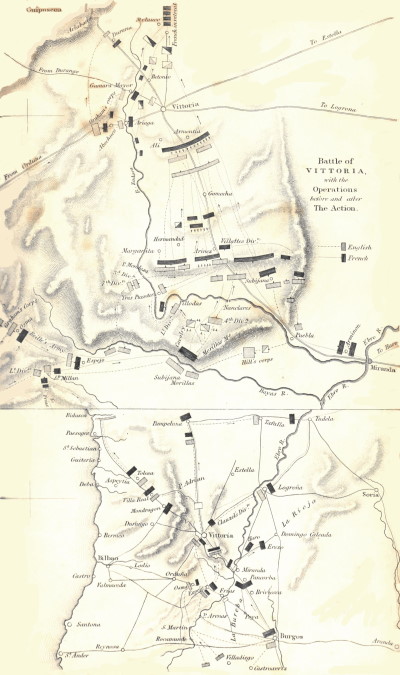
The small one now furnished, together with the sketches
which I have drawn and published with each volume, and
which are more accurate than might be supposed, will give
a clear general notion of the operations. Those who desire
to have more detailed information will find it in Lieutenant
Godwyn’s fine atlas of the battles in the Peninsula—a
work undertaken by that officer with the sole view of
forming a record of the glorious actions of the British
army.
2º. Most of the manuscript authorities consulted for
former volumes have been also consulted for this volume,
and in addition the official correspondence of Lord William
Bentinck; some notes by Lord Hill; the journal and correspondence
of sir Rufane Donkin; a journal of Colonel
Oglander, twenty-sixth regiment; a memoir by sir George
Gipps, royal engineers; and a variety of communications
by other officers. Lastly, authenticated copies of the official
journals and correspondence of most of the marshals and
generals who commanded armies in Spain. These were
at my request supplied by the French War-office with
a prompt liberality indicative of that military frankness
and just pride which ought and does characterize the
officers of Napoleon’s army. The publication of this
volume also enables me with convenience to produce additional
authorities for former statements, while answering,
as I now do, the attacks upon my work which have appeared
in the “Life of Sir Thomas Picton,” and in the
“Quarterly Review.”
“Many there are that trouble me and persecute me; yet do I not swerve
from the testimonies,”—Psalm cxix.
Robinson’s Life of Picton.—This writer of an English
general’s life, is so entirely unacquainted with English
military customs, that he quotes a common order of theLife of Picton, page 31.
day, accrediting a new staff officer to the army, as a
remarkable testimony to that staff officer’s talents. And
he is so unacquainted with French military customs, that,
treating of the battle of Busaco, he places a French marshal,
Marmont, who by the way was not then even inPage 325.
Spain, at the head of a division of Ney’s corps. He dogmatises
upon military movements freely, and is yet so incapable
of forming a right judgment upon the materials
within his reach, as to say, that sir John Moore should not
have retreated, because as he was able to beat the French
at Coruña, he could also have beaten them in the heart of
Spain. Thus setting aside the facts that at Coruña Moore
had fifteen thousand men to fight twenty thousand, and in
the heart of Spain he had only twenty-three thousand to
fight more than three hundred thousand!
And lest this display of incompetency should not be sufficient,
he affirms, that the same sir John Moore had, comparatively,
greater means at Sahagun to beat the enemy
than Lord Wellington had in the lines of Torres Vedras.
Now those lines, which Wellington had been fortifying for
more than a year, offered three nearly impregnable positions,
defended by a hundred thousand men. There was a
fortress, that of St. Julian’s, and a fleet, close at hand as
a final resource, and only sixty thousand French commanded
by Massena were in front. But sir John Moore
having only twenty-three thousand men at Sahagun, had
no lines, no fortifications for defence, and no time to form
them, he was nearly three hundred miles from his fleet,
and Napoleon in person had turned one hundred thousand
men against him, while two hundred thousand more remained
in reserve!
Any lengthened argument in opposition to a writer so
totally unqualified to treat of warlike affairs, would be a
sinful waste of words; but Mr. Robinson has been at
pains to question the accuracy of certain passages of my
work, and with what justice the reader shall now learn.
[1]
1º. Combat on the Coa.—The substance of Mr. Robinson’s
complaint on this subject is, that I have imputed to
general Picton, the odious crime of refusing, from personal
animosity, to support general Craufurd;—that such a
serious accusation should not be made without ample
proof;—that I cannot say whether Picton’s instructions did
not forbid him to aid Craufurd;—that the roads were so
bad, the distance so great, and the time so short, Picton
could not have aided him;—that my account of the action
differs from general Craufurd’s;—that I was only a lieutenant
of the forty-third, and consequently could know
nothing of the matter;—that I have not praised Picton—that
he was a Roman hero and so forth. Finally it is denied
that Picton ever quarrelled with Craufurd at all; and
that, so far from having an altercation with him on the day
of the action he did not on that day even quit his own
quarters at Pinhel. Something also there is about general
Cole’s refusing to quit Guarda.
To all this I reply that I never did accuse general
Picton of acting from personal animosity, and neither the
letter nor the spirit of my statement will bear out such a
meaning, which is a pure hallucination of this author.
That the light division was not supported is notorious. The
propriety of supporting it I have endeavoured to shew,
the cause why it was not so supported I have not attempted
to divine; yet it was neither the distance, nor the badness
of the roads, nor the want of time; for the action, which
took place in July, lasted from day-break until late in the
evening, the roads, and there were several, were good at
that season, and the distance not more than eight miles.
It is quite true, as Mr. Robinson observes, that I cannot
affirm of my own knowledge whether the duke of Wellington
forbade Picton to succour Craufurd, but I can certainly
affirm that he ordered him to support him because it
is so set down in his grace’s despatches, volume 5th, pages
535 and 547; and it is not probable that this order should
have been rescinded and one of a contrary tendency substituted,
to meet an event, namely the action on the Coa,
which Craufurd had been forbidden to fight. Picton acted
no doubt upon the dictates of his judgment, but all men are
not bound to approve of that judgment; and as to the
charge of faintly praising his military talents, a point was
forced by me in his favour, when I compared him to general
Craufurd of whose ability there was no question; more
could not be done in conscience, even under Mr. Robinson’s
assurance that he was a Roman hero.
The exact object of Mr. Robinson’s reasoning upon the
subject of general Cole’s refusal to quit Guarda it is
difficult to discover; but the passage to which it relates, is
the simple enunciation of a fact, which is now repeated,
namely, that general Cole being requested by general
Craufurd to come down with his whole division to the Coa,
refused, and that lord Wellington approved of that refusal,
though he ordered Cole to support Craufurd under certain
circumstances. Such however is Mr. Robinson’s desire to
monopolize all correctness, that he will not permit me to
know any thing about the action, though I was present, because,
as he says, being only a lieutenant, I could not
know any thing about it. He is yet abundantly satisfied
with the accuracy of his own knowledge, although he was
not present, and was neither a captain nor lieutenant. I
happened to be a captain of seven years standing, but
surely, though we should admit all subalterns to be blind,
like young puppies, and that rank in the one case, as age
in the other, is absolutely necessary to open their eyes,
it might still be asked, why I should not have been able,
after having obtained a rank which gave me the right of
seeing, to gather information from others as well as Mr.
Robinson? Let us to the proof.
In support of his views, he has produced, the rather
vague testimony of an anonymous officer, on general
Picton’s staff, which he deems conclusive as to the fact,
that Picton never quarrelled with Craufurd, that he did
not even quit Pinhel on the day of the action, and consequently
could not have had any altercation with him on
the Coa. But the following letters from officers on Craufurd’s
staff, not anonymous, shew that Picton did all these
things. In fine that Mr. Robinson has undertaken a task
for which he is not qualified.
Testimony of lieutenant-colonel Shaw Kennedy, who was
on general Craufurd’s staff at the action of the Coa,
July 24, 1810.
“Manchester, 7th November, 1835.
“I have received your letter in which you mention
‘Robinson’s Life of Picton;’ that work I have not seen.
It surprises me that any one should doubt that Picton
and Craufurd met on the day the French army invested
Almeida in 1810. I was wounded previously, and did not
therefore witness their interview; but I consider it certain
that Picton and Craufurd did meet on the 24th July,
1810, on the high ground on the left bank of the Coa
during the progress of the action, and that a brisk altercation
took place between them. They were primed and
ready for such an altercation, as angry communications
had passed between them previously regarding the disposal
of some sick of the light division. I have heard
Craufurd mention in joke his and Picton’s testiness with
each other, and I considered that he alluded both to the
quarrel as to the sick; and to that which occurred when
they met during the action at Almeida.
“J. S. Kennedy.”
“Colonel Napier, &c. &c. &c.”
Testimony of colonel William Campbell, who was on general
Craufurd’s staff at the action on the Coa, July 24,
1810.
“Esplanade, Dover, 13th Nov. 1835.
“Your letter from Freshford has not been many minutes
in my hands; I hasten to reply. General Picton did
come out of Pinhel on the day of the Coa combat as you
term it. It was in the afternoon of that day when all the
regiments were in retreat, and general Craufurd was with
his staff and others on the heights above, that, I think, on
notice being given of general Picton’s approach, general
Craufurd turned and moved to meet him. Slight was the
converse, short the interview, for upon Craufurd’s asking
enquiringly, whether general Picton did not consider it
advisable to move out something from Pinhel in demonstration
of support, or to cover the light division, in terms
not bland, the general made it understood that ‘he should
do no such thing.’ This as you may suppose put an end
to the meeting, further than some violent rejoinder on the
part of my much-loved friend, and fiery looks returned!
We went our several ways, general Picton, I think, proceeding
onwards a hundred yards to take a peep at the
bridge. This is my testimony.
“Yours truly,
“William Campbell.”
“Colonel Napier, &c. &c. &c.”
2º. Battle of Busaco.—Mr. Robinson upon the authority of
one of general Picton’s letters, has endeavoured to show
that my description of this battle is a mass of errors; but
it shall be proved that his criticism is so, and that general
Picton’s letter is very bad authority.
In my work it is said that the allies resisted vigorously,
yet the French gained the summit of the ridge, and while
the leading battalions established themselves on the crowning
rocks, others wheeled to their right, intending to sweep
the summit of the Sierra, but were driven down again in a
desperate charge made by the left of the third division.
Picton’s letter says, that the head of the enemy’s column
got possession of a rocky point on the crest of the position,
and that they were followed by the remainder of a large
column which was driven down in a desperate charge made
by the left of the third division.
So far we are agreed. But Picton gives the merit of
the charge to the light companies of the seventy-fourth
and eighty-eighth regiments, and a wing of the forty-fifth
aided by the eighth Portuguese regiment, under major Birmingham,
whereas, in the History the whole merit is given
to the eighty-eighth and forty-fifth regiments. Lord Wellington’s
despatch gives the merit to the forty-fifth, and
eighty-eighth, aided by the eighth Portuguese regiment,
under colonel Douglas. The “Reminiscences of a Subaltern,”
written by an officer of the eighty-eighth regiment, and
published in the United Service Journal, in like manner,
gives the merit to the eighty-eighth and forty-fifth British
regiments, and the eighth Portuguese.
It will presently be seen why I took no notice of the
share the eighth Portuguese are said to have had in this
brilliant achievement. Meanwhile the reader will observe
that Picton’s letter indicates the centre of his division as
being forced by the French, and he affirms that he drove
them down again with his left wing without aid from the
fifth division. But my statement makes both the right
and centre of his division to be forced, and gives the fifth
division, and especially colonel Cameron and the ninth
British regiment, a very large share in the glory, moreover
I say that the eighth Portuguese was broken to pieces. Mr.
Robinson argues that this must be wrong, for, says he,
the eighth Portuguese were not broken, and if the right of
the third division had been forced, the French would have
encountered the fifth division. To this he adds, with a
confidence singularly rash, his scanty knowledge of facts
considered, that colonel Cameron and the ninth regiment
would doubtless have made as good a charge as I have
described, “only they were not there.”
In reply, it is now affirmed distinctly and positively, that
the French did break the eighth Portuguese regiment, did
gain the rocks on the summit of the position, and on the
right of the third division; did ensconce themselves in those
rocks, and were going to sweep the summit of the Sierra
when the fifth division under general Leith attacked
them; and the ninth regiment led by colonel Cameron did
form under fire, as described, did charge, and did beat the
enemy out of those rocks; and if they had not done so,
the third division, then engaged with other troops, would
have been in a very critical situation. Not only is all this
re-affirmed, but it shall be proved by the most irrefragable
testimony. It will then follow that the History is accurate,
that general Picton’s letter is inaccurate, and the writer
of his life incompetent to censure others.
Mr. Robinson may notwithstanding choose to abide by
the authority of general Picton’s letter, which he “fortunately
found amongst that general’s manuscripts,” but
which others less fortunate had found in print many years
before; and he is the more likely to do so, because he has
asserted that if general Picton’s letters are false, they are
wilfully so, an assertion which it is impossible to assent to.
It would be hard indeed if a man’s veracity was to be
called in question because his letters, written in the hurry
of service gave inaccurate details of a battle. General
Picton wrote what he believed to be the fact, but to give
any historical weight to his letter on this occasion, in
opposition to the testimony which shall now be adduced
against its accuracy, would be weakness. And with the
more reason it is rejected, because Mr. Robinson himself
admits that another letter, written by general Picton on
this occasion to the duke of Queensbury, was so inaccurate
as to give general offence to the army; and because his
letters on two other occasions are as incorrect as on this of
Busaco.
Thus writing of the assault of Ciudad Rodrigo, Picton
says, “about this time, namely, when the third division
carried the main breach, the light division which was
rather late in their attack, also succeeded in getting
possession of the breach they were ordered to attack.”
Now it has been proved to demonstration, that the light
division carried the small breach, and were actually attacking
the flank of the French troops defending the great
breach, when the third division carried that point. This
indeed is so certain, that Mr. Uniack of the ninety-fifth, and
others of the light division, were destroyed on the ramparts
close to the great breach by that very explosion which was
said to have killed general M’Kinnon; and some have gone
so far as to assert that it is doubtful if the great breach
would have been carried at all but for the flank attack of
the light division.
Again, general Picton writing of the battle of Fuentes
Onoro, says “the light division under general Craufurd
was rather roughly handled by the enemy’s cavalry, and
had that arm of the French army been as daring and
active upon this occasion, as they were when following us
to the lines of Torres Vedras, they would doubtless have
cut off the light division to a man.”
Nevertheless as an eye-witness, and, being then a field-officer
on the staff, by Mr. Robinson’s rule entitled to see,
I declare most solemnly that the French cavalry, though
they often menaced to charge, never came within sure
shot distance of the light division. The latter, with the
exception of the ninety-fifth rifles, who were skirmishing
in the wood of Pozo Velho, was formed by regiments in
three squares, flanking and protecting each other, they
retired over the plain leisurely without the loss of a man,
without a sabre-wound being received, without giving or
receiving fire; they moved in the most majestic manner
secure in their discipline and strength, which was such
as would have defied all the cavalry that ever charged
under Tamerlane or Genghis.
But it is time to give the proofs relative to Busaco, the
reader being requested to compare them with the description
of that battle in my History.
Extracts from major-general sir John Cameron’s letters
to colonel Napier.
“Government House, Devonport, Aug. 9th, 1834.
“—I am sorry to perceive in the recent publication of
lord Beresford, his ‘Refutation of your justification of
your third volume,’ some remarks on the battle of Busaco
which disfigure, not intentionally I should hope, the operations
of the British brigade in major-general Leith’s
corps on that occasion, of which I, as commanding officer
of one of the regiments composing it, may perhaps be permitted
to know something. I shall however content myself
at present with giving you a detail of the operations of the
British brigade in major-general Leith’s own words, extracted
from a document in my possession, every syllable
of which can be verified by many distinguished officers now
living, some of them actors in, all of them eye-witnesses to
the affair.
“‘The ground where the British brigade was now moving,
was behind a chain of rocky eminences where it had
appeared clearly, the enemy was successfully pushing to
establish himself and precluded major-general Leith from
seeing at that moment the progress the enemy was making,
but by the information of staff officers stationed on purpose
who communicated his direction and progress. Major-general
Leith moved the British brigade so as to endeavour
to meet and check the enemy when he had gained the
ascendancy. At this time a heavy fire of musketry was
kept upon the height, the smoke of which prevented a clear
view of the state of things. When however the rock
forming the high part of the Sierra became visible, the
enemy appeared in full possession of it, and a French
officer was in the act of cheering with his hat off, while a
continual fire was kept up from thence and along the whole
face of the Sierra, in a diagonal direction towards the bottom,
by the enemy ascending rapidly from the successive
columns formed for the attack, on a mass of soldiers from
the eighth and ninth Portuguese regiments, who having been
severely pressed had given way and were rapidly retiring
in complete confusion and disorder. Major-general Leith
on that occasion spoke to Major Birmingham (who was on
foot, having had his horse killed), who stated that the fugitives
were of the ninth Portuguese as well as the eighth
regiment, and that he had ineffectually tried to check
their retreat. Major-general Leith addressed and succeeded
in stopping them, and they cheered when he
ordered them to be collected and formed in the rear. They
were passing as they retired diagonally to the right of the
ninth British regiment. The face of affairs in this quarter
now bore a different aspect, for the enemy who had been
the assailant having dispersed or driven every thing opposed
to him was in possession of the rocky eminence of the Sierra
at this part of major-general Picton’s position without a
shot then being fired at him. Not a moment was to be
lost. Major-general Leith resolved instantly to attack
the enemy with the bayonet. He therefore ordered the
ninth British regiment, which had hitherto been moving
rapidly by its left in column in order to gain the most
advantageous ground for checking the enemy, to form the
line, which they did with the greatest promptitude, accuracy,
and coolness, under the fire of the enemy, who had
just appeared formed on that part of the rocky eminence
which overlooks the back of the ridge, and who had then for
the first time perceived the British brigade under him.
Major-general Leith had intended that the thirty-eighth
regiment should have moved on in rear of, and to the left
of, the ninth British regiment, to have turned the enemy
beyond the rocky eminence which was quite inaccessible
towards the rear of the Sierra, while the ninth should have
gained the ridge on the right of the rocky height; the royal
Scots to have been posted (as they were) in reserve. But
the enemy having driven every thing before him in that
quarter afforded him the advantage of gaining the top of
the rocky ridge, which is accessible in front, before it was
possible for the British brigade to have reached that position,
although not a moment had been lost in marching
to support the point attacked, and for that purpose it had
made a rapid movement of more than two miles without
halting and frequently in double-quick time. The thirty-eighth
regiment was therefore directed to form also and
support when major-general Leith led the ninth regiment
to attack the enemy on the rocky ridge, which they did
without filing a shot. That part which looks behind the
Sierra (as already stated) was inaccessible and afforded
the enemy the advantage of outflanking the ninth on the
left as they advanced, but the order, celerity, and coolness
with which they attacked panic-struck the enemy, who
immediately gave way on being charged with the bayonet,
and the whole was driven down the face of the Sierra in
confusion and with immense loss, from a destructive fire
which the ninth regiment opened upon him as he fled with
precipitation after the charge.’
“I shall merely add two observations on what has been
asserted in the ‘Refutation.’
“First with regard to the confusion and retreat of a portion
of the Portuguese troops, I certainly did not know at
the moment what Portuguese corps the fugitives were of,
but after the action I understood they were belonging to
the eighth Portuguese; a very considerable number of
them were crossing the front of the British column dispersed
in sixes and sevens over the field just before I
wheeled the ninth regiment into line for the attack. I
pushed on a few yards to entreat them to keep out of our
way, which they understood and called out ‘viva los
Ingleses, valerosos Portugueses.’
“As regards any support which the Portuguese afforded
the British brigade in the pursuit, I beg to say that during
the charge, while leading the regiment in front of the
centre, my horse was killed under me, which for a moment
retarded my own personal advance, and on extricating
myself from under him, I turned round and saw the thirty-eighth
regiment close up with us and the royal Scots
appearing over the ridge in support; but did not see any
Portuguese join in the pursuit, indeed it would have been
imprudent in them to attempt such a thing, for at the time
a brisk cannonade was opened upon us from the opposite
side of the ravine.
“This, my dear colonel, is, on my honour, an account of
the operations of the British brigade in major-general Leith’s
corps at Busaco. It will be satisfactory to you to know that
the information you received has been correct. The anonymous
officer of the ninth regiment I do not know. There
were several very capable of furnishing you with good information
on the transactions of that day, not only as
regarded their own immediate corps, but those around
them. Colonel Waller I should consider excellent authority;
that gallant officer must have been an eye-witness to
all that passed in the divisions of Picton and Leith. I
remember on our approach to the scene of confusion he
delivered me a message from general Picton, intended
for general Leith, at the time reconnoitring, to hasten our
advance.”
“Government House, Devonport, Aug. 21, 1834.
“——The fact really is that both the eighth and ninth
Portuguese regiments gave way that morning, and I am
positive that I am not far wrong in saying, that there were
not of Portuguese troops within my view, at the moment I
wheeled the ninth regiment into line, one hundred men
prepared either for attack or defence. Sir James Douglas
partly admits that his wing was broken when he says that
‘if we were at any time broken it was from the too ardent
wish of a corps of boy recruits to close.’ Now it is perfectly
clear that the wing of the regiment under Major
Birmingham fled, from what that officer said to general
Leith. Sir James Douglas states also that ‘no candid
man will deny that he supported the royals and ninth
regiment, though before that he says, that ‘by an oblique
movement he joined in the charge.’ I might safely
declare on oath that the Portuguese never shewed themselves
beyond the ridge of the Sierra that morning.
“Very faithfully yours,
“John Cameron.”
As these letters from general Cameron refer to some of
marshal Beresford’s errors, as well as Mr. Robinson’s, an
extract from a letter of colonel Thorne’s upon the same
subject will not be misplaced here.
Colonel Thorne to colonel Napier.
“Harborne Lodge, 28th Aug. 1834.
Extract.—“Viscount Beresford in the ‘Refutation of
your Justification of your third volume,’ has doubted the
accuracy of the strength of the third dragoon guards and
fourth dragoons on the 20th March 1811, as extracted by
you from the journal which I lent to you. As I felt confident
I had not inserted any thing therein, which I did not
obtain from official documents, that were in my possession
at the time it was written, I have, since the perusal of the
‘Refutation,’ looked over some of my Peninsula papers,
and I am happy to say I have succeeded in finding
amongst them, the monthly returns of quarters of the
division of cavalry commanded by brigadier-general
Long, dated Los Santos, April 20th, 1811, which was
then sent to me by the deputy assistant quarter-master
general of that division, and which I beg to enclose for
your perusal, in order that you may see the statement I
have made of the strength of that force in my journal is to
be relied upon, although his lordship insinuates to the contrary,
and that it contains something more than ‘the depositary
of the rumours of a camp.’”
Extract from memorandum of the battle of Busaco, by
colonel Waller, assistant quarter-master-general to the
second division.
“—The attack commenced on the right wing, consisting
of Picton’s division, by the enemy opening a fire of artillery
upon the right of the British which did but little injury,
the range being too great to prove effective. At this
moment were seen the heads of the several attacking columns,
three, I think, in number, and deploying into
line with the most beautiful precision, celerity, and gallantry.
“As they formed on the plateau they were cannonaded
from our position, and the regiment of Portuguese, either
the eighth or the 16th Infantry, which were formed in advance
in front of the 74th regiment, threw in some volleys
of musketry into the enemy’s columns in a flank direction,
but the regiment was quickly driven into the position.
“More undaunted courage never was displayed by French
troops than on this occasion: it could not have been surpassed,
for their columns advanced in despite of a tremendous
fire of grape and musketry from our troops in
position in the rocks, and overcoming all opposition,
although repeatedly charged by Lightburne’s brigade, or
rather by the whole of Picton’s division, they advanced, and
fairly drove the British right wing from the rocky part
of the position.
“Being an eye-witness of this critical moment, and
seeing that unless the ground was quickly recovered the
right flank of the army would infallibly be turned, and
the great road to Coimbra unmasked, seeing also that
heavy columns of the enemy were descending into the
valley to operate by the road, and to support the attack of
the Sierra, and to cut off lord Wellington’s communication
with Coimbra, I instantly galloped off to the rear to bring
up general Hill’s corps to Picton’s support. Having proceeded
about two miles along the upper edge and reverse
side of the Sierra, I fell in with the head of general
Leith’s column moving left in front, at the head of which
was colonel Cameron’s brigade, led by the ninth regiment.
I immediately rode up to colonel Cameron, and addressed
him in an anxious tone as follows.
“‘Pray, sir, who commands this brigade?’ ‘I do,’
replied the colonel, ‘I am colonel Cameron.’
“‘Then for God’s sake, sir, move off instantly at double-quick
with your brigade to Picton’s support; not one
moment is to be lost, the enemy in great force are already
in possession of the right of the position on the Sierra and
have driven Picton’s troops out of it. Move on, and when
the rear of your brigade has passed the Coimbra road
wheel into line, and you will embrace the point of attack.’
Colonel Cameron did not hesitate or balance an INSTANT,
but giving the word ‘double-quick’ to his brigade nobly
led them to battle and to victory.
“The brave colonel attacked the enemy with such a
gallant and irresistible impetuosity, that after some time
fighting he recovered the ground which Picton had lost,
inflicting heavy slaughter on the elite of the enemy’s
troops. The ninth regiment behaved on this occasion with
conspicuous gallantry, as indeed did ALL the REGIMENTS
engaged. Great numbers of the enemy had descended
low down in the rear of the position towards the Coimbra
road, and were killed; the whole position was thickly
strewed with their killed and wounded; amongst which were
many of our own troops. The French were the finest men
I ever saw. I spoke to several of the wounded men,
light infantry and grenadiers, who were bewailing their
unhappy fate on being defeated, assuring me they were the
heroes of Austerlitz who had never before met with
defeat!
“Robert Waller, Lieut.-colonel.”
Extract of a letter from colonel Taylor, ninth regiment, to
colonel Napier.
“Fernhill, near Evesham, 26th April, 1832.
“Dear Sir,
“I have just received a letter from colonel Shaw, in which
he quotes a passage from one of yours to him, expressive
of your wish, if necessary, to print a passage from a statement
which I made respecting the conduct of the ninth
regiment at Busaco, and in reference to which, I have
alluded to the discomfiture of the eighth Portuguese upon
the same occasion. I do not exactly recollect the terms I
made use of to colonel Shaw (nor indeed the shape which
my communication wore) but, my object was to bring to
light the distinguished conduct of the ninth without any
wish to, unnecessarily, obscure laurels, which others wore,
even at their expense!
“To account for the affair in question, I could not however
well omit to state, that it was in consequence of the
overthrow of the eighth Portuguese, that sir James Leith’s
British brigade was called upon, and it is remarkable, that
at the time, there was a considerable force of Portuguese
(I think it was the old Lusitanian Legion which had
just been modelled into two battalions) between Leith’s
British and where the eighth were being engaged, Leith
pushed on his brigade double-quick, column of sections left
in front, past these Portuguese, nor did he halt until he
came in contact with the enemy who had crowned the
heights and were firing from behind the rocks, the ninth
wheeled up into line, fired and charged, and all of the
eighth Portuguese that was to be seen, at least by me, a
company officer at the time, was some ten or a dozen men
at the outside, with their commanding officer, but he and
they were amongst the very foremost in the ranks of the
ninth British. As an officer in the ranks of course I could
not see much of what was going on generally, neither could
I well have been mistaken as to what I did see, coming
almost within my very contact! Colonel Waller, now, I
believe on the Liverpool staff, was the officer who came to
sir James Leith for assistance, I presume from Picton.
“Yours, &c.
“J. Taylor.”
Second communication from major-general sir John
Cameron to colonel Napier.
Stoke Devonport, Nov. 21st, 1835.
“My dear colonel,
“Some months ago I took the liberty of pointing out to
you certain mis-statements contained in a publication of
lord Beresford regarding the operations of the British
brigade in major-general Leith’s corps at the battle of
Busaco, and as those mis-statements are again brought
before the public in Robinson’s Life of sir Thomas Picton I
am induced to trouble you with some remarks upon what
is therein advanced. A paragraph in major-general
Picton’s letter to lord Wellington, dated 10th November,
1810, which I first discovered some years ago in the
Appendix No. 12 of Jones’s War in Spain, &c. &c. would
appear to be the document upon which Mr. Robinson
grounds his contradiction of your statement of the conduct
of the ninth regiment at Busaco, but that paragraph, which
runs as follows, I am bound to say is not the truth. ‘Major-general
Leith’s brigade in consequence marched on, and
arrived in time to join the five companies of the forty-fifth
regiment under the honourable lieutenant-colonel Meade
and the eighth Portuguese regiment under lieutenant-colonel
Douglas in repulsing the enemy.’ This assertion
of major-general Picton is, I repeat, not true, for, in the
first place I did not see the forty-fifth regiment on that day,
nor was I at any period during the action near them or
any other British regiment to my left. In the second, as
regards the eighth Portuguese regiment, the ninth British
did not most assuredly join that corps in its retrograde
movement. That major-general Picton left his right flank
exposed, there can be no question, and had not assistance,
and British assistance too, come up to his aid as it did I am
inclined to believe that sir Thomas would have cut a very
different figure in the despatch to what he did!! Having
already given you a detail of the defeat of the enemy’s
column which was permitted to gain the ascendency in
considerable force on the right of the third division, I beg
leave to refer you to the gallant officers I mentioned in a
former letter, who were not only eye-witnesses to the
charge made by the ninth regiment but actually distinguished
themselves in front of the regiment at the side
of their brave accomplished general during that charge.
I believe the whole of sir Rowland Hill’s division from a
bend in the Sierra could see the ninth in their pursuit of
the enemy, and though last not the least in importance, as
a party concerned, I may mention the present major-general
sir James T. Barns, who commanded the British
brigade under major-general Leith, (I omitted this gallant
officer’s name in my former letter) as the major-general
took the entire command and from him alone I received
all orders during the action.
“I have now done with Mr. Robinson and his work
which was perhaps hardly worth my notice.
“I am, my dear Colonel,
“Very sincerely yours,
“J. Cameron.”
Having now sufficiently exposed the weakness of Mr.
Robinson’s attack upon me, it would be well perhaps to
say with sir J. Cameron “I have done with his work,”
but I am tempted to notice two points more.
Treating of the storming of Badajos, Mr. Robinson says,
“Near the appointed time while the men were waiting
with increased anxiety Picton with his staff came up. The
troops fell in, all were in a moment silent until the general
in his calm and impressive manner addressed a few words
to each regiment. The signal was not yet given, but the
enemy by means of lighted carcasses discovered the position
of Picton’s soldiers; to delay longer would only have
been to expose his men unnecessarily; he therefore gave
the word to march.”——“Picton’s soldiers set up a loud
shout and rushed forward up the steep to the ditch at the
foot of the castle walls.—General Kempt who had thus far
been with Picton at the head of the division was here
badly wounded and carried to the rear. Picton was
therefore left alone to conduct the assault.”
Now strange to say Picton was not present when the
signal was given, and consequently could neither address
his men in his “usual calm impressive manner,” nor give
them the word to march. There was no ditch at the foot
of the castle walls to rush up to, and, as the following letter
proves, general Kempt alone led the division to the attack.
Extract of a letter from lieutenant-general sir James
Kempt, K. C. B., master-general of the Ordnance, &c. &c.
Pall Mall, 10th May, 1833.
“According to the first arrangement made by lord
Wellington, my brigade only of the third division was
destined to attack the castle by escalade. The two other
brigades were to have attacked the bastion adjoining the
castle, and to open a communication with it. On the day,
however, before the assault took place, this arrangement
was changed by lord Wellington, a French deserter from
the castle (a serjeant of sappers) gave information that no
communication could be established between the castle
and the adjoining bastion, there being (he stated) only one
communication between the castle and the town, and upon
learning this, the whole of the third division were ordered
by lord Wellington to attack the castle. But as my brigade
only was originally destined for the service, and was to
lead the attack, the arrangements for the escalade were in
a great measure confided to me by general Picton.
“The division had to file across a very narrow bridge to
the attack under a fire from the castle and the troops in
the covered way. It was ordered to commence at ten
o’clock, but by means of fire-balls the formation of our
troops at the head of the trench was discovered by the
French, who opened a heavy fire on them, and the attack
was commenced from necessity nearly half an hour before
the time ordered. I was severely wounded in the foot on
the glacis after passing the Rivillas almost at the commencement
of the attack in the trenches, and met Picton
coming to the front on my being carried to the rear. If
the attack had not commenced till the hour ordered, he, I
have no doubt, would have been on the spot to direct in
person the commencement of the operations. I have no
personal knowledge of what took place afterwards, but I
was informed that after surmounting the most formidable
difficulties, the escalade was effected by means of two
ladders only in the first instance in the middle of the
night, and there can be no question that Picton was
present in the assault. In giving an account of this
operation, pray bear in mind that he commanded the
division, and to him and the enthusiastic valour and determination
of the troops ought its success alone to be
attributed.
“Yours, &c.
“James Kempt.”
“Colonel Napier, &c.”
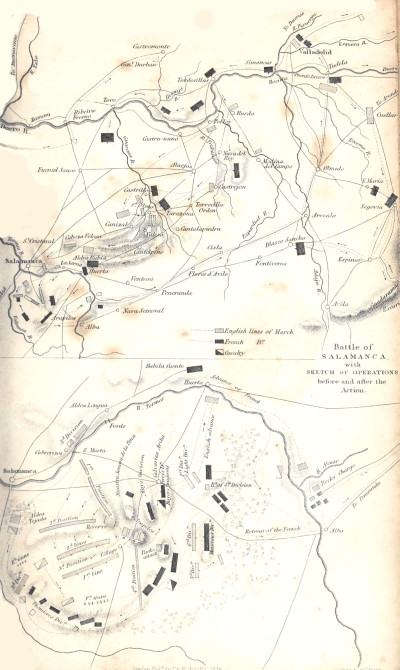
The other point to which I would allude is the battle of
Salamanca. Mr. Robinson, with his baton of military
criticism, belabours the unfortunate Marmont unmercifully,
and with an unhappy minuteness of detail, first places
general Foy’s troops on the left of the French army and
then destroys them by the bayonets of the third division,
although the poor man and his unlucky soldiers were all
the time on the right of the French army, and were never
engaged with the third division at all. This is however
but a slight blemish for Mr. Robinson’s book, and his
competence to criticise Marmont’s movements is no whit
impaired thereby. I wish however to assure him that the
expression put into the mouth of the late sir Edward
Pakenham is “né vero né ben trovato.” Vulgar swaggering
was no part of that amiable man’s character, which was
composed of as much gentleness, as much generosity, as
much frankness, and as much spirit as ever commingled in
a noble mind. Alas! that he should have fallen so soon
and so sadly!! His answer to lord Wellington, when the
latter ordered him to attack, was not, “I will, my lord, by
God!” With the bearing of a gallant gentleman who had
resolved to win or perish, he replied, “Yes, if you will
give me one grasp of that conquering right hand.” But
these finer lines do not suit Mr. Robinson’s carving of a
hero; his manner is more after the coarse menacing idols
of the South-Sea Islands, than the delicate gracious forms
of Greece.
Advice to authors is generally thrown away, yet Mr.
Robinson would do well to rewrite his book with fewer
inaccuracies, and fewer military disquisitions, avoiding to
swell its bulk with such long extracts from my work, and
remembering also that English commissaries are not “feræ
naturæ” to be hanged, or otherwise destroyed at the pleasure
of divisional generals. This will save him the trouble of
attributing to sir Thomas Picton all the standard jokes
and smart sayings, for the scaring of those gentry, which
have been current ever since the American war, and which
have probably come down to us from the Greeks. The
reduction of bulk, which an attention to these matters will
produce, may be compensated by giving us more information
of Picton’s real services, towards which I contribute
the following information. Picton in his youth served as a
marine, troops being then used in that capacity, and it is
believed he was in one of the great naval victories. Mr. Robinson
has not mentioned this, and it would be well also, if
he were to learn and set forth some of the general’s generous
actions towards the widows of officers who fell under
his command: they are to be discovered, and would do
more honour to his memory than a thousand blustering
anecdotes. With these changes and improvements, the
life of sir Thomas Picton may perhaps, in future, escape
the equivocal compliment of the newspaper puffers, namely,
that it is “a military romance.”
Quarterly Review.—This is but a sorry attack to repel.
“Le jeu ne vaut pas la chandelle,” but “rats and mice
and such small deer have been Tom’s food for many a
year.”
The reviewer does not like my work, and he invokes
the vinous vagaries of Mr. Coleridge in aid of his own
spleen. I do not like his work, or Mr. Coleridge either,
and I console myself with a maxim of the late eccentric
general Meadows, who being displeased to see his officers
wear their cocked hats awry, issued an order beginning
thus:—“All men have fancy, few have taste.” Let that
pass. I am ready to acknowledge real errors, and to
give my authorities for disputed facts.
1º. I admit that the road which leads over the Pyrennees
to Pampeluna does not unite at that town with the
royal causeway; yet the error was typographical, not
topographical, because the course of the royal causeway
was shewn, just before, to be through towns very distant
from Pampeluna. The true reading should be “united
with the first by a branch road commencing at Pampeluna.”
2º. The reviewer says, the mountains round Madrid
do not touch the Tagus at both ends within the frontier of
Spain, that river is not the chord of their arc; neither
are the heights of Palmela and Almada near Lisbon one
and the same. This is very true, although not very important.
I should have written the heights of Palmela
and Almada, instead of the heights of Palmela or Almada.
But though the mountains round Madrid do not
to the westward, actually touch the Tagus within the
Spanish frontier, their shoots are scarcely three miles from
that river near Talavera, and my description was general,
being intended merely to shew that Madrid could not be
approached from the eastward or northward, except over
one of the mountain ranges, a fact not to be disputed.
3º. It is hinted by the reviewer that lord Melville’s
degrading observation, namely, that “the worst men
made the best soldiers,” was picked by me out of general
Foy’s historical fragment. Now, that passage in my
history was written many months before general Foy’s
work was published; and my authority was a very clear
recollection of lord Melville’s speech, as reported in the
papers of the day. The time was just before his impeachment
for malversation.
General Foy’s work seems a favourite authority with
the reviewer, and he treats general Thiebault’s work with
disdain; yet both were Frenchmen of eminence, and the
ennobling patriotism of vituperation might have been impartially
exercised, the weakness of discrimination avoided.
However general Thiebault’s work, with some apparent
inaccuracies as to numbers, is written with great ability
and elegance, and is genuine, whereas general Foy’s
history is not even general Foy’s writing; colonel D’Esmenard
in his recent translation of the Prince of Peace’s
memoirs has the following conclusive passage upon that
head.
“The illustrious general Foy undertook a history of
the war in Spain, his premature death prevented him from
revising and purifying his first sketch, he did me the
honour to speak of it several times, and even attached
some value to my observations; the imperfect manuscripts
of this brilliant orator have been re-handled and re-made
by other hands. In this posthumous history, he has been
gratuitously provided with inaccurate and malignant assertions.”
While upon this subject, it is right to do justice to
Manuel Godoy, Prince of the Peace. A sensual and
corrupt man he was generally said to be, and I calledSee Memoirs of Manuel Godoy, translated by Colonel D’Esmenard.
him so, without sufficient consideration of the extreme
exaggerations which the Spaniards always display in their
hatred. The prince has now defended himself; colonel
D’Esmenard and other persons well acquainted with the
dissolute manners of the Spanish capital, and having personal
experience of Godoy’s character and disposition,See also London & Westminster Review No 1.
have testified that his social demeanour was decent and
reserved, and his disposition generous; wherefore I express
my regret at having ignorantly and unintentionally
calumniated him.
To return to the reviewer. He is continually observing
that he does not know my authority for such and such a
fact, and therefore he insinuates, that no such fact had
place, thus making his ignorance the measure of my
accuracy. This logic seems to be akin to that of the
wild-beast showman, who declares that “the little negro
boys tie the ostrich bird’s leg to a tree, which fully accounts
for the milk in the cocoa-nuts.” I might reply
generally as the late alderman Coombe did to a certain
baronet, who, in a dispute, was constantly exclaiming,
“I don’t know that, Mr. Alderman! I don’t know that!”
“Ah, sir George! all that you don’t know would make
a large book!” However it will be less witty, but more
conclusive to furnish at least some of my authorities.
1º. In opposition to the supposititious general Foy’s
account of Solano’s murder, and in support of my own
history, I give the authority of sir Hew Dalrymple, from
whom the information was obtained; a much better authority
than Foy, because he was in close correspondence
with the insurgents of Seville at the time, and had an
active intelligent agent there.
2º. Against the supposititious Foy’s authority as to the
numbers of the French army in June 1808, the authority
of Napoleon’s imperial returns is pleaded. From these
returns my estimate of the French forces in Spain during
May 1808 was taken, and it is so stated in my Appendix.
The inconsistency of the reviewer himself may
also be noticed, for he marks my number as exclusive of
Junot’s army, and yet includes that army in what he calls
Foy’s estimate! But Junot’s army was more than 29,000
and not 24,000 as the supposititious Foy has it, and that
number taken from 116,000 which, though wrong, is
Foy’s estimate of the whole leaves less than 87,000. I
said 80,000. The difference is not great, yet my authority
is the best, and the reviewer feels that it is so,
or he would also have adopted general Foy’s numbers
of the French at the combat of Roliça. In Foy’s
history they are set down as less than 2,500, in mine
they are called 5,000. He may be right, but it would
not suit the reviewer to adopt a truth from a French
writer.
3º. On the negative proofs afforded 1º. by the absence
of any quoted voucher in my work, 2º. by the absence of
any acknowledgement of such a fact in general Anstruther’s
manuscript journal, which journal may or may not
be garbled, the reviewer asserts that the English ministers
never contemplated the appointing of a military governor
for Cadiz. Against this, let the duke of Wellington’s
authority be pleaded, for in my note-book of conversations
held with his grace upon the subject of my history,
the following passage occurs:—
“The ministers were always wishing to occupy Cadiz,
lord Wellington thinks this a folly, Cadiz was rather a
burthen to him, but either general Spencer or general
Anstruther was intended to command there, thinks it was
Anstruther, he came out with his appointment.”
Now it is possible that as Acland’s arrival was also the
subject of conversation, his name was mentioned instead
of Anstruther’s; and it is also possible, as the note shows,
that Spencer was the man, but the main fact relative to
the government could not have been mistaken. To balance
this, however, there undoubtedly is an error as to the
situation of general Anstruther’s brigade at the battle of
Vimiero. It appears by an extract from his journal, that
it was disposed, not, as the reviewer says, on the right of
Fane’s brigade, but at various places, part being on the
right of Fane, part upon his left, part held in reserve.
The forty-third were on the left of Fane, the fifty-second
and ninety-seventh on his right, the ninth in reserve, the
error is therefore very trivial, being simply the describing
two regiments as of Fane’s brigade, when they were of
Anstruther’s without altering their position. What does
the public care whether it was a general called Fane, or a
general called Anstruther, who was on the right hand if
the important points of the action are correctly described?
The fighting of the fifty-second and ninety-seventh has
indeed been but slightly noticed, in my history, under
the denomination of Fane’s right, whereas those regiments
make a good figure, and justly so, in Anstruther’s journal,
because it is the story of the brigade; but general history
ought not to enter into the details of regimental fighting,
save where the effects are decisive on the general result,
as in the case of the fiftieth and forty-third on this occasion.
The whole loss of the ninety-seventh and fifty-second
together did not exceed sixty killed and wounded,
whereas the fiftieth alone lost ninety, and the forty-third
one hundred and eighteen.
While on the subject of Anstruther’s brigade, it is right
also to admit another error, one of place; that is if it be
true, as the reviewer says, that Anstruther landed at
Paymayo bay, and not at Maceira bay. The distance
between those places may be about five miles, and the
fact had no influence whatever on the operations; nevertheless
the error was not drawn from Mr. Southey’s history,
though I readily acknowledge I could not go to a
more copious source of error. With respect to the imputed
mistake as to time, viz. the day of Anstruther’s
landing, it is set down in my first edition as the 19th,
wherefore the 18th in the third edition is simply a mistake
of the press! Alas! poor reviewer!
But there are graver charges. I have maligned the
worthy bishop of Oporto; and ill-used the patriotic
Gallician junta! Reader, the bishop of Oporto and the
patriarch of Lisbon are one and the same person! Examine
then my history and especially its appendix and
judge for yourself, whether the reviewer may not justly be
addressed as the pope was by Richard I. when he sent
him the bishop of Beauvais’ bloody suit of mail. “See
now if this be thy son’s coat.” But the junta! Why it
is true that I said they glossed over the battle of Rio Seco
after the Spanish manner; that their policy was but a
desire to obtain money, and to avoid personal inconvenience;
that they gave sir Arthur Wellesley incorrect
statements of the number of the Portuguese and Spaniards
at Oporto, and a more inaccurate estimate of the French
army under Junot. All this is true. It is true that I have
said it, true that they did it. The reviewer says my
statement is a “gratuitous misrepresentation.” I will prove
that the reviewer’s remark is a gratuitous impertinence.
1º. The junta informed sir Arthur Wellesley, that
Bessieres had twenty thousand men in the battle, whereas
he had but fifteen thousand.
2º. That Cuesta lost only two guns, whereas he lost
eighteen.
3º. That Bessieres lost seven thousand men and six
guns, whereas he lost only three hundred and fifty men,
and no guns.
4º. That the Spanish army had retired to Benevente as
if it still preserved its consistence, whereas Blake and
Cuesta had quarrelled and separated, all the magazines
of the latter had been captured and the whole country
was at the mercy of the French. This was glossing it
over in the Spanish manner.
Again the junta pretended that they desired the deliverance
of Portugal to enable them to unite with the
southern provinces in a general effort; but Mr. Stuart’s
letters prove that they would never unite at all with any
other province, and that their aim was to separate from
Spain altogether and join Portugal. Their wish to avoid
personal inconvenience was notorious, it was the cause of
their refusal to let sir David Baird’s troops disembark, it
was apparent to all who had to deal with them, and it
belongs to the national character. Then their eagerness
to obtain money, and their unpatriotic use of it when
obtained, has been so amply set forth in various parts of
my history that I need not do more than refer to that, and
to my quoted authorities, especially in the second chapters
of the 3d and 14th Books. Moreover the reviewer’s
quotations belie his comments, and like the slow-worm
defined by Johnson “a blind worm, a large viper, venomous,
not mortal,” he is at once dull and malignant.
The junta told sir Arthur Wellesley that ten thousand
Portuguese troops were at Oporto, and that two thousand
Spaniards, who had marched the 15th, would be there on
the 25th of July; yet when sir Arthur arrived at Oporto,
on the 25th, he found only fifteen hundred Portuguese
and three hundred Spaniards; the two thousand men said
to be in march had never moved and were not expected.
Here then instead of twelve thousand men, there were
only eighteen hundred! At Coimbra indeed eighty
miles from Oporto, there were five thousand militia and
regulars, one-third of which were unarmed, and according
to colonel Browne’s letter, as given in the folio edition
of the inquiry upon the Cintra convention, there were also
twelve hundred armed peasants which the reviewer has
magnified into twelve thousand. Thus without dwelling
on the difference of place, the difference between the true
numbers and the statements of the Gallician junta, was
four thousand; nor will it mend the matter if we admit
the armed peasants to be twelve thousand, for that would
make a greater difference on the other side.
The junta estimated the French at fifteen thousand men,
but the embarkation returns of the number shipped after
the convention gave twenty-five thousand seven hundred and
sixty, making a difference of more than ten thousand men,
exclusive of those who had fallen or been captured in the
battles of Vimiero and Roliça, and of those who had died in
hospital! Have I not a right to treat these as inaccurate
statements; and the reviewer’s remark as an impertinence?
The reviewer speaking of the battle of Baylen scoffs at
the inconsistency of calling it an insignificant event and
yet attributing to it immense results. But my expression
was, an insignificant action in itself, which at once reconciles
the seeming contradiction, and this the writer who
has no honest healthy criticism, suppresses. My allusion
to the disciplined battalions of Valley Forge, as being the
saviours of American independence, also excites his
morbid spleen, and assuming what is not true, namely,
that I selected that period as the time of the greatest
improvement in American discipline, he says, their soldiers
there were few, as if that bore at all upon the
question.
But my expression is at Valley Forge not “of Valley
Forge.” The allusion was used figuratively to shew that
an armed peasantry cannot resist regular troops, and Washington’s
correspondence is one continued enforcement of
the principle, yet the expression may be also taken literally.
It was with the battalions of Valley Forge that
Washington drew Howe to the Delawarre, and twice
crossing that river in winter, surprised the Germans at
Trenton and beat the British at Prince Town. It was
with those battalions he made his attacks at German’s-town;
with those battalions he prevented Howe from
sending assistance to Burgoyne’s army, which was in
consequence captured. In fine, to use his own expression,
“The British eagle’s wings were spread, and with those
battalions he clipped them.” The American general,See Stedman’s History, 4to. p. 285.
however, at one time occupied, close to Valley Forge, a
camp in the Jerseys, bearing the odd name of Quibble-town,
on which probably the reviewer’s eye was fixed.
But notwithstanding Quibble-town, enthusiasm will not
avail in the long run against discipline. Is authority
wanted? We have had Napoleon’s and Washington’s,
and now we have Wellington’s, for in the fifth volume of
his Despatches, p. 215, as compiled by colonel Gurwood,
will be found the following passage upon the arming of the
Spanish and Portuguese people.
“Reflection and above all experience have shown me
the exact extent of this advantage in a military point of
view, and I only beg that those who have to contend with
the French, will not be diverted from the business of
raising, arming, equipping, and training regular bodies by
any notion that the people when armed and arrayed, will
be of, I will not say any, but of much, use to them.
The subject is too large for discussion in a paper of this
description, but I can show hundreds of instances to prove
the truth of as many reasons why exertions of this description
ought not to be relied on. At all events no officer
can calculate upon an operation to be performed against
the French by persons of this description, and I believe
that no officer will enter upon an operation against the
French without calculating his means most anxiously.”
It is said that some officers of rank have furnished the
reviewer’s military criticisms, I can understand why, if the
fact be true, but it is difficult to believe that any officer
would even for the gratification of a contemptible jealousy,
have lent himself to the assertion that sir Arthur Wellesley
could not have made a forced or a secret march from
Vimiero to Mafra, because he was encumbered with four
hundred bullock-carts. Sir Arthur did certainly intend toSee his evidence, Court of Inquiry on the Convention of Cintra.
make that march, and he would as certainly not have
attempted such a flank movement openly and deliberately
while thus encumbered and moving at the rate of two
miles an hour, within a short distance of a general having
a more experienced army and an overwhelming cavalry.
The sneer is therefore directed more against sir Arthur
Wellesley than against me.
This supposed officer of rank says that because the
enemy had a shorter road to move in retreat, his line of
march could not even be menaced, still less intercepted by
his opponent moving on the longer route! How then did
Cæsar intercept Afranius and Petreius, Pompey’s lieutenants,
on the Sicoris? How Pompey himself at Dyrrachium?
How did Napoleon pass Beaulieu on the Po and
gain Lodi? How did Massena dislodge Wellington from
Busaco? How did Marmont turn him on the Guarena in
1812? How did Wellington himself turn the French on
the Douro and on the Ebro in 1813? And above all how
did he propose to turn Torres Vedras by the very march
in question, seeing that from Torres Vedras to Mafra is
only twelve miles and from Vimiero to Mafra is nineteen
miles, the roads leading besides over a river and through
narrow ways and defiles? But who ever commended
such dangerous movements, if they were not masked or
their success insured by some peculiar circumstances, or
by some stratagem? And what is my speculation but a
suggestion of this nature? “Under certain circumstances,”
said sir Arthur Wellesley at the enquiry, “an
army might have gained three hours’ start in such a
march.” The argument of the supposititious officer of
rank is therefore a foolish sophism; nor is that relative to
sir John Moore’s moving upon Santarem, nor the assertion
that my plan was at variance with all sir Arthur Wellesley’s
objects, more respectable.
My plan, as it is invidiously and falsely called, was
simply a reasoning upon the advantages of sir Arthur
Wellesley’s plan, and the calculation of days by the
reviewer is mere mysticism. Sir Arthur wished sir John
Moore to go to Santarem, and if sir Arthur’s recommendation
had been followed, sir John Moore, who, instead of
taking five days as this writer would have him do, actually
disembarked the greatest part of his troops in the Mondego
in half a day, that is before one o’clock on the 22d,
might have been at Santarem the 27th even according to
the reviewer’s scale of march, ten miles a day! Was he
to remain idle there, if the enemy did not abandon Lisbon
and the strong positions covering that city? If he could
stop Junot’s retreat either at Santarem or in the Alemtejo,
a cavalry country, he could surely as safely operate towards
Saccavem, a strong country. What was sir A.
Wellesley’s observation on that head? “If the march to
Mafra had been made as I had ordered it on the 21st of
August in the morning, the position of Torres Vedras
would have been turned, and there was no position in the
enemy’s possession, excepting that in our front at Cabeça
de Montechique and those in rear of it. And I must
observe to the court that if sir John Moore’s corps had
gone to Santarem as proposed as soon as it disembarked
in the Mondego, there would have been no great safety in
those positions, if it was, as it turned out to be, in our
power to beat the French.” Lo! then, my plan is not at
variance with sir Arthur Wellesley’s object. But the
whole of the reviewer’s sophistry is directed, both as to
this march and that to Mafra, not against me, but through
me against the duke of Wellington whom the writer dare
not attack openly; witness his cunning defence of that
“wet-blanket” counsel which stopped sir Arthur Wellesley’s
pursuit of Junot from the field of Vimiero. Officer
of rank! Aye, it sounds grandly! but it was a shrewd
thing of Agesilaus when any one was strongly recommended
to him to ask “who will vouch for the voucher?”
Passing now from the officer of rank, I affirm, notwithstanding
Mr. Southey’s “magnificent chapters” and sir
Charles Vaughan’s “brief and elegant work,” that the
statement about Palafox and Zaragoza is correct. My
authority is well known to sir Charles Vaughan, and is
such as he is not likely to dispute; that gentleman will not,
I feel well assured, now guarantee the accuracy of the
tales he was told at Zaragoza. But my real offence is not
the disparagement of Palafox, it is the having spoiled some
magnificent romances, present or to come; for I remembered
the Roman saying about the “Lying Greek fable,”
and endeavoured so to record the glorious feats of my
countrymen, that even our enemies should admit the facts.
And they have hitherto done so, with a magnanimity
becoming brave men who are conscious of merit in misfortune,
thus putting to shame the grovelling spirit that would
make calumny and vituperation the test of patriotism.
Since writing the above a second article has appeared in
the same review, to which the only reply necessary, is the
giving of more proofs, that the passages of my history,
contradicted by the reviewer, are strictly accurate. And to
begin, it is necessary to inform him, that a man may be
perfectly disciplined and a superb soldier, and yet be a
raw soldier as to real service; and further, that staff
officers may have been a long time in the English service,
and yet be quite inexperienced. Even a quarter-master-general
of an army has been known to commit all kinds of
errors, and discover negligence and ignorance of his duty,
in his first campaigns, who yet by dint of long practice
became a very good officer in his line, though perhaps not
so great a general as he would pass himself off for; for it
was no ill saying of a Scotchman, that “some men, if
bought at the world’s price, might be profitably sold at
their own.” Now requesting the reader to observe that
in the following quotations the impugned passages of my
history are first given, and are followed by the authority,
though not all the authority which might be adduced in
support of each fact, I shall proceed to expose the reviewer’s
fallacies.
1º. History. “Napoleon, accompanied by the dukes of
Dalmatia and Montebello, quitted Bayonne the morning of
the 8th, and reached Vittoria in the evening.”
The reviewer contradicts this on the authority of Savary’s
Memoirs, quoting twice the pages and volume, namely
vol. iv. pages 12, 40, and 41. Now Savary is a writer so
careless about dates, and small facts, as to have made
errors of a month as to time in affairs which he conducted
himself. Thus he says king Joseph abandoned Madrid on
the 3d of July 1808, whereas it was on the 3d of August.
He also says the landing of sir Arthur Wellesley in Portugal
was made known to him, before the council of war
relative to the evacuation of Madrid was held at that capital;
but the council was held the 29th of July, and sir
Arthur did not land until the 1st of August! Savary is
therefore no authority on such points. But there is no
such passage as the reviewer quotes, in Savary’s work.
The reader will look for it in vain in pages 12, 40, and 41.
It is neither in the fourth volume nor in any other volume.
However at page 8 of the second volume, second part, he will
find the following passage. “L’Empereur prit la route
d’Espagne avec toute son armée. Il arriva à Bayonne avec
la rapidité d’un trait, de même que de Bayonne à Vittoria.
Il fit ce dernier trajet à cheval en deux courses, de la
première il alla à Tolosa et de la seconde à Vittoria.” The
words “deux courses” the reviewer with his usual candour
translates, “the first day to Tolosa, the second day to Vittoria.”
But notwithstanding this I repeat, that the emperor
made his journey in one day. My authority is the
assurance of a French officer of the general staff who was
present, and if the value of the fact were worth the pains,
I could show that it was very easy for Napoleon to do so,
inasmuch as a private gentleman, the correspondent of one
of the newspapers, has recently performed the same journey
in fourteen hours. But my only object in noticing it at all
is to show the flagrant falseness of the reviewer.
2º. History. “Sir John Moore had to organize an
army of raw soldiers, and in a poor unsettled country just
relieved from the pressure of a harsh and griping enemy, he
had to procure the transport necessary for his stores, ammunition,
and even for the conveyance of the officers’ baggage.
Every branch of the administration civil and military was
composed of men zealous and willing indeed, yet new to a
service where no energy can prevent the effects of inexperience
being severely felt.”
Authorities. Extracts from sir John Moore’s Journal
and Letters.
“I am equipping the troops here and moving them
towards the frontier, but I found the army without the
least preparation, without any precise information with
respect to roads, and no arrangement for feeding the
troops upon their march.” “The army is without equipments
of any kind, either for the carriage of the light baggage
of regiments, artillery stores, commissariat stores, or
any other appendage to an army, and not a magazine is
formed on any of the routes.”—“The commissariat has at
its head Mr. Erskine, a gentleman of great integrity and
honour, and of considerable ability, but neither he nor any
of his officers have any experience of what an army of this
magnitude requires to put it in motion.”—“Every thing is
however going on with zeal; there is no want of that in an
English army, and though the difficulties are considerable,
and we have to move through a very impracticable country,
I expect to be past the frontier early in November.”
Extract from a memoir by sir John Colborne, military
secretary to sir John Moore.
“The heads of departments were all zeal, but they had
but little experience, and their means for supplying the
wants of the army about to enter on an active campaign
were in many respects limited.”
3º. History. “One Sataro, the same person who has
been already mentioned as an agent of Junot’s in the negociations
engaged to supply the army, but dishonestly failing
in his contract so embarrassed the operations,” &c. &c.
Authority. Extract from sir John Colborne’s Memoir
quoted above.
“Sataro, a contractor at Lisbon, had agreed to supply
the divisions on the march through Portugal. He failed
in his contract, and daily complaints were transmitted to
head-quarters of want of provisions on this account. The
divisions of generals Fraser and Beresford were halted, and
had it not been for the exertions of these generals and of
the Portuguese magistrates the army would have been
long delayed.”
4º. History. “General Anstruther had unadvisedly
halted the leading columns in Almeida.”
Authority. Extract from sir John Moore’s Journal.
“Br.-general Anstruther, who took possession of Almeida
from the French, and who has been there ever since, and
to whom I had written to make preparations for the passage
of the troops on this route and Coimbra, has stopt
them within the Portuguese frontier instead of making
them proceed as I had directed to Ciudad Rodrigo and
Salamanca.”
5º. History. “Sir John Moore did not hear of the
total defeat and dispersion of Belvedere’s Estremaduran
army until a week after it happened, and then only through
one official channel.” That channel was Mr. Stuart. Sir
John had heard indeed that the Estremadurans had been
forced from Burgos, but nothing of their utter defeat and
ruin: the difference is cunningly overlooked by the reviewer.
Authority. Extract of a letter from sir John Moore to
Mr. Frere, Nov. 16th, 1808.
“I had last night the honour to receive your letter of
the 13th, together with letters of the 14th from Mr. Stuart
and lord William Bentinck.” “I did not know until I
received Mr. Stuart’s letter that the defeat of the Estremaduran
army had been so complete.”
Now that army was destroyed on the morning of the
10th, and here we see that the intelligence of it did not
reach sir John Moore till the night of the 15th, which if
not absolutely a whole week is near enough to justify the
expression.
6º. History. “Thousands of arms were stored up in the
great towns.”
Authority. Extract from sir John Moore’s letter to
Mr. Stuart.
1st December, 1808. “At Zamora there are three or
four thousand stand of arms, in other places there may be
more. If they remain collected in towns they will be taken
by the enemy.”
7º. History. “Sir John Hope’s division was ordered to
pass the Duero at Tordesillas.”
Authority. Extract of a letter from sir John Moore to
sir David Baird, 12th Dec. 1808.
“Lord Paget is at Toro, to which place I have sent the
reserve and general Beresford’s brigade, the rest of the
troops from thence are moving to the Duero, my quarters
to-morrow will be at Alaejos, Hope’s at Tordesillas.”
Now it is true that on the 14th sir John Moore, writing
from Alaejos to sir David Baird, says that he had then
resolved to change his direction, and instead of going to
Valladolid should be at Toro on the 15th with all the
troops; but as Hope was to have been at Tordesillas the
same day that Moore was at Alaejos, namely on the 13th,
he must have marched from thence to Toro; and where
was the danger? The cavalry of his division under general
C. Stewart had already surprized the French at Rueda,
higher up the Duero, and it was well known no infantry
were nearer than the Carion.
8º. History. “Sir John Moore was not put in communication
with any person with whom he could communicate
at all.”
Authority. Extracts from sir John Moore’s letters and
Journal, 19th and 28th November.
“I am not in communication with any of the Spanish
generals, and neither know their plans nor those of their
government. No channel of information has been opened
to me, and I have no knowledge of the force or situation
of the enemy, but what as a stranger I picked up.”—“I
am in communication with no one Spanish army, nor am I
acquainted with the intentions of the Spanish government
or any of its generals. Castaños with whom I was put in
correspondence is deprived of his command at the moment
I might have expected to hear from him, and La Romana,
with whom I suppose I am now to correspond, (for it has
not been officially communicated to me,) is absent, God
knows where.”
9º. History. “Sir John’s first intention was to move
upon Valladolid, but at Alaejos an intercepted despatch of
the prince of Neufchatel was brought to head-quarters, and
the contents were important enough to change the direction
of the march. Valderas was given as the point of union
with Baird.”
Authority. Extract from sir John Moore’s Journal.
“I marched on the 13th from Salamanca; head-quarters,
Alaejos; there I saw an intercepted letter from
Berthier, prince of Neufchatel, to marshal Soult, duke of
Dalmatia, which determined me to unite the army without
loss of time. I therefore moved on the 15th to Toro instead
of Valladolid. At Valderas I was joined by sir
David Baird with two brigades.”
10º. History. “No assistance could be expected from
Romana.”—“He did not destroy the bridge of Mansilla.”—“Contrary
to his promise he pre-occupied Astorga, and
when there proposed offensive plans of an absurd nature.”
Authorities. 1º. Sir John Moore to Mr. Frere, Dec.
12th, 1808.
“I have heard nothing from the marquis de la Romana
in answer to the letters I wrote to him on the 6th and 8th
instants. I am thus disappointed of his co-operation or of
knowing what plan he proposes.”
2º. Colonel Symes to sir David Baird, 14th Dec.
“In the morning I waited on the marquis and pressed
him as far as I could with propriety on the subject of joining
sir John Moore, to which he evaded giving any more
than general assurances.”
3º. Extract from sir John Moore’s Journal.
“At two I received a letter from Romana, brought to
me by his aide-de-camp, stating that he had twenty-two
thousand, (he only brought up six thousand,) and would
be happy to co-operate with me.” “At Castro Nuevo sir
D. Baird sent me a letter he had addressed to him of
rather a later date, stating that he was retiring into the
Gallicias. I sent his aide-de-camp back to him with a
letter requesting to know if such was his intention, but
without expressing either approbation or disapprobation.
In truth I placed no dependance on him or his army.”
4º. Sir John Moore to lord Castlereagh, Astorga, 31st
December.
“I arrived here yesterday, when contrary to his promise
and to my expectations I find the marquis de la Romana
with a great part of his troops.”—“He said to me in direct
terms that had he known how things were, he neither
would have accepted the command nor have returned to
Spain. With all this, however, he talks of attacks and
movements which are quite absurd, and then returns to the
helpless state of his army.” “He could not be persuaded
to destroy the bridge at Mansillas, he posted some troops
at it which were forced and taken prisoners by the French
on their march from Mayorga.”
The reviewer must now be content to swallow his disgust
at finding Napoleon’s genius admired, Soult’s authority
accepted, and Romana’s military talents contemned in my
History; these proofs of my accuracy are more than enough,
and instead of adding to them, an apology is necessary for
having taken so much notice of two articles only remarkable
for malevolent imbecility and systematic violation of
truth. But if the reader wishes to have a good standard
of value, let him throw away this silly fellow’s carpings,
and look at the duke of Wellington’s despatches as compiled
by colonel Gurwood, 5th and 6th volumes. He will
there find that my opinions are generally corroborated,
never invalidated by the duke’s letters, and that while no
fact of consequence is left out by me, new light has been
thrown upon many events, the true bearings of which were
unknown at the time to the English general. Thus at
page 337 of the despatches, lord Wellington speaks in
doubt about some obscure negociations of marshal Victor,
which I have shewn, book vii. chap. iii. to be a secret
intrigue for the treacherous surrender of Badajos. The
proceedings in Joseph’s council of war, related by me, and
I am the first writer who was ever informed of them, shew
the real causes of the various attacks made by the French
at the battle of Talavera. I have shewn also, and I am
the first English writer who has shewn it, that the
French had in Spain one hundred thousand more men
than the English general knew of, that Soult brought
down to the valley of the Tagus after the fight of Talavera,
a force which was stronger by more than twenty thousand
men than sir Arthur Wellesley estimated it to be; and
without this knowledge the imminence of the danger,
which the English army escaped by crossing the bridge of
Arzobispo, cannot be understood.
See Wellington’s Despatches, vol. v. p. 488, et passim.
Again, the means of correcting the error which Wellington
fell into in 1810 relative to Soult, who he supposed to
have been at the head of the second corps in Placentia
when he was really at Seville, has been furnished by me,
insomuch as I have shewn that it was Mermet who was at
the head of that corps, and that Wellington was deceived
by the name of the younger Soult who commanded Mermet’s
cavalry.
Two facts only
have been misstated in my history.
1º. Treating of the conspiracy in Soult’s camp at
Oporto, I said that D’Argenton, to save his life, readily
told all he knew of the British, but with respect to his
accomplices, was immoveable.
2º. Treating of Cuesta’s conduct in the Talavera campaign
I have enumerated amongst his reasons for not
fighting that it was Sunday.
Now the duke of Wellington says D’Argenton did betray
his accomplices, and yet my information was drawn
from authority only second to the duke’s, viz. major-general
sir James Douglas, who conducted the interviews with
D’Argenton, and was the suggester and attendant of his
journey to the British head-quarters. He was probably
deceived by that conspirator, but the following extract
from his narrative proves that the fact was not lightly
stated in my History.
“D’Argenton was willing enough to save his life by
revealing every thing he knew about the English, and
among other things assured Soult it would be nineteen
days before any serious attack could be made upon Oporto;
and there can be little doubt that Soult, giving credit to
this information, lost his formidable barrier of the Douro
by surprise. As no threats on the part of the marshal
could induce D’Argenton to reveal the name of his accomplices,
he was twice brought out to be shot and remanded
in the expectation that between hope and intimidation he
might be led to a full confession. On the morning
of the attack he was hurried out of prison by the
gens-d’armes, and, no other conveyance for him being at
hand, he was placed upon a horse of his own, and that
one the very best he had. The gens-d’armes in their hurry
did not perceive what he very soon found out himself, that
he was the best mounted man of the party, and watching
his opportunity he sprung his horse over a wall into the
fields, and made his escape to the English, who were following
close.”
For the second error so good a plea cannot be offered,
and yet there was authority for that also. The story was
circulated, and generally believed at the time, as being
quite consonant with the temper of the Spanish general;
and it has since been repeated in a narrative of the campaign
of 1809, published by lord Munster. Nevertheless it
appears from colonel Gurwood’s compilation, 5th vol.
page 343, that it is not true.
Having thus disposed of the Quarterly Review I request
the reader’s attention to the following corrections of errors,
as to facts, which having lately reached me, are inserted
here in preference to waiting for a new edition of the
volumes to which they refer.
1º. The storming of Badajos.
“General Viellande, and Phillipon who was wounded,
seeing all ruined, passed the bridge with a few hundred
soldiers, and entered San Cristoval, where they all surrendered
the next morning to lord Fitzroy Somerset.”
Correction by colonel Warre, assented to by lord Fitzroy
Somerset.
“Lieut.-colonel Warre was the senior officer present at
the surrender, having joined lord Fitzroy Somerset (who
was in search of the governor and the missing part of the
garrison) just as he was collecting a few men wherewith to
summon in his capacity of aide-de-camp to the commander-in-chief,
the tête-du-pont of San Christoval.”
2º. Assault of Tarifa. “The Spaniards and the forty-seventh
British regiment guarded the breach.”
Correction by sir Hugh Gough.
“The only part of the forty-seventh engaged during the
assault were two companies under captain Livelesly, stationed
on the east bastion one hundred and fifty paces
from the breach, and the Spaniards were no where to
be seen, except behind a pallisade in the street, a considerable
way from the breach. The eighty-seventh, and the
eighty-seventh alone, defended the breach. The two companies
of the forty-seventh, I before mentioned, and the
two companies of the rifles, which latter were stationed
on my left but all under my orders, did all that disciplined
and brave troops could do in support, and the two six-pounders,
under lieut.-colonel Mitchel of the artillery,
most effectively did their duty while their fire could tell,
the immediate front of the breach from the great dip of the
ground not being under their range.”
This correction renders it proper that I should give my
authority for saying the Spaniards were at the breach.
Extract from a letter of sir Charles Smith, the engineer
who defended Tarifa, to colonel Napier.
“The next great measure of opposition was to assign
to the Spaniards the defence of the breach. This would
have been insupportable: the able advocacy of lord Proby
proved that it would be a positive insult to the Spanish
nation to deprive its troops of the honour, and all my
solemn remonstrances could produce, was to split the difference,
and take upon myself to determine which half of
the breach should be entrusted to our ally.”
The discrepancy between sir Charles Smith’s and sir
Hugh Gough’s statement is however easily reconciled,
being more apparent than real. The Spaniards were
ordered to defend half the breach, but in fact did not
appear there.
To the above it is proper here to add a fact made known
to me since my fourth volume was published, and very
honourable to major Henry King, of the eighty-second
regiment. Being commandant of the town of Tarifa, a
command distinct from the island, he was called to a
council of war on the 29th of December, and when most
of those present were for abandoning the place he gave
in the following note,
“I am decidedly of opinion that the defence of Tarifa
will afford the British garrison an opportunity of gaining
eternal honour, and it ought to be defended to the last
extremity.
“I. H. S. King,
“Commandant of Tarifa.”
3º. Battle of Barosa. “The Spanish Walloon guards,
the regiment of Ciudad Real, and some guerilla cavalry,
turned indeed without orders coming up just as the action
ceased, and it was expected that colonel Whittingham, an
Englishman, commanding a powerful body of horse, would
have done as much, but no stroke in aid of the British
was struck by a Spanish sabre that day, although the
French cavalry did not exceed two hundred and fifty men,
and it is evident that the eight hundred under Whittingham
might, by sweeping round the left of Ruffin’s division
have rendered the defeat ruinous.”—History, vol. iii.
p. 448.
Extract of a letter from sir Samford Whittingham.
“I am free to confess that the statement of the historian
of the Peninsular War, as regards my conduct on the day
of the battle of Barosa, is just and correct; but I owe it
to myself, to declare that my conduct was the result of
obedience to the repeated orders of the general commanding
in chief under whose command I acted. In the
given strength of the Spanish cavalry under my command
on that day, there is an error. The total number of the
Spanish cavalry, at the commencement of the expedition,
is correctly stated; but so many detachments had taken
place by orders from head-quarters that I had only one
squadron of Spanish cavalry under my command on that
day.”
COUNTER-REMARKS,
&c. &c.
In the fourth volume of my history of the Peninsular War
I assailed the public character of the late Mr. Perceval,
his son has published a defence of it, after having
vainly endeavoured, in a private correspondence, to convince
me that my attack was unfounded. The younger
Mr. Perceval’s motive is to be respected, and had he confined
himself to argument and authority, it was my intention
to have relied on our correspondence, and left the
subject matter in dispute to the judgment of the public.
But Mr. Perceval used expressions which obliged me to
seek a personal explanation, when I learned that he, unable
to see any difference between invective directed against
the public acts of a minister, and terms of insult addressed
to a private person, thinks he is entitled to use such expressions;
and while he emphatically “disavows all meaning
or purpose of offence or insult,” does yet offer most grievous
insult, denying at the same time my right of redress after
the customary mode, and explicitly declining, he says from
principle, an appeal to any other weapon than the pen.
It is not for me to impugn this principle in any case,
still less in that of a son defending the memory of his
father; but it gives me the right which I now assert, to
disregard any verbal insult which Mr. Perceval, intentionally
or unintentionally, has offered to me or may offer to
me in future. When a gentleman relieves himself from
personal responsibility by the adoption of this principle, his
language can no longer convey insult to those who do not
reject such responsibility; and it would be as unmanly to
use insulting terms towards him in return as it would be to
submit to them from a person not so shielded. Henceforth
therefore I hold Mr. Perceval’s language to be innocuous,
but for the support of my own accuracy, veracity,
and justice, as an historian, I offer these my “Counter-Remarks.”
They must of necessity lacerate Mr. Perceval’s
feelings, but they are, I believe, scrupulously cleared
of any personal incivility, and if any passage having that
tendency has escaped me I thus apologize before-hand.
Mr. Perceval’s pamphlet is copious in declamatory expressions
of his own feelings; and it is also duly besprinkled
with animadversions on Napoleon’s vileness, the horrors
of jacobinism, the wickedness of democrats, the propriety
of coercing the Irish, and such sour dogmas of melancholy
ultra-toryism. Of these I reck not. Assuredly I did not
write with any expectation of pleasing men of Mr. Perceval’s
political opinions and hence I shall let his general
strictures pass, without affixing my mark to them, and the
more readily as I can comprehend the necessity of ekeing
out a scanty subject. But where he has adduced specific
argument and authority for his own peculiar cause,—weak
argument indeed, for it is his own, but strong authority,
for it is the duke of Wellington’s,—I will not decline discussion.
Let the most honoured come first.
The Duke of Wellington, replying to a letter from Mr.
Perceval, in which the point at issue is most earnestly and
movingly begged by the latter, writes as follows:—
London, June 6, 1835.
Dear Sir,
I received last night your letter of the 5th.
Notwithstanding my great respect for Colonel Napier and his
work, I have never read a line of it; because I wished to avoid
being led into a literary controversy, which I should probably find
more troublesome than the operations which it is the design of the
Colonel’s work to describe and record.
I have no knowledge therefore of what he has written of your
father, Mr. Spencer Perceval. Of this I am certain, that I never,
whether in public or in private, said one word of the ministers, or
of any minister who was employed in the conduct of the affairs
of the public during the war, excepting in praise of them;—that
I have repeatedly declared in public my obligations to them for
the cordial support and encouragement which I received from
them; and I should have been ungrateful and unjust indeed, if
I had excepted Mr. Perceval, than whom a more honest, zealous,
and able minister never served the king.
It is true that the army was in want of money, that is to say,
specie, during the war. Bank-notes could not be used abroad;
and we were obliged to pay for every thing in the currency of the
country which was the seat of the operations. It must not be
forgotten, however, that at that period the Bank was restricted
from making its payments in specie. That commodity became
therefore exceedingly scarce in England; and very frequently
was not to be procured at all. I believe, that from the commencement
of the war in Spain up to the period of the lamented
death of Mr. Perceval, the difficulty in procuring specie was
much greater than it was found to be from the year 1812, to the
end of the war; because at the former period all intercourse
with the Continent was suspended: in the latter, as soon as the
war in Russia commenced, the communication with the continent
was in some degree restored; and it became less difficult to procure
specie.
But it is obvious that, from some cause or other, there was a
want of money in the army, as the pay of the troops was six
months in arrear; a circumstance which had never been heard of
in a British army in Europe: and large sums were due in different
parts of the country for supplies, means of transport, &c. &c.
Upon other points referred to in your letter, I have really no
recollection of having made complaints. I am convinced that
there was no real ground for them; as I must repeat, that throughout
the war, I received from the king’s servants every encouragement
and support that they had in their power to give.
Believe me, dear Sir,
Ever yours most faithfully,
Wellington.
Dudley Montagu Perceval, Esq.
This letter imports, if I rightly understand it, that any
complaints, by whomsoever preferred, against the ministers,
and especially against Mr. Perceval, during the war in the
Peninsula, had no real foundation. Nevertheless his Grace
and others did make many, and very bitter complaints,
as the following extracts will prove.
No. 1.
Lord Wellington to Mr. Stuart, Minister Plenipotentiary at
Lisbon.
“Viseu, February 10th, 1810.
“I apprized Government more than two months ago of our
probable want of money, and of the necessity that we should be
supplied, not only with a large sum but with a regular sum
monthly, equal in amount to the increase of expense occasioned
by the increased subsidy to the Portuguese, and by the increase
of our own army. They have not attended to either of these
demands, and I must write again. But I wish you would mention
the subject in your letter to lord Wellesley.”
No. 2.
“February 23d, 1810.
“It is obvious that the sums will fall short of those which
His Majesty’s Government have engaged to supply to the
Portuguese government, but that is the fault of His Majesty’s
Government in England, and they have been repeatedly informed
that it was necessary that they should send out money.
The funds for the expenses of the British army are insufficient in
the same proportion, and all that I can do is to divide the deficiency
in its due proportions between the two bodies which are to be supported
by the funds at our disposal.”
No. 3.
“March 1st, 1810.
“In respect to the 15,000 men in addition to those which
Government did propose to maintain in this country, I have only
to say, that I don’t care how many men they send here, provided
they will supply us with proportionate means to feed
and pay them; but I suspect they will fall short rather than
exceed the thirty thousand men.”
No. 4.
“March 5th, 1810.
Mr. Stuart, speaking of the Portuguese emigrating, says,
“If the determination of ministers at home or events here
bring matters to that extremity.”
No. 5.
Lord Wellington to Mr. Stuart, in reference to Cadiz.
“30th March, 1810.
“I don’t understand the arrangement which Government have
made of the command of the troops there. I have hitherto considered
them as a part of the army, and from the arrangement
which I made with the Spanish government they cost us nothing
but their pay, and all the money procured by bills was applicable
to the service in this country. The instructions to general
Graham alter this entirely, and they have even gone so far as
to desire him to take measures to supply the Spaniards with
provisions from the Mediterranean, whereas I had insisted
that the Spaniards should feed our troops. The first consequence
of this arrangement will be that we shall have no
more money from Cadiz. I had considered the troops at Cadiz
so much a part of my army that I had written to my brother to
desire his opinion whether, if the French withdrew from Cadiz,
when they should attack Portugal, he thought I might bring into
Portugal, at least the troops, which I had sent there. But I consider
this now to be at an end.”
No. 6.
Lord Wellington to Mr. Stuart.
“1st April, 1810.
“I agree with you respecting the disposition of the people of
Lisbon. In fact all they wish for is to be saved from the French,
and they were riotous last winter because they imagined, with
some reason, that we intended to abandon them.”——“The
arrangement made by Government for the command at Cadiz
will totally ruin us in the way of money.”
No. 7.
Lord Wellington to Mr. Stuart.
“April 20th, 1810.
“The state of opinions in England is very unfavourable to
the Peninsula. The ministers are as much alarmed as the
public or as the opposition pretend to be, and they appear to
be of opinion that I am inclined to fight a desperate battle,
which is to answer no purpose. Their private letters are in
some degree at variance with their public instructions, and
I have called for an explanation of the former, which when
it arrives will shew me more clearly what they intend. The
instructions are clear enough, and I am willing to act under
them, although they throw upon me the whole responsibility
for bringing away the army in safety, after staying in the
Peninsula till it will be necessary to evacuate it. But it will
not answer in these times to receive private hints and opinions
from ministers, which, if attended to, would lead to an act
directly contrary to the spirit, and even to the letter of the
public instructions; at the same time that, if not attended to,
the danger of the responsibility imposed by the public instructions
is increased tenfold.”
No. 8.
Ditto to Ditto.
“May, 1810.
“It is impossible for Portugal to aid in feeding Cadiz. We
have neither money, nor provisions in this country, and the measures
which they are adopting to feed the people there will positively
oblige us to evacuate this country for want of money to support the
army, and to perform the king’s engagements, unless the Government
in England should enable us to remain by sending out large
and regular supplies of specie. I have written fully to Government
upon this subject.”
No. 9.
General Graham to Mr. Stuart.
“Isla, 22d May, 1810.
In reference to his command at Cadiz, says, “lord Liverpool
has decided the doubt by declaring this a part of lord Wellington’s
army, and saying it is the wish of Government that though I am
second in command to him I should be left here for the present.”
“This is odd enough; I mean that it should not have been
left to his judgement to decide where I was to be employed;
one would think he could judge fully better according to circumstances
than people in England.”
No. 10.
Lord Wellington to Mr. Stuart.
“June 5, 1810.
“This letter will shew you the difficulties under which we
labour for want of provisions and of money to buy them.”
“I am really ashamed of writing to the government (Portuguese)
upon this subject (of the militia), feeling as I do that we
owe them so much money which we are unable to pay. According
to my account the military chest is now indebted to the chest of
the aids nearly £400,000. At the same time I have no money
to pay the army, which is approaching the end of the second
month in arrears, and which ought to be paid in advance. The
bât and forage to the officers for March is still due, and we are
in debt every where.” “The miserable and pitiful want of
money prevents me from doing many things which might and
ought to be done for the safety of the country.” “The corps
ought to be assembled and placed in their stations. But want of
provisions and money obliges me to leave them in winter-quarters
till the last moment. Yet if any thing fails, I shall not be
forgiven.”
No. 11.
Mr. Stuart to Lord Wellington.
“June 9, 1810.
“I have received two letters from Government, the one relative
to licenses, the other containing a letter from Mr. Harrison
of the Treasury, addressed to colonel Bunbury, in which, after
referring to the different estimates both for the British and Portuguese,
and stating the sums at their disposal, they not only
conclude that we have more than is absolutely necessary, but
state specie to be so scarce in England that we must not rely
on further supplies from home, and must content ourselves with
such sums as come from Gibraltar and Cadiz,” &c. &c.
“From hand to mouth we may perhaps make shift, taking care
to pay the Portuguese in kind and not in money, until the
supplies, which the Treasury say in three or four months will be
ready, are forthcoming. Government desire me to report to them
any explanation which either your lordship or myself may be able
to communicate on the subject of Mr. Harrison’s letter. As it
principally relates to army finance, I do not feel myself quite
competent to risk an opinion in opposition to what that gentleman
has laid down. I have, however, so often and so strongly
written to them the embarrassment we all labour under, both
respecting corn and money, that there must be some misconception,
or some inaccuracy has taken place in calculations
which are so far invalidated by the fact, without obliging us to
go into the detail necessary to find out what part of the statement
is erroneous.”
No. 12.
Wellington to Stuart.
“June, 1810.
“I received from the Secretary of State a copy of Mr. Hamilton’s
letter to colonel Bunbury, and we have completely refuted
him. He took an estimate made for September, October, and
November, as the rate of expense for eight months, without adverting
to the alteration of circumstances occasioned by change
of position, increase of price, of numbers, &c., and then concluded
upon his own statement, that we ought to have money
in hand, (having included in it by the bye some sums which
we had not received,) notwithstanding that our distress had
been complained of by every post, and I had particularly
desired, in December, that £200,000 might be sent out, and
a sum monthly equal in amount to the increased Portuguese
subsidy.”
No. 13.
Ditto to Ditto.
“June, 1810.
“All our militia in these provinces [Tras os Montes and
Entre Minho y Douro] are disposable, and we might throw
them upon the enemy’s flank in advance in these quarters [Leon]
and increase our means of defence here and to the north of the
Tagus very much indeed. But we cannot collect them as an
army, nor move them without money and magazines, and I am
upon my last legs in regard to both.”
No. 14.
Wellington to Stuart.
“November, 1810.
“I have repeatedly written to government respecting the
pecuniary wants of Portugal, but hitherto without effect.”
No. 15.
Ditto to Ditto.
“December 22.
“It is useless to expect more money from England, as the
desire of economy has overcome even the fears of the Ministers,
and they have gone so far as to desire me to send home the
transports in order to save money!”
No. 16.
Ditto to Ditto.
“28th January, 1811.
“I think the Portuguese are still looking to assistance from
England, and I have written to the king’s Government strongly
upon the subject in their favour. But I should deceive myself
if I believed we shall get any thing, and them if I were to
tell them we should; they must, therefore, look to their own
resources.”
No. 17.
Ditto to Ditto.
In reference to the Portuguese intrigue against him.
“18th February, 1811.
“I think also that they will be supported in the Brazils,
and I have no reason to believe that I shall be supported in
England.”
No. 18.
Ditto to Ditto.
“13th April, 1811.
“If the Government choose to undertake large services and
not supply us with sufficient pecuniary means, and leave to
me the distribution of the means with which they do supply
us, I must exercise my own judgement upon the distribution
for which I am to be responsible.”
No. 19.
Lord Wellington to Mr. Stuart.
“4th July, 1811.
“The pay of the British troops is now nearly two months in
arrears, instead of being paid one month in advance, according to
his majesty’s regulations. The muleteers, upon whose services
the army depends almost as much as upon those of the soldiers,
are six months in arrears; there are now bills to a large amount
drawn by the commissioners in the country on the commissary
at Lisbon still remaining unpaid, by which delay the credit of
the British army and government is much impaired, and you
are aware of the pressing demands of the Portuguese government
for specie. There is but little money in hand to be applied to the
several services; there is no prospect that any will be sent from
England, and the supplies derived from the negociation of bills
upon the treasury at Cadiz and Lisbon have been gradually
decreasing.”
No. 20.
Lord Wellington to Lord Wellesley.
“26th July, 1811.
“Although there are, I understand, provisions in Lisbon, in
sufficient quantities to last the inhabitants and army for a year,
about 12 or 14,000 Portuguese troops which I have on the right
bank of the Tagus are literally starving; even those in the cantonments
on the Tagus cannot get bread, because the government
have not money to pay for means of transport. The soldiers in
the hospitals die because the government have not money to
pay for the hospital necessaries for them; and it is really
disgusting to reflect upon the detail of the distresses occasioned
by the lamentable want of funds to support the machine which
we have put in motion.”
“Either Great Britain is interested in maintaining the war in
the Peninsula, or she is not. If she is, there can be no doubt of
the expediency of making an effort to put in motion against the
enemy the largest force which the Peninsula can produce. The
Spaniards would not allow, I believe, of that active interference
by us in their affairs which might affect and ameliorate their circumstances,
but that cannot be a reason for doing nothing.
Subsidies given without stipulating for the performance of specific
services would, in my opinion, answer no purpose.”
No. 21.
Mr. Sydenham to Mr. Stuart.
“27th September, 1811.
“I take great shame to myself for having neglected so long
writing to you, &c. but in truth I did not wish to write to you
until I could give you some notion of the result of my mission
and the measures which our government would have adopted in
consequence of the information and opinion which I brought with
me from Portugal, but God knows how long I am to wait if I
do not write to you until I could give you the information
which you must naturally be so anxious to receive. From
week to week I have anxiously expected that something would
be concluded, and I as regularly deferred writing; however I
am now so much in your debt that I am afraid you will attribute
my silence to inattention rather than to the uncertainty
and indecision of our further proceedings. During the ten
days agreeable voyage in the Armide I arranged all the papers of
information which I had procured in Portugal, and I made out a
paper on which I expressed in plain and strong terms all I thought
regarding the state of affairs both in Portugal and Spain. These
papers, together with the notes which I procured from lord Wellington
and yourself, appeared to me to comprehend every thing
which the ministers could possibly require, both to form a deliberate
opinion upon every part of the subject and to shape their
future measures. The letters which I had written to lord Wellesley
during my absence from England, and which had been
regularly submitted to the prince, had prepared them for most of
the opinions which I had to enforce on my arrival. Lord Wellesley
perfectly coincided in all the leading points, and a short
paper of proposals was prepared for the consideration of the
cabinet, supported by the most interesting papers which I brought
from Portugal.”
Then followed an abstract of the proposals, after which
Mr. Sydenham continues thus:—
“I really conceived that all this would have been concluded
in a week, but a month has elapsed, and nothing has yet been
done.” “Campbell will be able to tell you that I have done every
thing in my power to get people here to attend to their real
interests in Portugal, and I have clamoured for money, money,
money in every office to which I have had access. To all my
clamour and all my arguments I have invariably received the
same answer ‘that the thing is impossible.’ The prince himself
certainly appears to be à la hauteur des circonstances, and
has expressed his determination to make every exertion to
promote the good cause in the Peninsula. Lord Wellesley has
a perfect comprehension of the subject in its fullest extent,
and is fully aware of the several measures which Great
Britain ought and could adopt. But such is the state of
parties and such the condition of the present government that
I really despair of witnessing any decided and adequate
effort on our part to save the Peninsula. The present feeling
appears to be that we have done mighty things, and all that
is in our power; that the rest must be left to all-bounteous
Providence, and that if we do not succeed we must console
ourselves by the reflection that Providence has not been so
propitious as we deserved. This feeling you will allow is
wonderfully moral and Christian-like, but still nothing will
be done until we have a more vigorous military system, and
a ministry capable of directing the resources of the nation
to something nobler than a war of descents and embarkations.”
“Nothing can be more satisfactory than the state of affairs in
the north; all that I am afraid of is that we have not a ministry
capable of taking advantage of so fine a prospect.”
Mr. Sydenham’s statement of the opinions of Lord
Wellesley at the time of the negociations which ended
in that lord’s retirement in February, is as follows:—
“1st. That Lord Wellesley was the only man in power who
had a just view of affairs in the Peninsula, or a military thought
amongst them.”
“2nd. That he did not agree with Perceval that they were
to shut the door against the Catholics, neither did he agree with
Grenville that they were to be conciliated by emancipation without
securities.”
“3rd. That with respect to the Peninsula, he rejected the
notion that we were to withdraw from the Peninsula to husband
our resources at home, but he thought a great deal more both
in men and money could be done than the Percevals admitted,
and he could no longer act under Perceval with credit, or
comfort, or use to the country.”
No. 22.
Extract of a letter from Mr. Hamilton, Under-Secretary
of State.
“April 9th, 1810.
“I hope by next mail will be sent something more satisfactory
and useful than we have yet done by way of instructions, but
I am afraid the late O. P. riots have occupied all the thoughts
of our great men here, so as to make them, or at least some of
them, forget more distant but not less interesting concerns.
With respect to the evils you allude to as arising from the
inefficiency of the Portuguese government, the people here are
by no means so satisfied of their existence (to a great degree)
as you who are on the spot. Here we judge only of the results,
the details we read over, but being unable to remedy, forget
them the next day.”
No. 23.
Lord Wellington to Mr. Stuart.
“6th May, 1812.
“In regard to money for the Portuguese government, I
begged Mr. Bisset to suggest to you, that if you were not satisfied
with the sum he was enabled to supply, you should make your
complaint on the subject to the king’s government. I am not the
minister of finance, nor is the commissary-general. It is the
duty of the king’s ministers to provide supplies for the service,
and not to undertake a service for which they cannot provide
adequate supplies of money and every other requisite. They
have thrown upon me a very unpleasant task, in leaving to me
to decide what proportion of the money which comes into the
hands of the commissary-general, shall be applied to the
service of the British army; and what shall be paid to the
king’s minister, in order to enable him to make good the king’s
engagements to the Portuguese government; and at the same
time that they have laid upon me this task, and have left me to
carry on the war as I could, they have by their orders cut off
some of the resources which I had.”
“The British army have not been paid for nearly three
months. We owe nearly a year’s hire to the muleteers of the
army. We are in debt for supplies in all parts of the country;
and we are on the point of failing in our payments for some
supplies essentially necessary to both armies, which cannot be
procured excepting with ready money.”
No. 24.
The following extracts are of a late date, but being
retrospective, and to the point, are proper to be inserted
here. In 1813 lord Castlereagh complained of some proceedingsVol. iv. p. 178.
described in my history, as having been adopted
by lord Wellington and Mr. Stuart, to feed the army in
1810 and 1811, and his censure elicited the letters from
which these extracts are given.
No. 25.
Lord Wellington to Mr. Stuart.
“3d May, 1813.
“I have read your letter, No. 2, 28th April, in which you
have enclosed some papers transmitted by lord Castlereagh, including
a letter from the Board of Trade in regard to the purchases
of corn made by your authority in concert with me, in
Brazil, America, and Egypt. When I see a letter from the
Board of Trade, I am convinced that the latter complaint originates
with the jobbing British merchants at Lisbon; and although I am
delighted to see the Government turn their attention to the
subject, as it will eventually save me a great deal of trouble,
I am quite convinced that if we had not adopted, nearly three
years ago, the system of measures now disapproved of, not
only would Lisbon and the army and this part of the Peninsula
have been starved; but if we had, according to the suggestions
of the commander-in-chief, and the Treasury, and the
Board of Trade, carried on transactions of a similar nature
through the sharks at Lisbon, above referred to, calling
themselves British merchants, the expense of the army
crippled in its operations, and depending upon those who, I
verily believe, are the worst subjects that his Majesty has;
and enormous as that expense is, it would have been very much
increased.”
“In regard to the particular subject under consideration, it is
obvious to me that the authorities in England have taken a very
confined view of the question.”
“It appears to me to be extraordinary that when lord Castlereagh
read the statement that the commissary-general had in his
stores a supply of corn and flour to last 100,000 men for nine
months, he should not have adverted to the fact, that the greatest
part of the Portuguese subsidy, indeed all in the last year, but
£600,000, was paid in kind, and principally in corn, and that he
should not have seen that a supply for 100,000 men for nine
months was not exorbitant under these circumstances. Then the
Government appears to me to have forgotten all that passed on
the particular subject of your purchases. The advantage derived
from them in saving a starving people during the scarcity
of 1810-1811; in bringing large sums into the military chest
which otherwise would not have found their way there; and
in positive profit of money.”——“If all this be true, which I
believe you have it in your power to prove, I cannot understand
why Government find fault with these transactions, unless it is
that they are betrayed into disapprobation of them by merchants
who are interested in their being discontinued. I admit that
your time and mine would be much better employed than in
speculation of corn, &c. But when it is necessary to carry on
an extensive system of war with one-sixth of the money in
specie which would be necessary to carry it on, we must consider
questions and adopt measures of this sort, and we ought
to have the confidence and support of the Government in adopting
them. It is only the other day that I recommended to my
brother something of the same kind to assist in paying the Spanish
subsidy; and I have adopted measures in respect to corn and
other articles in Gallicia, with a view to get a little money for the
army in that quarter. If these measures were not adopted, not
only would it be impossible to perform the king’s engagement,
but even to support our own army.”
Mr. Stuart to Mr. Hamilton.
“8th May.
“Though I thank you
for the letter from the Admiralty contained
in yours of the 21st April, I propose rather to refer Government
to the communication of lord Wellington and the admiral,
by whose desire I originally adverted to the subject, than to continue
my representations of the consequences to be expected from
a state of things the navy department are not disposed to remedy.
My private letter to lord Castlereagh, enclosing lord Wellington’s
observations on the letter from the Treasury, will, I think, satisfy
his lordship that the arrangements which had been adopted for the
supply of the army and population of this country are of more
importance than is generally imagined. I am indeed convinced
that if they had been left to private merchants, and that I had
not taken the measures which are condemned, the army must
have embarked, and a famine must have taken place.”
Now if these complaints thus made in the duke’s letters,
written at the time, were unfounded, his Grace’s present
letter is, for so much, a defence of Mr. Perceval; if they
were not unfounded his present letter is worth nothing,
unless as a proof, that with him, the memory of good is
longer-lived than the memory of ill. But in either supposition
the complaints are of historical interest, as shewing
the difficulties, real or supposed, under which the general
laboured. They are also sound vouchers for my historical
assertions, because no man but the duke could have contradicted
them; no man could have doubted their accuracy
on less authority than his own declaration; and no man
could have been so hardy as to put to him the direct question
of their correctness.
Mr. Perceval objects to my quoting lord Wellesley’s
manifesto, because that nobleman expressed sorrow at its
appearance, and denied that he had composed it. But
the very passage of lord Wellesley’s speech on which Mr.
Perceval relies, proves, that the sentiments and opinions
of the manifesto were really entertained by lord Wellesley,
who repudiates the style only, and regrets, not
that the statement appeared, but that it should have
appeared at the moment when Mr. Perceval had been
killed. The expression of this very natural feeling
he, however, took care to guard from any mistake, by reasserting
his contempt for Mr. Perceval’s political character.
Thus he identified his opinions with those contained
in the manifesto. And this view of the matter is confirmed
by those extracts which I have given from the correspondence
of Mr. Sydenham, no mean authority, for he was a
man of high honour and great capacity; and he was the
confidential agent employed by lord Wellesley, to ascertain
and report upon the feelings and views of lord Wellington,
with respect to the war; and also upon those obstacles
to his success, which were daily arising, either from the
conduct of the ministers at home, or from the intrigues of
their diplomatists abroad.
Thus it appears that if lord Wellington’s complaints, as
exhibited in these extracts, were unfounded, they were at
least so plausible as to mislead Mr. Sydenham on the spot,
and lord Wellesley at a distance, and I may well be excused
if they also deceived me. But was I deceived? Am
I to be condemned as an historian, because lord Wellington,
in the evening of his life, and in the ease and fulness
of his glory, generously forgets the crosses, and remembers
only the benefits of by-gone years? It may be said indeed,
that his difficulties were real, and yet the government not
to blame, seeing that it could not relieve them. To this ISee Extract. No. 15
can oppose the ordering away of the transports, on which,
in case of failure, the safety of the army depended! ToDo. No. 7.
this I can oppose the discrepancy between the public and
private instructions of the ministers! To this I can oppose
those most bitter passages, “If any thing fails I shallDo. No. 10.
not be forgiven,” and “I have no reason to believe that IDo. No. 17.
shall be supported in England.”
I say I can oppose these passages from the duke’s letters,
but I need them not. Lord Wellesley, a man of
acknowledged talent, practised in governing, well acquainted
with the resources of England, and actually a
member of the administration at the time, was placed in
a better position, to make a sound judgement than lord
Wellington; lord Wellesley, an ambitious man, delighting
in power, and naturally anxious to direct the political
measures, while his brother wielded the military strength
of the state; lord Wellesley, tempted to keep office by
natural inclination, by actual possession, by every motive
that could stir ambition and soothe the whisperings of conscience,
actually quitted the cabinet
Because he could not prevail on Mr. Perceval to support
the war as it ought to be supported, and he could therefore
no longer act under him with credit, or comfort, or use to
the country;
Because the war could be maintained on a far greater
scale than Mr. Perceval maintained it, and it was dishonest
to the allies and unsafe not to do it;
Because the cabinet, and he particularized Mr. Perceval
as of a mean capacity, had neither ability and
knowledge to devise a good plan, nor temper and discretion
to adopt another’s plan.
Do I depend even upon this authority? No! In lord
Wellington’s letter, stress is laid upon the word specie,
the want of which, it is implied, was the only distress, because
bank notes would not pass on the continent; but
several extracts speak of corn and hospital stores, and the
transport vessels ordered home were chiefly paid in paper.
Notes certainly would not pass on the continent, nor in
England neither, for their nominal value, and why? Because
they were not money; they were the signs of debt;
the signs that the labour, and property, and happiness, of
unborn millions, were recklessly forestalled, by bad ministers,
to meet the exigency of the moment. Now admitting,
which I do not, that this exigency was real
and unavoidable; admitting, which I do not, that one
generation has a right to mortgage the labour and prosperity
of another and unborn generation, it still remains a
question, whether a minister, only empowered by a corrupt
oligarchy, has such a right. And there can be no
excuse for a man who, while protesting that the country
was unable to support the war, as it ought to be supported,
continued that war, and thus proceeded to sink the nation
in hopeless debt, and risk the loss of her armies, and her
honour, at the same time; there is no excuse for that
man who, while denying the ability of the country, to
support her troops abroad, did yet uphold all manner of
corruption and extravagance at home.
There was no specie, because the fictitious ruinous
incontrovertible paper money system had driven it away,
and who more forward than Mr. Perceval to maintain and
extend that system—the bane of the happiness and morals
of the country; a system which then gave power and
riches to evil men, but has since plunged thousands upon
thousands into ruin and misery; a system which, swinging
like a pendulum between high taxes and low prices, at
every oscillation strikes down the laborious part of the
community, spreading desolation far and wide and threatening
to break up the very foundations of society. And
why did Mr. Perceval thus nourish the accursed thing?
Was it that one bad king might be placed on the throne
of France; another on the throne of Spain; a third on
the throne of Naples? That Italy might be the prey of
the barbarian, or, last, not least, that the hateful power
of the English oligarchy, which he called social order and
legitimate rights, might be confirmed? But lo! his narrow
capacity! what has been the result? In the former
countries insurrection, civil war, and hostile invasion,
followed by the free use of the axe and the cord, the
torture and the secret dungeon; and in England it would
have been the same, if her people, more powerful and
enlightened in their generation, had not torn the baleful
oppression down, to be in due time trampled to dust as it
deserves.
Mr. Perceval was pre-eminently an “honest, zealous,
and able servant of the king!”
To be the servant of the monarch is not then to be the
servant of the people. For if the country could not
afford to support the war, as it ought to be supported,
without detriment to greater interests, the war should have
been given up; or the minister, who felt oppressed by
the difficulty, should have resigned his place to those who
thought differently. “It is the duty of the king’s ministersSee Extract, No. 23.
to provide supplies for the service, and not to undertake
a service for which they cannot provide adequate
supplies of money and every other requisite!” These are
the words of Wellington, and wise words they are. Did
Mr. Perceval act on this maxim? No! he suffered the
war to starve on “one-sixth of the money necessary to
keep it up,” and would neither withdraw from the contest,
nor resign the conduct of it to lord Wellesley, who, with
a full knowledge of the subject, declared himself able and
willing to support it efficiently. Nay, Mr. Perceval, while
professing his inability to furnish Wellington efficiently
for one war in the Peninsula, was by his orders in council,
those complicated specimens of political insolence, folly,
and fraud, provoking a new and unjust war with America,
which was sure to render the supply of that in the Peninsula
more difficult than ever.
But how could the real resources of the country for
supplying the war be known, until all possible economy
was used in the expenditure upon objects of less importance?
Was there any economy used by Mr. Perceval?
Was not that the blooming period of places, pensions,
sinecures, and jobbing contracts? Did not the government
and all belonging thereto, then shout and revel in their
extravagance? Did not corruption the most extensive
and the most sordid overspread the land? Was not that
the palmy state of the system which the indignant nation
has since risen in its moral strength to reform? Why did
not Mr. Perceval reduce the home and the colonial
expenses, admit the necessity of honest retrenchment,
and then manfully call upon the people of England to bear
the real burthen of the war, because it was necessary, and
because their money was fairly expended to sustain their
honour and their true interests? This would have been
the conduct of an able, zealous, and faithful servant of
the country; and am I to be silenced by a phrase, when
I charge with a narrow, factious, and contemptible policy
and a desire to keep himself in power, the man, who supported
and extended this system of corruption at home,
clinging to it as a child clings to its nurse, while the armies
of his country were languishing abroad for that assistance
which his pitiful genius could not perceive the means of
providing, and which, if he had been capable of seeing it,
his more pitiful system of administration would not have
suffered him to furnish. Profuseness and corruption
marked Mr. Perceval’s government at home, but the army
withered for want abroad; the loan-contractors got fatSee Extract No. 20
in London, but the soldiers in hospital died because there
was no money to provide for their necessities. The funds
of the country could not supply both, and so he directed
his economy against the troops, and reserved his extravagance
to nourish the foul abuses at home, and this is to
be a pre-eminently “honest, zealous, and able servant of
the king!”
See further on, Second Extracts, No. 4.
This was the man who projected to establish fortresses
to awe London and other great towns. This was the man
who could not support the war in Spain, but who did
support the tithe war in Ireland, and who persecuted the
press of England with a ferocity that at last defeated its
own object. This was the man who called down vindictiveDitto, No. 6
punishment on the head of the poor tinman, Hamlyn of
Plymouth, because, in his ignorant simplicity, he openly
offered money to a minister for a place; and this also was
the man who sheltered himself from investigation, under
the vote of an unreformed House of Commons, when
Mr. Maddocks solemnly offered to prove at the bar, that
he, Mr. Perceval, had been privy to, and connived at a
transaction, more corrupt and far more mischievous and
illegal in its aim than that of the poor tinman. This is
the Mr. Perceval who, after asserting, with a view to obtain
heavier punishment on Hamlyn, the distinguished puritySee further on, Second Extracts, No. 7.
of the public men of his day, called for that heavy punishment
on Hamlyn for the sake of public justice, and yet took
shelter himself from that public justice under a vote of an
unreformed house, and suffered Mr. Ponsonby to defend
that vote by the plea that such foul transactions were as
“glaring as the sun at noon-day.” And this man is not
to be called factious!
Mr. Perceval the younger in his first letter to me says,
“the good name of my father is the only inheritance he
left to his children.” A melancholy inheritance indeed if
it be so, and that he refers to his public reputation. But
I find that during his life the minister Perceval had salaries
to the amount of about eight thousand a-year, and the reversion
of a place worth twelve thousand a-year, then enjoyed
by his brother, lord Arden. And also I find that after his
death, his family received a grant of fifty thousand pounds,
and three thousand a-year from the public money. Nay,
Mr. Perceval the son, forgetting his former observation,
partly founds his father’s claim to reputation upon this large
amount of money so given to his family. Money and
praise he says were profusely bestowed, money to the
family, praise to the father, wherefore Mr. Perceval must
have been an admirable minister! Admirable proof!
But was he praised and regretted by an admiring grateful
people? No! the people rejoiced at his death. Bonfires
and illuminations signalized their joy in the country,
and in London many would have rescued his murderer; aDitto, No. 5
multitude even blessed him on the scaffold. No! He
was not praised by the English people, for they had felt his
heavy griping hand; nor by the people of Ireland, for they
had groaned under his harsh, his unmitigated bigotry.
Who then praised him? Why his coadjutors in evil, his
colleagues in misrule; the majority of a corrupt House of
Commons, the nominees of the borough faction in England,
of the Orange faction in Ireland; those factions by which
he ruled and had his political being, by whose support, and
for whose corrupt interests he run his public “career of
unmixed evil,” unmixed, unless the extreme narrowness of
his capacity, which led him to push his horrid system
forward too fast for its stability, may be called a good.
By the nominees of such factions, by men placed in the
situation, but without the conscience of Mr. Quentin Dick,See further on, Second Extracts, No. 7.
Mr. Perceval was praised, and the grant of money to his
family was carried; but there were many to oppose the
grant even in that house of corruption. The grant was a
ministerial measure, and carried, as such, by the same
means, and by the same men, which, and who, had so long
baffled the desire of the nation for catholic emancipation
and parliamentary reform. And yet the people! emphatically,
the people! have since wrung those measures from
the factions; aye! and the same people loathe the very
memory of the minister who would have denied both for
ever, if it had been in his power.
“Mr. Perceval’s bigotry taught him to oppress Ireland,
but his religion did not deter him from passing a law to
prevent the introduction of medicines into France during a
pestilence.”
This passage is, by the younger Mr. Perceval, pronounced
to be utterly untrue, because bark is only one
medicine, and not medicines; because there was no raging
deadly general pestilence in France at the time; and because
the measure was only retaliation for Napoleon’s
Milan and Berlin decrees, a sort of war which even
Quakers might wink at. What the extent of a Quaker’s conscience
on such occasions may be I know not, since I have
heard of one, who, while professing his hatred of blood-shedding,
told the mate of his ship that if he did not port
his helm, he would not run down his enemy’s boat. But
this I do know, that Napoleon’s decrees were retaliation
for our paper blockades; that both sides gave licenses for
a traffic in objects which were convenient to them, while
they denied to unoffending neutrals their natural rights of
commerce; that to war against hospitals is inhuman, unchristianlike,
and uncivilized, and that the avowal of the
principle is more abhorrent than even the act. The avowed
principle in this case was to distress the enemy. It was
known that the French were in great want of bark, therefore
it was resolved they should not have it, unless Napoleon
gave up his great scheme of policy called the continental
system. Now men do not want Jesuit’s bark unless
to cure disease, and to prevent them from getting it, was
literally to war against hospitals. It was no metaphor of
Mr. Whitbread’s, it was a plain truth.
Oh! exclaims Mr. Perceval, there was no deadly raging
general pestilence! What then? Is not the principle the
same? Must millions suffer, must the earth be cumbered
with carcasses, before the christian statesman will deviate
from his barbarous policy? Is a momentary expediency to
set aside the principle in such a case? Oh! no! by no means!
exclaims the pious minister Perceval. My policy is just, and
humane; fixed on immutable truths emanating directly from
true religion, and quite consonant to the christian dispensation;
the sick people shall have bark, I am far from wishing
to prevent them from getting bark. God forbid! I am not so
inhuman. Yes, they shall have bark, but their ruler must first
submit to me. “Port thy helm,” quoth the Quaker, “or
thee wilt miss her, friend!” War against hospitals! Oh!
No! “I do not war against the hospital, I see the black flag
waving over it and I respect it; to be sure: I throw my
shells on to it continually, but that is not to hurt the sick,
it is only to make the governor capitulate.” And this is the
pious sophistry by which the christian Mr. Perceval is to be
defended!
But Mr. Cobbett was in favour of this measure! Listen
to him! By all means! Let us hear Mr. Cobbett; let
us hear his “vigorous sentences,” his opinions, his proofs,
his arguments, the overflowings of his “true English spirit
and feeling” upon the subject of Mr. Perceval’s administration.
Yes! yes! I will listen to Mr. Cobbett, and what
is more, I will yield implicit belief to Mr. Cobbett, where
I cannot, with any feeling of truth, refute his arguments
and assertions.
Mr. Cobbett defended the Jesuit’s bark bill upon the
avowed ground that it was to assert our sovereignty of the
seas, not our actual power on that element, but our right to
rule there as we listed. That is to say, that the other people
of the world were not to dare traffic, not to dare move upon
that high road of nations, not to presume to push their commercial
intercourse with each other, nay, not even to communicate
save under the controul and with the license of
England. Now, if we are endowed by Heaven with such
a right, in the name of all that is patriotic and English, let
it be maintained. Yet it seems a strange plea in justification
of the christian Mr. Perceval—it seems strange that
he should be applauded for prohibiting the use of bark to
the sick people of Portugal and Spain, and France, Holland,
Flanders, Italy, and the Ionian islands, for to all
these countries the prohibition extended, on the ground of
our right to domineer on the wide sea; and that he should
also be applauded for declaiming against the cruelty, the
ambition, the domineering spirit of Napoleon. I suppose
we were appointed by heaven to rule on the ocean according
to our caprice, and Napoleon had only the devil
to sanction his power over the continent. We were christians,
“truly British christians,” as the Tory phrase goes;
and he was an infidel, a Corsican infidel. Nevertheless we
joined together, each under our different dispensations,
yes, we joined together, we agreed to trample upon the
rest of the world; and that trade, which we would not allow
to neutrals, we, by mutual licenses, carried on ourselves,
until it was discovered that the sick wanted bark, sorely
wanted it; then we, the truly British christians, prohibited
that article. We deprived the sick people of the succour
of bark; and without any imputation on our christianity, no
doubt because the tenets of our faith permit us to be merciless
to our enemies, provided a quaker winks at the act!
Truly the logic, the justice, and the christianity of this
position, seem to be on a par.
All sufferings lead to sickness, but we must make our
enemies suffer, if we wish to get the better of them, let
them give up the contest and their sufferings will cease:
wherefore there is nothing in this stopping of medicine.
This is Mr. Cobbett’s argument, and Mr. Cobbett’s words
are adopted by Mr. Perceval’s son. To inflict suffering on
the enemy was then the object of the measure, and of course
the wider the suffering spread the more desirable the measure.
Now suffering of mind as well as of body must
be here meant, because the dead and dying are not those who can
of themselves oblige the government of a great nation to give
up a war; it must be the dread of such sufferings increasing,
that disposes the great body of the people to stop the career
of their rulers. Let us then torture our prisoners; let us
destroy towns with all their inhabitants; burn ships at sea
with all their crews; carry off children and women, and
torment them until their friends offer peace to save them.
Why do we not? Is it because we dread retaliation? or
because it is abhorrent to the usages of christian nations?
The former undoubtedly, if the younger Mr. Perceval’s
argument adopted from Cobbett is just; the latter if there
is such a thing as christian principle. That principle once
sacrificed to expediency, there is nothing to limit the extent
of cruelty in war.
So much for Mr. Cobbett upon the Jesuit’s bark bill, but
one swallow does not make a summer; his “true English
spirit and feeling” breaks out on other occasions regarding
Mr. Perceval’s policy, and there, being quite unable to find
any weakness in him, I am content to take him as a guide.
Something more, however, there is, to advance on the subject
of the Jesuit’s bark bill, ere I yield to the temptation of
enlivening my pages with Cobbett’s “vigorous sentences.”
Hansard’s Debates.
Mr. Wilberforce, no small name amongst religious men
and no very rigorous opponent of ministers, described this
measure in the house, as a bill “which might add to the
ferocity and unfeeling character of the contest, but could
not possibly put an end to the contest.”
Mr. Grattan said, “we might refuse our Jesuit’s bark to
the French soldiers; we might inflict pains and penalties, by
the acrimony of our statutes, upon those who were saved from
the severity of war; but the calculation was contemptible.”
Mr. Whitbread characterized the bill as “a most abominable
measure calculated to hold the country up to universal
execration. It united in itself detestable cruelty with
absurd policy.”
Lord
Holland combatted the principle of the bill, which
he said “would distress the women and children of Spain
and Portugal more than the enemy.”
Lord Grenville “cautioned the house to look well at the
consideration they were to receive as the price of the
honour, justice, and humanity of the country.”
Then alluding to the speech of Lord Mulgrave (who,
repudiating the flimsy veil of the bill being merely a commercial
regulation, boldly avowed that it was an exercise of
our right to resort to whatever mode of warfare was adopted
against us) Lord Grenville, I say, observed, that such a
doctrine did not a little surprise him. “If,” said he,
“we are at war with the Red Indians, are we to scalp our
enemies because the Indians scalp our men? When Lyons
was attacked by Robespierre he directed his cannon more
especially against the hospital of that city than against
any other part, the destruction of it gave delight to his
sanguinary inhuman disposition. In adopting the present
measure we endeavour to assimilate ourselves to that monster
of inhumanity, for what else is the bill but a cannon
directed against the hospitals on the continent.”
But all this, says Mr. Perceval the younger, is but
“declamatory invective, the answered and refuted fallacies
of a minister’s opponents in debate.” And yet Mr.
Perceval, who thus assumes that all the opposition speeches
were fallacies, does very complacently quote lord Bathurst’s
speech in defence of the measure, and thus, in a most
compendious manner, decides the question. Bellarmin
says yes! exclaimed an obscure Scotch preacher to his
congregation, Bellarmin says yes! but I say no! and Bellarmin
being thus confuted, we’ll proceed. Even so Mr.
Perceval. But I am not to be confuted so concisely as
Bellarmin. Lord Erskine, after hearing lord Bathurst’s
explanation, maintained that “the bill was contrary to
the dictates of religion and the principles of humanity,”
and this, he said, he felt so strongly, that he was “resolved
to embody his opinion in the shape of a protest
that it might go down in a record to posterity.” It isHansard’s Debates.
also a fact not to be disregarded in this case, that the
bishops, who were constant in voting for all other ministerial
measures, wisely and religiously abstained from
attending the discussions of this bill. Lord Erskine was
as good as his word, eleven other lords joined him, and
their protests contained the following deliberate and solemn
testimony against the bill.
“Because the Jesuit’s bark, the exportation of which
is prohibited by this bill, has been found, by long experience,
to be a specific for many dangerous diseases which
war has a tendency to spread and exasperate; and because
to employ as an engine of war the privation of the only
remedy for some of the greatest sufferings which war is
capable of inflicting, is manifestly repugnant to the principles
of the Christian religion, contrary to humanity, and
not to be justified by any practice of civilised nations.
“Because the means to which recourse has been hitherto
had in war, have no analogy to the barbarous enactments
of this bill, inasmuch as it is not even contended that the
privations to be created by it, have any tendency whatever
to self-defence, or to compel the enemy to a restoration of
peace, the only legitimate object by which the infliction of
the calamities of war can in any manner be justified.”
Such was the religious, moral, and political character,
given to this bill of Mr. Perceval’s, by our own statesmen.
Let us now hear the yet more solemnly recorded opinion
of the statesmen of another nation upon Mr. Perceval’s
orders in council, of which this formed a part. In the
American president’s message to Congress, the following
passages occur.
“The government of Great Britain had already introduced
into her commerce during war, a system which at
once violating the rights of other nations, and resting on
a mass of perjury and forgery, unknown to other times,
was making an unfortunate progress,
in undermining those principles of morality and religion, which are the best
foundations of national happiness.”
One more testimony. Napoleon, whose authority, whatever
Mr. Perceval and men of his stamp may think, will
always have a wonderful influence; Napoleon, at St.
Helena, declared, “that posterity would more bitterly
reproach Mr. Pitt for the hideous school he left behind
him, than for any of his own acts; a school marked by its
insolent machiavelism, its profound immorality, its cold
egotism, its contempt for the well-being of men and the
justice of things.” Mr. Perceval was an eminent champion
of this hideous school, which we thus find the leading men
of England, France, and America, uniting to condemn.
And shall a musty Latin proverb protect such a politician
from the avenging page of history? The human mind is
not to be so fettered. Already the work of retribution is
in progress.
Mr. Perceval the younger, with something of fatuity,
hath called up Mr. Cobbett to testify to his father’s
political merit. Commending that rugged monitor of evil
statesmen for his “vigorous sentences,” for his “real
English spirit and feeling,” he cannot now demur to his
authority; let him then read and reflect deeply on the following
passages from that eminent writer’s works, and he
may perhaps discover, that to defend his father’s political
reputation with success will prove a difficult and complicate
task. If the passages are painful to Mr. Perceval, if the
lesson is severe, I am not to blame. It is not I but
himself who has called up the mighty seer, and if the stern
grim spirit, thus invoked, will not cease to speak until all
be told, it is not my fault.
EXTRACTS FROM MR. COBBETT’S WRITINGS.History of George IV.
Extract 1.—Of Mr. Perceval’s harshness.
“But there now came a man amongst them who soon surpassed
all the rest in power, as well as in impudence and insolence
towards the people. This was that Spencer Perceval of whose
signal death we shall have to speak by and bye. This man, a
sharp lawyer, inured, from his first days at the bar, to the
carrying on of state prosecutions; a sort of understrapper, in
London, to the attorneys-general in London, and frequently their
deputy in the counties; a short, spare, pale faced, hard, keen,
sour-looking man, with a voice well suited to the rest, with words
in abundance at his command, with the industry of a laborious
attorney, with no knowledge of the great interest of the nation,
foreign or domestic, but with a thorough knowledge of those
means by which power is obtained and preserved in England, and
with no troublesome scruples as to the employment of those
means. He had been Solicitor General under Pitt up to 1801,
and Attorney General under Addington and Pitt up to February,
1806. This man became the adviser of the Princess, during
the period of the investigation and correspondence of which we
have just seen the history; and, as we are now about to see, the
power he obtained, by the means of that office, made him the
Prime Minister of England to the day of his death, though
no more fit for that office than any other barrister in London, taken
by tossing up or by ballot.”
Extract 2.—Of Perceval’s illiberal, factious, and crooked
policy.
“We have seen that the King was told that the publication”
(the publication of the Princess of Wales’s justification) “would
take place on the Monday. That Monday was the 9th of March.
In this difficulty what was to be done? The whig ministry, with
their eyes fixed on the probable speedy succession of the Prince,
or at least, his accession to power, the King having recently
been in a very shakey state; the whig ministry, with their eyes
fixed on this expected event, and not perceiving, as Perceval did,
the power that the unpublished book (for ‘The Book’ it is now
called) would give them with the Prince as well as with the
King, the whig ministry would not consent to the terms of the
Princess, thinking, too, that in spite of her anger and her
threats, she would not throw away the scabbard as towards the
King.
“In the meanwhile, however, Perceval, wholly unknown to the
Whigs, had got the book actually printed, and bound up ready
for publication, and it is clear that it was intended to be published
on the Monday named in the Princess’s letter; namely, on
the 9th of March, unless prevented by the King’s yielding to
the wishes of Perceval. He did yield, that is to say, he resolved
to change his ministers! A ground for doing this was however
a difficulty to be got over. To allege and promulgate the true
ground would never do; for then the public would have cried
aloud for the publication, which contained matter so deeply scandalous
to the King and all the Royal family. Therefore another
ground was alleged; and herein we are going to behold another
and another important consequence, and other national calamities
proceeding from this dispute between the Prince and his wife.
This other ground that was chosen was the Catholic Bill. The
Whigs stood pledged to grant a bill for the further relief of the
Catholics. They had in September, 1806, dissolved the parliament,
though it was only four years old, for the purpose of
securing a majority in the House of Commons; and into this new
house, which had met on the 19th of December, 1806, they had
introduced the Catholic Bill, by the hands of Mr. Grey (now
become Lord Howick,) with the great and general approbation
of the House, and with a clear understanding, that, notwithstanding
all the cant and hypocrisy that the foes of the Catholics
had, at different times, played off about the conscientious scruples
of the King, the King had now explicitly and cheerfully
given his consent to the bringing in of this bill.
“The new ministry had nominally at its head the late Duke of
Portland; but Perceval, who was Chancellor of the Exchequer,
was, in fact, the master of the whole affair, co-operating, however,
cordially with Eldon, who now again became Chancellor.
The moment the dismission of the Whigs was resolved on, the
other party set up the cry of “No Popery.” The walls and
houses, not only of London, but of the country towns and villages,
were covered with these words, sometimes in chalk and sometimes
in print; the clergy and corporations were all in motion, even the
cottages on the skirts of the commons, and the forests heard
fervent blessings poured out on the head of the good old King
for preserving the nation from a rekindling of the “fires in
Smithfield!” Never was delusion equal to this! Never a people
so deceived; never public credulity so great; never hypocrisy so
profound and so detestably malignant as that of the deceivers!
The mind shrinks back at the thought of an eternity of suffering,
even as the lot of the deliberate murderer; but if the thought
were to be endured, it would be as applicable to that awful sentence
awarded to hypocrisy like this.”
Extract 3.
“The great and interesting question was, not whether the act
(Regency Act) were agreeable to the laws and constitution of the
country or not; not whether it was right or wrong thus to defer
the full exercise of the Royal authority for a year; but whether
limited as the powers were, the Prince upon being invested
with them, would take his old friends and companions, the
Whigs, to be his ministers.”—“Men in general unacquainted
with the hidden motives that were at work no more expected that
Perceval and Eldon would continue for one moment to be ministers
under the Regent than they expected the end of the world.”
“But a very solid reason for not turning out Perceval was
found in the power which he had with regard to the Princess
and the BOOK. He had, as has been before observed, the power
of bringing her forward, and making her the triumphant rival of
her husband. This power he had completely in his hands, backed
as he was by the indignant feelings of an enterprizing, brave, and
injured woman. But, it was necessary for him to do something
to keep this great and terrific power in his own hands. If he lost
the princess he lost his only prop; and, even without losing her,
if he lost the book, or rather, if the secrets of the book escaped
and became public, he then lost his power. It was therefore of
the greatest importance to him that nobody should possess a copy
of this book but himself!
“The reader will now please to turn back to paragraph 73,
which he will find in chap. 11. He will there find that Perceval
ousted the Whigs by the means of the book, and not by the
means of the catholic question, as the hoodwinked nation were
taught to believe. The book had been purchased by Perceval
himself; it had been printed, in a considerable edition, by Mr.
Edwards, printer, in the Strand; the whole edition had been
put into the hands of a bookseller; the day of publication was
named, that being the 9th of March, 1807; but on the 7th of
March, or thereabouts, the king determined upon turning out
the Whigs and taking in Perceval. Instantly Perceval suppressed
THE BOOK; took the edition out of the hands of the
booksellers, thinking that he had every copy in his own possession.
The story has been in print about his having burned
the books in the court yard of his country house; but be this as
it may, he certainly appears to have thought that no one but
himself had a copy of THE BOOK. In this however he was
deceived; for several copies of this book, as many as four or five,
at least, were in the hands of private individuals.”—“To get at
these copies advertisements appeared in all the public papers, as
soon as the Prince had determined to keep Perceval as his minister.
These advertisements plainly enough described the contents
of the book, and contained offers of high prices for the book to
such persons as might have a copy to dispose of. In this manner
the copies were bought up: one was sold for £300, one or two for
£500 each, one for £1000, and the last for £1500.”
Extract 4.—Of Mr. Perceval’s harshness and illiberality.
—— ——“Thus Perceval really ruled the country in precisely
what manner he pleased. Whole troops of victims to the libel
law were crammed into jails, the corrupt part of the press was
more audacious than ever, and the other part of it (never very
considerable) was reduced nearly to silence. But human enjoyments
of every description are of uncertain duration: political
power, when founded on force, is of a nature still more mutable
than human enjoyments in general; of which observations this
haughty and insolent Perceval was destined, in the spring of
1812, to afford to the world a striking, a memorable, and a most
awful example. He had got possession of the highest office in
the state; by his secret, relative to the Princess and her BOOK,
had secured his influence with the Prince Regent for their joint
lives; he had bent the proud necks of the landlords to fine, imprisonment,
and transportation, if they attempted to make inroads
on his system to support the all-corrupting paper-money; the
press he had extinguished or had rendered the tool of his absolute
will; the most eminent amongst the writers who opposed him,
Cobbett (the author of this history,) Leigh and John Hunt,
Finnerty, Drakard, Lovel, together with many more, were closely
shut up in jail, for long terms, with heavy fines on their heads,
and long bail at the termination of their imprisonment. Not content
with all this, he meditated the complete subjugation of
London to the control and command of a military force. Not
only did he meditate this, but had the audacity to propose it to
the parliament; and if his life had not been taken in the evening
of the 11th of May, 1812, he, that very evening, was going to
propose, in due form, a resolution for the establishment of a permanent
army to be stationed in Marybonne-park, for the openly
avowed purpose of keeping the metropolis in awe.”
Extract 5.—Of Mr. Perceval’s unpopularity.
“Upon the news of the death of Perceval arriving at Nottingham,
at Leicester, at Truro, and indeed all over the country,
demonstrations of joy were shown by the ringing of bells, the
making of bonfires, and the like; and at Nottingham particularly,
soldiers were called out to disperse the people upon the occasion.”——“At
the place of execution, the prisoner (Bellingham)
thanked God for having enabled him to meet his fate with so much
fortitude and resignation. At the moment when the hangman
was making the usual preparations; at the moment that he was
going out of the world, at the moment when he was expecting
every breath to be his last, his ears were saluted with—God bless
you, God bless you, God Almighty bless you, God Almighty
bless you! issuing from the lips of many thousands of persons.”——“With
regard to the fact of the offender going out of the
world amidst the blessings of the people, I, the author of this
history, can vouch for its truth, having been an eye and ear witness
of the awful and most memorable scene, standing, as I did,
at the window of that prison out of which he went to be executed,
and into which I had been put in consequence of a prosecution
ordered by this very Perceval, and the result of which prosecution
was a sentence to be imprisoned two years amongst felons in
Newgate, to pay a thousand pounds to the Prince Regent at the
end of the two years, and to be held in bonds for seven years
afterwards; all which was executed upon me to the very letter,
except that I rescued myself from the society of the felons by a
cost of twenty guineas a week, for the hundred and four weeks;
and all this I had to suffer for having published a paragraph, in
which I expressed my indignation at the flogging of English local
militiamen, at the town of Ely, in England, under a guard of
Hanoverian bayonets. From this cause, I was placed in a
situation to witness the execution of this unfortunate man. The
crowd was assembled in the open space just under the window at
which I stood. I saw the anxious looks, I saw the half horrified
countenances; I saw the mournful tears run down; and I heard
the unanimous blessings.”
“The nation was grown heartily tired of the war; it despaired
of seeing an end to it without utter ruin to the country; the expenditure
was arrived at an amount that frightened even loan-mongers
and stock-jobbers; and the shock given to people’s confidence
by Perceval’s recent acts, which had proclaimed to the
whole world the fact of the depreciation of the paper-money;
these things made even the pretended exclusively loyal secretly
rejoice at his death, which they could not help hoping would lead
to some very material change in the managing of the affairs of the
country.”
Extract 6.—Of Mr. Hamlyn, the Tinman.
Cobbett’s Register.
“I shall now address you, though it need not be much at
length, upon the subject of lord Castlereagh’s conduct. The
business was brought forward by lord Archibald Hamilton, who
concluded his speech with moving the following resolutions: ‘1º.
That it appears to the House, from the evidence on the table,
that lord viscount Castlereagh, in the year 1805, shortly after he
had quitted the situation of President of the Board of Control,
and being a Privy Councillor and Secretary of State, did place
at the disposal of lord Clancarty, a member of the same board,
the nomination to a writership, in order to facilitate his procuring
a seat in Parliament. 2º. That it was owing to a disagreement
among the subordinate parties, that this transaction did not take
effect; and 3º., that by this conduct lord Castlereagh had been
guilty of a gross violation of his duty as a servant of the Crown;
an abuse of his patronage as President of the Board of Control;
and an attack upon the purity of that House.’”
“Well, but what did the House agree to? Why, to this:
‘Resolved, that it is the duty of this House to maintain a jealous
guard over the purity of election; but considering that the
attempt of lord viscount Castlereagh to interfere in the election of
a member had not been successful, this House does not consider
it necessary to enter into any criminal proceedings against him.’”
“Now, then, let us see what was done in the case of Philip
Hamlyn, the tinman of Plymouth, who offered a bribe to Mr.
Addington, when the latter was minister. The case was this: in
the year 1802, Philip Hamlyn, a tinman of Plymouth, wrote a
letter to Mr. Henry Addington, the first Lord of the Treasury and
Chancellor of the Exchequer, offering him the sum of £2000 to
give him, Hamlyn, the place of Land Surveyor of Customs at
Plymouth. In consequence of this, a criminal information was
filed against the said Hamlyn, by Mr. Spencer Perceval, who was
then the King’s Attorney General, and who, in pleading against
the offender, asserted the distinguished purity of persons in
power in the present day. The tinman was found guilty; he
was sentenced to pay a fine of £100 to the King, and to be
imprisoned for three months. His business was ruined, and he
himself died, in a few months after his release from prison.”
“Hamlyn confessed his guilt; he stated, in his affidavit, that
he sincerely repented of his crime; that he was forty years
of age; that his business was the sole means of supporting
himself and family; that a severe judgment might be the
total ruin of himself and that family; and that, therefore, he
threw himself upon, and implored, the mercy of his prosecutors
and the Court. In reference to this, Mr. Perceval, the present
Chancellor of the Exchequer, observe, said: ‘The circumstances
which the defendant discloses, respecting his own situation
in life and of his family are all of them topics, very well
adapted to affect the private feelings of individuals, and as far as
that consideration goes, nothing further need be said; but, there
would have been no prosecution at all, in this case, upon the
ground of personal feeling; it was set on foot upon grounds of a
public nature, and the spirit in which the prosecution originated,
still remains; it is, therefore, submitted to your lordships, not on
a point of individual feeling, but of PUBLIC JUSTICE, in which
case your lordships will consider how far the affidavits ought
to operate in mitigation of punishment.’—“For lord Archibald
Hamilton’s motion, the speakers were, lord A. Hamilton, Mr.
C. W. Wynn, lord Milton, Mr. W. Smith, Mr. Grattan, Mr.
Ponsonby, sir Francis Burdett, Mr. Whitbread, and Mr. Tierney.
Against it, lord Castlereagh himself, lord Binning, Mr. Croker,
Mr. Perceval, (who prosecuted Hamlyn,) Mr. Banks, Mr.
G. Johnstone, Mr. H. Lascelles, Mr. Windham, and Mr.
Canning.”
Extract 7.—Of Mr. Quentin Dick.
(On the 11th of May, 1809, Mr. Maddocks made a charge against
Mr. Perceval and lord Castlereagh, relative to the selling of a seat
in Parliament to Mr. Quentin Dick, and to the influence exercised
with Mr. Dick, as to his voting upon the recent important question.)
Mr. Maddocks in the course of his speech said:—“I affirm,
then, that Mr. Dick purchased a seat in the House of Commons for
the borough of Cashel, through the agency of the Hon. Henry Wellesley,
who acted for, and on behalf of, the Treasury; that upon a
recent question of the last importance, when Mr. Dick had determined
to vote according to his conscience, the noble lord, Castlereagh,
did intimate to that gentleman the necessity of either his
voting with the government, or resigning his seat in that house:
and that Mr. Dick, sooner than vote against principle, did make
choice of the latter alternative, and vacate his seat accordingly.
To this transaction I charge the right honourable gentleman, Mr.
Perceval, as being privy and having connived at it. This I
will ENGAGE TO PROVE BY WITNESSES AT YOUR BAR, if the
House will give me leave to call them.” Mr. Perceval argued
against receiving the charge at all, putting it to the House,
“whether AT SUCH A TIME it would be wise to warrant such
species of charges as merely introductory to the agitation of
the great question of reform, he left it to the House to determine:
but as far as he might be allowed to judge, he rather
thought that it would be more consistent with what was due from
him to the House and to the public, if he FOR THE PRESENT
declined putting in the plea (he could so conscientiously put in)
until that House had come to a determination on the propriety
of entertaining that charge or not.”
The House voted not to entertain the charge, and Mr. Ponsonby
and others declared, in the course of the debate, that such transactions
ought not to be inquired into, because they “were notorious,”
and had become “as glaring as the noon-day sun.”
Now let the younger Mr. Perceval grapple with this
historian and public writer, whose opinions he has invoked,
whose “true English spirit and feeling” he has eulogised.
Let him grapple with these extracts from his works, which,
however, are but a tithe of the charges Mr. Cobbett has
brought against his father. For my part, I have given my
proofs, and reasons, and authorities, and am entitled to
assert, that my public character of Mr. Perceval, the
minister, is, historically, “fair, just, and true.”
BOOK XVII. — CHAPTER I. — SURPRISE OF ALMARAZ.
HISTORY
OF THE
PENINSULAR WAR.
1812.
Great and surprising as the winter campaign had
been, its importance was not understood, and therefore
not duly appreciated by the English ministers.
But the French generals saw with anxiety that lord
Wellington, having snapped the heavy links of the
chain which bound him to Lisbon, had acquired
new bases of operation on the Guadiana, the
Agueda, and the Douro, that he could now choose
his own field of battle, and Spain would feel the
tread of his conquering soldiers. Those soldiers with
the confidence inspired by repeated successes, only
demanded to be led forward, but their general had
still to encounter political obstacles, raised by the
governments he served.
In Spain, the leading men, neglecting the war at
hand, were entirely occupied with intrigues, with
the pernicious project of reducing their revolted
colonies, or with their new constitution. In Portugal,
and in the Brazils, a jealous opposition to
the general on the part of the native authorities had
kept pace with the military successes. In England
the cabinet, swayed by Mr. Perceval’s narrow
policy, was still vacillating between its desire to
conquer and its fear of the expense. There also
the Whigs greedy of office and dexterous in parliamentary
politics, deafened the country with their
clamours, while the people, deceived by both parties
as to the nature of the war, and wondering
how the French should keep the field at all, were,
in common with the ministers, still doubtful, if their
commander was truly a great man or an impostor.
The struggle in the British cabinet having ended
with the resignation of lord Wellesley, the consequent
predominance of the Perceval faction, left small
hopes of a successful termination to the contest in
the Peninsula. Wellington had, however, carefully
abstained from political intrigues, and his brother’s
retirement, although a subject of regret, did not affect
his own personal position; he was the General of
England, untrammelled, undegraded by factious ties,
and responsible to his country only for his actions.
The ministers might, he said, relinquish or continue
the war, they might supply his wants, or defraud
the hopes of the nation by their timorous economy,
his efforts must be proportioned to his means; if
the latter were great, so would be his actions,
under any circumstances he would do his best, yet
he was well assured the people of England would
not endure to forego triumph at the call of a niggard
parsimony. It was in this temper that he had
undertaken the siege of Badajos, in this temper he
had stormed it, and meanwhile political affairs in
England were brought to a crisis.
Lord Wellesley had made no secret of Mr. Perceval’s
mismanagement of the war, and the public
mind being unsettled, the Whigs were invited by the
Prince Regent, his year of restrictions having now
expired, to join a new administration. But the
heads of that faction would not share with Mr.
Perceval, and he, master of the secrets relating to
the detestable persecution of the Princess of Wales,
was too powerful to be removed. However, on the
11th of May, Perceval was killed in the house of
Commons, and this act, which was a horrible
crime, but politically no misfortune either to
England or the Peninsula, produced other negociations,
upon a more enlarged scheme with regard
both to parties and to the system of government.
Personal feelings again prevailed. Lord Liverpool
would not unite with lord Wellesley, the Grey and
Grenville faction would not serve their country
without having the disposal of all the household
offices, and lord Moira, judging a discourtesy to
the Prince Regent too high a price to pay for their
adhesion, refused that condition. The materials of
a new cabinet were therefore drawn from the dregs
of the Tory faction, and lord Liverpool became
prime minister.
It was unfortunate that a man of lord Wellesley’s
vigorous talent should have been rejected for lord
Liverpool, but this remnant of a party being too
weak to domineer, proved less mischievous with
respect to the Peninsula than any of the preceding
governments. There was no direct personal interest
opposed to lord Wellington’s wishes, and the
military policy of the cabinet yielding by degrees
to the attraction of his ascending genius, was finally
absorbed in its meridian splendour. Many practical
improvements had also been growing up in
the official departments, especially in that of war
and colonies, where colonel Bunbury, the under-secretary,
a man experienced in the wants of an
army on service, had reformed the incredible disorders
which pervaded that department during the
first years of the contest. The result of the political
crisis was therefore comparatively favourable
to the war in the Peninsula, the story of which
shall now be resumed.
It has been shewn how the danger of Gallicia,
and the negligence of the Portuguese and Spanish
authorities with reference to Almeida and Ciudad
Rodrigo, stopped the invasion of Andalusia, and
brought the allies back to Beira. But if Wellington,
pursuing his first plan, had overthrown Soult on
the banks of the Guadalquivir and destroyed the
French arsenal at Seville, his campaign would have
ranked amongst the most hardy and glorious that
ever graced a general; and it is no slight proof of
the uncertainty of war, that combinations, so extensive
and judicious, should have been marred by the
negligence of a few secondary authorities, at points
distant from the immediate scenes of action. The
English general had indeed under-estimated the
force opposed to him, both in the north and south;
but the bravery of the allied troops, aided by the
moral power of their recent successes, would have
borne that error, and in all other particulars his
profound military judgment was manifest.
Yet to obtain a true notion of his views, the various
operations which he had foreseen and provided
against must be considered, inasmuch as they shew
the actual resources of the allies, the difficulty of
bringing them to bear with due concert, and the
propriety of looking to the general state of the war,
previous to each of Wellington’s great movements.
For his calculations were constantly dependent upon
the ill-judged operations of men, over whom he had
little influence, and his successes, sudden, accidental,
snatched from the midst of conflicting political
circumstances, were as gems brought up from the
turbulence of a whirlpool.
Castaños was captain-general of Gallicia, as well
as of Estremadura, and when Ciudad Rodrigo fell, lord
Wellington, expecting from his friendly feeling some
efficient aid, had counselled him upon all the probable
movements of the enemy during the siege of
Badajos.
First. He supposed Marmont might march into
Estremadura, either with or without the divisions
of Souham and Bonnet. In either case, he advised
that Abadia should enter Leon, and, according to
his means, attack Astorga, Benavente, Zamora, and
the other posts fortified by the enemy in that kingdom;
and that Carlos d’España, Sanchez, Saornil,
in fine all the partidas in Castile and the Asturias,
and even Mendizabel, who was then in the Montaña
St. Ander, should come to Abadia’s assistance. He
promised also that the regular Portuguese cavalry,
under Silveira and Bacellar, should pass the Spanish
frontier. Thus a force of not less than twenty-five
thousand men would have been put in motion on
the rear of Marmont, and a most powerful diversion
effected in aid of the siege of Badajos and the
invasion of Andalusia.
The next operation considered, was that of an
invasion of Gallicia, by five divisions of the army
of Portugal, the three other divisions, and the
cavalry, then in the valley of the Tagus and about
Bejar, being left to contend, in concert with Soult,
for Badajos. To help Abadia to meet such an
attack, Bacellar and Silveira had orders to harass
the left flank and rear of the French, with both
infantry and cavalry, as much as the nature of the
case would admit, regard being had to the safety
of their raw militia, and to their connection with the
right flank of the Gallician army, whose retreat was
to be by Orense.
Thirdly. The French might invade Portugal north
of the Douro. Abadia was then to harass their
right flank and rear, while the Portuguese opposed
them in front; and whether they fell on Gallicia
or Portugal, or Estremadura, Carlos d’España, and
the Partidas, and Mendizabel, would have an open
field in Leon and Castile.
Lastly, the operation which really happened was
considered, and to meet it lord Wellington’s arrangements
were, as we have seen, calculated to
cover the magazines on the Douro, and the Mondego,
and to force the enemy to take the barren
difficult line of country, through Lower Beira, towards
Castelo Branco, while Abadia and the Guerilla
chiefs entered Castile and Leon on his rear.
Carlos d’España had also been ordered to break
down the bridges on the Yeltes, and the Huebra, in
front of Ciudad Rodrigo, and that of Barba de
Puerco on the Agueda to the left of that fortress.
Marmont would thus have been delayed two days,
and the magazines both at Castelo Branco and Celorico
saved by the near approach of the allied army.
España did none of these things, neither did
Abadia nor Mendizabel operate in a manner to be
felt by the enemy, and their remissness, added to
the other faults noticed in former observations, entirely
marred Wellington’s defensive plan in the
north, and brought him back to fight Marmont.
And when that general had passed the Agueda in
retreat, the allied army wanting the provisions
which had been so foolishly sacrificed at Castelo
Branco, was unable to follow; the distant magazines
on the Douro and the Mondego were its only
resource; then also it was found that Ciudad and
Almeida were in want, and before those places
could be furnished, and the intermediate magazines
on the lines of communication restored, it was too
late to march against Andalusia. For the harvest
which ripens the beginning of June in that province
and a fortnight later in Estremadura, would
have enabled the army of Portugal to follow the
allies march by march.
Now Marmont, as Napoleon repeatedly told him,
had only to watch lord Wellington’s movements,
and a temporary absence from Castile would have
cost him nothing of any consequence, because the
army of the north would have protected the great
communication with France. The advantages of
greater means, and better arrangements for supply,
on which Wellington had calculated, would thus
have been lost, and moreover, the discontented state
of the garrison of Ciudad Rodrigo, and the approach
of a new battering train from France, rendered it dangerous
to move far from that fortress. The invasion
of Andalusia, judicious in April, would in the latter
end of May have been a false movement; and the
more so that Castaños having, like his predecessors,
failed to bring forward the Gallician army, it was
again made painfully evident, that in critical
circumstances no aid could be obtained from that
quarter.
Such being the impediments to an invasion of
Andalusia, it behoved the English general to adopt
some other scheme of offence more suitable to the
altered state of affairs. He considered that as the
harvest in Leon and Castile, that is to say, in the
districts north of the Gredos and Gata mountains,
was much later than in Estremadura and Andalusia,
he should be enabled to preserve his commissariat
advantages over the French in the field for a
longer period in the north than in the south. And
if he could strike a decisive blow against Marmont,
he would relieve Andalusia as securely as by a
direct attack, because Madrid would then fall, and
Soult, being thus cut off from his communications
with France, would fear to be hemmed in on all
sides. Wherefore to make the duke of Ragusa
fight a great battle, to calculate the chances, and
prepare the means of success, became the immediate
objects of lord Wellington’s thoughts.
The French general might be forced to fight by
a vigorous advance into Castile, but a happy result
depended upon the relative skill of the generals,
the number and goodness of the troops. Marmont’s
reputation was great, yet hitherto the essays
had been in favour of the Englishman’s talents.
The British infantry was excellent, the cavalry well
horsed, and more numerous than it had ever been.
The French cavalry had been greatly reduced by
drafts made for the Russian contest, by the separation
of the army of the north from that of Portugal,
and by frequent and harassing marches. Marmont
could indeed be reinforced with horsemen from the
army of the centre, and from the army of the north,
but his own cavalry was weak, and his artillery
badly horsed, whereas the allies’ guns were well
and powerfully equipped. Every man in the British
army expected victory, and this was the time to
seek it, because, without pitched battles the French
could never be dispossessed of Spain, and they
were now comparatively weaker than they had
yet been, or were expected to be; for such was
the influence of Napoleon’s stupendous genius,
that his complete success in Russia, and return
to the Peninsula with overwhelming forces, was
not doubted even by the British commander.
The time, therefore, being propitious, and the
chances favourable, it remained only to combine
the primary and secondary operations in such a
manner, that the French army of Portugal, should
find itself isolated for so long as would enable the
allies to force it singly into a general action. If the
combinations failed to obtain that great result, the
march of the French succouring corps, would nevertheless
relieve various parts of Spain, giving
fresh opportunities to the Spaniards to raise new
obstacles, and it is never to be lost sight of, that
this principle was always the base of Wellington’s
plans. Ever, while he could secure his final
retreat into the strong holds of Portugal without
a defeat, offensive operations, beyond the frontiers,
could not fail to hurt the French.
To effect the isolating of Marmont’s army, the
first condition was to be as early in the field as the
rainy season would permit, and before the coming
harvest enabled the other French armies to move in
large bodies. But Marmont could avail himself,
successively, of the lines of the Tormes and the
Douro to protract the campaign until the ripening
of the harvest enabled reinforcements to join him,
and hence the security of the allies’ flanks and rear
during the operations, and of their retreat, if overpowered,
was to be previously looked to. Soult,
burning to revenge the loss of Badajos, might attack
Hill with superior numbers, or detach a force across
the Tagus, which, in conjunction with the army of
the centre, now directed by Jourdan, could advance
upon Portugal by the valley of the Tagus, and so
turn the right flank of the allied army in Castile.
Boats and magazines supplied from Toledo and
Madrid, were already being collected at the fort of
Lugar Nueva, near Almaraz, and from hence, as
from a place of arms, the French could move upon
Coria, Placencia, and Castelo Branco, menacing
Abrantes, Celorico, Ciudad Rodrigo, and Almeida,
while detachments from the army of the north reinforced
the army of Portugal. But to obviate this
last danger Wellington had planned one of those
enterprizes, which as they are successful, principally
because of their exceeding boldness, are beheld
with astonishment when achieved, and are
attributed to madness when they fail.
For a clear understanding of this event, the
reader must call to mind, 1º. that the left bank of
the Tagus, from Toledo to Almaraz, is lined with
rugged mountains, the ways through which, impracticable
for an army, are difficult even for small
divisions; 2º. that from Almaraz to the frontier of
Portugal, the banks, although more open, were still
difficult, and the Tagus was only to be crossed at
certain points, to which bad roads leading through
the mountains descended. But from Almaraz to
Alcantara, all the bridges had been long ruined,
and those of Arzobispo and Talavera, situated between
Almaraz and Toledo, were of little value,
because of the ruggedness of the mountains above
spoken of. Soult’s pontoon equipage had been captured
in Badajos, and the only means of crossing
the Tagus, possessed by the French, from Toledo to
the frontier of Portugal, was a boat-bridge laid
down at Almaraz by Marmont, and to secure which
he had constructed three strong forts and a bridge-head.
The first of these forts, called Ragusa, was a
magazine, containing many stores and provisions,
and it was, although not finished, exceedingly
strong, having a loopholed stone tower, twenty-five
feet high within, and being flanked without by a
field-work near the bridge.
On the left bank of the Tagus the bridge had a
fortified head of masonry, which was again flanked
by a redoubt, called Fort Napoleon, placed on a
height a little in advance. This redoubt, thoughJones’s Sieges.
imperfectly constructed, inasmuch as a wide berm,
in the middle of the scarp, offered a landing place
to troops escalading the rampart, was yet strong
because it contained a second interior defence or
retrenchment, with a loopholed stone tower, a ditch,
draw-bridge, and palisades.
These two forts, and the bridge-head, were armed
with eighteen guns, and they were garrisoned by above
a thousand men, which seemed sufficient to insure
the command of the river; but the mountains on
the left bank still precluded the passage of an army
towards Lower Estremadura, save by the royal road
to Truxillo, which road, at the distance of five miles
from the river, passed over the rugged Mirabete
ridge, and to secure the summit of the mountain
the French had drawn another line of works,
across the throat of the pass. This line consisted
of a large fortified house, connected by
smaller posts, with the ancient watch-tower of
Mirabete, which itself contained eight guns, and
was surrounded by a rampart twelve feet high.
If all these works and a road, which Marmont, following
the traces of an ancient Roman way, was
now opening across the Gredos mountains had been
finished, the communication of the French, although
circuitous, would have been very good and secure.
Indeed Wellington fearing the accomplishment, intended
to have surprised the French at Almaraz
previous to the siege of Badajos, when the redoubts
were far from complete, but the Portuguese government
neglected to furnish the means of transporting
the artillery from Lisbon, and he was baffled.
General Hill was now ordered to attempt it
with a force of six thousand men, including four
hundred cavalry, two field brigades of artillery, a
pontoon equipage, and a battering train of six iron
twenty-four pound howitzers.
May.
The enterprize at all times difficult was become
one of extreme delicacy. When the army was
round Badajos, only the resistance of the forts themselves
was to be looked for; now Foy’s division of
the army of Portugal had returned to the valley of
the Tagus, and was in no manner fettered, and
d’Armagnac, with troops from the army of the centre,
occupied Talavera. Drouet also was, with eight or
nine thousand men of the army of the south, at
Hinojosa de Cordoba, his cavalry was on the roadSee Plan, No. 1.
to Medellin, he was nearer to Merida than
Hill was to Almaraz, he might intercept the latter’s
retreat, and the king’s orders were imperative that
he should hang upon the English army in Estremadura.
Soult could also detach a corps fromJoseph’s Correspondence, MSS.
Seville by St. Ollala to fall upon sir William Erskine,
who was posted with the cavalry and the
remainder of Hill’s infantry, near Almendralejo.
However lord Wellington placed general Graham
near Portalegre, with the first and sixth divisions,
and Cotton’s cavalry, all of which had crossed the
Tagus for the occasion, and thus including Erskine’s
corps, above twenty thousand men were ready to
protect Hill’s enterprize.
Drouet by a rapid march might still interpose
between Hill and Erskine, and beat them in detail
before Graham could support them, wherefore the
English general made many other arrangements to
deceive the enemy. First, he chose the moment of
action when Soult having sent detachments in various
directions, to restore his communications in Andalusia,
had marched himself with a division to Cadiz,
and was consequently unfavourably placed for a
sudden movement. Secondly, by rumours adroitly
spread, and by demonstrations with the Portuguese
militia of the Alemtejo, he caused the French to
believe that ten thousand men were moving down
the Guadiana, towards the Niebla, preparatory to the
invasion of Andalusia, a notion upheld by the assembling
of so many troops under Graham, by the pushing
of cavalry parties towards the Morena, and by restoring
the bridge at Merida, with the avowed intention
of sending Hill’s battering and pontoon train,
which had been formed at Elvas, to Almendralejo.
Finally, many exploring officers, taking the roads
leading to the province of Cordoba, made ostentatious
inquiries about the French posts at Belalcazar
and other places, and thus every thing seemed to
point at Andalusia.
The restoration of the bridge at Merida proving
unexpectedly difficult, cost a fortnight’s labour,
for two arches having been destroyed the opening
was above sixty feet wide, and large timber
was scarce. Hill’s march was thus dangerously
delayed, but on the 12th of May, the repairs
being effected and all else being ready, he quitted
Almendralejo, passed the Guadiana, at Merida,
with near six thousand men and twelve field-pieces,
and joined his pontoons and battering train. These
last had come by the way of Montijo, and formed
a considerable convoy, nearly fifty country carts,
besides the guns and limber carriages, being employed
to convey the pontoons, the ladders, and
the ammunition for the howitzers.
The 13th the armament reached the Burdalo
river on the road to Truxillo; the 14th it was
at Villa Mesias; the 15th at Truxillo. Meanwhile,
to mislead the enemy on the right bank of the
Tagus the guerillas of the Guadalupe mountains
made demonstrations at different points between
Almaraz and Arzobispo, as if they were seeking
a place to cast a bridge that Hill might join lord
Wellington. General Foy was deceived by these
operations, and though his spies at Truxillo had
early informed him of the passage of the Guadiana
by the allies, they led him to believe that HillFoy’s Official Correspondence, MSS.
had fifteen thousand men, and that two brigades
of cavalry were following in his rear; one report
even stated that thirty thousand men had entered
Truxillo, whereas there were less than six thousand
of all arms.
Hill having reached Jaraicejo early on the 16th,
formed his troops in three columns, and made a
night march, intending to attack by surprise and
at the same moment, the tower of Mirabete, the
fortified house in the pass, and the forts at the
bridge of Almaraz. The left column, directed
against the tower, was commanded by general
Chowne. The centre column, with the dragoons
and the artillery, moved by the royal road,
under the command of general Long. The right
column, composed of the 50th, 71st, and 92d
regiments, under the direction of Hill in person,
was intended to penetrate by the narrow and
difficult way of La Cueva, and Roman Gordo
against the forts at the bridge. But the day broke
before any of the columns reached their destination,
and all hopes of a surprise were extinguished.
This untoward beginning was unavoidable on
the part of the right and centre column, because
of the bad roads; but it would appear that some
negligence had retarded general Chowne’s column,
and that the castle of Mirabete might have been
carried by assault before day-light.
The difficulty, great before, was now much increased.
An attentive examination of the French defences
convinced Hill that to reduce the works in the
pass, he must incur more loss than was justifiable,
and finish in such plight that he could not afterwards
carry the forts at the bridge, which were the
chief objects of his expedition. Yet it was only
through the pass of Mirabete that the artillery
could move against the bridge. In this dilemma,
after losing the 17th and part of the 18th in
fruitless attempts to discover some opening through
which to reach the valley of Almaraz with his guns,
he resolved to leave them on the Sierra with the
centre column, and to make a false attack upon
the tower with general Chowne’s troops while he
himself, with the right column, secretly penetrated
by the scarcely practicable line of La Cueva and
Roman Gordo to the bridge, intent, with infantry
alone, to storm works which were defended by
eighteen pieces of artillery and powerful garrisons!
This resolution was even more hardy, and bold,
than it appears without a reference to the general
state of affairs. Hill’s march had been one of
secrecy, amidst various divisions of the enemy;
he was four days’ journey distant from Merida,
which was his first point of retreat; he expected
that Drouet would be reinforced, and advance
towards Medellin, and hence, whether defeated or
victorious at Almaraz, that his own retreat would
be very dangerous; exceedingly so if defeated,
because his fine British troops could not be repulsed
with a small loss, and he should have to fall back
through a difficult country, with his best soldiers
dispirited by failure, and burthened with numbers
of wounded men. Then harassed on one
side by Drouet, pursued by Foy and D’Armagnac
on the other, he would have been exposed to the
greatest misfortunes, every slanderous tongue would
have been let loose on the rashness of attacking
impregnable forts, and a military career, hitherto
so glorious, might have terminated in shame. But
general Hill being totally devoid of interested
ambition, was necessarily unshaken by such fears.
The troops remained concealed in their position
until the evening of the 18th, and then the general,
reinforcing his own column with the 6th Portuguese
regiment, a company of the 60th rifles, and the
artillery-men of the centre column, commenced
the descent of the valley. His design was to storm
Fort Napoleon before day-light, and the march was
less than six miles, but his utmost efforts could
only bring the head of the troops to the fort, a
little before day-light, the rear was still distant,
and it was doubtful if the scaling-ladders, which
had been cut in halves to thread the short narrow
turns in the precipitous descent, would serve for an
assault. Fortunately some small hills concealed
the head of the column from the enemy, and at that
moment general Chowne commenced the false attack
on the castle of Mirabete. Pillars of white smoke
rose on the lofty brow of the Sierra, the heavy
sound of artillery came rolling over the valley,
and the garrison of Fort Napoleon, crowding on
the ramparts, were anxiously gazing at these portentous
signs of war, when, quick and loud, a
British shout broke on their ears, and the gallant
50th regiment, aided by a wing of the 71st, came
bounding over the nearest hills.
The French were surprised to see an enemy so
close while the Mirabete was still defended, yet
they were not unprepared, for a patrole of English
cavalry had been seen from the fort on the 17th
in the pass of Roman Gordo; and in the evening
of the 18th a woman of that village had carried
very exact information of Hill’s numbers and intentions
to Lugar Nueva. This intelligence had caused
the commandant Aubert to march in the night with
reinforcements to Fort Napoleon, which was therefore
defended by six companies, including the 39th
French and the voltigeurs of a foreign regiment.
These troops were ready to fight, and when the
first shout was heard, turning their heads, they,
with a heavy fire of musketry and artillery, smote
the assailants in front, while the guns of Fort
Ragusa took them in flank from the opposite side
of the river; in a few moments, however, a rise
of ground, at the distance of only twenty yards
from the ramparts, covered the British from the
front fire, and general Howard, in person, leading
the foremost troops into the ditch, commenced the
escalade. The great breadth of the berm kept
off the ends of the shortened ladders from the
parapet, but the soldiers who first ascended, jumped
on to the berm itself, and drawing up the ladders
planted them there, and thus, with a second
escalade, forced their way over the rampart; then,
closely fighting, friends and enemies went together
into the retrenchment round the stone tower. Colonel
Aubert was wounded and taken, the tower was
not defended, and the garrison fled towards the
bridge-head, but the victorious troops would not
be shaken off, and entered that work also in one
confused mass with the fugitives, who continued
their flight over the bridge itself. Still the British
soldiers pushed their headlong charge, slaying the
hindmost, and they would have passed the river if
some of the boats had not been destroyed by stray
shots from the forts, which were now sharply cannonading
each other, for the artillery-men had turned
the guns of Napoleon on Fort Ragusa.
Many of the French leaped into the water and
were drowned, but the greatest part were made
prisoners, and to the amazement of the conquerors,
the panic spread to the other side of the river;
the garrison of Fort Ragusa, although perfectly
safe, abandoned that fort also and fled with the
others along the road to Naval Moral. Some
grenadiers of the 92d immediately swam over and
brought back several boats, with which the bridge
was restored, and Fort Ragusa was gained. The
towers and other works were then destroyed,
the stores, ammunition, provisions, and boats
were burned in the course of the day, and in the
night the troops returned to the Sierra above,
carrying with them the colours of the foreign
regiment, and more than two hundred and fifty
prisoners, including a commandant and sixteen
other officers. The whole loss on the part of the
British was about one hundred and eighty men, and
one officer of artillery was killed by his own mine,
placed for the destruction of the tower; but the only
officer slain in the actual assault was captain Candler,
a brave man, who fell while leading the grenadiers
of the 50th on to the rampart of Fort Napoleon.
This daring attack was executed with a decision
similar to that with which it had been planned.
The first intention of general Hill was, to have
directed a part of his column against the bridge-head,
and so to have assailed both works together,
but when the difficulties of the road marred this
project, he attacked the nearest work with the leading
troops, leaving the rear to follow as it could.
This rapidity was an essential cause of the success,
for Foy hearing on the 17th that the allies were
at Truxillo, had ordered D’Armagnac to reinforce
Lugar Nueva with a battalion, which being at NavalFoy’s Official Correspondence, MSS.
Moral the 18th, might have entered Fort Ragusa early
in the morning of the 19th; but instead of marching
before day-break, this battalion did not move
until eleven o’clock, and meeting the fugitives on
the road, caught the panic and returned.
The works at Mirabete being now cut off from
the right bank of the Tagus, general Hill was
preparing to reduce them with his heavy artillery,
when a report, from sir William Erskine, caused
him, in conformity with his instructions, to commence
a retreat on Merida, leaving Mirabete blockaded
by the guerillas of the neighbourhood. It appeared
that Soult, being at Chiclana, heard of the allies’
march the 19th, and then only desired Drouet to make
a diversion in Estremadura without losing his communication
with Andalusia; for he did not perceive
the true object of the enterprize, and thinking he
had to check a movement, which the king told him
was made for the purpose of reinforcing Wellington
in the north, resolved to enforce Hill’s stay
in Estremadura. In this view he recalled his own
detachments from the Niebla, where they had just
dispersed a body of Spaniards at Castillejos, and
then forming a large division at Seville, he purposed
to strengthen Drouet and enable him to fight
a battle. But that general, anticipating his orders,
had pushed an advanced guard of four thousand
men to Dom Benito the 17th, and his cavalry
patroles passing the Guadiana on the 18th had
scoured the roads to Miajadas and Merida, while
Lallemand’s dragoons drove back the British outposts
from Ribera, on the side of Zafra.
Confused by these demonstrations, sir William
Erskine immediately reported to Graham, and to
Hill, that Soult himself was in Estremadura with
his whole army, whereupon Graham came up to
Badajos, and Hill, fearful of being cut off, retired, as
I have said, from Mirabete on the 21st, and on the
26th reached Merida unmolested. Drouet then withdrew
his advanced guards, and Graham returned to
Castelo de Vide. Notwithstanding this error Wellington’s
precautions succeeded, for if Drouet had
been aware of Hill’s real object, instead of making
demonstrations with a part of his force, he would
with the whole of his troops, more than ten thousand,
have marched rapidly from Medellin to fall on
the allies as they issued out of the passes of Truxillo,
and before Erskine or Graham could come to their
aid; whereas acting on the supposition that the intention
was to cross the Tagus, his demonstrations
merely hastened the retreat, and saved Mirabete.
To meet Hill in the right place, would, however,
have required very nice arrangements and great
activity, as he could have made his retreat by the
road of Caceres as well as by that of Merida.
Lord Wellington was greatly displeased that this
false alarm, given by Erskine, should have rendered
the success incomplete; yet he avoided any public
expression of discontent, lest the enemy, who
had no apparent interest in preserving the post of
Mirabete, should be led to keep it, and so embarrass
the allies when their operations required a
restoration of the bridge of Almaraz. To the ministers
however he complained, that his generals, stout
in action, personally, as the poorest soldiers, were
commonly so overwhelmed with the fear of responsibility
when left to themselves, that the slightest
movement of the enemy deprived them of their
judgment, and they spread unnecessary alarm far
and wide. But instead of expressing his surprise,
he should rather have reflected on the cause of this
weakness. Every British officer of rank knew, that
without powerful interest, his future prospects, and
his reputation for past services, would have withered
together under the first blight of misfortune; that
a selfish government would instantly offer him up, a
victim to a misjudging public and a ribald press
with whom success is the only criterion of merit.
English generals are and must be prodigal of their
blood to gain a reputation, but they are necessarily
timid in command, when a single failure, even without
a fault, consigns them to an old age of shame
and misery. It is however undeniable that sir
William Erskine was not an able officer.
On the other side the king was equally discontented
with Soult, whose refusal to reinforce Drouet,
he thought had caused the loss of Almaraz, and he
affirmed that if Hill had been more enterprising,
the arsenal of Madrid might have fallen as well as
the dépôt of Almaraz, for he thought that general
had brought up his whole corps instead of a division
only six thousand strong.
CHAPTER II. — OPERATIONS IN ARAGON AND CATALONIA.
1812. April.
While the Anglo-British army was thus cleansing
and strengthening its position on the frontier of
Portugal, the progress of the war in other parts had
not been so favourable to the common cause. It
has already been shewn that Gallicia, in the latter
part of 1811, suffered from discord, poverty, and ill
success in the field; that an extraordinary contribution
imposed upon the province, had been resisted
by all classes, and especially at Coruña the
seat of Government; finally that the army torn by
faction was become hateful to the people. In this
state of affairs Castaños having, at the desire of
lord Wellington, assumed the command, removed
the seat of Government to St. Jago, leaving the
troops in the Bierzo under the marquis of Portazgo.
Prudent conduct and the personal influence of the
new captain-general soothed the bitterness of faction,
and stopped, or at least checked for the moment,
many of the growing evils in Gallicia, and
the regency at Cadiz assigned an army of sixty
thousand men for that province. But the revenues
were insufficient even to put the few troops already
under arms in motion, and Castaños, although desirous
to menace Astorga while Marmont was on
the Agueda, could not, out of twenty-two thousand
men, bring even one division into the field. Nevertheless,
so strange a people are the Spaniards, that
a second expedition against the colonies, having
with it all the field-artillery just supplied by England,
would have sailed from Vigo but for the prompt
interference of sir Howard Douglas.
When Castaños saw the penury of his army, he
as usual looked to England for succour, at the same
time, however, both he and the Junta made unusual
exertions to equip their troops, and the condition
of the soldiers was generally ameliorated. But it
was upon the efforts of the Partidas that the British
agent chiefly relied. His system, with respect to
those bodies, has been before described, and it is
certain that under it, greater activity, more perfect
combination, more useful and better timed exertions,
had marked their conduct, and their efforts
directed to the proper objects, were kept in some
subordination to the operations of the allies. This
was however so distasteful to the regular officers,
and to the predominant faction, always fearful of
the priestly influence over the allies, that sir Howard
was offered the command of six thousand troops to
detach him from the Guerilla system; and the Partidas
of the northern provinces would now have
been entirely suppressed, from mere jealousy, by
the general government, if lord Wellington and sir
H. Wellesley had not strenuously supported the
views of Douglas which were based on the following
state of affairs.
The French line of communication extending
from Salamanca to Irun, was never safe while the
Gallician and Asturian forces, the English squadrons,
and the Partidas in the Montaña, in Biscay,
in the Rioja, and in the mountains of Burgos and
Leon, menaced it from both sides. The occupation
of the Asturias, the constant presence of a division
in the Montaña, the employment of a corps to
threaten Gallicia, and the great strength of the
army of the north, were all necessary consequences
of this weakness. But though the line of communication
was thus laboriously maintained, the lines
of correspondence, in this peculiar war of paramount
importance, were, in despite of numerous fortified
posts, very insecure, and Napoleon was always
stimulating his generals to take advantage of each
period of inactivity, on the part of the British army,
to put down the partidas. He observed, that without
English succours they could not remain in
arms, that the secret of their strength was to be
found on the coast, and that all the points, which
favoured any intercourse with vessels, should be
fortified. And at this time so anxious was he for the
security of his correspondence, that he desired, if necessary,
the whole army of the north should be employed
merely to scour the lines of communication.
In accordance with these views, Santona, the
most important point on the coast, had been rendered
a strong post in the summer of 1811, andSee Plan, No. 6.
then Castro, Portagalete at the mouth of the Bilbao
river, Bermeo, Lesquito, and Guetaria, were by
degrees fortified. This completed the line eastward
from Santander to St. Sebastian, and all churches,
convents, and strong houses, situated near the mouths
of the creeks and rivers between those places were
entrenched. The partidas being thus constantly intercepted,
while attempting to reach the coast, were
nearly effaced in the latter end of 1811, and a considerable
part of the army of the north was, in consequence,
rendered disposable for the aid of the army
of Portugal. But when Bonet, because of the
siege of Ciudad Rodrigo, evacuated the Asturias,
the French troops in the Montaña were again exposed
to the enterprizes of the seventh army, which
had been immediately succoured by Douglas, and
which, including guerillas, was said to be twenty-three
thousand strong. Wherefore Napoleon had
so early as March directed that the Asturias should
be re-occupied, and one of Bonet’s brigades, attached
to the army of the north, rejoined him in consequence;
but the pass of Pajares being choked with
snow, Bonet, who was then on the Orbijo, neglected
this order until the approach of finer weather.
May.
In May, Marmont having returned from Portugal,
the emperor’s order was reiterated, and the French
troops on the Orbijo, being augmented to fifteen
thousand drew the attention of the Gallicians to that
quarter, while Bonet, passing the mountains of Leon,
with eight thousand men, re-occupied Oviedo,
Grado, and Gihon, and established small posts
communicating through the town of Leon, with the
army of Portugal. Thus a new military line was
established which interrupted the Gallicians’ communications
with the partidas, the chain of sea-port
defences was continued to Gihon, a constant intercourse
with France was maintained, and those convoys
came safely by water, which otherwise would
have had to travel by land escorted by many troops
and in constant danger.
Meanwhile Marmont, having distributed his division
in various parts of Leon, was harassed by the
partidas, especially Porlier’s, yet he proceeded diligently
with the fortifying of Toro and Zamora, on
the Douro, and converted three large convents at
Salamanca into so many forts capable of sustaining
a regular siege; the works of Astorga and Leon
were likewise improved, and strong posts were established
at Benavente, La Baneza, Castro-Contrigo,
and intermediate points. The defensive lines of the
Tormes and the Douro were thus strengthened
against the British general, and as four thousand
men sufficed to keep the Gallician forces of the
Bierzo and Puebla Senabria in check, the vast and
fertile plains of Leon, called the Tierras de Campos,
were secured for the French, and their detachments
chased the bands from the open country.
Sir Howard Douglas observing the success of the
enemy in cutting off the Partidas from the coast,
and the advantage they derived from the water
communication; considering also that, if lord Wellington
should make any progress in the coming
campaign, new lines of communication with the
sea would be desirable, proposed, that a powerful
squadron with a battalion of marines and a battery
of artillery, should be secretly prepared for a littoral
warfare on the Biscay coast. This suggestion
was approved of, and sir Home Popham was sent
from England, in May, with an armament, well
provided with scaling-ladders, arms, clothing, and
ammunition for the Partidas, and all means to effect
sudden disembarkations. But the ministers were
never able to see the war in its true point of view,
they were always desponding, or elated, and sanguine,
beyond what reason warranted in either case.
Popham was ordered not only to infest the coast
but, if possible, to seize some point, and hold it
permanently as an entrance into Biscay, by which
the French positions might be turned, if, as in 1808,
they were forced to adopt the line of the Ebro!
Now at this period three hundred thousand French
soldiers were in the Peninsula, one hundred and
twenty thousand were in the northern provinces,
and, without reckoning the army of the centre
which could also be turned in that direction, nearly
fifty thousand were expressly appropriated to the
protection of this very line of communication, on
which a thousand marines were to be permanently
established, in expectation of the enemy being driven
over the Ebro by a campaign which was not yet
commenced!
While Marmont was in Beira, the activity of the
seventh army, and of the Partidas, in the Montaña,
was revived by the supplies which sir Howard
Douglas, taking the opportunity of Bonet’s absence,
had transmitted to them through the Asturian
ports. The ferocity of the leaders was remarkable.
Mina’s conduct was said to be very revolting;
and on the 16th of April the curate Merino
coming from the mountains of Espinosa, to the
forests between Aranda de Duero, and Hontorica
Valdearados, took several hundred prisoners, and
hanged sixty of them, in retaliation for three members
of the local junta, who had been put to death
by the French; he executed the others also in the
proportion of ten for each of his own soldiers who
had been shot by the enemy. The ignorance and
the excited passions of the Guerilla chiefs, may
be pleaded in mitigation of their proceedings, but
to the disgrace of England, these infamous executions
by Merino were recorded with complacency,
in the newspapers, and met with no public disapprobation.
There are occasions, when retaliation, applied to
men of rank, may stop the progress of barbarity, yet
the necessity should be clearly shewn, and the exercise
restricted to such narrow limits, that no reasonable
ground should be laid for counter-retaliation.
Here, sixty innocent persons were deliberately
butchered to revenge the death of three, and
no proof offered that even those three were slain contrary
to the laws of war; and though it is not to be
doubted that the French committed many atrocities,
some in wantonness, some in revenge, such
savage deeds as the curate’s are inexcusable. What
would have been said if Washington had hanged
twenty English gentlemen, of family, in return for
the death of captain Handy; or if sir Henry Clinton
had caused twenty American officers, to die,
for the execution of André? Like atrocities are,
however, the inevitable consequence of a Guerilla
system not subordinate to the regular government
of armies, and ultimately they recoil upon the
helpless people of the country, who cannot fly
from their enemies. When the French occupied a
district, famine often ensued, because to avoid distant
forages they collected large stores of provisions
from a small extent of country, and thus
the Guerilla system, while it harassed the French,
without starving them, both harassed and starved
the people. And many of the chiefs of bands,
besides their robberies, when they dared not otherwise
revenge affronts or private feuds, would slay
some prisoners, or stragglers, so as to draw down
the vengeance of the French on an obnoxious
village, or district. This in return produced associations
of the people, for self-defence in many
places, by which the enemy profited.
March.
Soon after this exploit a large convoy having
marched from Burgos towards France, Merino
endeavoured to intercept it, and Mendizabel, who
notwithstanding his defeat by Bonet, had again
gathered twelve hundred cavalry, came from the
Liebana, and occupied the heights above Burgos.
The French immediately placed their baggage and
followers in the castle, and recalled the convoy,
whereupon the Spaniards, dispersing in bands,
destroyed the fortified posts of correspondence,
at Sasamon, and Gamonal, and then returned to
the Liebana. But Bonet had now re-occupied the
Asturias, the remnant of the Spanish force, in that
quarter, fled to Mendizabel, and the whole shifted
as they could in the hills. Meanwhile Mina displayed
great energy. In February he repulsed an
attack near Lodosa, and having conveyed the prisoners
taken at Huesca to the coast, returned to
Aragon and maintained a distant blockade of Zaragoza
itself. In March he advanced, with a detachment,
to Pina, and captured one of Suchet’s convoys
going to Mequinenza; but having retired, with his
booty, to Robres, a village on the eastern slopes of
the Sierra de Alcubierre, he was there betrayed to
general Pannetier, who with a brigade of the
army of the Ebro, came so suddenly upon him
that he escaped death with great difficulty.
He reappeared in the Rioja, and although hotly
chased by troops from the army of the north,
escaped without much loss, and, having five thousand
men, secretly gained the defiles of Navas
Tolosa, behind Vittoria, where on the 7th of April,
he defeated with great loss a Polish regiment,
which was escorting the enormous convoy that had
escaped the curate and Mendizabel at Burgos.
The booty consisted of treasure, Spanish prisoners,
baggage, followers of the army, and officers retiring
to France. All the Spanish prisoners, four
hundred in number, were released and joined Mina,
and, it is said, that one million of francs fell into
his hands, besides the equipages, arms, stores, and
a quantity of church plate.
On the 28th he captured another convoy going
from Valencia to France, but general Abbé, who
had been recently made governor of Navarre, now
directed combined movements from Pampeluna,
Jacca, and Sangüesa, against him. And so vigorously
did this general, who I have heard Mina
declare to be the most formidable of all his opponents,
urge on the operations, that after a series
of actions, on the 25th, 26th, and 28th of May,
the Spanish chief, in bad plight, and with the
utmost difficulty, escaped by Los Arcos to Guardia,
in the Rioja. Marshal Victor seized this opportunity
to pass into France, with the remains ofMay.
the convoy shattered on the 7th, and all the
bands in the north were discouraged. However,
Wellington’s successes, and the confusion attending
upon the departure of so many French troops for
the Russian war, gave a powerful stimulus to the
partizan chiefs in other directions. The Empecinado,
ranging the mountains of Cuenca and
Guadalaxara, pushed his parties close to Madrid;
Duran entered Soria, and raised a contribution in
the lower town; Villa Campa, Bassecour, and
Montijo, coming from the mountains of Albarracin,
occupied Molino and Orejuella, and invested Daroca;
the Catalonian Gayan, taking post in the
vicinity of Belchite, made excursions to the verySee Plan, No. 6.
gates of Zaragoza; the Frayle, haunting the mountains
of Alcañiz and the Sierra de Gudar, interrupted
Suchet’s lines of communication by Morella
and Teruel, and along the right bank of the Ebro
towards Tortoza. Finally, Gay and Miralles infested
the Garriga on the left bank.
It was to repress these bands that the army of
the Ebro, containing twenty thousand men, of
whom more than sixteen thousand were under arms,
was formed by drafts from Suchet’s army, and
given to general Reille. That commander immediately
repaired to Lerida, occupied Upper Aragon
with his own division, placed Severoli’s division
between Lerida and Zaragoza, and general Frere’s
between Lerida, Barcelona, and Taragona; but his
fourth division, under Palombini, marched direct
from Valencia towards the districts of Soria and
Calatayud, to form the link of communication
between Suchet and Caffarelli. The latter now commanded
the army of the north, but the imperial
guards, with the exception of one division, had
quitted Spain, and hence, including the government’s
and the reserve of Monthion, this army
was reduced to forty-eight thousand under arms.
The reserve at Bayonne was therefore increased
to five thousand men, and Palombini was destined
finally to reinforce Caffarelli, and even to march, if
required, to the aid of Marmont in Leon. However
the events of the war soon caused Reille to
repair to Navarre, and broke up the army of the
Ebro, wherefore it will be clearer to trace the operations
of these divisions successively and separately,
and in the order of the provinces towards
which they were at first directed.
February.
Palombini having left a brigade at the entrenched
bridge of Teruel, relieved Daroca on the 23d of
February, and then deceiving Villa Campa, Montijo,
and Bassecour, who were waiting about the passes
of Toralva to fall on his rear-guard, turned them
by the Xiloca, and reached Calatayud. This
effected, he fortified the convent of La Peña,
which, as its name signifies, was a rocky eminence,
commanding that city and forming a part of it.
But on the 4th of March, having placed hisMarch.
baggage and artillery in this post, under a guard
of three hundred men, he dispersed his troops
to scour the country and to collect provisions,
and the partidas, seeing this, recommenced operations.
Villa Campa cut off two companies at
Campillo on the 8th, and made a fruitless attempt
to destroy the Italian colonel Pisa at Ateca. Five
hundred men were sent against him, but he drew
them towards the mountains of Albarracin, and
destroyed them at Pozonhonda on the 28th;
then marching another way, he drove the Italians
from their posts of communication as far as the
town of Albarracin on the road to Teruel, nor
did he regain the mountains until Palombini
came up on his rear and killed some of his men.
The Italian general then changing his plan,
concentrated his division on the plains of Hused,
where he suffered some privations, but remained
unmolested until the 14th of April, when he again
marched to co-operate with Suchet in a combined
attempt to destroy Villa Campa. The Spanish
chief evaded both by passing over to the southern
slopes of the Albarracin mountains, and before
the Italians could return to Hused, Gayan, in
concert with the alcalde of Calatayud, had exploded
a plot against the convent of La Peña.
April.
Some of the Italian officers, including the commandant,
having rashly accepted an invitation to a
feast, were sitting at table, when Gayan appeared on
a neighbouring height; the guests were immediately
seized, and many armed citizens ran up to surprise
the convent, and sixty soldiers were made prisoners,
or killed in the tumult below; but the historian,
Vacani, who had declined to attend the feast, made
a vigorous defence, and on the 1st of May general
St. Pol and colonel Schiazzetti, coming from Hused,
and Daroca, raised the siege. Schiazzetti marched
in pursuit, and as his advanced guard was surprised
at Mochales by a deceit of the alcalde, he
slew the latter, whereupon the Spaniards killed the
officers taken at the feast of Calatayud.
May.
Gayan soon baffled his pursuers, and then moved
by Medina Celi and Soria to Navarre, thinking to
surprise a money convoy going to Burgos for the
army of Portugal, but being followed on one side
by a detachment from Hused, and met on the
other by Caffarelli, he was driven again to the hills
above Daroca. Here he renewed his operations
in concert with Villa Campa and the Empecinado,
who came up to Medina Celi, while Duran descended
from the Moncayo hills, and this menacing
union of bands induced Reille, in May, to detach
general Paris, with a French regiment and a troop
of hussars, to the aid of Palombini. Paris moved
by Calatayud, while Palombini briskly interposing
between Duran and Villa Campa, drove the one
towards Albarracin and the other towards Soria;
and in June, after various marches, the two French
generals uniting, dislodged the Empecinado from
Siguenza, chasing him so sharply that his band
dispersed and fled to the Somosierra.
During these operations, Mina was pressed by Abbé,
but Duran entering Tudela by surprise, destroyed
the artillery parc, and carried off a battering train of
six guns. Palombini was only a few marches from
Madrid, and the king, alarmed by lord Wellington’s
preparations for opening the campaign, ordered him
to join the army of the centre, but these orders
were intercepted, and the Italian general retraced
his steps, to pursue Duran. He soon recovered theJune.
guns taken at Tudela, and drove the Spanish chief
through the Rioja into the mountains beyond the
sources of the Duero; then collecting boats, he
would have passed the Ebro, for Caffarelli was
on the Arga, with a division of the army of the
north, and a brigade had been sent by Reille to
the Aragon river with the view of destroying
Mina. This chief, already defeated by Abbé, was
in great danger, when a duplicate of the king’s orders
having reached Palombini, he immediately recommenced
his march for the capital, which saved Mina.
Caffarelli returned to Vittoria, and the Italians
reaching Madrid the 21st of July, became a part
of the army of the centre, having marched one hundred
and fifty miles in seven days without a halt.
Returning now to the other divisions of the army
of the Ebro, it is to be observed, that their movements
being chiefly directed against the Catalans,
belong to the relation of that warfare.
See Vol. IV Book XV.
After the battle of Altafulla, the fall of Peniscola,
and the arrival of Reille’s first division on
the Ebro, Decaen, who had succeeded Macdonald
in Upper Catalonia, spread his troops along the
coast, with a view to cut off the communication
between the British navy and the interior, where
the Catalan army still held certain positions.
February.
Lamarque, with a division of five thousand men,
first seized and fortified Mataro, and then driving
Milans from Blanes, occupied the intermediate
space, while detachments from Barcelona fortified
Moncada, Mongat, and Molino del Rey, thus
securing the plain of Barcelona on every side.
The line from Blanes to Cadagués, including
Canets, St. Filieu, Palamos, and other ports, was
strengthened, and placed under general Bearman.
General Clement was posted in the vicinity of
Gerona, to guard the interior French line of march
from Hostalrich to Figueras.
Tortoza, Mequinenza, and Taragona were garrisoned
by detachments from Severoli’s division,
which was quartered between Zaragoza and Lerida,
and in communication with Bourke’s and Pannetier’s
brigades of the first division of the army of reserve.
General Frere’s division was on the communication
between Aragon and Catalonia, and there was
a division under general Quesnel, composed partly
of national guards, in the Cerdaña. Finally there
was a moveable reserve, of six or eight thousand
men, with which Decaen himself marched from
place to place as occasion required; but the supreme
command of Valencia, Aragon, and Catalonia
was with Suchet.
The Catalans still possessed the strong holds of
Cardona, Busa, Sceu d’Urgel, and the Medas
islands, and they had ten thousand men in the
field. Lacy was at Cardona with Sarzfield’s division,
and some irregular forces; colonel Green was
organizing an experimental corps at Montserrat,
near which place Erolles was also quartered; Rovira
continued about the mountains of Olot; Juan Claros,
who occupied Arenis de Mar when the French were
not there, was now about the mountains of Hostalrich;
Milans, Manso, and the Brigand Gros, being
driven from the coast line, kept the hills near
Manreza; Gay and Miralles were on the Ebro.
But the communication with the coast being cut off,
all these chiefs were in want of provisions and
stores, and the French were forming new roads
along the sea-line, beyond the reach of the English
ship guns.
Lacy thus debarred of all access to the coast,
feeding his troops with difficulty, and having a
great number of prisoners and deserters to maintain
in Cardona, and Busa, because Coupigny
refused to receive them in the Balearic isles, Lacy,
I say, disputing with the Junta, and the generals,
and abhorred by the people, in his spleen desired
captain Codrington to cannonade all the sea-coast
towns in the possession of the French, saying he
would give the inhabitants timely notice; but he
did not do so, and when Codrington reluctantly
opened his broadsides upon Mataro, many of the
people were slain. The Catalans complained
loudly of this cruel, injudicious operation, and hatingCapt. Codrington’s papers, MSS.
Lacy, affected Erolles more than ever, and
the former sent him with a few men to his
native district of Talarn, ostensibly to raise recruits,
and make a diversion in Aragon, but really
to deprive him of his division and reduce his
power.
The distress in the Catalan army now became so
great, that Sarzfield was about to force his way to
the coast, and embark his division to commence
a littoral warfare, when Erolles having quicklyMarch.
raised and armed a new division entered Aragon,
whereupon Sarzfield followed him. The baron
having entered the valley of Venasque, advanced
to Graus, menacing all the district between Fraga
and Huesca; but those places were occupied by
detachments from Bourke’s brigade of the army of
the Ebro, and at this moment Severoli arrived from
Valencia, whereupon the Spaniards
instead of falling
back upon Venasque, retired up the valley of
the Isabena, to some heights above Roda, a village
on the confines of Aragon.
Erolles had not more than a thousand regular
infantry, three guns, and two hundred cavalry, for
he had left five hundred in the valley of Venasque,
and Bourke knowing this, and encouraged by the
vicinity of Severoli, followed hastily from Benavarre,
with about two thousand men of all arms,
thinking Erolles would not stand before him.
But the latter’s position besides being very steep
and rough in front, was secured on both flanks by
precipices, beyond which, on the hills, all the
partidas of the vicinity were gathered; he expected
aid also from Sarzfield, and was obliged to abide a
battle or lose the detachment left in the valley of
Venasque. Bourke keeping two battalions in reserve
attacked with the third, but he met with a
stubborn opposition, and after a long skirmish, in
which he lost a hundred and fifty men, and Erolles
a hundred, was beaten, and being wounded himself,
retreated to Monza, in great confusion.
This combat was very honorable to Erolles, but
it was exposed to doubt and ridicule, at the time,
by the extravagance of his public despatch; for he
affirmed, that his soldiers finding their muskets too
hot, had made use of stones, and in this mixed
mode of action had destroyed a thousand of the
enemy!
Severoli now advanced, and Erolles being still unsupported
by Sarzfield, retired to Talarn, whereupon
the Italian general returned to Aragon. Meanwhile
Lacy who had increased his forces, approached
Cervera, while Sarzfield, accused by Erolles of
having treacherously abandoned him, joined with
Gay and Miralles, occupying the hills about Taragona,
and straitening that place for provisions.
Milans and Manso also uniting, captured a convoyApril.
at Arenis de Mar, and the English squadron intercepted
several vessels going to Barcelona.
Decaen observing this fresh commotion came
down from Gerona with his reserve. He relieved
Taragona on the 28th of April, and then marched
with three thousand men upon Lerida, but on the
way, hearing that Sarzfield was at Fuentes Rubino,
near Villa Franca, he took the road of Braffin and
Santa Coloma instead of Momblanch, and suddenly
turning to his right defeated the Spanish general,
and then continued his march by Cervera towards
Lerida. Lacy in great alarm immediately abandonedMay.
Lower Catalonia and concentrated Manso’s,
Milans’, Green’s, and Sarzfield’s divisions, in the
mountains of Olot, and as they were reduced in
numbers he reinforced them with select Somatenes,
called the Companies of Preferencia. After a time
however seeing that Decaen remained near Lerida,
he marched rapidly against the convent of Mataro,
with five thousand men and with good hope, for the
garrison consisted of only five hundred, the works
were not strong, and captain Codrington, who had
anchored off Mataro at Lacy’s desire, lent someCapt. Codrington’s papers, MSS.
ship guns; but his sailors were forced to drag them
to the point of attack, because Lacy and Green had,
in breach of their promise, neglected to provide
means of transport.
The wall of the convent gave way in a few hours,
but on the 5th, Lacy, hearing that Decaen was
coming to succour the place, broke up the siege
and buried the English guns without having any
communication with captain Codrington. The
French found these guns and carried them into the
convent, yet Lacy, to cover his misconduct, said in
the official gazette, that they were safely re-embarked.
After this disreputable transaction, Manso, who
alone had behaved well, retired with Milans to
Vich, Lacy went to Cardona, the French sent a
large convoy into Barcelona, and the men of
Erolles’ ancient division were, to his great discontent,
turned over to Sarzfield, who took post
near Molina del Rey, and remained there until theJune.
5th of June, when a detachment from Barcelona
drove him to the Campo de Taragona. On the
14th of the same month, Milans was defeated near
Vich by a detachment from the Ampurdan, and
being chased for several days suffered considerably.
Lamarque followed Sarzfield into the Campo and
defeated him again on the 24th, near Villa Nueva
de Sitjes, and this time the Spanish general was
wounded, yet made his way by Santa Coloma de
Querault and Calaf to Cardona where he rejoined
Lacy. Lamarque then joined Deacen in the plains
of Lerida, where all the French moveable forces
were now assembled, with a view to gather the
harvest; a vital object to both parties, but it was
attained by the French.
This with Lacy’s flight from Mattaro, the several
defeats of Milans, and Sarzfield, and the discontent
of Erolles, disturbed the whole principality;
and the general disquietude was augmented
by the increase of all the frauds and
oppressions, which both the civil and military
authorities under Lacy, practised with impunity.
Every where there was a disinclination to serve in
the regular army. The Somatene argued, that
while he should be an ill-used soldier, under a bad
general, his family would either become the victims
of French revenge or starve, because the pay of
the regular troops was too scanty, were it even
fairly issued, for his own subsistence; whereas,
remaining at home, and keeping his arms, he could
nourish his family by his labour, defend it from
straggling plunderers, and at the same time always
be ready to join the troops on great occasions. In
some districts the people, seeing that the armyCodrington’s papers, MSS.
could not protect them, refused to supply the partidas
with food, unless upon contract not to molest
the French in their vicinity. The spirit of resistance
would have entirely failed, if lord Wellington’s
successes at Ciudad and Badajos, and
the rumour that an English army was coming to
Catalonia, had not sustained the hopes of the
people.
July.
Meanwhile the partidas in the north, being aided
by Popham’s expedition, obliged Reille to remove
to Navarre, that Caffarelli might turn his whole
attention to the side of Biscay, and the Montaña.
Decaen then received charge of the Lower as well
as of the Upper Catalonia, which weakened his
position; and at the same time some confusion was
produced, by the arrival of French prefects and
councillors of state, to organize a civil administration.
This measure, ostensibly to restrain military
licentiousness, had probably the ultimate object of
preparing Catalonia for an union with France,
because the Catalans who have peculiar customs
and a dialect of their own, scarcely call themselves
Spaniards. Although these events embarrassed
the French army, the progress of the invasion was
visible in the altered feelings, of the people whose
enthusiasm was stifled by the folly and corruption,
with which their leaders aided the active hostility
of the French.
The troops were reduced in number, distressed for
provisions, and the soldiers deserted to the enemy,
a thing till then unheard of in Catalonia, nay, the
junta having come down to the coast were like to
have been delivered up to the French, as a peace
offering. The latter passed, even singly, from
one part to the other, and the people of the sea-coastCodrington’s papers, MSS.
towns readily trafficked with the garrison of
Barcelona, when neither money nor threats could
prevail on them to supply the British squadron.
Claros and Milans were charged with conniving at
this traffic, and of exacting money for the landing
of corn, when their own people and soldiers were
starving. But to such a degree was patriotism
overlaid by the love of gain, that the colonial produce,
seized in Barcelona, and other parts, was
sold, by the enemy, to French merchants, and the
latter undertook both to carry it off, and pay with
provisions on the spot, which they successfully
executed by means of Spanish vessels, corruptly
licensed for the occasion by Catalan authorities.
Meanwhile the people generally accused the
junta of extreme indolence, and Lacy, of treachery;
and tyranny because of his arbitrary conduct in
all things, but especially that after proclaiming a
general rising, he had disarmed the Somatenes,
and suppressed the independent bands. He had
quarreled with the British naval officers, was the
avowed enemy of Erolles, the secret calumniator
of Sarzfield, and withal a man of no courage or
enterprize in the field. Nor was the story of his
previous life, calculated to check the bad opinion
generally entertained of him. It was said that,
being originally a Spanish officer, he was banished,
for an intrigue, to the Canaries, from whence he
deserted to the French, and again deserted to his
own countrymen, when the war of independence
broke out.
Under this man, the frauds, which characterize
the civil departments of all armies in the field,
became destructive, and the extent of the mischief
may be gathered from a single fact. Notwithstanding
the enormous supplies granted by England,
the Catalans paid nearly three millions sterling,
for the expense of the war, besides contributions
in kind, and yet their soldiers were
always distressed for clothing, food, arms, and
ammunition.
This amount of specie might excite doubt, were
it not that here, as in Portugal, the quantity of
coin accumulated from the expenditure of the
armies and navies was immense. But gold is not
always the synonyme of power in war, or of happiness
in peace. Nothing could be more wretched
than Catalonia. Individually the people were exposed
to all the licentiousness of war, collectively
to the robberies, and revenge, of both friends and
enemies. When they attempted to supply theCodrington’s papers, MSS.
British vessels, the French menaced them with
death; when they yielded to such threats, the
English ships menaced them with bombardment,
and plunder. All the roads were infested with
brigands, and in the hills large bands of people,
whose families and property had been destroyed,
watched for straggling Frenchmen and small
escorts, not to make war but to live on the booty;
when this resource failed they plundered their own
countrymen. While the land was thus harassed,
the sea swarmed with privateers of all nations,
differing from pirates only in name; and that no
link in the chain of infamy, might be wanting,Codrington’s papers, MSS.
the merchants of Gibraltar, forced their smuggling
trade at the ports, with a shameless disregard for
the rights of the Spanish government. Catalonia
seemed like some huge carcass, on which all manner
of ravenous beasts, all obscene birds, and all
reptiles had gathered to feed.
CHAPTER III. — OPERATIONS IN VALENCIA AND MURCIA.
1812. April.
Suchet having recovered his health was again at
the head of the troops, but the king’s military authority
was so irksome to him, that he despatched an
officer to represent the inconvenience of it to the
Emperor, previous to that monarch’s departure for
Russia. The answer in some degree restored his
independence; he was desired to hold his troops
concentrated, and move them in the manner most
conducive to the interests of his own command.
Hence, when Joseph, designing to act against lord
Wellington in Estremadura, demanded the aid of
one division, Suchet replied that he must then
evacuate Valencia; and as the natural line of retreat
for the French armies would, during the
contemplated operations, be by the eastern provinces,
it would be better to abandon Andalusia
first! an answer calculated to convince Joseph that
his authority in the field was still but a name.
Suchet, from a natural disposition towards order,
and because his revenue from the fishery of the
Albufera depended upon the tranquillity of the
province, took infinite pains to confirm his power;
and his mode of proceeding, at once prudent and
firm, was wonderfully successful. Valencia, although
one of the smallest provinces in Spain, and
not naturally fertile, was, from the industry of the
inhabitants, one of the richest. Combining manufactures
with agriculture, it possessed great resources,
but they had been injured by the war,
without having been applied to its exigencies; and
the people expected that a bloody vengeance would
be taken for Calvo’s murder of the French residents at
the commencement of the contest. Their fears were
soon allayed: discipline was strictly preserved, and
Suchet, having suppressed the taxes imposed by
the Spanish government, substituted others, which,
being more equal, were less onerous. To protect
the people from oppression in the collection, he
published in every corner his demands, authorising
resistance to contributions which were not named
in his list and demanded by the proper officers;
and he employed the native authorities, as he had
done in Aragon. Thus, all impolitic restrictions
upon the industry and traffic of the country being
removed, the people found the government of the
invaders less oppressive than their own.
Napoleon, in expectation of Suchet’s conquest, had
however imposed a war contribution, as a punishment
for the death of the French residents, so heavy,
that his lieutenant imagined Valencia would be
quite unable to raise the sum; yet the emperor,
who had calculated the Valencians’ means by a
comparison with those of Aragon, would not rescind
the order. And so exact was his judgement, that
Suchet, by accepting part payment, in kind, and
giving a discount for prompt liquidation, satisfied
this impost in one year, without much difficulty, and
the current expenses of the army were provided for
besides; yet neither did the people suffer as in other
provinces, nor was their industry so cramped, nor
their property so injured, as under their own
government. Valencia therefore remained tranquil,
and, by contrast, the mischief of negligence and
disorder was made manifest.
The advantages derived from the conquest were
even extended to the province of Aragon, and to
the court of Joseph, for the contributions were
diminished in the former, and large sums were
remitted to the latter to meet Napoleon’s grant of
one-fifth of the war contributions in favour of the
intrusive government. This prosperous state ofMay.
French affairs in Valencia was established also in the
face of an enemy daily increasing in strength. For
the regent, Abispal, had given Blake’s command
to his own brother Joseph O’Donel, who collecting
the remains of the armies of Murcia and Valencia,
had raised new levies, and during Suchet’s illness
formed a fresh army of twelve or fourteen thousand
men in the neighbourhood of Alicant. In the
Balearic Isles also Roche and Whittingham’s divisions
were declared ready to take the field, and
fifteen hundred British troops, commanded by
general Ross, arrived at Carthagena. To avoid
the fever there, these last remained on shipboard,
and were thus more menacing to the enemy than
on shore, because they seemed to be only awaiting
the arrival of a new army, which the French knew
to be coming from Sicily to the eastern coast of
Spain. And as the descent of this army was the
commencement of a remarkable episode in the
history of the Peninsular War, it is proper to give
an exact account of its origin and progress.
Sir John Stuart had been succeeded, in Sicily,
by lord William Bentinck, a man of resolution,
capacity, and spirit, just in his actions, and abhorring
oppression, but of a sanguine, impetuous
disposition. Being resolved to ameliorate the condition
of the Sicilian people, after surmounting
many difficulties, he removed the queen from
power, vested the direction of affairs in the crown
prince, obtained from the barons a renunciation of
their feudal privileges, and caused a representative
constitution to be proclaimed. Believing then that
the court was submissive because it was silent;
that the barons would adhere to his system, because
it gave them the useful power of legislation, in lieu
of feudal privileges alloyed by ruinous expenses
and the degradation of courtiers; because it gave
them the dignity of independence at the cost only
of maintaining the rights of the people and restoring
the honour of their country:—believing
thus, he judged that the large British force hitherto
kept in Sicily, as much to overawe the court as
to oppose the enemy, might be dispensed with;
and that the expected improvement of the Sicilian
army, and the attachment of the people to the new
political system, would permit ten thousand men
to be employed in aid of lord Wellington, or in
Italy. In January, therefore, he wrote of these
projects to the English ministers, and sent his
brother to lord Wellington to consult upon the best
mode of acting.
Such an opportune offer to create a diversion on
the left flank of the French armies was eagerly
accepted by Wellington, who immediately sent
engineers, artificers, and a battering train complete,
to aid the expected expedition. But lord William
Bentinck was soon made sensible, that in large communities
working constitutions are the offspring, and
not the generators, of national feelings and habits.
They cannot be built like cities in the desert, nor
cast, as breakwaters, into the sea of public corruption,
but gradually, and as the insect rocks come up
from the depths of the ocean, they must arise, if
they are to bear the storms of human passions.
The Sicilian court opposed lord William with
falsehood and intrigue, the constitution was secretly
thwarted by the barons, the Neapolitan
army, a body composed of foreigners of all nations,
was diligently augmented, with a view to overawe
both the English and the people; the revenues and
the subsidy were alike misapplied, and the native
Sicilian army, despised and neglected, was incapable
of service. Finally, instead of going to
Spain himself, with ten thousand good troops, lord
William could only send a subordinate general
with six thousand—British, Germans, Calabrese,
Swiss, and Sicilians; the British and Germans
only, being either morally or militarily well organised.
To these, however, Roche’s and Whittingham’s
levies, represented to be twelve or fourteen
thousand strong, were added, the Spanish
government having placed them at the disposition
of general Maitland, the commander of the expedition.
Thus, in May, twenty thousand men were
supposed ready for a descent on Catalonia, to
which quarter lord Wellington recommended they
should proceed.
But now other objects were presented to lord
William Bentinck’s sanguine mind. The Austrian
government, while treating with Napoleon, was
secretly encouraging insurrections in Italy, Croatia,
Dalmatia, the Venetian states, the Tyrol, and
Switzerland. English, as well as Austrian agents,
were active to organise a vast conspiracy against
the French emperor, and there was a desire, especially
on the part of England, to create a kingdom
for one of the Austrian archdukes. Murat
was discontented with France, the Montenegrins
were in arms on the Adriatic coast, and the prospect
of a descent upon Italy in unison with the wishes
of the people, appeared so promising to lord
William Bentinck, that supposing himself to have
a discretionary power, he stopped the expedition
to Catalonia, reasoning thus.
“In Spain, only six thousand middling troops can
be employed on a secondary operation, and for a limited
period, whereas twelve thousand British soldiers,
and six thousand men composing the Neapolitan
army of Sicily, can land in Italy, a grand theatre,
where success will most efficaciously assist Spain.
The obnoxious Neapolitan force being thus removed,
the native Sicilian army can be organised, and the
new constitution established with more certainty.”
The time, also, he thought critical for Italy, not
so for Spain, which would suffer but a temporary
deprivation, seeing that failure in Italy would not
preclude after aid to Spain.
Impressed with these notions, which, it must
be confessed, were both plausible and grand, he
permitted the expedition, already embarked, to sail
for Palma in Sardinia, and Mahon in Minorca, yet
merely as a blind, because, from those places, he
could easily direct the troops against Italy, and
meanwhile they menaced the French in Spain.
But the conception of vast and daring enterprises,
even the execution of them up to a certain point,
is not very uncommon, they fail only by a little!
that little is, however, the essence of genius, the
phial of wit, which, held to Orlando’s nostril,
changed him from a frantic giant to a perfect
commander.
It was in the consideration of such nice points
of military policy that lord Wellington’s solid
judgement was always advantageously displayed.
Neither the greatness of this project nor the apparent
facility of execution weighed with him. He
thought the recovery of Italy by the power of the
British arms would be a glorious, and might be
a feasible exploit, but it was only in prospect,
Spain was the better field, the war in the Peninsula
existed; years had been devoted to the establishment
of a solid base there, and experience
had proved that the chance of victory was not
imaginary. England could not support two armies.
The principle of concentration of power on an important
point was as applicable here as on a field
of battle, and although Italy might be the more
vital point, it would be advisable to continue the
war already established in Spain: nay it would
be better to give up Spain, and direct the whole
power of England against Italy, rather than undertake
double operations, on such an extensive
scale, at a moment when the means necessary to
sustain one were so scanty.
The ministers, apparently convinced by this
reasoning, forbad lord William Bentinck to proceed,
and they expressed their discontent at his conduct.
Nevertheless their former instructions had unquestionably
conferred on him a discretionary power
to act in Italy, and so completely had he been
misled by their previous despatches, that besides
delaying the expedition to Spain, he had placed
twelve hundred men under admiral Fremantle, to
assist the Montenegrins. And he was actually
entangled in a negotiation with the Russian admiral,
Greig, relative to the march of a Russian army;
a march planned, as it would appear, without the
knowledge of the Russian court, and which, from
the wildness of its conception and the mischief it
would probably have effected, deserves notice.
While the Russian war was still uncertain, admiral
Tchtchagoff, who commanded sixty thousand
men on the Danube, proposed to march with them,
through Bosnia and the ancient Epirus, to the
mouths of the Cattaro, and, there embarking, to
commence the impending contest with France in
Italy. He was, however, without resources, and
expecting to arrive in a starving and miserable
condition on the Adriatic, demanded, through
admiral Greig, then commanding a squadron in
the Mediterranean, that lord William Bentinck
should be ready to supply him with fresh arms,
ammunition, and provisions, and to aid him with
an auxiliary force. That nobleman saw at a glance
the absurdity of this scheme, but he was falsely
informed that Tchtchagoff, trusting to his good will,
had already commenced the march; and thus he
had only to choose between aiding an ally, whose
force, if it arrived at all, and was supplied by
England, would help his own project, or permit
it, to avoid perishing, to ravage Italy, and so change
the people of that country from secret friends into
deadly enemies. It would be foreign to this history
to consider what effect the absence of Tchtchagoff’s
army during the Russian campaign would have
had upon Napoleon’s operations, but this was the
very force whose march to the Beresina afterwards
obliged the emperor to abandon Smolensko, and
continue the retreat to Warsaw.
It was in the midst of these affairs, that the
English minister’s imperative orders to look only to
the coast of Spain arrived. The negociation with
the Russians was immediately stopped, the project
of landing in Italy was relinquished, and the expedition,
already sent to the Adriatic, was recalled.
Meanwhile the descent on Catalonia had been delayed,
and as a knowledge of its destination, had
reached Suchet through the French minister of war,
and through the rumours rife amongst the Spaniards,
all his preparations to meet it were matured. Nor
was this the only mischief produced by the
English minister’s want of clear views and decided
system of policy. Lord William Bentinck had
been empowered to raise money on bills for his
own exigences, and being desirous to form a military
chest for his project in Italy, he had invaded
lord Wellington’s money markets. With infinite
trouble and difficulty that general had just opened
a source of supply at the rate of five shillings and
four-pence, to five shillings and eight-pence the
dollar, when lord William Bentinck’s agents offering
six shillings and eight-pence, swept four millions
from the markets, and thus, as shall be hereafter
shewn, seriously embarrassed lord Wellington’s
operations in the field.
This unhappy commencement of the Sicilian expedition
led to other errors, and its arrival on the
coast of Spain, did not take place, until after the
campaign in Castile had commenced; but as its proceedings
connected the warfare of Valencia immediately
with that of Catalonia, and the whole with
lord Wellington’s operations, they cannot be properly
treated of in this place. It is, however, worthy of
observation, how an illiberal and factious policy,
inevitably recoils upon its authors.
In 1807 sir John Moore, with that sagacity and
manliness which distinguished his career through
life, had informed the ministers, that no hope of a
successful attack on the French in Italy, could be
entertained while the British army upheld the tyrannical
system of the dissolute and treacherous
Neapolitan court in Sicily. And as no change for
the better could be expected while the queen was
allowed to govern, he proposed, that the British
cabinet should either relinquish Sicily, or, assuming
the entire controul of the island, seize the queen
and send her to her native Austria. This he judged
to be the first step necessary to render the large
British army in Sicily available for the field,
because the Sicilian people could then be justly
governed, and thus only could the organization of
an effective native force attached to England, and
fitted to offer freedom to Italy be effected.
He spoke not of constitutions but of justice to the
people, and hence his proposal was rejected as a
matter of Jacobinism. Mr. Drummond, the English
plenipotentiary, even betrayed it to the queen,
a woman not without magnanimity, yet so capable
of bloody deeds, that, in 1810, she secretly proposed
to Napoleon the perpetration of a second
Sicilian vespers upon the English. The emperor,
detesting such guilt, only answered by throwing
her agent into prison, yet the traces of the conspiracy
were detected by the British authorities in
1811; and in 1812 lord William Bentinck was
forced to seize the government, in the manner
before recommended by Moore, and did finally
expel the queen by force. But because these measures
were not resorted to in time, he was now,
with an army of from twenty-five to thirty thousand
men, sixteen thousand of which were British,
only able to detach a mixed force of six thousand
to aid lord Wellington. And at the same time the
oppression of Ireland required that sixty thousand
fine soldiers should remain idle at home, while
France, with a Russian war on hand, was able to
over-match the allies in Spain. Bad government is
a scourge with a double thong!
CHAPTER IV. — OPERATIONS IN ANDALUSIA AND ESTREMADURA.
1812. April.
A short time previous to Hill’s enterprize against
Almaraz, Soult, after driving Ballesteros from the
Ronda, and restoring the communication with
Grenada, sent three thousand men into the Niebla;
partly to interrupt the march of some Spaniards
coming from Cadiz to garrison Badajos, partly to
menace Penne Villemur and Morillo, who still
lingered on the Odiel against the wishes of Wellington.
The French arguments were more effectual.
Those generals immediately filed along the
frontier of Portugal towards Estremadura, they
were hastily followed by the Spanish troops sent
from Cadiz, and the militia of the Algarves were
called out, to defend the Portuguese frontier.
Soult then remained on the defensive, for he expected
the advance of lord Wellington, which the
approach of so many troops, the seeming reluctance
of the Spaniards to quit the Niebla, the
landing of fresh men from Cadiz at Ayamonte, and
the false rumours purposely set afloat by the British
general seemed to render certain. Nor did the
surprize of Almaraz, which he thought to be
aimed at the army of the south and not against the
army of Portugal, alter his views.
The great advantage which lord Wellington had
gained by the fall of Ciudad Rodrigo and Badajos
was now very clearly illustrated; for, as he could
at will advance either against the north or the south
or the centre, the French generals in each quarter
expected him, and they were anxious that the
others should regulate their movements accordingly.
None would help the other, and the secret plans
of all were paralyzed until it was seen on which
side the thunderbolt would fall. This was of most
consequence in the south, for Soult’s plans were
vast, dangerous, and ripe for execution.
May.
After the fall of Badajos he judged it unwise to
persevere in pushing a head of troops, into Estremadura,
while his rear and flanks were exposed to
attacks from Cadiz, Gibraltar, and Murcia; but it
was essential, he thought, to crush Ballesteros
before his forces should be increased, and this was
not to be effected, while that general could flee to
Gibraltar on the one side, and Tarifa on the other.
Whereupon Soult had resolved first to reduce
Tarifa, with a view to the ruin of Ballesteros, and
then to lay siege to Carthagena and Alicant, and
he only awaited the development of Wellington’s
menacing demonstrations against Andalusia to commence
his own operations. Great and difficult his
plan was, yet profoundly calculated to effect his
main object, which was to establish his base so
firmly in Andalusia that, maugre the forces in Cadiz
and the Isla, he might safely enter upon and follow
up regular offensive operations in Estremadura and
against Portugal, instead of the partial uncertain
expeditions hitherto adopted. In fine, he designed
to make lord Wellington feel that there was a
powerful army within a few marches of Lisbon.
Thinking that Carthagena and Tarifa, and even
Alicant must fall, with the aid of Suchet, which he
expected, or that the siege of the first would bring
down Hill’s corps, and all the disposable Spanish
troops to save it, he desired that the army of
Portugal, and the army of the centre, should
operate so as to keep lord Wellington employed
north of the Tagus. He could then by himself
carry on the sieges he contemplated, and yet leave
a force under Drouet on the edge of Estremadura,
strong enough to oblige Hill to operate in the
direction of Carthagena instead of Seville. And
if this should happen as he expected, he proposed
suddenly to concentrate all his finely organized and
experienced troops, force on a general battle, and,
if victorious, the preparations being made before
hand, to follow up the blow by a rapid march
upon Portugal, and so enter Lisbon; or by bringing
Wellington in all haste to the defence of that
capital, confine the war, while Napoleon was in
Russia, to a corner of the Peninsula.
This great project was strictly in the spirit of
the emperor’s instructions. For that consummate
commander had desired his lieutenants to make
lord Wellington feel that his enemies were not
passively defensive. He had urged them to press
the allies close on each flank, and he had endeavoured
to make Marmont understand that, although
there was no object to be attained by entering the
north-east of Portugal, and fighting a general
battle on ground favourable to lord Wellington,
it was contrary to all military principles, to withdraw
several days’ march from the allies’ outposts,
and by such a timid defensive system, to give the
English general the power of choosing when
and where to strike. Now the loss of Badajos,
and the difficulty of maintaining a defensive war
against the increasing forces of the allies in the
south of Andalusia, rendered it extremely onerous
for Soult to press Wellington’s flank in Estremadura;
and it was therefore a profound modification
of the emperor’s views, to urge the king and Marmont
to active operation in the north, while he
besieged Tarifa and Carthagena, keeping his army
in mass ready for a sudden stroke in the field,
if fortune brought the occasion, and if otherwise,
sure of fixing a solid base for future operations
against Portugal.
The duke of Dalmatia wished to have commenced
his operations by the siege of Tarifa in May, when
Wellington’s return to Beira had relieved him from
the fear of an immediate invasion of Andalusia, but
the failure of the harvest in 1811 and the continual
movements during the winter, had so reduced his
magazines, both of provisions and ammunition, that
he could not undertake the operation until the new
harvest was ripe, and fresh convoys had replenished
his exhausted stores. His soldiers were already on
short allowance, and famine raged amongst the
people of the country. Meanwhile his agents in
Morocco had so firmly re-established the French
interests there, that the emperor refused all supplies
to the British, and even fitted out a squadron to
insure obedience to his orders. To counteract this
mischief, the Gibraltar merchant, Viali, who had
been employed in the early part of the war by sir
Hew Dalrymple, was sent by sir Henry Wellesley
with a mission to the court of Fez, which failed,
and it was said from the intrigues of the notorious
Charmilly who was then at Tangier, and being connected
by marriage with the English consul there,
unsuspected: indeed from a mean hatred to sir
John Moore, there were not wanting persons in
power who endeavoured still to uphold this man.
So far every thing promised well for Soult’s plans,
and he earnestly demanded that all his detachments,
and sufficient reinforcements, together with artillery,
officers, money, and convoys of ammunition
should be sent to him for the siege of Carthagena.
Pending their arrival, to divert the attention of the
allies, he repaired to Port St. Mary where the
French had, from the circumstances of the war
in Estremadura, been a long time inactive. He
brought down with him a number of the Villantroy
mortars, and having collected about thirty gun-boats
in the Trocadero canal, commenced a serious
bombardment of Cadiz on the 16th of May. While
thus engaged, a sudden landing from English
vessels was effected on the Grenada coast, Almeria
was abandoned by the French, the people rose along
the sea-line, and general Frere, advancing from
Murcia, entrenched himself in the position of Venta
de Bahul, on the eastern frontier of Grenada. He
was indeed surprised and beaten with loss, and the
insurrection on the coast was soon quelled, but
these things delayed the march of the reinforcements
intended for Drouet; meanwhile Hill surprised
Almaraz, and Ballesteros, whose forces had subsisted
during the winter and spring, upon the stores of
Gibraltar, advanced against Conroux’s division then
in observation at Bornos on the Guadalete.
This Spanish general caused equal anxiety to
Soult and to Wellington, because his proceedings
involved one of those intricate knots, by which the
important parts of both their operations were fastened.
Lord Wellington judged, that, while a large
and increasing corps which could be aided by a
disembarkation of five or six thousand men from
the Isla de Leon, menaced the blockade of Cadiz
and the communications between Seville and Grenada,
Soult must keep a considerable body in observation,
and consequently, Hill would be a match
for the French in Estremadura. But the efficacy
of this diversion, depended upon avoiding battles,
seeing that if Ballesteros’ army was crushed, the
French, reinforced in Estremadura, could drive Hill
over the Tagus, which would inevitably bring Wellington
himself to his succour. Soult was for the
same reason as earnest to bring the Spanish general
to action, as Wellington was to prevent a battle, and
Ballesteros, a man of infinite arrogance, despised
both. Having obtained money and supplies from
Gibraltar to replace the expenditure of his former
excursion against Seville, he marched with eight
thousand men against Conroux, and that Frenchman,
aware of his intention, induced him, by an appearance
of fear, to attack an entrenched camp in a
disorderly manner. On the 1st of June the battle
took place, and Conroux issuing forth unexpectedly
killed or took fifteen hundred Spaniards, and
drove the rest to the hills, from whence they retreated
to San Roque. How this victory was felt
in Estremadura shall now be shewn.
The loss of Almaraz had put all the French
corps in movement. A division of Marmont’s army
crossed the Gredos mountains, to replace Foy in
the valley of the Tagus, and the latter general,
passing that river by the bridge of Arzobispo moved
through the mountains of Guadalupe, and succoured
the garrison of Mirabete on the 26th of May. When
he retired the partidas of the Guadalupe renewed
the blockade, and Hill, now strongly reinforced byJune.
lord Wellington, advanced to Zafra, whereupon
Drouet, unable to meet him, fell back to Azagua.
Hill, wishing to protect the gathering of the harvest,
then detached Penne Villemur’s horsemen,
from Llerena on the right flank, and general Slade,
with the third dragoon guards and the royals,
from Llera on the left flank; General Lallemande,
having a like object, came forward with two regiments
of French dragoons, on the side of Valencia
de las Torres, whereupon Hill, hoping to cut him off,
placed Slade’s dragoons in a wood with directions
to await further orders. Slade hearing that
Lallemand was so near, and no wise superior to
himself in numbers, forgot his orders, advanced
and drove the French cavalry with loss beyond the
defile of Maquilla, a distance of eight miles; and
through the pass also the British rashly galloped in
pursuit, the general riding in the foremost ranks,
and the supports joining tumultuously in the charge.
But in the plain beyond stood Lallemand with
his reserves well in hand. He broke the disorderly
English mass thus rushing on him, killed or wounded
forty-eight men, pursued the rest for six miles,
recovered all his own prisoners, and took more than
a hundred, including two officers, from his adversary;
and the like bitter results will generally attend
what is called “dashing” in war, which in other
words means courage without prudence. Two days
after this event the Austrian Strenowitz, whose exploits
have been before noticed, marched with fifty
men of the same regiments, to fetch off some of the
English prisoners who had been left, by the French,
under a slender guard in the village of Maquilla.
Eighty of the enemy met him on the march, yet by
fine management he overthrew him, and losing only
one man himself, killed many French, executed his
mission, and returned with an officer and twenty
other prisoners.
Such was the state of affairs, when the defeat of
Ballesteros at Bornoz, enabled Soult to reinforce
Drouet, with Barois’s division of infantry and two
divisions of cavalry; they marched across the
Morena, but for reasons, to be hereafter mentioned,
by the royal road of St. Ollala, a line of direction
which obliged Drouet to make a flank march by his
left towards Llerena to form his junction with them.
It was effected on the 18th, and the allies then fell
back gradually towards Albuera, where being
joined by four Portuguese regiments from Badajos,
and by the fifth Spanish army, Hill formed a line
of battle furnishing twenty thousand infantry, two
thousand five hundred cavalry, and twenty-four
guns.
Drouet had only twenty-one thousand men, of
which three thousand were cavalry, with eighteen
pieces of artillery; the allies were therefore the
most numerous, but the French army was better
composed, and battle seemed inevitable, for both
generals had discretionary orders. However the
French cavalry did not advance further than Almendralejo,
and Hill who had shewn himself so daring
at Aroyo Molino and Almaraz, now, with an uncommon
mastery of ambition, refrained from an
action which promised him unbounded fame, simply
because he was uncertain whether the state of lord
Wellington’s operations in Castile, then in full progress,
would warrant one. His recent exploits had
been so splendid that a great battle gained at this
time would, with the assistance of envious malice,
have placed his reputation on a level with Wellington’s.
Yet he was habituated to command, and his
adversary’s talents were moderate, his forbearance
must therefore be taken as a proof of the purest
patriotism.
July.
Early in July the French cavalry entered Almendralejo
and Santa Marta, cut off two hundred
Spanish horsemen, and surprised a small British
cavalry post; Hill who had then received fresh
instructions, and was eager to fight, quickly drove
them with loss from both places. Drouet immediately
concentrated his forces and retired to La
Granja, and was followed by the allies, but the
account of the transactions in Andalusia and Estremadura
must be here closed, because those which
followed belong to the general combinations. And
as the causes of these last movements, and their
effects upon the general campaign, are of an intricate
nature, to avoid confusion the explanation of
them is reserved for another place: meanwhile I
will endeavour to describe that political chaos,
amidst which Wellington’s army appeared as the
ark amongst the meeting clouds and rising waters
of the deluge.
CHAPTER V. — POLITICAL SITUATION OF FRANCE.
1812.
The unmatched power of Napoleon’s genius was
now being displayed in a wonderful manner. His
interest, his inclination, and his expectation were
alike opposed to a war with Russia, but Alexander
and himself, each hoping that a menacing display
of strength would reduce the other to negotiation,
advanced, step by step, until blows could no longer
be avoided. Napoleon, a man capable of sincere
friendship, had relied too much and too long on
the existence of a like feeling in the Russian emperor;
and misled, perhaps, by the sentiment of
his own energy, did not sufficiently allow for the
daring intrigues of a court, where secret combinations
of the nobles formed the real governing
power.
That the cabinet of Petersburgh should be, more
than ordinarily subject to such combinations at
this period, was the necessary consequence of the
greatness of the interests involved in the treaties
of Tilsit and Erfurth; the continental system
had so deeply injured the fortunes of the Russian
noblemen, that their sovereign’s authority in support
of it was as nothing. During the Austrian war
of 1809, when Alexander was yet warm from
Napoleon’s society at Erfurth, the aid given to
France was a mockery, and a desire to join a northern
confederation against Napoleon was even then
scarcely concealed at St. Petersburgh, where the
French ambassador was coldly treated. The royal
family of Prussia were, it is true, at the same time,
mortified by a reception which inclined them to side
with France, against the wishes of their people and
their ministers, but in Russia, Romanzow alone
was averse to choose that moment to declare against
Napoleon. And this was so certain that Austria,
anticipating the explosion, was only undecided
whether the king of Prussia should be punished
or the people rewarded, whether she herself should
befriend or plunder the Prussian monarchy.
At that time also, the Russian naval commander,
in the Adriatic, being ordered to sail to Ancona
for the purpose of convoying Marmont’s troops
from Dalmatia to Italy, refused, on the plea
that his ships were not sea-worthy; yet secretly
he informed the governor of Trieste that they
would be in excellent order to assist an Austrian
corps against the French! Admiral Tchtchagoff’s
strange project of marching upon Italy from
Bucharest has been already noticed, and it is
remarkable that this expedition was to be conducted
upon popular principles, the interests of the Sicilian
court being to be made subservient to the wishes
of the people. At a later period, in 1812, admiral
Grieg proposed to place an auxiliary Russian army
under either Wellington or lord William Bentinck,
and it was accepted; but when the Russian ambassador
in London was applied to upon the subject,
he unequivocally declared that the emperor knew
nothing of the matter!
With a court so situated, angry negotiations
once commenced rendered war inevitable, and the
more especially that the Russian cabinet, which had
long determined on hostilities though undecided
as to the time of drawing the sword, was well
aware of the secret designs and proceedings of
Austria in Italy, and of Murat’s discontent. The
Hollanders were known to desire independence,
and the deep hatred which the people of Prussia
bore to the French was a matter of notoriety.
Bernadotte, who very early had resolved to cast
down the ladder by which he rose, was the secret
adviser of these practices against Napoleon’s power
in Italy, and he was also in communication with
the Spaniards. Thus Napoleon, having a war in
Spain which required three hundred thousand
men to keep in a balanced state, was forced, by
resistless circumstances, into another and more
formidable contest in the distant north, when the
whole of Europe was prepared to rise upon his
lines of communication, and when his extensive
sea-frontier was exposed to the all-powerful navy
of Great Britain.
A conqueror’s march to Moscow, amidst such
dangers, was a design more vast, more hardy, more
astounding than ever before entered the imagination
of man; yet it was achieved, and solely by the force
of his genius. For having organised two hundred
thousand French soldiers, as a pretorian guard, he
stepped resolutely into the heart of Germany, and
monarchs and nations bent submissively before him;
secret hostility ceased, and, with the exception of
Bernadotte, the crowned and anointed plotters quitted
their work to follow his chariot-wheels. Dresden
saw the ancient story of the King of Kings renewed
in his person; and the two hundred thousand French
soldiers arrived on the Niemen in company with
two hundred thousand allies. On that river four
hundred thousand troops, I have seen the imperial
returns, were assembled by this wonderful man, all
disciplined warriors, and, notwithstanding their
different, national feelings, all proud of the unmatched
genius of their leader. Yet, even in that
hour of dizzy elevation, Napoleon, deeply sensible
of the inherent weakness of a throne unhallowed
by time, described by one emphatic phrase the delicacy
of his political situation. During the passage
of the Niemen, twelve thousand cuirassiers, whose
burnished armour flashed in the sun while their
cries of salutation pealed in unison with the
thunder of the horses’ feet, were passing like a
foaming torrent towards the river, when Napoleon
turned and thus addressed Gouvion St. Cyr, whose
republican principles were well known,
“No monarch ever had such an army?”
“No, sire.”
“The French are a fine people; they deserve
more liberty, and they shall have it, but, St. Cyr,
no liberty of the press! That army, mighty as it
is, could not resist the songs of Paris!”
Such, then, was the nature of Napoleon’s power
that success alone could sustain it; success which
depended as much upon others’ exertions as upon
his own stupendous genius, for Russia was far
distant from Spain. It is said, I know not upon
what authority, that he at one moment, had resolved
to concentrate all the French troops in the Peninsula
behind the Ebro during this expedition to Russia,
but the capture of Blake’s force at Valencia changed
his views. Of this design there are no traces in
the movements of his armies, nor in the captured
papers of the king, and there are some indications
of a contrary design; for at that period several
foreign agents were detected examining the lines
of Torres Vedras, and on a Frenchman, who killed
himself when arrested in the Brazils, were found
papers proving a mission for the same object.
Neither is it easy to discern the advantage of
thus crowding three hundred thousand men on a
narrow slip of ground, where they must have been
fed from France, already overburthened with the
expenses of the Russian war; and this when they
were numerous enough, if rightly handled, to have
maintained themselves on the resources of Spain,
and near the Portuguese frontier for a year at least.
To have given up all the Peninsula, west of the
Ebro, would have been productive of no benefit,
save what might have accrued from the jealousy
which the Spaniards already displayed towards their
allies; but if that jealousy, as was probable, had
forced the British general away, he could have
carried his army to Italy, or have formed in Germany
the nucleus of a great northern confederation
on the emperor’s rear. Portugal was therefore, in
truth, the point of all Europe in which the British
strength was least dangerous to Napoleon during
the invasion of Russia; moreover, an immediate
war with that empire was not a certain event
previous to the capture of Valencia. Napoleon
was undoubtedly anxious to avoid it while the
Spanish contest continued; yet, with a far-reaching
European policy, in which his English adversaries
were deficient, he foresaw and desired to check
the growing strength of that fearful and wicked
power which now menaces the civilised world.
The proposal for peace which he made to England
before his departure for the Niemen is another
circumstance where his object seems to have been
misrepresented. It was called a device to reconcile
the French to the Russian war; but they were
as eager for that war as he could wish them to be,
and it is more probable that it sprung from a secret
misgiving, a prophetic sentiment of the consequent
power of Russia, lifted, as she then would be
towards universal tyranny, by the very arm which
he had raised to restrain her. The ostensible
ground of his quarrel with the emperor Alexander
was the continental system; yet, in this proposal
for peace, he offered to acknowledge the house of
Braganza in Portugal, the house of Bourbon in
Sicily, and to withdraw his army from the Peninsula,
if England would join him in guaranteeing the crown
of Spain to Joseph, together with a constitution to
be arranged by a national Cortes. This was a
virtual renunciation of the continental system for the
sake of peace with England; and a proposal which
obviated the charge of aiming at universal dominion,
seeing that Austria, Spain, Portugal, and England
would have retained their full strength, and the
limits of his empire would have been fixed. The
offer was made also at a time when the emperor
was certainly more powerful than he had ever yet
been, when Portugal was, by the avowal of Wellington
himself, far from secure, and Spain quite
exhausted. At peace with England, Napoleon
could easily have restored the Polish nation, and
Russia would have been repressed. Now, Poland
has fallen, and Russia stalks in the plenitude of
her barbarous tyranny.
Political state of England.—The new administration,
despised by the country, was not the less
powerful in parliament; its domestic proceedings
were therefore characterised by all the corruption
and tyranny of Mr. Pitt’s system, without his redeeming
genius. The press was persecuted with
malignant ferocity, and the government sought to
corrupt all that it could not trample upon. Repeated
successes had rendered the particular contest
in the Peninsula popular with the ardent spirits of
the nation, and war-prices passed for glory with
the merchants, land-owners, and tradesmen; but
as the price of food augmented faster than the
price of labour, the poorer people suffered, they
rejoiced, indeed, at their country’s triumphs because
the sound of victory is always pleasing to warlike
ears, but they were discontented. Meanwhile all
thinking men, who were not biassed by factions,
or dazzled by military splendour, perceived in the
enormous expenses incurred to repress the democratic
principle, and in the consequent transfer of
property, the sure foundation of future reaction and
revolution. The distresses of the working classes
had already produced partial insurrections, and the
nation at large was beginning to perceive that
the governing powers, whether representative or
executive, were rapacious usurpers of the people’s
rights; a perception quickened by malignant prosecutions,
by the insolent extravagance with which
the public money was lavished on the family of
Mr. Perceval, and by the general profusion at
home, while lord Wellesley declared that the war
languished for want of sustenance abroad.
Napoleon’s continental system, although in the
nature of a sumptuary law, which the desires of
men will never suffer to exist long in vigour, was
yet so efficient, that the British government was
forced to encourage, and protect, illicit trading,
to the great detriment of mercantile morality.
The island of Heligoland was the chief point of
deposit for this commerce, and either by trading
energy, or by the connivance of continental governments,
the emperor’s system was continually baffled;
nevertheless its effects will not quickly pass away;
it pressed sorely upon the manufacturers at the
time, and by giving rise to rival establishments on
the continent, has awakened in Germany a commercial
spirit by no means favourable to England’s
manufacturing superiority.
But ultimate consequences were never considered
by the British ministers; the immediate object was
to procure money, and by virtually making bank-notes
a legal tender, they secured unlimited means
at home, through the medium of loans and taxes,
which the corruption of the parliament, insured to
them, and which, by a reaction, insured the corruption
of the parliament. This resource failed abroad.
They could, and did, send to all the allies of England,
enormous supplies in kind, because to do so,
was, in the way of contracts, an essential part of the
system of corruption at home; a system aptly described,
as bribing one-half of the nation with the
money of the other half, in order to misgovern
both. Specie was however only to be had in comparatively
small quantities, and at a premium
so exorbitant, that even the most reckless politician
trembled for the ultimate consequences.
The foreign policy of the government was very
simple, namely, to bribe all powers
to wear down France. Hence to Russia every thing, save specie,
was granted; and hence also, amicable relations
with Sweden were immediately re-established, and
the more readily that this power had lent herself
to the violation of the continental system by permitting
the entry of British goods at Stralsund;
but wherever wisdom, or skill, was required,
the English minister’s resources failed altogether.
With respect to Sicily, Spain, and Portugal, this
truth was notorious; and to preserve the political
support of the trading interests at home, a degrading
and deceitful policy, quite opposed to the
spirit of lord Wellington’s counsels, was followed
in regard to the revolted Spanish colonies.
The short-sighted injustice of the system was however
most glaring with regard to the United States
of America. Mutual complaints, the dregs of the
war of independence, had long characterised the intercourse
between the British and American governments,
and these discontents were turned into extreme
hatred by the progress of the war with France.
The British government in 1806 proclaimed, contrary
to the law of nations, a blockade of the
French coast, which could not be enforced. Napoleon,
in return, issued the celebrated decrees of
Berlin and Milan, which produced the no less celebrated
orders in council. The commerce of all
neutrals was thus extinguished by the arrogance
of the belligerents; but the latter very soon finding
that their mutual convenience required some relaxation
of mutual violence, granted licenses to
each other’s ships, and by this scandalous evasion
of their own policy, caused the whole of the evil
to fall upon the neutral, who was yet called the
friend of both parties.
The Americans, unwilling to go to war with two
such powerful states, were yet resolved not to submit
to the tyranny of either; but the injustice of
the English government was the most direct, and
extended in its operations, and it was rendered
infinitely more bitter by the violence used towards
the seamen of the United States: not less than six
thousand sailors, it was said, were taken from merchant
vessels on the high seas, and forced to serve
in the British men-of-war. Wherefore, after first18th June, 1812.
passing retaliatory, or rather warning acts, called the
non-intercourse, non-importation, and embargo acts,
the Americans finally declared war, at the moment
when the British government, alarmed at the consequences
of their own injustice, had just rescinded
the orders in council.
The immediate effects of these proceedings on
the contest in the Peninsula, shall be noticed in
another place, but the ultimate effects on England’s
prosperity have not yet been unfolded.
The struggle prematurely told the secret of
American strength, and it has drawn the attention
of the world to a people, who, notwithstanding
the curse of black slavery which clings to them,
adding the most horrible ferocity to the peculiar
baseness of their mercantile spirit, and rendering
their republican vanity ridiculous, do in their
general government uphold civil institutions, which
have startled the crazy despotisms of Europe.
Political state of Spain.—Bad government is more
hurtful than direct war; the ravages of the last are
soon repaired, and the public mind is often purified,
and advanced, by the trial of adversity, but the
evils, springing from the former, seem interminable.
In the Isla de Leon the unseemly currents of folly,
although less raging than before, continued to
break open new channels and yet abandoned none
of the old. The intrigues of the princess Carlotta
were unremitted, and though the danger of provoking
the populace of Cadiz, restrained and
frightened her advocates in the Cortez, she opposed
the English diplomacy, with reiterated, and
not quite unfounded accusations, that the revolt
of the colonies was being perfidiously fostered
by Great Britain:—a charge well calculated to
lower the influence of England, especially in
regard to the scheme of mediation, which beingApril.
revived in April by lord Castlereagh, was received
by the Spaniards with outward coldness,
and a secret resolution to reject it altogether; nor
were they in any want of reasons to justify their
proceedings.
This mediation had been commenced by lord
Wellesley, when the quarrel between the mother
country and the colonies was yet capable of
adjustment; it was now renewed when it could
not succeed. English commissioners were appointed
to carry it into execution, the duke of Infantado
was to join them on the part of Spain, and
at first Mr. Stuart was to have formed part of the
commission, Mr. Sydenham being to succeed him
at Lisbon, but finally he remained in Portugal and
Mr. Sydenham was attached to the commission,
whose composition he thus described.
“I do not understand a word of the Spanish
language, I am unacquainted with the Spanish
character, I know very little of Old Spain, and
I am quite ignorant of the state of the colonies,
yet I am part of a commission composed of men
of different professions, views, habits, feelings, and
opinions. The mediation proposed is at least a
year too late, it has been forced upon the government
of Old Spain, I have no confidence in the
ministers who employ me, and I am fully persuaded
that they have not the slightest confidence
in me.”
The first essential object was to have Bardaxi’s
secret article, which required England to join Old
Spain if the mediation failed, withdrawn; but as
this could not be done without the consent of the
Cortez, the publicity thus given would have ruined
the credit of the mediation with the colonists.
Nor would the distrust of the latter have been unfounded,
for though lord Wellesley had offered the
guarantee of Great Britain to any arrangement
made under her mediation, his successors would
not do so!
“They empower us,” said Mr. Sydenham, “to
negociate and sign a treaty but will not guarantee
the execution of it! My opinion is, that the
formal signature of a treaty by plenipotentiaries is
in itself a solemn guarantee, if there is good faith
and fair dealing in the transaction; and I believe
that this opinion will be confirmed by the authority
of every writer on the law of nations. But this is
certainly not the doctrine of our present ministers,
they make a broad distinction between the ratification
of a treaty and the intention of seeing it
duly observed.”
The failure of such a scheme was inevitable.
The Spaniards wanted the commissioners to go first
to the Caraccas, where the revolt being full blown,
nothing could be effected; the British government
insisted that they should go to Mexico, where the
dispute had not yet been pushed to extremities.
After much useless diplomacy, which continued
until the end of the year, the negociation, as Mr.
Sydenham had predicted, proved abortive.
In March the new constitution of Spain had been
solemnly adopted, and a decree settling the succession
of the crown was promulgated. The infant
Francisco de Paula, the queen of Etruria, and
their respective descendants were excluded from
the succession, which was to fall first to the princess
Carlotta if the infant don Carlos failed of
heirs, then to the hereditary princess of the Two
Sicilies, and so on, the empress of France and her
descendants being especially excluded. This exhibition
of popular power, under the pretext of
baffling Napoleon’s schemes, struck at the principle
of legitimacy. And when the extraordinary
Cortez decided that the ordinary Cortez, which
ought to assemble every year, should not be convoked
until October 1813, and thus secured to
itself a tenure of power for two years instead of
one, the discontent increased both at Cadiz and in
the provinces, and a close connection was kept up
between the malcontents and the Portuguese government,
which was then the strong hold of arbitrary
power in the Peninsula.
The local junta of Estremadura adopted Carlotta’s
claims, in their whole extent, and communicated on
the subject, at first secretly with the Portuguese
regency, and then more openly with Mr. Stuart.
Their scheme was to remove all the acting provincial
authorities, and to replace them with persons
acknowledging Carlotta’s sovereignty; they even
declared that they would abide by the new constitution,
only so far as it acknowledged what they
called legitimate power, in other words, the princess
was to be sole regent. Nevertheless this party
was not influenced by Carlotta’s intrigues, for they
would not join her agents in any outcry against the
British; they acted upon the simple principle of
opposing the encroachments of democracy, and they
desired to know how England would view their
proceedings. The other provinces received the
new constitution coldly, and the Biscayens angrily
rejected it as opposed to their ancient privileges.
In this state of public feeling, the abolition of the
Inquisition, a design now openly agitated, offered a
point around which all the clergy, and all that the
clergy could influence, gathered against the Cortes,
which was also weakened by its own factions; yet
the republicans gained strength, and they were encouraged
by the new constitution established in
Sicily, which also alarmed their opponents, and
the fear and distrust extended to the government
of Portugal.
However amidst all the varying subjects of interest
the insane project of reducing the colonies
by force, remained a favourite with all parties; nor
was it in relation to the colonies only, that these
men, who were demanding aid from other nations,
in the names of freedom, justice, and humanity,
proved themselves to be devoid of those attributes
themselves. “The humane object of the abolition
of the slave-trade has been frustrated,” said lord
Castlereagh, “because not only Spanish subjects
but Spanish public officers and governors, in various
parts of the Spanish colonies, are instrumental to,
and accomplices in the crimes of the contraband
slave-traders of Great Britain and America, furnishing
them with flags, papers, and solemn documents
to entitle them to the privileges of Spanish cruizers,
and to represent their property as Spanish.”
With respect to the war in Spain itself, all manner
of mischief was abroad. The regular cavalry
had been entirely destroyed, and when, with the
secret permission of their own government, some
distinguished Austrian officers, proffered their services
to the regency, to restore that arm, they were
repelled. Nearly all the field-artillery had been
lost in action, the arsenals at Cadiz were quite exhausted,
and most of the heavy guns on the works
of the Isla were rendered unserviceable by constant
and useless firing; the stores of shot were diminished
in an alarming manner, no sums were appropriated
to the support of the founderies, and when
the British artillery officers made formal representations
of this dangerous state of affairs, it only produced
a demand of money from England to put the
founderies into activity. To crown the whole,
Abadia, recalled from Gallicia, at the express desire
of sir Henry Wellesley because of his bad conduct,
was now made minister of war.
In Ceuta, notwithstanding the presence of a small
British force, the Spanish garrison, the galley-slaves,
and the prisoners of war who were allowed to range
at large, joined in a plan for delivering that place
to the Moors; not from a treacherous disposition in
the two first, but to save themselves from starving,
a catastrophe which was only staved off by frequent
assistance from the magazines of Gibraltar. Ceuta
might have been easily acquired by England
at this period, in exchange for the debt due by
Spain, and general Campbell urged it to lord Liverpool,
but he rejected the proposal, fearing to awaken
popular jealousy. The notion, however, came originally
from the people themselves, and that jealousy
which lord Liverpool feared, was already in full
activity, being only another name for the democratic
spirit rising in opposition to the aristocratic principle
upon which England afforded her assistance to
the Peninsula.
The foreign policy of Spain was not less absurd
than their home policy, but it was necessarily contracted.
Castro, the envoy at Lisbon, who was
agreeable both to the Portuguese and British authorities,
was removed, and Bardaxi, who was opposed
to both, substituted. This Bardaxi had been just
before sent on a special mission to Stockholm, to
arrange a treaty with that court, and he was referred
to Russia for his answer, so completely subservient
was Bernadotte to the czar. One point however
was characteristically discussed by the Swedish
prince and the Spanish envoy. Bardaxi demanded
assistance in troops, and Bernadotte in reply asked
for a subsidy, which was promised without hesitation,
but security for the payment being desired,
the negociation instantly dropped! A treaty of
alliance was however concluded between Spain and
Russia, in July, and while Bardaxi was thus pretending
to subsidize Sweden, the unceasing solicitations
of his own government had extorted from
England a grant of one million of money, together
with arms and clothing for one hundred thousand
men, in return for which five thousand Spaniards
were to be enlisted for the British ranks.
To raise Spanish corps had long been a favourite
project with many English officers, general Graham
had deigned to offer his services, and great advantages
were anticipated by those who still believed
in Spanish heroism. Joseph was even disquieted,
for the Catalans had formally demanded
such assistance, and a like feeling was now expressed
in other places, yet when it came to the
proof only two or three hundred starving Spaniards
of the poorest condition enlisted; they were recruited
principally by the light division, were taught
with care and placed with English comrades, yet the
experiment failed, they did not make good soldiers.
Meanwhile the regency demanded and obtained
from England, arms, clothing, and equipments for
ten thousand cavalry, though they had scarce five
hundred regular horsemen to arm at the time, and had
just rejected the aid of the Austrian officers in the organization
of new corps. Thus the supplies granted
by Great Britain continued to be embezzled or
wasted; and with the exception of a trifling amelioration
in the state of Carlos d’Españas’ corps effected
by the direct interposition of Wellington, no public
benefit seemed likely at first to accrue from the
subsidy, for every branch of administration in Spain,
whether civil or military, foreign or domestic, was
cankered to the core. The public mischief was become
portentous.
Ferdinand living in tranquillity at Valençay was
so averse to encounter any dangers for the recovery
of his throne, that he rejected all offers of assistance
to escape. Kolli and the brothers Sagas had been
alike disregarded. The councellor Sobral, who
while in secret correspondence with the allies, had
so long lived at Victor’s head-quarters, and had
travelled with that marshal to France, now proposed
to carry the prince off, and he also was baffled as
his predecessors had been. Ferdinand would listen
to no proposal save through Escoiquez, who lived
at some distance, and Sobral who judged this man
one not to be trusted, immediately made his way to
Lisbon, fearful of being betrayed by the prince to
whose succour he had come.
Meanwhile Joseph was advancing towards the
political conquest of the country, and spoke with
ostentation, of assembling a cortes in his own interests;
but this was to cover a secret intercourse with
the cortes in the Isla de Leon where his partizans
called “Afrancesados” were increasing: for many
of the democratic party, seeing that the gulf which
separated them from the clergy, and from England,
could never be closed, and that the bad system of
government, deprived them of the people’s support,
were willing to treat with the intrusive monarch
as one whose principles were more in unison with
their own. Joseph secretly offered to adopt the
new constitution, with some modifications, and as
many of the cortes were inclined to accept his terms,
the British policy was on the eve of suffering a
signal defeat, when Wellington’s iron arm again
fixed the destiny of the Peninsula.
CHAPTER VI. — POLITICAL STATE OF PORTUGAL.
1812.
The internal condition of this country was not improved.
The government, composed of civilians,
was unable, as well as unwilling to stimulate the
branches of administration connected with military
affairs, and the complaints of the army, reaching
the Brazils, drew reprimands from the prince;
but instead of meeting the evil with suitable laws,
he only increased Beresford’s authority, which was
already sufficiently great. Thus while the foreigner’s
power augmented, the native authorities were
degraded in the eyes of the people; and as their
influence to do good dwindled, their ill-will increased,
and their power of mischief was not lessened,
because they still formed the intermediate link
between the military commander and the subordinate
authorities. Hence what with the passive patriotism
of the people, the abuses of the government,
and the double dealing at the Brazils, the extraordinary
energy of lord Wellington and Mr. Stuart
was counterbalanced.
The latter had foreseen that the regent’s concessions
at the time of Borel’s arrest would produce
but a momentary effect in Portugal, and all
the intrigues at Rio Janeiro revived when lord
Wellesley disgusted with Perceval’s incapacity,
had quitted the British cabinet. But previous
to that event, Mr. Sydenham, whose mission to
Portugal has been noticed, had so strongly represented
the evil effects of lord Strangford’s conduct,
that lord Wellesley would have immediately dismissed
him, if Mr. Sydenham, who was offered the
situation, had not refused to profit from the effects
of his own report. It was then judged proper to
send lord Louvaine with the rank of ambassador,
and he was to touch at Lisbon and consult with
lord Wellington whether to press the prince’s return
to Portugal, or insist upon a change in the regency;
meanwhile a confidential agent, despatched direct
to Rio Janeiro, was to keep lord Strangford in the
strict line of his instructions until the ambassador
arrived.
But lord Louvaine was on bad terms with his
uncle, the duke of Northumberland, a zealous friend
to lord Strangford; and for a government, conducted
on the principle of corruption, the discontent of a
nobleman, possessing powerful parliamentary influence,
was necessarily of more consequence than the
success of the war in the Peninsula. Ere a fit
successor to lord Strangford could be found, the
prince regent of Portugal acceded to lord Wellington’s
demands, and it was then judged expedient to
await the effect of this change of policy. Meanwhile
the dissensions, which led to the change of
ministry arose, and occupied the attention of the
English cabinet to the exclusion of all other affairs.
Thus lord Strangford’s career was for some time
uncontrolled, yet after several severe rebukes from
lord Wellington and Mr. Stuart, it was at last
arrested, by a conviction that his tenure of place
depended upon their will.
However, prior to this salutary check on the Brazilian
intrigues, lord Wellesley had so far intimidated
the prince regent of Portugal, that besides assenting
to the reforms, he despatched Mr. DeLemos from Rio
Janeiro, furnished with authority for Beresford to
act despotically in all things connected with the
administration of the army. Moreover lord Wellington
was empowered to dismiss Principal Souza
from the regency; and lord Castlereagh, following
up his predecessor’s policy on this head, insisted
that all the obnoxious members of the regency
should be set aside and others appointed. And these
blows at the power of the Souza faction, were accompanied
by the death of Linhares, the head of
the family, an event which paralyzed the court of
Rio Janeiro for a considerable time; nevertheless
the Souzas were still so strong, that Domingo Souza,
now Count of Funchal, was appointed prime minister,
although he retained his situation as ambassador
to the English court, and continued to reside in
London.
Lord Wellington, whose long experience of Indian
intrigues rendered him the fittest person possible to
deal with the exactions, and political cunning of a
people who so much resemble Asiatics, now opposed
the removal of the obnoxious members from the
regency. He would not even dismiss the Principal
Souza; for with a refined policy he argued, that the
opposition to his measures arose, as much from the
national, as from the individual character of the
Portuguese authorities, several of whom were under
the displeasure of their own court, and consequently
dependent upon the British power, for support
against their enemies. There were amongst them
also, persons of great ability, and hence no beneficial
change could be expected, because the influence
already gained would be lost with new men.
The latter would have the same faults, with less
talent, and less dependence on the British power,
and the dismissed ministers would become active
enemies. The patriarch would go to Oporto, where
his power to do mischief would be greatly increased,
and Principal Souza would then be made patriarch.
It was indeed very desirable to drive this man,
whose absurdity was so great as to create a suspicion
of insanity, from the regency, but he could
neither be persuaded, nor forced, to quit Portugal.
His dismissal had been extorted from the prince by
the power of the British government, he would
therefore maintain his secret influence over the civil
administration, he would be considered a martyr to
foreign influence, which would increase his popularity,
and his power would be augmented by the
sanctity of his character as patriarch. Very little
advantage could then be derived from a change,
and any reform would be attributed to the English
influence, against which the numerous interests,
involved in the preservation of abuses, would instantly
combine with active enmity.
On the other hand, the government of Portugal had
never yet laid the real nature of the war fairly before
the people. The latter had been deceived, flattered,
cajoled, their prowess in the field extolled beyond
reason, and the enemy spoken of contemptuously;
but the resources of the nation, which essentially
consisted neither in its armies, nor in its revenue,
nor in its boasting, but in the sacrificing of all interests
to the prosecution of the contest, had never
been vigorously used to meet the emergencies of
the war. The regency had neither appealed to the
patriotism of the population nor yet enforced sacrifices,
by measures, which were absolutely necessary,
because as the English general honestly observed,
no people would ever voluntarily bear such
enormous, though necessary burthens; strong laws
and heavy penalties could alone insure obedience.
The Portuguese government relied upon England,
and her subsidies, and resisted all measures which
could render their natural resources more available.
Their subordinates on the same principle executed
corruptly and vexatiously, or evaded, the military
regulations, and the chief supporters of all this mischief
were the Principal and his faction.
Thus dragged by opposing forces, and environed
with difficulties, Wellington took a middle course.
That is, he strove by reproaches and by redoubled
activity, to stimulate the patriotism of the authorities;
he desired the British ministers at Lisbon, and
at Rio Janeiro, to paint the dangerous state of Portugal
in vivid colours, and to urge the prince regent
in the strongest manner, to enforce the reform of
those gross abuses, which in the taxes, in the customs,
in the general expenditure, and in the execution
of orders by the inferior magistrates, were
withering the strength of the nation. At the same
time, amidst the turmoil of his duties in the field,
sometimes actually from the field of battle itself, he
transmitted memoirs upon the nature of these different
evils, and the remedies for them; memoirs which
will attest to the latest posterity the greatness and
vigour of his capacity.
These efforts, aided by the suspension of the
subsidy, produced partial reforms, yet the natural
weakness of character and obstinacy of the prince
regent, were insurmountable obstacles to any general
or permanent cure; the first defect rendered
him the tool of the court intriguers, and the second
was to be warily dealt with, lest some dogged conduct
should oblige Wellington to put his often repeated
threat, of abandoning the country, into execution.
The success of the contest was in fact of
more importance to England, than to Portugal, and
this occult knot could neither be untied nor cut;
the difficulty could with appliances be lessened,
but might not be swept away; hence the British
general involved in ceaseless disputes, and suffering
hourly mortifications, the least of which would have
broken the spirit of an ordinary man, had to struggle
as he could to victory.
Viewing the contest as one of life or death to
Portugal, he desired to make the whole political
economy of the state a simple provision for the
war, and when thwarted, his reproaches were as
bitter as they were just; nevertheless, the men to
whom they were addressed, were not devoid of
merit. In after times, while complaining that he
could find no persons of talent in Spain, he admitted
that amongst the Portuguese, Redondo possessed
both probity and ability, that Nogueira was a statesman
of capacity equal to the discussion of great
questions, and that no sovereign in Europe had a
better public servant than Forjas. Even the restless
Principal disinterestedly prosecuted measures,
for forcing the clergy to pay their just share of the
imposts. But greatness of mind, on great occasions,
is a rare quality. Most of the Portuguese considered
the sacrifices demanded, a sharper ill than submission,
and it was impossible to unite entire obedience
to the will of the British authorities, with an
energetic, original spirit, in the native government.
The Souza faction was always violent and foolish;
the milder opposition of the three gentlemen, above
mentioned, was excusable. Lord Wellington, a
foreigner, was serving his own country, pleasing his
own government, and forwarding his own fortune,
final success was sure to send him to England, resplendent
with glory, and beyond the reach of Portuguese
ill-will. The native authorities had no
such prospects. Their exertions brought little of
personal fame, they were disliked by their own
prince, hated by his favourites, and they feared to
excite the enmity of the people, by a vigour, which,
being unpleasing to their sovereign, would inevitably
draw evil upon themselves; from the French if
the invasion succeeded, from their own court if the
independence of the country should be ultimately
obtained.
But thus much conceded, for the sake of justice,
it is yet to be affirmed, with truth, that the conduct
of the Portuguese and Brazilian governments was
always unwise, often base. Notwithstanding the
prince’s concessions, it was scarcely possible to remedy
any abuses. The Lisbon government substituting
evasive for active opposition, baffled Wellington
and Stuart, by proposing inadequate laws,
or by suffering the execution of effectual measures
to be neglected with impunity; and the treaty of
commerce with England always supplied them a
source of dispute, partly from its natural difficulties,
partly from their own bad faith. The general’s
labours were thus multiplied not abated by his new
powers, and in measuring these labours, it is to be
noted, so entirely did Portugal depend upon England,
that Wellington instead of drawing provisions
for his army from the country, in a manner fed the
whole nation, and was often forced to keep the army
magazines low, that the people might live. This is
proved by the importation of rice, flour, beef, and
pork from America, which increased, each year of
the war, in a surprising manner, the price keeping
pace with the quantity, while the importation of
dried fish, the ordinary food of the Portuguese, decreased.
Pitkin’s Statistic Tables.
In 1808 the supply of flour and wheat, from New
York, was sixty thousand barrels. In 1811 six
hundred thousand; in 1813, between seven and
eight hundred thousand. Ireland, England, Egypt,
Barbary, Sicily, the Brazils, parts of Spain, and
even France, also contributed to the consumption,
which greatly exceeded the natural means of Portugal;
English treasure therefore either directly or
indirectly, furnished the nation as well as the
armies.
The peace revenue of Portugal, including the
Brazils, the colonies, and the islands, even in the
most flourishing periods, had never exceeded thirty-six
millions of cruzada novas; but in 1811, although
Portugal alone raised twenty-five millions, this sum,
added to the British subsidy, fell very short of the actual
expenditure; yet economy was opposed by the local
government, the prince was continually creating
useless offices for his favourites, and encouraging
law-suits and appeals to Rio Janeiro. The troops
and fortresses were neglected, although the military
branches of expense amounted to more than three-fourths
of the whole receipts; and though Mr.
Stuart engaged that England either by treaty or
tribute would keep the Algerines quiet, he could
not obtain the suppression of the Portuguese navy,
which always fled from the barbarians. It was not
until the middle of the year 1812, when admiral
Berkeley, whose proceedings had at times produced
considerable inconvenience, was recalled, that Mr.
Stuart, with the aid of admiral Martin, who succeeded
Berkeley, without a seat in the regency,
effected this naval reform.
The government, rather than adopt the measures
suggested by Wellington, such as keeping up the
credit of the paper-money, by regular payments
of the interest, the fair and general collection of
the “Decima,” and the repression of abuses in
the custom-house, in the arsenal, and in the militia,
always more costly than the line, projected the
issuing of fresh paper, and endeavoured, by unworthy
stock-jobbing schemes, to evade instead of
meeting the difficulties of the times. To check
their folly the general withheld the subsidy, and
refused to receive their depreciated paper into the
military chest; but neither did this vigorous proceeding
produce more than a momentary return
to honesty, and meanwhile, the working people
were so cruelly oppressed that they would not
labour for the public, except under the direction
of British officers. Force alone could overcome
their repugnance and force was employed, not to
forward the defence of the country, but to meet
particular interests and to support abuses. Such
also was the general baseness of the Fidalgos, that
even the charitable aid of money, received from
England, was shamefully and greedily claimed
by the rich, who insisted, that it was a donation
to all and to be equally divided.
Confusion and injustice prevailed every where,
and Wellington’s energies were squandered on
vexatious details; at one time he was remonstrating
against the oppression of the working people, and
devising remedies for local abuses; at another
superintending the application of the English
charities, and arranging the measures necessary to
revive agriculture in the devastated districts; at
all times endeavouring to reform the general administration,
and in no case was he supported. Never
during the war did he find an appeal to the patriotism
of the Portuguese government answered frankly;
never did he propose a measure which was accepted
without difficulties. This opposition was at times
carried to such a ridiculous extent, that when some
Portuguese nobles in the French service took refuge
with the curate Merino, and desired from their
own government, a promise of safety, to which
they were really entitled, the regency refused to
give that assurance; nor would they publish an
amnesty, which the English general desired for
the sake of justice and from policy also, because
valuable information as to the French army, could
have been thus obtained. The authorities would
neither say yes! nor no! and when general Pamplona
applied to Wellington personally for some
assurance, the latter could only answer that in
like cases Mascarheñas had been hanged and
Sabugal rewarded!
To force a change in the whole spirit, and action
of the government, seemed to some, the only remedy
for the distemperature of the time; but this
might have produced anarchy, and would have
given countenance to the democratic spirit, contrary
to the general policy of the British government.
Wellington therefore desired rather to have
the prince regent at Lisbon, or the Azores, whence
his authority might, under the influence of England,
be more directly used to enforce salutary
regulations; he however considered it essential that
Carlotta, whose intrigues were incessant, should
not be with him, and, she on the other hand,
laboured to come back without the prince, who
was prevented from moving, by continued disturbances
in the Brazils. Mr. Stuart, then despairing
of good, proposed the establishment of a military
government at once, but Wellington would not
agree, although the mischief afloat clogged every
wheel of the military machine.
A law of king Sebastian, which obliged all
gentlemen holding land to take arms was now
revived, but desertion, which had commenced with
the first appointment of British officers, increased;
and so many persons sailed away in British vessels
of war, to evade military service in their own
country, that an edict was published to prevent
the practice. Beresford checked the desertion for
a moment, by condemning deserters to hard labour,
and offering rewards to the country people to
deliver them up; yet griping want renewed the
evil at the commencement of the campaign, and
the terrible severity of condemning nineteen at
once to death, did not repress it. The cavalry,
which had been at all times very inefficient, was
now nearly ruined, the men were become faint-hearted,
the breed of horses almost extinct, and
shameful peculations amongst the officers increased
the mischief: one guilty colonel was broke and his
uniform stripped from his shoulders in the public
square at Lisbon. However these examples produced
fear and astonishment rather than correction,
the misery of the troops continued, and the army,
although by the care of Beresford it was again
augmented to more than thirty thousand men under
arms, declined in moral character and spirit.
To govern armies in the field, is at all times
a great and difficult matter; and in this contest
the operations were so intimately connected with
the civil administration of Portugal, Spain, and
the Brazils, and the contest, being one of principles,
so affected the policy of every nation of
the civilised world, that unprecedented difficulties
sprung up in the way of the general, and the
ordinary frauds and embarrassments of war were
greatly augmented. Napoleon’s continental system
joined to his financial measures, which were quite
opposed to debt and paper money, increased the
pernicious effects of the English bank restriction;
specie was abundant in France, but had nearly
disappeared from England; it was only to be
obtained from abroad, and at an incredible expense.
The few markets left for British manufactures, and
colonial produce, did not always make returns in
the articles necessary for the war, and gold, absolutely
indispensable in certain quantities, was only
supplied, and this entirely from the incapacity of
the English ministers, in the proportion of one-sixth
of what was required, by an army which
professed to pay for every thing. Hence continual
efforts, on the part of the government, to force
markets, hence a depreciation of value both in
goods and bills; hence also a continual struggle,
on the part of the general, to sustain a contest,
dependant on the fluctuation of such a precarious
system. Dependant also it was upon the prudence
of three governments, one of which had just pushed
its colonies to rebellion, when the French armies
were in possession of four-fifths of the mother
country; another was hourly raising up obstacles
to its own defence though the enemy had just been
driven from the capital; and the third was forcing a
war with America, its greatest and surest market,
when by commerce alone it could hope to sustain
the struggle in the Peninsula.
The failure of the preceding year’s harvest all
over Europe had rendered the supply of Portugal
very difficult. Little grain was to be obtained in
any country of the north of Europe accessible to the
British, and the necessity of paying in hard money
rendered even that slight resource null. Sicily and
Malta were thrown for subsistence upon Africa,
where colonial produce was indeed available for
commerce, yet the quantity of grain to be had
there, was small, and the capricious nature of the
barbarians rendered the intercourse precarious. In
December 1811 there was only two months’ consumption
of corn in Portugal for the population,
although the magazines of the army contained
more than three. To America therefore it was
necessary to look. Now in 1810 Mr. Stuart had
given treasury bills to the house of Sampayo for
the purchase of American corn; but the disputes
between England and the United States, the depreciation
of English bills, from the quantity in
the market, together with the expiration of the
American bank charter, had prevented Sampayo
from completing his commission, nevertheless, although
the increasing bitterness of the disputes
with America discouraged a renewal of this plan,
some more bills were now given to the English
minister at Washington, with directions to purchase
corn, and consign it to Sampayo, to resell in Portugal
as before, for the benefit of the military chest. Other
bills were also sent to the Brazils, to purchase rice,
and all the consuls in the Mediterranean were desired
to encourage the exportation of grain and the
importation of colonial produce. In this manner,
despite of the English ministers’ incapacity, lord
Wellington found resources to feed the population,
to recover some of the specie expended by the
army, and to maintain the war. But as the year
advanced, the Non-intercourse-Act of Congress,
which had caused a serious drain of specie from
Portugal, was followed by an embargo for ninety
days, and then famine, which already afflicted parts
of Spain, menaced Portugal.
Mr. Stuart knew of this embargo before the
speculators did, and sent his agents orders to buy
up with hard cash, at a certain price, a quantity
of grain which had lately arrived at Gibraltar.
He could only forestall the speculators by a few
days, the cost soon rose beyond his means in specie,
yet the new harvest being nearly ripe, this
prompt effort sufficed for the occasion, and happily
so, for the American declaration of war followed,
and American privateers were to take the place of
American flour-ships. But as ruin seemed to approach,
Stuart’s energy redoubled. His agents
seeking for grain in all parts of the world, discovered
that in the Brazils a sufficient quantity
might be obtained in exchange for English manufactures,
to secure Portugal from absolute famine;
and to protect this traffic, and to preserve that with
the United States, he persuaded the regency to declare
the neutrality of Portugal, and to interdict the
sale of prizes within its waters. He also, at Wellington’s
desire, besought the English admiralty
to reinforce the squadron in the Tagus, and to
keep cruisers at particular stations. Finally he
pressed the financial reforms in Portugal with the
utmost vigour and with some success. His efforts
were, however, strangely counteracted from quarters
least expected. The English consul, in the Western
Isles, with incredible presumption, publicly excited
the Islanders to war with America, when Mr. Stuart’s
efforts were directed to prevent such a calamity;
the Admiralty neglecting to station cruisers in the
proper places, left the American privateers free
to range along the Portuguese and African coast;
and the cupidity of English merchants broke down
the credit of the English commissariat paper-money,
which was the chief medium of exchange on the
immediate theatre of war.
This paper had arisen from a simple military
regulation. Lord Wellington, on first assuming
the command in 1809, found that all persons, gave
their own vouchers in payment for provisions,
whereupon he proclaimed, that none save commissaries
should thus act; and that all local accounts
should be paid within one month, in ready
money, if it was in the chest, if not, with bills
on the commissary-general. These bills soon became
numerous, because of the scarcity of specie,
yet their value did not sink, because they enabled
those who had really furnished supplies, to prove
their debts without the trouble of following the
head-quarters; and they had an advantage over
receipts, inasmuch as they distinctly pointed out
the person who was to pay; they were also in
accord with the customs of the country, for the
people were used to receive government bills. The
possessors were paid in rotation, whenever there
was money; the small holders, who were the real
furnishers of the army first, the speculators last, a
regulation by which justice and the credit of the
paper were alike consulted.
In 1812, this paper sunk twenty per cent., from
the sordid practices of English mercantile houses
whose agents secretly depreciated its credit and
then purchased it; and in this dishonesty they
were aided by some of the commissariat, notwithstanding
the vigilant probity of the chief commissary.
Sums, as low as ten pence, payable in
Lisbon, I have myself seen in the hands of poor
country people on the frontiers. By these infamous
proceedings the poorer dealers were ruined or forced
to raise their prices, which hurt their sales and
contracted the markets to the detriment of the
soldiers; and there was much danger, that the
people generally, would thus discover the mode
of getting cash for bills by submitting to high
discounts, which would soon have rendered the
contest too costly to continue. But the resources
of lord Wellington and Mr. Stuart were not exhausted.
They contrived to preserve the neutrality
of Portugal, and by means of licenses continued
to have importations of American flour, until the
end of the war; a very fine stroke of policy, for
this flour was paid for with English goods, and
resold at a considerable profit for specie which
went to the military chest. They were less successful
in supporting the credit of the Portuguese
government paper; bad faith, and the necessities
of the native commissariat, which now caused an
extraordinary issue, combined to lower its credit.
The conde de Funchal, Mr. Villiers, and Mr. Vansittart
proposed a bank, and other schemes, such
as a loan of one million and a half from the English
treasury, which shall be treated more at length in
another place. But lord Wellington ridiculing the
fallacy of a government, with revenues unequal to its
expenditure, borrowing from a government which
was unable to find specie sufficient to sustain the
war, remarked, that the money could not be realised
in the Portuguese treasury, or it must be realised at
the expense of a military chest, whose hollow sound
already mocked the soldiers’ shout of victory.
Again therefore he demanded the reform of abuses,
and offered to take all the responsibility and odium
upon himself, certain that the exigences of the
war could be thus met, and the most vexatious
imposts upon the poor abolished; neither did he
fail to point out in detail the grounds of this conviction.
His reasoning made as little impression
upon Funchal, as it had done upon Linhares;
money was no where to be had, and the general,
after being forced to become a trader himself, now
tolerated, for the sake of the resources it furnished,
a contraband commerce, which he discovered Soult
to have established with English merchants at
Lisbon, exchanging the quicksilver of Almaden
for colonial produce; and he was still to find in
his own personal resources, the means of beating
the enemy, in despite of the matchless follies of
the governments he served. He did so, but complained
that it was a hard task.
BOOK XVIII. — CHAPTER I.
1812. May.
In the foregoing book, the political state of the
belligerents, and those great chains, which bound
the war in the Peninsula to the policy of the American
as well as to the European nations, have been
shewn; the minor events of the war have also been
narrated, and the point where the decisive struggle
was to be made has been indicated; thus nought
remains to tell, save the particular preparations of
each adverse general ere the noble armies were
dashed together in the shock of battle.
Nearly three hundred thousand French still trampled
upon Spain, above two hundred and forty
thousand were with the eagles, and so successful
had the plan of raising native soldiers proved, that
forty thousand Spaniards well organized marched
under the king’s banners.
In May the distribution of this immense army,
which however according to the French custom included
officers and persons of all kinds attached to
the forces, was as follows:—
Appendix, No. 18.
Seventy-six thousand, of which sixty thousand
were with the eagles, composed the armies of Catalonia
and Aragon, under Suchet, and they occupied
Valencia, and the provinces whose name they bore.
Forty-nine thousand men, of which thirty-eight
thousand were with the eagles, composed the army
of the north, under Caffarelli, and were distributed
on the grand line of communication, from St. Sebastian
to Burgos; but of this army two divisions of
infantry and one of cavalry with artillery, were
destined to reinforce Marmont.
Nineteen thousand, of which seventeen thousand
were with the eagles, composed the army of the
centre, occupying a variety of posts in a circle
round the capital, and having a division in La
Mancha.
Sixty-three thousand, of which fifty-six thousand
were with the eagles, composed the army of the
south, under Soult, occupying Andalusia and a part
of Estremadura; but some of these troops were detained
in distant governments by other generals.
The army of Portugal, under Marmont, consisted
of seventy thousand men, fifty-two thousand being
with the eagles, and a reinforcement of twelve thousand
men were in march to join this army from
France. Marmont occupied Leon, part of Old
Castile, and the Asturias, having his front upon the
Tormes, and a division watching Gallicia.
The numerous Spanish juramentados were principally
employed in Andalusia and with the army of
the centre, and the experience of Ocaña, of Badajos,
and many other places, proved that for the intrusive
monarch, they fought with more vigour than their
countrymen did against him.
In March Joseph had been appointed commander-in-chief
of all the French armies, but the generals,
as usual, resisted his authority. Dorsenne denied
it altogether, Caffarelli, who succeeded Dorsenne,
disputed even his civil power in the governments of
the north, Suchet evaded his orders, Marmont neglected
them, and Soult firmly opposed his injudicious
military plans. The king was distressed forThe King’s correspondence captured at Vittoria.
money, and he complained that Marmont’s army
had consumed or plundered in three months, the
whole resources of the province of Toledo and the
district of Talavera, whereby Madrid and the army
of the centre were famished. Marmont retorted by
complaints of the wasteful extravagance of the
king’s military administration in the capital. Thus
dissensions were generated when the most absolute
union was required.
After the fall of Badajos Joseph judged that the
allies would soon move, either against Marmont in
Castile, against himself by the valley of the Tagus,
or against Soult in Andalusia. In the first case heKing’s correspondence, MSS.
designed to aid Marmont, with the divisions of the
north, with the army of the centre, and with fifteen
thousand men to be drawn from the army of the
south. In the second case to draw the army of
Portugal and a portion of the army of the south
into the valley of the Tagus, while the divisions
from the army of the north entered Leon. In the
third case, the half of Marmont’s army reinforced by
a division of the army of the centre, was to pass the
Tagus at Arzobispo and follow the allies. But the
army of the centre was not ready to take the field,
and Wellington knew it, Marmont’s complaint was
just; waste and confusion prevailed at Madrid, and
there was so little military vigour that the Empecinado,
with other partida chiefs, pushed their excursions
to the very gates of that capital.
Joseph finally ordered Suchet to reinforce the army
of the centre, and then calling up the Italian division
of Palombini from the army of the Ebro, directed
Soult to keep Drouet, with one-third of the army of
the south, so far advanced in Estremadura as to
have direct communication with general Trielhard
in the valley of the Tagus; and he especially ordered
that Drouet should pass that river if Hill
passed it. It was necessary, he said, to follow the
English army, and fight it with advantage of numbers,
to do which required a strict co-operation of
the three armies Drouet’s corps being the pivot.
Meanwhile Marmont and Soult being each convinced,
that the English general would invade their
separate provinces, desired that the king would so
view the coming contest, and oblige the other to
regulate his movements thereby. The former complained,
that having to observe the Gallicians, and
occupy the Asturias, his forces were disseminated,
and he asked for reinforcements to chase the partidas,
who impeded the gathering of provisions in
Castile and Leon. But the king, who over-rated the
importance of Madrid, designed rather to draw more
troops round the capital; and he entirely disapproved
of Soult besieging Tarifa and Carthagena,
arguing that if Drouet was not ready to pass the
Tagus, the whole of the allies could unite on the
right bank, and penetrate without opposition to the
capital, or that lord Wellington would concentrate
to overwhelm Marmont.
The duke of Dalmatia would not suffer Drouet to
stir, and Joseph, whose jealousy had been excited
by the marshal’s power in Andalusia, threatened to
deprive him of his command. The inflexible dukeJoseph’s correspondence captured at Vittoria, MSS.
replied that the king had already virtually done so
by sending orders direct to Drouet, that he was
ready to resign, but he would not commit a gross
military error. Drouet could scarcely arrive in
time to help Marmont, and would be too weak for
the protection of Madrid, but his absence would
ruin Andalusia, because the allies whose force in
Estremadura was very considerable could in five
marches reach Seville and take it on the sixth;
then communicating with the fleets at Cadiz they
would change their line of operations without loss,
and unite with thirty thousand other troops, British
and Spanish, who were at Gibraltar, in the Isla, in
the Niebla, on the side of Murcia, and under Ballesteros
in the Ronda. A new army might also come
from the ocean, and Drouet, once beyond the Tagus
could not return to Andalusia in less than twelve
days; Marmont could scarcely come there in a
month; the force under his own immediate command
was spread all over Andalusia, if collected it
would not furnish thirty thousand sabres and bayonets,
exclusive of Drouet, and the evacuation of the
province would be unavoidable.
The French misfortunes, he said, had invariably
arisen from not acting in large masses, and the
army of Portugal, by spreading too much to its
right, would ruin this campaign as it had ruined
the preceding one. “Marmont should leave one or
two divisions on the Tormes, and place the rest of
his army in position, on both sides of the pass of
Baños, the left near Placentia, and the right, extending
towards Somosierra, which could be occupied
by a detachment. Lord Wellington could not
then advance by the valley of the Tagus without
lending his left flank; nor to the Tormes without
lending his right flank. Neither could he attack
Marmont with effect, because the latter could easily
concentrate, and according to the nature of the
attack secure his retreat by the valley of the Tagus,
or by the province of Avila, while the two divisions
on the Tormes reinforced by two others from the
army of the north would act on the allies’ flank.”
For these reasons Soult would not permit Drouet to
quit Estremadura, yet he promised to reinforce him
and so to press Hill, that Graham whom he supposed
still at Portalegre, should be obliged to bring
up the first and sixth divisions. In fine he promised
that a powerful body of the allies should be
forced to remain in Estremadura, or Hill would be
defeated and Badajos invested. This dispute raged
during May and the beginning of June, and meanwhile
the English general well acquainted from
the intercepted letters with these dissensions, made
his arrangements, so as to confirm each general in
his own peculiar views.
Soult was the more easily deceived, because he had
obtained a Gibraltar newspaper, in which, so negligent
was the Portuguese government, lord Wellington’s
secret despatches to Forjas containing an account
of his army and of his first designs against
the south were printed, and it must be remembered
that the plan of invading Andalusia was only relinquished
about the middle of May. Hill’s exploit
at Almaraz menaced the north and south alike, but
that general had adroitly spread a report, that his
object was to gain time for the invasion of Andalusia,
and all Wellington’s demonstrations were calculated
to aid this artifice and impose upon Soult.
Graham indeed returned to Beira with the first and
sixth divisions and Cotton’s cavalry; but as Hill
was at the same time reinforced, and Graham’s
march sudden and secret, the enemy were again
deceived in all quarters. For Marmont and the
king, reckoning the number of divisions, thought
the bulk of the allies was in the north, and did not
discover that Hill’s corps had been nearly doubled
in numbers though his division seemed the same,
while Soult not immediately aware of Graham’s departure,
found Hill more than a match for Drouet,
and still expected the allies in Andalusia.
Drouet willing rather to obey the king than
Soult, drew towards Medellin in June, but Soult, as
we have seen, sent the reinforcements from Seville,
by the road of Monasterio, and thus obliged him to
come back. Then followed those movements and
counter-movements in Estremadura, which have
been already related, each side being desirous of
keeping a great number of their adversaries in that
province. Soult’s judgment was thus made manifest,
for Drouet could only have crossed the Tagus
with peril to Andalusia, whereas, without endangering
that province, he now made such a powerful
diversion for Marmont, that Wellington’s army in
the north was reduced below the army of Portugal,
and much below what the latter could be raised to,
by detachments from the armies of the north, and
of the centre. However in the beginning of June,
while the French generals were still disputing, lord
Wellington’s dispositions were completed, he had
established at last an extensive system of gaining
intelligence all over Spain, and as his campaign
was one which posterity will delight to study, it is
fitting to shew very exactly the foundation on which
the operations rested.
His political and military reasons for seeking a
battle have been before shewn, but this design was
always conditional; he would fight on advantage,
but he would risk nothing beyond the usual chances
of combat. While Portugal was his, every movement,
which obliged the enemy to concentrate was an advantage,
and his operations were ever in subservience
to this vital condition. His whole force
amounted to nearly ninety thousand men, of which
about six thousand were in Cadiz, but the Walcheren
expedition was still to be atoned for: the sick
were so numerous amongst the regiments which had
served there, that only thirty-two thousand or a
little more than half of the British soldiers, were
under arms. This number, with twenty-four thousand
Portuguese, made fifty-six thousand sabres
and bayonets in the field; and it is to be remembered
that now and at all times the Portuguese infantry
were mixed with the British either by
brigades or regiments; wherefore in speaking of
English divisions in battle the Portuguese battalions
are always included, and it is to their praise, that
their fighting was such as to justify the use of the
general term.
The troops were organized in the following
manner.
Two thousand cavalry and fifteen thousand infantry,
with twenty-four guns, were under Hill, who
had also the aid of four garrison Portuguese regiments,
and of the fifth Spanish army. Twelve
hundred Portuguese cavalry were in the Tras Os
Montes, under general D’Urban, and about three
thousand five hundred British cavalry and thirty-six
thousand infantry, with fifty-four guns, were
under Wellington’s immediate command, which was
now enlarged by three thousand five hundred Spaniards,
infantry and cavalry, under Carlos D’España
and Julian Sanchez.
The bridge of Almaraz had been destroyed to
lengthen the French lateral communications, and
Wellington now ordered the bridge of Alcantara
to be repaired to shorten his own. The breach
in that stupendous structure was ninety feet wide,
and one hundred and fifty feet above the water line.
Yet the fertile genius of colonel Sturgeon furnished
the means of passing this chasm, with heavy artillery,
and without the enemy being aware of the
preparations made until the moment of execution.
In the arsenal of Elvas he secretly prepared a net-work
of strong ropes, after a fashion which permitted
it to be carried in parts, and with the beams,
planking, and other materials it was transported
to Alcantara on seventeen carriages. Straining
beams were then fixed in the masonry, on each
side of the broken arch, cables were stretched across
the chasm, the net-work was drawn over, tarpaulin
blinds were placed at each side, and the heaviest
guns passed in safety. This remarkable feat procured
a new, and short, internal line of communication,
along good roads, while the enemy, by the
destruction of the bridge at Almaraz, was thrown
upon a long external line, and very bad roads.
Hill’s corps was thus suddenly brought a fortnight’s
march nearer to Wellington, than Drouet
was to Marmont, if both marched as armies with
artillery; but there was still a heavy drag upon
the English general’s operations. He had drawn
so largely upon Portugal for means of transport,
that agriculture was seriously embarrassed, and
yet his subsistence was not secured for more than
a few marches beyond the Agueda. To remedy
this he set sailors and workmen to remove obstructions
in the Douro and the Tagus; the latter,
which in Philip the Second’s time had been navigable
from Toledo to Lisbon, was opened to Malpica,
not far from Alcantara, and the Douro was
opened as high as Barca de Alba, below which
it ceases to be a Spanish river. The whole land
transport of the interior of Portugal was thus relieved;
the magazines were brought up the Tagus,
close to the new line of communication by Alcantara,
on one side; on the other, the country vessels
conveyed povisions to the mouth of the Douro, and
that river then served to within a short distance
of Almeida, Ciudad Rodrigo, and Salamanca. Still
danger was to be apprehended from the American
privateers along the coast, which the Admiralty
neglected; and the navigation of the Douro was
suddenly suspended by the overheated zeal of a
commissary, who being thwarted by the delays
of the boatmen, issued, of his own authority, an
edict, establishing regulations, and pronouncing
pains and penalties upon all those who did not
conform to them. The river was immediately
abandoned by the craft, and the government endeavoured
by a formal protest, to give political
importance to this affair, which was peculiarly
vexatious, inasmuch as the boatmen were already
so averse to passing the old points of navigation,
that very severe measures were necessary to oblige
them to do so.
When this matter was arranged, Wellington had
still to dread that if his operations led him far into
Spain, the subsistence of his army would be insecure;
for there were many objects of absolute
necessity, especially meat, which could not be
procured except with ready money, and not only
was he unfurnished of specie, but his hopes of
obtaining it were nearly extinguished, by the sweep
lord William Bentinck had made in the Mediterranean
money-market: moreover the English ministers
chose this period of difficulty to interfere, and in
an ignorant and injurious manner, with his mode
of issuing bills to supply his necessities. His
resolution to advance could not be shaken, yet
before crossing the Agueda, having described his
plan of campaign to lord Liverpool, he finished in
these remarkable words.
“I am not insensible to losses and risks, nor
am I blind to the disadvantages under which I
undertake this operation. My friends in Castile, and
I believe no officer ever had better, assure me that
we shall not want provisions even before the harvest
will be reaped; that there exist concealed granaries
which shall be opened to us, and that if we can
pay for a part, credit will be given to us for the
remainder, and they have long given me hopes that
we should be able to borrow money in Castile
upon British securities. In case we should be
able to maintain ourselves in Castile, the general
action and its results being delayed by the enemy’s
manœuvres, which I think not improbable, I have
in contemplation other resources for drawing supplies
from the country, and I shall have at all
events our own magazines at Almeida and Ciudad
Rodrigo. But with all these prospects I cannot
reflect without shuddering upon the probability that
we shall be distressed; nor upon the consequences
which may result from our wanting money in the
interior of Spain.”
In the contemplated operations lord Wellington
did not fail to look both to his own and to his
enemy’s flanks. His right was secured by the
destruction of the forts, the stores, and boats at
Almaraz; for the valley of the Tagus was exhausted
of provisions, and full of cross rivers which required
a pontoon train to pass if the French should
menace Portugal seriously in that line: moreover
he caused the fortress of Monte Santos, which
covered the Portuguese frontier between the Tagus
and Ciudad Rodrigo to be put into a state of
defence, and the restoration of Alcantara gave Hill
the power of quickly interfering. On the other
side if Marmont, strengthened by Caffarelli’s
division, should operate strongly against the allies’
left, a retreat was open either upon Ciudad Rodrigo,
or across the mountains into the valley of the Tagus.
Such were his arrangements for his own interior
line of operations, and to menace his enemy’s flanks
his measures embraced the whole Peninsula.
1º. He directed Silveira and D’Urban, who were
on the frontier of Tras os Montes, to file along the
Douro, menace the enemy’s right flank and rear,
and form a link of connection with the Gallician
army, with which Castaños promised to besiege
Astorga, as soon as the Anglo-Portuguese should
appear on the Tormes. Meanwhile sir Home Popham’s
expedition was to commence its operations,
in concert with the seventh Spanish army, on the
coast of Biscay and so draw Caffarelli’s divisions
from the succour of Marmont.
2º. To hinder Suchet from reinforcing the king,
or making a movement towards Andalusia, the Sicilian
expedition was to menace Catalonia and Valencia,
in concert with the Murcian army.
3º. To prevent Soult overwhelming Hill, Wellington
trusted, 1º. to the garrison of Gibraltar, and
to the Anglo-Portuguese and Spanish troops, in the
Isla de Leon; 2º. to insurrections in the kingdom
of Cordoba, where Echevaria going from Cadiz, by
the way of Ayamonte, with three hundred officers,
was to organize the Partidas of that district, as
Mendizabel had done those of the northern parts;
3º. to Ballesteros’s army, but he ever dreaded the
rashness of this general, who might be crushed in a
moment, which would have endangered Hill and
rendered any success in the north nugatory.
It was this fear of Ballesteros’s rashness that
caused Wellington to keep so strong a corps in
Estremadura, and hence Soult’s resolution to prevent
Drouet from quitting Estremadura, even though
Hill should cross the Tagus, was wise and military.
For though Drouet would undoubtedly have given
the king and Marmont a vast superiority in Castile,
the general advantage would have remained with
Wellington. Hill could at any time have misled
Drouet by crossing the bridge of Alcantara, and returning
again, when Drouet had passed the bridge
of Toledo or Arzobispo. The French general’s
march would then have led to nothing, for either
Hill could have joined Wellington, by a shorter
line, and Soult, wanting numbers, could not have
taken advantage of his absence from Estremadura;
or Wellington could have retired within the Portuguese
frontier, rendering Drouet’s movement to
Castile a pure loss; or reinforcing Hill by the
bridge of Alcantara, he could have gained a fortnight’s
march and overwhelmed Soult in Andalusia.
The great error of the king’s plan was that it depended
upon exact co-operation amongst persons
who jealous of each other were far from obedient to
himself, and whose marches it was scarcely possible
to time justly; because the armies were separated
by a great extent of country and their lines of
communication were external long and difficult,
while their enemy was acting on internal short and
easy lines. Moreover the French correspondence,
continually intercepted by the Partidas, was brought
to Wellington, and the knowledge thus gained by
one side and lost by the other caused the timely
reinforcing of Hill in Estremadura, and the keeping
of Palombini’s Italian division from Madrid for
three weeks; an event which in the sequel proved
of vital consequence, inasmuch as it prevented the
army of the centre moving until after the crisis of
the campaign had passed.
Hill’s exploit at Almaraz, and the disorderly state
of the army of the centre, having in a manner isolated
the army of Portugal, the importance of Gallicia
and the Asturias, with respect to the projected operations
of lord Wellington, was greatly increased.
For the Gallicians could either act in Castile upon
the rear of Marmont, and so weaken the line of defence
on the Douro; or, marching through the
Asturias, spread insurrection along the coast to the
Montaña de Santander and there join the seventh
army. Hence the necessity of keeping Bonet in
the Asturias, and watching the Gallician passes,
was become imperative, and Marmont, following
Napoleon’s instructions, had fortified the different
posts in Castile, but his army was too widely spread,
and, as Soult observed, was extended to its right
instead of concentrating on the left near Baños.
The duke of Ragusa had resolved to adopt the
Tormes and Douro, as his lines of defence, and never
doubting that he was the object of attack, watched
the augmentation of Wellington’s forces and magazines
with the utmost anxiety. He had collected considerable
magazines himself, and the king had formed
others for him at Talavera and Segovia, yet he did
not approach the Agueda, but continued to occupy
a vast extent of country for the convenience of feeding
them until June. When he heard of the restoration
of the bridge of Alcantara, and of magazines
being formed at Caceres, he observed that the latter
would be on the left of the Guadiana if Andalusia
were the object; and although not well placed for
an army acting against himself, were admirably
placed for an army which having fought in
Castile should afterwards operate against Madrid,
because they could be transported at once to the
right of the Tagus by Alcantara, and could be
secured by removing the temporary restorations.
Wherefore, judging that Hill would immediately
rejoin Wellington, to aid in the battle, that, with
a prophetic feeling he observed, would be fought
near the Tormes, he desired Caffarelli to put the
divisions of the army of the north in movement; and
he prayed the king to have guns, and a pontoon
train sent from Madrid that Drouet might pass at
Almaraz and join him by the Puerto Pico.
Joseph immediately renewed his orders to Soult,
and to Caffarelli, but he only sent two small boats
to Almaraz; and Marmont, seeing the allied army
suddenly concentrated on the Agueda, recalled Foy
from the valley of the Tagus, and Bonet from the
Asturias. His first design was to assemble the armySee Plan, No. 3.
at Medina del Campo, Valladolid, Valdesillas, Toro,
Zamora, and Salamanca, leaving two battalions and
a brigade of dragoons at Benavente to observe the
Gallicians. Thus the bulk of the troops would line
the Duero, while two divisions formed an advanced
guard, on the Tormes, and the whole could be concentrated
in five days. His ultimate object was to
hold the Tormes until Wellington’s whole army was
on that river, then to assemble his own troops on the
Duero, and act so as to favour the defence of the forts
at Salamanca until reinforcements from the north
should enable him to drive the allies again within
the Portuguese frontier; and he warned Caffarelli
that the forts could not hold out more than fifteen
days after they should be abandoned by the French
army.
Marmont was a man to be feared. He possessed
quickness of apprehension and courage, moral and
physical, scientific acquirements, experience of
war, and great facility in the moving of troops; he
was strong of body, in the flower of life, eager for
glory, and although neither a great nor a fortunate
commander, such a one as might bear the test of
fire. His army was weak in cavalry but admirably
organized, for he had laboured with successful diligence,
to restore that discipline which had been so
much shaken by the misfortunes of Massena’s campaign,
and by the unceasing operations from the
battle of Fuentes Onoro to the last retreat from Beira.
Upon this subject a digression must be allowed, because
it has been often affirmed, that the bad conduct
of the French in the Peninsula, was encouraged by
their leaders, was unmatched in wickedness, and peculiar
to the nation. Such assertions springing from
morbid national antipathies it is the duty of the historian
to correct. All troops will behave ill, when ill-governed,
but the best commanders cannot at times
prevent the perpetration of the most frightful mischief;
and this truth, so important to the welfare of
nations, may be proved with respect to the Peninsular
war, by the avowal of the generals on either side, and
by their endeavours to arrest the evils which they deplored.
When Dorsenne returned from his expedition
against Gallicia, in the latter end of 1811, he reproached
his soldiers in the following terms. “TheIntercepted French papers, MSS.
fields have been devastated and houses have been
burned; these excesses are unworthy of the French
soldier, they pierce the hearts of the most devoted
and friendly of the Spaniards, they are revolting to
honest men, and embarrass the provisioning of the
army. The general-in-chief sees them with sorrow,
and orders; that besides a permanent court-martial,
there shall be at the head-quarters of each division,
of every arm, a military commission which shall
try the following crimes, and on conviction, sentence
to death, without appeal; execution to be done on
the spot, in presence of the troops.
“1º. Quitting a post to pillage. 2º. Desertion
of all kinds. 3º. Disobedience in face of the enemy.
4º. Insubordination of all kinds. 5º. Marauding of
all kinds. 6º. Pillage of all kinds.
“All persons military or others, shall be considered
as pillagers, who quit their post or their ranks to enter
houses, &c. or who use violence to obtain from the inhabitants
more than they are legally entitled to.
“All persons shall be considered deserters who
shall be found without a passport beyond the advanced
posts, and frequent patroles day and night shall be sent
to arrest all persons beyond the outposts.
“Before the enemy when in camp or cantonments
roll-calls shall take place every hour, and all persons
absent without leave twice running shall be counted
deserters and judged as such. The servants and sutlers
of the camp are amenable to this as well as the
soldier.”
This order Marmont, after reproaching his troops
for like excesses, renewed with the following additions.
“Considering that the disorders of the army have
arrived at the highest degree, and require the most
vigorous measures of repression, it is ordered,
“1º. All non-commissioned officers and soldiers
found a quarter of a league from their quarters, camp,
or post without leave, shall be judged pillagers and tried
by the military commission.
“2º. The gens-d’armes shall examine the baggage
of all sutlers and followers and shall seize all effects
that appear to be pillaged, and shall burn what will
burn, and bring the gold and silver to the paymaster-general
under a ‘procès verbal,’ and all persons
whose effects have been seized as pillage to the amount
of one hundred livres shall be sent to the military
commission, and on conviction suffer death.
“3º. All officers who shall not take proper measures
to repress disorders under their command shall
be sent in arrest to head-quarters there to be judged.”
Then appointing the number of baggage animals
to each company, upon a scale which coincides in a
remarkable manner with the allowances in the
British army, Marmont directed the overplus to be
seized and delivered, under a legal process, to the
nearest villages, ordering the provost-general to
look to the execution each day, and report thereon.
Finally, he clothed the provost-general with all the
powers of the military commissions; and proof was
soon given that his orders were not mere threats,
for two captains were arrested for trial, and a soldier
of the twenty-sixth regiment was condemned to
death by one of the provisional commissions for
stealing church vessels.
Such was the conduct of the French, and touching
the conduct of the English, lord Wellington, in
the same month, wrote thus to lord Liverpool.
“The outrages committed by the British soldiers,
belonging to this army, have become so enormous, and
they have produced an effect on the minds of the people
of the country, so injurious to the cause, and likely to
be so dangerous to the army itself, that I request
your Lordship’s early attention to the subject. I am
sensible that the best measures to be adopted on this
subject are those of prevention, and I believe there
are few officers who have paid more attention to the
subject than I have done, and I have been so far successful,
as that few outrages are committed by the
soldiers who are with their regiments, after the regiments
have been a short time in this country.”
“But in the extended system on which we are acting,
small detachments of soldiers must be marched
long distances, through the country, either as escorts,
or returning from being escorts to prisoners, or
coming from hospitals, &c. and notwithstanding that
these detachments are never allowed to march, excepting
under the command of an officer or more, in proportion
to its size, and that every precaution is taken
to provide for the regularity of their subsistence,
there is no instance of the march of one of these
detachments that outrages of every description are not
committed, and I am sorry to say with impunity.”
“The guard-rooms are therefore crowded with
prisoners, and the offences of which they have been
guilty remain unpunished, to the destruction of the
discipline of the army, and to the injury of the reputation
of the country for justice. I have thought it
proper to lay these circumstances before your lordship.
I am about to move the army further forward
into Spain, and I assure your lordship, that I have
not a friend in that country, who has not written to
me in dread of the consequences, which must result to
the army, and to the cause from a continuance of
these disgraceful irregularities, which I declare I
have it not in my power to prevent.”
To this should have been added, the insubordination,
and the evil passions, awakened by the unchecked
plunder of Ciudad Rodrigo and Badajos.
But long had the English general complained of
the bad discipline of his army, and the following
extracts, from a letter dated a few months later,
shew that his distrust at the present time was not
ill-founded. After observing that the constitutions
of the soldiers were so much shaken from disorders
acquired by their service at Walcheren, or by their
own irregularities, that a British army was almost a
moving hospital, more than one-third or about
twenty thousand men being sick, or attending upon
the sick, he thus describes their conduct.
“The disorders which these soldiers have, are of a
very trifling description, they are considered to render
them incapable of serving with their regiments, but
they certainly do not incapacitate them from committing
outrages of all descriptions on their passage
through the country, and in the last movements of the
hospitals the soldiers have not only plundered the inhabitants
of their property, but the hospital stores
which moved with the hospitals, and have sold the
plunder. And all these outrages are committed with
impunity, no proof can be brought on oath before a
court-martial that any individual has committed an
outrage, and the soldiers of the army are becoming
little better than a band of robbers.” “I have carried
the establishment and authority of the provost-marshal
as far as either will go; there are at this
moment not less than one provost-marshal, and nineteen
assistant provost-marshals, attached to the several
divisions of cavalry and infantry and to the hospital
stations, to preserve order, but this establishment is
not sufficient, and I have not the means of increasing
it.”
The principal remedies he proposed, were the
admitting less rigorous proof of guilt, before courts
martial; the forming a military police, such as the
French, and other armies possessed; the enforcing
more attention on the part of the officers to their
duties; the increasing the pay and responsibility of
the non-commissioned officers, and the throwing
upon them the chief care of the discipline. But in
treating this part of the subject he broached an
opinion which can scarcely be sustained even by
his authority. Assuming, somewhat unjustly, that
the officers of his army were, from consciousness of
like demerit, generally too lenient in their sentences
on each other for neglect of duty, he says, “I am
inclined to entertain the opinion that in the British
army duties of inspection and control over the conduct
and habits of the soldiers, the performance of
which by somebody is the only effectual check to
disorder and all its consequences, are imposed upon
the subaltern officers of regiments, which duties
British officers, being of the class of gentlemen in
society, and being required to appear as such, have
never performed and which they will never perform.
It is very necessary, however, that the duties should
be performed by somebody, and for this reason, and
having observed the advantage derived in the
guards, from the respectable body of non-commissioned
officers in those regiments, who perform all
the duties required from subalterns in the marching
regiments, I had suggested to your lordship the expediency
of increasing the pay of the non-commissioned
officers in the army.”
Now it is a strange assumption, that a gentleman
necessarily neglects his duty to his country. When
well taught, which was not always the case, gentlemen
by birth generally performed their duties in
the Peninsula more conscientiously than others,
and the experience of every commanding officer
will bear out the assertion. If the non-commissioned
officers could do all the duties of subaltern
officers, why should the country bear the useless
expense of the latter? But in truth the system of
the guards produced rather a medium goodness,
than a superior excellence; the system of sir John
Moore, founded upon the principle, that the officers
should thoroughly know, and be responsible for the
discipline of their soldiers, better bore the test of
experience. All the British regiments of the light
division were formed in the camps of Shorn-Cliff
by that most accomplished commander; very many
of the other acknowledged good regiments of the
army had been instructed by him in Sicily; and
wherever an officer, formed under Moore, obtained
a regiment, whether British or Portuguese, that
regiment was distinguished in this war for its discipline
and enduring qualities; courage was common
to all.
CHAPTER II. — CAMPAIGN OF 1812. — SIEGE OF THE FORTS AT SALAMANCA.
1812. June.
On the 13th of June, the periodic rains having
ceased, and the field magazines being completed,
Wellington passed the Agueda and marched towards
the Tormes in four columns, one of which was composed
of the Spanish troops. The 16th he reached
the Valmusa stream, within six miles of Salamanca,
and drove a French detachment across the Tormes.
All the bridges, save that of Salamanca which was
defended by the forts, had been destroyed, and
there was a garrison in the castle of Alba de Tormes,
but the 17th the allies passed the river above and
below the town, by the deep fords of Santa Marta
and Los Cantos, and general Henry Clinton invested
the forts the same day with the sixth division.
Marmont, with two divisions, and some cavalry,
retired to Fuente el Sauco, on the road of Toro, followed
by an advanced guard of the allies; SalamancaSee Plan, No. 2.
instantly became a scene of rejoicing, the
houses were illuminated, and the people shouting,
singing, and weeping for joy, gave Wellington their
welcome while his army took a position on the
mountain of San Cristoval about five miles in advance.
Jones’s Sieges.
Four eighteen-pounders had followed the army
from Almeida, three twenty-four pound howitzers
were furnished by the field-artillery, and the battering
train used by Hill at Almaraz, had passed the
bridge of Alcantara the 11th. These were theWellington’s despatches, MSS.
means of offence, but the strength of the forts had
been under-rated; they contained eight hundred
men, and it was said that thirteen convents and
twenty-two colleges had been destroyed in their
construction. San Vincente, so called from the large
convent it enclosed, was the key-fort. Situated on
a perpendicular cliff overhanging the Tormes, and
irregular in form, but well flanked, it was separated
by a deep ravine from the other forts, which
were called St. Cajetano and La Merced. These
were also on high ground, smaller than San Vincente,
and of a square form, but with bomb-proofs,
and deep ditches, having perpendicular scarps and
counterscarps.
In the night of the 17th colonel Burgoyne, the
engineer directing the siege, commenced a battery,
for eight guns, at the distance of two hundred and
fifty yards from the main wall of Vincente, and as
the ruins of the destroyed convents rendered it
impossible to excavate, earth was brought from a
distance; but the moon was up, the night short,
the enemy’s fire of musketry heavy, the workmen
of the sixth division were inexperienced, and at
day-break the battery was still imperfect. Meanwhile
an attempt had been made to attach the miner
secretly to the counterscarp, and when the vigilance
of a trained dog baffled this design, the enemy’s
picquet was driven in, and the attempt openly
made, yet it was rendered vain by a plunging fire
from the top of the convent.
On the 18th eight hundred Germans, placed in
the ruins, mastered all the enemy’s fire save that
from loop-holes, and colonel May, who directed
the artillery service, then placed two field-pieces
on a neighbouring convent, called San Bernardo,
overlooking the fort, however these guns could not
silence the French artillery.
In the night, the first battery was armed, covering
for two field-pieces as a counter-battery was raised
a little to its right, and a second breaching battery
for two howitzers, was constructed on the Cajetano
side of the ravine.
At day-break on the 19th seven guns opened,
and at nine o’clock the wall of the convent was
cut away to the level of the counterscarp. The
second breaching battery, which saw lower down
the scarp, then commenced its fire; but the iron
howitzers proved unmeet battering ordnance, and
the enemy’s musketry being entirely directed on
this point, because the first battery, to save ammunition,
had ceased firing, brought down a captain
and more than twenty gunners. The howitzers
did not injure the wall, ammunition was scarce,
and as the enemy could easily cut off the breach
in the night, the fire ceased.
The 20th at mid-day, colonel Dickson arrived
with the iron howitzers from Elvas, and the second
battery being then reinforced with additional pieces,
revived its fire, against a re-entering angle of the
convent a little beyond the former breach. The
wall here was soon broken through, and in an
instant a huge cantle of the convent, with its roof,
went to the ground, crushing many of the garrison
and laying bare the inside of the building: carcasses
were immediately thrown into the opening, to burn
the convent, but the enemy undauntedly maintained
their ground and extinguished the flames. A
lieutenant and fifteen gunners were lost this day,
on the side of the besiegers, and the ammunition
being nearly gone, the attack was suspended until
fresh stores could come up from Almeida.
During the progress of this siege, the general
aspect of affairs had materially changed on both
sides. Lord Wellington had been deceived as to
the strength of the forts, and intercepted returns
of the armies of the south and of Portugal now
shewed to him, that they also were far stronger
than he had expected; at the same time he heard
of Ballesteros’s defeat at Bornos, and of Slade’s
unfortunate cavalry action of Llera. He had calculated
that Bonet would not quit the Asturias, and
that general was in full march for Leon, Caffarelli
also was preparing to reinforce Marmont, and thus the
brilliant prospect of the campaign was suddenly
clouded. But on the other hand Bonet had unexpectedly
relinquished the Asturias after six days’
occupation; three thousand Gallicians were in that
province and in communication with the seventh
army, and the maritime expedition under Popham
had sailed for the coast of Biscay.
Neither was the king’s situation agreeable. The
Partidas intercepted his despatches so surely, that
it was the 19th ere Marmont’s letter announcing
Wellington’s advance, and saying that Hill also
was in march for the north reached Madrid. Soult
detained Drouet, Suchet refused to send more than
one brigade towards Madrid, and Caffarelli, disturbed
that Palombini should march upon the
capital instead of Burgos, kept back the divisions
promised to Marmont. Something was however
gained in vigour, for the king, no longer depending
upon the assistance of the distant armies, gave
orders to blow up Mirabete and abandon La Mancha
on one side, and the forts of Somosierra and Buitrago
on the other, with a view to unite the army of the
centre.
A detachment of eight hundred men under
colonel Noizet, employed to destroy Buitrago, was
attacked on his return by the Empecinado with
three thousand, but Noizet, an able officer, defeated
him and reached Madrid with little loss.
Palombini’s march was then hastened, and imperative
orders directed Soult to send ten thousand men to
Toledo. The garrison of Segovia was reinforced
to preserve one of the communications with
Marmont, that marshal was informed of Hill’s true
position, and the king advised him to give battle
to Wellington, for he supposed the latter to have
only eighteen thousand English troops; but he had
twenty-four thousand, and had yet left Hill so
strong that he desired him to fight Drouet if occasion
required.
Meanwhile Marmont, who had remained in person
at Fuente el Sauco, united there, on the 20th, four
divisions of infantry and a brigade of cavalry,
furnishing about twenty-five thousand men of all
arms, with which he marched to the succour of
the forts. His approach over an open country was
descried at a considerable distance, and a brigade
of the fifth division was immediately called off from
the siege, the battering train was sent across the
Tormes, and the army, which was in bivouac on the
Salamanca side of St. Christoval, formed in order
of battle on the top. This position of Christoval
was about four miles long, and rather concave, the
ascent in front steep, and tangled with hollow roads
and stone enclosures, belonging to the villages, but
the summit was broad, even, and covered with ripe
corn; the right was flanked by the Upper Tormes,
and the left dipped into the country bordering the
Lower Tormes, for in passing Salamanca, that river
makes a sweep round the back of the position. The
infantry, the heavy cavalry, and the guns crowned
the summit of the mountain, but the light cavalry
fell back from the front to the low country on the left,
where there was a small stream and a marshy flat.
The villages of Villares and Monte Rubio were behind
the left of the position; the village of Cabrerizos
marked the extreme right, though the hill still
trended up the river. The villages of Christoval,
Castillanos, and Moresco, were nearly in a line,
along the foot of the heights in front, the last was
somewhat within the allies’ ground, and nothing
could be stronger than the position, which completely
commanded all the country for many miles;
but the heat was excessive and there was neither
shade, nor fuel to cook with, nor water nearer than
the Tormes.
About five o’clock in the evening the enemy’s
horsemen approached, pointing towards the left of
the position, as if to turn it by the Lower Tormes,
whereupon the British light cavalry made a short
forward movement and a partial charge took place;
but the French opened six guns, and the British
retired to their own ground near Monte Rubio and
Villares. The light division which was held in
reserve, immediately closed towards the left of the
position until the French cavalry halted and thenSee Plan, No. 3.
returned to the centre. Meanwhile the main body
of the enemy bore, in one dark volume, against
the right, and halting at the very foot of the position,
sent a flight of shells on to the lofty summit;
nor did this fire cease until after dark, when the
French general, after driving back all the outposts,
obtained possession of Moresco, and established
himself behind that village and Castellanos within
gun-shot of the allies.
The English general slept that night on the
ground, amongst the troops, and at the first streak
of light the armies were again under arms. Nevertheless,
though some signals were interchanged
between Marmont and the forts, both sides were
quiet until towards evening, when Wellington
detached the sixty-eighth regiment from the line, to
drive the French from Moresco. This attack, made
with vigour, succeeded, but the troops being recalled
just as day-light failed, a body of French coming
unperceived through the standing corn, broke into
the village as the British were collecting their
posts from the different avenues, and did considerable
execution. In the skirmish an officer of the
sixty-eighth, named Mackay, being suddenly surrounded,
refused to surrender, and singly fighting
against a multitude, received more wounds than
the human frame was thought capable of sustaining,
yet he still lives to shew his honourable scars.
On the 22d three divisions, and a brigade of
cavalry joined Marmont, who having now nearly
forty thousand men in hand, extended his left and
seized a part of the height in advance of the allies’
right wing, from whence he could discern the
whole of their order of battle, and attack their
right on even terms. However general Graham
advancing with the seventh division dislodged this
French detachment with a sharp skirmish before it
could be formidably reinforced, and that night
Marmont withdrew from his dangerous position to
some heights about six miles in his rear.
It was thought that the French general’s tempestuous
advance to Moresco with such an inferior
force, on the evening of the 20th, should
have been his ruin. Lord Wellington saw clearly
enough the false position of his enemy, but he
argued, that if Marmont came up to fight, it was
better to defend a very strong position, than to
descend and combat in the plain, seeing that the
inferiority of force was not such as to insure the
result of the battle being decisive of the campaign;
and in case of failure, a retreat across the Tormes
would have been very difficult. To this may be
added, that during the first evening there was some
confusion amongst the allies, before the troops of
the different nations could form their order of battle.
Moreover, as the descent of the mountain towards
the enemy was by no means easy, because of the
walls and avenues, and the two villages, which
covered the French front, it is probable that
Marmont, who had plenty of guns and whose
troops were in perfect order and extremely ready
of movement, could have evaded the action, until
night. This reasoning, however, will not hold
good on the 21st. The allies, whose infantry
was a third more and their cavalry three times
as numerous and much better mounted than the
French, might have been poured down by all the
roads passing over the position at day-break; then
Marmont turned on both flanks and followed vehemently,
could never have made his retreat to
the Douro through the open country; but on the
22d, when the French general had received his
other divisions, the chances were no longer the
same.
Marmont’s new position was skilfully chosen;
one flank rested on Cabeza Vellosa, the other at Huerta,
the centre was at Aldea Rubia. He thus refusedSee Plan, No. 3.
his right and abandoned the road of Toro to the
allies, but he covered the road of Tordesillas, and
commanded the fort of Huerta with his left; and
he could in a moment pass the Tormes, and operate
by the left bank to communicate with the forts.
Wellington made corresponding dispositions, closing
up his left towards Moresco, and pushing the light
division along the salient part of his position to Aldea
Lengua, where it overhung a ford, which was however
scarcely practicable at this period. General
Graham with two divisions was placed at the fords
of Santa Marta, and the heavy German cavalry
under general Bock crossed the Tormes to watch
the ford of Huerta. By this disposition the allies
covered Salamanca, and could operate on either
side of the Tormes on a shorter line than the
French could operate.
The 23d the two armies again remained tranquil,
but at break of day on the 24th some dropping
pistol-shots, and now and then a shout, came
faintly from the mist which covered the lower
ground beyond the river; the heavy sound of
artillery succeeded, and the hissing of the bullets
as they cut through the thickened atmosphere,
plainly told that the French were over the Tormes.
After a time the fog cleared up, and the German
horsemen were seen in close and beautiful order,
retiring before twelve thousand French infantry,
who in battle array were marching steadily onwards.
At intervals, twenty guns, ranged in front,
would start forwards and send their bullets whistling
and tearing up the ground beneath the Germans,
while scattered parties of light cavalry, scouting
out, capped all the hills in succession, and peering
abroad, gave signals to the main body. Wellington
immediately sent Graham across the river
by the fords of Santa Marta with the first and seventh
divisions and Le Marchant’s brigade of English
cavalry; then concentrating the rest of the army
between Cabrerizos and Moresco, he awaited the
progress of Marmont’s operation.
Bock continued his retreat in the same fine and
equable order, regardless alike of the cannonade
and of the light horsemen on his flanks, until the
enemy’s scouts had gained a height above Calvarisa
Abaxo, from whence, at the distance of three miles,
they for the first time, perceived Graham’s twelve
thousand men, and eighteen guns, ranged on an
order of battle, perpendicular to the Tormes.
From the same point also Wellington’s heavy
columns were to be seen, clustering on the height
above the fords of Santa Marta, and the light
division was descried at Aldea Lengua, ready
either to advance against the French troops left
on the position of Aldea Rubia, or to pass the river
to the aid of Graham. This apparition made the
French general aware of his error, whereupon hastily
facing about, and repassing the Tormes he
resumed his former ground.
Wellington’s defensive dispositions on this occasion
were very skilful, but it would appear that
unwilling to stir before the forts fell, he had again
refused the advantage of the moment; for it is not to
be supposed that he misjudged the occasion, since the
whole theatre of operation was distinctly seen from
St. Christoval, and he had passed many hours in earnest
observation; his faculties were indeed so fresh
and vigorous, that after the day’s work he wrote a
detailed memoir upon the proposal for establishing
a bank in Portugal, treating that and other financial
schemes in all their bearings, with a master hand.
Against the weight of his authority, therefore, any
criticism must be advanced.
Marmont had the easiest passage over the Tormes,
namely, that by the ford of Huerta; the allies had
the greatest number of passages and the shortest
line of operations. Hence if Graham had been
ordered vigorously to attack the French troops on
the left bank, they must have been driven upon
the single ford of Huerta, if not reinforced from
the heights of Aldea Rubia. But the allies couldSee Plan, No. 2.
also have been reinforced by the fords of Santa
Marta and those of Cabrerizos, and even by that
of Aldea Lengua, although it was not good at
this early season. A partial victory would then
have been achieved, or a general battle would have
been brought on, when the French troops would
have been disadvantageously cooped up in the
loop of the Tormes and without means of escaping
if defeated. Again, it is not easy to see how the
French general could have avoided a serious defeat
if Wellington had moved with all the troops on
the right bank, against the divisions left on the hill
of Aldea Rubia; for the French army would then
have been separated, one part on the hither, one on
the further bank of the Tormes. It was said at the
time that Marmont hoped to draw the whole
of the allies across the river, when he would
have seized the position of Christoval, raised the
siege and maintained the line of the Tormes. It may
however be doubted that he expected Wellington
to commit so gross an error. It is more likely that
holding his own army to be the quickest of movement,
his object was to separate the allies’ force
in the hopes of gaining some partial advantage to
enable him to communicate with his forts, which
were now in great danger.
When the French retired to the heights at Aldea
Rubia on the night of the 23d, the heavy guns
had been already brought to the right of the Tormes,
and a third battery, to breach San Cajetano, was
armed with four pieces, but the line of fire being
oblique, the practice, at four hundred and fifty
yards, only beat down the parapet and knocked
away the palisades. Time was however of vital
importance, the escalade of that fort and La Merced
was ordered, and the attack commenced at ten
o’clock, but in half an hour failed with a loss
of one hundred and twenty men and officers. The
wounded were brought off the next day under
truce and the enemy had all the credit of the fight,
yet the death of general Bowes must ever be admired.
That gallant man, whose rank might have
excused his leading so small a force, being wounded
early, was having his hurt dressed when he heard
that the troops were yielding, and returning to the
combat fell.
The siege was now perforce suspended for want
of ammunition, and the guns were sent across the
river, but were immediately brought back in consequence
of Marmont having crossed to the left
bank. Certain works were meanwhile pushed forward
to cut off the communication between the
forts and otherwise to straiten them, and the miner
was attached to the cliff on which La Merced stood.
The final success was not however influenced by
these operations, and they need no further notice.
The 26th ammunition arrived from Almeida, the
second and third batteries were re-armed, the field-pieces
were again placed in the convent of San
Bernardo, and the iron howitzers, throwing hot
shot, set the convent of San Vincente on fire in
several places. The garrison again extinguished
the flames, and this balanced combat continued
during the night, but on the morning of the 27th
the fire of both batteries being redoubled, the
convent of San Vincente was in a blaze, the breach
of San Cajetano was improved, a fresh storming
party assembled, and the white flag waved from
Cajetano. A negociation ensued, but lord Wellington,
judging it an artifice to gain time, gave orders for
the assault; then the forts fell, for San Cajetano
scarcely fired a shot, and the flames raged so
violently at San Vincente that no opposition could
be made.
Seven hundred prisoners, thirty pieces of artillery,
provisions, arms, and clothing, and a secure
passage over the Tormes, were the immediate fruits
of this capture, which was not the less prized, that
the breaches were found to be more formidable
than those at Ciudad Rodrigo. The success of a
storm would have been very doubtful if the garrison
could have gained time to extinguish the flames in
the convent of San Vincente, and as it was the allies
had ninety killed; their whole loss since the passage
of the Tormes was nearly five hundred men and
officers, of which one hundred and sixty men with
fifty horses, fell outside Salamanca, the rest in the
siege.
Marmont had allotted fifteen days as the term
of resistance for these forts, but from the facility
with which San Vincente caught fire, five would
have been too many if ammunition had not failed.
His calculation was therefore false. He would
however have fought on the 23d, when his force
was united, had he not on the 22d received intelligence
from Caffarelli, that a powerful body of
infantry, with twenty-two guns and all the cavalry
of the north, were actually in march to join him.
It was this which induced him to occupy the
heights of Villa Rubia, on that day, to avoid aConfidential official reports, obtained from the French War-office, MSS.
premature action, but on the evening of the 26th
the signals, from the forts, having indicated that
they could still hold out three days, Marmont, from
fresh intelligence, no longer expected Caffarelli’s
troops, and resolved to give battle on the 28th.
The fall of the forts, which was made known to
him on the evening of the 27th, changed this determination,
the reasons for fighting on such disadvantageous
ground no longer existed, and hence,
withdrawing his garrison from the castle of Alba
de Tormes, he retreated during the night towards
the Duero, by the roads of Tordesillas and Toro.
Wellington ordered the works both at Alba and
the forts of Salamanca to be destroyed, and following
the enemy by easy marches, encamped on the
Guarena the 30th. The next day he reached
the Trabancos, his advanced guard being at Nava
del Rey. On the 2d he passed the Zapardiel in
two columns, the right marching by Medina del
Campo, the left following the advanced guard
towards Rueda. From this place the French rear-guard
was cannonaded and driven upon the main
body, which was filing over the bridge of Tordesillas.
Some were killed and some made prisoners, not
many, but there was great confusion, and a heavy
disaster would have befallen the French if the
English general had not been deceived by false
information, that they had broken the bridge the
night before. For as he knew by intercepted
letters that Marmont intended to take a position
near Tordesillas, this report made him suppose
the enemy was already over the Duero, and hence
he had spread his troops, and was not in sufficient
force to attack during the passage of the river.
July.
Marmont, who had fortified posts at Zamora andSee Plan, No. 3.
Toro, and had broken the bridges at those places
and at Puente Duero and Tudela, preserving only
that of Tordesillas, now took a position on the
right of the Duero. His left was at Simancas
on the Pisuerga, which was unfordable, and the
bridges at that place and Valladolid, were commanded
by fortified posts. His centre was at
Tordesillas, and very numerous, and his right was
on some heights opposite to Pollos. Wellington
indeed caused the third division to seize the ford
at the last place which gave him a command of
the river, because there was a plain between it
and the enemy’s heights, but the ford itself was
difficult and insufficient for passing the whole army.
Head-quarters were therefore fixed at Rueda, and
the forces were disposed in a compact form, the
head placed in opposition to the ford of Pollos
and the bridge of Tordesillas, the rear occupying
Medina del Campo and other points on the Zapardiel
and Trabancos rivers, ready to oppose the
enemy if he should break out from the Valladolid
side. Marmont’s line of defence, measured from
Valladolid to Zamora, was sixty miles; from Simancas
to Toro above thirty, but the actual line of occupation
was not above twelve; the bend of the river
gave him the chord, the allies the arc, and the
fords were few and difficult. The advantage was
therefore on the side of the enemy, but to understand
the true position of the contending generals
it is necessary to know the secondary coincident
operations.
While the armies were in presence at Salamanca,
Silveira had filed up the Duero, to the Esla river,
menacing the French communications with Benavente.
D’Urban’s horsemen had passed the Duero
below Zamora on the 25th and cut off all intercourse
between the French army and that place; but when
Marmont fell back from Aldea Rubia, D’Urban recrossed
the Duero at Fresno de la Ribera to avoid
being crushed, yet immediately afterwards advanced
beyond Toro to Castromonte, behind the right wing
of the enemy’s new position. It was part of Wellington’s
plan, that Castaños, after establishing the
siege of Astorga, should come down by Benavente
with the remainder of his army, and place himself in
communication with Silveira. This operation, without
disarranging the siege of Astorga, would have
placed twelve or fifteen thousand men, infantry,
cavalry, and artillery, behind the Esla, and with
secure lines of retreat; consequently able to check
all the enemy’s foraging parties, and reduce him
to live upon his fixed magazines, which were
scanty. The usual Spanish procrastination defeated
this plan.
Castaños, by the help of the succours received
from England, had assembled fifteen thousand men
at Ponteferada, under the command of Santocildes,
but he pretended that he had no battering guns
until sir Howard Douglas actually pointed them
out in the arsenal of Ferrol, and shewed him how
to convey them to the frontier. Then Santocildes
moved, though slowly, and when Bonet’s retreat
from the Asturias was known, eleven thousand men
invested Astorga, and four thousand others marched
to Benavente, but not until Marmont had called
his detachment in from that place. The Spanish
battering train only reached Villa Franca del Bierzo
on the 1st of July. However the Guerilla chief,
Marquinez, appeared about Palencia, and the other
Partidas of Castile acting on a line from Leon to
Segovia, intercepted Marmont’s correspondence with
the king. Thus the immense tract called the
Campo de Tierras was secured for the subsistence
of the Gallician army; and to the surprise of the
allies, who had so often heard of the enemy’s
terrible devastations that they expected to find
Castile a desert, those vast plains, and undulating
hills, were covered with ripe corn or fruitful vines,
and the villages bore few marks of the ravages
of war.
While the main body of the Gallicians was still
at Ponte Ferrada, a separate division had passed
along the coast road into the Asturias, and in concert
with part of the seventh army had harassed
Bonet’s retreat from that kingdom; the French
general indeed forced his way by the eastern passes,
and taking post the 30th of June at Reynosa and
Aguilar del Campo, chased the neighbouring bands
away, but this movement was one of the great
errors of the campaign. Napoleon and WellingtonKing’s papers captured at Vittoria, MSS.
felt alike the importance of holding the Asturias at
this period. The one had ordered that they should
be retained, the other had calculated that suchWellington’s despatches, MSS.
would be the case, and the judgment of both was
quickly made manifest. For the Gallicians, who
would not have dared to quit the Bierzo if Bonet
had menaced their province by Lugo, or by the
shore line, invested Astorga the moment he quitted
the Asturias. And the Partidas of the north, who
had been completely depressed by Mina’s defeat,
recovering courage, now moved towards the coast,
where Popham’s expedition, which had sailed on
the 18th of June from Coruña, soon appeared, a
formidable spectacle, for there were five sail of the
line, with many frigates and brigs, in all twenty
ships of war.
The port of Lesquito was immediately attacked
on the sea-board by this squadron, on the land side by
the Pastor, and when captain Bouverie got a gun up
to breach the convent the Spanish chief assaulted
but was repulsed; however the garrison, two hundred
and fifty strong, surrendered to the squadron the 22d,
and on the two following days Bermeo and Plencia
fell. The Partidas failed to appear at Guetaria, but
Castro and Portagalete, in the Bilbao river, were
attacked the 6th of July, in concert with Longa, and
though the latter was rebuffed at Bilbao the squadron
took Castro. The enemy recovered some of
their posts on the 10th, and on the 19th the attempt
on Guetaria being renewed, Mina and Pastor
came down to co-operate, but a French column
beat those chiefs, and drove the British seamen
to their vessels, with the loss of thirty men and
two guns.
It was the opinion of general Carrol who accompanied
this expedition, that the plan of operations
was ill-arranged, but the local successes merit no
attention, the great object of distracting the enemy
was obtained. Caffarelli heard at one and the same
time, that Palombini’s division had been called to
Madrid; that Bonet had abandoned the Asturias;
that a Gallician division had entered that province;
that a powerful English fleet, containing troops,
was on the coast, and acting in concert with all the
Partidas of the north; that the seventh army was
menacing Burgos, and that the whole country was
in commotion. Trembling for his own districts he
instantly arrested the march of the divisions destined
for Marmont; and although the king, who saw
very clearly the real object of the maritime expedition,
reiterated the orders to march upon Segovia or
Cuellar, with a view to reinforce either the army of
the centre or the army of Portugal, Caffarelli delayed
obedience until the 13th of July, and then
sent but eighteen hundred cavalry, with twenty
guns.
Thus Bonet’s movement which only brought a
reinforcement of six thousand infantry to Marmont,
kept away Caffarelli’s reserves, which were twelve
thousand of all arms, uncovered the whole of the
great French line of communication, and caused the
siege of Astorga to be commenced. And while Bonet
was in march by Palencia and Valladolid to the
position of Tordesillas, the king heard of Marmont’s
retreat from the Tormes, and that an English column
menaced Arevalo; wherefore not being ready to move
with the army of the centre, and fearing for Avila,
he withdrew the garrison from that place, and thus
lost his direct line of correspondence with the army
of Portugal, because Segovia was environed by the
Partidas. In this state of affairs neither Wellington
nor Marmont had reason to fight upon the
Duero. The latter because his position was so
strong he could safely wait for Bonet’s and Caffarelli’s
troops, and meanwhile the king could operate against
the allies’ communications. The former because he
could not attack the French, except at great disadvantage;
for the fords of the Duero were little
known, and that of Pollos was very deep. To pass
the river there, and form within gun-shot of the
enemy’s left, without other combinations, promised
nothing but defeat, and the staff officers, sent to
examine the course of the river, reported that the
advantage of ground was entirely on the enemy’s
side, except at Castro Nuño, half-way between
Pollos and Toro.
While the enemy commanded the bridge at Tordesillas,
no attempt to force the passage of the river
could be safe, seeing that Marmont might fall on
the allies’ front and rear if the operation was within
his reach; and if beyond his reach, that is to say
near Zamora, he could cut their communication
with Ciudad Rodrigo and yet preserve his own with
Caffarelli and with the king. Wellington therefore
resolved to wait until the fords should become lower,
or the combined operations of the Gallicians and
Partidas, should oblige the enemy, either to detach
men, or to dislodge altogether for want of provisions.
In this view he urged Santocildes to press
the siege of Astorga vigorously and to send every
man he could spare down the Esla; and an intercepted
letter gave hopes that Astorga would surrender
on the 7th, yet this seems to have been a
device to keep the Gallicians in that quarter for it
was in no danger. Santocildes, expecting its fall,
would not detach men, but the vicinity of D’Urban’s
cavalry, which remained at Castromonte, so incommoded
the French right, that Foy marched to drive
them beyond the Esla. General Pakenham however
crossed the ford of Pollos, with some of the
third division, which quickly brought Foy back, and
Marmont then endeavoured to augment the number
and efficiency of his cavalry, by taking a thousand
horses from the infantry officers and the sutlers.
On the 8th Bonet arrived, and the French marshal
immediately extending his right to Toro, commenced
repairing the bridge there. Wellington, in
like manner, stretched his left to the Guarena, yet
kept his centre still on the Trabancos, and his right
at Rueda, with posts near Tordesillas and the ford
of Pollos. In this situation the armies remained for
some days. Generals Graham and Picton went to
England in bad health, and the principal powder
magazine at Salamanca exploded with hurt to
many, but no other events worth recording occurred.
The weather was very fine, the country rich, and
the troops received their rations regularly; wine
was so plentiful, that it was hard to keep the soldiers
sober; the caves of Rueda, either natural or
cut in the rock below the surface of the earth, were
so immense and so well stocked, that the drunkards
of two armies failed to make any very sensible
diminution in the quantity. Many men of both
sides perished in that labyrinth, and on both sides
also, the soldiers, passing the Duero in groups, held
amicable intercourse, conversing of the battles that
were yet to be fought; the camps on the banks of
the Duero seemed at times to belong to one army,
so difficult is it to make brave men hate each other.
To the officers of the allies all looked prosperous,
their only anxiety was to receive the signal of
battle, their only discontent, that it was delayed;
and many amongst them murmured that the French
had been permitted to retreat from Christoval. Had
Wellington been finally forced back to Portugal his
reputation would have been grievously assailed by
his own people, for the majority, peering through
their misty politics, saw Paris in dim perspective,
and overlooked the enormous French armies that
were close at hand. Meanwhile their general’s
mind was filled with care and mortification, and all
cross and evil circumstances seemed to combine
against him.
The mediation for the Spanish colonies had just
failed at Cadiz, under such circumstances, as left
no doubt that the English influence was powerless
and the French influence visibly increasing in the
Cortez. Soult had twenty-seven gun-boats in the
Trocadero canal, shells were cast day and night into
the city, and the people were alarmed; two thousand
French had marched from Santa Mary to
Seville, apparently to reinforce Drouet in Estremadura;
Echevaria had effected nothing in the kingdom
of Cordoba, and a French division was assembling
at Bornos, to attack Ballesteros, whose
rashness, inviting destruction, might alone put an
end to the campaign in Leon and bring Wellington
back to the Tagus. In the north of Spain also
affairs appeared equally gloomy, Mina’s defeats,
and their influence upon the other Partidas, were
positively known, but the effect of Popham’s operations
was unknown, or at least doubtful. Bonet’s
division had certainly arrived, and the Gallicians
who had done nothing at Astorga were already in
want of ammunition. In Castile the activity of the
Partidas instead of increasing, had diminished after
Wellington crossed the Tormes, and the chiefs
seemed inclined to leave the burthen of the war entirely
to their allies. Nor was this feeling confined
to them. It had been arranged, that new corps,
especially of cavalry, should be raised, as the enemy
receded in this campaign, and the necessary clothing
and equipments, supplied by England, were placed
at the disposal of lord Wellington, who to avoid the
burthen of carriage had directed them to Coruña;
yet now, when Leon and the Asturias were in a
manner recovered, no man would serve voluntarily.
There was great enthusiasm, in words, there had
always been so, but the fighting men were not increased,
and even the juramentados, many of whom
deserted at this time from the king, well clothed
and soldier-like men, refused to enter the English
ranks.
Now also came the news that lord William Bentinck’s
plans were altered, and the intercepted despatches
shewed that the king had again ordered
Drouet to pass the Tagus, but Soult’s resistance to
this order was not known. Wellington therefore at
the same moment, saw Marmont’s army increase,
heard that the king’s army, reinforced by Drouet,
was on the point of taking the field; that the troops
from Sicily, upon whose operations he depended to
keep all the army of Aragon in the eastern part of
Spain, and even to turn the king’s attention that
way, were to be sent to Italy; and that two millions
of dollars, which he hoped to have obtained at
Gibraltar, had been swept off by lord William Bentinck
for this Italian expedition, which thus at once
deprived him of men and money! The latter was
the most serious blow, the promised remittances
from England had not arrived, and as the insufficiency
of land-carriage rendered it nearly impossible
to feed the army even on the Duero, to venture
further into Spain without money would be akin to
madness. From Gallicia, where no credit was
given, came the supply of meat, a stoppage there
would have made the war itself stop, and no greater
error had been committed by the enemy, than delaying
to conquer Gallicia, which could many times
have been done.
To meet the increasing exigences for money, the
English general had, for one resource, obtained a
credit of half a million from the Treasury to answer
certain certificates, or notes of hand, which his
Spanish correspondents promised to get cashed; but
of this resource he was now suddenly deprived by
the English ministers, who objected to the irregular
form of the certificates, because he, with his usual
sagacity, had adapted them to the habits of the
people he was to deal with. Meanwhile his troops
were four, his staff six, his muleteers nearly twelve
months in arrears of pay, and he was in debt every
where, and for every thing. The Portuguese
government had become very clamorous for the
subsidy, Mr. Stuart acknowledged that their distress
was very great, and the desertion from the Portuguese
army, which augmented in an alarming manner,
and seemed rather to be increased than repressed
by severity, sufficiently proved their misery.
The personal resources of Wellington alone enabled
the army to maintain its forward position, for he
had, to a certain extent, carried his commercial speculations
into Gallicia, as well as Portugal; and he
had persuaded the Spanish authorities in Castile to
give up a part of their revenue in kind to the army,
receiving bills on the British embassy at Cadiz in
return. But the situation of affairs may be best
learned from the mouths of the generals.
“The arrears of the army are certainly getting
to an alarming pitch, and if it is suffered to increase,
we cannot go on: we have only here two brigades
of infantry, fed by our own commissariat, and we
are now reduced to one of them having barely bread
for this day, and the commissary has not a farthing
of money. I know not how we shall get on!”
Such were Beresford’s words on the 8th of July,
and on the 15th Wellington wrote even more forcibly.
“I have never,” said he, “been in such distress
as at present, and some serious misfortune must
happen, if the government do not attend seriously
to the subject, and supply us regularly with money.
The arrears and distresses of the Portuguse government,
are a joke to ours, and if our credit was not
better than theirs, we should certainly starve. As
it is, if we don’t find means to pay our bills for
butcher’s meat there will be an end to the war at
once.”
Thus stript as it were to the skin, the English
general thought once more to hide his nakedness in
the mountains of Portugal, when Marmont, proud
of his own unripened skill, and perhaps, from the
experience of San Cristoval, undervaluing his adversary’s
tactics, desirous also, it was said, to gain
a victory without the presence of a king, Marmont,
pushed on by fate, madly broke the chain which
restrained his enemy’s strength.
CHAPTER III. — FRENCH PASSAGE OF THE DUERO. — BATTLE OF SALAMANCA.
1812. July.
When Wellington found by the intercepted letters,
that the king’s orders for Drouet to cross the Tagus,
were reiterated, and imperative, he directed Hill to
detach troops, in the same proportion. And as this
reinforcement, coming by the way of Alcantara,
could reach the Duero as soon as Drouet could
reach Madrid, he hoped still to maintain the Tormes,
if not the Duero, notwithstanding the king’s power;
for some money, long expected from England, had
at last arrived in Oporto, and he thought the Gallicians,
maugre their inertness, must soon be felt by
the enemy. Moreover the harvest on the ground,
however abundant, could not long feed the French
multitudes, if Drouet and the king should together
join Marmont. Nevertheless, fearing the action of
Joseph’s cavalry, he ordered D’Urban’s horsemen to
join the army on the Duero. But to understand the
remarkable movements which were now about to commence,
the reader must bear in mind, that the French
army, from its peculiar organization, could, while the
ground harvest lasted, operate without any regard
to lines of communication; it had supports on all
sides and procured its food every where, for the
troops were taught to reap the standing corn, and
grind it themselves if their cavalry could not seize
flour in the villages. This organization approaching
the ancient Roman military perfection, gave them
great advantages; in the field it baffled the irregular,
and threw the regular force of the allies,
entirely upon the defensive; because when the
flanks were turned, a retreat only could save the
communications, and the French offered no point,
for retaliation in kind. Wherefore, with a force
composed of four different nations, Wellington was
to execute the most difficult evolutions, in an open
country, his chances of success being to arise only
from the casual errors of his adversary, who was an
able general, who knew the country perfectly, and
was at the head of an army, brave, excellently disciplined,
and of one nation. The game would have
been quite unequal if the English general had not
been so strong in cavalry.
In the course of the 15th and 16th Marmont,
who had previously made several deceptive movements,
concentrated his beautiful and gallant army
between Toro and the Hornija river; and intercepted
letters, the reports of deserters, and the talk
of the peasants had for several days assigned the
former place as his point of passage. On the morning
of the 16th the English exploring officers, passing
the Duero near Tordesillas, found only the
garrison there, and in the evening the reports
stated, that two French divisions had already
passed the repaired bridge of Toro. Wellington
united his centre and left at Canizal on the Guarena
during the night, intending to attack those
who had passed at Toro; but as he had still some
doubts of the enemy’s real object, he caused sir
Stapleton Cotton to halt on the Trabancos with the
right wing, composed of the fourth and light divisions
and Anson’s cavalry. Meanwhile Marmont,
recalling his troops from the left bank of the Duero,
returned to Tordesillas and Pollos, passed that river
at those points and occupied Nava del Rey, where
his whole army was concentrated in the evening of
the 17th, some of his divisions having marched
above forty miles, and some above fifty miles, without
a halt. The English cavalry posts being thus
driven over the Trabancos, advice of the enemy’s
movement was sent to lord Wellington, but he was
then near Toro, it was midnight ere it reached
him, and the troops, under Cotton, remained near
Castrejon behind the Trabancos during the nightSee plan No. 3.
of the 17th without orders, exposed, in a bad
position, to the attack of the whole French army.
Wellington hastened to their aid in person, and he
ordered Bock’s, Le Marchant’s, and Alten’s brigades
of cavalry, to follow him to Alaejos, and the fifth
division to take post at Torrecilla de la Orden six
miles in rear of Castrejon.
At day-break Cotton’s outposts were again driven
in by the enemy, and the bulk of his cavalry with a
troop of horse artillery immediately formed in front
of the two infantry divisions, which were drawn up,
the fourth division on the left, the light division on
the right, but at a considerable distance from each
other and separated by a wide ravine. The country
was open and hilly, like the downs of England, with
here and there water-gulleys, dry hollows, and bold
naked heads of land, and behind the most prominent
of these last, on the other side of the Trabancos, lay
the whole French army. Cotton however, seeing
only horsemen, pushed his cavalry again towards the
river, advancing cautiously by his right along some
high table-land, and his troops were soon lost to the
view of the infantry, for the morning fog was thick
on the stream, and at first nothing could be descried
beyond. But very soon the deep tones of artillery
shook the ground, the sharp ring of musketry was
heard in the mist, and the forty-third regiment was
hastily brought through Castrejon to support the
advancing cavalry; for besides the ravine which
separated the fourth from the light division, there
was another ravine with a marshy bottom, between
the cavalry and infantry, and the village of
Castrejon was the only good point of passage.
The cannonade now became heavy, and the spectacle
surprisingly beautiful, for the lighter smoke
and mist, curling up in fantastic pillars, formed a
huge and glittering dome tinged of many colours
by the rising sun; and through the grosser vapour
below, the restless horsemen were seen or lost as
the fume thickened from the rapid play of the
artillery, while the bluff head of land, beyond the
Trabancos, covered with French troops, appeared,
by an optical deception close at hand, dilated to
the size of a mountain, and crowned with gigantic
soldiers, who were continually breaking off and
sliding down into the fight. Suddenly a dismounted
cavalry officer stalked from the midst of
the smoke towards the line of infantry; his gait
was peculiarly rigid, and he appeared to hold a
bloody handkerchief to his heart, but that which
seemed a cloth, was a broad and dreadful wound;
a bullet had entirely effaced the flesh from his left
shoulder and from his breast, and had carried away
part of his ribs, his heart was bared, and its movement
plainly discerned. It was a piteous and yet
a noble sight, for his countenance though ghastly
was firm, his step scarcely indicated weakness, and
his voice never faltered. This unyielding man’s
name was Williams; he died a short distance from
the field of battle, and it was said, in the arms
of his son, a youth of fourteen, who had followed
his father to the Peninsula in hopes of obtaining a
commission, for they were not in affluent circumstances.
General Cotton maintained this exposed position
with skill and resolution, from day-light until seven
o’clock, at which time Wellington arrived, in company
with Beresford, and proceeded to examine the
enemy’s movements. The time was critical, and
the two English generals were like to have been
slain together by a body of French cavalry, not very
numerous, which breaking away from the multitude
on the head of land beyond the Trabancos, came
galloping at full speed across the valley. It was
for a moment thought they were deserting, but
with headlong course they mounted the table-land
on which Cotton’s left wing was posted, and drove
a whole line of British cavalry skirmishers back in
confusion. The reserves indeed soon came up from
Alaejos, and these furious swordsmen being scattered
in all directions were in turn driven away or cut
down, but meanwhile thirty or forty, led by a noble
officer, had brought up their right shoulders, and
came over the edge of the table-land above the hollow
which separated the British wings at the instant
when Wellington and Beresford arrived on the same
slope. There were some infantry picquets in the
bottom, and higher up, near the French, were two
guns covered by a squadron of light cavalry which
was disposed in perfect order. When the French
officer saw this squadron, he reined in his horse
with difficulty, and his troopers gathered in a confused
body round him as if to retreat. They
seemed lost men, for the British instantly charged,
but with a shout the gallant fellows soused down
upon the squadron, and the latter turning, galloped
through the guns; then the whole mass,
friends and enemies, went like a whirlwind to the
bottom, carrying away lord Wellington, and the other
generals, who with drawn swords and some difficulty,
got clear of the tumult. The French horsemen were
now quite exhausted, and a reserve squadron of
heavy dragoons coming in cut most of them to
pieces; yet their invincible leader, assaulted by three
enemies at once, struck one dead from his horse, and
with surprising exertions saved himself from the
others, though they rode hewing at him on each
side for a quarter of a mile.
While this charge was being executed, Marmont,
who had ascertained that a part only of Wellington’s
army was before him, crossed the Trabancos
in two columns, and passing by Alaejos,
turned the left of the allies, marching straight upon
the Guarena. The British retired by Torecilla de
la Orden, the fifth division being in one column on
the left, the fourth division on the right as they
retreated, and the light division on an intermediate
line and nearer to the enemy. The cavalry were
on the flanks and rear, the air was extremely
sultry, the dust rose in clouds, and the close order
of the troops rendered it very oppressive, but
the military spectacle was exceedingly strange and
grand. For then were seen the hostile columns of
infantry, only half musket-shot from each other,
marching impetuously towards a common goal,
the officers on each side pointing forwards with
their swords, or touching their caps, and waving
their hands in courtesy, while the German cavalry,
huge men, on huge horses, rode between in a close
compact body as if to prevent a collision. At times
the loud tones of command, to hasten the march,
were heard passing from the front to the rear, and
now and then the rushing sound of bullets came
sweeping over the columns whose violent pace was
continually accelerated.
Thus moving for ten miles, yet keeping the most
perfect order, both parties approached the Guarena,
and the enemy seeing that the light division, although
more in their power than the others, were
yet outstripping them in the march, increased the
fire of their guns and menaced an attack with infantry.
But the German cavalry instantly drew close
round, the column plunged suddenly into a hollow
dip of ground on the left which offered the means of
baffling the enemy’s aim, and ten minutes after the
head of the division was in the stream of the Guarena
between Osmo and Castrillo. The fifth division
entered the river at the same time but higher
up on the left, and the fourth division passed it on
the right. The soldiers of the light division, tormented
with thirst, yet long used to their enemy’s
mode of warfare, drunk as they marched, and the
soldiers of the fifth division stopped in the river for
only a few moments, but on the instant forty French
guns gathered on the heights above sent a tempest
of bullets amongst them. So nicely timed was the
operation.
The Guarena, flowing from four distinct sources
which are united below Castrillo, offered a very
strong line of defence, and Marmont, hoping to
carry it in the first confusion of the passage, and so
seize the table-land of Vallesa, had brought up all
his artillery to the front; and to distract the allies’
attention he had directed Clausel to push the head
of the right column over the river at Castrillo, at
the same time. But Wellington expecting him at
Vallesa from the first, had ordered the other divisions
of his army, originally assembled at Canizal,
to cross one of the upper branches of the river;
and they reached the table-land of Vallesa, before
Marmont’s infantry, oppressed by the extreme heat
and rapidity of the march, could muster in strength to
attempt the passage of the other branch. Clausel,
however, sent Carier’s brigade of cavalry across
the Guarena at Castrillo and supported it with a
column of infantry; and the fourth division had just
gained the heights above Canizal, after passing
the stream, when Carier’s horsemen entered the
valley on their left, and the infantry in one column
menaced their front. The sedgy banks of the river
would have been difficult to force in face of an
enemy, but Victor Alten though a very bold man in
action, was slow to seize an advantage, and suffered
the French cavalry to cross and form in considerable
numbers without opposition; he assailed them
too late and by successive squadrons instead of by
regiments, and the result was unfavourable at first.
The fourteenth and the German hussars were hard-pressed,
the third dragoons came up in support, but
they were immediately driven back again by the
fire of some French infantry, the fight waxed hot
with the others, and many fell, but finally general
Carier was wounded and taken, and the French retired.
During this cavalry action the twenty-seventh
and fortieth regiments coming down the hill, broke
the enemy’s infantry with an impetuous bayonet
charge, and Alten’s horsemen being then disengaged
sabred some of the fugitives.
This combat cost the French who had advanced
too far without support, a general and five hundred
soldiers; but Marmont, though baffled at Vallesa,
and beaten at Castrillo, concentrated his army at the
latter place in such a manner as to hold both banks
of the Guarena. Whereupon Wellington recalled his
troops from Vallesa; and as the whole loss of the
allies during the previous operations was not more
than six hundred, nor that of the French more than
eight hundred, and that both sides were highly
excited, the day still young, and the positions
although strong, open, and within cannon-shot, a
battle was expected. Marmont’s troops had however
been marching for two days and nights incessantly,
and Wellington’s plan did not admit of fighting
unless forced to it in defence, or under such circumstances,
as would enable him to crush his
opponent, and yet keep the field afterwards against
the king.
By this series of signal operations, the French
general had passed a great river, taken the initiatory
movement, surprised the right wing of the
allies, and pushed it back above ten miles. Yet
these advantages are to be traced to the peculiarities
of the English general’s situation which have
been already noticed, and Wellington’s tactical
skill was manifested by the extricating of his
troops from their dangerous position at Castrejon
without loss, and without being forced to fight a battle.
He however appears to have erred in extending
his troops to the right when he first reached the
Duero, for seeing that Marmont could at pleasure
pass that river and turn his flanks, he should have
remained concentrated on the Guarena, and only
pushed cavalry posts to the line of the Duero above
Toro. Neither should he have risked his right
wing so far from his main body from the evening
of the 16th to the morning of the 18th. He could
scarcely have brought it off without severe loss, if
Marmont had been stronger in cavalry, and instead
of pushing forwards at once to the Guarena had
attacked him on the march. On the other hand the
security of the French general’s movements, from
the Trabancos to the Guarena, depended entirely on
their rapidity; for as his columns crossed the open
country on a line parallel to the march of the allies,
a simple wheel by companies to the right
would have formed the latter in order of battle on
his flank while the four divisions already on the
Guarena could have met them in front.
But it was on the 16th that the French general
failed in the most glaring manner. His intent was,
by menacing the communication with Salamanca
and Ciudad Rodrigo, to force the allies back, and
strike some decisive blow during their retreat.
Now on the evening of the 16th he had passed the
Duero at Toro, gained a day’s march, and was
then actually nearer to Salamanca than the allies
were; and had he persisted in his movement Wellington
must have fought him to disadvantage or have
given up Salamanca, and passed the Tormes at
Huerta to regain the communication with Ciudad
Rodrigo. This advantage Marmont relinquished,
to make a forced march of eighty miles in forty-eight
hours, and to risk the execution of a variety of
nice and difficult evolutions, in which he lost
above a thousand men by the sword or by fatigue,
and finally found his adversary on the 18th still
facing him in the very position which he had
turned on the evening of the 16th!
On the 19th the armies maintained their respective
ground in quiet until the evening, when
Marmont concentrated his troops in one mass on
his left near the village of Tarazona, and Wellington,
fearing for his right, again passed the second
branch of the Guarena, at Vallesa, and El Olmo,
and took post on the table-land above those villages.
The light division, being in front, advanced to the
edge of the table-land, overlooking the enemy’s
main body which was at rest round the bivouac
fires; yet the picquets would have been quietly
posted, if sir Stapleton Cotton coming up at the
moment, had not ordered captain Ross to turn his
battery of six-pounders upon a group of French
officers. At the first shot the enemy seemed surprised,
at the second their gunners run to their
pieces, and in a few moments a reply from twelve
eight-pounders shewed the folly of provoking a
useless combat. An artillery officer was wounded
in the head, several of the British soldiers fell in
different parts of the line, one shot swept away a
whole section of Portuguese, and finally the division
was obliged to withdraw several hundred yards in a
mortifying manner to avoid a great and unnecessary
effusion of blood.
The allies being now formed in two lines on the
table-land of Vallesa offered a fair though not an
easy field to the enemy; Wellington expected a
battle the next day, because the range of heights
which he occupied, trended backwards to the
Tormes on the shortest line; and as he had thrown
a Spanish garrison into the castle of Alba de
Tormes, he thought Marmont could not turn his
right, or if he attempted it, that he would be
shouldered off the Tormes at the ford of Huerta. He
was mistaken. The French general was more perfectly
acquainted with the ground and proved that
he could move an army with wonderful facility.
On the 20th at day-break instead of crossing
the Guarena to dispute the high land of Vallesa,
Marmont marched rapidly in several columns, covered
by a powerful rear-guard, up the river to
Canta la Piedra, and crossed the stream there, though
the banks were difficult, before any disposition
could be made to oppose him. He thus turned the
right flank of the allies and gained a new range of
hills trending towards the Tormes, and parallel to
those leading from Vallesa. Wellington immediately
made a corresponding movement. Then commenced
an evolution similar to that of the 18th, but
on a greater scale both as to numbers and length of
way. The allies moving in two lines of battle
within musket-shot of the French endeavoured to
gain upon and cross their march at Cantalpino;
the guns on both sides again exchanged their
rough salutations as the accidents of ground favoured
their play; and again the officers, like gallant
gentlemen who bore no malice and knew no
fear, made their military recognitions, while the
horsemen on each side watched with eager eyes, for
an opening to charge; but the French general
moving his army as one man along the crest of the
heights, preserved the lead he had taken, and made
no mistake.
At Cantalpino it became evident that the allies
were outflanked, and all this time Marmont had so
skilfully managed his troops that he furnished no
opportunity even for a partial attack. Wellington
therefore fell off a little and made towards the
heights of Cabeça Vellosa and Aldea Rubia,
intending to halt there while the sixth division and
Alten’s cavalry, forcing their march, seized Aldea
Lengua and secured the position of Christoval.
But he made no effort to seize the ford of Huerta,
for his own march had been long and the French
had passed over nearly twice as much ground,
wherefore he thought they would not attempt to
reach the Tormes that day. However when night
approached, although his second line had got possession
of the heights of Vellosa, his first line was
heaped up without much order in the low ground
between that place and Hornillos; the French
army crowned all the summit of the opposite hills,
and their fires, stretching in a half circle from Villaruela
to Babila Fuente, shewed that they commanded
the ford of Huerta. They could even have
attacked the allies with great advantage had there
been light for the battle. The English general immediately
ordered the bivouac fires to be made, but
filed the troops off in succession with the greatest
celerity towards Vellosa and Aldea Rubia, and during
the movement the Portuguese cavalry, coming in
from the front, were mistaken for French and lost
some men by cannon-shot ere they were recognised.
Wellington was deeply disquieted at the unexpected
result of this day’s operations which had
been entirely to the advantage of the French general.
Marmont had shewn himself perfectly acquainted
with the country, had outflanked and outmarched
the allies, had gained the command of the
Tormes, and as his junction with the king’s army
was thus secured he might fight or wait for reinforcements
or continue his operations as it seemed
good to himself. But the scope of Wellington’s
campaign was hourly being more restricted. His
reasons for avoiding a battle except at advantage,
were stronger than before, because Caffarelli’s cavalry
was known to be in march, and the army of the
centre was on the point of taking the field; hence
though he should fight and gain a victory, unless it
was decisive, his object would not be advanced.
That object was to deliver the Peninsula, which
could only be done by a long course of solid operations
incompatible with sudden and rash strokes
unauthorized by any thing but hope; wherefore
yielding to the force of circumstances, he prepared
to return to Portugal and abide his time; yet with
a bitter spirit, which was not soothed by the recollection,
that he had refused the opportunity of
fighting to advantage, exactly one month before
and upon the very hills he now occupied. Nevertheless
that stedfast temper, which then prevented
him from seizing an adventitious chance, would
not now let him yield to fortune more than she
could ravish from him: he still hoped to give the
lion’s stroke, and resolved to cover Salamanca and
the communication with Ciudad Rodrigo to the
last moment. A letter stating his inability to hold
his ground was however sent to Castaños, but it
was intercepted by Marmont, who exultingly
pushed forwards without regard to the king’s movements;
and it is curious that Joseph afterwardsKing’s correspondence, MSS.
imagined this to have been a subtlety of Wellington’s
to draw the French general into a premature
battle.
On the 21st while the allies occupied the old
position of Christoval, the French threw a garrison
into Alba de Tormes, from whence the Spaniards
had been withdrawn by Carlos D’España, without
the knowledge of the English general. Marmont
then passed the Tormes, by the fords between Alba
and Huerta, and moving up the valley of Machechuco
encamped behind Calvariza Ariba, at the
edge of a forest which extended from the river to
that place. Wellington also passed the Tormes in
the course of the evening by the bridges, and by the
fords of Santa Marta and Aldea Lengua; but the
third division and D’Urban’s cavalry remained on the
right bank, and entrenched themselves at Cabrerizos,
lest the French, who had left a division on the
heights of Babila Fuente, should recross the Tormes
in the night and overwhelm them.
It was late when the light division descended the
rough side of the Aldea Lengua mountain to cross
the river, and the night came suddenly down,
with more than common darkness, for a storm, that
common precursor of a battle in the Peninsula, was
at hand. Torrents of rain deepened the ford, the
water foamed and dashed with encreasing violence,
the thunder was frequent and deafening, and the
lightning passed in sheets of fire close over the
column, or played upon the points of the bayonets.
One flash falling amongst the fifth dragoon guards,
near Santa Marta, killed many men and horses,
while hundreds of frightened animals breaking
loose from their piquet ropes, and galloping wildly
about, were supposed to be the enemy’s cavalry
charging in the darkness, and indeed some of their
patroles were at hand; but to a military eye there
was nothing more imposing than the close and
beautiful order in which the soldiers of that noble
light division, were seen by the fiery gleams to step
from the river to the bank and pursue their march
amidst this astounding turmoil, defying alike the
storm and the enemy.
The position now taken by the allies was nearly
the same as that occupied by general Graham a
month before, when the forts of Salamanca were
invested. The left wing rested in the low ground
on the Tormes, near Santa Marta, having a cavalry
post in front towards Calvariza de Abaxo. The
right wing extended along a range of heights which
ended also in low ground, near the village of Arapiles,
and this line being perpendicular to the
course of the Tormes from Huerta to Salamanca,
and parallel to its course from Alba to Huerta,
covered Salamanca. But the enemy extending his
left along the edge of the forest, still menaced theSee Plan 3.
line of communication with Ciudad Rodrigo; and
in the night advice came that general Chauvel,
with near two thousand of Caffarelli’s horsemen,
and twenty guns, had actually reached Pollos on the
20th, and would join Marmont the 22nd or 23rd.
Hence Wellington, feeling that he must now perforce
retreat to Ciudad Rodrigo, and fearing that
the French cavalry thus reinforced would hamper
his movements, determined, unless the enemy attacked
him, or committed some flagrant fault, to
retire before Chauvel’s horsemen could arrive.
At day-break on the 22nd, Marmont who had
called the troops at Babila Fuente over the Tormes,
by the ford of Encina, brought Bonet’s and Maucune’s
divisions up from the forest and took possession
of the ridge of Calvariza de Ariba; he also
occupied in advance of it a wooded height on which
was an old chapel called Nuestra Señora de la Pena.
But at a little distance from his left, and from the
English right, stood a pair of solitary hills, called
the Two Arapiles, about half cannon-shot from each
other; steep and savagely rugged they were, and
the possession of them would have enabled the
French general to form his army across Wellington’s
right, and thus bring on a battle with every disadvantage
to the allies, confined, as the latter would
have been, between the French army and the
Tormes. These hills were neglected by the English
general until a staff officer, who had observed the
enemy’s detachments stealing towards them, first informed
Beresford, and afterwards Wellington of the
fact. The former thought it was of no consequence,
but the latter immediately sent the seventh Caçadores
to seize the most distant of the rocks, and then a combat
occurred similar to that which happened between
Cæsar and Afranius at Lerida; for the French seeing
the allies’ detachment approaching, broke their
own ranks, and running without order to the encounter
gained the first Arapiles and kept it, but
were repulsed in an endeavour to seize the second.
This skirmish was followed by one at Nuestra
Señora de la Pena, which was also assailed by a
detachment of the seventh division, and so far successfully,
that half that height was gained; yet the
enemy kept the other half, and Victor Alten, flanking
the attack with a squadron of German hussars,
lost some men and was himself wounded by a
musket-shot.
The result of the dispute for the Arapiles
rendered a retreat difficult to the allies during day-light;
for though the rock gained by the English
was a fortress in the way of the French army,
Marmont, by extending his left, and by gathering a
force behind his own Arapiles, could still frame a
dangerous battle and pounce upon the allies during
their movement. Wherefore Wellington immediately
extended his right into the low ground, placing
the light companies of the guards in the village of
Arapiles, and the fourth division, with exception of
the twenty-seventh regiment, which remained at the
rock, on a gentle ridge behind them. The fifth and
sixth divisions he gathered in one mass upon the internal
slope of the English Arapiles, where from the
hollow nature of the ground they were quite hidden
from the enemy; and during these movements a
sharp cannonade was exchanged from the tops of
those frowning hills, on whose crowning rocks the
two generals sat like ravenous vultures watching
for their quarry.
Marmont’s project was not yet developed; his
troops coming from Babila Fuente were still in the
forest, and some miles off; he had only two divisions
close up, and the occupation of Calvariza Ariba,
and Nuestra Señora de la Pena, was a daring
defensive measure to cover the formation of his
army. The occupation of the Arapiles was however
a start forward, for an advantage to be afterwards
turned to profit, and seemed to fix the operations
on the left of the Tormes. Wellington, therefore,
brought up the first and the light divisions to confront
the enemy’s troops on the height of Calvariza Ariba;
and then calling the third division and D’Urban’s
cavalry over the river, by the fords of Santa Marta,
he posted them in a wood near Aldea Tejada,
entirely refused to the enemy and unseen by him,
yet in a situation to secure the main road to Ciudad
Rodrigo. Thus the position of the allies was suddenly
reversed; the left rested on the English
Arapiles, the right on Aldea Tejada; that which
was the rear became the front, and the interval between
the third and the fourth division was occupied
by Bradford’s Portuguese infantry, by the
Spaniards, and by the British cavalry.
This ground had several breaks and hollows, so
that few of these troops could be viewed by the
enemy, and those which were, seemed, both from
their movement and from their position, to be
pointing to the
Ciudad Rodrigo road as in retreat.
The commissariat and baggage had also been
ordered to the rear, the dust of their march was
plainly to be seen many miles off, and hence
there was nothing in the relative position of the
armies, save their proximity, to indicate an approaching
battle. Such a state of affairs could not
last long. About twelve o’clock Marmont, fearing
that the important bearing of the French Arapiles on
Wellington’s retreat would induce the latter to drive
him thence, hastily brought up Foy’s and Ferey’s
divisions in support, placing, the first, with some
guns, on a wooded height between the Arapiles
and Nuestra Señora de la Pena, the second, and
Boyer’s dragoons, behind Foy on the ridge of Calvariza
de Ariba. Nor was this fear ill-founded, for
the English general, thinking that he could not
safely retreat in day-light without possessing both
Arapiles, had actually issued orders for the seventh
division to attack the French, but perceiving the
approach of more troops, gave counter-orders lest
he should bring on the battle disadvantageously.
He judged it better to wait for new events, being
certain that at night he could make his retreat good,
and wishing rather that Marmont should attack him
in his now strong position.
The French troops coming from Babila Fuente
had not yet reached the edge of the forest, when
Marmont, seeing that the allies would not attack,
and fearing that they would retreat before his own
dispositions were completed, ordered Thomieres’
division, covered by fifty guns and supported by the
light cavalry, to menace the Ciudad Rodrigo road.
He also hastened the march of his other divisions,
designing, when Wellington should move in opposition
to Thomieres, to fall upon him, by the village
of Arapiles, with six divisions of infantry and
Boyer’s dragoons, which last, he now put in march
to take fresh ground on the left of the Arapiles
rocks, leaving only one regiment of cavalry, to guard
Foy’s right flank at Calvariza.
In these new circumstances, the positions of the
two armies embraced an oval basin formed by
different ranges of hills, that rose like an amphitheatre
of which the Arapiles rocks might be considered
the door-posts. This basin was about
a mile broad from north to south, and more than
two miles long from east to west. The northern
and western half-formed the allies’ position, which
extended from the English Arapiles on the left
to Aldea Tejada on the right. The eastern heights
were held by the French right, and their left, consisting
of Thomieres’ division with the artillery and
light cavalry, was now moving along the southern
side of the basin; but the march was wide and
loose, there was a long space between Thomieres’
and the divisions, which, coming from the edge of
the forest were destined to form the centre, and
there was a longer space between him and the divisions
about the Arapiles. Nevertheless, the mass
of artillery placed on his right flank was very imposing,
and opened its fire grandly, taking ground
to the left by guns, in succession, as the infantry
moved on; and these last marched eagerly,
continually contracting their distance from the
allies, and bringing up their left shoulders as if to
envelope Wellington’s position and embrace it with
fire. At this time also, Bonet’s troops, one regiment
of which held the French Arapiles, carried the village
of that name, and although soon driven from the
greatest part of it again, maintained a fierce struggle.
Marmont’s first arrangements had occupied several
hours, yet as they gave no positive indication
of his designs, Wellington ceasing to watch
him, had retired from the Arapiles. But at three
o’clock, a report reached him that the French left
was in motion and pointing towards the Ciudad
Rodrigo road; then starting up he repaired to the
high ground, and observed their movements for some
time, with a stern contentment, for their left wing
was entirely separated from the centre. The fault
was flagrant, and he fixed it with the stroke of a
thunderbolt. A few orders issued from his lips
like the incantations of a wizard, and suddenly the
dark mass of troops which covered the English
Arapiles, was seemingly possessed by some mighty
spirit, and rushing violently down the interior slope
of the mountain, entered the great basin amidst a
storm of bullets which seemed to shear away the
whole surface of the earth over which the soldiers
moved. The fifth division instantly formed on the
right of the fourth, connecting the latter with
Bradford’s Portuguese, who hastened forward at the
same time from the right of the army, and the heavy
cavalry galloping up on the right of Bradford, closed
this front of battle. The sixth and seventh divisions
flanked on the right by Anson’s light cavalry, which
had now moved from the Arapiles, were ranged at half
cannon-shot in a second line, which was prolonged by
the Spaniards in the direction of the third division;
and this last, reinforced by two squadrons of the
fourteenth dragoons, and by D’Urban’s Portuguese
horsemen, formed the extreme right of the army.
Behind all, on the highest ground, the first and
light divisions and Pack’s Portuguese were disposed
in heavy masses as a reserve.
When this grand disposition was completed, the
third division and its attendant horsemen, the whole
formed in four columns and flanked on the left by
twelve guns, received orders to cross the enemy’s
line of march. The remainder of the first line,
including the main body of the cavalry was directed
to advance whenever the attack of the third division
should be developed; and as the fourth division must
in this forward movement necessarily lend its flank
to the enemy’s troops stationed on the French
Arapiles, Pack’s brigade was commanded to assail
that rock the moment the left of the British line
should pass it. Thus, after long coiling and winding,
the armies came together, and drawing up their
huge trains like angry serpents mingled in deadly
strife.
Marmont, from the top of the French Arapiles,
saw the country beneath him suddenly covered with
enemies at a moment when he was in the act of
making a complicated evolution, and when, by the
rash advance of his left, his troops were separated
into three parts, each at too great a distance to
assist the other, and those nearest the enemy neither
strong enough to hold their ground, nor aware of
what they had to encounter. The third division
was, however, still hidden from him by the western
heights, and he hoped that the tempest of bullets
under which the British line was moving in the
basin beneath, would check it until he could bring
up his reserve divisions, and by the village of
Arapiles fall on what was now the left of the
allies’ position. But even this, his only resource
for saving the battle, was weak, for on that point
there were still the first and light divisions and
Pack’s brigade, forming a mass of twelve thousand
troops with thirty pieces of artillery; the village
itself was well disputed, and the English Arapiles
rock stood out as a strong bastion of defence.
However, the French general, nothing daunted, despatched
officer after officer, some to hasten up the
troops from the forest, others to stop the progress of
his left wing, and with a sanguine expectation still
looked for the victory until he saw Pakenham with
the third division shoot like a meteor across Thomieres’
path; then pride and hope alike died within
him, and desperately he was hurrying in person to
that fatal point, when an exploding shell stretched
him on the earth with a broken arm and two deep
wounds in his side. Confusion ensued and the
troops distracted by ill-judged orders and counter-orders
knew not where to move, who to fight or
who to avoid.
It was about five o’clock when Pakenham fell
upon Thomieres, and it was at the instant when that
general, the head of whose column had gained an
open isolated hill at the extremity of the southern
range of heights, expected to see the allies, in full
retreat towards the Ciudad Rodrigo road, closely
followed by Marmont from the Arapiles. The
counter-stroke was terrible! Two batteries of artillery
placed on the summit of the western heights
suddenly took his troops in flank, and Pakenham’s
massive columns supported by cavalry, were coming
on full in his front, while two-thirds of his own
division, lengthened out and unconnected, were still
behind in a wood where they could hear, but could
not see the storm which was now bursting. From
the chief to the lowest soldier all felt that they were
lost, and in an instant Pakenham the most frank and
gallant of men commenced the battle.
The British columns formed lines as they
marched, and the French gunners standing up manfully
for the honour of their country, sent showers of
grape into the advancing masses, while a crowd of
light troops poured in a fire of musketry, under
cover of which the main body endeavoured to display
a front. But bearing onwards through the
skirmishers with the might of a giant, Pakenham
broke the half-formed lines into fragments, and sent
the whole in confusion upon the advancing supports;
one only officer, with unyielding spirit, remained by
the artillery; standing alone he fired the last gun at
the distance of a few yards, but whether he lived
or there died could not be seen for the smoke.
Some squadrons of light cavalry fell on the right
of the third division, but the fifth regiment repulsed
them, and then D’Urban’s Portuguese horsemen, reinforced
by two squadrons of the fourteenth dragoons
under Felton Harvey, gained the enemy’s flank. The
Oporto regiment, led by the English Major Watson,Appendix I.
instantly charged the French infantry, yet vainly,
Watson fell deeply wounded and his men retired.
Pakenham continued his tempestuous course
against the remainder of Thomieres’ troops, which
were now arrayed on the wooded heights behind
the first hill, yet imperfectly, and offering two
fronts the one opposed to the third division and its
attendant horsemen, the other to the fifth division, to
Bradford’s brigade and the main body of cavalry
and artillery, all of which were now moving in one
great line across the basin. Meanwhile Bonet’s
troops having failed at the village of Arapiles were
sharply engaged with the fourth division, Maucune
kept his menacing position behind the French
Arapiles, and as Clauzel’s division had come up
from the forest, the connection of the centre and left
was in some measure restored; two divisions were
however still in the rear, and Boyer’s dragoons were
in march from Calvariza Ariba. Thomieres had been
killed, and Bonet, who succeeded Marmont, had
been disabled, hence more confusion; but the command
of the army devolved on Clauzel, and he was
of a capacity to sustain this terrible crisis.
The fourth and fifth divisions, and Bradford’s brigade,
were now hotly engaged and steadily gaining
ground; the heavy cavalry, Anson’s light dragoons
and Bull’s troop of artillery were advancing at a
trot on Pakenham’s left; and on that general’s right
D’Urban’s horsemen overlapped the enemy. Thus
in less than half an hour, and before an order of
battle had even been formed by the French, their
commander-in-chief and two other generals had
fallen, and the left of their army was turned, thrown
into confusion and enveloped. Clauzel’s division
had indeed joined Thomieres’, and a front had been
spread on the southern heights, but it was loose and
unfit to resist; for the troops were, some in double
lines, some in columns, some in squares; a powerful
sun shone full in their eyes, the light soil, stirred up
by the trampling of men and horses, and driven forward
by a breeze, which arose in the west at the
moment of attack, came full upon them mingled
with smoke in such stifling clouds, that scarcely
able to breathe and quite unable to see, their fire
was given at random.
In this situation, while Pakenham, bearing onward
with a conquering violence, was closing on their
flank and the fifth division advancing with a storm
of fire on their front, the interval between the two
attacks was suddenly filled with a whirling cloud of
dust, which moving swiftly forward carried within
its womb the trampling sound of a charging multitude.
As it passed the left of the third division
Le Marchant’s heavy horsemen flanked by Anson’s
light cavalry, broke forth from it at full speed, and
the next instant twelve hundred French infantry
though formed in several lines were trampled down
with a terrible clamour and disturbance. Bewildered
and blinded, they cast away their arms
and run through the openings of the British squadrons
stooping and demanding quarter, while the dragoons,
big men and on big horses, rode onwards
smiting with their long glittering swords in uncontroulable
power, and the third division followed at
speed, shouting as the French masses fell in succession
before this dreadful charge.
Nor were these valiant swordsmen yet exhausted.
Their own general, Le Marchant, and many officers
had fallen, but Cotton and all his staff was at their
head, and with ranks confused, and blended together
in one mass, still galloping forward they
sustained from a fresh column an irregular stream
of fire which emptied a hundred saddles; yet
with fine courage, and downright force, the survivors
broke through this the third and strongest
body of men that had encountered them, and lord
Edward Somerset, continuing his course at the
head of one squadron, with a happy perseverance
captured five guns. The French left was entirely
broken, more than two thousand prisoners were
taken, the French light horsemen abandoned that
part of the field, and Thomieres’ division no longer
existed as a military body. Anson’s cavalry which
had passed quite over the hill and had suffered
little in the charge, was now joined by D’Urban’s
troopers, and took the place of Le Marchant’s exhausted
men; the heavy German dragoons followed
in reserve, and with the third and fifth divisions and
the guns, formed one formidable line, two miles in
advance of where Pakenham had first attacked; and
that impetuous officer with unmitigated strength
still pressed forward spreading terror and disorder
on the enemy’s left.
While these signal events, which occupied about
forty minutes, were passing on the allies’ right, a
terrible battle raged in the centre. For when the
first shock of the third division had been observed
from the Arapiles, the fourth division, moving in a
line with the fifth, had passed the village of that
name under a prodigious cannonade, and vigourously
driving Bonet’s troops backwards, step by
step, to the southern and eastern heights, obliged
them to mingle with Clauzel’s and with Thomieres’
broken remains. When the combatants had passed
the French Arapiles, which was about the time of
Le Marchant’s charge, Pack’s Portuguese assailed
that rock, and the front of battle was thus completely
defined, because Foy’s division was now exchanging
a distant cannonade with the first and
light divisions. However Bonet’s troops, notwithstanding
Marmont’s fall, and the loss of their own
general, fought strongly, and Clauzel made a surprising
effort, beyond all men’s expectations, to
restore the battle. Already a great change was
visible. Ferey’s division drawn off from the height
of Calvaraza Ariba arrived in the centre behind
Bonet’s men; the light cavalry, Boyer’s dragoons,
and two divisions of infantry, from the forest, were
also united there, and on this mass of fresh men,
Clauzel rallied the remnants of his own and Thomieres’
division. Thus by an able movement,
Sarrut’s, Brennier’s, and Ferey’s unbroken troops,
supported by the whole of the cavalry, were so
disposed as to cover the line of retreat to Alba de
Tormes, while Maucune’s division was still in mass
behind the French Arapiles, and Foy’s remained
untouched on the right.
But Clauzel, not content with having brought
the separated part of his army together and in a
condition to effect a retreat, attempted to stem the
tide of victory in the very fulness of its strength
and roughness. His hopes were founded on a misfortune
which had befallen general Pack; for that
officer ascending the French Arapiles in one heavy
column, had driven back the enemy’s skirmishers
and was within thirty yards of the summit, believing
himself victorious, when suddenly the French
reserves leaped forward from the rocks upon his
front, and upon his left flank. The hostile masses
closed, there was a thick cloud of smoke, a shout,
a stream of fire, and the side of the hill was covered
to the very bottom with the dead the wounded
and the flying Portuguese, who were scoffed at for
this failure without any justice; no troops could
have withstood that crash upon such steep ground,
and the propriety of attacking the hill at all seems
very questionable. The result went nigh to shake
the whole battle. For the fourth division had just
then reached the southern ridge of the basin, and
one of the best regiments in the service was actually
on the summit when twelve hundred fresh adversaries,
arrayed on the reverse slope, charged up
hill; and as the British fire was straggling and
ineffectual, because the soldiers were breathless
and disordered by the previous fighting, the
French who came up resolutely and without firing
won the crest. They were even pursuing
down the other side when two regiments placed
in line below, checked them with a destructive
volley.
This vigorous counter-blow took place at the
moment when Pack’s defeat permitted Maucune,
who was no longer in pain for the Arapiles hill, to
menace the left flank and rear of the fourth division,
but the left wing of the fortieth regiment immediately
wheeled about and with a rough charge
cleared the rear. Maucune would not engage himself
more deeply at that time, but general Ferey’s
troops pressed vigorously against the front of the
fourth division, and Brennier did the same by the first
line of the fifth division, Boyer’s dragoons also came
on rapidly, and the allies being outflanked and over-matched
lost ground. Fiercely and fast the French
followed and the fight once more raged in the
basin below. General Cole had before this fallen
deeply wounded, and Leith had the same fortune,
but Beresford promptly drew Spry’s Portuguese
brigade from the second line of the fifth division
and thus flanked the advancing columns of the
enemy; yet he also fell desperately wounded, and
Boyer’s dragoons then came freely into action because
Anson’s cavalry had been checked after Le
Marchant’s charge by a heavy fire of artillery.
The crisis of the battle had now arrived and the
victory was for the general who had the strongest
reserves in hand. Wellington, who was seen that
day at every point of the field exactly when his
presence was most required, immediately brought
up from the second line, the sixth division, and its
charge was rough, strong, and successful. Nevertheless
the struggle was no slight one. The men
of general Hulse’s brigade, which was on the left,
went down by hundreds, and the sixty-first and
eleventh regiments won their way desperately and
through such a fire, as British soldiers only, can
sustain. Some of Boyer’s dragoons also breaking in
between the fifth and sixth divisions slew many
men, and caused some disorder in the fifty-third;
but that brave regiment lost no ground, nor did
Clauzel’s impetuous counter-attack avail at any
point, after the first burst, against the steady courage
of the allies. The southern ridge was regained,
the French general Menne was severely, and general
Ferey, mortally wounded, Clauzel himself was
hurt, and the reserve of Boyer’s dragoons coming
on at a canter were met and broken by the fire of
Hulse’s noble brigade. Then the changing current
of the fight once more set for the British. The
third division continued to outflank the enemy’s left,
Maucune abandoned the French Arapiles, Foy retired
from the ridge of Calvariza, and the allied
host righting itself as a gallant ship after a sudden
gust, again bore onwards in blood and gloom, for
though the air, purified by the storm of the night
before, was peculiarly clear, one vast cloud of
smoke and dust rolled along the basin, and within
it was the battle with all its sights and sounds
of terror.
When the English general had thus restored the
fight in the centre, he directed the commander of
the first division to push between Foy and the rest
of the French army, which would have rendered it
impossible for the latter to rally or escape; but this
order was not executed, and Foy’s and Maucune’s
divisions were skilfully used by Clauzel to protect
the retreat. The first, posted on undulating ground
and flanked by some squadrons of dragoons, covered
the roads to the fords of Huerta and Encina; the
second, reinforced with fifteen guns, was placed
on a steep ridge in front of the forest, covering the
road to Alba de Tormes; and behind this ridge,
the rest of the army, then falling back in disorder
before the third, fifth, and sixth divisions, took
refuge. Wellington immediately sent the light division,
formed in two lines and flanked by some
squadrons of dragoons, against Foy; and he supported
them by the first division in columns, flanked
on the right by two brigades of the fourth division
which he had drawn off from the centre when the
sixth division restored the fight. The seventh division
and the Spaniards followed in reserve, the country
was covered with troops, and a new army seemed
to have risen out of the earth.
Foy throwing out a cloud of skirmishers retired
slowly by wings, turning and firing heavily from every
rise of ground upon the light division, which marched
steadily forward without returning a shot, save by its
skirmishers; for three miles the march was under this
musketry, which was occasionally thickened by a cannonade,
and yet very few men were lost, because
the French aim was baffled, partly by the twilight,
partly by the even order and rapid gliding of the
lines. But the French general Desgraviers was
killed, and the flanking brigades from the fourth division
having now penetrated between Maucune and
Foy, it seemed difficult for the latter to extricate his
troops from the action; nevertheless he did it and
with great dexterity. For having increased his skirmishers
on the last defensible ridge, along the foot
of which run a marshy stream, he redoubled his fire
of musketry, and made a menacing demonstration
with his horsemen just as the darkness fell; the
British guns immediately opened their fire, a squadron
of dragoons galloped forwards from the left,
the infantry, crossing the marshy stream, with an
impetuous pace hastened to the summit of the hill,
and a rough shock seemed at hand, but there
was no longer an enemy; the main body of the
French had gone into the thick forest on their own
left during the firing, and the skirmishers fled
swiftly after, covered by the smoke and by the
darkness.
Meanwhile Maucune maintained a noble battle.
He was outflanked and outnumbered, but the safety
of the French army depended on his courage; he
knew it, and Pakenham, marking his bold demeanour,
advised Clinton, who was immediately in his
front, not to assail him until the third division
should have turned his left. Nevertheless the sixth
division was soon plunged afresh into action under
great disadvanatge, for after being kept by its
commander a long time without reason, close
under Maucune’s batteries which ploughed heavily
through the ranks, it was suddenly directed by a
staff officer to attack the hill. Assisted by a brigade
of the fourth division, the troops then rushed up, and
in the darkness of the night the fire shewed from afar
how the battle went. On the side of the British a
sheet of flame was seen, sometimes advancing with
an even front, sometimes pricking forth in spear
heads, now falling back in waving lines, and anon
darting upwards in one vast pyramid, the apex of
which often approached yet never gained the actual
summit of the mountain; but the French musketry,
rapid as lightning, sparkled along the brow of the
height with unvarying fulness, and with what destructive
effects the dark gaps and changing shapes of
the adverse fire showed too plainly. Yet when Pakenham
had again turned the enemy’s left, and Foy’s
division had glided into the forest, Maucune’s task
was completed, the effulgent crest of the ridge became
black and silent, and the whole French army
vanished as it were in the darkness.
Meanwhile Wellington, who was with the leading
regiment of the light division, continued to advance
towards the ford of Huerta leaving the forest to his
right, for he thought the Spanish garrison was still
in the castle of Alba de Tormes, and that the enemy
must of necessity be found in a confused mass at
the fords. It was for this final stroke that he had
so skilfully strengthened his left wing, nor was he
diverted from his aim by marching through standing
corn where no enemy could have preceded him;
nor by Foy’s retreat into the forest, because it pointed
towards the fords of Encina and Gonzalo, which
that general might be endeavouring to gain,
and the right wing of the allies would find
him there. A squadron of French dragoons also
burst hastily from the forest in front of the advancing
troops, soon after dark, and firing their pistols
passed at full gallop towards the ford of Huerta,
thus indicating great confusion in the defeated
army, and confirming the notion that its retreat was
in that direction. Had the castle of Alba been
held, the French could not have carried off a third
of their army, nor would they have been in much
better plight if Carlos D’España, who soon discovered
his error in withdrawing the garrison, had
informed Wellington of the fact; but he suppressed
it and suffered the colonel who had only obeyed
his orders to be censured; the left wing therefore
continued their march to the ford without meeting
any enemy, and, the night being far spent, were
there halted; the right wing, exhausted by long
fighting, had ceased to pursue after the action with
Maucune, and thus the French gained Alba unmolested;
but the action did not terminate without
two remarkable accidents. While riding close behind
the forty-third regiment, Wellington was struck
in the thigh by a spent musket-ball, which passed
through his holster; and the night picquets had
just been set at Huerta, when sir Stapleton Cotton,
who had gone to the ford and returned a different
road, was shot through the arm by a Portuguese
sentinel whose challenge he had disregarded.
These were the last events of this famous battle, in
which the skill of the general was worthily seconded
by troops whose ardour may be appreciated by the
following anecdotes.
Captain Brotherton of the fourteenth dragoons,
fighting on the 18th at the Guarena, amongst
the foremost, as he was always wont to do, had a
sword thrust quite through his side, yet on the 22d he
was again on horseback, and being denied leave to
remain in that condition with his own regiment,
secretly joined Pack’s Portuguese in an undress,
and was again hurt in the unfortunate charge at the
Arapiles. Such were the officers. A man of the
forty-third, one by no means distinguished above
his comrades, was shot through the middle of the
thigh, and lost his shoes in passing the marshy
stream; but refusing to quit the fight, he limped
under fire in rear of his regiment, and with naked
feet, and streaming of blood from his wound, he
marched for several miles over a country covered
with sharp stones. Such were the soldiers, and
the devotion of a woman was not wanting to the
illustration of this great day.
The wife of colonel Dalbiac, an English lady of a
gentle disposition and possessing a very delicate
frame, had braved the dangers, and endured the
privations of two campaigns, with the patient fortitude
which belongs only to her sex; and in this
battle, forgetful of every thing but that strong
affection which had so long supported her, she
rode deep amidst the enemy’s fire, trembling yet
irresistibly impelled forwards by feelings more imperious
than horror, more piercing than the fear of
death.
CHAPTER IV. — OBSERVATIONS.
1812. July.
During the few hours of darkness, which succeeded
the cessation of the battle, Clauzel had with
a wonderful diligence, passed the Tormes by the
narrow bridge of Alba and the fords below it, and
at day-light was in full retreat upon Peneranda,
covered by an organized rear-guard. Wellington
also, having brought up the German dragoons and
Anson’s cavalry to the front, crossed the river with
his left wing at day-light, and moving up the
stream, came about ten o’clock upon the French
rear which was winding without much order along
the Almar, a small stream at the foot of a height
near the village of La Serna. He launched his
cavalry against them, and the French squadrons,
flying from Anson’s troopers towards their own left,
abandoned three battalions of infantry, who in separate
columns were making up a hollow slope on
their right, hoping to gain the crest of the heights
before the cavalry could fall on. The two foremost
did reach the higher ground and there formed
squares, general Foy being in the one, and general
Chemineau in the other; but the last regiment
when half-way up, seeing Bock’s dragoons galloping
hard on, faced about and being still in column
commenced a disorderly fire. The two squares already
formed above, also plied their muskets with
far greater effect; and as the Germans, after crossing
the Almar stream, had to pass a turn of narrow
road, and then to clear some rough ground before
they could range their squadrons on a charging
front, the troopers dropt fast under the fire.
By two’s, by three’s, by ten’s, by twenties they
fell, but the rest keeping together, surmounted
the difficulties of the ground, and hurtling on the
column went clean through it; then the squares
above retreated and several hundred prisoners were
made by these able and daring horsemen.
This charge had been successful even to wonder,
the joyous victors standing in the midst of
their captives and of thousands of admiring friends
seemed invincible; yet those who witnessed the
scene, nay the actors themselves remained with the
conviction of this military truth, that cavalry are
not able to cope with veteran infantry save by surprize.
The hill of La Serna offered a frightful
spectacle of the power of the musket, that queen of
weapons, and the track of the Germans was marked
by their huge bodies. A few minutes only had the
combat lasted and above a hundred had fallen;
fifty-one were killed outright; and in several places
man and horse had died simultaneously, and so suddenly,
that falling together on their sides they
appeared still alive, the horse’s legs stretched out as
in movement, the rider’s feet in the stirrup, his
bridle in hand, the sword raised to strike, and the
large hat fastened under the chin, giving to the
grim, but undistorted countenance, a supernatural
and terrible expression.
When the French main body found their rear-guard
attacked, they turned to its succour, but
seeing the light division coming up recommenced
the retreat and were followed to Nava de Sotroval.
Near that place Chauvel’s horsemen joined them
from the Duero, and covered the rear with such a
resolute countenance that the allied cavalry, reduced
in numbers and fatigued with continual
fighting, did not choose to meddle again. Thus
Clauzel carried his army clear off without further
loss, and with such celerity, that his head-quarters
were that night at Flores de Avila forty miles from
the field of battle. After remaining a few hours
there he crossed the Zapardiel, and would have
halted the 24th, but the allied cavalry entered
Cisla, and the march was then continued to Arevalo.
This was a wonderful retreat, and the line was
chosen with judgment, for Wellington naturally
expected the French army would have made for
Tordesillas instead of the Adaja. The pursuit was
however somewhat slack, for on the very night
of the action, the British left wing, being quite
fresh, could have ascended the Tormes and reached
the Almar before day-light, or, passing at Huerta,
have marched by Ventosa to Peneranda; but the vigorous
following of a beaten enemy was never a
prominent characteristic of Lord Wellington’s campaigns
in the Peninsula.
The 25th the allied army halted on the Zapardiel,
and Adaja rivers, to let the commissariat, which
had been sent to the rear the morning of the battle,
come up. Meanwhile the king having quitted
Madrid with fourteen thousand men on the 21st
reached the Adaja and pushed his cavalry towardsSee Plan 3.
Fontiveros; he was at Blasco Sancho the 24th,
within a few hours’ march of Arevalo, and consequently
able to effect a junction with Clauzel, yet
he did not hurry his march, for he knew only of
the advance upon Salamanca not of the defeat, and
having sent many messengers to inform Marmont of
his approach, concluded that general would await
his arrival. The next day he received letters fromKing’s correspondence, MSS.
the duke of Ragusa and Clauzel, dated Arevalo,
describing the battle, and telling him that the defeated
army must pass the Duero immediately to
save the dépôt of Valladolid, and to establish new
communications with the army of the north. Those
generals promised however to halt behind that river,
if possible, until the king could receive reinforcements
from Suchet and Soult.
Joseph by a rapid movement upon Arevalo could
still have effected a junction, but he immediately
made a forced march to Espinar, leaving in Blasco
Sancho two officers and twenty-seven troopers, who
were surprised and made prisoners on the evening
of the 25th by a corporal’s patrole; Clauzel at the
same time marched upon Valladolid, by Olmedo,
thus abandoning Zamora, Toro, and Tordesillas,
with their garrisons, to the allies. Wellington immediately
brought Santo Cildes, who was now upon
the Esla with eight thousand Gallicians, to the right
bank of the Duero, across which river he communicated
by Castro Nuño with the left of the allies
which was then upon the Zapardiel.
The 27th the British whose march had become
more circumspect from the vicinity of the king’s
army entered Olmedo. At this place, general
Ferrey had died of his wounds, and the Spaniards
tearing his body from the grave were going to mutilate
it, when the soldiers of the light division who
had so often fought against this brave man rescued
his corpse, re-made his grave and heaped rocks upon
it for more security, though with little need; for the
Spaniards, with whom the sentiment of honor is
always strong when not stifled by the violence of
their passions, applauded the action.
On the 26th Clauzel, finding the pursuit had
slackened, sent Colonel Fabvier to advise the king
of it, and then sending his own right wing across
the Duero, by the ford near Boecillo, to cover the
evacuation of Valladolid, marched with the other
wing towards the bridge of Tudela; he remained
however still on the left bank, in the hope that Fabvier’s
mission would bring the king back. Joseph
who had already passed the Puerta de Guadarama
immediately repassed it without delay and made
a flank movement to Segovia, which he reached the
27th, and pushed his cavalry to Santa Maria de
Nieva. Here he remained until the 31st expecting
Clauzel would join him, for he resolved not to quit
his hold of the passes over the Guadarama, nor to
abandon his communication with Valencia and Andalusia.
But Wellington brought Santo Cildes
over the Duero to the Zapardiel, and crossing the
Eresma and Ciga rivers himself, with the first and
light divisions and the cavalry, had obliged Clauzel
to retire over the Duero in the night of the 29th;
and the next day the French general whose army was
very much discouraged, fearing that Wellington
would gain Aranda and Lerma while the Gallicians
seized Dueñas and Torquemada, retreated in three
columns by the valleys of the Arlanza, the Duero
and the Esquiva towards Burgos.
The English general entered Valladolid amidst
the rejoicings of the people and there captured
seventeen pieces of artillery, considerable stores,
and eight hundred sick and wounded men; three
hundred other prisoners were taken by the Partida
chief Marquinez, and a large French convoy intended
for Andalusia returned to Burgos. While the left
wing of the allies pursued the enemy up the Arlanza,
Wellington, marching with the right wing
against the king, reached Cuellar the 1st of August;
on the same day the garrison of Tordesillas surrendered
to the Gallicians, and Joseph having first
dismantled the castle of Segovia and raised a
contribution of money and church plate retreatedWellington’s despatch.
through the Puerta de Guadarama, leaving a
rear-guard of cavalry which escaped by the Ildefonso
pass on the approach of the allied horsemen.
Thus the army of the centre was irrevocably separated
from the army of Portugal, the operations
against the latter were terminated, and new combinations
were made conformable to the altered state
of affairs; but to understand these it is necessary
to look at the transactions in other parts of the
Peninsula.
See Chap. IV. Book XVIII.
In Estremadura, after Drouet’s retreat to Azagua,
Hill placed a strong division at Merida ready to
cross the Tagus, but no military event occurred
until the 24th of July, when general Lallemand,
with three regiments of cavalry pushed back
some Portuguese horsemen from Ribera to Villa
Franca. He was attacked in front by general Long,
while general Slade menaced his left, but he succeeded
in repassing the defile of Ribera; Long then
turned him by both flanks, and aided by Lefebre’s
horse artillery, drove him with the loss of fifty
men and many horses upon Llera, a distance of
twenty miles. Drouet, desirous to retaliate, immediately
executed a flank march towards Merida,
and Hill fearing for his detachments there made a
corresponding movement, whereupon the French generalIntercepted correspondence.
returned to the Serena; but though he received
positive orders from Soult to give battle no action
followed and the affairs of that part of the Peninsula
remained balanced.
August.
In Andalusia, Ballesteros surprised colonel Beauvais,
at Ossuna, took three hundred prisoners and
destroyed the French dépôt there. After this he
moved against Malaga, and was opposed by general
Laval in front, while general Villatte, detached
from the blockade of Cadiz, cut off his retreat to
San Roque. The road to Murcia was still open to
him, but his rashness, though of less consequence
since the battle of Salamanca, gave Wellington
great disquietude, and the more so that Joseph
O’Donel had just sustained a serious defeat near Alicant.
This disaster, which shall be described in a
more fitting place, was however in some measure
counterbalanced by the information, that the revived
expedition from Sicily had reached Majorca,
where it had been reinforced by Whittingham’s division,
and by the stores and guns sent from Portugal
to Gibraltar. It was known also, that in the
northern provinces Popham’s armament had drawn
all Caffarelli’s troops to the coast, and although the
littoral warfare was not followed up the French
were in confusion and the diversion complete.
In Castile the siege of Astorga still lingered,
but the division of Santo Cildes, seven thousand
strong, was in communication with Wellington,
Silveira’s militia were on the Duero, Clauzel had
retreated to Burgos, and the king joined by two
thousand men from Suchet’s army, could concentrate
twenty thousand to dispute the passes of the
Guadarama. Hence Wellington, having nothing
immediate to fear from Soult, nor from the army
of Portugal, nor from the army of the north, nor
from Suchet, menaced as that marshal was by the
Sicilian expedition, resolved to attack the king in
preference to following Clauzel. The latter general
could not be pursued without exposing Salamanca
and the Gallicians to Joseph, who was strong in
cavalry; but the monarch could be assailed without
risking much in other quarters, seeing that Clauzel
could not be very soon ready to renew the campaign,
and it was expected Castaños would reduce Astorga
in a few days which would give eight thousand additional
men to the field army. Moreover a strong
British division could be spared to co-operate with
Santo Cildes, Silveira, and the Partidas, in the watching
of the beaten army of Portugal while Wellington
gave the king a blow in the field, or forced him to
abandon Madrid; and it appeared probable that the
moral effect of regaining the capital would excite
the Spaniards’ energy every where, and would prevent
Soult from attacking Hill. If he did attack
him, the allies by choosing this line of operations,
would be at hand to give succour.
These reasons being weighed, Wellington posted
general Clinton at Cuellar with the sixth division,
which he increased to eight thousand men by the
addition of some sickly regiments and by Anson’s
cavalry; Santo Cildes also was put in communication
with him, and the Partidas of Marquinez, Saornil,
and El Principe agreed to act with Anson on a
prescribed plan. Thus exclusive of Silveira’s militia,
and of the Gallicians about Astorga, eighteen
thousand men were left on the Duero, and the English
general was still able to march against Joseph
with twenty-eight thousand old troops, exclusive of
Carlos D’España’s Spaniards. He had also assurance
from lord Castlereagh, that a considerable
sum in hard money, to be followed by other remittances,
had been sent from England, a circumstance
of the utmost importance because grain
could be purchased in Spain at one-third the cost
of bringing it up from Portugal.
Meanwhile the king, who had regained Madrid,
expecting to hear that ten thousand of the army
of the south were at Toledo, received letters from
Soult positively refusing to send that detachment;
and from Clausel, saying that the army of Portugal
was in full retreat to Burgos. This retreat heKing’s correspondence, MSS.
regarded as a breach of faith, because Clausel had
promised to hold the line of the Duero if Wellington
marched upon Madrid; but Joseph was unable
to appreciate Wellington’s military combinations;
he did not perceive, that, taking advantage of his
central position, the English general, before he
marched against Madrid, had forced Clausel to
abandon the Duero to seek some safe and distant
point to re-organize his army. Nor was the king’s
perception of his own situation much clearer. He
had the choice of several lines of operations; that
is, he might defend the passes of the Guadarama
while his court and enormous convoys evacuated
Madrid and marched either upon Zaragoza, Valencia
or Andalusia; or he might retire, army and
convoy together, in one of those directions.
Rejecting the defence of the passes, lest the
allies should then march by their right to the Tagus,
and so intercept his communication with the south,
he resolved to direct his march towards the Morena,
and he had from Segovia sent Soult orders to
evacuate Andalusia and meet him on the frontier
of La Mancha; but to avoid the disgrace of flying
before a detachment, he occupied the Escurial
mountain, and placed his army across the roads
leading from the passes of the Guadarama to Madrid.
While in this position Wellington’s advanced
guard, composed of D’Urban’s Portuguese a troop
of horse artillery and a battalion of infantry, passed
the Guadarama, and the 10th the whole army was
over the mountains. Then the king, retaining
only eight thousand men in position, sent the rest of
his troops to protect the march of his court, which
quitted Madrid the same day, with two or three
thousand carriages of different kinds and nearly
twenty thousand persons of all ages and sexes.
The 11th D’Urban drove back Trielhard’s cavalry
posts, and entered Majadahonda, whilst some German
infantry, Bock’s heavy cavalry, and a troop of
horse artillery, occupied Las Rozas about a mile
in his rear. In the evening, Trielhard, reinforced
by Schiazzetti’s Italian dragoons and the lancers of
Berg, returned, whereupon D’Urban called up the
horse artillery and would have charged the enemy’s
leading squadrons, but the Portuguese cavalry fled.
The artillery officer thus abandoned, made a vigorous
effort to save his guns, yet three of them being
overturned on the rough ground were taken, and the
victorious cavalry passed through Majadahonda in
pursuit. The German dragoons, although surprised
in their quarters, mounted and stopped the leading
French squadrons until Schiazzetti’s Italians came
up, when the fight was like to end badly; but Ponsonby’s
cavalry and the seventh division arrived, and
Trielhard immediately abandoned Majadahonda,
leaving the captured guns behind him, yet carrying
away prisoners, the Portuguese general Visconde de
Barbacena, the colonel of the German cavalry, and
others of less rank. The whole loss of the allies
was above two hundred, and when the infantry
passed through Rozas, a few hours after the combat,
the German dead were lying thickly in the streets,
many of them in their shirts and trousers, and thus
stretched across the sills of the doors, they furnished
proof at once of the suddenness of the action and of
their own bravery. Had the king been prepared to
follow up this blow with his whole force the allies
must have suffered severely, for Wellington, trusting
to the advanced guard, had not kept his divisions
very close together.
After this combat the king retired to Valdemoro
where he met his convoy from Madrid, and when
the troops of the three different nations forming his
army thus came together, a horrible confusion
arose; the convoy was plundered, and the miserable
people who followed the court, were made a prey
by the licentious soldiers. Marshal Jourdan, a man
at all times distinguished for the noblest sentiments,
immediately threw himself into the midst of the
disorderly troops, and aided by the other generals,
with great personal risk arrested the mischief, and
succeeded in making the multitude file over the
bridge of Aranjues. The procession was however
lugubrious and shocking, for the military line of
march was broken by crowds of weeping women
and children and by despairing men, and courtiers
of the highest rank were to be seen in full dress,
desperately struggling with savage soldiers for the
possession of even the animals on which they were
endeavouring to save their families. The cavalry
of the allies could have driven the whole before
them into the Tagus, yet Lord Wellington did not
molest them. Either from ignorance of their situation,
or what is more probable compassionating
their misery, and knowing that the troops by abandoning
the convoy could easily escape over the
river, he would not strike where the blow could
only fall on helpless people without affecting the
military operations. Perhaps also he thought it
wise to leave Joseph the burthen of his court.
In the evening of the 13th the whole multitude
was over the Tagus, the garrisons of Aranjues and
Toledo joined the army, order was restored, and the
king received letters from Soult and Suchet. The
first named marshal opposed the evacuation of Andalusia;
the second gave notice, that the Sicilian
expedition had landed at Alicant, and that a considerable
army was forming there. Then irritated
by Soult and alarmed for the safety of Suchet, the
king relinquished his march towards the Morena
and commenced his retreat to Valencia. The 15th
the advanced guard moved with the sick and
wounded, who were heaped on country cars, and
the main body of the convoy followed under charge
of the infantry, while the cavalry, spreading to the
right and left, endeavoured to collect provisions.
But the people, remembering the wanton devastation
committed a few months before by Montbrun’s
troops, on their return from Alicant, fled with their
property; and as it was the hottest time of the year,
and the deserted country was sandy and without
shade, this march, of one hundred and fifty miles to
Almanza, was one of continual suffering. The Partida
chief Chaleco hovered constantly on the flanks
and rear, killing without mercy all persons, civil or
military, who straggled or sunk from exhaustion;
and while this disastrous journey was in progress,
another misfortune befel the French on the side of
Requeña. For the hussars and infantry belonging to
Suchet’s army, having left Madrid to succour Cuenca
before the king returned from Segovia, carried off
the garrison of that place in despite of the Empecinado,
and made for Valencia; but Villa Campa
crossing their march on the 25th of August, at the
passage of a river, near Utiel, took all their baggage,
their guns, and three hundred men. And
after being driven away from Cuenca the Empecinado
invested Guadalaxara where the enemy had
left a garrison of seven hundred men.
Wellington seeing that the king had crossed the
Tagus in retreat entered Madrid, a very memorable
event were it only from the affecting circumstances
attending it. He, a foreigner and marching at the
head of a foreign army, was met and welcomed to
the capital of Spain by the whole remaining population.
The multitude who before that hour had
never seen him, came forth to hail his approach,
not with feigned enthusiasm, not with acclamations
extorted by the fear of a conqueror’s power, nor yet
excited by the natural proneness of human nature
to laud the successful, for there was no tumultuous
exultation; famine was amongst them, and long-endured
misery had subdued their spirits, but
with tears, and every other sign of deep emotion,
they crowded around his horse, hung upon his stirrups,
touched his clothes, or throwing themselves
upon the earth, blessed him aloud as the friend of
Spain. His triumph was as pure, and glorious, as
it was uncommon, and he felt it to be so.
Madrid was however still disturbed by the presence
of the enemy. The Retiro contained enormous
stores, twenty thousand stand of arms, more
than one hundred and eighty pieces of artillery, and
the eagles of two French regiments, and it had a garrison
of two thousand fighting men, besides invalids
and followers, but its inherent weakness was soon
made manifest. The works consisted of an interior
fort called La China, with an exterior entrenchment;
but the fort was too small, the entrenchment
too large, and the latter could be easily deprived of
water. In the lodgings of a French officer also was
found an order, directing the commandant to confine
his real defence to the fort, and accordingly, in
the night of the 13th, being menaced, he abandoned
the entrenchment, and the next day accepted honourable
terms, because La China was so contracted
and filled with combustible buildings, that his fine
troops would with only a little firing have been
smothered in the ruins; yet they were so dissatisfied
that many broke their arms and their commander
was like to have fallen a victim to their wrath.
They were immediately sent to Portugal, and French
writers with too much truth assert, that the escort
basely robbed and murdered many of the prisoners.
This disgraceful action was perpetrated, either at
Avila or on the frontier of Portugal, wherefore the
British troops, who furnished no escorts after the
first day’s march from Madrid, are guiltless.
Coincident with the fall of the Retiro was
that of Guadalaxara, which surrendered to the
Empecinado. This mode of wasting an army, and
its resources, was designated by Napoleon as the
most glaring and extraordinary of all the errors
committed by the king and by Marmont. And
surely it was so. For including the garrisons of
Toro, Tordesillas, Zamora and Astorga, which were
now blockaded, six thousand men had been delivered,
as it were bound, to the allies, and with
them, stores and equipments sufficient for a new
army. These forts had been designed by the
emperor to resist the partidas, but his lieutenants
exposed them to the British army, and thus the
positive loss of men from the battle of Salamanca
was doubled.
Napoleon had notice of Marmont’s defeat as early
as the 2d of September, a week before the great
battle of Borodino; the news was carried by colonel
Fabvier, who made the journey
from Valladolid in one course, and having fought on the 22d of July
at the Arapiles, was wounded on the heights of
Moskowa the 7th of September! However, the
duke of Ragusa, suffering alike in body and in
mind, had excused himself with so little strength,
or clearness, that the emperor contemptuously remarking,
that the despatch contained more complicate
stuffing than a clock, desired his war minister
to demand, why Marmont had delivered battle
without the orders of the king? why he had not
made his operations subservient to the general
plan of the campaign? why he broke from defensive
into offensive operations before the army of the
centre joined him? why he would not even wait two
days for Chauvel’s cavalry, which he knew were
close at hand? “From personal vanity,” said the
emperor, with seeming sternness, “the duke of
Ragusa has sacrificed the interests of his country,
and the good of my service, he is guilty of the
crime of insubordination, and is the author of all
this misfortune.”
September
But Napoleon’s wrath so just, and apparently so
dangerous, could not, even in its first violence,
overpower his early friendship. With a kindness,
the recollection of which must now pierce Marmont’s
inmost soul, twice, in the same letter, he desired
that these questions might not even be put to his
unhappy lieutenant until his wounds were cured
and his health re-established. Nor was this generous
feeling shaken by the arrival of the king’s
agent, colonel Desprez, who reached Moscow the
18th of October, just after Murat had lost a battle
at the outposts and when all hopes of peace with
Russia were at an end. Joseph’s dispatches bitterAppendix, 4, 5, 6.
against all the generals, were especially so against
Marmont and Soult; the former for having lost the
battle, the latter because of his resistance to the
royal plan. The recal of the duke of Dalmatia
was demanded imperatively, because he had written
a letter to the emperor, extremely offensive to the
king; and it was also hinted, that Soult designed to
make himself king of Andalusia. Idle stories of that
marshal’s ambition seem always to have been resorted
to, when his skilful plans were beyond the military
judgement of ordinary generals; but Marmont was
deeply sunk in culpable misfortune, and the king’s
complaints against him were not unjust. Napoleon
had however then seen Wellington’s dispatch,
which was more favourable to the duke of Ragusa,
than Joseph’s report; for the latter was founded on
a belief, that the unfortunate general, knowing the
army of the centre was close at hand, would not
wait for it; whereas the partidas had intercepted
so many of Joseph’s letters, it is doubtful if any
reached Marmont previous to the battle. It was in
vain therefore, that Desprez pressed the king’s
discontent on the emperor; that great man, with
unerring sagacity, had already disentangled the
truth, and Desprez was thus roughly interrogated as
to the conduct of his master.
Why was not the army of the centre in the field
a month sooner to succour Marmont? Why was
the emperor’s example, when, in a like case, he
marched from Madrid against sir John Moore,
forgotten? Why, after the battle, was not the
Duero passed, and the beaten troops rallied on the
army of the centre? Why were the passes of the
Guadarama so early abandoned? Why was the
Tagus crossed so soon? Finally, why were the
stores and gun-carriages in the Retiro not burnt,
the eagles and the garrison carried off?
To these questions the king’s agent could only
reply by excuses which must have made the energetic
emperor smile; but when, following his instructions,
Desprez harped upon Soult’s demeanour, his designs
in Andalusia, and still more upon the letter so personally
offensive to the king, and which shall be
noticed hereafter, Napoleon replied sharply, that he
could not enter into such pitiful disputes while he
was at the head of five hundred thousand men
and occupied with such immense operations. With
respect to Soult’s letter, he said he knew his brother’s
real feelings, but those who judged Joseph by
his language could only think with Soult, whose
suspicions were natural and partaken by the other
generals; wherefore he would not, by recalling
him, deprive the armies in Spain of the only military
head they possessed. And then in ridicule of
Soult’s supposed treachery, he observed, that the
king’s fears on that head must have subsided, as the
English newspapers said the duke of Dalmatia was
evacuating Andalusia, and he would of course unite
with Suchet and with the army of the centre to
retake the offensive.
The emperor, however, admitted all the evils
arising from these disputes between the generals and
the king, but said that at such a distance he could not
give precise orders for their conduct. He had foreseen
the mischief he observed, and regretted more
than ever that Joseph had disregarded his counsel
not to return to Spain in 1811, and thus saying he
closed the conversation, but this expression about
Joseph not returning to Spain is very remarkable.
Napoleon spoke of it as of a well known
fact, yet Joseph’s letters shew that he not only
desired but repeatedly offered to resign the crown
of Spain and live a private man in France! Did
the emperor mean that he wished his brother to
remain a crowned guest at Paris? or had some
subtle intriguers misrepresented the brothers to each
other? The noblest buildings are often defiled in
secret by vile and creeping things.
1º. Menace your enemy’s flanks, protect your
own, and be ready to concentrate on the important
points:
These maxims contain the whole spirit of Napoleon’s
instructions to his generals, after Badajos
was succoured in 1811. At that time he ordered the
army of Portugal to occupy the valley of the Tagus
and the passes of the Gredos mountains, in which
position it covered Madrid, and from thence it
could readily march to aid either the army of the
south, or the army of the north. Dorsenne, who
commanded the latter, could bring twenty-six thousand
men to Ciudad Rodrigo, and Soult could
bring a like number to Badajos, but Wellington
could not move against one or the other without
having Marmont upon his flank; he could not
move against Marmont, without having the others
on both flanks, and he could not turn his opponent’s
flanks save from the ocean. If notwithstanding
this combination he took Ciudad Rodrigo and
Badajos, it was by surprise, and because the
French did not concentrate on the important
points, which proved indeed his superiority to the
executive general opposed to him but in no manner
affected the principle of Napoleon’s plan.
Again, when the preparations for the Russian
war had weakened the army of the north, the
emperor, giving Marmont two additional divisions,
ordered him to occupy Castile, not as a defensive
position, but as a central offensive one from whence
he could keep the Gallicians in check, and by
prompt menacing movements, prevent Wellington
from commencing serious operations elsewhere.
This plan also had reference to the maxim respecting
flanks. For Marmont was forbidden to
invade Portugal while Wellington was on the
frontier of Beira, that is when he could not assail
him in flank; and he was directed to guard the
Asturias carefully as a protection to the great line
of communication with France; in May also he
was rebuked for having withdrawn Bonet from
Oviedo, and for delaying to reoccupy the Asturias
when the incursion against Beira terminated. But
neither then nor afterwards did the duke of Ragusa
comprehend the spirit of the Emperor’s views, and
that extraordinary man, whose piercing sagacity
seized every chance of war, was so disquieted by
his lieutenant’s want of perception, that all the
pomp, and all the vast political and military combinations
of Dresden, could not put it from his
thoughts.
Appendix No. 2.
“Twice,” said he, “has the duke of Ragusa
placed an interval of thirty leagues between his
army and the enemy, contrary to all the rules of
war; the English general goes where he will, the
French general loses the initial movements and is
of no weight in the affairs of Spain. Biscay and
the north are exposed by the evacuation of the
Asturias; Santona and St. Sebastian are endangered,
and the guerillas communicate freely with
the coast. If the duke of Ragusa has not kept
some bridges on the Agueda, he cannot know what
Wellington is about, and he will retire before light
cavalry instead of operating so as to make the
English general concentrate his whole army. The
false direction already given to affairs by marshal
Marmont, makes it necessary that Caffarelli should
keep a strong corps always in hand; that the commander
of the reserve, at Bayonne, should look to
the safety of St. Sebastian, holding three thousand
men always ready to march; finally that the provisional
battalions, and troops from the dépôts of
the interior, should immediately reinforce the reserve
at Bayonne, be encamped on the Pyrennees,
and exercised and formed for service. If Marmont’s
oversights continue, these troops will prevent
the disasters from becoming extreme.”
Napoleon was supernaturally gifted in warlike
matters. It has been recorded of Cæsar’s generalship,
that he foretold the cohorts mixed with his
cavalry would be the cause of victory at Pharsalia.
But this letter was written by the French emperor
on the 28th of May before the allies were even
collected on the Agueda, and when a hundred
thousand French troops were between the English
general and Bayonne, and yet its prescience was
vindicated at Burgos in October!
2º. To fulfil the conditions of the emperor’s
design, Marmont should have adopted Soult’s recommendation,
that is, leaving one or two divisions
on the Tormes he should have encamped near
Baños, and pushed troops towards the upper
Agueda to watch the movements of the allies.
Caffarelli’s divisions could then have joined those
on the Tormes, and thus Napoleon’s plan for 1811
would have been exactly renewed; Madrid would
have been covered, a junction with the king would
have been secured, Wellington could scarcely have
moved beyond the Agueda, and the disaster of
Salamanca would have been avoided.
The duke of Ragusa, apparently because he
would not have the king in his camp, run counter
both to the emperor and to Soult. 1º. He kept no
troops on the Agueda, which might be excused
on the ground that the feeding of them there was
beyond his means; but then he did not concentrate
behind the Tormes to sustain his forts, neither did
he abandon his forts, when he abandoned Salamanca,
and thus eight hundred men were sacrificed
merely to secure the power of concentrating behind
the Duero. 2º. He adopted a line of operations
perpendicular to the allies’ front, instead of
lying on their flank; he abandoned sixty miles of
country between the Tormes and the Agueda, and
he suffered Wellington to take the initial movements
of the campaign. 3º. He withdrew Bonet’s
division from the Asturias, whereby he lost Caffarelli’s
support and realized the emperor’s fears
for the northern provinces. It is true that he regained
the initial power, by passing the Duero on
the 18th, and had he deferred the passage until the
king was over the Guadarama, Wellington must
have gone back upon Portugal with some shew of
dishonour if not great loss. But if Castaños, instead
of remaining with fifteen thousand Gallicians,
before Astorga, a weak place with a garrison of
only twelve hundred men, had blockaded it with
three or four thousand, and detached Santocildes
with eleven or twelve thousand down the Esla to
co-operate with Silveira and D’Urban, sixteen thousand
men would have been acting upon Marmont’s
right flank in June; and as Bonet did not join until
the 8th of July the line of the Duero would
scarcely have availed the French general.
3º. The secret of Wellington’s success is to be
found in the extent of country occupied by the
French armies, and the impediments to their military
communication. Portugal was an impregnable
central position, from whence the English
general could rush out unexpectedly against any
point. This strong post was however of his own
making, he had chosen it, had fortified it, had
defended it, he knew its full value and possessed
quickness and judgement to avail himself of all
its advantages; the battle of Salamanca was accidental
in itself, but the tree was planted to bear
such fruit, and Wellington’s profound combinations
must be estimated from the general result. He
had only sixty thousand disposable troops, and
above a hundred thousand French were especially
appointed to watch and controul him, yet he passed
the frontier, defeated forty-five thousand in a
pitched battle, and drove twenty thousand others
from Madrid in the greatest confusion, without
risking a single strategic point, of importance to
his own operations. His campaign up to the conquest
of Madrid was therefore strictly in accord
with the rules of art, although his means and resources
have been shewn to be precarious, shifting,
and uncertain. Indeed the want of money alone
would have prevented him from following up his
victory if he had not persuaded the Spanish authorities,
in the Salamanca country, to yield him the
revenues of the government in kind under a promise
of repayment at Cadiz. No general was ever
more entitled to the honours of victory.
4º. The success of Wellington’s daring advance
would seem to indicate a fault in the French plan
of invasion. The army of the south, numerous, of
approved valour and perfectly well commanded, was
yet of so little weight in this campaign as to prove
that Andalusia was a point pushed beyond the true
line of operations. The conquest of that province
in 1811 was an enterprize of the king’s, on which
he prided himself, yet it seems never to have been
much liked by Napoleon, although he did not absolutely
condemn it. The question was indeed a
very grave one. While the English general held
Portugal, and while Cadiz was unsubdued, Andalusia
was a burthen, rather than a gain. It would
have answered better, either to have established
communications with France by the southern line
of invasion, which would have brought the enterprize
within the rules of a methodical war, or to
have held the province partially by detachments,
keeping the bulk of the army of the south in Estremadura,
and thus have strengthened the northern
line of invasion. For in Estremadura, Soult would
have covered the capital, and have been more strictly
connected with the army of the centre; and his
powerful co-operation with Massena in 1810 would
probably have obliged the English general to quit
Portugal. The same result could doubtless have
been obtained by reinforcing the army of the south,
with thirty or forty thousand men, but it is questionable
if Soult could have fed such a number;
and in favour of the invasion of Andalusia it may
be observed, that Seville was the great arsenal of
Spain, that a formidable power might have been
established there by the English without abandoning
Portugal, that Cadiz would have compensated
for the loss of Lisbon, and finally that the English
ministers were not at that time determined to defend
Portugal.
5º. When the emperor declared that Soult possessed
the only military head in the Peninsula he referred
to a proposition made by that marshal which
shall be noticed in the next chapter; but having
regard merely to
the disputes between the duke of
Dalmatia, Marmont, and the king, Suchet’s talents
not being in question, the justice of the remark
may be demonstrated. Napoleon always enforced
with precept and example, the vital military principle
of concentration on the important points; but
the king and the marshals, though harping continually
upon this maxim, desired to follow it out, each
in his own sphere. Now to concentrate on a wrong
point, is to hurt yourself with your own sword,
and as each French general desired to be strong,
the army at large was scattered instead of being
concentrated.
The failure of the campaign was, by the king,
attributed to Soult’s disobedience, inasmuch as the
passage of the Tagus by Drouet would have enabled
the army of the centre to act, before Palombini’s
division arrived. But it has been shewn that
Hill could have brought Wellington an equal, or
superior reinforcement, in less time, whereby the
latter could either have made head until the French
dispersed for want of provisions, or, by a rapid
counter-movement, he could have fallen upon Andalusia.
And if the king had menaced Ciudad Rodrigo
in return it would have been no diversion, for
he had no battering train, still less could he have
revenged himself by marching on Lisbon, because
Wellington would have overpowered Soult and
established a new base at Cadiz, before such an
operation could become dangerous to the capital of
Portugal. Oporto might indeed have been taken,
yet Joseph would have hesitated to exchange Madrid
for that city. But the ten thousand men
required of Soult by the king, on the 19th of June,
could have been at Madrid before August, and thus
the passes of the Guadarama could have been defended
until the army of Portugal was reorganized!
Aye! but Hill could then have entered the valley of
the Tagus, or, being reinforced, could have invaded
Andalusia while Wellington kept the king’s army in
check. It would appear therefore that Joseph’s
plan of operations, if all its combinations had been
exactly executed, might have prevented Wellington’s
progress on some points, but to effect this the
French must have been concentrated in large
masses from distant places without striking any
decisive blow, which was the very pith and marrow
of the English general’s policy. Hence it follows
that Soult made the true and Joseph the false application
of the principle of concentration.
6º. If the king had judged his position truly he
would have early merged the monarch in the general,
exchanged the palace for the tent; he would
have held only the Retiro and a few fortified posts
in the vicinity of Madrid, he would have organized
a good pontoon train and established his magazines
in Segovia, Avila, Toledo, and Talavera; finally he
would have kept his army constantly united in the
field, and exercised his soldiers, either by opening
good roads through the mountains, or in chasing
the partidas, while Wellington remained quiet.
Thus acting, he would have been always ready to
march north or south, to succour any menaced
point. By enforcing good order and discipline in
his own army, he would also have given a useful
example, and he could by vigilance and activity
have ensured the preponderance of force in the
field on whichever side he marched. He would
thus have acquired the esteem of the French generals,
and obtained their willing obedience, and
the Spaniards would more readily have submitted
to a warlike monarch. A weak man may safely
wear an inherited crown, it is of gold and the people
support it; but it requires the strength of a warrior
to bear the weight of an usurped diadem, it is of
iron.
7º. If Marmont and the king were at fault in the
general plan of operations, they were not less so in
the particular tactics of the campaign.
On the 18th of July the army of Portugal passed
the Douro in advance. On the 30th it repassed that
river in retreat, having, in twelve days, marched
two hundred miles, fought three combats, and a general
battle. One field-marshal, seven generals,Appendix, Nos. 19, 20.
twelve thousand five hundred men and officers had
been killed, wounded, or taken; and two eagles,
besides those taken in the Retiro, several standards,
twelve guns, and eight carriages, exclusive of the
artillery and stores captured at Valladolid, fell into
the victors’ hands. In the same period, the allies
marched one hundred and sixty miles, and had one
field-marshal, four generals, and somewhat less than
six thousand officers and soldiers killed or wounded.
This comparison furnishes the proof of Wellington’s
sagacity, when he determined not to fight
except at great advantage. The French army,
although surprised in the midst of an evolution and
instantly swept from the field, killed and wounded
six thousand of the allies; the eleventh and sixty-first
regiments of the sixth division had not together
more than one hundred and sixty men and officers
left standing at the end of the battle; twice six
thousand then would have fallen in a more equal
contest, the blow would have been less decisive,
and as Chauvel’s cavalry and the king’s army were
both at hand, a retreat into Portugal would probably
have followed a less perfect victory. Wherefore
this battle ought not, and would not have been
fought, but for Marmont’s false movement on the
22d. Yet it is certain that if Wellington had
retired without fighting, the murmurs of his army,
already louder than was seemly, would have been
heard in England, and if an accidental shot had terminated
his career all would have terminated. The
cortez, ripe for a change, would have accepted the
intrusive king, and the American war, just declared
against England, would have rendered the complicated
affairs of Portugal so extremely embarrassed
that no new man could have continued the contest.
Then the cries of disappointed politicians would
have been raised. Wellington, it would have been
said, Wellington, desponding, and distrusting his
brave troops, dared not venture a battle on even
terms, hence these misfortunes! His name would
have been made, as sir John Moore’s was, a butt for
the malice and falsehood of faction, and his military
genius would have been measured by the ignorance
of his detractors.
8º. In the battle Marmont had about forty-two
thousand sabres and bayonets; Wellington who had
received some detachments on the 19th had above
forty-six thousand, but the excess was principallyAppendix, Nos. 19, 20.
Spanish. The French had seventy-four guns, the
allies, including a Spanish battery, had only sixty
pieces. Thus, Marmont, over-matched in cavalry
and infantry, was superior in artillery, and the fight
would have been most bloody, if the generals had
been equal, for courage and strength were in even
balance until Wellington’s genius struck the beam.
Scarcely can a fault be detected in his conduct. It
might indeed be asked why the cavalry reserves
were not, after Le Marchant’s charge, brought up
closer to sustain the fourth, fifth, and sixth divisions
and to keep off Boyer’s dragoons, but it would seem
ill to cavil at an action which was described at the
time by a French officer, as the “beating of forty
thousand men in forty minutes.”
9º. The battle of Salamanca remarkable in many
points of view, was not least so in this that it was
the first decided victory gained by the allies in the
Peninsula. In former actions the French had been
repulsed, here they were driven headlong as it were
before a mighty wind, without help or stay, and the
results were proportionate. Joseph’s secret negociations
with the Cortez were crushed, his partizans
in every part of the Peninsula were abashed, and
the sinking spirit of the Catalans was revived; the
clamours of the opposition in England were checked,
the provisional government of France was dismayed,
the secret plots against the French in Germany were
resuscitated, and the shock, reaching even to Moscow,
heaved and shook the colossal structure of Napoleon’s
power to its very base.
Nevertheless Salamanca was as most great battles
are, an accident; an accident seized upon with
astonishing vigour and quickness, but still an accident.
Even its results were accidental, for the
French could never have repassed the Tormes as an
army, if Carlos D’España had not withdrawn the
garrison from Alba, and hidden the fact from Wellington;
and this circumstance alone would probably
have led to the ruin of the whole campaign, but
for another of those chances, which, recurring so
frequently in war, render bad generals timid, and
make great generals trust their fortune under the
most adverse circumstances. This is easily shewn.
Joseph was at Blasco Sancho on the 24th, and notwithstanding
his numerous cavalry, the army of
Portugal passed in retreat across his front at the
distance of only a few miles, without his knowledge;
he thus missed one opportunity of effecting his junction
with Clauzel. On the 25th this junction could
still have been made at Arevalo, and Wellington, as
if to mock the king’s generalship, halted that day
behind the Zapardiel; yet Joseph retreated towards
the Guadarama, wrathful that Clauzel made no
effort to join him, and forgetful that as a beaten
and pursued army must march, it was for him to
join Clauzel. But the true cause of these errors
was the different inclinations of the generals. The
king wished to draw Clauzel to Madrid, Clauzel
desired to have the king behind the Duero, and if
he had succeeded the probable result may be thus
traced.
Clauzel during the first confusion wrote that only
twenty thousand men could be reorganised, but in
this number he did not include the stragglers and
marauders who always take advantage of a defeat
to seek their own interest; a reference to the French
loss proves that there were nearly thirty thousand
fighting men left, and in fact Clauzel did in a fortnight
reorganise twenty thousand infantry, two
thousand cavalry and fifty guns, besides gaining a
knowledge of five thousand stragglers and marauders.
In fine no soldiers rally quicker after a defeat,
than the French, and hence as Joseph brought to
Blasco Sancho thirty guns and fourteen thousand
men of which above two thousand were horsemen,
forty thousand infantry, and more than six thousand
cavalry with a powerful artillery, might then have
been rallied behind the Duero, exclusive of Caffarelli’s
divisions. Nor would Madrid have been
meanwhile exposed to an insurrection, nor to the
operation of a weak detachment from Wellington’s
army; for the two thousand men, sent by Suchet,
had arrived in that capital on the 30th, and there
were in the several fortified points of the vicinity,
six or seven thousand other troops who could have
been united at the Retiro, to protect that dépôt and
the families attached to the intrusive court.
Thus Wellington without committing any fault,
would have found a more powerful army than Marmont’s,
again on the Duero, and capable of renewing
the former operations with the advantage of former
errors as warning beacons. But his own army
would not have been so powerful as before, for the
reinforcements sent from England did not even
suffice to replace the current consumption of men;
and neither the fresh soldiers nor the old Walcheren
regiments were able to sustain the toil of the recent
operations. Three thousand troops had joined since
the battle, yet the general decrease, including the
killed and wounded, was above eight thousand men,
and the number of sick was rapidly augmenting from
the extreme heat. It may therefore be said that if
Marmont was stricken deeply by Wellington the
king poisoned the wound. The English general
had fore-calculated all these superior resources of
the enemy, and it was only Marmont’s flagrant
fault, on the 22d, that could have wrung the battle
from him; yet he fought it as if his genius disdained
such trial of its strength. I saw him late in the
evening of that great day, when the advancing
flashes of cannon and musketry, stretching as far
as the eye could command, shewed in the darkness
how well the field was won; he was alone, the
flush of victory was on his brow, and his eyes
were eager and watchful, but his voice was calm,
and even gentle. More than the rival of Marlborough,
since he had defeated greater warriors
than Marlborough ever encountered, with a prescient
pride he seemed only to accept this glory, as
an earnest of greater things.
BOOK XIX. — CHAPTER I. — EASTERN OPERATIONS. — OPERATIONS IN MURCIA. — FIRST BATTLE OF CASTALLA.
1812.
As Wellington’s operations had now deeply affected
the French affairs in the distant provinces, it is
necessary again to revert to the general progress of
the war, lest the true bearings of his military policy
should be overlooked. The battle of Salamanca,
by clearing all the centre of Spain, had reduced
the invasion to its original lines of operation. For
Palombini’s division having joined the army of the
centre, the army of the Ebro was broken up; Caffarelli
had concentrated the scattered troops of the
army of the north; and when Clauzel had led back
the vanquished army of Portugal to Burgos, the
whole French host was divided in two distinct parts,
each having a separate line of communication with
France, and a circuitous, uncertain, attenuated line
of correspondence with each other by Zaragoza
instead of a sure and short one by Madrid. But
Wellington was also forced to divide his army in
two parts, and though, by the advantage of his
central position, he retained the initial power, both
of movement and concentration, his lines of communication
were become long, and weak because the
enemy was powerful at either flank. Wherefore on
his own simple strength in the centre of Spain he
could not rely, and the diversions he had projected
against the enemy’s rear and flanks became more important
than ever. To these we must now turn.
See Book XVII. Chap. II.
It will be recollected that the narrative of Catalonian
affairs ceased at the moment when Decaen,
after fortifying the coast line and opening new
roads beyond the reach of shot from the English
ships, was gathering the harvest of the interior.
Lacy, inefficient in the field and universally hated,
was thus confined to the mountain chain which
separates the coast territory from the plains of
Lerida, and from the Cerdaña. The insurrectionaryCaptain Addington’s correspondence, MSS.
spirit of the Catalonians was indeed only upheld by
Wellington’s successes, and by the hope of English
succour from Sicily; for Lacy, devoted to the republican
party in Spain, had now been made captain-general
as well as commander-in-chief, and sought
to keep down the people, who were generally of the
priestly and royal faction. He publicly spoke of
exciting a general insurrection, yet, in his intercourse
with the English naval officers, avowed his wish to
repress the patriotism of the Somatenes; he was
not ashamed to boast of his assassination plots, and
History of the conspiracies against the French army in Catalonia, published at Barcelona, 1813.
received with honour, a man who had murdered
the aide-de-camp of Maurice Mathieu; he sowed dissentions
amongst his generals, intrigued against all
of them in turn, and when Eroles and Manso, who
were the people’s favourites, raised any soldiers, he
transferred the latter as soon as they were organized
to Sarzfield’s division, at the same time calumniating
that general to depress his influence. He quarrelled
incessantly with captain Codrington, and had no
desire to see an English force in Catalonia lest a
general insurrection should take place, for he feared
that the multitude once gathered and armed would
drive him from the province and declare for the opponents
of the cortez. And in this view the constitution
itself, although emanating from the cortez,
was long withheld from the Catalans, lest the newly
declared popular rights should interfere with the
arbitrary power of the chief.
July.
Such was the state of the province when intelligence
that the Anglo-Sicilian expedition had arrived
at Mahon, excited the hopes of the Spaniards and
the fears of the French. The coast then became the
great object of interest to both, and the Catalans
again opened a communication with the English
fleet by Villa Nueva de Sitjes, and endeavoured
to collect the grain of the Campo de Taragona.
Decaen, coming to meet Suchet who had arrived at
Reus with two thousand men, drove the Catalans to
the hills again; yet the Lerida district was thus
opened to the enterprises of Lacy, because it was at
this period that Reille had detached general ParisSee Book XVII. Chap. II.
from Zaragoza to the aid of Palombini; and that
Severoli’s division was broken up to reinforce the
garrisons of Lerida, Taragona, Barcelona, and
Zaragoza. But the army of the Ebro being dissolved,
Lacy resolved to march upon Lerida, where
he had engaged certain Spaniards in the French
service to explode the powder magazine when he
should approach; and this odious scheme, which
necessarily involved the destruction of hundreds of
his own countrymen, was vainly opposed by Eroles
and Sarzfield.
On the 12th of July, Eroles’ division, that general
being absent, was incorporated with Sarzfield’s and
other troops at Guisona, and the whole journeying
day and night reached Tremp on the 13th. Lacy
having thus turned Lerida, would have resumed the
march at mid-day, intending to attack the next
morning at dawn, but the men were without food,
and exhausted by fatigue, and fifteen hundred had
fallen behind. A council of war being then held,
Sarzfield, who thought the plot wild, would have
returned, observing that all communication with the
sea was abandoned, and the harvests of the Camps
de Taragona and Valls being left to be gathered by
Sarzfield’s Vindication, MSS.
the enemy, the loss of the corn would seriously
affect the whole principality. Displeased at the
remonstrance, Lacy immediately sent him back
to the plain of Urgel with some infantry and the
cavalry, to keep the garrison of Balaguer in check;
but in the night of the 16th when Sarzfield had
reached the bridge of Alentorna on the Segre, fresh
orders caused him to return to Limiana on the
Noguera. Meanwhile Lacy himself had advanced
by Agen towards Lerida, the explosion of the
magazine took place, many houses were thrown
down, two hundred inhabitants and one hundred
and fifty soldiers were destroyed; two bastions fell,
and the place was laid open.
Henriod the governor, although ignorant of the
vicinity of the Spaniards, immediately manned the
breaches, the garrison of Balaguer, hearing the
explosion marched to his succour, and when the
Catalan troops appeared, the citizens enraged by
the destruction of their habitations aided the
French; Lacy then fled back to Tremp, bearing
the burthen of a crime which he had not feared
to commit, but wanted courage to turn to his
country’s advantage. To lessen the odium thus
incurred, he insidiously attributed the failure to
Sarzfield’s disobedience; and as that general, to
punish the people of Barbastro for siding with the
French and killing twenty of his men, had raisedCaptain Codrington’s Papers, MSS.
a heavy contribution of money and corn in the
district, he became so hateful, that some time after,
when he endeavoured to raise soldiers in those parts,
the people threw boiling water at him from the
windows as he passed.
Before this event Suchet had returned to Valencia,
and Dacaen and Maurice Mathieu marched against
colonel Green, who was entrenched in the hermitageIdem.
of St. Dimas, one of the highest of the
peaked rocks overhanging the convent of Montserrat.
Manso immediately raised the SomatenesLaffaille’s Campaigns in Catalonia.
to aid Green, and as the latter had provisions the
inaccessible strength of his post seemed to defy
capture; yet he surrendered in twenty-four hours,
and at a moment when the enemy, despairing of
success, were going to relinquish the attack. He
excused himself as being forced by his own people,
but he signed the capitulation. Decaen then set
fire to the convent of Montserrat and the flames
seen for miles around was the signal that the
warfare on that holy mountain was finished.
After this the French general marched to Lerida
to gather corn and Lacy again spread his troops
in the mountains.
During his absence Eroles had secretly been
preparing a general insurrection to break out when
the British army should arrive, and it was supposed
that his object was to effect a change in the government
of the province; for though Lacy himself
again spoke of embodying the Somatenes if
arms were given to him by sir Edward Pellew,Codrington’s Papers, MSS.
there was really no scarcity of arms, the demand
was a deceit to prevent the muskets from being
given to the people, and there was no levy. Hence
the discontent increased and a general desire for
the arrival of the British troops became prevalent;
the miserable people turned anxiously towards
any quarter for aid, and this expression of
conscious helplessness was given in evidence by
the Spanish chiefs, and received as proof of enthusiasm
by the English naval commanders, who
were more sanguine of success than experience
would warrant. All eyes were however directed
towards the ocean, the French in fear, the Catalans
in hope; and the British armament did appear off
Palamos, but after three days, spread its sails
again and steered for Alicant, leaving the principality
stupified with grief and disappointment.
This unexpected event was the natural result of
previous errors on all sides, errors which invariably
attend warlike proceedings when not directed by
a superior genius, and even then not always to be
avoided. It has been shewn how ministerial vacillation
marred lord William Bentinck’s first intention
of landing in person with ten or twelve thousand
men on the Catalonian coast; and how after
much delay general Maitland had sailed to Palma
with a division of six thousand men, Calabrians,
Sicilians and others, troops of no likelihood save
that some three thousand British and Germans were
amongst them. This force was afterwards joined
by the transports from Portugal having engineers
and artillery officers on board, and that honoured
battering train which had shattered the gory walls of
Badajos. Wellington had great hopes of this expedition;
he had himself sketched the general plan
of operations; and his own campaign had been conceived
in the expectation, that lord William Bentinck,
a general of high rank and reputation, with
ten thousand good troops, aided with at least as
many Spanish soldiers, disciplined under the two
British officers Whittingham and Roche, would
have early fallen on Catalonia to the destruction of
Suchet’s plans. And when this his first hope was
quashed, he still expected that a force would be
disembarked of strength, sufficient, in conjunction
with the Catalan army, to take Taragona.
August.
Roche’s corps was most advanced in discipline,
but the Spanish government delayed to place it under
general Maitland, and hence it first sailed from
the islands to Murcia, then returned without orders,
again repaired to Murcia, and at the moment of
general Maitland’s arrival off Palamos, was, under
the command of Joseph O’Donel, involved in a
terrible catastrophe already alluded to and hereafter
to be particularly narrated. Whittingham’s levyGen. Donkin’s papers, MSS.
remained, but when inspected by the quarter-master
general Donkin it was found in a raw state,
scarcely mustering four thousand effective men,
amongst which were many French deserters from
the island of Cabrera. The sumptuous clothing
and equipments of Whittingham’s and Roche’s
men, their pay regularly supplied from the British
subsidy, and very much exceeding that of the
other Spanish corps, excited envy and dislike;
there was no public inspection, no check upon the
expenditure, nor upon the delivery of the stores, and
Roche’s proceedings on this last head, whether justly
or unjustly I know not, were very generally and
severely censured. Whittingham acknowledged
that he could not trust his people near the enemy
without the aid of British troops, and though the
captain-general Coupigny desired their departure,
his opinion was against a descent in Catalonia.
Maitland hesitated, but sir Edward Pellew urged
this descent so very strongly, that he finally assented
and reached Palamos with nine thousand men of
all nations on the 31st of July, yet in some confusion
as to the transport service, which the staff
officers attributed to the injudicious meddling of
the naval chiefs.
Maitland’s first care was to open a communication
with the Spanish commanders. Eroles came
on board at once and vehemently and unceasingly
urged an immediate disembarkation, declaring that
the fate of Catalonia and his own existence depended
upon it; the other generals shewed lessNotes by general Maitland, MSS.
eagerness, and their accounts differed greatly with
respect to the relative means of the Catalans and
the French. Lacy estimated the enemy’s disposableGeneral Donkin’s papers, MSS.
troops at fifteen thousand, and his own at seven
thousand infantry and three hundred cavalry; and
even that number he said he could with difficulty
feed or provide with ammunition. Sarzfield judged
the French to be, exclusive of Suchet’s moveable
column, eighteen thousand infantry and five hundred
cavalry; he thought it rash to invest Taragona
with a less force, and that a free and constant communication
with the fleet was absolutely essential
in any operation. Eroles rated the enemy at thirteen
thousand infantry and five hundred cavalry,
including Suchet’s column; but the reports of the
deserters gave twenty-two thousand infantry, exclusive
of Suchet’s column and of the garrisons and
Miguelettes in the enemy’s service.
No insurrection of the Somatenes had yet taken
place, nor was there any appearance that such an
event would happen, as the French were descried
conducting convoys along the shore with small
escorts, and concentrating their troops for battle
without molestation. The engineers demanded from
six to ten days to reduce Taragona after investment,
and Decaen and Maurice Mathieu were then near
Montserrat with seven or eight thousand good
troops, which number could be doubled in a few
days; the Catalans could not so soon unite and
join Maitland’s force, and there was a general,
although apparently, an unjust notion abroad, that
Lacy was a Frenchman at heart. It was feared
also, that the Toulon fleet might come out and burn
the transports at their anchorage during the siege,
and thus Wellington’s battering train and even the
safety of the army would be involved in an enterprize
promising little success. A full council of war
was unanimous not to land, and the reluctance of
the people to rise, attributed by captain Codrington
to the machinations of traitors, was visible; Maitland
also was farther swayed by the generous and just
consideration, that as the Somatenes had not voluntarily
taken arms, it would be cruel to excite them
to such a step, when a few days might oblige him
to abandon them to the vengeance of the enemy.
Wherefore as Palamos appeared too strong for a
sudden assault, the armament sailed towards Valencia
with intent to attack that place, after a project, furnished
by the quarter-master general Donkin and
in unison with lord Wellington’s plan of operations;
but Maitland, during the voyage, changed his mind
and proceeded at once to Alicant.
The Catalans were not more displeased than the
British naval commanders at seeing the principality
thus shaken off; yet the judgment of the latter
seems to have been swayed partly from having
given stronger hopes of assistance to the former
than the circumstances would rigorously warrant;
partly from that confidence, which inspired by continual
success, is strength on their own element,
but rashness on shore. Captain Codrington, fromCaptain Codrington’s papers, MSS.
the great interest he took in the struggle, was
peculiarly discontented; yet his own description of
the state of Catalonia at the time, shows that his
hopes rested more on some vague notions of the
Somatenes’ enthusiasm, than upon any facts which
a general ought to calculate upon. Lord Wellington
indeed said, that he could see no reason why the
plan he had recommended, should not have been
successful; an observation made, however, when he
was somewhat excited by the prospect of having
Suchet on his own hands, and probably under some
erroneous information. He had been deceived about
the strength of the forts at Salamanca, although
close to them; and as he had only just established
a sure channel of intelligence in Catalonia, it was
probable that he was also deceived with respect to
Taragona, which if not strong in regular works was
well provided and commanded by a very bold active
governor, and offered great resources in the facility
of making interior retrenchments.
The force of the Catalans lord Wellington knew
principally from sir Edward Pellew, who had derived
his information chiefly from Eroles, who very much
exaggerated it, and lessened the enemy’s power in
proportion. And general Maitland could scarcely be
called a commander-in-chief, for lord William Bentinck
forbade him to risk the loss of his division lest
Sicily itself should thereby be endangered; and to
avoid mischief from the winter season, he was instructed
to quit the Spanish coast in the second week
of September. Lord William and lord Wellington
were therefore not agreed in the object to be attained.
The first considered the diversion on the Spanish
coast as secondary to the wants of Sicily, whereas
Wellington looked only to the great interests at
stake in the Peninsula, and thought Sicily in no
danger until the French should reinforce their army
in Calabria. He desired vigorous combined efforts
of the military and naval forces, to give a new aspect
to the war in Catalonia, and his plan was that
Taragona should be attacked; if it fell the warfare
he said would be once more established on a good
base in Catalonia; if it was succoured by the concentration
of the French troops, Valencia would
necessarily be weak, and the armament could then
proceed to attack that place, and if unsuccessful
return to assail Taragona again.
This was an excellent plan no doubt, but Napoleon
never lost sight of that great principle of war,
so concisely expressed by Sertorius when he told
Pompey that a good general should look behind
him rather than before. The emperor acting on the
proverb that fortune favours the brave, often urged
his lieutenants to dare desperately with a few men
in the front, but he invariably covered their communications
with heavy masses, and there is no
instance of his plan of invasion being shaken by a
flank or rear attack, except where his instructions
were neglected. His armies made what are called
points, in war, such as Massena’s invasion of Portugal,
Moncey’s attack on Valencia, Dupont’s on
Andalusia; but the general plan of operation was
invariably supported by heavy masses protecting
the communications. Had his instructions, sent
from Dresden, been strictly obeyed, the walls of
Lerida and Taragona would have been destroyed,
and only the citadels of each occupied with small
garrisons easily provisioned for a long time. The
field army would thus have been increased by at
least three thousand men, the moveable columns
spared many harassing marches, and Catalonia
would have offered little temptation for a descent.
But notwithstanding this error of Suchet, Maitland’s
troops were too few, and too ill-composed to
venture the investment of Taragona. The imperial
muster-rolls give more than eighty thousand men,
including Reille’s divisions at Zaragosa, for the
armies of Aragon and Catalonia, and twenty-seven
thousand of the first and thirty-seven thousand of
the second, were actually under arms with the
eagles; wherefore to say that Decaen could have
brought at once ten thousand men to the succour of
Taragona, and, by weakening his garrisons, as many
more in a very short time, is not to over-rate his
power; and this without counting Paris’ brigade,
three thousand strong, which belonged to Reille’s
division and was disposable. Suchet had just before
come to Reus with two thousand select men of all
arms, and as O’Donel’s army had since been defeated
near Alicant, he could have returned with a still
greater force to oppose Maitland.
Now the English fleet was descried by the French
off Palamos on the evening of the 31st of July,
although it did not anchor before the 1st of August;
Decaen and Maurice Mathieu with some eight
thousand disposable men were then between Montserrat
and Barcelona, that is to say, only two
marches from Taragona; Lamarque with from four
to five thousand, was between Palamos and Mataro,
five marches from Taragona; Quesnel with a like
number was in the Cerdaña, being about seven
marches off; Suchet and Paris could have arrived
in less than eight days, and from the garrisons, and
minor posts, smaller succours might have been
drawn; Tortoza alone could have furnished two
thousand. But Lacy’s division was at Vich, Sarzfield’s
at Villa Franca, Eroles’ divided between
Montserrat and Urgel, Milan’s in the Grao D’Olot,
and they required five days even to assemble; when
united, they would not have exceeded seven thousand
men, and with their disputing, captious generals,
would have been unfit to act vigorously; nor could
they have easily joined the allies without fighting
a battle in which their defeat would have been
certain.
Sarzfield judged that ten days at least were
necessary to reduce Taragona, and positively affirmed
that the army must be entirely fed from the fleet,
as the country could scarcely supply the Catalonian
troops alone. Thus Maitland would have had to
land his men, his battering train and stores, and
to form his investment, in the face of Decaen’s
power, or, following the rules of war, have defeated
that general first. But Decaen’s troops numerically
equal, without reckoning the garrison of Taragona
two thousand strong, were in composition vastly
superior to the allies, seeing that only three thousand
British and German troops in Maitland’s army,
were to be at all depended upon in battle; neither
does it appear that the platforms, sand-bags, fascines
and other materials, necessary for a siege, were at
this period prepared and on board the vessels.
It is true Maitland would, if he had been able to
resist Decaen at first, which seems doubtful, have
effected a great diversion, and Wellington’s object
would have been gained if a re-embarkation had
been secure; but the naval officers, having reference
to the nature of the coast, declared that a safe re-embarkation
could not be depended upon. The
soundness of this opinion has indeed been disputed
by many seamen, well acquainted with the coast,
who maintain, that even in winter the Catalonian
shore is remarkably safe and tranquil; and that
Cape Salou, a place in other respects admirably
adapted for a camp, affords a certain retreat, and
facility of re-embarking on one or other of its
sides in all weather. However, to Maitland the
coast of Catalonia was represented as unsafe, and
this view of the question is also supported by very
able seamen likewise acquainted with that sea.
July.
The Anglo-Sicilian armament arrived at Alicant
at a critical moment; the Spanish cause was there
going to ruin. Joseph O’Donel, brother to the
regent, had with great difficulty organized a new
Murcian army after Blake’s surrender at Valencia, and
this army, based upon Alicant and Carthagena, was
independent of a division under general Frere,
which always hung about Baza, and Lorca, on the
frontier of Grenada, and communicated through the
Alpuxaras with the sea-coast. Both Suchet and
Soult were paralyzed in some degree by the neighbourhood
of these armies, which holding a central
position were supported by fortresses, supplied by
sea from Gibraltar to Cadiz, and had their existence
guaranteed by Wellington’s march into Spain, by his
victory of Salamanca, and by his general combinations.
For the two French commanders were forced
to watch his movements, and to support at the same
time, the one a blockade of the Isla de Leon, the
other the fortresses in Catalonia; hence they were
in no condition to follow up the prolonged operations
necessary to destroy these Murcian armies,
which were moreover supported by the arrival of
general Ross with British troops at Carthagena.
O’Donel had been joined by Roche in July, and
Suchet, after detaching Maupoint’s brigade towards
Madrid, departed himself with two thousand men
for Catalonia, leaving general Harispe with not more
than four thousand men beyond the Xucar. General
Ross immediately advised O’Donel to attack him,
and to distract his attention a large fleet, with
troops on board, which had originally sailed from
Cadiz to succour Ballesteros at Malaga, now
appeared off the Valencian coast. At the same
time Bassecour and Villa Campa, being free to act
in consequence of Palombini’s and Maupoint’s departure
for Madrid, came down from their haunts
in the mountains of Albaracyn upon the right flankSee Plan 6.
and rear of the French positions. Villa Campa
penetrated to Liria, and Bassecour to Cofrentes on
the Xucar; but ere this attack could take place,
Suchet, with his usual celerity, returned from Reus.
At first he detached men against Villa Campa, but
when he saw the fleet, fearing it was the Sicilian
armament, he recalled them again, and sent for
Paris’ brigade from Zaragoza, to act by Teruel
against Bassecour and Villa Campa. Then he concentrated
his own forces at Valencia, but a storm
drove the fleet off the coast, and meanwhile
O’Donel’s operations brought on the
Harispe’s posts were established at Biar, Castalla,
and Onil on the right; at Ibi and Alcoy on the
left. This line was not more than one march from
Alicant. Colonel Mesclop, with a regiment of infantry
and some cuirassiers held Ibi, and was supported
by Harispe himself with a reserve at Alcoy.
General Delort, with another regiment of infantry,
was at Castalla, having some cuirassiers at Onil on
his left, and a regiment of dragoons with three
companies of foot at Biar on his right. In this exposed
situation the French awaited O’Donel, who
directed his principal force, consisting of six thousand
infantry, seven hundred cavalry, and eight
guns, against Delort; meanwhile Roche with threeSee Plan 7.
thousand men was to move through the mountains
of Xixona, so as to fall upon Ibi simultaneously with
the attack at Castalla. O’Donel hoped thus to cut the
French line, and during these operations, Bassecour,
with two thousand men, was to come down from
Cofrentes to Villena, on the right flank of Delort.
Suchet’s official correspondence, MSS.
Roche, who marched in the night of the 19th,
remained during the 20th in the mountains, but the
next night he threaded a difficult pass, eight miles
long, reached Ibi at day-break on the 21st, and sentSuchet’s Memoirs.
notice of his arrival to O’Donel; and when that
general appeared in front of Delort, the latter abandonedRoche’s correspondence, MSS.
Castalla, which was situated in the same
valley as Ibi, and about five miles distant from it.
But he only retired skirmishing to a strong ridge
General Delort’s official report
behind that town, which also extended behind
Ibi; this secured his communication with Mesclop,
of whom he demanded succour, and at the same
time he called in his own cavalry and infantry from
Onil and Biar. Mesclop, leaving some infantry,
two guns, and his cuirassiers, to defend Ibi and a
small fort on the hill behind it, marched at once
towards Delort, and thus Roche, finding only a few
men before him, got possession of the town after a
sharp skirmish, yet he could not take the fort.
At first O’Donel who had advanced beyond
Castalla, only skirmished with and cannonaded the
French in his front, for he had detached the Spanish
cavalry to operate by the plains of Villena, to turn
the enemy’s right and communicate with Bassecour.
While expecting the effects of this movement he
was astonished to see the French dragoons come
trotting through the pass of Biar, on his left flank;
they were followed by some companies of infantry,
and only separated from him by a stream over which
was a narrow bridge without parapets, and at the
same moment the cuirassiers appeared on the other
side coming from Onil. The Spanish cavalry
had made no effort to interrupt this march from
Biar, nor to follow the French through the defile,See Appendix, No. 15.
nor any effort whatever. In this difficulty
O’Donel turned two guns against the bridge and
supported them with a battalion of infantry, but the
French dragoons observing this battalion to be unsteady,
braved the fire of the guns, and riding
furiously over the bridge seized the battery, and
then dashed against and broke the infantry. Delort’s
line advanced at the same moment, the cuirassiers
charged into the town of Castalla, and the whole
Spanish army fled outright. Several hundred sought
refuge in an old castle and there surrendered, and of
the others three thousand were killed, wounded, or
taken, and yet the victors had scarcely fifteen hundred
men engaged, and did not lose two hundred.
O’Donel attributed his defeat to the disobedience
and inactivity of St. Estevan, who commanded his
cavalry, but the great fault was the placing that
cavalry beyond the defile of Biar instead of keeping
it in hand for the battle.
This part of the action being over, Mesclop, who
had not taken any share in it, was reinforced and
returned to succour Ibi, to which place also Harispe
was now approaching from Alcoy; but Roche
favoured by the strength of the passes escaped, and
reached Alicant with little hurt, while the remains
of O’Donel’s divisions, pursued by the cavalry on
the road of Jumilla, fled to the city of Murcia.
Bassecour who had advanced to Almanza was then
driven back to his mountain-haunts, where Villa
Campa rejoined him. It was at this moment that
Maitland’s armament disembarked and the remnants
of the Spanish force rallied. The king, then flying
from Madrid, immediately changed the direction of
his march from the Morena to Valencia, and one
more proof was given that it was England and not
Spain which resisted the French; for Alicant would
have fallen, if not as an immediate consequence of
this defeat, yet surely when the king’s army had
joined Suchet.
That general, who had heard of the battle of Salamanca,
the evacuation of Madrid and the approach
of Joseph, and now saw a fresh army springing up
in his front, hastened to concentrate his disposable
force in the positions of San Felippe de Xativa and
Moxente which he entrenched, as well as the road
to Almanza with a view to secure his junction with
the king. At the same time he established a new
bridge and bridge-head at Alberique in addition to
that at Alcira on the Xucar; and having called up
Paris from Teruel and Maupoint from Cuenca resolved
to abide a battle, which the slowness and
vacillation of his adversaries gave him full time to
prepare for.
August.
Maitland arrived the 7th, and though his force was
not all landed before the 11th, the French were
still scattered on various points, and a vigorous
commander would have found the means to drive
them over the Xucar, and perhaps from Valencia
itself. However the British general had scarcely set
his foot on shore when the usual Spanish vexations
overwhelmed him. Three principal roads led towards
the enemy; one on the left, passed through
Yecla and Fuente La Higuera, and by it the remnant
of O’Donel’s army was coming up from Murcia;
another passed through Elda, Sax, Villena, and
Fuente de la Higuera, and the third through Xixona,
Alcoy, and Albayda. Now O’Donel, whose existence
as a general was redeemed by the appearance
of Maitland, instantly demanded from the latter a
pledge, that he would draw nothing either by purchase
or requisition, save wine and straw, from
any of these lines, nor from the country between
them. The English general assented and instantly
sunk under the difficulties thus created. For his
intention was to have attacked Harispe at Alcoy
and Ibi on the 13th or 14th, but he was only
able to get one march from Alicant as late as the
16th, he could not attack before the 18th, and it
was on that day, that Suchet concentrated his army
at Xativa. The delay had been a necessary consequence
of the agreement with O’Donel.
Maitland was without any habitude of command,
his commissariat was utterly inefficient, and his
field-artillery had been so shamefully ill-prepared
in Sicily that it was nearly useless. He had hired
mules at a great expense for the transport of his
guns, and of provisions, from Alicant, but the owners
of the mules soon declared they could not fulfil
their contract unless they were fed by the British,
and this O’Donel’s restrictions as to the roads prevented.
Many of the muleteers also, after receiving
their money, deserted with both mules and provisions;
and on the first day’s march a convoy, with
six days’ supply, was attacked by an armed banditti
called a guerilla, and the convoy was plundered or
dispersed and lost.
Maitland suffering severely from illness, was disgusted
at these things, and fearing for the safety
of his troops, would have retired at once, and
perhaps have re-embarked, if Suchet had not gone
back to Xativa; then however, he advanced to
Elda, while Roche entered Alcoy; yet both apparently
without an object, for there was no intention
of fighting, and the next day Roche retired to
Xixona and Maitland retreated to Alicant. To
cover this retreat general Donkin pushed forward,
with a detachment of Spanish and English cavalry,
through Sax, Ibi, and Alcoy, and giving
out that an advanced guard of five thousand British
was close behind him, coasted all the French line,
captured a convoy at Olleria, and then returned
through Alcoy. Suchet kept close himself, in the
camp of Xativa, but sent Harispe to meet the king
who was now near Almanza, and on the 25th the
junction of the two armies was effected; at the
same time Maupoint, escaping Villa Campa’s assault,
arrived from Cuenca with the remnant of
his brigade.
When the king’s troops arrived, Suchet pushed
his outposts again to Villena and Alcoy, but apparently
occupied in providing for Joseph’s army and
court he neglected to press the allies, which he
might have done to their serious detriment. Meanwhile
O’Donel who had drawn off Frere’s division
from Lorca came up to Yecla with five or six thousand
men, and Maitland reinforced with some
detachments from Sicily, commenced fortifying a
camp outside Alicant; but his health was quite
broken, and he earnestly desired to resign, being
filled with anxiety at the near approach of Soult.
That marshal had abandoned Andalusia, and his
manner of doing so shall be set forth in the next
chapter; for it was a great event, leading to great
results, and worthy of deep consideration by those
who desire to know upon what the fate of kingdoms
may depend.
CHAPTER II. — OPERATIONS IN ANDALUSIA.
1812. August.
Suchet found resources in Valencia to support the
king’s court and army, without augmenting the
pressure on the inhabitants, and a counter-stroke
could have been made against the allies, if the
French commanders had been of one mind and
had looked well to the state of affairs; but Joseph
exasperated by the previous opposition of the generals,
and troubled by the distresses of the numerous
families attached to his court, was only intent
upon recovering Madrid as soon as he could collect
troops enough to give Wellington battle. He had
demanded from the French minister of war, money,
stores, and a reinforcement of forty thousand men,
and he had imperatively commanded Soult to
abandon Andalusia; that clear-sighted commander,Appendix, No. 3.
could not however understand why the king, who
had given him no accurate details of Marmont’s
misfortunes, or of his own operations, should yet
order him to abandon at once, all the results, and
all the interests, springing from three years’ possession
of the south of Spain. He thought it a great
question not to be treated lightly, and as his vast
capacity enabled him to embrace the whole field of
operations, he concluded that rumour had exaggerated
the catastrophe at Salamanca and that the
abandoning of Andalusia would be the ruin of the
French cause.
French correspondence taken at Vittoria, MSS.
“To march on Madrid,” he said, “would probably
produce another pitched battle, which should be
carefully avoided, seeing that the whole frame-work
of the French invasion was disjointed, and
no resource would remain after a defeat. On the
other hand, Andalusia, which had hitherto been
such a burthen to the invasion, now offered means
to remedy the present disasters, and to sacrifice that
province with all its resources, for the sake of
regaining the capital of Spain, appeared a folly.
It was purchasing a town at the price of a kingdom.
Madrid was nothing in the emperor’s policy,
though it might be something for a king of Spain;
yet Philip the Vth had thrice lost it and preserved his
throne. Why then should Joseph set such a value
upon that city? The battle of the Arapiles was
merely a grand duel which might be fought again
with a different result; but to abandon Andalusia
with all its stores and establishments; to raise the
blockade of Cadiz; to sacrifice the guns, the
equipments, the hospitals and the magazines, and
thus render null the labours of three years, would be
to make the battle of the Arapiles a prodigious historical
event, the effect of which would be felt all over
Europe and even in the new world. And how was
this flight from Andalusia to be safely effected? The
army of the south had been able to hold in check
sixty thousand enemies disposed on a circuit round
it, but the moment it commenced its retreat towards
Toledo those sixty thousand men would unite to
follow, and Wellington himself would be found on
the Tagus in its front. On that line then the army
of the south could not march, and a retreat through
Murcia would be long and difficult. But why retreat
at all? Where,” exclaimed this able warrior,
“where is the harm though the allies should possess
the centre of Spain?”
“Your majesty,” he continued, “should collect the
army of the centre, the army of Aragon, and if possible,
the army of Portugal, and you should march
upon Andalusia, even though to do so should involve
the abandonment of Valencia. If the army of Portugal
comes with you, one hundred and twenty thousand
men will be close to Portugal; if it cannot or
will not come, let it remain, because while Burgos
defends itself, that army can keep on the right of the
Ebro and the emperor will take measures for its
succour. Let Wellington then occupy Spain from
Burgos to the Morena, it shall be my care to provide
magazines, stores, and places of arms in Andalusia;
and the moment eighty thousand French are assembled
in that province the theatre of war is changed!
The English general must fall back to save Lisbon,
the army of Portugal may follow him to the Tagus,
the line of communication with France will be
established by the eastern coast, the final result of
the campaign turns in our favour, and a decisive
battle may be delivered without fear at the gates
of Lisbon. March then with the army of the
centre upon the Despenas Peros, unite all our forces
in Andalusia, and all will be well! Abandon that
province and you lose Spain! you will retire behind
the Ebro and famine will drive you thence before
the emperor can, from the distant Russia, provide
a remedy; his affairs even in that country will suffer
by the blow, and America dismayed by our misfortunes
will perhaps make peace with England.”
Neither the king’s genius, nor his passions,
would permit him to understand the grandeur and
vigour of this conception. To change even simple
lines of operation suddenly, is at all times a nice
affair, but thus to change the whole theatre of operations
and regain the initial movements after a
defeat, belongs only to master spirits in war. Now
the emperor had recommended a concentration of
force, and Joseph would not understand this save as
applied to the recovery of Madrid; he was uneasy
for the frontiers of France; as if Wellington could
possibly have invaded that country while a great
army menaced Lisbon; in fine he could see nothing
but his lost capital on one side, and a disobedient
lieutenant on the other, and peremptorily repeated
his orders. Then Soult, knowing that his plan
could only be effected by union and rapidity,
and dreading the responsibility of further delay,
took immediate steps to abandon Andalusia; but
mortified by this blighting of his fruitful genius,
and stung with anger at such a termination to all
his political and military labours, his feelings over-mastered
his judgment. Instead of tracing the
king’s rigid counteraction of his scheme to the narrowness
of the monarch’s military genius, he judged
it part of a design to secure his own fortune at the
expense of his brother, an action quite foreign to
Joseph’s honest and passionate nature. Wherefore
making known this opinion to six generals, who
were sworn to secrecy, unless interrogated by the
Emperor, he wrote to the French minister of warAppendix No. 4.
expressing his doubts of the king’s loyalty towards
the emperor, and founding them on the following
facts.
1º. That the extent of Marmont’s defeat had
been made known to him only by the reports of the
enemy, and the king, after remaining for twenty-three
days, without sending any detailed information
of the operations in the north of Spain,
although the armies were actively engaged, had
peremptorily ordered him to abandon Andalusia,
saying it was the only resource remaining for the
French. To this opinion Soult said he could not
subscribe, yet being unable absolutely to disobey
the monarch, he was going to make a movement
which must finally lead to the loss of all the
French conquests in Spain, seeing that it would
then be impossible to remain permanently on the
Tagus, or even in the Castiles.
2º. This operation ruinous in itself was insisted
upon at a time, when the newspapers of Cadiz
affirmed, that Joseph’s ambassador at the court of
Petersburgh, had joined the Prussian army in the
field; that Joseph himself had made secret overtures
to the government in the Isla de Leon; that
Bernadotte, his brother-in-law, had made a treaty
with England and had demanded of the Cortez a
guard of Spaniards, a fact confirmed by information
obtained through an officer sent with a flag of truce
to the English admiral; finally that Moreau and
Blucher were at Stockholm, and
the aide-de-camp of the former was in London.
Reflecting upon all these circumstances he feared
that the object of the king’s false movements, might
be to force the French army over the Ebro, in the
view of making an arrangement for Spain, separate
from France; fears, said the duke of Dalmatia,
which may be chimerical, but it is better in such a
crisis to be too fearful than too confident. This
letter was sent by sea, and the vessel having touched
at Valencia at the moment of Joseph’s arrival there,
the despatch was opened, and it was then, in the
first burst of his anger, that the king despatched
Desprez on that mission to Moscow, the result of
which has been already related.
Soult’s proceedings though most offensive to the
king and founded in error, because Joseph’s letters,
containing the information required, were intercepted,
not withheld, were prompted by zeal for his
master’s service and cannot be justly condemned, yet
Joseph’s indignation was natural and becoming.
But the admiration of reflecting men must ever
be excited by the greatness of mind, and the calm
sagacity, with which Napoleon treated this thorny
affair. Neither the complaints of his brother, nor
the hints of his minister of war (for the duke of
Feltre, a man of mean capacity and of an intriguing
disposition, countenanced Joseph’s expressed suspicionsAppendix, No. 5.
that the duke of Dalmatia designed to make
himself king of Andalusia) could disturb the temper
or judgment of the Emperor; and it was then,
struck with the vigour of the plan for concentrating
the army in Andalusia, he called Soult the only
military head in Spain. Nor was Wellington inattentive
of that general’s movements, he knew his
talents, and could foresee and appreciate the importance
of the project he had proposed. Anxiously
he watched his reluctant motions, and while apparently
enjoying his own triumph amidst the
feasts and rejoicings of Madrid, his eye was fixed
on Seville; the balls and bull-fights of the capital
cloaked both the skill and the apprehensions of the
consummate general.
Before the allies had crossed the Guadarama,
Hill had been directed to hold his army in hand,
close to Drouet, and ready to move into the valley
of the Tagus, if that general should hasten to the
succour of the king. But when Joseph’s retreat
upon Valencia was known, Hill received orders to
fight Drouet, and even to follow him into Andalusia;
at the same time general Cooke was directed to
prepare an attack, even though it should be an
open assault on the French lines before Cadiz, while
Ballesteros operated on the flank from Gibraltar.
By these means Wellington hoped to keep Soult
from sending any succour to the king, and even to
force him out of Andalusia without the necessity of
marching there himself; yet if these measures
failed, he was resolved to take twenty thousand
men from Madrid and uniting with Hill drive
the French from that province.
Previous to the sending of these instructions,
Laval and Villatte had pursued Ballesteros to Malaga,
which place, after a skirmish at Coin, he entered,
and was in such danger of capture, that the maritime
expedition already noticed was detached from Cadiz,
by sea, to carry him off. However the news of the
battle of Salamanca having arrested the French
movements, the Spanish general regained San Roque,
and the fleet went on to Valencia. Meanwhile Soult,
hoping the king would transfer the seat of war to
Andalusia had caused Drouet to shew a bold front
against Hill, extending from the Serena to Monasterio,
and to send scouting parties towards Merida;
and large magazines were formed at Cordoba,
a central point, equally suited for an advance by
Estremadura, a march to La Mancha, or a retreat by
Grenada. Wherefore Hill, who had not then received
his orders to advance, remained on the defensive;
nor would Wellington stir from Madrid, although
his presence was urgently called for on the Duero,
until he was satisfied that the duke of Dalmatia
meant to abandon Andalusia. The king, as we
have seen, finally forced this measure upon the
marshal; but the execution required very extensive
arrangements, for the quarters were distant, the
convoys immense, the enemies numerous, the line
of march wild, and the journey long. And it was
most important to present the imposing appearance
of a great and regular military movement and not
the disgraceful scene of a confused flight.
The distant minor posts, in the Condado de Niebla
and other places, were first called in, and then the
lines before the Isla were abandoned; for Soult,
in obedience to the king’s first order, designed to
move upon La Mancha, and it was only by accident,
and indirectly, that he heard of Joseph’s retreat
to Valencia. At the same time he discovered that
Drouet, who had received direct orders from the
king, was going to Toledo, and it was not without
difficulty, and only through the medium of his brother,
who commanded Drouet’s cavalry, that he could
prevent that destructive isolated movement. Murcia
then became the line of retreat but every thing was
hurried, because the works before the Isla were
already broken up in the view of retreating towards
La Mancha, and the troops were in march for Seville
although the safe assembling of the army at Grenada
required another arrangement.
On the 25th of August a thousand guns, stores in
proportion, and all the immense works of Chiclana,
St. Maria, and the Trocadero, were destroyed.
Thus the long blockade of the Isla de Leon was
broken up at the moment when the bombardment of
Cadiz had become very serious, when the opposition
to English influence was taking a dangerous direction,
when the French intrigues were nearly ripe,
the cortez becoming alienated from the cause of
Ferdinand and the church; finally when the executive
government was weaker than ever, because the
count of Abispal, the only active person in the
regency, had resigned, disgusted that his brother
had been superseded by Elio and censured in the
cortez for the defeat at Castalla. This siege or
rather defence of Cadiz, for it was never, strictly
speaking, besieged, was a curious episode in the
war. Whether the Spaniards would or would not
have effectually defended it without the aid of
British troops is a matter of speculation; but it
is certain that notwithstanding Graham’s glorious
action at Barrosa, Cadiz was always a heavy burthen
upon Lord Wellington; the forces, there employed,
would have done better service under his immediate
command, and many severe financial difficulties to
say nothing of political crosses would have been
spared.
In the night of the 26th Soult quitting Seville,
commenced his march by Ossuna and Antequera,
towards Grenada; but now Wellington’s orders had
set all the allied troops of Andalusia and Estremadura
in motion. Hill advanced against Drouet;
Ballesteros moved by the Ronda mountains to hang
on the retiring enemy’s flanks; the expedition sent
by sea to succour him, returned from Valencia;
colonel Skerrit and Cruz Murgeon disembarked
with four thousand English and Spanish troops, at
Huelva, and marching upon St. Lucar Mayor, drove
the enemy from thence, on the 24th. The 27th
they fell upon the French rear-guard at Seville,
and the suburb of Triana, the bridge, and the streets
beyond, were soon carried, by the English guards
and Downie’s legion. Two hundred prisoners,
several guns and many stores were taken, but
Downie himself was wounded and made prisoner,
and treated very harshly, because the populace rising
in aid of the allies had mutilated the French soldiers
who fell into their hands. Scarcely was Seville taken,
when seven thousand French infantry came up from
Chiclana, but thinking all Hill’s troops were before
them, instead of attacking Skerrit hastily followed
their own army, leaving the allies masters of the city.
But this attack though successful, was isolated and
contrary to lord Wellington’s desire. A direct and
vigorous assault upon the lines of Chiclana by the
whole of the Anglo-Spanish garrison was his plan,
and such an assault, when the French were abandoning
their works there, would have been a far
heavier blow to Soult.
That commander was now too strong to be meddled
with. He issued eight days’ bread to his army,
marched very leisurely, picked up on his route the
garrisons and troops who came into him at Antequera,
from the Ronda and from the coast; and at Grenada
he halted eleven days to give Drouet time to join him,
for the latter quitting Estremadura the 25th by the
Cordova passes, was marching by Jaen to Huescar.
Ballesteros had harassed the march, but the French
general had, with an insignificant loss, united seventy-two
guns and forty-five thousand soldiers
under arms, of which six thousand were cavalry.
He was however still in the midst of enemies.
On his left flank was Hill; on his right flank
was Ballesteros; Wellington himself might come
down by the Despenas Perros; the Murcians were
in his front, Skerrit and Cruz Murgeon behind him,
and he was clogged with enormous convoys; his
sick and maimed men alone amounted to nearly
nine thousand; his Spanish soldiers were deserting
daily, and it was necessary to provide for several
hundreds of Spanish families who were attached
to the French interests. To march upon the city
of Murcia was the direct, and the best route for
Valencia; but the yellow fever raged there and at
Carthagena; moreover, Don S. Bracco, the English
consul at Murcia, a resolute man, declared
his resolution to inundate the country if the
French advanced. Wherefore again issuing eightSeptember
days’ bread Soult marched by the mountain ways
leading from Huescar to Cehejin, and Calasparra,
and then moving by Hellin, gained Almanza on
the great road to Madrid, his flank being covered
by a detachment from Suchet’s army which skirmished
with Maitland’s advanced posts at San
Vicente close to Alicant. At Hellin he met the
advanced guard of the army of Aragon, and on
the 3rd of October the military junction of all the
French forces was effected.
October.
The task was thus completed, and in a manner
worthy of so great a commander. For it must be
recollected that besides the drawing together of the
different divisions, the march itself was three hundred
miles, great part through mountain roads, and
the population was every where hostile. General
Hill had menaced him with twenty-five thousand
men, including Morillo and Penne Villemur’s forces;
Ballesteros, reinforced from Cadiz, and by the deserters,
had nearly twenty thousand; there were
fourteen thousand soldiers still in the Isla; Skerrit
and Cruz Murgeon had four thousand, and the
Partidas were in all parts numerous: yet from the
midst of these multitudes the duke of Dalmatia
carried off his army his convoys and his sick
without any disaster. In this manner Andalusia,
which had once been saved by the indirect influence
of a single march, made by Moore from
Salamanca, was, such is the complexity of war,
after three years’ subjection, recovered by the indirect
effect of a single battle delivered by Wellington
close to the same city.
During these transactions Maitland’s proceedings
had been anxiously watched by Wellington; for
though the recovery of Andalusia was, both politically
and militarily, a great gain, the result, he saw, must
necessarily be hurtful to the ultimate success of his
campaign by bringing together such powerful forces.
He still thought that regular operations would not
so effectually occupy Suchet, as a littoral warfare,
yet he was contented that Maitland should try his
own plan, and he advised that general to march
by the coast, and have constant communication
with the fleet, referring to his own campaign
against Junot in 1808 as an example to be followed.
But, the coast roads were difficult, the
access for the fleet uncertain; and though the same
obstacles, and the latter perhaps in a greater degree,
had occurred in Portugal, the different constitution
of the armies, and still more of the generals,
was an insuperable bar to a like proceeding in
Valencia.
General Maitland only desired to quit his command,
and the more so that the time appointed by
lord William Bentinck for the return of the troops
to Sicily was approaching. The moment was critical,
but Wellington without hesitation forbade
their departure, and even asked the ministers to
place them under his own command. Meanwhile
with the utmost gentleness and delicacy, he showed
to Maitland, who was a man of high honour, courage,
and feeling, although inexperienced in command,
and now heavily oppressed with illness,
that his situation was by no means dangerous;—that
the entrenched camp of Alicant might be
safely defended,—that he was comparatively better
off than Wellington himself had been when in the
lines of Torres Vedras, and that it was even desirable
that the enemy should attack him on such
strong ground, because the Spaniards when joined
with English soldiers in a secure position would
certainly fight. He also desired that Carthagena
should be well looked to by general Ross lest Soult
should turn aside to surprise it. Then taking advantage
of Elio’s fear of Soult he drew him with
the army that had been O’Donel’s towards Madrid
and so got some controul over his operations.
If the English general had been well furnished
with money at this time, and if the yellow fever
had not raged in Murcia, it is probable he would
have followed Joseph rapidly, and rallying all the
scattered Spanish forces, and the Sicilian armament
on his own army, have endeavoured to crush
the king and Suchet before Soult could arrive; or
he might have formed a junction with Hill at Despenas
Perros and so have fallen on Soult himself,
during his march, although such an operation would
have endangered his line of communication on the
Duero. But these obstacles induced him to avoid
operations in the south, which would have involved
him in new and immense combinations, until he had
secured his northern line of operations by the capture
of Burgos, meaning then with his whole army
united to attack the enemy in the south.
However he could not stir from Madrid until he
was certain that Soult would relinquish Andalusia,
and this was not made clear before Cordoba was
abandoned. Then Hill was ordered to advance on
Zalamea de la Serena, where he commanded equally,
the passes leading to Cordoba in front, those leading
to La Mancha on the left, and those leading by
Truxillo to the Tagus in the rear; so that he could
at pleasure either join Wellington, follow Drouet
towards Grenada, or interpose between Soult and
Madrid, if he should turn towards the Despenas
Perros: meanwhile Skerrit’s troops were marching
to join him, and the rest of the Anglo-Portuguese
garrison of Cadiz sailed to Lisbon, with intent to
join Wellington by the regular line of operations.
August.
During these transactions the affairs in Old
Castile had become greatly deranged, for where
Wellington was not, the French warfare generally
assumed a severe and menacing aspect. Castaños
had, in person, conducted the siege of Astorga, after
the battle of Salamanca, yet with so little vigour,
that it appeared rather a blockade than a siege.
The forts at Toro and Zamora had also been
invested, the first by the Partidas, the second by Silveira’s
militia, who with great spirit had passed their
own frontier, although well aware that they could
not be legally compelled to do so. Thus all the
French garrisons abandoned by Clauzel’s retreat
were endangered, and though the slow progress of
the Spaniards before Astorga was infinitely disgraceful
to their military prowess, final success
seemed certain.
General H. Clinton was at Cuellar, Santo Cildes
occupied Valladolid, Anson’s cavalry was in the
valley of the Esqueva, and the front looked fair
enough. But in the rear the line of communication,
as far as the frontier of Portugal, was in great disorder;
the discipline of the army was deteriorating
rapidly, and excesses were committed on all the
routes. A detachment of Portuguese, not more
than a thousand strong, either instigated by want
or by their hatred of the Spaniards, had perpetrated
such enormities on their march from Pinhel to
Salamanca, that as an example, five were executed
and many others severely punished by stripes, yet
even this did not check the growing evil, the origin
of which may be partly traced to the license at the
storming of Ciudad Rodrigo and Badajos, but
principally to the sufferings of the soldiers.
All the hospitals in the rear were crowded, and Salamanca
itself, in which there were six thousand sick
and wounded, besides French prisoners, was the very
abode of misery. The soldiers endured much during
the first two or three days after the battle, and the inferior
officers’ sufferings were still more heavy and
protracted. They had no money, and many sold their
horses and other property to sustain life; some actually
died of want, and though Wellington, hearing of this,
gave orders that they should be supplied from the
purveyor’s stores in the same manner as the soldiers,
the relief came late. It is a common, yet erroneous
notion, that the English system of hospitals in
the Peninsula was admirable, and that the French
hospitals were neglected. Strenuous and unceasing
exertions were made by lord Wellington and the
chiefs of the medical staff to form good hospital
establishments, but the want of money, and still
more the want of previous institutions, foiled their
utmost efforts. Now there was no point of warfare
which more engaged Napoleon’s attention than the
care of his sick and wounded; and he being monarch
as well as general, furnished his hospitals with all
things requisite, even with luxuries. Under his
fostering care also, baron Larrey justly celebrated,
were it for this alone, organized the establishment
called the hospital “Ambulance;” that is to say,
waggons of a peculiar construction, well horsed,
served by men trained and incorporated as soldiers,
and subject to a strict discipline. Rewarded for their
courage and devotion like other soldiers they were
always at hand, and whether in action or on a march,
ready to pick up, to salve, and to carry off wounded
men; and the astonishing rapidity with which the
fallen French soldiers disappeared from a field of
battle attested the excellence of the institution.
But in the British army, the carrying off the
wounded, depended, partly upon the casual assistance
of a weak waggon train, very badly disciplined,
furnishing only three waggons to a division, and not
originally appropriated to that service; partly upon
the spare commissariat animals, but principally upon
the resources of the country, whether of bullock-carts,
mules, or donkeys, and hence the most doleful
scenes after a battle, or when an hospital was to be
evacuated. The increasing numbers of the sick
and wounded as the war enlarged, also pressed on
the limited number of regular medical officers,
and Wellington complained, that when he demanded
more, the military medical board in London
neglected his demands, and thwarted his arrangements.
Shoals of hospital mates and students
were indeed sent out, and they arrived for the
most part ignorant alike of war, and their own profession;
while a heterogeneous mass of purveyors
and their subordinates, acting without any military
organization or effectual superintendence, continually
bade defiance to the exertions of those medical
officers, and they were many, whose experience,
zeal, and talents would, with a good institution to
work upon, have rendered this branch of the service
most distinguished. Nay, many even of the well-educated
surgeons sent out were for some time of
little use, for superior professional skill is of little
value in comparison of experience in military
arrangement; where one soldier dies from the want
of a delicate operation, hundreds perish from the
absence of military arrangement. War tries the
strength of the military frame-work; it is in peace
that the frame-work itself must be formed, otherwise
barbarians would be the leading soldiers of
the world; a perfect army can only be made by
civil institutions, and those, rightly considered,
would tend to confine the horrors of war to the field
of battle, which would be the next best thing to the
perfection of civilization that would prevent war
altogether.
Such was the state of affairs on the allies’ line of
communication, when, on the 14th of August, Clauzel
suddenly came down the Pisuerga. Anson’s
cavalry immediately recrossed the Duero at Tudela,
Santo Cildes, following Wellington’s instructions,
fell back to Torrelobaton, and on the 18th the
French assembled at Valladolid to the number ofClauzel’s Correspondence, MSS.
twenty thousand infantry, two thousand cavalry,
and fifty guns well provided with ammunition. Five
thousand stragglers, who in the confusion of defeat
had fled to Burgos and Vittoria, were also collected
and in march to join. Clauzel’s design was to be
at hand when Joseph, reinforced from the south,
should drive Wellington from Madrid, for he
thought the latter must then retire by Avila, and
the Valle de Ambles, and he purposed to gain
the mountains of Avila himself, and harass the
English general’s flank. Meanwhile Foy proposed
with two divisions of infantry and sixteen hundredFoy’s correspondence, MSS.
cavalry, to succour the garrisons of Toro, Zamora, and
Astorga, and Clauzel consented, though he appears
to have been somewhat fearful of this dangerous experiment,
and did not believe Astorga was so near
its fall.
Foy wished to march on the 15th by Placentia,
yet he was not dispatched until the evening of the
17th, and then by the line of Toro, the garrison of
which place he carried off in passing. The 19th
he sabred some of the Spanish rear-guard at Castro
Gonzalo, on the Esla; the 20th, at three o’clock
in the evening, he reached La Baneza, but was
mortified to learn, that Castaños, by an artful
negociation had, the day before, persuaded the
garrison of Astorga, twelve hundred good troops,
to surrender, although there was no breach, and the
siege was actually being raised at the time. The
Gallicians being safe in their mountains, the French
general turned to the left, and marched upon Carvajales,
hoping to enclose Silveira’s militia, between
the Duero and the Esla, and sweep them off in hisFoy’s correspondence, MSS.
course; then relieving Zamora, he purposed to penetrate
to Salamanca, and seize the trophies of the Arapiles.
And this would infallibly have happened, butSir H. Douglas’s papers, MSS.
for the judicious activity of sir Howard Douglas, who,
divining Foy’s object, sent Silveira with timeful notice
into Portugal; yet so critical was the movement that
Foy’s cavalry skirmished with the Portuguese rear-guard
near Constantin at day-break on the 24th.
The 25th the French entered Zamora, but Wellington
was now in movement upon Arevalo, and
Clauzel recalled Foy at the moment when his infantry
were actually in march upon Salamanca to
seize the trophies, and his cavalry was moving by
Ledesma, to break up the line of communication
with Ciudad Rodrigo.
That Foy was thus able to disturb the line of
communication was certainly Clinton’s error. Wellington
left eighteen thousand men, exclusive of
the troops besieging Astorga, to protect his flank and
rear, and he had a right to think it enough, because
he momentarily expected Astorga to fall, and the
French army, a beaten one, was then in full retreat.
It is true none of the French garrisons yielded before
Clauzel returned, but Clinton alone had eight
thousand good troops, and might with the aid of
Santo Cildes and the partidas, have baffled the
French; he might even have menaced Valladolid,
after Foy’s departure, which would have certainly
brought that general back. And if he dared not
venture so much, he should, following his instructions,
have regulated his movements along the left
of the Duero, so as to be always in a condition to
protect Salamanca; that is, he should have gone to
Olmedo when Clauzel first occupied Valladolid,
but he retired to Arevalo, which enabled Foy to
advance.
The mere escape of the garrisons, from Toro and
Zamora, was by the English general thought no
misfortune. It would have cost him a long march
and two sieges in the hottest season to have reduced
them, which, in the actual state of affairs, was more
than they were worth; yet, to use his own words,
“it was not very encouraging to find, that the best
Spanish army was unable to stand before the remains
of Marmont’s beaten troops; that in more than two
months, it had been unable even to breach Astorga,
and that all important operations must still be performed
by the British troops.” The Spaniards,
now in the fifth year of the war, were still in the
state described by sir John Moore, “without an
army, without a government, without a general!”
While these events were passing in Castile
Popham’s armament remained on the Biscay coast,
and the partidas thus encouraged became so active,
that with exception of Santona and Gueteria, all the
littoral posts were abandoned by Caffarelli; Porlier,
Renovalles, and Mendizabel, the nominal commanders
of all the bands, immediately took possession
of Castro, Santander, and even of Bilbao, and though
general Rouget came from Vittoria to recover the
last, he was after some sharp fighting obliged to
retire again to Durango. Meanwhile Reille, deluded
by a rumour that Wellington was marching
through the centre of Spain upon Zaragoza, abandoned
several important outposts, Aragon, hitherto
so tranquil, became unquiet, and all the northern
provinces were ripe for insurrection.
CHAPTER III. — SIEGE OF THE CASTLE OF BURGOS. — FIRST ASSAULT. — SECOND ASSAULT. — THIRD ASSAULT. — FOURTH ASSAULT. — FIFTH ASSAULT.
1812. August.
While the various military combinations, described
in the foregoing chapter, were thickening, Wellington,
as we have seen, remained in Madrid, apparently
inactive, but really watching the fitting
moment to push his operations, and consolidate
his success in the north, preparatory to the execution
of his designs in the south. The result was
involved in a mixed question, of time, and of combinations
dependant upon his central position, and
upon the activity of the partidas in cutting off all correspondence
between the French armies. His mode
of paralyzing Suchet’s and Caffarelli’s armies, by
the Sicilian armament in the east and Popham’s
armament in the north, has been already described,
but his internal combinations, to oppose the united
forces of Soult and the king, were still more important
and extensive.
When it was certain that Soult had actually abandoned
Andalusia, Hill was directed upon Toledo, by
the bridge of Almaraz, and colonel Sturgeon’s genius
had rendered that stupendous ruin, although more
lofty than Alcantara, passable for artillery. Elio
also was induced to bring the army of Murcia to the
same quarter, and Ballesteros was desired to take
post on the mountain of Alcaraz, and look to the
fortress of Chinchilla, which, situated at the confines
of Murcia and La Mancha, and perched on a rugged
isolated hill in a vast plain, was peculiarly strong
both from construction and site, and it was the knot
of all the great lines of communication. The partizan
corps of Bassecour, Villa Campa, and the Empecinado,
were desired to enter La Mancha, and thus,
as Hill could bring up above twenty thousand men,
and as the third, fourth, and light divisions, two
brigades of cavalry, and Carlos D’España’s troops,
were to remain near Madrid, whilst the rest of the
army marched into Old Castile, above sixty thousand
men, thirty thousand being excellent troops
and well commanded, would have been assembled,
with the fortified post of Chinchilla in front, before
Soult could unite with the king.
The British troops at Carthagena were directed,
when Soult should have passed that city, to leave
only small garrisons in the forts there, and join the
army at Alicant, which with the reinforcements
from Sicily, would then be sixteen thousand strong,
seven thousand being British troops. While this
force was at Alicant Wellington judged that the
French could not bring more than fifty thousand
against Madrid without risking the loss of Valencia
itself. Not that he expected the heterogeneous
mass he had collected could resist on a fair field
the veteran and powerfully constituted army which
would finally be opposed to them; but he calculated
that ere the French generals could act seriously, the
rivers would be full, and Hill could then hold his
ground, sufficiently long to enable the army to
come back from Burgos. Indeed he had little
doubt of reducing that place, and being again on
the Tagus in time to take the initial movements
himself.
Meanwhile the allies had several lines of operation.
Ballasteros from the mountains of Alcaraz, could
harass the flanks of the advancing French, and
when they passed, could unite with Maitland to
overpower Suchet.
Hill could retire if pressed, by Madrid, or by
Toledo, and could either gain the passes of the
Guadarama or the valley of the Tagus.
Elio, Villa Campa, Bassecour, and the Empecinado
could act by Cuenca and Requeña against
Suchet, or against Madrid if the French followed
Hill obstinately; or they could join Ballesteros.
And besides all these forces, there were ten or twelve
thousand new Spanish levies in the Isla waiting for
clothing and arms which under the recent treaty
were to come from England.
May.
To lord Wellington, the English ministers had
nominally confided the distribution of these succours,
but following their usual vicious manner of
doing business, they also gave Mr. Stuart a controul
over it, without Wellington’s knowledge, and
hence the stores, expected by the latter at Lisbon
or Cadiz, were by Stuart unwittingly directed to
Coruña, with which place the English general had
no secure communication; moreover there were
very few Spanish levies there, and no confidential
person to superintend the delivery of them. Other
political crosses, which shall be noticed in due
time, he also met with, but it will suffice here to
say that the want of money was an evil now become
intolerable. The army was many months in
arrears; those officers who went to the rear sick
suffered the most cruel privations, and those who
remained in Madrid, tempted by the pleasures of
the capital, obtained some dollars at an exorbitant
premium from a money-broker, and it was
grievously suspected that his means resulted from
the nefarious proceedings of an under commissary;
but the soldiers, equally tempted, having no such
resource, plundered the stores of the Retiro. In
fine, discipline became relaxed throughout the
army, and the troops kept in the field were gloomy,
envying those who remained at Madrid.
September
That city exhibited a sad mixture of luxury and
desolation. When it was first entered a violent,
cruel, and unjust persecution of those who were
called “Afrancesados,” was commenced, and continued,
until the English general interfered, and as
an example made no distinction in his invitations
to the palace feasts. Truly it was not necessary to
increase the sufferings of the miserable people,
for though the markets were full of provisions,
there was no money wherewith to buy; and though
the houses were full of rich furniture, there were
neither purchasers nor lenders; even noble families
secretly sought charity that they might live. At
night the groans, and stifled cries of famishing
people were heard, and every morning emaciated
dead bodies, cast into the streets, shewed why those
cries had ceased. The calm resignation with which
these terrible sufferings were borne was a distinctive
mark of the national character; not many begged,
none complained, there was no violence, no reproaches,
very few thefts; the allies lost a few
animals, nothing more, and these were generally
thought to be taken by robbers from the country.
But with this patient endurance of calamity the
“Madrileños” discovered a deep and unaffected
gratitude for kindness received at the hands of the
British officers who contributed, not much for they
had it not, but, enough of money to form soup charities
by which hundreds were succoured. It was
the third division, and I believe the forty-fifth regiment
which set the example, and surely this is not
the least of the many honourable distinctions those
brave men have earned.
Wellington desirous of obtaining shelter from the
extreme heat for his troops, had early sent four
divisions and the cavalry, to the Escurial and St.
Ildefonso, from whence they could join Hill by the
valley of the Tagus, or Clinton by Arevalo; but
when he knew that the king’s retreat upon Valencia
was decided, that Soult had abandoned Cordoba,
and that Clinton was falling back before Clauzel,
he ordered the first, fifth, and seventh divisions,
Pack’s and Bradford’s Portuguese brigades, Ponsonby’s
light horsemen, and the heavy German
cavalry, to move rapidly upon Arevalo, and on the
1st of September quitted Madrid himself to take
the command. Yet his army had been so diminished
by sickness that only twenty-one thousand
men, including three thousand cavalry, were assembled
in that town, and he had great difficulty
to feed the Portuguese soldiers, who were also very
ill equipped.
The regency instead of transmitting money and
stores to supply their troops, endeavoured to throw
off the burthen entirely by an ingenious device;
for having always had a running account with the
Spanish government, they now made a treaty, by
which the Spaniards were to feed the Portuguese
troops, and check off the expense on the national
account which was then in favour of the Portuguese;
that is, the soldiers were to starve under the
sanction of this treaty, because the Spaniards could
not feed their own men, and would not, if they
could, have fed the Portuguese. Neither could
the latter take provisions from the country, because
Wellington demanded the resources of the valleys
of the Duero and Pisuerga for the English soldiers,
as a set-off against the money advanced by sir
Henry Wellesley to the Spanish regency at Cadiz.
Wherefore to force the Portuguese regency from
this shameful expedient he stopped the payments
of their subsidy from the chest of aids. Then the
old discontents and disputes revived and acquired
new force; the regency became more intractable
than ever, and the whole military system of Portugal
was like to fall to pieces.
On the 4th the allies quitted Arevalo, the 6th
they passed the Duero by the ford above Puente de
Duero, the 7th they entered Valladolid, and meanwhile
the Gallicians, who had returned to the Esla,
when Foy retreated, were ordered to join the
Anglo-Portuguese army. Clauzel abandoned Valladolid
in the night of the 6th, and though closely
followed by Ponsonby’s cavalry, crossed the Pisuerga
and destroyed the bridge of Berecal on that river.
The 8th the allies halted, for rest, and to await
the arrival of Castaños; but seldom during this
war did a Spanish general deviate into activity;
and Wellington observed that in his whole intercourse
with that people, from the beginning of the
revolution to that moment, he had not met with an
able Spaniard, while amongst the Portuguese he
had found several. The Gallicians came not, and
the French retreated slowly up the beautiful
Pisuerga and Arlanzan valleys, which, in denial
of the stories about French devastation, were carefully
cultivated and filled to repletion with corn,
wine, and oil.
Nor were they deficient in military strength.
Off the high road, on both sides, ditches and rivulets
impeded the troops, while cross ridges continually
furnished strong parallel positions flanked
by the lofty hills on either side. In these valleys
Clauzel baffled his great adversary in the most surprising
manner. Each day he offered battle, but
on ground which Wellington was unwilling to assail
in front, partly because he momentarily expected
the Gallicians up, but chiefly because of
the declining state of his own army from sickness,
which, combined with the hope of ulterior operations
in the south, made him unwilling to lose men.
By flank movements he dislodged the enemy, yet
each day darkness fell ere they were completed, and
the morning’s sun always saw Clauzel again in
position. At Cigales and Dueñas, in the Pisuerga
valley; at Magoz, Torquemada, Cordobilla, Revilla,
Vallejera, and Pampliega in the valley of the Arlanzan,
the French general thus offered battle, and
finally covered Burgos on the 16th, by taking the
strong position of Cellada del Camino.
But eleven thousand Spanish infantry, three hundred
cavalry, and eight guns, had now joined the
allies, and Wellington would have attacked frankly
on the 17th, had not Clauzel, alike wary and skilful,
observed the increased numbers and retired in the
night to Frandovinez; his rear-guard was however
next day pushed sharply back to the heights of
Burgos, and in the following night he passed through
that town leaving behind him large stores of grain.
Caffarelli who had come down to place the castle of
Burgos in a state of defence, now joined him, and
the two generals retreated upon Briviesca, where
they were immediately reinforced by that reserve
which, with such an extraordinary foresight, the
emperor had directed to be assembled and exercised
on the Pyrennees, in anticipation of Marmont’s
disaster. The allies entered Burgos amidst great
confusion, for the garrison of the castle had set fire
to some houses impeding the defence of the fortress,
the conflagration spread widely, and the Partidas
who were already gathered like wolves round a carcass,
entered the town for mischief. Mr. Sydenham,
an eye-witness, and not unused to scenes of war, thus
describes their proceedings, “What with the flames
and the plundering of the Guerillas, who are as
bad as Tartars and Cossacks of the Kischack or
Zagatay hordes, I was afraid Burgos would be
entirely destroyed, but order was at length restored
by the manful exertions of Don Miguel Alava.”
The series of beautiful movements executed by
Clauzel, merit every praise, but it may be questioned
if the English general’s marches were in the
true direction, or made in good time; for though
Clinton’s retreat upon Arevalo influenced, it did not
absolutely dictate the line of operations. Wellington
had expected Clauzel’s advance to Valladolid; it
was therefore no surprise, and on the 26th of August,
Foy was still at Zamora. At that period the English
general might have had his army, Clinton’s troops
excepted, at Segovia; and as the distance from
thence to Valladolid, is rather less than from Valladolid
to Zamora, a rapid march upon the former,
Clinton advancing at the same time, might have
separated Clauzel from Foy. Again, Wellington
might have marched upon Burgos by Aranda de
Duero and Lerma, that road being as short as by
Valladolid; he might also have brought forward
the third, or the light division, by the Somosierra,
from Madrid, and directed Clinton and the Spaniards
to close upon the French rear. He would
thus have turned the valleys of the Pisuerga and
the Arlanzan, and could from Aranda, or Lerma,
have fallen upon Clauzel while in march. That
general having Clinton and the Gallicians on his rear,
and Wellington, reinforced by the divisions from
Madrid, on his front or flank, would then have had
to fight a decisive battle under every disadvantage.
In fine the object was to crush Clauzel, and this
should have been effected though Madrid had been
entirely abandoned to secure success. It is however
probable that want of money and means of
transport decided the line of operations, for the
route by the Somosierra was savage and barren,
and the feeding of the troops even by Valladolid
was from hand to mouth, or painfully supported by
convoys from Portugal.
Caffarelli had placed eighteen hundred infantry,
besides artillery-men, in this place, and general
Dubreton the governor, was of such courage and skill
that he surpassed even the hopes of his sanguine
and warlike countryman. The castle and its works
enclosed a rugged hill, between which and the
river, the city of Burgos was situated. An old
wall with a new parapet and flanks constructedColonel Jones’s Sieges, 2nd edit.
by the French offered the first line of defence;
the second line, which was within the other, was
earthen, of the nature of a field retrenchment and
well palisaded; the third line was similarly constructed
and contained the two most elevated
points of the hill, on one of which was an entrenched
building called the White Church, and on
the other the ancient keep of the castle; this last
was the highest point, and was not only entrenched
but surmounted with a heavy casemated work called
the Napoleon battery. Thus there were five separate
enclosures.
The Napoleon battery commanded every thing
around it, save to the north, where at the distance
of three hundred yards there was a second height
scarcely less elevated than that of the fortress.
It was called the Hill of San Michael, and was
defended by a large horn-work with a hard sloping
scarp twenty-five, and a counterscarp ten feet
high. This outwork was unfinished and only closedSee Plan 4.
by strong palisades, but it was under the fire of
the Napoleon battery, was well flanked by the
castle defences, and covered in front by slight
entrenchments for the out picquets. The French
had already mounted nine heavy guns, eleven field-pieces,
and six mortars or howitzers in the fortress,
and as the reserve artillery and stores of the army
of Portugal were also deposited there, they could
increase their armament.
The batteries so completely commanded all
the bridges and fords over the Arlanzan that two
days elapsed ere the allies could cross; but
on the 19th the passage of the river being
effected above the town, by the first division,
major Somers Cocks, supported by Pack’s Portuguese,
drove in the French outposts on the hill
of San Michael. In the night, the same troops,
reinforced with the forty-second regiment, stormed
the horn-work. The conflict was murderous. For
though the ladders were fairly placed by the bearers
of them, the storming column, which, covered
by a firing party, marched against the front, was
beaten with great loss, and the attack would have
failed if the gallant leader of the seventy-ninth
had not meanwhile forced an entrance by the
gorge. The garrison was thus actually cut off,
but Cocks, though followed by the second battalion
of the forty-second regiment, was not closely
supported, and the French being still five hundred
strong, broke through his men and escaped. This
assault gave room for censure, the troops complained
of each other, and the loss was above four
hundred, while that of the enemy was less than
one hundred and fifty.
Wellington was now enabled to examine the
defences of the castle. He found them feeble and
incomplete, and yet his means were so scant that
he had slender hopes of success, and relied more
upon the enemy’s weakness than upon his own
power. It was however said that water was scarce
with the garrison and that their provision magazines
could be burned, wherefore encouraged by this information
he adopted the following plan of attack.
Twelve thousand men composing the first and
sixth divisions and the two Portuguese brigades,
were to undertake the works; the rest of the
troops, about twenty thousand, exclusive of the
Partidas, were to form the covering army.
The trenches were to be opened from the suburb
of San Pedro, and a parallel formed in the direction
of the hill of San Michael.
Jones’s Sieges.
A battery for five guns was to be established
close to the right of the captured horn-work.
A sap was to be pushed from the parallel as near
the first wall as possible, without being seen into
from the upper works, and from thence the engineer
was to proceed by gallery and mine.
When the first mine should be completed, the
battery on the hill of San Michael was to open
against the second line of defence, and the
assault was to be given on the first line. If a
lodgement was formed, the approaches were to be
continued against the second line, and the battery
on San Michael was to be turned against the third
line, in front of the White Church, because the
defences there were exceedingly weak. Meanwhile
a trench for musketry was to be dug along
the brow of San Michael, and a concealed battery
was to be prepared within the horn-work itself,
with a view to the final attack of the Napoleon
battery.
The head-quarters were fixed at Villa Toro,
colonel Burgoyne conducted the operations of the
engineers, colonel Robe and colonel Dickson those
of the artillery, which consisted of three eighteen-pounders,
and the five iron twenty-four-pound
howitzers used at the siege of the Salamanca forts;
and it was with regard to these slender means,
rather than the defects of the fortress, that the line
of attack was chosen.
When the horn-work fell a lodgement had been
immediately commenced in the interior, and it was
continued vigorously, although under a destructive
fire from the Napoleon battery, because the besiegers
feared the enemy would at day-light endeavour
to retake the work by the gorge; good
cover was, however, obtained in the night, and the
first battery was also begun.
The 21st the garrison mounted several fresh
field-guns, and at night kept up a heavy fire of
grape, and shells, on the workmen who were digging
the musketry trench in front of the first
battery.
The 22d the fire of the besieged was redoubled,
but the besiegers worked with little loss, and their
musketeers galled the enemy. In the night the
first battery was armed with two eighteen-pounders
and three howitzers, and the secret battery within
the horn-work was commenced; but lord Wellington,
deviating from his first plan, now resolved
to try an escalade against the first line of defence.
He selected a point half-way between the suburb
of San Pedro and the horn-work, and at midnight
four hundred men provided with ladders were
secretly posted, in a hollow road, fifty yards from
the wall, which was from twenty-three to twenty-five
feet high but had no flanks; this was the
main column, and a Portuguese battalion was also
assembled in the town of Burgos to make a combined
flank attack on that side.
The storm was commenced by the Portuguese,
but they were repelled by the fire of the common
guard alone, and the principal escalading party
which was composed of detachments from different
regiments under major Lawrie 79th regiment,
though acting with more courage, had as little
success. The ladders were indeed placed, and the
troops entered the ditch, yet all together, and confusedly;
Lawrie was killed and the bravest soldiers
who first mounted the ladders were bayonetted;
combustible missiles were then thrown down in
great abundance, and after a quarter of an hour’s
resistance, the men gave way, leaving half their
number behind. The wounded were brought offLord Wellesley’s speech, House of Lords, 12th March 1813.
the next day under a truce. It is said that on the
body of one of the officers killed the French found
a complete plan of the siege, and it is certain that
this disastrous attempt, which delayed the regular
progress of the siege for two days, increased the
enemy’s courage, and produced a bad effect upon
the allied troops, some of whom were already dispirited
by the attack on the horn-work.
The original plan being now resumed, the hollow
way from whence the escaladers had advanced,
and which at only fifty yards’ distance run along
the front of defence, was converted into a parallel,
and connected with the suburb of San Pedro.
The trenches were made deep and narrow to secure
them from the plunging shot of the castle, and
musketeers were also planted to keep down the
enemy’s fire; but heavy rains incommoded the
troops, and though the allied marksmen got the
mastery over those of the French immediately in
their front, the latter, having a raised
and palisaded work on their own right which in someSee Plan 4.
measure flanked the approaches, killed so many of
the besiegers that the latter were finally withdrawn.
In the night a flying sap was commenced, from
the right of the parallel, and was pushed within
twenty yards of the enemy’s first line of defence;
but the directing engineer was killed, and with him
many men, for the French plied their musketry
sharply, and rolled large shells down the steep
side of the hill. The head of the sap was indeed
so commanded as it approached the wall, that a six-feet
trench, added to the height of the gabion
above, scarcely protected the workmen, wherefore
the gallery of the mine was opened, and worked
as rapidly as the inexperience of the miners, who
were merely volunteers from the line, would permit.
The concealed battery within the horn-work of
San Michael being now completed, two eighteen-pounders
were removed from the first battery to
arm it, and they were replaced by two iron howitzers,
which opened upon the advanced palisade
below, to drive the French marksmen from that
point; but after firing one hundred and forty
rounds without success this project was relinquished,
and ammunition was so scarce that the
soldiers were paid to collect the enemy’s bullets.
This day also a zigzag was commenced in front
of the first battery and down the face of San Michael,
to obtain footing for a musketry trench to overlook
the enemy’s defences below; and though the workmen
were exposed to the whole fire of the castle,
at the distance of two hundred yards, and were
knocked down fast, the work went steadily on.
On the 26th the gallery of the mine was advanced
eighteen feet, and the soil was found favourable,
but the men in passing the sap, were hit
fast by the French marksmen, and an assistant
engineer was killed. In the night the parallel was
prolonged on the right within twenty yards of the
enemy’s ramparts, with a view to a second gallery
and mine, and musketeers were planted there to
oppose the enemy’s marksmen and to protect the
sap; at the same time the zigzag on the hill of
San Michael was continued, and the musket trench
there was completed under cover of gabions, and
with little loss, although the whole fire of the
castle was concentrated on the spot.
The 27th the French were seen strengthening
their second line, and they had already cut a step,
along the edge of the counterscarp, for a covered
way, and had palisaded the communication. Meanwhile
the besiegers finished the musketry trench on
the right of their parallel, and opened the gallery
for the second mine; but the first mine went on
slowly, the men in the sap were galled and disturbed,
by stones, grenades, and small shells,
which the French threw into the trenches by hand;
and the artillery fire also knocked over the gabions
of the musketry trench, on San Michael, so fast,
that the troops were withdrawn during the day.
In the night a trench of communication forming
a second parallel behind the first was begun and
nearly completed from the hill of San Michael
towards the suburb of San Pedro, and the musketry
trench on the hill was deepened.
The 28th an attempt was made to perfect this
new parallel of communication, but the French
fire was heavy, and the shells, which passed over,
came rolling down the hill again into the trench, so
the work was deferred until night and was then
perfected. The back roll of the shells continued
indeed to gall the troops, but the whole of this
trench, that in front of the horn-work above, and
that on the right of the parallel below, were filled
with men whose fire was incessant. Moreover
the first mine was now completed and loaded
with more than a thousand weight of powder, the
gallery was strongly tamped for fifteen feet with
bags of clay, and all being ready for the explosion
Wellington ordered the
At midnight the hollow road, fifty yards from
the mine, was lined with troops to fire on the defences,
and three hundred men, composing the
storming party, were assembled there, attended by
others who carried tools and materials to secure the
lodgement when the breach should be carried. The
mine was then exploded, the wall fell, and an
officer with twenty men rushed forward to the
assault. The effect of the explosion was not so
great as it ought to have been, yet it brought the
wall down, the enemy was stupified, and the forlorn
hope, consisting of a sergeant and four daring
soldiers, gained the summit of the breach, and
there stood until the French, recovering, drove them
down pierced with bayonet wounds. Meanwhile the
officer and the twenty men, who were to have been
followed by a party of fifty, and these by the remainder
of the stormers, missed the breach in the
dark, and finding the wall unbroken, returned, and
reported that there was no breach. The main body
immediately regained the trenches, and before the
sergeant and his men returned with streaming
wounds to tell their tale, the enemy was reinforced;
and such was the scarcity of ammunition that no
artillery practice could be directed against the
breach, during the night; hence the French were
enabled to raise a parapet behind it and to place
obstacles on the ascent which deterred the besiegers
from renewing the assault at day-light.
This failure arose from the darkness of the night,
and the want of a conducting engineer, for out of
four regular officers, of that branch, engaged in the
siege, one had been killed, one badly wounded, and
one was sick, wherefore the remaining one was
necessarily reserved for the conducting of the
works. The aspect of affairs was gloomy. Twelve
days had elapsed since the siege commenced, one
assault had succeeded, two had failed, twelve
hundred men had been killed, or wounded, little
progress had been made, and the troops generally
shewed symptoms of despondency, especially the
Portuguese, who seemed to be losing their ancient
spirit. Discipline was relaxed, the soldiers wasted
ammunition, and the work in the trenches was
avoided or neglected both by officers and men;
insubordination was gaining ground, and reproachful
orders were issued, the guards only being
noticed as presenting an honourable exception.
October.
In this state it was essential to make some change
in the operations, and as the French marksmen, in
the advanced palisadoed work below, were now
become so expert that every thing which could be
seen from thence was hit, the howitzer battery on
San Michael was reinforced with a French eight-pounder,
by the aid of which this mischievous
post was at last demolished. At the same time the
gallery of the second mine was pushed forward,
and a new breaching battery for three guns was
constructed behind it, so close to the enemy’s defences
that the latter screened the work from the
artillery fire of their upper fortress; but the parapet
of the battery was only made musket-proof because
the besieged had no guns on the lower line of this
front.
In the night the three eighteen-pounders were
brought from the hill of San Michael without being
discovered, and at day-light, though a very galling
fire of muskets thinned the workmen, they persevered
until nine o’clock when the battery was
finished and armed. But at that moment the
watchful Dubreton brought a howitzer down from
the upper works, and with a low charge threw
shells into the battery; then making a hole through
a flank wall, he thrust out a light gun which sent
its bullets whizzing through the thin parapet at
every round, and at the same time his marksmen
plied their shot so sharply that the allies were driven
from their pieces without firing a shot. More
French cannon were now brought from the upper
works, the defences of the battery were quite demolished,
two of the gun-carriages were disabled,
a trunnion was knocked off one of the eighteen-pounders,
and the muzzle of another was split.
And it was in vain that the besiegers’ marksmen,
aided by some officers who considered themselves
good shots, endeavoured to quell the enemy’s fire,
the French being on a height were too well covered
and remained masters of the fight.
In the night a second and more solid battery
was formed at a point a little to the left of the
ruined one, but at day-light the French observed it;
and their fire plunging from above made the parapet
fly off so rapidly, that the English general
relinquished his intention and returned to his
galleries and mines, and to his breaching battery
on the hill of San Michael. The two guns still
serviceable were therefore removed towards the
upper battery to beat down a retrenchment formed
by the French behind the old breach. It was intended
to have placed them on this new position in
the night of the 3d, but the weather was very wet
and stormy, and the workmen, those of the guards
only excepted, abandoned the trenches; hence at
day-light the guns were still short of their destination
and nothing more could be done until the
following night.
On the 4th, at nine o’clock in the morning, the
two eighteen-pounders, and three iron howitzers,
again opened from San Michael’s, and at four o’clock
in the evening, the old breach being cleared of
all incumbrances, and the second mine being
strongly tamped for explosion, a double assault was
ordered. The second battalion of the twenty-fourth
British regiment, commanded by captain Hedderwick
was selected for this operation, and was formed
in the hollow way, having one advanced party,
under Mr. Holmes, pushed forward as close to the
new mine as it was safe to be, and a second party
under Mr. Frazer in like manner pushed towards
the old breach.
At five o’clock the mine was exploded with a
terrific effect, sending many of the French up into
the air and breaking down one hundred feet of the
wall, the next instant Holmes and his brave men
went rushing through the smoke and crumbling
ruins, and Frazer, as quick and brave as his
brother officer, was already fighting with the
defenders on the summit of the old breach. The
supports followed closely, and in a few minutes
both points were carried with a loss to the assailants
of thirty-seven killed and two hundred
wounded, seven of the latter being officers and
amongst them the conducting engineer. During the
night lodgements were formed, in advance of the
old, and on the ruins of the new breach, yet very
imperfectly, and under a heavy destructive fire
from the upper defences. But this happy attack
revived the spirits of the army, vessels with powder
were coming coastwise from Coruña, a convoy was
expected by land from Ciudad Rodrigo, and as a
supply of ammunition sent by sir Home Popham
had already reached the camp, from Santander, the
howitzers continued to knock away the palisades in
the ditch, and the battery on San Michael’s was
directed to open a third breach at a point where
the first French line of defence was joined to the
second line.
This promising state of affairs was of short duration.
On the 5th, at five o’clock in the evening, while
the working parties were extending the lodgements,
three hundred French came swiftly down the hill,
and sweeping away the labourers and guards from
the trenches, killed or wounded a hundred and fifty
men, got possession of the old breach, destroyed the
works, and carried off all the tools. However in
the night the allies repaired the damage and pushed
saps from each flank to meet in the centre near the
second French line, and to serve as a parallel to
check future sallies. Meanwhile the howitzers on
the San Michael continued their fire, yet ineffectually,
against the palisades; the breaching battery
in the horn-work also opened, but it was badly
constructed, and the guns being unable to see the
wall sufficiently low, soon ceased to speak, the embrasures
were therefore masked. On the other hand
the besieged were unable, from the steepness of the
castle-hill, to depress their guns sufficiently to bear
on the lodgement at the breaches in the first line,
but their musquetry was destructive, and they rolled
down large shells to retard the approaches towards
the second line.
On the 7th the besiegers had got so close to
the wall below that the howitzers above could no
longer play without danger to the workmen, wherefore
two French field-pieces, taken in the horn-work,
were substituted and did good service. The breaching
battery on San Michael’s being altered, also renewed
its fire, and at five o’clock had beaten down
fifty feet from the parapet of the second line; but the
enemy’s return was heavy, and another eighteen-pounder
lost a trunnion. However in the night block-carriages
with supports for the broken trunnions
were provided, and the disabled guns were enabled
to recommence their fire yet with low charges. But
a constant rain had now filled the trenches, the
communications were injured, the workmen were
negligent, the approaches to the second line went
on slowly, and again Dubreton came thundering
down from the upper ground, driving the guards
and workmen from the new parallel at the lodgements,
levelling all the works, carrying off all the
tools, and killing or wounding two hundred men.
Colonel Cocks, promoted for his gallant conduct at
the storming of San Michael, restored the fight, and
repulsed the French, but he fell dead on the ground
he had recovered. He was a young man of a modest
demeanour, brave, thoughtful, and enterprising,
and he lived and died a good soldier.
After this severe check the approaches to the
second line were abandoned, and the trenches were
extended so as to embrace the whole of the fronts
attacked; the battery on San Michael had meantime
formed a practicable breach twenty-five feet wide,
and the parallel, at the old breach of the first line,
was prolonged by zigzags on the left towards this new
breach, while a trench was opened to enable marksmen
to fire upon the latter at thirty yards distance.
Nevertheless another assault could not be risked
because the great expenditure of powder had again
exhausted the magazines, and without a new supply,
the troops might have found themselves without
ammunition in front of the French army which
was now gathering head near Briviesca. Heated
shot were however thrown at the White Church with
a view to burn the magazines; and the miners were
directed to drive a gallery, on the other side of the
castle, against the church of San Roman, a building
pushed out a little beyond the French external line
of defence on the side of the city.
On the 10th, when the besiegers’ ammunition was
nearly all gone, a fresh supply arrived from Santander,
but no effect had been produced upon the White
Church, and Dubreton had strengthened his works to
meet the assault; he had also isolated the new breachSee Plan, No. 4.
on one flank by a strong stockade extending at right
angles from the second to the third line of defence.
The fire from the Napoleon battery had obliged the
besiegers again to withdraw their battering guns
within the horn-work, and the attempt to burn the
White Church was relinquished, but the gallery
against San Roman was continued. In this state
things remained for several days with little change,
save that the French, maugre the musketry from
the nearest zigzag trench, had scarped eight feet at
the top of the new breach and formed a small trench
at the back.
On the 15th the battery in the horn-work was
again armed, and the guns pointed to breach the
wall of the Napoleon battery; they were however
over-matched and silenced in three-quarters of an
hour, and the embrasures were once more altered,
that the guns might bear on the breach in the
second line. Some slight works and counter-works
were also made on different points, but the besiegers
were principally occupied repairing the mischief
done by the rain, and in pushing the gallery under
San Roman, where the French were now distinctly
heard talking in the church, wherefore the mine
there was formed and loaded with nine hundred
pounds of powder.
On the 17th the battery of the horn-work being
renewed, the fire of the eighteen-pounders cleared
away the enemy’s temporary defences at the breach,
the howitzers damaged the rampart on each side,
and a small mine was sprung on the extreme right
of the lower parallel, with a view to take possession
of a cavalier or mound which the French had raised
there, and from which they had killed many men
in the trenches; it was successful, and a lodgement
was effected, but the enemy soon returned in force
and obliged the besiegers to abandon it again. However
on the 18th the new breach was rendered practicable,
and Wellington ordered it to be stormed.
The explosion of the mine under San Roman was to
be the signal; that church was also to be assaulted;
and at the same time a third detachment was to
escalade the works in front of the ancient breach
and thus connect the attacks.
At half-past four o’clock the springing of the
mine at San Roman broke down a terrace in front
of that building, yet with little injury to the church
itself; the latter was, however, resolutely attacked
by colonel Browne, at the head of some Spanish and
Portuguese troops, and though the enemy sprung a
countermine which brought the building down, the
assailants lodged themselves in the ruins. Meanwhile
two hundred of the foot-guards, with strong
supports, poured through the old breach in the first
line, and escaladed the second line, beyond which
in the open ground between the second and third
lines, they were encountered by the French, and a
sharp musketry fight commenced. At the same
time a like number of the German legion, under
major Wurmb, similarly supported, stormed the
new breach, on the left of the guards, so vigourously,
that it was carried in a moment, and some
men, mounting the hill above, actually gained the
third line. Unhappily at neither of these assaults
did the supports follow closely, and the Germans
being cramped on their left by the enemy’s stockade,
extended by their right towards the guards, and at
that critical moment Dubreton, who held his reserves
well in hand, came dashing like a torrent
from the upper ground, and in an instant cleared
the breaches. Wurmb and many other brave men
fell, and then the French, gathering round the
guards, who were still unsupported, forced them
beyond the outer line. More than two hundred men
and officers were killed or wounded in this combat,
and the next night the enemy recovered San Roman
by a sally.
The siege was thus virtually terminated, for
though the French were beaten out of St. Roman
again, and a gallery was opened from that church
against the second line; and though two twenty-four
pounders, sent from Santander, by sir Home
Popham, had passed Reynosa on their way to
Burgos, these were mere demonstrations. It is
now time to narrate the different contemporary
events which obliged the English general, with a
victorious army, to abandon the siege of a third-rate
fortress, strong in nothing but the skill and
bravery of the governor and his gallant soldiers.
CHAPTER IV. — RETREAT FROM BURGOS. — COMBAT OF VENTA DE POZO. — COMBAT ON THE CARION.
1812. October.
When king Joseph retreated to Valencia he earnestly
demanded a reinforcement of forty thousand
men, from France, and, more earnestly, money. Three
millions of francs he obtained from Suchet, yet his
distress was greater even than that of the allies, and
Wellington at one time supposed that this alone would
drive the French from the Peninsula. The Anglo-Portuguese
soldiers had not received pay for six
months, but the French armies of the south, of the
centre, and of Portugal, were a whole year behind-hand;
and the salaries of the ministers, and civil
servants of the court, were two years in arrears.
Suchet’s army, the only one which depended entirely
on the country, was by that marshal’s excellent
management regularly paid, and the effect on its discipline
was conformable; his troops refrained from
plunder themselves, and repressed some excesses
of Joseph’s and Soult’s soldiers so vigorously,
as to come to blows in defence of the inhabitants.
And thus it will ever be, since paid soldiers only
may be kept under discipline. Soldiers without
money must become robbers. Napoleon knew the
king’s necessity to be extreme, but the war with
Russia had so absorbed the resources of France,
that little money, and only twenty thousand men,
principally conscripts, could be sent to Spain.
The army of Portugal, at the moment when the
siege of the castle commenced, had been quartered
between Vittoria and Burgos; that is to say, at Pancorbo
and along the Ebro as far as Logroña, an advanced
guard only remaining at Briviesca; on this
line they were recruited and reorganized, and Massena
was appointed with full powers to command in
the northern provinces. A fine opportunity to revenge
his own retreat from Torres Vedras, was thus furnished
to the old warrior; but whether he doubted
the issue of affairs, or was really tamed by age, he
pleaded illness, and sent general Souham to the
army of Portugal. Then arose contentions, for
Marmont had designated Clauzel as the fittest to
lead, Massena insisted that Souham was the abler
general, and the king desired to appoint Drouet.
Clauzel’s abilities were certainly not inferior to
those of any French general, and to more perfectLetter from the duke of Feltre to king Joseph, 4th Oct. 1812, MSS.
acquaintance with the theatre of war, he added a
better knowledge of the enemy he had to contend
with; he was also more known to his own soldiers,
and had gained their confidence by his recent operations,
no mean considerations in such a matter.
However, Souham was appointed.
Caffarelli anxious to succour the castle of Burgos,
which belonged to his command, had united at Vittoria
a thousand cavalry, sixteen guns, and eight thousand
infantry, of which three thousand were of the
young guard. The army of Portugal, reinforced from
France with twelve thousand men, had thirty-five
thousand present under arms, reorganized in six
divisions, and by Clauzel’s care, its former excellent
discipline had been restored. Thus forty-fourOfficial report of general Souham, MSS.
thousand good troops were, in the beginning of
October, ready to succour the castle of Burgos;
but the generals, although anxious to effect that
object, awaited, first the arrival of Souham, and then
news from the king, with whose operations it was
essential to combine their own. They had no direct
tidings from him because the lines of correspondence
were so circuitous, and so beset by the Partidas, that
the most speedy as well as certain mode of communication,
was through the minister of war at
Paris; and that functionary found the information,
best suited to his purpose, in the English newspapers.
For the latter, while deceiving the BritishDuke of Feltre’s correspondence, MSS.
public by accounts of battles which were never
fought, victories which were never gained, enthusiasm
and vigour which never existed, did, with most
accurate assiduity, enlighten the enemy upon the
numbers, situation, movements, and reinforcements
of the allies.
Souham arrived the 3rd of October with the last
of the reinforcements from France, but he imagined
that lord Wellington had sixty thousand troopsSouham’s official correspondence, MSS.
around Burgos, exclusive of the Partidas, and that
three divisions were marching from Madrid to his
aid; whereas none were coming from that capital,
and little more than thirty thousand were present
under arms round Burgos, eleven thousand being
Gallicians scarcely so good as the Partidas. Wellington’s
real strength was in his Anglo-Portuguese,
then not twenty thousand, for besides those killed or
wounded at the siege, the sick had gone to the rear
faster than the recovered men came up. Some unattached
regiments and escorts were, indeed, about
Segovia, and other points north of the Guadarama,
and a reinforcement of five thousand men had been
sent from England in September; but the former
belonged to Hill’s army, and of the latter, the lifeguards
and blues had gone to Lisbon. Hence a
regiment of foot-guards, and some detachments for
the line, in all about three thousand, were the only
available force in the rear.
During the first part of the siege, the English
general seeing the French scattered along the Ebro,
and only reinforced by conscripts, did not fear any
interruption, and the less so, that sir Home Popham
was again menacing the coast line. Even now,
when the French were beginning to concentrate their
troops, he cared little for them, and was resolved
to give battle; for he thought that Popham and the
guerillas would keep Caffarelli employed, and he
felt himself a match for the
army of Portugal. Nor were the Partidas inactive on any point, and their
successes though small in themselves, were exceedingly
harassing to the enemy.
Mina having obtained two or three thousand
stand of English arms had re-entered Aragon
and domineered on the left bank of the Ebro,
while Duran, with four thousand men, operated
uncontrolled on the right bank. The Empecinado,
Villacampa, and Bassecour descended from Cuenca,
the first against Requeña, the others against Albacete.
The Frayle interrupted the communications
between Valencia and Tortoza. Saornil,
Cuesta, Firmin, and others, were in La Mancha
and Estremadura, Juan Palarea, called the Medico,
was near Segovia, and though Marquinez had been
murdered by one of his own men, his partida and
that of Julian Sanchez acted as regular troops with
Wellington’s army. Meanwhile sir Home Popham,
in conjunction with Mendizabel, Porlier, and Renovales,
who had gathered all the minor partidas
under their banners, assailed Gueteria; but unsuccessfully;
for on the 30th of September, the
Spanish chiefs were driven away, and Popham
lost some guns which had been landed. About
the same time the Empecinado being defeated at
Requeña, retired to Cuenca, yet he failed not from
thence to infest the French quarters.
Duran, when Soria was abandoned, fell upon
Calatayud, but was defeated by Severoli, who withdrew
the garrison. Then the Spanish chief attacked
the castle of Almunia, which was only one
march from Zaragoza, and when Severoli succoured
this place also, and dismantled the castle,
Duran attacked Borja between Tudela and Zaragoza,
and took it before Severoli could come up.
Thus Zaragoza was gradually deprived of its
outposts, on the right of the Ebro; on the left,
Mina hovered close to the gates, and his lieutenant,
Chaplangara, meeting, near Ayerbe, with three
hundred Italians, killed forty, and would have
destroyed the whole but for the timely succour of
some mounted gens-d’armes. At last Reille being
undeceived as to Wellington’s march, restored the
smaller posts which he had abandoned, and Suchet
ordered the castle of Almunia to be refitted, but
during these events, Bassecour and Villa Campa
united to infest Joseph’s quarters about Albacete.
Soult’s march from Andalusia and his junction
with the king, has been described; but while he
was yet at Grenada, Hill, leaving three Portuguese
regiments of infantry and one of cavalry at Almendralejo
and Truxillo, to protect his line of supply,
had marched to cross the Tagus at Almaraz, and
Arzobispo. He entered Toledo the 28th of September,
and the same day Elio took a small French
garrison left in Consuegra. Hill soon after occupied
a line from Toledo to Aranjuez, where he
was joined by the fourth division, Victor Alten’s
cavalry, and the detachments quartered about Ildefonsos
and Segovia. On the 8th, hearing of Soult’s
arrival at Hellin, he pushed his cavalry to Belmonte
on the San Clemente road, and here in La Mancha
as in Old Castile the stories of French devastation
were belied by the abundance of provisions.
Bassecour, Villa Campa, and the Empecinado
now united on the road leading from Cuenca to
Valencia, while the Medico and other chiefs gathered
in the Toledo mountains. In this manner
the allies extended from Toledo on the right, by
Belmonte, Cuenca, and Calatayud to near Jacca on
the left, and were in military communication with
the coast; for Caffarelli’s disposable force was now
concentrated to relieve Burgos, and Mina had free
intercourse with Mendizabal and Renovales, and
with Popham’s fleet. But the French line of correspondence
between the armies in the eastern andAppendix, No. 8, B.
northern provinces, was so interrupted that the
English newspapers became their surest, quickest,
and most accurate channels of intelligence.
Souham, who over-rated the force of his adversary,
and feared a defeat as being himself the only
barrier left between Wellington and France, was
at first so far from meditating an advance, that he
expected and dreaded an attack from the allies;
and as the want of provisions would not let him
concentrate his army permanently near Monasterio,
his dispositions were made to fight on the Ebro.Duke of Feltre’s official correspondence, MSS.
The minister of war had even desired him to
detach a division against the partidas. But when
by the English newspapers, and other information
sent from Paris, he learned that Soult was in march
from Grenada,—that the king intended to move
upon Madrid,—that no English troops had left that
capital to join Wellington,—that the army of the
latter was not very numerous, and that the castleGeneral Souham’s official correspondence, MSS.
of Burgos was sorely pressed, he called up Caffarelli’s
troops from Vittoria, concentrated his own at
Briviesca and resolved to raise the siege.
On the 13th a skirmish took place on the stream
beyond Monasterio, where captain Perse of the sixteenth
dragoons was twice forced from the bridge
and twice recovered it in the most gallant manner,
maintaining his post until colonel F. Ponsonby, who
commanded the reserves, arrived. Ponsonby and
Perse were both wounded, and this demonstration
was followed by various others until the evening
of the 18th, when the whole French army was
united, and the advanced guard captured a picquet
of the Brunswickers which contrary to orders had
remained in St. Olalla. This sudden movement
apparently prevented Wellington from occupying
the position of Monasterio, his outposts fell back
on the 19th to Quintanapala and Olmos, and on
the ridges behind those places he drew up his army
in order of battle. The right was at Ibeas on the
Arlanzan; the centre at Riobena and Majarradas on
the main road behind Olmos; the left was thrown
back near Soto Palaccio, and rested on a small
river.
The 20th, Maucune, with two divisions of infantry
and one of cavalry, drove the allies from
Quintanapala, but Olmos was successfully defended
by the Chasseurs Brittaniques, and Maucune, having
no supports, was immediately outflanked on
the right and forced back to Monasterio, by two
divisions under sir Edward Paget. There were
now in position, including Pack’s Portuguese, which
blockaded the castle, about thirty-three thousand
men under arms, namely, twenty-one thousand
Anglo-Portuguese infantry and cavalry, eleven thousand
Gallicians, and the horsemen of Marquinez and
Julian Sanchez. Thus, there were four thousand
troopers, but only two thousand six hundred of
these were British and German, and the Spanish
horsemen regular or irregular, could scarcely be
counted in the line of battle. The number of guns
and howitzers was only forty-two, including twelve
Spanish pieces, extremely ill equipped and scant
of ammunition.
Lord Wellington had long felt the want of artillery
and had sent a memoir upon the subject, to the
British government, in the beginning of the year,
yet his ordnance establishment had not been augmented,
hence his difficulties during the siege;
and in the field, instead of ninety British and Portuguese
cannon, which was the just complement for
his army, he had now only fifty serviceable pieces,
of which twenty-four were with general Hill; and
all were British, for the Portuguese artillery had
from the abuses and the poverty of their government
entirely melted away. Now the French had,Official state of the army given to Massena, MSS.
as I have before stated, forty-four thousand men,
of which nearly five thousand were cavalry, and
they had more than sixty guns, a matter of no
small importance; for besides the actual power of
artillery in an action, soldiers are excited when the
noise is greatest on their side. Wellington stood,
therefore, at disadvantage in numbers, composition,
and real strength. In his rear was the castle, and
the river Arlanzan, the fords and bridges of which
were commanded by the guns of the fortress; his
generals of division, Paget excepted, were not of
any marked ability, his troops were somewhat desponding,
and deteriorated in discipline. His situation
was therefore dangerous, and critical; a
victory could scarcely be expected, and a defeat
would have been destructive; he should not have
provoked a battle, nor would he have done so had
he known that Caffarelli’s troops were united to
Souham’s.
On the other hand, Souham should by all means
have forced on an action, because his ground was
strong, his retreat open, his army powerful and
compact, his soldiers full of confidence, his lieutenants
Clauzel, Maucune, and Foy, men of distinguished
talents, able to second, and able to succeed
him in the chief command. The chances of victory
and the profit to be derived were great, the
chances of defeat, and the dangers to be incurred
comparatively small. And it was thus indeed that
he judged the matter himself, for Maucune’s advance
was intended to be the prelude to a greatAppendix, No. 8. A.
battle, and the English general, as we have seen,
was willing to stand the trial. But generals are not
absolute masters of events, and as the extraneous
influence which restrained both sides, on this
occasion, came from afar, it was fitting to show how,
in war, movements, distant, and apparently unconnected
with those immediately under a general’s
eye, will break his measures, and make him appear
undecided or foolish when in truth he is both wise
and firm.
While Wellington was still engaged with the
siege, the cortez made him commander of all the
Spanish armies. He had before refused this responsible
situation, but the circumstances were now
changed, for the Spaniards, having lost nearly all
their cavalry and guns in the course of the war,
could not safely act, except in connexion with the
Anglo-Portuguese forces, and it was absolutely
necessary that one head should direct. The English
general therefore demanded leave of his own government
to accept the offer, although he observed,
that the Spanish troops were not at all improved in
their discipline, their equipments, or their military
spirit; but he thought that conjoined with the
British they might behave well, and so escape
any more of those terrible disasters which had heretofore
overwhelmed the country and nearly brought
the war to a conclusion. He was willing to save
the dignity of the Spanish government, by leaving
it a certain body of men wherewith to operate after
its own plans; but that he might exercise his own
power efficiently, and to the profit of the troops
under himself, he desired that the English government
would vigorously insist upon the strict application
of the subsidy to the payment of the Spanish
soldiers acting with the British army, otherwise
the care of the Spanish troops, he said, would only
cramp his own operations.
In his reply to the Cortez, his acceptance of the
offer was rendered dependent upon the assent of
his own government; and he was careful to guard
himself from a danger, not unlikely to arise, namely,
that the Cortez, when he should finally accept the
offer, would in virtue of that acceptance assume
the right of directing the whole operations of the
war. The intermediate want of power to move the
Spanish armies, he judged of little consequence,
because hitherto his suggestions having been cheerfully
attended to by the Spanish chiefs, he had no
reason to expect any change in that particular, but
there he was grievously mistaken.
Previous to this offer the Spanish government
had, at his desire, directed Ballesteros to cross the
Morena, and place himself at Alcaraz and in support
of the Chinchilla fort, where joined by Cruz
Murgeon, by Elio, and by the Partidas, he would
have had a corps of thirty thousand men, would
have been supported by Hill’s army, and, having
the mountains behind him for a retreat, could have
safely menaced the enemy’s flank, and delayed the
march against Madrid or at least have obliged the
king to leave a strong corps of observation to watch
him. But Ballesteros, swelling with arrogant folly,
never moved from Grenada, and when he found
that Wellington was created generalissimo, he published
a manifesto appealing to the Spanish pride
against the degradation of serving under a foreigner;
he thus sacrificed to his own spleen the welfare of
his country, and with a result he little expected;
for while he judged himself a man to sway the
destinies of Spain, he suddenly found himself a
criminal and nothing more. The Cortez caused
him to be arrested in the midst of his soldiers, who,
indifferent to his fate, suffered him to be sent a
prisoner to Ceuta. The count of Abisbal was then
declared captain-general of Andalusia, and the
duke del Parque was appointed to command Ballesteros’
army, which general Verues immediately led
by Jaen towards La Mancha, but Soult was then
on the Tormes.
That marshal united with the king on the 3d of
October. His troops required rest, his numerous
sick were to be sent to the Valencian hospitals, and
his first interview with Joseph was of a warm
nature, for each had his griefs and passions to declare.
Finally the monarch yielded to the superior
mental power of his opponent and resolved to
profit from his great military capacity, yet reluctantly
and more from prudence than liking; for the
duke of Feltre, minister of war at Paris, althoughAppendix, No. 6. A.
secretly an enemy of Soult, and either believing, or
pretending to believe in the foolish charges of disorderly
ambition made against that commander, opposed
any decided exercise of the king’s authority
until the emperor’s will was known: yet this would
not have restrained the king if the marshals Jourdan
and Suchet had not each declined accepting the
duke of Dalmatia’s command when Joseph offered
it to them.
Joseph’s Correspondence, MSS.
Soult’s first operation was to reduce Chinchilla,
a well-constructed fort, which, being in the midst
of his quarters, commanded the great roads so as to
oblige his army to move under its fire or avoid it
by circuitous routes. A vigorous defence was
expected, but on the 6th it fell, after a few hours’
attack; for a thunder-storm suddenly arising in a
clear sky had discharged itself upon the fort, and
killed the governor and many other persons, whereupon
the garrison, influenced, it is said, by a superstitious
fear, surrendered. This was the first bitter
fruit of Ballesteros’ disobedience, for neither could
Soult have taken Chinchilla, nor scattered his troops,
as he did, at Albacete, Almanza, Yecla, and Hellin,
if thirty thousand Spaniards had been posted between
Alcaraz and Chinchilla, and supported by
thirty thousand Anglo-Portuguese at Toledo under
Hill. These extended quarters were however essential
for the feeding of the French general’s numbers,
and now, covered by the fort of Chinchilla,
his troops were well lodged, his great convoys of
sick and maimed men, his Spanish families, and
other impediments, safely and leisurely sent to
Valencia, while his cavalry scouring the country of
La Mancha in advance, obliged Bassecour and Villa
Campa to fall back upon Cuenca.
The detail of the operations which followed, belongs
to another place. It will suffice to say here,
that the king, being at the head of more than seventy
thousand men, was enabled without risking Valencia
to advance towards the Tagus, having previously
sent Souham a specific order to combine his movements
in co-operation but strictly to avoid fighting.
General Hill also finding himself threatened by such
powerful forces, and reduced by Ballesteros’ defection
to a simple defence of the Tagus, at a moment
when that river was becoming fordable in all places,
gave notice of his situation to lord Wellington.
Joseph’s letter was dispatched on the 1st, and six
others followed in succession day by day, yet the last
carried by colonel Lucotte, an officer of the royal staff,
first reached Souham; the advantages derived from
the allies’ central position, and from the Partidas,
were here made manifest; for Hill’s letter, though
only dispatched the 17th, reached Wellington at
the same moment that Joseph’s reached Souham.
The latter general was thus forced to relinquish hisAppendix, No. 8. A.
design of fighting on the 20th; nevertheless having
but four days’ provisions left, he designed when
those should be consumed, to attack notwithstanding
the king’s prohibition, if Wellington should still confront
him. But the English general considering that
his own army, already in a very critical situation,
would be quite isolated if the king should, as was
most probable, force the allies from the Tagus, now
resolved, though with a bitter pang, to raise the
siege and retreat so far as would enable him to secure
his junction with Hill.
While the armies were in presence some fighting
had taken place at Burgos, Dubreton had again obtained
possession of the ruins of the church of San Roman
and was driven away next morning; and now in
pursuance of Wellington’s determination to retreat,
mines of destruction were formed in the horn-work
by the besiegers, and the guns and stores were removed
from the batteries to the parc at Villa Toro.
But the greatest part of the draught animals had
been sent to Reynosa, to meet the powder and artillery
coming from Santander, and hence, the eighteen-pounders
could not be carried off, nor, from some
error, were the mines of destruction exploded.
The rest of the stores and the howitzers were put
in march by the road of Villaton and Frandovinez
for Celada del Camino. Thus the siege was raised,
after five assaults, several sallies and thirty-three
days of investment, during which the besiegers
lost more than two thousand men and the besieged
six hundred in killed or wounded; the latter had
also suffered severely, from continual labour, want of
water, and bad weather, for the fortress was too
small to afford shelter for the garrison and the
greater part bivouacked between the lines of defence.
This operation was commenced on the night of
the 21st by a measure of great nicety and boldness,
for the road, divaricating at Gamonal, led bySee Plan 5.
Villatoro to the bridge of Villaton on the one hand,
and the bridge of Burgos on the other, and Wellington
chose the latter, which was the shortest,
though it passed the Arlanzan river close under the
guns of the castle. The army quitted the position
after dark without being observed, and having the
artillery-wheels muffled with straw, defiled over
the bridge of Burgos with such silence and celerity,
that Dubreton, watchful and suspicious as he
was, knew nothing of their march until the Partidas,
failing in nerve, commenced galloping; then
he poured a destructive fire down, but soon lost
the range. By this delicate operation the infantry
gained Cellada del Camino and Hormillas that
night, but the light cavalry halted at Estepar and
the bridge of Villa Baniel. Souham, who did not
discover the retreat until late in the evening of the
22d, was therefore fain to follow, and by a forced
march, to overtake the allies, whereas, if Wellington
to avoid the fire of the castle had gone by Villaton,
and Frandovinez, the French might have
forestalled him at Cellada del Camino.
The 23d the infantry renewing their march
crossed the Pisuerga, at Cordovillas, and Torquemada,
a little above and below its junction with
the Arlanzan; but while the main body made this
long march, the French having passed Burgos in
the night of the 22d, vigorously attacked the allies’
rear-guard. This was composed of the cavalry and
some horse artillery, commanded by Norman Ramsay
and Major Downman; of two battalions of
Germans under Colin Halket; and of the Partidas
of Marquinez and Sanchez, the latter being on the
left of the Arlanzan and the whole under the command
of sir Stapleton Cotton. The piquets of
light cavalry were vigorously driven from the
bridge of Baniel as early as seven o’clock in the
morning; but they rallied upon their reserves and
gained the Hormaza stream which was disputed for
some time, and a charge made by captain Perse of
the sixteenth dragoons, was of distinguished bravery.
However the French cavalry finally forced the
passage and the British retiring behind Cellada
Camino took post in a large plain. On their left
was a range of hills the summit of which was occupied
by the Partida of Marquinez, and on their right
was the Arlanzan, beyond which Julian Sanchez
was posted. Across the middle of the plain run
a marshy rivulet cutting the main road, and only
passable by a little bridge near a house called the
Venta de Pozo, and half-way between this stream
and Cellada there was a broad ditch with a second
bridge in front of a small village. Cotton immediately
retired over the marshy stream, leaving Anson’s
horsemen and Halket’s infantry as a rear-guard beyond
the ditch; and Anson to cover his own passage
of that obstacle left the eleventh dragoons and the
guns at Cellada Camino, which was situated on a
gentle eminence.
When the French approached Cellada, major
Money of the eleventh, who was in advance, galloping
out from the left of the village at the head
of two squadrons, overturned their leading horsemen,
and the artillery plied them briskly with shot,
but the main body advancing at a trot along the road
soon outflanked the British, and obliged Money’s
squadrons to rejoin the rest of the regiment while
the guns went on beyond the bridge of Venta de
Pozo. Meanwhile the French general Curto with
a brigade of hussars ascended the hills on the left,
and being followed by Boyer’s dragoons, put Marquinez’
Partida to flight; but a deep ravine run
along the foot of these hills, next the plain, it could
only be passed at certain places, and towards the first
of these the Partidas galloped, closely chased by
the hussars, at the moment when the leading French
squadrons on the plain were forming in front of
Cellada to attack the eleventh regiment. The latter
charged and drove the first line upon the second,
but then both lines coming forward together, the
British were pushed precipitately to the ditch, and
got over by the bridge with some difficulty, though
with little loss, being covered by the fire of Halket’s
infantry which was in the little village behind
the bridge.
The left flank of this new line was already turned
by the hussars on the hills, wherefore Anson fell back
covered by the sixteenth dragoons, and in good order,
with design to cross the second bridge at
Venta de Pozo; during this movement Marquinez’
Partida came pouring down from the hills in full
flight, closely pursued by the French hussars, who
mixed with the fugitives, and the whole mass fell
upon the flank of the sixteenth dragoons; and at
the same moment, these last were also charged by
the enemy’s dragoons, who had followed them over
the ditch. The commander of the Partida was
wounded, colonel Pelly with another officer, and
thirty men of the sixteenth, fell into the enemy’s
hands, and all were driven in confusion upon the
reserves. But while the French were reforming
their scattered squadrons after this charge, Anson
got his people over the bridge of Venta de Pozo
and drew up beyond the rivulet and to the left
of the road, on which Halket’s battalions and the
guns had already taken post, and the heavy German
cavalry, an imposing mass, stood in line on
the right, and farther in the rear than the artillery.
Hitherto the action had been sustained by the
cavalry of the army of Portugal, but now Caffarelli’s
horsemen consisting of the lancers of Berg,
the fifteenth dragoons and some squadrons of “gens-d’armes,”
all fresh men, came down in line to the
rivulet, and finding it impassable, with a quick
and daring decision wheeled to their right, and
despite of the heavy pounding of the artillery,
trotted over the bridge, and again formed line, in
opposition to the German dragoons, having the
stream in their rear. The position was dangerous
but they were full of mettle, and though the Germans,
who had let too many come over, charged
with a rough shock and broke the right, the French
left had the advantage and the others rallied; then
a close and furious sword contest had place, but
the “gens-d’armes” fought so fiercely, that the
Germans, maugre their size and courage, lost
ground and finally gave way in disorder. The
French followed on the spur with shrill and eager
cries, and Anson’s brigade which was thus outflanked
and threatened on both sides, fell back also,
but not happily, for Boyer’s dragoons having continued
their march by the hills to the village of Balbaces
there crossed the ravine and came thundering
in on the left. Then the British ranks were broken,
the regiments got intermixed, and all went to the
rear in confusion; finally however the Germans,
having extricated themselves from their pursuers
turned and formed a fresh line on the left of the
road, and the others rallied upon them.
The “gens-d’armes” and lancers, who had
suffered severely from the artillery, as well as in
the sword-fight, now halted, but Boyer’s dragoons
forming ten squadrons, again came to the charge,
and with the more confidence that the allies’ ranks
appeared still confused and wavering. When within
a hundred yards, the German officers rode gallantly
out to fight, and their men followed a short
way, but the enemy was too powerful, disorder and
tumult again ensued, the swiftness of the English
horses alone prevented a terrible catastrophe, and
though some favourable ground enabled the line
to reform once more, it was only to be again
broken. However Wellington, who was present,
had placed Halket’s infantry and the guns in a position
to cover the cavalry, and they remained tranquil
until the enemy, in full pursuit after the last
charge, came galloping down and lent their
left flank to the infantry; then the power of this
arm was made manifest; a tempest of bullets emptied
the French saddles by scores, and their hitherto
victorious horsemen after three fruitless attempts to
charge, each weaker than the other, reined up and
drew off to the hills, the British cavalry covered
by the infantry made good their retreat to Quintana
la Puente near the Pisuerga, and the bivouacs
of the enemy were established at Villadrigo. The
loss in this combat was very considerable on both
sides, the French suffered most, but they took
a colonel and seventy other prisoners, and they had
before the fight, also captured a small commissariat
store near Burgos.
While the rear-guard was thus engaged, drunkenness
and insubordination, the usual concomitants
of an English retreat, were exhibited at Torquemada,
where the well-stored wine-vaults became the
prey of the soldiery: it is said, that twelve thousand
men were to be seen at one time in a state of
helpless inebriety. This commencement was bad,
and the English general, who had now retreated
some fifty miles, seeing the enemy so hot and menacing
in pursuit, judged it fitting to check his course;
for though the arrangements were surprisingly well
combined, the means of transport were so scanty and
the weather so bad, that the convoys of sick and
wounded were still on the wrong side of the Duero.
Wherefore, having with a short march crossed the
Carion river on the 24th at its confluence with the
Pisuerga, he turned and halted behind it.
Here he was joined by a regiment of the guards,
and by detachments coming from Coruña, and
his position extending from Villa Muriel to Dueñas
below the meeting of the waters, was strong.
The troops occupied a range of hills, lofty, yet descending
with an easy sweep to the Carion; that
river covered the front, and the Pisuerga did the same
by the right wing. A detachment had been left to destroy
the bridge of Baños on the Pisuerga; colonel
Campbell with a battalion of the royals was sent to aid
the Spaniards in destroying the bridges at Palencia;
and in Wellington’s immediate front some houses
and convents beyond the rivers, furnished good
posts to cover the destruction of the bridges of
Muriel and San Isidro on the Carion, and that of
Dueñas on the Pisuerga.
Souham excited by his success on the 23d followed
from Villadrigo early on the 24th, and having
cannonaded the rear-guard at Torquemada passed
the Pisuerga. He immediately directed Foy’s division
upon Palencia, and ordered Maucune with the
advanced guard to pursue the allies to the bridges
of Baños, Isidro, and Muriel; but he halted himself
at Magoz, and, if fame does not lie, because the number
of French drunkards at Torquemada were even
more numerous than those of the British army.
Before the enemy appeared, the summits of the
hills were crowned by the allies, all the bridges
were mined and that of San Isidro was strongly
protected by a convent which was filled with troops.
The left of the position was equally strong, yet
general Oswald, who had just arrived from England
and taken the command of the fifth division on the
instant, overlooked the advantages to be derived
from the dry bed of a canal with high banks,
which, on his side, run parallel with the Carion,
and he had not occupied the village of Muriel in
sufficient strength. In this state of affairs Foy
reached Palencia, where, according to some French
writers, a treacherous attempt was made under cover
of a parley, to kill him; he however drove the allies
with some loss from the town and in such haste
that all the bridges were abandoned in a perfect
condition, and the French cavalry crossing the river
and spreading abroad gathered up both baggage
and prisoners.
This untoward event obliged Wellington to throw
back his left, composed of the fifth division and the
Spaniards, at Muriel, thus offering two fronts, the
one facing Palencia, the other the Carion. Oswald’s
error then became manifest; for Maucune having dispersed
the eighth caçadores who were defending a ford
between Muriel and San Isidro, fell with a strong
body of infantry and guns upon the allies at Muriel,
and this at the moment when the mine having been
exploded, the party covering the bridge were passing
the broken arch by means of ladders. The
play of the mine which was effectual, checked
the advance of the French for an instant, but
suddenly a horseman darting out at full speed
from the column, rode down under a flight of
bullets, to the bridge, calling out that he was a
deserter; he reached the edge of the chasm made
by the explosion, and then violently checking his
foaming horse, held up his hands, exclaiming
that he was a lost man, and with hurried accents
asked if there was no ford near. The good-natured
soldiers pointed to one a little way off and
the gallant fellow having looked earnestly for a few
moments as if to fix the exact point, wheeled his
horse round, kissed his hand in derision, and bending
over his saddle-bow dashed back to his own
comrades, amidst showers of shot, and shouts of
laughter from both sides. The next moment
Maucune’s column covered by a concentrated fire
of guns passed the river at the ford thus discovered,
made some prisoners in the village, and
lined the dry bed of the canal.
Lord Wellington who came up at this instant immediately
turned some guns upon the enemy and desired
that the village and canal might be retaken; Oswald
thought that they could not be held, yet Wellington,
whose retreat was endangered by the presence of the
enemy on that side of the river was peremptory; he
ordered one brigade under general Barnes to attack
the main body, while another brigade under general
Pringle, cleared the canal, and he strengthened the
left with the Spanish troops and Brunswickers. A
very sharp fire of artillery and musquetry ensued,
and the allies suffered some loss, especially by cannon-shot
which from the other side of the river
plumped into the reserves. The Spaniards, unequal
to any regular movement, got into confusion, and
were falling back, when their fiery countryman
Miguel Alava, running to their head, with exhortation
and example, for though wounded he would
not retire, urged them forward to the fight; finally
the enemy was driven over the river, the village
was re-occupied in force, and the canal was
lined by the allied troops. During these events at
Villa Muriel, other troops attempted without success
to seize the bridge of San Isidro, and the mine
was exploded; but they were more fortunate at
the bridge of Baños on the Pisuerga, for the mine
there failed, and the French cavalry galloping
over, made both the working and covering party
prisoners.
The strength of the position was now sapped,
for Souham could assemble his army on the allies’
left, by Palencia, and force them to an action with
their back upon the Pisuerga, or he could pass that
river on his own left, and forestall them on the
Duero at Tudela. If Wellington pushed his army
over the Pisuerga by the bridge of Duenas, Souham,
having the initial movement, might be first on the
ground, and could attack the heads of the allied columns
while Foy’s division came down on the rear. If
Wellington, by a rapid movement along the right
bank of the Pisuerga, endeavoured to cross at
Cabezon, which was the next bridge in his rear, and
so gain the Duero, Souham by moving along the
left bank, might fall upon him while in march to
the Duero, and hampered between that river the
Pisuerga and the Esquevilla. An action under
such circumstances would have been formidable,
and the English general once cut off from the Duero
must have retired through Valladolid and Simancas
to Tordesillas, or Toro, giving up his communications
with Hill. In this critical state of affairs
Wellington made no delay. He kept good watch
upon the left of the Pisuerga, and knowing that the
ground there was rugged, and the roads narrow and
bad, while on the right bank they were good and
wide, sent his baggage in the night to Valladolid,
and withdrawing the troops before day-break on
the 26th, made a clean march of sixteen miles to
Cabezon, where he passed to the left of the Pisuerga
and barricaded and mined the bridge. Then
sending a detachment to hold the bridge of Tudela
on the Duero behind him, he caused the seventh
division, under lord Dalhousie, to secure the bridges
of Valladolid, Simancas, and Tordesillas. His retreat
behind the Duero, which river was now in full
water, being thus assured, he again halted, partly
because the ground was favourable, partly to give
the commissary-general Kennedy time for some indispensible
arrangements.
This functionary, who had gone to England sick
in the latter end of 1811, and had returned to the
army only the day before the siege of Burgos was
raised, in passing from Lisbon by Badajoz to Madrid,
and thence to Burgos, discovered that the inexperience
of the gentleman who conducted the department
during his absence had been productive of some
serious errors. The magazines established between
Lisbon and Badajos, and from thence by Almaraz to
the valley of the Tagus, for the supply of the army
in Madrid, had not been removed again when the
retreat commenced, and Soult would have found
them full, if his march had been made rapidly on
that side; on the other hand the magazines on the
line of operations, between Lisbon and Salamanca,
were nearly empty. Kennedy had therefore the
double task on hand to remove the magazines from
the south side of the Tagus, and to bring up stores
upon the line of the present retreat; and his dispositions
were not yet completed when Wellington
desired him to take measures for the removal of the
sick and wounded, and every other incumbrance,
from Salamanca, promising to hold his actual position
on the Pisuerga until the operation was effected. Now
there was sufficient means of transport for the
occasion, but the negligence of many medical and
escorting officers, conducting the convoys of sick to
the rear, and the consequent bad conduct of the
soldiers, for where the officers are careless the
soldiers will be licentious, produced the worst effects.
Such outrages were perpetrated on the inhabitants
along the whole line of march that terror was every
where predominant, and the ill-used drivers and muleteers
deserted, some with, some without their cattle,
by hundreds. Hence Kennedy’s operation in some
measure failed, the greatest distress was incurred,
and the commissariat lost nearly the whole of the
animals and carriages employed; the villages were
abandoned, and the under-commissaries were bewildered,
or paralyzed, by the terrible disorder thus
spread along the line of communication.
Souham having repaired the bridges on the
Carion, resumed the pursuit on the 26th, by the
right of the Pisuerga, being deterred probably from
moving to the left bank, by the rugged nature of the
ground, and by the king’s orders not to risk a serious
action. In the morning of the 27th his whole army
was collected in front of Cabezon, but he contented
himself with a cannonade and a display of his
force; the former cost the allies colonel Robe of the
artillery, a practised officer and a worthy man; the
latter enabled the English general, for the first
time, to discover the numbers he had to contend
with, and they convinced him that he could hold
neither the Pisuerga nor the Duero permanently.
However his object being to gain time, he held his
position, and when the French, leaving a division in
front of Cabezon, extended their right, by Cigales
and Valladolid, to Simancas, he caused the bridges at
the two latter places to be destroyed in succession.
Congratulating himself that he had not fought
in front of Burgos with so powerful an army,
Wellington now resolved to retire behind the Duero
and finally, if pressed, behind the Tormes. But
as the troops on the Tagus would then be exposed
to a flank attack, similar to that which the
siege of Burgos had been raised to avoid on his
own part; and as this would be more certain if any
ill fortune befell the troops on the Duero, he ordered
Hill to relinquish the defence of the Tagus
at once and retreat, giving him a discretion as to
the line, but desiring him, if possible, to come by
the Guadarama passes; for he designed, if all went
well, to unite on the Adaja river in a central position,
intending to keep Souham in check with a
part of his army, and with the remainder to fall
upon Soult.
On the 28th Souham, still extending his right,
with a view to dislodge the allies by turning their
left, endeavoured to force the bridges at ValladolidSee plan 5.
and Simancas on the Pisuerga, and that of Tordesillas
on the Duero. The first was easily defended
by the main body of the seventh division, but
Halket, an able officer, finding the French strong
and eager at the second, destroyed it, and detached
the regiment of Brunswick Oels to ruin that of
Tordesillas. It was done in time, and a tower behind
the ruins was occupied by a detachment, while
the remainder of the Brunswickers took post in a
pine-wood at some distance. The French arrived
and seemed for some time at a loss, but very soon
sixty French officers and non-commissioned officers,
headed by captain Guingret, a daring man, formed
a small raft to hold their arms and clothes, and
then plunged into the water, holding their swords
with their teeth, and swimming and pushing their
raft before them. Under protection of a cannonade,
they thus crossed this great river, though
it was in full and strong water, and the weather
very cold, and having reached the other side, naked
as they were, stormed the tower. The Brunswick
regiment then abandoned its position, and these
gallant soldiers remained masters of the bridge.
Wellington having heard of the attack at Simancas,
and having seen the whole French army in march
to its right along the hill beyond the Pisuerga on
the evening of the 28th, destroyed the bridges at
Valladolid and Cabeçon, and crossed the Duero at
Tudela and Puente de Duero on the 29th, but
scarcely had he effected this operation when intelligence
of Guingret’s splendid action at Tordesillas
reached him. With the instant decision of a great
captain he marched by his left, and having reached
the heights between Rueda and Tordesillas on the
30th, fronted the enemy and forbad further progress
on that point; the bridge was indeed already
repaired by the French, but Souham’s main body
had not yet arrived, and Wellington’s menacing
position was too significant to be misunderstood.
The bridges of Toro and Zamora were now destroyed
by detachments, and though the French,
spreading along the river bank, commenced repairing
the former, the junction with Hill’s army was
insured; and the English general, judging that the
bridge of Toro could not be restored for several
days, even hoped to maintain the line of the Duero
permanently, because he expected that Hill, of
whose operations it is now time to speak, would be
on the Adaja by the 3d of November.
CHAPTER V. — FRENCH PASSAGE OF THE TAGUS—RETREAT FROM MADRID. — FRENCH PASSAGE OF THE TORMES. RETREAT TO CIUDAD RODRIGO. — COMBAT OF THE HUEBRA.
1812. October.
King Joseph’s first intention was to unite a greatSee Plan 6.
part of Suchet’s forces as well as Soult’s with his
own, and Soult, probably influenced by a false report
that Ballesteros had actually reached La
Mancha, urged this measure. Suchet resisted, observing
that Valencia must be defended against the
increasing power of the Anglo-Sicilian and Spanish
armies at Alicant, and the more so that, until the
French army could cross the Tagus and open a new
line of communication with Zaragoza, Valencia
would be the only base for the king’s operations.
Joseph then resolved to incorporate a portion of the
army of the south with the army of the centre,
giving the command to Drouet, who was to move
by the road of Cuenca and Tarancon towards the
Tagus; but this arrangement, which seems to have
been dictated by a desire to advance Drouet’s authority,
was displeasing to Soult. He urged that
his army, so powerfully constituted, physically and
morally, as to be the best in the Peninsula, owed
its excellence to its peculiar organization and it
would be dangerous to break that up. Nor was
there any good reason for this change; for if
Joseph only wished to have a strong body of
troops on the Cuenca road, the army of the centre
could be reinforced with one or two divisions, and
the whole could unite again on the Tagus without
injury to the army of the south. It would however
be better, he said, to incorporate the army of the
centre with the army of the south and march altogether
by the road of San Clemente, leaving only a
few troops on the Cuenca road, who might be reinforced
by Suchet. But if the king’s plan arose
from a desire to march in person with a large body
he could do so with greater dignity by joining the
army of the south, which was to act on the main
line of operations. Joseph’s reply was a peremptory
order to obey or retire to France, and Drouet
marched to Cuenca.
Soult’s army furnished thirty-five thousand infantry,
six thousand excellent cavalry under arms with seventy-twoImperial muster-rolls, MSS.
guns, making with the artillery-men a total
of forty-six thousand veteran combatants. The army
of the centre including the king’s guards furnished
about twelve thousand, of which two thousand were
good cavalry with twelve guns. Thus fifty-eightJoseph’s correspondence, MSS.
thousand fighting men, eight thousand being cavalry,
with eighty-four pieces of artillery, were put in motion
to drive Hill from the Tagus. Joseph’s project
was to pass that river, and operate against Wellington’s
rear, if he should continue the siege of Burgos;
but if he concentrated on the Tagus, Souham
was in like manner to operate on his rear by ArandaOfficial papers from the Bureau de la Guerre, MSS.
de Duero, and the Somosierra, sending detachments
towards Guadalaxara to be met by other detachments,
coming from the king through Sacedon.
Finally if Wellington, as indeed happened, should
abandon both Burgos and Madrid, the united
French forces were to drive him into Portugal.
The conveying of Soult’s convoys of sick men to
Valencia and other difficulties, retarded the commencement
of operations to the king’s great discontent,
and meanwhile he became very uneasy for his
supplies, because the people of La Mancha, still
remembering Montbrun’s devastations, were flying
with their beasts and grain, and from frequent repetition,
were become exceedingly expert in evading
the researches of the foragers. Such however
is the advantage of discipline and order, that while
La Mancha was thus desolated from fear, confidence
and tranquillity reigned in Valencia.
However on the 18th of October Joseph marched
from Requeña upon Cuenca, where he found Drouet
with a division of Soult’s infantry and some cavalry.
He then proceeded to Tarancon, which was the
only artillery road, on that side, leading to the
Tagus, and during this time Soult marched by San
Clemente upon Ocaña and Aranjuez. General Hill
immediately sent that notice to Lord Wellington
which caused the retreat, from Burgos, but he was
in no fear of the enemy, for he had withdrawn all
his outposts and united his whole force behind the
Tagus. His right was at Toledo, his left at Fuente
Dueñas, and there were Spanish and Portuguese
troops in the valley of the Tagus extending as far as
Talavera. The Tagus was however fordable, from its
junction with the Jarama near Aranjuez, upwards;
and moreover, this part of the line, weak from its
extent, could not easily be supported, and the troops
guarding it, would have been too distant from the
point of action if the French should operate against
Toledo. Hill therefore drew his left behind the Tajuna
which is a branch of the Jarama, and running
nearly parallel to the Tagus. His right occupied
very strong ground from Añover to Toledo, he destroyed
the bridges at Aranjuez, and securing that
below the confluence of the Jarama and Henares,
called the Puente Larga, threw one of boats over
the former river a little above Bayona. The light
division and Elio’s troops forming the extreme left
were directed to march upon Arganda, and the head-quarters
were fixed at Cienpozuelos.
The bulk of the troops were thus held in hand,
ready to move to any menaced point, and as Skerrit’s
brigade had just arrived from Cadiz, there was,
including the Spanish regulars, forty thousand men
in line, and a multitude of partidas were hovering
about. The lateral communications were easy and
the scouts passing over the bridge of Toledo covered
all the country beyond the Tagus. In this state of
affairs the bridges at each end of the line furnished
the means of sallying upon the flanks of any force
attacking the front; the French must have made
several marches to force the right, and on the left
the Jarama with its marshy banks, and its many
confluents, offered several positions, to interpose between
the enemy and Madrid.
Drouet passed the Tagus the 29th at the abandoned
fords of Fuente Dueñas and Villa Maurique,
and the king, with his guards, repaired to Zarza de la
Cruz. Meanwhile Soult whose divisions were coming
fast up to Ocaña, restored the bridge of Aranjuez,
and passed the Tagus also with his advanced guard.
On the 30th he attacked general Cole who commanded
at the Puente Larga with several regiments
and some guns, but though the mines failed and
the French attempted to carry the bridge with the
bayonet they were vigorously repulsed by the forty-seventh
under Colonel Skerrit. After a heavy cannonade
and a sharp musketry which cost the allies
sixty men, Soult relinquished the attempt and
awaited the arrival of his main body. Had the Puente
Larga been forced, the fourth division which was atSoult’s official correspondence with the king, MSS.
Añover would have been cut off from Madrid, but
the weather being thick and rainy, Soult could not
discover what supporting force was on the high
land of Valdemoro behind the bridge and was
afraid to push forward too fast.
The king discontented with this cautious mode of
proceeding now designed to operate by Toledo, but
during the night the Puente Larga was abandoned,
and Soult, being still in doubt of Hill’s real object,
advised Joseph to unite the army of the centre at
Arganda and Chinchon, throwing bridges for retreat
at Villa Maurique and Fuente Dueñas as a precaution
in case a battle should take place. Hill’s
movement was however a decided retreat, which
would have commenced twenty-four hours sooner
but for the failure of the mines and the combat at
the Puente Larga. Wellington’s orders had reached
him at the moment when Soult first appeared on the
Tagus, and the affair was so sudden, that the light
division, which had just come from Alcala to Arganda
to close the left of the position, was obliged,
without halting, to return again in the night, the
total journey being nearly forty miles.
Wellington, foreseeing that it might be difficult
for Hill to obey his instructions, had given him a
discretionary power to retire either by the valley
of the Tagus, or by the Guadarama; and a position
taken up in the former, on the flank of the enemy,
would have prevented the king from passing the
Guadarama, and at the same time have covered
Lisbon; whereas a retreat by the Guadarama exposed
Lisbon. Hill, thinking the valley of the
Tagus, in that advanced season, would not support
the French army, and knowing Wellington to be
pressed by superior forces in the north, chose the
Guadarama. Wherefore, burning his pontoons, and
causing La China and the stores remaining there to
be destroyed in the night of the 30th, he retreated
by different roads, and united his army on the 31st
of October near Majadahonda. Meanwhile the
magazines along the line of communication to
Badajos were, as I have already noticed, in danger
if the enemy had detached troops to seize them,
neither were the removal and destruction of the
stores in Madrid effected without disorders of a
singular nature.
The municipality had demanded all the provision
remaining there as if they wanted them for the enemy,
and when this was refused, they excited a mob to
attack the magazines; some firing even took place,
and the assistance of the fourth division was required
to restore order; a portion of wheat was finally
given to the poorest of the people, and Madrid was
abandoned. It was affecting to see the earnest
and true friendship of the population. Men and
women, and children, crowded around the troops
bewailing their departure. They moved with them
in one vast mass, for more than two miles, and left
their houses empty at the very instant when the
French cavalry scouts were at the gates on the other
side. This emotion was distinct from political feeling,
because there was a very strong French party
in Madrid; and amongst the causes of wailing the
return of the plundering and cruel partidas, unchecked
by the presence of the British, was very
loudly proclaimed. The “Madrileños” have been
stigmatized as a savage and faithless people, the
British army found them patient, gentle, generous,
and loyal; nor is this fact to be disputed, because
of the riot which occurred in the destruction of the
magazines, for the provisions had been obtained by
requisition from the country around Madrid, under
an agreement with the Spanish government to pay
at the end of the war; and it was natural for the
people, excited as they were by the authorities, to
endeavour to get their own flour back, rather than
have it destroyed when they were starving.
With the Anglo-Portuguese troops marched
Penne Villemur, Morillo, and Carlos D’España, and
it was Wellington’s wish that Elio, Bassecour, and
Villa Campa should now throw themselves into the
valley of the Tagus, and crossing the bridge of Arzobispo,
join Ballesteros’s army, now under Virues.
A great body of men, including the Portuguese
regiments left by Hill in Estremadura, would thus
have been placed on the flank of any French army
marching upon Lisbon, and if the enemy neglected
this line, the Spaniards could operate against Madrid
or against Suchet at pleasure. Elio, however, being
cut off from Hill by the French advance, remained
at the bridge of Auñion, near Sacedon, and was
there joined by Villa Campa and the Empecinado.
Soult now brought up his army as quickly as
possible to Valdemoro, and his information, as to
Hill’s real force, was becoming more distinct; but
there was also a rumour that Wellington was close
at hand with three British divisions, and the French
general’s movements were consequently cautious, lest
he should find himself suddenly engaged in battle
before his whole force was collected, for his rear
was still at Ocaña, and the army of the centre had
not yet passed the Tajuña. This disposition of his
troops was probably intentional to prevent the king
from fighting, for Soult did not think this a fitting
time for a great battle unless upon great advantage.
In the disjointed state of their affairs, a defeat
would have been more injurious to the French than
a victory would have been beneficial; the former
would have lost Spain, the latter would not have
gained Portugal.
November.
On the 1st of November, the bulk of Soult’s
army being assembled at Getafé, he sent scouting
parties in all directions to feel for the allies, and
to ascertain the direction of their march; the next
day the army of the centre and that of the south
were reunited not far from Madrid, but Hill was
then in full retreat for the Guadarama covered by
a powerful rear-guard under general Cole.
The 3d Soult pursued the allies, and the king
entering Madrid, placed a garrison in the Retiro
for the protection of his court and of the Spanish
families attached to his cause; this was a sensible
relief, for hitherto in one great convoy they had impeded
the movements of the army of the centre.
On the 4th Joseph rejoined Soult at the Guadarama
with his guards, which always moved as a separate
body; but he had left Palombini beyond the Tagus
near Tarancon to scour the roads on the side of
Cuenca, and some dragoons being sent towards
Huete were surprised by the partidas, and lost
forty men, whereupon Palombini rejoined the army.
General Hill was moving upon Arevalo, slowly
followed by the French, when fresh orders from
Wellington, founded on new combinations, changed
the direction of his march. Souham had repaired
the bridge of Toro on the 4th, several days sooner
than the English general had expected, and thus
when he was keenly watching for the arrival of
Hill on the Adaja, that he might suddenly join
him and attack Soult, his designs were again
baffled; for he dared not make such a movement
lest Souham, possessing both Toro and Tordesillas,
should fall upon his rear; neither could he bring
up Hill to the Duero and attack Souham, because
he had no means to pass that river, and meanwhile
Soult moving by Fontiveros would reach the
Tormes. Seeing then that his combinations had
failed, and his central position no longer available,
either for offence or defence, he directed Hill to
gain Alba de Tormes at once by the road ofSee Plans 3 and 5.
Fontiveros, and on the 6th he fell back himself,
from his position in front of Tordesillas, by Naval
del Rey and Pituega to the heights of San Christoval.
Joseph, thinking to prevent Hill’s junction with
Wellington, had gained Arevalo by the Segovia
road on the 5th and 6th; the 8th Souham’s scouts
were met with at Medina del Campo, and for the
first time, since he had quitted Valencia, the king
obtained news of the army of Portugal. One hundred
thousand combatants, of which above twelve
thousand were cavalry, with a hundred and thirty
pieces of artillery, were thus assembled on those
plains over which, three months before, Marmont
had marched with so much confidence to his own
destruction. Soult then expelled from Andalusia by
Marmont’s defeat, was now, after having made half
the circuit of the Peninsula, come to drive into
Portugal, that very army whose victory had driven
him from the south; and thus, as Wellington had
foreseen and foretold, the acquisition of Andalusia,
politically important and useful to the cause, proved
injurious to himself at the moment, insomuch as the
French had concentrated a mighty power, from
which it required both skill and fortune to escape.
Meanwhile the Spanish armies let loose by this
union of all the French troops, kept aloof, or coming
to aid, were found a burthen, rather than a help.
On the 7th Hill’s main body passed the Tormes,
at Alba, and the bridge there was mined; the
light division and Long’s cavalry remained on the
right bank during the night but the next day the
former also crossed the river. Wellington himself
was in the position of San Christoval, and it is
curious, that the king, even at this late period,Joseph’s correspondence, MSS.
was doubtful if Ballesteros’s troops had or had not
joined the allied army at Avila. Wellington also
was still uncertain of the real numbers of the enemy,
but he was desirous to maintain the line of the
Tormes permanently, and to give his troops repose.
He had made a retreat of two hundred miles; Hill
had made one of the same distance besides his
march from Estremadura; Skerrit’s people had
come from Cadiz, and the whole army required
rest, for the soldiers, especially those who besieged
Burgos, had been in the field, with scarcely an
interval of repose, since January; they were bare-footed,
and their equipments were spoiled, the
cavalry were becoming weak, their horses were out
of condition, and the discipline of all was failing.
The excesses committed on the retreat from
Burgos have already been touched upon, and during
the first day’s march from the Tagus to Madrid,
some of general Hill’s men had not behaved better.
Five hundred of the rear-guard under Cole, chiefly
of one regiment, finding the inhabitants had fled
according to their custom whichever side was approaching,
broke open the houses, plundered and
got drunk. A multitude were left in the cellars of
Valdemoro, and two hundred and fifty fell into the
hands of the enemy. The rest of the retreat being
unmolested, was made with more regularity, but
the excesses still committed by some of the soldiers
were glaring and furnished proof that the moral
conduct of a general cannot be fairly judged by
following in the wake of a retreating army. On
this occasion there was no want of provisions, no
hardships to exasperate the men, and yet I the
author of this history, counted on the first day’s
march from Madrid, seventeen bodies of murdered
peasants; by whom killed, or for what, whether by
English, or Germans, by Spaniards, or Portuguese,
whether in dispute, in robbery, or in
wanton villainy, I know not, but their bodies were in the
ditches, and a shallow observer might thence have
drawn the most foul and false conclusions against
the English general and nation.
Another notable thing was the discontent of the
veteran troops with the arrangements of the staff
officers. For the assembling of the sick men, at the
place and time prescribed to form the convoys,
was punctually attended to by the regimental officers;
not so by the others, nor by the commissaries
who had charge to provide the means of transport;
hence delay and great suffering to the sick and the
wearing out of the healthy men’s strength by waiting
with their packs on for the negligent. And
when the light division was left on the right bank
of the Tormes to cover the passage at Alba, a prudent
order that all baggage or other impediments,
should pass rapidly over the narrow bridge at that
place without halting at all on the enemy’s side,
was, by those charged with the execution, so rigorously
interpreted, as to deprive the light division
of their ration bullocks and flour mules, at the
very moment of distribution; and the tired soldiers,
thus absurdly denied their food, had the farther
mortification to see a string of commissariat carts
deliberately passing their post many hours afterwards.
All regimental officers know that the anger
and discontent thus created is one of the surest
means of ruining the discipline of an army, and it
is in these particulars that the value of a good and
experienced staff is found.
Lord Wellington’s position extended from Christoval
to Aldea Lengua on the right bank of the
Tormes, and on the left of that river, to the bridge
of Alba, where the castle which was on the right
bank was garrisoned by Howard’s brigade of the
second division. Hamilton’s Portuguese were on
the left bank as a reserve for Howard; the remainder
of the second division watched the fords
of Huerta and Enciña, and behind them in second
line the third and fourth divisions occupied the
heights of Calvariza de Ariba. The light division
and the Spanish infantry entered Salamanca, the
cavalry were disposed beyond the Tormes, covering
all the front, and thus posted, the English general
desired to bring affairs to the decision of a battle.
For the heights of Christoval were strong and
compact, the position of the Arapiles on the other
side of the Tormes was glorious as well as strong,
and the bridge of Salamanca, and the fords furnished
the power of concentrating on either side of
that river by a shorter line than the enemy could
move upon.
But while Wellington prepared for a battle, he
also looked to a retreat. His sick were sent to the
rear, small convoys of provisions were ordered
up from Ciudad Rodrigo to certain halting places
between that place and Salamanca; the overplus
of ammunition in the latter town was destroyed
daily by small explosions, and large stores of
clothing, of arms and accoutrements, were delivered
to the Spanish troops, who were thus completely
furnished; one hour after the English
general had the mortification to see them selling
their equipments even under his own windows.
Indeed Salamanca presented an extraordinary scene,
and the Spaniards, civil and military, began to
evince hatred of the British. Daily did they attempt
or perpetrate murder, and one act of peculiar
atrocity merits notice. A horse, led by an English
soldier, being frightened, backed against a Spanish
officer commanding at a gate, he caused the soldier
to be dragged into his guard-house and there
bayonetted him in cold blood, and no redress could
be had for this or other crimes, save by counter-violence,
which was not long withheld. A Spanish
officer while wantonly stabbing at a rifleman was
shot dead by the latter; and a British volunteer
slew a Spanish officer at the head of his own regiment
in a sword-fight, the troops of both nations
looking on, but here there was nothing dishonourable
on either side.
The civil authorities, not less savage, were more
insolent than the military, treating every English
person with an intolerable arrogance. Even the
prince of Orange was like to have lost his life;
for upon remonstrating about quarters with the
sitting junta, they ordered one of their guards to
kill him; and he would have been killed had
not Mr. Steele of the forty-third, a bold athletic
person, felled the man before he could stab; yet
both the prince and his defender were obliged to
fly instantly to avoid the soldier’s comrades. The
exasperation caused by these things was leading to
serious mischief when the enemy’s movements gave
another direction to the soldiers’ passions.
On the 9th Long’s cavalry had been driven in
upon Alba, and on the 10th Soult opened a concentrated
fire of eighteen guns against that place. The
castle, which crowned a bare and rocky knoll, had
been hastily entrenched, and furnished scarcely any
shelter from this tempest; for two hours the garrison
could only reply with musketry, but finally
it was aided by the fire of four pieces from the left
bank of the river, and the post was defended until
dark, with such vigour that the enemy dared not
venture on an assault. During the night general
Hamilton reinforced the garrison, repaired the damaged
walls, and formed barricades, but the next
morning after a short cannonade, and some musketry
firing the enemy withdrew. This combat cost
the allies above a hundred men.
On the 11th the king coming up from Medina del
Campo reorganized his army. That is, he united the
army of the centre with the army of the south, placing
the whole under Soult, and he removed Souham from
the command of the army of Portugal to make way
for Drouet. Caffarelli had before this returned to
Burgos, with his divisions and guns, and as Souham,
besides his losses and stragglers, had placed garrisons
in Toro, Tordesillas, Zamora, and Valladolid;
and as the king also, had left a garrison in the
Retiro, scarcely ninety thousand combatants of all
arms were assembled on the Tormes; but twelve
thousand were cavalry, nearly all were veteran
troops, and they had at least one hundred and
twenty pieces of artillery. Such a mighty power
could not remain idle, for the country was exhausted
of provisions, the soldiers were already wanting
bread, and the king, eager enough for battle, for he
was of a brave spirit and had something of his
brother’s greatness of soul, sought counsel how to
deliver it with most advantage.
Jourdan with a martial fire unquenched by age,
was for bringing affairs to a crisis by the boldest
and shortest mode. He had observed that Wellington’s
position was composed of three parts, namely,Appendix, No. 9.
the right at Alba; the centre at Calvariza Ariba;
the left, separated from the centre by the Tormes,
at San Christoval; the whole distance being about
fifteen miles. Now the Tormes was still fordable
in many places above Salamanca, and hence he
proposed to assemble the French army in the night,
pass the river at day-break, by the fords between
Villa Gonzalo and Huerta, and so make a concentrated
attack upon Calvariza de Ariba, which would
force Wellington to a decisive battle.
French Official correspondence, MSS.
Soult opposed this project, he objected to attacking
Wellington in a position which he was so well
acquainted with, which he might have fortified, and
where the army must fight its way, even from the
fords, to gain room for an order of battle. He proposed
instead, to move by the left to certain fords,
three in number, between Exéme and Galisancho,
some seven or eight miles above Alba de Tormes.
They were easy in themselves, he said, and well
suited from the conformation of the banks, for
forcing a passage if it should be disputed; and by
making a slight circuit the troops in march could
not be seen by the enemy. Passing there, the
French army would gain two marches upon the
allies, would be placed upon their flank and rear,
and could fight on ground chosen by its own generals,
instead of delivering battle on ground chosen
by the enemy; or it could force on an action in a
new position whence the allies could with difficulty
retire in the event of disaster. Wellington must
then fight to disadvantage, or retire hastily, sacrificing
part of his army to save the rest; and the
effect, whether militarily or politically, would be the
same as if he was beaten by a front attack. Jourdan
replied, that this was prudent, and might be successful
if Wellington accepted battle, but that
general could not thereby be forced to fight,
which was the great object; he would have time to
retreat before the French could reach the line of
his communications with Ciudad Rodrigo, and it
was even supposed by some generals that he would
retreat to Almeida at once by San Felices and Barba
de Puerco.
Neither Soult nor Jourdan knew the position of
the Arapiles in detail, and the former, though heLetter to the king, MS.
urged his own plan, offered to yield if the king was
so inclined. Jourdan’s proposition was supported
by all the generals of the army of Portugal, except
Clausel who leaned to Soult’s opinion; but as that
marshal commanded two-thirds of the army, while
Jourdan had no ostensible command, the question
was finally decided agreeably to his counsel. Nor
is it easy to determine which was right, for though
Jourdan’s reasons were very strong, and the result
did not bear out Soult’s views, we shall find the
failure was only in the execution. Nevertheless it
would seem so great an army and so confident, for
the French soldiers eagerly demanded a battle,
should have grappled in the shortest way; a just
and rapid development of Jourdan’s plan would probably
have cut off Hamilton’s Portuguese and the brigade
in the castle of Alba, from Calvariza Ariba.
On the other hand, Wellington, who was so well
acquainted with his ground, desired a battle on either
side of the Tormes; his hope was indeed to prevent
the passage of that river until the rains rendered
it unfordable, and thus force the French to retire
from want of provisions, or engage him on the position
of Christoval; yet he also courted a fight on
the Arapiles, those rocky monuments of his former
victory. He had sixty-eight thousand combatants
under arms, fifty-two thousand of which, includingLetter to lord Liverpool, MS.
four thousand British cavalry, were Anglo-Portuguese,
and he had nearly seventy guns. This force
he had so disposed, that besides Hamilton’s Portuguese,
three divisions guarded the fords, which
were moreover defended by entrenchments, and the
whole army might have been united in good time
upon the strong ridges of Calvariza Ariba, and on
the two Arapiles, where the superiority of fifteen
thousand men would scarcely have availed the
French. A defeat would only have sent the allies
to Portugal, whereas a victory would have taken
them once more to Madrid. To draw in Hamilton’s
Portuguese, and the troops from Alba, in time,
would have been the vital point; but as the French,
if they did not surprise the allies, must have fought
their way up from the river, this danger might
have proved less than could have been supposed
at first view. In fine the general was Wellington
and he knew his ground.
Soult’s plan being adopted, the troops in the
distant quarters were brought up; the army of
Portugal was directed to make frequent demonstrations
against Christoval, Aldea Lengua, and the
fords between Huerta and Alba; the road over the
hills to the Galisancho fords was repaired, and two
trestle-bridges were constructed for the passage of
the artillery. The design was to push over the
united armies of the centre and the south, by these
fords; and if this operation should oblige the allies
to withdraw from Alba de Tormes, the army of
Portugal was to pass by the bridge at that place
and by the fords, and assail Wellington’s rear; but
if the allies maintained Alba, Drouet was to follow
Soult at Galisancho.
At day-break on the 14th the bridges were thrown,
the cavalry and infantry passed by the fords, the
allies’ outposts were driven back, and Soult took a
position at Mozarbes, having the road from Alba to
Tamames, under his left flank. Meanwhile Wellington
remained too confidently in Salamanca,
and when the first report informed him that the
enemy were over the Tormes, made the caustic
observation, that he would not recommend it to
some of them. Soon, however, the concurrent
testimony of many reports convinced him of his
mistake, he galloped to the Arapiles, and having
ascertained the direction of Soult’s march drew off
the second division, the cavalry, and some guns
to attack the head of the French column. The
fourth division and Hamilton’s Portuguese remained
at Alba, to protect this movement; the third
division secured the Arapiles rocks until the troops
from San Christoval should arrive; and Wellington
was still so confident to drive the French back over
the Tormes, that the bulk of the troops did not
quit San Christoval that day. Nevertheless when
he reached Mozarbes, he found the French, already
assembled there, too strong to be seriously meddled
with. However under cover of a cannonade, which
kept off their cavalry, he examined their position,
which extended from Mozarbes to the heights of
Nuestra Señora de Utiero, and it was so good that
the evil was without remedy; wherefore drawing off
the troops from Alba, and destroying the bridge,
he left three hundred Spaniards in the castle,
with orders, if the army retired the next day, to
abandon the place and save themselves as they
best could.
During the night and the following morning the
allied army was united in the position of the Arapiles,
and Wellington still hoped the French would
give battle there; yet he placed the first division
at Aldea Tejada, on the Junguen stream, to secure
that passage in case Soult should finally oblige him
to choose between Salamanca and Ciudad Rodrigo.
Meantime the army of Portugal finding the bridge
of Alba broken, and the castle occupied, crossed
the Tormes at Galisancho, and moved up to the
ridge of Señora de Utiera; Soult, who had commenced
fortifying Mozarbes, extended his left at the
same time to the height of Señora de la Buena, near
the Ciudad Rodrigo road, yet slowly because the
ground was heavy, deep, and the many sources of
the Junguen and the Valmusa streams were fast
filling from the rain and impeded his march.
This evolution was nearly the same as that practised
by the duke of Ragusa at the battle of Salamanca;
but it was made on a wider circle, by a
second range of heights enclosing as it were those
by which the duke of Ragusa moved on that day,
and consequently, beyond the reach of such a
sudden attack and catastrophe. The result in each
case was remarkable. Marmont closing with a short
quick turn, a falcon striking at an eagle, received a
buffet that broke his pinions, and spoiled his flight.
Soult, a wary kite, sailing slowly and with a wide
wheel to seize a helpless prey, lost it altogether.
About two o’clock lord Wellington, feeling himself
too weak to attack, and seeing the French
cavalry pointing to the Ciudad Rodrigo road,
judged the king’s design was to establish a fortified
head of cantonments at Mozarbes, and then
operate against the allies’ communication with
Ciudad Rodrigo; wherefore suddenly casting his
army into three columns, he crossed the Junguen,
and then covering his left flank with his cavalry
and guns, defiled, in order of battle, before the
enemy at little more than cannon-shot. With a
wonderful boldness and facility, and good fortune
also, for there was a thick fog and a heavy rain
which rendered the bye-ways and fields, by which
the enemy moved, nearly impassable, while the
allies had the use of the high roads, he carried his
whole army in one mass quite round the French left:
thus he gained the Valmusa river, where he halted
for the night, in the rear of those who had been
threatening him in front, only a few hours before.
This exploit was certainly surprising, but it was
not creditable to the generalship on either side; for
first it may be asked why the English commander,
having somewhat carelessly suffered Soult to pass
the Tormes and turn his position, waited so long
on the Arapiles as to render this dangerous movement
necessary, a movement which a combination
of bad roads, bad weather, and want of vigour on
the other side, rendered possible and no more.
It has been said, that the only drawback to the
duke of Dalmatia’s genius, is his want of promptness
to strike at the decisive moment. It is certainly
a great thing to fight a great battle; and
against such a general as Wellington, and such
troops as the British, a man may well be excused,
if he thinks twice, ere he puts his life and fame,
and the lives and fame of thousands of his countrymen,
the weal or woe of nations, upon the hazard
of an event, which may be decided by the existence
of a ditch five feet wide, or the single
blunder of a single fool, or the confusion of a
coward, or by any other circumstance however
trivial. To make such a throw for such a stake is
no light matter. It is no mean consideration, that
the praise or the hatred of nations, universal glory
or universal, perhaps eternal contempt, waits on
an action, the object of which may be more safely
gained by other means, for in war there is infinite
variety. But in this case it is impossible not to
perceive, that the French general vacillated after
the passage of the river, purposely perhaps to
avoid an action, since, as I have before shown, he
thought it unwise, in the disjointed state of the
French affairs and without any fixed base or reserves
in case of defeat, to fight a decisive battle.
Nor do I blame this prudence, for though it be
certain that he who would be great in war must be
daring, to set all upon one throw belongs only to
an irresponsible chief, not to a lieutenant whose
task is but a portion of the general plan; neither
is it wise, in monarch or general, to fight when
all may be lost by defeat, unless all may be won
by victory. However, the king, more unfettered
than Soult, desired a battle, and with an army so
good and numerous, the latter’s prudence seems
misplaced; he should have grappled with his
enemy, and, once engaged at any point, Wellington
could not have continued his retreat, especially
with the Spaniards, who were incapable of dexterous
movements.
On the 16th the allies retired by the three roads
which lead across the Matilla stream, through Tamames,
San Munos, and Martin del Rio, to Ciudad
Rodrigo; the light division and the cavalry closed
the rear, and the country was a forest, penetrable in
all directions. The army bivouacked in the evening
behind the Matilla stream; but though this march
was not more than twelve miles, the stragglers were
numerous, for the soldiers meeting with vast herds
of swine, quitted their colours by hundreds to shoot
them, and such a rolling musketry echoed through
the forest, that Wellington at first thought the
enemy was upon him. It was in vain that the staff
officers rode about to stop this disgraceful practice,
which had indeed commenced the evening before;
it was in vain that Wellington himself caused two
offenders to be hanged, the hungry soldiers still
broke from the columns, the property of whole districts
was swept away in a few hours, and the
army was in some degree placed at the mercy of
the enemy. The latter however were contented to
glean the stragglers, of whom they captured two
thousand, and did not press the rear until evening
near Matilla where their lancers fell on, but
were soon checked by the light companies of the
twenty-eighth, and afterwards charged by the fourteenth
dragoons.
The 17th presented a different yet a not less
curious scene. During the night the cavalry
immediately in front of the light division, had, for
some unknown reason, filed off by the flanks to the
rear without giving any intimation to the infantry,
who, trusting to the horsemen, had thrown out their
picquets at a very short distance in front. At day-break,
while the soldiers were rolling their blankets
and putting on their accoutrements, some strange
horsemen were seen in the rear of the bivouac and
were at first taken for Spaniards, but very soon
their cautious movements and vivacity of gestures,
shewed them to be French; the troops stood to
arms, and in good time, for five hundred yards in
front, the wood opened on to a large plain on which,
in place of the British cavalry, eight thousand
French horsemen were discovered advancing in one
solid mass, yet carelessly and without suspecting
the vicinity of the British. The division was immediately
formed in columns, a squadron of the fourteenth
dragoons and one of the German hussars
came hastily up from the rear, Julian Sanchez’
cavalry appeared in small parties on the right flank,
and every precaution was taken to secure the retreat.
This checked the enemy, but as the infantry fell
back, the French though fearing to approach their
heavy masses in the wood, sent many squadrons
to the right and left, some of which rode on
the flanks near enough to bandy wit, in the
Spanish tongue, with the British soldiers, who
marched without firing. Very soon however the
signs of mischief became visible, the road was
strewed with baggage, and the bât-men came running
in for protection, some wounded, some without
arms, and all breathless as just escaped from a
surprise. The thickness of the forest had enabled
the French horsemen to pass along unperceived on
the flanks of the line of march, and, as opportunity
offered, they galloped from side to side, sweeping
away the baggage and sabring the conductors and
guards; they had even menaced one of the columns
but were checked by the fire of the artillery. In one
of these charges general Paget was carried off, as it
were from the midst of his own men, and it might
have been Wellington’s fortune, for he also was
continually riding between the columns and without
an escort. However the main body of the army
soon passed the Huebra river and took post behind
it, the right at Tamames, the left near Boadilla,
the centre at San Munoz, Buena Barba, and
Gallego de Huebra.
When the light division arrived at the edge of
the table-land, which overhangs the fords at the
last-named place, the French cavalry suddenly
thickened, and the sharp whistle of musket-bullets
with the splintering of branches on the left showed
that their infantry were also up. Soult in the
hope of forestalling the allies at Tamames, had
pushed his columns towards that place, by a road
leading from Salamanca through Vecinos, but finding
Hill’s troops in his front turned short to his right
in hopes to cut off the rear-guard, which led to the
The English and German cavalry, warned by the
musketry, crossed the fords in time, and the light
division should have followed without delay; because
the forest ended on the edge of the table-land, and the
descent from thence to the river, about eight hundred
yards, was open and smooth, and the fords of the Huebra
were deep. Instead of taking the troops down
quickly, an order, more respectful to the enemy’s cavalry
than to his infantry, was given to form squares.
The officers looked at each other in amazement but at
that moment Wellington fortunately appeared, and
under his directions the battalions instantly glided off
to the fords, leaving four companies of the forty-third
and one of the riflemen to cover the passage. These
companies, spreading as skirmishers, were immediately
assailed in front and on both flanks, and
with such a fire that it was evident a large force
was before them; moreover a driving rain and mist
prevented them from seeing their adversaries, and
being pressed closer each moment, they gathered by
degrees at the edge of the wood, where they maintained
their ground for a quarter of an hour, then
seeing the division was beyond the river, they
swiftly cleared the open slope of the hill, and
passed the fords under a very sharp musketry.
Only twenty-seven soldiers fell, for the tempest,
beating in the Frenchmen’s faces, baffled their
aim, and Ross’s guns, playing from the low
ground with grape, checked the pursuit, but the
deep bellowing of thirty pieces of heavy French
artillery showed how critically timed was the
passage.
The banks of the Huebra were steep and broken,
but the enemy spread his infantry to the right and
left along the edge of the forest, making demonstrations
on every side, and there were several fords
to be guarded; the fifty-second and the Portuguese
defended those below, Ross’s guns supported by the
riflemen and the forty-third defended those above,
and behind the right of the light division, on higher
ground was the seventh division. The second division,
Hamilton’s Portuguese, and a brigade of
cavalry, were in front of Tamames, and thus the
bulk of the army was massed on the right, hugging
the Pena de Francia, and covering the roads leading
to Ciudad, as well as those leading to the passes
of the Gata hills.
In this situation one brisk attempt made to force
the fords guarded by the fifty-second, was vigorously
repulsed by that regiment, but the skirmishing,
and the cannonade, which never slackened, continued
until dark; and heavily the French artillery
played upon the light and seventh divisions.
The former, forced to keep near the fords, and in
column, lest a sudden rush of cavalry should carry
off the guns on the flat ground, were plunged into
at every round, yet suffered little loss, because the
clayey soil, saturated with rain, swallowed the shot
and smothered the shells; but it was a matter of
astonishment to see the seventh division kept on
open and harder ground by its commander, and in
one huge mass tempting the havoc of this fire for
hours, when a hundred yards in its rear the rise of
the hill, and the thick forest, would have entirely
covered it without in any manner weakening the
position.
On the 18th the army was to have drawn off before
day-light, and the English general was anxious
about the result, because the position of the Huebra,
though good for defence, was difficult to remove from
at this season; the roads were hollow and narrow,
and led up a steep bank to a table-land, which was
open, flat, marshy, and scored with water gullies;
and from the overflowing of one of the streams the
principal road was impassable a mile in rear of the
position; hence to bring the columns off in time,
without jostling, and if possible without being
attacked, required a nice management. All the
baggage and stores had marched in the night, with
orders not to halt until they reached the high lands
near Ciudad Rodrigo, but if the preceding days
had produced some strange occurrences, the 18th
was not less fertile in them.
Vol. I.
In a former part of this work it has been observed,
that even the confirmed reputation of lord Wellington
could not protect him from the vanity and presumption
of subordinate officers. The allusion
fixes here. Knowing that the most direct road was
impassable, he had directed the divisions by another
road, longer, and apparently more difficult; this
seemed such an extraordinary proceeding to some
general officers, that, after consulting together, they
deemed their commander unfit to conduct the army,
and led their troops by what appeared to them the
fittest line of retreat! Meanwhile Wellington, who
had, before day-light, placed himself at an important
point on his own road, waited impatiently
for the arrival of the leading division until dawn, and
then suspecting something of what had happened,
galloped to the other road and found the would-be
commanders, stopped by that flood which his
arrangements had been made to avoid. The insubordination,
and the danger to the whole army,
were alike glaring, yet the practical rebuke was
so severe and well timed, the humiliation so complete,
and so deeply felt, that, with one proud sarcastic
observation, indicating contempt more than
anger, he led back the troops and drew off all his
forces safely. However some confusion and great
danger still attended the operation, for even on
this road one water-gully was so deep that the
light division, which covered the rear, could only
pass it man by man over a felled tree, and it was
fortunate that Soult unable to feed his troops a
day longer, stopped on the Huebra with his main
body and only sent some cavalry to Tamames.
Thus the allies retired unmolested, but whether
from necessity, or from negligence in the subordinates,
the means of transport were too scanty for
the removal of the wounded men, most of whom
were hurt by cannon-shot; many were left behind,
and as the enemy never passed the Huebra at this
point, those miserable creatures perished by a horrible
and lingering death.
The marshy plains, over which the army was
now marching, exhausted the strength of the
wearied soldiers, thousands straggled, the depredations
on the herds of swine were repeated, and
the temper of the army, generally, prognosticated
the greatest misfortunes if the retreat should be
continued. This was however the last day of trial,
for towards evening the weather cleared up, the
hills near Ciudad Rodrigo afforded dry bivouacs
and fuel, the distribution of good rations restored
the strength and spirits of the men, and the next
day Ciudad Rodrigo and the neighbouring villages
were occupied in tranquillity. The cavalry was
then sent out to the forest, and being aided by
Julian Sanchez’ Partidas, brought in from a thousand
to fifteen hundred stragglers who must otherwise
have perished. During these events Joseph
occupied Salamanca, but colonel Miranda, the Spanish
officer left at Alba de Tormes, held that place
until the 27th and then carried off his garrison in
the night.
Thus ended the retreat from Burgos. The
French gathered a good spoil of baggage; what
the loss of the allies, in men, was, cannot be
exactly determined, because no Spanish returns
were ever seen. An approximation may however be
easily made. According to the muster-rolls, the
Anglo-Portuguese under Wellington, had about
one thousand men killed, wounded, and missing
between the 21st and 29th of October, which was
the period of their crossing the Duero, but this
only refers to loss in action; Hill’s loss between
the Tagus and the Tormes was, including stragglers,
about four hundred, and the defence of the
castle of Alba de Tormes cost one hundred. Now
if the Spanish regulars, and Partidas, marching
with the two armies, be reckoned to have lost a
thousand, which considering their want of discipline
is not exaggerated, the whole loss, previous
to the French passage of the Tormes, will amount
perhaps to three thousand men. But the loss
between the Tormes and the Agueda was certainly
greater, for nearly three hundred were killed andSee Appendix, No. 9.
wounded at the Huebra, many stragglers died in
the woods, and we have marshal Jourdan’s testimony,
that the prisoners, Spanish Portuguese and
English, brought into Salamanca up to the 20th
November, were three thousand five hundred and
twenty. The whole loss of the double retreat cannot
therefore be set down at less than nine thousand
including the cost of men in the siege of Burgos.
I have been the more precise on this point, because
some French writers have spoken of ten
thousand being taken between the Tormes and the
Agueda, and general Souham estimated the previous
loss, including the siege of Burgos, at seven
thousand. But the king in his despatches called
the whole loss twelve thousand, including therein
the garrison of Chinchilla, and he observed that if
the generals of cavalry, Soult and Tilley, had followed
the allies vigorously from Salamanca, the
loss would have been much greater. Certainly the
army was so little pressed that none would have
supposed the French horsemen were numerous.
On the other hand English authors have most unaccountably
reduced the British loss to as many
hundreds.
Although the French halted on the Huebra, the
English general kept his troops together behind
the Agueda, because Soult retired with the troops
under his immediate command to Los Santos on the
Upper Tormes, thus pointing towards the pass of
Baños, and it was rumoured he designed to march
that way, with a view to invade Portugal by the
valley of the Tagus. Wellington disbelieved this
rumour, but he could not disregard it, because
nearly all his channels of intelligence had been
suddenly dried up by a tyrannical and foolish
decree of the Cortez, which obliged every man to
justify himself for having remained in a district
occupied by the enemy, and hence to avoid persecution,
those who used to transmit information, fled
from their homes. Hill’s division was therefore
moved to the right as far as Robledo, to cover the
pass of Perales, the rest of the troops were ready to
follow, and Penne Villemur, leading the fifth Spanish
army over the Gata mountains occupied Coria.
December.
Joseph, after hesitating whether he should leave
the army of the south, or the army of Portugal in
Castile, finally ordered the head-quarters of the
latter to be fixed at Valladolid, and of the former
at Toledo; the one to maintain the country between
the Tormes and the Esla, the other to occupy La
Mancha with its left, the valley of the Tagus, as
far as the Tietar, with its centre, and Avila with its
right. The army of the centre went to Segovia,
where the king joined it with his guards, and when
these movements, which took place in December,
were known, Wellington placed his army also in
winter-quarters.
The fifth Spanish army crossing the Tagus at
Alcantara entered Estremadura.
Hill’s division occupied Coria, and Placentia,
and held the town of Bejar by a detachment.
Two divisions were quartered on a second line
behind Hill about Castelo Branco, and in the
Upper Beira.
The light division remained on the Agueda, and
the rest of the infantry were distributed along the
Duero from Lamego downwards.
The Portuguese cavalry were placed in Moncorvo,
and the British cavalry, with the exception
of Victor Alten’s brigade which was attached to the
light division, occupied the valley of the Mondego.
Carlos D’España’s troops garrisoned Ciudad
Rodrigo, and the Gallicians marched through the
Tras os Montes to their own country.
In these quarters the Anglo-Portuguese were
easily fed, because the improved navigation of the
Tagus, the Douro, and the Mondego, furnished
water carriage close to all their cantonments; moreover
the army could be quickly collected on either
frontier, for the front line of communication from
Estremadura passed by the bridge of Alcantara to
Coria, and from thence through the pass of Perales
to the Agueda. The second line run by Penamacor
and Guinaldo, and both were direct; but the
post of Bejar, although necessary to secure Hill’s
quarters from a surprise, was itself exposed.
The French also had double and direct communications
across the Gredos mountains. On their
first line they restored a Roman road leading from
Horcajada, on the Upper Tormes, by the Puerto de
Pico to Monbeltran, and from thence to Talavera.
To ease their second line they finished a road, begun
the year before by Marmont, leading from Avila,
by the convent of Guisando and Escalona to Toledo.
But these communications though direct, were in
winter so difficult, that general Laval crossing the
mountains from Avila was forced to harness forty
horses to a carriage; moreover Wellington having
the interior and shorter lines, was in a more menacing
position for offence, and a more easy position
for defence; wherefore, though he had ordered all
boats to be destroyed at Almaraz, Arzobispo, and
other points where the great roads came down to
the Tagus, the French, as anxious to prevent him
from passing that river, as he was to prevent them,
sent parties to destroy what had been overlooked.
Each feared that the other would move, and yet
neither wished to continue the campagin, Wellington,
because his troops wanted rest, more than one-third
being in the hospitals! the French because
they could not feed their men and had to refix their
general base of operations, broken up and deranged
as it was by the Guerillas.
The English general was however most at his
ease. He knew that the best French officers
thought it useless to continue the contest in Spain,
unless the British army was first mastered, Soult’s
intercepted letters showed him how that general desired
to fix the war in Portugal, and there was now a
most powerful force on the frontier of that kingdom.
But on the other hand Badajos, Ciudad Rodrigo,
and Almeida blocked the principal entrances, and
though the two former were very ill provided
by the Spaniards, they were in little danger because
the last campaign had deprived the French of all
their ordnance, arsenals, and magazines, in Andalusia,
Almaraz, Madrid, Salamanca, and Valladolid;
and it was nearly impossible for them to make any
impression upon Portugal, until new establishments
were formed. Wherefore Wellington did not fear
to spread his troops in good and tranquil quarters,
to receive reinforcements, restore their equipments,
and recover their health and strength.
This advantage was not reciprocal. The secondary
warfare which the French sustained, and which
it is now time again to notice, would have been
sufficient to establish the military reputation of
any nation before Napoleon’s exploits had raised the
standard of military glory. For when disembarrassed
of their most formidable enemy, they were still
obliged to chase the Partidas, to form sieges, to recover
and restore the posts they had lost by concentrating
their armies, to send moveable columns
by long winter marches over a vast extent of country
for food, fighting for what they got, and living
hard because the magazines filled from the fertile
districts were of necessity reserved for the field
operations against Wellington. Certainly it was a
great and terrible war they had in hand, and good
and formidable soldiers they were to sustain it so
long and so manfully amidst the many errors of their
generals.
CHAPTER VI. — CONTINUATION OF THE PARTIZAN WARFARE.
1812.
In the north, while Souham was gathering in front
of Wellington, some of Mendizabel’s bands blockaded
Santona by land, and Popham, after his failure
at Gueteria blockaded it by sea. It was not very
well provisioned, but Napoleon, always watchful,
had sent an especial governor, general Lameth, and
a chosen engineer, general D’Abadie, from Paris
to complete the works. By their activity a hundred
and twenty pieces of cannon were soon mounted,
and they had including the crew of a corvette a garrison
of eighteen hundred men. Lameth who was
obliged to fight his way into the place in September,
also formed an armed flotilla, with which, when the
English squadron was driven off the port by gales
of wind, he made frequent captures. Meanwhile
Mendizabel surprised the garrison of Briviesca,
Longa captured a large convoy with its escort, near
Burgos, and all the bands had visibly increased in
numbers and boldness.
When Caffarelli returned from the Duero, Reille
took the command of the army of Portugal, Drouet
assumed that of the army of the centre, and Souham
being thus cast off returned to France. The
army of Portugal was then widely spread over
the country. Avila was occupied, Sarrut took
possession of Leon, the bands of Marquinez and
Salazar were beaten, and Foy marching to seize
Astorga, surprised and captured ninety men employed
to dismantle that fortress; but above twenty
breaches had already been opened and the place
ceased to be of any importance. Meanwhile Caffarelli
troubled by the care of a number of convoys, one
of which under general Frimont, although strongly
escorted, and having two pieces of cannon, fell into
Longa’s hands the 30th of November, was unable
to commence active operations until the 29th of
December. Then his detachments chased the bands
from Bilbao, while he marched himself to succour
and provision Santona and Gueteria, and to re-establish
his other posts along the coasts; but while
he was near Santona the Spaniards attacked St.
Domingo in Navarre, and invested Logroña.
Sir Home Popham had suddenly quitted the Bay
of Biscay with his squadron, leaving a few vessels to
continue the littoral warfare, which enabled Caffarelli
to succour Santona; important events followed
but the account of them must be deferred as belonging
to the transactions of 1813. Meanwhile tracing
the mere chain of Guerilla operations from
Biscay to the other parts, we find Abbé, who
commanded in Pampeluna, Severoli who guarded
the right of the Ebro, and Paris who had returned
from Valencia to Zaragoza, continually and at times
successfully attacked in the latter end of 1812; for
after Chaplangarra’s exploit near Jacca, Mina intercepted
all communication with France, and on the
22d of November surprised and drove back to Zaragoza
with loss a very large convoy. Then he besieged
the castle of Huesca, and when a considerable
force, coming from Zaragoza, forced him to desist,
he reappeared at Barbastro. Finally in a severe
action fought on the heights of Señora del Poya,
towards the end of December, his troops were dispersed
by Colonel Colbert, yet the French lost
seventy men, and in a few weeks Mina took the
field again, with forces more numerous than he had
ever before commanded.
About this time Villa Campa, who had entrenched
himself near Segorbé to harass Suchet’s rear, was
driven from thence by general Panetier, but being
afterwards joined by Gayan, they invested the castle
of Daroca with three thousand men. Severoli marching
from Zaragoza succoured the place, yet Villa
Campa reassembled his whole force near Carineña
behind Severoli who was forced to fight his way home
to Zaragoza. The Spaniards reappeared at Almunia,
and on the 22nd of December, another battle was
fought, when Villa Campa being defeated with considerable
slaughter retired to New Castile, and there
soon repaired his losses. Meanwhile, in the centre
of Spain, Elio, Bassecour, and Empecinado, having
waited until the great French armies passed in pursuit
of Hill came down upon Madrid. Wellington,
when at Salamanca, expected that this movement
would call off some troops from the Tormes, but the
only effect was to cause the garrison left by Joseph to
follow the great army, which it rejoined, between the
Duero and the Tormes, with a great encumbrance
of civil servants and families. The Partidas then
entered the city and committed great excesses, treating
the people as enemies.
Soult and Joseph had been earnest with Suchet to
send a strong division by Cuenca as a protection for
Madrid, and that marshal did move in person with
a considerable body of troops as far as Requeña on
the 28th of November, but being in fear for his line
towards Alicant soon returned to Valencia in a state
of indecision, leaving only one brigade at Requeña.
He had been reinforced by three thousand fresh men
from Catalonia, yet he would not undertake any
operation until he knew something of the king’s
progress, and at Requeña he had gained no intelligence
even of the passage of the Tagus. The
Spaniards being thus uncontrolled gathered in all
directions.
The duke del Parque advanced with Ballesteros’
army to Villa Nueva de los Infantes, on the La
Mancha side of the Sierra Morena, his cavalry entered
the plains and some new levies from Grenada,
came to Alcaraz on his right. Elio and Bassecour,
leaving Madrid to the Partidas, marched to Albacete,
without hindrance from Suchet, and re-opened
the communication with Alicant; hence exclusive
of the Sicilian army, nearly thirty thousand
regular Spanish troops were said to be assembled
on the borders of Murcia, and six thousand
new levies came to Cordoba as a reserve. However
on the 3d of December, Joseph at the head of his
guards and the army of the centre, drove all the
Partidas from the capital, and re-occupied Guadalaxara
and the neighbouring posts; Soult entered
Toledo and his cavalry advanced towards Del
Parque, who immediately recrossed the Morena,
and then the French horsemen swept La Mancha to
gather contributions and to fill the magazines at
Toledo.
By these operations, Del Parque, now joined by
the Grenadan troops from Alcaraz, was separated
from Elio, and Suchet was relieved from a danger
which he had dreaded too much, and by his own
inaction contributed to increase. It is true he had
all the sick men belonging to the king’s and to Soult’s
army on his hands, but he had also many effective
men of those armies; and though the yellow fever had
shewn itself in some of his hospitals, and though he
was also very uneasy for the security of his base in
Aragon, where the Partida warfare was reviving,
yet, with a disposable force of fifteen thousand infantry,
and a fine division of cavalry, he should not
have permitted Elio to pass his flank in the manner
he did. He was afraid of the Sicilian army which
had indeed a great influence on all the preceding
operations, for it is certain that Suchet would otherwise
have detached troops to Madrid by the Cuenca
road, and then Soult would probably have sought
a battle between the Tagus and the Guadarama
mountains; but this influence arose entirely from
the position of the Alicant army, not from its operations,
which were feeble and vacillating.
Maitland had resigned in the beginning of
October, and his successor Mackenzie immediately
pushed out some troops to the front, and there was
a slight descent upon Xabea by the navy, but the
general remained without plan or object, the only
signs of vitality being a fruitless demonstration
against the castle of Denia, where general Donkin
disembarked on the 4th of October with a detachment
of the eighty-first regiment. The walls had
been represented as weak, but they were found to
be high and strong, and the garrison had been unexpectedly
doubled that morning, hence no attack
took place, and in the evening a second reinforcement
arrived, whereupon the British re-embarked.
However the water was so full of pointed rocks that
it was only by great exertions lieutenant Penruddocke
of the Fame could pull in the boats, and the soldiers
wading and fighting, got on board with little loss
indeed but in confusion.
Soon after this, general William Clinton came
from Sicily to take the command, and Wellington
who was then before Burgos, thinking Suchet would
weaken his army to help the king, recommended an
attempt upon the city of Valencia either by a coast
attack or by a land operation, warning Clinton
however to avoid an action in a cavalry country.
This was not very difficult, because the land
was generally rocky and mountainous, but Clinton
would not stir without first having possession of the
citadel of Alicant, and thus all things fell into disorder
and weakness. For the jealous Spanish governor
would not suffer the British to hold even a gate
of the town, nay, he sent Elio a large convoy of
clothing and other stores with an escort of only
twenty men, that he might retain two of that general’s
battalions to resist the attempt which he believed
or pretended to believe Clinton would make
on the citadel. Meanwhile that general, leaving
Whittingham and Roche at Alcoy and Xixona,
drew in his other troops from the posts previously
occupied in front by Mackenzie; he feared Suchet’s
cavalry, but the marshal, estimating the alliedSuchet’s official correspondence, MS.
armies at more than fifty thousand men, would
undertake no serious enterprize while ignorant
of the king’s progress against lord Wellington.
He however diligently strengthened his camp at
St. Felipe de Xativa, threw another bridge over the
Xucar, entrenched the passes in his front, covered
Denia with a detachment, obliged Whittingham to
abandon Alcoy, dismantled the extensive walls of
Valencia, and fortified a citadel there.
It was in this state of affairs that Elio came down
to Albacete, and priding himself upon the dexterity
with which he had avoided the French armies, proposed
to Clinton a combined attack upon Suchet.
Elio greatly exaggerated his own numbers, and
giving out that Del Parque’s force was under his command,
pretended that he could bring forty thousand
men into the field, four thousand being cavalry.
But the two Spanish armies if united would scarcelyGeneral Donkin’s correspondence, MS.
have produced twenty thousand really effective infantry;
moreover Del Parque, a sickly unwieldy
person, was extremely incapable, his soldiers were
discontented and mutinous, and he had no intention
of moving beyond Alcaraz.
With such allies it was undoubtedly difficult for
the English general to co-operate, yet it would seem,
something considerable might have been effected
while Suchet was at Requeña, even before Elio
arrived, and more surely after that general had
reached Albacete. Clinton had then twelve thousand
men, of which five thousand were British:
there was a fleet to aid his operations, and the
Spanish infantry under Elio were certainly ten
thousand. Nothing was done, and it was because
nothing was attempted, that Napoleon, who watched
this quarter closely, assured Suchet, that howeverOfficial correspondence of the duke of Feltre, MS.
difficult his position was from the extent of country
he had to keep in tranquillity, the enemy in his
front was not really formidable. Events justified
this observation. The French works were soon
completed and the British army fell into such disrepute,
that the Spaniards with sarcastic malice
affirmed it was to be put under Elio to make it useful.
General Donkin’s correspondence, MSS.
Meanwhile Roche’s and Whittingham’s division
continued to excite the utmost jealousy in the other
Spanish troops, who asked, very reasonably, what
they did to merit such advantages? England paidAppendix, No. 17.
and clothed them and the Spaniards were bound
to feed them; they did not do so, and Canga
Arguelles, the intendant of the province, asserted
that he had twice provided magazines for them in
Alicant, which were twice plundered by the governor;
and yet it is certain that the other Spanish
troops were far worse off than these divisions. But
on every side intrigues, discontent, vacillation, and
weakness were visible, and again it was shewn that
if England was the stay of the Peninsula, it was
Wellington alone who supported the war.
On the 22d of November the obstinacy of the governor
being at last overcome he gave up the citadel
of Alicant to the British, yet no offensive operations
followed, though Suchet on the 26th drove Roche’s
troops out of Alcoy with loss, and defeated the
Spanish cavalry at Yecla. However on the 2d of
December, general Campbell arriving from Sicily,
with four thousand men, principally British, assumed
the command, making the fourth general-in-chief
in the same number of months. His presence,
the strong reinforcement he brought, and the intelligence
that lord William Bentinck was to follow
with another reinforcement, again raised the public
expectation, and Elio immediately proposed that the
British should occupy the enemy on the Lower
Xucar, while the Spaniards crossing that river attacked
Requeña. However general Campbell after
making some feeble demonstrations declared he
would await lord William Bentinck’s arrival. Then
the Spanish general, who had hitherto abstained
from any disputes with the British, became extremely
discontented, and dispersed his army for
subsistence. On the other hand the English general
complained that Elio had abandoned him.
Suchet expecting Campbell to advance had
withdrawn his outposts to concentrate at Xativa,
but when he found him as inactive as his predecessors
and saw the Spanish troops scattered, he surprised
one Spanish post at Onteniente, another in Ibi,
and re-occupied all his former offensive positions in
front of Alicant. Soult’s detachments were now
also felt in La Mancha, wherefore Elio retired into
Murcia, and Del Parque, as we have seen, went
over the Morena. Thus the storm which had menaced
the French disappeared entirely, for Campbell,Appendix, No. 17, 18.
following his instructions, refused rations to
Whittingham’s corps and desired it to separate for
the sake of subsistence; and as the rest of the
Spanish troops were actually starving, no danger
was to be apprehended from them: nay, Habert
marched up to Alicant, killed and wounded some
men almost under the walls, and the Anglo-Italian
soldiers deserted to him by whole companies when
opportunity offered.
Suchet did as he pleased towards his front but he
was unquiet for his rear, for besides the operations
of Villa Campa, Gayan, Duran and Mina in Aragon,
the Frayle and other partida chiefs continually
vexed his communications with Tortoza. Fifty men
had been surprised and destroyed near Segorbe the
22d of November, by Villa Campa; and general
Panetier, who was sent against that chief, though
he took and destroyed his entrenched camp was
unable to bring him to action or to prevent him
from going to Aragon, and attacking Daroca as I
have before shown. Meanwhile the Frayle surprised
and destroyed an ordnance convoy, took
several guns and four hundred horses, and killed in
cold blood after the action above a hundred artillery-men
and officers. A moveable column being immediately
despatched against him, destroyed his dépôts
and many of his men, but the Frayle himself escaped
and soon reappeared upon the communications.
The loss of this convoy was the first disgrace of
the kind which had befallen the army of Aragon,Suchet, official correspondence with the king, MSS.
and to use Suchet’s expression a battle would have
cost him less.
Nor were the Spaniards quite inactive in Catalonia,
although the departure of general Maitland
had so dispirited them that the regular warfare
was upon the point of ceasing altogether. TheCaptain Codrington’s papers, MS.
active army was indeed stated to be twenty thousand
strong, and the tercios of reserve forty-five thousand;
yet a column of nine hundred French controuled
the sea-line and cut off all supplies landed
for the interior. Lacy who remained about Vich
with seven thousand men affirmed that he could not
feed his army on the coast, but captain Codrington
says that nineteen feluccas laden with flour had in
two nights only, landed their cargoes between Mattaro
and Barcelona for the supply of the latter city,
and that these and many other ventures of the same
kind might have been captured without difficulty;
that Claros and Milans continued corruptly to connive
at the passage of French convoys; that the rich
merchants of Mattaro and Arens invited the enemy
to protect their contraband convoys going to France,
and yet accused him publicly of interrupting their
lawful trade when in fact he was only disturbing a
treasonable commerce, carried on so openly that he
was forced to declare a blockade of the whole coast.
A plot to deliver up the Medas islands was also
discovered, and when Lacy was pressed to call out
the Somatenes, a favorite project with the English
naval officers, he objected that he could scarcely
feed and provide ammunition for the regular troops.
He also observed that the general efforts of that nature
hitherto made, and under more favourable circumstances,
had produced only a waste of life, of
treasure, of provisions, of ammunition and of arms,
and now the French possessed all the strong places.
At this time so bitter were the party dissensions
that sir Edward Pellew anticipated the ruin of the
principality from that cause alone. Lacy, Sarzfield,
Eroles and captain Codrington, continued
their old disputes, and Sarzfield who was then in
Aragon had also quarrelled with Mina; Lacy made
a formal requisition to have Codrington recalled,
the junta of Catalonia made a like demand to the
regency respecting Lacy, and meanwhile such was
the misery of the soldiers that the officers of one
regiment actually begged at the doors of private
houses to obtain old clothing for their men, and even
this poor succour was denied. A few feeble isolated
efforts by some of the partizan generals, were
the only signs of war when Wellington’s victory at
Salamanca again raised the spirit of the province.
Then also for the first time the new constitution
adopted by the cortez was proclaimed in Catalonia,
the junta of that province was suppressed, Eroles
the people’s favorite obtained greater powers, and
was even flattered with the hope of becoming captain-general,
for the regency had agreed at last to
recal Lacy. In fine the aspect of affairs changed
and many thousand English muskets and other
weapons were by sir Edward Pellew, given to the
partizans as well as to the regular troops which
enabled them to receive cartridges from the ships
instead of the loose powder formerly demanded on
account of the difference in the bore of the Spanish
muskets. The effect of these happy coincidences
was soon displayed. Eroles who had raised a new
division of three thousand men, contrived in concert
with Codrington, a combined movement in September
against Taragona. Marching in the night of
the 27th from Reus to the mouth of the Francoli he
was met by the boats of the squadron and having
repulsed a sally from the fortress, drove some Catalans
in the French service, from the ruins of the
Olivo, while the boats swept the mole, taking five
vessels. After this affair Eroles encamped on the
hill separating Lerida, Taragona, and Tortoza, meaning
to intercept the communication between those
places and to keep up an intercourse with the fleet,
now the more necessary because Lacy had lost this
advantage eastward of Barcelona. While thus
posted he heard that a French detachment had
come from Lerida to Arbeça, wherefore making a
forced march over the mountains he surprised and
destroyed the greatest part on the 2d of October,
and then returned to his former quarters.
October.
Meanwhile Lacy embarked scaling-ladders and battering
guns on board the English ships, and made a
pompous movement against Mattaro with his whole
force, yet at the moment of execution changed
his plan and attempted to surprise Hostalrich, but
he let this design be known, and as the enemy
prepared to succour the place, he returned to Vich
without doing any thing. During these operations
Manso defeated two hundred French near Molino
del Rey, gained some advantages over one Pelligri,
a French miguelette partizan, and captured some
French boats at Mattaro after Lacy’s departure.
However Sarzfield’s mission to raise an army in Aragon
had failed, and Decaen desiring to check the
reviving spirit of the Catalans, made a combined
movement against Vich in the latter end of October.
Lacy immediately drew Eroles, Manso, and Milans
towards that point, and thus the fertile country about
Reus was again resigned to the French, the intercourse
with the fleet totally lost, and the garrison of
Taragona, which had been greatly straitened by the
previous operations of Eroles, was relieved. Yet
the defence of Vich was not secured, for on the
3d of November one division of the French forced
the main body of the Spaniards, under Lacy and
Milans, at the passes of Puig Gracioso and Congosto,
and though the other divisions were less successful
against Eroles and Manso, at St. Filieu de Codenas,
Decaen reached Vich the 4th. The Catalans, who
had lost altogether above five hundred men, then
separated; Lacy went to the hills near Momblanch,
Milans and Rovira towards Olot, and Manso to
Montserrat.
Eroles returned to Reus, and was like to have surprised
the Col de Balaguer, for he sent a detachment
under colonel Villamil, dressed in Italian uniforms
which had been taken by Rovira in Figueras, and
his men were actually admitted within the palisade
of the fort before the garrison perceived the deceit.
A lieutenant with sixteen men placed outside were
taken, and this loss was magnified so much to Eroles
that he ordered Villamil to make a more regular attack.
To aid him Codrington brought up the Blake,
and landed some marines, yet no impression was
made on the garrison, and the allies retired on the
17th at the approach of two thousand men sent from
Tortoza. Eroles and Manso then vainly united near
Manresa to oppose Decaen, who, coming down from
Vich, forced his way to Reus, seized a vast quantity
of corn, supplied Taragona, and then marched to
Barcelona.
November.
These operations indisputably proved that there
was no real power of resistance in the Catalan army,
but as an absurd notion prevailed that Soult, Suchet,
and Joseph were coming with their armies in oneCaptain Codrington’s correspondence, MSS.
body, to France, through Catalonia, Lacy endeavoured
to cover his inactivity by pretending a design to
raise a large force in Aragon, with which to watch
this retreat, and to act as a flanking corps to lord
Wellington, who was believed to be then approaching
Zaragoza. Such rumours served to amuse the
Catalans for a short time, but the sense of their
real weakness soon returned. In December Bertoletti,
the governor of Taragona, marched upon Reus,
and defeated some hundred men who had reassembled
there; and at the same time a French convoy
for Barcelona, escorted by three thousand men,
passed safely in the face of six thousand Catalan
soldiers, who were desirous to attack but were prevented
by Lacy.
The anger of the people and of the troops also, on
this occasion was loudly expressed, Lacy was openly
accused of treachery, and was soon after recalled.
However, Eroles who had come to Cape Salou to
obtain succour from the squadron for his suffering
soldiers, acknowledged that the resources of Catalonia
were worn out, the spirit of the people broken
by Lacy’s misconduct, and the army, reduced to
less than seven thousand men, naked and famishing.
Affairs were so bad, that expecting to be made
captain-general he was reluctant to accept that
office, and the regular warfare was in fact extinguished,
for Sarzfield was now acting as a partizan
on the Ebro. Nevertheless the French were greatly
dismayed at the disasters in Russia; their force was
weakened by the drafts made to fill up the ranks of
Napoleon’s new army; and the war of the partidas
continued, especially along the banks of the Ebro,
where Sarzfield, at the head of Eroles’ ancient
division, which he had carried with him out of
Catalonia, acted in concert with Mina, Duran,
Villa Campa, the Frayle, Pendencia, and other
chiefs, who were busy upon Suchet’s communication
between Tortoza and Valencia.
Aragon being now unquiet, and Navarre and
Biscay in a state of insurrection, the French forces
in the interior of Spain were absolutely invested.
Their front was opposed by regular armies, their
flanks annoyed by the British squadrons, and their
rear, from the Bay of Biscay to the Mediterranean,
plagued and stung by this chain of partidas and
insurrections. And England was the cause of all
this. England was the real deliverer of the Peninsula.
It was her succours thrown into Biscay that
had excited the new insurrection in the northern
provinces, and enabled Mina and the other chiefs
to enter Aragon, while Wellington drew the great
masses of the French towards Portugal. It was
that insurrection, so forced on, which, notwithstanding
the cessation of the regular warfare in Catalonia,
gave life and activity to the partidas of the
south. It was the army from Sicily which, though
badly commanded, by occupying the attention of
Suchet in front, obliged him to keep his forces
together instead of hunting down the bands on his
communications. In fine, it was the troops of
England who had shocked the enemy’s front of
battle, the fleets of England which had menaced
his flanks with disembarkations, the money and
stores of England which had supported the partidas.
Every part of the Peninsula was pervaded
by her influence, or her warriors, and a trembling
sense of insecurity was communicated to the French
wherever their armies were not united in masses.
Such then were the various military events of the
year 1812, and the English general taking a view of
the whole, judged that however anxious the French
might be to invade Portugal, they would be content
during the winter to gather provisions and wait for
reinforcements from France wherewith to strike a
decisive blow at his army. But those reinforcements
never came. Napoleon, unconquered of man,
had been vanquished by the elements. The fires
and the snows of Moscow combined, had shattered
his strength, and in confessed madness, nations and
rulers rejoiced, that an enterprize, at once the
grandest, the most provident, the most beneficial,
ever attempted by a warrior-statesman, had been
foiled: they rejoiced that Napoleon had failed to
re-establish unhappy Poland as a barrier against the
most formidable and brutal, the most swinish tyranny,
that has ever menaced and disgraced European
civilization.
CHAPTER VII. — GENERAL OBSERVATIONS.
1812.
Lord Wellington exasperated by the conduct of
the army and by the many crossings he had experienced
during the campaign, had no sooner taken
his winter-quarters, than he gave vent to his indignation
in a circular letter, addressed to the superior
officers, which, being ill-received by the army at
the time, has been frequently referred to since with
angry denunciations of its injustice. In substance it
declared, “that discipline had deteriorated during
the campaign in a greater degree than he had ever
witnessed or ever read of in any army, and this without
any disaster, any unusual privation or hardship
save that of inclement weather; that the officers
had, from the first, lost all command over their men,
and hence excesses, outrages of all kinds, and inexcusable
losses had occurred; that no army had ever
made shorter marches in retreat, or had longer
rests; no army had ever been so little pressed by a
pursuing enemy, and that the true cause of this
unhappy state of affairs was to be found in the
habitual neglect of duty by the regimental officers.”
These severe reproaches were generally deserved,
and only partially unjust; yet the statements, on
which they were founded, were in some particulars
unintentionally inaccurate, especially as regarded
the retreat from Salamanca. The marches, though
short as to distance, after quitting the Tormes, were
long as to time, and it is the time an English soldier
bears his burthen, for like the ancient Roman he
carries the load of an ass, that crushes his strength.
Some regiments had come from Cadiz without
halting, and as long garrison duty had weakened
their bodies, both their constitutions and their inexperience
were too heavily taxed. The line of march
from Salamanca was through a flooded, and flat,
clayey country, not much easier to the allies than
the marshes of the Arnus were to Hannibal’s army;
and mounted officers, as that great general well knew
when he placed the Carthaginian cavalry to keep
up the Gallic rear, never judge correctly of a foot-soldier’s
exertions; they measure his strength by
their horses’ powers. On this occasion the troops,
stepping ankle-deep in clay, mid-leg in water, lost
their shoes, and with strained sinews heavily made
their way, and withal they had but two rations in
five days.
Wellington thought otherwise, for he knew not
that the commissariat stores, which he had ordered
up, did not arrive regularly because of the extreme
fatigue of the animals who carried them; and those
that did arrive were not available for the troops,
because, as the rear of an army, and especially a
retreating army, is at once the birth-place and the
recipient of false reports, the subordinate commissaries
and conductors of the temporary dépôts,
alarmed with rumours that the enemy’s cavalry had
forestalled the allies on the march, carried off
or destroyed the field-stores: hence the soldiers
were actually feeding on acorns when their commander
supposed them to be in the receipt of good
rations. The destruction of the swine may be
therefore, in some measure, palliated; but there is
neither palliation nor excuse to be offered for the
excesses and outrages committed on the inhabitants,
nor for many officers’ habitual inattention to their
duty, of which the general justly complained. Certainly
the most intolerable disorders had marked
the retreat, and great part of the sufferings of the
army arose from these and previous disorders, for it
is too common with soldiers, first to break up the
arrangements of their general by want of discipline,
and then to complain of the misery which those
arrangements were designed to obviate. Nevertheless
Wellington’s circular was not strictly just, because
it excepted none from blame, though in conversation
he admitted the reproach did not apply to
the light division nor to the guards.
With respect to the former the proof of its discipline
was easy though Wellington had not said so
much in its favour; for how could those troops
be upbraided, who held together so closely with
their colours, that, exclusive of those killed in action,
they did not leave thirty men behind. Never
did the extraordinary vigour and excellence of their
discipline merit praise more than in this retreat.
But it seems to be a drawback to the greatness of
lord Wellington’s character, that while capable of
repressing insubordination, either by firmness or
dexterity as the case may require, capable also of
magnanimously disregarding, or dangerously resenting
injuries, his praises and his censures are
bestowed indiscriminately, or so directed as to acquire
partizans and personal friends rather than the
attachment of the multitude. He did not make the
hard-working military crowd feel that their honest
unobtrusive exertions were appreciated. In this
he differs not from many other great generals and
statesmen, but he thereby fails to influence masses,
and his genius falls short of that sublime flight by
which Hannibal in ancient, and Napoleon in modern
times, commanded the admiration of the world.
Nevertheless it is only by a comparison with such
great men that he can be measured, nor will any
slight examination of his exploits suffice to convey
a true notion of his intellectual power and resources.
Let this campaign be taken as an example.
It must be evident that it in no manner bears out
the character of an easy and triumphant march,
which English writers have given to it. Nothing
happened according to the original plan. The
general’s operations were one continual struggle to
overcome obstacles, occasioned by the enemy’s
numbers, the insubordination of his own troops, the
slowness, incapacity, and unfaithful conduct of the
Spanish commanders, the want of money, and the
active folly of the different governments he served.
For first his design was to menace the French in
Spain so as to bring their forces upon him from
other parts, and then to retire into Portugal, again
to issue forth when want should cause them to disperse.
He was not without hopes indeed to strike
a decisive blow, yet he was content, if the occasion
came not, to wear out the French by continual
marching, and he trusted that the frequent opportunities
thus given to the Spaniards would finally
urge them to a general effort. But he found his
enemy, from the first, too powerful for him, even
without drawing succour from distant parts, and he
would have fallen back at once, were it not for
Marmont’s rashness. Nor would the victory of the
Arapiles itself have produced any proportionate
effect but for the errors of the king, and his rejection
of Soult’s advice. Those errors caused the
evacuation of Andalusia, yet it was only to concentrate
an overwhelming force with which the French
finally drove the victors back to Portugal.
Again, Wellington designed to finish his campaign
in the southern provinces, and circumstances
obliged him to remain in the northern provinces.
He would have taken Burgos and he could not; he
would have rested longer on the Carrion, and his flanks
were turned by the bridges of Palencia and Baños;
he would have rested behind the Douro, to profit of
his central position, but the bridge at Tordesillas
was ravished from him, and the sudden reparation
of that at Toro, obliged him to retire. He would
have united with Hill on the Adaja, and he could
only unite with him behind the Tormes; and on this
last river also he desired either to take his winter
quarters, or to have delivered a great battle with a
view to regain Madrid, and he could do neither.
Finally he endeavoured to make an orderly and an
easy retreat to Ciudad Rodrigo, and his army was
like to have dissolved altogether. And yet in all
these varying circumstances, his sagacity as to the
general course of the war, his promptness in taking
advantage of particular opportunities, was conspicuous.
These are the distinguishing characteristics
of real genius.
Passing over as already sufficiently illustrated
that master-stroke, the battle of Salamanca, the
reader would do well to mark, how this great commander
did, after that event, separate the king’s
army from Marmont’s, forcing the one to retreat
upon Burgos, and driving the other from Madrid;
how he thus broke up the French combinations, so
that many weeks were of necessity required to
reunite a power capable of disturbing him in the
field; how he posted Clinton’s division and the
Gallicians, to repress any light excursion by the
beaten army of Portugal; how, foreseeing Soult’s
plan to establish a new base of operations in Andalusia,
he was prepared, by a sudden descent from
Madrid, to drive Soult himself from that province;
how promptly, when the siege of Burgos failed,
and his combinations were ruined by the fault of
others, how promptly I say, he commenced his
retreat, sacrificing all his high-wrought expectation
of triumph in a campaign which he burned to
finish, and otherwise would have finished, even
with more splendour than it had commenced.
If Burgos, a mean fortress of the lowest order,
had fallen early, the world would have seen a
noble stroke. For the Gallicians, aided by a weak
division of Wellington’s army, and by the British
reinforcements making up from Coruña, would,
covered by Burgos, have sufficed to keep the army
of Portugal in check, while Popham’s armament
would have fomented a general insurrection of the
northern provinces. Meanwhile Wellington, gathering
forty-five thousand Anglo-Portuguese, and
fifteen thousand Spaniards, on the Tagus, would
have marched towards Murcia; Ballesteros’ army,
and the sixteen thousand men composing the Alicant
army, would there have joined him, and with
a hundred thousand soldiers he would have delivered
such a battle to the united French armies,
if indeed they could have united, as would have
shaken all Europe with its martial clangor. To
exchange this glorious vision, for the cold desolate
reality of a dangerous winter retreat was, for Wellington,
but a momentary mental struggle, and it
was simultaneous with that daring conception, the
passage of the bridge of Burgos under the fire of
the castle.
Let him be traced now in retreat. Pursued by a
superior army and seeing his cavalry defeated, he
turned as a savage lion at the Carrion, nor would
he have removed so quickly from that lair, if the
bridges at Palencia and Baños had been destroyed
according to his order. Neither is his cool self-possession
to be overlooked; for when both his
flanks were thus exposed, instead of falling back
in a hurried manner to the Duero, he judged exactly
the value of the rugged ground on the left
bank of the Pisuerga, in opposition to the double
advantage obtained by the enemy at Palencia and
Baños; nor did the difficulty which Souham and
Caffarelli, independent commanders and neither of
them accustomed to move large armies, would find
in suddenly changing their line of operations escape
him. His march to Cabeçon and his position
on the left of the Pisuerga was not a retreat, it
was the shift of a practised captain.
When forced to withdraw Hill from the Tagus,
he, on the instant, formed a new combination to
fight that great battle on the Adaja which he had
intended to deliver near the Guadalaviar; and
though the splendid exploit of captain Guingret, at
Tordesillas, baffled this intent, he, in return, baffled
Souham by that ready stroke of generalship, the
posting of his whole army in front of Rueda,
thus forbidding a passage by the restored bridge.
Finally, if he could not maintain the line of the
Duero, nor that of the Tormes, it was because rivers
can never be permanently defended against superior
forces, and yet he did not quit the last without
a splendid tactical illustration. I mean that
surprising movement from the Arapiles to the Valmusa,
a movement made not in confusion and half
flight, but in close order of battle, his columns
ready for action, his artillery and cavalry skirmishing,
passing the Junguen without disorder, filing
along the front of and winding into the rear of
a most powerful French army, the largest ever collected
in one mass in the Peninsula, an army
having twice as many guns as the allies, and twelve
thousand able horsemen to boot. And all these
great and skilful actions were executed by lord
Wellington with an army composed of different
nations; soldiers, fierce indeed, and valiant, terrible
in battle, but characterised by himself, as more
deficient in good discipline than any army of which
he had ever read!
Men engaged only in civil affairs and especially
book-men are apt to undervalue military genius,
talking as if simple bravery were the highest qualification
of a general; and they have another
mode of appeasing an inward sense of inferiority,
namely, to attribute the successes of a great captain,
to the prudence of some discreet adviser, who
in secret rules the general, amends his errors, and
leaves him all the glory. Thus Napoleon had
Berthier, Wellington has sir George Murray! but
in this, the most skilful, if not the most glorious of
Wellington’s campaigns, sir George Murray was
not present, and the staff of the army was governed
by three young lieutenant-colonels, namely, lord
Fitzroy Somerset, Waters, and Delancey; for though
sir Willoughby Gordon joined the army as quarter-master-general
after the battle of Salamanca, he
was inexperienced, and some bodily suffering impeded
his personal exertions.
Such then were the principal points of skill displayed
by Wellington; yet so vast and intricate an
art is war, that the apophthegm of Turenne will
always be found applicable: “he who has made no
mistakes in war, has seldom made war.” Some
military writers, amongst them the celebrated
Jomini, blame the English general, that with a
conquering army, and an insurgent nation at his
beck, he should in three months after his victory
have attempted nothing more than the unsuccessful
siege of Burgos. This censure is not entirely
unfounded; the king certainly escaped very easily
from Madrid; yet there are many points to be
argued ere the question can be decided. The want
of money, a want progressively increasing, had
become almost intolerable. Wellington’s army was
partly fed from Ciudad Rodrigo, partly from the
valley of the Pisuerga, Hill’s troops were fed from
Lisbon; the Portuguese in their own country, and
the Spaniards every where, lived as the French did,
by requisition; but the British professed to avoid
that mode of subsistence, and they made it a
national boast to all Europe that they did so; the
movements of the army were therefore always subservient
to this principle, and must be judged accordingly,
because want of money was with them
want of motion.
Now four modes of operation were open to
Wellington.
1º. After the victory of Salamanca to follow the
king to Valencia, unite with the Alicant army, and,
having thus separated Soult from Joseph and Suchet,
to act according to events.
To have thus moved at once, without money, into
Valencia, or Murcia, new countries where he had
no assured connexions, and which were scarcely able
to feed the French armies, would have exposed him
to great difficulties; and he must have made extensive
arrangements with the fleet ere he could have
acted vigorously, if, as was probable, the French
concentrated all their forces behind the Guadalaviar.
Meanwhile the distance between the main allied army
and those troops necessarily left in the north, being
considered, the latter must have been strengthened
at the expense of those in the south, unless the army
of Portugal joined the king, and then Wellington
would have been quite over-matched in Valencia;
that is, if Soult also joined the king, and if not he
would have placed the English general between
two fires. If a force was not left in the north the
army of Portugal would have had open field, either
to march to the king’s assistance by Zaragoza, or
to have relieved Astorga, seized Salamanca, recovered
the prisoners and the trophies of the Arapiles,
and destroyed all the great lines of magazines and
dépôts even to the Tagus. Moreover, the yellow
fever raged in Murcia, and this would have compelled
the English general to depend upon the
contracted base of operations offered by Alicant,
because the advance of Clauzel would have rendered
it impossible to keep it on the Tagus. Time, therefore,
was required to arrange the means of operating
in this manner, and meanwhile the army was not
unwisely turned another way.
2º. To march directly against Soult in Andalusia.
This project Wellington was prepared to execute,
when the king’s orders rendered it unnecessary,
but if Joseph had adopted Soult’s plan a grand
field for the display of military art would have been
opened. The king going by the Despenas Peros,
and having the advantage of time in the march,
could have joined Soult, with the army of the centre,
before the English general could have joined
Hill. The sixty thousand combatants thus united
could have kept the field until Suchet had also
joined; but they could scarcely have maintained
the blockade of Cadiz also, and hence the error
of Wellington seems to have been, that he did
not make an effort to overtake the king, either
upon or beyond the Tagus; for the army of the
centre would certainly have joined Soult by the
Despenas Peros, if Maitland had not that moment
landed at Alicant.
3º. To follow the army of Portugal after the victory
of Salamanca.
The reasons for moving upon Madrid instead of
adopting this line of operations having been already
shewn in former observations, need not be here
repeated, yet it may be added that the destruction
of the great arsenal and dépôt of the Retiro was no
small object with reference to the safety of Portugal.
4º. The plan which was actually followed.
The English general’s stay in the capital was
unavoidable, seeing that to observe the development
of the French operations in the south was of such
importance. It only remains therefore to trace
him after he quitted Madrid. Now the choice of
his line of march by Valladolid certainly appears
common-place, and deficient in vigour, but it was
probably decided by the want of money, and of means
of transport; to which may be added the desire to
bring the Gallicians forward, which he could only
attain by putting himself in actual military communication
with them, and covering their advance.
Yet this will not excuse the feeble pursuit of Clauzel’s
retreating army up the valley of the Pisuerga.
The Spaniards would not the less have come up if
that general had been defeated, nor would the want
of their assistance have been much felt in the action.
Considerable loss would, no doubt, have been suffered
by the Anglo-Portuguese, and they could ill
bear it, but the result of a victory would have amply
repaid the damage received; for the time gained by
Clauzel was employed by Caffarelli to strengthen
the castle of Burgos, which contained the greatest
French dépôt in this part of Spain. A victory
therefore would have entirely disarranged the
enemy’s means of defence in the north, and would
have sent the twice-broken and defeated army of
Portugal, behind the Ebro; then neither the conscript
reinforcements, nor the junction of Caffarelli’s
troops, would have enabled Clauzel, with all his
activity and talent, to re-appear in the field before
Burgos would have fallen. But that fortress would
most probably have fallen at once, in which case
the English general might have returned to the
Tagus, and perhaps in time to have met Soult as he
issued forth from the mountains in his march from
Andalusia.
It may be objected, that as Burgos did not yield,
it would not have yielded under any circumstances
without a vigorous defence. This is not so certain,
the effect of a defeat would have been very different
from the effect of such a splendid operation as
Clauzel’s retreat; and it appears also, that the prolonged
defence of the castle may be traced to some
errors of detail in the attack, as well as to want of
sufficient artillery means. In respect of the great
features of the campaign, it may be assumed that
Wellington’s judgement on the spot, and with a full
knowledge both of his own and his adversaries’ situations,
is of more weight than that of critics, however
able and acute, who knew nothing of his difficulties.
But in the details there was something of error exceedingly
strange. It is said, I believe truly, that
sir Howard Douglas being consulted, objected to
the proceeding by gallery and mine against an outward,
a middle, and an inward line of defence, as
likely to involve a succession of tedious and difficult
enterprizes, which even if successful, would still
leave the White Church, and the upper castle or
keep, to be carried;—that this castle, besides other
artillery armament, was surmounted by a powerful
battery of heavy guns, bearing directly upon the
face of the horn-work of San Michael, the only point
from which it could be breached, and until it was
breached, the governor, a gallant man, would certainly
not surrender. It could not however be
breached without a larger battering train than the
allies possessed, and would not, as he supposed, be
effected by mines; wherefore proposing to take the
guns from two frigates, then lying at Santander, he
proffered to bring them up in time.
In this reasoning lord Wellington partly acquiesced,
but his hopes of success were principally founded
on the scarcity of water in the castle, and upon the
facility of burning the provision magazines; nor was
he without hope that his fortune would carry him
through, even with the scanty means he possessed.
Towards the end of the siege, however, he did
resort, though too late, to the plan of getting guns
up from Santander. But while sir Howard Douglas
thus counselled him on the spot, sir Edward
Pakenham, then in Madrid, assured the author of
this history, at the time, that he also, foreseeing the
artillery means were too scanty, had proposed to
send by the Somosierra twelve fine Russian battering
guns, then in the Retiro; and he pledged himself
to procure, by an appeal to the officers in the
capital, animals sufficient to transport them and their
ammunition to Burgos in a few days. The offer
was not accepted.
Something also may be objected to the field
operations, as connected with the siege; for it is
the rule, although not an absolute one, that the
enemy’s active army should first be beaten, or
driven beyond some strong line, such as a river, or
chain of mountains, before a siege is commenced.
Now if Wellington had masked the castle after the
horn-work was carried on the 19th, and had then
followed Clauzel, the French generals, opposed toSouham’s Official Correspondence, MSS.
him, admit, that they would have gone over the
Ebro, perhaps even to Pampeluna and St. Sebastian.
In that case all the minor dépôts must have
been broken up, and the reorganization of the
army of Portugal retarded at least a month; before
that time, the guns from Santander would have arrived
and the castle of Burgos would have fallen.
In Souham’s secret despatches, it is said, of course
on the authority of spies, that Castaños urged an
advance beyond Burgos instead of a siege; of this
I know nothing, but it is not unlikely, because to
advance continually, and to surround an enemy, constituted,
with Spanish generals, the whole art of
war. Howbeit on this occasion, the advice, if
given, was not unreasonable; and it needed
scarcely even to delay the siege while the covering
army advanced, because one division of infantry
might have come up from Madrid, still leaving
two of the finest in the army, and a brigade of cavalry,
at that capital, which was sufficient, seeing
that Hill was coming up to Toledo, that Ballesteros’
disobedience was then unknown, and that the king
was in no condition to advance before Soult arrived.
The last point to which it is fitting to advert, was
the stopping too long on the Tormes in hopes of
fighting in the position of the Arapiles. It was a
stirring thought indeed for a great mind, and the
error was brilliantly redeemed, but the remedy does
not efface the original fault; and this subject leads
to a consideration, of some speculative interest,
namely, why Wellington, desirous as he was to
keep the line of the Tormes, and knowing with
what difficulty the French fed their large army, did
not order every thing in his rear to take refuge in
Ciudad Rodrigo and Almeida, and entrench himself
on St. Christoval and in Salamanca. Thus
posted with a bridge-head on the left bank that he
might operate on either side of the Tormes, he
might have waited until famine obliged the enemy
to separate, which would have been in a very few
days; but perhaps the answer would be that the
Spaniards had left Ciudad Rodrigo in a defenceless
state.
Turning now to the French side we shall find that
they also committed errors.
Souham’s pursuit after the cavalry combat at
Vente de Pozo was feeble. Wellington, speaking
of his own army, said, “no troops were ever less
pressed by an enemy.” The king’s orders were
however positive not to fight, and as the English
general continually offered Souham battle
in strong positions, the man had no power to do
mischief. Soult’s pursuit of Hill, which was also
remarkably cautious, arose from other motives.
He was not desirous of a battle, and until the
Guadarama was passed, Hill had the larger force,
for then only was the whole French army united.
The duke of Dalmatia wished to have marched in
one great mass through La Mancha, leaving only a
small corps, or a detachment of Suchet’s army, on
the Cuenca road; but the king united the whole of
the army of the centre, his own guards and seven
thousand men of the army of the south, on the
Cuenca line, and there were no good cross communications
except by Taracon. Soult therefore advanced
towards the Tagus with only thirty-five thousand
men, and from commissariat difficulties and
other obstacles, he was obliged to move by divisions,
which followed each other at considerable distances;
when his advanced guard was at Valdemoro, his rear-guard
not having reached Ocaña was two marches
distant. The danger of this movement is evident.
Hill might have turned and driven him over the
Tagus; or if his orders had permitted him to act
offensively at first, he might, after leaving a small
corps on the Upper Tagus, to watch the king, have
passed that river at Toledo, and without abandoning
his line of operations by the valley of the Tagus,
have attacked Soult while on the march towards
Ocaña. The latter in despite of his numerous cavalry
must then have fallen back to concentrate his forces,
and this would have deranged the whole campaign.
The duke of Dalmatia, who thought Ballesteros
was with Hill, naturally feared to press his adversary
under such a vicious disposition of the French
army, neither could that disposition be changed
during the operation, because of the want of good
cross roads, and because Souham had been taught
that the king would meet him on the side of Guadalaxara.
In fine Soult had learned to respect his
adversaries, and with the prudence of a man whose
mental grasp embraced the whole machinery of the
war, he avoided a doubtful battle where a defeat
would, from the unsettled state of the French
affairs, have lost the whole Peninsula. Wellington
had Portugal to fall back upon, but the French
armies must have gone behind the Ebro.
These seem to be the leading points of interest
in this campaign, but it will not be uninteresting
to mark the close affinities between Wellington’s retreat
and that of sir John Moore. This last-named
general marched from Portugal into the north of
Spain, with the political view of saving Andalusia,
by drawing on himself the French power, having
before-hand declared that he expected to be overwhelmed.
In like manner Wellington moved into
the same country, to deliver Andalusia, and thus
drew on himself the whole power of the enemy;
like Moore declaring also before-hand, that the political
object being gained, his own military position
would be endangered. Both succeeded, and
both were, as they had foretold, overwhelmed by
superior forces. Moore was to have been aided by
Romana’s Spanish army, but he found it a burthen;
so also Wellington was impeded, not assisted, by the
Gallicians, and both generals were without money.
Moore having approached Soult, and menaced
Burgos, was forced to retreat, because Napoleon
moved from Madrid on his right flank and towards
his rear. Wellington having actually besieged Burgos
was obliged to raise the siege and retire, lest the
king, coming through Madrid, should pass his right
flank and get into his rear. Moore was only followed
by Soult to the Esla, Wellington was only followed
by Souham to the Duero. The one general looked
to the mountains of Gallicia for positions which he
could maintain, but the apathy of the Spanish people,
in the south, permitted Napoleon to bring up
such an overwhelming force that this plan could
not be sustained; the other general had the same
notion with respect to the Duero, and the defection
of Ballesteros enabled the king to bring up such a
power that further retreat became necessary.
Moore’s soldiers at the commencement of the operation
evinced want of discipline, they committed
great excesses at Valderas, and disgraced themselves
by their inebriety at Bembibre and Villa
Franca. In like manner Wellington’s soldiers
broke the bonds of discipline, disgraced themselves
by drunkenness at Torquemada and on the
retreat from the Puente Larga to Madrid; and they
committed excesses every where. Moore stopped
behind the Esla river to check the enemy, to restore
order, and to enable his commissariat to remove
the stores; Wellington stopped behind the Carrion
for exactly the same purposes. The one general
was immediately turned on his left, because the
bridge of Mancilla was abandoned unbroken to
Franceschi; the other general was also turned on his
left, because the bridge of Palencia was abandoned
unbroken to Foy.
Moore’s retreat was little short of three hundred
miles; Wellington’s was nearly as long, and both
were in the winter season. The first halted at
Benevente, at Villa Franca, and at Lugo; the last
halted at Duenas, at Cabeçon, Tordesillas, and
Salamanca. The principal loss sustained by the
one, was in the last marches between Lugo and
Coruña; so also the principal loss sustained by the
other, was in the last marches between the Tormes
and the Agueda. Some of Moore’s generals murmured
against his proceedings, some of Wellington’s
generals, as we have seen, went further; the first
were checked by a reprimand, the second were
humbled by a sarcasm. Finally both generals
reproached their armies with want of discipline,
both attributed it to the negligence of the officers
generally, and in both cases the justice of the
reproaches was proved by the exceptions. The
reserve and the foot-guards in Moore’s campaign,
the light division and the foot-guards in Wellington’s,
gave signal proof, that it was negligence of
discipline, not hardships, though the latter were
severe in both armies, that caused the losses. Not
that I would be understood to say that those
regiments only preserved order; it is certain that
many others were eminently well conducted, but
those were the troops named as exceptions at the
time.
Such were the resemblances of these two retreats.
The differences were, that Moore had only twenty-three
thousand men in the first part of his retreat,
and only nineteen thousand in the latter part,
whereas Wellington had thirty-three thousand in
the first part of his retreat, and sixty-eight thousand
men in the latter part. Moore’s army were all of one
nation and young soldiers, Wellington’s were of different
nations but they were veterans. The first
marched through mountains, where the weather was
infinitely more inclement than in the plains, over
which the second moved, and until he reached the
Esla, Moore’s flank was quite exposed, whereas
Wellington’s flank was covered by Hill’s army until
he gained the Tormes. Wellington with veteran
troops was opposed to Souham, to Soult, to the king,
and to Jourdan, men not according in their views,
and their whole army, when united, did not exceed
the allies by more than twenty thousand men. Moore
with young soldiers was at first opposed to four times,
and latterly to three times his own numbers, for it is
remarkable, that the French army assembled at Astorga
was above eighty thousand, including ten thousand
cavalry, which is nearly the same as the number assembled
against Wellington on the Tormes; but Moore
had little more than twenty thousand men to oppose
to this overwhelming mass, and Wellington had
nearly seventy thousand. The Partidas abounded at
the time of Wellington’s retreat, they were unknown
at the time of Moore’s retreat, and this general was
confronted by Napoleon, who, despotic in command,
was also unrivalled in skill, in genius, and in vigour.
Wellington’s army was not pressed by the enemy,
and he made short marches, yet he lost more stragglers
than Moore, who was vigorously pressed,
made long marches, and could only secure an
embarkation by delivering a battle, in which he
died most honourably. His character was immediately
vilified. Wellington was relieved from his
pursuers by the operation of famine, and had therefore
no occasion to deliver a battle, but he also was
vilified at the time, with equal injustice; and if he
had then died it would have been with equal malice.
His subsequent successes, his great name and power,
have imposed silence upon his detractors, or converted
censure into praise, for it is the nature of
mankind, especially of the ignorant, to cling to
fortune.
Moore attributed his difficulties to the apathy of
the Spaniards; his friends charged them on the
incapacity of the English government. Wellington
attributed his ultimate failure to the defection of
Ballesteros; his brother, in the House of Lords,
charged it on the previous contracted policy of
Perceval’s government, which had crippled the
general’s means; and certainly Wellington’s reasoning,
relative to Ballesteros, was not quite sound.
That general, he said, might either have forced
Soult to take the circuitous route of Valencia,
Requeña, and Cuenca, or leave a strong corps in
observation, and then Hill might have detached
men to the north. He even calculated upon Ballesteros
being able to stop both Soult and Souham,
altogether; for as the latter’s operations were prescribed
by the king, and dependent upon his proceedings,
Wellington judged that he would have
remained tranquil if Joseph had not advanced.
This was the error. Souham’s despatchesAppendix, No. 8, A.
clearly shew, that the king’s instructions checked,
instead of forwarding his movements; and that
it was his intention to have delivered battle
at the end of four days, without regard to the
king’s orders; and such was his force, that Wellington
admitted his own inability to keep the field.
Ballesteros’ defection therefore cannot be pleaded
in bar of all further investigation; but whatever
failures there were, and however imposing the
height to which the English general’s reputation
has since attained, this campaign, including the
sieges of Ciudad Rodrigo, Badajos, the forts of
Salamanca, and of Burgos, the assault of Almaraz,
and the battle of Salamanca, will probably be considered
his finest illustration of the art of war.
Waterloo may be called a more glorious exploit
because of the great man who was there vanquished;
Assye may be deemed a more wonderful action, one
indeed to be compared with the victory which
Lucullus gained over Tygranes, but Salamanca
will always be referred to as the most skilful of
Wellington’s battles.
BOOK XX. — CHAPTER I.
1812.
While the armies were striving, the political
affairs had become exceedingly complicated and
unsteady. Their workings were little known or
observed by the public, but the evils of bad government
in England, Spain, and Portugal, the incongruous
alliance of bigoted aristocracy with awakened
democracy, and the inevitable growth of national
jealousies as external danger seemed to recede,
were becoming so powerful, that if relief had not
been obtained from extraneous events, even the
vigour of Wellington must have sunk under the
pressure. The secret causes of disturbance shall
now be laid bare, and it will then be seen that the
catastrophe of Napoleon’s Russian campaign was
absolutely necessary to the final success of the
British arms in the Peninsula. I speak not of the
physical power which, if his host had not withered
on the snowy wastes of Muscovy, the emperor could
have poured into Spain, but of those moral obstacles,
which, springing up on every side, corrupted
the very life-blood of the war.
If Russia owed her safety in some degree to the
contest in the Peninsula, it is undoubted that the
fate of the Peninsula was in return, decided on
the plains of Russia; for had the French veterans
who there perished, returned victorious, the war
could have been maintained for years in Spain,
with all its waste of treasures and of blood, to
the absolute ruin of England, even though her
army might have been victorious in every battle.
Yet who shall say with certainty what termination
any war will ever have? Who shall prophecy of
an art always varying, and of such intricacy that
its secrets seem beyond the reach of human intellect?
What vast preparations, what astonishing
combinations were involved in the plan, what vigour
and ability displayed in the execution of Napoleon’s
march to Moscow! And yet when the winter
came, only four days sooner than he expected,
the giant’s scheme seemed a thing for children to
laugh at!
Nevertheless the political grandeur of that expedition
will not be hereafter judged from the wild
triumph of his enemies, nor its military merits from
the declamation which has hitherto passed as the
history of the wondrous, though unfortunate enterprise.
It will not be the puerilities of Labaume,
of Segur, and their imitators, nor even that splendid
military and political essay of general Jomini, called
the “Life of Napoleon,” which posterity will accept
as the measure of a general, who carried four
hundred thousand men across the Niemen, and a
hundred and sixty thousand men to Moscow. And
with such a military providence, with such a vigilance,
so disposing his reserves, so guarding his
flanks, so guiding his masses, that while constantly
victorious in front, no post was lost in his rear, no
convoy failed, no courier was stopped, not even a
letter was missing: the communication with his
capital was as regular and certain as if that immense
march had been but a summer excursion of
pleasure! However it failed, and its failure was
the safety of the Peninsula.
In England the retreat from Burgos was viewed
with the alarm and anger which always accompanies
the disappointment of high-raised public
expectation; the people had been taught to believe
the French weak and dispirited, they saw them so
strong and daring, that even victory could not
enable the allies to make a permanent stand beyond
the frontiers of Portugal. Hence arose murmurs,
and a growing distrust as to the ultimate
result, which would not have failed to overturn the
war faction, if the retreat of the French from Moscow,
the defection of Prussia, and the strange unlooked-for
spectacle of Napoleon vanquished, had
not come in happy time as a counterpoise.
When the parliament met, lord Wellesley undertook,
and did very clearly show, that if the
successes in the early part of the year had not
been, by his brother, pushed to the extent expected,
and had been followed by important reverses,
the causes were clearly to be traced to the imbecile
administration of Mr. Perceval and his coadjutors,
whose policy he truly characterized as having in it
“nothing regular but confusion.” With a very accurate
knowledge of facts he discussed the military
question, and maintained that twelve thousand infantry
and three thousand cavalry, added to the
army in the beginning of the year, would have
rendered the campaign decisive, because the
Russian contest, the incapacity of Joseph, and the
dissentions of the French generals in Spain, had
produced the most favourable crisis for striking a
vital blow at the enemy’s power. The cabinet were
aware of this, and in good time, but though there
were abundance of soldiers idling at home, when
the welfare of the state required their presence in
the Peninsula, nay, although the ministers had actually
sent within five thousand as many men as
were necessary, they had, with the imbecility which
marked all their proceedings, so contrived, that
few or none should reach the theatre of war until
the time for success had passed away. Then touching
upon the financial question, with a rude hand
he tore to pieces the minister’s pitiful pretexts, that
the want of specie had necessarily put bounds to
their efforts, and that the general himself did not
complain. “No!” exclaimed lord Wellesley, “he
does not complain because it is the sacred duty of
a soldier not to complain. But he does not say
that with greater means he could not do greater
things, and his country will not be satisfied if these
means are withheld by men, who having assumed
the direction of affairs in such a crisis, have
only incapacity to plead in extenuation of their
failures.”
This stern accuser was himself fresh from the
ministry, versed in state matters, and of unquestionable
talents; he was well acquainted with the
actual resources and difficulties of the moment; he
was sincere in his opinions because he had abandoned
office rather than be a party to such a
miserable mismanagement of England’s power; he
was in fine no mean authority against his former
colleagues, even though the facts did not so clearly
bear him out in his views.
That England possessed the troops and that they
were wanted by Wellington is undeniable. Even in
September there were still between fifty and sixty
thousand soldiers present under arms at home, and
that any additional force could have been fed in
Portugal is equally beyond doubt, because the reserve
magazines contained provisions for one hundred
thousand men for nine months. The only questionWellington’s Correspondence, MSS.
then was the possibility of procuring enough of specie
to purchase those supplies which could not be had
on credit. Lord Wellington had indeed made the
campaign almost without specie, and a small additional
force would certainly not have overwhelmed
his resources; but setting this argument aside, what
efforts, what ability, what order, what arrangements
were made by the government to overcome
the difficulties of the time? Was there less extravagance
in the public offices, the public works,
public salaries, public contracts? The very snuff-boxes
and services of plate given to diplomatists,
the gorgeous furniture of palaces, nay the gaudy
trappings wasted on Whittingham’s, Roche’s, and
Downie’s divisions, would almost have furnished the
wants of the additional troops demanded by lord
Wellesley. Where were all the millions lavished
in subsidies to the Spaniards, where the millions
which South America had transmitted to Cadiz,
where those sums spent by the soldiers during the
war? Real money had indeed nearly disappeared
from England, and a base paper had usurped its
place; but gold had not disappeared from the
world, and an able ministry would have found it.
These men only knew how to squander.
The subsidy granted to Portugal was paid by
the commercial speculation of lord Wellington
and Mr. Stuart, speculations which also fed theStuart’s Correspondence, MSS.
army, saved the whole population of Portugal from
famine, and prevented the war from stopping in
1811; and yet so little were the ministers capable
even of understanding, much less of making such
arrangements, that they now rebuked their general
for having adopted them and after their own imbecile
manner insisted upon a new mode of providing
supplies. Every movement they made
proved their incapacity. They had permitted lord
William Bentinck to engage in the scheme of invading
Italy when additional troops were wanted
in Portugal; and they suffered him to bid, in the
money-market, against lord Wellington, and thus
sweep away two millions of dollars at an exorbitant
premium, for a chimera, when the war in the
Peninsula was upon the point of stopping altogether
in default of that very money which Wellington
could have otherwise procured—nay, had
actually been promised at a reasonable cost. Nor
was this the full measure of their folly.
Lord Wellesley affirmed, and they were unable to
deny the fact, that dollars might have been obtained
from South America to any amount, if the government
would have consented to pay the market-price
for them; they would not do it, and yet afterwards
sought to purchase the same dollars at a higher
rate in the European markets. He told them, and
they could not deny it, that they had empowered
five different agents, to purchase dollars for five different
services, without any controlling head; that
these independent agents were bidding against each
other in every money-market, and the restrictions
as to the price were exactly in the inverse proportion
to the importance of the service: the agent
for the troops in Malta was permitted to offer the
highest price, lord Wellington was restricted to
the lowest. And besides this folly lord Wellesley
shewed that they had, under their licensing system,
permitted French vessels to bring French goods,
silks and gloves, to England, and to carry bullion
away in return. Napoleon thus paid his army in
Spain with the very coin which should have subsisted
the English troops.
Incapable however as the ministers were of
making the simplest arrangements; neglecting, as
they did, the most obvious means of supplying the
wants of the army; incapable even, as we have
seen, of sending out a few bales of clothing and
arms for the Spaniards without producing the utmost
confusion, they were heedless of the counsels
of their general, prompt to listen to every intriguing
adviser, and ready to plunge into the most absurd
and complicated measures, to relieve that distress
which their own want of ability had produced.
When the war with the United States broke out, a
war provoked by themselves, they suffered the
Admiralty, contrary to the wishes of Mr. Stuart, to
reduce the naval force at Lisbon, and to neglect
Wellington’s express recommendation as to the stationing
of ships for the protection of the merchantmen
bringing flour and stores to Portugal. Thus
the American privateers, being unmolested, run down
the coast of Africa, intercepted the provision trade
from the Brazils, which was one of the principal resources
of the army, and then, emboldened by impunity,
infested the coast of Portugal, captured
fourteen ships loaded with flour off the Douro, and
a large vessel in the very mouth of the Tagus.
These things happened also when the ministers
were censuring and interfering with the general’s
commercial transactions, and seeking to throw the
feeding of his soldiers into the hands of British
speculators; as if the supply of an army was like
that of a common market! never considering that
they thus made it the merchant’s interest to starve
the troops with a view to increase profits; never
considering that it was by that very commerce,
which they were putting an end to, that the general
had paid the Portuguese subsidy for them, and had
furnished his own military chest with specie, when
their administrative capacity was quite unequal to
the task.
Never was a government better served than the
British government was by lord Wellington and
Mr. Stuart. With abilities, vigilance, and industry
seldom equalled, they had made themselves masters
of all that related to the Portuguese policy, whether
foreign or domestic, military, or civil, or judicial.
They knew all the causes of mischief, they had
faithfully represented them both to the Portuguese
and British governments, and had moreover devised
effectual remedies. But the former met them with
the most vexatious opposition, and the latter, neglecting
their advice, lent themselves to those foolish
financial schemes which I have before touched upon
as emanating from Mr. Villiers, Mr. Vansittart, and
the count of Funchal. The first had been deficient
as an ambassador and statesman, the second was
universally derided as a financier, and the third,
from his long residence in London, knew very little
of the state of Portugal, had derived that little from
the information of his brother, the restless Principal
Souza, and in all his schemes had reference only to
his own intrigues in the Brazils. Their plans were
necessarily absurd. Funchal revived the old project
of an English loan, and in concert with his coadjutors
desired to establish a bank after the manner of the
English institution; and they likewise advanced a
number of minor details and propositions, most of
which had been before suggested by Principal
Souza and rejected by lord Wellington, and all of
which went to evade, not to remedy the evils. Finally
they devised, and the English cabinet actually entertained
the plan, of selling the crown and church property
of Portugal. This spoliation of the Catholic
church was to be effected by commissioners, one of
whom was to be Mr. Sydenham, an Englishman and
a Protestant; and as it was judged that the pope
would not readily yield his consent, they resolved
to apply to his nuncio, who being in their power
they expected to find more pliable.
Having thus provided for the financial difficulties
of Portugal, the ministers turned their attention to
the supply of the British army, and in the same
spirit concocted what they called a modified system
of requisitions after the manner of the French
armies! Their speeches, their manifestoes, their
whole scheme of policy, which in the working had
nearly crushed the liberties of England and had
plunged the whole world into war; that policy
whose aim and scope was, they said, to support
established religion, the rights of monarchs, and the
independence of nations, was now disregarded or
forgotten. Yes, these men, to remove difficulties
caused by their own incapacity and negligence,
were ready to adopt all that they had before condemned
and reviled in the French; they were eager
to meddle, and in the most offensive manner, with
the catholic religion, by getting from the nuncio,
who was in their power, what they could not get
from the pope voluntarily; they were ready to interfere
with the rights of the Portuguese crown by
selling its property, and finally they would have
adopted that system of requisitions which they had
so often denounced as rendering the very name of
France abhorrent to the world.
All these schemes were duly transmitted to lord
Wellington and to Mr. Stuart, and the former had,
in the field, to unravel the intricacies, to detect the
fallacies, and to combat the wild speculations of
men, who, in profound ignorance of facts, were
giving a loose to their imaginations on such complicated
questions of state. It was while preparing
to fight Marmont that he had to expose the futility
of relying upon a loan; it was on the heights of
San Christoval, on the field of battle itself, that he
demonstrated the absurdity of attempting to establish
a Portuguese bank; it was in the trenches of
Burgos that he dissected Funchal’s and Villiers’s
schemes of finance, and exposed the folly of attempting
the sale of church property; it was at the termination
of the retreat that with a mixture of rebuke
and reasoning he quelled the proposal to live
by forced requisitions; and on each occasion he
shewed himself as well acquainted with these subjects
as he was with the mechanism of armies.
Reform abuses, raise your actual taxes with
vigour and impartiality, pay your present debt
before you contract a new one, was his constant
reply to the propositions for loans. And when the
English ministers pressed the other plans, which,
besides the bank, included a recoinage of dollars
into cruzados, in other words the depreciation of
the silver standard, he with an unsparing hand laid
their folly bare. The military and political state of
Portugal he said was such that no man in his senses,
whether native or foreigner, would place his capital
where he could not withdraw it at a moment’s
notice. When Massena invaded that country unreasonable
despondency had prevailed amongst the
ministers, and now they seemed to have a confidence
as wild as their former fear; but he who
knew the real state of affairs; he who knew the
persons that were expected to advance money; he
who knew the relative forces of the contending
armies, the advantages and disadvantages attending
each; he who knew the absolute weakness of the
Portuguese frontier as a line of defence, could only
laugh at the notion that the capitalists would take
gold out of their own chests to lodge it in the chests
of the bank and eventually in those of the Portuguese
treasury, a treasury deservedly without credit.
The French armies opposed to him in the field (he
was then on San Christoval) were, he said, just
double his own strength, and a serious accident to
Ballesteros, a rash general with a bad army, would
oblige the Anglo-Portuguese force to retire into
Portugal and the prospects of the campaign would
vanish; and this argument left out of the question
any accident which might happen to himself or
general Hill. Portugal would, he hoped, be saved
but its security was not such as these visionaries
would represent it.
But they had proposed also a British security,
in jewels, for the capital of their bank, and their
reasonings on this head were equally fallacious.
This security was to be supported by collecting the
duties on wines, exported from Portugal to England,
and yet they had not even ascertained whether
the existence of these duties was conformable
to the treaty with England. Then came the former
question. Would Great Britain guarantee the capital
of the subscribers whether Portugal was lost or
saved? If the country should be lost, the new
possessors would understand the levying the duties
upon wines as well as the old; would England
make her drinkers of port pay two duties, the one
for the benefit of the bank capitalists, the other for
the benefit of the French conquerors? If all these
difficulties could be got over, a bank would be the
most efficacious mode in which England could use
her credit for the benefit of Portugal; but all the
other plans proposed were mere spendthrift schemes
to defray the expenses of the war, and if the English
government could descend to entertain them
they would fail, because the real obstacle, scarcity
of specie, would remain.
A nation desirous of establishing public credit
should begin, he said, by acquiring a revenue equal
to its fixed expenditure, and must manifest an inclination
to be honest by performing its engagements
with respect to public debts. This maxim
he had constantly enforced to the Portuguese government,
and if they had minded it, instead of
trusting to the fallacious hope of getting loans in
England, the deficiency of their revenue would have
been made up, without imposing new taxes, and
even with the repeal of many which were oppressive
and unjust. The fair and honest collection of
taxes, which ought to exist, would have been sufficient.
For after protracted and unsparing exertions,
and by refusing to accept their paper money on any
other condition in his commissariat transactions, he
had at last forced the Portuguese authorities to pay
the interest of that paper and of their exchequer
bills, called “Apolocies grandes,” and the effect had
been to increase the resources of the government
though the government had even in the execution
evinced its corruption. Then showing in detail how
this benefit had been produced he traced the mischief
created by men whom he called the sharks of
Lisbon and other great towns, meaning speculators,
principally Englishmen, whose nefarious cupidity
led them to cry down the credit of the
army-bills, and then purchase them, to the injury
of the public and of the poor people who furnished
the supplies.
A plan of recoining the Spanish dollars and so
gaining eight in the hundred of pure silver which
they contained above that of the Portuguese cruzado,
he treated as a fraud, and a useless one. In
Lisbon, where the cruzado was current, some gain
might perhaps be made; but it was not even there
certain, and foreigners, Englishmen and Americans,
from whom the great supplies were purchased,
would immediately add to their prices in proportion
to the deterioration of the coin. Moreover the
operations and expenditure of the army were not
confined to Lisbon, nor even to Portugal, and the
cruzado would not pass for its nominal value in
Spain; thus instead of an advantage, the greatest inconvenience
would result from a scheme at the best
unworthy of the British government. In fine the
reform of abuses, the discontinuance of useless expenses,
economy and energy were the only remedies.
Such was his reasoning but it had little effect on
his persecutors; for when his best men were falling
by hundreds, his brightest visions of glory fading
on the smoky walls of Burgos, he was again
forced to examine and refute anew, voluminous
plans of Portuguese finance, concocted by Funchal
and Villiers, with notes by Vansittart. All the old
schemes of the Principal Souza, which had been so
often before analyzed and rejected as impracticable,
were revived with the addition of a mixed Anglo-Portuguese
commission for the sale of the crown and
church lands. And these projects were accompanied
with complaints that frauds had been practised on
the custom-house, and violence used towards the inhabitants
by the British commissaries, and it was insinuated
such misconduct had been the real cause of
the financial distresses of Portugal. The patient
industry of genius was never more severely taxed.
Wellington began by repelling the charges of
exactions and frauds, as applied to the army; he
showed that to reform the custom-house so as to
prevent frauds, had been his unceasing recommendation
to the Portuguese government; that he had
as repeatedly, and in detail, shewed the government,
how to remedy the evils they complained of, how
to increase their customs, how to levy their taxes,
how in fine to arrange their whole financial system in
a manner that would have rendered their revenues
equal to their expenses, and without that oppression
and injustice which they were in the habit of practising;
for the extortions and violence complained
of, were not perpetrated by the English but by the
Portuguese commissariat, and yet the troops of that
nation were starving. Having exposed Funchal’s
ignorance of financial facts in detail, and challenged
him to the proof of the charges against the British
army, he entered deeply into the consideration of
the great question of the sale of the crown and church
lands, which it had been proposed to substitute for
that economy and reform of abuses which he so
long, so often, and so vainly had pressed upon the
regency. The proposal was not quite new. “I have
already,” he observed, “had before me a proposition
for the sale or rather transfer, to the creditors of the
‘Junta de Viveres’ of crown lands; but these were
the uncultivated lands in Alemtejo, and I pointed
out to the government the great improbability
that any body would take such lands in payment,
and the injury that would be done to the public
credit by making the scheme public if not likely to
be successful. My opinion is that there is nobody
in Portugal possessed of capital who entertains, or
who ought to entertain, such an opinion of the state
of affairs in the Peninsula, as to lay out his money
in the purchase of crown lands. The loss of a battle,
not in the Peninsula even, but elsewhere, would
expose his estate to confiscation, or at all events to
ruin by a fresh incursion of the enemy. Even if
any man could believe that Portugal is secure
against the invasion of the enemy, and his estate
and person against the ‘violence, exactions, and
frauds’ (these were Funchal’s words respecting the
allied army) of the enemy, he is not, during the
existence of the war, according to the Conde de
Funchal’s notion, exempt from those evils from his
own countrymen and their allies. Try this experiment,
offer the estates of the crown for sale, and it
will be seen whether I have formed a correct judgment
on this subject.” Then running with a rapid
hand over many minor though intricate fallacies
for raising the value of the Portuguese paper-money,
he thus treated the great question of the
church lands.
First, as in the case of crown lands, there would
be no purchasers, and as nothing could render the
measure palatable to the clergy, the influence of
the church would be exerted against the allies,
instead of being, as hitherto, strongly exerted in
their favour. It would be useless if the experiment
of the crown lands succeeded, and if that failed the
sale of church lands could not succeed; but the
attempt would alienate the good wishes of a very
powerful party in Spain, as well as in Portugal.
Moreover if it should succeed, and be honestly
carried into execution, it would entail a burthen on
the finances of five in the hundred, on the purchase-money,
for the support of the ecclesiastical owners
of the estates. The best mode of obtaining for the
state eventually the benefit of the church property,
would be to prevent the monasteries and nunneries
from receiving novices, and thus, in the course of
time, the pope might be brought to consent to the sale
of the estates, or the nation might assume possession
when the ecclesiastical corporations thus became extinct.
He however thought that it was no disadvantage
to Spain or Portugal, that large portions
of land should be held by the church. The bishops
and monks were the only proprietors who lived on
their estates, and spent the revenues amongst the
labourers by whom those revenues had been produced;
and until the habits of the new landed
proprietors changed, the transfer of the property in
land from the clergy to the laymen would be a
misfortune.
This memoir, sent from the trenches of Burgos,
quashed Funchal’s projects; but that intriguer’s
object was not so much to remove financial difficulties,
as to get rid of his brother’s opponents in
the regency by exciting powerful interests against
them; wherefore failing in this proposal, he ordered
Redondo, now marquis of Borba, the minister of
finance, to repair to the Brazils, intending to supply
his place with one of his own faction. Wellington
and Stuart were at this time doggedly opposed by
Borba, but as the credit of the Portuguese treasury
was supported by his character for probity, they
forbade him to obey the order, and represented
the matter so forcibly to the prince regent, that
Funchal was severely reprimanded for his audacity.
It was amidst these vexations that Wellington
made his retreat, and in such destitution that he
declared all former distress for money had been
slight in comparison of his present misery. So
low were the resources, that British naval stores
had been trucked for corn in Egypt; and the English
ministers, finding that Russia, intent upon pushing
her successes, was gathering specie from all quarters,
desired Mr. Stuart to prevent the English and
American captains of merchant vessels from carrying
coin away from Lisbon; a remedial measure,
indicating their total ignorance of the nature of
commerce. It was not attempted to be enforced.
Then also they transmitted their plan of supplying
the English army by requisitions on the country,
a plan the particulars of which may be best gathered
from the answers to it.
Mr. Stuart, firm in opposition, shortly observed
that it was by avoiding and reprobating such a
system, although pursued alike by the natives and
by the enemy, that the British character, and credit,
had been established so firmly as to be of the
greatest use in the operations of the war. Wellington
entered more deeply into the subject.
Nothing, he said, could be procured from the
country in the mode proposed by the ministers’
memoir, unless resort was also had to the French
mode of enforcing their requisitions. The proceedings
of the French armies were misunderstood.
It was not true, as supposed in the memoir, that
the French never paid for supplies. They levied
contributions where money was to be had, and with
this paid for provisions in other parts; and when
requisitions for money or clothing were made,
they were taken on account of the regular contributions
due to the government. They were indeed
heavier than even an usurping government was
entitled to demand, still it was a regular government
account, and it was obvious the British army
could not have recourse to a similar plan without
depriving its allies of their own legitimate
resources.
The requisitions were enforced by a system of
terror. A magistrate was ordered to provide for
the troops, and was told that the latter would, in
case of failure, take the provisions and punish the
village or district in a variety of ways. Now were
it expedient to follow this mode of requisition there
must be two armies, one to fight the enemy and
one to enforce the requisitions, for the Spaniards
would never submit to such proceedings without
the use of force. The conscription gave the French
armies a more moral description of soldiers, but
even if this second army was provided, the British
troops could not be trusted to inflict an exact
measure of punishment on a disobedient village,
they would plunder it as well as the others readily
enough, but their principal object would be to get
at and drink as much liquor as they could, and then
to destroy as much valuable property as should fall
in their way; meanwhile the objects of their mission,
the bringing of supplies to the army and the
infliction of an exact measure of punishment on the
magistrates or district would not be accomplished at
all. Moreover the holders of supplies in Spain being
unused to commercial habits, would regard payment
for these requisitions by bills of any description,
to be rather worse than the mode of contribution
followed by the French, and would resist it as forcibly.
And upon such a nice point did the war
hang, that if they accepted the bills, and were once
to discover the mode of procuring cash for them by
discounting high, it would be the most fatal blow
possible to the credit and resources of the British
army in the Peninsula. The war would then soon
cease.
The memoir asserted that sir John Moore had
been well furnished with money, and that nevertheless
the Spaniards would not give him provisions;
and this fact was urged as an argument for enforcing
requisitions. But the assertion that Moore was
furnished with money, which was itself the index to
the ministers’ incapacity, Wellington told them was
not true. “Moore,” he said, “had been even worse
furnished than himself; that general had borrowed
a little, a very little money at Salamanca, but he had
no regular supply for the military chest until the
army had nearly reached Coruña; and the Spaniards
were not very wrong in their reluctance to meet his
wants, for the debts of his army were still unpaid in
the latter end of 1812.” In fine there was no mode
by which supplies could be procured from the
country without payment on the spot, or soon after
the transaction, except by prevailing on the Spanish
government to give the English army a part of the
government contributions, and a part of the revenues
of the royal domains, to be received from the people
in kind at a reasonable rate. This had been already
done by himself in the province of Salamanca with
success, and the same system might be extended to
other provinces in proportion as the legitimate
government was re-established. But this only met
a part of the evil, it would indeed give some supplies,
cheaper than they could otherwise be procured, yet
they must afterwards be paid for at Cadiz in specie,
and thus less money would come into
the military chest, which, as before noticed, was only supported
by the mercantile speculations of the general.
Such were the discussions forced upon Wellington
when all his faculties were demanded on the
field of battle, and such was the hardiness of his
intellect to sustain the additional labour. Such also
were the men calling themselves statesmen who then
wielded the vast resources of Great Britain. The
expenditure of that country for the year 1812, was
above one hundred millions, the ministers who
controuled it, were yet so ignorant of the elementary
principles of finance, as to throw upon their general,
even amidst the clangor and tumult of battle, the task
of exposing such fallacies. And to reduce these persons
from the magnitude of statesmen to their natural
smallness of intriguing debaters is called political
prejudice! But though power may enable men to
trample upon reason for a time with impunity, they
cannot escape her ultimate vengeance, she reassumes
her sway and history delivers them to the justice of
posterity.
Perverse as
the proceedings of the English ministers
were, those of the Portuguese and Spanish
governments were not less vexatious; and at this time
the temper of the Spanish rulers was of infinite importance
because of the misfortunes which had
befallen the French emperor. The opportunity
given to strike a decisive blow at his power in the
Peninsula demanded an early and vigorous campaign
in Spain, and the experience of 1812 had
taught Wellington, that no aid could be derived
from the Spaniards unless a change was made in their
military system. Hence the moment he was assured
that the French armies had taken winter-quarters, he
resolved before all other matters, in person to urge
upon the Cortez the necessity of giving him the real as
well as the nominal command of their troops, seeing
that without an immediate reformation the Spanish
armies could not take the field in due season.
During the past campaign, and especially after
the Conde de Abispal, indignant at the censure
passed in the Cortez on his brother’s conduct at
Castalla, had resigned, the weakness of the Spanish
government had become daily more deplorable;
nothing was done to ameliorate the military system;
an extreme jealousy raged between the Cortez and
the regency; and when the former offered lord
Wellington the command of their armies, Mr.
Wellesley advised him to accept it, not so much in
the hope of effecting any beneficial change, as to
offer a point upon which the Spaniards who were
still true to the English alliance and to the aristocratic
cause might rally in case of reverse. The
disobedience of Ballesteros had been indeed promptly
punished; but the vigour of the Cortez on that occasion,
was more the result of offended pride than
any consideration of sound policy, and the retreat of
the allies into Portugal was the signal for a renewal
of those dangerous intrigues, which the battle of
Salamanca had arrested without crushing.
Lord Wellington reached Cadiz on the 18th of
December, he was received without enthusiasm, yet
with due honour, and his presence seemed agreeable
both to the Cortes and to the people; the passions
which actuated the different parties in the state
subsided for the moment, and the ascendency of his
genius was so strongly felt, that he was heard with
patience, even when in private he strongly urged the
leading men to turn their attention entirely to the
war, to place in abeyance their factious disputes
and above all things not to put down the inquisition
lest they should drive the powerful church party
into the arms of the enemy. His exhortation upon
this last point, had indeed no effect save to encourage
the Serviles to look more to England, yet it
did not prevent the Cortez yielding to him the
entire controul of fifty thousand men which were to
be paid from the English subsidy; they promised also
that the commanders should not be removed, nor any
change made in the organization or destination of
such troops without his consent.
A fresh organization of the Spanish forces now
had place. They were divided into four armies
and two reserves.
The Catalans formed the first army.
Elio’s troops including the divisions of Duran,
Bassecour, and Villa Campa, received the name of
the second army.
The forces in the Morena, formerly under Ballesteros,
were constituted the third army, under Del
Parque.
The troops of Estremadura, Leon, Gallicia, and
the Asturias, including Morillo’s, Penne Villemur’s,
Downie’s, and Carlos d’España’s separate divisions,
were called the fourth army, and given to Castaños,
whose appointment to Catalonia was cancelled, and
his former dignity of captain-general in Estremadura
and Gallicia restored. The Partidas of Longa,
Mina, Porlier, and the other chiefs in the northern
provinces were afterwards united to this army as
separate divisions.
The conde d’Abispal, made captain-general of
Andalusia, commanded the first reserve, and Lacy
recalled from Catalonia, where he was replaced by
Copons, was ordered to form a second reserve in the
neighbourhood of San Roque. Such were the new
dispositions, but when Wellington had completed
this important negociation with the Spanish government
some inactivity was for the first time discovered
in his own proceedings. His stay was a little prolonged
without apparent reason, and it was whispered
that if he resembled Cæsar, Cadiz could
produce a Cleopatra; but whether true or not, he
soon returned to the army, first however visiting
Lisbon where he was greeted with extraordinary
honours, and the most unbounded enthusiasm, especially
by the people.
His departure from Cadiz was the signal for all
the political dissentions to break out with more violence
than before; the dissentions of the liberals
and serviles became more rancorous, and the executive
was always on the side of the latter, the
majority of the cortez on the side of the former;
neither enjoyed the confidence of the people nor of
the allies, and the intrigues of Carlotta, which never
ceased, advanced towards their completion. A
strong inclination to make her sole regent was
manifested, and sir Henry Wellesley, tired of fruitless
opposition remained neuter, with the approbation
of his brother. One of the principal causes
of this feeling for Carlotta, was the violence she
had shewn against the insurgents of Buenos Ayres,
and another was the disgust given to the merchants
of Cadiz, by certain diplomatic measures which
lord Strangford had held with that revolted state.
The agents of the princess represented the policy
of England towards the Spanish colonies as a
smuggling policy, and not without truth, for the
advice of lord Wellington upon that subject had
been unheeded. Lord Castlereagh had indeed offerred
a new mediation scheme, whereby the old
commission was to proceed under the Spanish restriction
of not touching at Mexico, to which
country a new mission composed of Spaniards
was to proceed, accompanied by an English agent
without any ostensible character. This proposal
however ended as the others had done, and the
Spanish jealousy of England increased.
1813. March.
In the beginning of the year 1813, Carlotta’s
cause ably and diligently served by Pedro Souza,
had gained a number of adherents even amongst the
liberals in the cortez. She was ready to sacrifice
even the rights of her posterity, and as she promised
to maintain all ancient abuses, the clergy
and the serviles were in no manner averse to her
success. Meanwhile the decree to abolish the inquisition
which was become the great test of political
party, passed on the 7th of March, and the
regency were ordered to have it read in the
churches. The clergy of Cadiz resisted the order,
and intimated their refusal through the medium
of a public letter, and the regency encouraged
them by removing the governor of Cadiz, admiral
Valdez, a known liberal and opponent of the
inquisition, appointing in his stead general Alos,
a warm advocate for that horrid institution. But
in the vindication of official power the Spaniards
are generally prompt and decided. On the 8th Augustin
Arguelles moved, and it was instantly carried,
that the sessions of the extraordinary cortez should be
declared permanent, with a view to measures worthy
of the nation, and to prevent the evils with which
the state was menaced by the opposition of the
regency and the clergy to the cortes. A decree
was then proposed for suppressing the actual regency,
and replacing it with a provisional government
to be composed of the three eldest councillors
of state. This being conformable to the constitution,
was carried by a majority of eighty-six to
fifty-eight, while another proposition, that two members
of the cortez, publicly elected, should be added
to the regency, was rejected as an innovation, by
seventy-two against sixty-six. The councillors
Pedro Agar, Gabriel Ciscar, and the cardinal
Bourbon, archbishop of Toledo, were immediately
installed as regents.
A committee which had been appointed to consider
of the best means of improving a system of
government felt by all parties to be imperfect, now
recommended that the cardinal archbishop, who
was of the blood royal, should be president of the
regency, leaving Carlotta’s claims unnoticed, and as
Ciscar and Agar had been formerly removed from
the regency for incapacity, it was generally supposed
that the intention was to make the archbishop
in fact sole regent. Very soon however
Carlotta’s influence was again felt, for a dispute
having arisen in the cortez between what were
called the Americans and the Liberals, about the
annual Acapulco-ship, the former to the number of
twenty joined the party of the princess, and it
was resolved that Ruiez Pedron, a distinguished
opponent of the inquisition, should propose her as
the head of the regency. They were almost sure
of a majority, when the scheme transpired, and
the people, who liked her not, became so furious
that her partizans were afraid to speak. Then the
opposite side, fearing her power, proposed on the
instant that the provisional regency should be made
permanent which was carried. Thus, chance rather
than choice ruling, an old prelate and two imbecile
councillors were entrusted with the government,
and the intrigues and rancour of the different
parties exploded more frequently as the pressure
from above became slight.
May.
More than all others the clergy were, as might
be expected, violent and daring, yet the Cortez
was not to be frightened. Four canons of the
cathedrals were arrested in May, and orders were
issued to arrest the archbishop of St. Jago and
many bishops, because of a pastoral letter they had
published against the abolition of the inquisition;
for according to the habits of their craft of all
sects, they deemed religion trampled under foot
when the power of levying money and spilling
blood was denied to ministers professing the faith
of Christ. Nor amidst these broils did the English
influence fail to suffer; the democratic spirit
advanced hastily, the Cadiz press teemed with
writings, intended to excite the people against the
ultimate designs of the English cabinet, and every
effort was made to raise a hatred of the British
general and his troops. These efforts were not
founded entirely on falsehoods, and were far from
being unsuccessful, because the eager desire to
preserve the inquisition displayed by lord Wellington
and his brother, although arising from military
considerations, was too much in accord with the
known tendency of the English cabinet’s policy, not
to excite the suspicions of the whole liberal party.
The bishops of Logroño, Mondonedo, Astorga,
Lugo, and Salamanca, and the archbishop of St.
Jago were arrested, but several bishops escaped
into Portugal, and were there protected as martyrs
to the cause of legitimacy and despotism. The
bishop of Orense and the ex-regent Lardizabal had
before fled, the latter to Algarve, the former to the
Tras os Montes, from whence he kept up an active
intercourse with Gallicia, and the Cortez were far
from popular there; indeed the flight of the bishops
created great irritation in every part of Spain, for
the liberal party of the Cortez was stronger in the
Isla than in other parts, and by a curious anomaly
the officers and soldiers all over Spain were generally
their partizans while the people were generally
the
partizans of the clergy. Nevertheless the
seeds of freedom, though carelessly sown by the
French on one side, and by the Cortez on the other,
took deep root, and have since sprung up into
strong plants in due time to burgeon and bear
fruit.
When the bishops fled from Spain, Gravina, the
pope’s Nuncio assumed such a tone of hostility,
that notwithstanding the good offices of sir Henry
Wellesley, which were for some time successful in
screening him from the vengeance of the Cortez,
the latter, encouraged by the English newspapers,
finally dismissed him and sequestered his benefices.
He also took refuge in Portugal, and like the rest
of the expelled clergy, sought by all means to
render the proceedings of the Cortez odious in
Spain. He formed a strict alliance with the Portuguese
nuncio, Vicente Machiechi, and working
together with great activity, they interfered, not
with the concerns of Spain only, but with the
Catholics in the British army, and even extended
their intrigues to Ireland. Hence, as just and
honest government had never formed any part of
the English policy towards that country, alarm
pervaded the cabinet, and the nuncio, protected
when opposed to the Cortez, was now considered a
very troublesome and indiscreet person.
Such a state of feud could not last long without
producing a crisis, and one of a most formidable
and decisive nature was really at hand. Already
many persons in the Cortez held secret intercourse
with Joseph, in the view of acknowledging
his dynasty, on condition that he would accede to the
general policy of the Cortez in civil government;
that monarch had as we have seen organized a
large native force, and the coasts of Spain and
Portugal swarmed with French privateers manned
with Spanish seamen. The victory at Salamanca
had withered these resources for the moment, but
Wellington’s failure at Burgos and retreat into Portugal
again revived them, and at the same time
gave a heavy shock to public confidence in the
power of England, a shock which nothing but the
misfortunes of Napoleon in Russia could have prevented
from being fatal.
The Emperor indeed with that wonderful intellectual
activity and energy which made him the
foremost man of the world, had raised a fresh army
and prepared once more to march into the heart of
Germany, yet to do this he was forced to withdraw
such numbers of old soldiers from Spain that the
French army could no longer hope permanently to
act on the offensive. This stayed the Peninsula
cause upon the very brink of a precipice, for in
that very curious, useful, and authentic work, called
“Bourrienne and his errors,” it appears that early
in 1813, the ever factious Conde de Montijo, then
a general in Elio’s army, had secretly made proposals
to pass over, with the forces under his command,
to the king; and soon afterwards the whole
army of Del Parque, having advanced into La
Mancha, made offers of the same nature.
They were actually in negociation with Joseph,
when the emperor’s orders obliged the French
army to abandon Madrid, and take up the line of
the Duero. Then the Spaniards advertised of the
French weakness, feared to continue their negociations,
Wellington soon afterwards advanced, and
as this feeling in favour of the intrusive monarch
was certainly not general, the resistance to the
invaders revived with the successes of the British
general. But if instead of diminishing his forces,
Napoleon, victorious in Russia, had strengthened
them, this defection would certainly have taken
place, and would probably have been followed by
others. The king at the head of a Spanish army
would then have reconquered Andalusia, Wellington
would have been confined to the defence of
Portugal, and it is scarcely to be supposed that
England would have purchased the independence
of that country with her own permanent ruin.
This conspiracy is not related by me with entire
confidence, because no trace of the transaction is to
be found in the correspondence of the king taken
at Vittoria. Nevertheless there are abundant proofs
that the work called “Bourrienne and his errors,”
inasmuch as it relates to Joseph’s transactions in
Spain, is accurately compiled from that monarch’s
correspondence. Many of his papers taken at Vittoria
were lost or abstracted at the time, and as in
a case involving so many persons’ lives, he would
probably have destroyed the proofs of a conspiracy
which had failed, there seems little reason to doubt
that the general fact is correct. Napoleon also in
his memoirs, speaks of secret negociations with the
Cortez about this time, and his testimony is corroborated
by the correspondence of the British embassy
at Cadiz, and by the continued intrigues
against the British influence. The next chapter
will show that the policy of Spain was not the only
source of uneasiness to Lord Wellington.
CHAPTER II.
1813.
Nothing could be more complicated than the
political state of Portugal with reference to the
situation of the English general. His object, as I
have repeatedly shown, was to bring the whole
resources of the country to bear on the war, but to
effect this he had to run counter to the habits and
customs, both of the people and of the government;
to detect the intrigues of the subordinate
authorities as well as those of the higher powers; to
oppose the violence of factious men in the local
government, and what was still more difficult, to
stimulate the sluggish apathy and to combat the
often honest obstinacy of those who were not factious.
These things he was to effect without the
power of recompensing or chastising, and even
while forced to support those who merited rebuke,
against the still more formidable intriguers of the
court of Brazil; for the best men of Portugal actually
formed the local government, and he was not
foiled so much by the men as by the sluggish system
which was national, and although dull for good
purposes, vivacious enough for mischief. The
dread of ultimate personal consequences attached,
not to neglect of the war but to any vigorous
exertions in support of it.
The proceedings of the court of Rio Janeiro were
not less mischievous, for there the personal intrigues
fostered by the peculiar disposition of the English
envoy, by the weak yet dogged habits of the
prince, and by the meddling nature and violent
passions of the princess Carlotta, stifled all great
national views. There also the power of the Souza’s,
a family deficient neither in activity nor in
talent, was predominant, and the object of all was
to stimulate the government in Portugal against the
English general’s military policy. To this he could,
and had opposed, as we have seen, the power of
the English government, with some effect at different
times, but that resource was a dangerous one
and only to be resorted to in extreme circumstances.
Hence when to all these things is added a continual
struggle with the knavery of merchants of all nations,
his difficulties must be admitted, his indomitable
vigour, his patience and his extraordinary
mental resources admired, and the whole scene
must be considered as one of the most curious and
instructive lessons in the study of nations.
Wellington was not simply a general who with
greater or less means, was to plan his military operations
leaving to others the care of settling the
political difficulties which might arise. He had,
coincident with his military duties, to regenerate a
whole people, to force them against the current of
their prejudices and usages on a dangerous and
painful course; he had to teach at once the populace
and the government, to infuse spirit and order
without the aid of rewards or punishments, to
excite enthusiasm through the medium of corrupt
oppressive institutions, and far from making any
revolutionary appeal to suppress all tendency towards
that resource of great minds on the like
occasions. Thus only could he maintain an army
at all, and as it was beyond the power of man to
continue such a struggle for any length of time
he was more than ever anxious to gather strength
for a decisive blow, which the enemy’s situation
now rendered possible, that he might free himself
from the critical and anomalous relation in
which he stood towards Portugal.
It may indeed be wondered that he so long
bore up against the encreasing pressure of these
distracting affairs, and certain it is that more than
once he was like to yield, and would have yielded
if fortune had not offered him certain happy military
chances, and yet such as few but himself could
have profited from. In 1810, on the ridge of
Busaco, and in the lines, the military success was
rather over the Portuguese government than the
enemy. At Santarem in 1811 the glory of arms
scarcely compensated for the destitution of the
troops. At Fuentes Onoro and on the Caya, after
the second unsuccessful siege of Badajos, the Portuguese
army had nearly dissolved; and the astonishing
sieges of Ciudad Rodrigo and Badajos in
1812, were necessary to save the cause from dying
of inanition and despair. Even then the early
deliverance of Andalusia was frustrated, and time,
more valuable than gold or life, in war, was lost,
the enemy became the strongest in the field, and
in despite of the victory of Salamanca, the bad
effects of the English general’s political situation
were felt in the repulse from Burgos, and in the
double retreat from that place and from Madrid.
Accumulated mischiefs were now to be encountered
in Portugal.
It has been shown how obstinately the regency
opposed Wellington’s plans of financial reform, how
they disputed and complained upon every circumstance,
whether serious or trivial on which a complaint
could be founded; for thinking Portugal no
longer in danger they were tired of their British
allies, and had no desire to aid nor indeed any wish
to see Spain delivered from her difficulties. They
designed therefore to harass the English general,
hoping either to drive him away altogether, or to
force him, and, through him, his government, to
grant them loans or new subsidies. But Wellington
knew that Portugal could, and he was resolved
it should find resources within itself, wherefore,
after the battle of Salamanca, when they demanded
a fresh subsidy he would not listen to them; and
when they adopted that scheme which I have
already exposed, of feeding, or rather starving their
troops, through the medium of a treaty with the
Spanish government, he checked the shameful and
absurd plan, by applying a part of the money in
the chest of aids intended for the civil service to
the relief of the Portuguese troops. Yet the regency
did not entirely fail in their object inasmuch
as many persons dependent upon the subsidy were
thus deprived of their payments, and their complaints
hurt the British credit, and reduced the
British influence with the people whose faithful
attachment to the alliance no intrigues had hitherto
been able to shake.
Into every branch of government, however minute,
the regency now infused their own captious
and discontented spirit. They complained falsely
that general Campbell had insulted the nation by
turning some Portuguese residents publicly out of
Gibraltar in company with Jews and Moors; they
refused the wheat which was delivered to them by
lord Wellington in lieu of their subsidy, saying it
was not fit for food notwithstanding that the English
troops were then living upon parcels of the
same grain, that their own troops were glad to get
it, and that no other was to be had. When a
wooden jetty was to be thrown in the Tagus for
the convenience of landing stores, they supported
one Caldas, a rich proprietor, in his refusal to permit
the trees, wanted for the purpose, to be felled,
alledging the rights of property, although he was to
be paid largely, and although they had themselves
then, and always, disregarded the rights of property,
especially when poor men were concerned, seizing
upon whatever was required either for the public
service, or for the support of their own irregularities,
without any payment at all and in shameful violation
both of law and humanity.
The commercial treaty, and the proceedings of the
Oporto wine company, an oppressive corporation
unfair in all its dealings, irresponsible, established
in violation of that treaty, and supported without
regard either to the interests of the prince regent
or his British allies, furnished them with continual
subjects for disputes, and nothing was too absurd
or too gross for their interference. Under the management
of Mr. Stuart who had vigorously enforced
Wellington’s plans, their paper money had obtained
a reasonable and encreasing circulation, and their
custom-house resources had encreased, the expenses
of their navy and of their arsenal had in some
degree been reduced; and it was made evident that
an extensive and vigorous application of the same
principles would enable them to overcome all their
financial difficulties; but there were too many personal
interests, too much shameful profit made
under the abuses to permit such a reform. The
naval establishment instead of being entirely transferred,
as Wellington desired, to the Brazils, was
continued in the Tagus, and with it the arsenal as
its natural appendage. The infamous Junta de
Viveres had been suppressed by the prince regent,
yet the government under the false pretext of paying
its debts still disbursed above ten thousand
pounds a month in salaries to men whose offices
had been formally abolished.
About this time also the opening of the Spanish
ports in those provinces from whence the enemy had
been driven, deprived Lisbon of a monopoly of trade
enjoyed for the last three years, and the regency observing
the consequent diminution of revenue, with
inexpressible effrontery insisted that the grain, imported
by Wellington, by which their army and
their nation had been saved from famine, and by
which their own subsidy had been provided, should
enter the public warehouses under specific regulations
and pay duty for so doing. So tenaciously
did they hold to this point that Wellington was
forced to menace a formal appeal to the English
cabinet, for he knew that the subordinate officers
of the government, knavish in the extreme, would
have sold the secrets of the army magazines to the
speculators; and the latter, in whose hands the furnishing
of the army would under the new plan of
the English ministers be placed, being thus accurately
instructed of its resources would have regulated their
supplies with great nicety so as to have famished
the soldiers, and paralyzed the operations at the
greatest possible expense.
But the supply of the army under any system
was now becoming extremely precarious, for besides
the activity of the American privateers English
ships of war used, at times, to capture the vessels
secretly employed in bringing provision under
licenses from Mr. Stuart and Mr. Forster. Nay
the captain of a Scotch merchant vessel engaged
in the same trade and having no letter of marque,
had the piratical insolence to seize in the very
mouth of the Tagus, and under the Portuguese
batteries, an American vessel sailing under a license
from Mr. Forster, and to carry her into Greenock,
thus violating at once the license of the English
minister, the independence of Portugal, and the
general law of nations. Alarm immediately spread
far and wide amongst the American traders, the
indignation of the Portuguese government was
strongly and justly excited, and the matter became
extremely embarrassing, because no measure of
punishment could be inflicted without exposing the
secret of a system which had been the principal
support of the army. However the Congress soon
passed an act forbidding neutrals to ship flour in
the American ports, and this blow, chiefly aimed
at the Portuguese ships, following upon the non-importation
act, and being combined with the illegal
violence of the English vessels, nearly dried up
this source of supply, and threw the army principally
upon the Brazil trade, which by the negligence
of the Admiralty was, as I have before
noticed, exposed to the enterprize of the United
States’ privateers.
During Wellington’s absence in Spain the military
administration of Portugal was necessarily in
the hands of the regency and all the ancient abuses
were fast reviving. The army in the field received
no succours, the field-artillery had entirely disappeared,
the cavalry was in the worst condition, the
infantry was reduced in numbers, the equipments
of those who remained were scarcely fit for service,
and the spirit of the men had waned from enthusiasm
to despondency. There was no money in the
military chest, no recruits in the dépôts, and the
transport service was neglected altogether. Beresford’s
severity had failed to check desertion, because
want, the parent of crimes, had proved too strong
for fear; the country swarmed with robbers, and
as no fault civil or military was punished by the
regency, every where knaves triumphed over the
welfare of the nation.
Meanwhile all persons whose indolence or timidity
led them to fly from the active defence of
their country to the Brazils, were there received
and cherished as martyrs to their personal affections
for the prince; they were lauded for their opposition
to the regency, and were called victims to
the injustice of Beresford, and to the encroachments
of the English officers. This mischief was accompanied
by another of greater moment, for the prince
continually permitted officers possessing family interest
to retire from active service retaining their
pay and rank, thus offering a premium for bad
men to enter the army with the intent of quitting it
in this disgraceful manner. Multitudes did so, promotion
became rapid, the nobility whose influence
over the poor classes was very great, and might
have been beneficially employed in keeping up the
zeal of the men, disappeared rapidly from the regiments,
and the foul stream of knaves and cowards
thus continually pouring through the military ranks
destroyed all cohesion and tainted every thing as it
passed.
Interests of the same nature, prevailing with the
regency, polluted the civil administration. The rich
and powerful inhabitants, especially those of the
great cities, were suffered to evade the taxes and to
disobey the regulations for drawing forth the resources
of the country in the military service; and
during Wellington’s absence in Spain, the English
under-commissaries, and that retinue of villains
which invariably gather on the rear of armies, being
in some measure freed from the immediate dread
of his vigilance and vigour, violated all the regulations
in the most daring manner. The poor
husbandmen were cruelly oppressed, their farming
animals were constantly carried off to supply food
for the army, and agriculture was thus stricken at
the root; the breed of horned cattle and of horses
had rapidly and alarmingly decreased, and butcher’s
meat was scarcely to be procured even for
the troops who remained in Portugal.
These irregularities, joined to the gross misconduct
of the military detachments and convoys of
sick men, on all the lines of communication, not
only produced great irritation in the country but
offered the means for malevolent and factious persons
to assail the character and intentions of the
English general; every where writings and stories
were circulated against the troops, the real outrages
were exaggerated, others were invented and
the drift of all was to render Wellington, and the
English, odious to the nation at large. Nor was
this scheme confined to Portugal alone, agents were
also busy to the same purpose in London, and when
the enthusiasm, which Wellington’s presence at
Lisbon had created amongst the people, was known
at Cadiz, the press there teemed with abuse. Divers
agents of the democratic party in Spain came
to Lisbon to aid the Portuguese malcontents, writings
were circulated accusing Wellington of an
intention to subjugate the Peninsula for his own
ambitious views, and, as consistency is never regarded
on such occasions, it was diligently insinuated
that he encouraged the excesses of his troops
out of personal hatred to the Portuguese people;
the old baseness of sending virulent anonymous
letters to
the English general was also revived. In
fine the republican spirit was extending beyond the
bounds of Spain, and the Portuguese regency, terrified
at its approach, appealed to Mr. Stuart for the
assistance of England to check its formidable progress.
Neither were they wanting to themselves.
They forbade the Portuguese newspapers to admit
any observations on the political events in Spain, they
checked the introduction of Spanish democratic
publications, they ordered their diplomatists at
Cadiz to encourage writings of an opposite tendency,
and to support the election of deputies who
were known for their love of despotism. This last
measure was however baffled by the motion of Arguelles,
already mentioned, which rendered the
old Cortez permanent; and Mr. Stuart, judging the
time unfavourable, advised the Portuguese government
to reserve the exertion of its power against
the democrats, until the military success which the
state of the continent, and the weakness of the
French troops in Spain, promised, should enable
the victors to put down such doctrines with effect;
advice which was not unmeaning as I shall have
occasion hereafter to show.
All these malignant efforts Wellington viewed
with indifference. “Every leading man,” he said,
“was sure to be accused of criminal personal ambition,
and, if he was conscious of the charge being
false, the accusation did no harm.” Nevertheless
his position was thereby rendered more difficult, and
these intrigues were accompanied by other mischiefs
of long standing and springing from a different
source, but even of a more serious character, for
the spirit of captious discontent had reached the inferior
magistracy, who endeavoured to excite the
people against the military generally. Complaints
came in from all quarters of outrages on the part of
the troops, some too true, but many of them false,
or frivolous; and when the English general ordered
courts-martial for the trial of the accused, the magistrates
refused to attend as witnesses, because
Portuguese custom rendered such an attendance
degrading, and by Portuguese law a magistrate’s
written testimony was efficient in courts-martial.
Wellington in vain assured them that English law
would not suffer him to punish men upon such testimony;
in vain he pointed out the mischief which
must infallibly overwhelm the country if the soldiers
discovered they might thus do evil with impunity.
He offered to send in each case, lists of
Portuguese witnesses required that they might be
summoned by the native authorities, but nothing
could overcome the obstinacy of the magistrates;
they answered that his method was insolent; and
with a sullen malignity they continued to accumulate
charges against the troops, to refuse attendance in
the courts, and to call the soldiers, their own as
well as the British, “licensed spoliators of the
community.”
For a time the generous nature of the poor people,
resisted all these combining causes of discontent;
neither real injuries nor the exaggerations, nor
the falsehoods of those who attempted to stir up
wrath, produced any visible effect upon the great
bulk of the population; yet by degrees affection
for the British cooled, and Wellington expressed
his fears that a civil war would commence between
the Portuguese people on the one hand, and the
troops of both nations on the other. Wherefore
his activity was redoubled to draw, while he could
still controul affairs, all the military strength to a
head, and to make such an irruption into Spain as
would establish a new base of operations beyond
the power of such fatal dissensions.
March.
These matters were sufficiently vexatious and
alarming, but what made him tremble, was, the
course, which the misconduct of the Portuguese
government, and the incapacity of the English
cabinet, had forced upon the native furnishers of
the supplies. Those persons, coming in the winter
to Lisbon to have their bills on the military chest
paid, could get no money, and in their distress had
sold the bills to speculators, the Portuguese holders,
at a discount of fifteen, the Spanish holders
at a discount of forty in the hundred. The credit
of the chest immediately fell, prices rose in proportion,
and as no military enterprize could carry
the army beyond the flight of this harpy, and no
revenues could satisfy its craving, the contest must
have ceased, if Mr. Stuart had not found a momentary
and partial remedy, by publicly guaranteeing
the payment of the bills and granting interest until
they could be taken up. The expense was thus augmented,
but the increase fell far short of the enhanced
cost of the supplies which had already
resulted even from this restricted practice of the
bill-holders, and of two evils the least was chosen.
It may seem strange that such transactions should
belong to the history of the military operations in
the Peninsula, that it should be the general’s instead
of the minister’s task, to encounter such
evils, and to find the remedy. Such however was
the nature of the war, and no adequate notion of
lord Wellington’s vigorous capacity and Herculean
labours can be formed, without an intimate knowledge
of the financial and political difficulties which
oppressed him, and of which this work has necessarily
only given an outline.
The disorders of the Portuguese military system
had brought Beresford back to Lisbon while the
siege of Burgos was still in progress, and now,
under Wellington’s direction, he strained every
nerve to restore the army to its former efficient state.
To recruit the regiments of the line he disbanded
all the militia men fit for service, replacing them
with fathers of families; to restore the field-artillery,
he embodied all the garrison artillery-men,
calling out the ordenança gunners to man the fortresses
and coast-batteries; the worst cavalry regiments
he reduced to render the best more efficient,
but several circumstances prevented this arm from
attaining any excellence in Portugal. Meanwhile
Lord Wellington and Mr. Stuart strenuously grappled
with the disorders of the civil administration and
their efforts produced an immediate and considerable
increase of revenue. But though the regency
could not deny this beneficial effect, though they
could not deny the existence of the evils which
they were urged to remedy, though they admitted
that the reform of their custom-house system was
still incomplete, that their useless navy consumed
large sums which were wanted for the army, and
that the taxes especially the “Decima,” were partially
collected, and unproductive, because the rich
people in the great towns, who had benefited
largely by the war, escaped the imposts which the
poor people in the country, who had suffered most
from the war, paid; though they acknowledged that
while the soldiers’ hire was in arrears, the transport
service neglected, and all persons, having just
claims upon the government, suffering severe privations,
the tax-gatherers were allowed to keep a
month’s tribute in their hands even in the districts
close to the enemy; though all these things were
admitted, the regency would not alter their system,
and Borba, the minister of finance, combatted Wellington’s
plans in detail with such unusual obstinacy,
that it became evident nothing could be obtained
save by external pressure. Wherefore as the
season for military operations approached, Mr.
Stuart called upon lord Castlereagh to bring the
power of England to bear at once upon the court
of Rio Janeiro; and Wellington, driven to extremity,
sent the Portuguese prince-regent one of those
clear, powerful, and nervous statements, which left
those to whom they were addressed, no alternative
but submission, or an acknowledgement that sense
and justice were to be disregarded.
April.
“I call your highness’s attention,” he said, “to
the state of your troops and of all your establishments;
the army of operations has been unpaid
since September, the garrisons since June, the
militia since February 1812. The transport service
has never been regularly paid, and has received
nothing since June. To these evils I have in vain
called the attention of the local government, and I
am now going to open a new campaign, with troops
to whom greater arrears of pay are due than when
the last campaign terminated, although the subsidy
from Great Britain, granted especially for the maintenance
of those troops, has been regularly and
exactly furnished; and although it has been proved
that the revenue for the last three months has
exceeded, by a third, any former quarter. The
honour of your highness’s arms, the cause of your
allies, is thus seriously affected, and the uniform
refusal of the governors of the kingdom to attend
to any one of the measures which I have
recommended, either for permanent or temporal
relief, has at last obliged me to go as a complainant
into your royal highness’s presence, for
here I cannot prevail against the influence of the
chief of the treasury.
“I have recommended the entire reform of the customs
system, but it has only been partially carried
into effect. I have advised a method of actually and
really collecting the taxes, and of making the rich
merchants, and capitalists, pay the tenth of their annual
profits as an extraordinary contribution for the
war. I declare that no person knows better than I
do, the sacrifices and the sufferings of your people,
for there is no one for the last four years has lived
so much amongst those people; but it is a fact, sir,
that the great cities, and even some of the smallest
places, have gained by the war and the mercantile
class has enriched itself; there are divers persons
in Lisbon and Oporto who have amassed immense
sums. Now your government is, both from remote
and recent circumstances, unable to draw resources
from the capitalists by loans; it can only draw
upon them by taxes. It is not denied that the
regular tributes nor the extraordinary imposts on
the mercantile profits are evaded; it is not denied
that the measures I have proposed, vigorously
carried into execution, would furnish the government
with pecuniary resources, and it remains for
that government to inform your highness, why they
have neither enforced my plans, nor any others
which the necessity of the times calls for. They
fear to become unpopular, but such is the knowledge
I have of the people’s good sense and loyalty,
such my zeal for the cause, that I have offered to
become responsible for the happy issue, and to take
upon myself all the odium of enforcing my own
measures. I have offered in vain!
“Never was a sovereign in the world so ill served
as your highness has been by the ‘Junta de Viveres,’
and I zealously forwarded your interests when I
obtained its abolition; and yet, under a false pretext
of debt, the government still disburse fifty
millions of reis monthly on account of that board.
It has left a debt undoubtedly, and it is of importance
to pay it, although not at this moment; but
let the government state in detail how these fifty
millions, granted monthly, have been applied; let
them say if all the accounts have been called in
and liquidated? who has enforced the operation? to
what does the debt amount? has it been classified?
how much is really still due to those who have
received instalments? finally, have these millions
been applied to the payment of salaries instead of
debt? But were it convenient now to pay the debt,
it cannot be denied that to pay the army which is
to defend the country, to protect it from the sweeping
destructive hand of the enemy, is of more
pressing importance; the troops will be neither
able nor willing to fight if they are not paid.”
Then touching upon the abuse of permitting the
tax-gatherers to hold a month’s taxes in their hands,
and upon the opposition he met with from the
regency, he continued,
“I assure your royal highness that I give my
advice to the governor of the kingdom actuated
solely by an earnest zeal for your service without any
personal interest. I can have none relative to Portugal,
and none with regard to individuals, for I
have no private relation with, and scarcely am acquainted
with those who direct, or would wish to
direct your affairs. Those reforms recommended
by me, and which have at last been partially
effected in the custom-house, in the arsenal, in the
navy, in the payment of the interest of the national
debt, in the formation of a military chest, have succeeded,
and I may therefore say that the other
measures I propose would have similar results. I
am ready to allow that I may deceive myself on
this point, but certainly they are suggested by a
desire for the good of your service; hence in the
most earnest and decided manner, I express my
ardent wish, and it is common to all your faithful
servants, that you will return to the kingdom, and
take charge yourself of the government.”
These vigorous measures to bring the regency to
terms succeeded only partially. In May they promulgated
a new system for the collection of taxes
which relieved the financial pressure on the army
for the moment, but which did not at all content
Wellington, because it was made to square with
old habits and prejudices, and thus left the roots of
all the evils alive and vigorous. Every moment
furnished new proofs of the hopelessness of regenerating
a nation through the medium of a corrupted
government; and a variety of circumstances,
more or less serious, continued to embarrass the
march of public affairs.
May.
In the Madeiras the authorities vexatiously prevented
the English money agents from exporting
specie, and their conduct was approved of at Rio
Janeiro. At Bisao, in Africa, the troops had mutinied
for want of pay, and in the Cape de Verde
Islands disturbances arose from the over-exaction
of taxes; for when the people were weak, the
regency were vigorous; pliant only to the powerful.
These commotions were trifling and soon
ended of themselves, yet expeditions were sent
against the offenders in both places, and the troops
thus employed immediately committed far worse
excesses, and did more mischief than that which
they were sent to suppress. At the same time
several French frigates finding the coast of Africa
unguarded, cruized successfully against the Brazil
trade, and aided the American privateers to contract
the already too straitened resources of the army.
Amidst all these difficulties however the extraordinary
exertions of the British officers had restored
the numbers, discipline, and spirit of the Portuguese
army. Twenty-seven thousand excellent soldiers
were again under arms and ready to commence the
campaign, although the national discontent was
daily increasing; and indeed the very feeling of
security created by the appearance of such an army
rendered the citizens at large less willing to bear
the inconveniences of the war. Distant danger
never affects
the multitude, and the billetting of
troops, who, from long habits of war, little regarded
the rights of the citizens in comparison with their
own necessities, being combined with requisitions,
and with a recruiting system becoming every year
more irksome, formed an aggregate of inconveniences
intolerable to men who desired ease and no
longer dreaded to find an enemy on their hearth-stones.
The powerful classes were naturally more
affected than the poorer classes, because of their
indolent habits; but their impatience was aggravated
because they had generally been debarred of
the highest situations, or supplanted, by the British
interference in the affairs of the country, and,
unlike those of Spain, the nobles of Portugal had
lost little or none of their hereditary influence.
Discontent was thus extended widely, and moreover
the old dread of French power was entirely gone;
unlimited confidence in the strength and resources
of England had succeeded; and this confidence, to
use the words of Mr. Stuart, “being opposed to the
irregularities which have been practised by individuals,
and to the difference of manners, and of
religion, placed the British in the singular position
of a class whose exertions were necessary for the
country, but who, for the above reasons, were in
every other respect as distinct from the natives as
persons with whom, from some criminal cause, it
was necessary to suspend communication.”—Hence
he judged that the return of the prince-regent
would be a proper epoch for the British to retire
from all situations in Portugal not strictly military,
for if any thing should delay that event, the time
was approaching when the success of the army and
the tranquillity of the country would render it necessary
to yield to the first manifestations of national
feeling. In fine, notwithstanding the great benefits
conferred upon the Portuguese by the British, the
latter were, and it will always be so on the like occasions,
regarded by the upper classes as a captain
regards galley-slaves, their strength was required to
speed the vessel, but they were feared and hated.
The prince-regent did not return to Portugal
according to Wellington’s advice, but Carlotta immediately
prepared to come alone; orders were
given to furnish her apartments in the different
palaces, and her valuable effects had actually
arrived. Ill health was the pretext for the voyage,
but the real object was to be near Spain to forward
her views upon the government there; for intent upon
mischief, indefatigable and of a violence approaching
insanity, she had sold even her plate and jewels
to raise money wherewith to corrupt the leading
members of the cortez, and was resolved, if that
should not promise success, to distribute the money
amongst the Spanish partidas, and so create a
powerful military support for her schemes. Fortunately
the prince dreading the intriguing advisers
of his wife would not suffer her to quit Rio Janeiro
until the wish of the British cabinet upon the
subject was known, and that was so decidedly adverse,
that it was thought better to do without the
prince himself than to have him accompanied by
Carlotta; so they both remained in the Brazils, and
this formidable cloud passed away, yet left no sunshine
on the land.
It was at this period that the offer of a Russian
auxiliary force, before alluded to, being made to
Wellington by admiral Grieg, was accepted by him
to the amount of fifteen thousand men, and yet was
not fulfilled because the Russian ambassador in
London declared that the emperor knew nothing
of it! Alexander however proposed to mediate in
the dispute between Great Britain and America,
but the English ministers, while lauding him as a
paragon of magnanimity and justice, in regard to
the war against Napoleon, remembered the armed
neutrality and quadruple alliance, and wisely declined
trusting England’s maritime pretensions to
his faithless grasping policy. Neither would they
listen to Austria, who at this time, whether with
good faith or merely as a cloak I know not, desired
to mediate a general peace. However, amidst this
political confusion the progress of the military
preparations was visible; and contemporary with
the Portuguese, the Spanish troops under Wellington’s
influence and providence acquired more consistence
than they had ever before possessed; a
mighty power was in arms; but the flood of war
with which the English general finally poured
into Spain, and the channels by which he directed
the overwhelming torrent, must be reserved for
another place. It is now time to treat of the
political situation of king Joseph, and to resume the
narrative of that secondary warfare which occupied
the French armies while Wellington was uninterruptedly
as far as the enemy were concerned, reorganizing
his power.
CHAPTER III.
1813.
In war it is not so much the positive strength, as
the relative situations of the hostile parties, which
gives the victory. Joseph’s position, thus judged,
was one of great weakness, principally because he
was incapable of combining the materials at his
disposal, or of wielding them when combined by
others. France had been suddenly thrown by her
failure in Russia, into a new and embarrassing attitude,
more embarrassing even than it appeared to
her enemies, or than her robust warlike proportions,
nourished by twelve years of victory, indicated.
Napoleon, the most indefatigable and active
of mankind, turned his enemy’s ignorance on this
head to profit; for scarcely was it known that he
had reached Paris by that wise, that rapid journey,
from Smorghoni, which, baffling all his enemies’
hopes, left them only the power of foolish abuse;
scarcely I say, was his arrival at Paris known to the
world, than a new and enormous army, the constituent
parts of which he had with his usual foresight
created while yet in the midst of victory, was
in march from all parts to unite in the heart of
Germany.
On this magical rapidity he rested his hopes to
support the tottering fabric of his empire; but well
aware of the critical state of his affairs, his design
was, while presenting a menacing front on every
side, so to conduct his operations that if he failed
in his first stroke, he might still contract his system
gradually and without any violent concussion. And
good reason for hope he had. His military power
was rather broken and divided than lessened, for it
is certain that the number of men employed in
1813 was infinitely greater than in 1812; in the
latter four hundred thousand, but in the former
more than seven hundred thousand men, and twelve
hundred field-pieces were engaged on different
points, exclusive of the armies in Spain. Then on
the Vistula, on the Oder, on the Elbe, he had
powerful fortresses, and numerous garrisons, or
rather armies, of strength and goodness to re-establish
his ascendancy in Europe, if he could reunite
them in one system by placing a new host victoriously
in the centre of Germany. And thus also
he could renew the adhesive qualities of those
allies, who still clung to him though evidently
feeling the attraction of his enemies’ success.
But this was a gigantic contest, for his enemies,
by deceiving their subjects with false promises of
liberty, had brought whole nations against him.
More than eight hundred thousand men were in
arms in Germany alone; secret societies were in
full activity all over the continent; and in France a
conspiracy was commenced by men who desired
rather to see their country a prey to foreigners and
degraded with a Bourbon king, than have it independent
and glorious under Napoleon. Wherefore
that great monarch had now to make application,
on an immense scale, of the maxim which
prescribes a skilful offensive as the best defence,
and he had to sustain two systems of operation not
always compatible; the one depending upon moral
force to hold the vast fabric of his former policy
together, the other to meet the actual exigencies of
the war. The first was infinitely more important
than the last, and as Germany and France were
the proper theatres for its display, the Spanish
contest sunk at once from a principal into an accessary
war. Yet this delicate conjuncture of
affairs made it of vital importance, that Napoleon
should have constant and rapid intelligence from
Spain, because the ascendancy, which he yet maintained
over the world by his astounding genius,
might have been broken down in a moment if
Wellington, overstepping the ordinary rules of
military art, had suddenly abandoned the Peninsula,
and thrown his army, or a part of it into France.
For then would have been deranged all the emperor’s
calculations; then would the defection of all
his allies have ensued; then would he have been
obliged to concentrate both his new forces and his
Spanish troops for the defence of his own country,
abandoning all his fortresses and his still vast
though scattered veteran armies in Germany and
Poland, to the unrestrained efforts of his enemies
beyond the Rhine. Nothing could have been more
destructive to Napoleon’s moral power, than to
have an insult offered and commotions raised on
his own threshold at the moment when he was
assuming the front of a conqueror in Germany.
To obviate this danger or to meet it, alike required
that the armies in the Peninsula should
adopt a new and vigorous system, under which,
relinquishing all real permanent offensive movements,
they should yet appear to be daring and
enterprising, even while they prepared to abandon
their former conquests. But the emperor wanted old
officers and non-commissioned officers, and experienced
soldiers, to give consistency to the young
levies with which he was preparing to take the
field, and he could only supply this want by drawing
from the veterans of the Peninsula; wherefore
he resolved to recal the division of the young
guard, and with it many thousand men and officers
of the line most remarkable for courage and conduct.
In lieu he sent the reserve at Bayonne into
Spain, replacing it with another, which was again
to be replaced in May by further levies; and besides
this succour, twenty thousand conscripts were
appropriated for the Peninsula.
The armies thus weakened in numbers, and considerably
so during the transit of the troops, were
also in quality greatly deteriorated, and at a very
critical time, for not only was Wellington being
powerfully reinforced, but the audacity, the spirit,
the organization, the discipline, and the numbers of
the Partidas, were greatly increased by English
supplies, liberally, and now usefully dealt out. And
the guerilla operations in the northern parts, being
combined with the British naval squadrons, had,
during the absence of the French armies, employed
to drive the allies back to Portugal, aroused anew
the spirit of insurrection in Navarre and Biscay; a
spirit exacerbated by some recent gross abuses of
military authority perpetrated by some of the French
local commanders.
The position of the invading armies was indeed
become more complicated than ever. They had
only been relieved from the crushing pressure of
lord Wellington’s grand operations to struggle in
the meshes of the Guerilla and insurrectional warfare
of the Spaniards. Nor was the importance of
these now to be measured by former efforts. The
Partida chiefs had become more experienced and
more docile to the suggestions of the British chief;
they had free communication with, and were constantly
supplied with arms, ammunition, and money
from the squadrons on the coast; they possessed
several fortified posts and harbours, their bandsDuke of Feltre’s official correspondence, MSS.
were swelling to the size of armies, and their military
knowledge of the country and of the French
system of invasion was more matured; their own
dépôts were better hidden, and they could, and at
times did, bear the shock of battle on nearly equal
terms. Finally, new and large bands of another
and far more respectable and influential nature,
were formed or forming both in Navarre and Biscay,
where insurrectional juntas were organized, and
where men of the best families had enrolled numerous
volunteers from the villages and towns.
These volunteers were well and willingly supplied
by the country, and of course not obnoxious, like
the Partidas, from their rapine and violence. In
Biscay alone several battalions of this description,
each mustering a thousand men, were in the field,
and the communication with France was so completely
interrupted, that the French minister of war
only heard that Joseph had received his dispatches
of the 4th of January, on the 18th of March, and
then through the medium of Suchet! The contributions
could no longer be collected, the magazines
could not be filled, the fortresses were endangered,
the armies had no base of operations, the insurrection
was spreading to Aragon, and the bands
of the interior were also increasing in numbers
and activity. The French armies, sorely pressed
for provisions, were widely disseminated, and every
where occupied, and each general was averse either
to concentrate his own forces or to aid his neighbour.
In fine the problem of the operations was
become extremely complicated, and Napoleon only
seems to have seized the true solution.
When informed by Caffarelli of the state of
affairs in the north, he thus wrote to the king,
“Hold Madrid only as a point of observation; fix
your quarters not as monarch, but as general of the
French forces at Valladolid; concentrate the armies
of the south, of the centre, and of Portugal around
you; the allies will not and indeed cannot make
any serious offensive movement for several months;
wherefore it is your business to profit from their
forced inactivity, to put down the insurrection in
the northern provinces, to free the communication
with France, and to re-establish a good base of
operations before the commencement of another
campaign, that the French army may be in condition
to fight the allies if the latter advance towards
France.” Very important indeed did Napoleon
deem this object, and so earnest was he to
have constant and rapid intelligence from his
armies in the Peninsula, that the couriers and
their escorts were directed to be dispatched twice
a week, travelling day and night at the rate of a
league an hour. He commanded also that the
army of the north should be reinforced even by
the whole army of Portugal, if it was necessary
to effect the immediate pacification of Biscay and
Navarre; and while this pacification was in progress,
Joseph was to hold the rest of his forces
in a position offensive towards Portugal, making
Wellington feel that his whole power was required
on the frontier, and that neither his main body nor
even any considerable detachment could safely embark
to disturb France. In short that he must
cover Lisbon strongly, and on the frontier, or expect
to see the French army menacing that capital.
These instructions well understood, and vigorously
executed, would certainly have put down
the insurrection in the rear of the king’s position,
and the spring would have seen that monarch at
the head of ninety thousand men, having their retreat
upon France clear of all impediments, and consequently
free to fight the allies on the Tormes, the
Duero, the Pisuerga, and the Ebro; and with several
supporting fortresses in a good state.
Joseph was quite unable to view the matter in this
common-sense point of view. He could not make his
kingly notions subservient to military science, nor his
military movements subservient to an enlarged policy.
Neither did he perceive that his beneficent notions
of government were misplaced amidst the din of
arms. Napoleon’s orders were imperative, but the
principle of them, Joseph could not previously
conceive himself nor execute the details after his
brother’s conception. He was not even acquainted
with the true state of the northern provinces, norKing’s correspondence, MSS.
would he at first credit it when told to him. Hence
while his thoughts were intent upon his Spanish
political projects, and the secret negociations with
Del Parque’s army, the northern partidas and insurgents
became masters of all his lines of communication
in the north; the Emperor’s orders
dispatched early in January, and reiterated week
after week, only reached the king in the end of
February; their execution did not take place until
the end of March, and then imperfectly. The time
thus lost was irreparable; and yet as the emperor
reproachfully observed, the bulletin which revealed
the extent of his disasters in Russia might alone
have taught the king what to do.
Joseph was nearly as immoveable in his resolutions
as his brother, the firmness of the one being
however founded upon extraordinary sagacity, and
of the other upon the want of that quality. Regarding
opposition to his views as the result of a
disloyal malevolence, he judged the refractory generals
to be enemies to the emperor, as well as to
himself. Reille, Caffarelli, Suchet, alike incurred
his displeasure, and the duke of Feltre French
minister of war also, because of a letter in which,
evidently by the orders of the emperor, he rebuked
the king for having removed Souham from the
command of the army of Portugal.
Feltre’s style, addressed to a monarch was very
offensive, and Joseph attributed it to the influence
of Soult, for his hatred of the latter was violent
and implacable even to absurdity. “The duke ofKing’s correspondence, MSS.
Dalmatia or himself,” he wrote to the Emperor,
“must quit Spain. At Valencia he had forgotten
his own injuries, he had suppressed his just indignation,
and instead of sending marshal Soult to
France had given him the direction of the operations
against the allies, but it was in the hope that
shame for the past combined with his avidity for
glory, would urge him to extraordinary exertions;
nothing of the kind had happened; Soult was a
man not to be trusted. Restless, intriguing, ambitious,
he would sacrifice every thing to his own
advancement, and possessed just that sort of talent
which would lead him to mount a scaffold when he
thought he was ascending the steps of a throne,
because he would want the courage to strike when
the crisis arrived.” He acquitted him, he said,
with a coarse sarcasm, “of treachery at the passage
of the Tormes, because there fear alone operated
to prevent him from bringing the allies to a decisive
action, but he was nevertheless treacherous to the
emperor, and his proceedings in Spain were probably
connected with the conspiracy of Malet at Paris.”
Such was the language with which Joseph in his
anger assailed one of the greatest commanders and
most faithful servants of his brother; and such the
greetings which awaited Napoleon on his arrival at
Paris after the disasters of Russia. In the most
calm and prosperous state of affairs, coming from
this source, the charges might well have excited
the jealous wrath of the strongest mind; but in the
actual crisis, when the emperor had just lost his
great army, and found the smoking embers of a
suppressed conspiracy at his very palace-gates,
when his friends were failing, and his enemies accumulating,
it seemed scarcely possible that these
accusations should not have proved the ruin of
Soult. Yet they did not even ruffle the temper of
Napoleon. Magnanimous as he was sagacious,
he smiled at the weakness of Joseph, and though
he removed Soult from Spain, because the feud
between him and the king would not permit them
to serve beneficially together, it was only to make
him the commander of the imperial guard; and
that no mark of his confidence might be wanting,
he afterwards chose him, from amongst all his generals,
to retrieve the affairs of the Peninsula when
Joseph was driven from that country, an event the
immediate causes of which were now being laid.
It has been already shown, that when Wellington
took his winter-quarters, the French armies occupied
a line stretching from the sea-coast at Valencia to
the foot of the Gallician mountains. In these positions
Suchet on the extreme left was opposed by
the allies at Alicant. Soult, commanding the centre,
had his head-quarters at Toledo, with one detachment
at the foot of the Sierra Morena to watch
the army of Del Parque, and two others in the valley
of the Tagus. Of these last one was at Talavera
and one on the Tietar. The first observed
Morillo and Penne Villemur, who from Estremadura
were constantly advancing towards the
bridges on the Tagus, and menacing the rear of the
French detachment which was on the Tietar in observation
of general Hill then at Coria. Soult’s
advanced post in the valley of the Tagus communicated
by the Gredos mountains with Avila, where
Foy’s division of the army of Portugal was posted
partly for the sake of food, partly to watch Bejar
and the Upper Tormes, because the allies, possessing
the pass of Bejar, might have suddenly united
north of the mountains, and breaking the French
line have fallen on Madrid.
On the right of Foy, the remainder of the army
of Portugal occupied Salamanca, Ledesma, and Alba
on the Lower Tormes; Valladolid, Toro, and Tordesillas
on the Duero; Benevente, Leon, and other
points on the Esla, Astorga being, as I have before
observed, dismantled by the Spaniards. Behind
the right of this great line, the army of the north
had retaken its old positions, and the army of the
centre was fixed as before in and around Madrid,
its operations being bounded on the right bank of
the Tagus by the mountains which invest that capital,
and on the left bank of the Tagus by the districts
of Aranjuez, Tarancon, and Cuenca.
Joseph while disposing his troops in this manner,
issued a royal regulation marking the extent of
country which each army was to forage, requiring
at the same time a certain and considerable
revenue to be collected by his Spanish civil authorities
for the support of his court. The subsistence
of the French armies was thus made secondary to
the revenue of the crown, and he would have had
the soldiers in a time of war, of insurrectional
war, yield to the authority of the Spanish civilians;
an absurdity heightened by the peculiarly
active, vigorous, and prompt military method of the
French, as contrasted with the dilatory improvident
promise-breaking and visionary system of the Spaniards.
Hence scarcely was the royal regulationKing’s correspondence, MSS.
issued when the generals broke through it in a
variety of ways, and the king was, as usual, involved
in the most acrimonious disputes with all
the emperor’s lieutenants. If he ordered one commander
to detach troops to the assistance of another
commander, he was told that he should rather send
additional troops to the first. If he reprimanded
a general for raising contributions contrary to the
regulations, he was answered that the soldiers were
starving and must be fed. At all times also the
authority of the prefects and intendants was disregarded
by all the generals; and this was in pursuance
of Napoleon’s order; for that monarch continually
reminded his brother, that as the war was
carried on by the French armies their interests were
paramount; that the king of Spain could have no
authority over them, and must never use his military
authority as lieutenant of the empire, in aid
of his kingly views, for with those the French soldiers
could have nothing to do; their welfare could
not be confided to Spanish ministers whose capacity
was by no means apparent and of whose fidelity the
emperor had no security.
Nothing could be clearer or wiser than these
instructions, but Joseph would not see this distinction
between his military and his monarchical
duties, and continually defended his conduct by
reference to what he owed his subjects as king of
Spain. His sentiments, explained with great force
of feeling, and great beneficence of design, were
worthy of all praise if viewed abstractedly, but
totally inapplicable to the real state of affairs,
because the Spaniards were not his faithful and
attached subjects, they were his inveterate enemies;
and it was quite impossible to unite the vigour of a
war of conquest with the soft and benevolent government
of a paternal monarch. Thus one constant
error vitiated all the king’s political proceedings, an
error apparently arising from an inability to view his
situation as a whole instead of by parts, for his military
operations were vitiated in the same manner.
As a man of state and of war he seems to have
been acute, courageous, and industrious, with respect
to any single feature presented for his consideration,
but always unable to look steadily on
the whole and consequently always working in the
dark. Men of his character being conscious of the
merit of labour and good intentions, are commonly
obstinate; and those qualities, which render them
so useful under the direction of an able chief, lead
only to mischief when they become chiefs themselves.
For in matters of great moment, and in
war especially, it is not the actual importance but
the comparative importance of the operations which
should determine the choice of measures; and when
all are very important this choice demands judgment
of the highest kind, judgment which no man
ever possessed more largely than Napoleon, and
which Joseph did not possess at all.
He was never able to comprehend the instructions
of his brother, and never would accept the
advice of those commanders whose capacity approached
in some degree to that of the emperor.
When he found that every general complained of
insufficient means, instead of combining their forces
so as to press with the principal mass against the
most important point, he disputed with each, and
turned to demand from the emperor additional succours
for all; at the same time unwisely repeating
and urging his own schemes upon a man so infinitely
his superior in intellect. The insurrection
in the northern provinces he treated not as a military
but a political question, attributing it to the
anger of the people at seeing the ancient supreme
council of Navarre unceremoniously dismissed and
some of the members imprisoned by a French
general, a cause very inadequate to the effect.
Neither was his judgment truer with respect to the
fitness of time. He proposed, if a continuation
of the Russian war should prevent the emperor
from sending more men to Spain, to make Burgos
the royal residence, to transport there the archives,
and all that constituted a capital; then to have all
the provinces behind the Ebro, Catalonia excepted,
governed by himself through the medium of his
Spanish ministers and as a country at peace, while
those beyond the Ebro should be given up to the
generals as a country at war.
In this state his civil administration would he
said remedy the evils inflicted by the armies, would
conciliate the people by keeping all the Spanish
families and authorities in safety and comfort,
would draw all those who favoured his cause from
all parts of Spain, and would encourage the display
of that attachment to his person which he believed
so many Spaniards to entertain. And while he declared
the violence and injustice of the French
armies to be the sole cause of the protracted resistance
of the Spaniards, a declaration false in
fact, that violence being only one of many causes,
he was continually urging the propriety of beating
the English first and then pacifying the people by
just and benevolent measures. As if it were possible,
off-hand, to beat Wellington and his veterans,
embedded as they were in the strong country of
Portugal, and having British fleets with troops and
succours of all kinds, hovering on the flanks of the
French, and feeding and sustaining the insurrection
of the Spaniards in their rear.
Napoleon was quite as willing and anxious as
Joseph could be to drive the English from the Peninsula,
and to tranquillize the people by a regular
government; but with a more profound knowledge
of war, of politics and of human nature, he judged
that the first could only be done by a methodical
combination, in unison with that rule of art which
prescribes the establishment and security of the
base of operations, security which could not be
obtained if the benevolent but weak and visionary
schemes of the king, were to supersede military
vigour in the field. The emperor laughed in scorn
when his brother assured him that the Peninsulars
with all their fiery passions, their fanaticism and their
ignorance, would receive an equable government
as a benefit from the hands of an intrusive monarch
before they had lost all hope of resistance by arms.
Yet it is not to be concluded that Joseph was totally
devoid of grounds for his opinions; he was
surrounded by difficulties and deeply affected by
the misery which he witnessed, his Spanish ministers
were earnest and importunate, and many of the
French generals gave him but too much reason to
complain of their violence. The length and mutations
of the war had certainly created a large party
willing enough to obtain tranquillity at the price
of submission, while others were, as we have seen,
not indisposed, if he would hold the crown on their
terms, to accept his dynasty, as one essentially
springing from democracy, in preference to the
despotic, base, and superstitious family which the
nation was called upon to uphold. It was not unnatural
therefore for Joseph to desire to retain his
capital while the negociations with Del Parque’s
army were still in existence, it was not strange that
he should be displeased with Soult after reading
that marshal’s honest but offensive letter, and certainly
it was highly creditable to his character as a
man and as a king that he would not silently suffer
his subjects to be oppressed by the generals.
“I am in distress for money,” he often exclaimed
to Napoleon, “such distress as no king ever endured
before, my plate is sold, and on state occasions the
appearance of magnificence is supported by false
metal. My ministers and household are actually
starving, misery is on every face, and men, otherwise
willing, are thus deterred from joining a king so
little able to support them. My revenue is seized
by the generals for the supply of their troops, and I
cannot as a king of Spain without dishonour partake
of the resources thus torn by rapine from my
subjects whom I have sworn to protect; I cannot
in fine be at once king of Spain and general of the
French; let me resign both and live peaceably in
France. Your majesty does not know what scenes
are enacted, you will shudder to hear that men
formerly rich and devoted to our cause have been
driven out of Zaragoza and denied even a ration of
food. The marquis Cavallero, a councillor of state,
minister of justice, and known personally to your
majesty, has been thus used. He has been seen actually
begging for a piece of bread!”
If this Caballero was the old minister to Charles
the IVth, no misery was too great a punishment
for his tyrannical rule under that monarch, yet it
was not from the hands of the French it should
have come; and Joseph’s distress for money must
certainly have been great, since that brave and
honest man Jourdan, a marshal of France, major-general
of the armies, and a personal favourite of
the king’s, complained that the non-payment of hisJourdan’s Official correspondence, MSS.
appointments had reduced him to absolute penury,
and after borrowing until his credit was exhausted
he could with difficulty procure subsistence. It is
now time to describe the secondary operations of
the war, but as these were spread over two-thirds of
Spain, and were simultaneous, to avoid complexity
it will be necessary to class them under two great
heads, namely those which took place north and
those which took place south of the Tagus.
CHAPTER IV. — OPERATIONS SOUTH OF THE TAGUS. — BATTLE OF CASTALLA.
1813. February.
In December 1812 general Copons had been appointed
captain-general of Catalonia instead of
Eroles, but his arrival was delayed and the province
was not relieved from Lacy’s mischievous sway until
February 1813, when Eroles, taking the temporary
command, re-established the head-quarters at Vich.
The French, being then unmolested, save by the English
ships, passed an enormous convoy to France,
but Eroles was not long idle. Through the medium
of a double spy, he sent a forged letter to the governor
of Taragona, desiring him to detach men to
Villa Nueva de Sitjes, with carts to transport some
stores; at the same time he gave out that he was
himself going to the Cerdaña, which brought the
French moveable column to that quarter, and then,
Eroles, Manso, and Villamil, making forced marches
from different points, reached Torre dem barra
where they met the British squadron. The intention
was to cut off the French detachment on its
march to Villa Nueva and then to attack Taragona,
but fortune rules in war; the governor received a
letter from Maurice Mathieu of a different tenor
from the forged letter, and with all haste regaining
his fortress balked this well-contrived plan.
Sarzfield, at enmity with Eroles, was now combining
his operations with Villa Campa, and they
menaced Alcanitz in Aragon; but general Pannetier
who had remained at Teruel to watch Villa
Campa, and to protect Suchet’s communications,
immediately marched to Daroca, Severoli came
from Zaragoza to the same point, and the Spaniards,
alarmed by their junction, dispersed. Sarzfield returned
to Catalonia, Bassecour and the Empecinado
remained near Cuenca, and Villa Campa as usual
hung upon the southern skirts of the Albaracyn
mountain, ready to pounce down on the Ebro or on
the Guadalquivir side as advantage might offer.
Meanwhile Suchet was by no means at ease. The
successes in Catalonia did not enable him to draw
reinforcements from thence, because Napoleon, true
to his principle of securing the base of operations,
forbad him to weaken the army there, and Montmarie’s
brigade was detached from Valencia to preserve
the communication between Saguntum and Tortoza.
But Aragon which was Suchet’s place of arms
and principal magazine, being infested by Mina,
Duran, Villa Campa, the Empecinado, and Sarzfield,
was becoming daily more unquiet, wherefore Pannetier’s
brigade remained between Segorbé and
Daroca to aid Severoli. Thus although the two
armies of Aragon and Catalonia mustered more
than seventy thousand men, that of Aragon alone
having forty thousand, with fifty field-pieces, Suchet
could not fight with more than sixteen thousand
infantry, two thousand cavalry and perhaps
thirty guns beyond the Xucar. His right flank
was always liable to be turned by Requeña, his left
by the sea which was entirely at his adversary’s
command, and his front was menaced by fifty thousand
men, of which three thousand might be cavalry
with fifty pieces of artillery.
The component parts of the allied force were
the Anglo-Sicilians which, including Whittingham’s
and Roche’s divisions, furnished eighteen
thousand soldiers. Elio’s army furnishing twelve
thousand exclusive of the divisions of Bassecour,
Villa Campa, and the Empecinado, which, though
detached, belonged to him. Del Parque’s army
reinforced by new levies from Andalusia, and on
paper twenty thousand. Numerically this was a
formidable power if it had been directed in mass
against Suchet; but on his right the duke of
Dalmatia, whose head-quarters were at Toledo,
sent forward detachments which occupied the army
of Del Parque; moreover the secret negociations
for the defection of the latter were now in full activity,
and from the army of the centre a column
was sent towards Cuenca to draw Bassecour and the
Empecinado from Suchet’s right flank; but those
chiefs had five thousand men, and in return continually
harassed the army of the centre.
1813.
On the side of the Morena and Murcia, Soult’s
operations were confined to skirmishes and foraging
parties. Early in January his brother, seeking to
open a communication with Suchet by Albacete,
defeated some of Elio’s cavalry with the loss of fifty
men, and pursued them until they rallied on their
main body, under Freyre; the latter offered battle
with nine hundred horsemen in front of the defile
leading to Albacete; but Soult, disliking his appearance
turned off to the right, and passing through
Villa Nueva de los Infantes joined a French post
established in Valdepeña at the foot of the Morena,
where some skirmishes had also taken place with
Del Parque’s cavalry. The elder Soult thus learned,
that Freyre, with two thousand five hundred horsemen,
covered all the roads leading from La Mancha,
to Valencia and Murcia; that Elio’s infantry was at
Tobara and Hellin, Del Parque’s head-quarters at
Jaen; that the passes of the Morena were guarded,
and magazines formed at Andujar, Linares, and
Cordoba, while on the other side of La Mancha,
the Empecinado had come to Hinojoso with fifteen
hundred horsemen, and the column sent from the
army of the centre was afraid to encounter him.
These dispositions, and the strength of the Spaniards,
not only prevented the younger Soult from
penetrating into Murcia, but delayed the march of a
column, under general Daricau, destined to communicate
with Suchet, and bring up the detachments
baggage and stores, which the armies of the
south and centre had left at Valencia. The scouting
parties of both sides now met at different
points, and on the 27th of January, a sharp cavalry
fight happened at El Corral, in which the French
commander was killed, and the Spaniards, though
far the most numerous, defeated. Meanwhile Daricau,
whose column had been reinforced, reached
Utiel, opened the communication with Suchet by
Requeña, cut off some small parties of the enemy,
and then continuing his march received a great
convoy, consisting of two thousand fighting men,
six hundred travellers, and the stores and baggage
belonging to Soult’s and the king’s armies. This
convoy had marched for Madrid by the way of
Zaragoza, but was recalled when Daricau arrived,
and under his escort, aided by a detachment of
Suchet’s army placed at Yniesta, it reached Todelo
in the latter end of February safely, though Villa
Campa came down to the Cabriel River, to trouble
the march.
During these different operations numerous absurd
and contradictory reports, principally originating
in the Spanish and English newspapers, obtained
credit in the French armies, such as, that sir Henry
Wellesley and Infantado had seized the government
at Cadiz; that Clinton, by an intrigue, had
got possession of Alicant; that Ballesteros had
shewn Wellington secret orders from the cortez not
to acknowledge him as generalissimo, or even as a
grandee; that the cortez had removed the regency
because the latter permitted Wellington to appoint
intendants and other officers to the Spanish provinces;
that Hill had devastated the frontier and
retired to Lisbon though forcibly opposed by Morillo;
that a nephew of Ballesteros had raised the
standard of revolt; that Wellington was advancing,
and that troops had been embarked at Lisbon for a
maritime expedition, with other stories of a like
nature, which seem to have disturbed all the French
generals save Soult, whose information as to the
real state of affairs continued to be sure and accurate.
He also at this time detected four or five
of Wellington’s emissaries, amongst them, was a
Portuguese officer on his own staff; a man called
Piloti, who served and betrayed both sides; and an
amazon called Francisca de la Fuerte, who, though
only twenty-two years old, had already commanded
a partida of sixty men with some success, and was
now a spy. But in the latter end of February the
duke of Dalmatia was recalled, and the command of
his army fell to Gazan, whose movements belong
rather to the operations north of the Tagus.
Wherefore turning to Suchet, I shall proceed to
give an exact notion of his resources and of the
nature of the country where his operations were
conducted.
The city of Valencia, though nominally the seat of
his power, was not so. He had razed all the defences
constructed by the Spaniards, confining his hold to
the old walls and to a small fortified post within the
town sufficient to resist a sudden attack, and capable
of keeping the population in awe; his real place
of arms was Saguntum, and between that and
Tortoza he had two fortresses, namely, Oropesa
and Peniscola; he had also another line of communication,
but for infantry only, through Morella,
a fortified post, to Mequinenza. Besides these
lines there were roads both from Valencia and
Saguntum, leading through Segorbé to Teruel a
fortified post, and from thence to Zaragoza by DarocaSee Plan 6.
another fortified post. These roads were eastward
of the Guadalaviar, and westward of that river
Suchet had a line of retreat from Valencia to Madrid
by Requeña, which was also a fortified post. Now if
the whole of the French general’s command be looked
to, his forces were very numerous, but that command
was wide, and in the field his army was, as I have
before shewn, not very numerous. Valencia was
in fact a point made on hostile ground which, now
that the French were generally on the defensive,
was only maintained with a view of imposing upon
the allies and drawing forth the resources of the
country as long as circumstances would permit.
The proper line for covering Valencia and the rich
country immediately around it was on the Xucar, or
rather beyond it, at San Felippe de Xativa and
Moxente, where a double range of mountains afforded
strong defensive positions, barring the principal
roads leading to Valencia. On this position
Suchet had formed his entrenched camp, much
talked of at the time, but slighter than fame represented
it; the real strength was in the natural formation
of the ground.
February.
Beyond his left flank the coast road was blocked
by the castle of Denia, but his right could be turnedSee Plan 7.
from Yecla and Almanza, through Cofrentes and
Requeña, and he was forced to keep strict watch
and strong detachments always towards the defile of
Almanza, lest Elio’s army and Del Parque’s should
march that way. This entrenched camp was Suchet’s
permanent position of defence, but there were reasons
why he should endeavour to keep his troops
generally more advanced; the country in his front
was full of fertile plains, or rather coves, within the
hills, which run in nearly parallel ranges, and are
remarkably rocky and precipitous, enclosing the
plains like walls, and it was of great importance
who should command their resources. Hence as
the principal point in Suchet’s front was the large
and flourishing town of Alcoy, he occupied it, and
from thence threw off smaller bodies to Biar, Castalla,
Ibi, and Onil, which were on the same strong ridge
as the position covering the cove of Alcoy. On his
right there was another plain in which Fuente La
Higuera, Villena, and Yecla were delineated at opposite
points of a triangle, and as this plain and the
smaller valleys ministered to Suchet’s wants because
of his superior cavalry, the subsistence of the French
troops was eased, while the cantonments and foraging
districts of the Sicilian army were contracted: the
outposts of the allied army were in fact confined
to a fourth and fifth parallel range of mountains
covering the towns of Elda, Tibi, Xixona, and Villa
Joyosa which was on the sea-coast.
Suchet thus assumed an insulting superiority over
an army more numerous than his own, but outward
appearances are deceitful in war; the French
general was really the strongest, because want,
ignorance, dissention, and even treachery, were in
his adversary’s camps. Del Parque’s army remained
behind the Morena, Elio’s was at Tobarra
and Hellin, and of the Anglo-Sicilian army, the
British only were available in the hour of danger,
and they were few. When general Campbell quarrelled
with Elio the latter retired for a time towards
Murcia, but after Wellington’s journey to Cadiz
he again came forward, and his cavalry entering La
Mancha skirmished with general Soult’s and communicating
with Bassecour and the Empecinado
delayed the progress of Daricau towards Valencia.
Meanwhile general Campbell remained quiet, in expectation
that lord William Bentinck would come
with more troops to Alicant, but in February fresh
troubles broke out in Sicily, and in the latter end of
that month sir John Murray arriving, assumed the
command. Thus in a few months, five chiefs with
different views and prejudices successively came to
the command, and the army was still unorganized
and unequipped for vigorous service. The Sicilians,
Calabrese, and French belonging to it were eager
to desert, one Italian regiment had been broken for
misconduct by general Maitland, the British and
Germans were humiliated in spirit by the part theyAppendix, No. 16, 17.
were made to enact, and the Spaniards under Whittingham
and Roche were starving; for Wellington
knowing by experience how the Spanish government,
though receiving a subsidy, would, if permitted,
throw the feeding of their troops entirely
upon the British, forbade their being supplied from
the British stores, and the Spanish intendants neglected
them.
Murray’s first care was to improve the equipment
of his troops, and with the aid of Elio he soon put
them in a better condition. The two armies together
furnished thirty thousand effective men, of
which about three thousand were cavalry, and they
had thirty-seven guns, yet very inadequately horsed,
and Whittingham’s and Elio’s cavalry were from
want of forage nearly unfit for duty. The transport
mules were hired at an enormous price, the expense
being at the rate of one hundred and thirty thousand
pounds annually, and yet the supply was bad, forGeneral Donkin’s papers.
here as in all other parts of Spain, corruption and
misuse of authority prevailed. The rich sent their
fine animals to Alicant for sanctuary and bribed the
Alcaldes, the mules of the poor alone were pressed,
the army was ill provided, and yet the country was
harassed. In this state it was necessary to do something,
and as the distress of Whittingham and
Roche’s troops could not be removed, save by enlarging
their cantonments, Murray after some hesitation
resolved to drive the French from the mountains in
his front, and he designed, as the first step, to surprise
fifteen hundred men which they had placed in Alcoy.
Now five roads led towards the French positions.
1º. On the left the great road from Alicant passing
through Monforte, Elda, Sax, Villena, and Fuente
de la Higuera, where it joins the great road from
Valencia to Madrid, which runs through Almanza.
This way turned both the ridges occupied by the
armies. 2º. A good road leading by Tibi to Castalla,
from whence it sent off two branches, on the
left hand, one leading to Sax, the other through the
pass of Biar to Villena; two other branches on the
right hand went, the one through Ibi to Alcoy, the
other through Onil to the same place. 3º. The road
from Alicant to Xixona, a bad road, leading over the
very steep rugged ridge of that name to Alcoy. At
Xixona also there was a narrow way on the right
hand, through the mountains to Alcoy, which was
followed by Roche when he attacked that place in
the first battle of Castalla. 4º. A carriage-road
running along the sea-coast as far as Villa Joyosa,
from whence a narrow mountain-way leads to the
village of Consentayna, situated in the cove of
Alcoy and behind that town.
March.
On the 6th of March the allied troops moved in
four columns, one on the left by Elda, to watch the
great Madrid road; one on the right composed of
Spanish troops under colonel Campbell, from Villa
Joyosa, to get to Consentayna behind Alcoy; a
third, under lord Frederick Bentinck, issuing by
Ibi, was to turn the French right; the fourth
was to march from Xixona straight against Alcoy,
and to pursue the remainder of Habert’s division,
which was behind that town. Lord Frederick
Bentinck attacked in due time, but as colonel
Campbell did not appear the surprise failed, and
when the French saw the main body winding down
the Sierra in front of Alcoy, they retired, pursued by
general Donkin with the second battalion of the
twenty-seventh regiment. The head of lord Frederick
Bentinck’s column was already engaged, but
the rear had not arrived, and the whole of Habert’s
division was soon concentrated a mile beyond Alcoy,
and there offered battle; yet sir John Murray, instead
of pushing briskly forward, halted, and it was not
until several demands for support had reached him,
that he detached the fifty-eighth to the assistance
of the troops engaged, who had lost about forty men,
chiefly of the twenty-seventh. Habert, fearing
to be cut off by Consentayna, and seeing the fifty-eighth
coming on, retreated, and the allies occupied
Alcoy, which greatly relieved their quarters; but
the want of vigour displayed by sir John Murray
when he had gained Alcoy did not escape the
notice of the troops.
After this affair the armies remained quiet until
the 15th, when Whittingham forced the French
posts with some loss from Albayda, and general
Donkin, taking two battalions and some dragoons
from Ibi, drove back their outposts from Rocayrente
and Alsafara, villages situated beyond the rangePlan 7.
bounding the plain of Alcoy. He repassed the hills
higher up with the dragoons and a company of the
grenadiers of twenty-seventh, under captain Waldron,
and returned by the main road to Alcoy, having in
his course met a French battalion, through which the
gallant Waldron broke with his grenadiers. Meanwhile
sir John Murray, after much vacillation, at one
time resolving to advance, at another to retreat, thinking
it impossible first to force Suchet’s entrenched
camp, and then his second line behind the Xucar, a
difficult river with muddy banks, believing also that
the French general had his principal magazines at
Valencia, conceived the idea of seizing the latter by
a maritime expedition. He judged that the garrison
which he estimated at eight hundred infantry,
and one thousand cavalry, would be unable to resist,
and that the town once taken the inhabitants would
rise; Suchet could not then detach men enough to
quell them without exposing himself to defeat on the
Xucar, and if he moved with all his force he could
be closely followed by the allies and driven upon
Requeña. In this view he made fresh dispositions.
On the 18th Roche’s division reinforced by some
troops from Elio’s army and by a British grenadier
battalion, was selected for the maritime attack, and
the rest of the army was concentrated on the left at
Castalla with the exception of Whittingham’s troops
which remained at Alcoy, for Suchet was said to be
advancing, and Murray resolved to fight him. But
to form a plan and to execute it vigorously, were
with sir John Murray very different things. Although
far from an incapable officer in the cabinet,
he shewed none of the qualities of a commander in
the field. His indecision was remarkable. On the
morning of the 18th he resolved to fight in front
of Castalla, and in the evening he assumed a weaker
position behind that town, abandoning the command
of a road, running from Ibi in rear of Alcoy, by
which Whittingham might have been cut off. And
when the strong remonstrances of his quarter-master
general induced him to relinquish this ground, he
adopted a third position, neither so strong as the
first nor so defective as the last.
In this manner affairs wore on until the 26th,
when Roche’s division and the grenadier battalion
marched to Alicant to embark, with orders, if they
failed at Valencia, to seize and fortify Cullera at
the mouth of the Xucar; and if this also failed to
besiege Denia. But now the foolish ministerial
arrangements about the Sicilian army worked out
their natural result. Lord Wellington, though he
was permitted to retain the Anglo-Sicilian army in
Spain beyond the period lord William Bentinck
had assigned for its stay, had not the full command
given to him; he was clogged with reference
to the state of Sicily, until the middle of March,
and this new arrangement was still unknown to lord
William Bentinck and to sir John Murray. Thus
there were at this time, in fact, three commanding
officers; Wellington for the general operations,
Murray for the particular operations, and lord William
Bentinck still empowered to increase or diminish
the troops, and even upon emergency to
withdraw the whole. And now in consequence of
the continued dissentions in Sicily, the king of that
country having suddenly resumed the government,
lord William did recal two thousand of Murray’s
best troops, and amongst them the grenadier battalion
intended to attack Valencia. That enterprize
instantly fell to the ground.
Upon this event sir John Murray, or some person
writing under his authority, makes the following
observations. “The most careful combination couldAppendix to Phillipart’s Military Calendar.
not have selected a moment when the danger of
such authority was more clearly demonstrated, more
severely felt. Had these orders been received a
very short time before, the allied army would not
have been committed in active operations; had they
reached sir John Murray a week later, there is
every reason to believe that the whole country from
Alicant to Valencia would have passed under the
authority of the allied army, and that marshal
Suchet cut off from his magazines in that province,
and in Aragon, would have been compelled to retire
through a mountainous and barren country on
Madrid. But the order of lord William Bentinck
was peremptory, and the allied army which even
before was scarcely balanced, was now so inferior
to the enemy that it became an indispensible
necessity to adopt a system strongly defensive, and
all hope of a brilliant commencement of the campaign
vanished.”
Upon this curious passage it is necessary to remark,
1º. that Suchet’s great magazines were not
at Valencia but at Saguntum; 2º. that from the
castle of Denia the fleet would have been descried,
and the strong garrison of Saguntum could have reinforced
the troops in Valencia; Montmarie’s brigade
also would soon have come up from Oropesa.
These were doubtless contingencies not much to be
regarded in bar of such an enterprize, but Suchet
would by no means have been forced to retire by
Requeña upon Madrid, he would have retired to
Liria, the road to which steered more than five miles
clear of Valencia. He could have kept that city in
check while passing, in despite of sir John Murray,
and at Liria he would have been again in his natural
position, that is to say, in full command of his
principal lines of communication. Moreover, however
disagreeable to Suchet personally it might have
been to be forced back upon Madrid, that event
would have been extremely detrimental to the general
cause, as tending to reinforce the king against
Wellington. But the singular part of the passage
quoted, is the assertion that the delay of a week in
lord William Bentinck’s order would have ensured
such a noble stroke against the French army. Now
lord William Bentinck only required the troops to
proceed in the first instance to Mahon; what a
dull flagging spirit then was his, who dared not
delay obedience to such an order even for a week!
April.
The recalled troops embarked for Sicily on the
5th of April, and Suchet alarmed at the offensive
position of the allies, which he attributed to the
general state of affairs, because the king’s march to
Castile permitted all the Spanish armies of Andalusia
to reinforce Elio, resolved to strike first, and
with the greater avidity because Elio had pushed
general Mijares with an advanced guard of three
or four thousand men to Yecla where they were
quite unsupported. This movement had been concerted
in March, with Murray who was to occupy
Villena, and be prepared to fall upon the French
left, if the Spaniards were attacked at Yecla; and
in return the Spaniards were to fall on the French
right if Murray was attacked. Elio however neglected
to strengthen his division at Yecla withGeneral Donkin’s Papers, MSS.
cavalry, which he had promised to do, nor did
Murray occupy Villena in force; nevertheless Mijares
remained at Yecla, Elio with the main body
occupied Hellin, and the cavalry were posted on
the side of Albacete, until the departure of the
troops for Sicily. Roche then joined the army at
Castalla, and Elio’s main body occupied Elda and
Sax to cover the main road from Madrid to Alicant.
On the night of the 11th Suchet having by a
forced march assembled sixteen battalions of infantry,
ten squadrons of cavalry, and twelve pieces
of artillery at Fuente la Higuera, marched straight
upon Caudete, while Harispe’s division by a cross
road endeavoured to surprise the Spaniards at Yecla.
The latter retired fighting towards Jumilla by
the hills, but the French artillery and skirmishers
followed close, and at last the Spaniards being
pierced in the centre, one part broke and fled, and
the other part after some farther resistance surrendered.
Two hundred were killed, and fifteen hundred
prisoners, including wounded, fell into the
hands of the victors, who lost about eighty men
and officers.
Suchet’s movement on Fuente la Higuera was
known in the night of the 10th at Castalla, where
all the Anglo-Sicilian army was in position, because
Whittingham had come from Alcoy, leaving only a
detachment on that side. Hence while Harispe
was defeating Mijares at Yecla, Suchet in person
remained at Caudete with two divisions and the
heavy cavalry in order of battle, lest Murray
should advance by Biar and Villena. The latter
town, possessing an old wall and a castle, was occupied
by the regiment of Velez-Malaga, a thousand
strong, and in the course of the day Murray also
came up with the allied cavalry and a brigade of
infantry. Here he was joined by Elio, without
troops, and when towards evening Harispe’s fight
being over and the prisoners secured, Suchet advanced,
Murray retired with the cavalry through
the pass of Biar leaving his infantry, under colonel
Adam, in front of that defile. He wished also to draw
the Spanish garrison from Villena but Elio would
not suffer it, and yet during the night, repenting of
his obstinacy, came to Castalla entreating Murray to
carry off that battalion. It was too late, Suchet had
broken the gates of the town the evening before, and
the castle with the best equipped and finest regiment
in the Spanish army had already surrendered.
Murray’s final position was about three miles from
the pass of Biar. His left, composed of Whittingham’s
Spaniards, was entrenched on a rugged sierra
ending abruptly above Castalla, which, with itsSee Plan 7.
old castle crowning an isolated sugar-loaf hill,
closed the right of that wing and was occupied in
strength by Mackenzie’s division.
A space between Whittingham’s troops and the
town was left on the sierra for the advanced guard,
then in the pass of Biar; Castalla itself, covered
by the castle, was prepared for defence, and the
principal approaches were commanded by strong
batteries, for Murray had concentrated nearly all
his guns at this point. The cavalry was partly
behind partly in front of the town on an extensive
plain which was interspersed with olive
plantations.
The right wing, composed of Clinton’s division
and Roche’s Spaniards, was on comparatively low
ground, and extended to the rear at right angles
with the centre, but well covered by a “barranco” or
bed of a torrent, the precipitous sides of which
were, in some places, one hundred feet deep.
Suchet could approach this position, either
through the pass of Biar, or turning that defile,
by the way of Sax; but the last road was supposed
to be occupied by Elio’s army, and as troops
coming by it must make a flank march along the
front of the position, it was not a favourable line of
attack; moreover the allies, being in possession of
the defiles of Biar, and of Alcoy, might have
gained the Xucar, either by Fuentes de la Higuera
or by Alcoy, seeing that Alicant, which was their
base, was safe, and the remnants of Elio’s army
could easily have got away. Murray’s army was
however scarcely active enough for such an operation,
and Suchet advanced very cautiously, as it
behoved him to do, for the ground between Castalla
and Biar was just such as a prompt opponent
would desire for a decisive blow.
The advanced guard, in the pass of Biar, about
two thousand five hundred men was composed of
two Italian regiments and a battalion of the twenty-seventh
British; two companies of German riflemen,
a troop of foreign hussars and six guns, four
of which were mountain-pieces. The ground was
very strong and difficult but at two o’clock in the
afternoon the French, having concentrated in front
of the pass, their skirmishers swarmed up the steep
rocks on either flank, with a surprising vigour and
agility, and when they had gained the summit, the
supporting columns advanced. Then the allies who
had fought with resolution for about two hours
abandoned the pass with the loss of two guns and
about thirty prisoners, retreating however in good
order to the main position, for they were not followed
beyond the mouth of the defile. The next day,
that is the 13th about one o’clock, the French cavalry,
issuing cautiously from the pass, extended
to the left in the plain as far as Onil, and they
were followed by the infantry who immediately
occupied a low ridge about a mile in front of the
allies’ left; the cavalry then gained ground to the
front, and closing towards the right of the allies
menaced the road to Ibi and Alcoy.
Murray had only occupied his ground the night
before, but he had studied it and entrenched it in
parts. His right wing was quite refused, and so
well covered by the barranco that nearly all the
troops could have been employed as a reserve to
the left wing, which was also very strongly posted
and presented a front about two miles in extent.
But notwithstanding the impregnable strength of
the ground the English general shrunk from the
contest, and while the head of the French column
was advancing from the defile of Biar, thrice he
gave his quarter-master general orders to put the
army in retreat, and the last time so peremptorily,
that obedience must have ensued if at that moment
the firing between the picquets and the French
light troops had not begun.
Suchet’s dispositions were made slowly and as if
he also had not made up his mind to fight, but a
crooked jut of the sierra, springing from about the
middle of the ridge, hid from him all the British
troops, and two-thirds of the whole army, hence
his first movement was to send a column towards
Castalla, to turn this jut of the sierra and discover
the conditions of the position. Meanwhile he
formed two strong columns immediately opposite
the left wing, and his cavalry, displaying a formidable
line in the plain closed gradually towards the
barranco. The French general however soon discovered
that the right of the allies was unattackable.
Wherefore retaining his reserve on the low
ridge in front of the left wing, and still holding the
exploring column of infantry near Castalla, to protect
his flank against any sally from that point, he
opened his artillery against the centre and right
wing of the allies, and forming several columns of
attack commenced the action against the allies’ left
on both sides of the jut before spoken of.
The ascent in front of Whittingham’s post, being
very rugged and steep, and the upper parts entrenched,
the battle there resolved itself at once
into a fight of light troops, in which the Spaniards
maintained their ground with resolution; but on
the other side of the jut, the French mounted the
heights, slowly indeed and with many skirmishers,
yet so firmly, that it was evident nothing but good
fighting would send them down again. Their light
troops spread over the whole face of the Sierra,
and here and there attaining the summit were partially
driven down again by the Anglo-Italian
troops; but where the main body came upon the
second battalion of the twenty-seventh there was a
terrible crash. For the ground having an abrupt declination
near the top enabled the French to form a
line under cover, close to the British, who were lying
down waiting for orders to charge; and while the
former were unfolding their masses a grenadier
officer, advancing alone, challenged the captain
of the twenty-seventh grenadiers to single combat.
Waldron an agile vigorous Irishman and of boiling
courage instantly sprung forward, the hostile lines
looked on without firing a shot, the swords of
the champions glittered in the sun, the Frenchman’s
head was cleft in twain, and the next instant the
twenty-seventh jumping up with a deafening shout,
fired a deadly volley, at half pistol-shot distance,
and then charged with such a shock that, maugre
their bravery and numbers, the enemy’s soldiers
were overthrown and the side of the Sierra was
covered with the killed and wounded. In Murray’s
despatch this exploit was erroneously attributed to
colonel Adam, but it was ordered and conducted
by colonel Reeves alone.
The French general seeing his principal column
thus overthrown, and at every other point having
the worst of the fight, made two secondary attacks
to cover the rallying of the defeated columns, but
these also failing, his army was separated in three
parts, namely the beaten troops which were in
great confusion, the reserve on the minor heights
from whence the attacking columns had advanced,
and the cavalry, which being far on the left in the
plain, was also separated from the point of action
by the bed of the torrent, a bridge over which was
commanded by the allies. A vigorous sally from
Castalla and a general advance would have obliged
the French reserves to fall back upon Biar in confusion
before the cavalry could come to their assistance,
and the victory might have been thus
completed; but Murray, who had remained during
the whole action behind Castalla, gave the French
full time to rally all their forces and retire in order
towards the pass of Biar. Then gradually passing
out by the right of the town, with a tedious pedantic
movement, he changed his front, forming two
lines across the valley, keeping his left at the foot of
the heights, and extending his right, covered by the
cavalry, towards the Sierra of Onil. Meanwhile
Mackenzie moving out by the left of Castalla with
three British, and one German battalion, and eight
guns followed the enemy more rapidly.
Suchet had by this time plunged into the pass
with his infantry cavalry and tumbrils in one mass,
leaving a rear-guard of three battalions with eight
guns to cover the passage; but these being pressed
by Mackenzie, and heavily cannonaded, were soon
forced to form lines and offer battle, answering gun
for gun. The French soldiers were heavily crushed
by the English shot, the clatter of musketry was
beginning, and one well-directed vigorous charge,
would have overturned and driven the French
in a confused mass upon the other troops then
wedged in the narrow defile; but Mackenzie’s
movement had been made by the order of the
quarter-master-general Donkin, without Murray’s
knowledge, and the latter instead of supporting it
strongly, sent repeated orders to withdraw the troops
already engaged, and in despite of all remonstrance
caused them to fall back on the main body, when
victory was in their grasp. Suchet thus relieved at
a most critical moment immediately occupied a
position across the defile with his flanks on the
heights, and though Murray finally sent some light
companies to attack his left the effort was feeble
and produced no result; he retained his position
and in the night retired to Fuente de la Higuera.
On the 14th Murray marched to Alcoy where a
small part of Whittingham’s forces had remained
in observation of a French detachment left to hold
the pass of Albayda, and through this pass he proposed
to intercept the retreat of Suchet, but his
movements were slow, his arrangements bad, and
the army became so disordered, that he halted the
15th at Alcoy. A feeble demonstration on the
following days towards Albayda terminated his
operations.
In this battle of Castalla, the allies had, including
Roche’s division, about seventeen thousand of
all arms, and the French about fifteen thousand.Suchet’s official despatch to the king, MSS.
Suchet says that the action was brought on, against
his wish, by the impetuosity of his light troops, and
that he lost only eight hundred men; his statementSuchet’s Memoirs.
is confirmed by Vacani the Italian historian.
Sir John Murray affirms that it was a pitched battleMurray’s despatch.
and that the French lost above three thousand men.
The reader may choose between these accounts. In
favour of Suchet’s version it may be remarked that
neither the place, nor the time, nor the mode of
attack, was such as might be expected from his
talents and experience in war, if he had really
intended a pitched battle; and though the action
was strongly contested on the principal point, it is
scarcely possible that so many as three thousand
men could have been killed and wounded. And
yet eight hundred seems too few, because the
loss of the victorious troops with all advantages
of ground, was more than six hundred. One
thing is however certain that if Suchet lost three
thousand men, which would have been at least a
fourth of his infantry, he must have been so disabled,
so crippled, that what with the narrow
defile of Biar in the rear, and the distance of his
cavalry in the plain, to have escaped at all was
extremely discreditable to Murray’s generalship.
An able commander having a superior force, and
the allies were certainly the most numerous, would
never have suffered the pass of Biar to be forced
on the 12th, or if it were forced, he would have
had his army well in hand behind it, ready to fall
upon the head of the French column as it issued
into the low ground.
Suchet violated several of the most important
maxims of art. For without an adequate object, he
fought a battle, having a defile in his rear, and on
ground where his cavalry, in which he was superior,
could not act. Neither the general state of the
French affairs, nor the particular circumstances,
invited a decisive offensive movement at the time,
wherefore the French general should have been contented
with his first successes against the Spaniards,
and against Colonel Adam, unless some palpable
advantage had been offered to him by Murray. But
the latter’s position was very strong indeed, and
the French army was in imminent danger, cooped
up between the pass of Biar and the allied
troops; and this danger would have been increased
if Elio had executed a movement which Murray
had proposed to him in the night of the 12th,
namely, to push troops into the mountains from
Sax, which would have strengthened Whittingham’s
left and menaced the right flank of the enemy.
Elio disregarded this request, and during the
whole of the operations the two armies were unconnected,
and acting without concert, although
only a few miles distant from each other. This
might have been avoided if they had previously
put the castle and town of Villena in a good
state of defence, and occupied the pass of Biar
in force behind it. The two armies would then
have been secure of a junction in advance, and the
plain of Villena would have been commanded. To
the courage of the troops belongs all the merit of
the success obtained, there was no generalship, and
hence though much blood was spilt no profit was
derived from victory.
CHAPTER V. — OPERATIONS NORTH OF THE TAGUS. — NORTHERN INSURRECTION. — SIEGE OF CASTRO.
1813. April.
On this side as in the south, one part of the French
fronted lord Wellington’s forces, while the rest
warred with the Partidas, watched the English
fleets on the coast, and endeavoured to maintain a
free intercourse with France; but the extent of
country was greater, the lines of communication
longer, the war altogether more difficult, and the
various operations more dissevered.
Four distinct bodies acted north of the Tagus.
1º. The army of Portugal, composed of six
divisions under Reille, observing the allies from
behind the Tormes; the Gallicians from behind the
Esla.
2º. That part of the army of the south which,
posted in the valley of the Tagus, observed Hill
from behind the Tietar, and the Spaniards of Estremadura
from behind the Tagus.
3º. The army of the north, under Caffarelli,
whose business was to watch the English squadrons
in the Bay of Biscay, to scour the great line of
communication with France, and to protect the
fortresses of Navarre and Biscay.
4º. The army of the centre, under count D’Erlon
whose task was to fight the Partidas in the central
part of Spain, to cover Madrid and to connect the
other armies by means of moveable columns radiating
from that capital. Now if the reader will
follow the operations of these armies in the order
of their importance and will mark their bearing on
the main action of the campaign, he will be led
gradually to understand how it was, that in 1813,
the French, although apparently in their full
strength, were suddenly, irremediably and as it
were by a whirlwind, swept from the Peninsula.
1813.
The army of the centre was composed of Darmagnac’s
and Barrois’ French divisions, of Palombini’s
Italians, Casa Palacio’s Spaniards, Trielhard’s
cavalry, and the king’s French guards. It has been
already shewn how, marching from the Tormes, it
drove the Empecinado and Bassecour from the
capital; but in passing the Guadarama one hundredVacani.
and fifty men were frozen to death, a catastrophe
produced by the rash use of ardent spirits. Palombini
immediately occupied Alcala, and, having
foraged the country towards Guadalaxara, brought
in a large convoy of provisions to the capital. He
would then have gone to Zaragoza to receive the
recruits and stores which had arrived from Italy for
his division, but Caffarelli was at this time so
pressed that the Italian division finally marched to
his succour, not by the direct road, such was the
state of the northern provinces, but by the circuitous
route of Valladolid and Burgos. The king’s
guards then replaced the Italians at Alcala, and
excursions were commenced on every side against
the Partidas, which being now recruited and taught
by French deserters were become exceedingly wary
and fought obstinately.
On the 8th of January, Espert, governor of
Segovia, beat Saornil not far from Cuellar.
On the 3d of February, general Vichery, marching
upon Medina Celi, routed a regiment of horse
called the volunteers of Madrid, and took six hundred
prisoners. The Empecinado with two thousand
infantry and a thousand cavalry intercepted
him on his return, but Vichery beat him with considerable
slaughter, and made the retreat good
with a loss of only seventy men. However the
Guerilla chief being reinforced by Saornil and
Abril, still kept the hills about Guadalaxara, and
when D’Erlon sent fresh troops against him, he
attacked a detachment under colonel Prieur, killed
twenty men, took the baggage and recovered a
heavy contribution.
During these operations the troops in the valley of
the Tagus were continually harassed, especially by a
chief called Cuesta who was sometimes in the Guadalupe
mountains, sometimes on the Tietar, sometimes
in the Vera de Placentia, and he was supported
at times on the side of the Guadalupe by Morillo and
Penne Villemur. The French were however most
troubled by Hill’s vicinity, for that general’s successful
enterprises had made a profound impression,
and the slightest change of his quarters, or
even the appearance of an English uniform beyond
the line of cantonments caused a concentration of
French troops as expecting one of his sudden
blows.
Nor was the army of Portugal tranquil. The
Gallicians menaced it from Puebla Senabria and
the gorges of the Bierzo; Silveira from the Tras
os Montes; the mountains separating Leon from the
Asturias were full of bands; Wellington was on the
Agueda; and Hill, moving from Coria by the pass
of Bejar might make a sudden incursion towards
Avila. Finally the communication with the army
of the north was to be kept up, and on every side
the Partidas were enterprising, especially the horsemen
in the plains of Leon. Reille however did
not fail to war down these last.
Early in January Foy, returning from Astorga
to relieve general Leval, then at Avila, killed some
of Marquinez’ cavalry in San Pedro, and more of
them at Mota la Toro; and on the 15th of that
month the French captain Mathis killed or took
four hundred of the same Partida at Valderas.
A convoy of Guerilla stores coming from the Asturias
was intercepted by general Boyer’s detachments,
and one Florian, a celebrated Spanish Partizan
in the French service, destroyed the band of
Garido, in the Avila district. The same Florian
on the 1st of February defeated the Medico and
another inferior chief, and soon after, passing the
Tormes, captured some Spanish dragoons who had
come out of Ciudad Rodrigo. On the 1st of
March he crushed the band of Tonto and at the same
time captain Mathis, acting on the side of the Carrion
river, again surprised Marquinez’ band at Melgar
Abaxo, and that Partida, reduced to two hundred
men under two inferior chiefs called Tobar
and Marcos, ceased to be formidable.
Previous to this some Gallician troops having
advanced to Castro Gonzalo on the Esla, were attacked
by Boyer who beat them through Benevente
with the loss of one hundred and fifty men, and
then driving the Spanish garrison from Puebla
Senabria, raised contributions with a rigour and
ferocity said to be habitual to him. His detachments
afterwards penetrating into the Asturias,
menaced Oviedo, and vexed the country in despite
of Porlier and Barceña who were in that province.
General Foy also having fixed his quarters at Avila,
feeling uneasy as to Hill’s intentions, had endeavoured
on the 20th of February to surprise Bejar
with the view of ascertaining if any large body was
collected behind it, but he was vigorously repulsed
by the fiftieth regiment and sixth caçadores under the
command of colonel Harrison. However this attack
and the movements of Florian beyond the Tormes,
induced Lord Wellington to bring up another
division to the Agueda, which, by a reaction, caused
the French to believe the allies were ready to
advance.
During these events Caffarelli vainly urged
Reille to send him reinforcements, the insurrection
in the north gained strength, and the communications
were entirely intercepted until Palombini,
driving away Mendizabal and Longa from Burgos,
enabled the great convoy and all Napoleon’s despatches,
which had been long accumulating there,
to reach Madrid in the latter end of February.
Joseph then reluctantly prepared to abandon his
capital and concentrate the armies in Castile, but
he neglected those essential ingredients of the
emperor’s plan, rapidity and boldness. By the
first Napoleon proposed to gain time for the suppression
of the insurrection in the northern provinces.
By the second to impose upon Lord
Wellington and keep him on the defensive. Joseph
did neither, he was slow and assumed the defensive
himself, and he and the other French generals expected
to be attacked, for they had not fathomed
the English general’s political difficulties; and
French writers since, misconceiving the character
of his warfare, have attributed to slowness in the
man what was really the long-reaching policy of a
great commander. The allied army was not so lithe
as the French army; the latter carried on occasion
ten days’ provisions on the soldiers’ backs, or it
lived upon the country, and was in respect of its
organization and customs a superior military machine;
the former never carried more than three
days’ provisions, never lived upon the country,
avoided the principle of making the war support
the war, payed or promised to pay for every thing,
and often carried in its marches even the corn for
its cavalry. The difference of this organization
resulting from the difference of policy between the
two nations, was a complete bar to any great and
sudden excursion on the part of the British general
and must always be considered in judging his
operations.
It is true that if Wellington had then passed
the Upper Tormes with a considerable force,
drawing Hill to him through Bejar, and moving
rapidly by Avila, he might have broken in upon
the defensive system of the king and beat his
armies in detail, and much the French feared such
a blow, which would have been quite in the manner
of Napoleon. But Wellington’s views were directed
by other than mere military principles.
Thus striking, he was not certain that his blow
would be decisive, his Portuguese forces would
have been ruined, his British soldiers seriously
injured by the attempt, and the resources of France
would have repaired the loss of the enemy, sooner
than he could have recovered the weakness which
must necessarily have followed such an unseasonable
exertion. His plan was to bring a great and
enduring power early into the field, for like Phocion
he desired to have an army fitted for a long
race and would not start on the short course.
Joseph though he conceived the probability and
dreaded the effect of such a sudden attack, could
by no means conceive the spirit of his brother’s
plans. It was in vain that Napoleon, while admitting
the bad moral effect of abandoning the capital,
pointed out the difference between flying from it
and making a forward movement at the head of an
army; the king even maintained that Madrid was a
better military centre of operations than Valladolid,
because it had lines of communication by Segovia,
Aranda de Duero, and Zaragoza; nothing could
be more unmilitary, unless he was prepared to
march direct upon Lisbon if the allies marched
upon the Duero. His extreme reluctance to quit
Madrid induced slowness, but the actual position
of his troops at the moment likewise presented
obstacles to the immediate execution of the emperor’s
orders; for as Daricau’s division had not
returned from Valencia, the French outposts towards
the Morena could not be withdrawn, nor
could the army of the centre march upon Valladolid
until the army of the south relieved it at Madrid.
Moreover Soult’s counsels had troubled the king’s
judgment; for that marshal agreeing that to abandon
Madrid at that time was to abandon Spain,
offered a project for reconciling the possession of
the capital with the emperor’s views. This was to
place the army of Portugal, and the army of the
south, in position along the slopes of the Avila
mountains, and on the Upper Tormes menacing
Ciudad Rodrigo, while the king with the army of
the centre remained at Madrid in reserve. In this
situation he said they would be an over-match for
any force the allies could bring into the field, and
the latter could not move either by the valley of
the Tagus or upon the Duero without exposing
themselves to a flank attack.
The king objected that such a force could only
be fed in that country by the utter ruin of the
people, which he would not consent to; but he
was deceived by his ministers; the comfortable
state of the houses, the immense plains of standing
corn seen by the allies in their march from the
Esla to the Carrion proved that the people were
not much impoverished. Soult, well acquainted
with the resources of the country and a better and
more practised master of such operations, looked to
the military question rather than to the king’s conciliatory
policy, and positively affirmed that the
armies could be subsisted; yet it does not appear
that he had taken into his consideration how the
insurrection in the northern provinces was to be
suppressed, which was the principal object of
Napoleon’s plan. He no doubt expected that the
emperor would, from France send troops for that
purpose, but Napoleon knowing the true state of
his affairs foresaw that all the resources of France
would be required in another quarter.
March.
Hatred and suspicion would have made Joseph
reject any plan suggested by Soult, and the more
so that the latter now declared the armies could
exist without assistance in money from France; yet
his mind was evidently unsettled by that marshal’s
proposal, and by the coincidence of his ideas as
to holding Madrid, for even when the armies were
in movement towards the northern parts, he vacillated
in his resolutions, at one time thinking toMarshal Jourdan’s Official correspondence, MSS.
stay at Madrid, at another to march with the army
of the centre to Burgos, instead of Valladolid.
However upon the 18th of March he quitted the
capital leaving the Spanish ministers Angulo and
Almenara to govern there in conjunction with
Gazan. The army of the south then moved in two
columns, one under Couroux across the Gredos
mountains to Avila, the other under Gazan upon
Madrid to relieve the army of the centre, which
immediately marched to Aranda de Duero and
Lerma, with orders to settle at Burgos. Meanwhile
Villatte’s division and all the outposts withdrawn
from La Mancha remained on the Alberche, and
the army of the south was thus concentrated between
that river, Madrid, and Avila.
North of the Tagus the troops were unmolested,
save by the bands during these movements, which
were not completed before April, but in La Mancha
the retiring French posts had been followed by Del
Parque’s advanced guard under Cruz Murgeon, as
far as Yebenes, and at the bridge of Algobar the
French cavalry checked the Spanish horsemen so
roughly, that Cruz Murgeon retired again towards
the Morena. At the same time on the Cuenca side,
the Empecinado having attempted to cut off a party
of French cavalry, escorting the marquis of Salices
to collect his rents previous to quitting Madrid, was
defeated with the loss of seventy troopers. Meanwhile
the great dépôt at Madrid being partly removed,
general Villatte marched upon Salamanca
and Gazan fixed his head-quarters at Arevalo. The
army of the south was thus cantoned between the
Tormes, the Duero, and the Adaja, with exception
of six chosen regiments of infantry and four
of cavalry, in all about ten thousand men; these
remained at Madrid under Leval, who was ordered
to push advanced guards to Toledo, and the
Alberche, lest the allies should suddenly march
that way and turn the left of the French army.
But beyond the Alberche there were roads leading
from the valley of the Tagus over the Gredos mountains
into the rear of the advanced positions which
the French had on the Upper Tormes, wherefore
these last were now withdrawn from Pedrahita and
Puente Congosto.
In proportion as the troops arrived in Castile
Reille sent men to the army of the north, and contracting
his cantonments, concentrated his remaining
forces about Medina de Rio Seco with his cavalry
on the Esla. But the men recalled by the emperor
were now in full march, the French were in a
state of great confusion, the people urged by Wellington’s
emissaries and expecting great events
every where showed their dislike by withholding
provisions, and the Partida warfare became as
lively in the interior as on the coast, yet with
worse fortune. Captain Giordano, a Spaniard of
Joseph’s guard killed one hundred and fifty of
Saornil’s people near Arevalo, and the indefatigable
Florian defeated Morales’ band, seized a dépôt in
the valley of the Tietar, beat the Medico there,
and then crossing the Gredos mountains, destroyed
near Segovia on the 28th the band of Purchas;
the king’s Spanish guards also crushed some
smaller Partidas, and Renovales with his whole staff
was captured at Carvajales and carried to Valladolid.
Meanwhile the Empecinado gained the
hills above Sepulveda and joining with Merino
obliged the people of the Segovia district, to abandon
their houses and refuse the supplies demanded
by the army of the centre. When D’Armagnac
and Cassagne marched against them, Merino returned
to his northern haunts, the Empecinado to
the Tagus, and D’Erlon then removed his head-quarters
to Cuellar.
April.
During April Leval was very much disturbed,
and gave false alarms, which extending to Valladolid
caused an unseasonable concentration of the
troops and D’Erlon abandoned Cuellar and Sepulveda.
Del Parque and the Empecinado were saidFrench Papers captured at Vittoria, MSS.
to have established the bridge of Aranjuez, Elio
to be advancing in La Mancha, Hill to be in the
valley of the Tagus and moving by Mombeltran
with the intention of seizing the passes of the
Guadarama. All of this was false. It was the
Empecinado and Abuelo who were at Aranjuez,
the Partidas of Firmin, Cuesta, Rivero, and El
Medico who were collecting at Arzobispo, to mask
the march of the Spanish divisions from Estremadura,
and of the reserve from Andalusia; it was
the prince of Anglona who was advancing in La
Mancha to cover the movement of Del Parque
upon Murcia. When disabused of his error, Leval
easily drove away the Empecinado who had advanced
to Alcala; afterwards chasing Firmin from
Valdemoro into the valley of the Tagus, he re-established
his advanced posts in Toledo and on the
Alberche, and scoured the whole country around.
But Joseph himself was anxious to abandon Madrid
altogether, and was only restrained by the emperor’s
orders and by the hope of still gathering some
contributions there to support his court at Valladolid.
With reluctance also he had obeyed his
brother’s reiterated orders to bring the army of the
centre over the Duero to replace the detached divisions
of the army of Portugal. He wished D’Erlon
rather than Reille, to reinforce the north, and nothing
could more clearly show how entirely the
subtle spirit of Napoleon’s instructions had escaped
his perception. It was necessary that Madrid should
be held, to watch the valley of the Tagus and if
necessary to enable the French armies to fall back
on Zaragoza, but principally to give force to the
moral effect of the offensive movement towards
Portugal. It was equally important and for the
same reason, that the army of Portugal instead of
the army of the centre should furnish reinforcements
for the north.
In the contracted positions which the armies
now occupied, the difficulty of subsisting was
increased, and each general was dissatisfied with
his district, disputes multiplied, and the court
clashed with the army at every turn. Leval also
inveighed against the conduct of the Spanish
ministers and minor authorities left at Madrid, as
being hurtful to both troops and people, and no
doubt justly, since it appears to have been precisely
like that of the Portuguese and Spanish authorities
on the other side towards the allies. Joseph’s
letters to his brother became daily more bitter.
Napoleon’s regulations for the support of the troops
were at variance with his, and when the king’s
budget shewed a deficit of many millions, the
emperor so little regarded it that he reduced the
French subsidy to two millions per month, and
strictly forbad the application of the money to any
other purpose than the pay of the soldiers. When
Joseph asked, how he was to find resources? his
brother with a just sarcasm on his political and
military blindness, desired him to seek what was
necessary in those provinces of the north which
were rich enough to nourish the Partidas and the
insurrectional juntas. The king thus pushed to the
wall prevailed upon Gazan secretly to lend him fifty
thousand francs, for the support of his court, from
the chest of the army of the south; but with the
other generals he could by no means agree, and
instead of the vigour and vigilance necessary to
meet the coming campaign there was weakness,
disunion, and ill blood.
All the movements and arrangements for concentrating
the French forces, as made by Joseph,
displeased Napoleon. The manner in which the
army of the centre stole away from Madrid by the
road of Lerma was, he said, only calculated to
expose his real views and draw the allies upon the
French before the communication with France was
restored. But more than all his indignation was
aroused by the conduct of the king after the concentration.
The French armies were held on the
defensive and the allies might without fear for Portugal
embark troops to invade France, whereas a
bold and confident offensive movement sustained
by the formation of a battering train at Burgos, as
if to besiege Ciudad Rodrigo, would have imposed
upon the English general, secured France from the
danger of such an insult, and would at the same
time have masked the necessary measures for suppressing
the insurrection in the northern provinces.
To quell that insurrection was of vital importance,
but from the various circumstances already noticed
it had now existed for seven months, five of which,
the king, although at the head of ninety thousand
men, and uninterrupted by Wellington, had wasted
unprofitably, having done no more than chase a few
inferior bands of the interior while this formidable
warfare was consolidating in his rear; and while
his great adversary was organizing the most powerful
army which had yet taken the field in his front.
It is thus kingdoms are lost. I shall now trace the
progress of the northern insurrection so unaccountably
neglected by the king, and to the last misunderstood
by him; for when Wellington was actually
in movement; when the dispersed French corps
were rushing and crowding to the rear to avoid the
ponderous mass which the English general was
pushing forward; even then, the king, who had
done every thing possible to render defeat certain,
was urging upon Napoleon the propriety of first
beating the allies and afterwards reducing the insurrection
by the establishment of a Spanish civil
government beyond the Ebro!
1813.
It has been already shewn how the old Partidas
had been strengthened and new corps organized on
a better footing in Biscay and Navarre; how in
the latter end of 1812 Caffarelli marched to succour
Santona, and how Longa taking advantage of his
absence captured a convoy near Burgos while other
bands menaced Logroño. All the littoral posts, with
the exception of Santona and Gueteria were then
in the possession of the Spaniards, and Mendizabel
made an attempt on Bilbao the 6th of January.
Repulsed by general Rouget he rejoined Longa and
together they captured the little fort of Salinas de
Anara, near the Ebro, and that of Cuba in the
Bureba, while the bands of Logroño invested Domingo
Calçada in the Rioja. On the 26th of
January, Caffarelli, having returned from Santona,
detached Vandermaesen and Dubreton to drive the
Spaniards from Santander, and they seized many
stores there, but neglected to make any movement
to aid Santona which was again blockaded by the
Partidas; meanwhile the convoy with all the emperor’s
despatches was stopped at Burgos. Palombini
re-opened the communications and enabled
the convoy to reach Madrid, but his division did
not muster more than three thousand men, and
various detachments belonging to the other armies
were now in march to the interior of Spain. The
regiments recalled to France from all parts were
also in full movement, together with many convoys
and escorts for the marshals and generals quitting
the Peninsula; thus the army of the north was
reduced, as its duties increased, and the young
French soldiers died fast of a peculiar malady which
especially attacked them in small garrisons. Meanwhile
the Spaniards’ forces increased. In February
Mendizabel and Longa were again in the Bureba
intercepting the communication between Burgos and
Bilbao, and they menaced Pancorbo and Briviesca.
This brought Caffarelli from Vittoria and Palombini
from Burgos. The latter surprised by Longa, lost
many men near Poza de Sal, and only saved himself
by his courage and firmness yet he finally drove
the Spaniards away. But now Mina returning
from Aragon after his unsuccessful action near
Huesca surprized and burned the castle of Fuenterrabia
in a most daring manner on the 11th of March,
after which, having assembled five thousand men in
Guipuscoa, he obtained guns from the English fleet
at Motrico, invested Villa Real within a few leagues
of Vittoria, and repulsed six hundred men who
came to relieve the fort. This brought Caffarelli
back from Pancorbo. Mina then raised the siege,
and Palombini marching into the Rioja, succoured
the garrison of San Domingo Calçada and drove the
Partidas towards Soria. The communication with
Logroño was thus re-opened, and the Italians passing
the Ebro marched by Vittoria towards Bilbao
where they arrived the 21st of February; but the
gens-d’armes and imperial guards immediately
moved from Bilbao to France, Caffarelli went with
them, and the Spanish chiefs remained masters of
Navarre and Biscay. The people now refused war
contributions both in money and kind, the harvest
was not ripe, and the distress of the French increased
in an alarming manner because the weather enabled
the English fleets to keep upon the coast and intercept
all supplies from France by sea. The communications
were all broken; in front by Longa who
was again at the defile of Pancorbo; in the rear
by Mina who was in the hills of Arlaban; on the
left by a collection of bands at Caroncal in Navarre.
Abbé, governor of Pampeluna severely checked
these last, but Mina soon restored affairs; for leaving
the volunteers of Guipuscoa to watch the defiles of
Arlaban, he assembled all the bands in Navarre,
destroyed the bridges leading to Taffalla from Pampeluna
and from Puente la Reyna, and though
Abbé twice attacked him, he got stronger, and
bringing up two English guns from the coast
besieged Taffalla.
February.Napoleon, discontented with Caffarelli’s mode of
conducting the war, now gave Clauzel the command
in the north, with discretionary power to draw as
many troops from the army of Portugal as he
judged necessary. He was to correspond directly
with the emperor to avoid loss of time, but was
to obey the king in all things not clashing with
Napoleon’s orders, which contained a complete
review of what had passed and what was necessary
to be done. “The Partidas,” the emperor
said, “were strong, organized, exercised, and seconded
by the exaltation of spirit which the battle
of Salamanca had produced. The insurrectional
juntas had been revived, the posts on the coast
abandoned by the French and seized by the Spaniards
gave free intercourse with the English; the bands
enjoyed all the resources of the country, and the
system of warfare hitherto followed had favoured
their progress. Instead of forestalling their enterprises
the French had waited for their attacks, and
contrived to be always behind the event; they
obeyed the enemy’s impulsion and the troops were
fatigued without gaining their object. Clauzel was
to adopt a contrary system, he was to attack suddenly,
pursue rapidly, and combine his movements
with reference to the features of the country. A few
good strokes against the Spaniards’ magazines, hospitals,
or dépôts of arms would inevitably trouble
their operations, and after one or two military successes
some political measures would suffice to
disperse the authorities, disorganise the insurrection,
and bring the young men who had been
enrolled by force back to their homes. All the
generals recommended, and the emperor approved
of the construction of block-houses on well-chosen
points, especially where many roads met; the
forests would furnish the materials cheaply, and
these posts should support each other and form
chains of communication. With respect to the
greater fortresses, Pampeluna and Santona were
the most important, and the enemy knew it, for
Mina was intent to famish the first and the English
squadron to get hold of the second. To supply
Pampeluna it was only necessary to clear the communications,
the country around being rich and
fertile. Santona required combinations. The emperor
wished to supply it by sea from Bayonne
and St. Sebastian, but the French marine officers
would never attempt the passage, even with favourable
winds and when the English squadron were
away, unless all the intermediate ports were occupied
by the land forces.
“Six months before, these ports had been in the
hands of the French, but Caffarelli had lightly
abandoned them, leaving the field open to the
insurgents in his rear while he marched with
Souham against Wellington. Since that period
the English and Spaniards held them. For four
months the emperor had unceasingly ordered the
retaking of Bermeo and Castro, but whether from
the difficulty of the operations or the necessity of
answering more pressing calls, no effort had been
made to obey, and the fine season now permitted
the English ships to aid in the defence. Castro
was said to be strongly fortified by the English,
no wonder, Caffarelli had given them sufficient
time, and they knew its value. In one month
every post on the coast from the mouth of the
Bidassoa to St. Ander should be again re-occupied
by the French, and St. Ander itself should be
garrisoned strongly. And simultaneous with the
coast operations should be Clauzel’s attack on Mina
in Navarre and the chasing of the Partidas in the
interior of Biscay. The administration of the
country also demanded reform, and still more
the organization and discipline of the army of the
north should be attended to. It was the pith and
marrow of the French power in Spain, all would
fail if that failed, whereas if the north was strong,
its administration sound, its fortresses well provided
and its state tranquil, no irreparable misfortune
could happen in any other part.”
Clauzel assumed the command on the 22d of
February, Abbé was then confined to Pampeluna,
Mina, master of Navarre, was besieging Taffalla;
Pastor, Longa, Campillo, Merino and others ranged
through Biscay and Castile unmolested; and the
spirit of the country was so changed that fathers
now sent their sons to join Partidas which had
hitherto been composed of robbers and deserters.
Clauzel demanded a reinforcement of twenty thousand
men from the army of Portugal, but Joseph
was still in Madrid and proposed to send D’Erlon
with the army of the centre instead, an arrangement
to which Clauzel would not accede. Twenty
thousand troops were, he said, wanted beyond
the Ebro. Two independent chiefs, himself and
D’Erlon, could not act together; and if the latter
was only to remain quiet at Burgos his army would
devour the resources without aiding the operations
of the army of the north. The king might choose
another commander, but the troops required must
be sent. Joseph changed his plan, yet it was the
end of March before Reille’s divisions moved, three
upon Navarre, and one upon Burgos. Meanwhile
Clauzel repaired with some troops to Bilbao, where
general Rouget had eight hundred men in garrison
besides Palombini’s Italians.
March.
This place was in a manner blockaded by the
Partidas. The Pastor with three thousand men
was on the right of the Durango river, in the hills
of Guernica, and Navarnis, between Bilbao and the
fort of Bermeo. Mendizabal with from eight to
ten thousand men was on the left of the Durango
in the mountains, menacing at once Santoña and
Bilbao and protecting Castro. However the French
had a strong garrison in the town of Durango, the
construction of new works round Bilbao was in
progress, and on the 22d of March Clauzel moved
with the Italians and a French regiment to assault
Castro. Campillo and Mendizabel immediately
appeared from different sides and the garrison made
a sally; the Spaniards after some sharp fighting
regained the high valleys in disorder, and the
design of escalading Castro was resumed, but
again interrupted by the return of Mendizabel to
Trucios, only seven miles from the French camp,
and by intelligence that the Pastor with the volunteers
of Biscay and Guipuscoa was menacing
Bilbao. Clauzel immediately marched with the
French regiments to the latter place, leaving
Palombini to oppose Mendizabel. Finding all safe
at Bilbao, he sent Rouget with two French battalions
to reinforce the Italians, who then drove
Mendizabel from Trucios into the hills about Valmaceda.
It being now necessary to attack Castro
in form, Palombini occupied the heights of Ojeba
and Ramales, from whence he communicated with
the garrison of Santona, introduced a convoy of
money and fresh provisions there, received ammunition
in return, and directed the governor Lameth
to prepare a battering train of six pieces for the
siege. This done, the Italians who had lost many
men returned hastily to Bilbao, for the Pastor was
again menacing that city.
April.
On the evening of the 31st Palombini marched
against this new enemy and finding him too strong
retreated, but being promised a reinforcement of
two regiments from Durango he returned; Pastor
was then with three thousand men in position at
Navarnis, Palombini gave him battle on the 3d and
was defeated with the loss of eighty men, but on
the 5th being joined by the French regiments from
Durango he beat the Spaniards. They dispersed
and while some collected in the same positions
behind him, and others under Pastor gained the
interior, one column retired by the coast towards
the Deba on the side of St. Sebastian. Palombini
eagerly pursued these last, because he expected
troops from that fortress to line the Deba, and
hoped thus to surround the Spaniards, but the
English squadron was at Lequitio and carried them
off. Pastor meanwhile descending the Deba drove
the French from that river to the very walls of
St. Sebastian, and Palombini was forced to make
for Bergara on the road to Vittoria.
At Bergara he left his wounded men with a
garrison to protect them, and returning on the
9th of April attacked the volunteers of Guipuscoa
at Ascoytia; repulsed in this attempt he retired
again towards Bergara, and soon after took charge
of a convoy of artillery going from St. Sebastian
for the siege of Castro. Meanwhile Bilbao was
in great danger, for the volunteers of Biscay coming
from the Arlaban, made on the 10th a false attack
at a bridge two miles above the entrenched camp,
while Tapia, Dos Pelos, and Campillo fell on
seriously from the side of Valmaceda. Mendizabel,
who commanded, did not combine his movements
well and was repulsed by Rouget although with
difficulty; the noise of the action reached Palombini
who hastened his march, and having deposited
his convoy, followed the volunteers of Biscay to
Guernica and drove them upon Bermeo where
they got on board the English vessels.
During these events Clauzel was at Vittoria
arranging the general plan of operations. Mina
had on the 1st of April defeated one of his columns
near Lerin with the loss of five or six hundred
men. The four divisions sent from the army of
Portugal, together with some unattached regiments
furnished, according to Reille, the twenty thousand
men demanded, yet only seventeen thousand reached
Clauzel; and as the unattached regiments merely
replaced a like number belonging to the other
armies, and now recalled from the north, the
French general found his expected reinforcements
dwindled to thirteen thousand. Hence notwithstanding
Palombini’s activity, the insurrection was
in the beginning of April more formidable than
ever; the line of correspondence from Torquemada
to Burgos was quite unprotected for want of
troops, neither was the line from Burgos to Irun
so well guarded that couriers could pass without
powerful escorts, nor always then. The fortifications
of the castle of Burgos were to have been
improved, but there was no money to pay for the
works, the French, in default of transport, could
not collect provisions for the magazines ordered
to be formed there by the king, and two generals,
La Martiniere and Rey, were disputing for the
command. Nearly forty thousand irregular Spanish
troops were in the field. The garrison of Taffalla,
five hundred strong, had yielded to Mina, and that
chief, in concert with Duran, Amor, Tabueca, the
militia men of Logroña, and some minor guerillas
occupied both sides of the Ebro, between Calahora,
Logroño, Santa Cruz de Campero, and Guardia.
They could in one day unite eighteen thousand
infantry and a thousand horsemen. Mendizabel,
Longa, Campillo, Herrera, El Pastor, and the
volunteers of Biscay, Guipuscoa, and Alava, in
all about sixteen thousand, were on the coast
acting in conjunction with the English squadrons,
Santander, Castro, and Bermeo were still in their
hands, and maritime expeditions were preparing at
Coruña and in the Asturias.
This Partizan war thus presented three distinct
branches, that of Navarre, that of the coast, and
that on the lines of communication. The last
alone required above fifteen thousand men; namely
ten thousand from Irun to Burgos, and the line
between Tolosa and Pampeluna, which was destroyed,
required fifteen hundred to restore it,
while four thousand were necessary between Mondragon
and Bilbao, comprising the garrison of the
latter place; even then no post would be safe
from a sudden attack. Nearly all the army of the
north was appropriated to the garrisons and lines
of communication, but the divisions of Abbé and
Vandermaesen could be used on the side of Pampeluna,
and there were besides, disposable, Palombini’s
Italians and the divisions sent by Reille.
But one of these, Sarrut’s, was still in march, and
all the sick of the armies in Castile were now
pouring into Navarre, when, from the loss of the
contributions, there was no money to provide assistance
for them. Clauzel had however ameliorated
both the civil and the military administrations,
improved the works of Gueteria, commenced the
construction of block-houses between Irun and
Vittoria, and as we have seen had shaken the
bands about Bilbao. Now dividing his forces he
destined Palombini to besiege Castro, ordering
Foy and Sarrut’s divisions when the latter should
arrive, to cover the operation and to oppose any
disembarkation.
The field force thus appropriated, together with
the troops in Bilbao under Rouget, was about
ten thousand men, and in the middle of April,
Clauzel, beating Mina from Taffalla and Estella,
assembled the remainder of the active army, composed
of Taupin and Barbout’s divisions of the
army of Portugal, Vandermaesen’s and Abbé’s divisions
of the army of the north, in all about thirteen
thousand men, at Puenta La Reyna in Navarre. He
urged general L’Huillier, who commanded the reserve
at Bayonne, to reinforce St. Sebastian and Gueteria
and to push forward his troops of observation into
the valley of Bastan, and he also gave the commandant
of Zaragoza notice of his arrival, that
he might watch Mina on that side. From Puente
la Reyna he made some excursions but he lost men
uselessly, for the Spaniards would only fight at
advantage, and to hunt Mina without first barring
all his passages of flight was to destroy the French
soldiers by fatigue. And here the king’s delay was
most seriously felt because the winter season, when,
the tops of the mountains being covered with snow,
the Partidas could only move along the ordinary
roads, was most favourable for the French operations,
and it had passed away. Clauzel despairing
to effect any thing with so few troops was even
going to separate his forces and march to the coast,
when in May Mina, who had taken post in the
valley of Ronçal, furnished an occasion which
did not escape the French general.
May.
On the 13th Abbé’s and Vandermaesen’s divisions
and the cavalry entered that valley at once by the
upper and lower parts, and suddenly closing upon
the Guerilla chief killed and wounded a thousand
of his men and dispersed the rest; one part fled
by the mountains to Navarquez, on the side of
Sanguessa, with the wounded whom they dropped
at different places in care of the country people.
Chaplangarra, Cruchaga, and Carena, Mina’s
lieutenants, went off, each with a column, in the
opposite direction and by different routes to the
valley of the Aragon, they passed that river at
St. Gilla, and made their way towards the sacred
mountain of La Pena near Jaeca. The French cavalry
following them by Villa Real, entered that
town the 14th on one side, while Mina with twelve
men entered it on the other, but he escaped to
Martes where another ineffectual attempt was made
to surprise him. Abbé’s columns then descended
the smaller valleys leading towards the upper valley
of the Aragon, while Vandermaesen’s infantry and the
cavalry entered the lower part of the same valley,
and the former approaching Jacca sent his wounded
men there and got fresh ammunition.
Meanwhile Mina and the insurgent junta making
a push to regain Navarre by the left of the Aragon
river were like to have been taken, but again
escaped towards the valley of the Gallego, whither
also the greater part of their troops now sought
refuge. Clauzel was careful not to force them over
that river, lest they should remain there and intercept
the communication from Zaragoza by Jacca,
which was the only free line the French now possessed
and too far removed from Clauzel’s true
theatre of operations to be watched. Abbé therefore
returned to Roncal in search of the Spanish
dépôts, and Vandermaesen entered Sos at one end
just as Mina, who had now one hundred and fifty
horsemen and was always intent upon regaining
Navarre, passed out at the other; the light cavalry
pursuing overtook him at Sos Fuentes and he fled
to Carcastillo, but there unexpectedly meeting some
of his own squadrons which had wandered over
the mountains after the action at Roncal, he gave
battle, was defeated with the loss of fifty men and
fled once more to Aragon, whereupon the insurrectional
junta dispersed, and dissentions arose
between Mina and the minor chiefs under his command.
Clauzel anxious to increase this discord sent
troops into all the valleys to seek out the Spanish
dépôts and to attack their scattered men, and he was
well served by the Aragonese, for Suchet’s wise administration
was still proof against the insurrectional
juntas.
1813.
During these events four battalions left by Mina
at Santa Cruz de Campero in the Amescoas, were
chased by Taupin, who had remained at Estella
when the other divisions marched up the valley of
Roncal. Mina, however, reassembled at Barbastro
in Aragon a strong column, crowds of deserters
from the other Spanish armies were daily increasing
his power, and so completely had he
organized Navarre that the presence of a single
soldier of his in a village sufficed to have any
courier without a strong escort stopped. Many
bands also were still in the Rioja, and two French
regiments rashly foraging towards Lerim were
nearly all destroyed. In fine the losses were well
balanced, and Clauzel demanded more troops,
especially cavalry, to scour the Rioja. Nevertheless
the dispersion of Mina’s troops lowered the
reputation of that chief, and the French general
taking up his quarters in Pampeluna so improved
this advantage by address, that many townships
withdrew from the insurrection, and recalling their
young men from the bands commenced the formation
of eight free Spanish companies to serve
on the French side. Corps of this sort were raised
with so much facility in every part of Spain, that
it would seem nations, as well as individuals,
have an idiosyncrasy, and in these changeable
warriors we again see the Mandonius and Indibilis
of ancient days.
Joseph, urged by Clauzel, now sent Maucune’s
division and some light cavalry of the army of
Portugal, to occupy Pampleiga, Burgos, and
Briviesca, and to protect the great communication,
which the diverging direction of Clauzel’s
double operations had again exposed to the partidas.
Meanwhile the French troops had not
been less successful in Biscay than in Navarre.
Foy reached Bilbao the 24th of April, and finding
all things there ready for the siege of Castro
marched to Santona to hasten the preparations at
that place, and he attempted also to surprise the
chiefs Campillo and Herrera in the hills above
Santona, but was worsted in the combat. The two
battering trains then endeavoured to proceed from
Bilbao and Santona by sea to Castro, but the English
vessels, coming to the mouth of the Durango,
stopped those at Bilbao, and obliged them to proceed
by land, but thus gave an opportunity for those
at Santona to make the sea-run in safety.
May.
This place situated on a promontory was garrisoned
by twelve hundred men, under the command
of Don Pedro Alvarez, three English
sloops of war commanded by the captains Bloye,
Bremen, and Tayler, were at hand, some gun-boats
were in the harbour, and twenty-seven guns
were mounted on the works. An outward wall
with towers, extended from sea to sea on the low
neck which connected the promontory with the
main land; this line of defence was strengthened by
some fortified convents, behind it came the town,
and behind the town at the extremity of the promontory
stood the castle.
On the 4th of May, Foy, Sarrut, and Palombini,
took post at different points to cover the siege;
the Italian general St. Paul invested the place;
the engineer Vacani conducted the works, having
twelve guns at his disposal. The defence was
lively and vigorous, and captain Tayler with
great labour landed a heavy ship-gun on a rocky
island to the right of the town, looking from the sea,
which he worked with effect against the French
counter-batteries. On the 11th a second gun was
mounted on this island, but that day the breaching
batteries opened, and in a few hours broke the
wall while the counter-batteries set fire to some
houses with shells, wherefore the English guns were
removed from the island. The assault was then
ordered but delayed by a sudden accident, for a
foraging party having been sent into the hills, came
flying back, pursued by a column of Spaniards
which had passed unperceived through the positions
of the French; and the besiegers were for some
time in confusion as thinking the covering army
had been beaten; however they soon recovered,
and the assault and escalade took place in the
night.
The attack was rapid and fierce, the walls were
carried, and the garrison driven through the town
to the castle which was maintained by two companies,
while the flying troops got on board the
English vessels; finally the Italians stormed the
castle, but every gun had been destroyed, and the
two companies safely rejoined their countrymen on
board the ships. The English had ten seamen
wounded, the Spaniards lost about a hundred and
eighty, and the remainder were immediately conveyed
to Bermeo from whence they marched inland
to join Longa. The besiegers lost only fifty men
killed and wounded, and the Italian soldiers committed
great excesses, setting fire to the town in
many places. Foy and Sarrut, separating after the
siege, marched, the former through the district of
Incartaciones to Bilbao defeating a battalion of
Biscay volunteers on his route; the latter to Orduña
with the design of destroying Longa; but that
chief crossed the Ebro at Puente Lara, and finding
the additional troops sent by Joseph were beginning
to arrive in the vicinity of Burgos, recrossed
the river, and after a long chase escaped in the
mountains of Espinosa. Sarrut having captured a
few gun-carriages and one of Longa’s forest dépôts
of ammunition, returned towards Bilbao, and
Foy immediately marched from that place against
the two remaining battalions of Biscay volunteers,
which under the chiefs Mugartegui and Artola
were now at Villaro and Guernica.
These battalions, each a thousand strong, raised
by conscription, and officered from the best families,
were the champions of Biscay; but though brave and
well-equipped, the difficulty of crushing them and
the volunteers of Guipuscoa, was not great, because
neither would leave their own peculiar provinces.
The third battalion had been already dispersed
in the district of Incartaciones, and Foy
having in the night of the 29th combined the march
of several columns to surround Villaro, fell at day-break
upon Mugartegui’s battalion and dispersed it
with the loss of all its baggage. Two hundred of
the volunteers immediately returned to their homes,
and the French general marched rapidly, through
Durango, against Artola, who was at Guernica. The
Italians who were still at
Bilbao, immediately turned Guernica on the west by Mungia, while a French
column turned it eastward by Marquinez; then
Artola fled to Lequitio, but the column from Marquinez,
coming over the mountain, fell upon his
right flank just as he was defiling by a narrow
way along the sea-coast. Artola himself escaped,
but two hundred Biscayens were killed or drowned,
more than three hundred with twenty-seven officers
were taken, and two companies which formed his
rear-guard dispersed in the mountains, and some
men finding a few boats rowed to an English vessel.
The perfect success of this action, which did not
cost the French a man killed or wounded, was
attributed to the talents and vigour of captain
Guinget, the daring officer who won the passage
of the Douro at Tordesillas in Wellington’s retreat
from Burgos.
When the three battalions of Biscay were thus
disposed of, all their magazines, hospitals, and
dépôts fell into Foy’s hands, the junta dispersed,
the privateers quitted the coast for Santander,
Pastor abandoned Guipuscoa, and the Italians
recovered Bermeo from which the garrison fled to
the English ships. They also destroyed the works
of the little island of Isaro, which being situated
three thousand yards from the shore, and
having no access to the summit, save by a staircase
cut in the rock, was deemed impregnable,
and used as a dépôt for the English stores; but
this was the last memorable exploit of Palombini’s
division in the north. That general himself had
already gone to Italy to join Napoleon’s reserves,
and his troops being ordered to march by Aragon
to join Suchet, were in movement, when new events
caused them to remain in Guipuscoa, with the reputation
of being brave and active but ferocious soldiers,
barbarous and devastating, differing little from
their Roman ancestors.
It has been already observed that, during these
double operations of the French on the coast and
in Navarre, the partidas had fallen upon the line of
communication with France, thus working out the
third branch of the insurrectional warfare. Their
success went nigh to balance all their losses on
each flank. For Mendizabel settled with Longa’s
partida upon the line between Burgos and Miranda
de Ebro; the volunteers of Alava and Biscay, and
part of Pastor’s bands concentrated on the mountains
of Arlaban above the defiles of Salinas and
Descarga; Merino and Salazar came up from the
country between the Ebro and the Duero; and the
three battalions left by Mina in the Amescoa, after
escaping from Taupin, reassembled close to Vittoria.
Every convoy and every courier’s escort was attacked
at one or other of these points without
hindering Mendizabel from making sudden descents
towards the coast when occasion offered.
Thus, on the 11th of April, as we have seen, he
attacked Bilbao. On the 25th of April Longa,
who had four thousand men and several guns, was
repulsed at Armiñion, between Miranda and Trevino,
by some of the drafted men going to France; but
on the 3d of May at the same place Longa met and
obliged a large convoy, coming from Castile with
an escort of eight hundred men, to return to Miranda,
and even cannonaded that place on the 5th.
Thouvenot the commandant of the government,
immediately detached twelve hundred men and
three guns from Vittoria to relieve the convoy; but
then Mina’s battalions endeavoured to escalade
Salvatierra, and they were repulsed with difficulty.
Meanwhile the volunteers of Alava gathered above
the pass of Salinas to intercept the rescued convoy,
and finding that the latter would not stir from Vittoria,
they went on the 10th to aid in a fresh attack on
Salvatierra; being again repulsed they returned to
the Arlaban, where they captured a courier with a
strong escort in the pass of Descarga near Villa
Real. A French regiment sent to succour Salvatierra
finally drove these volunteers towards Bilbao
where, as we have seen, Foy routed them, but
Longa continued to infest the post of Armiñion
until Sarrut arriving from the siege of Castro
chased him also.
June.
Notwithstanding these successes Clauzel, whose
troops were worn out with fatigue, declared that
it would require fifty thousand men and three
months’ time to quell the insurrection entirely.
And Napoleon more discontented than ever with
the king, complained that the happy enterprizes of
Clauzel, Foy, Sarrut, and Palombini, had brought
no safety to his couriers and convoys; that his
orders about the posts and the infantry escorts had
been neglected; that the reinforcements sent to the
north from Castile had gone slowly and in succession
instead of at once; finally that the cautious
movement of concentration by the other armies
was inexcusable, since the inaction of the allies,
their distance, their want of transport, their ordinary
and even timid circumspection in any operation
out of the ordinary course, enabled the
French to act in the most convenient manner.
The growing dissentions between the English and
the Spaniards, the journey of Wellington to Cadiz,
and the changes in his army, were, he said, all
favourable circumstances for the French, but the
king had taken no advantage of them; the insurrection
continued, and the object of interest was
now changed. Joseph defended himself with more
vehemence than reason against these charges, but
Wellington soon vindicated Napoleon’s judgement,
and the voice of controversy was smothered by
the din of battle, for the English general was again
abroad in his strength, and the clang of his arms
resounded through the Peninsula.
CHAPTER VI.
1813.
While the French power in Spain was being disorganized
by the various circumstances related in
the former chapter, Lord Wellington’s diligence
and energy had reorganized the allied army with
greater strength than before. Large reinforcements,
especially of cavalry, had come out from
England. The efficiency and the spirit of the
Portuguese had been restored in a surprizing manner,
and discipline had been vindicated, in both
services, with a rough but salutary hand; rank
had not screened offenders; some had been arrested,
some tried, some dismissed for breach of
duty; the negligent were terrified, the zealous encouraged;
in short every department was reformed with
vigour, and it was full time. Confidential officers
commissioned to detect abuses in the general hospitals
and dépôts, those asylums for malingerers,
discovered and drove so many skulkers to their
duty, that the second division alone recovered six
hundred bayonets in one month; and this salutary
scouring was rendered more efficient by the establishment
of both permanent, and ambulent regimental
hospitals, a wise measure, and founded on
a principle which cannot be too widely extended;
for it is certain that as the character of a battalion
depends on its fitness for service, a moral force
will always be brought to bear upon the execution
of orders under regimental controul which it is in
vain to look for elsewhere.
The Douro had been rendered navigable as high
up as Castillo de Alva above the confluence of the
Agueda; a pontoon train of thirty-five pieces
had been formed; carts of a peculiar construction
had been built to repair the great loss of mules
during the retreat from Burgos, and a recruit of
these animals was also obtained by emissaries
who purchased them with English merchandize,
even at Madrid, under the beards of the enemy, and
at the very time when Clauzel was unable for want
of transport to fill the magazines of Burgos. The
ponderous iron camp-kettles of the soldiers had
been laid aside for lighter vessels carried by men,
the mules being destined to carry tents instead;
it is, however, doubtful if these tents were really
useful on a march in wet weather, because when
soaked they became too heavy for the animal, and
seldom arrived in time for use at the end of a
march. Their greatest advantage was found when
the soldiers halted for a few days. Beside these
amendments many other changes and improvements
had taken place, and the Anglo-Portuguese troops
conscious of a superior organization, were more
proudly confident than ever, while the French were
again depressed by intelligence of the defection
of the Prussians following on the disasters in Russia.
Nor had the English general failed to amend
the condition of those Spanish troops which the
Cortez had placed at his disposal. By a strict and
jealous watch over the application of the subsidy
he had kept them clothed and fed during the
winter, and now reaped the benefit by having
several powerful bodies fit to act in conjunction
with his own forces. Wherefore being thus prepared
he was anxious to strike, anxious to forestall the
effects of his Portuguese political difficulties as well
as to keep pace with Napoleon’s efforts in Germany,
and his army was ready to take the field in April,
but he could not concentrate before the green
forage was fit for use, and deferred the execution of
his plan until May. What that plan was and what
the means for executing it shall now be shewn.
May.
The relative strength of the contending armies
in the Peninsula was no longer in favour of the
French. Their force which at the termination of
Wellington’s retreat into Portugal was above two
hundred and sixty thousand men and thirty-two
thousand horses, two hundred and sixteen thousandAppendix, No. 18.
being present with the eagles, was by
the loss in subsequent operations, and by drafts
for the army in Germany reduced in March, 1813,
to two hundred and thirty-one thousand men and
twenty-nine thousand horses. Thirty thousand of
these were in hospital, and only one hundred and
ninety-seven thousand men, including the reserve
at Bayonne, were present with the eagles. Of
this number sixty-eight thousand including sick,
were in Aragon, Catalonia, and Valencia. The
remainder with the exception of the ten thousand
left at Madrid, were distributed on the northern
line of communication, from the Tormes to Bayonne,
and it has been already shewn how scattered and
how occupied.
But Wellington had so well used the five months’
cessation of active operations that nearly two hundred
thousand allied troops were ready to take the
field, and on each flank there was a British fleet,
now a more effective aid than before, because the
French lines of retreat run parallel to, and near the
sea-coast on each side of Spain, and every part
opened by the advance of the allies would furnish
a fresh dépôt for the subsistence of their armies.
This mass of troops was composed in the following
manner.
The first army under Copons nominally ten
thousand, really about six thousand strong, was
in Catalonia.
The second army under Elio was in Murcia
about twenty thousand, including the divisions of
Villa Campa, Bassecour, Duran, and Empecinado.
The Anglo-Sicilian army under Murray, near
Alicant, about sixteen thousand.
The third army under Del Parque, in the Morena
about twelve thousand.
The first army of reserve under the Conde d’Abispal,
in Andalusia, about fifteen thousand.
The fourth army, under Castaños, which included
the Spanish divisions in Estremadura, Julian Sanchez’
Partida and the Gallicians under Giron, the
Asturians under Porlier and Barceña, together with
the Partidas of Longa and Mina, likewise belonged
to this army and were mustered amongst its divisions.
This army was computed at forty thousand
men, to which may be added the minor bands and
volunteers in various parts.
Lastly there was the noble Anglo-Portuguese
army which now furnished more than seventy thousand
fighting men, with ninety pieces of artillery;
and the real difference between the French and
the allies was greater than the apparent difference.
The French returns included officers,
sergeants, drummers, artillery-men, engineers, and
waggoners, whereas the allies’ numbers were all
sabres and bayonets. Moreover this statement of
the French number was on the 15th of March, and
as there were drafts made by Napoleon after that
period, and as Clauzel and Foy’s losses, and the
reserves at Bayonne must be deducted, it would be
probably more correct to assume that the whole
number of sabres and bayonets in June, was not
more than one hundred and sixty thousand, of
which one hundred and ten thousand were on the
northern line of invasion.
The campaign of 1812 had taught the English
general the strength of the French lines of defence,
especially on the Duero, which they had since entrenched
in different parts, and most of the bridges
over it, he had himself destroyed in his retreat.
But for many reasons it was not advisable to
operate in the central provinces of Spain. The
country there was exhausted, the lines of supply
would be longer and more exposed, the army further
removed from the sea, the Gallicians could not
be easily brought down to co-operate, the services
of the northern Partidas would not be so advantageous,
and the ultimate result would be less decisive
than operations against the great line of communication
with France; wherefore against the northern
provinces he had early resolved to direct his attack
and had well considered how to evade those lines
which he could scarcely hope to force.
All the enemy’s defences on the Lower Duero
could be turned by a movement on the right, across
the Upper Tormes, and from thence skirting the
mountains towards the Upper Duero; but that line
although most consonant to the rules of art, because
the army would thus be kept in one mass, led
through a very difficult and wasted country, the
direct aid of the Gallicians must have been dispensed
with, and moreover it was there the French
looked for the allies. Hence Wellington resolved
not to operate by his right, and with great skill and
dexterity, he had by the disposition of his troops in
winter-quarters, by false reports and false movements
masked his real intentions. For the gathering
of the Partidas in the valley of the Tagus, the
demonstrations made in Estremadura and La Mancha
by Penne Villemur, Morillo and Del Parque’s army,
together with the presence of Hill at Coria, that general’s
hold of the passes of Bejar, and the magazines
formed there, all intimated a design of moving
either by the valley of the Tagus or by the district
of Avila; and the great magazines collected at
Celerico, Viseu, Penamacor, Almeida, and Ciudad
Rodrigo, in no manner belied the other indications.
But half the army widely cantoned in the interior
of Portugal, apparently for the sake of subsistence
or health, was really so placed as to be in the
direction of the true line of operations which was
by the left through the Tras os Montes.
Wellington’s plan was to pass the Duero, within
the Portuguese frontier, with a part of his army; to
ascend the right bank of that river towards Zamora,
and then crossing the Esla, to unite with the
Gallician forces, while the remainder of the army,
advancing from the Agueda, forced the passage of
the Tormes. By this great movement, which he
hoped to effect so suddenly that the king would
not have time to concentrate the French armies in
opposition, the front of the allies would be changed
to their right, the Duero and the Pisuerga would
be turned, and the enemy forced in confusion over
the Carion. Then with his powerful army well in
hand the English general could march in advance
without fear, strong enough to fight and strong
enough to turn the right flank of any position
which the French might take up; and with this advantage
also, that at each step he would gain additional
help by the junction of the irregular Spanish
forces until he gave his hand to the insurgents in
Biscay, and every port opened would furnish him a
new dépôt and magazines.
But in executing this movement the army would
necessarily be divided into three separate divisions
each too weak to beat the whole French force
singly; the march of the centre division by the
Tras os Montes, upon the nice execution of which
the concentration of the whole depended, would
be through an extremely difficult and mountainous
country, and there were three great rivers to pass.
The operation was therefore one of extreme delicacy
requiring nice and extensive arrangements;
yet there was not much danger to be apprehended
from failure; because as each separate corps had
a strong country to retire upon, the probable
extent of the mischief would only be the loss of
time, and the disadvantage of pursuing other operations
when the harvest being ripe the French
could easily keep in masses. The secret then was
to hide the true plan as long as possible, to gain
some marches for the centre corps, and by all
means to keep the French so scattered and occupied
by minor combinations, that they should be unable
to assemble in time to profit from their central
positions. Now the bridge equipage being prepared
at Abrantes in the interior of Portugal was
unknown, and gave no intimation of the real design,
for the bullocks which drew it came with cars from
Spain to Lamego and from thence went down to
Abrantes; the free navigation of the Douro up to
the Agueda was more conducive to a movement by
the right, and it furnished abundance of large boats
wherewith to pass that river without creating any
suspicion from their presence; the wide cantonments
of the allies permitted various changes of
quarters under the pretence of sickness, and the
troops thus gradually closed upon the Douro, within
the Portuguese frontier, unobserved of the enemy
who was likewise deceived by many reports purposely
spread abroad. The menacing head which
Hill, and the Spaniards in southern Estremadura
and Andalusia, carried towards the valley of the
Tagus and towards the Avila district, also contributed
to draw the enemy’s attention away from the
true point of danger; but more than all other things
the vigorous excitement of the insurrection in the
north occupied the French, scattered their forces,
and rendered the success of the English general’s
plan nearly certain.
1813.
Neither did lord Wellington fail to give ample
employment to Suchet’s forces, for his wings were
spread for a long flight even to the Pyrennees, and
he had no desire to find that marshal’s army joined
with the other French forces on the Ebro. The
lynx eyes of Napoleon had scanned this point of
war also, and both the king and Clauzel had received
orders to establish the shortest and most
certain line of correspondence possible with Suchet,
because the emperor’s plan contemplated the arrival
of the army of Aragon in the north, but Wellington
furnished a task for it elsewhere. Sir John Murray
as we have seen, had just repulsed the French at
Castalla, and general Frere’s cavalry had joined the
Andalusian reserve under Abispal, but Elio with the
third army remained near Alicant and Wellington
destined Del Parque’s army to join him. This
with the Anglo-Sicilian army made more than fifty
thousand men, including the divisions of Duran,
Villa Campa, the Empecinado, and other partizans
always lying on Suchet’s right flank and rear. Now
with such a force, or even half this number of
good troops, the simplest plan would have been to
turn Suchet’s right flank and bring him to action
with his back to the sea; but the Spanish armies
were not efficient for such work and Wellington’s
instructions were adapted to the actual circumstances.
To win the open part of the kingdom, to
obtain a permanent footing on the coast beyond the
Ebro, and to force the enemy from the lower line
of that river by acting in conjunction with the
Catalans, these were the three objects which Wellington
proposed to reach and in the following manner.
Murray was to sail against Taragona, to save it
Suchet would have to weaken his army in Valencia;
Elio and Del Parque might then seize that kingdom.
If Taragona fell, good. If the French proved too
strong, Murray could return instantly by sea, and
secure possession of the country gained by the
Spanish generals. These last were however to
remain strictly on the defensive until Murray’s
operations drew Suchet away, for they were not
able to fight alone, and above all things it was
necessary to avoid a defeat which would leave the
French general free to move to the aid of the
king.
The force necessary to attack Taragona Wellington
judged at ten thousand, and if Murray could
not embark that number there was another mode of
operating. Some Spanish divisions, to go by sea,
were then to reinforce Copons in Catalonia and
enable him to hold the country between Taragona,
Tortoza, and Lerida; meanwhile Murray and Elio
were to advance against Suchet in front, and Del
Parque in conjunction with the Portuguese troops
to turn his right flank by Requeña; and this operation
was to be repeated until the allies communicated
with Copons by their left, the partizans advancing
in proportion and cutting off all communication
with the northern parts of Spain. Thus
in either case Suchet would be kept away from the
Upper Ebro, and there was no reason to expect any
interruption from that quarter.
But Wellington was not aware that the infantry of
the army of Portugal were beyond the Ebro; the spies
deceived by the multitude of detachments passing
in and out of the Peninsula supposed the divisions
which reinforced Clauzel to be fresh conscripts from
France; the arrangements for the opening of the
campaign were therefore made in the expectation
of meeting a very powerful force in Leon. Hence
Freire’s cavalry, and the Andalusian reserve
under the Conde de Abispal, received orders to
march upon Almaraz, to pass the Tagus there by a
pontoon bridge which was established for them,
and then crossing the Gredos by Bejar or Mombeltran,
to march upon Valladolid while the Partidas
of that quarter should harass the march of Leval
from Madrid. Meanwhile the Spanish troops in
Estremadura were to join those forces on the
Agueda which were destined to force the passage
of the Tormes. The Gallicians under Giron were
to come down to the Esla, and unite with the
corps destined to pass that river and turn the line
of the Duero. Thus seventy thousand Portuguese
and British, eight thousand Spaniards from Estremadura,
and twelve thousand Gallicians, that is
to say, ninety thousand fighting men would be
suddenly placed on a new front, and marching
abreast against the surprised and separated masses
of the enemy would drive them refluent to the
Pyrennees. A grand design and grandly it was
executed! For high in heart and strong of hand
Wellington’s veterans marched to the encounter,
the glories of twelve victories played about their
bayonets, and he the leader so proud and confident,
that in passing the stream which marks the frontier
of Spain, he rose in his stirrups and waving his
hand cried out “Farewell Portugal!”
But while straining every nerve, and eager to
strike, as well to escape from the Portuguese politics
as to keep pace with Napoleon’s efforts in Germany,
the English general was mortified by having again
to discuss the question of a descent on Italy. Lord
William Bentinck had relinquished his views upon
that country with great reluctance, and now, thinking
affairs more favourable than ever, again proposed
to land at Naples, and put forward the duke
of Orleans or the arch-duke Francis. He urged in
favour of this project the weak state of Murat’s
kingdom, the favourable disposition of the inhabitants,
the offer of fifteen thousand auxiliary Russians
made by admiral Grieg, the shock which would be
given to Napoleon’s power, and the more effectual
diversion in favour of Spain. He supported his
opinion by an intercepted letter of the queen of
Naples to Napoleon, and by other authentic documents,
and thus, at the moment of execution,
Wellington’s vast plans were to be disarranged to
meet a new scheme of war which he had already
discussed and disapproved of, and which, however
promising in itself, would inevitably divide the
power of England and weaken the operations in
both countries.
His reply was decisive. His opinion on the state
of affairs in Sicily was, he said, not changed, by
the intercepted letters, as Murat evidently thought
himself strong enough to attack the allies. Lord
William Bentinck should not land in Italy with less
than forty thousand men of all arms perfectly
equipped, since that army would have to depend
upon its own means and to overcome all opposition
before it could expect the people to aid or even to
cease to oppose it. The information stated that
the people looked for protection from the French
and they preferred England to Austria. There
could be no doubt of this, the Austrians would
demand provisions and money and would insist
upon governing them in return, whereas the English
would as elsewhere defray their own expenses
and probably give a subsidy in addition. The
south of Italy was possibly for many reasons the
best place next to the Spanish Peninsula for the
operations of a British army, and it remained for the
government to choose whether they would adopt
an attack on the former upon such a scale as he had
alluded to. But of one thing they might be certain,
that if it were commenced on a smaller scale, or with
any other intention than to persevere to the last,
and by raising, feeding, and clothing armies of the
natives, the plan would fail and the troops would
re-embark with loss and disgrace.
April.
This remonstrance at last fixed the wavering
judgment of the ministers, and Wellington was
enabled to proceed with his own plans. He designed
to open the campaign in the beginning of
May, and as the green forage was well advanced, on
the 21st of April, he directed Murray, Del Parque,
Elio, and Copons to commence their operations on
the eastern coast; Abispal and Freire were already
in march and expected at Almaraz on the 24th;
the Spanish divisions of Estremadura had come up
to the Coa, and the divisions of the Anglo-Portuguese
force were gradually closing to the front.
But heavy rains broke up the roads, and the cumbrous
pontoon train being damaged, on its way
from the interior, did not reach Sabugal before the
13th and was not repaired before the 15th. Thus
the opening of the campaign was delayed, yet the
check proved of little consequence, for on the
French side nothing was prepared to meet the
danger.
May.
Napoleon had urged the king to send his heavy
baggage and stores to the rear and to fix his hospitals
and dépôts at Burgos, Vittoria, Pampeluna,
Tolosa, and San Sebastian. In neglect of this the
impediments remained with the armies, the sick
were poured along the communications, and in
disorder thrown upon Clauzel at the moment when
that general was scarcely able to make head against
the northern insurrection.
Napoleon had early and clearly fixed the king’s
authority as generalissimo and forbad him to exercise
his monarchical authority towards the French
armies. Joseph was at this moment in high dispute
with all his generals upon those very points.
Napoleon had directed the king to enlarge and
strengthen the works of Burgos castle and to form
magazines in that place, and at Santona, for the
use of the armies in the field. At this time no
magazines had been formed at either place, and
although a commencement had been made to
strengthen the castle of Burgos, it was not yet
capable of sustaining four hours’ bombardment and
offered no support for the armies.
Napoleon had desired that a more secure and
shorter line of correspondence than that by Zaragoza
should be established with Suchet; for his
plan embraced though it did not prescribe the
march of that general upon Zarogoza, and he had
warned the king repeatedly how dangerous it
would be to have Suchet isolated and unconnected
with the northern operations. Nevertheless the
line of correspondence remained the same and the
allies possessed the means of excising Suchet’s
army from the operations in the north.
Napoleon had long and earnestly urged the king
to put down the northern insurrection in time to
make head against the allies on the Tormes. Now
when the English general was ready to act, that
insurrection was in full activity, and all the army
of the north and the greatest part of the army of
Portugal was employed to suppress it instead of
being on the lower Duero.
Napoleon had clearly explained to the king the
necessity of keeping his troops concentrated towards
the Tormes in an offensive position, and he
had desired that Madrid might be held in such a
manner that it could be abandoned in a moment.
The campaign was now being opened, the French
armies were scattered, Leval was encumbered at
Madrid, with a part of the civil administration,
with large stores and parcs of artillery, and with
the care of families attached to Joseph’s court,
while the other generals were stretching their
imaginations to devise which of the several projects
open to him Wellington would adopt. Would
he force the passage of the Tormes and the Duero
with his whole army, and thus turn the French
right? Would he march straight upon Madrid
either by the district of Avila or by the valley of
the Tagus or by both; and would he then operate
against the north, or upon Zaragoza, or towards
the south in co-operation with the Anglo-Sicilians?
Every thing was vague, uncertain, confused.
The generals complained that the king’s conduct
was not military, and Napoleon told him if he
would command an army he must give himself up
entirely to it, thinking of nothing else; but Joseph
was always demanding gold when he should have
trusted to iron. His skill was unequal to the arrangements
and combinations for taking an initiatory
and offensive position, and he could neither discover
nor force his adversary to show his real
design. Hence the French armies were thrown
upon a timid defensive system, and every movement
of the allies necessarily produced alarm, and the
dislocation of troops without an object. The
march of Del Parque’s army towards Alcaraz, and
that of the Spanish divisions from Estremadura,
towards the Agueda, in the latter end of April
were judged to be the commencement of a general
movement against Madrid, because the first was
covered by the advance of some cavalry into La
Mancha, and the second by the concentration of the
Partidas, in the valley of the Tagus. Thus the
whole French army was shaken by the demonstration
of a few horsemen, for when Leval took the
alarm, Gazan marched towards the Guadarama
with three divisions, and D’Erlon gathered the
army of the centre around Segovia.
Early in May a fifth division of the army of
Portugal was employed on the line of communication
at Pampliega, Burgos, and Briviesca, and
Reille remained at Valladolid with only one division
of infantry and his guns, his cavalry being on the
Esla. D’Erlon was then at Segovia and Gazan at
Arevalo, Conroux’s division was at Avila, and Leval
still at Madrid with outposts at Toledo. The king
who was at Valladolid could not therefore concentrate
more than thirty-five thousand infantry on the
Duero. He had indeed nine thousand excellent cavalry
and one hundred pieces of artillery, but with
such dispositions to concentrate for a battle in
advance was not to be thought of, and the first
decided movement of the allies was sure to roll
his scattered forces back in confusion. The lines
of the Tormes and the Duero were effaced from
the system of operations.
About the middle of May, D’Armagnac’s division
of the army of the centre came to Valladolid,
Villatte’s division of the army of the south reinforced
by some cavalry occupied the line of the
Tormes from Alba to Ledesma. Daricau’s, Digeon’s,
and D’Armagnac’s divisions were at Zamora,
Toro, and other places on both sides of the Duero,
and Reille’s cavalry was still on the Esla. The
front of the French was thus defined by these
rivers, for the left was covered by the Tormes, the
centre by the Duero, the right by the Esla. Gazan’s
head-quarters were at Arevalo, D’Erlon’s at
Segovia, and the point of concentration was at
Valladolid; but Conroux was at Avila, and Leval
being still at Madrid was thrown entirely out of
the circle of operations. At this moment Wellington
entered upon what has been in England called, not
very appropriately, the march to Vittoria. That
march was but one portion of the action. The concentration
of the army on the banks of the Duero
was the commencement, the movement towards the
Ebro and the passage of that river was the middle,
the battle of Vittoria was the catastrophe, and the
crowning of the Pyrennees the end of the splendid
drama.
CHAPTER VII.
1813.
In the latter part of April the Spanish troops from
Estremadura being assembled on the Tormes near
Almada, Carlos d’España’s division moved to
Miranda del Castanar, and every thing was ready to
open the campaign when an unexpected and formidable
danger menacing ruin arose. Some specie
sent from England had enabled the general to pay
up the British soldiers’ arrears to November 1812,
but the Portuguese troops were still neglected by
their government, a whole year’s pay was due
to them, a suspicion that a systematic difference
in this respect was to be established, pervaded
their minds, and at the same time many regiments
which had been raised for a limited period and
whose term of service was now expired, murmured
for their discharge, which could not be legally refused.
The moment was critical, but Wellington
applied suitable remedies. He immediately threatened
to intercept the British subsidy for the payment
of the troops which brought the Portuguese regency
to its senses, and he then made an appeal to the
honour and patriotism of the Portuguese soldiers
whose time had expired. Such an appeal is never
made in vain to the poorer classes of any nation;
one and all those brave men remained in the service
notwithstanding the shameful treatment they
had endured from their government. This noble
emotion would seem to prove that Beresford, whose
system of military reform was chiefly founded upon
severity, might have better attained his object in
another manner; but harshness is the essence of
the aristocratic principle of government, and the
marshal only moved in the straight path marked
out for him by the policy of the day.
May.
When this dangerous affair was terminated Castaños
returned to Gallicia, and the British cavalry,
of the left wing, which had wintered about the
Mondego crossed the Duero, some at Oporto some
near Lamego, and entered the Tras os Montes.
The Portuguese cavalry had been already quarteredFrench correspondence, MSS.
all the winter in that province, and the enemy supposed
that Sylveira would as formerly advance from
Braganza to connect the Gallicians with the allies.
But Sylveira was then commanding an infantry
division on the Agueda, and a very different power
was menacing the French on the side of Braganza.
For about the middle of May the cavalry were followed
by many divisions of infantry, and by the
pontoon equipage, thus forming with the horsemen
and artillery a mass of more than forty thousand
men under general Graham. The infantry and
guns being rapidly placed on the right of the
Duero by means of large boats assembled between
Lamego and Castelo de Alva, near the mouth of
the Agueda, marched in several columns towards
the lower Esla; the cavalry moved down to the
same point by Braganza.
On the 20th Hill came to Bejar with the second
division, and on the 22d of May, Graham being
well advanced, Wellington quitted his head-quarters
at Freneda and put his right wing in motion towards
the Tormes. It consisted of five divisions of
Anglo-Portuguese and Spanish infantry, and five
brigades of cavalry, including Julian Sanchez’
horsemen, the whole forming with the artillery a
mass of from twenty-five to thirty thousand men.
The right under general Hill moved from Bejar
upon Alba de Tormes, the left under Wellington
himself by Matilla upon Salamanca.
On the 24th Villatte withdrew his detachment
from Ledesma, and on the 26th at ten o’clock in
the morning the heads of the allied columns with
admirable concert appeared on all the different
routes leading to the Tormes. Morillo’s and Long’s
cavalry menaced Alba, Hill coming from Tamames
bent towards the fords above Salamanca, and Wellington
coming from Matilla marched straight
against that city.
Villatte, a good officer, barricaded the bridge
and the streets, sent his baggage to the rear,
called in his detachment from Alba, and being
resolved to discover the real force of his enemy
waited for their approaching masses on the heights
above the ford of Santa Marta. Too long he
waited, for the ground on the left side of the river
had enabled Wellington to conceal the movements,
and already Fane’s horsemen with six guns were
passing the ford at Santa Marta in Villatte’s rear,
while Victor Alten’s cavalry removed the barricades
on the bridge and pushed through the town to attack
him in front. The French general being thus suddenly
pressed gained the heights of Cabrerizos,
marching towards Babila Fuente, before Fane got
over the river; but he had still to pass the defiles
of Aldea Lengua and was overtaken by both
columns of cavalry.
The guns opening upon the French squares
killed thirty or forty men, and the English horsemen
charged, but horsemen are no match for such
infantry whose courage and discipline nothing
could quell; they fell before the round shot, and
nearly one hundred died in the ranks without a
wound, from the intolerable heat, yet the cavalry
made no impression on those dauntless soldiers,
and in the face of thirty thousand enemies they
made their way to Babila Fuente where they were
joined by general Lefol with the troops from Alba,
and finally the whole disappeared from the sight of
their admiring and applauding opponents. Nevertheless
two hundred had sunk dead in the ranks, a
like number unable to keep up were made prisoners,
and a leading gun having been overturned
in the defile of Aldea Lengua, six others were
retarded and the whole fell in the allies’ hands
together with their tumbrils.
The line of the Tormes being thus gained the
allied troops were on the 27th and 28th pushed
forward with their left towards Miranda and Zamora,
and their right towards Toro; so placed the
latter covered the communications with Ciudad
Rodrigo while the former approached the point on
the Duero where it was proposed to throw the
bridge for communication with Graham’s corps.
This done Wellington left general Hill in command,
and went off suddenly, for he was uneasy about
his combinations on the Esla. On the 29th he
passed the Duero at Miranda, by means of a basket
slung on a rope which was stretched from rock to
rock, the river foaming several hundred feet below.
The 30th he reached Carvajales.
Graham had met with many difficulties in his
march through the rugged Tras os Montes, and
though the troops were now close to the Esla
stretching from Carvajales to Tabara, and their
left was in communication with the Gallicians who
were coming down to Benevente, the combination
had been in some measure thwarted by the difficulty
of crossing the Esla. The general combination
required that river to be passed on the 29th,
at which time the right wing, continuing its march
from the Tormes without halting, could have been
close to Zamora, and the passage of the Duero
would have been insured. The French armies
would then have been entirely surprised and separated,
and some of their divisions overtaken and
beaten. They were indeed still ignorant that a
whole army was on the Esla, but the opposite
bank of that river was watched by picquets of
cavalry and infantry, the stream was full and rapid,
the banks steep, the fords hard to find, difficult,
and deep, with stony beds, and the alarm had
spread from the Tormes through all the cantonments.
At day-break on the 31st some squadrons of hussars,
with infantry holding by their stirrups, entered
the stream at the ford of Almendra, and at the same
time Graham approached the right bank with all
his forces. A French picquet of thirty men was
surprised in the village of Villa Perdrices by the
hussars, the pontoons were immediately laid down,
and the columns commenced passing, but several
men, even of the cavalry, had been drowned at the
fords.
June.
On the 1st of June, while the rear was still on
the Esla, the head of the allies entered Zamora
which the French evacuated after destroying the
bridge. They retired upon Toro, and the next day
having destroyed the bridge there also, they again
fell back, but their rear-guard was overtaken near
the village of Morales by the hussar brigade under
colonel Grant. Their horsemen immediately passed
a bridge and swamp under a cannonade, and then
facing about in two lines, gave battle, whereupon
major Roberts with the tenth regiment, supported
by the fifteenth, broke both the lines with one
charge and pursued them for two miles, and they
lost above two hundred men, but finally rallied on
the infantry reserves.
The junction of the allies’ wings on the Duero
was now secure, for that river was fordable, and
Wellington had also, in anticipation of failure on
one point, made arrangements for forming a boat-bridge
below the confluence of the Esla; and he
could also throw his pontoons without difficulty at
Toro, and even in advance, because Julian Sanchez
had surprised a cavalry picquet at Castronuño on
the left bank, and driven the French outposts from
the fords of Pollos. But the enemy’s columns were
concentrating, it might be for a battle, wherefore
the English general halted the 3d to bring the
Gallicians in conjunction on his left, and to close
up his own rear which had been retarded by the
difficulty of passing the Esla. The two divisions
of his right wing, namely, the second and light
division, passed the Duero on the morning of the
3rd, the artillery and baggage by a ford, the infantry
at the bridge of Toro, which was ingeniously
repaired by the lieutenant of engineers Pringle, who
dropped ladders at each side of the broken arch, and
then laid planks from one to the other just above the
water level. Thus the English general mastered
the line of the Duero, and those who understand
war may say whether it was an effort worthy of the
man and his army.
Let them trace all the combinations, follow the
movement of Graham’s columns, some of which
marched one hundred and fifty, some more than
two hundred and fifty miles, through the wild
districts of the Tras os Montes. Through those
regions, held to be nearly impracticable even for
small corps, forty thousand men, infantry, cavalry,
artillery, and pontoons, had been carried and
placed as if by a supernatural power upon the
Esla, before the enemy knew even that they were
in movement! Was it fortune or skill that presided?
Not fortune, for the difficulties were such
that Graham arrived later on the Esla than Wellington
intended, and yet so soon, that the enemy
could make no advantage of the delay. For had
the king even concentrated his troops behind the
Esla on the 31st, the Gallicians would still have been
at Benevente and reinforced by Penne Villemur’s
cavalry which had marched with Graham’s corps,
and the Asturians would have been at Leon on the
Upper Esla which was fordable. Then the final
passage of that river could have been effected by a
repetition of the same combinations on a smaller
scale, because the king’s army would not have
been numerous enough to defend the Duero against
Hill, the Lower Esla against Wellington, and the
Upper Esla against the Spaniards at the same time.
Wellington had also, as we have seen, prepared
the means of bringing Hill’s corps or any part of
it over the Duero below the confluence of the Esla,
and all these combinations, these surprising exertions
had been made merely to gain a fair field of
battle.
But if Napoleon’s instructions had been ably
worked out by the king during the winter, this
great movement could not have succeeded, for the
insurrection in the north would have been crushed
in time, or at least so far quelled, that sixty thousand
French infantry, ten thousand cavalry, and
one hundred pieces of artillery would have been
disposable, and such a force held in an offensive
position on the Tormes would probably have obliged
Wellington to adopt a different plan of campaign.
If concentrated between the Duero and the Esla
it would have baffled him on that river, because
operations which would have been effectual against
thirty-five thousand infantry would have been powerless
against sixty thousand. Joseph indeed complained
that he could not put down the insurrection
in the north, that he could not feed such large
armies, that a thousand obstacles arose on every
side which he could not overcome, in fine that he
could not execute his brother’s instructions. They
could have been executed notwithstanding. Activity,
the taking time by the forelock, would have
quelled the insurrection; and for the feeding of the
troops, the boundless plains called the “Tierras
de Campos,” where the armies were now operating,
were covered with the ripening harvest; the only
difficulty was to subsist that part of the French
army not engaged in the northern provinces during
the winter. Joseph could not find the means
though Soult told him they were at hand, because
the difficulties of his situation overpowered him;
they would not have overpowered Napoleon, but
the difference between a common general and a
great captain is immense, the one is victorious
when the other is defeated.
The field was now clear for the shock of battle,
but the forces on either side were unequally
matched. Wellington had ninety thousand men,
with more than one hundred pieces of artillery.
Twelve thousand were cavalry, and the British and
Portuguese present with the colours, were, including
serjeants and drummers, above seventy thousand
sabres and bayonets; the rest of the army was
Spanish. Besides this mass there were the irregulars
on the wings, Sanchez’ horsemen, a thousand
strong, on the right beyond the Duero; Porlier,
Barceña, Salazar and Manzo on the left between
the Upper Esla and the Carion. Saornil had moved
upon Avila, the Empecinado was hovering about
Leval. Finally the reserve of Andalusia had crossed
the Tagus at Almaraz on the 30th, and numerous
minor bands were swarming round as it advanced.
On the other hand though the French could collect
nine or ten thousand horsemen and one hundred
guns, their infantry was less than half the number
of the allies, being only thirty-five thousand strong
exclusive of Leval. Hence the way to victory was
open, and on the 4th Wellington marched forward
with a conquering violence.
The intrusive monarch was in no condition to
stem or to evade a torrent of war, the depth and
violence of which he was even now ignorant of,
and a slight sketch of his previous operations willFrench Official correspondence, MSS.
shew that all his dispositions were made in the
dark and only calculated to bring him into trouble.
Early in May he would have marched the army of
the centre to the Upper Duero when Leval’s reports
checked the movement. On the 15th of that
month a spy sent to Bejar by D’Erlon, brought
intelligence that a great number of country carts
had been collected there and at Placentia, to follow
the troops in a march upon Talavera, but after
two days were sent back to their villages; that fifty
mules had been purchased at Bejar and sent to
Ciudad Rodrigo; that about the same time the first
and fourth divisions and the German cavalry had
moved from the interior towards the frontier, saying
they were going, the first to Zamora, and the last
to Fuente Guinaldo; that many troops were already
gathered at Ciudad Rodrigo under Wellington and
Castaños; that the divisions at Coria and Placentia
were expected there, the reserves of Andalusia were
in movement, and the pass of Baños which had
been before retrenched and broken up was now
repaired; that the English soldiers were paid their
arrears, and every body said a grand movement
would commence on the 12th. All this was extremely
accurate, but with the exception of the
march to Zamora, which seemed to be only a blind,
the information obtained indicated the principal
movement as against the Tormes, and threw no light
upon the English general’s real design.
On the other flank Reille’s cavalry under Boyer,
having made an exploring sweep round by Astorga,
La Baneza and Benevente, brought intelligence that
a Gallician expedition was embarking for America,
that another was to follow, and that several English
divisions were also embarking in Portugal. The
23d of May a report from the same quarter gave
notice that Salazar and Manzo were with seven
hundred horsemen on the Upper Esla, that Porlier
was coming from the Asturias to join them with
two thousand five hundred men, and Giron with
six thousand Gallicians had reached Astorga; but
it was uncertain if Sylveira’s cavalry would come
from Braganza to connect the left of the English
with the Gallicians as it had done the year before.
Thus on the 24th of May the French were still
entirely in the dark with respect to Graham’s movement,
and although it was known the 26th at Valladolid,
that Wellington had troops in the country
beyond the Esla, it was not considered a decisive
movement because the head-quarters were still at
Freneda. However on the 29th Reille united his
cavalry at Valderas, passed the Esla, entered Benevente
and sent patroles towards Tobara and Carvajales;
from their reports and other sources he
understood the whole allied army was on the Esla,
and as his detachments were closely followed by
the British scouting parties, he recrossed the Esla
and broke the bridge of Castro Gonzalo, leaving
his light horsemen to watch it. But the delay in
the passage of the Esla, after Graham had reached
Carvajales, made Reille doubt both the strength of
the allies and their inclination to cross that river.
He expected the main attack on the Tormes, and
proposed in conjunction with Daricau’s infantry,
and Digeon’s dragoons, then at Toro and Zamora,
to defend the Duero and the Lower Esla, leaving
the Gallicians, whose force he despised, to pass
the Upper Esla at their peril.
D’Armagnac’s division was now at Rio Seco, and
Maucune’s division, which had been spread along
the road to Burgos, was ordered to concentrate at
Palencia on the Carion, but meanwhile Gazan on
the other flank of the French position was equally
deceived by the movements of the English general.
The 7th of May he heard from the Tormes that the
allies’ preparations indicated a movement towards
that river. Leval wrote from Madrid that he had
abandoned Toledo because fifteen thousand English
and ten thousand Spaniards were to advance by the
valley of the Tagus, that rations had been ordered
at Escalona for Long’s English cavalry, and that
magazines were formed at Bejar. At the same
time from a third quarter came news that three
divisions would pass the Duero to join the Gallicians
and march upon Valladolid.
Gazan rightly judging that the magazines at
Bejar were to supply Hill and the Spaniards, in
their movement to join Wellington, expected at
first that the whole would operate by the Esla,
but on the 14th fresh reports changed this opinion;
he then judged Hill would advance by the Puente
Congosto upon Avila, to cut Leval off from the
army, while Wellington attacked Salamanca. On
the 24th however his doubts vanished. Villatte
told him that Wellington was over the Agueda,
Graham over the Lower Douro, and at the same
time Daricau, writing from Zamora, told him that
Graham’s cavalry had already reached Alcanizas,
only one march from the Esla. Conroux was instantly
directed to march from Avila to Arevalo,
Tilly to move with the cavalry of the army of the
south, from Madrigal towards the Trabancos, Daricau
to send a brigade to Toro, and Leval to come
over the Guadarama pass and join D’Erlon at
Segovia.
On the 26th, Gazan thinking Wellington slow and
crediting a report that he was sick and travelling
in a carriage, relapsed into doubt. He now judged
the passage of the Agueda a feint, thought the allies’
operations would be in mass towards the Esla, and
was positively assured by his emissaries that
Hill would move by the Puente Congosto against
Segovia. However on the 27th he heard of the
passage of the Tormes and of Villatte’s retreat,
whereupon evacuating Arevalo he fixed his head-quarters
at Rueda, and directed Conroux who was
marching upon Arevalo, and so hastily that he
left a moveable column behind him on the Upper
Tormes, to come to the Trabancos.
Gazan at first designed to take post behind that
river but there was no good position there, and the
28th he rallied Conroux’s, Rey’s, and Villatte’s infantry
and Tilly’s cavalry behind the Zapardiel.
Daricau’s division was meanwhile concentrated at
Toro, and Digeon’s at Zamora; a bridge-head was
commenced at Tordesillas, which was the point of
retreat, and guards were placed at Pollos where the
fords of the Duero were very low though as yet impracticable.
These movements were made in tranquillity,
for Hill had no desire by driving the French
over the Duero to increase the number of their
troops on the Esla. However on the 30th Gazan,
hearing that Hill was advancing and that the troops
on the Esla were likely to attempt the passage of that
river, crossed the Duero in the night and took post
at Tordesillas, intending to concentrate the whole
army of the south on the right of that river; but
Leval, though he had quitted Madrid on the 27th,
was not yet arrived and a large artillery convoy,
the ministers and Spanish families, and the pictures
from the palace of Madrid were likewise on the
road from that capital by the Segovia passes.
At this time the army of Portugal and D’Armagnac’s
division was extended from the Esla to the
Carion, the king’s guards were at Valladolid, and
D’Erlon was in march to the Puente Duero, from
Segovia and Sepulveda, yet slowly and apparently
not aware of the crisis. Meanwhile the passage
of the Esla had been effected, and hence if that
river had been crossed at the time fore-calculated
by Wellington, and a rapid push made upon Placentia
and Valladolid, while Hill marched upon
Rueda, the whole French army might have been
caught in what Napoleon calls “flagrante delicto”
and destroyed. And even now it would seem that
Wellington could have profited more by marching,
than by halting at Toro on the 3d, for though
Leval’s troops and part of the army of the centre
were then between the Puente Duero and Valladolid,
D’Erlon had left a large division at Tudela
de Duero to protect the arrival of the convoy from
Madrid, which had not yet crossed the Duero;
another great convoy was still on the left bank of
the lower Pisuerga, and the parcs of the armies of
Portugal and of the south were waiting on the
right bank of that river, until the first convoy had
passed over the Carion. Nevertheless it was prudent
to gather well to a head first, and the general
combinations had been so profoundly made that the
evil day for the French was only deferred.
On the 30th Joseph’s design was to oppose Wellington’s
principal force with the army of the south,
while the army of the centre held the rest in
check, the army of Portugal to aid either as the case
might be; and such was his infatuation as to his
real position, that even now, from the Duero, he was
pressing upon his brother the immediate establishment
of a civil Spanish administration for the provinces
behind the Ebro, as the only remedy for the
insurrection, and for the rendering of the army of
the north disposable. He even demanded an order
from the emperor to draw Clauzel’s troops away
from the Ebro, that he might drive the allies back
to the Coa, and take the long-urged offensive position
towards Portugal, Napoleon being then at
Dresden and Wellington on the Duero!
On the 2d when the allies had passed the Esla,
the king, who expected them at Toro the 1st,
became disturbed to find his front unmolested, and
concluded, as he had received no letter from Reille,
that Wellington had cut his communication, turned
his right, and was marching towards the Carion.
His alarm was considerable and with reason, but in
the evening of the 2d he heard from Reille, who
had retired unmolested to Rio Seco and there rallied
D’Armagnac’s troops, but Maucune’s division was
still in march from different parts to concentrate at
Palencia. The halt of the 3d was therefore to the
profit of the French, for during that time they
received the Madrid convoy and insured the concentration
of all their troops, recovering even Conroux’s
moveable column which joined Leval near
Olmedo. They also destroyed the bridges of Tudela
and Puente Duero on the Duero, and that of
Simancas and Cabeçon on the Pisuerga, and they
passed their convoys over the Carion, directing
them, under escort of Casa Palacios’ Spanish division,
upon Burgos.
The army of the south now moved upon Torrelobaton
and Penaflor, the army of the centre upon
Duenas, the army of Portugal upon Palencia; and
the spirits of all were raised by intelligence of the
emperor’s victory at Lutzen, and by a report that
the Toulon fleet had made a successful descent on
Sicily. It would appear that Napoleon certainly
contemplated an attack upon that island, and lord
William Bentinck thought it would be successful,
but it was prevented by Murat’s discontent, who
instead of attacking fell off from Napoleon and
opened a negociation with the British.
The 4th Wellington moved in advance, his
bridge of communication was established at Pollos,
and considerable stores of ammunition were formed
at Valladolid; some had also been taken at Zamora,
and the cavalry flankers captured large magazines
of grain at Arevalo. Towards the Carion the
allies marched rapidly by parallel roads, and in
compact order, the Gallicians on the extreme left,
Morillo and Julian Sanchez on the extreme right,
and the English general expected the enemy would
make a stand behind that river, but the report of
the prisoners and the hasty movement of the French
columns soon convinced him that they were in full
retreat for Burgos. On the 6th all the French
armies were over the Carion, Reille had even
reached Palencia on the 4th and there rallied
Maucune’s division, and a brigade of light cavalry
which had been employed on the communications.
Although the king’s force was now about fifty-five
thousand fighting men, exclusive of his Spanish division,
which was escorting the convoys and baggage,
he did not judge the Carion a good position
and retired behind the upper Pisuerga, desiring if
possible to give battle there. He sent Jourdan to
examine the state of Burgos castle, and expedited
fresh letters, for he had already written from Valladolid
on the 27th and 30th of May, to Foy, Sarrut,
and Clauzel, calling them towards the plains of
Burgos; and others to Suchet directing him to
march immediately upon Zaragoza and hoping he
was already on his way there; but Suchet was then
engaged in Catalonia, Clauzel’s troops were on the
borders of Aragon, Foy and Palombini’s Italians
were on the coast of Guipuscoa, and Sarrut’s
division was pursuing Longa in the Montaña.
Joseph was still unacquainted with his enemy.
Higher than seventy or eighty thousand he did not
estimate the allied forces, and he was desirous of
fighting them on the elevated plains of Burgos. But
more than one hundred thousand men were before
and around him. For all the Partidas of the Asturias
and the Montaña were drawing together on his
right, Julian Sanchez and the Partidas of Castile
were closing on his left, and Abispal with the
reserve and Frere’s cavalry had already passed the
Gredos mountains and were in full march for Valladolid.
Nevertheless the king was sanguine of
success if he could rally Clauzel’s and Foy’s divisions
in time, and his despatches to the former were
frequent and urgent. Come with the infantry of
the army of Portugal! Come with the army of
the north and we shall drive the allies over the
Duero! Such was his cry to Clauzel, and again he
urged his political schemes upon his brother; but
he was not a statesman to advise Napoleon nor a
general to contend with Wellington, his was not
the military genius, nor were his the arrangements
that could recover the initiatory movement at such
a crisis and against such an adversary.
While the king was on the Pisuerga he received
Jourdan’s report. The castle of Burgos was untenable,
there were no magazines of provisions,
the new works were quite unfinished, and they
commanded the old which were unable to hold
out a day; of Clauzel’s and Foy’s divisions nothing
had been heard. It was resolved to retire
behind the Ebro. All the French outposts in the
Bureba and Montaña were immediately withdrawn,
and the great dépôt of Burgos was evacuated upon
Vittoria, which was thus encumbered with the artillery
dépôts of Madrid, of Valladolid, and of
Burgos, and with the baggage and stores of so
many armies and so many fugitive families; and
at this moment also arrived from France a convoy
of treasure which had long waited for escort at
Bayonne.
Meanwhile the tide of war flowed onwards with
terrible power. The allies had crossed the Carion
on the 7th, and Joseph quitting Torquemada had
retired by the high road to Burgos with his left
wing composed of the army of the south and
centre, while Reille with that of Portugal forming
the right wing moved by Castro Xerez. But Wellington
following hard, and conducting his operations
continually on the same principle, pushed his
left wing and the Gallicians along bye-roads, and
passed the upper Pisuerga on the 8th, 9th, and
10th. Having thus turned the line of the Pisuerga
entirely, and outflanked Reille, he made a short
journey the 11th and halted the 12th with his left
wing, for he had outmarched his supplies, and
had to arrange the farther feeding of his troops in
a country wide of his line of communication.
Nevertheless he pushed his right wing under
general Hill along the main road to Burgos, resolved
to make the French yield the castle or fight
for the possession, and meanwhile Julian Sanchez
acting beyond the Arlanzan cut off small posts
and straggling detachments.
Reille had regained the great road to Burgos on
the 9th, and was strongly posted behind the Hormaza
stream, his right near Hormillas, his left on
the Arlanzan, barring the way to Burgos; the other
two armies were in reserve behind Estepar, and in
this situation they had remained for three days and
were again cheered by intelligence of Napoleon’s
victory at Bautzen and the consequent armistice.
But on the 12th Wellington’s columns came up
and the light division preceded by Grant’s hussars
and Ponsonby’s dragoons, immediately turned the
French right, while the rest of the troops attacked
the whole range of heights from Hormillas to
Estepar. Reille, whose object was to make the
allies shew their force, seeing their horsemen in
rear of his right flank while his front was so
strongly menaced, made for the bridge of Baniel
on the Arlanzan; then Gardiner’s horse artillery
raked his columns, and captain Milles of the fourteenth
dragoons charging, took some prisoners and
one of his guns which had been disabled. Meanwhile
the right of the allies pressing forward towards the
bridge of Baniel endeavoured to cut off the retreat,
but the French repelled the minor attacks with the
utmost firmness, bore the fire of the artillery without
shrinking, and evading the serious attacks by
their rapid yet orderly movement, finally passed
the river with a loss of only thirty men killed and
a few taken.
The three French armies being now covered by the
Urbel and Arlanzan rivers, which were swelled by
the rain, could not be easily attacked, and the stores
of Burgos were removed; but in the night Joseph
again retreated along the high road by Briviesca
to Pancorbo, into which place he threw a garrison
of six hundred men. The castle of Burgos was prepared
also for destruction, and whether from hurry,
or negligence, or want of skill, the mines exploded
outwards, and at the very moment when a column
of infantry was defiling under the castle. Several
streets were laid in ruins, thousands of shells and
other combustibles which had been left in the place
were ignited and driven upwards with a horrible
crash, the hills rocked above the devoted column,
and a shower of iron, timber, and stony fragments
falling on it, in an instant destroyed more than three
hundred men! Fewer deaths might have sufficed
to determine the crisis of a great battle!
But such an art is war! So fearful is the consequence
of error, so terrible the responsibility of
a general. Strongly and wisely did Napoleon speak
when he told Joseph, that if he would command,
he must give himself up entirely to the business,
labouring day and night, thinking of nothing else.
Here was a noble army driven like sheep before
prowling wolves, yet in every action the inferior
generals had been prompt and skilful, the soldiers
brave, ready and daring, firm and obedient in the
most trying circumstances of battle. Infantry,
artillery, and cavalry, all were excellent and numerous,
and the country strong and favourable for
defence; but that soul of armies, the mind of a
great commander was wanting, and the Esla, the
Tormes, the Duero, the Carion, the Pisuerga, the
Arlanzan, seemed to be dried up, the rocks, the
mountains, the deep ravines to be levelled. Clauzel’s
strong positions, Dubreton’s thundering castle,
had disappeared like a dream, and sixty thousand
veteran soldiers though willing to fight at every
step, were hurried with all the tumult and confusion
of defeat across the Ebro. Nor was that
barrier found of more avail to mitigate the rushing
violence of their formidable enemy.
Joseph having possession of the impregnable
rocks, and the defile and forts of Pancorbo, now
thought he could safely await for his reinforcements,
and extended his wings for the sake of
subsistence. On the 16th D’Erlon marched to Aro
on the left, leaving small posts of communication
between that place and Miranda, and sending detachments
towards Domingo Calçada to watch the
road leading from Burgos to Logroño. Gazan
remained in the centre with a strong advanced
guard beyond Pancorbo, for as the king’s hope
was to retake the offensive, he retained the power
of issuing beyond the defiles, and his scouting
parties were pushed forward towards Briviesca in
front, to Zerezo on the left and to Poya do Sal on
the right. The rest of the army of the south was
cantoned by divisions as far as Armiñion behind
the Ebro, and Reille, who had occupied Busto
marched to Espejo, also behind the Ebro and on
the great road to Bilbao. There being joined by
Sarrut’s division from Orduña he took post, placing
Maucune at Frias, Sarrut at Osma, and La Martiniere
at Espejo; guarding also the Puente Lara,
and sending strong scouting parties towards Medina
de Pomar and Villarcayo on one side and
towards Orduña on the other.
While these movements were in progress, all the
encumbrances of the armies were assembled in the
basin of Vittoria, and many small garrisons of the
army of the north came in; for Clauzel having
received the king’s first letter on the 15th of June
had stopped the pursuit of Mina, and proceeded
to gather up his scattered columns, intending to
move by the way of Logroño to the Ebro. He
had with him Taupin’s and Barbout’s divisions of
the army of Portugal, but after providing for his
garrisons, only five thousand men of the army of
the north were disposable, so that he could not
bring more than fourteen thousand men to aid
the king; nevertheless the latter confident in the
strength of his front was still buoyant with the hope
of assembling an army powerful enough to retake the
offensive. His dream was short-lived.
The 13th, while the echoes of the explosion at
Burgos were still ringing in the hills, Wellington’s
whole army was in motion by its left towards the
country about the sources of the Ebro. The Gallicians
moved from Aguilar de Campo high up on
the Pisuerga, Graham with the British left wing
moved from Villa Diego, and in one march
reaching the river, passed it on the 14th at the
bridges of Rocamunde and San Martin. The
centre of the army followed on the 15th, and the
same day the right wing under Hill marched
through the Bureba and crossed at the Puente
Arenas. This general movement was masked by
the cavalry and by the Spanish irregulars who infested
the rear of the French on the roads to Briviesca
and Domingo Calçada, and the allies being
thus suddenly placed between the sources of the
Ebro and the great mountains of Reynosa, cut
the French entirely off from the sea-coast. All the
ports except Santona and Bilbao, were immediately
evacuated by the enemy; Santona was invested by
Mendizabel, Porlier, Barceña, and Campillo, and
the English vessels entered Sant Andero, where a
dépôt and hospital station was established, because
the royal road from thence through Reynosa to
Burgos furnished a free communication with the
army. This single blow severed the connection
of the English force with Portugal. That country
was cast off by the army as a heavy tender is cast
from its towing rope, and all the British military
establishments were broken up and transferred by
sea to the coast of Biscay.
The English general had now his choice of two
modes of action. The one to march bodily down
the left bank of the Ebro, and fall upon the enemy
wherever he could meet with them; the other to
advance, still turning the king’s right, and by
entering Guipuscoa, to place the army on the great
communication with France, while the fleet keeping
pace with this movement furnished fresh dépôts
at Bilbao and other ports. The first plan was a
delicate and uncertain operation, because of the
many narrow and dangerous defiles which were to
be passed, but the second which could scarcely be
contravened, was secure even if the first should
fail; both were compatible to a certain point,
inasmuch as to gain the great road leading from
Burgos by Orduña to Bilbao, was a good step for
either, and failing in that the road leading by Valmaceda
to Bilbao was still in reserve. Wherefore
with an eagle’s sweep Wellington brought his left
wing round, and pouring his numerous columns
through all the deep narrow valleys and rugged
defiles descended towards the great road of Bilbao
between Frias and Orduña. At Modina de Pomar
a central point, he left the sixth division to guard
his stores and supplies, but the march of the other
divisions was unmitigated; neither the winter
gullies nor the ravines, nor the precipitate passes
amongst the rocks, retarded the march even of the
artillery; where horses could not draw men hauled,
and when the wheels would not roll the guns were
let down or lifted up with ropes; and strongly did
the rough veteran infantry work their way through
those wild but beautiful regions; six days they
toiled unceasingly; on the seventh, swelled by the
junction of Longa’s division and all the smaller
bands which came trickling from the mountains,
they burst like raging streams from every defile,
and went foaming into the basin of Vittoria.
General Thouvenot’s Correspondence, MSS.
During this time many reports reached the
French, some absurdly exaggerated, as that Wellington
had one hundred and ninety thousand men,
but all indicating more or less distinctly the true
line and direction of his march. As early as theMarshal Jourdan’s correspondence, MSS.
15th Jourdan had warned Joseph that the allies
would probably turn his right, and as the reports
of Maucune’s scouts told of the presence of English
troops, that day, on the side of Puente Arenas,
he pressed the king to send the army of Portugal to
Valmaceda, and to close the other armies towards
the same quarter. Joseph yielded so far, that Reille
was ordered to concentrate his troops at Osma on
the morning of the 18th, with the view of gaining
Valmaceda by Orduña, if it was still possible; if
not he was to descend rapidly from Lodio upon
Bilbao, and to rally Foy’s division and the garrisons
of Biscay upon the army of Portugal. At the
same time Gazan was directed to send a division
of infantry and a regiment of dragoons from the
army of the south, to relieve Reille’s troops at
Puente Lara and Espejo, but no general and decided
dispositions were made.
Reille immediately ordered Maucune to quit
Frias, and join him at Osma with his division, yet
having some fears for his safety gave him the choice
of coming by the direct road across the hills, or
by the circuitous route of Puente Lara. Maucune
started late in the night of the 17th by the direct
road, and when Reille himself reached Osma,
with La Martiniere’s and Sarrut’s divisions, on the
morning of the 18th, he found a strong English
column issuing from the defiles in his front, and
the head of it was already at Barbarena in possession
of the high road to Orduña. This was
general Graham with the first, third, and fifth divisions,
and a considerable body of cavalry. The
French general who had about eight thousand infantry
and fourteen guns, at first made a demonstration
with Sarrut’s division in the view of forcing the BritishOfficial Journal of the chief of the staff, General Boyer, MSS.
to shew their whole force, and a sharp skirmish
and heavy cannonade ensued, wherein fifty men
fell on the side of the allies, above a hundred on
that of the enemy. But at half-past two o’clock,
Maucune had not arrived, and beyond the mountains,
on the left of the French, the sound of a battle
arose which seemed to advance along the valley
of Boveda into the rear of Osma; Reille, suspecting
what had happened, instantly retired
fighting, towards Espejo, where the mouths of the
valleys opened on each other, and from that of
Boveda, and the hills on the left, Maucune’s troops
rushed forth begrimed with dust and powder,
breathless, and broken into confused masses.
That general, proverbially daring, marched
over the Araçena ridge instead of going by the
Puente Lara, and his leading brigade, after clearing
the defiles, had halted on the bank of a rivulet
near the village of San Millan in the valley of
Boveda. In this situation, without planting picquets,
they were waiting for their other brigade and
the baggage, when suddenly the light division
which had been moving by a line parallel with
Graham’s march, appeared on some rising ground
in their front; the surprise was equal on both sides,
but the British riflemen instantly dashed down the hill
with loud cries and a bickering fire, the fifty-second
followed in support, and the French retreated fighting
as they best could. The rest of the English
regiments having remained in reserve, were watching
this combat and thinking all their enemies were before
them, when the second French brigade, followed
by the baggage, came hastily out from a narrow
cleft in some perpendicular rocks on the right hand.
A very confused action now commenced, for the
reserve scrambled over some rough intervening
ground to attack this new enemy, and the French
to avoid them made for a hill a little way in their
front, whereupon the fifty-second, whose rear
was thus menaced, wheeled round and running at
full speed up the hill met them on the summit.
However, the French soldiers without losing their
presence of mind threw off their packs, and half
flying, half fighting, escaped along the side of the
mountains towards Miranda, while the first brigade
still retreating on the road towards Espejo
were pursued by the riflemen. Meanwhile the
sumpter animals being affrighted, run wildly about
the rocks with a wonderful clamour, and though the
escort huddled together fought desperately, all the
baggage became the spoil of the victors, and four
hundred of the French fell or were taken; the
rest, thanks to their unyielding resolution and
activity, escaped, though pursued through the
mountains by some Spanish irregulars, and Reille
being still pressed by Graham then retreated behind
Salinas de Añara.
A knowledge of these events reached the king
that night, yet neither Reille nor the few prisoners
he had made could account for more than six
Anglo-Portuguese divisions at the defiles; hence as
no troops had been felt on the great road from
Burgos, it was judged that Hill was marching with
the others by Valmaceda into Guipuscoa, to menace
the great communication with France. However
it was clear that six divisions were concentrated
on the right and rear of the French armies,
and no time was to be lost in extricating the latter
from its critical situation; wherefore Gazan and
D’Erlon marched in the night to unite at Armiñon,
a central point behind the Zadora river, up the left
bank of which it was necessary to file in order to
gain the basin of Vittoria. But the latter could only
be entered, at that side, through the pass of Puebla de
Arganzan which was two miles long, and so narrow
as scarcely to furnish room for the great road; Reille
therefore, to cover this dangerous movement, fell
back during the night to Subijana Morillas, on the
Bayas river. His orders were to dispute the
ground vigorously, for by that route Wellington
could enter the basin before Gazan, and D’Erlon
could thread the pass of Puebla; he could also
send a corps from Frias to attack their rear on the
Miranda side, while they were engaged in the
defile. One of these things by all means he
should have endeavoured to accomplish, but the
troops had made very long marches on the 18th,
and it was dark before the fourth division had
reached Espejo. D’Erlon and Gazan, therefore,
united at Armiñon without difficulty about ten
o’clock in the morning of the 19th, and immediately
commenced the passage of the defile of
Puebla, and the head of their column appeared on
the other side at the moment when Wellington was
driving Reille back upon the Zadora.
The allies had reached Bayas before mid-day of
the 19th, and if they could have forced the passage
at once, the armies of the centre and of the
south would have been cut off from Vittoria and
destroyed; but the army of Portugal was strongly
posted, the front covered by the river, the right by
the village of Subijana de Morillas, which was
occupied as a bridge-head, and the left secured by
some very rugged heights opposite the village of
Pobes. This position was turned by the light
division while the fourth division attacked it in
front, and after a skirmish in which about eighty
of the French fell, Reille was forced over the
Zadora; but the army of the centre had then passed
the defile of Puebla and was in position behind
that river, the army of the south was coming
rapidly into second line, the crisis had passed,
the combat ceased, and the allies pitched their
tents on the Bayas. The French armies now formed
three lines behind the Zadora, and the king hearing
that Clauzel was at Logroño, eleven leagues
distant, expedited orders to him to march upon
Vittoria; general Foy also, who was in march for
Bilbao, was directed to halt at Durango, to rally all
the garrisons of Biscay and Guipuscoa there, and
then to come down on Vittoria. These orders were
received too late.
CHAPTER VIII. — BATTLE OF VITTORIA. — OBSERVATIONS.
1813. June.
The basin into which the king had now poured
all his troops, his parcs, convoys, and encumbrances
of every kind, was about eight miles broad by ten
in length, Vittoria being at the further end. The
river Zadora, narrow and with rugged banks, after
passing very near that town, runs towards the
Ebro with many windings and divides the basin
unequally, the largest portion being on the right
bank. A traveller coming from Miranda by the
royal Madrid road, would enter the basin by the
pass of Puebla, through which the Zadora flows
between two very high and rough mountain ridges,
the one on his right hand being called the heights
of Puebla, that on his left hand the heights of
Morillas. The road leads up the left bank of the
river, and on emerging from the pass, on the left
hand at the distance of about six miles would be seen
the village of Subijana de Morillas, furnishing that
opening into the basin which Reille defended while
the other armies passed the defile of Puebla. The
spires of Vittoria would appear about eight miles
distant, and from that town the road to Logroño
goes off on the right hand, the road to Bilbao by
Murgia and Orduña on the left hand crossing the
Zadora at a bridge near the village of Ariaga;
further on, the roads to Estella and to Pampeluna
branch off on the right, a road to Durango on the
left, and between them the royal causeway leads
over the great Arlaban ridge into the mountains of
Guipuscoa by the formidable defiles of Salinas.
But of all these roads, though several were practicable
for guns, especially that to Pampeluna, the
royal causeway alone could suffice for the retreat
of such an encumbered army. And as the allies
were behind the hills forming the basin on the
right bank of the Zadora, their line being parallel
to the great causeway, it followed that by prolonging
their left they would infallibly cut off the
French from that route.
Joseph felt the danger and his first thought was
to march by Salinas to Durango, with a view to
cover his communications with France, and to rally
Foy’s troops and the garrisons of Guipuscoa and
Biscay. But in that rough country, neither his artillery
nor his cavalry, on which he greatly depended,
though the cavalry and artillery of the allies were
scarcely less powerful, could act or subsist, and
he would have to send them into France; and if
pressed by Wellington in front and surrounded by
all the bands in a mountainous region, favourable
for those irregulars, he could not long remain in
Spain. It was then proposed if forced from the
basin of Vittoria, to retire by Salvatierra to Pampeluna
and bring Suchet’s army up to Zaragoza;
but Joseph feared thus to lose the great communication
with France, because the Spanish regular
army, aided by all the bands, could seize Tolosa
while Wellington operated against him on the side
of Navarre. It was replied that troops detached
from the army of the north and from that of Portugal
might oppose them; still the king hesitated,
for though the road to Pampeluna was called
practicable for wheels, it required something more
for the enormous mass of guns and carriages of all
kinds now heaped around Vittoria.
One large convoy had already marched on the
19th by the royal causeway for France, another,
still larger was to move on the 21st under escort of
Maucune’s division; the fighting men in front of the
enemy were thus diminished and yet the plain was
still covered with artillery parcs and equipages of all
kinds, and Joseph shut up in the basin of Vittoria,
vacillating and infirm of purpose, continued to
waste time in vain conjectures about his adversary’s
movements. Hence on the 19th nothing was done,
but the 20th some infantry and cavalry of the army
of Portugal passed the Zadora to feel for the allies
towards Murguia, and being encountered by Longa’s
Spaniards at the distance of six miles, after some
successful skirmishing recrossed the Zadora with the
loss of twenty men. On the 21st at three o’clock
in the morning Maucune’s division, more than three
thousand good soldiers, marched with the second
convoy, and the king took up a new line of battle.
Reille’s army reinforced by a Franco-Spanish
brigade of infantry, and by Digeon’s division of
dragoons from the army of the south, now formed
the extreme right, having to defend the passage of
the Zadora, where the Bilbao and Durango roads
crossed it by the bridges of Gamara Mayor and
Ariaga. The French division defended the bridge;
the Franco-Spanish brigade was pushed forward toSee plan 8.
Durana on the royal road, and was supported by a
French battalion and a brigade of light horsemen;
Digeon’s dragoons and a second brigade of light
cavalry were in reserve behind the Zadora, near
Zuazo de Alava and Hermandad. The centre of
the king’s army, distant six or eight miles from
Gamara, following the course of the Zadora, was on
another front, because the stream, turning suddenly
to the left round the heights of Margarita descends
to the defile of Puebla, nearly at right angles with
its previous course. Here covered by the river and
on an easy open range of heights, for the basin of
Vittoria is broken by a variety of ground, Gazan’s
right extended from the royal road to an isolated
hill in front of the village of Margarita. His
centre was astride the royal road, in front of the
village of Arinez; his left occupied more rugged
ground, being placed behind Subijana de Alava
on the roots of the Puebla mountain facing the
defile of that name, and to cover this wing a
brigade under general Maransin was posted on the
Puebla mountain. D’Erlon’s army was in second
line. The principal mass of the cavalry with many
guns, and the king’s guards formed a reserve,
behind the centre, about the village of Gomecha,
and fifty pieces of artillery were massed in the front,
pointing to the bridges of Mendoza, Tres Puentes,
Villodas, and Nanclares.
While the king was making conjectures, Wellington
was making various dispositions for the
different operations which might occur. He knew
that the Andalusian reserve would be at Burgos
in a few days, and thinking that Joseph would not
fight on the Zadora, detached Giron with the Gallicians
on the 19th to seize Orduña. Graham’s
corps was at first destined to follow Giron but
finally penetrated through difficult mountain ways to
Murguia, thus cutting the enemy off from Bilbao
and menacing his communications with France.
However the rear of the army had been so much
scattered in the previous marches that Wellington
halted on the 20th to rally his columns, and taking
that opportunity to examine the position of the
French armies, observed that they seemed steadfast
to fight; whereupon immediately changing his own
dispositions, he gave Graham fresh orders and
hastily recalled Giron from Orduña.
The long expected battle was now at hand, and
on neither side were the numbers and courage of the
troops of mean account. The allies had lost about
two hundred killed and wounded in the previous
operations, and the sixth division, six thousand five
hundred strong, was left at Medina de Pomar; hence
only sixty thousand Anglo-Portuguese sabres and
bayonets, with ninety pieces of cannon, were actually
in the field, but the Spanish auxiliaries were above
twenty thousand, and the whole army, including
serjeants and artillery-men, exceeded eighty thousand
combatants. For the French side, as the
regular muster-roll of their troops was lost with
the battle, an approximation to their strength must
suffice. The number killed and taken in different
combats, from the Esla and Tormes to the Zadora,
was about two thousand men, and some five thousand
had marched to France with the two convoys.
On the other hand Sarrut’s division, the garrison
of Vittoria, and the many smaller posts relinquished
by the army of the north, had increased the king’s
forces, and hence, by a comparison with former
returns, it would appear, that in the gross, about
seventy thousand men were present. Wherefore
deducting the officers, the artillery-men, sappers,
miners, and non-combatants, which are always borne
on the French muster-rolls, the sabres and bayonets
would scarcely reach sixty thousand, but in the
number and size of their guns the French had the
advantage.
The defects of the king’s position were apparent
both in the general arrangement and in the details.
His best line of retreat was on the prolongation of
his right flank, which being at Gamara Mayor,
close to Vittoria, was too distant to be supported
by the main body of the army; and yet the safety
of the latter depended upon the preservation of
Reille’s position. Instead of having the rear clear,
and the field of battle free, many thousand carriages
and impediments of all kinds were heaped about
Vittoria, blocking all the roads, and creating confusion
amongst the artillery parcs. Maransin’s
brigade placed on the heights above Puebla was
isolated and too weak to hold that ground. The
centre indeed occupied an easy range of hills, its
front was open, with a slope to the river, and
powerful batteries seemed to bar all access by the
bridges; nevertheless many of the guns being
pushed with an advanced post into a deep loop of
the Zadora, were within musket-shot of a wood on
the right bank, which was steep and rugged, so
that the allies found good cover close to the river.
There were seven bridges within the scheme of
the operations, namely, the bridge of La Puebla
on the French left beyond the defile; the bridge of
Nanclares, facing Subijana de Alava and the French
end of the defile of Puebla; then three bridges
which, placed around the deep loop of the river
before mentioned, opened altogether upon the
right of the French centre, that of Mendoza being
highest up the stream, that of Vellodas lowest down
the stream, and that of Tres Puentes in the centre;
lastly the bridges of Gamara Mayor and Ariaga
on the Upper Zadora, opposite Vittoria, which were
guarded by Reille, completed the number, and none
of the seven were either broken or entrenched.
Wellington having well observed these things
formed his army for three distinct battles.
Sir Thomas Graham moving from Murguia, by
the Bilbao road, was to fall on Reille, and if possible
to force the passage of the river at Gamara Mayor
and Ariaga; by this movement the French would be
completely turned and the greatest part of their
forces shut up between the Puebla mountains on one
side and the Zadora on the other. The first and fifth
Anglo-Portuguese divisions, Bradford’s and Pack’s
independent Portuguese brigades, Longa’s Spanish
division, and Anson’s and Bock’s cavalry, in all
near twenty thousand men with eighteen pieces of
cannon, were destined for this attack, and Giron’s
Gallicians, recalled from Orduña, came up by a
forced march in support.
Sir Rowland Hill was to attack the enemy’s left,
and his corps, also about twenty thousand strong,
was composed of Morillo’s Spaniards, Sylveira’s
Portuguese, and the second British division together
with some cavalry and guns. It was collected
on the southern slope of the ridge of Morillas,
between the Bayas and the Lower Zadora,
pointing to the village of Puebla, and was destined
to force the passage of the river at that point, to
assail the French troops on the heights beyond, to
thread the defile of La Puebla and to enter the
basin of Vittoria, thus turning and menacing all
the French left and securing the passage of the
Zadora at the bridge of Nanclares.
The centre attack, directed by Wellington in
person, consisted of the third, fourth, seventh,
and light divisions of infantry, the great mass of
the artillery, the heavy cavalry and D’Urban’s Portuguese
horsemen, in all nearly thirty thousand
combatants. They were encamped along the Bayas
from Subijana Morillas to Ulivarre, and had
only to march across the ridges which formed the
basin of Vittoria on that side, to come down to
their different points of attack on the Zadora, that
is to say, the bridges of Mendoza, Tres Puentes,
Villodas and Nanclares. But so rugged was the
country and the communications between the different
columns so difficult, that no exact concert could
be expected and each general of division was in
some degree master of his movements.
At day-break on the 21st the weather being
rainy, with a thick vapour, the troops moved from
their camps on the Bayas, and the centre of the
army, advancing by columns from the right and
left of the line, passed the ridges in front, and entering
the basin of Vittoria slowly approached the
Zadora. The left-hand column pointed to Mendoza,
the right-hand column skirted the ridge of Morillas
on the other side of which Hill was marching, and
that general, having seized the village of Puebla
about ten o’clock, commenced passing the river
there. Morillo’s Spaniards led and their first
brigade moving on a bye way assailed the mountain
to the right of the great road; the ascent was so steep
that the soldiers appeared to climb rather than to
walk up, and the second Spanish brigade, being to
connect the first with the British troops below,
ascended only half-way; little or no opposition was
made until the first brigade was near the summit
when a sharp skirmishing commenced, and Morillo
was wounded but would not quit the field; his
second brigade joined him, and the French, feeling
the importance of the height, reinforced Maransin
with a fresh regiment. Then Hill succoured Morillo
with the seventy-first regiment, and a battalion of
light infantry, both under colonel Cadogan, yet
the fight was doubtful, for though the British
secured the summit, and gained ground along the
side of the mountain, Cadogan, a brave officer and
of high promise, fell, and Gazan calling Villatte’s
division from behind Ariñez, sent it to the succour
of his side; and so strongly did these troops fight
that the battle remained stationary, the allies being
scarcely able to hold their ground. Hill however
again sent fresh troops to their assistance, and with the
remainder of his corps passing the Zadora, threaded
the long defile of Puebla and fiercely issuing forth
on the other side won the village of Subijana de
Alava in front of Gazan’s line; he thus connected
his own right with the troops on the mountain, and
maintained this forward position in despite of the
enemy’s vigorous efforts to dislodge him.
Meanwhile Wellington had brought the fourth and
light divisions, the heavy cavalry, the hussars and
D’Urban’s Portuguese horsemen, from Subijana
Morillas, and Montevite, down by Olabarre to the
Zadora. The fourth division was placed opposite
the bridge of Nanclares, the light division opposite
the bridge of Villodas, both well covered by rugged
ground and woods; and the light division was so
close to the water, that their skirmishers could with
ease have killed the French gunners of the advanced
post in the loop of the river at Villodas. The
weather had cleared up, and when Hill’s battle
began, the riflemen of the light division, spreading
along the bank, exchanged a biting fire with the
enemy’s skirmishers, but no serious effort was made,
because the third and seventh divisions, meeting
with rough ground, had not reached their point
of attack; and it would have been imprudent to
push the fourth division and the cavalry over the
bridge of Nanclares, and thus crowd a great body
of troops in front of the Puebla defile before the
other divisions were ready to attack the right and
centre of the enemy.
While thus waiting, a Spanish peasant told
Wellington that the bridge of Tres Puentes on the
left of the light division, was unguarded, and
offered to guide the troops over it. Kempt’s
brigade of the light division was instantly directed
towards this point, and being concealed by some
rocks from the French, and well led by the brave
peasant, they passed the narrow bridge at a running
pace, mounted a steep curving rise of ground, and
halted close under the crest on the enemy’s side of
the river, being then actually behind the king’s
advanced post, and within a few hundred yards of
his line of battle. Some French cavalry immediately
approached and two round shots were fired by the
enemy, one of which killed the poor peasant to whose
courage and intelligence the allies were so much
indebted; but as no movement of attack was made,
Kempt called the fifteenth hussars over the river,
and they came at a gallop, crossing the narrow
bridge one by one, horseman after horseman, and
still the French remained torpid, shewing that there
was an army there but no general.
It was now one o’clock, Hill’s assault on the
village of Subijana de Alava was developed, and
a curling smoke, faintly seen far up the Zadora on
the enemy’s extreme right, being followed by the
dull sound of distant guns shewed that Graham’s
attack had also commenced. Then the king finding
both his flanks in danger caused his reserve about
Gomecha to file off towards Vittoria, and gave
Gazan orders to retire by successive masses with
the army of the south. But at that moment the
third and seventh divisions having reached their
ground were seen moving rapidly down to the
bridge of Mendoza, the enemy’s artillery opened
upon them, a body of cavalry drew near the bridge,
and the French light troops which were very strong
there commenced a vigorous musketry. Some
British guns replied to the French cannon from the
opposite bank, and the value of Kempt’s forward
position was instantly made manifest; for colonel
Andrew Barnard springing forward, led the riflemen
of the light division, in the most daring
manner, between the French cavalry and the river,
taking their light troops and gunners in flank, and
engaging them so closely that the English artillery-men,
thinking his darkly clothed troops were
enemies, played upon both alike.
This singular attack enabled a brigade of the
third division to pass the bridge of Mendoza without
opposition; the other brigade forded the
river higher up, and the seventh division and Vandeleur’s
brigade of the light division followed.
The French advanced post immediately abandoned
the ground in front of Villodas, and the battle
which had before somewhat slackened revived with
extreme violence. Hill pressed the enemy harder,
the fourth division passed the bridge of Nanclares,
the smoke and sound of Graham’s attack became
more distinct, and the banks of the Zadora presented
a continuous line of fire. However the French,
weakened in the centre by the draft made of Villatte’s
division and having their confidence shaken
by the king’s order to retreat, were in evident perplexity,
and no regular retrograde movement could
be made, the allies were too close.
The seventh division, and Colville’s brigade of
the third division which had forded the river,
formed the left of the British, and they were immediately
engaged with the French right in front
of Margarita and Hermandad. Almost at the same
time lord Wellington, seeing the hill in front of
Arinez nearly denuded of troops by the withdrawal
of Villatte’s troops, carried Picton and the rest of
the third division in close columns of regiments at
a running pace diagonally across the front of both
armies towards that central point; this attack was
headed by Barnard’s riflemen, and followed by the
remainder of Kempt’s brigade and the hussars, but
the other brigade of the light division acted in
support of the seventh division. At the same
time general Cole advanced with the fourth division
from the bridge of Nanclares, and the heavy
cavalry, a splendid body, also passing the river,
galloped up, squadron after squadron, into the
plain ground between Cole’s right and Hill’s left.
The French thus caught in the midst of their
dispositions for retreat, threw out a prodigious
number of skirmishers, and fifty pieces of artillery
played with astonishing activity. To answer this
fire Wellington brought over several brigades of
British guns, and both sides were shrouded by a
dense cloud of smoke and dust, under cover of
which the French retired by degrees to the second
range of heights, in front of Gomecha, on which
their reserve had been posted, but they still held
the village of Arinez on the main road. Picton’s
troops headed by the riflemen, plunged into
that village amidst a heavy fire of muskets and
artillery, and in an instant three guns were captured;
but the post was important, fresh French
troops came down, and for some time the smoke
and dust and clamour, the flashing of the fire-arms,
and the shouts and cries of the combatants, mixed
with the thundering of the guns, were terrible,
yet finally the British troops issued forth victorious
on the other side. During this conflict the seventh
division, reinforced by Vandeleur’s brigade of the
light division, was heavily raked by a battery at
the village of Margarita, until the fifty-second
regiment, led by colonel Gibbs, with an impetuous
charge drove the French guns away and carried
the village, and at the same time the eighty-seventh
under colonel Gough won the village of Hermandad.
Then the whole advanced fighting on the
left of Picton’s attack, and on the right hand of that
general the fourth division also made way, though
more slowly because of the rugged ground.
When Picton and Kempt’s brigades had carried
the village of Arinez and gained the main road,
the French troops near Subijana de Alava were
turned, and being hard-pressed on their front, and
on their left flank by the troops on the summit of
the mountain, fell back for two miles in a disordered
mass, striving to regain the great line of retreat
to Vittoria. It was thought that some cavalry
launched against them at the moment would have
totally disorganized the whole French battle and
secured several thousand prisoners, but this was
not done, the confused multitude shooting ahead
of the advancing British lines recovered order,
and as the ground was exceedingly diversified,
being in some places wooded, in others open, here
covered with high corn, there broken by ditches
vineyards and hamlets, the action for six miles resolved
itself into a running fight and cannonade,
the dust and smoke and tumult of which filled all
the basin, passing onwards towards Vittoria.
Many guns were taken as the army advanced,
and at six o’clock the French reached the last defensible
height, one mile in front of Vittoria.
Behind them was the plain in which the city
stood, and beyond the city, thousands of carriages
and animals and non-combatants, men women and
children, were crowding together, in all the madness
of terror, and as the English shot went booming over
head the vast crowd started and swerved with a convulsive
movement, while a dull and horrid sound of
distress arose; but there was no hope, no stay for
army or multitude. It was the wreck of a nation.
However the courage of the French soldier was
not yet quelled, Reille on whom every thing now
depended, maintained his post on the Upper Zadora,
and the armies of the south and centre drawing up
on their last heights, between the villages of Ali
and Armentia, made their muskets flash like lightning,
while more than eighty pieces of artillery,
massed together, pealed with such a horrid uproar,
that the hills laboured and shook, and streamed
with fire and smoke, amidst which the dark figures
of the French gunners were seen, bounding with
a frantic energy.
This terrible cannonade and musketry kept the
allies in check, and scarcely could the third division,
which was still the foremost and bore the
brunt of this storm, maintain its advanced position.
Again the battle became stationary, and the French
generals had commenced drawing off their infantry
in succession from the right wing, when suddenly
the fourth division rushing forward carried the hill
on the French left, and the heights were at once
abandoned. It was at this very moment that Joseph,
finding the royal road so completely blocked by carriages
that the artillery could not pass, indicated
the road of Salvatierra as the line of retreat, and the
army went off in a confused yet compact body on
that side, leaving Vittoria on its left. The British
infantry followed hard, and the light cavalry galloped
through the town to intercept the new line of
retreat, which was through a marsh, but this road
also was choked with carriages and fugitive people,
while on each side there were deep drains. Thus
all became disorder and mischief, the guns were
left on the edge of the marsh, the artillery-men
and drivers fled with the horses, and, breaking
through the miserable multitude, the vanquished
troops went off by Metauco towards Salvatierra;
however their cavalry still covered the retreat with
some vigour, and many of those generous horsemen
were seen taking up children and women to carry
off from the dreadful scene.
The result of the last attack had placed Reille, of
whose battle it is now time to treat, in great
danger. His advanced troops under Sarrut had been
placed at the village of Aranguis, and they also
occupied some heights on their right which covered
both the bridges of Ariaga and Gamara Mayor,
but they had been driven from both the village and
the height a little after twelve o’clock, by general
Oswald, who commanded the head of Graham’s
column, consisting of the fifth division, Longa’s
Spaniards, and Pack’s Portuguese. Longa then
seized Gamara Menor on the Durango road, while
another detachment gained the royal road still
further on the left, and forced the Franco-Spaniards
to retire from Durana. Thus the first blow on this
side had deprived the king of his best line of retreat
and confined him to the road of Pampeluna. However
Sarrut recrossed the river in good order and
a new disposition was made by Reille. One of
Sarrut’s brigades defended the bridge of Ariaga
and the village of Abechuco beyond it; the other
was in reserve, equally supporting Sarrut and La
Martiniere who defended the bridge of Gamara
Mayor and the village of that name beyond the
river. Digeon’s dragoons were formed behind the
village of Ariaga, and Reille’s own dragoons being
called up from Hermandad and Zuazo, took post
behind the bridge of Gamara; a brigade of light
cavalry was placed on the extreme right to sustain
the Franco-Spanish troops, which were now on the
Upper Zadora in front of Betonio, and the remainder
of the light cavalry under general Curto was on the
French left extending down the Zadora between
Ariaga and Govea.
Oswald commenced the attack at Gamara with
some guns and Robinson’s brigade of the fifth
division. Longa’s Spaniards were to have led and
at an early hour when Gamara was feebly occupied,
but they did not stir, and the village was
meanwhile reinforced. However Robinson’s brigade
being formed in three columns made the assault
at a running pace. At first the fire of artillery
and musketry was so heavy that the British troops
stopped and commenced firing also, and the three
columns got intermixed, yet encouraged by their
officers, and especially by the example of general
Robinson an inexperienced man but of a high and
daring spirit, they renewed the charge, broke
through the village and even crossed the bridge.
One gun was captured, and the passage seemed to
be won, when Reille suddenly turned twelve pieces
upon the village, and La Martiniere rallying his
division under cover of this cannonade, retook the
bridge; it was with difficulty the allied troops could
even hold the village until they were reinforced.
Then a second British brigade came down, and,
the royals leading, the bridge was again carried, but
again these new troops were driven back in the same
manner as the others had been. Thus the bridge
remained forbidden ground. Graham had meanwhile
attacked the village of Abechuco which
covered the bridge of Ariaga, and it was carried at
once by colonel Halkett’s Germans, who were supported
by Bradford’s Portuguese and by the fire
of twelve guns; yet here as at Gamara the French
maintained the bridge, and at both places the
troops on each side remained stationary under a
reciprocal fire of artillery and small arms.
Reille, though considerably inferior in numbers,
continued to interdict the passage of the river, until
the tumult of Wellington’s battle, coming up the Zadora,
reached Vittoria itself, and a part of the British
horsemen rode out of that city upon Sarrut’s rear.
Digeon’s dragoons kept this cavalry in check for the
moment, and some time before, Reille, seeing the
retrograde movement of the king, had formed a reserve of
infantry under general Fririon at Betonia which
now proved his safety. For Sarrut was killed at the
bridge of Ariaga, and general Menne the next in
command, could scarcely draw off his troops while
Digeon’s dragoons held the British cavalry at
point, but with the aid of Fririon’s reserve Reille
covered the movement and rallied all his troops at
Betonio. He had now to make head on several
sides, because the allies were coming down from
Ariaga from Durana and from Vittoria, yet he
fought his way to Metauco on the Salvatierra road
covering the general retreat with some degree of
order. Vehemently and closely did the British
pursue, and neither the resolute demeanour of the
French cavalry, which was covered on the flanks
by some light troops and made several vigorous
charges, nor the night, which now fell, could stop
their victorious career until the flying masses of the
enemy had cleared all obstacles, and passing Metauco
got beyond the reach of further injury.
Thus ended the battle of Vittoria; the French
escaped indeed with comparatively little loss of
men, but to use Gazan’s words, “they lost all
their equipages, all their guns, all their treasure,
all their stores, all their papers, so that no man
could prove how much pay was due to him;
generals and subordinate officers alike were reduced
to the clothes on their backs, and most of
them were barefooted.”
Never was an army more hardly used by its
commander, for the soldiers were not half beaten,
and never was a victory more complete. The trophies
were innumerable. The French carried off
but two pieces of artillery from the battle. Jourdan’s
baton of command, a stand of colours, one
hundred and forty-three brass pieces, one hundred
of which had been used in the fight, all the
parcs and dépôts from Madrid, Valladolid, and
Burgos, carriages, ammunition, treasure, every
thing fell into the hands of the victors. The loss
in men did not however exceed six thousand,
exclusive of some hundreds of prisoners; the
loss of the allies was nearly as great, the gross
numbers being five thousand one hundred and
seventy-six, killed wounded and missing. Of
these one thousand and forty-nine were Portuguese
and five hundred and fifty-three were Spanish;
hence the loss of the English was more than double
that of the Portuguese and Spaniards together,
and yet both fought well, and especially the Portuguese,
but British troops are the soldiers of
battle. Marshal Jourdan’s baton was taken by the
eighty-seventh regiment, and the spoil was immense;
but to such extent was plunder carried
principally by the followers and non-combatants,
for with some exceptions the fighting troops may
be said to have marched upon gold and silver without
stooping to pick it up, that of five millions and
a half of dollars indicated by the French accounts
to be in the money-chests, not one dollar came to
the public, and Wellington sent fifteen officers with
power to stop and examine all loaded animals passing
the Ebro and the Duero in hopes to recover the
sums so shamefully carried off. Neither was this
disgraceful conduct confined to ignorant and vulgar
people. Some officers were seen mixed up with the
mob and contending for the disgraceful gain.
On the 22d the allies followed the retreating
enemy, and Giron and Longa entered Guipuscoa,
by the royal road, in pursuit of the convoy which
had moved under Maucune on the morning of the
battle; the heavy cavalry and D’Urban’s Portuguese
remained at Vittoria, and general Pakenham with
the sixth division came up from Medina Pomar;
the remainder of the army pursued Joseph towards
Pampeluna, for he had continued his retreat up
the Borundia and Araquil valleys all night. The
weather was rainy, the roads heavy, and the French
rear-guard having neither time nor materials to
destroy the bridges set fire to the villages behind
them to delay the pursuit. At five o’clock in the
morning of the 22d Reille had rallied his two
divisions and all his cavalry in front of Salvatierra,
where he halted until he was assured that all the
French had passed, and then continued his march
to Huerta in the valley of Araquil, thirty miles
from the field of battle. Joseph was that day at
Yrursun, a town, situated behind one of the sources
of the Arga, and from which roads branched off to
Pampeluna on one side, and to Tolosa and St.
Esteban on the other. At this place he remained
all the 23d sending orders to different points on
the French frontier to prepare provisions and succours
for his suffering army, and he directed Reille
to proceed rapidly by St. Estevan to the Bidassoa
with the infantry, six hundred select cavalry, the
artillery-men and horses of the army of Portugal;
meanwhile Gazan’s and D’Erlon’s army
marched upon Pampeluna intending to cross the
frontier at St. Jean Pied de Port. Joseph reached
Pampeluna the 24th, but the army bivouacked on
the glacis of the fortress, and in such a state of destitution
and insubordination that the governor would
not suffer them to enter the town. The magazines
were indeed reduced very low by Mina’s longJones’s Sieges.
blockade, and some writers assert that it was even
proposed to blow up the works and abandon the
place; however by great exertions additional provisions
were obtained from the vicinity, the garrison
was encreased to three thousand men, and the
army marched towards France leaving a rear-guard
at a strong pass about two leagues off.
The 23d Wellington having detached Graham’s
corps to Guipuscoa by the pass of Adrian, left the
fifth division at Salvatierra, and pursued the king
with the rest of the army.
On the 24th the light division and Victor Alten’s
cavalry came up with the French rear-guard; two
battalions of the riflemen immediately pushed the
infantry back though the pass, and then Ross’s
horse artillery galloping forward, killed several
men and dismounted one of the only two pieces
of cannon carried off from Vittoria.
The 25th the enemy covered by the fortress of
Pampeluna went up the valley of Roncevalles.
He was followed by the light division which turned
the town as far as Vilalba, and he was harassed by
the Spanish irregular troops now swarming on
every side.
Meanwhile Foy and Clauzel were placed in very
difficult positions. The former had reached Bergara
the 21st, and the garrison of Bilbao and the
Italian division of St. Paul, formerly Palombini’s,
had reached Durango; the first convoy from Vittoria
was that day at Bergara, and Maucune was
with the second at Montdragon. The 22d the garrison
of Castro went off to Santona; the same day
the fugitives from the battle spread such an alarm
through the country that the forts of Arlaban,
Montdragon, and Salinas, which commanded the
passes into Guipuscoa were abandoned, and Longa
and Giron penetrated them without hindrance.
Foy who had only one battalion of his division
in hand, immediately rallied the fugitive garrisons,
and marching upon Montdragon, made some prisoners
and acquired exact intelligence of the battle.
Then he ordered the convoy to move day and night,
towards France; the troops at Durango to march
upon Bergara, and the troops from all the other posts
to unite at Tolosa, to which place the artillery, baggage,
and sick men were now hastening from every
side; and to cover their concentration Foy, reinforcing
himself with Maucune’s troops, gave battle to
Giron and Longa, though three times his numbers,
at Montdragon; the Spaniards had the advantage
and the French fell back, yet slowly and fighting,
to Bergara, but they lost two hundred and fifty men
and six guns.
On the 23d Foy marched to Villa Real de Guipuscoa,
and that evening the head of Graham’s
column having crossed the Mutiol mountain by the
pass of Adrian, descended upon Segura. It was then
as near to Tolosa as Foy was, and the latter’s situation
became critical; yet such were the difficulties
of passing the mountain, that it was late on the
24th ere Graham, who had then only collected
Anson’s light cavalry, two Portuguese brigades of
infantry, and Halket’s Germans, could move towards
Villa Franca. The Italians and Maucune’s
divisions which composed the French rear, were
just entering Villa Franca as Graham came in sight,
and to cover that town they took post at the village
of Veasaya on the right bank of the Orio river.
Halket’s Germans, aided by Pack’s Portuguese, immediately
drove Maucune’s people from the villageGraham’s despatch.
with the loss of two hundred men, and Bradford’s brigade
having engaged the Italians on the French right,General Boyer’s official Journal, MSS.
killed or wounded eighty, yet the Italians claimed
the advantage; and the whole position was so
strong, that Graham had recourse to flank operations,
whereupon Foy retired to Tolosa. Giron
and Longa now came up by the great road, and
Mendizabel, having quitted the blockade of Santona,
arrived at Aspeytia on the Deba.
The 25th Foy again offered battle in front of Tolosa,
but Graham turned his left with Longa’s division
and Mendizabel turned his right from Aspeytia;
while they were in march, colonel Williams, with
the grenadiers of the first regiment and three companies
of Pack’s Portuguese, dislodged him from an
advantageous hill in front, and the fight was then
purposely prolonged by skirmishing, until six
o’clock in the evening, when the Spaniards having
reached their destination on the flanks, a general
attack was made on all sides. The French being
cannonaded on the causeway, and strongly pushed
by the infantry in front, while Longa with equal
vigour drove their left from the heights, were soon
forced beyond Tolosa on the flanks; but that town
was strongly entrenched as a field-post and they
maintained it until Graham brought up his guns
and bursting one of the gates opened a passage
for his troops; nevertheless Foy profiting from the
darkness made his retreat good with a loss of only
four hundred men killed and wounded, and some
prisoners who were taken by Mendizabel and
Longa. These actions were very severe; the loss
of the Spaniards was not known, but the Anglo-Portuguese
had more than four hundred killed and
wounded in the two days’ operations, and Graham
himself was hurt.
The 26th and 27th the allies halted to hear of
lord Wellington’s progress, the enemy’s convoys
entered France in safety, and Foy occupied a
position between Tolosa and Ernani behind the
Anezo. His force was now encreased by the
successive arrival of the smaller garrisons to sixteen
thousand bayonets, four hundred sabres, and
ten pieces of artillery, and the 28th he threw a
garrison of two thousand six hundred good troops
into St. Sebastian and passed the Urumia. The
29th he passed the Oyarsun, and halted the 30th,
leaving a small garrison at Passages, which however
surrendered the next day to Longa.
On the 1st of July the garrison of Gueteria
escaped by sea to St. Sebastian, and Foy passed
the Bidassoa, his rear-guard fighting with Giron’s
Gallicians; but Reille’s troops were now at Vera
and Viriatu, they had received ammunition and
artillery from Bayonne, and thus twenty-five thousand
men of the army of Portugal occupied a
defensive line from Vera to the bridge of Behobie,
the approaches to which last were defended by a
block-house. Graham immediately invested St.
Sebastian, and Giron concentrating the fire of his
own artillery and that of a British battery upon
the block-house of Behobie obliged the French to
blow it up and destroy the bridge.
While these events were passing in Guipuscoa,
Clauzel was in more imminent danger. On the
evening of the 22d he had approached the field
of battle at the head of fourteen thousand men, by
a way which falls into the Estella road, at Aracete
and not far from Salvatierra. Pakenham with the
sixth division was then at Vittoria, and the French
general, learning the state of affairs soon retired to
Logroño, where he halted until the evening of the
25th. This delay was like to have proved fatal,
for on that day, Wellington who before thought he
was at Tudela, discovered his real position, and
leaving general Hill with the second division
to form the siege of Pampeluna, marched himself
by Tafalla with two brigades of light cavalry and
the third, fourth, seventh, and light divisions of
infantry. The fifth and sixth divisions and the
heavy cavalry and D’Urban’s Portuguese marched
at the same time from Salvatierra and Vittoria upon
Logroño; and Mina also, who had now collected
all his scattered battalions near Estella, and was
there joined by Julian Sanchez’ cavalry, followed
hard on Clauzel’s rear.
July.
The French general moving by Calahorra, reached
Tudela on the evening of the 27th, and thinking
that by this forced march of sixty miles in forty
hours with scarcely a halt, he had outstripped all
pursuers, would have made for France by Olite
and Tafalla. Wellington was already in possession
of those places expecting him, but an alcalde
gave Clauzel notice of the danger, whereupon
recrossing the Ebro he marched upon Zaragoza in
all haste, and arriving the 1st of July, took post
on the Gallego, gave out that he would there wait
until Suchet, or the king, if the latter retook the
offensive, should come up. Wellington immediately
made a flank movement to his own left as
far as Caseda, and could still with an exertion
have intercepted Clauzel by the route of Jacca,
but he feared to drive him back upon Suchet and
contented himself with letting Mina press the
French general. That chief acted with great ability;
for he took three hundred prisoners, and having
every where declared that the whole allied army were
close at hand in pursuit he imposed upon Clauzel,
who, being thus deceived, destroyed some of his
artillery and heavy baggage, and leaving the rest
at Zaragoza retired to Jacca.
During this time Joseph, not being pressed, had
sent the army of the south again into Spain to take
possession of the valley of Bastan, which was
very fertile and full of strong positions. But
O’Donnel, count of Abispal, had now reduced the
forts at Pancorbo, partly by capitulation, partly
by force, and was marching towards Pampeluna;
wherefore general Hill, without abandoning the
siege of that place, moved two British and two Portuguese
brigades into the valley of Bastan, and on
the 4th, 5th, 6th, and 7th, vigorously driving Gazan
from all his positions, cleared the valley with a
loss of only one hundred and twenty men. The
whole line of the Spanish frontier from Ronscevalles
to the mouth of the Bidassoa river was thus occupied
by the victorious allies, and Pampeluna and St.
Sebastian were invested. Joseph’s reign was over,
the crown had fallen from his head, and after
years of toils, and combats which had been rather
admired than understood, the English general,
emerging from the chaos of the Peninsula struggle,
stood on the summit of the Pyrennees a recognised
conqueror. On those lofty pinnacles the clangor
of his trumpets pealed clear and loud, and the
splendour of his genius appeared as a flaming beacon
to warring nations.
1º. In this campaign of six weeks, Wellington,
with one hundred thousand men, marched six hundred
miles, passed six great rivers, gained one
decisive battle, invested two fortresses, and drove
a hundred and twenty thousand veteran troops from
Spain. This immense result could not have been
attained if Joseph had followed Napoleon’s instructions;
Wellington could not then have turned
the line of the Duero. It could not have been
attained if Joseph had acted with ordinary skill
after the line of the Duero was passed. Time was
to him most precious, yet when contrary to his
expectations he had concentrated his scattered
armies behind the Carion, he made no effort to
delay his enemy on that river. He judged it an
unfit position, that is, unfit for a great battle; but
he could have obliged Wellington to lose a day
there, perhaps two or three, and behind the Upper
Pisuerga he might have saved a day or two more.
Reille who was with the army of Portugal on the
right of the king’s line complained that he could
find no officers of that army who knew the PisuergaKing’s correspondence, MSS.
sufficiently to place the troops in position; the
king then had cause to remember Napoleon’s
dictum, namely, that “to command an army well
a general must think of nothing else.” For why
was the course of the Pisuerga unknown when the
king’s head-quarters had been for several months
within a day’s journey of it?
2º. The Carion and the Pisuerga being given up,
the country about the Hormaza was occupied and
the three French armies were in mass between that
stream and Burgos; yet Wellington’s right wing
only, that is to say, only twenty-three thousand infantry,
and three brigades of cavalry, drove Reille’s
troops over the Arlanzan, and the castle of Burgos
was abandoned. This was on the 12th, the three
French armies, not less than fifty thousand fighting
men, had been in position since the 9th, and the
king’s letters prove that he desired to fight in
that country, which was favourable for all arms.
Nothing then could be more opportune than Wellington’s
advance on the 12th, because a retrograde
defensive system is unsuited to French soldiers,
whose impatient courage leads them always to
attack, and the news of Napoleon’s victory at
Bautzen had just arrived to excite their ardour.
Wherefore Joseph should have retaken the offensive
on the 12th at the moment when Wellington approached
the Hormaza, and as the left and centre
of the allies were at Villa Diego and Castroxerez,
the greatest part at the former, that is to say, one
march distant, the twenty-six thousand men immediately
under Wellington, would probably have
been forced back over the Pisuerga, and the king
would have gained time for Sarrut, Foy and Clauzel
to join him. Did the English general then owe his
success to fortune, to his adversary’s fault rather
than to his own skill? Not so. He had judged
the king’s military capacity, he had seen the haste,
the confusion, the trouble of the enemy, and knowing
well the moral power of rapidity and boldness
in such circumstances, had acted, daringly indeed,
but wisely, for such daring is admirable, it is the
highest part of war.
3º. The manner in which Wellington turned the
line of the Ebro was a fine strategic illustration.
It was by no means certain of success, yet failure
would have still left great advantages. He was
certain of gaining Santander and fixing a new base
of operations on the coast, and he would still have
had the power of continually turning the king’s
right by operating between him and the coast;
the errors of his adversary only gave him additional
advantages which he expected, and seized with
promptness. But if Joseph, instead of spreading
his army from Espejo on his right to the Logroño
road on his left, had kept only cavalry on the latter
route and on the main road in front of Pancorbo;
if he had massed his army to his right pivoting
upon Miranda, or Frias, and had scoured all the roads
towards the sources of the Ebro with the utmost
diligence, the allies could never have passed the
defiles and descended upon Vittoria. They would
have marched then by Valmaceda upon Bilbao,
but Joseph could by the road of Orduña have met
them there, and with his force increased by Foy’s
and Sarrut’s divisions and the Italians. Meanwhile
Clauzel would have come down to Vittoria, and
the heaped convoys could have made their way to
France in safety.
4º. Having finally resolved to fight at Vittoria,
the king should, on the 19th and 20th, have broken
some of the bridges on the Zadora, and covered
others with field-works to enable him to sally
forth upon the attacking army; he should have
entrenched the defile of Puebla, and occupied the
heights above in strength; his position on the
Lower Zadora would then have been formidable.
But his greatest fault was in the choice of his line
of operation. His reasons for avoiding Guipuscoa
were valid, his true line was on the other side,
down the Ebro. Zaragoza should have been his
base, since Aragon was fertile and more friendly
than any other province of Spain. It is true that
by taking this new line of operations he would
have abandoned Foy; but that general, reinforced
with the reserve from Bayonne, would have had
twenty thousand men and the fortress of St. Sebastian
as a support, and Wellington must have left a
strong corps of observation to watch him. The
king’s army would have been immediately increased
by Clauzel’s troops, and ultimately by Suchet’s, which
would have given him one hundred thousand men
to oppose the allied army, weakened as that would
have been by the detachment left to watch Foy.
And there were political reasons, to be told hereafter,
for the reader must not imagine Wellington
had got thus far without such trammels, which
would have probably rendered this plan so efficacious
as to oblige the British army to abandon
Spain altogether. Then new combinations would
have been made all over Europe which it is useless
to speculate upon.
5º. In the battle the operations of the French,
with the exception of Reille’s defence of the
bridges of Gamara and Ariaga, were a series of
errors, the most extraordinary being the suffering
Kempt’s brigade of the light division, and the
hussars, to pass the bridge of Tres Puentes and
establish themselves close to the king’s line of
battle, and upon the flank of his advanced posts at
the bridges of Mendoza and Villodas. It is quite
clear from this alone that he decided upon retreating
the moment Graham’s attack commenced
against his right flank, and his position was therefore
in his own view untenable. The fitting thing
then was to have occupied the heights of Puebla
strongly, but to have placed the bulk of his infantry
by corps, in succession, the right refused,
towards Vittoria, while his cavalry and guns
watched the bridges and the mouth of the Puebla
defile; in this situation he could have succoured
Reille, or marched to his front, according to circumstances,
and his retreat would have been
secure.
6º. The enormous fault of heaping up the
baggage and convoys and parcs behind Vittoria
requires no comment, but the king added another
and more extraordinary error, namely the remaining
to the last moment undecided as to his line of retreat.
Nothing but misfortunes could attend upon such
bad dispositions; and that the catastrophe was not
more terrible is owing entirely to an error whichSee Wellington’s despatch.
Wellington and Graham seem alike to have fallen
into, namely, that Reille had two divisions in reserve
behind the bridges on the Upper Zadora.
They knew not that Maucune’s division had marched
with the convoy, and thought Clauzel had only
one division of the army of Portugal with him,
whereas he had two, Taupin’s and Barbout’s.
Reille’s reserves were composed not of divisions
but of brigades drawn from La Martiniere’s and
Sarrut’s divisions, which were defending the
bridges; and his whole force, including the
French-Spaniards who were driven back from
Durana, did not exceed ten thousand infantry and
two thousand five hundred cavalry. Now Graham
had, exclusive of Giron’s Gallicians, nearly twenty
thousand of all arms, and it is said that the river
might have been passed both above and below the
points of attack; it is certain also that Longa’s
delay gave the French time to occupy Gamara
Mayor in force, which was not the case at first.
Had the passage been won in time, very few of
the French army could have escaped from the
field; but the truth is Reille fought most vigorously.
7º. As the third and seventh divisions did not
come to the point of attack at the time calculated
upon, the battle was probably not fought after the
original conception of lord Wellington; it is likely
that his first project was to force the passage of the
bridges, to break the right centre of the enemy
from Arinez to Margarita, and then to envelope the
left centre with the second, fourth, and light divisions
and the cavalry, while the third and seventh
divisions pursued the others. But notwithstanding
the unavoidable delay, which gave the French
time to commence their retreat, it is not easy to
understand how Gazan’s left escaped from Subijana
de Alava, seeing that when Picton broke the centre
at Arinez, he was considerably nearer to Vittoria
than the French left, which was cut off from the
main road and assailed in front by Hill and Cole.
The having no cavalry in hand to launch at this
time and point of the battle has been already
noticed; lord Wellington says, that the countryDespatch.
was generally unfavourable for the action of that
arm, and it is certain that neither side used it
with much effect at any period of the battle;
nevertheless there are always some suitable openings,
some happy moments to make a charge, and
this seems to have been one which was
neglected.
8º. Picton’s sudden rush from the bridge of
Tres Puentes to the village of Arinez, with one
brigade, has been much praised, and certainly
nothing could be more prompt and daring, but the
merit of the conception belongs to the general in
chief, who directed it in person. It was suggested
to him by the denuded state of the hill in front
of that village, and viewed as a stroke for the occasion
it is to be admired. Yet it had its disadvantages.
For the brigade which thus crossed a part
of the front of both armies to place itself in advance,
not only drew a flank fire from the enemy,
but was exposed if the French cavalry had been
prompt and daring, to a charge in flank; it also
prevented the advance of the other troops in their
proper arrangement, and thus crowded the centre
for the rest of the action. However these sudden
movements cannot be judged by rules, they are
good or bad according to the result. This was
entirely successful, and the hill thus carried was
called the Englishmen’s hill, not, as some recent
writers have supposed, in commemoration of a
victory gained by the Black Prince, but because of
a disaster which there befel a part of his army.
His battle was fought between Navarrette and
Najera, many leagues from Vittoria, and beyond
the Ebro; but on this hill the two gallant knights
sir Thomas and sir William Felton took post with
two hundred companions, and being surrounded
by Don Tello with six thousand, all died or were
taken after a long, desperate, and heroic resistance.
9º. It has been observed by French writers, and
the opinion has been also entertained by many
English officers, that after the battle Wellington
should have passed the frontier in mass, and
marched upon Bayonne instead of chasing Clauzel
and Foy on the right and left; and if, as the
same authors assert, Bayonne was not in a state
of defence and must have fallen, there can be little
question that the criticism is just, because the
fugitive French army having lost all its guns and
being without musket ammunition, could not have
faced its pursuers for a moment. But if Bayonne
had resisted, and it was impossible for Wellington
to suspect its real condition, much mischief might
have accrued from such a hasty advance. Foy
and Clauzel coming down upon the field of Vittoria
would have driven away if they did not destroy
the sixth division; they would have recovered
all the trophies; the king’s army returning by
Jacca into Aragon, would have reorganized itself
from Suchet’s dépôts, and that marshal was actually
coming up with his army from Valencia;
little would then have been gained by the battle.
This question can however be more profitably discussed
when the great events which followed the
battle of Vittoria have been described.
Vol. 5. Nº. 1.
Explanatory Sketch
of the
SURPRISE of ALMARAZ.
May 1812.
The Scene of Action Enlarged.
Vol. 5. Nº. 2.
Explanatory
Sketch
of the
Sieges of the Fort
and Operations, round
SALAMANCA.
1812.
Vol. 5. Nº. 3.
Battle of
SALAMANCA,
with
SKETCH of OPERATIONS
before and after the
Action.
Vol. 5. Nº. 4.
Explanatory
Sketch
of the
SIEGE of BURGOS.
1812.
Vol. 5. Nº. 5.
Sketch of the Retreat
from Madrid and
Burgos.
1812.
Vol. 5. Nº. 6.
Explanatory Sketch
of the
POSITION OF THE PARTIDAS.
And of Lord Wellington’s March from the
AGUEDA to the PYRENEES.
1813.
Vol. 5. Nº. 7.
Battle of Castalla
and operations
before the Action.
Vol. 5. Nº. 8.
Battle of
VITTORIA,
with the
Operations
before and after
The Action.