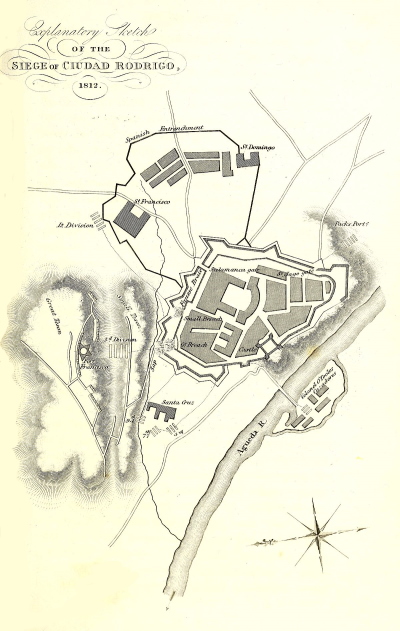
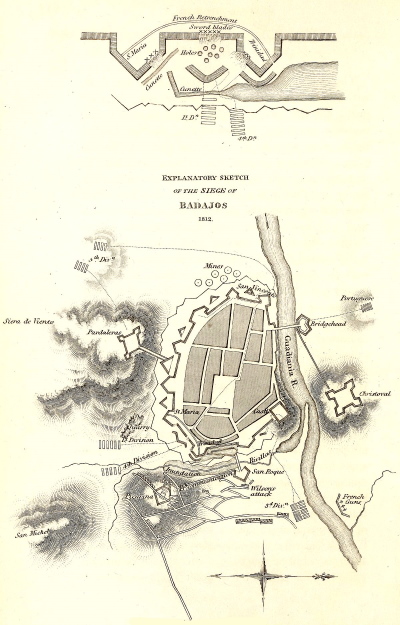
NOTICE.
In addition to the manuscript authorities used for the former
volumes, several memoirs, journals, and notes of officers employed
in the different operations have been consulted for this volume.
Amongst others, the Journal of general Harvey of the Portuguese
service, and some original papers supplied by sir Howard Douglas.
In a recent controversy, I have expressed my belief that the French
army at Albuera, instead of being more, was less numerous, than I had
represented it in my account, of that battle. The following letter, since
procured, decides the question:—
Extrait d’une lettre écrite de Seville le 4 Mai, 1811, par M. le mal duc
de Dalmatie, général-en-chef de l’armée du midi, à S. A. S. le prince de
Wagram et de Neufchatel, major-général.
Le général Latour Maubourg a été obligé de se replier sur Constantina
et Alamis, Cordove est menacée par un corps Anglais, Portugais, et
Espagnol, beaucoup de troupes se concentrent en Estramadure; Badajoz
est investie. Le général Blake a réuni sur l’Odiel une armée de quinze à
seize mille hommes, et paroit se préparer à marcher sur Seville. Le
restant du quatrième corps est en opérations contre les troupes qui out
débauché de Murcie. Si j’enumere bien, je suis en cet instant attaqué
sur divers points par plus de soixante mille hommes indépendamment de
troupes qui sont restées à Cadiz et à l’isle de Léon, et de celles qu’il y a
à Tarrifa, à Algesiras, et à Gibraltar, que je dois contenir, le danger est
pressant, je dois faire face de tous côtés assurer de nouveaux triomphes
aux armées de S. M. l’empereur, et éviter les facheux événemens, que
l’on prépare contre l’armée du midi. J’espère réussir, mais le succès sera
complet si les secours que j’attends arrivent apropos; voici mes dispositions.
Je pars dans quatre jours avec vingt mille hommes, trois mille
chevaux, et trente pièces de canon, pour rejetter au delà de la Guadiana les
corps ennemis qui se sont répandus en Estremadure, dégager Badajos et
faciliter l’arrivée du général comte d’Erlon. Si les troupes que ce général
amène peuvent se réunir avec celles que je conduirai et si les troupes qui
sont parties des armées du nord et du centre, dont j’ai en partie disposé,
arrivent à tems, j’aurai en Estremadure trente-cinq mille hommes, cinq
mille chevaux, et quarante pièces de canon de campagne; alors je livre
bataille aux ennemis quand bien même toute l’armée Angloise qui est
sur le continent y seroit réunie, et ils seront vaincus.
Si une partie des renforts que j’attends manquent je ferai avec ce que
j’aurai, tout ce que pourrai vers le but proposé.
Le général-en-chef de l’armée impériale du midi,
(Signée) Mal Duc de Dalmatie.
Pour extraits conformes.
To her grace the duchess of Abrantes.
September 11, 1833.
Madam,
In the eighth volume of your “Mémoires,” which I have only just seen,
I find the following passages:—
“Toutefois, pourquoi donc m’étonner de la conduite des Portugais?
N’ai je pas vu ici, en France, un des frères d’armes de Junot souffrir
qu’on imprimât, dans un ouvrage traduit de l’Anglais, des choses revoltantes
de fausseté sur lui et sur le maréchal Ney?...... Cet ouvrage,
fait par un colonel Napier, et qui a trouvé grâce devant le ministère de
la guerre parce qu’il dit du bien du ministre, m’a été donné à moi, à moi
la veuve de Junot, comme renfermant des documents authentiques. J’ai
du y lire une indécente attaque contre la vie privée d’un homme dont on
ne pouvait dire aucun mal comme militaire dans cette admirable affaire
de la Convention de Cintra, puisque les Anglais ont fait passer à une
commission militaire ceux qui l’avaient signée pour l’Angleterre; et les
beaux vers de Childe Harold suffisent seuls à la gloire de Junot, quand
l’original de cette convention ne serait pas là pour la prouver. Heureusement
que je le possède, moi, cet original, et même dans les deux langues.
Il n’est pas dans M. Napier;”————
It is not permitted to a man to discover ill-humour at the expressions
of a lady; yet when those expressions are dishonouring to him, and that
reputation and talents are joined to beauty to give them a wide circulation,
it would indicate insensibility to leave them unnoticed.
To judge of the talents of a general by his conduct in the field has
always been the undisputed right of every military writer. I will not
therefore enter upon that subject, because I am persuaded that your grace
could not mean to apply the words “revolting falsehoods” to a simple
judgement of the military genius of the duke of Abrantes. Indeed you
intimate that the offensive passages are those directed against his private
life, and touching the Convention of Cintra. I think, however, your
grace has not perused my work with much attention, or you would
scarcely have failed to perceive that I have given the Convention of
Cintra at length in the Appendix.
But, in truth, I have only alluded to general Junot’s private qualities
when they bore directly upon his government of Portugal, and, by a
fresh reference to my work, you will find that I have affirmed nothing
of my own knowledge. The character of the late duke of Abrantes, as
drawn by me, is that ascribed to him by the emperor Napoleon, (see
Las Cases,) and the authority of that great man is expressly quoted. It
is against Napoleon therefore, and not against me, who am but a
repeater of his uncontradicted observations, that your resentment should
be directed.
If your grace should deign to dispose of any further thought upon me
or my work, I would venture to suggest a perusal of the Portuguese,
and English, and Spanish, and German histories of the invasion of
Portugal; or even a slight examination of only a small part of the innumerable,
and some of them very celebrated periodicals which treat of
that event. You will be then convinced that, so far from having wantonly
assailed the character of general Junot, I have made no slight effort to
stem the torrent of abuse with which he has been unjustly overwhelmed;
and believe me, madam, that the estimation in which an
eminent man will be held by the world is more surely to be found in
the literature of different countries than in the fond recollection of his
own family. I admired general Junot’s daring character, and having
enough of the soldier in me to like a brave enemy, I have, wherever
the truth of history would permit, expressed that feeling towards him
and towards other French generals whose characters and whose acts have
been alike maligned by party writers in this country: such indeed has
been my regard for justice on this point, that I have thereby incurred
the charge of writing with a French rather than a national bias, as your
grace will discover by referring to my lord Mahon’s History of the War
of the Succession, in which his lordship has done me the honour to
observe that I have written “by far the best French account yet published
of the Peninsular War.”
For my own part I still think that to refrain from vulgar abuse of a
gallant enemy will not be deemed un-English, although lord Mahon
considers it wholly French; but his lordship’s observation incontestibly
proves that I have discovered no undue eagerness to malign any of the
French generals; and with respect to the duke of Abrantes, I could
shew that all the offensive passages in my work rest upon the published
authority of his own countrymen, and especially of his great master the
emperor Napoleon, and that they are of a milder expression than those
authorities would have warranted. It is, however, so natural and so
amiable in a lady to defend the reputation of her deceased husband, that
rather than appear to detract in any manner from the grace of such a
proceeding, I choose to be silent under the unmitigated severity of your
grace’s observations.
Not so, however, with respect to that part of your remarks which
relate to marshal Ney. After carefully re-examining every sentence I
have written, I am quite unable to discover the slightest grounds for
your grace’s accusations. In all parts of my work the name of Ney
is mentioned with praise. I have not, indeed, made myself a partizan
of marshal Ney in relating his disputes with marshals Soult and Massena,
because I honestly believed that he was mistaken; neither have I
attributed to him unbounded talents for the higher parts of war, but
this is only matter of opinion which the world is quite capable of
appreciating at its true value; and upon all other points I have expressed
admiration of marshal Ney’s extraordinary qualities, his matchless valour,
his heroic energy!
In the hope that your grace will now think it reasonable to soften the
asperity of your feelings towards my work, I take my leave, with more
of admiration for your generous warmth in defence of a person so dear
to you, than of any sentiment of resentment for the harsh terms which
you have employed towards myself. And I remain, madam,
Your very obedient servant,
William Napier, Colonel.
BOOK XIII. — CHAPTER I. — OPERATIONS IN THE EASTERN PROVINCES. — OPERATIONS OF THE SEVENTH CORPS.
HISTORY
OF THE
PENINSULAR WAR.
While marshal Beresford followed Soult towards1810.
Llerena lord Wellington recommenced the siege of
Badajos, but the relation of that operation must
be delayed until the transactions which occurred in
Spain, during Massena’s invasion of Portugal, have
been noticed, for it is not by following one stream
of action that a just idea of this war can be obtained.
Many of lord Wellington’s proceedings
might be called rash, and others timid, and slow,
if taken separately; yet, when viewed as parts of
a great plan for delivering the whole Peninsula,
they will be found discreet or daring, as the circumstances
warranted: nor is there any portion
of his campaigns, that requires this wide-based
consideration, more than his early sieges; which,
being instituted contrary to the rules of art, and
unsuccessful, or, when successful, attended with
a mournful slaughter, have given occasion for
questioning his great military qualities, which were
however, then most signally displayed.
In the northern provinces the events were of
little interest. Gallicia after the failure of Renovales’
expedition and the shipwreck that followed,See Vol. III p. 404.
became torpid; the junta disregarded general
Walker’s exhortations, and, although he furnished
vast supplies, the army, nominally twenty thousand
strong, mustered only six thousand in the field:
there was no cavalry, and the infantry kept closeOfficial abstract of general Walker’s despatches
in the mountains about Villa Franca, while a weak
French division occupied the rich plains of Leon.
General Mahi having refused to combine his
operations with those of the Anglo-Portuguese
army, was thought to be disaffected, and at the
desire of the British authorities had been removed
to make way for the duke of Albuquerque: he wasOfficial abstract of Mr. Wellesley’s despatches MSS.
however immediately appointed to the command of
Murcia, by Blake, in defiance of the remonstrances
of Mr. Wellesley, for Blake disregarded the English
influence.
When Albuquerque died, Gallicia fell to Castaños,
and while that officer was co-operating with
Beresford in Estremadura, Santocildes assumed
the command. Meanwhile Caffarelli’s reserve havingSee Vol. III pp. 312, 407, and 475.
joined the army of the north, Santona was fortified,
and Bessieres, as I have before observed, assembled
seven thousand men at Zamora to invade
Gallicia.
In the Asturias, Bonet, although harassed, on
the side of Potes, by the Guerillas from the mountains
of Liebana; and on the coast by the English
frigates, remained at Oviedo, and maintained his
communications by the left with the troops in Leon.
In November 1810 he defeated a considerable body
of insurgents, and in February 1811 the Spanish
general St. Pol retired before him with the regular
forces, from the Xalon to the Navia; but thisMr. Stuart’s Papers, MSS.
retreat caused such discontent in Gallicia that
St. Pol advanced again on the 19th March, and
was again driven back. Bonet then dispersed the
Partidas, and was ready to aid Bessieres’ invasion
of Gallicia; and although the arrival of the allied
forces on the Coa in pursuit of Massena stopped
that enterprise, he made an incursion along the
coast, seized the Spanish stores of English arms
and clothing, and then returned to Oviedo. The
war was, indeed, so little formidable to the French,
that in May Santander was evacuated, and all the
cavalry in Castile and Leon joined Massena for the
battle of Fuentes Onoro, and yet the Gallician
and Asturian regular armies gained no advantage
during their absence.
The Partidas, who had re-assembled after their
defeat by Bonet, were more active. Porlier, Campillo,
Longa, Amor, and Merino cut off small
French
parties in the Montaña, in the Rioja, in
Biscay, and in the Baston de Laredo; they were
not, indeed, dangerous in action, nor was it very
difficult to destroy them by combined movements,
but these combinations were hard to effect, from
the little accord amongst the French generals, and
thus they easily maintained their posts at Espinosa
de Monteres, Medina, and Villarcayo. CampilloIntercepted letter of general Barthelemy to general Drouet, 1810. MSS.
was the most powerful after Porlier. His principal
haunts were in the valleys of Mena and Caranza;
but he was in communication with Barbara, Honejas,
and Curillas, petty chiefs of Biscay, with
whom he concerted attacks upon couriers and weak
detachments: and he sometimes divided his band
into small parties, with which he overran the valleys
of Gurieso, Soba, Carrado, and Jorrando, partly
to raise contributions, partly to gather recruits,
whom he forced to join him. His chief aim was,
however, to intercept the despatches going from
Bilbao to Santander, and for this purpose he used
to infest Liendo between Ovira and Laredo, which
he was enabled the more safely to do, because
general Barthelemy, the governor of the Montaña,
was forced to watch more earnestly towards the
hilly district of Liebana, between Leon and the Asturias.
This district was Porlier’s strong-hold, and
that chief, under whom Campillo himself would at
times act, used to cross the Deba and penetrate
into the valleys of Cabuerniego, Rio Nauza, Cieza,
and Buelna, and he obliged the people to fly to
the mountains with their effects whenever the French
approached: nevertheless the mass were tired of
this guerilla system and tractable enough, except
in Liebana.
To beat Campillo once or twice would have been
sufficient to ruin him, but to ruin Porlier required
great combinations. It was necessary to seize
Espinosa, not that of Monteres, but a village in
the mountains of Liebana, from whence the valleys
all projected as from a point, and whence the
troops could consequently act towards Potes with
success. General Barthelemy proposed this plan1811.
to Drouet, then with the 9th corps on the Upper
Douro, whom he desired to co-operate from the
side of Leon, while Bonet did the same from the
side of the Asturias: but though partially adopted,
the execution was not effectually followed up, the
districts of Liebana and Santander continued to
be disturbed, and the chain of Partidas was prolonged
through Biscay and the Rioja, to Navarre.
In this last province Mina had on the 22d of1811. May.
May defeated at the Puerto de Arlaban, near Vittoria,
twelve hundred men who were escorting a
convoy of prisoners and treasure to France; his
success was complete, but alloyed by the death
of two hundred of the prisoners, unfortunately
killed during the tumult; and it was stained by
the murder of six Spanish ladies, who, for beingMr. Stuart’s Papers, MSS.
attached to French officers, were in cold blood
executed after the fight. Massena, whose baggage
was captured, was to have travelled with this
escort, but disliking the manner of the march, he
remained in Vittoria until a better opportunity, and
so escaped.
These partizan operations, combined with the
descents on the coast, the aspect of the war in
Estremadura, and the unprotected state of Castile,
which was now menaced by Santocildes, were
rendered more important by another event to be
noticed hereafter: Bessieres therefore resolved to
contract his position in the north; and first causing
Reille and Caffarelli to scour Biscay and the Rioja,
he ordered Bonet to abandon the Asturias. On
the 14th of June that general, having dismantled
the coast-batteries, sent his sick and baggage
by sea to Santander and marched into Leon, where
Santocildes, who had now increased the Gallician
field army to thirteen thousand men, was menacing
Astorga, which place the French evacuated after
blowing up some of the works. Serras and Bonet
then united on the Esla, and being supported by
three thousand men from Rio Seco, skirmished at
the Ponte de Orvigo on the 23d, but had the
worst, and general Valletaux was killed on their
side: and as lord Wellington’s operations in Estremadura
soon drew the French armies towards that
quarter Santocildes held his ground at Astorga
until August. Meanwhile two thousand French
were thrown into Santona, and general Rognet
coming, from the side of Burgos, with a division of
the young guard, made a fruitless incursion against
the Partidas of Liebana.
This system of warfare was necessarily harassing1811. June.
to the French divisions actually engaged, but it
was evident that neither the Asturias nor Gallicia
could be reckoned as good auxiliaries to lord Wellington.
Gallicia with its lordly junta, regular
army, fortified towns, rugged fastnesses, numerous
population, and constant supplies from England,
was of less weight in the contest than five thousand
Portuguese militia conducted by Trant and Wilson.
The irregular warfare was now also beginning to
produce its usual effects; the tree though grafted
in patriotism bore strange fruit. In Biscay, which
had been longest accustomed to the presence of the
invaders, the armed peasantry were often found
fighting in the ranks of the enemy, and on one
occasion did of themselves attack the boats of theAppendix, No. I. Section 1.
Amelia frigate to save French military stores!
Turning now to the other line of invasion, we shall
find the contest fiercer, indeed, and more honourable
to the Spaniards, but the result still more unfavourable
to their cause.
It will be remembered that Suchet, after the fall
of Mequinenza, was ordered to besiege Tortoza
while Macdonald marched against Taragona. Massena
was then concentrating his army for the invasion
of Portugal, and it was the emperor’s intention
that Suchet should, after taking Tortoza,
march with half of the third corps to support the
prince of Esling. But the reduction of Tortoza
proved a more tedious task than Napoleon anticipated,
and as the course of events had now given
the French armies of Catalonia and Aragon a
common object, it will be well to compare their
situation and resources with those of their adversary.
Suchet was completely master of Aragon, and
not more by the force of his arms, than by the
influence of his administration; the province was
fertile, and so tranquil in the interior, that his
magazines were all filled, and his convoys travelled
under the care of Spanish commissaries and conductors.
Mina was however in Navarre on his
rear, and he communicated on the right bank of
the Ebro with the Partidas in the mountains of
Moncayo and Albaracin; and these last were occasionally
backed by the Empecinado, Duran, and
others whose strong-holds were in the Guadalaxara,
and who from thence infested Cuença and the
vicinity of Madrid. From Albaracin, Villa Campa
continued the chain of partizan warfare and connected
it with the Valencian army, which had also
a line of operation towards Cuença. Mina, who
communicated with the English vessels in the bay
of Biscay, received his supplies from Coruña; and
the others, in like manner, corresponded with Valencia,
from whence the English consul Tupper succoured
them with arms, money, and ammunition.
Thus a line was drawn quite across the Peninsula
which it was in vain for the enemy to break, as the
retreat was secure at both ends, and the excitement
to renewed efforts constant.
On the other flank of Suchet’s position the high
valleys of the Pyrenees were swarming with small
bands, forming a link between Mina and a division
of the Catalonian army stationed about the Seu
d’Urgel, which was a fortified castle, closing the
passage leading from the plain of that name to the
Cerdaña: this division in conjunction with Rovira,
and other partizans, extended the irregular
warfare on the side of Olot and Castelfollit to the
Ampurdan; and the whole depended upon Taragona,
which itself was supported by the English
fleet in the Mediterranean. Aragon may therefore
be considered as an invested fortress, which the
Spaniards thought to reduce by famine, by assault,
and by exciting the population against the garrison;
but Suchet baffled them; he had made such
judicious arrangements that his convoys were secure
in the interior, and all the important points on
the frontier circle were fortified, and connected,
with Zaragoza, by chains of minor ports radiating
from that common centre. Lerida, Mequinenza,
and the plain of Urgel in Catalonia, the fort of
Morella in Valencia, were his; and by fortifying
Teruel and Alcanitz he had secured the chief passages
leading through the mountains to the latter
kingdom: he could thus, at will, invade either
Catalonia or Valencia, and from Mequinenza he
could, by water, transport the stores necessary to
besiege Tortoza. Nor were these advantages the
result of aught but his uncommon talents for war,
a consideration which rendered them doubly formidable.
The situation of the French in Catalonia was
different. Macdonald, who had assumed the command
at the moment when Napoleon wished him to
co-operate with Suchet, was inexperienced in the
peculiar warfare of the province, and unprepared to
execute any extended plan of operations. His
troops were about Gerona and Hostalrich, which
were in fact the bounds of the French conquest at
this period; for Barcelona was a military point
beyond their field system, and only to be maintained
by expeditions; and the country was so exhausted
of provisions in the interior, that the army
itself could only be fed by land-convoys from
France, or by such coasters as, eluding the vigilance
of the English cruizers, could reach Rosas,
St. Filieu, and Palamos. Barcelona like the horse-leech
continually cried for more, and as the inhabitants
as well as the garrison depended on the
convoys, the latter were enormous, reference being
had to the limited means of the French general,
and the difficulty of moving; for, although the
distance between Hostalrich and Barcelona was only
forty miles, the road, as far as Granollers, was a
succession of defiles, and crossed by several rivers,
of which the Congosta and the Tordera were considerable
obstacles; and the nature of the soil was
clayey and heavy, especially in the defiles of the
Trenta Pasos.
These things rendered it difficult for Macdonald
to operate in regular warfare from his base of Gerona,
and as the stores for the siege of Taragona
were to come from France, until they arrived he
could only make sudden incursions with light baggage,
trusting to the resources still to be found in
the open country, or to be gathered in the mountains
by detachments which would have to fight for
every morsel. This then was the condition of the
French armies, that starting from separate bases,
they had to operate on lines meeting at Tortoza.
It remains to shew the situation of the Catalan
general.
After the battle of Margalef, Henry O’Donnel1810. July.
reunited his scattered forces, and being of a stern
unyielding disposition, not only repressed the discontent
occasioned by that defeat, but forced the
reluctant Miguelettes to swell his ranks and to
submit to discipline. Being assisted with money
and arms by the British agents, and having free
communication by sea with Gibraltar, Cadiz, and
Minorca, he was soon enabled to reorganize his
army, to collect vast magazines at Taragona, and
to strengthen that place by new works. In July
his force again amounted to twenty-two thousand
men exclusive of the Partidas, and of the Somatenes,
who were useful to aid in a pursuit, to break
up roads, and to cut off straggling soldiers. Of
this number one division under Campo Verde, was,
as I have before said, in the higher valleys, having
a detachment at Olot, and being supported by the
fortified castles of Seu D’Urgel, Cardona, Solsona,
and Berga. A second division was on the Llobregat,
watching the garrison of Barcelona, and having
detachments in Montserrat, Igualada, and Manresa
to communicate with Campo Verde. The
third division, the reserve and the cavalry were on
the hills about Taragona, and that place and Tortoza
had large garrisons.
By this disposition, O’Donnel occupied Falcet,
the Col de Balaguer, and the Col del Alba, whichGeneral Doyle’s Correspondence, MSS.
were the passages leading to Tortoza; the Col de
Ribas and Momblanch, which commanded the roads
to Lerida; San Coloma de Queralt and Igualada,
through which his connection with Campo Verde
was maintained; and thus the two French armiesColonel Green’s do MSS.
were separated not only by the great spinal ridges
descending from the Pyrenees, but by the position
of the Spaniards, who held all the passes, and
could at will concentrate and attack either Suchet
or Macdonald. But the Catalonian system was now
also connected with Valencia, where, exclusive of
irregulars, there were about fifteen thousand men
under General Bassecour. That officer had in June
occupied Cuença, yet having many quarrels with
his officers he could do nothing, and was drivenOfficial Abstracts of Mr. Wellesley’s Despatches, MSS.
from thence by troops from Madrid: he returned to
Valencia, but the disputes continued and extended
to the junta or congress of Valencia, three membersMr. Stuart’s Papers, MSS.
of which were by the general imprisoned. Nevertheless,
as all parties were now sensible that Valencia
should be defended at Tortoza, Bassecour prepared
to march to its succour by the coast-road
where he had several fortified posts. Thus, while
Suchet and Macdonald were combining to crush
O’Donnel, the latter was combining with Bassecour,
to press upon Suchet; and there was always the
English maritime force at hand to aid the attacks or
to facilitate the escape of the Spaniards.
In the above exposition I have called the native
armies by the names of their provinces, but in
December 1810 the whole military force being
reorganized by the regency the armies were designated
by numbers. Thus the Catalonian forces,
formerly called the army of the right, was now
called the first army. The Valencians, together
with Villa Campa’s division, and the partidas of
the Empecinado and Duran, were called the second
army. The Murcian force was called the third
army. The troops at Cadiz, at Algesiras, and in
the Conde Niebla were called the fourth army.
The remnants of Romana’s old Gallician division
which had escaped the slaughter on the Gebora
formed the fifth army. The new-raised troops of
Gallicia and those of the Asturias were called the
sixth army. And the partidas of the north, that
is to say, Mina’s, Longa’s, Campillo’s, Porlier’s, and
other smaller bands formed the seventh army.
Such was the state of affairs when Napoleon’s
order to besiege Tortoza arrived. Suchet was ready
to execute it. More than fifty battering guns
selected from those at Lerida were already equipped,
and his depôts were established at Mequinenza,
Caspe, and Alcanitz. All the fortified posts were
provisioned; twelve thousand men under general
Musnier, intended for the security of Aragon,
were disposed at Huesca and other minor points
on the left bank of the Ebro, and at Daroca, Teruel,
and Calatayud on the right bank; and while these
arrangements were being executed, the troops destined
for the siege had assembled at Lerida and
Alcanitz, under generals Habert and Laval, their
provisions being drawn from the newly conquered
district of Urgel.
From Mequinenza, which was the principal depôt,
there was water-carriage, but as the Ebro was
crossed at several points by rocky bars, some of
which were only passable in full water, the communication
was too uncertain to depend upon, and
Suchet therefore set workmen to reopen an old
road thirty miles in length, which had been made
by the duke of Orleans during the war of the succession.
This road pierced the mountains on the
right bank of the Ebro, passed through Batea and
other places to Mora, and from thence by Pinel to
Tortoza, running through a celebrated defile called
indifferently the Trincheras and the Passage of
Arms. When these preliminary arrangements were
made general Habert assembled his division at
Belpuig near Lerida, and after making a feint as
if to go towards Barcelona, suddenly turned to his
right, and penetrating through the district of Garriga,
reached Garcia on the left bank of the Lower
Ebro the 5th of July. Laval at the same time
quitted Alcanitz, made a feint towards Valencia bySee plans, No. 1 & 3.
Morella, and then turning to his left, came so unexpectedly
upon Tortoza by the right bank of the
Ebro, that
he surprised some of the outposts on
the 2d, and then encamped before the bridge-head.
The 4th he extended his line to Amposta,
seized the ferry-boat of the great road from Barcelona
to Valencia, and posted Boussard’s cuirassiers,
with a battalion of infantry and six guns, at
Uldecona, on the Cenia river, to observe Bassecour’s
Valencians.
During these operations Suchet fixed his own
quarters at Mora, and as the new road was not
finished, he occupied Miravet, Pinel, and the Trincheras,
on its intended line; and having placed
flying bridges, with covering works, on the Ebro,
at Mora and Xerta, made those places his depôt
of siege. He likewise seized the craft on the river,
established posts at Rapita, near the mouth of the
Ebro, and at Amposta, and made a fruitless attempt
to burn the boat-bridge of Tortoza, with fire vessels.
Following Napoleon’s order, Macdonald should at
this time have been before Taragona; but on the
9th, Suchet learned, from a spy, that the seventh
corps was still at Gerona, and he thus found himself
exposed alone to the combined efforts of the
Catalans and Valencians. This made him repent
of having moved from Aragon so soon, yet thinking
it would be bad to retire, he resolved to blockade
Tortoza; hoping to resist both O’Donnel and
Bassecour until Macdonald could advance.
The Spaniards who knew his situation, sallied on
the right bank the 6th and 8th, and on the 10th his
outposts on the left bank were driven in at Tivisa
by a division from Falcet, which, the next day, fell
on his works at Mora, but was repulsed; and the
12th, general Paris pushed back the Spanish line,
while Habert took post in force at Tivisa, by which
he covered the roads to Xerta and Mora. O’Donoghue,
who commanded Bassecour’s advanced guard,
now menaced Morella, but general Montmarie being
detached to its succour, drove him away.
The 30th, O’Donnel having brought up fresh
troops to Falcet, made a feint with ten thousand
men against Tivisa, and then suddenly entered
Tortoza, from whence at mid-day, on the 3d of
August, he passed the bridge and fell with the
bayonet on Laval’s entrenchments. The French
gave way at first, but soon rallied, and the Spaniards
fearing for their communications regained
the town in disorder, having lost two hundred prisoners
besides killed and wounded.
This operation had been concerted with general1810. August.
Caro, who having superseded O’Donoghue, was
now marching with the Valencians by the coast-road
towards Uldecona: Suchet therefore, judging
that the intention of the Spaniards was to force
him away from the Lower Ebro, before Macdonald
could pass the Llobregat, resolved first to strike a
sudden blow at the Valencians, and then turn upon
the Catalans. In this view he contracted his quarters
on the Ebro, and united at Uldecona, on the
13th, eleven battalions with eight hundred horsemen.
Caro was then in a strong position covering
the two great routes to Valencia, but when the
French, after driving in his advanced guard from
Vinaros, came up, his Valencians would not stand
a battle, and being followed beyond Peniscola separated
and retreated in disorder by different roads.
Whereupon Suchet returned to Mora, and there
found an officer of Macdonald’s army, who brought
information that the seventh corps was at last in
the plains of Reus, and its communications with
the third corps open.
When Macdonald succeeded Augereau he found1810. June.
the troops in a state of insubordination, accustomed
to plunder, and excited to ferocity by the cruelty
of the Catalans, and by the conduct of his predecessor;Vacani.
they were without magazines or regular
subsistence, and lived by exactions: hence theVictoires et Conquêtes des François.
people, driven to desperation, were more like wild
beasts than men, and the war was repulsive to him
in all its features. It was one of shifts and devices,
and he better understood methodical movements; it
was one of plunder, and he was a severe disciplinarian;
it was full of cruelty on all sides, and he
was of a humane and just disposition. Being resolved
to introduce regular habits, Macdonald severely
rebuked the troops for their bad discipline
and cruelty, and endeavoured to soothe the Catalans,
but neither could be brought to soften in their
enmity; the mutual injuries sustained, were too
horrible and too recent to be forgiven. The soldiers,
drawn from different countries, and therefore
not bound by any common national feeling, were
irritated against a general, who made them pay for
wanton damages, and punished them for plundering;
and the Catalans attributing his conduct to
fear, because he could not entirely restrain theVacani.
violence of his men, still fled from the villages, and
still massacred his stragglers with unrelenting barbarity.
While establishing his system it was impossible
for Macdonald to take the field, because, without
magazines, no army can be kept in due discipline;
wherefore he remained about Gerona, drawing with
great labour and pains his provisions from France,
and storing up the overplus for his future operations.
On the 10th of June however the wants of
Barcelona became so serious, that leaving his baggage
under a strong guard at Gerona, and his recruits
and cavalry at Figueras, he marched with
ten thousand men and a convoy, to its relief, by
the way of the Trenta Pasos, Cardedieu, and Granollers.
The road was heavy, the defiles narrow,
the rivers swelled, and the manner of march rather
too pompous for the nature of the war, for Macdonald
took post in order of battle on each side of the
defiles, while the engineers repaired the ways:
in every thing adhered to his resolution of restoring
a sound system; but while imitating the Jugurthine
Metellus, he forgot that he had not Romans,
but a mixed and ferocious multitude under his command,
and he lost more by wasting of time, than
he gained by enforcing an irksome discipline. Thus
when he had reached Barcelona, his own provisions
were expended, his convoy furnished only a slender
supply for the city, and the next day he was forced
to return with the empty carts in all haste to Gerona,
where he resumed his former plan of action,
and demolished the forts beyond that city.
In July he collected another convoy and prepared1810. July.
to march in the same order as before, for his intent
was to form magazines in Barcelona sufficient for
that city and his own supply, during the siege of
Taragona; but meanwhile Suchet was unable to
commence the siege of Tortoza, in default of the co-operation
of the seventh corps; and Henry O’Donnel
having gained time to reorganize his army and
to re-establish his authority was now ready to interrupt
the French marshal’s march, proposing, if
he failed, to raise a fresh insurrection in the Ampurdan,
and thus give further occupation on that
side. He had transferred a part of his forces to
Caldas, Santa Coloma, and Bruñolas, taking nearly
the same positions that Blake had occupied during
the siege of Gerona; but the French detachments
soon obliged him to concentrate again behind the
defiles of the Congosta, where he hoped to stop the
passage of the convoy; Macdonald, however, entered
Hostalrich on the 16th, forced the Trenta
Pasos on the 17th, and although his troops had
only fifty rounds of ammunition he drove three
thousand men from the pass of Garriga on the 18th,
reached Barcelona that night, delivered his convoy,
and returned immediately.
The French soldiers now became sickly from the1810. August.
hardships of a march rendered oppressive by the
severity of their discipline, and many also deserted;Vacani.
yet others, who had before gone off, returned to
their colours, reinforcements arrived from France,
and the emperor’s orders to take the field were becoming
so pressing, that Macdonald, giving Baraguay
d’Hilliers the command of the Ampurdan, marched
on the 8th of August with a third convoy for Barcelona,
resolved at last to co-operate with Suchet.
Instructed by experience he however moved this
time with less formality, and having reached Barcelona
the 11th, deposited his convoy, appointed
Maurice Mathieu governor of that city, and on the
15th forced the pass of Ordal, and reached Villa
Franca with about sixteen thousand men under
arms. O’Donnel, still smarting from the affair at
Tortoza, retired before him to Taragona without
fighting, but directed Campo Verde to leave a body
of troops under general Martinez in the mountains
about Olot, and to move himself through Montserrat
to the district of Garriga, which lies between
Lerida and Tortoza; meanwhile the seventh corps
passed by Braffin and Valls into the plain of Reus,
and as we have seen opened the communication
with Suchet, but to how little purpose shall be
shewn in the next chapter.
CHAPTER II. — COMBAT OF CARDONA.
As the Spanish general knew that the French1810. August.
could at Reus find provisions for only a few days,
he withdrew his division from Falcet, and while
Campo Verde, coming into the Garriga, occupied
the passes behind them, and other troops were
placed in the defiles between Valls and Villafranca,
he held the main body of his army concentrated at
Taragona, ready to fall upon Macdonald whenever
he should move. This done, he became extremely
elated, for like all Spaniards he imagined that to
surround an enemy was the perfection of military
operations. Macdonald cared little for the vicinity
of the Catalan troops, but he had not yet formed
sufficient magazines at Barcelona to commence the
siege of Taragona, nor could he, as O’Donnel had
foreseen, procure more than a few days supply about
Reus, he therefore relinquished all idea of a siege
and proposed to aid Suchet in the operation against
Tortoza, if the latter would feed the seventh corps;
and pending Suchet’s decision he resolved to remove
to Lerida.
The 25th of August leaving seven hundred sick
men in Reus, he made a feint against the Col
de Balaguer, but soon changing his direction
marched upon Momblanch and the Col de Ribas:
his rear-guard, composed of Italian troops, being
overtaken near Alcover, offered battle at the bridge
of Goy, but this the Spaniards declined, and
they also neglected to secure the heights on each
side, which the Italians immediately turned to account
and so made their way to Pixamoxons. They
were pursued immediately, and Sarsfield coming
from the Lerida side disputed the passage of Pixamoxons;
but Macdonald, keeping the troops from
Taragona in check with a rear-guard, again sent
his Italians up the hills on the flanks while he
pushed his French troops against the front of the
enemy, and so succeeded; for the Italians quickly
carried the heights, the rear-guard was very slightly
pressed, the front was unopposed, and in two hours,
the army reached Momblanch, whence after a short
halt, it descended into the plains of Urgel.
Suchet being informed of this march came from1810. Sept.
Mora to confer with Macdonald, and they agreed
that the seventh corps should have for its subsistence
the magazines of Monzon and the plains of
Urgel, which had not yet delivered its contributions.
In return Macdonald lent the Neapolitan division to
guard Suchet’s convoys down the Ebro, and promised
that the divisions of Severoli and Souham
should cover the operations of the third corps, during
the siege of Tortoza, by drawing the attention of
the Catalan generals to the side of Cardona.
The seventh corps was now quartered aboutVacani.
Tarega, Cervera, Guisona, and Agramunt, and
Severola was detached with four thousand men
over the Segre to enforce the requisitions about
Talarn. He drove four hundred Swiss from the
bridge of Tremp, and executed his mission, but
with such violence that the people, becoming furious,
assassinated the stragglers, and laid so many
successful schemes of murder, that Macdonald was
forced reluctantly to renew the executions and
burnings of his predecessors. Indeed, to feed an
army forcibly when all things are paid for, will, in
a poor and mountainous country, create soreness,
because the things taken cannot easily be replaced;
but with requisitions severity is absolutely necessary.
In rich plains the inhabitants can afford to
supply the troops and will do so, to avoid being
plundered; but mountaineers having scarcely any
thing besides food, and little of that, are immediately
rendered desperate and must be treated as
enemies or left in quiet.
While Severoli was ravaging Tremp and Talarn,
general Eugenio marched with another Italian detachment
towards Castelfollit, which had a French
garrison, and Macdonald removed his own quarters
to Cervera. Meanwhile O’Donnel, having replaced
his division at Falcet to observe Suchet, distributed
his other forces on the line of communication
through San Coloma de Querault, Igualada, Montserrat,
and Cardona; he thus cut off all connection
between Macdonald and the Ampurdan, and enabled
Campo Verde closely to follow the operations
of the seventh corps, and that general seeing the
French army separated, fell first upon the head-quarters
at Cervera, but being unsuccessful, marched
against Eugenio, and was by him also repulsed
near Castelfollit. Eugenio, distinguished alike
by his valour and ferocity, then returned with his
booty to Agramunt, and afterwards invading Pons,
spoiled and ravaged all that district without hindrance.
The provisions obtained, were heaped up
in Lerida and Balaguer; but while Macdonald was
thus acting in the plain of Urgel, O’Donnel formed
and executed the most skilful plan which had yet
graced the Spanish arms.
We have seen that Baraguay d’Hilliers was left
with eighteen or twenty thousand men in the Ampurdan,
but these troops were necessarily scattered:
seven hundred were at Palamos, San Filieu,
and other small ports along the coast; twelve hundred,
under general Swartz, were quartered in
Abispal, one short march from Gerona, and two
hundred were at Calonjé, connecting Abispal with
Palamos; the rest were in Figueras, Rosas, Olot,
Castelfollit, Gerona, and Hostalrich, and several
thousand were in hospital. O’Donnel having exact
knowledge of all this, left a small garrison in Taragona,
placed the baron d’Errolles at Montserrat, colonel
Georget at Igualada, and Obispo at Martorel,
while with six thousand infantry and four hundred
cavalry he marched himself through the mountains,
by San Culgat to Mattaro on the sea-coast: then
crossing the Tordera below Hostalrich, he moved
rapidly by Vidreras to Llagostera which he reached
the 12th of September. His arrival was unknown
to Macdonald, or Maurice Mathieu, or Baraguay
d’Hilliers, for though many reports of his intentions
were afloat, most of them spread by himself, no
person divined his real object: by some he was said
to be gone against a French corps, which, from the
side of Navarre, had entered the Cerdaña; by others
that he was concentrating at Manresa, and many
concluded that he was still in Taragona.
Having thus happily attained his first object,
O’Donnel proceeded in his plan with a vigour of
execution equal to the conception. Leaving Campo
Verde with a reserve in the valley of Aro, he sent
detachments to fall on Calonjé and the posts along
the coast, the operations there being seconded by
two English frigates; and while this was in progress,
O’Donnel himself on the 14th marched
violently down from Casa de Silva upon Abispal.
Swartz, always unfortunate, had his infantry and
some cavalry under arms in an entrenched camp,
and accepted battle; but after losing two hundred
men and seeing no retreat, yielded, and all the
French troops along the coast were likewise forced
to surrender. The prisoners and spoil were immediately
embarked on board the English vessels and
sent to Taragona.
Until this moment Baraguay d’Hilliers was quite1810. October.
ignorant of O’Donnel’s arrival, and the whole Ampurdan
was thrown into confusion; for the Somatenes,
rising in all parts, cut off the communications
with Macdonald, whose posts on the side of
Calaf and Cervera were at the same time harassed
by Errolles and Obispo: nevertheless, although a
rumour of Swartz’s disaster reached him, Macdonald
would not credit it, and continued in the
plain of Urgel. Baraguay d’Hilliers was therefore
unable to do more than protect his own convoys
from France, and would have been in a dangerous
position if O’Donnel’s activity had continued; but
that general having been severely wounded, the
Spanish efforts relaxed, and Napoleon, whose eyes
were every where, sent general Conroux, in the
latter end of October, with a convoy and reinforcement
of troops from Perpignan to Gerona.
O’Donnel, troubled by his wound, then embarked;
and Campo Verde, who succeeded to the command,
immediately sent a part of the army to
Taragona, left Rovira, and Claros, and Manso, to
nourish the insurrection in the Ampurdan, and
took post himself at Manresa, from thence he at
first menaced Macdonald’s posts at Calaf; but
his real object was to break up that road,
which he effected, and then passed suddenly
through Berga and Cardona to Puigcerda, and
drove the French detachment, which had come from
Navarre to ravage the fertile district of Cerdaña,
under the guns of Fort Louis.
This excursion attracted Macdonald’s attention,
he was now fully apprized of Swartz’s misfortune,
and he hoped to repair it by crushing Campo Verde,
taking Cardona, and dispersing the local junta of
Upper Catalonia, which had assembled in Solsona;
wherefore, on the 18th, he put his troops in motion,
and the 19th, passing the mountains of Portellas,
entered Solsona; but the junta and the inhabitants
escaped to Cardona and Berja, and up the valleys
of Oleana and Urgel. Macdonald immediately
sent columns in all directions to collect provisions
and to chase the Spanish detachments, and this
obliged Campo Verde to abandon the Cerdaña,
which was immediately foraged by the troops from
Fort Louis. It only remained to sieze Cardona,
and on the 21st the French marched against that
place; but Campo Verde, by a rapid movement,
arrived before them, and was in order of battle
with a considerable force when Macdonald came up.
This town stands at the foot of a rugged hill,
which is joined by a hog’s-back ridge to the great
mountain spine, dividing Eastern from Western Catalonia.
The Cardona river washed the walls, a
castle of strength crowned the height above, and
though the works of the place were weak, the
Spanish army, covering all the side of the hill
between the town and the castle, presented such
an imposing spectacle, that the French general
resolved to avoid a serious action. But the French
and Italians marched in separate columns, and the
latter under Eugenio, who arrived first, attacked
contrary to orders; yet he soon found his hands too
full, and thus, against his will, Macdonald was
obliged also to engage to bring Eugenio off. Yet
neither was he able to resist Campo Verde, who
drove all down the mountain, and followed them
briskly as they retreated to Solsona.
Macdonald lost many men in this fight, and on
the 26th returned to Guisona. It was now more
than two months since he had left the Ampurdan,
and during that time he had struck no useful blow
against the Spaniards, nor had he, in any serious
manner, aided Suchet’s operations; for the Catalans
continually harassed that general’s convoys, from
the left of the Ebro, while the seventh corps, besides
suffering severely from assassinations, had been
repulsed at Cardona, had excited the people of the
plain of Urgel to a state of rabid insurrection, and
had lost its own communications with the Ampurdan.
In that district the brigade of Swartz had
been destroyed, the ports of Filieu and Palamos
taken, and the Catalans were every where become
more powerful and elated than before: Barcelona also
was again in distress, and a convoy from Perpignan
destined for its relief dared not pass Hostalrich.
Macdonald therefore resolved to return to Gerona
by the road of Manreza, Moya, and Granollers,
and having communicated his intention to Suchet,
and placed his baggage in Lerida, commenced his
march the 4th of November.
Campo Verde getting intelligence of this design,1810. Nov.
took post to fight near Calaf, yet when the French
approached, his heart failed, and he permitted
them to pass. The French general therefore reached
Manreza the 7th, and immediately despatched parties
towards Vich and other places to mislead the
Spaniards, while with his main body he marched
by Moya and the Gariga pass to Granollers, where
he expected to meet Baraguay d’Hilliers with the
convoy from Barcelona; but being disappointed in
this, he returned by the Trenta Pasos to Gerona
the 10th, and sent his convalescents to Figueras.
The vicinity of Gerona was now quite exhausted,1810. Dec.
and fresh convoys from France were required to
feed the troops, while the posts in the Ampurdan
were re-established and the district reorganized.
Macdonald’s muster-rolls presented a force of fifty-one
thousand men, of which ten thousand were in
hospital, six thousand in Barcelona, and several
thousand distributed along the coast and on the
lines of communication, leaving somewhat more
than thirty thousand disposable for field-operations.
Of this number, fourteen thousand were placed
under Baraguay d’Hilliers to maintain the Ampurdan,
and when the convoys arrived from France
the French marshal marched, with the remaining
sixteen thousand, for the fourth time, to the succour
of Barcelona. His divisions were commanded by
Souham and Pino, for Severoli had been recalled
to Italy to organize fresh reinforcements; but
following his former plan, this march also was
made in one solid body, and as the defiles had
been cut up by the Spaniards, and the bridge over
the Tordera broken, Macdonald set his troops to
labour, and in six hours opened fresh ways over
the hills on the right and left of the Trenta Pasos,
and so, without opposition, reached the more open
country about Granollers and Moncada. The
Spaniards then retired by their own left to Tarasa
and Caldas, but Macdonald continued to move
on in a solid body upon Barcelona; for as he was
resolved not to expose himself to a dangerous
attack, so he avoided all enterprise. Thus, on
the 23d, he would not permit Pino to improve a
favourable opportunity of crushing the CatalansVacani.
in his front, and on the 24th, after delivering his
convoy and sending the carts back to Belgarde,
instead of pursuing Campo Verde to Tarasa, as
all the generals advised, he marched towards the
Llobregat; and as Souham and Pino remained
discontented at Barcelona, their divisions were
given to Frere and Fontanes.
Macdonald moved, on the 27th, towards Taragona,
but without any design to undertake the siege;
for though the road by Ordal and Villa Franca was
broad and good, he carried no artillery or wheel-carriages:
the Spaniards, seeing this, judged he
would again go to Lerida, and posted their main
body about Montserrat and Igualada; but he disregarded
them, and after beating Sarsfield from
Arbos and Vendril, turned towards the pass of
Massarbones, which leads through the range of
hills separating Villa Franca from the district of
Valls. The Catalans had broken up both that
and the pass of Christina leading to the Gaya, yet
the French general again made new ways, and on
the 30th spread his troops over the Paneda or plain
of Taragona: thus shewing of how little use it is
to destroy roads as a defence, unless men are also
prepared to fight.
Instead of occupying Reus as before, Macdonald1811. Jan.
now took a position about Momblanch, having his
rear towards Lerida, but leaving all the passes
leading from Taragona to the Ebro open for the
Spaniards; so that Suchet derived no benefit from
the presence of the seventh corps, nor could the
latter feed itself, nor yet in any manner hinder the
Catalans from succouring Tortoza. For Campo
Verde, coming from Montserrat and Igualada, was
encamped above the defiles between the French
position and Taragona, principally at Lilla, on
the road from Valls; and O’Donnel, who still directed
the general movements, although his wound
would not suffer him to appear in the field, sent
parties into the Gariga behind Macdonald’s right
flank to interrupt his foraging parties, and to harass
Suchet’s communications by the Ebro.
From the strong heights at Lilla, the Catalans
defied the French soldiers, calling upon them to
come up and fight, and they would have done so
if Macdonald would have suffered them, but after
ten days of inactivity he divided his troops into
many columns, and in concert with Abbé’s brigade
of the third corps, which marched from Xerta,
endeavoured to inclose and destroy the detachments
in the Gariga; the Spaniards however disappeared
in the mountains and the French army only gained
some mules and four thousand sheep and oxen.
With this spoil they united again on the left bank
of the Ebro, and were immediately disposed on a
line extending from Vinebre, which is opposite to
Flix, to Masos, which is opposite to Mora, and from
thence to Garcia and Gniestar. Suchet was thus
enabled to concentrate his troops about Tortoza
and the siege of that place was immediately commenced.
The operations of the third corps during the
five months it had been dependent upon the slow
movements of the seventh corps shall now be
related.
Suchet, by resigning the plain of Urgel and the1810. Sept.
magazines at Monzon, for Macdonald’s subsistence,
in September, had deprived himself of all the
resources of the left bank of the Ebro from Mequinenza
to Tortoza, and the country about the
latter place was barren; hence he was obliged to
send for his provisions to Zaragoza, Teruel, and
other places more than one hundred miles from his
camp; and meanwhile the difficulty of getting his
battering train and ammunition down the river from
Mequinenza was increased because of the numerous
bars and weirs which impeded the navigation
when the waters were low: moreover Macdonald,
by going to Cardona, exposed the convoys to
attacks from the left bank, by the Spanish troops
which being stationed between Taragona, Momblanch,
and Falcet, were always on the watch.
Considering these things Suchet had, while the
seventh corps was yet at Lerida, and the waters
accidentally high, employed the Neapolitan brigade
of the seventh corps to escort twenty-six pieces
of artillery down the river. This convoy reached
Xerta the 5th of September, and the Neapolitans
were then sent to Guardia; general Habert was
placed at Tivisa; Mas de Mora was occupied by
a reserve, and the Spaniards again took post at
Falcet. At this time general Laval died, and his
division was given to general Harispe, a person
distinguished throughout the war by his ability,
courage, and humanity.
Meanwhile the Valencian army had again concentrated
to disturb the blockade of Tortoza, wherefore
Suchet strengthened Boussard’s detachment at
Uldecona, and gave the command to general Musnier,
who was replaced at Zaragoza by general
Paris. At the same time colonel Kliski was sent
to command the detachments on the side of Montalvan,
Teruel, Daroca, and Calatayud, where a
partizan warfare was continued with undiminished
activity by Villa Campa, who had contrived to open
secret communications, and to excite some commotions
even in Zaragoza. On the 7th of August he
had beaten a French foraging detachment near
Cuevas, and recaptured six thousand sheep, and at
Andorra had taken both convoy and escort. On the
side of Navarre also, Mina coming down into the
Cinco Villas destroyed some detachments, and impeded
the foraging parties. Thus the third corps
also began to suffer privations, and no progress was
made towards the conquest of Catalonia.
In September, however, Villa Campa, having
increased his forces, advanced so near Suchet that
general Habert attacked and drove him over the
frontier in dispersion, and recaptured all the sheep
before lost, and Suchet then brought down the
remainder of the battering train, and the stores
for the siege; but as the waters of the Ebro were
low, the new road was used for the convoys, which
thus came slowly and with many interruptions and
considerable loss; especially on the 17th of September,
when a whole Neapolitan battalion suffered
itself to be taken without firing a shot.
In this manner affairs dragged on until the 28th1810. Oct.
of October; but then Macdonald (O’Donnel having
meantime captured Swartz and raised the Ampurdan)
returned to Gerona, whereby Suchet’s hopes
of commencing the siege were again baffled. And,
as it was at this moment that the assembling of the
Cortez gave a new vigour to the resistance in Spain
and the regency’s plan of sending secret juntas, to
organize and regulate the proceedings of the partidas,
was put in execution, the activity of those
bands became proportioned to the hopes excited,
and the supplies and promises thus conveyed to
them. One of those secret juntas composed of
clergy and military men having property or influence
in Aragon, endeavoured to renew the insurrection
formerly excited by Blake in that province,
and for this purpose sent their emissaries
into all quarters, and combined their operations
with Mina. They, also, diligently followed a plan
of secretly drawing off the provisions from Aragon,
with a view to starve the French, and general Carbajal,
one of the junta, joining Villa Campa,
assumed the supreme command on that side; while
captain Codrington, at the desire of Bassecour,
carried a Valencian detachment by sea to Peniscola
to fall on the left flank of Suchet, if he should
attempt to penetrate by the coast-road to Valencia.
Thus, at the moment when Macdonald returned
to the Ampurdan, the Aragonese became unquiet,
the partidas from Navarre and the district of
Montalvan and Calatayud, closed in on Suchet’s
communications, the Valencians came up on the
one side, towards Uldecona, and on the other Garcia
Navarro moving from Taragona with a division
again assumed the position of Falcet.
To check this tide of hostility the French general1810. Nov.
resolved first to crush the insurrection project, and
for this purpose detached seven battalions and four
hundred cavalry against Carbajal. Chlopiski, who
commanded them, defeated the Spaniards the 31st
at Alventoza on the route to Valencia, taking some
guns and ammunition. Nevertheless Villa Campa
rallied his men in a few days on the mountain of
Fuente Santa, where he was joined by Carbajal,
and having received fresh succours renewed the
project of raising the Aragonese. But Chlopiski
again defeated him the 12th of November, and the
Spaniards fled in confusion towards the river Libras,
where the bridge breaking many were drowned.
The French lost more than a hundred men in this
sharp attack, and Chlopiski then returned to the
blockade, leaving Kliski with twelve hundred men
to watch Villa Campa’s further movements.
The Ebro having now risen sufficiently, the remainder
of the battering train and stores were embarked
at Mequinenza, and on the 3d dropt down
the stream; but the craft outstripped the escort,
and the convoy being assailed from the left bank,
lost two boats; the others grounded on the right
bank, and were there defended by the cannoneers,
until the escort came up on the one side, and on
the other, general Abbé, who had been sent from
Guardia to their succour. The waters, however,
suddenly subsided, and the convoy was still in
danger until Suchet reinforced Abbé, who was
thus enabled to keep the Spaniards at bay, while
Habert, with fifteen hundred men, made a diversion
by attacking the camp at Falcet. On the 7th
the waters again rose and the boats with little loss
reached Xerta on the 9th, and thus all things were
ready to commence the siege, but the seventh corps
still kept aloof.
Suchet was now exceedingly perplexed; for the
provisions he had with so much pains collected,
from the most distant parts of Aragon, were rapidly
wasting; forage was every day becoming scarcer,
and the plain of Urgel, was by agreement given
over to the seventh corps, which thus became a
burthen instead of an aid to the third corps. The
latter had been, since the beginning of the year,
ordered to supply itself entirely from the resources
of Aragon without any help from France; and the
difficulty of so doing may be judged of by the fact,
that in six months they had consumed above a hundred
and twenty thousand sheep and twelve hundred
bullocks.
To obviate the
embarrassments thus accumulating,
the French general called the notables and heads of
the clergy in Aragon to his head-quarters, and with
their assistance reorganized the whole system of
internal administration, in such a manner, that,
giving his confidence to the natives, removing many
absurd restrictions of their industry and trade, and
leaving the municipal power and police entirely in
their hands, he drew forth the resources of the
provinces in greater abundance than before. And
yet with less discontent, being well served and
obeyed, both in matters of administration and police,
by the Aragonese, whose feelings he was
careful to soothe, shewing himself in all things,
an able governor, as well as a great commander.
Macdonald was now in march from Barcelona
towards Taragona, and Suchet to aid this operation
attacked the Spanish troops at Falcet. General
Habert fell on their camp in front the 19th, and to
cut off the retreat, two detachments were ordered
to turn it by the right and left; but Habert’s
assault was so brisk, that before the flanking corps
could take their stations the Catalans fled, leaving
their general Garcia Navarro and three hundred
men in the hands of the victors. But while Suchet
obtained this success on the side of Falcet, the
Valencian general Bassecour, thinking that the
main body of the French would be detained by
Navarro on the left bank of the Ebro, formed the
design of surprising general Musnier at Uldecona.
To aid this operation, a flotilla from the harbour
of Peniscola, attacked Rapita, and other small
posts occupied by the French, on the coast between
the Cenia and the Ebro; and at the same
time the governor of Tortoza menaced Amposta
and the stations at the mouth of the Ebro.
Bassecour moved against Uldecona in three
columns, one of which, following the coast-road
towards Alcanar, turned the French left, while
another passing behind the mountains took post at
Las Ventallas, in rear of Musnier’s position, to cut
him off from Tortoza. The main body went straight
against his front, and in the night of the 26th the
Spanish cavalry fell upon the French camp outside
the town; but the guards, undismayed, opened a
fire which checked the attack, until the troops came
out of the town and formed in order of battle.
At daylight the Spanish army was perceived
covering the hills in front; and those in rear also,
for the detachment at Ventallas was in sight; the
French were thus surrounded and the action immediatelySuchet’s Memoirs.
commenced; but the Valencians were
defeated with the loss of sixteen hundred men, and
the detachment in the rear seeing the result made
off to the mountains again. Bassecour then withdrew
in some order behind the Cenia, where in the
night Musnier surprised him, and at the same
time sent the cuirassiers by the route of Vinaros to
cut off his retreat, which was made with such
haste and disorder that the French cavalry fallingOfficial Abstract of Mr. Wellesley’s Despatch. MSS.
in with the fugitives near Benicarlo, killed or took
nine hundred. Bassecour saved himself in Peniscola,
and thither also the flotilla, having failed at
Rapita, returned.
Suchet having thus cleared his rear, sent his
prisoners to France by Jaca, and directed a convoy
of
provisions, newly collected at Mequinenza, to fall
down the Ebro to the magazines at Mora: fearing
however that the current might again carry the
boats faster than the escort, he directed the latter
to proceed first, and sent general Abbé to Flix to
meet the vessels. The Spaniards in the Garriga
observing this disposition, placed an ambuscade
near Mequinenza, and attacked the craft before
they could come up with the escort; the boats were
then run ashore on the right side, and seventy men
from Mequinenza came down the left bank to their
aid, which saved the convoy, but the succouring
detachment was cut to pieces. Soon after this the
seventh corps having scoured the Garriga took post
on the left bank of the Ebro, and enabled the third
corps to commence the long delayed siege.
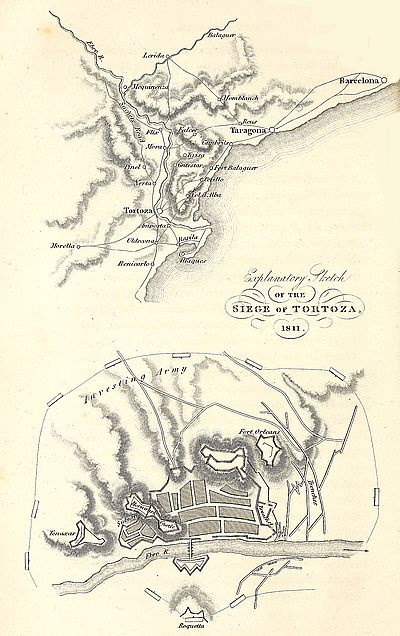
CHAPTER III. — SIEGE OF TORTOZA.
Tortoza, with a population of ten thousand1810. Dec.
souls and a garrison of from eight to nine thousand
regular troops, was justly considered the principal
bulwark of both Catalonia and Valencia, but it was
under the command of general Lilli, Conde d’Alacha,
a feeble man, whose only claim was, that he
had shewn less incapacity than others before the
battle of Tudela in 1808. However, so confident
were the Spaniards in the strength of the place
that the French attack was considerably advanced
ere any interruption was contemplated, and had
any well considered project for its relief been
framed, it could not have been executed, because
jealousy and discord raged amongst the Spanish
chiefs. Campo Verde was anxious to succeed
O’Donnel in command of the Catalonian army,
Bassecourt held unceasing dispute with his own
officers, and with the members of the junta or
congress of Valencia; and Villa Campa repelled
the interference both of Carbajal and Bassecour.
At this critical time therefore every thing was
stagnant, except the English vessels which blockaded
Rosas, Barcelona, and the mouths of the
Ebro, or from certain head-lands observed and
pounced upon the enemy’s convoys creeping
along from port to port: they had thrown provisions,
ammunition, and stores of all kinds into
Taragona and Tortoza, and were generally successful,
yet at times met with disasters. Thus captain
Rogers of the Kent, having with him the Ajax,
Cambrian, Sparrow-hawk, and Minstrel, disembarked
six hundred men and two field-pieces under
captain Fane at Palamos, where they destroyed a
convoy intended for Barcelona; but as the seamen
were re-embarking in a disorderly manner, the
French fell upon them and took or killed two hundred,
captain Fane being amongst the prisoners.
The Catalan army was thirty thousand strong,Official Abstract of Mr. Wellesley’s despatches MSS.
including garrisons, and in a better state than it
had hitherto been; the Valencians, although discouraged
by the defeat at Uldecona, were still
numerous, and all things tended to confirm the
Spaniards in the confident expectation that whether
succoured or unsuccoured the place would not fall.
But O’Donnel, who had been created Conde de’
Bispal was so disabled by wounds, that he resigned
the command soon after the siege commenced, and
Campo Verde was by the voice of the people raised
in his stead; for it was their nature always to
believe that the man who made most noise was the
fittest person to head them, and in this instance,
as in most others, they were greatly mistaken.
Tortoza, situated on the left of the Ebro, communicatedVacani.
with the right bank by a bridge of boats,
which was the only Spanish bridge on that river,Rogniat.
from Zaragoza to the sea; and below and above
the place there was a plain, but so narrowed bySuchet.
the juttings of the mountains at the point where
the town was built, that while part of the houses
stood close to the water on flat ground, the other
part stood on the bluff rocky points shot from the
hills above; and thus appeared to tie the mountains,
the river, and the plains together.
Five of these shoots were taken into the defence,
either by the ramparts or by outworks. That on
the south of the town was crowned by the fort of
Orleans, and on the north another was occupied
by a fort called the Tenaxas. To the east a horn-work
was raised on a third shoot, which being
prolonged, and rising suddenly again between the
suburbs and the city, furnished the site of a castle
or citadel: the other two, and the deep ravines
between them were defended by the ramparts of
the place, which were extremely irregular, and
strong from their situation, rather than their construction.
There were four fronts.
1º. The northern defending the suburb. Although
this front was built on the plain, it was so imbedded
between the Ebro, the horn-work, the citadel, and
the Tenaxas, that it could not even be approached
without first taking the latter fort.
2º. The eastern. Extending from the horn-work
to the bastion of San Pico. Here the deep ravines
and the rocky nature of the ground, which was
also overlooked by the citadel and flanked by the
horn-work, rendered any attack very difficult.
3º. The south eastern. From the bastion of San
Pico to the bastion of Santa Cruz. This front, protected
by a deep narrow ravine, was again covered
by the fort of Orleans, which was itself covered by
a second ravine.
4º. The southern. From the Santa Cruz to the
Ebro. The ground of approach here was flat, the
soil easy to work in, and the fort of Orleans not
sufficiently advanced to flank it with any dangerous
effect; wherefore against this front Suchet resolved
to conduct his attack.
The Rocquetta, a rising ground opposite the
bridge-head on the right bank of the Ebro, was
fortified and occupied by three regiments, but the
other troops were collected at Xerta; and the 15th,
before day-break, Suchet crossed the Ebro by his
own bridge at that point, with eight battalions,
the sappers, and two squadrons of hussars. He
marched between the mountains and the river upon
the fort of Tenaxas, while general Habert, with
two regiments and three hundred hussars, moved
from the side of Perillo, and attacked a detachment
of the garrison which was encamped on the
Col d’Alba eastward of the city. When Suchet’s
column arrived in sight of the works, the head
took ground, but the rear, under general Harispe,
filed off to the left, across the rugged shoots from
the hills, and swept round the place, leaving in
every ravine and on every ridge a detachment, until
the half circle ended on the Ebro, below Tortoza.
The investment was then perfected on the left bankSuchet.
by the troops from Rocquetta; and during this
movement Habert, having seized the Col d’Alba,
entered the line of investment, driving before himOfficial extract of Mr. Wellesley’s despatches MSS.
six hundred men, who hardly escaped being cut off
from the place by the march of Harispe. The
communication across the water was then established
by three, and afterwards by four flying bridges,
placed above and below the town; a matter of some
difficulty and importance, because all the artillery
and stores had to come from Rocquetta, across the
water, which was there two hundred yards wide,
and in certain winds very rough.
The camps of investment were now secured, and
meanwhile Macdonald, sending the greatest part of
his cavalry, for which he could find no forage, back
to Lerida by the road of Lardecans, marched, from Mas
de Mora, across the hills to Perillo, to cover the siege.
His patroles discovered a Spanish division in a position
resting upon the fort of Felipe de Balaguer,
yet he would not attack them, and thinking he
could not remain for want of provisions, returned
on the 19th to Gniestar; but this retrograde movement
was like to have exposed the investing troops
to a disaster, for as the seventh corps retired, a
second Spanish division coming from Reus reinforced
the first. However, Macdonald, seeing this,
placed Frere’s division of six thousand infantry and
a regiment of cavalry at Suchet’s disposal, on condition
that the latter should feed them, which he
could well do. These troops were immediately
stationed behind the investing force, on the road of
Amposta, by which the Spaniards from Taragona
could most easily approach; and the remainder of
the seventh corps encamped at Gniestar, a strong
position covering the siege on the side of Falcet,
only fifteen miles distant from Tortoza. In this
situation it could be more easily fed from Lerida,
and could with greater facility send detachments
up the Ebro, to protect the convoy of the third
corps coming from Mequinenza.
The Catalan army was now divided, part beingWimphen’s Memoir.
kept on the Llobregat, under general Caro, part
under general Yranzo at Momblanch, and part,
under Campo Verde, on the hills watching Frere’s
covering division. O’Donnel had before directed
two convoys upon Tortoza, but the rapidity with
which the investment had been effected prevented
them from entering the place; and while he was
endeavouring to arrange with Bassecour and Campo
Verde a general plan of succour, his wounds forced
him to embark for Valencia, when the command,
of right, belonged to Yranzo, but the people, as
I have before said, insisted upon having Campo
Verde.
The half bastion of San Pedro, which was situated
in the plain, and close to the river, was the
first object of the French attack, and to prevent
the fire of Fort Orleans from incommoding the
trenches, the line of approach was traced in a
slanting direction, refusing the right, and pushing
forward the left; and to protect its flanks on the
one side, Fort Orleans was masked by a false
attack, while, on the other side of the Ebro,
trenches were opened against the bridge-head, and
brought down close to the water.
The 19th the posts of the besieged were all driven
in, and an unfinished Spanish work, commenced
on the heights in advance of Fort Orleans, was taken
possession of. In the night, a flying sap was commenced
upon an extent of three hundred and sixty
yards, and at a distance of only one hundred and
sixty from the fort; but in the following night, the
true attack was undertaken in the plain, during a
storm of wind which, together with the negligence
of the Spaniards, who had placed no guards in
front of their covered way, enabled the besiegers to
begin this work at only one hundred and fifty yards
from the half bastion of San Pedro. This parallel
was above five hundred yards long, extending from
the false attack against Fort Orleans, down to the
bank of the river; two communications were also
begun, and on the left bank ground was broken
against the bridge-head.
The 21st, at day-break, the Spaniards, perceiving
the works, commenced a heavy fire, and soon after
made a sally; but they were overwhelmed by musketry
from the false attack of Fort Orleans, and
from the trenches on the right bank of the Ebro.
In the night of the 21st, the communication in
the plain was extended to fourteen hundred yards,
nine batteries were commenced, and bags of earth
were placed along the edge of the trenches, whence
chosen men shot down the Spanish artillery-men.
On the 23rd, a night sally, made from the bridge-head,
was repulsed; and on the 24th, the second
parallel of the true attack was commenced.
In the night of the 25th, at eleven o’clock and at
one o’clock, separate sallies were again made, but
both were repulsed, and the works were advanced
to within twenty-five yards of the pallisades; a
tenth battery was also commenced, and when day
broke the Spanish gunners quailed under the aim
of the chosen marksmen.
In the night of the 26th, the besieged fell upon
the head of the sap, which they overturned, and
killed the sappers, but were finally repulsed by the
reserve, and the approach was immediately pushed
forward to the place of arms. Thus, on the seventh
night of open trenches, the besiegers were lodged
in the covered way, before a shot had been fired
from either breaching or counter-batteries; a remarkable
instance of activity and boldness, and a
signal proof that the defence was ill-conducted.
The night of the 27th, the works were enlarged
as much as the fire of the place which was untouched
would permit; but the Spaniards seeing
the besiegers’ batteries ready to open, made a general
sally through the eastern gates, against the false
attack at Fort Orleans; and through the southern
gates against the works in the plain. General
Habert drove them back with slaughter from the
former point, but at the latter they beat the French
from the covered way, and arriving at the second
parallel, burnt the gabions and did much damage
ere the reserves could repulse them.
The night of the 28th, the batteries were armed
with forty-five pieces, of which seventeen were
placed on the right bank, to take the Spanish works
at the main attack in reverse and to break the
bridge. At day-break all these guns opened, and
with success, against the demi-bastion, on the left
bank of the river; but the fire from the castle,
the bridge-head, the horn-work, and the quay, overpowered
the French guns on the right bank, and
although the bridge was injured, it was not rendered
impassable.
On the 30th, the Spanish fire was in turn overpowered
by the besiegers, the bridge was then
broken, and in the following night an attempt was
made to pass the ditch at the true attack; but two
guns which were still untouched and flanked the
point of attack, defeated this effort.
In the morning of the 31st, the Spaniards abandoned
the bridge-head, and the French batteries on
the right bank dismounted the two guns which had
defended the half bastion of San Pedro. The
besiegers then effected the passage of the ditch
without difficulty, and attached the miner to the
scarp.
In the night of the 31st, the miner worked into
the wall, and the batteries opened a breach in the
curtain, where a lodgement was established in
preparation for an assault. At ten o’clock in the
morning the besieged, alarmed at the progress of
the attack, displayed the white flag. The negotiations
for a surrender were, however, prolonged
until evening by the governor, without any result,
and the miner resumed his work in the night.
At seven o’clock on the 1st of January, two1811. January.
practicable breaches besides that in the curtain
were opened by the artillery, and the mine was
ready to explode, when three white flags were seen
to wave from different parts of the fortress; nevertheless
the disposition of the garrison was mistrusted,
and Suchet demanded as a preliminary the
immediate possession of one of the forts,—a necessary
precaution, for disputes arose amongst the besieged,
and general Lilli intimated to Suchet, that his own
authority was scarcely recognised.
In this critical moment, the French general gave
proof that his talents were not those of a mere soldier,
for suddenly riding up to the gates with a
considerable staff, and escorted only by a company
of grenadiers, he informed the Spanish officer on
guard, that hostilities had ceased, and then, leaving
his grenadiers on the spot, desired to be conducted
to the governor who was in the citadel. Lilli still
wavering, was upon the point of renewing the defence,
in compliance with the desires of the officers
about him, when the French general thus came
suddenly into his presence, and, although the appearance
of the Spanish guards was threatening,
assumed an imperious tone, spoke largely of the
impatience of the French army, and even menaced
the garrison with military execution if any further
delay occurred; during this extraordinary scene
general Habert brought in the grenadiers from the
gate, and the governor then signing a short capitulation,
gave over the citadel to the French.
When this event was known in the city, the Spanish
troops assembled, and Alacha, in the presence
of Suchet ordered them to lay down their arms.
Four hundred French and about fourteen hundred
Spaniards had fallen during the siege; and many
thousand prisoners, nine standards, one hundred
pieces of artillery, ten thousand muskets, and immense
magazines, enhanced the value of the conquest,
which by some was attributed to general
Lilli’s treachery, by others to his imbecility, and
it would seem that there was reason for both
charges.
The fall of Tortoza, besides opening the western
passage into Catalonia, and cutting off the communication
between that province and Valencia,
reduced the Spanish army to twenty thousand men,
including the garrisons of the towns which still
remained in their possession. Campo Verde immediately
retired from Falcet to Momblanch, and
Suchet, always prompt to make one success the
prelude to another, endeavoured in the first moment
of consternation and surprise to get possession
of the forts of Peniscola and of Felipe de
Balaguer: nor was he deceived with respect to the
last, for that place, in which were five guns and a
hundred men, was taken on the 9th by Habert;
but at Peniscola his summons was disregarded and
his detachment returned.
Meanwhile Macdonald leaving the Neapolitan
brigade still on the Ebro, passed by Falcet to Reus,
where he encamped the 11th, as if to invest Taragona;
but without any real intention to do so, for
his cavalry and field artillery were left at Lerida
and Tortoza, and his actual force did not exceed
twelve thousand men. Campo Verde, who had
retreated before him, then posted Sarsfield with
six thousand men at Valls, from whence he made
incursions against Macdonald’s foragers, and also
surprised at Tarega, on the other side of the mountains,
a regiment of Italian dragoons, which would
have been destroyed but for the succour of a neighbouring
post.
On the 14th Macdonald having marched towards
Valls, Sarsfield retired to Pla, and was pursued
by general Eugenio with two thousand Italian
infantry. This officer being of a headstrong intractable
disposition, pushed into the plain of Pla,
contrary to his orders, and was nearing that town,
when a strong body of cavalry poured out of it;
and on each side the Spanish infantry were seen
descending the hill in order of battle. Eugenio,
instead of retiring, attacked the first that enteredVacani.
the plain, but he fell mortally wounded, and his
men retreated fighting: meanwhile the firing being
heard at Valls Palombini marched to his assistance,Victoires et Conquêtes.
but was himself beaten and thrown into confusion,
and Sarsfield at the head of the Spanish horse
was preparing to complete the victory, when theGeneral Doyle’s despatches MSS.
French colonel Delort bringing up some squadrons
charged with great fury, and so brought off
the Italians; yet Delort himself was desperately
wounded, and the whole loss was not less than six
hundred men.
Macdonald would not suffer his main body to stir,
and Vacani asserts that it was only by entreaty,
that Palombini obtained permission to succour
Eugenio, which was certainly a great error, for so
hot and eager was Sarsfield in the pursuit, that he
was come within two miles of Valls, and being on
open ground might have been crushed in turn.
He, however, returned unmolested to the pass of
Cabra, leaving his cavalry as before in Pla, whence
through bye-roads they communicated with Taragona.
A few days after this fight Sarsfield came out
again in order of battle, and at the same time
Campo Verde appeared with a division on the hills
in rear of Valls. Macdonald was thus surrounded,
but Palombini’s brigade sufficed to send Campo
Verde back to Taragona, and Sarsfield refused
battle; then the French marshal, who had resolved
to go to Lerida, but wished to move without fighting,
broke up from Valls in the night, and, with
great order and silence, passed by the road of
Fuencalde, between the defiles of Cabra and Ribas,
and though both were occupied by the Spaniards,
they did not discover his movements until the next
day. From thence he marched by Momblanch,
upon Lerida, where he arrived the 19th, and three
days afterwards spread his troops over the plains
of Urgel, to collect provisions, money, and transport,
and to watch the defiles of the mountains.
On the other hand the Catalan general, who had1811. February.
received stores and arms both from England and
Cadiz, renewed the equipment of his troops, and
called out all the Miguelettes and Somatenes, of
the hills round the plain of Urgel, to replace the
loss sustained by the fall of Tortoza. These new
levies were united at Santa Coloma de Querault
under Sarsfield, while the regular army assembled
at Igualada and Villafranca, by which the Spaniards
holding a close and concentrated position
themselves, cut off Macdonald equally from Barcelona
and the Ampurdan; and this latter district
was continually harassed by Errolles, Rovira, and
the brigade of Martinez, which still kept the mountains
behind Olot, Vich, and the Cerdaña.
Meanwhile Suchet being called by the exigences
of his government to Zaragoza, carried one division
there, and distributed another under Musnier at
Teruel, Molina, Alcanitz, and Morella: he also
withdrew his troops from Cambril, which Habert
had surprised on the 7th of February, but he left
that general, with a division, in command of Tortoza,
having two thousand men at Perillo to connect
the city with San Felipe de Balaguer. Thus
all things seemed to favour the Spanish side, and
give importance to their success, against Eugenio;
for they did not fail to attribute both Suchet’s and
Macdonald’s retreats, to fear occasioned by the
skirmish with that general; and with some shew of
reason as regarded the latter, seeing that his night
march had all the appearance of a flight.
Macdonald, while gathering provisions at Lerida,
and stores and guns at Tortoza, also repaired the
works of Balaguer near Lerida, to serve as a pivot
for the troops employed to forage the country
watered by the Noguera, Cinça,
and Segre rivers. However Sarsfield and Campo Verde kept about
Cervera and Calaf, watching for an opportunity to
fall on the French detachments, and meanwhile the
organization of the province went on.
It may appear extraordinary that the war couldAppendix, No. I. Section 2.
have been continued by either side under such difficulties,
but the resources were still great. A patriotic
junta had been formed in Catalonia to procure
provisions, and although the English orders
in council interfered with the trade of neutral vessels
bringing grain, bread could be bought at the rate
of 12 lbs. to the dollar, while with lord Wellington’s
army in Castile it often cost half a dollar
a pound. When the French foraging parties came
out from Barcelona, their march could be always
traced by the swarms of boats, loaded with people
and provisions, which shooting out from the
coast-towns, would hover, for a while, under the
protection of the English vessels, and then return
when the danger was over: and the enemy did
never meddle with these boats lest they should remove
the cover to their own supplies. Suchet however
armed Rapita, and other small places, at the
mouth of the Ebro, with a view to afford shelter to
certain craft, which he kept to watch for provision-vessels,
sailing from Valencia for Taragona, and
to aid French vessels engaged in a like course
coming from France.
To feed Barcelona, Maurice Mathieu at times
occupied the head-lands from St. Filieu, to Blanes,
with troops, and thus small convoys crept along
shore; a fleet loaded with provisions and powder,
escorted by three frigates, entered it in February,
and a continual stream of supply was also
kept up by sailing-boats and other small vessels,
which could not be easily detected amidst the numerous
craft belonging to the people along the
coast. And besides these channels, as the claims
of hunger are paramount to all others, it was necessary,
for the sake of the inhabitants, to permit
provision sometimes to reach Barcelona by land;
the Spanish generals winked at it, and Milans and
Lacy, have even been charged with permitting corn
to pass into that city for private profit, as well as
from consideration for the citizens. By these, and
like expedients, the war was sustained.
No important event occurred after the skirmish1811. March.
in which Eugenio fell, until the 3d of March, when
the Spaniards having observed that the garrison of
Tortoza was weakened by the detachment at Perillo,
endeavoured to cut the latter off, intending if successful
to assault Tortoza itself. At the same timeOfficial Abstract of Mr. Wellesley’s Despatches. MSS.
they also attacked the fort of San Filippe, but
failed, and the French at Perillo effected their
retreat although with considerable loss. This attempt
was however followed by a more important
effort. On the 19th of March, Campo Verde
having assembled eight thousand men at Molinos
del Rey, four thousand at Guisols, and three thousand
at Igualada, prepared to surprise the city and
forts of Barcelona, for he had, as he thought,
corrupted the town-major of Monjuic. Trusting to
this treason, he first sent eight hundred chosen grenadiers
in the night by the hills of Hospitalette,
to enter that place, and they descended into the
ditch in expectation of having the gate opened;
but Maurice Mathieu, apprized of the plan, had
prepared every thing to receive this unfortunate
column, which was in an instant overwhelmed with
fire.
Napoleon now changed the system of the war.
All that part of Catalonia west of the Upper Llobregat,
and from Igualada by Ordal to the sea, including
the district of Tortoza, was placed under
Suchet’s government, and seventeen thousand of
Macdonald’s troops were united to the third corps,
which was thus augmented to forty-two thousand
men, and took the title of the “Army of Aragon.”
It was destined to besiege Taragona, while Macdonald,
whose force was thus reduced to twenty-seven
thousand under arms, including fifteen thousand
in garrison and in the Ampurdan, was restricted
to the upper part of Catalonia. His orders
were to attack Cardona, Berga, Seu d’Urgel, and
Montserrat, and
to wear down Martinez, Manso,
Rovira, and other chiefs, who kept in the mountains
between Olot and the Cerdaña: and a division of
five thousand men, chiefly composed of national
guards, was also ordered to assemble at Mont
Louis, for the purpose of acting in the Cerdaña,
and on the rear of the partizans in the high valleys.
By these means the line of operations for the invasion
of Catalonia was altered from France to
Aragon, the difficulties were lessened, the seventh
corps reduced in numbers, became, instead of the
principal, the secondary army; and Macdonald’s
formal method was thus exchanged for the lively
vigorous talent of Suchet. But the delay already
caused in the siege of Tortoza, could never be
compensated; Suchet had been kept on the Ebro,
when he should have been on the Guadalaviar,
and this enabled the Murcians to keep the fourth
corps in Grenada, when it should have been on the
Tagus aiding Massena.
CHAPTER IV. — SURPRISE OF FERNANDO DE FIGUERAS.
When the troops of the seventh corps were incorporated1811. March.
with the army of Aragon, the preparations
for the siege of Taragona, were pushed forward
with Suchet’s usual activity; but previous to
touching upon that subject it is necessary to notice
the guerilla warfare, which Villa Campa, and others,
had carried on against Aragon during the siege of
Tortoza. This warfare was stimulated by the appointment
of the secret juntas, and by the supplies
which England furnished, especially along the
northern coast, from Coruña to Bilbao, where experience
had also produced a better application of
them than heretofore. The movements of the English
squadrons, in that sea, being from the same
cause better combined with the operations of the
Partidas, rendered the latter more formidable, and
they became more harassing to the enemy as they
acquired something of the consistency of regular
troops in their organization, although irregular in
their mode of operations: for it must not be supposed,
that because the guerilla system was in
itself unequal to the deliverance of the country,
and was necessarily accompanied with great evils,
that as an auxiliary it was altogether useless. The
interruption of the French correspondence was, as
I have already said, tantamount to a diminution
on their side of thirty thousand regular troops,
without reckoning those who were necessarily
employed to watch and pursue the Partidas; this
estimate may even be considered too low, and it is
certain that the moral effect produced over Europe
by the struggle thus maintained, was very considerable.
Nevertheless the same number of men under a
good discipline would have been more efficacious,
less onerous to the country people, and less subversive
of social order. When the regular army is completed,
all that remains in a country may be turned to advantage
as irregulars, yet they are to be valued as
their degree of organization approaches that of the
regular troops: thus militia are better than armed
bodies of peasantry, and these last, if directed by
regular officers, better than sudden insurrections of
villagers. But the Spanish armies were never
completed, never well organized; and when they
were dispersed, which happened nearly as often as
they took the field, the war must have ceased in
Spain, had it not been kept alive by the Partidas,
and it is there we find their moral value. Again,
when the British armies kept the field, the Partidas
harassed the enemy’s communications, and this
constituted their military value; yet it is certainAppendix, No. I. Section 2.
that they never much exceeded thirty thousand in
number; and they could not have long existed in
any numbers without the supplies of England,
unless a spirit of order and providence, very different
from any thing witnessed during the war,
had arisen in Spain. How absurd then to reverse
the order of the resources possessed by an invaded
country, to confound the moral with the military
means, to place the irregular resistance of the peasants
first, and that of the soldiers last in the scale
of physical defence.
That many of the Partida chiefs became less
active, after they received regular rank, is undeniable;
but this was not so much a consequence of
the change of denomination, as of the inveterate
abuses which oppressed the vigour of the regular
armies, and by which the Partidas were necessarily
affected when they became a constituent part of
those armies; many persons of weight have indeed
ascribed entirely to this cause, the acknowledged
diminution of their general activity at one period.
It seems, however, more probable that a life of toil
and danger, repeated defeats, the scarcity of plunder,
and the discontent of the people at the exactions
of the chiefs, had in reality abated the desire to
continue the struggle; inactivity was rather the
sign of subjection than the result of an injudicious
interference by the government. But it is time to
support this reasoning by facts.
During the siege of Tortoza, the concentration
of the third and seventh corps exposed Aragon
and Catalonia to desultory enterprises at a moment
when the Partidas, rendered more numerous and
powerful by the secret juntas, were also more ardent,
from the assembly of the Cortez, by which the
people’s importance in the struggle seemed at last
to be acknowledged. Hence no better test of their
real influence on the general operations can be
found than their exploits during that period, when
two French armies were fixed as it were to one
spot, the supplies from France nearly cut off by
natural difficulties, the district immediately around
Tortoza completely sterile, Catalonia generally exhausted,
and a project to create a fictitious scarcity
in the fertile parts of Aragon diligently and in some
sort successfully pursued by the secret juntas. The
number of French foraging parties, and the distances
to which they were sent were then greatly
increased, and the facility of cutting them off proportionably
augmented. Now the several operations
of Villa Campa during the blockade have
been already related, but, although sometimes successful,
the results were mostly adverse to the
Spaniards; and when that chief, after the siege
was actually commenced, came down, on the 19th
December 1810, towards the side of Daroca, his
cavalry was surprised by colonel Kliski, who captured
or killed one hundred and fifty in the village
of Blancas. The Spanish chief then retired, but
being soon after joined by the Empecinado from
Cuença, he returned in January to the frontier of
Aragon, and took post between Molina and Albaracin.
At this period Tortoza had surrendered, and
Musnier’s division was spread along the western
part of Aragon, wherefore Suchet immediately detached
general Paris with one column from Zaragoza,
and general Abbé with another from Teruel, to chase
these two Partidas. Paris fell in with the Empecinado
near Molina, and the latter then joined Villa
Campa, but the French general forced both from
their mountain position near Frias, where he was
joined by Abbé; and they continued the pursuit for
several days, but finding that the fugitives took different
routes, again separated; Paris followed Villa
Campa, and Abbé pursued the Empecinado through
Cuença, from whence Carbajal and the secret junta
immediately fled. Paris failing to overtake Villa
Campa, entered Beleta, Cobeta, and Paralejos, all
three containing manufactories for arms, which he
destroyed, and then returned; and the whole expedition
lasted only twelve days, yet the smaller Partidas,
in Aragon, had taken advantage of it to cut
off a detachment of fifty men near Fuentes: and
this was followed up on the side of Navarre by
Mina, who entered the Cinco Villas in April, and
cut to pieces one hundred and fifty gens-d’armes
near Sadava. However Chlopiski pursued him also
so closely, that he obliged his band to disperse near
Coseda in Navarre.
During this time the Valencians had been plunged1811. April.
in disputes, Bassecour was displaced, and Coupigny
appointed in his stead. The notables, indeed, raised
a sum of money for recruits, but Coupigny would
not take the command, because the Murcian army
was not also given to him; and that army, although
numerous, was in a very neglected state, and unable
to undertake any service. However, when Tortoza
fell, the Valencians were frightened, and set about
their own defence. They repaired and garrisoned
the fort of Oropesa, and some smaller posts on the
coast, along which runs the only artillery-road to
their capital: they commenced fortifying Murviedro,
or rather the rock of Saguntum overhanging it, and
they sent fifteen hundred men into the hills about
Cantavieja. These last were dispersed on the 5th of
April by a column from Teruel; and on the 11th
another body having attempted to surprise Uldecona,
which was weakly guarded, were also defeated and
sabred by the French cavalry.
These different events, especially the destruction
of the gun-manufactories, repressed the activity of
the partizans, and Suchet was enabled to go to
Lerida, in the latter end of March, to receive the
soldiers to be drafted from the seventh corps: Macdonald
himself could not, however, regain Barcelona
without an escort, and hence seven thousand men
marched with him on the 29th of the month, not
by Igualada, which was occupied in force by Sarsfield,
but by the circuitous way of Manresa; for
neither Macdonald nor Suchet wished to engage
in desultory actions with the forces destined for the
siege. Nevertheless Sarsfield, getting intelligence
of the march, passed by Calaf with his own and
Eroles’ troops, and waited on Macdonald’s flanks
and rear near the Cardenera river, while a detachment,
barricading the bridge of Manresa, opposed
him in front. This bridge was indeed carried, but
the town being abandoned, the Italian soldiers
wantonly set fire to it in the night; an act which
was immediately revenged, for the flames being seen
to a great distance, so enraged the Catalans,
that in the morning all the armed men in the district,
whether regulars, Miguelettes, or Somatenes, were
assembled on the neighbouring hills, and fell with
infinite fury upon Macdonald’s rear, as it passed
out from the ruins of the burning city. The head
of the French column was then pushing for the
bridge of Villamara, over the Llobregat, which was
two leagues distant; and as the country between
the rivers was one vast mountain, Sarsfield, seeing
that the French rear stood firm to receive the attack
of the Somatenes, while the front still advanced,
thought to place his division between, by moving
along the heights which skirted the road. Macdonald,
however, concentrated his troops, gained
the second bridge, and passed the Llobregat, but
with great difficulty and with the loss of four
hundred men, for his march was continually under
Sarsfield’s fire, and some of his troops were even
cut off from the bridge, and obliged to cross by a
ford higher up. During the night, however, he collected
his scattered men, and moved upon Sabadel,
whence he pushed on alone for Barcelona, and on
the 3d of April, Harispe, who commanded the
escort, recommenced the march, and passing by
Villa Franca, Christina, Cabra, and Momblanch,
returned to Lerida the 10th.
The invasion of Catalonia was now divided into
three parts, each assigned to a distinct army.
1º. Suchet, with that of Aragon, was to take
Taragona and subdue the lower part of the province.
2º. Macdonald, with that part of the seventh
corps called the active army of Catalonia, was to
break the long Spanish line extending from Taragona,
through Montserrat to the Cerdaña, and the
high mountains about Olot.
3º. Baraguay d’Hilliers, having his head-quarters
at Gerona, was to hold the Ampurdan with the
troops before assigned to his charge, and to co-operate,
as occasion might offer, with Macdonald,
under whose orders he still remained; and the
division of five thousand men before mentioned as
having been collected near Mount Louis, at the entrance
of the French Cerdaña, was to act on the
rear of the Spaniards in the mountains, while the
others attacked them in front. Nor did the success
appear doubtful, for the hopes and means of the
province were both sinking. The great losses of
men sustained at Tortoza and in the different combats;
the reputation of Suchet; the failure of the
attempts to surprise Barcelona, Perillo, and San
Filippe de Balaguer; the incapacity of Campo
Verde, which was now generally felt, and the consequent
desertion of the Miguelettes, would probably
have rendered certain the French plans, if
at the very moment of execution they had not been
marred by Rovira, who surprised the great fortress
of Figueras, the key of the Pyrenees on that side of
Catalonia. This, the boldest and most important
stroke made by a Partida chief, during the whole
war, merits a particular detail.
The governor of the place, general Guillot, enforcedVacani.
no military discipline, his guards were weak,
he permitted the soldiers to use the pallisades forOfficial Abstract of Mr. Wellesley’s Despatches. MSS.
fuel, and often detached the greatest part of the
garrison to make incursions to a distance from the
place; in all things disregarding the rules of service.General Campbell’s MSS.
The town, which is situated below the hill,
upon which the great fortress of Fernando stands,General Doyle’s MSS.
was momentarily occupied by the Italian general
Peyri, with about six hundred men, who wereCapt. Codrington’s MSS.
destined to join Macdonald, and who trusting to
the strength of the fortress above, were in noMr. Stuart’s Papers. MSS.
manner on their guard. And the garrison above
was still more negligent; for Guillot had on the
9th of April sent out his best men to disperse some
Somatenes assembled in the neighbouring hills, and
this detachment having returned at night fatigued,
and being to go out again the next day, slept while
the gates were confided to convalescents, or men
unfit for duty: thus the ramparts were entirely unguarded.
Now there were in the fort two Catalan
brothers named Palopos, and a man called Juan,
employed as under-storekeepers, who being gained
by Rovira had, such was the negligence of discipline,
obtained from the head of their department
the keys of the magazines, and also that of a
postern under one of the gates.
Rovira, having arranged his plan, came down
from the mountain of St. Lorens de Muga in the
night of the 9th, and secretly reached the covered
way with seven hundred chosen men of his own
Partida. General Martinez followed in support
with about three thousand Miguelettes, and the
Catalan brothers, having previously arranged the
signals, opened the postern, and admitted Rovira,
who immediately disarmed the guard and set wide
the gates for the reserve; and although some shots
were fired, which alarmed the garrison, Martinez
came up so quickly that no effectual resistance could
be made. Thirty or forty men were killed or wounded,
the magazines were seized, the governor and sixteen
hundred soldiers and camp-followers were taken in
their quarters, and thus in an hour Rovira mastered
one of the strongest fortresses in Europe:
three cannon-shot were then fired as a signal to the
Somatenes in the surrounding mountains, that the
place was taken, and that they were to bring in
provisions as rapidly as possible. Meanwhile general
Peyri alarmed by the noise in the fortress
and guessing at the cause, had collected the troops,
baggage, sick men, and stores in the town below,
and sent notice to Gerona, but he made no attempt
to retake the place, and at daylight retired to Bascara.
For having mounted the hills during the night,
to observe how matters went, he thought nothing
could be done, an opinion condemned by some as
a great error; and indeed it appears probable that
during the confusion of the first surprise, a brisk
attempt by six hundred fresh men might have recovered
the fortress. At Bascara five hundred men
detached from Gerona, on the spur of the occasion,
met him with orders to re-invest the place,
and Baraguay d’Hilliers promised to follow with
all his forces without any delay. Then Peyri,
although troubled by the fears of his troops, many
of whom were only national guards, returned to
Figueras, and driving the Spaniards out of the town
took post in front of the fort above; but he could
not prevent Martinez from receiving some assistance
in men and provisions from the Somatenes.
The news of Rovira’s exploit spread with inconceivable
rapidity throughout the Peninsula, extending
its exhilarating influence, even to the
Anglo-Portuguese army, then not much given to
credit or admire the exploits of the Spaniards, but
Baraguay d’Hilliers with great promptness assembled
his dispersed troops, and on the 13th invested
the fort with six thousand infantry and five
hundred cavalry; and this so quickly that the
Spaniard had not time, or, more probably neglected,
to remove, sixteen thousand muskets which were
in the place.
Martinez remained governor, but Rovira was
again in the mountains, and all Catalonia, animated
by
the Promethean touch of this Partida chief,
seemed to be moving at once upon Figueras.
Campo Verde came up to Vich, intending first to
relieve Figueras, and then in concert with the
English and Spanish vessels to blockade Rosas by
land and sea. Rovira himself collected a convoy
of provisions near Olot. Captain Bullen with the
Cambrian and Volontaire frigates, taking advantage
of the French troops having been withdrawn from
Gerona, drove out the small garrison from San
Filieu and Palamos, destroyed the batteries, and
made sail to join captain Codrington at Rosas. A
Spanish frigate, with a fleet of coasting-vessels
loaded with supplies, anchored at Palamos; and
Francisco Milans, after beating a small French detachment
near Arens de Mar, invested Hostalrich;
Juan Claros hovered about Gerona, and Eroles
and Manso coming from Montserrat reduced Olot
and Castelfollit. Sarsfield however remained in the
Seu d’Urgel, and directed the mountaineers to
establish themselves at Balaguer, but they were
driven away again with great loss by a detachment
from the garrison of Lerida.
On the 3d of May, Rovira having brought his
convoy up to Besalu, Campo Verde, who had arranged
that captain Codrington should make a
diversion by an attack on Rosas, drew Milans
from Hostalrich, and having thus united eleven
thousand men marched in several columns from
Avionet and Villa Fan against the town, hoping
to draw Baraguay d’Hilliers to that side; and to
beat him, while Rovira, forcing a small camp
near Llers, at the opposite quarter, should introduce
the convoy and its escort into the fortress.
The circuit of investment was wide, and very difficult,
and therefore slightly furnished of men;
but it was strengthened by some works, and when
the Spanish columns first advanced, the French
general reinforced the camp near Llers, and then
hastened with four thousand men against Campo
Verde, who was already in the valley of Figueras,
and only opposed by one battalion. Baraguay
d’Hilliers immediately fell on the right flank of
the Spaniards and defeated them; the French cavalry,
which had been before driven in from the
front, rallied and completed the victory, and the
Spaniards retreated with a loss of fifteen hundred
including prisoners. This affair was exceedingly
ill-managed by Campo Verde, who was so sure of
success that he kept the sheep of the convoy too
far behind, to enter, although the way was open for
some time, hence the succour was confined to a few
artillery-men, some tobacco, and medicines. Meanwhile
the English ships landed some men at Rosas,
but neither did this produce any serious effect, and
the attempt to relieve Figueras having thus generally
failed, that place was left to its own resources which
were few; for the French with an unaccountable
negligence had always kept a scanty supply of
provisions and stores there. Martinez, who had now
above four thousand men, was therefore obliged to
practise the most rigorous economy in the distribution
of food, and in bearing such privations the
peninsular race are unrivalled.
Macdonald was so concerned for the loss of
Figueras, that, setting aside all his own plans, he
earnestly adjured Suchet to suspend the siege of
Taragona, and restore him the troops of the seventh
corps: Maurice Mathieu also wrote from Barcelona
in a like strain, thinking that the possession
of Upper Catalonia depended upon one powerful
effort to recover the lost fortress. But Suchet, who
had no immediate interest in that part of the province,
whose hopes of obtaining a marshal’s staff
rested on the taking of Taragona, and whose preparations
were all made for that siege, Suchet I
say, whose judgement was unclouded, and whose
military talent was of a high order, refused to move
a step towards Figueras, or even to delay, for one
moment, his march against Taragona.
He said that “his battalions being scattered, in
search of supplies, he could not reunite them, and
reach Figueras under twenty-five days; during
that time the enemy, unless prevented by Baraguay
d’Hilliers, could gather in provisions, receive reinforcements,
and secure the fortress. A simple
blockade might be established by the nearest troops,
and to accumulate great numbers on such a sterile
spot would not forward the recapture, but would
create infinite difficulties with respect to subsistence.
It was probable Napoleon had already
received information of the disaster, and given
orders for the remedy; and it was by no means
reasonable to renounce the attack on Taragona, the
only remaining bulwark of Catalonia, at the very
moment of execution, because of the loss of a fort;
it was in Taragona, the greatest part of the forces of
Catalonia would be shut up, and it was only in such
a situation that they could be made prisoners; at
Lerida, Mequinenza, and Tortoza, eighteen thousand
men and eight hundred officers had been captured,
and if ten or twelve thousand more could be taken
in Taragona, the strength of Catalonia would be
entirely broken. If the Spaniards failed in revictualling
Figueras, that place, by occupying their
attention, would become more hurtful than useful
to them; because Campo Verde might, and most
probably would, march to its succour, and thus
weaken Taragona, which was a reason for hastening
rather than suspending the investment of the latter;
wherefore he resolved, notwithstanding the separation
of his battalions and the incomplete state of his
preparations, to move down immediately and commence
the siege.” A wise determination and alone
sufficient to justify his reputation as a general.
Macdonald was now fain to send all the troops
he could safely draw together, to reinforce Baraguay
d’Hilliers. In June, when a detachment from
Toulon, and some frontier guards had arrived
at Figueras, the united forces amounting to fifteen
thousand men, he took the command in person and
established a rigorous blockade, working day and
night, to construct works of circumvallation and
contravallation; his lines six miles in length, crowning
the tops of the mountains and sinking into the
deepest valleys, proved what prodigious labours
even small armies are capable of. Thus with incessant
wakefulness Macdonald recovered the
place; but this was at a late period in the year,
and when Suchet’s operations had quite changed the
aspect of affairs.
When Tortoza fell, that general’s moveable
columns traversing the borders of Castile, the
eastern districts of Valencia, a portion of Navarre,
and all the lower province of Catalonia, protected
the collection of supplies, and suppressed the
smaller bands which swarmed in those parts;
hence, when the siege of Taragona was confided to
the third corps, the magazines, at Lerida and Mora,
were already full; and a battering train was formed
at Tortoza, to which place the tools, platforms, and
other materials, fabricated at Zaragosa were conveyed.
Fifteen hundred draft horses, the greatest
part of the artillery-men and engineers, and ten battalions
of infantry were also collected in that town,
and from thence shot and shells were continually
forwarded to San Felippe de Balaguer. This was
a fine application of Cæsar’s maxim, that war should
maintain itself, for all the money, the guns, provisions,
and materials, collected for this siege, were
the fruits of former victories; nothing was derived
from France but the men. It is curious,
however, that Suchet so little understood the nature
and effects of the English system of finance, that
he observes, in his memoirs, upon the ability with
which the ministers, made Spain pay the expense
of this war by never permitting English gold to go
to the Peninsula; he was ignorant, that the paper
money system had left them no English gold to
send.
The want of forage in the district of Tortoza,
and the advantage of the carriage-road by the Col
de Balaguer, induced the French general to direct
his artillery that way; but his provisions, and other
stores, passed from Mora by Falcet and Momblanch
to Reus, in which latter town he proposed to establish
his stores for the siege, while Mora, the chief
magazine, was supplied from Zaragoza, Caspe, and
Mequinenza. Divers other arrangements, of which
I shall now give the outline, contributed to the
security of the communications, and enabled the
army of Aragon to undertake the great enterprize
for which it was destined.
1º. Detachments of gens-d’armes and of the
frontier guards of France, descending the high
valleys of Aragon, helped to maintain tranquillity
on the left bank of the Ebro, and occupied the
castles of Venasque and Jaca, which had been taken
by Suchet in his previous campaign.
2º. The line of correspondence from France, instead
of running as before through Guipuscoa and
Navarre, by Pampeluna, was now directed by Pau,
Oleron, and Jaca to Zaragoza; and in the latter
city, and in the towns around it, four or five battalions,
and a proportion of horsemen and artillery,
were disposed, to watch the Partidas from Navarre
and the Moncayo mountains.
3º. Four battalions with cavalry and guns, were
posted at Daroca under general Paris, whose command
extended from thence to the fort of Molina,
which was armed and garrisoned.
4º. General Abbé was placed at Teruel with five
battalions, three hundred cuirassiers, and two pieces
of artillery, to watch Villa Campa, and the Valencian
army which was again in the field.
5º. Alcanitz and Morella were occupied by fourteen
hundred men, whereby that short passage
through the mountains from Aragon to Valencia
was secured; and from thence the line to Caspe,
and down the Ebro from Mequinenza to Tortoza,
was protected by twelve hundred men; Tortoza
itself was garrisoned by two battalions, the forts at
the mouth of the Ebro were occupied, and four
hundred men were placed in Rapita.
This line of defence from right to left was fourteen
days march, but the number of fortified posts
enabled the troops to move from point to point,
without much danger; and thus the army of the
great and rich province of Valencia, the division of
Villa Campa, the Partidas of New Castile and Navarre,
including Mina and the Empecinado, the most
powerful of those independent chiefs, were all set
at nought by twelve thousand French, although
the latter had to defend a line of one hundred and
fifty miles. Under cover of this feeble chain of
defence, Suchet besieged a strong city which had a
powerful garrison, an open harbour, a commanding
squadron of ships, and a free communication, by sea,
with Cadiz, Valencia, Gibraltar, and the Balearic
islands. It is true that detachments from the army
of the centre, acting on a large circuit round Madrid,
sometimes dispersed, and chased the Partidas
that threatened Suchet’s line of defence, but at this
period, from circumstances to be hereafter mentioned,
that army was in a manner paralysed.
While the French general’s posts were being
established, he turned his attention to the arrangements
for a permanent supply of food. The difficulty
of procuring meat was become great, because
he wisely refrained from using up the sheep and
cattle of Aragon, lest the future supply of his
army should be anticipated, and the minds of the
people of that province alienated by the destruction
of their breeding flocks; to avoid this, he engaged
contractors to furnish him from France, and so
completely had he pacified the Aragonese, through
whose territories the flocks were brought, and with
whose money they were paid for, that none of his
contracts failed. But as these resources were not
immediately available, the troops on the right bank
of the Ebro made incursions after cattle beyond the
frontiers of Aragon; and when Harispe returned
from Barcelona, eight battalions marched upon a
like service up the higher valleys of the Pyrenees.
It was in this state of affairs that Suchet received
intelligence of the surprise of Figueras, which induced
him to hasten the investment of Taragona.
Meanwhile, fearing that Mina might penetrate to
the higher valleys of Aragon, and in conjunction
with the partidas of Upper Catalonia cut off all
correspondence with France, he detached Chlopiski
with four battalions and two hundred hussars to watch
the movements of that chief only, and demanded
of the emperor, that some troops from Pampeluna
should occupy Sanguessa, while others, from the
army of the north, should relieve the detachments
of the army of Aragon, at Soria and Calatayud.
The battalions sent up the high valleys of Catalonia
returned in the latter end of April. Suchet
then reviewed his troops, issued a month’s pay,
and six day’s provisions to each soldier, loaded
many carriages and mules with flour, and, having
first spread a report, that he was going to relieve
Figueras, commenced his march to Taragona by
the way of Momblanch. Some Miguelettes entrenched
in the pass of Ribas, were dispersed by
Harispe’s division on the 1st of May, and the army
descended the hills to Alcover; but four hundred men
were left in Momblanch, where a post was fortified,
to protect the line of communication with Lerida,
and to prevent the Spanish partizans on that flank,
from troubling the communication between Mora
and Reus. The 2d the head-quarters were fixed at
Reus, and the 3d the Spanish outposts were
driven over the Francoli; meanwhile Habert, sending
the artillery from Tortoza by the Col de
Balaguer, moved himself with a large convoy from
Mora by Falcet to Reus.
CHAPTER V. — SIEGE OF TARAGONA. — STORMING OF THE OLIVO. — STORMING OF THE LOWER TOWN. — STORMING OF THE UPPER TOWN.
In Taragona, although a siege had been so long1811. May.
expected, there was a great scarcity of money and
ammunition, and so many men had, as Suchet
foresaw, been drawn off to succour Figueras, that
the garrison, commanded by colonel Gonzalez, was
not more than six thousand, including twelve hundred
armed inhabitants and the seamen of the port.
The town was encumbered with defensive works of
all kinds, but most of them were ill-constructed,
irregular, and without convenient places for making
sallies.
Taragona itself was built upon rocks, steep on
the north-east and south, but sinking gently on the
south-west and west into low ground. A mole
formed a harbour capable of receiving ships of the
line, and beyond the mole there was a roadstead.
The upper town was surrounded by ancient walls,
crowning the rocks, and these walls were inclosed
by a second rampart with irregular bastions which
ran round the whole city. On the east, across the
road to Barcelona, there was a chain of redoubts
connected by curtains, with a ditch and covered
way; and behind this line there was a rocky space
called the Milagro, opening between the body of
the place and the sea. The lower town, or suburb,
was separated from the upper, by the inner ramparts
of the latter, and was protected by three regular and
some irregular bastions with a ditch; a square work,
called Fort Royal, formed a species of citadel
within, and the double town presented the figure
of an irregular oblong, whose length lying parallel
to the sea, was about twelve hundred yards.
On the east beyond the walls, a newly constructed
line of defence was carried along the coast
to the mouth of the Francoli, where it ended in a
large redoubt, built to secure access to that river
when the ancient aqueducts which furnished the
city with water should be cut by the French. This
line was strengthened by a second redoubt, called
the Prince, half-way between that near the Francoli
and the town; and it was supported by the mole
which being armed with batteries, and nearly in a
parallel direction, formed as it were a second sea-line.
The approach on the side of the Francoli river
was of a level character, and exposed to the fire of
the Olivo, a large outwork on the north, crowning
a rocky table-land of an equal height with the
upper town, but divided from it by a ravine nearly
half-a-mile wide, across which the aqueducts of the
place were carried. This Olivo was an irregular
horn-work, four hundred yards long, with a ditch
twenty-four feet deep and forty wide, but the covered
way was not completed, and the gorge was
only closed by a loop-holed wall; neither was this
defence quite finished, as the steepness of the
rock, and the fire of the city appeared to render it
secure. The bastion on the left of the Olivo, was
cut off by a ditch and a rampart from the body of
the work, and on the right also within the rampart
there was a small redoubt of refuge, with a high
cavalier or bank, on which three guns were placed
that overlooked all the country round. The ordinary
garrison of the Olivo was from twelve to fifteen
hundred men, and it contained fifty out of
three hundred pieces of artillery which served the
defence of Taragona.
The nature of the soil combined with the peculiarities
of the works, determined Suchet’s line of
attack. On the north and east side the ground was
rocky, the fronts of defence wide, the approaches
unfavourable for breaching batteries; and as all
the guns and stores would have to be dragged over
the hills on a great circuit, unless the Olivo was
first taken, no difficulty could be avoided in an
attack. Wherefore, on the side of the lower town the
French resolved to approach, although the artificial
defences were there accumulated, and the ground
between the town and the Francoli river taken in
reverse by the Olivo, which rendered it necessary
first to reduce that outwork. But this part was
chosen by the French, because the soil was deep and
easily moved, their depôts and parks close at hand,
the ground-plot of the works so salient that they
could be easily embraced with fire, and because the
attack would, it was supposed, cut off the garrison
from fresh water, yet this last advantage was not
realized.
On the 4th of May the French, passing the Francoli,
drove in the outposts, took possession of two
small detached redoubts, situated on the northern
side, called the forts of Loretto, and invested the
place. However the Spanish troops supported by
the fire of the Olivo killed and wounded two hundred
men, and the next day a fruitless attempt was
made to retake the lost ground; at the same time
the fleet under captain Codrington, consisting of
three English ships of the line and three frigates,
besides sloops and Spanish vessels of war, cannonaded
the French right, and harassed their convoys,
then coming by the coast-road from the Col
de Balaguer. The investing troops whose posts
were very close to the Olivo, were also greatly
incommoded by the heavy fire from that outwork,
yet the line was maintained and perfected.
Habert’s division, forming the right wing, extended
from the sea to the bridge of the Francoli;
general Frere’s division connected Habert with
Harispe’s, whose troops occupied the ground before
the Olivo; the Italian division prolonged Harispe’s
left to the road of Barcelona which runs
close to the sea on the east side of Taragona;
three regiments were placed in reserve higher up
on the Francoli, where a trestle bridge was cast,
and the park, which was established on the right
of that river, at the village of Canonja, contained
sixty-six battering guns and mortars, each furnished
with seven hundred rounds. There were
also thirty-six field-pieces, two thousand artillery-men
to serve the guns, seven hundred sappers and
miners, fourteen hundred cavalry, and nearly fifteen
thousand infantry. The head-quarters were
fixed at the village of Constanti, a strong covering
position, the depôt at Reus was secured by fortified
convents, and the works at Mora were defended
by several battalions. Other troops, placed
at Falcet, guarded the communications, which were
farther secured by the escorts belonging to the
convoys; and the French had cut off the water of
the aqueducts from the Olivo, but this water, whose
source was ten or twelve miles off, was also necessary
to the besiegers on that sterile land, and was
again cut off by the Somatenes, which obliged
the French to guard its whole course during the
siege.
Meanwhile Campo Verde after his defeat at Figueras
had sent Sarsfield and Eroles to their former
posts near Valls, Momblanch, and Igualada, and embarking
at Mattaro himself, with four thousand men,
came on the 10th to Taragona, where the sudden
appearance of the French had produced great consternation.
Yet when Campo Verde arrived withAppendix, No. II. Section 1.
this reinforcement, and when colonel Green, the
English military agent, arrived on the 15th from
Cadiz, in the Merope, bringing with him fifty
thousand dollars and two transports laden with arms
and stores, Spanish apathy again prevailed, and the
necessary measures of defence were neglected.
Beyond the walls, however, the French post at
Momblanch was attacked by two thousand Miguelettes,
and the Somatenes assembled in the vicinity
of Reus.
Suchet detached general Frere with four battalions
to relieve the former place, where the
attack had failed; the commandant of Reus also
dispersed the Somatenes, and meanwhile Harispe
pushed his patroles over the Gaya as far as
Torre de Barra, where he found some wounded
Spaniards. These men were within the protection
of a convention, made by St. Cyr with Reding, by
which the wounded men of both armies were to be
left in the civil hospitals of the different towns,
and mutually taken care of, without being made
prisoners; and it is remarkable that this compact
was scrupulously executed on both sides, while
beyond those hospitals the utmost ferocity and a
total disregard of civilized usages prevailed.
Sarsfield’s arrival near Momblanch threatened
the communications between Reus and Mora, and
at the same time a Valencian column, acting in
concert with captain Adam of the Invincible, attacked
the posts of Rapita and Amposta: the
former was abandoned by the garrison, and the
latter was surrounded by the Valencians, but a
regiment sent from Tortoza, after disengaging Amposta,
defeated the Valencians near Rapita; nevertheless
Suchet, unwilling to lessen his already too
small force, did not restore the latter post.
The French general having resolved to attack
the lower town, commenced his operations by constructing
a fort and batteries, on the right of the
Francoli, near the sea-shore, with a view to keep
the English ships of war and the gun-boats at a
distance from his projected trenches. These works
commenced in the night of the 7th, were successfully
continued towards the mouth of the river
under the fire of the vessels; a trench, lined with
musqueteers, was also carried from the left along
the bank of the river to the bridge, but the Spaniards
continually harassed the investing troops both from
within and from without, and made some attempts
against the camp; wherefore the brigade of general
Salme, which was close to the Olivo, was obliged
to entrench, and yet lost fifty or sixty men daily
by the enemy’s skirmishers.
On the night of the 13th, during a tempest, the
French stormed two external entrenchments near
the Olivo, and then turned them against the besieged;
the next morning a vigorous attempt to
retake them was repulsed with a loss of one hundred
men, and on the Francoli side, a sally supported
by the shipping failed in consequence of
the cowardice of some Spanish officers. On theAppendix, No. II. Sect. 1.
same day, besides this attack on the side of the
Francoli, the garrison came out from the Barcelona
gate, and six hundred Somatenes from the Upper
Gaya fell on the patroles of the Italian division,
whereupon Palombini scoured the country on the
15th as far as Arbos.
The 18th a powerful sortie from the lower town
was made by Gonzalez, who passed the bridge,
and, aided by a fire from the place, from the Olivo,
and from the fleet, pressed Habert’s division hard;
Suchet however came down with his reserve, pushed
between the river and the Olivo, and menaced the
Spanish line of retreat, which obliged Gonzalez to
retire with loss. On the 20th three other sallies
were made from the Olivo, and from the upper
town, on the Barcelona side, but they were all in
like manner repulsed; and that day Sarsfield took
post with twelve hundred men on a high and rugged
place near Alcover, thus menacing the depôt at
Reus. The French general therefore detached two
battalions of infantry and some cavalry, under
general Broussard, to dislodge him, which was
effected with the loss of a hundred French; but
three days later he appeared before Momblanch,
and was only driven away by the united brigades
of Frere and Palombini, who marched against him.
Divers attempts were also made upon the line of
Falcet, especially at Grattallopes, where the Spanish
colonel, Villamil, having attacked Morozinski, a Pole,
the latter defended himself successfully, and with
a bravery that has always distinguished the people
of that heroic nation; a nation whose glory springs
like an ignis fatuus from the corruption of European
honour!
These repeated attacks having warned Suchet
how difficult it would be to maintain, with his
weak army, so great an extent of communication,
he abandoned his post at Momblanch, and contented
himself with preserving the lines of Falcet
and of Felippe de Balaguer; a measure the more
necessary, that the garrison of Taragona was now
greatly augmented; for on the 16th, the Blake had
sailed for Valencia to seek reinforcements, and
Carlos O’Donnel, who had succeeded Bassecour,
gave him above two thousand infantry and two
hundred cannoneers, who were safely landed at
Taragona on the 22d, two thousand stand of arms
being, in return, delivered by captain Codrington
to O’Donnel, to equip fresh levies. Above twelve
thousand men were thus collected in the fortress,
but all the richest citizens had removed with their
families and effects to Villa Nueva de Sitjes, and the
people were dispirited.
Suchet broke ground before the Olivo in the
night of the 21st, and carried on his approaches
from both ends of the Spanish entrenchments
which he had seized on the night of the 13th.
His engineers wished to reach a round hill, close to
the works, on which they proposed to plant their
first breaching battery, and they crowned it on the
22d, but with much loss, being obliged to carry
the earth for the work, up the hill in baskets, and
they were continually interrupted by sallies. Three
counter-batteries were, however, completed and
armed on the 27th with thirteen pieces, of which
six threw shells; but to effect this, the soldiers
dragged the artillery over the rocks, under a heavy
fire of grape, and the garrison making a vigorous
sally, killed general Salme, when he opposed them
with the reserves. The moment was dangerous toSuchet.
the French, but they were finally victorious, and the
fire of the batteries having opened the same morning,
was sustained until the evening of the 29th, when
a breach being formed, the assault was ordered.
Upon the success of this attack, Suchet thought,
and with reason, that his chance of taking the town
would depend, seeing that his army was too feeble
to bear any serious check. Wherefore, having
formed his columns of assault, he personally encouraged
them, and at the same time directed the
troops along the whole line of investment to advance
simultaneously, and menace every part of the town.
The night was dark, and the Spaniards were unexpectant
of an attack, because none of their guns
had yet been silenced; but the French, full of
hope and resolution, were watching for the signal.
When that was given, the troops on the Francoli,
and those on the Barcelona side, made a sudden
discharge of musketry, beat all their drums, and
with loud shouts approached the town at those
opposite quarters; the rampart of the place was
instantly covered with fire from within and from
without; the ships in the offing threw up rockets,
and amidst the noise of four hundred guns the
storming columns rushed upon the Olivo.
The principal force made for the breach; but a
second column, turning the fort, got between it and
the town, at the moment when fifteen hundred men,
sent to relieve the old garrison, were entering the
gates. Some of the French instantly fell on theirSuchet.
rear, which hurrying forward, gave an opportunity
to the assailants to penetrate with them beforeVacani.
the gates could be closed, and thirty sappers with
hatchets having followed closely, endeavoured to
break the door, while Papignay, their officer, attempted
to climb over the wall; the Spaniards killed
him and most of the sappers, but the other troops,
planted their ladders to the right and left, and
cutting through the pointed stakes above, entered
the place and opened the gate.
At the main attack the French boldly assailed
the narrow breach, but the ditch was fifteen feet
deep, the Spaniards firm, and the fire heavy, and
they were giving way, when the historian, Vacani,
followed by some of his countrymen, (it is a
strange error to think the Italians have not a brave
spirit!) cut down the paling which blocked the
subterranean passage of the aqueduct, and thus
got into the ditch and afterwards into the fort.
Then the Spaniards were driven from the ramparts
on all sides, back to the little works of refuge,
before noticed, as being at each end of the Olivo,
from whence they fired both musketry and guns;
but the French and Italian reserves, followed by
Harispe with a third column now entered the place,
and with a terrible slaughter ended the contest.
Twelve hundred men perished, some escaped, a
thousand were taken, and amongst them their
commander who had received ten wounds.
In the morning three thousand Spaniards came
out of Taragona, yet retired without attacking, and
Suchet demanded a suspension of arms to dispose of
the dead; this was however treated with scorn and
the heaps were burned, for the sterile rocks afforded
no earth to bury them. Campo Verde now gave
general Senens de Contreras the command of Taragona,
and went himself to the field-army, which was
about ten thousand strong, including some new
levies made by the junta of Catalonia.
Suchet’s investment having been precipitated by1811. June.
the fall of Figueras his stores were not all collected
until the 1st of June, when trenches were opened
to embrace the whole of the lower town including
the fort of Francoli and its chain of connecting
works running along the sea-shore, that is to say,
1º. The Nun’s bastion and a half-moon called the
King’s, which formed, on the Spanish right, a sort
of horn-work to the royal fort or citadel. 2º. The
bastion of San Carlos and a half-moon called the
Prince’s, which stood on the left, in the retiring
angle where the sea-line joined the body of the
place, and served as a counter-guard to the bastion
of San Carlos. 3º. The sea-line itself and the
Francoli fort.
The 2d of June the besieged made a fruitless
sally, and in the night of the 3d some advanced
Spanish entrenchments were destroyed by the
French. Sarsfield then entered Taragona with a
detachment, and took the command of what was
called the Port, which included the Mole, the works
leading to the Francoli, and the suburb or lower
town, Contreras still remaining governor of all,
although reluctantly, for he expected no success.
In the night of the 4th the approaches were carried
forward by the sap, the second parallel was
commenced, and on the 6th the besiegers were
within twenty yards of the Francoli fort, which had
a wet ditch and was of regular construction. The
breaching batteries which had been armed as the
trenches proceeded, opened their fire against it
on the 7th. The fresh masonry crumbled away
rapidly, and at ten o’clock that night, the fort being
entirely destroyed, three hundred chosen men in
three columns, one of which forded the Francoli
river, attacked the ruins, and the defenders retired
fighting, towards the half-moon of the Prince. The
assailants then made a disorderly attempt to enter
with them, but were quickly repulsed with a loss of
fifty men, yet the lodgement was under a heavy fire
secured; and the next night a battery of six pieces
was constructed there, with a view to silence the
guns of the Mole, which together with that of the
place, endeavoured to overwhelm the small space
thus occupied, with shot.
In the nights of the 8th and 9th under terrible
discharges from both the upper and lower town, the
second parallel was prolonged to fort Francoli on
the right, and on the left, carried to within seventy
yards of the Nun’s bastion.
The 11th Sarsfield making a sally, killed some
men, and retarded the works; but before the
15th, three approaches by the sap were conducted
against the Nun’s bastion, where the besiegers
crowned the glacis, and against the half-moon of
the King and Prince. Fresh batteries were also
constructed, whose fire embraced the whole front
from the Prince to the Nun’s bastion.
On the morning of the 16th fifty-four guns
opened from the French batteries, and the Spaniards
placing sand-bags along the parapets endeavoured
by musketry to kill the gunners, who were much
exposed, while all the cannon of the place which
could be directed upon the trenches were employed
to crush the batteries. Towards evening
this fire had in a great degree mastered that of
the besiegers, destroyed the centre of their second
parallel, and silenced a battery on their right; but
the loss and damage was great on both sides, for
two consumption magazines exploded in the town
and the Nun’s bastion was breached. The engineers
also observed that the ditch of the Prince
was not carried round to the sea, and hence Suchet
who feared a continuation of this murderous artillery
battle, resolved to storm that point at once,
hoping to enter by the defect in the ditch.
At nine o’clock two columns, supported by a
reserve, issued from the trenches, and after a short
resistance entered the work both by the gap of the
ditch, and by escalade; the garrison fought well,
and were put to the sword, a few only escaping
along the quay, these were pursued by a party
of the French, who passing a ditch, and draw-bridge
which cut off the road from the bastion of San
Carlos, endeavoured to maintain themselves there,
but being unsupported were mostly destroyed. The
lodgement thus made was immediately secured and
included in the trenches.
During the night of the 17th the old batteries
were repaired and the construction of a new one, to
breach the bastion of San Carlos, was begun upon
the half-moon of the Prince; the saps and other
approaches were also pushed forward, a lodgement
was effected in the covered way of the Nun’s bastion,
and the third parallel was commenced; but
on the right of the trenches, in advance of the
Prince, the workmen came upon water which
obliged them to desist at that point.
The 18th the third parallel was completed and
the descent of the ditch at the Nun’s bastion was
commenced by an under-ground gallery; yet the
fire from the upper town plunged into the trenches,
and thirty-seven shells thrown very exactly into the
lodgement on the counterscarp, obliged the besiegers
to relinquish their operations there during
the day. At this time also the gun-boats which
hitherto had been of little service in the defence,
were put under the direction of the British navy,
and worked with more effect; yet it does not appear
that the enemy ever suffered much injury from the
vessels of war, beyond the interruption sometimes
given to their convoys on the Col de Balaguer
road.
During the nights of the 19th and 20th all the
French works were advanced, and the morning of
the 21st the new battery, in the Prince, being
ready, opened its fire against San Carlos, and was
followed by all the other batteries. The explosion
of an expense magazine silenced the Prince’s battery
after a few rounds, the damage was however repaired,
and at four o’clock in the evening nearly all
the Spanish guns being overcome and the breaches
enlarged, Suchet resolved to storm the lower town.
But previous to describing this terrible event, it
is necessary to notice the proceedings within and
without the place, that a just idea of the actual
state of affairs on both sides may be formed.
Macdonald had continued the blockade of Figueras
with unceasing vigilance; and as the best of the
Miguelettes were shut up there, and as the defeat
of Campo Verde, on the 3d of May, had spread
consternation throughout the province, the operations
to relieve it were confined to such exertions
as Rovira, Manso, and other chiefs could call forth.
In like manner Francisco Milans was left in the
Hostalrich district, and by his local popularity
amongst the people of the coast between Palamos
and Barcelona, was enabled to keep up an irregular
force; but his object was to be made captain-general
of the province, and his desire of popularity,
or some other motive, led him to favour the
towns of his district at the expense of the general
cause. Mattaro and Villa Nueva de Sitjes trafficked
in corn with Barcelona, and one of their secret
convoys was detected at a later period passing the
outposts with Milans’ written authority. He putAppendix, No. II. Section 4.
the men to death who permitted the convoy to pass,
but he did not succeed in removing the suspicion
of corruption from himself. This traffic was very
advantageous for the French, and Maurice Mathieu
being either unwilling to disturb it, or that having
recently suffered in a skirmish at Mattaro, he feared
to risk his troops, made no movement to aid the
siege of Taragona, which it would appear, he
might have done by taking possession of Villa
Nueva de Sitjes.
Such was the state of Eastern Catalonia, and in
the western parts, the infantry of Sarsfield, and of
Eroles, who had come down to the vicinity of Valls,
and the cavalry under Caro, which was a thousand
strong, formed, with the new levies ordered by the
junta, an army of seven or eight thousand men.
This force might have done much, if Campo Verde,
a man of weak character, and led by others, had not
continually changed his plans. At the opening of
the siege, Sarsfield had acted, as we have seen, with
some success on the side of Momblanch and Reus;
but when he was sent into the lower town, the active
army being reduced to Eroles’ division, the cavalry
could do no more than supply small detachments,
to watch the different French convoys and posts.
Campo Verde, however, fixed his quarters at Igualada,
sent detachments to the Gaya and Villa Franca,
and holding Villa Nueva de Sitjes as his post of
communication with the fleet, demanded assistance
from Murcia and Valencia, and formed a general
plan for the succour of the place. But in Taragona
his proceedings were viewed with dislike, and discord
and negligence were rendering the courage of
the garrison of no avail.
We have seen that captain Codrington landed
two thousand five hundred Valencians on the 22d
of May; besides that reinforcement, vessels loaded
with powder and other stores, and additional
mortars for the batteries, came from Carthagena
and from Cadiz in the beginning of June. From
Murcia also came reinforcements; but such was
the perversity of some authorities and the want
of arrangement in all, that the arms of these men
were taken away from them before they sailed; and
yet in Taragona there were already two thousand
men without arms, a folly attributed by some toAppendix, No. II. Section 1.
the Spanish authorities of Murcia, by others to
colonel Roche, the English military agent. Nor
did the confusion end here; for captain Codrington,
when he sailed from Taragona to Peniscola
in the latter end of May, supplied O’Donnel with
arms for two thousand recruits, who were to replace
the Valencians then embarked; and a few days
afterwards he delivered so many more at the city
of Valencia, that Villa Campa and the Empecinado,
whose troops, after their dispersion in April by
Abbé and Paris, had remained inactive, were enabledAppendix, No. II. Section 1.
again to take the field. Thus it appears that, while
men were sent without arms from Valencia to
Taragona, arms were being conveyed from the
latter place to Valencia.
The troops in Taragona had, by these different
reinforcements, been augmented to near seventeen
thousand men; however that number was never available
at one time, for the Murcians were sent to Montserrat
to be armed, and the losses during the operations,
including those caused by sickness, had reduced
the garrison at this period to less than twelve
thousand. Several colonels of regiments, and manyReport of Contreras.
other officers, feigning sickness, or with open cowardice
running away, had quitted the town, leaving
their battalions to be commanded by captains; the
general of artillery was incapable, and Contreras
himself, unknown to the inhabitants, unacquainted
with the place or its resources, was vacillating and
deceitful to those serving under him. He was very
unwilling to undertake the defence, and he was at
variance with Campo Verde outside, and jealous of
Sarsfield inside. In the fleet also some disagreement
occurred between captain Codrington and
captain Bullen, and the commanders of the Diana
and Prueba, Spanish ships of war, were accused of
gross misconduct.
Carlos O’Donnel and his brother the Conde
de Abispal, at the desire of captain Codrington,
had permitted Miranda to embark with four thousand
of the best Valencian troops for Taragona,
there to join in a grand sally; but they exacted from
Codrington a pledge to bring those who survived
back, for they would not suffer this their second
aid in men to be shut up in the place when the
object was effected. These troops landed the 12th
at Taragona, yet the next day, at Campo Verde’s
order, Miranda, instead of making a sally as had
been projected, carried them off by sea to Villa
Nueva de Sitjes, and from thence marched to meet
a detachment of horse coming from Villa Franca;
and on the 15th two squadrons of cavalry issuing
from Taragona by the Barcelona gate, passed the
French line of investment, without difficulty, and
also joined Miranda who then marched to unite
with Campo Verde at Igualada.
This movement was in pursuance of a grand
plan to succour the place; for the junta of
Catalonia, having quitted Taragona after the
fall of the Olivo, repaired with the archives to
Montserrat, and as usual made their clamours for
succour ring throughout the peninsula: they had
received promises of co-operation from O’Donnel,
from Villa Campa, and from the partizans, and
Campo Verde proposed, that the English ships of
war should keep between the Col de Balaguer and
Taragona, to cannonade the French convoys on
that route; that a detachment should take post at
Ordal to watch the garrison of Barcelona, and that
he with the remainder of his forces, which including
Miranda’s division amounted to ten thousand
infantry and a thousand cavalry, should take
some commanding position near Reus. In this
situation he designed to send a detachment towards
San Filippe de Balaguer to communicate with the
fleet, and, avoiding any serious action, to operate
by small corps against the French line of supply,
and thus oblige them to raise the siege, or if they
came out of their lines to fight them in strong
positions.
Contreras treated this plan with contempt. He
said it would cause the loss both of the place and
the army; that the French would not raise the siege
except for a general battle, and that within their
lines the best mode of fighting them would be in
concert with the garrison; wherefore he desired
the general-in-chief to attack them in conjunction
with himself, and the junta, who were at variance
with Campo Verde, backed this proposal.
Neither of these plans, however, appear sound;
for though it is certain, if the generals could have
depended upon their troops, such was the reduced
state of Suchet’s force, and so extensive was his
line of investment, that it would have been easy to
break through; yet, unless the French were put
entirely to the route, which was unlikely, no great
advantage would have followed, because the communication
was already open by sea. On the other
hand Campo Verde’s plan was only proposed on the
13th, and would have been too slow for the critical
nature of the case. It would have been more in
accord with that great maxim of war, which prescribes
the attack of an enemy’s weakest point with
the greatest possible numbers, to have marched with
his whole force upon Mora, or upon Reus, to beat
the troops there, and destroy the depôts; and then
seizing some strong posts on the hills close to the
besieger’s lines to have entrenched it and operated
daily and hourly against their rear. If Campo
Verde had destroyed either of these depôts the
siege must have been raised; and if he was unable
to beat two or three thousand infantry at those
places, he could not hope, even with the assistance
of the garrison, to destroy sixteen thousand of all
arms in the entrenchments before Taragona. Suchet
did not fear a battle on the Francoli river; but so
tender was he of the depôts, that when Campo
Verde sent an officer to raise the Somatenes about
Mora, he called Abbé with three thousand infantry
from Teruel, and that general who was active and
experienced in the guerilla warfare, soon dispersed
the Spanish levies, and took their chief with many
others prisoners, after which he joined the besieging
army.
Suchet required this reinforcement. He had lost
a general, two hundred inferior officers, and above
two thousand five hundred men during the siege,
and had not more than twelve thousand infantry
fit for duty; but colonel Villamil, a partizan of
Campo Verde’s, taking advantage of Abbé’s absence,
marched with a thousand men to attack
Mora, and being beaten on the 16th was succeeded
by Eroles, who came with his whole division to
Falcet on the 20th, and captured a convoy of
loaded mules, driving back the escort with some
loss to Mora. The design was to tempt Suchet to
send a strong detachment in pursuit of Eroles, in
which case the latter was by a rapid march to rejoin
Campo Verde near Alcover, when the whole
army was to attack Suchet thus weakened. However
the French general would not turn from his
principal object, and his magazines at Reus were
still so full that the loss of the convoy did not
seriously affect him.
Such was the situation of affairs on the 21st of
June, when the order to assault the lower town was
given to an army, small in number, but full of
vigour, and confident of success; while, in the
place there was confusion, folly, and cowardice.
Contreras indeed acted a shameful part; for during
captain Codrington’s absence, Sarsfield had concerted
with the navy, that in the case of the lower town
being stormed, the ships should come to the mole
and the garrison would retire there, rather than to
the upper town; meanwhile Campo Verde recalled
him to the active army, intending that general Velasco
should replace him; but at three o’clock on the
21st, the breaches being then open, and the assault
momentarily expected, Contreras commanded Sarsfield
instantly to embark, falsely averring that such
was the peremptory order of Campo Verde. Sarsfield
remonstrated in vain, and a boat from theAppendix, No. II. Section 1.
Cambrian frigate carried him and his personal staff
and his effects on board that vessel; thus the command
of the troops was left to an inefficient subordinate
officer, the assault took place at that moment,
and when Velasco arrived, he found only the
dead bodies of those he was to have commanded.
Contreras then assured captain Codrington and
the junta, that Sarsfield had acted without his
consent, and had in fact betrayed his post!
This calamitous event happened in the eveningRogniat.
of the 21st. Two breaches had been made in theVacani.
bastions, and one in the fort Royal; they were notSuchet.
wide, and a few Spanish guns still answered the
French fire; nevertheless the assault was ordered,Captain Codrington’s Papers, MSS.
and as some suppose, because Suchet had secret
intelligence of Sarsfield’s removal, and the consequent
confusion in the garrison.
Fifteen hundred grenadiers, destined for the
attack, were assembled under Palombini in the
trenches; a second column was formed to support
the storming troops, and to repel any sally from the
upper town; and while the arrangements were in
progress, the French guns thundered incessantly,
and the shouts of the infantry, impatient for the
signal, were heard between the salvos, redoubling
as the shattered walls gave way. At last Harispe’s
division began to menace the ramparts on the
side of Barcelona, to distract the attention of the
Spaniards, and then Suchet exhorting the soldiers
to act vigorously, gave the signal and let them
loose while it was still day. In an instant the
breaches were crowned, and the assailants swarmed
on the bastions, the ramparts, and the fort Royal;
the Spaniards, without a leader, were thrown into
confusion, and falling in heaps broke and fled
towards the port, towards the mole, and towards
the upper town, and a reserve stationed
under the walls of the latter was overthrown with
the same shock. Then some of the fugitives,
running towards the mole, were saved by the
English launches, others escaped into the upper
town, a few were made prisoners, and the rest were
slaughtered.
At eight o’clock the lower town was in the possession
of the enemy. Fifteen hundred bodies,
many of whom were inhabitants, lay stretched upon
the place, and the mercantile magazines of the port
being set on fire, the flames finished what the
sword had begun. When the carnage ceased, the
troops were rallied, working parties were set to
labour; and ere the confusion in the upper town
had subsided, the besiegers were again hidden in
their trenches and burrowing forward to the walls
of the upper town.
The front before them consisted of four bastions
with curtains, but without a ditch. The bastion of
St. Paul was opposite their left, that of St. John
opposite their centre, that of Jesus opposite their
right; but the bastion of Cervantes, which covered
the principal landing place of the Milagro, although
on the same front of defence, was somewhat retired
and not included within the attack. A hollow
piece of ground, serving as a trench, had enabled
the French to establish their left in a side bastion
of the wall, connecting the upper with the
lower town; and their right was strongly protected
by some houses lining the road, for between the
two parts of the city there were four hundred yards
of open garden-ground interspersed with single
houses. A battery was constructed to play upon the
landing places of the Milagro, two mortars which
were on the hill of the fort Loretto, concurred in
this object, and the light troops were pushed close
up to the wall; but at daylight the ships of war
passed the port delivering their broadsides in succession,
Contreras then showed the heads of columns
as if for a sally, and the French skirmishers retired;
whereupon the Spanish general, contented with
having thus cleared his front, re-entered the place.
The men saved from the mole, by the ships, were
now relanded in the upper town, and the second
reinforcement from Murcia arrived, but being like
the first detachment without arms only added to the
confusion and difficulties of the governor. Nevertheless
as the loss of the French in the storming
was about six hundred, and that of the Spaniards
not more than two thousand, the besieged had
still nine thousand fighting men; a number nearly
equal to the whole infantry of Suchet’s army;
and hence Contreras, far from quailing beneath
the blow, would not even receive a flag of truce
by which the French general offered honourable
conditions.
Suchet’s position was becoming more embarrassing
every moment; he had now delivered four assaults,
his force was diminished nearly one-fifth of its original
number, and the men’s strength was spent
with labouring on his prodigious works: his line of
communication with Lerida was quite intercepted
and that with Mora interrupted, and he had lost a
large convoy of provisions together with the mules
that carried it. The resolution of the besieged
seemed in no manner abated, and their communication
with the sea, although partially under
the French fire, was still free; the sea itself was
covered with ships of war, overwhelming reinforcements
might arrive at any moment, and Campo
Verde with ten thousand men was daily menacing
his rear. The Valencian army, Villa Campa, the
Empecinado, Duran who had defeated a French
detachment near Mirando del Ebro, Mina who had
just then taken the convoy with Massena’s baggage
at the Puerto de Arlaban, in fine all the Partidas of
the mountains of Albaracin, Moncayo, and Navarre,
were in motion, and menacing his position in Aragon.
This rendered it dangerous for him to call to
his aid any more troops from the right of the Ebro,
and yet a single check might introduce despondency
amongst the soldiers of the siege, composed as they
were of different nations, and some but lately come
under his command; indeed their labours and dangers
were so incessant and wearing, that it is no
small proof of the French general’s talent, and the
men’s spirit, that the confidence of both was still
unshaken.
On the 24th the crisis seemed at hand, intelligence
arrived in the French camp, that the Spanish
army was coming down the Gaya river to fight,
at the same time the garrison got under arms, and
an active interchange of signals took place between
the town and the fleet. Suchet immediately placed
a reserve to sustain the guards of his trenches, and
marched with a part of his army to meet Campo
Verde. That general, pressed by the remonstrances
of Contreras and the junta, had at last relinquished
his own plan, recalled Eroles, and united his army
at Momblanch on the 22nd, and then moving by
Villardoña, had descended the hills between the
Gaya and the Francoli; he was now marching in
two columns to deliver battle, having directed Contreras
to make a sally at the same moment. But
Miranda, who commanded his right wing, found,
or pretended to find, some obstacles and halted,
whereupon Campo Verde instantly relinquished the
attack, and marched to Vendril before the French
general could reach him.
The 25th he again promised Contreras to make
a decisive attack, and for that purpose desired that
three thousand men of the garrison should be sent to
Vendril, and the remainder be held ready to cut their
way through the enemy’s lines during the action.
He likewise assured him that four thousand English
were coming by sea to aid in this project, and it is
probable some great effort was really intended, for
the breaching batteries had not yet opened their
fire, and the wall of the place was consequently
untouched; ten thousand infantry and a thousand
cavalry under Campo Verde were within a few
miles of the French camp on the Barcelona side;
eight thousand men accustomed to fire were still
under arms within the walls; and on the 26th
colonel Skerrett appeared in the roadstead, not with
four thousand, but with twelve hundred British
soldiers, sent from Cadiz and from Gibraltar to
succour Taragona.
The arrival of this force, the increase of shipping
in the roadstead, and the promises of Campo Verde,
raised the spirits of the garrison from the depression
occasioned by the disappointment of the 27th; and
they were still more elated when in the evening
colonel Skerrett and his staff, accompanied by
general Doyle, captain Codrington, and other officers
of the navy, disembarked, and proceeded to examine
the means of defence. But they were struck withContreras’ Report
consternation when they heard that the British
commander, because his engineers affirmed that theAppendix, No. II. Section 1.
wall would give way after a few salvos from the
breaching batteries, had resolved to keep his troops
on board the transports, idle spectators of the garrison’s
efforts, to defend the important place which
he had been sent to succour.
Contreras, thus disappointed on all sides, and
without dependence on Campo Verde, resolved, if
the French delayed the storm until the 29th, to
make way by a sally on the Barcelona road, and so
join the army in the field; meanwhile to stand the
assault if fortune so willed it. And he had good
reason for his resolution, for the ground in front
of the walls was high and narrow; and although
there was neither ditch nor covered way, a thick
hedge of aloe trees, no small obstacle to troops,
grew at the foot of the rampart, which was also cut
off from the town, and from the side works, by an internal
ditch and retrenchment. Behind the rampart
the houses of the great street called the Rambla,
were prepared for defence, furnishing a second line
of resistance; and although the cuts on the flanks
hindered the making of sallies in force, which at
such a period was a good mode of defence, the
reduced state of the French army gave reason to
believe that eight thousand brave men could resist
it effectually.
The 28th a general plan for breaking out on the
Barcelona side, the co-operation of the fleet, and a
combined attack of the Spanish army, was arranged;
and Eroles embarked for the purpose of re-landing
at Taragona, to take the leading of the troops destined
to sally forth on the 29th. The French general
had however completed his batteries on the night of
the 27th, and in the morning of the 28th they opened
with a crashing effect. One magazine blew up in
the bastion of Cervantes; all the guns in that of
San Paulo were dismounted; the wall fell away in
huge fragments before the stroke of the batteries,
and from the Olivo, and from all the old French
trenches, the guns and mortars showered bullets
and shells into the place. This fire was returned
from many Spanish pieces, still in good condition,
and the shoulders of the French batteries were
beaten down; yet their gunners, eager for the last
act of the siege, stood to their work uncovered,
the musketry rattled round the ramparts, the men
on both sides crowded to the front, and while
opprobrious words and mutual defiance passed between
them, the generals, almost within hearing
of each other, exhorted the soldiers to fight with
the vigour that the crisis demanded.
At five o’clock in the evening the French fireSuchet.
suddenly ceased, and fifteen hundred men led byRogniat.
general Habert passing out from the parallel, went
at full speed up against the breach; twelve hundredVacani.
under general Ficatier followed in support,
general Montmarie led a brigade round the left,Codrington’s papers. MSS.
to the bastion of Rosario, with a view to break the
gates there during the assault, and thus penetrating,
to turn the interior defence of the Rambla. Harispe
took post on the Barcelona road, to cut off the
retreat of the garrison.
The columns of attack had to pass over an open
space of more than a hundred yards before they
could reach the foot of the breach; and when within
twenty yards of it, the hedge of aloes obliged them
to turn to the right, and left, under a terrible fire
of musketry and of grape, which the Spaniards,
who were crowding on the breach with apparent
desperation, poured unceasingly upon them. The
destruction was great, the head of the French
column got into confusion, gave back, and was beginning
to fly, when the reserves rushed up, and a
great many officers coming forward in a body,
renewed the attack. At that moment one Bianchini,
an Italian soldier, who had obtained leave to
join the column as a volunteer, and whose white
clothes, amidst the blue uniforms of the French,
gave him a supernatural appearance, went forth
alone from the ranks, and gliding silently and
sternly up the breach, notwithstanding many wounds
reached the top, and there fell dead. Then the
multitude bounded forward with a shout, the first
line of the Spaniards fled, and the ramparts were
darkened by the following masses of the French.
Meanwhile Montmarie’s sappers cut away the
palisades at Rosario, and his light troops finding a
rope hanging from the wall, mounted by it, at the
moment when the assailants at the breach broke
the Spanish reserves with one shock, and poured
into the town like a devastating torrent. At the
Rambla a momentary stand was indeed made, but
the impulse of victory was too strong to be longer
resisted, and a dreadful scene of slaughter and
violence ensued. Citizens and soldiers, maddened
with fear, rushed out in crowds by the Barcelona
gate, while others, throwing themselves over the
ramparts, made for the landing-places within the
Milagro; but that way also had been intercepted
by general Rogniat with his sappers, and then numbers
throwing themselves down the steep rocks
were dashed to pieces, while they who gained the
shore were still exposed to the sword of the enemy.
Those that went out by the Barcelona gate were
met by Harispe’s men, and some being killed, the
rest, three thousand in number, were made prisoners.
But within the town all was horror; fire had been
set to many houses, Gonzales, fighting manfully,
was killed, Contreras, wounded with the stroke of
a bayonet, was only saved by a French officer;
and though the hospitals were respected by the
soldiers, in every other part their fury was unbounded.
When the assault first commenced, the
ship-launches had come close into the Milagro,
and now saved some of the fugitives, but their guns
swept the open space beyond, killing friends and
enemies, as, mixed together, they rushed to the
shore; and the French dragoons, passing through
the flaming streets at a trot, rode upon the fugitives,
sabring those who had outstripped the infantry.
In every quarter there was great rage and cruelty,
and although most of the women and children had,
during the siege, been removed from Taragona by
the English shipping, and that the richest citizens
had all gone to Sitjes, this assault was memorable
as a day of blood. Only seven or eight hundred
miserable creatures, principally soldiers, escaped on
board the vessels; nine thousand, including the
sick and wounded, were made prisoners; more than
five thousand persons were slain, and a great part
of the city was reduced to ashes.
CHAPTER VI. — TAKING OF MONTSERRAT. — OBSERVATIONS. — OPERATIONS IN VALENCIA AND MURCIA.
Suchet had lost in killed and wounded during1811. June.
the siege between four and five thousand men, yet
scarcely had the necessary orders to efface the
trenches, secure the prisoners, and establish order
in the ruined city been given, than the French
general was again in movement to disperse Campo
Verde’s force. In the night of the 29th Frere’s
division marched upon Villa Franca, Harispe’s upon
Villa Nueva, being followed by Suchet himself with
Abbé’s brigade and the heavy cavalry. Campo
Verde then abandoned Vendril, and Harispe’s column,
although cannonaded by the English squadron,
reached Villa Nueva, where a great multitude,
military and others, were striving to embark in the
vessels off the port. The light cavalry sabred some
and made fifteen hundred prisoners, including the
wounded men who had been carried there from
Taragona during the siege; and Frere’s column in
a like manner dispersed the Spanish rear-guard at
Vendril and Villa Franca. Campo Verde then fled
with the main body to Igualada, and Suchet pushed
on with the reserve to Barcelona, where he arranged
with Maurice Mathieu a plan to prevent the Valencian
division from re-embarking, or marching to
aid the blockade of Figueras.
Distrust, confusion, and discord now prevailed1811. July.
amongst the Catalans. The people were enraged
against Campo Verde, and the junta sent to Cadiz to
demand the duke of Infantado as a chief. Milans,
who had assembled some Miguelettes and Somatenes
about Arens de Mar, openly proposed himself,
and Sarsfield, whose division was the only one
in any order, was at variance with Eroles. TheAppendix, No. II. Section 5.
country people desired to have the latter made
captain-general, and a junta of general officers
actually appointed him; yet he would not accept
it while Campo Verde remained, and that general
had already reached Agramunt, whence, overwhelmed
with his misfortunes, he meant to fly
towards Aragon. He was, however, persuaded to
return to Cervera, and call a council of war, and
then it was proposed to abandon Catalonia as a lost
country, and embark the army; and this disgraceful
resolution, although opposed by Sarsfield,
Santa Cruz, and even Campo Verde himself, was
adopted by the council, and spread universal consternation.
The junta remonstrated loudly, all the
troops who were not Catalans deserted, making
principally for the Segre and Cinça rivers, in hope
to pass through Aragon into New Castile, and so
regain their own provinces; every place was filled
with grief and despair.
In this conjuncture captain Codrington refused
to embark any Catalans, but he had promised to
take back the Valencians, and although the conditions
of his agreement had been grossly violated
by Campo Verde and Miranda, he performed his
contract: yet even this was not arranged without
a contest between him and Doyle, on the one side,
and Miranda and Caro on the other. MeanwhileAppendix, No. II. Section 2.
colonel Green, instead of remaining at the Spanish
head-quarters, returned to Peniscola with all the
money and arms under his controul; and the captain
of the Prueba frigate, having under his command,
several Spanish vessels of war loaded with wounded
men, the archives of the municipality, ammunition,
stores, and money, all belonging to Catalonia, set
sail for Majorca under such suspicious circumstances,Appendix, No. II. Section 3.
that captain Codrington thought it necessary
to send a ship to fetch him back by force.
In the midst of these afflicting scenes Suchet
brought up his troops to Barcelona, and Maurice
Mathieu with a part of his garrison marching upon
Mataro, dispersed a small body of men that Eroles
had collected there; but the Valencian infantry to
the number of two thousand four hundred escaped
to Arens de Mar, and being received on board the
English vessels were sent back to their own country.
The cavalry, unwilling to part with their horses,
would not embark, and menaced their general
Caro, who fled from their fury; nevertheless Eroles
rallied them, and having gathered some stores and
money from the smaller depôts, marched inland.
Campo Verde then embarked privately in the Diana
to avoid the vengeance of the people, and general
Lacy, who had arrived from Cadiz, took the command;
yet he would have been disregarded, if
Eroles had not set the example of obedience.
Suchet however moved against him, and first scouring
the valley of the Congosta and that of Vich,
spread his columns in all directions, and opened a
communication with Macdonald at Figueras. Lacy,
thus pressed, collected the cavalry and a few scattered
Catalonian battalions remaining about Solsona,
Cardona, and Seu d’Urgel, and took refuge in the
hills, while Eroles threw himself into Montserrat,
where large magazines had been previously formed.
Suchet unable to find subsistence in the valleys,
resolved to attack this celebrated place, and for
this purpose leaving Frere and Harispe at Vich and
Moya, with orders to move at a given time upon
Montserrat, returned himself with the reserve to
Reus. Here he received despatches from Napoleon,
who had created him a marshal, and had sent
him orders to take Montserrat, to destroy the works
of Taragona, with the exception of a citadel, and
finally to march against Valencia. He therefore
preserved the upper town of Taragona, ruined the
rest of the works, carried the artillery to Tortoza,
and marched against Montserrat on the 22d of July
by the way of Momblanch and San Coloma to
Igualada. At the same time Harispe and Frere
moved by Manresa, and Maurice Mathieu entered
Esparaguera with a part of the garrison of Barcelona.
This strong-hold was occupied by fourteen or
fifteen hundred Miguelettes and Somatenes, inadequate
as it proved to defend it against a great body
of men such as Suchet was bringing up. But
Eroles was daily raising recruits and adding works
to the natural strength, and it would soon have been
impregnable; for on all sides the approaches were
through the midst of steeps and precipices, and
high upon a natural platform, opening to the east,
and overlooking the Llobregat, stood the convent
of “Nuestra Señora de Montserrat,” a great edifice,
and once full of riches, but the wary monks had
removed their valuables to Minorca early in the
war. It was now well stored and armed, and above
it huge peaks of stone shot up into the clouds so
rude, so naked, so desolate, that, to use Suchet’s
expressive simile, “It was like the skeleton of a
mountain.”
There were three ways of ascending to this
convent; one from Igualada which winded up on
the north, from Casa Mansana, between a perpendicular
rock and a precipice; this road which was
the only one supposed practicable for an attack,
was defended by two successive batteries, and by a
retrenchment immediately in front of the convent
itself. The other two ways were, a foot-path on
the south leading to Colbato, and a narrow road
crossing the Llobregat and running by Monistrol on
the east, but both so crossed and barred by precipices
as to be nearly inaccessible to troops.
Suchet disposed one brigade at Colbato to menace
that front, and to intercept the retreat of the Spaniards;
he then occupied the roads of Igualada and
Monistrol with Harispe’s and Frere’s divisions, and
directed Abbé’s brigade to attack from the convent
by the northern line. The 24th Abbé drove the
Spaniards from Casa Mansana, and the 25th
advanced up the mountain, flanked by some light
troops, and supported by Suchet in person with the
Barcelona troops, but exposed to the fire of the
Somatenes, who had gathered round the peaks
above. In a short time the first Spanish battery
opened upon the head of the column as it turned
an angle, but more light troops being sent out, they
climbed the rough rocks, and getting above the
battery shot down upon the gunners, while the
leading companies of the column rushed forward,
in front, and before a second discharge could be
made, reached the foot of the battery beneath the
line of fire. The Spaniards then threw down large
stones upon the French until the fire of the light
troops above, became so galling that the work was
abandoned, the French however followed close, and
the men above continued clambering along with
that energy which the near prospect of success
inspires; thus the Spaniards, unable to rally in
time, were overtaken and bayoneted in the second
battery, and the road was opened.
Abbé now re-formed his troops and marched on
to assail the entrenchments of the convent, but as
he advanced a sharp musketry was heard on the
opposite quarter, and suddenly the Spanish garrison
came flying out of the building pursued by
French soldiers, who were supposed to be the brigade
from Colbato; they however proved to be the
light troops first sent out, to keep off the Somatenes
from the right flank; for when the column advanced
up the mountain, these men, about three
hundred in number, had wandered too far to the
right, and insensibly gaining ground up hill, had
seized one or two of the hermitages with which
the peaks are furnished; then growing more daring,
they pressed on unopposed, until they gained the
rock immediately overhanging the convent itself, and
perceiving their advantage, with that intelligence
which belongs only to veterans, immediately attacked
the Spanish reserves. Their commanding position,
the steep rocks, and narrow staircases, compensated
for their inferiority of numbers, and in a little
time they gained one of the doors, entered, and
fought the defenders amongst the cloisters and galleries,
with various turns of fortune, until the
fugitives from the batteries, followed by Abbé,
arrived, and then the whole garrison gave way and
fled down the eastern precipices to the Llobregat,
where from their knowledge of the country they
easily avoided Harispe’s men.
The loss of this place, which by Eroles and
others was attributed to colonel Green’s having carried
off the money destined for strengthening it,
was deeply felt from its military importance, and
from the superstitious veneration in which it was
held: several towns then offered their submission,
many villages gave up their arms, and a general fear
of Suchet’s prowess began to spread all over Spain;
but the Catalans, a fierce and constant race, were
not yet conquered. The anarchy attendant upon
the fall of Taragona and the after movements of
Suchet had indeed been great; and as we have
seen, most of the persons who might have aided to
restore order, acted so as to increase the general
confusion, and their bad example was followed by
the authorities in other provinces who were most
immediately connected with Catalonia: thus Cuesta,
at this time governor of the Balearic isles,
Bassecour who was at Cuença, and Palacios, who
had just been made captain-general of Valencia, did
in no manner comport themselves as the occasion
required. Cuesta who had neglected to send from
Minorca the guns wanted in Catalonia, now entered
into a negotiation to exchange the prisoners
at Cabrera against those of Taragona, a praiseworthy
thing, if, as Suchet asserts, it arose from
humanity; and not an ill-judged measure in itself,
because the Catalonian soldiers to be exchanged
were the best in Spain, and the French prisoners
were ruined in constitution by their hard captivity.
But at this period of distress it was impolitic, and
viewed with suspicion by the Catalonians, as tending
to increase the French force. At the desire of Mr.
Wellesley this exchange was, however, peremptorily
forbidden by the regency, and Cuesta refused
to receive any more prisoners at Cabrera, which
while those already there were so tormented, was,
from whatever motive arising, a meritorious act,
and the last important one of his life, for he soon
after died. The prisoners remained, therefore, a
disgrace to Spain and to England; for if her envoy
interfered to prevent their release, she was bound
to insist, that thousands of men, whose prolonged
captivity was the result of her interference, should
not be exposed upon a barren rock, naked as theyAppendix, No. I. Section 4.
were born, and fighting for each other’s miserable
rations to prolong an existence inconceivably
wretched.
This untoward state of affairs in Catalonia was1811. August.
aggravated by the English, Spanish, and French
privateers, who taking advantage of the times,
plundered the people along the coast in concert;
and they were all engaged in the smuggling ofAppendix, No. I. Section 4.
tobacco, the monopoly of which here as in other
parts of Spain formed the principal resource of
the revenue. Yet there were many considerable
resources left to the Catalans. The chief towns
had fallen, but the mountainous districts were not
subdued and scarcely crossed by the French lines
of invasion. The Somatenes were numerous, more
experienced, and still ready to come forward, under
a good general, if arms were provided for them,
and the English squadron was always at hand to
aid them: Admiral Keats brought three thousand
muskets from Gibraltar, Sir E. Pellew, who had
succeeded to the command of the Mediterranean
fleet, was anxious to succour the province to the
full extent of his means, and Minorca was a
great depôt of guns, stores, and even men. Lacy,
Eroles, Rovira, and others, therefore, raised fresh
levies; and while the blockade of Figueras continued
to keep all Macdonald’s army employed, the
Spaniards seized the opportunity to operate partially
on the side of Besalu and Bispal, and even
in the French Cerdaña, which being unprotected,
was invaded by Lacy.
Suchet, whose posts now extended from Lerida
to Montserrat on one side, and on the other from
Taragona to Mequinenza, foresaw that a new and
troublesome Catalonian war was preparing; but he
was obliged to return to Saragoza, partly to prepare
for the invasion of Valencia, partly to restore
tranquillity in Aragon, which had been disturbed
by the passage of the seceders from Campo Verde’s
army. The Valencian cavalry also, when Eroles
threw himself into Montserrat, had under the conduct
of general Gasca endeavoured to push through
Aragon towards Navarre; and although they were
intercepted by general Reille, and followed closely
by Chlopiski, they finally reached Valencia without
much loss, and the rest of the fugitives gained
the Moncayo mountains and afterwards joined
Mina. That chief was then in a very low state;
he had been defeated on the 14th at Sanguessa, by
Chlopiski, and Reille, who using the reinforcements
then pouring into Spain, had pursued and defeated
him again at Estella on the 23d of July, at Sorlada
on the 24th, and at Val de Baygory on the 25th;
yet he finally escaped to Motrico on the Biscay
coast, where he received fresh arms and stores from
the English vessels; but he was again defeated by
Caffarelli, and finally driven for refuge to the district
of Leibana; here the soldiers flying from
Taragona and Figueras joined him, and he soon
reappeared more fierce and powerful than before.
Meanwhile Villa Campa, whose division hadMr. Stuart’s papers, MSS.
been re-equipped from the supplies given by captain
Codrington, concerted his operations with the partida
chiefs Duran and Campillo; and their combined
forces being eight thousand strong, having advanced
from different quarters on the right bank of the
Ebro, invested Calatayud, and sought to carry off
grain, which was now very scarce. This delayed
the invasion of Valencia, for Suchet would not
undertake it until he had again secured the frontier
of Aragon, and many of his battalions were then
escorting the prisoners to France. But when they
returned, he directed numerous columns against the
partidas, and at the same time troops belonging
to the army of the centre came down by the way
of Medina Celi; whereupon the Spaniards retired
to their fastnesses in the mountains of Soria on one
side, and in those of Albaracin on the other.
Four thousand of the Valencian army had meanwhile
marched against Rapita and Amposta, for
the former post was re-established after the fall
of Taragona, but although Habert, marching out of
Tortoza with seven or eight hundred men, defeated
them with a considerable loss, the embarrassments
of the third corps were not removed; for while
these successes were obtained on the right of the
Ebro the Catalans began to harass the posts between
Lerida and Montserrat. On the 9th of
August the Somatenes fell on some Italians placed
in Monistrol, and were with difficulty repulsed;
and a few days after, a convoy coming from Igualada
to Montserrat, was attacked by fifteen hundred
insurgents, and was unable to proceed until Palombini
arrived with a battalion and dislodged the
Catalans, but he lost more than a hundred of his
own men in the action. Suchet finding from these
events that he could not safely withdraw his main
body from Catalonia until the fall of Figueras
should let loose the army of the upper province,
sent fresh troops to Montserrat, and ordered Palombini
to move with his garrison to aid Macdonald
in the blockade; that place had, however, surrendered
before Palombini had passed Barcelona.
General Martinez, after making many vain efforts
to break the line of blockade, and having used
every edible substance, prepared, on the 16th of
August, to make a final effort, in concert with
Rovira who came down to Llers. An officer deserting
from the garrison betrayed the project; and Rovira
was beaten in the morning before the garrison sallied,
nevertheless, in the night Martinez endeavoured
to cut his way through the lines on the side
of Rosas, but was driven back with a loss of four
hundred men. Three days after, the place was
given up and three thousand famished men were
made prisoners. Thus ended the fourth great effort
of the Catalonians. The success of the French
was not without alloy, more than a fourth part of
the blockading troops had died of a pestilent distemper;
Macdonald himself was too ill to continue
in the command, and the remainder of his army
was so weakened, that no further active operations
could be undertaken; Suchet was still occupied in
Aragon, and Lacy thus obtained time and means to
reorganize troops for a fifth effort.
The persons who had betrayed the place to Rovira
were shot by Macdonald, and the commandant whose
negligence had occasioned this misfortune was condemned
to death; but Napoleon, who has been so
foully misrepresented as a sanguinary tyrant, Napoleon,
who had commuted the sentence of Dupont, now
pardoned general Guillot; a clemency in both cases
remarkable, seeing that the loss of an army by one,
and of a great fortress by the other, not only tended
directly and powerfully to the destruction of the
emperor’s projects, but were in themselves great
crimes; and it is to be doubted if any other sovereign
in Europe would have displayed such a merciful
greatness of mind.
1º. The emperor was discontented with Macdonald’s
operations, and that general seems to have
mistaken both the nature of mountain warfare in
general, and that of Catalonia in particular. The
first requires a persevering activity in seizing such
commanding posts on the flanks or rear of an adversary
as will oblige him to fight on disadvantageous
terms; and as the success greatly depends upon
the rapidity and vigour of the troops, their spirit
should be excited by continual enterprize, and nourished
by commendation and rewards. Now Macdonald,
if we may believe Vacani, an eye-witness,
did neither gain the confidence of his soldiers, nor
cherish their ardour; and while he exacted a more
rigid discipline, than the composition of his troops
and the nature of the war would bear, he let pass
many important opportunities of crushing his enemies
in the field. His intent was to reduce the
ferocious and insubordinate disposition of his men,
but the peculiar state of feeling with respect to the
war on both sides, did not permit this, and hence
his marches appeared rather as processions and
ceremonies than warlike operations. He won no
town, struck no important blow in the field, gave no
turn to the public feeling, and lost a most important
fortress, which, with infinite pains and trouble, he
could scarcely regain.
The plans of all the French generals had
been different. St. Cyr used to remain quiet, until
the Spaniards gathered in such numbers that he
could crush them in general battles; but then he
lost all the fruit of his success by his inactivity
afterwards. Augereau neither fought battles nor
made excursions with skill, nor fulfilled the political
hopes which he had excited. Macdonald was in
constant movement, but he avoided battles; although
in every previous important attack the Catalans had
been beaten, whether in strong or in weak positions.
Suchet alone combined skill, activity, and resolution,
and the success which distinguished his operations
is the best comment upon the proceedings of
the others. It is in vain to allege that this last
marshal was in a better condition for offensive operations,
and that the emperor required of the seventh
corps exertions which the extreme want of provisions
prevented it from making. Napoleon might
have been deceived as to the resources at first, and
have thus put it upon enterprises beyond its means;
but after two years’ experience, after receiving the
reports of all the generals employed there, and
having the most exact information of all occurrences,
it is impossible to imagine that so consummate a
captain would have urged Macdonald to undertake
impracticable operations; and the latter gave no
convincing proof that his own views were sound.
Notwithstanding the continual complaints of St. Cyr,
and other French writers, who have endeavoured
to show that Napoleon was the only man who did
not understand the nature of the war in Spain, and
that the French armies were continually overmatched,
it is certain that, after Baylen, the latter
never lost a great battle except to the English; that
they took every town they besieged, and never suffered
any reverse from the Spaniards which cannot
be distinctly traced to the executive officers. It
would be silly to doubt the general merit of a man
who in so many wars, and for many years, has
maintained the noblest reputation, midst innumerable
dangers, and many great political changes in
his own country, but Macdonald’s military talents
do not seem to have been calculated for the irregular
warfare of Catalonia.
2º. The surprise of Figueras has been designated
as a misfortune to the Spaniards, because it shut
up a large body of their best Miguelettes, who fell
with the place; and because it drew off Campo
Verde from Taragona at a critical period. Let us,
however, contrast the advantages, and, apart from
the vigour and enterprise displayed in the execution,
no mean help to the cause at the time, it
will be seen that the taking of that fortress was
a great gain to the Catalans; for, first, it carried
away Macdonald from Barcelona, and thus the fall
of Montserrat was deferred, and great danger of
failure incurred by Suchet at Taragona; a failure
infallible, if his adversaries had behaved with either
skill or courage. Secondly, it employed all the
French army of Upper Catalonia, the national
guards of the frontier, and even troops from
Toulon, in a blockade, during which the sword and
sickness destroyed more than four thousand men,
and the remainder were so weakened as to be incapable
of field service for a long time; meanwhile
Lacy reorganized fresh forces, and revived the war,
which he could never have done if the seventh corps
had been disposable. Thirdly, seeing that Campo
Verde was incapable of handling large masses, it is
doubtful if he could have resisted or retarded for any
time the investment of Taragona; but it is certain
that the blockade of Figueras gave an opportunity
to Catalonia, to recover the loss of Taragona; and
it obliged Suchet, instead of Macdonald, to take
Montserrat, which disseminated the former force,
and retarded the invasion of Valencia. Wherefore
Rovira’s daring, in the surprise, and Martinez’ resolution
in the maintaining of Figueras, were as useful
as they were glorious.
3º. The usual negligence, and slowness of the
Spaniards, was apparent during this campaign;
although resolution, perseverance, and talent were
evinced by Suchet in all his operations, the success
was in a great measure due to the faults of his opponents,
and amongst those faults colonel Skerrett’s
conduct was prominent. It is true that captain
Codrington and others agreed in the resolution not
to land; that there was a heavy surf, and that the
engineers predicted on the 27th that the wall would
soon be beaten down; but the question should
have been viewed in another light by colonel Skerrett.
Taragona was the bulwark of the principality,
the stay and hope of the war. It was the city of
Spain whose importance was next to Cadiz, and
before its walls the security or the ruin of Valencia
as well as of Catalonia was to be found. Of the
French scarcely fourteen thousand infantry were
under arms, and those were exhausted with toil.
The upper town, which was the body of the place,
was still unbreached, it was only attacked upon one
narrow front, and behind it the Rambla offered a
second and a more powerful defence. There were,
to use the governor’s expression, within the walls
“eight thousand of the most warlike troops in Spain,”
and there was a succouring army without, equal in
number to the whole infantry of the besiegers.
Under these circumstances the stoutest assailants
might have been repulsed, and a severe repulse
would have been fatal to the French operations.
Captain Codrington asserts that in the skirmishes
beyond the walls, the valour of the garrison was
eminent; and he saw a poor ragged fellow endeavouring,
such was his humanity and greatness
of mind, to stifle the burning fuze of a shell with
sand, that some women and children might have
time to escape. Feeling and courage, the springs
of moral force, were therefore not wanting, but
the virtue of the people was diminished, and the
spirit of the soldiery overlaid, by the bad conduct
of their leaders. The rich citizens fled early to
Villa Nueva, and they were followed by many
superior officers of regiments; Contreras jealous of
Sarsfield had obliged him, as we have seen, to quit
his post at a critical moment, and then represented
it to the garrison as a desertion; the Valencians
were carried off after being one day in the place,
and the Murcians came without arms; and all this
confusion and mischief were so palpable, that the
poor Spanish soldiers could anticipate nothing but
failure if left to themselves, and it was precisely for
this reason that the British should have been landed
to restore confidence. And is there nothing to be
allowed for the impetuous fury of an English column
breaking out of the place at the moment of
attack? Let it be remembered also, that in consequence
of the arrival of a seventy-four, convoying
the transports, such was the number of ships of
war, that a thousand seamen and marines might
have been added to the troops; and who can believe
that three or four thousand French and Italians,
the utmost that could be brought to bear in mass
on one point, and that not an easy point, for the
breach was narrow and scarcely practicable, would
have carried the place against eight thousand Spaniards
and two thousand British. But then the
surf and the enemy’s shot at the landing-place, and
the opinion of general Doyle and of captain Codrington
and of the engineers! The enemy’s shot
might have inflicted loss, but could not, especially
at night, have stopped the disembarkation; and the
opinion of the engineers, was a just report of the
state of the walls, but in no manner touched the
moral considerations.
When the Roman Pompey was adjured by his
friends not to put to sea during a violent storm he
replied, “it is necessary to sail—it is not necessary
to live.” It was also necessary to save Taragona!
Was no risk to be incurred for so great an object?
Was an uncertain danger to be weighed against
such a loss to Spain? Was the British intrepidity
to be set at nought? Were British soldiers to be
quiet spectators, while Spaniards stood up in a fight
too dangerous for them to meddle with? Is that
false but common doctrine, so degrading to soldiers,
that brick-and-mortar sentiment, that the
courage of the garrison is not to be taken into
account, to be implicitly followed? What if the
Spaniards had been successful? The result was
most painful! Taragona strongly fortified, having
at different periods above fifteen thousand men
thrown into it, with an open harbour and free communication
by sea, was taken by less than twenty
thousand French and Italian infantry, in the face of
a succouring army, a British brigade, and a British
fleet!
4º. The cruelty of the French general and the
ferocity of his soldiers, have been dwelt upon by
several writers, but Suchet has vindicated his own
conduct, and it is therefore unnecessary here to
enter into a close investigation of facts which have
been distorted, or of reasoning which has been
misapplied. That every barbarity, commonly attendant
upon the storming of towns, was practised
may be supposed; there is in the military institutions
of Europe nothing calculated to arrest such
atrocities. Soldiers of every nation look upon the
devastation of a town taken by assault as their
right, and it would be unjust to hold Suchet responsible
for the violence of an army composed
of men from different countries, exasperated by
the obstinacy of the defence, and by a cruel warfare;
in Spanish towns also the people generally
formed a part of the garrison.
The transactions in the first of these provinces
during the siege of Taragona have been already
sufficiently noticed; and those in Murcia were ofSee Vol. III.
little interest, for the defeat of Blake at Cullar in
November 1810, and the fever which raged at
Carthagena, together with the frequent change of
commanders, and the neglect of the government
had completely ruined the Murcian army. The
number of men was indeed considerable, and the
fourth French corps, weakened by drafts for the
expedition to Estremadura, and menaced by the
Barossa expedition, could not oppose more than five
or six thousand men; yet the province had never
been touched by an enemy, and the circumstances
were all favorable for the organization and frequent
trial of new troops.
In February 1811 colonel Roche, the military
agent, described the whole army as “ready to disperse
on the first appearance of an enemy,” and in the
following June he says that “after being left to themselves
for three years, the Murcian troops were absolutely
in a worse state than they were at the commencement
of the revolution, that general Freire,
although at the head of sixteen thousand infantry
and three thousand cavalry, dared not attack the six
thousand French before him, lest his men should
disperse, and they thought as little of the general
as he did of them; that indolence, lassitude, and
egotism prevailed in all parts; that the establishment
of the Cortes had proved but a slight stimulus to
the enthusiasm, which was fast dying away, and
that the most agreeable thing in the world at the
moment to the Spaniards, would be to remain
neuter, while England and France fought the
battle and paid all the expense.” The Murcian
force was increased after Mahi’s arrival to twenty-two
thousand men, but remained inactive until
August, when Blake assumed the command, and
the events which followed will be treated of hereafter.
The petty warfare in the south of Grenada and
Andalusia, deserves little notice, for during Blake’s
absence in Estremadura with the fourth army, it
was principally confined to the Ronda, where the
Serranos aided at times by the troops from Algesiras,
and by succours from Gibraltar, were always
in arms; yet even there, the extreme arrogance and
folly of the Spanish generals, so vexed the Serranos,
that they were hardly prevented from capitulating
in form with the French, and while Soult continued
at Llerena after the battle of Albuera. The
Escopeteros and civic guards sufficed to keep the
Partidas in check. Thus the blockade of the Isla
remained undisturbed from without, and Cadiz itself,
the seat of all intrigues and follies, was fed by English
fleets and defended by English troops.
The narrative of the circle of secondary operations
being now completed, and the fate of Spain proved
to depend upon the British general alone, it will
be proper in the next book to take a view of political
affairs shewing how strongly they bore upon
lord Wellington’s decisions; and if such an interruption
of the military story should be distasteful
to any reader I would have him reflect, that war
is not so much a series of battles, as a series of
difficulties in the preparations to fight them with
success.
BOOK XIV. — CHAPTER I. — POLITICAL SITUATION OF JOSEPH. — POLITICAL SITUATION OF FRANCE.
After the conquest of Andalusia, the intrusive1810.
monarch pursued his own system of policy with
more eagerness than before. He published amnesties,
granted honours and rewards to his followers,Joseph’s papers captured at Vittoria, MSS.
took many of the opposite party into his service,
and treated the people generally with mildness.
But he was guided principally by his Spanish
ministers, who being tainted with the nationalAppendix, No. III. Section 1.
weaknesses of character were, especially Orquijo,
continually making exaggerated reports, intriguing
against the French generals, and striving, sometimes
with, sometimes without justice, to incense
the king against them. This course, which was
almost the inevitable consequence of his situation,
excited angry feelings in the military, which,
joined to the natural haughtiness of soldiers in command,
produced constant disputes. In the conquered
provinces, Joseph’s civil agents endeavoured
to obtain more of the spoil than comported with
the wants of the armies, and hence bickerings between
the French officers and the Spanish authorities
were as unceasing as they were violent. The
prefects, royal commissaries, and intendants would
not act under military orders, with respect to the
supplies, nor would they furnish sums for the military
chests. On the other hand the generals often
seized the king’s revenue, raised extraordinary and
forced contributions, disregarded legal forms, and
even threatened to arrest the royal agents when
they refused compliance with their wishes. NeitherMr. Stuart’s Papers, MSS.
was Joseph’s own conduct always free from
violence, for in the latter part of 1811 he obliged
the merchants of Madrid, to draw bills, for two
millions of dollars, on their correspondents in London,
to supply him with a forced loan.
He was always complaining to the emperor that
the niggardly allowances from France, the exactions
of the generals, and the misery of the country left
him no means of existence as a monarch; and
during the greatest part of 1810 and the beginning
of 1811, Santa Fé, Almenara, and Orquijo, succeeding
each other as ambassadors at Paris, were
in angry negotiations, with Napoleon’s ministers,Joseph’s papers captured at Vittoria, MSS.
relating to this subject, and to a project for ceding
the provinces of the Ebro in exchange for Portugal.
Against this project Joseph protested, on the grounds
that it was contrary to the constitution of Bayonne,
that it would alienate the Spaniards, was degrading
to himself, and unjust as a bargain; seeing that
Portugal, was neither so rich, so industrious, so
pleasant, nor so well affected to him as the provinces
to be taken away, and the well-knownIbid.
hatred between the Spaniards and Portuguese
would never allow the latter to be quiet subjects.
To these complaints, Napoleon answered with1811. January.
his usual force and clearness of judgment. He insisted
that the cost of the war had drained the
French exchequer; that he had employed nearly
four hundred thousand men for the king’s interest,
and that rather than increase the expenses he would
withdraw some of the troops. He reproachedJoseph’s papers captured at Vittoria, MSS.
Joseph with the feebleness of his operations, the
waste and luxury of his court, his ill-judged
schemes of conciliation, his extravagant rewards,
his too great generosity to the opposite party, and
his raising, contrary to the opinion of the marshals,
a Spanish army which would desert on the first reverse.
The constitution of Bayonne, he said, was
rendered null by the war, nevertheless he had not
taken a single village from Spain, and he had no
wish to seize the provinces of the Ebro, unless the
state of the contest obliged him to do so. He
required indeed a guarantee for the repayment of
the money France had expended for the Spanish
crown, yet the real wishes of the people were to be
ascertained before any cession of territory could
take place, and to talk of Portugal before it was
conquered was folly. As this last observation wasIbid.
Joseph’s own argument, an explanation ensued,
when it appeared that Almenara, thinking the
seizure of the Ebro provinces a settled plan, had,
of his own accord, asked for Portugal as an indemnification;
a fact that marks the character of
the Spanish cabinet.
Napoleon also assured the king that there must
be a great deal of money in Spain, for, besides the
sums sent from France, the plate of the suppressed
convents, and the silver received by the Spaniards
from America, there were the subsidies from England,
and the enormous expenditure of her troops.
Then, the seizure and sale of national domains, and
of confiscated colonial produce, were to be taken into
calculation, and if the king wanted more, he must
extract it from the country, or go without. France
would only continue her subsidy of two millions of
franks monthly. The emperor had always supported
his wars by the resources of the territory in
which it was carried on, and the king might do the
same.
Joseph replied that his court was neither luxurious
nor magnificent; that he recompensed services,
by giving bills on the contingent sales of national
domains, which could not be applied to the wants
of the soldiers; that he could scarcely keep the
public servants alive, and that his own expenses
were not greater than the splendour of the crown
required. That many of the best generals approved
of his raising a Spanish army, desertions from it
were less frequent than was imagined, and were
daily diminishing; and these native troops served to
garrison towns while the French were in the field.
He wished, he said, to obtain large loans rather
than small gifts from the French treasury, and desired
that the confiscated property of the Spanish
noblemen who had been declared traitors in 1808,
should be paid to him; but with regard to harsh
measures, the people could not pay the contributions,
and the proceedings of a king with his subjects shouldJoseph’s papers captured at Vittoria, MSS.
not be like those of a foreign general. Lenity was
necessary to tranquillize the provinces subdued, and
as an example to those which resisted. The first
thing was to conciliate the people’s affections. The
plate of the suppressed convents was not so valuable
as it appeared at a distance, the greater part of
it was already plundered by the guerillas, or by
the French troops. The French marshals intercepted
his revenues, disregarded his orders, insulted
his government, and oppressed the country.
He was degraded as a monarch and would endure
it no longer. He had been appointed to the throne
of Spain without his own consent, and although he
would never oppose his brother’s will, he would notJoseph’s papers captured at Vittoria, MSS.
live a degraded king, and was therefore ready to
resign, unless the emperor would come in person
and remedy the present evils.
Napoleon, while he admitted the reasonableness
of some of the king’s statements, still insisted,
and with propriety of argument, that it was necessary
to subdue the people before they could
be conciliated. Yet to prevent wanton abuses of
power, he fixed the exact sum which each person,Appendix, No. III. Section 3.
from the general governors down to the lowest
subaltern was to receive, and he ordered every
person violating this regulation to be dismissed
upon the spot, and a report of the circumstance
sent to Paris within twenty hours after. Before
this, Bessieres, acknowledged by all to be aFebruary.
just and mild man, had been sent to remedy the
mischief said to have been done by Kellerman, and
others in the northern provinces. And in respect
of conciliation, the emperor remarked that he had
himself, at first, intended to open secret negotiations
with the Cortes, but on finding what an obscure
rabble they were, he had desisted. He therefore
recommended Joseph to assemble at Madrid a
counter-cortes, composed of men of influence andApril.
reputation, wherein (adverting to the insane insolence
of the Spaniards towards their colonies) he
might by the discussion of really liberal institutions,
and by exposing the bad faith with which
the English encouraged the Americans, improve
public opinion, and conciliate the Spaniards with
hopes of preserving the integrity of the empire, so
rudely shaken by the revolt of the colonies.
An additional subsidy was peremptorily refused,
but the emperor finally consented to furnish Joseph
with half a million of franks monthly, for the particular
support of his court; and it is worthy of
notice, as illustrating the character of Napoleon,
that in the course of these disputes, Joseph’s friendsAppendix, No. III.
at Paris, repeatedly advised him, that the diplomatic
style of his letters incensed and hardened the
emperor, whereas his familiar style as a brother
always softened and disposed him to concede what
was demanded. Joseph, however, could not endureMay.
the decree for establishing the military governments,
by which the administration was placed
entirely in the hands of the generals, and their
reports upon the civil and judicial administration
referred entirely to the emperor. It was a measure
assailing at once his pride, his power, and his purse.
His mind, therefore, became daily more embittered,
and his prefects and commissaries, emboldened by
his opinions, absolutely refused to act under the
French marshal’s orders. Many of these complaints,
founded on the reports of his Spanish servants,
were untrue and others distorted. We have
seen how the habitual exaggerations, and even
downright falsehoods of the juntas and the regency,
thwarted the English general’s operations, and the
king, as well as the French generals, must have
encountered a like disposition in the Spanish
ministers. Nevertheless, the nature of the war rendered
it impossible but that much ground of complaint
should exist.
Joseph’s personal sentiments, abstractedly viewed,
were high-minded and benevolent; but they sorted
ill with his situation as an usurper. He had neither
patience nor profundity in his policy, and at last
such was his irritation, that having drawn up a
private but formal renunciation of the crown, he
took an escort of five thousand men, and about theAppendix, No. III. Section 2.
period of the battle of Fuentes Onoro, passed out of
Spain and reached Paris: there Ney, Massena,
Junot, St. Cyr, Kellerman, Augereau, Loison, and
Sebastiani, were also assembled, and all discontented
with the war, and with each other.
By this rash and ill-timed proceeding, the intrusive
government was left without a head, and the
army of the centre was rendered nearly useless at
the critical moment, when Soult, engaged in the
Albuera operations, had a right to expect support
from Madrid. The northern army also was in a
great measure paralysed, and the army of Portugal,
besides having just failed at Fuentes, was in all the
disorganization attendant upon the retreat from
Santarem, and upon a change of commanders. This
was the principal cause why Bessieres abandonedSee Chap. I.
the Asturias and concentrated his forces in Leon and
Castile on the communications with France; for it
behoved the French generals, everywhere to hold
their troops in hand, and to be on the defensive,
until the emperor’s resolution in this extraordinary
conjuncture should be known.
Napoleon astounded at this precipitate action of
the king, complained, with reason, that having
promised not to quit the country without dueAppendix, No. III. Section 3.
notice, Joseph had failed to him, both as a monarch
and as a general, and that he should at least have
better chosen his time; for if he had retired in
January, when the armies were all inactive, the evil
would have been less, as the emperor might then
have abandoned Andalusia, and concentrated Soult’s
and Massena’s troops on the Tagus; which would
have been in accord with the policy fitting for the
occasion. But now when the armies had suffered
reverses, when they were widely separated, and in
pursuit of different objects, the mischief was great,
and the king’s conduct not to be justified!
Joseph replied that he had taken good measures
to prevent confusion during his absence, and then
reiterating his complaints and declaring his resolution
to retire into obscurity, he finished by observing,
with equal truth and simplicity of mind,
that it would be better for the emperor that heAppendix, No. III. Section 2.
should do so, inasmuch as in France he would be
a good subject, but in Spain a bad king.
The emperor had however too powerful an intellect
for his brother to contend with. Partly by
reason, partly by authority, partly by concession, he
obliged him to return again in July, furnished with
a species of private treaty, by which the army of the
centre was placed entirely at his disposal. He was
also empowered to punish delinquents, to change
the organization, and to remove officers who were
offensive to him, even the chief of the staff, general
Belliard, who had been represented by Orquijo as
inimical to his system. And if any of the other
armies should, by the chances of war, arrive within
the district of the centre army, they also, while
there, were to be under the king; and at all times,
even in their own districts, when he placed himself
at their head. The army of the north was to
remain with its actual organization and under a
marshal, but Joseph had liberty to change Bessieres
for Jourdan.
To prevent the oppression of the people, especially1811. June.
in the north, Napoleon required the French
military authorities, to send daily reports, to the
king, of all requisitions and contributions exacted.
And he advised his brother to keep a Spanish commissaryAppendix, No. II. Section 3.
at the head-quarters of each army, to watch
over Spanish interests; promising that whenever a
province should have the means, and the will, to
resist the incursions of the guerillas, it should
revert entirely to the government of the king, and
be subjected to no charges, save those made by the
Spanish civil authorities for general purposes. The
armies of the south and of Aragon were placed
in a like situation on the same terms, and meanwhile
Joseph was to receive a quarter of the contributions
from each, for the support of his court and of the
central army.
The entire command of the forces in Spain the
emperor would not grant, observing that the marshal
directing from Madrid, as major-general, would naturally
claim the glory, as well as the responsibility
of arranging the operations; and hence the other
marshals, finding themselves, in reality, under his,
instead of the king’s command, would obey badly
or not at all. All their reports and the intelligence
necessary to the understanding of affairs were
therefore to be addressed directly to Berthier, for
the emperor’s information. Finally the half million
of francs hitherto given monthly to the king was
to be increased to a million for the year 1811; and
it was expected that Joseph would immediately reorganize
the army of the centre, restore its discipline,
and make it, what it had not yet been, of
weight in the contest.
The king afterwards obtained some further concessions,Ibid.
the most important of which related to
the employment and assembling of Spaniards according
to his own directions and plans. This
final arrangement and the importance given to
Joseph’s return, for by the emperor’s orders, he
was received as if he had only been to Paris to
concert a great plan, produced a good effect for a
short time; but after the fall of Figueras, Napoleon
fearing to trust Spanish civilians, extended the
plan, hitherto confined to Catalonia, of employing
French intendants in all the provinces on the left
of the Ebro. Then the king’s jealousy was again
excited, and the old bickerings between him and
the marshals were revived.
In 1811 the emperor’s power over the continent, as
far as the frontier of Russia, was in fact, absolute; and
in France internal prosperity was enjoyed with external
glory. But the emperor of Russia, stimulated
by English diplomacy, and by a personal discontent;
in dread also of his nobles, who were impatient
under the losses which the continental system
inflicted upon them, was plainly in opposition to
the ascendancy of France, and Napoleon, although
wishing to avoid a rupture, was too long-sighted,
not to perceive, that it was time to prepare for a
more gigantic contest than any he had hitherto
engaged in. He therefore husbanded his money
and soldiers, and would no longer lavish them upon
the Spanish war. He had poured men indeed continually
into that country, but these were generally
conscripts, while in the north of France he was
forming a reserve of two hundred thousand old
soldiers; but with that art that it was doubtful
whether they were intended for the Peninsula or
for ulterior objects, being ready for either, according
to circumstances.
Such an uncertain state of affairs, prevented him
from taking more decided steps, in person, with
relation to Spain, which he would undoubtedly
have done if the war there, had been the only
great matter on his hands, and therefore the aspect
of French politics, both in Spain and other places,
was favourable to lord Wellington’s views. A
Russian war, sooner or later, was one of the principal
chances upon which he rested his hopes of
final success; yet his anticipations were dashed with
fear, for the situation of the Spanish and Portuguese
governments, and of their armies, and the condition
of the English government, were by no
means so favourable to his plans, as shall be shewn
in the next chapter.
CHAPTER II. — POLITICAL STATE OF ENGLAND WITH REFERENCE TO THE WAR.
It was very clear that merely to defend Portugal,1811.
with enormous loss of treasure and of blood,
would be a ruinous policy; and that to redeem the
Peninsula the Spaniards must be brought to act
more reasonably than they had hitherto done. But
this the national character and the extreme ignorance
of public business, whether military or civil, which
distinguished the generals and statesmen, rendered
a very difficult task.
Lord Wellington, finding the English power weak
to control, and its influence as weak to sway, the
councils of Spain, could only hope by industry,
patience, and the glory of his successes in Portugal,
to acquire that personal ascendancy, which would
enable him to direct the resources of the whole
Peninsula in a vigorous manner, and towards a
common object. And the difficulty of attaining that
ascendancy can only be made clear by a review
of the intercourse between the British government
and the Spanish authorities, from the first bursting
out of the insurrection, to the period now treated
of; a review which will disclose the utter unfitness
of Mr. Canning to conduct great affairs. Heaping
treasure, stores, arms, and flattery, upon those who
were unable to bear the latter, or use the former
beneficially, he neglected all those persons who
were capable of forwarding the cause; and neither
in the choice of his agents, nor in his instructions
to them, nor in his estimation of the value of
events, did he discover wisdom or diligence, although
he covered his misconduct, at the moment,
by his glittering oratory.
Soon after the Spanish deputies had first applied1808.
for the assistance of England, Mr. Charles Stuart,
who was the only regular diplomatist sent to Spain,
carried, to Coruña, such a sum, as, with previous
subsidies made up one million of dollars for Gallicia
alone. The deputies from Asturias had at the
same time demanded five millions of dollars, and
one was paid in part of their demand; but when
this was known, two millions more were demanded
for Gallicia, which were not refused; and yet the
first point in Mr. Canning’s instructions to Mr.
Stuart, was, to enter into “no political engagements.”
Mr. Duff, the consul for Cadiz, carried out a1811.
million of dollars for Andalusia, the junta asked
for three or four millions more, and the demandsAppendix, No. IV. Section 1.
of Portugal, although less extravagant, were very
great. Thus above sixteen millions of dollars were
craved, and more than four millions, including the
gift to Portugal, had been sent; the remainder was
not denied; and the amount of arms, and other
stores given, may be estimated by the fact, that
eighty-two pieces of artillery, ninety-six thousand
muskets, eight hundred thousand flints, six millions
and a half of ball-cartridges, seven thousand five
hundred barrels of powder, and thirty thousand
swords and belts had been sent to Coruña and
Cadiz; and the supply to the Asturias was in proportion.
But Mr. Canning’s instructions to Mr. Duff
and to the other agents were still the same as to
Mr. Stuart, “His Majesty had no desire to annexIbid.
any conditions to the pecuniary assistance which he
furnished to Spain.”
Mr. Canning observed that he considered the
amount of money as nothing! but acknowledged
that specie was at this time so scarce that it was
only by a direct and secret understanding with the
former government of Spain, under the connivance
of France, that any considerable amount of dollars
had been collected in England. And “each province
of Spain,” he said, “had made its own
particular application, and the whole occasioned
a call for specie such as had never before been
made upon England at any period of its existence.
There was a rivalry between the provinces with
reference to the amount of sums demanded which
rendered the greatest caution necessary.” And
the more so, that “the deputies were incompetent
to furnish either information or advice upon the
state of affairs in Spain;” yet Mr. Duff was commanded,
while representing these astounding things
to the junta of Seville, “to avoid any appearance
of a desire to overrate the merit and value of the
exertions then making by Great Britain in favour of
the Spanish nation, or to lay the grounds for restraining
or limiting those exertions within any other
bounds than those which were prescribed by the limits
of the actual means of the country.” In proof of Mr.
Canning’s sincerity upon this head, he afterwards
sent two millions of dollars by Mr. Frere, while the
British army was left without any funds at all!
Moreover the supplies, so recklessly granted, being
transmitted through subordinates and irresponsible
persons were absurdly and unequally distributed.
This obsequious extravagance, produced the utmost
arrogance on the part of the Spanish leaders,
who treated the English minister’s humble policy
with the insolence it courted. When Mr. Stuart
reached Madrid, after the establishment of the
supreme junta, that body, raising its demands upon
England, in proportion to its superior importance,
required, and in the most peremptory language,
additional succours so enormous as to startle even
the prodigality of the English government.
Ten millions of dollars instantly, five hundred
thousand yards of cloth, four million yards of linen
for shirts and for the hospitals, three hundred
thousand pair of shoes, thirty thousand pair of
boots, twelve million of cartridges, two hundred
thousand muskets, twelve thousand pair of pistols,
fifty thousand swords, one hundred thousand arobas
of flour, besides salt meat and fish! These were
their demands! and when Mr. Stuart’s remonstrance
obliged them to alter the insulting language of their
note, they insisted the more strenuously upon having
the succours; observing that England had as yet
only done enough to set their force afloat, and that
she might naturally expect demands like the present
to follow the first. They desired also that the
money should be furnished at once, by bills on the
British treasury, and at the same time required
the confiscation of Godoy’s property in the English
funds!
Such was Mr. Canning’s opening policy, and the
sequel was worthy of the commencement. His proceedings
with respect to the Erfurth proposals for
peace, his injudicious choice of Mr. Frere, his
leaving of Mr. Stuart without instructions for three
months at the most critical period of the insurrection,
and his management of affairs in Portugal
and at Cadiz, during sir John Cradock’s
command, have been already noticed; and that he
was not misled by any curious accordance in the
reports of his agents, is certain, for he was early
and constantly informed of the real state of affairs
by Mr. Stuart. That gentleman was the accredited
diplomatist, and in all important points, his reports
were very exactly corroborated by the letters of sir
John Moore, and by the running course of events;
yet Mr. Canning neither acted upon them nor
published them, but he received all the idle, vaunting,
accounts of the subordinate civil and military
agents, with complacency, and published them
with ostentation; thus encouraging the misrepresentations
of ignorant men, increasing the arrogance
of the Spaniards, deceiving the English nation,
and as far as he was able misleading the English
general.
Mr. Stuart reached Coruña in July 1808, and
on the 22d of that month informed Mr. Canning
that the reports of successes in the south were not
to be depended upon, seeing that they increased
exactly in proportion to the difficulty of
communicating with the alleged scenes of action, and with
the dearth of events, or the recurrence of disasters
in the northern parts. He also assured him, that
the numbers of the Spanish armies, within his
knowledge, were by no means so great as they were
represented.
On the 26th of July he gave a detailed historyAppendix, No. IV. Section 1.
of the Gallician insurrection, by which he plainly
shewed that every species of violence, disorder,
intrigue, and deceit were to be expected from the
leading people; that the junta’s object was to
separate Gallicia from Spain; and that so inappropriate
was the affected delicacy of abstaining from
conditions, while furnishing succours; that the
junta of Gallicia was only kept in power, by the
countenance of England, evinced in her lavish
supplies, and the residence of her envoy at Coruña.
The interference of the British naval officers to
quell a political tumult had even been asked for,
and had been successful; and Mr. Stuart himself
had been intreated to meddle in the appointments
of the governing members, and in other contests for
power, which were daily taking place. In fine,
before the end of August the system of folly,Appendix, No. IV. Section 1.
peculation, waste, and improvidence which characterized
Spanish proceedings, was completely
detected by Mr. Stuart, and laid before Mr. Canning,
without in the slightest degree altering the
latter’s egregious system, or even attracting his
notice; nay, he even intimated to the ambitious
junta of Seville, that England would willingly
acknowledge its supremacy, if the consent of the
other provinces could be obtained; thus holding
out a premium for the continuation of that anarchy,
which it should have been his first object to
suppress.
Mr. Stuart was kept in a corner of the peninsula,
whence he could not communicate freely with any
other province, and where his presence materially
contributed to cherish the project of separating
Gallicia; and this without the shadow of a pretence,
because there was also a British admiral
and consul, and a military mission at Coruña, all
capable of transmitting the necessary local intelligence.
But so little did Mr. Canning care to
receive his envoy’s reports, that the packet, conveying
his despatches, was ordered to touch at
Gihon to receive the consul’s letters, which caused
the delay of a week when every moment was big
with important events; a delay not to be remedied
by the admiral on the station, because he had not
even been officially informed that Mr. Stuart was
an accredited person!
When the latter, thinking it time to look to the
public affairs, on his own responsibility, proceeded
to Madrid, and finally to Andalusia, he found theSee Vol. I.
evils springing from Mr. Canning’s inconsiderate
conduct every where prominent. In the capital
the supreme junta had regarded England as a
bonded debtor; and the influence of her diplomatist
at Seville may be estimated from the following
note, written by Mr. Stuart to Mr. Frere, upon
the subject of permitting British troops to enter
Cadiz.
“When the junta refused to admit general
Mackenzie’s detachment, you tell me it was merely
from alarm respecting the disposition of the inhabitants
of Seville and Cadiz. I am not aware
of the feelings which prevail in Seville, but with
respect to this town, whatever the navy or the
English travellers, may assert to the contrary,
I am perfectly convinced that there exists only a
wish to receive them, and general regret and surprise
at their continuance on board.”
Nor was the mischief confined to Spain. Mr.
Frere, apparently tired of the presence of a man
whose energy and talent were a continued reflection
upon his own imbecile diplomacy, ordered Mr.
Stuart, either to join Cuesta’s army or to go by
Trieste to Vienna; he chose the latter, because
there was not even a subordinate political agent
there, although this was the critical period, which
preceded the Austrian declaration of war against
France in 1809. He was without formal powers
as an envoy, but his knowledge of the affairs of
Spain, and his intimate personal acquaintance with
many of the leading statesmen at Vienna, enabled
him at once to send home the most exact information
of the proceedings, the wants, the wishes,
and intentions of the Austrian government, in respect
to the impending war.
That great diversion for Spain, which with infinite
pains had been brought to maturity by count
Stadion, was on the point of being abandoned
because of Mr. Canning’s conduct. He had sent
no minister to Vienna, and while he was lavishing
millions upon the Spaniards, without conditions,
refused in the most haughty and repulsive terms,
the prayers of Austria for a subsidy or even a loan,
without which, she could not pass her own frontier.
And when Mr. Stuart suggested the resource of
borrowing some of the twenty-five millions of dollars
which were then accumulated at Cadiz, it was
rejected because Mr. Frere said it would alarm the
Spaniards. Thus, the aid of a great empire with
four hundred thousand good troops, was in a manner
rejected in favour of a few miserable self-elected
juntas in the peninsula, while one-half the
succours which they received and misused, would
have sent the whole Austrian nation headlong upon
France; for all their landwehr was in arms, and
where the emperor had only calculated upon one
hundred and fifty battalions three hundred had
come forward, voluntarily, besides the Hungarian
insurrection. In this way Mr. Canning proved his
narrow capacity for business, and how little he
knew either the strength of France, the value of
Austria, the weakness of Spain, or the true interests
of England at the moment; although he
had not scrupled by his petulant answers to the
proposals of Erfurth to confirm a war which he was
so incapable of conducting. Instead of improving
the great occasion thus offered, he angrily recalled
Mr. Stuart, for having proceeded to Vienna without
his permission. In his eyes the breach of form
was of much higher importance than the success
of the object. Yet it is capable of proof, that had
Mr. Stuart remained, the Austrians would have
been slower to negotiate after the battle of Wagram;
and the Walcheren expedition would have been
turned towards Germany, where a great northern
confederation was then ready to take arms against
France. The Prussian cabinet in defiance of the
king, or rather of the queen, whose fears influenced
the king’s resolutions, only waited for
these troops, to declare war; and there was every
reason to believe that Russia would then also have
adopted that side. The misfortunes of Moore’s
campaign, the folly and arrogance of the Spaniards,
the loss of the great British army which perished
in Walcheren, the exhausting of England both of
troops and specie, when she most needed both;
finally the throwing of Austria entirely into the
hands of France, may thus be distinctly traced to
Mr. Canning’s incapacity as a statesman.
But through the whole of the Napoleonic wars
this man was the evil genius of the Peninsula; for
passing over the misplaced military powers which
he gave to Mr. Villiers’ legation in Portugal, while
he neglected the political affairs in that country, it
was he who sent lord Strangford to Rio Janeiro
whence all manner of mischief flowed. And when
Mr. Stuart succeeded Mr. Villiers at Lisbon, Mr.
Canning insisted upon having the enormous mass
of intelligence, received from different parts of the
Peninsula, translated before it was sent home; an
act of undisguised indolence, which retarded the
real business of the embassy, prevented important
information from being transmitted rapidly, and
exposed the secrets of the hour to the activity of
the enemy’s emissaries at Lisbon. In after times
when by a notorious abuse of government he was
himself sent ambassador to Lisbon, he complained
that there were no archives of the former embassies,
and he obliged Mr. Stuart, then minister at the
Hague, to employ several hundred soldiers, as
clerks, to copy all his papers relating to the
previous war; these, at a great public expense,
were sent to Lisbon; and there they were to be
seen unexamined and unpacked in the year 1826!
And while this folly was passing, the interests of
Europe in general were neglected, and the particular
welfare of Portugal seriously injured by
another display of official importance still more
culpable.
It had been arranged that a Portuguese auxiliary
force was to have joined the duke of Wellington’s
army, previous to the battle of Waterloo; and to
have this agreement executed, was the only business
of real importance which Mr. Canning had to
transact during his embassy. Marshal Beresford
well acquainted with the characters, of the members
of the Portuguese regency, had assembled fifteen
thousand men, the flower of the old troops, perfectly
equipped, with artillery, baggage, and all things
needful to take the field; the ships were ready,
the men willing to embark, and the marshal informed
the English ambassador, that he had only to
give the order, and in a few hours the whole would
be on board, warning him at the same time, that in
no other way could the thing be effected. But as
this summary proceeding did not give Mr. Canning
an opportunity to record his own talents for negotiation,
he replied that it must be done by
diplomacy; the Souza faction eagerly seized the
opportunity of displaying their talents in the same
line, and being more expert, beat Mr. Canning at
his own weapons, and as Beresford had foreseen
no troops were embarked at all. Lord Wellington
was thus deprived of important reinforcements; the
Portuguese were deprived of the advantage of
supporting their army, for several years, on the
resources of France, and of their share of the
contributions from that country; last and worst,
those veterans of the Peninsular war, the strength
of the country, were sent to the Brazils,
where they all perished by disease or by the sword in the
obscure wars of Don Pedro! If such errors may
be redeemed by an eloquence, always used in defence
of public corruption, and a wit, that made
human sufferings its sport, Mr. Canning was an
English statesman, and wisdom has little to do with
the affairs of nations.
When the issue of the Walcheren expedition
caused a change of ministry, lord Wellesley obtained
the foreign office. Mr. Henry Wellesley then replacedAppendix, No. IV. Section 2.
Mr. Frere at Cadiz, and he and Mr. Stuart
received orders to make conditions and to demand
guarantees for the due application of the British
succours; those succours were more sparingly
granted, and the envoys were directed to interfere
with advice and remonstrances, in all the proceedings
of the respective governments to which they
were accredited: Mr. Stuart was even desired to
meddle with the internal administration of the
Portuguese nation,—the exertions and sacrifices of
Great Britain, far from being kept out of sight,
were magnified, and the system adopted was in
every thing a contrast to that of Mr. Canning.
But there was in England a powerful, and as recent
events have proved, a most unprincipled parliamentary
opposition, and there were two parties
in the cabinet. The one headed by lord Wellesley,
who was anxious to push the war vigorously in
the Peninsula, without much regard to the ultimate
pressure upon the people of his own country;
the other, headed by Mr. Perceval, who sought
only to maintain himself in power. Narrow, harsh,
factious, and illiberal, in every thing relating to
public matters, this man’s career was one of unmixed
evil. His bigotry taught him to oppress Ireland,
but his religion did not deter him from passing
a law to prevent the introduction of medicines
into France during a pestilence. He lived by faction;
he had neither the wisdom to support, nor
the manliness to put an end to, the war in the Peninsula,
and his crooked, contemptible policy was
shown, by withholding what was necessary to sustain
the contest, and throwing on the general the
responsibility of failure.
With all the fears of little minds, he and his
coadjutors awaited the result of lord Wellington’s
operations in 1810. They affected to dread his
rashness, yet could give no reasonable ground for
their alarm; and their private letters were at
variance with their public instructions, that they
might be prepared for either event. They deprived
him, without notice, of his command over the troops,
at Cadiz; they gave Graham power to furnish pecuniaryAppendix, No. IV.
succours to the Spaniards at that place, which
threw another difficulty in the way of obtaining
money for Portugal; and when Wellington complained
of the attention paid to the unfounded
apprehension of some superior officers more immediately
about him, he was plainly told that those
officers were better generals than himself. At the
same time he was, from a pitiful economy, ordered
to dismiss the transports on which the safety of the
army depended in the event of failure.
Between these factions there was a constant
struggle, and lord Wellington’s successes in the
field, only furthered the views of Mr. Perceval, because
they furnished ground for asserting that due
support had been given to him. Indeed such a
result is to be always apprehended by English commanders.
The slightest movement in war requires
a great effort, and is attended with many vexations,
which the general feels acutely and unceasingly;
but the politician, believing in no difficulties because
he feels none, neglects the supplies, charges disaster
on the general, and covers his misdeeds with words.
The inefficient state of the cabinet under both Mr.
Canning and Mr. Perceval may however be judged
of by the following extracts, the writers of which
as it is easy to perceive were in official situations.
“I hope by next mail will be sent, somethingA. April. 1810.
more satisfactory and useful than we have yet
done in the way of instructions. But I am afraid
the late O. P. riots have occupied all the thoughts
of our great men here, so as to make them, or at
least some of them, forget more distant but not less
interesting concerns.”
“With respect to the evils you allude to asA. April. 1811.
arising from the inefficiency of the Portuguese
government, the people here are by no means so
satisfied of their existence (to a great degree) as
you who are on the spot. Here we judge only of
the results, the details we read over, but being
unable to remedy forget them the next day; and in
the mean time be the tools you have to work with
good or bad, so it is that you have produced results
so far beyond the most sanguine expectations
entertained here by all who have not been in Portugal
within the last eight months, that none inquire
the causes which prevented more being done in a
shorter time; of which indeed there seems to have
been a great probability, if the government could
have stepped forward at an earlier period with one
hand in their pockets, and in the other strong energetic
declarations of the indispensable necessity of
a change of measures, and principles, in the government.”
“I have done every thing in my power to getB. Sept. 1811.
people here to attend to their real interests in Portugal,
and I have clamoured for money! money!
money! in every office to which I have had access.
To all my clamour and all my arguments I have
invariably received the same answer, ‘that the thing
is impossible.’ The prince himself certainly appears
to be à la hauteur des circonstances, and has expressed
his determination to make every exertion to
promote the good cause in the Peninsula. Lord
Wellesley has a perfect comprehension of the subject
in its fullest extent, and is fully aware of the
several measures which Great Britain ought and
could adopt. But such is the state of parties and
such the condition of the present government, that
I really despair of witnessing any decided and
adequate effect, on our part, to save the Peninsula.
The present feeling appears to be that we have
done mighty things, and all that is in our power,
that the rest must be left to all-bounteous Providence,
and that if we do not succeed we must
console ourselves by the reflection that Providence
has not been so propitious to us as we deserved.
This feeling you must allow is wonderfully moral
and christian-like, but still nothing will be done
until we have a more vigorous military system and
a ministry capable of directing the resources of the
nation to something nobler than a war of descents
and embarkations.”
A more perfect picture of an imbecile administration
could scarcely be exhibited, and it was not
wonderful, that lord Wellington, oppressed with
the folly of the peninsular governments, should
have often resolved to relinquish a contest that was
one of constant risks, difficulties, and cares, when
he had no better support from England. In the
next chapter shall be shewn the ultimate effects of
Canning’s policy in the Spanish and Portuguese
affairs.
CHAPTER III. — POLITICAL STATE OF SPAIN.
As the military operations were, by the defeat1811.
of the regular armies, broken into a multitude of
petty and disconnected actions, so the political
affairs were, by the species of anarchy which prevailed,
rendered exceedingly diversified and incongruous.
Notwithstanding the restoration of the
captain-generals, the provincial juntas remained
very powerful; and while nominally responsible, to
the Cortes and the regency, acted independently
of either, except when interested views urged them
to a seeming obedience. The disputes that arose
between them and the generals, who were, for the
most part, the creatures of the regency, or of the
Cortes, were constant. In Gallicia, in the Asturias,
in Catalonia, in Valencia, and in Murcia,
disputes were increasing. Mahi, Abadia, Moscoso,
Campo Verde, Lacy, Sarsfield, Eroles, Milans,
Bassecour, Coupigny, Castaños, and Blake, were
always in controversy with each other or with the
juntas. Palacios dismissed from the regency for
his high monarchical opinions, was made captain-general
of Valencia, where he immediately
joined the church party against the cortes. In the
Condado de Niebla the junta of Seville claimed
superior authority, and Ballesteros of his own
motion placed the county under martial law. TheAppendix, No. I. Section 4.
junta, strangely enough, then appealed to colonel
Austin the British governor of the Algarves, but
he refused to interfere.
The cortes often annulled the decrees of the
regency, and the latter, of whomsoever composed,
always hating and fearing the cortes, were only
intent upon increasing their own power, and entirely
neglected the general cause; their conduct was
at once haughty and mean, violent and intriguing,
and it was impossible ever to satisfy them. Thus
confusion was every where perpetuated, and it is
proved by the intercepted papers of Joseph, as
well as by the testimony of the British officers,
and diplomatists, that with the Spaniards, the
only moral resource left for keeping up the war,
was their personal hatred of the French, partiallyIbid.
called into action by particular oppression. Sir
John Moore, with that keen and sure judgement
which marked all his views, had early described
Spain as being “without armies, generals, or government.”
And in 1811, after three years of war,
lord Wellington complained that “there was noLetter to General Dumouriez 1811. MSS.
head in Spain, neither generals, nor officers, nor
disciplined troops, and no cavalry; that the government
had commenced the war without a magazine
or military resource of any kind, without money or
financial resource, and that the people at the head of
affairs were as feeble as their resources were small.”
But the miserable state of the armies and the unquenchable
vanity of the officers, have been too frequently
exposed to need further illustration. They
hated and ill-used the peasantry, while their own
want of discipline and subordination rendered them
odious to their country. The poorer people, much
as they detested the French, almost wished for the
establishment of Joseph, and all spirit and enthusiasm
had long been extinct.
The real points of interest affecting England in
her prosecution of the contest were, therefore, 1º.
the improvement and the better guidance of the
military power; 2º. the preventing a war between
Portugal and Spain; 3º. the pretensions of the
princess Carlotta of Portugal; 4º. the dispute with
the American colonies.
With respect to the first, lord Wellington had
made strenuous efforts, and his advice, and remonstrances,
had at times saved the armies in the field
from destruction; some partial attempts were also
made to form troops under British officers in the
Spanish service, but to a system like that which
England exercised in Portugal, the leading Spaniards
would never listen. This was one result of
Mr. Canning’s impolitic fostering of the Spanish
pride, for it was by no means apparent that the
people would have objected to such an arrangement,
if it had been prudently urged, before the republican
party in the cortes, and the popular press, had
filled their minds with alarm upon the subject. The
Catalans openly and repeatedly desired to have an
English general, and in 1812 colonel Green did
organize a small corps there, while Whittingham
and Roche formed in the Balearic isles large divisions;
colonel Cox had before proposed a like
scheme for the north, but it was rejected by lord
Wellington, and I have been unable to trace any
important service rendered by those officers with
their divisions. Their reputation was however
quite eclipsed by one Downie, who had passed
from the British commissariat into the Spanish
service, and the English ministers, taken with his
boasting manner, supplied him with uniforms and
equipments for a body of cavalry, called the Estremadura
Legion, of such an expensive and absurd
nature, as to induce a general officer to exclaim on
seeing them that “he blushed for the folly of his
government.”
When the British ministers found themselves
unable to deal with the Spanish regulars, they
endeavoured to prop the war by the irregulars.
But the increase of this force, which however
never exceeded thirty thousand men in arms, gaveAppendix, No. I. Section 4.
offence to the regular officers, and amidst these
distractions, the soldiers, ill-organized, ill-fed, and
quite incapable of moving in the field in large
bodies, lost all confidence in their generals.
The latter, as in the case of Freire with the Murcian
army, generally expected to be beaten in every
action, and cared very little about it, because the
regency were sure to affirm that they were victorious;
and another of those wandering starved
naked bands, which they called armies, could be
formed from new levies in a month.
The chances of a war with Portugal were by no
means slight, the early ravages of the Spanish insurgent
forces when Junot was in Lisbon, the violence
of Romana’s soldiers, and the burning of the
village of San Fernando, together with the disputes
between the people of Algarves and the
Andalusians had revived all the national hatred on
both sides. The two governments indeed entered
into a treaty for recruiting in their respective territories;
but it was with the utmost difficulty that the
united exertions of Mr. Stuart and lord Wellington
could prevent the Portuguese regency first, and
afterwards the court of the Brazils, from provoking
a war by re-annexing Olivença to Portugal, when
it was taken from the French by marshal Beresford.
And so little were the passions of these people
subordinate to their policy that this design was
formed at the very moment when the princess
Carlotta, was, strenuously, and with good prospect
of success, pushing her claim to the regency of
Spain.
The intrigues of this princess were constant
sources of evil; she laboured against the influence
of the British at Cadiz, and her agent Pedro
Souza, proffering gold to vulgar baseness, diamonds
to delicate consciences, and promises to all, was
adroit and persevering. In August 1810 a paper
signed by only one member, but with an intimation
that it contained the sentiments of the whole
cortes, was secretly given to Mr. Wellesley, as a
guide for his conduct. It purported that the impossibility
of releasing Ferdinand and his brother
from their captivity being apparent, the princessMr. Stuart’s Papers, MSS.
Carlotta should be called to the throne, and it was
proposed to marry her eldest son, Pedro, to the
princess of Wales, or some other princess of the
House of Brunswick, that a “sudden and mortal
blow might be given to the French empire.” Mr.
Wellesley was also told that a note, of the same
tendency, would in the first session of the cortes
be transmitted to the English legation. This, however,
did not happen, chiefly because Arguelles
openly and eloquently expressed his reasons against
the appointment of a royal person as regent, and
some months later procured a decree, rendering
such persons ineligible, to pass in the cortes. This
seemed to quash Carlotta’s intrigue, nevertheless
her pretensions, although continually overborne by
the English influence, were as continually renewed,
and often on the point of being publicly admitted.
The assumption that it was hopeless to expect
Ferdinand’s release was founded partly on the
great influence which it was known Napoleon had
acquired over his mind, and partly on his extreme
personal timidity, which rendered any attempt to
release him hopeless. Otherwise there were at Lisbon
one Francisco Sagas, and his brother, daring men,
who were only deterred from undertaking the enterprize
by a previous experiment made at Bayonne,
where they had for an hour implored Ferdinand to
escape, all things being ready, yet in vain, because
Escoiquez who ruled the prince, and was as timid
as himself opposed it. To prevent ill effects from
this well-known weakness, the cortes passed a decree
to render null every act of Ferdinand while in
captivity.
These intrigues of Carlotta were, however, of
minor consequence compared to the conduct of
the American colonies, which was one of the
highest interest and importance. The causes and
the nature of their revolt have been already touchedSee Vols. I. & III.
upon, and the violence and injustice of the juntas,
the regency, and the cortes, with relation to
them, having been also exposed in a general way,
need not be repeated here. When the Spanish insurrection
first commenced, the leading men of
Mexico signed a paper which was sent to the
peninsula in November 1808, urging the immediate
appointment of the duke of Infantado to the
vice-royalty. He was averse to quitting Spain,
but his wife persuaded him to consent, provided
the central junta, just then established, was not
opposed to it. Mr. Stuart foreseeing great advantage
from this appointment laboured to persuade
Mr. Frere to support it; but the latter, always
narrow in his views, refused, because Infantado
was personally disliked in England! and this,
joined to the duke’s own reluctance, seemed to end
the matter. Meanwhile the disturbances in the
colonies went on, and Carlotta of Portugal, urged
her claim to be regent, and ultimately, queen of
that country, as well as of Spain; and her interests
were strongly supported there, until May
1809, when Cisneros, the Spanish viceroy, arrived
at Monte Video, and spoiled her schemes.
The cry for a free trade with England, was thenSept.
raised by the colonists, and Cisneros assented, but
under conditions, presenting a curious contrast to
the affected generosity of Mr. Canning, and affording
an additional proof how little the latter knew
the temper of the people he was dealing with.
After detailing the dangers of his situation from
the disposition of the colonists to revolt, and the
impoverishment of the royal treasury in consequence
of the disturbances which had already
taken place, Cisneros observed that the only mode
of relief was a temporary permission to trade with
England for the sake of the duties. Necessity,
he said, drove him to this measure; he regretted
it, and directed that the ordinary laws relative to
the residence of foreigners, most rigorous in themselves,
should be most rigorously executed; and
he added others of such a nature, that at first
sight, they appear to be directed against some
common enemy of mankind, rather than against the
subjects and vessels of a nation which was then
supporting the mother-country with troops and
treasure in the most prodigal manner. Englishmen
were not to be suffered to possess property,
to have a residence, to keep an hotel, or even to
remain on shore except for a fixed period. Any property
already acquired by them was to be confiscated,
and when the goods by which he hoped to raise
his revenue were landed, the owners were not to be
permitted to have them carried to the warehouses
by their own sailors!
In April 1810 the disposition to revolt spread;
the Caraccas and Porto Rico declared for independence,
and the British governor of Curaçoa
expressed his approval of their proceedings. This
naturally gave great jealousy and alarm to the
Spaniards, who looked upon it as a secret continuation
of Miranda’s affair. Lord Liverpool,
indeed, immediately disavowed the governor’s manifesto,
but being very desirous to retain the trade,
to conciliate the Spaniards, and to oblige the
colonists to acknowledge Ferdinand and oppose
France, three things incompatible, his policy produced
no good result. Mexico indeed still remained
obedient in outward appearance, but the
desire to have Infantado existed, and a strong party
of the Mexicans even purposed raising him to the
throne, if Napoleon’s success should separate the
two countries; but the Spanish regency, with characteristic
folly, chose this moment to appoint
Venegas, who was the avowed enemy of Infantado,
viceroy of Mexico, and thus the revolt was forced
on in that country also.
This state of affairs had a bad effect upon the
war in Spain in many ways. The Spaniards, thinking
to retain the colonies by violence, sent out a
small squadron at first, and at a later period employed
the succours received from England, in
fitting out large expeditions of their best troops;
and that, when the enemy were most closely, pressingAppendix, No. I. Section 1.
them in the Peninsula. The remonstrances of the
British on this head were considered as indications
of a faithless policy; and Carlotta also wrote to
Elio, the governor of Buenos Ayres, and to the
cortes, warning both, to beware of the English as
“a people capable of any baseness where their
own interests were concerned.” Hence there was
a prevalent suspicion, that England had a design
of connecting itself with the colonies independently
of Spain, which greatly diminished the
English influence at Cadiz.
By this dispute with America the supply of1811. May.
specie for the Peninsula was endangered, which involved
the very existence of the war; all things
therefore conduced to make lord Wellesley desire
his brother, Mr. Wellesley, to offer the mediation of
England, and to please the Spaniards he also removed
the governor of Curaçoa; but his plans, like lord Liverpool’s,
were based upon the desire to preserve the
trade with the colonies, and this feeling pervaded
and vitiated his instructions to Mr. Wellesley.
That gentleman was directed to enter into a fullLord Wellesley’s despatch to Mr. H. Wellesley, May, 1811. MSS.
discussion of the subject, on principles founded on
cordial amity and good faith; and to endeavour to
convince the regency that the British course of
proceeding had hitherto been the best for all parties.
For the primary object being to keep France
from forming a party in America, the revolted
colonies had been by England received into an
amicable intercourse of trade, a measure not inconsistent
with good faith to Spain, inasmuch as
the colonists would otherwise have had recourse to
France, whereas now England was considered by
them as a safe and honourable channel of reconciliation
with the mother-country. There had been,
it was said, no formal recognition of the self-constituted
governments, or if any had taken place
by subordinate officers they would be disavowed.
Protection and mediation had indeed been offered,
but the rights of Ferdinand had been supported,
and as war between Spain and America would only
injure the great cause, a mediatory policy was
pressed upon the latter.—The blockade of Buenos
Ayres and the Caraccas had already diverted money
and forces from Spain, and driven the Americans to
seek for French officers to assist them. The trade
was essential to enable England to continue her
assistance to Spain, and although this had been
frequently represented to the regency, the latter
had sent ships (which had been fitted out in English
ports and stored at the expense of Great Britain for
the war with France) to blockade the colonies and
to cut off the English trade; and it was done also
at a moment, when the regency was unable to transport
Blake’s army from Cadiz to the Condado di
Niebla without the assistance of British vessels.
“It was difficult,” Lord Wellesley said, “to state an
instance in which the prejudices and jealousy of
individuals had occasioned so much confusion of
every maxim of discretion and good policy, and so
much danger to the acknowledged mutual interests
of two great states engaged in a defensive alliance
against the assaults of a foreign foe”:—“Spain
could not expect England to concur in a continuance
of a system by which, at her own expense, her
trade was injured, and by which Spain was making
efforts not against the French but against the main
sources of her own strength.”
After these instructions, which were given beforeJune.
the constitution of Spain was arranged by the
cortes, Mr. Wellesley pressed the mediation upon
Mr. Bardaxi the Spanish minister, who agreed to
accept it upon condition, that Mexico, which had
not yet declared a form of government, should be
excepted,—that England should immediately break
off all intercourse with the colonies, and, if the
mediation failed, should assist Spain to reconquer
them. When the injustice and bad policy of this
proposition was objected to, Mr. Bardaxi maintained
that it was just and politic, and pressed it
as a secret article; he however finally offered to
accept the mediation, if Mr. Wellesley would only
pledge England to break off the intercourse of trade.
This was refused, and the negotiation continued,
but as Bardaxi asserted, that lord Wellington
had before agreed to the propriety of England
going to war with the colonies, Mr. Wellesley
referred to the latter, and that extraordinary man,
while actually engaged with the enemy, under
most critical circumstances, was thus called upon to
discuss so grave and extensive a subject. But it was
on such occasions that all his power of mind was
displayed, and his manner of treating this question
proved, that in political, and even in commercial
affairs, his reach of thought and enlarged conceptions,
immeasurably surpassed the cabinet he
served. And when we consider that his opinions,
stated in 1811, have been since verified in all points
to the very letter, it is impossible not to be filled
with admiration of his foresight and judgment.
“He denied that he had ever given grounds for
Bardaxi’s observation. His opinion had always been
that Great Britain should follow, as he hoped she
had, liberal counsels towards Spain, by laying aside,
at least during the existence of the war, all
consideration of merchants’ profits. He felt certain
that such a policy would equally suit her commercial
interests and her warlike policy, as well
as add greatly to her character. The immediate
advantages extorted from an open trade with the
colonies he had always considered ideal. Profit
was undoubtedly to be made there, and eventually
the commerce would be very great; but its value
must arise from the increasing riches of the colonies
and the growth of luxury there, and the period
at which this would happen was more likely to be
checked than forwarded by the extravagant speculations
of English traders. Whatever might be
the final particular relations established between
Spain and her colonies, the general result must be,
the relaxation, if not the annihilation, of their
colonial commercial system, and Great Britain was
then sure to be the greatest gainer.
“In expectation of this ultimate advantage, her
policy ought to have been liberal throughout, that
is, the colonies themselves should have been checked,
and the endeavours of traders and captains of ships
to separate them from Spain ought to have been
repressed. England should, when the colonies first
showed a disposition to revolt, have considered not
only what they could do but what Great Britain
could assist them to effect. His knowledge of the
Spanish government and its means enabled him to
say she could not reduce even one of the weakest
of her colonies, and to make the attempt would be
a gross folly and misapplication of means. Nay
England could not, in justice to the great object
in the Peninsula, give Spain any effectual assistance;
for it was but too true that distant colonies could
always separate from the mother country when they
willed it, and certainly it would be the highest
madness, in Spain, to attempt at that time to
prevent such a separation by force, and in England,
to assist, or even encourage her in such an attempt.
“The conduct of the latter should then have
been by her influence and advice to have prevented
the disputes from coming to extremity, and now
should be to divert Spain from such an absurdity
as having recourse to violence. But the reception
of the deputies from America which the Spaniards
so much complained of, was useful to the latter.
It prevented those deputies from going to France,
and if they had gone, the fact, that colonies have
the power to separate if they have the will, would
have been at once verified.
“Great Britain, although late, had at last offered
that mediation which he wished had been asked for,
and it remained to consider on what terms it ought
to be accepted. It would have been better if Spain
had come forward with an explicit declaration of
what her intentions towards the colonies in respect
to constitution and commerce were. England could
then have had something intelligible to mediate
upon; but now Spain only desired her to procure
the submission of Buenos Ayres and the Caraccas;
and if she failed in that impracticable object she
was to aid Spain in forcing them to submission!
and he, lord Wellington, was said to have approved
of this! One would really, he exclaimed, believe
that Mr. Bardaxi has never adverted to the means
and resources of his own country, to the object
they have acquired at home, nor to the efforts
making by England in the Peninsula; and that he
imagines I have considered these facts as little as
he appears to have done! Great Britain cannot
agree to that condition!
“In respect to constitution” (alluding to theSee Vol. III. p. 419.
acknowledgement of the civil rights of the Americans
by the cortes) “the Spaniards had gone a great
way, but not so far as some of her colonies would
require, they would probably ask her to have separate
local representative bodies for their interior
concerns, such as the English colonial assemblies,
yet this important point had not been considered
in the treaty of mediation, and in respect of commerce
the Spanish government had said nothing;
although it was quite certain her prohibitory system
could not continue, and the necessary consequence
of the actual state of affairs required that in the
treaty of mediation the colonies should be put, with
respect to trade, exactly on the same footing as the
provinces of Old Spain. If that was not done it
would be useless to talk to the colonists of equal
rights and interests; they would feel that their
interests were sacrificed to those of the mother
country.
“It was true that the latter would lose immediately,
though probably not eventually, very
largely in revenue and commercial profit by such a
concession. This was the unavoidable result of
the circumstances of the times, she had therefore
a fair claim to participate in the advantages the
colonies would enjoy from it. To this object the
treaty of mediation should have adverted. Spain
should have confidentially declared to Great Britain
her intended course, what system she would follow,
what duties impose, and what proportion she would
demand for general imperial purposes. Upon such
materials England might have worked with a
prospect of permanently maintaining the integrity
of the Spanish empire on just and fair principles;
or at all events have allayed the present disputes
and so removed the difficulties they occasioned in
the Peninsula, and in either case have insured her
own real interests. Spain had however taken a
narrow view both of her own and the relative
situation of others, and if she did not enlarge it,
matters would grow worse and worse. It would be
useless for England to interfere, and after a long
contest which would only tend to weaken the mother
country and deprive her of the resources which she
would otherwise find in the colonies for her war with
France, the business would end in the separation of
the colonies from Spain.”
The mediation was, however, after many discussions,
finally accepted by the cortes, Mexico only
being excepted, and an English commission of mediation,
of which Mr. Stuart was the head, was even
appointed in September 1811, but from various
causes it never proceeded beyond Cadiz. The
Spaniards continued to send out expeditions, Mr.
Wellesley’s remonstrances were unheeded, and although
the regency afterwards offered to open the
trade under certain duties, in return for a subsidy,
nothing was concluded.
CHAPTER IV. — POLITICAL STATE OF PORTUGAL.
The power and crafty projects of the Souzas,1811.
their influence over their weak-minded prince,
their cabal to place the duke of Brunswick at the
head of the Portuguese army, the personal violence
of the patriarch, the resignation of Das Minas,
and the disputes with lord Wellington, have beenVol. III.
already touched upon; but the extent of the difficulties
engendered by those things, cannot be understood
without a more detailed exposition.
Mr. Villiers’s mission, like all those emanating
from Mr. Canning, had been expensive in style,
tainted by intrigues, useless in business, and productive
of disorders. When Mr. Stuart arrived,
he found every thing, except the army underFeb. 1810.
Beresford, in a state of disorganization; and the
influence of England was decreasing, because of
the vacillating system hitherto pursued by the
British government. As early as 1808 lord Wellington
had advised the ministers not only to adopt
Portugal as the base of operations in the Peninsula,
but to assume in reality the whole administration of
that country; to draw forth all its resources, both
of men and money, and to make up any deficiency,
by the power of England. This advice had been
neglected, and an entirely different policy pursued,
which, in execution, was also feeble and uncertain.
The Portuguese constitution, like most of those1811.
springing from the feudal system, was excellent in
theory, as far as regarded the defence of the kingdom:
but it was overwhelmed with abuses in
practice; and it was a favourite maxim with the
authorities that it did not become a paternal government
to punish neglect in the subordinates.
When court intrigues were to be effected, or poor
men to be oppressed, there was no want of vigour
or of severity; but in all that regarded
the administration of affairs, it was considered sufficient to
give orders without looking to their execution, and
no animadversion, much less punishment, followed
disobedience. The character of the government
was extreme weakness; the taxes, partially levied,
produced only half their just amount; the payments
from the treasury were in arrears; the army
was neglected in all things dependent on the civil
administration, and a bad navy was kept up, at an
expense of a quarter of a million, to meet a war with
Algiers. This last question was, however, a knife
with a double edge, for in peace, a tribute paid in
coin, drained the treasury already too empty, and in
war the fleet did nothing; meanwhile the feeding
of Cadiz was rendered precarious by it; and of
Lisbon also, for the whole produce of Portugal was
only equal to four months’ consumption. In commercial
affairs, the usual peninsular jealousy was
displayed; the imports of British goods were prohibited
to the advantage of smugglers only, while
the government which thus neglected its own resources
to the injury of both countries, clamoured
for subsidies. Finally, the power of the Souzas
was so great, and the regency was so entirely subservient
to them, that although Mr. Stuart had
been assured by Mr. Canning, that a note forbidding
Domingo Souza to meddle with affairs at Lisbon,
had been procured from the Brazils, all representations,
to the regency, were met by references
to that nobleman, who was in London, and the
business of the mission was thus paralysed.
In March 1809 the British government had taken
ten thousand Portuguese troops into pay. In May
they were increased to twenty thousand, and in
June to thirty thousand. The cost of these forces,
and the increased pay to Portuguese officers, added
to the subsidy, amounted to two millions sterling;
but this subsidy partly from negligence, partly
from the exhaustion of England in consequence of
Mr. Canning’s prodigal donations to Spain, was in
arrears. However, as this mode of proceeding was
perfectly in unison with their own method, the
regency did not much regard it, but they were
eager to obtain a loan from England, in the disposal
of which they would have been quite uncontrolled,
and for this very reason lord Wellington
strenuously opposed it. In revenge, the regency,
by a wilful misunderstanding of the debates of parliament,
and by the distortion of facts, endeavoured
to throw a doubt upon the sincerity of England,
and this, with the encouragement given to all Portuguese
malcontents by the Whigs, whose clamour,
just, as applied to the ministers, was unjustly
extended to the generals, greatly increased the
disorder of the times.
In this state of affairs Mr. Canning being happily
removed from office, lord Wellesley, who succeeded
him, changed the instructions of the diplomatic
agents in the Peninsula. They were now
directed to make conditions with respect to the
succours, and in Portugal they were vigorously to
interfere in all civil changes, augmentations of revenue,
and military resources; and even to demand
monthly reports of the condition of the army, and
the expenditure of the subsidy. Lord Wellesley
also, thinking that the example of a cortes in
Spain, might create a desire for a more temperate
government in Portugal, was prepared to forward
such a change, provided old forms were preserved,
and that all appeared to flow from the prince regent,
whose consent he undertook to secure. Resistance
to the enemy, he said, would be in proportion
to the attachment of the people, and hence it
was advisable to make timely concessions, giving
however no more than was absolutely necessary.
The regency were strongly opposed to this notion
of a cortes, and
Mr. Stuart and lord Wellington
affirmed, and truly, that the docility of the people,
and their hatred of the French, were motives powerful
enough, without any other stimulus, to urge
them to action. Thus the project fell to the
ground, and the time was perhaps inconvenient to
effect a revolution of this nature, which the people
themselves certainly did not contemplate, and which,
as Spain had shewn, was not a certain help to the
war. Lord Wellington, who only considered what
would conduce to the success of the war, was therefore
consistent upon this occasion, but it is curious
to observe the course of the English cabinet. The
enforcement in France of a military conscription,
authorized by the laws, was an unheard-of oppression
on the part of Napoleon; but in Portugal a
conscription, enforced by foreigners, was a wise
and vigorous measure; and lord Wellesley admitting
that the Portuguese government had been
harsh and oppressive, as well as weak and capricious,
was content to withhold a better system
from the people, expressly because they loved their
country and were obedient subjects; for he would
have readily granted it to them if they had been
unruly and of doubtful patriotism.
Mr. Stuart in concert with lord Wellington
diligently endeavoured to remedy the evils of
the hour, but whenever he complained of any particular
disorder, he was, by the regency, offered
arbitrary power to punish, which being only an expedient
to render the British odious to the people,
he refused. The intrigues of the Fidalgos then
became apparent, and the first regency was broken
up in 1810. The marquis of Das Minas retired
from it under the pretext of ill health, but really
because he found himself too weak to support Mr.
De Mello, a Fidalgo officer, who was thrust forward
to oppose the legal authority of marshal Beresford.
Mr. Cypriano Freire was then made minister of
finance, and of foreign affairs, and Mr. Forjas secretary-at-war,
with a vote in the regency on matters
of war. But the former soon after Mr. Stuart’s
arrival resigned his situation in consequence of
some disgust, and the Conde Redondo, having
undertaken the office, commenced, with the advice of
Mr. Stuart, a better arrangement of the taxes, especially
the “decima” or income tax, which was neither
impartially nor strictly enforced on the rich
towns, nor on the powerful people of the Fidalgo
faction. The clergy also evaded the imposts, and
the British merchants, although profiting enormously
from the war, sought exemption under the
factory privileges, not only from the taxes, which
in certain cases they could legally do, but from the
billets, and from those recruiting laws affecting
their servants, which they could not justly demand,
and which all other classes in the community were
liable to.
The working of the Souzas, in the Brazils,
where the minister of finance wished to have the
regulation of the Portuguese treasury under his
control, soon changed this arrangement. Freire’s
resignation was not accepted, Redondo was excluded
from the government, and Forjas, who was
the most efficient member of the government, was
deprived of his functions. The remaining members
then proposed to fill up Das Minas’ vacancy
themselves, but this was resisted by lord Wellington,
on the ground, that, without the prince’s order,
the proceeding would be illegal, and involve the
regency in an indefensible quarrel at the Brazils.
The order for removing Redondo, and cramping the
utility of Forjas, he, in concert with Mr. Stuart,
withstood; and this, for the moment, prevented a
change, which would have impeded the ameliorations
begun. Such, however, was the disorder in
the finances, that Mr. Stuart proposed, as the least
difficult mode of arranging them, to take the whole
direction himself, England becoming answerable for
the expenditure of the country; lord Wellington
thought this could not be done, without assuming,
at the same time, the whole government of the
country, which he had previously proposed to the
British cabinet, but which it was now too late to
attempt, and Mr. Stuart’s project fell to the ground.
Another spring of mischief soon bubbled up, lord
Strangford, whose diplomatic dexterity evinced by
his Bruton-street despatch, had been rewarded by
the situation of minister at the Brazils, was there
bestirring himself. It had been the policy of Mr.
Stuart and the English general, to keep the regency
permanent, and to support the secretariats as they
were placed in the hands of Mr. de Forjas and the
Conde de Redondo; for these men had been found
by experience, to be better qualified to co-operate
with the British authorities than any other persons,
and hence lord Wellington had resisted the prince’s
orders for Cypriano Freire’s resumption of office, and
had continued the functions of Forjas and Redondo,
until his own remonstrances could reach the Brazils.
In this state of affairs lord Strangford informed Mr.
Stuart that he had persuaded the prince to accede
to the following propositions. 1º. That the British
plenipotentiary at Lisbon, the count Redondo,
doctor Nogueras, and the principal Souza, should
be added to the old regency. 2º. That admiral
Berkeley should be naval commander-in-chief.
3º. That all traitorous correspondence should be
prevented, and that measures should be taken to
limit the exuberant power assumed by subordinates.
This last article was directed against Forjas, and
the whole went to establish the preponderance of
the Souza faction. The only useful part was the
appointment of Mr. Stuart to the regency, but this
was arranged before it was known that Mr. Villiers
had been recalled, and consequently had the same
object of favouring the Souzas in view.
Mr. Stuart and lord Wellington strongly objected
to this change, although they submitted to it as
not wishing to appear regardless of the prince
regent’s rights. Mr. Stuart, however, reflecting
that a government composed of men having different
views and feelings, and without any casting
vote, the number being even, could not go on usefully,
was at first averse to join the regency, but
was finally persuaded to do so by lord Wellington,
who justly considered that his presence there would
give the only chance of success.
Doctor Nogueras’ appointment was described, by
lord Strangford, as a tribute to democracy, the
object being to counteract the power of those very
secretariats which lord Wellington and Mr. Stuart
were labouring to preserve. But lord Strangford
prided himself chiefly upon the appointment of the
principal Souza, who, he said, had been recommended
to him by Mr. Villiers, an avowal of great
import, as shewing at once the spirit of the new
arrangement: for this Souza had, in a subordinate
situation, hitherto opposed every proceeding of the
British in Portugal; he was the avowed enemy of
Beresford, the contriver of all confusion, and the
most mischievous person in Portugal; and his absence
from that country was so desirable, that intimations
to that effect had been formally given to
him, by lord Wellesley, through Mr. Stuart. This
factious person was now, however, armed with
additional power, to thwart the English authorities
in Portugal, and thus lord Strangford’s diplomacy
tended, in effect, to ruin that cause which he had
been sent to the Brazils to support.
In relating these proceedings I have, following
his own letter, announcing the change, described
lord Strangford as acting voluntarily; but in a subsequent
despatch he affirmed, that it was under
Mr. Canning’s instructions, he had pressed for this
incorporating of the British minister in the regency,
and that Nogueras’ appointment sprang entirely
from the prince regent’s own will, which he did
not choose to oppose. In like manner, when lord
Wellesley was intent upon assembling a cortes,
lord Strangford called it “a great and essential
measure strongly and wisely urged by the government,”
and yet afterwards
acknowledged that he neglected to press it, because he thought it “useless
and even hurtful,” which inconsistency renders it
difficult to determine on whom these affairs rested.
As affecting Mr. Canning’s policy, however, it is
to be observed that if he originally arranged this
change, his object was to put Mr. Villiers in the
regency, not with any view to the more complete
controul of Portugal for the purposes of war, but,See Vol. II. Appendix.
as the instructions to sir John Cradock prove, to
ensure
a preponderance to the diplomatic department
over the military in that country.
The principal reforms, in the administration,
which had been sought for by lord Wellington,
were a better arrangement of the financial system—the
execution of the laws without favour to the
fidalgos—the suppression of the “junta di viveres,”
a negligent and fraudulent board, for which he
wished to establish a Portuguese commissariat—the
due supply of provisions and stores, for the national
troops and fortresses—the consolidation of the
arsenal department under one head—the formation
of a military chest, distinct from the treasury,
which was always diverting the funds to other
purposes—the enforcing of the regulations about
the means of transport—the repairs of the roads
and bridges—the reformation of the hospitals—the
succouring of the starving people, and the revival
of agriculture in the parts desolated by the war.
These things he had hoped to accomplish; but from
the moment the change effected by lord Strangford
took place, unceasing acrimonious disputes ensued
between the British commander and the Portuguese
government, and no species of falsehood or intrigue,
not even personal insult, and the writing of anonymous
threatening letters, were spared by the Souza
faction. In the beginning of 1811 they had organized
an anti-English party, and a plot was laid
to force the British out of the country, which
would have succeeded if less vigilance had been
used by Mr. Stuart, or less vigour of control by lord
Wellington. This plot however required that the
patriarch should go to the northern provinces, a
journey which the envoy always dexterously prevented.
The first complaint of the British authorities,
accompanied with a demand for the removal of the
principal Souza, reached the Brazils in February
1811, and Das Minas died about the same time;
but so strongly was the faction supported at
Rio de Janeiro, that in May, the prince regent expressed hisMay.
entire approval of the Souzas’ proceedings and his
high displeasure with Forjas and Mr. Stuart. His
minister, the Conde de Linhares, wrote, that the
capture of Massena with his whole army, which
he expected to hear of each day, would not make
amends for the destruction of the country during
the retreat of the allies; and in an official note to
lord Strangford, he declared, that the prince regent
could not permit Mr. Stuart to vote in matters concerning
the internal government of the kingdom,
because he was influenced by, and consulted persons
suspected of disaffection, which expression lord
Strangford said referred solely to Forjas.
The prince himself also wrote to lord Wellington,
accusing Mr. Stuart of acting separately from the
commander-in-chief, and of being the cause of all
the factions which had sprung up, and he declared
that he would not remove Souza, unless Mr. Stuart
was recalled. He desired that Forjas, who he
affirmed to be the real author of the opposition
complained of by the British, should be sent to
the Brazils, to answer for his conduct; and finally
he announced his intention to write in a like strain
to the king of England. To this lord Wellington
answered that finding his conduct disapproved and
Souza’s applauded, he proposed to quit Portugal.June.
Forjas immediately sent in his resignation, admiral
Berkeley proposed to do the same, and Mr. Stuart
withdrew from the council until the pleasure of his
own cabinet should be made known: the war was
then on the point of finishing, but the crisis was
not perceived by the public, because the resolution
of the English general was kept secret, to avoid
disturbing the public mind, and in the hopes of
submission on the part of the prince.
Meanwhile other embarrassments were super-added,1811.
of a nature to leave the English general
little hope of being able to continue the contest,
should he even defeat the intrigues at Rio Janeiro;
for besides the quarrel with the Souza faction, in
which he and Mr. Stuart supported Forjas, Nogueira,
and Redondo, against their enemies in the
Brazils, these very persons, although the best that
could be found, and men of undoubted ability,
influenced partly by national habits, partly by fears
of ultimate consequences, continually harassed him
in the execution of the details belonging to their
offices. No delinquent was ever punished, no
fortress ever stored in due time and quantity, the
suffering people were uncared for, disorders were
unrepressed, the troops were starved, and the favouring
of the fidalgos constant. The “junta de
viveres” was supported, the formation of a military
chest, and commissariat, delayed; many wild and
foolish schemes daily broached; and the natural
weakness of the government was, by instability,
increased, because the prince regent had early in
1811 intimated an intention of immediately returning
to Europe.
I have said that it was a favourite maxim with
the regency that a paternal government should not
punish delinquents in the public service, and they
added to this another still more absurd, namely,
that the Portuguese troops could thrive under privations
of food, which would kill men of another
nation; with these two follies they excused neglect,
whenever the repetition, that there had been no
neglect, became fatiguing to them. Besides this,
collisions between the British commissariat and the
“junta de viveres” were frequent and very hurtful,
because the former able to outbid, and more in fear
of failure, overbought the latter; this contracted the
already too small sphere of their activity, and lord
Wellington was prevented feeding the whole Portuguese
army himself by a curious obstacle. His principal
dependance for the support of his own troops
was upon the Spanish muleteers attached to the
army, they were the very life and sustenance of
the war, and their patience, hardiness, and fidelity
to the British were remarkable; but they so abhorred
the Portuguese people that they would not
carry provisions for their soldiers, and lord Wellington
only obtained their services, for those
brigades which were attached to the English divisions,
by making them think the food was entirely
for the latter. Upon such nice management even
in apparently trifling matters did this war depend.
And yet it is not uncommon for politicians, versed
only in the classic puerilities of public schools, and
the tricks of parliamentary faction, to hold the
rugged experience of Wellington’s camp as nothing
in the formation of a statesman.
The effects of these complicated affairs were soon
and severely felt. Abrantes had like to have been
abandoned, from want, at the time Massena held
Santarem, and the Portuguese troops were starved
during that general’s retreat; Beresford’s operations
in the Alemtejo were impeded, and his hospitals
were left without succour; at Fuentes Onoro ammunition
failed, and the Portuguese artillery were
forced to supply themselves by picking up the
enemy’s bullets; the cavalry of that nation were
quite ruined, and out of more than forty thousand
regular troops, formed by Beresford, only nineteen
thousand were to be found under arms after the
battle of Albuera, the rest had deserted or died
from extreme want.
When Massena retreated the provincial organization
of the country was restored, and to encourage
the people to sow the devastated districts before the
season passed, Mr. Stuart had furnished seed corn on
the credit of the coming subsidy; an amnesty for
deserters was also published, the feudal imposts for
the year were remitted, and fairs were established to
supply tools of husbandry; but notwithstanding these
efforts, such was the distress, that at Caldas eighty
persons died daily, and at Figueras where twelve
thousand people, chiefly from Portuguese Estremadura,
had taken refuge, the daily deaths were above
a hundred, and the whole would have perished but
for the active benevolence of major Von Linstow, an
officer of general Trant’s staff. Meanwhile the
country was so overrun with robbers that the detached
officers could not travel in safety upon
the service of the army, and Wellington was
fearful of being obliged to employ his troops
against them. British officers were daily insulted
at Lisbon, and even assassinated while on duty
with impunity; the whole army was disgusted, the
letters to England were engendering in that country
a general dislike to the war, and the British soldiers,
when not with their regiments, committed a thousand
outrages on the line of operations.
As a climax to these scenes of misery and
mischief, the harvest which had failed in Portugal,
failed also in England; and no corn was to be got
from the Baltic because there was no specie to pay
for it, and bills were refused. Hence the famine
spread in a terrible manner until Mr. Stuart obtained
leave to license fifty American vessels with
corn, whose cargoes were paid for out of funds
provided partly by the charity of the people of
England, and partly by a parliamentary grant
which passed when Massena retreated.
In this crisis the British cabinet granted an
additional subsidy to Portugal, but from the scarcity
of specie, the greatest part of it was paid in kind,
and the distress of the regency for money was
scarcely lessened; for these supplies merely stood
in the place of the plunder which had hitherto
prevailed in the country. Thus Mr. Canning’s
prodigality, Mr. Vansittart’s paper system, and
Mr. Perceval’s economy, all combined to press upon
the British general, and to use his own words, he
was supplied with only one-sixth part of the money
necessary to keep the great machine going which
had been set in motion. Mr. Perceval however, in
answer to his remonstrances, employed a secretary of
the Treasury to prove in a laboured paper, founded
entirely upon false data, that the army had been
over-supplied, and must have money to spare. But
that minister, whose speeches breathed nothing
but the final destruction of France, designed to
confine the efforts of England to the defence of
Portugal alone, without any regard to the rest of
the Peninsula.
Amongst the other follies of the Portuguese
regency was a resolution to issue proclamations,
filled with bombastic adulation of themselves,
vulgar abuse of the French, and altogether unsuited
to the object of raising the public feeling,
which flagged under their system. To the English
general’s remonstrances on this head, Forjas
replied, that praise of themselves and abuse of the
French, was the national custom, and could not
be dispensed with! a circumstance which certain
English writers who have implicitly followed the
accounts of the Portuguese authors, such as Accursio
de Neves, and men of his stamp, relative to
French enormities, would do well to consider. And
here it is right to observe, that so many complaints
were made of the cruelty committed by Massena’s
army while at Santarem, that lord Wellington had
some thoughts of reprisals; but having first causedMr. Stuart’s papers, MSS.
strict inquiry to be made, it was discovered that in
most cases, the ordenança, after having submitted to
the French, and received their protection, took advantage
of it to destroy the stragglers and small
detachments, and the cruelty complained of was
only the infliction of legitimate punishment for such
conduct: the projected retaliation was therefore
changed for an injunction to the ordenanças to cease
from such a warfare.
The character of the regency was, however, most
openly shewn in their proceedings connected with
the convention of Cintra. All the advantages which
that treaty ensured to Portugal, they complacently
reaped, but overlooked or annulled those points in
which the character of England was concerned.
In violation of the convention, and in despite of the
remonstrances of lord Wellington and Mr. Stuart,
they cast the French residents at Lisbon into loathsome
dungeons, without any cause of complaint;
and in the affair of Mascarheñas their conduct was
distinguished alike by wanton cruelty and useless
treachery. This youth, when only fifteen, had with
many others entered the French service in Junot’s
time, under the permission of his own prince; and
he and the Conde de Sabugal, were taken by the
peasantry in 1810 endeavouring to pass from
Massena’s army into Spain, Sabugal in uniform,
Mascarheñas in disguise. They were both tried as
traitors. The first, a general officer, and with powerful
friends amongst the Fidalgos, was acquitted, as
indeed was only just; but he was then appointed
to a situation under the regency, which was disgraceful,
as arising from faction: Mascarheñas was
a boy, and had no powerful friends, and he was
condemned to death. Lord Wellington and Mr.
Stuart represented the injustice of this sentence,
and they desired that if humanity was unheeded the
government would put him to death as a spy, for
being in disguise, and so prevent the danger of
reprisals, already threatened by Massena. The
young man’s mother and sisters, grovelling in the
dust, implored the regency to spare him, but to
shew their hatred of lord Wellington and Mr.
Stuart, for the disputes with the regency were
then highest, the government told the miserable
women, that it was the British general and minister
who demanded his death, and they were sent, with
this brutal falsehood, to weep and to ask grace from
persons who had no power to grant it. Mascarheñas
was publicly executed as a traitor, for entering the
French service under the authority of his native
prince, while Sabugal was acquitted, and even
rewarded, although precisely in the same circumstances,
when the excuse of the disguise had been
rejected.
In 1810 one Corea, calling himself an aide-de-camp
of Massena, was likewise seized in disguise
within the British lines, and, having given useful
information, was by lord Wellington confined in St.
Julians, to protect him from the Portuguese government.
After a time he became deranged, and was
released, whereupon the regency, rather than keep
him, desired that he might be sent as a prisoner
of war to England; thus for convenience admitting
the very principle which they had rejected
when only honour and humanity were concerned.
A process against the marquis d’Alorna had also
been commenced, but his family being powerful
it was soon dropped, and yet the government
refused madame d’Alorna leave to join her husband,
thus shewing themselves spiteful and contemptible
as well as cowardly and bloody. Even the court
of Brazil was shocked. The prince rebuked the
regency severely for the death of Mascarheñas, reversed
the sentences on some others, and banished
Sabugal to Terceira.
This was the political state of Portugal.
Lord Liverpool’s intimation, that neither corn nor1811. May.
specie could be had from England, threw lord
Wellington on his own resources for feeding his
troops. He had before created a paper money by
means of commissariat bills, which, being paid
regularly at certain periods, passed current with
the people when the national bonds called “Apolocies”
were at an enormous discount. He now
in concert with Mr. Stuart, entered into commerce
to supply his necessities. For having ascertained
that grain in different parts of the world,
especially in South America, could be bought by
bills, cheaper than it sold for hard cash in Lisbon;
and that in Egypt, although only to be bought with
specie, it was at a reduced price; they employed
mercantile agents to purchase it for the army account,
and after filling the magazines sold the
overplus to the inhabitants. This transaction was,
however, greatly impeded by the disputes with
North America, which were now rapidly hastening
to a rupture; the American ships which frequented
the Tagus being prevented by the non-importation
act from bringing back merchandize, were forced to
demand coin, which helped to drain the country of
specie.
As Mr. Stuart could obtain no assistance from
the English merchants of Lisbon, to aid him
in a traffic which interfered with their profits, he
wrote circular letters to the consuls in the Mediterranean,
and in the Portuguese islands, and to the
English minister at Washington, desiring them to
negotiate treasury bills; to increase the shipments
of corn to Lisbon, and pay with new bills, to be invested
in such articles of British manufacture as
the non-importation law still permitted to go to
America. By this complicated process he contrived
to keep something in the military chest;
and this commerce, which lord Wellington truly
observed, was not what ought to have occupied his
time and attention, saved the army, and the people,
when the proceedings of Mr. Perceval would have
destroyed both. Yet it was afterwards cavilled at
and censured by the ministers, on the representations
of the merchants who found their exorbitant
gains interrupted by it.
Pressed by such accumulated difficulties, and not
supported in England as he deserved, the general,
who had more than once intimated his resolution to
withdraw from the Peninsula, now seriously thought
of executing it. Yet when he considered, that the
cause was one even of more interest to England
than to the Peninsula; that the embarrassments of
the French might be even greater than his own, and
that Napoleon himself, gigantic as his exertions
had been, and were likely to be, was scarcely aware
of the difficulty of conquering the Peninsula while
an English army held Portugal; when he considered
also, that light was breaking in the north
of Europe, that the chances of war are many, even
in the worst of times, and above all, when his
mental eye caught the beams of his own coming
glory, he quelled his rising indignation, and re-tempered
his mighty energies to bear the buffet of
the tempest.
But he could not remove the obstacles that
choked his path, nor could he stand still, lest the
ground should open beneath his feet. If he
moved in the north, Marmont’s army and the
army under Bessieres were ready to oppose him,
and he must take Ciudad Rodrigo or blockade it
before he could even advance against them. To
take that place required a battering-train, to be
brought up through a mountainous country from
Lamego, and there was no covering position for
the army during the siege. To blockade and pass
it, would so weaken his forces, already inferior
to the enemy, that he could do nothing effectual;
meanwhile Soult would have again advanced
from Llerena, and perhaps have added Elvas to his
former conquests.
To act on the defensive in Beira, and follow up
the blow against Soult, by invading Andalusia, in
concert with the Murcians and the corps of Blake,
Beguines, and Graham, while Joseph’s absence paralysed
the army of the centre; while the army of Portugal
was being reorganized in Castile; and while
Suchet was still engaged with Taragona, would have
been an operation suitable to lord Wellington’s fame
and to the circumstances of the moment. But then
Badajos must have been blockaded with a corps powerful
enough to have defied the army of the centre, and
the conduct of the Portuguese government had so reduced
the allied forces, that this would not have left
a sufficient army to encounter Soult. Hence, after
the battle of Albuera, the only thing to be done,
was to renew the siege of Badajos, which, besides
its local interest, contained the enemy’s bridge
equipage and battering train; but which, on common
military calculations, could scarcely be expected
to fall before Soult and Marmont would
succour it: yet it was only by the taking of that
town that Portugal itself could be secured beyond
the precincts of Lisbon, and a base for further
operations obtained.
According to the regular rules of art, Soult
should have been driven over the mountains before
the siege was begun, but there was no time to do
this, and Marmont was equally to be dreaded on the
other side; wherefore lord Wellington could only try,
as it were, to snatch away the fortress from between
them, and he who, knowing his real situation, censures
him for the attempt, is neither a general nor
a statesman. The question was, whether the attempt
should be made or the contest in the Peninsula
be resigned. It failed, indeed, and the Peninsula
was not lost, but no argument can be thence derived,
because it was the attempt, rather than the
success, which was necessary to keep the war alive;
moreover the French did not push their advantages
as far as they might have done, and the unforeseen
circumstance of a large sum of money being brought
to Lisbon, by private speculation, at the moment of
failure, enabled the English general to support the
crisis.
CHAPTER V. — SECOND ENGLISH SIEGE OF BADAJOS. — FIRST ASSAULT OF CHRISTOVAL. — SECOND ASSAULT OF CHRISTOVAL. — OBSERVATIONS.
There is no operation in war so certain as a1811. May.
modern siege, provided the rules of art are strictly
followed, but, unlike the ancient sieges in that particular,
it is also different in this; that no operation
is less open to irregular daring, because the course
of the engineer can neither be hurried nor delayed
without danger. Lord Wellington knew that a siege
of Badajos, in form, required longer time, and better
means, than were at his disposal, but he was forced
to incur danger and loss of reputation, which is
loss of strength, or to adopt some compendious
mode of taking that place. The time that he could
command, and time is in all sieges the greatest
point, was precisely that which the French required
to bring up a force sufficient to disturb the operation;
and this depended on the movements of the
army of Portugal, whose march from Salamanca to
Badajos, by the pass of Baños, or even through
that of Gata, could not be stopped by general
Spencer, because the mouths of those defiles were
commanded by Marmont’s positions. It was possible
also at that season, for an army to pass the
Tagus by fords near Alcantara, and hence more than
twenty days of free action against the place were
not to be calculated upon.
Now the carriages of the battering guns used in
Beresford’s siege were so much damaged, that the
artillery officers asked eleven days to repair them;
and the scanty means of transport for stores was
much diminished by carrying the wounded from
Albuera to the different hospitals. Thus more than
fifteen days of open trenches, and nine days of fire
could not be expected. With good guns, plentiful
stores, and a corps of regular sappers and miners,
this time would probably have sufficed; but none of
these things were in the camp, and it was a keen
jest of Picton to say, that “lord Wellington sued
Badajos in forma pauperis.”
The guns, some of them cast in Philip the Second’s
reign, were of soft brass, and false in their bore; the
shot were of different sizes, and the largest too small;
the Portuguese gunners were inexperienced, there
were but few British artillery-men, few engineers, no
sappers or miners, and no time to teach the troops of
the line how to make fascines and gabions. Regular
and sure approaches against the body of the place,
by the Pardaleras and the Picurina outworks, could
not be attempted; but it was judged that Beresford’s
lines of attack on the castle and Fort Christoval,
might be successfully renewed, avoiding the
errors of that general; that is to say, by pushing
the double attacks simultaneously, and with more
powerful means. San Christoval might thus be
taken, and batteries from thence could sweep the
interior of the castle, which was meanwhile to be
breached. Something also was hoped from the inhabitants,
and something from the effect of Soult’s
retreat after Albuera.
This determination once taken, every thing was put
in motion with the greatest energy. Major Dickson,
an artillery officer whose talents were very conspicuous
during the whole war, had, with unexpected
rapidity, prepared a battering train of thirty twenty-four-pounders,
four sixteen-pounders, and twelve
eight and ten-inch howitzers made to serve as
mortars by taking off the wheels and placing them
on trucks. Six iron Portuguese ship-guns were
forwarded from Salvatierra, making altogether fifty-two
pieces, a considerable convoy of engineer’s
stores had already arrived from Alcacer do Sal,
and a company of British artillery marched from
Lisbon to be mixed with the Portuguese, making a
total of six hundred gunners. The regular engineer-officers
present, were only twenty-one in number;
but eleven volunteers from the line were joined
as assistant-engineers, and a draft of three hundred
intelligent men from the line, including twenty-five
artificers of the staff corps, strengthened the force
immediately under their command.
Hamilton’s Portuguese division was already before
the town, and on the 24th of May, at the close
of evening, general Houston’s division, increased to
five thousand men, by the addition of the seventeenth
Portuguese regiment, and the Tavira and
Lagos militia, invested San Christoval. The flying
bridge was then laid down on the Guadiana, and
on the 27th Picton’s division, arriving from Campo
Mayor, crossed the river, by the ford above the
town, and joined Hamilton, their united force being
about ten thousand men. General Hill commanded
the covering army which, including the Spaniards,
was spread from Merida to Albuera. The cavalry
was pushed forward in observation of Soult,
and a few days after, intelligence having arrived
that Drouet’s division was on the point of effecting
a junction with that marshal, two regiments of
cavalry and two brigades of infantry, which had
been quartered at Coria, as posts of communication
with Spencer, were called up to reinforce the covering
army.
While the allies were engaged at Albuera, Phillipon,
the governor of Badajos, had levelled their
trenches, repaired his own damages, and obtained
a small supply of wine and vegetables from the
people of Estremadura, who were still awed by the
presence of Soult’s army; and within the place all
was quiet, for the citizens did not now exceed five
thousand souls. He had also mounted more guns,
and when the place was invested, parties of the
townsmen mixed with soldiers, were observed working
to improve the defences; wherefore, as any retrenchments
made in the castle, behind the intended
points of attack, would have frustrated the
besiegers’ object by prolonging the siege, lord
Wellington had a large telescope placed in the
tower of La Lyppe, near Elvas, by which the interior
of the castle could be plainly looked into,
and all preparations discovered.
In the night of the 29th, ground was broken for
a false attack against the Pardaleras, and the following
night sixteen hundred workmen, with a
covering party of twelve hundred, sank a parallel
against the castle, on an extent of eleven hundred
yards, without being discovered by the enemy, who
did not fire until after daylight. The same night
twelve hundred workmen, covered by eight hundred
men under arms, opened a parallel four hundred
and fifty yards from San Christoval, and seven
hundred yards from the bridge-head. On this line
one breaching, and two counter-batteries, were
raised against the fort and against the bridge-head,
to prevent a sally from that point; and a fourth
battery was also commenced to search the defences
of the castle, but the workmen were discovered, and
a heavy fire struck down many of them.
On the 31st the attack against the castle, the
soil being very soft, was pushed forward without
much interruption, and rapidly; but the Christoval
attack, being carried on in a rocky soil, and
the earth brought up from the rear, proceeded
slowly, and with considerable loss. This day the
British artillery company came up on mules from
Estremos, and the engineer hastened the works.
The direction of the parallel against the castle was
such, that the right gradually approached the
point of attack by which the heaviest fire of the
place was avoided; yet, so great was the desire
to save time, that before the suitable point of distance
was attained, a battery of fourteen twenty-four-pounders
with six large howitzers was marked
out.
On the Christoval side, the batteries were not1811. June.
finished before the night of the 1st of June, for the
soil was so rocky, that the miner was employed to
level the ground for the platforms; and the garrison
having mortars of sixteen and eighteen inches’
diameter mounted on the castle, sent every shell
amongst the workmen. These huge missiles
would have ruined the batteries on that side altogether,
if the latter had not been on the edge of
a ridge, from whence most of the shells rolled
off before bursting, yet so difficult is it toFrench Register of the Siege, MSS.
judge rightly in war, that Phillipon stopped this
fire, thinking it was thrown away! The progress
of the works was also delayed by the bringing of
earth from a distance, and woolpacks purchased at
Elvas, were found to be an excellent substitute.
In the night of the 2d, the batteries on both
sides were completed, and armed with forty-three
pieces of different sizes, of which twenty were
pointed against the castle; the next day the fire
of the besiegers opened, but the windage caused
by the smallness of the shot, rendered it very ineffectual
at first, and five pieces became unserviceable.
However, before evening the practice was
steadier, the fire of the fort was nearly silenced,
and the covering of masonry fell from the castle-wall,
discovering a perpendicular bank of clay.
In the night of the 3d the parallel against the
castle was prolonged, and a fresh battery for seven
guns traced out at six hundred and fifty yards from
the breach. On the 4th the garrison’s fire was
increased by several additional guns, and six more
pieces of the besiegers were disabled, principally
by their own fire. Meanwhile the batteries told
but slightly against the bank of clay.
At Christoval, the fort was much injured,
and some damage was done to the castle, from
one of the batteries on that side; but the guns
were so soft and bad that the rate of firing
was of necessity greatly reduced in all the batteries.
In the night the new battery was armed,
all the damaged works were repaired, and the next
day the enemy having brought a gun in Christoval
to plunge into the trenches on the castle side, the
parallel there was deepened and traverses were
constructed to protect the troops.
Fifteen pieces still played against the castle, but
the bank of clay, although falling away in flakes,
always remained perpendicular. One damaged
gun was repaired on the Christoval side, but two
more had become unserviceable.
In the night the parallel against the castle was
again extended, a fresh battery was traced out, at
only five hundred and twenty yards from the breach,
to receive the Portuguese iron guns, which had
arrived at Elvas; and on the Christoval side some
new batteries were opened and some old ones were
abandoned. During this night the garrison began
to entrench themselves behind the castle breach,
before morning their labourers were well covered,
and two additional pieces, from Christoval, were
made to plunge into the trenches with great effect.
On the other hand the fire of the besiegers had
broken the clay bank, which took such a slope as
to appear nearly practicable, and the stray shells
and shots set fire to the houses nearest the castle,
but three more guns were disabled.
On the 6th there were two breaches in Christoval,
and the principal one being found practicable,
a company of grenadiers with twelve ladders
were directed to assault it, while a second
company turned the fort by the east to divert the
enemy’s attention. Three hundred men from the
trenches were at the same time pushed forward by
the west side to cut the communication between
the fort and the bridge-head; and a detachment,
with a six-pounder, moved into the valley of the
Gebora, to prevent any passage of the Guadiana
by boats.
The storming party, commanded by major M‘Intosh,
of the 85th regiment, was preceded by a
forlorn hope under Mr. Dyas, of the 51st, and this
gallant gentleman, guided by the engineer Forster,
a young man of uncommon bravery, reached the
glacis about midnight, and descended the ditch
without being discovered. The French had, however,
cleared all the rubbish away, the breach
had still seven feet of perpendicular wall, many
obstacles, such as carts chained together and
pointed beams of wood, were placed above it, and
large shells were ranged along the ramparts to roll
down upon the assailants. The forlorn hope finding
the opening impracticable, was retiring with
little loss, when the main body, which had been
exposed to a flank fire, from the town as well as
a direct fire from the fort, came leaping into the
ditch with ladders, and another effort was made
to escalade at different points; the ladders were too
short, and the garrison, consisting of only seventy-five
men, besides the cannoneers, made so stout a
resistance, and the confusion and mischief occasioned
by the bursting of the shells was so great,
that the assailants again retired with the loss of
more than one hundred men.
Bad success always produces disputes, and the
causes of this failure were attributed by some to
the breach being impracticable from the first; by
others to the confusion which arose after the main
body had entered. French writers affirm that theLamarre’s Sieges.
breach was certainly practicable on the night of
the 5th, but repaired on the 6th; that as the besiegers
did not attack until midnight, the workmen
had time to clear the ruins away and to raise
fresh obstacles, and the bravery of the soldiers,
who were provided with three muskets each,
did the rest. But it is also evident, that whether
from inexperience, accident, or other causes, the
combinations for the assault were not very well
calculated; the storming party was too weak, the
ladders few and short, and the breach not sufficiently
scoured by the fire of the batteries. The
attack itself was also irregular and ill-combined,
for the leading troops were certainly repulsed before
the main body had descended the ditch. The
intrepidity of the assailants was admitted by all
sides, yet it is a great point in such attacks that
the supports should form almost one body with the
leaders, because the sense of power derived from
numbers is a strong incentive to valour, and obstacles
which would be insurmountable to a few, seem
to vanish before a multitude. It is also to be
recollected that this was a case where not loss of
men, but time was to be considered.
During this night the iron guns were placed in
battery against the castle, but two more of the
brass pieces became unserviceable, and the following
day three others were disabled. However, the
bank of clay at the castle at last offered a practicable
slope, and during the night captain Patton
of the engineers examined it closely; he was mortally
wounded in returning, yet lived to make his
report that it was practicable. Nevertheless the
garrison continued, as they had done every night
at both breaches, to clear away the ruins, and with
bales of wool and other materials to form defences
behind the opening. They ranged also a number of
huge shells and barrels of powder, with matches
fastened to them, along the ramparts, and placed
chosen men to defend the breach, each man being
supplied with four muskets.
In this order they fearlessly awaited another attack,
which was soon made. For intelligence now
arrived that Drouet’s corps was close to Llerena, and
that Marmont was on the move from Salamanca, and
hence lord Wellington, seeing that his prey was likely
to escape, as a last effort resolved to assault Christoval
again. But this time four hundred British, Portuguese,
and French men of the Chasseurs Britanniques,
carrying sixteen long ladders, were destined
for the attack; the supports were better closed up;
the appointed hour was nine instead of twelve, and
a greater number of detachments than before were
distributed to the right and left to distract the enemy’s
attention, to cut off his communication with the
town, and to be ready to improve any success which
might be obtained. On the other side Phillipon
increased the garrison of the fort to two hundred
men.
The storming party was commanded by major
M‘Geechy; the forlorn hope, again led by the gallant
Dyas, was accompanied by Mr. Hunt, an engineer
officer, and a little after nine o’clock the leading
troops bounding forward, were immediately followed
by the support, amidst a shattering fire of musketry
which killed major M‘Geechy, Mr. Hunt, and
many men upon the glacis. The troops with loud
shouts jumped into the ditch, but the French
scoffingly called to them to come on, and at the
same time rolled the barrels of powder and shells
down, while the musketry made fearful and rapid
havoc. In a little time the two leading columns
united at the main breach, the supports also
came up, confusion arose about the ladders, of
which only a few could be reared, and the enemy
standing on the ramparts, bayonetted the foremost
of the assailants, overturned the ladders, and again
poured their destructive fire upon the crowd below.
When a hundred and forty men had fallen the
order to retire was given.
An assault on the castle breach might still have
been tried, but the troops could not have formed
between the top, and the retrenchments behind the
breach, until Christoval was taken, and the guns
from thence used to clear the interior of the castle;
hence the siege was of necessity raised, because to
take Christoval, required several days more, and
Soult was now ready to advance. The stores were
removed on the 10th, and the attack was turned into
a blockade.
1º. The allies lost, during this unfortunate siege,
nearly four hundred men and officers, and the
whole of their proceedings were against rules.
The working parties were too weak, the guns and
stores too few, and the points of attack, chosen, not
the best; the defences were untouched by counter-batteries,
and the breaching batteries were at too
great a distance for the bad guns employed; howitzers
mounted on trucks were but a poor substitute
for mortars, and the sap was not practised; lastly,
the assaults were made before the glacis had been
crowned, and a musketry fire established against
the breach.
2º. That a siege so conducted should fail against
such a brave and intelligent garrison is not
strange; but it is most strange and culpable that
a government, which had been so long engaged
in war as the British, should have left the engineer
department, with respect to organization
and equipment, in such a state as to make it,
in despite of the officers’ experience, bravery, and
zeal, a very inefficient arm of war. The skill displayed
belonged to particular persons, rather than to
the corps at large; and the very tools with which
they worked, especially those sent from the storekeeper’s
department, were so shamefully bad that
the work required could scarcely be performed;
the captured French cutting-tools were eagerly
sought for by the engineers as being infinitely
better than the British; when the soldiers’ lives
and the honour of England’s arms, were at stake,
the English cutlery was found worse than the
French.
3º. The neglect of rules, above noticed, was for
the most part a matter of absolute necessity; yet
censure might attach to the general, inasmuch as
he could have previously sent to England for a
battering train. But then the conduct of the
Portuguese and British governments when lord
Wellington was in the lines, left him so little hope
of besieging any place on the frontier, that he was
hourly in fear of being obliged to embark: moreover,
the badness of the Portuguese guns was not
known, and the space of time that elapsed between
the fall of Badajos and this siege, was insufficient
to procure artillery from England; neither would
the Portuguese have furnished the means of carriage.
It may however at all times be taken as a
maxim, that the difficulties of war are so innumerable
that no head was ever yet strong enough to
fore-calculate them all.
CHAPTER VI. — ROUT OF BAZA.
It will be remembered, that Soult instead of1811. June.
retiring into Andalusia, took a flank position at
Llerena, and awaited the arrival of Drouet’s division,
which had been detached from Massena’s
army. At Llerena, although closely watched by
general Hill, the French marshal, with an army,
oppressed by its losses and rendered unruly by
want, maintained an attitude of offence until
assured of Drouet’s approach, when he again advanced
to Los Santos, near which place a slight
cavalry skirmish took place to the disadvantage of
the French.
On the 14th, Drouet, whose march had been
very rapid, arrived, and then Soult, who knew that
lord Wellington expected large reinforcements, andIntercepted despatch from Soult to Marmont.
was desirous to forestal them, advanced to Fuente
del Maestro, whereupon Hill took measures to concentrate
the covering army on the position of Albuera.
Meanwhile Marmont, who had reorganized
the army of Portugal, in six divisions of infantry
and five brigades of cavalry, received Napoleon’s
orders to co-operate with Soult; and in this view
had sent Reynier with two divisions by the pass of
Baños, while himself with a considerable force of
infantry and cavalry and ten guns escorted a convoy
to Ciudad Rodrigo. General Spencer, with the
first, fifth, sixth, and light divisions, and one brigade
of cavalry, was then behind the Agueda; and
Pack’s Portuguese brigade was above Almeida,
which had been again placed in a condition to resist
an irregular assault. Spencer’s orders were to make
his marches correspond with those of the enemy,
if the latter should point towards the Tagus; but if
the French attacked, he was to take the line of
the Coa, and to blow up Almeida if the movements
went to isolate that fortress. On the morning of
the 6th, Marmont, having introduced his convoy,
marched out of Rodrigo in two columns, one
moving upon Gallegos, the other upon Espeja.
The light division fell back before the latter,
and Slade’s cavalry before the former; but in this
retrograde movement, the latter gave its flank obliquely
to the line of the enemy’s advance, which
soon closed upon, and cannonaded it, with eight
pieces of artillery. Unfortunately the British rear-guard
got jammed in between the French and a
piece of marshy ground, and in this situation the
whole must have been destroyed, if captain Purvis,
with a squadron of the fourth dragoons, had not
charged the enemy while the other troopers, with
strong horses and a knowledge of the firmest parts,
got through the marsh. Purvis then passed also,
and the French horses could not follow. Thus the
retreat was effected with a loss of only twenty
men. After the action an officer calling himself
Montbrun’s
aide-de-camp deserted to the allies.
General Spencer, more distinguished for great
personal intrepidity than for quickness of military
conception, was now undecided as to his measures;
and the army was by no means in a safe situation,
for the country was covered with baggage, the
movements of the divisions were wide, and without
concert, and general Pack who had the charge of
Almeida too hastily blew it up. In this uncertainty
the adjutant-general Pakenham pointed out that the
French did not advance as if to give battle, that
their numbers were evidently small, their movements
more ostentatious than vigorous, and probably
intended to cover a flank movement by the
passes leading to the Tagus: he therefore urged
Spencer either to take up a position of battle
which would make the enemy discover his real
numbers and intentions, or retire at once behind the
Coa, with a view to march to lord Wellington’s
assistance. These arguments were supported by
colonel Waters, who, having closely watched the
infantry coming out of Ciudad Rodrigo, observed
that they were too clean and well dressed to have
come off a long march, and must therefore be a
part of the garrison. He had also ascertained that
a large body was actually in movement towards the
passes.
Spencer yielding to these representations marched
in the evening by Alfayates to Soito, and the next
day behind the Coa. Here certain intelligence,
that Marmont was in the passes, reached him, and
he continued his march to the Alemtejo by Penamacor,
but detached one division and his cavalry
to Coria, as flankers, while he passed with the main
body by Castello Branco, Vilha Velha, Niza, and
Portalegre. The season was burning and the
marches long, yet so hardened by constant service
were the light division, and so well organized by
general Craufurd, that, although covering from
eighteen to eight-and-twenty miles daily, they did not
leave a single straggler behind. The flanking troops,
who had been rather unnecessarily exposed at Coria,
then followed, and Marmont having imposed upon
Spencer and Pack by his demonstration in front of
Ciudad Rodrigo, filed off by the pass of Perales,
while Reynier moved by the passes of Bejar and
Baños, and the whole were by forced marches soon
united at the bridge of Almaraz. Here a pontoon
bridge expected from Madrid had not arrived, and
the passage of the Tagus was made with only one
ferry-boat which caused a delay of four days, which
would have proved fatal to Badajos, if the battering
guns employed in that siege had been really effective.
When the river was crossed, the French army
marched in two columns with the greatest rapidity
upon Merida and Medellin, where they arrived the
18th, and opened their communications with Soult.
On the other side, lord Wellington had been
attentively watching these movements; he had
never intended to press Badajos beyond the 10th,
because he knew that when reinforced with Drouet’s
division, Soult alone would be strong enough to
raise the siege, and hence the hurried assaults;
but he was resolved to fight Soult, and although
he raised the siege on the 10th, yet, by a deciphered
intercepted letter, that Phillipon’s provisions
would be exhausted on the 20th, he continued
the blockade of the place, in hopes that some such
accident of war as the delay at Almaraz might impede
Marmont. It may be here asked, why, as
he knew a few days would suffice to reduce
Badajos, he did not retrench his whole army and
persist in the siege? The answer is that Elvas
being out of repair, and exhausted both of provisions
and ammunition, by the siege of Badajos, the enemy
would immediately have taken that fortress.
When Soult’s advanced guard had reached Los
Santos, the covering army, consisting of the second
and fourth divisions and Blake’s Spaniards was concentrated
at Albuera, Hamilton’s Portuguese were
also directed there from Badajos; meanwhile the
third and seventh divisions maintained the blockade,
and Wellington expecting a battle repaired in person
to Albuera, but, unlike Beresford, he had that
position entrenched, and did not forget to occupy
the hill on the right.
On the 14th, it was known that Marmont was
at Truxillo, and that in four days he could unite
with Soult, wherefore the blockade was also raised
with a view to repass the Guadiana, yet Wellington
still lingered at Albuera hoping to fall on
Soult separately, but the cautious manner in which
the latter moved, continually refusing his left and
edging with his right, towards Almendralejos,
soon extinguished this chance; on the 17th, the
blockade having been raised the day before, the
allies repassed the Guadiana in two columns. The
British and Portuguese moved by the pontoon
bridge near Badajos, the Spaniards crossed at
Jerumenha;—this movement, not an easy one,
was executed without any loss of men or stores,
and without accident, save that general William
Stewart by some error, took the same line as Blake,
and at night fell in with the Spaniards, who
thought his division French and were like to have
fired.
The 19th the united French armies entered
Badajos, which was thus succoured after two most
honourable defences, and at a moment when Phillipon,
despairing of aid and without provisions,
was preparing his means of breaking out and
escaping.
The 21st Godinot’s division which had marched
by Valverde took possession of Olivenza; the 22d
he pushed a detachment under the guns of Jerumenha,
and the same day the whole of the French
cavalry crossed the Guadiana in two columns, advancing
towards Villa Viciosa and Elvas on one
side, and Campo Mayor on the other.
Lord Wellington being now joined by the head
of Spencer’s corps, had placed his army on both
sides of the Caya, with cavalry posts towards the
mouth of that river and on the Guadiana in front
of Elvas. His right wing was extended behind
the Caya to the lower bridge on that river, and his
left wing had a field of battle on some high ground
resting on the Gebora, a little beyond Campo
Mayor, which fortress was occupied, and the open
space between it and the high ground strongly entrenched.
On this side also cavalry were posted in
observation beyond the Gebora and about Albuquerque,
the whole position forming an irregular
arch embracing the bridge of Badajos. The wood
and town of Aronches were behind the centre of the
position and the little fortified place of Ouguella was
behind the left; but the right wing was much more
numerous than the left, and the Monte Reguingo, a
wooded ridge between Campo Mayor and the Caya,
was occupied by the light division, whose position
could not be recognized by the enemy.
If the French attacked the left of the allies, a
short movement would have sufficed to bring the
bulk of the troops into action on the menaced
point, because the whole extent of country occupied
did not exceed ten or twelve miles: the communications
also were good, and from Campo Mayor
open plains, reaching to Badajos, exposed the French
movements which could be distinguished both from
Elvas, from Campo Mayor, and from the many
atalayas or watch-towers on that frontier.
The chief merit of this position was the difficulty
of recognizing it from the enemy’s side, and to protect
the rear, the first division was retained at
Portalegre: from thence it could intercept the
enemy at Marvão or Castello de Vide if he should
attempt to turn the allies by Albuquerque; and was
ready to oppose Soult if he should move between
Elvas and Estremos; but the march from Portalegre
was too long to hope for the assistance of this division
in a battle near Elvas or Campo Mayor.
The French cavalry, as I have said, passed the
Guadiana on the 21st, both by the bridge of
Badajos and by two fords, where the road of Olivenza
crosses that river, below the confluence of
the Caya. The right column after driving back the
outposts of the allies, was opposed by the heavy
dragoons, and by Madden’s Portuguese, and retired
without seeing the position on the Campo Mayor
side; but the horsemen of the left column, while
patrolling towards Villa Viciosa and Elvas, cut off
a squadron of the eleventh dragoons, and the
second German hussars which were on the Guadiana
escaped to Elvas with difficulty and loss. The
cause of this misfortune in which nearly a hundred
and fifty men were killed or taken is not very clear,
for the French aver that colonel Lallemand, by a
feigned retreat drew the cavalry into an ambuscade,
and the rumours in the English camp were various
and discordant.
After this action the French troops were quartered
along the Guadiana above and below Badajos
from Xeres de los Cavalheiros to Montijo, and proceeded
to collect provisions for themselves and for
the fortress, hence, with the exception of a vain
attempt on the 26th to cut off the cavalry detachments
on the side of Albuquerque, no farther operations
took place.
All things had seemed to tend to a great and
decisive battle, and, although the crisis glided
away without any event of importance, this was one
of the most critical periods of the war. For MarmontAppendix, No. III. Section 3.
brought down, including a detachment of the
army of the centre, thirty-one thousand infantry,
four thousand five hundred cavalry, and fifty-four
guns; Soult about twenty-five thousand infantry,
three thousand cavalry, and thirty-six guns;—to
effect this, Andalusia and Castile had been nearly
stripped of troops. Bessieres had abandoned the
Asturias, Bonnet united with general Mayer, who
had succeeded Serras in Leon, was scarcely able,
as we have seen, to keep the Gallicians in check on
the Orbijo, the chief armies of the Peninsular were
in presence, a great battle seemed to be the interest
of the French, and it was in their option to
fight or not. Their success at Badajos, and the
surprise of the cavalry on the Caya had made
ample amends for their losses at Los Santos and
Usagre, and now, when Badajos was succoured,
and the allied army in a manner driven into Portugal,
Albuera seemed to be a victory. The general
result of the Estremadura campaign had been favourable
to them, and the political state of their
affairs seemed to require some dazzling action to
impose upon the peninsulars. Their army was
powerful, and as they were especially strong in
cavalry, and on favourable ground for that arm,
there could scarcely be a better opportunity for a
blow, which would, if successful, have revenged
Massena’s disasters, and sent lord Wellington back
to Lisbon, perhaps from the Peninsula altogether;
if unsuccessful not involving any very serious consequences,
because from their strength of horse and
artillery, and nearness to Badajos, a fatal defeat
was not to be expected. But the allied army
was thought to be stronger by the whole amount
of the Spanish troops, than it really was; the position
very difficult to be examined was confidently
held by lord Wellington, and no battle took place.
Napoleon’s estimation of the weight of moral
over physical force in war was here finely exemplified.
Both the French armies were conscious of
recent defeats, Busaco, Sabugal, Fuentes, and the
horrid field of Albuera, were fresh in their memory;
the fierce blood there spilled, still reeked in their
nostrils, and if Cæsar after a partial check at Dyrracchiaum
held it unsafe to fight a pitched battle with
recently defeated soldiers, however experienced or
brave, Soult may well be excused, seeing that he
knew there were divisions on the Caya, as good in
all points, and more experienced, than those he
had fought with on the banks of the Albuera. The
stern nature of the British soldier had been often
before proved by him, and he could now draw no
hope from the unskilfulness of the general. Lord
Wellington’s resolution to accept battle on the
banks of the Caya, was nevertheless, one of as
unmixed greatness, as the crisis was one of unmixed
danger to the cause he supported. For the
Portuguese government, following up the system
which I have already described, had reduced their
troops to the lowest degree of misery, and the
fortresses were, at times, only not abandoned to
the enemy. The British government had taken the
native troops into pay, but it had not undertaken
to feed them; yet such was the suffering of those
brave men that Wellington, after repeatedly refusing
to assist them from the English stores, unable
longer to endure the sight of their misfortunes, and
to prevent them from disbanding, at last fed the
six brigades, or three-fourths of the whole army,
the English commissariat charging the expense to
the subsidy. He hoped that the government would
then supply the remnant, but they starved it likewise,
and during the siege of Badajos these troops
were of necessity thrown for subsistence upon the
magazines of Elvas, which were thus exhausted;
and what with desertion, famine, and sickness, that
flourishing army which had mustered more than
forty thousand good soldiers in line, at the time of
Massena’s invasion, could now scarcely produce
fourteen thousand for a battle on which the fate
of their country depended. The British troops,
although large reinforcements had come out, and
more were arriving, had so many sick and wounded,
that scarcely twenty-eight thousand sabres and
bayonets were in the field. The enemy had therefore
a superiority, of one-fourth in artillery and infantry,
and the strength of his cavalry was double
that of the British.
To accept battle in such circumstances, military
considerations only being had in view, would have
been rash in the extreme, but the Portuguese government
besides throwing the subsistence of the
troops upon Elvas, had utterly neglected that place,
and Jerumenha, Campo Mayor, and Ouguella,
Aronches and Santa Olaya, which were the fortresses
covering this frontier; neither had they
drawn forth any means of transport from the
country. The siege of Badajos had been entirely
furnished from Elvas; but all the carts and animals
of burthen that could be found in the vicinity, or
as far as the British detachments could go; and
all the commissariat means to boot, were scarcely
sufficient to convey the ammunition, the stores, and
the subsistence of the native troops, day by day,
from Elvas to the camp; there was consequently
no possibility of replacing these things from the
British magazines at Abrantes and Lisbon.
When the allies crossed the Guadiana in retreat,
Elvas had only ten thousand rounds of shot left,
and not a fortnight’s provisions in store, even for
her own garrison; her works were mouldering in
many places, from want of care, houses and enclosures
encumbered her glacis, most of her guns
were rendered unserviceable by the fire at Badajos,
the remainder were very bad, and her garrison was
composed of untried soldiers and militia. Jerumenha
was not better looked to; Olaya, Campo Mayor,
and Ouguella had nothing but their walls. It
would appear then, that if Soult had been aware
of this state of affairs, he might under cover of
the Guadiana, have collected his army below the
confluence of the Caya, and then by means of the
pontoon train from Badajos, and by the fords at
which his cavalry did pass, have crossed the Guadiana,
overpowered the right of the allies, and
suddenly investing Elvas, have covered his army
with lines, which would have ensured the fall of
that place; unless the English general, anticipating
such an attempt, had, with very inferior numbers,
defeated him between the Caya and Elvas. But
this, in a perfectly open country, offering no advantages
to the weaker army, would not have
been easy. Soult also, by marching on the side
of Estremos, could have turned the right, and
menaced the communications of the allies with
Abrantes, which would have obliged him to retreat
and abandon Elvas or fight to disadvantage. The
position on the Caya was therefore taken up solely
with reference to the state of political affairs. It
was intended to impose upon the enemy, and it
did so; Elvas and Jerumenha must otherwise have
fallen.
While a front of battle was thus presented, the rear
was cleared of all the hospitals and heavy baggage;
workmen were day and night employed to restore the
fortifications of the strong places, and guns, ammunition,
and provisions were brought up from Abrantes,
by means of the animals and carts before employed
in the siege of Badajos. Until all this was effected
Portugal was on the brink of perdition, but
the true peninsular character was now displayed,
and in a manner that proclaims most forcibly the
difficulties overcome by the English general, difficulties
which have been little appreciated in his
own country. The danger of Elvas had aroused
all the bustle of the Portuguese government, and
the regency were at first frightened at the consequences
of their own conduct; but when they
found their own tardy efforts were forestalled by the
diligence of lord Wellington, they with prodigious
effrontery asserted, that he had exhausted Elvas
for the supply of the British troops, and that they
had replenished it!
His imperturbable firmness at this crisis was
wonderful, and the more admirable, because Mr.
Perceval’s policy, prevailing in the cabinet, had
left him without a halfpenny in the military chest,
and almost without a hope of support in his
own country: yet his daring was not a wild cast
of the net for fortune; it was supported by great
circumspection, and a penetration and activity that
let no advantages escape. He had thrown a wide
glance over the Peninsula, knew his true situation,
had pointed out to the Spaniards how to push
their war to advantage, while the French were thus
concentrated in Estremadura, and at this period
had a right to expect assistance from them; for
Soult and Marmont were united at Badajos, the
army of the north and the army of the centre were
paralysed by the flight of the king, and this was
the moment, when Figueras having been surprised
by Rovira, and Taragona besieged by Suchet, the
French armies of Catalonia and Aragon were entirely
occupied with those places. Thus, nearly
the whole of the Peninsula was open to the enterprizes
of the Spaniards. They could have collected,
of Murcians and Valencians only, above
forty thousand regulars, besides partizans, with
which they might have marched against Madrid,
while the Gallicians operated in Castile, and the
Asturian army supported the enterprizes of the
northern partidas.
This favourable occasion was not seized. Julian
Sanchez, indeed, cut off a convoy, menaced Salamanca,
and blockaded Ciudad Rodrigo; Santocildes
came down to Astorga, and as I have beforeSee Book XIII. Chap. I.
observed, Mina and the northern chiefs harassed
the French communications; some stir also was
made by the guerillas near Madrid, and Suchet was
harassed, but the commotion soon subsided; and a
detachment from Madrid having surprised a congregation
of partidas at Peneranda, killed many and
recovered a large convoy which they had taken; and
in this complicated war, which being spread like a
spider’s web over the whole Peninsula, any drag upon
one part would have made the whole quiver to the
most distant extremities, the regular armies effected
nothing. Nor did any general insurrection of the
people take place in the rear of the French, who
retained all their fortified posts, while their civil
administrations continued to rule in the great towns
as tranquilly as if there was no war!
Lord Wellington’s principal measure for dissipating
the storm in his front had rested upon
Blake. That general had wished him to fight
beyond the Guadiana, and was not well pleased at
being refused; wherefore the English general, instead
of taking ten or twelve thousand Spaniards,
and an uneasy colleague, into the line of battle at
Campo Mayor, where he knew by experience that
they would quarrel with the Portuguese, and by
their slowness, insubordination, and folly, would
rather weaken than strengthen himself, delivered
to Blake the pontoons used at Badajos, and concerted
with him a movement down the right bank of the
Guadiana. He was to recross that river at Mertola,
and to fall upon Seville, which was but slightly
guarded by a mixed force of French and Spaniards
in Joseph’s service; and this blow, apparently easy
of execution, would have destroyed all the arsenals
and magazines, which supported the blockade of
Cadiz. Lord Wellington had therefore good reason
to expect the raising of that siege, as well as the dispersion
of the French army in its front. He likewise
urged the regency at Cadiz to push forward
general Beguines from San Roque, against Seville,
while the insurgents in the Ronda pressed the few
troops, left in Grenada, on one side, and Freire,
with the Murcian army, pressed them on the other.
Blake marched the 18th, recrossed the river at
Mertola the 22d, remained inactive at Castillegos
until the 30th, and sent his heavy artillery to Ayamonte
by water; then, instead of moving direct with
his whole force upon Seville, he detached only a
small body, and with a kind of infatuation wasted
two successive days in assaulting the castle of
Niebla; a contemptible work garrisoned by three
hundred Swiss, who had in the early part of the
war abandoned the Spanish service. Being without
artillery he could not succeed, and meanwhile
Soult, hearing of his march, ordered Olivenza to
be blown up, and taking some cavalry, and Godinot’s
division which formed the left of his army,
passed the Morena by Santa Ollalla and moved
rapidly upon Seville. From Monasterio he sent a
detachment to relieve the castle of Niebla; and
at the same time, general Conroux, whose division
was at Xeres de los Cavalheiro, crossed the mountain
by the Aracena road, and endeavoured to cut
off Blake from Ayamonte.
Thus far, notwithstanding the failure at Niebla,
the English general’s project was crowned with
success. The great army in his front was broken
up, Soult was gone, Marmont was preparing to
retire, and Portugal was safe. Blake’s cavalry
under Penne Villemur, and some infantry under
Ballesteros, had also, during the attack on Niebla,
appeared in front of Seville on the right of the
Guadalquivir, and a slight insurrection took place
at Carmona on the left bank. The Serranos, always
in arms, were assisted by Beguines with three thousand
men, and blockaded the town of Ronda; and
Freire advancing with his Murcians beyond Lorca,
menaced general Laval, who had succeeded Sebastiani
in command of the fourth corps. In this
crisis, general Daricau, unable to keep the field,
shut himself up in a great convent, which Soult
had, in anticipation of such a crisis, fortified in
the Triana suburb, before his first invasion of Estremadura.
But the Spanish troops of Joseph,
shewed no disposition to quit him, the people of
Seville remained tranquil, and Blake’s incapacity
ruined the whole combination.
Soult approached on the 6th of July, Ballesteros1811. July.
and Villemur immediately retired, and the insurrection
at Carmona ceased. Blake, hearing of Conroux’s
march, precipitately fled from Niebla, and
only escaped into Portugal by the assistance of
a bridge laid for him at San Lucar de Guadiana
by colonel Austin. He then resolved to embark
some of his forces and sail to attack San Lucar
de Barameda; but scarcely had a few men got
on board, when the French advanced guard appeared,
and he again fled in disorder to Ayamonte,
and got into the island of Canelas, where
fortunately a Spanish frigate and three hundred
transports had unexpectedly arrived. While Ballesteros,
with the cavalry and three thousand infantry,
protected the embarkation, by taking a
position on the Rio Piedra, Blake got on board
with great confusion, and sailed to Cadiz, for the
French had reinforced San Lucar de Barameda,
and entered Ayamonte. The Portuguese militia,
of the Algarves, were then called out; and
Ballesteros after losing some men on the Piedra,
took post in the mountains of Aroches on his left,
until the French retired, when he came back with
his infantry and entrenched himself in Canelas.
On this island he remained until August, and then
embarked under the protection of the Portuguese
militia at Villa Real, while his cavalry marched
up the Guadiana to rejoin Castaños, who with
a few troops still remained in Estremadura. A
small battalion left in the castle of Paymago was
soon after unsuccessfully attacked by the French,
and this finished the long partizan warfare of the
Condado de Niebla.
There was now nothing to prevent the French1811. August.
from again pressing the allies on the Caya, except
the timid operations of Freire on the side of
Grenada, and these Soult was in march to repress.
With indefatigable activity he had recalled the
troops of the fourth corps, from Estremadura, to
supply the place of the detachments which he had
already sent, from Seville, Cadiz, Grenada, and
Malaga, to quell the insurrection in the Ronda; and
while he thus prepared the means of attacking Freire,
Beguines was driven back to San Roque, and the
Serranos as I have before observed, disgusted with
the Spanish general’s ill conduct, were upon the
point of capitulating with the French. During
these events in the Ronda, Godinot returned, from
the pursuit of Blake, to Jaen, whence on the 7th of
August, he was directed to march against Pozalçon
and Baza, where the Murcian army was posted.
Meanwhile Blake, re-landing his troops at Almeria,
joined Freire; his intention was to have commenced
active operations against Grenada, but
thinking it necessary to go first to Valencia where
Palacio was making mischief, he left the army,
which was above twenty-seven thousand strong,
under Freire, and before he could return it was
utterly dispersed.
General Quadra, who commanded the right wing
of the Murcians, was at Pozalçon, and it is said,
had orders to rejoin Freire, but disobeyed. The
centre and left under Freire himself, were at Venta
de Bahul in front of Baza. The 8th, Soult, at
the head of a mixed force of French and Spanish
troops in Joseph’s service, drove back the advanced
guards from Guadix. The 9th he appeared
in front of Bahul, where he discerned the Spanish
army on strong ground, their front being covered
by a deep ravine. As his object was to cut off the
retreat upon Lorca, and the city of Murcia, he
only shewed a few troops at first, and skirmished
slightly, to draw Freire’s attention, while Godinot
attacked his right at Pozalçon and got in his
rear. Godinot wasted time. His advanced guard,
alone, had defeated Quadra with great loss, but
instead of entering Baza, he halted for the night
near it; and during the darkness, the Spaniards,
who had no other line of retreat, and were now
falling back in confusion before Soult, passed
through that place, and made for Lorca and
Caravalha. Soult’s cavalry, however, soon cut
this line, and the fugitives took to the by-roads,
followed and severely harassed by the French
horse.
At this time the whole province was in a defenceless
state, but the people generally took arms to
protect the city of Murcia. That place was entrenched,
and the French marshal, whose troops
were few, and fatigued by constant marching, not
thinking fit to persevere, especially as the yellow
fever was raging at Carthagena, returned to Grenada,
whence he sent detachments to disperse some insurgents
who had gathered under the Conde de Montijo
in the Alpuxaras. Thus Grenada was entirely
quieted.
Here it is impossible to refrain from admiring
Soult’s vigour and ability. We see him in the
latter end of 1810, with a small force and in the
depth of winter, taking Olivenza, Badajos, Albuquerque,
Valencia d’Alcantara, and Campo Mayor;
defeating a great army, and capturing above twenty
thousand men. Again when unexpectedly assailed
by Beresford in the north, by the Murcians in the
east, by Ballesteros in the west, and by Lapeña
and Graham in the south, he found means to repel
three of them, to persevere in the blockade of
Cadiz, and to keep Seville tranquil, while he
marched against the fourth. At Albuera he lost
one of the fiercest battles upon human record, and
that at a moment when the king by abandoning his
throne had doubled every embarrassment; nevertheless,
holding fast to Estremadura, he still
maintained the struggle, and again taking the offensive
obliged the allies to repass the Guadiana.
If he did not then push his fortune to the
utmost, it must be considered that his command
was divided, that his troops were still impressed
with the recollection of Albuera, and that the
genius of his adversary had worked out new
troubles for him in Andalusia. With how much
resolution and activity he repressed those troubles
I have just shewn; but above all things he is to be
commended for the prudent vigour of his administration,
which, in despite of the opposition of
Joseph’s Spanish counsellors, had impressed the Andalusians
with such a notion of his power and resources,
that no revolt of any real consequence took
place, and none of his civic guards or “Escopeteros”
failed him in the hour of need.
Let any man observe the wide extent of country
he had to maintain; the frontiers fringed as it were
with hostile armies, the interior suffering under war
requisitions, the people secretly hating the French,
a constant insurrection in the Ronda, and a national
government and a powerful army in the Isla
de Leon. Innumerable English and Spanish agents
prodigal of money, and of arms, continually instigating
the people of Andalusia to revolt; the coast
covered with hostile vessels, Gibraltar sheltering
beaten armies on one side, Cadiz on another, Portugal
on a third, Murcia on a fourth; the communication
with France difficult, two battles lost, few
reinforcements, and all the material means to be
created in the country. Let any man, I say, consider
this, and he will be convinced that it was no
common genius that could remain unshaken amidst
such difficulties; yet Soult not only sustained himself,
but contemplated the most gigantic offensive
enterprises, and was at all times an adversary to be
dreaded. What though his skill in actual combat
was not so remarkable as in some of his contemporaries;
who can deny him firmness, activity,
vigour, foresight, grand perception, and admirable
arrangement? It is this combination of high qualities
that forms a great captain.
CHAPTER VII.
While Soult was clearing the eastern frontier of1811. July.
Andalusia, Marmont retired gradually from Badajos
and quartered his troops in the valley of the Tagus,
with exception of one division which he left, at
Truxillo. At the same time the fifth corps retired
to Zafra, and thus lord Wellington found himself
relieved from the presence of the French,
at the very moment when he had most reason to
fear their efforts. He had by this time secured
the fortresses on the frontier, his troops were
beginning to suffer from the terrible pestilence
of the Guadiana, this was sufficient to prevent him
from renewing the siege of Badajos, if Marmont’s
position had not forbid that measure, he therefore
resolved to adopt a new system of operations.
But to judge of the motives which influenced his
conduct we must again cast a hasty glance over the
general state of the Peninsula, which was hourly
changing.
In Catalonia Suchet had stormed Taragona,
seized Montserrat, and dispersed the Catalan army.
A division of the army of the centre had chased
the Partidas from Guadalaxara and Cuença, and re-established
the communications with Aragon. Valencia
and Murcia were in fear and confusion, both
from internal intrigue and from the double disasters
on each side of their frontier, at Baza and Taragona
The French emperor was pouring reinforcements
into Spain by the northern line; these troops as
usual scoured the country to put down the Guerillas
on each side of their march, and nearly forty thousand
fresh men, mostly old soldiers from the army
of the reserve, were come, or coming into the
north of Spain. The young guard which was at
Burgos, under general Dorsenne, was increased to
seventeen thousand men; and as no efforts, except
those already noticed, were made by the Spaniards,
to shake the French hold of the country while
Soult and Marmont were on the Guadiana, the
French generals were enabled to plan extensive
measures of further conquest: and the more
readily, because the king was now on his return
from Paris, in apparent harmony with his brother,
and the powers and duties of all parties were
defined.
Suchet urged by Napoleon to hasten his preparations
for the invasion of Valencia, was resolved
to be under the walls of that city in the middle
of September, and Soult was secretly planning a
gigantic enterprise, calculated to change the whole
aspect of the war. In the north when the king,
who re-entered Madrid the 14th, had passed Valladolid,
the imperial guards entered Leon; thirteen
thousand men of the army of the north were concentrated
at Benevente on the 17th, and Santocildes
retired into the mountains. Bessieres then sent a
large convoy to Ciudad Rodrigo, but following the
treaty between Joseph and Napoleon, returned himselfAppendix, No. III. Section 3.
to France, and general Dorsenne taking the
command of the army of the north, prepared to
invade Gallicia.
Meanwhile Marmont was directed to resign the
whole of Castile and Leon, to the protection of
the army of the north, and to withdraw all his
posts and depôts with the exception of the garrison
of Ciudad Rodrigo, which was to be changed at a
more convenient time. His line of communication
was to be with Madrid, and that city was to be his
chief depôt and base; he was to take positions in
the valley of the Tagus, and at Truxillo; to fortify
either Alcantara or Almaraz, and to secure the
communication across the river.
Thus posted, the emperor judged that Marmont
could more effectually arrest the progress
of the allies than in any other. The invasion
of Andalusia, for the purpose of raising the siege
of Cadiz, was, he said, the only object the allies
had at the moment, but it could always be frustrated
by Marmont’s moving against their flank; and
with respect to the north, the allies having no
object on that side, would be unlikely to make any
serious attempt, because they must in time be
overmatched, as the French fell back upon their
resources. Marmont could also act against their
right flank, as he could do against their left flank,
if they marched upon Andalusia; and while stationary
he protected Madrid, and gave power and
activity to the king’s administration.
In pursuance of these instructions, Marmont,
who had remained in Estremadura, to cover Soult’s
operations against Blake and the Murcians, now
proceeded to occupy Talavera, and other posts in
the valley of the Tagus; and he placed a division at
Truxillo, the castle of which place, as well as that
of Medellin, was repaired. Another division occupied
Placentia, with posts in the passes of Bejar
and Baños; Girard’s division of the fifth corps, remained
at Zafra, to serve as a point of connexion
between Marmont and Soult, and to support Badajos,
which, by a wise provision of Napoleon’s, was now
garrisoned with detachments from the three armies,
of the centre, of Portugal and of the south. This
gave each general a direct interest in moving to
its succour, and in the same policy Ciudad Rodrigo
was to be wholly garrisoned by the army of the
north, that Marmont might have no temptation to
neglect the army of the south, under pretence of
succouring Ciudad.
To restore and maintain Alcantara was beyond
the means of the duke of Ragusa; he therefore repaired
the bridge of Almaraz, and constructed two
strong forts, one at each side, to protect it, and to
serve as an intermediate field depôt; a third and
more considerable fort was also built on the
high ridge of Mirabete, to insure a passage over
the hills from Almaraz to Truxillo. A free intercourse
with the army of the south was thus secured
on one side, and on the other, the passes of
Baños and Bejar, and the Roman road of Puerto
Pico, which had been restored in 1810, served for
communication with the army of the north.
The French affairs had now assumed a very favourable
aspect. There was indeed a want of
money, but the generals were obeyed with scrupulous
attention by the people of Spain, not only
within the districts occupied by them, but even in
those villages where the guerillas were posted.
This obedience lord Wellington attributed entirely
to fear, and hoped as the exactions were heavy,
that the people would at last fight or fly from their
habitations on the approach of a French soldier;
but this did not happen generally, and to me it
appears, that the obedience was rather a symptom
of the subjection of the nation, and that with a
judicious mixture of mildness and severity perfect
submission would have followed if England had
not kept the war alive.
On the other hand the weakness and anarchy of
the Spaniards were daily increasing, and the disputes,
between the British general and the Portuguese
government, had arrived to such a height, that
lord Wellington, having drawn up powerful and clear
statements of his grievous situation, sent one to the
Brazils and the other to his own government, with
a positive intimation that if an entirely new system
was not immediately adopted he would no longer
attempt to carry on the contest. Lord Wellesley,
taking his stand upon this ground, made strenuous
exertions in both countries to prevent the ruin of the
cause; but lord Wellington, while expecting the
benefit of his brother’s interference, had to contend
with the most surprising difficulties, and to seek in
his own personal resources for the means of even
defending Portugal. He had sent marshal Beresford
to Lisbon, immediately after Albuera, to superintend
the reorganization and restoration of the Portuguese
forces, and Beresford had sent Mr. De
Lemos, an officer of his own staff, to the Brazils,
to represent the inconveniences arising from the
interference of the regency in the military affairs.
On the other hand the Souzas sent one Vasconcellos,
who had been about the British head-quarters as
their spy, to Rio Janeiro, and thus the political intrigues
became more complicated than ever.
But with respect to the war Wellington had
penetrated Napoleon’s object, when he saw Marmont’s
position in the valley of the Tagus; he felt
the full force of the emperor’s military reasoning,
yet he did not despair, if he could overcome the
political obstacles, to gain some advantage. He had
now a powerful and experienced British force under
his command, the different departments and the staff
of the army were every day becoming more skilful
and ready, and he had also seen enough of his
adversaries to estimate their powers. The king he
knew to be no general, and discontented with the
marshals; Soult he had found able and vast in
his plans, but too cautious in their execution;
Marmont, with considerable vigour, had already
shown some rashness in the manner he had pushed
Reynier’s division forward, after passing the Tagus,
and it was, therefore, easy to conceive that no very
strict concert would be maintained in their combined
operations.
Lord Wellington had also established some
good channels of information. He had a number
of spies amongst the Spaniards who
were living within the French lines; a British
officer in disguise, constantly visited the French
armies in the field; a Spanish state-counsellor,
living at the head-quarters of the first corps, gave
intelligence from that side, and a guitar-player
of celebrity, named Fuentes, repeatedly making
his way to Madrid, brought advice from thence.
Mr. Stuart, under cover of vessels licensed to
fetch corn for France, kept chasse marées constantly
plying along the Biscay coast, by which
he not only acquired direct information, but facilitated
the transmission of intelligence from the
land spies, amongst whom the most remarkable
was a cobbler, living in a little hutch at the end
of the bridge of Irun. This man while plying his
trade, continued for years, without being suspected,
to count every French soldier, that passed in or out
of Spain by that passage, and transmitted their
numbers by the chasse marées to Lisbon.
With the exception of the state spy at Victor’s
head-quarters, who being a double traitor was infamous,
all the persons thus employed were very
meritorious. The greater number, and the cleverest
also, were Spanish gentlemen, alcaldes, or poor men,
who disdaining rewards and disregarding danger,
acted from a pure spirit of patriotism, and are to be
lauded alike for their boldness, their talent, and their
virtue. Many are dead. Fuentes was drowned in
passing a river, on one of his expeditions; and the
alcalde of Caceres, a man, of the clearest courage
and patriotism, who expended his own property in
the cause, and spurned at remuneration, was on Ferdinand’s
restoration cast into a dungeon, where he
perished; a victim to the unbounded ingratitude
and baseness of the monarch he had served so well!
With such means lord Wellington did not despair
of baffling the deep policy of the emperor in
the field. He thought that the saying of Henry
the Fourth of France, that “large armies would
starve and small ones be beaten in Spain,” was still
applicable. He felt that a solid possession of
Portugal and her resources, which, through his
brother’s aid, he hoped to have, would enable
him either to strike partial blows against the
French, or oblige them to concentrate in large
masses, which, confident in his own martial genius
he felt he could hold in check, while the Spaniards
ruined the small posts, and disorganized the civil
administrations in their rear. Hitherto, indeed,
the Spaniards had not made any such efforts except
by the partidas, which were insufficient; but time,
his own remonstrances, and the palpable advantages
of the system, he trusted would yet teach
them what to do.
Having deeply meditated upon these matters and
received his reinforcements from England, he resolved
to leave Hill with ten thousand infantry,
a division of cavalry, and four brigades of artillery,
about Portalegre, Villa Viciosa, and Estremos.
From these rich towns which were beyond the
influence of the Guadiana fever, the troops could
rapidly concentrate either for an advance or retreat;
and the latter was secured upon Abrantes, or upon
the communications with Beira, by Niza, and Vilha
Velha, where a permanent boat-bridge had now
been established. The front was protected by Elvas,
Jerumenha, Campo Mayor, and Ouguella; and
Castaños also remained in Estremadura with the
fifth army, which by the return of the cavalry from
Ayamonte and the formation of Downie’s legion
now amounted to about a thousand infantry and
nine hundred horse. This force placed on the side
of Montijo, had Albuquerque and Valencia de Alcantara
as posts of support, and a retreat either by
the fords of the Tagus near the bridge of Alcantara,
or upon Portugal by Marvão and Castello de Vide.
Hill’s position was thus so well covered, that he
could not be surprised, nor even pressed except by
a very strong army; and he was always on the
watch as we shall hereafter find, to make incursions
against the division of the fifth corps, which remained
in Estremadura. The rest of the army
was then placed in quarters of refreshment at Castello
de Vide, Marvão and other places near the
Tagus, partly to avoid the Guadiana fever, partly
to meet Marmont’s movement to that river.
When this disposition was made, the English
general arranged his other measures of offence. The
conduct of the Portuguese government and the new
positions of the French armies had, as Napoleon had
foreseen, left him no means of undertaking any sustained
operation; but, as he was ignorant of the great
strength of the army of the north, he hoped to find an
opportunity of taking Ciudad Rodrigo before Marmont
could come to its assistance. For this purpose
he had caused a fine train of iron battering
guns, and mortars, together with a reinforcement
of British artillery-men, which had arrived at
Lisbon from England, to be shipped in large vessels,
and then with some ostentation made them
sail as it were for Cadiz; at sea they were however
shifted on board small craft, and while the original
vessels actually arrived at Cadiz and Gibraltar, the
guns were secretly brought first to Oporto and then
in boats to Lamego. During this process, several
engineer, artillery, and commissariat officers, were
sent to meet and transport these guns, and the necessary
stores for a siege, to Villaponte near Celerico;
and as one of the principal magazines of the army
was at Lamego, and a constant intercourse was kept
up between it and Celerico, another great depôt,
the arrival, and passage of the guns and stores to
their destination was not likely to attract the attention
of the French spies.
Other combinations were also employed, both to
deceive the enemy and to prepare the means for a
sudden attack, before the troops commenced their
march for Beira; but the hiding of such extensive
preparations from the French would have been
scarcely possible, if the personal hatred borne to the
invaders by the peninsulars, combined with the
latter’s peculiar subtlety of character, had not prevented
any information spreading abroad, beyond the
fact that artillery had arrived at Oporto. The
operation of bringing sixty-eight huge guns, with
proportionate stores, across nearly fifty miles of
mountain, was however one of no mean magnitude;Appendix, No. V. Section 1.
five thousand draft bullocks were required for the
train alone, and above a thousand militia were for
several weeks employed merely to repair the road.
The allies broke up from the Caya the 21st of
July, and they had received considerable reinforcements,
especially in cavalry, but they were sickly
and required a change of cantonments; hence when
an intercepted despatch gave reason to believe that
Ciudad Rodrigo was in want of provisions, Wellington
suddenly crossed the Tagus at Vilha Velha, and
marched in the beginning of August by Castello
Branco and Penamacor towards Rodrigo, hoping to
surprise it in a starving state, but giving out that his
movement was for the sake of healthy quarters. His
movement was unmolested save by some FrenchGeneral Harvey’s Journal.
dragoons, from the side of Placentia, who captured
a convoy of seventy mules loaded with wine near
Pedrogoa, and getting drunk with their booty attacked
some Portuguese infantry, who repulsed
them and recovered the mules; but there were
other ostensible objects besides the obvious one of
removing from the well-known pestilence of the
Guadiana, which contributed to blind the French as
to the secret motives of the English general. We
have seen that Dorsenne was menacing Gallicia, and
that Soult was in full operation against the Murcians;
it was supposed that he intended to invade
Murcia itself, and therefore the march of the
allies had the double object, of saving Gallicia,
by menacing the rear of the invading army; and of
relieving Murcia by forcing Marmont to look after
Ciudad Rodrigo, and thus draw him away from
the support of Soult, who would not, it was supposed,
then quit Andalusia.
Gallicia was meanwhile in great danger, for the
Partidas of the north had been vigorously repressed
by Caffarelli and Reille, which enabled Dorsenne
to collect about twenty thousand men on the
Esla. Abadia, who had succeeded Santocildes,General Walker’s Correspondence, MSS.
was posted with about seven thousand disciplined
men behind this river, and he had a reserve of
fifteen hundred at Foncebadon; but he could
make no head, for to this number the GallicianAbadia’s ditto, MSS.
army had again dwindled, and these were starving.
The 25th the French, having passed the river in
four columns, made a concentric march upon Astorga.
Abadia, whose rear-guard sustained a sharp
conflict near La Baneza, retreated, precisely by the
same line as sir John Moore had done in 1809,
and with about the same relative proportion of
force; but as he only took the Foncebadon roadAppendix, No. V. Section 1.
and did not use the same diligence and skill as that
general, the enemy forestalling him by Manzanal
and Bembibre, cut him off from Villa Franca del
Bierzo and from the road to Lugo, and on the
27th drove him into the Val des Orres. During
this operation the division of the army of the
north, which Bessieres had sent with the convoy
to Ciudad Rodrigo, entered that place and returned
to Salamanca.
The Spanish general having thus lost his line of
communication with Lugo, and the few stores he
possessed at Villa Franca, took post at Domingo
Flores in the Val des Orres, where he entered aSir H. Douglas’s Correspondence, MSS.
strong country, and, under the worst circumstances,
could retire upon Portugal and save his troops if
not his province. But his army which was in the
utmost distress before, for shoes and clothing, was
now ready to disband from misery, and the consternation
in Gallicia was excessive. That province
torn by faction, stood helpless before the invader,
who could, and would, have taken both Coruña
and Ferrol, but for the sudden arrival of the allies
on the Coa, which obliged him, for his own safety,
to return to the plains. Souham, also, who was
coming from Burgos, by forced marches, to support
Dorsenne, halted at Rio Seco, and Abadia
did not fail to ascribe all this to the loss he had
inflicted, but his vanity was laughed at.
To have thus saved Gallicia was a great thing.
That kingdom was the base of all the operations
against the line of communication with France;
from thence went forth, those British squadrons
which nourished the guerilla warfare in Biscay,
in the Montaña, in Navarre, in the Rioja, and
the Asturias; it was the chief resource for the
supply of cattle to the allied army, it was the
outwork of Portugal, and honestly and vigorously
governed, would have been more important than
Catalonia. But like the rest of Spain it was
always weak from disorders, and, if the allies had
remained in Alemtejo, there was nothing to prevent
Dorsenne from conquering it; for though
he should not have taken Ferrol and Coruña,
the points of St. Jago, Lugo, Villa Franca, and
Orense would have given him an entire command
of the interior, and the Spaniards holding the ports
only would not have been able to dislodge him.
Lord Wellington arrived upon the Coa about the1811. August.
8th of August, intending, as I have said, first a
close blockade of Ciudad Rodrigo, and finally a
siege; it was however soon known that the French
had on the 6th supplied the place for two months,
and the first part of the design was therefore relinquished.
The troops were then quartered near the
sources of the Coa and Agueda, close to the line
of communication between Marmont and Dorsenne,
and in a country where there was still some corn.
If the enemy advanced in superior numbers, the
army could retire through a strong country to
a position of battle near Sabugal, whence the
communication with Hill was direct. Nor was
the rest of Beira left unprotected, because the
French would have exposed their left flank, by any
advance in the direction of Almeida, and the allies
could, by Guarda, send detachments to the valley
of the Mondego in time to secure the magazines at
Celerico. The line of supply from Lamego along
which the battering-train was now moving, was
however rather exposed.
While the army was in this position, the preparations
for the siege went on briskly, until Wellington
learned, contrary to his former belief, that the disposable
force of the army of the north, was above
twenty thousand good troops; and consequently,
that Ciudad Rodrigo could not be attacked in face of
that corps, and of Marmont’s army. Then changing
his plan, he resolved to blockade the place, and wait
for some opportunity to strike a sudden blow, either
against the fortress, or against the enemy’s troops;
for it was the foundation of his hopes, that as the
French could not long remain in masses, for want
of provisions, and that he could check those masses
on the frontier of Portugal, so he could always
force them to concentrate, or suffer the loss of some
important post. But it is worthy of observation,
that his plans were based on calculations which did
not comprise the Gallician army. He had no expectation
that it would act at all, or if it did, that it
would act effectually. It had no cavalry, and the
infantry being undisciplined dared not enter the
plains in face of the enemy’s horsemen; yet this was
in August 1811, and Gallicia had not seen the face
of an enemy since June 1809!
Early in September, Marmont, pushing a detachment
from Placencia through the passes, surprised
a British cavalry piquet, at St. Martin de Trebejo,
and opened his communications with Dorsenne.
Nevertheless lord Wellington formed the blockade.
His head-quarters were fixed at Guinaldo, the
fifth division was placed at Perales, in observation of
Marmont, and the first division, now commanded by
general Graham, occupied Penamacor. A battery
of artillery, was withdrawn from Hill, and three
brigades of that general’s corps, reinforced by a
Portuguese regiment, passed the Tagus, and were
placed on the Ponçul, in advance of Castello
Branco, to protect the magazines on that line of communication.
Meanwhile the battering-train was
collected at Villa de Ponte, the troops were employed
to prepare gabions and fascines, and the
engineers instructed two hundred men of the line,
in the duties of sappers. The bridge over the Coa
at Almeida which had been broken by Massena, was
permanently repaired, and the works of Almeida
itself, were ordered to be once more restored to form
a place of arms for the battering-train and stores;
Carlos d’España came also to Leon to form a new
army under the protection of the allies, but he was
without officers, arms, money, or stores, and his
force was a mere name.
CHAPTER VIII. — COMBAT OF ELBODON. — COMBAT OF ALDEA DE PONTE. — OBSERVATIONS.
During the first arrangements, for the blockade1811. Sept.
of Ciudad Rodrigo, the garrison made some excursions,
to beat up the quarters of the British cavalry,
and to forage the villages; and some lancers from
Salamanca drove Julian Sanchez from Ledesma.
Meanwhile in Estremadura, Morillo chased the
enemy from Caceres, and advancing to Montanches,
menaced Truxillo, but being beaten there by
general Foy, he returned to Montijo, where some
French cavalry, arriving from Zafra, again defeated
him and drove him to Albuquerque. Other military
operations, worth relating, there were none, but
the civil transactions in Portugal were very important.
Mr. Stuart’s exertions had produced some improvement
in the Portuguese revenue; the ranks
of the infantry were again filling by the return
of deserters, and by fresh recruits, which, with
the reinforcements from England had raised the
actual number of the allied army to upwards of
eighty thousand men, fifty-six thousand of which
were British; the number under arms did not however
exceed twenty-four thousand Portuguese and
thirty-three thousand British, of whom five thousand
were cavalry, with about ninety pieces of artillery.
The previous operations in Alemtejo had producedAppendix, No. IX. Section 1.
sickness, which was increasing, and twenty-two
thousand men were in hospital; and hence, Hill’s
corps being deducted, lord Wellington could
not bring to the blockade of Ciudad above forty-four
thousand of all arms, including Sanchez’s
Partida. But Marmont, alone, could in a few
days bring as many to its succour, and Dorsenne
always had from twenty to twenty-five thousand
men in hand; because the French reinforcements
had relieved the old garrisons in the north and the
latter had joined the army in the field.
At this time the British military chest was quite
bankrupt, even the muleteers, upon whose fidelity
and efficiency the war absolutely depended, were six
months in arrears for wages; and the disputes with
the Portuguese government were more acrimonious
than ever. The regency had proposed a new system
of military regulations, calculated to throw the
burthen of feeding the native troops entirely upon
the British commissariat, without any reform of
abuses, and lord Wellington had rejected it, hence
renewed violence; and as Beresford had fallen sick
at Cintra, Mr. Stuart deprived of his support on
military questions, and himself no longer a member
of the regency, was unable to restrain the triumphant
faction of the Souzas. The prince regent’s
return to Portugal was prevented by troubles in the
Brazils, and the regency expecting a long hold of
power, and foolishly imagining that the war was
no longer doubtful, were, after the custom of all
people who employ powerful auxiliaries, devising
how to get rid of the British army. With this view
they objected to or neglected every necessary measure,
and made many absurd demands, such as that
the British general should pay the expenses of the
Portuguese post office; and at the same time they
preferred various vexatious, and unfounded charges
against British officers, while gross corruption, and
oppression of the poorer people, marked the conduct
of their own magistrates.
But the fate of Portugal, which to these people
appeared fixed, was in the eyes of the English
general more doubtful than ever. Intercepted
letters gave reasons to believe that the emperor
was coming to Spain. And this notion was confirmed
by the assembling of an army of reserve in
France, and by the formation of great magazines at
Burgos, and other places, to supply which, and to
obtain money, the French generals were exacting
the fourth of the harvest, and selling the overplus of
corn again even by retail.
Minute reports of the state of these magazines were demanded by Napoleon;
reinforcements, especially of the imperial
guards, were pouring into Spain, and Wellington
judging that the emperor must either drive the
British from the Peninsula, or lower his tone with
the world, thought that he would invade Portugal
from the side of Rodrigo, the valley of the Tagus,
and Alemtejo at the same time; and that he would
risk his fleet in a combined attack upon Lisbon by
sea and land.
Whether Napoleon really meant this; or whether
he only spread the report, with a view to restrain
the allies from any offensive operations during the
summer, and to mislead the English cabinet as to
the real state of his negotiations with Russia,
intending if the latter proved favourable to turn
his whole force against the Peninsula, does not
very clearly appear; yet it is certain that every
thing in Spain at this time indicated his approach.
Lord Wellington’s opinion that the emperor was
bound to drive the British army away or lose his
influence in the world does not however seem quite
just; because the mighty expedition to Moscow,
proved, that Napoleon did not want force to conquer
Spain; and success in Russia would have enabled
him to prolong the war in the Peninsula as a drain
on the English resources for many years; which
was so obvious a policy, that the rest of Europe
could not from thence draw conclusions unfavourable
to his influence.
Under the notion that Napoleon’s coming was
probable, the English general, with characteristic
prudence, turned his own attention to the security
of his ancient refuge within the lines, and therefore
urgently desired the government to put the
fortresses in order, repair the roads, and restore
the bridges broken during Massena’s invasion. An
increased number of workmen were also put to the
lines, for the engineers had never ceased to improve
those on the northern bank of the Tagus, and on
the southern bank the double lines of Almada had
been continued on a gigantic scale. The defensive
canal there was planned to float ships
of three hundred tons, and to serve as a passage
from the Tagus to Setuval by joining the navigation
of the Sadao and Marateca rivers; thus conducing
to objects of general utility as well as the
military defence; as it will be found that lord
Wellington did at all times sustain, not only the
political, and financial, and military affairs, but
also the agricultural, the commercial, and charitable
interests of Portugal. The batteries at the mouth
of the Tagus were likewise put into complete order,
they were provided with furnaces for heating shot,Colonel Jones’s History of the Peninsular War.
and captain Holloway of the engineers, at a trifling
expense, constructed four jetties at St. Julian’s, in
such an ingenious manner, that they withstood the
most tempestuous gales and secured the embarkation
of the army in any season. Finally the militia
were again called out, a measure of greater import,
in the actual state of affairs, than would at first
appear; for the expense was a very heavy drain
upon the finances, and the number of hands thus
taken away from agriculture was a serious evil.
Had all these preparations been duly executed,
lord Wellington would not have feared even Napoleon;
but all that depended upon the Portuguese
government, if that can be called government which
was but a faction, was, as usual, entirely neglected.
The regency refused to publish any proclamation
to display the danger, or to call upon the people to
prepare for future efforts; and although the ancient
laws of Portugal provided the most ample means
for meeting such emergencies, the bridges over the
Ceira, the Alva and other rivers, on the line of retreat,
were left unrepaired. The roads were therefore
impassable, and as the rainy season was coming
on, the safety of the army would have been seriously
endangered if it had been obliged to retire before
the emperor. The regency pleaded want of money,
but this also could be traced to their own negligence
in the collection of the taxes, for which there was
no solid reason; because, with the exception of the
devastated districts, the people were actually richer
than they had ever been, not indeed in goods, but in
hard cash, derived from the enormous sums expended
by the British army. To add to these embarrassments
the secret correspondents of the army on the
side of Salamanca suddenly ceased their communications,
and it was at first feared they had paid with
their lives for the culpable indiscretion of the Portuguese
government; for the latter had published, in
the Lisbon Gazette, all the secret information sent to
Silveira, which being copied into the English
newspapers, drew the enemy’s attention. Fortunately
this alarm proved false, but a sense of the
other difficulties was greatly aggravated to the
English general, by comparison of his situation with
that of the enemy; neither necessity nor remuneration,
could procure for him due assistance from
the Portuguese people, while the French generalsWellington’s correspondence with Lord Liverpool, MSS.
had merely to issue their orders to the Spaniards
through the prefects of the provinces, and all
means of transport or other succour, possible to be
obtained, were sure to be provided on the day and
at the place indicated.
In the midst of these cares lord Wellington
was suddenly called into military action by the
approach of the enemy. Ciudad Rodrigo having
been blockaded for six weeks wanted food, and
Marmont, who had received a reinforcement of
eleven thousand men from France, and had now fifty
thousand, present under arms, in the valley of the
Tagus, being in pain for the garrison, had concerted
with Dorsenne a great combined operation for its
succour. In this view Truxillo had been occupied
by a part of the fifth corps, and Girard with the
remainder had advanced to Merida, while Foy,
reinforced by a strong division of the army of the
centre, occupied Placentia. Marmont himself quitting
Talavera, had passed the mountains and collected
a large convoy at Bejar; at the same time
Dorsenne reinforced by eight thousand men under
Souham, had collected another convoy at Salamanca,
and leaving Bonnet’s division, which now
included Mayer’s troops, at Astorga, to watch the
Gallicians, came down to Tamames. They met on
the 21st, their united armies presenting a mass
of sixty thousand men, of which six thousand were
cavalry; and they had above a hundred pieces of
artillery.
The English general, who had expected this
movement, immediately concentrated his scattered
troops. He could not fight beyond the Agueda,
but he did not think fit to retreat until he had seen
their whole army, lest a detachment should relieve
the place to his dishonour. Hence to make the
enemy display his force, he established himself in
the following positions near the fortress.
The third division, reinforced by three squadrons
of German and British cavalry, formed his centre.
It was posted on the heights of Elbodon and Pastores,
on the left of the Agueda, and within three
miles of Ciudad, commanding a complete prospect
of the plains round that place.
The right wing, composed of the light division,
some squadrons of cavalry, and six guns, was posted
beyond the Agueda, and behind the Vadillo, a river
rising in the Peña de Francia, and flowing in a
rugged channel to the Agueda, which it joins about
three miles above Rodrigo; from this line an enemy
coming from the eastern passes of the hills could be
discerned.
The left wing, composed of the sixth division
and Anson’s brigade of cavalry, the whole under
general Graham, was placed at Espeja, on the
lower Azava, with advanced posts at Carpio and
Marialva. From thence to Ciudad Rodrigo was
about eight miles over a plain, and on Graham’s
left, Julian Sanchez’s Partida, nominally commanded
by Carlos d’España, was spread along
the lower Agueda in observation. The heads
of the columns were therefore presented on three
points to the fortress; namely, at the ford of the
Vadillo; and the heights of Pastores and Espeja.
The communication between the left and centre
was kept up by two brigades of heavy cavalry,
posted on the Upper Azava, and supported at Campillo
by Pack’s Portuguese brigade. But the left
of the army was very distant from Guinaldo, which
was the pivot of operations, and to obviate the
danger of making a flank march in retreat, should
the enemy advance, the seventh division was placed
in reserve at Alamedillo, and the first division at
Nava d’Aver. Thus the allied army was spread
out on the different roads which led, like the sticks
of a fan, to one point on the Coa.
The fifth division remained at St. Payo, watching
the passes from Estremadura, lest Foy should from
that direction fall on the rear of the right wing; and
as Marmont’s movement affected the line of communication
along the eastern frontier, general Hill first
sent Hamilton’s Portuguese towards Alburquerque,
to support the Spanish cavalry, which was menaced
by the fifth corps, and then brought the remainder
of his troops nearer to the Tagus, in readiness to
take the place of his third brigade, which now
marched from the Ponçul to Penamacor.
Wellington’s position before Rodrigo was very
extensive, and therefore very weak. The Agueda,
although fordable in many places during fine
weather, was liable to sudden freshes, and was on
both sides lined with high ridges. The heights,
occupied by the troops, on the left bank, were about
three miles wide, ending rather abruptly above Pastores
and Elbodon, and they were flanked by the great
plains and woods, which extend from Ciudad to the
bed of the Coa. The position of Elbodon itself,
which was held by the centre of the army, was,
therefore, not tenable against an enemy commanding
these plains; and as the wings were distant
their lines of retreat were liable to be cut, if the
centre should be briskly pushed back beyond
Guinaldo. But, at the latter place, three field
redoubts had been constructed, on the high land,
with a view to impose upon the enemy, and so gain
time to assemble and feel Marmont’s disposition for
a battle, because a retreat behind the Coa was to be
avoided if possible.
On the 23d the French advanced from Tamames,
and encamped behind the hills to the north-east of
Ciudad Rodrigo. Then a strong detachment entered
the plain, and having communicated with the
garrison, and examined the position of the light division
on the Vadillo returned.
The 24th, six thousand cavalry, with four divisions
of infantry, crossed the hills in two columns,
and placing some troops in observation on the
Vadillo, introduced the convoy. On this day the
fourth division of the allies, was brought up to the
position of Guinaldo, and the redoubts were completed,
yet no other change was made, for it was
thought the French would not advance further. But
the 25th, soon after daybreak, fourteen squadrons
of the imperial guards drove the outposts of the left
wing from Carpio across the Azava, and the lancers
of Berg crossed that river in pursuit, they were however
flanked by some infantry in a wood, and then
charged and beaten by two squadrons of the fourteenth,
and sixteenth, dragoons, who reoccupied the
post at Carpio.
During this skirmish, fourteen battalions of infantry,
thirty squadrons of cavalry, and twelve
guns, the whole under Montbrun, passed the
Agueda by the bridge of Rodrigo and the fords
above it, and marched towards Guinaldo. The
road soon divided, one branch turning the Elbodon
heights on the right hand, the other leading nearer
to the Agueda, and passing through the villages
of Pastores, La Encina, and Elbodon; and as the
point of divarication was covered by a gentle
ridge, it was for some time doubtful which branch
the French would follow. In a short time this
doubt was decided. Their cavalry poured along
the right-hand road leading directly to Guinaldo,
the small advanced posts which the allied squadrons
had on the plain were rapidly driven in, and the
enemy’s horsemen without waiting for their infantry
commenced the
The position of the third division was completely
turned by this movement, and the action began very
disadvantageously, for the seventy-fourth and sixtieth
regiments, being at Pastores, on the right, were too
distant to be called in, and Picton being with
three other regiments, at Elbodon, could not take
any immediate part in the fight. Hence, as the
French force was considerable, Wellington sent to
Guinaldo for a brigade of the fourth division,
and meanwhile directed general Colville to draw
up the seventy-seventh and fifth British regiments,
the twenty-first Portuguese, and two brigades of
artillery of the same nation, on the hill over which
the road to Guinaldo passed, supporting their flanks
with Alten’s three squadrons. The height, thus occupied
by the allies, was convex towards the
enemy, and covered in front and on both flanks, by
deep ravines, but it was too extensive for their
numbers; and before Picton could bring in the
troops from the village of Elbodon, the crisis of
the combat passed. The Portuguese guns had sent
their shot amongst the thickest of Montbrun’s horsemen
in the plain, but the latter passed the front
ravine in half squadrons, and with amazing vigour
riding up the rough height, on three sides, fell
vehemently upon the allies. Neither the loose fire
of the infantry, nor of the artillery, could stop
them, but they were checked by the fine fighting
of the cavalry, who charged the heads of the ascending
masses, not once but twenty times, and
always with a good will, thus maintaining the
upper ground for above an hour.
It was astonishing to see so few troopers bearing up
against that surging multitude, even favoured as the
former were by the steep rocky nature of the ground;
but Montbrun obstinate to win soon brought up his
artillery, and his horsemen gaining ground in the
centre, cut down some of the gunners and captured
the guns; and one of the British squadrons
by charging too far got entangled in the intricacy
of the ravines. The danger was then imminent,
when suddenly the fifth regiment, led by major Ridge,
a daring spirit, darted into the midst of the French
cavalry, and retook the artillery, which again opened
its fire; and nearly at the same time the seventy-seventh,
supported by the twenty-first Portuguese,
repulsed the enemy on the left. However, this
charging of a weak line of infantry against a powerful
cavalry, could only check the foe at that
particular point. Montbrun still pressed onwards
with fresh masses, against the left flank of the allies,
while other squadrons penetrated between the right
flank and the village of Elbodon. From the enclosures
and vineyards of that village, Picton was
at this time with difficulty and some confusion extricating
his regiments; the expected brigade of the
fourth division was not yet in sight, and the French
infantry was rapidly approaching: the position was
no longer tenable, and lord Wellington directed both
Picton and Colville to fall back and unite in the
plain behind.
Colville forming his battalions in two squares
immediately descended from the hill, but Picton
had a considerable distance to move, and at this
moment, the allied squadrons, fearing to be surrounded
by the French, who had completely turned
their right, galloped away, and took refuge with
the Portuguese regiment, which was farthest in retreat.
Then the fifth and seventy-seventh, two
weak battalions formed in one square, were quite
exposed, and in an instant the whole of the French
cavalry came thundering down upon them. But
how vain, how fruitless to match the sword with
the musket! To send the charging horseman against
the steadfast veteran! The multitudinous squadrons,
rending the skies with their shouts, and
closing upon the glowing squares, like the falling
edges of a burning crater, were as instantly rejected,
scorched, and scattered abroad; and the
rolling peal of musketry had scarcely ceased to
echo in the hills, when bayonets glittered at the
edge of the smoke, and with firm and even step,
the British regiments came forth like the holy men
from the Assyrian’s furnace.
Vol. 4. Plate 3.
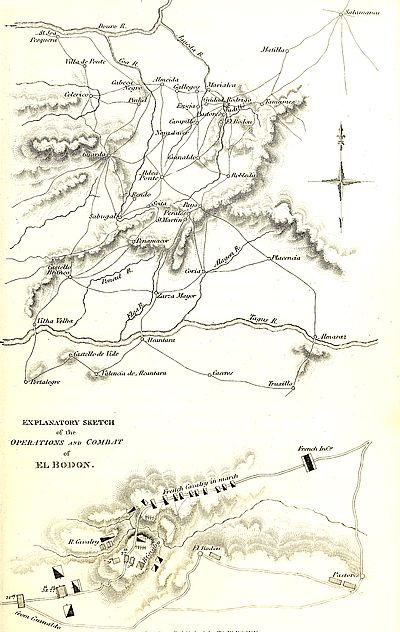 click here for larger image.
EXPLANATORY SKETCH
of the
OPERATIONS and COMBAT
of
El Bodon.
London. Published by T. & W. BOONE.
Picton now effected his junction and the whole
retired over the plain to the position at Guinaldo,
which was about six miles distant. The French,
although fearing to renew the close attack, followed,
and plied the troops with shot and shell, until about
four o’clock in the evening, when the entrenched
camp was gained. Here the fourth division presented
a fresh front, Pack’s brigade came up from
Campillo, and the heavy cavalry from the Upper
Azava, being also brought into line, the action
ceased. By this retrograde movement of the left
and centre of the third division, the seventy-fourth
and the sixtieth regiments, posted at Pastores, were
cut off; they however crossed the Agueda by a
ford, and moving up the right bank happily reached
Guinaldo in the night, after a march of fifteen
hours, in the course of which they captured a
French cavalry patrol.
During the retreat from Elbodon, the left wing
of the army was ordered to fall back on the first
division, at Nava d’Aver, but to keep posts in
observation on the Azava. Carlos d’España retired
with Sanchez’s infantry behind the Coa, and the
guerilla chief himself passed with his cavalry into
the French rear. The seventh division was withdrawn
from Allemadilla to Albergaria, and the
head-quarters baggage moved to Casilla de Flores.
The light division should have marched to Guinaldo;
general Craufurd received the order at
two o’clock, he plainly heard the cannonade, and
might easily have reached Guinaldo before midnight,
but he only marched to Cespedosa, one
league from the Vadillo, which river was immediately
passed by fifteen hundred French. The position at
Guinaldo was therefore occupied by only fourteen
thousand men, of which about two thousand six
hundred were cavalry. The left of the army, concentrated
at Nava d’Aver, under Graham, was ten
miles distant; the light division being at Cespedosa
and debarred the direct route by the ford of Carros,
was sixteen miles distant, and the fifth division,
posted at Payo in the mountains, was twelve miles
distant. Meanwhile Marmont brought up a second
division of infantry, and in the course of the night,
and the following day, united sixty thousand
men in front of Guinaldo. The situation of the
English general was become most critical, yet he
would not abandon the light division, which did
not arrive until after three o’clock in the evening.
Marmont’s fortune was fixed in that hour! He
knew nothing of the allies’ true situation, and
having detached a strong column by the valley of
the Azava to menace their left, contented himself
with making an ostentatious display of the imperial
guards in the plain, instead of attacking an adversary
who was too weak to fight, and laughing to see
him so employed, soon changed the state of affairs.
In the night, Wellington by a skilful concentric
movement from Guinaldo, Nava d’Aver, Perales,
and Payo, united the whole army on new
ground, between the Coa and the sources of the
Agueda, twelve miles behind Guinaldo; and it
is a curious fact that Marmont had so little knowledge
of his own advantages, that instead of
harassing the allies in this difficult movement, he
also retired during the night, and was actually
in march to the rear, when the scouts of the column,
which had marched by the valley of Azava,
brought word that the allies were in retreat, and
their divisions still widely separated. Dorsenne
then insisted that Marmont should wheel round
and pursue, but lord Wellington was already in a
strong position behind the stream of the Villa Maior.
The fifth division, coming up from Payo, was
now on the right at Aldea Velha, the fourth and
light divisions, with Victor Alten’s cavalry, and the
heavy dragoons, under sir Stapleton Cotton, were
in the centre in front of Alfayates; the convent
of Sacaparte was on their left, and the line was
prolonged to Rebulon by Pack’s and M‘Mahon’s
Portuguese brigades; the sixth division with Anson’s
cavalry closed the line at Bismula. The
cavalry picquets were pushed beyond the Villa
Maior in front of
Aldea de Ponte, in the centre, and
towards Furcalhos on the right; and the third and
seventh divisions were in reserve behind Alfayates.
This position was extensive, but the days were
short, serious dispositions were required for a
general attack, and the allies could not be turned,
because they covered all the practicable roads leading
to the bridges and fords of the Coa.
The French, moving by the roads of Furcalhos
and of Aldea de Ponte, were checked by the picquets
of the light division on the former; but on the
latter their horsemen drove the cavalry posts from
the hills, and across the stream of the Villa Maior,
and about ten o’clock took possession of Aldea de
Ponte.
At twelve o’clock the head of the infantry
came up and immediately attacked general Pakenham,
then commanding a brigade of the
fourth division, which was posted on the opposite
heights. Lord Wellington arrived at the same
moment, and directed the seventh fuzileers to
charge in line, and he supported them on each
flank with a Portuguese regiment in column. The
French, who had advanced well up the hill, were
driven back, and though they afterwards attempted
to turn the brigade by a wood, which was distant
about musket-shot from the right, while their
cavalry advanced to the foot of the hills, the
artillery sufficed to baffle the effort. Then the
English general taking the offensive, directed the
twenty-third fuzileers and Portuguese caçadores to
turn the French left, and seize the opposite hills,
which finished the action, and Aldea de Ponte was
again occupied by the allies. Wellington, who had
been much exposed to the fire, rode to another part
of the position, but scarcely had he departed when
the French from the Forcalhos road joined those
near Aldea de Ponte, and at five o’clock renewing
the attack retook the village. Pakenham,
with his fuzileers, immediately recovered it, but
the French were very numerous, the country rugged,
and so wooded, that he could not tell what was
passing on the flanks, wherefore, knowing that the
chosen ground of battle was behind the Coa, he
abandoned Aldea de Ponte and regained his original
post.
In the night the allies retreated, and on the
morning of the 28th occupied a new and very
strong position in front of the Coa, the right resting
on the Sierra de Mesas, the centre covered by the
village of Soita, the left at Rendo upon the Coa.
The whole army thus enclosed, as it were in a deep
loop of the Coa river could only be attacked on
a narrow front, and Marmont, who had brought up
but a few days’ provisions and could gather none in
that country, retired the same day. This terminated
the operations. The French placed a fresh garrison
in Ciudad Rodrigo; Dorsenne marched to Salamanca;
a strong division was posted at Alba de
Tormes to communicate with Marmont, and the
latter resumed his old position in the valley of the
Tagus. At the same time Foy, who had advanced
with his two divisions as far as Zarza Mayor, in the
direction of Castello Branco, returned to Placentia;
Girard also, being threatened by Hamilton’s Portuguese
division, which Hill had sent to check his
advance, left two thousand men of the fifth corps at
Merida, and retired to Zafra; and when these movements
were known, the light division reinforced by
some cavalry resumed the nominal blockade of
Ciudad Rodrigo, in concert with Julian Sanchez.
The rest of the army was cantoned on both sides of
the Coa, and head-quarters were fixed at Frenada.
Nearly a month had been employed by the
French in the preparation and execution of this
great operation, which terminated so feebly and soVictoires et Conquêtes des François.
abruptly, because the generals were as usual at
variance. They had victualled Ciudad Rodrigo,
but they had lost the favourable opportunity of invading
Gallicia. Nothing had been gained in the
field, time was lost, and the English general’s plans
were forwarded.
1º. Lord Wellington’s position
behind Soita has been noticed by two recent authors. The oneLondonderry’s Narrative.
condemns the imprudence of offering battle on
ground whence there was no retreat; the other intimates
that it was assumed in contempt of the
adversary’s prowess. This last appears a mere
shift to evade what was not understood, for if lord
Wellington had despised Marmont, he would haveAnnals of the Peninsular Campaigns
fought him beyond the Agueda. But sixty thousand
French soldiers were never to be despised, neither
was Wellington a man to put an army in jeopardy
from any overweening confidence; and it is not
difficult to show that his position was chosen
well, without imprudence, and without presumption.
The space between the Sierra de Mesas and the
Coa was less than six miles, and the part open to
attack was very much reduced by the rugged bed
of a torrent which covered the left. Forty thousand
men were quite able to defend this line, which
was scarcely more than one-third of their full front;
and as the roads were bad, the country hilly and
much broken with woods and ravines, the superiority
of the enemy’s horse and guns would have
availed him little. Lord Wellington had a right to
be bold against an adversary who had not molested
him at Guinaldo, and it is always of importance to
show a menacing front. It was also certain that
great combinations must have been made by Marmont,
before he could fight a general battle on such
ground; it was equally certain that he could only
have a few days’ provisions with his army, and that
the neighbourhood could not supply him. It was,
therefore, reasonable to expect that he would retire
rather than fight, and he did so.
Let us however, take the other side, and suppose
that Marmont was prepared and resolute to bring
on a great battle. The position behind Soita would
still have been good. The French were indeed too
strong to be fought with on a plain, yet not strong
enough to warrant a retreat indicating fear; hence
the allies had retired slowly for three days, each day
engaged, and the enemy’s powerful horse and artillery
was always close upon their rear. Now the bed
of the Coa, which was extremely rugged, furnished
only a few points for crossing, of which the principal
were, the ford of Serraleira behind the right
of the allies; the ford of Rapoulha de Coa behind
their left; and the bridge of Sabugal behind their
centre. The ways to those points were narrow,
and the passage of the river, with all the baggage,
could not have been easily effected in face of an
enemy without some loss and perhaps dishonour:
and had lord Wellington been unable to hold his
position in a battle, the difficulty of passing the
river would not have been very much increased,
because his incumbrances would all have been at
the other side, and there was a second range of
heights half-a-mile in front of Sabugal favourable
for a rear-guard. The position of Soita appears
therefore to have been chosen with good judgment
in regard to the immediate object of opposing the
enemy; but it is certain that the battering train,
then between Pinhel and Villa Ponte, was completely
exposed to the enemy. Marmont, however,
had not sufficiently considered his enterprize, and
knew not where or how to strike.
2º. The position of Aldea Ponte, was equally
well chosen. Had the allies retreated at once
from Guinaldo, to Soita, baggage and stores would
have been lost, and the retrograde movement have
had the appearance of a flight; the road from
Payo would have been uncovered, and the junction
of the fifth division endangered. But in
the position taken up, the points of junction of all
the roads were occupied, and as each point was
strong in itself, it was not difficult for a quick-sighted
general, perfectly acquainted with the
country, and having excellent troops, to check the
heads of the enemy’s columns, until the baggage
had gained a sufficient offing, and the fifth division
had taken its place in line.
3º. The position at Guinaldo was very different
from the others. The previous entrenching of it
proved lord Wellington’s foresight, and he remained
there thirty-six hours, that is, from mid-day of the
25th until midnight of the 26th, which proved his
firmness. It is said that sir George Murray advised
him to abandon it in the night of the 25th, and that
arrangements were actually made in that view, yet
anxious for the safety of the light division he would
not stir. The object was certainly one of an importance
sufficient to justify the resolution, but the resolution
itself was one of those daring strokes of genius
which the ordinary rules of art were never made to
controul. The position was contracted, of no great
natural strength in front, and easily to be turned;
the entrenchments constructed were only a few
breast-works and two weak field redoubts, open in
rear, and without palisades; not more than fourteen
thousand British and Portuguese troops were in
line, and sixty thousand French veterans with a
hundred pieces of artillery were before them!
When Marmont heard of the escape of the light
division, and discovered the deceit, he prophetically
exclaimed, alluding to Napoleon’s fortune, “And
Wellington’s star, it also is bright!”
4º. The positions of Aldea Ponte and Soita are
to be commended, that at Guinaldo to be admired
rather than imitated, but the preceding operations
are censurable. The country immediately beyond
Ciudad Rodrigo offered no covering position for a
siege or blockade; and the sudden floods, to which
the Agueda is subject, rendered the communications
with the left bank precarious. Nor though bridges
had been secured, could Wellington have ventured
to encamp round the place with lines of contravallation
and circumvallation, on both sides of the
river; because Marmont’s army would then have
advanced from Placencia to Castello Branco, have
seized the passage over the Tagus at Vilha Velha,
and in concert with the fifth corps endangered the
safety of Hill. This would have obliged the allies
to quit their entrenched camp, and Dorsenne could
then have re-victualled the place. It was therefore
necessary to hold a strong central position with
respect to Marmont and Dorsenne, to keep both
in check while separate, and to oppose them when
united. This position was on the Coa, and as
Salamanca or Bejar, the nearest points where
convoys could be collected for Ciudad Rodrigo,
were from fifty to sixty miles distant, lord Wellington’s
object, namely the forcing the French to
assemble in large bodies without any adequate result,
could be, and was obtained by a distant as
well as by a close investment.
So far all was well calculated, but when Marmont
and Dorsenne arrived with sixty thousand men at
Ciudad Rodrigo, the aspect of affairs entirely
changed, and as the English general could not
dispute the entrance of the convoy, he should have
concentrated his army at once behind Guinaldo.
Instead of doing this he kept it extended on a line of
many miles and the right wing separated from the
centre by a difficult river. In his despatch, he
says, that, from some uncertainty in his estimate
of the enemy’s numbers, it was necessary to ascertain
their exact strength by actual observation;
but this is rather an excuse than a valid reason,
because, for this object, which could be obtained
by other means, he risked the loss of his whole
army, and violated two vital rules of war which
forbid—
1º. The parcelling of an army before a concentrated
enemy.
2º. The fixing of your own point of concentration
within the enemy’s reach.
Now lord Wellington’s position on the 24th and
25th extended from the ford of the Vadillo on the
right of the Agueda, to Marialva on the Azava;
the distance either from the Vadillo, or Marialva,
to Guinaldo, was as great as that from
Ciudad to Guinaldo, and by worse roads; and the
distance from Ciudad to Elbodon was as nothing,
compared to the distance of the wings from the
same place. Wherefore when Montbrun attacked,
at Elbodon, the allies’ wings were cut off, and the
escape of the third and light divisions, and of the
troops at Pastores, was a matter of fortune and
gallantry, rather than of generalship; that is, in
the enlarged sense of the last word, for it cannot
be denied that the actual movements of the troops
were conducted with consummate skill.
But what if Marmont, instead of being drawn
by circumstances into a series of ill-combined, and
partial attacks, had previously made dispositions
for a great battle? He certainly knew, through theAppendix, No. V. Section 1.
garrison, the real situation of the allies, and he also
knew of the camp at Guinaldo, which being on their
line of retreat was the important point. If he had
issued from the fortress before daybreak on the
25th with the whole or even half of his forces, he
could have reached Campillo in two hours with
one column, while another fell on the position at
Pastores and Elbodon; the third division, thus
attacked, would have been enveloped and captured,
or broken and driven over the Agueda, by the ford
of Zamara, and would have been irretrievably
separated from Guinaldo. And if this division had
even reached Guinaldo, the French army would
have arrived with it in such overwhelming numbers,
that the fourth division could not have restored
the battle; meanwhile a few thousand men thrown
across the ford of Caros near Robleda would have
sufficed to keep the light division at bay, because
the channel of the Robleda torrent, over which their
retreat lay, was a very deep and rugged ravine.
The centre being broken the French could, at choice,
have either surrounded the light division, or directed
the mass of their forces against the reserves,
and then the left wing under Graham would have
had to retreat from the Azava over the plains
towards Almeida.
It may be said that all the French were not up
on the 25th, but they might have been so, and as
lord Wellington was resolved to see their number
he would have been in the same position the 26th.
It is however sufficient to remark that the allies
exclusive of the fifth division, which was at Payo,
did not exceed thirty-five thousand men of all
arms; that they were on an irregular line of at
least twenty miles, and mostly in an open country;
that at no point were the troops more than eight,
and at the principal point, namely Pastores, only
three, miles, from a fortress from whence sixty
thousand infantry and six thousand cavalry, with
one hundred and twenty guns were ready to issue.
Finally the point of concentration at Guinaldo was
only twelve miles from that fortress. The allies
escaped because their adversary was blind! Lord
Wellington’s conduct at Guinaldo was above rules,
but at Elbodon it was against rules, which is just
the difference between genius and error.
4º. In these operations Marmont gave proof that
as a general he was rather shining than great. He
was in error throughout. Before he commenced
his march he had desired Girard to advance on the
side of the Alemtejo, assuring him that the whole
of the allied army, and even the Spanish troops
under Castaños, had crossed the Tagus to operate
against Rodrigo; but in fact only one brigade ofAppendix, No. V. Section 1.
Hill’s corps had moved, and Girard would have
been destroyed, if, fortunately for him, the allies
had not intercepted the original and duplicate of
the letter containing this false information.
5º. When Marmont brought his convoy into
Ciudad, it would appear he had no intention of fighting,
but tempted by the false position of the allies,
and angry at the repulse of his cavalry on the Lower
Azava, he turned his scouting troops into columns of
attack. And yet he permitted his adversary to throw
dust in his eyes for thirty-six hours at Guinaldo;
and at Aldea Ponte his attack was a useless waste
of men, because there was no local advantage
offered, and he did not intend a great battle.
6º. The loss incurred in the different combats was
not great. About three hundred men and officers
fell on the part of the allies, and on that of the French
rather more, because of the fire of the squares and
artillery at Elbodon. But the movements during the
three days were full of interest, and instruction,
and diversified also by brilliant examples of heroism.
Ridge’s daring charge has been already noticed,
and it was in one of the cavalry encounters, that a
French officer in the act of striking at the gallant
Felton Harvey of the fourteenth dragoons, perceived
that he had only one arm, and with a rapid
movement brought down his sword into a salute
and passed on! Such was the state of the war on
the frontier of Portugal; in the next book will be
found the contemporary events in Spain.
BOOK XV. — CHAPTER I. — STATE OF THE WAR IN SPAIN.
Northern Provinces. The invasion of Gallicia,1811.
which had been arrested by the arrival of the allies on
the Coa, would have been a most serious calamity.
Abadia, a weak man, with troops, distressed for
provisions and clothing, was on bad terms with the
chief of his staff Moscosa, whom he feared, and on
worse terms with the junta. The great road to CoruñaAppendix, No. V. Section 1.
was open, and although general Walker, seeing the
danger, advised that Ferrol, which was indefensible,
should be dismantled, and the guns, amounting to
fifteen hundred, with the timber and vessels of war
in the harbour, transferred to Coruña, neither that
nor any other useful measure was executed.
Before this, overtures had been made to the
Spanish government, to take Spanish troops into
British pay after the manner of the Portuguese;
but the regency remembering the prodigality of
Canning demanded three millions yearly, besides
arms and clothing, without which they said the
Spaniards could make no efficient exertions! To
introduce British officers into the service on any
other terms was not possible, because the Spanish
military were indignant at what they termed the
degradation of such a proposal. The Perceval
faction finding it thus, and wanting greatness of
mind to support Wellington, on a scale commensurate
with his talents, then turned their attention
to the encouragement of the Partidas, as being less
expensive, and affording an example to the continental
nations of popular and protracted resistance
to France.
Sir Howard Douglas, who succeeded general
Walker as military agent, (these officers must not
be confounded with the military agents originally
sent out, and whose mischievous proceedings I
have had occasion to notice,) was directed to encourage
those bodies by increased supplies, and
to combine their movements better with each other
and with the British squadron in the Bay of Biscay.
Lord Wellington at the desire of government, sentSir H. Douglas’s Correspondence, MSS.
to the guerilla chiefs, military presents, with a letter
acknowledging the importance of their services, and
this was not mere compliment, for he had indeed
derived great advantages from their exertions, and
thought he had derived more, because he only knew
of their exploits by hearsay. When he afterwards
advanced into Spain and saw them closely, he was
forced to acknowledge that the guerillas, although
active and willing, and although their operations in
general occasioned the utmost annoyance to the
enemy, were so little disciplined that they could do
nothing against the French troops unless the latter
were very inferior in numbers. If the French
took post in a house or church of which they only
barricadoed the entrance, both regular troops and
guerillas were so ill equipped as military bodies,
that their enemy could remain in security until
relieved. In like manner Napoleon reprimanding
his generals for suffering the Partidas to gain any
head, observed, that when cut off from communication
with the English ships they were a nullity!
Douglas arrived just as Dorsenne’s retreat enabledSir H. Douglas’s Correspondence, MSS.
Abadia to resume his position on the frontier, but
the army was in a miserable state; the wet season
was setting in upon men, destitute of even the necessaries
of life, although the province abounded
in cattle and goods, which could be easily procured,
because money, although plentiful, was generally
hoarded, and commodities were therefore
cheap, and could be obtained in lieu of taxes at
the market-price. An extraordinary increase of the
customs, arising from the trade of Santander and
Bilbao being transferred to Coruña by the war,
also offered a valuable resource; the harbour was
filled with colonial goods, and as the appetites of
men generally stifle patriotism, and baffle power, a
licensed commerce was carried on with the enemy’s
ports in Biscay; yet without judgment as related
to the war, for the return was iron, to re-export to
the colonies, whereas by an internal traffic of the
same kind, clothes and grain for the troops might
have been had from Castile and Leon. But confusion
and corruption every where prevailed, the
exigences of the war were always the last things
cared for, and the starving soldiers committed a
thousand excesses with impunity, for where there
is no food or pay, there can be no discipline.
The people were oppressed with imposts, legal
and illegal, and yet the defalcation in the revenue
was great, and the monopoly of tobacco the principal
financial resource, was injured by the smuggling
arising from the unsettled nature of the times.
The annual charge on the province was about
£1,300,000, the actual receipts were less than
£500,000, and the junta endeavoured to supply
the deficiency by an extraordinary contribution from
all property, save that of day-labourers, which they
expected would produce sixty millions of reals
(£750,000). But a corrupt and vexatious collection
of this tax tormented the people without filling the
treasury; the clergy, and the richer classes, were,
as in Portugal, favoured, and it yielded, in six
months, less than a seventh part.
From this state of affairs two inferences may be
safely drawn:—1º. That England and not Gallicia
had hitherto supported the war here, as in other
parts of the Peninsula. 2º. That as England had
in 1808-9 paid to Gallicia three millions of hard
dollars, and given other succours sufficient for
double the number of troops employed, the deficiency
of the revenue had been amply compensated,
and the causes of distress must be sought
for in the proceedings of the authorities, and in the
anomalous nature of the war itself. The successive
juntas, apprehensive of offending the people, were
always inert in the civil administration, and either
too corrupt, or too incapable, to apply the succours
from England, justly or wisely. The junta of this
period was, like its predecessors, factious and intriguing;
it was hostile to the junta of Leon, unfriendly
to that of Asturias, jealous and contemptuous
of the military leaders; in return these last
abhorred the junta, and were tormented with factions
of their own. The regular officers hated the guerillas,
and endeavoured to get the controul of the
succours granted, by England, to the latter; and
as they necessarily lived by plundering their own
countrymen, they strenuously opposed the arming
of the peasants, partly from fear lest the latter
should resist this license, partly because the republican,
and anti-English spirit, which was growing
up in the cortes had also reached this quarter.
The clergy clung to the peasantry, with whom
they had great influence, but the army, which had
imbibed liberal words, rather than principles, was
inimical to them. A press had been established at
head-quarters, from whence issued political papers
either original, or repeated from the libels at Cadiz,
in which, the Portuguese were called slaves, for
submitting to British influence; and it was openly
avowed that the French yoke was preferable to that
of England; the guerilla system, and the arming
of the people were also attacked, and these writings
were met by other political papers from the civil
press at Coruña and St. Jago. The frequent
changes of commanders rendered all the evils more
prominent; for the local government had legal power
to meddle with the military arrangements, and every
change of commander produced a new difficulty.
Thus the junta refused to acknowledge Abadia as
their president during the absence of Castaños,
he in return complained alike of their neglect and
of their interference; and when they proposed to
establish a general depôt at Lugo he marched a part
of his army there to prevent it.
But the occult source of most of these difficulties
is to be found in the inconsistent attempts of the British
cabinet, to uphold, national independence with
internal slavery, against foreign aggression, with an
ameliorated government. The clergy who led the
mass of the people, clung to the English, because
they supported aristocracy and church domination;
and they were also strongly for the Partidas, because
these were commanded by men who sprung directly
from the church itself, or from people who were
attached to the church, while the regular armies
being officered by the friends of the cortes, disliked
the Partidas, both as interlopers and as political
enemies. The English ministers, hating Napoleon,
not because he was the enemy of England,
but because he was the champion of equality, cared
not for Spain, unless her people were enslaved.
They were willing enough to use a liberal cortes
to defeat Napoleon, but they also desired to put
down that cortes, by the aid of the clergy, and of
the bigoted part of the people: nevertheless as
liberty will always have more charms than slavery,
they would have missed of both objects, if the
exigences of the continental system had not induced
the emperor to go to Moscow, where the snow
destroyed him; and if the very advocates of liberty
in Spain had not in their madness, resolved to
oppress the Americans. The cortes, by discovering
a rabid love of power in practice, rendered
their democratic doctrines suspected, and lost partizans;
but lord Wellington, in support of aristocracy,
used the greatest prudence in policy, and in his
actions was considerate and just.
In the first conference held at Coruña, after sir1811. Sept.
Howard Douglas’s arrival, the junta, as the usual
preliminary, demanded more money from England;
but he advised, instead, a better management of
their own resources, and pointed out the military
measures requisite to render the army efficient.
He recommended the adoption of the line of retreat
upon Orense, rather than upon Lugo and Coruña;
and he endeavoured to establish a permanent depôt
in the island of Arosa, on the Vigo coast, as a secure
resource in the event of defeat; he also furnished
the soldiers with shoes and great-coats, the hospitals
with blankets, and completed the firelocks of the army
to twenty-five thousand. There were however abuses,
which he could not remedy, and which would seem
rather to belong to the army of an Asiatic despot,
than to an European force fighting for independence.
Innumerable baggage animals devoured
all the forage, and the personal servants and
cooks, who from custom never did duty, were aboveAppendix, No. I. Section 1.
five thousand! a sixth part of the whole force!
When the sick men were deducted, scarcely sixteen
thousand infantry and three squadrons of cavalry
remained for service. Then there was so little
organization or arrangement that, although young,
robust, patient, and docile to the greatest degree,
the troops could scarcely be moved, even
from one quarter to another, as a military body;
and the generals, unable to feed them on the frontier,
more than once, menaced, and in December
did actually retire to Lugo, leaving the province
open to invasion.
Abadia at first exerted himself with activity, and
appeared to enter loyally into the ameliorations
proposed. He gave the command of the troops to
Portasgo, repaired to Coruña himself, and organized
the province in seven military governments,
under as many chiefs, one for each division of the
army. Every government was to raise a reserve,
and to supply and clothe the corresponding division
on the frontier. But in a little time this activity
relaxed; he entered into various intrigues, displayed
jealousy, both of the peasantry and the English,
and no real improvement took place, save in that
select part of the army, which the Cadiz regency
had destined for South America, and had ordered
him to equip from the English stores. This was
done at the very moment when a French army on
the frontier was again preparing to invade Gallicia,
and sir Howard Douglas vehemently opposed
the disloyal proceeding; the junta also
were really averse to it, and Abadia pretended to
be so; but he had a personal interest in the
colonies and secretly forwarded the preparations.
The regency, to evade Mr. Wellesley’s reproaches,
promised to suspend the embarkation of these
troops, but the expedition sailed from Vigo, and
the organization of another, three times its
strength, including all the best artillery in the
province, was immediately commenced, and also
sailed a few months later. This then was the state
of Gallicia in the latter end of 1811. She was without
magazines, hospitals, or system, whether civil
or military, and torn by faction, her people were
oppressed, her governors foolish, her generals bad:
she had no cavalry, and the infantry were starving,
although the province easily supplied cattle for the
allies in Portugal. As a natural consequence, those
famished soldiers were too undisciplined to descend
into the plains of Leon, and were consequently of
little weight in the general contest.
Under these circumstances, sir Howard Douglas1811. Nov.
had nothing to work upon, save the Guerilla leaders,
whose activity he very considerably increased. His
policy was to augment the number of chiefs, but
to keep the force of each low, lest, growing proud
of their command, they should consider themselves
generals, and become useless, as indeed had already
happened to Campillo, Longa, and Porlier, when
they were made a part of the seventh army.
Nevertheless the advantage of this policy may be
doubted, for of all the numerous bands in the
north, seven only were not supported entirely by
robbery. Mina, Pastor, Salazar, Pinto, Amor,
and the curate, whose united forces did not exceedMr. Stuart’s Papers. MSS.
ten thousand men, were sustained by regular
taxes, customs, convent revenues, and donations;
Longa supported his from the produce of the
salt-mines of Paza, but all the rest were bandits,
whose extinction was one of the advantages expected
from the formation of the seventh army.
It is now convenient to resume the narrative of
military events.
In the Asturias, previous to Mendizabal’s arrival,
and when Bonet had marched to the Orbijo, Porlier
surprised Santander, and plundered some
houses; but being followed by general Caucault,
a very active officer, he retired again to his strong-hold
of Liebana. The British cruizers, in concert
with whom he acted, then destroyed several
coast-batteries, and the Iris frigate having arms
on board, came to the Bay of Biscay for the purpose
of arranging an intercourse with the Partidas
of that province. But this was the period when
Reille and Caffarelli, were, as I have before noticed,
chasing Mina and Longa, whom they drove from
the coast, into the mountains of Leon, and thus
marred the object of the Iris. Nevertheless, when
Mina was reinforced by the Valencians and other
fugitives from Catalonia, he returned to Navarre,
and there performed very considerable exploits,
which, as belonging to other combinations of the
war, will be hereafter noticed.
While Caffarelli and Reille thus scoured the line
of communication, Dorsenne having the invasion
of Gallicia in view, relieved Bonet on the Esla,
and sent him early in November, with eight thousand
men to re-occupy the Asturias as a preliminary
measure. The Gallicians foreseeing this,
had detached Moscoso with three thousand five
hundred men to reinforce San Pol, who was at
Pagares, below the passes leading from Leon; and
on the other hand Mendizabal uniting the bands of
Porlier and other chiefs, concentrated five thousand
men to the eastward on the Xalon. Eleven thousand
men were therefore ready to oppose the entrance of
Bonet, but with the usual improvidence of the
Spaniards, the passes of Cubillas and Ventana,
to the westward of Pagares, were left unguarded.
By these roads, Bonet, an excellent officer, turned
Moscoso, and drove him down the Lena with loss
and disgrace; then turning upon Mendizabal, he
chased him also in disorder from Lanes into the
Liebana.
All the civil authorities immediately fled to
Castropol, the Spanish magazines fell into the
hands of the French, and Bonet having resumed
his old positions at Oviedo, Gihon, and Grado,
fortified several posts in the passes leading to
Leon, raised contributions, and effectually ruined
all the military resources of the Asturias. The
organization of the seventh army was thus for
the time crushed, and in Gallicia great mischief
ensued. For the return of Moscoso’s division and
the want of provisions in the Bierzo, which had
obliged Abadia to retire to Lugo, while Dorsenne
was menacing the frontier, had thrown that kingdom
into a ferment, which was increased by the
imposition of the new contributions. The people
became exceedingly exasperated and so unfavourably
disposed, that it was common to hear themSir H. Douglas’s Correspondence, MSS.
say, “the exactions of a French army were a
relief in comparison to the depredations of the
Spanish troops.”
During these transactions in the north, Drouet
had joined Girard at Merida, and menaced the
allies in the Alemtejo, hoping thus to draw Wellington
from the Coa; but the demonstration was
too feeble, and the English general thought it
sufficient to reinforce Hill with his own brigade
from Castello Branco. These movements were
undoubtedly part of a grand plan for invading
Portugal, if the emperor could have arranged his
affairs peaceably with Russia. For to move once
more against Lisbon, by Massena’s route, was not
promising, unless the northern provinces of Portugal
were likewise invaded, which required the
preliminary occupation of Gallicia, at least of the
interior. In the south also, it was advisable to
invade Alemtejo, simultaneously with Beira; and
the occupation of Valencia and Murcia was necessary
to protect Andalusia during the operation.
The plan was vast, dangerous, and ready for execution;
for though the wet season had set in, an
attack on the northern parts of Portugal, and the
invasion of Gallicia, were openly talked of in
Dorsenne’s army, Caffarelli was to join in the
expedition, and Monthion’s reserve, which was to
replace Caffarelli’s on the line of communication,
was already six thousand strong. Ney or Oudinot
were spoken of to command the whole, and a
strong division was already in march to reinforce
the army of the south, arrangements which could
have reference only to Napoleon’s arrival; but
the Russian war soon baulked the project, and
Wellington’s operations, to be hereafter noticed,
obliged Dorsenne to relinquish the invasion of Gallicia,
and caused Bonet once more to abandon the
Asturias.
Thus, with various turns of fortune, the war
was managed in the northern provinces, and no
great success attended the French arms, because
the English general was always at hand to remedy
the faults of the Spaniards. It was not so on the
eastern line of invasion. There Suchet, meeting
with no opponent capable of resisting him, had
continued his career of victory, and the insufficiency
of the Spaniards to save their own country
was made manifest; but these things shall be clearly
shewn in the next chapter, which will treat of the
conquest of Valencia.
CHAPTER II. — CONQUEST OF VALENCIA. — SIEGE OF SAGUNTUM. — CATALONIA. — BATTLE OF SAGUNTUM. — OBSERVATIONS.
In August, and the beginning of September,1811. August.
Suchet, while preparing for this great enterprise,
had dispersed the bands of Villa Campa and the
other chiefs, who during the siege of Taragona
vexed Aragon. He had sent his feeble soldiers to
France, receiving conscripts in their places, and
although the harvest was very bad, formed large
magazines in Morella and Tortoza. Eight thousand
men had been left in Catalonia under general
Frere, another eight thousand were placed under
general Musnier, to protect Aragon, and twenty-four
thousand of all arms remained for the invasion
of Valencia, but this force Suchet thought
inadequate, and demanded a reinforcement from
the army of reserve, then in Navarre. Napoleon,
whose system of war, whatever has been said to
the contrary, was eminently methodical, refused.
He loved better to try a bold push, at a distant
point, with a few men, than to make an overwhelming
attack, if he thereby weakened his communications;
he judged courage and enterprise
fittest for the attack, prudence and force for the
support. And yet he designed to aid Suchet’s
operations vigorously when the decisive blow could
be struck. Then not only the divisions of the reserve
were to march, but combined movements,
of detachments from nearly all the armies in the
Peninsula, were arranged; and we shall find, that
if Wellington, by menacing Ciudad Rodrigo, saved
Gallicia, the French army of the north, in return, by
menacing Gallicia, fixed the allies on the Agueda,
and so protected Suchet’s invasion of Valencia.
Three roads led to the Guadalaviar, one from1811. Sept.
Tortoza by the sea-coast, one by Teruel and Segorbe,
and one by Morella and San Mateo. That
from Tortoza, and that by Teruel, were carriage-roads,
but the first only was fit for heavy artillery,
and it was blocked, partially by the fortress of
Peniscola, and completed by the fort of Oropesa.
Wherefore, though the infantry and cavalry could
move on a bye-road to the right, the convoys and
the guns, which were at Tortoza, could not pass
until Oropesa was reduced. Nevertheless the
French general, well knowing the value of boldness
in war, resolved to mask Peniscola, to avoid
Oropesa, to send his field artillery by Teruel, and
uniting his troops near Saguntum, to offer battle to
Blake; and if the latter declined it, to reduce
Oropesa and Saguntum, trusting for subsistence to
the “huerta” or garden of Valencia, until the arrival
of his convoys.
He had, however, organized his system of supply
with care. From Morella and Tortoza, brigades
of mules, after the manner adopted in the British
army, were to carry provisions to the troops,
and sheep and cattle were delivered to each
regiment for its subsistence in advance. This
last plan, which sir John Moore had also projected
in his campaign, Suchet found advantageous;
and I am persuaded that the principle
should be extended, so that all things requisite
for the subsistence, and fighting of troops should
be organized regimentally, and the persons employed
wear the uniform of their different corps.
Jealousies between the functionaries, of different
branches of the service, would then be unknown;
and the character of all subordinate persons, being
under the guardianship of the battalions to which
they belonged, would be equally praiseworthy,
which cannot now be said.
While Suchet was thus gathering his strength,
Valencia was a prey to disorder. About the period
of the siege of Taragona, Palacios, notwithstanding
his high monarchical principles, which caused
him to be dismissed from the regency, had been
appointed captain-general of Valencia, Murcia,
and Aragon; and he immediately raised a strong
party amongst the friars and other opponents of
the cortes. When after the dispersion of the
Murcian army at Baza, Blake had rallied the
fugitives, and in virtue of his power as regent,
assumed the chief command at Valencia, Palacios’
faction opposed him, and endeavoured to drawCapt. Codrington’s papers, MSS.
the soldiers and the populace to their side, by proposing
to inundate the plain of Murviedro, and
to defend the strong country in advance. Blake,
however, resolved to act on the flanks of the
French army by detachments, and, in this view,
sent C. O’Donnel, with the divisions of Obispo
and Villa Campa, to Albaracin, supporting them
with four thousand men at Segorbe and Liria. He
charged Mahy, who commanded five thousand infantry,
and seven hundred cavalry of the Murcian
army, to surprise the French detachment of the
army of the centre, posted at Cuença. He detached
Bassecour with two thousand men to Requeña, and
the same time, directed Duran and the Empecinado,
to unite, and invade Aragon; and it was to
aid in this expedition that Mina quitted the mountains
of Leon.
Blake had, exclusive of Mahy’s and Bassecour’s
divisions, about twenty thousand infantry, and two
thousand cavalry. Three thousand five hundred men
were placed in Saguntum, which was provisioned
for three months; two hundred were in Oropesa,
and fifteen hundred in Peniscola; and there were
so many Partidas, that the whole country seemed
to be in arms, but the assembling of these peopleRoche, MSS.
being very uncertain, Blake could not depend upon
having a permanent partizan force, of more thanTupper, MSS.
eight thousand. The Valencian army contained
the Albuera divisions, St. Juan’s, Miranda’s, andMr. Wellesley, MSS.
Villa Campa’s veterans; it was therefore, not only
numerous, but the best Spain had yet produced;
and Valencia itself was exceedingly rich in allDoyle, MSS.
things necessary for its supply: but there was no
real power, the building, though fair enough outside,
had the dry rot within. The French hadAppendix, No. I. Section 3.
many secret friends, faction was as usual at work,
the populace were not favourable to Blake, and
that general had rather collected than organized his
forces, and was quite incapable of leading them.
He was unpopular, both at Cadiz and Valencia, and
the regency of which he formed a part was tottering.
The Cortes had quashed Mahy’s command of the
Murcian army, and even recalled Blake himself;
but the order, which did not reach him until he
was engaged with Suchet, was not obeyed. Meanwhile
that part of the Murcian army, which should
have formed a reserve, after Mahy’s division had
marched for Cuença, fell into the greatest disorder:
above eight thousand men deserted in a few weeks,
and those who remained were exceedingly dispirited.
Thus all interest became concentrated in the city of
Valencia; which was in fact the key of all the
eastern coast because Carthagena required an army
to defend it, and could only be fed from Valencia,
and Alicant was then quite defenceless.
It was in this state of affairs, that Suchet commenced
the invasion. His army was divided into
three columns, and, on the 15th of September one
moved by the coast-road, one by Morella and San
Mateo, and one by Teruel, where an intermediate
magazine was established; but this latter columnSuchet.
instead of proceeding directly to Segorbe, turned
off to its left, and passed over the Sierra de Gudar
to Castellon de la Plana, where the whole threeVacani.
were united on the 20th. The main column, commanded
by Suchet in person, had masked Peniscola
on the 15th, and invested Oropesa by a detachment
on the 19th; but as the road run directly under
the fire of the last place, the main body moved by
the rugged route of Cabanes to Villa Franca, leaving
the battering-train still at Tortoza.
During these operations Blake appeared inclinedRoche, MSS.
to fight, for he brought Zayas up in front of Murviedro,
and called in Obispo; Mahy, who had
done nothing on the side of Cuença, was also in
march to join him; but all these divisions marched
slowly, and with confusion; and a slight skirmish
at Almansora, on the Mingares, where a few French
dragoons put a great body of Spanish infantry to
flight, made Blake doubt the firmness of his troops.
He therefore left O’Donnel with four thousand men
on the side of Segorbe, and then retired himself
with fifteen thousand behind the Guadalaviar. ValenciaTupper, MSS.
was thus thrown into great confusion, but
Bassecour’s division was at hand, and Suchet fearing
to attack so large an army in an entrenched camp
(which had cost two years to construct), while his
own communication with Tortoza was intercepted,
merely dispersed the armed peasants which had
assembled on his flank, and then turned against
Murviedro.
This celebrated place, situated about four leagues
from Valencia, was a rocky mountain, covered with
the ruins of the ancient city, and the remains of
Moorish towers and walls, which being connected
by modern works, formed four distinct posts covering
the whole summit of the rock: but in consequence
of the usual Spanish procrastination the heavy guns
prepared to arm it were not yet mounted, and only
seventeen pieces of inferior size were available for
defence. The modern town of Murviedro, situated
at the foot of the rock, was covered by the river
Palancia, and by a canal, and occupied by some
Spanish picquets; but the 23d Habert, having
passed the water, invested the rock on the east,
while Harispe invested it on the west and south,
and a third division drove the Spanish posts from
Murviedro and entrenched itself in the houses.
The rest of the army was disposed in villages, on
the hills to the north-west, and patroles were pushed
towards Valencia. Thus the rock of Saguntum
was invested, but it was inaccessible to the engineer,
save on the west, where the ascent, although
practicable, was very rough and difficult. It
would have been impregnable, if the Spaniards had
mounted their large guns; for the French were
obliged to bring earth from a distance, to form the
batteries and parallels, and to set the miner to level
the approaches, and their parapets were too thin to
withstand heavy shot.
The first point of resistance was an ancient tower
called San Pedro, and immediately above it was the
fort of San Fernando, which could not be attacked
until San Pedro fell, and, from its height, then only
by the miner. But near the eastern extremity of
the rock, there were two ancient breaches which
the Spaniards were still engaged repairing, and
had only stopped with timber; a large tank offered
cover for the assembling of troops close to these
breaches, and Suchet resolved to try an escalade.
To effect this, three columns were assembled before
daybreak on the 28th in the tank, a strong reserve
was held in support, and a false attack was directed
against the San Pedro to distract the attention of
the besieged: but in the previous part of the night,
the Spaniards having sallied were repulsed, and the
action having excited both sides, a French soldier
fired from the tank before the appointed time,
whereupon the columns rushing forward, in disorder,
planted their ladders, and the garrison would
have carried the place by noise, but the garrison
thrust the ladders from the walls, and drove the
stormers back, with the loss of three hundred men.
After this check, as the artillery was still at Tortoza,
Suchet ordered a part of his army to attack Oropesa,
employed another part in making a road, for the
guns, to reach the battery raised against the tower
of San Pedro, and then turned his own attention to
the movements of Blake.
That general following his first plan of action
against the French flanks, had during the investment
of Saguntum, sent C. O’Donnel with Villa Campa’s
division and St. Juan’s cavalry, to Betera, and
Beneguazil, and Obispo’s division to Segorbe;
thus forming a half circle round the French army,
and cutting its communication with Teruel, near
which place Mahy had by this time arrived. Suchet
however caused Palombini to attack Obispo, whose
whole division dispersed after a skirmish with the
advanced guard, and the Italians then returned to
the siege. The next night Harispe marched against
O’Donnel, who was well posted at Beneguazil
behind a canal, having his centre protected by a
chapel and some houses; nevertheless the Spaniards
were beaten with loss at the first shock, and fled
in disorder over the Guadalaviar. During these
events Blake remained an idle spectator of the
defeat of his division, although he had a large body
of troops in hand, and was within a few miles of
the field of battle.
The French train now advanced from Tortoza,1811. October.
and four pieces were placed in battery against
Oropesa. On the 10th Suchet took the direction
of the attack in person, and the fort situated upon
an isolated rock, was breached in a few hours; but
the garrison of the King’s Tower (a separate work
placed on a small promontory, and commanding
the harbour) refused to surrender, and was carried
off, on the 11th, under the French fire, by the Magnificent.
The French general having thus with a
loss of only thirty men opened the road for his
artillery, returned to Saguntum and pushed the
siege of that place; but the difficulties were very
great, the formation of the road to the batteries
was itself a work of pain, and although his indefatigable
troops had formed a breaching battery on
the 12th, while seven small mortars and howitzers,
placed on the right and left, had nearly silenced
the Spanish fire, the muskets of the besiegers alone
brought down from fifteen to twenty men.
On the 17th the breaching battery being armed,
opened its fire against the tower, and the new
masonry crumbled away at once; yet the ancient
work resisted the guns like a rock. On the 18th
the fire recommenced, when the wall gave way to
the stroke of the guns, and the assault was ordered;
but from the height of the tower, which overlooked
the works at a short distance, the preparations
were early discovered, the Spaniards collecting
on the breach repaired it with sand-bags, and regardless
of the French fire, with loud cries provoked
the attack. At five o’clock, four hundred
men rushed forward as swiftly as the steepness of
the ascent would permit. Soon, however, the head
of the column was checked, the rear began to fire,
the whole got into confusion, and when one-half
had fallen without making the slightest impression
on the defenders, the attempt was abandoned.
After this signal failure the French erected a second
battery of six pieces, one hundred and forty yards
from the tower, and endeavoured to push the approach
close to the foot of the breach, yet the
plunging fire of the besieged baffled them; meanwhile
Andriani the governor, having communication
by signal with the ships in the Grao, was
encouraged to continue his gallant defence, and
was informed that he was already promoted for
what he had done. But to understand Suchet’s
embarrassments, from the protracted resistance of
Saguntum, we must take a view of Lacy’s contemporary
operations in Catalonia, and the proceedings
of the Partidas against the French communications
and posts in Aragon.
It will be recollected that the blockade of FigueirasAugust.
produced sickness in M‘Donald’s army,
and that the return of Suchet to Aragon, and the
parcelling of his troops on the lines, from Lerida
to Montserrat, Tortoza, and Taragona, had completely
extinguished the French power in the field;
because the divisions of the army of Aragon which
still remained in Lower Catalonia, being destined
for the enterprize against Valencia, could not be
employed in harassing expeditions. Lacy was therefore
enabled, notwithstanding the troubles which
followed the fall of Taragona, to reorganize about
eight thousand men in two divisions, the one under
Eroles, the other under Sarsfield; the junta also
called out the tercios of reserve, and arms and
ammunition being supplied by the English navy,
Lacy was soon in a condition to act offensively.
Thus the taking of Montserrat was very injurious
to the French, for it is generally supposed that
Friere’s division, if held together in the field, would
have prevented this reaction in the principality.
Lacy at first suggested to the British navy the recapture
of the Medas Islands, and it was effected
in the latter end of August, by the Undaunted,
Lavinia, and Blossom, aided by a small party of
Spaniards, the whole under the command of captain
Thomas. The enterprise itself was one of more
labour than danger, and the Spanish allies were
of little use, but the naval officers to whose exertions
the success was entirely due, were indignant
at finding that colonel Green, who served as aAppendix, No. II. Section 2.
volunteer, endeavoured to raise his own reputation
with the Catalans by injuring the character of those
under whom he served.
Immediately after the fall of Montserrat, Lacy
and the junta had proposed the fortifying of Palamos
or Blanes, to be held as a marine depôt and
strong-hold, in common with the British navy, but
with a strange folly expected that sir E. Pellew,
who had no troops, would defend them from the
enemy while establishing this post. Finding this
scheme received coldly by the admiral, they turned
their attention inland, and blowing up the works of
Berga, fixed upon the position of Busa, as a place
of strength and refuge. This remarkable rockMemoir upon Busa, by Capt. Zeupfinning, MSS.
which is situated between the Cardener and Bindasaes
rivers and about twenty miles from Cardona
could be reached by one road only, and that
a very rugged one. The rock itself fourteen miles
in circumference, healthy and full of springs, is
fertile, and produces abundance of forage, and
fuel. It is cut off from the rest of the world by
frightful precipices, and could neither be forced,
nor starved into a surrender. Busa, Cardona,
Solsona, and Seu d’Urgel were therefore guarded
by the tercios of reserve and Lacy soon commenced
offensive excursions with the regular army, against
the long lines of the French communication.
In September while the Somatenes interrupted1811. Sept.
the passage of the convoys to Montserrat, Eroles
made an unsuccessful attack on the fort of Moncada
near Barcelona; Lacy who had returned from
an incursion in the French Cerdaña where he had
gathered some booty, then united Eroles and Sarsfield’s
troops, and surprised the town of Igualada,
where he killed two hundred French, but not daring
to attack the castle retired to Calaf, and from thence
again detached Eroles to Jorbas, to attack a French
convoy coming to Igualada. Eroles beat the escort,
and captured the convoy, and then the French
quitted the fortified convent of Igualada, and joined
the garrison of Montserrat, when the whole, fearful
of being invested and so starved, abandoned that
important point, and marched through Barcelona
to Taragona; the Spaniards immediately occupied
Montserrat, and recovered a large store of clothing
and cavalry equipments, which had been hidden
in a vault and were undiscovered by the enemy.
Eroles, pursuing his success, forced the garrisons
of Belpuig, and Cervera, about five hundred in
all, to surrender, and thus the whole line of communication,
between Lerida and Barcelona, fell into
the power of the Catalonians. The confidence of
the people then revived; Sarsfield occupied Granollers,
and the passes leading into the valley of Vich;
Manso and Rovira menaced the Ampurdan; and
Eroles suddenly passing by Seu d’Urgel into the
Cerdaña, defeated, at Puigcerda, some national
guards commanded by general Gareau, who had
been sent there after Lacy’s invasion. He afterwards
raised large contributions on the frontier,
burnt a French town, and returning with his spoil
by the way of Ribas, and Ripol, took post in the
pass of Garriga, while Milans occupied Mataro,
and both watched to intercept a convoy which
M‘Donald was preparing for Barcelona.
Sarsfield at the same time embarked his division
and sailed to the coast of the Ampurdan, but the
weather would not permit him to land. Nevertheless
the attention of the French general was distracted,
and the convoy did not move. Lacy then
recalled Sarsfield, and projected the surprise of
Barcelona itself, but after putting his troops in
march, feared the execution and relinquished the
attempt. Meanwhile one swarm of the smaller
Partidas menaced the French communication between
Mequinenza and Tortoza, and another swarm
settled on the plains about Lerida.
The state of Aragon was equally alarming.
Duran and the Empecinado had received Blake’s
orders to unite near Cuença, for the purpose of
invading Aragon; but the secret junta of the district
were averse to the plan, and the troops of the
latter chief refused to move, and even came to
blows with the junta’s people. In this confusion
general d’Armanac, who had retired from Cuença,
returned, and dispersed the whole. The Empecinado
however collected them again, and having
joined Duran, their united powers being about six
thousand infantry and two thousand five hundred
horse, moved against Calatayud; Mina also acting
in concert with them, quitted the mountains of
Leon and entered Navarre with about five thousand
men, and some minor partisans were already acting
against different parts of Aragon. The whole were
in want of clothing and ammunition, but Mr.
Tupper, the consul at Valencia, having safe means of
communication with the interior supplied them.
General Musnier’s force was so scattered that he
could not fight either of the large Partidas, without
exposing some important point to the other, and
the 29th of September the Empecinado took possession
of the pass of Frasno, while Duran invested
the fortified convent of Calatayud. This
place was garrisoned by some French and Italian
troops, who differed upon the defence, and when
the explosion of two mines had killed a number of
them they surrendered. Musnier collected some
men to succour the place, but unable to force the
pass of Frasno, retired; yet being reinforced on the
5th, he again advanced, and a column sent from Navarre
by general Reille also came up; whereupon
the Spaniards disappeared until the French retired,
and then reoccupied Calatayud. They were now
in full communication with Mina and a general
plan of invasion was discussed, but as Duran and
Mina could not accord each acted separately.
Severoli’s division eight thousand strong and just1811. October.
arrived from Italy, then reinforced Musnier, and on
the 9th driving the Spaniards from Calatayud pursued
them on the roads to Molino, Daroca, and Medinaceli.
On the other side of the Ebro however
Mina fell on the post of Exca in the Cinco Villas;
the garrison broke through his investment in the
night, but he pursued them almost to the gates of
Zaragosa, and then turning off towards Ayerbe,
attacked that post and menaced the communication
by Jaca. The commandant of Zaragosa had
sent an Italian battalion to look after the flying garrison
of Exca, which was found at Zuera, and the
united forces amounting to eleven hundred infantry
and sixty cavalry followed Mina and came up with
him at Ayerbe; the guerilla chief instantly turned
with a part of his troops, and the Italians retreated
towards Huesca, but having to cross a plain were
all killed or taken.
Reille and Musnier hearing of this misfortune
spread their columns in all directions to intercept
Mina, but he evaded their toils, and although
sharply chased and several times engaged, reached
Motrico on the Biscay coast with his prisoners.
The Iris frigate which was then harassing the enemy’s
coast line took some of them off his hands, and the
remainder, three hundred in number, were sent
to Corunna by the Asturian mountains, but only
thirty-six arrived, the rest were shot by the escort,
under pretence that they made a noise near a
French post!
While these events were passing on the left of
the Ebro, Mazzuchelli’s brigade followed the Empecinado,
and having defeated him in a sharp
action, at Cubiliejos de la Sierra, brought off the
garrison of Molino and dismantled that fort; but
the smaller Partidas infested the road between Tortoza
and Oropesa, and in this disturbed state of
affairs reports were rife that an English force was
to disembark at Peniscola. Blake also sent Obispo’s
division against Teruel, which was thus menaced
on all sides, for Mahy was still in those parts.
Thus the partizan warfare seemed interminable, and
Suchet’s situation would really have been very
dangerous, if he had been opposed by a man of
ability. He had an inferior force and was cooped
up between the enemy’s fortresses; his communications
were all interrupted; he had just met with
two signal failures at Saguntum, and he was menaced
by a formidable army which was entirely
master of its operations. Blake however soon relieved
him of his difficulties.
Palacios with the junta had retired to Alcira,
and in concert with the friars of his faction had
issued a manifesto, intended to raise a popular
commotion to favour his own restoration to the
command, but Blake was now become popular;
the Valencians elated by the successful resistance
of Saguntum, called for a battle, and the Spanish
general urged partly by his courage, the only military
qualification he possessed, partly that he found
his operations on the French rear had not disturbed
the siege, acceded to their desire. Mahy and Bassecour’s
divisions had arrived at Valencia, Obispo
was called in to Betera, eight thousand irregulars
were thrown upon the French communications, and
the whole Spanish army amounting to about twenty-two
thousand infantry, two thousand good cavalry,
and thirty-six guns made ready for battle.
Previous to this, Suchet, although expecting such
an event, had detached several parties to scour the
road of Tortoza, and had directed Palombini’s division
to attack Obispo and relieve Teruel. Obispo
skirmished at Xerica on the 21st, and then rapidly
marched upon Liria with a view to assist in the
approaching battle; but Blake, who might have
attacked while Palombini was absent, took little
heed of the opportunity, and Suchet, now aware
of his adversary’s object, instantly recalled the
Italians who arrived the very morning of the
action.
The ground between Murviedro and Valencia was
a low flat, interspersed here and there with rugged
isolated hills; it was also intersected by ravines,
torrents, and water-cuts, and thickly studded with
olive-trees; but near Saguntum it became straitened
by the mountain and the sea, so as to leave an
opening of not more than three miles, behind which
it again spread out. In this narrow part Suchet
resolved to receive the attack, without relinquishing
the siege of Saguntum; and he left a strong detachment
in the trenches with orders to open the
fire of a new battery, the moment the Spanish army
appeared.
His left, consisting of Habert’s division, and some
squadrons of dragoons, was refused, to avoid the
fire of some vessels of war and gun-boats which
flanked Blake’s march. The centre under Harispe,
was extended to the foot of the mountains,
so that he offered an oblique front, crossing the
main road from Valencia to Murviedro. Palombini’s
division and the dragoons, were placed in
second line behind the centre, and behind them the
cuirassiers were held in reserve.
This narrow front was favourable for an action in
the plain, but the right flank of the French, and
the troops left to carry on the siege, were liable to
be turned by the pass of Espiritus, through which,
the roads from Betera led to Gilet, directly upon the
line of retreat. To prevent such an attempt Suchet
posted Chlopiski with a strong detachment of infantry
and the Italian dragoons in the pass, and
placed the Neapolitan brigade of reserve at Gilet:
in this situation, although his fighting troops did
not exceed seventeen thousand men, and those
cooped up between two fortresses, hemmed in by
the mountain on one side, the sea on the other, and
with only one narrow line of retreat, the French
general did not hesitate to engage a very numerous
army. He trusted to his superiority in moral resources,
and what would have been madness in
other circumstances, was here a proof of skilful
daring.
Vol. 4 Plate 4.
 click here for larger image.
Explanatory Sketch
OF THE SIEGE & BATTLE OF
SAGUNTUM,
1811.
London. Published by T. & W. BOONE.
Blake having issued a fine address to his soldiers
on the 25th of October advanced to fight. His
right wing under Zayas, composed of the Albuera
divisions, marched by a road leading upon the
village of Puzzol; and Blake followed in person,
with a weak reserve, commanded by general
Velasco.
The centre under Lardizabal supported by the
cavalry of Loy and Caro, moved by the main road.
The left consisting of Miranda’s, and Villa
Campa’s infantry, and of St. Juan’s cavalry, and
supported by Mahy’s division which came from the
side of Betera moved against the defile of Espiritus.
Obispo, also coming from Betera, acted as a flanking
corps, and entering the mountains by Naquera,
menaced the right of Chlopiski, but he was met by
a brigade under general Robert.
The Spaniards moved on rapidly and in good
order, driving the French outposts over a ravine
called the Piccador, which covered Suchet’s front.
Zayas and Lardizabal immediately passed this obstacle
as did also Caro and Loy, and the first took
possession of Puzzol while the flotilla ranged along
the coast and protected his right flank. Blake with
Velasco’s reserve halted at El Puig, an isolated hill
on the sea-coast behind the Piccador, but Lardizabal
and the cavalry forming an oblique line, in
order to face the French front, occupied the ground
between Puzzol and the Piccador. Thus the Spanish
order of battle was cut in two by the ravine,
for on the hither side of it St. Juan, Miranda, and
Villa Campa were drawn up, and Mahy took possession
of a height called the Germanels, which was
opposite the mouth of St. Espiritus.
By this disposition the Spanish line, extending
from Puzzol to the Germanels, was not less than
six miles, and the division of Obispo was separated
from the left by about the same distance.
Blake’s order of battle was therefore feeble, and he
was without any efficient reserve, for Velasco was
distant and weak and Mahy’s was actually in the
line. The French order of battle covering less
than three miles was compressed and strong, the
reserves were well placed and close at hand; and
Chlopiski’s division, although a league distant from
the main body, was firmly posted, and able to take a
direct part in the battle, while the interval between
him and Suchet was closed by impassable heights.
The fight was commenced by Villa Campa, who
was advancing against the pass of Espiritus, when
the Italian dragoons galloping out overthrew his
advanced guard, and put his division into confusion.
Chlopiski seeing this, moved down with the infantry,
drove Mahy from the Germanels, and then
detached a regiment to the succour of the centre,
where a brisk battle was going on, to the disadvantage
of Suchet.
That general had not judged his ground well at
first, and when the Spaniards had crossed the Piccador,
he too late perceived that an isolated height
in advance of Harispe’s division, could command
all that part of the field. Prompt however to remedy
his error, he ordered the infantry to advance,
and galloped forward himself with an escort of
hussars to seize the hill; the enemy was already in
possession, and their guns opened from the summit,
but the head of Harispe’s infantry then attacked,
and after a sharp fight, in which general Paris and
several superior officers were wounded, gained the
height.
At this time Obispo’s guns were heard on the
hills far to the right, and Zayas passing through
Puzzol endeavoured to turn the French left, and as
the day was fine, and the field of battle distinctly
seen by the soldiers in Saguntum, they crowded on
the ramparts, regardless of the besiegers’ fire, and
uttering loud cries of Victory! Victory! by their
gestures seemed to encourage their countrymen to
press forward. The critical moment of the battle
was evidently approaching. Suchet ordered Palombini’s
Italians, and the dragoons, to support
Harispe, and although wounded himself galloped
to the cuirassiers and brought them into action.
Meanwhile the French hussars had pursued the
Spaniards from the height to the Piccador, where
however the latter rallied upon their second line
and again advanced; and it was in vain that the
French artillery poured grape-shot into their ranks,
their march was not checked. Loy and Caro’s
horsemen overthrew the French hussars in a moment,
and in the same charge sabred the French
gunners and captured their battery. The crisis
would have been fatal, if Harispe’s infantry had
not stood firm while Palombini’s division marching
on the left under cover of a small rise of
ground, suddenly opened a fire upon the flank of
the Spanish cavalry, which was still in pursuit of
the hussars. These last immediately turned, and
the Spaniards thus placed between two fires, and
thinking the flight of the hussars had been feigned,
to draw them into an ambuscade, hesitated; the
next moment a tremendous charge of the cuirassiers
put every thing into confusion. Caro was
wounded and taken, Loy fled with the remainder
of the cavalry over the Piccador, the French guns
were recovered, the Spanish artillery was taken,
and Lardizabal’s infantry being quite broken, laid
down their arms, or throwing them away, saved
themselves as they could. Harispe’s division immediately
joined Chlopiski’s, and both together
pursued the beaten troops.
This great, and nearly simultaneous success in
the centre, and on the right, having cut the Spanish
line in two, Zaya’s position became exceedingly
dangerous. Suchet was on his flank, Habert advancing
against his front, and Blake had no reserve
in hand to restore the battle, for the few troops and
guns under Velasco, remained inactive at El Puig.
However such had been the vigour of the action
in the centre, and so inferior were Suchet’s numbers,
that it required two hours to secure his prisoners
and to rally Palombini’s division for another
effort. Meanwhile Zayas, whose left flank was
covered in some measure by the water-cuts, fought
stoutly, maintained the village of Puzzol for a
long time, and when finally driven out, although he
was charged several times, by some squadrons attached
to Habert’s division, effected his retreat
across the Piccador, and gained El Puig. Suchet
had however re-formed his troops, and Zayas now
attacked in front and flank, fled along the sea-coast
to the Grao of Valencia, leaving his artillery and
eight hundred prisoners.
During this time, Chlopiski and Harispe, had
pursued Mahy, Miranda, Villa Campa, and Lardizabal,
as far as the torrent of Caraixet, where
many prisoners were made; but the rest being
joined by Obispo, rallied behind the torrent, and
the French cavalry having outstripped their infantry,
were unable to prevent the Spaniards from
reaching the line of the Guadalaviar. The victors
had about a thousand killed and wounded, and
the Spaniards had not more, but two generals, five
thousand prisoners, and twelve guns were taken;
and Blake’s inability to oppose Suchet in the field,
being made manifest by this battle, the troops engaged
were totally dispirited, and the effect reached
even to Saguntum, for the garrison surrendered that
night.
1º. In this campaign the main object on both
sides was Valencia. That city could not be invested
until Saguntum was taken, and the Spanish
army defeated; hence to protect Saguntum without
endangering his army, was the problem for Blake
to solve, and it was not very difficult. He had
at least twenty-five thousand troops, besides the
garrisons of Peniscola, Oropesa, and Segorbe, and
he could either command or influence the movements
of nearly twenty thousand irregulars; his
line of operations was direct, and secure, and he
had a fleet to assist him, and several secure harbours.
On the other hand the French general
could not bring twenty thousand men into action,
and his line of operation, which was long, and
difficult, was intercepted by the Spanish fortresses.
It was for Blake therefore to choose the nature of
his defence: he could fight, or he could protract
the war.
2º. If he had resolved to fight, he should have
taken post at Castellon de la Plana, keeping a corps
of observation at Segorbe, and strong detachments
towards Villa Franca, and Cabanes, holding his
army in readiness to fall on the heads of Suchet’s
columns, as they came out of the mountains. But
experience had, or should have, taught Blake, that
a battle in the open field between the French and
Spanish troops, whatever might be the apparent
advantage, was uncertain; and this last and best
army of the country ought not to have been risked.
He should therefore have resolved upon protracting
the war, and have merely held that position to
check the heads of the French columns, without
engaging in a pitched battle.
3º. From Castellon de la Plana and Segorbe, the
army might have been withdrawn, and concentrated
at Murviedro, in one march, and Blake should
have prepared an intrenched camp in the hills close
to Saguntum, placing a corps of observation in the
plain behind that fortress. These hills were rugged,
very difficult of access, and the numerous
water-cuts and the power of forming inundations
in the place, were so favourable for defence, that
it would have been nearly impossible for the French
to have dislodged him; nor could they have invested
Saguntum while he remained in this camp.
4º. In such a strong position, with his retreat
secure upon the Guadalaviar, the Spanish general
would have covered the fertile plains from the French
foragers, and would have held their army at bay
while the irregulars operated upon their communication.
He might then have safely detached a
division to his left, to assist the Partidas, or to his
right, by sea, to land at Peniscola. His forces
would soon have been increased and the invasion
would have been frustrated.
5º. Instead of following this simple principle of
defensive warfare consecrated since the days of
Fabius, Blake abandoned Saguntum, and from
behind the Guadalaviar, sent unconnected detachments
on a half circle round the French army,
which being concentrated, and nearer to each detachment
than the latter was to its own base at
Valencia, could and did, as we have seen, defeat
them all in detail.
6º. Blake, like all the Spanish generals, indulged
vast military conceptions far beyond his means, and,
from want of knowledge, generally in violation of
strategic principles. Thus his project of cutting
the communication with Madrid, invading Aragon,
and connecting Mina’s operations between Zaragoza
and the Pyrenees, with Lacy’s in Catalonia, was
gigantic in design, but without any chance of
success. The division of Severoli being added to
Musnier’s, had secured Aragon; and if it had not
been so, the reinforcements then marching through
Navarre, to different parts of Spain, rendered the
time chosen for these attempts peculiarly unfavourable.
But the chief objection was, that Blake had
lost the favourable occasion of protracting the war
about Saguntum; and the operations against Valencia,
were sure to be brought to a crisis, before
the affair of Aragon could have been sufficiently
embarrassing, to recal the French general. The
true way of using the large guerilla forces, was to
bring them down close upon the rear of Suchet’s
army, especially on the side of Teruel, where he
had magazines; which could have been done safely,
because these Partidas had an open retreat, and if
followed would have effected their object, of weakening
and distressing the army before Valencia.
This would have been quite a different operation
from that which Blake adopted, when he posted
Obispo and O’Donnel at Benaguazil and Segorbe;
because those generals’ lines of operations, springing
from the Guadalaviar, were within the power of the
French; and this error alone proves that Blake
was entirely ignorant of the principles of strategy.
7º. Urged by the cries of the Valencian population,
the Spanish general delivered the battle of
the 25th, which was another great error, and an
error exaggerated by the mode of execution. He
who had so much experience, who had now commanded
in four or five pitched battles, was still so
ignorant of his art, that with twice as many men
as his adversary, and with the choice of time and
place, he made three simultaneous attacks, on an
extended front, without any connection or support;
and he had no reserves to restore the fight or to
cover his retreat. A wide sweep of the net without
regard to the strength or fierceness of his prey,
was Blake’s only notion, and the result was his
own destruction.
8º. Suchet’s operations, especially his advance
against Saguntum, leaving Oropesa behind him,
were able and rapid. He saw the errors of his
adversary, and made them fatal. To fight in front
of Saguntum was no fault; the French general
acted with a just confidence in his own genius, and
the valour of his troops. He gained that fortress
by the battle, but he acknowledged that such were
the difficulties of the siege, the place could only
have been taken by a blockade, which would have
required two months.
CHAPTER III. — SIEGE OF VALENCIA. — BATTLE OF ALTAFULLA. — SIEGE OF PENISCOLA. — OBSERVATIONS.
Saguntum having fallen, Suchet conceived the1811. Nov.
plan of enclosing and capturing the whole of Blake’s
force, together with the city of Valencia, round
which it was encamped; and he was not deterred
from this project by the desultory operations of the
Partidas in Aragon, nor by the state of Catalonia.
Blake however, reverting to his former system,
called up to Valencia, all the garrisons and depôts
of Murcia, and directed the conde de Montijo,
who had been expelled by Soult from Grenada, to
join Duran. He likewise ordered Freire to move
upon Cuença, with the Murcian army, to support
Montijo, Duran, and the Partida chiefs, who remained
near Aragon after the defeat of the Empecinado.
But the innumerable small bands, or rather
armed peasants, immediately about Valencia, he
made no use of, neither harassing the French nor
in any manner accustoming these people to action.
In Aragon his affairs turned out ill. Mazuchelli
entirely defeated Duran in a hard fight, near Almunia,
on the 7th of November; on the 23d
Campillo was defeated at Añadon, and a Partida
having appeared at Peñarova, near Morella, the
people rose against it. Finally Napoleon, seeing
that the contest in Valencia was coming to a crisis,
ordered general Reille to reinforce Suchet not only
with Severoli’s Italians, but with his own French
division, in all fifteen thousand good troops.
Meanwhile in Catalonia Lacy’s activity had
greatly diminished. He had, including the Tercios,
above sixteen thousand troops, of which about
twelve thousand were armed, and in conjunction
with the junta he had classed the whole population
in reserves; but he was jealous of the people, who
were generally of the church party, and, as he
had before done in the Ronda, deprived them of
their arms, although they had purchased them,
in obedience to his own proclamation. He also
discountenanced as much as possible the popular
insurrection, and he was not without plausible
reasons for this, although he could not justify the
faithless and oppressive mode of execution.
He complained that the Somatenes always lost
their arms and ammunition, that they were turbulent,
expensive, and bad soldiers, and that his
object was to incorporate them by just degrees with
the regular army, where they could be of service;
but then he made no good use of the latter himself,
and hence he impeded the irregulars without
helping the regular warfare. His conduct disgusted
the Catalonians. That people had always possessed
a certain freedom and loved it; but they had
been treated despotically and unjustly, by all the
different commanders who had been placed at
their head, since the commencement of the war;
and now finding, that Lacy was even worse than
his predecessors, their ardour sensibly diminished;
many went over to the French, and this feeling of
discouragement was increased by some unfortunate
events.
Henriod governor of Lerida had on the 25th of
October surprised and destroyed, in Balaguer, a
swarm of Partidas which had settled on the plain
of Urgel, and the Partizans on the left bank of the
Ebro had been defeated by the escort of one of
the convoys. The French also entrenched a post
before the Medas Islands, in November, which prevented
all communication by land, and in the same
month Maurice Mathieu surprised Mattaro. The
war had also now fatigued so many persons, that
several towns were ready to receive the enemy as
friends. Villa Nueva de Sitjes and other placesAppendix, No. I. Section 3.
were in constant communication with Barcelona;
and the people of Cadaques openly refused to pay
their contributions to Lacy, declaring that they had
already paid the French and meant to side with the
strongest. One Guinart, a member of the junta,
was detected corresponding with the enemy; counter
guerillas, or rather free-booting bands, made
their appearance near Berga; privateers of all nations
infested the coast, and these pirates of the
ocean, the disgrace of civilized warfare, generally
agreed not to molest each other, but robbed all defenceless
flags without distinction. Then the continued
bickerings between Sarsfield, Eroles, and
Milans, and of all three with Lacy, who was, besides,
on bad terms with captain Codrington, greatly
affected the patriotic ardour of the people, and
relieved the French armies from the alarm which
the first operations had created.
In Catalonia the generals in chief were never
natives, nor identified in feeling with the natives.
Lacy was unfitted for open warfare, and had recourse
to the infamous methods of assassination.
Campo Verde had given some countenance to this
horrible system, but Lacy and his coadjutors have
been accused of instigating the murder of French
officers in their quarters, the poisoning of wells,
the drugging of wines and flour, and the firing of
powder-magazines, regardless of the safety even
of the Spaniards who might be within reach of the
explosion; and if any man shall doubt the truth
of this allegation, let him read “The History of
the Conspiracies against the French Armies in Catalonia.”
That work, printed in 1813 at Barcelona,
contains the official reports of the military police,
upon the different attempts, many successful, to
destroy the French troops; and when due allowance
for an enemy’s tale and for the habitual falsifications
of police agents is made, ample proof will
remain that Lacy’s warfare was one of assassination.
The facility which the great size of Barcelona
afforded for these attempts, together with its continual
cravings and large garrison, induced Napoleon
to think of dismantling the walls of the city,
preserving only the forts. This simple military
precaution has been noted by some writers as an
indication that he even then secretly despaired
of final success in the Peninsula; but the weakness
of this remark will appear evident, if we consider,
that he had just augmented his immense army,
that his generals were invading Valencia, and
menacing Gallicia, after having relieved Badajos
and Ciudad Rodrigo; and that he was himself
preparing to lead four hundred thousand men to
the most distant extremity of Europe. However
the place was not dismantled, and Maurice Mathieu
contrived both to maintain the city in obedience
and to take an important part in the field
operations.
It was under these circumstances that Suchet
advanced to the Guadalaviar, although his losses
and the escorts for his numerous prisoners had
diminished his force to eighteen thousand men
while Blake’s army including Freire’s division was
above twenty-five thousand, of which near three
thousand were cavalry. He first summoned the
city, to ascertain the public spirit; he was answered
in lofty terms, yet he knew by his secret communications,
that the enthusiasm of the people was not
very strong; and on the 3d of November he seized
the Grao, and the suburb of Serranos on the left
of the Guadalaviar. Blake had broken two, out
of five, stone bridges on the river, had occupied
some houses and convents which covered them on
the left bank, and protected those bridges, which
remained whole, with regular works. Suchet immediately
carried the convents which covered the
broken bridges in the Serranos, and fortified his
position there and at the Grao, and thus blocked
the Spaniards on that side with a small force, while
he prepared to pass the river higher up with the
remainder of his army.
The Spanish defences on the right bank consisted
of three posts.
1º. The city itself which was surrounded by a
circular wall thirty feet in height, and ten in thickness
with a road along the summit, the platforms
of the bastions being supported from within by
timber scaffolding. There was also a wet ditch
and a covered way with earthen works in front of
the gates.
2º. An intrenched camp of an irregular form five
miles in extent. It enclosed the city and the three
suburbs of Quarte, San Vincente, and Ruzafa.
The slope of this work was so steep as to require
scaling ladders, and there was a ditch in front
twelve feet deep.
3º. The lines, which extended along the banks
of the river to the sea at one side, and to the
villages of Quarte and Manisses on the other.
The whole line, including the city and camp,
was about eight miles; the ground was broken
with deep and wide canals of irrigation, which
branched off from the river just above the village
of Quarte, and the Spanish cavalry was posted at
Aldaya behind the left wing to observe the open
country. Suchet could not venture to force the
passage of the river until Reille had joined him,
and therefore contented himself with sending parties
over to skirmish, while he increased his secret
communications in the city, and employed detachments
to scour the country in his rear. In this
manner, nearly two months passed; the French
waited for reinforcements, and Blake hoped that
while he thus occupied his enemy a general insurrection
would save Valencia. But in December,
Reille, having given over the charge of Navarre
and Aragon to general Caffarelli, marched to Teruel
where Severoli with his Italians had already arrived.
The vicinity of Freire, and Montijo, who now
appeared near Cuença, obliged Reille to halt at
Teruel until general D’Armanac with a detachment
of the army of the centre, had driven those
Spanish generals away, but then he advanced
to Segorbe, and as Freire did not rejoin Blake,
and as the latter was ignorant of Reille’s arrival,
Suchet resolved to force the passage of the Guadalaviar
instantly.
Vol 4. Plate 5.
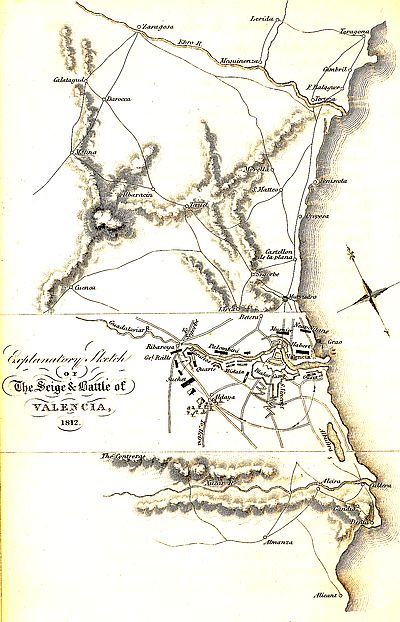 click here for larger image.
Explanatory Sketch
OF
The Siege & Battle of
VALENCIA,
1812.
London. Published by T. & W. BOONE.
On the 25th, the Neapolitan division being
placed in the camp at the Serranos, to hold the
Spaniards in check, Habert took post at the Grao,
and Palombini’s division was placed opposite the
village of Mislata, which was about half-way
between Valencia and the village of Quarte. Reille
at the same time made a forced march by Liria and
Benaguazil, and three bridges being thrown in the
night, above the sources of the canals, opposite
Ribaroya, the rest of the army crossed the Guadalaviar
with all diligence on the 26th and formed in
order of battle on the other side. It was then
eight o’clock and Reille had not arrived, but Suchet,
whose plan was to drive all Blake’s army within
the entrenched camp, fearing that the Spanish
general, would evade the danger, if he saw the
French divisions in march, resolved to push at once
with Harispe’s infantry and the cavalry to the
Albufera or salt-lake, beyond Valencia, and so cut
off Blake’s retreat to the Xucar river. Robert’s
brigade therefore halted to secure the bridges, until
Reille should come up, and while the troops, left
on the other bank of the Guadalaviar, attacked all
the Spanish river line of entrenchments, Suchet
marched towards the lake as rapidly as the thick
woods would permit.
The French hussars soon fell in with the Spanish1811. Dec.
cavalry at Aldaya and were defeated, but this
charge was stopped by the fire of the infantry, and
the remainder of the French horsemen coming up
overthrew the Spaniards. During this time Blake
instead of falling on Suchet with his reserve, was
occupied with the defence of the river, especially
at the village of Mislata, where a false attack, to
cover the passage at Ribaroya, had first given him
the alarm. Palombini, who was at this point, had
passed over some skirmishers and then throwing two
bridges, attacked the entrenchments; but his troops
were repulsed by Zayas, and driven back on the
river in disorder; they rallied and had effected
the passage of the canals, when a Spanish reserve
coming up restored the fight, and the French were
finally driven quite over the river. At that moment
Reille’s division, save one brigade which could not
arrive in time, crossed at Ribaroya, and in concert
with Robert, attacked Mahy in the villages of
Manisses and Quarte, which had been fortified
carefully in front, but were quite neglected on the
rear, and on the side of Aldaya. Suchet who had
been somewhat delayed at Aldaya by the aspect of
affairs at Mislata, then continued his march to the
lake, while Reille meeting with a feeble resistance
at Manisses and Quarte, carried both at one sweep,
and turned Mislata where he united with Palombini.
Blake and Zayas retired towards the city
but Mahy driven from Quarte took the road to
Alcira, on the Xucar, and thus passing behind
Suchet’s division, was entirely cut off from Valencia.
All the Spanish army, on the upper Guadalaviar,
was now entirely beaten with the loss of its artillery
and baggage, and below the city, Habert was
likewise victorious. He had first opened a cannonade
against the Spanish gun-boats near the Grao,
and this flotilla although in sight of an English
seventy-four and a frigate, and closely supported
by the Papillon sloop, fled without returning a shot;
the French then passed the water, and carried the
entrenchment, which consisted of a feeble breast-work,
defended by the irregulars who had only two
guns. When the passage was effected Habert fixed
his right, as a pivot, on the river, and sweeping
round with his left, drove the Spaniards towards
the camp; but before he could connect his flank
with Harispe’s troops, who were on the lake,
Obispo’s division, flying from Suchet’s cavalry,
passed over the rice grounds between the lake and
the sea, and so escaped to Cullera. The remainder
of Blake’s army about eighteen thousand of all
kinds retired to the camp and were closely invested
during the night.
Three detachments of French dragoons, each
man having an infantry soldier behind him, were
then sent by different roads of Alcira, Cullera, and
Cuença, the two first in pursuit of Mahy and
Obispo, the latter to observe Freire. Mahy was
found in a position at Alcira, and Blake had already
sent him orders to maintain the line of the
Xucar; but he had lost his artillery, his troops
were disheartened, and at the first shot he fled
although the ground was strong and he had three
thousand men while the French were not above
a thousand. Obispo likewise abandoned Cullera
and endeavoured to rejoin Mahy, when a very heavy
and unusual fall of snow not only prevented their
junction, but offered a fine advantage to the French.
For the British consul thinking the Xucar would
be defended, had landed large stores of provisions
and ammunition at Denia and was endeavouring to
re-embark them, when the storm drove the ships
of war off the coast, and for three days fifty cavalry
could have captured Denia and all the stores.
In this battle which cost the French less than
five hundred men, Zayas alone displayed his usual
vigour and spirit, and while retiring upon the
city, he repeatedly proposed to Blake to retreat by
the road Mahy had followed, which would have
saved the army; yet the other was silent, for he
was in every way incapable as an officer. With
twenty-three thousand infantry, a powerful cavalry,
and a wide river in his front—with the command
of several bridges by which he could have operated
on either side; with strong entrenchments, a secure
camp—with a fortified city in the centre, whence
his reserves could have reached the most distant
point of the scene of operation, in less than two
hours—with all these advantages he had permitted
Suchet whose force, seeing that one of Reille’s
brigades had not arrived, scarcely exceeded his
own, to force the passage of the river, to beat him
at all points, and to enclose him, by a march,
which spread the French troops on a circuit of
more than fifteen miles or five hours march; and
he now rejected the only means of saving his army.
But Suchet’s operations which indeed were of the
nature of a surprise, proves that he must have had
a supreme contempt for his adversary’s talents,
and the country people partook of the sentiment;
the French parties which spread over the country
for provisions, as far as Xativa, were every where
well received, and Blake complained that Valencia
contained a bad people.
The 2d of December, the Spanish general, finding
his error, attempted at the head of ten thousand
men to break out by the left bank of the Guadalaviar;
but his arrangements were unskilful, and
when his advanced guard of five thousand men had
made way, it was abandoned, and the main column
returned to the city. The next day many deserters
went over to the French, and Reille’s absent brigade,
now arrived and reinforced the posts on the
left bank of the river. Suchet fortified his camp
on the right bank, and having in the night of the
30th repulsed two thousand Spaniards who made a
sally, commenced regular approaches against the
camp and city.
It was impossible for Blake to remain long in1812. January.
the camp; the city contained one hundred and
fifty thousand souls besides the troops, and there
was no means of provisioning them, because
Suchet’s investment was complete. Sixty heavy
guns with their parcs of ammunition which had
reached Saguntum, were transported across the river
Guadalaviar to batter the works; and as the suburb
of San Vincente, and the Olivet offered two projecting
points of the entrenched camp, which possessed
but feeble means of defence, the trenches
were opened against them in the night of the 1st of
January.
The fire killed colonel Henri, the chief engineer,
but in the night of the 5th the Spaniards abandoned
the camp and took refuge in the city; the French,
perceiving the movement, escaladed the works,
and seized two of the suburbs so suddenly, that
they captured eighty pieces of artillery and established
themselves within twenty yards of the town
wall, when their mortar-batteries opened upon
the place. In the evening, Suchet sent a summons
to Blake, who replied, that he would have
accepted certain terms the day before, but that the
bombardment had convinced him, that he might
now depend upon both the citizens and the troops.
This answer satisfied Suchet. He was convinced
the place would not make any defence, and he continued
to throw shells until the 8th; after which he
made an attack upon the suburb of Quarte, but
the Spaniards still held out and he was defeated.
However, the bombardment killed many persons,
and set fire to the houses in several quarters; and as
there were no cellars or caves, as at Zaragoza, the
chief citizens begged Blake to capitulate. While
he was debating with them, a friar bearing a flag,
which he called the Standard of the Faith, came
up with a mob, and insisted upon fighting to the
last, and when a picquet of soldiers was sent against
him, he routed it and shot the officer; nevertheless
his party was soon dispersed. Finally, when a
convent of Dominicans close to the walls was
taken, and five batteries ready to open, Blake demanded
leave to retire to Alicant with arms, baggage,
and four guns.
These terms were refused, but a capitulation
guaranteeing property and oblivion of the past, and
providing that the unfortunate prisoners in the island
of Cabrera should be exchanged against an equal
number of Blake’s army, was negotiated and ratified
on the 9th. Then Blake complaining bitterly of
the people, gave up the city. Above eighteen
thousand regular troops, with eighty stand of colours,
two thousand horses, three hundred and
ninety guns, forty thousand muskets, and enormous
stores of powder were taken; and it is not one of
the least remarkable features of this extraordinary
war, that intelligence of the fall of so great a city
took a week to reach Madrid, and it was not known
in Cadiz until one month after!
On the 14th of January Suchet made his triumphal
entry into Valencia, having completed a
series of campaigns in which the feebleness of his
adversaries somewhat diminished his glory, but in
which his own activity and skill were not the less
conspicuous. Napoleon created him duke of Albufera,
and his civil administration was strictly in
unison with his conduct in the field, that is to say
vigorous and prudent. He arrested all dangerous
persons, especially the friars, and sent them to
France, and he rigorously deprived the people of
their military resources; but he proportioned his
demands to their real ability, kept his troops in
perfect discipline, was careful not to offend the
citizens by violating their customs, or shocking their
religious prejudices, and endeavoured, as much as
possible, to govern through the native authorities.
The archbishop and many of the clergy aided him,
and the submission of the people was secured.
The errors of the Spaniards contributed as much
to this object, as the prudent vigilance of Suchet;
for although the city was lost, the kingdom of Valencia
might have recovered from the blow, under the
guidance of able men. The convents and churches
were full of riches, the towns and villages abounded
in resources, the line of the Xucar was very strong,
and several fortified places and good harbours remained
unsubdued; the Partidas in the hills were
still numerous, the people were willing to fight,
and the British agents and the British fleets were
ready to aid, and to supply arms and stores. The
junta however dissolved itself, the magistrates fled
from their posts, the populace were left without
chiefs; and when the consul, Tupper, proposed to
establish a commission of government, having at
its head the padre Rico, the author of Valencia’s
first defence against Moncey, and the most able
and energetic man in those parts, Mahy evaded the
proposition; he would not give Rico power, and
shewed every disposition to impede useful exertion.
Then the leading people either openly submitted
or secretly entered into connection with the French,
who were thus enabled tranquilly to secure the
resources of the country; and as the regency at
Cadiz refused the stipulated exchange of prisoners,
the Spanish army was sent to France, and the
horrors of the Cabrera were prolonged.
During the siege of Valencia, Freire, with his
Murcians, including a body of cavalry, had abandoned
the passes of the Contreras district and
retired across the Xucar to Almanza; Mahy occupied
Alcoy, and Villa Campa had marched to
Carthagena. Suchet wished to leave them undisturbed
until he was ready to attack Alicant itself.
But to ensure the fall of Valencia, Napoleon had
directed Soult to hold ten thousand men in the
Despeñas Peros, ready to march if necessary to
Suchet’s assistance; and at the same time Marmont
was ordered to detach Montbrun with two divisions
of infantry and one of cavalry, from the valley of
the Tagus, to co-operate with the army of Aragon.
These last-named troops should have interposed
between Valencia and Alicant before the battle of
the 26th, but they were delayed, and only reached
Almanza on the 9th, the very day Valencia surrendered.
Freire retreated before them, and Mahy,
who was preparing to advance again to Alcira,
took shelter in Alicant. Montbrun knew that
Valencia had fallen, and was advised by Suchet
to return immediately, but ambitious to share in
the glory of the hour he marched against Alicant,
and throwing a few shells summoned it to surrender.
The municipal authorities, the governor and many
of the leading people, were disposed to yield, yet
Montbrun did not press them, and when he retired
the place was, as Suchet had foreseen, put
into a state of defence. The consul, Tupper, and
Roche, the military agent, by distributing clothes
and food to the naked famishing soldiers, restored
their courage, drew many more to Alicant, and
stopped the desertion, which was so great that
in one month Freire’s division alone had lost two
thousand men. Montbrun’s attempt therefore, hurt
the French interests, and his troops on their return
to Toledo wasted and pillaged the country through
which they passed in a shameful manner.
Villa Campa now abandoned Carthagena and returned
to the mountains of Albarazin; and Suchet,
embarrassed by the failure at Alicant, and dreading
the fever at Carthagena, posted Harispe’s division
on the Xucar, to guard against the pestilence rather
than to watch the enemy. Yet he seized Gandia
and Denia, which last was strangely neglected both
by the Spaniards and by the British squadron after
the stores were removed; for the castle had sixty
guns mounted, and many vessels were in the port;
and as a post it was important, and might easily
have been secured until a Spanish garrison could
be thrown in. When these points were secured
Suchet detached a brigade on the side of Cabrillas
to preserve the communication with Cuença, and
then directed Musnier’s division to form the siege
of Peniscola; but at the moment of investing that
place, intelligence arrived that Taragona, the garrison
of which, contrary to orders, had consumed
the reserve-provisions, was menaced by Lacy;
wherefore Severoli’s division moved from Valencia
to replace Musnier, and the latter marched to Tortoza
in aid of Taragona. Previous to Musnier’s
arrival, Lafosse, governor of Tortoza, had advanced
with some cavalry and a battalion of infantry to
the fort of Balaguer, to observe Lacy, and being
falsely told that the Spaniards were in retreat,
entered Cambril the 19th, and from thence pushed
on with his cavalry to Taragona. Lacy was nearer
than he imagined.
It will be remembered that the Catalan army
was posted in the valley of the Congosta and at
Mattaro, to intercept the French convoy to Barcelona.
In December Maurice Mathieu seized Mattaro,
while Dacaen, who had received some reinforcements,
brought down the long expected convoy,
and the Spaniards being thus placed between
two fires, after a slight action, opened the road.
When Dacaen returned to Gerona they resumed
their position, but Lacy after proposing several new
projects, which he generally relinquished at the
moment of execution, at last decided to fall on
Taragona, and afterwards to invade Aragon. With
this view, he drew off Eroles’ division and some
cavalry, in all about six thousand men, from the
Congosta, and took post about the 18th of January,
at Reus. Stores from Cadiz were landed from the
English vessels at Cape Salou; captain Codrington
repaired to the Spanish quarters on the 19th to
concert a combined operation with the fleet, and it
was at this moment the scouts brought word that
Lafosse had entered Taragona with the cavalry,
and that the French infantry, about eight hundred
in number, were at Villa Seca, ignorant of the
vicinity of the Spanish army.
Lacy immediately put his troops in motion, and
captain Codrington would have returned to his ship,
but a patrol of French dragoons chased him back,
and another patrol pushing to Salou made two
captains and a lieutenant of the squadron prisoners,
and brought them to Villa Seca. By this time,
however, Lacy had fallen upon the French infantry
in front, and Eroles turning both their flanks, and
closing upon their rear, killed or wounded two
hundred when the remainder surrendered.
The naval officers, thus freed, immediately regained
their ships, and the squadron was that
night before Taragona; but a gale of wind off shore
impeded its fire, the Spaniards did not appear on
the land-side, and the next day the increasing
gale obliged the ships to anchor to the eastward.
Lacy had meanwhile abandoned the project against
Taragona, and after sending his prisoners to Busa,
went off himself towards Montserrat, leaving Eroles’
division, reinforced by a considerable body of armed
peasantry, in a position at Altafulla, behind the
Gaya. Here the bridge in front being broken,
and the position strong, Eroles, who had been also
promised the aid of Sarsfield’s division, awaited the
attack of three thousand men who were coming from
Barcelona. He was however ignorant that Dacaen,
finding the ways from Gerona open, because Sarsfield
had moved to the side of Vich, had sent general
Lamarque with five thousand men to Barcelona,
and that Maurice Mathieu was thus in march not
with three but eight thousand good troops.
The French generals, anxious to surprise Eroles,
took pains to conceal their numbers, and while
Maurice Mathieu appeared in front, Lamarque was
turning the left flank. They marched all night,
and at day-break on the 24th, having forded the
river, made a well combined and vigorous attack,
by which the Spaniards were defeated with a loss
of more than one thousand killed and wounded.
The total dispersion of the beaten troops baffled
pursuit, and the French in returning to Barcelona
suffered from the fire of the British squadron, but
Eroles complained that Sarsfield had kept away
with a settled design to sacrifice him.
While this was passing in Lower Catalonia,
Dacaen scoured the higher country about Olot, and
then descending into the valley of Vich defeated
Sarsfield at Centellas, and that general himself
was taken, but rescued by one of his soldiers.
From Centellas, Dacaen marched by Caldas and
Sabadel upon Barcelona, where he arrived the
27th January, meanwhile Musnier re-victualled
Taragona. Thus the Catalans were again reduced to
great straits, for the French knowing that they were
soon to be reinforced, occupied all the sea-coast,
made new roads out of reach of fire from the ships,
established fresh posts at Moncado, Mattaro, Palamos,
and Cadaques, placed detachments in the
higher valleys, and obliged their enemies to resort
once more to an irregular warfare; which was
however but a feeble resource, because from Lacy’s
policy the people were now generally disarmed and
discontented.
Milans, Manso, Eroles, Sarsfield, and Rovira,
indeed, although continually quarrelling, kept the
field; and being still supplied with arms and stores
which the British navy contrived to land, and send
into the interior, sustained the war as partizans
until new combinations were produced by the efforts
of England; but Lacy’s intrigues and unpopularity
increased, a general gloom prevailed, and the foundations
of strength in the principality were shaken.
The patriots indeed still possessed the mountains,
but the French held all the towns, all the ports, and
most of the lines of communication; and their
moveable columns without difficulty gathered the
harvests of the valleys, and chased the most daring
of the partizans. Meanwhile Suchet, seeing that
Taragona was secure, renewed his operations.
This fortress, crowning the summit of a lofty
rock in the sea, was nearly impregnable; and the
only communication with the shore, was by a neck
of land sixty yards wide and two hundred and fifty
long. In the middle of the town there was a strong
castle, well furnished with guns and provisions, and
some British ships of war were at hand to aid the
defence; the rock yielded copious springs of water,
and deep marshes covered the approach to the neck
of land, which being covered by the waves in heavy
gales, had
also an artificial cut defended by batteries
and flanked by gun-boats. Garcia Navarro,
who had been taken during the siege of Tortoza,
but had escaped from France, was now governor
of Peniscola, and his garrison was sufficiently numerous.
On the 20th ground was broken, and mortar-batteries
being established twelve hundred yards
from the fort, opened their fire on the 28th.
In the night of the 31st a parallel five hundred
yards long was built of fascines and gabions, and
batteries were commenced on either flank.
In the night of the 2d of February the approaches1812. February.
were pushed beyond the first parallel, and the breaching
batteries being finished and armed were going to
open when a privateer captured a despatch from the
governor, who complained in it that the English
wished to take the command of the place, and declared
his resolution rather to surrender than suffer them
to do so. On this hint Suchet opened negotiations
which terminated in the capitulation of the fortress,
the troops being allowed to go where they pleased.
The French found sixty guns mounted, and the
easy reduction of such a strong place, which secured
their line of communication, produced a general
disposition in the Valencians to submit to fortune.
Such is Suchet’s account of this affair, but the
colour which he thought it necessary to give to
a transaction, full of shame and dishonour, to Navarro,
can only be considered as part of the price
paid for Peniscola. The true causes of its fall
were treachery and cowardice. The garrison were
from the first desponding and divided in opinion,
and the British naval officers did but stimulate
the troops and general to do their duty to their
country.
After this capture, six thousand Poles quitted
Suchet, for Napoleon required all the troops of
that nation for his Russian expedition. These
veterans marched by Jaca, taking with them
the prisoners of Blake’s army, at the same time
Reille’s two French divisions were ordered to
form a separate corps of observation on the Lower
Ebro, and Palombini’s Italian division was sent
towards Soria
and Calatayud to oppose Montijo,
Villa Campa, and Bassecour, who were still in
joint operation on that side. But Reille soon
marched towards Aragon, and Severoli’s division
took his place on the Lower Ebro; for the Partidas
of Duran, Empecinado, and those numerous
bands from the Asturias and La Montaña composing
the seventh army, harassed Navarre and Aragon
and were too powerful for Caffarelli. Mina’s also
re-entered Aragon in January, surprised Huesca,
and being attacked during his retreat at Lumbiar
repulsed the enemy and carried off his prisoners.
Suchet’s field force in Valencia was thus reduced
by twenty thousand men, he had only fifteen thousand
left, and consequently could not push the invasion
on the side of Murcia. The approaching
departure of Napoleon from Paris also altered the
situation of the French armies in the Peninsula.
The king was again appointed the emperor’s lieutenant,
and he extended the right wing of Suchet’s
army to Cuença, and concentrated the army of the
centre at Madrid; thus Valencia was made, as it
were, a mere head of cantonments, in front of
which fresh Spanish armies soon assembled, and
Alicant then became an object of interest to the
English government. Suchet, who had neglected
the wound he received at the battle of Saguntum,
now fell into a dangerous disorder, and that fierce
flame of war which seemed destined to lick up all
the remains of the Spanish power, was suddenly
extinguished.
1º. The events which led to the capitulation of
Valencia, were but a continuation of those faults
which had before ruined the Spanish cause in every
part of the Peninsula, namely, the neglect of all
good military usages, and the mania for fighting
great battles with bad troops.
2º. Blake needed not to have fought a serious
action during any part of the campaign. He might
have succoured Saguntum without a dangerous
battle, and might have retreated in safety behind
the Guadalaviar; he might have defended that
river without risking his whole army, and then
have retreated behind the Xucar. He should never
have shut up his army in Valencia, but having done
so he should never have capitulated. Eighteen
thousand men, well conducted, could always have
broken through the thin circle of investment, drawn
by Suchet, especially as the Spaniards had the
power of operating on both banks of the river.
But the campaign was one huge error throughout,
and was pithily summed up in one sentence by the
duke of Wellington. Being accused by the regency
at Cadiz of having caused the catastrophe,
by permitting the army of the north and that of
Portugal to send reinforcements to Suchet, he replied
thus—“The misfortunes of Valencia are to
be attributed to Blake’s ignorance of his profession,
and to Mahi’s cowardice and treachery!”
CHAPTER IV. — OPERATIONS IN ANDALUSIA AND ESTREMADURA. — SURPRISE OF AROYO MOLINO.
The affairs of these provinces were so intimately1811.
connected, that they cannot be treated separately,
wherefore, taking Soult’s position at Seville as the
centre of a vast system, I will show how, from
thence, he dealt his powerful blows around, and
struggled, even as a consuming fire, which none
could smother though many tried.
Seville the base of his movements, and the storehouse
of his army, was fortified with temporary
citadels, which, the people being generally submissive,
were tenable against desultory attacks.
From this point he maintained his line of communication,
with the army of Portugal, through Estremadura,
and with Madrid through La Mancha;
and from this point he sustained the most diversified
operations on all parts of a circle, which
embraced the Condado de Niebla, Cadiz, Grenada,
Cordoba, and Estremadura.
The Niebla, which furnished large supplies, was
the most vulnerable point, because from thence the
allies might intercept the navigation of the river
Guadalquivir, and so raise the blockade of Cadiz;
and the frontier of Portugal would cover the assembly
of the troops until the moment of attack.
Moreover, expeditions from Cadiz to the mouth of
the Guadiana were as we have seen frequent. Nevertheless,
when Blake and Ballesteros had been
driven from Ayamonte, in July and August, the
French were masters of the Condado with the exception
of the castle of Paymago, wherefore Soult,
dreading the autumnal pestilence, did not keep
more than twelve hundred men on that side.
The blockade of the Isla was always maintained
by Victor, whose position formed an irregular crescent,
extending from San Lucar de Barameda on
the right, to Conil on the left, and running through
Xeres, Arcos, Medina, Sidonia, and Chiclana. But
that marshal while thus posted was in a manner
blockaded himself. In the Isla, including the Anglo-Portuguese
division, there were never less than
sixteen thousand troops, who, having the command
of the sea, could at any moment land on the flanks
of the French. The Partidas, although neither numerous
nor powerful, often impeded the intercourse
with Seville; the Serranos of the Ronda and the
regular forces at Algeziras issuing, as it were, from
the fortress of Gibraltar, cut the communication
with Grenada; and as Tarifa was still held by the
allies, for general Campbell would never relinquish
that important point, the fresh supplies of cattle,
drawn from the great plain called the Campiña de
Tarifa,
were straitened. Meanwhile the expeditions
to Estremadura and Murcia, the battles of
Barosa and Albuera, and the rout of Baza, had
employed all the disposable part of the army of the
south; hence Victor’s corps, scarcely strong enough
to preserve its own fortified position, could make
no progress in the attack of the Isla. This weakness
of the French army being well known in
Cadiz, the safety of that city was no longer doubtful,
a part of the British garrison therefore joined lord
Wellington’s army, and Blake as we have seen carried
his Albuera soldiers to Valencia.
In Grenada the fourth corps, which, after the
departure of Sebastiani, was commanded by general
Laval, had two distinct tasks to fulfil. The one to
defend the eastern frontier from the Murcian army;
the other to maintain the coast line, beyond the
Alpuxaras, against the efforts of the Partidas of
those mountains, against the Serranos of the Ronda,
and against the expeditionary armies from Cadiz
and from Algeziras. However, the defeat at Baza,
and the calling off of Mahi, Freire, and Montijo
to aid the Valencian operations, secured the Grenadan
frontier; and Martin Carera, who was left
there with a small force, having pushed his partizan
excursions rashly, was killed in a skirmish at
Lorca about the period when Valencia surrendered.
Cordoba was generally occupied by a division
of five or six thousand men, who were ready to
operate on the side of Estremadura, or on that of
Murcia, and meanwhile chased the Partidas, who
were more numerous there than in other parts, and
were also connected with those of La Mancha.
Estremadura was the most difficult field of operation.
There Badajos, an advanced point, was to
be supplied and defended from the most formidable
army in the Peninsula; there the communications
with Madrid, and with the army of Portugal, were
to be maintained by the way of Truxillo; and
there the fifth French corps, commanded by Drouet,
had to collect its subsistence from a ravaged
country; to preserve its communications over the
Sierra Morena with Seville; to protect the march
of monthly convoys to Badajos; to observe the
corps of general Hill, and to oppose the enterprises
of Morillo’s Spanish army, which was becoming
numerous and bold.
Neither the Spanish nor British divisions could
prevent Drouet from sending convoys to Badajos,
because of the want of bridges on the Guadiana,
below the fortress, but Morillo incommoded his
foraging parties; for being posted at Valencia de
Alcantara, and having his retreat upon Portugal
always secure, he vexed the country about Caceres,
and even pushed his incursions to Truxillo. The
French general, therefore, kept a strong detachment
beyond the Guadiana, but this exposed his troops
to Hill’s enterprises; and that bold and vigilant
commander having ten thousand excellent troops,
and being well instructed by Wellington, was a
very dangerous neighbour.
Marmont’s position in the valley of the Tagus;
the construction of the forts and bridge at Almaraz,
which enabled him to keep a division at Truxillo,
and connected him with the army of the south,
tended indeed to hold Hill in check, and strengthened
the French position in Estremadura; nevertheless,
Drouet generally remained near Zafra with
his main body, because from thence he could more
easily make his retreat good to the Morena, or
advance to Merida and Badajos as occasion required.
Such was the state of military affairs on the
different parts of the circle round Seville, at the
period when Suchet invaded Valencia, and Wellington
blockaded Ciudad Rodrigo; and to support his
extensive operations, the duke of Dalmatia, if his
share of the reinforcements which entered Spain in
July and August had joined him, would have hadAppendix, No. IX. Section 3.
about a hundred thousand troops, of which ninety
thousand men and fourteen thousand horses were
French. But the reinforcements were detained in
the different governments, and the actual number
of French present with the eagles was not more
than sixty-seven thousand.
The first corps contained twenty thousand; the
fourth and fifth about eleven thousand each; the
garrison of Badajos was five thousand; twenty
thousand formed a disposable reserve, and the rest
of the force consisted of “Escopeteros” and civic
guards, who were chiefly employed in the garrisons
and police. Upon pressing occasions, Soult could
therefore take the field, at any point, with twenty-four
or twenty-five thousand men, and in Estremadura,
on very pressing occasions, with even a
greater number of excellent troops well and powerfully
organized. The manner in which this great
army was paralysed in the latter part of 1811, shall
now be shown.
In October, Drouet was in the Morena, and1811. October.
Girard at Merida, watching Morillo, who was in
Caceres, when Soult, who had just returned to
Seville after his Murcian expedition, sent three
thousand men to Fregenal, seemingly to menace
the Alemtejo. General Hill therefore recalled his
brigades from the right bank of the Tagus, and
concentrated his whole corps behind the Campo
Maior on the 9th.
The 11th Girard and Drouet advanced, the
Spanish cavalry retired from Caceres, the French
drove Morillo to Caza de Cantellaña, and every
thing indicated a serious attack; but at this moment
Soult’s attention was attracted by the appearance
of Ballesteros in the Ronda, and he recalled
the force from Fregenal. Drouet, who had reached
Merida, then retired to Zafra, leaving Girard with
a division and some cavalry near Caceres.
Ballesteros had disembarked at Algeziras on the
11th of September, and immediately marched with
his own and Beguine’s troops, in all four thousand
men, to Ximena, raising fresh levies and collecting
the Serranos of the Ronda as he advanced. On
the 18th he had endeavoured to succour the castle
of Alcala de Gazules, where Beguines had a garrison,
but a French detachment from Chiclana had
already reduced that post, and after some skirmishing
both sides fell back, the one to Chiclana, the
other to Ximena.
At this time six thousand French were collected
at Ubrique, intending to occupy the sea-coast,
from Algeziras to Conil, in furtherance of
a great project which Soult was then meditating,
and by which he hoped to effect, not only the
entire subjection of Andalusia, but the destruction
of the British power in the Peninsula. But
this design, which shall be hereafter explained
more fully, required several preliminary operations,
amongst the most important of which was the
capture of Tarifa; for that place, situated in the
narrowest part of the straits, furnished either a
protection, or a dangerous point of offence, to the
Mediterranean trade, following the relations of its
possessor with England. It affected, as we have
seen, the supplies of the French before the Isla;
it was from its nearness, and from the run of the
current, the most convenient and customary point
for trading with Morocco; it menaced the security
of Ceuta, and it possessed, from ancient recollections,
a species of feudal superiority over the
smaller towns, and ports along the coast, which
would have given the French, if they had taken it,
a moral influence of some consequence.
Soult had in August despatched
a confidential officer from Conil to the African coast to negotiate
with the Barbaric emperor, and the latter had
agreed to a convention, by which he engaged to
exclude British agents from his court; and to permit
vessels of all nations to use the Moorish flag
to cover their cargoes, while carrying to the French
those supplies hitherto sent to the allies, provided
Soult would occupy Tarifa as a depôt. This important
convention was on the point of being ratified,
when the opportune arrival of some unusually
magnificent presents from England, turned the scale
against the French: their agent was then dismissed,
the English supplies were increased, and Mr. Stuart
entered into a treaty for the purchase of horses to
remount the allied cavalry.
Although foiled in this attempt, Soult, calculating
on the capricious nature of barbarians, resolved to
fulfil his part by the capture of Tarifa; hence it
was, that when Ballesteros appeared at Ximena, he
arrested the movement of Drouet against the Alemtejo,
and sent troops from Seville by Ubrique
against the Spanish general, whose position besides
being extremely inconvenient to the first and fourth
corps, was likely to affect the taking of Tarifa. Ballesteros,
if reinforced, might also have become very
dangerous to the blockade of Cadiz, by intercepting
the supplies from the Campiña de Tarifa, and still
more by menacing Victor’s communications with Seville,
along
the Guadalquivir. A demonstration by
the allies in the Isla de Leon arrested the march of
these French troops for a moment, but on the 14th
eight thousand men under generals Godinot and Semélé
advanced upon St. Roque and Algeziras. The
inhabitants of those places immediately fled to the
green island, and Ballesteros took refuge under
Gibraltar, where his flanks were covered by the
gun-boats of the place. The garrison was too weak
to assist him with men, and thus cooped up, he
lived upon the resources of the place, while efforts
were therefore made to draw off the French by
harassing their flanks. The naval means were not
sufficient to remove his whole army to another
quarter, but seven hundred were transported to
Manilba, where the Serranos and some Partidas had
assembled on the left of the French, and at the
same time twelve hundred British troops with four
guns, under colonel Skerrett, and two thousand
Spaniards, under Copons, sailed from Cadiz to
Tarifa to act upon the French right.
Copons was driven back by a gale of wind, but
Skerrett arrived the 17th. The next day Godinot
sent a detachment against him, but the sea-road by
which it marched was so swept with the guns of
the Tuscan frigate, aided by the boats of the
Stately, that the French after losing some men
returned. Then Godinot and Semélé being in dispute,
and without provisions, retreated; they were
followed by Ballesteros’ cavalry as far as Ximena,
where the two generals separated in great anger,
and Godinot having reached Seville shot himself.
This failure in the south unsettled Soult’s plans,
and was followed by a heavier disaster in Estremadura.
When Drouet had retired to Zafra, Hill received
orders from Wellington to drive Girard away from
Caceres, that Morillo might forage that country.
For this purpose he assembled his corps at Albuquerque
on the 23d, and Morillo brought the
fifth Spanish army to Aliseda on the Salor.
Girard was then at Caceres with an advanced guard
at Aroyo de Puerco, but on the 24th Hill occupied
Aliseda and Casa de Cantillana, and the
Spanish cavalry drove the French from Aroyo de
Puerco. The 26th at day-break Hill entered Malpartida
de Caceres, and his cavalry pushed back
that of the enemy. Girard then abandoned Caceres,
but the weather was wet and stormy, and Hill,
having no certain knowledge of the enemy’s movements,
halted for the night at Malpartida.
On the morning of the 27th the Spaniards
entered Caceres; the enemy was tracked to Torre
Mocha on the road to Merida; and the British
general, hoping to intercept their line of march,
pursued by a cross road, through Aldea de Cano
and Casa de Don Antonio. During this movement
intelligence was received that the French
general had halted at Aroyo Molino, leaving a
rear-guard at Albala, on the main road to Caceres,
which proved that he was ignorant of the new
direction taken by the allies, and only looked to a
pursuit from Caceres. Hill immediately seized the
advantage, and by a forced march reached Alcuesca
in the night, being then within a league of Aroyo
de Molinos.
This village was situated in a plain, and behind
it a sierra or ridge of rocks, rose in the form
of a crescent, about two miles wide on the chord.
One road led directly from Alcuesca upon Aroyo,
another entered it from the left, and three led from
it to the right. The most distant of the last was
the Truxillo road, which rounded the extremity of
the sierra; the nearest was the Merida road, and
between them was that of Medellin.
During the night, though the weather was dreadful,
no fires were permitted in the allied camp; and
at two o’clock in the morning of the 28th, the troops
moved to a low ridge, half-a-mile from Aroyo,
under cover of which they formed three bodies;
the infantry on the wings and the cavalry in the
centre. The left column then marched straight upon
the village, the right marched towards the extreme
point of the sierra, where the road to Truxillo
turned the horn of the crescent; the cavalry kept
its due place between both.
One brigade of Girard’s division, having marched
at four o’clock by the road of Medellin, was already
safe, but Dombrouski’s brigade and the cavalry of
Briche were still in the place; the horses of the
rear-guard, unbridled, were tied to the olive-trees,
and the infantry were only gathering to form on the
Medellin road outside the village. Girard himself
was in his quarters, waiting for his horse, when
two British officers galloped down the street, and
in an instant all was confusion; the cavalry bridled
their horses, and the infantry run to their alarming
posts. But a thick mist rolled down the craggy
mountain, a terrifying shout, drowning even the
clatter of the elements arose on the blast, and with
the driving storm came the seventy-first and ninety-second
regiments, charging down the street. Then
the French rear-guard of cavalry, fighting and
struggling hard, were driven to the end of the
village, and the infantry, hastily forming their
squares, covered the main body of the horsemen
which gathered on their left.
The seventy-first immediately lined the garden walls,
and opened a galling fire on the nearest
square, while the ninety-second filing out of the
streets formed upon the French right; the fiftieth
regiment closely following, secured the prisoners in
the village, and the rest of the column, headed by
the Spanish cavalry, skirted the outside of the
houses, and endeavoured to intercept the line of
retreat. The guns soon opened on the French
squares, the thirteenth dragoons captured their
artillery, the ninth dragoons and German hussars,
charged their cavalry and entirely dispersed it with
great loss; but Girard, an intrepid officer, although
wounded, still kept his infantry together, and continued
his retreat by the Truxillo road. The right
column of the allies was however already in possession
of that line, the cavalry and artillery were
close upon the French flank, and the left column,
having re-formed, was again coming up fast;
Girard’s men were falling by fifties, and his
situation was desperate, yet he would not surrender,
but giving the word to disperse, endeavoured
to escape by scaling the almost inaccessible rocks
of the sierra. His pursuers, not less obstinate,
immediately divided. The Spaniards ascended
the hills at an easier part beyond his left, the
thirty-ninth regiment and Ashworth’s Portuguese
turned the mountain by the Truxillo road; the
twenty-eighth and thirty-fourth, led by general
Howard, followed him step by step up the
rocks, and prisoners were taken every moment,
until the pursuers, heavily loaded, were unable
to continue the trial of speed with men who had
thrown away their arms and packs. Girard,
Dombrouski, and Briche, escaped at first to San
Hernando, and Zorita, in the Guadalupe mountains,
after which, crossing the Guadiana at
Orellano on the 9th of November, they rejoined
Drouet with about six hundred men, the remains
of three thousand. They were said to be the
finest troops then in Spain, and indeed their resolution
not to surrender in such an appalling
situation was no mean proof of their excellence.
The trophies of this action were the capture of
twelve or thirteen hundred prisoners, including
general Bron, and the prince of Aremberg; all the
French artillery, baggage, and commissariat, together
with a contribution just raised; and during
the fight, a Portuguese brigade, being united
to Penne Villamur’s cavalry was sent to Merida,
where some stores were found. The loss of
the allies was not more than seventy killed and
wounded, but one officer, lieutenant Strenowitz,
was taken. He was distinguished by his courage
and successful enterprises, but he was an Austrian,
who having abandoned the French army in Spain
to join Julian Sanchez’ Partida, was liable to death
by the laws of war; having been however originally
forced into the French service he was, in reality,
no deserter. General Hill, anxious to save him,
applied frankly to general Drouet, and such was
the latter’s good temper, that while smarting under
this disaster he released his prisoner.
Girard was only deprived of his division, which
was given to general Barois, yet in a military
point of view his offence was unpardonable. He
knew two or three days before, that general Hill
was near him; he knew that there was a good
road from Malpartida to Alcuesca, because he
had himself passed it coming from Caceres; and
yet he halted at Aroyo de Molino without
necessity, and without sending out even a patrole
upon his flank, thus sacrificing two thousand
brave men. Napoleon’s clemency was therefore
great, and yet not misplaced, for Girard, afterwards,
repaid it by his devotion at the battle of
Lutzen when the emperor’s star was on the wane.
On the other hand general Hill neglected no precaution,
let no advantage escape; and to good
arrangements added celerity of movement, with the
utmost firmness and vigour of execution. His
troops seconded him as he merited; and here was
made manifest the advantage of possessing the
friendship of a people so strongly influenced by
the instincts of revenge as the Peninsulars; for,
during the night of the 27th, every Spaniard in
Aroyo, as well as in Alcuesca, knew that the allies
were at hand, and not one was found so base or so
indiscreet as to betray the fact.
This blow being struck, Hill returned to his old1811. Nov.
quarters, and the Spanish troops fell back behind
the Salor, but the report of Girard’s disaster set all
the French corps in motion. Drouet reoccupied
Caceres with a thousand men; Foy passed the Tagus
at Almaraz on the 15th of November, and moved to
Truxillo; a convoy entered Badajos from Zafra on
the 12th, a second on the 20th, and Soult, while
collecting troops in Seville, directed Phillipon to
plant all the ground under the guns at Badajos
with potatoes and corn. Every thing seemed to
indicate a powerful attack upon Hill, when a serious
disturbance amongst the Polish troops, at Ronquillo,
obliged Soult to detach men from Seville
to quell it. When that was effected, a division ofMr. Stuart’s papers, MSS.
four thousand entered Estremadura, and Drouet,
whose corps was thus raised to fourteen thousand
infantry and three thousand cavalry, on the
5th of December advanced to Almendralejos, and
the 18th his advanced guard occupied Merida.
At the same time Marmont concentrated part of
his army at Toledo, from whence Montbrun, as we
have seen, was directed to aid Suchet at Valencia,
and Soult with the same view sent ten thousand
men to the Despeños Peros.
Drouet’s movements were, however, again stopped1811. Dec.
by some insubordination in the fifth corps.
And as it was now known that Soult’s principal
object was to destroy Ballesteros, and take Tarifa,
Hill again advanced, partly to protect Morillo
from Drouet, partly to save the resources
of Estremadura, partly to make a diversion in
favour of Ballesteros and Tarifa, and in some sort
also for Valencia. With this view he entered
Estremadura by Albuquerque on the 27th of
December, and having received information that
the French, untaught by their former misfortunes
were not vigilant, he made a forced march
in hopes to surprise them. On the 28th he
passed Villar del Rey and San Vincente and
reached Nava de Membrillos, where he fell in with
three hundred French infantry, and a few hussars,
part of a foraging party, the remainder of which
was at a village two leagues distant. A patrole
gave an alarm, the French retreated towards Merida,
and were closely followed by four hundred
of the allied cavalry, who had orders to make every
effort to stop their march; but to use the words
of general Hill, “the intrepid and admirable manner
in which the enemy retreated, the infantry
formed in square, and favoured as he was by the
nature of the country of which he knew how to
take the fullest advantage, prevented the cavalry
alone from effecting any thing against him.” Captain
Neveux, the able officer who commanded on
this occasion, reached Merida with a loss of only
forty men, all killed or wounded by the fire of
the artillery; but the French at Merida immediately
abandoned their unfinished works, and evacuated
that town in the night, leaving behind some
bread and a quantity of wheat.
From Merida, Hill, intending to fight Drouet,1812. January
marched on the 1st of January to Almendralejos,
where he captured another field store; but the
French general, whose troops were scattered, fell
back towards Zafra; the weather was so bad,
and the roads so deep, that general Hill with the
main body halted while colonel Abercrombie with
a detachment of Portuguese and German cavalry
followed the enemy’s rear-guard. Meanwhile Phillipon,
who never lost an advantage, sent, either the
detachment which had escorted the convoy to
Badajos, or some Polish troops with whom he was
discontented, down the Portuguese frontier on the
right of the Guadiana, by Moura, Mourao, and
Serpe, with orders to drive the herds of cattle from
those places into the sierra Morena.
Abercrombie reached Fuente del Maestro, on the
evening of the 3d, where, meeting with a stout squadron
of the enemy, a stiff charge took place, and
the French out-numbered and flanked on both sides
were overthrown with a loss of thirty men. But
Drouet was now in full retreat for Monasterio,
and Morillo moving upon Medellin, took post at
San Benito. Thus the allies remained masters of
Estremadura until the 13th of January, when Marmont’s
divisions moved by the valley of the Tagus
towards the eastern frontier of Portugal; Hill then
returned to Portalegre and sent a division over the
Tagus to Castello Branco. Drouet immediately returned
to Llerena and his cavalry supported by a
detachment of infantry marched against Morillo,
but that general, instead of falling back when Hill
did, had made a sudden incursion to La Mancha,
and was then attacking the castle of Almagro.
There, however, he was so completely defeated by
general Treillard that, flying to Horcajo in the
Guadaloupe mountains, although he reached it on
the 18th, his fugitives were still coming in on the
21st, and his army remained for a long time in the
greatest disorder.
CHAPTER V. — SIEGE OF TARIFA. — THE ASSAULT.
While the events, recorded in the foregoing1811. Nov.
chapter, were passing in Estremadura, the south
of Andalusia was the scene of more important
operations. Soult, persisting in his design against
Tarifa, had given orders to assemble a battering
train, and directed general Laval with a strong
division of the 4th corps to move from Antequera
upon San Roque. Skerrett was then menacing the
communications of general Semélé on the side of
Vejer de Frontera, and Ballesteros had obtained
some success against that general at Bornos on the
5th of November; but Skerrett finding that Copons
instead of four thousand had only brought seven
hundred men, returned to Tarifa on the approach
of some French from Conil.
Semélé, being thus reinforced, obliged Ballesteros,
on the 27th, again to take refuge under the
walls of Gibraltar, which he reached just in time,
to avoid a collision with Laval’s column from Antequera.
Semélé’s troops did not follow very close,
and a combined attack upon Laval by the divisions
of Ballesteros, Skerrett, and Copons, was
projected. The two latter with a part of the troops
under Ballesteros, were actually embarked on the
29th of November for the purpose of landing at
Manilba, in pursuance of this scheme, when Semélé’s
column came in sight, and Skerrett and
Copons instantly returned to Tarifa.
Ballesteros remained at Gibraltar, a heavy1811. Dec.
burthen upon that fortress, and his own troops
without shelter from the winter rain, wherefore
general Campbell proposed to send them, in British
vessels, to renew the attempt against Malaga,
which had formerly failed under Lord Blayney.
On the 12th of January, at the very moment of
embarking, the French retired from before Gibraltar,
by the Puerto de Ojen, a grand pass connecting
the plains of Gibraltar and the vallies of
the Guadaranque, with the great and rich plain
called the Campiña de Tarifa; and with the gorge
of Los Pedragosos, which is the eastern entrance
to the pastures called the Vega de Tarifa. This
movement was preparatory to the siege of Tarifa;
and as the battering train was already within five
leagues of that place, Skerrett proposed to seize it by
a combined operation from Cadiz, Tarifa, Gibraltar,
and Los Barios, where Ballesteros had now taken post.
This combination was however on too wide a scale
to be adopted in all its parts; Ballesteros indeed fell
on the enemy by surprise at the pass of Ojen, and
Skerrett and Copons received orders from general
Campbell to take advantage of this diversion; but
the former, seeing that his own plan was not
adopted to its full extent, would not stir, and the
Spaniards after a skirmish of six hours retired.
Laval then left fifteen hundred men to observe
Ballesteros, and placing a detachment at Vejes to
cover his right flank, threaded Los Pedragosos and
advanced against Tarifa.
This town was scarcely expected by the French to
make any resistance. It was encircled with towers,
which were connected by an ancient archery wall,
irregular in form without a ditch, and so thin as to
offer no resistance even to field artillery. To the
north and east, some high ridges flanked, and seemed
entirely to command the weak rampart; but the English
engineer had observed that the nearest ridges
formed, at half pistol-shot, a natural glacis, the plane
of which, one point excepted, intersected the crest of
the parapet with great nicety; and to this advantage
was added a greater number of towers, better
flanks, and more powerful resources for an interior
defence. He judged therefore that the seemingly
favourable nature of the ridges combined with other
circumstances, would scarcely fail to tempt the
enemy to commence their trenches on that side.
With a view to render the delusion unavoidable,
he strengthened the western front of the place,
rendered the access to it uneasy, by demolishing
the main walls and removing the flooring of an
isolated suburb on the north-west; and an outwork,
of a convent which was situated about a hundred
yards from the place, and to the east of the suburb.
This done, he prepared an internal defence, which
rendered the storming of the breach the smallest
difficulty to be encountered; but to appreciate his
design the local peculiarities must be described.
Tarifa was cloven in two by the bed of a periodical
torrent which entering at the east, passed
out at the opposite point. This stream was barred,
at its entrance, by a tower with a portcullis, in
front of which pallisades were planted across the
bed of the water. The houses within the walls were
strongly built and occupied inclined planes rising
from each side of the torrent, and at the exit of the
latter there were two massive structures, forming
part of the walls called the tower and castle of
the Gusmans, both of which looked up the hollow
formed by the meeting of the inclined planes at the
stream. From these structures, first a sandy neck
of land, and then a causeway, the whole being about
six hundred yards long, joined the town to an island,
or rather promontory, about two thousand yards in
circumference, with perpendicular sides, which forbade
any entrance save by the causeway; and at
the island end of the latter there was an unfinished
entrenchment and battery.
On the connecting neck of land were some sand
hills, the highest of which, called the Catalina,
was scarped and crowned with a slight field work,
containing a twelve-pounder. This hill covered
the causeway, and in conjunction with the tower of
the Gusmans, which was armed with a ship eighteen-pounder,
flanked the western front, and commanded
all the ground between the walls and the island.
The gun in the tower of the Gusmans also shot
clear over the town on to the slope where the
French batteries were expected to be raised; and
in addition to these posts, the stately ship of the
line, the Druid frigate, and several gun and mortar-boats
were anchored in the most favourable situation
for flanking the enemy’s approaches.
Reverting then to the head of the defence, it
will be seen, that while the ridges on the eastern
fronts, and the hollow bed of the torrent, which
offered cover for troops moving to the assault,
deceitfully tempted the enemy to that side; the
flanking fire of the convent, the ruins of the suburb,
the hill of the Catalina, and the appearance of the
shipping deterred them even from examining the
western side, and as it were, forcibly urged them
towards the eastern ridge where the English engineer
wished to find them. There he had even
marked their ground, and indicated the situation
of the breach; that is to say, close to the
entrance of the torrent, where the hollow meeting
of the inclined planes rendered the inner depth of
the walls far greater than the outer depth; where
he had loop-holed the houses, opened communications
to the rear, barricaded the streets, and
accumulated obstacles. The enemy after forcing
the breach would thus have been confined between
the houses on the inclined planes, exposed on each
side to the musketry from the loop-holes and windows,
and in front to the fire of the tower of the
Gusmans, which looked up the bed of the torrent.
Thus disputing every inch of ground, the garrison
could at worst have reached the castle and tower
of the Gusmans, which being high and massive
were fitted for rear-guards to cover the evacuation
of the place, and were provided with ladders for
the troops to descend and retreat to the island
under cover of the Catalina.
The artillery available for the defence appeared
very powerful, for besides that of the shipping,
and the guns in the Catalina, there were in the
island twelve pieces, comprising four twenty-four-pounders,
and two ten-inch mortars; and in the
town there were six field-pieces and four coehorns
on the east front. An eighteen-pounder was on the
Gusmans, a howitzer on the portcullis tower, and
two field-pieces were kept behind the town in reserve
for sallies; but most of the artillery in the
island was mounted after the investment, so that
two twenty-four-pounders and two mortars only,
could take part in the defence of the town; and
as the walls and towers of the latter were too weak
and narrow to sustain heavy guns, only three field-pieces
and the coehorns did in fact reply to the
enemy’s fire.
The garrison, including six hundred Spanish
infantry and one hundred horse of that nation,
amounted to two thousand five hundred men, and
was posted in the following manner. Seven hundred
were in the island, one hundred in the Catalina,
two hundred in the convent, and fifteen hundred
in the town.
On the 19th of December the enemy having
driven in the advanced posts, were encountered
with a sharp skirmish, and designedly led towards
the eastern front.
The 20th the place was invested, but on the
21st a picquet of French troops having incautiously
advanced towards the western front, captain Wren
of the eleventh suddenly descended from the Catalina
and carried them off. In the night the
enemy approached close to the walls, but the next
morning captain Wren again came down from the
Catalina, and, at the same time, the troops sallied
from the convent, with a view to discover the
position of the French advanced posts. So daring
was this sally that Mr. Welstead of the eighty-second
actually pushed into one of their camps and
captured a field-piece there; and although he was
unable to bring it off, in face of the French reserves,
the latter were drawn by the skirmish under
the fire of the ships, of the island, and of the
town, whereby they suffered severely and could
with difficulty recover the captured piece of artillery
from under the guns of the north-east tower.
In the night of the 22d the anticipations of the
British engineer were realized. The enemy broke
ground in two places, five hundred yards from the
eastern front, and assiduously pushed forward their
approaches until the 26th; but always under a
destructive fire, to which they replied with musketry,
and with their wall-pieces, which killed
several men, and would have been very dangerous,
but for the sand-bags which captain Nicholas, the
chief engineer at Cadiz, had copiously supplied.
This advantage was however counterbalanced by
the absence of the ships which were all driven
away in a gale on the 23rd.
On the 27th the French battering-train arrived,
and on the 29th the sixteen-pounders opened against
the town, and the howitzers against the island.
These last did little damage beyond dismounting
the gun in the tower of the Gusmans, which was
however quickly re-established; but the sixteen-pounders
brought the old wall down in such
flakes, that in a few hours a wide breach was
effected, a little to the left of the portcullis tower,
looking from the camp.
The place was now exposed both to assault and
escalade, but behind the breach the depth to the
street was above fourteen feet, the space below was
covered with iron window-gratings, having every
second bar turned up, the houses there, and behind
all points liable to escalade, were completely
prepared and garrisoned, and the troops were dispersed
all round the ramparts, each regiment having
its own quarter assigned. The Spanish and forty-seventh
British regiment guarded the breach, and
on their right some riflemen prolonged the line.
The eighty-seventh regiment occupied the portcullis
tower and extended along the rampart to
the left.
In the night of the 29th the enemy fired salvos
of grape on the breach, but the besieged cleared
the foot of it between the discharges.
The 30th the breaching fire was renewed, the wall
was broken for sixty feet, and the whole breach
offered an easy ascent, yet the besieged again
cleared away the rubbish, and in the night were
fast augmenting the defences behind, when a heavy
rain filled the bed of the river, and the torrent
bringing down, from the French camp, planks,
fascines, gabions, and dead bodies, broke the palisades
with a shock, bent the portcullis backward,
and with the surge of the waters even injured
the defences behind the breach: a new passage
was thus opened in the wall, yet such was the
vigour of the besieged, that the damage was repaired
before the morning, and the troops calmly
and confidently awaited
The waters subsided in the night as quickly as
they had risen, but at daylight a living stream
of French grenadiers glided swiftly down the bed
of the river, and as if assured of victory, arrived,
without shout or tumult, within a few yards of the
walls, when, instead of quitting the hollow, to
reach the breach, they, like the torrent of the night,
continued their rapid course and dashed against the
portcullis. The British soldiers, who had hitherto
been silent and observant, as if at a spectacle
which they were expected to applaud, now arose,
and with a crashing volley smote the head of the
French column! The leading officer, covered with
wounds, fell against the portcullis and gave up his
sword through the bars to colonel Gough; the
French drummer, a gallant boy, who was beating
the charge, dropped lifeless by his officer’s side,
and the dead and wounded filled the hollow. The
remainder of the assailants then breaking out to the
right and left, spread along the slopes of ground
under the ramparts and opened a quick irregular
musketry. At the same time, a number of men
coming out of the trenches, leaped into pits digged
in front, and shot fast at the garrison, but no escalade
or diversion at the other points was made, and
the storming column was dreadfully shattered.
For the ramparts streamed forth fire, and from the
north-eastern tower a field-piece, held in reserve
expressly for the occasion, sent, at pistol-shot
distance, a tempest of grape whistling through
the French masses, which were swept away in
such a dreadful manner, that they could no longer
endure the destruction, but plunging once more
into the hollow returned to their camp, while
a shout of victory, mingled with the sound of
musical instruments, passed round the wall of the
town.
In this combat the allies lost five officers and1812. January.
thirty-one men, but the French dead covered all
the slopes in front of the rampart, and choked the
bed of the river, and ten wounded officers, of whom
only one survived, were brought in by the breach.
Skerrett, compassionating their sufferings and admiring
their bravery, permitted Laval to fetch off
the remainder; and the operations of the siege were
then suspended, for both sides suffered severely
from the weather. The rain partially ruined the
French batteries, interrupted their communications,
and stopped their supplies; on the other hand
the torrent, again swelling, broke the stockades of
the allies and injured their retrenchments, and some
vessels, coming from Gibraltar with ammunition,
were wrecked on the coast. Nevertheless a fresh
assault was hourly expected until the night of the
4th, when, several cannon-shots being heard in
the French camp, without any bullets reaching the
town, it was judged that the enemy were destroying
the guns previous to retreating. Soon afterwards
large fires were observed, and at daylight the troops
issuing out of the convent, drove the enemy from
the batteries, and commenced a skirmish with the
rear-guard; but a heavy storm impeded the action;
the French conducted their retreat skilfully, and the
British, after making a few prisoners, relinquished
the pursuit. Nevertheless Laval’s misfortunes did
not end here. The privations his troops had endured
in the trenches produced sickness; many men deserted,
and it was computed, at the time, that theGeneral Campbell’s Correspondence, MSS.
expedition cost the French not less than a thousand
men, while the whole loss of the allies did not
exceed one hundred and fifty.
Such is the simple tale of Tarifa, but the true
history of its defence cannot there be found. To hide
the errors of the dead is not always a virtue, and
when it involves injustice to the living it becomes
a crime; colonel Skerrett has obtained the credit,
but he was not the author of the success at Tarifa.
He, and lord Proby, the second in command, were
from the first impressed with a notion, that the
place could not be defended and ought to be
abandoned; all their proceedings tended to that
end, and they would even have abandoned the
island. At colonel Skerrett’s express desire general
Cooke had recalled him on the 18th, that is to say,
the day before the siege commenced; and during
its progress he neither evinced hopes of final success,
nor made exertions to obtain it; in some instances
he even took measures tending directlyAppendix, No. VI. Section 3.
towards failure. To whom then was England
indebted for this splendid achievement? The merit
of the conception is undoubtedly due to general
Campbell, the lieutenant-governor of Gibraltar.
He first occupied Tarifa, and he also engaged the
Spaniards to admit an English garrison into
Ceuta, that the navigation of the straits and the
coasting trade might be secured; for he was the
only authority in the south of the Peninsula
who appeared to understand the true value of
those points. Finally, it was his imperious and
even menacing orders, which prevented colonel
Skerrett from abandoning Tarifa before the siege
commenced.
General Campbell’s resolution is the more to be
admired, because Tarifa was, strictly speaking, not
within his command, which did not extend beyond
the walls of his own fortress; and he had also to contend
against general Cooke, who claimed the controul
of a garrison which was chiefly composed of troops
from Cadiz. He acted also contrary to the opinion
of lord Wellington, who, always averse to any serious
co-operation with the Spaniards, as well knowing the
latter would inevitably fail, and throw the burthen
on the British in the hour of need, was in this instance
more strongly influenced, because the reports
of general Cooke, founded on colonel Skerrett’s
and lord Proby’s representations, reprobated the
defence of Tarifa. Thus misinformed of the real
resources, and having no local knowledge of the
place, lord Wellington judged, that the island only
could be held—that Skerrett’s detachment was not
wanting for that purpose—and that without the
island the enemy could not keep possession of Tarifa.
Were they even to take both, he thought they couldAppendix, No. VI. Section 5.
not retain them, while Ballesteros was in strength
and succoured from Gibraltar, unless they also
kept a strong force in those parts; finally, that the
defence of the island was the least costly and the
most certain. However, with that prudence, which
always marked his proceedings, although he gave
his opinion, he would not interfere from a distance,
in a matter which could only be accurately judged
of on the spot.
But the island had not a single house, and was
defenceless; the rain alone, without reckoning the
effects of the enemy’s shells, would have gone near
to force the troops away; and as the shipping could
not always remain in the roadstead, the building of
casemates and barracks, and storehouses for provisions
and ammunition, would have been more
expensive than the defence of the town. Tarifa
was therefore an outwork to the island, and one
so capable of a good defence that a much more
powerful attack had been expected, and a more
powerful resistance prepared by the English engineer;
a defence not resting on the valour of the
troops alone, but upon a skilful calculation of all
the real resources, and all the chances.
That the value of the object was worth the
risk may be gathered from this, that Soult, three
months after the siege, thus expressed himself,
“The taking of Tarifa will be more hurtful to theIntercepted despatches, 17th April, 1812.
English and to the defenders of Cadiz, than the
taking of Alicant or even Badajos, where I cannot
go without first securing my left and taking Tarifa.”
And, besides the advantages already noticed as
belonging to the possession of this place, it was
close to Ceuta where there were a few British
soldiers, but many French prisoners, and above two
thousand discontented Spanish troops and galley-slaves;
Ceuta, which was so neglected by theGeneral Campbell’s papers, MSS.
Spanish regency that a French general, a prisoner,
did not hesitate to propose to the governor to give
it up to Soult as his only means of avoiding
starvation. Neither would Soult have failed to
strengthen himself at Tarifa in despite of Ballesteros,
were it only to command the supplies of theAppendix, No. VI.
Campiña, and those from Barbary which could
but be brought to that port or to Conil: the
latter was however seldom frequented by the Moors,
because the run was long and precarious, whereas
a favourable current always brought their craft
well to Tarifa. Swarms of French gun-boats
would therefore soon have given Soult the command
of the coasting trade, if not of the entire
straits.
Tarifa then was worth the efforts made for its
defence; and setting aside the courage and devotion
of the troops, without which nothing could
have been effected, the merit chiefly appertains to
sir Charles Smith, the captain of engineers. That
officer’s vigour and capacity overmatched the
enemy’s strength without, and the weakness and
cajolement of those who did not wish to defend it
within. Skerrett could not measure a talent above
his own mark, and though he yielded to Smith’s
energy, he did so with avowed reluctance, and
dashed it with some wild actions, for which it is
difficult to assign a motive; because he was not a
dull man, and he was a brave man, as his death at
Bergen-op-Zoom proved. But his military capacity
was naught, and his mind did not easily catch
another’s enthusiasm. Tarifa was the commentary
upon Taragona.
During the siege, the engineer’s works in front
were constantly impeded by colonel Skerrett; he
would call off the labourers to prepare posts of
retreat, and Smith’s desire to open the north-gate,
(which had been built up,) that the troops might
have egress in case of escalade, was opposed by him,
although there was no other point for the garrison
to sally, save by the sea-gate which was near the
castle. On the 29th of December a shell, fired
from the eighteen-pounder in the tower of the
Gusmans, having bursted too soon, killed or
wounded one of the inhabitants, and a deputationAppendix, No. VI. Section 3.
of the citizens came to complain of the accident;
Colonel Skerrett, although the breach was then
open, immediately ordered that gun, and a thirty-two-pound
caronade, which at four hundred yards
looked into the French batteries, to be dismounted
and spiked! and it was done! To crown this
absurd conduct, he assigned the charge of the
breach entirely to the Spanish troops, and if Smith
had not insisted upon posting the forty-seventh
British regiment alongside of them, this alone
would have ruined the defence; because hunger,
nakedness, and neglect, had broken the spirit of
those poor men, and during the combat general
Copons alone displayed the qualities of a gallant
soldier.
To the British engineer, therefore, the praise of
this splendid action is chiefly due; because he saw
from the first all the resources of the place, and
with equal firmness and talent developed them,
notwithstanding the opposition of his superiors;
because at the same time he, by skilful impositions,
induced the enemy (whose attack should
have embraced the suburbs and the north-west
salient angle of the place) to open his trenches
on the east, where the besieged, under the appearance
of weakness, had concentrated all their
strength; finally, because he repressed despondency
where he failed to infuse confidence. The second
in merit was captain Mitchell, of the artillery;
because in the management of that arm for the
defence of the town, his talent and enterprise
were conspicuous, especially during the assault;
nor can the result of this last event be taken as the
just measure of either officer’s merits, seeing that a
prolonged siege and a more skilful and powerful
attack was expected. In the enemy’s camp was
found the French engineer’s sketch for a renewed
operation by a cautious and extensive system
of mines and breaches; but nothing was there
laid down that had not been already anticipated,
and provided against by his British opponents.
If then the defence of Tarifa was a great and
splendid exploit, and none can doubt that it was,
those who conceived, planned, and executed it
should have all the glory. Amongst those persons
colonel Skerrett has no right to be placed; yet,
such are the errors of power, that he was highly
applauded for what he did not do, and general
Campbell was severely rebuked by lord Liverpool
for having risked his Majesty’s troops!
The French displayed courage but no skill. For
two days, their heavy howitzers had been directed
vaguely against the interior of the town, and the
distant island, whither the unfortunate people fled
from their shattered and burning houses. A portion
of the shells thus thrown away in cruelty would
have levelled the north-east tower with the ground,
and the French were aware of its importance;
but throughout the siege their operations were mastered
by the superior ability of the engineer and
artillery officers opposed to them.
In the expectation that a more powerful attack
would be made in the spring, general Campbell
directed casemates and splinter proofs to be made
in the island, but Skerrett’s troops were recalled to
Cadiz, which now contained nearly eight thousand
British, exclusive of fifteen hundred of these destined
for Carthagena and Alicant. This arrangement
was however soon changed, because the events
of the war put Carthagena out of the French line
of operations, and the pestilence there caused the
removal of the British troops. Neither was Tarifa
again attacked; lord Wellington had predicted that
it would not, and on sure grounds, for he was then
contemplating a series of operations, which were
calculated to change the state of the war, and which
shall be set forth in the next book.
BOOK XVI. — CHAPTER I.
Up to this period, the invasion, although diversified1811.
by occasional disasters on the part of the
invaders, had been progressive. The tide, sometimes
flowing, sometimes ebbing, had still gained
upon the land, and wherever the Spaniards had
arrested its progress, it was England that urged
their labour and renovated their tired strength;
no firm barrier, no solid dike, had been opposed to
its ravages, save by the British general in Portugal,
and even there the foundation of his work, sapped
by the trickling waters of folly and intrigue, was
sliding away. By what a surprising effort of
courage and judgment he secured it shall now be
shown; and as the field operations, in this war,
were always influenced more by political considerations,
than by military principles, it will be
necessary first to place the general’s situation with
respect to the former in its true light.
Political situation of king Joseph. France,
abounding in riches and power, was absolute mistress
of Europe
from the Pyrenees to the Vistula;
but Napoleon, resolute to perfect his continental
system for the exclusion of British goods, now
found himself, in the pursuit of that object, hastening
rapidly to a new war, and one so vast, that even
his force was strained to meet it. The Peninsula
already felt relief from this cause. The dread of
his arrival ceased to influence the operations of the
allied army in Portugal, many able French officers
were recalled, and as it was known that the imperial
guards, and the Polish troops, were to withdraw
from Spain, the scale of offensive projects
was necessarily contracted. Conscripts and young
soldiers instead of veterans, and in diminished
numbers, were now to be expected; and in the
French army there was a general, and oppressive
sense, of the enormous exertion which would be
required to bring two such mighty wars to a happy
conclusion. On the other hand, the Peninsulars
were cheered by seeing so powerful a monarch, as
the czar, rise in opposition to Napoleon, and the
English general found the principal basis of his
calculations realized by this diversion. He had
never yet been strong enough to meet eighty thousand
French troops in battle, even under a common
general; but his hopes rose when he saw the great
warrior of the age, not only turning himself from
the contest, but withdrawing from it a reserve of
four hundred thousand veterans, whose might the
whole world seemed hardly able to withstand.
The most immediate effect, however, which the
approaching contest with Russia produced in the
Peninsula, was the necessity of restoring Joseph to
his former power over the French armies. While
the emperor was absent from Paris, the supreme
controul of the operations could only be placed in
the hands of the monarch of Spain; yet this was
only to reproduce there, and with greater virulence,
the former jealousies and disputes. Joseph’s
Spanish policy remained unchanged; the pride of
the French generals was at least equal to his, pretexts
for disputes were never wanting on either
side, and the mischievous nature of those disputes
may be gathered from one example. In November
the king being pressed for money, sold the magazines
of corn collected near Toledo, for the army of
Portugal, and without which the latter could not
exist; Marmont, regardless of the political scandal,
immediately sent troops to recover the magazines by
force, and desired the purchasers to reclaim their
money from the monarch.
Political state of Spain. All the intrigues and
corruptions and conflicting interests before described
had increased in violence. The negotiations
for the mediation of England with the colonies,
were not ended; Carlotta still pressed her claims;
and the division between the liberals and serviles,
as they were called, became daily wider. Cadiz
was in 1811 the very focus of all disorder. The
government was alike weak and dishonest, and
used many pitiful arts to extract money from England.
No subterfuge was too mean. When Blake
was going with the fourth army to Estremadura,
previous to the battle of Albuera, the minister
Bardaxi entreated the British envoy to grant a loan,
or a gift, without which, he asserted, Blake could
not move; Mr. Wellesley refused, because a large
debt was already due to the legation, and the next
morning a Spanish ship of war from America landed
a million and a half of dollars!
In July, notwithstanding the victory of Albuera,
the regency was held in universal contempt, both
it and the cortes were without influence, and their
conduct merited it. For although vast sums were
continually received, and every service was famished,
the treasury was declared empty, and there was no
probability of any further remittances from America.
The temper of the public was soured towards
England, the press openly assailed the
British character, and all things so evidently
tended towards anarchy, that Mr. Wellesley declared
“Spanish affairs to be then worse than they
had been at any previous period of the war.”
The cortes, at first swayed by priests and lawyers,
who cherished the inquisition and were opposed
to all free institutions, was now chiefly led
by a liberal or rather democratic party, averse to
the British influence; hence, in August a new constitution,
quite opposed to the aristocratic principle,
was promulgated. With the excellencies and defects
of that instrument the present History has indeed
little concern, but the results were not in accord
with the spirit of the contrivance, and the evils
affecting the war were rather increased by it; the
democratic basis of the new constitution excited
many and bitter enemies, and the time and attention,
which should have been bestowed upon the
amelioration of the soldiers’ condition, was occupied
in factions, disputes, and corrupt intrigues.
That many sound abstract principles of government
were clearly and vigorously laid down in the
scheme of this constitution, cannot be denied, the
complicated oppressions of the feudal system were
swept away with a bold and just hand; but of what
avail, as regarded the war, was the enunciation of
principles which were never attempted to be reduced
to practice? What encouragement was it to
the soldier, to be told he was a free man, fighting for
a constitution as well as for national independence,
when he saw the authors of that constitution, corruptly
revelling in the wealth which should have
clothed, and armed, and fed him? What wasAppendix, No. I.
nominal equality to him, when he saw incapacity
rewarded, crimes and treachery unpunished in the
rich, the poor and patriotic oppressed? He
laughed to scorn those who could find time to
form the constitution of a great empire, but could
not find time or honesty to feed, or clothe, or arm
the men who were to defend it!
The enemies of democracy soon spread many
grievous reports of misfortunes and treachery, some
true, some false; and at the most critical period of
the war in Valencia, they endeavoured to raise a
popular commotion to sweep away the cortes. The
monks and friars, furious at the suppression of the
inquisition, were the chief plotters every where;
and the proceedings of Palacios, in concert with
them, were only part of a church project, commenced
all over Spain to resist the cortes. In
October, Lardizabal, the other deposed regent,
published at Alicant, a manifesto, in which he accused
the cortes and the Cadiz writers of jacobinism,
maintained the doctrine of passive obedience,
and asserted, that the regents only took the oath to
the cortes, because they could not count on the
army or the people at Cadiz; otherwise they would
cause the king’s authority to be respected in their
persons as his only legitimate representatives. This
manifesto was declared treasonable, and a vessel
was despatched to bring the offender to Cadiz; but
the following day it was discovered, that the old
council of Castile had also drawn up a manifesto
similar in principle, and the persons sent by the
cortes to seize the paper were told that it was
destroyed. The protest of three members against
it was however found, and five lawyers were selected
from the cortes to try the guilty councillors
and Lardizabal.
In November the public cry for a new regency
became general, and it was backed by the English
plenipotentiary. Nevertheless the matter was deferred
upon divers pretexts, and meanwhile the democratic
party gained strength in the cortes, and
the anti-British feeling appeared more widely diffused
than it really was; because some time elapsed
before the church and aristocratic party discovered
that the secret policy of England was the same as
their own. It was so, however, even to the upholding
of the inquisition, which it was ridiculously
asserted had become objectionable only in name;
as if, while the frame-work of tyranny existed,
there could ever be wanting the will to fill it up.
Necessity alone induced the British cabinet to put
on a smooth countenance towards the cortes. In
this state of affairs, the negotiation for the colonial
mediation, was used by the Spaniards merely as
a ground for demanding loans, subsidies, and
succours in kind, which they used in fitting out
new expeditions against the revolted colonists; the
complaints of the British legation on this point were
quite disregarded. At this time also Lapeña was
acquitted of misconduct at Barosa, and would have
been immediately re-employed, if the English
minister had not threatened to quit Cadiz, and
advised general Cooke to do the same.
Mr. Wellesley seeing that the most fatal consequences
to the war must ensue, if a stop was not
put to the misconduct of the regency, had sent Mr.
Vaughan, the secretary of legation, to acquaint the
British cabinet with the facts, and to solicit a more
firm and decided course of policy. Above all things
he desired to have the subsidies settled by treaty, that
the people of Spain might really know what England
had done and was still doing for them; for on every
occasion, arms, clothing, ammunition, loans, provisions,
guns, stores, and even workmen and funds,
to form founderies, were demanded and obtained
by the Spanish government, and then wasted or
embezzled, without the people benefiting, or even
knowing of the generosity, or rather extravagance,
with which they were supplied; while the receivers
and wasters were heaping calumnies on the
donors.
The regency question was at last seriously discussed1811. June.
in the cortes, and the deputy, Capmany,
who if we may believe the partizans of Joseph, wasJoseph’s papers captured at Vittoria.
anti-English in his heart, argued the necessity of
this change on the ground of pleasing the British.
This excited great discontent, as he probably intended,
and many deputies declared at first that
they would not be dictated to by any foreign power;
but the departure of Mr. Vaughan alarmed them,
and a commission, formed to improve the mode of governing,
was hastening the decision of the question,
when Blake’s disaster at Valencia completed the work.
Carlotta’s agent was active in her behalf, but the
eloquent and honest Arguelles was opposed to him;
and the cortes although they recognized her claim
to the succession, denied her the regency, because
of a previous decree which excluded all royal personages
from that office.
On the 21st of January 1812, after a secret discussion1812.
of twenty-four hours, a new regency, to
consist of five members, of which two were Americans,
was proclaimed. The men chosen, were
the duke of Infantado, then in England, Henry
O’Donnel, admiral Villarvicencio, Joachim de
Mosquera, and Ignacios de Ribas; and each was
to have the presidency by rotation for six months.
They commenced beneficially. O’Donnel was
friendly to the British alliance, and proposed a
military feast, to restore harmony between the
English and Spanish officers; he made many
changes in the department of war, and finances;
consulted the British generals, and disbanding
several bad regiments, incorporated the men with
other battalions; he also reduced many inefficient
and malignant colonels, and striking off from the
pay lists all unemployed and absent officers, it was
found, that they were five thousand in number!
Ballesteros was appointed captain-general of Andalusia
and received the command of the fourth army,
whose head-quarters were prudently removed to Algeziras;
the troops there were encreased, by drafts
from Cadiz to ten or twelve thousand men, and a
new army was set on foot in Murcia. Finally, to
check trading with the French a general blockade
of all the coast in their possession, from Rosas to
St. Sebastian, was declared.
But it was soon discovered that the secret object
was to obtain a loan from England, and as this
did not succeed, and nothing good was ever permanent
in Spanish affairs, the old disputes again
broke out. The democratic spirit gained strength
in the cortes; the anti-English party augmented;
the press abounded in libels, impugning the good
faith of the British nation, especially with respect
to Ceuta; for which however there was some plausible
ground of suspicion, because the acquisition of
that fortress had actually been proposed to lord
Liverpool. The new regency, also as violent as their
predecessors with respect to America, disregarded
the mediation, and having secretly organized in
Gallicia an expedition against the colonies, supplied
it with artillery furnished from England for the
French war, and then, under another pretence, demanded
money of the British minister to forward
this iniquitous folly.
Political state of Portugal.—In October all the1811.
evils before described still existed, and were aggravated.
The old disputes remained unsettled,
the return of the royal family was put off, and
the reforms in the military system, which Beresford
had repaired to Lisbon to effect, were
either thwarted or retarded by the regency.
Mr. Stuart indeed forced the government to repair
the bridges and roads in Beira, to throw some provisions
into the fortresses; and, in despite of Redondo,
the minister of finance, who, for the first
time, now opposed the British influence, he made
the regency substitute a military chest and commissariat,
instead of the “Junta de Viveres.” But
Forjas and Redondo then disputed for the custody
of the new chest; and when Mr. Stuart explained
to the one, that, as the intent was to separate the
money of the army from that of the civil departments,
his claims were incompatible with such an
object; and to the other that the conduct of his
own department was already more than he could
manage, both were offended; and this new source
of disorder was only partially closed by withholding
the subsidy until they yielded.
Great malversations in the revenue were also
discovered; and a plan, to enforce an impartial
exaction of the “decima,” which was drawn up
by Nogueira, at the desire of Wellington, was so
ill received by those whose illegal exemptions it
attacked, that the Souzas immediately placed themselves
at the head of the objectors out of doors.
Nogueira then modified it, but the Souzas still
opposed, and as Wellington, judging the modification
to be an evasion of the principle, would not
recede from the first plan, a permanent dispute and
a permanent evil, were thus established by that
pernicious faction. In fine, not the Souzas only, but
the whole regency in their folly now imagined that
the war was virtually decided in their favour, and
were intent upon driving the British away by
disgusting the general.
A new quarrel also arose in the Brazils. Lord
Wellington had been created conde de Vimiero,
Beresford conde de Trancoso, Silveira conde d’Amurante;
and other minor rewards, of a like nature,
had been conferred on subordinate officers. These
honours had however been delayed in a marked
manner, and lord Strangford, who appears to have
been ruled entirely by the Souza faction, and was
therefore opposed to Forjas, charged, or as he
termed it, reported a charge, made against the
latter, at the Brazils, for having culpably delayed
the official return of the officers who were thus to
be rewarded. Against this accusation, which had
no foundation in fact, seeing that the report had
been made, and that Forjas was not the person to
whose department it belonged, lord Wellington and
Mr. Stuart protested, because of the injustice; and
because it was made in pursuance of a design to
remove Forjas from the government. The English
general was however thus placed in a strange position,
for while his letters to Forjas were menacing
rebukes to him, and his coadjutors, for their neglect
of public affairs; and while his formal complaints
of the conduct of the regency were transmitted to
the Brazils, he was also obliged to send other
letters in support of the very persons whom he was
justly rebuking for misconduct.
In the midst of these embarrassments, an accidental
event was like to have brought the question
of the British remaining in Portugal to a very
sudden decision. While Massena was before the
lines, one d’Amblemont had appeared in North
America, and given to Onis, the Spanish minister,
a plan for burning the British fleet in the Tagus,
which he pretended to have received orders from
the French government to execute. This plan
being transmitted to the Brazils, many persons
named by d’Amblemont as implicated were, in consequence
arrested at Lisbon and sent to Rio Janeiro,
although Mr. Stuart had ascertained the whole
affair to be a forgery. The attention paid to this
man by Onis and by the court of Rio Janeiro, induced
him to make farther trial of their credulity,
and he then brought forward a correspondence
between the principal authorities of Mexico and
the French government; he even produced letters
from the French ministers, directing intrigues to
be commenced at Lisbon, and the French interest
there to be placed in the hands of the Portuguese
intendant of police.
Mr. Stuart, lamenting the ruin of many innocent
persons, whom this forging villain was thus dooming,
prayed lord Wellesley to interfere; but meanwhile
the court of Rio Janeiro, falling headlong
into the snare, sent orders to arrest more victims;
and amongst others, without assigning any cause,
and without any communication with the English
general, the regency seized one Borel, a clerk in
the department of the British paymaster-general.
This act being at once contrary to treaty, hostile
to the alliance, and insulting in manner, raised
lord Wellington’s indignation to such a pitch, that
he formally notified to the Portuguese government
his resolution, unless good reasons were assigned
and satisfaction made for the outrage, to order
all persons attached to the British to place themselves
in security under the protection of the army,
as if in a hostile country, until the further pleasure
of the British prince regent should be made
known.
The political storm which had been so long gathering
then seemed ready to break, but suddenly
the horizon cleared. Lord Wellington’s letter to
the prince, backed up by lord Wellesley’s vigorous
diplomacy, had at last alarmed the court of Rio
Janeiro, and in the very crisis of Borel’s case came
letters, in which the prince regent admitted, and
approved of all the ameliorations and changes proposed
by the English general; and the contradiction
given by Mr. Stuart to the calumnies of the Souza
faction, was taken as the ground for a complete
and formal retraction, by Linhares, of his former
insinuations, and insulting note relative to that
gentleman’s conduct. Principal Souza was however
not dismissed, nor was Forjas’ resignation noticed,
but the prince declared that he would overlook that
minister’s disobedience, and retain him in office;
thus proving that fear, not conviction, or justice,
for Forjas had not been disobedient, was the true
cause of this seeming return to friendly relations
with the British.
Mr. Stuart considering the submission of the
prince to be a mere nominal concession of power
which was yet to be ripened into real authority,
looked for further difficulties, and he was not mistaken:
meanwhile he made it a point of honour
to defend Forjas, and Nogueira, from the secret
vengeance of the opposite faction. The present
submission of the court however gave the British
an imposing influence, which rendered the Souzas’
opposition nugatory for the moment. Borel was
released and excuses were made for his arrest; the
formation of a military chest was pushed with
vigour; the paper money was raised in value; the
revenue was somewhat increased, and Beresford
was enabled to make progress in the restoration of
the army. The prince had however directed the
regency to revive his claim to Olivenza immediately;
and it was with difficulty that lord
Wellington could stifle this absurd proceeding;
neither did the forced harmony last, for the old
abuses affecting the civil administration of the army
rather increased, as will be shewn in the narration
of military operations which are now to be
treated of.
It will be remembered that after the action of El1811. October.
Bodon, the allied army was extensively cantoned
on both sides of the Coa. Ciudad Rodrigo was
distantly observed by the British, and so closely by
Julian Sanchez, that on the 15th he carried off
more than two hundred oxen from under the guns
of the place, and at the same time captured general
Renaud the governor, who had imprudently ventured
out with a weak escort. At this time Marmont
had one division in Placentia, and the rest of his
infantry between that place and Madrid; but his
cavalry was at Peneranda on the Salamanca side
of the mountains, and his line of communication
was organized on the old Roman road of the Puerto
de Pico, which had been repaired after the battle
of Talavera. The army of the north stretched
from the Tormes to Astorga, the walls of which
place, as well as those of Zamora, and other towns
in Leon, were being restored, that the flat country
might be held with a few troops against the Gallician
army. It was this scattering of the enemy
which had enabled lord Wellington to send Hill
against Girard at Aroyo de Molino; but when the
reinforcements from France reached the army of
Portugal, the army of the north was again concentrated,
and would have invaded Gallicia while
Bonet attacked the Asturias, if Julian Sanchez’s
exploit had not rendered it necessary first to revictual
Ciudad Rodrigo.
With this view a large convoy was collected at
Salamanca, in October, by general Thiebault, who
spread a report that a force was to assemble towards
Tamames, and that the convoy was for its support.
This report did not deceive lord Wellington; but
he believed that the whole army of the north and
one division of the army of Portugal would be
employed in the operation, and therefore made
arrangements to pass the Agueda and attack them
on the march. The heavy rains however rendered
the fords of that river impracticable; Thiebault
seized the occasion, introduced the convoy, and
leaving a new governor returned on the 2nd of
November before the waters had subsided. One
brigade of the light division was at this time on the
Vadillo, but it was too weak to meddle with the
French, and it was impossible to reinforce it while
the Agueda was overflowed; for such is the nature of
that river that all military operations on its banks
are uncertain. It is very difficult for an army to
pass it, at any time in winter, because of the narrow
roads, the depth of the fords and the ruggedness
of the banks; it will suddenly rise from rains falling
on the hills, without any previous indication in
the plains, and then the violence and depth of its
stream will sweep away any temporary bridge, and
render it impossible to pass except by the stone
bridge of Ciudad Rodrigo, which was at this time
in the enemy’s possession.
Early in November, Bonet, having reoccupied1811. Nov.
the Asturias, Dorsenne marched a body of troops
towards the hills above Ciudad, as if to conduct
another convoy; but the allied troops being immediately
concentrated, passed the Agueda at the ford
of Zamara, whereupon the French retired, and their
rear was harassed by Carlos d’España and Julian
Sanchez, who captured some provisions and money
contributions they had raised. But now the provisions
in the country between the Coa and the
Agueda were all consumed, and the continued
negligence of the Portuguese government, with
respect to the means of transport, rendered it impossible
to bring up the field magazines from the
points of water carriage to the army. Lord Wellington
was therefore, contrary to all military rules,
obliged to separate his divisions in face of the
enemy, and to spread the troops, especially the
cavalry, even to the Mondego and the valley of the
Douro, or see them starved.
To cover this dangerous proceeding he kept a considerable
body of men beyond the Coa, and the
state of all the rivers and roads, at that season,
together with the distance of the enemy in some
measure protected him; general Hill’s second expedition
into Estremadura was then also drawing
the attention of the French towards that quarter;
finally Marmont, being about to detach Montbrun
towards Valencia, had withdrawn Foy’s division
from Placentia, and concentrated the greatest part
of his army at Toledo; all which rendered the
scattering of the allies less dangerous, and in fact no
evil consequences ensued. This war of positions
had therefore turned entirely to the advantage of
the allies, lord Wellington by taking post near
Ciudad Rodrigo while Hill moved round Badajos,
had in a manner paralysed three powerful armies.
For Soult harassed by Hill in Estremadura, and by
Ballesteros and Skerrett in Andalusia, failed in both
quarters; and although Marmont in conjunction
with Dorsenne, had succoured Ciudad Rodrigo,
the latter general’s invasion of Gallicia had been
stopped short, and his enterprises confined to the
reoccupation of the Asturias.
Meanwhile the works of Almeida were so far restored
as to secure it from a sudden attack, and in
November when the army by crossing the Agueda
had occupied the attention of the French, the battering
train and siege stores were brought to that fortress,
without exciting the enemy’s attention, because they
appeared to be only the armament for the new
works; a trestle bridge to throw over the Agueda
was also secretly prepared in the arsenal of Almeida
by major Sturgeon of the staff corps, an officer
whose brilliant talents, scientific resources, and unmitigated
activity continually attracted the attention
of the whole army. Thus the preparation for the
attack of Ciudad advanced while the English general
seemed to be only intent upon defending his own
positions.
CHAPTER II.
Having now brought the story of the war to1811.
that period, when, after many changes of fortune,
the chances had become more equal, and the fate
of the Peninsula, thrown as it were between the
contending powers, became a prize for the readiest
and boldest warrior, I would, ere it is shown how
Wellington seized it, recal to the reader’s recollection
the previous vicissitudes of the contest. I
would have him remember how, when the first, or
insurrectional epoch of the war, had terminated
successfully for the Spaniards, Napoleon vehemently
broke and dispersed their armies, and drove
the British auxiliaries to embark at Coruña. How
the war with Austria, and the inactivity of Joseph,
rendered the emperor’s victories unavailing, and
revived the confidence of the Spaniards. How sir
Arthur Wellesley, victorious on the Douro, then
marched into Spain, and, although the concentrated
force of the enemy, and the ill conduct of
the Spanish government, forced him to retreat
again to Portugal as sir John Moore, from the
same causes, had been obliged to retreat to the
ocean, he by his advance relieved Gallicia, as
Moore had by a like operation before saved Andalusia,
which concluded the third epoch.
How the peninsulars, owing to the exertions of
their allies, still possessed a country, extending
from the Asturias, through Gallicia, Portugal, Andalusia,
Murcia, Valencia, and Catalonia, and including
every important harbour and fortress except
Santander, Santona, Barcelona, and St. Sebastian.
How Wellington appreciating the advantages which
an invaded people possess in their numerous lines
of operation, then, counselled the Spaniards, and
forced the Portuguese, to adopt a defensive war;
and with the more reason that England, abounding
beyond all nations in military resources, and invincible
as a naval power, could form with her ships
a secure exterior floating base or line of depôts
round the Peninsula, and was ready to employ her
armies as well as her squadrons in the struggle.
How the Spaniards, unheeding these admonitions,
sought great battles, and in a few months lost the
Asturias, Andalusia, Estremadura, Aragon, and
the best fortresses of Catalonia, and were again
laid prostrate and helpless before the enemy.
How the victorious French armies then moved
onwards, in swelling pride, until dashed against the
rocks of Lisbon they receded, broken and refluent,
and the English general once more stood a conqueror
on the frontier of Spain; and had he then
retaken Badajos and Rodrigo he would have gloriously
finished the fourth or defensive epoch of the
war. But being baffled, partly by skill, partly by
fortune; factiously opposed by the Portuguese regency,
thwarted by the Spanish government, only
half supported by his own cabinet, and pestered by
the follies of all three, he was reduced to a seeming
inactivity; and meanwhile the French added Taragona
and the rich kingdom of Valencia to their
conquests.
These things I would have the reader reflect
upon, because they are the proofs of what it is the
main object of this history to inculcate, namely
that English steel, English gold, English genius,
English influence, fought and won the battle of
Spanish independence; and this not as a matter of
boast, although it was very glorious! but as a
useful lesson of experience. On the other hand
also we must wonder at the prodigious strength of
France under Napoleon, that strength which could
at once fight England and Austria, aim at the conquest
of the Peninsula, and the reduction of Russia
at the same moment of time, and all with good
hope of success.
Let it not be said that the emperor’s efforts in
the war of Spain were feeble, for if the insurrectional
epoch, which was unexpected and accidental,
be set aside, the grandeur of his efforts will be
found answerable to his gigantic reputation. In
1809 the French army was indeed gradually decreased
by losses and drafts for the Austrian war,
from three hundred and thirty-five thousand, which
Napoleon had led into the country, to two hundred
and twenty-six thousand. But in 1810 it
was again raised to three hundred and sixty-nine
thousand, and fluctuated between that number and
three hundred and thirty thousand until AugustAppendix, No. IX. Section 2.
1811, when it was again raised to three hundred
and seventy-two thousand men with fifty-two thousand
horses! And yet there are writers who assert
that Napoleon neglected the war in Spain! But
so great is the natural strength of that country,
that had the firmness of the nation in battle and its
wisdom in council, been commensurate with its
constancy in resistance, even this power, backed by
the four hundred thousand men who marched to
Russia, would scarcely have been sufficient to
subdue it; whereas, weak in fight and steeped in
folly, the Spaniards must have been trampled in the
dust, but for the man whose great combinations I am
now about to relate.
The nicety, the quickness, the prudence, and the
audacity of Wellington’s operations, cannot however
be justly estimated without an exact knowledge of
his political, local, and moral position. His political
difficulties have been already described, and his
moral situation was simply, that of a man, who
felt, that all depended upon himself; that he must
by some rapid and unexpected stroke effect in the
field what his brother could not effect in the cabinet,
while the power of the Perceval faction was
prevalent in England. But to understand his local
or military position, the conformation of the country
and the lines of communication must be carefully
considered.
The principal French magazines were at Valladolid,
and their advanced troops were on the
Tormes, from whence to the Agueda, where they
held the important point of Ciudad Rodrigo, was
four long marches through a wild forest country.
The allies’ line of communication from the
Agueda to Lisbon, was supplied by water to
Raiva on the Mondego, after which the land carriage
was at least a hundred miles, through wild
mountains, or devastated valleys; it required fifteen
days to bring up a convoy from Lisbon to the
army.
The line of communication with Oporto on the
left flank, run through eighty miles of very rugged
country, before it reached the first point of water
carriage on the Douro.
The line of communication with Hill’s army on
the right flank, running also through a country full
of strong passes and natural obstacles, offered no
resources for an army, save what were furnished
by the allies’ field magazines, which were supplied
from Abrantes, the first navigable point on the
Tagus. On this line the boat-bridge of Villa
Velha was a remarkable feature, as furnishing the
only military passage over the Tagus between
Abrantes and Almaraz.
The country between the Coa and the Agueda
could not supply the troops who occupied it; and
the nature of the last river, and the want of a
covering position beyond, rendered it a matter of
the utmost danger and difficulty to besiege or even
invest Ciudad Rodrigo. The disadvantage which
the French suffered in being so distant from that
fortress was thus balanced.
These considerations had prevented the English
general from attacking Ciudad Rodrigo in May;
he had then no battering train, and Almeida and
her guns, were rendered a heap of ruins by the
exploit of Brenier. Badajos was at that period his
object, because Beresford was actually besieging it,
and the recent battle of Fuentes Onoro, the disputes
of the French generals, the disorganization of Massena’s
army, and as proved by that battle, the
inefficiency of the army of the north, rendered it
improbable that a serious invasion of Portugal
would be resumed on that side. And as the lines
of communication with the Mondego and the
Douro, were not then completely re-established,
and the intermediate magazines small, no incursion
of the enemy could have done much mischief;
and Spencer’s corps was sufficiently strong to cover
the line to Vilha Velha.
Affairs however soon changed. The skill of
Phillipon, the diligence of Marmont, and the generalship
of Soult, in remaining at Llerena after
his repulse at Albuera, had rescued Badajos. Lord
Wellington’s boldness in remaining on the Caya
prevented further mischief, but the conduct of the
Portuguese government, combined with the position
which Napoleon had caused Marmont to take in
the valley of the Tagus, effectually precluded a renewal
of that siege; and then the fallacious hope of
finding Ciudad unprovided, brought lord Wellington
back to the Coa. This baffled the enemy’s
projects, yet the position of the army of the north,
and that of Portugal, the one in front, the other
on the flank, prevented the English general from
undertaking any important operations in the field.
For if he had advanced on Salamanca, besides the
natural difficulties of the country, his communications
with Hill, and even with Abrantes and Lisbon,
would have been cut by Marmont; and if he turned
against Marmont on the Tagus, Soult and Dorsenne
would have closed upon his flanks.
This state of affairs not being well considered,
had induced some able officers, at the time of the
Elbodon operation, to censure the line of retreat
to Sabugal, because it uncovered the line of Celerico,
and exposed to capture the battering train
then at Villa Ponte; but war is always a choice
of difficulties, and it was better to risk guns, of
whose vicinity the enemy was not aware, than to
give up the communication with Hill which was
threatened by the advance of Foy’s two divisions
on Zarza Maior.
As the French armies were reinforced after the
allies came to Beira, Dorsenne and Marmont became
each equal to Wellington in the field, and
together infinitely too strong. Soult was then
master of Andalusia, and had a moveable reserve
of twenty thousand men; the army of Suchet daily
gained ground in Valencia, the Asturias were reoccupied
by Bonet, and the army of the centre was
reorganized. Hence, to commence the siege of
either Ciudad or Badajos, in form, was hopeless,
and when the rumour of Napoleon’s arrival became
rife, the English general, whose embarrassments
were hourly increasing, looked once more to the
lines of Torres Vedras as a refuge. But when the
certainty of the Russian war removed this fear,
the aspect of affairs again changed, and the capture
of Ciudad Rodrigo became possible. For,
first, there was a good battering train in Almeida,
and the works of that place were restored; secondly,
the line of communication with Oporto
was completely organized, and shortened by improving
the navigation of the Douro; thirdly,
Ciudad itself was very weakly garrisoned and the
ignorance of the French as to the state of the
allies’ preparations gave hope of a surprise. It
was, however, only by a surprise that success
could be expected, and it was not the least of lord
Wellington’s merits that he so well concealed his
preparations, and for so long a period. No other
operation, promising any success, was open; and
yet the general could no longer remain inactive,
because around him the whole fabric of the war
was falling to pieces from the folly of the governments
he was serving. If he could not effect a
blow against the French while Napoleon was engaged
in the Russian war, it was clear that the
Peninsula would be lost.
Now the surprise of a fortress, with a garrison1811. Nov.
of only seventeen hundred men, seems a small
matter in such grave circumstances, but in reality
it was of the very greatest importance, because
it was the first step in a plan which saved the
Peninsula when nothing else could have saved
it. Lord Wellington knew that the valley of the
Tagus, could not long support both the army of
Portugal, and the army of the centre; he knew by
intercepted letters that Marmont and the king were
already at open war upon the subject, and he
judged, that if he could surprise Ciudad Rodrigo,
the army of Portugal would be obliged, for the
sake of provisions, and to protect Leon, then weakened
by the departure of the imperial guards, to
concentrate in that province. This was the first step.
The French kept magazines in reserve for sudden
expeditions, feeding meanwhile as they could upon
the country, and therefore their distress for provisions
never obstructed their moving upon important
occasions. Nevertheless lord Wellington thought the
tempestuous season would render it very difficult
for Marmont, when thus forced into Leon, to move
with great masses; wherefore he proposed when
Rodrigo fell, to march by Vilha Velha to Estremadura,
and suddenly besiege Badajos also, the preparations
to be previously made in Elvas, under the
protection of Hill’s corps, and unknown to the enemy.
This was the second step, and in this surprise also
he hoped to be successful, because of the jealousies
of the marshals, the wet season, and his own combinations,
which would impede the concentration
of the French armies, and prevent them from keeping
together if they did unite. He had hopes likewise
that as Ballesteros’ corps was now augmented,
it would vex Soult’s posts on the coast, while Hill
and Morillo harassed him on the Guadiana; and if
Badajos fell, the English general was resolved to
leave a force to cover the captured place against the
army of the centre, and then fight Soult in Andalusia.
For he judged that Marmont could not for
want of provisions, pass beyond the Guadiana, nor
follow him before the harvest was ripe; neither
did he fear him in Beira, because the torrents
would be full, the country a desert, and the militia,
aided by a small regular corps, and covered by Almeida
and Ciudad Rodrigo, would, he thought,
be sufficient to prevent any serious impression
being made on Portugal during the invasion of
Andalusia.
This was lord Wellington’s plan, and his firmness
and resolution in conceiving it were the more signal
because his own troops were not in good plight. The
army had indeed received reinforcements, but the
infantry had served at Walcheren, and exposure to
night air, or even slight hardship, threw them by
hundreds into the hospital, while the new regiments
of cavalry, inexperienced, and not acclimated,
were found, men and horses, quite unfit for
duty, and were sent to the rear. The pay of the
army was three months in arrear, and the supplies,
brought up with difficulty, were very scanty;
half and quarter rations were often served, and
sometimes the troops were without any bread for
three days consecutively, and their clothing was so
patched, that scarcely a regiment could be known
by its uniform. Chopped straw, the only forage,
was so scarce that the regimental animals were
dying of hunger; corn was rarely distributed save
to the generals and staff, and even the horses of
the artillery and of the old cavalry suffered; nay,
the very mules of the commissariat were pinched by
the scarcity, and the muleteers were eight months
in arrears of pay. The cantonments on the Coa
and Agueda were unhealthy from the continued
rains, above twenty thousand men were in hospital;
and deduction made for other drains, only fifty-four
thousand of both nations, including garrisons and
posts of communication, were under arms. To
finish the picture, the sulky apathy produced in the
Portuguese regency by the prince regents letter,
was now becoming more hurtful than the former
active opposition.
But even these distresses so threatening to the1811. Dec.
general cause, Wellington turned to the advantage
of his present designs; for the enemy were aware
of the misery in the army, and in their imagination
magnified it; and as the allied troops were scattered,
for relief, from the Gata mountains to the
Douro, and from the Agueda to the Mondego, at
the very moment when the battering train entered
Almeida, both armies concluded, that these guns
were only to arm that fortress, as a cover to the
extended country quarters which necessity had
forced the British general to adopt. No person,
not even the engineers employed in the preparations,
knew more than that a siege or the simulation
of a siege was in contemplation; but when it was
to be attempted, or that it would be attempted at
all, none knew; even the quarter-master general
Murray, was permitted to go home on leave, with
the full persuasion that no operation would take
place before spring.
In the new cantonments, however, abundance of
provisions, and dry weather (for in Beira the first
rains generally subside during December,) stopped
the sickness, and restored about three thousand
men to the ranks; and it would be a great error to
suppose, that the privations had in any manner
weakened the moral courage of the troops. The
old regiments had become incredibly hardy and
experienced in all things necessary to sustain their
strength and efficacy; the staff of the army was
well practised, and lord Fitzroy Somerset, the military
secretary, had established such an intercourse
between the head-quarters and the commanders of
battalions, that the latter had, so to speak, direct
communication with the general-in-chief upon all
the business of their regiments; a privilege which
increased the enthusiasm and zeal of all in a very
surprising manner. For the battalions being generally
under very young men, the distinctions of
rank were not very rigidly enforced, and the merits
of each officer were consequently better known,
and more earnestly supported when promotion and
honours were to be obtained. By this method lord
Fitzroy acquired an exact knowledge of the true
moral state of each regiment, rendered his own
office at once powerful and gracious to the army,
and yet, such was his discretion and judgment, did
in no manner weaken the military hierarchy; thus
also all the daring young men were excited, and
being unacquainted with the political difficulties of
their general, anticipated noble triumphs which
were happily realized.
The favourable moment for action so long watched
for by Wellington came at last. An imperial decree
had remodelled the French armies. That of Aragon
was directed to give up four divisions to form
a new corps, under Reille, called the “army
of the Ebro,” whose head-quarters were at Lerida.
The army of the south was recomposed in six divisions
of infantry and three of cavalry, besides the
garrison of Badajos, and marshal Victor returned
to France, discontented, for he was one of those
whose reputation had been abated by this war.
His divisions were given to generals Conroux,
Barrois, Villatte, Laval, Drouet, Daricau, Peyremont,
Digeon, and the younger Soult, Phillipon
continuing governor of Badajos. The reserve of
Monthion was broken up, and the army of the
north, destined to maintain the great communications
with France and to reduce the Partidas,
on that line, was ordered to occupy the districts
round Santander, Sebastian, Burgos, and Pampeluna,
and to communicate by the left with the
new army of the Ebro: it was also exceedingly
reduced in numbers; for the imperial guards, seventeen
thousand strong, were required for the
Russian war, and marched in December to France.
And besides these troops, the Polish battalions,
the skeletons of the cavalry regiments, and several
thousand choice men destined to fill the ranks of
the old guard were drafted; so that not less than
forty thousand, of the very best soldiers, were
withdrawn, and the maimed and worn-out men
being sent back to France at the same time, the
force in the Peninsula was diminished by sixty
thousand.
The head-quarters of the army of the north1812. January.
arrived at Burgos in January, and a division was immediately
sent to drive Mendizabel from the Montaña
de Santander; but as this arrangement weakened
the grand line of communication with France,
Marmont was ordered to abandon the valley of the
Tagus and fix his head-quarters at Valladolid or
Salamanca. Ciudad Rodrigo, the sixth and seventh
governments, and the Asturias, were also placed
under his authority, by which Souham and Bonet’s
division, forming together about eighteen thousand
men, were added to his army; but the former
general returned to France. These divisions however,
being pressed by want, were extended from
the Asturias to Toledo, while Montbrun was near
Valencia, and meanwhile Soult’s attention was distracted
by Tarifa, and by Hill’s pursuit of Drouet.
Thus the French armies, every where occupied, were
spread over an immense tract of country; Marmont
deceived by the seemingly careless winter attitude
of the allies, left Ciudad Rodrigo unprotected
within their reach, and Wellington jumped with
both feet upon the devoted fortress.
CHAPTER III. — SIEGE OF CIUDAD RODRIGO. — ASSAULT OF CIUDAD RODRIGO. — OBSERVATIONS.
The troops disposable for the attack of Ciudad1812. January.
Rodrigo were about thirty-five thousand, including
cavalry; the materials for the siege were established
at Gallegos, Villa del Ciervo, and Espeja, on the
left of the Agueda, and the ammunition was at Almeida.
From those places, the hired carts and
mules, were to bring up the stores to the parc,
and seventy pieces of ordnance had been collected
at Villa de Ponte. But from the scarcity of transports
only thirty-eight guns could be brought to the
trenches, and these would have wanted their due
supply of ammunition, if eight thousand shot had
not been found amidst the ruins of Almeida.
On the 1st of January the bridge was commenced
at Marialva, near the confluence of the Azava with
the Agueda, about six miles below Ciudad, and
piles were driven into the bed of the river, above
and below, to which the trestles were tied to render
the whole firm. The fortress was to have been
invested on the 6th, but the native carters were
two days moving over ten miles of flat and excellent
road, with empty carts; the operation was thus
delayed, and it was dangerous to find fault with
these people, because they deserted on the slightest
offence. Meanwhile the place being closely examined,
it was found that the French, in addition
to the old works, had fortified two convents, which
flanked and strengthened the bad Spanish entrenchments
round the suburbs. They had also constructed
an enclosed and palisadoed redoubt upon
the greater Teson; and this redoubt, called Francisco,
was supported by two guns and a howitzer
placed on the flat roof of the convent of that name.
The soil around was exceedingly rocky, except
on the Teson itself, and though the body of the
place was there better covered by the outworks,
and could bring most fire to bear on the trenches,
it was more assailable according to the English
general’s views; because elsewhere the slope of the
ground was such, that batteries must have been
erected on the very edge of the counterscarp before
they could see low enough to breach. This would
have been a tedious process, whereas the smaller
Teson furnished the means of striking over the
crest of the glacis at once, and a deep gully near
the latter offered cover for the miners. It was
therefore resolved to storm fort Francisco, form a
lodgement there, and opening the first parallel along
the greater Teson, to place thirty-three pieces in
counter-batteries with which to ruin the defences,
and drive the besieged from the convent of Francisco;
then working forward by the sap to construct
breaching batteries on the lesser Teson, and blow
in the counterscarp, while seven guns, by battering
a weak turret on the left, opened a second breach,
with a view to turn any retrenchment behind the
principal breach.
The first, third, fourth, and light divisions, and
Pack’s Portuguese, were destined for the siege, but
as the country on the right bank of the Agueda
was destitute of fuel and cover, these troops were
still to keep their quarters on the left bank; and
although there was a very severe frost and fall of
snow, yet one division carrying a day’s provisions
ready cooked, was to ford the river, every twenty-four
hours, either above or below the town, and
thus alternately carry on the works. Meanwhile
to cover the siege, Julian Sanchez and Carlos d’España
were posted on the Tormes in observation of
the enemy.
To obviate the difficulty of obtaining country
transport, the English general had previously constructed
eight hundred carts drawn by horses, and
these were now his surest dependence for bringing
up ammunition; yet so many delays were anticipated
from the irregularity of the native carters and
muleteers, and the chances of weather, that he calculated
upon an operation of twenty-four days, and
yet hoped to steal it from his adversaries; sure, even
if he failed, that the clash of his arms would again
draw their scattered troops to that quarter, as tinkling
bells draw swarming bees to an empty hive.
The 8th of January the light division and Pack’s
Portuguese forded the Agueda near Caridad, three
miles above the fortress, and making a circuit, took
post beyond the great Teson, where they remained
quiet during the day, and as there was no regular
investment, the enemy believed not that the siege was
commenced. But in the evening the troops stood
to their arms, and colonel Colborne commanding; the
fifty-second, having assembled two companies from
each of the British regiments of the light division,
stormed the redoubt of Francisco. This he did with
so much fury, that the assailants appeared to be at
one and the same time, in the ditch, mounting the
parapets, fighting on the top of the rampart, and
forcing the gorge of the redoubt, where the explosion
of one of the French shells had burst the gate open.
Of the defenders a few were killed, not many,
and the remainder, about forty in number, were
made prisoners. The post being thus taken with
the loss of only twenty-four men and officers, working
parties were set to labour on the right of it,
because the fort itself was instantly covered with
shot and shells from the town. This tempest
continued through the night, but at day-break
the parallel, six hundred yards in length, was
sunk three feet deep, and four wide, the communication
over the Teson to the rear was completed,
and the progress of the siege was thus hastened several
days by this well-managed assault.
The 9th the first division took the trenches in
hand. The place was encircled by posts to prevent
any external communication, and at night twelve
hundred workmen commenced three counter-batteries,
for eleven guns each, under a heavy fire of
shells and grape. Before day-light the labourers
were under cover, and a ditch was also sunk in
the front to provide earth; for the batteries were
made eighteen feet thick at top, to resist the very
powerful artillery of the place.
On the 10th the fourth division relieved the
trenches, and a thousand men laboured, but in
great peril, for the besieged had a superabundance
of ammunition, and did not spare it. In the night
the communication from the parallel to the batteries
was opened, and on the 11th the third division
undertook the siege.
This day the magazines in the batteries were
excavated, and the approaches widened, but the
enemy’s fire was destructive, and the shells came so
fast into the ditch in front of the batteries, that the
troops were withdrawn, and the earth was raised
from the inside. Great damage was also sustained
from salvos of shells, with long fuzes, whose simultaneous
explosion cut away the parapets in a strange
manner, and in the night the French brought a
howitzer to the garden of the convent of Francisco,
with which they killed many men and wounded
others.
On the 12th the light division resumed the work,
and the riflemen taking advantage of a thick fog,
covered themselves in pits, which they digged in
front of the trenches, and from thence picked off the
enemy’s gunners; but in the night the weather was
so cold, and the besieged shot so briskly, that little
progress was made.
The 13th, the first division being on duty, the
same causes impeded the labourers, and now also
the scarcity of transport baulked the general’s operations.
One third only, of the native carts, expected,
had arrived, and the drivers of those present
were very indolent; much of the twenty-four
pound ammunition was still at Villa de Ponte, and
intelligence arrived that Marmont was collecting
his forces to succour the place. Wellington therefore
changing his first plan, resolved to open a
breach with his counter-batteries, which were not
quite six hundred yards from the curtain, and then
to storm the place without blowing in the counterscarp;
in other words, to overstep the rules of
science, and sacrifice life rather than time, for such
was the capricious nature of the Agueda that in one
night a flood might enable a small French force to
relieve the place.
The whole army was immediately brought up
from the distant quarters, and posted in the villages
on the Coa, ready to cross the Agueda and give
battle; and it was at this time, that Hill, who was
then at Merida, returned to Portalegre, and sent a
division across the Tagus, lest Marmont in despair
of uniting his force in the north, in time to saveVide page 328.
Ciudad, should act against the line of communication
by Castello Branco and Vilha Velha.
In the night of the 13th the batteries were armed
with twenty-eight guns, the second parallel and the
approaches were continued by the flying sap, and
the Santa Cruz convent was surprised by the Germans
of the first division, which secured the right
flank of the trenches.
The 14th the enemy, who had observed that the
men in the trenches always went off in a disorderly
manner on the approach of the relief, made a
sally and overturned the gabions of the sap; they
even penetrated to the parallel, and were upon
the point of entering the batteries, when a few
of the workmen getting together, checked them
until a support arrived, and thus the guns were
saved. This affair, together with the death of the
engineer on duty, and the heavy fire from the town,
delayed the opening of the breaching batteries, but
at half-past four in the evening, twenty-five heavy
guns battered the “fausse braye” and rampart, and
two pieces were directed against the convent of
Francisco. Then was beheld a spectacle at once
fearful and sublime. The enemy replied to the
assailants’ fire with more than fifty pieces, the bellowing
of eighty large guns shook the ground far
and wide, the smoke rested in heavy volumes upon
the battlements of the place, or curled in light
wreaths about the numerous spires, the shells,
hissing through the air, seemed fiery serpents leaping
from the darkness, the walls crashed to the
stroke of the bullet, and the distant mountains,
faintly returning the sound, appeared to moan over
the falling city. And when night put an end to
this turmoil, the quick clatter of musketry was
heard like the pattering of hail after a peal of
thunder, for the fortieth regiment assaulted and
carried the convent of Francisco, and established
itself in the suburb on the left of the attack.
The next day the ramparts were again battered,
and fell so fast that it was judged expedient to
commence the small breach at the turret, and in the
night of the 15th five more guns were mounted.
The 16th at day-light the besiegers’ batteries recommenced,
but at eight o’clock a thick fog obliged
them to desist, nevertheless the small breach had
been opened, and the place was now summoned,
but without effect. At night the parallel on the
lower Teson was extended, and a sharp musketry
was directed from thence against the great breach.
The breaching battery as originally projected was
also commenced, and the riflemen of the light division,
hidden in the pits, continued to pick off the
enemy’s gunners.
The 17th the fire on both sides was very heavy
and the wall of the place was beaten down in large
cantles; but several of the besiegers’ guns were
dismounted, their batteries injured, and many of
their men killed; general Borthwick the commandant
of artillery was wounded and the sap was
entirely ruined. Even the riflemen in the pits were
at first overpowered with grape, yet towards evening
they recovered the upper hand, and the French
could only fire from the more distant embrasures.
In the night the battery, intended for the lesser
breach, was armed, and that on the lower Teson
raised so as to afford cover in the day-time.
On the 18th the besiegers’ fire was resumed with
great violence. The turret was shaken at the small
breach, the large breach became practicable in the
middle, and the enemy commenced retrenching it.
The sap however could make no progress, the superintending
engineer was badly wounded, and a
twenty-four pounder having bursted in the batteries,
killed several men. In the night the battery
on the lower Teson was improved, and a field-piece
and howitzer being placed there, kept up a constant
fire on the great breach to destroy the French retrenchments.
On the 19th both breaches became practicable,
major Sturgeon closely examined the place, and a
plan of attack was formed on his report; the assault
was then ordered, and the battering-guns were turned
against the artillery of the ramparts.
This operation which was confided to the third
and light divisions, and Pack’s Portuguese, was organized
in four parts.
1º. The right attack. The light company of the
eighty-third and the second caçadores which were
posted in the houses beyond the bridge on the
Agueda, were directed to cross that river and
escalade an outwork in front of the castle, where
there was no ditch, but where two guns commanded
the junction of the counterscarp with the
body of the place. The fifth and ninety-fourth regiments
posted behind the convent of Santa Cruz
and having the seventy-seventh in reserve, were to
enter the ditch at the extremity of the counterscarp;
then to escalade the “fausse braye,” and
scour it on their left as far as the great breach.
2º. The centre attack or assault of the great
breach. One hundred and eighty men protected
by the fire of the eighty-third regiment, and carrying
hay-bags to throw into the ditch, were to
move out of the second parallel and to be followed
by a storming party, which was again to be supported
by general Mackinnon’s brigade of the third
division.
3º. Left attack. The light division, posted behind
the convent of Francisco, was to send three companies
of the ninety-fifth to scour the “fausse
braye” to the right, and so connect the left and
centre attacks. At the same time a storming party
preceded by the third caçadores carrying hay-sacks,
and followed by Vandeleur’s and Andrew Barnard’s
brigades, was to make for the small breach, and
when the “fausse braye” was carried to detach to
their right, to assist the main assault, and to the
left to force a passage at the Salamanca gate.
4º. The false attack. This was an escalade to be
made by Pack’s Portuguese on the St. Jago gate at
the opposite side of the town.
The right attack was commanded by colonel
O’Toole of the caçadores.
Five hundred volunteers commanded by major
Manners of the seventy-fourth with a forlorn hope
under Mr. Mackie of the eighty-eighth, composed
the storming party of the third division.
Three hundred volunteers led by major George
Napier of the fifty-second with a forlorn hope of
twenty-five men under Mr. Gurwood, of the same
regiment, composed the storming party of the light
division.
All the troops reached their different posts without
seeming to attract the attention of the enemy,
but before the signal was given, and while lord
Wellington, who in person had been pointing outAppendix, No. VII. Sect. 1.
the lesser breach to major Napier, was still at the
convent of Francisco, the attack on the right commenced,
and was instantly taken up along the
whole line. Then the space between the army and
the ditch was covered with soldiers and ravaged by
a tempest of grape from the ramparts. The storming
parties of the third division jumped out of the
parallel when the first shout arose, but so rapid had
been the movements on their right, that before they
could reach the ditch, Ridge, Dunkin, and Campbell
with the fifth, seventy-seventh, and ninety-fourth
regiments, had already scoured the “fausse braye,”
and were pushing up the great breach, amidst
the bursting of shells, the whistling of grape and
muskets, and the shrill cries of the French who
were driven fighting behind the retrenchments.
There however they rallied, and aided by the musketry
from the houses, made hard battle for their
post; none would go back on either side, and yet
the British could not get forward, and men and
officers, falling in heaps, choked up the passage,
which from minute to minute was raked with grape,
from two guns, flanking the top of the breach at the
distance of a few yards; thus striving and trampling
alike upon the dead and the wounded these
brave men maintained the combat.
Meanwhile the stormers of the light division,
who had three hundred yards of ground to clear,
would not wait for the hay-bags, but with extraordinary
swiftness running to the crest of the glacis,
jumped down the scarp, a depth of eleven feet, and
rushed up the “fausse braye” under a smashing
discharge of grape and musketry. The bottom of
the ditch was dark and intricate, and the forlorn
hope took too much to their left; but the storming
party went straight to the breach, which was so
contracted that a gun placed lengthwise across the
top nearly blocked up the opening. Here the
forlorn hope rejoined the stormers, but when two-thirds
of the ascent were gained, the leading men,
crushed together by the narrowness of the place,
staggered under the weight of the enemy’s fire;
and such is the instinct of self-defence, that although
no man had been allowed to load, every musket in
the crowd was snapped. The commander, major
Napier, was at this moment stricken to the earth by
a grape-shot which shattered his arm, but he called
on his men to trust to their bayonets, and all the
officers simultaneously sprang to the front, when the
charge was renewed with a furious shout, and the
entrance was gained. The supporting regiments
coming up in sections, abreast, then reached the rampart,
the fifty-second wheeled to the left, the forty-third
to the right, and the place was won. During
this contest which lasted only a few minutes, after
the “fausse braye” was passed, the fighting had continued
at the great breach with unabated violence,
but when the forty-third, and the stormers of the
light division, came pouring down upon the right
flank of the French, the latter bent before the
storm; at the same moment, the explosion of
three wall magazines destroyed many persons,
and the third division with a mighty effort broke
through the retrenchments. The garrison indeed
still fought for a moment in the streets, but finally
fled to the castle, where Mr. Gurwood who though
wounded, had been amongst the foremost at the
lesser breach, received the governor’s sword.
The allies now plunged into the streets from all
quarters, for O’Toole’s attack was also successful,
and at the other side of the town Pack’s Portuguese,
meeting no resistance, had entered the place,
and the reserves also came in. Then throwing off
the restraints of discipline the troops committed
frightful excesses. The town was fired in three
or four places, the soldiers menaced their officers,
and shot each other; many were killed in the
market-place, intoxication soon increased the tumult,
disorder every where prevailed, and at last,
the fury rising to an absolute madness, a fire was
wilfully lighted in the middle of the great magazine,
when the town and all in it would have
been blown to atoms, but for the energetic courage
of some officers and a few soldiers who still preserved
their senses.
Three hundred French had fallen, fifteen hundred
were made prisoners, and besides the immense
stores of ammunition, above one hundred and fifty
pieces of artillery including the battering-train of
Marmont’s army, were captured in the place. The
whole loss of the allies was about twelve hundred
soldiers and ninety officers, and of these above six
hundred and fifty men and sixty officers had been
slain or hurt at the breaches. General Crawfurd
and general Mackinnon, the former a man
of great ability, were killed, and with them died
many gallant men, amongst others, a captain of
the forty-fifth, of whom it has been felicitouslyCaptain Cooke’s Memoirs, vol. i.
said, that “three generals and seventy other officers
bad fallen, but the soldiers fresh from the strife
only talked of Hardyman.” General Vandaleur,
colonel Colborne, and a crowd of inferior rank
were wounded, and unhappily the slaughter did
not end with the battle, for the next day as the
prisoners and their escort were marching out by
the breach, an accidental explosion took place and
numbers of both were blown into the air.
To recompense an exploit so boldly undertaken and
so gloriously finished, lord Wellington was created
duke of Ciudad Rodrigo by the Spaniards, earl of
Wellington by the English, and marquis of Torres
Vedras by the Portuguese; but it is to be remarked,
that the prince regent of Portugal had previous to
that period displayed great ingratitude in the conferring
of honours upon the British officers.
1º. The duration of this siege was twelve days,
or half the time originally calculated upon by the
English general, and yet the inexperience both of
the engineer and soldier, and the very heavy fire
of the place, had caused the works to be more
slowly executed than might have been expected;
the cold also had impeded the labourers, and yet
with a less severe frost the trenches would have
been overflowed, because in open weather the water
rises every where to within six inches of the surface.
But the worst obstacle was caused by the disgraceful
badness of the cutting-tools furnished from the
storekeeper-general’s office in England, the profits
of the contractor seemed to be the only thing respected;
the engineers eagerly sought for French
implements, because those provided by England
were useless.
2º. The audacious manner in which Wellington
stormed the redoubt of Francisco, and broke ground
on the first night of the investment; the more audacious
manner in which he assaulted the place
before the fire of the defence had been in any
manner lessened, and before the counterscarp had
been blown in; were the true causes of the sudden
fall of the place. Both the military and political
state of affairs warranted this neglect of rules.
The final success depended more upon the courage
of the troops than the skill of the engineer; and
when the general terminated his order for the
assault, with this sentence, “Ciudad Rodrigo must
be stormed this evening,” he knew well that it
would be nobly understood. Yet the French fought
bravely on the breach, and by their side many
British deserters, desperate men, were bayonetted.
3º. The great breach was cut off from the town
by a perpendicular descent of sixteen feet, and the
bottom was planted with sharp spikes, and strewn
with live shells; the houses behind were
all loop-holed, and garnished with musketeers, and on the
flanks there were cuts, not indeed very deep or
wide and the French had left the temporary bridges
over them, but behind were parapets so powerfully
defended that it was said the third division could
never have carried them, had not the light division
taken the enemy in flank: an assertion perhaps
easier made than proved.
4º. The rapid progress of the allies on this occasion,
has been contrasted with the slow proceedings
of Massena in 1810, and the defence of
Herrasti has been compared with that of Barrié. But
Massena was not pressed for time, and he would have
been blameable to have spared labour at the expense
of blood; Herrasti also had a garrison of six thousand
men, whereas Barrié had less than two thousand,
of which only seventeen hundred were able
to bear arms, and he had additional works to guard.
Nevertheless his neglect of the lesser breach was a
great error; it was so narrow and high, that a very
slight addition to its defences would have rendered
it quite impracticable; and as the deserters told him
in the morning of the 19th that the light division
was come up, out of its turn, he must have expected
the assault and had time to prepare for it.
Moreover the small breach was flanked at a very
short distance, by a demi-bastion with a parapet,
which, though little injured, was abandoned when
the head of the storming party had forced their
way on to the rampart. But the true way of defending
Ciudad was by external operations, and it
was not until it fell, that the error of Marmont at
Elbodon could be judged in its full extent. Neither
can that marshal be in any manner justified for
having left so few men in Ciudad Rodrigo; it is
certain that with a garrison of five thousand the
place would not have been taken, for when there are
enough of men the engineer’s art cannot be overcome
by mere courage.
5º. The excesses committed by the allied troops
were very disgraceful. The Spanish people were
allies and friends, unarmed and helpless, and all
these claims were disregarded. “The soldiers
were not to be controuled.” That excuse will however
scarcely suffice here, because colonel Macleod
of the forty-third, a young man of a most energetic
spirit, placed guards at the breach and did constrainCaptain Cooke’s Memoirs, vol. i. p. 122.
his regiment to keep its ranks for a long time after
the disorders commenced; but as no previous general
measures had been taken, and no organized efforts
made by higher authorities, the men were finally
carried away in the increasing tumult.
CHAPTER IV.
In Ciudad Rodrigo, papers were found by which1812. January.
it appeared, that many of the inhabitants were
emissaries of the enemy: all these people Carlos
d’España slew without mercy, but of the English
deserters, who were taken, some were executed,
some pardoned, and the rigour of the Spanish generals
was thought to be overstrained.
When order had been restored workmen were
set to repair the breaches and to level the trenches,
and arrangements were made to provision the place
quickly, for Marmont’s army was gathering at Valladolid;
that general was however still ignorant
that Ciudad had fallen. In the latter end of December,
rumour, anticipating the fact had indeed
spoken of an English bridge on the Agueda, and
the expedition to Alicant was countermanded; yet
the report died away, and Montbrun recommenced
his march. But though the bridge was cast on the
1st and the siege commenced on the 8th, on the
12th nothing was known at Salamanca.
On the 11th Marmont arrived at Valladolid;
on the 15th he for the first time heard of the siege.
His army was immediately ordered to concentrate
at Salamanca, Bonnet quitted the Asturias, Montbrun
hastened back from Valencia, Dorsenne sent a
detachment to aid, and on the 25th six divisions of
infantry and one of cavalry, being about forty-five
thousand in all, were assembled at Salamanca, from
whence to Ciudad, was four marches.
On the 23d Souham had advanced to Matilla to
ascertain the fate of the fortress, but meanwhile
five thousand of Hill’s troops had reached Castello
Branco, and the allies were therefore strong enough
to fight beyond the Agueda. Hence if the siege
had even lasted twenty-four days, the place might
still have been taken.
The 26th Marmont knew that the fortress was
lost, and unable to comprehend his adversary’s success,
retired to Valladolid. His divisions were thus
harassed by ruinous marches in winter; for Montbrun
had already reached Arevalo on his return from
Valencia, and Bonnet in repassing the Asturian
mountains, had suffered much from cold and fatigue,
and more from the attacks of Porlier who harassed
him without cessation. Sir Howard Douglas immediately
sent money and arms to the Asturians, on
one flank, and on the other flank, Morillo who had
remained at Horcajo in great peril after his flight
from Almagro, took the opportunity to escape by
Truxillo; meanwhile Saornil’s band cut off a French
detachment at Medina del Campo, other losses were
sustained from the Partidas on the Tietar, and the
operations of those in the Rioja, Navarre, and New
Castile were renewed. The regular Spanish troops
were likewise put in movement. Abadia and
Cabrera, advancing from Gallicia, menaced Astorga
and La Baneza, but the arrival of Bonnet at Benevente,
soon obliged them to retire again to Puebla
de Senabria and Villa Franca; and Silveira who
had marched across the frontier of Tras os Montes
to aid them, also fell back to Portugal.
Marmont’s operations were here again ill judged.
He should have taken post at Tamames, or St.
Martin de Rio, and placed strong advanced guards
at Tenebron and St. Espiritus, in the hills immediately
above Ciudad. His troops could have been
concentrated at those places the 28th and on that
day such a heavy rain set in, that the trestle bridge
at Marialva could not stand, and the river rose two
feet over the stone bridge at the town. The allies
were then on the left bank, the communication
with the town was entirely cut off, the repair of
the breaches was scarcely complete, and Ciudad
being entirely exposed for several days might have
been retaken. But the greatest warriors are the
very slaves of fortune!
The English general’s eyes were now turned towards1812. February.
Badajos, which he was desirous to invest
in the second week of March; because then the
flooding of the rivers in Beira, would enable him
to carry nearly all his forces to the Alemtejo, without
risk, and the same rains would impede the
junction of the enemy’s force in Estremadura.
Green forage was to be had in the last province
considerably earlier than on the Agueda, and the
success of the contemplated campaign in Andalusia
depended upon the operations taking place before
the harvest upon the ground should ripen, which
was the enemy’s resource, and would happen much
earlier there than in Leon.
Preliminary measures were already in progress.
In December a pontoon bridge escorted by military
artificers and some Portuguese seamen, had
been ordered from Lisbon to Abrantes, where
draft bullocks were collected to draw it to Elvas.
After the fall of Ciudad stores and tools were
sent from Lisbon to Setuval, and thence in boats
to Alcacer do Sal; and a company of the military
artificers, then at Cadiz, were disembarked
at Ayamonte to proceed to Elvas, where an engineer
officer secretly superintended the preparations for
the siege. Meanwhile the repairs of Ciudad went
on, two new redoubts were traced out upon the
Tesons, the old one was enlarged, and the suburbs
were strengthened, but the heavy storms before
mentioned, impeded these works, and having entirely
stopped all communication by sea and land,
delayed for many days the preparations for the
ulterior operations. When the weather cleared
they were renewed, yet other obstacles were not
wanting.
The draft bullocks, sinking from want, were
unable to drag the whole battering train by the
way of Vilha Velha, and only sixteen twenty-four
pounders, and twenty spare carriages could be
moved on that line. To supply the deficiency sixteen
twenty-four pounders, then in vessels in the
Tagus, were ordered up to Abrantes, and admiral
Berkeley was applied to for twenty ship-guns. He
had none of that calibre and offered eighteen
pounders, which were accepted; but when major
Dickson, who superintended the arrangements for
the artillery service, arrived at Lisbon, he found
that these were Russian pieces whose bore was too
large for English shot, and the admiral refused to
give guns from his own ship the Barfleur, in their
place. This apparently capricious proceeding produced
both difficulty and delay, because the artillery-men
were in consequence obliged to cull the
Portuguese shot in the arsenal to obtain a sufficient
supply. However the energy of major Dickson
overcame every obstacle, and in the beginning of
March the battering guns fifty-two in number, the
pontoons from Abrantes, and most of the stores
from Alcarçer do Sal, were parked at Elvas, where
also gabions and fascines were piled in great
numbers.
Marmont having lost his emissaries at Ciudad
Rodrigo, and being unable to measure his adversary’s
talent and energy, had during these transactions
again spread his troops that he might the
more easily feed them. Three divisions of infantry
and part of the cavalry returned to Talavera
and Toledo. Souham occupied the country from
Zamora and Toro, to the banks of the Tormes; and
Bonnet after driving the Gallicians back to Senabria
and Villa Franca remained about Benevente and
Astorga. The army of Portugal appeared to dread
no further operations on the part of the allies, yet
from some secret misgiving, Marmont caused general
Foy to march through the Guadalupe, by the
pass of St. Vincente to ascertain whether an army
could march by that line from the Tagus to the
Guadiana.
This scattering of the French relieved lord
Wellington from a serious embarrassment. The
constant difficulty of land transport, had prevented
him from bringing up the clothing of the army, and
he was now obliged to send the regiments to those
points on the Mondego, the Douro, and the Tagus,
where the clothing had arrived by boats; hence
the march to the Alemtejo was necessarily long and
unmilitary, and would have been too dangerous to
attempt, if Marmont had kept his troops together
on the Tormes, with advanced posts pushed towards
Ciudad Rodrigo. The weather was now however
extremely favourable to the allies, and the new
Portuguese commissariat supplied the troops on
this march well, and without any of those exactions
and oppressions which had always before marked
the movements of the native troops; nevertheless
the scarcity was so great, that rations of cassava
root were served to the Portuguese instead of
bread.
The talents of lord Wellington always rose with
his difficulties, but the want of specie crippled
every operation. A movement into Spain, such as
that now intended against Andalusia, could not be
effected without magazines when there was no
harvest on the ground, except by paying ready
money; because it was certain that the Spaniards,
however favourably disposed, would never diminish
their own secret resources for mere promises of payment.
The English general and Mr. Stuart, therefore,
endeavoured to get British bank notes accepted
as cash, by the great merchants of Lisbon
and Oporto; and lord Wellington reflecting
that, from the enormous sums spent in Portugal,
many persons must needs have secret hoards which
they would be glad to invest if they could do it
safely, asked for English exchequer-bills to negotiate
in the same manner; intending to pay the
interest punctually and faithfully however inconvenient
it might prove at the moment. This plan
could not be adopted with Portuguese paper, because
the finances were faithlessly managed by the
regency; but some futile arguments against the
proposition were advanced by lord Liverpool, and
money became so scarce, that we shall find, even in
the midst of victory, the war was more than once
like to stop altogether from absolute inability to
proceed.
On the 5th of March, the army being well on1812. March.
the way to the Alemtejo, lord Wellington who had
maintained his head-quarters on the Coa to the last
moment, that the enemy might not be awakened to
his real designs, gave up Ciudad Rodrigo to Castaños.
He also in person, and on the spot, explained
to Vives, the governor, the plan and intention
of the new works; he supplied him with
money to complete them; furnished him with six
weeks provision remaining from the field stores of
the British troops, and gave him the reserved
stores at St. Joa de Pesqueira on the Douro, from
whence Carlos d’España undertook to transport
them to the fortress.
As Marmont was at this time in Salamanca, and
still ignorant of the allies’ march, general Victor
Alten’s brigade of cavalry was posted on the
Yeltes, to screen the allies’ movement as long as
possible, and he was instructed if Marmont advanced
to retire on Beira, and cover the magazines
at Castello Branco, by disputing all the rivers and
defiles with the enemy’s advanced parties. At the
same time Silveira was directed to fall back upon the
Douro to cover Oporto; the militia, under Trant
and J. Wilson, were ordered to concentrate about
Guarda; and those of Beira to unite about Castello
Branco under colonel Lecor; the orders of all
being the same, namely, to dispute the passage of
the rivers and defiles. Trant was to defend those of
the Estrella, and Lecor those of Castello Branco, on
which town Victor Alten’s cavalry was finally to retire
if pressed. With these forces, and the Spaniards
under Sanchez and España, and with the two fortresses,
for Almeida was now capable of defence,
Marmont’s efforts were not much to be dreaded in
that season, after he had lost his battering train in
Ciudad.
These things arranged, Wellington set off for
Elvas which he reached the 11th, and prepared to
invest Badajos, although neither the troops nor the
stores were all arrived; but even this was ten days
later than he had designed, and threw his operations
into the violent equinoctial rains, by which the difficulties
were augmented two-fold. This was one
of the evils produced by the incredibly vexatious
conduct of the Portuguese regency. There was no
want of transport in the country, but as the government
would not oblige the magistrates to do their
duty, the latter either refused to procure carts for
the army, or obliged the poorer classes to supply
them, from which oppression the peasants naturally
endeavoured to escape by flight. Thus, all the
arrangements for the investment of Badajos on the
6th of March had been made, but the rich town of
Evora, which had not seen the face of an enemy for
more than three years, refused to supply any carriages
at all, and the operation was necessarily put
off till the 17th.
But it was in vain that Wellington threatened
and remonstrated, in vain that he employed his
time and wasted his mental powers in devising new
laws, or remedies for bad ones; it was in vain that
Mr. Stuart exerted himself, with equal vigour, to
give energy to this extraordinary government; for
whether in matters of small or vital importance,
insolent anger and falsehood, disgraceful subterfuges
and stolid indifference, upon the part of all
civil functionaries, from the highest to the lowest,
met them at every turn. The responsibility even
in small matters became too great for subordinate
officers; and the English general was forced to
arrange the most trifling details of the service himself;
thus the iron-strength of his body and
mind was strained, until all men wondered how
they held, and in truth he did fall sick, but recovered
after a few days. The critical nature of
the war may be here judged of, for no man could
have taken his place at such a moment, no man,
however daring or skilful, would have voluntarily
plunged into difficulties which were like to drive
Wellington from the contest.
CHAPTER V. — THIRD ENGLISH SIEGE OF BADAJOS. — ASSAULT OF PICURINA. — ASSAULT OF BADAJOS.
The 15th the pontoons were laid over the Guadiana,1812. March.
about four miles from Elvas, at a place
where the current was dull, two large Spanish
boats were arranged as flying bridges; and the
16th, Beresford, who had again joined the army,
crossed the river, drove in the enemy’s posts, and
invested Badajos with the third, fourth, and light
divisions, and a brigade of Hamilton’s Portuguese;
in all fifteen thousand men.
Soult was then before the Isla, Drouet’s division,
of five thousand men, was at Villafranca, and Darricau
with a like force was at Zalamea de Serena
near Medellin; wherefore general Graham passing
the Guadiana with the first, sixth, and seventh
divisions of infantry, and two brigades of cavalry,
directed his march by Valverde, and Santa Martha,
upon Llerena, while Hill moved from Albuquerque
by Merida upon Almendralejos. These covering
corps were together thirty thousand strong, nearly
five thousand including the heavy Germans who
were at Estremos being cavalry; and as the fifth
division was now on the march from Beira, theAppendix, No. IX. Section 1.
whole army presented about fifty-one thousand
sabres and bayonets, of which twenty thousand
were Portuguese. Castaños had repaired to Gallicia,
but the fifth Spanish army under Morillo and
Penne Villemur, being about four thousand strong,
passed down the Portuguese frontier to the Lower
Guadiana, intending to fall on Seville when Soult
should advance to the succour of Badajos.
As the allies advanced, Drouet marched by his
right to Hornaches, in the direction of La Serena
and Medellin, with a view to keep open the communication
with Marmont by Truxillo. Hill then
halted at Almendralejos, and Graham took post at
Zafra, placing Slade’s cavalry at Villafranca; but
Marmont had moved his sixth division from Talavera
towards Castile, through the Puerto de Pico, on
the 9th, and the four divisions and cavalry quartered
at Toledo had recrossed the Tagus and
marched over the Guadarama, the whole pointing
for Valladolid. Thus it was already manifest that
the army of Portugal would not act in conjunction
with that of the south.
This fortress has before been described. TheVol. III. Appendix, No. IX.
garrison composed of French, Hessian, and Spanish
troops, was now near five thousand strong including
sick. Phillipon had since the last siege made
himself felt in all directions, for he had continually
scoured the vicinity of the place, destroyed many
small bands, carried off cattle, almost from under
the guns of Elvas and Campo Mayor, and his spies
extended their researches from Ciudad Rodrigo to
Lisbon, and from Lisbon to Ayamonte.
He had also greatly improved the defences of the
place. An interior retrenchment was made in the
castle, and many more guns were there mounted;
the rear of fort Cristoval was also better secured,
and a covered communication from the fort itself, to
the work at the bridge-head, was nearly completed.
Two ravelins had been constructed on the south
side of the town, and a third was commenced, together
with counterguards for the bastions; but the
eastern front next the castle, which was in other
respects the weakest point, was without any outward
protection save the stream of the Rivillas.
A “cunette” or second ditch had been dug at
the bottom of the great ditch, which was also in
some parts filled with water; the gorge of the
Pardaleras was enclosed, and that outwork was
connected with the body of the place, from whence
powerful batteries looked into it. The three western
fronts were mined, and on the east, the arch of the
bridge behind the San Roque, was built up to form
an inundation, two hundred yards wide, which
greatly contracted the space by which the place
could be approached with troops. All the inhabitants
had been obliged, on pain of being expelled,
to lay up food for three months, and two convoys
with provisions and ammunition had entered
the place on the 10th and 16th of February, but
Phillipon’s stores of powder were still inadequate
to his wants, and he was very scantily supplied
with shells.
As the former system of attack against Cristoval
and the castle, was now impracticable, lord Wellington
desired to assail one of the western fronts
which would have been a scientific operation; but
the engineer represented that he had neither mortars
nor miners, nor enough of guns, nor the means
of bringing up sufficient stores for such an attack.
Indeed the want of transport had again obliged the
allies to draw the stores from Elvas, to the manifest
hazard of that fortress, and hence, here, as at
Ciudad Rodrigo, time was necessarily paid for, by
the loss of life; or rather the crimes of politicians
were atoned for by the blood of the soldiers.
The plan finally fixed upon, was to attack the
bastion of Trinidad, because, the counter-guard there
being unfinished, that bastion could be battered
from the hill on which the Picurina stood. The first
parallel was therefore to embrace the Picurina, the
San Roque, and the eastern front, in such a manner
that the counter-batteries there erected, might rake
and destroy all the defences of the southern fronts
which bore against the Picurina hill. The Picurina
itself was to be battered and stormed, and from
thence the Trinidad and Santa Maria bastions, were
to be breached; after this all the guns were to be
turned against the connecting curtain, which was
known to be of weak masonry, that a third breach
might be made, and a storming party employed
to turn any retrenchments behind the breaches
in the bastions. In this way the inundation could
be avoided, and although a French deserter declared,
and truly, that the ditch was there eighteen
feet deep, such was the general’s confidence in his
troops, and in his own resources for aiding their
efforts, that he resolved to storm the place without
blowing in the counterscarp.
The battering train, directed by major Dickson,
consisted of fifty-two pieces. This included sixteen
twenty-four-pound howitzers, for throwing Shrapnel
shells, but this species of missile, much talked of
in the army at the time, was little prized by lord
Wellington, who had early detected its insufficiency,
save as a common shell; and partly to avoid expense,
partly from a dislike to injure the inhabitants,
neither in this, nor in any former siege, did
he use mortars. Here indeed he could not have
brought them up, for besides the neglect of the
Portuguese government, the peasantry and even
the ordenança employed to move the battering train
from Alcacer do Sal, although well paid, deserted.
Of nine hundred gunners present, three hundred
were British, the rest Portuguese, and there were
one hundred and fifty sappers volunteers from the
third division, who were indeed rather unskilful,
but of signal bravery. The engineer’s parc was
established behind the heights of St. Michael, and
the direction of the siege was given to general
Picton. General Kempt, general Colville, and general
Bowes alternately commanded in the trenches.
In the night of the 17th, eighteen hundred men,
protected by a guard of two thousand, broke ground
one hundred and sixty yards from the Picurina. A
tempest stifled the sound of their pickaxes, and
though the work was commenced late, a communication,
four thousand feet in length, was formed,
and a parallel of six hundred yards three feet deep,
and three feet six inches wide, was opened. However,
when the day broke the Picurina was reinforced,
and a sharp musketry interspersed with
discharges from some field-pieces, aided by heavy
guns from the body of the place, was directed on
the trenches.
In the night of the 18th two batteries were
traced out, the parallel was prolonged both on the
right and left, and the previous works were improved.
On the other hand the garrison raised
the parapets of the Picurina, and having lined
the top of the covered way with sand-bags, planted
musketeers there, to gall the men in the trenches,
who replied in a like manner.
The 19th lord Wellington having secret intelligence
that a sally was intended, ordered the
guards to be reinforced. Nevertheless, at one
o’clock some cavalry came out by the Talavera
gate, and thirteen hundred infantry under general
Vielland, the second in command, filed unobserved
into the communication between the Picurina and
the San Roque; a hundred men were prepared to
sally from the Picurina itself, and all these troops
jumping out at once, drove the workmen before
them, and began to demolish the parallel. Previous
to this outbreak, the French cavalry forming
two parties had commenced a sham fight on the
right of the parallel, and the smaller party pretending
to fly, and answering Portuguese, to the
challenge of the picquets, were allowed to pass.
Elated by the success of their stratagem, they then
galloped to the engineer’s parc, which was a thousand
yards in rear of the trenches, and there cut
down some men, not many, for succour soon came,
and meanwhile the troops at the parallel having
rallied upon the relief which had just arrived,
beat the enemy’s infantry back even to the castle.
In this hot fight the besieged lost above three
hundred men and officers, the besiegers only one
hundred and fifty; but colonel Fletcher, the chief
engineer, was badly wounded, and several hundred
entrenching tools were carried off, for Phillipon
had promised a high price for each; yet this turned
out ill, because the soldiers, instead of pursuing
briskly, dispersed to gather the tools. After the
action a squadron of dragoons and six field-pieces
were placed as a reserve-guard behind St. Michael,
and a signal post was established on the Sierra de
Venta to give notice of the enemy’s motions.
The weather continued wet and boisterous, and
the labour of the works was very harassing, but in
the night of the 19th the parallel was opened in its
whole length, and the 20th it was enlarged; yet a
local obstacle and the flooding of the trenches, rendered
the progress slow.
In the night of the 20th the parallel was extended
to the left, across the Seville road, and three
counter-batteries were commenced; but they were
traced, in rear of the parallel, partly because the
ground was too soft in front to admit of the guns
moving; partly for safety, because the batteries
were within three hundred yards of the San Roque,
and as the parallel, eighteen hundred yards long,
was only guarded by fourteen hundred men, a few
bold soldiers might by a sudden rush have succeeded
in spiking the guns if they had been placed in front
of the trench. A slight sally was this day repulsed,
and a shoulder was given to the right of
the parallel to cover that flank.
The 21st the enemy placed two field-pieces on
the right bank of the Guadiana, designing to rake
the trenches, but the shoulder, made the night
before, baffled the design, and the riflemen’s fire
soon sent the guns away. Indications of a similar
design against the left flank, from the Pardaleras hill,
were also observed, and a guard of three hundred
men with two guns, was posted on that side in
some broken ground.
In the night another battery against the San
Roque was commenced, and the battery against
the Picurina was finished; but heavy rain again
retarded the works, and the besiegers having failed
in an attempt to drain the lower parts of the parallel,
by cuts, made an artificial bottom of sand-bags.
On the other hand the besieged thinking
the curtain adjoining the castle was the true object
of attack, threw up an earthen entrenchment in
front, and commenced clearing away the houses
behind it. A covered communication from the
Trinidad gate to the San Roque, intended to take
this supposed attack in reverse, was also commenced;La Marre’s Siege of Badajos.
but the labour of digging being too great,
it was completed by hanging up brown cloth,
which appeared to be earth, and by this ingenious
expedient, the garrison passed unseen between
those points.
Vauban’s maxim, that a perfect investment is
the first requisite in a siege, had been neglected at
Badajos to spare labour, but the great master’s art
was soon vindicated by his countrymen. Phillipon
finding the right bank of the Guadiana free, made a
battery in the night for three field-pieces, which at
daylight raked the trenches, and the shots pitching
into the parallel, swept it in the most destructive
manner for the whole day; there was no remedy,
and the loss would have been still greater but for
the soft nature of the ground, which prevented the
touch and bound of the bullets. Orders were immediately
sent to the fifth division, then at Campo
Mayor, to invest the place on that side, but these
troops were distant and misfortunes accumulated.
In the evening heavy rain filled the trenches, the
flood of the Guadiana ran the fixed bridge under
water sank twelve of the pontoons, and broke the
tackle of the flying bridges; the provisions of the
army could not then be brought over, and the guns
and ammunition being still on the right bank, the
siege was upon the point of being raised. In a
few days, however, the river subsided, some Portuguese
craft were brought up to form another flying-bridge,
the pontoons saved were employed as
row-boats, and in this manner the communication
was secured, for the rest of the siege, without any
accident.
The 23d the besieged continued to work at the
entrenchments covering the front next the castle,
and the besiegers were fixing their platforms, when
at three o’clock the rain again filled the trenches,
the earth, being completely saturated with water,
fell away, the works everywhere crumbled, and
the attack was entirely suspended.
The 24th the fifth division invested the place on
the right bank of the Guadiana, the weather was
fine, and the batteries were armed with ten twenty-fours,
eleven eighteens, and seven five-and-a-half-inch
howitzers. The next day, at eleven o’clock,
these pieces opened, but they were so vigorously
answered, that one howitzer was dismounted and
several artillery and engineer-officers were killed.
Nevertheless the San Roque was silenced, and the
garrison of the Picurina was so galled by the
marksmen in the trenches, that no man dared look
over the parapet; hence, as the external appearance
of that fort did not indicate much strength, general
Kempt was charged to assault it in the night.
The outward seeming of the Picurina was however
fallacious, the fort was very strong; the fronts
were well covered by the glacis, the flanks were
deep, and the rampart, fourteen feet perpendicular
from the bottom of the ditch, was guarded with thick
slanting pales above; and from thence to the top
there were sixteen feet of an earthen slope. A few
palings had, indeed, been knocked off at the covered way,
and the parapet was slightly damaged
on that side, but this injury was repaired with
sand-bags, and the ditch was profound, narrow at
the bottom, and flanked by four splinter-proof casemates.
Seven guns were mounted on the works,
the entrance to which by the rear was protected
with three rows of thick paling, the garrison was
above two hundred strong, and every man had
two muskets. The top of the rampart was
garnished with loaded shells to push over, a
retrenched guard-house formed a second internal
defence, and finally, some small mines and a loop-holed
gallery, under the counterscarp, intended to
take the assailants in rear, were begun but not
finished.
Five hundred men of the third division being
assembled for the attack, general Kempt ordered two
hundred, under major Rudd of the seventy-seventh,
to turn the fort on the left; an equal force, under
major Shaw of the seventy-fourth, to turn the fort by
the right; and one hundred from each of these bodies
were directed to enter the communication with San
Roque and intercept any succours coming from the
town. The flanking columns were to make a joint attack
on the fort, and the hundred men remaining, were
placed under captain Powis of the eighty-third, to
form a reserve. The engineers, Holloway, Stanway,
and Gips, with twenty-four sappers bearing hatchets
and ladders, guided these columns, and fifty men of
the light division, likewise provided with axes, were
to move out of the trenches at the moment of attack.
The night was fine, the arrangements clearly and
skilfully made, and about nine o’clock the two
flanking bodies moved forward. The distance was
short, and the troops quickly closed on the fort,
which black and silent before, now seemed one
mass of fire; then the assailants running up to the
palisades in the rear, with undaunted courage
endeavoured to break through, and when the destructive
musketry of the French, and the thickness
of the pales, rendered their efforts nugatory, they
turned against the faces of the work and strove to
break in there; but the depth of the ditch and the
slanting stakes at the top of the brick-work again
baffled them.
At this time, the enemy shooting fast, and dangerously,
the crisis appeared imminent, and Kempt
sent the reserve headlong against the front; thus
the fight was continued strongly, the carnage
became terrible, and a battalion coming out from
the town to the succour of the fort, was encountered
and beaten by the party on the communication.
The guns of Badajos, and of the castle now
opened, the guard of the trenches replied with musketry,
rockets were thrown up by the besieged, and
the shrill sound of alarm bells, mixing with the
shouts of the combatants, increased the tumult.
Still the Picurina sent out streams of fire, by the light
of which, dark figures were seen furiously struggling
on the ramparts; for Powis first escaladed the
place in front where the artillery had beaten down
the pales, and the other assailants had thrown their
ladders on the flanks in the manner of bridges, from
the brink of the ditch to the slanting stakes, and all
were fighting hand to hand with the enemy. MeanwhileAppendix, No. VII. Section 2, Letter C.
the axe-men of the light division, compassing
the fort like prowling wolves, discovered the gate,
and hewing it down, broke in by the rear. Nevertheless
the struggle continued. Powis, Holloway,
Gips, and Oates, of the eighty-eighth, fell wounded
on or beyond the rampart; Nixon of the fifty-second
was shot two yards within the gate; Shaw,
Rudd, and nearly all the other officers had fallen
outside; and it was not until half the garrison were
killed, that Gaspar Thiery, the commandant, and
eighty-six men, surrendered, while some, not many,
rushing out of the gate, endeavoured to cross the
inundation and were drowned.
The French governor hoped to have delayed the
siege five or six days by the resistance of Picurina,
and had the assault been a day later, this would
have happened; for the loop-holed gallery in the
counterscarp, and the mines, would then have
been completed, and the body of the work was too
well covered by the glacis to be quickly ruined by
fire. His calculations were baffled by this heroic
assault, which lasted an hour, and cost four officers
and fifty men killed, fifteen officers and two hundred
and fifty men wounded; and so vehement
was the fight throughout, that the garrison either
forgot, or had not time to roll over the shells
and combustibles arranged on the ramparts. Phillipon
did not conceal the danger accruing to Badajos
from the loss of the Picurina, but he stimulated
his soldiers’ courage, by calling to their recollection,
how infinitely worse than death it was, to
be the inmate of an English hulk! an appeal which
must have been deeply felt, for the annals of civilized
nations, furnish nothing more inhuman towards captives
of war, than the prison-ships of England.
When the Picurina was taken, three battalions of
reserve advanced to secure it, and though a great
turmoil and firing from the town, continued until
midnight, a lodgment in the works, and a communication
with the first parallel, were established, and
the second parallel was commenced. However at
day-light the redoubt was so overwhelmed with
fire, from the town, that no troops could remain in
it, and the lodgment was entirely destroyed. In the
evening the sappers effected another lodgment on
the flanks, the second parallel was then opened
in its whole length, and the next day the counter-batteries
on the right of Picurina exchanged a
vigorous fire with the town; but one of the besiegers’
guns was dismounted, and the Portuguese
gunners, from inexperience, produced less effect on
the defences than was expected.
In the night of the 27th a new communication
from the first parallel to the Picurina was made,
and three breaching batteries were traced out. The
first to contain twelve twenty-four pounders, occupied
the space between the Picurina and the inundation,
and was to breach the right face of the
Trinidad bastion. The second, to contain eight
eighteen pounders, was on the site of the Picurina,
and was to breach the left flank of the Santa Maria
bastion. The third, constructed on the prolonged
line of the front to be attacked, contained three
Shrapnel howitzers, to scour the ditch and prevent
the garrison working in it; for Phillipon had now
discovered the true line of attack, and had set
strong parties in the night, to raise the counter-guard
of the Trinidad and the imperfect ravelin
covering the menaced front.
At day-break these works being well furnished
with gabions and sand-bags, were lined with musqueteers,
who severely galled the workmen employed
on the breaching batteries and the artillery
practice also was brisk on both sides. Two of the
besiegers’ guns were dismounted; the gabions
placed in front of the batteries to protect the workmen
were knocked over, and the musquetry then
became so destructive that the men were withdrawn
and threw up earth from the inside.
In the night of the 27th the second parallel was
extended to the right, with the view of raising
batteries, to ruin the San Roque, to destroy the
dam which held up the inundation, and to breach
the curtain behind; but the Talavera road proved
so hard, and the moon shone so brightly, that the
labourers were quite exposed and the work was relinquished.
On the 28th the screen of gabions before the
batteries was restored and the workmen resumed
their labours outside; the parallel was then improved,
and the besieged withdrew their guns from
San Roque; but their marksmen still shot from
thence with great exactness, and the plunging fire
from the castle dismounted two howitzers in one
of the counter-batteries which was therefore dismantled.
The enemy had also during the night
observed the tracing string, which marked the direction
of the sap in front of San Roque, and a
daring fellow creeping out just before the workmen
arrived, brought it in the line of the castle fire,
whereby some loss was sustained ere the false direction
was discovered.
In the night the dismantled howitzer battery
was re-armed, with twenty-four pounders, to play
on the San Roque, and a new breaching battery
was traced out on the site of the Picurina, against
the flank of the Santa Maria bastion. The second
parallel was also carried by the sap across the Talavera
road, and a trench was digged, for riflemen,
in front of the batteries.
The 29th a slight sally, made on the right bank
of the river, was repulsed by the Portuguese, but
the sap at the San Roque was ruined by the enemy’s
fire, and the besieged continued to raise the
counter-guard and ravelin of the Trinidad and to
strengthen the front attacked. On the other hand
the besiegers during the night carried the sap
over the Talavera road, and armed two breaching
batteries, with eighteen pounders, which the next
day opened against the flank of Santa Maria; but
they made little impression, and the explosion of
an expense magazine killed many men and hurt
others.
While the siege was thus proceeding Soult
having little fear for the town, but expecting a
great battle, was carefully organizing a powerful
force to unite with Drouet and Daricau. Those
generals had endeavoured to hold the district of La
Serena with the view of keeping open the communication
with Marmont by Medellin and Truxillo;
but Graham and Hill marched against their flanks
and forced them into the Morena by the Cordova
roads; and on the other side of the country Morillo
and Penne Villemur, were lying close on the lower
Guadiana waiting their opportunity to fall on
Seville when Soult should advance. Nor were there
wanting other combinations to embarrass and delay
the French marshal; for in February, general
Montes being detached, by Ballesteros, from San
Roque, had defeated Maransin on the Guadajore
river, driving him from Cartama into Malaga. After
this the whole of the Spanish army was assembled
in the Ronda hills, with a view to fall on Seville by
the left of the Guadiana while Morillo assailed it
on the right of that river. This had obliged Soult
to send troops towards Malaga, and fatally delayed
his march to Estremadura.
Meanwhile Marmont was concentrating his
army in the Salamanca country, and it was rumoured
that he meant to attack Ciudad Rodrigo.
Lord Wellington was somewhat disturbed by this
information; he knew indeed that the flooding of
the rivers in the north, would prevent a blockade,
and he was also assured that Marmont had not
yet obtained a battering train. But the Spanish
generals and engineers had neglected the new
works and repairs of Ciudad Rodrigo; even the
provisions at St. Joa de Pesquiera had not been
brought up; the fortress had only thirty days’ supply,
Almeida was in as bad a state, and the grand
project of invading Andalusia was likely to be
baulked by these embarrassments.
On the 30th Soult’s advance from Cordova
being decided, the fifth division was brought
over the Guadiana as a reserve to the covering
army; but Power’s Portuguese brigade, with some
cavalry, of the same nation, still maintained the investment
on the right bank, the siege was urged
forward very rapidly, forty-eight pieces of artillery
were in constant play, and the sap against St.
Roque advanced. The enemy was equally active,
his fire was very destructive, and his progress in
raising the ravelin and counter-guard of the front
attacked was very visible.
The 1st of April the sap was pushed close to the1812. April.
San Roque, the Trinidad bastion crumbled under
the stroke of the bullet, and the flank of the Santa
Maria, which was casemated and had hitherto resisted
the batteries, also began to yield. The 2d
the face of the Trinidad was very much broken,
but at the Santa Maria the casemates being laid
open, the bullets were lost in their cavities, and
the garrison commenced a retrenchment to cut off
the whole of the attacked front, from the town.
In the night a new battery against the San Roque
was armed, and two officers with some sappers
gliding behind that outwork, gagged the sentinel,
placed powder-barrels and a match against the dam
of the inundation, and retired undiscovered, but
the explosion did not destroy the dam, and the inundation
remained. Nor did the sap make progress,
because of the French musketeers; for
though the marksmen set against them slew many
they were reinforced by means of a raft with
parapets, which crossed the inundation, and men
also passed by the cloth communication from the
Trinidad gate.
On the 3d some guns were turned against
the curtain behind the San Roque, but the
masonry proved hard, ammunition was scarce,
and as a breach there would have been useless,
while the inundation remained, the fire was
soon discontinued. The two breaches in the bastion
were now greatly enlarged and the besieged
assiduously laboured at the retrenchments behind
them, and converted the nearest houses and
garden walls into a third line of defence. All the
houses behind the front next the castle were also
thrown down, and a battery of five guns, intended
to flank the ditch and breach of the Trinidad, was
commenced on the castle hill, but outside the wall;
the besiegers therefore traced out a counter-battery,
of fourteen Shrapnel howitzers, to play upon that
point during the assault.
The crisis of the siege was now approaching
rapidly. The breaches were nearly practicable,
Soult, having effected a junction with Drouet and
Daricau, was advancing; and as the allies were
not in sufficient force to assault the place and give
battle at the same time, it was resolved to leave two
divisions in the trenches, and to fight at Albuera
with the remainder. Graham therefore fell back
towards that place, and Hill having destroyed the
bridge at Merida, marched from the Upper Guadiana
to Talavera Real.
Time being now, as in war it always is, a great
object, the anxiety on both sides redoubled; but
Soult was still at Llerena, when on the morning of the
5th the breaches were declared practicable, and the
assault ordered for that evening. Leith’s division
was even recalled to the camp to assist, when a
careful personal examination of the enemy’s retrenchments
caused some doubt in lord Wellington’s
mind, and he delayed the storm, until a third
breach, as originally projected, should be formed
in the curtain between the bastions of Trinidad and
Maria. This could not, however, be commenced
before morning, and during the night the enemy’s
workmen laboured assiduously at their retrenchments,
regardless of the showers of grape with which
the besiegers’ batteries scoured the ditch and the
breach. But the 6th, the besiegers’ guns being all
turned against the curtain, the bad masonry
crumbled rapidly away, in two hours a yawning
breach appeared, and Wellington, having again
examined the points of attack in person, renewed
the order for the assault. Then the soldiers eagerly
made themselves ready for a combat, so fiercely
fought, so terribly won, so dreadful in all its circumstances,
that posterity can scarcely be expected
to credit the tale; but many are still alive who
know that it is true.
The British general was so sensible of Phillipon’s
firmness and of the courage of his garrison, that he
spared them the affront of a summons, yet seeing
the breach strongly entrenched, and the enemy’s
flank fire, still powerful, he would not in this dread
crisis, trust his fortune to a single effort. Eighteen
thousand daring soldiers burned for the signal of
attack, and as he was unwilling to lose the service
of any, to each division he gave a task such as few
generals would have the hardihood even to contemplate.
On the right Picton’s division was to file out of
the trenches, to cross the Rivillas river, and to
scale the castle walls, which were from eighteen
to twenty-four feet in height, furnished with all
means of destruction, and so narrow at top, that
the defenders could easily reach and as easily overturn
the ladders.
On the left, Leith’s division was to make a false
attack on the Pardaleras, and a real assault on
the distant bastion of San Vincente, where the
glacis was mined, the ditch deep, the scarp thirty
feet high, and the parapet garnished with bold
troops well provided; for Phillipon, following his
old plan, had three loaded muskets placed beside
each man, that the first fire might be quick and
deadly.
In the centre, the fourth and light divisions
under general Colville, and colonel Andrew Barnard,
were to march against the breaches. They
were furnished like the third and fifth divisions
with ladders and axes, and were preceded by
storming parties of five hundred men each with
their respective forlorn hopes. The light division
was to assault the bastion of Santa Maria; the
fourth division to assault the Trinidad, and the
curtain; and the columns were divided into storming
and firing parties, the former to enter the ditch,
the latter to keep the crest of the glacis.
Besides these attacks, major Wilson of the forty-eighth
was to storm the San Roque with the guards
of the trenches, and on the other side of the
Guadiana, general Power was to make a feint on
the bridge-head.
At first only one brigade, of the third division,
was to have attacked the castle, but just before
the hour fixed upon, a sergeant of sappers having
deserted from the enemy, informed Wellington that
there was but one communication from the castle to
the town, whereupon he ordered the whole division
to advance together.
This was the outline of the plan, but many nice
arrangements filled it up, and some were followed,
some disregarded, for it is seldom that all things
are strictly attended to in a desperate fight. Nor
were the enemy idle, for while it was yet twilight
some French cavalry issued from the Pardaleras,
escorting an officer who endeavoured to look into
the trenches, with a view to ascertain if an assault
was intended; but the picquet on that side jumped
up, and firing as it run, drove him and his escort
back into the works. Then the darkness fell and
the troops only awaited the signal.
The night was dry but clouded, the air thick
with watery exhalations from the rivers, the ramparts,
and the trenches
unusually still; yet a low
murmur pervaded the latter, and in the former,
lights were seen to flit here and there, while the
deep voices of the sentinels at times proclaimed,
that all was well in Badajos. The French, confiding
in Phillipon’s direful skill, watched, from
their lofty station, the approach of enemies, whom
they had twice before baffled, and now hoped to
drive a third time blasted and ruined from the
walls; the British, standing in deep columns,
were as eager to meet that fiery destruction as the
others were to pour it down; and both were alike
terrible for their strength, their discipline, and the
passions awakened in their resolute hearts.
Former failures there were to avenge, and on
either side, such leaders as left no excuse for weakness
in the hour of trial; and the possession of
Badajos was become a point of honour, personal
with the soldiers of each nation. But the strong
desire for glory was, in the British, dashed with a
hatred of the citizens on an old grudge, and recent
toil and hardship, with much spilling of blood, had
made many incredibly savage: for these things
render the noble-minded indeed, averse to cruelty,
but harden the vulgar spirit. Numbers also, like
Cæsar’s centurion who could not forget the plunder
of Avaricum, were heated with the recollection of
Ciudad Rodrigo, and thirsted for spoil. Thus every
spirit found a cause of excitement, the wondrous
power of discipline bound the whole together as
with a band of iron, and, in the pride of arms,
none doubted their might, to bear down every obstacle
that man could oppose to their fury.
At ten o’clock, the castle, the San Roque, the
breaches, the Pardaleras, the distant bastion of
San Vincente, and the bridge-head on the other
side of the Guadiana, were to have been simultaneously
assailed, and it was hoped that the strength
of the enemy would shrivel within that fiery girdle.
But many are the disappointments of war. An unforeseen
accident delayed the attack of the fifth division;
and a lighted carcass, thrown from the castle,
falling close to where the men of the third division
were drawn up, discovered their array, and obliged
them to anticipate the signal by half an hour. Then,
every thing being suddenly disturbed, the double
columns of the fourth and light divisions also moved
silently and swiftly against the breaches, and the
guard of the trenches, rushing forward with a shout,
encompassed the San Roque with fire and broke in
so violently that scarcely any resistance was made.
But a sudden blaze of light and the rattling of
musketry indicated the commencement of a most
vehement combat at the castle. There general
Kempt, for Picton hurt by a fall, in the camp, and
expecting no change in the hour, was not present,
there general Kempt, I say, led the third division;
he had passed the Rivillas, in single files by a narrow
bridge, under a terrible musketry, and then reforming,
and running up the rugged hill, had reached
the foot of the castle when he fell severely wounded,
and being carried back to the trenches met Picton
who hastened forward to take the command.
Meanwhile his troops spreading along the front
reared their heavy ladders, some against the lofty
castle, some against the adjoining front on the
left, and with incredible courage ascended amidst
showers of heavy stones, logs of wood, and bursting
shells rolled off the parapet, while from the
flanks the enemy plied his musketry with a fearful
rapidity, and in front, with pikes and bayonets,
stabbed the leading assailants or pushed the ladders
from the walls; and all this attended with deafening
shouts, and the crash of breaking ladders, and the
shrieks of crushed soldiers answering to the sullen
stroke of the falling weights.
Still, swarming round the remaining ladders,
these undaunted veterans strove who should first
climb, until all being overturned, the French
shouted victory, and the British, baffled, but untamed,
fell back a few paces, and took shelter under
the rugged edge of the hill. Here when the broken
ranks were somewhat re-formed the heroic colonel
Ridge, springing forward, called, with a stentorian
voice, on his men to follow, and, seizing
a ladder, once more raised it against the castle, yet
to the right of the former attack, where the wall
was lower, and an embrasure offered some facility.
A second ladder was soon placed alongside of the
first, by the grenadier officer Canch, and the next
instant he and Ridge were on the rampart, the
shouting troops pressed after them, the garrison
amazed, and in a manner surprised, were driven
fighting through the double gate into the town, and
the castle was won. A reinforcement, sent from
the French reserve, then came up, a sharp action
followed, both sides fired through the gate, and
the enemy retired, but Ridge fell, and no man
died that night with more glory—yet many died,
and there was much glory.
During these events, the tumult at the breaches
was such as if the very earth had been rent asunder
and its central fires were bursting upwards uncontrolled.
The two divisions had reached the glacis,
just as the firing at the castle had commenced, and
the flash of a single musket discharged from the
covered way as a signal shewed them that the
French were ready; yet no stir was heard, and darkness
covered the breaches. Some hay-packs were
then thrown, some ladders were placed, and the
forlorn hopes and storming parties of the light
division, about five hundred in all, had descended
into the ditch without opposition, when a bright
flame shooting upwards displayed all the terrors of
the scene. The ramparts crowded with dark figures
and glittering arms, were seen on the one side, and
on the other, the red columns of the British, deep and
broad, were coming on like streams of burning lava;
it was the touch of the magician’s wand, for a crash
of thunder followed, and with incredible violence
the storming parties were dashed to pieces by the
explosion of hundreds of shells and powder-barrels.
For an instant the light division stood on the
brink of the ditch, amazed at the terrific sight,
then, with a shout that matched even the sound of
the explosion, flew down the ladders, or disdaining
their aid, leaped, reckless of the depth, into the
gulf below; and nearly at the same moment, amidst
a blaze of musketry that dazzled the eyes, the fourth
division came running in and descended with a
like fury. There were however only five laddersAppendix, No. VII. Section 2.
for both columns, which were close together, and a
deep cut made in the bottom of the ditch, as far
as the counter-guard of the Trinidad, was filled
with water from the inundation; into this watery
snare the head of the fourth division fell, and it is
said that above a hundred of the fuzileers, the men
of Albuera, were there smothered. Those who followed,
checked not, but as if such a disaster had
been expected, turned to the left, and thus came
upon the face of the unfinished ravelin, which,
being rough and broken, was mistaken for the
breach, and instantly covered with men; yet
a wide and deep chasm was still between them
and the ramparts from whence came a deadly fire
wasting their ranks. Thus baffled, they also commenced
a rapid discharge of musketry, and disorder
ensued; for the men of the light division,
whose conducting engineer had been disabled early,
and whose flank was confined by an unfinished
ditch intended to cut off the bastion of Santa Maria,
rushed towards the breaches of the curtain and the
Trinidad, which were indeed before them, but which
the fourth division were destined to storm.
Great was the confusion, for now the ravelin
was quite crowded with men of both divisions,
and while some continued to fire, others jumped
down and ran towards the breach, many also
passed between the ravelin and the counter-guard
of the Trinidad, the two divisions got mixed,
and the reserves, which should have remained at
the quarries, also came pouring in, until the ditch
was quite filled, the rear still crowding forward,
and all cheering vehemently. The enemy’s shouts
also, were loud and terrible, and the bursting of
shells and of grenades, the roaring of the guns from
the flanks, answered by the iron howitzers from the
battery of the parallel, the heavy roll and horrid
explosion of the powder-barrels, the whizzing flight
of the blazing splinters, the loud exhortations of the
officers, and the continual clatter of the muskets,
made a maddening din.
Now a multitude bounded up the great breach
as if driven by a whirlwind, but across the
top glittered a range of sword-blades, sharp-pointed,
keen-edged on both sides, and firmly fixed
in ponderous beams, which were chained together
and set deep in the ruins; and for ten feet
in front, the ascent was covered with loose
planks, studded with sharp iron points, on which
the feet of the foremost being set the planks
moved, and the unhappy soldiers, falling forward
on the spikes, rolled down upon the ranks behind.
Then the Frenchmen, shouting at the success
of their stratagem, and leaping forward, plied their
shot with terrible rapidity, for every man had
several muskets; and each musket in addition to its
ordinary charge contained a small cylinder of wood
stuck full of leaden slugs, which scattered like hail
when they were discharged.
Again the assailants rushed up the breaches, and
again the sword-blades, immoveable and impassable,
stopped their charge, and the hissing shells
and thundering powder-barrels exploded unceasingly.
Hundreds of men had fallen, and hundreds
more were dropping, but still the heroic officers
called aloud for new trials, and sometimes followed
by many, sometimes by a few, ascended the ruins;
and so furious were the men themselves, that in one
of these charges, the rear strove to push the foremost
on to the sword-blades, willing even to make a
bridge of their writhing bodies, but the others frustrated
the attempt by dropping down; and men fell
so fast from the shot, that it was hard to know who
went down voluntarily, who were stricken, and many
stooped unhurt that never rose again. Vain also
would it have been to break through the sword-blades,
for the trench and parapet behind the
breach were finished, and the assailants, crowded
into even a narrower space than the ditch was,
would still have been separated from their enemies,
and the slaughter would have continued.
At the beginning of this dreadful conflict, colonel
Andrew Barnard had with prodigious efforts separated
his division from the other, and preserved some
degree of military array; but now the tumult was
such, that no command could be heard distinctly, except
by those close at hand, and the mutilated carcasses
heaped on each other, and the wounded, struggling
to avoid being trampled upon, broke the formations;
order was impossible! Yet officers of all stations,
followed more or less numerously by the men,
were seen to start out, as if struck by a sudden
madness, and rush into the breach, which yawning
and glittering with steel,
seemed like the mouth of
some huge dragon belching forth smoke and flame.
In one of these attempts, colonel Macleod of the
forty-third, a young man, whose feeble body would
have been quite unfit for war, if it had not been
sustained by an unconquerable spirit, was killed.
Wherever his voice was heard, there his soldiers
gathered, and with such a strong resolution did he
lead them up the fatal ruins, that when one behind
him, in falling, plunged a bayonet into his back, he
complained not, and continuing his course was shot
dead within a yard of the sword-blades. But
there was no want of gallant leaders, or desperate
followers.
Two hours spent in these vain efforts convinced
the soldiers that the breach of the Trinidad was
impregnable; and as the opening in the curtain, although
less strong, was retired, and the approach to
it impeded by deep holes, and cuts made in the ditch,
the troops did not much notice it after the partial
failure of one attack which had been made early.
Gathering in dark groups and leaning on their
muskets, they looked up with sullen desperation at
the Trinidad, while the enemy stepping out on the
ramparts, and aiming their shots by the light of the
fire-balls which they threw over, asked, as their
victims fell, “Why they did not come into Badajos?”
In this dreadful situation, while the dead
were lying in heaps and others continually falling,
the wounded crawling about to get some shelter
from the merciless fire above, and withal a sickening
stench from the burnt flesh of the slain,
captain Nicholas, of the engineers, was observed
by Mr. Shaw, of the forty-third, making incredibleNow lieut.-col. Shaw Kennedy.
efforts to force his way with a few men into
the Santa Maria bastion. Shaw having collected
about fifty soldiers of all regiments joined
him, and although there was a deep cut along
the foot of this breach also, it was instantly
passed, and these two young officers at the head
of their gallant band, rushed up the slope of the
ruins; but when they had gained two-thirds of
the ascent, a concentrated fire of musketry and
grape, dashed nearly the whole dead to the
earth! Nicholas was mortally wounded, and the
intrepid Shaw stood alone! After this no further
effort was made at any point, and the troops
remained passive, but unflinching, beneath the
enemy’s shot, which streamed without intermission;
for, of the riflemen on the glacis, many
leaping early into the ditch had joined in the assault,
and the rest, raked by a cross-fire of grape
from the distant bastions, baffled in their aim by
the smoke and flames from the explosions, and too
few in number, had entirely failed to quell the
French musketry.
About midnight, when two thousand brave men
had fallen, Wellington, who was on a height close
to the quarries, sent orders for the remainder to
retire and re-form for a second assault; for he had
just then heard that the castle was taken, and
thinking the enemy would still hold out in the
town, was resolved to assail the breaches again.
This retreat from the ditch was, however, not
effected without further carnage and confusion, for
the French fire never slackened, and a cry arose
that the enemy were making a sally from the distant
flanks, which caused a rush towards the ladders;
then the groans and lamentations of the wounded
who could not move, and expected to be slain,
increased, many officers who had not heard of
the order, endeavoured to stop the soldiers from
going back, and some would even have removed the
ladders but were unable to break the crowd.
All this time the third division was lying close
in the castle, and either from a fear of risking the
loss of a point which ensured the capture of the
place, or that the egress was too difficult, made no
attempt to drive away the enemy from the breaches.
On the other side however the fifth division had
commenced the false attack on the Pardaleras,
and on the right of the Guadiana, the Portuguese
were sharply engaged at the bridge; thus the
town was girdled with fire, for general Walker’s
brigade having passed on during the feint on the
Pardaleras, was escalading the distant bastion of
San Vincente. His troops had advanced along the
banks of the river, and reached the French guard-house,
at the barrier-gate, undiscovered, for the
ripple of the waters smothered the sound of their
footsteps; but just then the explosion at the
breaches took place, the moon shone out, and the
French sentinels, discovering the columns, fired. The
British troops immediately springing forward under
a sharp musketry began to hew down the wooden
barrier at the covered way, while the Portuguese,
being panic-stricken, threw down the scaling-ladders.
Nevertheless the others snatched them up
again, and forcing the barrier, jumped into the
ditch; but the guiding engineer officer was killed,
and there was a cunette, which embarrassed the
column, and when the foremost men succeeded in
rearing the ladders, the latter were found too short,
for the walls were generally above thirty feet high.
Meanwhile the fire of the French was deadly, a
small mine was sprung beneath the soldiers’ feet,
beams of wood and live shells were rolled over on
their heads, showers of grape from the flank swept
the ditch, and man after man dropped dead from
the ladders.
Fortunately some of the defenders having been
called away to aid in recovering the castle, the ramparts
were not entirely manned, and the assailants,
having discovered a corner of the bastion where the
scarp was only twenty feet high, placed three ladders
there under an embrasure which had no gun and was
only stopped with a gabion. Some men got up,Appendix, No. VII. Section 2.
but with difficulty, for the ladders were still too
short, and the first man who gained the top was
pushed up by his comrades and then drew others
after him, until many had gained the summit; and
though the French shot heavily against them, from
both flanks and from a house in front, they thickened
and could not be driven back; half the
fourth regiment entered the town itself to dislodge
the enemy from the houses, while the others
pushed along the rampart towards the breach, and
by dint of hard fighting successively won three
bastions.
In the last of these combats general Walker leaping
forward, sword in hand, at the moment when
one of the enemy’s cannoneers was discharging a gun,
fell covered with so many wounds that it was wonderful
how he could survive, and some of the soldiers
immediately after, perceiving a lighted match
on the ground, cried out a mine! At that word,
such is the power of imagination, those troops
whom neither the strong barrier, nor the deep
ditch, nor the high walls, nor the deadly fire of the
enemy could stop, staggered back appalled by a
chimera of their own raising, and in this disorder
a French reserve, under general Viellande, drove on
them with a firm and rapid charge, and pitching
some men over the walls, and killing others outright,
again cleansed the ramparts even to the
San Vincente. There however Leith had placed
colonel Nugent with a battalion of the thirty-eighth
as a reserve, and when the French came up,
shouting and slaying all before them, this battalion,
about two hundred strong, arose, and with one close
volley destroyed them.
Then the panic ceased, the soldiers rallied, and
in compact order once more charged along the
walls towards the breaches, but the French, although
turned on both flanks and abandoned by
fortune, did not yet yield; and meanwhile the
detachment of the fourth regiment which had
entered the town when the San Vincente was first
carried, was strangely situated, for the streets were
empty and brilliantly illuminated, and no person
was seen; yet a low buzz and whisper were heard
around, lattices were now and then gently opened,
and from time to time shots were fired from underneath
the doors of the houses by the Spaniards.
However, the troops with bugles sounding, advanced
towards the great square of the town, and
in their progress captured several mules going with
ammunition to the breaches; but the square itself
was as empty and silent as the streets, and the
houses as bright with lamps; a terrible enchantment
seemed to be in operation, for they saw nothing
but light, and heard only the low whispers
close around them, while the tumult at the breaches
was like the crashing thunder.
There, indeed, the fight was still plainly raging,
and hence, quitting the square, they attempted to
take the garrison in reverse, by attacking the ramparts
from the town-side, but they were received
with a rolling musketry, driven back with loss,
and resumed their movement through the streets.
At last the breaches were abandoned by the French,
other parties entered the place, desultory combats
took place in various parts, and finally general
Viellande, and Phillipon who was wounded, seeing
all ruined, passed the bridge with a few hundred
soldiers, and entered San Cristoval, where they all
surrendered early the next morning upon summons
to lord Fitzroy Somerset, who had with great readiness
pushed through the town to the draw-bridge
ere they had time to organize further resistance.
But even in the moment of ruin the night before,
the noble governor had sent some horsemen out
from the fort to carry the news to Soult’s army,
and they reached him in time to prevent a greater
misfortune.
Now commenced that wild and desperate wickedness,
which tarnished the lustre of the soldier’s heroism.
All indeed were not alike, for hundreds risked
and many lost their lives in striving to stop the
violence, but the madness generally prevailed, and
as the worst men were leaders here, all the dreadful
passions of human nature were displayed. Shameless
rapacity, brutal intemperance, savage lust,
cruelty, and murder, shrieks and piteous lamentations,
groans, shouts, imprecations, the hissing of
fires bursting from the houses, the crashing of
doors and windows, and the reports of muskets
used in violence, resounded for two days and nights
in the streets of Badajos! on the third, when the
city was sacked, when the soldiers were exhausted
by their own excesses, the tumult rather subsided
than was quelled. The wounded men were then
looked to, the dead disposed of!
Five thousand men and officers fell during
this siege, and of these, including seven hundred
Portuguese, three thousand five hundred had
been stricken in the assault, sixty officers and
more than seven hundred men being slain on the
spot. The five generals, Kempt, Harvey, Bowes,
Colville, and Picton were wounded, the first three
severely; about six hundred men and officers fell
in the escalade of San Vincente, as many at the
castle, and more than two thousand at the breaches,
each division there losing twelve hundred! And
how deadly the strife was, at that point, may be
gathered from this, the forty-third and fifty-second
regiments, of the light division, alone lost more
men than the seven regiments of the third division
engaged at the castle!
Let any man picture to himself this frightful
carnage taking place in a space of less than a hundred
square yards. Let him consider that the slain
died not all suddenly, nor by one manner of death;
that some perished by steel, some by shot, some
by water, that some were crushed and mangled by
heavy weights, some trampled upon, some dashed
to atoms by the fiery explosions; that for hours this
destruction was endured without shrinking, and
that the town was won at last, let any man consider
this and he must admit that a British army
bears with it an awful power. And false would it
be to say that the French were feeble men, for the
garrison stood and fought manfully and with good
discipline behaving worthily. Shame there was none
on any side. Yet who shall do justice to the bravery
of the soldiers? the noble emulation of the officers?
Who shall measure out the glory of Ridge, of
Macleod, of Nicholas, or of O’Hare, of the ninety-fifth,
who perished on the breach, at the head of
the stormers, and with him nearly all the volunteers
for that desperate service? Who shall describe the
springing valour of that Portuguese grenadier whoAppendix, No. VII. Section 2.
was killed the foremost man at the Santa Maria?
or the martial fury of that desperate soldier of the
ninety-fifth, who, in his resolution to win, thrust
himself beneath the chained sword-blades, and
there suffered the enemy to dash his head to pieces
with the ends of their muskets? Who can sufficiently
honour the intrepidity of Walker, of Shaw,
of Canch, or the resolution of Ferguson of the
forty-third, who having in former assaults received
two deep wounds, was here, with his hurts still open,
leading the stormers of his regiment, the third time
a volunteer, and the third time wounded! Nor
would I be understood to select these as pre-eminent,
many and signal were the other examples
of unbounded devotion, some known, some that
will never be known; for in such a tumult much
passed unobserved, and often the observers fell
themselves ere they could bear testimony to what
they saw; but no age, no nation ever sent forth
braver troops to battle than those who stormed
Badajos.
When the extent of the night’s havoc was made
known to lord Wellington, the firmness of his
nature gave way for a moment, and the pride of
conquest yielded to a passionate burst of grief for
the loss of his gallant soldiers.
CHAPTER VI.
The English general having now achieved the1812. April.
second part of his project, was desirous to fight a
great battle in Andalusia, which would have been
the crown of this extraordinary winter campaign;
but the misconduct of others would not suffer him
to do this. At Ciudad Rodrigo, the Spanish engineers
had entirely ceased the repairs of the works;
Carlos d’España besides neglecting to provision
that place, had by his oppressive conduct alarmed
all the people of the vicinity, and created a dangerous
spirit of discontent in the garrison; Almeida
was insecure, and Marmont’s army was
already between the Agueda and the Coa.
It was essential to place those fortresses in safety,
ere the march into Andalusia could take place; but
the English general knowing that the danger in
Beira was not very imminent, lingered a few days,
hoping that Soult, in his anger at the loss of
Badajos, would risk a blow on this side of the
Morena; and he was certain, that the French
general could not stop more than a few days,
because of the secondary armies whose operations
were then in progress.
Soult was indeed deeply affected by the loss of
Badajos, but he was surrounded by enemies and
the contest was too unequal. He had quitted
Seville the 1st of April with twelve regiments of
infantry, two of cavalry, and one battery of artillery.
His march was by Lora del Rio and Constantino
upon Llerena; and, to impose upon the
allies, general Gazan moved by the road of Monasterio
with the remainder of the artillery and the
baggage, escorted by Barois’ division of infantry,
and some cavalry. But this column turned into
the cross roads, at Santa de Guillena, and so reached
Constantino, whence they followed the main body,
and thus the whole army was concentrated at Llerena
on the 6th. This circuitous march had been determined
by the situation of Drouet and Daricau,
who having been before driven into the mountains
by the Cordova roads, could not rally upon the
side of Monasterio; now however they advanced to
Fuentes de Ovejuña, and the allies fell back to
Albuera and Talavera Real.
On the 7th the French reached Villafranca and
their cavalry entered Villalba and Fuente del
Maestro. The 8th they were in march to fight, when
the horsemen sent by Phillipon from Badajos, during
the assault, brought the news of its fall; at the same
moment their general was apprized, by his spies,
that Marmont by whom he expected to be joined was
in the north and could not assist him. He immediately
fell back to Llerena, for the allies could then
bring forty-five thousand men into action, and the
French army though strongly constituted and the
best troops in Spain did not exceed twenty-four
thousand.
Soult had now little time to deliberate, for Penne
Villemur and Morillo, issuing out of Portugal with
four thousand men, had crossed the Lower Guadiana,
and seized San Lucar de Mayor on the 4th. This
place was ten miles from Seville, which was only
garrisoned by a Spanish Swiss battalion in Joseph’s
service, aided by “Escopeteros” and by the sick
and convalescent men; the commandant Rignoux
had therefore, after a skirmish, shut himself up in
fortified convents. The 6th the Spaniards had
occupied the heights in front of the Triana bridge,
and the 7th attacked the French entrenchments,
hoping to raise a popular commotion. But a worse
danger was gathering on the other side, for Ballesteros,
after the defeat of Maransin, at Cartama,
had advanced with eleven thousand men intending
to fall on Seville from the left of the Guadalquivir.
To distract the attention of the French, and to
keep Laval from detaching troops to Seville, the
Spanish general had sent Copons with four thousand
men by Itar to Junquera, which is on the
Malaga side of the Ronda; meanwhile he himself
entered Los Barios with the rest of his army and
thus threatened at once Grenada and the lines of
Chiclana. At the same time all the smaller partidas
of the Ronda were let loose in different
directions, to cut the communications, to seize the
small French magazines, and to collect the Spanish
soldiers, who, at different periods, had quitted their
colours and retired to their homes.
Copons remained at Junquera, but Ballesteros
with three divisions commanded by Cruz Murgeon,
the marquis de Las Cuevas, and the prince of
Anglona, marched to Utrera as soon as Soult had
departed from Seville; thus the communication of
that city with Cadiz on one side, and with Malaga
and Grenada on the other, was cut off. The
situation of the French was very critical, and they
wanted ammunition, because a large convoy, coming
from Madrid, with an escort of twelve hundred
men, was stopped in the Morena by the Partidas
from the Ronda and from Murcia.
On the 6th the Spanish cavalry was within a
few miles of Seville, when false information adroitly
given by a Spaniard in the French interest, led
Ballesteros to believe that Soult was close at hand,
whereupon he immediately returned to the Ronda;
the next day Penne Villemur having received
notice from lord Wellington that the French would
soon return, also retired to Gibraleon.
Ballesteros soon discovered the deceit, when,
instead of returning to Seville, he on the 9th
assaulted the small castle of Zahara in the hills,
and being repulsed with considerable loss, made a
circuit north of Ronda, by Albodonales, Alcala de
Pruna, to Casarbonela, where he was rejoined by
Copons. The division of Cuevas then marched
against Ossuna, which being only garrisoned by
“Escopeteros,” was expected to fall at once; but
after two days combat and the loss of two hundred
killed and wounded, the three thousand patriots
retired, baffled by a hundred and fifty of their own
countrymen fighting for the invaders.
When Cuevas returned, Ballesteros marched in
three columns, by roads leading from Casarbonela
and Antequera, to attack general Rey, who was
posted with eighteen hundred men near Allora, on
the Guadaljore river. The centre column was first
engaged without any advantage, but when Rey saw
the flank columns coming on, he retired behind
the Guadalmedina river, close to Malaga, having
lost a colonel and two hundred men in passing the
Guadaljore.
After this action Ballesteros returned to the
Ronda, for Soult was now truly at hand, and his
horsemen were already in the plains. He had sent
Digeon’s cavalry on the 9th to Cordoba, to chase
the Partidas, and had ordered Drouet’s division to
take post at
Fuente Obejuna; then directing Peyreymont’s
cavalry upon Usagre, he had come himself
by forced marches to Seville, which he reached
the 11th, hoping to surprise the Spaniards; but
the stratagem, which had saved Seville on the
6th also saved Ballesteros, for general Conroux
was coming up on the other side from the Guadalete
and the Spaniards would have been enclosed but
for their timely retreat. And scarcely had Soult
quitted Llerena when the French met with a disaster
near Usagre, which though a strong position
had always proved a very dangerous advanced post
on both sides.
Sir Stapleton Cotton, while following the trail of
the enemy, on the evening of the 10th, had received
intelligence that Peyreymont’s cavalry was between
Villa Garcia and Usagre, and he immediately conceived
hopes of cutting it off. To effect this Anson’s
brigade, then commanded by colonel Frederic Ponsonby,
moved during the night from Villa Franca
upon Usagre, and at the same time Le Marchant’s
brigade marched from Los Santos upon Benvenida
to intercept the retreat on Llerena. Ponsonby’s
advanced guard having commenced the action too
soon, the French fell back, before Le Marchant
could intercept them, but as some heights, skirting
the Llerena road, prevented them from seeing that
general, they again drew up in order of battle behind
the junction of the Benvenida road.
The hostile bodies were nearly equal in numbers,
about nineteen hundred sabres on each side,
but sir Stapleton soon decided the action; for
ably seizing the accidental advantage of ground he
kept the enemy’s attention engaged by skirmishing
with Ponsonby’s squadrons, while Le Marchant
secretly passing at the back of the heights, sent
the fifth dragoon guards against their flank, and the
next moment Ponsonby charged their front. Thus
assailed the French gave way in disorder, and being
pursued for four miles left several officers and a
hundred and twenty-eight men prisoners, and many
were killed in the field. The loss of the British
was only fifty-six men and officers, of which forty-five
were of the fifth dragoon guards.
The beaten troops found refuge with Drouet’s
infantry which had not yet left Llerena; but after
this action, that general fell back with all his troops
behind the Guadalquivir, for Soult was then preparing
to fight the allies at Seville.
The duke of Dalmatia was well aware of Wellington’s
intention to invade Andalusia. He knew
exactly the amount and disposition of his forces,
and was resolved to meet him coming out of the
Morena, with all the French army united; neither
did he doubt the final issue, although the failure
of the last harvest and the non-arrival of convoys
since February had lessened his resources. Wellington’s
plan was however deferred. He had
levelled his trenches, and brought two Portuguese
regiments of infantry from Abrantes and Elvas to
form a temporary garrison of Badajos, until some
Spaniards, who had been landed at Ayamonte in
March, could arrive; then giving over the charge
of the repairs to general Hill, who remained with
two divisions of infantry and three brigades of
cavalry in Estremadura, he marched himself upon
Beira, which Marmont was now ravaging with
great cruelty.
That marshal had been anxious to unite with
Soult in Estremadura, but the emperor’s orders
were imperative, that he should make a diversion
for Badajos by an irruption into Portugal. On the
14th of March he ascertained that none of Wellington’s
divisions were left on the Agueda, and on
the 27th he was ready to move. Bonet, reinforced
by Carier’s brigade, was then on the Orbijo, in
observation of the Gallicians; Ferrier’s division was
at Valladolid, and Foy’s in the valley of the Tagus;
but the other five divisions of infantry, and one of
cavalry, had passed the mountains and concentrated
on the Tormes, carrying with them fifteen days
provisions, scaling-ladders, and the materials for a
bridge. Both Almeida and Ciudad Rodrigo were
therefore in manifest peril, and Almeida which
contained the allies’ battering train was still veryAppendix, No. VIII. Section 1.
incompletely fortified. Hence on the first rumour of
Marmont’s movement, lord Wellington had thrown
in two militia regiments, with a strong detachment
of British artillery-men; the garrison was therefore
three thousand six hundred strong, and the governor,
colonel Le Mesurier, laboured hard to complete
the defences.
Of the northern militia, which had been called
out before the allies quitted the Coa, six thousand
infantry and three hundred cavalry were
under Silveira, three thousand infantry under
Trant, the same number under John Wilson,
and two thousand five hundred under Lecor.
But the law was, that persons liable to serve
should be enrolled by classes in rotation, and
therefore the present men, with the exception of
Silveira’s, were raw peasants totally unskilled in
the use of arms. All these officers save Lecor,
whose post was at Castello Branco, had been for
some time in movement, and Trant and Wilson
were on the 22d at Lamego, where general Bacellar,
who commanded the province, fixed his head-quarters.
Silveira had the same destination, but
his march was slow, and his object rather to draw
the wonder of his countrymen; for in his unquenchable
vanity he always affected to act as an
independent general.
When Trant was assured that Marmont’s direction
would be on Ciudad, and not Oporto, he advanced
from Lamego followed by Wilson, intending
to take post on the Lower Coa. While in march
he received Le Mesurier’s despatches, which induced
him to make a forced march with one brigade
to the Cabeça Negro mountain, behind the
bridge of Almeida. His design was to break down
the restored part of that structure, and so prevent
the enemy from penetrating to Pinhel, where there
was a magazine; and his march was well-timed, for
two French divisions were then driving Carlos
d’España over the plain beyond the Coa. It appeared
that Marmont having come close to Ciudad
Rodrigo on the 30th, the Spaniards and Victor Alter
fell back from the Yeltes before him; and the latter,
who had six hundred excellent German cavalry,
immediately crossed the Agueda, and neither comprehending
the spirit of lord Wellington’s orders,
nor the real situation of affairs, retreated at once
to Castello Branco, four long marches from Ciudad,
thus leaving all the country open to the enemy’s
marauding parties. Carlos d’España, who had eight
hundred infantry, also retreated across the plain of
the Cima de Coa to Fort Conception, but on the
3d the French, having laid their bridge at the ford
of Caridad, passed the Agueda and drove him from
thence, and he reached the Cabeça Negro in retreat
with only two hundred men, at the very moment
Trant arrived.
The latter seeing no French cavalry on the plain,
and, being desirous of concerting his operations
with Le Mesurier, immediately threw some skirmishers
into the vineyards on the right of the road
beyond the bridge, then escorted by some guides
whom he had dressed in red uniform, he galloped to
the glacis of the fortress, communicated with the
governor, received from him a troop of English
cavalry which happened to be in the place and
returned at dusk. The Cabeça Negro was immediately
covered with bivouac fires, and in the
evening Le Mesurier sallied from the fortress, and
drove back the enemy’s light troops. Two divisions
of infantry had come against Almeida, with
orders to storm it, but these vigorous actions disturbed
them; the attempt was not made, and the
general commanding excused himself to Marmont,
on the ground that the sudden appearance of Trant,
indicated the vicinity of British troops. In this
false notion he marched the next morning up the Coa
towards Alfayates, where Marmont met him with
two other divisions, and eight squadrons of cavalry,
having left one division to blockade Ciudad.
Trant now sent back the horsemen to Le Mesurier
and marched to Guarda to cover the magazines and
hospital at Celerico. Here he was joined by Wilson,
and here he ought also to have been joined by
Silveira; but that general instead of crossing the
Douro on the 5th, and marching up to Guarda,
only crossed it on the 14th, and then halted at
Lamego. Thus, instead of twelve thousand infantry,
and four hundred cavalry, who had seen
some service, there were scarcely six thousand raw
peasants, in a position, strong, if the occupying
force had been numerous enough to hold the ridge
of Porcas and other heights behind it, but a very
dangerous post for a small force, because it could be
turned by the right and left, and the line of retreat
to the Mondego was not favourable. Neither had
Trant any horsemen to scout, for Bacellar, a weak
old man, who had never seen an enemy, was now
at Celerico, and retained the only squadron of dragoons
in the vicinity for his own guard.
This post Trant and Wilson held, with six thousand
militia and six guns, from the 9th to the 14th,
keeping the enemy’s marauders in check; and they
were also prepared to move by the high ridge of the
Estrella to Abrantes, if the French should menace
that fortress, which was not unlikely. For Marmont
had pushed forward on Sabugal, and Victor Alten,
abandoning Castello Branco, while the French were
still at Memoa, fifty miles distant from him, had
crossed the Tagus at Vilha Velha, and it is said
had even some thoughts of burning the bridge.
The French parties then traversed the Lower Beira
in every direction, plundering and murdering
in such a shameful manner, that the whole population
fled before them. However, general Lecor,
a good soldier, stood fast with the militia at Castello
Branco; he checked the French cavalry detachments,
removed the hospitals and some of the
stores, and when menaced by a strong force of
infantry on the 12th, destroyed the rest of the
magazines, and fell back to Sarnadas, only one
short march on the road to Vilha Velha; and the
next day when the French retired, he followed and
harassed their rear.
Marmont’s divisions being now spread over the
country in search of supplies, Trant formed the
very daring design of surprising the French marshal
himself in his quarters at Sabugal. Bacellar’s
procrastinations fortunately delayed the execution
of this project, which was undoubtedly too hazardous
an enterprise to undertake with such troops;
for the distance was twenty miles, and it was a
keen observation of lord Wellington’s, when Trant
adverted to the magnitude of the object, to say
that, “In war nothing is so bad as failure and
defeat.” This would undoubtedly have been the
case here; for in the night of the 13th, that on
which Trant would have made the attempt, Marmont
having formed the design of surprising Trant,Marmont’s Official Reports, MSS.
had led two brigades of infantry and four hundred
cavalry up the mountain. He cut off the outposts,
and was actually entering the streets at day-break,
with his horsemen, when the alarm was beaten
at Trant’s quarters by one drummer; this being
taken up at hazard, by all the other drummers inGeneral Trant’s papers, MSS.
different parts of the town, caused the French
marshal to fall back at the moment, when a brisk
charge would have placed every thing at his
mercy, for the beating of the first drum was
accidental, and no troops were under arms.
The militia immediately took post outside Guarda,
but they had only one day’s provisions, and the
French cavalry could turn their flank and gain
Celerico in their rear, while the infantry attacked
their front; the guns were therefore moved off
under cover of the town, and the regiments,
withdrawing in succession, retreated over three or
four miles of open ground and in good order,
although the enemy’s cavalry hovered close on the
flank, and the infantry followed at a short distance.
Further on, however, there was a wooded declivity,
leading to the Mondego, and here, while
the head of the troops was passing the river below,
forty dragoons, sent up by Bacellar, the evening
before, were pressed by the French, and galloped
through the rear-guard of eight hundred infantry;
these last seeing the enemy dismount to fire their
carabines, and finding that the wet had damaged
their own powder, fled also, and the French followed
with hue and cry.
All the officers behaved firmly, and the Mondego
was finally passed, yet in confusion and with the
loss of two hundred prisoners; and Marmont might
now have crossed the river, on the flank of the
militia, and galloped into Celerico where there was
nothing to defend the magazines; instead of which
he halted and permitted the disorderly rabble to
gain that place. Such however was his compassion,
that when he found they were really nothing
but poor undisciplined peasants he would not suffer
his cavalry to cut them down and no man was
killed during the whole action, although the French
horsemen were actually in the midst of the fugitives.
Bacellar having destroyed a quantity of
powder at Celerico retreated with Trant’s people
the next day towards Lamego; Wilson remained at
Celerico, and when the enemy had driven in his
outposts, he ordered the magazines to be destroyed,
but the order was only partly executed when
the French retired, and on the 17th the militia
reoccupied Guarda.
This short campaign of the militia I have treated
at length, because it produced an undue effect at
the time, and because it shews how trifling accidents
will mar the greatest combinations; for here
the English general’s extensive arrangements for
the protection of Beira were utterly disconcerted
by the slow advance of Silveira on the one side, and
the rapid retreat of general Alten on the other.
Again, the French deceived by some red uniforms
and by some bivouac fires, on the Cabeça Negro,
had relinquished the attack of Almeida to run after
a few thousand undisciplined militia men, who were
yet saved by the accidental beating of a drum; and
it is curious to find a marshal of France personally
acting as a partizan, and yet effecting nothing
against these miserable troops.
The disaster on the Mondego spread consternation
as far as Coimbra, and the most alarming
reports reached lord Wellington, whose operations
it is now time to notice. When Soult’s retreat
from Llerena was ascertained, the allied army had
marched towards the Tagus, and on the 11th lord
Wellington, hearing of Alten’s retreat, sent him
orders to recross that river without delay and return
to Castello Branco. The 16th the advanced guard
of the army also reached that town, and the same
day a militia officer flying from Coimbra in the
general panic, came to head-quarters and reported
that the enemy was master of that town; but the
next hour, brought general Wilson’s report from
Guarda, and the unfortunate wretch whose fears
had led him to give the false information, was tried
and shot by order of Beresford.
At this time the French army, in number about
twenty-eight thousand, was concentrated, with the
exception of Brennier’s division which remained
near Ciudad Rodrigo, between Sabugal and the
ridge of hills overlooking Penamacor. Marmont
was inclined to fight, for he had heard of a convoy
of provisions which lord Wellington had some days
before sent by the way of Almeida to Ciudad, and
intended to cut it off; but the convoy having
reached Almeida was safe, and the French general’s
own position was very critical. Almeida
and the militia at Guarda were on his right flank,
Ciudad Rodrigo was on his rear, and immediately
behind him the Coa and the Agueda rivers were
both swelled by heavy rains which fell from the
13th to the 19th, and the flood had broken the
bridge near Caridad. There remained only
the Puente de Villar on the Upper Agueda for
retreat, and the roads leading to it were bad and
narrow; the march from thence to Tamames was
also circuitous and exposed to the attack of the
allies, who could move on the chord through Ciudad
Rodrigo. Marmont’s retreat must therefore have
been effected through the pass of Perales upon
Coria, and the English general conceiving good
hopes of falling on him before he could cross the
Coa, moved forward to Pedrogoa; but the rear of
the army was not yet across the Tagus, and a sufficient
body of troops for the attack could not be collected
before the 21st. On that day, however, the
Agueda having subsided, the French restored their
bridge, the last of their divisions crossed it on the
24th, and Marmont thus terminated his operations
without loss. After this he again spread his
troops over the plains of Leon, where some of
his smaller posts had indeed been harassed by
Julian Sanchez, but where the Gallician army had
done nothing.
The Portuguese militia were immediately disbanded,
and the English general made the greatest exertions
to revictual Almeida and Ciudad Rodrigo, intending
when that was effected to leave Picton with
a corps upon the Agueda, and march himself against
Andalusia, following his original design. The first
division, which had only reached Castello Branco,
returned to Castello de Vide, and as Foy’s division
had meanwhile reoccupied Truxillo, Hill advanced
to observe him, and the fifth Spanish army returned
to Estremadura. But the difficulty of supplying
the fortresses was very great. The incursion of
Marmont had destroyed all the intermediate magazines,
and dispersed the means of transport on the
lines of communication; the Portuguese government
would not remedy the inconvenience either there,
or on the other frontier, and Elvas and Badajos
were suffering from the same cause as Ciudad and
Almeida.
In this dilemma lord Wellington adopted, from
necessity, a very unmilitary and dangerous remedy.
For having declared to the members of the Portuguese
government, that on their heads he would
throw the responsibility of losing Badajos and
Elvas, if they did not immediately victual both,
a threat which had its due effect, he employed the
whole of the carriages and mules attached to the
army to bring up stores to Almeida and Ciudad
Rodrigo; meanwhile he quartered his troops near
the points of water-carriage, that is to say, on the
Mondego, the Douro, and the Tagus. Thus the
army was spread from the Morena to the Tagus,
from the Tagus to the Douro, from the Douro to
the Mondego, on a line little less than four hundred
miles long, and in the face of three hostile
armies, the farthest of which was but a few
marches from the outposts. It was however
scarcely possible for the French to assemble again
in masses, before the ripening of the coming harvest;
and on the other hand, even the above measure
was insufficient to gain time; the expedition
against Andalusia was therefore abandoned, and
the fifth great epoch of the war terminated.
CHAPTER VII. — GENERAL OBSERVATIONS.
In this campaign the French forces were too1812.
much scattered, and they occupied the countries
bordering on Portugal rather as a conquered territory
than as a field of operations. The movements
of the armies of the north, of the centre, and of
Portugal, might have been so combined as to present
a hundred thousand men on a field of battle;
yet Wellington captured two great fortresses within
gun-shot as it were of them all, and was never disturbed
by the approach of even thirty thousand
men. This arose partly from want of union, partly
from the orders of the Emperor, whose plans the
generals either did not or would not understand in
their true spirit, and therefore executed without
vigour; and yet the French writers have generally
endeavoured to fasten the failures on Napoleon, as
if he only was mistaken about the war in Spain!
It is easy to spurn the dead lion!
The expedition of Montbrun to Alicant has been
fixed upon as the chief cause of the fall of Ciudad
Rodrigo. Napoleon however did not desire that
Montbrun’s march should be held in abeyance for a
week, upon the strength of some vague rumours
relative to the allies’ proceedings, and yet be finally
sent at precisely the wrong period; neither did he
contemplate that general’s idle display at Alicant
after the city of Valencia had fallen. But ill-executed
and hurtful as this expedition doubtless
was, in various ways, the loss of Ciudad Rodrigo
cannot be directly traced to it. Montbrun was at
Almanza the 9th of January and the 19th Ciudad
was stormed; now, if he had not been at Almanza
he would have been at Toledo or Talavera, that is,
eight marches from Salamanca; and as the commencement
of the siege was not known until the
15th, even at Valladolid, he could not have been
on the Tormes before the 25th, which would have
been five days too late. The emperor wished to
strengthen Suchet at the crisis of the Valencian
operations, and his intent was that Montbrun
should have reached that city in December, but the
latter did not arrive before the middle of January;
had he been only a week earlier, that is, had he
marched at once from Toledo, Mahy could not
have escaped, Alicant would then have fallen, and
if Blake had made an obstinate defence at Valencia
the value of such a reinforcement would have been
acknowledged.
At this period Valencia was the most important
point in the Peninsula, and there was no apparent
reason why Ciudad should be in any immediate
danger; the emperor could not calculate upon the
errors of his own generals. It is futile therefore to
affirm that Montbrun’s detachment was made on a
false principle; it was on the contrary conceived
in perfect accord with the maxim of concentrating
on the important point at the decisive moment;
errors, extraneous to the original design, alone
brought it within the principle of dissemination.
The loss of Ciudad Rodrigo may be directly
traced to the duke of Ragusa’s want of vigilance,
to the scanty garrison which he kept in the place,
to the Russian war which obliged the emperor to
weaken the army of the north; finally, to the extravagance
of the army of the centre. Marmont expressly
asserts that at Madrid three thousand men
devoured and wasted daily the rations of twenty-two
thousand, and the stores thus consumed would
have enabled the army of Portugal to keep concentrated,
in which case Wellington could not have
taken Ciudad; and if the army of the centre had
been efficient, Hill would have incurred great danger
and Soult’s power been vastly augmented.
It is not Napoleon’s skill only, that has been
assailed by these writers. Lord Wellington also
is blamed for not crushing Souham’s division at
Tamames between the 23d and the 26th of January;
although Souham, a good general, never entered
Tamames, except with cavalry scouts, and kept his
main body at Matilla, whence one forced march
would have placed him behind the Tormes in
safety! In such a shallow manner have the important
operations of this period been treated. Nor
will the causes commonly assigned for the fall of
Badajos better bear examination.
“Marmont instead of joining Soult in Estremadura,
followed a phantom in Beira.” “It was his
vanity and jealousy of the duke of Dalmatia that lost
Badajos.” Such are the assertions of both French
and English writers; nevertheless the duke of
Ragusa never anticipated any success from his
movement into Beira, and far from avoiding Soult,
earnestly desired to co-operate with him; moreover
this invasion of Beira, which has been regarded
as a folly, was the conception of Napoleon, the
greatest of all captains! and it is not difficult to
shew that the emperor’s design was, notwithstanding
the ill result, capacious and solid.
Let us suppose that Marmont had aided Soult,
and that the army of the centre had also sent men.
If they had made any error in their combinations
the English general would have defeated them
separately; if they had effected their junction, he
would have retreated, and Badajos would have been
succoured. But then eighty thousand French would
have been assembled by long marches in the winter
rains, to the great detriment of their affairs elsewhere,
and unless they came prepared to take
Elvas, without any adequate object; for lord Wellington
could, after the fall of Ciudad Rodrigo,
have repeated this operation as often as he pleased,
which, besides the opening thus made for insurrection
in Spain, would have stamped a character
of weakness on the French arms, extremely injurious,
since character is half the strength of an
army.
The emperor judged better; he disliked such
timid operations, he desired that his powerful armies
should throw the allies on the defensive and
he indicated the means of doing so. Wellington,
he said, expecting an effort to retake Ciudad Rodrigo,
had called Hill across the Tagus, and to
prevent that movement Soult was directed to send
twenty thousand men against the Alemtejo. The
fall of Ciudad had thus by obliging the allies to
defend it, given the French their choice of ground
for a battle, and at a distance from the sea; it was
for Marmont to avail himself of the occasion,
not by marching to aid Soult, who had eighty thousand
excellent troops, and at the worst could be
only driven from Andalusia upon Valencia or Madrid;
whereas if the army of Portugal or a part of
it should be defeated on the Guadiana the blow
would be felt in every part of Spain. Marmont’s
business was, he said, first to strengthen his own
position at Salamanca, as a base of operations, and
then to keep the allies constantly engaged on the
Agueda until he was prepared to fight a general
battle. Meanwhile Soult should either take the
fortresses of the Alemtejo, or draw off Hill’s corps
from Wellington, who would then be very inferior
to Marmont and yet Hill himself would be unequal
to fight Soult.
“Fix your quarters,” said the emperor, “at
Salamanca, work day and night to fortify that
place—organize a new battering train—form magazines—send
strong advanced guards to menace
Ciudad and Almeida—harass the allies’ outposts,
even daily—threaten the frontier of Portugal in all
directions, and send parties to ravage the nearest
villages—repair the ways to Almeida and Oporto,
and keep the bulk of your army at Toro Zamora,
Benevente, and Avila, which are fertile districts,
and from whence, in four days, you can concentrate
the whole upon Salamanca. You will thus
keep the allies in check on the Agueda, and your
troops will repose, while you prepare for great
operations. You have nothing to do with the
south. Announce the approach of your new battering
train, and if Wellington marches to invest
Badajos with a few divisions, Soult will be able to
relieve it; but if Wellington goes with all his
forces, unite your army, march straight upon
Almeida, push parties to Coimbra, overrun the
country in various directions, and be assured he
will return. Twenty-four hours after the receipt
of this letter you should be on your way to Salamanca,
and your advanced guards should be in
march towards Ciudad Rodrigo and Almeida.”
Now, if Marmont had thus conceived the war
himself, he could have commenced operations before
the end of January; but this letter, written the
15th of February, reached him in the latter end of
that month, and found him desponding and fearful
even in defence. Vacillating between his own
wishes and the emperor’s orders, he did nothing;
but had he, as his despatch recommended, commenced
his operations in twenty-four hours, his
advanced posts would have been near Ciudad early
in March, that is at the moment when the allies
were, as I have before shewn, disseminated all over
Portugal, and when only the fifth division was
upon the Coa to oppose him. The works of AlmeidaAppendix, No. VIII. Section 2.
were then quite indefensible, and the movement
upon Badajos must have necessarily been
suspended. Thus the winter season would have
passed away uselessly for the allies unless Wellington
turned to attack Marmont, which was a
difficult operation in itself, and would have been
dangerous to the Alemtejo, while Soult held Badajos,
for that marshal, as we have seen, had
received orders to attack Hill with twenty thousand
men. Here then the errors were of execution,
not of design, and the first part of the emperor’s
combinations was evidently just and solid. It remains
to test the second part which was to have
been executed if lord Wellington invested Badajos.
It must be remembered, that Marmont was so
to hold his army, that he could concentrate in four
days; that he was to make an incursion into Beira
the moment Wellington crossed the Tagus; that
Oporto was to be menaced, Almeida to be attacked,
Coimbra to be occupied. These operations would
undoubtedly have brought the allies back again at
the commencement of the siege, because the fall of
Badajos could not be expected under three weeks,
which would have been too long to leave Beira and
the fortresses at the mercy of the invader. Now
Marmont did not reach the Agueda before the
31st March, when the siege of Badajos was approaching
its conclusion; he did not storm Almeida,
nor attack Ciudad Rodrigo, nor enter Coimbra, nor
menace Oporto; and yet his operation, feebly as it
was executed, obliged lord Wellington to relinquish
his meditated attack on Andalusia, and return to
the assistance of Beira. Again therefore the error
was in the execution. And here we may observe
how inferior in hardihood the French general was
to his adversary. Wellington with eighteen thousand
men had escaladed Badajos, a powerful fortress
and defended by an excellent governor with
five thousand French veterans; Marmont with
twenty-eight thousand men would not attempt to
storm Ciudad, although its breaches were scarcely
healed, and its garrison disaffected. Nor did he
even assail Almeida, which hardly meriting the
name of a fortress, was only occupied by three
thousand militia, scarcely able to handle their
arms; and yet if he had captured Almeida, as he
could scarcely have failed to do with due vigour,
he would have found a battering train with which
to take Ciudad Rodrigo, and thus have again balanced
the campaign.
The duke of Ragusa was averse to serving in
the Peninsula, he wished to be employed in the
Russian expedition, and he had written to the emperor
to desire his recal, or that the whole of the
northern district, from Sebastian to Salamanca, including
Madrid, should be placed under his orders.
Unless that were done, he said he could only calculate
the operations of his own troops. The other
generals would make difficulties, would move
slowly, and the king’s court was in open hostility
to the French interest. The army of the north
had in retiring from Leon scrupulously carried
away every thing that could be useful to him, in
the way of bridge, or battering equipages, or of
ammunition or provisions, although he was in want
of all these things.
Then he painted all the jealousies and disputes
in the French armies, and affirmed that his own
force, care being had for the posts of communication,
and the watching of the army of Gallicia,
would not furnish more than thirty-four thousand
men for the field; a calculation contradicted by
the imperial muster-rolls, which on the 1st of
March bore sixty thousand fighting men present
with the eagles. He also rated the allies at sixty
thousand, well provided with every thing and ready
to attack him, whereas the returns of that army
gave only fifty-two thousand men including Hill’s
corps; about thirty-five thousand only could have
passed the Agueda, and their penury of means had,
as we have seen, prevented them from even holding
together, on the northern frontier. In like manner
he assumed that two of the allied divisions were
left upon the Agueda, when the army marched
against Badajos, whereas no more than six hundred
cavalry remained there. All these things prove
that Marmont, either from dislike to the war, or
natural want of vigour, was not equal to his task,
and it is obvious that a diversion, begun so late,
and followed up with so little energy, could have
had little effect upon the siege of Badajos; it
would have been far better to have followed his
own first design of detaching three divisions to
aid Soult, and retained the other two to menace
Ciudad Rodrigo.
It is fitting now to test the operations of the
armies of the south, and of the centre. The latter
is easily disposed of. The secret of its inactivity is
to be found in Marmont’s letter. Every thing at
Madrid was confusion and intrigue, waste and want
of discipline; in fine, the union of a court and an
army, had destroyed the latter. Not so at Seville.
There the hand of an able general, an indefatigable
administrator were visible, and the unravelling the
intricate combinations, which produced such an
apparent want of vigour in the operations of the
duke of Dalmatia, will form at once the apology
for that general, and the just eulogium of lord
Wellington.
First it must be held in mind that the army of
the south, so powerful in appearance, did not
furnish a proportionate number of men for field-service,
because the reinforcements, although borne
on the rolls, were for the most part retained in the
northern governments. Soult had sixty-seven thousand
French and six thousand “Escopeteros” present
under arms in September; but then followed
the surprise of Girard at Aroyo de Molinos, the
vigorous demonstrations of Hill in December, the
failure of Godinot at Gibraltar, the check sustained
by Semélé at Bornos, and the siege of
Tarifa, which diminished the number of men, and
occasioned fresh arrangements on the different
points of the circle. The harvest of 1811 had
failed in Andalusia, as in all other parts, and the
inhabitants were reduced to feed on herbs; the
soldiers had only half rations of bread, and neither
reinforcements of men, nor convoys of money, nor
ammunition, nor clothes, had come either from France
or from Madrid for a long period.
It was under these circumstances that Soult
received the order to send twenty thousand men
against the Alemtejo. But the whole of the Polish
troops, and the skeletons of regiments, and the
picked men for the imperial guards, in all fifteen
thousand, after being collected at the Despeñas
Peros, while Suchet was before Valencia, had now
marched to Talavera de la Reyna on the way to
France; at that moment also Ballesteros appeared,
with the fourth Spanish army, twelve thousand
strong, in the Ronda, and his detachments defeated
Maransin at Cartaña, which of necessity occasioned
another change in the French dispositions. Moreover
the very successes of Suchet had at this time
increased Soult’s difficulties, because all the fugitives
from Valencia gathered on the remains of
the Murcian army; and fifteen thousand men, including
the garrisons of Carthagena and Alicant,
were again assembled on the frontier of Grenada,
where, during the expedition to Estremadura, the
French had only three battalions and some cavalry.
Thus the army of the south was, if the garrison
of Badajos be excluded, reduced to forty-eight
thousand French sabres and bayonets present with
the eagles, and this at the very moment when its
enemies were augmented by twenty-five thousand
fresh men. Soult had indeed besides this force
five thousand artillery-men and other attendant
troops, and six thousand “Escopeteros” were capable
of taking the field, while thirty thousand
civic guards held his fortified posts. Nevertheless
he was forced to reduce all the garrisons, and even
the camp before the Isla to the lowest numbers,
consistent with safety, ere he could bring twenty-four
thousand French into the field for the succour
of Badajos, and even then as we have seen, he
was upon the point of losing Seville. These things
prevented him from coming against the Alemtejo in
March, when his presence with an army would have
delayed the commencement of the siege until a
battle had been fought: but he was the less fearful
for the fortress because Marmont on the 22d of
February and Foy on the 28th had announced, that
if Badajos should be menaced, three divisions of
the army of Portugal, then in the valley of the
Tagus, would enter Estremadura; and these divisions
uniting with Daricau’s and Drouet’s troops
would have formed an army of thirty thousand men,
and consequently would have sufficed to delay the
operations of the allies. But Marmont, having
subsequently received the emperor’s orders to move
into Beira, passed the Gredos mountains instead of
the Tagus river, and thus unintentionally deceived
Soult; and whether his letters were intercepted, or
carelessly delayed, it was not until the 8th of April,
that the duke of Dalmatia was assured of his departure
for Salamanca.
On the other hand Lord Wellington’s operations
were so rapidly pushed forward, that Soult cannot
be censured for false calculations. No general
could suspect that such an outwork as the Picurina,
would be taken by storm without being first battered;
still less that Badajos, with its lofty walls, its brave
garrison, and its celebrated governor, would in
like manner be carried before the counterscarp was
blown in, and the fire of the defences ruined. In
fine, no man accustomed to war could have divined
the surpassing resolution and surpassing fortune
also, of the British general and his troops;
neither is it impertinent to observe here, that as the
French never use iron ordnance in a siege, their
calculations were necessarily formed upon the effect
of brass artillery, which is comparatively weak and
slow: with brass guns the breaches would have
been made three days later.
The fall of Badajos may therefore be traced partly
to the Russian war, which drew fifteen thousand men
from the army of the south, partly to the irresolution
of Marmont, who did neither execute the emperor’s
plan nor his own; finally, to the too great extent of
country occupied, whereby time and numbers were
swallowed. And here the question arises, if Soult,
acting upon the principles laid down in his letter to
Joseph, just before the battle of Talavera, should
not have operated against the allies in great masses,
relinquishing possession of Grenada, Malaga, in fine
of every thing, save Seville and the camp before the
Isla. If beaten, he would have lost Andalusia and
fallen back on Suchet, but then the head of the
French invasion, might have been more formidable
at Valencia than at Seville, and Marmont could
have renewed the battle. And such a chequered
game, lord Wellington’s political situation both in
England and Portugal being considered, would
have gone near to decide the question of the
British troops remaining in the latter country.
This however is a grave and difficult matter to
resolve.
In whatever light this campaign is viewed
the talent of the English general is conspicuous.
That fortune aided him is true, but it was in the
manner she favours the pilot, who watching every
changing wind, every shifting current, makes all
subservient to his purpose. Ascertaining with great
pains the exact situation of each adversary, he
had sagaciously met their different modes of warfare,
and with a nice hand had adapted his measures
to the successive exigences of the moment.
The army of the centre, where disorder was paramount,
he disregarded; Marmont whose temperament
was hasty he deceived by affected slowness;
and Soult he forestalled by quickness. Twice he
induced the duke of Ragusa to send his divisions
into distant quarters, when they should have been
concentrated, and each time he gained a great advantage;
once when he took Ciudad Rodrigo, and
again when, using a like opportunity, to obviate the
difficulties presented by the conduct of the Portuguese
government, he spread his own troops over
the country, in an unmilitary manner, that he might
feed and clothe them on their march to the Alemtejo.
This he could not have done if the French
had been concentrated; neither could he have so
well concealed that march from the enemy.
In Estremadura, he kept his force compact and
strong to meet Soult, from whose warfare he expected
a powerful opposition, hard indeed to resist,
yet not likely to abound in sudden strokes,
and therefore furnishing more certain ground for
calculation as to time; and then he used that time
so wonderfully at the siege, that even his enemies
declared it incomprehensible, and he who had
hitherto been censured for over caution was now
dreaded as over daring! This daring was, however,
in no manner allied to rashness, his precautions
multiplied as his enterprises augmented. The
divisions of the army of Portugal, quartered in the
valley of the Tagus, could by moving into Estremadura
in March have delayed if not prevented the
siege; lord Wellington had therefore with forecast
of such an event, designed that Hill should, when
the allies entered the Alemtejo, make a forced
march to surprise the bridge and forts at Almaraz,
which would have obliged the French divisions to
make a long circuit by the bridges of Arzobispo
and Talavera to reach the scene of action in Estremadura.
This bold and skilful stroke was baulked by the
never-ceasing misconduct of the Portuguese government,
with respect to means of transport; for
the battering-guns intended for Hill’s enterprise
were thus prevented passing Evora. Nevertheless
the siege was commenced, because it was ascertained
that Marmont was still ignorant of the allies’
march, and had made no change in his extended
quarters, indicating a design to aid Soult; Hill also
soon drove Drouet back towards the Morena, and
by occupying Merida, intercepted the line of communication
with Almaraz, which answered the
same purpose. But the best testimony to the skill
of the operation is to be found in the enemy’s
papers. “So calculated,” said Soult, “was thisIntercepted despatch of marshal Soult, 1812. MSS.
affair (the siege of Badajos) that it is to be supposed
lord Wellington had intercepted some despatches
which explained to him the system of operations
and the irresolution of Marmont.”
Nor when the duke of Ragusa was ravaging
Beira, and both Almeida and Ciudad appeared in
the utmost danger, did lord Wellington’s delay in
Estremadura arise from any imprudence; he had
good grounds for believing, that the French would
not attempt the latter place, and that the loss of a
few days would not prove injurious. For when
the first intelligence that the army of Portugal was
concentrating on the Tormes reached him, he sent
captain Colquhoun Grant, a celebrated scouting
officer, to watch Marmont’s proceedings. That
gentleman, in whom the utmost daring was so mixed
with subtlety of genius, and both so tempered by
discretion, that it is hard to say which quality
predominated, very rapidly executed his mission;
and the interesting nature of his adventures on
this occasion will perhaps excuse a digression concerning
them.
Attended by Leon, a Spanish peasant of great
fidelity and quickness of apprehension, who had
been his companion on many former occasions of
the same nature, Grant arrived in the Salamancan
district, and passing the Tormes in the night, remained,
in uniform, for he never assumed any disguise,
three days in the midst of the French camp.
He thus obtained exact information of Marmont’s
object, and more especially of his preparations of
provisions and scaling-ladders, notes of which he
sent to lord Wellington from day to day by Spanish
agents. However, on the third night, some peasants
brought him a general order, addressed to the
French regiments, and saying, that the notorious
Grant being within the circle of their cantonments,
the soldiers were to use their utmost exertions to
secure him, for which purpose also guards were
placed as it were in a circle round the army.
Nothing daunted by this news, Grant consulted
with the peasants, and the next morning, before
daylight, entered the village of Huerta, which is
close to a ford on the Tormes, and about six miles
from Salamanca. Here there was a French battalion,
and on the opposite side of the river cavalry
videttes were posted, two of which constantly patrolled
back and forward, for the space of three
hundred yards, meeting always at the ford. When
day broke the French battalion assembled on its
alarm-post, and at that moment Grant was secretly
brought with his horse behind the gable of a house,
which hid him from the infantry, and was opposite
to the ford. The peasants standing on some loose
stones and spreading their large cloaks, covered
him from the cavalry videttes, and thus he calmly
waited until the latter were separated the full extent
of their beat; then putting spurs to his horse
he dashed through the ford between them, and receiving
their fire without damage, reached a wood,
not very distant, where the pursuit was baffled,
and where he was soon rejoined by Leon, who in
his native dress met with no interruption.
Grant had already ascertained that the means of
storming Ciudad Rodrigo were prepared, and that
the French officers openly talked of doing so, but
he desired still further to test this project, and to
discover if the march of the enemy might not
finally be directed by the pass of Perales, towards
the Tagus; he wished also to ascertain more correctly
their real numbers, and therefore placed
himself on a wooded hill, near Tamames, where
the road branches off to the passes, and to Ciudad
Rodrigo. Here lying perdue, until the whole
French army had passed by in march, he noted
every battalion and gun, and finding that all were
directed towards Ciudad, entered Tamames after
they had passed, and discovered that they had
left the greatest part of their scaling-ladders
behind, which clearly proved that the intention
of storming Ciudad Rodrigo was not real. This
it was which allayed Wellington’s fears for that
fortress.
When Marmont afterwards passed the Coa, in this
expedition, Grant preceded him with intent to discover
if his further march would be by Guarda upon
Coimbra, or by Sabugal upon Castello Branco; for
to reach the latter it was necessary to descend from
a very high ridge, or rather succession of ridges,
by a pass, at the lower mouth of which stands
Penamacor. Upon one of the inferior ridges in the
pass, this persevering officer placed himself, thinking
that the dwarf oaks, with which the hills were
covered, would effectually secure him from discovery;
but from the higher ridge above, the French
detected all his movements with their glasses,
in a few moments Leon, whose lynx-eyes were
always on the watch, called out “the French! the
French!” and pointed to the rear, whence some
dragoons came galloping up. Grant and his follower,
instantly darted into the wood for a little
space, and then suddenly wheeling, rode off in a
different direction; yet at every turn new enemies
appeared, and at last the hunted men dismounted
and fled on foot through the thickest of the low
oaks; but again they were met by infantry, who
had been detached in small parties down the sides
of the pass, and were directed in their chase by
the waving of the French officers’ hats on the ridge
above. At last Leon fell exhausted, and the barbarians
who first came up, killed him in despite of
his companion’s entreaties.
Grant himself they carried, without injury, to
Marmont, who receiving him with apparent kindness,
invited him to dinner. The conversation
turned upon the prisoner’s exploits, and the
French marshal affirmed that he had been for a
long time on the watch, that he knew all his
haunts, and his disguises, and had discovered that,
only the night before, he had slept in the French
head-quarters, with other adventures, which had
not happened, for this Grant never used any disguise;
but there was another Grant, a man also
very remarkable in his way, who used to remain
for months in the French quarters, using all manner
of disguises; hence the similarity of names caused
the actions of both to be attributed to one, which
is the only palliative for Marmont’s subsequent
conduct.
Treating his prisoner as I have said, with great
apparent kindness, the French general exacted from
him an especial parole, that he would not consent
to be released by the Partidas, while on his journey
through Spain to France, which secured his captive,
although lord Wellington offered two thousand
dollars to any guerilla chief who should rescue
him. The exaction of such a parole, however
harsh, was in itself a tacit compliment to the man;
but Marmont, also, sent a letter, with the escort, to
the governor of Bayonne, in which, still labouring
under the error that there was only one Grant, he
designated his captive as a dangerous spy, who
had done infinite mischief to the French army, and
whom he had only not executed on the spot, out of
respect to something resembling an uniform which
he wore at the time of his capture. He therefore
desired, that at Bayonne, he should be placed in
irons and sent up to Paris.
This proceeding was too little in accord with
the honour of the French army to be supported,
and before the Spanish frontier was passed, Grant,
it matters not how, was made acquainted with
the contents of the letter. Now the custom at Bayonne,
in ordinary cases, was for the prisoner to wait
on the authorities, and receive a passport to travel
to Verdun, and all this was duly accomplished;
meanwhile the delivering of the fatal letter being,
by certain means, delayed, Grant, with a wonderful
readiness and boldness, resolved not to escape
towards the Pyrenees, thinking that he would
naturally be pursued in that direction. He judged
that if the governor of Bayonne could not recapture
him at once, he would for his own security suppress
the letter in hopes the matter would be no further
thought of; judging, I say, in this acute manner,
he on the instant inquired at the hotels, if any
French officer was going to Paris, and finding that
general Souham, then on his return from Spain,
was so bent, he boldly introduced himself, and
asked permission to join his party. The other
readily assented; and while thus travelling, the
general, unacquainted with Marmont’s intentions,
often rallied his companion about his adventures,
little thinking that he was then himself an instrument
in forwarding the most dangerous and skilful
of them all.
In passing through Orleans, Grant, by a species
of intuition, discovered an English agent, and
from him received a recommendation to another
secret agent in Paris, whose assistance would be
necessary to his final escape; for he looked upon
Marmont’s double dealing, and the expressed design
to take away his life, as equivalent to a discharge
of his parole, which was moreover only given with
respect to Spain. When he arrived at Paris he
took leave of Souham, opened an intercourse
with the Parisian agent, from whom he obtained
money, and by his advice, avoided appearing
before the police, to have his passport examined.
He took a lodging in a very public street, frequented
the coffee-houses, and even visited the
theatres without fear, because the secret agent,
who had been long established and was intimately
connected with the police, had ascertained that no
inquiry about his escape had been set on foot.
In this manner he passed several weeks, at the
end of which, the agent informed him that a passport
was ready for one Jonathan Buck, an American,
who had died suddenly, on the very day it was to
have been claimed. Seizing this occasion, Grant
boldly demanded the passport, with which he instantly
departed for the mouth of the Loire, because
certain reasons, not necessary to mention, led him
to expect more assistance there than at any other
port. However, new difficulties awaited him and
were overcome by fresh exertions of his surprising
talents, which fortune seemed to delight in aiding.
He first took a passage for America in a ship of
that nation, but its departure being unexpectedly delayed,
he frankly explained his true situation to
the captain, who desired him to assume the character
of a discontented seaman, and giving him a sailor’s
dress and forty dollars, sent him to lodge the money
in the American consul’s hands as a pledge, that
he would prosecute the captain for ill usage when
he reached the United States; this being the
custom on such occasions the consul gave him a
certificate which enabled him to pass from port
to port as a discharged sailor seeking a ship.
Thus provided, after waiting some days, Grant
prevailed upon a boatman, by a promise of ten
Napoleons, to row him in the night towards a small
island, where, by usage, the English vessels watered
unmolested, and in return permitted the few
inhabitants to fish and traffic without interruption.
In the night the boat sailed, the masts of the
British ships were dimly seen on the other side of
the island, and the termination of his toils appeared
at hand, when the boatman, either from fear or
malice, suddenly put about and returned to port.
In such a situation, some men would have striven
in desperation to force fortune, and so have perished;
the spirits of others would have sunk in
despair, for the money which he had promised was
all that remained of his stock, and the boatman,
notwithstanding his breach of contract, demanded
the whole; but with inexpressible coolness and
resolution, Grant gave him one Napoleon instead
of ten, and a rebuke for his misconduct. The
other having threatened a reference to the police,
soon found that he was no match in subtlety for
his opponent, who told him plainly that he would
then denounce him as aiding the escape of a
prisoner of war, and would adduce the great price
of his boat as a proof of his guilt!
This menace was too formidable to be resisted,
and Grant in a few days engaged an old fisherman,
who faithfully performed his bargain; but now
there were no English vessels near the island; however
the fisherman cast his nets and caught some
fish, with which he sailed towards the southward,
where he had heard there was an English ship of
war. In a few hours they obtained a glimpse of
her, and were steering that way, when a shot from
a coast-battery brought them to, and a boat with
soldiers put off to board them; the fisherman was
steadfast and true; he called Grant his son, and
the soldiers by whom they expected to be arrested
were only sent to warn them not to pass the battery,
because the English vessel they were in search of
was on the coast. The old man, who had expected
this, bribed the soldiers with his fish, assuring
them he must go with his son or they would starve,
and that he was so well acquainted with the coast
he could always escape the enemy. His prayers
and presents prevailed, he was desired to wait
under the battery till night, and then depart;
but under pretence of arranging his escape from
the English vessel, he made the soldiers point
out her bearings so exactly, that when the darkness
came, he ran her straight on board, and the intrepid
officer stood in safety on the quarter-deck.
After this Grant reached England and obtained
permission to choose a French officer of equal rank
with himself, to send to France, that no doubt
might remain about the propriety of his escape;
and great was his astonishment to find, in the first
prison he visited, the old fisherman and his real
son, who had meanwhile been captured notwithstanding
a protection given to them for their services.
Grant, whose generosity and benevolence were as
remarkable as the qualities of his understanding,
soon obtained their release, and having sent them
with a sum of money to France returned himself
to the Peninsula, and within four months from the
date of his first capture was again on the Tormes,
watching Marmont’s army! Other strange incidents
of his life I could mention, were it not more fitting
to quit a digression, already too wide; yet I was
unwilling to pass an occasion of noticing one adventure
of this generous and spirited, and yet gentle-minded
man, who having served his country nobly
and ably in every climate, died, not long since, exhausted
by the continual hardships he had endured.
Having now shewn the prudence of lord Wellington
with respect to the campaign generally, it
remains to consider the siege of Badajos, which
has so often been adduced in evidence, that not
skill but fortune plumed his ambitious wing; a proceeding
indeed most consonant to the nature of man;
for it is hard to avow inferiority, by attributing
an action so stupendous to superior genius alone.
A critical scientific examination would be misplaced
in a general history, but to notice some of
the leading points which involve the general conception
will
not be irrelevant. The choice of the
line of attack has been justified by the English
engineers, as that requiring least expenditure of
means and time; but this has by the French engineer
been denied. Colonel Lamarre affirms that
the front next the castle was the one least susceptible
of defence; because it had neither ravelin nor
ditch to protect it, had fewer flanks, and offered no
facility of retrenching behind it; a view which is confirmed
by Phillipon, who being the best judge of his
own weak points, did for many days imagine that
this front was the true object of the allies’ approaches.
But Lamarre advances a far more interesting question,
when he affirms that the English general
might have carried Badajos by escalade and storm,
on the first night of the siege, with less difficulty
than he experienced on the 7th of April. On that
night, he says, the defences were not so complete,
that the garrison was less prepared, and the surprise
would have availed somewhat; whereas at the
second period the breaches were the strongest part
of the town, and as no other advantage had been
gained by the besiegers, the chances were in favour
of the first period.
This reasoning appears sound, yet the fact is
one which belongs, not to the rules but the
secrets of the art, and they are only in the keeping
of great captains. That the breaches were impregnable
has indeed been denied by the English
engineers. Colonel Jones affirms that the
centre breach had not the slightest interior retrenchment,
and that the sword-blades in the Trinidad,
might have been overturned by the rush
of a dense mass of troops. This opinion is quite
at variance with that of the officers and men engaged;
it is certain also that all the breaches were
protected by the sword-blades, and if the centre
breach was not retrenched, it was rendered very
difficult of approach by the deep holes digged
in front, and it was more powerfully swept by
flank fire than the others were. It is also a
mistake to suppose that no dense rush was made
at the great breach. Engineers intent upon their
own art sometimes calculate on men as they
do on blocks of stone or timber, nevertheless
where the bullet strikes the man will fall. The
sword-blades were fitted into ponderous beams,
and these last, chained together, were let deep into
the ground; how then was it possible for men to
drag, or push them from their places, when behind
them stood resolute men, whose fire swept the foremost
ranks away? This fire could not be returned
by the soldiers engaged in removing the
obstacles, nor by those in rear, because, from the
slope of the breach, they could only see their own
comrades of the front ranks; and then the dead
bodies, and the struggling wounded men, and still
more the spiked planks, rendered a simultaneous
exertion impossible. The breaches were impregnable!
And why was all this striving in blood against
insurmountable difficulties? Why were men sent
thus to slaughter, when the application of a just
science would have rendered the operation comparatively
easy? Because the English ministers,
so ready to plunge into war, were quite ignorant of
its exigencies; because the English people are
warlike without being military, and under the
pretence of maintaining a liberty which they do not
possess, oppose in peace all useful martial establishments.
Expatiating in their schools and colleges,
upon Roman discipline and Roman valour,
they are heedless of Roman institutions; they desire
like that ancient republic, to be free at home and
conquerors abroad, but start at perfecting their military
system, as a thing incompatible with a constitution,
which they yet suffer to be violated by
every minister who trembles at the exposure of
corruption. In the beginning of each war, England
has to seek in blood for the knowledge
necessary to insure success, and like the fiend’s
progress toward Eden, her conquering course is
through chaos followed by death!
But it is not in the details of this siege we must
look for Wellington’s merits. The apportioning of
the number of guns, the quantity of ammunition,
the amount of transport, the tracing of the works,
and the choice of the points of attack, are matters
within the province of the engineer; the
value and importance of the place to be attacked
in reference to other objects of the campaign, the
time that can be spared to effect its reduction, the
arrangements necessary to elude or to resist the
succouring army, the calculation of the resources,
from whence the means of attack are to be drawn,
these are in the province of the general. With
him also rests the choice of shortening the scientific
process, and the judging of how much or how
little ought to be risked, how much trusted to the
valour and discipline of his army, how much to
his own genius for seizing accidents, whether of
ground, of time, or of conjunction to accelerate the
gain of his object.
Now all armies come to the siege of a town with
great advantages; for first the besieged cannot but
be less confident than the assailants; they are a
few against a many, and being on the defensive,
are also an excised portion of their own army, and
without news, which damps the fiery spirit. They
are obliged to await their adversary’s time and
attack, their losses seem more numerous, in proportion
to their forces, because they are more concentrated,
and then the wounded are not safe even
in the hospitals. No troops can hope to maintain a
fortress eventually, without the aid of a succouring
army; their ultimate prospect is death or captivity.
The besiegers on the contrary have a certain retreat,
know the real state of affairs, feel more assured
of their object, have hope of profit, and a secure
retreat if they fail, while the besieged faintly look
for succour, and scarcely expect life. To this may
be added that the inhabitants are generally secret
enemies of the garrison as the cause of their own
sufferings.
The number of guns and quantity of ammunition,
in a fortress, are daily diminished; the
besiegers’ means, originally calculated to overpower
the other, may be increased. Time and
materials are therefore against the besieged, and
the scientific foundation of the defence depends on
the attack which may be varied, while the other is
fixed. Finally the firmness and skill of the defence
generally depends upon the governor, who
may be killed, whereas many officers amongst the
besiegers are capable of conducting the attack;
and the general, besides being personally less
exposed, is likely, as the chief of an army, to be a
man of more spirit and capacity than a simple
governor. It follows then that fortresses must fall
if the besiegers sit down before them according to
the rules of art; and when no succouring army is
nigh, the time, necessary to reduce any place,
may be calculated with great exactness. When
these rules cannot be attended to, when every
thing is irregular and doubtful, when the general
is hurried on to the attempt, be it easy or difficult,
by the force of circumstances, we must measure
him by the greatness of the exigency, and the
energy with which he acts.
This is the light in which to view the siege of
Badajos. Wellington’s object was great, his difficulties
foreseen, his success complete. A few
hours’ delay, an accident, a turn of fortune, and
he would again have been foiled! aye! but this
is war, always dangerous and uncertain, an ever-rolling
wheel and armed with scythes. Was the
object worth the risk—did its gain compensate the
loss of men—was it boldly, greatly acquired?
These are the true questions and they may be
answered thus. Suchet had subjugated Aragon
by his mildness, Catalonia and Valencia by his
vigour. In Andalusia, Soult had tranquillized the
mass of the people, and his genius, solid and vast,
was laying the deep foundation of a kingdom close
to Portugal. He was forming such great establishments,
and contriving such plans, as would, if permitted
to become ripe, have enabled him to hold
the Peninsula, alone, should the French armies
fail in all other parts. In the centre of Spain the
king, true to his plan of raising a Spanish party,
was likely to rally round him all those of the patriots
whom discontent, or weakness of mind, or
corruption, might induce to seek a plausible excuse,
for joining the invaders; and on the northern line
the French armies, still powerful, were strengthening
their hold of the country by fortifying all the
important points of Leon and Old Castile. Meanwhile
the great army, which the emperor was carrying
to Russia, might or might not be successful,
but in either case, it was the only moment when an
offensive war, against his army in Spain, could have
been carried on with success.
But how could any extensive offensive operation
have been attempted while Badajos remained in the
enemy’s possession? If Wellington had advanced
in the north, Soult making Badajos his base would
have threatened Lisbon; if Wellington marched
against the French centre, the same thing would
have happened, and the army of the north would
also have acted on the left flank of the allies or
have retaken Ciudad Rodrigo. If an attempt had
been made against Soult, it must have been by the
Lower Guadiana, when the French army of Portugal
coming down to Badajos, could have either
operated against the rear of the allies, or against
Lisbon.
Badajos was therefore the key to all offensive
operations by the allies, and to take it was an
indispensable preliminary. Yet how take it? By
regular or by irreglar operations? For the first a
certain time was required, which from the experience
of former sieges it was not to be expected
that the enemy would allow. What then would
have been the result, if thus, year after year, the
allies showed they were unable even to give battle
to their enemies, much less to chase them from the
Peninsula? How was it to be expected that
England would bear the expense of a protracted
warfare, affording no hope of final success? How
were the opposition clamours to be replied to in
Parliament? How were the secret hopes of the
continental governments to be upheld if the military
power of England, Portugal, and Spain united
was unable to meet even a portion of the secondary
armies of Napoleon, while with four hundred thousand
men he stalked, a gigantic conqueror, over the
wastes of Russia? To strike irregularly then was
Wellington’s only resource. To strike without regard
to rules, trusting to the courage of his men
and to fortune to bear him through the trial triumphant.
Was such a crisis to be neglected by a
general who had undertaken on his own judgement
to fight the battle of the Peninsula? Was he to
give force to the light declamation of the hour,
when general officers in England were heard to say
that every defeat of the French was a snare to
decoy the British farther into Spain! was he, at
such a moment, to place the probable loss of a few
thousand men, more or less, in opposition to such
a conjuncture, and by declining the chance offered,
shew that he despaired of success himself? What
if he failed? He would not have been, save the loss
of a few men, worse off than if he had not attacked.
In either case, he would have been a baffled general
with a sinking cause. But what if he succeeded?
The horizon was bright with the coming glory of
England!
No. I. SECTION 1.—NORTHERN PROVINCES.
APPENDIX.
JUSTIFICATORY PAPERS RELATIVE TO THE STATE
OF SPAIN AT DIFFERENT PERIODS.
Captain Irby to Mr. Croft.
“H. M. S. Amelia,
“Coruña, May 6, 1810.
“I have been cruizing for these two months past between
Bayonne and Santona.”
“In addition to the troops I have observed under arms, there
has been a great proportion of armed peasantry at Baquio, a
small place to the westward of Rachidaes; as our boats were
returning from destroying some batteries, they were attacked by
armed peasantry alone, who were dispersed by shot from the ship,
and also since they have assisted the French troops, when we
captured a vessel laden with military stores from St. Andero.”
Mr. Stuart to general Walker.
“Lisbon, February 20, 1811.
“I own that from the various appointments which have lately
taken place in their armies, I forbode little advantage in the
course of the ensuing campaign; it is perhaps needful to tell you
that my fears are grounded on the nomination of the duke of
Albuquerque to Gallicia, Castaños to Estremadura, Mahi to
Murcia, Coupigny to Valencia, and the brother of O’Donnel to
Catalonia.”
Sir Howard Douglas to lord Wellington.
“Villafranca, January 4, 1812.
“Each chief is allowed three servants, a captain two, a
subaltern one; the number of soldiers employed in this way is
certainly not under the regulation, and all officers resident in the
interior likewise have this excessive indulgence. The officers’
servants never do duty, or attend any drill or review. The cooks
are in general changed weekly, and are never present at drill or
review; one cook is allowed besides to every three serjeants.
These two items certainly take 5000 choice men from the ranks
of this army.”
“Some very violent recriminations have been brought on by the
imprudent reply of the military press, to some observations published
in a Coruña paper extolling the Guerillas, and at the same
time intended to convey a censure on the conduct of the army.
I have had frequent conversations with general Abadia on the
spirit of disunion which these two papers are sowing. He has at
length prohibited the military press from publishing any thing
but professional papers. I was present when he gave the order—he
engaged me in the conversation, and I could not avoid observing,
that what was lost could only be regained by the sword, not the
pen. In this I alluded to the Asturias, where certainly reputation
and public confidence were sacrificed.”
“The truth is, the army is oppressive and expensive, as well as
inefficient, from its disorganised state, particularly in the departments
of supply; and it is a very unpleasant circumstance to hear
it generally admitted, that a Spanish corps is much more destructive
to the country than an equal French army. There are also
violent dissentions between the juntas of Leon and Gallicia: inclosure
No. 6 will shew this state of feeling.”
Sir Howard Douglas to sir H. Wellesley.
“Coruña, March 1, 1812.
“On the 20th ultimo I had the honour to despatch to your
excellency a copy of my letter of that date to lord Wellington, in
which I acquainted his lordship that three battalions of the army
of Gallicia are preparing for embarkation for America, and that
I had positively declined making, and would not permit the delivery
of any British arms or stores for that service. I have now
discovered, that in addition to these troops it is intended to send
a division of horse-artillery, to equip which, orders have been
given to transfer appointments from the cavalry of the army, and
a demand is made for funds to prepare the ordnance, and even to
adapt to colonial service more of the field artillery which I lately
delivered for the use of the sixth Gallician army. This measure
has never been openly avowed by the government of Cadiz, it
has never been communicated to the junta of this province by
the regency. It has, I imagine, been concealed from your excellency,
and it has only come to my knowledge, by the arrangements
no longer to be hidden, which general Abadia is making
to carry it into effect.”
SECTION 2.—CATALONIA.
Extract of a Letter from Don Antonio Rocca.
(Translated.)
“Reus, January 20, 1811.
“While we have venal men, ignorant men, and perfidious
men in our government, no good can befal us. He must be mad
who can expect our condition to ameliorate. The venal are those
who, without being called, seemingly abandon their own affairs,
and introduce themselves into the different branches of administration
with no other view than to enrich themselves at the public
expense. The ignorant are those who think themselves wise, and
who either obtain by intrigue or accept without reluctance employments
the duties of which they are not capable of discharging.
The perfidious are all those who are indifferent spectators of this
bloody struggle, and who care not for the issue, as they will
equally submit to any master. Place no confidence, my friend, in
these sort of persons, nothing can be expected from them, and yet
by an inconceivable fatality which is attached to us, to the ruin of
all parties, it would appear that the provinces employ none but
these very people. Those who commend us are either venal or
ignorant, or indifferent; at least the more we search for the
remedy, the more our evil increases.”
Captain Codrington to sir Charles Cotton.
“April 24, 1811.
.... “With respect to the proposed plan of admitting supplies
of grain in neutral vessels from the ports of the enemy, &c.,
I have no hesitation in saying I do not see sufficient reason to
justify it in the present circumstances of this part of the Peninsula,
as I have always found bread for sale at the different places
on the coast, at the rate of about two pounds and three quarters
for the quarter of a dollar, at which price I yesterday bought
it at Escala. And as there has been of late more corn at Taragona
than money to purchase, I presume the latter has been the
greater desideratum of the two.”
.... “The difficulty of allowing a free passage of provisions
from one part of the coast to the other would be lessened
by being limited to vessels above the size of common fishing-boats,
in which I have reason to believe considerable quantities
have been carried to Barcelona; and captain Bullen, I understand,
found even a mortar in a boat of this description.”
General C. Doyle to captain Bullen.
“Ripol, April, 1811.
“Can you believe that in this town, the only fabric of arms,
six months have passed without a firelock being made!!! They
begin to-morrow, and give me two hundred and fifty every
week, &c.”
[Note. The italics and notes of admiration are in the original.]
Admiral Freemantle to captain Codrington.
“Mahon, May 19, 1811.
“The uncertainty of every thing connected with Spanish
affairs is such, that I am tired of writing and explaining all
that arises from their inconsistency and want of energy.
“Until eight o’clock I had understood that the intendant had
procured one thousand quintals of biscuit for the army at Taragona,
which number I find on inquiry has dwindled to fifty-seven
bags. I have therefore been under the necessity of sending five
hundred bags, which we can very ill spare, from our own stores,
with a proportion of rice. I cannot tell you how much I have
been worried and annoyed the last three days, particularly as
I feel the very great importance Taragona is to the Spaniards,
and how much this island is connected with the event of the fall
of that fortress. The intendant here has wrote that he has sent
two hundred and thirty-two bags of bread. You will have the
goodness to explain that only fifty-seven were procured by him,
which I have engaged to pay for, and that all the rest comes
immediately from our own stores, and are consequently at the
disposal of the British authorities at Taragona.”
Extract of a Letter from Sir Edward Pellew to captain
Codrington.
“H.M. Ship Caledonia, July 22, 1811.
“The indecision, inactivity, and apparent disunion amongst
the Spanish leaders has been the great cause of failure throughout
the whole of this arduous contest, and is especially observable in
the late events in Catalonia; nor until the patriots are directed by
pure military councils and more energy and decision, can I permit
myself to think that any effectual stand can be made against the
invaders.”
Sir Edward Pellew to captain Codrington.
“August 2, 1811.
“I have to acknowledge the receipt of your letter, &c. The
information therein conveyed affords me a very melancholy view
of the affairs of the patriots, and gives me little reason to hope
better things from their future exertions.”....“A despatch which
reached me by the same opportunity from the superior junta of
Catalonia contains a proposal for occupying a position on the coast
as a naval depôt, and the selection of Palamos is presented to my
choice. It does not appear to me that the junta possesses at
present resources for defending any such position, and from the
measures being submitted to my determination, it seems to be
expected that I should provide means of defending them while
employed in securing themselves in their new station.” “Yet
whilst the noble spirit of this ill-fated people remains unsubdued,
it would not be just to expect a total failure, although the loss
of all confidence between them and the privileged orders, and the
want of leaders among themselves who possess either skill or competency
to guide them, afford but a very precarious prospect of
their doing anything effectual to stop the invaders.”
Captain Codrington to sir E. Pellew.
“November 1, 1811.
“By a letter from captain Strong it seems the people of Cadagues
in the early part of October openly refused assistance to the
governor of the Medas islands, declaring that they only acknowledged
the strongest party, and therefore paid their subscriptions
to the French; and that upon the Bustard’s going with a party of
Spanish troops to enforce obedience, they rang the alarm-bell
as the signal for the approach of an enemy, and sent to Rosas
for assistance.”
Extract of a Letter from captain Codrington to
E. H. Locker, esq.
“February 7, 1812.
“Whilst the French pay the poor, who serve their purpose,
at the expense of the rich, the Spaniards deal out severity to
the lower classes, and oblige them to serve without pay and without
clothes; and the debauched and profligate of higher life are
in many instances rewarded, for imbecility, ignorance, and indifference
to the fate of their country never yet exceeded, without
one single example being made of the many traitors which have
been discovered in the persons of priests, officers of rank, or what
are termed gentlemen.”
Captain Codrington to general Lacy.
“February 18, 1812.
“Being an eye-witness of the discontent of the people, which
has arisen from their being partially disarmed, and knowing how
fatal have been the consequences which have followed these practices
on former occasions, I must own I cannot offer to the admiral
my conviction of all that benefit arising from his good intentions
in which I should otherwise have confided. The officers and men
of the French army are walking about this part of the coast unarmed,
because the juntas and justices have concealed the muskets
they had at their disposal, and refused the people permission
to attack the enemy. In the mean time the poor people,
whose hearts are burning with patriotism, are starving for want of
bread, and the richer citizens of this devoted country are supplying
the enemy with corn and other species of provisions.”
Captain Codrington to sir E. Pellew.
“Villa Nueva, February 22, 1812.
“I fear things are going on very ill in this principality from
the sudden change in the system of general Lacy, and the consequent
destruction of that confidence on the part of the people
which was certainly the cause of his former successes. Nor can
there be any doubt of the sound reason which guides the conduct
of the Catalans on this occasion; for the mode in which general
Lacy effected the dishonourable breach of faith of which they
complain, bespeaks a mind practised in deception. He ordered
the patriotic companies to be sent to particular points in subdivisions,
at which points general Sarsfield was to take forcible
possession of them, and attach them to different corps of the
regular army. And the discovery of this treachery was made by
the letter to general Sarsfield falling by mistake, into the hands of
the officer who commanded the whole division of patriotic companies.
In the meantime the discontent of the people gains
ground with their sufferings, and instead of the Spanish army
being increased by the late arbitrary mandate according to its
avowed object, and not less probably in consequence of the late
extraordinary conduct of general Sarsfield, many of the Catalan
soldiers have actually passed over to the enemy.”
“The letter of the baron de Eroles in the gazette No. 10,
shews that he was again deceived in the promised support of
general Sarsfield on the 24th, and I am told he says publicly it
was part of a settled plan to sacrifice him and his whole division.”
Captain Codrington to sir E. Pellew.
“Villa Nueva de Sitjes, February 22, 1812.
“Nothing but a total change can produce permanent good;
for the villanies of the intendant and commissary departments are
so thoroughly organized, that not one link of the chain can be
left with safety. I have good reason to think that even the money
furnished by England is so employed in the traffic of corn, by the
individuals through whose hands it passes, as to be the direct
means of supplying the enemy.”
Captain Codrington to Mr. H. Wellesley.
“March 1, 1812.
“The change of the regency will I trust produce a radical
change of that diabolical system by which plunder has been openly
licensed, and despotism and injustice towards the people, and
even treachery itself, in those of a higher class, have hitherto
passed with impunity.”
SECTION 3.—VALENCIA AND MURCIA.
The councillor of state, Mariano Orquijo, to king Joseph.
“Madrid, Decembre 4, 1810.
“Je viens de voir le proviseur et vicaire général qui fut arrêté
à Logrogne par les insurgés. Son opinion prononcée en faveur
de V. M. lui a attiré toutes sortes de mauvais traitemens et de disgraces,
mais enfin il est parvenu à se sauver de Valence. Il m’a
rapporté que l’esprit public de cette capitale a beaucoup changé
depuis que le général Caro (frère de Romana) s’est livré aux
vexations et aux dilapidations de toute espèce, et que son opinion
est qu’on n’y éprouvera aucune résistance. L’Archevêque
de Valence, qui jouit à présent d’une grande influence, lui a
souvent parlé en secret d’une manière favorable de V. M. et
de ses ministres. C’est à l’Archevêque qu’il est redevable
de son evasion. Ce prélat m’ayant connu ainsi que à M. de
Montarco dans d’autres tems le chargea de nous voir. Le général
Bassecourt n’était nullement considéré. Le proviseur ajoute,
qu’à Alicant d’où il est parti le 14 Novembre, tout était rempli,
de réfugiés de Cadiz. D’après tout ce qu’il m’a dit, je conte
qu’aussitôt la prise de Tortoze, Valence se rendra sans coup
férir. J’ai renvoyé ce proviseur à Monsieur de Santa Fé qui
l’a protégé en sa qualité de ministre des affaires ecclesiastiques et
qui fut très sensible au malheur qui lui arriva à Logrogne.”
General Doyle to Mr. Stuart.
“March 8, 1811.
“There is a strong French party in Valencia. It is a sad
thing that we cannot sacar Partido of that kingdom, in which are
more resources than in all the other provinces of Spain. With
my head I answer for it that in one month two thousand cavalry
and twenty thousand infantry, independent of the existing army,
which is one thousand five hundred effective cavalry and eleven
thousand infantry, could be raised, and there is money enough
within the city to pay them for six months, and without looking
elsewhere for assistance to clothe them. There is abundance of
cloth, and provisions in abundance, yet Valencia is doing nothing!
and this time so precious, while Massena draining all the rest
of the Peninsula gives us time to organize. We want a
Robespierre in the government, and another in every province!!”
Colonel Roche to Mr. Stuart.
“Carthagena, June 20, 1811.
“After three years leaving them to themselves, this army
(the Murcian) is everywhere in a worse state absolutely than it
was in the commencement of the revolution.”
“The fact is that the Spaniards have no confidence in their
general, nor he in them, and thus Freire apprehends if he fights
his people will disperse. Valencia, with an immense population
and great resources, is doing little. Bassecour retired to Cuença.
The same indolence, lassitude, and egotism prevails through the
country, and I see little stimulus produced by the establishment
of the cortes; that feeling of enthusiasm which existed is fast
dying away. The thing in the world most agreeable to the
Spaniards at this moment would be to be allowed to be neuter, and
that England and France should fight the battle and pay all the
expenses.”
Captain Codrington to the honourable H. Wellesley.
“September 8, 1811.
“After ascertaining that much art was employed to disgust the
army with general Blake, and at the same time to prejudice the
people against their officers, I relied upon the purity of my
motives, and opened the subject to the general with the candour
and freedom it required. I had great satisfaction in finding him
well aware of all that was passing, and upon his guard as to the
consequences. Upon my mentioning that certain hand-bills were
posted up, he produced and gave me the enclosed copies. He
told me that upon obtaining them he went to the marquis of
Palacios, who, necessarily agreeing in their evil tendency, consented
to accompany the general to the palace of the archbishop, where
I trust measures were adopted to prevent a repetition of the
misconduct of the Padre Igual and his numerous bigoted coadjutors.
I submitted to the general’s attention the fatal effects of
his quitting this part of the Peninsula, while the minds of the
people were in such a state of fermentation, and allowing the
supreme authority to revert to the marquis of Palacios. He
assured me that he clearly saw the danger which would arise from
it; he had determined on no account to do so until the marquis
was removed by the government from his present situation.”
Mr. Tupper’s report to sir H. Wellesley.
(Extract.)
“January 27, 1812.
“The scandalous behaviour of the members of the junta will
have more influence upon the public mind, will dishearten the
people even more than the fall of Valencia and the dispersion of
the army. For seeing their representatives return to their respective
districts, it will give an example to follow that all is
lost, and having no authority to protect them or to look to, the
people have no other resource left than to submit to the yoke of
the enemy.”
Extracts from Mr. Tupper’s report to sir Henry Wellesley
from 22 to 27 January, 1812.
“Blake with his immense resources remained altogether inactive,
and contented himself with observing the movements of the
enemy, and his progress in fortifying himself under the walls of
the city.”
“With Blake’s approbation I had raised a corps of about
one hundred and eighty men to act as guerillas, and by beginning a
plan of offensive operations I expected to see the example followed.
I also demanded the direction of the chief battery, that of Santa
Catalina, from whence the French camp might be much annoyed,
and for the space of thirty successive days caused the French
considerable damage in killed and wounded. Excepting this
battery, that of St. Joseph contiguous to it, and that of the Puente
del Mar, every thing else remained in a state of complete inactivity.
Blake, lulled into a state of confidence that the enemy
would not attack without reinforcements, had taken no measures
whatever.”
“The junta of Valencia was composed of members, as per list
enclosed, of which only the first remained, the others having before
retired and shamefully gone to their respective homes; but upon the
fall of the capital where they had their property, those remaining
sent in their resignation to Mahi, and without being competent to
do so, gave up the only representative authority of the province
which had been confided to them, and have thus thrown the whole
country into a state of anarchy, abandoning it altogether to the
will of the enemy; yet I am persuaded the spirit of the people is
the same, great resources are left in the province, immense riches
still remain in the churches, convents, diezmos, &c., &c.”————“I
am however sorry to say that since the fall of the capital, nay,
since the battle of the 26th ultimo, not a single step has been
taken, and at this moment outside the walls of Alicant the province
does not exist.—Mahi has objected to Padre Rico, the only man in
my opinion, and in that of every body, capable of giving activity and
soul to the resources of the country.”
.... “I am sorry to inform your excellency that after repeated
interviews with Mahi and the intendant Rivas, on the
subject of the commission I had proposed, I am now clearly of
the opinion from the repeated delays and studied objections that no
authority will be established.”————“ In short nothing has been
done, and nothing will be done.”————
“I am firmly of opinion that the people now in authority are
disposed, by leaving public affairs in their present abandoned state,
to submit to the French yoke.”————“On the 16th ultimo, when
Montbrun made his appearance, the Ayuntamiento desired the
Syndico Personeso to give a petition in the name of the people to
enter into a capitulation; he refused; but I am informed there
was some arrangement between the governor and the Ayuntamiento,
the members whereof remain in office notwithstanding
their traitorous conduct on the 16th.”
SECTION 4.—ANDALUSIA.
General Graham to Mr. Stuart.
“9th May, 1810.
“Nothing new here; the regency and the junta are as usual
more asleep than awake, and I can augur nothing good from the
government remaining in such hands—let their intentions be ever
so good. Nothing but the assembly of the cortes, and from
thence springing up a revolutionary system, overturning abuses
and interesting the people in their own cause by solid and permanent,
instead of contingent and prospective reforms, calling forth
talents if to be found for the chief situations, and inforcing vigour
and rousing enthusiasm. Nothing but some great change (such
as we might in the beginning have assisted in bringing about) can
carry on this war to any good result. The people are obstinate
in their hatred of the French, and from that alone spring the fits
of patriotism and loyalty which keep alive the flame in some place
or another. That it is so one cannot doubt from the effects, but
it is never to be met with where one is, at least I have never yet
seen enthusiasm though I have heard of it. Hence the bulk of
the people seem to be completely indifferent to what is going on,
and all seem most unwilling to submit to the deprivation of any
comfort, and to the sacrifices which a state of siege requires.
They would be very well pleased to have any thing done for them,
and to see the enemy driven away, that they might go to eat
strawberries at Chiclana, and they are much disposed to blame our
inactivity, especially that of the navy, in permitting the enemy to
have advanced so near on the point of Trocadero. The destruction
of these two forts at first was certainly a great error in
admiral Purvis; had they been kept up and well garrisoned, as
they support one another, it would have been a very tedious operation
to have reduced them. Meanwhile you will hear that the
improvidence of the junta, and their denial of any such risk to
Mr. Wellesley, placed the bread provision of the town in much too
precarious a situation; in short, they completely deceived him by
their assurances of the most ample means of subsistence, and
both flour and wheat have been sent away since he came.”
Mr. Wellesley to Mr. Stuart.
“Isla de Leon, February 5, 1811.
“Blake is becoming very unpopular, and I think his reign will
be short. He is supposed to be by no means partial to the
English. I know not whether you will approve of the appointments
to Estremadura and Gallicia, but I am sure you will be
surprised to hear that general Mahi is appointed to command the
army of the centre. I communicated confidentially to general
Blake the copy of the letter which you forwarded to me from
general Walker, taking care to conceal general Walker’s name,
so that Blake was fully apprised of our opinion of general
Mahi previously to his appointment of him to the command in
Murcia.”
Mr. Vaughan to Mr. Stuart.
“Cadiz, February 27. 1811.
“It grieves me to see from day to day how little is done by
the Spaniards, and how little is likely to be done. The cortes
have not given a new impulse to the war as was expected. They
look to their regency for plans of reform for their armies, and their
regency is worse than any former government. Blake, of whom
I know that you as well as the world in general have a good
opinion, does nothing. He refuses to reform abuses that are
pointed out to him, passes his days in deliberation upon questions
of no moment, and is in my opinion decidedly adverse to the
English. Whittingham’s plan, (disciplining a separate corps,)
which was approved of before his arrival, he has endeavoured by
every kind of trick to reject or render useless.”
“The cortes is full of priests, who, united with the Catalans,
are for preserving the old routine of business, and adverse to
every thing that can give energy and vigour to the operations of
government. Fanaticism and personal interest direct their
opinions; Arguelles and his party are anxious that something
should be done to remedy the disgraceful state of their armies.
I have no doubt but that they would remove the present government,
though the friends of Blake, if there was any chance of
the Catalan party permitting them to elect a better.”
“Be assured, my dear Stuart, that the cortes is, as at present
constituted, any thing but revolutionary or jacobinical. They love
their monarchy, and are anxious to maintain the inquisition in all
its forms, the only branch of government to which they seem
disposed to communicate any energy. If there is not soon some
new spirit infused into the cortes, it will become an overgrown
junta, meddling with every paltry detail of police, and neglecting
the safety of their country—and the regency will be content to
reign (very badly) over Cadiz and the Isla.”
Mr. Vaughan to Mr. Stuart.
“Cadiz, August 5, 1811.
“The temper of the public mind at Cadiz is very bad, the
press has lately teemed with publications filled with reproaches of
the English.”
“The regency and cortes have lost all influence every where,
and the distress for money added to the general depression here
after the campaign in Estremadura may possibly throw us into a
state of anarchy.”
“I am somewhat alarmed by the state of the Serranos de
Ronda; the Spanish generals have been quarrelling, and the
peasants declare they are tired of the abuses committed there, and
that it is reported they mean to capitulate with the French.”
General Graham to Mr. Stuart.
“Isla de Leon, April 24, 1811.
“The Spanish government has published an official narrative
of the expedition (Barosa) full of misrepresentations and blinking
the question of the cause of failure entirely—this has obliged me
to add something to what I wrote before to Mr. Wellesley. There
are some instances of impudence supporting falsehood beyond
example. The proud Spaniard is no less vain I think.”
General Graham to Mr. Stuart.
“Isla, May 6, 1811.
“The government here supported by the cortes seemed to be
determined to adhere with blind obstinacy and pride to a system
that has nearly brought the cause to ruin, and notwithstanding
Lord Wellington’s great efforts they are playing Buonaparte’s
game so positively that I despair of any great good.”
Colonel Austin to Mr. Stuart.
“Faro, March 24, 1811.
“Whether Ballesteros is authorized by his government to
pursue the steps he has taken, I know not, but I certainly cannot
but consider them as just and necessary. The junta de
Seville is a mere farce supported at an immense expense without
the least utility or benefit, and preserving in its train a number of
idle characters who ought to be employed in the defence of the
nation, but who now only add to its burthens. I have had many
negotiations with the junta, and though I have always kept up
appearances through policy, yet I have found, in the room of the
honour and candour which ought to characterize it, nothing but
chicanery and dissimulation.”
General Carrol to Mr. Stuart.
“Olivenza, April 29, 1811.
“Would to Heaven that the Spanish armies, or, more properly
speaking, the skeletons of the Spanish armies were under
his lordship’s (Wellington’s) command; we might in that case do
great things, but alas! our pride seems to increase with our
misfortunes, and is only equalled by our ignorance!”
Mr. Stuart to Lord Wellesley.
“July 13, 1811.
“I have endeavoured to throw together the numbers, &c. of
the different guerillas, &c., which clearly demonstrate the false
exaggerations circulated respecting that description of force;
though their appearance in different parts has most unreasonably
encreased the alarm of the enemy and proportionable confidence
of the Spaniards, they cannot be calculated to exceed in the
aggregate twenty-five or thirty thousand men at the utmost.”
Note. Here follows a list of the Partidas with their numbers
and stations too long to insert.
Mr. Wellesley to Mr. Stuart.
“Cadiz, July 31, 1811.
“Nothing can be more wretched than the state of affairs here;
the regents are held in universal contempt, and such is the want
of talent, I can hardly hope that a change will make any improvement:
the treasury is empty, and no probability of the arrival
of any money from America, so that affairs are really in a worse
state than they have been at any time since the commencement
of the war.”
Extract from the manifesto of the Spanish regency.
“January 23, 1812.
“There have reached the government the cries of the
armies which defend us, depicting their painful privations; the
groans of the inhabitants of districts, ready to fall under the yoke
of the barbarous invaders; the complaints of the provinces already
occupied, always loyal though oppressed and laid waste.”
“Cease now, and henceforward, all personal pretensions;
the ill-understood feelings of interest dictated by provincial
spirit; exemptions unjustly demanded at this period of desolation,
writings which, while they ought to create the most ardent
patriotism, to unite and enlighten the nation, appear inspired by
the enemy for the purpose of enslaving it.”
SECTION 5.
PRIVATEERS.
Captain Codrington to sir E. Pellew.
“Arens de Mar, August 23, 1811.
“I have numberless complaints of the Spanish privateers that
come upon the coast, and I am sure it would be a benefit to the
country if they were all deprived of their commission. They do
nothing but plunder the inhabitants of those places which are
occasionally overrun by the French armies, and who embrace
the opportunity of their absence to carry on a little trade with
other parts of the Peninsula.”
Ditto to sir H. Wellesley.
“Valencia, September 8, 1811.
“I trust some decisive measures will be taken to abolish
altogether a system of privateering nothing short of piracy; and
in which the vessels from Gibraltar seem to take the lead. I
have great reason to believe that they plunder the unfortunate
vessels of all countries by hoisting whatever colours may answer
their purposes of assumed national hostility; and as we never hear
of their attacking each other, I have no doubt that the British
and French flags are often united in furtherance of this predatory
warfare. The numberless complaints which I receive from all
parts of the coast, and the difficulty of trading betwixt Catalonia
and Valencia, on account of the privateers which swarm in these
seas, drive many into an intercourse with Barcelona and other
places in the occupation of the enemy, in order to get a livelihood.”
Ditto to admiral Penrose, Valencia.
“The depredations of the Gibraltar privateers have been
carried on to such an extent, in all parts of the Mediterranean, as
to bring serious reflections upon the British flag.”
SECTION 6.
FRENCH PRISONERS AT CABRERA.
Captain Codrington to E. Locker, Esq.
“September 18, 1811.
“I cannot at all events think it a wise measure to receive into
colonel Whittingham’s corps the prisoners at Cabrera, who have
long ago withstood the offers of general Roche, when naked as
they were born, and fighting for each other’s miserable rations
to prolong an existence inconceivably wretched, in hopes of
rejoining the French.”
Sir H. Wellesley to captain Codrington.
“October 10, 1811.
“With regard to the French prisoners at Cabrera, I procured
from the Spanish government long since an order to the governor
of the Balearic Islands to suspend all negotiations with the French
on that subject, and not on any account to consent to exchange
them.”
No. II. SECTION 1. SIEGE OF TARAGONA.
Captain Codrington to sir C. Cotton.
“Taragona, May 15, 1811.
“During the panic which seems to have prevailed upon the
unexpected arrival of the French army, the greatest exertions
and the most extensive sacrifices appear to have been readily
submitted to. But from the present apathy and indifference in
those who should set an example of activity, and from the general
deficiency of ordnance stores, I by no means consider the place in
that state of security which the strength of its works and position
would otherwise lead me to expect.”
“A well planned sortie was made yesterday, but failed through
the backwardness of some of the officers employed in it.”——“I
had the satisfaction of being assured by an officer, who conspicuously
did his duty on this occasion, and who was outflanked
by the enemy, from the backwardness of the column directed to
support him, that he attributes the salvation of his troops entirely
to the fire from the shipping.”
Ditto to ditto.
“Blake, off Villa Nueva, June 15, 1811.
“Leaving Taragona on the 16th (May), we reached Peniscola
in the forenoon of the 17th.”——“From thence general Doyle
wrote to general O’Donnel an account of the situation of Taragona
and of my detaining captain Adam at Peniscola, in readiness to
receive any reinforcement which he might be pleased to send
to that garrison. Upon our arrival off Murviedro, we found
general O’Donnel had already ordered the embarkation of two
thousand three hundred infantry and two hundred and eleven
artillery-men.”——“Delivering to general O’Donnel two thousand
stand of arms, accoutrements, and clothing to enable him to
bring into the field as many recruits already trained as would
supply the place of the regular soldiers; thus detached from his
army, we proceeded to Valencia and landed the remainder of our
cargo, by which means the troops of general Villa Campa, then
dispersed as peasantry for want of arms, were enabled again to
take the field, and the corps of Mina and the Empecinado completed
in all the requisites of active warfare.”
“At Alicant we proceeded to take in as many necessary materials
for Taragona as the ship would actually stow, besides eighty artillery
men and a considerable quantity of powder, ball-cartridge,
&c. sent in the Paloma Spanish corvette from Carthagena in
company with a Spanish transport from Cadiz deeply laden with
similar supplies.”
“After returning to Valencia, where we landed the additional
arms, &c. for the Aragonese army, we moved on to Murviedro,
where the conde of Bispal proceeded from Valencia to join us in
a consultation with his brother, although, on account of his
wound, he was very unfit for such a journey. The result of this
conference was a determination on the part of general O’Donnel
to commit to my protection, for the succour of Taragona, another
division of his best troops under general Miranda, consisting of
four thousand men, whilst he himself would move forward with
the remainder of his army to the banks of the Ebro.”
“The frequent disappointments which the brave Catalonian
army had heretofore met with from Valencian promises, made the
sight of so extensive and disinterested a reinforcement the more
truly welcome, because the less expected, and the admiration
which was thus created in the besieged appeared to produce proportionate
anxiety on the part of the enemy.”
“I shall direct the whole of my attention to the neighbourhood
of Taragona, in readiness for harassing the retreat of the French,
if general Suchet should unfortunately be obliged to raise the
siege, and for re-embarking and restoring to general O’Donnel
whatever may remain of the Valencian troops, according to the
solemn pledge he exacted from me before he would consent thus
to part with the flower and strength of his army. He even went
so far as to declare, in the presence of general Miranda, the principal
officer of his staff, general Doyle, captain Adam, captain
White, and myself, that he considered me as entirely answerable
for the safety of the kingdom of Valencia, and that if I failed
in redeeming my pledge he would resign his command for that
particular account.”
“It is but justice to myself, however, that I should tell you
that I did most distinctly warn general O’Donnel, that I would
in no case answer for his army if placed under the immediate
command of Campo Verde, for any distant inland operation, more
particularly as I knew that, in addition to his own deficiency in
ability, he was surrounded by people whose advice and whose
conduct was in no case to be relied on.”
Ditto to ditto.
“Blake, Taragona, June 22, 1811.
“I found upon my last return here an arrangement made, that
in case of the enemy gaining the Puerto, general Sarsfield should
retire to the Mole with part of his division, from whence I had
only to assist, but was much astonished to find, by a message,
through colonel Green, from general Contreras, that although he
had heard of such a disposition being made by general Sarsfield,
and assented to by the English squadron, it had not his official
knowledge or approbation.”——“I understand that an order had
arrived in the morning from the marquis of Campo Verde for
general Velasco to take the command of the Puerto, and for
general Sarsfield to join his army, that the latter had given up
his command to some colonel at about three o’clock, who was, by
his own confession, totally unfit for it, and that general Velasco
only arrived in time to find the Spanish troops flying in confusion
from the want of being properly commanded and the French
assaulting the place.”
Captain Codrington to sir E. Pellew.
“Mattaro, November 1, 1811.
“Having stated in a letter to sir Charles Cotton, on the 22d
June last, that I understand general Sarsfield had quitted the
Puerto and embarked without the knowledge of general Contreras,
(which indeed was the substance of a message sent me by general
Contreras himself,) I owe it to an officer of general
Sarsfield’s high military character to declare my conviction that
the statement there made by general Contreras is absolutely
false and unfounded, and I beg leave to enclose in justification of
my present opinion; 1st, a passport sent by general Contreras
to general Sarsfield in consequence as he alleged of an order from
the marquis of Campo Verde. 2d. An extract from the manifesto
of the marquis, in which he disavows having any knowledge
of the passports. 3d. A letter from general Contreras to general
Sarsfield in answer to one written by the latter requesting to
see the order by which he was directed to quit the Puerto at such
a critical moment, in which he says ‘that he cannot send him a
copy of that letter, because it is confidential, but that his presence
is necessary at the head-quarters to assist in the operations about
to take place for the relief of the garrison, and that he has not a
moment to lose.’ 4th. The copy of another letter written on
the same day by general Contreras to the superior junta, in which
he says that general Sarsfield quitted the Puerto without his
knowledge!!!”
General Doyle to colonel Roche.
“June 23, 1811.
“Is it possible to conceive any thing so absurd, and I could
almost say wicked, as the conduct of the junta or captain-general
of Cartagena in taking away the firelocks from the regiments
they sent with such a parade of their patriotism to relieve
Taragona. Two thousand men are already in this city without
firelocks, such is the daily destruction of arms by the enemy’s
fire and the getting out of repair from constant use.”
Captain Codrington to sir Charles Cotton.
“Off Taragona, June 23, 1811.
“Another regiment arrived from Carthagena yesterday under
convoy of the Cossack, but, as on a former occasion, their arms
were taken from them by colonel Roche, upon their going to
embark, and therefore, as being of no use to the garrison, I
have by desire of the general sent them to Villa Nueva, and as
there are already 2000 men in the place without arms, I have
sent the Termagant to Carthagena, to endeavour to procure those
which have been thus inconsiderately taken from the troops
belonging to that place.”
Captain Codrington to sir C. Cotton.
(Extract.)
“June 29, 1811.
“The Regulus with five transports including a victualler arrived
with colonel Skerrett and his detachments on the 26th.
The surf was so great on that day that we had no other communication
in the forenoon than by a man swimming on shore with
a letter, and upon colonel Skerrett putting questions to general
Doyle and myself upon the conduct he should pursue according
to his orders, we agreed in our opinion that although the arrival
of the troops before the Puerto (lower town) was taken would
probably have saved the garrison, it was now too late, and that
their being landed, if practicable, would only serve to prolong the
fate of the place for a very short time at the certain sacrifice of
the whole eventually. This opinion was grounded on a number
of different
circumstances, and was in perfect coincidence with
that of captains Adam and White. In the evening the surf
abated sufficiently for general Doyle, colonel Skerrett, and some
of his officers, as well as the captains of the squadron and myself,
to wait upon general Contreras, who repeated his determination
to cut his way out and join the marquis of Campo Verde the
instant the enemy’s breaching battery should open, and which
he expected would take place the following morning, and who
agreed the English ought not to land with any view of defending
the town, although he wished them to join in his meditated sortie.”
Extracts from general Contreras’ report.
(Translated.)
“I saw myself reduced to my own garrison.” “I considered
if my force was capable of this effort (defending the breach),
one of the most heroic that war furnishes, and to which few men
can bring themselves. I recollected however that I had still
eight thousand of the best and most experienced troops in
Spain.” “All conspired against this poor garrison. Campo
Verde in quitting the place promised to come back quickly to its
succour, but he did not, although he daily renewed his promises.
The kingdom of Valencia sent Miranda with a division which
disembarked, and the day following re-embarked and went to
join Campo Verde.
“An English division came on the 26th, colonel Skerrett, who
commanded them, came in the evening to confer with me and to
demand what I wished him to do. I replied that if he would
disembark and enter the place, he should be received with joy
and treated as he merited; that he had only to choose the
point that he wished to defend and I would give it to him,
but that all was at his choice, since I would neither command
nor counsel him. The 27th the English commandants of artillery
and engineers came to examine the front attacked, and
being convinced that the place was not in a state to resist, returned
to their vessels, and then all went away from the place they
came to succour.
“This abandonment on the part of those who came to save
was the worst of all; it made such an impression on the
soldiers, that they began to see that they were lost, became
low-spirited and only resisted from my continual exhortations, and
because they saw my coolness and the confidence I had, that if
they executed my orders the French would fail. But this only
lasted a few hours, the notion of being abandoned again seized
them and overcame all other ideas.”
Captain Codrington to sir C. Cotton.
“12th July, 1811.
“The vacillating conduct of general Contreras regarding the
defence of Taragona is a principal feature in the loss of that
important fortress.”
Captain Codrington to sir E. Pellew.
“12th July, 1811.
“The marquis blames generals Caro and Miranda, whilst
the latter retort the accusation; and I am inclined to think that
in giving full credit to what each says of the other, neither will
suffer ignominy beyond that to which his conduct has entitled
him.”
Ditto to Mr. Wellesley.
(Extract.)
“20th July, 1811.
“The disasters which have befallen the principality will
produce material accusations against the generals who lately
commanded in it, without, I fear, any of them meeting the
punishment which is their due. Some of the enclosed papers
may help you to form a just opinion of their conduct and that of
the Spanish marine; and those respecting the arms for which I
sent to Carthagena will show how far colonel Roche is entitled
to the merit which he so largely assumes on that occasion.”
“To enable you to form a correct opinion of general Contreras
I must refer you to general Doyle, as from his ignorance of our
service, the various requests and proposals which arose from the
vacillations in what he called his determinations, were signified
to me through him. It does not appear to me that he ever visited
the works himself, or it would not have fallen to the lot of captain
Adams and myself to remove two boats, two large stages, sixteen
gun-carriages, and a mortar from the mole, long after the French
were advanced beyond the Francoli battery, and two nights previous
to their gaining the Puerto; an accidental visit to the mole
one night, just after placing the gun-boats and launches, discovered
to me this mortar with no less than twelve guns in readiness
for forming a battery; and upon general Doyle, by my request,
representing this to the general of artillery, he talked of inquiring
into it to-morrow.”
“It would be a waste of words to describe further the conduct
of the general of artillery, or I might find sufficient subject in
the events of every passing day from the first investment of the
place.”——“I shall be very ready to come forward personally in
aid of that justice which is due to the numberless brave men who
fell a sacrifice to the criminality of the persons alluded to who
have so grossly misconducted themselves.”
SECTION 2.
Captain Codrington to sir E. Pellew.
“29th July, 1811.
“Had colonel Green, the military agent appointed to succeed
general Doyle, adopted the plan of his predecessor of continuing
at the head-quarters of the army and in personal communication
with the captain-general instead of retiring to Peniscola with the
money and arms remaining, we should not be left as we are to
the precarious source of mere accidental communications for
receiving intelligence.”
Ditto to Don F. Savartes, vocal of the Junta.
“28th July, 1811.
“————Colonel Green, the British military agent, being at Peniscola,
I have opened the letter from the junta to him.”——“Had
I not in this instance opened the letters to the admiral and the
military agent, the junta would have received no answer to them
until it would have been too late to execute their object.”
Captain Thomas to captain Codrington.
(Extract.)
“H.M.S. Undaunted, off Arens, 7th Oct. 1811.
“Having observed, in the Catalonia Gazette of the 24th of
September, the copy of a letter said to be written by colonel
Green to his excellency general Lacy, relative to our operations
on the Medas Islands, from the surrender of the castle to the
period of our quitting them, I beg leave to state to you my
surprise and astonishment at seeing facts so grossly misrepresented,
and request you will be pleased to contradict in the most
positive manner the assertions there made use of. To prove how
inconsistent this letter is with real facts, it may be necessary for
me only to say that colonel Green, in the presence and hearing of
all the English officers, on my asking him a question relative to
the practicability of keeping the island, did declare that he had
nothing to do with the expedition; that my instructions pointed
him out as a volunteer only. But immediately after, in the
hearing of all, did declare it to be his opinion that the island was
not tenable.
“As I understood it was intended to form an establishment on
the larger island, I judged it proper to retire from it for a short
time and destroy the remains of the castle, which might induce
the enemy to withdraw from the works he had thrown up, and
thereby afford our ally an opportunity whenever he chose to occupy
them again, to fortify himself without molestation; and this
supposition it has appeared was well grounded. But while the
ruins of the castle stood, it was an object of jealousy to the French;
nor would they in my opinion have quitted the ground they occupied,
nor the Spaniards have been enabled to settle themselves,
had this measure not been adopted. I therefore gave orders for
embarking the guns and stores.
“If necessary, I could say much more on the subject of this
most extraordinary letter; the few remarks I have made will, I
think, be sufficient. As an act of courtesy to colonel Green, on
landing the marines I directed the marine officers to receive their
orders from him; but military aid was not necessary, for you
may recollect before the expedition sailed, on your informing me
that general Lacy had offered some Spanish troops, and asking
how many I thought would be necessary, my answer was ‘about
forty;’ and I have no hesitation in declaring that without the
assistance of even a single soldier the castle would have fallen into
our hands as speedily as it did on this occasion.
SECTION 3.
Captain Codrington’s orders to captain Adam of the
Invincible.
“July 1st, 1811.
“You are hereby directed, in consequence of a representation
made to me by general Doyle, to proceed towards Majorca in
search of the Spanish frigates Prueba, Diana, and Astrea, which
the general reports to be going to that island (contrary to orders)
with the treasure, archives of the province, and the vessels laden
with stores and ammunition destined for the inland fortresses of
Catalonia, together with the officers and soldiers which were saved
from Taragona, and which are required to join the army immediately.
Upon meeting them you are to deliver the accompanying
order for them to return here, and you are, if necessary, to enforce
obedience.”
Captain Codrington to sir Charles Cotton.
“Villa Nueva, 3d July, 1811.
“I should feel the more hurt by being driven to adopt such a
measure had not the whole conduct both of the Prueba and Diana
made their captains a disgrace to the situation they hold. These
two frigates remained quiet spectators of the British squadron
engaging the batteries of the enemy on the 22d of last month,
and never attempted to give any assistance to the garrison, except
by now and then sending a gun-boat to join those manned by the
English. They did not assist in the embarkation of the numberless
women, children, and wounded soldiers, until goaded into
it by the orders of general Contreras, after I had already sent
above two thousand to this place; and even when I had no longer
any transports for their reception, the captain of the Prueba
refused to receive some wounded officers.”
Ditto to ditto.
“18th July, 1811.
“I cannot describe to you the difficulties which I have been
put to by the misconduct of all the Spanish ships and vessels of
war which I have had to communicate with upon the coast, with
exception of the Astrea frigate and the Paloma corvette. In the
others I have seen neither courage to oppose the enemy nor humanity
to alleviate the distresses of their countrymen.”——“I have
heard also that the Algesiras, which lately arrived at Arens, has
landed the stores and ammunition, with which she was charged,
at the risk of their falling into the hands of the enemy, and has
quitted the station!”
SECTION 4.
Captain Codrington to sir E. Pellew.
“12th July, 1811.
“General Milans is collecting a mixture of troops, consisting
of those who have escaped the enemy.”
“He speaks loudly of his indifference to a command, while he
boasts that if he were captain-general he would raise forty thousand
men and clear the country of the enemy! But in the midst
of this disgusting rhodomontade it is not difficult to see that self-interest
is the main spring of all his actions, and that instead of
raising an army he is more likely, by the system he has adopted,
to shake the stability of that which is still left for the defence of
the principality.”
Captain Codrington to sir H. Wellesley.
“September 1, 1811.
“The affair of general Milans” (namely, the sending of corn to
Barcelona under his passport) “which I mentioned to you in my
last private letter, is still involved in mystery, which I hope however
to penetrate upon my return to Arens de Mar. The Mataro
papers reported that two soldiers were shot and a serjeant flogged
at Arena for suffering corn to pass their guard at Mongat on its
way to Barcelona. The fact of the punishment is I believe truly
stated, but the cause no less falsely, enterely as I suspect with the
view of terminating my investigation into this nefarious traffic.
General Lacy, instead of answering my letter, refers me by word
of mouth to the junta, and the deputation from the junta, who
went to Mataro (as they assured me) purposely to investigate the
business, now tell me that it is an affair purely military, and refer
me to general Milans himself.”
SECTION 5.
Extract from a minute made by captain Codrington.
“Mattaro, July 6, 1811.
“Colonel O’Ronan, aid-du-camp to the marquis of Campo
Verde, arrived, and informed me that he came from the marquis,
who was on his march to this town or Arens, for the purpose of
embarking all the infantry not Catalans, and the whole of the
remaining cavalry, leaving the horses on the beach. Colonel
O’Ronan said this determination was the result of a junta, composed
of the marquis, general St. Juan, general Caro, general
Miranda, the general of artillery, brigadier Santa Cruz, Velasco,
and Sarsfield; that after the thing had been proposed and discussed
a long time, Sarsfield was the first to give his vote, that he
rose from his seat and said, ‘any officer who could give such an
opinion must be a traitor to his country, and that he and his
division would stand or fall with the principality.’ Every other
officer was of a contrary opinion, except the marquis (it afterwards
appeared that Santa Cruz also supported Sarsfield), who thought
with Sarsfield, and yet it seems he allowed himself to be led on by
the other generals. In short, it appears he was resolved to
abandon the principality.
“I told him, without hesitation, that to embark the Valencians
I felt a duty to general O’Donnel, to the kingdom of Valencia,
and to the whole nation, but that I felt it equally my duty upon
no account to embark the army of Catalonia, and thus become a
party concerned in the abandonment of a province I had been sent
to protect.”——“The colonel, who could not venture on shore
again lest he should be murdered by the inhabitants of Mattaro,
for having been the bearer of a commission to arrest brigadier
Milans about a month ago, sent to the marquis my answer.”
Extract from a minute of information given by the baron
d’Eroles.
“July 9, 1811.
“The baron d’Eroles was appointed captain-general of Catalonia
by the junta of general officers, of which the marquis of
Campo Verde was president, and by the voice of the people. His
reply was, that so long as the army continued in the principality,
and that there was a senior general officer, he would not admit it,
but that the moment the army passed the frontier (it was then at
Agramunt, in full march to Aragon), he would accept the command,
unmindful of the dreadful situation in which he should
place himself, but he would do so in order to continue the struggle,
and to prevent anarchy and confusion. In this state things were
when general Lacy arrived. The baron instantly sought him,
could not find, but met one of his aid-du-camps, by whom he
wrote to him to say what had occurred, but that he was resolved
to support general Lacy in his command, not only with all his
local influence, but by his personal exertions, and that he would
immediately join him to put this resolution in practice.”
Extract from general Doyle’s Letter after seeing the above.
“The Valencian division, that is to say, two thousand four
hundred of the four thousand three hundred soldiers who disembarked
in this province, are now on board to return to Valencia.
General Miranda says the desertion took place in consequence of
the marquis’s determination to proceed to Aragon, which made
them believe they would not be embarked. In short, most disgraceful
has been the conduct of this division, and the marquis, as
you will see by this letter to me, attaches to it no small portion
of blame.”
Captain Codrington to the marquis of Campo Verde.
“Blake, July 5, 1811.
“I have to remind you that by ordering the Valencian division
out of Taragona, in breach of the terms by which I bound myself
when I brought them, you yourself broke the pledge given by me,
and dissolved the contract.”
Extracted from captain Codrington’s papers.
“Minute of a conference betwixt generals Caro and Miranda with
general Doyle and myself this day.
“July 9, 1811.
“About eight o’clock generals Caro and Miranda came on board
the Blake. After being seated in the cabin with general Doyle
and myself, general Caro begged general Doyle would explain to
me, that they were come in consequence of my promise, to request
I would embark the division of Valencian troops which I had
brought from Peniscola. I desired to know what promise general
Caro understood me to have made? He answered, that I would
take the above troops back to Valencia. I denied positively that I
had made any promise to re-embark them if they should ever join
the marquis of Campo Verde, although I had deeply pledged myself
to restore them to general O’Donnel if they joined in a sortie
from the garrison, which I was very confident would be decisive
of its success. I then referred general Miranda to a similar explanation,
which I gave to him, through general Doyle, on the day
after our quitting Peniscola, when he had said he was ordered,
both by his written instructions and by verbal explanation from
general O’Donnel, not to land within the garrison. General
Miranda instantly repeated that so he was; upon which general
Doyle, to whom he had shewn those instructions jointly with myself,
after leaving Taragona for Villa Nueva, when under a difficulty
as to how he should proceed, referred him to them again,
when it appearing that he was therein positively ordered ‘desembarear
en la plaza de Tarragona,’ general Doyle stopped.
“General Miranda. ‘Ah! but read on.’
“General Doyle. ‘No, sir, there is the positive proof of your
receiving such an order.’
“General Miranda. ‘Well, but read on.’
“General Doyle. ‘No, sir. This (pointing to the paper) is
the positive proof of your receiving such an order, which we
wanted to establish, because you positively denied it.’
“Upon this general Caro, shrugging up his shoulders, said,
‘he was not aware of there being any such order.’ And general
Miranda again requested general Doyle would read on.
“General Doyle. ‘For what purpose?’
“General Miranda. ‘To prove that I was not to shut myself
up with the division in the plaza de Taragona.’
“General Doyle. ‘There is no occasion, sir, for any proof of
that, for it was a part of the very stipulation made by captain
Codrington when he strongly pledged himself to general O’Donnel.’
“General Doyle continued,—‘And now, general Caro, that we
have proved to you that general Miranda had orders to land in
Taragona, and that captain Codrington is bound by no such promise
as you had imagined, I must inform you that he has been eight
days upon the coast with all the ships of war and transports which
are wanted for other services, for the sole purpose of embarking these
troops; and he desires me to add that in consideration of what is
due to the liberal and exemplary assistance afforded by general
O’Donnel and Valencia in aid of Taragona, but not at all on
account of any pledge he has been said to have given, that he will
use the same exertion in re-embarking and restoring the troops
which he would have done if so bound by his word of honour.’”
Mr. Wellesley to lord Wellesley.
“July 28.
“The morning of 30th of June, a few hours after the arrival
of the British squadron and Spanish vessels in the roadstead of
Villa Nueva, five thousand French infantry and five hundred
cavalry surprised the place by a night-march, and seized all the
property of Taragona, which had been sent there before the siege.
Twenty-five thousand dollars for each of the next three months
was demanded, but no violence or plunder allowed. Eroles narrowly
escaped. Lacy, appointed to command in Catalonia, arrived
1st July at Villa Nueva, the 6th went to Igualada to join Campo
Verde.”
“Desertion in the army at Mataro has been carried to a most
alarming extent since the fall of Taragona; the first night fifteen
hundred men disappeared, nearly three hundred cavalry had
likewise set off towards Aragon; and these desertions are to be
attributed to the gross neglect and want of activity on the part of
the officers.”————“The only division that keeps together in any
tolerable order is that of general Sarsfield, of about two thousand
men.”————“He had however disputes with Eroles, and the people
called for the latter to lead them.”
No. IV. SECTION 1. CONDUCT OF THE ENGLISH GOVERNMENT. — FOOTNOTE:
EXTRACT FROM MR. CANNING’S INSTRUCTIONS TO MR.
STUART AND MR. DUFF, 1808.
To Mr. Stuart.
“You are to enter into no political engagements.”
To James Duff, Esq.
“July 26, 1808.
“You will embark on board his majesty’s ship, Stately; on
board of that ship are embarked to the amount of one million of
Spanish dollars, three-fourths in dollars and one-fourth in bars,
which sum is consigned to your care and is destined by his majesty
for the use of the kingdom of Andalusia and the provinces
of Spain connected with them.”
“His majesty has no desire to annex any conditions to the
pecuniary assistance which he furnishes to Spain.”
“Military stores to a considerable amount are now actually
shipping for Cadiz, and the articles required for the clothing of
the Andalusian army will follow.”
“It was only by a direct but secret understanding with the
government of Spain, under the connivance of France, that any
considerable amount of dollars has been collected in England.”
“Each province of Spain made its own application with reference
to the full amount of its own immediate necessities, and to the
full measure of its own intended exertions, but without taking
into consideration that similar necessities and similar exertions
lead to similar demands from other parts, and that though each
separate demand might in itself be reasonably supposed to come
within the limits of the means of Great Britain, yet that the
whole together occasion a call for specie, such as never before
was made upon this country at any period of its existence.”
“In the course of the present year it is publicly notorious
that a subsidy is paid by Great Britain to Sweden of one million
two hundred thousand pounds, the whole of which, or nearly
the whole, must be remitted in specie, amounting to at least
seven million dollars. One million of dollars has already been
sent to Gihon, another to Coruña in part of the respective demands
of the principality of Asturias and the kingdom of Gallicia,
and the remainder of these demands as already brought forward
would require not less than eight million dollars more to satisfy
them.”——“An application from Portugal has also been received for
an aid, which will amount to about twelve or thirteen hundred
thousand dollars, one million as has been stated goes in the ship
with you to Cadiz, and the remainder of the Andalusian demand
would require between three and four millions of dollars more.
Here, therefore, there are not less than three-and-twenty millions
of dollars, of which near sixteen millions for Spain and
Portugal required to be suddenly drawn from the British
treasury.”
“In addition to this drain it is also to be considered that the
British armies are at the same moment sent forth in aid of the
same cause, and that every article of expence to be incurred by
them on foreign service in whatever country they may be employed,
must be defrayed by remittances in silver.”[1]——“You will
be particularly careful in entering upon the explanation with the
junta of Seville, to avoid any appearance of a desire to overrate
the merit and value of the exertions now making by Great
Britain in favour of the Spanish nation, or to lay the ground for
restraining or limiting those exertions within any other bounds
than those which are prescribed by the limits of the actual means
of the country.”
Mr. Canning to Mr. Stuart.
July 27, 1808.
“Already the deputy from Coruna has added to his original
demand for two millions of dollars, a further demand for three
millions on learning from the Asturian deputies that the demand
from Asturias had amounted to five millions in the first instance.
Both profess in conversation to include a provision for the interests
of Leon and of Old Castile in the demand. But this has
not prevented a direct application from Leon.”
“It is besides of no small disadvantage that the deputies from
the Asturias and Gallicia having left Spain at so early a period
are really not competent to furnish information or advice upon the
more advanced state of things in that country.”——“I have already
stated to you that in applications for succours, there is an under-ground
appearance of rivalry, which with every disposition to do
every thing that can be done for Spain, imposes a necessity of
perpetual caution with respect to the particular demands of each
province. The Asturians having been rebuked by their constituents
for not having applied for pecuniary aid as quickly as the
Gallicians are bent upon repairing this fault, and the Gallician
having been commended for promptitude, is ambitious of acquiring
new credit by increasing the amount of his demand.
Whatever the ulterior demands, these several provinces have to
make, will be made with infinitely more effect through you and
Mr. Hunter respectively, as they will then come accompanied with
some detailed and intelligible exposition of the grounds and objects
of each particular application.”
Mr. Stuart’s despatches to Mr. Canning.
Coruna, July 22, 1808.
“Accounts of advantages in the quarters, which from the
present state of things can have little or no communication with
this place, appear to be numerous in proportion as the north of
Spain is barren of events agreeable to the existing government;
and I am disposed to consider unauthenticated reports of success
in Catalonia, Valencia, Murcia, and Andalusia, to be a mode of
concealing or palliating disasters in Leon, Castile, and the
Montaña.”
July 24, 1808.
“One thousand men, under de Ponte, is the utmost force the
Asturias have yet organized or sent into the field, and the contingents
of Leon are very trifling.
“Thirty thousand men, of which twenty thousand are regular
troops under Blake, were united to ten thousand Castilian
recruits under Cuesta. They went to Rio Seco to march against
Burgos, and cut off Bessieres’ retreat to France, but they lost
seven thousand men at Rio Seco.
“The Estremadura army under Gallegos is at Almaraz, consisting
of twenty-four thousand infantry and four thousand
cavalry, but the battle of Rio Seco has cut the communication
which had been before kept up to Andalusia.”
Abstract of information sent to Mr. Canning by Mr. Stuart.
July 26, 1808.
“The 29th of May the inhabitants of Coruna appointed a
provisional junta of forty members taken from the notables of the
place, and this junta despatched circulars to the seven provinces
of St. Jago, Betanços, Coruna, Mondonedo, Orense, Lugo, and
Tuy, desiring that deputies from each should come to Coruña to
form a junta for Gallicia entire. Seven persons came and immediately
seized the government and dissolved the local junta;
the troops marched to the frontier, deputies went to England,
and all seemed to proceed well until contributions were demanded.
Then the provinces demurred saying, their deputies
were empowered only to signify their approbation of what had
past, but not to seize the government, and St. Jago insisted upon
sending more deputies, and having additional votes as being of
more consequence. It was then arranged that two deputies from
each province should be sent to Coruña with more power. The
archbishop and a Mr. Friere came from St. Jago, and others
were arriving when the first deputation resolved not to submit,
and declared the second to be an ordinary junta, chosen for the
mere purpose of raising money, and subordinate to themselves.
The archbishop and the bishop of Orense refused to act in such a
capacity; but a letter from the latter painting the true state of
things being intercepted, he was arrested and confined in the
citadel. A body of troops was sent to St. Jago, it was uncertain
whether to seize the archbishop or to awe the people;
but Mr. Stuart was secretly assured it was for the former purpose.
The archbishop thought so also and came immediately to
Coruña. This transaction was studiously concealed from the
English envoy but he penetrated the secret. The people were
discontented at this usurpation of the junta of seven, but the
lavish succours sent to them by Mr. Canning and the presence of
Mr. Stuart induced them to submit, as thinking the junta were
supported by England.
“This junta of seven adopted no measures in common with
any neighbouring province, but willingly entered into close alliance
with the insurgents of Portugal as one independent state with
another; and they withheld any share of the English supplies for
the armies of Asturias and Leon.
“The archbishop was an intriguing dangerous man, and
secretly wrote to Blake to march with the army against the junta,
his letter being intercepted six voted to arrest him, but the seventh
with the assistance of Mr. Stuart persuaded them to avoid so
violent a measure as tending towards a civil commotion. Tumults
however did take place, and the English naval officers were requested
and consented to quell a riot, and it proved that they had
more influence over the people than the junta.
“In August the archbishop was commanded to leave Coruña,
he obeyed, and the bishop of Orense was after some resistance
made a member of the junta.”
Mr. Stuart to Mr. Canning.
“August 7.
“There is no common plan, and consequently no concert in
their proceedings. No province shares the succour granted by
Great Britain with its neighbour, although that advantage may
not be useful to themselves. No gun-boats have been sent from
Ferrol to protect St. Andero on the coast of Biscay, and the
Asturians have in vain asked for artillery from the depôts of
Gallicia.
“The stores landed at Gihon, and not used by the Asturians
have remained in that port and in Oviedo, although they would
have afforded a reasonable relief to the army of Blake.
“The money brought by the Pluto for the province of Leon
which has not raised a man and was till this moment in the
hands of the French, remains unemployed in the port where it
was landed. Estremadura is said to have nine thousand cavalry,
which are of little service since the French quitted that province.
Yet they have not sent a man to Blake who cannot prudently
stir from his present position without cavalry. General Cuesta
also has deprived him of six hundred horse and his flying artillery
with which he has actually quitted Salamanca on his way
to join the Estremadura army.”
Ditto to Ditto.
(Abstract.)
“August 12.
“The duke of Infantado reached Blake’s quarters, after escaping
from France. Blake gave him his confidence and sent him
to Madrid to form a council of war, and to persuade Cuesta to
send two thousand cavalry to the army of Gallicia. The junta
did not approve of this; they suspected Infantado as a double
dealer and in the French interest.
“After Baylen, the juntas of Seville and Murcia wished to establish
a despotism, differing in nothing from that of Charles III.
and Charles IV. save that Florida Blanca was to be the head
of a regency. But in the north they were all for liberty, and
put forward the British constitution as a model. The army spoke
of Infantado as regent, but the civilians disliked him. All the
English guns sent out for Gallicia went by mistake to the
Asturias, the succours were absurdly distributed and every thing
was in confusion.”
Mr. Stuart to Mr. Canning.
“Coruna, August 9.
“I am placed at the very extremity of the kingdom where I
cannot possibly obtain any sort of information respecting other
provinces, and my presence has very materially contributed to
cherish the project of separation from the rest of the peninsula
in the minds of the Gallicians.
“Besides the constant communication of the navy with the
junta, a military mission is placed here consisting of several persons
who communicate regularly with the government and the
admiralty, and whose correspondence with England being a mere
duplicate of my own renders the one or the other perfectly useless.
“The packet instead of coming weekly only arrived every fortnight,
being sent to Gihon to carry home Mr. Hunter’s letters,
who I understand has no order to report to me!
“The admiral having no official notice of my situation here
on the part of government, cannot be expected to detach vessels
for the purpose of sending my despatches at a time when he is
occupied in sending his own accounts of the events taking place
in Spain to the admiralty.”
SECTION 2.
LORD WELLESLEY’S INSTRUCTIONS TO MR. STUART.
(Extracts.)
“January 5, 1810.
“In return for these liberal supplies, his majesty is entitled to
claim from the Portuguese government every assistance which
can be afforded to the British commander and troops, a faithful
and judicious application of the funds granted for the support of
so large a portion of the Portuguese force, which must otherwise
be supplied from the exclusive resources of Portugal.”
“I am commanded to signify to you the expectation that the extraordinary
efforts of his majesty’s government for the aid of Portugal,
and the consequent pressure upon the British resources, will
be met with corresponding exertions on the part of the regency,
and that all local and temporary prejudices will be submitted to
the urgent necessity of placing the finances of the kingdom in that
state which may render them available for its defence in the approaching
danger. You will direct your immediate and vigilant
attention to this most important object, nor will you refrain from
offering, or even from urging, your advice on any occasion which
may open the prospect of effecting any useful reduction in the
civil charges, or augmentation in the revenues or military resources
of the country.”
“In addition to these arrangements his majesty will expect
to receive regular monthly accounts of the expenditure of the
sums applicable to the military charges of Portugal, under
the orders issued to lord Wellington, as well as accurate returns
of the state and condition of the several corps receiving
British pay.”————“It is also desirable that his majesty
should be acquainted with the state and condition of that part
of the Portuguese force which is to be maintained from the
revenues of Portugal.”————“The crisis demands the most unreserved
confidence and communication between his majesty’s
ministers and the local government of the prince regent. No
jealousy or suspicion should be harboured under such a pressure
of common danger; the great sacrifices which we have made for
the interests of our ally must not be frustrated by any consideration
inferior to the main purpose of our mutual security, nor
must we now hesitate to take the lead in any measures necessary
to enable Portugal to contribute a just share of their own efforts
and resources for the accomplishment of their own safety.”
“The governing-power in Spain does not derive its authority
from the appointment of the sovereign, the disposition of some of
its leading members is at least equivocal, and its conduct has not
satisfied any expectations either of the Spanish nation or of the
allies.”————“In Spain, the assembly of the cortes is the only
remedy to which that country can resort for the purpose of investing
the government with a regular force or a national spirit,
nor can any hope be entertained of a sufficient exertion of the
military resources of Spain, until a governing power shall be so
framed as to unite a due representation of the crown with a just
security for the interests and welfare of all the estates of the
realm.”————
SECTION 3.
CONDUCT OF THE ENGLISH GOVERNMENT.
Lord Wellington to Mr. Stuart.
“Viseu, March 30, 1810.
“I don’t understand the arrangements which government have
made of the command of the troops there. I have hitherto considered
them as part of this army, and from the arrangements
which I made with the Spanish government they cost us nothing
but their pay, and all the money procured at Cadiz for bills was
applicable to the service in this country. Their instructions to
general Graham alter this entirely, and they have even gone so
far as to desire him to take measures to supply the Spaniards
with provisions from the Mediterranean, whereas I had insisted
that they should feed our troops. The first consequence of this
arrangement will be, that we shall have no more money from
Cadiz. I had considered the troops at Cadiz so much part of my
army, that I had written to my brother to desire to have his
opinion whether, if the French withdrew from Cadiz when they
should attack Portugal, he thought I might bring into Portugal at
least the troops which I had sent there. But I consider this now
to be out of the question.”
General Graham to Mr. Stuart.
“Isla, May 22, 1810.
“I add this note merely as a postscript to my last, to tell you
that lord Liverpool has decided the doubt, by declaring this a part
of lord Wellington’s army, but saying it is the wish of government
that though I am second in command to him I should be left
here for the present. This is odd enough. I mean that it should
not have been left to his judgement to decide where I was to be
employed; one would think he could judge fully better according
to circumstances than people in England.”
No. VI. TARIFA.
[The anonymous extracts are from the memoirs and letters of different
officers engaged in the siege. The Roman characters mark
different sources of information.]
SECTION 1.
Number and conduct of the French.
A.
“As to the numbers of the French; the prisoners, the intercepted
letters, the secret information from Chiclana, all accounts,
in fact, concurred in stating that the troops employed exceeded
nine thousand men!”
Extracts from colonel Skerrett’s despatch.
“The enemy’s force employed in the siege is stated at ten
thousand, probably this is in some degree exaggerated.”
B.
“The fact of the enemy, with eleven thousand experienced
soldiers, not having made another effort after his assault of the
31st, &c.”
Lord Wellington’s despatch.
“January 19, 1812.
“By accounts which I have from Cadiz to the 27th December,
I learn that the enemy invested Tarifa with a force of about five
thousand men on the 20th December, covering their operation
against that place by another corps at Vejer.”
Conduct of the French.
A.
“There was not, on the part of the leading French officer
(an old lieutenant of the 94th) or of his followers, any appearance
of panic or perturbation. Their advance was serene, steady, and
silent, worthy of the 5th corps, of their Austrian laurels, of their
‘vielles moustaches.’”
SECTION 2.
Conduct of the Spanish soldiers.
B.
“At the assault general Copons himself was the only person
who shewed his head above the parapet. The precaution of outflanking
him by three companies of the 47th regiment remedied
the chance of evil, which so lamentable a want of chivalry might
have occasioned, but the knights of older times were probably
better fed than were our poor distressed friends.”
SECTION 3.
Conduct of colonel Skerrett.
A.
“It is necessary to advert to the 18-pounder mounted on the
Gusmans’ tower, as Southey’s History contains some strange
misrepresentation on the subject.” “The French made the
18-pounder an early object of attack, but they did not succeed
in crushing it. Unfortunately one of the spherical case shot,
not precisely fitting its old and worn calibre, burst in passing
over the town, and killed or wounded a person in the street.
This produced some alarm and complaint amongst the inhabitants
for a moment, and in the first feeling of that moment, Skerrett,
with characteristic impetuosity, directed the gun to be placed
‘hors de service.’ There was no ambiguity in his command,
‘Let it be spiked.’” “Had he referred the case to the commanding
officer of artillery, the order would not have been
executed, means would have been found to remove the first impression
and tranquillize the people, without the sacrifice of the
gun which might have added materially to the offensive powers of
the garrison, particularly if the siege had been prolonged.”
B.
“On the 29th of December, colonel Skerrett with a rare
activity, dismounted a 32-pound carronade, that looked into
the enemy’s batteries at the distance of about four hundred yards,
and he succeeded in spiking and knocking off the trunnion of an
18-pounder, borrowed from the Stately. This gun was mounted
on the tower of the Gusmans.”
General Campbell to lord Liverpool.
“January 3, 1812.
“Annexed is a letter received last night from colonel Skerrett;
and, notwithstanding the despondency therein expressed, which
has been equally so in other letters that I have received from him,
my opinion remains the same as formerly.”
A.
“At the crisis produced by Skerrett’s desire to retire from the
town, and desire to leave the island also, general Campbell sent
express instructions that the town should not be abandoned without
the concurrence of the commanding officers of artillery and
engineers; and accompanied these instructions with a positive
command that every officer and soldier belonging to Gibraltar
should, in future, be stationed in the island, to insure at all events
the preservation of that port.”
SECTION 4.
Sir C. Smith’s conduct.
“Smith never tolerated the idea of surrender—never admitted
the possibility of defeat.”
“Comprehending from the first the resources and capabilities
of his post, and with a sort of intuition anticipating his assailant,
he covered the weak points while he concealed its strength; and
so conducted the skirmish which preceded the investment, that he,
as it were, dictated the whole plan of attack, and in reality
pointed out with his finger the position of the breaching battery.”
“Had the dictates of his vigorous mind and enterprising spirit
been duly listened to within, the defence would have been more
active and more brilliant.”
SECTION 5.
(Extracts.)
Lord Wellington to lord Liverpool.
“January 9, 1812.
“From the accounts which I have received of the place
(Tarifa) it appears to me quite impossible to defend it, when the
enemy will be equipped to attack it. The utmost that can be
done is to hold the island contiguous to Tarifa; for which object
colonel Skerrett’s detachment does not appear to be necessary.
I don’t believe that the enemy will be able to obtain possession
of the island, without which the town will be entirely useless to
them, and, indeed, if they had the island as well as the town,
I doubt their being able to retain these possessions, adverting to
the means of attacking them with which general Ballesteros
might be supplied by the garrison of Gibraltar, unless they
should keep a force in the field in their neighbourhood to protect
them.”
Lord Wellington to major-general Cooke.
“February 1, 1812.
“Sir,—I have omitted to answer your letters of the 27th
December and of the 7th January, relating to the correspondence
which you had had, with the governor of Gibraltar, upon the
conditional orders, which you had given colonel Skerrett to withdraw
from Tarifa, because I conclude that you referred that correspondence
to the secretary of state with whom alone it rests to
decide whether it was your duty to recal colonel Skerrett, and
whether you performed that duty at a proper period, and under
circumstances which rendered it expedient that you should give
colonel Skerrett the orders in question. From the report of
colonel Skerrett and Lord Proby, and other information which
I had received respecting Tarifa, I concurred in the orders that
you gave to colonel Skerrett, and my opinion on that subject is
not at all changed by what has occurred since. We have a right
to expect that his majesty’s officers and troops will perform their
duty upon every occasion; but we have no right to expect that
comparatively a small number would be able to hold the town of
Tarifa, commanded as it is at short distances, and enfiladed in
every direction, and unprovided with artillery and the walls
scarcely cannon proof. The enemy, however, retired with disgrace
infinitely to the honour of the brave troops who defended
Tarifa, and it is useless to renew the discussion. It is necessary,
however, that you should now come to an understanding with
general Campbell regarding the troops which have been detached
from Cadiz and this army under colonel Skerrett.”
Ditto to Ditto.
“February 25, 1812.
“I have already, in my letter of the 1st instant, stated to you
my opinion regarding Tarifa, I do not think that captain Smith’s
letter throws new light upon the subject. The island appears
still to be the principal point to defend, and the easiest to be
defended at a small expense and risk of loss. Whether the town
and the hill of Santa Catalina can be made subservient to the
defence of the island depends upon circumstances upon which it
would be possible to decide only by having a local knowledge of
the place. It is very clear to me, however, that the enemy will
not attack Tarifa in this spring, and that you will not be called
upon to furnish troops to garrison that place so soon as you
expect. If you should be called upon either by the Spanish
government or by the governor of Gibraltar you must decide the
question according to the suggestions which I made to you in my
despatch of the 15th instant. If you should send a detachment
from Cadiz at the desire of the Spanish government for purposes
connected with the operations of general Ballesteros, I conceive
that the governor of Gibraltar has nothing to say to such detachments,
if you should send one to Tarifa at the desire of the
governor of Gibraltar, or of the Spanish government, it is better
not to discuss the question whether the detachment shall or shall
not obey the orders of the governor of Gibraltar. He has occupied
Tarifa permanently, and he is about to improve the defences
of the place which he conceives to be under his orders; but,
according to all the rules of his majesty’s service, the senior
officer should command the whole. I have nothing to say to the
division of the command of the island and town of Tarifa, which
I conclude has been settled by the governor of Gibraltar.”
Extract from the notes of an officer engaged in the siege.
“Though the duke of Wellington yielded to the opinions
and wishes of general Cooke, colonel Skerrett, and lord Proby,
yet his characteristic and never failing sagacity seems to have
suggested to him a fear or a fancy, that part of the case was kept
concealed. A local knowledge was necessary, not only to judge
of the relation and reciprocal defences and capabilities of the
town and island, but to estimate the vast importance of the post,
the necessity in fact of its possession. It was my impression
then, and it amounts to conviction now, that the island, particularly
during the winter, half fortified as it was, and totally destitute
of shelter from bombardment or from weather, could not
have been maintained against an enemy in possession of the town,
the suburb, and the neighbouring heights. But even if it had,
by means of British bravery, resolution, and resource, been provisioned
and defended, still the original and principal objects of
its occupation would have been altogether frustrated, namely,
the command and embarkation of supplies for Cadiz and the
fostering of the patriotic flame. It is demonstrable that, had the
duke of Dalmatia once become possessor of the old walls of
Tarifa, every city, village, fort, and watch-tower on the Andalusian
coast, would soon have displayed the banner of king Joseph,
and the struggle in the south of Spain was over.”
General Campbell to lord Liverpool.
“Gibraltar, April 2, 1812.
“My Lord,—I have the honour to acknowledge the receipt
of your lordship’s letter of the 8th of February last, and I beg
leave to refer your lordship to the documents herewith, particularly
to the report of captain Smith, royal engineers, which I
trust will prove that the defence of the town of Tarifa was not
taken up on slight grounds, and that the detachment from Cadiz
under the orders of colonel Skerrett, together with the troops
from hence which formed the garrison of the town, were never
in any danger of being cut off, as their retreat would have been
covered by the castle of the Guzmans, the redoubt of Santa
Catalina, and the island; the two first of these points being
connected by a field-work, and the whole mounting twenty-nine
pieces of cannon and mortars exclusively of what remained in
the town: the enemy’s batteries being completely kept in check
during such an operation by the island and the castle of the
Guzmans. My lord, colonel Skerrett stood alone in his opinion
respecting this post, and in direct opposition to my own and that
of captain Smith, royal engineers, who is considered by his corps
as an officer of first-rate professional abilities. Major-general
Cooke must therefore have acted on the reports of the colonel
when he authorised him to abandon his post, for the major-general
was unacquainted with its resources: besides, my lord, I had
a right to expect that troops sent to that point to assist in its
defence should not be withdrawn without my consent. Had the
place been lost, my lord, by such misrepresentation, it would
have been attributed to any other than the real cause, and the
odium would have been fixed upon me, as having taken up the
position; I am happy, however, that its capability has been
proved whilst it remained under my orders, and that by interposing
my authority the valuable possession of Tarifa has been
saved from the grasp of the enemy. I was besides deeply concerned
in the fate of the place; a great quantity of military stores
and provision having been embarked on that service by my authority,
from a conviction that they were fully protected by this
additional force.
“After the execution of a service, my lord, from which I
concluded I was entitled to some consideration, it is no small
mortification for me to find that my conduct should be deemed
questionable; but I flatter myself that if the government of his
royal highness the prince regent will do me the justice to read the
annexed papers, they will perceive that if I had done less his
majesty’s arms must have been dishonoured. In regard to the
assumption of command on that occasion, I have only to observe
that, considering the post of Tarifa as a dependency of Gibraltar,
having occupied it exclusively for these two years past, and that
a commandant and staff were appointed from my recommendation,
with salaries annexed, and this with the approbation of both
governments, these circumstances, added to what I have seen on
similar occasions, put it past a doubt in my mind, and colonel
Skerrett having applied to me for ‘precise orders,’ shows that
he was aware that such was the case. If, my lord, I ever had
a right to exercise an authority over the post of Tarifa from
what I have stated, the entry of troops from another quarter,
unless actually commanded by an officer senior to myself, could
not, according to the custom of our service, deprive me of it;
and I have heard that the case has been referred to lord Wellington,
who was of the same opinion. This, however, I only
take the liberty to advance in justification of my conduct, and
not in opposition to the opinion formed by the government of his
royal highness the prince regent. I trust, therefore, I shall
be excused in the eyes of government in declaring, without
reserve, that if I had not retained the command the place would
not now be in our possession, and the wants of our enemies would
have been completely supplied by its affording a free communication
with the states of Barbary. I have the honour to report
that I have made the necessary communication with major-general
Cooke, in consequence of its being the wish of government that
Tarifa shall be occupied by troops from Cadiz. The major-general
informs me, in answer thereto, that he has communicated with
lord Wellington, as he has not received orders to that effect, nor
has he the means at present to make the detachment required, and
your lordship is aware that I have it not in my power to reinforce
that post in case of need.” &c. &c.————P.S. “Should your
lordship wish any further information with respect to that post,
it will be found on referring to my report made after I had visited
Tarifa, where commodore Penrose and colonel sir Charles Holloway,
royal engineers, accompanied me.”
Extract from captain C. F. Smith’s report.
“Tarifa, December 14, 1811.
“I do not hesitate to declare that I place the utmost reliance
on the resources of the place, and consider them as such as
ought to make a good and ultimately successful defence.”
Ditto ditto.
“December 24, 1811.
“My opinion respecting the defences of this post is unalterable,
and must ever remain so,—that till the island is more independent
in itself, there is a necessity of fairly defending the town
as an outwork.”
No. VII. STORMING OF CIUDAD RODRIGO AND BADAJOS. — FOOTNOTE:
[The anonymous extracts are taken from the memoirs and journals of
officers engaged in, or eye-witnesses of the action described. The
Roman characters mark different sources of information.]
SECTION 1.—CIUDAD RODRIGO.
A.
“The duke of Wellington, standing on the top of some ruins
of the convent of Francisco, pointed out to colonel Colborne and
to major Napier,[2] commanding the storming-party of the light
division, the spot where the small breach was. Having done this,
he said, ‘Now do you understand exactly the way you are to
take so as to arrive at the breach without noise or confusion?’
He was answered, ‘Yes, perfectly.’ Some one of the staff then
said to major Napier, ‘Why don’t you load?’ He answered,
‘No, if we can’t do the business without loading we shall not
do it at all.’ The duke of Wellington immediately said, ‘Leave
him alone.’
————“The caçadores under colonel Elder were to carry hay-bags
to throw into the ditch, but the signal of attack having been
given, and the fire commencing at the great breach, the stormers
would not wait for the hay-bags, which, from some confusion in
the orders delivered, had not yet arrived; but from no fault of
colonel Elder or his gallant regiment; they were always ready for
and equal to any thing they were ordered to do.
“The troops jumped into the ditch; the ‘fausse braye’ was
faced with stone, so as to form a perpendicular wall about the
centre of the ditch; it was scaled, and the foot of the breach was
attained. Lieutenant Gurwood had gone too far to his left with
the forlorn hope, and missed the entrance of the breach; he was
struck down with a wound on the head, but sprang up again,
and joined major Napier, captain Jones 52d regt., Mitchell 95th,
Ferguson 43d, and some other officers, who at the head of the
stormers were all going up the breach together.”
————“Colonel Colborne, although very badly wounded in the
shoulder, formed the fifty-second on the top of the rampart, and
led them against the enemy.”
“The great breach was so strongly barricaded, so fiercely
defended, that the third division had not carried it, and were still
bravely exerting every effort to force their way through the
obstacles when colonel M‘Leod of the forty-third poured a heavy
flank fire upon the enemy defending it.”
B.
“The third division having commenced firing, we were obliged
to hurry to the attack. The forlorn hope led, we advanced
rapidly across the glacis and descended into the ditch near the
ravelin, under a heavy fire. We found the forlorn hope placing
ladders against the face of the work, and our party turned towards
them, when the engineer officer called out, ‘You are wrong, this
is the way to the breach, or the fausse braye which leads to
the breach you are to attack.’”
————“We ascended the breach of the fausse braye, and then
the breach of the body of the place, without the aid of ladders.”
————“We were for a short time on the breach before we forced
the entrance. A gun was stretched across the entrance, but did
not impede our march. Near it some of the enemy were bayonetted,
amongst the number some deserters, who were found in
arms defending the breach.”
————“Major Napier was wounded at the moment when the
men were checked by the heavy fire and determined resistance of
the enemy about two-thirds up the ascent. It was then that the
soldiers, forgetting they were not loaded, as the major had not
permitted them, snapped all their firelocks.”
————“No individual could claim being the first that entered
the breach; it was a simultaneous rush of about twenty or thirty.
The forlorn hope was thrown in some degree behind, being
engaged in fixing ladders against the face of the work, which they
mistook for the point of attack.
“Upon carrying the breach, the parties moved as before
directed by major Napier; that is, the fifty-second to the left,
the forty-third to the right. The forty-third cleared the ramparts
to the right, and drove the enemy from the places they attempted
to defend, until it arrived near the great breach at a spot where
the enemy’s defences were overlooked. At this time the great
breach had not been carried, and was powerfully defended by the
enemy. The houses being on it
were loop-holed, and a deep
trench lined with musketry bearing directly upon it; the flanks of
the breach were cut off, and the descent into the town from the
ramparts at the top of it appeared considerable, so as to render it
exceedingly difficult, if not impossible, to force it without some
other aid than a front attack.”
————“The moment the light division storming-party arrived
at the spot described, they opened a heavy enfilading fire of musketry
upon the trench, which was the main defence of the great
breach, and drove the enemy from it with the aid of the storming-party
of the third division that now entered. I was wounded at
this time, and retired a short way back on the rampart, when
I saw the first explosion on the rampart near the great breach.
It was in my opinion next to impossible, as I have said before, to
force the great breach by a front attack as long as the enemy
held their defences, but the moment the light division turned their
defences the breach was instantly carried.”
Abstract of the journal of general Harvey, Portuguese
service.
“I stood on rising ground and watched the progress of the
attack. The great breach was attacked first. At the top of it
the third division opened their fire heavily, and it was returned
heavily, but there was a distressing pause. The small breach
was carried first, and there was one considerable explosion and
two or three smaller ones on the ramparts.”
SECTION 2.
BADAJOS.—ASSAULT OF PICURINA.
C.
“An engineer officer, who led the attack, told me, two days
after, ‘that the place never would have been taken had it not been
for the intelligence of these men (a detachment from the light division)
in absolutely walking round the fort, and finding out the
gate, which was literally beaten down by them, and they entered
at the point of the bayonet. Lieutenant Nixon of the fifty-second
was shot through the body by a Frenchman a yard or two
inside the gate.’”
D.
ASSAULT OF BADAJOS.
“For the descent of the light and fourth division into the
ditch only five ladders were placed, and those five ladders were
close to each other. The advance (or storming-party) of the eighth
division preceded that of the fourth division, and I believe that no
part of the fourth division was up in time to suffer from the first
great explosion, and the storming-party only had entered when
that explosion took place; but observe that although the advance
of the light division preceded the advance of the fourth division,
I only mean by that, that the head of the light division entered
the ditch sooner than the head of the fourth division, for the
main bodies of the two divisions joined at the ladders, and were
descending into the ditch at the same time.
“I consider that the centre breach at Badajos was never
seriously attacked. I was not at the centre breach on the night
of the assault, therefore I cannot positively assert what took
place there. But there were not bodies of dead and wounded at
the centre or curtain breach in the morning to indicate such an
attack having been made upon it, and being in the curtain it was
far retired from the troops, and the approach to it was made
extremely difficult by deep cuts, and I think it passed unobserved
except by a straggling few.”
————“I consider that ‘chevaux de frise’ were placed upon
the summit of the centre breach during the assault. I was there
at day-break. The approach to it was extremely difficult, both
from the difficulty of finding it, and from the deep holes that were
before it, which to my recollection resembled the holes you see in
a clay-field, where they make bricks. Another great obstruction
was the fire from the faces and flanks of the two bastions, which
crossed before the curtain.”
Extract from a memoir by captain Barney, Chasseurs Britanniques,
acting engineer at the siege.
“The explosion of the ‘Bariques foudroyantes’ resembled
‘fougasses,’ and I expected the bastion would have crumbled to
pieces. At this moment I perceived one person in the midst of
fire, who had gained the top of the breach in the face of the bastion,
he seemed impelling himself forward towards the enemy in
an offensive position when he sank down, apparently destroyed by
the fire. On examining this breach at day-light I found a Portuguese
grenadier, whom I suppose to be the person, as he lay dead
the foremost on this breach.”
————“Twice the bugles sounded to retire from the breaches.
The fire diminished, and passing along the glacis of the ravelin
I hastened to the attack of general Picton, and found but two
ladders, one only just long enough to reach the embrasure, and
the other with several of the upper rounds destroyed. The castle
was full of men, and had the enemy thrown shells among them,
I do not think it could have been kept possession of. Major
Burgh came to ascertain the result of the attack, and the reserves
were ordered up. On coming down from the castle I met general
Picton, and told him the castle was full of men, but they had not
advanced into the town. He immediately ordered sorties to be
made to clear the breach, and a good look-out to be kept towards
Christoval.”————“Passing in front of the battery where lord
Wellington was, I went on the right bank of the inundation till I
could cross, and going towards the breach, I was overtaken by
the prince of Orange, carrying an order for colonel Barnard
to occupy the breach. The enemy’s fire had ceased, yet none of
the storming-party knew whether we were successful or not. I
told the prince I was just come from the castle, which was occupied
in force. As we approached the breach the stench of burnt
hair and scorched flesh was horrible, and on the crest of the glacis
the dead and wounded lay in such numbers it was impossible to
pass without treading on them.”
“Here I also found but three ladders, one broken so as to
render it useless. On arriving at the curtain-breach, some men
of the light division assisted me in removing from the top the
chevaux de frise of sword-blades and pikes.”
Extract from a memoir on the escalade of St. Vincent, by
captain Edward P. Hopkins, fourth regiment.
“The column halted a few yards from a breast-work surmounted
with a stockade and a ‘chevaux de frise’ concealing a
guard-house on the covered way, and at this moment a most
awful explosion took place, followed by the most tremendous
peals of musketry. ‘That is at the breaches,’ was the whisper
amongst our soldiers, and their anxiety to be led forward was intense,
but their firmness and obedience were equally conspicuous.
The moon now appeared. We could hear the French soldiers
talking in the guard-house, and their officers were visiting the
sentries. The engineer officer who preceded the column, said,
‘now is the time;’ the column instantly moved to the face of
the gateway. It was only at this moment that the sentry observed
us, and fired his alarm-shot, which was followed by musketry.
The two companies of Portuguese carrying the scaling-ladders
threw them down, and deaf to the voices of their officers, made
off. This occurrence did not in the least shake the zeal and
steadiness of our men, who occupied immediately the space left,
and shouldering the ladders moved on. We could not force the
gate open, but the breast-work was instantly crowded, and the
impediments cut away sufficiently to allow of two men entering
abreast.”————“The engineer officer was by this time killed. We
had no other assistance from that corps, and the loss was most
severely felt at this early period of the attack.”
————“The troops were now fast filling the ditch; they had
several ladders, and I shall never forget the momentary disappointment
amongst the men when they found that the ladders
were too short.”————“The enemy took advantage of this to
annoy us in every way, rolling down beams of wood, fire-balls, &c.
together with an enfilading fire.
“We observed near us an embrasure unfurnished of artillery, its
place being occupied by a gabion filled with earth. A ladder was
instantly placed under its mouth, and also one at each side. This
allowed three persons to ascend at once, but only one at a time
could enter in at the embrasure. The first several attempts
were met with instant death. The ladders were even now too
short, and it was necessary for one person to assist the other by
hoisting him up the embrasure.” “Some shots were fired from a
building in the town, and colonel Piper was sent with a party
to dislodge the enemy, while general Walker, at the head of his
brigade, attempted to clear the rampart to the right,” &c. &c.
“The enemy retired from the building on our approach, and
colonel Piper did not return to the ramparts, but moved into the
body of the town. Could we have divested our minds of the real
situation of the town it might have been imagined that the inhabitants
were preparing for some grand fête, as all the houses in
the streets and squares were brilliantly illuminated, from the top
to the first floor, with numerous lamps. This illumination scene
was truly remarkable, not a living creature to be seen, but a
continual low buz and whisper around us, and we now and then
perceived a small lattice gently open and re-shut, as if more
closely to observe the singular scene of a small English party
perambulating the town in good order, the bugleman at the head
blowing his instrument. Some of our men and officers now fell
wounded; at first we did not know where the shots came from,
but soon observed they were from the sills of the doors. We soon
arrived at a large church facing some grand houses, in a sort of
square. The party here drew up, and it was at first proposed to
take possession of this church, but that idea was abandoned. We
made several prisoners leading some mules laden with loose ball-cartridges
in large wicker baskets, which they stated they were
conveying from the magazines to the breaches. After securing
the prisoners, ammunition, &c., we moved from the square with
the intention of forcing our way upon the ramparts. We went up
a small street towards them, but met with such opposition as
obliged us to retire with loss. We again found ourselves in the
square. There an English soldier came up to us who had been
confined in the jail, probably a deserter. He said our troops had
attacked the castle, and had failed, but that the French troops
had afterwards evacuated it. At this period rapid changes took
place. Several French officers came into the square; the town
belonged to the English; the great Wellington was victorious.
A scene of sad confusion now took place; several French officers
of rank, their wives, and children, ran into the square in a state
of frenzy, holding little caskets containing their jewels and valuables,
and their children in their arms. The situation of these
females was dreadful; they implored our protection, and I believe
this party escaped the plunder and pillage which was now unfortunately
in progress. The scene that now commenced surpassed
all that can be imagined; drunkenness, cruelty, and debauchery,
the loss of many lives, and great destruction of property, was one
boon for our victory. The officers had lost all command of their
men in the town; those who had got drunk and had satisfied themselves
with plunder congregated in small parties and fired down
the streets. I saw an English soldier pass through the middle of
the street with a French knapsack on his back; he received a
shot through his hand from some of the drunkards at the top of
the street; he merely turned round and said, damn them, I suppose
they took me for a Frenchman. An officer of the Brunswickers,
who was contending with a soldier for the possession of
a canary bird, was shot dead by one of these insane drunkards.
Groups of soldiers were seen in all places, and could we have
forgotten the distressing part of the scene, never was there
a more complete masquerade. Some dressed as monks, some as
friars, some in court-dresses, many carrying furniture, cloth,
provisions, money, plate from the churches; the military chest
was even got at by the soldiers.”
No. VIII. SECTION 1. ENGLISH PAPERS RELATING TO SOULT’S AND MARMONT’S OPERATIONS.
Colonel Le Mesurier, commandant of Almeida, to brigadier-general
Trant.
“Almeida, March 28, 1812.
“When I took possession of the fortress ten days since, I
found not a single gun in a state for working; either owing to
the want of side-arms or the ill assortment of shot and ammunition,
not a single platform was laid down, and scarcely a single
embrasure opened in any part of the newly repaired fronts. My
powder was partly in an outwork, partly in two buildings scarcely
weather-proof, only one front of my covered way pallisaded, and the
face of one of my ravelins without any revêtement whatever;
the revêtement throughout the whole of the nearly repaired fronts
not being more than one-third or one-fourth of its former height.
Many of these defects have been remedied; we have platforms
and embrasures throughout the new fronts, the guns posted with
their proper side-arms and shot-piles, and with a proper assortment
of ammunition in the caissons; the bulk of our powder and
ordnance-cartridge being distributed in bomb proofs; we have
formed a respectable entrenchment on the top of the breach of
the mined ravelin, which it is proposed to arm with pallisades,
but the almost total want of transport has prevented our being
able to complete more than two fronts and a half of our covert
way with those essential defences. From this sketch you will
collect that, though the fortress is not to be walked into, it is
yet far from being secure from the consequences of a resolute
assault, particularly if the garrison be composed of raw and
unsteady troops.”
Extract from a memoir of general Trant.
“Now it so happened that on this same night Marmont had
marched from Sabugal in order to attack me in Guarda; he had
at the least five thousand infantry, some reports made his force
seven thousand, and he had five or six hundred cavalry. My
distrust of the militia with regard to the execution of precautions
such as I had now adopted, had induced me at all times to have a
drummer at my bed-room-door, in readiness to beat to arms; and
this was most fortunately the case on the night of the 13th April,
1812, for the very first intimation I received of the enemy being
near at hand was given me by my own servant, on bringing me
my coffee at daybreak of the 14th. He said such was the report
in the street, and that the soldiers were assembling at the alarm
rendezvous in the town. I instantly beat to arms, and the beat
being as instantly taken up by every drummer who heard it,
Marmont, who at that very moment was with his cavalry at the
very entrance of the town (quite open on the Sabugal side more
than elsewhere), retired. He had cut off the outposts without
their firing a shot, and, had he only dashed headlong into the
town, must have captured Wilson’s and my militia divisions
without losing probably a single man. I was myself the first out
of the town, and he was not then four hundred yards from it,
retiring at a slow pace. I lost no time in forming my troops in
position, and sent my few dragoons in observation. When at a
couple of miles distant Marmont drew up fronting Guarda, and
it turned out, as I inferred, that he expected infantry.”
Lord Wellington to sir N. Trant.
“Castello Branco, April 17, 1812.
“Dear Sir,—I arrived here about two hours ago. Marshal
Beresford received your letter of the 13th upon the road, and I
received that of the 12th from general Bacellar this morning.
We shall move on as soon as the troops come up: it would appear
that the French are collecting more force upon the Agueda and
Coa. You should take care of yourselves on Guarda if they
should collect two divisions at or in the neighbourhood of Sabugal:
Guarda is the most treacherous position in the country, although
very necessary to hold. I should prefer to see an advanced guard
upon it, and the main body on the Mondego behind. Have you
saved my magazines at Celerico? I enclose a letter for the commissary
there and one for don Carlos d’Espagna. Pray forward both;
the former is to order forward fresh supplies to Celerico. Shew
this letter to general Bacellar: I don’t write to him as I have no
Portuguese with me.” &c. &c.
“Wellington.”
Ditto to ditto.
“Pedrogao, April 1812.
“Dear Sir,—I have received your letter of the 15th, and
you will see by mine of the 17th, written as soon as I knew that
your division and that of general Wilson were on Guarda, that
I expected what happened, and that I wished you to withdraw
from that position. In fact, troops ought not to be put in a strong
position in which they can be turned if they have not an easy retreat
from it; and if you advert to that principle in war, and look
at the position of Guarda, you will agree with me that it is the
most treacherous position in Portugal. I can only say that, as
Marmont attacked you, I am delighted that you have got off so
well; which circumstance I attribute to your early decision not
to hold the position, and to the good dispositions which you made
for the retreat from it.
“As to your plan to surprise Marmont at Sabugal, you did
not attempt to put it in execution, and it is useless to say any
thing about it. I would observe, however, upon one of your
principles, viz. that the magnitude of the object would justify
the attempt, that in war, particularly in our situation and with
such troops as we, and you in particular, command, nothing is
so bad as failure and defeat. You could not have succeeded in
that attempt, and you would have lost your division and that of
general Wilson. I give you my opinion very freely upon your
plans and operations as you have written me upon them, begging
you at the same time to believe that I feel for the difficulty of
your situation, and that I am perfectly satisfied that both you and
general Wilson did every thing that officers should do with such
circumstances, and that I attribute to you the safety of the two
divisions. I shall be at Sabugal to-morrow or the next day; and
I hope to see you before we shall again be more distant from each
other.” &c. &c.
“Wellington.”
SECTION 2.
FRENCH PAPERS RELATING TO SOULT’S AND
MARMONT’S OPERATIONS.
Translated. Extracts from Soult’s intercepted despatches.
“Seville, April 14, 1812.
“I enclose copies of a letter from the duke of Ragusa, dated
22d February, and another from general Foy, dated Velvis de
Jara, 28th February, which announced positively that three
divisions of infantry and one division of cavalry of the army of
Portugal would join me if Badajos was attacked; but those
divisions, fifteen days afterwards, marched into Old Castile at
the moment when they knew that all the English army was
moving upon Badajos, and at the instant when I, in virtue of your
highness’s (Berthier’s) orders, had sent five regiments of infantry
and two of cavalry, and my skeleton regiments to Talavera. It
is certain that if those three divisions had remained in the valley
of the Tagus the enemy would not have attacked Badajos, where
they could have been fought to advantage.
“The contrary has arrived. I have been left to my own
forces, which have been reduced by fifteen thousand men, as I
have stated above, and not even a military demonstration has
been made, much less succour, because the attack on Beira
could not influence the siege, and did not.”——“Badajos fell by a
‘coup de fortune,’ because it was not in human foresight to
think that five thousand men defending the breach successfully,
would suffer a surprise on a point where no attack was directed,
and when I was within a few marches with twenty-four thousand
men strongly organized.
“If I had received your highness’s letter when I was before
the English, I might, although unaided by M. Marmont and
numerically inferior, have given battle to save Badajos; but I
should probably have been wrong, and I should have lost the
force I left in Andalusia, where not only Seville was invested
and my communications cut, but a general insurrection was commencing.
Happily I heard in time of the fall of Badajos; but
I have not even yet opened my communications with New Castile,
Grenada, or Malaga. I have, however, prepared in time to
deliver a great battle on my own ground—Andalusia.
“The emperor, of course, cannot foresee all things, and in
his orders naturally meant that his generals should act with
discretion on such occasions; hence if Marmont had only made
demonstrations on Beira with a part of his army, and had crossed
the Tagus to unite with my troops, the siege would have been
raised before the breach was practicable. Marmont had nothing
before him, and he knew Wellington had passed the Guadiana
and commenced the siege: I say that all the English army had
passed the Guadiana, and this was its disposition.
“General Graham commanding the first corps of observation
had the sixth and seventh divisions of infantry and Cotton’s
cavalry two thousand five hundred strong, with thirty guns. This
corps pushed my right wing to Granja and Azagua at the ‘debouche’
of Fuente Ovejuna, while Hill, with the second and
third divisions, twelve hundred cavalry under Erskine, and twelve
guns, moved on my extreme right in the direction of La Lerena
from Belendenzer.
“Wellington carried on the siege in person, having the fourth
division, part of the third division, a Portuguese corps; and I
am assured he has also two or three thousand Spaniards, which
made round the place eighteen thousand men.
“The fifth division remained at first on the right bank of the
Tagus with a brigade of cavalry; but they were also called up
and came to Elvas on the 4th or 5th of April. The best accounts
gave Wellington thirty thousand men, and some make him as
high as forty thousand, at the moment when I was before him
at Villalba; and if the army of Portugal had joined me with
twenty-five thousand men, Badajos would have been saved or
retaken: and a great victory would throw the English back into
their lines. I was not strong enough alone; and besides the loss
I should have suffered, I could not have got back in time to save
my troops in Andalusia.
“The English did not hide their knowledge that Marmont
was gathering in Leon; but they knew he had no battering-train,
and that the wasted state of the country would not permit him
to penetrate far into Portugal. So measured, indeed, were their
operations, that it is to be supposed they had intercepted some
despatch which explained the system of operation and the irresolution
of Marmont.
“Your highness tells me I ‘should not have left Hill after
his last movement in December on Estremadura, nor have permitted
him to take my magazines:’ I say he has taken nothing
from me. The advanced guard at Merida lived from day to day
on what was sent to them from La Lerena. I know not if some
of this has fallen into his hands; but it can be but little. But
at this period Wellington wished to besiege Badajos, and only
suspended it because of the rain, which would not let him move
his artillery, and because three divisions of the army of Portugal
were in the valley of the Tagus. If they had remained the
siege would not have been undertaken, and Marmont knew this;
for on the 22d February he wrote to me to say that, independent
of those three divisions under Foy, which he destined to send to
the aid of Badajos, he himself would act so as to surmount the
difficulties which the state of his munitions opposed to his resolution
to defeat the enemy’s projects.
“If your highness looks at the states of the 14th April, you
will see that I had not, as you suppose by your letter of 19th
February, forty thousand men; I had only thirty-five thousand,
including the garrison of Badajos, out of which I had brought
with me twenty-four thousand, the rest being employed before
Cadiz at Seville, in Grenada and Murcia, and against Ballesteros.
You must consider that fifteen days before the English passed the
Guadiana I had sent five regiments of infantry, two of cavalry,
and many skeletons upon Talavera, in all fifteen thousand men;
and since two years I have sent many other skeleton regiments to
France, being more than fifteen thousand men changing their
destination or worn out, without having yet received the troops
from the interior destined for my army, although these are borne
on the states: besides which, I have four thousand men unfit for
the field, who ought to go to France, but I am forced to employ
them in the posts. Ballesteros has, besides the army of Murcia,
ten thousand men; and in Murcia the Spaniards are strong,
because the fugitives from Valencia had joined two divisions which
had not been engaged there, and thus, including the garrisons
of Alicant and Carthagena, they had fifteen thousand men.
Suchet’s operations have certainly produced great results, but for
the moment have hurt me, because all who fly from him come
back upon my left flank at a moment when I have only three
battalions and four hundred cavalry to oppose them at Grenada
only. I have sent my brother there in haste to support them.
The English, Portuguese, and Spanish at Cadiz, Gibraltar, and
on the ocean could also at any time descend with ten or twelve
thousand men on any part of my line, and I want at least as
many to oppose them and guard my posts. I may therefore be
accused of having carried too many men to the relief of Badajos;
and that army was not strong enough, though excellent in quality.
“I cannot hold twenty thousand men, as your highness desires,
on the Guadiana, unless I am reinforced, especially since the
fall of Badajos; but as soon as I know the English have repassed
that river, all my right under d’Erlon, i.e. nine regiments of
infantry and four of cavalry, and twelve guns, shall march into
the interior of Estremadura, and occupy Medellin, Villafranca,
and even Merida, and, if possible, hold in check the garrison of
Badajos and the English corps left in Alemtejo, and so prevent
any grand movement up the valley of the Tagus against Madrid.
“Since my return here the demonstrations of the English
appear directed to invade Andalusia so far as to have obliged me
to unfurnish many points, and even in a manner raise the siege
of Cadiz, Graham has come to Llerena, and Cotton to Berlanga,
where we had an affair and lost sixty men.” “I have ordered
d’Erlon to repass the Guadalquivir and come to me to fight the
English if they advance; if not, he shall go on again, and I
think the English general will not commit the fault of entering
the mountains, though he says he will!”
PUBLISHED BY
T. and W. BOONE,
29, NEW BOND STREET.
A REPLY TO VARIOUS OPPONENTS,
PARTICULARLY TO
“STRICTURES ON COLONEL NAPIER’S HISTORY OF THE
WAR IN THE PENINSULA:”
Together with
OBSERVATIONS ILLUSTRATING SIR JOHN MOORE’S CAMPAIGNS.
BY COLONEL NAPIER.
8vo. price 2s.
COL. NAPIER’S JUSTIFICATION OF HIS
THIRD VOLUME,
FORMING A
SEQUEL TO HIS REPLY TO VARIOUS OPPONENTS,
AND CONTAINING SOME
NEW AND CURIOUS FACTS RELATIVE TO
THE BATTLE OF ALBUERA.
“There was a man in Islington,
And he was wondrous wise,
He jumped into a quickset hedge
And scratched out both his eyes.”
8vo. price 1s. 6d.
The above are printed uniformly with the History.
“In comprehensiveness, breadth, vigour, originality, and penetration, the
first place among military historians must be conceded to Napier; and it is now
established beyond all dispute, that his historical honesty is equal to his intellectual
power and professional erudition. Indeed, the marvel is, that in a
work treating of a subject so eminently disputable, and in a manner, too,
which could not fail to provoke the bitterest hostility, so little has been challenged;
and it is still more wonderful, that of that little, nothing of any importance
has been proved to be substantially erroneous.”——Caledonian Mercury.
HISTORY OF THE WAR IN THE PENINSULA,
AND IN THE SOUTH OF FRANCE;
From the Year 1807 to the Year 1814.
By W. F. P. NAPIER, C.B.
Colonel Forty-Third Regiment; Member of the Royal Swedish Academy of
Military Sciences.
New Editions, with plans, of Volumes I. II. and III. price 20s. each.
SKETCHES IN SPAIN,
During the Years 1829-30-31 and 32;
Containing Notices of some Districts very little known; of the Manners of the
People, Government, Recent Changes, Commerce, Fine Arts,
and Natural History.
BY CAPTAIN COOK, R.N. K.T.S. F.G.S.
Two vol. 8vo. price 21s.
“Volumes of great value and attraction; we would say, in a word, they afford
us the most complete account of Spain in every respect which has issued from
the press.”——Literary Gazette.
“The value of the book is in its matter and its facts. If written upon any
country it would have been useful, but treating of one like Spain, about which
we know almost nothing, but of which it is desirable to know so much, Captain
Cook’s Sketches must be considered an acquisition to the library.”——Spectator.
MEMOIR
BY GENERAL SIR HEW DALRYMPLE, BART.
OF HIS PROCEEDINGS
AS CONNECTED WITH THE AFFAIRS OF SPAIN,
AND THE
COMMENCEMENT OF THE PENINSULAR WAR.
In one vol. 8vo. price 9s. boards.
“The care bestowed upon this subject by Sir Hew Dalrymple is evident in
the publication before us, which is unquestionably a most dignified, clear, and
satisfactory vindication of Sir Hew’s motives and conduct, and forms, with the
documents in the Appendix, a very valuable and authentic addition to the
materials for the history of the period in question. Without a participation in
the facts it discloses, the records of the war, as far as regards this particular
subject, are, in fact, incomplete or distorted.”——United Service Journal.
“These volumes, the work of a gentleman of high and varied accomplishments,
whose opportunities of observation have been unusually extensive and
well-improved, will command and repay attention. They contain by far the
best account of Spain which has yet issued from the press.”——United Service
Gazette.
ADVENTURES IN THE RIFLE BRIGADE
IN THE
PENINSULA, FRANCE,
AND THE NETHERLANDS,
From the Year 1809 to 1815;
By CAPTAIN JOHN KINCAID, First Battalion.
One vol. post 8vo. price 10s. 6d. boards.
“We do not recollect one, among the scores of personal narratives, where
the reader will find more of the realities of a Soldier’s Life, or of the horrors
that mark it; all is told gaily, but not unfeelingly.”——New Monthly Magazine,
July.
“His book has one fault, the rarest fault in books, it is too short.”——Monthly
Magazine, April.
“His book is one of the most lively histories of Soldiers’ Adventures which
have yet appeared; their entire freedom from affectation will sufficiently recommend
them to a numerous class of readers.”——Athenæum.
“Kincaid’s Adventures in the Rifle Brigade is written with all the frankness
and freedom from study which bespeaks the gallant soldier, one to whom the
sword is more adapted than the pen, but who, as now cedunt arma togæ, has,
in these ‘piping times’ of peace determined ‘to fight all his battles over again,’
and he fights them in a style interesting and graphic. The remarks on the
decisive termination of the Battle of Waterloo are striking and convincing; and
to them and the whole book we refer our readers for much amusement and information.”——The
Age.
THE HISTORY
OF THE
KING’S GERMAN LEGION,
FROM THE PERIOD OF ITS ORGANIZATION IN 1803, TO THAT OF ITS
DISSOLUTION IN 1816.
Compiled from Manuscript Documents.
By N. LUDLOW BEAMISH, Esq. F.R.S.late Major unattached.
Vol. I. 8vo. with coloured plates; price 20s. boards; to be completed in
two volumes.
“Of the late war we have had histories, partial or complete, in countless
abundance; but we have not seen one, displaying more moderation, more diligence
in investigating the truth, or more shrewdness in deciding between conflicting
statements. Though professedly merely a history of the services of the
German Legion, it is, in fact, a history of the entire war; for, from ‘what
glorious and well-foughten field,’ can we record the absence of German Chivalry?
The work is not like others we could name—a mere compilation from newspapers
and magazines. Major Beamish has left no source of information unexplored;
and the access he obtained to manuscript journals has enabled him to intersperse
his general narrative with interesting personal anecdotes, that render this volume
as delightful for those who read for amusement, as those who read for profit.”——Athenæum.
“We are altogether much pleased with the volume, and heartily recommend
it to the British public.”——Literary Gazette.
AN ESSAY
ON THE
PRINCIPLES AND CONSTRUCTION
OF
MILITARY BRIDGES,
AND THE PASSAGE OF RIVERS IN MILITARY OPERATIONS.
BY MAJOR-GENERAL SIR HOWARD DOUGLAS, BART.
K.S.C., D.C.L., F.R.S., &c. &c.
The Second Edition, containing much additional Matter and Plates,
8vo. price 20s. boards.
NAVAL EVOLUTIONS;
A MEMOIR,
By MAJOR-GENERAL SIR HOWARD DOUGLAS, BART.
K.S.C. &c. &c.
Refuting Mr. Clerk’s claims to the manœuvre of breaking the Line during
Lord Rodney’s Engagement on the 12th of April, 1782.
Also,
REMARKS ON MR. CLERK’S WORK ON NAVAL TACTICS,
AND ON
NAVAL EVOLUTIONS IN GENERAL.
In 8vo. with plates, price 10s.
TRACTS ON VAULTS AND BRIDGES;
CONTAINING
OBSERVATIONS ON THE VARIOUS FORMS OF VAULTS,
ON THE TAKING DOWN AND REBUILDING
LONDON BRIDGE;
And
ON THE PRINCIPLES OF ARCHES:
Illustrated by extensive Tables of Bridges. Also, containing the
PRINCIPLES OF PENDANT BRIDGES,
With reference to the Properties of the Catenary, applied to the Menai Bridge,
and a Theoretical Investigation of the Catenary.
BY SAMUAL WARE.
With 20 copper-plates and 10 wood-cuts, royal 8vo. price 20s. boards.
This book will be found of the highest importance to Military as well as Civil
Engineers, being the only practical work on the subject of Suspension Bridges.
BY THE SAME AUTHOR,
A DESIGN for a TUNNEL under the THAMES, from Horslydown to
St. Katharine’s, with Letter-press Description. Price 3s.
ALSO, BY THE SAME AUTHOR,
REMARKS on THEATRES; and on the Propriety of Vaulting them with
Brick and Stone: with Observations on the Construction of Domes; and the
Vaults of the Free and Accepted Masons. With 3 copper-plates, royal 8vo.
sewed, price 6s.
HAVERHILL;
OR,
MEMOIRS of an OFFICER in the ARMY of WOLFE.
BY JAMES ATHEARN JONES.
Three vol. post 8vo. price £1: 11: 6 boards.
“The author of Haverhill is evidently an informed man, an original thinker,
an acute observer, and a vigorous writer. He is no imitator; he thinks for
himself; he puts his trust in his own feelings, and writes as he thinks and feels;
he is no mere literary echo. The fruit with which he presents us is indigenous,
and bears the aroma, fresh and fragrant, of its own native soil. Those portions
of the book which are really matters of history cannot well be surpassed. They
teem with ‘thoughts that breathe and words that burn.’ We recommend it to
all that desire to admire, and be instructed as well as amused.”——Athenæum.
“It is to the full as earnest and impressive, and conceived in nearly as
philosophical a spirit as Lawrie Todd, while it is more full of adventure, character,
and historical details.”——Atlas.
ATTILA,
A Tragedy;
AND OTHER POEMS,
Post 8vo. price 10s. 6d. boards.
“This is a volume of very sweet poetry.”——Metropolitan.
“The eminent qualities which it exhibits of dramatic poetry, and the probability
which it affords that the same talents stimulated by the prospect of a fair
estimate on the stage, might add to the rich store of our permanent acting
drama.”——Old England.
“The Author of Attila is a man who has seen much, and has brought to aid
him, in writing the above, talents of a high character, much observation, and
keen insight into the characters of men, and vigorous powers of imagination.”——Weekly
Visitor.
LA COQUETTERIE;
OR,
SKETCHES OF SOCIETY IN FRANCE AND BELGIUM.
“La Coquetterie? c’est ce que les hommes méprisent et ce qui les
attire.”——De Genlis.
Three vol. post 8vo. price £1: 7: 0 boards.
“To delineate continental character and domestic manners has been the chief
aim of the Author of La Coquetterie; and a long residence abroad, and intimacy
with his subject, have enabled him to complete the picture which he sketched in
imagination. We have seldom met with a work in which the characters converse,
and act, and live with more elegance and genteel ease. The work is
certainly clever.”——Athenæum.
“It is decidedly original, and not in style only, but in plot, character, and
incidents. There is a lively and earnest tone pervading the book, and an interest
thrown into the persons and actions of nearly all the dramatis personæ, that
pleases us far more than most novels of this class. We like and recommend the
work, both for its purpose, its moral, and its characters, with some of whom we
had well nigh fallen in love.”——National Omnibus.
LENT LECTURES.
I. On the Life of Christ. II. On the Life of St. Paul. III. On the
Lord’s Prayer. IV. On the Liturgy of the Church of England.
V. On the Creeds and Sacraments of the Church of
England.
Preached in the Church of St. Mary, Bryanston Square,
By the REVEREND T. F. DIBDIN, D.D. RECTOR.
Chaplain in Ordinary to His Majesty, and Editor of the Sunday Library.
Two vols, post 8vo. price 1l. 1s. bound in cloth.
“These lectures, some of them the earliest pulpit productions of the Author,
display much ability and often eloquence. In principle Dr. Dibdin shews himself
to be a true and loyal son of the church, whose excellencies he warmly
defends, while he allows that, as in every earthly thing, evils may have crept
in which it would be wise to reform, especially at this crisis now threatened by
clamour, misrepresentation, and violence.”——Literary Gazette.
NEW VOLUME OF
BAMPTON LECTURES.
The Analogy of Revelation and Science established in a Series of Lectures
delivered before the University of Oxford in the Year 1833.
BY FREDERICK NOLAN, LL.D., F.R.S.
Vicar of Prittlewell, Essex, and formerly Student of Exeter College, Oxford.
One thick volume 8vo. price 15s.
BY THE SAME AUTHOR.
THE TIME OF THE
MILLENIUM INVESTIGATED;
AND
ITS NATURE DETERMINED ON SCRIPTURAL GROUNDS.
One vol. 8vo. price 8s. boards.
SUPPLEMENT TO AN INQUIRY INTO THE
INTEGRITY OF THE GREEK VULGATE;
OR,
RECEIVED TEXT OF THE NEW TESTAMENT;
Containing the Vindication of the Principles employed in its Defence.
A
HARMONICAL GRAMMAR
OF THE
GREEK LANGUAGE.
8vo. sewed, price 4s.
Ditto of the Latin. 8vo. price 4s.
Ditto of the French. 8vo. price 4s.
Ditto of the Italian. 8vo. price 4s.
Ditto of the Spanish. 8vo. price 4s.
Printed verbatim from a Harmonical Grammar of the principal ancient and modern
languages. Each language is treated upon a uniform plan, and analyzed on
new and simple principles; short and comprehensive rules are given, for attaining
a just pronunciation, for determining the gender, and inflecting the noun and verb;
together with a Syntax and Prosody, fully exemplified, and a classed vocabulary
of the most useful and necessary words.
The EXPECTATIONS FORMED by the ASSYRIANS, that a GREAT
DELIVERER WOULD APPEAR, about the Time of our Lord’s Advent,
demonstrated. 8vo. price 10s. boards.
And all the other Works of the same Author.
MOMENTS OF IDLENESS;
OR,
A PEEP INTO THE WORLD WE CALL “OURS.”
“Il y en a qui ne font rien,—il y en a d’autres qui font des riens.”
In 1 vol. foolscap 8vo. neatly bound in cloth, price 7s.
“Will prove a pleasant source of mental employment at a leisure hour.”——Monthly
Review.
“The author is clever and thinks, which is what very few people actually
achieve.”——New Monthly Magazine.
“He is worth any man’s perusal (we have read him every bit); and, besides
many striking reflections, gives numerous evidences of a benevolent and social
disposition.”——True Sun.
“This is a very remarkable volume, and it is one of great merit; and he
who devotes to it his ‘Moments of Idleness’ will be idle no longer, or then it
will be his own fault. We have seldom met, indeed, with a volume containing
so many and such substantial materials for thinking, in so small a compass, and
combining at the same time so much intellectual employment with so much
literary amusement.”——Liverpool Chronicle.
WALTER;
OR,
A WORD MORE TO THE WISE.
“Still he comes,
Summer or winter, frost or rain. I’ve seen
The snow upon a level with the hedge,
Yet there was Master Walter.”
Hunchback, Act 1. Scene 2.
BY THE AUTHOR OF “MOMENTS OF IDLENESS.”
In 1 vol. foolscap 8vo. neatly bound in cloth, price 7s.
A TREATISE
ON THE
GAME OF WHIST,
BY THE LATE
ADMIRAL CHARLES BURNEY,
Author of Voyages and Discoveries in the Pacific, &c.
Second Edition. 18mo. boards, price 2s.
“The kind of play recommended in this Treatise is on the most plain, and
what the Author considers the most safe principles. I have limited my endeavours
to the most necessary instructions, classing them as much as the subject
enabled me, under separate heads, to facilitate their being rightly comprehended
and easily remembered. For the greater encouragement of the learner, I have
studied brevity; but not in a degree to have prevented my endeavouring more to
make the principles of the game, and the rationality of them intelligible, than
to furnish a young player with a set of rules to get by rote, that he might go
blindly right.”