PREFACE.
For six years the Peninsula was devastated by the
war of independence. The blood of France, Germany,
England, Portugal, and Spain, was shed in the contest;
and in each of those countries, authors, desirous
of recording the sufferings, or celebrating the valour
of their countrymen, have written largely touching that
fierce struggle. It may therefore happen that some
will demand, why I should again relate “a thrice-told
tale?” I answer, that two men observing the same
object, will describe it diversely, following the point
of view from which either beholds it. That which
in the eyes of one is a fair prospect, to the other shall
appear a barren waste, and yet neither may see aright!
Wherefore, truth being the legitimate object of history,
I hold it better that she should be sought for by many
than by few, lest, for want of seekers, amongst the
mists of prejudice and the false lights of interest, she
be lost altogether.
That much injustice has been done, and much justice
left undone, by those authors who have hitherto
written concerning this war, I can assert from personal
knowledge of the facts. That I have been able
to remedy this without falling into similar errors, is
more than I will venture to assume; but I have endeavoured
to render as impartial an account of the
campaigns in the Peninsula as the feelings which
must warp the judgment of a contemporary historian
will permit.
I was an eye-witness to many of the transactions
that I relate; and a wide acquaintance with military
men has enabled me to consult distinguished officers,
both French and English, and to correct my own recollections
and opinions by their superior knowledge.
Thus assisted, I was encouraged to undertake the
work, and I offer it to the world with the less fear
because it contains original documents, which will
suffice to give it interest, although it should have no
other merit. Many of those documents I owe to the
liberality of marshal Soult, who, disdaining national
prejudices, with the confidence of a great mind, placed
them at my disposal, without even a remark to check
the freedom of my pen. I take this opportunity to
declare that respect which I believe every British officer
who has had the honour to serve against him
feels for his military talents. By those talents the
French cause in Spain was long upheld, and after
the battle of Salamanca, if his counsel had been followed
by the intrusive monarch, the fate of the war
might have been changed.
Military operations are so dependent upon accidental
circumstances, that to justify censure it should
always be shown that an unsuccessful general has violated
the received maxims and established principles
of war. By that rule I have been guided; but to preserve
the narratives unbroken, my own observations
are placed at the end of certain transactions of magnitude,
where their real source being known they will
pass for as much as they are worth, and no more:
when they are not well supported by argument, I
freely surrender them to the judgment of abler men.
Of those transactions which, commencing with “the
secret treaty of Fontainebleau” ended with “the Assembly
of Notables” at Bayonne, little is known except
through the exculpatory and contradictory publications
of men interested to conceal the truth; and
to me it appears that the passions of the present generation
must subside, and the ultimate fate of Spain
be known, before that part of the subject can be justly
and usefully handled. I have, therefore, related no
more of those political affairs than would suffice to
introduce the military events that followed, neither
have I treated largely of the disjointed and ineffectual
operations of the native armies; for I cared not to
swell my work with apocryphal matter, and neglected
the thousand narrow winding currents of Spanish warfare;
to follow that mighty stream of battle which,
bearing the glory of England in its course, burst the
barriers of the Pyrenees, and left deep traces of its
fury in the soil of France.
The Spaniards have boldly asserted, and the world
has believed, that the deliverance of the Peninsula
was the work of their hands: this assertion so contrary
to the truth I combat. It is unjust to the fame
of the British general, injurious to the glory of the
British arms. Military virtue is not the growth of
a day, nor is there any nation so rich and populous,
that, despising it, can rest secure. The imbecility of
Charles IV., the vileness of Ferdinand, and the corruption
of Godoy, were undoubtedly the proximate
causes of the calamities that overwhelmed Spain; but
the primary cause, that which belongs to history, was
the despotism arising from the union of a superstitious
court and a sanguinary priesthood, which, repressing
knowledge and contracting the public mind, sapped
the foundation of all military as well as civil virtues,
and prepared the way for invasion. No foreign potentate
would have attempted to steal into the fortresses
of a great kingdom, if the prying eyes, and
the thousand clamorous tongues belonging to a free
press, were ready to expose his projects, and a well-disciplined
army present to avenge the insult; but
Spain being destitute of both, was first circumvented
by the wiles, and then ravaged by the arms, of Napoleon.
She was deceived and fettered because the
public voice was stifled, but she was scourged and
torn because her military institutions were decayed.
From the moment that an English force took the
field, the Spaniards ceased to act as principals in a
contest carried on in the heart of their country, and
involving their existence as an independent nation;
they were self-sufficient, and their pride was wounded
by insult; they were superstitious, and their religious
feelings were roused to fanatic fury by an all-powerful
clergy, who feared to lose their own rich endowments;
but after the first burst of indignation the cause of
independence created little enthusiasm. Horrible
barbarities were exercised on those French soldiers
that sickness or the fortune of war exposed to the
rage of the invaded, and a dreadful spirit of personal
hatred was kept alive by the exactions and severe
retaliations of the invaders, but no great and general
exertion to drive the latter from the soil was made,
or at least none was sustained with steadfast courage
in the field. Manifestoes, decrees, and lofty boasts,
like a cloud of canvas covering a rotten hull, made
a gallant appearance, but real strength and firmness
were nowhere to be found.
The Spanish insurrection presented indeed a strange
spectacle; patriotism was seen supporting a vile system
of government; a popular assembly working for
the restoration of a despotic monarch; the higher
classes seeking a foreign master; the lower armed in
the cause of bigotry and misrule. The upstart leaders
secretly abhorring freedom, yet governing in her
name, trembled at the democratic activity they had
themselves excited. They called forth all the bad
passions of the multitude, but repressed the patriotism
that would regenerate as well as save. The country
suffered the evils, without enjoying the benefits, of
a revolution! Tumults and assassinations terrified
and disgusted the sensible part of the community; a
corrupt administration of the resources extinguished
patriotism, and neglect ruined the armies: the peasant-soldier,
usually flying at the first onset, threw
away his arms and returned to his home, or, attracted
by the license of the partidas, joined the banners of
men who, for the most part originally robbers, were
as oppressive to the people as the enemy. The
guerilla chiefs would, in their turn, have been quickly
exterminated, but that the French, pressed by lord
Wellington’s battalions, were obliged to keep in large
masses. This was the secret of Spanish constancy!
Copious supplies from England, and the valour of
the Anglo-Portuguese troops, these were the supports
of the war! and it was the gigantic vigour with
which the duke of Wellington resisted the fierceness
of France, and sustained the weakness of three
inefficient cabinets, that delivered the Peninsula.
Faults he committed, and who in war has not? but
his reputation stands upon a sure foundation, a simple
majestic structure, that envy cannot undermine, nor
the meretricious ornaments of party panegyric deform.
The exploits of his army were great in themselves,
and great in their consequences: abounding
with signal examples of heroic courage and devoted
zeal, they should neither be disfigured nor forgotten,
being worthy of more fame than the world has yet
accorded them—worthy also of a better historian.
BOOK I. — CHAPTER I.
HISTORY
OF THE
PENINSULAR WAR.
Introduction.
The hostility of the European aristocracy caused
the enthusiasm of republican France to take a military
direction, and forced that powerful nation into a
course of policy which, however outrageous it might
appear, was in reality one of necessity. Up to the treaty
of Tilsit, the wars of France were essentially defensive;
for the bloody contest that wasted the continent so
many years was not a struggle for pre-eminence between
ambitious powers, not a dispute for some accession
of territory, nor for the political ascendancy of
one or other nation, but a deadly conflict to determine
whether aristocracy or democracy should predominate;
whether equality or privilege should henceforth be
the principle of European governments.
The French revolution was pushed into existence
before the hour of its natural birth. The power of
the aristocratic principle was too vigorous and too
much identified with that of the monarchical principle,
to be successfully resisted by a virtuous democratic
effort, much less could it be overthrown by a
democracy rioting in innocent blood, and menacing
destruction to political and religious establishments,
the growth of centuries, somewhat decayed indeed,
yet scarcely showing their grey hairs. The first military
events of the revolution, the disaffection of
Toulon and Lyons, the civil war of La Vendee, the
feeble, although successful resistance made to the
duke of Brunswick’s invasion, and the frequent and
violent change of rulers whose fall none regretted,
were all proofs that the French revolution, intrinsically
too feeble to sustain the physical and moral
force pressing it down, was fast sinking when the
wonderful genius of Buonaparte, baffling all reasonable
calculation, raised and fixed it on the basis of
victory, the only one capable of supporting the crude
production.
Sensible, however, that the cause he upheld was
not sufficiently in unison with the feelings of the age,
Napoleon’s first care was to disarm or neutralize monarchical
and sacerdotal enmity, by restoring a church
establishment, and by becoming a monarch himself.
Once a sovereign, his vigorous character, his pursuits,
his talents, and the critical nature of the times, inevitably
rendered him a despotic one; yet while he
sacrificed political liberty, which to the great bulk of
mankind has never been more than a pleasing sound,
he cherished with the utmost care political equality,
a sensible good, that produces increasing satisfaction
as it descends in the scale of society; but this, the
real principle of his government, the secret of his
popularity, made him the people’s monarch, not the
sovereign of the aristocracy; hence, Mr. Pitt called
him, “the child and the champion of democracy,” a
truth as evident as that Mr. Pitt and his successors
were the children and the champions of aristocracy;
hence also the privileged classes of Europe consistently
transferred their natural and implacable hatred
of the French revolution to his person, for they saw
that in him innovation had found a protector; that
he alone had given pre-eminence to a system so hateful
to them, and that he really was what he called
himself, “the State.”
The treaty of Tilsit, therefore, although it placed
Napoleon in a commanding situation with regard to
the potentates of Europe, unmasked the real nature
of the war, and brought him and England, the respective
champions of equality and privilege, into
more direct contact; peace could not be between
them while both were strong, and all that the French
emperor had hitherto gained only enabled him to
choose his future field of battle.
When the catastrophe of Trafalgar forbade him to
think of invading England, his fertile genius conceived
the plan of sapping her naval and commercial
strength, by depriving her of the continental market
for her manufactured goods; he prohibited the reception
of English wares in any part of the continent,
and he exacted from allies and dependants the most
rigid compliance with his orders; but this “continental
system,” as it was called, became inoperative
when French troops were not present to enforce his
commands. It was thus in Portugal, where British
influence was really paramount, although the terror
inspired by the French arms seemed at times to render
this doubtful; fear however is momentary, self-interest
lasting, and Portugal was but an unguarded
province of England.
From Portugal and Gibraltar, English goods freely
passed into Spain; and to check this traffic by force
was not easy, and otherwise impossible. Spain stood
nearly in the same position with regard to France that
Portugal did to England; a warm feeling of friendship
Monsieur de Champagny’s Report, 21st Oct. 1807.
for the enemy of Great Britain was the natural consequence
of the unjust seizure of the Spanish frigates
in a time of peace; but although this rendered the
French cause popular in Spain, and that the court of
Madrid was from weakness subservient to the French
Emperor, nothing could induce the people to refrain
from a profitable contraband trade; they would not
pay that respect to the wishes of a foreign power,
which they refused to the regulations of their own
government; neither was the aristocratical enmity to
Napoleon asleep in Spain. A proclamation issued by
the Prince of Peace previous to the battle of Jena,
although hastily recalled when the result of that conflict
was known, sufficiently indicated the tenure upon
which the friendship of the Spanish court was to be
held.
Napoleon,
in Las
Casas, vol.
ii. 4th part.
This state of affairs drew the French Emperor’s
attention towards the Peninsula; a chain of remarkable
circumstances fixed it there, and induced him to
remove the reigning family, and to place his brother
Joseph on the throne of Spain. He thought that the
people of that country, sick of an effete government,
would be quiescent under such a change; and although
it should prove otherwise, the confidence he
reposed in his own fortune, unrivalled talents, and
vast power, made him disregard the consequences,
while the cravings of his military and political system,
the danger to be apprehended from the vicinity of a
Bourbon dynasty, and above all the temptations offered
by a miraculous folly which outrun even his
desires, urged him to a deed, that well accepted by
the people of the Peninsula, would have proved beneficial;
but being enforced contrary to their wishes,
was unhallowed either by justice or benevolence.
In an evil hour, for his own greatness and the
happiness of others, he commenced this fatal project;
founded in violence, executed with fraud and cruelty,
it spread desolation through the fairest portions of
the Peninsula; it was calamitous to France and destructive
to himself. The conflict between his hardy
veterans and the bloody vindictive race he insulted,
assumed a character of unmitigated ferocity disgraceful
to human nature; for the Spaniards did not fail
to defend their just cause with hereditary cruelty,
and the French army struck a terrible balance of
barbarous actions.
Napoleon observed with surprise the unexpected
energy of the people, and bent his whole force to the
attainment of his object; while England coming to
the assistance of the Peninsula employed all her resources
to frustrate his efforts. Thus the two leading
nations of the world were brought into contact at a
moment when both were disturbed by angry passions,
eager for great events, and possessed of surprising
power.
The extent and population of the French empire,
including the kingdom of Italy, the confederation of
the Rhine, the Swiss Cantons, the Duchy of Warsaw,
and the dependent states of Holland and Naples,
enabled Buonaparte through the medium of the conscription
to array an army, in number nearly equal
to the great host that followed the Persian of old
against Greece; like that multitude also his troops
were gathered from many nations, but they were
trained in a Roman discipline, and ruled by a Carthaginian
genius. The organization[1] of Napoleon’s
army was simple, the administration vigorous, the
manipulations well contrived. The French officers,
accustomed to success, were bold, enterprising, of
great reputation, and feared accordingly. By a combination
of discipline and moral excitement, admirably
adapted to the mixed nature of his troops, the Emperor
had created a power that appeared to be resistless,
and, in truth, it would have been so, if applied
to one great object at a time; but this the ambition
of the man, or rather the force of circumstances,
would not permit.
Exposé de
l’Empire,
1807-8-9-13.
Napoleon’s
Memoirs,
Las Casas,
7th part.
Lord
Collingwood’s
letters, vide
Appendix.The ships of France were chained up in her harbours,
and her naval strength was rebuked, but not
destroyed; inexhaustible resources for building vessels,
vast marine establishments, a coast line of many
thousand miles, and the creative genius of Napoleon
were nursing up a navy, formidable as a secondary
arm; and the war then pending between the United
States and Great Britain promised to nurture its
growth, and to increase its efficacy.
Exposé,
1808-9.
Napoleon,
in Las
Casas, vol.
ii. 4th part.
Maritime commerce was indeed fainting in France,
but her internal and continental traffic was robust;
her manufactures were rapidly improving; her debt
was small; her financial operations conducted on a
prudent plan, and with exact economy. Ibid. 6th part. The supplies
were all raised within the year without any very
great pressure of taxation, and from a sound metallic
currency; thus there seemed to be no reasonable
doubt, that any war undertaken by Napoleon might
be by him brought to a favourable termination.
On the other hand, England, omnipotent at sea,
was little regarded as a military power. Her enormous
debt was yearly increasing in an accelerated
ratio; and this necessary consequence of anticipating
the resources of the country, and dealing in a factitious
currency, was fast eating into the vital strength
of the state; for although the merchants and great
manufacturers were thriving from the accidental circumstances
of the times, the labourers were suffering
and degenerating in character; pauperism and its
sure attendant crime were spreading over the land,
and the population was fast splitting into distinct
classes,—the one rich and arbitrary, the other poor
and discontented: the former composed of those who
profited, the latter of those who suffered by the war.
Of Ireland it is unnecessary to speak; her wrongs
and her misery, peculiar and unparalleled, are too
well known, and too little regarded, to call for remark.
This general comparative statement, so favourable
to France, would however be a false criterion of the
relative strength of the belligerents, with regard to
the approaching struggle in the Peninsula. A cause
manifestly unjust is a heavy weight upon the operations
of a general: it reconciles men to desertion—it
sanctifies want of zeal—is a pretext for cowardice—renders
hardships more irksome, dangers more obnoxious,
and glory less satisfactory to the mind of
the soldier. Now the invasion of the Peninsula,
whatever might have been its real original, was an
act of violence on the part of Napoleon repugnant to
the feelings of mankind. The French armies were
burthened with a sense of its iniquity, the British
troops exhilarated by a contrary sentiment. All the
continental nations had smarted under the sword of
Napoleon, but, with the exception of Prussia, none
were crushed; a common feeling of humiliation, the
hope of revenge, and the ready subsidies of England,
were bonds of union among their governments
stronger than the most solemn treaties. France
could only calculate on their fears, England was
secure in their self-love.
The hatred to what were called French principles
was at this period in full activity. The privileged
classes of every country hated Napoleon, because his
genius had given stability to the institutions that
grew out of the revolution, because his victories had
baffled their calculations, and shaken their hold of
power. As the chief of revolutionary France he
was constrained to continue his career until the final
accomplishment of her destiny, and this necessity,
overlooked by the great bulk of mankind, afforded
plausible ground for imputing insatiable ambition to
the French government and to the French nation, of
which ample use was made. Rapacity, insolence,
injustice, cruelty, even cowardice, were said to be
inseparable from the character of a Frenchman; and,
as if such vices were nowhere else to be found, it was
more than insinuated that all the enemies of France
were inherently virtuous and disinterested. Unhappily
history is but a record of crimes, and it is not
wonderful that the arrogance of men, buoyed up by
a spring-tide of military glory, should, as well among
allies, as among vanquished enemies, have produced
sufficient disgust to ensure a ready belief in any accusation,
however false and absurd.
Napoleon was the contriver and the sole support
of a political system that required time and victory
to consolidate; he was the connecting link between
the new interests of mankind and what of the old
were left in a state of vigour; he held them together
strongly, but he was no favourite with either, and
consequently in danger from both. His power, unsanctified
by time, depended not less upon delicate
management than upon vigorous exercise; he had
to fix the foundations of, as well as to defend, an
empire, and he may be said to have been rather
peremptory than despotic. There were points of administration
with which he durst not meddle even
wisely, much less arbitrarily; customs, prejudices,
and the dregs of the revolutionary licence interfered
with his policy, and rendered it complicated and difficult.
It was not so with his inveterate adversaries;
the delusion of parliamentary representation enabled
the English government safely to exercise an unlimited
power over the persons and the property of
the nation, and through the influence of an active
and corrupt press they exercised nearly the same
power over the public mind.
The vast commerce of England, penetrating by a
thousand channels (open or secret) as it were into
every house on the face of the globe, supplied unequalled
sources of intelligence. The spirit of traffic,
which seldom acknowledges the ties of country, was
universally on the side of Great Britain, and those
twin curses, paper-money and public credit, so truly
described as “strength in the beginning but weakness
in the end,” were recklessly used by statesmen
whose policy regarded not the interests of posterity.
Such were the adventitious causes of England’s
power; and her natural, legitimate resources were
many and great.
If any credit is to be given to the census, the increasing
population of the United Kingdom, amounted
at this period to nearly twenty millions: France
reckoned but twenty-seven millions when Frederick
the Great declared that if he were her king, “not a
gun should be fired in Europe without his leave.”
The French army was undoubtedly very formidable
from numbers, discipline, skill, and bravery; but contrary
to the general opinion, the British army was
inferior to it in none of these points save the first,
and in discipline it was superior, because a national
army will always bear a sterner code than a mixed
force will suffer. With the latter, the military not
the moral crimes can be punished; men will submit
to death for a breach of great regulations which they
know by experience to be useful, but the constant
restraint of petty though wholesome rules they will
escape from by desertion, or resist by mutiny, when
the ties of custom and country are removed; for the
disgrace of bad conduct attaches not to them, but to
the nation under whose colours they serve; great
indeed is that genius that can keep men of different
nations firm to their colours, and preserve a rigid
discipline at the same time. Napoleon’s military
system was, from this cause, inferior to the British,
which, if it be purely administered, combines the
solidity of the Germans with the rapidity of the
French, excluding the mechanical dulness of the
one, and the dangerous vivacity of the other; yet,
before the campaign in the Peninsula had proved its
excellence in every branch of war, the English army
was absurdly under-rated in foreign countries, and
absolutely despised in its own. It was reasonable
to suppose that it did not possess that facility of
moving in large bodies which long practice had given
to the French; but the individual soldier was (and
is still) most falsely stigmatized as deficient in intelligence
and activity, the officers ridiculed, and the
idea that a British could cope with a French army,
even for a single campaign, considered chimerical.
The English are a people very subject to receive
and to cherish false impressions; proud of their credulity
as if it were a virtue, the majority will adopt
any fallacy, and cling to it with a tenacity proportioned
to its grossness. Thus an ignorant contempt
for the British soldiery had been long entertained,
before the ill success of the expeditions in 1794 and
1799 appeared to justify the general prejudice. The
true cause of those failures was not traced, and the
excellent discipline afterwards introduced and perfected
by the duke of York was despised. England,
both at home and abroad, was, in 1808, scorned as a
military power, when she possessed, without a frontier
to swallow up large armies in expensive fortresses,
at least two hundred thousand[2] of the best
equipped and best disciplined soldiers in the universe,
together with an immense recruiting establishment,
and through the medium of the militia, the
power of drawing upon the population without limit.
It is true that of this number many were necessarily
employed in the defence of the colonies, but enough
remained to compose a disposable force greater than
that with which Napoleon won the battle of Austerlitz,
and double that with which he conquered Italy.
In all the materials of war, the superior ingenuity
and skill of the English mechanics were visible, and
that intellectual power that distinguishes Great
Britain amongst the nations, in science, arts, and
literature, was not wanting to her generals in the
hour of danger.
CHAPTER II.
For many years antecedent to the French invasion,
the royal family of Spain was distracted with
domestic quarrels; the son’s hand was against his
mother, the father’s against his son, and the court
was a scene of continual broils, under cover of which
artful men, as is usual in such cases, pushed their
own interest forward, while they seemed to act only
for the sake of the party whose cause they espoused.
Nellerto.[3]
Charles IV. attributed this unhappy state of his house
to the intrigues of his sister-in-law, the queen of the
Two Sicilies. He himself, a weak and inefficient old
man, was governed by his wife, and she again by don
Manuel Godoy, of whose person she was enamoured
even to folly.
Vide Doblado’s Letters.
From the rank of a simple gentleman
of the Royal Guards, this person had, through her
influence, been raised to the highest dignities; and
the title of Prince of the Peace was conferred upon a
man whose name must be for ever connected with one
of the bloodiest wars that fill the page of history.
Ferdinand prince of the Asturias, naturally hated
this favourite, and the miserable death of his young
wife, his own youth and apparently forlorn condition
created such an interest in his favour, that the people
partook of his feelings; and the disunion of the royal
family extending its effects beyond the precincts of
the court, involved the nation in ruin. Those who
know how a Spaniard hates, will readily comprehend
why Godoy, who was really a mild, good-natured man,
although a sensual and corrupt one, has been so overloaded
with imprecations, as if he, and he alone, had
been the cause of the disasters of Spain.
Napoleon
in Las
Casas.
The canon, Escoiquiz, a daring and subtile politician,
appears to have been the chief of Ferdinand’s
party; finding the influence of the Prince of the
Peace too strong, he looked for support in a powerful
quarter; Nellerto.and under his tuition, Ferdinand wrote upon
the 11th of October, 1807, to the emperor Napoleon;
in this letter he complained of the influence which
bad men had obtained over his father, prayed for the
interference of the “hero destined by Providence,” so
run the text, “to save Europe and to support thrones;”
asked an alliance by marriage with the Buonaparte
family, and finally desired that his communication
might be kept secret from his father, lest it should
be taken as a proof of disrespect. To this letter he
received no answer, and fresh matter of quarrel being
found by his enemies at home, he was placed in arrest,
and upon the 29th of October, Charles denounced him
to the Emperor as guilty of treason, and of having
projected the assassination of his own mother. Napoleon
caught eagerly at this pretext for interfering
in the domestic policy of Spain, and thus the honour
and independence of a great people were placed in
jeopardy by the squabbles of two of the most worthless
persons in the nation.
Some short time before this, Godoy, either instigated
by an ambition to found a dynasty, or fearing
that the death of the king would expose him to the
vengeance of Ferdinand, had made proposals to the
French court to concert a plan for the conquest and
division of Portugal, promising the assistance of
Spain, on condition that a principality for himself
should be set apart from the spoil. At least such is
the turn given by Napoleon to this affair; but the
article which provided an indemnification for the
king of Etruria a minor, who had just been obliged to
surrender his Italian dominions to France, renders it
very doubtful if the first offer came from Godoy. That,
however, is a point of small interest, for Napoleon
eagerly adopted the project if he did not propose it;
and the advantages were all on his side. Under the
pretext of supporting his army in Portugal, he might
fill Spain with his troops; the dispute between the
father and the son, now referred to his arbitration,
placed the golden apples within his reach, and he
resolved to gather the fruit if he had not planted the
tree.
A secret treaty was immediately concluded at Fontainebleau,
between marshal Duroc on the part of
France, and Eugenio Izquerdo on the part of Spain.
This treaty, together with a convention dependant on
it, was signed the 27th, and ratified by Napoleon on
the 29th of October; the contracting parties agreeing
to the following conditions.
The house of Braganza to be driven forth of Portugal,
and that kingdom divided into three portions,
of which the province of Entre Minho e Duero and
the town of Oporto, forming one, was to be given as
an indemnification to the dispossessed king of Etruria,
and to be called the kingdom of North Lusitania.
The Alemtejo and the Algarves to be erected into
a principality for Godoy, who taking the title of prince
of the Algarves, was still to be in some respects dependant
upon the Spanish crown.
The central provinces of Estremadura, Beira, and
the Tras os Montes, together with the town of Lisbon,
to be held in deposit until a general peace, and then
to be exchanged under certain conditions for English
conquests.
The ultra-marine dominions of the exiled family to
be equally divided between the contracting parties,
and in three years at the longest, the king of Spain
to be gratified with the title of Emperor of the Two
Americas. Thus much for the treaty. The terms
of the convention were:
That France should employ 25,000 infantry and
3,000 cavalry. Spain 24,000 infantry, 30 guns, and
3,000 cavalry.
The French contingent to be joined at Alcantara
by the Spanish cavalry, artillery, and one-third of the
infantry, and from thence to march at once to Lisbon.
Of the remaining Spanish infantry 10,000 were to
take possession of the Entre Minho e Duero and
Oporto, and 6,000 were to invade Estremadura and
the Algarves. In the mean time a reserve of 40,000
men was to be assembled at Bayonne, ready to take
the field by the 20th of November, if England should
interfere, or the Portuguese people resist.
If the king of Spain or any of his family joined the
troops, the chief command was to be vested in the
person so joining, but with that exception, the French
general was to be obeyed whenever the armies of the
two nations came into contact, and during the march
through Spain the French soldiers were to be fed by
that country, but paid by their own government.
The revenues of the conquered provinces were to
be administered by the general actually in possession,
and for the benefit of the nation in whose name the
province was held.
Although it is evident that this treaty and convention
favoured Napoleon’s ulterior operations in
Spain, by enabling him to mask his views, and introduce
large bodies of men into that country without
creating much suspicion of his real intention; it does
not follow, as some authors have asserted, that they
were contrived by the emperor for the sole purpose
of rendering the Spanish royal family odious to the
world, and by this far-fetched expedient to prevent
other nations from taking an interest in their fate
when he should find it convenient to apply the same
measure of injustice to his associates that they had
accorded to the family of Braganza.
To say nothing of the weakness of such a policy,
founded as it must be on the error that governments
acknowledge the dictates of justice at the expense of
their supposed interests; it must be observed that
Portugal was intrinsically a great object. History
does not speak of the time when the inhabitants of
that country were deficient in spirit; the natural
obstacles to an invasion had more than once frustrated
the efforts of large armies, and the long line of communication
between Bayonne and the Portuguese
frontier could only be supported by Spanish co-operation.
Add to this, the facility with which England
could, and the probability that she would, succour her
ancient ally, and the reasonable conclusion is, that
Napoleon’s first intentions were in accordance with
the literal meaning of the treaty of Fontainebleau,
Voice from St. Helena, vol. ii.
and that his subsequent proceedings were the result
of new projects conceived as the wondrous imbecility
of the Spanish Bourbons became manifest.
Again, the convention provided for the organization
of a large Spanish force, to be stationed in the
north and south of Portugal, that is, in precisely the
two places from whence they could most readily march
to the assistance of their country, if it was invaded;
and in fact the division of the marquis of Solano in
the south, and that of general Taranco in the north
of Portugal, did afterwards (when the Spanish insurrection
broke out) form the strength of the Andalusian
and Gallician armies, the former of which
gained the victory at Baylen, while the latter contended
for it, although ineffectually, at Rio Seco.
The French force destined to invade Portugal was
already assembled at Bayonne, under the title of the
first army of the Garonne. It was commanded by
general Junot, a young man of a bold ambitious disposition,
but of greater reputation for military talent
than he was able to support. The men were principally
conscripts, and ill fitted to endure the hardships
which awaited them.
Thiebault,
Exp. du
Portugal.
At first, by easy marches and in small divisions,
Junot led his army through Spain; the inhabitants
were by no means friendly to their guests; but
whether from any latent fear of what was to follow,
or from a dislike of foreign soldiers common to all
secluded people, does not clearly appear. When
the head of the columns reached Salamanca, Junot
halted, intending to complete the organization of his
troops in that rich country, and there to await the
most favourable moment for penetrating the sterile
frontier which guarded his destined prey; but political
events marched faster than his calculations, and
fresh instructions from the emperor prescribed an
immediate advance upon Lisbon. Junot obeyed, and
the family of Braganza, at his approach, fled to the
Brazils. The series of interesting transactions which
attended this invasion will be treated of hereafter; at
present I must return to Spain already bending to
the first gusts of that hurricane, which was soon to
sweep over her with such destructive violence.
Nellerto.
The accusation of treason and intended parricide,
preferred by Charles IV. against his son Ferdinand,
gave rise to some judicial proceedings which ended in
the submission of the latter; and Ferdinand being
Historia de la Guerra contra Nap.
absolved of the imputed crime, wrote a letter to
his father and mother, acknowledging his own faults,
but accusing the persons who surrounded him of being
the instigators of deeds which he abhorred. The intrigues
of his advisers, however, continued, and the
plans of Napoleon advanced as a necessary consequence
of the divisions in the Spanish court.
By the terms of the convention of Fontainebleau,
forty thousand men were to be held in reserve at
Bayonne; but a greater number were assembled on
different points of the frontier; and in the course of
December, two corps had entered the Spanish territory,
and were quartered in Vittoria, Miranda, Briviesca,
and the neighbourhood. The one, commanded
by general Dupont, was called the second army of observation
of the “Gironde.” The other, commanded
by marshal Moncey, took the title of the army of observation
of the “Côte d’Ocean.”
Return of the French army.Appendix.
Journal of Dupont’s Operations MSS.
In the gross they
amounted to fifty-three thousand men, of which above
forty thousand were fit for duty; and in the course of
the month of December, Dupont advanced to Valladolid,
while a reinforcement for Junot, four thousand
seven hundred in number, took up their quarters at
Salamanca.
It thus appeared as if the French troops were
quietly following the natural line of communication
between France and Portugal; but in reality Dupont’s
position cut off the capital from all intercourse
with the northern provinces, while Moncey secured
the direct road from Bayonne to Madrid. Small divisions
Notes of Napoleon. Appendix, No. 2.
under different pretexts continually reinforced
these two bodies, and through the Eastern Pyrenees
twelve thousand men, commanded by general Duhesme,
penetrated into Catalonia, and established
themselves in Barcelona.
In the mean time the dispute between the king and
his son, or rather between the Prince of the Peace and
the advisers of Ferdinand, was brought to a crisis by
insurrections at Aranjuez and Madrid, which took
place upon the 17th, 18th, and 19th of March, 1808.
The old king, deceived by intrigues, or frightened at
the difficulties which surrounded him, had determined,
as it is supposed by some, to quit Spain, and,
in imitation of his brother of Portugal, to retire from
the turmoil of European politics, and take refuge in
his American dominions. Certain it is that every
thing was prepared for a flight to Seville, when the
prince’s grooms commenced a tumult, in which the
populace of Aranjuez joined, and were only pacified by
the assurance that no journey was in contemplation.
Upon the 18th the people of Madrid, following the
example of Aranjuez, sacked the house of the obnoxious
favourite, Manuel Godoy. Upon the 19th
the riots recommenced in Aranjuez: the Prince
of the Peace secreted himself from the fury of the
mob; but his retreat being discovered, he was maltreated,
and on the point of being killed, when the
soldiers of the royal guard rescued him. Upon
the 18th Charles IV., terrified by the violent proceedings
of his subjects, abdicated. This event was
proclaimed at Madrid on the 20th, and Ferdinand
was declared king, to the great joy of the nation at
large: little did the people know what they rejoiced
at, time has since taught them that the fable of the
frogs and their monarch had its meaning.
During these transactions, Murat, grand duke of
Berg, who had taken the command of all the French
troops in Spain, quitted his quarters at Aranda de
Duero, passed the Somosierra, and entered Madrid
the 23d, with Moncey’s corps and a fine body of
cavalry, Dupont at the same time deviating from the
road to Portugal, crossed the Duero and occupied
Segovia, the Escurial, and Aranjuez.
Ferdinand arrived at Madrid on the 24th, but was
not recognised by Murat as king; nevertheless, at the
demand of that powerful guest, he surrendered the
sword of Francis I., which was delivered with much
ceremony to the French general. Charles, who had
sent a paper to Murat, declaring that his abdication
had been the result of force, wrote also to Napoleon
in the same strain; and this state of affairs being unexpected
by the emperor, he employed general Savary
Napoleon in Las Casas.
to conduct his plans, which appear to have been considerably
deranged by the vehemence of the people,
and the precipitation of Murat in taking possession
of the capital.
Before Savary’s arrival, don Carlos the brother of
Ferdinand, departed from Madrid hoping to meet
the emperor Napoleon, whose presence in that city
was confidently expected; and upon the 10th of
April, Ferdinand, having first appointed a supreme
junta, of which his uncle, don Antonio, was president,
and Murat a member, commenced his own
remarkable journey to Bayonne, the true causes of
which certainly have not yet been developed; and
perhaps when they shall be known, some petty personal
intrigue may be found to have had a greater
share in producing it, than the grand machinations
attributed to Napoleon, who could not have anticipated,
much less have calculated, a great political
measure upon such a surprising example of weakness.
The people everywhere manifested their repugnance
to this journey; at Vittoria they cut the traces of
Ferdinand’s carriage, and at different times several
gallant men offered, at the risk of their lives, to carry
him off, in defiance of the French troops quartered
along the road. But Ferdinand, unmoved by their
entreaties and zeal, and regardless of the warning
contained in a letter that he received at this period
from Napoleon (who, withholding the title of majesty,
sharply reproved him for his past conduct, and scarcely
expressed a wish to meet him), continued his progress,
and on the 20th of April, 1808, found himself
a prisoner in Bayonne. In the mean time Charles,
who, under the protection of Murat, had resumed his
rights, and obtained the liberty of Godoy, quitted
Spain, and also threw himself, his cause, and kingdom,
into the hands of the emperor.
These events were in themselves quite enough to
urge a more cautious people than the Spaniards into
action; but other measures had been pursued, which
proved beyond the possibility of doubt, that the
country was destined to be the spoil of the French.
The troops of that nation had been admitted without
reserve or precaution into the different fortresses
upon the Spanish frontier, and, taking advantage
of this hospitality to forward the views of
their chief, they got possession, by various artifices,
of the citadels of St. Sebastian in Guipuscoa, of Pampeluna
in Navarre, and of that of Figueras, and the
forts of Monjuik, and citadel of Barcelona in Catalonia;
and thus, under the pretence of mediating between
the father and the son, in a time of profound
peace, a foreign force was suddenly established in the
capital—on the communications—and in the principal
frontier fortresses; its chief was admitted to a share
of the government, and a fiery, proud, and jealous
nation was laid prostrate at the feet of a stranger,
without a blow being struck, without one warning
voice being raised, without a suspicion being excited
in sufficient time to guard against those acts, upon
which all were gazing in stupid amazement.
It is idle to attribute this surprising event to the
subtlety of Napoleon’s policy, to the depth of his deceit,
or to the treachery of Godoy. Such a fatal calamity
could only be the result of bad government, and
a consequent degradation of public feeling; and it
matters but little to those who wish to derive a lesson
from experience, whether it be a Godoy or a Savary
that strikes the last bargain of corruption, the silly
father or the rebellious son that signs the final act of
degradation and infamy. Fortunately, it is easier to
oppress the people of all countries, than to destroy
their generous feelings; when all patriotism is lost
among the upper classes, it may still be found among
the lower. In the Peninsula it was not found, but
started into life, and with a fervour and energy that
ennobled even the wild and savage form in which it
appeared; nor was it the less admirable that it burst
forth attended by many evils. The good feeling displayed
was the people’s own; their cruelty, folly, and
perverseness, were the effects of bad government.
There are many reasons why Napoleon should have
meddled with the interior affairs of Spain; there seems
to be no good one for his manner of doing it. It is true
that the Spanish Bourbons could never have been sincere
friends to France while Buonaparte held the sceptre,
and the moment that the fear of his power ceased to
operate, it was quite certain that their apparent friendship
would change to active hostility; the proclamation
issued by the Spanish cabinet just before the
battle of Jena, is evidence of this feeling; but if the
Bourbons were his enemies, it did not follow that the
people sympathised with their rulers. The resources
of the country were, it is said, already at his disposal;
but that availed him little, as the corruption and weakness
of the administration had reduced those resources
to the lowest ebb. His great error was, that he looked
only to the court, and treated the nation with contempt.
Had Napoleon taken care to bring the people and their
government into hostile contact first,—and how many
points of contact would not such a government have
afforded!—instead of appearing as the treacherous
arbitrator in a domestic quarrel, he would have been
hailed as the deliverer of a great people.
The journey of Ferdinand, the liberation of Godoy,
and the flight of Charles, the appointing Murat to be
a member of the governing Junta, and the movements
of the French troops, who were advancing from
all parts towards Madrid, roused the indignation of
the Spanish people; tumults and assassinations had
Journal of Dupont’s Operations. MSS.
taken place in various parts; and at Toledo a serious
riot occurred on the 23d of April; the peasants joined
the inhabitants of the town, and it was only by the
advance of a division of infantry and some cavalry of
Dupont’s corps (then quartered at Aranjuez) that
order was restored. The agitation of the public
mind, however, increased, the French troops were all
young men, or rather boys, taken from the last conscription,
and disciplined after they had entered Spain,
their youth and apparent feebleness excited the contempt
of the Spaniards, who pride themselves much
upon individual prowess; and the swelling indignation
at last broke out.
Upon the 2d of May, a carriage being prepared
(as the people supposed) to convey don Antonio, the
uncle of Ferdinand, to France, a crowd collected about
it, and their language indicated a determination not
to permit the last of the royal family to be spirited
away: the traces of the carriage were cut, and loud
imprecations against the French burst forth on every
side. At that moment, colonel La Grange, an aide-de-camp
of Murat’s, appearing amongst them, was
assailed and maltreated; in an instant the whole city
was in commotion, and the French soldiers expecting
no violence, were taken unawares and killed in every
quarter: above seven hundred fell. The hospital was
attacked by the populace; but the attendants and the
sick beat them off; and the alarm having spread to
the camp outside the town, the French cavalry came
to the assistance of their countrymen by the gate of
Alcala; while general Lanfranc, with a column of
three thousand infantry, descending from the heights
on the north-west quarter, entered the Calle Ancha
de Bernardo. As this column crossed the street of
Maravelles, in which the arsenal was situated, two
Spanish officers, named Daois and Velarde, who were
in a state of great excitement, discharged some guns
upon the passing troops, and were immediately put
to death by the voltigeurs; meanwhile, the column,
continuing its march, released, as it advanced, several
superior French officers, who were in a manner besieged
in the houses by the mob. The cavalry at the
other end of the town, treating the affair as a tumult,
Memoir of Azanza and O’Farril.
and not as an action, made some hundred prisoners;
and by the exertions of marshal Moncey, general
Harispe, Gonzalvo O’Farril, and some others, order
was soon restored.
After night-fall, the peasantry of the neighbourhood
came armed and in considerable numbers towards
the city, and the French guards at the different
gates firing upon them, killed twenty or thirty, and
wounded others, some few were also crushed to death
or lamed by the cavalry in the morning.
In the first moment of irritation, Murat ordered all
the prisoners to be tried by a military commission,
which condemned them to death; but the municipality
interfered, and represented to that prince the
extreme cruelty of visiting this angry ebullition of
an injured and insulted people with such severity.
Murat admitted the weight of their arguments, and
forbade any executions on the sentence; but it is said
that general Grouchy, in whose immediate power the
prisoners remained, exclaiming that his own life had
been attempted! that the blood of the French soldiers
was not to be spilt with impunity! and that the prisoners
having been condemned by a council of war,
ought and should be executed! proceeded to shoot
them in the Prado; and forty were thus slain before
Murat could cause his orders to be effectually obeyed.
The next day some of the Spanish authorities having
discovered that a colonel commanding the imperial
guards still retained a number of prisoners in the
barracks, applied to the duke of Berg to have them
released. Murat consented to have those prisoners
also enlarged: but the colonel getting intelligence of
what was passing, and being enraged at the loss of
so many choice soldiers, put forty-five of the captives
to death before the order could arrive to stay his
bloody proceedings[4].
Such were nearly the circumstances that attended
this celebrated tumult, in which the wild cry of Spanish
warfare was first heard; but as many authors,
adopting without hesitation all the reports of the day,
have represented it sometimes as a wanton and extensive
massacre on the part of the French, at another
as a barbarous political stroke to impress a
dread of their power, I think it necessary to make
the following observations.
That it was commenced by the Spaniards is undoubted:
their fiery tempers, the irritation produced
by passing events, and the habits of violence which
they had acquired by their late successful insurrection
against Godoy, rendered an explosion inevitable.
But if the French had secretly stimulated this disposition,
and had prepared in cold blood to make a
terrible example, undoubtedly they would have prepared
some check on the Spanish soldiers of the garrison,
and they would scarcely have left their hospital
unguarded; still less have arranged the plan so that
their own loss should far exceed that of the Spaniards;
and surely nothing would have induced them to relinquish
the profit of such policy after having suffered
all the injury. Yet marshal Moncey and general
Harispe were actively engaged in restoring order;
Manifesto of the council of Castile. Page 28.
and it is certain that, including the peasants shot
outside the gates, the executions on the Prado and
in the barracks of the imperial guards, the whole
number of Spaniards slain did not amount to one
hundred and twenty persons, while more than seven
hundred French fell. Of the imperial guards seventy
Surgical Campaigns of Baron Larrey.
men were wounded, and this fact alone would suffice to
prove that there was no premeditation on the part of
Murat; for if he was base enough to sacrifice his own
men with such unconcern, he would not have exposed
the select soldiers of the French empire in preference
to the conscripts who abounded in his army. The
affair itself was certainly accidental, and not very
bloody for the patriots, but policy induced both sides
to attribute secret motives, and to exaggerate the
slaughter. The Spaniards in the provinces, impressed
with an opinion of French atrocity, were
thereby excited to insurrection on the one hand;
and, on the other, the French, well aware that such
an impression could not be effaced by an accurate
relation of what did happen, seized the occasion to
convey a terrible idea of their power and severity;
but, while it is the part of history to reduce such
amplifications, it is impossible to remain unmoved in
recording the gallantry and devotion of a populace
that could thus dare to assail the force commanded
by Murat, rather than abandon one of their princes;
such, however, was the character of the lower classes
of Spain throughout this war; fierce, confident, and
prone to sudden and rash actions, they had an intuitive
perception of all that was great and noble,
but were miserably weak in execution.
The commotion of the 2d of May was the forerunner
of insurrections in every part of Spain, few of
which were so honourable to the actors as that of
Madrid. Unprincipled villains hailed this opportunity
of directing the passions of the multitude,
and, under the mask of patriotism, turned the unthinking
fury of the people against whoever it pleased
them to rob or to destroy: pillage, massacres, assassinations,
cruelties of the most revolting kind were
everywhere perpetrated; and the intrinsic goodness
of the cause was disfigured by the enormities committed
at Cadiz, Seville, Badajos, and other places,
but chiefly at Valencia, pre-eminent in barbarity at
a moment when all were barbarous! The first burst
of popular feeling being thus misdirected, and the
energy of the people wasted in assassinations; lassitude
and fear succeeded to the insolence of tumult
at the approach of real danger; for it is one thing
to shine in the work of butchery, and another to
establish that discipline which can alone sustain the
courage of the multitude in the hour of trial.
To cover the suspicious measure of introducing
more troops than the terms of the convention warranted,
a variety of reports relative to the ultimate
intentions of the French emperor had been propagated:
at one time Gibraltar was to be besieged, and
officers were despatched to examine the Mediterranean
coasts of Spain and Barbary; at another, Portugal
was to become the theatre of great events, and a
mysterious importance was attached to all the movements
of the French armies, with a view to deceive
a court that fear and sloth disposed to the belief of
any thing but the truth, and to impose upon a people
whose unsuspicious ignorance was at first mistaken
for tameness.
In the mean time, active agents were employed to
form a French party at the capital; but as the insurrections
of Aranjuez and Madrid discovered the
fierceness of the Spanish character, Napoleon enjoined
more caution and prudence upon his lieutenants than
the latter were disposed to practise. In fact, Murat’s
precipitation was the cause of hastening the discovery
of his master’s real views before they were ripe for
execution; for Dupont’s first division and cavalry
crossed the Duero as early as the 14th of March, and
upon the 10th of April occupied Aranjuez, while his
second and third divisions took post at the Escurial
and at Segovia; thus encircling the capital while
Moncey’s corps occupied it. Hence an intention to
control the provincial government left by Ferdinand
became manifest, and the riot at Toledo, although
promptly quelled by the interference of the French
troops, indicated the state of the public mind before
the explosion at Madrid had placed the parties in a
state of direct hostility.
Murat seems to have been intrusted with only a
half confidence, and as his natural impetuosity urged
him to play a rash rather than a timid part, he appeared
with the air of a conqueror before a ground
of quarrel was laid; not that he acted entirely without
grounds, for a letter addressed to him about this
time by Napoleon, contained the following instructions:
“The duke of Infantado has a party in Madrid;
they will attack you; dissipate them, and seize
the government.” But Murat’s policy, as his after
life proved, was too coarse and open for such difficult
affairs.
At Bayonne the political events kept pace with
those of Madrid. Charles IV. having reclaimed his
rights in presence of Napoleon, sent orders to the
infant, don Antonio, to resign his office, the presidency
of the governing junta, to Murat, who, at the same
time, received the title of lieutenant-general of the
kingdom: this appointment, and the restoration of
Charles to the regal dignity, were proclaimed in
Madrid, with the acquiescence of the council of Castile,
on the 10th of May; but five days previous to
that period, the old monarch had again resigned his
sceptre into the hands of Napoleon, and Ferdinand
and himself were consigned, with large pensions, to
the tranquillity of private life.
The throne of Spain being now vacant, the right
to fill it was assumed by the French emperor, in
virtue of the cession made by Charles IV. He desired
that a king might be chosen from his own
family, and after some hesitation upon the part of
the council of Castile, that body, in concert with the
municipality of Madrid, and the governing junta,
declared that their choice had fallen upon Joseph
Buonaparte, at that time king of Naples. Cardinal
Bourbon, primate of Spain, first cousin of Charles
IV., and archbishop of Toledo, not only acceded to
this arrangement, but actually wrote to Napoleon a
letter testifying his adhesion to the new order of things.
As it was easy to foretel the result of the election,
the king of Naples was already journeying towards
Bayonne, and arrived there on the 7th of June.
The principal men of Spain were also invited to
meet in that town upon the 15th, with a view to
obtain their assent to a constitution prepared by Napoleon.
At this meeting, called “the Assembly
of Notables,” ninety-one Spaniards of eminence appeared,
and, first accepting Joseph as their king, proceeded
to discuss the constitution in detail, and after
several sittings adopted it, and swore to maintain
its provisions. Thus finished the first part of this
eventful drama.
The new constitution was calculated to draw forth
the resources of Spain: compared to the old system
it was a blessing, and it would have been received as
such under different circumstances; but now arms
were to decide its fate, for in every province of Spain
the cry of war had been raised. In Catalonia, in
Valencia, in Andalusia, Estremadura, Gallicia, and
the Asturias, the people were gathering, and fiercely
declaring their determination to resist French intrusion.
But Joseph, apparently contented with the acquiescence
of the ninety-one notables, and trusting to the
powerful support of his brother, crossed the frontier on
the 9th of July; and on the 12th arrived at Vittoria.
The inhabitants still nourishing the discontent caused
by Ferdinand’s journey to Bayonne, seemed disposed
to hinder Joseph’s entrance; but their opposition did
not break out into actual violence, and the next
morning he continued his progress by Miranda del
Ebro, Breviesca, Burgos, and Buitrago. The 20th
of July he entered Madrid, and upon the 24th he
was proclaimed king of Spain and the Indies, with
all the solemnities usual upon such occasions; not
hesitating to declare himself the enemy of eleven
millions of people, the object of a whole nation’s
hatred; calling, with a strange accent, from the midst
of foreign bands, upon that fierce and haughty race,
to accept of a constitution which they did not understand,
and which few of them had ever heard of; his
only hope of success resting on the strength of his
brother’s arms; his claims upon the consent of an
imbecile monarch, and the weakness of a few pusillanimous
nobles, in contempt of the rights of millions
now arming to oppose him. This was the unhallowed
part of the enterprise; this it was that rendered his
offered constitution odious, covered it with a leprous
skin, and drove the noble-minded far from the pollution
of its touch!
CHAPTER III.
Joseph being proclaimed king, required the
council of Castile to take the oath of allegiance prescribed
by the constitution; but with unexpected
boldness, that body, hitherto obedient, met his orders
with a remonstrance. War, virtually declared on the
2d of May, was at this time raging in all parts of the
Memoir of O’Farril, and Azanza.
peninsula, and the council was secretly apprized that
a great misfortune had befallen the French arms. It
was no longer a question between Joseph and some
reluctant public bodies, but an awful struggle between
great nations; and how the spirit of insurrection
breaking forth simultaneously in every province was
nourished in each, until it acquired the consistence
of regular warfare, I shall now relate.
Just before the tumult of Aranjuez, the marquis
of Solano y Socoro, commanding the Spanish auxiliary
force in the Alentejo, received orders from Godoy
to withdraw from that country with his division, and
to post it on the frontier of Andalusia, to cover the
projected journey of Charles IV. Napoleon was
aware of these orders, but would not interrupt their
execution. Solano quitted Portugal without difficulty,
and in the latter end of May, observing the
general agitation, repaired to his government of
Cadiz, where a French squadron[5], under admiral
Rossily, had just before taken refuge from the English
fleet. As Solano passed through Seville (that city
being in a state of great ferment), he was required to
put himself at the head of an insurrection in favour of
Ferdinand VII. He refused, and passed on to his own
government; but there also the people were ripe for a
declaration against the French; and a local government
having been in the mean time established at Seville,
the members at once assumed the title of the
“Supreme Junta of Spain and the Indies,” declared war
in form against the intrusive monarch, commanded
all men between the ages of sixteen and forty-five to
take arms, called upon the troops of the camp of St.
Roch to acknowledge their authority, and ordered
Solano to attack the French squadron. That unfortunate
man hesitated to commit his country in a war
with a power whose strength and means he was better
acquainted with than the temper of his own countrymen,
and was instantly murdered: he died with a
courage worthy of his amiable and unblemished character.
There is too much reason to believe that his
death was coolly projected, and that the junta at Seville
sent an agent to Cadiz for the express purpose of
exciting the populace to commit this odious assassination.
This foul stain upon the cause was intensely deepened
by the perpetration of similar or worse deeds in
every part of the kingdom. At Seville the conde
d’Aguilar was dragged from his carriage, and, without
even the imputation of guilt, inhumanly butchered;
and here again it is said that the mob were instigated
by a leading member of the junta, count Gusman de
Tilly, a man described as “capable of dishonouring
a whole nation by his crimes,” while his victim was
universally admitted to be virtuous and accomplished.
As early as April, general Castaños (then commanding
the camp of St. Roch) had entered into
communication with sir Hew Dalrymple, the governor
of Gibraltar; he was resolved to seize any opportunity
that offered to resist the French, and he appears to
have been the first, if not the only Spaniard, who
united patriotism with prudent calculation, readily
acknowledging the authority of the junta of Seville,
and stifling the workings of self-interest with a virtue
by no means common to his countrymen at that period.
When the insurrection first broke out, admiral
Purvis, commanded the British squadron off Cadiz,
and in concert with general Spencer (who happened to
be in that part of the world with five thousand men),
offered to co-operate with Solano, if he would assail
the French ships of war in the harbour: upon the
death of that unfortunate man, this offer was renewed
and pressed upon don Thomas Morla, his successor;
but he, for reasons hereafter to be mentioned, refused
all assistance, and reduced the hostile ships himself.
Sir Hew Dalrymple’s correspondence.
Castaños, on the contrary, united closely with all the
British commanders, and obtained from them supplies
of arms, ammunition, and money; and
at the insistence
of sir Hew Dalrymple, the merchants of Gibraltar
advanced a loan for the service of the Spanish patriots[6].
Moniteur.
Azanza an
O’Farril.
Nellerto.
Meanwhile the assassinations at Cadiz and Seville
were imitated in every part of Spain; hardly can a
town be named in which some innocent and worthy
persons were not slain. Grenada had its murders;
Carthagena rivalled Cadiz in ruthless cruelty; and
Valencia was foul with slaughter. Don Miguel de
Saavedra, the governor of that city, was killed, not
in the fury of the moment, for he escaped the first
danger and fled, but being pursued and captured,
was brought back and deliberately sacrificed. Balthazar
Calvo, a canon of the church of St. Isidro,
then commenced a massacre of the French residents.
For twelve days unchecked he traversed the streets of
Valencia, followed by a band of fanatics, brandishing
their knives, and filling all places with blood: many
hundred helpless people fell the victims of his thirst
for murder; and at last, emboldened by the impunity
he enjoyed, Calvo proceeded to threaten the
junta itself; but there his career was checked. Those
worthy personages, who (with the exception of Mr.
Tupper, the English consul, then a member), had
calmly witnessed his previous violence, at once found
the means to crush his power when their own safety
was concerned. The canon, being in the act of braving
their authority, was seized by stratagem, imprisoned,
and soon afterwards strangled, together with two hundred
of his band.
The conde de Serbelloni, captain-general of the
province, placed himself at the head of the insurrection,
and proceeded to organise an army; and at the
same time the old count Florida Blanca assumed the
direction of the Murcian patriots, and those two kingdoms
acted cordially together.
In Catalonia the occupation of Barcelona impeded
the development of the popular effervescence, but the
feeling was the same, and the insurrection breaking
out at the town of Manresa, soon spread to all the
unfettered parts of the province.
In Aragon the arrival of don Joseph Palafox
kindled the fire of patriotism; he had escaped from
Bayonne, and his family were greatly esteemed in a
country where it was of the noblest among a people
absurdly vain of their ancient descent. The captain-general,
fearful of a tumult, ordered Palafox to quit
the province. This circumstance, joined to some appearance
of mystery in his escape, inflamed the passions
of the multitude; they surrounded his abode, and
forced him to put himself at their head: the captain-general
was displaced and confined, some persons were
murdered, and a junta was formed. Palafox was
considered by his companions as a man of slender
capacity and great vanity, and there is nothing in his
exploits to create a doubt of the justness of this opinion.
It was not Palafox that upheld the glory of
Aragon, it was the spirit of the people, which he had
not excited, and could so little direct, that for a long
time after the commencement of the first siege, he
was kept a sort of prisoner in Zaragoza; and evident
distrust of his courage and fidelity was displayed by
the population which he is supposed to have ruled.
The example of Aragon aroused the Navarrese, and
Logroño became the focus of an insurrection which
extended along most of the valleys of that kingdom.
In the northern and western provinces the spirit of
independence was equally fierce, and as decidedly
pronounced, accompanied also by the same brutal
excesses. In Badajos the conde de la Torre del
Frenio was butchered by the populace, and his mangled
carcass dragged through the streets in triumph.
At Talavera de la Reyna, the corregidor with difficulty
escaped a similar fate by a hasty flight. Leon presented
a wide, unbroken scene of anarchy. In Valladolid,
and all the great towns, the insurgent patriots
laid violent hands upon every person who did not instantly
concur in their wishes, and pillage was added
to murder.
Gallicia seemed to hold back for a moment; but
the example of Leon, and the arrival of an agent
from the Asturias, where the insurrection was in full
force, produced a general movement. Filanghieri,
the governor of Coruña, an Italian by birth, was by
a tumultuous crowd called upon to exercise the rights
of sovereignty, and to declare war in form against the
French: like every man of sense in Spain, he was
unwilling to commence such an important revolution
upon such uncertain grounds; the impatient populace
instantly attempted his life, which was then saved by
the courage of an officer of his staff; but his horrible fate
was only deferred. He was a man of talent, sincerely
attached to Spain, and he exerted himself with success
in establishing a force in the province: no suspicion
of guilt seems to have attached to his conduct, and
his death marks the temper of the times and the inherent
ferocity of the people. A part of the regiment
of Navarre seized him at Villa Franca del Bierzo,
planted the ground with their bayonets, and then
tossing him in a blanket, let him fall on the points
thus disposed, and there leaving him to struggle, they
dispersed and retired to their own homes.
The Asturians were the first who proclaimed their
indefeasible right of choosing a new government when
the old one ceased to afford them protection. Having
established a local junta, and invested it with all the
functions of royalty, they declared war against the
French, and despatched deputies to England to solicit
assistance.
In Biscay and the Castiles, fifty thousand bayonets
overawed the great towns; but the peasantry commenced
a war in their own manner against the stragglers
and the sick, and thus a hostile chain surrounding
the French army was completed in every link.
This universal and nearly simultaneous effort of
the Spanish people was beheld by the rest of Europe
with astonishment and admiration: astonishment at
the energy thus suddenly put forth by a nation
hitherto deemed unnerved and debased; admiration
at the devoted courage of an act, which, seen at a
distance, and its odious parts unknown, appeared with
all the ideal beauty of Numantian patriotism. In
England the enthusiasm was unbounded; dazzled at
first with the splendour of such an agreeable, unlooked-for
spectacle, men of all classes gave way to
the impulse of a generous sympathy, and forgot, or
felt disinclined to analyse, the real causes of this apparently
magnanimous exertion. But without wishing
to detract from the merit of the Spanish people, and
certainly that merit was very great, it may be fairly
doubted if the disinterested vigour of their character
was the true source of their resistance. Constituted
as modern states are, with little in their systems of
government or education which conduces to nourish
intense feelings of patriotism, it would be miraculous
indeed if such a result was obtained from the pure
virtue of a nation, which for two centuries had
groaned under the pressure of civil and religious
despotism. It was, in fact, produced by several co-operating
causes, many of which were any thing but
commendable.
The Spanish character, with relation to public affairs,
is distinguished by inordinate pride and arrogance.
Dilatory and improvident, the individual as
well as the mass, all possess an absurd confidence that
every thing is practicable which their heated imagination
suggests; once excited, they can see no difficulty
in the execution of a project, and the obstacles they
encounter are attributed to treachery; hence the sudden
murder of so many virtuous men at the commencement
of this commotion. Kind and warm in
his attachments, but bitter in his anger, the Spaniard
is patient under privations, firm in bodily suffering,
prone to sudden passion, vindictive, bloody, remembering
insult longer than injury, and cruel in his revenge.
With a strong natural perception of what is noble, his
promise is lofty, but as he invariably permits his passions
to get the mastery of his reason, his performance
is mean.
In the progress of this war the tenacity of vengeance
peculiar to the nation supplied the want of
cool, persevering intrepidity; but it was a poor substitute
for that essential quality, and led rather to
deeds of craft and cruelty than to daring acts of patriotism.
Now the abstraction of the royal family,
and the unexpected pretension to the crown, so insultingly
put forth by Napoleon, aroused all the
Spanish pride. The tumults of Madrid and Aranjuez
had agitated the public mind, and prepared it
for a violent movement, and the protection afforded by
the French to the obnoxious Godoy increased the ferment
of popular feeling: a dearly cherished vengeance
was thus frustrated at the moment of its expected
accomplishment, and the disappointment excited
all that fierceness of anger which with Spaniards
is, for the moment, uncontrollable. Just then the
tumult of Madrid, swollen and distorted, wrought the
people to frenzy, and they arose with one accord, not
to meet a danger the extent of which they had calculated,
and were prepared, for the sake of independence,
to confront, but to gratify the fury of their
hearts, and to slake their thirst of blood.
During Godoy’s administration the property of the
church had been trenched upon, and it was evident,
from the example of France and Italy, that, under the
new system, that operation would be repeated. This
was a matter that involved the interests, and, of
course, stimulated the activity of a multitude of
monks and priests, who found no difficulty in persuading
an ignorant and bigoted people that the aggressive
stranger was also the enemy of religion and
accursed of God; hence processions, miracles, prophecies,
distribution of reliques, and the appointment
of saints to the command of the armies, were freely
employed to fanaticize the mass of the patriots. In
every part of the peninsula the clergy were distinguished
for their active zeal, and monks or friars
were leaders in the tumults, or at the side of those
who were instigating them to barbarous actions.
Napoleon’s Memoires, Campagne d’Italie, Venise.
Buonaparte found the same cause produce similar
effects during his early campaigns in Italy; and if
the shape of that country had been as favourable for
protracted resistance, and that a like support had
been afforded to them by Great Britain, the heroes of
Spain would have been rivalled by modern Romans!
The continental system of mercantile exclusion was
another spring of this complicated machinery. It
threatened to lessen the already decayed commerce of
the maritime towns; but the contraband trade, which
has always been carried on in Spain to an incredible
extent, was certain of destruction; and with that trade
Appendix, No. 9.
the fate of one hundred thousand excise and custom-house
officers was involved. It required but a small
share of penetration to perceive, that a system of
armed revenue officers, organized after the French
manner, and stimulated by a vigorous administration,
would quickly put an end to the smuggling, which
was, in truth, only a consequence of the monopolies
and internal restrictions upon the trade of one province
with another—vexations abolished by the constitution
of Bayonne: hence all the activity and intelligence
of the merchants engaged in foreign trade,
and all the numbers and lawless violence of the smugglers,
were enlisted in the cause of the country, and
swelled the ranks of the insurgent patriots; and hence
also the readiness of the Gibraltar merchants to advance
the loan before spoken of.
The state of civilisation in Spain was likewise
exactly suited to an insurrection: if the people had
been a little more enlightened, they would have joined
the French; if very enlightened, the invasion could
not have happened at all; but, in a country where
the comforts of civilized society are less needed, and
therefore less attended to than in any other part of
Europe, where the warmth and dryness of the climate
render it no sort of privation or even inconvenience
to sleep for the greatest part of the year in the open
air, and where the universal custom is to go armed,
it was not difficult for any energetic man to assemble
and keep together large masses of the credulous peasantry.
No story could be too gross for their belief,
if it agreed with their wishes. “Es verdad, los
dicen,” “It is true, they say it,” is the invariable
answer of a Spaniard if a doubt is expressed of the
truth of an absurd report. Of temperate habits, possessing
little furniture, and generally hoarding all the
gold he can get, the Spanish peasant is less concerned
for the loss of his house than the inhabitant of another
country would be: the effort that he makes in relinquishing
his abode must not be measured by the
scale of an Englishman’s exertion in a like case; and
once engaged in an adventure, the lightness of his
spirits, and the brilliancy of his sky, make it a matter
of indifference to the angry Spanish peasant whither
he wanders.
The evils which had afflicted the country previous
to the period of the French interference was another
cause which tended to prepare the Spaniards for violence,
and aided in turning that violence against the
intruders. Famine, oppression, poverty, and disease,
Historia de la Guerra contra Napoleon.
the loss of commerce, and unequal taxation, had
pressed sorely upon them; for such a system the
people could not be enthusiastic; but they were
taught to believe, that Godoy was the sole author of
the misery they suffered, and that Ferdinand would
redress their grievances; and as the French were
the strenuous protectors of the former, and the oppressors
of the latter, it was easy to add this bitterness
to their natural hatred of the domination of a
stranger; and it was so done.
Such were the principal causes which combined to
produce this surprising revolution, from which so
many great events flowed, without one man of eminent
talent being cast up to control or direct the
spirit which was thus accidentally excited. Nothing
proves more directly the heterogeneous nature of the
feelings and interests which were united together
than this last fact, which cannot be attributed to a deficiency
of natural talent, for the genius of the Spanish
people is notoriously ardent, subtle, and vigorous; but
there was no common bond of feeling which a great
man could lay hold of to influence large masses.
Persons of sagacity perceived very early that the
Spanish revolution, like a leafy shrub in a violent
gale of wind, greatly agitated but disclosing only slight
unconnected stems, afforded no sure hold for the ambition
of a master-spirit, if such there were. It was
clear that the cause would fail unless supported by
England, and then England would direct all, and
not suffer her resources to be wielded for the glory of
an individual, whose views and policy might hereafter
thwart her own; nor was it difficult to perceive
that the downfall of Napoleon, not the regeneration
of Spain, was the object of her cabinet.
The explosion of public feeling was fierce in its
expression, because political passions will always be
vehement at the first moment of their appearance
among a people new to civil commotion, and unused
to permit their heat to evaporate in public discussions.
The result was certainly a wonderful change
in the affairs of Europe; it seems yet undecided
whether that change has been for the better or for
the worse. In the progress of their struggle, the
Spaniards developed more cruelty than courage, more
violence than intrepidity, more personal hatred of the
French than enthusiasm for their own cause. They
opened indeed a wide field for the exertions of others;
they presented a fulcrum upon which a lever was
rested that moved the civilised world; but assuredly
the presiding genius, the impelling power, came from
another quarter. Useful accessories they were, but as
principals they displayed neither wisdom, spirit, nor
skill sufficient to resist the prodigious force by which
they were assailed. If they appeared at first heedless
of danger, it was not because they were prepared to
perish rather than submit, but that they were reckless
of provoking a power whose terrors they could not
estimate, and in their ignorance despised.
It is, however, not surprising that great expectations
were at first formed of the heroism of the Spaniards,
and those expectations were greatly augmented by
their agreeable qualities. There is not upon the face
of the earth a people so attractive in the friendly intercourse
of society: their majestic language, fine persons,
imposing dress and lively imaginations, the inexpressible
beauty of the women, and the air of romance
which they throw over every action, and infuse into
every feeling, all combine to delude the senses and to
impose upon the judgment. As companions they are
incomparably the most agreeable of mankind; but
danger and disappointment attend the man who, confiding
in their promises and energy, ventures upon a
difficult enterprise. “Never do to-day what you can
put off until to-morrow,” is the favourite proverb in
Spain, and, unlike most proverbs, it is rigidly attended
to.
CHAPTER IV.
The commotion of Aranjuez had undeceived the
French emperor; he perceived that he was engaged
in a delicate enterprise, and that the people he had
to deal with were any thing but tame and quiescent
under insult. Determined, however, to persevere, he
pursued his political intrigues, and, without relinquishing
the hope of a successful termination to the
affair by such means, he arranged a profound plan of
military operations, and so distributed his forces, that,
at the moment when Spain was pouring forth her
swarthy bands, the masses of the French army were
concentrated upon the most important points, and
combined in such a manner, that, from their central
position they had the power of overwhelming each
separate province, no three of which could act in
concert without first beating a French corps; and if
any of the Spanish armies succeeded in routing a
French force, the remaining corps of the latter could
unite without difficulty, and retreat without danger.
It was the skill of this disposition which enabled
seventy thousand men, covering a great extent of
country, to brave the simultaneous fury of a whole
nation: an army less ably distributed would have
been trampled under foot, and lost amidst the tumultuous
uproar of eleven millions of people.
The inconvenience in a political point of view that
would have arisen from suffering a regular army to take
the field was evident. To have been able to characterise
the opposition of the Spanish people as a partial insurrection
of peasants, instigated by some evil-disposed
persons to act against the wishes of the respectable part
of the nation, would have given some colour to the absorbing
darkness of the invasion: but to have permitted
that which was at first an insurrection of peasants to
take the form and consistence of regular armies and methodical
warfare, would have been a military error, and
dangerous in the extreme. Napoleon, who well knew
that scientific war is only a wise application of force,
laughed at the delusion of those who regarded the
want of a regular army as a favourable circumstance,
and who hailed the undisciplined peasant as the more
certain defender of the country. He knew that a
general insurrection can never last long, that it is a
military anarchy, and incapable of real strength: he
knew that it was the disciplined battalions of Valley
Forge, not the volunteers of Lexington, that established
American independence; that it was the veterans
of Arcole and Marengo, not the republicans of
Valmy, that fixed the fate of the French revolution;
and consequently his efforts were directed to hinder
the Spaniards from drawing together any great body
of regular soldiers; an event that might easily
happen, for the gross amount of the organized
Spanish force was, in the month of May, about one
hundred and twenty-seven thousand men of all arms.
Fifteen thousand of these were in Holstein, under the
marquis of Romana, but twenty thousand were already
partially concentrated in Portugal. The remainder,
in which were comprised eleven thousand Swiss and
thirty thousand militia, were dispersed in various parts
Historia de la Guerra contra Napoleon Buonaparte.
of the kingdom, principally in Andalusia. Besides
this force, there was a sort of local reserve called
the urban militia, much neglected, and indeed more
a name than a reality. Nevertheless the advantage of
such an institution was considerable; men were to be
had in abundance: and as the greatest difficulty in a
sudden crisis is to prepare the frame-work of order, it
was no small resource to find a plan of service ready,
the principle of which was understood by the people.
The French army in the Peninsula about the
same period, although amounting to eighty thousand
men, exclusive of those under Junot in Portugal,
had not more than seventy thousand capable of active
operations; the remainder were sick or in depôts.
The possession of the fortresses, the central position,
and the combination of this comparatively small army,
gave it great strength; but it had also many points
of weakness; it was made up of the conscripts of
different nations, French, Swiss, Italians, Poles, and
even Portuguese, whom Junot had expatriated, partly
to strengthen the French army, partly to weaken
the nation which he held in subjection; and it is a
curious fact, that some of them remained in Spain until
the end of the war. A few of the imperial guards
were also employed, and here and there an old regiment
of the line was mixed with the young troops
to give them consistence; but with these exceptions
Napoleon’s notes. Appendix,
No. 3.
Thiebault.
Dupont’s Journal. MSS.
the French army must be considered as a raw levy
fresh from the plough and unacquainted with discipline:
so late even as the month of August many
of the battalions had not completed the first elements
of their drill, and if they had not been formed upon
good skeletons, the difference between them and the
insurgent peasantry would have been very trifling.
This fact explains, in some measure, the otherwise
incomprehensible checks and defeats which the French
sustained at the commencement of the contest, and
it likewise proves how little of vigour there was in
Spanish resistance at the moment of the greatest enthusiasm.
In the distribution of these troops Napoleon attended
principally to the security of Madrid. The
capital city, and the centre of all interests, its importance
was manifest, and the great line of communication
between it and Bayonne was early and
constantly covered with troops. But the imprudence
with which the grand duke of Berg brought up the
corps of Moncey and Dupont to the capital, the manner
in which those corps were posted, cutting off the
communication between the northern and southern
provinces, and the haughty impolitic demeanour assumed
by that prince, drew on the crisis of affairs
before the time was ripe, and obliged the French
monarch to hasten the advance of other troops, and
to make a greater display of his force than was
consistent with his policy; for Murat’s movement,
while it threatened the Spaniards and provoked their
hostility, placed the French army in an isolated
position, leaving the long line of communication
with France unprovided with soldiers and requiring
fresh battalions to fill up the void thus discovered;
and this circumstance generated additional anger
and suspicion at a very critical period of time. To
supply the chasm left by Moncey’s advance, the
formation of a new corps was commenced in Navarre,
Napoleon’s notes, Appendix, No. 2.
and by successive reinforcements so increased; that
in June it amounted to twenty-three thousand men,
who were placed under the command of marshal
Bessieres, and took the title of the “army of the
Western Pyrenees.”
Bessieres, at the first appearance of the commotion,
fixed his head quarters at Burgos and occupied Vittoria,
Miranda de Ebro, and other towns, placing
posts in his front towards Leon; this position, while
it protected the line from Bayonne to the capital,
enabled him to awe the Asturias and Biscay, and (by
giving him the command of the valley of the Duero,)
to keep the kingdom of Leon and the province of Segovia
in check. The town and castle of Burgos, being
put into a state of defence, contained his dépôts, and
became the centre and pivot of his operations; while
some intermediate posts and the fortresses connected
him with Bayonne, where a reserve of twenty thousand
men was formed under general Drouet, then commanding
the eleventh military division of France.
By the convention of Fontainebleau, the emperor
was entitled to send forty thousand men into the
northern parts of Spain. The right thus acquired
was grossly abused, but the exercise of it being expected,
created at first but little alarm. It was different
on the eastern frontier: Napoleon had never
intimated a wish to pass forces by Catalonia; neither
the treaty nor the convention authorized such a measure,
nor could the pretence of supporting Junot in
St. Cyr.
Napoleon’s notes, Appendix, No. 2.
Portugal be advanced as a mask. Nevertheless, so
early as the 9th of February, eleven thousand infantry,
sixteen hundred cavalry, and eighteen pieces
of artillery, under the command of general Duhesme,
crossed the frontier at La Jonquera, and marched
upon Barcelona, leaving a detachment at the town of
Figueras, the strong citadel of which commands the
principal pass of the mountains. Arrived at Barcelona,
Duhesme prolonged his residence there under
the pretext of waiting for instructions from Madrid, relative
Duhesme’s Instructions, Jan. 28th. Vide St. Cyr.
to a pretended march upon Cadiz; but his secret
orders were, to obtain exact information concerning the
Catalonian fortresses, dépôts, and magazines,—to ascertain
the state of public feeling,—to preserve a rigid
discipline,—scrupulously to avoid giving any offence to
the Spaniards, and to enter into close communication
with marshal Moncey, at that time commanding the
whole of the French army in the north of Spain.
The political affairs were even then beginning to
indicate serious results, and as soon as Duhesme’s
report was received, and the troops in the north were
in a condition to execute their orders, he was directed
to seize upon the citadel of Barcelona, and the fort of
Monjuick. The citadel was obtained by stratagem;
the fort, one of the strongest in the world, was surrendered
by the governor Alvarez. That brave and
worthy officer, knowing the baseness of his court, was
certain that he would receive no support from that
quarter, and did not resist the demand of the French
general, who having failed to surprise the vigilance
of the garrison, impudently insisted upon a surrender
of the place. Alvarez consented to relinquish his
charge, although he felt the disgrace of his situation
so acutely that, it is said, he had some thoughts of
springing a mine beneath a French detachment
during the conference; but his mind, unequal to
the occasion, betrayed his spirit, and he sunk, oppressed
by the force of unexpected circumstances.
What a picture of human weakness do these affairs
present; the boldest men shrinking from the discharge
of their trust like the meanest cowards, and
the wisest following the march of events, confounded
and without a rule of action! If such a firm man, as
Alvarez afterwards proved himself to be, could think
the disgrace of surrendering his charge at the demand
of an insolent and perfidious guest a smaller misfortune
than the anger of a miserable court, what
must the state of public feeling have been, and how
can those men who, like O’Farril and Azanza, served
the intruder be with justice blamed, if, amidst the
general stagnation, they could not perceive the elements
of a salutary tempest? At the view of such
scenes Napoleon might well enlarge his ambitious
designs, his fault was not in the projection, but in the
rough execution of his plan; another combination
would have ensured success, and the resistance he
encountered only shows, that nations as well as individuals
are but the creatures of circumstances, at one
moment weak, trembling, and submissive; at another
proud, haughty, and daring; every novel combination
of events has an effect upon public sentiment
distinct from, and often at variance, with what is
called national character.
The treacherous game played at Barcelona was renewed
at Figueras, and with equal success; the citadel
of that place fell into the hands of the detachment
left there, and thus a free entrance, and a secure base
of operations, was established in Catalonia, and the
magazines of Barcelona being filled, Duhesme, whose
corps took the name of the “army of the Eastern
Pyrenees,” concluded that his task was well accomplished.
The affair was indeed a momentous one, and Napoleon
earnestly looked for its termination before the
transactions at Madrid could give an unfavourable impression
of his ulterior intentions; he saw the importance
which, under certain circumstances, a war
would confer upon Barcelona. With an immense
population, great riches, a good harbour, and almost
impregnable defences, that town might be called the
key of the south of France or Spain, just as it happened
to be in the possession of the one or the other
nation. The proximity of Sicily, where a large British
force was kept in a state of constant preparation, made
it more than probable that if hostilities broke out between
himself and the Spaniards, an English army
would be quickly carried to Barcelona, and a formidable
systematic war be established upon the threshold
of France. Such an occurrence would have been fatal
to his projects, he felt the full extent of the danger,
and at the risk of rendering abortive the efforts to
create a French party at Madrid, guarded against it
by this open violation of Spanish independence; but
the peril of exposing Barcelona to the English was
too imminent to leave room for hesitation.
Thirty or forty thousand British troops occupying
an entrenched camp in front of that town, supported
by a powerful fleet, and having reserve magazines
and dépôts in Sicily and the Spanish islands, might
have been so wielded as to give ample occupation to
a hundred and fifty thousand enemies. Under the
protection of such an army, the Spanish levies might
have been organised and instructed, and as the actual
numbers assembled could have been at all times easily
masked, increased, or diminished, and the fleet ready
to co-operate, the south of France (from whence all
the provisions of the enemy must have been drawn)
would have been exposed to descents, and have sustained
all the inconvenience of actual hostilities. The
Spanish provinces of Valencia, Murcia, and even Andalusia,
being thus covered, the war would have been
drawn to a head, and concentrated about Catalonia,
the most warlike, rugged, and sterile portion of Spain.
But Duhesme’s success having put an end to this
danger, the affairs of Barcelona sunk into comparative
insignificance. Nevertheless, the emperor kept a jealous
watch upon that quarter, the corps employed
there was increased to twenty-two thousand men, the
general commanding it corresponded directly with
Napoleon, and Barcelona was made the centre of a
system complete in itself, and distinct from that which
held the other corps, rolling round Madrid as their
point of attraction.
The capital of Spain is situated in a sort of basin,
formed by a semicircular range of mountains, which
under the different denominations of the Sierra de
Guadarama, the Carpentanos, and the Sierra de Guadalaxara,
sweep in one unbroken chain from east to
west, touching the Tagus at either end of an arch,
of which that river is the chord.
All direct communications between Madrid and
France, or between the former and the northern provinces
of Spain, must necessarily pass over one or
other of those Sierras, which are separated from the
great range of the Pyrenees by the valley of the
Ebro, and from the Biscayan and Asturian mountains
by the valley of the Duero.
The four principal roads which lead from France
directly upon Madrid are, first, the royal causeway,
which passing the frontier at Irun runs under St.
Sebastian, and then through a wild and mountainous
country (full of dangerous defiles) to the Ebro, crosses
that river by a stone bridge at Miranda, and leads
upon Burgos, from which town it turns short to the
left, is carried over the Duero at Aranda, and soon
after encountering the Carpentanos and the Sierra de
Guadalaxara, penetrates them by the strong pass of
the Somosierra, and descends upon the capital. Vittoria
stands in a plain about half way between St.
Sebastian and Burgos.
The second, which is inferior to the first, commences
at St. Jean Pied de Port, and unites at Pampelona:
it runs through Taffalla, crosses the Ebro at
Tudela, and enters the basin of Madrid by the eastern
range of the Sierra de Guadalaxara, where the declination
of the mountains presents a less rugged
barrier than the snowy summits of the northern
and western part of the chain.
The third threads the Pyrenees by the way of
Jaca, passes the Ebro at Zaragoza, and uniting with
the second, likewise crosses the Guadalaxara ridge.
The fourth is the great route from Perpignan by
Figueras and Gerona to Barcelona; from this latter
town it leads by Cervera and Lerida to Zaragoza.
Hence Zaragoza, the capital of Aragon, one of the
great dépôts of Spain for arms and ammunition, and
at that time containing fifty thousand inhabitants,
was a strategetical point of importance. An army in
position there could operate on either bank of the
Ebro, intercept the communication between the armies
of the Eastern and Western Pyrenees, and block three
out of the four great roads leading upon Madrid; if
the French had occupied it in force, their army in
the capital would have been free and unconstrained
in its operations, and might have acted with more
security against Valencia; and the dangerous importance
of the united armies of Gallicia and Leon
would also have been diminished, when the road of
Burgos ceased to be the only line of retreat from the
capital. Nevertheless, Napoleon neglected Zaragoza
at first, because that having no citadel, a small body
of troops could not control the inhabitants, and a
large force would have created suspicion too soon, and
perhaps have prevented the success of the attempts
against Pampelona and Barcelona (objects of still
greater importance); neither was the heroic defence
which that city afterwards made within a reasonable
calculation.
The grand duke of Berg and the duke of Rovigo
remained at Madrid, and from that central point appeared
to direct the execution of the French emperor’s
projects; but he distrusted their judgment, and
exacted the most detailed information of every movement
and transaction.
In the course of June, Murat, who was suffering
from illness, quitted Spain, leaving behind him a
troubled people, and a name for cruelty which was
foreign to his character. Savary remained the sole
representative of the new monarch: his situation
was delicate; he was in the midst of a great commotion;
upon every side he beheld the violence of
insurrection and the fury of an insulted nation; it
behoved him, therefore, to calculate with coolness
and to execute with vigour.
Each Spanish province had its own junta of government;
but although equally enraged, they were not
equally dangerous in their anger. The attention of
the Catalonians was completely absorbed by Duhesme’s
operations; but the soldiers of the regiments which
Cabanes’ War in Catalonia, 1st Part.
composed the Spanish garrisons of Barcelona, Monjuick,
and Figueras, quitting their ranks after the
seizure of those places, flocked to the patriotic standards
in Murcia and Valencia. The greatest part
belonged to the Spanish and Walloon guards, and
they formed a good basis for an army which the riches
of the two provinces and the arsenal of Carthagena
afforded ample military resources to equip.
The French had, however, nothing to fear from
any direct movement of this army against Madrid, as
such an operation could only bring on a battle; but
if by a march towards Zaragoza, the Valencians had
united with the Aragonese and then operated against
the line of communication with France, the insurrection
of Catalonia would have been supported, and a
point of union for three great provinces fixed. In
the power of executing this project lay the sting of
the Valencian insurrection. To besiege Zaragoza and
prevent such a junction was the remedy.
The importance of Andalusia was greater; the
division of regular troops which under the command
of the unhappy Solano had been withdrawn from
Portugal, was tolerably disciplined; a large veteran
force was assembled at the camp of St. Roque under
general Castaños; and the garrisons of Ceuta, Algeziras,
Cadiz, Granada, and other places being united,
the whole formed a considerable mass of troops;
while a superb cannon foundry at Seville, and the
arsenal of Cadiz, furnished the means of equipment
and the materials for a train of artillery. An active
intercourse was maintained between the patriots and
the English: the juntas of Granada, Jaen, and Cordova
Mr. Stuart’s Letters, vide Parliamentary Papers, 1810.
admitted the supremacy of the junta of Seville,
and the army of Estremadura consented to obey their
orders. The riches of the province, its distance from
Madrid, the barrier of the Sierra Morena, which
like a strong wall covered Andalusia, and favoured
the insurrection, afforded the means of establishing
a systematic war, and drawing together all the scattered
elements of resistance in the southern and
western provinces of Spain and Portugal; but this
danger, although pregnant with future consequences,
was not immediate: there was no line of offensive
movement against the flank or rear of the French
army open to the Andalusian patriots, and a march
to the front against Madrid would have been tedious
and dangerous; the true policy of the Andalusians
was palpably defensive.
In Estremadura the activity and means of the
junta were not at first sufficient to excite much attention;
but in Leon, Old Castile, and Gallicia, a cloud
was gathering that threatened a perilous storm. Don
Gregorio Cuesta was captain-general of the two former
kingdoms: inimical to popular movements, and of a
haughty resolute disposition, he at first checked the
insurrection with a rough hand; by this conduct he
laid the foundation for quarrels and intrigues, which
afterwards impeded the military operations, and split
the northern provinces into factions; finally, however,
he joined the side of the patriots. Behind him the
kingdom of Gallicia, under the direction of Filanghieri,
had prepared a large and efficient force. It was
composed of the strong and disciplined body of troops
Thiebault. Exped. Portugal.
which, under the command of Tarranco, had taken
possession of Oporto, and after that general’s death
had returned with general Belesta to Gallicia. The
garrisons of Ferrol and Coruña and a number of soldiers,
flying from the countries occupied by the French,
swelled the regular army, the agents of Great Britain
were actively employed in blowing the flame of insurrection;
money, arms, and clothing, were poured into
the province through their hands; Coruña afforded an
easy and direct intercourse with England, and a strict
connexion was maintained between the Gallician and
Portuguese patriots.
The facility of establishing the base of a regular
systematic war in Gallicia was therefore as great as
in Andalusia, the resources perhaps greater on account
of the proximity of Great Britain, and the advantage
of position at this time was essentially in favour of Gallicia,
because the sources of her strength were equally
well covered from the direct line of the French operations,
and the slightest offensive movement upon her
part threatened the communications of the French
army in Madrid, and endangered the safety of any
corps marching from the capital against the southern
provinces. To be prepared against the Gallician
forces was, therefore, a matter of pressing importance;
a defeat from that quarter would have been felt in
all parts of the army; and no considerable or sustained
operation could have been undertaken against
the other insurgent forces until the strength of Gallicia
had been first broken.
In Biscay and the Asturias the want of regular
troops and fortified towns, and the contracted shape
of those provinces, placed them completely within the
power of the French, who had nothing to fear as long
as they could maintain possession of the sea-ports.
From this sketch it results that Savary, in classing
the dangers of his situation, should have rated Gallicia
and Leon in the first, Zaragoza in the second,
Andalusia in the third, and Valencia in the fourth
rank, and by that scale he should have regulated his
operations. It was thus Napoleon looked at the affair,
but the duke of Rovigo, wavering in his opinions,
neglected or misunderstood the spirit of his instructions,
lost the control of the operations, and sunk
amidst the confusion which he had himself created.
Nearly fifty thousand men and eighty guns were
disposable for offensive operations in the beginning of
June: collected into one mass such an army was more
than sufficient to crush any or all of the insurgent
armies combined; but it was necessary to divide it
and to assail several points at the same time; in doing
this the safety of each minor body depended upon the
stability of the central point from whence it emanated;
and again the security of that centre depended upon
the strength of its communications with France; in
other words, Bayonne was the base of operations
against Madrid, and this town in turn became the
base of operations against Valencia, Murcia, and Andalusia.
To combine all the movements of a vast plan
which would embrace the operations against Catalonia,
Aragon, Biscay, the Asturias, Gallicia, Leon,
Castille, Andalusia, Murcia, and Valencia, in such
a simple manner that the corps of the army working
upon one principle might mutually support and
strengthen each other, and at the same time preserve
their communication with France, was the great problem
to be solved. Napoleon felt that it required a
master mind, and from Bayonne he put all the different
armed masses in motion himself, and with the
greatest caution; for it is a mistaken notion, although
one very generally entertained, that he plunged headlong
into this contest without precaution, as having
to do with adversaries he despised.
In his instructions to the duke of Rovigo he says,
“In a war of this sort it is necessary to act with
patience, coolness, and upon calculation.” “In civil
wars it is the important points only which should be
guarded, we must not go to all places;” and he
inculcates the doctrine that to spread the troops
over the country without the power of uniting upon
emergency would be a dangerous and useless display
of activity. The principle upon which he proceeded
may be illustrated by the comparison of a closed
hand thrust forward and the fingers afterwards extended:
as long as the solid part of the member was
securely fixed and guarded, the return of the smaller
portions of it and their flexible movement was feasible
and without great peril; but a wound given to
the hand or arm not only endangered that part but
paralyzed the action of the whole limb. Hence all
the care and attention with which his troops were
arranged along the road to Burgos; hence all the
measures of precaution already described, such as the
seizure of the fortresses, and the formation of the
reserves at Bayonne.
The insurrection having commenced, Bessieres
was ordered to put Burgos into a state of defence,—to
detach a division of four or five thousand men
under general Lefebre Desnouettes against Zaragoza,—to
keep down the insurgents of Biscay, Asturias,
and Old Castille,—and to watch the army assembling
in Gallicia; he was likewise enjoined to occupy and
watch with jealous care the port of St. Ander and
the coast towns. At the same time a reinforcement
of nine thousand men was preparing for Duhesme,
which, it was supposed, would enable him to tranquillize
Catalonia, and co-operate with a division
marching from Madrid against Valencia.
The reserve under general Drouet was nourished
by drafts from the interior: it supplied Bessieres
with reinforcements, and afforded a detachment of
four thousand men to watch the openings of the valleys
Napoleon’s notes, Appendix, No. 2.
of the Pyrenees, especially towards the castle of
Jaca, which was in possession of the Spanish insurgents.
A smaller reserve was established at Perpignan,
and another detachment watched the openings
of the eastern frontier. All the generals commanding
corps, or even detachments, were directed to correspond
daily with general Drouet.
The security of the rear being thus provided for,
the main body at Madrid commenced offensive operations.
Marshal Moncey was directed, with part of
S.
Journal of Moncey’s Operations. MSS.
his corps upon Cuenca, to intercept the march of the
Valencian army upon Zaragoza, and general Dupont,
with ten thousand men, marched towards Cadiz; the
remainder of his and Moncey’s troops were kept in
reserve and distributed in various parts of La Mancha
and the neighbourhood of Madrid. Napoleon
likewise directed, that Segovia should be occupied
Napoleon’s notes, Appendix, No. 1.
and put in a state of defence, that a division (Gobert’s)
of Moncey’s corps should co-operate with Bessieres
on the side of Valladolid, and that moveable
columns should scour the country in rear of the
acting bodies, and unite again at stated times upon
points of secondary interest. Thus linking his operations
together, Napoleon hoped, by grasping as it
were the ganglia of the insurrection, to paralyze its
force, and reduce it to a few convulsive motions
which would soon subside. The execution of his
plan failed in the feebler hands of his lieutenants,
but it was well conceived, and embraced every probable
immediate chance of war, and even provided
for the distant and uncertain contingency of an
English army landing upon the flanks or rear of
the corps at either extremity of the Pyrenean frontier.
Military men would do well to reflect upon the
prudence which the French emperor displayed upon
this occasion. Not all his experience, his power,
his fortune, nor the contempt which he felt for the
prowess of his adversaries, could induce him to relax
in his precautions; every chance was considered, and
every measure calculated with as much care and circumspection
as if the most redoubtable enemy was
opposed to him. The conqueror of Europe was as
fearful of making false movements before an army
of peasants, as if Frederick the Great had been in
his front, and yet he failed! Such is the uncertainty
of war!
CHAPTER V. — FIRST OPERATIONS OF MARSHAL BESSIERES. — FIRST SIEGE OF ZARAGOZA. — OBSERVATIONS.
All the insurrections of the Spanish provinces
took place nearly at the same period; the operations
of the French divisions were, of course, nearly simultaneous;
I shall, therefore, narrate their proceedings
separately, classing them by the effect each produced
upon the stability of the intrusive government in Madrid,
and commencing with the
Moniteur.
Victoires et
Conquêtes
des Français.
That officer had scarcely fixed his quarters at
Burgos when a general movement of revolt took
place. On his right, the bishop of St. Ander excited
the inhabitants of the diocese to take arms.
In his rear, a mechanic assembled some thousand
armed peasants at the town of Logroño. In front,
five thousand men took possession of the Spanish artillery
dépôt at Segovia; an equal number assembling
at Palencia armed themselves from the royal manufactory
at that place, and advanced to the town of Torquemada;
while general Cuesta, with some regular
troops and a body of organized peasantry, posted
themselves on the Pisuerga at Cabeçon.
Bessieres immediately divided his disposable force,
which was not more than twelve thousand men, into
several columns, and traversed the country in all
directions, disarming the towns and interrupting the
combinations of the insurgents; while a division of
Dupont’s corps, under general Frere, marched from
the side of Madrid to aid his operations. General
Verdier attacked Logroño on the 6th of June, dispersed
the peasantry, and put the leaders to death
after the action. General Lasalle, departing from
Burgos with a brigade of light cavalry, passed the
Pisuerga, fell upon the Spaniards at Torquemada on
the 7th, broke them, and pursuing with a merciless
sword, burnt that town, and entered Palencia on
the 8th.
Meanwhile Frere defeated the Spanish force at
Segovia taking thirty pieces of artillery; and general
Merle marching through the country lying
between the Pisuerga and the Douero with a division
of infantry, joined Lasalle at Dueñas on the
12th. From thence they proceeded to Cabeçon,
where Cuesta accepted battle, and was overthrown,
with much slaughter, the loss of his artillery, and
several thousand musquets. The flat country being
thus subdued, Lasalle’s cavalry remained to keep it
under; but Merle, marching northward, commenced
operations, in concert with general Ducos, against the
province of St. Ander. On the 20th, the latter general
drove the Spaniards from the pass of Soncillo;
the 21st, he forced the pass of Venta de Escudo, and
descending the valley of the river Pas, approached
St. Ander; on the 22d, Merle, after some resistance,
penetrated by Lantueño, and followed the course of the
Besaya to Torre La Vega, then turning to his right
entered St. Ander on the 23d; and Ducos arriving
at the same time, the town submitted, and the bishop
fled with the greatest part of the clergy. The authorities
of Segovia, Valladolid, Palencia, and St. Ander,
were compelled to send deputies to take the oath of
allegiance to Joseph.
By these operations, the above-named provinces
were completely disarmed, and so awed by the activity
of Bessieres, that no further insurrections took
place, and his cavalry raised contributions and collected
provisions without the least difficulty. Frere’s
division then returned to Toledo, and from thence
marched to San Clemente, on the borders of Murcia.
The imprudence of Cuesta, and the general deficiency
of talent and judgment manifested by the Spaniards
throughout these proceedings, were very remarkable.
While Bessieres thus broke the northern insurrections,
the march of general Lefebre Desnouettes
against the province of Aragon brought on the first
siege of Zaragoza. Palafox being declared captain-general,
Cavallero.
recalled the retired officers into service; a
number of volunteers repaired to him from distant
parts, and the soldiers and officers who could escape
from Pampelona and Madrid joined his standard, and
among others the officers of engineers employed in
the school of Alcala. With their assistance his forces
were rapidly organized, and many battalions were
formed and posted at different points on the roads
leading towards Navarre. The baron de Versage, an
officer of the Walloon guards, occupied Calatayud with
a regiment composed of students who were volunteers;
he raised more men in that quarter, kept up
a communication with the juntas of Soria and Siguenza,
and covered the powder-mills in Villa Felice.
The arsenal of Zaragoza supplied the patriots with
arms. At Tudela the people broke down the bridge
over the Ebro, and Palafox detached five hundred
fuzileers to assist them in defending the passage of
that river.
S.
Journal of
Lefebre’s
Operations.
MSS.
In this situation of affairs Lefebre commenced his
march from Pampelona the 7th of June, at the head
of three or four thousand infantry, some field batteries,
and a regiment of Polish cavalry. On the 9th he
Moniteur.
Victoire et Conquêtes des Français.
Cavallero.
forced the passage of the Ebro, put the leaders of the
insurrection to death after the action, and then continued
his movement by the right bank to Mallen.
Palafox, with ten thousand infantry, two hundred
dragoons, and eight pieces of artillery, awaited him
there in a position behind the Huecha. The 13th,
Palafox was overthrown; the 14th, the French
reached the Xalon; another combat and another victory
carried Lefebre across that river; and the 15th,
he was on the Huerba, in front of the heroic city.
Zaragoza contained at that period fifty thousand
inhabitants; situated on the right bank of the Ebro, it
was connected with a suburb on the opposite side
by a handsome stone bridge. The immediate vicinity
is flat, and on the side of the suburb low and marshy.
The small river Huerba, running through a deep
cleft, cuts the plain on the right bank, and taking its
course close to the walls, falls into the Ebro nearly
opposite to the mouth of the Gallego, which, descending
from the mountains on the opposite side,
cuts the plain on the left bank. The convent of
St. Joseph, built on the right of the Huerba, covered a
bridge over that torrent; and, at the distance of cannon-shot,
a step of land commenced, which, gradually
rising, terminated at eighteen hundred yards from
the convent, in a hill called the Monte Torrero. On
Cavallero.
Siege of Zaragoza.
this hill, which commanded all the plain and overlooked
the town, several storehouses and workshops,
built for the use of the canal, were entrenched, and
occupied by twelve hundred men. The canal itself,
a noble work, formed a water carriage without a
single lock from Tudela to Zaragoza. The city, surrounded
by a low brick wall, presented no regular
defences, and possessed very few guns in a state fit
for service, but the houses were strongly constructed,
some of stone, others of brick; they were mostly of
two stories high, each story being vaulted so as to be
nearly proof against fire; and the massive walls of
the convents, rising like castles all round the circuit
as well as inside the place, were to be seen crowded
with armed men.
Such was Zaragoza when Lefebre Desnouettes first
appeared before it: his previous movements had cut
the direct communication with Calatayud, and obliged
the baron Versage to retire to Belchite with the volunteers
and several thousand fresh levies. Palafox
S.
Journal of Lefebre’s Operations. MSS.
occupied the olive groves and houses on the step of
land between the convent of St. Joseph and Monte
Torrero; but his men, cowed by their previous defeats,
were easily driven from thence on the 16th, and the
town was closely invested on the right bank of the
Ebro. Indeed so great was the terror and confusion
Cavallero.
of the Spaniards, that some of the French penetrated
without difficulty into the street of St. Engracia, and
the city was on the point of being taken that day, for
Palafox, accompanied by his brother Francisco, an
aide-de-camp, and one hundred dragoons, under pretence
of seeking succour, endeavoured to go forth on
the side of the suburb at the moment when the French
were entering on the side of Engracia; but the plebeian
leaders being suspicious of his intentions, would
not suffer him to depart without a guard of infantry,
and Tio Jorge[7] accompanied him to watch his conduct
and to ensure his return. It was a strange proceeding,
and ill-timed, that the chief should thus fly out at
one gate while the enemy was pressing in at another,
when the streets were filled with clamour, the dismayed
garrison making little or no resistance, and all
things in confusion. Zaragoza was that day on the very
verge of destruction, when the French, either fearful of
an ambuscade, or ignorant of their advantages, retired,
and the people, as if inspired, changing from the extreme
of terror to that of courage, suddenly fell to
casting up defences, piercing loop-holes in the walls of
the houses, constructing ramparts with sand-bags, and
working with such vigour, that, under the direction
of their engineers, in twenty-four hours they put the
place in a condition to withstand an assault. Whereupon
Lefebre confining his operations to the right
bank of the Ebro, established posts close to the gates,
and waited for reinforcements.
Meanwhile Palafox crossing the Ebro at Pina,
joined Versage at Belchite, and having collected seven
or eight thousand men, and four pieces of artillery,
gained the Xalon in rear of the French; from thence
he proposed to advance through Epila and endeavour
to relieve Zaragoza by a battle. His officers, struck
Cavallero.
with the imprudence of this measure, resisted his
authority, and prepared to retire to Valencia. Palafox,
ignorant of war, and probably awed by Tio Jorge, expressed
his determination to fight, saying, with an
imposing air, “that those who feared danger might
retire.” Touched with shame, all agreed to follow him
to Epila; and he advanced: but two French regiments,
detached by Lefebre, met him on the march,
and a combat commencing at nine in the evening, the
Spaniards were unable to form any order of battle, and,
notwithstanding their superior numbers, were defeated
with the loss of three thousand men. Palafox, who
did not display that firmness in danger which his
speech promised, must have fled early, as he reached
Calatayud in the night, although many of his troops
arrived there unbroken the next morning. After this
disaster, Palafox, leaving Versage at Calatayud to
make fresh levies, returned himself, with all the beaten
troops that he could collect, to Belchite, and from
thence regained Zaragoza on the 2d of July. Meanwhile
Lefebre had taken the Monte Torrero by assault
on the 27th of June.
The 29th or 30th, general Verdier arrived on the
Huerba with a division of infantry, and a large train
of battering artillery; and the besiegers being now
nearly twelve thousand strong, attacked the convents
of St. Joseph and the Capuchins on the same day that
Palafox returned; the first assault on St. Joseph’s
failed, the second succeeded; but the Capuchins,
after some fighting, was set fire to by the Spaniards
and abandoned. All this time the suburb was left
S.
Journal of Lefebre’s Operations. MSS.
open and free for the besieged. But Napoleon blamed
this mode of attack, and sent orders to throw a bridge
across the Ebro,—to press the siege on the left bank,—and
to profit of the previous success by raising a
breaching battery in the convent of St. Joseph. A
bridge was accordingly constructed at St. Lambert,
two hundred yards above the town, and two attacks
were carried on at the same time.
Hitherto the French troops employed in Aragon
formed a part of marshal Bessieres’ corps, but the
emperor now directed Lefebre to repair with his brigade
to reinforce that marshal, and constituting the
Napoleon’s Notes, Appendix, No. 2.
ten thousand men who remained with Verdier a separate
corps, gave this last general the command of
it, and promised him reinforcements. Verdier continued
to press the siege as closely as his numbers
would permit, but, all around him, the insurgents
were rapidly organising small armies, and threatened
to enclose him in his camp. This obliged him to
send detachments against them: and it is singular,
that with so few men, while daily fighting with the
besieged, he should have been able to scour the
country, and put down the insurrection, as far as
Lerida, Barbastro, Tudela, Jacca, and Calatayud;
the garrison of Pampelona only assisting him from
the side of Navarre. In one of these expeditions the
powder-mills of Villa Felice, thirty miles distant, were
destroyed, and the baron Versage being defeated, was
forced to retire with his division towards Valencia.
Cavallero.
During the course of July, Verdier made several
assaults on the gate of El Carmen, and others on the
Portillo, but he was repulsed in all. The besieged
having been reinforced by the regiment of Estremadura,
composed of eight hundred old soldiers, in return
made a sally with two thousand men to retake
the Monte Torrero, but they were beaten, with the
loss of their commander; regular approaches were
then commenced by the French against the quarter of
St. Engracia and the castle of Aljaferia. The 2d of
August, the besieged were again reinforced by two
hundred men of the Spanish guard and volunteers of
Aragon, who brought some artillery with them; the
French likewise were strengthened by two old regiments
of the line, which increased their numbers to
fifteen thousand men.
On the 3d of August, the breaching batteries
opened against St. Engracia and Aljaferia; the mortar
batteries threw shells at the same time, and a Spanish
magazine of powder blowing up in the Cosso (a public
walk formed on the line of the ancient Moorish ramparts),
destroyed several houses, and killed many of
the defenders. The place was then summoned to
surrender on terms, but Palafox having rejected all
offers, on the 4th of August the town was stormed
through a breach in the convent of St. Engracia; the
Ibid.
French penetrated to the Cosso, and a confused and
terrible scene ensued. Some defended the houses,
some drew up in the streets, some fled by the suburb
to the country, where the French cavalry fell upon
them; cries of treason were every where heard, and
became the signal for assassinations; all seemed lost,
when a column of the assailants seeking the way
to the bridge over the Ebro, got entangled in the
Arco de Cineja, a long crooked street, and being
attacked in that situation, were driven back to the
Cosso; others began to plunder, and the Zaragozans
recovering courage, fought with desperation, and set
fire to the convent of Francisco. At the close of day
the French were in possession of one side of the Cosso,
and the Spaniards of the other. A hideous and revolting
spectacle was exhibited during the action; the
Cavallero.
public hospital being taken and fired, the madmen
confined there issued forth among the combatants,
muttering, shouting, singing, and moping, according
to the character of their disorder, while drivelling
idiots mixed their unmeaning cries with the shouts
of contending soldiers.
The Spaniards now perceived, that with courage
the town might still be defended; and from that day
the fighting was murderous and constant, one party
endeavouring to take, the other to defend the houses.
In this warfare, where skill was nearly useless, Verdier’s
force was too weak to make a rapid progress;
S.
Journal of Lefebre’s Operations. MSS.
and events disastrous to the French arms taking
place in other parts of Spain, he received, about the
10th of August, orders from the king to raise the
siege, and retire to Logroña. Of this operation I
shall speak in due time.
1º. Mere professional skill and enterprise do not
constitute a great general. Lefebre Desnouettes, by
his activity and boldness, with a tithe of their numbers,
defeated the insurgents of Aragon in several
actions, and scoured the open country; but the same
Lefebre, wanting the higher qualities of a general,
failed miserably where that intuitive sagacity that
reads passing events aright was required. There
were thousands in the French army who could have
done as well as him; probably not three who could
have reduced Zaragoza, and yet it is manifest that
Zaragoza owed her safety to accident, and that the
desperate resistance of the inhabitants was more the
result of chance than of any peculiar virtue.
2º. The feeble defence made at Mallen, at the
Xalon; at the Monte Torrero, at Epila; the terror of
the besieged on the 16th, when the French penetrated
into the town; the flight of Palafox under the pretence
of seeking succour, nay, the very assault which
in such a wonderful manner called forth the energy
of the Zaragozans, and failed only because the French
troops plundered, and missing the road to the bridge,
missed that to victory at the same time, proves, that
the fate of the city was determined by accident in
more than one of those nice conjunctures which men
of genius know how to seize, but others leave to the
decision of fortune.
3º. However, it must be acknowledged that Lefebre
and Verdier, especially the latter, displayed both
vigour and talent; for it was no mean exploit to
quell the insurrections to a distance of fifty miles on
every side, at the same time investing double their
own numbers, and pushing the attack with such
ardour as to reduce to extremity a city so defended.
4º. The current romantic tales of women rallying
the troops, and leading them forward at the most
dangerous periods of this siege, I have not touched
upon, and may perhaps be allowed to doubt, although
it is not unlikely that when suddenly environed with
horrors, the delicate sensitiveness of women driving
them to a kind of phrensy, might produce actions
above the heroism of men; and in patient suffering
their superior fortitude is manifest; wherefore I
neither wholly believe, nor will deny, their exploits
at Zaragoza; merely remarking that for a long time
afterwards Spain swarmed with heroines, clothed in
half uniforms, and loaded with weapons.
5º. The two circumstances that principally contributed
to the success of the defence were, first, the
bad discipline of the French soldiers; and secondly,
the system of terror which was established by the
Spanish leaders, whoever those leaders were. Few
soldiers can be restrained from plunder when a town
is taken by assault; yet there is no period when the
chances of war are so sudden and so decisive, none
where the moral responsibility of a general is so great.
Will military regulations alone secure the necessary
discipline at such a moment? The French army are
not deficient in a stern code, and the English army,
taken altogether, is probably the best regulated of
modern times; but here it is seen that Lefebre failed
to take Zaragoza in default of discipline; and in the
course of this work it will appear that no wild horde
of Tartars ever fell with more licence upon their rich
effeminate neighbours than did the English troops
upon the Spanish towns taken by storm. The inference
to be drawn is, that national institutions alone
will produce that moral discipline necessary to make
a soldier capable of fulfilling his whole duty; yet a
British statesman[8] was not ashamed to declare in parliament
that the worst men make the best soldiers;
and this odious, narrow-minded, unworthy maxim,
had its admirers. That a system of terror was at
Zaragoza successfully employed to protract the defence
is undoubted. The commandant of Monte
Torrero, ostensibly for suffering himself to be defeated,
but according to some, for the gratification of
private malice, was tried and put to death; and a
general of artillery was in a more summary manner
killed without any trial; the chief engineer, a man
Cavallero.
of skill and undaunted courage, was arbitrarily
imprisoned; and the slightest word or even gesture of
discontent, was punished with instant death. A stern
band of priests and plebeian leaders, in whose hands
Palafox was a tool, ruled with such furious energy,
that resistance to the enemy was less dangerous than
disobedience to their orders. Suspicion was the warrant
of death, and this system once begun, ceased
not until the town was taken in the second siege.
CHAPTER VI. — OPERATIONS IN CATALONIA. — OPERATIONS OF MARSHAL MONCEY. — OBSERVATIONS.
When Barcelona fell into the power of the French,
the Spanish garrison amounted to nearly four thousand
men; but Duhesme daily fearing a riot in the
Cabanes, 1st Part.
city, connived at their escape in parties, and even
sent the regiment of Estremadura (which was eight
hundred strong) entire to Lerida, where, strange to
relate, the gates were shut against it; and thus, discarded
by both parties, it made its way into Zaragoza
during the siege of that place. Many thousand citizens
also fled from Barcelona, and joined the patriotic
standards in the neighbouring provinces.
After the first ebullition at Manresa, the insurrection
of Catalonia lingered awhile; but the junta
of Gerona continued to excite the people to take
arms, and it was manifest that a general commotion
approached; and this was a serious affair, for there
were in the beginning of June, including those who
Cabanes, 1st Part.
came out of Barcelona, five thousand veteran troops
in the province, and in the Balearic islands above
ten thousand. Sicily contained an English army,
and English fleets covered the Mediterranean. Moreover,
by the constitution of Catalonia, the whole of
the male population fit for war are obliged to assemble
at certain points of each district with arms and
provisions, whenever the alarum bell, called the somaten,
is heard to ring; hence the name of somatenes;
and these warlike peasants, either from tradition or
experience, are well acquainted with the military
value of their mountain holds.
Hostilities soon commenced; Duhesme, following
his instructions from Bayonne, detached general Chabran
and five thousand two hundred men, with orders
to secure Tarragona and Tortosa, to incorporate the
Swiss regiment of Wimpfen with his own troops, and
to aid marshal Moncey in an attack on Valencia. At
St. Cyr.
Victoire et Conquestes des Francois.
Foy.
Cabanes.
the same time general Swartz having more than three
thousand men, Swiss, Germans, and Italians, under his
command, was detached by the way of Martorel and
Montserrat to Manresa, with orders to raise contributions,
to put down the insurrection, and to destroy
the powder mills at the last town; then to get possession
of Lerida, and to incorporate all the Swiss
troops found there in his own brigade, placing five
hundred men in the citadel; after which he was to
penetrate into Aragon, and to co-operate with Lefebre
against Zaragoza.
These two columns quitted Barcelona the 3d and
the 4th of June. A heavy rain induced Swartz to stop
all the 5th at Martorel: the 6th he resumed his march,
but without any military precautions, although the
Ibid.
object of his expedition was known, and the somaten
ringing out among the hills, the peasants of eight
districts were assembled in arms; these men took a
resolution to defend the pass of Bruch, and the most
active of the Manresa and Igualada districts, assisted
by a few old soldiers, immediately repaired there, and
posted themselves on the rocks. Swartz coming on
in a careless manner, a heavy but distant fire opened
from all parts on his column, and created a little confusion,
but order was soon restored, and the Catalans
being beaten from their strong holds, were pursued
for four or five miles along the main road. At Casa
Mansana, where a cross road leads to Manresa, one
part broke away, the others continued their flight
to Igualada. Swartz, a man evidently destitute of
talent, halted at the very moment when his success
was complete, and the road to Manresa open; the
Catalans seeing his hesitation first rallied in the rear
of Casa Mansana, then returned to the attack, and
drove the advanced guard back upon the main body.
The French general became alarmed, formed a square,
and retired hastily towards Esparraguéra, followed
and flanked by clouds of somatenes, whose courage
and numbers increased every moment; at Esparraguéra,
which was a long single street, the inhabitants
had prepared an ambush; but Swartz, who arrived
at twilight, getting intelligence of their design,
passed to the right and left of the houses, and continuing
his flight reached Martorel the 7th, having
lost a gun and many men by this inglorious expedition,
from which he returned in such disorder, and with
his soldiers so discouraged, that Duhesme thought it
necessary to recall Chabran from Tarragona.
The country westward of the Llobregat is rugged
and difficult for an army, yet Chabran reached Tarragona
on the 8th without encountering an enemy; but
when he attempted to return, the line of his march
was intercepted by the insurgents, who took post at
Vendrill, Arbos, and Villa Franca, and spread themselves
along the banks of the Llobregat. As he approached
Vendrill the somatenes fell back to Arbos,
but a skirmish commencing at this latter place, the
Catalans were defeated. Chabran set fire to the town,
and proceeded to Villa Franca. Here the excesses so
common at this time among the Spaniards were not
spared; the governor, an old man, and several of his
friends, were murdered, and the perpetrators of these
crimes, as might be expected, made little or no defence
against the enemy.
Meanwhile general Lechi moved out of Barcelona,
and acting in concert with Swartz’s brigade, which
marched from Martorel, cleared the banks of the Llobregat,
and formed a junction at San Felice with
Chabran on the 11th. The latter, after a day’s
rest, having his division completed by the brigade of
Swartz, marched against Manresa to repair the former
disgrace; he arrived at Bruch the 14th, but the somatenes
were also there, and assisted by some regular
troops with artillery. Finding that in a partial skirmish
he made no impression, Chabran, more timid
even than Swartz, took the extraordinary resolution
of retreating, or rather flying from those gallant peasants,
who pursued him with scoffs and a galling fire
back to the very walls of Barcelona.
This success spurred on the insurrection; Gerona,
Rosas, Hostalrich, and Tarragona prepared for defence.
The somatenes assembling in the Ampurdan
obliged the French commandant to quit the town of
Figueras, and shut himself up with three hundred
men in the citadel, while others gathering between
the Ter and the Besos, intercepted all communication
between France and Barcelona.
In this predicament Duhesme resolved to make a
sudden attempt on Gerona, and for this purpose drew
out six thousand of his best troops, and eight pieces
of artillery; but as the fortress of Hostalrich stood
in the direct road, he followed the coast line, and employed
a French privateer, then in the harbour, to
attend his march. The somatenes got intelligence
of his designs: one multitude took possession of the
heights of Moncada, which are six miles from Barcelona,
and overhang the road to Hostalrich; another
multitude was posted on the ridge of Mongat, which,
at the same distance from Barcelona, abuts on the
sea; an intrenched castle, with a battery of fifteen
guns, protected their left, and their right was slightly
connected with the people at Moncada.
The 17th, Duhesme, after some false show to hide
his real attack, fell upon the castle of Mongat, where
the greater mass of the Catalans being posted, were
defeated with slaughter; a detachment from Barcelona
dispersing those of Moncada at the same time.
The 18th, the town of Mattaro being taken was
plundered, although a few cannon-shot only had been
fired in its defence. The somatenes
were also defeated at the pass of San Pol. The 19th, the
French halted at San Tione, but at nine o’clock on
the morning of the 20th, they appeared before the
walls of Gerona.
This town, built on the right bank of the Ter, is
cut in two by the Oña. To the eastward it is confined
by strong rocky hills, whose points filling the
space between the right bank of the Oña and the Ter,
overlook the town at different distances. Fort Mont
Jouy, a regular fortification, crowned the nearest hill
or table land, at five hundred yards distance, and three
forts (that of the Constable, of queen Anne, and of
the Capuchins), being connected by a ditch and rampart,
formed one irregular outwork, a thousand yards
in length, and commanding all the ridge to the south-east.
The summit of this ridge is five, eight, and
twelve hundred yards from Gerona, and sixteen hundred
from Fort Mont Jouy, being separated from the
latter by the narrow valley and stream of the Gallegan.
South-west, between the left of the Oña and
the Ter, the country, comparatively flat, is, however,
full of hollows and clefts close to the town. The body
of the place on that side was defended by a ditch and
five regular bastions connected by a wall with towers.
To the west the city was covered by the Ter, and on
the east fortified by a long wall with towers having an
irregular bastion at each extremity, and some small
detached works placed at the opening of the valley
of Gallegan. Three hundred of the regiment of Ultonia
and some artillerymen composed the garrison
of Gerona, but they were assisted by volunteers and by
the citizens; and the somatenes also assembled on the
left of the Ter to defend the passage of that river.
Duhesme, after provoking some cannon-shot from
the forts, occupied the village of St. Eugenia in the
plain, and making a feint as if to pass the Ter by the
bridge of Salt, engaged the somatenes in a useless
skirmish. Great part of the day was spent by him in
preparing ladders for an attack; but at five o’clock
in the evening the French artillery opened from the
heights of Palau, and a column crossing the Oña passed
between the outworks and the town, threw out a detachment
to keep the garrison of the former in check,
and assaulted the gate of El Carmen. This attempt
failed completely and with great loss to the assailants.
Two hours afterwards another column, advancing by
the plain on the left of the Oña, made an assault on the
bastion of Santa Clara, but with so little arrangement,
or discipline, that the storming party moved forward
without their ladders, and although the hollows favoured
St. Cyr.
them so much that they arrived under the
walls without being perceived, and that the Neapolitan
colonel Ambrosio, with a few others, actually gained
the ramparts by means of the single ladder brought
up, the confusion was too great to be remedied. And a
detachment of the regiment of Ultonia coming from
the other side of the town, charged the assailants,
bayoneted those who were upon the walls, and drove
the rest back. Another feeble effort made after dark
likewise failed.
Duhesme tried some useless negotiations on the
following day; but dreading a longer absence from
Barcelona, broke up on the 22d, and returned by
forced marches. As he passed Mattaro he left Chabran
with some troops in that town. Meanwhile the
victorious somatenes of Bruch had descended the Llobregat,
rallied those of the lower country, and getting
artillery from Taragona and other fortresses, planted
batteries at the different passages of the river, and
entrenched a line from San Boy to Martorel. Regular
officers now took the command of the peasants; colonel
Milans assembled a body at Granollers; don Juan
Claros put himself at the head of the peasants of the
Ampurdan; and colonel Baget took the command of
those at Bruch.
General Chabran, after a few days’ rest at Mattaro,
made a foraging excursion through the district of El
Vallés. Milans, who held the valley of the Congosta,
encountered him near Granollers; both sides claimed
the victory, but Chabran retired to Barcelona, and
Milans remained on the banks of the Besos. The
30th Duhesme caused the somatenes on the Llobregat
to be attacked; general Lechi menaced those at the
bridge of Molinos del Rey, while the brigades of Bessieres
and Goullus, crossing at San Boy, surprised
a battery at that point and turned the whole line.
Lechi then crossed the river by the bridge of Molinos,
ascended the left bank, took all the artillery, burnt
several villages, killed a number of the somatenes,
and put the rest to flight. They rallied again, however,
at Bruch and Igualada, and returning the 6th
of July, infested the immediate vicinity of Barcelona,
taking possession of all the hills between San Boy
and Moncada, and connecting their operations with
colonel Milans. Other parties collected between the
Besos and the Ter, and extended the line of insurrection
to the Ampurdan; Juan Claros occupied the
flat country about Rosas, and the French garrison of
Figueras having burnt the town, were blocked up in
the fort of San Fernando by two thousand somatenes
of the Pyrenees. A nest of Spanish privateers was
formed in Palamos Bay, and two English frigates, the
Imperieuse and the Cambrian, watched the coast from
Rosas to Barcelona.
A supreme junta being now established at Lerida,
opened an intercourse with Aragon, Valencia,
Seville, Gibraltar, and the Balearic islands, and decreed
that forty tercios or regiments of one thousand
men, to be selected from the somatenes, should be
paid and organized as regular troops, and that forty
others should be kept in reserve, but without pay.
This state of affairs being made known to Napoleon
through the medium of the moveable columns
watching the valleys of the eastern Pyrenees, he
ordered general Reille, commanding the reserve at
Perpignan, to take the first soldiers at hand and march
to the relief of Figueras, after which, his force being
increased by drafts from the interior of France, to
nine thousand men, he was to assault Rosas and to besiege
Gerona. The emperor imagined, that the fall of
the latter place would induce the surrender of Lerida,
and would so tranquillize Catalonia, that five thousand
men might again be detached towards Valencia.
On receiving this order, Reille with two battalions of
Tuscan recruits, conducted a convoy safely to Figueras
and raised the blockade, but not without difficulty,
for his troops were greatly terrified and could scarcely
be kept to their colours. He relieved the place the
Foy’s History.
10th of July, and the same day Duhesme, who had been
preparing for a second attack on Gerona, quitted Barcelona
with six thousand infantry, some cavalry, a battering
train of twenty-two pieces, and a great number
of country carriages to transport his ammunition and
stores, general Lechi remaining in the city with five
thousand men. Meanwhile Reille having victualled
Figueras and received a part of his reinforcements,
proceeded to invest Rosas; but he had scarcely appeared
Lord Collingwood’s despatch, Aug. 27.
Foy’s History.
before it when Juan Claros raised the country
in his rear; and Captain Otway, of the Montague,
landing with some marines, joined the migueletes: the
French were forced to retire, and lost two hundred
men in their retreat.
Duhesme pursued his march by the coast, whereupon
the somatenes of that part broke up the road in
his front; Milans hung upon his left, and lord Cochrane,
with the Imperieuse frigate and some Spanish
vessels, cannonaded his right flank. In this dilemma
he remained five days in front of Arenas de Mar;
and then dividing his forces, sent one part across the
mountains by Villagorguin, and another by St. Iscle;
the first made an attempt on Hostalrich, but failed;
the second beat away colonel Milans and dispersed the
somatenes of the Tordera; finally, Duhesme united
his people before Gerona on the 22d, but he had
lost many carriages during the march. The 23d he
passed the Ter and dispersed the migueletes that
guarded the left bank. The 24th general Reille
coming from Figueras with six thousand men, took
post at Puente Mayor, and the town was invested
with a line extending from that point by the heights
of San Miguel to the Monte Livio; from Monte Livio
by the plain to the bridge of Salt, and from thence
along the left bank of the Ter to Sarria. The garrison
consisting of five hundred migueletes and four
hundred of the regiment of Ultonia, was reinforced
on the 25th by thirteen hundred of the regiment of
Barcelona, who entered the town with two guns. All
the defences were in bad repair, but the people were
resolute. The night of the 27th, a French column
passing the valley of Galligan, gained the table land
of Fort Mont Jouy, and made lodgements in three
towers of masonry which the Spaniards had abandoned
St. Cyr. Campaign in Catalonia.
in the first moment of surprise. This advantage
elated Duhesme so much, that he resolved, without
consulting his engineers, to break ground on that side.
Cabanes’
History.
At this period a great change in the affairs of Catalonia
took place; the insurrection had hitherto been
confined to the exertions of the unorganised somatenes
and was without system; but now a treaty between
lord Collingwood, who commanded the British navy in
the Mediterranean, and the marquis of Palacios, who
was captain-general of the Balearic isles, having been
concluded, the Spanish fleet and the troops in Minorca,
Majorca, and Ivica, became disposable for the
service of the patriots. Palacios immediately sent
thirteen hundred to the port of San Felice di Quixols
to reinforce the garrison of Gerona. These men
entered that city, as we have seen, on the 25th, and
Palacios himself disembarked four thousand others
Cabanes’ History, 2d Part.
at Tarragona on the 22d, together with thirty-seven
pieces of artillery; an event that excited universal
joy, and produced a surprising eagerness to fight the
French.
The supreme junta immediately repaired to Tarragona,
declared Palacios their president, and created
him commander-in-chief, subject, however, to the
tutelar saint Narcissus, who was appointed generalissimo
St Cyr.
of the forces by sea and land, and the ensigns
of authority, with due solemnity, placed on his coffin.
Cabanes’ History, 2d Part.
The first object with Palacios was to re-establish the
line of the Llobregat. To effect this, the count of
Caldagues, with eighteen hundred men and four guns,
marched from Tarragona in two columns, the one
moving by the coast way to San Boy, and the other
by the royal road, through Villafranca and Ordal.
Caldagues, in passing by the bridge of Molino del
Rey, established a post there, and then ascending
the left bank, fixed his quarters at Martorel, where
colonel Baget joined him with three thousand migueletes
of the new levy.
The Llobregat runs within a few miles of Barcelona,
but the right bank being much the steepest,
the lateral communications easier, and the heights
commanding a distinct view of every thing passing
on the opposite side; the line taken by Caldagues
was strong, and the country in his rear rough, full
of defiles, and very fitting for a retreat after the loss
of a battle. General Lechi, thus hemmed in on the
west, was also hampered on the north, for the mountains
filling all the space between the Llobregat and
the Besos, approach in tongues as near as two and
three miles from Barcelona; and the somatenes of
the Manresa and Valls districts occupied them, and
skirmished daily with the French outposts. Beyond
the Besos, which bounds Barcelona on the eastward,
a lofty continuous ridge extending to Hostalrich, runs
parallel to, and at the distance of two or three miles
from the sea coast, separating the main and the marine
roads, and sending its shoots down to the water’s edge.
This ridge also swarmed with somatenes, who cut off
all communication with Duhesme, and lay in leaguer
round the castle of Mongat, in which were eighty or
ninety French. The Cambrian and the Imperieuse
frigates blockaded the harbour of Barcelona; and, on
the 31st of July, lord Cochrane having brought his
Lord Collingwood’s despatches.
vessel alongside of Mongat, landed his marines, and,
in concert with the somatenes, took it, blew up the
works, and rolled the rocks and ruins down in such a
manner as to destroy the road. Thus, at the very
moment that Duhesme commenced the siege of Gerona,
he was cut off from his own base of operations,
and the communication between Figueras and general
Reille’s division, was equally insecure, for the latter’s
St. Cyr.
convoys were attacked the 28th of July, the 3d of
August, and so fiercely on the 6th, that a Neapolitan
battalion was surrounded, and lost one hundred and
fifty men.
Palacios, whose forces increased daily, wished to
make an effort in favour of Gerona, and with this
view sent the count of Caldagues, at the head of three
or four thousand men (part migueletes, part regulars),
to interrupt the progress of the siege, intending to
follow himself with greater forces. Caldagues left
Martorel the evening of the 6th, marched by Tarrasa,
Sabadell, Granollers, and San Celoni, and reached
Hostalrich the morning of the 10th; there his force
was increased to five thousand men and four guns.
The 13th, he entered Llagostera; the 14th Castellar,
a small place situated behind the ridges that overlook
Gerona, and only five miles from the French camps.
Don Juan Claros, with two thousand five hundred
migueletes, mixed with some Walloon and Spanish
guards from Rosas, met him at Castellar, as did also
colonel Milans with eight hundred somatenes.
Caldagues having opened a communication with
the junta of Gerona, found that Fort Mont Jouy was
upon the point of surrendering, and that the French,
who were ignorant of his approach, had, contrary to
good discipline, heaped their forces in the plain between
the left of the Oña and the Ter, but only kept a
slender guard on the hills, while a single battalion protected
the batteries raised against Mont Jouy. Being
an enterprising man, Caldagues resolved to make an
immediate effort for the relief of the place, and,
after a careful observation on the 15th, divided his
forces, and the 16th fell, with several columns, on
the weakest part of the besiegers’ line. The garrison
sallied forth at the same time from Mont Jouy, and
the French guards being taken between two fires, were
quickly overpowered, and driven first to the Puente
Mayor and finally over the Ter. The Spaniards re-formed
on the hills, expecting to be attacked; but
Duhesme and Reille remained quiet until dark, then
breaking up the siege, they fled away, the one to Figueras,
the other to Barcelona, leaving both artillery
and stores behind.
Duhesme endeavoured to pass along the coast, but,
on his arrival at Callella, he discovered that the road
was cut by ditches, that an English frigate was prepared
to rake his columns on the march, and that all
the heights were occupied by the somatenes; whereupon,
destroying his ammunition, throwing his remaining
artillery over the rocks, and taking to by-ways
in the mountains, he forced a passage through
the midst of the somatenes to Mongat, where general
Lechi met him the 20th, and covered his retreat into
Barcelona. Thus ended Duhesme’s second attempt
against Gerona.
Observation 1.—Three great communications
pierce the Pyrenean frontier of Catalonia, leading
directly upon Barcelona.
The first, or Puycerda road, penetrates between
the sources of the Segre and the Ter.
The second, or Campredon road, between the
sources of the Ter and the Fluvia.
The third, or Figueras road, between the sources
of the Muga and the sea-coast.
The first and second unite at Vicque; the second
and third are connected by a transverse road running
from Olot, by Castle Follit, to Gerona; the third
also dividing near the latter town, leads with one
branch through Hostalrich, and with the other follows
the line of the coast. After the union of the
first and second at Vicque, a single route pursues the
stream of the Besos to Barcelona, thus turning the
Muga, the Fluvia, the Ter, the Tordera, Besos, and
an infinity of minor streams, that, descending from
the mountains, in their rapid course to the Mediterranean,
furrow all the country between the eastern
Pyrenees and Barcelona. The third, which is the
direct and best communication between Perpignan
and the capital of Catalonia, crosses all the above-named
rivers, whose deep channels and sudden floods
offer serious obstacles to the march of an army.
All these roads, with the exception of that from
Olot to Gerona, are separated by craggy ridges of
mountains scarcely to be passed by troops; and the
two first leading through wild and savage districts,
are incommoded by defiles, and protected by a number
of old castles and walled places, more or less
capable of resistance. The third, passing through
many rich and flourishing places, is however completely
blocked to an invader by the strong fortresses
of Figueras and Rosas on the Muga, of Gerona on
the Ter, and Hostalrich on the Tordera. Palamos
and several castles likewise impede the coast road,
which is moreover skirted by rocky mountains, and
exposed for many leagues to the fire of a fleet. Such
is Catalonia, eastward and northward of Barcelona.
On the west, at five or six miles distance, the Llobregat
cuts it off from a rough and lofty tract, through
which the Cardena, the Noga, the Foix, Gaya, Anguera,
and Francoli rivers, break in deep channels,
descending in nearly parallel lines to the coast, and
the spaces between being gorged with mountains, and
studded with fortified places which command all the
main roads. The plains and fertile valleys are so few
and contracted, that Catalonia may, with the exception
of the rich parts about Lerida and the Urgel, be described
as a huge mass of rocks and torrents, incapable
of supplying subsistence even for the inhabitants,
whose prosperity depends entirely upon manufactures
and commerce.
Barcelona, the richest and most populous city in
Spain, is the heart of the province, and whoso
masters it, if he can hold it, may suck the strength of
Catalonia away. A French army, without a commanding
fleet to assist, can scarcely take or keep
Barcelona; the troops must be supplied by regular
convoys from France; the fortresses on the line of
communication must be taken and provisioned, and
the active intelligent population of the country must
be beaten from the rivers, pursued into their fortresses,
and warred down by exertions which none but
the best troops are capable of: for the Catalans are
robust, numerous, and brave enough after their own
manner.
Observation 2d.—It follows from this exposition,
that Duhesme evinced a surprising want of forethought
and military sagacity, in neglecting to secure
Gerona, Hostalrich, and Tarragona, with garrisons,
when his troops were received into those places. It
was this negligence that rendered the timid operations
of Swartz and Chabran capital errors; it was
this that enabled some poor injured and indignant
peasants to kindle a mighty war, and in a very few
weeks obliged Napoleon to send thirty thousand men
to the relief of Barcelona.
Observation 3d.—Duhesme was experienced in
battles, and his energy and resources of mind have
been praised by a great authority; but undoubtedly
an absence of prudent calculation and arrangement,
a total neglect of military discipline, marked all his
operations in Catalonia; witness his mode of attack
St Cyr.
on Gerona, the deficiency of ladders, and the confusion
of the assaults. Witness also his raising of
the second siege, and absolute flight from Caldagues,
whose rash enterprise, although crowned with success,
should have caused his own destruction.
In those affairs it is certain Duhesme displayed
neither talent nor vigour; but in the severities he
exercised at the sacking of Mattaro, in the burning
Napoleon’s Notes, Appendix, No. 2.
of villages, which he executed to the extreme verge
St. Cyr.
Cabanes.
of, if not beyond what the harshest laws of war will
justify, an odious energy was apparent, and as the
ardour of the somatenes was rather increased than
repressed by these vigorous proceedings, his conduct
may be deemed as impolitic as it was barbarous.
Observation 4th.—In Catalonia all the inherent
cruelty of the Spaniards was as grossly displayed
as in any other province of Spain. The Catalans were
likewise vain and superstitious; but their courage
was higher, their patriotism purer, and their efforts
more sustained; the somatenes were bold and active
in battle, the population of the towns firm, and the
juntas apparently disinterested. The praise merited
and bestowed upon the people of Zaragoza is great;
but Gerona more justly claims the admiration of
mankind; for the Aragonese troops were by Lefebre
driven from the open country in crowds to their
capital, and little was wanted to induce them to surrender
at once; it was not until the last hour that,
gathering courage from despair, the people of Zaragoza
put forth all their energy: whereas those of
Gerona, although attacked by a greater force, and
possessing fewer means of defence, without any internal
system of terror to counterbalance their fear of
the enemy, manfully and successfully resisted from
the first. The people of Zaragoza rallied at their
hearthstone; those of Gerona stood firm at the porch.
But quitting these matters, I must now, following
the order I have marked out, proceed to relate the
occurrences in Valencia.
The execution of Calvo and his followers changed
the horrid aspect of the Valencian insurrection; the
spirit of murder was checked, and the patriotic energy
assumed a nobler appearance. Murcia and Valencia
were united as one province; and towards the end
of June, nearly thirty thousand men, armed and provided
with artillery, attested the resources of these
rich provinces, and the activity of their chiefs. The
Valencians then conceived the plan of marching to
the assistance of the Aragonese; but Napoleon had
already prescribed the measures which were to render
such a movement abortive.
An order, dated the 30th of May, directed Moncey
to move, with a column of ten thousand men, upon
Cuenca; from that point he was to watch the country
S.
Journal of Moncey’s Operations. MSS.
comprised between the lower Ebro and Carthagena,
and he was empowered to act against the city of
Valencia if he judged it fitting to do so. The position
of Cuenca was advantageous; a short movement
from thence to the left would place Moncey’s
troops upon the direct line between Valencia and
Zaragoza, and enable him to intercept all communication
between those towns; and a few marches to
the right placed him upon the junction of the roads
leading from Carthagena and Valencia to Madrid.
If Moncey thought it essential to attack Valencia, the
division of general Chabran was to co-operate from
the side of Catalonia. By this combination the operations
of Lefebre Desnouettes at Zaragoza, and those of
Duhesme in Catalonia, were covered from the Valencians;
and at the same time the flank of the French
army at Madrid was protected on the side of Murcia.
The 6th of June Moncey marched from Aranjuez
by Santa Cruz, Tarancon, Carascoso, and Villa del
Orma, and reached Cuenca the 11th. There he received
information of the rapid progress of the insurrection,
of the state of the Valencian army, and
Ibid.
of the projected movement to relieve Zaragoza; he
immediately resolved to make an attempt against the
city of Valencia, and wrote to general Chabran, whom
he supposed to be at Tortosa, directing him to march
upon Castellon de la Plana, a town situated at some
distance eastward of the river Guadalaviar. Moncey
himself proposed, by a march through Requeña, to
clear the country westward of that river, and fixed
upon the 25th of June as the latest period at which
the two columns were to communicate in the immediate
vicinity of Valencia.
Halting from the 11th to the 16th at Cuenca, he
marched the 17th to Tortola, the 18th to Buenaches,
the 19th to Matilla, the 20th to Minglanilla, and the
21st to Pesquiera. From Buenaches to Pesquiera no
inhabitants were to be seen; the villages were deserted,
and either from fear or hatred, every living
person fled before his footsteps. At length, a Swiss
regiment, some of the Spanish guards, and a body of
armed peasantry, made a stand at the bridge of Pajaso,
upon the river Cabriel; the manner in which the
country had been forsaken, the gloomy and desolate
marches, and the sudden appearance of an armed
force ready to dispute this important pass, prognosticated
a desperate conflict; but the event belied the
omens; and scarcely any resistance was made; the
French easily forced the passage of the bridge; the
peasants fled, and the Swiss and Spanish guards came
over to the side of the victors.
Moncey informed general Chabran of this success,
and appointed the 27th and 28th for a junction under
Ibid.
the walls of Valencia. The next day he took a position
at Otiel; but hearing that the defeated patriots
had rallied and being reinforced, were, to the number
of ten or twelve thousand, intrenching themselves
upon his left, he quitted the direct line of march to
attack them in their post of Cabreras, which was somewhat
in advance of the Siete
Aguas. The Spanish
position was of extraordinary strength, the flanks
rested upon steep rocky mountains, and the only approach
to the front was through a long narrow defile,
formed by high scarped rocks, whose tops, inaccessible
from the French side, were covered with the
armed peasantry of the neighbourhood. A direct
assault upon such a position could not succeed, and
general Harispe was directed to turn it by the right,
while the cavalry and artillery occupied the attention
of the Spaniards in front; after overcoming many
obstacles offered by the impracticable nature of the
ground, Harispe reached the main body of the Spaniards,
and then easily defeated them, taking all their
cannon, ammunition, and baggage. This action, which
took place upon the 24th, freed the left flank of
Moncey’s army, and he resumed his march upon the
direct road to Valencia. The 25th he was at the
Venta de Buñol, the 26th in advance of Chieva, and
the 27th he arrived in front of Valencia.
A complete circuit of the ancient walls was in
existence, and all the approaches were commanded by
works which had been hastily repaired or newly raised
by the inhabitants; the citadel was in a tolerable state
of defence, and the population were preparing for a
vigorous resistance. A city containing eighty thousand
people, actuated by the most violent passions,
cannot be easily overcome, and the Valencians derived
additional strength from the situation of their
town, built as it was upon low ground, and encircled
with numerous canals and cuts, made for the purposes
of irrigation; the deep ditches of the place
were filled with water, so that no approach could be
made by the small force under Moncey except against
the gates. It is said that the marshal had corrupted
a smuggler, who promised to betray the city during
the heat of the assault, and it is probable that some
secret understanding of that kind induced the French
commander to make an attempt which would otherwise
have been rash and unmilitary.
Don Joseph Caro, a brother of the marquis of Romana,
was with four thousand men entrenched behind
the canal of the Guadalaviar, which was five
miles in advance of the city gates. The village of
Quarte, and some thickly planted mulberry trees,
helped to render this post very strong; and when
Moncey attacked it upon the 27th, he met with a
vigorous resistance. Caro was, however, beaten, and
chased into the city, with the loss of some cannon,
and on the 28th the French drove in the outposts,
and occupied all the principal avenues of the town.
However enthusiastic the patriots were while their
enemy was at a distance, his near approach filled
them with terror, and it is possible that a vigorous
assault might have succeeded at the first moment of
consternation. But the favourable opportunity, if it
really existed, quickly passed away; Padre Rico, a
friar distinguished by his resolution, traversing the
streets, with a cross in one hand and a sword in the
other, aroused the sinking spirit and excited the fanaticism
of the multitude; the fear of retaliation for the
massacre of the French residents, and the certainty
that Moncey’s troops were few, powerfully seconded
his efforts; and as it is usual for undisciplined masses
of people to pass suddenly from one extreme to another,
fear was soon succeeded by enthusiasm.
After disposing his field-pieces on the most favourable
points, and while the impression of the first defeat
was still fresh, Moncey summoned the governor
to surrender. But the latter answered, “That he
would defend the city.” The French guns then opened
upon the place; the heavy guns of the Spaniards,
however, soon overpowered them, and a warm skirmish
ensuing about the houses of the suburbs and
the vicinity of the gates, the Valencians so obstinately
resisted, that when the night fell, not only no
serious impression had been made upon the defences,
but the assailants were repulsed with loss at every
point. The situation of the French marshal became
delicate; the persons sent to seek Chabran could gain
no intelligence of that general’s movements; the
secret connexions in the town, if any there were, had
failed; the ammunition was nearly expended, and the
army was encumbered with seven or eight hundred
wounded men, and among them the general of engineers.
Moncey, swayed by these embarrassments,
relinquished his attack, and fell back to Quarte on the
29th, being harassed by Caro and the populace in his
retreat.
When it is considered that in a great city only a
small number of persons can estimate justly the immense
advantages of their situation, and the comparative
weakness of the enemy, it must be confessed
that the spirit displayed by the Valencians upon this
occasion was very great; unfortunately it ended there,
nothing worthy of such an energetic commencement
was afterwards performed, although very considerable
armies were either raised or maintained in the province.
Journal of
Moncey.
At Quarte Moncey, hearing that the captain-general,
Serbelloni, was marching upon Almanza to intercept
the communication with Chieva and Buñol,
resolved to relinquish the line of Cuenca, and to attack
Serbelloni before he could quit the kingdom of
Murcia. This vigorous resolution he executed with
great celerity; for, directing the head of his column
towards Torrente, he continued his march until night,
halting a short distance from that town. And a forced
march the next day brought him near Alcira, only one
league from the river Xucar; from his bivouac at
that place he despatched advice to general Chabran of
this change of affairs.
In the mean time the conde de Serbelloni, surprised
in the midst of his movement, and disconcerted
in his calculations by the decision and rapidity
of Moncey, took up a position to defend the passage
of the Xucar; the line of that river is strong, and
offers many advantageous points of resistance; but
the Spaniards imprudently occupied both banks, and
in this exposed situation were attacked upon the
morning of the 1st of July; the division on the
French side was overthrown, and the passage forced
without loss of time. Serbelloni then retired to the
heights of San Felice, which covered the main road
leading from Alcira to Almanza, hoping to secure the
defiles in front of the latter town before the enemy
could arrive there; but Moncey was again too quick
for him; for leaving San Felice to his left, he continued
his march on another route, and by a strenuous
exertion seized upon the gorge of the defiles near Almanza
late in the night of the 2d; the Spanish troops
in the mean time approached his position, but were
dispersed at day-break on the 3d, and some of their
guns captured; the road being now open, Moncey
entered the town of Almanza the same day. The 4th
he took post at Bonete. The 5th near Chinchilla,
and the 6th at Albacete, where he got intelligence
that general Frere, who should have been at St. Clemente
with a division, was gone towards Mequeña.
To explain this movement it is necessary to observe
that when Dupont marched towards Andalusia, and
Moncey against Valencia, the remaining divisions of
their corps were employed by Savary to scour the
country in the neighbourhood of Madrid, and to protect
the rear and connect the operations of those
generals; thus general Gobert, who, following Napoleon’s
orders, should have been at Valladolid, was
sent with the third division of Dupont towards Andalusia;
and general Frere (commanding the second
division of Moncey’s), who should have been at San
Clemente, a central point, from whence he could gain
the road leading from Seville to La Mancha, and
intercept the communication between Valencia and
Cuenca, or seize upon the point of junction where
the route from Carthagena and Murcia falls into the
road of Valencia, was sent by Requeña to reinforce
Moncey.
Meanwhile, the inhabitants of Cuenca rose in
arms, and being joined by a force of seven or eight
thousand peasants, overpowered and destroyed a
French detachment left in that town. The duke
of Rovigo, fearing that Moncey’s column would be
compromised by this insurrection, ordered general
Caulaincourt, then at Taracon, to quell it with a force
composed of cavalry and some provisional battalions.
Caulaincourt arrived in front of Cuenca on the evening
of the 3d of July; finding the insurgents in position,
he attacked and dispersed them with great slaughter,
and the town being deserted by the inhabitants, was
given up to pillage.
In the mean time, Frere, who had quitted San Clemente
upon the 26th, made his way to Requeña; there
he received intelligence of Caulaincourt’s success, and
that Moncey had passed the Xucar; whereupon, retracing
his steps, he returned to San Clemente, his
troops being wearied, sickly, and exhausted by these
long and useless marches in the heats of summer.
Moncey now re-organized his forces, and prepared
artillery and other means for a second attempt against
Valencia; but he was interrupted by Savary, who,
alarmed at the advance of Cuesta and Blake, recalled
Foy’s History.
Frere towards Madrid, and Moncey, justly offended
that Savary, inflated with momentary power, should
treat him with so little ceremony, broke up from San
Clemente, and likewise returned by the way of Ocaña
to the capital.
1º. The result of marshal Moncey’s campaign
being published by the Spaniards as a great and
decisive failure, produced extravagant hopes of final
success; a happy illusion if the chiefs had not partaken
of it, and pursued their wild course of mutual
flattery and exaggeration, without reflecting that in
truth there was nothing very satisfactory in the
prospect of affairs. Moncey’s operation was in the
nature of a moveable column; the object of which
was to prevent the junction of the Valencian army
with the Aragonese. The attempt upon the town
of Valencia was a simple experiment, which, if successful,
would have produced great effects, but having
failed, the evil resulting was but trifling in a military
Appendix, No. 7.
point of view. Valencia was not the essential object
of the expedition, and the fate of the general campaign
depended upon the armies in Old Castile.
2º. It was consoling that a rich and flourishing
town had not fallen into the power of the enemy;
but at the same time a want of real nerve in the
Spanish insurrection was visible. The kingdoms of
Murcia and Valencia acted in concert, and contained
two of the richest sea-port towns in the Peninsula;
their united force amounted to thirty thousand organised
troops, exclusive of the armed peasants in
various districts; and the populace of Valencia were
deeply committed by the massacre of the French residents.
Here then, if in any place, a strenuous resistance
was to be expected; nevertheless, marshal
Moncey, whose whole force was at first only eight
thousand French, and never exceeded ten thousand
men, continued marching and fighting without cessation
for a month, during which period he forced
two of the strongest mountain passes in the world,
crossed several large and difficult rivers, carried the
war into the very streets of Valencia; and being
disappointed of assistance from Catalonia, extricated
his division from a difficult situation, after
having defeated his opponents in five actions, killed
and wounded a number of them, equal in amount to
the whole of his own force, and made a circuit of
above three hundred miles through a hostile and
populous country, without having sustained any
serious loss, without any desertion from the Spanish
battalions incorporated with his own, and what was of
more importance, having those battalions much increased
by desertions from the enemy. In short, the
great object of the expedition had been attained, the
plan of relieving Zaragoza was entirely frustrated,
and the organization of an efficient Spanish force
retarded.
3º. Moncey could hardly have expected to succeed
against the town of Valencia; for to use Napoleon’s
words, “a city, with eighty thousand inhabitants,
barricadoed streets, and artillery placed at the
gates, cannot be TAKEN BY THE COLLAR.”
4º. General Frere’s useless march to Requeña
was very hurtful to the French; and the duke of
Rovigo was rated by the emperor for his want of
judgment upon the occasion; “it was a folly,” the
latter writes, “to dream of reinforcing Moncey;
because if that marshal failed in taking the city by
a sudden assault, it became an affair of artillery; and
twenty thousand men, more or less, would not enable
him to succeed.” “Frere could do nothing at Valencia,
but he could do a great deal at San Clemente;
because from that post he could support either Madrid
or general Dupont.”
5º. Moncey was slightly blamed by the emperor
for not halting within a day’s march of Valencia, in
order to break the spirit of the people, and make
them feel the weight of the war; but this opinion was
probably formed upon an imperfect knowledge of the
local details. The marshal’s line of operations from
Cuenca was infested by insurgent bands, his ammunition
was nearly exhausted, he could hear nothing
of Chabran’s division, and the whole force of Murcia
was collecting upon his flank and rear. The country
behind him was favourable for his adversaries, and
his army was encumbered by a number of wounded
men; it was surely prudent under such circumstances,
to open his communication again with Madrid
as quickly as possible.
By some authors, the repulse at Valencia has been
classed with the inglorious defeat of Dupont at
Baylen; but there was a wide difference between
those events, the generals, and the results. Moncey,
although an old man, was vigorous, active,
and decided; and the check he received produced
little effect. Dupont was irresolute, slow, and incapable,
if not worse, as I shall hereafter show; but
before describing his campaign, I must narrate the
operations of the Gallician army.
CHAPTER VII. — OPERATIONS OF BESSIERES AGAINST BLAKE AND CUESTA. — BATTLE OF RIO SECO. — OBSERVATIONS.
While the moveable columns of Bessieres’ corps
ranged over the Asturian and Biscayan mountains,
and dispersed the insurgent patriots of those provinces,
Cuesta, undismayed by his defeat at Cabezon,
collected another army at Benevente, and, in concert
with the Gallician forces, prepared to advance again
towards Burgos.
Filanghieri, the captain-general of Gallicia, had
organised the troops in that kingdom without difficulty,
because the abundant supplies poured in from
England were beginning to be felt; and patriotism
is never more efficacious than when supported by
large sums of money. Taranco’s soldiers joined to
the garrisons of Ferrol and Coruña were increased,
by new levies, to twenty-five thousand men, organised
in four divisions, and being well equipped, and provided
with a considerable train of artillery, were
assembled at Manzanal, a strong post in the mountains,
twelve miles behind Astorga.
The situation of that city offered great advantages
to the Spaniards; the old Moorish walls which surrounded
it were complete, and susceptible of being
strengthened, so as to require a regular siege; but a
siege could not be undertaken by a small force, while
the army of Gallicia was entrenched at Manzanal, and
while Cuesta remained at Benevente; neither could
Bessieres, with any prudence, attack the Gallicians at
Manzanal while Cuesta was at Benevente, and while
Astorga contained a strong garrison. Filanghieri
appears to have had some notion of its value, for he
commenced forming an entrenched camp in the
mountains; but being slain by his soldiers, don
Joachim Blake succeeded to the command, and
probably fearing a similar fate if the army remained
stationary, left one division at Manzanal, and with
the remainder marched towards Benevente to unite
with Cuesta.
On the French side, marshal Bessieres collected
his scattered columns at Palencia; his plan, founded
upon instructions from Bayonne, was to make a
S.
Journal of Bessieres’ Operations. MSS.
rapid movement against Cuesta, in the hope of
beating him, while Blake was still behind Leon;
then wheeling to his right, to attack and drive the
Napoleon’s Notes, Appendix, No. 2.
Gallicians back to the mountains, to overrun the flat
country with his numerous cavalry, to open a communication
with Portugal, and after receiving certain
reinforcements then preparing for him, to subdue
Gallicia, or assist Junot, as might seem most fitting
at the time.
At this period the king was on his journey to
Madrid, and the military system of Napoleon was
brought to its first great crisis; for unless Bessieres
was successful, there could be no sure footing for the
French in the capital, and as Madrid was the base of
Moncey’s and Dupont’s operations, the farther prosecution
of their plans depended upon the result of
the approaching struggle in the plains of Leon.
Napoleon, foreseeing this crisis, had directed Savary
to occupy Segovia, to send general Gobert’s division
Ibid.
to Valladolid, and to hold Vedel’s and Frere’s, the
one in La Mancha, a few marches from the capital,
and the other at San Clemente, a central point connecting
Moncey, Dupont, and Madrid. But Savary,
unable to estimate justly the relative importance of
the different operations, sent Vedel and Gobert into
Andalusia to reinforce Dupont, when he should
rather have recalled the latter to the northern side
of the Sierra Morena; he caused Frere, as we have
seen, to quit San Clemente, and march by Requeña
against Valencia, at the moment when Moncey was
retiring from that city through Murcia to San
Clemente, and thus dispersed and harassed his reserves
by long marches to the south without any
definite object when the essential interests were
at stake in the north; and now, struck with fear
at the approach of Cuesta and Blake, whose armies
he had hitherto disregarded, he precipitately recalled
Frere, Vedel, Gobert, and even Dupont to
Madrid, too late to take part with Bessieres in the
coming battle, but exactly timed to frustrate Moncey’s
projects, and, as we shall hereafter find, to ensure
the ruin of Dupont. In this manner steering
his vessel before every wind that blew, he could not
fail of storms.
Greatly was Napoleon discontented with these
errors; he relied, and with reason, on the ability
of Bessieres for a remedy; but to Savary he sent the
following instructions, dated the 13th of July:
“The French affairs in Spain would be in an
excellent state if Gobert’s division had marched upon
Valladolid, and Frere’s had occupied San Clemente,
with a moveable column, three or four marches upon
the route of general Dupont. Gobert having been
directed upon Dupont, Frere being with Moncey,
harassed and enfeebled by marches and countermarches,
the position of the French army is become
less advantageous.
“Marshal Bessieres is this day at Medina del
Rio Seco with fifteen thousand men, infantry, cavalry,
and artillery; the 15th or 16th he will attack
Benevente, open a communication with Portugal,
drive the rebels into Gallicia, and seize upon Leon.
If his operations succeed thus, and in a brilliant
manner, the position of the French army will again
be as good as it was.
“If general Cuesta retires from Benevente without
fighting, he will move by Zamora and Salamanca
to gain Avila and Segovia, certain that then Bessieres
cannot pursue him, as, in that case, he would
be menaced by the army of Gallicia, whose advanced
guard is at Leon. The general who commands at
Madrid must then be able to assemble six or seven
thousand men and march upon Cuesta; the citadel
of Segovia must be occupied by three or four hundred
convalescents, with some guns and six weeks
biscuit. It was a great fault not to have occupied
this citadel when the major-general ordered it; of
all the possible positions, Segovia is the most dangerous
for the army; the capital of a province,
situated between two routes, it deprives the army of
all its communications, and the enemy once posted
in the citadel, the French army cannot dislodge
him. Three or four hundred convalescents, a good
commandant, and a squad of artillery, will render
the castle of Segovia impregnable for some time, and
will insure to the army the important position of
Segovia.
“If general Cuesta throws himself into Gallicia
without fighting or suffering a defeat, the position
of the army will become better; of course it will be
still better if he does so after having suffered a
defeat.
“If marshal Bessieres faces Cuesta at Benevente
without attacking him, or if he is repulsed by him,
his object will always be to cover Burgos, and to
hold the enemy in check as long as possible; he
could, perhaps, be reinforced with the three hundred
troops of the line which accompany the king, but
then there would be no room for hesitation. If
Bessieres retires without a battle, he must be reinforced
instantly with six thousand men. If he retreats
after a battle wherein he has suffered great
loss, it will be necessary to make great dispositions;
to recall Frere, Gobert, Caulaincourt, and Vedel
by forced marches to Madrid; to withdraw Dupont
into the Sierra Morena, or even bring him nearer
to Madrid (keeping him always, however, seven or
eight marches off), then crush Cuesta and all the
Gallician army, while Dupont will serve as an advanced
guard to hold the army of Andalusia in
check.”
Before Bessieres could collect his troops, Blake
effected a junction with Cuesta at Benevente. Three
plans were open to those generals:
1º. To remove into the mountains, and take a
position covering Gallicia.
2º. To maintain the head of the Gallician army in
advance of Astorga, while Cuesta, with his Castilians,
pushing by forced marches through Salamanca and
Avila, reached Segovia.
3º. To advance farther into the plains, and try the
fate of a battle.
This last plan was rash, seeing that Bessieres was
well provided with horsemen, and that the Spaniards
had scarcely any; but Cuesta, assuming the chief command,
left a division at Benevente to protect his
stores, and advanced, much against Blake’s wishes,
with twenty-five thousand infantry (regular troops),
a few hundred cavalry, and from twenty to thirty
pieces of artillery, in the direction of Palencia. His
march, as we have seen, dismayed Savary. To use
Napoleon’s expressions, he who had been “hitherto
acting as if the army of Gallicia was not in existence,”
now acted “as if Bessieres was already beaten;”
but that marshal, firm and experienced, rather than
risk an action of such importance with insufficient
means, withdrew even the garrison from the important
post of St. Ander, and having quickly collected
fifteen thousand men and thirty pieces of artillery at
Palencia, moved forward on the 12th of July to the
encounter. His line of battle consisted of two divisions
of infantry, one of light cavalry, and twenty-four
guns, his reserve was formed of four battalions
and some horse grenadiers of the imperial guards,
with six pieces of artillery.
S.
Journal of
Bessieres’
Operations.
The 13th he halted at Ampudia and Torre de
Mormojon, from thence advancing on the 14th in
two columns, he drove in an advanced guard of one
hundred and fifty Spanish cavalry, and arrived about
nine o’clock in front of Rio Seco, where Cuesta’s army
was drawn up like a heavy domestic animal awaiting
the spring of some active wild beast.
The first line of the Spaniards was posted along the
edge of a step of land, with an abrupt fall towards
the French; the heaviest guns were distributed along
the front. The second line, composed of the best
troops, strengthened, or rather weakened, by seventeen
or eighteen thousand peasants, was displayed at a
great distance behind the first; the town of Rio Seco
was in rear of the centre.
Bessieres was at first startled at their numbers,
and doubted if he should attack; but soon perceiving
the vice of Cuesta’s disposition, he ordered general
Lasalle to make a feint against the front with the light
cavalry, while he himself marching obliquely to the
right, outstretched the left of the Spaniards, and
suddenly thrust Merle’s and Mouton’s divisions and
the imperial guards, horse and foot, between their
lines, and threw the first into confusion; at that
S.
Journal of Bessieres’ Operations.
moment Lasalle charging furiously, the Spanish
front went down at once, and fifteen hundred dead
bodies strewed the field; but the victor’s ranks were
disordered, and Cuesta made a gallant effort to retrieve
the day, for, supported by the fire of all his remaining
artillery, he fell with his second line upon
the French, and with his right wing broke in boldly
and took six guns; but his left hanging back, the
flank of the right was exposed. Bessieres, with great
readiness, immediately charged on this naked flank
with Merle’s division and the horse grenadiers,
while the fourteenth provisionary regiment made
head against the front; a fierce short struggle ensued;
and the Spaniards were overborne, were broken
and dispersed; meanwhile the first line rallied in
the town of Rio Seco, but were a second time defeated
Ibid.
by Mouton’s division, and fled over the plains,
pursued by the light cavalry, and suffering severely
in their flight.
Mr. Stuart’s
Papers.
From five to six thousand Spaniards were killed
and wounded on the field, and twelve hundred prisoners,
eighteen guns, and a great store of ammunition,
remained in the hands of the French. The
vanquished sought safety in all directions, but chiefly
on the side of Benevente. Blake and Cuesta separated
in wrath with each other, the former making
for the mountains of Gallicia, the latter towards
Leon, and the division left at Benevente dispersed.
The French, who had lost fifty killed and three
hundred wounded, remained at Rio Seco all the 15th;
the 16th they advanced to Benevente, where they
found many thousand English muskets and vast quantities
of ammunition, clothing, and provisions.
The communication with Portugal was now open,
and Bessieres at first resolved to give his hand to
Junot; but hearing that the fugitives were likely to
rally on the side of Leon, he pursued them by the
road of Villa-fere. On his march, learning that Cuesta
was gone to Mayorga, he turned aside to that place,
and on the 22d captured there another great collection
of stores; for, the Spanish general, with the usual
improvidence of his nation, had established all his
magazines in the open towns of the flat country.
After this Bessieres entered the city of Leon and
remained there until the 29th, during which time he
received the submission of the municipality, and prepared
to carry the war into Gallicia. The junta of
Castile and Leon, whose power had hitherto been restrained
by Cuesta, now retired to Puente-Ferrada and
assumed supreme authority, and the quarrel between
the generals becoming rancorous, they sided with
Blake. This appearing to Bessieres a favourable occasion
to tamper with the fidelity of those chiefs; he sent
his prisoners back, and endeavoured, by offering the
vice-royalty of Mexico to the one, and by reasoning
on the hopeless state of the insurrection, and the promise
of rank and honours to the other, to shake the
loyalty of both; but neither would listen to him.
This failing, he marched to Puente Orvigo the
31st, intending to break into Gallicia, but he was
suddenly recalled from thence to protect the retreat
of the king from Madrid. Dupont had surrendered
with a whole army in Andalusia, the court was in consternation,
the victory of Rio Seco was rendered fruitless;
and Bessieres retracing his steps to Mayorga,
took a defensive position near that town.
1º. As Blake was overruled by Cuesta he is not
responsible for the errors of this short campaign; but
the faults were gross on both sides, and it seems difficult
to decide whether Savary or Cuesta made the
greatest number.
2º. If the former had sent Gobert’s division to Valladolid,
Bessieres would have had twenty-two thousand
men and forty pieces of artillery in the field, a force
not at all too great, when it is considered that the
fate of three French armies depended upon the success
of a battle to which Cuesta might have brought at
least double that number. The latter having determined
upon an offensive movement, disregarded the
powerful cavalry of his enemy, chose a field of battle
precisely in the country where that arm would have
the greatest advantage, and when he should have
brought every man to bear upon the quarter which
he did attack, he displayed his ignorance of the art of
war by fighting the battle of Rio Seco with twenty-five
thousand men only, and leaving ten thousand
disciplined troops guarding positions in his rear,
which could not be approached until he himself was
first beaten. Neither was the time well chosen for his
advance; had he waited a few days the port of St.
Ander would have been attacked by eight English
frigates and a detachment of Spanish troops under
the command of general da Ponte, an enterprise that
would have distracted and weakened Bessieres, but
which was relinquished in consequence of the battle
of Rio Seco.
3º. Once united to Blake, Cuesta’s real base of operations
was Gallicia, and he should have kept all his
stores within the mountains, and not have heaped
them up in the open towns of the flat country, exposed
to the marauding parties of the enemy, or covered,
as in the case of Benevente, by strong detachments
which weakened his troops in the field and confined
him to a particular line of operations in the plain.
4º. The activity and good sense of marshal Bessieres
overbalanced the errors of Savary; and the victory of
Rio Seco was of infinite importance, because as we have
seen a defeat in that quarter would have shaken the
French military system to its centre and have obliged
the king, then on his journey to Madrid, to halt at
Vittoria, until the distant divisions of the army were
recalled to the capital, and a powerful effort made to
crush the victorious enemy. Napoleon’s observations
are full of strong expressions of discontent at the imprudence
of his lieutenant. “A check given to Dupont,”
he says, “would have a slight effect, but a
wound received by Bessieres would give a locked jaw
to the whole army. Not an inhabitant of Madrid,
not a peasant of the valleys that does not feel that
the affairs of Spain are involved in the affair of
Bessieres; how unfortunate, then, that in such a
great event you have wilfully given the enemy
twenty chances against yourself.” When he heard
of the victory he exclaimed that it was the battle of
Almanza, and that Bessieres had saved Spain.
The prospect was indeed very promising; the king
had arrived in Madrid, bringing with him the veteran
brigade of general Rey and some of the guards, and
all fears upon the side of Leon being allayed, the
affairs of Andalusia alone were of doubtful issue; for
Napoleon’s Notes, Appendix, No. 3.
Zaragoza, hard pushed by Verdier, was upon the
point of destruction in despite of the noble courage
of the besieged; nor did the subjugation of Andalusia
appear in reason a hard task, seeing that Moncey
was then at San Clemente, and from that point threatened
Valencia without losing the power of succouring
Dupont, and Frere’s and Caulincourt’s troops were
disposable for any operation. The French army possessed
the centre, and the Spaniards were dispersed
upon a variety of points on the circumference without
any connexion with each other, and in force only
upon the side of Andalusia.
5º. The great combinations of the French emperor
were upon the point of being crowned with success,
when a sudden catastrophe overturned his able calculations
and raised the sinking hopes of the Spaniards.
It was the campaign in Andalusia which
produced such important effects, and it offers one
of the most interesting and curious examples recorded
by history of the vicissitudes of war; for there
disorder unaccompanied by superior valour triumphed
over discipline; inexperienced officers were successful
against practised generals; and a fortuitous combination
of circumstances enabled the Spaniards, without
any skill, to defeat in one day an immense plan wisely
arranged, embracing a variety of interests, and until
that moment happily conducted in all its parts. This
blow, which felled Joseph from his throne, marked
the French army with a dishonourable scar, the more
conspicuous, because it was the only one of its numerous
wounds that misbecame it.
CHAPTER VIII. — OPERATIONS IN ANDALUSIA. — OBSERVATIONS.
Journal of
Dupont’s
Operations.
MS.
General Dupont received orders to march
against Cadiz with a column, composed of two Swiss
regiments (Preux and Reding), taken from the Spanish
army, a French division of infantry under general
Barbou, a division of cavalry commanded by
general Fresia, a marine battalion of the imperial
guards, and eighteen pieces of artillery. Three thousand
infantry, five hundred cavalry, and ten guns,
drawn from the army of Portugal, were to join him
in Andalusia, and he was to incorporate among his
troops three other Swiss regiments, quartered in that
province.
The latter end of May he traversed La Mancha,
entered the Sierra Morena, by the pass of Despeñas
Perros, and proceeded by Carolina and Baylen to Andujar,
where he arrived the 2d of June; there he was
informed that a supreme junta of government was
established at Seville, that minor juntas ruled in Granada,
Jaen, and Cordoba, that war was formally declared
against the French, that the whole of Andalusia
was in arms, and the Swiss regiments ranged under
the Spanish banners, and finally, that general Avril,
commanding the detachment expected from Portugal,
had halted in Tavora, and was preparing to return
to Lisbon.
Alarmed by this intelligence, Dupont wrote to
Murat and Savary to demand reinforcements, and in
the mean time closed up the rear of his columns, and
established an hospital in Andujar. The 6th he crossed
the Guadalquivir, and continued his march towards
Cordoba, following the left bank of the river. Two
leagues from that ancient city the road recrossed the
Guadalquivir by a long stone bridge, at the furthest
end of which stood the village of Alcolea. The French
general arrived there at day-break on the 7th, but his
further progress was opposed by the Spanish general
Echevaria, who, having fortified the head of the
bridge, manned the works, placed twelve guns in
battery on the right bank, and drawn together three
thousand regular troops, and ten thousand new levies
and smugglers, occupied the village, and was prepared
to dispute the passage of the river. A small reserve
remained in a camp close to Cordoba, and a cloud of
armed peasants from the side of Jaen were also gathered
on the hills behind the French army, ready to
fall on its rear when the bridge should be attacked.
Dupont having observed this disposition, placed
the cavalry, the Swiss regiments, and the marine battalion
in reserve facing to the hills, and with the
division of Barbou stormed the head of the bridge.
The Spaniards, making a feeble resistance, were driven
across the river, and their whole line immediately
fled to the camp at Cordoba. The multitude on the
hills descended during the battle, but were beaten
back by the cavalry with loss, and the French general,
leaving the marine battalion at Alcolea to secure the
bridge, marched with the rest of his forces to complete
the victory. At his approach the Spaniards
abandoned their new position, took refuge in the
town, and being summoned to surrender, opened a
fire of musketry from the walls, whereupon the French
bursting the gates with their field-pieces, broke into
the town, and after a short and confused fight Echevaria’s
men fled in disorder along the Seville road,
and were pursued by the cavalry. As the inhabitants
took no part in the contest, and received the French
without any signs of aversion, the town was protected
from pillage, and Dupont fixing his quarters there,
sent his patroles as far as Ecija without meeting with
an enemy.
In Seville the news of this disaster, and the arrival
of fugitives, struck such a terror, that the junta were
only prevented from retiring to Cadiz by their dread
of the populace, and even entertained thoughts of
Nellerto.
abandoning Spain altogether, and flying to South
America. Castaños, who a few days before had been
declared captain-general of the armies, was at this time
in march with seven thousand troops of the line from
San Roque; being called to Seville, he arrived there on
the 9th, and after a short conference with the junta
proceeded to take the command of Echevaria’s forces,
the greater part of which were reassembled at Carmona,
but in such confusion and so moody that he
returned immediately, and having persuaded the president
Saavedra to accompany him, fixed his head-quarters
at Utrera, where he gathered two or three
thousand regulars from the nearest garrisons, and
directing the new levies to repair to him, hastened
the march of his own men from St. Roche. He also
pressed general Spencer to disembark, and take up a
position with the British forces at Xeres; but Spencer,
for reasons hereafter to be mentioned, sailed to Ayamonte,
a circumstance that augmented a general distrust
of the English prevailing at the time, and which
was secretly fomented by Morla, and by several members
of the junta.
At this moment Andalusia was lost if Dupont had
advanced; his inactivity saved it: instead of pushing
his victory, he wrote to Savary for reinforcements,
and to general Avril, desiring that he would without
delay come to his assistance, but he himself remained
in Cordoba, overwhelmed with imaginary dangers and
difficulties; for although Castaños had in a few days
collected at Carmona and Utrera seven or eight thousand
regulars, and above fifty thousand new levies, and
that Dupont’s letters were intercepted and brought to
him, such was the condition of affairs that, resigning
all thoughts of making a stand, he had, under the
pretence of completing the defences of Cadiz, embarked
Appendix, No. 13.
the heavy artillery and stores at Seville, and
was prepared, if Dupont should advance, to burn the
timbers and harness of his field artillery, and to retreat
to Cadiz.
Meanwhile continuing the organization of his
forces, he filled up the old regiments with new levies,
and formed fresh battalions, in which he was assisted
by two foreigners, the marquis de Coupigny, a crafty
French emigrant, of some experience in war, and
Reding, a Swiss, a bold, enterprising, honest man,
but without judgment, and of very moderate talents
as an officer. Castaños wished to adopt a defensive
plan, to make Cadiz his place of arms, and to form
an entrenched camp, where he hoped to be joined
by ten or twelve thousand British troops, and, in
Sir H. Dalrymple’s Papers.
security, to organize and discipline a large army;
but, in reality, he had merely the name and the
troubles of a commander-in-chief, without the power;
for Morla was his enemy, and the junta containing
men determined to use their authority for their own
emolument and the gratification of private enmity,
were jealous lest Castaños should control their proceedings,
and thwarted him; humouring the caprice
and insolence of the populace, and meddling with
affairs foreign to the matter in hand.
As the numbers at Utrera increased, the general
confidence augmented, and a retreat was no longer
contemplated: plans were laid to surround Dupont
in Cordoba; one detachment of peasants, commanded
by regular officers, was sent to occupy the passes of
the Sierra Morena, leading into Estremadura; another
marched from Grenada, accompanied by a regiment
of the line, to seize Carolina, and cut off the
communication with La Mancha; a third, under
colonel Valdecanas, proposed to attack the French
in Cordoba without any assistance, and this eagerness
for action was increased by a knowledge of the
situation of affairs in Portugal, and by rumours exaggerating
the strength of Filanghieri and Cuesta. It
was believed that the latter had advanced to Valladolid,
and offered Murat the option of abiding an
attack, or retiring immediately to France by stated
marches, and that, alarmed at Cuesta’s power, the
grand duke was fortifying the Retiro.
These reports, so congenial to the wishes and vanity
of the Andalusians, caused the plan proposed by Castaños
to be rejected; and when Dupont’s despatches
magnifying his own danger, and pressing in the most
urgent manner for reinforcements were again intercepted
and brought to head-quarters, it was resolved
to attack Cordoba immediately; but Dupont’s fears
outstripped their impatience.
After ten days of inactivity, by which he lost the
immediate fruit of his victory at Alcolea,—the lead in
an offensive campaign, and all the imposing moral
force of the French reputation in arms, Dupont, finding
Journal of Dupont’s Operations.
that, instead of receiving direct reinforcements
from Savary, he must wait until Moncey, having
first subdued Valencia, could aid him by the circuitous
route of Murcia, resolved to fall back to
Andujar.
He commenced his retreat the 17th of June, being
followed as far as Carpio by the advanced guard of
the Andalusians, under general Coupigny. Along
the line of march, and in the town of Andujar,
Whittingham. Journal of Dupont.
where he arrived the evening of the 18th, he found
terrible proofs of Spanish ferocity; his stragglers
Foy’s History.
had been assassinated, and his hospital taken, the
sick, the medical attendants, the couriers, the staff
Victoire et Conquêtes.
officers, in fine, all who had the misfortune to be
weaker than the insurgents, were butchered, with
circumstances of extraordinary barbarity; upwards
of four hundred men had perished in this miserable
manner since the fight of Alcolea. The fate of
colonel Renè was horrible; he had been sent on a
mission to Portugal previous to the breaking out of
hostilities; and was on his return, travelling in the
ordinary mode, without arms, attached to no army,
engaged in no operations of war, but being recognised
as a Frenchman he was seized, mutilated,
and then placed between two planks and sawed alive.
Dupont now collected provisions, and prepared to
maintain himself in Andujar until he should be reinforced;
but wishing to punish the city of Jaen, from
whence the bands had come that murdered his sick,
he sent captain Baste, a naval officer, with a battalion
of infantry and some cavalry, to accomplish
that object. The French soldiers, inflamed by the
barbarity of their enemies, inflicted a severe measure
of retaliation, for it is the nature of cruelty to reproduce
itself in war; and for this reason, although the
virtue of clemency is to all persons becoming, it is
peculiarly so to an officer, the want of it leading to
so many and such great evils.
The Andalusian army having remained quiet, Dupont,
who knew that Vedel’s division, escorting a
large convoy for the army, was marching through
La Mancha, sent captain Baste with a second detachment
to clear the pass of Despeñas Perros which
was occupied by insurgents and smugglers from
Grenada to the number of three thousand: the pass
itself was of incredible strength, and the Spaniards
had artillery, and were partially entrenched; but
their commander, a colonel of the line, deserted to
the enemy, and before Baste could arrive, Vedel
forced the road without difficulty and reached Carolina.
He posted a detachment there to keep open the
communication with La Mancha, and then descended
himself to Baylen, a small town sixteen miles from
Andujar.
Meanwhile other insurgents from Grenada having
arrived at Jaen were preparing to move by the Linhares
road to Carolina and Despeñas Perros. General
Cassagne, with a brigade of Vedel’s division,
marched against them the 29th of June, and after
fighting on the 2nd and 3d of July, he took possession
of Jaen, and drove the Grenadans back with
considerable slaughter, but lost two hundred men
himself, and returned on the 25th to Baylen. Notwithstanding
these successes, and that Vedel brought
reinforcements for Barbou’s division and the cavalry,
Dupont’s fears increased. His position at Andujar
covered the main road from Seville to Carolina; but
eight miles lower down the river it could be turned
by the bridge of Marmolexo, and sixteen miles
higher up by the roads leading from Jaen to the
ferry of Mengibar and Baylen; and beyond that line
by the roads from Jaen and Grenada to Uzeda,
Linhares, and the passes of El Rey and the Despeñas
Perros. The dryness of the season had also rendered
the Guadalquivir fordable in many places. The regular
force under Castaños was daily increasing in
strength, the population around was actively hostile,
Dupont’s Journal.
and the young French soldiers were drooping under
privations and the heat of the climate. Six hundred
Foy’s History.
were in hospital, and the whole were discouraged.
It is in such situations that the worth of a veteran is
found: in battle the ardour of youth often appears
to shame the cool indifference of the old soldier, but
when the strife is between the malice of fortune and fortitude,
between human endurance and accumulating
hardships, the veteran becomes truly formidable, when
the young soldier resigns himself to despair.
After the actions at Jaen, both sides remained
quiet until the 14th of July, on which day general
Gobert, who should have been at Rio Seco with Bessieres,
arrived at Carolina with the greatest part of
a division, the next day he joined Vedel at Baylen,
and the latter general pushed on a brigade, under
general Leger Bellair, to watch the ferry of Mengibar,
and it was full time, for the Spanish army was
already on the opposite bank of the river.
Whittingham’s
Correspondence.
When Dupont’s retreat from Cordoba had frustrated
the plan of the Spaniards to surround him,
Castaños returned to his old project of a rigorous
defensive system. The junta at first acquiesced, but
being unsettled in their policy, and getting intelligence
of Vedel’s march, they ordered Castaños to
attack Dupont at Andujar before the reinforcements
could arrive. The regular troops were about twenty-five
thousand infantry, and two thousand cavalry. A
very heavy train of artillery, and large bodies of
armed peasantry, commanded by officers of the line,
attended the army; the numbers, of course, varied
from day to day, but the whole multitude that advanced
towards the Guadalquivir could not have been
less than fifty thousand men, hence the intelligence
that Vedel had actually arrived did not much allay
the general fierceness. Castaños, however, was less
sanguine than the rest, and learning that Spencer
Whittingham’s Correspondence.
had just returned to Cadiz with his division, he once
more requested him to land and advance to Xeres,
to afford a point of retreat in the event of a disaster;
the English general consented to disembark, but refused
to advance further than Port St. Mary.
The 1st of July the Spanish army occupied a
position extending from Carpio to Porcuñas; the
11th a council of war being held, it was resolved
that Reding’s division should cross the Guadalquivir
at the ferry of Mengibar, and gain Baylen; that
Coupigny should cross at Villa Nueva, and support
Ibid.
Reding; and that Castaños, with the other two
divisions, advancing to the heights of Argonilla,
should attack Andujar in front, while Reding and
Coupigny should descend from Baylen and attack it
in the rear. Some detachments of light troops under
colonel Cruz were ordered to pass the Guadalquivir
by Marmolexo, and to seize the passes leading through
the Morena to Estremadura.
The 13th, Reding, with the first division, and
three or four thousand peasantry, marched towards
Ibid.
Mengibar; and Coupigny, with the second division,
took the road of Villa Nueva. The 15th, Castaños
crowned the heights of Argonilla, in front of Andujar,
with two divisions of infantry, and a multitude of
irregular troops. Coupigny skirmished with the
French picquets at Villa Nueva; and Reding crossing
the river at Mengibar, attacked Leger Bellair;
but Vedel came to the assistance of the latter, and
Dupont’s Journal.
Reding recrossed to the left bank. When Dupont
saw the heights of Argonilla covered with Spanish
troops, he sent to Vedel for a brigade of infantry,
Foy.
broke down the bridge of Marmolexo, occupied some
works that he had thrown up to cover the bridge of
Andujar, put a garrison in an old tower built over
one of the arches, and drew the remainder of his
troops up in position on the bank of the river; his
cavalry being posted in the plain behind the town,
with posts watching the fords above and below the
position.
The 15th, Castaños merely cannonaded the bridge;
the 16th, colonel Cruz crossed with four thousand
men near Marmolexo, and fell upon Dupont’s rear,
while Castaños attacked him in front. Cruz was
Dupont’s Journal.
beaten, and chased into the mountains by a single
battalion, and a few discharges checked Castaños.
Meanwhile, Vedel, either thinking all safe at Baylen,
or mistaking Dupont’s meaning, instead of sending
a brigade, marched during the night of the 15th
with his whole division. The next day Reding
again passed the Guadalquivir, and attacked Leger
Bellair. General Gobert, who had just arrived at
Baylen, marched to the latter’s assistance; the combat
became hot, Gobert fell mortally wounded, and the
French retired to Baylen. General Darfour succeeded
Gobert, and as Reding did not follow up his
success, Darfour gave credit to a report that the
Ibid.
Spanish general was moving by the Linhares road
upon Carolina, and imprudently fell back to the latter
town.
While this was passing, Dupont, already offended
by Vedel’s over-zeal, heard of Gobert’s death, and
obliged the former to return during the nights of the
16th and 17th, to Baylen, with orders to secure that
important point; but Vedel also fell into the same
error as Darfour, and marched the 18th to Carolina.
Reding, who had never moved from Mengibar, being
now joined by Coupigny, profited of this occasion to
seize Baylen, and throwing out a detachment on the
side of Carolina, drew up in position facing Andujar;
his numbers, including the armed peasants, being
about twenty thousand.
The armies were thus interlaced in a singular manner:
Dupont being posted between Castaños and
Reding; and Reding between Dupont and Vedel’s
division: the affair became one of time; Castaños
rested tranquilly in his camp, apparently ignorant
of Reding’s situation; Dupont, more alive to what
was passing, silently quitted Andujar on the evening
of the 18th, marched all night, and at day-break came
to Rio de las Tiedras, a torrent with rugged banks,
two miles from the Spanish position, in front of Baylen.
Reding’s ground was strong, intersected with
deep ravines, and planted with olive trees. Dupont
hoping that Vedel would return upon the Spanish
Dupont’s Journal.
rear, and having no choice, passed the Tiedras, and
leaving Barbou with a few battalions on that stream
to keep Castaños in check, if he should arrive during
the action, attacked Reding.
For some time the French appeared to be gaining
ground; but, fatigued with a long night march, and
unable to force the principal points, they became discouraged;
the Swiss brigade went over to the enemy;
and at two o’clock, after losing about two thousand,
killed and wounded, Dupont yielded to his destiny,
and sent to desire a suspension of hostilities, with a
view to a convention. Reding, who could hardly
maintain his position, willingly acceded to the proposal.
Whittingham.
At this moment Barbou was attacked by
general La Pena, who arrived on the Tiedras with a
third Spanish division; for Castaños, when he had discovered
Dupont’s retreat eight hours after the latter
Ibid.
had quitted his position, sent half the troops in pursuit,
and remained with the rest at Andujar.
Victoires et
Conquêtes.
Vedel having heard the cannonade as early as three
o’clock in the morning, quitted Carolina at five o’clock,
Foy.
and marched in the direction of Baylen. The continued
sound of artillery became more distinct as he
Dupont’s Journal. MSS.
advanced, and left no doubt of the fact of Dupont’s
division being seriously engaged, notwithstanding
which he halted at Guarroman, two Spanish leagues
from Baylen, and remained inactive for seven hours.
At three o’clock in the evening, when the firing had
long ceased, he put himself in motion again, and
coming upon the rear of Reding’s troops, enveloped
and made prisoners a battalion of the detached corps
which was posted by that general to watch the road
leading from Carolina. These troops relying upon
the faith of the armistice just agreed upon with Dupont,
made no resistance; and Vedel being informed
of what was passing, released them, and awaited the
result of this singular crisis.
One Villontreys, an officer of the emperor’s staff,
opened the negotiation with Reding, by whom he was
referred to Castaños then at Andujar; thither generals
Chabert and Marescot repaired on the 20th. They
demanded permission for the whole army to retire
peaceably upon Madrid; and Castaños was at first
inclined to grant this as the most certain and ready
mode of freeing Andalusia from the French, and
gaining time for further preparations; but Savary’s
letter to Dupont, written just before the battle of
Whittingham’s Correspondence.
Rio Seco, to recall him to the defence of the capital,
being intercepted, was brought at this moment to the
Spanish head-quarters, and changed the aspect of
affairs. A convention was no longer in question;
Victoires et Conquêtes.
Dupont’s troops were required to lay down their arms
and to become prisoners of war, on condition of being
sent to France by sea. Vedel’s troops were likewise
required to surrender on condition of being sent to
France with the others, but not to be considered as
prisoners of war: and these terms were accepted.
Meanwhile Vedel, informed, in the night of the
20th, by Dupont, of this unexpected change, had retreated
to Carolina. Castaños hearing of it, menaced
Dupont with death if Vedel did not return; and the
latter understanding that he was included in the
capitulation, came back to Baylen and surrendered.
Thus, above eighteen thousand French soldiers laid
down their arms on the 22d, before a raw army incapable
of resisting half that number if the latter had
been led by an able man. Nor did this end the disgraceful
affair; but, as if to show to what extent folly
and fear combined will carry men, captain Villontrey’s,
Foy’s History.
with a Spanish escort, passed the Sierra Morena, and
traversing La Mancha to within a short distance of
Toledo, gathered up the escorts, the hospital attendants,
and the detachments left by Dupont in that
province, and constituting them prisoners under the
capitulation, sent them to Andujar; and this unheard
of proceeding was quietly submitted to by men who
belonged to that army which for fifteen years had
been the terror of Europe—a proof how much the
firmness of soldiers depends upon the character of
their immediate chief.
The capitulation, shameful in itself, was shamefully
broken. The French troops, instead of being
sent to France, were maltreated, and numbers of them
murdered in cold blood, especially at Lebrixa, where
above eighty officers were massacred in the most
cowardly manner. Although armed only with their
swords, they kept the assassins for some time at bay,
and gathering in a company, upon an open space in
the town, endeavoured to save their lives, but a fire
from the neighbouring houses was kept up until the
last of those unfortunate gentlemen fell.
No distinction was made between Dupont’s and
Vedel’s troops; all who survived the march to Cadiz,
after being exposed to every species of indignity,
were cast into some hulks, where the greatest number
perished in lingering torments: a few hundreds,
rendered desperate by their situation, contrived to
escape, some years afterwards, by cutting the cables
of their prison-ship, and drifting, under a heavy fire,
and in the midst of a storm, upon a lee-shore, where
two-thirds of them were picked up by their countrymen
at that time blockading Cadiz. Dupont himself
was permitted to return to France, and to take
with him all the generals; and it is curious that
Victoires et Conquêtes.
general Privé, who had remonstrated strongly against
the capitulation, and pressed Dupont on the field to
force a passage through Reding’s army, was the only
one left behind.
Don Thomas Morla, after a vain attempt to involve
lord Collingwood and sir Hew Dalrymple in the disgraceful
transaction, formally defended the conduct
of the junta in breaking the capitulation; his reasoning
was worthy of the man who so soon afterwards
betrayed his own country with the same indifference
to honour that he displayed on this occasion.
1º. The gross amount of Dupont’s corps when it
first entered Spain was about twenty-four thousand
men, with three thousand five hundred horses; of
these twenty-one thousand were fit for duty. It was
afterwards strengthened by a provisionary regiment
of cuirassiers, a marine battalion of the guard, and
the two Swiss regiments of Preux and Reding. It
could not therefore have been less than twenty-four
thousand fighting men when Dupont arrived in Andalusia,
and as the whole of Vedel’s, and the greatest
part of Gobert’s division, had joined before the capitulation,
and that eighteen thousand men laid down
their arms at Baylen, Dupont must have lost by
wounds, desertion, and deaths in hospital or the field,
above four thousand men.
2º. The order which directed this corps upon Cadiz
was despatched from Bayonne before the Spanish insurrection
broke out; it was therefore strange that
Dupont should have persevered in his march when he
found affairs in such a different state from that contemplated
by Napoleon at the time the instructions
for this expedition were framed. If the emperor considered
it necessary to reinforce the division which
marched under Dupont’s own command, with a detachment
from the army in Portugal before the insurrection
broke out, it was evident that he never could have
intended that that general should blindly follow the
letter of his orders, when a great and unexpected resistance
was opposed to him, and that the detachment of
Portugal was unable to effect a junction. The march
to Cordoba was therefore an error, and it was a great
error, because Dupont confesses in his memoir that
he advanced under the conviction that his force was
too weak to obtain success, and, consequently, having
no object, his operations could only lead to a waste
of lives.
3º. At Cordoba, Dupont remained in a state of
torpor for ten days; this was the second error of a
series which led to his ruin: he should either have
followed up his victory and attacked Seville in the
first moment of consternation, or he should have retired
to Andujar while he might do so without the
appearance of being compelled to it. If he had
followed the first plan, the city would inevitably have
fallen before him, and thus time would have been
gained for the arrival of the 2d and 3d division of
his corps.
4º. It may be objected that ten thousand men
durst not penetrate so far into a hostile country; but
Dupont’s Journal of Operations.
at Alcolea, Dupont boasts of having defeated forty
thousand men without any loss to himself; from
such armies then he had nothing to fear, and the
very fact of his having pushed his small force between
the multitudes that he defeated upon the 7th,
proves that he despised them. “He retired from
Cordoba,” he says in his memoir, “because to fight a
battle when victory can be of no use is against all
discretion;” but to make no use of a victory when it
is gained comes to the same thing; and he should
never have moved from Andujar unless with the determination
of taking Seville.
5º. Those errors were, however, redeemable; the
position behind the Guadalquivir, the checks given to
the patriots at Jaen after the arrival of Vedel at Carolina
upon the 27th, and above all the opportune
junction of Gobert at the moment when Castaños and
Reding appeared in front of the French line, proved
that it was not fortune but common sense that deserted
Dupont on this occasion, for the Spanish forces
being divided and extended from Andujar to Mengibar
were exposed to be beaten in detail; but their
adversary was indulgent to them, and amidst the
mass of errors committed upon both sides, this false
disposition appeared like an act of wisdom, and being
successful was stamped accordingly.
6º. At Mengibar a variety of roads branch off leading
to Jaen, to Linhares, to Baylen and other places.
From Andujar, a road nearly parallel to the Guadalquivir
runs to the ferry of Mengibar and forms the
base of a triangle, of which Baylen may be taken as
the apex. From this latter town to the ferry is about
six miles, from the ferry to Andujar is about eighteen,
from the latter to Baylen the distance may be sixteen
miles. Fifteen miles above Baylen the town of Carolina,
situated in the gorge of the Sierra Morena, was
the point of communication with La Mancha, and the
line of retreat for the French in the event of a defeat,
hence Baylen, not Andujar, was the pivot of operations.
7º. The French force was inferior in number to
that under Castaños, yet Dupont disseminated his
divisions upon several points. The natural results
followed. The Spaniards, although the most unwieldy
body, took the lead and became the assailants;
the French divisions were worn out by useless marches;
the orders of their chief were mistaken or disobeyed;
one position being forced, another was of necessity
Dupont’s Journal. MS.
abandoned; confusion ensued, and finally Dupont
says he surrendered with eighteen thousand men, because
his fighting force was reduced to two thousand:
such an avowal saves the honour of his soldiers, but
destroys his own reputation as a general. The first
question to ask is, what became of the remainder?
Why had he so few when ten thousand of his army
never fired a shot? It must be confessed that Dupont,
unless a worse explanation can be given of his conduct,
was incapable to the last degree.
8º. There were two plans, either of which promised
a reasonable chance of success, under the circumstances
in which the French army was placed on the 14th.
1st. To abandon Andujar, send all the incumbrances
into La Mancha, secure the passes, unite the fighting
men at Carolina, and fall in one mass upon the first
corps of Spaniards that advanced; the result of such
an attack could hardly have been doubtful; but if, contrary
to all probability, the Spaniards had been successful,
the retreat of the French was open and safe.
2dly. To secure Carolina by a detachment, and placing
small bodies in observation at Andujar and the ferry
of Mengibar, to unite the army on the 15th at Baylen,
and in that central position await the enemy.
If the two corps of the Spanish army had presented
themselves simultaneously upon both roads, the position
was strong for battle and the retreat open; if
one approached before the other, each might have
been encountered and crushed separately. Dupont
had a force more than sufficient for this object, and
fortune was not against him.
9º. The direction in which Reding marched was
good, but it should have been followed by the whole
army. The heights of Argonilla would have screened
the march of Castaños, and a few troops with some
heavy guns left in front of the bridge of Andujar,
would have sufficed to occupy Dupont’s attention. If
the latter general had attacked Castaños upon the
morning of the 16th, when Vedel’s division arrived
from Baylen, the fourteen thousand men thus united
by accident would easily have overthrown the two
Spanish divisions in front of Andujar; and Reding,
if he had lost an hour in retreating to Jaen, might
have been taken in flank by the victorious troops,
and in front by Gobert, and so destroyed. Instead of
availing himself of this opening, the French general
sent Vedel back to Baylen, and followed himself the
day after; being encountered by Reding, he vainly
hoped that the divisions (which with so much pains
he had dispersed) would reunite to relieve him from
his desperate situation; it is difficult to say why those
divisions did not arrive during the battle, and more
difficult to assign to each person a just portion of censure
where all were to blame.
10º. In the action Dupont clung tenaciously to the
miserable system of dividing his forces; his only
chance of safety was to force Reding before Castaños
could arrive upon the Tiedras; it was therefore a
wretched misapplication of rules to have a reserve
watching that torrent, and to fight a formal battle
with a first and second line and half a dozen puny
columns of attack. An energetic officer would have
formed his troops in a dense mass and broken at
once through the opposing force upon the weakest
point; there are few armies so good, that such an assault
would not open a passage through them; seven
thousand infantry with cavalry and artillery is a powerful
column of attack, and the Spanish line could not
have withstood it for a moment. The battle should
have been one of half an hour; Dupont, by his ridiculous
evolutions, made it one of ten hours, and yet
so badly did the patriots fight, that in all that time
not a single prisoner or gun fell into their hands, and
the fact of Reding’s entering at all into a convention,
proves his fears for the final result. It is truly astonishing
that Dupont, who, from his rank, must have
been well acquainted with Napoleon’s Italian campaigns,
should have caught so little of the spirit of
his master. And then the inexplicable capitulation of
Vedel after his retreat was actually effected! Vedel,
who might have given battle and disputed the victory
Appendix, No. 6.
by himself without any great imprudence! Joseph
called Dupont’s capitulation a “defection;” perhaps
he was right.
11º. Castaños, although active in preparation, discovered
but little talent in the field, his movements
were slow, uncertain, and generally false: the attempt
to turn the French position at Andujar by
detaching four thousand men across the river was ill
conceived and badly supported; it was of that class
of combinations to which the separate march of
Reding’s corps belonged. To the latter general the
chief honour of the victory is due; yet, if Vedel had
returned from Carolina upon the 19th, with the rapidity
which the occasion required, Reding would
have repented taking post at Baylen. It was undoubtedly
a bold energetic step; but instead of remaining
at that place, he should have descended instantly
upon the rear of Dupont, leaving a corps of
observation to delay the march of Vedel. Time not
being taken into his calculation, Reding acted like
a bold but rash and unskilful officer. Fortune, however,
favoured his temerity, and with her assistance
war is but a child’s play.
Intelligence of the capitulation of Baylen was
secretly spread among the Spaniards in Madrid as
early as the 23d or 24th of July, but the French,
although alarmed by rumours of some great disaster,
were unable to acquire any distinct information, until
the king sent two divisions into La Mancha to open
Foy’s History.
the communication; these troops arriving at Madrilejos,
one hundred and twenty miles from Baylen,
met captain Villontreys with his Spanish escort collecting
prisoners, and apparently intending to proceed
in his task to the very gates of Madrid. The
extent of the disaster thus became known, and the
divisions retraced their steps. Joseph called a council
of war on the 29th, and Savary, enlightened by
the instructions of Napoleon, proposed to unite all
the French forces, to place a small garrison in the
Retiro, and to fall upon the Spanish armies in succession
as they advanced towards the capital; but a
dislike to the war was prevalent amongst the higher
ranks of the French army. The injustice of it was
too glaring; and the reasons for a retreat, which
might perchance induce Napoleon to desist, being
listened to with more complacency than Savary’s proposal,
it was resolved to abandon Madrid and retire
behind the Ebro.
The king commenced this operation on the 1st of
August, marching by the Somosierra; while Bessieres
posted at Mayorga, covered the movement until
the court reached Burgos, and then fell back himself.
In a short time the French invaders were all behind
the Ebro, the siege of Zaragoza was raised, and the
triumphant cry of the Spaniards was heard throughout
Europe.
The retreat of the king was undoubtedly hasty and
ill-considered; whether as a military or political measure
it was unwise. Bessieres, with seventeen thousand
victorious troops and forty pieces of artillery,
paralized the northern provinces, the Spanish army
of Andalusia was too distant from that of Valencia to
concert a combined movement, and if they had formed
a junction their united force could not have exceeded
forty thousand fighting men, ill provided, and commanded
by jealous independent chiefs. Now the king,
without weakening Bessieres’s corps too much, could
have collected twenty thousand infantry, five thousand
cavalry, and eighty pieces of artillery, and the battle
of Rio Seco shows what such an army could have
effected. Every motive of prudence and of honour
called for some daring action to wipe off the ignominy
of Baylen.
Let it be conceded that Joseph could not have
maintained himself in Madrid; the line of the Duero
was the true position for the French army. Taking
Aranda as a centre, and occupying the Somosierra,
Segovia, Valladolid, Palencia, Burgos, and Soria on
the circumference; two ordinary marches would have
carried the king to the succour of any part of his
position, and the northern provinces would thus have
been separated from the southern; for Blake durst
not have made a flank march to the Guadarama, Castaños
durst not have remained in the basin of Madrid,
and the siege of Zaragoza might have been
continued, because from Aranda to Zaragoza the distance
is not greater than from Valencia or from Madrid,
and from Soria it is only three marches; hence
the king could have succoured Verdier in time if the
Valencians attacked him, and it was impossible for
Castaños to have arrived at Zaragoza under a month;
now by taking up the line of the Ebro, Napoleon’s
plan of separating the provinces, and confining each
to its own exertions, was frustrated, and Joseph virtually
resigned the throne; for however doubtful the
prudence of opposing the French might have been
considered before the retreat, it became imperative
upon all Spaniards to aid the energy of the multitude,
when that energy was proved to be efficient.
In this manner Napoleon’s first effort against Spain
was frustrated; not that he had miscalculated either
the difficulties of his task, or the means to overcome
them; for although Bessieres was the only general
who perfectly succeeded in his operations, the plan
of the emperor was so well combined, that it required
the destruction of a whole army to shake it at all, and
even when the king, by committing the great faults
of abandoning Madrid and raising the siege of Zaragoza,
had given the utmost force to Dupont’s catastrophe;
the political position only of the French was
weakened, their military hold of the country was
scarcely loosened, and the Spaniards were unable to
follow up their victory.
The moral effect of the battle of Baylen was surprising:
it was one of those minor events which,
insignificant in themselves, are the cause of great
changes in the affairs of nations. The defeat of
Rio Seco, the preparations of Moncey for a second
attack on Valencia, the miserable plight of Zaragoza,
the desponding view taken of affairs by the ablest
men of Spain, and, above all, the disgust and terror
excited among the patriots by the excesses of the
populace, weighed heavy against the Spanish cause.
One victory more, and probably the moral as well as
the physical force of Spain would have been crushed;
but the battle of Baylen, opening as it were a new
crater for the Spanish fire, all their pride, and vanity,
and arrogance burst forth, the glory of past ages
seemed to be renewed, every man conceived himself
a second Cid, and perceived in the surrender of Dupont,
not the deliverance of Spain, but the immediate
conquest of France. “We are much obliged to our
good friends the English,” was a common phrase
among them when conversing with the officers of
Sir John Moore’s army; “we thank them for their
good-will, and we shall have the pleasure of escorting
them through France to Calais: the journey will be
pleasanter than a long voyage, and we shall not give
them the trouble of fighting the French; we shall,
however, be pleased at having them as spectators of
our victories.” This absurd confidence might have
led to great things if it had been supported by wisdom,
activity, or valour; but it was “a voice, and
nothing more.”
BOOK II. — CHAPTER I. — INVASION OF PORTUGAL BY JUNOT.
The uninterrupted success that for so many years
attended the arms of Napoleon, gave him a moral
influence doubling his actual force. Exciting at
once terror, admiration, and hatred, he absorbed the
whole attention of an astonished world, and openly
or secretly all men acknowledged the power of his
wonderful genius. The continent bowed before him,
and even in England an increasing number of absurd
and virulent libels on his person and character
indicated the growth of secret fear. His proceedings
against the Peninsula were, in truth, viewed
at first with anxiety rather than with the hope of
arresting their progress; yet when the full extent of
the injustice became manifest, the public mind was
vehemently excited, and a sentiment of some extraordinary
change being about to take place in the
affairs of the world prevailed among all classes of
society; suddenly the Spanish people rose against
the man that all feared; and the admiration which
energy and courage exact, even from the base and
timid, became enthusiastic in a nation conscious of
the same virtues.
No factious feelings interfered to check this enthusiasm:
the party in power, anxious to pursue a
warlike system necessary to their own political existence,
saw with joy that the stamp of justice and high
feeling would, for the first time, be affixed to their
policy. The party out of power having always derided
the impotence of the ancient dynasties, and
asserted that regular armies alone were insufficient
means of defence, could not consistently refuse their
approbation to a struggle originating with, and carried
on entirely by the Spanish multitude. The
people at large exulted that the manifest superiority
of plebeian virtue and patriotism was acknowledged.
The arrival of the Asturian deputies was, therefore,
universally hailed as an auspicious event. Their
wishes were forestalled, their suggestions were attended
to with eagerness; their demands were so
readily complied with, and the riches of England
were so profusely tendered to them by the ministers,
that it can scarcely be doubted that the after arrogance
and extravagance of the Spaniards arose from
the manner in which their first applications were
met; for there is a way of conferring a favour that
appears like accepting one: and this secret being discovered
by the English cabinet, the Spaniards soon
demanded as a right what they had at first solicited
as a boon. In politics it is a grievous fault to be too
generous; gratitude, in state affairs, is unknown; and
as the appearance of disinterested kindness never deceives,
it should never be assumed.
The capture of the Spanish frigates had placed
Great Britain and Spain in a state of hostility without
a declaration of war. The invasion of Napoleon
produced a friendly alliance between those countries
without a declaration of peace, for the cessation of
hostilities was not proclaimed until long after succours
had been sent to the juntas.
The ministers seemed, by their precipitate measures,
to be more afraid of losing the assistance of
the Spaniards than prepared to take the lead in a
contest which could only be supported by the power
and riches of Great Britain. Instead of adopting a
simple and decisive policy towards Spain, instead of
sending a statesman of high rank and acknowledged
capacity to sustain the insurrection, and to establish
the influence of England by a judicious application
of money and other supplies, the ministers employed a
number of obscure men in various parts of the Peninsula
who, without any experience of public affairs,
were empowered to distribute succours of all kinds at
their own discretion. Instead of sifting carefully the
information obtained from such agents, and consulting
distinguished military and naval officers in the
arrangement of some comprehensive plan of operations
which, being well understood by those who
were to execute it, might be supported vigorously,
the ministers formed crude projects, and parcelled
out the forces in small expeditions, without any definite
object in view, altering their plans with every
idle report, and changing the commanders as lightly
as the plans.
Entering into formal relations with every knot of
Spanish politicians that assumed the title of a supreme
junta, the government dealt with unsparing hands
enormous supplies at the demand of those self-elected
authorities, yet took no assurance that the succours
should be justly applied, but, with affected earnestness,
disclaimed all intention of interfering with the
internal arrangements of the Spaniards, when the
Mr. Stuart’s Letters.
Lord W. Bentinck’s ditto.
ablest men of Spain expected and wished for such
an interference to repress the folly and violence of
their countrymen, and when England was entitled,
both in policy and justice, not only to interfere, but
to direct the councils of the insurgents. The latter
had solicited and obtained her assistance; the cause
was become common to both nations, and their welfare
demanded, that a prudent, just, and vigorous
interference on the part of the most powerful and
enlightened, should prevent that cause from being
ruined by a few ignorant and conceited men, accidentally
invested with authority.
The numbers and injudicious choice of military
agents were also the source of infinite mischief;
Vide Instructions for sir Thos. Dyer, &c. &c.
Parliamentary Papers, 1809.
selected, as it would appear, principally because of
their acquaintance with the Spanish language; few
of those agents had any knowledge of war beyond the
ordinary duties of a regiment; there was no concert
among them, for there was no controlling power
vested in any, but each did that which seemed good
to him. Readily affecting to consult men whose
inexperience rendered them amenable, and whose
friendship could supply the means of advancing their
own interests in a disorganised state of society, the
Spanish generals received the agents with a flattering
and confidential politeness, that diverted the
attention of the latter from the true objects of their
mission. Instead of ascertaining the real numbers
and efficiency of the armies, they adopted the inflated
language and extravagant opinions of the chiefs, with
whom they lived; and their reports gave birth to
most erroneous notions of the relative strength and
situation of the contending forces in the Peninsula.
Some exceptions there were; but the ministers seemed
to be better pleased with the sanguine than with the
cautious, and made their own wishes the measure of
their judgments. Accordingly, enthusiasm, numbers,
courage, and talent, were gratuitously found for every
occasion; but money, arms, and clothing, were demanded
incessantly, and supplied with profusion;
the arms were, however, generally left in their cases
to rot, or to fall into the hands of the enemy; the
clothing seldom reached the soldier’s back, and the
money, in all instances misapplied, was in some, embezzled
Appendix, No. 13, Section 5th.
by the authorities, into whose hands it fell,
and in others employed to create disunion, and to
forward the private views of the juntas, at the expense
of the public welfare. It is a curious fact,
that from the beginning to the end of the war, an
English musket was rarely to be seen in the hands
of a Spanish soldier. But it is time to quit this
subject, and to trace the progress of Junot’s invasion
of Portugal, that the whole circle of operations in the
Peninsula being completed, the reader may take a
general view of the situation of all parties, at the
moment when sir Arthur Wellesley, disembarking at
the Mondego, commenced those campaigns which form
the proper subject of this history.
Peremptory orders obliged Junot to commence
operations at an unfavourable time of year, and before
his preparations were completed. In his front
the roads were nearly impracticable, and a part of his
troops were still in the rear of Salamanca. Hence,
Thiebault.
his march from that town to Alcantara (where he
effected his junction in the latter end of November,
with the part of the Spanish force that was to act
under his immediate orders) was very disastrous, and
nearly disorganized his inexperienced army.
The succours he expected to receive at Alcantara
were not furnished, and the repugnance of the Spanish
authorities to aid him, was the cause of so much embarrassment,
that his chief officers doubted the propriety
of continuing operations under the accumulating
difficulties of his situation; but Junot’s
firmness was unabated. He knew that no English
force had landed at Lisbon, and the cowardice of the
Portuguese court was notorious. Encouraged by
these considerations, he undertook one of those hardy
enterprises which astound the mind by their success,
and leave the historian in doubt if he should praise
the happy daring, or stigmatise the rashness of the
deed.
Without money, without transport, without ammunition
sufficient for a general action, with an auxiliary
force of Spaniards by no means well disposed to aid
him, Junot, at the head of a raw army, penetrated
the mountains of Portugal on the most dangerous
and difficult line by which that country can be invaded.
He was ignorant of what was passing in
the interior; he knew not if he was to be opposed,
nor what means were prepared to resist him; but
trusting to the inertness of the Portuguese government,
to the rapidity of his own movements, and to
the renown of the French arms, he made his way
through Lower Beira, and suddenly appeared in the
town of Abrantes, a fearful and unexpected guest.
There he obtained the first information of the true
state of affairs. Lisbon was tranquil, and the Portuguese
fleet was ready to sail, but the court still remained
on shore. On hearing this, Junot, animated
by the prospect of seizing the prince regent, pressed
forward, and reached Lisbon in time to see the
fleet, having the royal family on board, clearing the
Thiebault.
mouth of the Tagus. One vessel dragged astern
within reach of a battery, the French general himself
fired a gun at her; and on his return to Lisbon,
meeting some Portuguese troops, he resolutely commanded
them to form an escort for his person, and
thus attended, passed through the streets of the
capital. Nature alone had opposed his progress; yet
such were the hardships his army had endured, that
of a column which had numbered twenty-five thousand
in its ranks, two thousand tired grenadiers only
entered Lisbon with their general; fatigue, and want,
and tempests, had scattered the remainder along two
hundred miles of rugged mountains, inhabited by a
warlike and ferocious peasantry, well acquainted with
the strength of their fastnesses, and proud of many
successful defences made by their fore-fathers against
former invaders. Lisbon itself contained three hundred
thousand inhabitants, and fourteen thousand regular
troops were collected there. A powerful British
fleet was at the mouth of the harbour; the commander,
sir Sydney Smith, had urged the court to
resist, and offered to land his seamen and marines to
aid in the defence of the town; but his offers were
declined; and the people, disgusted with the pusillanimous
conduct of their rulers, and confounded by the
strangeness of the scene, evinced no desire to impede
the march of events. Thus three weak battalions sufficed
to impose a foreign yoke upon this great capital,
and illustrated the truth of Napoleon’s maxim:—that
in war the moral is to the physical force as three parts
to one.
The prince regent, after having at the desire of
the French government, expelled the British factory,
ordered the British minister plenipotentiary away
from his court, sequestered British property, and
shut the ports of Portugal against British merchants;
after having degraded himself and his nation by performing
every submissive act which France could
devise to insult his weakness, was still reluctant to
forego the base tenure by which he hoped to hold
his crown. Alternately swayed by fear and indolence,
a miserable example of helpless folly, he lingered
until the reception of a Moniteur, announcing that
“the house of Braganza had ceased to reign,”
awoke all the energy he was capable of. At that
time lord Strangford, the British minister plenipotentiary,
had resigned all hope of persuading the
royal family to emigrate; but sir Sydney Smith,
seizing the favourable moment, threatened to commence
hostilities if the emigration should be longer
delayed; and thus urged, the prince regent of Portugal,
the old queen his mother, and the rest of the
royal family, had embarked on the 27th; and quitting
the Tagus on the 29th of November[9], sailed
for the Brazils, a few hours only before Junot arrived
with his slight escort of grenadiers.
This celebrated emigration was beneficial to the
Brazils in the highest degree, and of vast importance
to England in two ways, for it ensured great commercial
advantages, and it threw Portugal completely
into her power in the approaching conflict; but it
was disgraceful to the prince, insulting to the brave
people he abandoned, and impolitic, inasmuch as it
obliged men to inquire how far subjects were bound
to a monarch who deserted them in their need? how
far the nation could belong to a man who did not
belong to the nation?
It has been observed by political economists, that
where a gold and paper currency circulate together,
if the paper be depreciated it will drag down the gold
with it, and deteriorate the whole mass; but that
after a time, the metal revolts from this unnatural
state, and asserts its own intrinsic superiority. So a
privileged class, corrupted by power and luxury, drags
down the national character; but there is a point
when the people, like the gold, no longer suffering
such a degradation, will separate themselves with
violence from the vices of their effeminate rulers.
Before that time arrives a nation may appear to be
sunk in hopeless lethargy, when it is really capable
of great and noble exertions. Thus it was with the
Portuguese, who were at this time unjustly despised
by enemies, and mistrusted by friends.
Thiebault.
Foy.
The invading army, in pursuance of the convention
of Fontainebleau, was divided into three corps;
the central one, composed of the French troops, and
a Spanish division, under general Caraffa, had penetrated
by the two roads, which from Alcantara lead,
the one by Pedragoa, the other by Sobreira Formosa;
but at Abrantes, Caraffa’s division separated from
the French, and took possession of Thomar. Meanwhile
the right, under general Taranco, marching
from Gallicia established themselves at Oporto, and
the marquis of Solano, with the left, entered the
Alemtejo, and fixed his quarters at Setuval. The
Spanish troops did not suffer on their route; but such
had been the distress of the French army, that three
weeks afterwards it could only muster ten thousand
men under arms, and the privations encountered on
the march led to excesses which first produced that rancorous
spirit of mutual hatred, so remarkable between
the French and Portuguese. Young soldiers always
attribute their sufferings to the ill-will of the inhabitants;
it is difficult to make them understand that
a poor peasantry have nothing to spare; old soldiers,
on the contrary, blame nobody, but know how to extract
subsistence in most cases without exciting enmity.
Junot passed the month of December in collecting
his army, securing the great military points about
Lisbon, and in preparations to supplant the power of
a council of regency, to whom the prince at his departure
had delegated the sovereign authority. As
long as the French troops were scattered on the line
of march, and that the fortresses were held by Portuguese
garrisons, it would have been dangerous to
provoke the enmity, or to excite the activity of this
council, and the members were treated with studious
respect; but they were of the same leaven as the
court they emanated from, and the quick resolute
proceedings of Junot soon deprived them of any importance
conferred by the critical situation of affairs
during the first three weeks.
The Spanish auxiliary forces were well received in
the north and in the Alemtejo; but general Taranco
dying soon after his arrival at Oporto, the French
general Quesnel was sent to command that province.
Junot had early taken possession of Elvas, and detached
general Maurin to the Algarves, with sixteen
Return of the French army. Appendix, No. 28.
hundred men; and, when Solano was ordered by his
court to withdraw from Portugal, nine French battalions
and the cavalry, under the command of Kellerman,
took possession of the Alemtejo also, and occupied
the fortress of Setuval. At the same time Junot
replaced Caraffa’s division at Thomar by a French
force, and distributed the former in small bodies, at a
considerable distance from each other, on both sides
of the Tagus, immediately round Lisbon.
Foy.
The provisions of the treaty of Fontainebleau were
unknown to the Portuguese, a circumstance that procured
the Spanish troops a better reception than the
French; but that treaty was now no longer regarded
by Junot, whose conduct plainly discovered that he
considered Portugal to be a possession entirely belonging
to France.
When all his stragglers were come up, his army
recovered from its fatigues, and that he knew that a
reinforcement of five thousand men had arrived at
Salamanca on its march to Lisbon, Junot proceeded
more openly to assume the chief authority; he commenced
Ibid.
Thiebault.
by exacting a forced loan of two hundred
thousand pounds, and not only interfered with the
different departments of state, but put Frenchmen
into all the lucrative offices; and his promises and
protestations of amity became loud and frequent in
proportion to his encroachments and the increase of
his power. At last being created by Napoleon duke
of Abrantes, he threw off all disguise, suppressed the
council of regency, seized the reins of government
himself, and while he established many useful regulations,
made the nation sensibly alive to the fact
that he was a despotic conqueror.
The flag and the arms of Portugal were replaced
by those of France; and of the Portuguese army,
eight thousand men were selected and sent from the
kingdom, under the command of the marquis d’Alorna
and Gomez Frere, two noblemen of the greatest reputation
for military talent among the native officers.
Five thousand more were attached to the divisions of
Junot’s army, and the rest were disbanded.
An extraordinary contribution of four millions
sterling, decreed by Napoleon, was then demanded,
under the curious title of a ransom for the state; this
sum was exorbitant, and Junot prevailed on the emperor
Thiebault.
to reduce it one half. He likewise on his own
authority accepted the forced loan, the confiscated
English merchandise, the church plate, and the royal
property, in part payment; but the people were still
unable to raise the whole amount, for the court had
Foy.
before taken the greatest part of the church plate and
bullion of the kingdom, and had also drawn large
sums from the people, under the pretext of defending
the country, with which treasure they departed,
leaving the public functionaries, the army, private
creditors, and even domestic servants, unpaid.
But although great discontent and misery prevailed,
the tranquillity of Lisbon, during the first month after
the arrival of the French, was remarkable; no disturbance
took place, the populace were completely
controlled by the activity of a police, established under
the prince regent’s government by the count de Novion,
a French emigrant, and continued by Junot on
an extended scale.
No capital city in Europe suffers so much as Lisbon
from the want of good police regulations, and the
French general conferred an unmixed benefit on the
inhabitants by giving more effect to Novion’s plans;
yet so deeply rooted is the prejudice in favour of ancient
customs, that no act of the duke of Abrantes
gave the Portuguese more offence than his having
the streets cleansed, and the wild dogs (that infested
them by thousands) killed. A French serjeant, distinguished
by his zeal in destroying those disgusting
and dangerous animals, was in revenge assassinated.
Thiebault.
In the course of March and April, Junot’s military
system was completed; the arsenal of Lisbon, one of
the finest establishments of the kind in Europe, contained
all kinds of naval and military stores in abundance,
and ten thousand excellent workmen in every
branch of business appertaining to war; hence the
artillery, the carriages, the ammunition, and all the
minor equipments of the army, were soon renewed
and put in the best possible condition, and the hulks
of two line-of-battle ships, three frigates, and seven
lighter vessels of war, were refitted, armed, and moored
across the river to defend the entrance, and to awe
the town. The army itself, perfectly recovered from
its fatigues, reinforced, and better disciplined, was
grown confident in its chief from the success of the
invasion, and being well fed and clothed, was become
a fine body of robust men, capable of any exertion.
In March it was re-organized in three divisions of
infantry and one of cavalry. General La Borde commanded
the first, general Loison the second, general
Travot the third, general Margaron the fourth, and
general Taviel directed the artillery. General Kellerman
commanded in the Alemtejo, general Quesnel
at Oporto, general Maurin in the Algarves, and Junot
himself in Lisbon.
The fortresses of Faro in Algarve, of Almeida, of
Elvas, La Lippe, St. Lucie, Setuval, Palmela, and
those between Lisbon and the mouth of the Tagus,
of Ericia and Peniché, were furnished with French
garrisons; and Estremos, Aldea-Gallegos, Santarem,
and Abrantes were occupied, and put in such a state
of defence as their decayed ramparts would permit.
The whole army, including the French workmen
and marines attached to it, amounted to above fifty
thousand men, of which above forty-four thousand
were fit for duty; that is to say, fifteen thousand five
hundred Spaniards, five thousand Portuguese, and
twenty-four thousand four hundred French.
Of the latter 1000 were in Elvas and La Lippe,
1000 in Almeida,
1000 in Peniché,
1600 in the Algarves,
2892 in Setuval,
750 in Abrantes,
450 cavalry were kept in Valencia
d’Alcantara, in Spanish Estremadura,
and 350 distributed in the proportion of
fifteen men to a post, guarded the lines of communication
which were established from Lisbon to Elvas,
and from Almeida to Coimbra. Above fifteen thousand
men remained disposable.
Thus Lisbon, the capital, containing all the civil,
military, and naval, and the greatest part of the commercial
establishments, the only fine harbour, two-eighths
of the population, and two-thirds of the riches
of the whole kingdom, was secured by the main body,
which formed the centre, while on the circumference
a number of strong posts gave support to the operations
of the moveable column. By this disposition,
the garrison of Peniché commanded the only harbour
between the Tagus and the Mondego, in which a large
disembarkation of English troops could take place; and
the little port of Figueras, which was held by a small
garrison, blocked the mouth of the latter river; while
the division at Thomar secured all the great lines of
communication to the north-east, and in conjunction
with the garrison of Abrantes, commanded both sides
of the Zezere.
From Abrantes to Estremos and Elvas, and from
the former to Setuval, the lines of communication
were short, and through an open country, suitable
for the operations of the cavalry, which was all
quartered on the south bank of the Tagus. Thus,
without breaking up the mass of the army, the harbours
were sealed against the English, and a great
and rich tract was enclosed by posts, and rendered so
pervious to the troops, that any insurrection could be
reached by a few marches, and immediately crushed.
The connexion between the right and left banks of
the Tagus at Lisbon was secured, and the entrance
to the port defended by the vessels of war which had
been refitted and armed. A light squadron was also
prepared to communicate with South America, and
nine Russian line of battle ships, and a frigate under
the command of admiral Siniavin, which had taken
refuge some time before from the English fleet, were
of necessity engaged in the defence of the harbour,
and formed an unwilling, but not an unimportant
auxiliary force.
These military arrangements were Junot’s own,
and suitable enough if his army had been unconnected
with any other; but they clashed with the
general views of Napoleon, who regarded the force in
Portugal only as a division of troops, to be rendered
subservient to the general scheme of subjecting the
Peninsula; wherefore, in the month of May, he
ordered that general Avril, with three thousand
infantry, five hundred cavalry, and ten guns, should
co-operate with Dupont in Andalusia, and that general
Loison, with four thousand infantry, should proceed
to Almeida, and from thence co-operate with Bessieres
in the event of an insurrection taking place in Spain.
General Thiebault complains of this order as injurious
to Junot, ill combined, and the result of a
foolish vanity that prompted the emperor to direct
all the armies himself; yet it would be difficult to
show that the arrangement was faulty. Avril’s
division, if he had not halted at Tavora, for which
there was no reason, would have ensured the capture
of Seville, and if Dupont’s defeat had not rendered
the victory of Rio Seco useless, Loison’s division
would have been eminently useful in controlling the
country behind Bessieres, in case the latter invaded
Gallicia; and it was well placed to intercept the communication
between the Castilian and the Estremaduran
armies. Thus the emperor’s combinations,
if they had been fully executed, would have brought
seventy thousand men to bear on the defence of Portugal.
Such was the military attitude of the French in
May; their political situation was far from being so
favourable. Junot’s natural capacity was very considerable;
but it was neither enlarged by study, nor
Napoleon in Las Casas.
strengthened by mental discipline. Of intemperate
Foy.
habits, indolent in business, yet prompt and brave in
action, quick to give offence, ready to forget an injury;
at one moment a great man, the next below
mediocrity, Junot was at all times unsuited to the
task of conciliating and governing a people like the
Portuguese, who, with passions as sudden and vehement
as his own, retain a sense of injury or insult
with incredible tenacity; otherwise, although he had
many difficulties to encounter, and his duty towards
France was in some instances incompatible with good
policy towards Portugal, he was not without resources
for establishing a strong French interest.
But he possessed neither the ability nor disposition
to soothe a nation that, without having suffered a
defeat, was suddenly bowed to a foreign yoke.
The pride and the poverty of the Portuguese, and
the influence of ancient usages, interfered with Junot’s
policy. The monks and friars, and most of the
nobility, were inimical to his sway; and all the activity
of the expelled British factory, and the secret
warfare of spies and writers in the pay of England,
were directed to undermine his plans, and to render
him and his nation odious; but on the other hand, he
was in possession of the government and of the capital,
he had a fine army, and he could offer novelty so dear
to the multitude, and he had the name and the fame
of Napoleon to assist him. The promises of power
are always believed by the many; and there were
abundance of grievances to remedy, and wrongs to redress
in Portugal. And such a strong feeling existed
among the best educated men (and especially at the
universities) of dislike to the Braganza family, and in
favour of a reformed system, that steps were actually
Foy.
taken to have prince Eugene declared king of Portugal;
and we shall find hereafter, that this spirit
was not extinguished at a much later date.
With these materials, and the military vanity of
the Portuguese to work upon, Junot might have
established a powerful French interest; and under an
active government, the people would not long have
regretted the loss of an independence that had no
wholesome breathing amidst the corrupt stagnation
of the old system. But the arrogance of a conqueror,
and the necessities of an army, which was to be subsisted
and paid by an impoverished people, soon gave
rise to all kinds of oppression; private abuses followed
close upon the heels of public rapacity, and insolence
left its sting to rankle in the wounds of the injured.
The malignant humours broke out in quarrels and
assassinations, and the severe punishments that ensued,
many of them unjust and barbarous in the
highest degree, created rage, not terror; for the nation
had not tried its strength in battle, and would not
believe that it was weak.
Thiebault.
The ports were rigorously blockaded by the English
fleet, the troubles in Spain interrupted the commerce
in grain, by which Portugal had been usually supplied
from that country, and the unhappy people
suffered under the triple pressure of famine, war-contributions,
and a foreign yoke. With all external
aliment thus cut off, and a hungry army gnawing at
its vitals, the nation could not remain tranquil; and
although the first five months of Junot’s government
was, with the exception of a slight tumult at Lisbon
(when the arms of Portugal were taken down), undisturbed
by commotion, the whole country was soon
ripe for a general insurrection. The harvest, however,
proved remarkably fine, and Junot hailed the
prospect of returning plenty, as a relief from his
principal difficulty; but as one danger disappeared,
another presented itself. The Spanish insurrection
excited the hopes of the Portuguese; agents from the
neighbouring juntas communicated secretly with the
Spanish generals in Portugal. The capture of the
French fleet in Cadiz became known, assassinations
multiplied; the pope’s nuncio fled on board the English
fleet, and all things tended to a general explosion.
The English agents were of course actively
engaged in promoting this spirit; and the appearance
of two English fleets at different points of the coast,
having troops on board, produced great alarm among
the French, and augmented the impatient fierceness
of the Portuguese.
Among the various ways in which the people discovered
their hatred of the invaders, one was very
characteristic: an egg was marked with certain letters
by a chemical process, and then placed in a nest;
being taken from thence, it was exhibited, and created
a great sensation; the letters were interpreted to indicate
the speedy coming of don Sebastian, king of
Portugal, who, like Arthur of romantic memory, was
supposed to be hidden in a secret island, waiting for
the destined period when he was to re-appear and
restore his country to her ancient glory. The trick
was turned against the contrivers; other eggs prophesied
in the most impatriotic manner, but the belief
of the Sebastianists lost nothing of its zeal; many
people, and those not of the most uneducated classes,
were often observed upon the highest points of the
hills, casting earnest looks towards the ocean, in the
hopes of descrying the island in which their long lost
hero was detained.
CHAPTER II. — OBSERVATIONS.
The first serious blow was struck at Oporto; the
news of what had taken place all over Spain was
known there in June. General Bellesta, the chief
Spanish officer, immediately took an honourable and
resolute part. He made the French general Quesnel,
with his staff, prisoners; after which, calling
together the Portuguese authorities, he declared that
they were free to act as they judged most fitting for
their own interests, and then marched to Gallicia
with his army and captives.
The opinions of the leading men at Oporto were
divided upon the great question of resistance; but,
after some vicissitudes, the boldest side was successful,
and the insurrection, although at one moment
quelled by the French party, was finally established
in Oporto, and soon extended along the banks of the
Duero and the Minho, and to those parts of Beira
which lie between the Mondego and the sea-coast.
Junot being informed of this event, perceived that
no time was to be lost in disarming the Spanish regiments
quartered in the neighbourhood of Lisbon;
but this was not an easy operation. Carraffa’s division
was above six thousand men, and without employing
the garrisons of the citadel and forts of Lisbon,
it was difficult to collect an equal force of French.
The suspicions of the Spanish regiments had been
already excited, they were reluctant to obey the French
Thiebault.
generals, and one quartered at Alcacer de Sal had
actually resisted the orders of the general-in-chief
himself. To avoid a tumult was the great object, because
in Lisbon fifteen thousand Gallicians were ordinarily
engaged as porters and water-carriers, and
if a popular movement had been excited, these men
would naturally have assisted their countrymen. Notwithstanding
these difficulties, Junot, in the night of
that day upon which he received the information of
Bellesta’s defection, arranged all his measures; and
the next day the Spanish troops being, under various
pretexts, assembled in such numbers, and in such
places, that resistance became impossible, they yielded
to necessity, and were disarmed, and placed on board
the hulks in the Tagus: eight hundred of the regiment
of Murcia and three hundred of that of Valencia
only escaping. Thus Junot in the course of twenty-four
hours, and with very little bloodshed, succeeded,
by his promptness and dexterity, in averting a very
serious danger.
The decision and success of this stroke against the
Spanish division produced considerable effect, but not
sufficient to prevent the insurrection from becoming
general; all couriers, and officers carrying orders or
commanding small posts of communications, were suddenly
cut off, and Junot, reduced by a single blow from
fifty to twenty-eight thousand men, found himself isolated,
and dependent upon his individual resources,
and the courage of his soldiers, for the maintenance of
his conquest, and even for the preservation of his army.
The Russian squadron indeed contained six thousand
seamen and marines, but, while they consumed
a great quantity of provisions, it was evident, from
certain symptoms, that they could not be depended
upon as useful allies, except in the case of an English
fleet attempting to force the entrance of the river. In
this situation the duke of Abrantes at first thought
of seizing Badajos, with a view to secure still more
effectually the best line of retreat into Spain, but the
Spanish army of Estremadura had assembled there,
under the command of general Galuzzo, and frustrated
that scheme.
General Avril’s column having failed to effect its
junction with Dupont, returned to Estremos, and it
is probable that Junot never intended that it should
be otherwise; for no great efforts appear to have
been made by Avril to attain the object of the march.
Thiebault.
Loison was in the north, but orders were sent to him,
to repair with his column to Oporto and assume the
command of that city. Upon the 5th of June, one
day previous to Bellesta’s defection, Loison had arrived
at Almeida, and upon the 12th had made himself
master of Fort Conception, a strong, but ill-placed
Spanish fortification on the frontier. The commandant
being partly persuaded, and partly frightened into
a surrender of his charge, retired, with his garrison,
to Ciudad Rodrigo.
Upon receipt of the despatch which directed him to
march to Oporto, Loison quitted Almeida, and endeavoured
to penetrate into the province of Entre Minho
e Duero by the route of Amarante, but his division
was too weak to force his way through such a strong
country (where the population was in full insurrection),
and to take a great city, and it was possible that
general Bellesta might have returned and fallen upon
his flank. Swayed by these reasons, Loison advanced
cautiously, and without vigour. Being slightly opposed
at the position of Mezam Frias, and hearing that
his baggage had been attacked at the same time by
insurgents in his rear, he fell back at once upon Villa
Real, there he engaged in another trifling skirmish,
and then quitting his first route, crossed the Douero
at Lamego, and marched to Castro d’Airo, being harassed
on the road by the armed peasantry of the
mountains skirting his line of march. At Castro
d’Airo he faced about, and dispersed the assailants
with some slaughter, and then continued his movement
to Celerico without further molestation; at
Celerico a body of insurgents fled without firing a
shot; and Loison dividing his troops, sent one half
to Trancoso, and with the other marched to Guarda,
intending to scour that part of the country, and to
put down the insurrection; but at this time he received
one of twenty-five despatches sent by Junot
for the purpose of recalling him to Lisbon; all the
rest had been intercepted. Loison, upon the receipt
of this despatch, returned to Almeida the 1st of July.
Leaving his sick, his wounded, and weak men there,
and making up the garrison to the number of twelve
hundred and fifty, he removed all the palisades, guns,
and materials from Fort Conception, completely
ruined the defences of that place, and then prosecuted
his march to Lisbon by the route of Guarda.
While these events were passing in the north, another
insurrection took place in the south: general
Maurin commanded in the Algarves; and some Portuguese
artillerymen and other native troops were
attached to the French brigade under his orders. A
rising of the people commenced in the neighbourhood
of Faro, and soon extended to that town, and
along the coast. Maurin was confined to his bed by
illness, and fell into the hands of the insurgents;
colonel Maransin supplied his place, but the country
was too extensive to be controlled by sixteen hundred
men. The Portuguese soldiers went over to
their countrymen: the Spaniards from Andalusia
threatened to move across the Guadiana, and general
Spencer, with five thousand British soldiers, appeared
off Ayamonte. Maransin immediately fell back in
haste upon Mertola, leaving part of his baggage, his
military chest, his accounts, and above a hundred
prisoners, besides killed and wounded, in the hands
of the patriots. At Mertola he was safe; and general
Spencer merely landed a few officers, and ordered rations
for five thousand men; while the Portuguese
wisely remained within the range of the mountains
which protect the northern frontier of Algarve.
The circle was now closing fast round Junot;
emissaries from Oporto excited the people to rise as
far as Coimbra. At that town a small French post
was easily overpowered, and a junta formed; from
thence new efforts spread the flame to Condexa,
Pombal, and Leria; and a student of the Coimbra university,
named Zagalo, with considerable address and
boldness, got possession of the small, but important
fort of Figueras, at the mouth of the Mondego; the
commandant (a Portuguese officer), with a hundred
men, capitulated; the terms were broken, but no
violence seems to have been committed upon the
prisoners.
On the other side, Abrantes was threatened by the
insurgents of the valley of the Zezere; and the Spaniards,
under Galuzzo, crossed the Guadiana at Juramenha,
and occupied that place and Campo Mayor.
Kellerman’s head-quarters were at Elvas; a great,
although confused body of men menaced his position,
but, supported by the strength of the town and Fort
La-Lyppe, he easily maintained himself. Avril remained
unmolested at Estremos, and Evora, held
by a small garrison, was tranquil; but the neighbourhood
of Setuval was in commotion; the populace
of Lisbon was unquiet; and at this critical moment
general Spencer, whose force report magnified to ten
thousand men, appeared at the mouth of the Tagus.
Junot held a council of war. After hearing the
opinions of the principal general officers, he decided
Thiebault.
on the following plan: 1º. To collect the sick in
such hospitals as could be protected by the ships of
war. 2º. To secure the Spanish prisoners by moving
the hulks in which they were confined as far as possible
from the city. 3º. To arm and provision the
fortresses of Lisbon, and to remove the powder from
the magazines to the ships. 4º. To abandon all the
other fortresses in Portugal with the exception of
Setuval, Almeida, Elvas, and Peniché, and, finally,
to concentrate the army in Lisbon. In the event of
bad fortune, the duke of Abrantes determined to defend
the capital as long as he was able, and then to
cross the Tagus, make way by the left bank upon
Elvas, and from thence retreat to Madrid, Valladolid,
or Segovia, as he might find expedient. This well-conceived
plan was not executed, the first alarm soon
died away, Spencer returned to Cadiz, and when the
insurrection was grappled with, it proved to be more
noisy than dangerous.
Kellerman recalled Maransin from Mertola and
prepared himself to march to Lisbon, but the inhabitants
of the town of Villa Viciosa having risen
against a company of French troops quartered there,
the latter took refuge in an old castle, and defended
themselves until Kellerman sent general Avril from
Estremos to succour them; this the latter effected
without difficulty; the Portuguese fled the moment he
appeared, and a very few were killed in the pursuit.
But the town of Beja followed the example of Villa
Viciosa, and colonel Maransin, who was preparing to
retire from Mertola, being informed of it, marched
in that direction with such rapidity, that he passed
over forty miles in eighteen hours, and falling suddenly
upon the patriots, defeated them with considerable
slaughter, himself losing thirty killed and
fifty wounded: the town was pillaged, and some houses
were burned.
General Thiebault writes, that an obstinate combat
took place in the streets, but the Portuguese never
made head for a moment against a strong body,
during the whole course of the insurrection. How,
indeed, was it possible for a collection of miserable
peasants, armed with scythes, pitchforks, a few old
fowling pieces, and a little bad powder, under the
command of some ignorant countryman or fanatic
friar, to maintain a battle against an efficient and
active corps of French soldiers? For there is this
essential difference to be observed in judging between
the Spanish and Portuguese insurrections;
the Spaniards had many great and strong towns free
from the presence of the French, and large provinces
in which to collect and train forces at a distance from
the invaders; but in Portugal the naked peasants
were forced to go to battle the instant even of assembling.
The loss which Maransin sustained must
have arisen from the stragglers (who in a consecutive
march of forty miles would have been numerous)
having been cut off and killed by the peasantry.
This blow, however, quieted the Alentejo for the
moment, and Kellerman having cleared the neighbourhood
of Elvas from the Spanish parties, placed
a commandant in La-Lyppe, and concentrated the
detachments under Maransin and Avril, proceeded
towards Lisbon.
The duke of Abrantes was in great perplexity;
the intercepting of his couriers and isolated officers
had been followed by the detection of all his spies,
and he was exposed, without assistance, to every report
which the fears of his army, or the ingenuity of
the people, could
give birth to. Now there are few
nations that can pretend to vie with the Portuguese
and Spaniards in the fabrication of plausible reports:
among those current, the captivity of Loison was
one; but nothing was certainly known except that
the insurgents from the valley of the Mondego were
marching towards Lisbon. General Margaron was
therefore ordered to disperse them, and, if possible, to
open a communication with general Loison: he advanced,
with three thousand men and six pieces of
artillery, to Leria, whither the patriots had retired
in disorder when they heard of his approach. The
Thiebault.
greater part dispersed at once, but those who remained
were attacked on the 5th of July, and a scene
Accursio de Neves.
similar to that of Beja ensued; the French boasted
of victory, the insurgents called it massacre and
pillage.
In a combat with armed peasantry, it is difficult to
know where the fighting ceases and the massacre begins:
men dressed in peasants’ clothes are observed
firing, and moving about, without order, from place
to place; when do they cease to be enemies? They
are more dangerous when single than together; they
can hide their muskets in an instant and appear
peaceable; the soldier passes and is immediately shot
from behind.
The example at Leria did not however deter the
people of Thomar from declaring against the French;
and the neighbourhood of Alcobaça rose at the same
time. Thus Margaron was placed between two new
insurrections at the moment he had quelled one.
English fleets, with troops on board, were said to be
hovering off the coast, and the most alarming reports
relative to Loison were corroborated, his safety was
despaired of, when suddenly authentic intelligence
of his arrival at Abrantes revived the spirits of the
general-in-chief and the army.
After arranging all things necessary for the security
of Almeida, Loison had quitted that town the 2d of
July, at the head of three thousand four hundred and
fifty men, and arrived at Abrantes upon the 8th,
having in seven days passed through
Guarda, Atalaya, Sarsedas, Corteja, and Sardoval. During this
rapid march he dispersed several bodies of insurgents
that were assembled on the line of his route, especially
at Guarda and Atalaya. It has been said that
twelve hundred bodies were stretched upon the field
of battle near the first town; this is absurd beyond
all measure. Twelve hundred slain would give, at
a low average, five thousand wounded: six thousand
two hundred killed and wounded by a corps of three
thousand four hundred and fifty men, in half an hour!
and this without cavalry or artillery, and among fastnesses
that vie in ruggedness with any in the world!
The truth is, that the peasants, terrified by the reports
that Loison himself spread to favour his march,
fled on all sides, and if two hundred and fifty Portuguese
were killed and wounded during the whole
passage, it was the utmost. The distance from Almeida
to Abrantes is more than a hundred and eighty
miles, the greatest part is a mountain pathway rather
than a road, and the French were obliged to gather
their provisions from the country as they passed;
now, to forage, to fight several actions, to pursue
active peasants well acquainted with the country so
closely as to destroy them by thousands, and to march
a hundred and eighty miles over bad roads, and all
in seven days, is impossible.
The whole French army was now concentrated;
the insurrection at Alcobaça had been quelled by
Kellerman, and that of Thomar was also quieted, but
the insurgents from Oporto were gathering strength
at Coimbra; the last of the native soldiers deserted
the French colours; the Spanish troops at Badajos,
strengthened by a body of Portuguese fugitives, and
Thiebault.
commanded by one Moretti, were preparing to enter
the Alentejo, which was again in commotion: the
Parliamentary Papers, 1809.
English admiral had opened a communication with
the insurgents on the side of Setuval, and the patriots
were also assembled in considerable numbers at
Alcacer do Sal.
In this dilemma Junot resolved to leave the northern
people quiet for a while, and to bend his force
against the Alentejo, because that was his line of
retreat upon Spain; from thence only he could provision
the capital, and there also his cavalry could act
with the most effect. Accordingly, Loison, with seven
thousand infantry, twelve hundred cavalry, and eight
pieces of artillery, crossed the Tagus the 25th of July,
and marched by Os Pegoens, Vendanovas, and Montemor.
At the latter place he defeated an advanced
guard, which fled to Evora, where the Portuguese
general Leite had assembled the mass of the insurgents;
and assisted by three or four thousand Spanish
troops under Moretti, had taken a position to cover
the town.
When Loison came up he directed Margaron and
Solignac to turn the flanks of the patriots, and fell
upon their centre himself. The Spanish auxiliaries
performed no service, and the Portuguese soon took to
flight, but there was a great and confused concourse; a
strong cavalry was let loose upon them, and many
being cut off from the main body, were driven
into the town, which had been deserted by the principal
inhabitants. There, urged by despair, they endeavoured
to defend the walls and the streets for a few
moments, but were soon overpowered, the greater
part slain, and the houses pillaged. The French lost
about two or three hundred men, but the number of
Thiebault.
the Portuguese and Spaniards that fell was very considerable;
and disputes having arisen between the
Appendix, No. 12.
troops of those nations, the latter ravaged the country
in their retreat with more violence than the French.
Loison, after resting two days at Evora, proceeded
to Elvas, and drove away the numerous Spanish
parties which had long infested the neighbourhood of
that fortress, and were become extremely obnoxious
to friends and enemies. His detachments scoured
the country round, and were accumulating provisions
to form great magazines at Elvas, when their labours
were suddenly interrupted by a despatch from the
duke of Abrantes, directing Loison to return to the
right bank of the Tagus. The British army, so long
expected, had descended upon the coast, and manly
warfare reared its honest front amidst the desolating
scenes of insurrection.
1º. This expedition to the Alentejo was an operation
of military police, rather than a campaign. Junot
wished to repress the spirit of insurrection by sudden
and severe examples. The actions of general Loison
were therefore of necessity harsh, but they have been
represented as a series of massacres and cruelties of
the most revolting nature, because he himself disseminated
such stories in order to increase the terror
which it was the object of his expedition to create;
and the credulity of the nation that produced the
Sebastianists was not easily shocked. The Portuguese
eagerly listened to tales so derogatory to their
enemies and congenial to their own revengeful disposition.
The anecdotes of French barbarity current
for two years after the convention of Cintra,
were notoriously false. The same story being related
by persons remote from each other, is no argument
of their truth. The reports that Loison was captured
on his march from Almeida, reached Junot through
Thiebault.
fifty different channels; there were men to declare
that they had beheld him bound with cords, others
to tell how he had been entrapped, some named
the places he had been carried through in triumph,
and his habitual and characteristic expressions were
quoted. The story was complete and the parts were
consistent; yet the whole was not only false, but
the rumour had not even the slightest foundation of
truth.
2º. The Portuguese accounts of the events of this
period are but angry amplifications of every real or
pretended act of French barbarity and injustice, and
the crimes of individuals are made matter of accusation
against the whole army. The French accounts
are more plausible, but scarcely more safe as authorities,
seeing that they are written by men, who
being for the most part actors in the scenes they describe,
are naturally concerned to defend their own
characters: their military vanity also has had its
share in disguising the simple facts of the insurrection;
for willing to enhance the merit of the troops,
they have exaggerated the number of the insurgents,
the obstinacy of the combats, and the loss of the
patriots. English party writers, greedily fixing upon
such relations, have changed the name of battle into
massacre; and thus prejudice, conceit, and clamour,
have combined, to violate the decorum of history, and
to perpetuate error.
3º. It would, however, be an egregious mistake to
suppose, that because the French were not monsters,
there existed no cause for the acrimony with
which their conduct has been assailed. The duke
of Abrantes, although not cruel, nor personally obnoxious
to the Portuguese, was a sensual and violent
Napoleon in Las Casas.
person, and his habits were expensive; such a man
is always rapacious, and as the character of the chief
influences the manners of those under his command,
it may be safely assumed that his vices were aped by
many of his followers. Now the virtuous general
Travot was esteemed, and his person respected, even
in the midst of tumult, by the Portuguese, while
Loison was scarcely safe from their vengeance when
surrounded by his troops. The execrations poured
forth at the mere mention of “the bloody Maneta,”
as, from the loss of his hand, he was called, proves
that he must have committed many heinous acts; and
Kellerman appears to have been as justly stigmatised
for rapacity, as Loison was for violence.
4º. It has been made a charge against the French
generals, that they repressed the hostility of the Portuguese
and Spanish peasants by military executions;
but in doing so they only followed the custom of war,
and they are not justly liable to reproof, save where
they may have carried their punishments to excess,
and displayed a wanton spirit of cruelty. All armies
have an undoubted right to protect themselves when
engaged in hostilities. An insurrection of armed
peasants is a military anarchy. Men in such circumstances
cannot be restrained within the bounds of
civilised warfare; they will murder stragglers, torture
prisoners, destroy hospitals, poison wells, and break
down all the usages that soften the enmities of modern
nations. They wear no badge of an enemy, and their
devices cannot, therefore, be guarded against in the
ordinary mode. Their war is one of extermination,
and it must be repressed by terrible examples, or the
civilized customs of modern warfare must be discarded,
and the devastating system of the ancients
revived. Hence, the usage of refusing quarter to an
armed peasantry, and burning their villages, however
unjust and barbarous it may appear at first view, is
founded upon a principle of necessity, and is in reality
a vigorous infliction of a partial evil, to prevent universal
calamity. But however justifiable it may be in
theory, no wise man will hastily resort to it, and no
good man will carry it to any extent.
CHAPTER III. — THE PROCEEDINGS IN PORTUGAL.
The subjugation of Portugal was neither a recent
nor a secret project of Napoleon’s. His intentions
with respect to the house of Braganza were known
in 1806 to Mr. Fox, who sent lord Roslyn, lord St.
Parliamentary Papers, 1809.
Vincent, and general Simcoe on a politico-military
mission to Lisbon, instructing them not only to warn
the court that a French force destined to invade
Portugal was assembling at Bayonne, but to offer the
assistance of an English army to repel the danger.
The cabinet of Lisbon affected to disbelieve the information,
Mr. Fox died during the negotiation, and
the war with Prussia diverting Napoleon’s attention to
more important objects, he withdrew his troops from
Bayonne. The tory administration, which soon after
overturned the Grenville party, thought no further
of the affair, or at least did not evince as much foresight
and ready zeal as their predecessors. They
kept, indeed, a naval force off Lisbon, under the
command of sir Sydney Smith; but their views seem
to have been confined to the emigration of the royal
family, and they intrusted the conduct of the negotiations
to lord Strangford, a young man of no
solid influence or experience. Suddenly, the Russian
squadron, under admiral Siniavin, took refuge in the
Tagus, and this unexpected event produced in the
British cabinet an activity which the danger of Portugal
had not been able to excite.
It was supposed, that as Russia and England were
in a state of hostility, the presence of the Russian
ships would intimidate the prince regent, and prevent
him from passing to the Brazils, wherefore sir Charles
Parliamentary Papers, 1809.
Cotton, an admiral of higher rank than sir Sydney
Smith, was sent out with instructions to force the
entrance of the Tagus, and to attack admiral Siniavin.
To ensure success, general Spencer, then upon the
point of sailing with five thousand men upon a secret
expedition, was ordered to touch at Lisbon, and sir
Sir John Moore’s Journal, MS.
John Moore, with ten thousand men, was withdrawn
from Sicily, and directed to aid the enterprise; but
before the instructions for the commanders were even
written, the prince regent was on his voyage to the
Brazils, and Junot ruled in Lisbon.
Sir John Moore, however, arrived at Gibraltar, but
hearing nothing of sir Sydney Smith, nor of general
Spencer, proceeded to England, and reached Spithead
the 31st of December, from whence, after a detention
of four months, he was despatched upon that well-known
and eminently foolish expedition to Sweden,
which ended in such an extraordinary manner, and
which seems from the first to have had no other
object than to keep an excellent general and a superb
division of troops at a distance from the only country
where their services were really required.
Meanwhile, general Spencer’s armament, long
baffled by contrary winds, and once forced back to
port, was finally dispersed in a storm, and a part
arrived at Gibraltar by single ships the latter end of
January. Sir Hew Dalrymple, the governor of that
fortress, being informed, on the 5th of February, that
a French fleet had just passed the strait, and run
up the Mediterranean, became alarmed for Sicily, then
scantily furnished with troops, and caused the first
comers to proceed to that island the 11th. General
Spencer, whose instructions were to attack Ceuta, arrived
on the 10th of March, and the deficiency in his
armament being supplied by a draft from the garrison
of Gibraltar, a council was held for the purpose of arranging
the plan of attack: the operation was, however,
thought to be impracticable, and consequently relinquished.
General Spencer would then have carried the
remainder of his troops to Sicily, but the insurrection
in Spain broke out at the moment and altered his
determination. In the relation of Dupont’s campaign,
I have already touched upon Spencer’s proceedings
at Cadiz; but in this place it is necessary
to give a more detailed sketch of those occurrences,
which, fortunately, brought him back to the coast of
Portugal at the moment when sir Arthur Wellesley
was commencing the campaign of Vimiero.
When the French first entered Spain, general
Castaños commanded the Spanish troops at St.
Roque; in that situation he was an object of interest
to Napoleon, who sent two French officers privately
Sir Hew Dalrymple’s Correspondence. MS.
to sound his disposition. Castaños secretly resolving
to oppose the designs of the emperor, thought those
officers were coming to arrest him, and at first determined
to kill them, and fly to Gibraltar; but soon
discovering his mistake, he treated them civilly, and
prosecuted his original plans. Through the medium
of one Viale, a merchant of Gibraltar, he opened a
communication with sir Hew Dalrymple, and the
latter, who had been closely watching the progress of
events, encouraged him in his views, and not only
promised assistance, but recommended several important
measures, such as the immediate seizure of
the French squadron in Cadiz, the security of the
Spanish fleet at Minorca, and a speedy communication
with South America. But before Castaños could mature
his plans, the insurrection took place at Seville,
and he acknowledged the authority of the junta.
Meanwhile Solano arrived at Cadiz, and general
Spencer, in conjunction with admiral Purvis, pressed
him to attack the French squadron, and offered to
assist if he would admit the English troops into the
town. Solano’s mind was, however, not made up to
resist the invaders, and expressing great displeasure
at the proposal to occupy Cadiz, he refused to treat
at all with the British. This was not unexpected
by sir Hew; he knew that most of the Spaniards were
mistrustful of the object of Spencer’s expedition, and
the offer was made without his concurrence; thus a
double intercourse was carried on between the British
and Spanish authorities; the one friendly and confidential
between sir Hew and Castaños, the other of
a character proper to increase the suspicions of the
Spaniards; and when it is considered that Spain and
England were nominally at war, that the English
commanders were acting without the authority of
their government, that the troops which it was proposed
to introduce into Cadiz were in that part of
the world for the express purpose of attacking Ceuta,
and had already taken the island of Perexil, close to
that fortress, little surprise can be excited by Solano’s
conduct.
His death intervening, general Morla succeeded
to the command, and Spencer and Purvis renewed
their offers; but Morla likewise declined their assistance,
and having himself forced the French squadron
to surrender, by a succession of such ill-directed
attacks, that some doubt was entertained of his wish
to succeed, he commenced a series of low intrigues
calculated to secure his own personal safety, while he
held himself ready to betray his country if the French
should prove the strongest. After the reduction of
Sir Hew Dalrymple’s Correspondence. MS.
the enemy’s ships, the people were inclined to admit
the English troops, but the local junta, swayed by
Morla’s representations, were averse to it, and he, while
confirming this disposition, secretly urged Spencer to
persevere in his offer, saying that he looked entirely
to the English troops for the future defence of Cadiz;
and thus dealing, he passed with the people for an
active patriot, yet made no preparations for resistance,
and by his double falsehoods preserved a fair appearance
both with the junta and the English general.
With these affairs sir Hew Dalrymple did not meddle,
he early discovered that Morla was an enemy of
Castaños, and having more confidence in the latter,
carried on the intercourse at first established between
them without reference to the transactions at Cadiz.
He also supplied the Spanish general with arms and
two thousand barrels of powder, and placing an English
officer near him as a military correspondent,
sent another in the capacity of a political agent to
the supreme junta at Seville.
Castaños being appointed commander-in-chief of
the Andalusian army, as I have before related, rallied
Echevaria’s troops, and asked for the co-operation of
the British force; he had no objection to their entering
Cadiz, but he preferred having them landed at
Almeria to march to Xeres. General Spencer, however,
confined his offers to the occupation of Cadiz;
and when Morla pretended that to fit out the Spanish
fleet was an object of immediate importance, colonel
sir George Smith, an officer employed by general
Spencer to conduct the negotiations, promised on his
own authority, money to pay the Spanish seamen, who
were then in a state of mutiny. Lord Collingwood
and sir Hew Dalrymple refused to fulfil this promise,
and the approach of Dupont causing Morla to wish
Spencer’s troops away, he persuaded that general to
sail to Ayamonte, under the pretence of preventing
Avril’s division from crossing the Guadiana, although
he knew well that the latter had no intention of
doing so.
The effect produced upon colonel Maransin by the
appearance of the British force off Ayamonte has been
already noticed. General Thiebault says, that Spencer
might have struck an important blow at that period
against the French; but the British troops were unprovided
with any equipment for a campaign, and to
have thrown five thousand infantry, without cavalry
and without a single place of arms, into the midst of
an enemy who occupied all the fortresses, and who
could bring twenty thousand men into the field, would
have been imprudent to the greatest degree. General
Spencer, who had by this time been rejoined by his
detachment from Sicily, only made a demonstration
of landing, and having thus materially aided the insurrection,
returned to Cadiz, from whence he was
almost immediately summoned to Lisbon, to execute
a new project, which proved to be both ill-considered
and fruitless.
Sir Charles Cotton, after superseding sir Sydney
Smith, had blockaded the mouth of the Tagus with
the utmost rigour, expecting to force the Russian
Mr. Canning to lord Castlereagh, 28th Dec. 1807.
squadron to capitulate for want of provisions. This
scheme, which originated with lord Strangford, never
had the least chance of success; but the privations
and misery of the wretched inhabitants was so greatly
aggravated thereby, that Junot had recourse to various
expedients to abate the rigour of the blockade with
regard to them, and among others, employed a Portuguese,
named Sataro, to make proposals to the
English admiral. This man at first pretended that
he came without the privity of the French, and in
the course of the communications that followed, sir
Charles was led to believe that only four thousand
French troops remained in Lisbon. Under this erroneous
impression, he requested that general Spencer
might be sent to him, for the purpose of attacking
Sir Hew Dalrymple’s Correspondence.
the enemy while they were so weak. Spencer, by the
advice of sir Hew Dalrymple and lord Collingwood,
obeyed the summons, but on his arrival was led to
Parliamentary Papers, 1809.
doubt the correctness of the admiral’s information.
Instead of four thousand, it appeared that there could
not be much less than fifteen thousand French in or
near Lisbon; and the attack was of course relinquished.
When Spencer returned to Cadiz, Castaños
again pressing him to co-operate with the Spanish
forces, he so far consented, as to disembark them at
Sir Hew Dalrymple’s Correspondence.
the port St. Mary, and even agreed to send a detachment
to Xeres; but being deceived by Morla, who
still gave him hopes of finally occupying Cadiz, he
resolved to keep the greater part close to that city.
At this period the insurrection of Andalusia attracted
all the intriguing adventurers in the Mediterranean
towards Gibraltar and Seville, and the confusion
of Agramant’s camp would have been rivalled,
if the prudent firmness of sir Hew Dalrymple had not
checked the first efforts of those political pests; but
among the perplexing follies of the moment, one deserves
particular notice, on account of some curious
circumstances that attended it, the full explanation of
which I must, however, leave to other historians, who
may perhaps find in that and the like affairs, a key to
that absurd policy, which in Sicily so long sacrificed
the welfare of two nations to the whims and follies of
a profligate court.
The introduction of the salique law had long been
a favourite object with the Bourbons of Spain; but
the nation at large would never agree to change the
ancient rule of succession, which admitted females to
the throne. The project was, however, secretly revived
by some of the junta at this moment, and the
party favouring the salique law wished to offer the
regency to the prince of Sicily, who (Ferdinand and
his brothers dying without sons) would, under that
law, have succeeded, to the prejudice of the princess
Sir Hew Dalrymple’s Correspondence.
of the Brazils. The chevalier Robertoni, a Sicilian
agent, appeared early at Gibraltar, and from thence (as
if under the auspices of England), attempted to forward
the views of his court; but sir Hew Dalrymple,
being accidentally informed that the British cabinet
disapproved of the object of his mission, sent him
away. Meanwhile Castaños, deceived by some person
engaged in the intrigue, was inclined to support the
pretensions of the Sicilian prince to the regency, and
proposed to make use of sir Hew Dalrymple’s name to
give weight to his opinions; a circumstance which
must have created great jealousy in Spain, if sir Hew
had not promptly refused his sanction.
Ibid.
After that, the affair seemed to droop for a moment;
but in the middle of July an English man of war suddenly
appeared at Gibraltar, having on board prince
Leopold of Sicily, and a complete court establishment
of chamberlains with their keys, and ushers with
their white wands. The duke of Orleans, who attended
his brother-in-law the prince, made no secret
of his intention to negotiate for the regency of Spain,
and openly demanded that he should be received into
Gibraltar. Sir Hew, foreseeing all the mischief of
this proceeding, promptly refused to permit the prince,
or any of his attendants, to land; and the captain of
the ship, whose orders were merely to carry him to
Gibraltar, refused to take him back to Sicily. To
relieve his royal highness from this awkward situation,
sir Hew consented to receive him as a guest, provided
that he divested himself of his public character, and
that the duke of Orleans departed instantly from the
fortress.
Sir William Drummond, the British envoy at Palermo;
Mr. Viale; and the duke of Orleans were the
ostensible contrivers of this notable scheme, by which,
if it had succeeded, a small party in a local junta would
have appointed a regency for Spain, paved the way
for altering the laws of succession in that country,
established their own sway over the other juntas, and
created interminable jealousy between England, Portugal,
and Spain; but with whom the plan originated
Appendix, No. 8.
does not very clearly appear. Sir William
Drummond’s representations induced sir Alexander
Ball to provide the ship of war, nominally for the
conveyance of the duke of Orleans, but in reality for
prince Leopold, with whose intended voyage sir Alexander
does not appear to have been made acquainted.
That the prince should have desired to be regent of
Spain was natural, but that he should have been conveyed
to Gibraltar in a British ship of the line, when
the English government disapproved of his pretensions,
was really curious. Sir William Drummond
could scarcely have proceeded such lengths in an affair
of so great consequence, without secret instructions
Ibid.
from some member of his own government, yet lord
Castlereagh expressed unqualified approbation of sir
Hew’s decisive conduct upon the occasion! Did the
ministers act at this period without any confidential
communication with each other? or was lord Castlereagh’s
policy secretly and designedly thwarted by
one of his colleagues? But it is time to quit this
digression and turn to
The bishop of Oporto being placed at the head
of the insurrectional junta of that town, claimed the
assistance of England. “We hope,” said he, “for
an aid of three hundred thousand cruzado novas;
of arms and accoutrements complete, and of cloth
for forty thousand infantry and for eight thousand
cavalry; three thousand barrels of cannon powder,
some cargoes of salt fish, and other provisions, and
an auxiliary body of six thousand men at least, including
some cavalry.” This extravagant demand
would lead to the supposition than an immense force
had been assembled by the prelate, yet he could
never at any time have put five thousand organized
men in motion against the French, and had probably
not even thought of any feasible or rational
mode of employing the succours he demanded; but
the times were favourable for extravagant demands,
and his were not rejected by the English ministers,
who sent agents to Oporto and other parts, with power
to grant supplies. The improvident system adopted
for Spain being thus extended to Portugal, produced
precisely the same effects, that is, cavils, intrigues,
waste, insubordination, and inordinate vanity and
ambition among the ignorant upstart men of the day.
More than half a year had now elapsed since Napoleon
first poured his forces into the Peninsula; every
moment of that time was marked by some extraordinary
event, and one month had passed since a
general and terrible explosion, shaking the unsteady
structure of diplomacy to pieces, had left a clear space
for the shock of arms; yet the British cabinet was still
Pary. Paps.
unacquainted with the real state of public feeling in
the Peninsula and with the Spanish character; and
Ld. Castleh. to
S. A. Welly. 21st June, 1808.
although possessing a disposable army, of at least
eighty thousand excellent troops, was totally unsettled
in its plans, and unprepared for any vigorous effort.
Agents were indeed despatched to every accessible
province; the public treasure was scattered with heedless
profusion, and the din of preparation was heard
in every department; but the bustle of confusion is
easily mistaken for the activity of business; time
removing the veil of official mystery covering those
transactions, has exposed all their dull and meagre
features; and it is now clear that the treasure was
squandered without judgment, and the troops dispersed
without meaning. Ten thousand exiled to
Sweden proved the truth of Oxenstern’s address to
his son; as many more idly kept in Sicily were degraded
into the guards of a vicious court; Gibraltar
was unnecessarily filled with fighting men; and general
Spencer, with five thousand excellent soldiers,
being doomed to wander between Ceuta, Lisbon, and
Cadiz, was seeking, like the knight of La Mancha,
for a foe to combat.
A considerable force remained in England; but it
was not ready for service, when the minister resolved
to send an expedition to the Peninsula, and nine
thousand men collected at Cork by other hands and
for other purposes, formed the only disposable army
for immediate operations. The Grey and Grenville
administration, so remarkable for unfortunate military
enterprises, had assembled this handful of men with
a view to permanent conquests in South America,
upon what principle of policy it is not necessary to
inquire, but such undoubtedly was the intention of
that administration; perhaps in imitation of the Roman
senate, who sent troops to Spain when Hannibal
was at the gates of the city. The tory administration
relinquished this scheme of conquest, and directed sir
Arthur Wellesley to inform general Miranda, the military
adventurer of the day, not only that he must cease
to expect assistance, but that all attempts to separate
the colonies of Spain from the parent state would be
discouraged by the English government. Thus the
troops assembled at Cork became available, and sir
Arthur Wellesley being appointed to command them,
sailed on the 12th of July, to commence that long
and bloody contest in the Peninsula which he was
destined to terminate in such a glorious manner.
Two small divisions were soon after ordered to
assemble for embarkation at Ramsgate and Harwich,
Parliamentary Papers, 1808.
under the command of generals Anstruther and Acland,
but a considerable time elapsed before they were
ready to sail; and a singular uncertainty in the views
of the ministers at this period subjected all the military
operations to perpetual and mischievous changes.
General Spencer, supposed to be at Gibraltar, was
directed to repair to Cadiz, and wait for sir Arthur’s
Ibid.
orders; and the latter was permitted to sail under the
Ld. Castleh. to S. A. Welly. 30th June.
impression that Spencer was actually subject to his
command; but other instructions empowered Spencer
at his own discretion to commence operations in the
Ibid.
south, without reference to sir Arthur Wellesley’s
Ld. Castleh. to gl. Spencr. 28th and 30th June.
proceedings; and admiral Purvis, who, after lord Collingwood’s
Do. to adl. Purvis, 28th June.
arrival, had no separate command, was
also authorised to undertake any enterprise in that
quarter, and even to control the operations of sir
Arthur Wellesley by calling for the aid of his troops,
that general being enjoined to “pay all due obedience
to any such requisition!” Yet sir Arthur himself
was informed, that “the accounts from Cadiz were
bad;” that “no disposition to move either there or in
the neighbourhood of Gibraltar was visible,” and that
“the cabinet were unwilling he should go far to the
southward, whilst the spirit of exertion appeared to
reside more to the northward.” Again the admiral,
sir Charles Cotton, was informed that sir Arthur
Wellesley was to co-operate with him in a descent at
the mouth of the Tagus; but sir Arthur himself
had no definite object given for his own operations,
although his instructions pointed to Portugal, and
thus in fact no one officer, naval or military, knew
exactly what his powers were, with the exception of
admiral Purvis, who, being only second in command
for his own service, was really authorised to control
all the operations of the land forces, provided he
directed them to that quarter which had been declared
unfavourable for any operations at all.
Pary. Paps.
Ld. Castleh.to S. A. Welly. 30th June, 1808.
In recommending Portugal as the fittest field of
action, the ministers were chiefly guided by the advice
of the Asturian deputies; although having received
sir Hew Dalrymple’s despatches to a late date, their
own information must have been more recent and
more extensive than any that they could obtain from
the deputies, who had left Spain at the commencement
of the insurrection, and were ill informed of what
was passing in their own province, utterly ignorant
of the state of any other part of the Peninsula, and
under any circumstances were incapable of judging
rightly in such momentous affairs.
The inconsistent orders of the ministers were well
calculated to introduce all manner of confusion, and
to prevent all vigour of action, but more egregious
conduct followed. In sir Arthur Wellesley’s instructions,
although they were vague and undefined, as to
immediate military operations, it was expressly stated
that the intention of the government was to enable
Portugal and Spain to throw off the French yoke, and
ample directions were given to him as to his future
political conduct in the Peninsula. He was informed
how to demean himself in any disputes that might
arise between the two insurrectional nations, how to
act with relation to the settlement of the supreme
authority during the interregnum; and directed to
facilitate communications between the colonies and the
mother country, and to offer his good offices to arrange
any differences between them. The terms upon which
Pary. Paps.
Ld. Castleh. to S. A. Welly. 30th June, 1808.
Great Britain would acquiesce in any negotiation between
Spain and France were stated, and finally he
was empowered to recommend the establishment of a
paper system in the Peninsula, as a good mode of
raising money, and attaching the holders of it to the
national cause. The Spaniards were not, however,
sufficiently civilized to adopt this recommendation,
and barbarously preferred gold to credit at a time
when no man’s life, or faith, or wealth, or power,
was worth a week’s purchase. Sir Hew Dalrymple
was at this time also commanded to furnish sir Arthur
with every information that might be of use to the
latter in his operations.
Ibid.
Ld. Castleh.
to S. H. Dalrymple, 28th June, 1808.
When the tenor of these instructions, and the great
Indian reputation enjoyed by sir Arthur Wellesley
are considered, it is not possible to doubt that he was
first chosen as the fittest man to conduct the armies of
England at this important conjuncture; yet scarcely
had he sailed when he was superseded, not to make
room for a man whose fame and experience might
have justified such a change, but by an extraordinary
arrangement, which can hardly be attributed to mere
vacillation of purpose, he was reduced to the fourth
rank in that army, for the future governance of which,
he had fifteen days before received the most extended
instructions.
Sir Hew Dalrymple was appointed to the chief command,
and sir John Moore, who had suddenly and
unexpectedly returned from the Baltic, (having by
his firmness and address saved himself and his troops
from the madness of the Swedish monarch), was, with
marked disrespect, directed, to place himself under the
orders of sir Harry Burrard and proceed to Portugal.
Thus two men, comparatively unknown and unused
to the command of armies, superseded the only generals
in the British service whose talents and experience
were indisputable. The secret springs of this
proceeding are not so deep as to baffle investigation;
but that task scarcely belongs to the general historian,
who does enough when he exposes the effects of envy,
treachery, and base cunning, without tracing those
vices home to their possessors.
Notwithstanding these changes in the command,
the uncertainty of the minister’s plans continued.
The same day that sir Hew Dalrymple was appointed
to be commander-in-chief, a despatch, containing the
Ibid.
Ld. Castleh. to S. A. Welly. 15th July, 1808.
following project of campaign, was sent to sir Arthur
Wellesley: “The motives which have induced the
sending so large a force to that quarter[10] are, 1st.
to provide effectually for an attack upon the Tagus;
and, 2dly, to have such an additional force disposable
beyond what may be indispensably requisite for that
operation, as may admit of a detachment being made
to the southward, either with a view to secure Cadiz,
if it should be threatened by the French force under
general Dupont, or to co-operate with the Spanish
troops in reducing that corps, if circumstances should
favour such an operation, or any other that may be
concerted. His Majesty is pleased to direct that the
attack upon the Tagus should be considered as the
first object to be attended to. As the whole force,
of which a statement is enclosed, when assembled,
will amount to not less than thirty thousand, it is
considered that both services may be provided for
amply. The precise distribution, as between Portugal
and Andalusia, both as to time and proportion
of force, must depend upon circumstances, to be
judged of on the spot; and should it be deemed advisable
to fulfil the assurance which lieutenant-general
sir Hew Dalrymple appears to have given to the
supreme junta of Seville[11], under the authority of my
despatch of (no date), that it was the intention of his
majesty to employ a corps of 10,000 men to co-operate
with the Spaniards in that quarter. A corps of this
magnitude may, I should hope, be detached without
prejudice to the main operation against the Tagus,
and may be reinforced, according to circumstances,
after the Tagus has been secured. But if, previous
to the arrival of the force under orders from England,
Cadiz should be seriously threatened, it must rest
with the senior officer of the Tagus, at his discretion
to detach, upon receiving a requisition to that effect,
such an amount of force as may place that important
place out of the reach of immediate danger, even
though it should for the time suspend operations
against the Tagus[12].”
In England at this period, personal enmity to
Napoleon, and violent party prejudices, had so disturbed
the judgments of men relative to that monarch,
that any information speaking of strength or success
for him, was regarded with suspicion even by the
ministers, who, as commonly happens in such cases,
becoming the dupes of their own practices, listened
with complacency to all those tales of mutiny among
his troops, disaffection of his generals, and insurrections
in France, which the cunning or folly of their agents
transmitted to them. Hence sprung such projects as
the one above, the false calculations of which may be
exposed by a short comparative statement.
The whole English force was not much above
thirty thousand men, distributed off Cadiz, off the
coast of Portugal, on the eastern parts of England,
and in the channel. The French force in Spain and
Portugal was about a hundred and twenty thousand
men: they possessed all the Portuguese, and most of
the Spanish fortresses.
The English army had no reserve, no fixed plan,
and it was to be divided, and to act upon a double
line of operations. The French had a strong reserve
at Bayonne, and the grand French army of four hundred
thousand veterans was untouched, and ready to
succour the troops in the Peninsula if they required it.
Happily, this visionary plan was in no particular
followed by the generals entrusted with the conduct
of it. A variety of causes combined to prevent the
execution. The catastrophe of Baylen marred all the
great combinations of the French emperor; fortune
drew the scattered divisions of the English army
together, and the decisive vigour of sir Arthur
Wellesley sweeping away these cobweb projects, obtained
all the success that the bad arrangements of
the ministers would permit.
In the next chapter, resuming the thread of the
history, I shall relate the proceedings of the first
British campaign in the Peninsula; but I judged it
necessary first to make an exposition of the previous
preparations and plans of the cabinet, lest the reader’s
attention not being fully awakened to the difficulties
cast in the way of the English generals by the incapacity
of the government, should, with hasty censure,
or niggard praise, do the former injustice; for,
as a noble forest hides many noisome swamps and
evil things, so the duke of Wellington’s laurels have
covered the innumerable errors of the ministers.
CHAPTER IV. — FIRST CAMPAIGN IN PORTUGAL. — COMBAT OF RORIÇA.
A few days after sailing from Cork, sir Arthur
Wellesley quitting the fleet, repaired in a frigate
to Coruña, where he arrived the 20th of July, and
immediately held a conference with the members of
Sir A. Wellesley’s Narrative. Court of Inquiry.
the Gallician junta, by whom he was informed of the
battle of Rio Seco; but the account was glossed over
in the Spanish manner, and the issue of that contest
had caused no change in their policy, if policy that
may be called, which was but a desire to obtain money
and to avoid personal inconvenience; they rejected
all succour in men, but earnestly pressed for arms
and gold; and even while the conference went on,
the last was supplied, for an English frigate entered
the harbour with two hundred thousand pounds for
their use. Whereupon, the junta recommended
that the British troops should be employed in the
north of Portugal, and promising to aid them by
sending a Spanish division to Oporto, supported their
recommendation by an incorrect statement of the
number of men, Spanish and Portuguese, who, they
asserted, were in arms near that city, and by a still
more inaccurate estimate of the forces under Junot;
and in this manner persuaded sir Arthur not to land
in their province. Yet, at the moment they were
rejecting the assistance of the British troops, the
whole kingdom of Gallicia was lying at the mercy of
marshal Bessieres, and there were neither men nor
means to impede the progress of his victorious army.
Mr. Charles Stuart, appointed to reside as British
envoy near the junta, landed at Coruña, and sir
Arthur Wellesley proceeded to Oporto, where he found
colonel Browne, an active and intelligent officer, who
had been sent there a short time before to collect
intelligence, and to distribute supplies. From his
information it appeared, that no Spanish troops were
in the north of Portugal, and that all the Portuguese
force was upon the Mondego, to the south of which
river the insurrection had spread. A French division
of eight thousand men was supposed to be in their
front, and some great disaster was expected, for, to
use colonel Browne’s words, “with every good will
in the people, their exertions were so short lived, and
Parliamentary Papers, 1809.
with so little combination, that there was no hope of
their being able to resist the advance of the enemy;”
in fact, only five thousand regulars and militia, half
armed, and associated with ten or twelve thousand
peasants without any arms, were in the field at all.
A large army was, however, made out upon paper
by the bishop of Oporto, who, having assembled his
Sir A. Wellesley’s Narrative. Court of Inquiry.
civil and military coadjutors in council, proposed various
plans of operation for the allied forces, none of
which sir Arthur was inclined to adopt; but after some
discussion it was finally arranged that the prelate and
the paper army should look to the defence of the Tras
os Montes against Bessieres, and that the five thousand
soldiers on the Mondego should co-operate with
the British forces.
This being settled, sir Arthur Wellesley hastened
to consult with sir Charles Cotton relative to the
descent at the mouth of the Tagus, which had so
long haunted the imaginations of the ministers.
The strength of the French, the bar of the river,
the disposition of the forts, and the difficulty of landing
in the immediate neighbourhood, occasioned by
the heavy surf playing upon all the undefended creeks
and bays, convinced him that such an enterprise was
Sir A. Wellesley’s Narrative. Court of Inquiry.
unadvisable, if not impracticable. There remained
the alternative of landing to the north of Lisbon at
such a distance as to avoid the danger of a disputed
disembarkation, or of proceeding to the southward to
join general Spencer, and commence operations in that
quarter against Dupont. Sir Arthur
Wellesley decided against the latter, which promised no good result
while Junot held Portugal, and Bessieres hung on
Sir H. Dalrymple’s and lord Collingwood’s Correspondence.
the northern frontier. He foresaw that the jealousy
of the Spaniards, evinced by their frequent refusal to
admit English troops into Cadiz, would assuredly bring
on a tedious negotiation, and waste the season of action
before the army could obtain a place of arms, or that
the campaign must be commenced without any secure
base of operations. Nothing was then known of the
Spanish troops, except that they were inexperienced;
but without good aid from them it would have been idle
with fourteen thousand men to take the field against
twenty thousand strongly posted in the Sierra Morena
and communicating freely with the main body of the
French army. A momentary advance was useless;
and if the campaign was protracted, the line of operations
running nearly parallel to the frontier of Portugal,
would have required a covering army on the
Guadiana to watch the movements of Junot.
The double line of operations, proposed by lord
Castlereagh, was contrary to all military principle,
and as Spencer’s despatches announced that his division
was at St. Mary’s, near Cadiz, and disengaged
from any connexion with the Spaniards (a fortunate
circumstance scarcely to have been expected), sir Arthur
sent him orders to sail to the mouth of the Mondego,
whither he himself also repaired, and joined the
fleet having his own army on board. Off the Mondego
he received the despatches announcing sir Hew
Dalrymple’s appointment and the sailing of sir John
Moore’s troops.
This mortifying intelligence did not relax his activity;
he directed fast sailing vessels to look out for
Anstruther’s armament, and to conduct it to the Mondego,
and having heard of Dupont’s capitulation, resolved,
without waiting for general Spencer’s arrival,
to disembark his own troops and commence the campaign—a
determination that marked the cool decisive
vigour of his character; for, although sure that (in
consequence of Dupont’s defeat) Bessieres would not
Sir A. Wellesley’s Narrative. Court of Inquiry.
enter Portugal, his information led him to estimate
Junot’s own force at sixteen to eighteen thousand
men, a number, indeed, below the truth, yet sufficient
to make the hardiest general pause before he disembarked
with only nine thousand men, and without
any certainty that his fleet could remain even for a
day in that dangerous offing, at a moment also when
another man was coming to profit from any success
that might be obtained, and when a failure would
have ruined his own reputation in the estimation of
the English public, always ready to deride the skill
of an Indian general.
It was difficult to find a good point of disembarkation,
for the coast of Portugal from the Minho to
the Tagus, presents, with few exceptions, a rugged
and dangerous shore; all the harbours formed by the
rivers have bars, that render most of them difficult
of access even for boats, and with the slightest breeze
from the sea-board a terrible surf breaks along the whole
line of coast and forbids all approach, and when the
south wind, which commonly prevails from August to
the winter months, blows, a more dangerous shore is
not to be found in any part of the world.
The small peninsula of Peniché, about seventy
miles northward of the Lisbon Rock, alone offered a
safe and accessible bay, perfectly adapted for a disembarkation,
but the anchorage was completely within
range of the fort, which contained a hundred guns and
a garrison of a thousand men. The next best place was
the Mondego river, and as the little fort of Figueras,
taken, as I have before related, by the student Zagalo,
and now occupied by English marines, secured a free
entrance, sir Arthur commenced landing his troops
Sir A. Wellesley’s Narrative. Court of Inquiry.
there on the 1st of August. The weather was calm,
but the operation was so difficult that it was not completed
before the 5th. At that moment, by a singular
good fortune, general Spencer arrived; he had not
received sir Arthur’s orders, but with great promptitude
had sailed for the Tagus the moment Dupont
surrendered, and by sir Charles Cotton had been directed
to the Mondego. The united forces, however,
only amounted to twelve thousand three hundred
men, because the fourth veteran battalion being destined
for Gibraltar was left on board the ships.
The army being on shore, the British general repaired
to Montemor Velho to confer with don Bernardim
Freire de Andrada, the Portuguese commander-in-chief.
The latter proposed that the troops
of the two nations should relinquish all communication
with the coast, and throwing themselves into the
heart of Beira, commence an offensive campaign; he
promised ample stores of provisions; but sir Arthur
having already discovered the weakness of the insurrection,
placed no reliance on those promises. He
supplied Freire with five thousand stand of arms and
ammunition, but refused to separate from his ships;
and seeing clearly that the insurgents were unable to
give any real assistance, he resolved to act with reference
to the probability of their deserting him in
danger. The Portuguese general, disappointed at this
refusal, reluctantly consented to join the British army,
but he pressed sir Arthur to hasten to Leria, lest a
large magazine filled, as he affirmed, with provisions
for the use of the British army, should fall into the
enemy’s hands. After this the two generals separated,
and the necessary preparations for a march being
completed, the advanced guard of the English army
quitted the banks of the Mondego on the 9th, taking
the road to Leria. The 10th sir Arthur Wellesley
followed with the main body, and thus commenced
the
His plan embraced three principal objects:
1º. To hold on by the sea coast, as well for the sake
of his supplies as to avoid the drain upon his weak
army, which the protection of magazines on shore
would occasion, and also to cover the disembarkation
of the reinforcements expected from England.
2º. To keep his troops in a mass, that he might
strike an important blow.
3º. To strike that blow as near Lisbon as possible,
that the affairs of Portugal might be quickly brought
to a crisis.
Sir A.
Wellesley’s
Narrative.
Court of
Inquiry.
He possessed very good military surveys of the
ground in the immediate neighbourhood of Lisbon,
and he was anxious to carry on his operations in a
part of the country where he could avail himself of
this resource; but the utter inexperience of his commissariat
staff, and the want of cavalry, rendered his
movements slow, and obliged him to be extremely
circumspect, especially as the insurrection, although
a generous, was but a feeble effort, and its prolongation
rather the result of terror than of hope. The
blow had been hastily struck in the moment of suffering,
and the patriots, conscious of weakness, trembled
when they reflected on their own temerity.
Proceedings
of the
Court of
Inquiry.
From the English stores Bernardim Freire had received
arms and equipments complete for five thousand
soldiers, yet his army at Leria did not exceed six
thousand men of all arms fit for action; and besides
this force, there were in all the provinces north of the
Tagus only three thousand infantry, under the command
of the marquis of Valladeres, half of whom
were Spaniards. Hence it appears, that nothing could
be more insignificant than the insurrection, nothing
more absurd than the lofty style adopted by the junta
of Oporto in their communications with the British
ministers.
Upon the other side, Junot, who received information
of the English descent in the Mondego as early
as the 2d, was extremely embarrassed by the distance
Thiebault.
of his principal force, and the hostile disposition of
the inhabitants of Lisbon. He also was acquainted
with the disaster of Dupont, and exaggerated notions
of the essential strength of the Portuguese insurgents
were generated in his own mind and in the minds of
his principal officers.
The patriots of the Alemtejo and Algarves, assisted
by some Spaniards, and animated by the manifestos
and promises assiduously promulgated from the English
fleet, had once more assembled at Alcacer do
Sal, from whence they threatened the garrisons of St.
Ubes and the French posts on the south bank of the
Tagus, immediately opposite to Lisbon. The capital
itself was very unquiet; the anticipation of coming
freedom was apparent in the wrathful looks and stubborn
manners of the populace, and superstition was at
work to increase the hatred and the hopes of the multitude.
It was at this time that the prophetic eggs,
denouncing death to the French, and deliverance to
the Portuguese, appeared; but less equivocal indications
of approaching danger were to be drawn from
the hesitations of Junot, who, wavering between his
fear of an insurrection in Lisbon, and his desire to
check the immediate progress of the British army, gave
certain proof of an intellect yielding to the pressure
of events.
At this period Loison, with between seven and
eight thousand men, was in the neighbourhood of
Estremos, two thousand five hundred men were in the
fortresses of Elvas and Almeida, a few hundred
were at Abrantes, a thousand were in Santarem, and
the same number in Peniché. General Thomieres,
with a brigade, was in the vicinity of Alcobaca, and
the remainder were quartered in Lisbon and on a
circuit round, including both sides of the river. The
Tagus itself was guarded on the north bank by the
forts of Cascaes, St. Antonio, St. Julians, Belem, and
the citadel, between each of which smaller works kept
up a continued line of offence against ships entering
by the northern passage of the harbour. On the
southern bank fort Bugio, built upon a low sandy
point, crossed its fire with St. Julians in the defence
of the entrance. Upon the heights of Almada or
Thiebault.
Palmela, stood the fort of Palmela. St. Ubes and
Traffaria completed the posts occupied by the French
on that side. The communication between the north
and south banks was kept up by the refitted Portuguese
ships of war, by the Russian squadron, and by
the innumerable boats, most of them very fine and
large, with which the Tagus is covered.
Such being the situation of the army on the 3d,
Junot ordered Loison to march by Portalegre and
Abrantes, and from thence effect a junction with
general Laborde, who, with three thousand infantry,
five or six hundred cavalry, and five pieces of artillery,
quitted Lisbon upon the 6th, and proceeded by
Villa Franca, Rio Mayor, and Candeiros, charged to
observe the movements of the British, and to cover
the march of Loison, with whom he expected to form
a junction at Leria.
Junot himself remained in Lisbon with a view of
controlling the inhabitants by his presence. He embarked
Thiebault.
all the powder from the magazines, took additional
precautions to guard his Spanish prisoners,
and put the citadel and forts into a state of siege;
but disquieted by the patriots assembled at Alcacer
do Sal, he sent general Kellerman with a moveable
column to disperse them, and to scour the country
between that place and Setuval, ordering him to withdraw
the garrison from the latter, to abandon all the
French posts on the south of the Tagus except Palmela,
and to collect the whole force in one mass on
the heights of Almada, where an entrenched camp
had been already commenced; but general Kellerman
had scarcely departed when two English regiments,
the one from Madeira, the other from Gibraltar,
arriving off the bar of Lisbon, distracted anew
the attention of the French, and increased the turbulence
of the populace, and in this state of perplexity
the duke of Abrantes lingered until the 15th, when
the progress of sir Arthur Wellesley forced him to
assume the command of the army in the field.
Loison entered Abrantes the 9th, and Laborde
arrived at Candeiros the same day; from that point
he could with facility carry his division upon Alcobaca
and Leria, or form a junction with Loison upon the
side of Santarem.
The armies on both sides were now in that state of
attraction towards each other, which indicates an approaching
shock. In the French camps the news of
Bessieres’ victory at Rio Seco became known, and produced
a short-lived exultation; and at the same moment
intelligence of Joseph’s flight from Madrid
reached the British army, and increased their confidence
of victory. The 10th, Loison halted at
Abrantes, and Laborde moved to Alcobaca, where
he was joined by Thomieres and the garrison of
Peniché.
Proceedings
of the Court
of Inquiry.
Sir Arthur’s advanced guard also entered Leria,
and was there joined by Bernardim Freire and the
Portuguese army, who immediately seized the magazine
without making any distribution to the British
troops. The main body of the latter arrived the 11th,
and the whole marched in advance upon the 12th.
Laborde employed the 11th and 12th in looking
for a position in the neighbourhood of Battalha; but
the ground was too extensive for his numbers, and at
the approach of the English, he fell back in the night
of the 12th to Obidos, a small town, with an old
Moorish castle situated on a gentle eminence in the
Thiebault.
middle of a valley. Having occupied Obidos with
his picquets, and placed a small detachment at the
windmill of Brilos, three miles in front, he retired
the 14th to Roriça, a village four miles to the southward,
situated at the intersection of the roads leading
to Torres Vedras, to Montachique, and to Alcoentre,
and overlooking the whole valley of Obidos.
This position enabled him to preserve his communication
with Loison open, but as it uncovered Peniché,
the fourth Swiss regiment, with the exception
of the flank companies, was sent to regarrison that
important point, and at the same time three hundred
men were detached to the right by Bombarral, Cadaval,
and Segura, to obtain intelligence of Loison.
That general, having made a demonstration on the
side of Thomar the 11th, ascertained that Leria was
in the hands of the British, and fell back the same
day upon Torres Novas, then following the course of
the Tagus he arrived at Santarem upon the 13th, but
in such an exhausted state, that he was unable to renew
his march until the 15th. Sir Arthur Wellesley’s
first movement had thus cut the line of communication
between Loison and Laborde, caused a loss of
several forced marches to the former, and obliged the
latter to risk an action with more than twice his own
numbers.
As the hostile troops approached each other, the
Portuguese chiefs became alarmed, notwithstanding
the confident language of their public manifestos and
the bombastic style of their conversation, an internal
conviction that a French army was invincible pervaded
all ranks of the patriots. The leaders, aware
of their own deficiency, and incredulous of the courage
of the English soldiers, dreaded the being committed
in a decisive contest, because a defeat (which they
expected) would deprive them of all hope to make
terms with the victors, whereas by keeping five or six
thousand men together, they could at any time secure
themselves by a capitulation. The junta of Oporto
also, who were already aiming at supreme authority,
foresaw that in the event of a successful battle, it
would be more advantageous for their particular views,
to be provided with an army untouched and entirely
disconnected with a foreign general, and Freire
being well instructed in the secret designs of his
party, resolved not to advance a step beyond Leria;
but, to cover his real motives, he required the British
commander to supply him with provisions, choosing to
forget the magazine which he had just appropriated
to himself, and as readily forgetting the formal promises
of the bishop of Oporto, who had undertaken
to feed the English army.
This extraordinary demand, that an auxiliary force
just disembarked should nourish the native soldiers,
instead of being itself fed by the people, was met by
sir Arthur Wellesley with a strong remonstrance. He
easily penetrated the secret motive which caused it,
but feeling that it was important to have a respectable
Portuguese force acting in conjunction with his
own, he first appealed to the honour and patriotism
of Freire, and warmly admonished him, that he was
going to forfeit all pretension to either, by permitting
the British army to fight without his assistance; but
this argument had no effect upon don Bernardim. He
parried the imputations against his spirit and zeal by
pretending that his intention was to operate independently
on the line of the Tagus; and after some
further discussion, sir Arthur, as a last effort, changed
his tone of rebuke to one of conciliation, and recommended
to him not to risk his troops by an isolated
march, but to keep in the rear of the British, and
wait for the result of the first battle. This advice
was so agreeable to Freire, that at the solicitation of
captain Trant, a military agent, he consented to leave
fourteen hundred infantry, and two hundred and fifty
cavalry, under the immediate command of the English
general.
The defection of the native force was a serious evil.
It shed an injurious moral influence, and deprived sir
Arthur of the aid of troops whose means of gaining
intelligence, and whose local knowledge, might have
compensated for his want of cavalry. Nevertheless,
continuing his own march, his advanced guard entered
Caldas the 15th, and that day also Junot reluctantly
quitted Lisbon, with a reserve composed of two thousand
infantry, six hundred cavalry, and ten pieces of
artillery, carrying with him his grand parc of ammunition,
and a military chest, containing forty thousand
pounds. General Travot was left at Lisbon,
with above seven thousand men, of which number
two battalions were formed of stragglers and convalescents.
Thiebault.
He occupied both sides of the Tagus, distributing
two thousand men in Palmela, the Bugio
fort, and on the heights of Almada, in order to protect
the shipping from the insurgents of the Alemtejo,
who, under the orders of the Monteiro Mor, were again
gathering at Setuval. A thousand French he kept on
board the vessels of war, to guard the Spanish prisoners
and the spare powder; with two thousand four hundred
he garrisoned the citadel and supported the police. A
thousand were distributed in the forts of Belem, St.
Julians, Cascaes, and Ericeia (the last named place is
situated to the northward of the rock of Lisbon, and
commands a small harbour a few miles west of Mafra),
and a thousand were at Santarem, protecting a large
depôt of stores; thus, if the garrisons of Elvas,
Peniché, and Almeida be included, nearly one half of
the French army was, by Junot’s combinations, rendered
inactive, and those in the field were divided
into three parts, without any certain point of junction
in advance, yet each too weak singly to sustain
an action. The duke of Abrantes seems to have
reigned long enough in Portugal to forget that he
was merely the chief of an advanced corps, whose
safety depended upon activity and concentration.
The French reserve was transported to Villa Franca
by water, from whence it was to march to Otta; but
the rope ferry-boat of Saccavem being removed by the
natives, it cost twenty-four hours to throw a bridge
across the creek at that place. On the 17th the
troops were on their march, when Junot hastily recalled
them to Villa Franca. This retrograde movement
was occasioned by a report that the English had
landed near the capital. When the falsehood of this
rumour became known, the reserve resumed the road
to Otta, under the command of general Thiebault,
Junot himself pushing forward to Alcoentre, where
he found Loison, and assumed the personal direction
of that general’s division.
Sir A.
Wellesley’s
Despatch.
During this time, sir Arthur Wellesley was pressing
La Borde. The 15th he caused the post at Brilos
to be attacked, and the piquets to be driven out of
Obidos. Two companies of the 95th, and two of
the 5th battalion, 60th, were employed in the former
operation; they carried the windmill without loss, but
pursued the retiring enemy with such inconsiderate
eagerness, that at the distance of three miles from
their support, they were outflanked by two superior
bodies of French, and were only saved by the opportune
advance of general Spencer. Two officers and
twenty-seven men were killed and wounded in this
slight affair, which gave a salutary check to the
rashness, without lowering the confidence of the
troops.
The 16th Laborde’s position was examined. The
road from Caldas to Obidos runs through a valley,
formed by the ramifications of the Monte Junto.
The high table land upon which Roriça is situated
closed this valley to the southward, and Laborde’s
division being posted on a small plain immediately in
front of that village, completely overlooked the country
as far as Obidos. All the favourable points of defence
in the valley, and on the nearest hills on each side,
were occupied by small detachments. One mile in
the rear, a steep ridge extending about three quarters
of a mile from east to west, and parallel to the
French position, offered a second line of great strength.
The main road led by a deep defile over this ridge,
which was called the height of Zambugeira, or
Columbeira, and beyond it, very lofty mountains rose
abruptly, stretching from the sea-coast to the Tagus
like a wall, and filling all the space between that
river and the ocean down to the rock of Lisbon.
The valley leading from Obidos to Roriça was
bounded on the left by a succession of ridges that
rose the one above the other like steps, until they
were lost in the great mass of the Sierra de Baragueda,
itself a shoot from the Monte-junto.
Laborde’s situation was becoming truly embarrassing.
Loison was at Alcoentre, and the reserve
was at Villa Franca; that is one and two marches
distant from Roriça. If he retired upon Torres Vedras,
his communication with Loison would be lost. To
fall back on Montachique was to expose the line of
Torres Vedras and Mafra. To march upon Alcoentre,
and unite with Loison, was to open the shortest road
to Lisbon (that of Montachique) for the British army;
and to remain at Roriça, it was necessary to fight
three times his own force.
Animated, however, by the danger, encouraged by
the local advantages of his position, and justly confident
in his own talents, Laborde resolved to abide
his enemy’s assault, in the feeble hope that Loison
might arrive during the action.
Sir Arthur Wellesley attacked upon the 17th.
Early in the morning of that day, a dense mass,
consisting of thirteen thousand four hundred and
eighty infantry, four hundred and seventy cavalry,
and eighteen guns, issued from Obidos, and soon
afterwards broke into three distinct columns of battle.
The left, commanded by lieutenant-general Ferguson,
was composed of his own and major-general
Bowe’s brigades of infantry, reinforced by two hundred
and fifty riflemen, forty cavalry, and six guns,
forming a total of four thousand nine hundred combatants.
They marched by the crests of the hills
adjoining the Sierra de Baragueda, being destined to
turn the right flank of Laborde’s position, and to
oppose the efforts of Loison, if that general (who was
supposed to be at Rio Mayor) should appear during
the action.
The column of the right, under captain Trant,
composed of a thousand Portuguese infantry, and
fifty horse of the same nation, moved by the village
of St. Amias, with the intention of turning the left
flank of the French.
The centre column, nine thousand in number, with
twelve guns, was commanded by sir Arthur in person,
and marched straight against the enemy by the village
of Mahmed. It was composed of generals Hill’s,
Nightingale’s,
Catlin Craufurd’s, and Fane’s brigades
of British infantry, four hundred cavalry, two
hundred and fifty of which were Portuguese, and four
hundred light troops of the same nation.
As this column advanced, general Fane’s brigade,
extending to its left, drove back the French skirmishers,
and connected the march of Ferguson’s
division with the centre. When the latter approached
the elevated plain upon which Laborde was posted,
general Hill, who moved upon the right of the main
road, being supported by the cavalry, and covered by
the fire of his light troops, pushed forward rapidly to
the attack. On his left general Nightingale displayed
a line of infantry, preceded by the fire of nine
guns. Craufurd’s brigade, and the remaining pieces
of artillery, formed a reserve.
At this moment, Fane’s riflemen crowned the
nearest hills on the right flank of the French; the
Portuguese troops showed the head of a column beyond
St. Amias upon the enemy’s left, and general
Ferguson was seen descending from the higher grounds
in the rear of Fane. Laborde’s position appeared
desperate; but with the coolness and dexterity of a
practised warrior, he evaded the danger, and covered
by his excellent cavalry, fell back rapidly to the
heights of Zambugeira. A fresh disposition of the
English became indispensable to dislodge him from
that formidable and well chosen post.
Colonel Trant continued his march, and turned the
left of the new field of battle.
Ferguson and Fane being united, were directed to
penetrate by the mountains, and outflank the French
right.
Generals Hill and Nightingale advanced against
the front, which was of singular strength, and only
to be approached by narrow paths winding through
deep ravines. A swarm of skirmishers starting forward,
plunged into the passes, and spreading to the
right and left, won their way with extreme difficulty
among the rocks and tangled evergreens that overspread
the steep ascent; with still greater difficulty
the supporting columns followed, and their formation
was soon disordered in the confined and rugged
passes. The hollows echoed with a continued roll
of musketry; the shouts of the advancing troops
were loudly answered by the enemy, and the curling
smoke that broke out from the sides of the mountain
marking the progress of the assailants, showed
how stoutly the defence was maintained. Laborde,
watching anxiously for the arrival of Loison, gradually
slackened his hold on the left, but clung
tenaciously to the right, in the hope of yet effecting
a junction with that general. The ardour of
the 9th and 29th regiments, who led the attack,
favoured this skilful conduct. They pressed forward
with such vigour, as to force the two strongest passes
and reach the plain above, long before the flank
movements of Ferguson and Trant had shaken the
credit of the position, the 29th first arrived in disorder
at the top; ere they could form, a French battalion
came forward at a rapid pace, poured in their
fire, and breaking gallantly through the midst of the
English regiment, slew the colonel and many others,
and made the major and fifty or sixty men prisoners;
but the 29th were not to be overthrown. They rallied,
and being joined by the 9th, the colonel of which also
fell in this bitter fight, maintained their dangerous
footing. Laborde, who brought every arm into action
at the proper time and place, made repeated efforts
to destroy these regiments before they could be supported;
failing in that, he yet gained time to withdraw
his left wing and to rally it upon the centre and
right; but the English troops were gathering thickly
on the upper ground, and general Ferguson, who had
at first taken an erroneous direction towards the centre,
now regained the true line, and was rapidly passing the
right flank of the position. The French general, seeing
that the day was lost, commenced a retreat by alternate
masses, protecting his movements by vigorous charges
of cavalry. At the village of Zambugeira he made another
desperate stand, but the English troops bore on
him too heavily to be resisted, and thus disputing the
ground, he fell back to the Quinta de Bugagliera,
there he halted until his detachments on the side of
Segura had rejoined him, and then taking to the narrow
pass of Ruña he marched all night to gain the
position of Montechique, leaving three guns on the
field of battle, and the road to Torres Vedras open
for the victors.
Thiebault.
The loss of the French was six hundred killed and
wounded; among the latter was Laborde himself.
The British also suffered considerably; two lieutenant-colonels
Appendix, No. 19.
and nearly five hundred men being
killed, taken, or wounded, and as not more than four
thousand men were actually engaged, this hard fought
action was very honourable to both sides.
The firing ceased a little after four o’clock, and sir
Arthur getting intelligence that Loison’s division was
at Bombaral, only five miles distant, took up a position
for the night in an oblique line to that which he
had just forced, his left resting upon a height near
the field of battle, and his right covering the road to
Lourinham. Believing that Loison and Laborde had
effected their junction at the Quintade Bugagliera, and
that both were retiring to Montechique, he resolved
to march the next morning to Torres Vedras; but
before night-fall he was informed that general Anstruther’s
and general Acland’s[13] divisions, accompanied by
a large fleet of store ships, were off the coast, the
dangerous nature of which rendered it necessary to
provide for their safety by a quick disembarkation.
He therefore changed his plans, and resolved to seek
for some convenient post, that, being in advance of
his present position, would likewise enable him to
Sir A. Wellesley’s evidence. Court of Inquiry.
cover the landing of these reinforcements. The
vigour of Laborde’s defence had also an influence
upon this occasion; before an enemy so bold and
skilful no precaution could be neglected with impunity.
The 18th sir Arthur marched to Lourinham, and
Junot at the same time quitting Cereal with Loison’s
division, crossed the line of Laborde’s retreat, and
pushed for Torres Vedras, which he reached in the
evening of the same day. The 19th being joined by
Laborde, and the 20th by his reserve, he re-organized
his army, and prepared for a decisive battle.
CHAPTER V. — BATTLE OF VIMIERO.
The day on which the combat of Roriça was
fought the insurgents attacked Abrantes, and the
feeble garrison being ill commanded, gave way, and
was destroyed.
The 19th sir Arthur Wellesley took up a position
at Vimiero, a village near the sea-coast, and from
thence sent a detachment to cover the march of general
Anstruther’s brigade, which had, with great
difficulty and some loss, been that morning landed
on an open sandy beach called the bay of Maceira.
The French cavalry scoured the neighbouring
country, carried off some of the women from the rear
of the camp, and hemmed the army round so closely
that no information of Junot’s position could be obtained.
In the night of the 20th, general Acland’s brigade
was also disembarked, and this reinforcement increased
the army to sixteen thousand fighting men,
with eighteen pieces of artillery, exclusive of Trant’s
Portuguese and of two British regiments, under general
Beresford, which were with the fleet at the
mouth of the Tagus.
Estimating Junot’s whole force at eighteen thousand
men, sir Arthur Wellesley judged, that after
providing for the security of Lisbon, the French general
could not bring more than fourteen thousand
into the field; he designed, therefore, not only to
strike the first blow, but to follow it up, so as to prevent
the enemy from rallying and renewing the campaign
upon the frontier. In this view he had, before
quitting the Mondego, written to sir Harry Burrard,
Appendix, No. 9.
giving an exact statement of his own proceedings and
intentions, and recommending that sir John Moore,
with his division, should disembark at the Mondego,
and march without delay to Santarem, by which he
would protect the left of the army, block the line of
the Tagus, and at the same time threaten the French
communication between Lisbon and Elvas, and that
without danger, because Junot would be forced to
defend Lisbon against the coast army, or if, relinquishing
the capital, he endeavoured to make way to
Almeida by Santarem, the ground there was so strong
that sir John Moore might easily maintain it against
any efforts. Moreover, the marquis of Valladeres commanded
three thousand men at Guarda, and general
Freire, with five thousand men, was at Leria, and
might be persuaded to support the British at Santarem.
The distance from Vimiero to Torres Vedras was
about nine miles; but although the number and
activity of the French cavalry completely shrouded
Junot’s position, it was known to be strong, and very
difficult of approach, by reason of a long defile through
which the army must penetrate in order to reach the
crest of the mountain. There was, however, a road
leading between the sea-coast and Torres Vedras,
which, turning Junot’s position, opened a way to
Mafra. Sir Arthur possessed very exact military
Sir A. Wellesley’s evidence. Court of Inquiry.
surveys of the country through which that road led,
and he projected, by a forced march, on the 21st to
turn the position of Torres Vedras, and to gain Mafra
with a strong advanced guard, while the main body,
seizing some advantageous heights a few miles short
of that town, would be in a position to intercept the
French line of march to Montachique. The army
was reorganized during the 20th in eight brigades
of infantry, and four weak squadrons of cavalry, and
every preparation was made for the next day’s enterprise;
but at that critical period of the campaign the
ministerial arrangements, which provided three commanders-in-chief,
began to work.
Sir Harry Burrard arrived in a frigate off the bay
of Maceira, and sir Arthur was checked in the midst
of his operations on the eve of a decisive battle.
Having repaired on board the frigate, he made his report
of the situation of affairs, and renewed his former
recommendation relative to the disposal of sir John
Moore’s troops; but Burrard, who had previously
resolved to bring the latter down to Maceira, condemned
this project, and forbid any offensive movement
until the whole army should be concentrated;
whereupon sir Arthur returned to his camp.
The ground occupied by the army, although very extensive,
and not very clearly defined as a position, was
by no means weak. The village of Vimiero, situated
in a valley through which the little river of Maceira
flows, contained the parc and commissariat stores.
The cavalry and the Portuguese were on a small plain
close behind the village, and immediately in its front
a rugged isolated height, with a flat top, commanded
all the ground to the southward and eastward for a
considerable distance.
Upon this height Fane’s and Anstruther’s brigades
of infantry with six guns were posted, the left of Anstruther’s
occupied a church and churchyard which
blocked a road leading over the extremity of the height
to the village, the right of Fane’s rested on the edge
of the other extremity of the hill, the base of which
was washed by the Maceira.
A mountain that commenced at the coast swept
in a half circle close behind the right of the hill upon
which these brigades were posted, and commanded,
at rather long artillery range, all its upper surface.
Eight guns, and the first, second, third, fourth, and
eighth brigades of infantry, occupied this mountain,
which was terminated on the left by a deep ravine
that divided it from another strong and narrow range
of heights over which the road from Vimiero to Lourinham
passed. The right of these last heights also
overtopped the hill in front of the village, but the left,
bending suddenly backward, after the form of a crook,
returned to the coast, and ended in a lofty cliff. There
was no water upon this range, and some piquets only
were placed there.
The troops being thus posted, on the night of the
20th, about twelve o’clock, sir Arthur was aroused
by a German officer of dragoons, who galloped into
the camp, and with some consternation reported, that
Junot, at the head of twenty thousand men, was
coming on to the attack, and distant but one hour’s
march. The general, doubting the accuracy of this
gentleman’s information, merely sent out some patrolles,
and warned the piquets and guards to be upon
the alert. Before daybreak, according to the British
custom, the troops were under arms; the sun rose, and
no enemy was perceived; but at seven o’clock a cloud
of dust was observed beyond the nearest hills, and at
eight o’clock an advanced guard of horse was seen to
crown the heights to the southward, and to send forward
scouts on every side. Scarcely had this body
been discovered, when a force of infantry, preceded
by other cavalry, was descried moving along the road
from Torres Vedras to Lourinham, and threatening
the left of the British position; column after column
followed in order of battle, and it soon became evident
that the French were coming down to fight, but
that the right wing of the English was not their object.
The second, third, fourth, and eighth brigades were
immediately directed to cross the valley behind the
village, and to take post on the heights before-mentioned
as being occupied by the piquets only. As
those brigades reached the ground, the second and
third were disposed in two lines facing to the left,
and consequently forming a right angle with the prolongation
of Fane and Anstruther’s front. The fourth
and eighth brigades were to have furnished a third
line; but before the latter could reach the summit
the battle commenced. From the flank of all these
troops, a line of skirmishers was thrown out upon
the face of the descent towards the enemy; the cavalry
was drawn up in the plain a little to the right
of the village of Vimiero; and the fifth brigade and
the Portuguese were detached to the returning part
of the crook to cover the extreme left, and to protect
the rear of the army. The first brigade under general
Hill remained on the mountain which the others had
just quitted, and formed a support for the centre and
a reserve for the whole.
The ground between the two armies was so wooded
and broken, that after the French had passed the
ridge where they had been first descried, no correct
view of their movements could be obtained; and the
British being so weak in cavalry were forced to wait
patiently until the columns of attack were close upon
them. Junot had quitted Torres Vedras the evening
of the 20th, intending to fall on the English army at
day-break; but the difficulty of the defile in his front
retarded his march for many hours and fatigued his
troops. When he first came in sight of the position
of Vimiero, the British order of battle appeared to
him as being on two sides of an irregular triangle,
the apex of which formed by the hill in front of the
village, was well furnished with men, while the left
face appeared naked, for he could only see the piquets
on that side, and the passage of the four brigades
across the valley was hidden from him. Concluding,
then, that the principal force was in the centre, he
resolved to form two connected attacks, the one against
the apex, the other against the left face; for he thought
that the left of the position was an accessible ridge,
whereas a deep ravine, trenched as it were along the
base, rendered it utterly impervious to an attack, except
at the extremity, over which the road from Torres
Vedras to Lourinham passed. Junot had nearly fourteen
thousand fighting men organized in four divisions,
of which three were of infantry and one of cavalry, with
twenty-three pieces of artillery, but of small calibre.
Each division was composed of two brigades, and at
ten o’clock, all being prepared, he commenced the
Laborde marched with one brigade against the
centre; general Brennier led another against the left;
Thiebault.
Loison’s division followed in the same order at a short
Foy.
distance. Kellerman, whose division (called the reserve)
was composed of grenadiers, moved in one
body behind Loison, and the cavalry under Margaron,
about thirteen hundred in number, was divided, a part
being on the right of Brennier, and the remainder in
rear of the reserve. The artillery was distributed
among the columns, and opened their fire whenever
the ground was favourable for their practice.
Junot designed that Laborde’s and Brennier’s attacks
should be simultaneous, but the latter coming
unexpectedly upon the ravine before mentioned as
protecting the left, got entangled among the rocks
and water courses, and Laborde alone engaged Anstruther’s
Sir A. Wellesley’s despatch.
brigade under a heavy and destructive fire of
artillery that played on his front and flank, for the
eighth brigade being then in the act of mounting the
heights where the left was posted, observing the advance
of the columns against the centre, halted, and
opened a battery on their right flank. Junot, perceiving
this failure in his combinations, ordered Loison
to support Laborde’s attack with one brigade of his
division, and directed general Solignac, with the other,
to turn the ravine in which Brennier was entangled,
and to fall upon the extremity of the English line.
Loison and Laborde formed one grand and two
secondary columns of attack; of the latter, the one advanced
against Fane’s brigade, while the other endeavoured
to penetrate by a road which passed between
the ravine and the church on the extreme left of Anstruther;
but the principal column, headed by Laborde
in person, and preceded by a multitude of light
troops, mounted the face of the hill with great fury
and loud cries; the English skirmishers were forced
in upon the lines in a moment, and the French masses
arrived at the summit; but, shattered by a terrible
fire of the artillery, and breathless from their exertions,
and in this state, first receiving a discharge of
musketry from the fiftieth regiment at the distance of
half pistol shot, they were vigorously charged in front
and flank, and overthrown. At the same time Fane’s
brigade repulsed the attack on their side, and colonel
Taylor, with the very few horsemen he commanded,
passing out by the right, rode fiercely among the confused
and retreating troops, and scattered them with
great execution. Margaron’s cavalry seeing this, came
suddenly down upon Taylor, who was there slain, and
the half of his feeble squadron cut to pieces, and Kellerman
taking advantage of this check, threw one half
of the reserve into a pine wood, that flanked the line
of retreat followed by the beaten troops, and with the
other endeavoured to renew the attack by the road
leading to the church, where the forty-third regiment
were engaged in a hot skirmish among some vineyards.
The grenadiers coming on at a brisk pace, beat
back the advanced companies of the forty-third; but
to avoid the artillery that swept their left, they dipped
a little into the ravine, and were taken on the other
flank by the guns of the eighth and fourth brigades,
and at the same time the forty-third rallying in a
mass, broke down upon the head of the column at
a moment when the narrowness of the way and the
discharges of the artillery had somewhat disordered its
formation, a short yet desperate fight took place; the
enemy were repulsed in disorder, but the regiment suffered
very severely.
The French being now wholly discomfited in the
centre, and the woods and hollows filled with their
wounded and straggling men, retired up the edge of
the ravine in a direction almost parallel to the British
line, and left the road from Vimiero to Torres Vedras
open to their opponents; but sir Arthur Wellesley
strictly forbade any pursuit at that moment, partly
because the grenadiers in the pine wood flanked the
line of the French retreat, and partly because Margaron’s
horsemen, riding stiffly between the two armies,
were not to be lightly meddled with. Meanwhile,
(Brennier being still hampered in the ravine), general
Solignac passed along the crest of the
ridge above, and came upon general Ferguson’s brigade, which was
posted at the left of the English position. But where
the French expected to find a weak flank, they encountered
a front of battle on a depth of three lines
protected by
steep declivities on either side; a powerful
artillery swept away their foremost ranks, and
on their right the fifth brigade and the Portuguese
were seen marching by a distant ridge towards the
Lourinham road and threatening the rear. Ferguson
instantly taking the lead, bore down upon the enemy,
the ridge widened as the English advanced, and the
regiments of the second line running up in succession,
increased the front, and constantly filled the ground.
The French falling fast under the fire drew back fighting,
until they reached the declivity of the ridge, and
their cavalry made several efforts to check the advancing
troops, but the latter were too compact to
be disturbed by these attempts. Solignac himself
was carried from the field severely wounded, and his
retiring column, continually outflanked on the left,
was cut off from the line of retreat, and thrown into
the low ground about the village of Perenza. There
six guns were captured, and general Ferguson leaving
the eighty-second and seventy-first regiments to guard
them, was continuing to press the disordered columns,
when Brennier having at last cleared the ravine, came
suddenly in upon those two regiments, and re-took the
artillery. His success was but momentary; the surprised
troops rallied upon the higher ground, poured
in a heavy fire of musquetry, and with a shout returning
to the charge, overthrew him and recovered the
guns. Brennier himself was wounded and made prisoner,
and Ferguson having completely separated the
French brigades from each other, would have forced
the greatest part of Solignac’s to surrender, if an unexpected
order had not obliged him to halt, and then
the discomfited troops re-forming under the protection
of their cavalry with admirable quickness and steadiness,
made an orderly retreat, and were soon united to
the broken brigades which were falling back from the
attack on the centre.
Brennier, who, the moment he was taken, was
brought to sir Arthur Wellesley, eagerly demanded
if the reserve under Kellerman had yet charged,
and sir Arthur, ascertaining from other prisoners
that it had, was then satisfied that all the enemy’s
attacks were exhausted, and that no considerable
body of fresh troops could be hidden among the
woods and hollows in his front. It was only twelve
o’clock, the battle was already won; thirteen guns
were in his possession, for seven had been taken
in the centre; the fourth and eighth brigades had
suffered very little; the Portuguese, the fifth and the
first brigades had not fired a shot, and the latter was
two miles nearer to Torres Vedras than any part of
the French army, which was moreover in great confusion.
The relative numbers before the action were
considerably in favour of the English; and the result
of the action had increased that disparity. A
portion of sir Arthur’s army had defeated the enemy
when entire; a portion then could effectually follow
up his victory, and he resolved with the five brigades
on the left to press Junot closely, and driving him
over the Sierra da Baragueda, force him upon the
Tagus, while Hill, Anstruther, and Fane, seizing
the defile of Torres Vedras, should push on to Montachique
and cut him off from Lisbon.
If this able and decisive operation had been executed,
Junot would probably have lost all his artillery,
and several thousand stragglers, and being buffeted
and turned at every point, would have been glad to
seek safety under the guns of Almeida or Elvas, and
even that he could only have accomplished because
sir John Moore’s troops were not landed at the Mondego.
But sir Harry Burrard, who was present
during the action, although partly from delicacy,
and partly from approving of sir Arthur’s arrangements,
he had not hitherto interfered, now assumed
the chief command. From him, the order which
arrested Ferguson in his victorious career had emanated,
by him further offensive operations were forbidden,
and he resolved to wait in the position of
Vimiero until the arrival of sir John Moore. The
adjutant-general Clinton and colonel Murray, the
quarter-master-general, supported sir Harry Burrard’s
views, and sir Arthur’s earnest representations could
not alter his determination.
Sir Harry’s decision was certainly erroneous, but
error is common in an art which at best is but a choice
of difficulties. The circumstances of the moment were
imposing enough to sway most generals; for although
Proceedings of the Board of Inquiry.
the French were beaten in the attacks, they rallied
with surprising quickness under the protection of
a strong and gallant cavalry; sir Harry knew that
his own artillery carriages were so shaken as to be
scarcely fit for service; that the draft horses were few
and bad, and that the commissariat parc on the plain
was in the greatest confusion. The hired Portuguese
carmen were making off with their carriages in all
directions; the English cavalry was totally destroyed,
and finally, general Spencer had discovered a line of
fresh troops on the ridge behind that occupied by the
French army. Weighing all these things in his mind
with the caution natural to age, Burrard was reluctant
to hazard the fortune of the day upon what he deemed
a perilous throw.
The duke of Abrantes, who had displayed all that
reckless courage to which he originally owed his elevation,
profited by this unexpected cessation of the
battle, and re-formed his broken infantry. Twelve
hundred fresh men joined him at the close of the contest,
and, covered by his cavalry, he retreated with order
and celerity until he regained the command of the pass
of Torres Vedras, so that when the day closed, the relative
position of the two armies was the same as on
the evening before.
One general, thirteen guns, and several hundred
prisoners fell into the hands of the victors, and the
total loss of the French was estimated at three thousand
men, an exaggeration, no doubt, but it was certainly
above two thousand, for their closed columns
had been exposed for more than half an hour to sweeping
discharges of grape and musquetry, and the dead
lay thickly together. General Thiebault indeed reduces
the number to eighteen hundred, and asserts
that the whole amount of the French army did not
much exceed twelve thousand men, from which
number he deducts nearly three thousand for the
sick, the stragglers, and all those other petty drains
which form the torment of a general-in-chief. But
when it is considered that this army was composed of
Thiebault.
men selected and organized into provisionary battalions
expressly for the occasion; that one half had
only been in the field for a fortnight, and that the
whole had enjoyed three days rest at Torres Vedras,
it is evident that the number of absentees bears too
great a proportion to the combatants. A French
order of battle found upon the field gave a total of
fourteen thousand men present under arms, of which
thirteen hundred were cavalry, and this amount agrees
too closely with other estimates, and also with the observations
made at the time, to leave any reasonable
doubt of its authenticity or correctness.
The arrangements made by sir Harry Burrard did
not remain in force a long time. Early on the morning
of the 22d, sir Hew Dalrymple disembarked and
assumed the chief command. Thus, in the short space
of twenty-four hours, during which a battle was fought,
the army fell successively into the hands of three men,
who, coming from different quarters, with different
views, habits, and information, had not any previous
opportunity of communing even by letter, so as to
arrange a common plan of operations; and they were
now brought together at a critical moment, when it
was more than probable they must all disagree, and
that the public service must suffer from that want of
vigour which is inherent to divided councils; for when
sir Hew Dalrymple was appointed to the command,
sir Arthur Wellesley was privately recommended to
him by the minister as a person who should be employed
with more than usual confidence; and this
unequivocal hint was backed up with too much force
Proceedings of the Board of Inquiry.
by the previous reputation and recent exploits of the
latter, not to produce some want of cordiality; for sir
Arthur could not do otherwise than take the lead in
discussing affairs of which he had more than laid the
foundation, and sir Hew would have forfeited all claims
to independence in his command, if he had not exercised
the right of judging for himself between the
conflicting opinions of his predecessors.
After receiving information upon the most important
points, and taking a hasty view of the situation of
the army; although the wounded were still upon the
Sir H. Dalrymple’s Narrative.
Court of Inquiry.
ground, and that the wains of the commissariat were
employed in removing them, sir Hew decided to advance
upon the 23d, and gave orders to that effect;
but, at the same time, he entirely agreed in opinion
with sir Harry Burrard, that the operation was a
perilous one, which required the concentration of all
the troops, and the application of all his means, to
bring to a good conclusion; and for this reason he
did not rescind the order directing sir John Moore
to fall down to Maceira. This last measure was
disapproved of by sir Arthur, who observed that the
provisions on shore would not supply more than eight
or nine days consumption for the troops already at
Vimiero; that the country would be unable to furnish
any assistance, and that the fleet could not be
calculated upon as a resource because the first of the
gales common at that season of the year would certainly
send it away from the coast, if it did not destroy
a great portion of it. Sir Hew thought the evil of
having the army separated, would be greater than the
chance of distress from such events. His position
was certainly difficult; the bishop of Oporto had
failed in his promise of assisting the troops with
Proceedings of the Board of Inquiry.
draft cattle, as indeed he did in all his promises.
Both the artillery and commissariat were badly supplied
with mules and horses; the cavalry was a nullity;
and the enemy was, with the exception of his immediate
loss in killed and wounded, suffering nothing
from his defeat, which, we have seen, did not deprive
him of a single position necessary to his defence.
Sir Hew, while weighing this state of affairs, was
informed that general Kellerman, escorted by a strong
body of cavalry, was at the outposts, and demanded
an interview. It appears, that Junot having regained
Thiebault.
Torres Vedras and occupied Mafra with half his army,
received news from Lisbon that gave him great uneasiness:
the symptoms of an immediate explosion in
that city threatened him with destruction, and he
hastened to extricate himself while there was yet
time. Sending forward a false account of a victory,
he followed it up by a reinforcement for the garrison,
and immediately afterwards called a council of war to
advise with upon the measures fittest to pursue towards
the English. It is an old and a sound remark,
that “a council of war never fights,” and Kellerman’s
mission was the result of the above consultation.
That general being conducted to the quarters of
the commander-in-chief, demanded a cessation of
arms, and proposed the ground-work of a convention
under which Junot offered to evacuate Portugal without
further resistance. Nothing could be more opportune
than this proposition, and sir Hew Dalrymple
readily accepted of it as an advantage which would
accrue, without any drawback to the general cause of
the Peninsula. He knew, from a plan of operations
sketched by the chief of the French engineers, colonel
Bory de St Vincent, and taken by the Portuguese,
that Junot possessed several very strong positions
in front of Lisbon, and that a retreat either upon
Almeida, or across the river upon Elvas, was not
only within the contemplation of that general, but
considered in this report as a matter of course, and
perfectly easy of execution. Hence the proposed convention
was an unexpected advantage offered in a moment
of difficulty, and the only subject for consideration
was the nature of the articles proposed by Kellerman
as a basis for the treaty. Sir Hew was of necessity
ignorant of many important details which bore
upon the question, and he naturally had recourse to
sir Arthur Wellesley for information. The latter,
Proceedings of the Court of Inquiry.
taking an enlarged view of the question in all its
bearings, coincided with the opinion of the former
as to the sound policy of agreeing to a convention
by which a strong French army would be quietly got
out of a country that it had complete military possession
of, and by which not only a great moral effect
in favour of the general cause would be produced, but
likewise an actual gain made both of men and time,
for the farther prosecution of the war in Spain. By
the convention, he observed,
1º. That a kingdom would be liberated, with all
its fortresses, arsenals, &c., and that the excited population
of the Peninsula might then be pushed forward
in the career of opposition to France, under the
most favourable circumstances.
2º. That the Spanish army of Estremadura, which
contained the most efficient body of cavalry in the
Peninsula, (being first reinforced with the four or
five thousand Spanish soldiers who were prisoners on
board the vessels in the Tagus), would be enabled to
unite with the other patriot armies at a critical
period, when every addition of force must tend to
increase the confidence, and forward the impulse,
which the victory of Baylen, and the flight of Joseph,
had given to the Spaniards; and, finally, that the
sacrifice of lives to be expected in carrying the French
positions in Portugal, all the difficulties of reducing
Ibid.
the fortresses, and the danger of losing a communication
with the fleet, would be avoided by this measure;
the result of which would be as complete as the
most sanguine could expect from the long course of
uncertain and unhealthy operations which must follow
a rejection of the proposal. But, completely
coinciding, as he did, with the commander-in-chief,
as to the utility of the measure itself, he differed with
him as to the mode of proceeding, and a long discussion
(in which sir H. Burrard took a part) followed
the opening of Kellerman’s mission. Sir Arthur’s first
objection was, that, in point of form, Kellerman was
merely entitled to negotiate a cessation of hostilities.
But sir Hew Dalrymple judged, that as the good
policy and the utility of the convention were recognised,
it would be unwise to drive the French to the
wall for the sake of a trivial ceremony. Wherefore
the proposition was accepted, and the basis of a definitive
treaty was arranged, subject, however, to the
final approbation of sir Charles Cotton, without whose
concurrence it was not to be binding.
Articles 1st and 2d declared the fact of the armistice,
and provided for the mode of future proceedings.
Article 3d indicated the river Sizandre as the line
of demarcation between the two armies. The position
of Torres Vedras to be occupied by neither.
Article 4th. Sir Hew Dalrymple engaged to have
the Portuguese included in the armistice, and their
boundary line was to extend from Leria to Thomar.
Article 5th declared, that the French were not to
be considered as prisoners of war, and that themselves
and their property, public and private, were,
without any detainder, to be transported to France.
To this article sir Arthur objected, as affording a
cover for the abstraction of Portuguese property.
General Kellerman replied, that it was to be taken
in its fair sense of property justly obtained; and
upon this assurance it was admitted.
Article 6th provided for the protection of individuals.
It guaranteed from political persecution all
French residents, all subjects of powers in alliance
with France, and all Portuguese who had served the
invaders, or become obnoxious for their attachment
to them.
Article 7th stipulated for the neutrality of the port
of Lisbon as far as the Russian fleet was concerned.
At first Kellerman proposed to have the Russian fleet
guaranteed from capture, with leave to return to the
Baltic; but this was peremptorily refused; and indeed
the whole proceeding was designed to entangle the
Russians in the French negotiation, that in case the
armistice should be broken, the former might be forced
into a co-operation with the latter.
Sir Arthur strenuously opposed this article: he argued,
1º, that the interests of the two nations were
not blended, and that they stood in different relations
towards the British army. 2º. That it was an important
object to keep them separate, and that the
French general, if pressed, would leave the Russians
to their fate. 3º. That as the British operations had
not been so rapid and decisive as to enable them to
capture the fleet before the question of neutrality
could be agitated, the right of the Russians to such
protection was undoubted, and in the present circumstances
it was desirable to grant it, because, independent
of the chances of their final capture, they would
be prevented from returning to the Baltic, which in
fact constituted their only point of interest when disengaged
from the French negotiation; but, that viewed
as allies of the latter, they became of great weight.
Lastly, that it was an affair which concerned the Portuguese,
Russians, and British, but with which the
French could have no right to interfere.
Sir Hew finding that the discussion of this question
became lengthened, and considering that sir
Charles Cotton alone could finally decide, admitted
the article merely as a form, without acquiescing in
the propriety of it.
Article 8th provided, that all guns of French calibre,
and the horses of the cavalry, were to be likewise
transported to France.
Article 9th stipulated, that forty-eight hours notice
should be given of the rupture of the armistice.
To this article also sir Arthur objected; he considered
it unnecessary for the interests of the British army, and
favourable to the French, because if hostilities recommenced,
the latter would have forty-eight hours to
make arrangements for their defence, for the passage
of the Tagus, and for the co-operation of the Russian
fleet. Upon the other hand, sir Hew thought it was
an absolute advantage to gain time for the preparations
of the British army, and for the arrival of sir John
Moore’s reinforcements.
By an additional article it was provided, that all the
fortresses held by the French, which had not capitulated
before the 25th of August, should be given up
to the British, and the basis of a convention being thus
arranged, general Kellerman returned to his chief, and
colonel George Murray was ordered to carry the proposed
articles to the English admiral.
Previous to his landing, sir Hew had received none
of the letters addressed to him by sir Arthur Wellesley,
he had met with no person during his voyage from
whom he could obtain authentic information of the state
of affairs, and his time had been completely occupied
since his arrival by the negotiations with Kellerman;
he was consequently ignorant of many details of
importance. The day after Kellerman’s departure,
don Bernardim Freire Andrada the Portuguese commander-in-chief,
came to remonstrate against the armistice
just concluded. Now, from the circumstances
before-mentioned, it so happened that sir Hew was
utterly ignorant of the existence of don Bernardim or
his army at the time the armistice was discussed, and
it was therefore difficult for him to manage this interview
with propriety, because Andrada had some plausible,
although no real ground of complaint. His
remonstrances were, however, merely intended for the
commencement of an intrigue, to which I shall hereafter
revert.
Colonel Murray soon reached the fleet, and presented
the articles of convention to sir Charles Cotton,
but the latter refused to concur therein, and declared
that he would himself conduct a separate treaty for
the Russian ships. With this answer colonel Murray
returned on the 24th, having first, in reply to a question
put by the French officer who accompanied him
on board the Hibernia, declared that nothing had
passed between him and sir Charles Cotton which
Proceedings of the Court of Inquiry.
ought to preclude further negotiation. Sir Hew Dalrymple
was now urged by sir Arthur Wellesley to give
notice, without further explanation, that hostilities
would recommence, and to leave it to general Junot
to renew propositions, if he chose to do so, separately
from the Russians. But sir Hew felt himself in honour
bound, by colonel Murray’s observation to the French
officer, not to take advantage of the occasion; and he
likewise felt disinclined to relinquish a negotiation
which, from certain circumstances, he deemed upon
the point of being crowned with success. He therefore
despatched colonel Murray to Lisbon, with directions,
to inform Junot of the admiral’s objection,
and to give notice of the consequent rupture of the
armistice, Murray himself being provided, however,
with full powers to enter into and conclude a definitive
treaty upon a fresh basis.
The army was, at the same time, pushed forward
to Ramalhal, and sir John Moore’s troops commenced
Ibid.landing at Maceira Bay. When the order to repair
to that place first reached them, a part had been
already disembarked in the Mondego, and had to be
re-shipped. This and contrary winds detained them
for four days, and when they arrived at Maceira
great difficulty was encountered, and some loss was
sustained, in the getting of them ashore, an operation
effected only by five days of incessant exertion on the
Procgs. Ct. of Inquiry.
part of the navy, for the boats were constantly swamped
by the surf, and such was its fury that not more than
thirty remained fit for service at the conclusion.
On the 27th, information was received from colonel
Murray that a fresh treaty was in agitation upon an
admissible basis. On the 28th, the army took a new
position, a part occupying Torres Vedras, and the remainder
being placed in the rear of that town.
Meanwhile in Lisbon the agitation of the public
mind was excessively great, hope and fear were magnified
by the obscurity of affairs, and the contradictory
news which was spread by the French, and by those
who held communication with the country, increased
the anxious feelings of joy or grief almost to phrensy.
Junot made every effort to engage admiral Siniavin
in the negotiation, and the necessity by which the
latter was forced to put his ships in a hostile and
guarded attitude, contributed powerfully to control
the populace, and to give strength to an opinion, industriously
spread, that he would make common cause
with the French. Siniavin had, however, no intention
of this kind, and very early gave notice that he would
treat separately.
The French, thus left to themselves, rested their
hopes upon their own dexterity, and brought all the
ordinary machinery of diplomatic subtlety into play.
Among other schemes, Junot opened a separate communication
with sir Hew Dalrymple at the moment
when colonel Murray, invested with full powers, was
engaged in daily conferences with general Kellerman,
and the difficulty of coming to a conclusion was much
increased by the natural sources of suspicion and
jealousy incident to such a singular transaction, where
two foreign nations were seen bargaining, and one of
them honestly bargaining, for the goods and interests
of a third, yet scarcely hinting even at the existence
of the latter. The French were the weakest party,
and having of course the most to dread, put forward
claims which they knew could not be complied with,
in order to preserve the vital questions untouched.
On the other hand, the Portuguese leaders being
relieved from all fear of a signal defeat, were loudly
remonstrating against the terms of the convention,
and taking advantage of the opportunity to attack
some patroles of the French, passed the bounds of demarcation,
and threatened the line of the Tagus by
Santarem. This movement, and the breach of faith
in attacking the patroles, were promptly and distinctly
disavowed by sir Hew; but they kept suspicion awake,
and the mutual misunderstandings arose at last to such
a height, that Junot, seeming for a moment to recover
all his natural energy, threatened to burn the public
establishments, and to make his retreat good at the
expense of the city; a menace which nothing could
have prevented him from executing. Finally, however,
a definitive treaty was concluded at Lisbon on
the 30th, and soon afterwards ratified in form.
This celebrated convention, improperly called “of
Cintra,” consisted of twenty-two original, and three
Vide Appendix, No. 10.
supplementary articles, upon the expediency of many
of which, sir Arthur Wellesley and the commander-in-chief
disagreed; but as their disagreement had
reference to the details and not to the general principle,
the historical importance is not sufficient to call
for remark. An informality on the part of Junot
caused some delay in the ratification of the instrument;
but the British army marched notwithstanding
to take up the position near Lisbon, assigned to it by
the 11th article of the treaty.
On the march, sir Hew Dalrymple met two Russian
officers, who were charged to open a separate negotiation
for the Russian squadron. The British general
refused to receive their credentials, and referred
them to sir Charles Cotton. Baffled in this attempt
to carry on a double treaty (for a naval one was already
commenced), Siniavin, whose conduct appears to have
been weak, was forced to come to a conclusion with
the English admiral. At first he claimed the protection
of a neutral port; but singly he possessed none
of that weight which circumstances had given him
before the convention with Junot, and his claim was
answered by an intimation, that a British flag was
flying on the forts at the mouth of the Tagus; and
this was true, for the third and forty-second regiments,
under the command of major-general Beresford, had
landed and taken possession of them, in virtue of the
convention, and the British colours were hoisted instead
of the Portuguese. Foiled by this proceeding,
the justice of which is somewhat doubtful, Siniavin
finally agreed to surrender, upon the following terms:
1º. The Russian ships, with their sails, stores, &c.
to be held by England, as a deposit, until six months
after the conclusion of a peace between the two governments
of the contracting parties.
2º. The admiral, officers, and seamen, without any
restriction as to their future services, to be transported
to Russia, at the expense of the British government.
Two additional articles were, subsequently to the
ratification of the original treaty, proposed by the
Russians, and assented to by the English admiral.
The first stipulated that the imperial flag should be
displayed, even in the British harbours, as long as the
Russian admiral remained on board. The second
provided that the ships themselves and their stores
should be delivered again at the appointed time, in
the same state as when surrendered. The rights of
the Portuguese were not referred to; but sir Charles
Parliamentary Papers, 1809.
Cotton individually was justified by his instructions
in this breach of neutrality, for by them he was
authorised to make prize of the Russian fleet, which
thus suffered all the inconvenience of hostilities, and
its commander the shame of striking his colours without
having violated in any manner the relations of
amity in which his nation stood with regard to the
Portuguese. On the other hand, for the sake of a
few old and decaying ships, the British government
made an injudicious display of contempt for the independence
of their ally, as, with singular inconsistency,
they permitted the officers and crews, the
real strength of the squadron, to return to the Baltic,
although scarcely a year had elapsed since the national
character was defiled to extinguish in that
quarter the existence of a navy inimical to Great
Britain.
Pary. Paps. 1809.
Admiralty Instructions to sir C. Cotton, 16th April, 1808.
Ibid.
Mr. Welly. Pole to sir C. Cotton, 17th Sept. 1808.
This inconsistency belonged wholly to the ministers;
for the two original articles of the treaty only
were confirmed by them, and they were copied verbatim
from the Admiralty instructions delivered to
sir Charles Cotton four months previous to the transaction.
Yet that officer, by the very men who had
framed those instructions, was, with matchless inconsistency,
rebuked, for having adopted a new principle
of maritime surrender!
The 2d of September head-quarters were established
at Oyeras. The right of the army occupied the forts
at the mouth of the river, the left rested upon the
heights of Bellas.
The French army being concentrated in Lisbon,
posted their piquets and guards as if in front of an
enemy, and at night the sentries fired upon whoever
Thiebault.
approached their posts; the police disbanded of their
own accord, and the city became a scene of turbulence,
anarchy, and crime. Notwithstanding the presence
of their enemies, the inhabitants of the capital
testified their joy, and evinced their vengeful feelings
in a remarkable manner; they refused to sell any provisions,
or to deal in any manner with the French,
they sung songs of triumph in their hearing, and in
their sight fabricated thousands of small lamps for
the avowed purpose of illuminating the streets at
their departure. The doors of many of the houses
occupied by the troops were marked in one night;
men were observed bearing in their hats lists of Portuguese
or Frenchmen designed for slaughter, and
the quarters of Loison were threatened with a serious
attack. Yet amidst all this disorder and violence, general
Travot, and some others of the French army,
fearlessly and safely traversed the streets, unguarded
save by the reputation of their just and liberal conduct
when in power; a fact extremely honourable to
the Portuguese, and conclusive of the misconduct of
Ibid.
Loison. Junot himself was menaced by an assassin,
but he treated the affair with magnanimity, and, in
general, he was respected, although in a far less degree
than Travot. The dread of an explosion, which
would have compromised at once the safety of the
French army and of the city, induced Junot to hasten
the period when an English division was to occupy
the citadel and take charge of the public tranquillity.
Emissaries from the junta of Oporto fomented the
disposition of the populace to commit themselves by
an attack upon the French; the convention was reprobated,
and endeavours were fruitlessly made to
turn the tide of indignation even against the English,
as abettors of the invaders. The judge of the
people, an energetic, but turbulent fellow, issued an
inflammatory address calling for a suspension of the
treaty, and designating the French as robbers and as
insulters of religion. The Monteiro Mor, who commanded
a rabble of peasantry which he dignified with
the title of an army, had taken possession of the south
bank of the Tagus, and from his quarters issued a
protest against the convention, the execution of which
he had the audacity to call upon sir Charles Cotton
to interrupt. The latter sent his communications to
sir Hew Dalrymple, who treated them with the contemptuous
indignation they merited.
Sir John Hope being appointed the English commandant
of Lisbon, took possession of the castle of
Belem on the 10th, and of the citadel on the 12th,
and, by his firm and vigorous conduct, soon reduced
the effervescence of the public mind, and repressed
the disorders which had arisen to a height that gave
opportunity for the commission of any villany. The
duke of Abrantes, with his staff, embarked the 13th.
The first division of his army sailed the 15th, it was
followed by the second and third divisions, and on
the 30th all the French, except the garrisons of Elvas
and Almeida, were out of Portugal.
The execution of the convention had not been carried
on thus far without much trouble and contestation.
Lord Proby, the English commissioner appointed to
carry the articles of the treaty into effect, was joined
by major-general Beresford on the 5th, and their united
labours were scarcely sufficient to meet the exigencies
of a task in the prosecution of which disputes hourly
arose. Anger, the cupidity of individuals, and opportunity,
combined to push the French beyond the
bounds of honour and decency, and several gross attempts
were made to appropriate property which no
interpretation of the stipulations could give a colour
to; amongst the most odious were the abstraction of
manuscripts and rare specimens of natural history
from the national museum, and the invasion of the
deposito publico, or funds of money awaiting legal
decision for their final appropriation. Those dishonest
attempts were met and checked with a strong
hand, and at last a committee, consisting of an individual
of each of the three nations, was appointed
by the commissioners on both sides. Their office was
to receive reclamations, to investigate them, and to
do justice by seizing upon all contraband baggage
embarked by the French. This measure was attended
with excellent effect. It must, however, be
observed, that the loud complaints and violence of
the Portuguese, and the machinations of the bishop
of Oporto, seem to have excited the suspicions of the
British, and influenced their actions more than the
real facts warranted; for the national character of the
Portuguese was not then understood, nor the extent
to which they supplied the place of true reports, by
the fabrication of false ones, generally known. Writers
have not been wanting to exaggerate the grounds
of complaint. The English have imputed fraud, and
evasions of the most dishonourable kind to the French,
and the latter have retorted by accusations of gratuitous
insult and breach of faith, asserting that their
soldiers when on board the British ships were treated
with cruelty in order to induce them to desert. It
would be too much to affirm that all the error was on
one side, but it does appear reasonable and consonant
to justice to decide, that as the French were originally
aggressors and acting for their own interest, and that
the British were interfering for the protection of the
Portuguese, any indecorous zeal upon the part of the
latter, if not commendable, was certainly more excusable
than in their opponents. Upon the ground
of its being evidently impossible for him to know
what was doing in his name, the British commissioners
acquitted Junot of any personal impropriety
of conduct, and his public orders, which denounced
severe punishments for such malpractices, corroborated
Sir H. Dalrymple’s Narrative. Court of Inquiry.
this testimony; yet Kellerman, in his communications
with sir Hew Dalrymple, did not scruple to insinuate
matter to the duke’s disadvantage. But,
amidst all these conflicting accusations, the British
commander’s personal good faith and scrupulous adherence
to justice has never been called in question.
To define the exact extent to which each party
should have pushed their claims is not an easy task;
but an impartial investigator would begin by carefully
separating the original rights of the French
from those rights which they acquired by the convention.
Much of the subsequent clamour in England
against the authors of that treaty sprung from
the error of confounding these essentially distinct
grounds of argument. Conquest being the sole foundation
of the first, defeat, if complete, extinguished
them, if incomplete, nullified a part only. Now the
issue of the appeal to arms not having been answerable
to the justice of the cause, an agreement ensued,
by which a part was sacrificed for the sake of the remainder,
and upon the terms of that agreement the
whole question of right hinges. If the French were
not prisoners of war, it follows that they had not forfeited
their claims founded on the right of conquest,
but they were willing to exchange an insecure tenure
of the whole for a secure tenure of a part. The difficulty
consisted in defining exactly what was conceded,
and what should be recovered from them.
With respect to the latter, the restitution of plunder
acquired anterior to the convention was clearly out of
the question: if officially made, it was part of the
rights bargained for, and if individually, to what
tribunal could the innumerable claims which would
follow such an article be referred? Abstract notions of
right in such matters are misplaced. If an army
surrenders at discretion, the victors may say with
Brennus, “Woe to the vanquished;” but a convention
implies some weakness, and must be weighed in
the scales of prudence, not in those of justice.
CHAPTER VI. — OBSERVATIONS.
The interview that took place at Vimiero between
don Bernardim Freire d’Andrada and sir Hew Dalrymple
has been already noticed as the commencement
of an intrigue of some consequence. The Portuguese
general objected at the time to the armistice
just concluded with Kellerman, ostensibly upon general
grounds, but really, as it appeared, to sir Hew,
because the bishop and junta of Oporto were not
named in the instrument. At the desire of Freire,
one Ayres Pinto de Souza was received at the English
head-quarters as the protector of Portuguese
interests during the subsequent negotiation. He was
soon apprised that a treaty for a definitive convention
was on foot, and both himself and his general were
invited to state their views and wishes before any
further steps were taken. Neither of them took any
notice of this invitation, but when the treaty was
concluded clamoured loudly against it.
The British army was, they said, an auxiliary force,
and should only act as such; nevertheless it had
assumed the right of treating with the French for Portuguese
interests. A convention had been concluded
which protected the enemy from the punishment due
to his rapine and cruelty. It was more favourable
than the strength of the relative parties warranted;
no notice had been taken of the Portuguese government,
or of the native army in the Alemtejo. Men
who were obnoxious to their countrymen for having
aided the invaders were protected from a just vengeance,
and finally the fortresses were bargained for,
as acquisitions appertaining to the British army; a
circumstance which must inevitably excite great jealousy
both in Portugal and Spain, and injure the general
cause, by affording an opportunity for the French
emissaries to create disunion among the allied nations.
They dwelt upon the importance of the native forces,
the strength of the insurrection, and insinuated that
separate operations were likely to be carried on notwithstanding
the treaty. Noble words often cover
pitiful deeds: this remonstrance, apparently springing
from the feelings of a patriot whose heart was
ulcerated by the wrongs his country had sustained,
was but a cloak for a miserable interested intrigue.
The bishop of Oporto, a meddling ambitious priest,
had early conceived the project of placing himself at
the head of the insurrectional authorities, and transferring
the seat of government from Lisbon to Oporto.
He was aware that he should encounter great opposition,
and he hoped that by inveigling the English
general to countenance these pretensions, he might,
with the aid of Freire’s force and his own influence,
succeed in the object of his wishes. With this view
he wrote a letter to sir Charles Cotton, dated the 4th
of August, in which was enclosed (as the letter describes
it) “The form of government with which they
(the junta of Oporto) meant to govern Portugal when
the city of Lisbon should be free from the French.”
This letter, together with its enclosure, being transmitted
to sir Arthur Wellesley, he placed them among
other public documents in the hands of sir Hew Dalrymple
when the latter first landed at Maceira. In
the document itself it was declared that “The body
of government had taken the glorious resolution of
restoring the Portuguese monarchy in all its extent,
and of restoring the crown of Portugal to its lawful
sovereign, don Juan VI., their prince, who was
actually living in his estates of Brazil;” but this
“glorious resolution” was burthened with many forms
and restrictions; and although the junta professed
the intention of restoring a regency, they provided,
“that if this new regency should be interrupted by
a new invasion of the French, (which God forbid!) or
by any other thing, this government will immediately
take the government on themselves, and exercise the
authority and jurisdiction which it has done ever
since its institution.”
Thus prepared for some cabal, sir Hew Dalrymple
was at no loss for an answer to Freire’s remonstrance.
He observed, that if the government of Portugal had
not been mentioned in the treaty, neither had that of
England nor that of France. The convention was
purely military, and for the present concerned only
the commanders in the field. With regard to the
occupation of the fortresses, and the fact of the
British army being an auxiliary force, the first was
merely a measure of military precaution absolutely
necessary, and the latter was in no way rendered
doubtful by any act which had been committed; he
sir Hew was instructed by his government to assist
in restoring the prince regent of Portugal to his lawful
rights, without any secret or interested motives;
finally, the Portuguese general had been invited to
assist in the negotiations, and if he had not done so,
the blame rested with himself. And to this sir Hew
might have justly added, that the conduct of Freire
in withdrawing his troops at the most critical moment
of the campaign, by no means entitled him to assume
a high tone towards those whom he had so disgracefully
deserted in the hour of danger.
The Portuguese general was silenced by this plain
and decided answer; but the English general was
quickly convinced that the bishop and his coadjutors,
however incapable of conducting great affairs, were
experienced plotters. In his first interview with Andrada,
sir Hew Dalrymple had taken occasion to observe,
that “no government lawfully representing the
prince regent actually existed in Portugal.” In fact,
a junta, calling itself independent, was likewise established
in Algarvé, and the members of the regency
legally invested by the prince with supreme authority
were dispersed, and part of them in the power of the
French. This observation, so adverse to the prelate’s
views, was transmitted to him by Freire, together with
a copy of the armistice. The junta were well aware
that a definite convention, differing materially from
the armistice, was upon the point of being concluded,
and that the refusal of sir Charles Cotton to concur in
the latter, had rendered it null and void; but preserving
silence on that point, the bishop forwarded
the copy of the armistice to the chevalier Da Souza,
Portuguese minister in London, accompanied by a
letter filled with invectives and misrepresentations of
its provisions. The chevalier placed this letter with
its inclosures, in the hands of Mr. Canning the English
secretary of state for foreign affairs, and at the same
time delivered to him an official note in which, adopting
the style of the prelate and junta, he spoke of
them as the representatives of his sovereign, and the
possessors of the supreme power in Portugal.
But the efforts of the party were not confined to
formal communications with the ministers; the daily
press teemed with invectives against the English
general’s conduct, and ex-parte statements, founded
on the provisions of an armistice that was never concluded,
being thus palmed upon the public, (always
hasty in judging of such matters), a prejudice against
the convention was raised before either the terms of,
or the events which led to it, were known. For, sir
Hew, forgetting the ordinary forms of official intercourse,
neglected to transmit information to his government
until fifteen days after the commencement
of the treaty, and the ministers, unable to contradict
or explain any of Souza’s assertions, were placed in a
mortifying situation, by which their minds were irritated
and disposed to take a prejudiced view of the
real treaty. Meanwhile the bishop pretended to know
nothing of the convention, hence the silence of Freire
during the negotiations; but those once concluded, a
clamour was, by the party, raised in Portugal, similar
to that which they had already excited in England;
and thus both nations appeared to be equally indignant
at the conduct of the general, when, in fact, his
proceedings were unknown to either.
It would appear that the bishop had other than
Portuguese coadjutors. The baron Von Decken, a
Hanoverian officer, was appointed one of the military
agents at Oporto: he was subject to sir Hew Dalrymple’s
orders, but as his mission was of a detached
nature, he was also to communicate directly with the
secretary of state in England. Von Decken arrived
at Oporto upon the 17th August, and the same evening,
in concert with the bishop, concocted a project
admirably adapted to forward the views of the latter;
they agreed that the prelate was the fittest person
to be at the head of the government, and that as he
could not, or pretended that he could not, quit Oporto,
the seat of government ought to be transferred to that
city. But two obstacles to this arrangement were
foreseen; first, the prince regent at his departure had
nominated a regency, and left full instructions for the
filling up of vacancies arising from death or other
causes; secondly, the people of Lisbon and of the
southern provinces would certainly resist any plan
Appendix, No. 11.
for changing the seat of government. To obviate
these difficulties, Von Decken wrote largely in commendation
of the proposed arrangement, vilifying
the conduct of the regency, and urging sir Hew not
only to give his sanction to the ambitious project,
but to employ the British troops in controlling the
people of Lisbon should they attempt to frustrate the
bishop’s plans. To conciliate the members of the
regency, it was proposed to admit a portion of them
into the new government, and Francisco Noronha,
Francisco da Cunha, the Monteiro Mor, and the principal
Castro, were named as being the only men who
were faithful to their sovereign. Now the last had
accepted the office of ministre des cultes under the
French, and was consequently unfaithful; but he was
the brother of the bishop, Castro being legitimately
born. Under the pretext of sparing the feelings of
the people of Lisbon, it was further proposed to
appoint a Portuguese commandant, subject to the
British governor, but with a native force under his
orders, to conduct all matters of police; and the bishop
took the occasion to recommend a particular general
for that office. Finally, civil dissension and all its
attendant evils were foretold as the consequences of
rejecting this plan.
Sir Hew Dalrymple’s answer was peremptory and
decisive. He reprimanded general Von Decken, and
at once put an end to the bishop’s hopes of support
from the English army.
This second offence, for sir Hew’s answer did not
reach Oporto until after Freire’s report had arrived
there, completed the mortification of the bishop and
the junta; they set no bounds to their violence. Efforts
were made to stimulate the populace of Lisbon to attack
not only the French but the English, in the hope
that the terrible scene which must have ensued would
effectually prevent the re-establishment of the old
regency, and at the same time render the transfer of
the seat of government to Oporto an easy task. Hence
the outrageous conduct of the Monteiro Mor and of
the judge of the people, and the former’s insolent letter
calling upon sir Charles Cotton to interrupt the execution
of the convention.
The 3d of September, sir Hew Dalrymple received
instructions from home relative to the formation of
a new regency, which were completely at variance
with the plan arranged between the bishop and general
Von Decken, yet no difficulty attended the execution.
Here, as in the case of prince Leopold, we are
arrested by the singularity of the transaction. Is it
likely that general Von Decken should plunge into
such a delicate and important affair in one hour after
his arrival at Oporto, if he had not been secretly
authorised by some member of the English cabinet;
and are we to seek for a clue to these mysteries in
that shameful Machiavelian policy that soon afterwards
forced lord Castlereagh to defend his public
measures by a duel?
The usual fate of plans laid by men more cunning
than wise, attended the bishop of Oporto’s projects;
he was successful for a moment in rendering the convention
of Cintra odious to the Portuguese, but the
great mass of the people soon acknowledged with
gratitude the services rendered them by the English,
and rejoiced at the fulfilment of a treaty that freed
Appendix, No. 23.
their country at once from the invaders; and well
might they rejoice when they beheld above twenty-five
thousand bold and skilful soldiers reluctantly
quitting the strong holds of the kingdom, and to the
last maintaining the haughty air of an army unsubdued,
and capable on the slightest provocation of
resorting once more to the decision of battle.
The Portuguese people were contented; but the
Spanish general Galluzzo appears to have favoured
the views of the Oporto faction. Detachments of
his troops, and Portuguese refugees (principally from
the northern provinces), commanded by a Spaniard,
were acting in conjunction with the insurgents of the
Alemtejo. Many disputes arose between the two
nations, as I have already related, and the Spaniards
treated Portugal as a conquered country, they denied
the authority of the Portuguese general Leite, who
Appendix, No. 12.
was not of the bishop’s party; they insulted him personally,
seized his military chest at Campo Mayor,
and in all things acted with the utmost violence and
rapacity. Galluzzo himself was required by his own
government to join the Spanish armies concentrating
on the Ebro; but instead of obeying, he collected his
forces near Elvas, and when he heard of the convention
concluded at Lisbon, invested Fort Lalippe,
and refused to permit the execution of the treaty
relative to that impregnable fortress. Colonel Girod
de Novillard commanded the French garrison, and
profiting from its situation, had compelled the inhabitants
of Elvas to shut their gates against the
Spaniards, and to supply the fort daily with provisions.
Galluzzo’s proceedings were also manifestly absurd in
a military point of view; his attacks were confined to
a trifling bombardment of Lalippe from an immense
distance, and the utmost damage sustained, or likely
to be sustained by that fortress, was the knocking
away the cornices and chimneys of the governor’s
house, every other part being protected by bomb
proofs of the finest masonry.
Through lord Burghersh, who had been appointed
to communicate with the Spanish troops in Portugal,
Galluzzo was early in September officially informed
of the articles of the convention, and also that the
troops of his nation confined on board the hulks at
Lisbon, were by that treaty released, and would be
clothed and armed and sent to Catalonia. Upon the
5th of September, sir Hew Dalrymple wrote to the
Spaniard, repeating the substance of the first communication,
and requesting that his detachments
might be withdrawn from the Alemtejo where they
were living at the expense of the people. Galluzzo
took no notice of either communication; he pretended
that he had opened his fire against Lalippe before the
date of the convention; that no third party had a
right to interfere, and that he would grant no terms
to the garrison, nor permit any but Portuguese to
enter the fort. At this very moment the Spanish
armies on the Ebro were languishing for cavalry,
which he alone possessed; and his efforts were so
despised by Girod that the latter made no secret of
his intention, (if the fate of the French army at Lisbon
should render such a step advisable), to blow up
the works, and march openly through the midst of
Galluzzo’s troops.
Colonel Ross, with the 20th regiment, being appointed
by sir Hew to receive the fort from colonel
Girod, and to escort the garrison to Lisbon under the
terms of the convention, sent a flag of truce to the
French. Major Colborne, who carried it, was furnished
with an autograph letter from Kellerman, and
was received by Girod with civility; but the latter
refused to surrender his post without more complete
proof of the authenticity of the treaty; and with the
view of acquiring that, he proposed that a French
officer should proceed to Lisbon to verify the information;
not that he affected to doubt the truth of
Colborne’s information, but that he would not surrender
his charge while the slightest doubt, capable
of being removed, was attached to the transaction;
and so acting he did well, and like a good soldier.
General Dearey, who commanded the investing
force, was persuaded to grant a truce for six days, to
give time for the journey of the officers appointed to
go to Lisbon; but on their return it was not without
great difficulty and delay that they were permitted to
communicate with colonel Girod, and no argument
could prevail upon the obstinate Galluzzo to relinquish
the siege. After a warm intercourse of letters,
sir Hew Dalrymple was forced to order sir John Hope
to advance to Estremos with a considerable body of
troops, for the purpose of giving weight to his remonstrances,
or, if pushed to extremity, of forcing the
Appendix, No. 12.
Spaniard to desist from his unwarrantable pretensions.
It must be observed that Galluzzo was not only putting
aside the convention by which he profited himself,
but also violating the independence of the Portuguese
who desired his absence from their territory;
and he was likewise setting at naught the authority of
his own government, for the army of Estremadura
pretended to act under the orders of the junta of Seville:
and Laguna, an accredited agent of that junta,
was at this moment receiving from sir Hew Dalrymple
the Spanish prisoners liberated by the effect of the
convention, together with money, arms, &c., to prepare
them for immediate service in Catalonia, whither
they were also to be transported in British vessels.
One more effort was however made to persuade this
intractable man to submit to reason, before recourse
was had to violent measures which must have produced
infinite evil. Colonel Graham repaired upon
the 25th of September to Badajos, and his arguments
being backed up by the near approach of the powerful
division under Hope, were successful, and this troublesome
affair ended in an amicable manner.
Colonel Girod evacuated the forts, and his garrison
proceeded to Lisbon, attended by the 52d regiment
as an escort. The rival troops agreed very well
together, striving to out-do each other by the vigour
and the military order of their marches; but the Swiss
and French soldiers did not accord, and many of the
latter wished to desert. At Lisbon the whole were
immediately embarked; but the transports being detained
Appendix to col. De Bosset’s Parga, p. 134.
for some time in the river, major de Bosset,
an officer of the Chasseurs Britanniques, contrived to
persuade near a thousand of the men to desert, who
were afterwards received into the British service.
Thiebault.
Girod de Novillard complained of this as a breach of
the convention, and it must be confessed that it was
an equivocal act, yet one common to all armies, and
if done simply by persuasion, very excusable.
The garrison of Almeida surrendered that fortress
without any delay, and being marched to Oporto,
were proceeding to embark, when the populace rose
and would have slain them if great exertions had not
been made by the British officers to prevent such a
disgraceful breach of faith. The escort was weak,
but resolute to sustain the honour of their nation, by
firing upon the multitude if the circumstances became
desperate. Nevertheless several of the French soldiers
were assassinated, and in spite of every effort the baggage
was landed, and the whole plundered; the excuse
being that church plate was to be found amongst it,
an accusation easily made, difficult to be disproved to
the satisfaction of a violent mob, and likely enough
to be true.
This tumult gives scope for reflection upon the
facility with which men adapt themselves to circumstances,
and regulate their most furious passions, by
the scale of self-interest. In Oporto, the suffering,
in consequence of the invasion, was trifling compared
to the misery endured in Lisbon; yet the inhabitants
of the former were much more outrageous in
their anger. In Lisbon, the very persons who had
inflicted the worst evils upon the people were daily
exposed, more or less, to violence, yet suffered none;
while in Oporto it was with extreme difficulty that
men, until that moment unseen of the multitude,
were rescued from their frantic revenge. In both
cases fear regulated the degree of hatred shown, and
we may conclude from hence, that national insurrections
however spontaneous and vehement, if the
result of hatred only, will never successfully resist an
organized force, unless the mechanical courage of
discipline be grafted upon the first enthusiasm.
While the vexatious correspondence with Galluzzo
was going on, sir Hew Dalrymple renewed his intercourse
with Castaños, and prepared to prosecute the
war in Spain. The Spanish prisoners, about four
thousand in number, were sent to Catalonia; and the
British army was cantoned principally in the Alemtejo
along the road to Badajos, but some officers were
despatched to examine the roads through Beira with
a view to a movement on that line; and general Anstruther
was directed to repair to the fortress of Almeida,
for the purpose of regulating every thing which
might concern the passage of the army, if it should be
found necessary to enter Spain by that route. Lord
William Bentinck was also despatched to Madrid,
having instructions to communicate with the Spanish
generals and with the central junta, and to arrange
with them the best line of march, the mode of providing
magazines, and the plan of campaign. But in
the midst of these affairs, and before the garrison of
Elvas arrived at Lisbon, sir Hew Dalrymple was called
home to answer for his conduct relative to the convention.
The command then devolved upon sir Harry
Burrard, but after holding it for a few days he also
returned to England, there to abide the fury of the
most outrageous and disgraceful public clamour that
was ever excited by the falsehoods of base and venal
political writers.
The editors of the daily press adopting all the misrepresentations
of the Portuguese minister, and concluding
that the silence of government was the consequence
of its dissatisfaction at the convention, broke
forth with such a torrent of rabid malevolence, that
all feelings of right and justice were overborne, and
the voice of truth stifled by their obstreperous cry.
Many of the public papers were printed with mourning
lines around the text which related to Portuguese
affairs; all called for punishment, and some even
talked of death to the guilty, before it was possible
to know if any crime had been committed; the infamy
of the convention was the universal subject of
conversation, a general madness seemed to have seized
all classes, and, like the Athenians after the sea fight
of Arginusæ, the English people if their laws would
have permitted the exploit, were ready to condemn
their generals to death for having gained a victory!
A court of inquiry was assembled at Chelsea to
inquire into the transactions relating to the armistice
and the definite convention. Sir Arthur Wellesley,
sir Harry Burrard, sir Hew Dalrymple, and the principal
generals engaged at Vimiero, were called before
it. A minute investigation of all the circumstances
took place, and a detailed report was made by the
board; at the end of which, it was stated that no
further judicial measures seemed to be called for.
This report was not satisfactory to the government,
and the members of the court were required to state
individually whether they approved or disapproved
of the armistice and convention. It then appeared
that four approved, and three disapproved, of the
convention. Among the latter the earl of Moira
distinguished himself by a laboured criticism, which,
however, left the pith of the question entirely untouched.
The proceedings of the board were dispassionate
and impartial but the report was not
luminous; a circumstance to be regretted, because
the rank and reputation of the members were sufficiently
great to secure them from the revenge of
party, and no set of men were ever more favourably
placed for giving a severe and just rebuke to popular
injustice.
Thus ended the last act of the celebrated convention
of Cintra, the very name of which will always be
a signal record of the ignorant and ridiculous vehemence
of the public feeling; for the armistice, the
negotiations, the convention itself, and the execution
of its provisions, were all commenced, conducted, and
concluded, at the distance of thirty miles from Cintra,
with which place they had not the slightest connexion,
political, military, or local[14]!
RORIÇA.
1º. General Thiebault says, that the scattered state
of the French army, in the beginning of August,
rendered its situation desperate; but that the slowness
of sir Arthur Wellesley saved it. Others again have
accused the latter of rashness and temerity. Neither
of these censures appear to be well founded. It is true
that Junot’s army was disseminated; but to beat an
army in detail, a general must be perfectly acquainted
with the country he is to act in, well informed of his
adversary’s movements, and rapid in his own. Now
rapidity in war depends as much upon the experience
of the troops as upon the energy of the chief; and the
English army was raw, the staff and commissariat mere
novices, the artillery scantily and badly horsed, few baggage
or draft animals were to be obtained in the country,
and there were only a hundred and eighty cavalry
mounted. Such impediments are not to be removed
in a moment, and therein lies the difference betwixt
theory and practice, between criticism and execution.
2º. To disembark the army without waiting for the
reinforcements was a bold but not a rash measure.
Sir Arthur Wellesley knew that the French troops
were very much scattered, although he was not aware
of the exact situation of each division, and from the
bishop of Oporto’s promises, he had reason to expect
good assistance from the Portuguese, who would have
been discouraged if he had not landed at once. Weighing
these circumstances he was justified in disembarking
his troops, and the event proved that he was right,
for he had full time to prepare his army, his marches
were methodical, and he was superior in numbers to
his enemy in each battle. His plans were characterized
by a due mixture of enterprise and caution
well adapted to his own force, and yet capable of
being enlarged without inconvenience when the reinforcement
should arrive.
3º. In the action of Roriça there was a great deal
to admire, and some grounds for animadversion. The
movement against Laborde’s first position was well
conceived and executed; but the subsequent attack
against the heights of Zambugeira was undoubtedly
faulty. The march of Ferguson’s and Trant’s divisions
would have dislodged Laborde from that strong
ridge without any attack on the front. It is said that
such was sir Arthur’s project; but that some mistake
in the orders caused general Ferguson to alter the
direction of his march from the flank to the centre;
this if true, does not excuse the error; because the
commander-in-chief being present at the attack in
front, might have restrained it until Ferguson had
recovered the right direction. It is more probable
that sir Arthur did not expect any very vigorous
resistance, and wishing to press the French in their
retreat pushed on the action too fast, and Laborde,
who was unquestionably no ordinary general, made
the most of both time and circumstances.
4º. Towards the close of the day when the French
had decidedly taken to the mountains, the line of
Loison’s march was in the power of the English
general. If he had sent two thousand men in pursuit
of Laborde, left one thousand to protect the
field of battle, and with the remaining ten thousand
marched against Loison, whose advanced guard could
not have been far off; it is probable that the latter
would have been surprised and totally defeated, and
at all events he could only have saved himself by a
hasty retreat, which would have broken Junot’s combinations
and scattered his army in all directions.
5º. Sir Arthur Wellesley marched to Lourinham
to cover the immediate disembarkation of his reinforcements
and stores, and this was prudent, because
a south-west wind would in one night have sent half
the fleet on shore in a surf unequalled for fury; and
such was the difficulty of a disembarkation, that a
detachment from the garrison of Peniché would have
sufficed to frustrate it. The existence of a French
reserve estimated by report at four thousand men,
was known; but its situation was unknown, and it
might have been on the coast line; hence great danger
to Anstruther if he attempted a landing without
being covered, greater still if he remained at sea.
The reasons then for the march to Lourinham were
cogent, and perhaps outweighed the advantages of
attacking Loison; but it seems to have been an error
not to have occupied Torres Vedras on the 18th; as
the disembarkation of Anstruther’s force would have
been equally secured, while the junction of the French
army, and the consequent battle of Vimiero would
have been prevented.
6º. It is an agreeable task to render a just tribute
of applause to the conduct of a gallant although unsuccessful
enemy; and there is no danger of incurring
the imputation of ostentatious liberality in asserting
that Laborde’s operations were exquisite specimens
of the art of war. The free and confident manner in
which he felt for his enemy, the occupation of Brilos,
Obidos, and Roriça in succession, by which he delayed
the final moment of battle, and gained time for Loison;
the judgment and nice calculation with which he
maintained the position of Roriça, and the obstinacy
with which he defended the heights of Zambugeira,
were all proofs of a consummate knowledge of war
and a facility of command rarely attained.
7º. Sir Arthur Wellesley estimated Laborde’s numbers
at six thousand men, and his estimation was corroborated
by the information gained from a wounded
French officer during the action. It is possible that
at Alcobaça they might have been so many, but I have
thought it safer to rate them at five thousand, for the
following reasons: first, it is at all times very difficult
to judge of an enemy’s force by the eye, and it is
nearly impossible to do so correctly when he is skilfully
posted, and as in the present case, desirous of
appearing stronger than he really was; secondly, the
six hundred men sent on the 14th to Peniché, and
three companies employed on the 16th and 17th to
keep open the communication with Loison by Bombaral,
Sir A. Wellesley’s evidence. Court of Inquiry.
Cadaval, and Segura must be deducted; thirdly,
Laborde himself after the convention, positively denied
that he had so many as six thousand. General
Thiebault indeed says, that only one thousand nine
hundred were present under arms; but this assertion
is certainly inaccurate, and very injurious to the credit
of general Laborde, because it casts ridicule upon a
really glorious deed of arms. It is surprising that a
well-informed and able writer should disfigure an excellent
work by such trifling.
VIMIERO.
1º. The battle of Vimiero was merely a short combat,
but it led to important results because Junot
was unable to comprehend the advantages of his
situation. Profitable lessons may however be drawn
from every occurrence in war, and Vimiero is not deficient
in good subjects for military speculation.
2º. To many officers the position of the British
appeared weak from its extent, and dangerous from
its proximity to the sea, into which the army must
have been driven if defeated. The last objection is
well founded, and suggests the reflection that it is
unsafe to neglect the principles of the art even for a
moment. The ground having been occupied merely
as a temporary post, without any view to fighting a
battle, the line of retreat by Lourinham was for the
sake of a trifling convenience left uncovered a few
hours. The accidental arrival of sir Harry Burrard
arrested the advanced movement projected by sir
Arthur Wellesley for the 21st, and in the mean time
Junot took the lead, and had he been successful upon
the left, there would have been no retreat for the
British army.
3º. The extent of the position at Vimiero, although
considerable to a small army, was no cause of weakness,
because the line of communication from the right
to the left was much shorter and much easier for the
British defence than it was for the French attack, and
the centre was very strong and perfectly covered the
movement of the right wing. Sir Arthur, when he
placed the bulk of the combatants in that quarter, did
all that was possible to remedy the only real defect
in his position, that of having no line of retreat.
4º. The project of seizing Torres Vedras and Mafra
at the close of the battle, was one of those prompt
daring conceptions that distinguish great generals,
and it is absurd to blame sir Harry Burrard for not
adopting it. Men are not gifted alike, and even if
the latter had not been confirmed in his view of the
matter by the advice of his staff, there was in the
actual situation of affairs ample scope for doubt; the
facility of executing sir Arthur’s plan was not so apparent
on the field of battle as it may be in the closet.
The French cavalry was numerous, unharmed, and
full of spirit. Upon the distant heights behind Junot’s
army, a fresh body of infantry had been discovered
by general Spencer, and the nature of the country
prevented any accurate judgment of its strength being
formed. The gun carriages of the British army were
very much shaken, and they were so badly and so
scantily horsed, that doubts were entertained if they
could keep up with the infantry in a long march.
The commissariat was in great confusion, and the
natives, as we have seen, were flying with the country
transport. The Portuguese troops gave no promise
of utility, and the English cavalry was destroyed. To
overcome obstacles in the pursuit of a great object is
the proof of a lofty genius; but the single fact that
a man of sir George Murray’s acknowledged abilities
was opposed to the attempt, at once exonerates sir
Harry Burrard’s conduct from censure, and places the
vigour of sir Arthur Wellesley’s in the strongest light.
It was doubtless ill-judged of the former (aware as he
was of the ephemeral nature of his command) to interfere
at all with the dispositions of a general who
was in the full career of victory, and whose superior
talents and experience were well known; but it
excites indignation to find a brave and honourable
veteran borne to the earth as a criminal, and assailed
by the most puerile shallow writers, merely because
his mind was not of the highest class. Sir Arthur
Wellesley himself was the first to declare before the
court of inquiry that sir Harry Burrard had decided
upon fair military reasons.
GENERAL PLAN OF THE CAMPAIGN.
1º. Although double lines of operation are generally
disadvantageous and opposed to sound principles,
the expediency of landing sir John Moore’s troops at
the mouth of the Mondego, and pushing them forward
to Santarem, was unquestionable, and unless
the probable consequences of such a movement are
taken into consideration, sir Arthur Wellesley’s foresight
cannot be justly appreciated.
Lisbon, situated near the end of the tongue of
land lying between the sea-coast and the Tagus, is
defended to the northward by vast mountains, that
rising in successive and nearly parallel ranges, end
abruptly in a line extending from Torres Vedras to
Alhandra on the Tagus. As these ridges can only
be passed at certain points by an army, the intersections
of the different roads form so many strong
positions.
The great mass of the Monte Junto appears to lead
perpendicularly on to the centre of the first ridge;
but stopping short at a few miles distance, sends a
rugged shoot called the Sierra de Barragueda in a
slanting direction towards Torres Vedras, from which
it is only divided by a deep defile.
From this conformation it results, that an army
marching from the Mondego to Lisbon, must either
pass behind the Monte Junto, and follow the line of
the Tagus, or keeping the western side of that mountain,
come upon the position of Torres Vedras.
If sir Arthur Wellesley had adopted the first line
of operations, his subsistence must have been drawn
by convoys from the Mondego, the enemy’s numerous
cavalry would have cut his communications, and in
that state he would have had to retreat, or to force
the positions of Alhandra, Alverca, and finally the
heights of Bellas, a strong position the right flank of
which was covered by the creek of Saccavem, and the
left flank by the impassable Sierra dos Infiernos. On
the other line Torres Vedras was to be carried, and
then Mafra or Montechique, following the direction
of Junot’s retreat. If Mafra was forced (and neither
it nor Montechique could be turned), a line of march,
by Cassim and Quelus, upon Lisbon would have been
opened to the victors; but that route, besides being
longer than the road through Montechique and
Loures, would, while it led the English army equally
away from the fleet, have entangled it among the
fortresses of Ereceira, Sant Antonio, Cascaes, St. Julians,
and Belem. Again, supposing the position of
Montechique to be stormed, the heights of Bellas
offered a third line of defence, and lastly, the citadel
and forts of Lisbon itself would have sufficed to cover
the passage of the river, and a retreat upon Elvas
would have been secure.
Thus it is certain, that difficulties of the most
serious nature awaited the English army while acting
on a single line of operations; and the double line
proposed by sir Arthur was strictly scientific. For if
sir John Moore, disembarking at the Mondego, had
marched first to Santarem and then to Saccavem, he
would have turned the positions of Torres Vedras and
Montechique, and then sir Arthur on the other side
would have turned the heights of Bellas by the road
of Quelus. Junot’s central situation could not in this
case have availed him, because the distance between
the British corps would be more than a day’s march,
and their near approach to Lisbon would have caused
an insurrection of the populace. The duke of
Abrantes must either have abandoned that capital
and fallen vigorously upon sir John Moore, with a
view to overwhelm him and gain Almeida or Elvas,
or he must have concentrated his forces, and been
prepared to cross the Tagus if he lost a battle in
front of Lisbon. In the first case, the strength of the
country afforded Moore every facility for a successful
resistance, and sir Arthur’s corps would have quickly
arrived upon the rear of the French. In the second
case, Junot would have had to fight superior numbers,
with an inveterate populace in his rear, and if, fearing
the result of such an encounter he had crossed the Tagus,
and pushed for Elvas, sir John Moore’s division
could likewise have crossed the river, and harassed
the French in their retreat.
2º. The above reasoning being correct, it follows,
that to re-embark sir John Moore’s army after it had
landed at the Mondego, and to bring it down to Maceira
bay, was an error which (no convention intervening)
might have proved fatal to the success of the
Captain Poulteney Malcolm’s Evidence. Court of Inquiry.
campaign. This error was rendered more important
by the danger incurred from the passage; for, as the
transports were not sea-worthy, the greatest part would
have perished had a gale of wind come on from the
south-west.
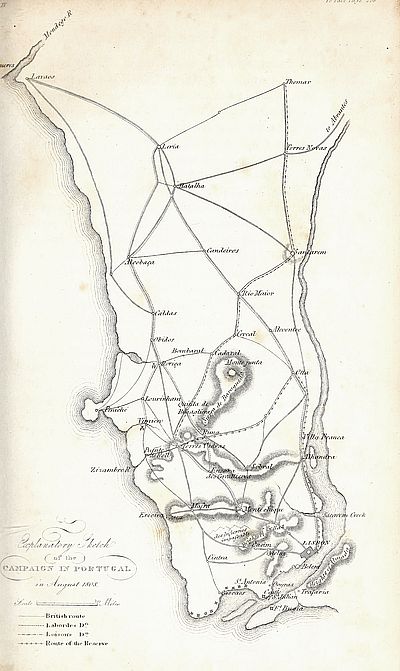 click here for larger image.
Explanatory Sketch
of the
CAMPAIGN IN PORTUGAL
in August 1808.
London. Published March 1828, by John Murray, Albermarle Street.
3º. Sir Arthur Wellesley’s project of seizing Mafra
by a rapid march on the morning of the 21st, was
exceedingly bold; its successful execution would have
obliged Junot to make a hurried retreat by Enxara
dos Cavalleiros to Montechique, at the risk of being
attacked in flank during his march; or if he had
moved by the longer route of Ruña and Sobral, it is
scarcely to be doubted that the British army would
have reached Lisbon before the French. But was
it possible so to deceive an enemy inured to warfare,
as to gain ten miles in a march of sixteen? was
it possible to evade the vigilance of an experienced
general, who, being posted only nine miles off, possessed
a formidable cavalry, the efforts of which could
neither be checked nor interrupted by the small escort
of horse in the British camp? was it in fine possible,
to avoid a defeat during a flank march along a road
crossed and interrupted by a river and several deep
gullies, which formed the beds of mountain torrents?
These are questions which naturally occur to every
military man. The sticklers for a rigid adherence to
system would probably decide in the negative. Sir
Arthur Wellesley was however, not only prepared to
try at the time, but he afterwards deliberately affirmed
that, under certain circumstances of ground an operation
of that kind would succeed; and to investigate
such questions is the best study for an officer.
4º. A night march is the most obvious mode of
effecting such an enterprise, but not always the best
in circumstances where expedition is required; and
great generals have usually preferred the day-time,
trusting to their own skill in deceiving the enemy
while their army made a forced march to gain the
object in view. Thus, Turenne at Landsberg was
successful against the archduke Leopold in broad daylight,
and Cæsar in a more remarkable manner overreached
Afranius and Petrieus near Lerida. Nor
were the circumstances at Vimiero unfavourable to
sir Arthur Wellesley. He might have pushed a
select corps of light troops, his cavalry, the marines
of the fleet, the Portuguese auxiliaries, and a few
field pieces, to the entrance of the defile of Torres
Vedras before daybreak, with orders to engage the
French outposts briskly, and to make demonstrations
as for a general attack. There is no doubt that such
a movement if skilfully conducted, would have completely
occupied the enemy’s attention, while the
main body of the army marching in great coats, and
hiding the glitter of their arms, might have profited
from the woods and hollows through which the by-road
to Mafra led, and gained such a start as would
have insured the success of the enterprise.
Let us, however, take a view of the other side;
let us suppose that Junot, instructed by his spies and
patroles, or divining the intention of the British general,
held the masking division in check with a small
force, and carrying the remainder of his army by the
Puente de Roll, or some other cross road (and there
were several) against the flank of the English, had
fallen upon the latter while in march, hemmed in
as they would be between the sea and the mountains,
and entangled among hollows and torrents. What
then would have been the result? History answers,
by pointing to Condé and the battle of Senef.
It must however be confessed, that it could be no
ordinary general that conceived such a project, and,
notwithstanding the small numbers of the opposing
armies, success would have ranked sir Arthur high
among the eminent commanders of the world, if he
had never performed any other exploit. “The statue
of Hercules, cast by Lysippus, although only a foot
high, expressed,” says Pliny, “the muscles and bones
of the hero more grandly than the colossal figures of
other artists.”
5º. So many circumstances combine to sway the
judgment of an officer in the field which do not afterwards
appear of weight, that caution should always
be the motto of those who censure the conduct of an
unfortunate commander; nevertheless, the duke of
Abrantes’ faults, during this campaign, were too
glaring to be mistaken. He lingered too long at
Lisbon; he was undecided in his plans; he divided
his army unnecessarily; and he discovered no skill on
the field of battle. The English army having landed
affairs were brought to a crisis, and Junot had only
two points to consider. Could the French forces under
his command defend Portugal without assistance? and
if not, how were its operations to be made most available
for furthering Napoleon’s general plans against
the Peninsula? The first point could not be ascertained
until a battle with sir Arthur had been tried.
The second evidently required that Junot should keep
his army concentrated, preserve the power of retreating
into Spain, and endeavour to engage the British
troops in the sieges of Elvas and Almeida. If the
two plans had been incompatible, the last was certainly
preferable to the chance of battle in a country
universally hostile. But the two plans were not incompatible.
6º. The pivot of Junot’s movements was Lisbon;
he had therefore to consider how he might best fall
upon and overthrow the English army, without resigning
the capital to the Portuguese insurgents during
the operation. He could not hope to accomplish the
first effectually without using the great mass of his
forces, nor to avoid the last except by skilful management,
and the utmost rapidity. Now the citadel and
forts about Lisbon were sufficiently strong to enable
a small part of the French army to control the populace,
and to resist the insurgents of the Alemtejo for
a few days. The Russian admiral, although not
hostile to the Portuguese, or favourable to the French,
was forced by his fear of the English, to preserve a
guarded attitude, and in point of fact, did materially
contribute to awe the multitude, who could not but
look upon him as an enemy. The Portuguese ships
of war which had been fitted out by Junot, were
floating fortresses requiring scarcely any garrisons,
and yet efficient instruments to control the city, without
ceasing to be receptacles for the Spanish prisoners,
and safe depôts for powder and arms which might
otherwise have fallen into the power of the populace.
Wherefore, instead of delaying so long in the capital,
instead of troubling himself about the assemblage of
Alcacer do Sal, instead of detaching Laborde with a
weak division to cover the march of Loison; Junot
should have taken the most vigorous resolutions in
respect to Lisbon the moment he heard of the English
descent. He should have abandoned the left
bank of the Tagus, with the exception of Palmela
and the Bugio, which were necessary to the safety of
his shipping; he should have seized upon the principal
families of the capital as hostages for the good behaviour
of the rest; and he should have threatened and
been prepared to bombard the city if refractory; then
leaving nothing more than the mere garrisons of the
citadel, forts, and ships behind him, have proceeded,
not to Leria, which was too near the enemy to be a
secure point of junction with Loison, but to Santarem,
where both corps might have been united without
danger and without fatigue. General Thomieres, in
the mean time, putting a small garrison in Peniché,
could have watched the movement of the British
general, and thus from eighteen to twenty thousand
men would have been assembled at Santarem by the
13th at farthest, and from thence one march would
have brought the whole to Batalha, near which place
the lot of battle might have been drawn without
trembling.
7º. If it proved unfavourable to the French, the
ulterior object of renewing the campaign on the frontier
was in no manner compromised. The number
of large boats that Lisbon can always furnish, would
have sufficed to transport the beaten army over the
Tagus from Santarem in a few hours, especially if
the stores had been embarked before Junot moved
towards Batalha, and the French army, once in the
Alemtejo with a good garrison in Abrantes, could
not have been followed until the forts at the mouth
of the Tagus were reduced, and the fleet sheltered in
the river. Thus, long before the British could have
appeared in force in the Alemtejo, the fortress of
Elvas would have been provisioned from the magazines
collected by Loison after the battle of Evora,
and the campaign could have been easily prolonged
until the great French army, coming from Germany
crushed all opposition.
The above is not a theory broached after the event.
That Junot would attempt something of the kind, was
the data upon which the English general formed his
plans; the intercepted memoir of colonel Bory de St.
Vincent, treated such an operation as a matter of course,
and Junot’s threats during the negotiation prove that
he was not ignorant of his own resources; but his mind
was depressed, and his desponding mood was palpable
to those around him. It is a curious fact, that Sattaro,
the Portuguese agent, who, for some purpose or
other was in the British camp, told sir Arthur Wellesley
before the battle of Vimiero, that Junot would
willingly evacuate Portugal upon terms.
8º. When the French, being fourteen thousand in
number, occupied Torres Vedras, that position was
nearly impregnable. Seventeen thousand British
could scarcely have carried it by force; but they
might have turned it in a single march by the coast
road; yet Junot neither placed a detachment on that
side nor kept a vigilant watch by his patroles. Now,
if sir Arthur Wellesley’s intended movement had not
been arrested by orders from Burrard, it must have
Thiebault.
succeeded, because Junot was entangled in the defiles
of Torres Vedras from six o’clock in the evening of
the 20th, until late in the morning of the 21st. The
two armies would thus have changed camps in the
space of a few hours without firing a shot: Junot
would have lost Lisbon, and have been placed in the
most ridiculous situation.
9º. In the battle, the duke of Abrantes showed
great courage, but no talent. His army was inferior
in numbers, yet he formed two separate attacks, an
evident error that enabled sir Arthur to beat him in
detail without difficulty. And it was the less excusable,
because the comparatively easy nature of the
ground over which the road from Torres Vedras to
Lourinham led, and the manner in which the English
army was heaped to the right when the position first
opened to the view of the French general, plainly
indicated the true line of attack. Junot should, with
all his forces concentrated for one effort, have fallen
in upon the left of his opponent’s position; if victorious,
the sea would have swallowed those who
escaped his sword. If repulsed, his retreat was open,
and his loss could not have been so great in a well-conducted
single effort, as it was in the ill-digested,
unconnected attacks that took place.
10º. The rapidity with which the French soldiers
rallied, and recovered their order after such a severe
check, was admirable, but their habitual method of
attacking in column cannot be praised. Against the
Austrians, Russians, and Prussians, it may have been
successful, but against the British it must always fail,
because the English infantry is sufficiently firm, intelligent,
and well disciplined, to wait calmly in lines
for the adverse masses, and sufficiently bold to close
upon them with the bayonet.
11º. The column is undoubtedly excellent for all
movements short of the actual charge, but as the Macedonian
phalanx was unable to resist the open formation
of the Roman legion, so will the close column be
unequal to sustain the fire and charge of a good line
aided by artillery. The natural repugnance of men
to trample on their own dead and wounded, the cries
and groans of the latter, and the whistling of the
cannon-shots as they tear open the ranks, produce
the greatest disorder, especially in the centre of attacking
columns, which, blinded by smoke, unstedfast
of footing, and bewildered by words of command
coming from a multitude of officers crowded together,
can neither see what is taking place, nor make any
effort to advance or retreat without increasing the
confusion: no example of courage can be useful, no
moral effect can be produced by the spirit of individuals,
except upon the head, which is often firm,
and even victorious at the moment when the rear is
flying in terror. Nevertheless, well managed columns
are the very soul of military operations; in them is
the victory, and in them also is safety to be found
after a defeat. The secret consists in knowing when
and where to extend the front.
ARMISTICE. CONVENTION.
1º. It is surprising, that Junot having regained
Torres Vedras, occupied Mafra, and obtained an armistice,
did not profit by the terms of the latter to
prepare for crossing the Tagus and establishing the
war on the frontiers. Kellerman ascertained during
his negotiation, that sir John Moore was not arrived;
and it was clear, that until he did arrive the position
of Montechique could neither be attacked nor turned.
There was nothing in the armistice itself, nor the
way in which it had been agreed to, which rendered
it dishonourable to take such an advantage. The
opening thus left for Junot to gain time, was sir
Arthur Wellesley’s principal objection to the preliminary
treaty.
2º. With regard to the convention, although some
of its provisions were objectionable in point of form,
and others imprudently worded, yet taken as a whole,
it was a transaction fraught with prudence and wisdom.
Let it be examined upon fair military and
political grounds; let it even be supposed for the
sake of argument, that sir Arthur unimpeded by sir
Harry Burrard, had pursued his own plan, and that
Junot, cut off from Lisbon and the half of his forces
had been driven upon the Tagus, he was still master
of flying to Almeida or Elvas: the thousand men left
in Santarem would have joined him in the Alemtejo,
or fallen down to the capital; and what then would
have been the advantages that could render the convention
undesirable?
The British army, exclusive of sir John Moore’s
division, had only provisions, or transport for provisions,
sufficient to last for ten or twelve days, and
the fleet was the only resource when that supply
should be exhausted. But a gale from any point
between the southward and north-west, would have
driven the ships away or have cast them on a lee-shore.
Hence an indispensable preliminary measure
would have been to open the mouth of the Tagus as
a security for the fleet; but without occupying Cascaes,
Bugio, and St. Julians, that was impossible. To
take the last-named fort would have required ten days’
open trenches at the least, and the heavy artillery must
Proceedings of the Board of Inquiry.
have been landed in some of the small creeks, and
dragged by force of men over the mountains, because
the artillery horses were scarcely able to draw the
field guns, and the country was incapable of supplying
assistance of that kind. In the mean time, the
French troops in Lisbon, and those upon the heights
of Almada and in the men-of-war, retiring tranquilly
through the Alemtejo, would have united with Junot;
or if he had fallen back upon Almeida, they could
have retired upon Elvas and La-Lyppe. In this
argument the Russians have not been considered,
but whatever his secret wishes might have been,
Siniavin must have joined the French or surrendered
his squadron in a disgraceful manner. This would
have increased Junot’s force by six thousand men;
Appendix, No. 22.
and it may here be observed, that even after the
arrival of sir John Moore, only twenty-five thousand
British infantry were fit for duty.
Let it be supposed that the forts were taken, the
English fleet in the river, the resources of Lisbon
organized, and the battering guns and ammunition
necessary for the siege of Elvas transported to Abrantes
by water. Seventy miles of land remained to traverse,
and then three months of arduous operations in the
sickly season, and in the most pestilent of situations,
would have been the certain consequences of any attempt
to reduce that fortress. Did the difficulty end
there? No! Almeida remained, and in the then state
of the roads of Portugal, and taking into consideration
only the certain and foreseen obstacles, it is not too much
to say, that six months more would have been wasted
before the country could be entirely freed from the
invaders. But long before that period Napoleon’s
eagles would have soared over Lisbon again. The
conclusion is inevitable; the convention was a great
and solid advantage for the allies, a blunder on the
part of the French.
With the momentary exception of Junot’s threat
to burn Lisbon if his terms were not complied with,
we look in vain for any traces of that vigour which
urged the march from Alcantara; we are astonished
to perceive the man, who, in the teeth of an English
fleet, in contempt of fourteen thousand Portuguese
troops, and regardless of a population of three hundred
thousand souls, dared, with a few hundred tired grenadiers,
to seize upon Lisbon, so changed in half a year,
so sunk in energy, that, with twenty-five thousand
good soldiers, he declined a manly effort, and resorted
to a convention to save an army which was really in
very little danger. But such and so variable is the
human mind, the momentary slave of every attraction,
yet ultimately true to self-interest. When Junot entered
Portugal, power, honours, fame, emolument,
nay, even a throne, was within his reach, and toil and
danger were overlooked in such gorgeous society; but
when he proposed the convention he was only with
the latter companions; fame flitted at a distance, and
he easily persuaded himself that prudence and vigour
could not be yoked together. A saying attributed to
Napoleon perfectly describes the convention in a few
words. “I was going to send Junot before a council
of war, but, fortunately, the English tried their
generals, and saved me the pain of punishing an old
friend!”
BOOK III. — CHAPTER I. — THE OPERATIONS OF THE SPANISH ARMIES IMMEDIATELY AFTER THE BATTLE OF BAYLEN.
The convention of Cintra being followed by the
establishment of a regency at Lisbon, the plans of
the bishop and junta of Oporto were disconcerted,
and Portugal was restored to a state of comparative
tranquillity; for the Portuguese people being of a
simple character, when they found their country relieved
from the presence of a French army, readily
acknowledged the benefit derived from the convention,
and refused to listen to the pernicious counsels
of the factious prelate and his mischievous coadjutors.
Thus terminated what may be called the convulsive
struggle of the Peninsular war. Up to that period
a remarkable similarity of feeling and mode of acting
betrayed the common origin of the Spanish and
Portuguese people. A wild impatience of foreign
aggression, extravagant pride, vain boasting, and a
passionate reckless resentment, were common to both
nations; but there the likeness ceased, and the finer
marks of national character which had been impressed
upon them by their different positions in the political
world, became distinctly visible.
Spain, holding from time immemorial a high rank
among the great powers, and more often an oppressor
than oppressed, haughtily rejected all advice. Unconscious
of her actual weakness and ignorance, and
remembering only her former dignity, she ridiculously
assumed an attitude which would scarcely have suited
her in the days of Charles V.; while Portugal, always
fearing the ambition of a powerful neighbour, and
relying for safety as much upon her alliances as upon
her own intrinsic strength, was from habit inclined
to prudent calculation, and readily submitted to the
direction of England. The turbulence of the first
led to defeat and disaster; the docility and patience
of the second were productive of the most beneficial
results.
The difference between these nations was, however,
not immediately perceptible, and at the period of the
convention the Portuguese were despised, while a
splendid triumph was anticipated for the Spaniards.
It was affirmed and believed, that from every quarter
enthusiastic multitudes of the latter were pressing
forward to complete the destruction of a baffled and
dispirited enemy; the vigour, the courage, the unmatched
spring of Spanish patriotism, was in every
man’s mouth, and Napoleon’s power and energy
seemed weak in opposition. Few persons doubted
the truth of such tales, and yet nothing could be
more unsound, more eminently fallacious, than the
generally-entertained opinion of French weakness
and of Spanish strength. The resources of the former
were unbounded, almost untouched; those of the
latter were too slender even to support the weight of
victory. In Spain the whole structure of society was
shaken to pieces by the violence of an effort which
merely awakened the slumbering strength of France:
foresight, promptitude, arrangement, marked the
proceedings of Napoleon; but with the Spaniards the
counsels of prudence were punished as treason; and
personal interests, every where springing up with
incredible force, wrestled against the public good.
At a distance, the insurrection appeared of towering
proportions and mighty strength; but in truth it was
a fantastic object, stained with blood, and tottering
from weakness, and the helping hand of England
alone was stretched forth for its support; all other
assistance was denied, for the continental powers,
although nourishing secret hopes of profit from the
struggle, with calculating policy, turned coldly from
the patriots’ cause. The English cabinet was indeed
sanguine, and resolute to act; but the ministers while
anticipating success in a preposterous manner, displayed
little industry and less judgment in their preparations
for the struggle; nor does it appear that
the real freedom of the Peninsula was much considered
in their councils. They contemplated this
astonishing insurrection, as a mere military opening
through which Napoleon might be assailed, and they
neglected, or rather feared, to look towards the great
moral consequences of such a stupendous event, consequences
which were in truth above their reach of
policy. They were neither able nor willing to seize
such a singularly propitious occasion for conferring a
benefit upon mankind.
It is however certain, that this opportunity for
restoring the civil strength of a long degraded people,
by a direct recurrence to first principles, was such as
had seldom been granted to a sinking nation. Enthusiasm
was aroused without the withering curse of
faction; and the multitude were ready to follow whoever
chose to lead. The weight of ancient authority was,
by a violent external shock, thrown off. The ruling
power fell from the hands of the few, and was caught
by the many, without the latter having thereby incurred
the odium of rebellion, or excited the malice
of mortified grandeur. There was nothing to deter
the cautious, for there was nothing to pull down.
The foundation of the social structure was laid bare,
and all the materials were at hand for building a
rare and noble monument of human genius and
virtue. The architect alone was wanting. No
anxiety to ameliorate the moral or physical condition
of the people in the Peninsula was evinced by the
ruling men of England, and if any existed amongst
those of Spain, it evaporated in puerile abstract
speculations. Napoleon indeed offered the blessing
of regeneration in exchange for submission, but in
that revolting form accompanied by the evils of war,
it was rejected; and amidst the clamorous pursuit of
national independence, the independence of man was
trampled under foot. The mass of the Spanish
nation, blinded by personal hatred, thought only of
revenge. The leaders, arrogant and incapable, neither
sought nor wished for any higher motive of action:
without unity of design, devoid of arrangement, their
policy was mean and personal, their military efforts
were abortive, and a rude unscientific warfare disclosed
at once the barbarous violence of Spanish character,
and the utter decay of Spanish institutions.
After Joseph’s retreat from Madrid, the insurrection
of Spain may be said to have ceased; from that
period it became a war between France and the
Peninsula; the fate of the latter was intrusted to
organised bodies of men, and as the first excitement
subsided, and danger seemed to recede, all the
meaner passions resumed their empire; but the
transactions of that memorable period which intervened
between the battles of Baylen and Coruña
were exceedingly confused, and the history of them
must necessarily partake somewhat of that confusion.
The establishment of a central supreme junta,
the caprices of the Spanish generals, and their interminable
disputes, the proceedings of the French army
before the arrival of the emperor, the operations of
the grand army after his arrival, and the campaign
of the British auxiliary force, form so many distinct
actions, connected it is true by one great catastrophe,
yet each attended by a number of minor circumstances
of no great historical importance taken separately,
but when combined, showing the extent and
complicated nature of the disease which destroyed
the energy of Spain.
For the advantage of clearness therefore, it will be
necessary to sacrifice chronological order; and as frequent
reference must be made to the proceedings of
a class of men whose interference had a decided, and
in many cases a very disastrous influence upon the
affairs of that period, I shall first give a brief account
of the English agents, under which denomination
both civil and military men were employed, but the
distinction was rather nominal than real; for, generally
speaking, each person assumed the right of
acting in both capacities.
The envoy, Mr. Charles Stuart, was the chief of
the civil agents; the persons subordinate to him
were, Mr. Hunter, Mr. Duff, and others, consuls and
vice-consuls.
Mr. Stuart sailed with sir A. Wellesley, and was
left at Coruña when that officer touched there, previous
to the operations in Portugal.
Mr. Hunter was stationed at Gihon in the Asturias.
Mr. Duff proceeded to Cadiz, and the others in
like manner were employed at different ports. They
were all empowered to distribute money, arms, and
succours of clothing and ammunition: but the want
of system and forethought in the cabinet was palpable
from the injudicious zeal of the inferior agents, each
of whom conceived himself competent to direct the
whole of the political and military transactions. Mr.
Stuart was even put to some trouble in establishing
his right to control their proceedings.
The military agents were of two classes: those sent
from England by the government, and those employed
by the generals
abroad.
Sir Thomas Dyer, assisted by major Roche and
captain Patrick, proceeded to the Asturias. The last
officer remained at Oviedo, near the junta of that province.
Major Roche was sent to the head-quarters
of Cuesta, and sir Thomas Dyer after collecting some
information, returned to England.
Colonel Charles Doyle having organized the Spanish
prisoners at Portsmouth, sailed with them to
Coruña. He was accompanied by captain Carrol and
captain Kennedy. During the passage a singular
instance of turbulent impatience occurred: the prisoners,
who had been released, armed, and clothed by
England, and who had been as enthusiastic in their
expressions of patriotism as the most sanguine could
desire, mutinied, seized the transports, carried them
into different ports in the Peninsula, disembarked,
and proceeded each to his own home.
Colonel Browne was despatched to Oporto, and a
major Green to Catalonia.
Those employed by the generals commanding armies
were captain Whittingham, who was placed by sir Hew
Dalrymple, near general Castaños, on the first appearance
of the insurrection. He accompanied the head-quarters
of the Andalusian army until the battle of
Tudela put an end to his functions. Major Cox (appointed
also by sir Hew Dalrymple) remained near
the junta of Seville. The talents and prudent conduct
of this officer were of great service. It would
have been fortunate if all the persons employed as
agents had acted with as much judgment and discretion.
All the above named gentlemen were in
full activity previous to the commencement of the
campaign in Portugal.
When the convention of Cintra opened a way for
operations in Spain, sir Hew Dalrymple sent lord
William Bentinck to Madrid, that he might arrange
a plan of co-operation with the Spanish generals, and
transmit exact intelligence of the state of affairs. Such
a mission was become indispensable. Up to the period
of lord William’s arrival in Madrid, the military intelligence
received was very unsatisfactory. The letters
from the armies contained abundance of commonplace
expressions relative to the enthusiasm and patriotism
visible in Spain. Vast plans were said to be
under consideration, some in progress of execution,
and complete success was confidently predicted; but,
by some fatality, every project proved abortive or disastrous,
without lowering the confidence of the prognosticators,
or checking the mania for grand operations,
which seemed to be the disease of the moment.
The English minister confirmed the appointment
of lord William Bentinck, and at the same time re-organized
the system of the military agents; by marking
out certain districts and appointing a general officer
to superintend each. Thus, major-general Broderick
was sent to Gallicia. Major-general Leith, with a large
staff, proceeded to the Asturias. Major-general Sontag
Sir H. Dalrymple’s Papers. MS.
went to Portugal. The scope of general Leith’s mission
was wide; Biscay, Castille, Leon, and even Catalonia
were placed under his superintendence, and he appears
to have had instructions to prepare the way for the
disembarkation of an English army on the coast of
Biscay. At the same time sir Robert Wilson was
furnished with arms, ammunition, and clothing for
organizing three or four thousand men levied by the
bishop of Oporto. He took with him a large regimental
staff, and a number of Portuguese refugees,
and succeeded in forming a partizan corps, afterwards
known by the title of the Lusitanian legion.
Brigadier-general Decken, a German, having been
first destined for Spain, was countermanded at sea,
and directed to Oporto, where he arrived on the 17th
of August, and immediately commenced that curious
intrigue which has been already mentioned in the
campaign of Vimiero.
When sir John Moore assumed the command of
the army, he sent colonel Graham to reside at the
Spanish head-quarters on the Ebro, and directed lord
William Bentinck to remain at Madrid to forward
the arrangements for commencing the campaign.
Lord William found in Mr. Stuart an able coadjutor,
and in the letters of these two gentlemen, and the
correspondence of major Coxe, then at Seville, is to
be found the history of the evils which at this period
afflicted unhappy Spain, and ruined her noble cause.
The power of distributing supplies, and the independent
nature of their appointments, gave to those
military agents immediately employed by the minister
an extraordinary influence, and it was very injudiciously
exercised. They forgot the real objects of
their mission, and in many cases took a leading part
in affairs with which it was not politic in them to
have meddled at all.
Colonel Doyle having left captain Kennedy at Coruña,
and placed captain Carrol at the head-quarters
of Blake’s army, repaired in person to Madrid, where
he was received with marked attention, and obtained
the rank of a general officer in the Spanish service
for himself, and that of lieutenant-colonel for captains
Carrol and Kennedy. From colonel Doyle’s
letters it appears that he had a large share in conducting
many important measures, such as the arrangement
of a general plan of operations, and the
Sir John Moore’s Correspondence. MSS.
formation of a central and supreme government. He
seems to have attached himself principally to the duke
of Infantado, a young man of moderate capacity, but
with a strong predilection for those petty intrigues
which constituted the policy of the Spanish court.
Captain Whittingham gained the confidence of general
Castaños to such a degree that he was employed
by him to inspect the different Spanish corps
Whittingham’s Letters. MS.
on the Ebro early in September, and to report upon
their state of efficiency previous to entering upon the
execution of the plan laid down for the campaign.
Notwithstanding the favourable position in which
these officers stood, it does not appear that either of
them obtained any clear idea of the relative strength
of the contending forces, and their opinions, invariably
and even extravagantly sanguine, were never borne
out by the result.
The Spaniards were not slow to perceive the advantages
of encouraging the vanity of inexperienced
men who had the control of enormous supplies; but
Mr. Stuart’s Letters. MS. Lord W. Bentinck’s Letters. MS.
while all outward demonstrations of respect and confidence
were by them lavished upon subordinate
functionaries, and especially upon those who had accepted
of rank in their service, the most strenuous
exertions of lord William Bentinck and Mr. Stuart
Appendix, No. 13. section 6.
were insufficient to procure the adoption of a single
beneficial measure, or even to establish the ordinary
intercourse of official business.
The leading Spaniards wished to obtain a medium
through which to create a false impression of the
state of affairs, and thus to secure supplies and succours
from England without being fettered in the
application of them. The subordinate agents answered
this purpose, and satisfied with their docility,
the generals were far from encouraging the residence
of more than one British agent at their head-quarters.
Captain Birch, an intelligent engineer officer,
writing from Blake’s camp, says, “General Broderick
Sir John Moore’s Correspondence. MS.
is expected here; but I have understood that
the appearance of a British general at these head-quarters
to accompany the army might give jealousy.
General Blake is not communicative, but captain
Carrol appears to be on the best footing with him
and his officers, and captain Carrol tells me that
he informs him of more than he does any of his
generals.”
The object was perfectly accomplished; nothing
could be more widely different than Spanish affairs,
judged of by the tenor of the military agent’s reports,
and Spanish affairs when brought to the test of battle.
The fault did not attach so much to the agents as to
the ministers who selected them. It was difficult for
inexperienced men to avoid the snare. Living with
the chiefs of armies actually in the field, being in
habits of daily intercourse with them, holding rank
in the same service, and dependent upon their politeness
for every convenience, the agent was in a manner
forced to see as the general saw, and to report as
he wished. A simple spy would have been far more
efficacious!
Sir John Moore, perceiving the evil tendency of
such a system, recalled all those officers who were
under his immediate control, and strongly recommended
to ministers that only one channel of communication
should exist between the Spanish authorities
and the British army. He was convinced of
the necessity of this measure, by observing, that each
of the military agents considered the events passing
under his own peculiar cognizance as the only occurrences
of importance. Some of those officers even
treated sir Hew Dalrymple and himself as persons
commanding auxiliary bodies of men which might
be moved, divided, and applied at the requisition of
every inferior agent, and the forces of the British
empire, a mere accessory aid, placed at their own
disposal. Thus general Leith says: “Whatever
may be the plan of operations, and whatever the result,
Sir John Moore’s Papers. MSS.
I beg leave, in the strongest manner, to recommend
to your consideration the great advantage of
ordering all the disposable force of horse or car artillery,
and light infantry, mounted on horses or mules
of the country, without a moment’s delay to move on
Palencia, where the column or columns will receive
such intelligence as may enable them to give the most
effectual co-operation.”
Captain Whittingham, at the same period, after
mentioning the wish of general Castaños that some
British cavalry should join him, says, “I cannot quit
this subject without once more repeating, that the
efforts of the cavalry will decide the fate of the campaign.”
And again: “Should it be possible for your
excellency to send one thousand or fifteen hundred
horse, the advantages that would result are incalculable.”
While one of these pressing recommendations
came from Oviedo, the other from Tudela, colonel
Doyle, writing from Madrid, thus expresses himself:
“Certain it is, that if your army were here, the
French would evacuate Spain before you got within
a week’s march of them; indeed, even the light
cavalry and two thousand light troops sent on cars,
to keep up with the cavalry, to show our friends the
nature of outpost duty, would, I think, decide the
question.”—“A respectable corps of British troops,
landed in Catalonia, would so impose, that I have no
doubt of the good effects.”
This last proposition relative to Catalonia was a
favourite plan of all the leading men at Madrid; so
certain were they of success on the Ebro, that finding
no British force was likely to be granted for that
purpose, they withdrew eight or nine thousand men
from the army near Tudela, and directed them upon
Lerida.
Thus much I have thought it necessary to relate
about the agents, and now quitting that subject, I
shall narrate
When that victory caused Joseph to abandon Madrid,
the patriotic troops, guided by the caprice of the
generals, moved in a variety of directions, without
any fixed object in view, and without the slightest
concert. Indeed all persons seemed to imagine that
the war was at an end, and that rejoicing and triumph
alone ought to occupy the minds of good Spaniards.
The Murcian and Valencian army separated. General
Llamas, with twelve thousand infantry, and a few
cavalry, took the road to Madrid, and arrived there
before any of the other generals. General St. Marc, a
Fleming by birth, with greater propriety, carried the
Valencians to the relief of Zaragoza. On the road he
joined his forces with those of the baron de Versage,
and the united troops, amounting to sixteen thousand,
entered Zaragoza on the 15th, one day after Verdier
and Lefebre had broken up the siege and retired to
Tudela. The French left their heavy guns and many
stores behind them. The Valencians and Arragonese
pursued, and on the 19th their advanced guard overtook
the retiring force, but were beaten by the French
cavalry. On the 20th Lefebre abandoned Tudela
and took a position at Milagro. On the 21st, St.
Marc and Versage occupied Tudela. The peasantry
of the valleys, encouraged by the approach of a regular
army, and by the successful defence of Zaragoza,
assembled on the left flank of the French, and threatened
their communications. Meanwhile Palafox gave
himself up to festivity and rejoicing, and did not even
begin to repair the defences of Zaragoza until the end
Cavallero.
of the month. He assumed supreme authority, and
in various ways discovered the most inordinate and
foolish presumption; and among other acts he decreed
that no Arragonese should henceforward be
liable to the punishment of death for any crime.
The army of Andalusia was the most efficient body
of men in arms throughout Spain: it contained thirty
thousand regular troops, provided with a good train
Cox’s Correspondence. MSS.
of artillery, and flushed with recent victory; but they
were constrained to remain idle by the junta of Seville,
who detained them to aid in asserting its own
supremacy over the other juntas of Andalusia, and
even brought back a part to Seville to assist in an
ostentatious triumph. It was not until a full month
Whittingham’s Correspondence. MSS.
after the capitulation of Dupont, that Castaños made
his entry into the capital, at the head of a single
division of seven thousand men, another of the same
force being left at Toledo, and the rest of his army
quartered at Puerto del Rey, St. Helena, and Carolina,
in the Sierra Morena.
The infantry of the Estremaduran army was at
first composed of new levies; but it was afterwards
strengthened by the Walloon and royal guards, and
sir Hew Dalrymple supplied general Galluzzo with
every needful equipment. According to the stipulations
of a treaty between the juntas of Seville and
Badajos, the cavalry was to be placed under the command
of Castaños; it was in number about four
thousand, and with the exception of Cuesta, no other
Spanish general possessed any efficient body of horsemen.
Orders and entreaties, and even the intervention
of sir Hew Dalrymple, were resorted to by
the council of Castille, the generals and the military
agents, to induce Galluzzo to send this body of cavalry
forward to the capital; but he remained deaf
to their representations, and occupied himself, as we
have seen, in thwarting the execution of the convention
of Cintra by a pretended siege of fort La Lippe.
The Spanish captives, released by that treaty, were
clothed, armed, and sent to Catalonia in British transports;
Sir H. Dalrymple’s papers. MS.
and sir Hew Dalrymple, at the same time, forwarded
ten thousand musquets, and ammunition in
proportion, for the service of the Catalans.
It has been before stated that one thousand five
hundred Spaniards, commanded by the marquis of
Valladeras, co-operated with the Portuguese during
the campaign of Vimiero. But they never penetrated
beyond Guarda, and being destitute of money, were
reduced to great distress; they could not subsist where
they were, nor yet march away. From this dilemma,
Ibid.
sir Hew, by a timely advance of ten thousand dollars,
relieved them, and Valladeras joined Blake. That
general, after the defeat of Rio Seco, separated the
Gallician army from the army commanded by Cuesta,
and sheltered himself from the pursuit of Bessieres in
the mountains behind Astorga. His reserve division
had not been engaged in the battle, and the resources
Doyle’s letters.
of the province, aided by the succours from England,
were sufficient, to place him again at the head of thirty
thousand infantry.
When Bessieres retreated after the defeat of Baylen,
Blake occupied Leon, Astorga, and the pass of Mansanal:
farther into the plains he durst not venture
without cavalry. At this time Cuesta, with one thousand
five hundred dragoons, was at Arevalo, and the
junta of Castille and Leon, having taken refuge at
Ponteferrada, commanded him to transfer his horsemen
to Blake’s army; but Cuesta, an arbitrary old
man, exasperated by his defeat, and his mind rankling
from his quarrel with Blake, instead of obeying retired
Mr. Stuart’s Correspondence.
to Salamanca, collected eight or ten thousand peasants,
armed them, and then annulled the proceedings of
the junta, and threatened the members with punishment
for resisting his authority as captain-general.
On the other hand Blake protected them, and while
the generals disputed, three thousand French cavalry
descending the Douero, scoured the plains, and raised
contributions in the face of both their armies.
Blake finding that the obstinacy of Cuesta was invincible,
quitted his cantonments early in September,
and skirting the plains on the north-east, carried his
Capt. Carrol’s letters.
army by forced marches to the Montagna St. Ander,
a small rugged district, dividing Biscay from the
Asturias. The junta of the latter province had
received enormous and very timely succours from
England, but made no exertions answerable to the
amount of the assistance granted, or to the strength
and importance of the district. Eighteen thousand
men were said to be in arms, but only ten thousand
were promised to Blake, and but eight thousand joined
his army.
In Catalonia the war was conducted by both sides
without much connexion, or dependance on the movements
of the main armies; and at this period it had
little influence on the general plan of campaign.
Thus, it appears, that one month after the capitulation
of Dupont, only nineteen thousand infantry
without cavalry, and those under the command of
more than one general, were collected at Madrid;
that only sixteen thousand men were in line upon the
Ebro, and that the remainder of the Spanish armies,
(exclusive of that in Catalonia computed at eleven
thousand men,) were many days’ march from the
enemy, and from one another. The chiefs at discord
with their respective juntas, and at variance among
themselves, were inactive, or as in the case of Galluzzo,
doing mischief.
The feeble and dilatory operations of the armies,
were partly owing to the ineptitude of the generals;
but the principal causes were the unbounded vanity,
arrogance, and selfishness of the local governments,
among whom the juntas of Gallicia and Seville were
remarkable for their ambition. The time which
should have been passed in concerting measures for
pushing the victory of Baylen was spent by them in
devising schemes to ensure the permanency of their
own power, and the money and resources, both of
England and Spain, were applied to further this pernicious
object. In every part of the country a spirit
of interested violence prevailed; the ardour of patriotism
was chilled, and the exertions of sensible men were
rendered nugatory, or served as a signal for their own
destruction.
The argument to be drawn from this state of affairs
is conclusive against the policy of Joseph’s retreat.
Without drafting a man from the garrisons of Pampeluna,
Tortosa, and St. Sebastian; without interfering
with the moveable columns employed on the
Appendix, No. 6.
communications of Biscay and Navarre; that monarch
drew together about fifty thousand good troops, in
twenty days after he had abandoned his capital. At
the head of such a force, or even of two-thirds of it,
he might have bid defiance to the inactive, half-organized,
and scattered Spanish armies. It was so
necessary to have maintained himself in Madrid, that
scarcely any disproportion of numbers should have
induced him to abandon it without an effort; but the
disaster of Dupont had created in Joseph’s mind a
respect for Spanish prowess, while from his sagacious
Appendix, No. 4.
brother it drew the following observation: “The
whole of the Spanish forces are not capable of beating
twenty-five thousand French in a reasonable position.”
The error of abandoning the capital would,
if the Spaniards had been capable of pursuing any
general plan of action, been fatal; but as if the stone
of Cadmus had been cast among them, the juntas
turned upon one another in hate, and forgot the
common enemy.
Ferdinand was again proclaimed king of Spain, and
the pomp and rejoicing attendant on this event put an
end to all business, except that of intrigue. Castaños
assumed the title of captain-general of Madrid. This
step seems to have been taken by him, partly to forward
his being appointed generalissimo, and partly
with a view to emancipate himself from the injurious
control of the Seville junta; for, although the authority
of the captains-general had been superseded
in most of the provinces by the juntas, it was not universally
the case. Castaños expected, and with reason,
to be appointed generalissimo of the Spanish armies;
but he was of an indolent disposition, and it soon became
manifest that until a central and supreme government
was established, such a salutary measure would
not be adopted. In the mean time the council of
Castille, although not generally popular with the people,
and hated by the juntas, was accepted as the
provisional head of the state in the capital; but its
authority was merely nominal, and the necessity of
showing some front to the enemy seems to have been
the only link of connexion between the Spanish
armies.
The evil consequences flowing from this want of
unity were soon felt. Scarcely had the French
quitted Madrid, when the people of Biscay prepared
to rise. Such an event, if prudently conducted and
well supported, would have been of incalculable advantage;
but the nicest arrangement, and the utmost
prudence, were necessary to insure success, for the
Biscayans had neither arms nor ammunition, the
French were close to them, and the nearest Spanish
force was the feeble Asturian levy. A previous junction
of Blake’s army with the latter was indispensable;
that once effected, and due preparation made, the
insurrection of Biscay, protected by forty thousand
regular troops, and supplied from the sea-board with
money and stores, would have forced the French to
abandon the Ebro or to fight a battle, which Blake
might have risked with little danger, provided that
the Andalusian, Murcian, Valencian, and Arragonese
troops assembling about Tudela, were prepared to move
at the same time against the left flank of the enemy.
But in every point of view it was an event pregnant
with important consequences, and the impatience
of the Biscayans should have been restrained rather
than encouraged; yet the duke of Infantado, colonel
Doyle, and others, at Madrid, made strenuous efforts
to hasten the explosion. The crude manner in which
they conducted this serious affair is exposed in the
following extracts from colonel Doyle’s despatches:
“I proposed to general Blake that he should send
officers to Biscay to stir up the people there, and into
the Asturias to beg that of their 15,000 men, 8,000
might be pushed into Biscay to Bilbao, to assist the
people, who were all ready, and only waited for arms
and ammunition, for both of which I wrote to Mr.
Hunter at Gihon, and learned from him that he had
sent a large supply of both, and some money to
Bilbao, where already 14,000 men had enrolled
themselves. The remainder of the Asturians I
begged might instantly occupy the passes from Castille
into the Asturias and Biscay, that is to say, from
Reynosa in the direction of Bilbao.” Some days
after he says,—“My measures in Biscay and Asturias
have perfectly succeeded; the reinforcements of arms,
ammunition, and men (5,000 stand of arms, and
ammunition in proportion) have reached Bilbao in
safety, and the Asturians have taken possession of
the passes I pointed out, so that we are all safe in
that part of the world.”
In this fancied state of security affairs remained
until the 16th of August; general Blake was still in
the mountains of Gallicia, the English succours arrived
in the port of Bilbao, and the explosion took
place. General Merlin, with three thousand grenadiers,
immediately came down on the unfortunate Biscayans;
Bilbao was taken, and to use the emphatic expression
of king Joseph, “the fire of insurrection was quenched
with the blood of twelve hundred men.” Fortunately,
the stores were not landed, and the vessels escaped
from the river. Thus, at a blow, one of the principal
resources which Blake had a right to calculate upon
in his future operations was destroyed; and although
the number admitted by the Spaniards to have fallen
was less than the above quotation implies, the spirit
of resistance was severely checked, and the evil was
unmixed and deplorable.
This unfortunate event, however, created little
or no sensation beyond the immediate scene of the
catastrophe. Triumphs and rejoicings occupied the
people of Madrid and Zaragoza, and it is difficult to
say how long the war would have been neglected, if
Palafox had not been roused by the re-appearance of
a French corps, which re-took Tudela, and pushed
Appendix, No. 6.
on to the vicinity of Zaragoza itself. This movement
took place immediately after the expedition
against Bilbao, and was intended to suppress the
insurrection of the valleys, and to clear the left flank
of the French army. Palafox thus roughly aroused,
Whittingham’s Letters. MSS.
wrote intemperately to the council of Castille, commanding
that all the troops in the capital should be
forwarded to the Ebro, and menacing the members
personally for the delay which had already occurred.
Being a young man without any weight of character,
and his remonstrances being founded only upon his
own danger, and not supported by any general plan
or clear view of affairs, the presumptuous tone of his
letters gave general offence; they were chiefly aimed
at Castaños, who was not under his command; and
moreover, the junta of Seville refused to pay or to
subsist the Andalusian army if it moved beyond the
capital before a central government should be established;
at the same time resorting to every kind of
intrigue, to retard, if not entirely to prevent, the
execution of the latter measure.
Whittingham’s Letters. MSS.
It was, however, necessary to do something, and
a council of all the generals commanding armies was
held at Madrid on the 5th of September. Castaños,
Llamas, Cuesta, the duke of Infantado, and some
others assembled; Blake gave his proxy to the duke,
and Palafox was represented by a colonel of his own
Mr. Stuart’s Letters.
Parliamentary Papers.
staff. Cuesta proposed that a commander-in-chief
should be appointed: the others were too jealous to
adopt this proposal, but they agreed to pursue the
following plan of operations.
Llamas, with the Murcians, to occupy Tarascona,
Agreda, and Borja. La-Peña, with the two divisions
of Andalusia already in the capital, to march by
Soria, and take possession of Logroña and Najera.
The other divisions of that army to follow in due
time. When La-Peña should be established in Logroña,
Llamas was to advance to Cascante, Corella,
and Calahorra.
When this united force (to be called the army of
the centre) was once securely fixed in its positions,
Palafox, under whose command St. Marc’s division
acted, was to push forward to Sanguessa by the left
bank of the Ebro, and to turn the enemy on the
Aragon river. In the mean
time it was hoped that
Blake would arrive at Palencia, and form his junction
with the Asturians. Cuesta promised to march
upon Burgo del Osma, and to fill up the space
between Blake and the army of the centre. The
head of La-Peña’s column was to be at Soria on the
17th of September, and the junta confidently expected
that this vicious plan, in which every sound military
principle was violated, and the enemy’s troops, considered
with regard to position, as a fixed immoveable
mass, would cause the total destruction of the French
army. The only fear entertained was, that a hasty
flight into France would save it from Spanish vengeance!
Thus captain Whittingham, echoing the sentiments
of the Spanish generals with reference to this
plan, writes, “As far as my poor judgment leads me,
I am satisfied that if the French persist in maintaining
their present position, we shall, in less than six
weeks, have a second edition of the battle of Baylen!”
But to enable La-Peña and Llamas to march, pecuniary
aid was requisite. There was a difficulty in raising
Sir H. Dalrymple’s Correspce.
Doyle’s Letters.
Cox’s Do.
money at Madrid, and the maritime provinces intercepted
all the English supplies. In this dilemma,
colonel Doyle drew bills upon the English treasury,
and upon the government at Seville, making the
latter payable out of two millions of dollars, just
transmitted to the junta through Mr. Duff.
It is probable that such an unprincipled body would
not have hesitated to dishonour the bills, but major
Coxe, before they were received, made energetic remonstrances
upon the subject of the wants of the
army; at first he received a haughty and evasive
answer, but his representations were strongly seconded
by a discovery made by the junta, that a plot against
their lives, supposed to have been concocted at Madrid,
was on the eve of execution. In fact, they had
become hateful from their domineering insolence and
selfishness, and the public feeling was strongly against
them. Alarmed for the consequences, they sent off
200,000 dollars to Madrid, and published a manifesto,
in which they inserted a letter, purporting to
be from themselves to Castaños, dated on the 8th,
and giving him full powers to act as he judged fitting
for the public good. Their objects were to pacify
the people, and to save their own dignity, by appearing
to have acted voluntarily; but Castaños published
the letter in Madrid with its true date of the
11th, and then it became manifest, that to major
Coxe’s remonstrance, and not to any sense of duty,
this change of conduct was due.
Doyle’s bills having been negotiated, the troops were
put in motion, and 40,000 fresh levies were enrolled,
but the foresight and activity of Napoleon in disarming
the country had been so effectual, that only 3,200
firelocks could be procured. A curious expedient then
presented itself to the imagination of the duke of Infantado,
and other leading persons in Madrid: colonel
Doyle, at their desire, wrote to sir Hew Dalrymple in
the name of the supreme council, to request that the
firelocks of Junot’s army, and the arms of the Portuguese
people, might be forwarded to the frontier,
and from thence carried by post to Madrid; a novel
proposition, and made at a time when England had
already transmitted to Spain 160,000 muskets; a
supply considerably exceeding the whole number of
men organized throughout the country; 50,000 of
these arms had been sent to Seville, but the junta
Parliamentary Papers, 1810.
shut them up in the arsenals, and left the armies
defenceless; for to neglect or misuse real resources,
and to fasten with avidity upon the most extravagant
projects, is peculiarly Spanish. No other people
could have thought of asking for a neighbouring
nation’s arms at such a conjuncture; no other than
Spanish rulers could have imagined the absurdity
of supplying their levies (momentarily required to
fight upon the Ebro) with the arms of a French
army still unconquered in Portugal. But this project
was only one among many proofs afforded at
the time, that Cervantes was as profound an observer
as he was a witty reprover of the extravagance
of his countrymen.
CHAPTER II. — INTERNAL POLITICAL TRANSACTIONS. — EXTERNAL POLITICAL RELATIONS OF SPAIN.
With the military affairs thus mismanaged, the
civil and political transactions proceeded step by step,
and in the same crooked path. Short as the period was
between the first breaking forth of the insurrection, and
Mr. Stuart’s Letters. Parliamentary Papers.
the arrival of Mr. Stuart at Coruña, it was sufficient
to create disunion of the worst kind. The juntas of
Leon, of the Asturias, and of Gallicia, were at open
discord, and those provinces were again split into
parties, hating each other with as much virulence as
if they had been of a hundred years growth. The
money and other supplies sent by the English ministers
were considered, by the authorities into whose hands
they fell, as a peculiar donation to themselves, and
appropriated accordingly. The junta of one province
would not assist another with arms when there was a
surplus, nor permit their troops to march against the
enemy beyond the precincts of the particular province
Ibid.
in which they were first organized. The ruling power
was in the hands of the provincial nobility and
gentry, men of narrow contracted views, unused to
business, proud, arrogant—as extreme ignorance suddenly
clothed with authority will always be—and
generally disposed to employ their newly-acquired
power in providing for their relations and dependants
at the expense of the common cause, which with them
was quite subordinate to the local interests of their
own particular province. Hence a jealousy of their
neighbours regulated the proceedings of all the juntas,
and the means they resorted to for increasing their
own, or depressing a rival government’s influence, were
equally characterised by absurdity and want of principle.
The junta of Gallicia did their utmost to isolate
that province, as if with a view to a final separation
from Spain and a connexion with Portugal. They complained,
Mr. Stuart’s Letters. MS.
as of an injury, that the army of Estremadura
had obeyed the orders of the junta of Seville; they at
once struck up an independent alliance with the junta
and bishop of Oporto, and sent troops, as we have seen,
under Valladeras, to aid the war in Portugal, but, at
the same time, refused to unite in any common measure
of defence with the provinces of Castille, until a
formal treaty of alliance between them was negotiated,
signed, and ratified. In the mean time their selfishness
and incapacity created so much disgust in their
own district, that plots were formed to overthrow their
authority. The bishops of Orense and St. Jago became
their decided enemies; and the last-named prelate,
an intriguing man, secretly endeavoured to draw
Blake, with the army, into his views, and even wrote
to him, to desire that he would lead the forces against
Ibid.
the government of Coruña; but the junta having intercepted
the letters, arrested the bishop. Their own
stability and personal safety were however still so insecure,
that many persons applied to Mr. Stuart to
aid in changing the form of government by force.
The Asturians were even worse, they refused to assist
Blake when his army was suffering, although the
stores required by him, and supplied by England, were
rotting in the harbours where they were first landed.
Money also that was sent out in the Pluto frigate for
the use of Leon was detained at Gihon, and Leon
itself never raised a single soldier for the cause: and
thus, only two months after the first burst of the insurrection,
corruption, intrigue, and faction even to
the verge of civil war, were raging in the northern
parts of Spain.
The same passions were at work in the south, and
the same consequences followed. The junta of Seville,
still less scrupulous than that of Gallicia, made no
Appendix, No. 13, section 5.
secret of their ambitious views; they stifled all local
publications, and even suppressed the public address
of Florida Blanca, who, as president of the Murcian
junta, had recommended the formation of a supreme
central government. They wasted their time in vain
and frivolous disputes, and neglecting every concern of
real importance, sacrificed the general welfare to views
of private advantage and interest. They made promotions
in the army without regard to public opinion
Ibid.
or merit; they overlaid all real patriotism; bestowed
on their own creatures places of emolument, to the
patronage of which they had not a legal right; and
even usurped the royal prerogative of appointing
Sir Hew Dalrymple’s Paprs.
Coxe’s Correspondce.
canons in the church, for their cupidity equalled their
ambition. They intercepted, as I have already related,
the pecuniary supplies necessary to enable the army
to act; they complained that La Mancha and Madrid,
in whose defence they said “their troops were sacrificing
themselves,” did not subsist and supply the
force under Castaños; under the pretence of forming
a nucleus for disciplining thirty thousand levies as
a reserve, they retained five battalions at Seville,
and, having by this draft weakened the army in the
field, they neglected the rest, and never raised a man.
The canonries filled up by them had been vacant for
several years, and the salaries attached to those offices
were appropriated to the public service. The junta
now applied the money to their own and their creatures’
emolument; and at one period they appear to
have contemplated an open partition of the funds
received from England among themselves. Against
this flagitious junta also the public indignation was
Sir Hew Dalrymple’s Paprs.
Coxe’s Correspondce.
rife; a plot was formed to assassinate the members;
the municipal authorities remonstrated with them,
the archbishop of Toledo protested against their conduct,
Appendix, No. 13, section 5.
and the junta of Grenada refused to acknowledge
their supremacy; but so great was their arrogance,
so unprincipled their ambition, that the decided
and resolute opposition of Castaños alone prevented
them from commencing a civil war, and
Ibid.
marching the victorious army of Baylen against the
refractory Granadans. Such was the real state of
Spain, and such the patriotism of the juntas, who
were at this time filling Europe with the sound of
their own praise.
In the northern parts Mr. Stuart endeavoured to
reduce this chaos of folly and wickedness to some
degree of order, and to produce that unity of design
and action without which it was impossible
to resist the mighty adversary that threatened the
independence of the Peninsula. He judged that to
reduce the conflicting passions of the moment, a supreme
authority, upon which the influence of Great
Britain could be brought to bear with full force, was
indispensable. To convoke the ancient cortez of the
realm appeared to him the most certain and natural
method of drawing the strength and energy of the
nation into one compact mass; but there the foresight
of Napoleon interfered; by an able distribution of
the French forces, all direct communication between
the northern and southern provinces was intercepted.
Bessieres, Dupont and Moncey at that time occupied a
circle round Madrid, and would have prevented the local
governments of the north from uniting with those of
the southern, if they had been inclined to do so.
An union of the nearest provinces, to be called the
Stuart’s Correspondence. Parliamentary Papers.
northern cortez, then suggested itself to Mr. Stuart
as a preliminary step, which would ensure the convocation
of a general assembly when such a measure
should become practicable. Accordingly he
strenuously urged its adoption, but his efforts, at
first, produced no good results. It was in vain that
he represented the danger of remaining in a state of
anarchy when so many violent passions were excited,
and such an enemy was in the heart of the country.
It was in vain that he pointed out the difficulties,
that the want of a supreme authority fastened on
the intercourse with the British cabinet, which could
not enter into separate relations with every provincial
junta. The Spaniards, finding that the supplies were
not withheld, that their reputation for patriotism was
not lowered in England by actions which little merited
praise, finding, in short, that the English cabinet was
weak enough to gorge their cupidity, flatter their
vanity, and respect their folly, they assented to all
Mr. Stuart’s reasoning, but forwarded none of his
propositions, and continued to nourish the disorders
that, cancer-like, were destroying the common cause.
The jarring interests which agitated the northern
provinces were not even subdued by the near approach
of danger. The result of the battle of Rio Seco rather
inflamed than allayed the violence of party feeling.
If Bessieres had not been checked in his operations
by the disaster of Dupont, he would have encountered
few obstacles in establishing Joseph’s authority in Gallicia
and Old Castile. The enthusiasm of those provinces
never rose to a great pitch; Bessieres was prepared
to use address as well as force, and among the
factions he must doubtless have found support. The
reinforcements continually arriving from France would
have enabled him to maintain his acquisition, and then
the ability of the emperor’s dispositions would have
become apparent; for while Bessieres held Gallicia,
and Dupont hung on the southern frontier of Portugal
with twenty-five thousand men, Junot could
have securely concentrated his army in the neighbourhood
of Lisbon, and have rendered an English
disembarkation on the coast nearly impracticable.
The whole of the French monarch’s combinations
were overturned by the disgraceful capitulation of
Baylen, and when Joseph evacuated Madrid a fresh
impulse was given to the spirit of the people; but,
unfortunately for Spain, as a wider scope for ambition
was obtained, the workings of self-interest increased,
fresh parties sprung up, and new follies and greater
absurdities stifled the virtue of the country, and produced
irremediable confusion, ending in ruin. The
fact of Dupont’s capitulation was made known to the
council of Castile before king Joseph was informed of
it, and the council, foreseeing all the consequences of
such an event, immediately refused, as I have already
related, to promulgate officially his accession to the
throne. Joseph permitted this act of obedience to pass
without much notice. He was naturally averse to violence,
Azanza and O’Farril, Mem.
and neither he, nor his brother Napoleon, did
at any period of the contest for Spain constrain a Spaniard
to accept or retain office under the intrusive government.
Joseph went further; before he abandoned
Madrid, he released his ministers from their voluntary
oath of allegiance to himself, and left them free
to choose their party once more. Don Pedro Cevallos
and the marquis of Pinuelo changed with, what
appeared to them, changing fortune; but five others
remained steadfast, preferring an ameliorated government
under a foreign prince to what they believed
to be a hopeless struggle, but which, if successful,
they knew must end in a degrading native despotism;
perhaps, also, a little swayed by their dislike to
England, and by the impossibility of obtaining that
influence among their countrymen which, under other
circumstances, their talents and character would have
ensured.
The boldness of the council of Castille was not publicly
chastised by the intruding monarch, but secretly
he punished the members by a dexterous stroke of
policy. General Grouchy wrote to Castaños, saying,
that circumstances had arisen which required the presence
of the French troops in another quarter, and he
invited the Spanish general to take immediate possession
of Madrid for the preservation of public tranquillity.
This communication gave rise to an opinion
that the French were going to evacuate Spain;
a report so congenial to the vanity and indolence of
the Spaniards was greedily received, and contributed
among other causes to the subsequent supineness of
the nation in preparing for its defence; thus by appealing
to Castaños, and affecting to treat the council
of Castille as a body who had lost their influence with
the nation, Joseph gave a handle to their enemies
which the latter failed not to lay hold of. The juntas
dreaded that the influence of such a body would destroy
their own; that of Gallicia would not communicate
with them, affirming that, individually, the
members were attached to the French, and that, collectively,
they had been the most active instrument
Sir H. Dalrymple’s Papers.
Coxe’s Correspondence.
of the usurper’s government. The junta of Seville
endeavoured not only to destroy the authority of the
existing members, but to annul that of the council,
as an acknowledged tribunal of the state. The council,
however, was not wanting to itself, the individuals
composing it did not hesitate to seize the reins of
government the moment the French had departed;
and the prudence with which they preserved tranquillity
in the capital, and prevented all re-action, proves
that they were not without merit; and forms a striking
contrast to the conduct of the provincial juntas, under
whose savage sway every kind of excess was committed,
and even encouraged.
Aware of the hostility they had to encounter, the
members of the council lost no time in forming a
party to support themselves. Don Arias Mon y Velarde,
dean or president for the time being, wrote a
circular letter to the local juntas, pointing out the
necessity of establishing a central and supreme power,
and proposing that deputies from each province, or
nation, as they were sometimes called, should repair
to Madrid, and there concert with the council the
best mode of carrying such a measure into effect. If
this proposal had been adopted, all power would inevitably
have fallen into the hands of the proposers.
Confessedly the first public body in the state, and well
acquainted with the forms of business; the council
must necessarily have had a preponderating influence
in the assembly of delegates, and it appeared so reasonable
that it should take the lead, when an efficient
authority was required to direct the violence of the
people in a useful channel, before the moment of
safety was passed; that all the juntas trembled at the
prospect of losing their misused power. The minor
ones submitted, and agreed to send deputies. The
stronger and more ambitious felt that subtlety would
avail more than open opposition to the project.
The council followed up this blow by the publication
of a manifesto, containing an accurate detail
of the events of the revolution, defending the part
taken by its members, and claiming a renewal of the
confidence formerly reposed in them by the nation.
Mr. Stuart’s Correspondence.
This important state paper was so ably written, that
a large party, especially at Valladolid, was immediately
formed in favour of its authors; and the junta
of Seville were so sensible of the increasing influence
of the council, that they intercepted a copy of this manifesto,
Cox’s Corresponce.
addressed to sir Hew Dalrymple, and strictly
Appendix, No. 13, section 5.
suppressed all writings favourable to the formation
of a supreme central authority. Nothing they dreaded
more; but it was no longer possible to resist the current,
which had set strongly in favour of such a
measure. The juntas, however they might oppose
its progress, could not openly deny the propriety of
it, and in every province, individuals of talent and
Mr. Stuart’s Correspondence.
consideration called for a change in the Hydra polity,
which oppressed the country, and was inefficient
against the enemy. Every British functionary, civil
or military, in communication with the Spaniards,
also urged the necessity of concentrating the executive
power.
Ibid.
The provincial juntas were become universally
odious. Some of the generals alone, who had suddenly
risen to command under their rule, were favourable
to them; but Palafox was independent, as a captain-general,
whose power was confirmed by success;
Castaños openly declared that he would no longer
serve under their control, and Cuesta was prepared
to put them down by force, and to re-establish the
royal audienzas and the authority of the captains-general
according to the old practice. In this state
of affairs, the retreat of Bessieres’ army freed the communication
with the southern parts, and removed all
excuse for procrastination. The juntas of Gallicia,
Castille, Leon, and the Asturias, gave way to the
unceasing remonstrances of Mr. Stuart, and at his
instance agreed to meet in cortez, at Lugo; Gallicia,
however, first insisted upon a formal ratification of
the treaty with Castille already mentioned.
When the moment of assembling arrived, the Asturians,
without assigning any reason, refused to fulfil
the engagement they had entered into, and the three
remaining juntas held the session without them. The
bishop of Orense, and the junta of Gallicia, were prepared
to assert the supremacy of that province over
the others, but the Baily Valdez of Castille, an able
and disinterested man, being chosen president of the
convocation, proposed, on the first day of assembly,
that deputies should be appointed to represent the
three provinces in a supreme junta, to be assembled
in some central place, for the purpose of convoking
the ancient cortez of the whole kingdom according
to the old forms, and of settling the administration of
the interior, and the future succession to the throne.
This proposition was immediately carried by the superior
number of the Castillians and Leonese; but
the bishop of Orense protested against it, and the
Gallician members strongly opposed an arrangement,
by which their province was placed on the same footing
as others, a glaring injustice (in their opinion)
when the numbers of the Gallician army were taken
into consideration; for the local feeling of ambition
was uppermost, and the general cause disregarded.
The other party answered, with great force, that the
Gallician army was paid, armed, and clothed, by England,
and fed by Castille and Leon.
Mr. Stuart’s
Correspondence.
Meanwhile the influence of the council of Castille
greatly increased, and the junta of Seville, quickened
by fear, took the lead in directing what they could not
prevent. The convocation of the cortez they knew
would be fatal to their own existence; wherefore, in a
public letter, addressed to the junta of Gallicia, dated
one day previous to the circular of don Arias Mon,
but evidently written after the receipt of the latter,
they opposed the assembling of the cortez on the ground
that it was “the prerogative of the king to convoke
that body, and if it was called together by any other
authority, the provinces would not obey.” “There
would be no unanimity.” The futility of this argument
is apparent. The question was not one of form,
but of expediency. If the nation was in favour of
such a step, (and after facts proved that the people
were not opposed to it) the same necessity which constituted
the right of the junta to declare war against the
French, (another prerogative of the monarch) would
have sufficed to legalize the convocation of the national
assembly. But their sole object was to preserve their
own power. They maintained that the juntas, being
chosen by the nation, were the only legitimate depositaries
of authority, and that to members of their own
bodies only could any of that authority be delegated;
and adopting thereupon the suggestion contained
in the letter of Arias Mon, they proposed that two
deputies from each supreme junta should repair, not
to Madrid, but to Ciudad Real, or Almagro, and at
the moment of meeting should be in fact constituted
governors-general of the kingdom, and as such obeyed.
Nevertheless, the local governments were, with due
subordination to the central junta, to retain and exercise
in their own provinces all the authority with
which they had already invested themselves. Thus
they had only to choose subservient deputies, and
their power would be more firmly fixed than before.
This arrangement would, doubtless, have been
readily adopted by the junta of Gallicia; but the
rapidity with which Valdez carried his proposition,
prevented that cause of discord from being added to
the numerous disputes which already distracted the
northern provinces. Mr. Stuart, impelled by the political
tide, proceeded onward to Madrid, observing,
wherever he passed, the same violence of local party
feeling, and the general disgust occasioned by the
conduct of the oligarchical provincial governments.
Pride, vanity, corruption, and improvidence, were
every where obtrusively visible.
The dispute between Blake and Cuesta, which was
raging at the period of the battle of Rio Seco, a period
when division was most hurtful to the military operations,
was now allayed between the generals; but
their political partizans waged war with more bitterness
than ever, as if with the intent to do the greatest
possible mischief, by continuing the feud among the
civil branches of the government, when union was
Stuart’s Correspondence.
most desirable in that quarter. The seeds of division
had taken deep root. The Baily Valdez chosen, as
I have said, a deputy to the supreme junta, was obnoxious
to general Cuesta, a man not to be offended
with impunity when he had power to punish.
Don Gregorio Cuesta was haughty and incredibly
obstinate. He had been president of the council of
Castille, and he was captain-general of Castille and
Leon when the insurrection first broke out. Disliking
all revolutionary movements, although as inimical to
a foreign domination as any of his countrymen, he
endeavoured to repress the public effervescence, and
to maintain the tranquillity of the country at the risk
of losing his life as a traitor. He was an honest man,
insomuch as the Spanish and French interests being
put in competition, he would aid the former, but, between
his country’s cause and his own passions, he
was not honest. He disliked, and with reason, the
sway of the local juntas, and with consistency of opinion,
he wished to preserve the authority of the captains-general
and the royal audienzas, both of which
had been overturned by the establishment of those
petty governments; but, sullen and ferocious in his
temper, he supported his opinion with an authority
and severity which had no guide but his own will,
and he was prepared, if an opportunity offered, to
exercise military influence over the supreme, as
well as over the subordinate juntas. He had himself
appointed one for Leon and Castille as a sort of
council, subordinate to the authority of captain-general;
but, after the battle of Rio Seco, the members
fled to Ponteferrada, assumed the supreme authority,
and putting themselves under the protection of his
enemy Blake, disregarded Cuesta’s orders, and presumed
to command him, their superior, to deliver up
his cavalry to the former general; wherefore he annulled
all their proceedings at Ponteferrada, and now
asserting that the election of Valdez and his colleagues
was void, as being contrary to the existing
laws, he directed new juntas to be assembled in a
manner more conformable to existing usages, and a
fresh election to be made.
His mandates were disregarded; Valdez and the
other deputies proceeded in defiance of them towards
the place appointed for the assembly of the central
and supreme government, and Cuesta, in return, without
hesitation, abandoned the operations of the campaign,
which, in the council of war held at Madrid,
he had promised to aid, and falling back to Segovia
with twelve thousand men, seized the deputies, and
shut up Valdez a close prisoner in the tower of that
place, declaring his intention to try him by a military
tribunal for disobedience; and such was the disorder
of the times, that Cuesta was not without plausible
arguments to justify this act of stubborn violence;
for the original election of members to form the junta
of Castille and Leon had been any thing but legal;
several districts had been omitted altogether in the
representation of those kingdoms, many deputies had
been chosen by the city of Leon alone, and Valdez was
named president, although neither a native nor a proprietor,
and for those reasons ineligible to be a deputy
at all. The kingdom of Leon also had appointed
representatives for those districts in Castille which
were under the domination of the French, and when
the enemy retired, the Castillians in vain demanded a
more equitable arrangement.
However, amidst all this confusion and violence,
the plan of uniting to form a central government
gained ground all over the kingdom. Seville, Catalonia,
Arragon, Murcia, Valencia, and Asturias, appointed
their deputies. Fresh disputes relative to
the place of assembly now arose, but after some time
it was agreed to meet at Aranjuez. This royal residence
was chosen contrary to the wishes of many,
and notably against the opinion of Jovellanos, an
eloquent person, and of great reputation for integrity,
but of a pertinacious temper, unsuitable to the times.
He urged that the capital was the meetest spot; but
he was answered, that the turbulent disposition of the
inhabitants of Madrid would impede the formation of
a government, and that the same objection would exist
against the choice of any other large town. It is
extraordinary that such an argument should be held
in Spain at a moment when the people were, in all
the official and public papers, represented as perfectly
enthusiastic, and united in one common sacred pursuit,
and in the British parliament were denominated
the “universal Spanish nation!”
To seek thus for protection in a corner, instead of
manfully and confidently identifying themselves with
the people, and courting publicity, augured ill for the
intentions of the deputies, nor was the augury belied
by the event. The junta of Seville, who had so bitterly
reviled the council of Castille, for having partially
Cox’s Correspondence.
submitted to the usurper, had, notwithstanding,
chosen for their own deputies, don Vincente Hore, a
known creature of the prince of peace, and the count
de Tilly Gusman, who was under the stigma of a
judicial sentence for robbery. Hore declined the appointment;
but Tilly, braving the public disgust,
repaired to Aranjuez, and his place as resident with
the head-quarters of the Andalusian army was filled
up by Miñiano, another member of the junta, who
received an enormous salary for performing the mischievous
duties of that office. The instructions given
by the different provinces to the deputies were to confine
their deliberations and votes to such subjects as
they should, from time to time, receive directions from
their constituents to treat of. Seville again took the
lead in this fraudulent policy, and when public indignation
and the remonstrances of some right-minded
persons, obliged the juntas of that town and of Valencia
to rescind these instructions, both substituted secret
orders of the same tenor; in short the greater part of
the deputies were the mere tools of the juntas; agents,
watching over the interests of their employers, and
(conscious of demerit) anxious to hide themselves from
the just indignation of the public until they had consolidated
their power; hence the dislike to large towns
and the intrigues for fixing the government at Aranjuez.
Count Florida Blanca, a man in the last stage of
decrepitude, was chosen first president in rotation for
three months, and all idea of choosing an independent
executive was abandoned; Jovellanos proposed to
establish a regency selected from their own body; but
his plan was rejected on the ground that the members
were not authorised to delegate their powers even
to one another. It was palpable that the juntas had
merely appeared to comply with the public wish for
a central government, but were determined not to
part with one iota of their own real power.
The first act of authority executed by the assembly
was, however, a necessary assertion of its own dignity,
which had been violated in the case of Valdez. Cuesta,
who was personally unpopular, and feared by the central,
as well as by the provincial juntas, was summoned
to release his captive, and to repair to Aranjuez,
that cognizance might be taken of his proceedings;
he was at the same time denounced by the juntas
of Castille and Leon as a traitor, and exposed to great
Mr. Stuart’s Correspondence.
Col. Graham’s ditto.
danger of popular commotion. At first Cuesta haughtily
repelled the interference of Castaños and Florida
Blanca, but finally he was forced to bend, and after a
sharp correspondence with Mr. Stuart, whose influence
was usefully employed to strengthen the central
government, he released his prisoner, and quitting the
command of the army, appeared at Aranjuez. No
formal proceedings were had upon the case; but after
much mutual recrimination, Valdez was admitted to
the exercise of his functions, and the old general was
detained at the seat of government, a kind of state
prisoner at large, until, for the misfortune of his
country, he was, by subsequent events, once more
placed at the head of an army.
About this time lord William Bentinck joined Mr.
Stuart at Madrid. Perfectly coinciding in opinions,
they laboured earnestly to give a favourable turn
to affairs, by directing the attention of the central
junta, to the necessity of military preparations, and
active exertion for defence; but the picture of discord,
folly, and improvidence exhibited in the provinces,
was here displayed in more glaring colours.
The lesser tribunals being called upon to acknowledge
the authority of the assembled deputies, readily
obeyed; but the council of Castille, reluctant to submit,
and too weak to resist, endeavoured to make
terms; they were forced, however, to an unconditional
submission.
Mr. Stuart’s
Correspondence.
A good management of the revenue, a single chief
for the army, and, above all, the total suppression of
the provincial juntas, were the three objects of public
anxiety. With respect to the army, no doubt was at
first entertained that Castaños would be appointed
commander-in-chief; his services entitled him to the
office, and his general moderation and conciliating
manners fitted him for it at a time when so much
jealousy was to be soothed and so many interests to
be reconciled. The past expenditure of the money
received from England was also a subject of great
importance, and it was loudly required that an account
of its disbursement should be demanded of the
local juntas, and a surrender of the residue instantly
Ibid.
enforced. These just expectations lasted but a short
time; scarcely were the deputies assembled, when every
prospect of a vigorous administration was blasted. Dividing
themselves into sections, answering in number
to the departments of state under the old king,
they appointed a secretary not chosen from their own
body, to each, and declared all and every one of these
sections, supreme and independent, having equal
authority.
Florida Blanca informed Mr. Stuart and lord William
Bentinck that Castaños would be named generalissimo,
and the latter was even appointed to confer
with him upon the plan of campaign for the British
troops, then marching from Portugal to the assistance
of the Spaniards. The necessity of having a
single chief at the head of the armies was imperious,
and acknowledged by every individual, military or
civil; yet such was the force of jealousy, and so stubborn
were the tools of the different juntas, that all
the exertions of Mr. Stuart and lord William Bentinck,
and all the influence of the British cabinet,
failed to get one appointed. The generals were all
confirmed in their separate and independent commands,
the old and miserable system of the Dutch
deputies in Marlborough’s time, and of the commissaries
of the convention, during the French revolution,
was partially revived, and the expressed wishes of
the English government were totally disregarded at a
Parliamentary Papers.
time when it had supplied Spain with two hundred
thousand musquets, clothing, ammunition of all kinds
in proportion, and ten millions of dollars. Such ample
succours, if rightly managed, ought to have secured
to the English cabinet unlimited influence; but as
the benefits came through one set of persons, and the
demands through another, the first were taken as of
right, the last unheeded, and the resources of Great
Britain were wasted without materially improving the
condition of Spain; the armies were destitute, the
central government was without credit, and notwithstanding
the ample subsidies, contracted a large debt.
The provincial juntas were still permitted to retain
their power within their own districts, and the greatest
timidity marked all the proceedings of the central
Stuart’s Correspce.
Lord W. Bentinck’s Ditto.
government in relation to those obnoxious bodies.
Attentive, however, to their own interests, the members
of the supreme junta decreed, 1st. that their
persons should be inviolable; 2d. that the president
should have the title of highness, with a salary of
25,000 crowns a year; 3d. that each of the deputies,
taking the title of excellency, should have a yearly
salary of 5,000 crowns; and lastly, that the collective
body should be addressed by the title of majesty.
Thinking that they were now sufficiently confirmed
in power to venture upon a public entry into Madrid,
the junta made preparations to ensure a favourable
reception from the populace. They resolved to declare
a general amnesty, to lower the duties on
tobacco, and to fling large sums among the people
during the procession; but, in the midst of all this
pomp and vanity, the presence of the enemy on the
Lord W. Bentinck’s Correspce.
soil was scarcely remembered, and the details of
business were totally neglected, a prominent evil that
Appendix, No. 13, section 6.
extended to the lowest branches of administration.
Self-interest, indeed, produced abundance of activity,
but every department, almost every man, seemed
struck with torpor when the public welfare was at
stake; and withal, an astonishing presumption was
common to the highest and the lowest.
To supply the place of a generalissimo, a council
or board of general officers was projected, on whose
reports the junta proposed to regulate the military
operations. Castaños was destined to be president;
but some difficulty arising relative to the appointment
Lord W. Bentinck’s Correspce.
of the other members, the execution of the plan was
deferred, with the characteristic remark “that when
the enemy was driven across the frontier, Castaños
would have leisure to take his seat.” The idea of a
defeat, the possibility of failure, never entered their
minds; the government evincing neither apprehension,
nor activity, nor foresight, were contented if the
people believed the daily falsehoods they promulgated
relative to the enemy; and the people, equally presumptuous,
were content to be so deceived; in fine,
all the symptoms of a ruined cause were already
visible to discerning eyes. The armies neglected
even to nakedness, and the soldier’s constancy under
privations cruelly abused; disunion, cupidity, incapacity,
in the higher orders; the patriotic ardour visibly
abating among the lower classes; the rulers grasping,
improvident, and boasting; the enemy powerful; the
people insubordinate, and the fighting men without
arms or bread; as a whole, and in all its parts, the
government unfitted for its task; cumbrous and ostentatious,
its system, to use the comprehensive words of
Mr. Stuart, “was neither calculated to inspire courage
nor to increase enthusiasm.”
The truth of this picture will be recognized by men
who are yet living, and whose exertions were as incessant
as unavailing to remedy those evils at the
time. It will be recognized by the friends of a great
man, who fell a victim to the folly and base intrigues
of the day; and finally, it will be recognized by that
general and army, who, afterwards winning their own
unaided way through Spain, found that to trust
Spaniards in war was to lean against a broken reed.
To others it may appear exaggerated; for without
having seen it is difficult to believe the extent of a
disorder that paralized the enthusiasm of a whole
people.
At first these were of necessity confined to a few
foreign courts; England, Sicily, and Portugal; the rest
of the Old World was either subject to Buonaparte or
directly under his influence; but in the New World
it was different: the Brazils, after the emigration
of the royal family of Braganza, became important
under every point of view, and relations were established
between the junta and that court, that afterwards
under the cortez created considerable interest,
and threatened serious embarrassments to the operations
of the duke of Wellington.
The ultra-marine possessions of Spain were, of
course, a matter of great anxiety to both sides; Napoleon’s
activity balanced the natural preponderance
of the mother country. The slowness of the local
juntas, or rather their want of capacity to conduct
such an affair, gave the enemy a great advantage. It
Mr. Stuart’s Correspce. MS.
Sir Hew Dalrymple.
was only owing to the exertions of Mr. Stuart in the
north, and of sir Hew Dalrymple and lord Collingwood
in the south, that, after the insurrection broke
out, vessels were despatched to South America to confirm
the colonists in their adherence to Spain, and to
arrange the mode of securing the resources of those
great possessions for the parent state. The hold
which Spain retained over her colonies was, however,
very slight; her harsh restrictive system had long
before weakened the attachment of the South Americans;
the expedition of Miranda, although unsuccessful,
had kindled a fire which could not be extinguished;
and it was apparent to all able statesmen, that Spain
must relinquish her arbitrary mode of governing, or
relinquish the colonies altogether; the insurrection at
home only rendered this more certain; every argument,
every public manifesto put forth in Europe, to
animate the Spaniards against foreign aggression, told
against them in America. Yet for a time the latter
transmitted the produce of the mines, and many of the
natives served in the Spanish armies.
Napoleon, notwithstanding his activity, and the
offers which he made of the vice-royalty of Mexico to
Cuesta, Castaños, Blake, and probably to others residing
in that country, failed to create a French party
of any consequence. The Americans were unwilling
to plunge into civil strife for a less object than their
own independence: the arrogance and injustice of Old
Spain, however, increased, rather than diminished,
under the sway of the insurrectional government, and
at last, as it is well known, a general rebellion of the
South American states established the independence
of the fairest portion of the globe, and proved, how
little the abstract love of freedom influenced the resistance
of the old country to Napoleon.
The intercourse with the English court, which had
been hitherto carried on through the medium of the
deputies, who first arrived in London to claim assistance,
was now placed upon a regular footing. The
deputies, at the desire of Mr. Canning, were recalled,
and admiral Apodaca was appointed envoy extraordinary
and minister plenipotentiary at St. James’s,
and Mr. John Hookham Frere was accredited, with
the same diplomatic rank, near the central junta.
Mr. Stuart, whose knowledge of the state of the
country, whose acquaintance with the character of the
leading persons, and whose able and energetic exertions
had so much contributed to the formation of
a central government, was superseded by this injudicious
appointment, and thus a great political machine,
with every wheel in violent action, was, at the
critical moment, left without any controlling power
or guiding influence; for Mr. Stuart, who, on his own
responsibility, had quitted Coruña, and repaired to
Madrid, and had remitted the most exact and important
information of what was passing, remained
for three months without receiving a single line from
Mr. Canning, approving or disapproving of his proceedings,
or giving him instructions how to act at this
important crisis: a strange remissness, indicating the
bewildered state of the ministers, who slowly and with
difficulty followed, when they should have been prepared
to lead. Their tardy abortive measures demonstrated,
how wide the space between a sophist
and a statesman, and how dangerous to a nation is
that public feeling which, insatiable of words, disregards
the actions of men, esteeming more the interested
eloquence and wit of an orator like Demades,
than the simple integrity, sound judgment, and great
exploits, of a general like Phocion.
Such were the preparations made by Spain in
September and October, to meet the exigencies of a
period replete with danger and difficulty. It would
be instructive to contrast the exertions of the “enthusiastic
Spaniards” during these three months of
their insurrection, with the efforts of “discontented
France,” in the hundred days of Napoleon’s second
reign. The junta were, however, not devoid of ambition,
for even before the battle of Baylen, that of
Seville was occupied with a project of annexing the
Algarves to Spain, and the treaty of Fontainebleau
was far from being considered as a dead letter.
CHAPTER III.
Letter to Murat.
Las Casas.
The French emperor, although surprised and chagrined
at the disgrace which, for the first time, his
armies had sustained, was nothing dismayed by a
resistance which he had early contemplated as not
improbable. With a piercing glance he had observed
the efforts of Spain, and calculated the power of foreign
influence in keeping alive the spirit of resistance. Assigning
a just value to the succours which England
could afford, he foresaw the danger which might accrue,
if he suffered an insurrection of peasants, that had
already dishonoured the glory of his arms, to attain
the consistency of regular government, to league with
powerful nations, and to become disciplined troops.
To defeat the raw levies which the Spaniards had
hitherto opposed to his soldiers, was an easy matter,
but it was necessary to crush them to atoms, that a
dread of his invincible power might still pervade the
world, and the secret influence of his genius remain
unabated. The constitution of Bayonne would, he
was aware, weigh heavy in the scale against those
chaotic governments, neither monarchical, nor popular,
nor aristocratic, nor federal, which the Spanish
revolution was throwing up; but before the benefit
of that could be felt by the many, before he could draw
any advantages from his moral resources, it was necessary
to develop all his military strength. The
moment was critical and dangerous. He was surrounded
by enemies whose pride he had wounded,
but whose means of offence he had not destroyed. If
he bent his forces against the Peninsula, England
might again excite the continent to arms, and Russia
and Austria once more banding together, might raise
Prussia and renew the eternal coalitions. The designs
of Austria, although covered by the usual artifices of
that cunning rapacious court, were not so hidden but
that, earlier or later, a war from that quarter was to
be expected as a certain event.
The inhabitants of Prussia, subdued and oppressed,
could not be supposed tranquil: the secret societies,
that, under the name of Tugenbunde, Gymnasiasts,
and other denominations, have since been persecuted
by those who were then glad to avail themselves of
such assistance, were just beginning to disclose their
Baron Fain’s Campaign. 1813.
force and plans. A baron de Nostiz, Stein, the
Prussian counsellor of state, generals Sharnhost and
Gneizenau, and colonel Schill, appear to have been
the principal contrivers and patrons of these societies,
so characteristic of Germans, who, regular and plodding,
even to a proverb in their actions, possess the
most extravagant imaginations of any people on the
face of the earth. Whatever the ulterior views of
these associations may have been, at this period they
were universally inimical to the French, their intent
was to drive the latter over the Rhine, and they
were a source of peril to the emperor, the more to be
feared, as the extent of their influence could not be
immediately ascertained.
Russia also, little injured by her losses, was more
powerful perhaps from her defeats, because more enlightened
as to the cause of them: Napoleon felt, that
the hostility of such a great empire would require all
his means to repel, and that, consequently, his Spanish
operations must be confined in a manner unsuitable
to the fame of his arms. Of a long-sighted policy he
had, however, prepared the means of obviating this
danger, by drawing the emperor of Russia into a
conference at Erfurth, whither the French monarch
repaired, confident in the resources of his genius for
securing the friendship of the czar.
At this period, it may be truly said, that Napoleon
supported the weight of the world; every movement
of his produced a political convulsion; yet so sure, so
confident was he, of his intellectual superiority, that
he sought but to gain one step, and doubted not to
overcome all resistance, and preserve his ascendancy.
Time was to him victory; if he gained the one, the
other followed. Sudden and prompt in execution, he
prepared for one of those gigantic efforts which have
stamped this age with the greatness of antiquity.
His armies were scattered over Europe. In Italy,
in Dalmatia, on the Rhine, the Danube, the Elbe;
in Prussia, Denmark, Poland, his legions were to be
found. Over that vast extent, above five hundred
thousand disciplined men maintained the supremacy
of France. From those bands he drew the imperial
guards, the select soldiers of the warlike nation he
governed, and the terror of the other continental
troops. The veterans of Jena, of Austerlitz, of Friedland,
reduced in number, but of confirmed hardihood,
were collected into one corps, and marched towards
Spain. A host of cavalry, unequalled for enterprise
and knowledge of war, were also directed against that
devoted land, and a long train of gallant soldiers followed,
until two hundred thousand men, accustomed
to battle, had penetrated the gloomy fastnesses of the
western Pyrenees. Forty thousand men of inferior
reputation, drawn from the interior of France, from
Naples, from Tuscany, and from Piedmont, were assembled
at Perpignan.
The march of this multitude was incessant, and as
they passed the capital, Napoleon, neglectful of nothing
which could excite their courage and swell their
military pride, addressed to them one of those nervous
orations that shoot like fire to the heart of a real
soldier. In the tranquillity of peace it may seem inflated,
but on the eve of battle it is thus a general
should speak.
“Soldiers! after triumphing on the banks of the
Vistula and the Danube, with rapid steps you have
passed through Germany. This day, without a moment
of repose, I command you to traverse France.
Soldiers! I have need of you! The hideous presence
of the leopard contaminates the peninsula of Spain
and Portugal. In terror he must fly before you. Let
us bear our triumphal eagles to the pillars of Hercules,
there also we have injuries to avenge! Soldiers! you
have surpassed the renown of modern armies, but
have you yet equalled the glory of those Romans
who, in one and the same campaign, were victorious
upon the Rhine and the Euphrates, in Illyria and upon
the Tagus! A long peace, a lasting prosperity, shall
be the reward of your labours. A real Frenchman
could not, ought not, to rest until the seas are free and
open to all. Soldiers! all that you have done, all that
you will do, for the happiness of the French people
and for my glory, shall be eternal in my heart!”
Thus saying, he caused his troops to proceed towards
the frontiers of Spain, and himself hastened to meet
the emperor Alexander at Erfurth. Their conference,
conducted upon the footing of intimate friendship,
produced a treaty of alliance offensive and defensive,
and the fate of Spain was, by the one, with calm indifference,
abandoned to the injustice of the other.
The accession of strength which this treaty, and
the manifest personal partiality of Alexander, gave
to the French emperor, inspired him perhaps with
the idea, that the English cabinet would, if a fair
occasion offered, gladly enter into negotiations for a
general peace. The two emperors wrote a joint letter
to the king of England. “The circumstances of Europe
had,” they said, “brought them together; their
first thought was to yield to the wish and the wants of
every people, and to seek, in a speedy pacification,
the most efficacious remedy for the miseries which
oppressed all nations. The long and bloody war
which had torn the continent was at an end, without
the possibility of being renewed. Many changes had
taken place in Europe, many states had been overthrown;
the cause was to be found in the state of
agitation and misery in which the stagnation of maritime
commerce had placed the greatest nations: still
greater changes might yet take place, and all of them
contrary to the policy of the English nation. Peace,
then, was, at once, the interest of the people of the
continent, as it was the interest of the people of
Great Britain. We entreat your majesty,” they concluded,
“we unite to entreat your majesty to listen
to the voice of humanity, to silence that of the passions;
to seek, with the intention of arriving at that
object, to conciliate all interests, and thus preserve all
powers which exist, ensure the happiness of Europe
and of this generation, at the head of which Providence
has placed us.”
To this joint letter Mr. Canning replied by two
letters to the French and Russian ministers, accompanied
by an official note. In that addressed
to the Russian, he observed, that “however desirous
the king might be to reply personally to
the emperor, he was prevented, by the unusual mode
of communication adopted, which had deprived it
of a private and personal character. It was impossible
to pay that mark of respect to the emperor,
without at the same time acknowledging titles which
he had never acknowledged. The proposition for
peace would be communicated to Sweden, and to the
existing government of Spain. It was necessary that
his majesty should receive an immediate assurance,
that France acknowledged the government of Spain
as a party to the negotiation. That such was the
intention of the emperor could not be doubted, when
the lively interest manifested by his imperial majesty
for the welfare and dignity of the Spanish monarchy
was recollected. No other assurance was wanted, that
the emperor could not have been induced to sanction
by his concurrence or approbation, usurpations, the
principles of which were not less unjust than their
example was dangerous to all legitimate sovereigns.”
The letter addressed to Mons. de Champagny, duke
of Cadore, merely reiterated the claim for Sweden and
Spain being admitted as parties to the negotiation.
The official note commenced by stating the king’s
desire for peace, on terms consistent with his honour,
his fidelity to his engagements, and the permanent
repose of Europe. The miserable condition of the
continent, the convulsions it had experienced, and
those with which it was threatened, were not imputable
to his majesty. If the cause of so much
misery was to be found in the stagnation of commercial
intercourse, although his majesty could not
be expected to hear with unqualified regret, that
the system devised for the destruction of the commerce
of his subjects had recoiled upon its authors
or its instruments; yet, as it was neither the disposition
of his majesty, nor in the character of the
people over whom he reigned to rejoice in the privations
and unhappiness even of the nations which
were combined against him, he anxiously desired the
termination of the sufferings of the continent. The
note, after stating that the progress of the war had
imposed new obligations upon Great Britain, claimed
for Sicily, for Portugal, for Sweden, and for Spain, a
participation in the negotiations. Treaties, it stated,
existed with the three first, which bound them and
England in peace and war. With Spain indeed no
formal instrument had yet been executed, but the
ties of honour were, to the king of England, as strong
as the most solemn treaties; wherefore it was assumed,
that the central junta, or government of Spain, was
understood to be a party to any negotiation, in which
his majesty was invited to engage.
The reply of Russia was peremptory. The claims
of the sovereigns, allies of Great Britain, she would
readily admit. But the insurgents of Spain, Russia
would not acknowledge as an independent power. The
Russians (and England, it was said, could recollect one
particular instance) had always been true to this principle;
moreover, the emperor had acknowledged Joseph
Buonaparte as king of Spain, and was united
to the French emperor for peace and for war; he was
resolved not to separate his interests from those of
Napoleon. After some further arguments touching
the question, the reply concluded by offering to treat
upon the basis of the “uti possidetis,” and the respective
power of the belligerent parties, or upon any basis;
for the conclusion of an honourable, just, and equal
peace.
The insulting tone of Mr. Canning’s communication
produced an insulting reply from monsieur de Champagny,
which also finished by proposing the “uti possidetis”
as a basis for a treaty, and expressing a hope,
that without losing sight of the inevitable results of
the force of states, it would be remembered, that between
great powers there could be no solid peace but
that which was equal and honourable for both parties.
Upon the receipt of these replies, the English minister
broke off the negotiations, and all chance of peace
vanished; but previous to the conclusion of this remarkable
correspondence, Napoleon had returned to
Paris.
What his real views in proposing to treat were, it
is difficult to determine; he could not have expected
that Great Britain would relinquish the cause of Spain,
he must therefore have been prepared to make some
arrangement upon that head, unless the whole proceeding
was an artifice to sow distrust among his enemies.
The English ministers asserted that it was so;
but what enemies were they among whom he could
create this uneasy feeling? Sweden, Sicily, Portugal!
the notion as applied to them was absurd; it is more
O’Meara. Voice from St. Helena. Vol. 2.
probable that he was sincere. He said so at Saint
Helena, and the peculiar circumstances of the period
at which the conferences of Erfurth took place, warrant
a belief in that assertion. The menacing aspect
of Austria, the recent loss of Portugal, the hitherto
successful insurrection of Spain, the secret societies
of Germany, the desire of consolidating the Polish
dominions, and placing, while he might, a barrier to
the power of Russia on that side, the breach which
the events of the Peninsula made in his continental
system of excluding British goods, and the commercial
distresses of Europe, were cogent reasons for a peace,
they might well cause him to be suspicious of the
future, and render him anxious for an excuse to abandon
an unjust contest, in which he could not fail to
suffer much, and to risk more than he could gain. In
securing the alliance of Russia, he only disentangled
a part of the Gordian knot of politics; to cut the remainder
with his sword was at this conjuncture a task
which even he might have been doubtful of. The
fact that his armies were marching upon Spain, proves
nothing to the contrary of this supposition. Time
was to him of the utmost consequence. His negotiations
proving abortive, it would have been too late to
have reinforced his troops on the Ebro; and the event
evinced the prudence of his measures in that respect.
The refusal to admit the Spaniards as a party to
the conferences for peace is scarcely more conclusive;
to have done that would have been to resign the
weapon in his hands before he entered the lists. That
England could not abandon the Spaniards is unquestionable;
but that was not a necessary consequence
of continuing the negotiations. There was
a bar put to the admission of a Spanish diplomatist,
but no bar was thereby put to the discussion of Spanish
interests; the correspondence of the English
minister would not of necessity have compromised
Spanish independence, it need not have relaxed in
the slightest degree the measures of hostility, nor retarded
the succours preparing for the patriots; and
when we consider the great power of Napoleon’s arms,
the subtlety and force of his genius, the good fortune
which had hitherto attended his progress in war, and
the vast additional strength which the alliance of Russia
conferred at the moment, and when, to oppose all
this, we contrast the scanty means of Spain, and the
confusion into which she was plunged, it does appear
as if her welfare would have been better consulted by
an appeal to negotiation rather than to battle. It is
true that Austria was arming; but Austria had been
so often conquered, was so sure to abandon the cause
of the patriots, and every other cause when pressed,
so certain to sacrifice every consideration of honour
or faith to the suggestions of self-interest, that the
independence of Spain through the medium of war
could only be regarded as the object of uncertain
hope, a prize to be gained, if gained at all, by wading
through torrents of blood, and sustaining every misery
that famine, and the fury of devastating armies could
inflict. To avoid, if possible, such dreadful evils by
negotiating was surely worth trial, and the force of
justice, when urged by the minister of a great nation,
would have been difficult to withstand; no power, no
ambition can resist it and be safe. But such an enlarged
mode of proceeding was not in accord with
the shifts and subterfuges that characterized the
policy of the day[15], when it was thought wise to
degrade the dignity of such a correspondence by a
ridiculous denial of Napoleon’s titles; and praiseworthy
to render a state paper, in which such serious
interests were discussed, offensive and mean by miserable
sarcasms, evincing the pride of an author more
than the gravity of a statesman. Mr. Whitbread declared
in the House of Commons that he saw no reason
for refusing to treat with France at that period;
and although public clamour afterwards induced him
to explain away this expression, he had no reason to
be ashamed of it; for if the opinion of Cicero, that
an unfair peace is preferable to the justest war, was
ever worthy of attention, it was so at this period,
when the success of Spain was doubtful, her misery
certain, her salvation only to be obtained through the
baptism of blood!
Upon the 18th of October Napoleon returned to
Paris, secure of the present friendship and alliance of
Russia, but uncertain of the moment when the stimulus
of English subsidies would quicken the hostility
Imperial Decree, 11th Sept. 1808.
of Austria into life; but if his peril was great, his
preparations to meet it were likewise enormous. First
he called out two conscriptions, of which the one taken
from the classes of 1806, 7, 8, and 9, afforded eighty
thousand men arrived at maturity; these were destined
to replace the veterans directed against Spain.
The second conscription, taken from the class of
1810, also produced eighty thousand, which were
disposed of as reserves in the dépôts of France.
The force in Germany was concentrated on the
side of Austria. Denmark was evacuated, and one
hundred thousand soldiers were withdrawn from the
Prussian states.
The army of Italy was powerfully reinforced, and
placed under the command of prince Eugene, who
was assisted by marshal Massena. Murat also, who
had succeeded Joseph in the kingdom of Naples, was
directed to assemble a Neapolitan army on the shores
of Calabria, and to threaten Sicily. In short, no
measures that prudence could suggest were neglected
by this wonderful man, to whom the time required
by Austria for the mere preparation of a campaign
seemed sufficient for the subjection of the whole
Peninsula.
The session of the legislative body was opened on
the 24th of October; the emperor, in his speech from
the throne, after giving a concise sketch of the political
situation of Europe, touched upon Spain. “In a few
days I go,” said he, “to put myself at the head of my
armies, and, with the aid of God, to crown the king
of Spain in Madrid, and to plant my eagles on the
towers of Lisbon,” and then departing from Paris he
repaired to Bayonne; but the labours of his ministers
continued; their speeches and reports, more elaborately
explicit than usual, exposed the vast resources
of France, and were well calculated to impress upon
the minds of men the danger of provoking the enmity
of such a powerful nation. From those documents
Exposé de l’Empire, 1808.
it appeared that the expenses of the year, (including
the interest of the national debt), being between
twenty-nine and thirty millions sterling, were completely
covered by the existing taxes, drawn from a
metallic currency, and that no fresh burthens would
be laid upon the nation. Numerous public works
were in progress, internal trade, and that commerce
which was carried on by land, were flourishing, and
nearly one million of men were in arms!
The readiness with which Mr. Canning broke off
the negotiation of Erfurth, and defied this stupendous
power, would lead to the supposition that on
the side of Spain at least he was prepared to encounter
it with some chance of success; but no trace
of a matured plan is to be found in the instructions
to the generals commanding in Portugal previous
to the 25th of September, nor was the project then
adopted one which discovered any adequate knowledge
of the force of the enemy, or of the state of
affairs. Indeed the conduct of the cabinet relative
to the Peninsula was scarcely superior to that of the
central junta itself. Several vague projects, or rather
speculations, were communicated to the generals in
Portugal, but in none of them was the strength of
the enemy alluded to, in none was there a settled
plan of operations visible. It was evident that the
prodigious activity of the emperor was not taken into
consideration, and that a strange delusion relative to
his power, or to his intentions existed among the
English ministers.
Ld. Castles. Despatch.
Pary. Paps.
It was the 6th of October before a despatch, containing
the first determinate plan of campaign, arrived
at Lisbon. Thirty thousand infantry and five thousand
cavalry were to be employed in the north of
Spain; of these numbers ten thousand were to be
embarked at the English ports, and the remainder
were to be composed of regiments, drafted from the
army then in Portugal. Lieutenant-general sir John
Moore was appointed to command the whole, and he
was authorised (at his own discretion) to effect a
junction by a voyage round the coast, or by a march
through the interior. He chose the latter, 1º. because
a voyage at that season of the year would have been
tedious and precarious; 2º. because the intention of sir
Hew Dalrymple had been to enter Spain by Almeida,
and the few arrangements which that general had
power to make were made with a view to such a march;
and 3º. because he was informed that the province of
Gallicia was scarcely able to equip the force coming
from England, under the command of lieutenant-general
sir David Baird. Sir John Moore was directed
to take the field with the troops under his own immediate
command without delay; and he was to fix
upon some place either in Gallicia or on the borders
of Leon for concentrating the whole army. The specific
plan of operations was to be concerted afterwards
with the Spanish generals.
This was a light and idle proceeding, promising no
good result, for the Ebro was to be the theatre of
war. The head of the great French host coming
from Germany was already in the passes of the
Pyrenees, and the local difficulties impeding the
English general’s progress were abundant, and of a
nature to render that which was ill begun, end worse,
and that which was well arranged, fail. To be first
in the field is a great and decided advantage; but
here the plan of operations was not even arranged,
when the enemy’s first blows were descending.
Sir John Moore had, indeed, much to execute, and
with little help. First, he was to organize an army
of raw soldiers; then, in a poor and unsettled country,
just relieved from the pressure of a harsh and griping
enemy, he was to procure the transport necessary for
Sir John Moore’s Papers.
his stores, ammunition, and even for the conveyance
of the officers’ baggage. Assisted by an experienced
staff, such obstacles do not very much impede a good
general; but here, few, if any, of the officers, except
the commander-in-chief, had served a campaign; and
every branch of the administration, civil and military,
was composed of new men, very zealous and willing,
but ignorant of a service, where no energy can prevent
the effects of inexperience from being severely
Appendix, No. 13, sections 1st and 3d.
felt. The roads through Portugal were very bad;
the rainy season, so baleful to an army, was upon the
point of setting in; time pressed sorely, it was essential
to be quick, but gold, that turns the wheels of
war, was wanting; and this, at all times a great evil,
was the more grievously felt at the moment, inasmuch
as the Portuguese, accustomed to fraud on the part
of their own government, and to forced contributions
by the French, could not readily be persuaded that
an army of foreigners, paying with promises alone,
might be trusted; nor was this natural suspicion
allayed by observing, that while the general and his
troops were thus kept without money, all the subordinate
agents dispersed throughout the country were
amply supplied. Sir David Baird, who, with his portion
of troops, was to land at Coruña, and to equip
in a country already exhausted by Blake’s army, was
likewise encompassed with difficulties. From Coruña
Appendix, No. 13, section 1st.
to the nearest point where he could effect a junction
with the forces marching from Lisbon was two hundred
miles, and he also was without money.
No general-in-chief was appointed to command the
Spanish armies; nor was sir John Moore referred by
the English ministers to any person with whom he
could communicate at all, much less concert a plan
Appendix, No. 13, section 4th.
of operations for the allied forces. He was unacquainted
with the views of the Spanish government,
he was uninformed of the numbers, composition, or
situation of the troops with which he was to act, as
well as those with whom he was to contend, and
25,000l. in his military chest, and his own genius,
constituted his resources for a campaign, which would
probably lead the army far from the coast, and from
all its means of supply. He was first to unite the
scattered portions of his forces by a winter march of
three hundred miles; another three hundred were to
be passed before he reached the Ebro; then he was
to concert a plan of operations with generals acting
each independent of the other; their corps reaching
from the northern sea-coast to Zaragoza; themselves
jealous and quarrelsome, their men insubordinate, differing
in customs, discipline, language, and religion
from the English, and despising all foreigners; and
this was to be accomplished in time to defeat an
enemy who was already in the field, accustomed to
great movements, and conducted by the most rapid
and decided of men. It must be acknowledged that
the ministers’ views were equally vast and inconsiderate,
and their miscalculations are the more remarkable,
as there was not wanting a man in the highest
military situation to condemn their plan at the time,
and to propose a better.
The duke of York, in a formal minute drawn up
for the information of the government, observed, that
the Spanish armies being unconnected, and occupying
a great extent of ground, were weak. That the
French being concentrated, and certain of reinforcements,
were strong. That there could be no question
of the relative value of Spanish and French troops,
and that, consequently, the allies might be beaten
before the British could arrive at the scene of action;
the latter would then unaided have to meet the
French army; hence it was essential to provide a
sufficient number of troops to meet such an emergency;
that number he judged should not be less
Appendix, No. 24.
than sixty thousand men, and by a detailed statement,
he proved that such a number could have been furnished
without detriment to any other service.
At this period, also, the effects of that incredible
folly and weakness which marked all the proceedings
of the central junta, were felt throughout Spain. In
any other country the conduct of the government
would have been attributed to insanity. So apathetic
with respect to the enemy as to be contemptible; so
active in pursuit of self-interest as to become hateful.
The junta was occupied in devising how to render
itself at once despotic and popular; how to excite
enthusiasm and check freedom of expression; how to
enjoy the luxury of power without its labour; how
to acquire great reputation without trouble; how
Mr. Stuart’s letters. MS.
to be indolent and victorious at the same moment.
Fear prevented it from removing to Madrid after
every preparation had been made for a public entrance
into that capital. The members passed decrees,
repressing the liberty of the press on the ground
of the deceptions practised upon the public; but themselves
never hesitated to deceive the British agents, the
generals, the government, and their own countrymen,
by the most flagitious falsehoods upon every subject,
whether of greater or less importance. They hedged
their own dignity round, with ridiculous and misplaced
forms opposed to the vital principle of an
insurrectional government; they devoted their attention
to abstract speculations, recalled the exiled
Jesuits, and inundated the country with long and
laboured state papers, but left the pressing business of
Appendix, No. 13, section 6th.
the moment to shift for itself. Every application on
the part of lord William Bentinck and Mr. Stuart,
even for an order to expedite a common courier, was
met by difficulties and delays, and it was necessary
to have recourse to the most painful solicitations to
obtain the slightest attention; nor did that mode
always succeed.
Sir John Moore strenuously grappled with the difficulties
besetting him: well knowing the value of time
in military transactions, he urged forward the preparations
with all possible activity. He was very desirous,
that troops who had a journey of six hundred
miles to make previous to meeting the enemy, should
not, at the commencement, be overwhelmed by the
torrents of rain which in Portugal descend at this
period with such violence as to destroy the shoes, ammunition,
and accoutrements of a soldier, and render
him almost unfit for service. The Spanish generals
recommended that the line of march should be conducted
by Almeida, Ciudad Rodrigo, Salamanca, Valladolid,
and Burgos, and that the magazines for the
campaign should be formed at one of the latter towns;
and as this coincided with the previous preparations,
the army was organized in three columns, two of
which were directed upon Almeida, by the routes of
Coimbra and Guarda, and the third, comprising the
artillery, the cavalry, and the regiments quartered in
the Alemtejo, was destined to move by Alcantara, upon
Ciudad Rodrigo. Almeida itself was chosen for a
place of arms, and all the reserve-stores and provisions
were forwarded there, as time and circumstances would
permit; but the want of money, the unsettled state
Appendix, No. 13, section 3.
of the country, and the inexperience of the commissariat,
rendered it difficult to procure the means of
transport even for the light baggage of the regiments,
although the quantity of the latter was reduced so
much as to create discontent. One Sattaro (the same
person who has been already mentioned as an agent
of Junot’s in the negotiation with sir Charles Cotton)
engaged to supply the army, but dishonestly failing
in his contract, so embarrassed the operations, that
the general resigned all hope of being able to move
with more than the light baggage, the ammunition
necessary for immediate use, and a scanty supply of
medicines. The formation of the magazines at Almeida
was also retarded, and the future subsistence of
the troops was thus thrown upon a raw commissariat,
unprovided with money. The general, however, relying
upon its increasing experience, and upon the
activity of lord William Bentinck and Mr. Stuart, did
not delay his march, but sent agents to Madrid and
other places to make contracts, and to endeavour to
raise money, for such was the policy of the ministers,
that they supplied the Spaniards with gold, and left
the English army to get it back in loans.
Many of the regiments were actually in movement
when an unexpected difficulty forced the commander-in-chief
to make a fresh disposition of the troops.
The state of the Portuguese roads north of the Tagus
was unknown; the native officers and the people declared
that they were impracticable for artillery. The
opinion of colonel Lopez, a military commissary, sent
by the Spanish government to facilitate the march of
the British, coincided with this information, and the
reports of one of the most intelligent and enterprising
of the officers of the quarter-master-general’s department,
who were employed to examine the lines of route,
corroborated the general opinion[16]. Junot, indeed,
with infinite pains, had carried his guns along these
roads, but his carriages had been broken, and the
batteries rendered unserviceable by the operation. In
this dilemma, sir John Moore reluctantly determined
to send his artillery and cavalry by the south bank of
the Tagus, to Talavera de la Reyna, from whence
they might gain Naval Carneiro, the Escurial, the
pass of the Guadarama mountains, Espiñar, Arevalo,
and Salamanca. He would have marched the whole
army by the same route, if this disagreeable intelligence
respecting the northern roads had been obtained
earlier; but when the arrangements were all
made for the supplies to go to Almeida, and when
most of the regiments were actually in movement
towards that town, it was too late to alter their destination.
This separation of the artillery violated a great
military principle, which prescribes that the point of
concentration for an army should be beyond the reach
of the enemy. But it was a matter of apparent necessity,
and, moreover, no danger was apprehended
from the offensive operations of an adversary represented
to be incapable of maintaining his own line of
defence. Valladolid and Burgos were considered by
the Spaniards as safe places for the English magazines,
and sir John Moore shared so much of the
universal confidence in the Spanish enthusiasm and
courage, as to suppose that Salamanca would not be
an insecure point of concentration for his columns,
under the protection of such numerous patriotic armies
as were said to be on the Ebro. One brigade of six-pounders
he retained with the head-quarters, the remainder
of his artillery, twenty-four pieces; the cavalry,
amounting to a thousand troopers; the great
parc of the army, containing many hundred carriages,
and escorted by three thousand infantry, he sent by
the road of Talavera, under the command of sir John
Hope, an officer qualified by his talents, firmness, and
zeal, to conduct the most important enterprises.
The rest of the army marched in three columns,
the first by Alcantara, the second by Abrantes, the
third by Coimbra, in the direction of Almeida and
Ciudad Rodrigo; and with such energy did the general
overcome all obstacles, that the whole of the
troops were in movement, and head-quarters quitted
Lisbon by the 26th of October, just twenty days after
the receipt of the despatch which appointed him to
the chief command; a surprising diligence, but rendered
necessary by the pressure of circumstances.
“The army,” to use his own words, “run the risk
of finding itself in front of the enemy with no more
ammunition than the men carried in their pouches:”
“but had I waited,” he adds, “until every thing was
forwarded, the troops would not have been in Spain
until the spring, and I trust that the enemy will not
find out our wants as soon as they will feel the effects
of what we have.”
The Spaniards, however, who expected “every
body to fly except themselves,” thought him slow,
and were impatient, and from every quarter indeed
letters arrived, pressing him to advance. Lord William
Bentinck and Mr. Stuart, witnesses of the sluggish
incapacity of the Spanish government, judged
that such a support was absolutely necessary to sustain
the reeling strength of Spain. The supreme government
were even awakened for a moment. Hitherto,
as a mask for its ignorance, it had treated the
French power with contempt, and the Spanish generals
and the people echoed the sentiments of the government:
but now, a letter addressed by the governor
of Bayonne to general Jourdan, stating, that sixty
thousand infantry, and seven thousand cavalry, would
reinforce the French armies between the 16th of October
and the 16th of November, was intercepted,
and made the junta feel that a crisis for which it was
unprepared was approaching. With the folly usually
attendant on improvidence, these men, who had been
so slow themselves, required that others should be
supernaturally quick when danger pressed.
In the mean time sir David Baird’s forces arrived
at Coruña. Lord William Bentinck had given intimation
of their approach, and the central junta had
repeatedly assured him, that every necessary order was
given, and that every facility would be afforded, for
the disembarkation and supply of the troops. This
was untrue; no measures of any kind had been taken,
no instructions issued, and no preparations were made.
Capt. Kennedy’s Letter.
Pary. Paps.
The junta of Coruña disliked the personal trouble of
a disembarkation in that port, and in the hope that
Baird would be driven to another, refused him permission
to land, until a communication was had with
Aranjuez; but fifteen days elapsed before an answer
could be obtained from a government, who were daily
pestering sir John Moore with complaints of the tardiness
of his march.
Sir David Baird came without money, sir John
could only give him 8000l., a sum which might have
been mistaken for a private loan, if the fact of its
being public property were not expressly mentioned.
But at this time Mr. Frere, the plenipotentiary, arrived
at Coruña, with two millions of dollars, intended for
Appendix, No. 13, section 5 and 6.
the use of the Spaniards; and while such large sums,
contrary to the earnest recommendations of Mr. Stuart
and major Cox, were lavished in that quarter, the penury
of the English general obliged him to borrow
from the funds in Mr. Frere’s hands. Thus assisted,
the troops were put in motion; but, wanting all the
equipments essential to an army, they were forced
to march by half battalions, conveying their scanty
stores on country cars, hired from day to day, nor was
that meagre assistance obtained but at great expense,
and by compliance with a vulgar mercenary spirit
predominant among the authorities of Gallicia. The
junta frequently promised to procure the carriages,
but did not; the commissaries pushed to the wall by
the delay, offered an exorbitant remuneration: the
cars were then forthcoming, and the procrastination
of the government proved to be a concerted plan, to
defraud the military chest. In fine, the local rulers
were unfriendly, crafty, fraudulent, the peasantry suspicious,
fearful, rude, disinclined towards strangers,
and indifferent to public affairs. A few shots only
were required to render theirs a hostile instead of a
friendly greeting.
With Mr. Frere came a fleet, conveying a Spanish
force, under the marquis of Romana. When the insurrection
first broke forth, that nobleman commanded
fourteen or fifteen thousand troops, who were serving
with the French armies. How to recover this disciplined
Sir H. Dalrymple’s Correspondence.
body of men from the enemy was a subject
of early anxiety with the junta of Seville; and Castaños,
in his first intercourse with sir Hew Dalrymple,
signified his wish that the British government
should adopt some mode of apprising Romana,
that Spain was in arms, and should endeavour to extricate
him and his army from the toils of the enemy.
A gentleman named M’Kenzie was employed by the
English ministers to conduct the enterprise; the
Spanish troops were quartered in Holstein, Sleswig,
Jutland, and the islands of Funen, Zealand, and
Langeland; Mr. M’Kenzie, through the medium of
one Robertson, a catholic priest, opened a communication
with Romana. Neither the general, nor the
soldiers he commanded, hesitated, and a judicious
plan being concerted, sir Richard Keats, with a squadron
detached from the Baltic fleet, suddenly appeared
off Nyborg, in the island of Funen. A majority of
the Spanish regiments quartered in Sleswig immediately
seized all the Danish craft in the different
harbours of that coast, and pushed across the channel
to Funen, where Romana, with the assistance of Keats,
had already seized the port and castle of Nyborg
without opposition, save from a small ship of war
that was moored across the mouth of the harbour.
From Nyborg Romana passed to Langeland, and there
awaited the arrival of sir James Saumarez with the
English fleet, on board of which he embarked with
about nine thousand five hundred men. Of the remainder,
some were disarmed, or overawed by the
Danish troops in Zealand, and some did not escape
from Sleswig. This enterprise was conducted with
prudent activity, and the unhesitating patriotism of
the Spanish soldiers was very honourable, but the
danger was trifling; Mr. Robertson incurred the
most. Romana, after touching at England, repaired
to Coruña; his troops did not, however, land at that
port, but after a while coasted to St. Andero, and
being there disembarked, and equipped from the
English stores, proceeded by divisions to join Blake’s
army in Biscay.
Among the various subjects calling for sir John
Moore’s attention, there was none of greater interest
than the appointment of a generalissimo to the Spanish
armies. Impressed with the imminent danger
of procrastination, or uncertainty in such a matter,
he desired lord William Bentinck and Mr. Stuart to
urge the central government with all their force upon
that head; to lord Castlereagh he represented the
injury that must accrue to the cause, if the measure
was delayed, and he proposed to go himself to Madrid,
with a view of adding weight to his representations.
Subsequent events, which left him no time for the
journey, frustrated this intention, and there seems no
reason to imagine, that his personal remonstrances
would have weighed with a government, described by
Mr. Stuart, after a thorough experience of their qualities,
as, “never having made a single exertion for
the public good, neither rewarding merit nor punishing
guilt,” and being for all useful purposes “absolutely
null.” The junta’s dislike to a single military
chief was not an error of the head, and reason is of
little avail against the suggestions of self-interest.
The march of the British troops was as rapid as
the previous preparations had been. Head-quarters
reached Almeida on the 8th of November. The infantry
were already assembled at that town. The
condition of the men was superb, and their discipline
exemplary; on that side all was well, but from the
obstacles encountered by sir David Baird, and the
change of direction in the artillery, it was evident,
that no considerable force could be brought into action
before the end of the month. Meanwhile, the Spaniards
were hastening events. Despatches from lord
William Bentinck announced that the enemy remained
stationary on the Ebro, although reinforced
by ten thousand men; that Castaños was about to
cross that river at Tudela; and that the army of
Aragon was moving by Sor upon Roncevalles, with a
view to gain the rear of the French, while Castaños
assailed their left flank. The general, judging that
such movements would bring on a battle, the success
of which must be very doubtful, became uneasy for
his own artillery: his concern was increased by observing,
that the guns might have kept with the other
columns; “and if any thing adverse happens, I have
not,” he wrote to general Hope, “necessity to plead;
the road we are now travelling, that by Villa Velha
and Guarda, is practicable for artillery. The brigade
under Wilmot has already reached Guarda, and as far
as I have already seen, the road presents few obstacles,
and those easily surmounted; this knowledge was,
however, only acquired by our own officers; when the
brigade was at Castello Branco, it was not certain if
it could proceed.” Wherefore, he desired Hope no
longer to trust any reports, but seek a shorter line, by
Placentia, across the mountains to Salamanca.
Up to this period, all reports from the agents, all
information from the government at home, all communications
public and private, coincided upon one
subject. The Spaniards were an enthusiastic, a
heroic people, a nation of unparalleled energy! their
armies were brave; they were numerous; they were
confident! one hundred and eighty thousand men
were actually in line of battle, extending from the
sea-coast of Biscay to Zaragoza; the French, reduced
to a fourth of this number, cooped up in a
corner, shrunk from an encounter; they were deserted
by the emperor; they were trembling; they
were spiritless! Nevertheless, the general was somewhat
distrustful; he perceived the elements of disaster
in the divided commands, and the lengthened
lines of the Spaniards; and early in October he had
predicted the mischief that such a system would produce.
“As long as the French remain upon the defensive,”
he observed, “it will not be so much felt;
but the moment an attack is made, some great calamity
must ensue.” However, he was not without
faith in the multitude and energy of the patriots,
when he considered the greatness of their cause.
Castaños was at this time pointed out by the central
junta as the person with whom to concert a plan
of campaign, and sir John Moore, concluding that it
was a preliminary step towards making that officer
generalissimo, wrote to him in a conciliatory style,
well calculated to ensure a cordial co-operation. This
was an encouraging event; the English general believed
it to be the commencement of a better system,
and looked forward with more hope to the opening of
the war; but this favourable state soon changed.
Far from being created chief of all, Castaños was
superseded in the command he already held, the
whole folly of the Spanish character broke forth, and
confusion and distress followed. But even at that
moment clouds were arising in a quarter, which had
Appendix, No. 13, section 7.
hitherto been all sunshine. The military agents, as
the crisis approached, lowered their tone of confidence,
they no longer dwelt upon the enthusiasm of the
armies; they admitted, that the confidence of the
troops was sinking, and that even in numbers they
were inferior to the French. In truth, it was full
time to change their note, for the real state of affairs
could no longer be concealed, and a great catastrophe
was at hand; but what of wildness in their projects,
or of skill in the enemy’s; what of ignorance, vanity,
and presumption in their generals; what of fear among
their soldiers; and what of fortune in the events;
combined to hasten the ruin of the Spaniards, and
how that ruin was effected, I, quitting the English
army for a time, will now relate.
CHAPTER IV. — CAMPAIGN OF THE FRENCH AND SPANISH ARMIES BEFORE THE ARRIVAL OF THE EMPEROR. — OBSERVATIONS.
In the preceding chapters I have exposed the weakness,
the folly, the improvidence of Spain, and shown
how the bad passions and sordid views of her leaders
were encouraged by the unwise prodigality of England.
I have dissected the full boast and meagre preparations
of the governments in both countries; laying bare
the bones and sinews of the insurrection; and by
comparing their loose and feeble structure with the
strongly knitted frame and large proportions of the
enemy, prepared the reader for the inevitable issue
of a conflict between such ill-matched champions. In
the present book, I shall recount the sudden and terrible
manner in which the Spanish armies were overthrown,
and the tempestuous progress of the French
emperor.
But previous to relating these disasters I must revert
to the period immediately following the retreat
of king Joseph, and trace those early operations of the
French and Spanish forces which, like a jesting prologue
to a deep tragedy, unworthily ushered in the
great catastrophe.
After general Cuesta was removed from the command,
and that the junta of Seville was, by major
Cox, forced to disgorge so much of the English subsidy
as sufficed for the immediate relief of the troops
in Madrid, all the Spanish armies closed upon the
Ebro.
General
Broderick’s
Correspondence.
General Blake, reinforced by eight thousand Asturians,
established his base of operations at Reynosa,
opened a communication with the English vessels off
the port of St. Andero, and directed his views towards
Biscay.
The Castillian army, conducted by general Pignatelli,
resumed its march upon Burgo del
Osma and Logroña.
Capt. Whittingham’s.
The two divisions of the Andalusian troops under
Lapeña, and the Murcian division of general Llamas,
advanced to Taranzona and Tudela.
Colonel
Doyle’s.
Palafox, with the Aragonese and Valencian divisions
of St. Marc, operated from the side of Zaragoza.
Fourteen or fifteen thousand of the Estremaduran
troops were drafted, and placed under the conduct of
the conde de Belvedere, a weak youth, not twenty
Castaños’s Vindication.
years of age. They were at first directed upon Logroña,
as forming part of Castaños’s command, but
finally, as we shall find, received another destination.
Between these armies there was neither concert nor
connexion; their movements were regulated by some
partial view of affairs, or by the silly caprices of the
generals, who were ignorant of each other’s plans,
and little solicitous to combine operations. The weak
characters of many of the chiefs, the inexperience of
all, and the total want of system, opened a field for
intriguing men, and invited unqualified persons to
interfere in the direction of affairs. Thus we find
colonel Doyle making a journey to Zaragoza, and
priding himself upon having prevailed with Palafox
to detach seven thousand men to Sanguessa; and
captain Whittingham, without any knowledge of
Doyle’s interference, earnestly dissuading the Spaniards
from such an enterprise. The first affirmed,
that the movement would “turn the enemy’s left
flank, threaten his rear, and have the appearance of
cutting off his retreat.” The second argued, that
Sanguessa, being seventy miles from Zaragoza, and
only a few leagues from Pampeluna, the detachment
would itself be cut off. Doyle judged that it would
draw the French from Caparosa and Milagro, and
expose those points to Llamas and La-Peña; that it
would force the enemy
to recall the reinforcements
said to be marching against Blake, and enable that
general to form a junction with the Asturians, when
he might, with forty thousand men, possess himself
of the Pyrenees; and if the French army, estimated
at thirty-five thousand men, did not fly, cut it off
from France, or by moving on Miranda, sweep clear
Biscay and Castille. Palafox, pleased with this plan,
sent Whittingham to inform Llamas and La-Peña,
that O’Neil would, with six thousand men, march on
Whittingham’s Correspondence.
the 15th of September to Sanguessa. Those generals
disapproved of the movement as dangerous, premature,
and at variance with the plan arranged in the
council of war held at Madrid. Palafox, regardless
of their opinion, persisted. O’Neil occupied Sanguessa,
drew the attention of the enemy, and was immediately
driven across the Alagon river.
In this manner all their projects, characterized by a
profound ignorance of war, were lightly adopted and
as lightly abandoned, or ended in disasters; yet victory
was more confidently anticipated, than if consummate
skill had presided over the arrangements; and this
vain-glorious feeling, extending to the military agents,
was by them propagated in England, where the fore-boasting
was nearly as loud, and as absurd, as in the
Peninsula. The delusion was universal; even lord
William Bentinck and Mr. Stuart, deceived by the
curious consistency of the Spanish falsehoods, doubted
if the French army was able to maintain its position,
Ld. W. Bentinck’s Correspondce. MS.
Doyle’s Correspondence. MS.
and believed that the Spaniards had obtained a moral
ascendancy in the field. Drunk with vanity and
folly, the leading Spaniards in the capital, feeling
certain that the “remnants,” as they were called, of
the French army on the Ebro, estimated at from
thirty-five to forty thousand men, would be immediately
destroyed, proposed that the British army
should be directed upon Catalonia, and when they
found that this proposal was not acceded to, they
withdrew ten thousand men from the Murcian division,
and sent them to the neighbourhood of Lerida.
The natural pride and arrogance of the Spaniards
were greatly aided by the timid and false operations
of king Joseph. Twenty days after the evacuation
Appendix, No. 6.
of Madrid, that monarch was at the head of above
fifty thousand fighting men, exclusive of eight thousand
employed to maintain the communications, and
to furnish the garrisons of Pampeluna, Tolosa, Irun,
St. Sebastian, and Bilbao.
The French army of Catalonia, seventeen thousand
in number, was, as we have seen, distinct from the
king’s command; but a strong reserve, assembled at
Bayonne, under general Drouet, supplied him with
reinforcements, and was itself supported by drafts
from the depôts in the interior of France.
Six thousand men, divided into several moveable
columns, watched the openings of the Pyrenees, from
St. Jean Pied de Port to Rousillon, and guarded the
frontier from Spanish incursions; and a second reserve,
composed of Neapolitans, Tuscans, and Piedmontese,
was commenced at Belgarde, with a view of supporting
Duhesme in Catalonia.
How the king quelled the nascent insurrection at
Bilbao, and how he dispersed the insurgents of the
valleys in Aragon, I have already related. After
those operations the French army was re-organized
and divided into three grand divisions and a reserve.
Marshal Bessieres retained the command of the right
wing; marshal Moncey assumed that of the left; and
marshal Ney arriving at this period from Paris, took
charge of the centre; while the reserve, chiefly composed
of detachments from the imperial guard, remained
near the person of the king. The old republican
general, Jourdan, a man whose day of glory
belonged
to another era, re-appeared upon the military
stage, and filled the office of major-general to
the army.
With such a force, and so assisted, there was nothing
in Spain, turn which way he would, capable of
opposing king Joseph’s march; but the incongruity
of a camp with a court is always productive of indecision
and of error; the truncheon does not fit every
hand, and the French army soon felt the inconvenience
of having at its head a monarch who was not
a warrior. Joseph remained on the defensive; but
he did not understand the force of the maxim, “that
offensive movements are the foundation of a good
defence.” He held Bilbao, but he abandoned Tudela
Napoleon’s notes. Appendix, Nos. 4 and 5.
contrary to the advice of the generals who had
conducted the operations on that side, and in its place
Milagro, a small town, situated upon the rivers Arga
and Aragon, just above their confluence with the
Ebro, was by him chosen as the position of battle for
the left wing. As long as Bessieres held Burgos in
force, his cavalry commanded the valley of the Douero,
menaced Palencia and Valladolid, and scouring the
plains, kept Blake and Cuesta in check. Instead of
reinforcing a post so advantageous, the king relinquished
Burgos as a point beyond his line of defence,
and Bessieres’ troops were posted in successive divisions
behind it, as far as Puente Lara on the Ebro.
Ney’s force lined that river down to Logroña; the
reserve was quartered behind Miranda; and Trevino,
a small obscure place, was chosen as the point of
S.
Journal of the king’s operations. MS.
battle, for the right and centre. In this disadvantageous
situation the army, with some trifling changes,
remained from the middle of August until late in
September. During that time the artillery and carriages
of transport were repaired, magazines were collected,
the cavalry remounted, and the preparations
made for an active campaign when the reinforcements
should arrive from Germany.
The line of resistance thus offered to the Spaniards,
evinced a degree of timidity which the relative strength
of the armies by no means justified; the left of the
French evidently leaned towards the great communication
with France, and seemed to refuse the support
of Pampeluna. Tudela was abandoned, and
Burgos resigned to the enterprise of the Spaniards.
All this indicated fear, a disposition to retreat if the
enemy advanced. The king complained with what
extreme difficulty he obtained intelligence; yet he
neglected by forward movements to feel for his adversaries.
Wandering as it were in the dark, he gave a
loose to his imagination, and conjuring up a phantom
of Spanish strength, which had no real existence,
anxiously waited for the development of their power,
while they were exposing their weakness by a succession
of the most egregious blunders.
Joseph’s errors did not escape the animadversion
of his brother, whose sagacity enabled him, although
at a distance, to detect, through the glare of the insurrection,
all the inefficiency of the Spaniards; but,
despising them as soldiers, he dreaded the moral effect
produced by their momentary success, and he was preparing
to crush the rising hopes of his enemies. Joseph’s
retreat, and subsequent position, therefore, displeased
him; and he desired his brother to check the exultation
of the patriots, by acting upon a bold and well-considered
plan, of which he sent him the outline.
His notes, dictated upon the occasion, are replete
with genius, and evince his absolute mastery of the art
of war. “It was too late,” he said, “to discuss the
question, whether Madrid should have been retained
or abandoned? Idle to consider, if a position, covering
Appendix, No. 5.
the siege of Zaragoza, might not have been
formed; useless to examine, if the line of the Douro
was not better than that of the Ebro for the French
army. The line of the Ebro was actually taken, and
it must be kept; to advance from that river without
a fixed object would create indecision; this would
bring the troops back again, and produce an injurious
moral effect; but why abandon Tudela? Why relinquish
Burgos? Those towns were of note, and of
reputation; the possession of them gave a moral influence,
and moral force constituted two-thirds of the
strength of armies. Tudela and Burgos had also a
relative importance; the first possessing a stone
bridge, was on the communication of Pampeluna and
Madrid. It commanded the canal of Zaragoza. It
was the capital of a province. When the army
resumed offensive operations, their first enterprise
would be the siege of Zaragoza; from that town
to Tudela, the land carriage was three days, but the
water carriage was only fourteen hours; wherefore
to have the besieging artillery and stores at Tudela
was the same as to have them at Zaragoza.
If the Spaniards got possession of the former, all
Navarre would be in a state of insurrection, and
Pampeluna exposed. Tudela then was of vast importance;
but Milagro was of none. It was an obscure
place, without a bridge, and commanding no
communication; in short, it was without interest,
defended nothing! led to nothing! A river,” said
this great commander, “though it should be as
large as the Vistula, and as rapid as the Danube at
its mouth, is nothing, unless there are good points of
passage, and a head quick to take the offensive. The
Ebro as a defence was less than nothing, a mere line
of demarcation! and Milagro was useless. The enemy
might neglect it, be at Estella, and from thence gain
Tolosa, before any preparation could be made to receive
him; he might come from Soria, from Logroña,
or from Zaragoza. Again, Burgos was the capital of
a province, the centre of many communications, a
town of great fame, and of relative value to the French
army. To occupy it in force, and offensively, would
threaten Palencia, Valladolid, Aranda, and even Madrid.
It is necessary,” observed the emperor, “to
have made war a long time to conceive this. It is
necessary to have made a number of offensive enterprises
to know how much the smallest event, or even
indication, encourages or discourages, and decides
the adoption of one enterprise instead of another.”
“In short, if the enemy occupies Burgos, Logroña,
and Tudela, the French army will be in a pitiful
position. It is not known if he has left Madrid;
you are ignorant of what has become of the Gallician
army, and we have reason to suspect that it may
have been directed upon Portugal; in such a state to
take up, instead of a bold, menacing, and honourable
position like Burgos, a confined shameful one like
Trevino, is to say to the enemy, you have nothing to
fear, go elsewhere, we have made our dispositions to
go farther, or we have chosen our ground to fight;
come there, without fear of being disturbed. But
what will the French general do if the enemy marches
the next day upon Burgos? Will he let the citadel
of that town be taken by six thousand insurgents?
or if the French have left a garrison in the castle,
how can four or five hundred men retire in such a
vast plain? and, from that time, all is gone; the
enemy master of the citadel, it cannot be retaken;
if, on the contrary, we should guard the citadel, we
must give battle to the enemy, because it cannot hold
out more than three days, and if we wish to fight a
battle, why should Bessieres abandon the ground
where we wish to fight? These dispositions appear
badly considered, and when the enemy shall march,
our troops will meet with such an insult as will demoralize
them if there are only insurgents or light
troops advancing against them. If fifteen thousand
insurgents enter into Burgos, retrench themselves in
the town, and occupy the castle, it will be necessary to
calculate a march of several days to enable us to post
ourselves there, and to retake the town, which cannot
be done without some inconvenience. If, during the
time, the real attack is upon Logroña or Pampeluna,
we shall have made countermarches without use,
which will have fatigued the army. If we hold it
with cavalry only, is it not to say we do not intend
stopping, and to invite the enemy to come there? It
was the first time,” he said, “that an army had quitted
all its offensive positions to take up a bad defensive
line, and to affect to choose its field of battle, when
the thousand and one combinations which might take
place, and the distance of the enemy, did not leave a
probability of being able to foresee if the battle would
take place at Tudela, between Tudela and Pampeluna,
between Soria and the Ebro, or between Burgos and
Miranda;” and then followed an observation which
may be studied with advantage by those authors who,
unacquainted with the simplest rudiments of military
science, censure the conduct of a general, and are
pleased, from some obscure nook, to point out his
errors to the world; authors who, profoundly ignorant
of the numbers, situation, and resources of the
opposing armies, pretend, nevertheless, to detail with
great accuracy the right method of executing the
most difficult and delicate operations of war. As the
rebuke of Turenne, who frankly acknowledged to
Louvois that he could pass the Rhine at a particular
spot if the latter’s finger were a bridge, has been lost
upon such men, perhaps the more recent opinion of
Napoleon may be disregarded. “But it is not permitted,”
says that consummate general, “it is not
permitted, at the distance of three hundred leagues,
and without even a state of the situation of the army,
to direct what should be done!”
After having thus protected himself from the charge
of presumption, the emperor proceeded to recommend
certain dispositions for the defence of the Ebro. The
Spaniards, he said, were not to be feared in the field;
twenty-five thousand French in a good position would
suffice to beat all their armies united, and this opinion
he deduced from the events of Dupont’s campaign, of
which he gave a short analysis. Let Tudela, he said,
be retrenched if possible, at all events it should be occupied
in force, and offensively towards Zaragoza. Let
the general commanding there collect provisions on
all sides; secure the boats, with a view to future operations
when the reinforcements should arrive, and
maintain his communication with Logroña by the
right bank if he can, but certainly by the left. Let
his corps be considered as one of observation; if a
body of insurgents only approach, he may fight them,
or keep them constantly on the defensive by his movements
against their line or against Zaragoza. If regular
troops attack him, and he is forced across the
Ebro, let him then manœuvre about Pampeluna
until the general-in-chief has made his dispositions
for the main body. In this manner no prompt movement
upon Estella and Tolosa can take place, and
the corps of observation will have amply fulfilled its
task. Let marshal Bessieres, with all his corps united,
and reinforced by the light cavalry of the army, encamp
in the wood near Burgos; let the citadel be well
occupied, the hospital, the dépôts, and all encumbrances
sent over the Ebro; let him keep in a condition
to manœuvre, be under arms every day at three
o’clock in the morning, and remain until the return
of his patroles. He should send parties to a great
extent, as far as two days’ march. Let the corps of
the centre be placed at Miranda and Briviesca, and
all the encumbrances be likewise sent across the Ebro
behind Vittoria. This corps should be under arms
every morning, and send patroles by the road of Soria,
and wherever the enemy may be expected. It must
not be lost sight of, that these two corps, being to be
united, they should be connected as little as possible
with Logroña, and consider the left wing as a corps
detached, having a line of operations upon Pampeluna,
and a separate part to act. Tudela is preserved
as a post contiguous to the line. Be well on the defensive,
he continues, in short, make war, that is to
say, get information from the alcaldes, the curates,
the posts, the chiefs of convents, and the principal
proprietors, you will then be perfectly informed; the
patroles should always be directed upon the side of
Soria, and of Burgos, upon Palencia, and upon the side
of Aranda. They could thus form three posts of interception,
and send three reports of men arrested;
these men should be treated well, and dismissed, after
they had given the information desired of them. Let
the enemy then come, and we can unite all our
forces; hide our marches from him, and fall upon his
flank at the moment he is meditating an offensive
movement.
With regard to the minor details, the emperor thus
expressed himself: “Soria is not, I believe, more than
two short marches from the actual position of the
army; that town has constantly acted against us; an
expedition sent there to disarm it, to take thirty of the
principal people as hostages, and to obtain provisions,
would have a good effect. It would be useful to occupy
St. Ander. It will be of advantage to move by the
direct road of Bilbao to St. Ander. It will be necessary
to occupy and disarm Biscay and Navarre. Every
Spaniard taken in arms there should be shot[17]. The
manufactories of arms at Palencia should be watched,
to hinder them from working for the rebels. The port
of Pancorbo should be armed and fortified with great
activity; ovens, and magazines of provisions and ammunition,
should be placed there. Situated nearly
half way between Madrid and Bayonne, it is an intermediate
post for the army, and a point of support
for troops operating towards Gallicia. The interest
of the enemy,” he resumes, “is to mask his forces.
By hiding the true point of attack, he operates in
such a manner, that the blow he means to strike is
never indicated in a positive way, and the opposing
general can only guess it by a well-matured knowledge
of his own position, and of the mode in which
he makes his offensive system act, to protect his defensive
system. We have no accounts of what the
enemy is about; it is said that no news can be obtained,
as if this case was extraordinary in an army,
as if spies were common: they must do in Spain, as
they do in other places. Send parties out. Let
them carry off, sometimes the priest, sometimes the
alcalde, the chief of a convent, the master of the post
or his deputy, and, above all, the letters. Put them
under arrest until they speak. Question them twice
each day, or keep them as hostages. Charge them
to send foot messengers, and to get news. When we
know how to take measures of vigour and force, it is
easy to get news. All the posts, all the letters, must
be intercepted. The single motive of procuring intelligence
will be sufficient to authorise a detachment
of four or five thousand men, who will go into a great
town, will take the letters from the post, will seize
the richest citizens, their letters, papers, gazettes, &c.
It is beyond doubt, that even in the French lines, the
inhabitants are all informed of what passes; of course,
out of that line, they know more; what, then, should
prevent you from seizing the principal men? Let them
be sent back again without being ill treated. It is a
fact, that when we are not in a desert, but in a peopled
country, if the general is not well instructed, it is
because he is ignorant of his trade. The services
which the inhabitants render to an enemy’s general,
are never given from affection, nor even to get money.
The truest method to obtain them is by safeguards
and protections to preserve their lives, their goods,
their towns, or their monasteries!”
Joseph, although by no means a dull man, seems
to have had no portion of his brother’s martial genius,
and the operations recommended by the latter did not
appear to the king to be applicable to the state of
Appendix, No. 6.
affairs. He did not adopt them, but proposed others;
in discussing which, he thus defended the policy of
his retreat from Madrid.
“When the defection of twenty-two thousand men
(Dupont’s) caused the king to quit the capital, the
disposable troops remaining were divided in three
corps: that immediately about his person; that of
marshal Bessieres; and that of general Verdier, then
besieging Zaragoza: but these bodies were spread over
a hundred leagues of ground, and with the last the
king had little or no connexion. His first movement
was to unite the two former at Burgos, and afterwards
to enter into communication with the third.
The line of defence on the Ebro was adopted.” This
operation Joseph affirmed to have been dictated by
sound reason.—Because “when the events of Andalusia
foreboded a regular and serious war, prudence
did not permit three corps, the strongest of which was
only eighteen thousand men, to separate to a greater
distance than six days’ march, in the midst of eleven
millions of people in a state of hostility. But fifty
thousand French could defend with success a line of
sixty leagues, guarding the two grand communications
of Burgos and Tudela, against enemies who had not,
up to that period, been able to carry to either point
above twenty-five thousand men; because fifteen thousand
French could be united upon either.”
Joseph was dissatisfied with Napoleon’s plans, and
preferred his own. The disposable troops at his command,
exclusive of those in Bilbao, were fifty thousand;
these he distributed as follows. The right wing
occupied Burgos, Pancorbo, and Puente Lara. The
centre was posted between Haro and Logroña; the left
extended from Logroña to Tudela; the latter town
was not occupied. He contended that this arrangement,
at once offensive and defensive, might be advantageously
continued, if the great army directed upon
Spain arrived in September, since it tended to refit the
army already there, and menaced the enemy; but that
it could not be prolonged until November, because in
three months the Spaniards must make a great progress,
and would very soon be in a state to take the
offensive with grand organized corps, obedient to a
central administration, which would have time to
form in Madrid. Every thing announced, he said,
that the month of October was one of those decisive
epochs which gave to the party who knew how to profit
from it, the priority of movements and success, the
progress of which it was difficult to calculate.
In this view of affairs, the merits of six projects
were discussed by the king.
First. To remain in the actual position. This was
declared to be unsustainable, because the enemy could
attack the left with forty thousand, the centre with
forty thousand, the right with as many. Tudela and Navarre,
as far as Logroña, required twenty-five thousand
men to defend them. Burgos could not be defended
but by an army in a state to resist the united forces
of Blake and Cuesta, which would amount to eighty
thousand men, and it was doubtful if the twenty
thousand bayonets which could be opposed, could
completely beat them; if they did not, the French
would be harassed by the insurgents of the three provinces
(Biscay, Navarre, and Guipuscoa), who would
interpose between the left wing and France.
Second project. To carry the centre and reserve by
Tudela, towards Zaragoza
or Almazan; united with
the left, they would amount to thirty thousand men,
who might seek for, and, doubtless, would defeat the
enemy, if he was met with on that side. In the meantime,
the right wing, leaving garrisons in the citadel
of Burgos and the fort of Pancorbo, could occupy the
enemy, and watch any movements in the Montagna
St. Ander, or disembarkations that might take place
at the ports; but this task was considered difficult,
because Pancorbo was not the only defile accessible to
artillery. Three leagues from thence, another road led
upon Miranda, and there was a third passage over the
point of the chain which stretched between Haro and
Miranda.
Third project. To leave the defence of Navarre to
the left wing. To carry the centre, the reserve, and the
right wing, to Burgos, and to beat the enemy before
he could unite; an easy task, as the French would be
thirty thousand strong. Meanwhile, Moncey could
keep the Spaniards in check on the side of Tudela, or
if unable to do that, he was to march up the Ebro, by
Logroña and Briviesca, and join the main body. The
communication with France would be thus lost, but
the army might maintain itself until the arrival of the
emperor. A modification of this project proposed that
Moncey, retiring to the entrenched camp of Pampeluna,
should there await either the arrival of the emperor,
or the result of the operations towards Burgos.
Fourth project. To pass the Ebro in retreat, and
to endeavour to tempt the enemy to fight in the
plain between that river and Vittoria.
Fifth project. To retire, supporting the left upon
Pampeluna, the right upon Montdragon.
Sixth project. To leave garrisons, with the means
of a six weeks’ defence, in Pampeluna, St. Sebastian,
Pancorbo, and Burgos. To unite the rest of the army
march against the enemy, attack him wherever he
was found, and then wait either near Madrid or in
that country, into which the pursuit of the Spaniards,
or the facility of living, should draw the army. This
plan relinquished the communications with France
entirely, but it was said that the grand army could
easily open them again, and the troops already in
Spain would be sufficiently strong to defy all the
efforts of the enemy, to disconcert all his projects, and
to wait in a noble attitude the general impulse which
would be given by the arrival of the emperor.
Of all these projects the last was the favourite with
the king, who strongly recommended it, and asserted,
that if it was followed, affairs would be more prosperous
when the emperor arrived than could be expected
from any other plan. Marshal Ney and general
Jourdan approved of it; but it would appear that
Napoleon had other views, and too little confidence
in his brother’s military judgment, to intrust so great
a matter to his guidance.
1º. It is undoubted, that there must always be
some sympathy of genius in the man who is to execute
another’s conception in military affairs. Without
that species of harmony between their minds, the
thousand accidental occurrences and minor combinations
which must happen contrary to expectation, will
inevitably embarrass the executor to such a degree,
that he will be unable to see the most obvious advantages,
and in striving to unite the plan he has
received with his own views, he will adopt neither,
but steer an unsteady reeling course between both,
and fail of success. The reason of this appears to be,
that a strong, and, if the term may be used, inveterate
attention must be fixed upon certain great principles
of action in war, to enable a general to disregard the
minor events and inconveniences which cross his purpose;
minor they are to the great object, but in themselves
sufficient to break down the firmness and self-possession
of any but extraordinary men.
2º. The original memoir from which Joseph’s projects
have been extracted is so blotted and interlined,
that it would be unfair to consider it as a matured
production. The great error which pervades it, is the
conjectural data upon which he founds his plans, and
the little real information which he appears to have
had relative to the Spanish forces, views, or interior
policy. Thus he was prepared to act upon the idea,
that the central junta would be able and provident;
the parties united, and the armies strong and well
administered; none of which things really took place.
Again, he estimated Cuesta and Blake’s armies at
eighty thousand, and considered them as one body;
but they were never united at all, and if they had,
they would scarcely have amounted to sixty thousand.
The bold idea of throwing himself into the interior
came too late; he should have thought of that before
he quitted Madrid, or at least before the central
government was established at that capital. His
operations might have been successful against the
miserable armies opposed to him; against good and
moveable troops they would not, as the emperor’s admirable
notes prove.
The first project, wanting those offensive combinations
discussed by Napoleon, was open to all his objections,
as being timid and incomplete. The second
was crude and ill-considered, for, according to the
king’s estimate of the Spanish force, thirty thousand
men on each wing might oppose the heads of his
columns, sixty thousand could still have been united
at Logroña, pass the Ebro, excite an insurrection in
Navarre, Guipuscoa, and Biscay, seize Tolosa and
Miranda, and fall upon the rear of the French army,
which thus cut in two, and its communications intercepted,
would have been extremely embarrassed.
The third was not better judged. Burgos as an offensive
post, protecting the line of defence, was very
valuable, and to unite a large force there was so far
prudent; but if the Spaniards retired, and refused
battle with their left, while the centre and right operated
by Logroña and Sanguessa, what would have
been the result? the French right must without any
definite object either have continued to advance, or remained
stationary without communication, or returned
to fight a battle for those very positions which they
had just quitted. The fourth depended entirely upon
accident, and is not worth argument. The fifth was
an undisguised retreat. The sixth was not applicable
to the actual situation of affairs. The king’s force
was no longer an independent body, it was become
the advanced guard of the great army, marching under
Napoleon. It was absurd, therefore, to contemplate
a decisive movement, without having first matured a
plan suitable to the whole mass that was to be engaged
in the execution. In short, to permit an advanced
guard to determine the operations of the main
body, was to reverse the order of military affairs, and
to trust to accident instead of design. It is curious,
that while Joseph was proposing this irruption into
Spain, the Spaniards and the military agents of Great
Britain were trembling lest he should escape their
power by a precipitate flight. “War is not a conjectural
art!”
CHAPTER V. — ARMY OF THE CENTRE, 27,000. — ARMY OF ARAGON, 18,000. — OBSERVATIONS.
The emperor overruled the offensive projects of
the king, and the latter was forced to distribute the
centre and right wing in a manner more consonant
to the spirit of Napoleon’s instructions; but he still
neglected to occupy Tudela, and covered his left wing
by the Aragon river.
Journal of the king’s operations, MS.
The 18th of September the French army was posted
in the following manner:
Right wing. Marshal Bessieres.
under arms. |
15,595 |
} |
Three divisions of infantry in front of Pancorbo, at Briviesca,
Santa Maria, and Cuba; light cavalry behind Burgos. |
Centre. Marshal Ney.
under arms. |
13,756 |
} |
Logroña, Nalda, and Najera. |
Left wing. Marshal Moncey.
under arms. |
16,636 |
} |
Milagro, Lodosa, Caparosa, and Alfaro. The garrison of Pampeluna
was also under Moncey’s command. |
Reserve of the king.
Gen. Saligny. |
5,413. |
┐ |
Imperial guard.
Gen. Dorsenne. |
2,423. |
│ |
Miranda, Haro, and Puente Lara. |
| Total |
———
7,833. |
┘ |
|
| Garrisons. |
6,004. |
|
Pampeluna. |
| Gen. Monthion. |
1,500. |
|
Bilbao. |
|
|
| Gen. La Grange. |
6,979. |
{ |
Composed of small garrisons and moveable columns, guarding the communications
of Biscay, Alava, and Guipuscoa. |
Grand reserve.
Moveable cols. |
1,984. |
┐ |
| Stationary. |
20,005.
——— |
│ |
Bayonne, and watching the valleys of the
Pyrenees opening into Navarre. |
| Total, comm. by Gen. Drouet, |
21,989. |
┘ |
Total 90,289 present under arms, exclusive of the
troops in Catalonia. Hence the communication being
secured, the fortresses garrisoned, and the fort of
Pancorbo armed, there remained above fifty thousand
sabres and bayonets disposable on a line of battle
extending from Bilbao to Alfaro.
To oppose this formidable force the Spanish troops
were divided into three principal masses, denominated
the armies of the right, centre, and left.
|
Infantry. |
Cavalry. |
Guns. |
|
1st Line. |
|
| The first, composed of the divisions of St. Marc and O’Neil, numbered about |
17,500 |
500 |
24 |
┐ |
Men. |
Guns. |
| The second, composed of the divisions of La Pena, Llamas, and Caro |
26,000 |
1,300 |
36 |
│ |
75,400 |
86 |
| The third, consisting entirely of Gallicians, about |
30,000 |
100 |
26 |
┘ |
|
|
|
|
|
2d Line. |
| In the second line the Castillians were at Segovia |
12,000 |
┐ |
| The Estremadurans at Talavera |
13,000 |
│ |
| Two Andalusian divisions were in La Mancha |
14,000 |
│ |
57,000 |
| And the Asturians (posted at Llanes) were called |
18,000 |
┘ |
This estimate, founded upon a number of contemporary
returns and other documents, proves the monstrous
exaggerations put forth at this time to deceive
the Spanish people and the English government.
The Spaniards pretended that above one hundred
and forty thousand men in arms were threatening
the French positions on the Ebro, whereas less than
seventy-six thousand were in line of battle, and those
exceedingly ill-armed and provided. The right, under
Palafox, held the country between Zaragoza and Sanguessa,
on the Aragon river; the centre, under Castaños,
occupied Borja, Taranzona, and Agreda; the
left, under Blake, was posted at Reynosa, near the
sources of the Ebro.
The relative position of the French and Spanish
armies was very disadvantageous for the latter.
From the right to the left of their line, that is, from
Reynosa to Zaragoza, was twice the distance between
Bayonne and Vittoria, and the roads more difficult;
the reserve under Drouet was consequently
in closer military communication with king Joseph’s
army, than the Spanish wings were with another.
The patriots were acting without concert upon
double external lines of operation, and against an
enemy far superior in quickness, knowledge, and organization,
and even in numbers. The French were
superior in cavalry, and the base of their operations
rested on three great fortresses, Bayonne, St. Sebastian,
and Pampeluna; and they could in three days
carry the centre and the reserve to either flank, and
unite thirty thousand combatants without drawing a
man from their garrisons. The Spaniards held but
one fortress (Zaragoza), and
being disseminated in corps under different generals of equal authority, they
could execute no combined movement with rapidity
or precision, nor under any circumstances could they
unite more than 40,000 men at any given point.
Correspce. of
Captain Carrol.
Ibid. General Broderick.
In this situation of affairs, general Blake, his army
organized in six divisions (each five thousand strong),
of which four were numbered, and the other two
called the advanced guard, and the reserve, broke up
from Reynosa on the 17th of September. One division
advanced on the side of Burgos, to cover the
march of the main body, which, threading the valley
of Villarcayo, turned the right of marshal Bessieres,
and reached the Ebro. Two divisions occupied
Traspaderna and Frias, and established a post at Oña,
on the right bank of that river; a third division took
a position at Medina, and a fourth held the town of
Erran and the Sierra of that name. A fifth halted
in the town of Villarcayo, to preserve the communication
with Reynosa, and at the same time, 8,000
Asturians under general Acevedo, quitted the camp at
Llanes, and advanced to St. Ander. General Broderick
now arrived in the Spanish camp; Blake importuned
him for money, and obtained it, but treated
him otherwise with great coldness, and withheld all
information relative to the movements of the army.
English vessels hovering on the coast were prepared
to supply the Biscayans with arms and ammunition,
and general Blake thought himself in a situation to
revive the insurrection in that province, and to extend
it to Guipuscoa. With this view he detached his 4th
division, and five guns, under the command of the
Correspce. of general Leith.
marquis of Portazgo, to attack general Monthion at
Bilbao. The king getting knowledge of the march
of this division, ordered a brigade from his right
wing to fall on its flank by the valley of Orduña, and
caused general Merlin to reinforce Monthion by the
valley of Durango. Bessieres aided these dispositions
by a demonstration on the side of Frias, but the combination
was made too late. Portazgo was already
Journal of the king’s operations, MS.
master of Bilbao. Monthion retired on the 20th to
Durango, and Bessieres fell back with his corps to
Miranda, Haro, and Puente Lara, having first injured
the defences of Burgos.
The king took post with the reserve at Vittoria.
Marshal Ney immediately abandoned his position on
the Ebro, and carried his whole force by a rapid march
to Bilbao, where he arrived on the evening of the
26th. At the same time, general Merle’s division
executed a combined movement from Miranda upon
Osma and Barbaceña. Portazgo being overmatched,
occupied the heights above Bilbao, until nightfall,
and then retreated to Valmaceda, where he found
the third division, for Blake had changed his position,
and now occupied Frias with his right, Quincoes with
his centre, and Valmaceda with his left. In this
Correspondence of gen. Leith.
situation, holding the passes of the mountain, he
awaited the arrival of the Asturians, who were marching
by the valley of Villarcayo. All the Spanish
artillery remained in the town of that name, being
guarded by a division of infantry. Thus the second
effort to raise Biscay failed of success.
In the mean time, O’Neil, following colonel Doyle’s
plan before mentioned, entered Sanguessa, and was
beaten out of it again, with the loss of two guns.
However, the Castillian army approached the Ebro
Journal of the king’s operations. MS.
by the road of Soria. General La-Peña occupied
Logroña, Nalda, and Najera. Llamas and Caro occupied
Corella, Cascante, and Calahorra, and O’Neil
took post in the mountains, on the left bank of
the Aragon facing Sanguessa. The peasantry of the
valleys assembled in considerable numbers, and the
country between Zaragoza and the Aragon river appeared
to be filled with troops. Marshal Moncey
withdrew from the Ebro, and took a position, with his
left flank at the pass of Sanguessa, his centre at Falces,
and his right at Estella. Ney, leaving Merlin with
three thousand men at Bilbao, returned to the Ebro;
Ibid.
but finding that Logroña was occupied in force by the
Spaniards, halted at Guardia on the 5th of October,
and remained in observation.
On the 4th the king and Bessieres, at the head of
Mouton’s and Merle’s divisions, quitted Miranda, and
advanced along the road of Osma, with the intention
of feeling for Blake on the side of Frias and Medina,
but the Spaniards were in force at Valmaceda. Joseph,
deceived by false information, imagined that they were
again in march towards Bilbao, and pushed on to
Lodio, with the intention of attacking Blake during
his movement. At Lodio the king ascertained the
truth and halted. He was uneasy about Moncey, and
therefore returned to Murquia on the 7th. In that
town he left Merle to protect the rear of the troops
at Bilbao, and proceeded to Miranda with the division
Journal of the king’s operations. MS.
of Mouton. On the 12th, Blake, still intent upon the
insurrection of Biscay, placed a division at Orduña,
and attacked Bilbao with fifteen thousand men. Merlin
retired fighting up the valley of Durango as far as
Zornosa, but being joined there by general Verdier, at
the head of six battalions, he turned and checked the
pursuit. At this time the leading columns of the great
French army were passing the Spanish frontier, and
Laval’s division advanced to Durango. Sebastiani, with
six thousand men, relieved Merle at Murquia; the
latter repaired to Miranda, and Verdier returned to
Vittoria. Marshal Lefebre, duke of Dantzic, assumed
the command of the three divisions posted at Durango.
On the Spanish side, the marquis of Romana’s division
disembarked on the 9th at St. Ander, and being
completely equipped and provided from the English
stores, the infantry, eight thousand in number, proceeded
by slow marches to join Blake. The Asturians
halted at Villarcayo; but the Estremaduran army,
under the conde de Belvedere, was put in motion, and
the Castillian forces arrived upon the Ebro. The first
and third divisions of the Andalusian army were on
the march from La Mancha, and Castaños, quitting
Madrid, proceeded towards Tudela. All things announced
the approach of a great crisis. Yet such was
the apathy of the supreme junta, that the best friends
of Spain hoped for a defeat, as the only mode of exciting
sufficient energy in the government to save the
state, and by some it was thought, that even that
sharp remedy would be insufficient. A momentary
excitement was, however, caused by the intercepted
letter to Jourdan before spoken of. The troops in the
second line were ordered to proceed to the Ebro by
forced marches, letters were written pressing for the
advance of the British army, and Castaños was enjoined
to drive the enemy, without delay, beyond the
frontier; but this sudden fury of action ended with
those orders. Sir David Baird’s corps was detained
in the transports at Coruña, waiting for permission to
Parliamentary Papers.
land; no assistance was afforded to sir John Moore,
and although the subsidies already paid by England
amounted to ten millions of dollars, and that Madrid
was rich, and willing to contribute to the exigencies
of the moment, the central junta, although complaining
Vindication of Castaños.
of the want of money, would not be at the trouble
of collecting patriotic gifts, and left the armies “to all
the horrors of famine, nakedness, and misery.” The
natural consequence of such folly and wickedness
ensued; the people ceased to be enthusiastic, and the
soldiers deserted in crowds.
The conduct of the generals was scarcely less extraordinary.
Blake had voluntarily commenced the campaign
without magazines, and without any plan, except
that of raising the provinces of Biscay
and Guipuscoa. With the usual blind confidence of a Spaniard,
he pressed forward, ignorant of the force or
situation of his adversaries, never dreaming of a defeat,
and so little experienced in the detail of command,
that he calculated upon the ordinary quantity
General Broderick’s Letter.
Pary. Paps.
of provision contained in an English frigate, which
cruised off the coast, as a resource for his army, if
the country should fail to supply him with subsistence.
Birch’s Letters to Leith. MS.
His artillery had only seventy rounds for each
gun, his men were without great coats, many without
shoes, and the snow was beginning to fall in the mountains.
That he was able to make any impression is a
proof that king Joseph possessed little military talent:
the French marshals, from the habitude of war, were
able to baffle Blake without difficulty, but the stratagetical
importance of the valley of Orduña they did not
appreciate, or he would have been destroyed. The
lesson given by Napoleon, when he defeated Wurmser
in the valley of the Brenta, might have been repeated,
under more favourable circumstances, at Orduña and
Durango; but if genius was asleep with the French,
it was dead with the Spaniards.
As long as Blake remained between Frias and Valmaceda
his position was tolerably secure from an attack,
because the Montagna St. Ander is exceedingly rugged,
and the line of retreat by Villacayo was open; but he
was cooped up in a corner, and ill-placed for offensive
movements, which were the only operations he thought
of. Instead of occupying Burgos, and repairing the
citadel, he descended on Bilbao with the bulk of his
army, thereby discovering his total ignorance of war;
for several great valleys, the upper parts of which were
possessed by the French, met near that town, and it
was untenable. The flank of his army was exposed
to an attack from the side of Orduña, and his line of
retreat was always in the power of Bessieres. To
protect his flank and rear, Blake detached largely,
but that weakened the main body without obviating
the danger, nor did he make amends for his bad dispositions
by diligence, for his movements were slow,
his attacks without vigour, and his whole conduct displayed
temerity without decision, and rashness without
enterprise.
The armies of the centre and right were not better
conducted. Castaños, having quitted Madrid on the
8th of October, arrived at Tudela on the 17th, and
on the 20th held a conference with Palafox at Zaragoza.
Appendix, No. 27.
The aggregate of their forces did not much
exceed forty-five thousand men, of which from two to
three thousand were cavalry. Sixty pieces of artillery
followed the divisions, and the whole was posted
in the following manner:
General Pignatelli, with ten thousand Castillian infantry,
one thousand five hundred cavalry, and fourteen
guns, at Logroña.
General Grimarest, with the second division of Andalusia,
five thousand men, at Lodosa.
General La-Peña, with the fourth division, five
thousand infantry, at Calahorra.
The parc of artillery, and a division of infantry,
four thousand, at Centruenigo.
The remainder at Tudela and the neighbouring
villages.
O’Neil, with seven thousand five hundred men, held
Sos, Lumbar, and Sanguessa.
Thirty miles in the rear, St. Marc occupied Exca,
with five thousand five hundred men.
Palafox, with five thousand men, remained in Zaragoza.
The Ebro rolled between these two corps. Taken
as one army, their front lines occupied two sides of an
irregular triangle, of which Tudela was the apex, and
Sanguessa and Logroña the extremities of the base.
Those points being taken as the chord, the rivers Ebro
and Aragon meeting at Milagro, describe, in their
double course, an arc, the convex of which was opposed
to the Spaniards. The streams of the Ega, the Arga,
and the Zidasco rivers, descending from the Pyrenees
in parallel courses, cut the chord of this arc at nearly
equal distances, and fall, the two first into the Ebro,
and the last into the Aragon. All the roads leading
from Pampeluna to the Ebro follow the course of those
torrents.
Marshal Moncey’s right was at Estella on the Ega,
his centre held Falces and Tafalla on the Arga and
the Zidasco, his left was in front of Sanguessa on the
Aragon. The bridges of Olite and Peralta were secured
by advanced parties, and Caparosa, where there was another
bridge, he occupied in force. In this situation
he could operate freely between the torrents, which intersected
his line; he commanded all the roads leading
to the Ebro, and he could, from Caparosa, at any
moment, issue forth against the centre of the Spanish
armies. Now from Tudela to Sanguessa is fifty miles,
from Tudela to Logroña is sixty miles, but from Tudela
to Caparosa is only twelve miles of good road;
wherefore, the extremities of the Spanish line were
above one hundred miles, or six days’ march from each
other, while a single day would have sufficed to unite
the French within two hours’ march of the centre.
The weakness of the Spaniards’ position is apparent.
If Palafox, crossing the Aragon at Sanguessa,
advanced towards Pampeluna, Moncey would be on his
left flank and rear; if he turned against Moncey, the
garrison of Pampeluna would fall upon his right.
If Castaños, to favour the attack of Palafox, crossed
the Ebro at Logroña, Ney, being posted at Guardia,
was ready to take him in flank; if the two wings endeavoured
to unite, their line of march was liable to
be intercepted at Tudela by Moncey, and the rear of
Castaños attacked by Ney, who could pass the Ebro
at Logroña or Lodosa. If they remained stationary,
they might easily be beaten in detail. Any other than
Spanish generals would have been filled with apprehension
Sir John Moore’s Papers.
Colonel Graham’s Correspondence.
on such an occasion. But Palafox and Castaños,
heedless of their own danger, tranquilly proceeded
to arrange a plan of offensive operations singularly
absurd. They agreed that the army of the
centre, leaving a division at Lodosa and another at
Calahorra, should make a flank march to the right,
and take a position along the Aragon, the left to be
at Tudela, the right at Sanguessa; that is, with less
than twenty thousand men to occupy fifty miles of
Ibid.
Col. Doyle’s Correspondence.
country close to a powerful enemy. In the meantime,
Palafox, with the Aragonese, crossing the river at
Sanguessa, was to extend in an oblique line to Roncesvalles,
covering the valleys of Talay, Escay, and
Roncal, with his centre, and reinforcing his army by
the armed inhabitants, who were ready to flock to his
standard. Blake was invited to operate, in combination
with them, by Guipuscoa, and to pass in the rear
of the whole French army, so as to unite with Palafox,
and thus cut off the enemy’s retreat into France,
and intercept his reinforcements at the same time.
Castaños returned to Tudela on the 23d, and proceeded
to Logroña on the 25th; the grand movement
being to commence on the 27th. But on the 21st,
Grimarest had pushed forward strong detachments
across the Ebro to Mendavia, Andosilla, Sesma, and
Carcur, and one over the Ega to Lerim. The Castillian
outposts also occupied Viana on the left bank
of the Ebro. The Aragonese divisions were already
closing upon Sanguessa, and a multitude of peasants
crowded to the same place in the hope of obtaining
arms and ammunition. Moncey, deceived by this
concourse of persons, estimated the force in Sanguessa
at twenty thousand, when, in fact, it was only
S.
Journal of the king’s operations, MS.
eight thousand regular troops. His report, and the
simultaneous movements of the Spaniards on both
extremities, made the king to apprehend a triple attack
from Logroña, Lodosa, and Sanguessa. He immediately
reinforced Ney with a division (Merlin’s)
of Bessieres’ corps, and directed him to clear the left
bank of the Ebro, while a second division (Bonnet’s)
of Bessieres descended the right bank from Haro to
Briones. A division of Moncey’s corps, stationed at
Estella, received orders to follow the course of the
Ega, and second Ney’s operations; and a part of the
garrison of Pampeluna, posted at Montreal and Salinas,
was commanded to advance upon Nardues, and make
a demonstration against Sanguessa.
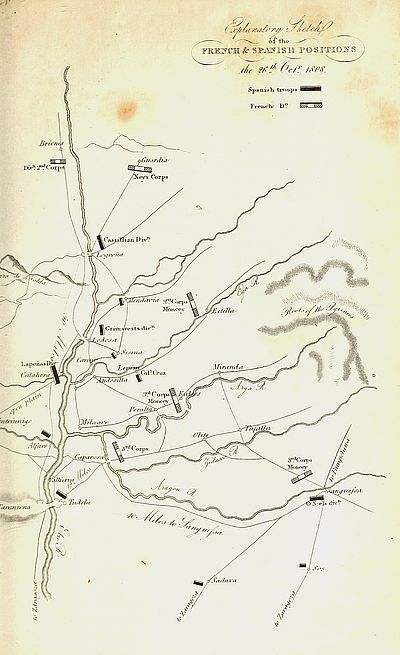 click here for larger image.
Explanatory Sketch
of the
FRENCH & SPANISH POSITIONS
the 26th Octr. 1808.
London. Published March 1828, by John Murray, Albermarle Street.
When Castaños arrived at Logroña these operations
were in full activity. Ney had advanced on the 24th,
driven back the Castillian outposts, crowned the height
opposite that town on the 25th, and was cannonading
the Spaniards’ position. On the 26th, he renewed
his fire briskly until twelve o’clock, at which time
Castaños, after giving Pignatelli strict orders to defend
Whittingham’s Correspondence. MS.
his post unless he was turned by a force descending
the right bank of the Ebro, proceeded himself to
Lodosa and Calahorra. As the road winded by the
river, the Spanish general was exposed to the fire of
light troops posted in a wood on the opposite side, but
escaped without injury. Meanwhile the French from
Estella falling down the Ega, drove the Spanish parties
Colonel Graham’s Correspondence. MS.
out of Mendavia, Andosilla, Carcur, and Sesma;
and Grimarest retired from Lodosa to La Torre with
such precipitation, that he left colonel Cruz, a valuable
officer, with a light battalion, and some volunteers, at
Lerim. A squadron of cavalry escaped, but Cruz,
with the infantry, being surrounded in a convent,
was, after a creditable resistance, taken. Pignatelli,
regardless of Castaños’ orders, retired from Logroña,
and abandoned all his guns at the foot of the Sierra
Ibid.
de Nalda, only a few miles from the enemy, then crossing
the mountains gained Centruenigo in such disorder,
that his men continued to arrive for twenty-four
hours consecutively. On the right, O’Neil skirmished
with the garrison of Pampeluna, and lost six
men killed, and eight wounded; but, in the Spanish
fashion, announced, that, after a hard action of many
hours, the enemy was completely overthrown. On
the 27th, Merlin’s division rejoined Bessieres at Miranda,
and Bonnet, retiring from Briones, took post
in front of Pancorbo. Castaños, incensed at the ill
conduct of the Castillians, dismissed Pignatelli, and
incorporated his troops with the Andalusian divisions.
Fifteen hundred men of the latter, commanded by the
Conde de Cartoajal, being sent back to Nalda, recovered
the lost guns, and brought them safe to Centruenigo.
Internal dissensions succeeded to external troubles.
Palafox arrogantly censured Castaños, and a
cabal, of which general Coupigny appears to have
been the principal mover, was formed against the
latter. The junta, exasperated that Castaños had
not already driven the enemy beyond the frontier, encouraged
his traducers, and circulated slanderous accusations
themselves, as if his inaction alone enabled
the French to remain in Spain. Don Francisco Palafox,
brother of the captain-general, and a member of
the supreme junta, was sent to head-quarters avowedly
to facilitate, but really to interfere with, and control
the military operations. He arrived at Alfaro on the
29th, accompanied by Coupigny and the conde de
Montijo, a turbulent, factious man, shallow and vain,
but designing and unprincipled. Castaños waited
Castaños’ Vindication.
upon the representative of the government, and laid
before him the denuded state of the army, and the
captain-general, Palafox, coming up from Zaragoza,
a council of war was held at Tudela on the 5th of
November. The rough manner in which the troops
were driven from the left bank of the Ebro was not
sufficient to divert the attention of the Spanish generals
from the grand project of gaining the rear of
the French army. The council agreed to persevere,
although certain advice was received that the enemy
were strengthened by thirty thousand fresh men.
Colonel Graham’s Correspondence. MS.
Deeming it, however, fitting, that Blake should act
the first, it was resolved to await his time, but, as an
intermediate operation, it was agreed that the army
of the centre, leaving six thousand men at Calahorra,
and a garrison at Tudela, should cross the Ebro and
Whittingham’s Correspondence. MS.
attack Caparosa. French parties were, however,
pushed as far as Voltierra, and in the skirmishes
which ensued, the conduct of the Castillian battalions
was discreditable.
Joseph Palafox returned to Zaragoza, and the
deputy separated himself from Castaños. The loss
sustained by desertion and the previous combats was
considerable, but some Murcian levies, and a part of
the first and third Andalusian divisions joined the
army of the centre, which now mustered twenty-six
thousand infantry, and nearly three thousand cavalry
under arms, with fifty or sixty pieces of artillery. The
positions of the army extended from Calahorra, by
Ibid.
Haro, to Tudela. La-Peña held the first town with
five thousand men; Grimarest and Caro commanded
eight thousand at the second; and head-quarters,
with thirteen thousand five hundred men, were fixed
in the last. Cartoajal remained with eleven hundred
in the Sierra de Nalda, and eight hundred were posted
at Ansejo.
In pursuance of the plan arranged, the troops were
in movement to cross the Ebro, when despatches from
Blake announced that he had met with some disaster
on the 31st, the extent of which he did not communicate.
This news arrested the attack; and the
preposterous transactions that ensued, resembled the
freaks of Caligula rather than the operations of real
war. First, it was arranged that the army should
abandon Tudela, and take a position in two lines,
the extremities of the one to rest on Calahorra and
Amedo, the second to extend from Alfaro to Fitero.
Graham’s Correspondence. MS.
The deputy ordered O’Neil, with the army of Aragon,
to occupy the latter of these lines forthwith, but O’Neil
refused to stir without instructions from the captain-general.
This was on the 9th, on the 10th the plan
was changed. Castaños fixed his head-quarters at Centruenigo,
and the deputy proposed that O’Neil should
descend the right bank of the Aragon river, and attack
Caparosa in the rear; that the troops in Tudela
should attack it in front; and that a division should
make a demonstration of passing the Ebro in boats,
opposite to Milagro, in order to favour this attack.
Castaños assented. On the 12th a division assembled
opposite Milagro, and La-Peña with two divisions
marched against Caparosa. Suddenly, the whimsical
deputy sent them orders to repair to Lodosa, forty
miles higher up the Ebro, and attack the bridge at that
place, while Grimarest crossing in the boats at Calahorra,
should ascend the left bank of the Ebro, and
take it in rear. La-Peña and Villarcayo, confounded
Castaños’ Vindication
by this change, wrote to Castaños for an explanation.
This was the first intimation that the latter,
who was lying sick at Centruenigo, received of the
altered dispositions. He directed his lieutenants to
obey; but being provoked beyond endurance, wrote
sharply to the junta, demanding to know who was
to command the army; and after all this insolence
Graham’s Correspondence. MS.
and vapouring on the part of Francisco Palafox, no
operation took place at all. He declared, that his intention
was merely to make a demonstration, ordered
the troops to their quarters, and then, without assigning
any reason, deprived La-Peña of his command,
and appointed Cartoajal in his place.
It was at this time that sir John Moore’s letter
arrived; but Castaños, no longer master of his own
operations, could ill concert a plan of campaign with
the general of another army. He could not even
tell what troops were to be at his nominal disposal;
for the Estremaduran force, originally destined for
his command, was now directed by the junta upon
Burgos, and the remainder of his own first and third
division was detained in Madrid. His enemies, especially
Montijo, were active in spreading reports to
Vindication of Castaños.
his disadvantage; the deserters scattered over the
country declared that all the generals were traitors,
and the people of the towns and villages, deceived
by the central junta, and excited by false rumours,
respected neither justice nor government, and committed
the most scandalous excesses.
Blake’s situation was not more prosperous.
The road from Bayonne to Vittoria was encumbered
with the advancing columns of the great French army.
An imperial decree, issued early in September, commanded
that the troops already in Spain should be
incorporated with the grand army then marching from
Germany. The united forces were to compose eight
divisions, called “Corps d’Armée,” an institution analogous
to the Roman legion, because each “Corps
d’Armée,” although adapted to act with facility as a
component part of a large army, was also provided
with light cavalry, a parc, and train of artillery, engineers,
sappers, and miners, and a complete civil administration,
to enable it to take the field as an independent
force. The imperial guards and the heavy
cavalry of the army were not included in this arrangement;
the first had a constitution of their own, and at
this time all the heavy cavalry, and all the artillery,
not attached to the “Corps d’Armée,” were formed into
a large reserve. As the columns arrived in Spain, they
were united to the troops already there, and the whole
was disposed conformably to the new organization.
| Marshal Victor, duke of Belluno, commanded the |
first corps. |
| Marshal Bessieres, duke of Istria |
second corps. |
| Marshal Moncey, duke of Cornegliano |
third corps. |
| Marshal Lefebre, duke of Dantzic |
fourth corps. |
| Marshal Mortier, duke of Treviso |
fifth corps. |
| Marshal Ney, duke of Elchingen |
sixth corps. |
| General St. Cyr |
seventh corps. |
| General Junot, duke of Abrantes |
eighth corps. |
The seventh corps was appropriated to Catalonia;
the remainder were in the latter end of October assembled
or assembling in Navarre and Biscay. General
Merlin, with a division, held Zornosa, and observed
Blake, who remained tranquilly at Bilbao.
S.
Journal of the king’s operations, MS.
Two divisions of the fourth corps occupied Durango
and the neighbouring villages. One division and the
light cavalry of the first corps was at Vittoria, a second
division of the same corps guarded the bridge of Murguia
on the river Bayas, and commanded the entrance
to the valley of Orduña. Haro, Puente Lara, Miranda,
and Pancorbo were maintained by the infantry
of the king’s body guard and the second corps, and
the light cavalry of the latter covered the plains close
up to Briviesca.
The reinforcements were daily crowding up to Vittoria,
and the king, restrained by the emperor’s orders
to a rigorous system of defence, occupied himself with
the arrangements attendant on such an immense accumulation
of force, and left Blake in quiet possession
of Bilbao. The latter mistook this apparent inactivity
for timidity; he was aware that reinforcements,
in number equal to his whole army, had joined the
enemy; but, with wonderful rashness, he resolved to
press forward, and readily agreed to attempt a junction
with Palafox, in the rear of the French position.
At this time Romana’s infantry were approaching Bilbao,
and the Estremadurans were in march for Burgos;
but the country was nearly exhausted of provisions;
both armies felt the scarcity, and desertion
prevailed among the Spaniards. The Biscayans, twice
abandoned, were fearful of a third insurrection. Prudence
dictated a retreat towards Burgos. Blake resolved
to advance.
Carrol’s Correspondence.
Having posted general Acevedo with the Asturians
and the second division at Orduña, he left a battalion
at Miravelles, to preserve the communication with
Bilbao, and the 24th of October marched himself at
the head of seventeen thousand fighting men, divided
in three columns, to attack Zornosa. The right
ascended the valley of Durango by Galdacano, the
centre by Larabezua, the left by Rigoytia; at the
same time general Acevedo penetrated through the
mountains of Gorbea by Ozoco and Villaro, with a
view to seize Manares and St. Antonia d’Urquitiola.
Brodrick’s Correspondence.
It was intended by this operation to cut the communication
between Miranda on the Ebro, and the town
of Durango, and thus to intercept the retreat of marshal
Ney, and oblige him to surrender with sixteen
thousand men; for Blake was utterly ignorant of his
adversary’s position, and imagined that he had only
two corps to deal with. He believed that the king,
with one, was in his front at Durango and Mont
Dragon, and that Ney, with the other, was at Miranda,
when in fact, the latter was at that moment
attacking Pignatelli at Logroña. As the Spanish
army approached Zornosa, Merlin abandoned the town,
and drew up on some heights in the rear. Bad weather,
and the want of provisions, checked further
operations until the 25th. On the evening of that
day, the Spanish division at Rigoytia attempted to
turn the right flank of the French. At the same
time Blake marched against the centre and left, and
Merlin fell back to Durango.
S.
Journal of the king’s operations, MS.
The duke of Dantzic, alarmed by these movements,
concentrated his whole force, consisting of two divisions
of infantry (Sebastiani’s and Laval’s), and a
Dutch brigade at Durango; his third division (Valence’s)
being yet in France. The king reinforced
him with a division of the first corps (Villatte’s),
and ordered Merlin’s troops, which were composed
of detachments, to join their respective regiments.
From the 25th to the 30th the armies remained
quiet; but at day-break on the 31st, the Spaniards
were formed in order of battle, five miles beyond
Zornosa, and close to the enemy’s position. The
vanguard drew up across the road to Durango; the
reserve at some distance in the rear. The third and
fourth divisions occupied the intermediate space, so
disposed as to outflank the others, in a chequer shape.
The first division occupied a height on the left of the
road, and behind the reserve.
Ibid.
The duke of Dantzic, apprised by the previous
movements, that he was going to be attacked, became
impatient; the state of the atmosphere prevented him
from discovering the order of march, or the real force
of the Spaniards; he knew that Blake had the power
of uniting nearly fifty thousand men, and concluding
that such a force was in his front, he resolved to anticipate
his adversaries by a sudden and vigorous assault.
In fact, the Spanish generals were so little
guided by the rules of war, that before their incapacity
was understood, their very errors being too
gross for belief contributed to their safety. Blake
had commenced a great offensive movement, intending
to beat the troops in his front, and to cut off
and capture Ney’s corps of sixteen thousand men.
In six days, although unopposed, he advanced less
than fifteen miles, and so disposed his forces, that out
Carrol’s Correspondence.
of thirty-six thousand men, he concentrated only
seventeen thousand infantry, without artillery, upon
the field of battle!
The duke of Dantzic, at the head of twenty-five
thousand men, formed in three columns of attack, descended
the heights of Durango. A thick fog covering
the mountain sides, filled all the valleys; and a
few random shots alone indicated the presence of the
hostile armies. Suddenly Villatte’s division appeared
close to the Spanish vanguard; and with a brisk onset
forced it back upon the third division. Sebastiani’s
and Leval’s followed in succession; a fire of artillery,
to which Blake could make no reply, opened along the
road: the day cleared, and the Spanish army, heaped
in confused masses, was, notwithstanding the example
of personal courage given by Blake, and the natural
strength of the country, driven from one position to
another. At mid-day it was beyond Zornosa, and at
three o’clock in full flight for Bilbao, which place
S.
Journal of Operations, MS.
it gained in a state of great confusion during the
night. The next day Blake crossed the Salcedon,
and took a position at Nava. The duke of Dantzic
pursued as far as Guenes, and then leaving general
Leith’s Correspondence. MS.
Villatte, with seven thousand men, to observe the
enemy, returned to Bilboa. Twelve vessels, laden
with English stores, were in the river, but contrived
to escape.
The king was displeased with the precipitancy of
marshal Lefebre, but endeavoured to profit from the
S.
Journal of Operations, MS.
result. The division of the first corps, stationed at
Murguia,
was ordered to descend the valley of Orduña,
as far as Amurio, to aid the operations of the
fourth corps. At the same time, Mouton’s division
was detached from the second corps towards Barbareña,
from whence it was, according to circumstances,
either to join the troops in the valley of Orduña, or
to watch Medina and Quincoes, and press Blake in
his retreat, if he retired by Villarcayo. The French
were ignorant of the situation of general Acevedo. On
the day of the action at Zornosa, that general was at
Villaro, from whence he endeavoured to rejoin Blake,
by marching to Valmaceda. He reached Miravalles,
in the valley of Orduña, on the 3d, at the moment
when the head of the French troops coming from
Murguia appeared in sight. After a slight skirmish,
the latter thinking they had to deal with the whole
of Blake’s army, retired to Orduña, and Acevedo immediately
pushed for the Salcedon river. Villatte
first got notice of his march, and dividing his own
troops, posted one half at Orantia, on the road leading
from Miravalles to Nava, the other on the road
to Valmaceda, thus intercepting the line of retreat.
Captain Carrol.
Blake, who was informed of Acevedo’s danger, in the
night of the 4th, with great decision and promptitude,
instantly passed the bridge of Nava, and at daybreak
crowned the heights of Orantia with three divisions,
meaning to fall suddenly upon the French; but they
were aware of his intention, and sending a detachment
to occupy Gordujuela, a pass in the mountains, leading
to Bilbao, rejoined Villatte on the Valmaceda
road. Five Spanish divisions and some of Romania’s
troops were now assembled at Orantia: Blake left two
in reserve, detached one against Gordujuela, and
marched with the other two against the French position.
Villatte was overpowered and driven across the
Salcedon; but rallied on the left bank and renewed
the action. At this moment Acevedo appeared in
sight; he sent two battalions by a circuit to gain the
rear of the French, and with the remainder joined in
the combat. Villatte retired fighting, and encountering
the two battalions in his retreat, broke through
them, and reached Guenes, but not without considerable
loss of men, and he also left one gun and part of
his baggage in the hands of the Spaniards. Thus
ended a series of operations and combats, which had
lasted for eleven days.
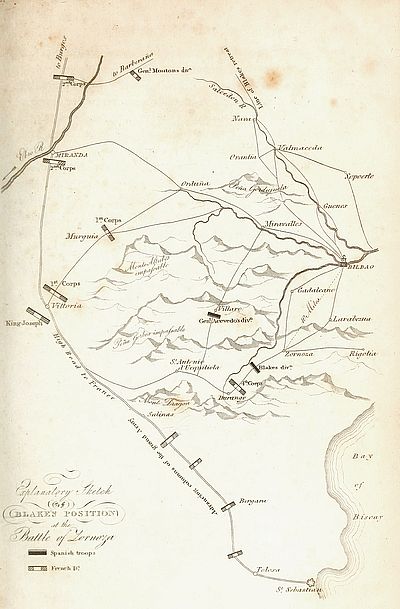 click here for larger image.
Explanatory Sketch
of
BLAKE’S POSITION
at the
Battle of Zornoza.
London. Published March 1828, by John Murray, Albermarle Street.
1º. The duke of Dantzic’s attack at Zornosa was
founded upon false data; it was inconsistent with the
general plan of the campaign, hasty, ill-combined, and
feebly followed up. It was an unpardonable fault to
leave Villatte without support, close to an army that
had met with no signal defeat, and that was five times
his strength. The march of Victor’s division was
too easily checked at Miravalles. For five days, general
Acevedo, with at least eight thousand men, was
wandering unmolested in the midst of the French
columns, and finally escaped without any extraordinary
effort.
2º. General Blake’s dispositions, with the exception
of his night-march from Nava to Orantia, will, if
studied, afford useful lessons in an inverse sense.
From the 24th of October to the 4th of November,
he omitted no error that the circumstances rendered
it possible to commit; and then, as if ashamed of the
single judicious movement that occurred, he would
not profit by it. Romana’s infantry being partly
arrived, and the remainder in the vicinity of Nava,
the whole Spanish army was, contrary to all reasonable
expectation, concentrated; Blake had then above
thirty thousand fighting men united in one mass,
harassed, but not much discouraged, and the conde
de Belvedere, with twelve thousand infantry, twelve
hundred cavalry, and thirty pieces of artillery, was
close to Burgos.
If Blake had been at all acquainted with the principles
of his art, he would have taken advantage of
Villatte’s retreat, to march by Espinosa, and Villarcayo,
to the upper Ebro; from thence have gained
Burgos; brought up the artillery from Reynosa;
united Belvedere’s troops to his own; opened a communication
with the English army; and in that position,
with a plentiful country behind him, his retreat
open, and his army provided with cavalry, he might
have commenced a regular system of operations; but
with incredible obstinacy and want of judgment, he
determined to attack Bilbao again, and to renew the
ridiculous attempt to surround the French army and
unite with Palafox at the foot of the Pyrenees.
Such were the commanders, the armies, the rulers,
upon whose exertions the British cabinet relied for
the security of sir John Moore’s troops, during their
double march from Lisbon and Coruña. It was in
such a state of affairs that the English ministers, anticipating
the speedy and complete destruction of the
French forces in Spain, were sounding the trumpet
for an immediate invasion of France! Of France, defended
Lord W. Bentinck’s Correspondence.
by a million of veteran soldiers, and governed
by the mightiest genius of two thousand years! As
if the vast military power of that warlike nation had
suddenly become extinct; as if Baylen were a second
Appendix, No. 13, Sect. 8.
Zama, and Hannibal flying to Adrumetum instead of
passing the Iberus! But Napoleon, with an execution
more rapid than other men’s thoughts, was already
at Vittoria, and his hovering eagles cast a gloomy
shadow over Spain.
BOOK IV. — CHAPTER I. — BATTLE OF GAMONAL. — BATTLE OF ESPINOSA. — THE BATTLE OF TUDELA.
After the opening of the legislative sessions, the
emperor quitted Paris, and repaired to Bayonne. He
arrived there on the 3d of November. It was his intention
that the presumption of the Spanish generals
should be encouraged by a strict defensive system until
the moment, when the blow he was prepared to strike,
could fall with the greatest effect. The precipitate
attack at Zornosa displeased him, and he was also
dissatisfied with the subsequent measures of the king.
S.
Journal of the king’s operations, MS.
He thought that the safety of Mouton’s division would
be compromised between the armies of Blake and the
conde de Belvedere. To prevent any accident, he
judged it necessary that Bessieres should advance
with the whole of the second corps to Burgos; that
marshal Victor should march by Amurio to Valmaceda;
and that marshal Le-Febre should immediately
renew his attack on that position, from the side of
Bilbao. These dispositions were executed, and thus
at the very moment when Blake was leading his
harassed and starving troops back to Bilbao, two
corps, amounting to fifty thousand men, were in full
march to meet him, and a third had already turned
his right flank, and was on his rear.
Captain Carrol’s Correspce.
The Spanish general advanced from Valmaceda on
the 7th, and thinking that only fifteen hundred men
were in Guenes, prepared to surround them. Two
divisions making a circuit to the left, passed through
Abellana and Sopoerte, with a view to gain the bridge
of Sodupe, in the rear of Guenes, while two other
divisions attacked that position in front; the remainder
of the army followed at some distance. The
advanced guard of the 4th corps was in Guenes, and
after an action of two hours, the Spaniards were
thrown into confusion; but the night saved them
from a total rout. The same day, one of their flanking
divisions was encountered and beaten near Sopoerte,
and the retreat of the other being intercepted on the
side of Abellana, it was forced to make for Portagalete
General Leith’s Correspce.
on the sea-coast, and from thence to St. Andero.
Blake’s eyes being now opened a little to the peril of
his situation, he resolved to retreat to Espinosa de
los Monteros, a strong mountain position, two days’
march in the rear; intending to rest his troops there,
and to draw supplies from the magazines at Reynosa.
Retreating during the night to Valmaceda, he gained
Nava on the 8th, and finally reached Espinosa on the
9th. The remainder of Romana’s infantry came up
during this retreat, and the whole army was, with the
exception of the division cut off at Abellana, concentrated
in a strong position, which covered the intersection
of the roads from St. Andero, Villarcayo, and
Reynosa.
Napoleon, accompanied by the dukes of Dalmatia
and Montebello, quitted Bayonne the morning of the
8th, and reached Vittoria in the evening. He was
met by the civil and military chiefs at the gates of
the town; but refusing to go to the house prepared
for his reception, he jumped off his horse, entered
the first small inn that he observed, and calling for
his maps, and a report of the situation of the armies
on both sides, proceeded to study the plan of his
campaign.
The first and fourth corps, after uniting at Valmaceda,
had separated again at Nava on the 9th,
Victor pursuing the track of Blake, and Lefebre
marching upon Villarcayo by Medina. The second
corps was concentrating at Briviesca, the third corps
occupied Tafalla, Peraltes, Caparosa, and Estrella.
The sixth corps, the guards, and the reserve, were
distributed from Vittoria to Miranda, and a division,
under the command of general La Grange, was at
Guardia, connecting the positions of the third and
sixth corps. The fifth corps was still behind the
frontier, and the eighth composed of the troops, removed
from Portugal by the convention of Cintra,
was marching from the French sea-ports, where it
had disembarked.
On the Spanish side, the conde de Belvedere was
at Burgos, Castaños and Palafox, unknowing of their
danger, were planning to cut off the French army,
and Blake was flying to Espinosa. The English army
were scattered from Coruña to Talavera de la Reyna.
In two hours the emperor had arranged his plans.
Moncey was directed to leave a division in front of Pampeluna,
to observe the Spaniards on the Aragon, to concentrate
the remainder of the third corps at Lodosa,
and to remain on the defensive until further orders.
Lagrange was reinforced by Colbert’s brigade of light
cavalry from the sixth corps, and directed upon Logroña.
The first and fourth corps were to press Blake
without intermission. The sixth to march towards
S.
Marshal Soult’s Operations, MSS.
Aranda de Douero. The duke of Dalmatia was appointed
to command the 2d corps, and ordered to fall
headlong upon the conde de Belvedere. The emperor,
with the imperial guards and the reserve, followed the
movement of the second corps.
These instructions being issued, the enormous mass
of the French army was put in motion with a celerity
that marked the vigour of Napoleon’s command. Marshal
Soult having departed on the instant for Briviesca,
arrived there at day-break on the 9th, received
the second corps from the hands of Bessieres, and in
a few hours, the divisions composing it were in full
march for the terrace of Monasterio, which overlooks
the plains of Burgos. Head-quarters were established
there, and, during the night, general Franceschi’s
brigade of light cavalry took the road of Zaldueño
to Arlanzon, having orders to cross the river of that
name, and descending the left bank, to cut the communication
of the Spaniards with Madrid, and to
prevent them from rallying at the convent of the
Chartreuse, if defeated near Burgos.
At four o’clock on the morning of the 10th, the
French were in march from Monasterio, and at six
o’clock general Lassalle’s cavalry reached Villa Fria.
The conde de Belvedere, being informed of their approach,
posted the Spanish army at Gamonal, and taking
four thousand infantry, eight guns, and the whole of
his cavalry, fell upon Lassalle. The latter skirmished
for a while, and then following his orders, retired
slowly to Rio Bena. At eight o’clock, the French
infantry, which had advanced by two roads, was reunited
at this town, and immediately pushed forward
on Villa Fria. Belvedere was soon driven back upon
Gamonal, and the Spanish army was discovered in line
of battle. The right occupied a wood, leaving a clear
space of some extent between it and the river Arlazon.
The left was posted in the walled park of Vellimer.
Thirty pieces of artillery covered the front, and
seven or eight thousand armed peasants were arrayed
on the heights, immediately behind the regular troops.
These latter amounted to eleven thousand one hundred
and fifty infantry, and eleven hundred and fifty
cavalry, following a field state of their numbers, found
after the action. This was the best army at that time
S.
Journal of Operations, MS.
in Spain; it was composed of the Walloon and Spanish
guards, the regiments of Mayorca, Zafra, and Valencia
de Alcantara; the hussars of Valencia, the royal carbineers,
and some volunteers of good families. It was
completely equipped, and armed principally from the
English stores; but its resistance was even more
feeble than that made by the half-famished peasants
of Blake’s force.
General Lassalle, with the light cavalry, led down
upon the Spanish right, and filled the plain between
the river and the wood. At the same moment the
Spanish artillery opened along the whole of their line,
and the French infantry formed in columns of regiments
arrived. Mouton’s division, composed of old
soldiers, broke at once into the wood at a charging
pace. General Bonnet followed closely, but so rapid
and effectual was the assault of Mouton’s veterans,
that Bonnet’s troops never fired a shot. The Spaniards
fled in disorder, the left wing, although not attacked,
followed the example of the right, and the whole
mass, victors and vanquished, rushed into the town
of Burgos with extraordinary violence and uproar.
At the same moment, Bessieres, who retained the
command of all the heavy cavalry, passed at full
gallop toward the Madrid road, where it crosses the
Arlazon, sabring the fugitives, and taking all the
guns which had escaped Mouton’s vehement attack;
and on the other side of the river, Franceschi was
seen to cut in pieces some Catalonian light troops
stationed there, and to bar all hopes of flight.
Never was a defeat more instantaneous, or more
complete. Two thousand five hundred Spaniards
were killed; twenty guns, thirty ammunition waggons,
six pair of colours, and nine hundred men, were
taken on the field. Four thousand musquets were
found unbroken, and the fugitives were dispersed far
and wide. Belvedere himself escaped to Lerma, where
he arrived in the evening of the day on which the
battle was fought. Meeting some battalions, principally
composed of volunteers, on their march to
join his army, he retired with them to Aranda de
Appendix, No. 15.
Douero during the night; but first, with true Spanish
exaggeration, wrote a despatch, in which he asserted,
that the French were repulsed in two desperate attacks;
but that after thirteen hours hard fighting, they
succeeded in a third.
All the ammunition and stores of the Spanish army
were captured in Burgos; and the indefatigable marshal
Soult, who was still upon the post-horse, which
he mounted at Briviesca; not content with travelling
from Bayonne to Burgos, taking the latter town, and
gaining a decisive victory within the space of fifty
hours; now rallied his corps, and detaching one
column in pursuit on the side of Lerma, and another
towards Valencia and Valladolid, marched himself
with a third, on the very day of the battle, towards
Reynosa, where he hoped to intercept Blake’s line of
retreat to the plains of Leon.
Carrol’s Correspce.
This last-mentioned general reached Espinosa, as
we have seen, on the evening of the 9th, with six divisions,
including Romana’s infantry, who also dragged
with them six guns of a small calibre. The separation
of the fourth division at Abellana, the deserters,
and the losses sustained in battle, had reduced the army
below twenty-five thousand fighting men. The parc of
ammunition and the artillery, guarded by two thousand
infantry, were behind Reynosa, at Aquilar del
Campo, on the road to Leon. Blake’s position was
strong, and he hoped to remain in it for some days
unmolested. His left wing, composed of the Asturians,
and the first division, occupied some heights
which covered the road of St. Andero. The centre,
consisting of the third division and the reserve, formed
a line across the road of Reynosa, which led through
Ibid.
Espinosa directly to the rear. The second division
was established on a commanding height, a little on
the right hand of the town; Romana’s infantry were
posted in a wood, two miles in advance of the right;
and the vanguard, with six guns, formed a reserve
behind the centre of the position.
At two o’clock in the afternoon of the 10th, the
head of marshal Victor’s columns drove back Romana’s
infantry[18], and seized the wood; but the Spaniards,
reinforced by the third division, renewed the combat.
A second French column, however, opened its fire
upon the Spanish centre, thus weakened by the advance
of the third division; and at the same time
some light troops ascending the heights on the left,
menaced that wing of Blake’s army. The contest on
the right was maintained with vigour, and the Spaniards,
supported by the fire of the six guns in their
centre, appeared to be gaining ground, when the
night closed and put an end to the action, leaving the
French in possession of the wood, and of a ridge of hills,
which, at the distance of a cannon-shot, run parallel
to the centre of the position. Generals St. Roman
and Riquielmé were mortally wounded this day on
the Spanish side.
At daylight the next morning, Victor, who had
relieved his left with fresh troops during the night,
renewed the attack. General Maison throwing out
a cloud of skirmishers along the front of the Spanish
centre and left wing, under cover of their fire,
passed rapidly to his own right, and fell upon the
Asturians and the first division. Blake, observing
this movement, detached a column of grenadiers to
reinforce the latter, and advanced in person with
three regiments from the centre to take Maison in
flank during his march. It was too late. Three
Asturian generals fell at the first fire, and the troops
of that kingdom fled without waiting for the enemy.
They were soon followed by the first division, and
Maison, continuing his course without a check, intercepted
the line of retreat by St. Andero, and also that
by the town of Espinosa. In the mean time, the
French troops posted on the parallel ridge before
spoken of, attacked the centre, and the division in
the wood advancing against the right of the Spaniards,
their whole army gave way in terrible confusion
and distress, and crowded towards the river Trueba,
which encircled the rear of the position. Some tried
the fords, some rushed to the town, others fled to the
right and left; but the weather was bad, the roads
deep, the country rugged and difficult, and the overthrow
was fatal. Those who escaped went to their own
provinces, carrying dismay into the remotest parts of
Gallicia, Asturias, Leon, and Castille. The guns, the
baggage, and ammunition, fell into the hands of the
French. Blake himself reached Reynosa on the 12th,
and there rallied about seven thousand fugitives, but
without arms, without spirit, and without hope.
The line of retreat by Aguilar del Campo, where
his artillery remained, was still open to him; and he
proposed to remain at Reynosa as long as the enemy
would permit him; to restore order, and then to retire
through Leon upon sir David Baird’s division, the head
of which was now near Astorga. But his total ignorance
of the French operations and strength again
misled him. He looked only to the side of Espinosa,
and already Soult’s cavalry was upon his line of retreat,
and the duke of Dantzic was hastening by the valley
S.
Journal of Operations, MS.
of Villarcayo towards Reynosa. Upon the 13th, he
was attacked by the advanced guard of the second
corps, and being now utterly confounded, he fled with
four or five thousand men through the valley of Cabuerniga,
and took refuge at Arnedo, in the heart of
the Asturian mountains. There the marquis of Romana
joined him, and assumed the command of all
that remained of the unfortunate army of the left.
Blake being thus disposed of, the fourth French
corps, after a halt of a few days to refresh the troops,
took the road of Carrion and Valladolid; but Soult
recalling his detachments, concentrated the second
corps at Reynosa, seized St. Ander, and captured a
quantity of English stores; leaving a division there
under general Bonnet, he then spread his columns
over the whole of the Montagna, pursuing, attacking,
and dispersing every body of Spaniards that yet held
together, capturing their baggage, and filling all
places with alarm. After some partial actions with
unconnected parties, every thing military belonging
to the patriots was driven over the snowy barrier of
the Asturian hills; and Soult having left a detachment
at St. Vincent de Barqueira, scoured the banks
of the Deba, took the town of Potes, and overrun
S.
Journal of Operations, MS.
Leon with his cavalry as far as
Sahagun and Saldaña.
Meanwhile the duke of Belluno quitting Espinosa,
joined the emperor, whose head-quarters were fixed at
Burgos, after the defeat of Belvedere.
The battles of Espinosa and Gamonal, and the subsequent
operations of marshal Soult, laid the north
of Spain prostrate, and secured the whole coast from
St. Sebastian to the frontier of the Asturias. By a
judicious arrangement of small garrisons, and moveable
columns, the provinces of Guipuscoa, Navarre,
Biscay, and the Baston de Laredo were fettered; the
communication of the army with France could no
longer be endangered by insurrections in the rear;
and the wide and fertile plains of Old Castille and
Leon were thrown open to the French, and forbidden
to the separated divisions of the British army.
These great advantages, the result of Napoleon’s admirable
combinations, the fruits of ten days of active
exertion, obtained so easily, and yet so decisive of the
fate of the campaign, prove the weakness of the system
upon which the Spanish and British governments were
at this time acting; if that can be called a system
where no one general knew what another had done—was
doing—or intended to do.
Burgos, instead of Vittoria, was now become the
pivot of operations, and the right of his army being
secured, the emperor prepared to change his front,
and bear down against the armies of Castaños and
Palafox, with a similar impetuosity; but it was first
necessary to ascertain the exact situation of the British
force. Napoleon believed that it was concentrated
at Valladolid, and he detached three divisions
of cavalry and twenty-four pieces of artillery, by
Lerma and Palencia, with orders to cross the Douero,
to turn the flank of the English, threaten their communications
with Portugal, and thus force them to
retire. It was soon discovered that the heads of their
columns had not penetrated beyond Salamanca and
Astorga, and that many days must elapse before they
could be concentrated, and in a condition to act
offensively. Certain of this fact, the emperor let
loose his three divisions of cavalry, and eight thousand
horsemen sweeping over the plains, vexed all
Leon and Castille. The authorities showed no firmness;
the captain-general, Pignatelli, fled in consternation;
the people submissive and fearful, displayed
no enthusiasm, and disconcerted by the rapid movements
of the French, spread a thousand confused and
contradictory reports. The incursions of the cavalry
extended to the neighbourhood of Astorga, to Benevente,
Zamora, Toro, Tordesillas, and even to the
vicinity of Salamanca. Such was the fear, or the
Sir John Moore’s Papers.
apathy of the inhabitants, that thirty dragoons were
sufficient to raise contributions at the gates of the
largest towns; and after the overthrow of Espinosa
was known, ten troopers could safely traverse the
country in any direction.
The front of the French army being now changed,
the second corps, hitherto the leading column of attack,
became a corps of observation, covering the right
flank, and protecting the important point of Burgos,
where large magazines were establishing, and upon
which the reinforcements continually arriving from
France were directed. The exact situation of the
other corps was as follows: The first corps, the guards,
and a part of the reserve, were at Burgos; and Ney,
with the sixth, occupied Aranda de Douero; the march
of his force from the Ebro had been made with a view
to intercept the army of Estremadura on the side of
Madrid; but the sudden destruction of that body of
troops having rendered this precaution useless, Ney was
equally well placed to cut the communication of Castaños
with the capital. General Lagrange occupied
Logroña, and Moncey, with three divisions of infantry
and his light cavalry, was at Lodosa. The Spanish
army of the centre was consequently turned and
cut off from Madrid even before Castaños was aware
that the campaign had commenced.
In passing the mountains near Tolosa, marshal
Lasnes, duke of Montebello, fell from his horse, and
was left at Vittoria; his hurts were dangerous, but
Baron Larrey’s Surgical Campaigns.
a rapid and interesting cure being effected by wrapping
him in the skin of a sheep newly slain, the emperor
directed him to assume the command of Lagrange’s
division and Colbert’s light cavalry, to unite
them with the third corps at Lodosa, and to fall upon
Castaños in front. At the same time he ordered Ney
to ascend the course of the Douero with the light cavalry
and two divisions of the sixth corps, to connect
his left with the right of Lasnes, and to gain Agreda
by the road of Osma and Soria, from whence he could
intercept the retreat of Castaños, and place himself on
the rear of the Spanish army. To support this operation,
the first corps, and Latour Maubourg’s division
of heavy cavalry being drawn from the reserve, proceeded
by Lerma and Aranda, and from thence slowly
followed the direction of Ney’s march. The emperor,
with the guards, and the remainder of the reserve,
continued at Burgos, the citadel was repaired
and armed, magazines were formed, and arrangements
made to render it the great dépôt of the army. All
the reinforcements coming from France were directed
upon this town, and proclamations were issued assuring
the country people of protection if they would
be tranquil and remain in their houses.
Ten days had now elapsed since Napoleon, breaking
forth from Vittoria, had deluged the country with his
troops, and each day was marked by some advantage
gained over the Spaniards; but these misfortunes were
still unknown at Tudela and disregarded at the capital.
The remnants of Belvedere’s army having rallied in
Mr. Stuart. Lord W. Bentinck. MSS.
the pass of the Somosierra and on the side of Segovia,
the troops belonging to the army of the centre, which
had been detained in Madrid, were forwarded to the
former place, and those left behind from Cuesta’s levies
were ordered to the latter. General St. Juan, an
officer of high reputation, took the command at the
Ibid.
Somosierra, general Heredia repaired to Segovia, and
an intermediate camp of detachments being formed at
Sepulveda, the men thus collected were, by the junta,
magnified into a great army sufficient to protect
Madrid.
That the left wing of the French army was still
upon the Ebro, the central junta attributed, not to
the enemy’s strength, but to the dilatory proceedings
of Castaños, and depriving him of the command, they
Ibid.
gave it to Romana, precisely at the moment when it
was impossible for the latter to reach the army he
was to lead. The junta wanted a battle, and, uncorrected
by Blake’s destruction, doubted not of victory.
The proceedings at Tudela were also worthy of the
times; there the madness of the generals, and the folly
of the deputy, increased rather than abated. The
freaks of Francisco Palafox, and their ridiculous termination
on the 12th of November, I have already
related. A few days sufficed to give birth to new
plans equally absurd, but more dangerous, as the
crisis approached nearer. This time Castaños took
the lead. He knew upon the 10th that the Estremaduran
army was at Burgos, and that the French
Castaños’ Vindication.
were marching on that town; from that moment, despairing
of the junction of the British army, and likewise
of his own first and third divisions, which were
in Madrid, he sent orders to Belvedere to unite himself
with Blake; but his letters never reached that
officer, who was defeated before they were written, and
Castaños, feeling that he himself was in a dangerous
position, and that some decided measure was required,
conceived so extraordinary a plan, that it would be
difficult to credit it upon any authority but his own.
He proposed to carry the army of the centre, reduced
in numbers and ill-disciplined as it was, by the
Concha de Haro and Soria, towards Burgos, and to
fall upon the emperor’s rear guard; and, as a preliminary
Ibid.
step, he determined to beat the army in his
front; but Palafox had also a plan, of attacking
Moncey on the side of Sanguessa, and the first measure
necessary was to combine these double operations.
It was agreed that Caparosa should be garrisoned
by four thousand infantry, that the bridge
head at that place should be fortified, and that O’Neil
should be reinforced at Sanguessa by detachments
Colonel Graham’s Correspce. MSS.
from the centre until his force amounted to nineteen
thousand infantry and twelve hundred cavalry. He
was then to break down the bridge, place guards at
all the passages on the Aragon, and by a flank march
gain Caparosa, cross the river, and threaten Peraltes
and Olite on the 17th; but on the 18th turning suddenly
to the left to get in rear of Lodosa, while general
La-Peña and Coupigny, marching from Centruenigo,
should attack Moncey in front.
This great movement was openly talked of at the
head-quarters of the Spanish generals for several days
Ibid.
before its execution, and these extraordinary commanders,
who were ignorant of Blake’s disasters, announced
their intention of afterwards marching towards
Vittoria to lighten the pressure on that officer
if he should be in difficulty, or if (as his despatches
of the 5th had assured them) he was successful, then
to join in a general pursuit. Castaños, however,
concealed his real project, which was to move by the
Concha de Haro towards Burgos.
It was found impossible to procure a sufficient
number of boats to lay a bridge over the Ebro at
Ibid.
Alfaro: thus the reinforcements intended for O’Neil
were forced to make a circuit by Tudela, and lost
three or four days. On the 14th O’Neil arrived at
Caparosa, after breaking the bridge of Sanguessa;
the 15th the reinforcements joined him. On the
17th, the day appointed for the execution of the plan,
Castaños received notice of his own dismissal from
the command, but he persevered in his project; La-Peña
and Coupigny were put in motion to pass the
bridges of Logroña and Lodosa, and the fords between
them; but general O’Neil, instead of executing his
part, first refused to stir without an order from Joseph
Castaños’ Vindication.
Palafox who was at Zaragoza, and then changing
his ground, complained that he was without bread.
Castaños besought him to move upon the 18th, urging
the necessity of the measure, and the danger of delay.
But the deputy, Palafox, who had hitherto approved
of the project, suddenly quitted the head-quarters,
and went to Caparosa, from whence, in concert with
O’Neil, he wrote to demand a farther reinforcement
from the centre, of six thousand infantry and some
more cavalry, without which, they affirmed, that it
would be dangerous to pass the Aragon river. Castaños
preserved his temper, invited the deputy to return
to the right bank of the Ebro, and opposed the
demand for more troops on the ground of the delay
it would cause; but now the captain-general Palafox,
agreeing with neither side, proposed a new plan. It
is difficult to say how long these strange disputes would
have continued if an umpire had not interposed, whose
award was too strongly enforced to be disregarded.
Castaños’ Vindication.
Castaños was with the divisions of Coupigny and
La-Peña
at Calahorra on the 19th, when he received
information that a French corps was advancing upon
Logroña. It was Lasnes’, with Lagrange’s and Colbert’s
troops, but the Spaniard concluded it to be
Ney, for he was ignorant of the changes which had
taken place since the 8th of the month. It was likewise
reported, that Moncey, whose force he estimated
at twelve thousand, when it really was above twenty
thousand, had concentrated at Lodosa, and, at the
same time, the bishop of Osma announced that twelve
thousand men, under Dessolles, were marching from
Castaños’ Account of the Battle of Tudela.
the side of Aranda de Douero. On the 21st, the intelligence
that Dessolles had passed Almazan, and
that Moncey was in motion, was confirmed. Then
Castaños, relinquishing his offensive projects, prepared
to retire, and it was full time. For marshal
Ney, who left Aranda on the 19th, had passed Almazan
on the 20th, dispersed several small bands of
insurgents, and entered Soria on the 21st, so that
when Castaños determined to fall back on the 21st,
his flank was already turned, and his retreat upon
Madrid in the enemy’s power. His artillery was at
Centruenigo, and a large detachment of his army was
with O’Neil at Caparosa.
Castaños’
Official Account
of the
Battle of
Tudela.
During the night of the 21st and 22d he retired
to the heights which extend from Tudela by Cascante,
Novellas, Taranzona, and Monteguda. The
advanced guard of Lasnes was in sight of the Spanish
rear-guard at Calahorra on the morning of the
22d. At this moment the only supply of money
which the central junta had yet transmitted for the
use of the army arrived at Tudela, and, to complete
the picture of distracted councils, O’Neil refused to
fall back from Caparosa without the orders of the
captain-general. The latter, however, fortunately
arrived at Tudela in person, and a conference taking
place between him and Castaños the same day, they
agreed that the Aragonese army should cross the
Ebro, and occupy the heights over Tudela, while the
rest of the troops should stretch away in line as far
as Taranzona; but in defiance of all orders, entreaties,
or reasoning, the obstinate O’Neil remained in an olive
wood on the right bank of the river during the night
of the 22d, leaving the key of the position open to
the enemy.
A council of war was held, but the discussion was
turbulent, and the opinions were discordant. Palafox
Ibid, and his Vindication.
insisted on the defence of Aragon, as the principal, or
rather the only object to be attended to, and he wished
the whole army to pass to the left bank of the Ebro,
and confine its operations to the protection of Zaragoza
on that side, a proposal which alone was sufficient to
demonstrate his total incapacity for military affairs.
Castaños reasoned justly against this absurdity, but
the important moments passed in useless disputation,
and the generals came to no conclusion.
In the meantime, marshal Lasnes, bringing with
him a division of the sixth corps (Maurice Mathieu’s),
which had just arrived from France, concentrated
above thirty thousand infantry, four or five thousand
cavalry, and sixty pieces of artillery, at Lodosa on
the 22d, and marching by Alfaro, appeared, at eight
o’clock in the morning of the 23d, in front of the
Spanish outposts, close to Tudela, just at the moment
when the Aragonese were passing the bridge and
ascending their position. From forty to fifty guns
were distributed along the front of the Spanish army,
which, numbering about forty-five thousand fighting
men, was extended on a range of easy hills from
Tudela to Taranzona, a distance of more than ten
miles. Two divisions of the army of the centre connected
the Aragonese with the fourth division, which
occupied Cascante. Three divisions were in Taranzona,
and there were no intermediate posts between
these scattered bodies. The weakness attendant on
such an arrangement being visible to the enemy at
the first glance, Lasnes hastened to make his dispositions,
and at nine o’clock commenced
General Morlot, with one division, attacked the
heights above the town. Maurice Mathieu, supported
by the cavalry, of Lefebre Desnouettes, assailed the
centre, and general Lagrange advanced against Cascante.
The whole of the artillery followed the columns
of attack. The Aragonese resisted Morlot with
vigour, and even pressed him in the plain at the foot
of the hills, but Maurice Mathieu having gained possession
of an olive wood, and a small ridge which was
connected with the centre of the Spanish position,
after some sharp fighting pierced the line, and Lefebre,
breaking through the opening with his cavalry,
wheeled up to his left, and threw the right wing into
hopeless confusion. The defeated soldiers fled towards
the bridge of Tudela, pursued by the victorious
horsemen. In the meantime La-Peña, descending
from Cascante with the fourth division, drove in Lagrange’s
advanced guard of cavalry, and pressed forward
briskly; but being met at a charging pace by
the infantry, was beaten, and fell back to Taranzona,
where three divisions remained during the whole of
the action, which, strictly speaking, was confined to
the heights above Tudela. Palafox, with the right
wing and the centre, fled to Zaragoza with such speed
that some of the fugitives are said to have arrived
there the same evening.
When La-Peña was driven back upon Taranzona, the
four divisions of the left wing commenced an orderly
retreat towards Borja, but some cavalry, detached
by Ney from the side of Soria, coming in sight, the
Spaniards got into confusion; a magazine blew up,
and in the midst of the disorder cries of treason were
heard, the columns dissolved in a few moments, the
road to Borja was covered with a disorganised multitude;
and so ended the celebrated battle of Tudela,
in which forty thousand men were beaten and dispersed
by an effort that, being in itself neither very
vigorous nor well sustained, was nevertheless sufficient
for its purpose, and demonstrative of the incapacity
of Spanish generals, and the want of steadiness in
Spanish soldiers.
Eleventh
Bulletin.
Victoires et
Conquêtes.
Several thousand prisoners, thirty pieces of artillery,
and all the ammunition and baggage, fell into the
hands of the French, who rated the killed and wounded
very high. The total loss may be estimated at eight
or nine thousand men. Fifteen thousand escaped to
Zaragoza; a detachment of two thousand, under the
Conde de Cartoajal and general Lille, left in the
mountains of Nalda, were cut off by the result of the
action, and two divisions, whose numbers were increased
by fugitives from the others, were rallied at
Calatayud on the 25th, but they were half starved
and mutinous.
Castaños’
Account of
the Battle of
Tudela, and
Vindication.
At Calatayud, Castaños received two despatches
from the central junta, virtually restoring him to the
command. For the first empowered him to unite the
Aragonese army with his own; and the second, informing
him that St. Juan was at the Somosierra, required
his co-operation with that general to protect
the capital. The battle of Tudela disposed of the
first despatch, the second induced Castaños to march
by Siguenza upon Madrid.
In the meantime, Napoleon, recalling the greatest
part of his cavalry from the open country of Castille,
left seven or eight thousand men in Burgos, and fixed
his head-quarters at Aranda de Douero on the 23d.
S.
Journal of Operations, MS.
From the difficulty of transmitting despatches through
a country in a state of insurrection, intelligence of
the victory at Tudela only reached him on the 26th.
Eleventh Bulletin.
He was exceedingly discontented that Castaños should
have escaped the hands of Ney. That marshal had
been instructed to reach Soria by the 21st, to remain
there until Lasnes should be in front of the Spaniards,
and then to pass by Agreda, and intercept the retreat
of the latter.
On the evening of the 21st, general Jomini and
colonel D’Esmenard, staff officers of the sixth corps,
arrived at Soria with an escort of eighty cavalry. That
town is situated upon a rocky height, with a suburb
below, and the conde de Cartoajal, who was retiring
from the mountain of Nalda, happening to be in the
upper part, the magistrates endeavoured to entrap
the French officers. The latter were met at dusk by
the municipality, and invited to enter the town with
great appearance of cordiality; but their suspicions
were excited, and the plan failed. Cartoajal marched
during the night, and the next day the sixth corps
occupied the place.
General Jomini, whose profound knowledge of the
theory of war enabled him to judge accurately of the
events which were likely to occur, urged Ney to continue
his march upon Calatayud, without any rest;
but the marshal, either offended with the heat of Jomini’s
manner, or from some other cause, resolved to
follow the letter of his instructions, and remained at
Soria the 23d and 24th, merely sending out some light
cavalry on the side of Medina Celi and Agreda. On
the 25th he marched to the latter town; the 26th he
crossed the field of battle, passing through Cascante.
S.
Journal of Operations, MS.
The 27th, he arrived, with one division, at Mallen,
a town situated between Tudela and Zaragoza, his
advanced guard being at Arlazon on the Zilo.
To the erroneous direction and dilatory nature of
these movements, Castaños owed the safety of the
troops, which were reassembled at Calatayud. Ney
must have been acquainted with the result of the
battle on the 25th, and it is remarkable that he should
have continued on the road towards Agreda, when a
single march by Medina Celi would have brought him
upon the line of retreat from Calatayud to Siguenza.
By some writers these errors have been attributed to
Ney’s jealousy of marshal Lasnes; by others it has
been asserted that the plunder of Soria detained him.
The falsehood of the latter charge is evident from
the fact, that, with the exception of a requisition for
some shoes and great coats, no contribution was exacted
from Soria, and no pillage took place at all;
and with respect to the former accusation, a better
explanation may be found in the peculiar disposition
of this extraordinary man, who was notoriously indolent,
and unlearned in the abstract science of war.
It was necessary for him to see, in order to act; his
character seemed to be asleep until some eminent
danger aroused all the marvellous energy and fortitude
with which nature had endowed him.
The success at Tudela fell short of what Napoleon
had a right to expect from his previous dispositions,
but it sufficed to break the Spanish strength on that
side, and to lay the kingdoms of Aragon and Navarre,
and the province of New Castille, as bare as the
northern part of Spain was laid by the victory of
Espinosa. From the frontiers of France to those of
Portugal, from the sea-coast to the Tagus, the country
was now overwhelmed. Madrid, Zaragoza, and the
British army, indeed, lifted their heads a little way
above the rising waters, but the eye looked in vain for
an efficient barrier against the flood, which still poured
on with unabated fury. The divided, weak state of
the English troops led the emperor to conclude that
sir John Moore would instantly retire into Portugal.
Lasnes he commanded to pursue Palafox, to seize the
important position of Monte Toreño, to summon Zaragoza,
and to offer a complete amnesty to all persons
in the town, without reservation, thus bearing testimony
S.
Journal of Operations, MS.
to the gallantry of the first defence. His own
attention was fixed on Madrid. That capital was the
rallying point of all the broken Spanish, and of all
his own pursuing divisions, and it was the centre of
all interests, a commanding height from whence a
beneficial stream of political benefits might descend
to allay, or a driving storm of war pour down to extinguish,
the fire of insurrection.
CHAPTER II. — PASSAGE OF THE SOMOSIERRA.
The French patroles sent towards the Somosierra
ascertained, on the 21st, that above six thousand men
were entrenching themselves in the gorge of the mountains;
that a small camp at Sepulveda blocked the
roads leading upon Segovia; and that general Heredia
was preparing to secure the passes of the Guadarama.
Napoleon, however, having resolved to force the Somosierra,
and reach the capital before Castaños could
arrive there, ordered Ney to pursue the army of the
centre without intermission, and directed the fourth
corps to continue its march from Carion by Palencia,
Valladolid, Olmedo, and Segovia.
The movement of this corps is worthy of the attention
of military men. We shall find it confusing
the spies and country people; overawing the flat
country of Leon and Castile; protecting the right
flank of the army; menacing Gallicia and Salamanca;
keeping the heads of Moore’s and Baird’s columns
from advancing, and rendering it dangerous for them
to attempt a junction; threatening the line of Hope’s
march from the Tagus to the Guadarama; dispersing
Heredia’s corps, and finally turning the pass of Somosierra,
without ever ceasing to belong to the concentric
movement of the great army upon Madrid.
S.
Journal of
Operations,
MS.
The time lost in transmitting the intelligence of
the victory at Tudela was productive of serious consequences.
The officer despatched with these fresh
instructions, found Ney and Moncey (Lasnes remained
sick at Tudela), each advanced two days’ march in
the wrong direction.
The first, as we have seen, was at Mallen, preparing
to attack Zaragoza; the second was at Almunio, near
Calatayud, pursuing Castaños. They were consequently
obliged to countermarch, and during the time
thus lost, the people of Zaragoza recovering from the
consternation into which they were at first thrown
by the appearance of the flying troops, made arrangements
for a vigorous defence. Castaños also escaped
to Siguenza, without any further loss than what
was inflicted in a slight action at Burvieca, where
general Maurice Mathieu’s division came up with his
rear-guard.
The emperor quitted Aranda on the 28th with the
guards, the first corps, and the reserve, and marched
towards Somosierra. Head-quarters were at Boucequillas
on the 29th. A detachment sent to attack
the camp at Sepulveda failed, with a loss of fifty or
sixty men; but the Spaniards, struck with a panic
after the action, quitted their post, which was very
strong, and fled in disorder towards Segovia. The
30th, the French advanced guard reached the foot of
the Somosierra. General St. Juan, whose force now
amounted to ten or twelve thousand men, was judiciously
posted; sixteen pieces of artillery, planted in
the neck of the pass, swept the road along the whole
ascent, which was exceedingly steep and favourable
for the defence. The infantry were advantageously
placed on the right and left, in lines, one above another,
and some entrenchments made in the more open parts
strengthened the whole position.
At day-break, three French battalions attacked St.
Juan’s right, three more assailed his left, and as many
marched along the causeway in the centre, six guns
supported the last column. The French wings soon
spread over the mountain side, and commenced a warm
skirmishing fire. At this moment Napoleon arrived.
He rode into the mouth of the pass, and attentively
examined the scene before him. The infantry were
making no progress; a thick fog mixed with smoke
hung upon the ascent; suddenly, as if by inspiration,
he ordered the Polish lancers of his guard to charge
up the causeway, and seize the Spanish battery. The
first squadron was thrown into confusion, by a fire
which levelled the foremost ranks. General Krazinski
rallied them in a moment, and under cover of the
smoke, and the thick vapours of the morning, the
regiment, with a fresh impetus, proceeded briskly
up the mountain, sword in hand. As those gallant
horsemen passed, all the Spanish infantry fired, and
fled from the entrenchments on each side, towards
the summit of the causeway; so that, when the Poles
fell in among the gunners, and took the battery, the
whole Spanish army was in flight, abandoning arms,
ammunition, baggage, and a number of prisoners.
This surprising exploit, in the glory it conferred
upon one party, and the disgrace it heaped upon the
other, can hardly be paralleled in the annals of war.
It is indeed almost incredible, even to those who are
acquainted with Spanish armies, that a position, in
itself nearly impregnable, and defended by twelve
thousand men, should, without any panic, but merely
from a deliberate sense of danger, be abandoned, at
the wild charge of a few squadrons, which two companies
of good infantry would have effectually stopped.
Yet some of the Spanish regiments so shamefully
beaten here, had been victorious at Baylen a few
months before; and general St. Juan’s dispositions
at Somosierra were far better than Reding’s at the
former battle; but thus absolutely does Fortune govern
in war!
The charge of the Poles, viewed as a simple military
operation, was extravagantly foolish, but taken
as the result of Napoleon’s sagacious estimate of the
real value of Spanish troops, and his promptitude in
seizing the advantage, offered by the smoke and fog
that clung to the side of the mountain, it was a felicitous
example of intuitive genius.
The routed troops were pursued towards Buitrago
by the French cavalry. St. Juan himself broke through
the French on the side of Sepulveda, and gained the
camp of Heredia at Segovia; but the cavalry of the
fourth corps approached, and the two generals crossing
the Guadarama, united some of the fugitives from
Somosierra, on the Madrid side of the mountains, and
endeavoured to enter that capital. The appearance
of a French patrole terrified the vile cowards that
followed them; the multitude once more fled to Talavera
Col. Graham’s Correspondce.
de la Reyna, and there consummated their
intolerable villany by murdering their unfortunate
general, and fixing his mangled body to a tree; after
which, dispersing, they carried dishonour and fear
into their respective provinces.
The Somosierra being forced, the imperial army
came down from the mountains; the sixth corps
hastened up from the side of Alcala and Guadalaxara;
the central junta fled from Aranjuez; and the remnant
of the forces under Castaños, being intercepted on the
side of Madrid, and pressed by Ney in the rear, turned
towards the Tagus. The junta, while flying with indecent
haste, spread a thousand false reports, and with
more than ordinary pertinacity, endeavoured to deceive
the people and the English general; a task, in
which they were strongly aided by the weak credulity
of Mr. Frere, the British plenipotentiary, who accompanied
them in their flight to Badajos. Mr. Stuart,
with greater discretion and firmness, remained at Madrid
until the enemy had actually commenced the investment
of that town.
The army of the centre, after the combat of Burvieca,
had continued its retreat unmolested by Ney.
The time lost, in the false movement upon Mallen, was
never recovered. The Spaniards escaped the sword,
but their numbers daily diminished; their sufferings
increased, and their insubordination kept pace with
Castaños’ Vindication.
their privations. At Alcazar del Rey, Castaños resigned
the command to general La-Peña, and proceeded
to Truxillo himself, with an escort of thirty
infantry and fifteen dragoons, a number scarcely sufficient
to protect his life from the ferocity of the peasants,
who were stirred up and prepared, by the falsehoods
of the central junta, and the villany of the deserters,
to murder him.
Madrid was in a state of anarchy seldom equalled.
A local and military junta were formed, to conduct
the defence; the inhabitants took arms, a multitude
of peasants from the neighbourhood entered the place,
and the regular forces, commanded by the marquis of
Castellar, amounted to six thousand men, with a train
of sixteen guns. The pavement was taken up, the
streets were barricadoed, the houses were pierced, and
the Retiro, a weak irregular work, which commanded
the city, was occupied in strength. Don Thomas
Morla, and the prince of Castelfranco, were the chief
men in authority. The people demanded ammunition,
and when they received it, discovered, or said, that it
was mixed with sand. Some person accused the marquis
of Perales, a respectable old general, of the deed;
a mob rushed to his house, murdered him, and dragged
his body about the streets. Many others of inferior
note fell victims to this fury, for no man was safe,
none durst assume authority to control, none durst
give honest advice; the houses were thrown open,
the bells of the convents and churches rung incessantly,
and a band of ferocious armed men traversed
the streets in all the madness of popular insurrection.
Eight days had now elapsed since the first preparations
for defence were made; each day the public
effervescence increased, the dominion of the mob became
more decisive, their violence more uncontrollable,
and the uproar was extreme, when, on the morning
of the 2d of December, three heavy divisions of French
cavalry suddenly appeared on the high ground to
the north-west, and like a dark cloud overhung the
troubled city.
At twelve o’clock the emperor himself arrived, and
the duke of Istria, by his command, summoned the
Fourteenth Bulletin.
town. The officer employed was upon the point of
being massacred by the irregulars, when the Spanish
soldiers, ashamed of such conduct, rescued him.
This determination to resist was, notwithstanding
the fierceness displayed at the gates, very unpalatable
to many of the householders, numbers of whom
escaped from different quarters; deserters also came
over to the French, and Napoleon, while waiting for
his infantry, examined all the weak points of the
city.
Madrid was for many reasons incapable of defence.
First, there were no bulwarks; secondly, the houses,
although strong and well built, were not like many
Spanish towns, fire proof; thirdly, there were no outworks,
and the heights on which the French cavalry
were posted, the palace, and the Retiro, completely
commanded the city; fourthly, the perfectly open
country around would have enabled the French
cavalry to discover and cut off all convoys, and no
precaution had been taken to provide subsistence for
the hundred and fifty thousand people contained
within the circuit of the place.
The desire of the central junta, that this metropolis
should risk the horrors of a storm, was equally silly
and barbarous. Their own criminal apathy had
deprived Madrid of the power of procrastinating its
defence until relieved from without, and there was
no sort of analogy between the situation of Zaragoza
and this capital. Napoleon knew this well; he was
not a man to plunge headlong into the streets of a
great city, among an armed and excited population;
he knew that address in negotiation, a little patience,
Appendix, No. 3.
and a judicious employment of artillery, would soon
reduce the most outrageous to submission, and he
had no wish to destroy the capital of his brother’s
kingdom.
In the evening the infantry and artillery arrived;
they were posted at the most favourable points; the
night was clear and bright, the French camp was
silent and watchful; but the noise of tumult was
Fourteenth Bulletin.
heard from every quarter of the city, as if some
mighty beast was struggling and howling in the toils.
At midnight a second summons was sent through
the medium of a prisoner. The captain-general
Castellar attempted to gain time by an equivocal
reply, but he failed in his object. The French light
troops then stormed some houses, and one battery of
thirty guns opened against the Retiro, while another
threw shells from the opposite quarter, to distract the
attention of the inhabitants.
The Retiro, situated on a rising ground, was connected
with a range of buildings erected on the same
side of the Prado, a public walk which nearly encircled
the town. Some of the principal streets opened into
the Prado nearly opposite to those buildings. In the
morning a practicable breach being made in the Retiro
wall, the difference between military courage and ferocity
became apparent, for Villatte’s division breaking
in easily, routed the garrison, and pursuing its success,
seized the public buildings above spoken of,
crossed the Prado, gained the barriers erected at the
entrance of the streets, and took possession of the immense
palace of the duke of Medina Celi, which was in
itself the key to the city on that side. This vigorous
commencement created great terror, and the town
was summoned for the third time.
In the afternoon, Morla and another officer came out
to demand a suspension of arms, necessary, they said, to
persuade the people to surrender. Being admitted
to the emperor’s presence, he addressed Morla in
terms of great severity; he reproached him for his
scandalous conduct towards Dupont’s army. “Injustice
and bad faith,” he exclaimed, “always recoil
upon those who are guilty of either.” This saying
was well applied to that Spaniard, and Napoleon
himself confirmed its philosophic truth in after times.
“The Spanish ulcer destroyed me,” was an expression
of deep anguish which escaped from him in his
own hour of misfortune.
Morla returned to the town: his story was soon
told: before six o’clock the next morning Madrid
must surrender or perish. A division of opinion
arose; the violent excitement of the populace was
considerably abated, but the armed peasantry from
the country, and the poorest inhabitants, still demanded
to be led against the enemy. A constant
fire was kept up from the houses in the neighbourhood
of the Prado; the French general Maison was
wounded, and general Bruyeres was killed; but the
disposition to fight became each moment weaker, and
Morla and Castelfranco prepared a capitulation. The
captain-general Castellar refused to sign it, and as
the town was only invested on one side, he effected
his escape with the regular troops during the night,
carrying with him sixteen guns. The people now
sunk into a quiescent state, and at eight o’clock in
the morning of the 4th, Madrid surrendered.
That Morla was a traitor there is no doubt, and
his personal cowardice was excessive; but Castelfranco
appears to have been rather weak and ignorant
than treacherous, and certainly the surrender of
Madrid was no proof of his guilt; that event was
inevitable. The boasting uproar of the multitude
when they are permitted to domineer for a few days
is not enthusiasm. The retreat of Castellar with the
troops of the line during the progress of the negotiation
was the wisest course to pursue, and proves
that he acquiesced in the propriety of surrendering.
That the people neither could nor would defend the
city is quite evident, for it is incredible that Morla
and Castelfranco should have been able to carry
through a capitulation in so short a period, if the
generals, the regular troops, the armed peasantry,
and the inhabitants, had been all, or even a part of
them, determined to resist.
The emperor, cautious of giving offence to a population
so lately and so violently excited, carefully
provided against any sudden reaction, and preserved
the strictest discipline. A soldier of the imperial
guard was shot in one of the squares for having a
plundered watch in his possession. The infantry
were placed in barracks and convents, and the cavalry
were kept ready to scour the streets at the first
alarm. The Spaniards were disarmed, and Napoleon
fixed his own quarters at Chamartin, a country
house four miles from Madrid. In a few days every
thing presented the most tranquil appearance; the
shops were opened, the public amusements recommenced,
and the theatres were frequented. The inhabitants
of capital cities are easily moved, and easily
calmed; self-interest and the pursuit of pleasure
unfit them for noble and sustained efforts; they can
be violent, ferocious, cruel, but are seldom constant
and firm.
It was during this operation that La-Peña, after
escaping from the sixth corps, arrived at Guadalaxara
with about five thousand men. On the 2d, the
dukes of Infantado and Albuquerque having left
Madrid, joined him, and on the 4th, Venegas came
up with two thousand men. While the generals
were hesitating what course to pursue, Napoleon
being apprized of their vicinity, directed Bessieres
with sixteen squadrons upon Guadalaxara, supporting
him by Ruffin’s division of the first corps. At the
approach of the cavalry, the main body retired through
the hills by Sanctorcaz towards Aranjuez, and the
artillery crossed the Tagus at Sacedon. Ruffin’s division
immediately changed its direction, and cut the
Spaniards off from La Mancha by the line of Ocaña.
A mutiny among the Spanish troops having forced
La-Peña to resign his command, the duke of Infantado
was chosen in his place, the army crossed
the Tagus at several points, and after some slight
actions with the advanced cavalry of the French,
this miserable body of men finally saved themselves
at Cuenca. Many deserters and fugitives, and the
brigades of Cartoajal and Lilli, which had escaped the
different French columns, also arrived there, and the
duke proceeded to organize another army.
In the mean time the fourth French corps reached
Segovia, passed the Guadarama, dispersed some armed
peasants assembled at the Escurial, and then marched
toward Almaraz, to attack general Galluzzo, who,
having assembled five or six thousand men to defend
the left bank of the Tagus, was, with the usual skill
of a Spanish general, occupying a line of forty miles.
The first corps entered La Mancha; Toledo immediately
Sir John Moore’s Papers.
shut its gates, and the junta of that town
publicly proclaimed their resolution to bury themselves
under the ruins of the city; but at the approach
of a French division, betrayed the most contemptible
cowardice.
Thus, six weeks had sufficed to dissipate the
Spanish armies; the glittering bubble bursted, and a
terrible reality remained. From St. Sebastian to the
Asturias, from the Asturias to Talavera de la Reina,
from Talavera to the gates of the noble city of Zaragoza,
all was submission, and beyond that boundary
all was apathy or dread. Ten thousand French soldiers
could safely (as far as regarded the Spaniards) have
marched from one extremity of the Peninsula to the
other.
After the fall of Madrid, king Joseph remained at
Burgos, issuing proclamations, and carrying on a sort
of underplot, through the medium of his native
ministers. The views of the latter being naturally
turned towards the Spanish interests as distinct from
the French, a source of infinite mischief to Joseph’s
cause was opened; for that monarch, anxious to please
and conciliate his subjects, ceased to be a Frenchman
without becoming a Spaniard. At this time Napoleon
assumed and exercised all the rights of conquest; and
it is evident, from the tenor of his speeches, proclamations,
and decrees, that some ulterior project, in
which the king’s personal interests were not concerned,
was contemplated by him. It appeared as if
he wished the Spaniards to offer the crown to himself
a second time, that he might obtain a plausible excuse
for adopting a new line of policy by which to attract
the people, or at least to soften their pride, which was
now the main obstacle to his success.
An assemblage of the nobles, the clergy, the corporations,
and the tribunals of Madrid, waited upon
him at Chamartin, and presented an address, in which
Moniteur.
they expressed their desire to have Joseph among
them again. The emperor’s reply was an exposition
of the principles upon which Spain was to be governed,
and offers a fine field for reflection upon the violence
of those passions which induce men to resist positive
good, and eagerly seek for danger, misery, and death,
rather than resign their prejudices.
“I accept,” said he, “the sentiments of the town of
Madrid. I regret the misfortunes that have befallen
it, and I hold it as a particular good fortune that I
am enabled, under the circumstances of the moment,
to spare that city, and to save it from yet greater
misfortunes.
“I have hastened to take measures fit to tranquillize
all classes of citizens, knowing well that to
all people, and to all men, uncertainty is intolerable.
“I have preserved the religious orders; but I have
restrained the number of monks. No sane person
can doubt that they are too numerous. Those who
are truly called to this vocation by the grace of God
will remain in their convents; those who have lightly
adopted their vocation, or from worldly motives, will
have their existence secured among the secular ecclesiastics,
from the surplus of the convents. I have
provided for the wants of the most interesting and
useful of the clergy, the parish priests.
“I have abolished that tribunal against which
Europe and the age alike exclaimed. Priests ought
to guide consciences; but they should not exercise
any exterior and corporal jurisdiction over men.
“I have taken the satisfaction which was due to
myself and to my nation, and the part of vengeance
is completed. Ten[19] of the principal criminals bend
their heads before her; but for all others there is
absolute and entire pardon.
“I have suppressed the rights usurped by the
nobles during civil wars, when the kings have been
too often obliged to abandon their own rights to purchase
tranquillity and the repose of their people.
“I have suppressed the feudal rights; and every
person can now establish inns, mills, ovens, weirs,
and fisheries, and give free play to their industry;
only observing the laws and customs of the place.
The self-love, the riches, and the prosperity of a
small number of men, was more hurtful to your
agriculture than the heats of the dog days.
“As there is but one God, there should be in one
estate but one justice; wherefore all the particular
jurisdictions having been usurped, and being contrary
to the national rights, I have destroyed them.
I have also made known to all persons that which each
can have to fear, and that which they may hope for.
“The English armies I will drive from the Peninsula.
Zaragoza, Valencia, Seville, shall be reduced
either by persuasion or by the force of arms.
“There is no obstacle capable of retarding for any
length of time the execution of my will. But that
which is above my power, is to constitute the Spaniards
a nation, under the orders of the king, if they continue
to be imbued with the principle of division,
and of hatred towards France, such as the English
partizans and the enemies of the continent have instilled
into them. I cannot establish a nation, a
king, and the Spanish independence, if that king is
not sure of the affection and fidelity of his subjects.
“The Bourbons can never again reign in Europe.
The divisions in the royal family were concerted by
the English. It was not either king Charles or his
favorite, but the duke of Infantado, the instrument
of England, that was upon the point of overturning
the throne. The papers recently found in his house
prove this; it was the preponderance of England that
they wished to establish in Spain. Insensate project!
which would have produced a land war without end,
and caused torrents of blood to be shed.
“No power influenced by England can exist upon
the continent. If any desire it, their desire is folly,
and sooner or later will ruin them. I shall be obliged
to govern Spain, and it will be easy for me to do it
by establishing a viceroy in each province. However,
I will not refuse to concede my rights of conquest
to the king, and to establish him in Madrid,
when the thirty thousand citizens assemble in the
churches, and on the holy sacrament take an oath,
not with the mouth alone, but with the heart, and
without any jesuitical restriction, ‘to be true to the
king, to love and to support him.’ Let the priests
from the pulpit and in the confessional, the tradesmen
in their correspondence and their discourses, inculcate
these sentiments in the people; then I will relinquish
my rights of conquest, then I will place the king
upon the throne, and I will take a pleasure in showing
myself the faithful friend of the Spaniards.
“The present generation may differ in opinions;
too many passions have been excited; but your descendants
will bless me as the regenerator of the
nation: they will mark my sojourn among you as
memorable days, and from those days they will date
the prosperity of Spain. These are my sentiments:
go, consult your fellow citizens, choose your part,
but do it frankly, and exhibit only true colours.”
The dispositions now made by Napoleon indicated
a vast plan of operations. It would appear that he
intended to invade Gallicia, Andalusia, and Valencia,
by his lieutenants, and to carry his arms to Lisbon
in person. Upon the 20th December the sixth corps,
the guards, and the reserve, were assembled under
his own immediate control. The first corps was
stationed at Toledo, but the light cavalry attached to
it scoured the roads leading to Andalusia, up to the
foot of the Sierra Morena. The fourth corps was at
Talavera, on the march towards the frontier of Portugal.
The second corps was on the Carrion river,
preparing to advance against Gallicia. The eighth
corps was broken up; the divisions composing it
ordered to join the second, and Junot, who commanded
it, repaired to the third corps, to supply the place of
marshal Moncey, who was called to Madrid for a
particular service; doubtless an expedition against
Valencia. The fifth corps, which had arrived at
Vittoria, was directed to reinforce the third, then
employed against Zaragoza. The seventh was always
in Catalonia.
Vast as this plan of campaign appears, it was not
beyond the emperor’s means; for without taking into
consideration his own genius, activity, and vigour, he
counted on his muster-rolls, above three hundred and
thirty thousand men, and above sixty thousand horses;
above two hundred pieces of field artillery followed the
corps to battle, and as many more remained in reserve.
Of this monstrous army, two hundred and fifty-five
Appendix, No. 28.
thousand men, and fifty thousand horses, were actually
under arms, with their different regiments; thirty-two
thousand were detached or in garrisons, preserving
tranquillity in the rear, and guarding the communications
of the active force. The remainder were in
hospital, and so slight had been the resistance of the
Spanish armies, that only nineteen hundred prisoners
were to be deducted from this multitude. Of the
whole host, two hundred and thirteen thousand were
native Frenchmen, the residue were Poles, Germans,
and Italians.
Of the disposable troops, thirty-five thousand men
and five thousand horses were appropriated to Catalonia,
and about the same number to the siege of
Zaragoza. Above one hundred and eighty thousand
men, and forty thousand horses, were therefore available
for any enterprise, without taking a single man
from the service of the lines of communication.
What was there to oppose this fearful array?
What consistency or vigour in the councils? What
numbers? What discipline and spirit in the armies
of Spain? What enthusiasm among the people?
What was the disposition, the means? What the
activity of the allies of that country? The answers
to these questions demonstrate, that the fate of the
Peninsula hung at this moment upon a thread, and
that the deliverance of that country was due to other
causes than the courage, the patriotism, or the constancy
of the Spaniards.
Infantado’s
Letters.
Narrative of
Moore’s
Campaign.
First, with regard to their armies. The duke of
Infantado resided among, rather than commanded, a
few thousand wretched fugitives at Cuenca, destitute,
mutinous, and cowed in spirit. At Valencia there
was no army, for that which belonged to the province
was shut up in Zaragoza, and dissensions had arisen
between Palafox and the local junta in consequence.
Stuart’s and Frere’s Letters.
The passes of the Sierra Morena were occupied by
five thousand raw levies, hastily made by the junta of
Seville, after the defeat of St. Juan. Galluzzo, who
had undertaken to defend the Tagus, with six thousand
timid and ill-armed soldiers, was at this time in
flight, having been suddenly attacked and defeated at
Almaraz by a detachment of the fourth corps. Romana
was near Leon, at the head of eighteen or twenty
Sir J. Moore’s Papers.
thousand runaways, collected by him after the dispersion
at Reynosa; but of this number only five thousand
were armed, and none were subordinate or capable
of being disciplined; for when checked for misconduct,
the marquis complained that they deserted.
In Gallicia there was no army; in the Asturias, the
Appendix, No. 13, Section 5.
local government were so corrupt, so faithless, and so
oppressive, that the spirit of the people was crushed,
and patriotism reduced to a name.
Stuart.
The central junta, having first repaired to Badajos,
were terrified, and fled from thence to Seville, and
their inactivity was more conspicuous in this season
of adversity than before, and contrasted strangely with
the pompous and inflated language of their public
papers. Their promises were fallacious, their incapacity
glaring, their exertions ridiculous and abortive;
and the junta of Seville, still actuated by their own
ambitious views, had now openly reassumed all their
former authority.
In short, the strength and spirit of Spain was
broken, the enthusiasm was null, except in a few
places, and the emperor was, with respect to the Spaniards,
perfectly master of his operations. He was in
the centre of the country; he held the capital; the
fortresses; the command of the great lines of communication
between the provinces; and on the wide
military horizon, no dark cloud intercepted his view,
save the heroic city of Zaragoza on the one side, and
a feeble British army on the other. Sooner or later,
he observed, and with truth, that the former must
fall; it was an affair of artillery calculation. The
latter, he naturally supposed to be in full retreat for
Portugal; but the fourth corps were nearer to Lisbon
than the British general; a hurried retreat alone
could bring the latter in time to that capital, and
consequently no preparations for defence could be
made sufficient to arrest the sixty thousand Frenchmen
which the emperor could carry there at the same
moment. The subjugation of Spain appeared inevitable,
when the genius and vigour of one man
frustrated Napoleon’s plans at the very moment of
execution; and the Austrian war breaking out at the
instant, drew the master-spirit from the scene of contention.
England then put forth all her vast resources;
fortunately those resources were wielded by a general
equal to the task of delivering the Peninsula, and it
was delivered. But through what changes of fortune;
by what unexpected helps; by what unlooked-for and
extraordinary events; under what difficulties; and by
whose perseverance, and in despite of whose errors, let
posterity judge; for in that judgment only will impartiality
and justice be found.
CHAPTER III. — THE OPERATIONS OF THE BRITISH ARMY.
The 20th of December, Napoleon became aware
that sir John Moore (having relinquished his
communication with Lisbon, and adopted a new one upon
Coruña) was menacing the French line of operations
on the side of Burgos. This intelligence obliged him
to suspend all his designs against the south of Spain
and Portugal, and to fix his whole attention upon
The reasons which induced the English general to
divide his army, and to send general Hope with one
column by the Tagus, while the other marched under
his own personal command, by Almeida and Ciudad
Rodrigo, have been already related; as likewise the
arrangements which brought sir David Baird to Coruña,
without having permission to land his troops,
and without money to equip them, when they were
at last suffered to disembark.
The 8th of November, sir John Moore being at
Almeida, on the frontier of Portugal, his artillery
was at Truxillo, in Spanish Estremadura, and sir
David Baird’s division was at Coruña.
General Blake, pursued by fifty thousand enemies,
was that day flying from Nava to Espinosa, and
Castaños and Palafox were quarrelling at Tudela.
The conde de Belvedere was at Burgos, with thirteen
thousand bad troops.
Napoleon was at Vittoria with a
hundred and seventy thousand good troops.
At this time the letters of lord William Bentinck
and colonel Graham, exposing all the imprudence of
the Spanish generals, being received, created uneasiness
in the mind of sir John Moore; he already foresaw
that his junction with the other divisions of his
army might be impeded by the result of an action,
which the Spaniards appeared to be courting, contrary
to all sound policy; but as no misfortune had yet befallen
them, he continued his march, hoping, “that all
the bad which might happen, would not happen.”
Sir John
Moore’s
Journal,
MSS.
The 11th he crossed the frontier of Spain, and
marched to Ciudad Rodrigo; on that day Blake was
completely discomfited at Espinosa, and the Estremaduran
army beaten the day before at Gamonal, was
utterly ruined and dispersed.
The 13th, the head of the British columns entered
Salamanca, at the moment when Blake’s fugitive
force was finally disorganized at Reynosa, leaving the
first, second, and fourth French corps, amounting to
near seventy thousand men, free to act against any
quarter.
Sir John Moore participated at first in the universal
belief, that the nation was enthusiastic, and fixed in a
determination to dispute every step with the invaders;
even after he had detected the exaggerations of the
military agents, and perceived the want of capacity
in the Spanish generals and rulers, he trusted that the
spirit of the people would compensate for their deficiency
Appendix, No. 14.
of skill, and his mind was bent upon succouring
them with all his power; what then was his
surprise to find, that the defeat of the conde de Belvedere,
an event which laid Castille open to the incursions
of the enemy, which uncovered the march
of the British, and compromised their safety, had
created no sensation among the people; that the authorities
had spread no alarm, taken no precautions,
delivered out no arms, although many thousands were
stored in the principal towns, and neither encouraged
the inhabitants by proclamations, nor enrolled any of
them for defence? He himself was informed of this
important occurrence a full week after it had happened,
and then through a single official channel.
Valladolid was but three marches from Salamanca,
and only four thousand British troops had arrived
in the latter town; if the enemy had advanced in
force, a retreat upon Ciudad Rodrigo would have become
inevitable. The general, therefore, assembled
the local authorities, explained to them the danger of
his position, and endeavoured to excite their ardour;
his exhortations produced no effect, either upon the
junta or the people; the latter loudly declared their
detestation of the invaders, but remained tranquil;
the former were timid and stupid. The first feeling
of indignation against the French was exhausted, and
there was nothing to supply its place; the fugitives
from the armies passed daily, without shame, and
without reproach from their countrymen. Notwithstanding
this unfavourable appearance, sir John Moore
resolved not to retire until forced to do so; but hastening
the arrival of his own rear divisions, he sent orders
to sir David Baird and to sir John Hope to concentrate
their troops, yet to be prepared for a retreat if
the enemy advanced.
In this state he remained until the 18th, his army
was closing up, and the French cavalry withdrew from
Valladolid to Placentia. But the news of Blake’s defeat
now reached Salamanca, not by rumour, or by
any direct communication from the Montagna St.
Ander, but through Mr. Stuart, eight days subsequent
Mr. Frere’s Letter to the Junta.
to the date of the action; the central junta did not
even inform the minister plenipotentiary until thirty
hours after having received official intelligence of it
themselves.
The want of
transport and supplies obliged the
British to march in small and successive divisions. It
was, therefore, the 23d of November before the centre,
consisting of twelve thousand infantry, and a battery
of six guns, were concentrated at Salamanca. On
that day Castaños and Palafox were defeated at Tudela,
their armies scattered without a chance of rallying
again in the field, and the third and sixth French
corps became disposable.
The emperor, victorious on both flanks, and with a
fresh base of operations fixed at Burgos, was free to
move, with the guards and the reserve, either against
Madrid or in the direction of Salamanca; and detachments
of his army were already in possession of Valladolid;
Sir John Moore’s Papers.
the very town which, a few days before, the
Spanish government had indicated for the base of sir
John Moore’s operations, and the formation of his
magazines.
The 26th the head of sir David Baird’s column was
in Astorga, but the rear extended beyond Lugo. The
head of general Hope’s division was at the Escurial,
the rear at Talavera. The second French corps was
on the Deba, threatening Leon and the Asturias;
the cavalry covered the plains; the fourth corps was
descending by Carrion and Valladolid, to seize the
pass of the Guadarama; and the emperor himself was
preparing to force the Somosierra.
From this summary of contemporary events, it is
evident, that notwithstanding sir John Moore had
organised, equipped, supplied, and carried his troops
four hundred miles in the space of six weeks, he was
too late in the field. The campaign was decided
against the Spaniards before the British had, strictly
speaking, entered Spain as an army; it is also certain,
that if, instead of being at Salamanca, Escurial, and
Astorga, on the 23d, the troops had been united at
Burgos on the 8th, such was the weakness of the
Spanish forces, the strength of the enemy, and such
the skill with which Napoleon directed his movements,
that a difficult and precarious retreat was the
utmost favour that could be expected from Fortune
by the English general.
The situation in which he was placed on his arrival
at Salamanca, gave rise to serious reflections in the
mind of sir John Moore. He had been sent forward
without a plan of operations, or any data upon which
to found one. By his instructions he was merely
directed to open communication with the Spanish
authorities, for the purpose of “framing the plan of
campaign;” but general Castaños, with whom he was
desired to correspond, was superseded immediately
afterwards, and the marquis of Romana, his successor,
was engaged in rallying the remains of Blake’s force
in the Asturias, at a distance of two hundred miles
from the only army with which any plan of co-operation
could be formed, and of whose proceedings he
Appendix, No. 13, sect. 1 and 4.
was as ignorant as sir John Moore. No channel of
intelligence had been pointed out to the latter, and
as yet a stranger in the country, and without money,
he could not establish any certain one for himself.
It was the will of the people of England, and the
orders of the government, that he should push forward
to the assistance of the Spaniards; and he had done so,
without magazines, and without money to form them;
trusting to the official assurance of the minister, that
above a hundred thousand Spanish soldiers covered his
march, and that the people were enthusiastic and prepared
for any exertion to secure their deliverance; but
he found them supine and unprepared; the French
cavalry, in parties as weak as twelve men, traversed
the country, and raised contributions, without difficulty
or opposition. This was the state of Castille.
The letters of Mr. Stuart and lord William Bentinck
amply exposed the incapacity, selfishness, and
apathy of the supreme government at Aranjuez.
The correspondence of colonel Graham painted in
the strongest colours the confusion of affairs on the
Ibid.
Ebro, the jealousy, the discord of the generals, the
worse than childish folly of the deputy, Palafox, and
his creatures.
Sir David Baird’s experience proved, that in Gallicia
the people were as inert as in Castille and Leon,
and the authorities more absurd and more interested.
Ibid.
General Hope expressed a like opinion as to the ineptitude
of the central junta; and even the military
agents, hitherto so sanguine, had lowered their tone
of exultation in a remarkable manner.
The real force of the enemy was unknown to sir
John Moore, but he knew that it could not be less
than eighty thousand fighting men, and that thirty
thousand more were momentarily expected, and might
have arrived; he knew that Blake and the conde de
Belvedere were totally defeated, and that Castaños
must inevitably be so if he hesitated to retreat.
The only conclusion to be drawn from these facts
was, that the Spaniards were unable, or unwilling, to
resist the enemy, and that the British would have to
support the contest alone, unless they could form a
junction with Castaños, before the latter was entirely
discomfited and destroyed; but there was no time for
such an operation, and the first object was, to unite
the parcelled divisions of the English army. From
Astorga to Salamanca was four marches, from Salamanca
to the Escurial was six marches; but it would
have required five days to close up the rear upon
Salamanca, six days to enable Hope to concentrate
at the Escurial, and sixteen to enable Baird to assemble
at Astorga. Under twenty days it would have
been impossible for the English army to unite and
act in a body; and to have advanced in their divided
state would have been equally contrary to military
principle and to common sense.
A retreat, although it was prescribed by the rules
of scientific war, and in unison with the instructions
of the government, which forbad the general to commit
his troops in any serious affair, before the whole
were united, would have been (while the Spanish
army of the centre still held the field) ungenerous,
and the idea was repugnant to the bold and daring
spirit of Moore. Rather than resort to such a remedy
for the false position his government had placed him
in, he contemplated a hardy and dangerous enterprise,
such as none but great minds are capable of. He
proposed, if he could draw the extended wings of his
army together in good time, to abandon all communication
Appendix, No. 14.
with Portugal, and throwing himself into the
heart of Spain, to rally Castaños’ army (if it yet existed)
upon his own, to defend the southern provinces,
and trust to the effect which such an appeal to the
patriotism and courage of the Spaniards would produce.
But he considered that the question was not
purely military; the Spanish cause was not one which
could be decided by the marches of a few auxiliary
troops; its fate rested on the vigour of the rulers,
the concert of the generals, the unity of the exertions,
and the fixed resolution of the people to suffer all
privations, and die rather than submit. To sir John
Moore it appeared doubtful that such a spirit, or
the means of creating it, existed, and more doubtful
that there was capacity in the government to excite
or to direct it when aroused. No men of talent had
yet appeared, and good-will was in itself nothing if
improperly treated.
With the English plenipotentiary, who had just
superseded Mr. Stuart near the central junta, the
general had been directed by the ministers to communicate
upon all important points, and to receive
with deference his opinion and advice. The present
was an occasion to which those instructions were peculiarly
applicable. Mr. Frere had come fresh from
the English government, he was acquainted with its
views, and he was in the most suitable position to ascertain
what degree of elasticity the Spanish cause
really possessed. The decision of the question belonged
as much to him as to the general; it involved
the whole policy of the English cabinet with respect
to Spain. As a simple operation of war the proposed
movement was rash; all the military and many political
reasons called for a retreat upon Portugal, which
would take the army back upon its own resources, ensure
its concentration, increase its strength, protect
British interests, and leave it free either to return to
Spain if a favourable opportunity should occur, or to
pass by sea to Andalusia, and commence the campaign
in the south.
Such were the reflections that induced sir John
Moore to solicit Mr. Frere’s opinion upon the general
policy of the proposed operation, but in so doing he
never had the least intention of consulting him upon
the mode of executing the military part, of which he
conceived himself to be the best judge.
While awaiting the reply, he directed sir David
Baird, if the enemy showed no disposition to molest
him, to push the troops on to Salamanca as fast as
they should arrive at Astorga. Sir David was proceeding
to do so, when Blake advised him that a considerable
French force was collecting at Rio Seco and
Ampudia with a view of interrupting the march.
This arrested the movement, and Baird, after destroying
some of his stores at Astorga, fell back to Villa
Franca. As sir John Moore’s information led him
to believe that Blake’s report was false, he recalled
Baird; but valuable time was thus lost. It was the
march of the fourth corps, then traversing the line
from Carrion to the Guadarama, that gave rise to the
contradictory intelligence.
At this time, the various changes in the French
positions, and the continual circulation of their light
cavalry through the plains, bewildered the spies and
the peasants. The force of the enemy on different
points also confused the higher agents, who, believing
the greatest amount of the invading army to be from a
hundred to a hundred and twenty thousand men, could
never reconcile the reports with this standard, and
therefore concluded that Napoleon exaggerated his real
numbers to create terror.
Sir John Moore wrote to Mr. Frere on the 27th
of November, and the arrangements for the execution
of his project were all prepared. Baird was to march
by Benevente on the 1st, Hope was to move on Tordesillas,
and the force at Salamanca was to advance
to Zamora and Toro; but in the night of the 28th,
a despatch from Mr. Stuart made known the disaster
Appendix, No. 14.
at Tudela. This changed the aspect of affairs; the
question proposed to Mr. Frere was no longer doubtful;
the projected movement had been founded upon
the chance of rallying the Spanish armies behind the
Tagus; a hazardous and daring experiment when first
conceived; but now that Castaños had no longer an
army, now that the strength of Spain was utterly
broken, to have persisted in it would have been insanity.
The French could be over the Tagus before
the British, and there were no Spanish armies to rally.
The defeat at Tudela took place the 23d of November;
Baird’s brigades could not be united at Astorga
before the 5th of December, and to concentrate the
whole of the army at Salamanca required a flank
march of several days over an open plain; an operation
not to be thought of, within a few marches of a
skilful enemy who possessed such an overwhelming
force of artillery and cavalry. As long as Castaños and
Palafox kept the field there was reason to believe
that the French stationed at Burgos would not make
any serious attempt on the side of Astorga, but that
check being now removed, an unmilitary flank march
would naturally draw their attention, and bring them
down upon the parcelled divisions of the English
troops. The object of succouring the Spaniards called
for great but not for useless sacrifices. The English
general was prepared to confront any danger and to
execute any enterprise which held out a chance of
utility, but he also remembered that the best blood
of England was committed to his charge, that not an
English army, but the very heart, the pith of the military
power of his country was in his keeping, it
was entrusted to his prudence, and his patriotism
spurned the idea of seeking personal renown by betraying
that sacred trust.
The political reasons in favour of marching towards
Madrid, scarcely balanced the military objections
before the battle of Tudela; but after that
event, the latter acquiring double force, left no room
for hesitation in the mind of any man capable of reasoning
at all; and sir John Moore resolved to fall
back into Portugal. He ordered sir David Baird to
regain Coruña or Vigo, and to carry his troops by
sea to Lisbon; but wishing, if possible, to unite with
Hope before the retrograde movement commenced, he
directed Baird to show a bold front for a few days in
order to attract the enemy’s attention.
The negligence, the false intelligence, the frauds,
the opposition approaching to hostility, experienced
by sir David Baird during his march from Coruña,
had so reduced that general’s hopes, that he prepared
to retreat without reluctance. He was in direct communication
with Romana, but the intercourse between
Appendix, No. 13, section 5.
them had rather confirmed than weakened the impression
on sir David’s mind, that it was impossible
to depend upon the promises, the information, or the
judgment of any Spanish general.
In the meantime, Napoleon forced the Somosierra,
and summoned Madrid. The supreme junta fled to
Badajos. St. Juan was murdered at Talavera. The
remnant of Castaños’s army was driven towards the
Tagus; and as the fourth corps approached Segovia,
Sir John Moore’s Papers.
sir John Hope’s situation became very critical. His
column, consisting of three thousand infantry, nine
hundred cavalry, the artillery, and the great parc of
Hope’s Letters.
ammunition had been obliged, from the want of money
and supplies, to move in six divisions, each being a
day’s march behind the other. At Almaraz, Hope endeavoured
to discover a way across the mountains to
Ciudad Rodrigo; a road did exist, but the peasants
and muleteers declared it to be impracticable for carriages,
and consequently unfit for the convoy. The
truth of their assertions was much doubted; but sir
John was daily losing horses from the glanders, and,
with a number but just sufficient to drag his guns and
convoy along a good road, he feared to explore a difficult
passage over the Sierras.
When his leading division had reached Talavera,
don Thomas Morla, then secretary at war, anxious to
Lord W. Bentinck’s Letters.
have the troops more minutely divided, proposed that
the regiments should march through Madrid in ten
divisions on as many successive days, the first to reach
the capital on the 22d of November, which would exactly
have brought the convoy into the jaws of the
French army. Hope immediately repaired in person
to Madrid, held a conference with Morla, and quickly
Appendix, No. 13, section 6.
satisfied himself that every thing was in confusion, and
that the Spanish government had neither arranged a
general plan, nor was capable of conducting one. Convinced
of this unfortunate truth, he paid no attention
to Morla’s proposition, but carried his troops at
once to the Escurial by the road of Naval Carnero.
At the Escurial he halted to close up the rear, and to
obtain bullocks to assist in dragging the parc over
the Guadarama. The 28th he crossed the mountain,
and entered the open flat country. The 28th
and 29th the infantry and guns were at Villa Castin
and St. Antonia, the parc being at Espinar, and the
cavalry advanced on the road to Arevalo. General
Heredia was still at Segovia. The duke of Dantzic
was at Valladolid and Placentia, and his patroles
were heard of at Coca, only a few miles from Arevalo.
In the course of the day a despatch from Mr.
Stuart announced the catastrophe at Tudela, and the
flight from the camp of Sepulveda. At the same
time the outposts of cavalry in the front reported
that four hundred French horse were at Olmedo,
only twelve miles from Arevalo, and that four thousand
others were in the neighbourhood. The scouts
General Hope’s Reports. MS.
at St. Garcia, on the right, also tracked the French
again at Añaya, near Segovia. The general’s situation
was now truly embarrassing. If he fell back to the
Guadarama, the army at Salamanca would be without
ammunition or artillery. If he advanced, it must
be by a flank march of three days, with a heavy
convoy, over a flat country, and within a few hours
march of a very superior cavalry. If he delayed
where he was even for a few hours, the French on
the side of Segovia might get between him and the
pass of Guadarama, and then, attacked in front, flank,
and rear, he would be reduced to the shameful necessity
of abandoning his convoy and guns to save
his men in the mountains of Avila. A man of less
intrepidity and calmness would have been ruined;
but Hope, as enterprising as he was prudent, without
any hesitation ordered the cavalry to throw
out parties cautiously towards the French, and to
maintain a confident front if the latter approached;
then moving the infantry and guns from Villacastin,
and the convoy from Espinosa by cross roads to Avila,
he continued his march day and night until they
reached Peneranda: the cavalry covering this movement
closed gradually to the left, and finally occupied
Fontiveros on the 2d of December.
The infantry and the draft animals were greatly
fatigued, but the danger was not over; the patroles
reported, that the enemy, to the number of ten thousand
infantry, two thousand cavalry, and forty guns,
were still in Olmedo. This was the eternal fourth
corps, which thus traversing the country, continually
crossed the heads of the English columns, and seemed
to multiply the forces of the French at all points.
Hope now drew his infantry and cavalry up in position,
but obliged the artillery and the convoy to proceed
without rest to Alba de Tormes, where a detachment
from Salamanca met them, and covered their
march to that town. This vigorous and skilful operation
concluded, the division remained at Peneranda,
collected its stragglers, and pushed outposts to Medina
del Campo, Madrigal, and Torecilla, while the fourth
corps unwittingly pursued its march to the Guadarama.
Sir John Moore’s resolution to retreat upon Portugal
created a great sensation at Madrid and at
Aranjuez. The junta feared, and with reason, that
Mr. Stuart’s Correspondence.
such a palpable proof of the state to which their negligence
and incapacity had reduced the country would
endanger their authority, and perhaps their lives; and
although they were on the point of flying to Badajos
themselves, they were anxious that others should rush
headlong into danger. Morla, and those who, like
him, were prepared to abandon the cause of their
country, felt mortified at losing an opportunity of
commemorating their defection by a signal act of perfidy.
The English plenipotentiary was surprised and
indignant that a general of experience and reputation
should think for himself, and decide upon a military
operation without a reference to his opinion. Mr.
Frere, although a person of some scholastic attainments,
greatly overrated his own talent for public
affairs. He was ill qualified for the duties of his
situation, which at this moment required temper,
sagacity, and judgment. He had come out to Spain
impressed with false notions of what was passing in
that country, and clinging tenaciously to the pictures
of his imagination, he resented the intrusion of reason,
and petulantly spurned at facts. The defeat of
the conde de Belvedere at Gamonal, a defeat that
broke the centre of the Spanish line, uncovered the
flank and rear of Castaños’s army, opened a way to
Madrid, and rendered the concentration of the British
divisions unsafe, if not impossible; he curiously
called the “unlucky affair of the 10th at Burgos.”
After the battle of Tudela he estimated the whole
Narrative of Moore’s Campaign.
French army on the side of Burgos and Valladolid
at eleven thousand men, when they were above one
hundred thousand; and yet, with information so absurdly
defective, he was prompt to interfere with, and
eager to control, the military combinations of the general,
although they were founded upon the true and
acknowledged principles of the art of war.
While sir John Moore was anxiously watching the
dangerous progress of sir John Hope, he was suddenly
assailed by the representations and remonstrances of
all these offended, mortified, and disappointed persons.
The question of retiring was, by the defeat of Tudela,
rendered so purely military, and the necessity of it
was so palpable, that the general, although anticipating
some expressions of discontent from the Spanish government,
was totally unprepared for the torrent of
puerile impertinencies with which he was overwhelmed.
Morla, a subtle man, endeavoured first to deceive Mr.
Moore’s Papers.
Stuart; by treating the defeat of Castaños lightly, and
stating officially that he had saved the greatest part of
Mr. Stuart’s Correspondence.
his army at Siguenza, and was on the march to join
St. Juan at the Somosierra; to this he added, that
there were only small bodies of French cavalry in
the flat country of Castille and Leon, and no force
on that side capable of preventing the junction of
sir John Moore’s division. This was on the evening
of the 30th. The emperor had forced the pass of the
Somosierra on that morning, and the duke of Dantzic
was at Valladolid. The same day Mr. Frere,
writing from Aranjuez, (in answer to the general’s
former communication, and before he was acquainted
with his intention to fall back), deprecated a retreat
Moore’s Papers.
upon Portugal, and asserted, that the enthusiasm of
the Spaniards was unbounded, except in Castille and
Frere’s Correspondence.
Leon, where he admitted they were more passive than
they should be. He even stated, that twenty thousand
men were actually assembled in the vicinity of the
capital, and that Castaños was falling back upon
them; that reinforcements were arriving daily from
the southern provinces, and that the addition of the
British army would form a force greatly superior to
any the French could bring against that quarter, in
sufficient time. It was certain, he said, that the
latter were very weak, and would be afraid to advance,
while the whole country, from the Pyrenees to the
capital, was in arms upon their left flank. Rumours
also were rife that the conscription had been resisted,
and this was the more probable, because every great
effort made by France was accompanied by weakness
and internal disturbance; and a pastoral letter of the
bishop of Carcassonne seemed to imply that it was
so at that time. “Good policy, therefore, required,
that the French should be attacked before their reinforcements
joined them, as any success obtained at
that moment would render a conscription for a third
attempt infinitely difficult, if not impracticable; but
if, on the other hand,” said this inconsiderate person,
“the French are allowed, with their present forces,
to retain their present advantages, and to wait the
completion of their conscription, they would pour
into Spain, with a number of troops which would
give them immediate possession of the capital and the
central provinces.” Two days after the date of this
letter, the emperor was actually at the capital; and
Mr. Frere, notwithstanding the superior Spanish
force which his imagination had conjured up, was,
with the junta, flying in all haste from those very
central provinces: France remaining, meanwhile,
strong, and free from internal dissension. This rambling
letter was not despatched when the general’s
intention to fall back upon Portugal was made known
to Mr. Frere; but the latter thought it so admirably
calculated to prevent a retreat, that he forwarded it,
accompanied by a short explanatory note, which was
offensive in style, and indicative of a petulant disposition.
At this time, don Augustin Bueno and don Ventura
Escalente arrived at head-quarters. These two
generals were deputed by the junta to remonstrate
against sir John Moore’s intended retreat; and they
justified the choice of their employers, being in folly
and presumptuous ignorance the very types of the government
they represented. They began by asserting,
that St. Juan, with twenty thousand men under his
command, had so fortified the pass of the Somosierra,
that it could not be forced by any number of enemies,
and then affirming that reinforcements were
daily joining him, they were proceeding to create
immense Spanish armies, when the general stopped
Moore’s Papers.
their garrulity by introducing colonel Graham, who
had been a witness of the dispersion of Castaños’s
army, and had just left the unfortunate St. Juan
at Talavera, surrounded by the villanous runagates,
who murdered him the next day. It may be easily
supposed, that such representations and from such
men could have no weight with the commander of
an army; in fact, the necessity of retreating was
rendered more imperious by these glaring proofs
that the junta and the English plenipotentiary were
totally ignorant of what was passing around them.
But Napoleon was now in full career; he had raised
a hurricane of war, and directing its fury as he pleased,
his adversaries were obliged to conform their movements
to his, and as the circumstances varied from
hour to hour, the determination of one moment was
rendered useless in the next.
The appearance of the French cavalry in the plains
of Madrid sent the junta and Mr. Frere headlong to
Badajos; but the people of Madrid, as we have seen,
shut their gates, and displayed the outward signs of a
resolution to imitate Zaragoza. The neighbouring
peasants flocked in to aid the citizens, and a military
junta (composed of the duke of Infantado, the prince
of Castel Franco, the marquis of Castellar, and don
Thomas Morla) was appointed to manage the defence.
Morla now resolved to make a final effort to involve the
British army in the destruction of his own country,
and as the duke of Infantado was easily persuaded
to quit Madrid on a mission to the army of the centre,
the traitor was left sole master of the town, because the
duke and himself only had any influence with that
armed mob, which had murdered the marquis of
Perales, and filled the city with tumult.
When the French emperor summoned the junta
to surrender, Morla, in concert with the prince of
Castel Franco, addressed a paper to sir John Moore,
in which it was stated that twenty-five thousand men
under Castaños, and ten thousand from the Somosierra,
were marching in all haste to the capital,
where forty thousand others were in arms; but that,
apprehending an increase of force on the enemy’s side,
the junta hoped that the English army would either
march to the assistance of the capital, or take a direction
to fall upon the rear of the French, and not doubting
that the English general had already formed a
junction with Blake’s army, they hoped he would be
quick in his operations. This paper was sent by a
government messenger to Salamanca; but ere he could
reach that place, Morla, who had commenced negotiations,
before the despatch was written, capitulated, and
Napoleon was in Madrid. This communication alone
would not have been sufficient to arrest sir John
Moore’s retrograde movement. He was become too
well acquainted with what facility Spanish armies
were created on paper, to rely on any statement of
their numbers; but Mr. Stuart also expressed a belief
that Madrid would make a vigorous resistance, and the
tide of false information having set in with a strong
current, every moment brought fresh assurances that
a great spirit had arisen.
On the day that Morla’s communication arrived,
there also appeared at head-quarters one Charmilly,
a French adventurer. This man, who has been since
denounced in the British parliament as an organizer
of assassination in St. Domingo, and a fraudulent
bankrupt in London, came as the confidential agent
of Mr. Frere. He had been in Madrid during the
night of the 1st, and left it (immediately after having
held a conference with Morla), on the morning of the
2d. Taking the road to Talavera, he met with the
plenipotentiary, to whom he spoke with enthusiasm
of the spirit and preparations of the inhabitants in
the capital. Mr. Frere readily confided in him, and
imparting his own views, not only intrusted this
stranger with letters to the British general, but
charged him with a mission to obstruct the retreat
into Portugal. Thus instructed, Charmilly hastened
to Salamanca, and presented Mr. Frere’s first missive,
in which that gentleman, after alluding to former
representations, and to the information of which colonel
Charmilly was the bearer, viz. the enthusiasm in
the capital, made a formal remonstrance, to the effect
that propriety and policy demanded an immediate advance
of the British to support this generous effort.
Charmilly also demanded a personal interview, which
was granted; but sir John Moore having some suspicion
of the man, whom he had seen before, listened
to his tale of the enthusiasm and vigorous character
displayed at Madrid, with an appearance of coldness
that baffled the penetration of the adventurer, who
retired under the impression that a retreat was certain.
For many years so much ridicule had been attached
to the name of an English expedition, that weak-headed
men claimed a sort of prescriptive right to censure
without regard to subordination, the conduct of
their general. It had been so in Egypt, where a cabal
was formed to deprive lord Hutchinson of the command;
it had been so at Buenos Ayres, at Ferrol, and
in Portugal. It was so at this time in sir John Moore’s
army; and it will be found in the course of this work,
that the superlative talents, vigour, and success of the
duke of Wellington, could not even at a late period of
the war secure him from such vexatious folly. The
three generals who commanded the separate divisions of
the army, and who were in consequence acquainted with
all the circumstances of the moment, were perfectly
agreed as to the propriety of a retreat; but in other
quarters indecent murmurs were so prevalent among
officers of rank as to call for rebuke. Charmilly, ignorant
of the decided character of the general-in-chief,
concluded that this temper was favourable to the
object of his mission, and presented a second letter,
which Mr. Frere had charged him to deliver, should
the first fail of effect. The purport of it was to desire
that if sir John Moore still persisted in his intention
of retreating, “the bearer might be previously examined
before a council of war,” in other words,
that Mr. Frere, convinced of sir John Moore’s incapacity
and want of zeal, was determined to control
his proceedings even by force. And this to a British
general of long experience and confirmed reputation,
and by the hands of a foreign adventurer!! The
indignation of a high spirit at such a foolish, wanton
insult, may be easily imagined. He tore the letter
in pieces, and ordered Charmilly to quit the cantonments
of the British army without delay. His anger,
however, soon subsided. Quarrels among the servants
of the public could only prove detrimental to his country,
and he put his personal feelings on one side. The
information brought by Charmilly, separated from
the indecorum of his mission, was in itself important.
It confirmed the essential fact, that Madrid was actually
resisting, and that the spirit and energy of the
country was awaking. Hitherto his own observation
had led sir John Moore to doubt, if the people took
sufficient interest in the cause to make any effectual
effort; all around himself was apathetic and incapable,
and his correspondents, with the exception of Mr.
Appendix, No. 13, section 7.
Frere, nay, even the intercepted letters of French
officers, had agreed in describing the general feeling
of the country as subsiding into indifference. To use
his own words, “Spain was without armies, generals,
or a government.” But now the fire essential to the
salvation of the nation appeared to be kindling, and
Moore feeling conscious of ability to lead a British
army, hailed the appearance of an enthusiasm which
promised success to a just cause, and a brilliant career
of glory to himself.
That the metropolis should thus abide the fury of
the conqueror was surprising. It was a great event
and full of promise. The situation of the army was
Appendix, No. 14.
likewise improved; general Hope’s junction was accomplished,
and as the attention of the French was turned
toward Madrid, there was no reason to doubt that
Baird’s junction could likewise be effected. On the
other hand, there was no certainty, that the capital
would remain firm when danger pressed, none that it
would be able to resist, none that the example would
spread; yet without it did so, nothing was gained, because
it was only by an union of heart and hand
throughout the whole country, that the great power
of the French could be successfully resisted.
In a matter so balanced, sir John Moore, as might
be expected from an enterprising general, adopted
the boldest and most generous side. He ordered sir
David Baird to concentrate his troops at Astorga,
and he himself prepared for an advance; but as he
remained without any further information of the fate
of Madrid, he sent colonel Graham to obtain intelligence
of what was passing, and to carry his answer
to Morla. This resolution being taken, he wrote to
Mr. Frere, calmly explaining the reasons for his past
conduct, and those which actuated him in forming
a fresh plan of operation. “I wish anxiously,” said
this noble-minded man in conclusion, “I wish
anxiously, as the king’s minister, to continue upon
the most confidential footing with you, and I hope as
we have but one interest, the public welfare, though
we occasionally see it in different aspects, that this
will not disturb the harmony which should subsist
between us. Fully impressed as I am with these
sentiments, I shall abstain from any remarks upon
the two letters from you delivered to me last night
and this morning by colonel Charmilly, or on the
message which accompanied them. I certainly at
first did feel and expressed much indignation at a
person like him being made the channel of a communication
of that sort from you to me. Those
feelings are at an end, and I dare say they never will
be created towards you again.”
The plan of operations now occupied his mind.
The Somosierra and the Guadarama were both in
possession of the enemy, no direct movement could
therefore be made towards Madrid; besides, the rear
of Baird’s troops was still several marches behind
Astorga, and a general movement on the side of the
capital could not commence before the 12th of the
month. Zaragoza, the general knew, was determined
to stand a second siege, and he had the guarantee of
the first that it would be an obstinate stand. He
had received from the junta of Toledo a formal assurance
of their resolution to bury themselves under
the ruins of the town sooner than submit; and he
was informed from several quarters that the southern
provinces were forwarding crowds of fresh levies.
Romana at this time also was in correspondence with
him, and with the usual exaggeration of a Spaniard,
declared his ability to aid him with an army of twenty
thousand men. Upon this data sir John Moore
formed a plan, bearing the stamp of genuine talent
and enterprise, whether it be examined as a political
or a military measure.
He supposed the French emperor to be more
anxious to strike a heavy blow against the English,
and to shut them out of Spain, than to overrun any
particular province, or get possession of any town in
the Peninsula. He resolved, therefore, to throw himself
upon the communications of the French army,
hoping, if fortune was favourable, to inflict a severe
loss upon the troops which guarded them before aid
could arrive. If Napoleon, suspending his operations
against the south, should detach largely, Madrid would
thereby be succoured; if he did not detach largely, the
British could hold their ground. Sir John Moore
knew well that a great commander would in such a
case be more likely to unite his whole army, and fall
upon the troops which thus ventured to place themselves
on his line of operations. But, to relieve the
Spaniards at a critical moment, and to give time for
the southern provinces to organise their defence and
recover courage, he was willing thus to draw the whole
of the enemy upon himself. He felt that in doing so,
Appendix, No. 14.
he compromised the safety of his own army, that he
must glide along the edge of a precipice, that he
must cross a gulf on a rotten plank; but he also knew
the martial qualities of his soldiers, he had confidence
in his own genius; and the occasion being worthy of
a great deed, he dared essay it even against Napoleon.
Colonel Graham returned on the 9th, bringing the
first intimation of the capitulation of the capital.
He had been able to proceed no further than Talavera,
where he encountered two members of the supreme
junta. By them he was told that the French, being
from twenty to thirty thousand strong, possessed the
Retiro, but that the people retained their arms, and
that La-Peña, with thirty thousand men of the army
of the centre, was at Guadalaxara; that fourteen thousand
of St. Juan’s and Heredia’s forces were assembled
at Almaraz, and that Romana, with whom they
anxiously desired that sir John Moore would unite,
had likewise an army of thirty thousand fighting men.
Finally, they assured colonel Graham that the most
energetic measures were in activity wherever the
enemy’s presence did not control the patriots.
Mortifying as it was to find that Madrid, after so
much boasting, should have held out but one day,
the event itself did not destroy the ground of sir
John Moore’s resolution to advance. Undoubtedly
it was so much lost; it diminished the hope of
arousing the nation, and it increased the danger of
the British army by letting loose a greater number
of the enemy’s troops; but as a diversion for the
south it might still succeed; and as long as there was
any hope, the resolution of the English general was
fixed, to prove that he would not abandon the cause
even when the Spaniards were abandoning it themselves.
CHAPTER IV.
The forward movement of the British army commenced
on the 11th of December. Sir John Moore’s
first intention was to march with his own and Hope’s
division to Valladolid, with a view to cover the advance
of his stores and to protect the junction of sir
David Baird’s troops, the rear of which was still several
marches behind Astorga. The preparations for a retreat
upon Portugal were, however, continued, and sir
David was ordered to form magazines at Benevente,
Astorga, Villa Franca, and Lugo. This arrangement
secured two lines of operation, and permitted a greater
freedom of action.
The 13th, head-quarters were at Alaejos. Two
brigades, and the cavalry under lord Paget at Toro.
General Hope was at Torrecilla. The cavalry under
brigadier-general Charles Stewart, was at Rueda;
having the night before surprised a French post of
fifty infantry and thirty dragoons, killing or taking
almost the whole number. The prisoners declared
that in the French army it was believed that the
English were retreating to Portugal.
At Alaejos an intercepted despatch of the prince
of Neufchatel was brought to head-quarters; the contents
were important enough to change the direction
of the march. It was addressed to the duke of Dalmatia.
Madrid was said to be perfectly tranquil, the
shops opened, and the public amusements going forward
as in a time of profound peace. The fourth
corps of the army was at Talavera, on its way towards
Badajos; this movement, it was observed, would
force the English to retire to Portugal, if, contrary to
the emperor’s belief, they had not already done so.
The fifth corps were on the march to Zaragoza, and
the eighth to Burgos. The duke was directed to drive
the Spaniards into Gallicia, to occupy Leon, Benevente,
and Zamora, and to keep the flat country in
subjection, for which purpose his two divisions of infantry,
and the cavalry brigades of Franceschi and
Debelle, were considered sufficient. It is remarkable
that the first correct information of the capitulation
of Madrid should have been acquired by the perusal
of this document, ten days after the event had taken
place; nor is it less curious, that while Mr. Frere’s
letters were filled with vivid descriptions of Spanish
enthusiasm, Napoleon should have been so convinced
of their passiveness as to send this important despatch
by an officer, who rode post, without an escort
and in safety, until his abusive language to the postmaster
at Valdestillos created a tumult, by which
he lost his life. Captain Waters, an English officer
sent to obtain intelligence, happening to arrive in
that place, heard of the murder, and immediately
purchased the despatch for twenty dollars. The accidental
Appendix, No. 13, section 4.
information thus obtained was the more valuable,
that neither money nor patriotism had induced
the Spaniards to bring any intelligence of the enemy’s
situation, and each step the army had hitherto made
was in the dark.
It was now certain that Burgos was or would be
strongly protected, and that Baird’s line of march
was unsafe if Soult, following these instructions, advanced.
On the other hand, as the French appeared
to be ignorant of the British movements, there was
some chance of surprising and beating the second
corps before Napoleon could come to its succour.
Hope immediately passed the Douero at Tordesillas,
and directed his march upon Villepando; head-quarters
were removed to Toro, and Valderas was given
as the point of junction to Baird’s division, the head
of which was now at Benevente.
Sir John
Moore’s
Papers.
MSS.
The 16th, Mr. Stuart arrived at Toro, accompanied
by don Fe. Xr. Caro, a member of the Spanish government,
who brought two letters, the one from the
junta, the other from Mr. Frere. That from the
junta complained, that when Romana proposed to
unite fourteen thousand picked men to the British
army, with a view to make a forward movement, his
offer had been disregarded, and a retreat determined
upon, in despite of his earnest remonstrances; this
retreat they declared to be uncalled for, and highly
impolitic, “as the enemy was never so near his ruin
as in that moment.” If the Spanish and British
armies should unite, they said, it would give “liberty
to the Peninsula,” that “Romana, with his fourteen
thousand select men,” was still ready to join sir John
Moore, and that “thirty thousand fresh levies would
in a month be added to the ranks of the allied force.”
This tissue of falsehoods, for Romana had approved
of the intention to retreat, and never had above six
Ibid.
thousand men armed, was addressed to Mr. Frere,
and by him transmitted to the general, together with
one from himself, which, in allusion to the retreat
upon Portugal, contained the following extraordinary
passages: “I mean the immense responsibility with
which you charge yourself by adopting, upon a supposed
military necessity, a measure which must be
followed by immediate, if not final, ruin to our ally,
and by indelible disgrace to the country with whose
resources you are entrusted.” “I am unwilling to
enlarge upon a subject in which my feelings must be
stifled, or expressed at the risk of offence, which, with
such an interest at stake, I should feel unwilling to
excite, but this much I must say, that if the British
army had been sent abroad for the express purpose of
doing the utmost possible mischief to the Spanish
cause, with the single exception of not firing a shot
against their troops, they would, according to the
measures now announced as about to be pursued,
have completely fulfilled their purpose.”
These letters were dated at Truxillo; for the junta,
not thinking themselves safe at Badajos, had proceeded
so far on their way to Seville. On that side
the French had continued to advance, the remnants
of the Spanish armies to fly, and every thing bore the
Appendix, No. 13, section 7.
most gloomy appearance. Mr. Frere knew this. In
a subsequent letter he acknowledged that the enthusiasm
was extinguished, and a general panic commencing,
at the moment when he was penning these
offensive passages. He was utterly ignorant of the
numbers, the situation, and the resources of the enemy,
but he formed hypotheses, and upon the strength of
them insulted sir John Moore, and compromised the
interests of his country; and in this manner the British
general, while struggling with unavoidable difficulties,
had his mind harassed by a repetition of remonstrances
and representations in which common
sense, truth, and decency were alike disregarded. On
this occasion he furnished a remarkable instance of
the control he exercised over his personal feelings,
when the public welfare was at stake. As Mr. Frere
had acknowledged the receipt of a letter of the 10th,
it was probable that he had also received the general’s
answer (written before the 10th) to the communication
made through Charmilly; but as he did not say
so, Sir John Moore took advantage of the omission,
and with singular propriety and dignity thus replied
to him: “With respect to your letter delivered to
me at Toro by Mr. Stuart, I shall not remark upon
it. It is in the style of the two which were brought
to me by colonel Charmilly, and consequently was
answered by my letter of the 6th, of which I send
you a duplicate; that subject is I hope at rest!”
At Toro sir John Moore ascertained that Romana,
although aware of the advance of the British, and
engaged to support them, was retiring into Gallicia.
Sir John Moore’s Papers.
That nobleman, nominally commander-in-chief of the
Spanish armies, was at the head of a few thousand
Col Symes’ Correspce.
miserable soldiers; for the Spaniards, with great
ingenuity, contrived to have no general when they
had an army, and no army when they had a general.
Gen. Leith.
After the dispersion of Blake’s people at Reynosa,
Romana rallied about five thousand men at Renedo, in
the valley of Cabernigo, and endeavoured to make a
stand on the borders of the Asturias, but without any
success, for the vile conduct of the Asturian junta,
joined to the terror created by the French victories,
had completely subdued the spirit of the peasantry,
and ruined the resources of that province. Romana
complained that, when checked for misconduct, his
soldiers quitted their standards; indeed that any
should have been found to join their colours is to be
admired; for among the sores of Spain there were
none more cankered, more disgusting, than the venality,
the injustice, the profligate corruption of the
Appendix, No. 13, section 5.
Asturian authorities, who, without a blush, openly
divided the English subsidies, and defrauded, not only
the soldiers of their pay and equipments, but the miserable
peasants of their hire, doubling the wretchedness
of poverty, and deriding the misery they occasioned
by pompous declarations of their own virtue.
From the Asturias the marquis led the remnants of
Blake’s force to Leon about the period of sir John
Appendix, No. 13, Section 7.
Moore’s arrival at Salamanca; like others, he had
been deceived as to the real state of the country, and
at this time repented that he had returned to Spain.
Romana was a person of talent, quickness, and information,
but disqualified by nature for military
command; a lively principle of error pervaded all his
notions of war; no man ever bore the title of a general
who was less capable of directing an army, neither
was he exempt from the prevailing weakness of his
countrymen. At this moment, when he had not the
strength to stand upright, his letters were teeming
with gigantic offensive projects, and although he had
before approved of the intention to retreat, he was
now as ready to urge a forward movement, promising
to co-operate with twenty thousand soldiers when he
could scarcely muster a third of that number of men,
who, half armed, were hardly capable of distinguishing
their own standards; and at the very time he made
the promise, he was retiring into Gallicia; not that he
meant to deceive, for he was as ready to advance as
to retreat, but this species of boasting is inherent in
his nation, and Romana was a true Spaniard.
It has been asserted that Caro offered the chief command
of the Spanish armies to sir John Moore, and
that the latter refused it; this is not true: Caro had
no power to do so, and if he had, there were no armies
to command; but that gentleman in his interview
either was, or affected to be, satisfied of the soundness
of the English general’s views, and ashamed of the
folly of the junta.
The 18th, head-quarters were at Castro Nuevo;
from that place sir John Moore wrote to Romana, informing
him of his intention to fall upon Soult, desiring
his co-operation, and requesting that the Marquis
would, according to his own plan given to the
British minister in London, reserve the Asturias for
his line of communication, and leave the Gallicias open
to the British.
The army was now in full march, Baird was at
Benevente, Hope at Villapando; the cavalry scoured
the country on the side of Valladolid, and in several
successful skirmishes took a number of prisoners.
The French could be no longer ignorant of the
march, and the English general brought forward his
columns rapidly. On the 20th the whole of the
forces were united; the cavalry at Melgar Abaxo,
and the infantry at Mayorga, and as much concentrated
as the necessity of obtaining cover in a country
devoid of fuel, and deep with snow, would permit.
The weather was exceedingly severe, and the
marches long, but a more robust set of men never
took the field: their discipline was admirable, and
there were very few stragglers; the experience of
one or two campaigns alone was wanting to make
a perfect army.
The number was however small; nominally it was
nearly thirty-five thousand, but four regiments were
still in Portugal, and three more were left by sir David
Baird at Lugo and Astorga. One thousand six hundred
and eighty-seven men were detached, and four
thousand and five were in hospital. The actual number
Appendix, No. 25.
present under arms on the 19th of December was
only nineteen thousand and fifty-three infantry, two
thousand two hundred and seventy-eight cavalry, and
one thousand three hundred and fifty-eight gunners,
forming a total of twenty-three thousand five hundred
and eighty-three men, with sixty pieces of artillery:
the whole being organized in three divisions, a reserve,
and two light brigades of infantry, and one
division of cavalry. Of the artillery four batteries
were attached to the infantry, and two to the cavalry;
one was kept in reserve.
Romana, who had been able to bring forward very
few men, promised to march in two columns by Almanzer
and Guarda, and sent some information of
the enemy’s position; but sir John Moore depended
little upon his intelligence, when he found him, even
so late as the 19th of December (upon the faith of
information from the junta), representing Madrid as
still holding out; and when the advanced posts were
already engaged at Sahagun, proposing an interview
at Benevente to arrange the plan of operations.
On the French side, Soult’s corps was concentrating
on the Carrion. After the rapid and brilliant
S.
Journal of Operations. MS.
success of this marshal at the opening of the
campaign, his corps was ordered to remain on the
defensive until the movements against Tudela and
Madrid were completed; the despatches commanding
him to recommence his offensive operations were, as
we have seen, intercepted on the 12th, but on the
16th he became acquainted with the advance of the
English army. At that period general Bonnet’s division
occupied Barquera de San Vincente and Potes,
on the Deba; and watched some thousand Asturians
that Ballasteros had collected near Llanes. Merle’s
and Mermet’s divisions were on the Carrion; Franceschi’s
Ibid.
dragoons at Valladolid; and general Debelle’s
at Sahagun. The whole formed a total of sixteen or
seventeen thousand infantry, and twelve hundred cavalry,
present under arms, of which only eleven thousand
infantry and twelve hundred cavalry could, without
uncovering the important post of St. Andero, be
opposed to the advance of the British. Soult, alarmed
at this disparity of force, required general Mathieu
Dumas, commandant at Burgos, to direct all the divisions
and detachments passing through that town,
(whatever might be their original destination) upon
the Carrion; and this decisive conduct was approved
of by the emperor. The 21st, Bonnet’s division remaining
on the Deba, Mermet’s occupied the town
of Carrion; Merle’s was at Saldaña; and Franceschi’s
S.
Journal of Operations. MS.
cavalry retired from Valladolid to Riberos de la Cuesca.
Debelle’s continued at Sahagun, and thirteen
hundred dragoons, under general Lorge, arrived at
Palencia from Burgos.
Meanwhile, the fifteenth and tenth British hussars
quitting Melgar Abaxo during the night, arrived close
to Sahagun before daylight on the 21st; the tenth
marched straight to the town, the fifteenth turned it
by the right, and endeavoured to cut off the enemy,
but meeting with a patrole, the alarm was given, and
when lord Paget, with four hundred of the fifteenth,
arrived at the rear of the village, he was opposed by
a line of six hundred French dragoons. The tenth
not being in sight, the fifteenth, after a few movements,
charged, broke the enemy’s line, and pursued
them for some distance. Fifteen to twenty killed, two
lieutenant-colonels, and eleven other officers, with a
hundred and fifty-four men prisoners, were the result
of this affair, which lasted about twenty minutes.
Debelle then retired to Santerbas.
The English infantry occupied Sahagun, and head-quarters
were established there. Romana remained
at Mancilla, and it was evident that no assistance
could be expected from him; the truth was, that
ashamed of exposing the weakness and misery of his
troops, he kept away, for, after all his promises, he
could not produce six thousand fighting men; his letters,
however, were, as usual, extremely encouraging.
The French force in Spain was exceedingly weak,
Palafox had not been defeated at Tudela, Soult,
including Sonnet’s division, had scarcely nine thousand
men of all arms. It was an object to surround
and destroy him before he could be succoured—and
other follies of this nature.
The English troops having outmarched their supplies,
halted the 22d and 23d. Soult, whose intention
was to act on the defensive, hastened the march of
the reinforcements from the side of Burgos, and being
fearful for his communication with Placentia, abandoned
Saldaña on the 23d, and concentrated his infantry
S.
Journal of Operations. MS.
at Carrion. Debelle’s cavalry again advanced
to Villatilla and Villacuenda, Franceschi remained at
Riberos, the dragoons of general Lorge occupied Paredes,
and general Dumas pushed on the divisions of
the eighth corps, of which, Laborde’s was already
arrived at Palencia, and Loison’s and Heudelet’s followed
at the distance of two days’ march; but these
last were very weak.
Sir John Moore’s plan was to move during the
night of the 23d, so as to arrive at Carrion by daylight
on the 24th, to force the bridge, and afterwards
ascending the river, fall upon the main body
of the enemy, which his information led him to believe
was still at Saldaña. This attack was however
but a secondary object, his attention was constantly
directed towards Madrid. He might beat the
corps in his front, but the victory could be of little
use beyond the honour of the day, for the eighth and
third corps were too near to admit of farther success.
The whole operation, was one of time, a political bait
to tempt the emperor, whose march from Madrid
must be the signal for a retreat that sooner or later
was inevitable. To draw Napoleon from the south
was the great object, but it behoved the man to be
alert that interposed between the lion and his prey.
The 23d, Romana gave notice that the French were
in motion on the side of Madrid. The night of the
23d the troops were in march towards Carrion, when
Romana’s intelligence was confirmed by the general’s
spies; all their reports agreed that the whole French
army was in movement to crush the English. The
fourth corps had been halted at Talavera, the third at
Vittoria, the eighth was closing up to reinforce the
second, and the emperor in person was marching towards
the Guadarama; the principal objects of sir
John Moore’s advance were thus attained. The siege
of Zaragoza was delayed, the southern provinces were
allowed to breathe, and it now remained for him to
prove, by a timely retreat, that this offensive operation,
although hazardous, was not the result of improvident
rashness, nor weakness of mind, but the
hardy enterprise of a great commander acting under
peculiar circumstances: as a military measure, his
judgment condemned it; as a political one, he thought
it of doubtful advantage, because Spain was really
passive, but he was willing to give the Spaniards an
opportunity of making one more struggle for independence.
That was done. If they could not, or
would not profit of the occasion, if their hearts were
faint or their hands feeble, the shame and the loss
were their own; the British general had done enough,
enough for honour, enough for utility, more than
enough for prudence; but the madness of the times
required it. His army was already on the verge of destruction,
the enemy’s force was hourly increasing in
his front; the first symptoms of a retreat would bring
it headlong on; and in the meantime the emperor
threatened the line of communications with Gallicia,
and by the rapidity of his march left no time for
consideration.
After the first burst, by which he swept the northern
provinces, and planted his standards on the banks of
the Tagus, that monarch had put all the resources of
his subtle genius into activity, endeavouring to soften
the public mind, and by engrafting benefits on the
terror his victories had created, to gain over the
people; but, at the same time, he was gathering in
his extended wings, and preparing for a new flight,
which would have carried him over the southern
kingdoms of the Peninsula, and given him the rocks
of Lisbon as a resting-place for his eagles.
Madrid was tranquil; Toledo, notwithstanding her
heroic promises, never shut her gates; one division
of the first corps occupied that town, another was in
Ocaña, and the light cavalry scoured the whole of
La Mancha, even to the borders of Andalusia. The
fourth corps, and Milhaud’s and Lasalle’s horsemen,
were at Talavera preparing to march to Badajos, and
sixty thousand men, with one hundred and fifty guns
and fifteen days’ provisions in carts, were reviewed
at the gates of Madrid upon the 19th. Three days
afterwards they were in full march to intercept the
line of sir John Moore’s retreat.
The emperor was informed of that general’s advance
on the 21st; in an instant the Spaniards, their
juntas, and their armies were dismissed from his
thoughts; the different corps were arrested in their
movements, ten thousand men were left to control
the capital, and on the evening of the 22d, fifty thousand
men were at the foot of the Guadarama. A
deep snow choked the passes of the Sierra, and, after
twelve hours of ineffectual toil, the advanced guards
were still on the wrong side; the general commanding
reported that the road was impracticable, but Napoleon,
rebuking him fiercely, urged the columns to
another attempt, and the passage of the mountain
was effected amidst storms of hail and drifting sleet.
The cold and fatigue being so intense that many soldiers
and draft animals died during the two days that
the operation lasted.
Personally urging on the troops with unceasing
vehemence the emperor arrived at Villacastin, fifty
miles from Madrid, on the 24th, and the 26th he was
at Tordesillas with the guards and the divisions of
La-Pisse and Dessolles. The dragoons of La Houssaye
were at Valladolid on the same day, and marshal
Ney, with the sixth corps, was at Rio Seco. From
S.
Journal of Operations. MS.
Tordesillas Napoleon communicated with Soult, informed
him of these movements, and concluded his
despatch thus: “Our cavalry scouts are already at
Benevente. If the English pass to-day in their
position, they are lost; if on the contrary, they attack
you with all their force, retire one day’s march:
the farther they proceed the better for us. If they
retreat, pursue them closely;” and then, full of hope,
he hastened to Valderas, but had the mortification to
learn that, notwithstanding his rapid march, having
scarcely rested night or day, he was twelve hours too
late. The British were across the Esla!
In fact Soult was in full pursuit when this letter
was written, for sir John Moore, who was well aware
of his real situation, had given orders to retreat the
moment the intelligence of Napoleon’s march from
Madrid reached him. The heavy baggage and stores
had been immediately moved to the rear; but the reserve,
the light brigades, and the cavalry remained at
Sahagun, the latter pushing their patroles up to the
enemy’s lines and skirmishing, with a view to hide
the retrograde march. The 24th, general Hope, with
two divisions, fell back by the road of Mayorga, and
general Baird, with another, by that of Valencia de
San Juan, where there was a ferry-boat to cross the
Esla river. The marquis of Romana undertook to
guard the bridge of Mansilla. The enemy’s dragoons,
under Lorge, arrived the same day at Frechilla,
and the division of Laborde at Paredes. The
25th the general-in-chief, with the reserve and light
brigades, followed the route of Hope’s column to
Valderas; the 26th Baird passed the Esla at Valencia,
and took post on the other side, but with
some difficulty, for the boat was small, the fords
deep, and the river rising. The troops, under the
commander-in-chief, approached the bridge of Castro
Gonzalo early in the morning of the 26th. The
stores and baggage were a long time passing, a dense
fog intercepted the view, and so nicely timed was the
march that the scouts of the imperial horsemen were
already infesting the flank of the column, and even
carried off some of the baggage. The left bank of
the river being high, and completely commanding
the bridge, the second light brigade, under general
Robert Crawfurd, and two guns, were posted on that
side to protect the passage, for the cavalry were still
on the march from Sahagun, and Soult, aware of the
retreat, was pressing forward vigorously. When lord
Paget had passed Mayorga he discovered a strong
body of horse, appertaining to Ney’s corps, embattled
on a swelling mound close to the road. The soil was
deep, and soaked with snow and rain. Two squadrons
of the tenth riding stiffly against the enemy, mounted
the hill, and, notwithstanding the superiority of numbers
and position, overthrew him, killed twenty men,
and took a hundred prisoners. This was a bold and
hardy action; but the English cavalry had been engaged
more or less for twelve successive days, and
with such fortune and bravery that above five hundred
prisoners had already fallen into their hands,
and their leaders being excellent, their confidence was
unbounded. From Mayorga lord Paget proceeded to
S.
Journal of Operations. MS.
Benevente, but the duke of Dalmatia, with great judgment,
directed his march towards Astorga by the road
of Mancilla; and Romana, leaving three thousand men
and two guns to defend the bridge at that place, fell
back to Leon.
Thus by a critical march, sir John Moore had recovered
his communications with Astorga and so far
baffled the emperor; but his position was by no means
safe, or even tenable. The town of Benevente, a rich
open place, remarkable for a small but curious Moorish
palace or castle containing a fine collection of ancient
armour, is situated in a
plain that, extending
from the Gallician mountains to the neighbourhood of
Burgos, appeared to be boundless. On the left it was
skirted by the hills near the town of Leon, which was
enclosed with walls, and capable of resisting a sudden
assault. The river Esla winded through the plain
about four miles in front of Benevente, and the bridge
of Castro Gonzalos was the key to the town, but
the right bank of the Esla, as I have before observed,
was completely commanded from the further side, and
there were many fords. Eighteen miles higher up,
at Valencia de San Juan, a shorter road from Mayorga
to Astorga, crossed the river by the ferry-boat, and
at Mancilla, the passage being only defended by Spaniards,
was, in a manner, open to Soult, for Romana
had not destroyed the arches of the bridge. In this
exposed situation sir John Moore resolved to remain
no longer than was necessary to clear out his magazines
at Benevente, and to cover the march of his
stores; but the road to Astorga by Leon being much
shorter than that through Benevente, he wrote to
Romana to request that he would maintain himself
at Leon as long as he could; hearing also that the
marquis intended to retreat into Gallicia, sir John repeated
his desire to have that road left open for the
English army. Romana, who assented to both these
requests, had a great rabble with him, and as Leon
was a walled place, and that a number of citizens
and volunteers were willing, and even eager, to fight,
the town might have made a formidable resistance.
Sir John Moore hoped that it would do so, and gave
orders to break down the bridge at Castro Gonzalo
in his own front, the moment the stragglers and
baggage should have passed.
At this time the bad example of murmuring given
by officers of high rank had descended lower; many
regimental officers neglected their duty, and what with
the dislike to a retreat, the severity of the weather,
and the inexperience of the army, the previous fine
discipline of the troops was broken down. Very disgraceful
excesses had been committed at Valderas, and
the general issued severe orders, justly reproaching
the soldiers for their evil deeds, and appealing to the
spirit of the men and of the officers, to amend them.
On the night of the 26th, the chasseurs of the
imperial guard rode close up to the bridge of Castro
Gonzalo, and captured some women and baggage[20].
The 27th, the cavalry and the stragglers being all
over the river, general Crawfurd commenced the destruction
of the bridge; torrents of rain and snow were
descending; and half the troops worked while the
other half kept the enemy at bay from the heights on
the left bank, for the cavalry scouts of the imperial
guard were spread over the plain. At ten o’clock
at night a large party following some waggons endeavoured
to pass the piquets and gallop down to the
bridge; that failing, a few dismounted, and extending
to the right and left, commenced a skirmishing fire,
while others remained ready to charge, if the position
of the troops, which they expected to ascertain
by this scheme, should offer an opportunity; but
the event did not answer their expectations. This
anxiety to interrupt the work induced general Crawfurd
to destroy two arches of the bridge, and to blow
up the connecting buttress; but the masonry was
so solid and difficult to pierce, that it was not until
twelve o’clock in the night of the 28th that all the
preparations were completed. The troops then descended
the heights on the left bank, and passing
with the greatest silence by single files over planks
laid across the broken arches, gained the other side
without loss; an instance of singular good fortune, for
the night was dark and tempestuous; the river rising
rapidly with a roaring noise, was threatening to burst
over the planks, and the enemy was close at hand.
To have resisted an attack in such an awkward situation
would have been impossible, but happily the retreat
of the troops was undiscovered, and the mine
being sprung with good effect, Crawfurd marched to
Benevente, where the cavalry and the reserve still
remained[21].
The army gained two days rest at Benevente, but
as very little could be done to remove the stores, the
greater part of them were destroyed. The troops
were, and had been from the first, without sufficient
transport, the general was without money to procure
it, and the ill-will of the Spaniards, and the shuffling
conduct of the juntas, added infinitely to these difficulties.
The 28th, Hope’s and Fraser’s divisions
marched to Labaneza; and the 29th, to Astorga, where
Baird’s division joined them from Valencia San Juan.
On the same day the reserve and Crawfurd’s brigade
quitted Benevente, but the cavalry remained in the
town, leaving parties to watch the fords of the Esla.
Soon after daybreak, general Lefebre Desnouettes,
seeing only a few cavalry posts on the great plain,
rather hastily concluded that there was nothing to
support them, and crossing the river at a ford a little
way above the bridge with six hundred horsemen of
the imperial guards, he advanced into the plain. The
piquets at first retired fighting, but being joined by a
part of the third German hussars, they charged the
leading French squadrons with some effect. General
C. Stewart then took the command, and the ground
was obstinately disputed. At this moment the plain
was covered with stragglers, and baggage-mules, and
followers of the army; the town was filled with tumult;
the distant piquets and vedettes were seen galloping
in from the right and left; the French were pressing
forward boldly, and every appearance indicated that
the enemy’s whole army was come up and passing
the river. Lord Paget ordered the tenth hussars to
mount and form under the cover of some houses at
the edge of the town; he desired to draw the enemy,
whose real situation he had detected at once, well into
the plain before he attacked. In half an hour, every
thing being ready, he gave the signal: the tenth hussars
galloped forward, the piquets, that were already
engaged, closed together, and the whole charged. In
an instant the scene changed: the enemy were seen
flying at full speed towards the river, and the British
close at their heels; the French squadrons, without
breaking their ranks, plunged into the stream, and
gained the opposite heights, where, like experienced
soldiers, they wheeled instantly, and seemed inclined
to come forward a second time; but a battery of
two guns being opened upon them, after a few rounds they
retired. During the pursuit in the plain, an officer was
observed separating from the main body, and making
towards another part of the river; being followed,
and refusing to stop when overtaken, he was cut
across the head and brought in a prisoner. He
proved to be general Lefebre.
Although the imperial guards were outnumbered
in the end, they were very superior at the commencement
of this fight, which was handsomely contested
on both sides. The British lost fifty men killed and
wounded; the French left fifty-five killed and wounded
on the field, and seventy prisoners, besides the general
Surgical Campaigns.
and other officers. According to baron Larrey, seventy
other wounded men escaped, making a total loss of
above two hundred excellent soldiers. Lord Paget maintained
his posts on the Esla under an occasional cannonade
until the evening, and then withdrew to La
Baneza.
While these things were passing, Napoleon arrived
at Valderas, Ney at Villaton, and Lapisse at Toro;
the French troops were worn down with fatigue, yet
the emperor still urged them forward. The duke of
Dalmatia, he said, would intercept the retreat of the
English at Astorga, and their labours would be finally
rewarded; but the destruction of the bridge of Castro
Gonzalo was so well accomplished, that twenty-four
hours were required to repair it, and the fords were
now impassable. It was the 30th before Bessieres could
Bulletin.
cross the Esla; but on that day he passed through
Benevente with nine thousand cavalry, and bent his
course towards La Baneza. The same day, Franceschi
forced the bridge of Mansilla de las Mulas by a single
charge of his light horsemen, and captured the artillery
and one half of the division left by Romana to
protect it. The latter immediately abandoned Leon
S.
Journal of Operations. MS.
and many stores. The 31st the duke of Dalmatia entered
that town without firing a shot, and the duke of
Istria, with his cavalry, took possession of La Baneza;
the advanced posts were pushed forward to the Puente
d’Orvigo on one side, and the Puente de Valembre on
the other.
The rear of the English army was still in Astorga,
the head-quarters having arrived there on the day
before. In the preceding month large stores had been
gradually brought up to that town by sir David
Baird, and as there were no means of transport to
remove them, orders were given, after supplying the
immediate wants of the army, to destroy them; but
Romana, who would neither defend Leon nor Mansilla,
had, contrary to his promises, pre-occupied Astorga
with his fugitive army; and when the English divisions
marched in, such a tumult and confusion arose,
that no orders could be executed with regularity, no
distribution made, nor the destruction of the stores
be effected. The disorder thus unexpectedly produced
was very detrimental to the discipline of the
troops, which the unwearied efforts of the general had
partly restored. The resources which he had depended
on for the support of his soldiers became mischievous,
and contributed to disorganise instead of nourishing
them, and he had the farther vexation to hear Romana
the principal cause of this misfortune, proposing,
(with an army unable to resist a thousand
light infantry), to commence offensive operations and
plans, in comparison of which the visions of don
Quixote were wisdom.
The 31st, the light brigades separated from the
army at Bonillas, and bent their course by cross roads
towards Orense and Vigo. This detachment was
made to lessen the pressure on the commissariat, and
to cover the flanks of the army. Fraser’s and Hope’s
divisions entered Villa Franca, Baird’s division was
at Bembibre. The reserve, with the head-quarters,
halted at Cambarros, a village six miles from Astorga,
but the cavalry fell back in the night to the same
place, and then the reserve marched to Bembibre.
The marquis of Romana, after doing so much mischief
by crossing the line of march, left his infantry
to wander as they pleased, and retired with his cavalry
and guns to the valley of the Mincio.
Upon the 1st of January the emperor took possession
of Astorga. On that day seventy thousand
French infantry, ten thousand cavalry, and two hundred
pieces of artillery, after many days of incessant
marching, were there united. The congregation of
this mighty force, while it evinced the power and
energy of the French monarch, attested also the genius
of the English general, who, with a handful of men,
had found the means to arrest the course of the conqueror,
and to draw him, with the flower of his army,
to this remote and unimportant part of the Peninsula,
at the moment when Portugal, and the fairest provinces
of Spain, were prostrate beneath the strength
of his hand. That Spain, being in her extremity, sir
John Moore succoured her, and in the hour of weakness
intercepted the blow which was descending to
crush her, no man of candour and honesty can deny.
For what troops, what preparations, what courage,
what capacity, was there in the south to have resisted,
even for an instant, the progress of a man, who, in ten
days, and in the depth of winter, crossing the snowy
ridge of the Carpentinos, had traversed two hundred
miles of hostile country, and transported fifty thousand
men from Madrid to Astorga in a shorter time
than a Spanish diligence would have taken to travel
the same distance?
This stupendous march was rendered fruitless by
the quickness of his adversary; but Napoleon, though
he had failed to destroy the English army, resolved,
nevertheless, to cast it forth of the Peninsula, and
being himself recalled to France by tidings that the
Austrian storm was ready to burst, he fixed upon the
duke of Dalmatia to continue the pursuit, adding for
this purpose three divisions of cavalry, and three of
infantry to his former command; but of these last,
the two commanded by generals Loison and Heudelet,
were several marches in the rear, and general Bonnet’s
remained always in the Montagna de St. Ander;
S.
Journal of Operations. MS.
hence the whole number bearing arms, which the
duke led immediately to the pursuit, was about
twenty-five thousand men, of which four thousand
two hundred were cavalry[22]. The guns were fifty-four.
Loison’s and Heudelet’s divisions, however, followed
him by forced marches, and he was supported
by marshal Ney with the sixth corps, wanting its
third division; but mustering above sixteen thousand
men under arms, (the flower of the French army),
together with thirty-seven pieces of artillery. Thus
including Laborde, Heudelet, and Loison’s division,
nearly sixty thousand men and ninety-one guns were
put on the track of the English army.
The emperor returned to Valladolid, where he
received the addresses of the notables and deputies
from Madrid and the great towns, and strove, by
promises and other means, to win the good opinion of
the public. Appointing Joseph to be his lieutenant-general,
he allotted separate provinces for each “corps
d’armée,” and directing the imperial guard to return
to France; after three days he departed himself with
scarcely any escort, but with a speed that frustrated
the designs that (as some say) the Spaniards had
formed against his person.
CHAPTER V. — BATTLE OF CORUÑA.
The duke of Dalmatia, a general, who, if the emperor
be excepted, was no wise inferior to any of his
nation, commenced his pursuit of the English army
with a vigour that marked his eager desire to finish
the campaign in a manner suitable to the brilliant
opening at Gamonal.
The main body of his troops followed the route of
Foncevadon and Ponteferrada, a second column took
S.
Journal of Operations. MS.
the road of Cambarros and Bembibre, and general
Franceschi, with the light cavalry, entering the valley
of the Syl, ascended the course of that river, and
turned the position of Villa Franca del Bierzo. Thus
sir John Moore, after having twice baffled the emperor’s
combinations, was still pressed in his retreat with
a fury that seemed to increase every moment. The
separation of his light brigades, a measure which he
adopted, after the advice of his quarter-master-general,
weakened the army by three thousand men;
but he still possessed nineteen thousand of all arms,
good soldiers to fight, and strong to march, yet by
the disorders at Valderas and Astorga, much shaken
in their discipline; for the general’s exertions to restore
order and regularity were by many officers
slightly seconded, and by some with scandalous levity
disregarded.
There was no choice but to retreat. The astonishing
rapidity with which the emperor had brought
up his overbearing numbers, and thrust the English
army into Gallicia, had rendered the natural strength
of the country unavailing. The resources were few,
even for an army in winter quarters, and for a campaign
in that season, there were none at all. All the
draft cattle that could be procured would scarcely have
supplied the means to transport ammunition for two
battles, but the French, sweeping the rich plains
of Castille with their powerful cavalry, might have
formed magazines at Astorga and Leon, and from
thence have been supplied in abundance, while the
English were starving.
Before he advanced from Salamanca, sir John
Moore, foreseeing that his movement must sooner or
later end in a retreat, had sent officers to examine the
Appendix, No. 13, sections 2 and 8.
roads of Gallicia and the harbours which offered
the greatest advantages for embarkation. By the reports
of those officers, which arrived from day to day,
Sir John Moore’s Papers. MSS.
and by the state of the magazines he had directed
to be formed, his measures were constantly regulated.
The magazines of Astorga, Benevente, and Labaneza,
we have seen, were, by untoward circumstances, and
the deficiency of transport, rendered of no avail beyond
the momentary supply they afforded; and part of
their contents falling into the enemy’s hands, gave him
some cause of triumph; but those at Villa Franca and
Lugo contained about fourteen days’ consumption;
and there were other small magazines formed on the
line of Orenze and Vigo; more than this could not
have been accomplished.
It was now only the fifteenth day since sir John
Moore had left Salamanca, and already the torrent of
war, diverted from the south, was foaming among the
rocks of Gallicia. Nineteen thousand British troops,
posted in strong ground, might have offered battle
Appendix, No. 28.
to very superior numbers; but where was the use of
merely fighting an enemy who had three hundred
thousand men in Spain? Nothing could be gained
by such a display of courage; but the English general,
by a quick retreat, might reach his ships unmolested,
embark, and carrying his army from the narrow corner
in which it was cooped, to the southern provinces,
establish there a good base of operations, and renew
the war under favourable circumstances. It was by
this combination of a fleet and army, that the greatest
assistance could be given to Spain, and the strength
of England become most formidable. A few days’
sailing would carry the troops to Cadiz; but six weeks’
constant marching would not bring the French army
from Gallicia to that neighbourhood. The northern
provinces were broken, subdued in spirit, and possessed
few resources. The southern provinces had
scarcely seen an enemy, were rich and fertile, and there
also was the seat of government. Sir John Moore
reasoned thus, and resolved to fall down to the coast
and embark, with as little loss or delay as might be.
Vigo, Coruña, and Ferrol were the principal harbours;
and their relative advantages could not be
determined except by the reports of the engineers,
none of which were yet received, so rapidly had the
crisis of affairs come on; but as those reports could
only be obtained from day to day, the line of retreat
became of necessity subject to daily change.
When the duke of Dalmatia took the command of
the pursuing army, Hope’s and Fraser’s divisions were,
as I have said, at Villa Franca, sir David Baird’s at
Bembibre, the reserve and cavalry at Cambarros, six
miles from Astorga. Behind Cambarros the mountains
Appendix, No. 13, section 2d,
see colonel Carmichael Smith’s report.
of Gallicia rose abruptly, but there was no
position, because, after the first rise at the village of
Rodrigatos, the ground continually descended to Calcabellos,
a small town, only four miles from Villa
Franca, and the old road of Foncevadon and Ponteferrada,
which turned the whole line, was choked with
the advancing columns of the enemy. The reserve
and the cavalry marched during the night to Bembibre:
on their arrival Baird’s division proceeded to
Villa Franca, but the immense wine-vaults of Bembibre
had such temptations, that many hundred of
his men remained behind inebriated; the followers of
the army crowded the houses, and a number of Romana’s
disbanded men were mixed with this heterogeneous
mass of marauders, drunkards, muleteers,
women, and children; the weather was dreadful, and,
notwithstanding the utmost exertions of the general-in-chief,
when the reserve marched the next morning,
the number of those unfortunate wretches was not
diminished. Leaving a small guard to protect them,
sir John Moore proceeded to Calcabellos; but scarcely
had the reserve marched out of the village, when some
French cavalry appeared. In a moment the road was
filled with the miserable stragglers, who came crowding
after the troops, some with loud shrieks of distress
and wild gestures, others with brutal exclamations;
many, overcome with fear, threw away their arms.
Those who preserved theirs were too stupidly intoxicated
to fire; and kept reeling to and fro, alike insensible
to their danger and to their disgrace. The
enemy’s horsemen perceiving this confusion, bore
down at a gallop, broke through the disorderly mob,
cutting to the right and left as they passed, and
riding so close to the columns, that the infantry were
forced to halt in order to check their audacity.
At Calcabellos the reserve took up a position, and
the general-in-chief went on to Villa Franca. In that
town great excesses had been committed by the preceding
divisions; the magazines were plundered, the
bakers driven away from the ovens, the wine stores
forced, and the commissaries prevented from making
the regular distributions; the doors of the houses
were broken, and the scandalous insubordination of
the soldiers proved that a discreditable relaxation of
discipline on the part of the officers had taken place.
The general immediately arrested this disorder, caused
one man taken in the act of plundering a magazine
to be shot in the market-place, and issued severe
orders to prevent a recurrence of such inexcusable
conduct, after which he returned to the reserve at
Calcavellos.
The Guia, a small, but at this season of the year a
deep stream, run through that town, and was crossed
by a stone bridge. On the Villa Franca side, a lofty
ridge, rough with vineyards and stone walls, was
occupied by two thousand five hundred infantry, with
a battery of six guns. Four hundred[23] riflemen and
about the same number of cavalry were posted on a
hill two miles beyond the river, to watch the two roads
of Bembibre and Foncevadon. The 3d of January,
a little after noon, the French general Colbert approached
this hill with six or eight squadrons; but
observing the ground behind Calcabellos strongly occupied,
he demanded reinforcements. Marshal Soult,
believing that the English did not mean to make a
stand, sent orders to Colbert to charge without delay;
and the latter, stung by the message, obeyed with precipitate
fury. From one of those errors so frequent
in war, the British cavalry, thinking a greater force
was riding against them, retired at speed to Calcabellos.
The riflemen, who, following their orders,
had withdrawn when the French first came in sight,
were just passing the bridge, when a crowd of staff
officers, the cavalry, and the enemy, came in upon
them in one mass; in the confusion thirty or forty
men were taken, and Colbert crossing the river,
charged on the spur up the road. The remainder of
the riflemen threw themselves into the vineyards, and
permitting the enemy to approach within a few yards,
suddenly opened such a deadly fire, that the greatest
number of the French horsemen were killed on the
spot, and among the rest Colbert himself. His fine
martial figure, his voice, his gestures, and, above all,
his daring valour had excited the admiration of the British,
and a general feeling of sorrow was predominant
when the gallant soldier fell. The French voltigeurs
now crossed the river; a few of the 52d regiment descended
from the upper part of the ridge to the assistance
of the riflemen, and a sharp skirmish commenced,
in which two or three hundred men of both sides were
killed or wounded: towards evening Merle’s division
of infantry appeared on the hills in front of the town,
and made a demonstration of crossing the river opposite
to the left of the English position; but the
battery of the latter checked this movement, and
night coming on the combat ceased.
From Villa Franca to Lugo the road led through
a rugged country; the cavalry were therefore sent on
to the latter town at once. During the night the
French patroles broke in upon the rifle piquets, and
wounded some men, but were beaten back without
being able to discover that the English troops had
abandoned the position.
The reserve reached Herrerias, a distance of eighteen
miles, on the morning of the 5th. Baird’s division
was at Nogales, Hope’s and Fraser’s near Lugo. At
Herrerias, sir John Moore, who constantly directed
the movements of the rear-guard himself, received
the first reports of the engineers relative to the harbours.
It appeared that Vigo, besides its greater
distance, offered no position to cover the embarkation,
but Coruña and Betanzos did. This induced him to
relinquish his first intention of going to Vigo, and
made him regret the absence of his light brigades.
The transports were now ordered round from Vigo to
Coruña; and in the mean time the general sent orders
to the leading division to halt at Lugo, his intention
being to rally the army there, to restore discipline,
and to offer battle to the enemy if he was inclined to
accept it.
These orders were carried to sir David Baird by
one of the aides-de-camp of the commander-in-chief;
but sir David forwarded them by a private dragoon,
who got drunk and lost the despatch. This blameable
irregularity was ruinous to general Fraser’s
troops: in lieu of resting two days at Lugo, that
general unwittingly pursued his toilsome journey
towards St. Jago de Compostella, and then returned
without food or rest, losing by this pilgrimage above
four hundred stragglers. The 4th, the reserve reached
Nogales, having by a forced march of thirty-six miles
gained twelve hours’ start of the enemy. At the
entrance of this village they met a large convoy,
consisting of English clothing, shoes, and ammunition;
intended for Romana’s army but moving towards the
enemy; a circumstance perfectly characteristic of the
Spanish mode of conducting public affairs. There
was a bridge at Nogales which the engineers failed to
destroy; but this was a matter of little consequence,
as the river was fordable above and below; indeed the
general was unwilling, unless for some palpable advantage,
which seldom presented itself, to injure the
communications of a country that he was unable to
serve. The bridges were commonly very solidly constructed,
and the arches having very little span, could
be rendered passable again in a shorter time than they
could be destroyed.
At this period of the retreat the road was crowded
with stragglers and baggage; the peasantry, although
armed, did not molest the French; but fearing both
sides alike, drove their cattle and carried off their
effects into the mountains on each side of the line
of march; even there the villanous marauders contrived
to find them, and in some cases were by the
Spaniards killed; a just punishment for quitting
their colours. Under the most favourable circumstances,
the tail of a retreating force exhibits terrible
scenes of distress; and on the road near Nogales, the
followers of the army were dying fast from cold
and hunger. The soldiers, barefooted, harassed, and
weakened, by their excesses at Bembibre and Villa
Franca, were dropping to the rear by hundreds.
Broken carts, dead animals, and the piteous appearance
of women with children, struggling or falling
exhausted in the snow, completed a picture of war,
which, like Janus, has a double face.
Towards evening the French recovered their lost
ground, and passed Nogales, galling the rear-guard
with a continual skirmish; and here it was that dollars
to the amount of twenty-five thousand pounds were
abandoned. This small sum was kept near head-quarters
to answer sudden emergencies, and the
bullocks that drew it being tired, the general, who
could not save the money without risking an ill-timed
action, had it rolled down the side of the mountain;
part of it was gathered by the enemy, part by the
Gallician peasants[24].
This day also, general Franceschi,
who after turning Villa Franca and scouring the valley of the
Syl, had ascended the banks of the Minho with his
S.
Journal of Operations, MS.
cavalry, fell into the line of march at Becerea, and
rejoined the French army. Towards evening the reserve
approached Constantino; the French were close
upon the rear, and a hill within pistol shot of the bridge
offered them such an advantage, that there was little
hope to effect the passage without great loss. The
general caused the riflemen and artillery to take possession
of the hill, under cover of which the remainder
of the reserve hastily passed across the river without
being perceived by the enemy, who were unusually
cautious, and not aware of the vicinity of the bridge;
the guns then descended at a trot, the riflemen followed,
and when the French, now undeceived, came
up at a brisk pace, the passage was effected, and a
good line of battle formed at the other side; a fight
commenced, but notwithstanding that the assailants
were continually reinforced as their columns of march
arrived, general Paget maintained the post with two
regiments until nightfall, and then retired to Lugo,
in front of which the whole army was assembled. A
few of the French cavalry showed themselves on the
6th, but the infantry did not appear.
The 7th, sir John Moore, in a general order, gave
a severe but just rebuke to the officers and soldiers
for their previous want of discipline, and at the same
time announced his intention to offer battle. It has
been well said, that a British army may be gleaned
in a retreat, but cannot be reaped. Whatever may
be their misery, the soldiers will always be found
clean at review, and ready at a fight. Scarcely was
this order issued, when the line of battle, so attenuated
before, was filled with vigorous men, full of
confidence and valour. Fifteen hundred had fallen
in action, or dropped to the rear; but as three fresh
battalions left by sir David Baird in his advance to
Astorga had joined the army between Villa Franca
and Lugo, nineteen thousand combatants were still
under arms when the French columns appeared in
sight. The right of the English position was in comparatively
flat ground, and partially protected by a
bend of the Minho. The centre was amongst vineyards,
with low stone walls. The left, which was
somewhat withdrawn, rested on the mountains, being
supported and covered by the cavalry. It was the
intention of the general to engage deeply with his
right and centre before he closed with his left wing,
in which he had posted the flower of his troops, hoping
thus to bring on a decisive battle, and trusting to the
valour of the men to handle the enemy in such sort
as that he should be glad to let the army continue its
retreat unmolested. Other hope than this, to re-embark
the troops without loss, there was none, except
by stratagem; for Soult, an experienced general, commanding
soldiers habituated to war, might be tempted,
but could never be forced to engage in a decisive battle
among those rugged mountains, where whole days
would pass in skirmishing, without any progress being
made towards crippling an adversary.
It was mid-day before the French marshal arrived
in person at the head of ten or twelve thousand men;
the remainder of his power followed in some disarray;
for the marches had not been so easy but that many
even of the oldest soldiers had dropped behind. As
the French columns came up, they formed in order
of battle along a strong mountainous ridge fronting
the English. The latter were not distinctly seen,
from the inequalities of the ground, and Soult feeling
doubtful if they were all before him, took four
guns, and some squadrons commanded by colonel
Lallemande, advanced towards the centre, and opened
a fire, which was soon silenced by a reply from fifteen
pieces. The marshal being then satisfied that something
more than a rear guard was in his front, retired.
About an hour after he made a feint on the
right, and at the same time sent a column of infantry
and five guns against the left. On that side the three
regiments which had lately joined were drawn up. The
French pushed the outposts hard, and were gaining
the advantage; when the English general-in-chief
arriving, rallied the light troops, and with a vigorous
charge broke the adverse column, and treated it very
roughly in the pursuit. The estimated loss of the
French was between
three and four hundred men.
As it was now evident that the British meant to
give battle, the duke of Dalmatia hastened the march
of Laborde’s division, which was still in the rear, and
requested marshal Ney, who was then at Villa Franca,
S.
Journal of Operations, MS.
to detach a division of the sixth corps by the Val des
Orres to Orense. Ney, however, merely sent some
troops into the valley of the Syl, and pushed his advanced
posts in front as far as Nogales, Poyo, and
Dancos.
At daybreak on the 8th the two armies were still
embattled. On the French side, seventeen thousand
Ibid.
infantry, four thousand cavalry, and fifty pieces of
artillery were in line, but Soult deferred the attack
until the 9th. On the English part, sixteen thousand
infantry, eighteen hundred cavalry, and forty
pieces of artillery, impatiently awaited the assault,
and blamed their adversary for delaying a contest
which they ardently desired; but darkness fell without
a shot having being fired, and with it fell the
English general’s hope to engage his enemy on equal
terms.
What was to be done? assail the French position?
remain another day in expectation of a battle?
or, in secrecy, gain a march, get on board without
being molested, or at least obtain time to establish
the army in a good situation to cover the embarkation?
The first operation was warranted neither by
present nor by future advantages, for how could an
inferior army expect to cripple a superior one, posted
as the French were, on a strong mountain, with an
overbearing cavalry to protect their infantry should
the latter be beaten; and when twenty thousand fresh
troops were at the distance of two short marches in
the rear. The British army was not provided to fight
above one battle. There were no draught cattle, no
means of transporting reserve ammunition, no magazines,
no hospitals, no second line, no provisions. A
defeat would have been ruin, a victory useless. A
battle is always a serious affair; but two battles under
such circumstances, though both should be victories,
would have been destruction.
But why fight at all, after the army had been rallied,
and the disasters of the march from Astorga had
been remedied? What, if beating first Soult and
then Ney, the British had arrived once more above
Astorga, with perhaps ten thousand infantry, and
half as many hundred cavalry? From the mountains
of Gallicia their general might have cast his eyes as
far as the Sierra Morena, without being cheered by
the sight of a single Spanish army; none were in existence
to aid him, none to whom he might give aid.
Even Mr. Frere acknowledged that at this period six
thousand ill-armed men collected at Despeñas Peros
formed the only barrier between the French and
Seville, and sir John Moore was sent out not to waste
English blood in fruitless battles, but to assist the
universal Spanish nation!
The second proposition was decided by the state of
the magazines; there was not bread for another day’s
consumption remaining in the stores at Lugo. It
Sir John Moore’s Papers.
was true that the army was in heart for fighting,
but distressed by fatigue and bad weather, and each
moment of delay increased privations that would soon
have rendered it inefficient for a campaign in the
south, which was the only point where its services
could now be effectual. For two whole days sir John
Moore had offered battle; this was sufficient to rally
the troops, to restore order, and to preserve the reputation
of the army. Lugo was strong ground in
itself, but it did not cover Coruña. The road leading
from Orense to St. Jago de Compostella turned it;
the French ought to have been on that line, and there
was no reason to suppose that they were not. Soult,
we have seen, pressed Ney to follow it. It was then
impossible to remain at Lugo, and useless if it had
been possible.
The general adopted the third plan, and prepared
to decamp in the night; he ordered the fires to be
kept bright, and exhorted the troops to make a great
exertion, which he trusted would be the last required
of them.
The country immediately in the rear of the position
was intersected by stone walls and a number of
intricate lanes; precautions were taken to mark the
right tracks, by placing bundles of straw at certain
distances, and officers were appointed to guide the
columns. At ten o’clock the troops silently quitted
their ground, and retired in excellent order; but a
moody fortune pursued sir John Moore throughout
this campaign, baffling his prudence, and thwarting
his views, as if resolved to prove the unyielding firmness
of his mind. A terrible storm of wind and rain,
mixed with sleet, commenced as the army broke up
from the position; the marks were destroyed, and
the guides lost the true direction; only one of the
divisions happily gained the main road, the other two
were bewildered, and when daylight broke, the rear
columns were still near to Lugo. The fatigue, the
depression of mind, occasioned by this misfortune,
and the want of shoes, broke the order of the march,
and the stragglers were, becoming numerous, when unfortunately,
one of the generals commanding a leading
division, thinking to relieve the men during a halt
which took place in the night, desired them to take
refuge from the weather in some houses a little way
off the road. Complete disorganization followed this
imprudent act: from that moment it became impossible
to make the soldiers of the division keep their
ranks; plunder succeeded, the example was infectious,
and what with real suffering, and evil propensity
encouraged by this error of inexperience, the
main body of the army, which had bivouaced for six
hours in the rain, arrived at Betanzos on the evening
of the 9th, in a state very discreditable to its discipline.
The commander-in-chief, with the reserve and the
cavalry, as usual, covered the march; in the course
Mr. James Moore’s Narrative.
of it he ordered several bridges to be destroyed, but
the engineers failed of success in every attempt.
Fortunately, the enemy did not come up with the
rear before the evening, and then only with their
cavalry, otherwise many prisoners must have fallen
into their hands. The number of stragglers uncovered
by the passage of the reserve was so numerous,
that being pressed by the enemy’s horse, they united
in considerable bodies and repulsed them, a signal
proof that the disorder was occasioned as much by
insubordination in the regiments as by the fatigue
of the march.
The reserve, commanded by general Edward Paget,
an officer distinguished during the retreat by his firmness,
ability, and ardent zeal, remained in position,
during the night, a few miles from Betanzos. The
rest of the army was quartered in that town, and as
the enemy could not gather in strength on the 10th;
the commander-in-chief halted that day, and the cavalry
passed from the rear-guard to the head of the
column.
The 11th, the French interrupted those employed
to destroy the bridge of Betanzos; the twenty-eighth
regiment repulsed the skirmishers, but the bridge,
though constructed of wood, was only partially destroyed.
In the meantime sir John Moore assembled the
army in one solid mass. The loss of men in the
march from Lugo to Betanzos had been greater than
Appendix, No. 26.
that in all the former part of the retreat, added to all
the waste of the movement in advance and the loss
sustained in the different actions: nevertheless fourteen
thousand infantry were still in column, and by an
orderly march to Coruña under the personal direction
of the commander-in-chief, demonstrated, that inattention
and the want of experience in the officers was
the true cause of those disorders which had afflicted
the army far more than the sword of the enemy or
the rigour of the elements.
As the troops approached Coruña the general’s looks
were directed towards the harbour; an open expanse
of water painfully convinced him, that to Fortune at
least he was no way beholden; contrary winds detained
the fleet at Vigo, and the last consuming exertion
made by the army was thus rendered fruitless!
The men were now put into quarters, and their leader
awaited the progress of events. Three divisions occupied
the town and suburbs, the reserve was posted
with its left at the village of El Burgo, and its right
on the road of St. Jago de Compostella. For twelve
days these hardy soldiers had covered the retreat,
during which time they had traversed eighty miles
of road in two marches, passed several nights under
arms in the snow of the mountains, were seven times
engaged with the enemy, and they now assembled at
the outposts, having fewer men missing from the ranks
(including those who had fallen in battle) than any
other division in the army. An admirable instance
of the value of good discipline, and a manifest proof
of the malignant injustice with which sir John Moore
has been accused of precipitating his retreat beyond
the measure of human strength.
The bridge of El Burgo was immediately destroyed,
and an engineer was sent to blow up that of Cambria,
situated a few miles up the Mero river; this officer
was mortified at the former failures, and so anxious
to perform his duty in an effectual manner, that he
remained too near the mine, and was killed by the
explosion; but there was also a bridge at Celas, two
leagues higher up, and at that place Franceschi’s
cavalry crossed on the 12th, intercepted some stores
coming from St. Jago, and made a few prisoners.
The town of Coruña, although sufficiently strong
to oblige an enemy to break ground before it, was
weakly fortified, and to the southward commanded by
some heights close to the walls. Sir John Moore
caused the land front to be repaired and strengthened,
and also disarmed the sea face of the works, and occupied
the citadel. The inhabitants cheerfully and
honourably joined in the labour, although they were
fully aware that the English intended to embark, and
that they compromised their own safety by aiding the
operation. Such flashes of light from the dark cloud
which at this moment covered Spain may startle the
mind of the reader, and make him doubt if the Spaniards
could have been so insufficient to their own
defence as they have been represented in the course
of this history. I can only answer, that the facts
were as I have told them, and that it was such paradoxical
indications of character that deceived the
world at this time, and induced men to believe that
the reckless daring defiance of the power of France
so loudly proclaimed by the patriots, would be strenuously
supported. Of proverbially vivid imagination
and quick resentments, the Spaniards feel and act
individually rather than nationally; and during this
war, that which appeared to be in them constancy
of purpose, was in reality a repetition of momentary
fury, a succession of electric sparks generated by a
constant collision with the French army, and daily
becoming fainter as custom reconciled them to those
injuries and insults which are commonly the attendants
of war.
Procrastination and improvidence are the besetting
sins of the nation: at this moment a large magazine
of arms and ammunition was in Coruña; these stores
had been sent in the early part of the preceding year
from England, and they were still unappropriated
and unregarded by a nation infested with three hundred
thousand enemies, and possessing a hundred
thousand soldiers unclothed and without weapons.
Three miles from the town, four thousand barrels
of powder were piled in a magazine built upon a hill;
a smaller quantity, collected in another storehouse,
was at some distance from the first: to prevent these
magazines from falling a prey to the enemy, they
were both exploded on the 13th. The inferior one
blew up with a terrible noise and shook the houses
in the town; but when the train reached the great
store, there ensued a crash like the bursting forth of
a volcano, the earth trembled for miles, the rocks
were torn from their bases, and the agitated waters
rolled the vessels as in a storm; a vast column of
smoke and dust, shooting out fiery sparks from its
sides, arose perpendicularly and slowly to a great
height, and then a shower of stones, and fragments
of all kinds, bursting out of it with a roaring sound,
killed several persons who remained too near the
spot. A stillness, only interrupted by the lashing
of the waves on the shore, succeeded, and the business
of the war went on.
The ground in front of Coruña is impracticable for
cavalry, and as the horses still left alive were generally
foundered, and that it was impossible to embark them
all in the face of an enemy, a great number were reluctantly
ordered to be shot. These poor animals,
already worn down and feet broken, would otherwise
have been distributed among the French cavalry, or
used as draft cattle, until by procrastinated sufferings
of the nature they had already endured, they should
be killed.
The enemy were now collecting in force on the
Mero, and it became necessary to choose a position of
battle. A chain of rocky elevations commencing on
the sea-coast, north-west of the place, and ending on
the Mero just behind the village of El Burgo, offered
an advantageous line of defence; covered by a branch
of the Mero, which, washing a part of the base, would
have obliged the enemy to advance by the road of
Compostella; but this ridge was too extensive for
the English army, and if not wholly occupied, the
French might have turned it by the right, and moved
along a succession of eminences to the very gates of
Coruña. There was no alternative but to take post
on an inferior range, enclosed as it were within the
other, and completely commanded by it within cannon-shot.
The French army had been so exhausted by continual
toil, that it was not completely assembled on
the Mero before the 12th. The infantry took post
opposite El Burgo; the cavalry of La Houssaye lined
the river as far as the ocean, and Franceschi, as we
have seen, crossed at the bridge of Celas, seven miles
higher up. The 14th, the bridges of El Burgo being
rendered practicable for artillery, two divisions of infantry,
and one of cavalry, passed the river. To cover
this march some guns opened on the English posts at
El Burgo, but were soon silenced by a superior fire.
The same evening, the transports from Vigo hove in
sight, and soon after entered the harbour of Coruña,
and the dismounted cavalry, the sick, all the best
horses, and fifty-two pieces of artillery, were embarked
during the night; eight British, and four Spanish
guns, were, however, retained on shore ready for
action.
Noble’s
Expedition
de Galice.
The 15th, La Borde’s division arrived, and the
French occupied the great ridge enclosing the British
position, placing their right on the intersection of
the roads leading from St. Jago and Betanzos, and
their left upon a rocky eminence which overlooked
both lines. Towards evening, their cavalry, supported
by some light troops, extended towards the left, and
a slight skirmish took place in the valley below. At
the same time the English piquets opposite the right
of the French, got engaged, and being galled by the
fire of two guns, colonel M’Kenzie of the fifth, at the
head of some companies, endeavoured to seize the
battery; but a line of infantry, hitherto concealed by
some stone walls, arose, and poured in such a fire of
musketry, that the colonel was killed, and his men
forced back with loss.
In the course of the night, marshal Soult with great
difficulty established a battery of eleven guns, (eight
and twelve-pounders,) on the rocks which formed the
Noble’s Expedition de Galice.
left of his line of battle. Laborde’s division was posted
on the right; half of it occupied the high ground, the
other half was placed on the descent towards the river.
Merle’s division was in the centre. Mermet’s division
formed the left. The position was covered in front of
the right by the villages of Palavia Abaxo, and Portosa,
and in front of the centre by a wood; the left
was strongly posted on the rugged heights where the
great battery was established. The distance from that
battery to the right of the English line was about
twelve hundred yards, and, midway, the little village
of Elvina was held by the piquets of the latter nation.
The late arrival of the transports, the increasing
force of the enemy, and the disadvantageous nature
of the ground, augmented the difficulty and danger
Sir John Moore’s Letter to Ld. Castleh.
of the embarkation so much, that several general
officers proposed to the commander-in-chief, that he
should negotiate for leave to retire to his ships upon
terms. There was little chance of such a proposal
being agreed to by the enemy, and there was no reason
to try. The army had suffered, but not from defeat;
its situation was dangerous, but far from desperate;
and the general would not consent to remove the
stamp of energy and prudence which marked his retreat,
by a negotiation that would have given an appearance
of timidity and indecision to his previous
operations, as opposite to their real character as light
is to darkness. His high spirit and clear judgment
revolted at the idea, and he rejected the degrading
advice without hesitation.
All the encumbrances of the army were shipped in
the night of the 15th and on the morning of the 16th,
and every thing was prepared to withdraw the fighting
men as soon as the darkness would permit them
to move without being perceived. The precautions
taken would, without doubt, have insured the success
of this difficult operation, but a more glorious event
was destined to give a melancholy but graceful termination
to the campaign. About two o’clock in the
afternoon a general movement along the French line
gave notice of the approaching
The British infantry, fourteen thousand five hundred
strong, occupied the inferior range of hills already
spoken of. The right was formed by Baird’s division,
and, from the oblique direction of the ridge, approached
the enemy, while the centre and left were
of necessity withheld in such a manner that the
French battery on the rocks raked the whole of the
Vide Plan of the Battle.
line. General Hope’s division, crossing the main
road, prolonged the line of the right’s wing, and occupied
strong ground abutting on the muddy bank
of the Mero. A brigade from Baird’s division remained
in column behind the extremities of his line,
and a brigade of Hope’s was posted on different commanding
points behind the left wing. The reserve
was drawn up near Airis, a small village situated in
the rear of the centre. This last point commanded
the valley which separated the right of Baird’s division
from the hills occupied by the French cavalry; the
latter were kept in check by a regiment detached from
the reserve, and a chain of skirmishers extending
across the valley connected this regiment with the
right of Baird’s line. General Fraser’s division remaining
on the heights immediately before the gates
of Coruña, was prepared to advance to any point, and
also watched the coast road. These dispositions were
as able as the unfavourable nature of the ground would
admit of, but the advantage was all on the enemy’s
side. His light cavalry, under Franceschi, reaching
nearly to the village of St. Christopher, a mile in the
rear of Baird’s division, obliged sir John Moore to
weaken his front by keeping back Fraser’s division
until Soult’s plan of attack should be completely developed.
There was, however, one circumstance to
compensate for these disadvantages. In the Spanish
stores were found many thousand English muskets;
the troops exchanged their old rusty and battered
arms for these new ones; their ammunition also was
fresh, and their fire was therefore very superior to their
adversary’s in proportion to the numbers engaged.
General Laborde’s division being come up, the
French force could not be less than twenty thousand
men; and the duke of Dalmatia having made his arrangements,
did not lose any time in idle evolutions,
but distributing his lighter guns along the front of his
position, opened a heavy fire from the battery on his
left, and instantly descended with three solid masses
to the assault. A cloud of skirmishers led the way,
and the British piquets being driven back in disorder,
the village of Elvina was carried by the first column,
which afterwards dividing, one half pushed on against
Baird’s front, the other turned his right by the valley.
The second column made for the centre. The third
engaged the left by the village of Palavia Abaxo.
The weight of the French guns overmatched the
English six-pounders, and their shot swept the position
to the centre.
Sir John Moore observing, that, according to his
expectations, the enemy did not show any body of
infantry beyond that which, moving up the valley,
outflanked Baird’s right, ordered general Paget to
carry the reserve to where the detached regiment was
posted, and, as he had before arranged with him, to
turn the left of the French attack and menace the
great battery. Then directing Fraser’s division to
support Paget, he threw back the fourth regiment,
which formed the right of Baird’s division, opened a
heavy fire upon the flank of the troops penetrating
up the valley, and with the fiftieth and forty-second
regiments met those breaking through Elvina.
The ground about that village was intersected by
stone walls and hollow roads; a severe, scrambling
fight ensued, but in half an hour the French were
borne back with great loss. The fiftieth regiment
entered the village with them, and after a second
struggle drove them for some distance beyond it.
Meanwhile the general bringing up a battalion of the
brigade of guards to fill the space in the line left
vacant by those two regiments, the forty-second mistook
his intention, and retired, and at that moment
the enemy, being reinforced, renewed the fight beyond
the village, the officer commanding the fiftieth[25] was
wounded and taken prisoner, and Elvina became the
scene of a second struggle; this being observed by
Moore’s Narrative.
the commander-in-chief, who directed in person the
operations of Baird’s division, he addressed a few animating
words to the forty-second, and caused it to return
to the attack. General Paget, with the reserve,
now descended into the valley, and the line of skirmishers
being thus supported, vigorously checked the
advance of the enemy’s troops in that quarter, while
the fourth regiment galled their flank. At the same
time the centre and left of the army also became engaged;
sir David Baird was severely wounded, and a
furious action ensued along the line, in the valley, and
on the hills.
Sir John Moore, while earnestly watching the result
of the fight about the village of Elvina, was
struck on the left breast by a cannon shot; the shock
threw him from his horse with violence; he rose
again in a sitting posture; his countenance unchanged,
and his stedfast eye still fixed upon the
regiments engaged in his front; no sigh betrayed a
sensation of pain; but in a few moments, when he
was satisfied that the troops were gaining ground, his
countenance brightened, and he suffered himself to
be taken to the rear. Then was seen the dreadful
nature of his hurt; the shoulder was shattered to
pieces, the arm was hanging by a piece of skin, the
ribs over the heart broken, and bared of flesh, and
the muscles of the breast torn into long strips, which
were interlaced by their recoil from the dragging of
the shot. As the soldiers placed him in a blanket
his sword got entangled, and the hilt entered the
wound. Captain Hardinge, a staff officer, who was
Mr. James Moore’s Narrative.
near, attempted to take it off, but the dying man
stopped him, saying, “It is as well as it is. I had
Hardinge’s Letter.
rather it should go out of the field with me.” And
in that manner, so becoming to a soldier, Moore was
borne from the fight.
During this time the army was rapidly gaining
ground. The reserve, overthrowing every thing in the
valley, and obliging La Houssaye’s dragoons (who
had dismounted) to retire, turned the enemy’s left,
and even approached the eminence upon which the
great battery was posted. On the left, colonel Nicholls,
at the head of some companies of the fourteenth,
carried Palavio Abaxo (which general Foy defended
but feebly), and in the centre, the obstinate dispute for
Elvina terminated in favour of the British; so that
when the night set in their line was considerably advanced
beyond the original position of the morning,
and the French were falling back in confusion.
If at this time general Fraser’s division had been
brought into action along with the reserve, the enemy
could hardly have escaped a signal overthrow; for the
little ammunition Soult had been able to bring up was
nearly exhausted, the river Mero, with a full tide, was
behind him, and the difficult communication by the
bridge of El Burgo was alone open for a retreat. On
the other hand, to continue the action in the dark was
to tempt fortune, for the French were still the most
numerous, and their ground was strong. The disorder
they were in offered such a favourable opportunity
to get on board the ships, that sir John Hope, upon
whom the command of the army had devolved, satisfied
with having repulsed the attack, judged it more
prudent to pursue the original plan of embarking
during the night, and this operation was effected
without delay; the arrangements being so complete
that neither confusion nor difficulty occurred.
The piquets kindling a number of fires, covered
the retreat of the columns, and were themselves withdrawn
at daybreak, and embarked, under the protection
of general Hill’s brigade, which was posted near
the ramparts of the town. When the morning dawned,
the French, observing that the British had abandoned
their position, pushed forward some battalions to the
heights of St. Lucie, and about mid-day succeeded in
establishing a battery, which playing upon the shipping
in the harbour, caused a great deal of disorder
among the transports. Several masters cut their
cables, and four vessels went ashore; but the troops
being immediately removed by the men of war’s
boats, the stranded vessels were burnt, and the whole
fleet at last got out of harbour. General Hill’s brigade
then embarked from the citadel; but general Beresford,
with a rear guard, still kept possession of that
work until the 18th, when the wounded being all put
on board, his troops likewise embarked[26]. The inhabitants
faithfully maintained the town against the
French, and the fleet sailed for England.
Thus ended the retreat to Coruña; a transaction
which, up to this day, has called forth as much of
falsehood and malignity as servile and interested
writers could offer to the unprincipled leaders of a
base faction, but which posterity will regard as a genuine
example of ability and patriotism.
From the spot where he fell, the general who had
conducted it was carried to the town by a party of
soldiers. The blood flowed fast, and the torture of
his wound increased; but such was the unshaken
firmness of his mind, that those about him judging
from the resolution of his countenance that his hurt
was not mortal, expressed a hope of his recovery.
Hearing this, he looked stedfastly at the injury for
Captain’s Hardinge’s Letter.
a moment, and then said, “No, I feel that to be impossible.”
Several times he caused his attendants to
stop and turn him round, that he might behold the
field of battle, and when the firing indicated the advance
of the British he discovered his satisfaction,
and permitted the bearers to proceed. Being brought
to his lodgings the surgeons examined his wound,
but there was no hope; the pain increased, and he
spoke with great difficulty. At intervals he asked if
the French were beaten, and addressing his old friend
colonel Anderson, he said, “You know that I always
Mr. James Moore’s Narrative.
wished to die this way.” Again he asked if the enemy
were defeated, and being told they were, observed, “It
is a great satisfaction to me to know we have beaten
the French.” His countenance continued firm, and
his thoughts clear; once only, when he spoke of his
mother, he became agitated. He inquired after the
safety of his friends, and the officers of his staff, and
he did not even in this moment forget to recommend
those whose merit had given them claims to promotion.
His strength was failing fast, and life was just
extinct, when, with an unsubdued spirit, as if anticipating
the baseness of his posthumous calumniators,
he exclaimed, “I hope the people of England will
be satisfied! I hope my country will do me justice!”
The battle was scarcely ended, when his corpse, wrapped
in a military cloak, was interred by the officers of
his staff in the citadel of Coruña. The guns of the
enemy paid his funeral honours, and Soult, with a
noble feeling of respect for his valour, raised a monument
to his memory.
Thus ended the career of sir John Moore, a man
whose uncommon capacity was sustained by the purest
virtue, and governed by a disinterested patriotism more
in keeping with the primitive than the luxurious age
of a great nation. His tall graceful person, his dark
searching eyes, strongly defined forehead, and singularly
expressive mouth, indicated a noble disposition
and a refined understanding. The lofty sentiments
of honour habitual to his mind, adorned by a subtle
playful wit, gave him in conversation an ascendancy
that he could well preserve by the decisive vigour of
his actions. He maintained the right with a vehemence
bordering upon fierceness, and every important
transaction in which he was engaged increased his reputation
for talent, and confirmed his character as a
stern enemy to vice, a stedfast friend to merit, a just
and faithful servant of his country. The honest loved
him, the dishonest feared him; for while he lived, he
did not shun but scorned and spurned the base, and,
with characteristic propriety, they spurned at him
when he was dead.
A soldier from his earliest youth, he thirsted for
the honours of his profession, and feeling that he was
worthy to lead a British army, hailed the fortune that
placed him at the head of the troops destined for Spain.
The stream of time passed rapidly, and the inspiring
hopes of triumph disappeared, but the austerer glory of
suffering remained; with a firm heart he accepted that
gift of a severe fate, and confiding in the strength of his
genius, disregarded the clamours of presumptuous ignorance;
opposing sound military views to the foolish projects
so insolently thrust upon him by the ambassador,
he conducted a long and arduous retreat with sagacity,
intelligence, and fortitude. No insult could disturb,
no falsehood deceive him, no remonstrance shake his
determination; fortune frowned without subduing his
constancy; death struck, and the spirit of the man
remained unbroken when his shattered body scarcely
afforded it a habitation. Having done all that was
just towards others, he remembered what was due to
himself. Neither the shock of the mortal blow, nor
the lingering hours of acute pain which preceded his
dissolution, could quell the pride of his gallant heart,
or lower the dignified feeling with which (conscious
of merit) he asserted his right to the gratitude of the
country he had served so truly.
If glory be a distinction, for such a man death is
not a leveller!
CHAPTER VI. — OBSERVATIONS. — OBSERVATIONS ON SIR JOHN MOORE’S RETREAT.
GENERAL VIEW OF THE CAMPAIGN.
Mr. Canning, in an official communication to the
Spanish deputies in London, observed, that “the conduct
of the campaign in Portugal was unsatisfactory,
and inadequate to the brilliant successes with which it
opened.” In the relation of that campaign it has been
shown how little the activity and foresight of the cabinet
contributed to those successes, and the following short
analysis will prove that, with respect to the campaign
in Spain, the proceedings of the ministers were marked
by tardiness and incapacity.
Joseph abandoned Madrid the 3rd of August, and
on the 11th of the same month the French troops
from the most distant parts of Europe were in motion
to remedy the disasters in the Peninsula.
The 1st of September a double conscription, furnishing
one hundred and sixty thousand men, was
called out to replace the troops withdrawn from Poland
and Germany.
The 4th of September the emperor announced to
the senate, that “he was resolved to push the affairs
of the Peninsula with the greatest activity, and to
destroy the armies which the English had disembarked
in that country.”
The 11th, the advanced guard of the army coming
from Germany reached Paris, and was there publicly
harangued by the emperor.
The 8th of November he burst into Spain at the
head of three hundred thousand men, and the 5th of
December not a vestige of the Spanish armies remaining,
he took possession of Madrid.
Now the Asturian deputies arrived in London the
6th of June.
The 20th of August (the battle of Vimiero being
then unfought, and, consequently, the fate of the campaign
in Portugal uncertain,) the English minister invited
sir Hew Dalrymple to discuss three plans of operations
in Spain, each founded upon data utterly false,
and all objectionable in the detail. He also desired that
sir Arthur Wellesley should go to the Asturias to ascertain
what facilities that country offered for the disembarkation
of an English army; and the whole number
of troops disposable for the campaign (exclusive
of those already in Portugal) he stated to be twenty
thousand, of which one half was in England and the
other in Sicily. He acknowledged that no information
yet received had enabled the cabinet to decide
as to the application of the forces at home, or the
ulterior use to be made of those in Portugal, yet,
with singular rashness, the whole of the southern provinces,
containing the richest cities, finest harbours,
and most numerous armies, were discarded from consideration,
and sir Hew Dalrymple, who was well acquainted
with that part of Spain, and in close and
friendly correspondence with the chiefs, was directed
to confine his attention to the northern provinces, of
which he knew nothing.
The reduction of Junot’s army in Portugal, and the
discomfiture of Joseph’s on the Ebro, were regarded
as certain events. The observations of the minister
were principally directed, not to the best mode of attacking,
but to the choice of a line of march that
would ensure the utter destruction or captivity of the
whole French army; nay, elated with extravagant
hopes and strangely despising Napoleon’s power, he
instructed lord William Bentinck to urge the central
junta to an invasion of France, as soon as the army
on the Ebro should be annihilated.
Thus it appears that the English ministers were
either profoundly ignorant of the real state of affairs,
or that with a force scattered in England, Portugal,
and Sicily, and not exceeding forty-five thousand men,
they expected in one campaign, first to subdue twenty-six
thousand French under Junot, and then destroying
eighty thousand under Joseph, to turn the tide of
war, and to invade France.
The battle of Vimiero took place, and sir Arthur
Wellesley naturally declined a mission more suitable
to a staff captain than a victorious commander; but
before sir Hew’s answer, exposing the false calculations
of the minister’s plans, could be received in
England, a despatch, dated the 2d of September, announced
the resolution of the government to employ an
army in the northern provinces of Spain, and directed
twenty thousand men to be held in readiness to unite
with other forces to be sent from England; nevertheless,
this project also was so immature, that no intimation
was given how the junction was to be effected,
whether by sea or land; nor had the ministers even
ascertained that the Spaniards would permit English
troops to enter Spain at all; for three weeks later, lord
William Bentinck, writing from Madrid, says, “I
had an interview with Florida Blanca: he expressed
his surprise that there should be a doubt of the Spaniards
wishing for the assistance of the English army.”
Such also was the confusion at home, that lord Castlereagh
repeatedly expressed his fears lest the embarkation
of Junot’s troops should have “absorbed all
the means of transport” in the Tagus, when a simple
reference to the transport office in London would have
satisfied him, that although the English army should
also be embarked, there would still remain a surplus
of twelve thousand tons.
When the popular cry arose against the convention
of Cintra, the generals in chief were recalled in succession,
as rapidly as they had been appointed; the
despatches addressed to one generally fell into the
hands of his successor; but the plans of the ministers
becoming at last mature, on the 6th of October sir
John Moore was finally appointed to lead the forces
into Spain. At this period the head of the grand
French army was already in the passes of the Pyrenees,
and the hostile troops on the Ebro coming to
blows. The Spaniards were weak and divided, and the
English were forty marches from the scene of action;
yet, said the minister to sir John Moore, “there will be
full time to concert your plan of operations with the
Spanish generals before the equipment of your army
can be completed.” Was this the way to oppose Napoleon!
Could such proceedings lead to ought but
disaster! It has been said, that sir Hew Dalrymple’s
negligence was the cause of this delay; that he should
have had the troops in readiness: but that general
could not prudently incur the expense of equipping
for a march, an army that was likely to be embarked;
he could not, in short, divine the plans of the ministers
before they were formed; and it is evident that
the error attaches entirely to the government.
The incapacity of the Spanish generals has been
already sufficiently exposed by occasional observations
in the narrative; their faults, glaring and fatal, call
for no further remark; but the exact combinations,
the energy and rapidity of the French emperor, merit
the most careful examination; his operations were
not, as they have been generally considered, a pompous
display of power, to create an appearance of
conquest that was unreal, not a mere violent irruption
with a multitude of men, but a series of skilful and
scientific movements, worthy of so great a general and
politician. It is true that his force was immense, and
that the Spaniards were but contemptible soldiers;
but he never neglected the lessons of experience, nor
deviated from the strictest rules of art. With astonishing
activity, and when we consider the state of
his political relations on the continent, we may add,
with astonishing boldness, he first collected ample
means to attain his object, then deceiving his enemies
with regard to his numbers, position, and intentions,
and choosing his time with admirable judgment, he
broke through the weak part of their line, and seized
Burgos, a central point, which enabled him
to envelop and destroy the left wing of the Spaniards before
their right could hear of his attack, the latter
being itself turned by the same movement, and exposed
to a like fate. This position also enabled him
to menace the capital, to keep the English army in
check, and to cover the formation of those magazines
and stores which were necessary to render Burgos the
base and pivot of further operations.
Napoleon’s forces were numerous enough to have
attacked Castaños and Palafox, while Blake was being
pursued by the first and fourth corps; but trusting
nothing to chance, he waited for twelve days, until
the position of the English army was ascertained,
the strength of the northern provinces quite broken,
and a secure place of arms established. Then leaving
the second corps to cover his communications, and
sending the fourth corps into the flat country, to coast,
as it were, the heads of the English columns on his
right, and to turn the passes of the Carpentino mountains,
he caused the Spanish right wing to be destroyed,
and himself approached the capital, at a moment
when not a vestige of a national army was left,
when he had good reason to think that the English
were in full retreat, when the whole of his own corps
were close at hand, and consequently when the greatest
moral effect could be produced, and the greatest physical
power concentrated at the same time to take
advantage of it. Napoleon’s dispositions were indeed
surprisingly skilful; for although marshal Lefebre’s
precipitation at Zornoza, by prolonging Blake’s agony,
lost six days of promise, it is certain that reverses in
battle could neither have checked the emperor, nor
helped the Spaniards.
For if Soult had been beaten at Gamonal, Napoleon
was close at hand to support the second corps, and
the sixth corps would have fallen upon the flank and
rear of the Spaniards.
If the first corps had been defeated at Espinosa,
the second and fourth corps, and the emperor’s troops,
would have taken Blake in flank and rear.
If Lasnes had been defeated at Tudela, he could
have fallen back on Pampeluna; the fifth and eighth
corps were marching to support him, and the sixth
corps would have taken the Spaniards in flank.
If the emperor had been repulsed at the Somosierra,
the sixth corps would have turned that position
by Guadalaxara, and the fourth corps by Guadarama.
If sir John Moore had retreated on Portugal, the
fourth corps was nearer to Lisbon than he was.
If he had overthrown Soult, the fifth and eighth
corps were ready to sustain that marshal, and Napoleon,
with fifty thousand men, as we have seen, was
prepared to cut the British line of retreat into Gallicia.
In short, no possible event could have divided
the emperor’s forces, and he constantly preserved a
central position that enabled him to unite his masses
in sufficient time to repair any momentary disaster.
By a judicious mixture of force and policy also, he
obliged Madrid to surrender in two days, and thus
prevented the enthusiasm which would doubtless
have arisen if the capital had been defended for any
time, and the heart burnings if it had been stormed.
The second sweep that he was preparing to make
when sir John Moore’s march called off his attention
from the south would undoubtedly have put
him in possession of the remaining great cities of the
Peninsula. Then the civil benefits promised in his
decrees and speeches would have produced their full
effect, and the result may be judged of by the fact
that in 1811 and 12, Andalusia and Valencia were
under the able administration of marshals Soult and
Suchet, as tranquil and submissive as any department
of France, and the former even raised numerous Spanish
battalions, and employed them not only to preserve
the public peace, but to chase and put down
the guerillas of the neighbouring provinces.
Sir John Moore’s talents saved the Peninsula from
this great danger, and here perhaps a military error
of Napoleon’s may be detected. Forgetting that war
is not a conjectural art, he took for granted that the
English army was falling back to Portugal, and without
ascertaining that it was so, acted upon the supposition.
This apparent negligence, so unlike his usual
circumspection, leads to the notion, that through
Morla he might have become acquainted with the peculiar
opinions and rash temper of Mr. Frere, and
trusted that the treacherous arts of the Spaniard,
in conjunction with the presumptuous disposition of
the plenipotentiary, would so mislead the English
general, as to induce him to carry his army to Madrid,
and thus deliver it up entire and bound. It was an
error; but Napoleon could be deceived or negligent
only for a moment. With what vigour he recovered himself,
and hastened to remedy his error! How instantaneously
he relinquished his intentions against the
south, turned his face away from the glittering prize,
and bent his whole force against the only man among
his adversaries that had discovered talent and decision!
Let those who have seen the preparations necessary
to enable a small army to act, even on a pre-conceived
plan, say what uncontrollable energy that man possessed,
who, suddenly interrupted in such great designs,
could, in the course of a few hours, put fifty
thousand men in movement on a totally new line of
operations, and in the midst of winter execute a march
of two hundred miles with a rapidity hardly to be
equalled under the most favourable circumstances.
The indefatigable activity of the duke of Dalmatia
greatly contributed to the success of the whole campaign,
and it is a remarkable circumstance, that Soult
and Napoleon, advancing from different bases, should
have so combined their movements, that (after marching,
the one above a hundred, and the other two hundred
miles, through a hostile country) they effected
their junction at a given point, and at a given hour,
without failure; and it is no less remarkable that
such a decided and well-conducted operation should
have been baffled by a general at the head of an inexperienced
army.
When Sylla, after all his victories, styled himself
a happy, rather than a great general, he discovered
his profound knowledge of the military art.
Experience had taught him that the urgent speed of
one legion, the inactivity of another, the obstinacy, the
ignorance, or the treachery of a subordinate officer, was
sufficient to mar the best concerted plan, nay, that
the intervention of a shower of rain, an unexpected
ditch, or any apparently trivial accident, might determine
the fate of a whole army. It taught him that the
vicissitudes of war are so many, that disappointment
will attend the wisest combinations; that a ruinous
defeat, the work of chance, often closes the career of
the boldest and most sagacious of generals; and that
to judge of a commander’s conduct by the event alone,
is equally unjust and unphilosophical, a refuge for
vanity and ignorance.
These reflections seem to be peculiarly applicable
to sir John Moore’s campaign, which has by sundry
writers been so unfairly discussed. Many of the subsequent
disasters of the French can now be distinctly
traced to the operations of the British army. It can
be demonstrated that the reputation of that excellent
man was basely sacrificed at the period of his death,
and that the virulent censures passed upon his conduct
have been as inconsiderate as they were unmerited
and cruel.
The nature of the commands held by sir John
Moore in the years 1807-8-9, forced him into a series
of embarrassments from which few men could have
extricated themselves. After refusing the charge of
the absurd expedition to Egypt in 1806, which ended,
as he judged it must do, unfavourably, he succeeded
to the command of the troops in Sicily, a situation
which immediately involved him in unpleasant discussions
with the queen of Naples and the British envoy:
discussions to which the subsequent well-known
enmity of the cabinet of that day may be traced. By
his frank conduct, clear judgment, and firm spirit, he
obtained an influence over the wretched court of Palermo
that promised the happiest results. The queen’s
repugnance to a reform was overcome, the ministers
were awed, and the miserable intrigues of the day
were for the time put down. The Sicilian army was
reorganized, and a good military system was commenced
under the advice of the British general. This
promising state of affairs lasted but a short time;
the Russian fleet put into the Tagus, the French
threatened Portugal, and Sicily was no longer considered!
Sir John Moore was ordered to quit that
island, and to assemble a large force at Gibraltar for
a specific service; but the troops to be gathered were
dispersed in the Mediterranean from Egypt to the
straits, and their junction could not be effected at
all unless the English ambassador at Constantinople
should succeed in bringing a negotiation then pending
between the Turks and Russians to a happy issue.
The special service in question had two objects, 1º. to
aid sir Sydney Smith in carrying off the royal family
Sir John Moore’s Journal, MSS.
of Portugal to the Brazils; and 2º. to take possession
of Madeira; but neither were made known to the
general before his arrival at Gibraltar, which was not
until after Junot had taken possession of Lisbon.
Sir John Moore then (following his instructions) proceeded
home, and thus our interests in Sicily were
again abandoned to the vices and intrigues of the
court of Palermo. On the passage he crossed general
Spencer going with a force against Ceuta, and
soon after he had reached England, he was despatched
to Sweden, without any specific object, and with such
vague instructions, that an immediate collision with
the unfortunate Gustavus was the consequence. Having
with much dexterity and judgment withdrawn himself
and his army from the capricious violence of that
monarch, sir John was superseded and sent to Portugal,
with the third rank in an army which at that
time no man had such good claims to command as
himself[27].
The good fortune of England was never more conspicuous
than at this period, when her armies and
fleets were thus bandied about, and a blind chance
governed the councils at home. For first a force
collected from all parts of the Mediterranean was
transported to the Baltic sea, at a time when an expedition
composed of troops which had but a short
time before come back from the Baltic were sailing
from England to the Mediterranean. An army intended
to conquer South America was happily assembled
in Ireland at the moment when an unexpected
event called for their services in Portugal, and a
division destined to attack the Spaniards at Ceuta
arrived at Gibraltar at the instant when the insurrection
of Andalusia fortunately prevented them from
making an attempt that would have materially aided
Napoleon’s schemes against the Peninsula. Again,
three days after sir John Moore had withdrawn his
army from Sweden, orders arrived to employ it in
carrying off the Spanish troops under Romana, an
operation for which it was not required, and which
would have retarded, if not entirely frustrated, the
campaign in Portugal; nor was it the least part of
that fortune, that in such long continued voyages in
bad seasons, no disaster befell those huge fleets thus
employed in bearing the strength of England from
one extremity of Europe to the other.
After the convention of Cintra, sir John Moore was
again placed at the head of an army; an appointment
unexpected by him, for the frank and bold manner in
which he expressed himself to the ministers on his
return from Gottingen left him little to hope; but
the personal good-will of the king, and other circumstances,
procured him this command. Thus, in a few
months after he had quitted Sweden, Moore, with an
army not exceeding twenty-four thousand men, was
in the heart of Spain, opposed to Napoleon, who
having passed the Pyrenees at the head of three hundred
and thirty thousand men, could readily bring
two hundred thousand to bear on the British; a vast
disproportion of numbers, and a sufficient answer to
all the idle censures passed upon the retreat to Coruña.
The most plausible grounds of accusation against
sir John Moore’s conduct rest on three alleged errors:
1st. That he divided his forces.
2dly. That he advanced against Soult.
3dly. That he made a precipitate and unnecessary
retreat.
When a general, aware of the strength of his adversary,
and of the resources to be placed at his own
disposal, arranges a plan of campaign, he may be
strictly judged by the rules of art; but if, as in the
case of sir John Moore, he is suddenly appointed to
conduct important operations without a plan being
arranged, or the means given to arrange one, then it
is evident that his capacity or incapacity must be
judged of, by the energy he displays, the comprehensive
view he takes of affairs, and the rapidity with
which he accommodates his measures to events, that
the original vice of his appointment will not permit
him to control.
The first separation of the English army was the
work of the ministers, who sent sir David Baird to
Coruña. The after separation of the artillery was sir
John Moore’s act; the reasons for which have been
already stated; but it is worth while to examine what
the effect of that measure was, and what it might
have been; and here it may be observed, that, although
a brigade of light six-pounders did accompany the
troops to Almeida, the road was not practicable; for
the guns were in some places let down the rocks by
ropes, and in others, carried over the difficult places;
a practicable affair with one brigade; but how could
the great train of guns and ammunition waggons that
accompanied sir John Hope have passed such places
without a loss of time that would have proved more
injurious to the operations than the separation of the
artillery?
The advance of the army was guided by three contingent
cases, any one of which arising would have
immediately influenced the operations; 1º. Blake on
the left, or Castaños and Palafox upon the right,
might have beaten the French, and advanced to the
Pyrenees. 2º. They might have maintained their
position on the Ebro. 3º. The arrival of reinforcements
from France might have forced the Spaniards
to fall back upon the upper Douero, on one side, and
to the mountains of Guadalaxara on the other. In the
first case, there was no risk in marching by divisions
towards Burgos, which was the point of concentration
given by the British and Spanish ministers. In the
second case, the army could safely unite at Valladolid;
and in the third case, if the division of sir David
Baird had reached Toro early in November (and this
it was reasonable to expect, as that general arrived
at Coruña the 13th of October), the retrograde movement
of the Spanish armies would probably have
drawn the English to the Guadarama, as a safe and
central point between the retiring Spanish wings. Now
the artillery marching from the Alemtejo by the roads
of Talavera and Naval Carnero, to Burgos, would
pass over one hundred and two Spanish leagues. To
Aranda de Douero, eighty-nine leagues. To Valladolid,
ninety-two leagues. While the columns that
marched by Almeida and Salamanca would pass over
one hundred and sixteen leagues to Burgos, and
ninety-eight to Valladolid. Wherefore supposing the
Spaniards successful, or even holding their own, the
separation of the artillery was an advantage, and if the
Spaniards were driven back, their natural line of retreat
would have brought them towards Madrid, Blake
by Aranda to the Somosierra, and Castaños and Palafox
by Siguenza and Tarancon, to cover the capital,
and to maintain an interior communication between
the Somosierra and the Henares river. The British
artillery would then have halted at Espinar, after a
march of only eighty leagues, and Baird and Moore’s
corps uniting at Salamanca early in November, might,
by a flank march to Arevalo, have insured the concentration
of the whole army.
Thus, in the three anticipated cases, the separation
of the artillery was prudent, and promised to be advantageous.
There was indeed a fourth case, that which
really happened. All the Spanish armies were dispersed
in an instant!—utterly effaced! but sir John
Moore could not have divined such a catastrophe,
while his ears were ringing with the universal clamour
about the numbers and enthusiasm of the patriots;
and if he had foreseen even a part of such disasters,
he would never have advanced from Portugal. With
the plans of the Spanish government he was unacquainted;
but he was officially informed that above
one hundred and forty thousand Spanish soldiers were
between him and a feeble dispirited enemy; and as
the intercepted letter from the governor of Bayonne
stated that reinforcements would only arrive between
the 18th of October and the 18th of November, it
was reasonable to suppose that the French would not
commence offensive operations before the latter period,
and that ample time would be afforded to concentrate
the English troops under the protection of the Spanish
armies. If sir John Moore could have suspected the
delusion under which the British government acted, the
incredible folly of the central junta and the Spanish
generals, or the inaccuracy of the military agents, if
he could have supposed that the Spanish armies were
weak in numbers, weaker in spirit, and destitute of
food and clothing; or that, while the Spanish authorities
were pressing him to advance, they would wantonly
detain sir David Baird’s troops seventeen days on
board the transports; if he could have imagined
all this, undoubtedly his arrangements ought and
would have been different; his army would have
been kept together, and the road through Coria, however
difficult, would have been preferred to a divided
march.
The dangerous and absurd position of the Spanish
armies, and the remote situation of the British troops
in October, may be explained by the annexed diagram.
Lisbon being taken as a centre, and the distance A
between Lisbon and Coruña being the radius, let
a circle passing through Madrid be described. Let
the tangential line C be drawn perpendicular to the
radius A, meeting the secant B at Sanguessa.
The extreme right of the Spaniards was posted at
Sanguessa. Castaños was at Calahorra, and Blake
was near Durango, but the main body of the French
was at Vittoria; and not only divided the Spaniards,
but was actually twenty-five miles nearer to Burgos
and Valladolid, (the points of concentration for
Moore’s and Baird’s corps) than either Castaños or
Blake, and seventy-five miles nearer than Palafox.
The 10th, the emperor struck the first blow, by
beating Belvedere and seizing Burgos. Sir David Baird
did not march from Coruña until the 12th, and did
not bring up the whole of his troops to Astorga before
the 4th of December; hence it is clear, that whatever
road the artillery had taken, the British army could
not have averted the ruin of the Spaniards. Let us
suppose the troops assembled at Salamanca on the
13th of November. They must have advanced either
to Valladolid or to Madrid.
If to Valladolid, the emperor was at Burgos with the imperial guards, ten
or twelve thousand cavalry, and a hundred pieces of
artillery. The first corps was within a day’s march,
the second and fourth corps within three marches,
and the sixth corps within two marches. Above a
hundred thousand French soldiers could, therefore,
have been concentrated in three days; and it is to be
observed that sir John Moore never had twenty-five
thousand in the field.
It is said, he might have gone to Madrid: in that
case the separation of the artillery was a decided advantage,
and the separation of Baird’s corps (which
was not the general’s arrangement) was the error. The
army could not have marched from Salamanca to Madrid
in less than seven days; on the 21st of November
then, twenty-four thousand British soldiers could have
been collected in the capital; but the fourth French
corps, which reached Segovia the 1st of December,
would have cut off their communication with Portugal,
and the emperor with forty thousand men was at
Aranda de Douero. Castaños was defeated on the 23d;
the remnants of his army were only at Guadalaxara
about the 1st of December, and the sixth corps was
in full pursuit of them. The English general must
then have done one of three things; advanced to the
relief of Castaños’s retreating army, joined St. Juan at
the Somosierra, or retreated across the Tagus. In the
first case, the emperor would have forced the Somosierra,
and uniting with the fourth corps, have placed
sixty thousand men upon sir John Moore’s rear; in
the second case, the sixth and fourth corps, turning
both his flanks, would have effected a junction behind
the Somosierra, and cut him off from Madrid,
while Napoleon, with forty thousand men, assailed
him in front. To retreat over the Tagus was to adopt
the southern provinces for a new base of operations,
and might have been useful if the Spaniards would
have rallied round him with enthusiasm and courage;
but would they have done so when the emperor was
advancing with his enormous force? After-experience
proves that they would not. The duke of Dalmatia,
in 1810, with an army very inferior to that
under Napoleon, reached the gates of Cadiz without
a serious blow being struck to oppose him, and at
this time the people of the south were reckless of the
opportunity procured for them by sir John Moore’s
march on Sahagun; but, it has been said, that twenty-four
thousand British troops acting vigorously, could
have checked the emperor, and raised the courage of
the Spaniards. To such an observation I will oppose
a fact. In 1815, Napoleon crossed the Sambre with
one hundred and fifteen thousand men, and the two
hundred and ten thousand regular troops in his front,
among which were more than thirty thousand English,
could with difficulty stop his progress after four
days’ fighting, in three of which he was successful.
If sir John Moore, at a subsequent period, was willing
to risk the danger of a movement on the capital,
it was because he was misinformed of the French
strength, and the Spaniards were represented to be
numerous and confident; he was also unacquainted
with the defeat at Tudela. His object was, by assisting
Castaños, to arouse the spirit of the patriots:
and nothing more strongly evinces his hardihood and
prompt judgment, for, in his letter to Mr. Frere, he
distinctly stated the danger to be incurred, and carefully
separating the military from the political reasons,
only proposed to venture the army if the envoy
was satisfied that the Spanish government and people
would answer to such an appeal, and that the
British cabinet would be willing to incur the risk for
such an object. If he did not follow up his own proposal,
it was because he had discovered that the
army of Castaños was, not simply defeated, but destroyed;
because
the Somosierra had been forced by
a charge of cavalry, and because the passes of the
Guadarama, on his line of march to Madrid, were
seized by the enemy before his own army could be concentrated.
Why then did he not retreat into Portugal? Because
Napoleon, having directed the mass of his forces
against the capital, the British army was enabled to
concentrate; because Madrid shut her gates; because
Mr. Frere and the Spanish authorities deceived him
by false information; because the solemn declaration
of the junta of Toledo, that they would bury themselves
under the ruins of that town rather than surrender,
joined to the fact that Zaragoza was fighting
heroically, seemed to guarantee the constancy and vigour
of that patriotic spirit which was apparently once
more excited; because the question was again become
political, and it was necessary to satisfy the English
people, that nothing was left undone to aid a cause
which they had so much at heart; and, finally, because
the peculiar position of the French army at the moment,
afforded the means of creating a powerful diversion
in favour of the southern provinces. These are
the unanswerable reasons for the advance towards Sahagun.
In the details of execution, that movement
may be liable to some trifling objections; perhaps it
would have been better to have carried the army on
the 21st at once to Carrion and neglected Sahagun
and Saldanha; but in its stratagetical and political
character it was well conceived and well timed, hardy
and successful.
The irritating interference that sir John Moore was
called upon to repel, and the treachery and the folly,
equal in its effects to treachery, that he was obliged
to guard against, have been sufficiently dwelt upon
already; but before discussing the retreat from Astorga,
it may be of some military interest to show that
the line of Portugal, although the natural one for the
British army to retire upon, was not at this period
necessarily either safe or useful, and that greater evils
than those incurred by a retreat through Gallicia
would probably have attended a retrograde march
upon Lisbon.
The rugged frontier of Portugal lying between the
Douero and the Tagus, is vulnerable in many points
to an invading army of superior force. It may be
penetrated between the Douero and Pinhel, and between
Pinhel and Guarda, by roads leading into the
valleys of the Zezere and the Mondego. Between the
Sierra de Estrella and the Sierra de Gata, by the road
from Alfayates to Sabugal and Penamacor, or that by
Guarda and Coria. Again, it may be pierced between
the Sierra de Gata and the Tagus by Idanha Velha,
Castello Branco, and Sobreira Formosa; and from the
Tagus to the Guadiana, a distance of about twenty
leagues, the Alentejo presents an open country without
any strong fortress, save Lalippe, which may be
disregarded and passed without danger.
Sir John Moore commenced his forward movement
from Salamanca on the 12th of December, and at that
period, the fourth corps being at Talavera de la Reyna,
was much nearer to Lisbon than the British army
was, and the emperor was preparing to march on that
capital with the sixth corps, the guards, and the reserve.
He could, as the duke of Berwick did, penetrate
by both sides of the Tagus, and what was to
prevent him from reaching Lisbon before the British
force, if the latter had retreated from Salamanca?
he marched on a shorter line and a better road; he
could supply his troops by requisitions, a system that,
however fatal it may be in the end, is always advantageous
at first. Sir John Moore must, from a scanty
military chest, have purchased his supplies from a
suspicious peasantry, rendered more distrustful by
the retreat. In Lisbon, sir John Craddock commanded
six thousand infantry and two hundred and
fifty-eight cavalry; but the provisional government,
who had only organized a few ill-composed battalions,
were so inactive, that it was not until the
8th of December that a proclamation, calling on the
people to arm, was issued. In the arsenal there were
scarcely musquets and equipments for eight thousand
men, and the new levies were only required to assemble
when Portugal should be actually invaded. Sir
Robert Wilson, indeed, having with great activity
organized about two thousand of the Lusitanian
legion, marched in the middle of December from
Oporto; but this was all that could be opposed to an
army more numerous, more favourably situated for
invasion, and incomparably better commanded than
that with which Massena invaded the country in
1810. Thus it may be affirmed, that if a retreat
from Lisbon was advisable, before Napoleon took Madrid,
it was not a safe operation after that event, and
it is clear that sir John Moore neither lightly nor injudiciously
adopted the line of Gallicia.
The arguments of those who deny the necessity of
falling back, even behind the Esla, are scarcely worth
notice; a simple reference to the numbers under the
emperor, and the direction of his march, is sufficient
to expose their futility; but the necessity of the continued,
and as it has been unjustly called, the precipitate
retreat to Coruña, may not be quite so obvious.
The advance to Sahagun was intended to create a
diversion, and give the Spaniards an opportunity of
making head in the south; but although it succeeded
in drawing away the enemy, the Spaniards did not
make any head. The central junta displayed no
energy or wisdom; a few slight demonstrations by
the marquis of Palacios, on the side of the Sierra Morena,
and by the duke of Infantado on the side of
Cuenca, scarcely disturbed the first corps which remained
in La Mancha; ten thousand men were sufficient
to maintain Madrid in perfect tranquillity,
and a part of the fourth corps even marched from
Talavera by Placentia on Salamanca. By the letters
of Mr. Stuart, and the reports of his own spies, sir
John Moore was informed of all these disheartening
circumstances; but the intelligence arrived slowly and
at intervals, and he, hoping that the Spaniards would
finally make an effort, announced his intention to hold
the Gallicias; but Mr. Stuart’s correspondence deprived
him of that hope; and the presence of the
emperor, the great amount of his force, and the vehemence
with which he pressed forward, confirmed the
unhappy truth that nothing could be expected from
the south.
Sir John Moore could not with twenty-three thousand
men maintain himself against the whole French
army, and until he reached Astorga his flanks were
always exposed. From thence, however, he retreated
in comparative security; but the natural strength of
the country between that town and Coruña misled
persons of shallow judgment, who have since inconsiderately
advanced many vague accusations, such as
that passes where a hundred men could stop an army
were lightly abandoned; that the retreat was a flight,
and the general’s judgment clouded by the danger of
his situation. There might be some foundation for
such observations if military commanders were like
prize-fighters, bound to strike always at the front;
but as long as armies are dependent for their subsistence
and ammunition upon lines of communication,
the safety of their flanks and rear must be considered
as of consequence. Sir John Moore was perfectly
aware that he could fight any number of men in some
of the mountainous positions on the road to Coruña;
but unless he could make a permanent defence, such
battles would have been worse than useless, and a
permanent defence was impossible, inasmuch as there
were none but temporary magazines nearer than Coruña,
and there were neither carriages of transport,
nor money to procure them; a severe winter had just
set in, and the province being poor, and the peasantry
disinclined to aid the troops, few resources could be
drawn from the country itself, neither was there a
single position between Astorga and Coruña which
could be maintained for more than a few days against a
Appendix, No. 13, sect. 2.
superior force, for that of Rodrigatos could be turned
by the old road leading to Villa Franca, Villa Franca
itself by the valley of the Syl, and from thence the
whole line to Coruña might be turned by the road of
Orense, which also led directly to Vigo, and until he
reached Nogales, sir J. Moore’s intention was to retire
to Vigo. The French could have marched through the
richest part of Gallicia to St. Jago and Coruña on the
left, or from the Asturias, by the way of Mondonedo,
on the right. If it be asked why they did not do so?
the answer is prompt. The emperor having quitted
the army, the jealousies and misunderstandings usual
between generals of equal rank impeded the operations.
A coolness subsisted between marshal Ney
and the duke of Dalmatia, and without entering into
the grounds of their difference it is plain that, in a
military point of view, the judgment of the latter was
the soundest. The former committed a great error
by remaining at Villa Franca instead of pushing his
corps, or a part of it, (as recommended by Soult) along
the valley of Orense to St. Jago de Compostella. The
British army would have been lost if the sixth corps
had reached Coruña before it; and what would have
been the chances in the battle if three additional
French divisions had been engaged?
Granting, therefore, that the troops could have been
nourished during the winter, Villa Franca, Nogales,
Constantino, and Lugo, were not permanently defensible
by an army whose base of operations was at
Coruña. Hence it was that sir John Moore resolved
to regain his ships with the view to renew the war in
the south, and Hannibal himself could have done no
more. Nor was the mode of executing the retreat at
all unbecoming the character of an able officer.
Lord Bacon observes, that “honourable retreats are
no ways inferior to brave charges, as having less of
fortune, more of discipline, and as much of valour.”
That is an honourable retreat in which the retiring
general loses no trophies in fight, sustains every charge
without being broken, and finally, after a severe action,
re-embarks his army in the face of a superior
enemy without being seriously molested. It would
be honourable to effect this before a foe only formidable
from numbers, but it is infinitely more creditable,
when the commander, while struggling with
bad weather and worse fortune, has to oppose veterans
with inexperienced troops, and to contend against
an antagonist of eminent ability, who scarcely suffers
a single advantage to escape him during his long and
vigorous pursuit. All this sir John Moore did, and
finished his work by a death as firm and glorious as
any that antiquity can boast of.
Put to lord Bacon’s test, in what shall the retreat
to Coruña be found deficient? something in discipline
perhaps, but that fault does not attach to the general.
Those commanders who have been celebrated for
making fine retreats were in most instances well acquainted
with their armies; and Hannibal, speaking
of the elder Scipio, derided him, although a brave and
skilful man, for that, being unknown to his own soldiers,
he should presume to oppose himself to a general
who could call to each man under his command
by name: thus inculcating, that, unless troops be
trained in the peculiar method of a commander, the
latter can scarcely achieve any thing great. Now sir
John Moore had a young army suddenly placed under
his guidance, and it was scarcely united, when the
superior numbers of the enemy forced it to a retrograde
movement under very harassing circumstances;
he had not time, therefore, to establish a system of
discipline, and it is in the leading events, not the
minor details, that the just criterion of his merits is
to be sought for.
Was the retreat uncalled for? Was it unnecessarily
precipitate? Was any opportunity of crippling the
enemy lost? Was any weakness to be discovered in
the personal character of the general? These are
the questions that sensible men will ask; the first
has been already examined, the second is a matter
of simple calculation. The rear guard quitted Astorga
on the 1st of January; on the 3rd, it repulsed
the enemy in a sharp skirmish at Calcabelos; the 6th
it rejoined the main body at Lugo, having three times
checked the pursuers during the march. It was unbroken,
and lost no gun, suffered no misfortune; the
whole army offered battle at Lugo for two successive
days, it was not accepted, and the retreat recommencing,
the troops reached Betanzos on the morning of the
10th, and Coruña on the 11th; thus in eleven days,
three of which were days of rest, a small army passed
over a hundred and fifty miles of good road. Now
Napoleon, with fifty thousand men, left Madrid on
the 22d of December, the 28th he was at Villapando,
having performed a march, on bad roads, of a hundred
and sixty-four miles in seven days. The retreat to
Coruña was consequently not precipitate, unless it can
be shown, that it was unnecessary to retreat at all
beyond Villa Franca, neither can it be asserted, that
any opportunity of crippling the enemy was lost. To
fight a battle was the game of the French marshal,
and if any censure will apply to his able campaign, it
is that he delayed to attack at Lugo; victorious or
beaten, the embarrassments of his adversary must have
been increased; sir John Moore must have continued
his retreat encumbered with the wounded, or the latter
must have been abandoned without succour in the
midst of winter.
At Coruña the absence of the fleet necessarily
brought on a battle; that it was honourable to the
British troops is clear from the fact that they embarked
without loss after the action; and that it was
absolutely necessary to embark notwithstanding the
success, is as certain a proof how little advantage could
have been derived from any battle fought farther inland,
and how prudently sir John Moore acted in declining
an action the moment he had rallied his army
at Lugo, and restored that discipline which the previous
movements had shaken; but, notwithstanding
the clamour with which this campaign has been assailed,
as if no army had ever yet suffered such misfortunes,
it is certain that the nominal loss was small,
the real loss smaller, and that it sinks into nothing
when compared with the advantages gained. An
Appendix, No. 26.
Ibid.
army which, after marching in advance or retreat
above five hundred miles before an enemy of immensely
superior force, has only lost, including those
killed in battle, four thousand men, or a sixth part of
its numbers, cannot be said to have suffered severely,
nor would the loss have been so great but for the intervention
of the accidental occurrences mentioned in
the narrative. Night marches are seldom happy; that
from Lugo to Betanzos cost the army in stragglers
more than double the number of men lost in all the
preceding operations; nevertheless the reserve in that,
as in all the other movements, suffered little; and it
is a fact, that the light brigades detached by the Vigo
road, which were not pursued, made no forced marches,
slept under cover, and were well supplied, left, in proportion
to their strength, as many men behind as
any other part of the army; thus accumulating proof
upon proof that inexperience was the primary and
principal cause of the disorders which attended the
retreat. Those disorders were sufficiently great, but
many circumstances contributed to produce an appearance
of suffering and disorganization which was not
real. The intention of sir John Moore was, to have
proceeded to Vigo, in order to restore order before he
sailed for England: instead of which the fleet steered
home directly from Coruña; a terrible storm scattered
it; many ships were wrecked, and the remainder,
driving up the channel, were glad to put into any
port. The soldiers, thus thrown on shore, were spread
from the Land’s End to Dover. Their haggard appearance,
ragged clothing, and dirty accoutrements,
things common enough in war, struck a people only
used to the daintiness of parade, with surprise; the
usual exaggerations of men just escaped from perils
and distresses were increased by the uncertainty in
which all were as to the fate of their comrades; a
deadly fever, the result of anxiety, and of the sudden
change from fatigue to the confinement of a ship,
filled the hospitals at every port with officers and
soldiers, and thus the miserable state of sir John
Moore’s army became the topic of every letter, and a
theme for every country newspaper along the coast.
The nation, at that time unused to great operations,
forgot that war is not a harmless game, and judging
of the loss positively, instead of comparatively, was
thus disposed to believe the calumnies of interested
men, who were eager to cast a shade over one of the
brightest characters that ever adorned the country.
Those calumnies triumphed for a moment; but
Moore’s last appeal to his country for justice will
be successful. Posterity, revering and cherishing
his name, will visit such of his odious calumniators
as are not too contemptible to be remembered with
a just and severe retribution; for thus it is that
time freshens the beauty of virtue and withers
the efforts of baseness; and if authority be sought
for in a case where reason speaks so plainly, future
historians will not fail to remark, that the man
whose talents exacted the praises of Soult, of Wellington,
and of Napoleon, could be no ordinary soldier.
“Sir John Moore,” says the first, “took every advantage
that the country afforded to oppose an active
Appendix, No. 16.
and vigorous resistance, and he finished, by dying in
a combat that must do credit to his memory.”
Vivian’s
Conversations at Elba.
Napoleon more than once affirmed, that if he committed
a few trifling errors they were to be attributed
Voice from St. Helena
to his peculiar situation, for that his talents and firmness
alone had saved the English army from destruction.
“In sir John Moore’s campaign,” said the duke of
Wellington, “I can see but one error; when he advanced
to Sahagun he should have considered it as a
movement of retreat, and sent officers to the rear to
mark and prepare the halting-places for every brigade;
but this opinion I have formed after long experience
of war, and especially of the peculiarities of
a Spanish war, which must have been seen to be understood;
finally, it is an opinion formed after the
event.”