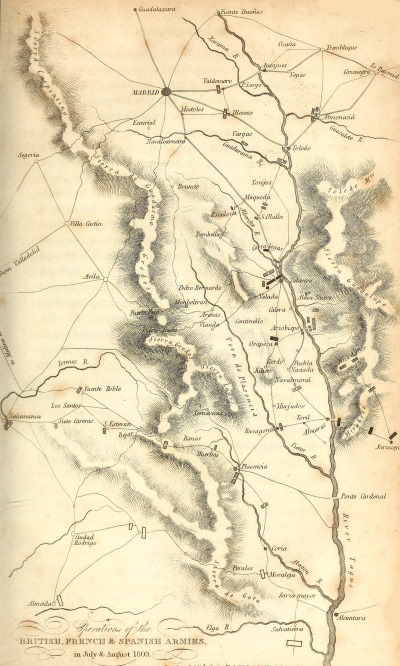
BOOK V. — CHAPTER I. — OPERATIONS IN ESTREMADURA AND LA MANCHA. — ROUT OF UCLES.
HISTORY
OF THE
PENINSULAR WAR.
The effect produced in England by the unfortunate
issue of sir John Moore’s campaign, was not
proportionable to the importance of the subject.
The people, trained to party politics, and possessing
no real power to rebuke the folly of the cabinet,
regarded disasters and triumphs with factious rather
than with national feelings, and it was alike easy
to draw the public attention from affairs of weight,
and to fix it upon matters of little moment. In the
beginning of 1809, the duke of York’s conduct
being impeached, a parliamentary investigation
followed; and to drag the private frailties of that
prince before the world, was thought essential to
the welfare of the country, when the incapacity
which had caused England and Spain to mourn in
tears of blood, was left unprobed. An insular
people only, who are protected by their situation
from the worst evils of war, may suffer themselves
to be thus deluded; but if an unfortunate campaign
were to bring a devastating enemy into the heart of
the country, the honour of a general, and the whole
military policy of the cabinet, would no longer be
considered as mere subjects for the exercise of a
vile sophist’s talents for misrepresentation.
It is true that the ill success of the British arms
was a topic, upon which many orators in both
houses of parliament expatiated with great eloquence,
but the discussions were chiefly remarkable, as examples
of acute debating without any knowledge of
facts. The opposition speakers, eager to criminate
the government, exaggerated the loss and distress
of the retreat, and comprehending neither the movements
nor the motives of sir John Moore, urged
several untenable accusations against their adversaries.
The ministers, disunited by personal feelings,
did not all adopt the same ground of defence. Lord
Castlereagh and lord Liverpool, passing over the
errors of the cabinet by which the general had been
left only a choice of difficulties, asserted, and truly,
that the advantages derived from the advance to
Sahagun more than compensated for the losses in
the subsequent retreat. Both those statesmen paid
an honourable tribute to the merits of the commander;
but Mr. Canning, unscrupulously resolute
to screen Mr. Frere, assented to all the erroneous
statements of the opposition, and endeavoured with
malignant dexterity to convert them into charges
against the fallen general. Sir John Moore was,
he said, answerable for the events of the campaign,
whether the operations were glorious or distressful,
whether to be admired or deplored, they were his
own, for he had kept the ministers ignorant of his
proceedings. Being pressed closely on that point
by Mr. C. Hutchinson, Mr. Canning repeated this
assertion. Not long afterwards, sir John Moore’s
letters, written almost daily and furnishing exact
and copious information of all that was passing in
the Peninsula, were laid before the house.
The reverses experienced in Spain had somewhat
damped the ardour of the English people; but a
cause so rightful in itself, was still popular, and a
treaty having been concluded with the junta, by
which the contracting powers bound themselves to
make common cause against France, and to agree
to no peace except by mutual consent, the ministers
appeared resolute to support the contest. But while
professing unbounded confidence in the result of
the struggle, they already looked upon the Peninsula
as a secondary object; for the preparations of
Austria, and the reputation of the archduke
Charles, whose talents were foolishly said to exceed
Napoleon’s, had awakened the dormant spirit of
coalitions. It was more agreeable to the aristocratic
feelings of the English cabinet, that the French
should be defeated by a monarch in Germany,
than by a plebeian insurrection in Spain. The obscure
intrigues carried on through the princess of
Tour and Taxis, and the secret societies of Germany
emanating as they did from patrician sources, engaged
all the attention of the ministers, and exciting
their sympathy, nursed those distempered feelings,
which led them to see weakness and disaffection in
France when, throughout that mighty empire, few
desired and none dared openly to oppose the emperor’s
wishes, when even secret discontent was
confined to some royalist chiefs and splenetic republicans,
whose influence was never felt until after
Napoleon had suffered the direst reverses.
Unable to conceive the extent of that monarch’s
views, and the grandeur of his genius, the ministers
attributed the results of his profound calculations to
a blind chance, his victories to treason, to corruption,
to any thing but that admirable skill, with
which he wielded the most powerful military force
that ever obeyed the orders of a single chief. And
thus self-deluded, and misjudging the difficulties to
be encountered, they adopted every idle project,
and squandered their resources without any great or
decided effort. While negotiating with the Spanish
Junta for the occupation of Cadiz, they were also
planning an expedition against Sicily; and while
loudly asserting their resolution to defend Portugal,
reserved their principal force for a blow against
Holland; their preparations for the last object being,
however, carried on with a pomp and publicity little
suitable to war. With what a mortal calamity that
pageant closed, shall hereafter be noticed; but at
present it is fitting to describe the operations that
took place in Spain, coincident with and subsequent
to the retreat of sir John Moore.
It has been already stated, that when the capital
surrendered to the Emperor, he refused to permit
Joseph to return there, unless the public bodies and
the heads of families would unite to demand his
restoration, and swear, without any mental reservation,
to be true to him. Registers had consequently
Nellerto.
been opened in the different quarters of the city,
and twenty-eight thousand six hundred heads of
families inscribed their names, and voluntarily
swore, in presence of the host, that they were
Azanza and O’Farril.
sincere in their desire to receive Joseph. After
this, deputations from all the councils, from the
junta of commerce and money, the hall of the
Alcaldes, and from the corporation, waited on the
emperor at Valladolid, and being there joined by
the municipality of that town, and by deputies from
Astorga, Leon, and other places, presented the oath,
and prayed that Joseph might be king. Napoleon
thus entreated, consented that his brother should
return to Madrid, and reassume his kingly functions.
It would be idle to argue from this apparently
voluntary submission to the French emperor, that a
change favourable to the usurpation had been produced
in the feelings of the Spanish people; but it
is evident that Napoleon’s victories and policy had
been so far effectual, that in the capital, and many
other great towns, the multitude as well as the
notables were, either from fear or conviction, submissive
to his will; and it is but reasonable to suppose,
that if his conquests had not been interrupted
by extraneous circumstances, this example would
have been generally followed, in preference to the
more glorious, but ineffectual, resistance made by
the inhabitants of those cities, whose fortitude and
whose calamities have forced from mankind a sorrowful
admiration. The cause of Spain at this
moment was in truth lost; if any cause depending
upon war, which is but a succession of violent and
sudden changes, can be called so; for her armies
were dispersed, her government bewildered, and her
people dismayed; the cry of resistance had ceased,
and in its stead the stern voice of Napoleon, answered
by the tread of three hundred thousand
French veterans was heard throughout the land.
But the hostility of Austria having arrested the
emperor’s career in the Peninsula, the energy of the
Spaniards revived at the abrupt cessation of his
terrific warfare.
Joseph, escorted by his French guards, in number
between five and six thousand, entered Madrid
in state the 23d of January. He was, however, a
king without revenues, and he would have been
without even the semblance of authority, if he had
not been likewise nominated the emperor’s lieutenant
in Spain, by virtue of which title he was
empowered to move the French army at his will.
This power was one extremely unacceptable to the
marshals, and he would have found it difficult to
enforce it, even though he had restrained the exercise
to the limits prescribed by his brother. But
disdaining to separate the general from the monarch,
King’s correspondence captured at Vittoria, MSS.
he conveyed his orders to the French army, through
his Spanish ministers, and the army in its turn disdained
and resisted the assumed authority of men,
who, despised for their want of military knowledge,
were also suspected as favouring interests essentially
differing from those of the troops.
The iron grasp that had compressed the pride
and the ambitious jealousy of the marshals being
thus relaxed, the passions that had ruined the
patriots began to work among their enemies, producing
indeed less fatal effects, because their scope
was more circumscribed, but sufficiently pernicious
to stop the course of conquest. The French army,
no longer a compact body, terrible alike from its
massive strength, and its flexible activity, became
a collection of independent bands, each formidable
in itself, but, from the disunion of the generals, slow
to combine for any great object; and plainly discovering,
by irregularities and insubordination, that
they knew when a warrior, and when a voluptuous
monarch was at their head; but these evils were
only felt at a later period; and the distribution of
the troops, when Napoleon quitted Valladolid, still
bore the impress of his genius.
The first corps was quartered in La Mancha.
The second corps was destined to invade Portugal.
The third and fifth corps carried on the siege of
Zaragoza.
The fourth corps remained in the valley of the
Tagus.
The sixth corps, wanting its third division, was
appointed to hold Gallicia.
The seventh corps continued always in Catalonia.
The imperial guards, directed on Vittoria, contributed
to the security of the great communication
with France until Zaragoza should fall, and were
yet ready to march when wanted for the Austrian
war.
General Dessolles, with the third division of the
sixth corps, returned to Madrid. General Bonnet,
with the fifth division of the second corps, remained
in the Montagna St. Andero.
General Lapisse, with the second division of
the first corps, was sent to Salamanca, where he
was joined by Maupetit’s brigade of cavalry, which
had crossed the Sierra de Bejar.
The reserve of heavy cavalry being broken up,
was distributed, by divisions, in the following
order:—
Latour Maubourg’s joined the first corps. Lorge’s
and Lahoussaye’s were attached to the second
corps. Lassalle’s was sent to the fourth corps.
The sixth corps was reinforced with two brigades.
Milhaud’s division remained at Madrid, and Kellerman’s
guarded the lines of communication between
Tudela, Burgos, and Palencia.
Thus, Madrid being still the centre of operations,
the French were so distributed, that by a
concentric movement on that capital, they could
crush every insurrection within the circle of their
positions; and the great masses, being kept upon
the principal roads diverging from Madrid to the
extremities of the Peninsula, intercepted all communication
between the Provinces: while the second
corps, thrust out, as it were, beyond the circumference,
and destined, as the fourth corps had been,
to sweep round from point to point, was sure of
finding a supporting army, and a good line of
retreat, at every great route leading from Madrid
to the yet unsubdued provinces of the Peninsula.
The communication with France was, at the same
time, secured by the fortresses of Burgos, Pampeluna,
and St. Sebastian; and by the divisions
posted at St. Ander, Burgos, Bilbao, and Vittoria;
and it was supported by a reserve at Bayonne.
The northern provinces were parcelled out into
military governments, the chiefs of which corresponded
with each other; and, by the means of
moveable columns, repressed every petty insurrection.
The third and fifth corps, also, having their base at
Pampeluna, and their line of operations directed
against Zaragoza, served as an additional covering
force to the communication with France, and were
themselves exposed to no flank attacks, except
from the side of Cuença, where the duke of
Infantado commanded; but that general was
himself watched by the first corps.
All the lines of correspondence, not only from France
but between the different corps, were maintained
by fortified posts, having greater or lesser garrisons,
according to their importance. Between Bayonne
and Burgos there were eleven military stations.
Between Burgos and Madrid, by the road of
Muster-rolls of the French army, MSS.
Aranda and Somosierra, there were eight; and
eleven others protected the more circuitous route
to the capital by Valladolid, Segovia, and the
Guadarama. Between Valladolid and Zaragoza
the line was secured by fifteen intermediate points.
The communication between Valladolid and St.
Ander contained eight posts; and nine others connected
the former town with Villa Franca del
Bierzo, by the route of Benevente and Astorga;
finally, two were established between Benevente
and Leon.
At this period, the force of the army, exclusive
of Joseph’s French guards, was three hundred
Appendix, No. 1, section 1.
and twenty-four thousand four hundred and eleven
men, about thirty-nine thousand being cavalry.
Fifty-eight thousand men were in hospital.
The depôts, governments, garrisons, posts of
correspondence, prisoners, and “battalions of march,”
composed of stragglers, absorbed about twenty-five
thousand men.
The remainder were under arms, with their
regiments; and, consequently, more than two
hundred and forty thousand men were in the field:
while the great line of communication with France
was (and the military reader will do well to mark
this, the key-stone of Napoleon’s system) protected
by above fifty thousand men, whose positions were
strengthened by three fortresses and sixty-four posts
of correspondence, each more or less fortified.
Having thus shewn to the reader the military
state of the French, I shall now proceed with the
narrative of their operations; following, as in the
first volume, a local rather than a chronological
arrangement of events.
The defeat of Galluzzo has been incidentally
touched upon before. The duke of Dantzic having
observed that the Spanish general, with six
thousand raw levies, pretended to defend a line of
forty miles, made a feint of crossing the Tagus, at
Arzobispo, and then suddenly descending to Almaraz,
forced a passage over that bridge, on the
24th of December, killed and wounded many
Spaniards, and captured four guns: and so complete
was the dispersion, that for a long time after, not
a man was to be found in arms throughout Estremadura.
Appendix, No. 2, sections 2 and 3.
The French cavalry were at first placed
on the tracks of the fugitives; but intelligence of
sir John Moore’s advance to Sahagun being received,
Ibid.
the pursuit ceased at Merida, and the
fourth corps, which had left eight hundred and
thirty men in garrison at Segovia, took post
between Talavera and Placentia. The duke of
Dantzic was then recalled to France, and general
Sebastiani succeeded to the command of the fourth
corps. It was at this period that the first corps
(of which the division of Lapisse only had followed
the emperor to Astorga) moved against Toledo,
and that town was occupied without opposition.
The French outposts were then pushed towards
Cuença on the one side, and towards the Sierra
Morena on the other.
Meanwhile, the central junta, changing its first
design, retired to Seville, instead of Badajos; and
being continually urged, both by Mr. Stuart and
Mr. Frere, to make some effort to lighten the
pressure on the English army, ordered Palafox and
the duke of Infantado to advance; the one from
Zaragoza towards Tudela, the other from Cuença
towards Madrid. The marquis of Palacios, who
had been removed from Catalonia, and was now
at the head of five or six thousand levies in the
Sierra Morena, was also directed to advance into
La Mancha; and Galluzzo, deprived of his
command, was constituted a prisoner, along with
Cuesta, Castaños, and a number of other culpable
or unfortunate officers, who, vainly demanding a
judgement on their cases, were dragged from place
to place by the government.
Cuesta was, however, so popular in Estremadura,
that the central junta, although fearing and detesting
him, consented to his being placed at the
head of Galluzzo’s fugitives, part of whom had,
when the pursuit ceased, rallied behind the
Guadiana, and were now, with the aid of fresh
levies, again taking the form, rather than the
consistence, of an army. This appointment was an
act of deplorable weakness and incapacity. The
moral effect was to degrade the government by
exposing its fears and weakness; and, in a
military view, it was destructive, because Cuesta
was physically and mentally incapable of command.
Obstinate, jealous, and stricken in years, he was
heedless of time and circumstances, of disposition
and fitness. To punish with a barbarous severity,
and to rush headlong into battle, constituted, in
his mind, all the functions of a general.
The president, Florida Blanca, being eighty-one
years of age, died at Seville, and the marquis of
Astorga succeeded him; but the character of the
junta was in no manner affected by the change.
Some fleeting indications of vigour had been produced
by the imminence of the danger during the
flight from Aranjuez, but a large remittance of
silver, from South America, having arrived at Cadiz,
Appendix, No. 13. Vol. I.
the attention of the members was so absorbed, by
this object, that the public weal was blotted from
their remembrance, and even Mr. Frere, ashamed
Appendix, No. 2, section 2.
of their conduct, appeared to acquiesce in the justness
of sir John Moore’s estimate of the value of
Spanish co-operation.
The number of men to be enrolled for the defence
of the country had been early fixed at five hundred
thousand, but scarcely one-third had joined their
colours; nevertheless, considerable bodies were assembling
at different points, because the people,
especially those of the southern provinces, although
dismayed, were obedient, and the local authorities,
at a distance from the actual scene of war, rigorously
enforced the law of enrolment, and sent the recruits
to the armies, hoping thereby either to stave the
war off from their own districts, or to have the
excuse of being without fighting men, to plead for
quiet submission.
The fugitive troops also readily collected again
at any given point, partly from patriotism, partly
because the French were in possession of their
native provinces, partly that they attributed their
defeats to the treachery of their generals, and
partly that, being deceived by the gross falsehoods
and boasting of the government, they, with ready
vanity, imagined that the enemy had invariably
suffered enormous losses. In fine, for the reasons
mentioned in the commencement of this history,
men were to be had in abundance; but, beyond
assembling them and appointing some incapable
person to command, nothing was done for defence.
The officers who were not deceived had no confidence
either in their own troops or in the government,
nor were they themselves confided in or respected
by their men. The latter were starved, were misused,
ill-handled, and they possessed neither the
compact strength of discipline nor the daring of
enthusiasm. Under such a system, it was impossible
that the peasantry could be rendered energetic
soldiers; and they certainly were not active supporters
of their country’s cause; but, with a wonderful
constancy, they suffered for it, enduring
fatigue and sickness, nakedness and famine, with
patience, and displaying, in all their actions and
in all their sentiments, a distinct and powerful
national character. This constancy and the iniquity
of the usurpation hallowed their efforts in despite
of their ferocity, and merits respect, though the
vices and folly of the juntas and the leading men
rendered the effect of those efforts nugatory.
Palacios, on the receipt of the orders above
mentioned, advanced, with five thousand men, to
Vilharta, in La Mancha, and the duke of Infantado,
anticipating the instructions of the junta, was
already in motion from Cuença. His army, reinforced
by the divisions of Cartoajal and Lilli and
by fresh levies, was about twenty thousand men, of
which two thousand were cavalry. To check the
incursions of the French horsemen, he had, a few
days after the departure of Napoleon from Madrid,
detached general Senra and general Venegas with
eight thousand infantry and all the horse to scour
the country round Tarancon and Aranjuez; the
former halted at Horcajada, and the latter endeavoured
to cut off a French detachment, but was
himself surprised and beaten by a very inferior
force.
Marshal Victor, however, withdrew his advanced
posts, and, concentrating Ruffin’s and Villatte’s divisions
of infantry and Latour Maubourg’s cavalry,
at Villa de Alorna, in the vicinity of Toledo, left
Venegas in possession of Tarancon. But, among
the Spanish generals, mutual recriminations succeeded
this failure: the duke of Infantado possessed
neither authority nor talents to repress their disputes,
and in this untoward state of affairs receiving the
orders of the junta, he immediately projected a
movement on Toledo, intending to seize that place
and Aranjuez, to break down the bridges, and to
maintain the line of the Tagus.
Quitting Cuença on the 10th, he reached Horcajada
on the 12th, with ten thousand men, the
remainder of the army, commanded by Venegas,
being near Tarancon.
The 13th, the duke having moved to Carascosa,
a town somewhat in advance of Horcajada, met
a crowd of fugitives, and heard, with equal surprise
and consternation, that the corps under Venegas
was already destroyed, and the pursuers close at
hand.
It appeared that Victor, uneasy at the movements
of the Spanish generals, but ignorant of their
situation and intentions, had quitted Toledo also
on the 10th, and marched to Ocaña, whereupon
Venegas, falling back from Tarancon, took a position
at Ucles. The 12th, the French continued
to advance in two columns, of which the one, composed
of Ruffin’s division and a brigade of cavalry,
lost its way, and arrived at Alcazar; but the other,
commanded by Victor himself, and composed of
Villatte’s division, the remainder of the cavalry,
and the parc of artillery, took the road of Ucles,
and came upon the position of Venegas early in the
morning of the 13th.
This meeting was unexpected by either party,
but the French attacked without hesitation, and the
Spaniards, flying towards Alcazar, fell in with
Ruffin’s division, and were totally discomfitted.
Several thousands laid down their arms, and many,
dispersing, fled across the fields; some, however,
keeping their ranks, made towards Ocaña, where,
coming suddenly upon the French parc of artillery,
they received a heavy discharge of grape-shot, and
dispersed. Of the whole force, a small party only,
under general Giron, succeeded in forcing its way
by the road of Carascosa, and so reached the duke
of Infantado, who immediately retreated to Cuença,
and without further loss, as the French cavalry
were too fatigued to pursue briskly.
From Cuença the duke sent his artillery towards
Valencia, by the road of Tortola; but himself, with
the infantry and cavalry, marched by Chinchilla,
and from thence to Tobarra, on the frontiers of
Murcia.
At Tobarra he turned to his right, and made for
Santa Cruz de Mudela, a town situated near the
entrance to the defiles of the Sierra Morena. There
he halted in the beginning of February, after a
painful and circuitous retreat of more than two
hundred miles, in a bad season. But all his artillery
had been captured at Tortola, and his forces were,
by desertion and straggling, reduced to a handful
of discontented officers and a few thousand dispirited
men, worn out with fatigue and misery.
Meanwhile, Victor, after scouring a part of the
province of Cuença and disposing of his prisoners,
made a sudden march upon Vilharta, intending to
surprise Palacios, but that officer apprized of the
retreat of Infantado had already effected his junction
with the latter at Santa Cruz de Mudela.
Whereupon the French marshal recalling his troops,
again occupied his former position at Toledo. The
prisoners taken at Ucles were marched to Madrid,
those who were weak and unable to walk were
Rocca’s Memoirs.
(according to Mr. Rocca) shot by the orders of
Victor, because the Spaniards had hanged some
French prisoners. If so, it was a barbarous and a
shameful retaliation, unworthy of a soldier; for
what justice or honour is there in revenging the
death of one innocent person by the murder of
another.
When Victor withdrew his posts the duke of
Infantado and Palacios proceeded to re-organize
their forces under the name of the Carolina Army.
The levies from Grenada and other parts were
ordered up, and the cavalry, commanded by the
duke of Alburquerque, endeavoured to surprise a
French regiment of dragoons at Mora, but the
latter getting together quickly, made a bold resistance
and effected their retreat with scarcely any
loss. Alburquerque having failed in this attempt
retired to Consuegra and was attacked the next day
by superior numbers, but retired fighting and got
safely off. The duke of Infantado was now displaced,
and the junta conferred the command on
general Urbina Conde de Cartaojal, who applied
himself to restore discipline, and after a time
finding no enemy in front advanced to Ciudad
Real, and taking post on the left bank of the Upper
Guadiana opened a communication with Cuesta.
At this period the latter’s force amounted to sixteen
thousand men, of which three thousand were
cavalry; for, as the Spaniards generally suffered
more in their flights than in their battles, the horsemen
escaped with little damage and were easily
rallied again in greater relative numbers than the
infantry.
The fourth corps having withdrawn, as I have
already related, to the right bank of the Tagus,
Cuesta advanced from the Guadiana and occupied
the left bank of that river, on a line extending from
the mountains in front of Arzobispo to the Puerto
de Mirabete. The French, by fortifying an old
tower, held the command of the bridge of Arzobispo,
but Cuesta immediately broke down that of
Almaraz, a magnificent structure, the centre arch
of which was more than a hundred and fifty feet
in height.
In these positions the troops on either side remained
tranquil both in La Mancha and Estremadura,
and so ended the exertions made to lighten
the pressure upon the English army. Two French
divisions of infantry and as many brigades of
cavalry had more than sufficed to baffle them, and
hence the imminent danger that menaced the south
of Spain, when sir John Moore’s vigorous operations
drew the emperor’s forces to the north, may
be justly estimated.
CHAPTER II. — CONTINUATION OF THE OPERATIONS IN ARAGON. — SECOND SIEGE OF ZARAGOZA.
From the field of battle at Tudela, all the fugitives
of O’Neil’s, and a great part of those from
Castaños’s army, fled to Zaragoza and with such
speed as to bring the first news of their own disaster.
With the troops, also, came an immense number of
carriages and the military chests, for the roads were
wide and excellent and the pursuit was slack.
The citizens and the neighbouring peasantry
were astounded at this quick and unexpected
calamity. They had, with a natural credulity,
relied on the vain and boasting promises of their
chiefs, and being necessarily ignorant of the true
state of affairs never doubted that their vengeance
would be sated by a speedy and complete destruction
of the French. When their hopes were thus
suddenly blasted; when they beheld troops, from
whom they expected nothing but victory, come
pouring into the town with all the tumult of panic;
when the peasants of all the villages through which
the fugitives passed, came rushing into the city
along with the scared multitude of flying soldiers
and camp followers; every heart was filled with
consternation, and the date of Zaragoza’s glory
would have ended with the first siege, if the success
at Tudela had been followed up by the French
with that celerity and vigour which the occasion
required.
Appendix
Vol. I.
Napoleon, foreseeing that this moment of confusion
and terror would arrive, had with his usual
prudence provided the means and given directions
for such an instantaneous and powerful attack as
would inevitably have overthrown the bulwark of
the eastern provinces. But the sickness of marshal
Lasnes, the difficulty of communication, the consequent
false movements of Moncey and Ney, in fine,
the intervention of fortune, omnipotent as she is in
war, baffled the emperor’s long-sighted calculations,
and permitted the leaders in the city to introduce
order among the multitude, to complete the defensive
works, to provide stores, and finally by a
ferocious exercise of power to insure implicit obedience
to their minutest orders. The danger of
resisting the enemy appeared light, when a suspicious
word or even a discontented gesture was
instantaneously punished by a cruel death.
The third corps having thus missed the favourable
moment for a sudden assault, and being
reduced by sickness, by losses in battle, and by
Muster roll of the French Army, MSS.
detachments to seventeen thousand four hundred
men, including the engineers and artillery, was too
weak to invest the city in form, and, therefore,
remained in observation on the Xalon river.
Meanwhile, a battering train of sixty guns, with
well furnished parcs, which had been by Napoleon’s
orders previously collected in Pampeluna, were
dragged by cattle to Tudela and embarked upon
the canal leading to Zaragoza.
Marshal Mortier, with the fifth corps, was also
directed to assist in the siege, and he was in
march to join Moncey, when his progress also was
arrested by sir John Moore’s advance towards
Burgos. But the utmost scope of that general’s
operation being soon determined by Napoleon’s
counter-movement, Mortier resumed his march to
reinforce Moncey, and, on the 20th of December,
their united corps, forming an army of thirty-five
thousand men of all arms, advanced against Zaragoza.
Cavalhero.
Doyle’s Correspondence, MSS.
At this time, however, confidence had been
restored in that town, and all the preparations
necessary for a vigorous defence were completed.
The nature of the plain in which Zaragoza is
situated, the course of the rivers, the peculiar
construction of the houses, and the multitude of
convents have been already described, but the
difficulties to be encountered by the French troops
were no longer the same as in the first siege. At
that time but little assistance had been derived
from science, but now, instructed by experience
and inspired as it were by the greatness of their
resolution, neither the rules of art nor the resources
of genius were neglected by the defenders.
Zaragoza offered four irregular fronts, of which
the first, reckoning from the right of the town,
extended from the Ebro to a convent of barefooted
Carmelites, and was about three hundred
yards wide.
The second, twelve hundred yards in extent,
reached from the Carmelites to a bridge over the
Huerba.
The third, likewise of twelve hundred yards,
stretched from this bridge to an oil manufactory
built beyond the walls.
The fourth, being on an opening of four hundred
yards, reached from the oil manufactory to the
Ebro.
The first front, fortified by an ancient wall and
flanked by the guns on the Carmelite, was strengthened
Rogniat’s Seige of Zaragoza.
Cavalhero’s Siege of Zaragoza.
by some new batteries and ramparts, and by
the Castle of Aljaferia, commonly called the Castle
of the Inquisition, which stood a little in advance.
This was a fort of a square form having a bastion
and tower at each corner, and a good stone ditch, and
it was connected with the body of the place by
certain walls loop-holed for musketry.
The second front was defended by a double wall,
the exterior one being of recent erection, faced
with sun-dried bricks, and covered by a ditch with
perpendicular sides fifteen feet deep and twenty
feet asunder. The flanks of this front were derived
from the convent of the Carmelites, from a large
circular battery standing in the centre of the line,
from a fortified convent of the Capuchins, called
the Trinity, and from some earthen works protecting
the head of the bridge over the Huerba.
The third front was covered by the river Huerba,
the deep bed of which was close to the foot of the
ramparts. Behind this stream a double entrenchment
was carried from the bridge-head to the large
projecting convent of Santa Engracia, a distance of
two hundred yards. Santa Engracia itself was very
strongly fortified and armed; and, from thence to
the oil manufactory, the line of defence was prolonged
by an ancient Moorish wall, on which several
terraced batteries were raised, to sweep all the space
between the rampart and the Huerba. These
batteries, and the guns in the convent of Santa
Engracia, likewise overlooked some works raised to
protect a second bridge that crossed the river,
about cannot-shot below the first.
Upon the right bank of the Huerba, and a little
below the second bridge, stood the convent of San
Joseph, the walls of which had been strengthened
and protected by a deep ditch with a covered way
and pallisade. It was well placed to impede the
enemy’s approaches, and to facilitate sorties on the
right bank of the river; and it was, as I have said,
open, in the rear, to the fire of the works at the
second bridge, and both were again overlooked by
the terraced batteries, and by the guns of Santa
Engracia.
The fourth front was protected by the Huerba, by
the continuation of the old city wall, by new batteries
and entrenchments, and by several armed
convents and large houses.
Beyond the walls the Monte Torrero, which commanded
all the plain of Zaragoza, was crowned by a
large, ill-constructed fort, raised at the distance of
eighteen hundred yards from the convent of San
Joseph. This work was covered by the royal canal,
the sluices of which were defended by some field-works,
open to the fire of the fort itself.
On the left bank of the Ebro the suburb, built in
a low marshy plain, was protected by a chain of
redoubts and fortified houses. Finally, some gun-boats,
manned by seamen from the naval arsenal
of Carthagena, completed the circuit of defence. The
artillery of the place was, however, of too small a
Cavalhero.
calibre. There were only sixty guns carrying more
than twelve-pound balls; and there were but eight
large mortars. There was, however, no want of
small arms, many of which were English that had
been supplied by colonel Doyle.
These were the regular external defences of
Zaragoza, most of which were constructed at the
time, according to the skill and means of the engineers;
but the experience of the former siege
had taught the people not to trust to the ordinary
resources of art, and, with equal genius and resolution,
they had prepared an internal system of
defence infinitely more efficacious.
It has been already observed that the houses of
Zaragoza were fire-proof, and, generally, of only
two stories, and that, in all the quarters of the city,
the numerous massive convents and churches rose
like castles above the low buildings, and that the
greater streets, running into the broad-way called
the Cosso, divided the town into a variety of districts,
unequal in size, but each containing one or
more large structures. Now, the citizens, sacrificing
all personal convenience, and resigning all
idea of private property, gave up their goods,
their bodies, and their houses to the war, and,
being promiscuously mingled with the peasantry
and the regular soldiers, the whole formed one
mighty garrison, well suited to the vast fortress
into which Zaragoza was transformed: for, the
doors and windows of the houses were built up,
and their fronts loop-holed; internal communications
were broken through the party-walls, and the
streets were trenched and crossed by earthen ramparts,
mounted with cannon, and every strong
building was turned into a separate fortification.
There was no weak point, because there could be
none in a town which was all fortress, and where
the space covered by the city was the measurement
for the thickness of the ramparts: nor in this emergency
were the leaders unmindful of moral force.
The people were cheered by a constant reference
to the former successful resistance; their confidence
was raised by the contemplation of the vast works
that had been executed; and it was recalled to
their recollection that the wet, usual at that season
of the year, would spread disease among the enemy’s
ranks, and would impair, if not entirely frustrate,
his efforts. Neither was the aid of superstition
neglected: processions imposed upon the sight,
false miracles bewildered the imagination, and terrible
denunciations of the divine wrath shook the
minds of men, whose former habits and present
situation rendered them peculiarly susceptible of
such impressions. Finally, the leaders were themselves
so prompt and terrible in their punishments
that the greatest cowards were likely to show the
boldest bearing in their wish to escape suspicion.
To avoid the danger of any great explosion, the
powder was made as occasion required; and this
was the more easily effected because Zaragoza contained
a royal depôt and refinery for salt-petre, and
there were powder-mills in the neighbourhood,
which furnished workmen familiar with the process
of manufacturing that article. The houses and
trees beyond the walls were all demolished and cut
down, and the materials carried into the town. The
public magazines contained six months’ provisions;
the convents were well stocked, and the inhabitants
had, likewise, laid up their own stores for several
months. General Doyle also sent a convoy into the
town from the side of Catalonia, and there was
abundance of money, because, in addition to the
resources of the town, the military chest of Castaños’s
army, which had been supplied only the
night before the battle of Tudela, was, in the flight,
carried to Zaragoza.
Companies of women, enrolled to attend the
hospitals and to carry provisions and ammunition
to the combatants, were commanded by the countess
Doyle’s Correspondence, M.S.
Cavalhero, Siege of Zaragoza.
of Burita, a lady of an heroic disposition, who
is said to have displayed the greatest intelligence
and the noblest character during both sieges.
There were thirteen engineer officers, and eight
hundred sappers and miners, composed of excavators
formerly employed on the canal, and there were
from fifteen hundred to two thousand cannoneers.
The regular troops that fled from Tudela, being
joined by two small divisions, which retreated, at
the same time, from Sanguessa and Caparosa,
formed a garrison of thirty thousand men, and,
together with the inhabitants and peasantry, presented
a mass of fifty thousand combatants, who,
with passions excited almost to phrensy, awaited an
assault amidst those mighty entrenchments, where
each man’s home was a fortress and his family a
garrison. To besiege, with only thirty-five thousand
men, a city so prepared was truly a gigantic
undertaking!
The 20th of December, the two marshals, Moncey
and Mortier, having established their hospitals and
Rogniat.
magazines at Alagon on the Xalon, advanced in
three columns against Zaragoza.
The first, composed of the infantry of the third
corps, marched by the right bank of the canal.
The second, composed of general Suchet’s division
of the fifth corps, marched between the canal
and the Ebro.
The third, composed of general Gazan’s division
of infantry, crossed the Ebro opposite to Tauste,
and from thence made an oblique march to the
Gallego river.
The right and centre columns arrived in front of
the town that evening. The latter, after driving
back the Spanish advanced guards, halted at a distance
of a league from the Capuchin convent of the
Trinity; the former took post on both sides of the
Huerba, and, having seized the aqueduct by which
the canal is carried over that river, proceeded, in
pursuance of Napoleon’s orders, to raise batteries,
and to make dispositions for an immediate assault
on Monte Torrero. Meanwhile general Gazan,
with the left column, marching by Cartejon and
Zuera reached Villa Nueva, on the Gallego river,
without encountering an enemy.
The Monte Torrero was defended by five thousand
Spaniards, under the command of general
St. Marc; but, at day-break on the 21st, the French
opened their fire against the fort, and one column
of infantry having attracted the attention of the
Spaniards, a second, unseen, crossed the canal
under the aqueduct, and, penetrating between the
fort and the city, entered the former by the rear,
and, at the same time, a third column stormed the
works protecting the great sluices. These sudden
attacks, and the loss of the fort, threw the
Cavalhero.
Spaniards into confusion, and they hastily retired
to the town, which so enraged the plebeian leaders
that the life of St. Marc was with difficulty saved
by Palafox.
It had been concerted among the French that
general Gazan should assault the suburb, simultaneously
with the attack on the Torrero; and that
officer, having encountered a body of Spanish and
Swiss troops placed somewhat in advance, drove
the former back so quickly that the Swiss, unable
to make good their retreat, were, to the number of
three or four hundred, killed or taken. But, notwithstanding
Rogniat.
this fortunate commencement, Gazan
did not attack the suburb itself until after the affair
at Monte Torrero was over, and then only upon a
single point, and without any previous examination
of the works. The Spaniards, recovering from their
first alarm, soon reinforced this point, and Gazan
was forced to desist, with the loss of four hundred
men. This important failure more than balanced
the success against the Monte Torrero. It restored
the shaken confidence of the Spaniards at a most
critical moment, and checking in the French, at the
outset, that impetuous spirit, that impulse of victory,
which great generals so carefully watch and improve,
threw them back upon the tedious and chilling
process of the engineer.
The 24th of December the investment of Zaragoza
was completed on both sides of the Ebro.
General Gazan occupied the bridge over the Gallego
with his left, and covered his front from sorties by
inundations and cuts that the low, marshy plain
where he was posted enabled him to make without
difficulty.
General Suchet occupied the space between the
Upper Ebro and the Huerba.
Morlot’s division of the 3d corps encamped in
the broken hollow that formed the bed of that
stream.
General Meusnier’s division crowned the Monte
Torrero, and general Grandjean continuing the
circuit to the Lower Ebro, communicated with
Gazan’s posts on the other side. Several Spanish
detachments that had been sent out to forage were
thus cut off, and could never re-enter the town;
and a bridge of boats being constructed on the
Upper Ebro completed the circle of investment,
and ensured a free intercourse between the different
quarters of the army.
General Lacoste, an engineer of reputation, and
aide-de-camp to the Emperor, directed the siege.
His plan was, that one false and two real attacks
should be conducted by regular approaches on the
right bank of the Ebro, and he still hoped to take
the suburb by a sudden assault. The trenches
being opened on the night of the 29th of December,
the 30th the place was summoned, and the terms
dictated by Napoleon when he was at Aranda de
Duero, were offered. The example of Madrid was
also cited to induce a surrender. Palafox replied,
that—If Madrid had surrendered, Madrid had been
sold: Zaragoza would neither be sold nor surrender!
On the receipt of this haughty answer the attacks
were commenced; the right being directed against
the convent of San Joseph; the centre against the
upper bridge over the Huerba; the left, which was
the false one, against the castle of Aljaferia.
The 31st Palafox made sorties against all the
three attacks. From the right and centre he was
beaten back with loss, and he was likewise repulsed
on the left at the trenches: but some of his cavalry
gliding between the French parallel and the Ebro
surprised and cut down a post of infantry stationed
behind some ditches that intersected the low ground
on the bank of that river. This trifling success
exalted the enthusiasm of the besieged, and Palafox
gratified his personal vanity by boasting proclamations
and orders of the day, some of which bore the
marks of genius, but the greater part were ridiculous.
The 1st of January the second parallels of the
true attacks were commenced. The next day Palafox
caused the attention of the besiegers to be
occupied on the right bank of the Ebro, by slight
skirmishes, while he made a serious attack from the
side of the suburb on general Gazan’s lines of contrevallation.
This sally was repulsed with loss,
but, on the right bank, the Spaniards obtained
some success.
Marshal Moncey being called to Madrid, Junot
assumed the command of the third corps, and,
about the same time, marshal Mortier was directed
to take post at Calatayud, with Suchet’s division of
the fifth corps, for the purpose of securing the
communication with Madrid. The gap in the
circle of investment left by this draft of eight thousand
men, being but scantily stopped by extending
general Morlot’s division, a line of contrevallation
was constructed at that part to supply the place of
numbers.
The besieged, hoping and expecting each day
that the usual falls of rain taking place would
render the besiegers’ situation intolerable, continued
their fire briskly, and worked counter approaches
on to the right of the French attacks: but the
season was unusually dry, and a thick fog rising
each morning covered the besiegers’ advances and
protected their workmen, both from the fire and
from the sorties of the Spaniards.
The 10th of January, thirty-two pieces of French
artillery being mounted and provisioned, the convent
of San Joseph and the head of the bridge over
the Huerba, were battered in breach, and, at the
same time, the town was bombarded. San Joseph
was so much injured by this fire that the Spaniards,
resolving to evacuate it, withdrew their guns.
Nevertheless, two hundred of their men made a
vigorous sortie at midnight, and were upon the
point of entering one of the French batteries, when
they were taken in flank by two guns loaded with
grape, and were, finally, driven back, with loss of
half their number.
The 11th, the besiegers’ batteries continued to
play on San Joseph with such success that the
breach became practicable, and, at four o’clock in
the evening, some companies of infantry, with two
field-pieces, attacked by the right, and a column
was kept in readiness to assail the front, when this
attack should have shaken the defence. Two other
companies of chosen men were directed to search
for an entrance by the rear, between the fort and
the river.
The defences of the convent were reduced to a
ditch eighteen feet deep, and a covered way which,
falling back by both flanks to the Huerba, was then
extended along the banks of that river for some
distance. A considerable number of men still
occupied this covered way: but, when the French
field-pieces on the right raked it with a fire of
grape, the Spaniards were thrown into confusion,
and crossing the bed of the river took shelter in the
town. At that moment the front of the convent
was assaulted; but, while the depth of the ditch
and the Spanish fire checked the impetuosity of the
assailants at that point; the chosen companies
passed round the works, and finding a small bridge
over the ditch crossed it, and entered the convent
by the rear. The front was carried by escalade,
almost at the same moment, and the few hundred
Spaniards that remained were killed or made
prisoners.
The French, who had suffered but little in this
assault, immediately lodged themselves in the
convent, raised a rampart along the edge of the
Huerba, and commenced batteries against the body
of the place and against the works at the head of
the upper bridge, from whence, as well as from the
town, they were incommoded by the fire that played
into the convent.
The 15th, the bridge-head, in front of Santa
Engracia, was carried with the loss of only three
men; but the Spaniards cut the bridge itself, and
sprung a mine under the works; the explosion,
however, occasioned no mischief, and the third parallels
being soon completed, and the trenches of the
two attacks united, the defences of the besieged
were thus confined to the town itself. They could
no longer make sallies on the right bank of the
Huerba without overcoming the greatest difficulties.
The passage of the Huerba was then effected by
the French, and breaching and counter-batteries,
mounting fifty pieces of artillery, were constructed
against the body of the place. The fire of these
guns played also upon the bridge over the Ebro,
and interrupted the communication between the
suburb and the town.
Unshaken by this aspect of affairs, the Spanish
leaders, with great readiness of mind, immediately
forged intelligence of the defeat of the emperor,
and, with the sound of music, and amidst the shouts
of the populace, proclaimed the names of the marshals
who had been killed; asserting, also, that
Palafox’s brother, the marquis of Lazan, was already
wasting France. This intelligence, extravagant as
it was, met with implicit credence, for such was
the disposition of the Spaniards throughout this war,
that the imaginations of the chiefs were taxed to
produce absurdities proportionable to the credulity
of their followers; hence the boasting of the leaders
and the confidence of the besieged augmented as
the danger increased, and their anticipations of victory
seemed realized when the night-fires of a succouring
force were discerned blazing on the hills
behind Gazan’s troops.
The difficulties of the French were indeed fast
increasing, for while enclosing Zaragoza they were
themselves encircled by insurrections, and their supplies
so straightened that famine was felt in their
camp. Disputes amongst the generals also diminished
the vigour of the operations, and the bonds
of discipline being relaxed, the military ardour of
the troops naturally became depressed. The soldiers
reasoned openly upon the chances of success, which,
in times of danger, is only one degree removed from
mutiny.
The nature of the country about Zaragoza was
exceedingly favourable to the Spaniards. The town,
although situated in a plain, was surrounded, at the
distance of some miles, by strong and high mountains,
and, to the south, the fortresses of Mequinenza
and Lerida afforded a double base of operations for
any forces that might come from Catalonia and
Valencia. The besiegers drew all their supplies
from Pampeluna, and consequently their long line
of operations, running through Alagon, Tudela, and
Caparosa, was difficult to defend from the insurgents,
who, being gathered in considerable numbers
in the Sierra de Muela and on the side of Epila,
threatened Alagon, while others, descending from
the mountain of Soria, menaced the important point
of Tudela.
The marquis of Lazan, anxious to assist his brother,
had drafted five thousand men from the
Catalonian army, and taking post in the Sierra de
Liciñena, or Alcubierre, on the left of the Ebro,
drew together all the armed peasantry of the valleys
as high as Sanguessa, and extending his line from
Villa Franca on the Ebro to Zuera on the Gallego,
hemmed in the division of Gazan, and even sent
detachments as far as Caparosa to harass the French
convoys coming from Pampeluna.
To maintain their communications and to procure
provisions the besiegers had placed between two
or three thousand men in Tudela, Caparosa, and
Tafalla, and some hundreds in Alagon and at Montalbarra.
Between the latter town and the investing
army six hundred and fifty cavalry were stationed:
a like number were posted at Santa Fé, to watch
the openings of the Sierra de Muela, and sixteen
hundred cavalry with twelve hundred infantry,
under the command of general Wathier, were
pushed towards the south as far as Fuentes,
Wathier, falling suddenly upon an assemblage of
four or five thousand insurgents that had taken post
at Belchite, broke and dispersed them, and then
pursuing his victory took the town of Alcanitz, and
established himself there in observation for the rest
of the siege. But Lazan still maintained himself
in the Alcubierre.
In this state of affairs marshal Lasnes, having
recovered from his long sickness, arrived before
Zaragoza, and took the supreme command of both
corps on the 22d of January. The influence of his
firm and vigorous character was immediately perceptible;
he recalled Suchets division from Calatayud,
where it had been lingering without necessity,
Rogniat.
and, sending it across the Ebro, ordered
Mortier to attack Lazan. At the same time a
smaller detachment was directed against the insurgents
in Zuera, and, meanwhile, Lasnes repressing
all disputes, restored discipline in the army, and
pressed the siege with infinite resolution.
The detachment sent to Zuera defeated the insurgents
and took possession of that place and of the
bridge over the Gallego. Mortier encountered the
Spanish advanced guard at Perdeguera, and pushed
it back to Nuestra Señora de Vagallar, where the
main body, several thousand strong, was posted.
After a short resistance, the whole fled, and the
French cavalry took four guns; Mortier then spreading
his troops in a half circle, extending from
Huesca to Pina on the Ebro, awed all the country
lying between those places and Zaragoza, and prevented
any further insurrections.
A few days before the arrival of marshal Lasnes,
the besieged being exceedingly galled by the fire
from a mortar-battery, situated at some distance
behind the second parallel of the central attack,
eighty volunteers, under the command of Don
Mariano Galindo, endeavoured to silence it. They
surprised and bayonetted the guard in the nearest
trenches, and passing on briskly to the battery,
entered it, and were proceeding to spike the artillery,
when unfortunately the reserve of the French arrived,
and, the alarm being given, the guards of
the first trenches also assembled in the rear of this
gallant band, intercepting all retreat. Thus surrounded,
Galindo, fighting bravely, was wounded
and taken, and the greatest part of his comrades
perished with as much honour as simple soldiers
can attain.
The armed vessels in the river now made an
attempt to flank the works raised against the castle
of Aljaferia, but the French batteries forced them
to drop down the stream again; and between the
nights of the 21st and the 26th of January the
besiegers’ works being carried across the Huerba,
the third parallels of the real attacks were
completed. The oil manufactory and some other
advantageous posts, on the left bank of the above-named
river, were also taken possession of and included
in the works, and at the false attack a second
parallel was commenced at the distance of a hundred
and fifty yards from the castle of Aljaferia; but
these advantages were not obtained without loss.
The Spaniards made sallies, in one of which they
spiked two guns and burnt a French post on the
right.
The besiegers’ batteries had, however, broken
the wall of the town in several places. Two
practicable breaches were made nearly fronting the
convent of San Joseph; a third was commenced in
the convent of Saint Augustin, facing the oil manufactory.
The convent of San Engracia was laid
completely open to an assault; and, on the 29th,
at twelve o’clock, the whole army being under
arms, four chosen columns rushed out of the
trenches, and burst upon the ruined works of
Zaragoza.
On the right, the assailants twice stormed an
isolated stone house that defended the breach of
Saint Augustin, and twice they were repulsed, and
finally driven back with loss.
In the centre, the attacking column, regardless
of two small mines that exploded at the foot of the
walls, carried the breach fronting the oil manufactory,
and then endeavoured to break into the
town; but the Spaniards retrenched within the
place, opened such a fire of grape and musquetry
that the French were content to establish themselves
on the summit of the breach, and to connect their
lodgement with the trenches by new works.
The third column was more successful; the
breach was carried, and the neighbouring houses
also, as far as the first large cross street; beyond
that, the assailants could not penetrate, but they
were enabled to establish themselves within the
walls of the town, and immediately brought forward
their trenches, so as to comprehend this lodgement
within their works.
The assault of the fourth column, which was
directed against San Engracia, was made with
such rapidity and vigour that the Polish regiment
of the Vistula not only carried that convent itself,
but the one adjoining to it; and the victorious
troops, unchecked by the fire from the houses, and
undaunted by the simultaneous explosion of six
small mines planted in their path, swept the ramparts
to the left as far as the bridge over the
Huerba; and, at that moment, the guards of the
trenches, excited by the success of their comrades,
broke forth, without orders, mounted the walls,
pushed along the ramparts to the left, bayonetted
the artillery-men at their guns in the Capuchin
convent, and, continuing their career, endeavoured
some to reach the semicircular battery and the
Misericordia, and others to break into the town.
This wild assault was soon checked by grape
from two guns planted behind a traverse on the
ramparts, and by a murderous fire from the houses.
As their ranks were thinned, the ardour of the
French sunk, and the courage of their adversaries
increased. The former were, after a little, driven
back upon the Capuchins; and the Spaniards were
already breaking into that convent in pursuit, when
two battalions, detached by general Morlot from
the trenches of the false attack, arrived, and
secured possession of that point, which was moreover
untenable by the Spaniards, inasmuch as the
guns of the convent of Santa Engracia saw it in
reverse. The French took, on this day, more than
six hundred men. But general La Coste immediately
abandoned the false attack against the
castle, fortified the Capuchin convent and a house
situated at an angle of the wall abutting upon the
bridge over the Huerba, and then joining them by
works to his trenches, the ramparts of the town
became the front line of the French.
The walls of Zaragoza thus went to the ground,
but Zaragoza herself remained erect; and, as the
broken girdle fell from the heroic city, the besiegers
started at the view of her naked strength. The
regular defences had, indeed, crumbled before the
skill of the assailants; but the popular resistance
was immediately called, with all its terrors, into
action; and, as if Fortune had resolved to mark
the exact moment when the ordinary calculations
of science should cease, the chief engineers on
both sides were simultaneously slain. The French
general, La Coste, a young man, intrepid, skilful,
and endowed with genius, perished like a brave
soldier; but the Spanish colonel, San Genis, died
not only with the honour of a soldier, but the glory
of a patriot; falling in the noblest cause, his blood
stained the ramparts which he had himself raised
for the protection of his native place.
CHAPTER III.
The war being now carried into the streets of
Zaragoza, the sound of the alarm-bell was heard
over all the quarters of the city; and the people,
assembling in crowds, filled the houses nearest to
the lodgements made by the French. Additional
traverses and barricadoes were constructed across
the principal streets; mines were prepared in the
more open spaces; and the communications from
house to house were multiplied, until they formed
a vast labyrinth, of which the intricate windings
were only to be traced by the weapons and the
dead bodies of the defenders. The members of
the junta, become more powerful from the cessation
of regular warfare, with redoubled activity
and energy urged the defence, but increased
the horrors of the siege by a ferocity pushed
to the very verge of phrenzy. Every person,
without regard to rank or age, who excited the
suspicions of these furious men, or of those immediately
about them, was instantly put to death;
and amidst the noble bulwarks of war, a horrid
Cavalhero.
array of gibbets was to be seen, on which crowds
of wretches were suspended each night, because
their courage had sunk beneath the accumulating
dangers of their situation, or because some doubtful
expression or gesture of distress had been misconstrued
by their barbarous chiefs.
From the heights of the walls which he had
conquered, marshal Lasnes contemplated this terrific
Rogniat.
scene; and, judging that men so passionate, and
so prepared, could not be prudently encountered in
open battle, he resolved to proceed by the slow,
but certain process of the mattock and the mine:
and this was also in unison with the emperor’s
instructions. Hence from the 29th of January to
the 2d of February, the efforts of the French were
directed to the enlargement of their lodgements on
the walls; and they succeeded, after much severe
fighting and several explosions, in working forward
through the nearest houses; but, at the same time,
they had to sustain many counter-assaults from the
Spaniards; especially one, exceedingly fierce, made
by a friar on the Capuchins’ convent of the Trinity.
It has been already observed that the crossing
of the large streets divided the town into certain
small districts, or islands of houses. To gain
possession of these, it was necessary not only to
mine but to fight for each house. To cross the
large intersecting streets, it was indispensable to
construct traverses above or to work by underground
galleries; because a battery raked each
street, and each house was defended by a garrison
that, generally speaking, had only the option of
repelling the enemy in front or dying on the gibbet
erected behind. But, as long as the convents
and churches remained in possession of the Spaniards,
the progress of the French among the islands of
small houses was of little advantage to them, because
the large garrisons in the greater buildings
enabled the defenders not only to make continual
and successful sallies, but also to countermine their
enemies, whose superior skill in that kind of warfare
was often frustrated by the numbers and persevering
energy of the besieged.
To overcome these obstacles the breaching batteries
opposite the fourth front fired upon the
convents of Saint Augustin and Saint Monica, and
the latter was assaulted on the 31st of January.
At the same time a part of the wall in another
direction being thrown down by a petard, a body of
the besiegers poured in and taking the main breach
in rear, cleared not only the convent but several
houses around it. The Spaniards undismayed immediately
opened a gallery from St. Augustin and
worked a mine under Saint Monica, but at the
moment of its being charged the French discovered
and stifled the miners.
The 1st of February the breach in Saint Augustin,
also, became practicable, and the attention of the
besieged being drawn to that side, the French
sprung a mine which they had carried under the
wall from the side of Saint Monica and immediately
entered by the opening. The Spaniards thus unexpectedly
taken in the rear, were thrown into confusion
and driven out with little difficulty. They,
however, rallied in a few hours after and attempted
to retake the structure, but without success, and the
besiegers animated by this advantage broke into
the neighbouring houses and, at one push, carried
so many as to arrive at the point where the street
called the Quemada joined the Cosso, or public
walk. The besieged rallied, however, at the last
house of the Quemada, and renewed the combat
with so much fury that the French were beaten
from the greatest part of the houses they had taken,
and suffered a loss of above a hundred men.
On the side of San Engracia a contest still more
severe took place; the houses in the vicinity were
blown up, but the Spaniards fought so obstinately
for the ruins that the Polish troops were scarcely
able to make good their lodgement—although two
successive and powerful explosions had, with the
buildings, destroyed a number of the defenders.
The experience of these attacks induced a change
in the mode of fighting on both sides. Hitherto
the play of the French mines had reduced the
houses to ruins, and thus the soldiers were exposed
completely to the fire from the next Spanish posts.
The engineers, therefore, diminished the quantity
of powder that the interior only might fall and the
outward walls stand, and this method was found
successful. Hereupon the Spaniards, with ready
ingenuity, saturated the timbers and planks of the
houses with rosin and pitch, and setting fire to
those which could no longer be maintained, interposed
a burning barrier which often delayed the
assailants for two days, and always prevented them
from pushing their successes during the confusion
that necessarily followed the bursting of the mines.
The fighting was, however, incessant, a constant
bombardment, the explosion of mines, the crash of
falling buildings, clamorous shouts, and the continued
echo of musquetry deafened the ear, while
volumes of smoke and dust clouded the atmosphere
and lowered continually over the heads of the combatants,
as hour by hour, the French with a terrible
perseverance pushed forward their approaches to
the heart of the miserable but glorious city.
Their efforts were chiefly directed against two
points, namely that of San Engracia, which may
be denominated the left attack, and that of Saint
Augustin and Saint Monica which constituted the
right attack. At San Engracia they laboured on a
line perpendicular to the Cosso, from which they
were only separated by the large convent of the
Daughters of Jerusalem, and by the hospital for
madmen, which was entrenched, although in ruins
since the first siege. The line of this attack was
protected on the left by the convent of the Capuchins,
which La Coste had fortified to repel the
counter assaults of the Spaniards. The right attack
was more diffused, because the localities presented
less prominent features to determine the direction
of the approaches; and the French having mounted
a number of light six-inch mortars, on peculiar
carriages, drew them from street to street, and
house to house, as occasion offered. On the other
hand the Spaniards continually plied their enemies
with hand grenades, which seem to have produced
a surprising effect, and in this manner the never-ceasing
combat was prolonged until the 7th of
February, when the besiegers, by dint of alternate
mines and assaults, had worked their perilous way
at either attack to the Cosso, but not without
several changes of fortune and considerable loss.
They were, however, unable to obtain a footing on
that public walk, for the Spaniards still disputed
every house with undiminished resolution.
Meanwhile, Lasnes having caused trenches to be
opened on the left bank of the Ebro, a battery of
twenty guns played against an isolated structure
called the Convent of Jesus, which covered the
right of the suburb line. On the 7th of February
this convent was carried by storm, and with so little
difficulty that the French, supposing the Spaniards
to be panic stricken, assailed the suburb itself, but
were quickly driven back with loss; they, however,
made good their lodgement in the convent.
On the town side the 8th, 9th, and 10th were
wasted by the besiegers in vain attempts to pass
the Cosso; they then extended their flanks. On the
right with a view to reach the quay, and so connect
this attack with that against the suburb, and on the
left to obtain possession of the large and strongly
built convent of Saint Francisco, in which after exploding
an immense mine and making two assaults
they finally established themselves.
The 11th and 12th, mines were worked under
the university, a large building on the Spanish side
of the Cosso, in the line of the right attack; but
their play was insufficient to open the walls, and
the storming party was beaten, with the loss of fifty
men. Nevertheless, the besiegers continuing their
labours during the 13th, 14th, 15th, 16th, and 17th,
passed the Cosso by means of traverses, and prepared
fresh mines under the university, but deferred
their explosion until a simultaneous effort
could be combined on the side of the suburb.
At the left attack also, a number of houses,
bordering on the Cosso being gained, a battery was
established that raked that great thoroughfare above
ground, while under it six galleries were carried,
and six mines loaded to explode at the same
moment; but the spirit of the French army was
now exhausted; they had laboured and fought
without intermission for fifty days; they had
crumbled the walls with their bullets, burst the
convents with their mines, and carried the breaches
with their bayonets,—fighting above and beneath
the surface of the earth, they had spared neither
fire nor the sword, their bravest men were falling
in the obscurity of a subterranean warfare; famine
pinched them, and Zaragoza was still unconquered!
“Before this siege,” they exclaimed, “was it
ever heard of, that twenty thousand men should
besiege fifty thousand?” Scarcely a fourth of the
Rogniat.
town was won, and they, themselves, were already
exhausted. “We must wait,” they said, “for reinforcements
or we shall all perish among their
cursed ruins, which will become our own tombs,
before we can force the last of these fanatics from
the last of their dens.”
Marshal Lasnes, unshaken by these murmurs and
obstinate to conquer, endeavoured to raise the
soldiers’ hopes. He pointed out to them that the
losses of the besieged so far exceeded their own,
that the Spaniards’ strength would soon be wasted
and their courage must sink, and that the fierceness
of their defence was already abated,—but if contrary
to expectation they should renew the example
of Numantia, their utter destruction must quickly
ensue from the united effects of battle, misery, and
pestilence.
These exhortations succeeded, and on the 18th, all
the combinations being complete, a general assault
took place. The French at the right attack, having
opened a party-wall by the explosion of a petard,
made a sudden rush through some burning ruins,
and carried, without a check, the island of houses
leading down to the quay, with the exception of
two buildings. The Spaniards were thus forced to
abandon all the external fortifications between
Saint Augustin and the Ebro, which they had preserved
until that day. And while this assault was
in progress, the mines under the university containing
three thousand pounds of powder were sprung, and
the walls tumbling with a terrific crash,—a column of
the besiegers entered the place, and after one repulse
secured a lodgement. During this time fifty pieces
of artillery thundered upon the suburb and ploughed
up the bridge over the Ebro, and by mid-day opened a
practicable breach in the great convent of Saint
Lazar, which was the principal defence on that
side. Lasnes, observing that the Spaniards seemed
to be shaken by this overwhelming fire, immediately
ordered an assault, and Saint Lazar being carried
forthwith, all retreat to the bridge was thus intercepted,
and the besieged falling into confusion, and
their commander, Baron Versage, being killed, were
all destroyed or taken, with the exception of three
hundred men, who braving the terrible fire to which
they were exposed, got back into the town.
General Gazan immediately occupied the abandoned
works, and having thus cut off above two thousand
men that were stationed on the Ebro, above the
suburb, forced them also to surrender.
This important success being followed on the 19th
by another fortunate attack on the right bank of
the Ebro, and by the devastating explosion of sixteen
hundred pounds of powder, the constancy
of the besieged was at last shaken.
An aide-de-camp of Palafox came forth to demand certain
terms, before offered by the marshal, adding thereto
that the garrison should be allowed to join the
Spanish armies, and that a certain number of
covered carriages should follow them. Lasnes rejected
these proposals, and the fire continued, but
the hour of surrender was come! Fifty pieces of
artillery on the left bank of the Ebro, laid the houses
on the quay in ruins. The church of Our Lady of
the Pillar, under whose especial protection the
city was supposed to exist, was nearly effaced by
the bombardment, and the six mines under the
Cosso loaded with many thousand pounds of
powder, were ready for a simultaneous explosion,
which would have laid a quarter of the remaining
houses in the dust. In fine, war had done its
work, and the misery of Zaragoza could no longer
be endured.
The bombardment which had never ceased since
the 10th of January, had forced the women and
children to take refuge in the vaults, with which
the city abounded. There the constant combustion
of oil, the closeness of the atmosphere, unusual diet,
and fear and restlessness of mind, had combined to
produce a pestilence which soon spread to the garrison.
The strong and the weak, the daring soldier
and the shrinking child fell before it alike, and
such was the state of the atmosphere and the predisposition
to disease that the slightest wound
gangrened and became incurable. In the beginning
of February the deaths were from four to five
hundred daily; the living were unable to bury the
dead, and thousands of carcases, scattered about the
streets and court yards, or piled in heaps at the
doors of the churches, were left to dissolve in their
own corruption, or to be licked up by the flames
of the burning houses as the defence became contracted.
The suburb, the greatest part of the walls, and
one-fourth of the houses were in the hands of the
French, sixteen thousand shells thrown during the
bombardment, and the explosion of forty-five thousand
pounds of powder in the mines had shaken the
Cavalhero. Rogniat. Suchet.
city to its foundations, and the bones of more than
forty thousand persons of every age and sex, bore
dreadful testimony to the constancy of the besieged.
Palafox was sick, and of the plebeian chiefs, the
curate of St. Gil, the lemonade seller of the Cosso,
and the Tios, Jorge, and Marin, having been slain in
battle, or swept away by the pestilence, the obdurate
violence of the remaining leaders was so abated,
that a fresh junta was formed, and after a stormy
consultation, the majority being for a surrender, a
deputation waited upon marshal Lasnes on the 20th
of February, to negotiate a capitulation.
They proposed that the garrison should march
out with the honours of war; that the peasantry
should not be considered as prisoners; and at the
particular request of the clergy, they also demanded
that the latter should have their full revenues guaranteed
to them, and punctually paid. This article
was rejected with indignation, and, according to the
French writers, the place surrendered at discretion;
but the Spanish writers assert, that Lasnes granted
certain terms, drawn up by the deputation at the
moment, the name of Ferdinand the 7th being purposely
omitted in the instrument, which in substance
run thus:—
The garrison to march out with the honours of
war; to be constituted prisoners, and marched to
France; the officers to retain their swords, baggage,
and horses, the men their knapsacks; and persons
of either class, wishing to serve Joseph, to be immediately
enrolled in his ranks. The peasants to
be sent to their homes. Property and religion to
be guaranteed.
With this understanding the deputies returned to
the city; but fresh commotions had arisen during
their absence. The party for protracting the defence,
although the least numerous, were the most energetic;
they had before seized all the boats on the
Ebro, fearing that Palafox and others, of whom they
entertained suspicions, would endeavour to quit the
town; and they were still so menacing and so powerful,
that the deputies durst not pass through the
streets, but retired outside the walls to the castle of
Aljaferia, and from thence sent notice to the junta
of their proceedings. The dissentient party would,
however, have fallen upon the others the next day,
if the junta had not taken prompt measures to enforce
the surrender. The officer in command of the walls
near the castle, by their orders, gave up his post to
the French during the night, and on the 21st of
February, from twelve to fifteen thousand sickly
beings laid down those arms which they were
scarcely able to support; and this cruel and memorable
siege was finished.
Observations.—1º.—When the other events of
the Spanish war shall be lost in the obscurity of
time, or only traced by disconnected fragments, the
story of Zaragoza, like some ancient triumphal pillar
standing amidst ruins, will tell a tale of past glory;
and already men point to the heroic city, and call
her Spain, as if her spirit were common to the whole
nation; yet it was not so, nor was the defence of
Zaragoza itself the effect of unalloyed virtue. It
was not patriotism, nor was it courage, nor skill, nor
fortitude, nor a system of terror, but all these combined
under peculiar circumstances that upheld the
defence; and this combination, and how it was
brought about, should be well considered; because
it is not so much by catching at the leading resemblances,
as by studying the differences of great
affairs, that the exploits of one age can be made to
serve as models for another.
Plate 1. to face Pa. 48.
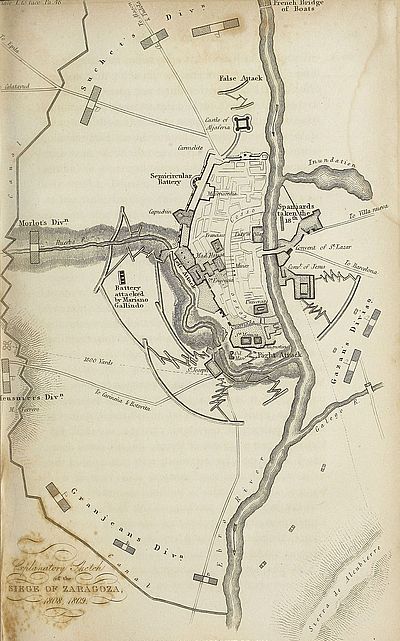 click here for larger image.
Explanatory Sketch of the
SEIGE OF ZARAGOZA,
1808, 1809.
London. Published by T. & W. BOONE, July 1829.
2º.—The defence of Zaragoza may be examined
under two points of view; as an isolated event, and
as a transaction bearing on the general struggle in
the Peninsula. With respect to the latter, it was
a manifest proof, that neither the Spanish people,
nor the government, partook of the Zaragozan energy.
For it would be absurd to suppose that, in the midst
of eleven millions of people, animated by an ardent
enthusiasm, fifty thousand armed men could for two
months be besieged, shut in, destroyed, they and
their works, houses, and bodies, mingled in one
terrible ruin, by less than thirty-five thousand adversaries,
and that without one effort being made to
save them!
Deprive the transaction of its dazzling colours,
and the simple outline comes to this: Thirty-five
thousand French, in the midst of insurrections, in
despite of a combination of circumstances peculiarly
favourable to the defence, reduced fifty thousand of
the bravest and most energetic men in Spain. It is
true, the latter suffered nobly; but was their example
imitated? Gerona, indeed, although less celebrated,
rivalled, and perhaps more than rivalled,
the glory of Zaragoza; but elsewhere her fate spoke,
not trumpet-tongued to arouse, but with a wailing
voice, that carried dismay to the heart of the nation.
3d.—As an isolated transaction, the siege of Zaragoza
is very remarkable; but it would be a great
error to suppose, that any town, the inhabitants of
which were equally resolute, might be as well defended.
Fortitude and bravery will do much; but
the combinations of science are not to be defied with
impunity. There are no miracles in war! If the
houses of Zaragoza had not been nearly incombustible,
the bombardment alone would have caused
the besieged to surrender, or to perish with their
flaming city.
4th.—That the advantage offered by the peculiar
structure of the houses, and the number of the convents
and churches, was ably seized by the Spaniards,
is beyond doubt. General Rogniat, Lacoste’s successor,
indeed, treats his opponents’ skill in fortification
with contempt; but colonel San Genis’ talents are
not to be judged of by the faulty construction of a few
out-works, at a time when he was under the control
of a disorderly and ferocious mob. He knew how to
adapt his system of defence to the circumstances of
the moment, and no stronger proof of real genius
can be given. “Do not consult me about a capitulation,”
was his common expression. “I shall
never be of opinion that Zaragoza can make no
further defence.” But neither the talents of San
Genis, nor the construction of the houses, would
have availed, if the people within had not been of
a temper adequate to the occasion; and to trace the
passions by which they were animated to their true
causes is a proper subject for historical and military
research.
5th.—That they did not possess any superior
courage is evident from the facts that the
besieged, although twice the number of the besiegers,
never made any serious impression by
their sallies, and that they were unable to defend
the breaches. In large masses, the standard of
courage which is established by discipline may be
often inferior to that produced by fanaticism, or
any other peculiar excitement; but the latter never
lasts long, neither is it equable, because men are
of different susceptibility, following their physical
and mental conformation. Hence a system of terror
has always been the resource of those leaders who,
engaged in great undertakings, have been unable to
recur to discipline. Enthusiasm stalked in front of
their bands, but punishment brought up the rear;
and Zaragoza was no exception to this practice.
6th.—It may be said that the majority of the besieged,
not being animated by any peculiar fury, a
system of terror could not be carried to any great
length; but a close examination explains this seeming
mystery. The defenders were composed of three
distinct parties,—the regular troops, the peasantry
from the country, and the citizens; but the citizens,
who had most to lose, were naturally the fiercest,
and, accordingly, amongst them, the system of terror
was generated. The peasantry followed the example,
as all ignorant men, under no regular control,
will do; the soldiers meddled but little in the
interior arrangements, and the division of the town
into islands of posts rendered it perfectly feasible
for violent persons, already possessed of authority,
to follow the bent of their inclinations: there was
no want of men, and the garrison of each island
found it their own interest to keep those in front of
them to their posts, that the danger might be the
longer staved off from themselves.
7th.—Palafox was only the nominal chief of Zaragoza,
the laurels gathered in both sieges should
adorn plebeian brows, but those laurels dripped
with kindred as well as foreign blood. The energy
of the real chiefs, and the cause in which that
energy was exerted, may be admired; the acts perpetrated
by this ruling band were, in themselves,
atrocious; and Palafox, although unable to arrest
their savage proceedings, can claim but little credit
for his own conduct. For more than a month preceeding
the surrender, he never came forth of a
vaulted building, which was impervious to shells,
and in which, there is too much reason to believe,
he and others, of both sexes, lived in a state of
sensuality, forming a disgusting contrast to the
wretchedness that surrounded them.
OBSERVATIONS ON THE FRENCH OPERATIONS.
1º. Before the arrival of marshal Lasnes, the
operations were conducted with little vigour. The
want of unity, as to time, in the double attack of
the Monte Torrero and the suburb, was a flagrant
error, that was not redeemed by any subsequent
activity; but, after the arrival of that marshal, the
siege was pursued with singular intrepidity and
firmness. General Rogniat appears to disapprove
of Suchet’s division having been sent to Calatayud,
yet it seems to have been a judicious measure, inasmuch
as it was necessary,—
1st. To protect the line of correspondence with
Madrid.
2d. To have a corps at hand, lest the duke of
Infantado should quit Cuença, and throw himself
into the Guadalaxara district, a movement that
would have been extremely embarrassing to the
king. Suchet’s division, while at Calatayud, fulfilled
these objects, without losing the power of succouring
Tudela, or, by a march on the side of Daroca,
of intercepting the duke of Infantado if he attempted
to raise the siege of Zaragoza; but, when
the Spanish army at Cuença was directed on Ucles,
and that of the marquis of Lazan was gathering
strength on the left bank of the Ebro, it was undoubtedly
proper to recall Suchet.
2º.—It may not be misplaced here to point out
the errors of Infantado’s operations. If, instead of
bringing on a battle with the first corps, he had
marched to the Ebro, established his depôts and
places of arms at Mequinenza and Lerida, opened
a communication with Murcia, Valencia, and Catalonia,
and joined the marquis of Lazan’s troops to
his own, he might have formed an entrenched
camp in the Sierra de Alcubierre, and from thence
have carried on a methodical war with, at least,
twenty-five thousand regular troops; the insurrections
on the French flanks and line of communication
with Pampeluna would then have become
formidable; and, in this situation, having the fortresses
of Catalonia behind him, with activity and
prudence he might have raised the siege.
3º.—From a review of all the circumstances
attending the siege of Zaragoza, we may conclude
that fortune was extremely favourable to the French.
They were brave, persevering, and skilful, and they
did not lose above four thousand men; but their
success was owing partly to the errors of their opponents,
principally to the destruction caused by
Rogniat.
the pestilence within the town; for, of all that
multitude said to have fallen, six thousand Spaniards
only were slain in battle. Thirteen convents
and churches had been taken; but, when the town
surrendered, forty remained to be forced.
Such are the principal circumstances of this memorable
siege. I shall now relate the contemporary
operations in Catalonia.
CHAPTER IV. — OPERATIONS IN CATALONIA. — SIEGE OF ROSAS. — BATTLE OF CARDADEU. — THE BATTLE OF MOLINO DEL REY.
It will be remembered, that when the second
siege of Gerona was raised, in August, 1808, general
Duhesme returned to Barcelona, and general
Reille to Figueras; after which, the state of affairs
obliged those generals to remain on the defensive.
Napoleon’s measures to aid them were as prompt as
the occasion required. While the siege of Gerona
was yet in progress, he had directed troops to assemble
at Perpignan in such numbers, as to form with
those already in Catalonia, an army of more than
forty thousand men, to be called the “7th corps.”
St. Cyr’s Journal of Operations.
Then appointing general Gouvion St. Cyr to command
it, he gave him this short but emphatic order:
“Preserve Barcelona for me. If that place be lost,
I cannot retake it with 80,000 men.”
The troops assembled at Perpignan were the
greatest part but raw levies; Neapolitans, Etruscans,
Romans, and Swiss: there were, however, some old
regiments; but as the preparations for the grand
army under the emperor absorbed the principal attention
of the administration in France, general St.
Cyr was straightened in the means necessary to take
the field; and his undisciplined troops, suffering
severe privations, were depressed in spirit, and inclined
to desert.
The 1st of November, Napoleon, who was at
Bayonne, sent orders to the “7th corps” to commence
its operations; and St. Cyr, having put his
divisions in motion on the 3d, crossed the frontier,
and established his head-quarters at Figueras on
the 5th.
In Catalonia, as in other parts of Spain, lethargic
vanity, and abuses of the most fatal kind, had succeeded
to the first enthusiasm, and withered the
energy of the people. The local junta issued,
indeed, abundance of decrees, and despatched agents
to the supreme junta, and to the English commanders
in the Mediterranean, and in Portugal, all
charged with the same instructions, namely, to demand
arms, ammunition, and money. And although
the central junta treated their demands with contempt,
the English authorities answered them generously
and freely. Lord Collingwood lent the
assistance of his fleet. From Malta and Sicily arms
were obtained; and sir Hew Dalrymple having
completely equipped the Spanish regiments released
by the convention of Cintra, despatched them to
Catalonia in British transports. Yet it may be
doubted if the conduct of the central junta were not
the wisest; for the local government established at
Tarragona had already become so negligent, or so
corrupt, that the arms thus supplied were, instead
Lord Collingwood’s Correspondence.
of being used in defence of the country, sold to
foreign merchants! and such being the political state
of Catalonia, it naturally followed that the military
affairs should be ill conducted.
The count of Caldagues, who had relieved Gerona,
returned by Hostalrich, and resumed the line of the
Llobregat; and fifteen hundred men, drawn from
Cabanes.
the garrison of Carthagena, having reached Taragona,
the marquis of Palacios, accompanied by the
junta, quitted the latter town, and fixed his head-quarters
at Villa Franca, within twenty miles of
Caldagues. The latter disposed his troops, five thousand
in number, at different points between Martorel
and San Boy, covering a line of eighteen miles,
along the left bank of the river.
General Duhesme rested a few days, and then
marching from Barcelona with six thousand men in
the night, arrived the 2d of September at day-break
on the Llobregat, and immediately attacked Caldagues’
line in several points, but principally at San
Boy and Molino del Rey. The former fort was
carried, some guns and stores were captured, and
the Spaniards were pursued to Vegas, a distance of
seven or eight miles; but at Molino del Rey the
French were repulsed, and Duhesme then returned
to Barcelona.
It was the intention of the British ministers, that
an auxiliary force should have sailed from Sicily
about this period, to aid the Catalans; and doubtless
it would have been a wise and timely effort: but
Napoleon’s foresight prevented the execution; for
he directed Murat to menace Sicily with a descent;
and that prince, feigning to collect forces on the
coast of Calabria, spread many reports of armaments
being in preparation, and, as a preliminary measure,
attacked and carried the island of Capri; upon
which occasion sir Hudson Lowe first became known
to history, by losing in a few days a post that,
without any pretensions to celebrity, might have
been defended for as many years. Murat’s demonstrations
sufficed to impose upon sir John Stuart,
and from ten to twelve thousand British troops were
thus paralyzed at a most critical period: but such
will always be the result of a policy which has no
fixed and definite object in view. When statesmen
cannot see their own way clearly, the executive
officers will seldom act with vigour.
The Spanish army was now daily increasing; the
tercios of Migueletes were augmented in number,
and a regiment of hussars, that had been most absurdly
kept in Majorca ever since the beginning of
the insurrection, arrived at Taragona.
Mariano Alvarez, the governor of Gerona, was
appointed to the command of the vanguard, composed
of the garrisons of Gerona and Rosas, and of
the corps of Juan Claros, and other partizans.
Francisco Milans and Milans de Bosch, with
their Migueletes, kept the mountains to the northward
and eastward of Barcelona; and while the
latter hemmed in the French right, the former
covered the district of El Vallés, and like a bird of
prey watched the French foragers in the plain surrounding
Barcelona.
Palacios remained at Villa Franca, and the count
of Caldagues continued to guard the line of the
Llobregat.
The little port of St. Felice de Quixols, near Palamos
Bay, was filled with privateers, and the
English frigates off the coast not only aided the
Spaniards in all their enterprizes, but carried on a
littoral warfare in the gulf of Lyons with great
spirit and success.
During the month of September several petty
skirmishes happened between the French marauding
parties and the Migueletes about Barcelona; but on
the 10th of October, Duhesme attacked and dislodged
Francisco Milans from the mountains to the
north of that city; and designing to forage the district
of El Vallés, sent on the 11th a column of two
thousand men along the sea coast towards Mattaro,
with orders to turn from thence to the left, clear the
heights beyond the Besos, of Migueletes, and push
for Granollers on the route to Vich: this column he
supported by a second of nearly equal strength,
under general Millossewitz.
The first column reaching Granollers on the
12th, put the local junta of that district to flight,
captured some provisions and other stores, and,
finally, joined the second column, which was posted
at Mollet. Millossewitz, leaving a part of his
force at the pass of Moncada, then proceeded to
San Culgat. Caldagues, hearing of this excursion,
drew together three thousand infantry, a hundred
and fifty cavalry, and six guns from his line on the
Llobregat, and was in full march by the back of
the mountains for the pass of Moncada, expecting
to intercept the French in their return to Barcelona:
Cabanes.
but, falling in with them at San Culgat, a confused
action ensued, and both sides claimed the victory;
the French, however, retreated across the mountains
to Barcelona without having foraged the district,
and Caldagues returned to his former position,
justly proud of this vigorous and soldier-like movement.
The 28th of October, Palacios quitted Catalonia
to command the levies in the Sierra Morena.
General Vives succeeded him, and the army was
again reinforced by some infantry from Majorca.
The Spanish regiments, released by the convention
of Cintra, also arrived at Villa Franca, and seven
or eight thousand Granadian levies were brought up
to Tarragona by general Reding, and, at the same
time, six thousand men drafted from the army of
Aragon, reached Lerida, under the command of the
marquis de Lazan.
The whole force, including the garrisons of Hostalrich,
Gerona, and Rosas, was now not less than
thirty-six thousand men; of which twenty-two
St. Cyr.
Doyle’s Correspondence, MSS.
thousand infantry, and twelve hundred cavalry,
were in the neighbourhood of Barcelona, or in march
for the Llobregat. This force, organized in six
divisions, of which the troops in the Ampurdan
formed one, took the name of the army of the right,
and Vives seeing himself at the head of such a
power, and in possession of all the hills and rivers
encircling Barcelona, resolved to besiege that city.
The 3d of November, he transferred his head-quarters
to Martorel; the 8th he commenced a
series of trifling skirmishes, to drive the French
posts back into the town: but they repulsed him;
and, from that time until the blockade was raised,
a warfare of the most contemptible nature was
carried on by the Spaniards: the French, who were
about ten thousand strong, always maintaining their
outposts.
Notwithstanding this appearance of strength,
Catalonia was a prey to innumerable disorders.
Vives, a weak, indolent man, had been a friend of
Godoy, and was not popular; he it was that, commanding
in the islands, had retained the troops in
them with such tenacity as to create doubts of his
attachment to the cause; but, although the supreme
junta privately expressed their suspicions, and
Lord Collingwood’s Correspondence.
requested lord Collingwood to force Vives to an
avowal of his true sentiments, they, at the same
time, wrote to the latter, publicly, in the most
flattering terms, and, finally, appointed him captain-general
of Catalonia. By the people, however,
both he and others were vehemently suspected, and,
as the mob governed throughout Spain, the authorities,
civil and military, were more careful to avoid
giving offence to the multitude than anxious to
molest the enemy. Catalonia was full of strong
places: but they were neither armed nor provisioned,
and, like all other Spaniards, the Catalans
were confident that the French only thought of
retreating.
Such was the state of the province and of the
armies, when Napoleon, being ready to break into
the northern parts of Spain, general St. Cyr commenced
his operations. His force (including a
Muster rolls of the French army, MSS.
German division of six thousand men, not yet
arrived at Perpignan) amounted to more than thirty
St. Cyr.
thousand men, ill-composed, however, and badly
provided; and St. Cyr himself was extremely discontented
with his situation. The Emperor had given
him discretionary powers to act as he judged fitting,
only bearing in mind the importance of relieving
Barcelona; but marshal Berthier neglected the
equipment of the troops; and Duhesme declared
that his magazines would not hold out longer than
December.
To march directly to Barcelona was neither
an easy nor an advantageous movement. That city
could only be provisioned from France; and, until
the road was cleared, by the taking of Gerona and
Hostalrich, no convoys could pass except by sea,
yet, to attack these places with prudence, it was
essential to get possession of Rosas, not only to
secure an intermediate port for French vessels
passing with supplies to Barcelona, but to deprive
the English of a secure harbour, and the Spaniards
of a point from whence they could, in concert with
their allies, intercept the communications of the
French army: and even blockade Figueras,
which, from the want of transport, could
not be provisioned at this period. These considerations
having determined St. Cyr to commence by the
siege of Rosas, he repaired to Figueras, in person,
the 6th of November; and, on the 7th, general
Reille being charged to conduct the operation, after
a sharp action, drove in the Spaniards before the
place and completed the investment.
This town was but a narrow slip of houses built
along the water’s edge, at the head of the gulph of
the same name.
The citadel, a large irregular pentagon, stood on
one side of the town, and, on the other, the mountains
that skirt the flat and swampy plain of the
Ampurdan, rose, bluff and rocky, at the distance of
half a mile. An old redoubt was built at the foot
of these hills, and, from thence to the citadel, an
entrenchment had been drawn to cover the houses.
Hence, Rosas, looking towards the land, had the
citadel on the left hand, the mountains on the right,
and the front covered by this entrenchment. The
roadstead permitted ships of the line to anchor
within cannon-shot of the place; and, on the right
hand coming up the gulph, a star fort, called the
Trinity, crowned a rugged hill about a mile and a
quarter distant from the citadel, the communication
between it and the town being by a narrow road
carried between the foot of the hills and the water’s
edge.
The garrison of Rosas consisted of nearly three
thousand men, two bomb-vessels, and an English
seventy-four (the Excellent), were anchored off the
town, and captain West, the commodore, reinforced
the garrisons of the Trinity and the citadel with
marines and seamen from these vessels; but the
damages sustained in a former siege had been only
partially repaired; both places were ill-found in
guns and stores, and the Trinity was commanded
at the distance of pistol-shot from a point of the
mountains called the Puig Rom.
The force under Reille, consisting of his own
and general Pino’s Italian division, skirmished daily
with the garrison; but the rain, which fell in
torrents, having flooded the Ampurdan, the roads
became impassable for the artillery, and delayed
the opening of the trenches. Meanwhile, Souham’s
division took post between the Fluvia and Figueras,
to cover the operations of the siege on the side of
Gerona, and an Italian brigade, under general Chabot,
was posted at Rabos and Espollas, to keep the
Somatenes down.
But, before Chabot’s arrival, Reille had detached
a battalion to that side; and, being uneasy for its
safety, sent three more to its assistance: this saved
the battalion, which was in great danger; and two
companies were actually cut off by the Somatenes.
This loss, however, proved beneficial, as it enraged
the Italians, and checked their disposition to desert;
and St. Cyr, unwilling to pursue the system of
St. Cyr.
burning villages, and yet anxious to repress the
insidious hostility of the peasants, in reprizal for
the loss of his two companies, seized an equal
number of villagers, and sent them prisoners to
France.
The inhabitants of Rosas having embarked or
taken refuge in the citadel, the houses, and the
entrenchments covering them, were left to the
French; but the latter were prevented, by the fire
of the English ships, from effecting a permanent
lodgement in the deserted town; and, after a few
days, a detachment from the garrison, consisting
of soldiers and townsmen, established a post
there.
Captain
West’s despatch.
The 8th captain West, in conjunction with the
governor, made a sally, but was repulsed; and,
on the 9th several yards of the citadel ramparts
crumbled; but, with the assistance of the British
seamen, the breach was repaired in the night
before the enemy became aware of the accident.
The 15th an obstinate assault made on the Trinity
was repulsed, the English seamen bearing a principal
share in the success.
The 16th the roads being passable, the French
battering-train was put in motion. The way leading
up to the Puig Rom was repaired, and two battalions
were posted there, on the point commanding
the Trinity.
The 19th three guns were mounted against the
Trinity, and the trenches were opened at the
distance of four hundred yards from the citadel.
The 20th the fire of some French mortars obliged
the vessels of war to anchor beyond the range of
the shells. During this time, Souham was harassed
by the Migueletes from the side of Gerona.
The French cavalry, unable to find forage, were
sent back to France; and Napoleon, rendered uneasy
by the reports of general Duhesme, ordered the
seventh corps to advance to Barcelona, so as to
St. Cyr.
arrive there by the 26th of November; but St. Cyr
refused to abandon the siege of Rosas without a
positive order.
The assistance afforded to the besieged by captain
West was represented to the junta as an attempt
of that officer to possess himself of the place.
The junta readily believed this tale, and entered
into an angry correspondence with don Pedro
O’Daly, the governor, relative to the supposed
treachery; but no measures were taken to raise the
siege. During this correspondence, the Excellent
sailed from Rosas, and was succeeded by the Fame,
captain Bennet. This officer landed some men
under the Trinity on the 23d, and endeavoured,
but ineffectually, to take the battery opposed to
that fort.
The 27th the besiegers assaulted the Spaniards,
who, to the number of five hundred, had entrenched
themselves in the deserted houses of the
town. A hundred and sixty were taken, and fifty
escaped into the citadel; the rest were slain.
Breaching batteries were immediately commenced
among the ruins of the houses, and the communication
with the shipping rendered so unsafe, that
Lazan, who had come from Lerida to Gerona with
six thousand men, and had collected provisions and
Doyle’s Correspondence, MSS.
stores at the mouth of the Fluvia, with the intention of
supplying Rosas by sea, abandoned his design.
The ruinous condition of the front, exposed to
the fire of the besiegers, now induced Reille to
summon the place a second time; but the governor
refused to surrender.
The 30th of November, the engineers reported
that the breach in the Trinity was practicable, and
an assault was ordered; although an Italian officer,
appointed to lead the storming party of fifty men,
and who had formerly served in the fort, asserted
that the breach was not a true one. The Spanish
commandant thought his post untenable; and two
days before, the marines of the Fame had been
withdrawn by captain Bennet: but at this time,
lord Cochrane, a man of infinite talent in his profession,
and of a courage and enterprise that have
seldom, if ever, been surpassed, arrived in the Imperieuse
frigate, and immediately threw himself,
with eighty men, into the fort.
The Italian’s representations being unheeded, he
advanced to the assault like a man of honour, and
was killed, together with all his followers, excepting
four, two of whom escaped back to their own
side, the other two being spared by the English
seamen, were drawn up with cords into the fort.
The breach had, however, been practicable at first;
but it was broken in an old gallery, which lord
Cochrane immediately filled with earth and hammocks,
and so cut off the opening. In the course
of a few days, a second assault was made, but the
French were again repulsed with loss. Meanwhile
the breaching batteries opened against the citadel,
and a false attack was commenced on the opposite
side.
The 4th December the garrison made a sally, in
the night, from the citadel, and with some success;
but the walls were opened by the enemy’s fire,
and the next day O’Daly, hopeless of relief, surrendered
with about two thousand four hundred
men, of which two hundred were wounded. Lord
Cochrane, also, blew up the magazine, and abandoned
Fort Trinity. General St. Cyr observes that
the garrison of Rosas might have been easily carried
off, at night, by the British shipping; but to
embark two thousand five hundred men, in the
boats of two ships, and under a heavy fire, whether
by night or day, is not an easy operation;
nevertheless, the censure seems well founded, because
sufficient preparation might have been previously
made.
The defence of Rosas (with the exception of lord
Cochrane’s efforts) cannot be deemed brilliant,
whether with relation to the importance of the
place, the assistance that might have been rendered
from the sea, or the number of the garrison
compared with that of the besiegers. It held out,
however, thirty days, and, if that time had been
well employed by the Spaniards, the loss of the
garrison would have been amply repaid; but Vives,
wholly occupied with Barcelona, was indifferent to
the fate of Rosas. A fruitless attack on Souham’s
posts, by Mariano Alvarez, was the only effort made
to interrupt the siege, or to impede the farther progress
Doyle’s Correspondence, MSS.
of the enemy. Lazan, although at the head
of six or seven thousand men, could not rely upon
more than three thousand; and his applications to
Vives for a reinforcement were unheeded.
The fall of Rosas enabled St. Cyr to march to
the relief of Barcelona, and he resolved to do so:
yet the project, at first sight, would appear rather
insane than hardy; for the roads, by which Gerona
and Hostalrich were to be turned, being mere paths
impervious to carriages, no artillery, and little ammunition,
could be carried, and the country was
full of strong positions. The Germans had not yet
arrived at Perpignan; it was indispensable to leave
Reille in the Ampurdan, to protect Rosas and
Figueras; and, these deductions being made, less
than eighteen thousand men, including the cavalry,
which had been recalled from France, remained
disposable for the operation.
But, on the Spanish side, Reding having come
up, there were twenty-five thousand men in the
camp before Barcelona, and ten thousand others,
under Lazan and Alvarez, were at Gerona. All
these troops were, however, exceedingly ill organized.
Cabanes.
Two-thirds of the Migueletes only carried
pikes, and many were without any arms at all.
There was no sound military system; the Spanish
generals were ignorant of the French movements
and strength; and their own indolence and want of
vigilance drew upon them the contempt and suspicion
of the people.
The 8th of December St. Cyr united his army
on the left bank of the Fluvia. The 9th he passed
that river, and, driving the Spaniards over the Ter,
established his head-quarters at Mediñya, ten miles
from Gerona. He wished, before pursuing his own
march, to defeat Lazan, lest the latter should harass
the rear of the army; but, finding that the marquis
would not engage in a serious affair, he made a
show of sitting down before Gerona on the 10th,
St. Cyr.
hoping thereby to mislead Vives, and render him
slow to break up the blockade of Barcelona: and
Cabanes.
this succeeded; for the Spaniard remained in his
camp, irresolute and helpless, while his enemy was
rapidly passing the defiles and rivers between Gerona
and the Besos.
The nature of the country between Figueras and
Barcelona has been described in the first volume;
referring to that description, the reader will find
that the only carriage-routes by which St. Cyr
could march were, one by the sea-coast, and one
leading through Gerona and Hostalrich. The first,
exposed to the fire of the English vessels, had
also been broken up by lord Cochrane, in August;
and, to use the second, it was necessary to take
the fortresses, or to turn them by marching for three
days through the mountains. St. Cyr adopted the
latter plan, trusting that rapidity and superior knowledge
of war would enable him to separate Lazan
and Alvarez from Vives, and so defeat them all in
succession.
The 11th, he crossed the Ter and reached La
Bisbal; here he left the last of his carriages, delivered
out four days’ biscuit and fifty rounds of
ammunition to the soldiers, and with this provision,
a drove of cattle, and a reserve of ten rounds of
ammunition for each man, he commenced his hardy
march the 12th of December, making for Palamos.
On the route he encountered and beat some Migueletes
that Juan Claros had brought to oppose him,
and, when near Palamos, he suffered a little from
the fire of the English ships; but he had gained a
first step, and his hopes were high.
The 13th, he turned his back upon the coast,
and, by a forced march, reached Vidreras and
Llagostera, and thus placed himself between Vives
and Lazan, for the latter had not yet passed the
heights of Casa de Selva.
The 14th, marching by Mazanet de Selva and
Martorel, he reached the heights above Hostalrich,
and encamped at Grions and Masanas. During
this day’s journey, his rear was slightly harassed
by Lazan and Claros; but he was well content to
find the strong banks of the Tordera undefended by
Vives. The situation of the army was, however,
extremely critical. Lazan and Claros had, the one
on the 11th, the other on the 12th, informed Vives
of the movement; hence the bulk of the Spanish
force before Barcelona might be expected, at any
moment, in some of the strong positions in which
the country abounded, and the troops from Gerona
were, as we have seen, close in the rear; the Somatenes
were gathering thickly on the flanks, Hostalrich
was in front, and the French soldiers had
only sixty rounds of ammunition.
St. Cyr’s design was to turn Hostalrich, and get
into the main road again behind that fortress. The
smugglers of Perpignan had affirmed that there was
no pathway, but a shepherd assured him that there
was a track by which it could be effected; and,
when the efforts of the staff-officers to trace it
failed, St. Cyr himself discovered it, but nearly fell
into the hands of the Somatenes during the search.
The 15th, at day-break, the troops being put in
motion, turned Hostalrich and gained the main
road. The garrison of that place, endeavouring
to harass their rear, were repulsed; but the
Somatenes on the flanks, emboldened because the
French, to save ammunition, did not return their
fire, became exceedingly troublesome; and, near
San Celoni, the head of the column encountered
some battalions of Migueletes, which Francisco
Milans had brought up from Arenas de Mar, by the
pass of Villa Gorguin.
Milans, not being aware of St. Cyr’s approach,
was soon beaten, and his men fell back, part to
Villa Gorguin, part to the heights of Nuestra Señora
de Cordera: the French thus gained the defile
of Treintapasos. But they were now so fatigued
that all desired to halt, save St. Cyr, who insisted
upon the troops clearing the defile, and reaching a
plain on the other side: this was not effected before
ten o’clock. Lazan’s troops did not appear
during the day; but Vives’ army was in front,
and its fires were seen on the hills between Cardadeu
and Llinas.
Information of St. Cyr’s march, as I have already
observed, had been transmitted to Vives on the
11th, and there was time for him to have carried
the bulk of his forces to the Tordera before the
French could pass that river; but intelligence of
the battle of Tudela, and of the appearance of the
French near Zaragoza, arrived at the same moment,
Cabanes.
and the Spanish general betrayed the
greatest weakness and indecision, at one moment
resolving to continue before Barcelona, at another
designing to march against St. Cyr. He had, on
Doyle’s Correspondence, MS.
the 9th, sent Reding with six guns, six hundred
cavalry, and one thousand infantry, to take the
command in the Ampurdan; but, the 12th, after
receiving Lazan’s report, he reinforced Reding, who
was still at Granollers, and directed him upon Cardadeu.
The 14th, he ordered Francisco Milans to march
by Mattaro and Arenas de Mar, to examine the
coast road, and, if the enemy was not in that line,
to repair also to Cardadeu.
The 15th, Milans, as we have seen, was beaten
at St. Celoni; but, in the night, he rallied his
whole division on the heights of Cordera, thus
flanking the left of the French forces at Llinas.
A council of war was held on the 13th. Caldagues
advised that four thousand Migueletes should
be left to observe Duhesme, and that the rest of
the army should march at once to fight St. Cyr.
Good and soldier-like advice; but Vives was loth
to abandon the siege of Barcelona, and, adopting
half-measures, left Caldagues, with the right wing
of the army, to watch Duhesme, and carried the
centre and the left, by the route of Granollers, to
the heights between Cardadeu and Llinas, where
(exclusive of Milan’s division) he united, in the
night of the 15th, about eight thousand regulars,
besides several thousand Somatenes. Duhesme immediately
occupied the posts abandoned by Vives,
and thus separated him from Caldagues.
St. Cyr’s position, on the morning of the 16th,
would have been dangerous, if he had been opposed
by any but Spanish generals and Spanish troops.
Vives and those about him, irresolute and weak as
they were in action, were not deficient in boasting
words; they called the French army, in derision,
“the succour;” and, in allusion to the battle of
Baylen, announced that a second “bull-fight,” in
St. Cyr.
which Reding was again the “matador,” would be
exhibited. But Dupont and St. Cyr were men of a
different stamp: the latter justly judging that the
Spaniards were not troops to stand the shock of a
good column, united his army in one solid mass,
at day-break on the 16th, and marched straight
against the centre of the enemy, giving orders that
the head of the column should go headlong on,
without either firing or forming line.
The hills which the Spaniards occupied were
high and wooded; the right was formed by Reding’s
division, the left by Vives, and the Somatenes hung
on the sides of a lofty ridge, which was only separated
from the right of the position by the little
river Mogent. The main road from Llinas led
straight upon the centre, and there was a second
road conducting to Mataro, which, branching off
from the first, run between the Mogent and the
right of Reding’s ground.
When the French commenced their march, the
Somatenes galled their left flank, and general Pino,
whose division headed the column of attack, instead
of falling upon the centre, sent back for fresh instructions,
St. Cyr.
and meanwhile extended his first brigade
in a line to the left. St. Cyr, who had reiterated
the order to fight in column, was sorely
troubled at Pino’s error, the ill effects of which
were instantly felt, because, Reding advancing
against the front and flank of the extended brigade,
obliged it to commence a fire, which it was impossible
to sustain for want of ammunition.
In this difficulty the French general acted with
great ability and vigour: Pino’s second brigade was
directed to do that which the first should have done.
Two companies were sent to menace the left of the
Spaniards, and St. Cyr, at the same time, rapidly
carried Souham’s division, by the Mataro road,
against Reding’s extreme right. The effect was
instantaneous and complete, the Spaniards overthrown
on their centre and right, and charged by
the cavalry, were beaten and dispersed in every
direction, leaving all their artillery and ammunition,
and two thousand prisoners behind.
Vives, escaping on foot across the mountain,
reached Mataro, where he was taken on board an
English vessel. Reding fled on horseback by the
main road; and the next day, having rallied some
of the fugitives at Monmalo, retreated by the route
of San Culgat to Molino del Rey. The loss of the
French was six hundred men; but the battle, which
lasted only one hour, was so complete, that St. Cyr
resolved to push on to Barcelona immediately, without
seeking to defeat Milans or Lazan, whom he
judged too timid to venture an action: moreover, he
hoped that Duhesme, who had been informed, on
the 7th, of the intended march, and who could
hear the sound of the artillery, would intercept and
turn back the flying troops.
The French army had scarcely quitted the field
of battle when Milans arrived; but, finding how
matters stood, retired to Arenas de Mar, and gave
notice to Lazan, who retreated to Gerona. St. Cyr’s
rear was thus cleared; but Duhesme, heedless of
what was passing at Cardadeu, instead of intercepting
the beaten army, sent Lecchi to attack Caldagues.
The latter general, however, concentrated
his division on the evening of the 16th, repulsed
Lecchi, and retired behind the Llobregat, but left
behind some artillery and the large magazines which
Vives had collected for the siege and accumulated
in his camp.
St. Cyr reached Barcelona without encountering
any of Duhesme’s troops, and, in his Memoirs of
this campaign, represents that general as astonishingly
negligent, seeking neither to molest the enemy
nor to meet the French army; treating everything
belonging to the service with indifference, making
false returns, and conniving at gross malversation
in his generals.
St. Cyr.
St. Cyr, now reflecting upon the facility with
which his opponents could be defeated, and the
difficulty of pursuing them, resolved to rest a few
days at Barcelona, in hopes that the Spaniards, if
unmolested, would re-assemble in numbers behind
the Llobregat, and enable him to strike an effectual
blow, for his design was to disperse their forces so
as they should not be able to interrupt the sieges
which he meditated; nor was he deceived in his
calculations. Reding joined Caldagues, and rallied
from twelve to fifteen thousand men behind the
Llobregat, and Vives, having relanded at Sitjes,
sent orders to Lazan and Milans to march likewise
to that river by the district of Vallés. The arrival
of the latter was, however, so uncertain that the
French general, judging it better to attack Reding
at once, united Chabran’s division to his own, on
the 20th, and advanced to St. Felieu de Llobregat.
The Spaniards were drawn up on the heights
behind the village of San Vincente; their position
was lofty and rugged, commanding a free view of
the approaches from Barcelona. The Llobregat
covered the front, and the left flank was secure
from attack, except at the bridge of Molino del Rey,
which was entrenched, guarded by a strong detachment,
and protected by heavy guns. Reding’s cavalry
amounted to one thousand, and he had fifty
pieces of artillery, the greatest part of which were
in battery at the bridge of Molino del Rey; but
his right was accessible, because the river was
fordable in several places. The main road to Villa
Franca led through this position, and, at the distance
of ten or twelve miles in the rear, the pass of Ordal
offered another post of great strength.
Vives was at San Vincente on the 19th, but returned
to Villa Franca the same day; hence, when the
French appeared on the 20th, the camp was thrown
into confusion.
A council of war being held, one party was for
fighting, another for retreating to Ordal: an officer
Cabanes.
was then sent to Vives for orders, but he returned
with a message, that Reding might retreat if he
could not defend his post. The latter, however,
fearing that he should be accused, and perhaps sacrificed
for returning without reason, resolved to
fight, although he anticipated nothing but disaster.
The season was extremely severe; snow was falling,
and both armies suffered from the cold and wet.
The Spanish soldiers were dispirited by past defeats,
and the despondency and irresolution of their generals
could not escape observation: but the French
and Italian troops were confident in their commander,
and flushed with success. In these dispositions the
two armies passed the night before
St. Cyr observing that Reding’s attention was
principally directed to the bridge of Molino, ordered
Chabran’s division to that side, with instructions to
create a diversion, by opening a fire from some artillery,
and then retiring, as if his guns could not
resist the weight of the Spanish metal; in short, to
persuade the enemy that a powerful effort would be
made there; but when the centre and right of the
Spaniards should be attacked, Chabran was to force
the passage of the bridge, and assail the heights
beyond it. This stratagem succeeded; Reding
massed his troops on the left, and neglected his
right, which was the real point of attack.
The 21st of December, Pino’s division crossed the
Llobregat at daylight, by a ford in front of St. Felieu,
and marched against the right of the Spanish
position: Chabot’s division followed; and Souham’s,
which had passed at a ford lower down, and then
ascended by the right bank, covered Pino’s passage.
The light cavalry were held in reserve behind Chabot’s
division, and a regiment of cuirassiers was sent
to support Chabran at Molino del Rey.
The Spanish position consisted of two mountain
heads, separated by a narrow ravine and a torrent;
and as the troops of the right wing were exceedingly
weakened, they were immediately chased off their
headland by the leading brigade of Pino’s division.
Reding then seeing his error, changed his front,
and drew up on the other mountain, on a new line,
nearly perpendicular to the Llobregat; but he still
kept a strong detachment at the bridge of Molino,
which was thus in rear of his left. The French
divisions formed rapidly for a fresh effort. Souham
on the right, Pino in the centre, Chabot on the left.
The latter gained ground in the direction of Villa
Franca, and endeavoured to turn the Spaniards’
right, and cut off their retreat; while the light
cavalry making way between the mountain and the
river, sought to connect themselves with Chabran
at Molino.
St. Cyr’s columns, crossing the ravine that separated
them from the Spaniards, soon ascended the
opposite mountain. The Catalans had formed
quickly, and opposed their enemies with an orderly,
but ill directed fire. Their front line then advanced,
and offered to charge with an appearance of great
intrepidity; but their courage sunk, and they turned
as the hostile masses approached. The reserves
immediately opened a confused volley upon both
parties; and in this disorder, the road to Villa
Franca being intercepted by Chabot, the right was
forced upon the centre, the centre upon the left, and
the whole pushed back in confusion upon Molino
del Rey.
Meanwhile a detachment from Chabran’s division
had passed the Llobregat above Molino, and so
blocked the road to Martorel; and in this miserable
situation the Spaniards were charged by the light
cavalry, and scarcely a man would have escaped if
Chabran had obeyed his orders, and pushing across
the bridge of Molino had come upon their rear; but
that general, at all times feeble in execution, remained
a tranquil spectator of the action, until the
right of Souham’s division reached the bridge; and
thus the routed troops escaped, by dispersing, and
throwing away every thing that could impede their
flight across the mountains. Vives reached the field
of battle just as the route was complete, and was
forced to fly with the rest. The victorious army
pursued in three columns; Chabran’s in the direction
of Igualada, Chabot’s by the road of San Sadurni,
which turned the pass of Ordal, and Souham’s
by the royal route of Villa Franca, at which place
the head-quarters were established on the 22d. The
posts of Villa Nueva and Sitjes were immediately
occupied by Pino, while Souham pushed the fugitives
to the gates of Tarragona.
The loss of the Spaniards, owing to their swiftness,
was less than might have been expected; not
more than twelve hundred fell into the hands of the
French, but many superior officers were killed or
wounded; and, on the 22d, the count de Caldagues
was taken, a man apparently pedantic in military
affairs, and wanting in modesty, but evidently possessed
of both courage and talent. The whole of
the artillery, and vast quantities of powder, were
captured, and with them a magazine of English
muskets, quite new. Yet many of the Migueletes
were unarmed, and the junta were unceasing in their
demands for succours of this nature; but the history
of any one province was the history of all Spain.
CHAPTER V. — BATTLE OF VALLS. — BATTLE OF ALCANITZ.
Barcelona was now completely relieved, and
the captured magazines supplied it for several months.
There was no longer a Spanish army in the field;
and in Tarragona, where some eight or nine thousand
of the Spanish fugitives, from this and the former
battle, had taken refuge, there was terrible disorder.
Cabanes.
The people rose tumultuously, broke open the public
stores, and laying hands on all the weapons they
could find, rushed from place to place, as if searching
for something to vent their fury upon. The
head of Vives was called for; and to save his life,
he was cast into prison by Reding, who was proclaimed
general-in-chief.
The regular officers were insulted by the populace,
and there was as usual a general cry to defend
the city, mixed with furious menaces against traitors,
but there were neither guns, nor ammunition, nor
provisions; and during the first moment of anarchy,
St. Cyr.
St. Cyr might certainly have rendered himself master
of Tarragona by a vigorous effort. But the
opportunity soon passed away; the French general
sought only to procure subsistence, and occupied
himself in forming a train of field artillery; while
Reding, who had been almost without hope, proceeded
to rally the army, and place the town in a
state of defence.
Doyle’s
Correspondence,
MSS.
The 1st of January eleven thousand infantry and
eight hundred cavalry were re-assembled at Tarragona
and Reus; and a Swiss regiment from Majorca
and two Spanish regiments from Granada, increased
this force. Three thousand four hundred men
arrived from Valencia on the 5th, and from thence
also five thousand muskets, ammunition in proportion,
and ten thousand pikes which had just been
landed from England, were forwarded to Tarragona.
A supply of money, obtained from the British
agents at Seville, completed the number of fortuitous
and fortunate events that combined to
remedy the disaster of Molino del Rey. These
circumstances, and the inactivity of St. Cyr, who
seemed suddenly paralyzed, restored the confidence
of the Catalonians, but their system remained unchanged;
for confidence among the Spaniards always
led to insubordination, but never to victory.
Meanwhile, a part of the troops flying from
Molino had taken refuge at Bruch, and being
joined by the Somatenes, chose major Green, one
of the English military agents, for their general,
thinking to hold that strong country, which was
considered as impregnable ever since the defeats of
Chabran and Swartz. St. Cyr, glad of this opportunity
to retrieve the honour of the French arms,
detached Chabran himself, on the 11th of January,
to take his own revenge; but that general was still
depressed by the recollection of his former defeat.
St. Cyr.
To encourage him, Chabot was directed from San
Sadurni upon Igualada, by which the defile of
Bruch was turned, and a permanent defence rendered
impossible. The Spaniards, however, made
little or no resistance; and eight guns were taken,
and a considerable number of men killed. The
French pursued to Igualada; and a detachment,
without orders, even assailed and took Montserrat
itself, and afterwards rejoined the main body
without loss. Chabot was then recalled to San
Sadurni, and Chabran was quartered at Martorel.
While these events were passing beyond the
Llobregat, the marquis of Lazan was advancing,
with seven or eight thousand men, towards Castellon
de Ampurias. The 1st of January he drove back
a battalion of infantry upon Rosas with considerable
loss; but the next day general Reille, having assembled
about three thousand men, intercepted
Lazan’s communications, and attacked him in his
position behind the Muga. The victory seems to
have been undecided; but in the night, Lazan
regained his communications, and returned to
Gerona.
The battle of Molino del Rey checked, for a
time, the ardour of the Catalans, and Reding at
first avoided serious actions, leaving the Somatenes
to harass the enemy. This plan being followed
during the months of January and February, was
exceedingly troublesome to St. Cyr, because he
was obliged to send small parties continually to
seek for subsistence, and the country people, hiding
their provisions with great care, strove hard to
protect their scanty stores. But in the beginning
of February the country between the Llobregat and
Tarragona was almost exhausted of food. The
English ships continued to vex the coast-line; and
the French, besides deserters, lost many men,
killed and wounded, in the innumerable petty
skirmishes sustained by the marauding parties.
Still St. Cyr maintained his positions; and the
country people, tired of a warfare in which they
were the chief sufferers, clamoured against Reding,
that he, with a large regular force, should look calmly
on, until the last morsel of food was discovered, and
torn from their starving families. The townspeople,
also feeling the burthen of supporting the
troops, impatiently urged the general to fight; nor
was this insubordination confined to the rude
multitude.
Lazan, although at the head of nine thousand
men, had remained perfectly inactive after the
skirmish at Castellon de Ampurias; but when
Reding required him to leave a suitable garrison
in Gerona, and bring the rest of his troops to
Igualada, he would not obey; and this difference
was only terminated by Lazan’s marching, with
five thousand men, to the assistance of Zaragoza.
The result of his operations there has been already
related in the narrative of that siege.
The army immediately under Reding was,
however, very considerable: the Swiss battalions
were numerous and good, and some of the most
experienced of the Spanish regiments were in
Catalonia. Every fifth man of the robust population
had been called out after the defeat of Molino
del Rey; and, although the people, averse to serve
as regular soldiers, did not readily answer the call,
the forces under Reding were so augmented that,
in the beginning of February, it was not less than
twenty-eight thousand men. The urban guards
were also put in activity, and above fifteen thousand
Somatenes assisted the regular troops; but
there was more show than real power, for Reding
was incapable of wielding the regular troops skilfully;
and the Migueletes being ill armed, without
clothing and insubordinate, devastated the country
equally with the enemy.
The Somatenes, who only took arms for local
interests, would not fight, except at the times and
in the manner and place that suited themselves;
and not only neglected the advice of the regular
officers, but reviled all who would not adopt their
own views; causing many to be removed from
their commands; and, with all this, the Spanish
generals never obtained good information of the
enemy’s movements, yet their own plans were
immediately made known to the French; because,
at Reding’s head-quarters, as at those of Castaños
before the battle of Tudela, every project was
openly and ostentatiously discussed. Reding himself
was a man of no military talent; his activity
was of body, not of mind, but he was brave and
honourable, and popular; because, being without
system, arrangement, or deep design, and easy in
his nature, he thwarted no man’s humours, and
thus floated in the troubled waters until their
sudden reflux left him on the rocks.
The Catalonian army was now divided into four
distinct corps.
Alvarez, with four thousand men, held Gerona
and the Ampurdan.
Lazan, with five thousand, was near Zaragoza.
Don Juan Castro, an officer, accused by the
Spaniards of treachery, and who afterwards did
attach himself to Joseph’s party, occupied, with sixteen
thousand men, a line extending from Olesa, on
the Upper Llobregat, to the pass of San Cristina,
near Tarragona, and this line running through
Bruch, Igualada, and Llacuna, was above sixty
miles long. The remainder of the army, amounting
to ten or twelve thousand men under Reding himself,
were quartered at Tarragona, Reus, and the
immediate vicinity of those places.
The Spaniards were fed from Valencia and
Aragon, (the convoys from the former being conveyed
in vessels along the coast). Their magazines
were accumulated on one or two points of the
line, and those points being chosen without judgement
fettered Reding’s movements and regulated
those of the French, whose only difficulty, in fact,
was to procure food.
Early in February, St. Cyr, having exhausted
the country about him, and having his communications
much vexed by the Somatenes and by descents
from the English ships, closed his posts and
kept his divisions in masses at Vendril, Villa
Franca, San Sadurni, and Martorel. The seventh
corps at this period having been reinforced by the
Appendix No. 1, section 6.
German division, and by some conscripts, amounted
to forty-eight thousand men, of which forty-one
thousand were under arms; but the force immediately
commanded by St. Cyr did not exceed
twenty-three thousand of all arms.
The relative position of the two armies was, however,
entirely in favour of the French general, his line
extending from Vendril, by Villa Franca, to Martorel,
was not more than thirty miles, and he had a royal
road by which to retreat on Barcelona. The Spanish
posts covering, as I have said, an extent of above
sixty miles, formed a half-circle round the French
line, and
their communications were more rugged
than those of St. Cyr. Nevertheless, it is not to be
doubted that, by avoiding any serious action, the
Catalans would have obliged the French to abandon
the country, between the Llobregat and Tarragona.
Famine and the continued drain of men, in a
mountain warfare, would have forced them away;
nor could they have struck any formidable blow to
relieve themselves, seeing that all the important
places were fortified towns requiring a regular
siege. The never-failing arrogance of the Spanish
character, and the unstable judgement of Reding,
induced him to forego these advantages. The
closing of the French posts and some success in a
few petty skirmishes were magnified, the last into
victories and the first into a design on the part of
the enemy to fly.
An intercourse opened with some of the inhabitants
of Barcelona likewise gave hopes of regaining
that city by means of a conspiracy within the
walls. The Catalans had before made proposals to
general Lecchi to deliver up the citadel of that
place, nor is there any thing that more strongly
marks the absurd self-sufficiency of the Spaniards,
during this war, than the repeated attempts they
made to corrupt the French commanders. As late
as the year 1810, Martin Carrera, being at the head
of about two thousand ragged peasants, half-armed,
and only existing under the protection of the English
outposts, offered to marshal Ney, then investing
Ciudad Rodrigo, rank and honours in the
Spanish army if he would desert!
Reding, swayed by the popular clamour, resolved
to attack, and in this view he directed Castro to
collect his sixteen thousand men and fall upon the
right flank and rear of St. Cyr, by the routes of
Llacuna and Igualada, and to send a detachment to
seize the pass of Ordal, and thus cut off the French
line of retreat to Barcelona. Meanwhile, advancing
with eight thousand by the road of Vendril and
St. Cristina; Reding, himself, was to attack the
enemy in front. All the Migueletes and Somatenes
between Gerona and the Besos were to aid in these
operations, the object being to surround the French,
a favourite project with the Spaniards at all times;
and as they publicly announced this intention, the
joy was universal, and the destruction of the hostile
army was as usual anticipated with the utmost confidence.
The Catalans were in motion on the 14th of
February, but St. Cyr kept his army well in hand
until the Spaniards being ready to break in upon
him, he judged it politic to strike first. Souham’s
division remained at Vendril, to keep Reding in
check, but on the 16th St. Cyr marched from
Villa Franca, with Pino’s division, and overthrew
Castro’s advanced posts which were at Lacuña and
Saint Quinti. The Spanish centre thus pierced,
and their wings completely separated, Castro’s
right was thrown back upon Capellades.
The 17th, St. Cyr, continuing his movement
with Pino’s division, reached Capellades, where he
expected to unite with Chabot and Chabran, who
had orders to concentrate there,—the one from San
Sadurin, the other from Martorel. By this skilful
movement the French general avoided the pass of
Bruch, and massed three divisions on the extreme
right of Castro’s left wing and close to his magazines,
which were at Igualada.
Chabot arrived the first, and, being for a little
time unsupported, was attacked and driven back
with loss, but when the other divisions came up,
the action was restored, and the Spaniards put to
flight; they rallied again at Pobla de Claramunt,
between Capellades and Igualada, a circumstance
agreeable to St. Cyr, because he had sent Mazzuchelli’s
St. Cyr.
brigade from Llacuna direct upon Igualada,
and if Chabot had not been so hard pressed,
the action at Capellades was to have been delayed
until Mazzuchelli had got into the rear; but
scarcely was the head of that general’s column
descried, when Castro, who was at Igualada with
his reserves, recalled the troops from Pobla de
Claramunt. The French being close at their heels,
the whole passed through Igualada, fighting and
in disorder, after which, losing all courage, the
Spaniards broke, and, throwing away their arms,
fled by the three routes of Cervera, Calaf, and Manresa.
They were pursued all the 17th, and the
French returned the next day, but with few prisoners,
because, says St. Cyr, “the Catalans are
endowed by nature with strong knees.”
Having thus broken through the centre of the
Spanish line, defeated a part of the left wing and
taken the magazines, St. Cyr posted Chabot and
Chabran, at Igualada, to keep the beaten troops in
check, but himself, with Pino’s division, marched
the 18th to fall upon Reding, whose extreme left
was now at St. Magi. Souham had been instructed,
when by preconcerted signals he should
know that the attack at Igualada had succeeded, to
force the pass of Cristina, and push forward to
Villa Radoña, upon which town St. Cyr was now
marching.
The position of St. Magi was attacked at four
o’clock in the evening of the 18th, and carried without
difficulty, but it was impossible to find a
single peasant to guide the troops, on the next
day’s march to the abbey of Santa Creus. In
this perplexity, a wounded Spanish captain, who
was prisoner, demanded to be allowed to go to Tarragona.
St. Cyr.
St. Cyr assented and offered to carry him
to the Creus, and thus the prisoner unconsciously
acted as a guide to his enemies. The march being
long and difficult, it was late ere they reached the
abbey. It was a strong point, and being occupied
in force by the troops that had been beaten
from San Magi the evening before, the French,
after a fruitless demonstration of assaulting it, took
a position for the night. Meanwhile, Reding hearing
of Castro’s defeat, had made a draft of men and
guns from the right wing, and marched by Pla and
the pass of Cabra, intending to rally his left. His
road being just behind St. Creus, he was passing
at the moment when the French appeared before
that place, but neither general was aware of the
other’s presence, and each continued his particular
movement.
The 20th St. Cyr crossed the Gaya river under
a fire from the abbey, and continued his rapid
march upon Villa Radoña, near which place he
dispersed a small corps; but finding that Souham
was not come up, he sent an officer, escorted by a
battalion, to hasten that general, whose non-arrival
gave reason to believe that the staff-officers and
spies, sent with the previous instructions, had all
been intercepted. This caused the delay of a day
and a half, which would otherwise have sufficed to
crush Reding’s right wing, surprised as it would
have been, without a chief, in the plain of Tarragona.
While St. Cyr rested at Villa Radoña, Reding
pursued his march to St. Coloma de Querault, and
having rallied many of Castro’s troops, the aspect
of affairs was totally changed; for the defile of
San Cristina being forced by Souham, he reached
Villa Radoña on the 21st, and, at the same time,
all the weakly men, who had been left in charge of
the head-quarters at Villa Franca, also arrived.
Thus more than two-thirds of the whole French
army were concentrated at that town at the moment
when the Spanish commander, being joined by the
detachment beaten from San Cristina and by the
battalion at the abbey, also rallied the greatest
part of his forces, at St. Coloma de Querault. Each
general could now, by a rapid march, overwhelm
his adversary’s right wing; but the troops left by
Reding, in the plain of Tarragona, might have
retired upon that fortress, while those left by St.
Cyr, at Igualada, were without support. Hence,
when the latter commander, continuing his movement
on Tarragona, reached Valls the 22d, and
heard of Reding’s march, he immediately carried
Pino’s division to Pla and the pass of Cabra, resolved,
if the Spanish general should advance towards
Igualada, to follow him with a sharp spur.
The 23d the French halted: Souham at Valls to
watch the Spanish troops in the plain of Tarragona;
Pino’s division at Pla and Cabra, sending,
however, detachments to the abbey of Creus and
towards Santa Coloma to feel for Reding. In the
evening these detachments returned with some prisoners;
the one from Creus reported that the abbey
was abandoned; the other that the Spanish general
was making his way back to Tarragona, by the
route of Sarreal and Momblanch. Hereupon St.
Cyr, remaining in person with Pino’s division at
Pla, pushed his advanced posts on the right to the
abbey of San Creus, and in front to the defile of
Cabra, designing to encounter the Spaniards, if
they returned by either of those roads. Souham’s
division took a position in front of Valls, with his
left on the Francoli river, his right towards Pla,
and his advanced guard at Pixa Moxons, watching
for Reding by the road of Momblanch.
The 24th the Spanish general, being at St.
Coloma, called a council of war, at which colonel
Doyle, the British military agent, assisted. One
party was for fighting St. Cyr, another for retreating
to Lerida, a third for attacking Chabran, at Igualada,
a fourth for regaining the plain of Tarragona.
There were many opinions, but neither wisdom nor
resolution; and finally, Reding, leaving general
Wimpfen, with four thousand men, at San Coloma,
decided to regain Tarragona, and took the route of
Momblanch with ten thousand of his best troops,
following the Spanish accounts, but St. Cyr says
with fifteen thousand. Reding knew that Valls
was occupied, and that the line of march was intercepted,
but he imagined the French to be only
five or six thousand, for the exact situation and
strength of an enemy were particulars that seldom
troubled Spanish generals.
The 25th of February the head of Reding’s column
was suddenly fired upon, at daybreak, by
Souham’s detachment, at Pixa Moxons. The French
were immediately driven back upon the main body,
and, the attack being continued, the whole division
was forced to give way. During the fight the
Spanish baggage and artillery passed the Francoli
river; and the road to Tarragona being thus opened,
Reding might have effected his retreat without
difficulty, but he continued to press Souham until
St. Cyr, who had received early intelligence of the
action, came down in all haste, from Pla, upon the
left flank of the Spaniards, and the latter seeing
the French dragoons, who preceded the infantry,
enter in line, retired in good order across the Francoli,
and took a position behind that river. From
this ground Reding proposed to retreat in the
evening; but St. Cyr obliged him to fight there.
It was three o’clock when, Pino’s division being
come up, St. Cyr’s recommenced the action. The
banks of the Francoli were steep and rugged, and
the Spanish position strong and difficult of access;
but the French general, as he himself states, wishing
to increase the moral ascendancy of his soldiers,
forbad the artillery, although excellently placed for
execution, to play upon Reding’s battalions, fearing
that otherwise the latter would fly before they
could be attained by the infantry, and, under this
curious arrangement, the action was begun by the
light troops.
The French, or rather the Italians, were superior
in numbers to the Spaniards, and the columns,
covered by the skirmishers, passed the river with
great alacrity, and ascended the heights under an
exceedingly regular fire, which was continued until
the attacking troops had nearly reached the summit
of the position; but then both Swiss and Catalans
began to waver, and, ere the assailants could close
with them, broke, and were charged by the French
cavalry. Reding, after receiving several sabre
wounds, saved himself at Tarragona, where the
greatest number of the vanquished also took refuge,
but the remainder fled in the greatest disorder on
the routes of Tortosa and Lerida.
The count of Castel d’Orius, general of the cavalry,
many superior officers, and the whole of the artillery
and baggage were taken, and four thousand men
were killed or wounded; the loss of the French was
about a thousand; and, during all these movements
and actions, Reding received no assistance from
the Somatenes; nor is this surprising, for it may
be taken as an axiom in war, that armed peasants
are only formidable to stragglers. When the regular
forces engage, the peasant, sensible of his
own weakness, gladly quits the field.
The 26th Souham’s division, descending into the
plain of Tarragona, took possession of the large
and rich town of Reus, from which, contrary to
the general custom, the inhabitants had not fled.
Pino’s division occupied Pla, Alcover, and Valls;
detachments were sent to Salou and Villaseca, on
the sea-coast, west of Tarragona; and Chabot, being
recalled from Igualada, was posted at the abbey of
Santa Creus, to watch the troops under Wimpfen,
who was still at St. Coloma de Querault.
The battle of Valls finished the regular warfare
in Catalonia. Those detachments, which by the
previous movements had been cut off from the main
body of the army, joined the Somatenes, and, acting
as partizan corps, troubled the communications of
the French; but St. Cyr had no longer a regular
army to deal with in the field; and Tortosa, which
was in a miserably defenceless condition, and without
provisions, must have fallen, if after the battle
any attempt had been made against it. But the
whole country was filled with confusion; nor was
the disorder momentary; for although Lazan, after
his defeat near Zaragoza, carried a few men to
Tortosa, he declared himself independent of Reding’s
command. The fall of Zaragoza, also, had stricken
terror far and wide; and the neighbouring provinces
feared and acted each for its own safety, without
regard to any general plan.
The fugitives from Valls, joined to the troops
already in Tarragona, crowded the latter place; and
an infectious disorder breaking out, a great mortality
ensued.
St. Cyr, satisfied that sickness should do the work
of the sword, begirt the city, and resolved to hold
his positions while food could be procured. In this
policy he remained stedfast until the middle of
March, although Wimpfen attacked and drove Chabran
in succession from Igualada, Llacuna, and St.
Quinti, to Villa Franca; and although the two
Milans and Claros, acting between the Besos and
the Llobregat, cut the communication with Barcelona,
and in conjunction with the English squadron,
renewed the blockade of that city. This plan was
injudicious; for notwithstanding the sickness in Tarragona,
the subjugation of Catalonia was retarded
by the cessation of active hostilities. The object of
the French general should have been, while the
terror of his victories was fresh, to gain secure posts,
such as Tortosa, Tarragona, Gerona, or Lerida,
from whence he could issue out, and clear the
country, from time to time, of the bands that might
be assembled. His inactivity after the battle of
Molino del Rey, and at this period, enabled the
Catalonians to recover from their fears, and to put
these towns in a state of defence.
Towards the middle of March the resources of the
country being all exhausted, St. Cyr at last determined
to abandon the plains of Tarragona, and take
some position where he could feed his troops, cover
the projected seige of Gerona, and yet be at hand
to relieve Barcelona. The valleys about Vich alone
offered all these advantages; but as Claros and the
Milans were in force at Molino del Rey, he ordered
Chabran to drive them from that point, that the
sick and wounded men might be first transferred
from Valls to Barcelona.
The 10th of March, Chabran sent a battalion with
one piece of artillery on that service. The Migueletes
thinking it was the advanced guard of a
greater force, abandoned the post; but being undeceived,
returned, beat the battalion, and took the
gun. The 12th, Chabran having received orders
to march with his whole division, consisting of eight
battalions and three squadrons, reached the bridge,
St. Cyr.
but returned without daring to attack. St. Cyr repeated
his orders, and on the 14th the troops, apparently
ashamed of their general’s irresolution, fell
on vigorously, and, having carried the bridge,
established themselves on the heights on both sides
of the river.
The communication thus opened, it was found
that Duhesme, pressed by the Migueletes without,
was also extremely fearful of conspiracies within the
St. Cyr.
walls: that his fears, and the villainous conduct of
his police, had at last excited the inhabitants to
attempt that which their enemies seemed so much
to dread; and in March, an insurrection being
planned in concert with the Migueletes and with
the English squadron, the latter came close in and
cannonaded the town on the 10th, expecting that
Wimpfen, the Milans, and Claros would have
assaulted the gates, which was to have been the
signal for the insurrection within.
The inhabitants were the more sanguine of success,
because there were above two thousand Spanish
prisoners in the city; and outside the walls
there were two tercios secretly recruited and maintained
by the citizens: these men being without
uniforms, constantly passed in and out of the town,
and Duhesme was never able to discover or to
prevent them. This curious circumstance is illustrative
of the peculiar genius of the Spaniards, which
in all matters of surprise and stratagem is unrivalled.
The project was, however, baffled by Chabran’s
action at Molino del Rey, on the 14th, which dispersed
the partizan corps outside the walls; and the
British squadron being exposed to a heavy gale,
and disappointed in the co-operation from the land,
sailed away on the 11th.
St. Cyr intended to commence his retrograde
movement on the 18th; but on the 17th a cannonade
was heard on the side of Momblanch, which was
ascertained to proceed from a detachment of six
hundred men, with two guns, under the command of
Colonel Briche. This officer being sent by Mortier
to open the communication with St. Cyr, after the
fall of Zaragoza, had forced his way through the
Spanish partizan corps. To favour his return the
army halted two days; but the enterprize, after a
trial, appeared so dangerous, that he relinquished
it, and attached himself to the seventh corps.
The inactivity that succeeded the battle of Valls,
and the timidity displayed by Chabran in the subsequent
skirmishes, having depressed the spirits of
the troops, they contemplated the approaching retreat
with great uneasiness; and many officers, infected
with panic doubt, advised the general to hide his
movements from the enemy: but he, anxious to
restore their confidence, took the part of giving the
Spaniards a formal notice of his intentions; and
desired of Reding that he would send proper officers
to take over the hospitals which had been fitted up
at Valls, as well as some of the French, wounded,
that could not be moved. This done, the army
commencing its retreat, reached Villa Franca the
21st of March; and the 22d passed the Llobregat,
followed, but not molested, by some feeble Spanish
detachments.
The 23d, general Pino attacked and defeated
Wimpfen, who having rallied the corps of Claros
and the Milans, after the affair on the 24th, had
taken a position at Tarrasa. Pino pursued him to
the vicinity of Manresa, foraged that country, and
returned with sufficient provisions to feed the army,
without drawing on the magazines of Barcelona.
During these proceedings, Reding died in Tarragona
of his wounds. He had been received there
with great dissatisfaction after the battle of Valls,
and the interference of the British consul was necessary
to save him from the first fury of the populace,
who were always ready to attribute a defeat to the
treachery of the general. His military conduct was,
by his own officers, generally and justly condemned;
but although his skill in war was slight, his courage
and honesty were unquestionable; and he was of
distinguished humanity; for, at this unhappy period,
when the French prisoners in every part of Spain
were tortured with the most savage cruelty; when
to refrain from such deeds was to incur suspicion,
Reding had the manliness, not only to repress all
St. Cyr.
barbarities within the range of his command, but
even to conclude a convention with St. Cyr, under
which the wounded men on both sides were to receive
decent treatment, and to be exchanged as soon as
their hurts were cured.
In his last moments Reding complained that he
had been ill-served as a general; that the Somatenes
had not supported him; that his orders were
neglected; his plans disclosed to the enemy; and
that he could never get true intelligence; complaints
which the experience of Moore, Baird,
Cradock, Murray, and, above all, of Wellington,
proved to be applicable to every part of Spain, and
every period of the war.
Coupigny succeeded Reding, but he was soon
superseded by general Blake, who, for reasons
hereafter to be mentioned, was appointed captain-general
of the “Coronilla,” or Little Crown, a title
given to the three provinces of Valencia, Aragon,
and Catalonia, when united; and, as the warfare in
Aragon thus became immediately connected with
that in Catalonia, I shall here give a short account
of what was passing in the former province.
When Zaragoza fell, marshal Lasnes was recalled
to France; Mortier, who succeeded him in the
command, sent detachments against Jaca and Monzon;
and threatened Mequinenza and Lerida. The
Fort of Monzon, commanding a passage over the
Cinca river, was abandoned by the Spaniards, and
the town and citadel of Jaca surrendered: whereby
the French opened a new and important communication
with France. But, Lerida being fruitlessly
summoned, and some slight demonstrations made
against Mequinenza having failed, Mortier cantoned
his troops on both sides of the Ebro, from Barbastro
to Alcanitz, and despatched colonel Briche, as we
have seen, to open a communication with the
seventh corps; but, in April, the fifth corps marched
for Castile, and general Junot was left with a part
only of the third corps to maintain Aragon.
Many of the French artillery-men and non-commissioned
Suchet’s Memoirs.
officers had been withdrawn from Spain
to serve in Germany. One brigade of the third corps
also was employed to protect the communications
on the side of Navarre, and another was detached
to escort the prisoners from Zaragoza to Bayonne.
These drafts, added to the loss sustained during
the siege, reduced the number of troops in Aragon
to about twelve thousand disposable men under
arms.
Junot, being sick, returned to France, and general
Suchet succeeded him. The weakness of the army
gave great uneasiness to the new general,—an uneasiness
which was not allayed by finding that men
and officers were, from various causes, discontented
and dispirited. Suchet was, however, no ordinary
man; and, with equal prudence and vigour, he
commenced a system of discipline in his corps, and
of order in his government, that afterwards carried
him, with scarcely a check, from one success to
another, until he obtained the rank of marshal for
himself, and the honour for his corps of being the
only one in Spain that never suffered any signal
reverse.
Suchet hoped that the battle of Valls, and other
defeats sustained by the Spaniards at this period,
would give him time to re-organize his troops in
tranquillity—but this hope soon vanished. The
peasantry, observing the weakness of the third
corps, only waited for a favourable opportunity to
rise, and the Migueletes and Somatenes of the
mountains about Lerida and Mequenenza were,
under the command of colonel Pereña and colonel
Baget, already in activity.
While the duke of Abrantes yet held the command
Blake’s appointment took place; and that
general drawing troops from Valencia and Tarragona,
and, being joined by Lazan, fixed his quarters
at Morella, on the frontier of Aragon. Designing
to operate in that province rather than in Catalonia,
he endeavoured to re-kindle the fire of insurrection;
nor was fortune adverse to him. A part of the
garrison of Monzon having made an unsuccessful
marauding excursion beyond the Cinca, the
citizens fell upon those who remained, and obliged
them to abandon that post, which was immediately
occupied by Pereña. The duke of Abrantes sent
eight companies of infantry and thirty cuirassiers
to retake the place: but Baget having reinforced
Pereña, the French were repulsed, and the
Cinca suddenly overflowing behind them, cut off
their retreat. The cavalry, plunging with their
horses into the river, escaped by swimming; but
the infantry finding the lower passages guarded by
the garrison of Lerida, and the upper cut off by the
partizan corps, after three days’ marching and
skirmishing, surrendered to Pereña and Baget. The
prisoners were carried to Tarragona, and soon
afterwards exchanged, in pursuance of a convention
made by Reding and St. Cyr.
This little success was, as usual, sufficient to
excite the most extravagant hopes, and the garrison
of Mequinenza having, about the same time, burnt
a bridge of boats which the French had thrown
over the Ebro at Caspe, Blake immediately advanced,
and, driving back the French from Beceyta
and Val de Ajorfa, entered Alcanitz. The beaten
troops retired in haste and with loss to Samper and
Ixar; and it was at this moment, when the French
were harassed on both banks of the Ebro, and their
wings separated by the destruction of the bridge at
Caspe, that Suchet arrived to take the command of
the third corps. Seeing his divisions disseminated
over a great tract of country, and in danger of
being beaten in detail, he immediately ordered
general Habert to abandon the left bank of the
Ebro, cross that river at Fuentes, and follow in
reserve upon Ixar, where Suchet himself rallied all
the rest of the troops, with the exception of a small
garrison left in Zaragoza.
The French battalions were fearful and disorderly:
but the general, anxious to raise their spirits,
marched towards Blake on the 23d of May. The
Suchet’s Memoirs.
latter was in position in front of Alcanitz, a bridge
over the Guadalupe was immediately behind his
centre, which was covered by a hill; his left was
well posted near some pools of water, but his right
was rather exposed. The French had about eight
thousand infantry and seven hundred cavalry in the
field, and the Spaniards about twelve thousand of
all arms.
Suchet, observing Blake’s dispositions, judged
that if he could carry the hill in the centre, and so
separate the Spanish wings, the latter would be cut
off from the bridge of Alcanitz, and obliged to surrender.
In this design he directed a column against
each wing, to draw Blake’s attention to his flanks:
but, when the skirmishers were well engaged, three
thousand men, pushing rapidly along the main
road, attacked the hillock. A brisk fire of musketry
and artillery, however, checked their progress; the
Spaniards stood firm, and the French, after a feeble
effort to ascend the hill, began to waver, and,
finally, fled outright. Suchet, who was himself
slightly wounded, rallied them in the plain, and
remained there for the rest of the day, but without
daring to renew the action. In the night, he
retreated; and, although not pursued, his troops
were seized with panic, and, at day-light, came
pouring into Samper with all the tumult and disorder
of a rout. Blake’s inactivity enabled Suchet
to restore order; he caused the man who first commenced
the alarm to be shot; and then, encouraging
the troops that they might not seem to fly, he rested
in position two whole days, after which he retreated
to Zaragoza.
This action at Alcanitz was a subject of triumph
and rejoicing all over Spain. The supreme junta
conferred an estate upon Blake; the kingdom of
Murcia was added to his command; his army
rapidly augmented; and he himself greatly elated
and confirmed in a design he had formed to retake
Zaragoza, turned his whole attention to Aragon,
and totally neglected Catalonia, to which province
it is time to return.
St. Cyr remained in Barcelona for a considerable
period, during which he endeavoured to remedy
the evils of Duhesme’s government, and to make
himself acquainted with the political disposition of
the inhabitants. He filled the magazines with three
months’ provisions; and, as the prisoners within
the walls were an incumbrance, on account of their
subsistence, and a source of uneasiness from their
numbers, he resolved to send them to France. The
15th of April, having transferred his sick and
weakly men to the charge of Duhesme, and exchanged
Chabran’s for Lecchi’s division, he recommenced
his march, and reached Granollers,
giving out that he was returning to the frontier of
France, lest the Catalans should remove their provisions
from Vich, and thus frustrate his principal
object.
The Migueletes, under the two Milans and
Claros, were, however, on the watch to harass
the army, and had taken post beyond Garriga
on each side of a long and narrow defile in the valley
of the Congosto. This pass of surprising natural
strength was barricadoed with trees and pieces
of rock, and mined in several places; and Wimpfen
also held his corps at a little distance, ready to
join Claros at the first alarm. The 16th Lecchi’s
division, escorting two thousand prisoners, appeared
at the head of this defile, and an action commenced,
but in an hour the Migueletes fled on all sides;
for St. Cyr, fully aware of the strength of the
position, had secretly detached Pino to attack
Wimpfen; and, while Lecchi was engaged at
the entrance, Souham and Chabot, traversing
the mountain, arrived, the one upon the flank, and
the other at the further end of this formidable
pass.
The 18th the army was established in the valley
and town of Vich; but the inhabitants, with the
exception of the bishop and a few old men, fled to
the mountains with their effects, leaving, however,
their provisions behind. St. Cyr then posted
Chabot’s and Pino’s divisions at Centellas, San
Martin, Tona, and Collespino, to guard the entrance
into the valley. Souham remained at Vich, his
right being at Roda and Manlieu on the Ter, and
his advanced posts at Gurp, St. Sebastian, and
St. Eularia. The 24th Lecchi marched, with the
prisoners, by Filieu de Pallerols to Besalu on the
Fluvia; he was attacked several times on the route,
but succeeded in delivering his charge to general
Reille, and then returned with the first information
received by St. Cyr of Napoleon’s arrival in Paris,
and the certainty of a war with Austria. To
balance this, a moveable column sent to Barcelona
brought back the pleasing intelligence that rear-admiral
Comaso, with a French squadron, having
baffled the extreme vigilance of lord Collingwood,
had reached that city with ample supplies. Thus
what may be called the irregular movements in
Catalonia terminated, and the more methodical
warfare of sieges commenced; but this part was
committed to other hands. General Verdier had
succeeded Reille in the Ampurdan, and marshal
Augereau was on the road to supersede St. Cyr.
Plate 2. to face Pa. 102.
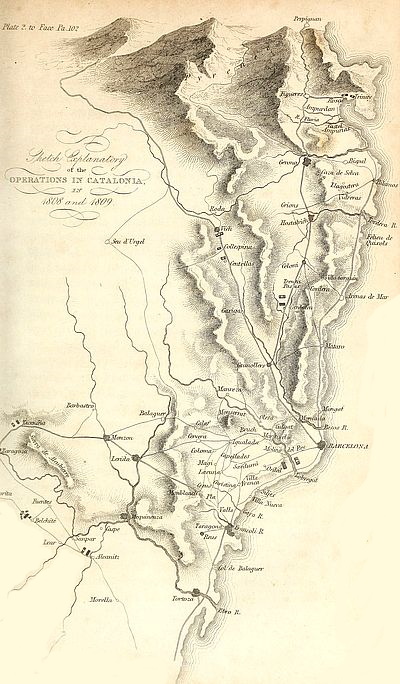 click here for larger image.
Sketch Explanatory of the
OPERATIONS IN CATALONIA
in 1808 and 1809.
London. Published by T. & W. BOONE, July 1829.
Observations.—1º. General St. Cyr’s marches
were hardy, his battles vigorous and delivered in
right time and place; but his campaign, as a whole,
may be characterised as one of great efforts without
corresponding advantages. He himself attributes
this to the condition of the seventh corps, destitute
and neglected, because the emperor disliked and
wished to ruin its chief; a strange accusation, and
unsustained by reason or facts. What! Napoleon
wilfully destroy his own armies! sacrifice forty
thousand men, that a general, who he was not
obliged to employ at all, might be disgraced!
General St. Cyr acknowledges, that when he received
his instructions from the emperor, he observed
the affliction of the latter at the recent loss of
Dupont’s force; yet he would have it believed, that,
in the midst of this regret, that monarch, with a
singular malice, was preparing greater disasters for
himself, merely to disgrace the general commanding
the seventh corps, and why? because the latter
had formerly served with the army of the Rhine!
Yet St. Cyr met with no reverses in Catalonia, and
was afterwards made a marshal by this implacable
enemy.
2º.—That the seventh corps was not well supplied,
and that its commander was thereby placed in a
difficult situation, is not to be disputed in the face
of the facts stated by general St. Cyr; but if war
were a state of ease and smoothness, the fame
which attends successful generals would be less.
Napoleon selected general St. Cyr because he
thought him a capable commander; in feeble hands,
he knew the seventh corps would be weak, but,
with St. Cyr at its head, he judged it sufficient to
overcome the Catalonians; nor was he much mistaken.
Barcelona, the great object of solicitude,
was saved; Rosas was taken; and if Tarragona
and Tortosa did not also fall, the one after the
battle of Molino del Rey, the other after that of
Valls, it was because the French general did not
choose to attack them. Those towns were without
the slightest preparation for defence, moral or
physical, and must have surrendered; nor can the
unexpected and stubborn resistance of Gerona,
Zaragoza, and Valencia be cited against this
opinion. The latter cities were previously prepared
and expectant of a siege; and yet, in every instance,
except Valencia, there was a moment of dismay
and confusion, not fatal, only because the besieging
generals wanted that ready vigour which is the
characteristic of great commanders.
3º.—General St. Cyr, aware that a mere calculation
of numbers and equipment is but a poor
measure of the strength of armies, exalts the enthusiasm
and the courage of the Catalans, and seems
to tremble at the danger which, owing to Napoleon’s
suicidal jealousy, menaced, at that period, not
only the seventh corps but even the south of France.
In answer to this, it may be observed that M. de
St. Cyr did not hesitate, with eighteen thousand
men having no artillery, and carrying only sixty
rounds of musket-ammunition, to plunge into the
midst of those terrible armies, to march through
the mountains for whole weeks, to attack the strongest
positions with the bayonet alone, nay, even to
dispense with the use of his artillery, when he did
bring it into action, lest his men should not have
a sufficient contempt for their enemies. And who
were these undaunted soldiers, so high in courage,
so confident, so regardless of the great weapon of
modern warfare? Not the select of the imperial
guards, the conquerors in a hundred battles, but
raw levies, the dregs and scrapings of Italy, the
refuse of Naples and of Rome, states which to
name as military was to ridicule.
4º.—With such soldiers, the battles of Cardadeu,
Molino, Igualada, and Valls, were gained; yet
general St. Cyr does not hesitate to call the
Migueletes, who were beaten at those places, the
best light troops in the world. The best light
troops are neither more nor less than the best troops
in the world; but if, instead of fifteen thousand
Migueletes, the four thousand men composing Wellington’s
light division had been on the heights of
Cardadeu—general St. Cyr’s sixty rounds of ammunition
would scarcely have carried him to Barcelona.
The injurious force with which personal
feelings act upon the judgement are well known, or it
might excite wonder that so good a writer and so
able a soldier should advance such fallacies.
5º.—General St. Cyr’s work, admirable in many
respects, bears, nevertheless, the stamp of carelessness.
Thus, he affirms that Dupont’s march to
Andalusia encouraged the tumults of Aranjues; but
the tumults of Aranjues happened in the month of
March, nearly three months previous to Dupont’s
movement, which took place in May and June.
Again, he says, that, Napoleon, to make a solid
conquest in the Peninsula, should have commenced
with Catalonia, instead of over-running Spain by the
northern line of operations; an opinion quite unsustainable.
The progress of the seventh corps was
impeded by the want of provisions, not by the
enemy’s force. Twenty thousand men could beat
the Spaniards in the field, but they could not subsist.
What could three hundred thousand men have done?
Would it have given a just idea of Napoleon’s
power to employ the strength of his empire against
the fortified towns in Catalonia? In what would
the greater solidity of this plan have consisted?
While the French were thus engaged, the patriots
would have been organizing their armies; England
would have had time to bring all her troops into
line, and two hundred thousand men placed between
Zaragoza and Tortosa, or breaking into France by
the western Pyrenees, while the Austrians were
advancing to the Rhine, would have sorely shaken
the solidity of general St. Cyr’s plan.
6º.—The French emperor better understood what
he was about; he saw a nation intrinsically powerful
and vehemently excited, yet ignorant of war, and
wanting the aid which England was eager to give.
All the elements of power existed in the Peninsula,
and they were fast approximating to a centre, when
Napoleon burst upon that country, and as the
gathering of a water-spout is said to be sometimes
prevented by the explosion of a gun, so the rising
strength of Spain was dissipated by his sudden and
dreadful assault. If the war was not then finished,
it was because his lieutenants were tardy and
jealous of each other.
7º.—St. Cyr appears to have fallen into an
error, common enough in all times, and one very
prevalent among the French generals in Spain.
He considered his task as a whole in itself, instead
of a constituent part of a greater system. He
judged very well what was wanting for the seventh
corps, to subjugate Catalonia in a solid manner, but
he did not discern that it was fitting that the
seventh corps should forget Catalonia, to aid the general
plan against the Peninsula. Rosas surrendered
at the very moment when Napoleon, after the
victories of Baylen, Espinosa, Tudela, and the Somosierra,
was entering Madrid as a conqueror. The
battles of Cardadeu and Molino del Rey may,
therefore, be said to have completely prostrated
Spain, because the English army was isolated, the
Spanish army destroyed, and Zaragoza invested.
Was that a time to calculate the weight of powder
and the number of pick-axes required for a formal
siege of Tarragona? The whole Peninsula was
shaken to the centre, the proud hearts of the Spaniards
sunk with terror, and in that great consternation,
to be daring, was, on the part of the
French generals, to be prudent. St. Cyr was
not in a condition to besiege Tarragona, formally,
but he might have assaulted it with less danger
than he incurred by his march to Barcelona. The
battle of Valls was another epoch of the same
kind; the English army had re-embarked, and the
route of Ucles had taken place. Portugal was invaded
and Zaragoza had just fallen. That was a
time to render victory fruitful, yet no attempt was
made against Tortoza.
8º.—St. Cyr, who justly blames Palacios and
Vives for remaining before Barcelona instead of
carrying their army to the Ter and the Fluvia,
seems inclined to applaud Reding for conduct
equally at variance with the true principles of war.
It was his own inactivity after the battle of Molino
that produced the army of Reding, and the impatient
folly of that army, and of the people, produced
the plan which led to the route of Igualada and
the battle of Valls. But, instead of disseminating
his thirty thousand men on a line of sixty miles,
from Tarragona to the Upper Llobregat, Reding
should have put Tarragona and Tortosa into a state
of defence, and, leaving a small corps of observation
near the former, have made Lerida the base of his
operations. In that position, and keeping the bulk
of his force in one mass, he might have acted on
St. Cyr’s flanks and rear effectually, by the road
of Cervera—and without danger to himself; nor
could the French general have attempted aught
against Tarragona.
But it is not with reference to the seventh corps
alone that Lerida was the proper base of the
Spanish army. Let us suppose that the supreme
junta had acted for a moment upon a rational
system; that the Valencian troops, instead of remaining
at Morella, had been directed on Mequinenza
and that the duke of Infantado’s force had
been carried from Cuença to the same place instead
of being routed at Ucles. Thus, in the beginning
of February, more than fifty thousand regular troops
would have been assembled at Lerida, encircled by
the fortresses of Monzon, Balaguer, Mequinenza,
Tarragona, and Tortoza. Its lines of operations
would have been as numerous as the roads.
The Seu d’Urgel, called the granary of Catalonia,
would have supplied corn, and the communication
with Valencia would have been direct and open.
On this central and impregnable position such a
force might have held the seventh corps in check,
and also raised the siege of Zaragoza; nor could the
first corps have followed Infantado’s movements
without abandoning the whole of the emperor’s
plans against Portugal and Andalusia.
9º.—St. Cyr praises Reding’s project for surrounding
the French, and very gravely observes
that the only method of defeating it was by taking
the offensive himself. Nothing can be juster; but
he should have added that it was a certain method;
and, until we find a great commander acting upon
Reding’s principles, this praise can only be taken
as an expression of civility towards a brave adversary.
St. Cyr’s own movements were very different;
he disliked Napoleon personally, but he did not
dislike his manner of making war. Buonaparte’s
campaign in the Alps against Beaulieu was not an
unheeded lesson. There is, however, one proceeding
of St. Cyr’s for which there has been no precedent,
and which it is unlikely will ever be imitated,
St. Cyr.
namely, the stopping of the fire of the artillery
when it was doing infinite execution, that a moral
ascendancy over the enemy might be established.
It is impossible to imagine a more cutting sarcasm
on the courage of the Catalans than this fact;
yet, general St. Cyr states that his adversaries
were numerous, and fought bravely. Surely he
could not have commanded so long without knowing
that there is in all battles a decisive moment,
when every weapon, every man, every combination of
force that can be brought to bear, is necessary to
gain the victory.
10º.—If general St. Cyr’s own marches and battles
did not sufficiently expose the fallacy of his
opinions relative to the vigour of the Catalans, lord
Collingwood’s correspondence would supply the
deficiency. That able and sagacious man, writing
at this period says,—
“In Catalonia, every thing seems to have gone
wrong since the fall of Rosas. The Spaniards are
in considerable force, yet are dispersed and panic-struck
whenever the enemy appears.”—“The applications
for supplies are unlimited; they want
money, arms, and ammunition, of which no use
appears to be made when they get them.”—“In
the English papers, I see accounts of successes, and
convoys cut off, and waggons destroyed, which are
not true. What has been done in that way has
been by the boats of our frigates, which have, in
two or three instances, landed men and attacked the
enemy with great gallantry. The Somatenes range
the hills in a disorderly way, and fire at a distance,
but retire on being approached.”—“The multitudes
of men do not make a force.”
Add to this the Spanish historian Cabane’s statements
that the Migueletes were always insubordinate,
detested the service of the line, and were
many of them armed only with staves, and we
have the full measure of the Catalans’ resistance.
11º.—It was not the vigour of the Catalans, but
of the English, that in this province, as in every
part of the Peninsula, retarded the progress of the
French. Would St. Cyr have wasted a month before
Rosas? Would he have been hampered in his
movements by his fears for the safety of Barcelona?
Would he have failed to besiege and take Tarragona
and Tortosa, if a French fleet had attended
his progress by the coast, or if it could even have
made two runs in safety? To lord Collingwood,
who, like the Roman Bibulus, perished of sickness
on his decks rather than relax in his watching,—to
his keen judgement, his unceasing vigilance, the resistance
made by the Catalans was due. His fleet
it was that interdicted the coast-line to the French,
protected the transport of the Spanish supplies from
Valencia, assisted in the defence of the towns, aided
the retreat of the beaten armies; in short, did that
which the Spanish fleets in Cadiz and Carthagena
should have done. But the supreme junta, equally
disregarding the remonstrances of lord Collingwood,
the good of their own country, and the treaty with
England, by which they were bound to prevent
their ships from falling into the hands of the enemy,
left their fleets to rot in harbour, although money
was advanced, and the assistance of the British
seamen offered, to fit them out for sea.
Having now related the principal operations that
took place in the eastern and central provinces of
Spain, which were so suddenly overrun by the
French emperor; having shown that, however restless
the Spaniards were under the yoke imposed
upon them, they were unable to throw it off; I
shall turn to Portugal, where the tide of invasion
still flowing onward, although with diminished
volume, was first stayed, and finally overpowered
and forced back, by a counter flood of mightier
strength.
BOOK VI. — CHAPTER I. — TRANSACTIONS IN PORTUGAL.
When sir John Moore marched from Portugal,
the regency, established by sir Hew Dalrymple,
nominally governed that country; but the weak
characters of the members, the listless habits engendered
by the ancient system of misrule, the
intrigues of the Oporto faction, and the general
turbulence of the people soon produced an alarming
state of anarchy. Private persons usurped the
functions of government, justice was disregarded,
insubordination and murder were hailed as indications
of patriotism. War was the universal cry,
but military preparations were wholly neglected;
Appendix, No. 3, section 1.
for the nation, in its foolish pride, believed that the
French had neither strength nor spirit for a second
invasion.
In Lisbon there was a French faction. The merchants
were apprehensive, the regency was unpopular,
the public mind unsettled; and, in Oporto,
the violence of both people and soldiers was such,
that sir Harry Burrard sent two British regiments
there, by sea, to preserve tranquillity; in fine, the
seeds of disorder were widely cast and sprouting
vigorously before the English cabinet thought fit
to accredit a responsible diplomatist near the government,
or to place a permanent chief at the head of
the forces left by sir John Moore. The convention
of Cintra was known in England in September.
The regency was established and the frontier fortresses
occupied by British troops in the same
month; yet it was not until the middle of December
that Mr. Villiers and sir John Cradock, charged
with the conduct of the political and military proceedings
in Portugal, reached Lisbon, and thus the
important interval, between the departure of Junot
and their arrival, was totally neglected by the
English cabinet.
Sir Hew Dalrymple, who had nominated the
regency; sir Arthur Wellesley, who, to local knowledge
and powerful talents, added the influence of
a victorious commander; Burrard, Spencer, were
all removed from Portugal at the very moment
when the presence of persons acquainted with the
real state of affairs was essential to the well-being
of the British interests in that country; and this
error was the offspring of passion and incapacity;
for, if the convention of Cintra had been rightly
understood, the ministers, appreciating the advantages
of that treaty, would have resisted the clamour
of the moment, and the generals would not have
been withdrawn from the public service abroad
to meet unjust and groundless charges at home.
It may be disputed whether Portugal was the
fittest theatre for the first operations of a British
army; but, when that country was actually freed
from the presence of an enemy; when the capital
and the frontier fortresses were occupied by English
troops; when sir John Moore leaving his hospitals,
baggage, and magazines there, as in a place of
arms, had marched to Spain, the question was no
longer doubtful. The ancient relations between
England and Portugal, the greatness of the port of
Lisbon, the warlike disposition of the Portuguese,
and, above all, the singularly-happy circumstance
that there was neither court nor monarch to balance
the English influence, and that even the nomination
of the regency was the work of an English general,
offered such great and obvious advantages as could
no where else be obtained. It was a miserable
policy that, neglecting such an occasion, retained
sir Arthur Wellesley in England, while Portugal,
like a drunken man, at once weak and turbulent,
was reeling on the edge of a precipice.
The 5th of December sir John Cradock, being
on his voyage to Lisbon, touched at Coruña. Fifteen
hundred thousand dollars had just arrived
there in the Lavinia frigate; but, sir John Moore’s
intention to retreat upon Portugal being known,
Cradock divided this sum, and carried away eight
hundred thousand dollars, proposing to leave a
portion at Oporto, and to take the remainder to
Lisbon, that Moore might find, on whatever line he
retreated, a supply of money.
From Coruña he proceeded to Oporto, and landed
to gather information of the state of affairs. Here
he found that sir Robert Wilson had succeeded in
organizing, under the title of the Lusitanian Legion,
about thirteen hundred men, and that others were
Appendix, No. 3, section 2.
on their way to reinforce him; but, this excepted,
nothing at Oporto, civil or military, bespoke either
arrangement or common sense. The bishop, still
intent upon acquiring supreme rule, was deeply
engaged with secret intrigues, and, under him, a
number of factious and designing persons instigated
the populace to violent actions, with a view to profit
from their excesses.
The formation of the Lusitanian Legion was
originally a project of the chevalier da Souza, the
Portuguese minister in London. Souza was one of
the bishop’s faction, and the prelate calculated upon
this force not so much to repel the enemy as to give
weight to his own party against the government.
The men were promised higher pay than any other
Portuguese soldiers, to the great discontent of the
latter, and they were clad in uniforms differing in
colour from the national troops. The regency, who
dreaded the machinations of the turbulent priest,
entertained the utmost jealousy of the legion, which,
in truth, was a most anomalous force, and, as might
be expected from its peculiar constitution, was productive
of much embarrassment.
Sir John Cradock left three hundred thousand
dollars at Oporto, and having directed the two
British battalions which were in that neighbourhood
to march to Almeida, he took on board a small detachment
of German troops, and set sail for Lisbon;
but, before his departure, he strongly advised sir
Robert Wilson to move such of his legionaries as
were sufficiently organized to Villa Real, in Tras os
Montes, a place appointed by the regency for the
Appendix, No. 6, section 1.
assembly of the forces in the north. Sir Robert,
tired of the folly and disgusted with the insolence
and excesses of the ruling mob, readily adopted
this advice, so far as to quit Oporto, but, having
views of his own, took the direction of Almeida
instead of Villa Real.
The state of the capital was little better than
that of Oporto. There was arrangement neither
for present nor for future defence, and the populace,
Appendix, No. 3, section 5.
albeit less openly encouraged to commit excesses,
were quite uncontrolled by the government. The
regency had a keener dread of domestic insurrection
than of the return of the French, whose operations
they regarded with even less anxiety than the bishop
did, as being further removed than he was from
the immediate theatre of war. Their want of system
and vigilance, evinced by the following fact,
was truly surprising. Sattaro and another person,
having contracted for the supply of the British
troops, demanded, in the name of the English
general, all the provisions in the public stores of
Portugal, and then sold them to the English commissaries
for his own profit.
Sir John Cradock’s instructions directed him to
reinforce sir John Moore’s army, and, if the course
of events should bring that general back to Portugal,
he was not to be interfered with. In fact,
Cradock’s operations were limited to the holding of
Elvas, Almeida, and the capital; for, although he
was directed to encourage the formation of a native
army upon a good and regular system, and even to
act in concert with it on the frontier, he was
Appendix, No. 4, section 1.
debarred from political interference; and even his
relative situation, as to rank, was left unsettled
until the arrival of Mr. Villiers, to whose direction
all political and many military arrangements were
entrusted.
It is evident that the influence of a general thus
fettered, and commanding only a small force, which
was moreover much scattered, must be feeble and
insufficient to produce any real amelioration in the
military situation of the country. But the English
ministers, attentive to the false information obtained
from interested agents, still imagined that not only
the Spanish, but the Portuguese armies were numerous,
and to be relied upon; and they confidently
expected, that the latter would be able to take an
active part in the Spanish campaign.
Cradock, feeling the danger of this illusion, made
it his first object to ascertain, and to transmit home,
exact information of the real strength and efficiency
of the native regular troops. They were nominally
twenty thousand; but Miguel Percira Forjas, military
secretary to the regency, and the ablest public
man Portugal possessed, acknowledged that this
force was a nullity, and that there were not more
Cradock’s Correspondence, MSS.
than ten thousand stand of serviceable arms in the
kingdom, the greatest part of which were English.
The troops themselves were undisciplined and unruly;
and the militia and the “ordenanza,” or armed peasantry,
animated rather by a spirit of outrage than
of enthusiasm, evinced no disposition to submit to
regulation, neither was there any branch of administration
free from the grossest disorder.
The Spanish dollar had a general acceptance in
Portugal. The regency, under the pretence that a
debased foreign coin would drive the Portuguese
coin out of circulation, deprived the dollar of its
current value. This regulation, true in principle,
and applicable, as far as the Portuguese gold coin
(which is of peculiar fineness) was concerned, had,
however, a most injurious effect. The Spanish
dollar was in reality finer than the Portuguese silver
cruzado-nova, and would finally have maintained
its value, notwithstanding this decree. But a slur
being thus thrown upon it by the government, the
money changers contrived to run its value down for
the moment, a matter of infinite importance; for
the English soldiers and sailors being all paid in
these dollars, at four shillings and sixpence, which
was the true value, were thus suddenly mulcted four-pence
in each, by the artificial depreciation of the
moment. The men attributed this to fraud in the
shopkeepers; the retail trade of Lisbon was interrupted,
and quarrels between the tradesmen and the
soldiers took place hourly.
To calm this effervescence, a second decree was
promulgated, directing that the dollar should be
received at the mint and in the public offices at its
real value. It then appeared that the government
could profit by coining the dollar of four shillings
and sixpence into cruzado-novas, a circumstance
which gave the whole affair the appearance of an
unworthy trick to recruit the treasury. This happened
in October; and as the financial affairs were
ill managed, and the regency destitute of vigour or
capacity, the taxes were unpaid, the hard cash
exhausted, and the treasury paper at a heavy discount
when Cradock arrived. Upon the scroll thus
unfolded he could only read confusion, danger, and
misfortune; for such being the fruits of victory,
what could be expected from disaster; and at this
period (the middle of December) sir John Moore
was supposed to be in full retreat upon Portugal,
followed by the emperor with one French army, while
another threatened Lisbon by the line of the Tagus.
The English troops in the kingdom did not amount
to ten thousand men, including the sick, and they
were ill equipped and scattered; moreover, the capital
was crowded with women and children, with
baggage and non-combatants, belonging as well to
the army in Spain as to that in Portugal.
There were in the river three Portuguese ships of
the line, two frigates, and eight other smaller vessels
of war; but none were in a state for sea, and the
whole likely to fall into the hands of the enemy: for
in the midst of this confusion sir Charles Cotton was
recalled, without a successor being appointed; and
although the zeal and talents of captain Halket, the
senior officer on the station, amply compensated for
the departure of the admiral, as far as professional
duties were concerned, he could not aid the general,
nor deal with the regency as vigorously as an officer
of higher rank, and formally accredited, could have
done.
Sir John Cradock, although fully sensible of his
own difficulties, with a very disinterested zeal, resolved
to make the reinforcing of sir John Moore’s
army his first care; but his force at this time was,
as I have already said, less than ten thousand men
of all arms. It consisted of eight British and four
German battalions of infantry, four troops of dragoons,
and thirty pieces of artillery, of which, however, only
Sir J. Cradock’s Papers, MSS.
six were horsed so as to take the field. There was,
also, a battalion of the 60th regiment, but it was
composed principally of Frenchmen, recruited from
the prison ships, and had been sent back from Spain,
as the soldiers could not be trusted near their countrymen.
Of these thirteen battalions two were in Abrantes,
one in Elvas, three at Lamego on the Duero, one in
Almeida, and the remaining six at Lisbon. Three
of the four battalions in the north were immediately
directed to join sir John Moore by the route of Salamanca;
and of those in the south, two, accompanied
by a demi-brigade of artillery, were sent to him from
Abrantes, by the road of Castello Branco and Ciudad
Rodrigo.
The 19th of December, Mr. Villiers having arrived,
sir John Cradock forwarded to the regency a strong
representation of the dangerous state of Portugal.
He observed that there was neither activity in the
government nor enthusiasm among the people; that
the army, deficient in numbers, and still more so in
discipline, was scattered and neglected; and, notwithstanding
that the aspect of affairs was so threatening,
the regency were apparently without any
Sir J. Cradock’s Correspondence, MSS.
system, or fixed principle of action. He proposed,
therefore, that a general enrolment of all the people
should take place; and from the British stores he
offered a supply of a thousand muskets and ten
thousand pikes. This giving of pikes to the people
appears to have been in compliance with Mr. Villiers’
wishes, and betrayed more zeal than prudence; for
certainly a general levy and arming with pikes of
the turbulent populace of a capital city, at such a
conjuncture, was more likely to lead to confusion
and mischief than to any effectual defence. But
the main objects pressing upon the general’s attention
were sufficiently numerous and contradictory
to render it difficult for him to avoid errors.
It was a part of his instructions, and of manifest
importance, to send reinforcements to sir John
Moore. But it was equally necessary to keep a
force towards the frontier on the line of the Tagus,
seeing that the fourth French corps had just passed
Appendix, No. 2, section 1.
that river at Almaraz, had defeated Galluzzo’s army
and menaced Badajos, which was without arms,
ammunition, or provisions; and, moreover, the
populace there were in commotion, and slaying the
chief persons. Now, sir John Cradock’s instructions
directed him to keep his troops in a position that
would enable him to abandon Portugal, if a very
superior force should press him; but as, in such a
case, he was to carry off not only the British army,
but the Portuguese navy and stores, to destroy what
he could not remove, and to receive on board his
Appendix, No. 4, section 1.
ships all the natives who might be desirous of
escaping, it was of pressing necessity to ship the
women, children, and baggage, in fine, all the
encumbrances belonging to Moore’s army, immediately,
that his own rear might be clear for a
sudden embarkation. In short, he was to send his
troops to Spain, and yet defend Portugal; to excite
confidence in the Portuguese, and yet openly to
carry on the preparations for abandoning that
country.
The populace of Lisbon were, however, already
uneasy at the rumours of an embarkation, and it
was doubtful if they would permit even the British
non-combatants to get on board quietly, much less
suffer the forts to be dismantled, and the ships of
war to be carried off, without a tumult, which, at
such a conjuncture, would have been fatal to all
parties. Hence it was imperative to maintain a
strong garrison in Lisbon and in the forts commanding
the mouth of the river; and this draft, together
with the troops absorbed by the fortresses of Almeida
and Elvas, reduced the fighting men in the field to
insignificance.
The regency, knowing the temper of the people
and fearing to arm them, were not very eager to
enforce the levy; yet, anxious to hide their weakness,
they promised, at the urgent solicitations of
the English general, to send six thousand troops to
Alcantara, on the Spanish frontier, with a view to
observe the march of the fourth corps,—a promise
which they never intended, and indeed were unable,
to perform. Forjas, who was supposed to be
very inimical to the British influence, frankly declared
Sir J. Cradock’s Correspondence, MSS.
that they neither could nor would move
without an advance of money, and sir John Cradock,
although he recommended that this aid should
be given, had no power to grant it himself.
Letters from sir John Moore, dated at Salamanca,
now reached Lisbon: they increased the anxiety to
reinforce the army in Spain; but, as they clearly
showed that reverses were to be expected, Cradock,
although resolved to maintain himself in Portugal
as long as it was possible to do so without a breach
of his instructions, felt more strongly that timely
preparation for an embarkation should be made,
especially as the rainy season, in which south-west
winds prevail, had set in, and rendered the departure
of vessels from the Tagus very uncertain.
Meanwhile the internal state of Portugal was in
no wise amended, or likely to amend.
The government had, indeed, issued a decree, on
the 23d of December, for organizing the population
of Lisbon in sixteen legions, but only one battalion
each was to parade at the same moment for exercise,
and those only on Sundays, nor were the legions,
at any time, to assemble without the order of the
general commanding the province; and this regulation,
which rendered the whole measure absurd, was
dictated by the fears of the regency.
A proposal to prepare the Portuguese vessels for
sea was acceded to, without any apparent dissatisfaction;
but the government, secretly jealous of
their allies, fomented or encouraged discontent and
suspicion among the people. No efforts were made
to improve the regular force, none to forward the
march of troops to Alcantara; and so inactive or
so callous were the regency to the rights of humanity,
that a number of French prisoners, captured
Appendix, No. 3, section 4.
at various periods by the Portuguese, and accumulated
at Lisbon, were denied subsistence. Sir John
Cradock, after many fruitless representations, was
forced to charge himself with their supply, to avert
the horrors of seeing them starved to death. The
Appendix, No. 3, section 5.
provisions necessary for Fort La Lippe were also
withheld, and general Leite, acting upon the authority
of the regency, strenuously urged that the
British troops should evacuate that fortress.
The march of the reinforcements for sir John
Moore left only three hundred dragoons and seven
battalions available for the defence of Portugal, of
which four were necessarily in garrison, and the
remainder were unable to take the field, in default
of mules, of which animal the country seemed
bereft; yet, at this moment, as if in derision, Mr.
Frere, the central junta, the junta of Badajos, and
the regency of Portugal, were, with common and
Sir J. Cradock’s Correspondence, MSS.
characteristic foolishness, pressing sir John Cradock
to march into the south of Spain, although there
was scarcely a Spanish soldier there in arms to
assist him; and such a movement, if it had been
either prudent or practicable, was directly against
his instructions.
Towards the end of December, the communication
with sir John Moore was suddenly interrupted,
and the line of the Tagus acquired greater importance.
The troops going from Elvas to the army in
Spain were, therefore, directed to halt at Castello
Branco, and general Richard Stewart, who commanded
them, being reinforced with two hundred
cavalry, was ordered, for the moment, to watch the
Sir J. Cradock’s Correspondence, MSS.
roads by Salvatierra and the two Idanhas, and to
protect the flying bridges at Abrantes and Vilha
Velha from the enemy’s incursions. At the same
time, a promise was obtained from the regency that
all the Portuguese troops in the Alemtejo should
be collected, at Campo Mayor and Portalegre.
Sir John Cradock fixed upon Sacavem as the
position in which his main body should be concentrated,
intending to defend that point as long as he
could with so few troops; and, as he knew that
Almeida, although full of British stores, and important
in every way, was, with respect to its own
defence, utterly neglected by the regency, and
that even the presence of a British force there
was viewed with jealousy, he sent brigadier-general
A. Cameron, with instructions to collect
the convalescents of Moore’s army, to unite
them with the two battalions still at Almeida, and
then to make his way to the army in Spain; but if
the attempt should be judged too dangerous, Cameron
was to return to Lisbon. In either case, the
stores and the sick men lying at Almeida were to
be directed upon Oporto.
The paucity of cavalry was severely felt on
the frontier. It prevented the general from ascertaining
the real strength and objects of the enemy’s
parties, and the Portuguese reports were notoriously
contradictory and false. The 14th dragoons, seven
hundred strong, commanded by major-general Cotton,
had been disembarked since the 22d of December,
Sir J. Cradock’s Correspondence, MSS.
and were destined for the army in Spain; but
such was the penury of the country, or the difficulty
of drawing forth its resources, that the commissary-general
doubted if he could forward that small
body, even by detachments. Nor is this surprising,
for many of the debts left by Moore’s
army were yet unpaid, and sufficient confidence was
not established among the peasantry to induce
them to bring forward the necessary supplies upon
credit.
Rumours of reverses in Spain were now rife, and
acquired importance, when it became known that
four thousand infantry, and two thousand cavalry,
the advanced guard of thirty thousand French
troops, were actually at Merida, on the road to
Badajos, which town, as I have already said, was
not only in a state of anarchy, but destitute of provisions,
arms, and ammunition. If, at this time,
the Portuguese force had been assembled at Alcantara,
sir John Cradock would have supported them
with the British brigades, at Abrantes and Castello
Branco; but not a man had been put in motion,
and he, feeling no confidence either in the troops
or in the promises of the regency, resolved to concentrate
his own army near Lisbon. General Stewart
was, therefore, directed to destroy the bridges of
Vilha Velha and Abrantes, and to fall back to
Sacavem.
Meanwhile, the Lisbon populace, supposing that
the English general designed to abandon them
without necessity, were violently excited. The
regency, either from fear or folly, made no effort
to preserve tranquillity, and the people, feeling
their own strength, proceeded from one excess to
another, until it become evident that, in a forced
embarkation, the British would have to fight their
allies as well as their enemies. At this gloomy
period when ten marches would have brought
the French to Lisbon, when a stamp of Napoleon’s
foot would have extinguished that spark of war
which afterwards blazed over the Peninsula, sir
John Moore made his daring movement upon
Sahagun; and Portugal, gasping as in a mortal
agony, was instantly relieved.
CHAPTER II. — NEGOTIATION FOR THE OCCUPATION OF CADIZ.
It was the advanced guard of the fourth corps
that had approached Merida with the intention of
proceeding to Badajos, and the emperor was, as
we have seen, preparing to follow: but, in the
night of the 26th of December, an officer carrying
Appendix, No. 2, sections 1 and 2.
the intelligence of Moore’s movement, reached
Merida, and, next morning, the French fell back,
and marching hastily to the Tagus, crossed it, and
rejoined their main body, from which another
powerful detachment was immediately directed
upon Placentia. This retrograde movement obviated
the immediate danger; and sir John Cradock
endeavoured to pacify the people of Lisbon.
He ordered general Stewart’s brigade, strengthened
by two German battalions, to halt at Santarem. He
explained his own motives to the Portuguese, and
urged the regency to a more frank and vigorous
system than they had hitherto followed; for, like
the Spanish juntas, they promised every thing, and
performed nothing; neither would they, although
Appendix, No. 3, section 5.
consenting, verbally, to all the measures proposed,
ever commit themselves by writing, having the
despicable intention of afterwards disclaiming that
which might prove disagreeable to the populace, or
even to the French. Sir John Cradock, however,
had no power beyond his own personal influence to
enforce attention to his wishes. No successor to
sir Charles Cotton had yet arrived, and Mr. Villiers
seems to have wanted the decision and judgement
required to meet such a momentous crisis.
In the north general Cameron, having sent the
sick men and part of the stores from Almeida towards
Oporto, gave up that fortress to sir Robert
Wilson; and, on the 5th of January, marched, with
two British battalions and a detachment of convalescents,
by the Tras os Montes to join the army in
Spain. On the 9th, hearing of sir John Moore’s
retreat to Coruña, he would have returned to Almeida,
but Lapisse, who had taken Zamora, threatened
to intercept the line of march; wherefore,
Cameron turned towards Lamego, giving notice of
his movement to sir Robert Wilson, and advising
him also to retire to the same place. Colonel
Blunt, with seven companies of the 3d regiment,
escorting a convoy for sir John Moore’s army, was
likewise forced to abandon his route, and take the
road to Oporto, on which town every thing British
in the north of Portugal was now directed.
Notwithstanding the general dismay, sir Robert
Wilson rejected Cameron’s advice, and, being reinforced
by some Spanish troops, Portuguese volunteers,
and straggling convalescents, belonging to
Moore’s army, proceeded to put in practice all the
arts of an able partizan. Issuing proclamations,
enticing the French to desert, spreading false
reports of his numbers, and, by petty enterprizes
and great activity, arousing a spirit of resistance
throughout the Ciudad Rodrigo country.
The continued influx of sick and stores at Oporto,
together with the prospect of general Cameron’s
arrival there, became a source of uneasiness to sir
John Cradock. Oporto, with a shifting-bar and
shoal water is the worst possible harbour for vessels
to clear out, and one of the most dangerous for
vessels to lie off, at that season of the year; hence,
if the enemy advanced in force, a great loss, both
of men and stores, was to be anticipated.
The departure of sir Charles Cotton had diminished
the naval means at captain Halket’s disposal, and,
for seventeen successive days, such was the state of
Sir John Cradock’s Correspondence, MSS.
the wind that no vessel could leave the Tagus; he,
however, contrived at last to send tonnage for two
thousand persons, and undertook to keep a sloop of
war off Oporto. Sir Samuel Hood also despatched
some vessels from Vigo, but the weather continued
for a long time so unfavourable that these transports
could not enter the harbour of Oporto, and the
encumbrances hourly increasing, at last produced
the most serious embarrassments.
Sir John Moore having now relinquished his
communications with Portugal, sir John Cradock
had to consider how, relying on his own resources,
he could best fulfil his instructions and maintain his
hold of that country, without risking the utter
destruction of the troops intrusted to his care.
For an inferior army Portugal has no defensible
frontier. The rivers, generally running east and
west, are fordable in most places, subject to sudden
rises and falls, offering but weak lines of resistance;
and with the exception of the Zezere, presenting
no obstacles to the advance of an enemy penetrating
by the eastern frontier. The mountains, indeed,
afford many fine and some impregnable positions, but
such is the length of the frontier line and the difficulty
of lateral communications, that a general
who should attempt to defend it against superior
forces would risk to be cut off from the capital, if
he concentrated his troops; and if he extended
them his line would be immediately broken.
The possession of Lisbon constitutes, in fact, the
possession of Portugal, south of the Duero, and an
inferior army can only protect Lisbon by keeping
close to that capital. Sensible of this truth, sir
John Cradock adopted the French colonel Vincente’s
views for the defence of Lisbon; and
proceeded, on the 4th of January, with seventeen
hundred men to occupy the heights behind the
creek of Saccavem—leaving, however, three thousand
men in the forts and batteries at Lisbon.
At the earnest request of the regency, who in
return promised to assemble the native troops at
Thomar, Abrantes, and Vilha Velha, general Stewart’s
brigade, two thousand seven hundred strong,
Sir J. Cradock’s Correspondence, MSS.
was ordered to halt at Santarem. But it had been
marching incessantly for a month, and in the rain,
the men’s clothes were worn out, their accoutrements
nearly destroyed, and in common with the
rest of the army, they were suffering severely from
the want of shoes.
Thus, Cameron being on the Douro, the main
body between Santarem and Lisbon, and colonel
Kemmis at Elvas, with the fortieth regiment,
an army of ten thousand men—with the encumbrances
of an army of forty thousand—was placed
on the three points of a triangle, the shortest
side of which was above a hundred and fifty
miles. The general commanding could not bring
into the field above five thousand men; nor could
that number be assembled in a condition for service
at any one point of the frontier, under three weeks
or a month; moreover, the uncertainty of remaining
in the country at all, rendered it difficult to feed the
troops, for the commissaries being unable to make
large contracts for a fixed time, were forced to carry
on, as it were, a retail system of supply.
Mr. Frere, however, with indefatigable folly, was
urging sir John Cradock to make a diversion in
Spain; and while Mr. Frere was calling for troops
in the south, Mr. Villiers was as earnest that a force
might be sent by sea to Vigo. The minister’s instructions
prescribed the preservation of Lisbon,
Elvas, and Almeida; the assembling, in concert with
the Portuguese government, a combined force on
the frontier, and the sending succours of men to
Moore; but although sir John Cradock’s means
were so scanty that the fulfilment of any one of
these objects was scarcely possible, Mr. Canning
writing officially to Mr. Villiers at this epoch, as if
a mighty and well supplied army was in Portugal,
enforced the “necessity of continuing to maintain
possession of Portugal, as long as could be done
with the force intrusted to sir John Cradock’s command,
remembering always that not the defence of
Portugal alone, but the employment of the enemy’s
military force, and the diversion which would be
thus created in favour of the south of Spain, were
objects not to be abandoned, except in case of the
most extreme necessity.” The enemy’s military
force! It was three hundred thousand men, and
this despatch was a pompous absurdity; but the
ministers and their agents, eternally haunted by the
phantoms of Spanish and Portuguese armies, were
incapable of perceiving the palpable bulk and substance
of the French hosts. The whole system of the
cabinet was one of shifts and expedients; every week
produced a fresh project,—minister and agent,
alike, followed his own views, without reference to
any fixed principle: and the generals were the only
persons not empowered to arrange military operations.
The number of officers despatched to seek information
of the French movements enabled sir John
Cradock, notwithstanding the direct communications
were cut off, to obtain intelligence of Moore’s
advance towards Sahagun, and being still anxious
to assist that general, he again endeavoured to send
a reinforcement into Spain, by the route of Almeida;
but the difficulty of obtaining supplies
finally induced him to accede to Mr. Villiers’
wishes, and he shipped six hundred cavalry, and
Sir J. Cradock’s Correspondence, MSS.
thirteen hundred infantry, on the 12th of January,
meaning to send them to Vigo; the vessels were,
however, still in the river, when authentic intelligence
of sir John Moore’s retreat upon Coruña with
the intention of embarking there, was received, and
rendered this project useless.
The 14th of January the Conqueror line-of-battle-ship,
having admiral Berkeley on board, reached
the Tagus, and for the first time since sir John
Cradock’s Paper, MSS.
Cradock took the command of the troops in Portugal,
he received a communication from the ministers
in England.
It now appeared that their thoughts were less
intently fixed upon the defence of Portugal, than
upon getting possession of Cadiz. Their anxiety
upon this subject had somewhat subsided after the
battle of Vimeira, but it revived with greater vigour
when sir John Moore, contemplating a movement
in the south, suggested the propriety of securing
Cadiz as a place of arms; and in January an expedition
was prepared to sail for that town, with the
design of establishing a new base of operations for
the English army. The project failed, but the
transaction deserves notice, as affording proof of the
perplexed and unstable policy of the day.
Papers laid before Parliament, 1810.
While it was still unknown in England that the
supreme junta had fled from Aranjuez, sir George
Smith, who had conducted Spencer’s negotiation
in 1808, was sent to Cadiz to prepare the
way for the reception of an English garrison. Four
thousand men destined for that service were soon
afterwards embarked at Portsmouth, under the
command of general Sherbrooke, but this officer’s
instructions were repeatedly altered. He was first
directed to touch at Lisbon in his way to Cadiz;
he was afterwards commanded to make for Coruña,
to receive orders from sir John Moore, but, on the
14th of January, his force being increased to five
thousand men, he sailed under his first instructions;
and Mr. Frere was directed to negotiate for the admission
of these troops into Cadiz, as the only condition
upon which a British army could be employed to aid
the Spanish cause in that part of the Peninsula.
When the reverses in the north of Spain became
known, the importance of Cadiz increased, and
the importance of Portugal decreased in the eyes
of the English ministers. Sir John Cradock was
Appendix, No. 8.
then made acquainted with Sherbrooke’s destination;
he was himself commanded to obey any
requisition for troops that might be made by the
Appendix, No. 5.
Spanish junta; and so independent of the real
state of affairs were the ministerial arrangements,
that Cradock, whose despatches had been one continued
complaint of his inability to procure horses
for his own artillery, was directed to furnish them
for Sherbrooke’s.
Sir George Smith, a man somewhat hasty, but
of remarkable zeal and acuteness, left England
about the middle of December; and, on his arrival
at Cadiz, at once discovered that there, as in every
other part of the Peninsula, all persons being
engaged in theories or intrigues, nothing useful for
defence was executed. The ramparts of the city
were in tolerable condition, but scarcely any guns
were mounted; and yet, two miles in front of the
town, an outwork had been commenced upon such
a scale that it could not possibly be finished under
four months; and, after the slow mode of Spanish
proceedings, would have taken as many years to
complete.
For a solid defence of all the fortifications, sir
George Smith judged that twenty thousand good
troops would be requisite, but that ten thousand
would suffice for the city. There were, however,
only five thousand militia and volunteers in the
place, and not a regular soldier under arms, neither
any within reach. The number of guns mounted
and to be mounted exceeded four hundred; to serve
them, two hundred and fifty peasants and volunteers
were enrolled, and, being clothed in uniforms, were
called artillery-men.
Knowing nothing of sir John Moore’s march to
Sahagun, sir George Smith naturally calculated
upon the immediate approach of the French; and
seeing the helpless state of Cadiz, and being
assured that the people would willingly admit an
English garrison, he wrote to sir John Cradock for
troops. The latter, little thinking that, at such
a conjuncture, the supreme junta would be more
Sir J. Cradock’s Correspondence, MSS.
jealous of their allies than fearful of their enemies;
and judging also, from the tenor of his latest instructions,
that obedience to this requisition would
be consonant to the minister’s wishes, immediately
ordered colonel Kemmis to proceed from Elvas
with the fortieth regiment, by the route of Seville,
and, at the same time, embarked about three
thousand of the best troops at Lisbon, and sent
them to Cadiz. This force, commanded by major-general
Mackenzie, sailed the 2d February, and
reached their destination the 5th of the same
month.
Parl. Papers, 1810.
Meanwhile, Mr. Frere, although acquainted with
the sailing of Mackenzie’s armament, was ignorant
that sir George Smith had applied to the governor
of Cadiz for permission to take military possession
of that town, for Smith had no instructions to
correspond with Mr. Frere; and the latter had
opened a separate negotiation with the central
Appendix, No. 9.
junta at Seville, in which he endeavoured to pave
the way for the occupation by proposing to have
the troops admitted as guests, and he sent Mr. Stuart
to arrange this with the local authorities.
Mr. Frere had, however, meddled much with the
personal intrigues of the day: he was, moreover,
of too slender a capacity to uphold the dignity and
just influence of a great power on such an occasion;
and the flimsy thread of his negotiation snapped
under the hasty touch of sir George Smith. The
supreme junta, averse to every thing that threatened
to interrupt their course of sluggish indolence, had
sent the marquis de Villel, a member of their own
body, to Cadiz, avowedly to prepare the way for
the admission of the troops, but, in reality, to
thwart that measure. The circumstance of Mackenzie’s
arrival, with an object different from that
announced by Mr. Frere, was instantly taken advantage
of to charge England with treachery. For
the junta, knowing Mr. Frere to be their own dupe,
Parl. Papers, 1810.
believed, or affected to believe, that he was also
the dupe of the English minister; and that the
whole transaction was an artifice, on the part of
the latter, to get possession of the city with a
felonious intent.
The admission of the British troops was nevertheless
earnestly desired by the inhabitants of Cadiz,
and of the neighbouring towns; and this feeling
was so well understood by Mr. Stuart and sir George
Smith, that they would, notwithstanding the reluctance
of the supreme junta, have brought the
affair to a good conclusion; but, at the most
critical period of the negotiation, the former was
sent on a secret mission to Vienna, by the way of
Trieste, and the latter, who was in bad health,
dying about the same period, the negotiation failed
for want of a head to conduct it.
General Mackenzie, like sir George Smith,
thought that the object might be attained: he
observed, indeed, that the people, far from suspecting
any danger, were ignorant of, or incredulous
of the reverses in the north; that nothing had been
done towards equipping the fleet for sea; and that,
notwithstanding the earnest remonstrances of admiral
Purvis and Mr. Stuart, the Spaniards would
neither work themselves nor permit the English
sailors to work for them. Still the general feeling
was favourable to the British army, and the good
wishes of the inhabitants were openly avowed:
Mackenzie had, however, only a negative power,
the affair being in the hands of Mr. Frere.
In the course of the negotiations carried on by
that minister, the supreme junta proposed,
1º.—That the troops should land at Port St.
Mary’s, and be quartered there and in the neighbouring
towns.
2º.—That they should join Cuesta’s army.
3º.—That they should go to Catalonia.
4º.—That they should be parcelled out in small
divisions, and attached to the different Spanish
armies.
Nay, untaught by their repeated disasters, and
pretending to hold the English soldiery cheap, these
self-sufficient men proposed that the British should
garrison the minor fortresses on the coast, in order
to release an equal number of Spaniards for the
field.
Mr. Frere wished to accept the first of these
proposals, but general Mackenzie, sir George Smith,
and Mr. Stuart agreed that it would be injurious
for many reasons; not the least urgent of which
was, that as the troops could not have been embarked
again without some national dishonour, they must
have marched towards Cuesta, and thus have been
involved in the campaign without obtaining that
which was their sole object, the possession of Cadiz
as a place of arms.
Mr. Frere then suggested a modification of the
second proposal, namely, to leave a small garrison
in Cadiz, and to join Cuesta with the remainder of
the troops. Sir G. Smith was dead; Mr. Stuart had
embarked for Trieste; and general Mackenzie, reluctant
to oppose Mr. Frere’s wishes, consented to
march, if the necessary equipments for his force
could be procured; but he observed, that the plan
was contrary to his instructions, and to the known
wishes of the English government, and liable, in part,
to the objections against the first proposition.
His letter was written the 18th of February, and
on the 22d a popular tumult commenced in Cadiz.
The supreme junta, to prove that that city did
not require an English garrison, had ordered two
regiments, composed of Poles, Germans, and Swiss,
prisoners or deserters from the French, to march
there. The people, aware that the junta disliked
and intended to disarm the volunteers, were offended
that deserters should be trusted in preference to
themselves. They arose, and stopped the courier,
with despatches from Seville, and imprisoned the
marquis of Villel, who was obnoxious, because,
while mild to persons suspected of favouring the
French, he had been harsh, or rather brutal, in his
conduct to some ladies of rank in Cadiz.
The populace, proceeding from one violence to
another, endeavoured to kill the state prisoners;
and being prevented in this bloody object, committed
several excesses, and murdered don Joseph Heredia,
the collector of the public rents. During the tumult,
which lasted two days, the disembarkation of the
English troops was repeatedly called for by the
mob; and two British officers being sent on shore as
mediators, were received with enthusiasm, and
obeyed with respect, a manifest proof of the correct
view taken by sir George Smith.
The 24th, tranquillity was restored; and the 25th,
general Mackenzie, not having received from Mr.
Frere an answer to his letter of the 18th, suggested,
that of the three English battalions then in the harbour,
Appendix, No. 9.
two should be placed in Cadiz; and that the
third, proceeding to Seville, should there unite with
the 40th regiment, and both together march to join
Cuesta.
Mr. Frere, however, instead of addressing the
junta with an authority and dignity becoming the
representative of a great nation, on whose support
the independence of the whole Peninsula rested,
had been endeavouring to gain his end by subtlety.
The object was one that England had a right to
seek, and the Spanish rulers no right to refuse; for
the people wished to further it, and the threat of an
appeal to them would soon have silenced the feeble
negative of such a despicable and suspected government;
but Mr. Frere, incapable of taking a single
and enlarged view, was pressing and discussing,
with the secretary of the junta, a variety of trifling
points, as if to shew his epistolary dexterity; and,
finally, when his opponent had conceded the point
of admitting troops at all, broke off the negotiation,
upon the question, as to whether the number to be
admitted should be one or two thousand men, as if
the way to drive a wedge was with the broad end
foremost.
Self baffled in that quarter, the British plenipotentiary,
turning towards Cuesta, the avowed enemy
of the junta, and one much feared by them, sought
to secure his assistance by holding out the lure of
having a British force added to his command, but
the sarcastic old general derided the diplomatist.
“Although I do not,” said he, “discover any great
difficulty in the actual state of things, which should
Parl. Papers, 1810.
prevent his British majesty’s troops from garrisoning
Cadiz under such terms, and for the purpose which
your excellency proposes; I am far from supposing
that the supreme junta, which is fully persuaded of
the importance of our union with England, is not
grounded in its objections; and your excellency
knows that it is sufficient that they should have
them, to prevent my giving any opinion on so important
a measure, unless they should consult me.
With regard to the 4,300 men, which your excellency
is pleased to mention, there is no doubt that
I stand in need of them; but I flatter myself, England,
sensible of the importance of Estremadura,
will even lend me much greater assistance, particularly
if, from any change of circumstances, the
supreme junta should no longer manifest the repugnance
we speak of.”
This answer having frustrated the projected intrigue,
Mr. Frere, conscious perhaps of diplomatic
incapacity, returned with renewed ardour to the task
of directing the military affairs, in every part of the
Peninsula. He had seen an intercepted letter of
Soult’s, addressed to the king, in which the project
of penetrating into Portugal was mentioned; and
immediately concluding that general Mackenzie’s
troops would be wanted for the defence of that kingdom,
counselled him to abandon Cadiz and return to
Lisbon; but the general, who knew that, even should
he return, a successful defence of Portugal with so
few troops would be impossible, and that every precaution
was already taken for an embarkation in the
last extremity, observed, that “the danger of Lisbon
rendered the occupation of Cadiz more important.”
General Mackenzie’s reply was written the 26th
of February. On the 3d of March he received
another despatch from Mr. Frere. Cadiz, and the
Appendix, No. 9.
danger of Portugal, seemed to have passed from the
writer’s mind, and were unnoticed; but entering
into a minutely inaccurate statement of the situation
of the French and Spanish armies, he observed, that
Soult having failed in an attempt to penetrate Portugal
by the Minho, it was impossible, from the position
of the Spanish forces, assisted as they were by the
Portuguese, that he could persevere in his plan.
Wherefore, he proposed that the British force then
in the harbour of Cadiz should proceed immediately
Appendix, No. 8.
to Tarragona, to aid Reding; and this wild scheme
was only frustrated by an unexpected despatch from
sir John Cradock, recalling the troops to Lisbon.
They arrived there on the 12th of March; and
thus ended a transaction clearly indicating an unsettled
policy, shallow combinations, and a bad
choice of agents on the part of the English cabinet,
and a most unwise and unworthy disposition in the
supreme junta. General Mackenzie attributed the
jealousy of the latter to French influence; Mr. Frere
to the abrupt proceedings of sir George Smith, and
to fear, lest the junta of Seville, who were continually
on the watch to recover their ancient power,
should represent the admission of the British troops
as a treasonable proceeding on the part of the supreme
government. It is, however, evident that
the true cause was the false position in which the
English ministers had originally placed themselves,
by inundating Spain with arms and money, without
at the same time asserting a just influence, and
making their assistance the price of good order and
useful exertion.
CHAPTER III.
The effort made to secure Cadiz was an act of
disinterested zeal on the part of sir John Cradock.
The absence of his best troops exposed him to the
most galling peevishness from the regency, and to
the grossest insults from the populace. With his
reduced force, he could not expect to hold even a
contracted position at the extremity of the rock of
Lisbon against the weakest army likely to invade
Portugal; and, as there was neither a native force
nor a government to be depended upon, there remained
for him only the prospect of a forced and,
consequently, disgraceful embarkation, and the undeserved
obloquy that never fails to follow disaster.
In this disagreeable situation, as Elvas and Almeida
no longer contained British troops, the general’s
attention was necessarily fixed upon Lisbon
and Oporto. The violence of the gales rendered
the latter a sealed port; but the hospitals and magazines
of Almeida, and even of Salamanca, being evacuated
upon Lamego, that town was crowded
with fifteen hundred sick men, besides escorts, and
the hourly accumulating stores. The river had
overflowed its banks, the craft could not ply;
and one large boat, attempting to descend, was
overset, and eighty persons, soldiers and others,
perished.
General Cameron, hearing of this confusion, relinquished
the idea of embarking his detachment at
Oporto, and, re-crossing the Douro, made for Lisbon,
where he arrived the beginning of February with
about two thousand men; but they were worn down
by fatigue, having marched eight hundred miles
under continued rains.
Sir Robert Wilson sent his guns to Abrantes, by
the road of Idanha Nova; but, partly from a spirit
Appendix, No. 6, sect. 1.
of adventure, partly from an erroneous idea that sir
John Cradock wished him to defend the frontier, he
remained with his infantry in the neighbourhood of
Ciudad Rodrigo. His force had been increased by
a Spanish detachment under don Carlos d’España,
and by some volunteers; but it was still weak, and
his operations were necessarily confined to a few
trifling skirmishes: yet, like many others, his imagination
Appendix, No. 6, sect. 1.
so far outstripped his judgement that, when
he had only felt the advanced post of a single division,
he expressed his conviction that the French
were going to abandon Spain altogether.
Sir John Cradock entertained no such false expectations;
he was informed of the battle of Coruña
and the death of Moore; he knew too well
the vigour and talent of that general to doubt that
he had been oppressed by an overwhelming force;
he knew that Zaragoza had fallen, and that twenty-five
thousand French troops were thus free to act in
other quarters; he knew that Soult, with at least
twenty thousand men, was on the Minho; that Romana
was incapable of making any head, that Portugal
was one wide scene of helpless confusion,
and that a French army was again in the neighbourhood
of Merida, threatening Lisbon by the line
of the Tagus; in fine, that his own embarrassments
were hourly increasing, and that the moment was
arrived when the safety of his troops must become
the chief consideration.
The tenor of the few despatches he had received
from England led him to suppose that the ministers
Appendix, No. 10, sect. 1.
designed to abandon Portugal; but, as their intentions
on that head were never clearly explained, he
resolved to abide by the
literal interpretation of his
first instructions, and to keep his hold of the country
as long as it was possible to do so without risking
the utter destruction of his army. To avoid
that danger, he put every incumbrance at Lisbon on
board the transports in the Tagus, proceeded to
dismantle the batteries at the mouth of the river,
and, in concert with the admiral, made preparations
for carrying away or destroying the military and
naval stores in the arsenal. At the same time, he
renewed his efforts to embark the sick men and
stores at Oporto; but the weather continued so unfavourable
that he was finally obliged to remove
the invalids and many stores by land, yet he could
not procure carriages for the whole.
After the arrival of Cameron’s detachment, the
effective British force under arms, including convalescents
and fifteen hundred stragglers from sir John
Appendix, No. 11.
Moore’s army, was about eight thousand men; but,
when the security of the forts and magazines, and the
tranquillity of Lisbon, was provided for, only five
thousand men, and those not in the best order,
could be brought into the field. As this force was
infinitely too weak to cover such a town as Lisbon,
the general judged that it would be unwise to take up
a position in advance, whence he should be obliged
to retreat through the midst of a turbulent and excited
population, which had already given too many indications
of ill-temper to leave any doubt of its hostility
under such circumstances. He, therefore, came
to the resolution of withdrawing from Saccavem and
Lisbon, and concentrating his whole force on a
position at Passa D’Arcos, near the mouth of the
Appendix, No. 10, sect. 2 and 3.
river, where he could embark with least danger,
and where he had the best chance of defending
himself, if necessary, against superior numbers.
This reasoning was sound, and Cradock’s intention
was, undoubtedly, not to abandon the country,
unless driven from it by force, or in pursuance of
orders from England: but his arrangements seem to
have carried more the appearance of alarm than
was either politic or necessary; for the position of
Passa D’Arcos might have been prepared, and the
means necessary for an embarkation secured, and
yet the bulk of the troops kept in advance until the
last moment. To display a bold and confident front
in war is, of all things, the most essential, as well
to impose upon friends as upon enemies; and sir
John Cradock did not fail to experience the truth of
this maxim.
The population of Lisbon, alarmed by the reverses
in Spain, and yet, like all the people in the
Peninsula, confident in their own prowess and resolution
until the very moment of attack, became
extremely exasperated; and the regency, partly
from their natural folly and insincerity, but more
from the dread of the lower orders, countenanced,
if they did not instigate, the latter to commit excesses,
and to interrupt the proceedings of the
British naval and military authorities.
Although the measures of precaution relative to
the forts had originated with the regency, they now
formally protested against them; and, with a view
to hamper the general, encouraged their subalterns
to make many false and even ridiculous charges
against the British executive officers; and it would
appear that the remonstrances of the admiral and
generals were but imperfectly supported by Mr.
Villiers.
In this manner the people’s violence was nourished
until the city was filled with tumult; mobs, armed
with English pikes and muskets, collected night and
Appendix, No. 3, section 6.
day in the streets and on the high-roads, and, under
the pretext of seeking for, and killing, Frenchmen,
attacked, indiscriminately, all foreigners, even those
in the British service and wearing the British uniform.
The guards, who endeavoured to protect the
victims of this ferocity, were insulted. Couriers,
passing with despatches, were intercepted and
deprived of their papers; English officers were
outraged in the streets; and such was the audacity
of the people that the artillery was placed in the
squares, in expectation of an affray. In fine, the
state of Lisbon was similar to what it had been at
the period of Junot’s convention; and, if the British
had abandoned the country at this time, they would
have been assailed with as much obloquy by the
Portuguese, for, such has been, and will be, the
fate of all
unsuccessful auxiliaries: a reflection
that should render historians cautious of adopting
accusations upon the authority of native writers on
the like occasions.
This spirit was not confined to Lisbon. In
Oporto the disposition to insult the British was
more openly encouraged than in the capital, and
the government of the multitude was more decidedly
Appendix, No. 3, section 6.
pronounced. From the cities it spread to the villages.
The people of the Alemtejo frontier were,
indeed, remarkably apathetic; but, from the Minho
to the Tagus, the country was in horrible confusion;
Appendix, No. 3, section 6.
the soldiers were scattered, without regard to military
system, and, being unpaid, lived at free
quarters; the peasantry of the country assembling
in bands, and the populace of the towns in mobs,
intercepted the communications, appointed or displaced
the generals at their pleasure, and massacred
all persons of whom they were suspicious. The
ammunition which had been supplied from England
was wasted, by constant firing in token of
insubordination; and, as if the very genius of
confusion was abroad, some of the British troops,
Appendix, No. 6, section 2.
principally malingerers,[3] of sir John Moore’s army,
added their quota of misconduct, to increase the
general distress.
The leading instigator of the excesses at Oporto
was one Raymundo, a coadjutor and creature of
the bishop’s, a turbulent and cruel fellow, who, by
taking a share in the first insurrection against the
French, obtained a momentary influence, and has
since been elevated, by a very credulous writer, into
a patriotic hero. He was, however, a worthless
coward, fitted for secret villany, but incapable of
a noble action.
This state of affairs, productive of so much
misery and danger, continuing, without intermission,
caused many of the upper classes to despair
of their country’s safety by war, and increased
the number of those who, wishing to attach
themselves to the fortune of France, were ready to
accept of a foreign prince for their sovereign, if,
with him, they could obtain tranquillity and an
ameliorated constitution; and when, soon afterwards,
the edge of the enemy’s sword, falling upon
the senseless multitude, filled the streets of Oporto
with blood, there was a powerful French party
already established in Portugal. The bulk of the
people were, however, stanch in their country’s
cause; they were furious and disorderly, but imbued
with hatred of the French; ready at the call
of honour; and susceptible of discipline, without any
loss of energy.
The turbulence of the citizens, the remonstrances
of the regency, and the representations of Mr.
Villiers, who was in doubt for the personal safety
of the British subjects residing in Lisbon, convinced
sir John Cradock that political circumspection and
adroitness were as important as military arrangement,
to prevent a catastrophe at this critical
period; and, as contrary to what might have been
expected, the enemy had not yet made any actual
movement across the frontier, he was induced to
suspend his design of falling back to Passa D’Arcos;
and in this unsettled state affairs remained until
March, when intelligence arriving that the French
fleet was at sea, two of the line-of-battle ships in
the Tagus were despatched to reinforce sir Thomas
Duckworth’s squadron, and the batteries at the
mouth of the river were again armed.
Meanwhile, Soult was making progress in the
north; the anarchy at Oporto was continually increasing,
and the English government had certainly
come to the resolution of abandoning Portugal if
the enemy advanced; for, although sir John Cradock
was not informed of their views, an officer in England,
well acquainted with Portuguese customs, actually
received orders, and was embarking, to aid the
execution of this measure, when, suddenly, the
policy of the cabinet once more changed, and it was
resolved to reinforce the army. This resolution,
which may be attributed partly to the Austrian war,
partly to the failure at Cadiz, and partly to the necessity
of satisfying public opinion in England, was
accompanied by a measure judicious in principle and
of infinite importance, inasmuch as it formed the first
solid basis on which to build a reasonable hope of
success.
The Portuguese government, whether spontaneously
or brought thereto by previous negotiation,
Appendix, No. 6.
had offered the command of all the native troops to
an English general,—with power to alter and amend
the military discipline, to appoint British officers to
the command of the regiments, and to act, without
control, in any manner he should judge fitting to
ameliorate the condition of the Portuguese army;
and this was the more important, because the military
polity of Portugal, although fallen into neglect,
was severe, precise, and admirably calculated to
draw forth the whole strength of the kingdom, for
the regular army could be completed by coercion,
and the militia were bound to assemble in regiments,
numbered, clothed, and armed like the regulars,
but only liable to serve within the frontier. The
whole of the remaining population, capable of
bearing arms, were enrolled under the name of
ordenanças, numbered by battalions in their different
districts and obliged, under very severe
punishments, to assemble at the order of the local
magistrates either to work, to fight, or to assist the
operations of the other forces.
The English government, accepting of this offer,
agreed to supply arms, ammunition, and other succours,
granted a subsidy for the payment of the
regular forces, and thus obtained, for the first time,
a firm hold of the military resources of Portugal,
and a position in the Peninsula suitable to the
dignity of England and to the great contest in
which she was engaged.
The Portuguese government wished that sir Arthur
Wellesley should be their general; and the English
cabinet offered the situation to him, but he refused
it; and it is said, that sir John Doyle, sir John
Murray, (he who afterwards failed at Tarragona,)
general Beresford, and even the marquis of Hastings,
then earl of Moira, sought for the appointment.
The last was, undoubtedly, a man well fitted by his
courtly manners, his high rank, and his real talents,
both in the cabinet and in the field, for such an
office; but powerful parliamentary interest prevailing,
major-general Beresford was appointed, to the
great discontent of many officers of superior rank,
who were displeased that a man, without any visible
claim to superiority, should be placed over their
heads.
Information of this change was instantly conveyed
to sir John Cradock, and general Sherbrooke was
ordered to put into Lisbon. The latter was overtaken
at the mouth of Cadiz harbour; and his and general
Mackenzie’s divisions arriving in the Tagus together,
on the 12th of March, gave a new turn to the affairs
of Portugal. But if Mr. Frere’s plan had been
pursued—If general Sherbrooke’s troops had not
Appendix, No. 8.
been detained by bad weather at sea—If the first
had proceeded to Tarragona, and nothing but a foul
wind prevented it—If the second sailing from port
to port without any artillery had, as was most probable,
been engaged in some other enterprise—If
Victor, obeying his orders, had marched to Abrantes—If
any one of these events had happened, sir John
Cradock must have abandoned Portugal; and then
how infinitely absurd these proceedings of the English
ministers would have appeared, and how justly
their puerile combinations would have been the
scorn of Europe.
Marshal Beresford arrived at Lisbon the beginning
of March; and having received the confirmation of
his power from the regency, fixed his head-quarters
at Thomar, collected the Portuguese troops in masses,
and proceeded to recast their system on the model
of the British army; commencing, with stern but
wholesome rigour, a reform that, in process of time,
raised out of chaos an obedient, well disciplined,
and gallant army, worthy of a high place among the
best in Europe; for the Portuguese people, though
easily misled and excited to wrath, are of a docile
and orderly disposition, and very sensible of a just
and honourable conduct in their officers. But this
reform was not effected at once, nor without many
crosses and difficulties being raised by the higher
orders and by the government—difficulties that general
Beresford could never have overcome, if he
had not been directed, sustained, and shielded, by
the master spirit under whom he was destined to
work.
The plan of giving to English officers the command
of the Portuguese troops was at first proceeded
on with caution; but after a time, the ground being
supposed safe, it was gradually enlarged, until
almost all the military situations of emolument and
importance were held by Englishmen; and this,
combined with other causes, gave rise to numerous
intrigues, not entirely confined to the natives, and
as we shall find, in after times, seriously threatening
the power of the marshal, the existence of the British
influence, and the success of the war.
Sir John Cradock’s situation was now materially
alleviated. The certainty of the Austrian war produced
a marked change in the disposition of the
regency. The arrival of Sherbrooke’s and Mackenzie’s
divisions having increased the British force to
fourteen thousand men, the populace became more
cautious of offering insults; and, about the middle
of March, two thousand men being left to maintain
tranquillity in Lisbon, the remainder of the army
was encamped at Lumiar and Saccavem; and while
these things were passing at Lisbon, the aspect of
affairs changed also in other parts of the kingdom.
For, the bulk of the Portuguese regular troops,
amounting to ten or twelve thousand men, was
collected by marshal Beresford, between the Tagus
and the Mondego.
Beyond the valley of the Mondego, colonel Trant
commanded a small corps of volunteers, students from
the university; and general Vittoria was at the head
of two regular battalions in Upper Beira.
The bishop of Oporto was preparing to defend
that town, with a mixed, but ferocious and insubordinate
multitude. General
Sylveira, with four or
five thousand men, had taken post in the Tras os
Montes; and Romana, who had collected seven or
eight thousand at Monterey, was in communication
with him.
Sir Robert Wilson was at the head of about three
thousand men; he had withdrawn the legion from
Almeida, sent a detachment to Bejar, and remained
himself on the Agueda, watching the advanced posts
of Lapisse. A few Portuguese regiments were extended
from Salvatierra and Idanha to Alcantara.
There was a permanent bridge of boats over the
Tagus at Abrantes, and there were small garrisons
in that town and at Elvas.
But all these forces united would not, with the
exception of the British, have been capable of sustaining
the shock of ten thousand French soldiers
for half an hour; and the whole mass of the latter,
then hanging on the frontier of Portugal, was above
fifty thousand. Gathering like clouds on the horizon,
they threatened many points, but gave no certain
indication of where the storm would break. Soult,
indeed, with about twenty thousand men, was endeavouring
to pass the Minho; but Lapisse, although
constantly menacing Ciudad Rodrigo, kept his
principal masses at Salamanca and Ledesma; while
Victor had concentrated his between the Alberche
and the Tietar.
Thus Lapisse might join either Soult or Victor;
and the latter could march by Placentia against
Ciudad Rodrigo, while Soult attacked Oporto; or
he might draw Lapisse to him, and penetrate Portugal
by Alcantara. He might pass the Tagus,
attack Cuesta, and pursue him to Seville; or, after
defeating him, he might turn short to the right, and
enter the Alemtejo.
In this uncertainty, sir John Cradock, keeping the
British concentrated at Lumiar and Saccavem,
waited for the enemy to
develop his plans, and, in
the mean time, endeavoured to procure the necessary
equipments for an active campaign. He directed
magazines to be formed at Coimbra and Abrantes;
urged the regency to exertion; took measures to
raise money, and despatched officers to Barbary to
procure mules. But while thus engaged, intelligence
arrived that Victor had suddenly forced the
passage of the Tagus at Almaraz, and was in pursuit
of Cuesta on the road to Merida; that Soult,
having crossed the Minho, and defeated Romana
and
Sylveira, was within a few leagues of Oporto;
and that Lapisse had made a demonstration of
assaulting Ciudad Rodrigo.
The junta of Oporto now vehemently demanded
aid from the regency, and the latter, although not
much inclined to the bishop’s party, proposed that
sir John Cradock should unite a part of the British
Sir J. Cradock’s Correspondence, MSS.
forces to the Portuguese troops under marshal
Beresford, and march to the succour of Oporto.
Beresford was averse to trust the Portuguese under
his immediate command, among the mutinous multitude
in that city, but he thought the whole of the
British army should move in a body to Leiria, and
from thence either push on to Oporto, or return,
according to the events that might occur in the
latter town, and he endeavoured to persuade Cradock
to follow this plan.
It was doubtful, he said, if Victor and Soult intended
to co-operate in a single plan; but, on the
Appendix, No. 12, section 1.
supposition that it was so, he considered it essential
to drive back or to overcome one before the other
could come to his assistance. Victor was then in
pursuit of Cuesta; if he continued that pursuit, it
must be to enter Seville, or to cripple his opponent
previous to the invasion of Portugal; in either case
he would be in the Sierra Morena before he could
hear of the march from Leiria, and, as Cradock
had daily intelligence of Victor’s movements, there
would be full time to relieve Oporto, and to return
again to the defence of Lisbon. If, however, Soult
depended on the co-operation of Victor, he would
probably remain on the right of the Duero until the
other was on the Tagus, and Lapisse also would be
contented for the present with capturing Ciudad
Rodrigo and Almeida.
This reasoning, so evidently unsound, did not
weigh with sir John Cradock, who resolved to preserve
his central position, covering the capital at
such a distance as to preclude the danger of being
cut off from it by one army while he was engaged
Appendix, No. 12, section 2.
with another. Lisbon and Oporto, he observed,
were the enemy’s objects; the former was of incomparably
greater importance than the latter. Portugal
was in a state of anarchy equally incompatible
with firm resistance and rapid movements. The
peasantry were tumultuous and formidable to everybody
but the enemy; and Beresford himself acknowledged
that the regular forces were mutinous, disregarding
their officers, choosing when and where
to rest; when to fight, and when to remain in quarters;
and altogether unfit to be trusted within the
circle of the Oporto mischief. The British troops,
therefore, were the only solid resource; but they
were too few to divide, and must act in a body, or
not at all.
Was it most desirable to protect Lisbon or Oporto?
The first was near, the second two hundred miles
off; and, although the utmost exertions had been
made, the army was not yet equipped for an active
campaign. The troops were ill-clothed, and wanted
shoes; the artillery was unhorsed; the commissariat
possessed only a fourth part of the transport necessary
for the conveyance of provisions and ammunition,
and no activity could immediately supply
these deficiencies, inasmuch as some of the articles
required were not to be had in the country, and, to
obtain others, the interference of the regency was
necessary, but hitherto all applications to that quarter
had been without any effect. Was it wise to commence
offensive operations in the north? Soult and
Lapisse together were estimated at thirty thousand
men, of which above five thousand were cavalry,
and he himself could only bring fifteen guns and
twelve thousand men, of all arms, into the field;
yet, if the British army, marched with the avowed
intention of relieving Oporto, it must accomplish
it, or be dishonoured!
Was it consistent with reason to march two hundred
miles in search of a combat, which the very
state of Oporto would render it almost impossible
to gain, and for an object perhaps already lost?
Suspicion was alive all over the country: if Oporto
was already taken, the army must come back; that
would be the signal for fresh tumults—for renewed
cries that the country was to be abandoned; Lisbon
would instantly be in a state of insurrection, and
would be even more formidable to the British than
the enemy; besides, it was impossible to reckon
upon Cuesta’s aid in keeping Victor employed. He
was personally inimical to the English, and his
principal object was to gain time for the increase
and discipline of his own force.
Victor was apparently pursuing Cuesta, but his
parties had already appeared in the neighbourhood
of Badajos, and there was nothing but a weak Portuguese
garrison in Elvas to impede his march
through the Alemtejo. To cover Lisbon and the
Tagus was the wisest plan: fixed in some favourable
position, at a prudent distance from that capital,
he could wait for the reinforcements he expected
from England. He invited the Portuguese troops
to unite with him; a short time would suffice to
establish subordination, and then the certainty that
the capital could not be approached, except in the
face of a really-formidable army, would not only
keep the enemy in check, but, by obliging him to
collect in greater numbers for the attempt, would
operate as a diversion in favour of Spain.
The general soundness of this reasoning is apparent,
and it must not be objected to sir John Cradock
that he disregarded the value of a central position,
which might enable him to be beforehand with the
enemy in covering Lisbon, if the latter should march
on his flank. The difficulty of obtaining true intelligence
from the natives and his own want of cavalry
rendered it utterly unsafe for him to divide his
army, or to trust it any distance from the capital.
Marshal Beresford’s plan, founded on the supposition
that Cradock could engage Soult at Oporto,
and yet quit him, and return at his pleasure to
Lisbon, if Victor advanced, was certainly fallacious;
the advantages rested on conjectural, the disadvantages
on positive data: it was conjectural that
they could relieve Oporto; it was positive that they
would endanger Lisbon; the proposition was, however,
not made upon partial views. But, at this
period, other men, less qualified to advise, pestered
sir John Cradock with projects of a different stamp,
yet deserving of notice, as showing that the mania
for grand operations, which I have before marked
as the malady of the time, was still raging.
To make a suitable use of the British army was
the object of all these projectors, but there was a
marvellous variety in their plans. While the regency
desired that the Portuguese and English
troops should, without unfurnishing Lisbon, co-operate
for the relief of Oporto, and while marshal
Beresford recommended that the latter only should
march, the bishop was importunate to have a detachment
of the British army placed under his
command, and he recalled Sir Robert Wilson to
the defence of Oporto. It appeared reasonable that
the legion should defend the city in which it was
raised; but Mr. Frere wrote from Seville that sir
Robert could do better where he was; and the latter
dreading the anarchy in Oporto, accepted Spanish
rank, and refused obedience to the prelate’s orders,
yet retained his troops. The regency, however,
adopted the Lusitanian legion as a national corps,
Cradock’s Correspondence, MSS.
and approved of sir Robert’s proceedings. Meanwhile
Romana was earnest with sir John Cradock
for money, and that a thousand British soldiers might
be sent to aid the insurrection at Vigo; and at the
same time Mr. Frere and colonel D’Urban, a corresponding
officer placed at Cuesta’s head-quarters,
proposed other plans of higher pretensions.
Zaragoza, said the latter, has fallen; and ten
thousand French troops being thus released, are
marching towards Toledo; this is the moment to
give a fatal blow to Marshal Victor! It is one of
those critical occasions that seldom recur in war!
Cradock’s Correspondence, MSS.
In a day or two sir Robert Wilson will be on the
Tietar with two thousand five hundred men; augment
his force with a like number of Portuguese,
who may be drawn from Sobreira, Idanha, and Salvatierra.
He shall thus turn the right and rear of
Victor’s army, and his movement cannot be interrupted
by the French force now at Salamanca and
Alva; because the communication from thence to
the Tagus by the passes of Baños and Tornevecas
is sealed up; and while sir Robert Wilson thus gets
in the rear of Victor with five thousand men, Cuesta,
with twelve thousand infantry and two thousand
cavalry, shall attack the latter in front, matter of
easy execution; because Cuesta can throw a pontoon
bridge over the Tagus, near Almaraz, in an hour
and a half; and the Conde de Cartoajal, who is at
Manzanares in La Mancha, with ten thousand infantry
and two thousand horse, will keep Sebastiani in
check. The hope is great, the danger small; and
if a few British troops can be added to the force on
the Tietar, the success will be infallible.
There were, however, some grave objections to
this infallible plan. General Cuesta was near Almaraz;
sir John Cradock was at Lisbon, and sir
Robert Wilson was at Ciudad Rodrigo. This circuitous
line of correspondence being above four
hundred miles long, it is not very clear how the
combination was to be effected with that rapidity,
which was said to be essential to the success.
Neither is it very evident, that operations to be
combined at such a distance, and executed by soldiers
of different nations, would have been successful
at all. On the one side, twenty thousand Portuguese
and Spanish recruits were to act on double external
lines of operation; on the other, twenty-five thousand
French veterans waited in a central position,
with their front and flanks covered by the Tagus and
the Tietar. In such a contest it is possible to conceive
a different result from that anticipated by
colonel D’Urban.
Mr. Frere’s plans were not less extensive, and he
was equally sanguine. When his project for assisting
Catalonia had been frustrated, by the
recall of general Mackenzie from Cadiz, he turned his attention
Appendix, No. 7.
to the north. Soult, he wrote to sir John
Cradock, tired of the resistance he has met with,
will probably desist from his “unaccountable project
of entering Portugal, and occupying Gallicia
at the same time.” Let the British army, therefore,
make a push to drive the enemy out of Salamanca,
and the neighbouring towns; while the Asturians,
on their side, shall take possession of Leon and
Astorga, and thus open the communication between
the northern and southern provinces.
Fearing, however, that if this proposal should
not be adopted, the English general might be at a
loss for some enterprise, Mr. Frere also recommended
that the British army should march to Alcantara;
and that the fortieth regiment, which hitherto he had
retained at Seville, contrary to sir John Cradock’s
wishes, should join it at that place; and then, the
whole operating by the northern bank of the Tagus,
might, in concert with Cuesta, “beat the French
out of Toledo, and consequently out of Madrid.”
Now, with respect to the first of these plans,
Soult never had the intention of holding Gallicia,
which was Marshal Ney’s province; but he did
propose to penetrate into Portugal, and he was not
likely to abandon his purpose; because, the only
army capable of opposing him was quitting that
kingdom, and making a “push” of four hundred
miles to drive Lapisse out of Salamanca; moreover,
Muster Rolls of the French Army, MSS.
the Asturians were watched by general Bonnet’s
division on one side, and by Kellerman on the other;
and the fifth corps, not ten, but fifteen thousand
strong, having quitted Zaragoza, were at this time
in the Valladolid country, and therefore close to
Leon and Astorga.
With respect to the operations by the line of the
Tagus, which were to drive Joseph out of Madrid,
and consequently to attract the attention of all the
French corps, it is to be observed, that sir John
Cradock could command about twelve thousand men,
Cuesta sixteen thousand, Cartoajal twelve thousand,
making a total of forty thousand. Now, Soult had
twenty-three thousand, Lapisse nine thousand, Victor
was at the head of twenty-five thousand, Sebastiani
could dispose of fifteen thousand, Mortier of a
like number, the King’s guards and the garrison of
Madrid were twelve thousand, making a total of
nearly a hundred thousand men.
But while Mr. Frere and colonel D’Urban, confiding
in Soult’s inactivity, were thus plotting the
destruction of Victor and Sebastiani, the first marshal
stormed Oporto; the second, unconscious of his
danger, crossed the Tagus, and defeated Cuesta’s
army at Medellin, and at the same moment Sebastiani
routed Cartoajal’s at Ciudad Real.
BOOK VII. — CHAPTER I.
Having described the unhappy condition of
Portugal and given a general view of the transactions
in Spain, I shall now resume the narrative of
Soult’s operations, thus following the main stream
of action, for the other marshals were appointed to
tranquillize the provinces already overrun by the
emperor, or to war down the remnants of the
Spanish armies; but the duke of Dalmatia’s task
was to push onward in the course of conquest.
Nor is it difficult to trace him through the remainder
of a campaign in which traversing all the
northern provinces, fighting in succession the armies
of three different nations, and enduring every vicissitude
of war, he left broad marks of his career and
certain proofs that he was an able commander, and
of a haughty resolution in adversity.
It has been observed, in a former part of
this work, that the inhabitants of Coruña honourably
maintained their town until the safety of
the fleet which carried sir John Moore’s army
from the Spanish shores was secure; but they
were less faithful to their own cause. Coruña,
although weak against a regular siege, might have
defied irregular operations, and several weeks must
have elapsed before sufficient battering train could
have been brought up to that corner of the Peninsula.
Yet, a short negotiation sufficed to put the
French in possession of the place on the 19th of
January, and the means of attacking Ferrol were
immediately organized from the resources of
Coruña.
The harbour of Ferrol contained eight sail of the
line, and some smaller ships of war. The fortifications
were regular, there was an abundance of artillery
and ammunition and a garrison of seven or
eight thousand men, composed of soldiers, sailors,
citizens, and armed countrymen, but their chiefs
were treacherous. After a commotion in which the
admiral Obregon was arrested, his successor Melgarejo
surrendered the 26th upon somewhat better
terms than those granted to Coruña; and thus in
ten days two regular fortresses were reduced, that
with more resolution might have occupied thirty
thousand men for several months.
S.
MSS.
While yet before Ferrol the duke of Dalmatia received
the following despatch, prescribing the immediate
invasion of Portugal:—
“Before his departure from this place, (Valladolid,)
the emperor foreseeing the embarkation of the
English army, drew up instructions for the ultimate
operations of the duke of Elchingen and yourself.
He orders that when the English army shall be
embarked you will march upon Oporto with
your four divisions, that is to say, the division
of Merle, Mermet, Delaborde, and Heudelet, the
dragoons of Lorge, and La Houssaye, and Franceschi’s
light cavalry, with the exception of two regiments
that his majesty desires you to turn over to
the duke of Elchingen, in order to make up his
cavalry to four regiments.”
“Your ‘corps d’armée,’ composed of seventeen
regiments of infantry and ten regiments of cavalry,
is destined for the expedition of Portugal, in combination
with a movement the duke of Belluno is
going to effect. General Loison, some engineers,
staff and commissiarat officers, and thirteen Portuguese,
all of whom belonged to the army formerly
in Portugal, under the duke of Abrantes, have received
instructions to join you immediately, and
you can transmit your orders for them to Lugo.
This is the 21st of January, and it is supposed you
cannot be at Oporto before the 5th of February, or
at Lisbon before the 16th. Thus, at that time,
namely, when you shall be near Lisbon, the ‘corps
d’armée’ of the duke of Belluno, composed of his
own three divisions, of the division Leval, and of
ten or twelve regiments of cavalry, forming a body
of thirty thousand men, will be at Merida to make a
strong diversion in favour of your movement, and in
such a mode as that he can push the head of a
column upon Lisbon, if you find any great obstacles
to your entrance, which it is, however, presumed
will not be the case.”
“General Lapisse’s division of infantry, which
is at this moment in Salamanca, and general Maupetit’s
brigade of cavalry, will, when you shall be
at Oporto, receive the duke of Istria’s orders to
march upon Ciudad Rodrigo and Abrantes, where
this division will again be under the command of
the duke of Belluno, who will send it instructions to
join him at Merida, and I let you know this that
you may be aware of the march of Lapisse, on your
left flank, as far as Abrantes. Such are the last
orders I am charged to give you in the name of the
emperor; you will have to report to the king and
to receive his orders for your ulterior operations.
The emperor has unlimited confidence in your
talents for the fine expedition that he has charged
you with.”
ALEXANDER,
Prince of Neufchatel, &c.
It was further intended, by Napoleon, that
when Lisbon fell, marshal Victor should invade Andalusia,
upon the same line as Dupont had moved
the year before, and like him, also, he was to have
been assisted by a division of the second corps,
which was to cross the Guadiana and march on
Seville. Meanwhile, the duke of Elchingen, whose
corps, reinforced by two regiments of cavalry and
the arrival of stragglers, amounted to near twenty
thousand men, was to maintain Gallicia, confine the
Asturians within their own frontier line, and keep
open the communication with the second corps.
Thus, nominally, eighty thousand, and in reality
sixty thousand men, were disposed for the conquest
of Lisbon, and in such a manner that forty thousand
would, after that had been accomplished, have
poured down upon Seville and Cadiz, and at a time
when neither Portugal nor Andalusia were capable
of making any resistance. It remains to shew from
what causes this mighty preparation failed.
Muster-rolls
of the
French army,
MSS.
The gross numbers of the second corps amounted
to forty-seven thousand, but general Bonnet’s division
remained always at St. Ander, in observation
of the eastern Asturian frontier; eight thousand
were detached for the service of the general communications,
and the remainder had, since the 9th
of November, been fighting and marching incessantly
among barren and snowy mountains; hence,
stragglers were numerous, and twelve thousand men
were in hospital. The force, actually under arms,
did not exceed twenty-five thousand men, worn
S.
Journal of Operations of the second corps, MSS.
down with fatigue, barefooted, and without ammunition.
They had outstripped their commissariat,
the military chest was not come up, the draft animals
were reduced in number, and extenuated by
fatigue, the gun-carriages were shaken by continual
usage, and the artillery parc was still in the
rear; and as the sixth corps had not yet passed
Lugo, two divisions of the second were required
to hold Coruña and Ferrol. Literally to obey the
emperor’s orders was consequently impossible, and
Soult fixing his head-quarters at St. Jago di Compostella,
proceeded to re-organize his army.
Ammunition was fabricated from the loose powder
found in Coruña; shoes were obtained partly by
requisition, partly from the Spanish magazines,
filled as they were with stores supplied by England.
The artillery was soon refitted, and, the greatest
part of the stragglers being rallied, in six days, the
marshal thought himself in a condition to obey his
orders, and, although his troops were still suffering
from fatigue and privation, he marched, on the 1st
of February, with nineteen thousand infantry, four
thousand cavalry, and fifty-eight pieces of artillery.
But, before I narrate his operations, it is necessary
to give some account of the state of Gallicia at this
period, and to trace the movements of the marquis
de Romana.
When the Spanish army, on the 2d of January,
crossed the line of sir John Moore’s march, it was
already in a state of disorganization. Romana, with
the cavalry, plunged at once into the deep valleys
of the Syl and the Minho; but the artillery and a
part of his infantry were overtaken and cut up by
Franceschi’s cavalry. The remainder wandered
in bands from one place to another, or dispersed to
seek food and shelter among the villages in the
Appendix, No. 6.
mountains. General Mendizabel, with a small
body, halted in the Val des Orres, and, placing
guards at the Puente de Bibey, a point of singular
strength for defence, proposed to cover the approaches
to Orense on that side; but Romana himself,
after wandering for a time, collected two or
three thousand men, and took post, on the 15th, at
Toabado, a village about twenty miles from Lugo.
Marshal Ney, while following the route of the
2d corps to Lugo with the main body of his troops,
detached some cavalry from Villa Franca to scour
the valleys on his left, and ordered a division of
infantry to march by the road of Orense and St.
Jago to Coruña. General Marchand, who commanded
it, overthrew and dispersed Mendizabel’s
troops on the 17th, and, having halted some days
at Orense, to patrole the neighbourhood for information
and to establish an hospital, continued his
march to St. Jago.
The defeat of Mendizabel and the subsequent
movements of Marchand’s division completed the
dispersion of Romana’s army; the greatest part
throwing away their arms, returned to their homes,
and he himself, with his cavalry, and the few infantry
that would follow him, crossed the Minho,
passed the mountains, and, descending into the
valley of the Tamega, took refuge, on the 21st, at
Oimbra, a place on the frontier of Portugal, and close
to Monterey, where there was a small magazine,
collected for the use of sir John Moore’s army.
In this obscure situation, unheeded by the French,
he entered into communication with the Portuguese
general,
Sylveira, and, with sir John Cradock, demanding
money and arms from the latter, and
endeavouring to re-assemble a respectable body of
troops. But Blake and other officers deserted him,
and these events and the general want of patriotic
spirit drew from Romana the following observation:—“I
know not wherein the patriotism, so
loudly vaunted, consists; any reverse, any mishap
prostrates the minds of these people, and, thinking
only of saving their own persons, they sacrifice
their country and compromise their commander.”
The people of Gallicia, poor, scattered, living
hardly, and, like all mountaineers, very tenacious
of the little property they possess, disregarded political
events which did not immediately and visibly
affect their interests, and were, with the exception
of those of the sea-port towns, but slightly moved
by the aggression of the French, as long as that
aggression did not extend to their valleys; hence,
at first, they treated the English and French armies
alike.
Sir David Baird’s division, in its advance, paid
for the necessary supplies, and it was regarded with
jealousy and defrauded. Soult’s and Moore’s armies,
passing like a whirlwind, were beheld with terror,
and the people fled from both. The British and
German troops that marched to Vigo were commanded
without judgement, and licentious, and their
stragglers were often murdered; their numbers were
small, and the people showed their natural hatred
of strangers without disguise. On several occasions
the parties, sent to collect cars for the conveyance
of the sick, had to sustain a skirmish before the
object could be obtained, and five officers, misled
by a treacherous guide, were scarcely saved from
death by the interference of an old man, whose
exertions, however, were not successful until one
of the officers had been severely wounded in the
head. On the other hand, general Marchand discovered
so little symptoms of hostility, during his
march to Orense, that he left his hospital at that
town without a guard, and under the joint care of
Spanish and French surgeons, and the duties of
humanity were faithfully discharged by the former
without hindrance from the people.
But this quiescence did not last long: the French
generals were obliged to subsist their troops by
requisitions extremely onerous to a people whose
property chiefly consisted of cattle. The many
abuses and excesses which always attend this mode
of supplying an army soon created a spirit of
hatred that Romana laboured incessantly to increase,
and he was successful; for, although a bad general,
he possessed intelligence and dexterity suited to the
task of exciting a population. Moreover, the monks
Romana’s Manifesto.
and friars laboured to the same purpose; and, while
Romana denounced death to those who refused to
take arms, the clergy menaced eternal perdition;
and all this was necessary, for the authority of the
supreme junta was only acknowledged as a matter
of necessity—not of liking.
Gallicia, although apparently calm, was, therefore,
ripe for a general insurrection, at the moment
when the duke of Dalmatia commenced his march
from St. Jago di Compostella.
From that town several roads lead to the Minho, the
principal one running by the coast line and crossing
the Ulla, the Umia, the Vedra, and the Octaven,
passes by Pontevedra and Redondela to Tuy, a
dilapidated fortress, situated on the Spanish side
of the Minho. The second, crossing the same rivers
nearer to their sources, passes by the Monte de
Tenteyros, and, entering the valley of the Avia,
follows the course of that
river to Ribidavia, a considerable town, situated at the confluence of the
Avia with the Minho, and having a stone bridge
over the former, and a barque ferry on the latter
river. The third, turning the sources of the Avia,
connects St. Jago with Orense, and from Orense
another road passes along the right bank of the
Minho, and connects the towns of Ribidavia, Salvatierra,
and Tuy, ending at Guardia, a small
fortress at the mouth of the Minho.
As the shortest route to Oporto, and the only one
convenient for the artillery, was that leading by
Redondela and Tuy, and from thence by the coast,
the duke of Dalmatia formed the plan of passing
the Minho between Salvatierra and Guardia.
S.
Journal of Operations, MSS.
On the 1st of February Franceschi, followed by
the other divisions in succession, took the Pontevedra
road. At Redondela he encountered and defeated
a small body of insurgents, and captured four pieces
of cannon; after which Vigo surrendered to one of
his detachments, while he himself marched upon
Tuy, and took possession of that town and Guardia.
During these operations La Houssaye’s dragoons,
quitting Mellid, had crossed the Monte de Tenteyro,
passed through Ribidavia, and taken possession
of Salvatierra, on the Minho; and general
Soult, the marshal’s brother, who had assembled
three thousand stragglers and convalescents, between
Astorga and Carrion, received orders to enter
Portugal by Puebla de Senabria, and thus join the
main body.
The rainy season was now in full torrent, and
every stream and river was overflowing its banks.
The roads were deep, and the difficulty of procuring
provisions was great. These things, and the delivering
over to marshal Ney the administration of
Ferrol and Coruña, where the Spanish government
and Spanish garrisons were not only retained but
paid by the French, delayed the rear of the army
so long that it was not until the 15th or 16th that
the whole of the divisions were assembled on the
Minho, between Salvatierra, Guardia, and Redondela.
The Minho, from Melgaço to the mouth, forms
the frontier of Portugal, the banks on both sides
being guarded by a number of fortresses, originally
of considerable strength, but at this time all in a
dilapidated condition. The Spanish fort of Guardia
fronted the Portuguese fort of Caminha; Tuy was
opposed by Valença; and this last was garrisoned,
and the works in somewhat a better condition than
the rest; Lapella, Moncao, and Melgaço, completed
the Portuguese line. But the best defence at this
moment was the Minho itself, which, at all times a
considerable river, was now a broad and raging
flood, and the Portuguese ordenanzas and militia
were in arms on the other side, and had removed
all the boats.
Soult, after examining the banks with care,
decided upon passing at Campo Saucos, a little
village where the ground was flatter, more favourable,
and so close to Caminha, that the army, once
across, could easily seize that place, and, the same
day reach Viana, on the Lima, from whence to Oporto
was only three marches. To attract the attention
of the Portuguese; La Houssaye, who was at Salvatierra,
spread his dragoons along the Minho, and
attempted to push small parties across that river,
above Melgaço, but the bulk of the army was concentrated
in the neighbourhood of Campo Saucos,
and a detachment seized the small sea-port of
Bayona, in the rear.
A division of infantry, and three hundred French
marines released at Coruña, and attached to the
second corps, were then employed to transport some
large fishing boats and some heavy guns from the harbour
and fort of Guardia overland to Campo Saucos.
This was effected by the help of rollers over more
than two miles of rugged and hilly ground. It was a
work of infinite labour, and, from the 11th to the 15th,
the troops toiled unceasingly; the craft was, however,
at last, launched in a small lake at the confluence
of the Tamuga river with the Minho.
The heavy guns being mounted in battery on the
night of the 15th, three hundred soldiers were
embarked, and the boats, manned by the marines,
dropped silently down the Tamuga into the Minho,
and endeavoured to reach the Portuguese side of the
latter river during the darkness; but, whether from
the violence of the flood, or want of skill in the
men, the landing was not effected at day-break, and
the ordenanza fell with great fury upon the first
who got on shore: and now, the foremost being all
slain, the others pulled back, and regained their
own side with great difficulty. This action was
infinitely creditable to the Portuguese, and it had
a surprising influence on the issue of the campaign.
It was a gallant action, because it might reasonably
have been expected that a tumultuous
assemblage of half-armed peasants, collected on
the instant, would have been dismayed at the sight
of many boats filled with soldiers some pulling across,
others landing under the protection of a heavy
battery that thundered from the midst of a multitude
of troops, clustering on the heights, and thronging
to the edge of the opposite bank in eager expectation.
It was an event of leading importance, inasmuch
as it baffled an attempt that, being successful, would
have ensured the fall of Oporto by the 21st of
February, which was precisely the period when
general Mackenzie’s division being at Cadiz, sir
John Cradock’s troops were reduced to almost
nothing; when the English ministers only waited
for an excuse to abandon Portugal; when the
people of that country were in the very extremity
of disorder; when the Portuguese army was a
nullity; and when the regency was evidently preparing
to receive the French with submission. It
was the period, also, when Soult was expected to
be at Lisbon, following the Emperor’s orders, and,
consequently, Lapisse and Victor could not have
avoided to fulfil their part of the plan for the
subjugation of Portugal.
The duke of Dalmatia’s situation was now,
although not one of imminent danger, extremely
embarrassing, and more than ordinary quickness
and vigour were required to conduct the operations
with success. Posted in a narrow, contracted position,
he was hemmed in on the left by the Spanish
insurgents, who had assembled immediately after
La Houssaye passed Orense, and who, being possessed
of a very rugged and difficult country, were,
moreover, supported by the army of Romana, which
was said to be at Orense and Ribidavia.
In the French general’s front was the Minho,
broad, raging, and at the moment impassable,
while heavy rains forbad the hope that its waters
would decrease. To collect sufficient means for
forcing a passage would have required sixteen days,
and, long before that period, the subsistence for the
army would have entirely failed, and the Portuguese,
being alarmed, would have greatly augmented their
forces on the opposite bank. There remained then
only to retrace his steps to St. Jago, or break
through the Spanish insurgents, and, ascending the
Minho, to open a way into Portugal by some other
route.
The attempt to pass the river had been baffled on
the 15th of February; on the 16th the army was
in full march towards Ribidavia, upon a new line
of operations, and this promptitude of decision was
supported by an equally prompt execution. La
Houssaye, with his dragoons, quitted Salvatierra,
and, keeping the edge of the Minho, was galled by
the fire of the Portuguese from the opposite bank;
but, before evening, he twice broke the insurgent
bands, and, in revenge for some previous excesses
of the peasantry, burnt the villages of Morentan
and Cobreira. Meanwhile the main body of the
army, passing the Tea river, at Salvatierra and
Puente d’Arcos, marched, by successive divisions,
along the main road from Tuy to Ribidavia.
Between Franquera and Canizar the route was
cut by the streams of the Morenta and Noguera
rivers; and, behind those torrents, eight hundred
Gallicians, having barricadoed the bridges and repulsed
the advanced parties of cavalry, stood upon
their defence. The 17th, at daybreak, the leading
brigade of Heudelet’s division forced the passage,
and pursued the Spaniards briskly; but, when within
a short distance of Ribidavia, the latter rallied upon
eight or ten thousand insurgents, arrayed in order
of battle, on a strong hill, covering the approaches
to that town.
At this sight the advanced guard halted until
the remainder of the division and a brigade of cavalry
were come up, and then, under the personal
direction of Soult, the French assailed, and drove
the Gallicians, fighting, through the town and
across the Avia. The loss of the vanquished was
very considerable, and the bodies of twenty priests
were found amongst the slain; but, either from
fear or patriotism, every inhabitant had quitted
Ribidavia.
The 18th one brigade of infantry scoured the
valley of the Avia, and dispersed three or four
thousand of the insurgents, who were disposed to
make a second stand on that side. A second brigade,
pushing on to Barbantes, seized a ferry-boat
on the Minho, close to that place; they were joined,
the same evening, by the infantry who had scoured
the valley of the Avia the day before, and by Franceschi’s
cavalry, and, on the 19th, they entered
Orense in time to prevent the bridge over the Minho
from being cut. La Houssaye’s dragoons then took
post at Maside, and the same day the remainder of
the horse and Laborde’s infantry were united at
Ribidavia; but the artillery were still between Tuy
and Salvatierra, under the protection of Merle’s and
Mermet’s divisions. Thus, in three days, the duke
of Dalmatia had, with an admirable celerity and
vigour, extricated his army from a contracted unfavourable
country, strangled a formidable insurrection
in its birth, and at the same time opened a
fresh line of communication with St. Jago, and an
easy passage into Portugal.
The 20th a regiment being sent across the Minho,
by the ferries of Barbantes and Ribidavia, defeated
the insurgents of the left bank, advanced to the
Arroyo river, and took post on the heights of
Merea. The army, with the exception of the division
guarding the guns, was the same day concentrated
at Orense. But the utmost efforts of the
artillery-officers had been baffled by the difficulties
of the road between Tuy and Ribidavia; and this
circumstance, together with the precarious state of
the communications, the daily increasing sick-list,
and the number of petty detachments necessary to
protect the rear of the army, seemed to render the
immediate invasion of Portugal hopeless.
To men of an ordinary stamp it would have been
so; but the duke of Dalmatia, with a ready boldness,
resolved to throw the greatest part of his artillery
and the whole of his other incumbrances into Tuy,
as a place of arms, and then relinquishing all communication
with Gallicia, for the moment, to march
in one mass directly upon Oporto; from whence, if
successful, he proposed to re-open his communication
with Tuy, by the line of the coast, and then,
recovering his artillery and parcs, to re-establish a
regular system of operations.
In pursuance of this resolution, sixteen of the
lightest guns and six howitzers, together with a
proportion of ammunition-waggons, were, with infinite
labour and difficulty, transported to Ribidavia,
but the remaining thirty-six pieces and a vast parc
of carriages, carrying ammunition and hospital and
S.
Journal of Operations MSS.
commissariat stores, were put into Tuy. General
La Martiniere was left there with an establishment
of artillery and engineer officers, a garrison of five
hundred men fit to carry arms, and nine hundred
sick. All the stragglers, convalescents, and detachments,
coming from St. Jago, and the military chest,
which was still in the rear, guarded by six hundred
infantry, were directed upon Tuy, and the gates
being then shut, La Martiniere was abandoned to
his own resources.
The men in hospital at Ribidavia were now forwarded
to Orense, and the marshal’s quarters were
established at the latter town on the 24th; but many
obstacles were yet to be vanquished before the army
could commence the march into Portugal. The
gun-carriages had been so shaken in the transit
from Tuy to Ribidavia that three days were required
to repair them. It was extremely difficult to
obtain provisions, and numerous bands of the peasants
were still in arms; nor were they quelled
until combats had taken place at Gurzo, on the
Monte Blanco, in the Val d’Ornes, and up the
valley of Avia, by which the French wasted time,
lost men, and expended ammunition that could not
be replaced.
Marshal Soult endeavoured to soften the people’s
feelings by kindness and soothing proclamations;
Appendix, No. 13.
and as he enforced a strict discipline among his
troops, his humane and politic demeanour joined
to the activity of his moveable columns, soon
abated the fierceness of the peasantry. The inhabitants
of Ribidavia returned to their houses;
those of Orense had never been very violent, and
now became even friendly, and lent assistance to
procure provisions. It was not, however, an
easy task to restrain the soldiers within the bounds
of humanity: the frequent combats, the assassination
and torturing of isolated men, and the privations
endured, had so exasperated the French
troops, that the utmost exertions of their general’s
authority could not always control their
revenge.
While the duke of Dalmatia was thus preparing
for a formidable inroad, his adversaries were a prey
to the most horrible anarchy. The bishop, always
intent to increase his own power, had assembled
little short of fifty thousand armed persons in
Oporto; and he had also commenced a gigantic
line of entrenchments on the hills to the northward
of that city. This worse than useless labour so
completely occupied all persons, that the defence
of the strong country lying between the Duero and
the Minho was totally neglected; and when the
second corps appeared on the bank of the latter
river, the northern provinces were struck with
terror. Then it was that the people, for the first
time, understood the extent of their danger; and
that the bishop, aroused from his intrigues, became
sensible that the French were more terrible enemies
than the regency. Once impressed with this truth,
he became clamorous for succour. He recalled sir
Robert Wilson from the Agueda; he hurried on
the labours of the entrenchments; and he earnestly
pressed sir John Cradock for assistance, demanding
arms, ammunition, and a reinforcement of British
soldiers.
Sir Robert Wilson, as I have already related,
disregarded his orders; and the British general
Appendix, No. 3, section 6.
refused to furnish him with troops, but supplied
him with arms, very ample stores of powder, and
sent artillery and engineer officers to superintend
the construction of the defensive works, and to aid
in the arrangements for a reasonable system of
operations. The people were, however, become
too headstrong and licentious to be controlled, or
even advised, and the soldiers being drawn into
the vortex of insubordination, universal and hopeless
confusion prevailed.
Don Bernadim Freire was the legal commander-in-chief
of the Entre Minho e Douro, but all the
Appendix, No. 3, section 1.
generals claimed an equal and independent authority
each over his own force; and this was, perhaps,
a matter of self-preservation, for general and traitor
were, at that period, almost synonymous; and to
obey the orders of a superior against the momentary
wishes of the multitude was to incur instant death:
nor were there wanting men who found it profitable
to inflame the passions of the mob, and to direct
their blind vengeance against innocent persons;
for the prelate’s faction, although the most powerful,
was not without opponents even in Oporto.
Such was the unhappy state of affairs when the
undisciplined gallantry of the peasants, baffling
the efforts of the French to cross the Minho
at Campo Saucos, obliged Soult to march by
Orense. A part of the regular troops were immediately
sent forward to the Cavado river, where
they were joined by the ordenanzas and the
militia of the district, but all in a state of fearful
insubordination; and there were not any arrangements
made for the regular distribution of provisions,
or of any one necessary supply.
Among the troops despatched from Oporto was
the second battalion of the Lusitanian legion, nine
hundred strong, well armed and well equipped;
they were commanded by baron Eben, a native of
Prussia, who, without any known services to recommend
him, had suddenly attained the rank of
major in the British service. This man, destined
to act a conspicuous part in Portuguese tragedy,
had been left by sir Robert Wilson in Oporto, when
that officer marched to Almeida. Eben’s orders
were to follow with the second battalion of the
legion, when the men’s clothing and equipment
should be completed; but he, retaining the troops,
remained, to push his own fortune under the
prelate’s auspices.
General Freire having reached the Cavado, with
a small body of regular troops, was immediately
joined by fourteen or fifteen thousand militia and
ordenanzas. Fixing his head-quarters at Braga,
he sent detachments to occupy the posts of Salamonde
and Ruivaens in his front; and, unfortunately
for himself, endeavoured to restrain his
Appendix, No. 3, section 6.
troops from wasting their ammunition by wanton
firing in the streets and on the roads. This exertion
of command was heinously resented; for Freire,
being willing to uphold the authority of the regency,
had been for some time obnoxious to the bishop’s
faction, and already he was pointed to as a suspected
person; and the multitude were inimically
disposed towards him.
Meanwhile, general Sylveira, assuming the command
of the Tras os Montes, advanced to Chaves,
and put himself in communication with the marquis
of Romana, who, having remained tranquil at
Oimbra and Monterey since the 21st of January,
had been joined by his dispersed troops, and was
again at the head of nine or ten thousand men.
Sylveira’s force consisted of about two thousand
regulars and as many militia, and his army was
accompanied by many of the ordenanzas; but
here, as elsewhere, the Portuguese were licentious,
insubordinate, and disdainful of their general; and
the national enmity between them and the Spaniards
overcoming the sense of a common cause and
Appendix, No. 6, section 3.
common danger, the latter were evilly entreated,
both officers and men; and a deadly feud subsisted
between the two armies.
The generals, however, agreed to act in concert,
offensively and defensively; but neither of them
were the least acquainted with the numbers, intention,
or even the position of their antagonists: and
it is a proof of Romana’s unfitness for command
that he, having the whole population at his disposal,
was yet ignorant of every thing relating to his enemy
that it behoved him to know. The whole of the
French force in Gallicia, at this period, was about
forty-five thousand men, Romana estimated it at
twenty-one thousand. The number under Soult
was above twenty-four thousand, Romana supposed
it to be twelve thousand; and among these he
included general Marchand’s division of the sixth
corps, which he always imagined to be a part of the
duke of Dalmatia’s army.
The Spanish general was so elated at the spirit of
the peasants about Ribidavia, that he anticipated
nothing but victory. He knew that on the Arosa, an
estuary, running up towards St. Jago de Compostella,
the inhabitants of Villa Garcia had also risen, and,
being joined by all the neighbouring districts, were
preparing to attack Vigo and Tuy; and partly from
his Spanish temperament, partly from his extreme
ignorance of war, he was convinced that the French
Appendix, No. 6, section 3.
only thought of making their escape out of Gallicia,
and that even in that they would be disappointed.
But to effect their destruction more certainly, he also,
Cradock’s Correspondence, MSS.
as we have seen, pestered sir John Cradock for succours
in money and ammunition, and desired that,
the insurgents on the Arosa might be assisted with
a thousand British soldiers. Cradock anxious to
support the cause, although he refused the troops,
sent ammunition, and five thousand pounds in money;
but, before it arrived, Romana was beaten and in
flight.
The combined Spanish and Portuguese forces,
amounting to sixteen thousand regulars and militia,
besides ordenanzas, were posted in a straggling
unconnected manner along the valley of the Tamega,
and extended from Monterey, Verim, and Villaza,
to near Chaves, a distance of more than fifteen miles.
This was the first line of defence for Portugal.
Freire and Eben, with fourteen guns and twenty-five
thousand men, were at Braga, in second line,
their outposts being on the Cavado, and at the strong
passes of Ruivaens and Venda Nova: but of these
twenty-five thousand men, only six thousand were
armed with muskets; and it is to be observed that
the militia and troops of the line differed from the
armed peasantry only in name, save that their faulty
discipline and mutinous disposition rendered them
less active and intelligent as skirmishers, without
making them fitter for battle.
The bishop, with his disorderly and furious rabble,
formed the third line, occupying the entrenchments
that covered Oporto.
Such was the state of affairs, and such were the
dispositions made to resist the duke of Dalmatia;
but his army, although galled and wearied by continual
toil, and when halting, disturbed and vexed
by the multitude of insurrections, was, when in
motion, of a power to overthrow and disperse these
numerous bands, even as a great ship feeling the
wind, breaks through and scatters the gun-boats
that have gathered round her in the calm.
CHAPTER II. — SECOND INVASION OF PORTUGAL. — BATTLE OF BRAGA. — BATTLE AND STORMING OF OPORTO.
The Entre Minho e Douro and the Tras os Montes
lying together, form the northern part of Portugal,
the extreme breadth of either, when measured from
the frontier to the Douro, does not exceed seventy
miles.
The river Tamega, running north and south, and
discharging itself into the Douro, forms the boundary
line between them; but there is, to the west of this
river, a succession of rugged mountain ridges, which,
under the names of Sierra de Gerez, Sierra de Cabrera,
and Sierra de Santa Catalina, form a second
barrier, nearly parallel to the Tamega; and across
some part of these ridges any invader, coming from
the eastward, must pass to arrive at Oporto.
Other Sierras, running also in a parallel direction
with the Tamega, cut the Tras os Montes in such a
manner, that all the considerable rivers flowing north
and south tumble into the Douro. But as the western
ramifications of the Sierras de Gerez and Cabrera
shoot down towards the sea, the rivers of the Entre
Douro e Minho discharge their waters into the ocean,
and consequently flow at right angles to those of
Tras os Montes. Hence it follows, that an enemy
penetrating to Oporto, from the north, would have
to pass the Lima, the Cavado, and the Ave, to reach
Oporto; and, if coming from the east, he invaded
the Tras os Montes, all the rivers and intervening
ridges of that province must be crossed before the
Entre Minho e Douro could be reached.
The duke of Dalmatia was, however, now in such
a position, near the sources of the Lima and the
Tamega rivers, that he could choose whether to
penetrate by the valley of the first into the Entre
Minho e Douro, or by the valley of the second into
the Tras os Montes: and there was also a third
road, leading between those rivers through Montalegre
upon Braga; but this latter route, passing over
the Sierra de Gerez, was impracticable for artillery.
The French general had, therefore, to consider—
1º. If, following the course of the Lima, he should
attack and disperse the insurgents between that river
and the Minho, and then recovering his artillery
from Tuy, proceed against Oporto by the main road
leading along the sea coast.
2º. If he should descend the Tamega, take Chaves,
and then decide whether to continue his route to
Villa Real, near the Douro, and so take the defences
of Tras os Montes in reverse, or, turning to his right,
and crossing the Sierra de Cabrera by the pass of
Ruivaens, enter Braga, and thus operate against
Oporto.
The first project was irregular and hazardous,
inasmuch as Romana and Sylveira’s troops might
have fallen upon the flank and rear of the French
during their march through a difficult country; but
S.
Journal of Operations, MSS.
as the position of those generals covered the road to
Chaves, to beat them was indispensable, as a preliminary
measure to either plan; and this was immediately
executed.
The 4th of March the French movement commenced.
The 5th, the van being at Villa Real and
Penaverde, Soult sent a flag of truce to Romana,
with a letter, in which, exposing fully the danger
of the latter’s situation, he advised him to submit:
but no answer was returned; nor would the bearer
Sir J. Cradock’s Papers, MSS.
have been suffered to pass the outposts, but that
Romana himself was in the rear, for he dreaded
that such an occurrence would breed a jealousy of
his conduct, and, perhaps, cause his patriotism to
be undervalued.
This failing, three divisions of infantry and one
of cavalry marched the next morning against Monterey;
while La Houssaye’s dragoons, taking the
road of Laza, covered the left flank, and pushed
parties as far La Gudina, on the route to Puebla de
Senabria. The fourth division of infantry remained
at Villa del Rey, to cover the passage of the sick
and wounded men from Orense; for the duke of
Dalmatia, having no base of operations, transported
his hospitals, and other incumbrances, from place to
place as the army moved, acting in this respect after
the manner of the Roman generals, when invading
a barbarous country.
As the French advanced, the Spaniards abandoned
their positions in succession, spiked the guns in the
S.
Journal of Operations, MSS.
dilapidated works of Monterey, and after a slight
skirmish at Verim, took the road to Puebla de Senabria;
but Franceschi followed close, and overtaking
two or three thousand as they were passing a
rugged mountain, he assailed their rear with a
battalion of infantry, and at the same time leading
his horsemen round both flanks, headed the column,
and obliged it to halt.
The Spaniards, trusting to the rough ground,
drew up in one large square and awaited the charge.
Franceschi had four regiments of cavalry; each regiment
settled itself against the face of a square,
and then the whole, with loud cries, bore down
swiftly upon their opponents; the latter unsteady
and dismayed, shrunk together from the fierce
assault, and were instantly trampled down in heaps.
Those who escaped the horses’ hoofs and the edge
of the sword became prisoners, but twelve hundred
bodies were stretched lifeless on the field of battle,
and Franceschi continued his movements on La
Gudina.
Romana was at Semadems, several miles in the
rear of Verim, when his vanguard was attacked, and
there was nothing to prevent him from falling back
to Chaves with his main body, according to a plan
before agreed upon between him and Sylveira, but
Appendix, No. 6, section 3.
either from fear or indignation at the treatment his
soldiers had received at the hands of the Portuguese,
he left Sylveira to his fate, and made off with
six or seven thousand men towards Bragança;
from thence passing by Puebla de Senabria, he regained
the valley of the Syl. Meanwhile, two
thousand Portuguese infantry, with some guns,
issuing from the side of Villaza, cut the French
line of march at the moment when Franceschi and
Heudelet having passed Monterey, Laborde was
approaching that place. In the slight combat that
ensued the Portuguese lost their guns and were
driven, fighting, down the valley of the Tamega as
far as the village of Outeiro, within their own
frontier.
S.
Journal of
Operations
MSS.
The defeat and flight of Romana had such an
effect upon the surrounding districts that the Spanish
insurgents returned in crowds to their habitations
and delivered up their arms. Some of the
clergy, also, changing their opinions, exhorted the
people to peace, and the prisoners taken on the 6th,
being dissatisfied with Romana’s conduct, and
moved by their hatred of the Portuguese, entered
the French service. These affairs occupied Soult
until the 9th, during which period his outposts
were pushed towards Chaves, Montalegre, and La
Gudina, but the main body remained at Verim to
cover the arrival of the sick, at Monterey.
Sylveira, thus beaten at Villaza, and deserted by
Romana, fell back on the 7th to a strong mountain
position, one league behind Chaves, from whence he
could command a view of all the French movements
as far as Monterey. His ground was advantageous,
but his military talents were moderate, his men
always insubordinate, were now become mutinous,
and many of the officers were disposed to join the
French. The general wished to abandon Chaves,
the troops resolved to defend it, and three thousand
five hundred men actually did throw themselves
into that town, in defiance of Sylveira, who was
already, according to the custom of the day, pronounced
Appendix, No. 6, section 3.
a traitor and declared worthy of that death
which he would inevitably have suffered, but that
some of his troops still continued to respect his
orders.
S.
Journal of
Operations
MSS.
The 10th, the convoy of French sick was close to
Monterey, and as Romana’s movement was known to
be a real flight, and not made with a design to create
fresh insurrections in the rear, the French troops
were again put in motion towards Chaves; but
Merle’s division remained at Verim to protect the
hospital, and Franceschi’s took the road of La
Gudina, as if he had been going towards Salamanca.
A report that he had actually entered that town
reached Lisbon, and was taken as an indication that
Soult would not pass the Portuguese frontier at
Chaves, but Franceschi quickly returned, by Osonio
and Feces de Abaxo, and being assisted by Heudelet’s
division, invested Chaves on the left bank of
the Tamega, while Laborde, Mermet, La Houssaye,
and Lorge, descending the right bank, beat the
Portuguese outposts, and getting possession of a
fort close under the walls of Chaves completed the
investment of that town.
The place was immediately summoned to surrender,
but no answer was returned, and the garrison,
like men bereft of their wits, and fighting
with the air, kept up a continual and heavy fire of
musketry and artillery until the 12th, when they
surrendered on receiving a second summons, more
menacing than the first. The 13th the French
entered the town, and Sylveira retired to Villa
Real.
The works of Chaves were in a bad state, and
few of the fifty guns mounted on the ramparts were
fit for service; but there was a stone-bridge, and
the town being in many respects more suitable for
a place of arms than Monterey, the sick were
brought down from the latter place, and an hospital
was established for twelve hundred men, the number
now unfit to carry arms. The fighting men
were reduced to twenty-one thousand, and Soult,
partly from the difficulty of guarding his prisoners,
partly from a desire to abate the hostility of the
Portuguese, permitted the militia and ordenanza to
return to their homes, after taking an oath not to
resume their arms. To some of the poorest he
gave money and clothes, and he enrolled, at their
own request, the few regular troops taken in
Chaves.
Noble’s
Campaign
de Galice.
This wise and gentle proceeding was much
blamed, by some of his officers, especially by
those who had served under Junot. They desired
that Chaves might be assaulted, and the garrison
put to the sword, for they were embued with a
personal hatred of the Portuguese, and being averse
to serve in the present expedition endeavoured, as
it would appear, to thwart their general; but the
prudence of his conduct was immediately visible
in the softened feelings of the country people.
The scouting parties being no longer molested
spread themselves, some on the side of Bragança
Journal of Operations MSS.
and Villa Real, others in the Entre Minho e Douro.
The former reported that there was no enemy in a
condition to make head in the Tras os Montes, but
the latter fell in with the advanced guard of Freire’s
army at Ruivaens, on the road to Braga, and this
determined the further proceedings of the army.
Journal of
Operations
MSS.
The possession of Chaves enabled the duke of
Dalmatia to operate against Oporto, either by the
Tras os Montes or the Entre Minho e Douro. He
decided on the latter; first, because the road,
though crossed by stronger positions, was more
direct, and more practicable for artillery, than that
running through the valley of the Tamega; secondly,
because a numerous Portuguese army was at Braga;
and, thirdly, because he could the sooner remove his
communication with Tuy.
The road from Chaves to Braga enters a deep
and dangerous defile, or rather a succession of
defiles, that extend from Venda Nova to Ruivaens,
and re-commence after passing
the Cavado river. Friere’s advanced guards, composed of ordenanza,
occupied those places; and he had also a detachment
under Eben on the road of Montalegre; but
he recalled the latter on the 14th.
The 16th Franceschi forced the defile of Venda
Nova, and the remainder of the troops being formed
in alternate masses of cavalry and infantry, began
to pass the Sierra de Cabrera. Lorge’s dragoons,
however, descending the Tamega, ordered rations
for the whole army along the road to Villa Real;
and then, suddenly retracing their steps, rejoined
the main body.
The 17th, Franceschi, being reinforced with some
infantry, won the bridge of Ruivaens, and entered
Salamonde. The Portuguese, covered by Eben’s detachment,
which had arrived at St. Joa de Campo,
then fell back on the Pico de Pugalados, close to
Braga; and the French took post at Carvalho Este,
two leagues in front of that city.
Soult now expected to reach Braga without
further opposition, and caused his artillery, guarded
by Laborde’s division, to enter the pass of Venda
Nova; but the ordenanza, reinforced by some
men from the side of Guimaraens, immediately
re-assembled, and, clustering on the mountains to
the left of the column of march, attacked it with
great fierceness and subtlety.
The peasants of the northern provinces of
Portugal, unlike the squalid miserable population
of Lisbon and Oporto, are robust, handsome, and
exceedingly brave. Their natural disposition is
open and obliging; and they are, when rightly
handled as soldiers, docile, intelligent, and hardy.
They are, however, vehement in their anger; and
being now excited by the exhortations and personal
example of their priests, they came rushing down
the sides of the hills; and many of them, like men
deprived of reason, broke furiously into the French
battalions, and were there killed. The others,
finding their efforts unavailing, fled, and were
pursued a league up the mountain by some battalions
sent out against them, but they were not yet
S.
Journal of Operations MSS.
abashed; for, making a circuit behind the hills,
they fell upon the rear of the line of march,
killed fifty of the stragglers, and plundered the
baggage; and, thus galled, the French slowly,
and with much trouble, passing the long defiles of
Venda Nova, Ruivaens, and Salamonde, gathered
by degrees in front of Freire’s position.
That general was no more; and his troops,
reeking from the slaughter of their commander,
were raging, like savage beasts, at one moment
congregating near the prisons to murder some
wretch within, at another rushing tumultuously to
Eben’s Report, MSS.
Sir J. Cradock’s Paper.
the outposts, with a design to engage the enemy.
The ordenanzas of the distant districts also came
pouring into the camp, dragging with them suspected
persons, and adding to the general distraction.
It appears that the unfortunate Friere, unable to
establish order in his army, had resolved to retreat;
and, in pursuance of that design, recalled Eben
on the 14th, and gave directions to the officers at
the different outposts in front of Braga to retire at
the approach of the enemy. This, and his endeavour
to prevent the waste of ammunition, gave
effect to a plan which had been long prepared by
the bishop’s faction for his destruction. In passing
through Braga, he was openly reviled in the streets
by some of the ordenanzas; and, as the latter
plainly discovered their murderous intention, he
left the army; but he was seized on the 17th, at a
village behind Braga, and brought back: what
followed is thus described by baron Eben, in his
official report to sir John Cradock:—
“I did not reach Braga until nine o’clock in the
morning of the 17th. I found every thing in the
greatest disorder; the houses shut, the people flying
in all directions, and part of the populace armed
with guns and pikes. Passing through the streets, I
was greeted with loud vivas. Though the people
knew me, I could not guess the meaning of this:
at the market-place, I was detained by the rapidly-increasing
populace, who took the reins of my
horse, crying out loudly, that they were ready to
do any thing to defend the city; requesting me
to assist them, and speaking in the lowest terms of
their general. I promised them to do all in my
power to aid their patriotic zeal; but said that I
must first speak to him. Upon this, they suffered
me to proceed, accompanied by about a hundred
of them: but I had not got far on my way to his
quarters, when I saw him on foot, conducted by a
great armed multitude, who suffered no one to pass,
and, on my attempting it, threatened to fire. I
was, therefore, obliged to turn my horse; and this
the people applauded. Two men had hold of the
general’s arms, his sword was taken from him, and
the people abused him most vehemently. On my
way back to the market-place, they wanted to shoot
me, taking me for general Friere; but I was saved
by a soldier of the legion, who explained the
mistake. When I reached the market-place, I
found about a thousand men drawn up: I communicated
to them my determination to assist them in
their laudable endeavours to defend themselves,
provided they would first permit me to speak to the
general, for whose actions I promised to be answerable
as long as I should be with him. I had
ordered a house to be got ready for my reception,
where the general arrived, accompanied as before;
I saluted him with respect, at which they plainly
discovered their disapprobation. I repeated my
proposal, but they would not listen to it. I perceived
the danger of the general, and proposed to
take him to my quarters. My adjutant offered him
his arm: when I spoke to him, he only replied,
‘save me!’”
“At the entrance of my house, I was surrounded
by thousands, and heard the loud cry of ‘kill! kill!’
I now took hold of him, and attempted to force
my way into the house, and a gentleman slightly
wounded him with the point of his sword, under
my arm. He collected all his strength, and rushed
through them, and hid himself behind the door of
the house. The people surrounded me, and forced
me from the house. To draw the attention of the
people from the general, I ordered the drummers
to beat the alarm, and formed the ordenanzas in
ranks; but they kept a constant fire upon my house,
where the general still was. As a last attempt to
save him, I now proposed that he should be conducted
to prison, in order to take a legal trial;
this was agreed to, and he was conducted there in
safety. I now hoped that I had succeeded, as the
people demanded to be led against the enemy, now
rapidly advancing, in number about two thousand.
I again formed them, and advanced with them;
but soon after, I heard the firing again, and was
informed that the people had put the general to
death with pikes and guns. I was now proclaimed
general.”
When this murder was perpetrated, the people
seemed satisfied, and Eben announcing the approach
of a British force from Oporto, sent orders to the
outposts to stand fast, as he intended to fight; but
another tumult arose, when it was discovered that
Eben’s Reports, MS.
an officer of Freire’s staff, one Villaboas, was in
Eben’s quarters. Several thousand ordenanzas instantly
gathered about the house, and the unhappy
man was haled forth and stabbed to death at the
door, the mob all the time shouting and firing volleys
in at the windows. Yet, when their fury was somewhat
abated, they obliged their new general to
come out and show that he had not been wounded,
and expressed great affection for him.
In the course of the night the legion marched in
from Pico de Pugalados, and the following morning
a reinforcement of six thousand ordenanzas came up
in one mass. Fifty thousand dollars also arrived in
the camp from Oporto; for the Portuguese, like
the Spaniards, commonly reversed the order of military
arrangements, leaving their weapons in store,
and bringing their encumbrances to the field of
battle.
In the evening the corregidor and two officers of
rank, together with many persons of a meaner class,
were brought to the town as prisoners and put in
jail, the armed mob being with difficulty restrained
from slaying them on the way thither; and in this
distracted manner they were proceeding when Franceschi
arrived at Carvalho on the 17th, and, surely,
if that bold and enterprising soldier could have
obtained a glimpse of what was passing, or known
the real state of affairs, he would have broke into
the midst of them with his cavalry; for, of the
twenty-five thousand men composing the whole of
the Portuguese force, eighteen thousand were only
S.
Journal of Operations MS.
armed with pikes, the remainder had wasted the
greatest part of their ammunition, and the powder
in store was not made up in cartridges. But
Braga, situated in a deep hollow, was hidden from
him, and the rocky and wooded hills surrounding
it were occupied by what appeared a formidable
multitude. Hence Franceschi, although reinforced
by a brigade of infantry, was satisfied by feints and
slight skirmishes to alarm his opponents, and to
keep them in play until the other divisions of the
French army could arrive.
While these events were passing at Braga, Sylveira
had again collected a considerable force of
militia and ordenanzas in the Tras os Montes, and
captain Arentchild, one of the officers sent by sir
John Cradock to aid the bishop, rallied a number
of fugitives at Guimaraens and Amarante. In
Oporto, however, the multitude, obeying no command,
were more intent upon murder than upon
defence.
Eben’s posts extended from Falperra, on the route
of Guimaraens to the Ponte Porto, on the Cavado
river; but the principal force was stationed on a
lofty ridge called the Monte Adaufé, which, at the
distance of six or seven miles from Braga, crossed
the road to Chaves.
The left, or western, end, which overhangs the
river Cavado, covered the detachment guarding the
Ponte Porto.
The right rested on a wood and on the head of a
deep ravine, and beyond this wood the ridge, taking
a curved and forward direction, was called the
Monte Vallonga, and a second mass of men was
posted there, but separated from those on the
Monte Adaufé by an interval of two miles, and by
the ravine and wood before mentioned.
A third body, being pushed still more in advance,
crowned an isolated hill, flanking the Chaves road,
being prepared to take the French in rear when the
latter should attack the Monte Adaufé.
Behind the Monte Vallonga, and separated from
it by a valley three miles wide, the ridge of Falperra
was guarded by detachments sent both from
Guimaraens and from Braga.
The road to Braga, leading directly over the
centre of the Monte Adaufé, was flanked on the
left by a ridge shooting perpendicularly out from
that mountain, and ending in a lofty mass of rocks
which overhangs Carvalho Esté. The Portuguese
neglected to occupy either these rocks or the connecting
ridge, and Franceschi seized the former on
the 17th.
The 18th, Soult arrived in person, and, wishing
to prevent a battle, released twenty prisoners, and
sent them in with a proclamation couched in conciliatory
language, and offering a capitulation; but
the trumpeter who accompanied them was detained,
and the prisoners were immediately slain.
The 19th, Eben brought up all his reserves to the
Adaufé, and the Portuguese on the isolated hill in
front of Monte Vallonga took possession of Lanhoza,
a village half way between that hill and the
rocky height occupied by Franceschi on the 17th.
But two divisions of French infantry being now up,
Soult caused one of them and the cavalry to attack
Lanhoza, from whence the Portuguese were immediately
driven, and, being followed closely, lost their
own hill also. The other French division took post,
part in Carvalho, part on the rocky headland, and
six guns were carried to the latter during the night.
In this position the French columns were close to
the centre of the Portuguese, and could, by a slight
movement in advance, separate Eben’s wings. The
rest of the army was at hand, and a general attack
was arranged for the next morning.
The 20th, at nine o’clock, the French were in
motion: Franceschi and Mermet, leaving a detachment
on the hill they had carried the night before,
endeavoured to turn the right of the people on the
Monte Vallonga.
S.
Journal of Operations MSS.
Laborde, supported by La Houssaye’s dragoons,
advanced against the centre by the ridge connecting
Carvalho with the Monte Adaufé.
Heudelet, with a part of his division and a squadron
of cavalry, attacked the left, and made for the
Ponte Porto.
The Portuguese immediately opened a straggling
fire of musketry and artillery in the centre; but,
after a few rounds, the bursting of a gun created
some confusion, from which Laborde’s rapidly-advancing
masses gave them no time to recover; and
Eben’s Report, MS.
by ten o’clock the whole of the centre was flying
in disorder down a narrow wooded valley leading
from the Adaufé to Braga.
The French followed hard, and in the pursuit,
discovering one of their voltigeurs, who had been
a prisoner, still alive, but mutilated in the most
S.
Journal of Operations MS.
horrible manner, they gave little or no quarter.
Braga was abandoned, and the victorious infantry
passing through, took post on the other side; but
the cavalry continued the havoc for some distance
011 the road to Oporto; yet, so savage was the
temper of the fugitives that, in passing through
Braga, they stopped to murder the corregidor and
other prisoners in the jail, then, casting the mangled
bodies into the street, continued the flight.
Meanwhile, Heudelet, breaking over the left of the
Monte Adaufé descended upon Ponte Porto, and,
after a sharp skirmish, carried that bridge and the
village on the other side of the Cavado.
Franceschi and Mermet found considerable difficulty
in ascending the rugged sides of the Monte
Vallonga, but having, at last, attained the crest,
the whole of their enemies fled. The two generals
then crossed the valley to gain the road of Guimaraens,
and cut off that line of retreat, but fell in
with the three thousand Portuguese posted above
Falperra. These men, seeing the cavalry approach,
drew up with their backs to some high rocks, and
opened a fire of artillery. But Franceschi, placing
his horsemen on either flank, and a brigade of
infantry against the front, as at Verim, made all
charge together, and strewed the ground with the
dead. Nevertheless, the Portuguese fought valiantly
at this point, and Franceschi acknowledged it.
The vanquished lost all their artillery and above
four thousand men, of which four hundred only
were made prisoners. Some of the fugitives crossing
the Cavado river, made for the Ponte de Lima,
others retired to Oporto, but the greatest number
took the road of Guimaraens, during the fight at
Sir J. Cradock’s papers, MSS.
Falperra. Eben appears, by his own official report,
to have been at Braga when the action commenced,
and to have fled among the first; for he makes no
mention of the fight at Falperra, nor of the skirmish
at Ponte Porto, and his narrative bears every mark
of inaccuracy.
When the French outposts were established
in front of Braga, general Lorge crossed the Cavado
and entered Bacellos; and the corregidor
received him well, for which he was a few days
after put to death by the Portuguese general, Bonteilho,
who commanded between the Lima and the
Minho.
Braga itself had been at first abandoned by the
inhabitants, but they were induced to return the
next day; and some provisions and a large store of
powder being found in the magazines, the latter
was immediately made up into cartridges, for the
use of the troops. The gun-carriages and ammunition-waggons
were again repaired, and an hospital
was established for eight hundred sick and wounded:
from whence it may be judged that the loss sustained
in action, since the 15th, was not less than six
hundred men.
The French general, having thus broken through
the second Portuguese line of defence, was in a
situation either to march directly against Oporto,
or to recover his communication with the depôt at
Tuy. He knew, through the medium of his spies
and by intercepted letters, that general La Martiniere,
although besieged, was in no distress; that
he made successful sorties; and that his artillery
commanded that in the fortress of Valença. On
the other hand, information was received that sixty
thousand troops of the line, militia, and ordenanza,
were assembled at the entrenched camp covering
Oporto, and the scouts reported that the Portuguese
were also in force at Guimaraens, and had cut the
bridges along the whole course of the Ave.
Meanwhile, Sylveira struck a great blow; for,
being reinforced from the side of Beira, he remounted
the Tamega, invested the French in Chaves on the
20th, and, in eight days, obliged the garrison,
consisting of a hundred fighting men, and twelve
hundred sick, to capitulate; after which he took
post at Amarante. But Soult, ignorant of this
event, left Heudelet’s division at Braga, to protect
the hospitals from Bonteilho, and then continued
his own movement against Oporto in three columns.
The first, composed of Franceschi’s and Mermet’s
divisions, marched by the road of Guimaraens and
San Justo, with orders to force the passage of the
Upper Ave, and scour the country towards Pombeiro.
The second, which consisted of Merle’s, Laborde’s
and La Houssaye’s divisions, was commanded by
Soult, in person, and moved upon Barca de Trofa,
while general Lorge, quitting Bacellos, made way
by the Ponte d’Ave.
The passage of the Ave was fiercely disputed.
The left column was fought with in front of Guimaraens,
and at Pombeiro, and again at Puente
Negrellos. The last combat was rough, and the
French general Jardon was killed.
The march of the centre column was arrested at
Barca de Trofa, by the cutting of the bridge, and
the marshal, observing the numbers of the enemy,
ascended the right bank, and forced the passage at
San Justo: but not without the help of Franceschi,
who came down the opposite side of the river, after
the fight at Ponte Negrellos.
When the left and centre had thus crossed, colonel
Lallemand was detached with a regiment of dragoons
to assist Lorge, who was still held in check
at the Ponte d’Ave; Lallemand was at first beaten
back, but, being reinforced with some infantry,
finally succeeded; and the Portuguese, enraged at
their defeat, brutally murdered their commander,
general Vallonga, and then dispersed.
The whole French army was now in communication
on the left bank of the Ave; the way to
Oporto was opened, and, on the 27th, the troops
were finally concentrated in front of the entrenchments
covering that city.
The action of Monterey, the taking of Chaves,
and the defeat at Braga, had so damped the bishop’s
ardour that he was, at one time, inclined to abandon
the defence of Oporto; but this idea was relinquished
when he considered the multitudes he had
drawn together, and that the English army was
stronger than it had been at any previous period
since Cradock’s arrival; Beresford, also, was at
the head of a considerable native force behind the
Mondego; and, with the hope of their support, the
bishop resolved to stand the brunt.
He had collected, in the entrenched camp, little
short of forty thousand men; and among them were
many regular troops, of which two thousand had
lately arrived under the command of general Vittoria.
This general was sent by Beresford to aid Sylveira:
but when Chaves surrendered, he entered Oporto.
The hopes of the people, also, were high, for they
could not believe that the French were a match for
them; the preceding defeats were attributed each to
its particular case of treason, and the murder of some
innocent persons had followed as an expiation. No
man but the bishop durst thwart the slightest caprice
of the mob; and he was little disposed to do so,
while Raymundo, and others of his stamp, fomented
their fury, and directed it to gratify personal enmities.
Thus, the defeat of Braga being known in
Oporto, caused a tumult on the 22d; and Louis
D’Olivera, a man of high rank, who had been cast
into prison, was, with fourteen other persons, haled
forth, and despatched with many stabs; the bodies
were then mutilated, and dragged in triumph through
the streets.
The entrenchments extending, as I have said, from
the Douro to the coast, were complete, and armed
with two hundred guns. They consisted of a number
of forts of different sizes, placed on the top of
a succession of rounded hills; and where the hills
failed, the defences were continued by earthen
ramparts, loop-holed houses, ditches, and felled trees.
Oporto itself is built in a hollow; a bridge of boats,
nearly three hundred yards in length, formed the
only communication between the city and the suburb
of Villa Nova; and this bridge was completely commanded
by batteries, mounting fifty guns, planted
on the bluff and craggy heights that overhang
the river above Villa Nova, and overlooked, not
only the city, but a great part of the entrenched
camp beyond it. Within the lines, tents were
pitched for even greater numbers than were assembled;
and the people ran to arms, and quickly
manned their works with great noise and tumult,
when the French columns, gathering like heavy
thunder clouds, settled in front of the camp.
The duke of Dalmatia arrived on the 27th. While
at Braga he had written to the bishop, calling on
him to calm the popular effervescence; and now,
beholding the extended works in his front, and
reading their weakness even in the multitudes that
guarded them, he renewed his call upon the prelate,
to spare this great and commercial city the horrors
of a storm. A prisoner, employed to carry the
summons, would have been killed, but that it was
pretended he came with an offer from Soult to surrender
his army; and notwithstanding this ingenious
device, and that the bishop commenced a negotiation,
which was prolonged until evening, the firing
from the entrenchments was constant and general
during the whole of the 28th.
The parley being finally broken off, Soult made
dispositions for a general action on the 29th. To
facilitate this, he caused Merle’s division to approach
the left of the entrenchments in the evening of the
28th, intending thereby to divert attention from the
true point of attack: a prodigious fire was immediately
opened from the works; but Merle, having
pushed close up, got into some hollow roads and
enclosures, and maintained his ground. At another
part of the line, however, some of the Portuguese
pretending a wish to surrender, general Foy, with a
single companion, imprudently approached them;
the latter was killed, and Foy himself made prisoner,
and carried into the town. He was mistaken for
Loison, and the people called out to kill “Maneta,”
but with great presence of mind he held up his
hands; and the crowd, convinced of their error,
suffered him to be cast into the jail.
The bishop, having brought affairs to this awful
crisis, had not resolution to brave the danger himself.
Leaving generals Lima and Pareiras to command
the army, he, with an escort of troops, quitted
the city, and, crossing the river, took his station in
Sarea, a convent, built on the top of the rugged hill
which overhangs the suburb of Villa Nova, from
whence he beheld in safety the horrors of the next
day.
The bells in Oporto continued to ring all night;
and about twelve o’clock a violent thunder storm
arising, the sound of the winds was mistaken in the
camp for the approach of enemies. At once the
whole line blazed with a fire of musketry; the roar
of two hundred pieces of artillery was heard above
the noise of the tempest, and the Portuguese calling
to one another with loud cries, were agitated at
once with fury and with terror. The morning, however,
broke serenely; and a little before seven o’clock
the sound of the Frenchmen’s trumpets and drums,
and the glitter of their arms, gave notice that the
whole army was in motion for the attack.
S.
Journal of Operations MS.
The feint made the evening before against the
left, which was the weakest part of the line, had
perfectly succeeded, and the Portuguese generals
placed their principal masses on that side; but the
duke of Dalmatia was intent upon the strongest
points of the works, being resolved to force his way
through the town, and to seize the bridge during
the fight, that he might secure the passage of the
river.
His army was divided into three columns; of which
the first, under Merle, attacked the left of the Portuguese
centre; the second, under Franceschi and
Laborde, assailed their extreme right; the third,
composed of Mermet’s division, sustained by a brigade
of dragoons, was in the centre. General Lorge
was appointed to cut off and attack a body of ordenanza,
who were posted with some guns in front of
the Portuguese left, and beyond the works on the
road of Villa de Conde.
The battle was commenced by the wings; for
Mermet’s division was withheld, until the enemy’s
generals believing the whole of the attack was
developed, had weakened their centre to strengthen
their flanks. Then the French held in reserve,
rushing violently forwards, broke through the entrenchments,
and took the two principal forts, entering
by the embrasures, and killing or dispersing all
within them. Soult instantly rallied this division,
and sent two battalions to take the Portuguese left
wing in the rear; while two other battalions were
ordered to march straight into the town, and make
for the bridge.
The Portuguese army, thus cut in two, was soon
beaten on all points. Laborde carried in succession
a number of forts, took fifty pieces of artillery, and
reaching the edge of the city, halted until Franceschi,
who was engaged still more to the left, could
join him. By this movement a large body of Portuguese
were driven off from the town, and forced
back to the Douro, being followed by a brigade
under general Arnaud. And now Merle, seeing that
the success of the centre was complete, brought up
his left flank, and carrying all the forts to his right
in succession, killed a great number of the defenders,
and drove the rest towards the sea. These last
dividing, fled for refuge, one part to the fort of St.
Joa, the other towards the mouth of the Douro;
where, maddened by terror, as the French came
pouring down upon them, they strove, some to swim
across, others to get over in small boats; and when
their general, Lima, called out against this hopeless
attempt, they turned and murdered him, within
musket shot of the approaching enemy; and then
renewing the attempt to cross, nearly the whole
perished.
The victory was now certain, for Lorge had dispersed
the people on the side of Villa de Conde
and general Arnaud had hemmed in those above
the town and prevented them from plunging into
the river also, as in their desperate mood they were
going to do. But the battle continued within
Oporto, for the two battalions sent from the centre
having burst the barricadoes at the entrance of the
streets, had penetrated, fighting, to the bridge, and
here all the horrid circumstances of war seemed to
be accumulated, and the calamities of an age compressed
into one doleful hour.
More than four thousand persons, old and young
and of both sexes, were seen pressing forward with
wild tumult, some already on the bridge, others
striving to gain it, and all in a state of phrenzy.
The batteries on the opposite bank opened their fire
when the French appeared, and at that moment a
troop of Portuguese cavalry flying from the fight
came down one of the streets, and remorseless in
their fears, bore, at full gallop, into the midst of the
miserable helpless crowd, and trampled a bloody
pathway to the river. Suddenly the nearest boats,
unable to sustain the increasing weight, sunk and
the foremost wretches still tumbling into the river,
as they were pressed from behind, perished, until
the heaped bodies rising above the surface of the
waters, filled all the space left by the sinking of the
boats.
The first of the French that arrived, amazed at
this fearful spectacle, forgot the battle, and hastened
to save those who still struggled for life—and
while some were thus nobly employed, others by
the help of planks, getting on to the firmer parts of
the bridge, crossed the river and carried the batteries
on the heights of Villa Nova. The passage
was thus secured.
But this terrible destruction did not complete the
measure of the city’s calamities; two hundred men,
who occupied the bishop’s palace, fired from the
windows and maintained that post until the French,
gathering round them in strength, burst the doors,
and put all to the sword. Every street and house
now rung with the noise of the combatants and the
shrieks of distress; for the French soldiers, exasperated
by long hardships, and prone like all
soldiers to ferocity and violence during an assault,
became frantic with fury, when, in one of the principal
squares, they found several of their comrades
who had been made prisoners, fastened upright, and
living, but with their eyes bursted, their tongues
torn out, and their other members mutilated and
gashed. Those that beheld the sight spared none
who fell in their way.
It was in vain that Soult strove with all his power
to stop the slaughter; it was in vain that hundreds
of officers and soldiers opposed, at the risk of their
lives, the vengeance of their comrades, and by their
generous exertions rescued vast numbers that would
otherwise have fallen victims to the anger and
brutality of the moment. The frightful scene of
rape, pillage, and murder, closed not for many
S.
Journal of Operations MS.
hours, and what with those who fell in battle, those
who were drowned, and those sacrificed to revenge,
it is said that ten thousand Portuguese died in that
unhappy day! The loss of the French did not exceed
five hundred men.
CHAPTER III. — OPERATIONS OF THE FIRST AND FOURTH CORPS. — ROUT OF CIUDAD REAL. — BATTLE OF MEDELLIN.
The dire slaughter at Oporto was followed up by a
variety of important operations, but before these are
treated of, it is essential to narrate the contemporaneous
events on the Tagus and the Guadiana, for
the war was wide and complicated, and the result
depended more upon the general combinations than
upon any particular movements.
It has been already related that marshal Victor,
after making a futile attempt to surprize the marquis
of Palacios, had retired to his former quarters
at Toledo, and that the conde de Cartoajal, who
succeeded the duke of Infantado, had advanced to
Ciudad Real with about fourteen thousand men.
Cuesta, also, having rallied the remainder of Galluzzo’s
army, and reinforced it by levies from Grenada,
and regular troops from Seville, had fixed his
head-quarters at Deleytosa, broken down the bridge
of Almaraz, and with fourteen thousand infantry and
two thousand five hundred cavalry, guarded the line
of the Tagus. The fourth corps remained at Talavera
and Placentia, but still holding the bridge of
Arzobispo.
Imperial
Muster-rolls,
MSS.
The reserve of heavy cavalry was now suppressed,
and the regiments were dispersed among the corps
d’armée, but the whole army, exclusive of the king’s
guards, did not exceed two hundred and seventy
thousand men, and forty thousand horses, shewing
a decrease of sixty-five thousand men since the 15th
of November. But this number includes the imperial
guards, the reserve of infantry, and many detachments
drafted from the corps;—in all forty
thousand men, who had been struck off the rolls of
the army in Spain, with a view to the war in
Germany; hence the real loss of the French by
sword, sickness, and captivity, in the four months
succeeding Napoleon’s arrival in the Peninsula, was
about twenty-five thousand—a vast number, but
not incredible, when it is considered that two
sieges, twelve pitched battles, and innumerable
combats had taken place during that period.
Such was the state of affairs when the duke of
Belluno, having received orders to aid Soult in the
invasion of Portugal, changed places with the fourth
corps. Sebastiani was then opposed to Cartoajal,
and Victor stood against Cuesta. The former fixed
his head-quarters at Toledo, the latter at Talavera
de la Reyna, the communication between them being
kept up by Montbrun’s division of cavalry, while
the garrison of Madrid, composed of the king’s
guards, and Dessolle’s division, equally supported
both. But to understand the connection between
the first, second, and fourth corps, and Lapisse’s division,
it is necessary to have a clear idea of the
nature of the country on both sides of the Tagus.
That river, after passing Toledo, runs through a
deep and long valley, walled up on either hand by
lofty mountains. Those on the right bank are always
capped with snow, and, ranging nearly parallel
with the course of the stream, divide the valley of
the Tagus from Old Castile and the Salamanca
country. The highest parts are known by the
names of the Sierra de Gredos, Sierra de Bejar, and
Sierra de Gata; and in these sierras the Alberche,
the Tietar, and the Alagon, take their rise, and,
ploughing the valley in a slanting direction, fall
into the Tagus.
The principal mountain on the left bank is called
the Sierra de Guadalupe; it extends in a southward
direction from the river, and divides the
upper part of La Mancha from Spanish Estremadura.
The communications leading from the
Salamanca country into the valley of the Tagus are
neither many nor good; the principal passes are—
1st. The rout of Horcajada, an old Roman road,
which, running through Pedrahita and Villa Franca,
crosses the Sierra de Gredos at Puerto de Pico, and
then descends by Montbeltran to Talavera.
2d. The pass of Arenas, leading nearly parallel
to, and at a short distance from, the first.
3d. The pass of Tornevecas, leading upon
Placentia.
4th. The route of Bejar, which, crossing the
Sierra de Bejar at the pass of Baños, descends
likewise upon Placentia.
5th. The route of Payo or Gata, which crosses
the Sierra de Gata by the pass of Perales, and
afterwards dividing, sends one branch to Alcantara,
the other to Coria and Placentia. Of these five
passes the two last only are, generally speaking,
practicable for artillery.
The royal roads, from Toledo and Madrid to Badajos,
unite near Talavera, and follow the course of
the Tagus by the right bank as far Naval Moral, but
then, turning to the left, cross the river at the bridge
of Almaraz. Now, from Toledo, westward, to the
bridge of Almaraz, a distance of above fifty miles,
the left bank of the Tagus is so crowded by the
rugged shoots of the Sierra de Guadalupe, that it
may be broadly stated as impassable for an army, and
this peculiarity of ground gives the key to the operations
on both sides. For, Cuesta and Cartoajal, by
reason of this impassable Sierra de Guadalupe, had
no direct military communication: but Victor and
Sebastiani, occupying Toledo and Talavera, could,
by the royal roads above mentioned, concentrate their
masses, at pleasure, on either line of operations.
The rallying point of the French was Madrid,
and their parallel lines of defence were the Tagus,
the Alberche,
and the Guadarama.
The base of Cartoajal’s operations was the Sierra
de Morena.
Cuesta’s first line was the Tagus, and his
second the Guadiana, from whence he could retreat by a
flank march to Badajos, or by a direct one to the
defiles of Monasterio in the Sierra Morena.
The two Spanish armies, if they had been united,
would have furnished about twenty-six thousand
infantry, and five thousand cavalry, and they had
no reserve. The two French corps, united, would
have exceeded thirty-five thousand fighting-men,
supported by the reserve under the king. The
French, therefore, had the advantage of numbers,
position, and discipline.
Following the orders of Napoleon, marshal Victor
should have been at Merida before the middle of
February. In that position he would have confined
Cuesta to the Sierra Morena; and with his twelve
regiments of cavalry he could easily have kept all
the flat country, as far as Badajos, in subjection.
That fortress itself had no means of resistance, and,
certainly, there was no Spanish force in the field
capable of impeding the full execution of the emperor’s
instructions, which were also reiterated by the
king. Nevertheless, the duke of Belluno remained
inert at this critical period, and the Spaniards, attributing
his inactivity to weakness, endeavoured
to provoke the blow so unaccountably withheld;
for Cuesta was projecting offensive movements
against Victor, and the duke of Albuquerque was
extremely anxious to attack Toledo from the side of
La Mancha.
Cartoajal opposed Albuquerque’s plans, but
offered him a small force with which to act independently.
The duke complained to the junta of
Cartoajal’s proceedings, and Mr. Frere, whose
traces are to be found in every intrigue, and every
absurd project broached at this period, having
supported Albuquerque’s complaints, Cartoajal was
directed by the junta to follow the duke’s plans:
but the latter was himself ordered to join Cuesta,
with a detachment of four or five thousand men.
Cartoajal, in pursuance of his instructions,
marched with about twelve thousand men, and
twenty guns, towards Toledo; and his advanced
guard attacked a regiment of Polish lancers, near
Consuegra: but the latter retired without loss.
Hereupon, Sebastiani, with about ten thousand
men, came up against him, and the leading divisions
encountering at Yebenes, the Spaniards were
pushed back to Ciudad Real, where they halted,
leaving guards on the river in front of that town.
The French, however, forced the passage, and a
tumultuary action ensuing, Cartoajal was totally
routed, with the loss of all his guns, a thousand
slain, and several thousand prisoners. The vanquished
fled by Almagro; and the French cavalry
pursued even to the foot of the Sierra Morena.
This action, fought on the 27th of March, and
commonly called the battle of Ciudad Real, was not
followed up with any great profit to the victors.
Sebastiani gathered up the spoils, sent his prisoners
to the rear, and, holding his troops concentrated
on the Upper Guadiana, awaited the result of
Victor’s operations: thus enabling the Spanish
fugitives to rally at Carolina, where they were
reinforced by levies from Grenada and Cordova.
While these events were passing in La Mancha,
Estremadura was also invaded; for the king having
received a despatch from Soult, dated Orense and
giving notice that the second corps would be at
Oporto about the 15th of March, had reiterated
the orders that Lapisse should move to Abrantes,
and that the duke of Belluno should pass the
Tagus, and drive Cuesta beyond the Guadiana.
Victor, who appears for some reason to have been
averse to aiding the operations of the second corps,
remonstrated, and especially urged that the order
to Lapisse should be withdrawn, lest his division
should arrive too soon, and without support, at
Abrantes. This time, however, the king was firm,
and, on the 14th of March, the duke of Belluno,
having collected five days’ provisions, made the
necessary dispositions to pass the Tagus.
The amount of the Spanish force immediately on
that river was about sixteen thousand men; but
Cuesta had several detachments and irregular bands
General Semelé’s Journal of Operations, MS.
in his rear, which may be calculated at eight thousand
more. The Duke of Belluno, however, estimated
the troops in position before him at thirty
thousand, a great error for so experienced a commander
to make.
But, on the other hand, Cuesta was as ill informed;
for this was the moment when, with his approbation,
colonel D’Urban proposed to sir John Cradock, that
curiously combined attack against Victor, already
noticed; in which, the Spaniards were to cross the
Tagus, and sir Robert Wilson was to come down
upon the Tietar. This, also, was the period that
Mr. Frere, apparently ignorant that there were at
least twenty-five thousand fighting men in the valley
of the Tagus, without reckoning the king’s or Sebastiani’s
troops, proposed that the twelve thousand
British, under sir John Cradock, should march from
Lisbon to “drive the fourth French corps from Toledo,”
and “consequently,” as he phrased it, “from
Madrid.” The first movement of marshal Victor
awakened Cuesta from these dreams.
The bridges of Talavera and Arzobispo were, as
we have seen, held by the French; and their advanced
posts were pushed into the valley of the
Tagus, as far as the Barca de Bazagona.
Cuesta’s position extended from Garbin, near the
bridge of Arzobispo, to the bridge of Almaraz. His
centre being at Meza d’Ibor, a position of surprising
strength, running at right angles from the Tagus to
the Guadalupe. The head-quarters and reserves
were at Deleytosa; and a road, cut by the troops,
afforded a communication between that place and
Meza d’Ibor.
On the right bank of the Tagus there was easy
access to the bridges of Talavera, Arzobispo, and
Almaraz; but on the left bank no road existed,
except from Almaraz, by which artillery could pass
the mountains, and even that was crossed by the
ridge of Mirabete, which stretching on a line parallel
to the river, and at the distance of four or five miles,
affords an almost impregnable position.
The duke of Belluno’s plan was, to pass the Tagus
at the bridges of Talavera and Arzobispo, with his
infantry and a part of his cavalry, and to operate
in the Sierra de Guadalupe against the Spanish
right; while the artillery and grand parc, protected
Journal of Operations of the First Corps MS.
by the remainder of the cavalry, were united opposite
Almaraz, having with them a raft bridge to
throw across at that point, a project scarcely to be
reconciled with the estimate made of Cuesta’s force;
for surely nothing could be more rash than to expose
the whole of the guns and field stores of the army,
with no other guard than some cavalry and one
battalion of infantry, close to a powerful enemy,
who possessed a good pontoon train, and who might,
consequently, pass the river at pleasure.
The 15th, Laval’s division of German infantry,
and Lasalle’s cavalry, crossed at Talavera, and,
turning to the right, worked a march through the
rocky hills; the infantry to Aldea Nueva, on a line
somewhat short of the bridge of Arzobispo; the
cavalry higher up the mountain towards Estrella.
The 16th, when those troops had advanced a few
miles to the front, the head-quarters, and the other
divisions of infantry, passed the bridge of Arzobispo;
while the artillery and the parcs, accompanied by a
battalion of grenadiers, and the escorting cavalry,
moved to Almaraz, with orders to watch, on the 17th
and 18th, for the appearance of the army on the
heights at the other side, and then to move down
to the point before indicated, for launching the raft
bridge.
Alarmed by these movements, Cuesta hastened
in person to Mirabete; and directing general Henestrosa,
with eight thousand men, to defend the bridge
of Almaraz, sent a detachment to reinforce his right
wing, which was posted behind the Ibor, a small
river, but at this season running with a full torrent
from the Guadalupe to the Tagus.
The 17th, the Spanish advanced guards were
driven, with some loss, across the Ibor. They attempted
to re-form on the high rocky banks of that
river; but, being closely followed, retreated to the
camp of Meza d’Ibor, the great natural strength of
which was increased by some field works.
Their position could only be attacked in front; and,
this being apparent at the first glance, Laval’s division
was instantly formed in columns of attack,
which pushed rapidly up the mountain; the inequalities
of ground covering them in some sort from the
effects of the enemy’s artillery. As they arrived
near the summit, the fire of musketry and grape
became murderous; but, at the instant when the
Spaniards should have displayed all their vigour,
they broke and fled to Campillo, leaving behind
them baggage, magazines, seven guns, and a thousand
prisoners, besides eight hundred killed and
wounded. The French had seventy killed, and near
five hundred wounded.
While this action was taking place at Meza
d’Ibor, Villatte’s division, being higher up the Sierra,
to the left, overthrew a smaller body of Spaniards
at Frenedoso, making three hundred prisoners, and
capturing a large store of arms.
The 18th, at day-break, the duke of Belluno, who
had superintended in person the attack at Meza
d’Ibor, examined from that high ground all the remaining
position of the Spaniards. Cuesta, he
observed, was in full retreat to Truxillo; but
Henestrosa was still posted in front of Almaraz.
Hereupon Villatte’s division was detached after
Cuesta, to Deleytosa; but Laval’s Germans were
led against Henestrosa; and the latter, aware of his
danger, and already preparing to retire, was driven
hastily over the ridge of Mirabete.
In the course of the night, the raft bridge was
thrown across the Tagus; and the next day the
dragoons passed to the left bank, the artillery followed,
and the cavalry immediately pushed forward
to Truxillo, from which town Cuesta had already
fallen back to Santa Cruz, leaving Henestrosa to
cover the retreat.
The 20th, after a slight skirmish, the latter was
forced over the Mazarna; and the whole French
army, with the exception of a regiment of dragoons
(left to guard the raft bridge) was poured along the
road to Merida.
The advanced guard, consisting of a regiment of
light cavalry, under general Bordesoult, arrived in
front of Miajadas on the 21st. Here the road
dividing, sends one branch to Merida, the other to
Medellin. A party of Spanish horsemen were posted
near the town; they appeared in great alarm, and
by their hesitating movements invited a charge.
The French incautiously galloped forward; and, in
a moment, twelve or fourteen hundred Spanish
cavalry, placed in ambush, came up at speed on
both flanks. General Lasalle, who from a distance
had observed the movements of both sides, immediately
rode forward with a second regiment; and
arrived just as Bordesoult had extricated himself
from a great peril, by his own valour, but with the
loss of seventy killed and a hundred wounded.
After this well-managed combat, Cuesta retired
to Medellin without being molested, and Victor
spreading his cavalry posts on the different routes
to gain intelligence and to collect provisions, established
Journal of Operations MSS.
his own quarters at Truxillo, a town of
some trade and advantageously situated for a place
of arms. It had been deserted by the inhabitants
and pillaged by the first French troops that entered
it, but it still offered great resources for the army,
and there was an ancient citadel, capable of being
rendered defensible, which was immediately armed
with the Spanish guns, and provisioned from the
magazines taken at Meza d’Ibor.
The flooding of the Tagus and the rocky nature
of its bed had injured the raft-bridge near Almaraz,
and delayed the passage of the artillery and stores;
to remedy this inconvenience the marshal issued
directions to have a boat-bridge prepared, and
caused a field-fort to be constructed on the left
bank of the Tagus, which he armed with three
guns, and garrisoned with a hundred and fifty men
to protect his bridge. These arrangements and the
establishment of an hospital for two thousand men
at Truxillo, delayed the first corps until the 24th
of March.
Meanwhile, the light cavalry reinforced by
twelve hundred voltigeurs were posted at Miajadas,
and having covered all the roads branching
from that central point with their scouting parties,
reported that a few of Cuesta’s people had retired
to Medellin, that from five to six thousand men
were thrown into the Sierra de Guadalupe, on the
left of the French; that four thousand infantry and
two thousand cavalry were behind
the river Guadiana,
in front of Medellin, but that every thing
else was over the Guadiana.
The line of retreat chosen by Cuesta uncovered
Merida, and, consequently, the great road between
Badajos and Seville was open to the French; but
Victor was not disposed to profit from this, for he
was aware that Albuquerque was coming from La
Mancha to Cuesta, and believing that he brought
nine thousand infantry and two thousand cavalry—feared
that Cuesta’s intention was either to draw
him into a difficult country, by making a flank
march to join Cartoajal in La Mancha, or by crossing
the Guadiana, above Naval Villar, where the
fords are always practicable, to rejoin his detachments
in the Sierra de Guadalupe, and so establish
a new base of operations on the left flank of the
French army.
This reasoning was misplaced; neither Cuesta
nor his army were capable of such operations, his
line of retreat was solely directed by a desire to
join Albuquerque, and to save his troops, by taking
to a rugged instead of an open country, and the
duke of Belluno lost the fruits of his previous
success, by over rating his adversary’s skill; for,
instead of following Cuesta with a resolution to
break up the Spanish army, he, after leaving a brigade
at Truxillo and Almaraz, to protect the communications,
was contented to advance a few
leagues on the road to Medellin with his main body,
sending his light cavalry to Merida, and pushing
on detachments towards Badajos and Seville, while
other parties explored the roads leading into the
Guadalupe.
The 27th, however, he marched in person to Medellin,
at the head of two divisions of infantry, and
a brigade of heavy cavalry. Eight hundred Spanish
horse posted on the right bank of the Guadiana,
retired at his approach, and crossing that river,
halted at Don Benito, where they were reinforced
by other squadrons, but no infantry were to be discovered.
The duke of Belluno then passed the
river and took post on the road leading to Mengabril
and Don Benito; hence, the situation of the
French army in the evening was as follows:—
The main body, consisting of two divisions of infantry,
and one incomplete brigade of heavy cavalry
in position, on the road leading from Medellin to
Don Benito and Mingabril.
The remainder of the dragoons, under Latour
Maubourg, were at Zorita, fifteen miles on the left,
watching the Spaniards in the Guadalupe.
The light cavalry was at Merida, eighteen miles
to the right, having patrolled all that day on the
roads to Badajos, Seville, and Medellin.
Ruffin’s division was at Miajadas eighteen miles
in the rear.
In the course of the evening Victor received intelligence,
that Albuquerque was just come up with
eight thousand men, that the combined troops,
amounting to twenty-eight thousand infantry and
seven thousand cavalry, were in position on the
table land of Don Benito, and that Cuesta, aware of
the scattered state of the French army, was preparing
to attack the two divisions on their march the next
day.
Upon this, the duke of Belluno, notwithstanding
the strength of the Spanish army, resolved to fight,
and immediately sent orders to Lasalle, to Ruffin,
and to Latour Maubourg, to bring their divisions
down to Medellin; but the latter was directed to
leave a detachment at Miajadas to protect the
route of Merida, and a brigade at Zorita, to observe
the Spaniards in the Sierra de Guadalupe.
Cuesta’s numbers were, however, greatly exaggerated;
that general blaming every body but himself
for his failure on the Tagus—had fallen back
to Campanarios—rallied all his scattered detachments,
and then returned to Villa Nueva de Serena,
where he was joined, on the 27th, by Albuquerque,
who brought up not a great body of infantry and
cavalry as supposed, but less than three thousand
infantry and a few hundred horse. This reinforcement,
added to some battalions drawn from Andalusia,
increased Cuesta’s army to about twenty-five
thousand foot, four thousand horse, and eighteen or
twenty pieces of artillery; and, with this force, he,
fearing for the safety of Badajos, retraced his steps
and rushed headlong to destruction.
Medellin, possessing a fine stone-bridge, is situated
in a hollow on the left bank of the Guadiana,
and just beyond the town is a vast plain or table
land, the edge of which, breaking abruptly down,
forms the bed of the river. The Ortigosa, a rapid
torrent, rushing perpendicularly to the Guadiana,
and having steep and rugged banks, yet in parts
passable for artillery, cuts their plain, which is also
traversed by two roads, the one leading to Mingrabil
on the right, the other to Don Benito on the
left, those places being about five miles apart, and
forming with Medellin an irregular triangle.
The French army, with the exception of the
troops left to cover the communications and those at
Zorita, was concentrated in the town at ten o’clock;
and, at one, about fourteen thousand infantry, two
thousand five hundred cavalry, and forty-two pieces
of artillery, went forth to fight the
The plain on the side of Don Benito was bounded
by a high ridge of land, behind which Cuesta kept
the Spanish infantry concealed, showing only his
cavalry and some guns in advance. To make him
display his lines of infantry the French general
sent Lasalle’s light cavalry, with a battery of six
guns and two battalions of German infantry, towards
Don Benito, while Latour Maubourg, with five
squadrons of dragoons, eight guns, and two other
battalions, keeping close to the Ortigosa, advanced
towards the point of the enemy’s ridge called the
Retamosa. The rest of the army was kept in reserve;
the division of Villatte and the remainder of
the Germans, being one-half on the road of Don
Benito, the other half on the road of Mengabril.
Ruffin’s division was a little way in rear of the
other, and a battalion was left to guard the baggage
at the bridge of Medellin.
As the French squadrons advanced, the artillery
on both sides opened, and the Spanish cavalry
guards in the plain retired slowly to the higher
ground. Lasalle and Latour Maubourg then pressed
forward; but as the latter, who had the shortest
distance to traverse, approached the enemy’s position,
the whole Spanish line of battle was suddenly
descried in full march over the edge of the ridge,
and stretching from the Ortijos to within a mile of
the Guadiana,—a menacing but glorious apparition.
Cuesta, Henestrosa, and the duke del Parque,
with the mass of cavalry, were on the left; Francisco
Frias, with the main body of infantry, in the
centre; Equia and the marquis of Portazzo on the
right; and, from thence to the bank of the Guadiana,
Albuquerque, with some scattered squadrons,
flanked the march of the whole host as it descended,
with a rapid pace, into the plain. Cuesta’s plan
was now disclosed; his line overlapped the French
left, and he was hastening to cut their army off
from Medellin, but his order of battle was on a
front of three miles, and he had no reserve.
The Duke of Belluno, seeing this, instantly
brought his centre a little forward, and then, reinforcing
Latour Maubourg with ten guns and a battalion
of grenadiers, and detaching a brigade of
infantry as a support, ordered him to fall boldly in
on the advancing enemy. But at the same time
Lasalle, who was giving way under the pressure of
his antagonists, was directed to retire towards Medellin,
always refusing his left.
The Spaniards marched briskly forward into the
plain, and a special body of cavalry, with three
thousand infantry, advancing from their left, met
Latour Maubourg in front, while a regiment of hussars
fell upon the French columns of grenadiers
and guns in his rear. The hussars, received with
grape and a pelting fire of musketry, and charged
in flank by some dragoons, were beaten at once,
but the Spanish infantry, closely followed by the
rest of their own cavalry, came boldly up to Latour
Maubourg’s horsemen, and, with a rough discharge,
forced them back in disorder. The French, however,
soon rallied, and smashing the Spanish ranks
with artillery, and fighting all together, broke in
and overthrew their enemies, man and horse. Cuesta
was wounded and fell, but, being quickly remounted,
escaped.
While this was passing on the French right, Lasalle’s
cavalry, continually refusing their left, were
brought fighting close up to the main body of the
French infantry, which was now disposed on a new
front, having a reserve behind the centre. Meanwhile
Latour Maubourg’s division was being re-formed
on the ridge from whence the Spaniards had
first descended, and the whole face of the battle
was changed; for the Spanish left being put to
flight, the French right wing overlapped the centre
of their antagonists, and the long attenuated line
of the latter wavering, disjointed, and disclosing
wide chasms, was still advancing without an
object.
The duke of Belluno, aware that the decisive
moment of the battle had arrived, was on the point
of commanding a general attack, when his attention
was arrested by the appearance of a column coming
down on the rear of his right wing from the side of
Mingabril. A brigade from the reserve, with four
guns, was immediately sent to keep this body in
check, and then Lasalle’s cavalry, taking ground to
its left, unmasked the infantry in the centre, and
the latter, immediately advancing, poured a heavy
fire into the Spanish ranks; Latour Maubourg,
sweeping round their left flank, fell on the rear,
and, at the same moment, Lasalle also galloped in
upon the dismayed and broken bands. A horrible
carnage ensued, for the French soldiers, while their
strength would permit, continued to follow and
strike, until three-fifths of the whole Spanish army
wallowed in blood.
Six guns and several thousand prisoners were
taken. General Frias, deeply wounded, fell into
the hands of the victors; and so utter was the discomfiture
that, for several days after, Cuesta could
not rally a single battalion of infantry, and his
cavalry was only saved by the speed of the horses.
Following general Semelé’s journal,[4] the French
loss did not exceed three hundred men, a number
so utterly disproportionate to that of the vanquished
as to be scarcely credible, and, if correct, discovering
a savage rigour in the pursuit by no means
commendable; for it does not appear that any previous
cruelties were perpetrated by the Spaniards
to irritate the French soldiers. The right to slaughter
an enemy in battle can neither be disputed nor
limited; but a brave soldier should always have
regard to the character of his country, and be
sparing of the sword towards beaten men.
The main body of the French army passed the
night of the 28th near the field of battle; but Latour
Maubourg marched with the dragoons by the
left bank of the Guadiana to Merida, leaving a
detachment at Torre Mexia to watch the roads of
Almendralego and Villa Franca, and to give notice
if the remains of Cuesta’s army should attempt to
gain Badajos, in which case the dragoons had orders
to intercept them at Loboa.
The 29th, Villatte’s division advanced as far as
Villa Nueva de Serena, and the light cavalry were
pushed on to Campanarios. But, as all the reports
agreed that Cuesta, with a few horsemen, had
taken refuge in the Sierra Morena, and that the
remnants of his army were dispersed and wandering
through the fields and along the bye-roads, without
any power of re-uniting, the duke of Belluno relinquished
the pursuit. Having fixed his head-quarters
at Merida, and occupied that place and Medellin
with his infantry, he formed with his cavalry
a belt extending from Loboa on the right to Mingrabil
on the left; but the people had all fled from
the country, and even the great towns were deserted.
Merida, situated in a richly-cultivated basin, possesses
a fine bridge and many magnificent remains
of antiquity, Roman and Moorish; amongst others,
a castle built on the right bank of the river, close
to the bridge, and so perfect that, in eight days, it
was rendered capable of resisting any sudden
assault; and six guns being mounted on the walls,
and an hospital for a thousand men established
there, a garrison of three hundred men, with stores
and provisions for eight hundred, during two
months, was put into it.
The king now repeated his orders that the duke
of Belluno should enter Portugal, and that general
Lapisse should march upon Abrantes; but the
former again remonstrated, on the ground that he
could not make such a movement and defend his
communications with Almaraz, unless the division
of Lapisse was permitted to join him by the route
of Alcantara. But as Badajos, although more
capable of defence than it had been in December,
when the fourth corps was at Merida, was still far
from being secure; and that many of the richer
inhabitants, disgusted and fatigued with the violence
of the mob government, were more inclined to betray
the gates to the French than to risk a siege;
Victor, whose battering train (composed of only
twelve pieces, badly horsed and provided) was still
at Truxillo, opened a secret communication with
the malcontents.
The parties met at the village of Albuera, and
everything was arranged for the surrender, when
the peasants giving notice to the junta that some
treason was in progress, the latter arrested all the
Journal of Operations MS.
persons supposed to be implicated, and the project
was baffled. The duke of Belluno then resigned
all further thoughts of Badajos, and contented himself
with sending detachments to Alcantara, to get
intelligence of general Lapisse, of whose proceedings
it is now time to give some account.
OPERATIONS OF GENERAL LAPISSE.
Plate 3. to face Pa. 226.
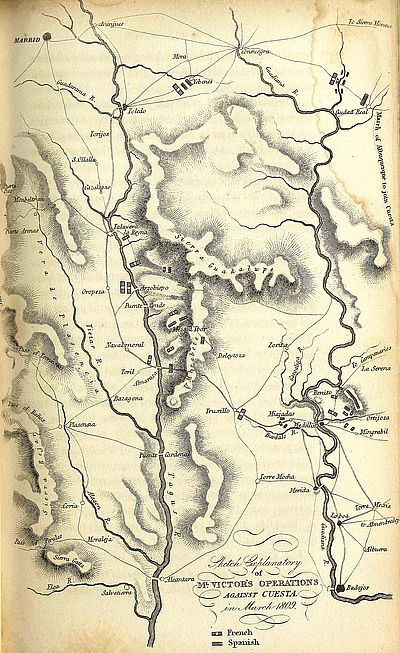 click here for larger image.
Sketch Explanatory of
M
L. VICTOR’S OPERATIONS
AGAINST CUESTA
in March 1809.
London. Published by T. & W. BOONE, July 1829.
This general, after taking Zamora in January,
occupied Ledesma and Salamanca, where he was
joined by general Maupetit’s brigade of cavalry, and
as sir Robert Wilson’s legion and the feeble garrisons
in Ciudad Rodrigo and Almeida were the
only bodies in his front, universal terror prevailed.
Yet he, although at the head of at least ten thousand
men, with a powerful artillery, remained inactive
from January to the end of March, and suffered sir
Robert, with a few hundred Portuguese, to vex his
outposts, to intercept his provisions, to restrain his
patroles, and even to disturb his infantry in their
quarters. This conduct brought him into contempt,
and enabled Wilson to infuse a spirit into the people
which they were far from feeling when the enemy
first appeared.
Don Carlos d’España, with a small Spanish force,
being after a time placed under sir Robert’s command,
the latter detached two battalions to occupy
the pass of Baños, and Lapisse was thus deprived
of any direct communication with Victor. In this
situation the French general remained without
making any vigorous effort either to clear his front
or to get intelligence of the duke of Dalmatia’s
march upon Oporto until the beginning of April,
when he advanced towards Bejar, but, finding the
passes occupied, turned suddenly to his right, dissipated
Wilson’s posts on the Ecla, and forced
the legion, then commanded by colonel Grant, to
take refuge under the guns of Ciudad Rodrigo.
He summoned that town to surrender on the 6th,
and, after a slight skirmish close to the walls, took
a position between the Agueda and Ledesma.
This event was followed by a general insurrection
from Ciudad Rodrigo to Alcantara and from Tamames
to Bejar. For Lapisse, who had been again
ordered by the king to fulfil the emperor’s instructions,
and advance to Abrantes, instead of obeying,
suddenly quitted his positions on the Agueda, and,
without regarding his connexion with the second
corps, abandoned Leon, and made a rapid march,
through the pass of Perales, upon Alcantara, followed
closely by sir Robert Wilson, don Carlos
d’España, the two battalions from Bejar, and a
multitude of peasants, both Portuguese and Spanish.
At Alcantara, a corps of Spanish insurgents endeavoured
to defend the passage of the river, but
the French broke through the entrenchments on
the bridge, and, with a full encounter carried the
town, and pillaged it, after which they abandoned
the place, and joined the first corps, at Merida, on
the 19th of April.
This false movement greatly injured the French
cause. From that moment the conquering impulse
given by Napoleon was at an end, and his armies,
ceasing to act on the offensive, became stationary
or retrograded, and the British, Spanish, and Portuguese
once more assumed the lead. The duke of
Dalmatia, abandoned to his own resources, and in
total ignorance of the situation of the corps by
which his movements should have been supported,
was forced to remain in Oporto; and at the moment,
when the French combinations
were thus paralyzed, the arrival of English reinforcements at Lisbon and
the advance of sir John Cradock towards Leiria
gave a sudden and violent impetus both to the
Spaniards and Portuguese along the Beira frontier.
Thus the insurrection, no longer kept down by
the presence of an intermediate French corps, connecting
Victor’s and Soult’s forces, was established
in full activity from Alcantara, on the Tagus, to
Amarante, on the Tamega.
Meanwhile Cuesta was gathering another host in
the Morena; for, although the simultaneous defeat
of the armies in Estremadura and La Mancha had
at first produced the greatest dismay in Andalusia,
the Spaniards, when they found such victories as
Ciudad Real and Medellin only leading to a stagnant
inactivity on the part of the French, concluded that
extreme weakness was the cause, and that the Austrian
war had or would oblige Napoleon to abandon
his projects against the Peninsula. This idea was
general, and upheld not only the people’s spirit but
the central junta’s authority, which could not otherwise
have been maintained after such a succession
of follies and disasters.
The misfortunes of the two Spanish generals had
been equal; but Cartoajal, having no popular influence,
was dismissed, while Cuesta was appointed to
command what remained of both armies; and the
junta, stimulated for a moment by the imminent
danger in which they were placed, drew together
all the scattered troops and levies in Andalusia.
To cover Seville, Cuesta took post in the defiles
of Monasterio, and was there joined by eight hundred
horse and two thousand three hundred infantry,
drafted from the garrison of Seville; these were
followed by thirteen hundred old troops from Cadiz;
and finally, three thousand five hundred Grenadian
levies, and eight thousand foot, and two thousand
five hundred horsemen, taken from the army of La
Mancha, contributed to swell his numbers, until, in
the latter end of April, they amounted to twenty-five
thousand infantry, and about six thousand cavalry.
General Venegas, also, being recalled from Valencia,
repaired to La Carolina, and proceeded to organize
another army of La Mancha.
King Joseph, justly displeased at the false disposition
made of Lapisse’s division, directed that
Alcantara should be immediately re-occupied; but
as this was not done without an action, which
belongs to another combination, it shall be noticed
hereafter. It is now proper to return to the operations
on the Douro, so intimately connected with
those on the Guadiana, and yet so differently conducted.
CHAPTER IV. — PASSAGE OF THE TAMEGA, AT AMARANTE. — OBSERVATIONS.—SPANISH OPERATION. — FRENCH OPERATIONS. — OBSERVATIONS ON THE SEPARATE OPERATIONS OF LAPISSE, VICTOR, SOULT, ROMANA, SYLVEIRA, AND CUESTA. — LAPISSE. — VICTOR. — CUESTA. — SOULT. — ROMANA. — SYLVEIRA.
When the bishop of Oporto beheld, from his
station at Sarea, the final overthrow of his ambitious
schemes in the north of Portugal, he fled to Lisbon.
There he reconciled himself to the regency, became
a member of that body, and was soon after
created patriarch; and, as I shall have occasion to
shew, used his great influence in the most mischievous
manner; discovering, on every occasion, the untamed
violence and inherent falseness of his disposition.
Meanwhile, the fall of Oporto enabled marshal
Soult to establish a solid base of operations, and to
commence a regular system of warfare. The immediate
fruit of his victory was the capture of immense
magazines of powder, and a hundred and ninety-seven
pieces of artillery, every gun of which had
been used in the action. Thirty English vessels,
wind-bound in the river, and loaded with wine and
provisions for a month, also fell into his hands.
Having repressed the disorders attendant on the
battle, he adopted the same conciliatory policy
Appendix, No. 13.
which had marked his conduct at Chaves and Braga;
and endeavoured to remedy, as far as it was possible,
the deplorable results of the soldiers’ fury. Recovering
and restoring a part of the plunder, he caused
the inhabitants remaining in the town to be treated
with respect; and invited, by proclamation, all those
who had fled to return. He demanded no contribution;
and, restraining with a firm hand the violence
of his men, contrived, from the captured public
property, to support the army, and even to succour
the poorest and most distressed of the population.
Soult’s ability in the civil and political administration
of the Entre Minho e Douro produced an
effect which he was not prepared for. The prince
regent’s desertion of the country was not forgotten.
The national feeling was as adverse to Portugal being
a dependency on the Brazils as it was to the usurpation
of the French, and the comparison between
Soult’s government and the horrible anarchy which
preceded it was all in favour of the former. His
victories, and the evident vigour of his character,
contrasted with the apparent supineness of the
English, promised permanency for the French power;
and the party, formerly noticed as being inimical to
the house of Braganza, revived.
The leaders, thinking this a favourable opportunity
to execute their intention, waited upon the duke
of Dalmatia, and expressed their desire for a French
prince and an independent government. They even
intimated their good wishes towards the duke himself,
and demanded his concurrence and protection;
while, in the name of the people, they declared that
the Braganza dynasty was at an end.
Although unauthorized by the emperor to accede
to this proposition, Soult was yet unwilling to reject
a plan from which he could draw such immediate
and important military advantages. Napoleon was not
a man to be lightly dealt with on such an occasion;
but the marshal, trusting that circumstances would
justify him, encouraged the design, and, appointing
men to civil employments, raised a Portuguese legion
of five battalions. He acted with so much dexterity
Appendix, No. 13.
that, in fifteen days, the cities of Oporto and Braga,
and the towns of Bacellos, Viana, Villa de Conde,
Povoa de Barcim, Feira, and Ovar, sent addresses,
containing the expression of their sentiments, and
bearing the signatures of thirty thousand persons,
as well of the nobles, clergy, and merchants, as of
the people.
These addresses were burnt when the French retreated
from Oporto; but the fact that such a project
was in agitation has never been denied. The regency
even caused inquest to be made on the matter; and
it was then asserted that very few persons were
found to be implicated. That many of the signatures
were forged by the leaders may readily be believed;
but the policy of lessening the importance of the
affair is also evident; and the inquisitors, if willing,
could not have probed it to the bottom.
This transaction formed the ground-work of a
tale generally credited, even by his own officers,
that Soult perfidiously aimed at an independent
crown; and the circumstances were certainly such
as might create suspicion. That the conclusion was
false, is, however, proved, by the mode in which
Napoleon treated both the rumour and the subject
Rovigo’s Memoirs.
of it. Slighting the former, he yet made known to
his lieutenant that it had reached his ears, adding,
“I remember nothing but Austerlitz,”[5] and at the
same time largely increased the duke of Dalmatia’s
command.
S.
Journal of
Operations
MSS.
The policy of Soult’s conduct on this occasion,
and the great influence, if not the numbers of the
Portuguese malcontents, were abundantly proved
by the ameliorated relations between the army and
the peasantry. The fierceness of the latter subsided;
and even the priests abated of their hostility
in the Entre Minho e Douro. The French soldiers
were no longer assassinated in that province;
whereas, previous to this intrigue, that cruel
species of warfare had been carried on with infinite
activity, and the most malignant passions called
forth on both sides.
Among other instances of Portuguese ferocity,
and of the truculent violence of the French soldiers,
the death of colonel Lameth, and the retaliation
which followed, may be cited. That young officer,
when returning from the marshal’s quarters to his
own, was waylaid, near the village of Arrifana, and
murdered; his body was then stripped, and mutilated
in a shocking manner. This assassination,
committed within the French lines, and at a time
when Soult enforced the strictest discipline, was
justifiable neither by the laws of war nor by those
of humanity. No general could neglect to punish
such a proceeding. The protection due to the
army, and even the welfare of the Portuguese
within the French jurisdiction, demanded a severe
example, for the violence of the troops had hitherto
been with difficulty restrained by their commander;
and if, at such a moment, he had appeared indifferent
to their individual safety; his authority
would have been set at naught, and the unmeasured
and indiscriminating vengeance of an insubordinate
army executed.
Impressed with this feeling, and afflicted at the
unhappy death of a personal friend, Soult directed
general Thomieres to march, with a brigade of
infantry, to Arrifana, and punish the criminals.
Thomieres was accompanied by a Portuguese
civilian; and, after a judicial inquiry, he shot five
or six persons whose guilt was said to have been
proved; but it is also certain that the principal
actor, a Portuguese major of militia, and some of
his accomplices, escaped across the Vouga to
colonel Trant; and the latter, disgusted at their
conduct, sent them to marshal Beresford. It would
also appear, from the statement of a peasant, that
Thomieres, or those under him, exceeded Soult’s
orders; for, in that statement, attested by oath,
it is said that twenty-four innocent persons were
killed, and that the soldiers, after committing many
atrocious excesses, burnt the village.
These details have been related partly because
they throw a light upon the direful nature of this
contest, but chiefly because the transaction has
been adduced by other writers as proof of cruelty
in Soult, a
charge not sustained by the facts of
Appendix, No. 13.
this case, and belied by the general tenor of his
conduct, which even his enemies, while they attributed
it to an insidious policy, acknowledged, at
the time, to be mild and humane. And now,
having finished this political digression, in which
the chronological order of events has been anticipated,
I shall resume the narrative of military
operations at that part where the disorders attendant
on the battle of Oporto having been repressed, a
fresh series of combinations were commenced, not
less important than those which brought the French
army down to the Douro.
The heavy blow struck on the 29th of March
was followed up with activity. The boat-bridge
was restored during the night; and the next day,
the forts of Mazinho and St. Joa de Foz having
surrendered, Franceschi’s cavalry crossed the Douro,
took post ten miles in advance on the Coimbra
road, and pushed patroles as far as the Vouga
river. To support this cavalry, general Mermet
occupied a position somewhat beyond the suburb of
Villa Nova. Oporto itself was held by three
brigades. The dragoons of Lorge were sent to
Villa da Conde, a walled town, situated at the
mouth of the Ave; and general Caulaincourt was
detached up the Douro to Penafiel, with a brigade of
cavalry, having orders to clear the valley of the Tamega.
Another brigade of cavalry was posted on
the road leading to Barca de Trofa, to protect the rear
of the army; and general Heudelet was directed to
forward the hospitals from Braga to Oporto, but to
hold himself in readiness to open the communication
with Tuy.
These dispositions made, Soult had leisure to
consider his general position. The flight of the
bishop had not much abated the hostility of the
people, nor relieved the French from their difficulties.
The communication with the Minho was
still intercepted; the Tras os Montes was again in
a state of insurrection; and Sylveira, with a corps of
eight thousand men, not only commanded the valley
of the Tamega, but had advanced, after re-taking
Chaves, into the Entre Minho e Douro, and was
posted between the Sierra de Catalina and the Douro.
Lisbon, the ultimate object of the campaign,
was two hundred miles distant, and covered by a
British army, whose valour was to be dreaded, and
whose numbers were daily increasing. A considerable
body of natives were with Trant upon the
Vouga, and Beresford’s force between the Tagus
and the Mondego: its disorderly and weak condition
being unknown, appeared formidable at a
distance.
The day on which the second corps, following
the emperor’s instructions, should have reached
Lisbon was overpassed by six weeks; and, as the
line of correspondence with Victor was uncertain,
his co-operation could scarcely be calculated upon.
Lapisse’s division was yet unfelt as an aiding force;
nor was it even known to Soult that he still remained
at Salamanca: finally, the three thousand men
expected from the Astorga country, under the
conduct of the marshal’s brother, had not yet been
heard of.
On the other hand, the duke of Dalmatia had
conquered a large and rich city: he had gained
the military command of a very fertile country,
from whence the principal supplies of the British
army and of Lisbon were derived: he had obtained
a secure base of operations and a prominent station
in the kingdom; and if the people’s fierceness was
not yet quelled, they had learned to dread his
talents, and to be sensible of their own inferiority
in battle.
In this state of affairs, judging that the most
important objects were to relieve the garrison of
Tuy and to obtain intelligence of Lapisse’s division,
Soult entrusted the first to Heudelet and the second
to Franceschi. The last-named general had occupied
Feira and Oliveira, and spread his posts along
the Vouga; but the inhabitants fled to the other
side of that river, and the rich valleys beyond were
protected by colonel Trant.
This officer, well known to the Portuguese as
having commanded their troops at Roriça and
Vimiero, was at Coimbra when intelligence of the
defeat at Braga arrived, and he immediately took
the command of all the armed men in that town,
among which was a small body of volunteers, students
at the university. The general dismay and
confusion being greatly increased by the subsequent
catastrophe at Oporto, the fugitives from that town
and other places, accustomed to violence, and attributing
every misfortune to treachery in the generals,
flocked to Trant’s standard; and he, as a
foreigner, was enabled to assume an authority that
no native of rank durst either have accepted or
refused without imminent danger.
He advanced, at first, with about eight hundred
men to Sardao and Aveiro, where he was joined by
the conde Barbaceña with some Portuguese cavalry,
and by generals Victoria and Eben; but the people
regarded these officers with suspicion, and Trant
Appendix, No. 3, section 6.
continued in the command, his force daily increasing
by the arrival of ordenanzas, and even by
regular troops, who, quitting their quarters, abandoned
Beresford’s army to join him.
When Franceschi advanced, Trant sent a detachment
by Castanheira to occupy the bridge of the
Vouga; but the men, seized with a panic, dispersed,
and this was followed by the desertion of many
thousand ordenanzas,—a happy circumstance, for
the numbers that had at first collected behind the
Vouga exceeded twelve thousand men, and their
extreme violence and insubordination excited the
utmost terror, and impeded the measures necessary
for defence. Trant, finally, retained about four
thousand men, with which he imposed upon the
French, and preserved a fruitful country from their
incursions; but he was greatly distressed for money,
because the bishop of Oporto, in his flight, laid
hands on all that was at Coimbra and carried it to
Lisbon.
Franceschi, although reinforced with a brigade
of infantry, contented himself with chasing some
insurgents that infested his left flank, while his
patroles and scouts, sent forward on the side of
Viseu, endeavoured to obtain information of Lapisse’s
division; but that general, as we have seen,
was still beyond the Agueda, and while Franceschi
was thus employed in front of the French army,
Caulaincourt’s cavalry on the Tamega was pressed
by the Portuguese, and Loison marched with a
brigade of infantry to his assistance on the 9th of
April.
Sylveira, however, was too strong for both; and, on
the 12th, advancing from Canavezes, obliged Loison,
after a slight action, to take post behind the Souza.
Meanwhile, Heudelet was hastening towards Tuy
to recover the artillery and depôts, from which the
army had now been separated forty days.
The 6th of April, general Lorge, who had taken
Villa de Conde and cleared the coast, joined Heudelet
at Bacellos. The 7th they marched to Ponte
de Lima; but the Portuguese resisted the passage
vigourously, and it was not forced until the 8th.
The 10th the French arrived in front of Valença,
on the Minho; this fortress had been maltreated by
the fire from Tuy, and the garrison, amounting to
two hundred men, having only two days’ provisions,
capitulated, on condition of being allowed to retire
to their homes; but, before the French could take
possession, the capitulating troops disbanded and
the town was deserted.
The garrison in Tuy, never having received the
slightest intelligence of the army since the separation
at Ribidavia, marvelled that the fire from
Valença was discontinued; and their surprise was
extreme when they beheld the French colours flying
in that fort, and observed French videttes on the
left bank of the Minho.
La Martiniere’s garrison, by the arrival of stragglers
and a battalion of detachments that followed
the army from St. Jago, had been increased to three
thousand four hundred men; but twelve hundred
were in hospital, and two-thirds of the artillery-horses
had been eaten in default of other food.
The Portuguese had passed the Minho, and, in
conjunction with the Spaniards, attacked the place
on the 15th of March; but the French general, by
frequent sallies, obliged them to keep up a distant
blockade, and his fire mastered that from Valença.
The 22d of March, the defeat at Braga being
known, the Portuguese repassed the Minho, the
Spaniards dispersed, and La Martiniere immediately
sent three hundred men to bring off the garrison
of Vigo; but it was too late, that place was taken,
and the detachment with difficulty regained Tuy.
The peasants on the Arosa Estuary had, as I
have before noticed, risen, the 27th of February,
while Soult was still at Orense; they were headed,
at first, by general Silva and by the count de Mezeda,
and, finally, a colonel Barrois, sent by the
central junta, took the command. As their numbers
were very considerable, Barrois with one part
attacked Tuy; and Silva assisted by the Lively and
Venus, British frigates on that station, invested
Vigo.
The garrison of the latter place was at first small;
but the paymaster-general of the second corps, instead
of proceeding to Tuy, entered Vigo, with the military
chest and an escort of eight hundred men, and
was blockaded there. After some slight attacks had
been repulsed, the French governor negotiated for
a capitulation on the 23d of March; but, distrustful
of the peasantry, he was still undecided on the
26th. Meanwhile, some of Romana’s stragglers
coming from the Val des Orres, collected between
Tuy and Vigo; and don Pablo Murillo, a regular
officer, assembling fifteen hundred retired soldiers,
joined the blockading force, and, in concert with
Captain Mackinley, of the Lively, obliged the
garrison to surrender on terms.
Captain
Mackinley’s
Despatch.
The 27th, thirteen hundred men and officers, including
three hundred sick, marched out with the
honours of war; and, having laid down their arms
on the glacis, were embarked for an English port,
according to the articles agreed upon. Four hundred
and forty-seven horses, sixty-two covered waggons,
some stores, and the military chest, containing
five thousand pounds, fell into the victor’s hands;
and this affair being happily terminated, the Spaniards
renewed their attack on Tuy: the Portuguese
once more crossed the Minho, and the siege continued
until the 10th of April, when the place was
relieved by Heudelet. The depôts and the artillery
were immediately transported across the river, and
directed upon Oporto.
The 12th, general Maucune, with a division of
the sixth corps, arrived at Tuy, with the intention
of carrying off the garrison, but seeing that the
place was relieved, returned the next day. Heudelet,
having taken Viana, and the fort of Insoa, at
the mouth of the Minho, placed a small garrison in
the former; and then blowing up the works of
Valença, retired to Braga and Bacellos, sending
Lorge again to Villa de Conde.
The sick men were transported in boats along
shore, from the mouth of the Minho to Viana, Villa
de Conde, and thence to Oporto; and while these
transactions were taking place on the Minho, La
Houssaye, with a brigade of dragoons and one
of infantry, scoured the country between the
Lima and the Cavado, and so protected the rear of
Heudelet.
All resistance in the Entre Minho e Douro now
ceased; for, at this period, the influence of the
Anti-Braganza party was exerted in favour of the
French. But on the Tras os Montes side, Sylveira
being joined by general Boteilho, from the Lima,
was advancing, and boasted that he would be in
Oporto the 15th: and now, also, intelligence of the
recapture of Chaves reaching Soult, not only explained
Sylveira’s boldness, but shewed, that, while
the latter was in arms, the tranquillity of the Entre
Minho e Douro could be only momentary. Wherefore,
Laborde, with a brigade of infantry, was ordered
to join Loison, and attack Amarante; while La
Houssaye pushed through Guimaraens upon the
same point.
The 15th, Laborde reached Penafiel; and Sylveira,
hearing of La Houssaye’s march, retired to
Villamea. The 18th, Laborde drove back the Portuguese
without difficulty; and their retreat soon
became a flight. Sylveira himself passed the Tamega
at Amarante, and was making for the mountains,
without a thought of defending that town; but
colonel Patrick, a British officer in the Portuguese
service, encouraging his battalion, faced about, and
rallying the fugitives, beat back the foremost of the
enemy. This becoming act obliged Sylveira to
return; and while Patrick defended the approaches
to the bridge on the right bank with obstinate valour,
the former took a position, with five or six thousand
men, on the heights overhanging the suburb of Villa
Real, on the left bank of the river.
The 19th, La Houssaye arrived; and the French
renewing their attack on the town, Patrick again
baffled their efforts; but when that gallant man fell
mortally wounded, and was carried across the bridge,
the defence slackened, and the Portuguese went over
the Tamega: the passage of the river was, however,
still to be effected.
The bridges of Mondin and Cavez above, and
that of Canavezas below Amarante, were destroyed:
the Tamega was in full flood, and running in a deep
rocky bed; and the bridge in front of the French
was mined, barred with three rows of pallisades, and
commanded by a battery of ten guns. The Portuguese
were in position on the heights behind; from
whence they could discern all that was passing at
the bridge, and could reinforce at will the advanced
guard, which was posted in the suburb.
The 20th, the first barricade was reached by the
flying sap; but the fire of the Portuguese was so
deadly, that Laborde abandoned the attack, and
endeavoured to construct a bridge on tressels half a
mile below: this failed, and the efforts against the
stone bridge were of necessity renewed. The mine
at the other side was ingeniously formed; the muzzle
of a loaded musket entered the chamber, and a string
being tied at one end to the trigger, the other end
was brought behind the entrenchments, so that an
explosion could be managed with the greatest precision
as to time.
Noble’s
Campagne
de Galice.
The 27th, the centre barricade was burnt by
captain Brochard, an engineer officer, who devised
a method of forcing the passage, so singularly bold,
that all the generals, and especially general Foy,
were opposed to it. The plan was, however, transmitted
to Oporto; and Soult sent general Hulot, his
first aide-de-camp, to report if the project was feasible.
Hulot approved of Brochard’s proposal, and the
latter commenced his operations on the 2d of May.
The troops were under arms, and disposed in the
most convenient manner, as near the head of the
bridge as the necessity of keeping them hidden
would permit; and at eight o’clock, all being prepared,
and the moon shining bright, twenty men
were sent a little below the bridge, and directed to
open an oblique fire of musketry against the entrenchments.
This being replied to, and the attention
of the Portuguese attracted, a sapper, dressed
in dark grey, crawled out, and pushed with his head
a barrel of powder, which was likewise enveloped
in grey cloth to deaden the sound, along that side
of the bridge which was darkened by the shadow of
the parapet: when he had placed his barrel against
the entrenchment covering the Portuguese mine, he
retired in the same manner. Two others followed
in succession, and retired without being discovered;
but the fourth, after placing the barrel, rose on his
feet
and ran back, but was immediately shot at and
wounded.
The fire of the Portuguese was now directed on
the bridge itself; but as the barrels were not discovered,
after a time it ceased; and a fifth sapper
advancing like the others, attached a sausage seventy
yards long to the barrels. At two o’clock in the
morning the whole was completed; and as the French
kept very quiet, the Portuguese remained tranquil
and unsuspicious.
Brochard had calculated that the effect of four
barrels exploding together would destroy the Portuguese
entrenchments, and burn the cord attached to
their mine. The event proved that he was right;
for a thick fog arising about three o’clock, the sausage
was fired, and the explosion made a large
breach. Brochard, with his sappers, instantly jumped
on to the bridge, threw water into the mine, cut
away all obstacles, and, followed by a column of
grenadiers, was at the other side before the smoke
cleared away. The grenadiers being supported by
other troops, not only the suburb, but the camp on
the height behind were carried without a check,
and the Portuguese dispersing, fled over the mountains.
The execution of captain Brochard’s bold, ingenious,
and successful project, cost only seven or
eight men killed; while in the former futile attempts
above a hundred and eighty men, besides many
engineer and artillery officers, had fallen. It is,
however, a singular fact that there was a practicable
ford near the bridge, unguarded, and apparently
unknown to both sides.
A short time after the passage of the Tamega,
general Heudelet, marching from Braga by Guimaraens,
entered Amarante. Laborde occupied the
position abandoned by Sylveira, and detachments
were sent up the left bank of the river to Mondin:
but Loison pursued the fugitives to the heights of
Villa Real and Mezamfrio. The Portuguese
guarding the passage at Canavezas, hearing of the
action, destroyed their ammunition, and retired
across the Douro without being overtaken.
The 6th of May, the French were near Villa Real
and Mezamfrio, but all the inhabitants had crossed
the Douro. This being made known to Soult, he
reinforced Loison, and directed him to scour the right
bank of the Douro as high as Pezo de Ragoa; to
complete the destruction of Sylveira’s army, and
to send patroles towards Braganza, with the view of
subduing the Tras os Montes, and of ascertaining if
any French troops had made their appearance there;
for Bessieres had been requested to make a diversion
on that side. Bessieres himself had returned to
France, but the reply of his successor Kellerman
being intercepted, it appeared that he was unable
or unwilling to afford any aid.
General Laborde was now recalled, with two
regiments of infantry, to Oporto; and the communication
between that town and Amarante was
guarded by a brigade of dragoons, and a regiment
of infantry. Meanwhile, Loison felt the Portuguese
at Pezo de Ragoa, on the 7th of May; but, meeting
resistance, and observing a considerable movement
on the opposite bank of the Douro, he became
alarmed, and fell back the same day to Mezamfrio.
The next morning he returned to Amarante, his
march being harassed by the peasantry, who came
on with a boldness shewing that some extraordinary
support was at hand; and, in truth, a new actor
had appeared upon the scene; the whole country
was in commotion; and Soult, suddenly checked
in his career, was pushed backward by a strong
and eager hand.
1º.—The great pervading error of the Spaniards
in this campaign was the notion that their armies
were capable of taking the lead in offensive movements,
and fighting the French in open countries;
whereas, to avoid general actions should have been
a vital principle.
2º.—The resolution to fight the French having,
however, been adopted, the second great error was
the attaching equal importance to the lines of operation
in La Mancha and Estremadura; the one
should have been considered only as an accessory;
and it is evident that the first rank belonged to
La Mancha, because it was in a more open country;
because it more immediately threatened Madrid;
and because a defeat there endangered Seville more
than a defeat in Estremadura would have done. In
La Mancha the beaten army must have fallen back
upon Seville: but in Estremadura it might retire
upon Badajos. But, the latter place being to the
Spaniards of infinitely less importance than Madrid
was to their opponents, the lead in the campaign
must always have belonged to the army of La
Mancha, which could, at any time, have obliged the
French to fight a battle in defence of the capital.
The army of Estremadura might, therefore, have
been safely reduced to fifteen thousand men, provided
the army of La Mancha had been increased
to forty or fifty thousand: and it would appear that,
with a very little energy, the junta could have
provided a larger force. It is true that they would
have been beaten just the same: but that is an
argument against fighting great battles, which was,
certainly, the worst possible plan for the Spaniards
to pursue.
3º.—The third great error was the inertness of
Valencia and Murcia, or rather their hostility: for
they were upon the verge of civil war with the
supreme junta. Those provinces, so rich and
populous, had been unmolested for eight months;
they had suffered nothing from Moncey’s irruption;
and they had received large succours from the
English government. Valencia had written her
pretensions to patriotism in the bloody characters
of assassination; but, were it not for the force under
Llamas which, after the defeat of Tudela, helped
to defend Zaragoza, Valencia and Murcia might
have been swallowed up by the ocean without any
sensible effect upon the general cause. Those countries
were, however, admirably situated to serve as
a support to Aragon, Catalonia, Andalusia, and
La Mancha, and they could, at this time, have
paralyzed a large French force, by marching an
army to San Clemente.
It was the dread of their doing so that made the
king restrain Sebastiani from pursuing his victory
Parl. Papers, 1810.
at Ciudad Real; and, assuredly, the Valencians
should have moved; for, it is not so much in their
numbers as in the variety of their lines of operation
that a whole people find their advantage in opposing
regular armies. This, the observation of that
profound and original writer, general Lloyd, was
confirmed by the practice of Napoleon, in Spain.
1º.—To get possession of Seville and Cadiz was
certainly as great an object to Napoleon as to seize
Lisbon: but the truth of the maxim quoted above
regulated the emperor’s proceedings. If Victor
had been directed at once upon Andalusia, the
Portuguese and Valencians could have carried their
lines of operations directly upon his flanks and
rear. If Badajos and Lisbon had been the objects
of his march, the Andalusians could have fallen on
his left flank and cut his communications. But all
such dangers were avoided by the march of Soult
and Lapisse; their direction was not only concentric,
but a regular prolongation of the great line of communication
with France. Ney protected the rear
of one; Bessieres the rear of the other; and those
two marshals, at the same time, separated and cut
off the Asturias from the rest of Spain; thus, all
that was formidable was confined to the south of
the Tagus.
For the same reason the course of conquest was
to have proceeded from Portugal to Andalusia,
which would then have been assailed in front and
flank at one moment, while the fourth corps held
the Valencians in check. By this plan the French
would never have lost their central position, nor
exposed their grand line of communication to an
attack.
2º.—That this plan, so wisely conceived in its
general bearing, should fail without any of the different
corps employed having suffered a defeat, nay,
when they were victorious in all quarters is surprising,
but not inexplicable. It is clear that Napoleon’s
orders were given at a time when he did not
expect that a battle would have been fought at
Coruña, or that the second corps would have suffered
so much from the severity of the weather,
and the length of the marches, neither did he anticipate
the resistance that was made by the Portuguese,
between the Minho and the Douro. The last
error was a consequence of the first, for his plans
were calculated upon the supposition that the rapidity
of Soult’s movements would forestall all defence;
yet the delay cannot be charged as a fault
to that marshal whose energy was conspicuous.
3º.—Napoleon’s attention, divided between Austria
and Spain, must have been somewhat distracted
by the multiplicity of his affairs. He does not seem
to have made allowance for the very rugged country
through which Soult had to march, at a time when
all the rivers and streams were overflowing, from the
constant rains; and as the combinations of war are
continually changing, the delay thus occasioned
rendered Lapisse’s instructions faulty: for, although
it be true, that if the latter had
marched by Guardia, upon Abrantes, while Soult advanced to Lisbon, by
Coimbra, and that Victor entered the Alemtejo, Portugal
would have been conquered without difficulty;
yet the combination was so wide, and the communications
so uncertain, that unity of action could not
be insured. Soult, weakened by the obstacles
he encountered, required reinforcements after the
taking of Oporto; and Lapisse should have considered
himself as rather belonging to Soult than
Victor, and have marched upon Viseu; the duke
of Dalmatia would then have been strong enough to
fight his own battle without regard to the operations
in the Alemtejo.
4º.—The first error of the French, if the facts are
correctly shewn, must, therefore, be attributed to
Napoleon, because he overlooked the probable
chances of delay, combined the operations on too
wide a scale, and gave Ciudad Rodrigo and Abrantes,
instead of Lamego and Viseu, for the direction
of Lapisse’s march. I say, if the facts are correctly
shewn, for it is scarcely discreet to censure
Napoleon’s military dispositions, however erroneous
they may appear to have been, and it is certain that,
in this case, his errors, if errors they were, although
sufficient to embarrass his lieutenants, will not account
for their entire failure. Above sixty thousand
men were put in motion by him, upon good general
principles, for the subjugation of Lisbon; and we
must search in the particular conduct of the generals
for the reason why a project of Napoleon’s, to be
executed by sixty thousand French veterans, should
have ended as idly and ineffectually as if it had been
concocted by the Spanish junta.
1º.—An intercepted letter of general Maupetit,
shews the small pains taken by Lapisse to communicate
with Soult. He directs that even so many as
three hundred men should patrole towards Tras os
Montes, to obtain information of the second corps,
at a time when the object was so important that
his whole force should have moved in mass rather
than have failed of intelligence.
2º.—The manner in which he suffered sir Robert
Wilson to gather strength and to insult his
outposts was inexcusable. He might have marched
straight upon Ciudad Rodrigo and Almeida, and
dispersed every thing in his front; one of those fortresses
would probably have fallen, if not both, and
from thence a strong detachment pushed towards
Lamego would not only have ascertained the situation
of the second corps, but would have greatly
aided its progress by threatening Oporto and Braga.
It cannot be urged that Salamanca required the
presence of a large force, because, in that open
country, the people were at the mercy of Bessiere’s
cavalry; and so sensible were the local junta of this,
that both Salamanca and Ledesma refused assistance
from Ciudad Rodrigo, when it was offered, and
preferred a quiet submission.
3º.—When, at last, the king’s reiterated orders
obliged Lapisse to put his troops in motion, he made
a demonstration against Ciudad Rodrigo, so feeble
that it scarcely called the garrison to the ramparts,
and then as if all chance of success in Portugal was
at an end, breaking through the pass of Perales, he
reached Alcantara and rejoined the first corps; a
movement equally at variance with Napoleon’s
orders and with good military discretion; for the
first directed him upon Abrantes, and the second
would have carried him upon Viseu. The march
to the latter place, while it insured a junction with
Soult, would not have prevented an after movement
upon Abrantes: the obstacles were by no means
so great as those which awaited him on the march
to Alcantara, and the great error of abandoning the
whole country, between the Tagus and the Douro,
to the insurgents would have been avoided.
Here then was one direct cause of failure; but
the error, although great, was not irreparable. If
Soult was abandoned to his own resources, he had
also obtained a firm and important position in the
north, while Victor, reinforced by ten thousand
men, was enabled to operate against Lisbon, by the
Alemtejo, more efficaciously than before. But
Victor seems to have been less disposed than
Lapisse to execute his instructions.
1º.—The inactivity of this marshal after the rout
of Ucles has been already mentioned. It is certain
that if the fourth and first corps had been well
handled, neither Cuesta nor Cartoajal could have
ventured beyond the defiles of the Sierra Morena,
much less have bearded the French generals and
established a line of defence along the Tagus.
Fifty thousand French troops should, in two months,
have done something more than maintain fifty miles
of country on one side of Madrid.
2º.—The passage of the Tagus was successful,
but can hardly be called a skilful operation, unless
the duke of Belluno calculated upon the ignorance
of his adversary. Before an able general and a
moveable army, possessing a pontoon train, it
would have scarcely answered to separate the troops
in three divisions on an extent of fifty miles, leaving
the artillery and parc of ammunition, protected only
by some cavalry and one battalion of infantry,
within two hours march of the enemy, for three
days. If Cuesta had brought up all his detachments,
the Meza d’Ibor might have been effectually
manned, and yet ten thousand infantry, and all the
Spanish cavalry, spared to cross the Tagus at Almaraz,
on the 17th; in this case Victor’s artillery
would probably have been captured, and his project
certainly baffled.
3º.—The passage of the Tagus being, however,
effected, Victor not only permitted Cuesta to escape,
but actually lost all traces of his army, an evident
fault not to be excused by pleading the impediments
arising from the swelling of the river, the necessity
of securing the communications, &c. If Cuesta’s
power was despised before the passage of the river,
when his army was whole and his position strong,
there could be no reason for such great circumspection
after his defeat, a circumspection, too, not
supported by skill, as the dispersed state of the
French army, the evening before the battle of
Medellin, proves.
4º.—That Victor was enabled to fight Cuesta, on
the morning of the 28th, with any prospect of
success, must be attributed rather to fortune than
to talent. It was a fault to permit the Spaniards to
retake the offensive after the defeat on the Tagus;
nor can the first movement of the duke of Belluno
in the action be praised. He should have marched
into the plain in a compact order of battle. The
danger of sending Lassalle and Latour Maubourg
to such a distance from the main body I shall have
occasion to show in my observations on Cuesta’s
operations; but, the after-movements of the French
in this battle were well and rapidly combined and
vigorously executed, and the success was proportionate
to the ability displayed.
5º.—The battles of Medellin and Ciudad Real,
which utterly destroyed the Spanish armies and
laid Seville and Badajos open; those battles, in
which blood was spilt like water, produced no result
to the victors, for the French generals, as if
they had struck a torpedo, never stretched forth
their hands a second time. Sebastiani, indeed,
wished to penetrate the Sierra Morena; but the
king, fearful of the Valencians, restrained him.
On the other hand, Joseph urged Victor to invade
the Alemtejo, yet the latter would not obey, even
when reinforced by Lapisse’s division. This was
the great and fatal error of the whole campaign,
for nearly all the disposable British and Portuguese
troops were thus enabled to move against the duke
of Dalmatia, while the duke of Belluno contrived
neither to fulfil the instructions of Napoleon, nor the
orders of the king, nor yet to perform any useful
achievement himself.
He did not assist the invasion of Portugal, he
did not maintain Estremadura, he did not take
Seville, nor even prevent Cuesta from twice renewing
the offensive; yet he remained in an unhealthy
situation until he lost more men, by sickness, than
would have furnished three such battles as Medellin.
Two months so unprofitably wasted by a
general, at the head of thirty thousand good troops,
can scarcely be cited. The duke of Belluno’s reputation
has been too hardly earned to attribute
this inactivity to want of talent. That he was
averse to aid the operations of marshal Soult is
evident, and, most happily for Portugal, it was so;
but, whether this aversion arose from personal jealousy,
from indisposition to obey the king, or from
a mistaken view of affairs, I have no means of
judging.
Cuesta’s peculiar unfitness for the lead of an
army has been remarked more than once. It remains
to show that his proceedings, on this occasion,
continued to justify those remarks.
1º.—To defend a river, on a long line, is generally
hopeless, and especially when the defenders
have not the means of passing freely, in several
places, to the opposite bank. Alexander, Hannibal,
Cæsar, Gustavus, Turenne, Napoleon, Wellington,
and hundreds of others have shown how the passage
of rivers may be won. Umenes, who prevented
Antigonus from passing the Coprates, is, perhaps,
the only example of a general baffling the efforts
of a skilful and enterprising enemy in such an
attempt.
2º.—The defence of rivers having always proved
fruitless, it follows that no general should calculate
upon success, and that he should exert the greatest
energy, activity, and vigilance to avoid a heavy
disaster; that all his lines of retreat should be kept
free and open, and be concentric; and that to bring
his magazines and depôts close up to the army, in
such a situation, is rashness itself. Now Cuesta
was inactive, and, disregarding the maxim which
forbids the establishment of magazines in the first
line of defence, brought up the whole of his to
Deleyton and Truxillo. His combinations were ill-arranged;
he abandoned Mirabete without an effort,
his depôts fell into the hands of the enemy, and his
retreat was confused and eccentric, inasmuch as
part of his army retired into the Guadalupe, while
others went to Merida, and he himself to Medellin.
3º.—The line of retreat upon Medellin and Campanarios,
instead of Badajos, being determined by
the necessity of uniting with Albuquerque, cannot
be blamed, and the immediate return to Medellin
was bold and worthy of praise, but its merit consisted
in recovering the offensive immediately after
a defeat; wherefore, Cuesta should not have halted
at Medellin, thus giving the lead again to the
French general; he should have continued to advance,
and have fallen upon the scattered divisions
of the French army, endeavouring to beat them in
detail, and to rally his own detachments in the
Sierra de Guadalupe. The error of stopping short
at Medellin would have been apparent, if Victor,
placing a rear-guard to amuse the Spanish general,
had taken the road to Seville by Almendralejos and
Zafra.
4º. Cuesta’s general design for the battle of
Medellin was well imagined, that is, it was right
to hide his army behind the ridge, and to defer the
attack until the enemy had developed his force and
order of battle in the plain, but the execution was
on the lowest scale. If, instead of advancing in
one long and weak line, without a reserve, Cuesta
had held the greatest part of his troops in solid
columns, and thrust them between Lassalle and
Latour Maubourg’s divisions, which were pushed
out like horns from the main body of the French,
those generals would have been cut off, and the
battle commenced by dividing the French army
into three unconnected masses, while the Spaniards
would have been compact, well in hand, and masters
of the general movements. Nothing could then
have saved Victor, except hard fighting; but Cuesta’s
actual dispositions rendered it impossible for the
Spaniards to win the battle by courage, or to escape
the pursuit by swiftness.
5º. It is remarkable that the Spanish general
seems never to have thought of putting Truxillo,
Guadalupe, Merida, Estrella, or Medellin in a state
of defence, although most if not all those places
had some castle or walls capable of resisting a
sudden assault. There was time to do it, for Cuesta
remained unmolested, on the Tagus, from January
to the middle of March; and every additional point
of support thus obtained for an undisciplined army
would have diminished the advantages derived by
the French from their superior facility of movement.
The places themselves might have been garrisoned
by the citizens and peasantry, and a week’s, a day’s,
nay, even an hour’s, delay was of importance to a
force like Cuesta’s, which, from its inexperience,
must have always been liable to confusion.
1º. The march of this general in one column, upon
Tuy, was made under the impression that resistance
would not be offered; otherwise, it is probable that
a division of infantry and a brigade of cavalry would
have been sent from St. Jago or Mellid direct upon
Orense, to insure the passage of the Minho; and it
seems to have been an error in Ney, arising, probably,
from the same cause, not to have kept Marchand’s
division of the sixth corps at Orense until
the second corps had effected an entrance into
Portugal.
2º. Soult’s resolution to place the artillery and
stores in Tuy, and march into Portugal, trusting to
victory for re-opening the communication, would
increase the reputation of any general. Three times
before he reached Oporto he was obliged to halt,
in order to fabricate cartridges for the infantry, from
the powder taken in battle; and his whole progress
from Tuy to that city was energetic and able in the
extreme.
3º. The military proceedings, after the taking of
Oporto, do not all bear the same stamp. The
administration of the civil affairs appears to have
engrossed the marshal’s attention; and his absence
from the immediate scene of action sensibly affected
the operations. Franceschi shewed too much respect
for Trant’s corps. Loison’s movements were timid
and slow; and even Laborde’s genius seems to have
been asleep. The importance of crushing Sylveira
was obvious. Now, there is nothing more necessary
in war than to strike with all the force you can at
once; but here Caulaincourt was first sent, and
being too weak, Loison reinforced him, and Laborde
reinforced Loison; and all were scarcely sufficient
at last to do that which half would have done at
first; but the whole of these transactions are obscure.
The great delay that took place before the bridge of
Amarante; the hesitation and frequent recurrence
for orders to the marshal, indicate want of zeal,
and a desire to procrastinate, in opposition to Soult’s
wishes. Judging from Mr. Noble’s history of the
campaign, this must be traced to a conspiracy in
the French army, which shall be touched upon
hereafter.
4º. The resistance made by the Portuguese peasantry
was infinitely creditable to their courage; but
there cannot be a stronger proof of the inefficacy of
a like defence, when unsupported by good troops.
No country is more favourable to such a warfare
than the northern provinces of Portugal; the people
were brave, and they had the assistance of the organized
forces under Romana, Sylveira, Eben, and
the bishop: yet we find, that Soult, in the very
worst season of the year, overcame all resistance,
and penetrated to Oporto, without an actual loss, in
killed, wounded, and prisoners, of more than two
thousand five hundred men, including the twelve
hundred sick, captured at Chaves.
1º. Romana remained at Oimbra and Monterey,
unmolested, from the 21st of January to the 6th of
March; he had, therefore, time to reorganise his
forces, and he had, in fact, ten thousand regular
troops in tolerable order. He knew, on the 11th or
12th, that Soult was preparing to pass the Minho,
between Tuy and Guardia. He knew, also, that the
people of Ribidavia and Orense were in arms; that
those on the Arosa were preparing to rise; and that,
consequently, the French must, were it only from
want of food, break out of the contracted position
they occupied, either by Ribidavia and Orense, or
by crossing the Minho, or by retreating to St. Jago.
With these guides, the path of the Spanish general
was as plain as the writing on the wall; he was at
the head of ten thousand regular troops; two
marches would have brought him to Ribidavia, in
front of which town he might have occupied a position
close on the left flank of the French, rallied all
the insurgents about him, and have organized a
formidable warfare. The French durst not have
attempted the passage of the Minho while he was
in front of Ribidavia; and if they turned against
him, the place was favourable for battle, and the
retreat open by Orense and Monterey; while the
difficulty of bringing up artillery would hamper the
pursuit. On the other hand, if Soult had retreated,
that alone would have been tantamount to a victory;
and Romana would have been well placed to follow
upon the rear of the French, connecting himself
with the English vessels of war upon that coast as
he advanced.
2º. So far from contemplating operations of this
nature, Romana did not even concentrate his force;
but keeping it extended, in small parties, along
fifteen miles of country, indulged himself in speculations
about his enemy’s weakness, and the prospect
of their retreating altogether from the Peninsula;
until he was roused from his reveries, by finding his
divisions beaten in detail, and himself forced either
to join the Portuguese with whom he was quarrelling,
or to break his promises to Sylveira and fly by
cross roads over the mountain on his right: he
adopted the latter, thus proving, that whatever
might be his resources for raising an insurrection,
he could not direct one; and that he was, although
brave and active, totally destitute of military talent.
At a later period of the war, the duke of Wellington,
after a long and fruitless military discussion,
drily observed, that either Romana or himself had
mistaken their profession. Time has since shewn
which.
1º. This Portuguese general’s first operations were
as ill conducted as Romana’s; his posts were too
extended; he made no attempt to repair the works
of Chaves, none to aid the important insurrection of
Ribidavia; but these errors cannot be fairly charged
upon him, as his officers were so unruly, that they
held a council of war per force, where thirty voted
for fighting at Chaves, and twenty-nine against it;
the casting voice being given by the voter calling
on the troops to follow him.
2º. The after-movement, by which Chaves was
recaptured, whether devised by Sylveira himself,
or directed by marshal Beresford, was bold and
skilful; but the advance to Penafiel, while La
Houssaye and Heudelet could from Braga pass by
Guimaraens, and cut him off from Amarante, was
as rash as his subsequent flight was disgraceful.
Yet, thanks to the heroic courage of colonel Patrick,
Sylveira’s reputation as a general was established
among his countrymen, by the very action which
should have ruined him in their estimation.
BOOK VIII. — CHAPTER I.
It will be remembered that the narrative of sir
John Cradock’s proceedings was discontinued at
the moment when that general, nothing shaken by
the importunities of the regency, the representations
of marshal Beresford, or the advice of Mr. Frere,
resolved to await at Lumiar for the arrival of the
promised reinforcements from England. While in
this position, he made every exertion to obtain
Appendix, No. 5.
transport for the supplies, remounts for the cavalry,
and draught animals for the artillery; but the Portuguese
government gave him no assistance, and an
attempt to procure horses and mules in Morocco
proving unsuccessful, the army was so scantily furnished
that, other reasons failing, this alone would
have prevented any advance towards the frontier.
Sir J. Cradock’s
Correspondence,
MSS.
The singular inactivity of Victor surprised Cradock,
but did not alter his resolution; yet, being
continually importuned to advance, he, when assured
that five thousand men of the promised reinforcements
were actually off the rock of Lisbon,
held a council of war. All the generals were averse
to marching on Oporto, except Beresford, and he
admitted that its propriety depended on Victor’s
movements. Meanwhile, that marshal approached
Badajos; Lapisse came down upon the Agueda, and
Soult, having stormed Oporto, pushed his advanced
posts to the Vouga.
A cry of treason then became general in Portugal,
and both the people and the soldiers evinced
a spirit truly alarming. The latter, disregarding the
authority of Beresford, and menacing their own
officers, declared that it was necessary to slay a
thousand traitors in Lisbon; and the regiments in
Abrantes even abandoned that post, and marched to
join Trant upon the Vouga. But, when these disorders
were at the worst, and when a vigorous
movement of Victor and Lapisse would have produced
fatal consequences, general Hill landed with
about five thousand men and three hundred artillery
horses. Cradock, then, resolved to advance,
moved thereto chiefly by the representations of
Sir J. Cradock’s Correspondence, MSS.
Beresford, who thought such a measure absolutely
necessary to restore confidence, to ensure the obedience
of the native troops, and to enable him to
take measures for the safety of Abrantes.
Thus, about the time that Tuy was relieved by
the French, and that Sylveira was attacked at Penafiel
by Laborde, the English army was put in motion,
part upon Caldas and Obidos, part upon Rio
Mayor; and the campaign was actually commenced
by Cradock, when that general, although his measures
had been all approved of by his government,
was suddenly and unexpectedly required to surrender
his command to sir Arthur Wellesley, and to
proceed himself to Gibraltar.
Lord Londonderry’s Narrative.
It would appear that this arrangement was adopted
after a struggle in the cabinet, and, certainly, neither
the particular choice nor the general principle
of employing men of talent without regard to seniority
can be censured; nevertheless, sir John
Cradock was used unworthily. A general of his
rank would never have accepted a command on
such terms; and it was neither just nor decent to
expose him to an unmerited mortification.
Before the arrival of his successor, Cradock assembled
the army at Leiria, and established his
magazines at Abrantes, Santarem, and Peniché;
but as the admiral fearing the difficult navigation
at that season, would not send victuallers to the
latter place, the magazines there were but scantily
supplied. Meanwhile Lapisse made way by Alcantara
to Merida, the re-capture of Chaves became
known, and the insurrection in Beira and Tras os
Montes took its full spring. Trant’s force also
increased on the Vouga, and Beresford, who had
succeeded in restoring order among the Portuguese
battalions, was more than ever urgent for an attack
upon Soult; but Cradock, unprovided with a due
proportion of cavalry, unable to procure provisions
or forage, and fearful for the safety of Lisbon, refused;
and the 24th of April, hearing that his successor
had arrived, he resigned the command and
repaired to Gibraltar.
Sir Arthur Wellesley landed the 22d of April,
and, on the 24th, signified to the British ministers
Appendix, No. 15.
that, affairs being in the condition contemplated by
them, it was his intention to assume the command
of the army; a circumstance worthy of attention,
as indicating that the defence of Portugal was even
then considered a secondary object, and of uncertain
promise. The deliverance of the Peninsula
was never due to the foresight and perseverance of
the English ministers, but to the firmness and skill
of the British generals, and to the courage of troops
whom no dangers could daunt and no hardships
dishearten, while they remedied the eternal errors
of the cabinet.
The unexpected arrival of a man known only as
a victorious commander created the greatest enthusiasm
in Portugal. The regency immediately nominated
him marshal-general of their troops. The
people, always fond of novelty, hailed his presence
with enthusiasm; and all those persons, whether
Portuguese or British, who had blamed sir John
Cradock’s prudent caution, now anticipating a change
of system, spake largely and confidently of the
future operations: in truth, all classes were greatly
excited, and an undefined yet powerful sentiment
that something great would soon be achieved pervaded
the public mind.
Sir Arthur’s plans were, however, neither hastily
adopted nor recklessly hurried forward; like Cradock,
he felt the danger of removing far from
Lisbon while Victor was on the Alemtejo frontier,
and he anxiously weighed his own resources against
those at the enemy’s disposal. Not that he wavered
between offensive and defensive movements, for a
general of his discernment could not fail to perceive
that, if the French were acting upon any concerted
plan, the false march of Lapisse to Merida had
marred their combinations, by placing a whole
nation, with all its fortresses and all its forces,
whether insurgents, regular troops, or auxiliaries,
between the armies of Victor and Soult, and that
neither concert nor communication could longer
exist between those marshals.
Soult’s offensive strength, also, was evidently exhausted;
he might establish himself firmly in the
provinces beyond the Douro, but he could not,
alone, force his way to Lisbon, a distance of two
hundred miles, in a season when the waters were
full, and through a country tangled with rivers,
mountains, and defiles. He could not hope, with
twenty-four thousand men, to beat a whole people
in arms, assisted by an auxiliary army of as high
reputation, and nearly as numerous as his own;
and, moreover, there were discontents and conspiracy
in his camp; and of this sir Arthur
was aware.
Soult alone, then, was no longer formidable to
the capital; but that which weakened him increased
the offensive power of Victor, who was now at the
head of thirty thousand men, and might march
straight upon Lisbon, and through an open country,
the only barrier being the Tagus, a river fordable
in almost all seasons. Such a movement, or even
the semblance of it, must perforce draw the British
and native armies to that side; and then Soult,
coming down to the Mondego, might, from thence,
connect his operations with Victor’s by the line of
the Zezere, or advance at once on Lisbon as occasion
offered.
Now, to meet the exigencies of the campaign, the
military resources of the English general were,—
1º. His central position.
2º. His own British and German troops, about
twenty-six thousand in number; of which the
present under arms, including sergeants,[6] amounted
to twenty-two thousand, with three thousand seven
hundred horses and mules.
3º.
The Portuguese troops of the line; of which
there might be organised and armed about sixteen
thousand.
Nearly all these troops were already collected, or
capable of being collected in a short time, between
the Tagus and Mondego; and beyond the latter
river, Trant and Sylveira commanded separate
corps; the one upon the Vouga, the other on the
Tamega.
4º. The militia and the ordenanzas, which may
be denominated the insurgent force.
5º. The fortresses of Almeida, Ciudad Rodrigo,
Elvas, Abrantes, Peniché, and Badajos.
6º. The English fleet, the Portuguese craft, and
the free use of the coast and river navigation for
his supplies.
7º. The assistance of Cuesta’s army, which
amounted to thirty thousand infantry and six
thousand cavalry; of which twenty-five thousand
were actually at or in front of the defile of Monasterio,
close to Victor’s posts. Sir Arthur
Wellesley’s moral resources were the high courage
of his own troops; his personal popularity; the
energy of an excited people; a favourable moment;
the presentiment of victory; and a mind equal to
the occasion.
In a strategic point of view, to fall upon Victor
was best, because he was the most dangerous
neighbour to Portugal; because his defeat would
prove most detrimental to the French, most advantageous
to the Spaniards; and because the greatest
body of troops could be brought to bear against
him.
On the other hand, Soult held a rich province,
from whence the chief supply of cattle for the
army was derived; he was in possession of the
second city in the kingdom, where he was forming
a French party; the feelings of the regency and
the people were greatly troubled by the loss of
Oporto; and their desire to regain it was strongly
expressed.
To attack Victor, it was indispensable to concert
operations with Cuesta; but that general was ill
disposed towards the British, and to insure his
co-operation would have required time, which could
be better employed in expelling Soult. For these
reasons, sir Arthur Wellesley determined to attack
the last-named marshal without delay; intending,
if successful, to establish a good system of defence
in the northern provinces: and then, in conjunction
with Cuesta, to turn his arms against Victor, hoping
thus to relieve Gallicia more effectually than by
following the French into that province.
The security of Lisbon being the pivot of the
operations against Soult, time was the principal
object to be gained. If Victor came fiercely on,
he could not be stopped, but his course might be
impeded; his path could not be blocked, but it
might be planted with thorns: and to effect this,
eight or ten thousand Portuguese troops were immediately
directed upon Abrantes and Santarem,
and two British battalions and two regiments of
cavalry just disembarked, marched to the same
places, where they were joined by three other
battalions drafted from the army at Leiria.
A body of two thousand men, composed of a
militia regiment and of the Lusitanian legion,
which remained near Castello Branco after Lapisse
had crossed the Tagus, were placed under the
command of colonel Mayne, and directed to take
post at the bridge of Alcantara, having orders
to defend the passage of the river, and, if necessary,
to blow up the structure. At the same time,
the flying bridges at Villa Velha and Abrantes
were removed, the garrison of the latter place
was reinforced, and general Mackenzie was appointed
to command all the troops, whether Portuguese
or British, thus distributed along the right
bank of the Tagus.
These precautions appeared sufficient, especially
as there was a general disposition to believe the
French weaker than they really were. Victor
could not, by a mere demonstration, shake the
line of defence. If he forced the bridge of
Alcantara, and penetrated by the sterile and difficult
route formerly followed by Junot, it would
bring him, without guns, upon Abrantes; but
Abrantes was already capable of a short resistance,
and Mackenzie would have had time to line the
rugged banks of the Zezere.
If, leaving Badajos and Elvas behind him, Victor
should pass through the Alemtejo, and cross the
Tagus between Abrantes and Lisbon, he was to be
feared; but Cuesta had promised to follow closely
in the French general’s rear, and it was reasonable
to suppose that Mackenzie, although he might be
unable to prevent the passage of the river, would
not suffer himself to be cut off from the capital,
where, having the assistance of the fleet, the aid
of the citizens, and the chance of reinforcements
from England, he might defend himself until the
army could return from the Douro. Moreover, Victor
was eighteen marches from Lisbon; it was only by
accident that he and Soult could act in concert,
while the allied army, having a sure and rapid
mode of correspondence with Cuesta, was already
within four marches of Oporto.
The main body of the allies was now directed
upon Coimbra; and four of the best Portuguese
battalions were incorporated in the British brigades.
Marshal Beresford retained, under his personal
command, about six thousand native troops; Trant
remained stedfast on the Vouga; Sylveira on the
Tamega; and sir Robert Wilson, quitting the command
of the legion, was detached, with a small
Portuguese force, to Viseu, where, hanging upon
Franceschi’s left flank, he also communicated with
Sylveira’s corps by the way of Lamego.
The difficulty of bringing up forage and provisions,
which had pressed so sorely on sir John
Cradock, was now somewhat lessened. The land
transport was still scanty; and the admiral, dreading
the long shore navigation for large vessels, was
without the small craft necessary for victualling
the troops by the coast; but the magazines at
Caldas were partly filled, and twenty large country-boats
being loaded with provisions, and the owners
induced, by premiums, to make the run, had put
safely into Peniché and the Mondego. In short,
the obstacles to a forward movement, although
great, were not insurmountable.
Sir Arthur Wellesley reached Coimbra the 2d of
May. His army was concentrated there on the
5th, in number about twenty-five thousand sabres
and bayonets; of which nine thousand were Portuguese,
three thousand Germans, and the remainder
British. The duke of Dalmatia was ignorant that
the allies were thus assembled in force upon
the Mondego, but many French officers knew it,
and were silent, being engaged in a plot of a
very extraordinary nature, and which was probably
a part of the conspiracy alluded to in the
first volume of this work, as being conducted
through the medium of the princess of Tour and
Taxis.
The French soldiers were impatient and murmuring;
their attachment to Napoleon himself was
deep and unshaken, but human nature shrinks from
perpetual contact with death; and they were tired
of war. This feeling induced some officers of high
rank, serving in Spain, to form a plan for changing
the French government. Generally speaking, these
men were friendly to Napoleon personally; but they
were republicans in their politics, and earnest to reduce
the power of the emperor. Their project,
founded upon the discontent of the troops in the
Peninsula, was to make a truce with the English
army, to elect a chief, and march into
France with the resolution to abate the pride of
Napoleon, or to pull him from his throne. The
conspirators at first turned their eyes upon marshal
Ney, but finally resolved to choose Gouvion
St. Cyr for their leader. Yet it was easier to
resolve than to execute. Napoleon’s ascendancy,
supported by the love and admiration of millions,
was not to be shaken by the conspiracy of a few
discontented men: and, although their hopes were
not entirely relinquished until after Massena’s
retreat from Portugal in 1810, long before that
period they discovered that the soldiers, tired as
they were of war, were faithful to their great
monarch, and would have slain any who openly
stirred against him.
The foregoing facts are stated on the authority
of a principal mover of the sedition; but many
minor plots had cotemporary existence, for this was
the spring time of folly. In the second corps,
the conspirators were numerous, and, by their
discourses and their slow and sullen execution
of orders, had continually thwarted the operations
of marshal Soult, yet without exciting his suspicions;
but, as he penetrated into Portugal, their
counteractions increased, and, by the time he arrived
at Oporto, their design was ripe for execution.
In the middle of April, John Viana, the son of
an Oporto merchant, appeared at marshal Beresford’s
head-quarters, with proposals from the French
malcontents. The latter desired to have an English
officer sent to them, to arrange the execution of a
plan, which was to be commenced by seizing their
general, and giving him over to the British outposts:
a detestable project, for it is not in the field,
and with a foreign enemy, that soldiers should
concert the overthrow of their country’s institutions,
and although it would be idle and impertinent
in a foreigner to say how much and how long
men shall bear with what they deem an oppressive
government, there is a distinct and especial
loyalty due from a soldier to his general in the
field; a compact of honour, which it is singularly
base to violate; and so it has in all ages been
considered. When the Argyraspides, or silver-shields
of the Macedonians, delivered their general,
Eumenes, in bonds, to Antigonus, the latter, although
he had tempted them to the deed, and
scrupled not to slay the hero, reproached the
treacherous soldiers for their conduct, and, with
the approbation of all men, destroyed them. Yet
Antigonus was not a foreign enemy, but of their
own kin and blood.
An English lieutenant-colonel attached to the
Portuguese service reluctantly undertook the duty
of meeting the conspirators, and penetrated, by
night, but in uniform, behind the French outposts,
by the lake of Aveiro or Ovar. He had
previously arranged that one of the malcontents
should meet him on the water; the boats unknowingly
passed each other in the dark, and the
Englishman returned to Aveiro; but he there found
John Viana, in company with the adjutant-major,
D’Argenton. The latter confirmed what Viana
had declared at Thomar; he expressed great respect
for Soult, but dwelt upon the necessity of
removing him before an appeal could be made to
the soldiers; and he readily agreed to wait, in
person, upon Beresford, saying he was himself
too strongly supported in the French army to be
afraid.
Marshal Beresford was then at Lisbon, and
thither D’Argenton followed; and, having seen
him and sir Arthur Wellesley, and remained
five days in that capital, returned to Oporto.
While at Lisbon, he, in addition to his former
reasons for this conspiracy, stated that Soult wished
to make himself king of Portugal; an error into
which he and many others naturally fell, from
circumstances that I have already noticed.
When sir Arthur Wellesley arrived at Coimbra,
D’Argenton appeared again at the English head-quarters;
but this time, by the order of sir Arthur,
he was conducted through bye-paths, and returned
convinced, from what he had seen and heard, that
although the allies were in force on the Mondego,
many days must elapse before they could be in a
condition to attack Oporto. During his absence,
D’Argenton was denounced by general Lefebre,
who was falsely imagined to be favourable to
the conspiracy; passports, signed by admiral
Berkely, which this unfortunate man, contrary
to sir A. Wellesley’s urgent recommendation, had
insisted upon having, completely proved his guilt;
and Soult, until that moment, without suspicion,
beheld with amazement the abyss that yawned
beneath his feet: his firmness, however, did not
desert him. He offered D’Argenton pardon, and
even reward, if he would disclose the names
of the other conspirators and relate truly what he
had seen of the English and Portuguese armies.
The prisoner, to save his life, readily told all that
he knew of the British, but sir A. Wellesley’s foresight
had rendered that tale useless; and with
respect to his accomplices D’Argenton was immoveable.
Exaggerating the importance of the conspiracy,
he even defied the marshal’s power, and advised
him, as the safest course, to adopt the conspirators’
sentiments; nor was this boldness fatal to
him at the moment, for Soult, anxious to ascertain
the extent of the danger, delayed executing him,
and he effected his escape during the subsequent
operations.
He was not the only person who communicated
secretly with the British general; colonel Donadieu
and colonel Lafitte were engaged in the conspiracy.
The latter is said to have had an interview with
sir Arthur, between the outposts of the two armies,
and from the first the malcontents were urgent that
the movements of the allied forces should be so
regulated as to favour their proceedings; but sir
Arthur Wellesley, having little dependence upon
intrigue, sternly intimated that his operations could
not be regulated by their plots, and hastened his
military measures.
Under the impression that Sylveira was successfully
defending the line of the Tamega, the British
general at first resolved to reinforce him by sending
Beresford’s and sir Robert Wilson’s corps across
the Douro at Lamego, by which he hoped to cut
Soult off from Tras os Montes, intending, when
their junction was effected, to march with his own
army direct upon Oporto, and to cross the Douro
near that town, by the aid of Beresford’s corps,
which would then be on the right bank. This
measure, if executed, would, including Trant’s,
Wilson’s, and Sylveira’s people, have placed
a mass of thirty thousand troops, regulars and
irregulars, between the Tras os Montes and
Soult, and the latter must have fought a battle
under very unfavourable circumstances, or have
fallen back on the Minho, which he could scarcely
have passed at that season while pressed by the
pursuing army. But the plan was necessarily
abandoned when intelligence arrived that the
bridge of Amarante was forced, and that Sylveira,
pursued by the enemy, was driven over the
Douro.
The news of this disaster only reached Coimbra
the 4th of May; on the 6th, a part of the army
was already in motion to execute a fresh project,
adapted to the change of affairs; and as this
eagerness to fall on Soult may appear to justify
those who censured sir J. Cradock’s caution, it may
here be well to shew how far the circumstances
were changed.
When Cradock refused to advance, the Portuguese
troops were insubordinate and disorganized;
they were now obedient and improved in discipline.
Sir John Cradock had scarcely any cavalry;
four regiments had since been added.
In the middle of April, Cuesta was only gathering
the wrecks of his forces after Medellin; he was
now at the head of thirty-five thousand men.
The intentions of the British government had been
doubtful; they were no longer so. Sir John Cradock’s
influence had been restricted; but the new general
came out with enlarged powers, the full confidence
of the ministers, and with Portuguese rank. His
reputation, his popularity, and the disposition of
mankind always prone to magnify the future, whether
for good or bad, combined to give an unusual impulse
to public feeling, and enabled him to dictate at
once to the regency, the diplomatists, the generals,
and the people; to disregard all petty jealousies and
intrigues, and to calculate upon resources from
which his predecessor was debarred. Sir Arthur
Wellesley, habituated to the command of armies, was
moreover endowed by nature with a lofty genius,
and a mind capacious of warlike affairs.
CHAPTER II. — CAMPAIGN ON THE DOURO. — COMBAT OF GRIJON. — PASSAGE OF THE DOURO.
After the victory at Amarante, Laborde was recalled
to Oporto, but a brigade of cavalry and a
regiment of infantry were left to keep up the communication
with Loison; and as the insurgent
general Bonthielo had reappeared on the Lima,
general Lorge’s dragoons were directed on that
side. Mermet’s division was then pushed towards
the Vouga, and thus the French army was extended
by detachments from that river to the Tamega; and
the wings separated by the Douro and occupying
two sides of a triangle, were without communication,
except by the boat-bridge of Oporto. It required
three days, therefore, to unite the army on its centre,
and five days to concentrate it on either extremity.
The situation of the allies was very different;—sir
Arthur Wellesley having, unknown to Soult,
assembled the bulk of the troops at Coimbra, commanded
the choice of two lines of operation; the
one through Viseu and Lamego, by which, in four
or five marches, he could turn the French left, and
cut them off from Tras os Montes; the other by the
roads leading upon Oporto, by which, in two
marches, he could throw himself unexpectedly, and
in very superior numbers, upon the enemy’s right,
with a fair prospect of crushing it between the
Vouga and the Douro.
In taking the first of these two lines, which were
separated by the lofty ridges of the Sierra de Caramula,
the march could be covered by Wilson’s corps,
at Viseu, and by Sylveira’s, near Lamego. Along
the second the movement could be screened by
Trant’s corps on the Vouga.
The duke of Dalmatia’s dispositions were made
in ignorance of sir Arthur Wellesley’s position,
numbers, and intentions. He was not even aware
of the vicinity of such an antagonist, but sensible
that to advance directly upon Lisbon was beyond
his own strength, he already meditated to cross the
S.
Journal of Operations MSS.
Tamega, and then covered by that river and the
Douro, to follow the great route of Bragança, and so
enter the Salamanca country. It was in this view
that Loison had been directed to get possession of
Mezamfrio and Pezo de Ragoa, and the march of
Mermet was only intended to support Franceschi’s
retreat, when the army should commence its movement
towards the Tamega.
The 9th of May, D’Argenton was arrested; the
film fell from Soult’s eyes, and all the perils of his
position broke at once upon his view. Treason in
his camp, which he could not probe, a powerful
enemy close in his front, the insurgents again active
in his rear, and the French troops scattered from the
Vouga to the Tamega, and from the Douro to the
Lima, and commanded by officers, whose fidelity
was necessarily suspected, while the extent of the
conspiracy was unknown.
Appalling as this prospect was, the duke of
Dalmatia did not quail at the view. The general
officers assured him of the fidelity of the troops;
and Loison was immediately ordered to keep Mezamfrio
and Ragoa, if he could, but, under any
circumstances, to hold Amarante fast. The greatest
part of the guns and stores at Oporto were at the
same time directed upon the Tamega, and the
ammunition that could not be removed was destroyed.
General Lorge was commanded to withdraw
the garrison from Viana, and to proceed
likewise to Amarante, and, while D’Argenton was
closely, although vainly, pressed to discover the
names of the conspirators, Soult prepared to execute
his intended movement through the Tras os Montes.
But the war was coming on with a full and swift
tide; Loison, upon whose vigour the success of the
operation depended, was already giving way; sir
Arthur Wellesley was across the Vouga, and Franceschi
and Mermet were struggling in his grasp.
The English general resolved to operate along
both the routes before spoken of, but the greater
facility of supplying the troops by the coast-line,
and, above all, the exposed position of the French
right wing, so near the allies and so distant from
succour, induced him to make the principal attack
by the high road leading to Oporto.
The army was formed in one division of cavalry
and three of infantry, exclusive of Beresford’s separate
corps.
The first division, consisting of two brigades of
infantry and twelve guns, was commanded by lieut.-general
Paget.
The second, consisting of three brigades of infantry
and six guns, by lieut.-general Sherbrooke.
The third, consisting of two brigades of infantry
and six guns, by major-general Hill.
The cavalry by lieut.-general Payne.
The whole amounted to about fourteen thousand five
hundred infantry, fifteen hundred cavalry, and twenty-four
guns, of which six were only three-pounders.
The 6th of May, Beresford, with six thousand
Portuguese, two British battalions, five companies
of riflemen, and a squadron of heavy cavalry,
marched upon Lamego by the road of Viseu.
The 7th, the light cavalry and Paget’s division
advanced towards the Vouga by the Oporto road,
but halted, on the 8th, to give Beresford time to reach
the Upper Douro, before the attack on the French
right should commence.
The 9th, they resumed their march for the bridge
of Vouga, and, at the same time, Hill’s division,
taking the Aveiro road, the whole reached the line
of the Vouga river that evening; but Paget’s division
was not brought up until after dark, and then
with caution, to prevent the enemy’s guards from
seeing the columns, the intent being to surprise
Franceschi the next morning.
That general, with all his cavalry, a regiment of
Mermet’s division, and six guns, occupied a village,
about eight miles beyond Vouga bridge, called
Albergaria Nova; the remainder of Mermet’s infantry
were at Grijon, one march in the rear, and
on the main road to Oporto. Franceschi had that
day informed Soult that the allied forces were collecting
on the Mondego, and that Trant’s posts had
closed upon the Vouga; but he was far from suspecting
that the whole army was upon the last
river, although, from the imprudent conversation of
an English officer, bearing a flag of truce, he had
reason to expect an attack of some kind.
Sir Arthur Wellesley’s plan was partly arranged
upon the suggestion of the field-officer who had
met D’Argenton. He had observed, during his intercourse
with the conspirators, that the lake of
Ovar was unguarded by the French, although it
extended twenty miles behind their outposts, and
that all the boats were at Aveiro, which was in
possession of the allies. On his information it was
decided to turn the enemy’s right by the lake.
Accordingly, general Hill embarked, the evening
of the 9th, with one brigade, the other being to
follow him as quickly as possible. The fishermen
looked on at first with surprise; but, soon comprehending
the object, they voluntarily rushed in
crowds to the boats, and worked with such a will
that the whole flotilla arrived at Ovar precisely at
sunrise on the 10th, and the troops immediately
disembarked. That day, also, marshal Beresford,
having rallied Wilson’s corps upon his own,
reached Pezo de Ragoa, and he it was that had repulsed
Loison, and pursued him to Amarante.
Both flanks of the French army were now turned,
and at the same moment sir Arthur, with the main
body, fell upon Franceschi, for, while the flotilla
was navigating the lake of Ovar, the attempt to
surprise that general, at Albergaria Nova, was in
progress. Sherbrooke’s division was still in the
rear; but general Cotton, with the light cavalry,
crossing the Vouga, a little after midnight, endeavoured
to turn the enemy’s left, and to get into his
rear; the head of Paget’s division, marching a little
later, was to pass through the defiles of Vouga,
directly upon Albergaria, and Trant’s corps was to
make way between Paget’s division and the lake of
Aveiro.
This enterprise, so well conceived, was baffled by
petty events, such as always abound in war. Sir
Arthur Wellesley did not perfectly know the ground
beyond the Vouga; and, late in the evening of the
9th, colonel Trant, having ascertained that an impracticable
ravine, extending from the lake to
Oliveira de Azemis, would prevent him from obeying
his orders, passed the bridge of Vouga, and carried
his own guns beyond the defiles, in order to leave
the bridge clear for the British artillery and for
general Richard Stewart’s brigade.
Stewart was charged to conduct the guns through
the defile; but the task was difficult, several carriages
broke down, and Trant’s corps thus took the
lead of Paget’s column, the march of which was
impeded by the broken gun-carriages. Meanwhile
the cavalry, under Cotton, were misled by the
guides, and came, in broad daylight, upon Franceschi,
who, with his flank resting upon a wood,
garnished with infantry, boldly offered a battle that
Cotton durst not, under such circumstances, accept.
Thus, an hour’s delay, produced by a few trifling
accidents, marred a combination that would have
shorn Soult of a third of his infantry and all his
light cavalry, for it is not to be supposed that,
when Franceschi’s horsemen were cut off, and general
Hill at Ovar, Mermet’s division could have
escaped across the Douro.
When sir Arthur Wellesley came up to Albergaria
with Paget’s infantry, Franceschi was still in
position, skirmishing with Trant’s corps, and evidently
ignorant of what a force was advancing
against him. Being immediately attacked, and his
foot dislodged from the wood, he retreated along
the road to Oliveira de Azemis, and was briskly
pursued by the allied infantry; but, extricating
himself valiantly from his perilous situation, he
reached Oliveira without any serious loss; and continuing
his march during the night, by Feria,
joined Mermet the next morning at Grijon.
Franceschi, in the course of the 10th, could see
the whole of the English army, including the troops
with Hill; and it may create surprise that he should
pass so near the latter general without being attacked:
but Hill was strictly obedient to his orders,
which forbade him to act on the enemy’s rear; and
those orders were wise and prudent, because the
principle of operating with small bodies on the
flanks and rear of an enemy is vicious; and, while
the number of men on the left of the Douro was
unknown, it would have been rash to interpose
a single brigade between the advanced-guard and
the main body of the French. General Hill was
sent to Ovar, that the line of march might be eased,
and the enemy’s attention distracted, and that a
division of fresh soldiers might be at hand to follow
the pursuit, so as to arrive on the bridge of Oporto
pell mell with the flying enemy. The soldier-like
retreat of Franceschi prevented the last object from
being attained.
General Paget’s division and the cavalry halted
the night of the 10th at Oliveira; Sherbrooke’s
division passed the Vouga later in the day, and
remained in Albergaria. But the next morning the
pursuit was renewed, and the men, marching
strongly, came up with the enemy at Grijon, about
eight o’clock in the morning.
The French were drawn up on a range of steep
hills across the road. A wood, occupied with infantry,
covered their right flank; their front was
protected by villages and broken ground, but their
left was ill placed. The British troops came on
briskly in one column, and the head was instantly
and sharply engaged. The 16th Portuguese regiment,
then quitting the line of march, gallantly
drove the enemy out of the wood covering his right,
and, at the same time, the Germans, who were in
the rear, bringing their left shoulders forward, without
any halt or check, turned the other flank of the
French. The latter immediately abandoned the
position, and, being pressed in the rear by two
squadrons of cavalry, lost a few killed and about
a hundred prisoners. The heights of Carvalho
gave them an opportunity to turn and check the
pursuing squadrons; yet, when the British infantry,
with an impetuous pace, drew near, they again
fell back; and thus, fighting and retreating, a blow
and a race, wore the day away.
During this combat, Hill was to have marched by
the coast-road towards Oporto, to intercept the
enemy’s retreat; but, by some error in the transmission
of orders, that general, taking the route of
Feria, crossed Trant’s line of march, and the time
lost could not be regained.
The British halted at dark, but the French, continuing
their retreat, passed the Douro in the night,
and at two o’clock in the morning the bridge was
destroyed. All the artillery and baggage still in
Oporto were immediately directed along the road
to Amarante, and Mermet’s division without halting
at Oporto followed the same route as far as
Vallonga and Baltar, having instructions to secure
all the boats, and vigilantly to patrole the right
bank of the Douro. Loison, also, whose retreat
from Pezo de Ragoa was still unknown, once more
received warning to hold on by the Tamega without
fail, as he valued the safety of the army. Meanwhile
the duke of Dalmatia commanded all the
craft in the river to be secured, and, having placed
guards at the most convenient points, proposed to
remain at Oporto during the 12th, to give time for
Lorge’s dragoons and the different detachments of
the army to concentrate at Amarante.
Soult’s personal attention was principally directed
to the river in its course below the city; for the
reports of his cavalry led him to believe that Hill’s
division had been disembarked at Ovar from the
ocean, and he expected that the vessels would come
round, and the passage be attempted at the mouth
of the Douro. Nevertheless, thinking that Loison
still held Mesamfrio and Pezo with six thousand
men, and knowing that three brigades occupied
intermediate posts between Amarante and Oporto,
he was satisfied that his retreat was secured, and
thought there was no rashness in maintaining his
position for another day.
The conspirators, however, were also busy; his
orders were neglected, or only half obeyed, and
false reports of their execution transmitted to him;
and, in this state of affairs, the head of the British
columns arrived at Villa Nova, and, before eight
o’clock in the morning of the 12th, they were concentrated
in one mass, but covered from the view of
the enemy by the height on which the convent of
Sarea stands.
The Douro rolled between the hostile forces.
Soult had suffered nothing by the previous operations,
and in two days he could take post behind
the Tamega, from whence his retreat upon Bragança
would be certain, and he might, in passing, defeat
Beresford, for that general’s force was feeble as to
numbers, and in infancy as to organization; and the
utmost that sir Arthur expected from it was that,
vexing the French line of march, and infesting the
road of Villa Real, it would oblige Soult to take
the less accessible route of Chaves, and so retire to
Gallicia instead of Leon; but this could not be,
unless the main body of the allied troops followed
the French closely. Now, Soult, at Salamanca,
would be more formidable than Soult at Oporto,
and hence the ultimate object of the campaign, and
the immediate safety of Beresford’s corps, alike
demanded that the Douro should be quickly passed.
But, how force the passage of a river, deep, swift,
and more than three hundred yards wide, while ten
thousand veterans guarded the opposite bank?
Alexander the Great might have turned from it
without shame!
The height of Sarea, round which the Douro
came with a sharp elbow, prevented any view of
the upper river from the town; but the duke of
Dalmatia, confident that all above the city was
secure, took his station in a house westward of
Oporto, whence he could discern the whole course
of the lower river to its mouth. Meanwhile, from
the summit of Sarea, the English general, with an
eagle’s glance, searched all the opposite bank and
the city and country beyond it. He observed horses
and baggage moving on the road to Vallonga, and the
dust of columns as if in retreat, and no large body
of troops was to be seen under arms near the river.
The French guards were few, and distant from
each other, and the patroles were neither many nor
vigilant; but a large unfinished building standing
alone, yet with a short and easy access to it from
the river, soon fixed sir Arthur’s attention.
This building, called the Seminary, was surrounded
by a high stone wall, which coming down
to the water on either side, enclosed an area
sufficient to contain at least two battalions in order
of battle; the only egress being by an iron gate
opening on the Vallonga road. The structure itself
commanded every thing in its neighbourhood, except
a mound, within cannon-shot, but too pointed to
hold a gun. There were no French posts near,
and the direct line of passage from the height
of Sarea, across the river to the building, being
to the right hand, was of course hidden from
the troops in the town. Here, then, with a
marvellous hardihood, sir Arthur resolved, if he
could find but one boat, to make his way,
in the face of a veteran army and a renowned
general.
A boat was soon obtained; for a poor barber of
Oporto, evading the French patroles, had, during
the night, come over the water in a small skiff;
this being discovered by colonel Waters, a staff
officer, of a quick and daring temper, he and the
barber, and the prior of Amarante, who gallantly
offered his aid, crossed the river, and in half an
hour returned, unperceived, with three or four large
barges. Meanwhile, eighteen or twenty pieces of
artillery were got up to the convent of Sarea; and
major-general John Murray, with the German brigade,
some squadrons of the 14th dragoons, and
two guns, reached the Barca de Avintas, three miles
higher up the river, his orders being to search for
boats, and to effect a passage there also, if possible.
Some of the British troops were now sent towards
Avintas, to support Murray; while others came
cautiously forwards to the brink of the river. It
was ten o’clock; the enemy were tranquil and unsuspicious;
and an officer reported to sir Arthur
Wellesley that one boat was brought up to the point
of passage, “Well, let the men cross,” was the
reply; and upon this simple order, an officer and
twenty-five soldiers, of the Buffs, entered the vessel,
and in a quarter of an hour were in the midst of the
French army.
The Seminary was thus gained without any alarm
being given, and every thing was still quiet in
Oporto: not a movement was to be seen; not a
hostile sound was to be heard: a second boat followed
the first, and then a third passed a little
higher up the river; but scarcely had the men from
the last landed, when a tumultuous noise of drums
and shouts arose in the city; confused masses of the
enemy were seen hurrying forth in all directions,
and throwing out clouds of skirmishers, who came
furiously down upon the Seminary. The citizens
were descried gesticulating vehemently, and making
signals from their houses; and the British troops
instantly crowded to the bank of the river; Paget’s
and Hill’s divisions at the point of embarkation, and
Sherbrooke’s where the old boat-bridge had been
cut away from Villa Nova.
Paget himself passed in the third boat, and,
mounting the roof of the Seminary, was immediately
struck down, severely wounded. Hill took Paget’s
place; the musketry was sharp, voluble, and increasing
every moment as the number accumulated
on both sides. The enemy’s attack was fierce
and constant; his fire augmented faster than that of
the British, and his artillery, also, began to play on
the building. But the English guns, from the convent
of Sarea, commanded the whole enclosure
round the Seminary, and swept the left of the wall in
such a manner as to confine the French assault to the
side of the iron gate. Murray, however, did not appear;
and the struggle was so violent, and the moment
so critical, that sir Arthur would himself have crossed,
but for the earnest representations of those about him,
and the just confidence he had in general Hill.
Some of the citizens now pushed over to Villa Nova
with several great boats; Sherbrooke’s people begun
to cross in large bodies; and, at the same moment,
a loud shout in the town, and the waving of handkerchiefs
from all the windows, gave notice that the
enemy had abandoned the lower part of the city;
and now, also, Murray’s troops were seen descending
the right bank from Avintas. By this time three
battalions were in the Seminary; and Hill, advancing
to the enclosure wall, opened a destructive fire upon
the French columns as they passed, in haste and
confusion, by the Vallonga road. Five pieces of
French artillery were coming out from the town on
the left; but, appalled by the line of musketry to
be passed, the drivers suddenly pulled up, and
while thus hesitating, a volley from behind stretched
most of the artillery-men on the ground; the rest,
dispersing among the enclosures, left their guns on
the road. This volley was given by a part of Sherbrooke’s
people, who, having forced their way through
the streets, thus came upon the rear. In fine, the
passage was won; and the allies were in considerable
force on the French side of the river.
To the left, general Sherbrooke, with the brigade
of guards, and the 29th regiment, was in the town,
and pressing the rear of the enemy, who were quitting
it. In the centre, general Hill, holding the Seminary
and the wall of the enclosure, with the Buffs,
the 48th, the 66th, the 16th Portuguese, and a
battalion of detachments, sent a damaging fire into
the masses as they passed him; and his line was
prolonged on the right, although with a considerable
interval, by general Murray’s Germans, and
two squadrons of the 14th dragoons. The remainder
of the army kept passing the river at different points;
and the artillery, from the height of Sarea, still
searched the enemy’s columns as they hurried along
the line of retreat.
If general Murray had then fallen boldly in upon
the disordered crowds, their discomfiture would have
been complete; but he suffered column after column
to pass him, without even a cannon shot, and seemed
fearful lest they should turn and push him into the
river. General Charles Stewart and major Hervey,
however, impatient of this inactivity, charged with
the two squadrons of dragoons, and rode over the
enemy’s rear-guard, as it was pushing through a
narrow road to gain an open space beyond. Laborde
was unhorsed, Foy badly wounded; and, on the
English side, major Hervey lost an arm; and his
gallant horsemen, receiving no support from Murray,
were obliged to fight their way back with loss.
This finished the action; the French continued
their retreat, and the British remained on the ground
they had gained. The latter lost twenty killed, a
general and ninety-five men wounded; the former
had about five hundred men killed and wounded,
and five pieces of artillery were taken in the fight;
a considerable quantity of ammunition, and fifty
guns (of which the carriages had been burnt) were
afterwards found in the arsenal, and several hundred
men were captured in the hospitals.
Plate 4. to face Pa. 290.
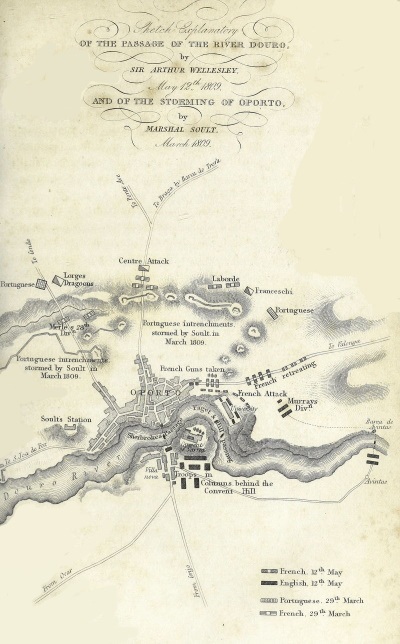 click here for larger image.
Sketch Explanatory
OF THE PASSAGE OF THE RIVER DOURO,
by SIR ARTHUR WELLESLEY,
May 12th, 1809,
AND OF THE STORMING OF OPORTO,
by
MARSHAL SOULT,
March 1809.
London. Published by T. & W. BOONE, July 1829.
Napoleon’s veterans were so experienced, so
inured to warfare that no troops in the world could
more readily recover from such a surprise, and
before they reached Vallonga their columns were
again in order, with a regular rear guard covering
the retreat. A small garrison at the mouth of the
Douro was cut off, but, guided by some friendly
Portuguese, it rejoined the army in the night; and
Soult, believing that Loison was at Amarante,
thought he had happily escaped a great danger and
was still formidable to his enemies.
Sir Arthur Wellesley employed the remainder of
the 12th, and the next day, in bringing over the rear
of the army, together with the baggage, the stores,
and the artillery. General Murray’s Germans, however,
pursued, on the morning of the 13th, but not
further than about two leagues on the road of Amarante.
This delay has been blamed as an error in
sir Arthur; it is argued that an enemy once surprised
should never be allowed to recover, and that
Soult should have been followed up, even while a
single regiment was left to pursue. But the reasons
for halting were, first, that a part of the army was
still on the left bank of the Douro;—secondly, that
the troops had out marched provisions, baggage,
and ammunition, and having passed over above
eighty miles of difficult country in four days,
during three of which they were constantly fighting,
both men and animals required rest; thirdly, that
nothing was known of Beresford, whose contemporary
operations it is time to relate.
The moment of his arrival on the Douro was
marked by the repulse of Loison’s division, which
immediately fell back, as I have already related, to
Mezamfrio, followed by the Portuguese patroles
only, for Beresford halted on the left bank of the
river, because the British regiments were still in
the rear. This was on the 10th. Sylveira, who was
at Villa Real, had orders to feel towards Mezamfrio
for the enemy, and the marshal’s force was
thus, with the assistance of the insurgents, in readiness
to turn Soult from the route of Villa Real to
Bragança.
The 11th, Loison continued his retreat, and Beresford
finding him so timid, followed, skirmishing
with his rear guard, and at the same time Sylveira
advanced from Villa Real. On the 12th, the French
outposts, in front of Amarante were driven in, and
the 13th Loison abandoned that town, and took the
route of Guimaraens.
These events were unknown to sir Arthur Wellesley
on the evening of the 13th, but he heard
that Soult, after destroying his artillery and ammunition,
near Penafiel, had passed over the mountain
towards Braga; and judging this to arise from
Beresford’s operations on the Tamega, he reinforced
Murray with some cavalry, ordering him to proceed
by Penafiel, and if Loison still lingered near Amarante,
to open a communication with Beresford. The
latter was at the same time directed to ascend the
Tamega, and intercept the enemy at Chaves.
Meanwhile, the main body of the army marched
in two columns upon the Minho, the one by the route
of Barca de Troffa and Braga, the other by the
Ponte d’Ave and Bacellos. But, on the evening
of the 14th, the movements of the enemy about
Braga gave certain proofs that not Valença and Tuy,
but Chaves or Montalegre, would be the point of
his retreat. Hereupon, the left column was drawn
off from the Bacellos road and directed upon Braga,
and Beresford was instructed to move by Monterey,
upon Villa del Rey, if Soult took the line of
Montalegre.
The 15th, sir Arthur reached Braga. Murray
was at Guimaraens on his right, and Beresford, who
had anticipated his orders, was near Chaves,
having sent Sylveira towards Salamonde, with instructions
to occupy the passes of Ruivaens and
Melgassy. But at this time Soult was fifteen miles
in advance of Braga, having, by a surprising effort,
extricated himself from one of the most dangerous
situations that a general ever escaped from. To
understand this, it is necessary to describe the
country through which his retreat was effected.
I have already observed that the Sierra de
Cabreira and the Sierra de Catalina line the right
bank of the Tamega; but, in approaching the Douro,
the latter slants off towards Oporto, thus opening a
rough but practicable slip of land, through which
the road leads from Oporto to Amarante. Hence,
the French in retreating to the latter town had the
Douro on their right hand and the Sierra de Catalina
on their left.
Between Amarante, and Braga which is on the
other side of the Catalina, a route practicable
for artillery, runs through Guimaraens, but it is
necessary to reach Amarante to fall into this
road. Thus, Soult, as he advanced along the narrow
pass between the mountains and the Douro,
rested his hopes of safety entirely upon Loison’s
holding Amarante. Several days, however, had
elapsed since that general had communicated, and
an aide-de-camp was sent on the morning of the
12th to ascertain his exact position. Colonel
Tholosé, the officer employed, found Loison at
Amarante, but neither his remonstrances, nor the
after coming intelligence that Oporto was evacuated,
and the army in full retreat upon the Tamega, could
induce that general to remain there, and, as we have
seen, he marched towards Guimaraens, on the 13th,
abandoning the bridge of Amarante, without a blow,
and leaving his commander and two-thirds of the
army to what must have appeared inevitable destruction.
The news of this unexpected calamity reached
Soult at one o’clock on the morning of the 13th,
just as he had passed the rugged banks of the
Souza river, the weather was boisterous, the men
were fatigued, voices were heard calling for a capitulation,
and the whole army was stricken with dismay.
Then it was that the duke of Dalmatia justified,
by his energy, that fortune which had raised
him to his high rank in the world. Being, by a
Spanish pedlar, informed of a path that, mounting
the right bank of the Souza, led over the Sierra de
Catalina to Guimaraens, he, on the instant, silenced
the murmurs of the treacherous or fearful in the
ranks, destroyed the artillery, abandoned the military
chest and baggage, and loading the animals with sick
men and musket ammunition, repassed the Souza,
and followed his Spanish guide with a hardy resolution.
The rain was falling in torrents, and the path
was such as might be expected in those wild regions,
but the troops made good their passage over
the mountains to Pombeira, and, at Guimaraens,
happily fell in with Loison. During the night
they were joined by Lorge’s dragoons from Braga,
and thus, almost beyond hope, the whole army was
concentrated.
If Soult’s energy in command was conspicuous
on this occasion, his sagacity and judgement were
not less remarkably displayed in what followed.
Most generals would have moved by the direct
route upon Guimaraens to Braga; but he, with a
long reach of mind, calculated, from the slackness
of pursuit after he passed Vallonga, that the
bulk of the English army must be on the road to
Braga, and would be there before him; or that, at
best, he should be obliged to retreat fighting, and
must sacrifice the guns and baggage of Loison’s
and Lorge’s corps in the face of an enemy—a
circumstance that might operate fatally on the
spirit of his soldiers, and would certainly give
Noble’s Campagne de Galice.
opportunities to the malcontents; and already one
of the generals (apparently Loison) was recommending
a convention like Cintra.
But, with a firmness worthy of the highest admiration,
Soult destroyed all the guns and the greatest
part of the baggage and ammunition of Loison’s
and Lorge’s divisions; then, leaving the high road
to Braga on his left, and once more taking to the
mountain paths, he made for the heights of Carvalho
d’Este, where he arrived late in the evening
of the 14th, thus gaining a day’s march, in point
of time. The morning of the 15th he drew up
his troops in the position he had occupied just two
months before at the battle of Braga; and this
spectacle, where twenty thousand men were collected
upon the theatre of a former victory, and
disposed so as to produce the greatest effect, roused
all the sinking pride of the French soldiers. It
was a happy stroke of generalship, an inspiration
of real genius!
Soult now re-organised his army; taking the
command of the rear-guard himself, and giving
that of the advanced guard to general Loison.
Noble, the French historian of this campaign, says
“the whole army was astonished;” as if it was not
a stroke of consummate policy that the rear, which
was pursued by the British, should be under the
general-in-chief, and that the front, which was to
fight its way through the native forces, should
have a commander whose very name called up
all the revengeful passions of the Portuguese.
Maneta durst not surrender; and the duke of
Dalmatia dextrously forced those to act with most zeal
who were least inclined to serve him: and, in sooth,
such was his perilous situation, that all the resources
of his mind and all the energy of his
character were needed to save the army.
From Carvalho he retired to Salamonde, from
whence there were two lines of retreat. The one
through Ruivaens and Venda Nova, by which the
army had marched when coming from Chaves two
months before; the other, shorter, although more impracticable,
leading by the Ponte Nova and Ponte
Miserella into the road running from Ruivaens to
Montalegre. But the scouts brought intelligence
that the bridge of Ruivaens, on the little river of
that name, was broken, and defended by twelve
hundred Portuguese, with artillery; and that
another party had been, since the morning, destroying
the Ponte Nova on the Cavado river.
The destruction of the first bridge blocked the
road to Chaves; the second, if completed, and
the passage well defended, would have cut the
French off from Montalegre. The night was setting
in, the soldiers were harassed, barefooted, and
starving; the ammunition was damp with the rain,
which had never ceased since the 13th, and which
was now increasing in violence, accompanied with
storms of wind. The British army would certainly
fall upon the rear in the morning; and if the Ponte
Nova, where the guard was reported to be weak,
could not be secured, the hour of surrender was
surely arrived.
In this extremity, Soult sent for major Dulong,
an officer justly reputed for one of the most daring
in the French ranks. Addressing himself to this
brave man, he said, “I have chosen you from the
whole army to seize the Ponte Nova, which has been cut
by the enemy. Do you choose a hundred grenadiers
and twenty-five horsemen; endeavour to surprise
the guards, and secure the passage of the bridge.
If you succeed, say so, but send no other report;
your silence will suffice.” Thus exhorted, Dulong
selected his men, and departed.
Favoured by the storm, he reached the bridge
unperceived of the Portuguese, killed the centinel
before any alarm was given, and then, followed by
twelve grenadiers, began crawling along a narrow
slip of masonry, which was the only part of the
bridge undestroyed. The Cavado river was in full
flood, and roaring in a deep channel; one of the
grenadiers fell into the gulph, but the noise of
the storm and the river was louder than his cry;
Dulong, with the eleven, still creeping onwards,
reached the other side, and falling briskly on the
first posts of the peasants, killed or dispersed the
whole. At that moment, the remainder of his men
advanced close to the bridge; and some crossing,
others mounting the heights, shouting and firing,
scared the Portuguese supporting-posts, who
imagined the whole army was upon them; and
thus the passage was gallantly won.
At four o’clock, the bridge being repaired,
the advanced guards of the French commenced
crossing; but as the column of march was long,
and the road narrow and rugged, the troops filed
over slowly; and beyond the Ponte Nova there
was a second obstacle still more formidable. For the
pass in which the troops were moving being cut in
the side of a mountain, open on the left for several
miles, at last came upon a torrent called the
Misarella, which, breaking down a deep ravine,
or rather gulph, was only to be crossed by a bridge,
constructed with a single lofty arch, called the
Saltador, or leaper; and so narrow that only
three persons could pass abreast. Fortunately
for the French, the Saltador was not cut, but
entrenched and defended by a few hundred Portuguese
peasants, who occupied the rocks on the
S.
Journal of Operations MS.
farther side; and here the good soldier Dulong
again saved the army: for, when a first and second
attempt had been repulsed with loss, he carried
the entrenchments by a third effort; but, at the
same instant, fell deeply wounded himself. The
head of the column now poured over, and it was
full time, for the English guns were thundering in
the rear, and the Ponte Nova was choked with dead.
Sir Arthur Wellesley, quitting Braga on the
morning of the 16th, had come, about four o’clock,
upon Soult’s rear-guard, which remained at Salamonde
to cover the passage of the army over the
bridges. The right was strongly protected by a
ravine, the left occupied a steep hill; and a stout
battle might have been made, but men thus circumstanced,
and momentarily expecting an order
to retreat, will seldom stand firmly; and, on this
occasion, when some light troops turned the left,
and general Sherbrooke, with the guards, mounting
the steep hill, attacked the front, the French made
but one discharge, and fled in confusion to the
Ponte Nova. As this bridge was not on the direct
line of retreat, they were for some time unperceived,
and gaining ground of their pursuers,
formed a rear-guard; but, after a time, being discovered,
some guns were brought to bear on them;
and then man and horse, crushed together, went
over into the gulph; and the bridge, and the
rocks, and the defile beyond were strewed with
mangled bodies.
This was the last calamity inflicted by the sword
upon the French army in this retreat; a retreat
attended by many horrid as well as glorious events;
for the peasants in their fury, with an atrocious
cruelty, tortured and mutilated every sick man and
straggler that fell into their power; and on the other
hand, the soldiers, who held together in their turn,
shot the peasants; while the track of the columns
might be discovered from afar by the smoke of the
burning houses.
The French reached Montalegre on the 17th;
and an English staff-officer, with some cavalry,
being upon their rear, as far as Villella, picked
up some stragglers; but sir Arthur, with the main
body of the army, halted that day at Ruivaens.
The 18th he renewed the pursuit, and a part of his
cavalry passed Montalegre, followed by the guards;
the enemy was, however, drawn up behind the Salas
in force, and no action took place. Sylveira, indeed,
had entered Montalegre, from the side of Chaves,
before the British came up from Ruivaens; but
instead of pursuing, he put his men into quarters;
and a Portuguese officer of his division, who was
despatched to marshal Beresford with orders to move
from Villa Perdrices upon Villa del Rey, loitered on
the road so long, that all chance of intercepting the
French line of march was at an end; for though
Beresford, on the 19th, pushed colonel Talbot with
the 14th dragoons as far as Ginjo, Franceschi turned
in force, and obliged that officer to retire; and thus
the pursuit terminated, with the capture of a few
stragglers on the Salas.
Soult himself crossed the frontier by Allaritz on
the 18th; and on the 19th entered Orense, but
without guns, stores, ammunition, or baggage; his
men exhausted with fatigue and misery, the greatest
part being without shoes, many without accoutrements,
and in some instances even without muskets.
He had quitted Orense seventy-six days before, with
about twenty-two thousand men, and three thousand
five hundred had afterwards joined him from Tuy.
He returned with nineteen thousand five hundred,
having lost by the sword and sickness, by assassination
and capture, six thousand good soldiers; of
which number above three thousand were taken in
hospitals,[7] and about a thousand were killed by the
Portuguese, or had died of sickness, previous to the
retreat. The remainder were captured, or had
perished within the last eight days. He had carried
fifty-eight pieces of artillery into Portugal, and he
returned without a gun; yet was his reputation as
a stout and able soldier no wise diminished.
OBSERVATIONS. — MOVEMENTS OF THE BRITISH GENERAL.
Plate 5. to face Pa. 300.
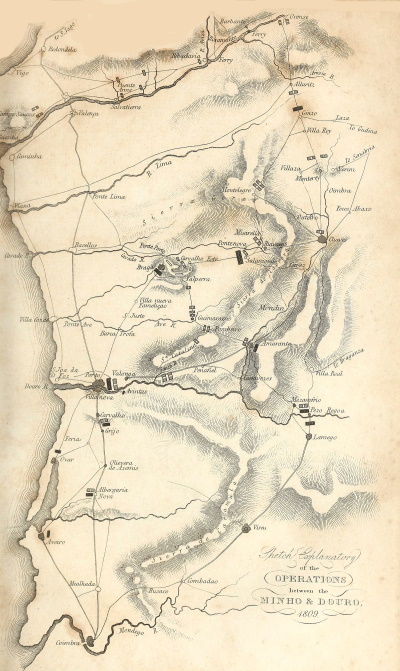 click here for larger image.
Sketch Explanatory of the
OPERATIONS
between the
MINHO & DOURO,
1809.
London. Published by T. & W. BOONE, July 1829.
The duke of Dalmatia’s arrangements being continually
thwarted by the conspirators, his military
conduct cannot be fairly judged of. Nevertheless,
the errors of the campaign may, without injustice,
be pointed out, leaving to others the task of tracing
them to their true sources.
1º. The disposition of the army, on both sides of
the Douro, and upon such extended lines, when no
certain advice of the movements and strength of the
English force had been received, was rash. It was,
doubtless, right, that to clear the front of the army,
and to gather information, Franceschi should advance
to the Vouga; but he remained too long in the same
position, and he should have felt Trant’s force more
positively. Had the latter officer (whose boldness
in maintaining the line of the Vouga was extremely
creditable) been beaten, as he easily might have
been, the anarchy in the country would have increased;
and as Beresford’s troops at Thomar wanted
but an excuse to disband themselves, the Portuguese
and British preparations must have been greatly
retarded.
2º. That Soult, when he had secured, as he
thought, all the boats on an unfordable river three
hundred yards wide, should think himself safe from
an attack for one day, is not wonderful. The improbability
that such a barrier could be forced in
half an hour might have rendered Fabius careless;
but there were some peculiar circumstances attending
the surprise of the French army which indicate
Noble’s Campagne de Galice.
great negligence. The commanding officer of one
regiment reported, as early as six o’clock, that the
English were crossing the river; the report was
certainly premature, because no man passed before
ten o’clock; but it reached Soult, and he sent general
Quesnel, the governor of Oporto, to verify the
fact. Quesnel stated, on his return, and truly, that
it was an error, and Soult took no further precaution.
The patroles were not increased; no staff-officers
appear to have been employed to watch the river,
and no signals were established; yet it was but
three days since D’Argenton’s conspiracy had been
discovered, and the extent of it was still unknown.
This circumstance alone should have induced the
duke of Dalmatia to augment the number of his
guards and posts of observation, that the multiplicity
of the reports might render it impossible for the
malcontents to deceive him. The surprise at Oporto
must, therefore, be considered as a fault in the
general, which could only be atoned for by the
high resolution and commanding energy with which
he saved his army in the subsequent retreat.
3º. When general Loison suffered marshal Beresford
to drive him from Pezo de Ragoa and Mezamfrio,
he committed a grave military error; but when
he abandoned Amarante, he relinquished all claim
to military reputation, as a simple statement of facts
will prove. The evening of the 12th he wrote to
Soult that one regiment had easily repulsed the
whole of the enemy’s forces; yet he, although at
the head of six thousand men, cavalry, infantry, and
artillery, that night and without another shot being
fired, abandoned the only passage by which, as far
as he knew, the rest of the army could escape from
its perilous situation with honour. It was not general
Loison’s fault if England did not triumph a
second time for the capture of a French marshal.
1º. If sir Arthur Wellesley’s operation be looked
at as a whole, it is impossible to deny his sagacity
in planning, his decision and celerity in execution.
When he landed at Lisbon, the nation was dismayed
by previous defeats, distracted with anarchy, and
menaced on two sides by powerful armies, one of
which was already in possession of the second city
in the kingdom. In twenty-eight days he had restored
public confidence; provided a defence against
one adversary; and having marched two hundred
miles through a rugged country, and forced the
passage of a great river—caused his other opponent
to flee over the frontier, without artillery or baggage.
2º.—Such being the result, it is necessary to
show that the success was due, not to the caprice
of fortune, but to the talents of the general; that
he was quick to see, and active to strike; and, first,
the secresy and despatch with which the army was
collected on the Vouga belongs entirely to the man;
for, there were many obstacles to overcome; and
D’Argenton, as the sequel proved, would, by his
disclosures, have ruined sir Arthur’s combinations,
if the latter had not providently given him a false
view of affairs. The subsequent march from the
Vouga to the Douro was, in itself, no mean effort,
for, it must be recollected, that this rapid advance
against an eminent commander, and a veteran army
of above twenty thousand men, was made with
a heterogeneous force, of which only sixteen
thousand men were approved soldiers, the remainder
being totally unformed by discipline,
untried in battle, and, only three weeks before,
were in a state of open mutiny.
3º.—The passage of the Douro, at Oporto,
would, at first sight, seem a rash undertaking; but,
when examined closely, it proves to be an example
of consummate generalship, both in the conception
and the execution. The careless watch maintained
by the French may, indeed, be called fortunate,
because it permitted the English general to get a
few men over unperceived; but it was not twenty-five,
nor twenty-five hundred, soldiers that could
have maintained themselves, if heedlessly cast on
the other side. Sir Arthur, when he so coolly
said—“let them pass,” was prepared to protect them
when they had passed. He did not give that order
until he knew that Murray had found boats at
Avintas, to ferry over a considerable number of
troops, and, consequently, that that general, descending
the Douro, could cover the right flank of
the Seminary, while the guns planted on the heights
of Sarea could sweep the left flank, and search all
the ground enclosed by the wall round the building.
If general Murray’s troops only had passed, they
would have been compromised; if the whole army
had made the attempt at Avintas, its march would
have been discovered; but in the double passage
all was secured: the men in the Seminary by the
guns, by the strength of the building, and by
Murray’s troops; the latter by the surprise on the
town, which drew the enemy’s attention away from
them. Hence, it was only necessary to throw a
few brave men into the Seminary unperceived, and
then the success was almost certain; because, while
that building was maintained, the troops in the
act of passing could neither be prevented nor
harmed by the enemy. To attain great objects by
simple means is the highest effort of genius!
4º.—If general Murray had attacked vigorously,
the ruin of the French army would have ensued.
It was an opportunity that would have tempted a
blind man to strike; the neglect of it argued want
of military talent and of military hardihood; and
how would it have appeared if Loison had not
abandoned Amarante? If Soult, effecting his
retreat in safety, and reaching Zamora or Salamanca
in good order, had turned on Ciudad
Rodrigo, he would have found full occupation
for sir Arthur Wellesley in the north; and he
would have opened a free communication with the
duke of Belluno. The latter must, then, have
marched either against Seville or Lisbon; and thus
the boldness and excellent conduct of the English
general, producing no adequate results, would have
been overlooked, or, perhaps, have formed a
subject for the abuse of some ignorant, declamatory
writer.
5º.—Sir Arthur Wellesley’s reasons for halting
at Oporto, the 13th, have been already noticed, but
they require further remarks. Had he followed
Soult headlong, there is no doubt that the latter
would have been overtaken on the Souza river, and
destroyed; but this chance, arising from Loison’s
wretched movements, was not to be foreseen. Sir
Arthur Wellesley knew nothing of Beresford’s
situation; but he naturally supposed that, following
his instructions, the latter was about Villa Real;
and that, consequently, the French would, from
Amarante, either ascend the Tamega to Chaves,
or taking the road to Guimaraens and Braga, make
for the Minho. Hence, he remained where he
could command the main roads to that river, in
order to intercept Soult’s retreat and force him to
a battle; whereas, if he had once entered the defile
formed by the Douro and the Sierra de Catalina,
he could only have followed his enemy in one column
by a difficult route, a process promising little
advantage. Nevertheless, seeing that he detached
general Murray by that route at last, it would
appear that he should have ordered him to press
the enemy closer than he did; but there a political
difficulty occurred.
The English cabinet, although improvident in
its preparations, was very fearful of misfortune,
and the general durst not risk the safety of a single
brigade, except for a great object, lest a slight
disaster should cause the army to be recalled. Thus,
he was obliged to curb his naturally enterprising
disposition, and to this burthen of ministerial incapacity,
which he bore even to the battle of Salamanca,
may be traced that over-caution which has
been so often censured as a fault, not only by military
King Joseph’s captured Correspondence, MS.
writers, but by Napoleon, who, judging from
appearances, erroneously supposed it to be a characteristic
of the man, and often rebuked his
generals for not taking advantage thereof.
6º.—The marches and encounters, from the 14th
to the 17th, were excellent on both sides. Like
the wheelings and buffeting of two vultures in the
air, the generals contended, the one for safety, the
other for triumph; but there was evidently a failure
in the operations of marshal Beresford. Soult did
not reach Salamonde until the evening of the 15th,
and his rear guard was still there on the evening
of the 16th. Beresford was in person at Chaves
on the 16th, and his troops reached that place early
on the morning of the 17th. Soult passed Montalegre
on the 18th, but from Chaves to that place
is only one march.
Again, marshal Beresford was in possession of
Amarante on the 13th, and as there was an excellent
map of the province in existence, he must have
known the importance of Salamonde, and that there
were roads to it through Mondin and Cavez, shorter
than by Guimaraens and Chaves. It is true that
Sylveira was sent to occupy Ruivaens and Melgacy;
but he executed his orders slowly, and Misarella
was neglected. Major Warre, an officer of the
marshal’s staff, endeavoured, indeed, to break down
the bridges of Ponte Nova and Ruivaens; and it
was by his exertions that the peasants, surprised at
the former, had been collected; but he had only a
single dragoon with him, and was without powder
to execute this important task. The peasantry,
glad to be rid of the French, were reluctant
to stop their retreat, and still more to destroy the
bridge of Misarella, which was the key of all the
communications, and all the great markets of the
Entre Minho e Douro; and therefore sure to
be built up again, in which case the people knew
well that their labour and time would be called for
without payment. It is undoubted that Soult owed
his safety to the failure in breaking those bridges;
and it does appear that if major Warre had been
supplied with the necessary escort and materials
he would have effectually destroyed them.
Sylveira did not move either in the direction or
with the celerity required of him by Beresford,
there seems to have been a misunderstanding
between them; but allowance must be made for
the numerous mistakes necessarily arising in the
transmission of orders by officers speaking different
languages; and for the difficulty of moving troops
not accustomed, or perfectly willing to act together.
CHAPTER III . — VICTOR’S OPERATIONS.
S.
Journal of
Operations
MS.
The duke of Dalmatia halted at Orense the 20th,
but on the 21st put his troops in motion upon
Lugo, where general Fournier, of the 6th corps,
with three battalions of infantry and a regiment of
dragoons, was besieged by twelve or fifteen thousand
Spaniards, under the command of general
Mahi. But to explain this it is necessary to relate
Romana’s operations, after his defeat at Monterey
on the 6th of March.
Having re-assembled the fugitives at Puebla de
Senabria, on the borders of Leon, he repaired
his losses by fresh levies, and was soon after joined
by three thousand men from Castile, and thus, unknown
to Ney, he had, as it were, gained the rear
of the sixth corps. Villa Franca del Bierzo was, at
this time, occupied by two weak French battalions,
and their nearest support was at Lugo: Romana resolved
to surprise them, and, dividing his forces,
sent Mendizabel with one division by the valley of
the Syl to take the French in rear, and marched
himself by the route of Calcabellos. The French, thus
surrounded in Villa Franca, after a short skirmish,
in which the Spaniards lost about a hundred men,
surrendered, and were sent into the Asturias.
Romana then detached a part of his forces to
Orense and Ponte Vedra, to assist Morillo and the
insurrection in the western parts of Gallicia,
where, with the aid of the English ships of war,
and notwithstanding the shameful neglect of the
supreme central junta, the patriots were proceeding
vigorously. The moveable columns of the sixth
corps daily lost a number of men; some in open
battle, but a still greater number by assassinations,
which were rigorously visited upon the districts
where they took place; and thus, in Gallicia, as in
every other part of Spain, the war hourly assumed
a more horrid character. Referring to this
period, colonel Barios afterwards told Mr. Frere
that, to repress the excesses of marshal Ney’s troops,
Parl. Papers, 1810.
he, himself, had, in cold blood, caused seven hundred
French prisoners to be drowned in the Minho; an
avowal recorded by Mr. Frere, without animadversion,
but which, happily for the cause of humanity,
there is good reason to believe was as false as it was
disgraceful.
After the capture of Vigo, the Spanish force on
the coast increased rapidly. Barios returned to
Seville; Martin Carrera assumed the command of
the troops near Orense, and the Conde Noroña of
those near Vigo. General Maucune returned to
St. Jago from Tuy, and Ney, apprized of the loss
at Villa Franca, advanced to Lugo. Romana immediately
abandoned Gallicia, and, entering the
Asturias by the pass of Cienfuegos, marched along
the line of the Gallician frontier, until he reached
Navia de Suarna. Here he left Mahi, with the army,
to observe Ney, but repaired, himself, to Oviedo,
to redress the crying wrongs of the Asturians.
It is unnecessary to recapitulate the evil doings
of the Asturian junta, which was notoriously corrupt
and incapable. Romana, after a short inquiry,
dismissed the members in virtue of his supreme
authority, and appointed new men; but this act of
justice gave great offence to Jovellanos and others.
It appeared too close an approximation to Cuesta’s
manner, in Leon, the year before; and as the central
government, always selfish and jealous, abhorred
any indication of vigour or probity in a general,
Romana was soon afterwards deprived of his command.
Meanwhile, he was resolutely reforming
abuses, when his proceedings were suddenly arrested
by an unexpected event.
As soon as Ney understood that the Spanish
army was posted on the Gallician side of the
Asturian frontier, and that Romana was likely to
excite the energy of the Asturian people, he planned
a combined movement, to surround and destroy, not
only Romana and his army, but also the Asturian
forces, which then amounted to about fifteen thousand
men, including the partida of Porlier, commonly
called the Marquisetto. This force, commanded
by general Ballasteros and general Voster,
occupied Infiesta, on the eastern side of Oviedo,
and Castropol on the coast. Ney, with the consent
of Joseph, arranged that Kellerman, who was at
Astorga, with six guns and eight thousand seven
hundred men, composed of detachments, drawn
together from the different corps, should penetrate
the Asturias from the south east by the pass of
Pajares; that Bonnet, who always remained at the
town of St. Andero, should break in, from the north
east, by the coast road; and that the sixth corps
should make an irruption by the Concejo de Ibias, a
short but difficult route leading directly from Lugo.
When the period for these combined movements
was determined, Ney, appointing general Marchand
to command in Gallicia during his own
absence, left three battalions under Maucune at St.
Jago, three others in garrison at Coruña under
general D’Armagnac, one at Ferrol, and three with
a regiment of cavalry under Fournier at Lugo; and
then marched himself, with twelve battalions of infantry
and three regiments of cavalry, against Mahi.
The latter immediately abandoned his position
at Navia de Suarna, and drawing off by his left,
without giving notice to Romana, returned to
Gallicia and again entered the valley of the Syl.
Ney, either thinking that the greatest force was
near Oviedo, or that it was more important to
capture Romana than to disperse Mahi’s troops, continued
his route by the valley of the Nareca, and
with such diligence that he reached Cornellana and
Grado, one march from Oviedo, before Romana
knew of his approach. The Spanish general, thus
surprized, made a feeble and fruitless endeavour
to check the French at the bridge of Peñaflor, after
which, sending the single regiment he had with
him to Infiesta, he embarked on board an English
vessel at Gihon, and so escaped.
The 18th of May, Ney entered Oviedo, where he
was joined by Kellerman, and the next day pursued
Romana to Gihon. Bonnet, likewise, executed his
part, but somewhat later; and thus Vorster, being
unmolested by Ney, had time to collect his corps
on the coast. Meanwhile Ballasteros, finding that
Bonnet had passed between him and Vorster, boldly
marched upon St. Andero and retook it, making
the garrison and sick men (in all eleven hundred)
prisoners. The Amelia and Statira, British frigates,
arrived off the harbour at the same moment, and
captured three French corvettes and two luggers,
on board of which some staff-officers were endeavouring
to escape.
Bonnet, however, followed hard upon Ballasteros,
and, the 11th of June, routed him so completely
that he, also, was forced to save himself on
board an English vessel, and the French recovered
all the prisoners, and, amongst them, the men taken
at Villa Franca, by Romana. But, before this, Ney,
uneasy for his posts in Gallicia, had returned to
Coruña by the coast-road through Castropol, and
Kellerman, after several trifling skirmishes with
Vorster, had also retired to Valladolid. This expedition
proved that Asturia was not calculated for
defence, although, with the aid of English ships, it
might become extremely troublesome to the French.
While Ney was in Asturia, Carrera, advancing
from the side of Orense, appeared in front of
St. Jago di Compostella at the moment that colonel
D’Esmenard, a staff-officer sent by the marshal to
give notice of his return to Coruña, arrived with an
escort of dragoons in Maucune’s camp. This escort
was magnified by the Spaniards into a reinforcement
of eight hundred men; but Carrera, who had
been joined by Morillo, commanded eight thousand,
and, on the 23d, having attacked Maucune, at a
place called “Campo de Estrella,” totally defeated
him, with a loss of six hundred men and several
guns. The Spaniards did not pursue, but the
French retreated in confusion to Coruña. Nor was
this the only check suffered by the 6th corps; for
Mahi, having united a great body of peasants to
his army, drove back Fournier’s outposts, and
closely invested him in Lugo on the 19th.
Such was the state of affairs in Gallicia when
Soult arrived at Orense; and as the inhabitants of
that town, from whom he got intelligence of these
S.
Journal of Operations MS.
events, rather exaggerated the success of their
countrymen, the French marshal immediately sent
forward an advanced guard of his stoutest men to
relieve Lugo, and followed himself, by the route of
Monforte, with as much speed as the exhausted
state of his troops would permit. The 22d, he
reached Gutin, and, the same day, his van being
descried on the mountains above Lugo, Mahi broke
up his camp, and fell back to Mondenedo.
The 23d, Soult entered Lugo, where he heard of
the emperor’s first successes in Austria, and, with
renewed energy, prepared for fresh exertions himself.
The 30th, he was joined by Ney, who, uninformed
of Mahi’s position at Mondenedo, had
missed a favourable opportunity of revenging the
loss at St. Jago. Meanwhile Romana, disembarking
at Ribadeo, joined Mahi at Mondenedo, and immediately
marched along the line of the Asturias
frontier, until he arrived at the sources of the
Neyra, then, crossing the royal road, a little above
Lugo, plunged, once more, into the valley of the
Syl; and, having gained Orense, the 6th of June,
opened a communication with Carrera at St. Jago,
and with the insurgents at Vigo. This movement
of Romana’s was able, energetic, and worthy of
every praise.
In pursuance of an order from the emperor, Soult
now sent eleven hundred men, composed of
dismounted dragoons and skeletons of cavalry
regiments, to France; and, having partially restored
the artillery and equipments of the second
corps, from the arsenals of Coruña and Ferrol, he,
in concert with the duke of Elchingen, arranged
a fresh plan for the destruction of Romana, the
execution of which failed, as shall be hereafter
noticed; but, at present, it is necessary to resume
the narrative of
After the abortive effort to gain Badajos, the duke
of Belluno, in obedience to the king’s orders, proceeded
Semelé’s Journal of Operations MSS.
to recover Alcantara. His rear was still
within two marches of Merida when the head of
his columns, under Lapisse, drove back some cavalry
posts, entered the town of Alcantara, and the next
day attempted the passage of the bridge.
The Portuguese force consisted of two thousand
infantry, fifty cavalry, and six guns; and some works
of defence were constructed on the right bank of
the river; but, on the 14th of May, Lapisse lining
the rocks on the left bank of the river, skirmished
so sharply that the militia regiment of
Idanha gave way. Colonel Mayne then sprung a
mine, but the explosion doing little injury to
the bridge, the French made good the passage.
The Portuguese, who had suffered considerably,
retired to the Puente de Segura, and Lapisse immediately
sent patroles towards Castello Branco,
Salvatierra, and Idanha Nova.
Intelligence of this attack having reached general
Mackenzie, he directed preparations to be made
for destroying the boat-bridge at Abrantes, and
marched, in person, by Cortiçada to Sobreira Formosa;
this movement, and a rumour that Soult
had retreated from Oporto, afforded an excuse to
Victor for again abandoning Alcantara, and resuming
his former camp. During his absence, Cuesta, true
to the promise he had given, attacked the fort of
Merida; but, on the return of the French advanced
guard, re-crossed the Guadiana, and fell back to
Zafra, having first ravaged all the flat country, and
obliged the inhabitants to withdraw into the mountains.
Some time before this, king Joseph had received
a despatch from the French minister of war, giving
notice that reinforcements had sailed from England,
and warning him to lose no time in marching against
Lisbon, to create a useful diversion in favour of
Soult. It might be supposed that the original plan
of the emperor would then have been acted upon,
and this was the first thought of Joseph himself;
but other circumstances created doubt and hesitation
in his councils, and, finally, induced him to
abandon all thoughts of Portugal.
When Napoleon returned to Paris, he imagined
hostilities with Austria, although certain, would
not break out so suddenly, but that he should
have time to organise a sufficient army in Germany,
without drawing his veteran troops from Spain.
Hence, he still left the imperial guards at Vittoria,
and sending the prince of Neufchatel to command
the troops on the Danube, he himself remained at
Paris, to superintend the preparations for opening
the campaign. The Austrians were, however, not
inattentive observers of the perfidy which accompanied
the invasion of Spain; and, aptly taking the
hint, attacked the French outposts and published
their own declaration of war at the same moment.
Berthier, incapable of acting a principal part,
was surprised, and made a succession of false
movements that would have been fatal to the
French army, if the emperor, journeying day and
night, had not arrived at the very hour when his
lieutenant was on the point of consummating the
ruin of the army. Then, indeed, was seen the
supernatural force of Napoleon’s genius: in a few
hours he changed the aspect of affairs, in a
few days, maugre their immense number, his
enemies, baffled and flying in all directions, proclaimed
his mastery in an art which, up to that
moment, was imperfect; for never, since troops
first trod a field of battle, was such a display of
military skill made by man.
But previous to these successes, so threatening
had been the aspect of affairs in Germany, that the
imperial guards had been recalled from Vittoria,
and hurried to the Danube, the great reserve of
infantry was, as we have seen, struck off the rolls
of the army in Spain, and the skeletons of the
fourth squadrons of every cavalry regiment were
ordered to return to their depôts in France. Even
the fifth corps, under Mortier, then on its way
to Valladolid from Zaragoza, was directed to
halt, and hold itself in readiness to march for
Germany; and thus, while Victor was reluctant to
move, while Ney was demanding more troops to
preserve Gallicia, and while the fate of the second
corps was unknown, the whole army was actually
diminished by forty thousand men, and fifteen
thousand more were paralysed with regard to
offensive operations.
These things rendered Joseph timid. Madrid,
it was argued in his councils, was of more consequence
than Lisbon. Soult might be already at
the latter place; or, if not, he might extricate
himself from his difficulties, for the capital of
Spain must be covered. In pursuance of this
reasoning, Sebastiani was forbidden any forward
movement; and the duke of Belluno, whose army
was daily wasting with the Guadiana fever, took
a position at Torre-Mocha, a central point between
Truxillo, Merida, and Alcantara. His cavalry
Semelé’s Journal of Operations MS.
posts watched all the passages over the Guadiana
and the Tagus; and his communications with
Madrid, between the Tietar and the Tagus, were
protected by twelve hundred men, detached for
that purpose by the king.
But one timid measure in war generally produces
another. The neighbourhood of the English force
at Castel Branco increased the energy of the Spanish
insurgents, who infested the valley of the Tagus,
and communicated secretly with those of the Sierra
de Guadalupe; hence, Victor, alarmed for his
bridge at Almaraz, sent a division there the 22d of
May; and, as from that period until the 10th of
June, he remained quiet: his campaign, which had
opened so brilliantly, was annulled. He had
neither assisted Soult, nor crushed Cuesta, nor
taken Badajos nor Seville; yet he had wasted and
lost, by sickness, more men than would have sufficed
to reduce both Lisbon and Seville. The Spaniards
were daily recovering strength and confidence; and
sir Arthur Wellesley, after defeating Soult, had full
leisure to return to the Tagus, and to combine
his future operations with the Spanish armies in
the south.
Information that Lapisse had forced the bridge
of Alcantara reached the English general on the
night of the 17th. That part of the army which
was still behind Salamonde received immediate
orders to retrace their steps to Oporto; and when
the retreat of Soult by Orense was ascertained,
the remainder of the troops, including three Portuguese
brigades under Beresford, followed the
same route. Colonel Trant was then appointed
military governor of Oporto; and it was thought
sufficient to leave Sylveira with some regular
battalions and militia to defend the northern provinces;
for Soult’s army was considered a crippled
force, which could not for a long time appear again
in the field; a conclusion drawn, as we shall see,
from false data, and without due allowance being
made for the energy of that chief.
As the army proceeded southward, the contracted
scope of Lapisse’s movements was ascertained.
Colonel Mayne was directed again to take post at
Alcantara; and a reinforcement of five thousand
men having landed at Lisbon, the rapidity of the
march slackened. Passing by easy journeys through
Coimbra, Thomar, and Punhete, the troops reached
Abrantes the 7th of June, and encamped on the
left bank of the Tagus; but there was sickness and
a great mortality in his ranks.
From the moment of his arrival in Portugal,
sir Arthur Wellesley had looked to the defeat of
Victor as the principal, and the operation against
Sir A. Wellesley’s Correspondence,
Parl. Papers, 1810.
Soult as the secondary, object of the campaign;
and the English government, acceding to his
views, now gave him a discretionary power to
enter the nearest provinces of Spain, if Portugal
should not thereby be endangered. In his correspondence
with the junta and with Cuesta, he
had strongly urged the necessity of avoiding any
serious collision with the enemy until the British
troops could act in concert with the Spanish armies.
This advice, approved of by the junta, was
attended to by Cuesta; insomuch that he did not
seek a battle, but he exposed his advanced posts,
as if in derision of the counsel; and, disdainful
of the English general’s abilities, expressed his
belief that the latter had no desire to act heartily,
“because,” said he, “the system of the British
appears to be never to expose their troops; owing
to which, they never gain decisive actions by land.”
Cuesta’s knowledge of the enemy’s strength and
positions was always inaccurate, and his judgement
false; hence he himself not only never gained any
decisive action, but lost every army entrusted to his
command. He was discontented with the movement
against Soult, asserting that his hold of Gallicia
would only be strengthened thereby, unless that
favourite folly of all Spanish generals were adopted,
namely, surrounding the enemy, without regarding
whether the troops to be surrounded were more or
less numerous than the surrounders. Sir Arthur
Wellesley, however, affirmed that if Soult were
first driven over the Minho, a combined attack
afterwards made upon Victor would permanently
deliver Gallicia; and this plan being followed,
Gallicia was abandoned by the French, and they
never returned to that province.
When the English army was again free to act,
Cuesta was importunate that a joint offensive operation
against Victor should be undertaken; but,
obstinately attached to his own opinions, he insisted
upon tracing the whole plan of campaign. Yet
his views were so opposed to all sound military
principles, that sir Arthur, although anxious to
conciliate his humour, could scarcely concede the
smallest point, lest a vital catastrophe should follow.
Valuable time was thus lost in idle discussions
which might have been employed in useful action;
for the return of the British army from the Douro
had falsified Victor’s position at Torremocha. That
marshal, as late as the 10th of June, had only one
division guarding the bridge at Almaraz; and it
was difficult for him to ascertain the movements of
sir Arthur Wellesley, covered, as they were, by
the Tagus, the insurgents, and Mackenzie’s corps
of observation: hence, by rapid marches, it was
possible for the English general, while Victor was
still at Torremocha, to reach the valley of the
Tagus, and cutting the first corps off from Madrid,
to place it between two fires.
Semelé’s
Journal of Operations
MS.
This did not escape the penetration of either
commander; but sir Arthur was forced to renounce
the attempt, partly because of the sick and harassed
condition of his troops, the want of shoes and
Appendix, No. 16.
money, and the difficulty of getting supplies; but
chiefly that Cuesta’s army was scattered over the
open country, between the defiles of Monasterio
and the Guadiana, and, as he refused to concentrate
Parliamentary Papers, 1810.
or retire, Victor might have marched against and
crushed him, and yet found time to meet the British
on the Tietar. Early in June, however, marshal
Beresford was, with three brigades, directed upon
Castello Branco, and the duke of Belluno, immediately
taking the alarm, and being also assured, by
despatches from Madrid, of Soult’s retreat, resolved
to re-cross the Tagus. But, previous to commencing
this movement, he resolved to secure his flank, by
causing the bridge of Alcantara to be destroyed.
Colonel Mayne, as I have already observed, had
been again entrusted with that post; but, unfortunately,
his first orders to blow up the bridge, if the
enemy advanced, were not rescinded, although the
return of the army from the north rendered such a
proceeding unnecessary. Mayne did not keep his
instructions secret; and Victor, hearing of them,
sent a detachment to the bridge with no other view
than to cause its destruction. He succeeded; and
this noble monument of Trajan’s genius was overturned.
But such is the nature of war that, not
long afterwards, each army found its fall injurious
to their interests, and, as a matter of taste and of
military advantage, both sides alike sighed over the
ruins of Alcantara.
Having completed this operation, Victor passed
the Tagus, at Almaraz, on the 19th, without being
molested by Cuesta, and, removing his boat-bridge,
proceeded to take post at Plasencia. Meanwhile
Beresford was obliged to return to the defence of
the northern provinces of Portugal, which Soult
was again menacing, for, during the forced inactivity
of the British, at Abrantes, the cause of which I
shall explain in another place, changes in the relative
positions of the hostile armies were taking
place; and it is important that these changes should
be well understood, because on them the fate of the
succeeding campaign hinged.
When Ney and Soult met at Lugo, they, although
still on bad terms, agreed, after some discussion,
that the first should march from Coruña, by the
route of St. Jago and Vigo, against Carrera and the
Conde de Noroña; and that the second, entering
the valley of the Syl, should attack Romana, and
drive him upon Orense, at which place it was expected
that Ney, after taking or blocking Vigo,
would be able to reach him, and thus the whole
force of Gallicia be crushed at once. Soult was
then to menace the Tras os Montes, by the side of
Bragança, with the view of obliging sir Arthur
Wellesley to remain in that province, while the
second corps opened a direct communication with
Madrid and with the first corps.
Ney returned to Coruña; and, on the 1st of
June, two divisions of infantry and a brigade of
dragoons, of the second corps, marched upon Monforte:
they were followed, the next day, by two
other divisions of infantry; and, at the same time,
Franceschi, who was on the Fereira river, supported
by La Houssaye’s dragoons, was directed,
after scouring the road to St. Jago, to fall down the
right bank of the Tambuga, towards Orense.
From the 2d to the 9th the main body halted at
Monforte, to get up stores from Lugo, and to scour
the country on the flanks; for Romana, in his passage,
had again raised the peasantry of all the
valleys. Loison also, with a division, entered the
Val des Orres, having orders to feign a movement
towards Villa Franca and Puente Ferrada, as if for
the purpose of meeting a French column in that
direction.
The 10th, Loison passed the Syl, and took post
at the Puente de Bibey.
S.
Journal of
Operations
MSS.
The 12th, Franceschi, reinforced with a division
of infantry, arrived at Monte Furada on the Syl,
and, sending a detachment to Laronco, connected
his division with Loison’s. The remainder of the
infantry followed this movement, and detachments
were sent up the course of the Syl, and towards
Dancos, on the road from Villa Franca to Lugo.
Loison also forced the passage of the Puente de
Bibey, and drove the insurgents to Puebla de Tribes.
The French army thus cleared all the valleys opening
on the course of the Upper Minho, and Romana
was confined to the lower part of that river.
The 13th, Franceschi, ascending the valley of the
Bibey, took post at Bollo and the bridge of the
Hermitage, and then pushed his patroles even to
Gudina and Monterey on one side, and into the
Sierra de Porto on the other, as far as the sources
of the Bibey, with a view of ascertaining, first, the
exact direction which Romana would take to avoid
Loison’s column; secondly, to prevent the Spanish
general from passing the left of the French army,
and gaining the Asturias by the route of Puebla de
Senabria. These precautions occupied the duke
of Dalmatia till the 19th, when, being assured
that Romana had fallen back to Monterey, he
judged that the latter would attempt the same
march towards Puebla de Senabria, by which
he had escaped after the action in the month of
March. The French army was therefore directed
up the valley of the Bibey, upon Viana, where
there was a bridge, and where many of the mountain
roads united. The same day Franceschi fell in with
the head of Romana’s army, and repulsed it; and
the evening of the 20th the whole of the French
troops were concentrated near Viana, intending to
give battle to the Spaniards the next morning; but
the latter retreated precipitately during the night,
and many of the men dispersed.
Soult continued his movement by the left until
he reached the great road running from Castile to
Orense, and from thence, having sent Heudelet’s
division to Villa Vieja to threaten the Tras os Montes
frontier, and Mermet’s division and Lorge’s dragoons
towards La Canda to observe the road of Puebla de
Senabria, he marched himself, with an advanced
guard, to La Gudina, leaving Laborde and La Houssaye
in reserve between Gudina and Villa Vieja.
These divers movements, through the rugged passes
of Gallicia, led to a variety of slight skirmishes,
the most important of which took place at the Puente
de Bibey, a place of such prodigious strength that
it is scarcely conceivable how men, with arms, could
be brought to abandon such a post.
Romana’s situation was now nearly hopeless, but
he was saved by a misunderstanding between the
French marshals. It appears that Ney, having
marched from Coruña, entered St. Jago with about
ten thousand men, and Carrera fell back upon
Ponte Vedra, where the Conde de Noroña joined
him with some fresh troops, and, assuming the
command, continued the retreat to the Octavem
river, behind which he took post, placing his main
body at the bridge of San Payo, and sending detachments
to guard some secondary points. On the
7th of June, the French came up. The Spaniards
had thirteen thousand men, two eighteen-pounders,
and nine field-pieces. Of these forces, seven thousand
men armed, three thousand unarmed, and the
whole of the artillery, were in position to defend
the passage at San Payo; the bridge was cut, and
overlooked by a battery of two eighteen-pounders.
Three thousand were in reserve at Redondela; and,
at Vigo, about sixty stragglers, from sir John Moore’s
army, were landed, and, in conjunction with a detachment
of seamen and marines, occupied the forts.
Some Spanish gun-boats, one of which was manned
by English seamen, under captain Winter, also
proceeded up the river to the bridge of San Payo.
During the 7th, a desultory and useless fire took
place on both sides; but, on the 8th, the French
were repulsed in some feeble attempts made to force
a passage at San Payo and at Soto Mayor, higher
up the river, the loss on either side being about a
hundred men. These attacks were merely to keep
the Spaniards employed until the reports of the
officers, sent by Ney to ascertain the situation and
projects of Soult’s army, were received, and, in
the evening of the 8th, those officers returned with
information, obtained from the peasants, that the
second corps was retreating upon Castile. I have
been assured by persons, then on marshal Ney’s
staff, that he, amazed at these tidings, rashly concluded
that Soult, swayed by personal feelings,
wished to endanger the sixth corps, and filled with
indignation, immediately retired to Coruña; while
Soult, on the other hand, viewed this retreat as a
breach of their engagements, and an underhand policy
to oblige him to remain in Gallicia. Certain it
is that by these ebullitions of temper, both Romana
and Noroña were saved; for there was nothing to
prevent Ney from sending a column against Orense,
whilst he himself occupied Noroña, on the Octavem;
and, however spirited the conduct of the
Spaniards was at San Payo, it would be ridiculous
to imagine that ten thousand of the best soldiers of
France, led by an officer so quick and resolute as
Ney, could have been resisted by an equal number
of raw troops and peasants, one-third of whom
were without arms. But the history of the quarrel
between these marshals is involved in mystery, the
clearing of which must be left to those who shall
write the memoirs of the men. For the purposes
of this history it is sufficient to know that there
was ill-blood, and that therein the Gallicians found
safety.
Soult, informed of Ney’s retreat and of sir Arthur
Wellesley’s arrival on the Tagus, ceased to pursue
Romana, and marched to Zamora, where his sick
had been before sent, and where his brother, general
Soult, had conducted three or four thousand stragglers
and convalescents. Here, also, he requested
the king to send the artillery and stores necessary
to re-equip the second corps; and here he proposed
to give his harassed troops some rest, for they had
now been for eight months incessantly marching
and fighting, and men and officers were alike dispirited
by the privations they had endured, and by
the terrible nature of a war in which the most
horrid scenes were daily enacted.
To put the king in possession of his views, Soult
sent general Franceschi to Madrid; but this celebrated
officer, refusing an escort, fell into the hands
S.
Journal of Operations MSS.
of the Capuchino. Being transferred to Seville,
the central junta, with infamous cruelty, treated
him as if he had been a criminal instead of a brave
soldier, and confined him in a dungeon at Carthagena.
The citizens there, ashamed of their government,
endeavoured to effect his escape; but he perished
at the moment when his liberation was certain.
When his young wife, a daughter of count Mathieu
Dumas, heard of his fate, she refused all nourishment;
and, in a few days, by her death, added one
more to the thousand instances of the strength of
woman’s affections.
The 25th of June, Soult reached Puebla de Senabria.
The 28th, he marched to Mombuey.
The 29th and 30th, he crossed the Esla, by the
bridges of San Pelayo and Castro Gonzales.
The 2d of July, he entered Zamora, having previously
rejected a proposition of Ney’s, that the
two corps should jointly maintain Gallicia, a rejection
which induced the duke of Elchingen to
evacuate that province.
BATTLE OF MARIA. — BATTLE OF BELCHITE.
Plate 6. to face Pa. 326.
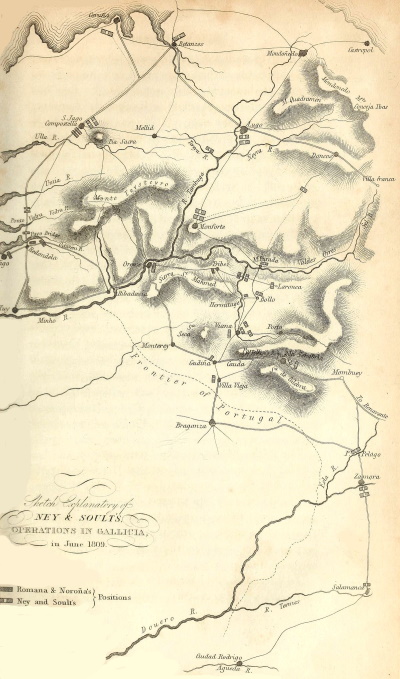 click here for larger image.
Sketch Explanatory of
NEY & SOULT’S,
OPERATIONS IN GALLICIA,
in June 1809.
London. Published by T. & W. BOONE, July 1829.
To effect this, Ney formed a camp near Betanzos;
and, on the 22d of July, withdrew his garrisons
from Coruña and Ferrol, having previously destroyed
all the stores and arsenals and disabled the land
defences. Nevertheless, his influence was still so
powerful that captain Hotham, commanding the
English squadron, off Coruña, seeing the hostile
attitude maintained by the inhabitants, landed his
seamen on the 24th, and spiked the guns on the
sea-line; and, in like manner, compelled a Spanish
garrison, left by Ney in the forts of Ferrol, to
surrender on the 26th. The marshal, however,
marched, unmolested, by the high road to Astorga,
where he arrived on the 30th, having brought off
all his own sick and those of the second corps also,
who had been left in Lugo. Thus Gallicia was
finally delivered.
This important event has been erroneously attributed
to the exertions of the Spaniards. Those exertions
were creditable to the Gallicians, although
the most powerful motive of action was to protect
their personal property; and, when the French
withdrew, this same motive led them to repair their
losses by resisting the payment of tithes and rents,
a compensation by no means relished by the proprietors
or the church. But it is certain that their
efforts were only secondary causes in themselves,
and chiefly supported by the aid of England, whose
ships, and arms, and stores were constantly on the
coast.
How can the operations of the Spaniards be said
to have driven the sixth corps from Gallicia, when
Ney retained every important post in that province
to the last; when single divisions of his army, at
two different periods, traversed the country, from
Coruña to Tuy, without let or hindrance; and when
the Spaniards could not prevent him from over-running
the Asturias without losing his hold of Gallicia?
It is true, Soult, writing to Joseph, affirmed
that the Gallicians would wear out the strongest
army; that is, if a wrong system was pursued by
the French, but he pointed out the right method of
Intercepted Despatches, Parl. Pap. 1810.
subduing them, namely, in pursuance of Napoleon’s
views, to fortify some principal central points, from
whence the moveable columns could overrun the
country; and this, he estimated, would only require
fifty thousand pounds and six weeks’ labour. It is
plain the real causes of the deliverance were—First,
The quarrels between the marshals, which saved
Romana and Noroña from destruction.—Secondly,
The movements of sir Arthur Wellesley on the Tagus;
for, in an intercepted letter from Soult to
Joseph, that marshal expressly assigns the danger
hanging over Madrid and the first corps as the
reason of his refusing to remain in Gallicia. Now,
although Soult’s views were undoubtedly just, and
his march provident, the latter necessarily drew after
it the evacuation of Gallicia; because, it would
have been absurd to keep the sixth corps cooped up
in that corner of the Peninsula, deprived of communication,
and estranged from the general operations.
The movement of the second corps, after quitting
Monforte, being along the edge of the Portuguese
frontier, and constantly threatening the northern
provinces, drew marshal Beresford, as I have before
stated, from Castello Branco; and all the regular
Portuguese forces capable of taking the field were
immediately collected by him round Almeida. The
duke del Parque was at Ciudad Rodrigo; and as
that part of Romana’s force, which had been cut
off by Soult’s movement upon Gudina, fell back upon
Ciudad Rodrigo, not less than twenty-five thousand
men, Portuguese and Spaniards, were assembled, or
assembling, round those two fortresses: and the
change of situation thus brought about in the armies
on the northern line was rendered more important
by the events which were simultaneously taking
place in other parts, especially in Aragon, where
general Blake, whose army had been augmented to
more than twenty thousand men, inflated with his
success at Alcanitz, advanced to Ixar and Samper.
Suchet, himself, remained close to Zaragoza, but
kept a detachment, under general Faber, at Longares
and Villa Muel, near the mountains on the
side of Daroca. Blake, hoping to cut off this detachment,
marched, himself, through Carineña, and sent
general Arisaga, with a column, to Bottorita; the
latter captured a convoy of provisions on the Huerba;
but Faber retired to Plasencia, on the Xalon.
The 14th of June, the advanced guards skirmished
at Bottorita; and Blake, endeavouring to surround
the enemy, pushed a detachment to Maria, in the
plain of Zaragoza.
The excitement produced in that city, and in
Aragon generally, by this march, was so great, that
Suchet doubted if he should not abandon Zaragoza,
and return towards Navarre. The peasantry had
assembled on many points in the mountains around,
and it required great vigilance to keep down the
spirit of insurrection in the city itself. The importance
of that place, however, made him resolve
to fight a battle, for which the near approach of
Blake, who came on in the full confidence that
the French general would retreat, furnished an opportunity
which was not neglected.
The 14th, after some skirmishing, the Spanish
army was concentrated at Bottorita.
The 15th, Blake slowly and unskilfully formed
his troops in order of battle, near the village of
Maria, and perpendicular to the Huerba, of which
he occupied both banks. Towards two o’clock in
the day, he extended his left wing to outflank the
right of the French; but Suchet, who had just then
been rejoined by Faber, and by a brigade from
Tudela, immediately stopped this evolution, by attacking
the wing with some cavalry and light troops.
The Spaniards then fell back to their line of battle;
and Blake, drawing men from his right to reinforce his
centre and left, was immediately engaged in a severe
conflict. He repulsed the foremost of the enemy’s
columns; but so violent a storm arose at the moment,
that neither army could see the other, although
close together, and the action ceased for a time.
Blake’s position was so ill chosen, that he was surrounded
by ravines, and had only one line of retreat,
by the bridge of Maria, which was on the extremity
Suchet’s Memoirs.
of his right flank. Suchet, observing this error, when
the storm had cleared off a little, briskly engaged the
centre and left of the Spaniards, and forming his
cavalry and two regiments of infantry in column, by
one vigorous effort broke quite through the Spanish
horse, and seized the bridge of Maria. Notwithstanding
this, Blake, who was at all times intrepid,
collected the infantry of his centre and left wing in
a mass, and stood for the victory; but the French
troops overthrew his with a great slaughter. A
general, twenty-five guns, and many stands of colours
were taken; yet few prisoners, for the darkness
enabled the dispersed Spaniards to escape by the
ravines; and Blake rallied them the next day at
Bottorita. The French lost nearly a thousand men,
and general Harispé was wounded.
During this action, a French brigade held the
position of Monte Torrero, without mixing in the
fight, lest the citizens of Zaragoza, being released
from their presence, should rise against the garrison;
but after the victory, this brigade marched down
the Ebro to cut off Blake’s retreat. General Laval,
who commanded it, did not, however, execute his
orders; and the Spanish army retired on the night
of the 16th.
The 17th, the rear guard suffered some loss at
Torrecilla; and on the 18th, the two armies were
again in presence at Belchite. Blake, reinforced
by some detachments, was about fourteen thousand
strong; but he had lost the greatest part of his
artillery, and his men were dispirited. Suchet, on
the contrary, having by the success at Maria awed
the Aragonese, was able to bring twenty-two battalions
and seven squadrons, or about fifteen thousand
men, flushed with victory, into action.
Suchet’s
Memoirs.
The Spaniards were drawn up on a range of hills
half enclosing the town; their right, resting on a
hermitage and some buildings, was inaccessible to
cavalry; the left was also well covered; and behind
the right, a hill with a building on it, overtopping
all the position and occupied by a reserve, served
Blake’s Despatch.
as a rallying point, because there was an easy line
of communication between it and the left wing.
The centre, being on rough ground containing the
town of Belchite which had a wall and gates, was
also very strong; and the whole position was so
compact, that Blake, after completely filling his line,
had yet a considerable reserve in hand. His dispositions
were made to fight by his centre and right,
his left being rather in the nature of an advanced
post.
A French battalion commenced the action, by
skirmishing with the Spanish centre; but, at the
same time, two columns of attack marched, the one
against the right, the other against the left. The
latter, which was the principal one, preceded by a
fire of artillery, soon closed upon the Spanish troops,
and Blake’s guns opened from his centre and right;
but an ammunition-waggon blowing up was the
signal for a panic, which, commencing on the left,
reached to all parts of the line. The Spanish
general then made a charge of cavalry, to retrieve
the day, but it was easily repulsed, and the confusion
that followed is thus described by himself:—“One
regiment fled without firing a shot; it was
followed by another, and a third, all flying without
having discharged a gun; and, in a few moments,
the whole position was abandoned.”—“Thus we,
the generals and officers, were left alone, without
being able to rally a body which could make any
opposition; and I had the mortification to see our
army dispersed, abandoning all its baggage, and
throwing away its arms, and even its clothes, before
a single corps of the enemy; nor were we able to
avail ourselves of the defence of any strong place,
as it was impossible to collect two hundred men to
make head against the enemy.”
Blake, although a bad general, was a man of real
courage: stung to the quick by this disgrace, he
reproached his troops with bitterness, demanded an
inquiry into his own conduct, and, with a strong
and sincere feeling of honour, restored to the junta
the estate which had been conferred upon him for
the success at Alcanitz.
This battle and the pursuit, in which Suchet
took about four thousand prisoners, and all the
artillery, ammunition, and baggage of the Spaniards,
not only made him master of the operations in
Aragon, but also rendered the fifth corps, under
Mortier, who were now at Valladolid, completely
disposable for offensive operations. Thus, on the
1st of July, there were, exclusive of Kellerman’s
and Bonnet’s divisions, three complete corps d’armée,
furnishing six thousand cavalry and fifty thousand
infantry, collected between Astorga, Zamora,
and Valladolid. The inroad on Portugal had failed,
and the loss of Gallicia followed; but Napoleon’s
admirable system of invasion was unbroken. His
troops, deprived of his presiding genius, had been
stricken severely and shrunk from further aggression;
they had been too widely spread for a secure
grasp, but the reaction disclosed all the innate
strength of his arrangements.
CHAPTER IV. — FRENCH POWER. — SPANISH POWER. — PORTUGUESE POWER.
The British army remained in the camp of
Abrantes until the latter end of June. During this
period, sir Arthur Wellesley, although burning to
enter Spain, was kept back by a variety of difficulties.
He had been reinforced with five thousand men
immediately after his return from the Douro; and,
in the preceding operations, the killed and hurt in
battle did not exceed three hundred men, but the
deaths by sickness were numerous. Four thousand
men in hospital, and fifteen hundred employed in
escort and depôt duties, being deducted, the gross
amount of the present under arms, as late even as
the 25th of June, did not exceed twenty-two thousand
men; and these were, at any moment, liable
to be seriously diminished, because the ministers,
still intent upon Cadiz, had authorized Mr. Frere,
whenever the junta should consent to the measure,
to draw a garrison for that town from sir Arthur’s
force. As an army, therefore, it was weak in every
thing but spirit. The commissariat was without
sufficient means of transport; the soldiers nearly
barefooted, and totally without pay; the military
chest was empty, and the hospitals were full.
The expense, at a low estimation, was about two
hundred thousand pounds a month, and, with the
most strenuous exertions, a hundred and sixty thousand
pounds only had been procured in the two
months of May and June; and of this, thirteen
thousand had been obtained as a temporary loan in
Oporto. The rate of exchange in Lisbon was high,
and, notwithstanding the increased value given to
the government paper by the successes on the Douro,
Parl. Papers, 1810.
this rate was daily rising. The Spanish dollar was
at five shillings, while Spanish gold sunk so much
in value that the commissary-general sent all that
he received from England, or could collect in Lisbon,
to Cadiz, and other parts, to truck for dollars;
but, in all places of commerce, the exchange
was rising against England, a natural consequence
of her enormous and increasing issues of paper.
Those issues, the extravagant succours given to
Spain, together with subsidies to Austria, made it
impossible to supply the army in Portugal with
specie, otherwise than by raising cash, in every
quarter of the globe, on treasury-bills, and at a
most enormous loss; an evil great in itself, opening
a wide door to fraud and villany, and rendered the
war between France and England not so much a
glorious contest of arms as a struggle between public
credit and military force, in which even victory
was sure to be fatal to the former.
The want of money, sickness, Cuesta’s impracticable
temper, and a variety of minor difficulties,
too tedious to mention, kept the army in a state of
inactivity until the end of June; but, at that period,
the retreat of the first corps from Torremocha, and
the consequent advance of Cuesta, removed one
obstacle to offensive operations, and sir Arthur,
having the certainty that eight thousand additional
troops were off the rock of Lisbon, then commenced
his march into Spain by the northern banks of the
Tagus, meaning to unite with Cuesta on the Tietar,
and to arrange, if possible, a plan of operations
against Madrid.
But, before I embark on the full and broad stream
into which the surges and eddies of the complicated
warfare that succeeded Napoleon’s departure from
the Peninsula settled, I must give a general view of
the state of affairs, that the reader, comprehending
exactly what strength each party brought to the
encounter, may judge more truly of the result.
|
|
|
Men. |
Horses. |
| The French, having received some reinforcements of conscripts, amounted,
in the beginning of July, including the king’s guards, to about |
275,000 |
|
| In hospital |
61,000 |
} |
68,000 |
|
| Stragglers and prisoners borne on the states |
7,000 |
} |
|
|
|
——— |
|
| Total under arms |
|
|
207,000 |
36,000 |
| The military governments, lines of correspondence, garrisons, and detachments, absorbed |
32,000 |
3,000 |
|
|
|
——— |
——— |
| Present under arms with the corps d’armée |
|
|
175,000 |
33,000 |
| |
Muster
roll of the
French
Army,
MSS.
The actual strength and situation of each corps
d’armée was as follows:—
| Under the King, covering Madrid. |
|
Inf. & Art. |
Cavalry. |
| First corps, in the valley of the Tagus |
20,881 |
4,200 |
| Fourth corps, La Mancha |
17,490 |
3,200 |
| Division of Dessolles, Madrid |
6,864 |
|
| King’s French guards, Madrid, about |
4,000 |
1,500 |
|
——— |
——— |
| Total |
49,235 |
8,900 |
|
——— |
——— |
| |
| In Old Castile, under Marshal Soult. |
|
Inf. & Art. |
Cavalry. |
| Second corps, Zamora, Tora, and Salamanca |
17,707 |
2,883 |
| Fifth corps, Valladolid |
16,042 |
874 |
| Sixth corps, Astorga, and its vicinity |
14,913 |
1,446 |
|
——— |
——— |
| Total |
48,662 |
5,203 |
|
——— |
——— |
| |
|
In Aragon, under General Suchet. |
|
Inf. & Art. |
Cavalry. |
| Third corps, Zaragoza, Alcanitz, &c. |
15,226 |
2,604 |
|
——— |
——— |
| |
| In Catalonia, under Marshal Augereau. |
|
Inf. & Art. |
Cavalry. |
| Seventh corps, Vich, Gerona, and Barcelona |
30,593 |
2,500 |
|
——— |
——— |
In addition to these corps there were twelve hundred
men belonging to the battering train, four
thousand infantry under Bonnet, at St. Andero, and
two thousand two hundred cavalry under Kellerman,
in the Valladolid country.
The fortresses and armed places in possession of
the French army were—St. Sebastian, Pampeluna,
Bilbao, Santona, St. Andero, Burgos, Leon, Astorga,
on the northern line;
Jacca, Zaragoza, Guadalaxara, Toledo, Segovia,
and Zamora, on the central line;
Figueras, Rosas, and Barcelona, on the southern
line.
It needs but a glance at these dispositions and
numbers to understand with what a power Napoleon
had fastened upon the Peninsula, during his six
weeks’ campaign. Much had been lost since his
departure, but his army still pressed the Spaniards
down, and, like a stone cast upon a brood of snakes,
was immoveable to their writhings. Nevertheless,
the situation of Spain, at this epoch, was an ameliorated
one compared to that which, four months
before, the vehemence of Napoleon’s personal warfare
had reduced it to. The elements of resistance
were again accumulated in masses, and the hope,
or rather confidence, of success was again in full
vigour; for, it was in the character of this people,
while grovelling on the earth, to suppose themselves
standing firm; and, when creeping in the gloom of
defeat, to imagine they were soaring in the full
blaze of victory.
The momentary cessation of offensive operations
on the part of the French, instead of being traced
to its true sources, the personal jealousies of the
marshals, and the king’s want of vigour, was, as
usual, attributed, first—to fear and weakness; secondly—to
the pressure of the Austrian war. It
was not considered that the want of unity, checking
the course of conquest, would cease when the
French army was driven to the defensive; neither
was the might of France duly weighed, while
the strength of Austria was unduly exalted.
The disasters at Ucles, at Almaraz, at Zaragoza,
Rosas, Cardadeu, Valls, at Ciudad Real, Medellin,
Braga, and Oporto, and in the Asturias, were all
forgotten. The French had been repulsed from
Portugal, and they had not taken Seville. This,
to the Spaniards, was sufficient evidence of their
weakness; and, when the French were supposed
to be weak, the others, by a curious reasoning
process, always came to the conclusion that they
were themselves strong. Hence, the fore-boasting
at this period was little inferior to what it had
been after the battle of Baylen; and the statement
of the relative numbers was almost as absurd. The
utmost amount of the French force was not calculated
higher than a hundred and fifteen, or a hundred
and twenty, thousand men, of which about
fifty thousand were supposed to be on the French
side of the Ebro, and the whole only waiting for
an excuse to abandon the Peninsula.
The Spanish armies, on paper, were, as usual,
numerous; and the real amount of the regular force
was certainly considerable, although very inadequate
to the exigencies or the resources of the country.
Before the battle of Belchite had broken Blake’s
strength, there were, organized and under arms,
twelve thousand cavalry, and about one hundred and
twenty thousand infantry, exclusive of irregular bands
and armed peasantry, who were available for particular
defensive operations. After that defeat the
number of regular forces, capable of taking the field
in the south-eastern provinces, was not above twenty
thousand men, of which about ten thousand, under
Coupigny, were watching Barcelona, or, again,
rallying under Blake; the remainder were in Valencia,
where Caro, Romana’s brother, had taken
the command.
In the north-western provinces there were about
twenty-five thousand men, of which fifteen thousand
were in Gallicia; some thousands in the Asturias,
under Voster and Ballasteros, and the remainder, under
the duke del Parque, who was directed to organize a
new army in the neighbourhood of Ciudad Rodrigo.
In Andalusia, or covering it, there were about seventy
thousand men. Of these twenty-three thousand
infantry, and two thousand five hundred cavalry,
were assembled in the Morena, near St. Elena and
Carolina, under the command of general Venegas;
and thirty-eight thousand, including seven thousand
cavalry, were in Estremadura, under the orders of
Cuesta, who was nominally commander-in-chief of
both armies.
The troops, thus divided into three grand divisions,
were called the armies of the right, the centre,
the left. The fortresses were—Gerona, Hostalrich,
Lerida, Maquinenza, Tarragona, Tortosa,
Valencia, Carthegena, and Alicant, for the army of
the right; Cadiz and Badajos for that of the centre;
Ciudad Rodrigo, Coruña, and Ferrol, for the army
of the left.
The Spanish troops were, however, far from
being serviceable, in proportion to their numbers;
most of them were new levies, and the rest were
ill-trained. The generals had lost nothing of their
presumption, learnt nothing of war, and their
mutual jealousies were as strong as ever. Cuesta
still hating the junta, was feared and hated by that
body in return; and Venegas was placed at the
head of the Carolina army as a counterpoise to him.
Romana, also, was obnoxious to the junta; and, in
return, with more reason, the junta was despised
and disliked by him. In Valencia and Murcia
generals and juntas appeared alike indifferent to
the public welfare, and satisfied if the war was
kept from their own doors. In Catalonia there
never was any unanimity.
Blake, who had abandoned Romana in Gallicia,
and who was still at enmity with Cuesta, had been,
for these very reasons, invested with supreme
power in Valencia, Aragon, and Catalonia; and,
moreover, there were factions and bickerings among
the inferior officers in the armies of Venegas and
Cuesta. Albuquerque was ambitious of commanding
in chief, and Mr. Frere warmly intrigued in his
cause, for that gentleman still laboured under the
delusion that he was appointed to direct the military
instead of conducting the political service in the
Peninsula.
In April, he had proposed to the junta that a
force of five thousand cavalry and some infantry,
taken from the armies of Cuesta and Venegas,
should, under the command of the duke of Albuquerque,
commence offensive operations in La
Parliamentary Papers, 1810.
Mancha; this, he said, would, “if the enemy refused
to take notice of it,” become “a very serious
and perhaps a decisive movement;” and he was so
earnest that, without communicating upon the
subject with sir Arthur Wellesley, without waiting
for the result of the operations against Soult, he
pretended to the junta that the co-operation of the
English army with Cuesta (that co-operation which
it was sir Arthur’s most anxious wish to bring
Appendix, No. 8.
about) could only be obtained, as the price of the
Spanish government’s acceding to his own proposal.
The plenipotentiary’s greatest efforts were,
however, directed to procure the appointment of
Albuquerque to the command of an army; but
that nobleman was under the orders of Cuesta,
who was not willing to part with him, and,
moreover, Frere wished to displace Venegas, not
that any fault was attributed to the latter, but
merely to make way for Albuquerque; a scheme so
indecorous that both the junta and Cuesta peremptorily
rejected it.
Parliamentary
Papers,
1810.
Mr. Frere did not hesitate to attribute this rejection
to a mean jealousy of Albuquerque’s high birth
and talents; but the junta had sufficient reason for
their conduct, not only on this occasion, but afterwards,
when they refused to give him any independent
command. The duke, although a brave
and patriotic and even an able soldier, was the
dupe of a woman who corresponded with the
French. The junta, in the fear of offending him,
forbore to punish her, at first, yet, finally, they were
obliged to shut her up, and they could not entrust
him with a command while her dangerous influence
lasted. Hence, Mr. Frere’s intrigue failed to serve
Albuquerque, and his military project for La
Mancha fell to the ground, when sir Arthur
Wellesley, unable to perceive its advantages, strongly
advised the junta, not to weaken but to reinforce
Cuesta’s army; not to meddle with the French
either in La Mancha or Estremadura, but to preserve
a strict defensive in all quarters.
The supreme junta was itself in fear of the old
junta of Seville, and the folly and arrogance of the
first and its neglect of the public weal furnished
ample grounds of attack, as a slight sketch of its
administrative proceedings will suffice to prove.
The king, after the battles of Medellin and Ciudad
Real, had, through the medium of don Joachim
Sotelo, a Spanish minister in his service, made an
attempt to negotiate for the submission of the junta,
which was spurned at by the latter, in suitable
terms, for dignified sentiments and lofty expressions
were never wanting to the Spanish, although, taken
with their deeds, they were but as a strong wind
and a few shrivelled leaves.
The junta did not fail to make the nation observe
their patriotism upon this occasion, and, indeed,
took every opportunity to praise their own proceedings.
Nevertheless, men were not wanting in
Spain most anxious, not only to check the actual
abuses of power, but to lay bare all the ancient oppressions
of the country, and recur to first principles,
both for present reform and future permanent
good government; in short, to make public
avowal of the misrule which had led to their misfortunes,
and, if possible, to amend it. Knowing
that although national independence may co-exist
with tyranny, it is inseparable from civil and religious
freedom,—they desired to assemble the
cortez, and to give the people an earnest that national
independence was worth having; to convince
them that their sufferings and their exertions
would lead to a sensible good, instead of a mere
choice between an old and a new despotism; and this
party was powerful enough to have a manifesto to
their purpose drawn up by the junta, and it would
have been published, if the English ministers had
not interposed; for, as I have before said, their
object was not Spain, but Napoleon.
Parliamentary
Papers,
printed
1810.
Mr. Frere vigorously opposed the promulgation
of this manifesto, and not ambiguously hinted that
the displeasure of England, and the wrath of the
partizans of despotism in Spain, would be vented
on the junta, if any such approach to real liberty
was made. In his despatches to his cabinet he
wrote that, from his knowledge of the members of
the junta, he felt assured they would “shrink from
the idea of giving permanent effect to the measures
which they held out;” and this expression he meant
in their praise! but still he thought it necessary to
check the tendency to freedom in the outset; and it
would be injustice not to give his sentiments in his
own words, sentiments which were at this time
perfectly agreeable to his immediate superior, Mr.
Canning, but offering a curious contrast to the
political liberality which that politician afterwards
thought it his interest to affect.
Writing as a Spaniard, Mr. Frere thus addressed
don Martin Garay:—
Papers
laid before
Parliament,
1810.
“If we have indeed passed three centuries under
an arbitrary government, let us not forget that it is
a price which we pay for having conquered and
peopled the fairest portion of the globe; that the
integrity of this immense power rests solely on
these two words, religion and the king. If the old
constitution has been lost by the conquest of America,
our first object should be to recover it, but in
such a manner as not to lose what has cost us so
much in the acquisition. From this consideration,
it appears to me that we ought to avoid, as political
poison, any annunciation of general principles, the
application of which it would be impossible to limit or
qualify, even when the negroes and Indians should
quote them in favour of themselves. But let us
allow that we have made a bad exchange in bartering
our ancient national liberty for the glory and extension
of the Spanish name. Let us allow that the
nation has been deceived for three centuries, and
that this error should, at all hazards, be immediately
done away. Even though it were so, it does
not appear very becoming the character of a well
educated person to pass censures upon the conduct of
his forefathers, or to complain of what he has lost
by their negligence or prodigality; and still less so,
if it is done in the face of all the world: and what
shall we say of a nation who should do this publicly,
and after mature deliberation?”
The manifesto was suppressed, a new one more
consonant to Mr. Frere’s notions was published, and
a promise to convoke the cortez given, but without
naming any specific time for that event. The junta,
who, as Mr. Frere truly stated, were not at all
disposed to give any effect to free institutions, now
proceeded to prop up their own tottering power by
severity: they had, previous to the manifesto,
issued a menacing proclamation, in which they
endeavoured to confound their political opponents
with the spies and tools of the French; and having
before established a tribunal of public security, they
caused it to publish an edict, in which all men, who
endeavoured to raise distrust of the junta, or who
tried to overturn the government, by popular commotions,
or other means that had, by the junta,
been reprobated, were declared guilty of high
treason, undeserving the name of Spaniards and
sold to Napoleon, their punishment to be death, and
confiscation of property. Any person propagating
rumours, tending to weaken or soften the hatred of
the people against the French, was instantly to be
arrested and punished without remission; lastly,
rewards were offered for secret information upon
these heads.
This decree was not a dead letter. Many persons
were seized, imprisoned, and executed, without trial,
or knowing their accusers. But the deepest stain
upon the Spanish character, at this period, was the
treatment experienced by prisoners of war. Thousands,
and amongst them part of Dupont’s troops,
who were only prisoners by a breach of faith, were
sent to the Balearic Isles, but no order was taken
for their subsistence. When remonstrated with,
the junta cast seven thousand ashore on the little
desert rock of Cabrera. At Majorca, numbers had
been massacred by the inhabitants, in the most
cowardly and brutal manner, but those left on
Cabrera suffered miseries that can scarcely be
described. The supply of food, always scanty, was
often neglected altogether: there was but one spring
on the rock, which dried up in summer; clothes were
never given to them except by the English seamen,
who, compassionating their sufferings, often assisted
them, in passing the island. Thus, afflicted with
hunger, thirst, and nakedness, they lived like wild
beasts while they could live, but perished in such
numbers, that less than two thousand remained to tell
the tale of this inhumanity; and surely, it was no
slight disgrace that the English government failed
to interfere on such an occasion.
But what were the efforts made for the defence
of the country by this inhuman junta, which, having
been originally assembled to discuss the form of
establishing a central government, had, unlawfully,
retained their delegated power, and used it so
shamefully? There was a Spanish fleet, and a sufficient
number of sailors to man it, in Carthagena.
There was another fleet, and abundance of seamen,
in Cadiz. Lord Collingwood, and others, pressed
the junta, constantly and earnestly, to fit these
vessels out, and to make use of them, or at least to
place them beyond the reach of the enemy. His
remonstrances were unheeded; the sailors were rendered
mutinous for want of pay, and even of subsistence,
and the government would neither fit out
Appendix, No. 9.
ships themselves, nor suffer the English seamen to
do it for them; and at the very period when the
marquis of Romana and the insurgents in Gallicia
were praying for a few stands of arms and five
Lord Collingwood’s Correspondence.
thousand pounds, from sir John Cradock, the junta
possessed many millions of money, and their magazines,
General Miller’s Memoirs.
in Cadiz, were unable to contain the continually
increasing quantity of stores and arms arriving
from England, which were left to rot as they
arrived, while, from every quarter of the country
not yet subdued, the demand for these things was
incessant.
The fleet in Cadiz harbour might have been at
sea in the beginning of February. In a week it
might have been at Vigo, with money and succours
of all kinds for the insurgents in Gallicia; after
which, by skilful operations along the coast from
Vigo to St. Sebastian, it might have occupied an
enormous French force on that line of country. But
instead of a fleet, the junta sent colonel Barios, an
obscure person, to steal through by-ways, and to
take the command of men who were not in want of
leaders. In the same manner, the fleet in Carthagena
might have been employed on the Catalonian
and French coasts; but, far from using their
means, which were really enormous, with energy
and judgement, the junta carried on the war by encouraging
virulent publications against the French,
and confined their real exertions to the assembling
of the unfortunate peasants in masses, to starve for
a while, and then to be cut to pieces by their more
experienced opponents.
The system of false reports, also, was persevered
in without any relaxation: the French were beaten
on all points; the marshals were slain or taken;
their soldiers were deserting, or flying in terror at
the sight of a Spaniard; Joseph had plundered and
abandoned Madrid; and Zaragoza had not fallen.
Castro, the envoy to the Portuguese regency, so
late as April, anxiously endeavoured to persuade
that government and the English general, that
Zaragoza had never been subdued, and that the story
of its fall was a French falsehood. In June, official
letters were written to marshal Beresford, from the
neighbourhood of Lugo, dated the very day upon
which Soult’s army relieved that town, not to give
intelligence of the event, but to announce the utter
defeat of that marshal, and the capture of Lugo
itself; the amount of the killed and wounded, and
the prisoners taken, being very exactly stated; and
this, with such an appearance of truth, as to deceive
Beresford, notwithstanding his previous experience
of the people he had to deal with.
But the proofs of corruption and incapacity in the
junta are innumerable, and not confined to the
records of events kept by British officers. Romana,
a few months later, upon the question of appointing
a regency, thus describes their conduct: “He
himself,” he said, “had doubted if the central
junta was a lawful government, and this doubt was
general in the provinces through which he had
passed; yet he had, to preserve the nation from
anarchy, not only yielded obedience to it, but he
had, likewise, forced the provinces of Gallicia, Leon,
and Asturias to do the same; because he thought
that an illegal government might be useful if it
deserved the confidence of the people, and that they
respected its authority. The central junta, however,
was not thus situated: the people, judging of measures
by their effects, complained that the armies
were weak, the government without energy; that
there were no supplies; that the promised accounts
of the public expenditure were withheld; and yet,
all the sums drawn from America, all the succours
granted by England, the rents of the crown, and
the voluntary contributions were expended. The
public employments were not given to men of merit
and true lovers of their country. Some of the
members of the junta rendered their power subservient
to their own advantage; others conferred lucrative
appointments on their relations and dependents.
Ecclesiastical offices had been filled up to
enable individuals to seize those rents for themselves
which ought to be appropriated for the public
service. There was no unity to be found: many of
the junta cared only for the interest of their particular
province, as if they were not members of the
Spanish monarchy; confirming the appointments of
the local juntas, without regard to fitness; and even
assigning recompenses to men destitute of military
knowledge, who had neither seen service nor performed
the duties assigned to them.”
“The junta, divided into sections, undertook to
manage affairs in which they were unversed, and
which were altogether foreign to their professions.
Horses, taken from their owners under pretence of
supplying the armies, were left to die of hunger in
the sea-marshes: and, finally, many important
branches of administration were in the hands of
men, suspected, both from their own conduct and
from their having been creatures of that infamous
favourite who was the author of the general misery.”
It was at this period that the celebrated Partidas
first commenced the guerilla, or petty warfare,
which has been so lauded, as if that had been the
cause of Napoleon’s discomfiture. Those bands were
infinitely numerous, because, every robber, that feared
a jail, or that could break from one; every smuggler,[8]
whose trade had been interrupted; every friar,
disliking the trammels of his convent; and every
idler, that wished to avoid the ranks of the regular
army, was to be found either as chief or associate
in the partidas.
The French, although harassed by the constant
and cruel murders of isolated soldiers, or followers
of the army, and sometimes by the loss of convoys,
were never thwarted in any great object by these
bands; but the necessity of providing subsistence,
and attaching his followers to his fortunes, generally
obliged the guerilla chief to rob his countrymen;
and, indeed, one of the principal causes of the sudden
growth of this system was the hope of intercepting
the public and private plate, which, under
a decree of Joseph, was bringing in from all parts
to be coined in Madrid; for that monarch was
obliged to have recourse to forced loans, and the
property of the proscribed nobles, and suppressed
convents, to maintain even the appearance of a
court.
This description will apply to the mass of the
partidas; but there were certainly some who
were actuated by nobler motives; by revenge; by
a gallant enterprising spirit; or, by an honest ambition,
thinking to serve their country better than
by joining the regular forces. Among the principal
chiefs may be placed, Renovales, and the two Minas,
in Navarre and Arragon; Porlier named the marquisetto,
and Longa, in the Asturias and Biscay;
Juan Martin, or El Empecinado, who vexed the
neighbourhood of Madrid; Julian Sanchez, in the
Gata and Salamanca country; doctor Rovera, Pereña,
and some others, in Catalonia; Juan Paladea,
or El Medico, between the Moreno and Toledo;
the curate Merino, El Principe, and Saornil, in
Castile; the friar Sapia, in Soria, and Juan Abril,
near Segovia.
But these men were of very different merit. Renovales,
a regular officer, raised the peasantry of
the valleys between Pampeluna and Zaragoza, after
the fall of the latter city; but he was soon subdued.
Juan Martin, Rovera, Julian Sanchez, and the student
Mina, discovered most military talent, and
Sanchez was certainly a very bold and honest man;
but Espoz y Mina, the uncle and successor of the
student, far outstripped his contemporaries in fame.
He shed the blood of his prisoners freely, but rather
from false principle, and under peculiar circumstances,
than from any real ferocity, his natural
disposition being manly and generous; and, although
not possessed of any peculiar military genius, he
had a sound judgement, surprising energy, and a
constant spirit.
By birth a peasant, he despised the higher orders
of his own country, and never would suffer any
hidalgo, or gentleman, to join his band. From
1809, until the end of the war, he maintained himself
in the provinces bordering on the Ebro; often
defeated, and chased from place to place, he gradually
increased his forces; until, in 1812, he yet was
at the head of more than ten thousand men, whom
he paid regularly, and supplied from resources
chiefly created by himself; one of which was remarkable:—He
established a treaty with the French
generals, by which articles, not being warlike stores,
coming from France, had safe conduct from his
partida, on paying a duty, which Mina appropriated
to the subsistence of his followers.
That the guerilla system could never seriously
affect the progress of the French, is proved by the
fact, that the constant aim of the principal chiefs
was to introduce the customs of regular troops; and
their success against the enemy was proportionate
to their progress in discipline and organization.
There were not less than fifty thousand of these
irregular soldiers, at one time, in Spain; and so
severely did they press upon the country that it
may be assumed as a truth that if the English
army had abandoned the contest, one of the surest
means by which the French could have gained the
good will of the nation would have been the extirpating
of the partidas. Nevertheless, one great and
unquestionable advantage was derived by the regular
armies, and especially by the British, from the existence
of these bands. The French corps could never
communicate with each other, nor combine their movements,
except by the slow method of sending officers
with strong escorts; whereas, their adversaries could
correspond by post, and even by telegraph, an advantage
equal to a reinforcement of thirty thousand men.
The Portuguese military system has been already
explained. The ranks of the regular army, and of
the militia, were filling; the arms and equipments
were supplied by England; and means were taking
to give effect to the authority of the captans mor,
or chiefs of districts, under whom the ordenanzas
were to be gathered for the defence of the country.
The people having been a second time relieved from
an invasion, by the intervention of a British army,
were disposed to submit implicitly to the guidance
of their deliverers; but the effect of former misgovernment
pervaded every branch of administration,
political and municipal, and impeded the efforts
made to draw forth the military resources of the kingdom.
It is a curious fact that, not only at this period,
but until the end of the war, such was the reluctance
of the people to become soldiers, that, notwithstanding
their undoubted hatred of the French,
their natural docility, and the visible superiority of
the soldiers’ condition over that of the peasant or
artisan, the recruiting was always difficult; and the
odious spectacle was constantly exhibited, of men
marched in chains, to reinforce armies, which were
fighting in what was a popular, and ought to have
been a sacred cause.
The actual number of regular troops, armed and
organized, was not above fifteen thousand, and, notwithstanding
the courage displayed by those employed
in the late operations, marshal Beresford was
doubtful of their military qualities, and reluctant to
act separately from the British troops. The most
important fortresses in a condition for defence were
Elvas, Albuquerque, and Almeida, in the first line;
Abrantes and Peniché, in the second; the citadel,
and forts of Lisbon and Palmela, in the third. But
there were many other walled places, capable, if
armed, of standing a siege, and presenting a variety
of strong points for the irregular force of the country
to assemble upon; and hence, Portugal offered,
not only great resources in men, but a base of operations
solid in itself; central with respect to the
French armies, and enabling the English general to
act, without reference to the Spanish government
or Spanish commanders; an advantage more justly
appreciated at the end of the campaign than at the
commencement. Such were the relative situations
of the contending hosts in the Peninsula; yet, to
take an enlarged view of affairs, it is necessary to
look beyond the actual field of battle; for the contest
in Spain, no longer isolated, was become an
integral part of the great European struggle against
France.
Napoleon, after his first successes near Ratisbon,
entered Vienna, and attempted to carry the war to
the left bank of the Danube; but a severe check,
received at the battle of Esling on the 21st of May,
so shook his moral ascendancy in Europe, that he
deemed it necessary to concentrate all the disposable
strength of his empire for one gigantic effort,
which should restore the terror of his name. The
appearance of inactivity assumed by him, while
thus mightily gathering his forces, deceived his
enemies; and, as their hopes rose, their boasts
became extravagant, more especially in England,
where, to express a doubt of his immediate overthrow
was regarded as a heinous offence; and
where the government, buoyed up with foolish
expectations, thought less of supporting a noble
and effectual warfare in Portugal than of nourishing
and aiding the secondary and rather degrading
hostility of conspirators, malcontents, and military
adventurers in Germany.
While sir Arthur Wellesley was waiting impatiently
on the Tagus for the scanty reinforcements
afforded him, two other armies were simultaneously
preparing to act against the extremities of the
French empire; the one, consisting of about twelve
thousand men, drawn from Sicily, was destined to
invade Italy, the southern parts of which had been
denuded of troops to oppose the Austrians on the
Adjutant-general’s Returns.
Tagliamento. The other was assembled on the
coast of England, where above forty thousand of
the finest troops the nation could boast of, and a
fleet of power to overthrow all the other navies of
the world combined, composed an armament, intended
to destroy the great marine establishment
which the French emperor had so suddenly and
so portentously created at Antwerp. So vast an
expedition had never before left the British shores;
neither any one so meanly conceived, so improvidently
arranged, so calamitously conducted, for
the marine and land forces, combined, numbered
more than eighty thousand fighting men, and those
of the bravest; yet the object in view was comparatively
insignificant, and even that was not obtained.
Delivered over to the leading of a man, whose
military incapacity has caused the glorious title of
Chatham to be scorned, this ill-fated army, with
spirit, and strength, and zeal to have spread the
fame of England to the extremities of the earth,
perished, without a blow, in the pestilent marshes
of Walcheren! And so utterly had party spirit
stifled the feeling of national honour that public
men were found base enough to reprobate the convention
of Cintra, to sneer at sir John Moore’s operations,
and yet to declare the Walcheren expedition
wise, profitable, and even glorious!
The operation against Italy was less unfortunate
rather than more ably conducted, and it was equally
abortive. What with slow preparations, the voyage,
and the taking of the petty islands of Ischia and
Procida, thirteen weeks were wasted; and yet,
during that period, Murat, conscious of his inability
to resist, was only restrained from abandoning Naples
by the firmness of his queen, and the energy
of Sallicetti, the minister of police. We have seen
that it was the wish of the ministers to have the
troops in Sicily employed in the south of Spain,
but, yielding to the representations of sir John
Stuart, they permitted him to make this display of
military foolery: yet it is not with the bad or good
success of these expeditions that this history has to
deal, but with that palpable and direful ministerial
incapacity which suffered two men, notoriously unfitted
for war, to waste and dissipate the military
strength of England on secondary objects, while a
renowned commander, placed at the most important
point, was left without an adequate force.
For the first time since the commencement of the
Peninsula war, sixty thousand Spanish troops, well
armed and clothed, were collected in a mass, and in
the right place, communicating with a British force.
For the first time since Napoleon swayed the destiny
of France, the principal army of that country had
met with an important check: the great conqueror’s
fortune seemed to waver, and the moment had arrived
when the British government was called to
display all its wisdom and energy. The duke of
York had performed his duty; he had placed above
ninety thousand superb soldiers, all disposable for
offensive operations, in the hands of the ministers;
but the latter knew not their value, and, instead of
concentrating them upon one, scattered them upon
many points. Sir Arthur Wellesley might have had
above eighty thousand British troops on the frontiers
of Portugal, and he was a general capable of
wielding them. He was forced to commence a
campaign, upon which the fate of the Peninsula, a
quick triumph or a long-protracted agony of twelve
millions of people depended, with only twenty-two
thousand; while sixty thousand fighting men, and
ships numerous enough to darken all the coasts of
Spain, were waiting, in Sicily and England, for
orders which were to doom them, one part to scorn,
and the other to an inglorious and miserable fate.
Shall the deliverance of the Peninsula, then, be
attributed to the firmness and long-sighted policy
of ministers who gave these glaring proofs of improvidence,
or shall the glory of that great exploit
lighten round the head of him who so manfully
maintained the fierce struggle, even under the burden
of their folly?
BOOK IX. — CHAPTER I. — CAMPAIGN OF TALAVERA.
In the foregoing book the real state of affairs in
the Peninsula has been described; but it appeared
with a somewhat different aspect to the English
general, because false informations, egregious
boasts, and hollow promises, such as had been
employed to mislead sir John Moore, were renewed
at this period; and the allied nations were influenced
by a riotous rather than a reasonable
confidence of victory. The English newspapers
teemed with letters, describing the enemy’s misery
and fears: nor was the camp free from these
inflated feelings. Marshal Beresford was so credulous
of French weakness as publicly to announce
to the junta of Badajos that Soult’s force, wandering
and harassed by continual attacks, was
reduced to eight or ten thousand distressed soldiers.
Nay, sir Arthur Wellesley himself, swayed by the
pertinacity of the tale-makers, the unhesitating
assurances of the junta, perhaps, also, a little excited
by a sense of his own great talents, was not free
from the impression that the hour of complete
triumph was come.
The Spanish government and the Spanish generals
were importunate for offensive movements,
and lavish in their promises of support; and the
English general was as eager, for he was at the
head of gallant troops, his foot was on the path of
victory, and he felt that, if the duke of Belluno
was not quickly disabled, the British army, threatened
on both flanks, would, as in the case of sir
John Cradock, be obliged to remain in some defensive
position, near Lisbon, until it became the
scorn of the French, and an object of suspicion
and hatred to the Spanish and Portuguese people.
There were three lines of offensive operations
open:—
1º. To cross the Tagus, join Cuesta’s army, and,
making Elvas and Badajos the base of movements,
attack Victor in front. This line was circuitous.
It permitted the enemy to cover his front by the
Tagus; the operations of the allies would have
been cramped by the Sierra de Guadalupe on one
side, and the mountains lying between Albuquerque
and Alcantara on the other; and strong
detachments must have been left to cover the roads
to Lisbon, on the right bank of the Tagus. Finally,
the communication between the duke of Belluno
and Soult being free, Beresford’s corps would have
been endangered.
2º. To adopt Almeida and Ciudad Rodrigo as the
base of movements, and to operate in conjunction with
Beresford, the duke del Parque, and Romana, by
the line of Salamanca, while Cuesta and Venegas
occupied the attention of the first and fourth corps
on the Tagus. The objections to this line were,
that it separated the British troops from the most
efficient and most numerous, and obliged them to
act with the weakest and most irregular of the
Spanish armies; that it abandoned Cuesta to the
ruin which his headstrong humour would certainly
provoke; and as the loss of Seville or of Lisbon would
inevitably follow; the instructions of the English
ministers, (which enjoined the defence of the latter
city as paramount to every object, save the military
possession of Cadiz,) would have been neglected.
3º. To march upon Plasencia and Almaraz, form
a junction with Cuesta, and advance against Madrid,
while Venegas operated in the same view, by the line
of La Mancha. The obstacles in the way of this
plan were—1º. That it exposed Cuesta to be defeated
by Victor before the junction; and that,
after the junction, the combinations would still be
dependent upon the accuracy of Venegas’s movements.
2º. That sir Arthur Wellesley’s march,
with reference to Soult’s corps, would be a flank
march: an unsafe operation at all times, but, on
this occasion, when the troops must move through
the long and narrow valley of the Tagus, peculiarly
dangerous. Nevertheless, this line was adopted,
nor were the reasons in favour of it devoid of force.
The number of French immediately protecting
Madrid was estimated at fifty thousand; but confidential
officers, sent to the head-quarters of Cuesta
and Venegas, had ascertained that their strength
was not overstated at thirty-eight thousand, for the
first, and twenty-five thousand for the second, all
well armed and equipped, and the last certainly
the best and most efficient army that the Spaniards
had yet brought into the field. Now the English
force in Portugal amounted to thirty thousand
men, exclusive of the sick, twenty-two thousand
being under arms on the frontier, and eight thousand
at Lisbon: here, then, was a mass of ninety thousand
regular troops that could be brought to bear on fifty
thousand; besides which there were sir Robert
Wilson’s legion, about a thousand strong, and the
Spanish partidas of the Guadalupe and the Sierra
de Bejar.
The ridge of mountains which separate the
valley of the Tagus from Castile and Leon being,
as has been already related, impracticable for artillery,
except at the passes of Baños and Perales, it
was supposed that the twenty thousand men under
Beresford and the duke del Parque would be sufficient
to block those lines of march, and that
Romana, moving by the Tras os Montes, might join
the duke del Parque, and thus thirty thousand men,
supported by two fortresses, would be ready to
protect the flank of the British army in its march
from Plasencia towards Madrid. A vain calculation,
for Romana remained ostentatiously idle at
Coruña, and sir Arthur Wellesley, never having seen
the Spanish troops in action, thought too well of
them; and having had no experience of Spanish
promises he trusted them too far; and, at the same
time, made a false judgement of the force and position
of his adversaries. The arrival of the sixth corps
at Astorga and of the fifth at Valladolid were unknown
to him: the strength of the second corps,
and, perhaps, the activity of its chief, were also
underrated. Instead of fifteen or twenty thousand
harassed French troops, without artillery, there
were seventy thousand fighting-men behind the
mountains!
The 27th of June, the English army, breaking up
from the camp of Abrantes, and, being organized in
the following manner, marched into Spain:—
| Artillery. |
| Six brigades, |
|
30 |
guns, |
comd. by maj.-gen. Howorth. |
| |
| Cavalry. |
| Three brigades, |
|
3047 |
sabres, |
comd. by lt.-gen. Payne. |
| |
| Infantry. |
| 1st div. of |
4 brigades, |
6023 |
bayonets, |
comd. by lt.-gen. Sherbrooke. |
| 2d do. |
2 do. |
3947 |
do. |
do. maj.-gen. Hill. |
| 3d do. |
2 do. |
3736 |
do. |
do. m.-gen. Mackenzie. |
| 4th do. |
2 do. |
2957 |
do. |
do. br.-gen. Campbell. |
| — |
— |
——– |
|
|
| 5 divs. |
13 brigades, |
19710 |
sabres and bayonets. |
| — |
— |
1287 |
Engineers, artillery, and waggon-train. |
|
|
——– |
|
|
| Grand total |
20997 |
men, and 30 pieces of artillery. |
|
|
——– |
|
|
Besides this force, the 40th regiment, so long
detained at Seville by Mr. Frere, had arrived in
Lisbon, and the troops on their march from that city,
being somewhat less than eight thousand bayonets,
were organized in three brigades, commanded by
major-general Lightfoot and brigadier-generals Robert
and Catlin Craufurd. But the leading brigade,
under Robert Craufurd, only quitted Lisbon on the
28th of June.
The army moved by both banks of the Tagus;
one column proceeding through Sobreira Formosa,
the other by Villa Velha, where a boat-bridge was
established. The 1st of July the head-quarters were
at Castello Branco, and from thence the troops continued
their route, in one column, by Moralejo and
Coria; but a flanking brigade, under general Donkin,
was directed through Ceclaven and Torijoncillos,
and explored the country between Zarza
Mayor and the Tagus. The 8th, the head-quarters
were established at Plasencia. The 10th, the army
arrived at that place, and was, soon after, joined by
a regiment of cavalry and two battalions of infantry
from Lisbon.
At this period Cuesta was at Almaraz, and Victor,
of whose intermediate movements it is time to
take notice, was at Talavera de la Reyna. When
that marshal had retired from Torremocha, the valley
Semelé’s Journal of Operations MSS.
of the Tagus was exhausted by the long sojourn of
the fourth and first corps; but the valley of Plasencia
was extremely fertile, and untouched, and
the duke of Belluno, whose troops, weakened by
the tertian sickness, required good nourishment,
resolved to take post there, and keep a bridge at
Bazagona, on the Tietar, by which he could, in
two marches, fall upon Cuesta, if he ventured to
pass the Tagus at Almaraz. At Plasencia, also, he
could open a communication with the second and
fifth corps, and observe closely the movements of
the English army on the frontier of Portugal. The
bridge at Bazagona was finished on the 21st of
June, and the French light troops were scouring the
country towards Plasencia, when the king, who had
already withdrawn a division of infantry and a large
part of the cavalry of the first corps to reinforce the
fourth, ordered the duke of Belluno to retire instantly
to Talavera, leaving rear-guards on the Tietar and at
Almaraz. This order, which arrived the 22d of
June, was the result of that indecision which none
but truly great men, or fools, are free from; the
first, because they can see their way clearly through
the thousand difficulties that encumber and bewilder
the mind in war; the last, because they see
nothing.
On the present occasion, general Sebastiani had
reported that Venegas was reinforced, and ready to
penetrate by La Mancha; and the king, swayed by
this false information, disturbed by the march of
Cuesta, and still more by Blake’s advance against
Zaragoza (the result of which was then unknown),
St. Cyr.
became so alarmed that he commanded St. Cyr to
move into Aragon, repaired himself to Toledo,
with his guards and reserve, withdrew the light
cavalry and a division of infantry from Victor,
obliged that marshal to fall back on Talavera; and
even commanded Mortier to bring up the fifth corps
from Valladolid to Villa Castin, near Avila, although,
following Napoleon’s orders, it should have
gone to Salamanca.
In the hope of meeting Venegas, Joseph penetrated
as far as the Jabalon river, in La Mancha;
and as the Spaniard, fearful of the tempest approaching
him, took shelter in the Morena, the king,
leaving some posts of the 4th corps at Toledo, restored
the light cavalry to the first corps, and,
with his guards and reserve, returned to Madrid.
But, while he had been pursuing a shadow, Victor
was exposed to great danger; for the Jabalon is six
long marches from Madrid, and hence, for ten
days, the duke of Belluno, with only two divisions
of infantry and two thousand cavalry, in all about
fourteen thousand men, had remained at Talavera
without any support, although sixty thousand men
were marching against him from different points.
Victor did not suffer as he might have done; but
his numerical weakness was certainly the safety of
Cuesta. For that general, having followed the retreat
of the first corps from Torremocha, crossed
the Tagus, at Almaraz, on the 23d of June, and
pushed an advanced guard towards Oropesa. He
had thirty-eight thousand men, yet he remained
tranquil while (at a distance of only twelve miles)
fourteen thousand French made a flank movement
that lasted three days; and his careless method of
acting, and his unskilful dispositions, were so evident,
that the French cavalry, far from fearing, were
preparing to punish him, when he suddenly took
the alarm, and, withdrawing to Almaraz, occupied
himself in finishing his bridges over the Tagus.
The 28th, Victor, having removed his hospitals
and depôts from Arzobispo, took a position behind
the Alberche, keeping, however, three battalions
and the cavalry at Talavera, with advanced posts at
Calera and Gamonal. A small detachment, also,
watched the course of the Tagus from the mouth of
the Alberche to that of the Guadarama, and a
moveable column was sent to Escalona, to observe
the Vera de Plasencia and passes leading upon
Avila. In executing this retrograde movement, Victor,
having no means of transport, burnt ten out of
Semelé’s Journal of Operations First Corps MSS.
the fifteen pontoons supporting his bridge over the
Tietar, and, for the same reason, he threw a considerable
quantity of powder and shot into the river.
His troops had been for four days on quarter rations,
and were suffering from sickness and hunger;
and the Tagus was fordable in several places. The
danger of his position is evident. The British
were, however, still at Abrantes, and Cuesta knew
not how to profit by this opportunity before the
king returned from La Mancha.
Such was the position of the different armies
when the British general arrived at Plasencia. He
had seen Soult’s letters, found upon general Franceschi,
and thus ascertained that the second corps
was at Zamora, and from Franceschi himself, who
passed as a prisoner, at the same time, he learned
the arrival of the fifth corps at Valladolid; but the
march of Ney’s corps was not suspected, and the
tenor of Soult’s letters led to the notion that Gallicia
was to be retained. A letter of Victor’s to
Joseph, dated the 23d of June, and written in the
most desponding language, had been likewise intercepted;
and, as Soult’s correspondence also gave
a strong picture of his difficulties, the general
impression that the French armies were not only
weak but utterly dismayed was rather augmented
than lessened by this information. Sir Arthur
Wellesley, however, could not but have some
distrust, when he knew that two corps were beyond
the mountains, on his left; and, though far
from suspecting the extent of his danger, he took
Sir A. Wellesley’s Correspondence, Parl. Papers, printed in 1810.
additional precautions to protect that flank, and
renewed his instructions to Beresford to watch the
enemy’s movements, and to look carefully to the
defence of the Puerto Perales. But the pass of
Baños was still to be guarded, and for this purpose
sir Arthur applied to Cuesta.
The Spanish general was at first unwilling to
detach any men to that quarter, but he finally
agreed that two battalions from his army and two
others from the town of Bejar, at the other side of
the pass, should unite to defend Baños, and that
the duke del Parque should also send a detachment
to the pass of Perales. Although these measures
appeared sufficient to obviate danger from Soult’s
corps, weakened as it was supposed to be, they
were evidently futile to check the real force under
that marshal; and they were rendered absolutely
ridiculous by Cuesta, who sent two weak battalions,
of three hundred men each, and with only twenty
rounds of ammunition per man: and yet this was
only a part of a system which already weighed
heavily on the English general.
The 10th, sir Arthur Wellesley proceeded to
Cuesta’s head-quarters, near the Col de Mirabete,
to confer with him on their future operations. Ever
since the affair of Valdez, in 1808, the junta had
been sorely afraid of Cuesta, and, suspecting that
he was meditating some signal vengeance, they
endeavoured to raise up rivals to his power. In
this view they had lavished honours and authority
upon Blake; but the defeat at Belchite having
crushed their hopes in that quarter, they turned
their eyes upon Venegas, and increased his forces,
taking care to give him the best troops. Still
Cuesta’s force was formidable, and to reduce it was
the object both of Mr. Frere and the junta: the
motive of the first being to elevate the duke of
Albuquerque; the intention of the others being
merely to reduce the power of Cuesta.
Whatever might have been the latter’s ultimate
intention, with respect to the junta, it is certain
that his natural obstinacy and violence were greatly
increased by a knowledge of these proceedings, and
that he was ill-disposed towards the English general,
as thinking him a party concerned in these intrigues.
When, therefore, sir Arthur, at the instigation of
Mr. Frere, proposed that a draft of ten thousand
Sir A. Wellesley’s Correspondence, Parl. Papers, 1810.
Spanish troops should be detached towards Avila
and Segovia, Cuesta replied that it should be done
by the British, and absolutely refused to furnish
more than two battalions of infantry and a few
cavalry to strengthen sir Robert Wilson’s partizan
corps, which was destined to act on the enemy’s right.
This determination again baffled Mr. Frere’s project
of placing the duke of Albuquerque at the
head of an independent force, and obliged the
supreme junta to fall upon some other expedient
for reducing Cuesta’s power; and it was fortunate
that the old Spaniard resisted the proposal, because
the ten thousand men would have gone straight
into the midst of the fifth corps, which, in expectation
of such a movement, was then at Villa
Castin, and, having been rejoined by the detachment
of colonel Briche, from Catalonia, was eighteen
thousand strong, and supported by Kellerman’s
division of cavalry at Valladolid.
The discussion between the generals lasted two
days; but, with the approbation of the supreme
junta, it was finally agreed that the British and
Spanish armies, under sir Arthur and Cuesta, should
march, on the 18th, against Victor; and that
Venegas, advancing, at the same time, through La
Mancha, should leave Toledo and Aranjues to his
left, and push for Fuente Duenas and Villa Maurique
on the Upper Tagus. If this movement should
draw Sebastiani, with the fourth corps, to that side,
Venegas was to keep him in play while the allied
forces defeated Victor. If Sebastiani disregarded
it, Venegas was to cross the Tagus and march upon
Madrid, from the south east, while sir Robert
Wilson, reinforced by some Spanish battalions,
menaced that capital from the opposite quarter.
Previous to entering Spain, sir Arthur had ascertained
that the valleys of the Alagon and the Arago
and those between Bejar and Ciudad Rodrigo were
fertile and capable of nourishing the army, and he
had sent commissaries to all these points to purchase
mules, and to arrange with the alcaldes of the different
districts for the supply of the troops. He
had obtained the warmest assurances, from the supreme
junta, that every needful article should be
forthcoming, and the latter had also sent the intendant-general,
don Lonzano de Torres, to the British
head-quarters, with full powers to forward all arrangements
for the supply of the English troops.
Relying upon these preparations, sir Arthur had
crossed the frontier with few means of transport and
without magazines, for Portugal could not furnish
what was required, and, moreover, the Portuguese
peasants had an insuperable objection to quitting
their own country; a matter apparently of little
consequence, because Mr. Frere, writing officially
at the time, described the people of Estremadura
as viewing “the war in the light of a crusade, and
carrying it on with all the enthusiasm of such a
cause!”
From Castello Branco to Plasencia is but seven
days’ march, yet that short time was sufficient to
prove the bad faith of the junta, and the illusion
under which Mr. Frere laboured. Neither mules
for the transport of ammunition and provisions, nor
the promised help of the authorities, nor aid of
any kind could be procured; and don Lonzano de
Torres, although, to sir Arthur, he freely acknowledged
the extent of the evil, the ill-will of the
inhabitants, and the shameful conduct of the supreme
junta, afterwards, without shame, asserted that the
British troops had always received and consumed
double rations, and were in want of nothing; an
assertion in which he was supported by don Martin
de Garay, the Spanish secretary of state; the whole
Appendix, No. 17.
proceeding being a concerted plan, to afford the
junta a pretext for justifying their own and casting
a slur upon the English general’s conduct, if any
disasters should happen.
Sir Arthur Wellesley, seriously alarmed for the
subsistence of his army, wrote, upon the 16th, to
Mr. Frere and to general O’Donoghue, the chief of
Cuesta’s staff; representing to both the distress of
his army, and intimating his resolution not to proceed
beyond the Alberche, unless his wants were immediately
supplied; faithful, however, to his agreement
with Cuesta, he prepared to put the army in
motion for that river. It was known at Plasencia,
on the 15th, that Ney had retreated from Coruña;
but it was believed, that his corps had been recalled
to France; and no change took place in the plan of
campaign. It was not suspected that the sixth corps
had then been sixteen days at Astorga!
The valley of the Tagus, into which the army was
about to plunge, is intersected by several rivers, with
rugged banks and deep channels; but their courses
being very little out of the parallel of the Tagus,
the Alberche is in a manner enclosed by the Tietar.
Now, sir Robert Wilson, with four thousand
Portuguese and Spanish troops, had ascended the
right bank of the latter river, and gained possession
of the passes of Arenas, which lead upon Avila,
and of the pass of San Pedro Bernardo, which leads
upon Madrid. In this position he covered the Vera
Semelé’s Journal of Operations MSS.
de Plasencia, and threatened Victor’s communications
with the capital. The French marshal was alarmed;
and a movement of the whole army in the same
direction would have obliged him to abandon
the Lower Alberche, because, two marches from
Arenas, in the direction of Escalona and Macqueda,
would have placed sir Arthur Wellesley between
the first corps and Madrid. But, on the other hand,
the line of country was too rugged for rapid movements
with a large body; and it was necessary first
to secure a junction with Cuesta, because Victor,
having recovered his third division on the 7th of
July, was again at the head of twenty-five thousand
men. With such a force he could not be trusted
near the Spaniards; and the British general resolved
to cross the Tietar at the Venta de Bazagona, and
march by Miajadas upon Oropesa.
The 16th, two companies of the staff corps, with
a working party of five hundred men, marched from
Plasencia to Bazagona, to throw a bridge over the
Semelé’s Journal of the First Corps’ Operations.
Tietar. The duke of Belluno had wasted many days
in dragging up fifteen pontoons from the Tagus, to
form his bridge at that place; and when he retired
upon Talavera, he destroyed the greatest part of the
equipage; but the English officer employed on
this occasion pulled down an old house in the
neighbourhood, felled some pine trees in a wood
three miles distant; and, uniting intelligence with
labour, contrived, without other aid than a few
hatchets and saws, in one day, to throw a solid
bridge over the Tietar.
The 18th, the army crossed that river, and taking
the route of Miajadas, reached Talayuela.
The 19th, the main body halted at Centinello
and Casa de Somas. The advanced posts at Venta
de St. Juliens.
The 20th, the troops reached Oropesa; but as
their marches had been long, and conducted through
a difficult country, they halted the 21st; on which
day, Cuesta, who had moved from Almaraz by
Naval Moral and Arzobispo, passed Oropesa, and
united his whole force at Velada, except a small
detachment, which marched along the south bank
of the Tagus, to threaten the French by the bridge
of Talavera.
The duke of Belluno, aware of these movements,
had supported his posts at Talavera with a division
of infantry, which was disposed in successive detachments
behind that town. His situation appeared
critical; because the allies, covered by the Alberche,
might still gain a march and reach Escalona before
him; and from thence either push for Madrid, by
the pass of Brunete, or, taking post at Maqueda,
cut him off from the capital. But his sources of
information were sure; and he contented himself
with sending a regiment of hussars to Cazar de
Escalona, to watch the Upper Alberche, and to
support the moveable column opposed to sir Robert
Wilson.
The 21st, the allies being between Oropesa and
Velada, Victor recalled all his foraging parties,
altered his line of retreat from the Madrid to the
Toledo road, removed his parc from St. Ollalla to
Cevolla, and concentrated two divisions of infantry
behind the Alberche.
The 22d, the allies moved in two columns, to
drive the French posts from Talavera; and Cuesta,
marching by the high road, came first up with the
enemy’s rear-guard, near the village of Gamonal;
but then commenced a display of ignorance, timidity,
and absurdity, that has seldom been equalled in war;
the past defeats of the Spanish army were rendered
quite explicable; the little fruit derived from them
by marshal Victor quite inexplicable. General
Latour Maubourg, with two thousand dragoons,
came boldly on to the table-land of Gamonal,
and sustaining a cannonade, not only checked the
head of the Spanish leading column, but actually
obliged general Zayas, who commanded it, to display
his whole line, consisting of fifteen thousand
infantry and three thousand cavalry; nor did the
French horsemen give back at all, until the appearance
of the red uniforms on their right informed
them that it was time to retire. Then, and not till
then, Latour Maubourg, supported by some infantry,
retreated behind the Alberche, and without loss,
although many batteries, and at least six thousand
Spanish horse, were close on his rear; but the
latter could never be induced to make even a partial
charge, however favourable the opportunity, and by
two o’clock the whole French army was safely concentrated
on its position. Ruffin’s division on the
left touched the Tagus, and protected the bridge
over the Alberche, which was more immediately
defended by a regiment of infantry and fourteen
pieces of artillery. Villatte’s and Lapisse’s divisions,
drawn up in successive lines, on some high ground
that overlooked the surrounding country, formed
the right; the heavy cavalry were in second line
near the bridge; and in this situation Victor rested
the 22d and 23d.
It was at all times difficult to obtain accurate information
from the Spaniards by gentle means;
hence, the French were usually better supplied with
intelligence than the British; while the native
generals never knew any thing about the enemy,
until they felt the weight of his blows. Up to this
period, sir Arthur’s best sources of information had
been the intercepted letters of the French; and now,
although the latter had been in the same position,
and without any change of numbers since the 7th,
the inhabitants of Talavera could not, or would not,
give any information of their strength or situation;
nor could any reasonable calculation be formed of
either, until some English officers crossed the Tagus,
and, from the mountains on the left bank of that
river, saw the French position in reverse.
The general outline of an attack was, however,
agreed upon for the next morning, but the details
were unsettled; and when the English commander
came to arrange these with Cuesta, the latter was gone
to bed. The British troops were under arms at three
o’clock the next morning, but Cuesta’s staff were not
aroused from slumber until seven o’clock; and the
old man finally objected to fight that day, alleging,
among other absurd reasons, that it was Sunday.
But there was something more than absurdity in
these proceedings. Victor, who was not ignorant
of the weak points of his own position, remained
tranquil the 23d, being well assured that no attack
would take place, for it is certain that he had a
correspondence with some of the Spanish staff; and
the secret discussions between sir Arthur Wellesley
and Cuesta, at which only one staff officer of each
party was present, became known to the enemy in
twenty-four hours after; indeed, Cuesta was himself
suspected of treachery by many, yet apparently
without reason.
In the course of the 23d, the Spanish officer
commanding the advanced posts reported that the
French guns were withdrawn, and that it was evident
they meant to retreat; Cuesta then became
willing to attack, and proposed, in concert with
sir Arthur Wellesley, to examine Victor’s position;
but, to the surprise of the English commander, the
Spaniard arrived in a coach, drawn by six horses, to
perform this duty; and when the inequalities of the
ground obliged him to descend from his vehicle, he
cast himself at the foot of a tree, and in a few moments
went to sleep. Yet he was always ready to
censure and to thwart every proposal of his able
coadjutor. This time, however, he consented to
fall upon the enemy; and the troops were in motion
early in the morning of the 24th; but the duke
of Belluno was again duly informed of their intention;
and having withdrawn his moveable column
from Escalona, and relinquished the road to
Madrid, retreated during the night to Torijos.
Thus, the first combination of the allies failed
entirely; and each hour the troops of the enemy
were accumulating round them; for Venegas, who
should have been at Fuente Duenas, high up on the
Tagus, had not even passed Damyel; and the king
was collecting his whole strength in front, between Toledo
and Talavera; while Soult was fast gathering his
more formidable power behind the mountains of Bejar.
The English general was indeed still ignorant
of the danger which threatened him from the Salamanca
country, or he would, doubtless, have
withdrawn at once to Plasencia, and secured his
communications with Lisbon, and with Beresford’s
troops; but other powerful reasons were not wanting
to prevent his further advance. Before he quitted
Plasencia he had completed contracts with the alcaldes,
in the Vera de Plasencia, for two hundred
and fifty thousand rations of forage and provisions;
and this, together with what he had before collected,
would have furnished supplies for ten or twelve
days, a sufficient time to beat Victor, and carry the
army into a fresh country; but, distrustful, as he
had reason to be, of the Spaniards, he again gave
notice to Cuesta and the junta, that beyond the
Alberche he would not move, unless his wants
were immediately supplied; for, hitherto the rations
contracted for had not been delivered; and
his representations to the junta and to Cuesta were,
by both, equally disregarded; there were no means
of transport provided; the troops were already on
less than half allowance, and absolute famine approached;
and when the general demanded food for
his soldiers, at the hands of those whose cause he
came to defend, he was answered with false excuses,
and insulted by false statements. Under any circumstances
this would have forced him to halt; but
the advance having been made in the exercise of
his own discretion, and not at the command of his
Sir A. Wellesley’s Correspondence, Parl. Papers, 1810.
government, there could be no room for hesitation:
wherefore, remonstrating warmly, but manfully,
with the supreme junta, he announced his resolution
to go no farther, nay, even to withdraw from Spain
altogether.
It is evident that without these well-founded
reasons for pausing, Cuesta’s conduct, and the state
of his army, offered no solid ground for expecting
success by continuing the forward movement; but
the faithless and perverse conduct of the supreme
junta, although hidden as yet from sir Arthur Wellesley,
far exceeded the measure even of Cuesta’s
obdurate folly. That body, after having agreed to
the plan upon which the armies were acting, concluded,
in the fulness of their ignorance, that the
combined troops in the valley of the Tagus would
be sufficient to overthrow Joseph; and, therefore,
secretly ordered Venegas not to fulfil his part,
arguing to themselves, with a cunning stupidity,
that it would be a master stroke of policy to save
him from any chance of a defeat; hoping thus
to preserve a powerful force, under one of their own
creatures, to maintain their own power. This was
the cause why the army of La Mancha had failed to
appear on the Tagus: and thus, the welfare of
millions was made the sport of men, who yet were
never tired of praising themselves, and have not
failed to find admirers elsewhere.
As the Spaniards are perfect masters of the art of
saying every thing and doing nothing, sir Arthur’s
remonstrances drew forth many official statements,
plausible replies, and pompous assertions, after their
manner, but produced no amelioration of the evils
complained of. Mr. Frere, also, thought it necessary
to make some apology for himself, asserting
that the evil was deep rooted, and that he had had
neither time nor power to arrange any regular plan
for the subsistence of the English armies. But all
the evils that blighted the Spanish cause were deep
seated; and yet Mr. Frere, who could not arrange
a plan for the subsistence of the troops, that indispensable
preliminary to military operations, and
which was really within his province, thought himself
competent to direct all the operations themselves
which were in the province of the generals. He
had found leisure to meddle in all the intrigues of
the day; to aim at making and unmaking Spanish
commanders; to insult sir John Moore; to pester
sir John Cradock with warlike advice; and to arrange
the plan of campaign for sir Arthur Wellesley’s
army, without that officer’s concurrence.
CHAPTER II. — COMBAT OF ALCABON. — COMBAT OF SALINAS. — COMBAT ON THE EVENING OF THE 27TH. — COMBAT ON THE MORNING OF THE 28TH. — BATTLE OF TALAVERA. — OBSERVATIONS.
The English general’s resolution to halt at Talavera
made little impression upon Cuesta. A French
corps had retreated before him, and Madrid, nay,
the Pyrennees themselves, instantly rose on the
view of the sanguine Spaniard: he was resolved to
be the first in the capital, and he pushed forward
in pursuit, reckless alike of military discipline and
of the friendly warnings of sir Arthur; who vainly
admonished him to open his communications as
quickly as possible with Venegas, and to beware
how he let the enemy know that the British and
Spanish armies were separated. In the fulness of
his arrogant vanity, Cuesta crossed the Alberche on
the 24th, and being unable to ascertain the exact
route of the French, pursued them, by the road of
Toledo, as far as Cebolla, and, by the road of Madrid,
as far as El Bravo. On the 25th, still inflated
with pride, he caused the troops at Cebolla to move
on to Torrijos, and marched himself to St. Ollalla.
The 26th he discovered that he had been pursuing a
tiger. Meanwhile sir Arthur Wellesley, foreseeing
the consequence of this imprudence, had sent general
Sherbrooke, with two divisions of British infantry
and all the cavalry, across the Alberche, to Cazalegas,
where, being centrically situated with respect to
Talavera, St. Ollalla, and Escalona, he could support
the Spaniards, and, at the same time, hold communication
with sir Robert Wilson, who had been at the
latter town since the 23d. But a great and signal
crisis was at hand, the full importance of which
cannot be well understood without an exact knowledge
of the situation and proceedings of all the
armies involved in this complicated campaign.
The 30th of June, Soult, when at Zamora, received
a despatch from the emperor, dated near
Ratisbon, conferring on him the supreme command
of the second, fifth, and sixth corps, with orders
to concentrate them, and act decisively against the
English. “Wellesley,” said Napoleon, “will probably
advance, by the Tagus, against Madrid: in
that case, pass the mountains, fall on his flank
and rear, and crush him;” for, at that distance,
and without other information than what his own
sagacity supplied, this allknowing soldier foresaw
the leading operations even as soon and as certainly
as those who projected them.
The duke of Dalmatia immediately imparted these
instructions to the king, and, at the same time,
made known his own opinions and designs with respect
to the probable projects of the allies. He
was ignorant of the precise object and exact position
of sir Arthur Wellesley, but, judging from the cessation
of hostility in the north, that the English
were in march with the design of joining Cuesta,
and acting by the line of the Tagus, he proposed
to concentrate the third corps at Salamanca, besiege
Ciudad Rodrigo, and menace Lisbon, which, he
justly observed, would bring the English army back
to the northern provinces of Portugal; and if, as
some supposed, the intention of sir Arthur was to
unite, at Bragança, with Romana, and open the
campaign to the north of the Douro, the French
army would still be in a suitable position to oppose
them.
In pursuance of this opinion, Soult ordered Mortier
to approach Ciudad Rodrigo, with the double
view of preparing for the siege and covering the
quarters of refreshment so much needed by the
second corps after its fatigues. Ney also was
directed to march with the sixth corps, by the left
bank of the Esla, to Zamora; but the spirit of
discord was strong, and it was at this moment that
the king, alarmed by Sebastiani’s report, drew the
fifth corps to Villa Castin; while marshal Ney,
holding it imprudent to uncover Astorga and Leon,
mortified, also, at being placed under the orders
of another marshal, refused to move to Zamora.
Soult, crossed by these untoward circumstances,
sent the division of light cavalry, under his brother,
and one of infantry, commanded by Heudelet, from
Zamora and Toro to Salamanca, with orders to
explore the course of the Tormes, to observe Alba
and Ledesma, and especially to scour the roads
leading upon Ciudad Rodrigo and Plasencia: these
troops relieved a division of dragoons belonging to
Kellerman, who was still charged with the general
government of the province.
The 10th of July, the march of the British upon
Plasencia became known, and it was manifest that sir
Arthur had no design to act north of the Douro;
wherefore the duke of Dalmatia resolved to advance,
with the remainder of the second corps, to Salamanca,
and, partly by authority, partly by address,
he obliged Ney to put the sixth corps in movement
for Zamora, leaving Fournier’s dragoons to cover
Astorga and Leon. Meanwhile, king Joseph, having
returned from his fruitless excursion against Venegas,
was at first incredulous of the advance of sir Arthur
Wellesley and Cuesta, but he agreed to Soult’s
project against Ciudad Rodrigo, and ordered Mortier
to return to Valladolid, where that marshal arrived,
with his first division, on the 16th of July: his
second division, under general Gazan, halted, however,
at Medina del Campo and Nava del Rey, on
the route from Salamanca to Valladolid, and an
advanced guard was sent forward to Alba de Tormes.
The 13th of July, Soult, being assured that the
British army was on the eastern frontier of Portugal,
and that considerable reinforcements had been disembarked
at Lisbon, became certain that sir Arthur
meant to operate by the line of the Tagus; wherefore,
he again addressed the king to move him to
an immediate siege of Ciudad Rodrigo, promising
to have the three corps under his own command in
full activity in fifteen days, provided his demands
were complied with, the most important being—1º.
The formation of a battering-train;—2º. The
concentration of an immense number of detachments,
which weakened the active corps;—3º. A
reinforcement of fifteen or twenty thousand conscripts,
drawn from France, to enable the old troops,
employed on the line of communication, to join the
corps d’armée. The first corps should, he said,
continue to watch the Spanish army of Estremadura,
S.
Journal of Operations MSS.
and be prepared either to prevent it from
uniting with the English to disturb the siege, or to
join the first, second, and sixth corps, and give
battle, if that should become necessary. The siege
might thus be pressed vigourously, Ciudad would
fall, Almeida be next invested, and the communications
of the English army, with Lisbon, threatened.
The 17th, the king replied, through marshal
Jourdan, that he approved of the plan, but had not
means to meet several of Soult’s demands, and he
proposed that the latter should reinforce Kellerman
and Bonnet, with ten thousand men, to enable them
to seize the Asturias, and thus strengthen the communications
with France. This drew from the duke
of Dalmatia the following remonstrance:—“Under
present circumstances we cannot avoid some sacrifice
of territory. Let us prepare, first, by concentrating,
on a few points capable of defence and covering the
hospitals and depôts which may be on the extremity
of our general position. This will not be so distressing
as it may appear, because the moment we have
beaten and dispersed the enemy’s masses we shall
recover all our ground.” Then reiterating his own
advice, he concluded thus:—“I conceive it impossible
to finish this war by detachments. It is large
masses only, the strongest that you can form, that
will succeed.” It is remarkable that sir Arthur
Wellesley, writing at this time, says, “I conceive
that the French are dangerous only when in large
masses.”
Meanwhile, Heudelet’s division, having pushed
back the advanced guards of the duke del Parque
upon Ciudad Rodrigo, ascertained that a great
movement of troops was taking place near that city,
and that sir Arthur Wellesley, advancing quicker
than was expected, had already reached Plasencia;
wherefore, on the 18th, Soult directed Mortier to
march upon Salamanca with the fifth corps, and, at
the same time, reinforced Heudelet’s division with
Merle’s; the latter’s place, at Zamora, being supplied
by a division of the sixth corps, the remainder
of which continued on the Esla, fronting the Tras
os Montes. Thus, not less than fifty thousand men
were at or close to Salamanca, with their cavalry-posts
pointing to the passes of Baños, on the very
day that sir Arthur Wellesley crossed the Tietar
to effect his junction with Cuesta. Yet, neither
through the duke del Parque, nor Beresford, nor
the guerillas, nor the peasantry, did intelligence of
this formidable fact reach him!
Having put the three corps in motion, Soult despatched
general Foy to Madrid, with information
of sir Arthur’s march, and to arrange the future
combinations of the two armies. “It is probable,”
he said, “that the concentration of my army at Salamanca
will oblige the English general to change his
plan; but, if he shall already have advanced on the
road to Madrid, we should assemble all our forces,
both on the Tagus and on this side, fall upon him
altogether, and crush him. Thus, his campaign will
be finished, and our operations may go on with advantage.”
Foy arrived, the 22d, at Madrid; and, a few
hours afterwards, intelligence reached the king that
the allies were at Talavera, in front of the first
corps, and that sir Robert Wilson (whose strength
was much exaggerated) was at Escalona. The die
was now cast; Joseph directed Soult to march immediately
upon Plasencia, then, leaving general
Belliard, with only three thousand men, in the
Retiro, set out himself, with his guards and reserve,
by the road of Mostoles, to join Victor at Talavera.
The 23d, being at Naval-Carneiro, he received
notice that the first corps would retreat that night
to Torrijos, and, in two days, would be behind the
Guadarama river; whereupon, turning to the left,
Joseph descended the Guadarama to Vargas, and
effected his junction with the duke of Belluno on
the 25th.
During this time, Sebastiani, who had been
watching Venegas near Damyel, deceived that general,
and, returning to Toledo by forced marches, left
three thousand men there, with the design of obliging
him to cross the Tagus, at Aranjues. With the remainder
of the fourth corps Sebastiani joined the
king: and thus nearly fifty thousand fighting men
and ninety pieces of artillery were concentrated, on
the morning of the 26th, behind the Guadarama,
and within a few miles of Cuesta’s advanced guard.
But, on the side of the allies, the main body of the
Spaniards was at St. Ollalla; Sherbrooke with
two divisions and the cavalry, at Casalegas; and
the rest of the English in Talavera. So that,
while the French were concentrated and in full
march to attack; the allies were separated in
four nearly equal and unconnected parts, of which
three were enclosed, as it were, in a net, between
the Alberche and the Tagus! On such an occasion
Napoleon would have been swift and deadly.
In retiring upon Toledo, instead of Madrid, the
duke of Belluno showed himself an able commander.
Toledo was the strategic pivot upon which
every movement turned. It was the central point,
by holding which the army of Venegas was separated
from the allies on the Alberche. If the latter
advanced, Soult’s operations rendered every forward
step a stride towards ruin. If, leaving Venegas to
his fate, they retired, it must be rapidly, or there
would be neither wisdom nor safety in the measure.
The king knew that Foy would reach Soult the
24th, and as that marshal had already assembled
his army about Salamanca, which was only four
days’ march from Plasencia, he might be in the
valley of the Tagus by the 30th; hence, to insure
complete success, the royal army needed only to
keep the allies in check for four or five days.
This was the plan that Soult had recommended,
that the king promised to follow, and that marshal
Jourdan strenuously supported. The unskilful
proceedings of Cuesta and Venegas, the
separation of the allies, the distressed state of the
English army, actually on the verge of famine, (a
circumstance that could hardly be unknown to Victor,)
greatly facilitated the execution of this project,
which did not preclude the king from punishing
the folly of the Spanish general, whose army, scattered
and without order, discipline, or plan, so
strongly invited an attack.
I have said that Cuesta was playing with a tiger:
he had some faint perception of his danger on the
25th, and he gave orders to retreat on the 26th;
but the French, suddenly passing the Guadarama, at
two o’clock in the morning of that day, quickly
drove the Spanish cavalry out of Torrijos, and pursued
them to Alcabon. Here general Zayas had
drawn up four thousand infantry, two thousand
horsemen, and eight guns, on a plain, and offered
battle.
The Spanish right rested on the road of Domingo
Perez, and the left on a chapel of the same name. The
French cavalry, under Latour Maubourg, advanced in
a parallel line against the Spaniards, and a cannonade
commenced; but, at that moment, the head of the
French infantry appearing in sight, the Spaniards
broke, and fled in disorder towards St. Ollalla, followed,
at full gallop, by the horsemen, who pressed
them so sorely that the panic would, doubtless, have
spread through the whole army, but for the courage
of Albuquerque, who, coming up with a division of
three thousand fresh cavalry, held the enemy in
play, while Cuesta retreated, in the greatest disorder,
towards the Alberche.
After reaching St. Ollalla, the French slackened
their efforts; the main body halted there, and the
advanced guards, save a few cavalry-posts, did not
pass El Bravo, and no attempt was made to profit
from the unconnected position of the allies—a gross
and palpable error; for, either by the sword or dispersion,
the Spaniards lost, on that day, not less
than four thousand men; and such was their fear
and haste that it required but a little more perseverance
in the pursuit to cause a general rout. Albuquerque,
alone, showed any front; but his efforts
were unavailing, and the disorder continued to
increase until general Sherbrooke, marching out of
Cazalegas, placed his divisions between the scared
troops and the enemy. Still the danger was imminent;
there was no concert between the commanders,
the ground on the left of the Alberche was
unfavourable to a retiring party, and, as yet, no
position upon which the combined forces could
retire had been agreed upon! What, then, would
have been the consequence if the whole French
army had borne down, compact and strong, into
the midst of the disordered masses?
Sir Arthur Wellesley, who, at the first alarm,
had hastened to the front, seeing the confusion
beyond the Alberche, knew that a battle was at
hand; and, being persuaded that in a strong
defensive position only could the Spaniards be
brought to stand a shock, earnestly endeavoured to
persuade Cuesta, while Sherbrooke’s people could
yet cover the movement, to withdraw to Talavera,
where there was ground suited for defence; but
Cuesta’s uncouth nature again broke forth; his
people were beaten, dispirited, fatigued, bewildered;
clustered on a narrow slip of low, flat land,
between the Alberche, the Tagus, and the heights
of Salinas; and the first shot fired by the enemy
must have been the signal of defeat; yet it was in
vain that sir Arthur Wellesley pointed out those
things, and entreated of him to avoid the fall of the
rock that trembled over his head; he replied, that
his troops would be disheartened by any further
retreat, that he would fight where he stood: and
in this mood he passed the night.
The 27th, at day-light, the British general
renewed his solicitations, at first, fruitlessly, but
when the enemy’s cavalry came in sight, and Sherbrooke
prepared to retire, Cuesta sullenly yielded,
yet, turning to his staff with frantic pride, observed
that “He had first made the Englishman go down
on his knees.” Sir Arthur Wellesley, by virtue of
his genius, now assumed the direction of both armies.
General Mackenzie’s division and a brigade of light
cavalry were left on the Alberche, to cover the retrograde
movement: but the rest of the allied troops
was soon in full march for the position, which was
about six miles in the rear. Sir Robert Wilson,
who had reached Naval Carneiro on the 25th, and
opened a communication with Madrid, and who
would certainly have entered that capital but for
the approaching battle, was also recalled. He
returned, on the 28th, to Escalona, and hung on the
enemy’s rear, but did not attempt to join the army.
Between the Alberche and the town of Talavera,
the country was flat, and covered with olives and
cork-trees; and, on the north, nearly parallel to
the Tagus, and at a distance of about two or three
miles, a chain of round but steep hills bounded the
woody plain. Beyond these hills, but separated
from them by a deep and rugged valley, something
less than half a mile wide, was the high mountain-ridge
which divides the bed of the Alberche from
that of the Tietar. Hence, a line drawn perpendicularly
from the Tagus would cross the first chain
of hills at the distance of two miles, and at two
miles and a half would fall on the mountains.
Sir Arthur Wellesley, taking the town of Talavera,
which was built close to the river, as his
fixed point, placed the right of the Spaniards there,
drawing their army up in two lines, with the left
resting upon a mound, where a large field-redoubt
was constructed, and behind which a brigade of
British light cavalry was posted. The front was
covered by a convent, by ditches, mud walls, breast-works,
and felled trees. The cavalry was posted
behind the infantry; and the rear was supported by
a large house in the wood, well placed, in case of
defeat, to cover a retreat on to the main roads
leading from Talavera to Arzobispo and Oropesa.
In this position they could not be attacked seriously,
nor their disposition be even seen; and, thus, one-half
of the line necessary to be occupied by the
allies was rendered nearly impregnable, and yet
held by the worst troops.
The front of battle was prolonged by the
British infantry. General Campbell’s division,
formed in two lines, touched the Spanish left;
general Sherbrooke’s division stood next to Campbell’s,
but arranged on one line only, because
general Mackenzie’s division, destined to form the
second, was then near the Alberche. It was intended
that general Hill’s division should close the
left of the British, by taking post on the highest
hill, in the chain before mentioned, as bounding
the flat and woody country; but, by some accident,
the summit of this height was not immediately
occupied.
The whole line, thus displayed, was about two
miles in length, the left being covered by the valley
between the hill and the mountain; and from this
valley a ravine, or water-course, opened, deeply, in
the front of the British left, but being gradually
obliterated in the flat ground about the centre of
the line. Part of the British cavalry was with
general Mackenzie, and in the plain in front of the
left, and part behind the great redoubt, at the
Appendix, No. 11.
junction of the allied troops. The British and
Germans under arms that day were somewhat
above nineteen thousand sabres and bayonets, with
thirty guns. The Spaniards, after their previous
defeat, could only produce from thirty-three to
thirty-four thousand men; but they had seventy
guns. The combined army, therefore, offered
battle with forty-four thousand infantry, nearly ten
thousand cavalry, and a hundred pieces of artillery;
and the French were coming on with at
least eighty guns, and, including the king’s guards,
nearly fifty thousand men, of which above seven
thousand were cavalry. But what a difference
in the quality of the troops! The French were
all hardy veterans, while the genuine soldiers
of the allied army did not exceed nineteen thousand.
The king, having passed the night of the 26th at
St. Ollalla, put his troops in motion again before
day-light, on the 27th. Latour Maubourg, with
the cavalry, preceeded the column, and the first
and fourth corps, the royal guards, and reserve,
followed in succession. The appearance of the
leading squadrons, near Cazalegas, hastened, as we
have seen, Cuesta’s decision, and, about one o’clock
in the afternoon, the first corps reached the heights
of Salinas, from whence the dust of the allies, as
they took up their position, could be perceived;
but neither their situation nor disposition could
be made out, on account of the forest, which,
clothing the country from the Tagus nearly to the
foot of the first range of hills, masked all their
Semelé’s Journal of Operations MSS.
evolutions. The duke of Belluno, however, being
well acquainted with the ground, instantly guessed
their true position; and, in pursuance of his advice,
the king ordered the fourth corps to march
against the left of the allies; the cavalry against
the centre, and Victor himself, with the first corps,
against the right: the guards and the reserve supported
the fourth corps.
Two good routes, suitable to artillery, led from the
Alberche to the position; the one, being the royal
road to Talavera, was followed by the fourth corps
and the reserve; the other, passing through a place
called the Casa des Salinas, led directly upon sir
Arthur Wellesley’s extreme left, and was followed
by the first corps: but to reach this Casa, which
was situated near the plain in front of the British
left wing, it was necessary to ford the Alberche,
and to march for a mile or two through the woods.
A dust, which was observed to rise near the Casa
itself indicated the presence of troops at that
place; and, in fact, general Mackenzie’s division,
and a brigade of light cavalry, were there posted:
the infantry in the forest, the cavalry on the plain;
but no patroles were sent to the front; and this
negligence gave rise to the
For, about three o’clock, Lapisse and Ruffin’s
division having crossed the Alberche, marched in
two columns towards the Casa de Salinas, and
their light infantry came so suddenly on the British
outposts that the latter were surprised, and sir Arthur
Wellesley, who was in the Casa, nearly fell into
the enemy’s hands. The French columns followed
briskly, and charged so hotly, that the English brigades
were separated; and being composed principally
of young battalions, got into confusion, one
part fired upon another, and the whole were driven
into the plain. But, in the midst of the disorder, the
forty-fifth, a stubborn old regiment, and some companies
of the fifth battalion of the sixtieth, were seen in
perfect array; and when sir Arthur rode up to the spot,
the fight was restored, and maintained so steadily,
that the enemy was checked. The infantry, supported
by two brigades of cavalry, then crossed the
plain, and regained the left and centre of the position,
having lost about four hundred men. General
Mackenzie, with one brigade, immediately took post
in second line behind the guards; the other, commanded
by colonel Donkin, finding the hill on the
left unoccupied, drew up there, and so completed
the position. The cavalry was formed in column
behind the left of the line.
Victor, animated by the success of this first operation,
brought up Villatte’s division, together with
all the artillery and light cavalry, to the Casa de
Salinas; then, issuing from the forest, rapidly
crossed the plain; and advancing, with a fine military
display, close up to the left of the position,
occupied an isolated hill directly in front of colonel
Donkin’s ground, and immediately opened a heavy
cannonade upon that officer’s brigade. Meanwhile,
the fourth corps and the reserve approaching the
right more slowly, and being unable to discover the
true situation of Cuesta’s troops, sent their light
cavalry forward to make that general shew his
lines. The French horsemen rode boldly up to
the front, and commenced skirmishing with their
pistols, and the Spaniards answered them with a
general discharge of small arms; but then, ten
thousand infantry, and all the artillery, breaking
their ranks, fled to the rear: the artillery-men carried
off their horses; the infantry threw away their
arms, and the adjutant-general O’Donoghue was
amongst the foremost of the fugitives. Nay, Cuesta
himself was in movement towards the rear. The
panic spread, and the French would fain have
charged; but sir Arthur Wellesley, who was at
hand, immediately flanked the main road with some
English squadrons: the ditches on the other side
rendered the country impracticable; and the fire of
musketry being renewed by those Spaniards who
remained, the enemy lost some men, and finally
retreated in disorder.
The greatest part of Cuesta’s runaways fled as far
as Oropesa, giving out that the allies were totally
defeated, and the French army in hot pursuit;
thus, the rear became a scene of incredible disorder:
the commissaries went off with their animals; the
paymasters carried away their money chests; the
baggage was scattered; and the alarm spread far
and wide; nor is it to be concealed, that some
English officers disgraced their uniform on this occasion.
Cuesta, however, having recovered from his
first alarm, sent many of his cavalry regiments to
head the fugitives, and drive them back; and a part
of the artillery, and some thousands of the infantry,
were thus recovered during the night; but, in the
next day’s fight, the Spanish army was less by six
thousand men than it should have been, and the
great redoubt in the centre was silent for want of
guns.
The hill on the left of the British army was the
key of the whole position. It was steep and rugged
on the side towards the French, and it was rendered
more inaccessible by the ravine at the bottom; but
towards the English side it was of a smoother ascent.
Semelé’s Journal of Operations MSS.
Victor, however, observing that the extreme summit
was unoccupied, and that Donkin’s brigade was
feeble, conceived the design of seizing it by a sudden
assault. The sun was sinking; and the twilight
and the confusion among the Spaniards on the
right, appeared so favourable to his project that,
without communicating with the king, he immediately
directed Ruffin’s division to attack, Villatte
to follow in support, and Lapisse to fall on the
German legion, so as to create a diversion for
Ruffin, but without engaging seriously himself.
The assault was quick and vigorous: colonel
Donkin beat back the enemy in his front, but his
force was too weak to defend every part; and many
of the French turned his left, and mounted to the
summit behind him. At this moment, general Hill
was ordered to reinforce him; and it was not yet
dark, when that officer, while giving orders to
the colonel of the 48th regiment, was fired at by
some troops from the highest point. Thinking they
were stragglers from his own ranks, firing at the
enemy, he rode quickly up to them, followed by
his brigade-major, Fordyce; and in a moment found
himself in the midst of the French. Fordyce was
killed; and Hill’s own horse was wounded by a
grenadier, who immediately seized the bridle; but
the general, spurring the animal hard, broke the
man’s hold, and galloping down the descent met
the 29th regiment, and, without an instant’s delay,
led them up with such a fierce charge, that the
enemy could not sustain the shock.
The summit was thus recovered; and the 48th
regiment and the first battalion of detachments were
immediately brought forward, and, in conjunction
with the 29th and colonel Donkin’s brigade, presented
a formidable front of defence; and in good
time, for the troops thus beaten back were only a
part of the 9th French regiment, forming the advance
of Ruffin’s division; but the two other regiments of
that division had lost their way in the ravine; hence
the attack had not ceased, but only subsided for a
time. Lapisse was in motion, and soon after opened
his fire against the German legion; and all the battalions
of the 9th, being re-formed in one mass, again
advanced up the face of the hill with redoubled
vigour. The fighting then became vehement; and,
in the darkness, the opposing flashes of the musketry
shewed with what a resolute spirit the struggle was
maintained, for the combatants were scarcely twenty
yards asunder, and for a time the event seemed
doubtful; but soon the well known shout of the
British soldier was heard, rising above the din of
arms, and the enemy’s broken troops were driven
once more into the ravine below. Lapisse, who had
made some impression on the German legion, immediately
abandoned his false attack, and the fighting of
the 27th ceased. The British lost about eight hundred
men, and the French about a thousand on that
day. The bivouac fires now blazed up on both sides,
and the French and British soldiers became quiet;
but, about twelve o’clock, the Spaniards on the right
being alarmed at some horse in their front, opened
a prodigious peal of musketry and artillery, which
continued for twenty minutes without any object;
and during the night, the whole line was frequently
disturbed by desultory firing from both the Spanish
and English troops, by which several men and officers
were unfortunately slain.
The duke of Belluno, who had learned, from the
prisoners, the exact position of the Spaniards, until
then unknown to the French generals, now reported
his own failure to the king, and proposed that a second
attempt should be made in the morning, at day-light;
but marshal Jourdan opposed this, as being
a partial enterprize, which could not lead to any
great result. Victor, however, was earnest for a
trial, and, resting his representation on his intimate
knowledge of the ground, pressed the matter so
home, that he won Joseph’s assent, and immediately
made dispositions for the attack. The guns of the
first corps, being formed in one mass, on the height
corresponding to that on which the English left was
posted, were enabled to command the great valley
on their own right, to range the summit of the hill
in their front, and obliquely to search the whole of
the British line to the left, as far as the great redoubt
between the allied armies.
Ruffin’s division was placed in advance, and
Villatte’s in rear, of the artillery; but the former
kept one regiment close to the ravine.
Lapisse occupied some low table-land, opposite
to Sherbrooke’s division.
Latour Maubourg’s cavalry formed a reserve to
Lapisse; and general Beaumont’s cavalry formed a
reserve to Ruffin.
On the English side, general Hill’s division was
concentrated; the cavalry was massed behind the
left, and the parc of artillery and hospitals established
under cover of the hill, between the cavalry
and Hill’s division.
About daybreak, Ruffin’s troops were drawn
up, two regiments abreast, supported by a third,
in columns of battalions; and, in this order, went
forth against the left of the British, a part directly
against the front, and a part from the valley on the
right, thus embracing two sides of the hill. Their
march was rapid and steady; they were followed
by Villatte’s division, and their assault was preceded
by a burst of artillery, that rattled round
the height, and swept away the English ranks by
whole sections. The sharp chattering of the musketry
succeeded, the French guns were then
pointed towards the British centre and right, the
grenadiers instantly closed upon general Hill’s
division, and the height sparkled with fire. The
inequalities of the ground broke the compact
formation of the troops on both sides, and small
bodies were seen here and there struggling for the
mastery with all the virulence of a single combat;
in some places the French grenadiers were overthrown
at once, in others they would not be denied,
and reached the summit; but the reserves were
always ready to vindicate their ground, and no
permanent footing was obtained. Still the conflict
was maintained with singular obstinacy; Hill himself
was wounded, and his men were falling fast;
but the enemy suffered more, and gave back, step
by step at first, and slowly, to cover the retreat of
their wounded; but, finally, unable to sustain the
increasing fury of the English, and having lost
above fifteen hundred men in the space of forty
minutes, the whole mass broke away in disorder,
and returned to their own position, covered by the
renewed play of their powerful artillery.
To this destructive fire no adequate answer could
be made, for the English guns were few, and of
small calibre; and when sir Arthur Wellesley desired
a reinforcement from Cuesta, the latter sent him
only two pieces; yet even those were serviceable,
and the Spanish gunners fought them gallantly.
The principal line of the enemy’s retreat was by the
great valley, and a favourable opportunity for a
charge of horse occurred; but the English cavalry,
having retired, during the night, for water and
forage, were yet too distant to be of service. However,
these repeated efforts of the French against
the hill, and the appearance of some of their light
troops on the mountain, beyond the left, taught the
English general that he had committed a fault in
not prolonging his flank across the valley; and he
hastened to rectify it. For this purpose, he placed
the principal mass of his cavalry there, with the
leading squadrons looking into the valley, and,
having obtained, from Cuesta, general Bassecour’s
division of infantry, posted it on the mountain itself,
in observation of the French light troops.
Meanwhile, the duke of Albuquerque, discontented
with Cuesta’s arrangements, came, with his division,
to sir Arthur Wellesley, who placed him behind the
British, thus displaying a formidable array of horsemen,
six lines in depth.
Immediately after the failure of Ruffin’s attack,
king Joseph, having, in person, examined the whole
position of the allies, from left to right, demanded
of Jourdan and Victor if he should deliver a general
battle. The former replied that the great valley
and the mountain being unoccupied, on the 27th,
Marshal Jourdan.
sir Arthur Wellesley’s attention should have been
drawn to the right by a feint on the Spaniards;
that, during the night, the whole army should have
been silently placed in column, at the entrance of
the great valley, ready, at daybreak, to form a line
of battle, on the left, to a new front, and so have
attacked the hill from whence Victor had been twice
repulsed. Such a movement, he said, would have
obliged the allies to change their front also, and,
during this operation, they might have been assailed
with hopes of success. But this project could not
now be executed; the English, aware of their mistake,
had secured their left flank, by occupying the
valley; and the mountain and their front was inattackable.
Hence, the only prudent line was to take
up a position on the Alberche, and await the effect of
Soult’s operations on the English rear.
Marshal Victor opposed this counsel; he engaged
to carry the hill on the English left, notwithstanding
his former failures, provided the fourth corps would
attack the right and centre at the same moment;
and he finished his argument by declaring that, if
such a combination failed, “It was time to renounce
making war.”
The king was embarrassed. His own opinion
coincided with Jourdan’s; but he feared that Victor
would cause the emperor to believe a great opportunity
had been lost; and, while thus wavering, a
despatch arrived from Soult, by which it appeared
that his force could only reach Plasencia between
the 3d and 5th of August. Now, a detachment
from the army of Venegas had already appeared
near Toledo, and that general’s advanced guard
was approaching Aranjuez. The king was troubled
by the danger thus threatening Madrid, because all
the stores, the reserve artillery, and the general
hospitals of the whole army in Spain were deposited
there; and, moreover, the tolls received at the
gates of that town formed almost the only pecuniary
resource of his court, so narrowly did Napoleon
reduce the expenditure of the war.
These considerations overpowered his judgement,
and, adopting the worse and rejecting the better
counsel, he resolved to succour the capital; but,
before separating the army, he determined to try
the chance of a battle. Indecision is a cancer in
war: Joseph should have adhered to the plan arranged
with Soult; the advantages were obvious,
the ultimate success sure, and the loss of Madrid
was nothing in the scale, because it could only be
temporary; but, if the king thought otherwise, he
should have decided to fight for it at once; he
should have drawn the fifth corps to him, prepared
his plan, and fallen, with the utmost rapidity, upon
Cuesta, the 26th; his advanced guard should have
been on the Alberche that evening, and, before
twelve o’clock on the 27th, the English army would
have been without the aid of a single Spanish soldier.
But, after neglecting the most favourable
opportunity when his army was full of ardour, he
now, with singular inconsistency, resolved to give
battle, when his enemies were completely prepared,
strongly posted, and in the pride of success, and
when the confidence of his own troops was shaken
by the partial action of the morning.
While the French generals were engaged in
council, the troops on both sides took some rest,
and the English wounded were carried to the rear;
but the soldiers were suffering from hunger; the
regular service of provisions had ceased for several
days, and a few ounces of wheat, in the grain,
formed the whole subsistence of men who had
fought, and who were yet to fight, so hardly. The
Spanish camp was full of confusion and distrust.
Cuesta inspired terror, but no confidence; and Albuquerque,
whether from conviction or instigated
by momentary anger, just as the French were
coming on to the final attack, sent one of his staff
to inform the English commander that Cuesta was
betraying him. The aide-de-camp, charged with
this message, delivered it to colonel Donkin, and
that officer carried it to sir Arthur Wellesley. The
latter, seated on the summit of the hill which had
been so gallantly contested, was intently watching
the movements of the advancing enemy; he listened
to this somewhat startling message without so much
as turning his head, and then drily answering—“Very
well, you may return to your brigade,” continued
his survey of the French. Donkin retired,
filled with admiration of the imperturbable resolution
and quick penetration of the man; and, indeed,
sir Arthur’s conduct was, throughout that day,
such as became a general upon whose vigilance
and intrepidity the fate of fifty thousand men depended.
The dispositions of the French were soon completed.
Ruffin’s division, on the extreme right,
was destined to cross the valley, and, moving by
the foot of the mountain, to turn the British left.
Villatte’s orders were to menace the contested
height with one brigade, and to guard the valley
with another, which, being strengthened by a battalion
of grenadiers, connected Ruffin’s movement
with the main attack.
Lapisse, supported by Latour Maubourg’s dragoons,
and by the king’s reserve, was instructed to
pass the ravine in front of the English centre, and
to fall, with half his infantry, upon Sherbrooke’s
division, while the other half, connecting its attack
with Villatte’s brigade, mounted the hill, and made
a third effort to master that important point.
Milhaud’s dragoons were left on the main road,
opposite Talavera, to keep the Spaniards in check;
but the rest of the heavy cavalry was brought into
the centre, behind general Sebastiani, who, with the
fourth corps, was to assail the right of the British
army. A part of the French light cavalry supported
Villatte’s brigade in the valley, and a part remained
in reserve.
A number of guns were distributed among the
divisions, but the principal mass remained on the
hill, with the reserve of light cavalry; where, also,
the duke of Belluno stationed himself, to direct the
movements of the first corps.
From nine o’clock in the morning until mid-day
the field of battle offered no appearance of hostility;
the weather was intensely hot, and the troops, on
both sides, descended and mingled, without fear or
suspicion, to quench their thirst at the little brook
which divided the positions; but, at one o’clock in
the afternoon, the French soldiers were seen to
gather round their eagles, and the rolling of drums
was heard along the whole line. Half an hour
later, the king’s guards, the reserve, and the fourth
corps were descried, near the centre of the enemy’s
position, marching to join the first corps; and, at
two o’clock, the table-land and the height on the
French right, even to the valley, were covered with
the dark and lowering masses. At this moment
some hundreds of English soldiers, employed to
carry the wounded to the rear, returned in one
body, and were, by the French, supposed to be sir
Robert Wilson’s corps joining the army; nevertheless,
the duke of Belluno, whose arrangements
were now completed, gave the signal for battle:
and eighty pieces of artillery immediately sent a
tempest of bullets before the light troops, who,
coming on swiftly and with the violence of a hail-storm,
were closely followed by the broad, black
columns, in all the majesty of war.
Sir Arthur Wellesley, from the summit of the
hill, had a clear view of the whole field of battle;
and first he saw the fourth corps rush forwards,
with the usual impetuosity of French soldiers, and
clearing the intersected ground in their front, fall
upon Campbell’s division with infinite fury; but
that general, assisted by Mackenzie’s brigade, and
by two Spanish battalions, withstood their utmost
efforts. The English regiments, putting the French
skirmishers aside, met the advancing columns with
loud shouts, and, breaking in on their front, and
lapping their flanks with fire, and giving no respite,
pushed them back with a terrible carnage. Ten
guns were taken; but, as general Campbell prudently
forbore pursuit, the French rallied on their
supports, and made a show of attacking again: vain
attempt! The British artillery and musketry
played too vehemently upon their masses, and a
Spanish regiment of cavalry charging on their
flank at the same time, the whole retired in disorder,
and the victory was secured in that quarter.
But, while this was passing on the right, Villatte’s
division, preceded by the grenadiers, and supported
by two regiments of light cavalry, was seen advancing
up the great valley against the left, and,
beyond Villatte’s, Ruffin was discovered marching
towards the mountain. Sir Arthur Wellesley immediately
ordered Anson’s brigade of cavalry, composed
of the twenty-third light dragoons and the first
German hussars, to charge the head of these columns;
and this brigade, coming on at a canter, and increasing
its speed as it advanced, rode headlong
against the enemy, but, in a few moments, came
upon the brink of a hollow cleft, which was not
perceptible at a distance. The French, throwing
themselves into squares, opened their fire; and
colonel Arenstchild, commanding the hussars, an
officer whom forty years’ experience had made a
master in his art, promptly reined up at the brink,
exclaiming, in his broken phrase, “I will not kill
my young mens!”
The English blood was hotter! The twenty-third,
under colonel Seymour, rode wildly down
into the hollow, and men and horses fell over each
other in dreadful confusion. The survivors, still
untamed, mounted the opposite bank by two’s and
three’s; Seymour was wounded; but major Frederick
Ponsonby, a hardy soldier, rallying all who came
up, passed through the midst of Villatte’s columns,
and, reckless of the musketry, from each side,
fell, with inexpressible violence, upon a brigade of
French chasseurs in the rear. The combat was
fierce but short; Victor had perceived the first
advance of the English, and detached his Polish
lancers, and Westphalian light-horse, to the support
of Villatte; and these fresh troops coming up
when the twenty-third, already overmatched, could
scarcely hold up against the chasseurs, entirely
broke them. Those who were not killed or taken
made for Bassecour’s Spanish division, and so
escaped, leaving behind two hundred and seven
men and officers, or about half the number that
went into action.
During this time the hill, the key of the position,
was again attacked, and Lapisse, crossing the ravine,
pressed hard upon the English centre; his own
artillery, aided by the great battery on his right,
opened large gaps in Sherbrooke’s ranks, and the
French columns came close up to the British line
in the resolution to win; but they were received
with a general discharge of all arms, and so vigorously
encountered, that they gave back in disorder;
and, in the excitement of the moment, the brigade
of English guards, quitting the line, followed up
their success with inconsiderate ardour. The enemy’s
supporting columns and dragoons advanced,
the men who had been repulsed turned again,
and the French batteries pounded the flank and
front of the guards.
Thus maltreated, the latter drew back, and, at
the same moment, the German legion, being sorely
pressed, got into confusion. Hill’s and Campbell’s
divisions, on the extremities of the line, still held
fast; but the centre of the British was absolutely
broken, and the fate of the day seemed to incline
in favour of the French, when, suddenly, colonel
Donellan, with the forty-eighth regiment, was seen
advancing through the midst of the disordered
masses. At first, it seemed as if this regiment
must be carried away by the retiring crowds, but,
wheeling back by companies, it let them pass
through the intervals, and then, resuming its proud
and beautiful line, marched against the right of
the pursuing columns, and plied them with such a
destructive musketry, and closed upon them with
such a firm and regular pace, that the forward
movement of the French was checked. The guards
and the Germans immediately rallied; a brigade
of light cavalry came up from the second line at a
trot; the artillery battered the enemy’s flanks without
intermission, and the French, beginning to
waver, soon lost their advantage, and the battle
was restored.
In all actions there is one critical and decisive
moment which will give the victory to the general
who knows how to seize it. When the guards first
made their rash charge, sir Arthur Wellesley, foreseeing
the issue of it, had ordered the forty-eighth
down from the hill, although a rough battle
was going on there; and, at the same time, he
directed Cotton’s light cavalry to advance. These
dispositions gained the day. The French relaxed
their efforts by degrees; the fire of the English
grew hotter; and their loud and confident shouts—sure
augury of success—were heard along the whole
line.
In the hands of a great general, Joseph’s guards
and the reserve, which were yet entire, might have
restored the combat: but all combination was at an
end on the French side. The fourth corps, beaten
back on the left with the loss of ten guns, was in
confusion; the troops in the great valley on the
right, amazed at the furious charge of the twenty-third,
and awed by the sight of four distinct lines
of cavalry, still in reserve, remained stationary.
No impression had been made on the hill; Lapisse
himself was mortally wounded, and, at last, his
division giving way, the whole army retired to its
position, from whence it had descended to the
attack. This retrograde movement was covered by
skirmishers and an increasing fire of artillery; and
the British, reduced to less than fourteen thousand
sabres and bayonets, and exhausted by toil, and
the want of food, could not pursue. The Spanish
army was incapable of any evolution, and about
six o’clock all hostility ceased, each army holding
the position of the morning. But the battle was
scarcely over when, the dry grass and shrubs taking
fire, a volume of flames passed with inconceivable
rapidity across a part of the field, scorching, in
its course, both the dead and the wounded.
On the British side two generals (Mackenzie and
Langworth), thirty-one officers of inferior rank,
and seven hundred and sixty-seven serjeants and
soldiers were killed upon the spot; and three
generals, a hundred and ninety-two officers, three
thousand seven hundred and eighteen serjeants
and privates wounded. Nine officers, six hundred
and forty-three serjeants and soldiers were missing;
thus making a total loss of six thousand two hundred
and sixty-eight, in the two days’ fighting, of
which five thousand four hundred and twenty-two
fell on the 28th.
The French suffered more severely. Two generals
and nine hundred and forty-four killed;
Marshal Jourdan, MSS.
six thousand two hundred and ninety-four wounded,
and a hundred and fifty-six prisoners; furnishing a
Semelé’s Journal of Operations of the First Corps, MSS.
total of seven thousand three hundred and eighty-nine
men and officers, of which four thousand were
of the first corps. Of seventeen guns captured, ten
were taken by general Campbell’s division, and
seven were left in the woods by the French.
The Spaniards returned above twelve hundred
men, killed and wounded, but the correctness of
the report was very much doubted at the time.
The 29th, at day-break, the French army quitted
its position, and, before six o’clock, was in order
of battle on the heights of Salinas, behind the
Alberche. That day, also, general Robert Craufurd
reached the English camp, with the forty-third, fifty-second,
and ninety-fifth or rifle regiment, and immediately
took charge of the outposts. These troops,
after a march of twenty miles, were in bivouac near
Malpartida de Plasencia, when the alarm, caused
by the fugitive Spanish, spread to that part.
Craufurd allowed the men to rest for a few hours,
and then, withdrawing about fifty of the weakest
from the ranks, commenced his march with the
resolution not to halt until he reached the field of
battle. As the brigade advanced, crowds of the
runaways were met with; and those not all
Spaniards, propagating the vilest falsehoods: “the
army was defeated,”—“Sir Arthur Wellesley was
killed,”—“the French were only a few miles distant;”
and some, blinded by their fears, affected even to
point out the enemy’s advanced posts on the nearest
hills. Indignant at this shameful scene, the troops
hastened, rather than slackened, the impetuosity of
their pace; and, leaving only seventeen stragglers behind,
in twenty-six hours they had crossed the field
of battle in a close and compact body, having, in
that time, passed over sixty-two English miles, and
in the hottest season of the year, each man carrying
from fifty to sixty pounds weight upon his shoulders.
Had the historian Gibbon known of such a
march, he would have spared his sneer about the
“delicacy of modern soldiers!”
1º. The moral courage evinced by sir Arthur
Wellesley, when, with such a coadjutor as Cuesta,
he accepted battle, was not less remarkable than
the judicious disposition which, finally, rendered
him master of the field. Yet it is doubtful if he
could have maintained his position had the French
been well managed, and their strength reserved for
the proper moment, instead of being wasted on
isolated attacks during the night of the 27th, and
the morning of the 28th. A pitched battle is a
great affair. A good general will endeavour to bring
all the moral, as well as the physical, force of his army
into play at the same time, if he means to win, and
all may be too little.
Marshal Jourdan’s project was conceived in
this spirit, and worthy of his reputation; and it is
possible, that he might have placed his army, unperceived,
on the flank of the English, and by a
sudden and general attack have carried the key of
the position, and so commenced his battle well: but
sir Arthur Wellesley’s resources would not then have
been exhausted. He had foreseen such a movement,
and was prepared, by a change of front, to keep the
enemy in check with his left wing and cavalry;
while the right, marching upon the position abandoned
by the French, should cut the latter off from
the Alberche. In this movement the allies would
have been reinforced by Wilson’s corps, which was
near Cazalegas, and the contending armies would
then have exchanged lines of operation. The French
could, however, have gained nothing, unless they
won a complete victory; but the allies would, even
though defeated, have ensured their junction with
Venegas. Madrid and Toledo would have fallen;
and before Soult could unite with Joseph, a new
line of operations, through the fertile country of
La Mancha, would have been obtained. But these
matters are only speculative.
2º. The distribution of the French troops for the
great attack cannot be praised. The attempt to turn
the English left with a single division was puerile.
The allied cavalry was plainly to be seen in the
valley; how, then, could a single division hope to
develop its attack upon the hill, when five thousand
horsemen were hanging upon its flank? and, in fact,
the whole of Ruffin’s, and the half of Villatte’s division,
were paralyzed by the charge of a single
regiment. To have rendered this movement formidable,
the principal part of the French cavalry
should have preceded the march of the infantry;
but the great error was fighting at all, before Soult
reached Plasencia.
3º. It has been said, that to complete the victory
sir Arthur Wellesley should have caused the Spaniards
to advance; but this would, more probably,
have led to a defeat. Neither Cuesta, nor his troops,
were capable of an orderly movement. The infantry
of the first and the fourth corps were still above
twenty thousand strong; and, although a repulsed,
by no means a discomfited force. The cavalry, the
king’s guards, and Dessolle’s division, had not been
engaged at all, and were alone sufficient to beat the
Spaniards. A second panic, such as that of the
27th, would have led to the most deplorable consequences,
as those, who know with what facility
French soldiers recover from a repulse, will readily
acknowledge. This battle was one of hard honest
fighting, and the exceeding gallantry of the troops
honoured the nations to which they belonged. The
English owed much to the general’s dispositions and
something to fortune. The French owed nothing to
their commander; but when it is considered that
only the reserve of their infantry were withheld
from the great attack on the 28th, and that, consequently,
above thirty thousand men were closely and
unsuccessfully engaged for three hours with sixteen
thousand British, it must be confessed that the
latter proved themselves to be truly formidable
soldiers; yet the greatest part were raw men, so
lately drafted from the militia regiments that many
of them still bore the number of their former regiments
on their accoutrements.
CHAPTER III.
The French rested the 29th at Salinas; but, in
the night, the king marched with the 4th corps and
the reserve to St. Ollalla, from whence he sent a
division to relieve Toledo. The 31st, he halted.
The 1st of August he marched to Illescas, a central
position, from whence he could interpose between
Venegas and the capital. The duke of Belluno,
with the first corps, remained on the Alberche,
having orders to fall upon the rear-guard of the
allies, when the latter should be forced to retire,
in consequence of Soult’s operations. Meantime,
sir Robert Wilson, who, during the action
was near Cazalegas, returned to Escalona; and
Victor, displaying an unaccountable dread of this
small body, which he supposed to be the precursor
of the allied army, immediately retired, first
to Maqueda, then to Santa Cruz del Retamar, and
was even proceeding to Mostoles, when a retrograde
movement of the allies recalled him to the Alberche.
The British army was so weak, and had suffered
so much, that the 29th and 30th were passed, by sir
Arthur, in establishing his hospitals at Talavera, and
in fruitless endeavours to procure provisions, and the
necessary assistance to prevent the wounded men from
perishing. Neither Cuesta nor the inhabitants of
Talavera, although possessing ample means, would
render the slightest aid, nor would they even assist
to bury the dead. The corn secreted in Talavera
was alone sufficient to support the army for a month;
but the troops were starving, although the inhabitants,
who had fled across the Tagus with their
portable effects at the beginning of the battle, had
now returned. It is not surprising that, in such
circumstances, men should endeavour to save their
property, especially provisions; yet the apathy
with which they beheld the wounded men dying
for want of aid, and those who were found sinking
from hunger, did in no wise answer Mr. Frere’s
description of them, as men who “looked upon
the war in the light of a crusade, and carried it on
with all the enthusiasm of such a cause.”
This conduct left an indelible impression on the
minds of the English soldiers. From that period to
the end of the war their contempt and dislike of
the Spaniards were never effaced; and long afterwards,
Badajos and St. Sebastian suffered for the
churlish behaviour of the people of Talavera. The
principal motive of action with the Spaniards was
always personal rancour: hence, those troops who
had behaved so ill in action, and the inhabitants,
who withheld alike their sympathy and their aid
from the English soldiers to whose bravery they owed
the existence of their town, were busily engaged
after the battle, in beating out the brains of the
wounded French as they lay upon the field; and
they were only checked by the English soldiers, who,
in some instances, fired upon the perpetrators of this
horrible iniquity.
Cuesta also gave proofs of his ferocious character;
he, who had shown himself alike devoid
of talent and real patriotism, whose indolence and
ignorance of his profession had banished all order
and discipline from his army, and whose stupid
pride had all but caused its destruction, now assumed
the Roman general, and proceeded to decimate
the regiments that had fled in the panic on
the 27th. Above fifty men he slew in this manner;
and if his cruelty, so contrary to reason and the
morals of the age, had not been mitigated by
the earnest intercession of sir Arthur Wellesley,
more men would have been destroyed in cold blood,
by this savage old man, than had fallen in the
battle.
Sir A. Wellesley’s
Correspondence,
Parl. Papers,
1810.
Hitherto the allied generals had thought little of
the duke of Dalmatia’s movements, and their eyes
were still fixed on Madrid; but, the 30th, information
was received at Talavera, that twelve thousand
rations had been ordered, for the 28th, at Fuente
Dueña by that marshal, and twenty-four thousand
at Los Santos, a town situated between Alba de
Tormes and the pass of Baños. Cuesta, conscious
of the defenceless state of the latter post, suggested
that sir Robert Wilson should be sent there; but
sir Arthur Wellesley wished Wilson to remain at
Escalona, to renew his intercourse with Madrid,
and proposed that a Spanish corps should go.
Indeed, he still slighted the idea of danger from
that quarter, and hoped that the result of the
battle would suffice to check Soult’s march. Cuesta
rejected this proposal at the moment, and again, on
the 31st, when sir Arthur renewed his application;
but, on the 1st of August, it was known that Soult
had entered Bejar; and then, on the 2d, general
Bassecour was detached by Cuesta to defend the
Puerto de Baños, from which he was absent four
long marches, while the enemy had been, on the
31st, within one march.
The day that Bassecour marched, intelligence
arrived that Soult had entered Plasencia. Baños
had been abandoned to the enemy without a shot;
for the battalions from Bejar had dispersed, and
those sent by Cuesta had been withdrawn to
Almaraz by their general the marquis de la Reyna,
who also proclaimed that he would destroy the
boat-bridge at that place. This news roused Cuesta;
he proposed that half the allied army should march
to the rear, and attack Soult. Sir Arthur Wellesley
refused to divide the English army, but offered to
go or stay with the whole; and, when the other
desired him to choose, he answered that he would
go, and Cuesta appeared satisfied.
On the night of the 2d August, letters were
received from Wilson, announcing the appearance
of the French near Nombella, whither he, unconscious
of the effect produced by his presence at
Escalona, had retreated with his infantry, sending
his artillery to St. Roman, near Talavera. As sir
Arthur Wellesley could not suppose that sir Robert
Wilson’s corps alone would cause the first corps
to retire, he naturally concluded that Victor’s
design was to cross the Alberche at Escalona, crush
Wilson, and operate a communication with Soult
by the valley of the Tietar. As such a movement,
if persisted in, would necessarily dislodge
Cuesta from Talavera, sir Arthur, before he commenced
his march, obtained the Spanish general’s
promise that he would collect cars, for the purpose
of transporting as many of the English wounded
as were in a condition to be moved, from Talavera,
to some more suitable place. This promise, like
all the others, was shamefully violated; but the
British general had not yet learned the full extent
of Cuesta’s bad faith, and thinking that a few days
would suffice to drive back Soult, marched, on the
3d of August, with seventeen thousand men, to
Oropesa, intending to unite with Bassecour’s division,
and to fight Soult, whose force he estimated
at fifteen thousand.
S.
Journal of
Operations
2d corps,
MS.
Meanwhile, Soult being, by the return of general
Foy, on the 24th of July, assured of the king’s
concurrence in the combined movements to be
executed, ordered Laborde, Merle, and La Houssaye
to march from Zamora and Toro upon Salamanca
and Ledesma, and to scour the banks of the Tormes.
The sixth corps was also directed upon the same
place; and, the 25th, Soult repaired to Salamanca
in person, intending to unite the three corps there.
Hearing, however, of Victor’s retrograde movement
from the Alberche to the Guadarama, he
desired marshal Mortier to march, on the 28th, to
Plasencia, by Fuente Roble and Bejar, and he placed
La Houssaye’s and Lorge’s dragoons under his
command: the remainder of the second corps and
the light cavalry were to follow when the sixth
corps should be in motion. This done, Soult
wrote to the king, saying, “My urgent desire is
that your majesty may not fight a general battle
before you are certain of the concentration of all my
forces near Plasencia. The most important results
will be obtained if your majesty will abstain from
attacking until the moment when a knowledge of my
march causes the enemy to retrace his steps, which
he must do, or he is lost.”
The 29th, the fifth corps was at Fuente Roble;
but information being received that Beresford, with
an army, had reached Almeida on the 27th, the march
was covered by strong detachments on the side of
Ciudad Rodrigo. The long-expected convoy of
artillery and ammunition for the second corps had,
however, arrived in Salamanca the 29th; and Ney
wrote, from Toro, that he also would be there
the 31st.
The 30th, the fifth corps drove the marquis de la
Reyna from the pass of Baños, and took post at
Aldea Neuva del Camina and Herbas; and the
second corps, quitting Salamanca, arrived, the same
day, at Siete Carrera.
The 31st, the fifth corps entered Plasencia; the
second corps reached Fuente la Casa, Fuente
Roble, San Estevan, and Los Santos.
Plasencia was full of convalescents, detachments,
and non-combatants; and when the French arrived,
about two thousand men, including five hundred of
the Lusitanian legion, evacuated the town, taking
the road to Moraleja and Zarza Mayor; but four
hundred sick men, following the enemy’s accounts,
were captured, together with a few stores. During
these rapid marches, the French were daily harassed
by the Spanish peasantry: the villages were also
deserted; the cavalry wandered far and near to
procure subsistence; and several slight skirmishes
and some pillage took place.
The 1st of August, the second corps passed the Col
de Baños, and the head of the column entered Plasencia,
which was, like other places, deserted by
the greatest part of the inhabitants. Vague reports
that a battle had been fought between the 26th and
29th was the only intelligence that could be procured
of the situation of the allies; and, on the
2d, the advanced guard of the army marched to the
Venta de Bazagona, while scouting parties were, at
the same time, directed towards Coria, to acquire
news of marshal Beresford, who was now said to be
moving along the Portuguese frontier.
The 3d of August, the fifth corps and the dragoons,
passing the Tietar, reached Toril, the outposts
were pushed to Cazatejada and Sierra de
Requemada; but the second corps remained at
Plasencia, awaiting the arrival of the sixth corps,
the head of which was now at Baños. Hence, on the
3d of August, the king and Sebastiani being at
Illescas and Valdemoro, Victor at Maqueda, Cuesta
at Talavera, sir Arthur Wellesley at Oropesa, and
Soult on the Tietar; the narrow valley of the Tagus was
crowded in its whole length by the contending troops.
The allies held the centre, being only one day’s
march asunder; but their force, when concentrated,
was not more than forty-seven thousand men.
The French could not
unite in under three days, but their combined forces exceeded ninety thousand
Appendix, No. 1, section 4.
men, of which fifty-three thousand were under
Soult; and this singular situation was rendered
more remarkable by the ignorance in which all
parties were as to the strength and movements of
their adversaries. Victor and the king, frightened
by Wilson’s partizan corps of four thousand men,
were preparing to unite at Mostoles, while Cuesta,
equally alarmed at Victor, was retiring from Talavera.
Sir Arthur Wellesley was supposed, by
Joseph, to be at the head of twenty-five thousand
British; and the former, calculating on Soult’s
weakness, was marching, with twenty-three thousand
Spanish and English, to engage fifty-three
thousand French; while Soult, unable to ascertain the
exact situation of either friends or enemies, little
suspected that the prey was rushing into his jaws.
At this moment the fate of the Peninsula hung by
a thread, which could not bear the weight for
twenty-four hours; yet fortune so ordained that no
irreparable disaster ensued.
COMBAT OF ARZOBISPO.
Plate 8.
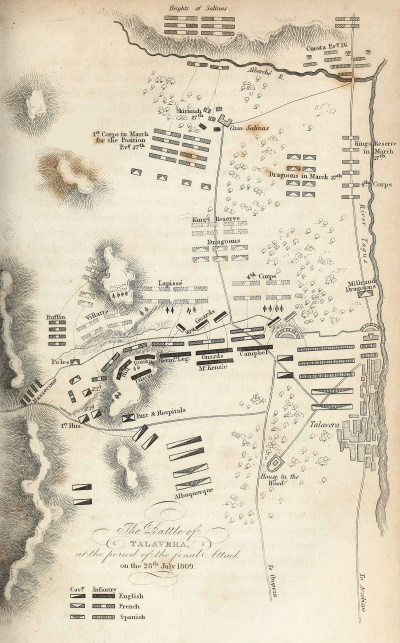 click here for larger image.
The Battle of
TALAVERA,
at the period of the final Attack
on the 28
th July 1809.
London. Published by T. & W. BOONE, July 1829.
At five o’clock in the evening of the third, it was
known at the English head-quarters that the French
were near Naval Moral, and, consequently, between
the allies and the bridge of Almaraz.
At six o’clock, letters from Cuesta advised sir
Arthur that the king was again advancing, and that,
from intercepted despatches addressed to Soult, it
appeared that the latter must be stronger than was
supposed; hence, Cuesta said that, wishing to aid
the English, he would quit Talavera that evening:
in other words, abandon the British hospitals!
To this unexpected communication sir Arthur replied
that the king was still some marches off, and
that Venegas should be directed to occupy him on
the Upper Tagus; that Soult’s strength was exceedingly
overrated, and Victor’s movements not
decided enough to oblige the Spanish army to quit
Talavera. Hence he required that Cuesta should at
least wait until the next morning, to cover the evacuation
of the English hospitals. But, before this communication
reached Cuesta, the latter was in full
march; and, at day-break on the 4th, the Spanish
army was descried moving, in several columns,
down the valley towards Oropesa, where Bassecour’s
division soon after joined it from Centinello, and,
at the same time, the cavalry patroles found the
French near Naval Moral.
Sir Arthur Wellesley having, by this time, seen
the intercepted letters himself, became convinced
that Soult’s force was not overrated at thirty thousand;
and the duke of Dalmatia, who had also
intercepted some English letters, learned that, on
the first of August, the allies were still at Talavera,
and ill-informed of his march. Thus, the one general
perceived his danger and the other his advantage
at the same moment.
Mortier was immediately ordered, by the duke
of Dalmatia, to take a position with the fifth corps
at Cazatejada, to seize the boat-bridge at Almaraz,
if it was not destroyed, and to patrole towards Arzobispo.
The second corps was, likewise, directed
upon the same place; and the head of the sixth
entered Plasencia. The further progress of the
allies was thus barred in front; the Tagus was on
their left; impassable mountains on their right; and
it was certain that Cuesta’s retreat would immediately
bring the king and Victor down upon their
rear. The peril of this situation was apparent to
every soldier in the British ranks, and produced a
general inquietude. No man felt the slightest confidence
in the Spaniards, and the recollection of
the stern conflict at Talavera, aided by a sense of
exhaustion from long abstinence, depressed the
spirits of men and officers. The army was, indeed,
ready to fight, but all persons felt that it must be
for safety, not for glory.
In this trying moment, sir Arthur Wellesley
abated nothing of his usual calmness and fortitude.
He knew not the full extent of the danger; but,
assuming the enemy in his front to be thirty thousand
men, and Victor to have twenty-five thousand
others in his rear, he judged that to continue the
offensive would be rash, because he must fight and
beat those two marshals separately within three
days, which, with starving and tired troops, inferior
in number, was scarcely to be accomplished. But,
to remain where he was on the defensive was equally
unpromising, because the road from Talavera to
Arzobispo led through Calera, in the rear of Oropesa;
and thus Victor could intercept the only line of
retreat, and a battle must then be fought, in an
unfavourable position, against the united forces of
the enemy, estimated, as we have seen, to be above
fifty thousand men. One resource remained: to
pass the bridge of Arzobispo immediately, and take
up a line of defence behind that river, before the
French could seize the Col de Mirabete, and so
cut off the road to Truxillo and Merida—a hard
alternative; but the long-cherished error relative
to Soult’s weakness had dried up the springs of
success, and left the campaign, like a withered
stem, without fruit or foliage.
Cuesta doggedly opposed this project; asserting
that Oropesa was a position suitable for a battle,
and that he would fight there. Further concession
to his humours would have been folly, and sir
Arthur sternly declared that he would move forthwith,
leaving the Spanish general to do that which
should seem meet to him; and, assuredly, this decided
conduct saved the Peninsula, for not fifty, but
ninety thousand enemies were at hand.
It was now six o’clock in the morning, the baggage
and ammunition were already in motion for
the bridge of Arzobispo; but the army, which had
been reinforced by a troop of horse-artillery, and
some convalescents that escaped from Plasencia,
remained in position for several hours, to cover the
passage of the stores and the wounded men from
Talavera; the latter having just arrived at Calera
in the most pitiable condition. About noon, the
road being clear, the columns marched to the bridge;
and, at two o’clock, the whole army was in position
at the other side, the present danger was averted,
and the combinations of the enemy were baffled.
During the passage, several herds of swine, which,
following the custom of the country, were feeding
in the woods, under charge of the swineherds,
were fallen in with; and the soldiers, instigated
by hunger, broke their ranks, and ran in upon the
animals as in a charge, shooting, stabbing, and,
like men possessed, cutting off the flesh while the
beasts were yet alive; nor can this conduct be much
censured under the circumstances of the moment;
yet it was a severe misfortune to the poor peasants,
whose property was thus destroyed.
From Arzobispo, the army moved towards Deleytoza;
but general Craufurd’s brigade, with six pieces
of artillery, was directed to gain the bridge of
Almaraz by a forced march, lest the enemy, discovering
the ford below that place, should cross the
river, and seize the Puerto de Mirabete. The roads
were exceedingly rugged, and the guns could only
be dragged up the Meza d’Ibor by the force of men.
Nevertheless, Craufurd reached his destination on
the evening of the 5th, and the head-quarters were
established at Deleytoza, on the 7th, the artillery
being at Campillo, the rear guard occupying the
Meza d’Ibor. The sick and wounded were then
forwarded to Merida; but the paucity of transport
was such, that sir Arthur Wellesley was obliged to
unload both ammunition and treasure carts for the
conveyance of these unfortunate men. Meanwhile
Soult, little thinking that his object was already
frustrated, continued his march on the 5th, and
Mortier took post at Naval Moral; the advanced
guard entered Puebla de Naciada, and the patroles,
scouring the roads to Oropesa and the bridge of
Arzobispo, fell in with and were chased by the
Spanish cavalry from Arzobispo; for Cuesta would
not retire on the 4th, and was in the act of passing
the bridge when the French came in view. The
movements were now hurried on both sides; before
dark, the Spanish army was across the Tagus, with
the exception of a rear guard, which remained on
the right bank that evening, but it was driven
across the river, on the morning of the 6th, by the
fifth corps, which afterwards took post at Valdeveja
and Puebla de Naciada. Ney also reached Naval
Moral, and the second corps entered Gordo.
The 7th, Mortier examined the Spanish position,
and reported that Cuesta, having thrown up entrenchments,
and placed twenty guns in battery, to
rake the bridge, which was also barricadoed, had
left two divisions of infantry and one of cavalry to
hold the post, and withdrawn the rest of his army
towards Meza d’Ibor. Hereupon, Soult detached
his light cavalry towards Talavera, to communicate
with the king, and brought up the second corps to
Arzobispo. Meanwhile, the duke of Belluno having,
on the 5th, ascertained the retreat of the allies from
Talavera, retraced his steps, and entered that town
on the 6th. Thus the English wounded, left there,
fell into his hands, and their treatment was such as
might be expected from a gallant and courteous
nation, for, between the British soldiers and the
French, there was no rancour, and the generous
usages of a civilized and honourable warfare were
cherished.
The 7th, Victor crossed the Tagus, at the bridge
of Talavera, and pushed his advanced guard to
Aldea Nueva de Balbaroya, on the left bank, within
a few leagues of the Spanish position, which Soult
was preparing to attack in front, for he had observed
that, at a certain point, the Spanish horses, when
brought to drink, came far into the stream, and,
the place being sounded in the night of the 7th,
a deep but practicable ford was discovered, about
half a mile above the bridge.
The fifth and second corps and a division of the
sixth were concentrated to force this passage, early
on the morning of the 8th; but Soult being just
then informed of Victor’s movement, and perceiving
that Albuquerque had withdrawn the Spanish cavalry,
leaving only a rear guard in the works,
judged that the allies were retreating; wherefore,
without relinquishing the attack at Arzobispo, he
immediately sent the division of the sixth corps
back to Naval Moral, and, at the same time, transmitted
a plan of the ford below Almaraz, directed
Ney to cross the Tagus there, seize the Puerto de
Mirabete, and be in readiness to fall upon the
allies, as they came out from the defiles between
Deleytoza and Truxillo.
Meanwhile, the heat of the day had induced
Albuquerque to seek shelter for his horsemen in a
wood, near Azutan, a village about five miles from
the bridge; and the Spanish infantry, keeping a
bad guard, were sleeping or loitering about without
care or thought, when Mortier, who was charged
with the direction of the attack, taking advantage
of their want of vigilance, commenced the passage
of the river.
The French cavalry, about six thousand in number,
were secretly assembled near the ford, and,
about two o’clock in the day, general Caulaincourt’s
brigade suddenly entered the stream. The Spaniards,
running to their arms, manned the batteries,
and opened upon the leading squadrons; but Mortier,
with a powerful concentric fire of artillery,
immediately overwhelmed the Spanish gunners; and
Caulaincourt, having reached the other side of the
river, turned to his right, and, taking the batteries
in reverse, cut down the artillerymen, and dispersed
the infantry who attempted to form. The duke of
Albuquerque, who had mounted at the first alarm,
now came down with all his horsemen in one mass,
but without order, upon Caulaincourt, and the latter
was, for a few moments, in imminent danger; but
the rest of the French cavalry, passing rapidly, soon
joined in the combat; one brigade of infantry followed
at the ford, another burst the barriers on the
bridge itself, and, by this time, the Spanish foot
were flying to the mountains. Albuquerque’s effort
was thus frustrated, a general route ensued, and
five guns and about four hundred prisoners were
taken.
Soult’s intention being to follow up this success,
he directed that the first corps should move, in two
columns, upon Guadalupe and Deleytoza, intending
to support it with the second and fifth, while the
sixth corps crossed at Almaraz, and seized the pass
of Mirabete. This would undoubtedly have completed
the ruin of the Spanish army, and forced sir
Arthur to make a rapid and disastrous retreat; for
so complete was the surprise and so sudden the
overthrow that some of the English foragers also
fell into the hands of the enemy; and that Cuesta’s
army was in no condition to have made any resistance,
if the pursuit had been continued with vigour,
is clear, from the following facts:—
1º. When he withdrew his main body from the
bridge of Arzobispo to Peralada de Garbin, on the
7th, he left fifteen pieces of artillery by the road-side,
without a guard. The defeat of Albuquerque
placed these guns at the mercy of the enemy, who
were, however, ignorant of their situation, until a
trumpeter attending an English flag of truce, either
treacherously or foolishly, mentioned it in the
French camp, from whence a detachment of cavalry
was sent to fetch them off. 2º. The British
military agent, placed at the Spanish head-quarters,
was kept in ignorance of the action; and it was
only by the arrival of the duke of Albuquerque, at
Deleytoza, on the evening of the 9th, that sir
Arthur Wellesley knew the bridge was lost. He
had before advised Cuesta to withdraw behind the
Ibor river, and even now contemplated a partial attack
to keep the enemy in check; but when he repaired
in person to that general’s quarter, on the 10th,
he found the country covered with fugitives and
stragglers, and Cuesta as helpless and yet as
haughty as ever. All his ammunition and guns
(forty pieces) were at the right bank of the Ibor,
and, of course, at the foot of the Meza, and within
sight and cannon-shot of the enemy, on the right
bank of the Tagus. They would have been taken
by the first French patroles that approached, but
that sir Arthur Wellesley persuaded the Spanish
staff-officers to have them dragged up the hill, in
the course of the 10th, without Cuesta’s knowledge.
In this state of affairs, the impending fate of the
Peninsula was again averted by the king, who recalled
the first corps to the support of the fourth,
then opposed to Venegas. Marshal Ney, also, was
unable to discover the ford below the bridge of
Almaraz; and, by the 11th, the allies had re-established
their line of defence. The head-quarters
of the British were at Jaraicejo, and those of the
Spaniards at Deleytoza: the former, guarding the
ford of Almaraz, formed the left; the latter, occupying
the Meza d’Ibor and Campillo, were on
the right. The 12th, Cuesta having resigned, general
Equia succeeded to the command, and gave
hopes of a better co-operation; but the evil was in
the character of the people. The position of the
allies was, however, compact and central; the reserves
could easily support the advanced posts;
the communication to the rear was open; and, if
defended with courage, the Meza d’Ibor is impregnable.
To pass the Tagus at Almaraz, in itself
a difficult operation, would be of no avail to the
enemy, while the Mirabete and Meza d’Ibor were
occupied, because his troops would be enclosed in
the narrow space between those ridges and the river.
The duke of Dalmatia, thus thwarted, conceived
that sir Arthur Wellesley would endeavour to
re-pass the Tagus by Alcantara, and so rejoin
Beresford and the five thousand British troops
under Catlin Craufurd and Lightburn, which were,
by this time, near the frontier of Portugal. To
prevent this he resolved to march at once upon
Coria, with the second, fifth, and sixth corps, to
menace the communications both of sir Arthur and
Beresford with Lisbon, and, at the same time, prepare
for the siege of Ciudad Rodrigo; but marshal
Ney absolutely refused to concur in this operation:
he observed that sir Arthur Wellesley was not yet
in march for Alcantara; that it was exceedingly
dangerous to invade Portugal in a hasty manner;
and that the army could not be fed between Coria,
Plasencia, and the Tagus; finally, that Salamanca,
being again in possession of the Spaniards, it was
more fitting that the sixth corps should retake that
town, and occupy the line of the Tormes to cover
Castile.
This reasoning was approved by Joseph; he
dreaded the further fatigue and privations that
would attend a continuance of the operations during
the excessive heats, and in a wasted country; and
he was strengthened in his opinion by the receipt
of a despatch from the emperor, dated Schoenbrun,
the 29th of July, in which any further offensive
operations were forbad, until the reinforcements
which the recent victory of Wagram enabled him
to send should arrive in Spain. The second corps
was, consequently, directed to take post at Plasencia.
The fifth corps relieved the first at Talavera; and
the English wounded being, by Victor, given over
to marshal Mortier, the latter, with a chivalrous
sense of honour, would not permit his own soldiers,
although suffering severe privations themselves, to
receive rations until the hospitals were first supplied.
The sixth corps was now directed upon Valladolid,
for Joseph was alarmed lest fresh insurrection,
excited and supported by the duke del Parque,
should spread over the whole of Leon and Castile.
Ney marched, on the 11th, from Plasencia; but, to
his surprise, found that sir Robert Wilson, with
about four thousand men, part Spaniards, part Portuguese,
was in possession of the pass of Baños.
To explain this, it must be observed, that when the
British army marched from Talavera, on the 3d,
Wilson, being at Nombella, was put in communication
with Cuesta. He had sent his artillery to the
army on the 3d, and on the 4th, finding that the
Spaniards had abandoned Talavera, he fell back
with his infantry to Vellada, a few miles north
of Talavera. He was then twenty-four miles from
Arzobispo; and, as Cuesta did not quit Oropesa
until the 5th, a junction with sir Arthur Wellesley
might have been effected: but it was impossible to
know this at the time; and Wilson, very prudently,
crossing the Tietar, made for the mountains, trusting
to his activity and local knowledge to escape the
enemy. Villatte’s division pursued him, on the 5th,
to Nombella; a detachment from the garrison of
Avila was watching for him in the passes of Arenas
and Monbeltran, and general Foy waited for him
in the Vera de Plasencia. Nevertheless, he baffled
his opponents, broke through their circle at Viandar,
passed the Gredos at a ridge called the Sierra de
Lanes, and, getting into the valley of the Tormes,
reached Bejar: from thence, thinking to recover
his communications with the army, he marched
towards Plasencia, by the pass of Baños, and thus,
on the morning of the 12th, met with Ney, returning
to the Salamanca country.
The dust of the French column being seen from
afar, and a retreat to Ciudad Rodrigo open, it is
not easy to comprehend why sir Robert Wilson
should have given battle to the sixth corps. His
position, although difficult of approach,
and strengthened by the piling of large stones in the
narrowest parts, was not one in which he could
hope to stop a whole army; and, accordingly, when
the French, overcoming the local obstacles, got
close upon his left, the fight was at an end. The
first charge broke both the legion and the
Spanish auxiliaries, and the whole dispersed. Ney then
continued his march, and, having recovered the line
of the Tormes, resigned the command of the sixth
corps to general Marchand, and returned to France.
But, while these things happened in Estremadura,
La Mancha was the theatre of more important
operations.
CHAPTER IV. — THE BATTLE OF ALMONACID.
When the duke of Belluno retired from Salinas
to Maqueda, the king, fearing that the allies were
moving up the right bank of the Alberche, carried
his reserve, in the night of the 3d, to Mostoles; but
the fourth corps remained at Illescas, and sent strong
patroles to Valdemoro. Wilson, however, retired,
as we have seen, from Nombella on the 4th; and
the king, no longer expecting the allies in that
quarter, marched in the night to Valdemoro, where
he was joined by the fourth corps from Illescas.
The 5th, the duke of Belluno returned to St.
Ollalla; and the king marched against general
Venegas, who, in pursuance of the secret orders of
the junta, before mentioned, had loitered about
Daymiel and Tembleque until the 27th of July.
The 29th, however, Venegas reached Ocaña, his
advanced posts being at Aranjuez, his rear-guard
at Yepes, and one division, under Lacy, in front
of Toledo. The same day, one of the partidas,
attending the army, surprised a small French post
on the other side of the Tagus; and Lacy’s division
skirmished with the garrison of Toledo.
The 30th, Venegas heard of the battle of Talavera;
and at the same time Lacy reported that the
head of the enemy’s columns were to be seen on the
road beyond Toledo. Hereupon, the Spanish commander
reinforced Lacy, and gave him Mora as
a point of retreat; but, on the 2d of August, being
falsely informed by Cuesta that the allied troops
would immediately march upon Madrid, Venegas
recalled his divisions from Toledo, pretending to
concentrate his army at Aranjuez, in order to
march also upon the capital; but he had no intention
of doing so; for the junta did not desire to see
Cuesta, at the head of sixty thousand men, in that
city; and, previous to the battle of Talavera, had
not only forbidden him to enter Madrid, but appointed
another man governor. This prohibition
would, no doubt, have been disregarded by Cuesta;
but Venegas was obedient to their secret instructions,
and under pretence of danger to his flanks, if he
marched on the capital, remained at Aranjuez, where
his flank being equally exposed to an enemy coming
from Toledo, he yet performed no service to the
general cause.
The 3d, he pushed an advanced guard to Puente
Largo; and leaving six hundred infantry, and some
cavalry, near Toledo, concentrated his army between
Aranjuez and Ocaña; and in this position he remained
until the 5th, when his advanced guard was
driven from the Puente Largo, and across the Tagus.
His line of posts on that river was then attacked by
the French skirmishers, and, under cover of a heavy
cannonade, his position was examined by the enemy’s
generals; but when the latter found that all
the bridges above and below Aranjuez were broken
down, they resolved to pass the Tagus at Toledo.
With this intent, the French army re-crossed the
Xarama river, and marched in the direction of that
city; but Venegas still keeping his posts at Aranjuez,
foolishly dispersed his other divisions at
Tembleque, Ocaña, and Guardia. He himself was
desirous of defending La Mancha. The central junta,
with more prudence, wished him to retreat into
the Sierra Morena; but Mr. Frere proposed that his
army should be divided; one part to enter the
Morena, and the other to march by Cuença, upon
Aragon, and so to menace the communications with
France! The admirable absurdity of this proposal
would probably have caused it to be adopted, if
Sebastiani’s movements had not put an end to the
discussion. That general, crossing the Tagus at
Toledo, and at a ford higher up, drove the Spaniards’
left back upon the Guazalate. This was on
the 9th of August; on the 10th, Venegas concentrated
his whole army at Almonacid, and, holding a
council of war, resolved to attack the French on the
12th; but the time was miscalculated. Sebastiani
advanced on the 11th, and commenced
The army of Venegas, including two thousand
cavalry, was somewhat more than twenty-five thousand
strong, with forty pieces of artillery. It was
the most efficient Spanish force that had yet taken
the field; it was composed of the best regiments in
Spain, well armed and clothed; and the generals of
division were neither incapacitated by age, nor
destitute of experience, most of them having been
employed in the previous campaign. The village
of Almonacid was in the centre of the Spanish position;
and, together with some table-land in front of
it, was occupied by two divisions of infantry under
general Castejon. The left wing, under general
Lacy, rested on a hill which covered the main road
to Consuegra. The right wing, commanded by
general Vigodet, was drawn up on some rising
ground covering the road to Tembleque. A reserve,
under general Giron, and the greatest part of the
artillery, were posted behind the centre, on a rugged
hill, crowned by an old castle. The cavalry were
placed at the extremity of each wing.
General Dessolles, with the French reserve, was
still some hours’ march behind, but Sebastiani,
after observing the dispositions made by Venegas,
resolved to attack him with the fourth corps only.
The Polish division immediately marched against
the front; Leval’s Germans turned the flank of the
hill, on which the Spanish left was posted; and
two French brigades were directed upon the centre.
After a sharp fight, the Spanish left was put to
flight; but Venegas, outflanking the victorious
troops with his cavalry, charged and threw them
into disorder. At this moment, the head of Dessolles’s
column arrived, and enabled Sabastiani’s
reserves to restore the combat; and then the
Spanish cavalry, shattered by musketry, and by
the fire of four pieces of artillery, was, in turn,
charged by a French regiment of horse, and broken.
Venegas rallied his troops again on the castle-hill,
behind the village; but the king came up
with the remainder of the reserve, and the attack
was renewed. The Poles and Germans continued
their march against the left flank of the Spaniards;
nine fresh battalions fell upon their centre, and a
column of six battalions forced the right. The
height and the castle were thus carried at the first
effort. Venegas attempted to cover his retreat, by
making a stand in the plain behind; but two divisions
of dragoons charged his troops before they
could re-form, and the disorder became irremediable.
The Spaniards, throwing away their arms, dispersed
in every direction, and were pursued and slaughtered
by the horsemen for several hours.
Following the French account, three thousand of
the vanquished were slain, and four thousand taken
prisoners; and all the guns, baggage, ammunition,
and carriages fell into the hands of the victors,
whose loss did not exceed fifteen hundred men.
The remnants of the defeated army took shelter in
the Sierra Morena. The head-quarters of the fourth
corps were then established at Aranjuez; those of
the first at Toledo; and the king returned in triumph
to the capital.
The allied troops, however, still held their position
at Deleytosa and Jaraicejo, and sir Arthur
Parliamentary Papers, 1810.
Wellesley was not, at the first, without hopes to
maintain himself there, or even to resume offensive
operations; for he knew that Ney had returned
to Salamanca, and he erroneously believed that
Mortier commanded only a part of the first corps,
and that the remainder were at Toledo. On the
other hand, his own strength was about seventeen
thousand men; Beresford had reached Moraleja,
with from twelve to fourteen thousand Portuguese;
and between the frontier of Portugal and Lisbon there
were at least five thousand British troops, composing
the brigades of Catlin Craufurd and Lightburn.
If Soult invaded Portugal, the intention of the
English general was to have followed him. If the
French remained in their present position, he meant to
re-cross the Tagus, and, in conjunction with Beresford’s
troops, to fall upon their right at Plasencia.
For his own front he had no fear; and he was
taking measures to restore the broken arch of the
Cardinal’s bridge over the Tagus, with a view to
his operation against Plasencia, when the misconduct
of the Spanish government and its generals
again obliged him to look solely to the preservation
of his own army.
From the 23d of July, when the bad faith of the
junta, the apathy of the people in Estremadura,
and the wayward folly of Cuesta, had checked the
forward movements of the British, the privations of
the latter, which had commenced at Plasencia, daily
increased. It was in vain that sir Arthur, remonstrating
Appendix, No. 7.
with Cuesta and the junta, had warned
them of the consequences; it was in vain that he
refused to pass the Alberche until the necessary
supplies were secured. His reasonings, his representations,
and even the fact of his having halted
at Talavera, were alike disregarded by men who,
judging from their own habits, concluded that his
actions would also be at variance with his professions.
If he demanded food for his troops, he was
answered by false statements of what had been
supplied, and falser promises of what would be
done; and the glorious services rendered at Talavera,
far from exciting the gratitude or calling forth
the activity of the Spanish authorities, seemed only
to render them the more perverse. The soldiers in
the ranks were weakened by hunger, the sick were
dying for want of necessary succours, the commissaries
were without the means of transport; and
when sir Arthur Wellesley applied for only ninety
artillery horses to supply the place of those killed
in the action, Cuesta, on the very field of battle,
and with the steam of the English blood still reeking
in his nostrils, refused this request, and, two
days after, abandoned the wounded men to an
enemy that he and his countrymen were hourly describing
as the most ferocious and dishonourable of
mankind.
The retreat of the allies across the Tagus increased
the sufferings of the troops, and the warmth
of their general’s remonstrances rose in proportion to
the ill-treatment they experienced; but the replies,
nothing abating in falseness as to fact, now became
insulting both to the general and his army: “The
British were not only well but over supplied:”—“they
robbed the peasantry, pillaged the villages,
intercepted the Spanish convoys, and openly sold the
provisions thus shamefully acquired:”—“the retreat
of the army across the Tagus was unnecessary;
Soult ought to have been destroyed; and the English
general must have secret motives for his conduct,
which he dare not avouch:”—and other calumnies of
the like nature.
Now, from the 20th of July to the 20th of August,
although the Spaniards were generally well
fed, the English soldiers had not received ten full
rations. Half a pound of wheat in the grain, and,
twice a week, a few ounces of flour, with a quarter
of a pound of goat’s flesh, formed the sole subsistence
of men and officers; and this scanty supply
was procured with much labour, for the goats were
to be caught and killed by the troops; and it was,
perhaps, upon this additional hardship that the accusation
of selling provisions was founded, for, in
such cases, it is in all armies the custom that the
offal belongs to the men who slaughter the animals.
But the famine in the camp was plainly proved by
this very fact; for a goat’s offal sold, at this time,
for three and even four dollars, or about double the
usual price of the whole animal; and men and officers
strove to outbid each other for the wretched
food.
It has been said that the British soldiers are less
intelligent in providing for themselves, and less
able to sustain privations of food than the soldiers
of any other nation. This is one of many vulgar
errors which have been promulgated respecting them.
How they should be constantly victorious, and yet
inferior to all other nations in military qualification,
does not, at first sight, appear a very logical conclusion;
but the truth is, that, with the exception
of the Spanish and Portuguese, who are, undoubtedly,
more sober, the English soldiers possess all the
most valuable military qualities in as high, and many
in a much higher degree than any other nation. They
are as rapid and as intelligent as the French, as
obedient as the German, as enduring as the Russian,
and more robust than any; and, with respect to
food, this is sure, that no man, of any nation, with
less than two pounds of solid food of some kind
daily, can do his work well for any length of time.
A general charge of pillaging is easily made and
hard to be disproved; but it is certain that the
Spanish troops themselves did not only pillage, but
wantonly devastate the country, and that without
any excuse; for, with the exception of the three
days succeeding the defeat of Arzobispo, their rations
were regular and sufficient: and, with respect
to the interruption of their convoys, by the British
Appendix, No. 18.
soldiers, the reverse was the fact. The Spanish
cavalry intercepted the provisions and forage destined
for the English army, and fired upon the foragers,
as if they had been enemies.
Parliamentary
Papers,
1810.
Before the middle of August there were, in the
six regiments of English cavalry, a thousand men
completely dismounted, and the horses of seven
hundred others were unserviceable. The baggage
animals died in greater numbers; the artillery cattle
were scarcely able to drag the guns; and one-third
of the reserve ammunition was given over
to the Spaniards, because the ammunition carts were
required for the conveyance of sick men, of which
the number daily increased.
Marshal Beresford experienced the same difficulties
in the neighbourhood of Ciudad Rodrigo. The
Appendix, No. 17.
numerous desertions that took place in the Portuguese
army, when it became known that the troops
were to enter Spain, prevented him from taking the
field so soon as he had expected; but, in the last
days of July, being prepared to act, he crossed the
Portuguese frontier, and, from that moment, the
usual vexatious system of the Spaniards commenced.
Romana still continued at Coruña; but the duke
del Parque was full of mighty projects, and indignant
that Beresford would not blindly adopt his
recommendations. Both generals were ignorant of
the real strength of the French; but the Spaniard
was confident, and insisted upon offensive movements,
while Beresford, a general by no means of an
enterprising disposition when in the sole command
of an army, contented himself with taking up a
defensive line behind the Agueda. In this, however,
he was justified; first, by his instructions,
which obliged him to look to the pass of Perales
and the defence of the frontier line; secondly, by
the state of his army, which was not half organized,
and without horsemen or artillery; and, thirdly, by
the conduct of the Spanish authorities.
The Portuguese troops were not only refused
provisions, but those which had been collected by
sir Arthur Wellesley, and put into the magazines
at Ciudad Rodrigo, with a view to operate in that
quarter, were seized by the cabildo, as security for
a debt pretended to be due for the supply of sir
John Moore’s army. The claim itself was of doubtful
character, for Cradock had before offered to
pay it if the cabildo would produce the voucher
for its being due, a preliminary which had not
been complied with. There was also an English
commissary at Ciudad Rodrigo, empowered to
liquidate that and any other just claim upon the
British military chest; but the cabildo, like all
Spaniards, mistaking violence for energy, preferred
this display of petty power to the interests of the
common cause. Meanwhile, Soult having passed
the Sierra de Gredos, by the Baños, Beresford,
moving in a parallel direction, crossed the Sierra
de Gata, at Perales; reached Moraleja about the
12th of August, and having rallied the troops
and convalescents cut off from Talavera, marched
to Salvatierra, where he arrived the 17th, and
took post behind the Elga, covering the road to
Abrantes.
The supreme junta now offered sir Arthur Wellesley
the rank of captain-general, and sent him a
present of horses; and when he, accepting the
rank, refused the pay, as he had before refused
that of the Portuguese government, they pressed
him to renew offensive operations; but, acting as if
they thought the honours conferred upon the general
would amply compensate for the sufferings
of the troops, the junta made no change in their
system. These things convinced sir Arthur Wellesley
that Spain was no longer the place for a
British army, and he relinquished the idea of further
operations in that country. Sending his cavalry
to the neighbourhood of Caceres, he broke down
another arch of the Cardinal’s bridge, to prevent the
enemy from troubling him, and, through the British
ambassador, informed the junta that he would
immediately retire into Portugal.
This information created the wildest consternation;
for, in their swollen self-sufficiency, the members of
the government had hitherto disregarded all warnings
upon this subject, and now acting as, in the
like case, they had acted, the year before, with sir
John Moore, they endeavoured to avert the consequences
of their own evil doings, by vehement
remonstrances and the most absurd statements:—“The
French were weak and the moment most propitious
for driving them beyond the Pyrenees:” “the
uncalled-for retreat of the English would ruin the
cause:” and so forth. But they had to deal with a
general as firm as sir John Moore; and, in the
British ambassador, they no longer found an instrument
suited to their purposes.
Lord Wellesley, a man with too many weaknesses
to be called great, but of an expanded capacity,
and a genius at once subtle and imperious,
had come out on a special mission,—and Mr. Frere,
whose last communication with the junta had been
to recommend another military project, was happily
displaced; yet, even in his private capacity,
he made an effort to have some of the generals
superseded; and the junta, with a refined irony,
truly Spanish, created him marquis of Union.
At Cadiz, the honours paid to lord Wellesley
were extravagant and unbecoming, and his journey
from thence to Seville was a scene of triumph; but
these outward demonstrations of feeling did not
impose upon him beyond the moment. His brother’s
correspondence and his own penetration soon
enabled him to make a just estimate of the junta’s
protestations. Disdaining their intrigues, and fully
appreciating a general’s right to direct the operations
of his own army, he seconded sir Arthur’s remonstrances
with firmness, and wisely taking the latter’s
statements as a guide and basis for his own views,
urged them upon the Spanish government with
becoming dignity.
The junta, on their part, always protesting that
the welfare of the British army was the principal
object of their care, did not fail to prove, very
clearly upon paper, that the troops, ever since their
entry into Spain, had been amply supplied: and that
no measure might be wanting to satisfy the English
general, they invested don Lorenzo Calvo, a member
of their body, with full powers to draw
forth and apply all the resources of the country
to the nourishment of both armies. This
gentleman’s promises and assurances, relative to
the supply, were more full and formal than M.
de Garay’s, and equally false. He declared that
provisions and forage, in vast quantities, were actually
being delivered into the magazines at Truxillo,
when, in fact, there was not even an effort making
to collect any. He promised that the British should
be served, although the Spanish troops should
thereby suffer; and, at the very time of making
this promise, he obliged the alcaldes of a distant
town to send, into the Spanish camp, provisions
which had been already purchased by an English
commissary. In fine, lord Wellesley had arrived
too late; all the mischief that petulance, folly, bad
faith, violence, and ignorance united, could inflict,
was already accomplished, and, while he was vainly
urging a vile, if not a treacherous government, to
provide sustenance for the soldiers, sir Arthur withdrew
the latter from a post where the vultures, in
their prescience of death, were already congregating.
The 20th, the main body of the British army
quitted Jaraicejo, and marched by Truxillo upon
Merida. The light brigade, under Craufurd, being
relieved at Almaraz by the Spaniards, took the road
of Caceres to Valencia de Alcantara. But the
pass of Mirabete bore ample testimony to the previous
sufferings of the troops; Craufurd’s brigade,
which, only three weeks before, had traversed sixty
miles in a single march, were now with difficulty,
and after many halts, able to reach the summit of
the Mirabete, although only four miles from their
camp; and the side of that mountain was covered
with baggage, and the carcases of many hundred
animals that died in the ascent.
The retreat being thus commenced, the junta,
with the malevolence of anger engendered by fear,
calumniated the man to whom, only ten days before,
they had addressed the most fulsome compliments,
and to whose courage and skill they owed their own
existence. “It was not the want of provisions,” they
said, “but some other motive that caused the English
general to retreat.” This was openly and
insultingly stated by Garray, by Eguia, and by
Calvo, in their correspondence with lord Wellesley
and sir Arthur; and at the same time the junta
industriously spread a report that the true reason
was their own firm resistance to the ungenerous
demands of the English ministers, who had required
the cession of Cadiz and the island of Cuba,
as the price of furthur assistance.
At Talavera, sir Arthur Wellesley had been forced
to give over to the Spaniards the artillery taken
from the enemy. At Meza d’Ibor, he had sacrificed
a part of his ammunition, to obtain conveyance
for the wounded men, and to effect the present movement
from Jaraicejo, without leaving his sick behind,
he was obliged to abandon all his parc of
ammunition, and stores, and then the Spanish
generals, who had refused the slightest aid to
convey the sick and wounded men, immediately
found ample means to carry off all these stores to
their own magazines. In this manner, almost
bereft of baggage and ammunition, those soldiers,
who had withstood the fiercest efforts of the enemy,
were driven, as it were, ignominiously from the
country they had protected to their loss.
The 24th, the head-quarters being at Merida, a
despatch from lord Wellesley was received. He
painted in strong colours the terror of the junta,
the distraction of the people, and the universal
confusion; and with a natural anxiety to mitigate
their distress, he proposed that the British army
should, notwithstanding the past, endeavour to
cover Andalusia, by taking, in conjunction with the
Spanish army, a defensive post behind the Guadiana,
in such manner that the left should rest on the
frontier of Portugal: to facilitate this he had, he said,
presented a plan to the junta for the future supply
of provisions, and the vicinity of the frontier and
of Seville would, he hoped, obviate any difficulty
on that point. But he rested his project
entirely upon political grounds; and it is worthy
of observation that he who, for many years had,
with despotic power, controlled the movements of
immense armies in India, carefully avoided any appearance
of meddling with the general’s province.
“I am,” said he, “fully sensible not only of the
indelicacy, but of the inutility of attempting to offer
to you any opinion of mine in a situation where
your own judgement must be your best guide.”—“Viewing,
however, so nearly, the painful consequences
of your immediate retreat into Portugal,
I have deemed it to be my duty to submit it to
your consideration the possibility of adopting an
intermediate plan.”
On the receipt of this despatch, sir Arthur
Wellesley halted at Merida for some days. He
was able in that country to obtain provisions, and
he wished, if possible, to allay the excitement occasioned
by his retreat; but he refused to co-operate
again with the Spaniards. Want, he said, had
driven him to separate from them, but their shameful
flight at Arzobispo would alone have justified
him for doing so. To take up a defensive position
behind the Guadiana would be useless, because
that river was fordable, and the ground behind it
weak. The line of the Tagus, occupied at the
moment by Eguia, was so strong, that if the
Spaniards could defend any thing they might
defend that. His advice then was that they
should send the pontoon-bridge to Badajos, and
remain on the defensive at Deleytoza and Almaraz.
But, it might be asked, was there no chance of
renewing the offensive? To what purpose? The
French were as numerous, if not more so, than
the allies; and, with respect to the Spaniards at
least, superior in discipline and every military
quality. To advance again was only to play the
same losing game as before. Baños and Perales must
be guarded, or the bands in Castile would again
pour through upon the rear of the allied army;
but who was to guard these passes? The British
were too few to detach, and the Spaniards could not
be trusted; and if they could, Avila and the Guadarama
passes remained, by which the enemy could
reinforce the army in front,—for there were no
Spanish troops in the north of Spain capable of
making a diversion.
“But there was a more serious consideration,
namely, the constant and shameful misbehaviour
of the Spanish troops before the enemy. We,
in England,” said sir Arthur, “never hear of their
defeats and flights, but I have heard Spanish officers
telling of nineteen or twenty actions of the description
of that at the bridge of Arzobispo, accounts of
which, I believe, have never been published.”
“In the battle of Talavera,” he continued, “in
which the Spanish army, with very trifling exception,
was not engaged,—whole corps threw away
their arms, and run off, when they were neither
attacked nor threatened with an attack. When
these dastardly soldiers run away they plunder
every thing they meet. In their flight from
Talavera they plundered the baggage of the
British army, which was, at that moment, bravely
engaged in their cause.”
For these reasons he would not, he said, again
co-operate with the Spaniards; yet, by taking post
on the Portuguese frontier, he would hang upon
the enemy’s flank, and thus, unless the latter came
with very great forces, prevent him from crossing
the Guadiana. This reasoning was conclusive; but,
ere it reached lord Wellesley, the latter found
that so far from his plans, relative to the supply,
having been adopted, he could not even get
an answer from the junta; and that miserable
body, at one moment stupified with fear, at the
next bursting with folly, now talked of the enemy’s
being about to retire to the Pyrenees, or even to
the interior of France: and assuming the right to
dispose of the Portuguese army as well as of their
own, importunately pressed for an immediate,
combined, offensive operation, by the troops of
the three nations, to harass the enemy in his retreat;
but, at the same time, they ordered Eguia to
withdraw from Deleytoza, behind the Guadiana.
The 31st, Eguia reached La Serena; and Venegas
having rallied his fugitives in the Morena, and
being reinforced from the depôts in Andalusia, the
two armies amounted to about fifty thousand men,
of which eight or ten thousand were horse: for, as
I have before observed, the Spanish cavalry seldom
suffered much. But the tide of popular discontent
was now setting full against the central government.
The members of the ancient junta of Seville worked
incessantly for their overthrow. Romana, Castaños,
Cuesta, Albuquerque, all, and they were many,
who had suffered dishonour at their hands, were
against them; and the local junta of Estremadura
insisted that Albuquerque should command in that
province.
Thus pressed, the supreme junta, considering
Venegas as a man devoted to their wishes, resolved
to increase his forces. For this purpose they gave
Albuquerque the command in Estremadura, but
furnished him with only twelve thousand men,
sending the remainder of Eguia’s army to Venegas;
and, at the same time, making a last effort to engage
the British general in their proceedings, they
offered to place Albuquerque under his orders,
provided he would undertake an offensive movement.
Appendix, No. 17.
By these means, they maintained their
tottering power: but their plans, being founded
upon vile political intrigues, could in no wise alter
sir Arthur Wellesley’s determination, which was
the result of enlarged military views. He refused
their offers; and, the 4th of September, his head-quarters
were established at Badajos. Meanwhile,
Romana delivered over his army to the duke del
Parque, and repaired to Seville. Venegas again
advanced into La Mancha, but at the approach
of a very inferior force of the enemy, retired, with
all the haste and confusion of a rout, to the Morena.
The English troops were then distributed in Badajos,
Elvas, Campo Mayor, and other places, on both
banks of the Guadiana. The brigades already in
Portugal were brought up to the army, and the
lost ammunition and equipments were replaced
from the magazines at Lisbon, Abrantes, and Santarem.
Beresford, leaving some light troops and
militia on the frontier, retired to Thomar, and this
eventful campaign, of two months, terminated.
The loss of the army was considerable; above
three thousand five hundred men had been killed,
or had died of sickness, or fallen into the enemy’s
hands. Fifteen hundred horses had perished from
want of food, exclusive of those lost in battle; the
spirits of the soldiers were depressed; and a heart-burning
hatred of the Spaniards was engendered by
the treatment endured. To fill the cup, the pestilent
fever of the Guadiana, assailing bodies which
fatigue and bad nourishment had already predisposed
to disease, made frightful ravages. Dysentry,
that scourge of armies, raged; and, in a short time,
above five thousand men died in the hospitals.
CHAPTER V. — OBSERVATIONS. — FRENCH OPERATIONS.
During this short, but important campaign, the
armies on both sides acted in violation of that maxim
which condemns “double external lines of operation,”
but the results vindicated the soundness of the rule.
Nothing permanent or great, nothing proportionate
to the number of the troops, the vastness of the
combinations, or the reputation of the commanders,
was achieved; yet, neither sir Arthur Wellesley
nor the duke of Dalmatia can be justly censured,
seeing that the last was controlled by the king,
and the first by circumstances of a peculiar nature.
The French marshal was thwarted by superior authority;
and the English general, commanding an
auxiliary force, was obliged to regulate his movements,
not by his own military views, but by the
actual state of the Spaniards’ operations, and with
reference to the politics and temper of that people.
La Mancha was the true line by which to act
against Madrid, but the British army was on the
frontier of Portugal. The junta refused Cadiz as a
place of arms; and without Cadiz, or some other
fortified sea-port, neither prudence, nor his instructions,
would permit sir Arthur to hazard a great
operation on that side. Hence he adopted, not what
was most fitting, in a military sense, but what was
least objectionable among the few plans that could
be concerted at all with the Spanish generals and
government. Now, the latter being resolved to act
with strong armies, both in Estremadura and La
Mancha, the English general had but to remain on
a miserable defensive system in Portugal, or to unite
with Cuesta in the valley of the Tagus. His territorial
line of operations was therefore a matter of
necessity, and any fair criticism must be founded on
the management of his masses after it was chosen.
That he did not greatly err in his conception of
the campaign, is to be inferred from the fact, that
Napoleon, Soult, Victor, and Jourdan, simultaneously
expected him upon the very line he followed.
He was thwarted by Cuesta at every step, Venegas
failed to aid him, and the fatal error relative to
Soult’s forces, under which he laboured throughout,
vitiated all his operations; yet he shook the intrusive
monarch roughly, in the midst of fifty thousand
men.
Let the project be judged, not by what did happen,
but by what would have happened, if Cuesta had
been active, and if Venegas had performed his part
loyally. The junction of the British and Spanish
forces was made at Naval Moral, on the 22d of
July. The duke of Belluno, with twenty-one thousand
men, was then in position behind the Alberche,
the fourth corps near Madrilejos in La Mancha,
and Joseph at Madrid, where general Foy had just
arrived, to concert Soult’s movement upon Plasencia.
It is evident that the king and Sebastiani could
not reach the scene of action before the 25th or 26th
of July, nor could Soult influence the operations
before the 1st or 2d of August. If then, the allied
army, being sixty thousand strong, with a hundred
pieces of artillery, had attacked Victor on the morning
of the 23d, it is to be presumed that the latter
would have been beaten, and obliged to retreat,
either upon Madrid or Toledo; but the country immediately
in his rear was open, and ten thousand
horsemen could have been launched in the pursuit.
Sir Robert Wilson, also, would have been
on Victor’s flank, if, neglecting a junction with the
fourth corps, that marshal had taken the road to
Madrid; and if that of Toledo, the first and fourth
corps would have been separated from the king, who
did not reach Vargas until the evening of the 25th,
but who would not, in this case, have been able to
advance at all beyond Naval Carneiro.
Now, admitting that, by superior discipline and
experience, the French troops had effected their
retreat on either line without any serious calamity,
what would have followed?
1º. If Victor joined the king, the latter could
only have retired, by Guadalaxara, upon the third
corps, or have gone by the Guadarama towards
Soult.
2º. If Victor joined Sebastiani, the two corps
must have retreated to Guadalaxara, and the king
would have joined them there, or, as before said,
have pushed for the Guadarama to join Soult.
No doubt, that marshal, having so powerful an
army, would, in either case, have restored Joseph
to his capital, and have cut off sir Arthur’s communication
with Portugal by the valley of the Tagus.
Nevertheless, a great moral impression would have
been produced by the temporary loss of Madrid,
which was, moreover, the general depôt of all the
French armies; and, meanwhile, Venegas, Cuesta,
and sir Arthur Wellesley would have been united,
and on one line of operations (that of La Mancha),
which, under such circumstances, would have forced
the junta to consent to the occupation of Cadiz. In
this view it must be admitted that the plan was
conceived with genius.
Victor’s position on the Alberche was, however,
strong; he commanded twenty-five thousand veterans;
and, as the Spaniards were very incapable
in the field, it may be argued that a general movement
of the whole army to Escalona, and from thence
to Maqueda, would have been preferable to a direct
attack at Salinas; because the allies, if thus suddenly
placed in the midst of the French corps,
might have beaten them in detail, and would certainly
have cut the king off from the Guadarama,
and forced him back upon the Guadalaxara. But,
with Cuesta for a colleague, how could a general
undertake an operation requiring celerity and
the nicest calculation?
The false dealing of the junta no prudence could
guard against; but experience proves that, without
extraordinary good fortune, some accident will always
happen to mar the combinations of armies acting
upon “double external lines.” And so it was with
respect to Venegas; for that general, with a force
of twenty-six thousand men, suffered himself to be
held in check for five days by three thousand French,
and at the battle of Almonacid shewed that he
knew neither when to advance nor when to retreat.
The patience with which sir Arthur Wellesley
bore the foolish insults of Cuesta, and the undaunted
firmness with which he fought to protect
the Spanish army, require no illustration.
When the latter fell back from St. Ollalla on the
26th, it was impossible for the British to retreat
with honour; and there is nothing more memorable
in the history of this war, nothing more creditable
to the personal character of the English chief, than
the battle of Talavera, considered as an isolated
event. Nevertheless, that contest proved that the
allies were unable to attain their object; for, notwithstanding
Victor’s ill-judged partial attacks on
the night of the 27th and morning of the 28th, and
notwithstanding the final repulse of the French, all
the advantages of the movements, as a whole, were
with the latter. They were, on the 31st of July,
including the garrison of Toledo, still above forty
thousand men; and they maintained their central
position, although it was not until the 1st of August
that Soult’s approach caused any change in the
views of the allied generals; and this brings us to
the fundamental error of sir Arthur Wellesley’s operations.
That so able a commander should engage himself
in the narrow valley of the Tagus with twenty
thousand British and forty thousand Spanish troops,
when fifty thousand French were waiting for him
at the further end, and above fifty thousand more
were hanging on his flank and rear, shews that the
greatest masters of the art may err. He who wars
walks in a mist through which the keenest eyes
cannot always discern the right path. “Speak to
me of a general who has made no mistakes in war,”
said Turenne, “and you speak of one who has seldom
made war.”
Sir Arthur Wellesley thus excused his error:—“When
I entered Spain I had reason to believe
that I should be joined by a Spanish army in such
a respectable state of discipline and efficiency, as
that it had kept in check, during nearly three
months after a defeat, a French army, at one time
superior, and at no time much inferior.”
“I had likewise reason to believe that the French
corps, in the north of Spain, were fully employed; and
although I had heard of the arrival of marshal Soult
at Zamora, on the 29th of June, with a view to equip
the remains of his corps, I did not think it possible that
three French corps, consisting of thirty-four thousand
men, under three marshals, could have been assembled
at Salamanca without the knowledge of the governor
of Ciudad Rodrigo, or of the junta of Castile;
that these corps could have been moved from their
stations in Gallicia, the Asturias, and Biscay, without
setting free, for general operations, any Spanish
troops which had been opposed to them, or without
any other inconvenience to the enemy than that of
protracting, to a later period, the settlement of his
government in those provinces;—and that they
could have penetrated into Estremadura, without
a shot being fired at them by the troops deemed
sufficient to defend the passes by the Spanish generals.”
But thus it was that, like the figures in
a phantasmagoria, the military preparations of
Spain, however menacing in appearance, were invariably
found to be vain and illusory.
That sir Arthur Wellesley’s error was not fatal
is to be attributed to three causes:—
1º. The reluctance of marshal Ney to quit Astorga;—2º.
The march of the fifth corps upon
Villa Castin instead of Salamanca;—3º. The vehemence
with which Victor advised the battle of
Talavera: in short, jealousy among the marshals,
and the undecided temper of the king.
If Soult had not been thwarted, he would have
concentrated the three corps near Salamanca before
the 20th, and he would have reached Plasencia
before the 28th of July. The allies must then
have forced their way into La Mancha, or been
crushed; but could they have done the former
without another battle? without the loss of all
the wounded men? could they have done it at all?
The British, including Robert
Craufurd’s brigade, were seventeen thousand fighting men on the 29th,
but wasted with fatigue and hunger. The Spaniards
were above thirty thousand: but in them no trust could
be placed for an effort requiring fine discipline and
courage of the highest order. The intrusive king
was at the head of forty thousand good troops.
Venegas, at once ignorant and hampered by the
intrigues of the junta, was as nought in the operations;
but Soult’s step, stealthy while the situation
of affairs was obscure, would have been impetuous
when a light broke on the field of battle; and it is
scarcely possible to conceive that the allies could
have forced their way in front before that marshal
would have fallen on their rear.
The intrusive monarch was finally successful;
yet it may be safely affirmed that, with the exception
of uniting his three corps behind the Guadarama,
on the evening of the 25th, his proceedings
were an uninterrupted series of errors. First, he
would not suffer Soult to besiege Ciudad Rodrigo
with seventy thousand men, in the end of July.
To protect Madrid from the army of Venegas
overbalanced, in his mind, the advantages of this
bold and grand project, which would inevitably
have drawn sir Arthur Wellesley from the Tagus,
and which, interrupting all military communication
between the northern and southern provinces, and
ensuring possession of Castile and Leon, would, by
its success, have opened a broad way to Lisbon.
But Cuesta and Venegas, meanwhile, would have
marched against Madrid! Cuesta and Venegas,
acting on external lines, and whose united force
did not exceed sixty-five thousand men! And the
king, holding a central position, with fifty thousand
French veterans, was alarmed at this prospect, and,
rejecting Soult’s plan, drew Mortier, with the fifth
corps, to Villa Castin. Truly, this was to neglect
the bearing fruit-tree from fear of the nettle at its
stem!
Sir Arthur Wellesley’s advance to Talavera was
the result of this great error; but he having thus
incautiously afforded Soult an opportunity of striking
a fatal blow, a fresh combination was concerted.
The king, with equal judgement and activity, then
united all his own forces near Toledo, separated
Venegas from Cuesta, pushed back the latter upon
the English army, and obliged both to stand on the
defensive, with eyes attentively directed to their
front, when the real point of danger was in the
rear. This was skilful; but the battle of Talavera
which followed was a palpable, an enormous, fault.
The allies could neither move forward nor backward,
without being infinitely worse situated for success
than in that strong position, which seemed marked
out by fortune herself for their security. Until the
31st, the operations of Venegas were not even felt;
hence, till the 31st, the position on the Alberche
might have been maintained without danger; and,
on the first of August, the head of Soult’s column
was at Plasencia.
Let us suppose that the French had merely made
demonstrations on the 28th, and had retired behind
the Alberche the 29th, would the allies have dared
to attack them in that position? The conduct of
the Spaniards, on the evening of the 27th, answers
the question; and, moreover, Joseph, with an army
compact, active, and experienced, could, with ease,
have baffled any efforts of the combined forces to
bring him to action; he might have covered himself
by the Guadarama and by the Tagus, in succession,
and the farther he led his opponents from
Talavera, without uncovering the line of La Mancha,
the more certain the effect of Soult’s operation: but
here we have another proof that double external
lines are essentially vicious.
The combined movement of the French was desirable,
from the greatness of the object to be gained,
and safe, from the powerful force on each point.
The occasion was so favourable that, notwithstanding
the imprudent heat of Victor, the reluctance of
Ney, and the unsteady temper of the king, the fate
of the allies was, up to the evening of the 3d,
heavy in the scale. Nevertheless, as the central
position held by the allies, cut the line of correspondence
between Joseph and Soult, the king’s
despatches were intercepted, and the whole operation,
even at the last hour, was baffled. The
first element of success in war is, that every
thing should emanate from a single head; and it
would have been preferable that the king, drawing
the second and fifth corps to him by the pass of the
Guadarama, or by that of Avila, should, with the
eighty thousand men thus united, have fallen upon
the allies in front. Such a combination, although
of less brilliant promise than the one adopted,
would have been more sure; and the less a general
trusts to fortune the better:—she is capricious!
When one Spanish army was surprised at Arzobispo,
another completely beaten at Almonacid, and
when Wilson’s Portuguese corps was dispersed at
Baños, the junta had just completed the measure of
their folly
by quarrelling with the only force left
that could protect them. The French were, in
truth, therefore, the masters of the Peninsula; but
they terminated their operations at the very moment
when they should have pursued them with redoubled
activity; for the general aspect of affairs
and the particular circumstances of the campaign
were alike favourable.
Napoleon was victorious in Germany; and of the
British expeditions against Italy and Holland, the
former had scarcely struggled into life,—the latter
was already corrupting in death. Hence, Joseph
might have been assured that he would receive
reinforcements, but that none, of any consequence,
could reach his adversaries; and, in the Peninsula,
there was nothing to oppose him. Navarre, Biscay,
Aragon, and the Castiles were subdued; Gerona
closely beleaguered; and the rest of Catalonia, if
not quiescent, totally unable to succour that noble
city. Valencia was inert; the Asturias still trembling;
and in Gallicia there was nothing but confusion.
Romana, commanding fifteen thousand infantry, but
neither cavalry nor artillery, was still at Coruña,
and durst not quit the mountains. The duke del
Parque held Ciudad Rodrigo, but was in no condition
to make head against more than a French
division. The battle of Almonacid had cleared La
Mancha of troops. Estremadura and Andalusia were,
as we have seen, weak, distracted, and incapable of
solid resistance. There remained only the English
and Portuguese armies, the one being at Jaraceijo,
the other at Moraleja.
The line of resistance may, therefore, be said to
have extended from the Sierra Morena to Coruña—weak
from its length; weaker, that the allied corps,
being separated by mountains, by rivers, and by
vast tracts of country, and having different bases of
operation, such as Lisbon, Seville, and Ciudad
Rodrigo, could not act in concert, except offensively;
and with how little effect in that way the
campaign of Talavera had proved. But the French
were concentrated in a narrow space, and, having
only Madrid to cover, were advantageously situated
for offensive or defensive movements.
The allied forces were, for the most part, imperfectly
organized, and would not, altogether, have
amounted to ninety thousand fighting men. The
French were above one hundred thousand, dangerous
from their discipline and experience, more
dangerous that they held a central position, and
that their numbers were unknown to their opponents;
and, moreover, having, in four days, gained
one general and two minor battles, their courage
was high and eager.
See Calvo
Garray and
Lord Wellesley’s
Correspondence,
Parl. Papers,
1810.
At this period, by the acknowledgement of the
Spaniards themselves, the fate of the country depended
entirely upon the British troops, and, doubtless,
the latter were soldiers of no ordinary stamp;
but there is a limit to human power, in war as well
as in other matters. Sir Arthur Wellesley was at
the head of some seventeen thousand men, of all
arms, and about five thousand were somewhere between
Lisbon and Alcantara: but the whole French
army could, in two days, have been concentrated in
the valley of the Tagus. Soult, alone, of all the
associated generals, appears to have viewed this
crisis with the eye of a great commander. Had he
been permitted to follow up the attack at Arzobispo,
on the 8th of August, what could the seventeen
thousand starving British troops, encumbered with
the terror-stricken Spaniards, have effected against
the seventy thousand French that would have
stormed their positions on three sides at once?
The hardy, enduring English infantry might, indeed,
have held their ground in one battle, but
could they have fought a second? Would not a
movement of the first corps by Guadalupe, would
not famine alone, have forced the ten or twelve
thousand men remaining (if, indeed, so many were
left) to abandon the banks of the Tagus, to abandon,
also, their parcs of ammunition and their
wounded men, and to retreat towards Portugal;
and to retreat, also, with little hope, harassed, as
they would have been, by six thousand horsemen,
for Soult had eighteen regiments of cavalry?
Let it be supposed, however, that the strength of
the Meza d’Ibor and the Mirabete had baffled all
the enemy’s efforts, and that, seeing the allies fixed
in those positions, the sixth corps, in pursuance of
Soult’s second proposal, had crossed the frontier of
Parl. Pap. 1810.
Portugal. Sir Arthur Wellesley, contemplating
such an event, affirmed that he meant to follow
them in any movement they might make against
Lisbon; but there were two ways of following, the
one by the south and the other by the north bank
of the Tagus. Now, if he designed to cross the
Tagus at the Cardinal’s bridge, and so, connecting
his right with Beresford, to hang on the enemy’s
rear, it could only have been while he was ignorant
of Venegas’ defeat, and when he imagined
the French to have but thirty thousand men in the
valley of the Tagus; but they had above seventy
thousand; and, without endangering Madrid, they
could have invaded Portugal with, at least, fifty
thousand men under arms.
If, on the other hand, he designed to move by
the south side of the Tagus, the French line of
march upon Abrantes and Lisbon was shorter than
his; and Beresford, who only reached Moraleja on
the 12th, would have been cut off, and thrown
back upon Almeida. It is true that marshal Ney
alleged the difficulty of feeding the troops in the
country about Plasencia and Coria, and the prudence
of Soult’s project might, in that respect,
have been somewhat questionable. But the duke
of Elchingen was averse to any invasion of Portugal;
and, to an unwilling mind, difficulties are
enlarged beyond their due proportion. Moreover,
his talents were more remarkable in a battle than
in the dispositions for a campaign; and Soult’s
opinion must, on this occasion, be allowed greater
weight, because the Vera de Plasencia and the
valleys of the Bejar and the Gata mountains were
certainly exceedingly fertile, they had been little
injured, and the object was, not to fix a base of
operations, but to obtain a momentary subsistence
until a richer country could be opened.
Admitting, however, that a march on Lisbon
was not feasible at that moment, there could have
been no well-founded objection to the siege of
Ciudad Rodrigo, which Soult again proposed. The
emperor’s instructions were indeed pleaded; but
those were general, founded upon the past errors of
the campaign, which made him doubtful of the
future; they were not applicable to the peculiar
circumstances of the moment, and would have been
disregarded by a general with a tithe of his own
genius. Fortunately for Spain, the intrusive king
was not a great commander. When he might have
entered the temple of victory with banners flying,
he stretched himself at the threshold and slept.
The departure of the English army was a remarkable
epoch in the Peninsular war. The policy of
combining operations with the Spanish armies, and
of striking directly at the great masses of the
French, had been fairly acted upon, and had failed;
and the long-cherished delusion, relative to Spanish
enthusiasm and Spanish efficiency, was at last dissipated.
The transactions of the campaign of 1809
form a series of practical comments upon the campaign
of 1808. All the objections which had been
made to sir John Moore’s conduct, being put to the
test of experience, proved illusory, while the soundness
of that general’s views were confirmed in every
particular. The leading events of the two campaigns
bear a striking resemblance to each other.
Both sir Arthur Wellesley and sir John Moore
advanced from Portugal to aid the Spanish armies.
The first general commanded twenty-five thousand,
the last twenty thousand men; but there was this
difference: that, in 1808, Portugal was so disorganised
as to require a British force to keep down
anarchy; whereas, in 1809, Portugal formed a good
base of operations, and a Portuguese army was
acting in conjunction with the British.
Sir John Moore was joined by six thousand men,
under Romana, and there was no other Spanish
army in existence to aid him.
Sir Arthur Wellesley was joined by thirty-eight
thousand Spaniards, under Cuesta, and he calculated
upon twenty-six thousand, under Venegas;
while from twenty to twenty-five thousand others
were acting in Gallicia and Leon.
Sir John Moore was urged to throw himself into
the heart of Spain, to aid a people represented as
abounding in courage and every other military
virtue. Judging of what he could not see by that
which was within his view, he doubted the truth of
these representations, and thinking that a powerful
army, commanded by a man of the greatest military
genius, was likely to prove formidable, he was unwilling
to commit his own small force in an unequal
contest. Nevertheless, feeling that some practicable
demonstration of the difficulties to be encountered
was required by the temper of the times, he made
a movement, too delicate and dangerous to be
adopted, unless for a great political as well as
military purpose.
To relieve the southern provinces, and to convince
the English government and the English
public that they had taken a false view of affairs,
were the objects of his advance to the Carrion river;
but, although he carried his army forward with a
boldness that marked the consciousness of superior
talents, he never lost sight of the danger he was
incurring by exposing his flank to the French emperor.
To obviate this danger as much as possible,
he established a second line of retreat upon Gallicia,
and he kept a watchful eye upon the cloud gathering
at Madrid. Arrived in front of Soult’s corps,
and being upon the point of attacking him, the
expected storm burst, but, by a rapid march to
Benevente, Moore saved himself from being taken
in flank and rear and destroyed. Benevente was,
however, untenable against the forces brought up
by Napoleon, and, the retreat being continued to
Coruña, the army, after a battle, embarked.
It was objected—1º. That Moore should have
gone to Madrid;—2º. That he should have fought
at Astorga, at Villa Franca, and at Lugo, instead
of at Coruña;—3º. That he overrated the strength
of the enemy, and undervalued the strength and
enthusiasm of the Spaniards; and that, being of a
desponding temper, he lost the opportunity of
driving the French beyond the Ebro, for, that a
battle gained (and it was assumed that a battle
must have been gained had he attacked) would have
assuredly broken the enemy’s power, and called
forth all the energies of Spain.
Sir John Moore reasoned that the Spanish enthusiasm
was not great, that it evaporated in
boasting and promises, which could not be relied
upon; that the British army was sent as an auxiliary,
not as a principal force; and that the native armies
being all dispersed before he could come to their
assistance, the enemy was far too strong to contend
with single handed; wherefore, it was prudent to re-embark,
and to choose some other base of operations,
to be conducted upon sounder views of the actual
state of affairs, or to give up the contest altogether;
for that little or no hope of final success could be
entertained, unless the councils and dispositions of
the Spaniards changed for the better. He died;
and the English ministers, adopting the reasoning
of his detractors, once more sent an auxiliary army
to Spain; although the system still existed which
he had denounced as incompatible with success.
Sir Arthur Wellesley, a general of their own
choice, and assuredly a better could not have been
made, was placed at the head of this army; and,
after giving Soult a heavy blow on the Douro, he
also advanced to deliver Spain. Like sir John
Moore, he was cramped for want of money; and,
like sir John Moore, he was pestered with false
representations, and a variety of plans, founded
upon short sighted views, and displaying great
ignorance of the art of war; but, finally, he adopted,
and, as far as the inveterate nature of the people he
had to deal with would permit, executed a project,
which, like sir John Moore’s, had for its object to
overpower the French in his front, and, by forcing
them to concentrate, relieve the distant provinces;
and give full play to the enthusiasm of the
Spaniards.
When sir John Moore advanced, there were no
Spanish armies to assist him; the French were
above three hundred and twenty thousand strong,
and of these two hundred and fifty thousand were
disposable to move against any point; moreover,
they were commanded in person by Napoleon, of
whom it has been said by the duke of Wellington,
that his presence, alone, was equal to forty thousand
good troops.
When sir Arthur Wellesley advanced, the French
forces in the Peninsula did not exceed two hundred
and sixty thousand men, of which only one hundred
thousand could be brought to bear on his
operations; and he was assisted by sixty thousand
Spaniards, well armed, and tolerably disciplined.
His plans were certainly laid with great ability upon
the data furnished to him; but he trusted to
Spanish promises and to Spanish energy, and he
did not fail to repent his credulity; nevertheless,
he delivered and gained that battle which sir John
Moore had been reproached for not essaying; but
it was found that a veteran French army, even of
inferior numbers, was not to be destroyed, or even
much dispirited, by one defeat; and while this
battle was fighting, Soult, with fifty thousand men,
came down upon the flank and rear of the English,
a movement precisely similar to that which Napoleon
had made from Madrid upon the flank and
rear of sir John Moore. This last general saved
himself by crossing the Esla, in the presence of the
French patroles; and in like manner, sir Arthur
evaded destruction by crossing the Tagus, within
view of the enemy’s scouts, so closely timed was
the escape of both.
When sir John Moore retreated, the Spanish
government, reproaching him, asserted that the
French were on the point of ruin, and Romana,
even at Astorga, continued to urge offensive operations.
When sir Arthur Wellesley retired from Jaraceijo,
the junta in the same manner asserted that
the French were upon the point of retiring from
Spain, and general Equia proposed offensive operations.
In explaining his motives, and discussing
the treatment he had met with, sir John Moore
wrote thus to his own government: “The British
were sent to aid the Spanish armies, but they are not
equal to encounter the French, who have at least
eighty thousand men, and we have nothing to expect
from the Spaniards, who are not to be trusted; they
are apathetic, lethargic, quick to promise, backward
to act, improvident, insensible to the shame of
flying before the enemy, they refuse all assistance,
and I am obliged to leave ammunition, stores, and
money, behind. The Spanish armies have shewn
no resolution, the people no enthusiasm nor daring
spirit, and that which has not been shown hitherto,
I know not why it should be expected to be displayed
hereafter.” Such were his expressions.
When sir Arthur Wellesley had proved the
Spaniards, he, also, writing to his government,
says:—“We are here worse off than in a hostile
country;—never was an army so ill used;—the Spaniards
have made all sorts of promises;—we had
absolutely no assistance from the Spanish army; on
the contrary, we were obliged to lay down our ammunition,
to unload the treasure, and to employ the
cars in the removal of our sick and wounded. The
common dictates of humanity have been disregarded
by them, and I have been obliged to leave ammunition,
stores, and money behind. Whatever is to be
done must be done by the British army, but that is
certainly not capable, singly, to resist a French army
of at least seventy thousand men.”
The last advice given to the government, by sir
John Moore, was against sending an auxiliary force
to Spain. Sir Arthur Wellesley, in the same spirit,
withdrew his troops; and, from that moment, to the
end of the struggle, he warred, indeed, for Spain,
and in Spain, but never with Spain. “I have
fished in many troubled waters, but Spanish
troubled waters I will never try again,” was his
expression, when speaking of this campaign; and
he kept his word. That country became, indeed,
a field, on which the French and English armies
contended for the destiny of Europe; but the defeats
or victories, the promises or the performances
of the Spaniards scarcely influenced the movements.
Spain, being left to her own devices, was
beaten in every encounter, foiled in every project,
yet made no change in her policy; and while
Portugal endeavoured to raise her energy on a
level with that of her ally, Spain sought to drag
down England to the depth of folly and weakness,
in which she herself was plunged. The one would
not sacrifice an atom of false pride to obtain the
greatest benefits; the other submitted, not with
abject dependence, but with a magnanimous humility,
to every mortification, rather than be conquered;
and the effects of their different modes
were such as might be expected. Portugal, although
assaulted by an infinitely greater number of
enemies, in proportion to her strength, overthrew
the oppressors the moment they set foot upon her
soil; while in Spain, town after town was taken,
army after army dispersed, every battle a defeat,
and every defeat sensibly diminished the heat of
resistance. Napoleon once declared that a nation
resolved to be free could not be conquered; and
the Spaniards re-echoed the sentiment in their manifestos,
as if to say it was all that was necessary.
But Napoleon contemplated a nation, like the Portuguese,
making use of every means of defence,
whether derived from themselves or their alliances;
not a people puffed with conceit, and lavish of
sounding-phrases, such as “perishing under the
ruins of the last wall,” yet beaten with a facility
that rendered them the derision of the world; a
people unable to guide themselves yet arrogantly
refusing all advice. Such a nation is ripe for destruction,
and such a nation was Spain.
The campaign of 1809 finished the third epoch
of the war, and it was prolific of instruction. The
jealousy of the French marshals, the evils of disunion,
the folly of the Spanish government, and the
absurdity of the Spanish character, with respect to
public affairs, were placed in the strongest light;
while the vast combinations, the sanguinary battles,
the singular changes of fortune, the result so little
suitable to the greatness of the efforts, amply demonstrated
the difficulty and the uncertainty of
military affairs. It was a campaign replete with
interest; a great lesson from which a great commander
profited. Sir Arthur Wellesley had now
experienced the weakness of his friends and the
strength of his enemies, and he felt all the emptiness
of public boasting. Foreseeing that if the contest
was to be carried on, it must be in Portugal, and
that unless he himself could support the cause of
the Peninsula, it must fall, his manner of making
war changed. His caution increased tenfold; yet,
abating nothing of his boldness, he met and baffled
the best of the French legions in the fulness of their
strength. He was alike unmoved by the intrigues
of the Portuguese regency, and by the undisguised
hatred of the Spanish government; and when some
of his own generals, and one of them on his personal
staff, denouncing his rashness and predicting the
ruin of the army, caused the puny energy of the
English ministers to quail as the crisis approached,
he, with gigantic vigour, pushed aside these impediments,
and, steadily holding on his own course,
proved himself a sufficient man, whether to uphold
or to conquer kingdoms.
No. II.
SECTION I.—STATE OF SPAIN.
Colonel Kemmis to sir J. Cradock, December 17, 1808.
“In consequence of the unfavourable news from Spain, yesterday,
the populace, in Badajos, murdered a Spanish colonel,
and one or two more of note.”
Lieutenant Ellis (an officer employed to gain intelligence) to
colonel Kemmis, Loboa, December 27.
“The French entered Truxillo, yesterday, at eleven o’clock;
and, from the circumstance of their having reconnoitred the intermediate
villages, might be expected to arrive at Merida in two
hours after we left it.”
Colonel Kemmis to sir John Cradock, Elvas, December 28.
“Badajos cannot make resistance in any degree, either to
check or to stop the progress of the enemy. From the statement
made to me, last night, by the governor, they want arms, ammunition,
and provisions.”—“The enemy marched into Truxillo,
on the 26th, at half-past twelve o’clock in the day; but, at two,
on the following morning, a French officer arrived there, and
they fell back four leagues.”
Lieutenant Ellis to colonel Kemmis, December 28.
“I proceeded cautiously to Truxillo. The main body of the
enemy, six thousand in number, had retired across the bridge of
Almaraz, and had not taken the road to Madrid, but had proceeded
to Plasencia, leaving behind more than half the requisition for
money which had been imposed on the town of Truxillo.”
Mr. Stuart to sir John Moore, Seville, January 2, 1809.
“The corps of four thousand infantry and two thousand cavalry,
which had marched from Talavera, and had actually passed the
bridge of Almaraz, has fallen back, and is already near Plasencia,
on its way northward.”—“The extreme attention of Buonaparte
being at this moment directed to the English army, everything
which can be collected is opposed to you alone.”
SECTION II.
Mr. Stuart to sir J. Moore, December 27, 1808.
“You will receive, together with this, several letters from
Doyle, which describe events in Catalonia no way differing from
what we have witnessed in other parts of Spain!”—“The
junta have established themselves here, and, whatever may have
been the expectation which their alarm on the road may have
induced Mr. Frere to form of their future proceedings, a culpable
relapse into their former apathy seems susceptible of no other
remedies but such as will be much stronger than any Spaniard is
likely to adopt.”—“Although Caro promised to write every
particular of his conversation with you to the junta, I have
hitherto been unable to see his letter. I therefore thought it
expedient to put the whole to writing, and, at the same time,
to express my conviction both of the justice and propriety of
your whole conduct during the late events, when it was impossible,
under any circumstances, to have adopted other determination
consistently with the safety of the army committed
to your charge. Though I doubt if this will stop the clamour
which has been raised on the subject; and, though events have
probably since taken place, which may materially change the state
of affairs, it may be satisfactory to tell you that Mr. Frere appears
to enter into the reasons alleged by you, and to feel, in their full
force, the motives which induced you to act so cautiously, and to
ground no operation on the hope of any effectual support from the
Spaniards.”
Mr. Stuart to sir J. Moore, Seville, January 2.
“The president, Florida Blanca, died two days since, and I
was in hopes that the junta would have availed themselves of this
event to make some change in their government.”—“I see, however,
little but good disposition, and am still to look for that
energy in rewarding service and punishing treachery which can
alone mend matters.”
Mr. Stuart to sir J. Moore, Seville, January 10.
“Reding is at Tarragona, expecting to be attacked, and possessing
a force composed chiefly of peasantry, but of which he
certainly cannot command above ten thousand men in a situation
to face his opponents at any given point.”—“Whittingham
arrived here yesterday, last from the duke of Infantados’ head-quarters.
He assures me the duke had already twenty thousand
men when he left Cuença.”—“On the side of Estremadura,
matters are not going on well: Galluzzo, who allowed the enemy
to pass the bridges, is here prisoner, and his corps is placed under
the command of Cuesta. I cannot say, however, that I see much
activity since the change; parties of the enemy cover the country
between Madrid and Almaraz, while the corps of six thousand
men, which had been pushed forward from Madrid, have, I understand,
already passed Plasencia, and probably are on the other
side of the Puerto, for the purpose of falling on the Salamanca
country, and, if possible, cutting off your communication with
Ciudad Rodrigo.”
SECTION III.
Mr. Frere to Mr. Canning, Seville, May 8.
“Besides the advantages which may be looked for from
placing so extensive a command under a person of such tried
abilities as general Blake, it is to be hoped that it will put an end
to the distractions arising from the contracted views of those who
directed the provincial junta, particularly that of Valencia, which
have been so embarrassing to his predecessors.”
Mr. Frere to Mr. Canning, Seville, July 10, 1809.
“As the devastations which have been committed have, in
many instances, deprived the peasants of the means of paying
what is due to the proprietors and to the church, a general spirit
of resistance to all claims of this kind has begun to show itself.”
Sir John Cradock to lord Castlereagh, December 24, 1808.
“I much fear that alarm and despondency has gained ground
about Badajos and that part of Spain, and that there is so little
co-operation in the acts of their several juntas, and such a want
of subordination and common consent among the armed bodies, to
which the defence of the country is entrusted, against such an
united force as that of the French, that extreme confusion prevails
everywhere.”
Colonel Kemmis to sir John Cradock, Elvas, December 30.
“He (lieutenant Ellis) has been living with general Cuesta for
the last two days,”—“who has assured him that the Spanish
troops, in Madrid, forced their way through the French army;
and he expressed great sorrow in adding that, though a Spanish
force is often collected, the smallest check disperses them;
that in few instances depôts were provided, and those ill supplied,”
&c.—“that, such was the dispersion and flight of the
Spanish armies, between Badajos and Madrid, there did not
remain a single man.”
Colonel Kemmis to lieut.-colonel Reynel, military secretary
to sir John Cradock, Seville, February 7, 1809.
“In passing through the Sierra Morena mountains, where
Nature has done much for the defence of this province, it was
painful to observe the pitiful works they were about to throw up.
In this whole direction there is but one body that has anything
like the appearance of a soldier, viz. dismounted cavalry.”
General Mackenzie to sir John Cradock, Cadiz, February 9,
1809.
“The Spaniards here seem lulled in the most fatal security.
They are ignorant of the events in the north of Spain, or will
not give credit when they do hear them. Vague reports of the
emperor of Austria’s having declared war, and Buonaparte’s return
to France gains unlimited credit.”—“The equipment of the fleet
goes on very slowly, though there is no want of exertion now on
the part of admiral Purvis or Mr. Stuart; offers of every assistance
are daily made, but they will neither work themselves nor
permit our people to work for them. The preparations of the
ships for carrying off the French prisoners goes on equally ill.”
Duc de Albuquerque to Mr. Frere, Talavera, July 31, 1809.
“During our marches we stop to repose, like flocks of sheep,
without taking up any position, so that, if the enemy knew the
condition we were in, they would defeat us wherever they attacked
us. If, in the evening of the 26th, I had not gone out directly
with my division, and succeeded in checking the enemy, the
whole army would have dispersed, and all the artillery and
baggage, which were in the streets of St. Ollalla, would have been
lost; and as a proof of what would have happened, had not the
enemy, who was within musket-shot, been checked, for many
had already thrown away their arms, &c. the commissaries abandoning
more than fifteen hundred rations of bread, the carts
occupying and blocking up the streets of the town; and to this,
I repeat, we are daily exposed, as we march, as if it were on a
pilgrimage, without any regard to distance, order, or method, and
with the whole parc of artillery, which ought always to remain at
the distance of two, three, or more leagues.”
Sir Arthur Wellesley to lord Wellesley, Merida, September 1,
1809.
“I am much afraid, from what I have seen of the proceedings
of the central junta, that, in the distribution of their forces, they
do not consider military defence and military operations so much
as they do political intrigue and the attainment of trifling political
objects.”
Lord Wellesley to Mr. Canning, Seville, September 2, 1809.
“While the intelligence received from sir Arthur Wellesley, to
the date of the 24th instant, continued to furnish irresistible proofs
of the failure of every promise or effort made by this government
for the immediate relief of our troops, no satisfaction was afforded
to me respecting any permanent plan for their future supply.”—“The
troops of Portugal, which entered Spain, under general
Beresford, suffered similar distress, and experienced similar ill-treatment;
although the efforts of Portugal, in the cause of Spain,
have been as gratuitous as those of Great Britain; and although
Spain possesses no claim, of any description, to the aid of a
Portuguese army.”—“In this calamity, the people of Spain cannot
fail to acknowledge the natural consequences of their own
weakness, nor to discover the urgent necessity of enforcing a more
steady, pure, and vigorous system, both of council and action. A
relaxed state of domestic government and an indolent reliance on
the activity of foreign assistance have endangered all the high
and virtuous objects for which Spain has armed and bled. It
must now be evident that no alliance can protect her from the
inevitable result of internal disorder and national infirmity. She
must amend and strengthen her government; she must improve
the administration of her resources, and the structure and discipline
of her armies, before she can become capable of deriving
benefit from foreign aid. Spain has proved untrue to our alliance,
because she is not true to herself.”—“Until some great change
shall be effected in the conduct of the military resources of Spain,
and in the state of her armies, no British army can safely attempt
to co-operate with the Spanish troops in the territory of Spain.”
No. III.
JUSTIFICATORY EXTRACTS FROM SIR J. CRADOCK’s
CORRESPONDENCE, MSS.
SECTION I.—STATE OF PORTUGAL.
Sir J. Cradock to sir R. Wilson, Oporto, December 8, 1808.
“I press this measure” (to move the legion from Oporto to
Villa Real) “upon your adoption, for many reasons, &c. &c.;
but the more especially that it will give an impulse to military
preparation in general, and tend to eradicate the notion that,
since the evacuation of Portugal by the French, the prospect
of a future war is at an end.”
Sir J. Cradock to sir John Moore, December 9, 1808.
“I have pressed the adoption of such measures as appeared
most likely to revive some notion of danger, and the necessity
of activity and energy.”
Sir J. Cradock to lord Castlereagh, December 14, 1808, Lisbon.
“The inaction of the regency was apparent at Oporto to a
lamentable degree; and, though I saw general Bernadim Friere,
I could not gain from him any information as to the state or
numbers of the Portuguese troops, where they were stationed,
or who commanded them. I apprehend, from his conversation,
that the general officers are all of equal authority; and that even
seniority had not its usual effect. He concluded his observations
to me with the strong expression, ‘That, from the evacuation
of Portugal by the French, the nation had thought all war
at an end.’”
Sir J. Cradock to sir J. Moore, December 28, 1808.
“Mr. Villiers and myself have both concurred upon the
absolute necessity to arouse and animate the Portuguese to
some sense of their situation.”
Colonel Kemmis to sir J. Cradock, Elvas, December 30, 1808.
“The apathy of the Portuguese is not to be expressed.
Their general, Leite, is a most excellent character: a theorist,
and, like his countrymen, supine.”
Extract from the Report of lieutenant Brotherton, (an
officer employed to obtain intelligence in the north of
Portugal,) February 11, 1809. Head-quarters of Romana’s
army.
“From the totally defenceless state in which the two northern
provinces are left, it will require at least eight days (I speak from
authority) to prepare any thing like adequate means of defence.”
SECTION II.—LUSITANIAN LEGION.
Lord Castlereagh to sir J. Cradock, November 27, 1808.
“Its formation was proposed by the chevalier de Souza.”—“The
pay, allowances, and clothing were settled by the chevalier
de Souza. The former regulated, as I understood, upon the
scale of increased pay, which the provisional government of
Oporto had adopted for all the troops they were in progress
of levying.”
Sir J. Cradock to lord Castlereagh, December 24, 1808.
“I have considerable doubt if ever they” (the legion) “can
be incorporated, with effect and conciliation, with the body of the
Portuguese army.”—“They are viewed with extreme jealousy
by the regency; and the commanding officers of the Portuguese
battalion resisted, universally, the allowing of volunteers
from their regiments to enter into the legion.”
Sir J. Cradock to lord Castlereagh, January 19, 1809.
“The Lusitanian legion continues to give considerable uneasiness,
from its peculiar state, under present circumstances.”
Captain Morgan (Lusitanian legion) to sir J. Cradock,
January 19, 1809.
“Should a retreat be adopted, sir Robert would not retire to
Oporto. It is the government of a mob, of which he has had
too much experience.”
SECTION III.—PORTUGUESE ARMY.
Sir J. Cradock to sir J. Moore, December 9, 1808.
“I am sorry to state that I find, as far as my limited observation
reaches, the Portuguese army, and every other military
concern, in the worst possible state.”
Sir J. Cradock to Mr. Villiers, December 18, 1809.
“I am sure that the state of the Portuguese army is quite
misunderstood in England; and that a reliance is placed upon it
for the defence of the country that is entirely without
foundation. Their” (Portuguese) “ministers will avow this to
you after ten minutes’ conversation.”—“Even of the reduced
numbers of their men enrolled, (not amounting to twenty
thousand, at the very highest computation,) to make any thing
out of them, it is necessary to recur to first principles, and give
them officers, arms, clothing, accoutrements, horses, &c.; and
I need not say that money is wanting to effect this: and the
ministers positively declare that they have none; and that no
collection of their forces can take place, much less a movement
to the frontier, without a supply.”—“M. Forjas, secretary to
the government, in answer to a strong question from me, stated
that their army have not in possession ten thousand firelocks
fit for use.”
Sir J. Cradock to lord Castlereagh, December 24, 1808.
“I am exerting myself to bring to account ‘the supposed
Portuguese army.’”—“Your lordship will perceive that I talk
of the regulars as if it were a regular force; but I should
be guilty of a deceit, that might lead to bad consequences, if I
did not fairly state that I conceive them to be of no moment at
this time.”
Sir J. Cradock to Mr. Villiers, January 8, 1809.
“I am ready to go to the utmost verge of prudence; but
Mr. Frere, when he talks of Portuguese troops and arrangements,
really (as I believe you will allow) fait
bâtir les châteaux.”
Major-general Cotton to sir J. Cradock, April 7, 1809.
“I yesterday inspected the Portuguese cavalry.”—“This
cavalry is unformed, and totally unfit for any sort of service.”
Sir J. Cradock to lord Castlereagh, February 12.
“It appears that a report has reached your lordship that a
conscription for horses in this country had been attended with
great effect, and that above three thousand had been collected.
It is, indeed, a matter of serious concern that such serious
misrepresentations should be transmitted; for it is a well-known
fact that many of the Portuguese regiments of cavalry are
without horses; and, if I am to pursue the subject, their battalions
of infantry are one-half without arms or clothing! But
the total want of all means of regulations for subsistence from so
deplorable a view, in the event of co-operation, that the result,
in my opinion, cannot be attended with success. It is, however,
but justice to say, that the disposition of the Portuguese
seems well-inclined and faithful to the common cause;
and that a very efficient soldiery may be formed under more
favourable circumstances.”
Sir J. Cradock to Mr. Frere, February 27, 1809.
“I fear that your excellency is led to entertain a more favourable
notion of the efficacy of the Portuguese army than, in
any shape, it is entitled. In short, my opinion is that they
want every thing that constitutes a respectable force, except
about ten thousand English arms. I believe they have no others.
Many of their cavalry regiments are without horses, without
swords, pistols, &c. Their battalions are not clothed; and,
as to subsistence, they live at free quarters upon the villages
where they are stationed. To take the field with effect, or an
assurance of food, seems to me out of the question. Since the
first moment of my arrival, I wished to procure the advance of
a small Portuguese force to Alcantara; but it has been impossible.
It is a matter of serious lamentation that such mis-representations
of the Portuguese force should go home, or reach your excellency.”
Sir J. Cradock to lord Castlereagh, April 3.
“No reliance whatever can be placed upon the Portuguese
troops in their present state. If I said that the whole were ready
to mutiny or revolt, I believe I speak general Beresford’s
sentiments. They will not be commanded by their own officers
and they do just as they please.”
SECTION IV.—CONDUCT OF THE REGENCY—TREATMENT OF
FRENCH PRISONERS.
Sir J. Cradock to Mr. Villiers, January 26, 1809.
“I have hitherto directed that these prisoners should be
subsisted at our charge, but I have no authority in this measure;
they are in a most deplorable state, and really are a disgrace to
all concerned.”
Sir J. Cradock to Mr. Villiers, February 5, 1809.
“It is absolutely necessary that the regency should give in an
answer about the French prisoners. The whole is an unauthorised
heavy charge, for which I give my warrant; and I see no end
to the case: and, added to this, their situation is a reflection
upon humanity.”
SECTION V.—NEGLECT, DUPLICITY, AND TIMIDITY.
Colonel Kemmis to sir J. Cradock, Elvas, December 17.
“Lalippe, on which the very existence of Elvas depends, has
not been supplied with provisions as I have been taught to
expect.”
Colonel Kemmis to sir J. Cradock, Elvas, December 25.
“The great importance of this fort” (Lalippe) “is well known
to the Portuguese; and, therefore, they are jealous, notwithstanding
the miserable condition of their troops, and total incapacity
to defend the fort, if attacked.”
Sir J. Cradock to Mr. Villiers, December 26, 1808.
“The promises and apparently satisfactory language of
the Portuguese government are, in my opinion, by no means
sufficient to meet the case. I want to see some steps actually
taken before my mind is decided that the nation will defend
itself.”—“Indeed, I am told, on good authority, that the government
are afraid to allow the people to arm.”—“The
moment I see any materials to work upon, it will be my most
anxious duty to give every effect, &c.”—“But, under the present
inactivity and indifference, it is, &c.”
Reports of colonel Donkin (quarter-master-general) to Sir
J. Cradock, March 21.
“I cannot, however, order officers of my department to check
this irregularity” (forcing quarters) “when it originates solely
in the neglect of the Portuguese civil magistrates; for troops
will not obey orders, which expose them wantonly to great
privations.”
Sir J. Cradock to Mr. Villiers, March 25.
“I have repeately urged this subject” (quarters of troops)
“to the regency, in the strongest manner, but, as you perceive,
without effect.”
Sir J. Cradock to lord Castlereagh, March 17.
“Whatever suits the momentary purpose, upon the most
superficial view, seems to be the guide in the Portuguese
councils. Ultimate objects, which, in the course of things, must
arrive, are never brought into the calculation.”
Cradock to Berkely, January 17.
“The regency seem to decline giving any specific directions
relative to the guns in fort St. Julian and the river batteries, and,
above all, not to write any thing; but they are very willing to
acquiesce in any thing we shall do, only anxious that, on a future
day, it shall appear to be our act, not theirs.”
Admiral Berkely to sir J. Cradock, February 19, 1809.
“I imagine Mr. Villiers has transmitted a copy of the extraordinary
note sent him by the regency; in which they complain
of the conduct of the artillery-officer who dismantled the Bugio
fort, and intimate their intention of sending for all the guns
and powder from fort St. Julian; and add many particulars, as
novel as they are suspicious.”—“Whether the language of this
note arises from duplicity, or any other cause, it is equally to be
resisted; and, therefore, stated some facts which may be retorted
upon them, and which will not place their conduct in the most
favourable point of view towards either their own sovereign
or Great Britain.”
Extract from an official note, drawn up by sir John Cradock,
Lisbon, February 20, 1809.
“It was told me, two or three times, by Mr. Villiers, that
M. Forjas, or some other member of the regency, had expressed
extreme solicitude about the forts on the Tagus,
&c.”—“
I always urged Mr. Villiers to get from M. Forjas, or any other member,
a declaration of what they wished, that we might exactly conform
to it; for they seemed to be anxious to go beyond what we should
venture to propose. Mr. Villiers, after some time, told me that
the Portuguese government were unwilling to put down any
thing upon paper, or give any specific instruction; but they
would willingly leave all the arrangement to us.”—“After the
above statement, which I declare, upon my honour, to be the
accurate description of what has passed, I must express my
surprise, and even indignation, at the protest now made by the
regency; and when it is considered that the Bugio fort is often
inaccessible for a week together, this part of their complaint is
shameful to the highest degree. Their general object is, however,
to be distinguished.”
SECTION VI.—ANARCHY IN PORTUGAL.
Sir J. Cradock to lord Castlereagh, February 20, 1809.
“Northern parts.—It may be difficult to manage any money-transactions
in Oporto, for the populace in that town have been
suffered to become the masters; and it was by an exchange of
public and private property that the commissariat money has been
lately secured.”
Sir J. Cradock to Mr. Villiers, February, 1809.
“To gratify a mob, the other day, at Oporto, a guard of the
sixtieth regiment was given up, and disarmed by baron Eben.”
Captain Brotherton to sir J. Cradock, March 17, 1809,
Lamego.
“Considering the tumults, and the state
of effervescence of
the public mind, and the blind fury of the populace—it will
neither be useful nor safe to remain amongst them.”
Sir J. Cradock to lord Castlereagh, March 26, 1809.
“The disposition is good, but the proceedings are those of an
ungovernable mob, exposed to the evil effects of designing persons.”—“I
confine myself to the north of Portugal and Oporto,
for the same excesses have not taken place at this side the
Douro; but the principles of insubordination, I should fear, would
prevail.”—“If the confusion and anarchy that prevail at Oporto
will permit a defence some exertion may be expected.”—“Ammunition
has been abundantly supplied, but no quantity would
meet the consumption expended in the manner it has been in the
Tras os Montes; an attempt to save which was, I believe, the
occasion of Bernadim Friere’s death.”
Sir J. Cradock to lord Castlereagh, March 30, 1809.
“The anarchy that prevails at Oporto must, I fear, render
every exertion unavailable for defence; and such is the ungovernable
spirit of the populace, that it is very difficult to say what
part they might take if the proceedings of the British did
not suit their views.”
Sir J. Cradock to Mr. Frere, March 29.
“Oporto and all its concerns, with the bishop, nominally, at
its head, is in the hands of a wild ungovernable populace, that
has already committed the most cruel excesses. I fear the
same spirit exists in what is called the Portuguese army.”
Sir J. Cradock to Mr. Frere, January 29, Lisbon.
“Without a British force in Lisbon, the authority of the
regency would pass away, and the scenes of Oporto would take
place here.”
Report of captain Lawson, January 30, Lisbon.
“Last night, my servant returning from the post-office was
attacked by a party of Portuguese pike-men, headed by one of
their own officers, who severely wounded the horse in two places,
and slightly in several places, and obliged him, the servant, to
put himself under the protection of the guard at the town-major’s
office, to save his own life: the outrage was committed without the
slightest provocation.”
General Langwerth to sir J. Cradock, February 1, Lisbon.
“The orderly, with the general orders, on his way to St.
Julian’s, was stopped by a Portuguese sergeant and twenty men
with pikes; the sergeant forced the orderly to deliver the letter
containing the orders, broke it open, read the contents, and returned
the enclosed receipt; the same guard stopped captain
Clives, Royal Grenadier army, and lieutenants Beurman and
Liners; these officers were in full uniform.”
General Sontag’s Official Report, February 3.
“Mr. Usher, deputy purveyor, and Mr. M’Carty, interpreter,
both British subjects, arrived this day from Oporto, went to
Moore’s Hotel, where they were arrested and brought to the
minister of police. Mr. Usher was in his British uniform.”
Sir J. Cradock to lord Castlereagh, January 30.
“Some unpleasant incidents have lately occurred on the part
of the Portuguese armed inhabitants of Lisbon towards British
individuals, but I cannot persuade myself that they have proceeded
from any fixed evil disposition.”—“The British army has
not, in any instance, departed from the most regular discipline,
and continues to manifest the greatest temper and moderation.”—“The
excesses on the part of the Portuguese commence by an
uncontrolled pursuit, without any authority from the police,
after all persons whom they please to call Frenchmen, and, in
their indiscriminate career, they often attack every foreigner,
and will not even abstain from those in our service. Those persons
seek refuge in our guard-room, and though the guards and
patroles have positive orders not to interfere under any pretext
with the police, yet it is very difficult to smother the feelings of
humanity when the wretched persons are flying from a furious
and unauthorised rabble. Mr. Villiers has exerted himself
much with the Regency to check this disorder, and prevent
the assembly of armed persons in the streets at night,
who beat drums and discharge their pieces at all hours; but as
yet his remonstrances have not had the desired effect.”
Mr. Villiers to sir J. Cradock, January 30.
“Finding the people beat to arms, and paraded about the
streets after dark, on the very evening after the regency had
settled that these irregularities should be restrained, I addressed
the ministers of the home department upon the subject;
and as other excesses came to my knowledge, I followed up my
complaint.”
Sir J. Cradock to Mr. Villiers, January 30.
“I have, this morning, been taking such steps as appear
necessary to secure our general situation from insult; and, at the
same time, if practicable, not to manifest a distrust in the Portuguese
nation, which, if sanctioned from head-quarters, would
destroy any reason for our being here. I can assure you, every
officer and soldier has received impressions that it is most difficult
to act against, but I am determined to persevere in keeping the
army from aggression to the last moment.”
Sir J. Cradock to Mr. Villiers, February.
“When I reflect upon the frequent declarations of individual
members of the regency, that they cannot control the populace;
that there are at least seventy thousand armed inhabitants in
Lisbon; that the regency dare not let them parade (their exercise
has been at an end for some time, and the regency, at this
moment, say they cannot look upon themselves as responsible,)
it appears impossible that I should depart from the reasoning of
my own mind, to meet a sensation of I do not know whom, and
lessen the proper military appearance of our only guard. We
are now beyond the power of surprise or insult, and I cannot, as
my own individual act, alter the state of things. However, I
never am devoted to my own way of thinking, and if you recommend
the measure (the political reasoning, when the enemy is
at a distance, may always be weighed against military regulation),
or see any good consequences, I will immediately order back the
guns to their former station in the artillery barracks.”
Marshal Beresford to sir J. Cradock, April 7, Santarem.
“I, this morning, met no less than three expresses, communicating
to me the horrible state of mutiny, for I can call it
no less, in which the troops every where are, and the inhabitants
are in equal insubordination, and they encourage each
other. I find two or three regiments have marched away (to what
they call to oppose the enemy) where they pleased, in despite of
their officers and generals, who are entirely commanded by them.
This you will say is a pleasing state to be in; however, we must
face it, and I hope for the best result, and I am sanguine enough
to look for such. Colonel Trant will shortly have a pretty strong
corps, if the regiments continue thus to volunteer for him.”
Mr. Villiers to sir J. Cradock, February 15.
“I should almost doubt whether the British subjects could be
left in safety in Lisbon.”
SECTION VII.—FALSE INTELLIGENCE.
Sir J. Cradock to colonel Donkin.
“I believe it is certain that we cannot depend upon the
activity of the Portuguese government upon this head,” (intelligence,)
“either as to promptitude or security.”
Colonel Donkin to sir J. Cradock, January 1, Lisbon.
“Experience has shewn how utterly impossible it is to get
correct intelligence here; an enemy may be within four or five
days march of this city before it is known, unless he attacks on
the very line our troops occupy.”
Sir J. Cradock to Mr. Frere, March 29.
“It is singular how imperfectly all intelligence, though of
such important events, reaches this, and we have not had, for two
days, any account from Oporto.”
Sir J. Cradock to lord Castlereagh, March 26.
“Yesterday the chevalier de Castro stated, from authority, a
movement on the part of the French, quite different from a direct
report from the junta of Badajos.”
No. V.
JUSTIFICATORY EXTRACTS FROM SIR J.
CRADOCK’S PAPERS.
WANT OF SUPPLIES.
Commissary Rawlings, deputy-commissary-general, to
Cradock, December 22.
“Your excellency is aware of the exhausted state of this country.
The difficulties encountered by sir J. Moore were of the most
serious nature, even before the sources of supply were so much
drained as they now are.”
WANT OF TRANSPORT AND SUPPLIES.
Sir J. Cradock to lord Castlereagh, 17th March.
“I have been obliged to send officers of the artillery and commissariat
department to Gibraltar to attempt the supply of horses
from the Barbary coast; and, such is our actual want, that the
proper movement of even the force we have is nearly impracticable.”
Sir J. Cradock to lord Castlereagh, March 26.
“The means of transport are so confined that I must not
expose any thing to loss; and the artillery must be preserved with
the greatest care, for I cannot equip more than two brigades of
six-pounders, and one light brigade of three-pounders, the latter
being of a very inferior description.”
Commissary Rawlings to sir John Cradock, March.
“The precarious tenure of this country by British troops has
hitherto precluded the possibility of establishing such an advantageous
contract for the public as, in more permanent cases, might
necessarily be expected: we have literally been supplied from hand
to mouth.”
Colonel Robe to sir J. Cradock, March 20.
“It is necessary for me to add that every exertion has been
made to supply the artillery with horses and mules by the deputy-commissary-general,
but, from the exhausted state of the country,
and the demands upon it for the Portuguese army, no more than
two brigades have been furnished with those animals, and these
are much too slight for the general service of the artillery.”
Sir J. Cradock to Mr. Villiers, March 20.
“From the first moment of my arrival in this country, unceasing
exertion has been employed to purchase and procure them” (horses
and mules) “at any price or by any means, but the adequate
supply for even the former small number of the British army
could not be obtained. I have also made repeated representations
to England.”
Sir J. Cradock to Mr. Frere, March 29.
“I want eight hundred horses and mules for the common
conveyance of provision and the equipment of the artillery.”
Commissary Rawlings to sir J. Cradock, April 9.
“Some of the persons employed to provide cattle for the troops
have returned without effecting their mission. This disappointment
must be attributed to the movements of the enemy in the
north, from whence our supply has hitherto been obtained.”
Sir J. Cradock to marshal Beresford, Caldas, April 18.
“You can form no adequate idea of the difficulty to procure
supplies. The subject of forage for the cavalry keeps me in alarm
without intermission, and there is no certainty for a single day.
The country appears to be without the ability to furnish straw.”—“In
short, the supply is just for the day, and barely sufficient.”—“I
have begged of Mr. Villiers to desire the regency would
send a person, in special authority, to this district to furnish supplies,
if they are to be found. I shall act like the French, and
make requisition, with this difference, that we are ready to pay
for every thing to the utmost.”
Cradock to Berkely, Caldas, April 17.
“Such is the dearth of supply in this part of the country, and
even in advance as far as we could go, that, unless victuallers are
sent (or some other arrangement to the same effect) to Peniché
and St. Martinho Bay, we cannot maintain our position. We
cannot advance, for all our means of transport are gone back to
Lisbon; and even in a retreat the cavalry could not be fed.”—“If
there is insurmountable risk in sending the victuallers to
Peniché, I request your declaration to this effect; for I must, in
that case, retire the army to a station close to Lisbon, to fed be from
thence.”
Cradock to Villiers, April 17.
“This letter is plainly to state that, unless some victuallers are
sent, even at risk, to Peniché and St. Martinho Bay, we cannot
maintain our position, and must retreat.”—“If the articles are
in the country we must have them, and all ceremony must be
dispensed with. The enemy would have them without paying for
them: we must equally exact and pay.”
Cradock to Beresford, April 20.
“All the recommendation you point out upon the assistance to
be derived from the coast have been long since acted upon to the
utmost of my exertions; but the difficulties started by the admiral
and the commissary were so great, that I cannot say I have much
dependence upon immediate aid.”
General Cotton to Cradock, April 21.
“I wish I could once see the cavalry together; but I much
fear that before that happens they will be very much out of condition.
The fourteenth have already fallen off very much, owing
to the frequent want of straw and their being supplied with Indian
corn, which they will not eat: added to these circumstances, the
commissary obliges the cavalry to carry (on the horses) three
days’ forage.”
G. Harrison
to Mr. Rawlings, Treasury-chambers,
February 25.
“It having been represented to the lords commissioners of his
majesty’s treasury that the troops at Lisbon are experiencing the
greatest hardships from the want of shoes, I have received their
lordships commands,” &c. &c.
Sir J. Cradock to colonel Willoughby Gordon, military
secretary, February 11.
“I trust that the importance of the subject will plead my excuse
for thus repeating my representations of the wretched state
of the clothing and the great coats in particular of his majesty’s
troops serving in this country.”
Lord Castlereagh to general Sherbrooke, January 12.
“Sir John Cradock will be directed to comply with any requisition
you make for horses for your guns, or any other species
of supply the service may, from time to time, require.”
No. VI.
SECTION I.—MISCELLANEOUS.
Captain Morgan, Lusitanian Legion, to sir J. Cradock,
Lisbon, January 19, 1809.
“I left sir R. Wilson very critically situated, occupying a pass
on the Agueda. Sir Robert is wholly unsupported; he has been
advised by colonel Guard to fall back; and, from his information,
he imagines that sir John Moore is withdrawing his troops
through Gallicia. On the other hand, he has received positive
orders from you[9] to defend the frontiers, and pressing letters
to that effect from the bishop of Oporto.”
Sir J. Cradock to lord Castlereagh, 30th January.
“The regency and the bishop of Oporto are not pleased at his”
(sir R. Wilson) “quitting the bounds of Portugal.”
Ditto to Ditto, 6th March.
“I had a letter from sir R. Wilson, from Ciudad Rodrigo
(24th February), wherein he says, that many French prisoners
state their expectations that the French army will retire behind
the Ebro. Sir Robert’s own persuasion is that the French will
retire altogether from Spain.”
SECTION II.
General Cameron to sir J. Cradock, Lamego, January 16.
“I have collected several detachments of recovered men belonging
to sir J. Moore’s army, whom I found scattered in all
directions, without necessaries, and some of them committing
every possible excess that could render the name of a British
soldier odious to the nation.”
Sir J. Cradock to admiral Berkely, March 16.
“There are about one hundred and twenty persons confined on
board the Rosina, whose conduct has rendered them a disgrace to
the army.”
SECTION III.
Captain Brotherton to sir J. Cradock, Oimbra, Head-Quarters
of Romana, February 21.
“The marquis of Romana seems to think that the serious intention
of the enemy is to retreat from Gallicia altogether; and
even that he will find much difficulty in extricating himself. I
must confess that I am not so sanguine; and I judge that the
present retrograde movement from the Minho is more with an
intent to advance from Orense on Montalegre, and in this direction.”
Captain Brotherton to sir J. Cradock, March.
“I still believe Romana had intention to fall back on Chaves, and
join himself to the Portuguese army. His troops had been much
vexed by the unfriendly conduct of the Portuguese, and a cordial
co-operation was not to be expected; but that he should
separate altogether is what I neither could expect nor conceive.
He suddenly informed me of his resolution to retreat to Bragança.
He had just received a letter from Sylveira, which he also answered
to that effect, and which created no small surprise, as a
plan of operations had already been settled between them.”
Major Victor Arentchild to sir J. Cradock, Oporto, March 16.
“General Sylveira has only one regiment with him; and his
conduct has been such, that the people have lost all confidence in
him, and consider him a traitor. I merely mention this to your
excellency as the opinion of the public.... The marquis of
Romana’s army is retreating to Orres, in Gallicia, and is, I fear,
in a wretched condition. The opinion entertained of him is far
from good.”
Mr. commissary Boys to Mr. commissary Rawlings, Almeida,
January 13.
“Sir John Moore, with his army, was retreating, and ten
thousand men had deserted from the marquis of Romana, and
were pillaging the country.”
Lord Castlereagh to marshal Beresford, February 15.
“The Portuguese government having solicited that a British
general officer should be appointed to command and organize their
army, his majesty has been graciously pleased to select you for
this important trust.”
Mr. Canning to Mr. Frere, January 23.
“No effort appears to have been made by the Spaniards, either
to second the British operations, or even to defend Ferrol, or save
the naval means (whatever they may be) in that harbour.”
No. IX.
NARRATIVE OF THE PROCEEDINGS OF MAJOR-GENERAL
MACKENZIE’S DETACHMENT FROM
LISBON TO CADIZ.
“The detachment sailed from Lisbon on the 2d February,
1809, and arrived in Cadiz harbour on the 5th, at night. I immediately
waited on rear-admiral Purvis, and from him I learnt
there are some difficulties started by the marquis Villel (the commissioner
from the central junta, as well as a member of it) to
our landing and occupying Cadiz. I then waited on sir George
Smith, on shore, where this intelligence was, in some degree,
confirmed; but sir George still expressed an expectation that the
objections would be got over. These objections had been, it seems,
but lately started. Next morning I saw Mr. Charles Stuart, who
was acting under a diplomatic authority from Mr. Frere, and had
a conference with him and sir G. Smith, when I explained the
nature of my orders, and it was determined to wait on the marquis
Villel. Mr. Stuart explained to the marquis that the object of
my coming was to offer our assistance in the occupation and defence
of Cadiz, and in making the necessary preparations for such
an event; that we were only the advance of a larger corps coming
from England, to act from this side against the common enemy.
The marquis hesitated, and, after some speeches of compliment,
said his authority did not extend so far; that he must wait for
instructions from the central government; and, in the mean time,
said he could permit our landing at Port St. Mary’s. This I
declined, as an unnecessary loss of time, and contrary to my
orders; and it was then agreed to wait for the decision of the
central junta from Seville. I thereupon wrote to Mr. Frere, and
sent him a copy of my instructions from sir J. Cradock.
The decision of the junta was received on the 8th; and I received
a letter from Mr. Frere, which put an end, for the moment,
to our hope of occupying Cadiz. The reason assigned by the
junta was of the most flimsy nature, viz. “That they had ordered
two of their own battalions to occupy Cadiz;” a measure which
was evidently the thought of the moment, and a mere pretext.
Although I cannot presume to judge of the evil political consequences
which might arise from such a measure, as alluded to in
Mr. Frere’s, yet I had every reason to believe, as well from the
opinion of sir G. Smith, as of all others conversant in the sentiments
of the people of Cadiz, that our landing and occupying the
place would be a very popular measure. Mr. Frere’s letter expressed
a great desire that we should not appear to have made an
offer that was refused; and was desirous that we should not immediately
depart, but that we should land and occupy the cantonments
offered to us. On consulting with sir G. Smith and Mr.
Stuart, this appeared to be contrary to the grounds on which we
had set out; but as we were equally desirous not to appear at
variance with the Spanish government, we agreed to submit to
Mr. Frere, whether it would not be better for the troops to remain
for the present in their transports, as we had already stated that
we were in expectation of being immediately joined by a force
from England, the scene of whose operations was uncertain; and
our remaining in the harbour under this idea would answer every
purpose Mr. Frere proposed by a landing.
I had, besides, some military objections to a landing; for,
without reckoning the uncertainty of an embarkation from Port
St. Mary’s, I knew how dilatory all proceedings are in Spain.
That if we were once placed in the scattered cantonments proposed,
and we had a sudden call for embarkation, above a week would
have been lost in effecting it; and from former experience, the
effects of a certain disorder would, probably, have thrown a large
number of our men into the hospitals. It is further evident that
the detachment could not have been re-embarked without some
stain on the national honour. It must have very soon marched
into the interior of Spain, and thus have involved our country in
its support, without having obtained the object for which it was
detached,—the possession of Cadiz. On all these considerations I
thought it right to defer landing, until we should hear further
from Mr. Frere, to whom both Mr. Stuart and myself wrote, and
I presume he was satisfied with the reasons given. In all these
proceedings I had the cordial approbation of sir G. Smith, who,
notwithstanding unfavourable appearances, seemed sanguine to the
last that the point would be carried. I therefore wrote to sir J.
Cradock, by the Hope brig, on the 9th, stating what had been
done, and that we should remain in Cadiz harbour (with Mr.
Frere’s approbation) until we received orders from him or from
England. And I wrote, by the same conveyance, to the same
purport, to Lord Castlereagh.
On the 15th, we had the misfortune to lose sir G. Smith, who
died that morning; and on the 18th, I received a letter from Mr.
Frere, in which he seemed to have altered his opinion as to the
propriety of our occupying Cadiz, and stating that the only mode
which appeared to him likely to succeed in obtaining the possession
was my leaving a small part of my detachment there, and
proceeding with the rest to join Cuesta’s army; that, as a force
was expected from England for the same purpose for which my
detachment came, what I left behind might follow me on their
arrival.
I confess I was much disappointed at this proposal, the whole
of my detachment not appearing more than equal to the charge of
the place; but as it had not been laid before the junta, I considered
it my duty to state the objections to it, as they arose out of my
instructions. Such a measure would have completely committed
our country, in a particular point, in the interior, with a very
small detachment, a thing which I was instructed his majesty’s
ministers wished to avoid; whilst the admittance of a handful of
men could not be considered as any possession of the place, where
there were about four thousand volunteers well drilled. I therefore
submitted to Mr. Frere, to defer the proposition of this
measure until the arrival of troops from England, which might be
looked for, according to his statement, every hour. We should
be, then, in a condition to take possession of Cadiz effectually, and
advance, in some point, respectably, towards the enemy. If, however,
Mr. Frere should determine to bring forward the measure
immediately, I further informed him, that I was ready to move
on, as soon as we could obtain the necessary equipments.
Mr. Stuart embarked on the 21st, on board the Ambuscade, on
a secret mission. On the 22d, and before I received any further
communication from Mr. Frere, a popular commotion broke out
suddenly at Cadiz, in consequence of the measure which the junta
had adopted, of marching some of their own troops into the town,
as the reason (or rather pretext) for declining to receive us. The
regiment now on its march in, was composed of Poles, Swiss, and
other foreigners, deserters from the French army, whose entrance
the people were determined to resist. The utmost care was taken
to prevent our officers or soldiers from taking any part whatever
on this occasion; and, except in some cases where I was applied
to by the governor, for the interference of some British officers as
mediators, we steered perfectly clear. It was now evident that
the people were favourable to our landing and occupying the town,
for it was frequently called for during the tumult.
As soon as I could safely send an account of this commotion to
Mr. Frere, I despatched an officer (captain Kelly, assistant quarter-master-general)
with a detail. The Fisguard sailed on the
24th, for Lisbon and England, by which ship I informed sir J.
Cradock, as well as lord Castlereagh, of all that had passed since
my last; and just at that time colonel Roche arrived from Seville.
He was sent down, by Mr. Frere, to Cadiz, in consequence of
Mr. Stuart’s mission. I had till now expected Mr. Frere’s decision,
on the subject of the proposition in his letter of the 18th;
but as so much time had elapsed, I conjectured he might have
dropped it for the present; and conceiving that something favourable
to the object of my mission might be drawn from the present
state of things, I had a full conversation with colonel Roche on
the subject. He told me the junta were dissatisfied with our not
having accepted the cantonments offered to us; but he did not
seem to think our views unattainable, particularly at the present
moment. I asked his opinion as to the practicability of general
Stuart’s being admitted, with two of my three battalions, into Cadiz,
if I advanced with the third to Seville to join the fortieth regiment,
thus making an equal division of my force. Colonel Roche
was of opinion that this would be acceded to; and I, therefore,
despatched him, as soon as possible, with a proposal to this effect to
Mr. Frere. Though two battalions could not be considered a
sufficient garrison, yet, from the evident popularity of our troops,
and the speedy expectation of a reinforcement from England, I
thought it would be extremely proper to make the trial. It also
appeared to me that by advancing to Seville I should not run
much risk of involving those two battalions in any operations before
the arrival of general Sherbrooke, which could embarrass him in
the execution of the orders he might bring from home.
This proposition certainly exceeded any thing authorised by my
instructions, but, I trust, the circumstances will be found to warrant
it.
After colonel Roche’s departure for Seville, captain Kelly returned
from thence, on the 26th, with a verbal confidential message
from Mr. Frere, stating that marshal Soult was marching from
Gallicia into Portugal, in three columns, and that Mr. Frere
would write to me by express, or by next post. On the 27th, I
received this promised letter, enclosing the copy of an intercepted
letter from Soult to Joseph Buonaparte; and Mr. Frere expresses
his opinion that my detachment may now be more useful in Portugal
than at Cadiz.
Knowing, as I did before I left Lisbon, that every proper step
was taking for evacuating Portugal, in case of necessity, and that
nothing else than succours from home could enable sir John Cradock
to hold his ground there, it became more than ever necessary
to ascertain whether his army will be received into Cadiz, in case
of the evacuation of Portugal. In case the present negotiation
succeeded, I had arranged with admiral Purvis to send a frigate
with the intelligence to Lisbon immediately. If it failed, every
thing was in readiness to sail with the detachment thither; for,
although the assistance I should bring might not be sufficient of
itself to make any alteration in the resolutions already taken, yet,
if reinforcements arrived from England, we should be a welcome
addition.
On the morning of the 2d of March I received a letter from
colonel Roche, dated February 28, stating that my proposition
had not yet been decided on, but that it would be taken into consideration
that day. He expressed much apprehension of a party
in the French interest.
The morning of the 3d having passed without any letter from
Mr. Frere or colonel Roche, as I had been assured by the latter
I should receive, at furthest by the post of that morning, I despatched
another courier, dreading some accident. In the afternoon,
however, I received a long and important letter from Mr.
Frere, from which I concluded the negotiation had failed (although
he did not say so in terms); and a letter I received shortly afterwards
from colonel Roche confirmed this failure. Mr. Frere’s
letter entered very minutely into the state of the Spanish and
French armies; mentioned the failure of Soult’s attempt to penetrate
into Portugal by the Minho, and the improbability of his
persisting in it, from the position of the Spanish army, assisted by
the Portuguese. He then points out, in strong terms, the essential
use my detachment could be of at Tarragona, in giving spirit
and vigour to the cause in that country, where it is most in need
of support.
As the return of my detachment to Portugal, except in the case
of resisting the enemy, would not have a favourable appearance;
and the proceeding to Tarragona would so evidently shew our determination
to support the general cause, and leave the Spanish
government without an excuse afterwards for refusing to admit
our troops into Cadiz, it was my intention to have complied with
Mr. Frere’s solicitations, as the employment of my detachment on
the sea-coast would easily admit of its being afterwards withdrawn,
without committing any other British force for its support; and
the motives urged by Mr. Frere were so strong, that I scarcely
thought myself vindicable in hesitating to comply.
I accordingly wrote on the night of the 3d March to this effect
to Mr. Frere, sir J. Cradock, and lord Castlereagh. But on the
4th, in the evening, captain Cooke, of the Coldstream guards,
arrived from England with despatches for general Sherbrooke,
who had not yet arrived. Captain Cooke came in the Eclair brig
of war, and had stopped at Lisbon, which he left again on the
evening of the 2d, and brought me a message to the following
purport from sir J. Cradock, viz. ‘That he was determined to
defend Portugal to the utmost of his power; that in this situation
he considered my detachment as the choice part of his little army;
that the enemy were actually on the borders, though there was
not yet any intelligence of their having entered Portugal; and
that unless some extraordinary circumstance, of which he could
form no idea, prevented it, he should look for my immediate return
to Lisbon.’
This order, of course, put an end to all further deliberation.
The idea of proceeding to Tarragona was abandoned. I wrote to
this effect to Mr. Frere, and embarked at midnight on the 4th.
Contrary winds detained in Cadiz harbour the whole of the 5th,
but on the 6th the fleet sailed, and arrived in the Tagus on
the 12th.
I trust, in the whole of these proceedings, in a very intricate
and delicate situation, an honest and anxious desire has been
evinced on my part, to accomplish the object of my mission; the
failure of which, I am persuaded, will be found to arise from the
apprehensions and disunion of the central junta, and not from the
inclinations of the people of Cadiz.
(Signed) J. R. Mackenzie,
Major-general.
Lisbon, March 13, 1809.”
No. X.
COMMUNICATIONS WITH MINISTERS—NEGLECT
OF PORTUGAL.
SECTION I.
Mr. Canning to Mr. Villiers, January 24, 1809.
“You are aware, by my despatch, No. 4, of the 24th of December,
enclosing copies, &c. &c. that, in the event of the
evacuation of Portugal, by the force under sir J. Cradock’s
command, an event rendered the more probable by the transactions
in Gallicia.”
Lord Castlereagh to sir J. Cradock, February 6.
“Should you be compelled to evacuate Portugal,” &c.
Admiral Berkely to sir J. Cradock, February 6.
“The period of the British army’s stay in this place appearing
to draw near to its conclusion.”
SECTION II.
Sir J. Cradock to colonel Guard, January 3.
“The garrisons of Elvas and Almeida have engaged my most
serious thoughts.”—“But, as they were occupied by the command
of his majesty’s ministers, and we remain without any
fresh instructions under the present critical circumstances.”
Sir J. Cradock to general Richard Stewart, January 10.
“I feel what a risk I run in thus leaving Lisbon defenceless,
but I obey the original orders of government.”
Sir J. Cradock to general Richard Stewart, January 12.
“We are still without any instructions whatever from
England.”
Sir J. Cradock to captain Halket, January 13.
“Though we cannot say when it may take place, and it shall
be deferred to the last moment, in hopes of hearing from
England, yet I believe it to be our duty to prepare every thing
for the event of an embarkation.”
Sir J. Cradock to admiral Berkely, January 17.
“I lament to say that there appears nothing before us but the
resolution to remain in Portugal to the last proper moment,
awaiting orders from England.”
Sir J. Cradock to Mr. Frere, January 19.
“With our force inferior and ill-composed, as it is, we are
determined to remain to the last proper moment, in the hopes
of receiving orders from England.”
Sir J. Cradock to admiral Berkely, February 9.
“The orders we daily expect may be either for immediate
embarkation, or to maintain Portugal.”—“I am pursuaded
we have but this one wish, which is to act for the credit of our
country, and endeavour, under the want of all information, to
discover what may be the object of the government we serve.”
Sir J. Cradock to general Mackenzie, February 26.
“Since the 14th of January we are without instructions from
England.”
SECTION III.
Sir J. Cradock to Mr. Villiers, January 15.
“What appears to be my duty is to keep the fixed idea that the
army in Portugal should remain to the last moment.”
Sir J. Cradock to Mr. Villiers, February 15.
“I am just favoured with your communication about the dangerous
effects likely to be produced by the measure of withdrawing
the troops from Lisbon to occupy the military position of Oyeras,
Passo d’Arcos, &c. I fear (though the contrary was intended to be
expressly stated) that you are led into the idea that the position in
question was solely intended for embarkation. My avowed design
was to await (in a military post suited to our force) orders from
England, or to defend ourselves with reasonable prospect of
success against any attempt from the enemy, or even from thence
to make a forward movement, should future events lead to such a
proceeding.”—“What I must object to is to take up a false
position, say Alcantara, or other heights about the town, which
would only defend a certain position and leave the remainder to
the power of the enemy, one which we must leave upon his approach
and seek another bearing the appearance of flight and yet
not securing our retreat. The whole having announced the
intention to defend Lisbon, but giving up that idea upon the
appearance of the enemy: for positions liable to be turned on
every side cannot be persevered in by an inferior force.”—“My
political reasoning upon this subject was contained in the letter I
wrote the admiral, and, I must repeat, it continues unweakened,”
&c.—“After your strong representations of this morning, I shall
certainly not persevere; and, as there is no instant necessity for
the measure, will await the progress of events.”
No. XII.
SECTION I.
MARSHAL BERESFORD TO SIR J. CRADOCK.
March 29, 1809.
SIR,
I have the honour to annex your excellency a copy of requisitions,
from their excellencies the government of this kingdom,
for the speedy succouring of Oporto, which your excellency is
informed is so immediately in danger, from the approach of the
French army, whose advance posts are now within four leagues
of that town.
I annex, for the information of your excellency, the instructions
which, under the existing circumstances, I had issued to
the general, commanding beyond the Douro; but the object of
which has been frustrated by events, at once unfortunate and
melancholy.
The corps of brigadier-general Victoria, consisting of two
battalions of the line, which, on the appearance of the urgent
danger in the north, I had directed to cross the Douro, are now
in Oporto, as is the second battalion of the Lusitanian legion, part
of the regiment of Valença, and some regiments of militia; but I
cannot get any return of the troops there, though, I understand,
the number is considerable; and to this must be added a considerable
number of ordenanza from without, and the armed population
which will, I understand, amount to eight or ten thousand
men, and of the arms come from England, three thousand stand
that were sent to the army north of the Douro, are probably now
in Oporto, with a proportion of ammunition. I have thought it
right to give this statement of the actual state of things at Oporto,
as far as I can get information of, that your excellency may be
aware of it; and it is with regret that I farther add that there
prevails, in the town, the greatest anarchy and insubordination,—and
that, in short, by the latest accounts, the populace entirely
govern the law, civil and military.
Upon the subject of marching a British force to Oporto under
the actual circumstances, and under the consideration of the
various points from which the enemy at present threaten us, we
had yesterday a full discussion, and which renders it unnecessary
for me now to recapitulate the several reasons which induced me
to submit to your excellency’s consideration the propriety of advancing
the British force to Leyria, to be then pushed on to
Oporto, or otherwise, as the information from different parts may
render expedient. But my principal reason was that, as there
appeared an intention of co-operation (of which, however, there
is no certainty) between the marshals Victor and Soult, it would
be most desirable, by either driving back or overcoming one
before the other could give his co-operating aid to defeat their
plan, and if we should, or not, be able. To do this would be
merely a matter of calculation of time, as, supposing, on our
arrival at Leyria, Oporto offered a prospect of holding out till
we could reach it, and that Victor continued his southern pursuit
of Cuesta, he would get so distant from us, as to permit the army,
pushing from Leyria to Oporto, without apprehension from the
army of Victor, who, by the time he could possibly hear of our
movement, would be in the Sierra Morena, which would clearly
show that his principle object, and from which he did not seem
willing to be diverted, was either the destruction of Cuesta’s army,
to enter more securely into Portugal, or to push to Seville; but, at
all events, he would be too distant to give us apprehensions of
any surprise upon this capital, as we have daily information of his
movements, and which would enable us, wherever we were in
Portugal, even to reach it before him. If, however, the final co-operation
of these two armies is intended for the conquest of this
kingdom, and that Soult does not think that of his army from
Gallicia and that from Salamanca sufficient, then he will
satisfy himself, until Victor is ready to act with him, in the possession
of the country beyond the Douro, where he will refresh
and rest his troops, re-equip them, and otherwise provide them, to
be ready for the projected co-operation,—whilst the army from
Salamanca will, probably, satisfy itself with the capture of Ciudad
Rodrigo and Almeida, and act and wait in conjunction with
Soult, both waiting till Victor has settled his present objects, and
then all co-operating.
It is for your excellency to judge, under the actual circumstances,
of the propriety of this movement towards Oporto, not
only for the British troops, but, also, of those of the allies, as, by
my instructions, I must consider you as commanding the allied
armies; and the time is now certainly arrived, for what efforts
they can make being combined: undoubtedly, their being employed
in separate projects will cause each falling separately, and without
advantage to the common cause.
I would, however, certainly, under present circumstances, be
unwilling to send the few troops I could spare from the army,
between the Tagus and the Mondego, to Oporto, as, unsupported
by British, I fear it would be losing so many men, that on a
future occasion, with such support, may weigh in the scale; and
indeed, the very insubordinate state of the troops, of which I
have just received a second report and complaint, from general
Miranda, would render it highly unwise to send them to a town
in the state that Oporto now is, where the best disposed
troops, except a great body went there, if they were not debauched
to insubordination, would be borne down by the multitude; and it
is to be feared that whatever Portuguese troops enter the town
will fall with it, as the temper of the people prevents the possibility
of even any preparations for retreat, in case of misfortune,
to the outward and very extended lines of defence. Having
stated so much, I must leave the question to your excellency, &c.
I have the honour, &c.
W. C. Beresford.
SIR J. CRADOCK TO MARSHAL BERESFORD.
Lisbon, March 29, 1809.
DEAR SIR,
I have the honour to acknowledge, at the earliest moment,
your excellency’s letter of this evening, conveying a copy of the
request from the regency, &c. that I should move the British
troops to the succour of Oporto, at this moment menaced, &c.
Upon a subject of such importance, I experience considerable
relief, that the general view of approaching circumstances has
been, for a length of time, within my reflection, and that all my
reasoning (whatever it may be) has been transmitted to the government
in England, and the part I am now called upon to act
is simply but the execution of those measures I have long thought
it prudent to pursue, and which the present critical and involved
state of affairs seem to confirm and give no reason to alter
in any part.
It has always appeared, to my judgement, that the enemy has but
two objects to attain in this kingdom. The possession of Lisbon
and Oporto, I believe it to be universally admitted, and I need
not point out to your discrimination the infinitely superior value
of the former above the latter. There are such positive local disadvantages
attached to Oporto, independent of its remote position,
that no military disposition, in which a small English army is to
bear part, can apply. It pains me, therefore, to decline obedience
to an application from so high an authority as the governors of
the kingdom. It may be their duty to make the request, though
I much doubt if their judgement goes along with it; but it appears
to be mine not to transfer the small British force, under my command,
(totally inadequate to separate objects,) from the defence of
this part of the kingdom to the very doubtful succour of a place
two hundred miles distant, and by a movement to the north with
this professed view, feel myself engaged in a war that leaves
Lisbon and the Tagus defenceless and unprotected from the inroads
of other bodies of the enemy that may be prepared to combine
in a general invasion.
I shall hasten, therefore, from all general observation, to the
exact case before us, and state, in a concise manner, our actual
situation, leaving to your judgement, how far it may be necessary
to communicate some particulars that relate to the British army,
and lay before the governors and your excellency the best ideas
I can form for the employment of the British auxiliary force, in
conjunction with the Portuguese, for the ultimate protection of
Portugal under the pressure of all existing circumstances.
It may be granted that the enemy, with a force from seventeen
to twenty thousand, a considerable portion of which (it is said
five thousand) is cavalry, is directly menacing Oporto, there is
reason to believe that the division at Salamanca, estimated from
nine to twelve thousand, with a powerful force of artillery, is
moving to Ciudad Rodrigo, either for the investment of that
place, or to act in conjunction with general Soult, by an advance
into the Upper Beira. In the present view it is necessary to
state, with the weight it so well deserves, that the united forces
of generals Victor and Sebastiani are, apparently, pursuing
general Cuesta, just retiring before them; but it appears that a
part of the enemies had diverged to Merida, and had spread alarm
and dismay, even to the town of Badajos, on the frontiers of
Portugal, from whence, to the heights of Almeida, or the opposite
of Lisbon, through the whole of the Alemtejo: except the weak
garrison of Elvas, there is nothing to interrupt the immediate
passage.
Against such an attempt from the enemy I derive no security
from the contiguity of general Cuesta’s army; for, besides the
general disinclination he has so strongly marked to the British
character, he has other objects to pursue, and his principal wish
is to gain time for the organization of his own force. To a person
so well acquainted with Portugal, and the circumstances of the
present hour, as your excellency is, it is quite superfluous to enter
upon further details, &c. It is only required to lay before you, in
confidence, the exact amount of the British forces, as the real point
upon which the whole subject depends: I may state it at twelve
thousand effective men, to take the field, if the necessary garrison
to maintain Lisbon in some tranquillity, and retain possession of the
maritime forts is left. It may be increased to fourteen thousand,
if these points are risked; but even to gain the advantage of numbers
to so limited a force, I cannot recommend the measure, for
the anarchy that prevails at Oporto, and would be, perhaps, worse
at Lisbon, is more to be dreaded than the presence of an enemy,
and may render all exertion useless. The necessary means of
transport for our army, notwithstanding every effort, from the
earliest moment, are quite inadequate, and not more than two and
a half brigades of artillery (fifteen guns) can be equipped. To adventure
upon an advance to Oporto, two hundred miles from
Lisbon, when the very object is, perhaps, at this moment lost,
seems to be a point only to gratify the good feelings of every
soldier, but quite opposed to the sober dictates of the understanding,
and the ultimate view of things. If the British army
sets out with the declared object to succour Oporto, or expel the
enemy, the impression on the public mind is the same; nothing
but the accomplishment will suit the English character; and I
confess that the best reasoning of my judgement, upon every
public and private principle, for the credit of the British army,
and the hope of any effectual assistance from the Portuguese
nation is, that the British troops should never make one retrograde
step: from that moment I will date the extinction of all Portuguese
aid, military as well as civil. The British army, from its
description, may disregard this common occurrence in war, but I
am persuaded, in the present state of the Portuguese army, and
with the sentiments of suspicion now alive, all explanation would
be vain, and that it would be left to the small body of English,
alone, to sustain the whole future conflict.
I have now only to state what my inferior judgement points out;
and as the arduous situation of command is allotted to me, I must
try to execute to the best of my power. I shall remain faithful
to my first principles, and persevere in the defence of Lisbon and
the Tagus. I invite the co-operation of the Portuguese force,
and, under your guidance and auspicious control, I look to a very
powerful accession of strength. I am convinced nothing will be
done by them in detached parties or in any isolated situation.
They will acquire confidence by number, and emulation will arise,
a rapid discipline will ensue from their connection with us, and
the whole, animated by your presence, will give the best promise of
success. Until we have consulted again I shall not say whether
our general position should be at Lumiar, extending the whole
right to Saccavem, or any other station more in advance. At this
moment I have only to express the indispensable circumstance of
some fixed basis, upon which the allied army will act, and by our
united strength try to counteract the peculiar disadvantages that
attends the defence of Portugal from positions that cannot be
properly embraced, and always leave some part exposed.
Allow me to conclude, with the solemn expression of my own
conviction, that nothing will give so much chance of a prosperous
result to the arduous scene in which we are engaged (either as to
reality or view) as the knowledge to the enemy, that, before he
conquers Portugal, he must defeat an army of some magnitude,
determined to fight him, and awaiting his approach, unbroken and
not exposed to the danger of a false movement. Such a conquest
cannot be an easy one, and must prove, if he pursue it, a
powerful diversion in favour of Spain.
It will gain me the sincerest pleasure, &c.
John Cradock.
No. XVII.
LETTER FROM LORD WELLINGTON TO THE MARQUIS WELLESLEY.
Badajos, October 30, 1809.
MY LORD,
I have had the honour of receiving your excellency’s despatch,
(marked 1.) of the 17th instant, containing a copy of your note
to M. de Garay, of the 8th of September, and a copy of his note,
in answer to your excellency, of the 3d of October.
I am not surprised that M. de Garay should endeavour to
attribute to the irregularities of the English commissariat the
deficiencies of supplies and means of transport experienced by the
British army in its late service in Spain; I am not disposed to
justify the English commissariat where they deserve blame; but
I must think it but justice to them to declare that the British
army is indebted to their exertions for the scanty supplies it
received.
From some of the statements contained in M. de Garay’s note
it would appear that the British army had suffered no distress
during the late service; others have a tendency to prove that great
distress was suffered, at a very early period, by both armies;
particularly the quotation of a letter from general Cuesta, of the
1st of August, in answer to a complaint which I am supposed to
have made, that the Spanish troops and their prisoners were
better supplied than the British army. The answer to all these
statements is a reference to the fact that the army suffered great
distress for want of provisions, forage, and means of equipment;
and, although that distress might have been aggravated, it could
not have been occasioned by the inexperience or irregularity of
the English commissariat.
I know nothing of the orders which M. de Garay states were
sent by the government to the different provincial juntas, to
provide provisions and means of transport for the British army
on its passage through the different towns in the provinces. If
such orders were sent, it was obvious that the central junta, as a
government, have no power or influence over the provincial juntas
and magistrates, to whom their orders were addressed, as they
produced no effect; and the supplies, such as they were, were
procured only by the requisitions and exertions of the English
commissaries. But it is obvious, from M. de Garay’s account of
these orders, that the central junta had taken a very erroneous
view of the operations to be carried on by the army, and of the
provision to be made for the troops while engaged in those
operations. The government provided, by their orders, for the
troops only while on their passage through the towns; relying
upon their immediate success, and making no provision for the
collection of one body, of not less than fifty thousand men, even
for one day. At the same time that they were guilty of this unpardonable
omission, which paralyzed all our efforts, they rendered
that success doubtful, by countermanding the orders given to
general Venegas by general Cuesta, and thus exposing the combined
armies to a general action with the enemy’s concentrated
force. The effect of their orders will appear more fully in the
following detail:—
As soon as the line of my operations in Spain was decided, I
sent a commissary to Ciudad Rodrigo, to endeavour to procure
mules to attend the army, in concert with don Lozano des Torres,
that city and its neighbourhood being the places in which the army
commanded by the late sir John Moore had been most largely
supplied. M. de Garay expresses the astonishment of the government
that the British army should have entered Spain unprovided
with the means of transport, notwithstanding that a few paragraphs
preceding this expression of astonishment, he informs your
excellency, in the name of the government, that they had given
orders to the provincial juntas of Badajos and Castile (at Ciudad
Rodrigo) and the magistrates, to provide and supply us with the
means which, of course, they must have been aware that we
should require. No army can carry on its operations if unprovided
with means of transport; and the British army was, from circumstances,
particularly in want at that moment.
The means of transport, commonly used in Portugal, are carts,
drawn by bullocks, which are unable, without great distress, to
move more than twelve miles in a day, a distance much shorter
than that which the state of the country in which the army was
to carry on operations in Spain, and the nature of the country,
would oblige the army to march. The number of carts which we
had been able to bring from Portugal was not sufficient to draw
our ammunition, and there were none to carry provisions.
Having failed in procuring, at Ciudad Rodrigo and in the
neighbourhood, the means of transport which I required, I wrote
to general O’Donaghue, on the 16th of July, a letter, in which,
after stating our wants and the failure of the country in supplying
them, I gave notice that if they were not supplied I should discontinue
my co-operation with general Cuesta, after I should have
performed my part in the first operation which we had concerted, viz.
the removal of the enemy from the Alberche; and, if not supplied
as I required, I should eventually withdraw from Spain altogether.
From this letter of the 16th July, it will appear that I called for
the supplies, and gave notice that I should withdraw from Spain
if they were not furnished, not only long previous to the retreat
across the Tagus of the 4th of August, but even previous to the
commencement of the operations of the campaign.
Notwithstanding that this letter of the 16th of July was communicated
to the central junta, both by Mr. Frere and general
Cuesta, the British army has, to this day, received no assistance of
this description from Spain, excepting twenty carts, which joined
at Merida, ten on the 30th of August, and ten on the 2d of
September; and about three hundred mules of about five hundred
which were hired at Bejar, and joined at a subsequent period.
None of the mules stated to have been hired and despatched to
the army from Seville, or by Igea or Cevallos, or the two brigades
of forty each, or the horses, have ever joined the British army;
and I conclude that they are with the Spanish army of Estremadura,
as are the remainder of the (one hundred) ten brigades
of carts which were intended and are marked for the British
army. But none of these mules or carts, supposing them to have
been sent from Seville for our use, reached Estremadura till after
the 21st of August, the day on which, after five weeks’ notice, I
was obliged to separate from the Spanish army.
It is not true, therefore, that my resolution to withdraw from
Spain, as then carried into execution, was “sudden,” or ought
to have surprised the government: nor does it appear to have been
perilous from what has since appeared in this part of Spain.
I ought, probably, on the 16th of July, to have determined to
suspend all operations till the army should be supplied with the
means required; but having, on the 11th of July, settled with
general Cuesta a plan of operations to be carried into execution by
the armies under the command of general Venegas, general Cuesta,
and myself, respectively, I did not think it proper to disappoint
general Cuesta. I believed that general Venegas would have carried
into execution that part of the plan of operations allotted to his
army, although I was afterwards disappointed in that expectation;
and I preferred that the British army should suffer inconvenience
than that general Venegas’s corps should be exposed alone to
the attack of the enemy; and, above all, I was induced to hope
that I should be supplied.
Accordingly, I marched, on the 18th of July, from Plasencia,
the soldiers carrying on their backs their provisions to the 21st,
on which day a junction was formed with general Cuesta’s army;
and, from that day to the 24th of August, the troops or their
horses did not receive one regular ration. The irregularity and
deficiency, both in quality and quantity, were so great that I considered
it a matter of justice to the troops to remit to them, during
that period, half of the sum usually stopped from their pay for
rations.
The forage for the horses was picked up for them by their riders
wherever they could find it, and was generally wheat or rye,
which are considered unwholesome food; and the consequence was
that, exclusive of the loss by engaging with the enemy, the army
lost, in the short period of five weeks, not less than one thousand
five hundred horses.
I have no knowledge of what passed between general Cuesta
and don Lozano des Torres and the intendant of provisions of the
Spanish army. I never saw the latter gentleman excepting twice;
the first time on the 22d of July, when he waited upon me to claim,
for the Spanish army, sixteen thousand rations of bread which
had been brought into Talavera, and had been sent to my quarters,
and which were delivered over to him, notwithstanding that
the British troops were in want; and the second time, on the 25th
of July, when he waited upon me, also at Talavera, to desire that
the ovens of that town might be delivered over for the use of the
Spanish army, they having moved to St. Ollalla, and the British
army being still at Talavera. This request, which was not complied
with, is an example of the preference which was given to
the British troops while they were in Spain.
The orders stated to have been given by the central to the
provincial juntas and magistrates, were not more effectual in
procuring provisions than in procuring means of transport. In
the interval between the 15th and 21st of July, the British commissaries
had made contracts with the magistrates in the different
villages of the Vera de Plasencia, a country abounding in resources
of every description, for the delivery at Talavera, on different
days before the 24th of July, of two hundred and fifty thousand
rations of provisions. These contracts were not performed; the
British army was consequently unable to move in pursuit of the
enemy when he retired on that day; and, I conclude, that the
French army have since subsisted on these resources.
The British army never received any salt meat, nor any of the
rice or other articles stated to have been sent from Seville for
their use, excepting to make up the miserable ration by which
the men were only prevented from starving during the period to
which I have adverted; nor was it attended by the troop of biscuit
bakers, nor did it enjoy any of the advantages of their labours,
nor was the supposed magazine of four hundred thousand
pounds of biscuit ever performed. These are notorious facts, which
cannot be disputed, of the truth of which
every officer and soldier in the army can bear testimony. I assure your excellency, that
not only have the supplies furnished to the army under my command
been paid for whenever the bills for them could be got in,
but the old debts due to the inhabitants for supplies furnished to
the army, under the command of the late sir John Moore, have
been discharged; and I have repeatedly desired the Spanish
agents, and others acting with the army, and the different juntas
with which I have communicated, to let the people know that all
demands upon the British government, which could be substantiated,
would be discharged.
I beg to refer your excellency to my despatches of the 21st of
August, No. 12, for an account of the state of the magazine at
Truxillo, on the 20th of August. Of the state of supplies and
provisions at that period, lieutenant-colonel Walters had, by my
desire, made an arrangement with the Spanish commissariat for
the division of the magazine at Truxillo between the two armies;
and he as well as I was satisfied with the principle and detail of
that arrangement. But if the British army received only one-third
of a ration on the 18th of August, and only one-half of a
ration on the 19th, not of bread, but of flour; if the horses of the
army received nothing; and if the state of the magazine at
Truxillo was such, at that time, as to hold out no hope, not of
improvement, (for it was too late to wait for improvement,) but
of a full and regular supply of provisions and forage of all descriptions,
I was justified in withdrawing from Spain. In point of
fact, the magazine at Truxillo, which, under the arrangement
made by lieutenant-colonel Waters was to be the sole source of
the supply to both armies, did not contain, on the 20th of August,
a sufficiency to supply one day’s demand upon it.
But it is said that M. de Calvo promised and engaged to supply
the British army; upon which I have only to observe that I had
trusted too long to the promises of the Spanish agents, and that
I had particular reason for want of confidence in M. de Calvo;
as, at the moment he was assuring me that the British army
should have all the provisions the country could afford, in preference
to, and to the exclusion of the Spanish army, I had in
my possession an order from him, (of which your excellency has
a copy,) addressed to the magistrates of Guadalupe, directing
him to send to the head-quarters of the Spanish army provisions
which a British commissary had ordered to be prepared and sent
to the magazines at Truxillo, to be divided between both armies,
in conformity to the agreement entered into with the Spanish
commissaries by lieutenant-colonel Waters.
As the state of the magazine at Truxillo was the immediate
cause (as far as the want of provisions went) of my withdrawing
from Spain, I beg to observe to your excellency that I was not
mistaken in my opinion of its insufficiency; as, if I am not
misinformed, general Equia’s army suffered the greatest distress
in the neighbourhood of Truxillo, even after that part of the
country and the magazines had been relieved from the burthen of
supporting the British army.
In respect to the conduct of the operations in Spain by the
Spanish general officers, many things were done of which I did
not approve; some contrary to my expectations, and some contrary
to positive agreements.
M. de Garay has stated that the orders of the marquis de
Romana were framed in conformity with suggestions from marshal
Beresford; and thence he infers that the operations of that corps
were approved of by me.
The marquis de Romana was still at Coruña on the 5th, and I
believe as late as the 9th of August; and the armies of Estramadura
retired across the Tagus on the 4th of August. This
reference to dates shews that there was, and could have been no
connexion in the operations of those different armies. In fact, I
knew nothing of the marquis of Romana’s operations; and till
I heard, on the 3d of August, that marshal Ney’s corps had
passed through the mountains of Estramadura at Baños, and was
at Naval Moral, I did not believe that that part of the enemy’s
army had quitted Astorga, or that the marquis was at liberty, or
had it in his power to quit Gallicia.
Marshal Beresford’s corps was collected upon the frontiers of
Portugal in the end of July, principally for the purpose of forming
the troops; and it was hoped he would keep in check the enemy’s
corps under Soult, which was at Zamora, and threatened
Portugal; that he would act as a corps of observation in that
quarter, and on the left of the British army; and I particularly
requested marshal Beresford to attend to the Puerto de Perales.
But I never intended, and never held out any hope to the Spanish
officers that the corps under marshal Beresford could effect any
operation at that period of the campaign, and never was a party
to any arrangement of an operation in which that corps was to be
concerned.
In the cases in which measures were carried on in a manner of
which I did not approve, or which I did not expect, or contrary
to the positive agreement, those who acted contrary to my opinion
may have been right; but still they acted in a manner of which
they were aware I did not approve: and the assertion in the note,
that the operations were carried on with my concurrence, is
unfounded.
I expected, from the communications I had with general
Cuesta, through sir Robert Wilson and colonel Roche, that the
Puerto de Baños would have been effectually occupied and secured;
and, at all events, that the troops appointed to guard that point,
upon which I was aware that all the operations, nay, the security,
of the army depended, would not have retired without firing
a shot.
It was agreed, between general Cuesta and me, on the 11th of
July, that general Venegas, who was under his command, should
march by Trembleque, Ocaña, Puerte Dueños, to Arganda, near
Madrid; where he was to be on the 22d and 23d of July, when
the combined armies should be at Talavera and Escola. This
agreement was not performed, and the consequence of its non-performance
(which had been foreseen) occurred; viz. that the
combined armies were engaged with the enemy’s concentrated
force. I have heard that the cause of the non-performance of
this agreement was that the central junta had countermanded the
orders which general Venegas had received from general Cuesta;
of which countermand they gave us no notice. I shall make no
observation upon this proceeding, excepting that the plan of
operations, as agreed upon with me, was not carried into execution,
by general Venegas, in this instance.
It was agreed, by general Cuesta, on the 2d of August, that
when I marched against Soult on the 3d, he would remain at
Talavera. That agreement was broken when he withdrew from
Talavera, in my opinion, without sufficient cause. And it is also
my opinion that he ought not to have withdrawn, particularly
considering that he had the charge of my hospital, without my
consent. I do not conceive that if general Cuesta had remained
at Talavera, it would have made any difference in the result of
the campaign. When Soult added thirty-four thousand to the
numbers already opposed to the combined armies in Estremadura,
the enemy was too strong for us; and it was necessary that we
should retire across the Tagus. But if general Cuesta had held
the post of Talavera, according to agreement, I should have been
able to remove my hospital, or, at least, to know the exact
situation of every individual left there; and I think that other
disadvantages might have been avoided in the retreat.
When adverting to this part of the subject, I cannot avoid to
observe upon the ambiguity of language used in the note respecting
the assistance afforded by general Cuesta to remove the
hospital from Talavera. That assistance amounted to four carts
on the 4th of August, at Oropesa. In the subsequent removal
of the wounded, and of the men subsequently taken sick, we
had absolutely no assistance from the Spanish army or the
country. We were obliged to lay down our ammunition, which
was delivered over to the Spanish army, and to unload the
treasure, and employ the carts in the removal of the wounded
and sick. At Truxillo, in particular, assistance which could have
been afforded was withheld, on the 22d and 23d of August,
M. de Calvo and don Lozano des Torres being in the town.
In respect to the refusal to make movements recommended by
me, I am of opinion that if general Bassecourt had been detached
towards Plasencia on the 30th of July, when I recommended
that movement, and if the troops had done their duty, Soult
would have been stopped at the Tietar, at least for a sufficient
length of time to enable me to secure the passage of the Tagus
at Almaraz; and here again the hospital would have been saved.
He was not detached, however, till the 2d; and then I understood,
from M. de Garay’s note, that it was general Cuesta’s
opinion that the movement was useless.
It could not have been considered as useless by general Cuesta
on the 30th, because the proposition for making a detachment
from the combined armies originated with himself on that day;
and it could not have been considered as useless even on the
morning of the 2d, as, till the evening of that day, we did not
receive intelligence of the arrival of Soult at Plasencia. A
reference to the date of the period at which the general considered
this detachment as useless would have been desirable.
I cannot account for the surprise stated to have been felt by
general Cuesta upon finding the British army at Oropesa on the
morning of the 4th of August. The army had left Talavera on
the morning of the 3d, and had marched to Oropesa, six leagues,
or twenty-four miles, on that day; which I conceive a sufficient
distance for a body of men which had been starving for many
days before. The accounts received, on the evening of the 3d,
of the enemy’s position at Naval Moral, and of his strength, and
of general Cuesta’s intended march on that evening, leaving my
hospital to its fate, were sufficient to induce me to pause and
consider our situation, and, at least, not to move before daylight
on the 4th; shortly after which time, general Cuesta arrived at
Oropesa.
Upon considering our situation at that time, it was evident to
me that the combined armies must retire across the Tagus, and
that every moment’s delay must expose them to the risk of being
cut off from their only remaining point of retreat. A battle, even
if it had been successful, could not have improved our situation;
two battles, or probably three, must have been fought and gained
before our difficulties, resulting from the increased strength of the
enemy in Estremadura, could be removed. I did not consider
the British army, at least, equal to such an exertion at that
moment. It is unnecessary to make any observation upon the
Spanish army; but the occurrences at Arzobispo, a few days
afterwards, shewed that they were not equal to any great contest.
M. de Garay complains of the alteration in the line of our
operations, and of the sudden changes in the direction of our
marches, to which he attributes the deficiency of our supplies,
which, in this part of the note, he is disposed to admit that the
British army experienced. I know of but one alteration in the
plan of operations and in the direction of the march, which was
occasioned by the circumstances to which I have just referred.
When intelligence was first received of the arrival of the enemy
at Plasencia, and of the retreat, without resistance, of the corps
appointed to guard the Puerto de Baños, my intention was to
move towards Plasencia, to attack the enemy’s corps which had
passed through the Puerto. That intention was altered, only
when I heard of the numbers of which that corps consisted; and
when I found that, by general Cuesta’s movement from Talavera,
the rear of the army was not secure, that the only retreat was
liable to be cut off, and that the enemy had it in their power, and
at their option, to join or to attack us in separate bodies.
It could not be attributed to me, that this large reinforcement
was allowed to enter Estremadura, or that we had not earlier
intelligence of their approach.
The Puerto de Baños was abandoned, without firing a shot, by
the Spanish troops sent there to guard it; and the junta of Castile,
if they knew of the collection of the enemy’s troops at Salamanca,
sent no notice of it; and no notice was in fact received, till the
accounts arrived that the enemy had ordered rations at Fuente
Noble and Los Santos; and they arrived on the following day.
But when the enemy arrived at Naval Moral, in Estremadura, in
such strength, and the post of Talavera was abandoned, the central
junta will find it difficult to convince this country and the
world that it was not expedient to alter the plan of our operations
and the direction of our march.
But this alteration, instead of aggravating the deficiency of our
supplies, ought to have alleviated our distresses, if any measures
had been adopted at Seville to supply the British army, in consequence
of my letter of the 16th July. The alteration was from
the offensive to the defensive; the march was retrograde; and if
any supplies had been prepared and sent, the army must have
met them on the road, and must have received them sooner.
Accordingly, we did meet supplies on the road, but they were for
the Spanish army; and although our troops were starving at the
time, they were forwarded, untouched, to their destination.
I have sent to marshal Beresford a copy of that part of M. de
Garay’s note which refers to the supplies for the Portuguese army
under his command, upon which he will make his observations,
which I propose to forward to your excellency. I shall here,
therefore, only repeat that the want of magazines, and the apathy
and disinclination of the magistrates and people in Spain to furnish
supplies for the armies, even for payment, were the causes that
the Portuguese army, as well as the British army, suffered great
distress from want, while within the Spanish frontier.
Till the evils, of which I think I have reason to complain, are
remedied, till I shall see magazines established for the supply of
the armies, and a regular system adopted for keeping them filled,
and an army, upon whose exertions I can depend, commanded by
officers capable and willing to carry into execution the operations
which may have been planned by mutual agreement, I cannot
enter upon any system of co-operation with the Spanish armies.
I do not think it necessary now to enter into any calculations to
shew the fallacy of M. de Garay’s calculations of the relative numerical
strength of the allies, and of the enemy, in the Peninsula;
if the fallacy was not so great, as I am certain it is, I should be
of the same opinion, respecting the expediency of co-operating
with the Spanish troops. But if the British and the Portuguese
armies should not actively co-operate with them, they will at least
do them no injury; and if M. de Garay is not mistaken, as I
believe he is, in his calculations of numbers; and if the Spanish
armies are in the state of efficiency in which they are represented
to be, and which they ought to be, to invite our co-operation, the
deficiency of thirty-six thousand men, which the British and Portuguese
armies might add to their numbers, can be no objection to
their undertaking, immediately, the operations which M. de Garay
is of opinion would give to his countrymen the early possession of
those blessings for which they are contending.
I have the honour to be, &c.
(Signed) Wellington.