BOOK IX. — CHAPTER I. — COMBAT OF TREMENDAL.
HISTORY
OF THE
PENINSULAR WAR.
1809.
When Gallicia was delivered by the campaign of
Talavera, the Asturias became the head of a new
line of operation threatening the enemy’s principal
communication with France. But this advantage
was feebly used. Kellerman’s division at Valladolid,
and Bonet’s at San Andero, sufficed to hold
both Asturians and Gallicians in check; and the
sanguinary operations in the valley of the Tagus,
were colaterally, as well as directly, unprofitable to
the allies. In other parts the war was steadily
progressive in favour of the French; yet their
career was one of pains and difficulties.
Hitherto Biscay had been tranquil, and Navarre
so submissive, that the artillery employed against
Zaragoza, was conveyed by the country people,
without an escort, from Pampeluna to Tudela. But
when the battle of Belchite terminated the regular
warfare in Aragon, the Guerilla system commenced
in those parts; and as the chiefs acquired reputation
at the moment when Blake was losing credit
by defeats, the dispersed soldiers flocked to their
standards; hoping thus to cover past disgrace, and
to live with a greater license, because the regular
armies suffered under the restraints without enjoying
the benefits of discipline, while the irregulars
purveyed for themselves.
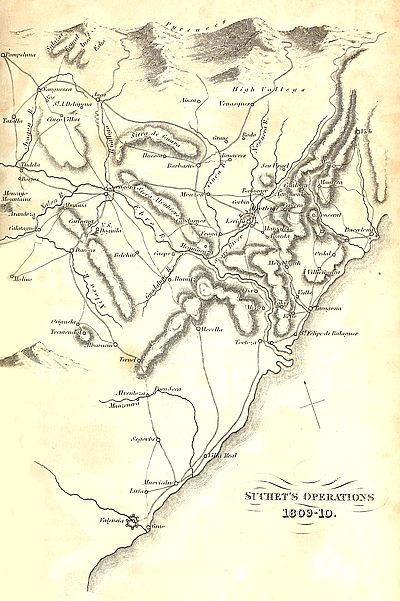
Zaragoza is surrounded by rugged mountains,
and every range became the mother of a Guerilla
brood; nor were the regular Partizan corps less
numerous than the Partidas. On the left of the
Ebro, the Catalonian colonels, Baget, Perena, Pedroza,
and the chief Theobaldo, brought their
Migueletes to the Sierra de Guara, overhanging
Huesca and Barbastro. In this position, commanding
the sources of the Cinca and operating
on both sides of that river, they harassed the
communication between Zaragoza and the French
outposts; and maintained an intercourse with the
governor of Lerida, who directed the movements
and supplied the wants of all the bands in Aragon.
On the right of the Ebro, troops raised in the
district of Molina, were united to the corps of
Gayan, and that officer, taking possession of the
mountains of Montalvan, the valley of the Xiloca,
and the town of Daroca, pushed his advanced
guards even to the plain of Zaragoza, and occupied
Nuestra Senora del Aguilar. This convent, situated
on the top of a high rock, near Cariñena, he
made a depôt of provisions and ammunition, and
surrounded the building with an entrenched camp
for three thousand men.
On Gayan’s left, general Villa Campa, a man of
talent and energy, established himself at Calatayud,
with the regular regiments of Soria and La
Princessa, and making fresh levies, rapidly formed
a large force, with which he cut the direct line of
communication between Zaragoza and Madrid.
Beyond Villa Campa’s positions the circle of war
was continued by other bands; which, descending
from the Moncayo mountains, infested the districts
of Taranzona and Borja, and intercepted the communications
between Tudela and Zaragoza.
The younger Mina, called the student, vexed all
the country between Tudela and Pampeluna; and
the inhabitants of the high
Pyrennean valleys of Roncal, Salazar, Anso, and Echo, were also in arms,
and commanded by Renovalles. This general officer,
taken at Zaragoza, was, by the French, said to
have broken his parole; but he, pleading a previous
breach of the capitulation, fled to Lerida,
and from thence passing with some regular officers
into the valleys, took the command of the insurrection,
and succeeded in surprising several French
detachments. His principal post was at the convent
of San Juan de la Pena, which is built on
a rock, remarkable in Spanish history as a place
of refuge maintained with success against the
Moorish conquerors. The bodies of twenty-two
kings of Aragon rested in the church, and the
whole rock was held in veneration by the Aragonese,
and supposed to be invulnerable. From this post
Saraza, acting under Renovalles, continually menaced
Jaca, and communicating with Baget, Pedroza,
and Father Theobaldo, completed, as it were,
the investment of the third corps.
All these bands, amounting to, at least, twenty
thousand armed men, commenced their operations at
once, cutting off isolated men, intercepting convoys
and couriers, and attacking the weakest parts of
the French army. Meanwhile Blake having rallied
his fugitives at Tortoza, abandoned Aragon to its
fate, and proceeding to Taragona, endeavoured to
keep the war alive in Catalonia.
Suchet, in following up his victory at Belchite,
had sent detachments as far as Morella, on the
borders of Valencia, and pushed his scouting parties
close up to Tortoza; but finding the dispersion
of Blake’s troops complete, he posted Meusnier’s
division on the line of the Guadalupe, with
orders to repair the castle of Alcanitz, so as to form
a head of cantonments on the right bank of the
Ebro. Then crossing that river at Caspe with the
rest of the army, he made demonstrations against
Mequinenza, and even menaced Lerida, obliging
the governor to draw in his detachments, and close
the gates. Suchet, however, continued his march by
Fraga, recrossed the Cinca, and leaving Habert’s
division to guard that line, returned himself in the
latter end of June to Zaragoza by the road of
Monzon.
Having thus dispersed the regular Spanish forces
and given full effect to his victory; the French
General sought to fix himself firmly in the positions
he had gained. Sensible that arms may win
battles, but cannot render conquest permanent,
he projected a system of civil administration which
enabled him to support his troops, and yet to offer
some security of property to those inhabitants who
remained tranquil. But, as it was impossible for
the people to trust to any system, or to avoid
danger, while the mountains swarmed with the
Partidas, Suchet resolved to pursue the latter
without relaxation, and to put down all resistance
in Aragon before he attempted to enlarge the
circle of his conquests. Foreseeing that while he
thus laid a solid base for further operations, he
should also form an army capable of executing
any enterprize.
He commenced on the side of Jaca, and having
dislodged the Spaniards from their positions near that
castle, in June, supplied it with ten months’ provisions.
After this operation, Almunia and Cariñena,
on the right of the Ebro, were occupied by
his detachments; and having suddenly drawn together
four battalions and a hundred cuirassiers
at the latter point, he surrounded
Nuestra Senora del Aguilar, during the night of the 19th, destroyed
the entrenched camp, and sent a detachment
in pursuit of Gayan. On the same day,
Pedrosa was repulsed on the other side of the
Ebro, near Barbastro, and general Habert defeated
Perena.
The troops sent in pursuit of Gayan dispersed
his corps at Uzed, and Daroca was occupied by
the French. The vicinity of Calatayud and the
mountains of Moncayo were then scoured by detachments
from Zaragoza, one of which took possession
of the district of Cinco Villas. Meanwhile
Jaca was continually menaced by the Spaniards
at St. Juan de la Pena, and Saraza, descending
from thence by the valley of the Gallego, on the
23d of August, surprised and slew a detachment
of seventy men close to Zaragoza. On the 26th,
however, five French battalions stormed the sacred
rock, and penetrated up the valleys of Anso and
Echo in pursuit of Renovalles. Nevertheless, that
chief, retiring to Roncal, obtained a capitulation for
the valley without surrendering himself.
These operations having, in a certain degree,
cleared Aragon of the bands on the side of Navarre
and Castile, the French general proceeded
against those on the side of Catalonia. Baget,
Perena, and Pedrosa, chased from the Sierra de
Guarra, rallied between the Cinca and the Noguerra,
and were joined by Renovalles, who assumed
the chief command; but on the 23d of September,
the whole being routed by general Habert,
the men dispersed, and the chiefs took refuge in
Lerida and Mequinenza.
Suchet, then occupied Fraga, Candasnos, and
Monzon, established a flying bridge on the Cinca,
near the latter town, raised some field-works
to protect it, and that done, resolved to penetrate
the districts of Venasques and Benevarres, the
subjection of which would have secured his
left flank, and opened a new line of communication
with France. The inhabitants, having
notice of his project, assembled in arms, and
being joined by the dispersed soldiers of the
defeated Partizans, menaced a French regiment
posted at Graus. Colonel La Peyrolerie, the commandant,
marched the 17th of October, by Roda,
to meet them; and having reached a certain distance
up the valley, was surrounded, yet he broke
through in the night, and regained his post.
During his absence the peasantry of the vicinity
came down to kill his sick men, but the townsmen
of Graus would not suffer this barbarity; and
marshal Suchet affirms that such humane conduct
was not rare in Aragonese towns.
While this was passing in the valley of Venasque,
the governor of Lerida caused Caspe, Fraga, and
Candasnos to be attacked, and some sharp fighting
took place. The French maintained their posts,
but the whole circle of their cantonments being still
infested by the smaller bands, petty actions were
fought at Belchite, and on the side of Molino, at
Arnedo, and at Soria. Mina also still intercepted
the communications with Pampeluna; and Villa
Campa, quitting Calatayud, rallied Gayan’s troops,
and gathered others on the rocky mountain of Tremendal,
where a large convent and church once
more furnished as a citadel for an entrenched camp.
Against this place colonel Henriod marched in November,
from Daroca, with from fifteen hundred to
two thousand men and three pieces of artillery, and
driving back some advanced posts from Ojos Negros
to Origuela; came in front of the main position at
eleven o’clock in the morning of the 25th.
The Spaniards were on a mountain, from the
centre of which a tongue of land shooting out,
overhung Origuela, and on the upper part of this
tongue stood the fortified convent of Tremendal.
To the right and left the rocks were nearly perpendicular,
and Henriod, seeing that Villa Campa was
too strongly posted to be beaten by an open attack,
imposed upon his adversary by skirmishing and
making as if he would turn the right of the position
by the road of Albaracin. Villa Campa was thus
induced to mass his forces on that side. In the night,
the fire of the bivouacs enabled the Spaniards to see
that the main body of the French troops and the
baggage were retiring, and, at the same time, Henriod,
with six chosen companies and two pieces of
artillery, coming against the centre, suddenly drove
the Spanish outposts into the fortified convent,
and opened a fire with his guns, as if to cover
the retreat. The skirmish soon ceased, and
Villa Campa, satisfied that the French had retired,
was thrown completely off his guard, when Henriod’s
six companies, secretly scaling the rocks of the
position, rushed amongst the sleeping Spaniards,
killed and wounded five hundred, and put the
whole army to flight. Meanwhile, on the other
side of the Ebro, a second attempt was made
against the valley of Venasque, which being successful,
that district was disarmed.
Petty combats still continued to be fought in
other parts of Aragon, but the obstinacy of the
Spaniards gradually gave way. In the month
of December, Suchet (assisted by general Milhaud,
with a moveable column from Madrid,)
took the towns of Albaracin and Teruel, the insurgent
junta fled to Valencia, and the subjection
of Aragon was, in a manner effected. The
interior was disarmed and quieted, and the
Partidas, which still hung upon the frontiers,
were recruited, as well as supplied, from other
provinces, and acted chiefly on the defensive.
The Aragonese also were so vexed by the smaller
bands, now dwindling into mere banditti, that
a smuggler of Barbastro raised a Spanish corps,
with which he chased and suppressed many of
them.
Reinforcements were now pouring into Spain,
and enabled the French general to prepare for
extended operations. The original Spanish army
of Aragon was reduced to about eight thousand
men; of which, a part were wandering with Villa
Campa, a part were in Tortoza, and the rest about
Lerida and Mequinenza. Those fortresses were,
indeed, the only obstacles to a junction of the
third with the seventh corps; and in them the
Spanish troops who still kept the field took refuge,
when closely pressed by the invaders.
The policy of the Supreme Junta was however,
always to form fresh corps upon the remnants
of their beaten armies. Hence Villa Campa,
keeping in the mountains of Albaracin, recruited his
ranks, and still infested the western frontier of
Aragon: Garcia Novarro, making Tortoza his base
of operations lined the banks of the Algas, and
menaced Alcanitz: and Perena, trusting to the
neighbourhood of Lerida for support, posted himself
between the Noguera and the Segre. But the
activity of the French gave little time to effect
any considerable organization.
Suchet’s positions formed a circle round Zaragoza;
and Tudela, Jaca, and the castle of Aljaferia
were garrisoned; but his principal forces were on
the Guadalupe and the Cinca, occupying Alcanitz,
Caspe, Fraga, Monzon, Barbastro, Benevarres,
and Venasque; of which the first, third, and fourth
were places of strength: and certainly, whether
his situation be regarded in a political, or a military
light, it was become most important. One
year had sufficed, not only to reduce the towns
and break the armies, but in part to conciliate
the feelings of the Aragonese—confessedly the
most energetic portion of the nation—and to place
the third corps, with reference to the general
operations of the war, in a most formidable
position.
1º. The fortified castle of Alcanitz formed a
head of cantonments on the right bank of the Ebro;
and being situated at the entrance of the passes
leading into Valencia, it also furnished a base,
from which Suchet could invade that rich province;
and by which also, he could place the Catalonian
army between two fires, whenever the seventh corps
should again advance beyond the Llobregat.
2º.
Caspe secured the communication between
the wings of the third corps, while Fraga and
its wooden bridge over the Cinca, offered
the means of passing that uncertain river at all
seasons.
3º. Monzon, a regular fortification, in some
measure balanced Lerida; and its flying bridge
over the Cinca enabled the French to forage all
the country between Lerida and Venasques; moreover
a co-operation of the garrison of Monzon, the
troops at Barbastro, and those at Benevarres, could
always curb Perena.
4º. The possession of Venasques permitted
Suchet to communicate with the moveable columns,
(appointed to guard the French frontier,) while
the castle of Jaca rendered the third corps in a
manner independent of Pampeluna and St. Sebastian.
In fine, the position on the Cinca and the Guadalupe,
menacing alike Catalonia and Valencia,
connected the operations of the third with the
seventh corps; and henceforward we shall find
these two armies gradually approximating until
they form but one force, acting upon a distinct
system of invasion against the south.
Suchet’s projects were, however, retarded by insurrections
in Navarre, which, at this period, assumed
a serious aspect. The student Mina, far from
being quelled by the troops sent at different periods
in chase of him, daily increased his forces, and,
by hardy and sudden enterprizes, kept the Navarrese
in commotion. The duke of Mahon, one of
Joseph’s Spanish adherents, appointed viceroy of
Navarre, was at variance with the military authorities;
and all the disorders attendant on a divided
administration, and a rapacious system, ensued.
General D’Agoult, the governor of Pampeluna,
was accused of being in Mina’s pay. His
suicide during an investigation seems to confirm
the suspicion, but it is also abundantly evident,
that the whole administration of Navarre was oppressive,
venal, and weak.
To avert the serious danger of an insurrection
so close to France, the emperor directed Suchet to
repair there with a part of the third corps. That
general soon restored order in Pampeluna, and
eventually captured Mina himself; but he was
unable to suppress the system of the Partidas.
“Espoz y Mina” took his nephew’s place; and
from that time to the end of the war,
the communications of the French were troubled, and considerable
losses inflicted upon their armies by this
celebrated man—undoubtedly the most conspicuous
person among the Partida chiefs. And here it may
be observed how weak and inefficient this guerilla
system was to deliver the country, and that, even
as an auxiliary, its advantages were nearly balanced
by the evils.
It was in the provinces lying between France
and the Ebro that it commenced. It was in those
provinces that it could effect the greatest injury
to the French cause; and it was precisely in those
provinces that it was conducted with the greatest
energy, although less assisted by the English than
any other part of Spain: a fact leading to the
conclusion, that ready and copious succours may
be hurtful to a people situated as the Spaniards
were. When so assisted, men are apt to rely more
upon their allies than upon their own exertions.
But however this may be, it is certain that the
Partidas of Biscay, Navarre, Aragon, and Catalonia,
although they amounted at one time to above
thirty thousand men, accustomed to arms, and
often commanded by men of undoubted enterprize
and courage, never occupied half their own number
of French at one time; never absolutely defeated
a single division; never prevented any considerable
enterprize; never, with the exception of the surprise
of Figueras, to be hereafter spoken of, performed
any exploit seriously affecting the operations of a
single “corps d’armée.”
It is true, that if a whole nation will but persevere
in such a system, it must in time destroy the
most numerous armies. But no people will thus persevere,
the aged, the sick, the timid, the helpless,
are all hinderers of the bold and robust. There will,
also, be a difficulty to procure arms, for it is not on
every occasion that so rich and powerful a people
as the English, will be found in alliance with insurrection;
and when the invaders follow up their
victories by a prudent conduct, as was the case
with Suchet and some others of the French generals,
the result is certain. The desire of ease
natural to mankind, prevails against the suggestions
of honour; and although the opportunity of
covering personal ambition with the garb of patriotism
may cause many attempts to throw off the
yoke, the bulk of the invaded people will gradually
become submissive and tranquil. It is a fact that,
notwithstanding the violent measures resorted to
by the Partida chiefs to fill their ranks, deserters
from the French and even from the British formed
one-third of their bands.
To raise a whole people against an invader may
be easy, but to direct the energy thus aroused,
is a gigantic task, and, if misdirected, the result
will be more injurious than advantageous. That
it was misdirected in Spain was the opinion of
many able men of all sides, and to represent it otherwise,
is to make history give false lessons to posterity.
Portugal was thrown completely into the
hands of lord Wellington; but that great man,
instead of following the example of the Supreme
Junta, and encouraging independent bands, enforced
a military organization upon totally different
principles. The people were, indeed, called upon
and obliged to resist the enemy, but it was under
a regular system, by which all classes were kept
in just bounds, and the whole physical and moral
power of the nation rendered subservient to the
plan of the general-in-chief. To act differently is
to confess weakness: it is to say that the government
being unequal to the direction of affairs permits
anarchy.
The Partida system in Spain, was the offspring
of disorder, and disorder in war is weakness accompanied
by ills the least of which is sufficient to
produce ruin. It is in such a warfare, that habits
of unbridled license, of unprincipled violence, and
disrespect for the rights of property are quickly
contracted, and render men unfit for the duties of
citizens; and yet it has with singular inconsistency
been cited, as the best and surest mode of resisting
an enemy, by politicians, who hold regular
armies in abhorrence, although a high sense of
honour, devotion to the cause of the country, temperance,
regularity, and decent manners are of the
very essence of the latter’s discipline.
Regular armies have seldom failed to produce
great men, and one great man is sufficient to save
a nation: but when every person is permitted to
make war in the manner most agreeable to himself;—for
one that comes forward with patriotic intentions,
there will be two to act from personal interest;
in short, there will be more robbers than
generals. One of the first exploits of Espoz y Mina
Extract
from the
Life of
Mina.was to slay the commander of a neighbouring band,
because, under the mask of patriotism, he was plundering
his own countrymen: nay, this the most
fortunate of all the chiefs, would never suffer any
other Partida than his own to be in his district;
he also, as I have before related, made a species of
commercial treaty with the French, and strove
earnestly and successfully to raise his band to the
dignity of a regular force. Nor was this manner
of considering the guerilla system confined to the
one side. The following observations of St. Cyr, a
man of acknowledged talents, show that, after considerable
experience of this mode of warfare, he
also felt that the evil was greater than the benefit.
“Far from casting general blame on the efforts
made by the Catalans, I admired them; but, as
they often exceeded the bounds of reason, their
heroism was detrimental to their cause. Many
times it caused the destruction of whole populations
without necessity and without advantage.”
“When a country is invaded by an army stronger
than that which defends it, it is beyond question
that the population should come to the assistance
of the troops, and lend them every support; but,
without an
absolute necessity, the former should
not be brought on to the field of battle.”—“It is
inhuman to place their inexperience in opposition
to hardened veterans.”
“Instead of exasperating the people of Catalonia,
the leaders should have endeavoured to calm
them, and have directed their ardour so as to
second the army on great occasions. But they
excited them without cessation, led them day
after day into fire, fatigued them, harassed them,
forced them to abandon their habitations, to embark
if they were on the coast, if inland to take
to the mountains and perish of misery within
sight of their own homes, thus abandoned to the
mercy of a hungry and exasperated soldiery. The
people’s ardour was exhausted daily in partial
operations, and hence, on great occasions, when
they could have been eminently useful, they were
not to be had.”
“Their good will had been so often abused by
the folly of their leaders, that many times their
assistance was called for in vain. The peasantry,
of whom so much had been demanded, began to
demand in their turn. They insisted that the
soldiers should fight always to the last gasp, were
angry when the latter retreated, and robbed and
ill-used them when broken by defeat.”
“They had been so excited, so exasperated
against the French, that they became habitually
ferocious, and their ferocity was often as dangerous
to their own party, as to the enemy. The
atrocities committed against their own chiefs disgusted
the most patriotic, abated their zeal,
caused the middle classes to desire peace as the
only remedy of a system so replete with disorder.
Numbers of distinguished men, even those who
had vehemently opposed Joseph at first, began
to abandon Ferdinand; and it is certain that,
but for the expedition to Russia, that branch of
the Bourbons which reigns in Spain, would never
have remounted the throne.”
“The cruelties exercised upon the French military
were as little conformable to the interest
of the Spaniards. Those men were but the
slaves of their duty, and of the state; certain
of death a little sooner or a little later, they,
like the Spaniards, were victims of the same
ambition. The soldier naturally becomes cruel
in protracted warfare; but the treatment experienced
from the Catalans brought out this disposition
prematurely; and that unhappy people
were themselves the victims of a cruelty, which
either of their own will or excited by others,
they had exercised upon those troops that fell
into their power; and this without any advantage
to their cause, while a contrary system would, in
a little time, have broken up the seventh corps,—seeing
that the latter was composed of foreigners,
naturally inclined to desert. But the murders
of all wounded, and sick, and helpless men,
created such horror, that the desertion, which at
first menaced total destruction, ceased entirely.”
Such were St. Cyr’s opinions; and, assuredly,
the struggle in Catalonia, of which it is now the
time to resume the relation, was not the least successful
in Spain.
CHAPTER II. — OPERATIONS IN CATALONIA. — THIRD SIEGE OF GERONA. — STORMING OF PALAMOS.
See Vol II.
p. 102.
The narrative of the Catalonian affairs was
broken off at the moment, when St. Cyr having
established his quarters at Vich, received intelligence
of the Austrian war, and that Barcelona
had been relieved by the squadron of admiral Comaso.
His whole attention was then directed towards
Gerona; and with a view to hastening
general Reille’s preparation for the siege of that
place, a second detachment, under Lecchi, proceeded
to the Ampurdan.
During this time Conpigny continued at Taragona,
and Blake made his fatal march into Aragon;
but those troops which, under Milans and Wimphen,
had composed Reding’s left wing, were continually
skirmishing with the French posts in the
valley of Vich, and the Partizans, especially Claros
and the doctor Rovira, molested the communications
in a more systematic manner than before.
Lecchi returned about the 18th of May, with
intelligence that Napoleon had quitted Paris for
Germany, that general Verdier had replaced Reille
in the Ampurdan, and that marshal Augereau had
reached Perpignan in his way to supersede St. Cyr
himself in the command of the seventh corps. The
latter part of this information gave St. Cyr infinite
discontent. In his “Journal of Operations,” he asserts
that his successor earnestly sought for the
appointment, and his own observations
on the occasion are sarcastic and contemptuous of his rival.
Augereau, who having served in Catalonia during
the war of the revolution, imagined, that he had
then acquired an influence which might be revived
on the present occasion, framed a proclamation
that vied with the most inflated of Spanish
manifestoes. But the latter, although turgid, were
in unison with the feelings of the people, whereas,
Augereau’s address, being at utter variance with
those feelings, was a pure folly. This proclamation
he sent into Catalonia, escorted by a battalion; but
even on the frontier, the Miguelette colonel, Porta,
defeated the escort, and tore down the few copies
that had been posted.
The French marshal, afflicted with the gout, remained
at Perpignan, and St. Cyr continued to command;
but reluctantly, because (as he affirms) the
officers and soldiers were neglected, and himself
exposed to various indignities, the effects of Napoleon’s
ill-will. The most serious of these affronts
was permitting Verdier to correspond directly with
the minister of war in France, and the publishing
of his reports in preference to St. Cyr’s. For these
reasons, the latter contented himself with a simple
discharge of his duty. Yet, after the conspiracy in
the second corps, Napoleon cannot be justly blamed
for coldness towards an officer, who, however free
himself from encouraging the malcontents in the
French army, was certainly designed for their
leader. It is rather to be admired that the emperor
discovered so little jealousy; when a man
has once raised himself to the highest power, he
must inevitably give offence to his former comrades,
for, as all honours and rewards, flowing
from him, are taken as personal favours, so all
checks and slights, or even the cessation of benefits,
are regarded as personal injuries. Where the
sanction of time is wanting, to identify the sovereign
with the country, the discontented easily
convince themselves that revenge is patriotism.
While St. Cyr was preparing for the siege of
Gerona, Joseph, as we have seen, directed him to
march into Aragon, to repel Blake’s movement
against Suchet. This order he refused to obey,
See Vol. II
p. 363. and with reason; for it would have been a great
error to permit Blake’s false movement to occupy
two “Corps d’Armée,” and so retard the siege of
Gerona, to the infinite detriment of the French
affairs in Catalonia. Barcelona was never safe while
Hostalrich and Gerona were in the Spaniard’s possession.
St. Cyr was well aware of this, but the
evils of a divided command are soon felt. He who
had been successful in all his operations, was urgent,
for many reasons, to commence the siege
without delay, but Verdier, who had failed at Zaragoza,
was cautious in attacking a town which had
twice baffled Duhesme, and when pressed to begin,
complained that he could not, after placing garrisons
in Rosas and Figueras, bring ten thousand
men before Gerona; which, seeing the great extent
of the works, were insufficient.
St. Cyr, disregarding the works, observed that
the garrison did not exceed three thousand men,
that it could not well be increased, and that expedition
was of more consequence than numbers.
Nevertheless, considering that a depôt of provisions,
established for the service of the siege at
Figueras, and which it was unlikely Napoleon would
replenish, must, by delay, be exhausted, as well as
the supplies which he had himself collected at
Vich: he sent all his own cannoniers, sappers,
and artillery horses, two squadrons of cavalry,
and six battalions of infantry to the Ampurdan,
and having thus increased the number of troops
there to eighteen thousand men, again urged Verdier
to be expedite.
These reinforcements marched the 22d of May,
and the covering army diminished to about twelve
thousand men under arms, continued to hold the
valley of Vich until the middle of June. During
this time, the Miguelettes often skirmished with
the advanced posts, but without skill or profit;
and the inhabitants of the town, always remained
in the high mountains unsheltered and starving,
yet still firm of resolution not to dwell with the
invaders. This may be attributed partly to fear,
but more to that susceptibility to grand sentiments,
which distinguishes the Spanish peasants. Although
little remarkable for hardihood in the field,
their Moorish blood is attested by their fortitude;
and, men and women alike, they endure calamity
with a singular and unostentatious courage. In
this they are truly admirable. But their virtues
are passive, their faults active, and, continually
instigated by a peculiar arrogance, they are perpetually
projecting enterprises which they have
not sufficient vigour to execute, although at all
times they are confident and boasting more than
becomes either wise or brave men.
Early in June, St. Cyr, having consumed nearly
all his corn, resolved to approach Gerona, and secure
the harvest which was almost ripe in that
district; but, previous to quitting Vich, he sent
his sick and wounded men, under a strong escort,
to Barcelona, and disposed his reserves in such a
manner that the operation was effected without loss.
The army, loaded with as much grain as the men
could carry, then commenced crossing the mountains
which separate Vich from the districts of Gerona
and Hostalrich. This march, conducted by the
way of Folgarolas, San Saturnino, Santa Hillario,
and Santa Coloma de Farnes, lasted two days;
and, the 21st of June, the head-quarters being
fixed at Caldas de Malavella, the Fort of St. Felieu
de Quixols was stormed, and the Spanish privateers
driven to seek another harbour. The French
army was then distributed in a half circle, extending
from St. Felieu to the Oña river. Intermediate
posts were established at St. Grace, Vidreras,
Mallorquinas, Rieu de Arenas, Santa Coloma de
Farnes, Castaña, and Bruñola; thus cutting off
the communications between Gerona and the districts
occupied by Conpigny, Wimphen, the Milans,
and Claros.
During the march from Vich, the French defeated
three Spanish battalions, and captured a
convoy, coming from the side of Martorel, and destined
for Gerona. St. Cyr calls them the forerunners
of Blake’s army; a curious error, for Blake
was, on that very day, being defeated at Belchite,
two hundred miles from Santa Coloma. Strictly
speaking, there was, at this period, no Catalonian
army, the few troops that kept the field were
acting independently, and Conpigny, the nominal
commander-in-chief, remained at Taragona. He
and the other authorities, more occupied with personal
quarrels and political intrigues than with
military affairs, were complaining and thwarting
each other. Thus the Spanish and French operations
were alike weakened by internal divisions.
Verdier was slow, cautious, and more attentive
to the facilities afforded for resistance than to the
number of regular soldiers within the works; he,
or rather Reille, had appeared before Gerona on
the 6th of May, but it was not till the 4th of June
that, reinforced with Lecchi’s division, he completed
the investment of the place on both sides of the Ter.
On the 8th, however, ground was broken; and thus,
at the very moment when Blake, with the main body
of his army, was advancing against Zaragoza, in
other words, seeking to wrest Aragon from the
French, Catalonia was slipping from his own
hands.
When this memorable siege commenced, the
relative situations of the contending parties were
as follows:—Eighteen thousand French held the
Ampurdan, and invested the place. Of this number
about four thousand were in Figueras, Rosas,
and the smaller posts of communication; and it is
remarkable that Verdier asserted that the first-named
place, notwithstanding its great importance,
was destitute of a garrison, when he arrived there
from France. A fact consistent with Lord Collingwood’s
description of the Catalan warfare, but irreconcilable
with the enterprise and vigour attributed
to them by others.
St. Cyr, the distribution of whose forces has
been already noticed, covered the siege with twelve
thousand men; and Duhesme, having about ten
thousand, including sick, continued to hold Barcelona.
Forty thousand French were, therefore, disposed
Imperial
Muster
Roll. MSS.between that city and Figueras; while, on
the Spanish side, there was no preparation. Blake
was still in Aragon; Conpigny, with six thousand
of the worst troops, was at Taragona; the Milans
watched Duhesme; Wimphen, with a few thousand,
held the country about the Upper Llobregat. Juan
Claros and Rovira kept the mountains on the side
of Olot and Ripol; and, in the higher Catalonia,
small bands of Miguelettes were dispersed under
different chiefs. The Somatenes, however, continuing
their own system of warfare, not only
disregarded the generals, as in the time of Reding,
but fell upon and robbed the regular troops, whenever
a favourable opportunity occurred.
The Spanish privateers, dislodged from St. Filieu,
now resorted to Palamos-bay, and the English fleet,
under Lord Collingwood, watched incessantly to
prevent any French squadron, or even single vessels,
from carrying provisions by the coast. But from
Gerona, the governor did not fail to call loudly on
the generals, and even on the Supreme Central
Junta, for succours; yet his cry was disregarded;
and when the siege commenced, his garrison did
not exceed three thousand regular troops: his magazines
and hospitals were but scantily provided,
and he had no money. Alvarez Mariano was however,
of a lofty spirit, great fortitude, and in no
manner daunted.
See Vol. I.
p. 78.
The works of Gerona, already described, were
little changed since the first siege; but there, as in
Zaragoza, by a mixture of superstition, patriotism,
and military regulations, the moral as well as physical
force of the city had been called forth. There,
likewise, a sickness, common at a particular season
of the year, was looked for to thin the ranks of the
besiegers, and there also women were enrolled,
under the title of the Company of Sta. Barbara, to
carry off the wounded, and to wait upon the hospitals,
and at every breath of air, says St. Cyr, their
ribbons were seen to float amidst the bayonets of
the soldiers! To evince his own resolution, the
governor forbad the mention of a capitulation under
pain of death; but severe punishments were only
denounced, not inflicted upon faint-hearted men.
Alvarez, master of his actions, and capable of
commanding without phrenzy, had recourse to no
barbarous methods of enforcing authority; obstinate
his defence was, and full of suffering to the besieged,
yet free from the stain of cruelty, and rich
in honour.
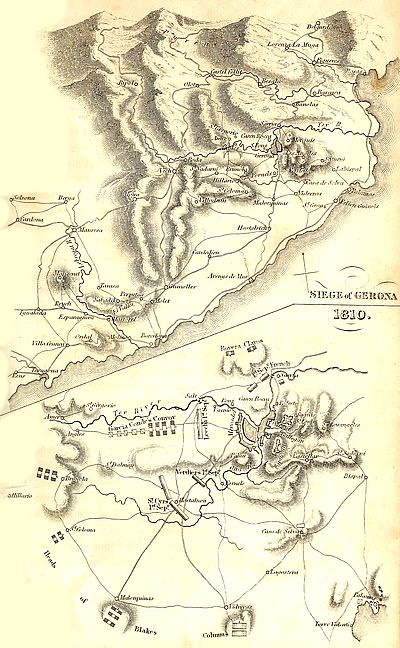
On the 4th of June the siege was begun, and, on
the 12th, a mortar-battery, from the heights of
Casen Rocca, on the left of the Ter, and two
breaching-batteries, established against the outworks
of Fort Monjouic, being ready to play, the
town was summoned in form. The answer was an
intimation that henceforth all flags of truce would
be fired upon; the only proceeding indicative of the
barbarian in the conduct of Alvarez.
The 13th the small suburb of Pedreto was taken
possession of by the French, and early on the
morning of the 14th, the batteries opened against
Monjouic, while the town was bombarded from the
Casen Rocca.
The 17th the besieged drove the enemy from
Pedreto, but were finally repulsed with the loss of
above a hundred men.
The 19th the stone towers of St. Narcis and St.
Louis, forming the outworks of Monjouic, being
assaulted, the besieged, panic-stricken, abandoned
them and the tower of St. Daniel also. The
French immediately erected breaching-batteries,
four hundred yards from the northern bastion of
Monjouic. Tempestuous weather retarded their
works, but they made a practicable opening by the
4th of July, and with a strange temerity resolved
to give the assault, although the flank fire of the
works was not silenced, nor the glacis crowned, nor
the covered way or counterscarp injured, and that a
half moon, in a perfect state, covered the approaches
to the breach. The latter was proved by the engineers,
in a false attack, on the night of the 4th, and
the resolution to assault was then adopted; yet the
storming-force drawn from the several quarters of
investment was only assembled in the trenches on
the night of the 7th; and during these four days,
the batteries ceasing to play, the Spaniards retrenched,
and barricadoed the opening.
At four o’clock in the morning of the 8th, the
French column, jumping out of the trenches, rapidly
cleared the space between them and the fort,
descended the ditch, and mounted to the assault
with great resolution; but the Spaniards had so
strengthened the defences that no impression could
be made, and the assailants taken in flank and rear
by the fire from the half moon, the covered way,
and the eastern bastion, were driven back. Twice
they renewed the attempt, but the obstacles were
insurmountable, and the assault failed, with a loss
of a thousand men killed and wounded. The success
of the besieged was however mitigated by an accidental
explosion, which destroyed the garrison of
the small fort of St. Juan, situated between Monjouic
and the city.
About the period of this assault which was
given without St. Cyr’s knowledge, the latter
finding that Claros and Rovira interrupted the
convoys coming from Figueras to Gerona, withdrew
a brigade of Souham’s division from Santa Coloma
de Farnés, and posted it on the left of the Ter, at
Bañolas. The troops on the side of Hostalrich were
thus reduced to about eight thousand men under
arms, although an effort to raise the siege was to
be expected. For letters from Alvarez, urgently
demanding succours of Blake, had been intercepted,
and the latter, after his defeat in Aragon, was, as
I have said, collecting men at Taragona.
Meanwhile, to secure the coast-line from Rosas
to Quixols before Blake could reach the scene of
action, St. Cyr resolved to take Palamos. To effect
this, general Fontanes marched from St. Filieu, on
the 5th of July, with an Italian brigade, six guns,
and some squadrons of dragoons. Twice he summoned
the place, and the bearer being each time
treated with scorn, the troops moved on to the
attack; but in passing a flat part of the coast near
Torre Valenti, they were cannonaded by six gun-boats
so sharply, that they could not keep the
road until the artillery had obliged the boats to
sheer off.
This town having a good roadstead, and being only
one march from Gerona, was necessarily a place of
importance; and the works, although partly ruined,
were so far repaired by the Catalans as to be
capable of some defence. Twenty guns were
mounted; and the town, built on a narrow rocky
peninsula had but one front, the approach to
which was over an open plain, completely commanded
from the left by some very rugged hills,
where a considerable number of Somatenes were
assembled, with their line touching upon the walls
of the town.
Fontanes drove the Somatenes from this position,
and a third time, summoned the place to surrender.
The bearer was killed, and the Italians immediately
stormed the works. When the Spaniards flying
towards the shore endeavoured to get on board their
vessels, the latter put off to sea, and some of Fontanes’
troops having turned the town during the action,
intercepted the fugitives, and put all to the sword.
Scarcely had Palamos fallen when Wimphen and
the Milans, arriving near Hostalrich, began to
harass Souham’s outposts at Santa Coloma, hoping
to draw St. Cyr’s attention to that side, while a
reinforcement for the garrison of Gerona should
pass through the left of his line into the city.
The French general was not deceived; but the
Spaniards nevertheless sent fifteen hundred chosen
men, under the command of one Marshal, an
Englishman, to penetrate secretly through the
enemy’s posts at Llagostera. They were accompanied
by an aide-de-camp of Alvarez, called Rich,
apparently an Englishmen also, and they succeeded
on the 9th in passing general Pino’s posts unobserved.
A straggler, however, was taken, and
St. Cyr being thus informed of the march, and
judging that the attempt to break the line of investment
would be made in the night and by the
road of Casa de Selva, immediately placed one
body of men in ambush near that point, and sent
another in pursuit of the succouring column.
As the French general had foreseen, the Spaniards
continued their march through the hills at dusk,
but being suddenly fired upon by the ambuscade,
hastily retired, and the next day fell in with the
other troops, when a thousand men were made
prisoners: the rest dispersing, escaped the enemy,
yet were ill used and robbed of their arms by the
Somatenes. St. Cyr says that Mr. Marshal, having
offered to capitulate, fled during the negotiation,
and thus abandoned his men; but the Spanish
general Conpigny affirmed that the men abandoned
Marshal, and refused to fight, that Rich ran away
before he had seen the enemy, and that both he
and the troops merited severe punishment. It is
also certain that Marshal’s flight was to Gerona,
where he afterwards fell fighting gallantly.
This disappointment was sensibly felt by Alvarez.
Sickness and battle had already reduced his garrison
to fifteen hundred men, and he was thus debarred
of the best of all defences, namely, frequent sallies
as the enemy neared the walls. His resolution was
unshaken, but he did not fail to remonstrate
warmly with Conpigny, and even denounced his
inactivity to the Supreme Junta. That general
excused himself on the ground of Blake’s absence,
the want of provisions, and the danger of carrying
the contagious sickness of Taragona into Gerona;
and finally adduced colonel Marshal’s unfortunate
attempt, as proof that due exertion had been made.
Yet he could not deny that Gerona had been
invested two months, had sustained forty days of
open trenches, a bombardment and an assault
without any succour, and that during that time,
he himself remained at Taragona, instead of being
at Hostalrich with all the troops he could collect.
From the prisoners taken the French ascertained
that neither Conpigny nor Blake had any intention
of coming to the relief of Gerona, until sickness
and famine, which pressed as heavily on the besiegers
as on the besieged, should have weakened
the ranks of the former; and this plan receives
unqualified praise from St. Cyr, who seems to have
forgotten, that with an open breach, a town, requiring
six thousand men to man the works, and having
but fifteen hundred, might fall at any moment.
After the failure of the assault at Monjouic,
Verdier recommenced his approaches in due form,
opened galleries for a mine, and interrupted the
communication with the city by posting men in
the ruins of the little fort of St. Juan. But his
operations were retarded by Claros and Rovira,
who captured a convoy of powder close to the
French frontier. To prevent a recurrence of
such events, the brigade of Souham’s division was
pushed from Bañolas to St. Lorenzo de la Muja;
and, on the 2d of August, the fortified convent of
St. Daniel, situated in the valley of the Galligan,
between the Constable fort and Monjouic, was
taken by the French, who thus entirely intercepted
the communication between the latter place and
the city.
On the 4th of August, the glacis of Monjouic
being crowned, the counterscarp blown in, and
the flank defences ruined, the ditch was passed,
and the half moon in front of the curtain carried
by storm, but no lodgement was effected. During
the day, Alvarez made an unsuccessful effort to
retake the ruins of St. Juan; and at the same time,
two hundred Spaniards who had come from the
sea-coast with provisions, and penetrated to the
convent of St. Daniel, thinking that their countrymen
still held it, were made prisoners.
On the 5th the engineers having ascertained
that the northern bastion being hollow, the troops
would, after storming it, be obliged to descend a
scarp of twelve or fourteen feet, changed the line
of attack, and commenced new approaches against
the eastern bastion. A second practical breach
was soon opened, and preparations made for storming
on the 12th, but in the night of the 11th, the
garrison blew up the magazines, spiked the guns,
and, without loss, regained Gerona. Thus the fort
fell, after thirty-seven days of open trenches and
one assault.
CHAPTER III. — OBSERVATIONS.
Verdier, elated by the capture of Monjouic,
boasted, in his despatches, of the difficulties that he
had overcome, and they were unquestionably great,
for the rocky nature of the soil had obliged him to
raise his trenches instead of sinking them, and his
approaches had been chiefly carried on by the flying
sap. But he likewise expressed his scorn of the
garrison, held their future resistance cheap, and
asserted that fifteen days would suffice to take
the town; in which he was justified neither by past
nor succeeding facts; for the Spaniards indignant
at his undeserved contempt, redoubled their exertions
and falsified all his predictions; and while
these events were passing close to Gerona, Claros
and Rovira, at the head of two thousand five hundred
Miguelettes, attacked Bascara a post between
Figuera and Gerona at the moment when a convoy,
escorted by a battalion had arrived there from Belgarde.
The commandant of Figueras indeed, uniting
some “gens d’armes” and convalescents to a detachment
of his garrison, succoured the post on the 6th;
but, meanwhile, the escort of the convoy had fallen
back on France and spread such terror, that Augereau
applied to St. Cyr for three thousand men to protect
the frontier. That general refused this ill-timed
demand, and, in his Memoirs, takes occasion
to censure the system of moveable columns, as
more likely to create than to suppress insurrections,
as being harassing to the troops, weakening to the
main force, and yet ineffectual, seeing that the
peasantry must always be more moveable than the
columns, and better informed of their marches and
strength. There is great force in these observations,
and if an army is in such bad moral discipline
that the officers commanding the columns cannot
be trusted, it is unanswerable. It must also be
conceded that this system, at all times requiring a
nice judgement, great talents, and excellent arrangement,
was totally inapplicable to the situation and
composition of the seventh corps. Yet, with good
officers and well combined plans, it is difficult to
conceive any more simple or efficient mode of protecting
the flanks and rear of an invading army,
than that of moveable columns supported by small
fortified posts; and it is sufficient that Napoleon was
the creator of this system, to make a military man
doubtful of the soundness of St. Cyr’s objections.
The emperor’s views, opinions, and actions, will in
defiance of all attempts to lessen them, go down,
with a wonderful authority to posterity.
A few days after the affair of Bascara, eight
hundred volunteers, commanded by two officers,
named Foxa and Cantera, quitted Olot, and making
a secret march through the mountains, arrived in
the evening of the 10th, upon the Ter, in front of
Angeles; but being baffled in an attempt to pass
the river there, descended the left bank in the night,
pierced the line of investment, and, crossing at a
ford near St. Pons, entered Gerona at day-break.
This hardy exploit gave fresh courage to the garrison;
yet the enemy’s approaches hourly advanced,
pestilence wasted the besieged, and the Spanish
generals outside the town still remained inactive.
In this conjuncture, Alvarez and his council were
not wanting to themselves; while defending the
half ruined walls of Gerona with inflexible constancy,
they failed not to remonstrate against the
cold-blooded neglect of those who should have succoured
them; and the Supreme Junta of Catalonia,
forwarded their complaints to the Central Junta at
Seville, with a remarkable warmth and manliness
of expression.
“The generals of our army,” they said, “have
formed no efficient plan for the relief of Gerona;
not one of the three lieutenant-generals
here has been charged to conduct an expedition
to its help; they say that they act in conformity
to a plan approved by your Majesty. Can
it be true that your Majesty approves of abandoning
Gerona to her own feeble resources! If
so, her destruction is inevitable; and should this
calamity befall, will the other places of Catalonia
and the Peninsula have the courage to imitate
her fidelity, when they see her temples and
houses ruined, her heroic defenders dead, or in
slavery? And if such calamities should threaten
towns in other provinces, ought they to reckon
upon Catalonian assistance when this most interesting
place can obtain no help from them?”—“Do
you not see the consequences of this melancholy
reflection, which is sufficient to freeze the
ardour, to desolate the hearts of the most zealous
defenders of our just cause? Let this bulwark
of our frontier be taken, and the province is laid
open, our harvests, treasures, children, ourselves,
all fall to the enemy, and the country has
no longer any real existence.”
In answer to this address, money was promised,
a decree was passed to lend Catalonia every succour,
and Blake received orders to make an immediate
effort to raise the siege. How little did
the language of the Spaniards agree with their
actions! Blake, indeed, as we shall find, made a
feeble effort to save the heroic and suffering city;
but the Supreme Central Junta were only intent
upon thwarting and insulting the English general,
after the battle of Talavera, and this was the
moment that the Junta of Catalonia, so eloquent,
so patriotic with the pen, were selling, to foreign
merchants, the arms supplied by England for the
defence of their country!
Towards the end of August, when the French fire
had opened three breaches in Gerona, and the bombardment
had reduced a great part of the city
to ashes, Blake commenced his march from Taragona
with a force of eight or ten thousand regulars.
Proceeding by Martorel, El Valles, and Granollers,
he reached Vich, and from thence crossed the mountains
to St. Hillario, where he was joined by Wimphen
and the Milans; and as he had free communication
with Rovira and Claros, he could direct a body of not
less than twenty thousand men against the circle of
investment. His arrival created considerable alarm
among the French. The pestilence which wasted
the besieged, was also among the besiegers, and
the hospitals of Figueras and Perpignan contained
many thousand patients. The battalions in the
field could scarcely muster a third of their nominal
strength. Even the generals were obliged to rise
from sick-beds to take the command of the brigades;
and the covering army, inferior in number to the
Spanish force, was extended along more than thirty
miles of mountainous wooded country, intersected
by rivers, and every way favourable for Blake’s
operations.
Verdier was filled with apprehension, lest a disastrous
action should oblige him to raise the long-protracted
siege, notwithstanding his fore-boasts to
the contrary. But it was on such occasions that
St. Cyr’s best qualities were developed. A most
learned and practised soldier, and of a clear methodical
head, he was firm in execution, decided and
prompt in council; and, although, apparently wanting
in those original and daring views, which mark
the man of superior genius, seems to have been perfectly
fitted for struggling against difficulties. So
far from fearing an immediate battle, he observed,
“that it was to be desired, because his men were
now of confirmed courage. Blake’s inaction was
the thing to be dreaded, for, notwithstanding every
effort, not more than two days provisions could be
procured, to supply the troops when together, and
it would be necessary after that period to scatter
them again in such a manner, that scarcely
two thousand would be disposable at any given
point. The Spaniards had already commenced
skirmishing in force on the side of Bruñola, and as
Blake expected no reinforcements, he would probably
act immediately. Hence it was necessary
to concentrate as many men as possible, in the
course of the night and next day, and deliver battle,
and there were still ten thousand good troops under
arms, without reckoning those that might be spared
from the investing corps.”
On the other hand, Blake, with an army, numerous
indeed but by no means spirited, was from
frequent defeat, become cautious without being
more skilful. He resolved to confine his efforts to
the throwing supplies of men and provisions into
the town; forgetting that the business of a relieving
army is not to protract, but to raise a siege, and
that to save Gerona was to save Catalonia.
He had collected and loaded with flour, about two
thousand beasts of burthen, and placed them in the
mountains, on the side of Olot, under an escort of
four thousand infantry and five hundred cavalry.
Garcia Conde, an ambitious and fiery young man
of considerable promise, undertook to conduct them
to Gerona, by the flat ground between the Ter and
the Oña, precisely opposite to that of the French
attack. To facilitate this attempt, Blake caused
colonel Henry O’Donnel to fall upon Souham’s
posts, near Bruñola, on the evening of the 31st of
August, supporting this attack with another detachment
under general Logoyri. At the same
time he directed colonel Landen to collect the Miguelettes
and Somatenes on the side of Palamos,
and take possession of “N. S. de los Angelos,” a convent,
situated on a high mountain behind Monjouic.
Claros and Rovira also received directions to attack
the French on the side of Casen Rocca. Thus
the enemy were to be assailed in every quarter,
except that on which the convoy was to pass.
O’Donnel, commencing the operations, attacked
and carried a part of the position occupied by one
of Souham’s battalions at Bruñola, but the latter,
with an impetuous charge, again recovered the
ground. The Spanish general, being joined by
Loygori, renewed the skirmish, but could make
no further impression on the enemy. Meanwhile,
St. Cyr, having transferred his head-quarters to
Fornels, was earnestly advised to concentrate
his troops on the left of the Ter, partly, that
it was thought Blake would attempt to penetrate
on that side; partly that, being so close to
the Spanish army, the French divisions might, if
ordered to assemble on their actual centre, be
cut off in detail during their march. But he
argued that his opponent must be exceedingly
timid, or he would have attacked Souham with all
his forces, and broken the covering line at once;
and, seeing that such an opportunity was neglected,
he did not fear to concentrate his own troops, on the
Oña, by a flank march close under the beard of his
unskilful adversary.
Souham’s division, falling back in the night, took
post the 1st of September, on the heights of San
Dalmaz, reaching to Hostalnou, and at eight o’clock,
the head of Pino’s division entered this line, prolonging
it, by the left, in rear of the village of
Rieudellot. At twelve o’clock, these two divisions
were established in position, and at the distance
of four miles in their rear, Verdier with a strong
detachment of the besieging corps, was placed in
reserve on the main road to Gerona. Lecchi was
sick, and his troops, commanded by Millosewitz,
took post at Salt, guarding the bridge and the
flat ground about St. Eugenio; having also instructions
to cross the Ter and march against Rovira
and Claros, if they should press the Westphalian
division which remained at San Pons. The
trenches under Monjouic were guarded. The mortar
battery of Casa Rocca was disarmed, and the
Westphalians had orders, if attacked, to retire to
Sarria, and look to the security of the parc and
the trenches. A thick fog and heavy rain interrupted
the view, and both armies remained apparently
quiet until the middle of the day, when
the weather clearing, St. Cyr rode to examine the
Spanish positions; for the heads of Blake’s columns
were disposed as if he would have penetrated at
once, by Bruñola, Coloma de Farnés, Vidreras,
and Mallorquinas. Scarcely had the French general
quitted Fornels, when Garcia Conde, who,
under cover of the mist had been moving down
the mountains, crossed the Ter at Amer, and
decended the heights of Bañolas with his convoy.
He was now on the flat ground, where there was no
other guard than the two thousand men under Millosewitz,
placed, as I have said, at Salt to watch the
garrison and the movements of Rovira and Claros;
and consequently, with their rear to the advancing
convoy.
Verdier’s reserve, the nearest support, was six
miles distant, and separated from Millosewitz by
considerable heights, and the Spanish columns, coming
into the plain without meeting a single French
post, advanced unperceived close to the main body,
and, with one charge, put the whole to flight.
The fugitives, in their panic, at first took the
direction of the town; but being fired upon,
turned towards the heights of Palau, made for
Fornels; and would have gone straight into Blake’s
camp, if they had not met St. Cyr on his return
from viewing that general’s positions. Rallying
and reinforcing them with a battalion from Pino’s
division, he instantly directed them back again
upon Salt, and at the same time sent Verdier orders
to follow Garcia Conde with the reserve; but
the latter had already conducted his convoy safely
into the town. Alvarez, also, sallying forth, had
destroyed the French works near St. Ugenio, and
thinking the siege raised, had immediately sent five
hundred sick men out of the town, into the convent
of St. Daniel, which place had been abandoned by
the French two days before.
Verdier after causing some trifling loss to Conde,
passed the bridge of Salt, and marched down the
left of the Ter to Sarria, to save his parcs,
which were threatened by Rovira and Claros; for
when those two Partizans skirmished with the
Westphalian troops, the latter retired across the
Ter, abandoning their camp and two dismounted
mortars. Thus the place was succoured for a moment;
but, as Blake made no further movement,
Alvarez was little benefitted by the success. The
provisions received, did not amount to more than
seven or eight days’ consumption; and the reinforcement,
more than enough to devour the food,
was yet insufficient to raise the siege by sallies.
While Millosewitz’s troops were flying on the
one side of the Ter, the reports of Claros and
Rovira, exaggerating their success on the other
side of that river, had caused Alvarez to believe
that Blake’s army was victorious, and the French
in flight. Hence, he refrained from destroying the
bridge of Salt, and Verdier, as we have seen,
crossed it to recover his camp at Sarria. But for
this error, the garrison, reinforced by Conde’s men,
might have filled the trenches, razed the batteries,
and even retaken Monjouic before Verdier could
have come to their support.
St. Cyr having but one day’s provisions left,
now resolved to seek Blake, and deliver battle; but
the Spanish general retired up the mountains, when
he saw the French advancing, and his retreat
enabled St. Cyr again to disseminate the French
troops. Thus ended the first effort to relieve Gerona.
It was creditable to Garcia Conde, but so contemptible,
with reference to the means at Blake’s disposal,
that Alvarez believed himself betrayed; and, trusting
thenceforth only to his own heroism, permitted
Conde’s troops to go back, or to remain as they
pleased; exacting, however, from those who stopped,
an oath not to surrender. Renewing the edict
against speaking of a capitulation, he reduced the
rations of the garrison first to one half, and afterwards
to a fourth of the full allowance, a measure
which caused some desertions to the enemy; but
the great body of the soldiers and citizens were as
firm as their chief, and the townsmen freely sharing
their own scanty food with the garrison, made
common cause in every thing.
Garcia Conde’s success must be attributed partly
to the negligence of St. Cyr’s subordinates; but
the extended cantonments, occupied in the evening
of the 31st, gave Blake, as the French general
himself acknowledges, an opportunity of raising
the siege without much danger or difficulty: nor
were St. Cyr’s dispositions for the next day perfectly
combined. It is evident that giving Blake credit
for sound views, he was himself so expectant of
a great battle that he forgot to guard against
minor operations. The flat country between the
left of the Oña and the Ter was the natural line
for a convoy to penetrate to the town; hence it
was a fault to leave two thousand men in that
place, with their front to the garrison, and their
rear to the relieving army, when the latter could
steal through the mountains until close upon them.
Cavalry posts at least should have been established
at the different inlets to the hills, and beacons
raised on convenient eminences. The main body
of the army appears also to have been at too great
a distance from the town; the firing that took place
in the plain of Salt was disregarded by Verdier’s
reserve; and the first information of the attack
was brought to Fornels by the fugitives themselves.
St. Cyr says that his generals of division were
negligent, and so weakened by sickness as to be
unable to look to their outposts; that he had
recommended to Verdier the raising of field-works
at the bridge of Salt and in the passes of the hills,
and, when his advice was disregarded, forbore,
from the peculiar situation in which he himself was
placed by the French government, to enforce his
undoubted authority. But St. Cyr avows that his
St. Cyr’s
Journal of
Operations.soldiers answered honestly to every call he made;
and he was bound, while he retained the command,
to enforce every measure necessary for maintaining
their honour. In other respects, his prudence and
vigilance were such as beseemed his great reputation.
It was not so with Blake. The whole
of his operations proved that he had lost confidence,
and was incapable of any great enterprize.
He should have come up with a resolution to raise
the siege or to perish. He contented himself with
a few slight skirmishes, and the introduction of a
small convoy of provisions; and then notwithstanding
the deep suffering of this noble city, turned
away, with a cold look, and a donation that mocked
its wants.
When the siege was resumed, St. Cyr withdrew
the French posts from Palau and Monte Livio,
leaving the way apparently open on that side, for
the return of Garcia Conde, who, deceived by this
wile came out at daybreak on the 3d of September,
with fifteen hundred men and the beasts
of burthen. Halting, for a little time, just beyond
the gate, he examined the country in front with
his glass; every thing appeared favourable and
his troops were beginning to move forward, when
the noise of drums beating to arms gave notice
that an ambuscade was placed behind Palau. St.
Cyr had, indeed, posted a brigade there in the
hope of surprising the Spaniards, but the French
forgetting the ambush, were performing the regular
service of the camp at day-light, and a cry of
astonishment burst from the Spanish column as it
hastily retreated again into the town.
Baffled by this ridiculous mistake, and concluding
that the next attempt would be by Castellar
and La Bispal, St. Cyr placed Mazzuchelli’s brigade
(the same that had been behind Palau) in the
valley of the Oña in such a manner that it could
fall upon Conde’s rear when the latter should again
come forth. He also put a battalion on the hills in
a position to head the Spanish column, and drive
it back either upon Mazzuchelli’s brigade or upon
La Bispal, where he also posted three battalions
and a squadron of Pino’s division.
The 4th of September one thousand infantry,
five hundred cavalry, and eleven hundred mules
again came out of Gerona, and ascending the
heights in which the fort of the Capuchin was
situated, pushed in single files along a by-path,
leading to Castellar da Selva. Mazzuchelli saw
them plainly, but did not attack, waiting for the
fire of the battalion ahead, and that battalion did
not fire because Mazzuchelli did not attack, and it
was supposed the Spaniards were part of his
brigade. Garcia Conde quickly perceived their
double error, and with great readiness filing off to
his left, turned the right of the battalion in his
front, and gained Castellar without hurt, although
the French in Monjouic observing all that passed,
played their guns upon the rear of his column.
Being informed by the peasants at Castellar, that
troops were also waiting for him at La Bispal, he
made for Caza de Selva, and General Pino having
notice of his approach, directed two battalions to
seize the summit of a ridge which crossed the
Spanish line of march, but the battalions took a
wrong direction; the Spaniards moved steadily on,
and although their rear was attacked by Pino’s
personal escort, and that fifty men and some
mules were captured, the main body escaped with
honour.
There were now four open breaches in Gerona;
Mazzuchelli’s brigade and the troops at La Bispal
were added to the investing corps, and the immediate
fall of the city seemed inevitable, when the French
store of powder failed, and ten days elapsed before
a fresh supply could be obtained. Alvarez profitted
of this cessation, to retrench and barricade
the breaches in the most formidable manner. Verdier
had retaken the convent of St. Daniel in the
valley of Galligan, and obliged the five hundred
sick men to return to the town on the 4th; but
Landen, the officer sent by Blake, on the 31st of
August, to seize the convent of Madona de los
Angeles, had fortified that building, and introduced
small supplies of provisions; thus reviving, in the
mind of Alvarez, a plan for taking possession of the
heights beyond those on which the Capuchin and
Constable forts were situated, by which, in conjunction
with the post at Madona de los Angeles,
and with the assistance of Blake’s army, he hoped
to maintain an open communication with the country.
A bold and skilful conception, but he was
unable to effect it; for making a sally from the Capuchins
on the 6th with eighteen hundred men, he
was beaten by a single French regiment; and the
same day Mazzuchelli’s Italians stormed Madona de
los Angeles, and put the garrison to the sword.
During these events, Verdier marched against
Claros and Rovira who were posted at St. Gregorio,
near Amer. He was repulsed with loss, and the
French general Joba was killed. Meanwhile the
batteries having recommenced their fire on the 13th,
Alvarez made a general sally, by the gates of San
Pedro, beat the guards from the trenches, and
spiked the guns in one of the breaching batteries.
The 18th, however, Verdier thinking the breaches
practicable, proposed to give the assault, and required
assistance from St. Cyr, but disputes between
the generals of the covering and the investing
forces were rife. The engineers of the latter declared
the breaches practicable, those of the
former asserted that they were not, and that while
the fort of Calvary, outside the walls, although in
ruins was in possession of the Spaniards, no assault
should be attempted.
Either from negligence, or the disputes between
St. Cyr and Augereau, above five thousand convalescents
capable of duty were retained in a
body at Perpignan, and Verdier could not produce
so many under arms for the assault, nor even for
this number were there officers to lead, so wasting
was the sickness. The covering army was scarcely
better off, and Blake had again taken the position
of St. Hilario. Howbeit, St. Cyr, seeing no better
remedy, consented to try the storm provided Calvary
were first taken.
Souham’s division was appointed to watch
Blake, Pino was directed to make a false attack on
the opposite quarter to where the breaches were established,
and, on the 19th, Verdier’s troops, in three
columns, advanced rapidly down the valley of Galligan
to the assault. But the fort of Calvary had
not been taken, and its fire swept the columns of
attack along the whole line of march. Two hundred
men fell before they reached the walls, and just as
the summit of the largest breach was gained, the
French batteries, which continued to play on the
Spanish retrenchments, brought down a large mass
of wall upon the head of the attacking column. The
besieged resisted manfully, and the besiegers were
completely repulsed from all the breaches with a loss
of six hundred men. Verdier accused his soldiers
of cowardice, and blamed St. Cyr for refusing to
St. Cyr’s
Journal of
Operationsbring the covering troops to the assault; but that
general, asserting that the men behaved perfectly
well, called a council of war, and proposed to continue
the operations with as much vigour as the
nature of the case would permit. His persevering
spirit was not partaken by the council, and the
siege was turned into a blockade.
Blake now advanced with his army, and from
the 20th to the 25th, made as if he would raise the
blockade; but his object was merely to introduce
another convoy. St. Cyr, divining his intention
and judging that he would make the attempt on the
26th, resolved to let him penetrate the covering
line, and then fall on him before he could reach
the town. In this view, Souham’s division was
placed behind Palau and Pino’s division at Casa de
Selva, and Lecchi’s division of the investing troops,
was directed to meet the Spaniards in front, while
the two former came down upon their rear.
Blake assembled his troops on the side of Hostalrich,
then made a circuitous route to La Bispal, and,
taking post on the heights of St. Sadurni, detached
ten thousand men, under Wimphen, to protect the
passage of the convoy, of which Henry O’Donnel
led the advanced guard. At day-break, on the 26th,
O’Donnel fell upon the rear of the French troops at
Castellar, broke through them, and reached the
fort of the Constable with the head of the convoy;
but the two French battalions which he had driven
before him, rallying on the heights of San Miguel
to the right of the Spanish column, returned to the
combat, and at the same time St. Cyr in person,
with a part of Souham’s division came upon the
left flank of the convoy, and, pressing it strongly,
obliged the greater part to retrograde. When
Pino’s division, running up from Casa de Selva,
attacked the rear-guard under Wimphen, the route
was complete, and Blake made no effort to save the
distressed troops. O’Donnel with a thousand men
and about two hundred mules got safely into the
town, but the remainder of the convoy was taken.
The Italians gave no quarter and three thousand
of the Spaniards were slain.
After this action, some troops being sent towards
Vidreras, to menace Blake’s communications with
Hostalrich, he retired by the side of St. Filieu de
Quixols, and Gerona was again abandoned to her
sufferings which were become almost insupportable.
Without money, without medicines, without
food; pestilence within the walls, the breaches
open. “If,” said Alvarez, “the captain-general
be unable to make a vigorous effort, the whole of
Catalonia must rise to our aid, or Gerona will
soon be but a heap of carcases and ruins, the
memory of which will afflict posterity!”
St. Cyr now repaired to Perpignan to make
arrangements for future supply, but finding Augereau
in a good state of health, obliged that marshal
to assume the command. Then, he says, every
thing needful
was bestowed with a free hand upon
the seventh corps, because he himself was no
longer in the way; but a better reason is to be
found in the state of Napoleon’s affairs. Peace
had been concluded with Austria, the English expeditions
to the Scheldt and against Naples had
failed, and all the resources of the French government
becoming disposable, not only the seventh,
but every “corps d’armée” in Spain was reinforced.
Augereau, escorted by the five thousand convalescents
from Perpignan, reached the camp before
Gerona, the 12th of October. In the course of the
following night, O’Donnel, issuing from the town,
on the side of the plain, broke through the guards,
fell upon Souham’s quarters, obliged that general
to fly in his shirt, and finally effected a junction
with Milans, at Santa Coloma; having successfully
executed as daring an enterprise as any performed
during this memorable siege. Augereau, however,
pressed the blockade, and thinking the spirit of
the Spaniards reduced, offered an armistice for a
month, with the free entry of provisions, if Alvarez
would promise to surrender unless relieved before
the expiration of that period. Such, however, was
the steady virtue of this man and his followers,
that, notwithstanding the grievous famine, the offer
was refused.
Blake, on the 29th of October took possession
once more of the heights of Bruñola. Souham,
with an inferior force put him to flight, and this
enabled Augereau to detach Pino against the town
of Hostalrich, which was fortified with an old wall
and towers, defended by two thousand men, and
supported by the fire of the castle. It was carried
by storm, and the provisions and stores laid up
there captured, although Blake, with his army, was
only a few miles off. This disaster was however,
more than balanced by an action off the coast.
Rear-admiral Baudin, with a French squadron,
consisting of three ships of the line, two frigates,
and sixteen large store-ships, having sailed from
Toulon for Barcelona, about the 20th of October,
was intercepted by admiral Martin on the 23d.
During the chase several of the smaller vessels
were burnt by the enemy, the rest were driven on
shore at different places, and two of the line of
battle ships were set on fire by their own crews.
The store-ships and some of the armed vessels,
taking refuge at Rosas, put up boarding nettings,
and protecting their flanks by Rosas and the Trinity-fort,
presented a formidable front, having
above twenty guns on board disposed for defence,
besides the shore batteries. On the 31st of November
however, captain Hallowell appeared in the
bay with a squadron; and the same evening, sending
his boats in, destroyed the whole fleet, in despite
of a very vigorous resistance which cost the British
seventy men killed and wounded.
Meanwhile the distress of Gerona increased, desertions
became frequent, and ten officers having
failed in a plot to oblige the governor to capitulate,
went over in a body to the enemy. During November,
famine and sickness increased within the
city, and the French stores of powder were again
exhausted; but on the 6th of December, ammunition
having arrived, the suburb of Marina, that of
Girondella, the fort of Calvary, and all the other
towers beyond the walls, were carried by the besiegers;
and the besieged, confined to the circuit
of the walls, were cut off from the Capuchin and
Constable forts. Alvarez, who had been ill for
some days, roused himself for a last effort; and,
making a general sally, on the 7th, retook the
suburb of Girondella and the redoubts; and opening
a way to the outworks of the Constable, carried
off the garrison. The next day, overcome by
suffering, he became delirious. A council of war
assembled, and after six months of open trenches,
Gerona yielded on the 10th. The garrison marched
out with the honours of war, the troops were to be
exchanged in due course, the inhabitants were to be
respected, and none but soldiers were to be considered
prisoners. Such was the termination of a defence
which eclipsed the glory of Zaragoza.
French and Spanish writers alike, affirm that
Augereau treated Alvarez with a rigour and contumely
that excited every person’s indignation; and
that, in violation of the capitulation, the monks
were, by an especial order of Napoleon, sent to
France. This last accusation admits, however, of
dispute; the monks had during the siege, formed
themselves into a regular corps, named the Crusaders;
they were disciplined and clothed in a sort
of uniform; and being to all intents soldiers, it can
hardly be said, that to constitute them prisoners,
was a violation, although it was undoubtedly a
harsh interpretation of the terms.
Alvarez died at Figueras in his way to France;
but so long as virtue and courage are esteemed in
the world, his name will be held in veneration;
and if Augereau forgot what was due to this gallant
Spaniard’s merit, posterity will not forget to do
justice to both.
1º. In this siege, the constancy with which the
Geronans bore the most terrible sufferings accounts
for the protracted resistance; but constancy alone
could not have enabled them to defy the regular
progress of the engineer; as I have before observed,
the combinations of science are not to be
defied with impunity. But the French combinations
were not scientific; and this, saving the right of
Gerona to the glory she earned so hardly, was the
secret of the defence.
2º. General St. Cyr, after observing that the
attack on Montjouic was ill judged and worse executed,
says, “The principal approaches should
have been conducted against the Marcadel, because
the soil there, was easy to work in, full of natural
hollows and clifts, and the defences open in flank
and rear to batteries on the Monte Livio and the
Casen Rocca. Whereas on the side of Montjouic,
the approaches, from the rocky nature of the soil,
could only be carried forward by the flying sap,
with great loss and difficulty.” If however, the
Marcadel had fallen, the greatest part of the city
would still have been covered by the Oña, and
Montjouic, and the forts of the Constable and Capuchin,
(regular places complete in themselves,)
would have remained to be taken, unless it can be
supposed, that a governor who defended the feeble
walls of the town after those outworks fell, would
have surrendered all, because a lodgement was
made in an isolated quarter. These things are,
however, ordinarily doubtful; and certainly, it must
always be a great matter with a general, to raise
the moral confidence of his own army, or to sink
that of his adversary, even though it should be by
a momentary and illusive success.
3º. The faulty execution of the attack on
Montjouic is less doubtful than the choice of direction.
The cessation of the breaching fire for four
days previous to the assault, and the disregard of
the rules of art already noticed, amply account for
failure; and it is to be observed, that this failure
caused the delay of a whole month in the progress
of the siege; that during that month disease invaded
the army, and the soldiers, as they will be
found to do in all protracted operations, became
careless and disinclined to the labours of the
trenches.
4º. The assault on the body of the place was not
better conducted than that against Montjouic; and
considering these facts, together with the jealousy
and disputes between the generals, the mixture of
Germans, Italians, and French in the army, and
the mal-administration of the hospitals, by which so
many men were lost, and so many more kept from
their duty, it is rather surprising that Gerona was
taken at all.
5º. The foregoing conclusions in no wise affect
the merits of the besieged, because the difficulties
and errors of their adversaries only prolonged their
misery. They fought bravely; they endured unheard
of sufferings with constancy; and their refusal
to accept the armistice offered by Augereau, is
as noble and affecting an instance of virtue as any
that history has recorded. Yet how mixed are good
and evil principles in man; how dependent upon
accidental circumstances is the development of his
noble or base qualities! Alvarez, so magnanimous,
so firm, so brave, so patriotic at Gerona, was the
same Alvarez who, one year before, surrendered the
Barcelona Montjouic, on the insolent summons of
Duhesme! At that period, the influence of a base
court, degraded public feeling, and what was weak
in his character came to the surface; but in times
more congenial to virtuous sentiments, all the
nobility of the man’s nature broke forth.
6º. When the siege of Gerona is contrasted with
that of Zaragoza, it may shake the opinion of those
who regard the wild hostility of the multitude as
superior to the regulated warfare of soldiers.
The number of enemies that came against the
latter was rather less than those who came
against the former city. The regular garrison of
Zaragoza was above thirty thousand; that of Gerona
about three thousand. The armed multitude,
in the one, amounted to at least twenty-five thousand;
in the other, they were less than six thousand.
Cruelty and murder marked every step in the defence
of Zaragoza; the most horrible crimes were
necessary to prolong the resistance, above forty
thousand persons perished miserably, and the town
was taken within three months. In Gerona there
was nothing to blush for; the fighting was more
successful; the actual loss inflicted upon the enemy
greater; the suffering within the walls neither wantonly
produced nor useless; the period of its resistance
doubled that of Zaragoza; and every proceeding
tended to raise instead of sinking the dignity of
human nature. There was less of brutal rule, more
of reason, and consequently more real heroism,
more success at the moment, and a better example
given to excite the emulation of generous men.
7º. With reference to the general posture of
affairs, the fall of Gerona was a reproach to the
Spanish and English cabinets. The latter having
agents in Catalonia, and such a man as lord Collingwood
in the Mediterranean, to refer to, were
yet so ignorant, or so careless of what was essential
to the success of the war, as to let Gerona struggle
for six months, when half the troops employed by
sir John Stuart to alarm Naples, if carried to the
coast of Catalonia, and landed at Palamos, would
have raised the siege. It was not necessary that
this army should have been equipped for a campaign,
a single march would have effected the
object. An engineer and a few thousand pounds
would have rendered Palamos a formidable post;
and that place being occupied by English troops,
and supported by a fleet, greater means than the
French could have collected in 1809, would not
have reduced Gerona. The Catalans, indeed, were
not more tractable nor more disposed than others to
act cordially with their allies; but the natural sterility
of the country, the condensed manufacturing
population, the number of strong posts and large
fortified towns in their possession, and, above all,
the long and difficult lines of communication which
the French must have guarded for the passage of
their convoys, would have rendered the invaders’
task most difficult.
8º. From the commencement of the Spanish insurrection,
the policy of the Valencians had been characterised
by a singular indifference to the calamities
that overwhelmed the other parts of Spain.
The local Junta in that province, not content with
asserting their own exclusive authority, imagined
that it was possible to maintain Valencia independent,
even though the rest of the Peninsula should
be conquered. Hence the siege of Zaragoza passed
unheeded, and the suffering of Gerona made no
impression on them. With a regular army of above
ten thousand men, more than thirty thousand armed
irregulars, and a large fleet at Carthagena, the
governors of this rich province, so admirably situated
for offensive operations, never even placed the fortified
towns of their own frontier in a state of defence,
and carelessly beheld the seventh and third
corps gradually establishing, at the distance of a few
days’ march from Valencia itself, two solid bases
for further invasion! But it is now time to revert
to the operations of the “Central Supreme Junta,”
that it may be fully understood how the patriotism,
the constancy, the lives, and the fortunes of the
Spanish people were sported with by those who
had so unhappily acquired a momentary power
in the Peninsula.
CHAP. IV. — BATTLE OF TAMAMES.
When sir Arthur Wellesley retired to the frontier
of Portugal, the calumnies propagated in Andalusia,
relative to the cause of that movement, were
so far successful that no open revolt took place;
but the public hatred being little diminished, a
design was formed to establish a better government,
as a preliminary to which, measures were secretly
taken to seize the members of the Junta, and transport
them to Manilla. The old Junta of Seville
being the chief movers of this sedition, no good
could be expected from the change, otherwise,
such an explosion, although sure to be attended
with slaughter and temporary confusion, was
not unlikely to prove advantageous to the nation at
large, it being quite obvious that some violent remedy
was wanting to purge off the complicated
disorders of the state.
“Spain,” said lord Wellesley, “has proved untrue
to our alliance, because she is untrue to
herself.”—“Until some great change shall be
effected in the conduct of the military resources of
Spain, and in the state of her armies, no British
army can attempt safely to co-operate with Spanish
troops in the territories of Spain.”—“No alliance
can protect her from the results of internal disorders
and national infirmity.”
This evident discontent of the British ambassador
led the conspirators to impart their designs to him,
in the hopes of assistance; but he being accredited
to the existing government, apprised it of the
danger, concealing, however, with due regard to
humanity, the names of those engaged in the plot.
The Junta, in great alarm, immediately sought to
mitigate the general hatred; but still averse to
sacrificing any power, projected a counter scheme.
They had, for the public good according to some,
for private emolument according to others, hitherto
permitted trading, under licenses, with the towns
occupied by the enemy. This regulation and some
peculiarly-heavy exactions they now rescinded, and,
as a final measure of conciliation, appointed, with
many protestations of patriotism, commissioners to
prepare a scheme of government which should
serve until the fit period for convoking the Cortes
arrived.
But the commissioners, principally chosen from
amongst the members of the Junta, soon made
manifest the real designs of that body. They proposed
that five persons should form a supreme
executive council, every member of the existing
Junta, in rotation, to have a place; the colonies to
be represented as an integral part of the empire;
and the council so composed, to rule until the
Cortes should meet, and then to preside in that
assembly. Thus under the pretence of resigning
their power, by a simple change of form, the present
and the future authority of the Junta were to be
confirmed, and even the proposal, in favour of the
colonies, was, following the opinion of lord Wellesley,
a mere expedient to obtain a momentary
popularity, and entirely unconnected with enlarged
or liberal views of policy and government.
This project was foiled by Romana, who, being
of the commission, dissented from his colleagues;
and it was on this occasion that he drew up that
accusatory paper, quoted in another part of this
history, and the bad acts therein specified, although
sufficiently heinous, were not the only charges
Vol. II.
p. 348.made at this period. It was objected to some
amongst the Junta, that having as merchants,
contracted for supplying the army, they in their
public capacity, raised the price to be paid by the
treasury for the articles; and that the members
generally were venal in their patronage, difficult
of access, and insolent of demeanour.
Romana proposed a council of regency, to be composed
of five persons, not members of the Junta. This
council to be assisted by a fresh chosen Junta, also
composed of five members and a procurator-general,
and to be stiled “The Permanent Deputation of the
Realm.” One of this body to be a South American,
and the whole to represent the Cortes, until the meeting
of that assembly, which, he thought, could not be
too soon. His plan, introduced by misplaced declarations
in favour of arbitrary power, and terminated
by others equally strong in favour of civil
liberty, was not well considered. The “Permanent
Deputation,” being to represent the Cortes, it was
obvious that it must possess the right of controlling
the Regency; but the numbers and dignity of both
being equal, and their interests opposed, it was
as obvious that a struggle would commence, in
which the latter, having the sole distribution of
honours and emoluments, could not fail to conquer,
and no Cortes would be assembled.
Some time before this, when the terror caused
by sir Arthur Wellesley’s retreat from Spain, was
fresh, Don Martin de Garay had applied to lord Wellesley
for advice, as to the best form of government,
and that nobleman also recommended a “Council
of Regency,” and, like Romana, proposed a second
council; but with this essential difference, that the
latter were only to arrange the details for electing
the members of Cortes, a proclamation for the convocation
of which was to be immediately published,
together with a list of grievances, “a Bill
of Rights” founded on an enlarged conciliatory
policy and having equal regard for the interests
of the colonies as for those of the mother country.
Garay approved of this advice while danger menaced
the Junta; but when the arrangement for the
command of the armies had been completed, and
the first excitement had subsided, his solicitude for
the improvement of the government ceased. It
must, however, be acknowledged, that lord Wellesley,
condemned the existing system, as much for
its democratic form as for its inefficiency; because
the English cabinet never forgot, that they were the
champions of privilege, nor, that the war was
essentially, less for the defence of Spain, than the
upholding of the aristocratic system of Europe.
To evade Romana’s proposition, the Junta, on
the 28th of October, announced that the National
Cortes should be convoked on the 1st of January,
1810, and assembled for business on the 1st of
March following. Having thus, in some measure,
met the public wishes, they joined to this announcement
a virulent attack on the project of a
Regency, affirming, and not without some foundation
as regarded Romana’s plan, that such a government
would disgust the colonies, trample on
the king’s rights, and would never assemble the
Cortes; moreover that it would soon be corrupted
by the French. Then enlarging on their own merits
in a turgid declamatory style, they defended
their past conduct by a tissue of misrepresentations,
which deceived nobody; for, to use the words of
lord Wellesley, “no plan had been adopted for any
effectual redress of grievances, correction of abuses
or relief from exactions, and the administration of
justice, the regulation of revenue, finance, commerce,
the security of persons and property, and
every other great branch of government, were as
defective as the military establishments.”
However, the promise of assembling the Cortes
sufficed to lull the public wrath; and the Junta
resolved to recommence offensive military operations,
which they fondly imagined would, at once,
crush the enemy, and firmly establish their own
popularity and power. They were encouraged by
a false, but general impression throughout Andalusia,
that Austria had broken off negotiations
with France; and in September and October,
fresh levies, raised in Estremadura and Andalusia,
were incorporated with the remains of Cuesta’s
old army; the whole forming a body of more than
sixty thousand soldiers, of which nearly ten thousand
were cavalry. Nor was the assembling and
equipment of this force a matter of great difficulty;
for owing to the feeble resistance made against
the invaders, the war had hitherto drawn so little
on the population, that the poorer sort never
evaded a call for personal service; and the enormous
accumulation of English stores and money
at Cadiz and Seville, were sufficient for every exigency.
In October Eguia advanced with this army a
short way into La Mancha; but when the French,
unwilling to lose the resources of that fertile province
made a movement towards him, he regained
the Sierra Morena on the 16th, taking post, first
at St. Elena, and finally at La Carolina. The first
and fourth corps then occupied the whole of La
Mancha, with advanced posts at the foot of the
mountains; the second and fifth corps were established
in the valley of the Tagus and at Toledo;
and the reserve at Madrid. During these movements,
Bassecour, who commanded in Estremadura,
detached eight hundred horsemen to reinforce the
duke Del Parque, and quartered the rest of his
forces behind the Guadiana. Thus in the latter
end of October, there were sixty thousand men,
under Eguia, covering Seville by the line of La
Mancha; ten thousand under Bassecour on the
line of Estremadura, and about six thousand employed
as guards to the Junta and in the service of
the depôts behind the Morena.
In the north, the Spanish army of the left was
concentrated near Ciudad Rodrigo. For when
Beresford marched down the Portuguese frontier
to the Tagus, the duke Del Parque, reinforced
with the eight hundred cavalry from Estremadura,
and with the Gallician divisions of Mendizabel and
Carrera, (amounting to thirteen thousand men,
completely equipped from English stores, brought
out to Coruña in July,) made a movement into the
rugged country, about the Sierra de Francia, and
sent his scouting parties as far as Baños. At
the same time general Santocildes, marching from
Lugo with two thousand men, took possession of
Astorga, and menaced the rear of the sixth corps,
See Vol. II.
p. 427.which after forcing the pass of Baños, had been
quartered between the Tormes and the Esla. In
this situation, a French detachment attempted to
surprise one of the gates of Astorga, on the 9th
of October, and, being repulsed, returned to their
cantonments. Soon afterwards Ballasteros, having
again collected about eight thousand men in the
Asturias, armed and equipped them from English
stores, and, coming down to Astorga, crossed the
Esla, and attempted to storm Zamora. Failing in
this, he entered Portugal by the road of Miranda, and
from thence proceeded to join the duke Del Parque.
Thus the old armies of Gallicia and the Asturias
being broken up, those provinces were ordered to
raise fresh forces; but there was in Gallicia a general
disposition to resist the authority of the Central
Junta.
Del Parque, eager to act against the sixth corps,
demanded, through Perez Castro the Spanish envoy
at Lisbon, that the Portuguese army should join
him; but this being referred to sir Arthur Wellesley,
he gave it a decided negative, grounding his
refusal upon reasons which I shall insert at large,
as giving a clear and interesting view of the
military state of affairs at this period.
Letter from
Sir A.
Wellesley,
Sept.
23, 1809.
MS.
“The enemy, he said, were superior to the allies,
including those which Beresford might bring into
the field, not only in numbers, but (adverting to the
composition of the Spanish armies, the want of
cavalry in some, of artillery in others, of clothing,
ammunition, and arms, and the deficiency of discipline
in all) superior in efficiency even to a
greater degree than in numbers. These circumstances,
and the absolute deficiency in means, were
the causes why, after a great victory at Talavera,
the armies had been obliged to recur to the defensive,
and nothing had altered for the better
since.
“But, besides these considerations, the enemy
enjoyed peculiar advantages from his central position,
which enabled him to frustrate the duke Del
Parque’s intended operations. He could march a
part, or the whole of his forces to any quarter,
whereas the operation of the different corps of the
allies must necessarily be isolated, and each for a
time exposed to defeat. Thus there was nothing to
prevent the enemy from throwing himself upon the
duke Del Parque and Beresford, with the whole
corps of Ney, which was at Salamanca, of Soult,
which was at Plasencia, and with the force under
Kellerman, which was near Valladolid, in which
case, even if he, sir Arthur, had the inclination,
he had not the means of marching in time to save
them from destruction.
“In the same manner the British army, if it
took an advanced position, would be liable to a
fatal disaster; so likewise would the Spanish army
of La Mancha. It followed, then, that if any one
of these armies made a forward movement, the
whole must co-operate, or the single force in activity
would be ruined; but the relative efficiency and
strength of the hostile forces, as laid down in the
commencement of the argument, forbad a general
co-operation with any hopes of solid success; and
the only consequence that could follow would be,
that, after a battle or two, some brilliant actions
performed by a part, and some defeats sustained by
others, and after the loss of many valuable officers
and soldiers, the allies would be forced again to
resume those defensive positions, which they ought
never to have quitted.
“Satisfied that this was the only just view of
affairs, he, although prepared to make an effort to
prevent Ciudad Rodrigo from falling into the
enemy’s hands, was resolved not to give the duke
Del Parque any assistance to maintain his former
position, and he advised
the Portuguese government,
not to risk Bereford’s army in a situation which
could only lead to mischief. The proposed operation
of the duke Del Parque was not the mode to
save Ciudad Rodrigo. The only effectual one was
to post himself in such a situation as that the
enemy could not attack and defeat him without a
long previous preparation, which would give time
for aid to arrive, and a march, in which the enemy
himself might be exposed to defeat. To expose
those troops to defeat which were ultimately to
co-operate in defence of Ciudad Rodrigo, was not
the way of preventing the success of an attempt
of that fortress. The best way was to place the
Spanish force in such a post that it could not be
attacked without risk to the enemy, and from
whence it could easily co-operate with the other
corps, which must be put in motion, if Ciudad was
to be saved; and although he would not take upon
himself to point out the exact position which the
duke Del Parque ought to occupy, he was certain
that, in his present forward one, although joined by
Beresford, he could not avoid defeat. Ciudad
Rodrigo would be lost, and other misfortunes would
follow, none of which could occur under any other
probable, or even possible concurrence of circumstances.
In fine, that he had long been of opinion
that the war must necessarily be defensive on the
part of the allies, and that Portugal at least, if
not Spain, ought to avail herself of the short
period, which the enemy seemed disposed to leave
her in tranquillity, to organize, and equip, and
discipline her armies. Those objects could not be
accomplished, unless the troops were kept quiet,
and yet they were much more important to all
parties, than any desultory successful operations
against the French troops about Salamanca; but
any success was doubtful, and certain to be temporary,
because the enemy would immediately
collect in numbers sufficient to crush the allies, who
must then return, having failed in their object, lost
a number of men, and, what was worse, time,
which would have been more usefully employed
in preparing for a great and well combined effort.”
This reasoning, solid, clear, convincing, made
no impression upon the Spanish Junta or their
general. Castro replied to it, by demanding a
positive and definitive answer, as to when the
Portuguese army would be in a condition to co-operate
with the Spaniards in the Spanish territories.
Sir A.
Wellesley’s
Correspondence
with
Don M.
Forjas,
October 19,
1809. MSS.“When there is a Spanish army with which the Portuguese
can co-operate on some defined plan, which all
parties will have the means, and will engage to carry
into execution, as far as any person can engage to
carry into execution a military operation.” “When
means shall be pointed out, and fixed, for the subsistence
of the Portuguese troops while they remain
in Spain, so that they may not starve, and be obliged
to retire for want of food, as was the case when
lately in that country.” “When decided answers
shall be given upon those points, I shall be enabled
to tell the governors of Portugal that their excellencies
have an army in a state to be sent into
Spain.” This was sir Arthur’s reply, which ended
the negotiation, and the duke Del Parque commenced
operations by himself.
To favour the junction of Ballasteros, his first
movement was towards Ledesma. General Marchand
immediately drew together, at Salamanca,
eleven thousand men and fourteen guns, and marched
to meet him. Thereupon, the duke, without having
effected his junction, fell back to Tamames;
taking post half-way up a mountain of remarkable
strength, where he awaited the enemy, with a
thousand cavalry and twenty thousand infantry,
of which the Gallicians only could be accounted
experienced soldiers.
General Losada commanded the Spanish right,
count Belvidere the reserve, Martin Carrera the
left, which being on the most accessible part of
the mountain was covered and flanked by the cavalry.
Marchand, desirous of fighting before
Ballasteros could arrive, moved rapidly, reached
the foot of the mountain early on the 18th of October,
and immediately fell upon Del Parque’s left.
The Spanish cavalry fled rather hastily; the
French horsemen followed closely, the infantry
surprised in the midst of an evolution, were
thrown into disorder, and the artillery was taken.
Carrera, Mendizabel, and the duke, rallied the
troops on the higher ground, reinforced them from
the reserve, and coming down with a fresh impetus,
recovered the guns, and discomfitted the French
with the loss of an eagle, one cannon, and several
hundred men. During this brilliant combat on the
left, the right and centre were felt by the French
skirmishers; but the ground was too strong to make
any impression. Marchand, seeing his men repulsed
in all quarters with loss, and fearing to be
enclosed by Ballasteros in that disordered state,
retreated to Salamanca.
Del Parque did not venture to follow up his victory
until the 21st, when, being joined by Ballasteros,
he pushed with nearly thirty thousand men
for Ledesma; crossed the Tormes there on the 23d,
turned Salamanca by a night march, and early in
the morning of the 24th crowned the heights of
San Cristoval in rear of that city, hoping to cut off
Marchand’s retreat. But that general had timely
information, and was already at Toro, behind the
Douro. Meanwhile, the news of the defeat at Tamames
reached Madrid, Dessolle’s division was
detached through the Puerto Pico to reinforce the
sixth corps; and Kellerman was directed to advance
from Valladolid, and take the command of the
whole.
When the duke Del Parque heard of this reinforcement,
he fell back, not to Ciudad Rodrigo,
but by the way of Alba de Tormes to Bejar, which
latter place he reached on the 8th of November.
And while these events were taking place in Castile,
the Central Junta having finally concocted their
schemes, were commencing an enterprise of unparalleled
rashness on the side of La Mancha.
CHAPTER V. — OPERATIONS IN LA MANCHA. — COMBAT OF DOS BARRIOS. — CAVALRY COMBAT AT OCAÑA. — BATTLE OF OCAÑA.
In the arrangement of warlike affairs, difficulties
being always overlooked by the Spaniards, they are
carried on from one phantasy to another so swiftly,
that the first conception of an enterprise is immediately
followed by a confident anticipation of complete
success, which continues until the hour of
battle; and then when it might be of use, generally
abandons them. Now the Central Junta
having, to deceive the people, affirmed that sir
Arthur Wellesley retreated to the frontiers of Portugal
at the very moment when the French might
have been driven to the Pyrenees, came very soon
to believe this their own absurd calumny, and resolved
to send the army at Carolina headlong
against Madrid: nay, such was their pitch of confidence,
that forenaming the civil and military
authorities, they arranged a provisionary system for
the future administration of the capital, with a care,
that they denied to the army which was to put
them in possession.
Eguia was considered unfit to conduct this enterprise,
and Albuquerque was distasteful to the Junta;
wherefore, casting their eyes upon general Areizaga,
they chose him, whose only recommendation
was, that, at the petty battle of Alcanitz, Blake had
noticed his courage. He was then at Lerida, but
reached La Carolina in the latter end of October;
and being of a quick lively turn, and as confident
as the Junta could desire, readily undertook to drive
the French from Madrid.
This movement was to commence early in November,
and at first, only Villa Campa, with the
bands from Aragon, were to assist. But when
Areizaga, after meeting the enemy, began to lose
confidence, the duke of Albuquerque, successor to
Bassecour in Estremadura, received instructions to
cause a diversion, by marching on Arzobispo and
Talavera de la Reyna. The duke Del Parque, coming
by the pass of Baños, was to join him there;
and thus nearly ninety thousand men were to be
put in motion against Madrid, but precisely on
that plan which sir Arthur Wellesley had just denounced
as certain to prove disastrous. Indeed,
every chance was so much in favour of the French,
that taking into consideration the solid reasons for
remaining on the defensive, Areizaga’s irruption
may be regarded as an extreme example of military
rashness; and the project of uniting Del Parque’s
forces with Albuquerque’s, at Talavera, was also
certain to fail; because, the enemy’s masses were
already in possession of the point of junction, and
the sixth corps could fall on Del Parque’s rear.
Partly to deceive the enemy, partly because they
would never admit of any opposition to a favourite
scheme, the Junta spread a report that the British
army was to co-operate; and permitted Areizaga to
march, under the impression that it was so. Yet
nothing could be more untrue. Sir Arthur Wellesley
Appendix,
No. II.
Section 1.being at this period at Seville, held repeated
conversations with the Spanish ministers and the
members of the Junta, and reiterating all his former
objections to offensive operations, warned his auditors
that the project in question was peculiarly
ill-judged, and would end in the destruction of
their army. The Spanish ministers, far from attending
to his advice, did not even officially inform
him of Areizaga’s march until the 18th of November,
the very day before the fatal termination of the
campaign. Yet, on the 16th they had repeated
their demand for assistance, and with a vehemence,
deaf to reason, required that the British
should instantly co-operate with Albuquerque and
Del Parque’s forces. Sir Arthur, firm to his
first views, never gave the slightest hopes that
his army would so act; and he assured the Junta,
that the diversion proposed would have no effect
whatever.
Areizaga, after publishing an address to the
troops on the 3d of November, commenced his
march from La Carolina, with sixty pieces of artillery,
and from fifty to sixty thousand men, of which
about eight thousand were cavalry. Several British
officers and private gentlemen, and the baron
Crossard, an Austrian military agent, attended the
head-quarters which was a scene of gaiety and
boasting; for Areizaga, never dreaming of misfortune,
gave a free scope to his social vivacity.
The army marched by the roads of Manzanares and
Damiel, with scarcely any commissariat preparation,
and without any military equipment save arms;
but the men were young, robust, full of life and
confidence; and being without impediments of any
kind, made nearly thirty miles each day. They
moved however in a straggling manner, quartering
and feeding as they could in the villages on their
route, and with so little propriety, that the peasantry
of La Mancha universally abandoned their dwellings,
and carried off their effects.
Although the French could not at first give credit
to the rumours of this strange incursion, they
were aware that some great movement was in agitation,
and only uncertain from what point and for
what specific object the effort would be made.
Jourdan had returned to France; Soult was major-general
of the French armies, and under his advice,
the king, who was inclined to abandon Madrid,
prepared to meet the coming blow. But the army
S.
Journal of
Operations.
MSS.was principally posted towards Talavera; for the false
reports had, in some measure, succeeded in deceiving
the French as to the approach of the English; and
it was impossible at once to conceive the full insanity
of the Junta.
The second corps, commanded by general Heudelet,
being withdrawn from Placentia, was, on the
5th of November, posted at Oropesa and Arzobispo,
with an advanced guard at Calzada, and scouting
parties watching Naval Moral, and the course of
the Tietar.
The fifth corps, under Mortier, was concentrated
at Talavera.
Of the fourth corps, half a division garrisoned
Madrid in the absence of Dessolle’s troops; and the
other half, under general Liger Belair, was behind
the Tajuna, guarding the eastern approaches to the
capital. The remaining divisions, commanded by
Sebastiani, were, the one at Toledo, the other with
Milhaud’s cavalry at Ocaña.
Imperial
Muster
Roll. MSS.
The first corps, about twenty-one thousand strong,
and commanded by marshal Victor, was at Mora and
Yebenes, a day’s march in advance of Toledo,
but the cavalry of this corps under the command
of Latour Maubourg occupied Consuegra and Madrilejos,
on the road to the Sierra Morena. The whole
army including the French and Spanish guards,
was above eighty thousand fighting men, without
reckoning Dessolle’s division, which was on the
other side of the Guadarama mountains.
S.
Journal of
Operations.
MSS.
In the night of the 6th, information reached the
king, that six thousand Spanish horsemen, supported
by two thousand foot, had come down upon Consuegra
from the side of Herencia, and that a second
column likewise composed of cavalry and infantry,
had passed the Puerto de Piche, and fallen upon
the outposts at Madrilejos. All the prisoners taken
in the skirmishes agreed that the Spanish army
was above fifty thousand strong, and the duke of
Belluno immediately concentrated the first corps
at Yebenes, but kept his cavalry at Mora, by
which he covered the roads leading from Consuegra
and Madrilejos upon Toledo. On the 8th,
there were no Spaniards in front of the first corps,
yet officers sent towards Ocaña, were chased back
by cavalry; and Soult judged what was indeed the
truth, that Areizaga continuing his reckless march,
had pushed by Tembleque towards Aranjuez,
leaving the first corps on his left flank. The division
of the fourth corps was immediately moved
from Toledo by the right bank of the Tagus to
Aranjuez, from whence Sebastiani carried it to
Ocaña, thus concentrating about eight thousand
infantry, and fifteen hundred cavalry at that point
on the 9th; and the same day Victor retired with
the first corps to Ajofrin.
On the 10th, Gazan’s division of the fifth corps
was ordered to march from Talavera to Toledo; and
the first corps which had reached the latter town,
was directed to move up the right bank of the
Tagus to Aranjuez to support Sebastiani, who holding
fast at Ocaña, sent six squadrons to feel for the
enemy towards Guardia. The Spaniards continuing
their movement, met those squadrons and pursued
them towards Ocaña.
Areizaga, ignorant of what was passing around
him, and seeing only Sebastiani’s cavalry on
the table-land between the town of Dos Barrios
and Ocaña, concluded that they were unsupported,
and directed the Spanish horse to charge
them without delay. The French thus pressed,
drew back behind their infantry which was close
at hand and unexpectedly opened a brisk fire on
the Spanish squadrons which were thrown into
confusion, and being charged in that state by the
whole mass of the enemy’s cavalry, were beaten,
with the loss of two hundred prisoners and two
pieces of cannon. Areizaga’s main body was, however,
coming up, and Sebastiani fell back upon
Ocaña. The next morning he took up a position
on some heights lining the left bank of the
Tagus and covering Aranjuez, the Spaniards entered
Dos Barrios, and their impetuous movement
ceased. They had come down from the Morena
like a stream of lava; and burst into La
Mancha with a rapidity that scarcely gave time for
rumour to precede them. But this swiftness of
execution, generally so valuable in war, was here
but an outbreak of folly. Without any knowledge
of the French numbers or position, without any
plan of action, Areizaga rushed like a maniac into
the midst of his foes, and then suddenly stood still,
trembling and bewildered.
From the 10th to the 13th he halted at Dos Barrios,
and informed his government of Sebastiani’s
stubborn resistance, and of the doubts which now
for the first time assailed his own mind. It was
Appendix,
No. II. Section
1.then the Junta changing their plans, eagerly demanded
the assistance of the British army, and
commanded the dukes of Albuquerque and Del
Parque to unite at Talavera. Albuquerque commenced
his movement immediately, and the Junta
did not hesitate to assure both their generals and the
public, that sir Arthur was also coming on.
Thus encouraged, and having had time to recover
from his first incertitude, Areizaga on the 14th, made
a flank march by his right to Santa Cruz la Zarza,
intending to cross the Tagus at Villa Maurique,
turn the French left, and penetrate to the capital by
the eastern side; but during his delay at Dos Barrios
the French forces had been concentrated from
every quarter.
South of Ocaña, the ground is open and undulating,
but on the north, the ramifications of the
Cuença mountains, leading down the left bank
of the Tagus, presented, at Santa Cruz, ridges
which stretching strong and rough towards Aranjuez,
afforded good positions for Sebastiani to
cover that place. Soult was awake to his adversary’s
S.
Journal of
Operations.
MSS.projects, yet could not believe that he would
dare such a movement unless certain of support
from the British army; and therefore kept the different
corps quiet on the eleventh, waiting for Heudelet’s
report from Oropesa. In the night it
arrived, stating that rumours of a combined Spanish
and English army being on the march, were rife, but
that the scouts could not discover that the allied
force was actually within several marches.
Soult, now judging that although the rumours
should be true, his central position would enable
him to defeat Areizaga and return by the way of
Toledo in time to meet the allies in the valley of
the Tagus, put all his masses again into activity.
The first corps was directed to hasten its march to
Aranjuez; the fifth corps to concentrate at Toledo;
the second corps to abandon Oropesa, Calzada and
Arzobispo, and replacing the fifth corps at Talavera,
to be in readiness to close upon the main body of
the army. Finally, information being received of the
duke Del Parque’s retreat from Salamanca to Bejar
and of the re-occupation of Salamanca by the sixth
corps, Dessolle’s division was recalled to Madrid.
During the 12th, while the first, second, and fifth
corps were in march, general Liger Belair’s brigade
continued to watch the banks of the Tajuna, and
the fourth corps preserved its offensive positions on
the height in the front of Aranjuez, having fifteen
hundred men in reserve at the bridge of Bayona.
The 14th the general movement was completed.
Two corps were concentrated at Aranjuez to assail
the Spaniards in front; one at Toledo to cross the
Tagus and fall upon their left flank, and the king’s
guards at Madrid, formed a reserve for the fourth
and first corps. The second corps was at Talavera,
and Dessolle’s division was in the Guadarama on
its return to the capital. In fine, all was prepared
for the attack of Dos Barrios, when Areizaga’s flank
march to Santa Cruz la Zarza occasioned new combinations.
In the evening of the 15th, it was known that
the Spaniards had made a bridge at Villa Maurique,
and passed two divisions and some cavalry
over the Tagus. The duke of Belluno was immediately
ordered to carry the first and fourth corps
(with the exception of a brigade left in Aranjuez)
up the left bank of the Tagus, operating, to fix
Areizaga, and force him to deliver battle; and,
with a view of tempting the Spaniard, by an appearance
of timidity, the bridges of La Reyna and
Aranjuez were broken down.
While these dispositions were making on the
French side, the Spanish general commenced a
second bridge over the Tagus; and part of his
cavalry, spreading in small detachments, scoured
the country, and skirmished on a line extending
from Arganda to Aranjuez. The Partidas also,
being aided by detachments from the army, obliged
the French garrison to retire from Guardalaxara
upon Arganda, and occupied the former town on
the 12th. But, in the night of the 13th, eight
French companies and some troops of light cavalry,
by a sudden march, surprised them, killed and
wounded two or three hundred men, and took
eighty horses and a piece of artillery.
The 16th the infantry of the first and fourth
corps was at Morata and Bayona, the cavalry at
Perales and Chinchon, and, during this time, the
fifth corps, leaving a brigade of foot and one of
horse at Toledo, marched by Illescas towards Madrid,
to act as a reserve to the duke of Belluno.
The 17th Areizaga continued his demonstrations
on the side of the Tajuna, and hastened the construction
of his second bridge; but on the approach
of the duke of Belluno with the first corps,
he stayed the work, withdrew his divisions from the
right bank of the Tagus, and on the 18th, (the
cavalry of the first corps having reached Villarejo
de Salvanes,) he destroyed his bridges, called in
his parties, and drew up for battle on the heights
of Santa Cruz de la Zarza.
Hitherto the continual movements of the Spanish
army, and the unsettled plans of the Spanish
general, rendered it difficult for the French to fix
a field of battle; but now Areizaga’s march to
St. Cruz had laid his line of operations bare.
The French masses were close together, the
duke of Belluno could press on the Spanish front
with the first corps, and the king, calling the
fourth corps from Bayona, could throw twenty-five
or thirty thousand men on Areizaga’s rear, by the
road of Aranjuez and Ocaña. It was calculated
that no danger could arise from this double line of
operations, because a single march would bring
both the king and Victor upon Areizaga; and if
the latter should suddenly assail either, each would
be strong enough to sustain the shock. Hence,
when Soult knew that the Spaniards were certainly
encamped at Santa Cruz, he caused the fifth corps,
then in march for Madrid, to move during the
night of the 17th upon Aranjuez. The fourth
corps received a like order. The king, himself,
quitting Madrid, arrived there on the evening of
the 18th, with the Royal French Guards, two
Spanish battalions of the line, and a brigade of
Dessolle’s division which had just arrived; in all
about ten thousand men. The same day, the duke
of Belluno concentrated the first corps at Villarejo
de Salvanés, intending to cross the Tagus at
Villa Maurique, and attack the Spanish position on
the 19th.
A pontoon train, previously prepared at Madrid,
enabled the French to repair the broken bridges,
near Aranjuez, in two hours; and about one o’clock
on the 18th, a division of cavalry, two divisions of
infantry of the fourth corps, and the advanced
guard of the fifth corps, passed the Tagus, part at
the bridge of La Reyna, and part at a ford. General
Milhaud with the leading squadrons, immediately
pursued a small body of Spanish horsemen; and
was thus led to the table-land, between Antiguela
and Ocaña, where he suddenly came upon a front
of fifteen hundred cavalry supported by three
thousand more in reserve. Having only twelve
hundred dragoons, he prepared to retire; but at
that moment general Paris arrived with another
brigade, and was immediately followed by the light
cavalry of the fifth corps; the whole making a reinforcement
of about two thousand men. With
these troops Sebastiani came in person, and took
the command at the instant when the Spaniards,
seeing the inferiority of the French, were advancing
to the charge.
The Spaniards came on at a trot, but Sebastiani
directed Paris, with a regiment of light cavalry
and the Polish lancers, to turn and fall upon the
right flank of the approaching squadrons, which
being executed with great vigour, especially by
the Poles, caused considerable confusion in the
Spanish ranks, and their general endeavoured to
remedy it by closing to the assailed flank. But
to effect this he formed his left and centre in one
vast column. Sebastiani charged headlong into
the midst of it with his reserves, and the enormous
mass yielding to the shock, got into confusion,
and finally gave way. Many were slain,
several hundred wounded, and eighty troopers and
above five hundred horses were taken. The loss
of the French bore no proportion in men, but
general Paris was killed, and several superior officers
were wounded.
This unexpected encounter with such a force of
cavalry, led Soult to believe that the Spanish general,
aware of his error, was endeavouring to
recover his line of operations. The examination
of the prisoners confirmed this opinion; and in the
night, information from the duke of Belluno, and
the reports of officers sent towards Villa Maurique
arrived, all agreeing that only a rear-guard was to be
seen at Santa Cruz de la Zarza. It then became clear
that the Spaniards were on the march, and that a
battle could be fought the next day. In fact Areizaga
had retraced his steps by a flank movement through
Villa Rubia and Noblejas, with the intention of
falling upon the king’s forces as they opened out
from Aranjuez. He arrived on the morning of the
19th at Ocaña; but judging from the cavalry
fight, that the enemy could attack first, drew up
his whole army on the same plain, in two lines,
a quarter of a mile asunder.
Ocaña is covered on the north by a ravine,
which commencing gently half a mile eastward
of the town, runs deepening and with a curve,
to the west, and finally connects itself with gullies
and hollows, whose waters run off to the Tagus.
Behind the deepest part of this ravine was the
Spanish left, crossing the main road from Aranjuez
to Dos Barrios. One flank rested on the gullies, the
other on Ocaña. The centre was in front of the
town, which was occupied by some infantry as a
post of reserve, but the right wing stretched in
the direction of Noblejas along the edge of a gentle
ridge in front of the shallow part of the ravine.
The cavalry was on the flank and rear of the right
wing. Behind the army there was an immense plain,
but closed in and fringed towards Noblejas with
rich olive woods, which were occupied by infantry
to protect the passage of the Spanish baggage, still
filing by the road from Zarza. Such were Areizaga’s
dispositions.
Joseph passed the night of the 18th in reorganizing
his forces. The whole of the cavalry, consisting
of nine regiments, was given to Sebastiani.
Four divisions of infantry, with the exception of
one regiment, left at Aranjuez to guard the bridge,
were placed under the command of marshal Mortier,
who was also empowered, if necessary, to direct
the movements of the cavalry. The artillery was
commanded by general Senarmont. The Royal
Guards remained with the King, and marshal Soult
directed the whole of the movements.
Before day-break, on the 19th, the monarch
marched with the intention of falling upon the
Spaniards wherever he could meet with them.
At Antiguela his troops quitting the high road,
turned to their left, gained the table-land of Ocaña
somewhat beyond the centre of the Spanish position,
and discovered Areizaga’s army in order of
battle. The French cavalry instantly forming to
the front, covered the advance of the infantry,
which drew up in successive lines as the divisions
arrived on the plain. The Spanish outposts
fell back, and were followed by the French skirmishers,
who spread along the hostile front and
opened a sharp fire.
About forty-five thousand Spanish infantry,
seven thousand cavalry, and sixty pieces of artillery
were in line. The French force was
only twenty-four thousand infantry, five thousand
sabres and lances, and fifty guns, including
the battery of the Royal Guard. But Areizaga’s
position was miserably defective. The whole
of his left wing, fifteen thousand strong, was paralized
by the ravine; it could neither attack nor
be attacked: the centre was scarcely better situated,
and the extremity of his right wing was uncovered,
save by the horse, who were, although superior
in number, quite dispirited by the action of
the preceding evening. These circumstances dictated
the order of the attack.
At ten o’clock, Sebastiani’s cavalry gaining
ground to his left, turned the Spanish right. General
Leval, with two divisions of infantry in columns of
regiments, each having a battalion displayed in
front, followed the cavalry, and drove general
Zayas from the olive-woods. General Girard, with
his division arranged in the same manner, followed
Leval in second line; and at the same moment,
general Dessolles menaced the centre with one
portion of his troops, while another portion lined
the edge of the ravine to support the skirmishers
and awe the Spanish left wing. The king remained
in reserve with his guards. Thus the French order
of battle was in two columns: the principal one,
flanked by the cavalry, directed against and turning
the Spanish right, the second keeping the Spanish
centre in check; and each being supported by
reserves.
These dispositions were completed at eleven
o’clock; at which hour, Senarmont, massing thirty
pieces of artillery, opened a shattering fire on
Areizaga’s centre. Six guns, detached to the
right, played at the same time across the ravine
against the left; and six others swept down the
deep hollow, to clear it of the light troops. The
Spaniards were undisciplined and badly commanded,
but discovered no appearance of fear;
their cries were loud and strong, their skirmishing
fire brisk; and, from the centre of their line,
sixteen guns opened with a murderous effect upon
Leval’s and Girard’s columns, as the latter were
pressing on towards the right. To mitigate the
fire of this battery, a French battalion, rushing out
at full speed, seized a small eminence close to the
Spanish guns, and a counter battery was immediately
planted there. Then the Spaniards gave
back: their skirmishers were swept out of the ravine
by a flanking fire of grape; and Senarmont
immediately drawing the artillery from the French
right, took Ocaña as his pivot, and, prolonging his
fire to the left, raked Areizaga’s right wing in its
whole length.
During this cannonade, Leval, constantly pressing
forward, obliged the Spaniards to change their
front, by withdrawing the right wing behind the
shallow part of the ravine, which, as I have before
said, was in its rear when the action commenced.
By this change, the whole army, still drawn up
in two lines, at the distance of a quarter of a mile
asunder, was pressed into somewhat of a convex
form with the town of Ocaña in the centre, and
hence Senarmont’s artillery tore their ranks with a
greater destruction than before. Nevertheless, encouraged
by observing the comparatively feeble
body of infantry approaching them, the Spaniards
suddenly retook the offensive, their fire, redoubling,
dismounted two French guns; Mortier himself was
wounded slightly, Leval severely; the line advanced,
and the leading French divisions wavered and
gave back.
The moment was critical, and the duke of Treviso
lost no time in exhortations to Leval’s troops,
but, like a great commander, instantly brought up
Girard’s division through the intervals of the first
line, and displayed a front of fresh troops, keeping
one regiment in square on the left flank: for he
expected that Areizaga’s powerful cavalry, which
still remained in the plain, would charge for the
victory. Girard’s fire soon threw the Spanish first
line into disorder; and meanwhile, Dessolles, who
had gained ground by an oblique movement, left
in front, seeing the enemy’s right thus shaken,
seized Ocaña itself, and issued forth on the other
side.
The light cavalry of the king’s guard, followed
by the infantry, then poured through the town; and,
on the extreme left, Sebastiani, with a rapid charge,
cut off six thousand infantry, and obliged them to
surrender. The Spanish cavalry, which had only
suffered a little from the cannonade, and had never
made an effort to turn the tide of battle, now drew off
entirely: the second line of infantry gave ground
as the front fell back upon it in confusion; and
Areizaga, confounded and bewildered, ordered the
left wing, which had scarcely fired a shot, to
retreat, and then quitted the field himself.
For half an hour after this, the superior officers
who remained, endeavoured to keep the troops
together in the plain, and strove to reach the main
road leading to Dos Barrios; but Girard and
Dessolle’s divisions being connected after passing
Ocaña, pressed on with steady rapidity, while the
Polish lancers and a regiment of chasseurs, outflanking
the Spanish right, continually increased
the confusion: finally, Sebastiani, after securing
his prisoners, came up again like a whirlwind, and
charged full in the front with five regiments of
cavalry. Then the whole mass broke, and fled
each man for himself across the plain; but, on the
right of the routed multitude, a deep ravine leading
from Yepes to Dos Barrios, in an oblique direction,
continually contracted the space; and the pursuing
cavalry arriving first at Barrios, headed nearly ten
thousand bewildered men, and forced them to
surrender. The remainder turned their faces to all
quarters; and such was the rout, that the French
were also obliged to disperse to take prisoners, for,
to their credit, no rigorous execution was inflicted;
and hundreds, merely deprived of their arms, were
desired, in raillery, “to return to their homes, and
abandon war as a trade they were unfit for.” This
fatal battle commenced at eleven o’clock; thirty
pieces of artillery, a hundred and twenty carriages,
twenty-five stand of colours, three generals, six
hundred inferior officers, and eighteen thousand
privates were taken before two o’clock, and the pursuit
was still hot. Seven or eight thousand of the Spaniards,
however, contrived to make away towards the
mountain of Tarancon; others followed the various
routes through La Mancha to the Sierra Morena;
and many saved themselves in Valencia and
Murcia.
Meanwhile, the first corps, passing the Tagus
by a ford, had re-established the bridge at Villa
Maurique before ten o’clock in the morning, and
finding Santa Cruz de la Zarza abandoned, followed
Areizaga’s traces; at Villatobas, the light
cavalry captured twelve hundred carriages, and a
little farther on, took a thousand prisoners, from
the column which was making for Tarancon. Thus
informed of the result of the battle, the duke of
Belluno halted at Villatobas, but sent his cavalry
forward. At La Guardia they joined Sebastiani’s
horsemen; and the whole continuing the pursuit
to Lillo, made five hundred more prisoners, together
with three hundred horses. This finished the
operations of the day: only eighteen hundred
S.
Journal of
Operations
MSS.cannon-shot had been fired, and an army of more
than fifty thousand men had been ruined. The French
lost seventeen hundred men, killed and wounded;
Letter
from Lord
Wellington
to Lord Liverpool,
Nov. 30,
1809. MSS.the Spaniards five thousand: and, before nightfall,
all the baggage and military carriages, three thousand
animals, forty-five pieces of artillery, thirty
thousand muskets, and twenty-six thousand captives
were in the hands of the conquerors!
Areizaga reached Tembleque during the night,
and La Carolina the third day after. On the road,
he met general Benaz with a thousand dragoons
that had been detached to the rear before the battle
commenced; this body he directed on Madrilegos
to cover the retreat of the fugitives; but so strongly
Letter
from Lord
Wellington
to Lord Liverpool,
Nov. 30,
1809. MSS.did the panic spread that when Sebastiani approached
that post on the 20th, Benaz’s men fled,
without seeing an enemy, as fearfully as any who
came from the fight. Even so late as the 24th,
only four hundred cavalry, belonging to all regiments,
could be assembled at Manzanares; and
still fewer at La Carolina.
CHAPTER VI. — BATTLE OF ALBA DE TORMES. — OBSERVATIONS.
Joseph halted at Dos Barrios, the night of the
battle, and the next day directed Sebastiani, with
all the light cavalry and a division of infantry,
upon Madrilegos and Consuegra; the first corps,
by St. Juan de Vilharta, upon the Sierra Morena,
and the fifth corps, by Tembleque and Mora, upon
Toledo. One division of the fourth corps guarded
the spoil and the prisoners at Ocaña. A second
division, reinforced with a brigade of cavalry,
was posted, by detachments,
from Aranjuez to Consuegra.
The monarch himself, with his guards and
Dessolle’s first brigade, returned, on the 20th, to
Madrid.
Three days had sufficed to dissipate the storm
on the side of La Mancha, but the duke Del Parque
still menaced the sixth corps in Castile, and the
reports from Talavera again spoke of Albuquerque
and the English being in motion. The second
brigade of Dessolle’s division had returned from Old
Castile on the 19th, and the uncertainty with
respect to the British movements, obliged the king
to keep all his troops in hand. Nevertheless,
fearing that, if Del Parque gained upon the sixth
corps, he might raise an insurrection in Leon,
Gazan’s division of the fifth corps was sent, from
Toledo, through the Puerto Pico, to Marchand’s
assistance, and Kellerman was again directed to
take the command of the whole.
During these events, the British army remained
tranquil about Badajos; but Albuquerque, following
his orders, had reached Peralada de Garbin,
and seized the bridge of Arzobispo, in expectation
of being joined by the duke Del Parque. That
general, however, who had above thirty thousand
men, thought, when Dessolle’s division was recalled
to Madrid, that he could crush the sixth corps,
and, therefore, advanced from Bejar towards Alba
de Tormes on the 17th, two days before the battle
of Ocaña. Thus, when Albuquerque expected him
on the Tagus, he was engaged in serious operations
beyond the Tormes, and, having reached Alba,
the 21st, sent a division to take possession of
Salamanca, which Marchand had again abandoned.
The 22d he marched towards Valladolid, and his
advanced guard and cavalry entered Fresno and
Carpio. Meanwhile Kellerman, collecting all the
troops of his government, and being joined by
Marchand, moved upon Medina del Campo, and
the 23d, fell with a body of horse upon the
Spaniards at Fresno. The Spanish cavalry fled
at once; but the infantry stood firm, and repulsed
the assailants.
Lord Wellington
to
Lord Liverpool.
MSS.
The 24th the duke carried his whole army to
Fresno, intending to give battle; but on the 26th imperative
orders to join Albuquerque having reached
him, he commenced a retrograde movement. Kellerman,
without waiting for the arrival of Gazan’s
division, instantly pursued, and his advanced guard
of cavalry overtook and charged the Spanish army
at the moment when a part of their infantry and
all their horse had passed the bridge of Alba de
Tormes; being repulsed, it retired upon the
supports, and the duke, seeing that an action was
inevitable, brought the remainder of his troops,
with the exception of one division, back to the
right bank.
Scarcely was the line formed, when Kellerman
came up with two divisions of dragoons and some
artillery, and, without hesitating, sent one division
to outflank the Spanish right, and, with the
other, charged fiercely in upon the front. The
Spanish horsemen, flying without a blow, rode
straight over the bridge, and the infantry of the
right being thus exposed, were broken and sabred;
but those on the left stood fast and repulsed the
enemy. The duke rallied his cavalry on the other
side of the river, and brought them back to the
fight, but the French were also reinforced, and
once more the Spanish horse fled without a blow.
By this time it was dark, and the infantry of the
left wing, under Mendizabel and Carrera, being
unbroken, made good their retreat across the river,
yet not without difficulty, and under the fire of
some French infantry, which arrived just in the
dusk. During the night the duke retreated upon
Tamames unmolested, but at day-break a French
patrol coming up with this rear, his whole army
threw away their arms and fled outright. Kellerman
having, meanwhile entered Salamanca, did
not pursue, yet the dispersion was complete.
After this defeat, Del Parque rallied his army
in the mountains behind Tamames, and, in ten
or twelve days, again collected about twenty
thousand men; they were however without artillery,
scarcely any had preserved their arms, and such
was their distress for provisions, that two months
afterwards, when the British arrived on the northern
frontier, the peasantry still spoke with horror of
the sufferings of these famished soldiers. Many
actually died of want, and every village was
filled with sick. Yet the mass neither dispersed
nor murmured! For Spaniards, though hasty in
revenge and feeble in battle, are patient, to the
last degree, in suffering.
This result of the duke Del Parque’s operation
amply justified sir Arthur Wellesley’s advice to the
Portuguese regency. In like manner the battle of
Ocaña, and the little effect produced by the duke
of Albuquerque’s advance to Arzobispo, justified
that which he gave to the Central Junta. It might
be imagined that the latter would have received his
after-counsels with deference; but the course of
that body was never affected by either reason or
experience. Just before the rout of Alba de Tormes,
Lord Wellington
to
Lord Liverpool,
Dec. 7,
1809. MSS.sir Arthur Wellesley proposed that ten thousand
men, to be taken from the duke Del Parque, should
reinforce Albuquerque, that the latter might maintain
the strong position of Meza d’Ibor, and cover
Estremadura for the winter. Meanwhile Del
Parque’s force, thus reduced one-third, could be
more easily fed, and might keep aloof from the
enemy until the British army should arrive on the
northern frontier of Portugal, a movement long
projected, and, as he informed them, only delayed
to protect Estremadura until the duke of Albuquerque
had received the reinforcement. The only reply
of the Junta was an order, directing Albuquerque
immediately to quit the line of the Tagus, and take
post at Llerena, behind the Guadiana. Thus
abandoning Estremadura to the enemy, and exposing
his own front in a bad position to an army coming
from Almaraz, and his right flank and rear to an
army coming from La Mancha.
This foolish and contemptuous proceeding, being
followed by Del Parque’s defeat, which endangered
Ciudad Rodrigo, sir Arthur at once commenced
his march for the north. He knew that twenty
thousand Spanish infantry and six thousand mounted
cavalry were again collected in La Carolina; that
the troops (eight thousand), who escaped from
Ocaña, on the side of Tarancon, were at Cuença,
under general Echevarria; and as the numbers
re-assembled in the Morena were (the inactivity of
the French after the battle of Ocaña considered)
sufficient to defend the passes and cover Seville
for the moment, there was no reason why the
British army should remain in unhealthy positions
to aid people who would not aid themselves. Albuquerque’s
retrograde movement was probably a
device of the Junta to oblige sir Arthur to undertake
the defence of Estremadura; but it only
hastened his departure. It did not comport with
his plans to engage in serious operations on that
side; yet to have retired when that province was
actually attacked, would have been disreputable
for his arms, wherefore, seizing this unhappily
favourable moment to quit Badajos, he crossed the
Tagus, and marched into the valley of the Mondego,
leaving general Hill, with a mixed force of
ten thousand men, at Abrantes.
The Guadiana pestilence had been so fatal that
many officers blamed him for stopping so long;
but it was his last hold on Spain, and the safety of
the southern provinces was involved in his proceedings.
It was not his battle of Talavera, but
the position maintained by him on the frontier of
Estremadura, which, in the latter part of 1809, saved
Andalusia from subjection; and this is easy of demonstration,
for, Joseph having rejected Soult’s
project against Portugal, dared not invade Andalusia,
by Estremadura, with the English army on
his right flank; neither could he hope to invade it
by the way of La Mancha, without drawing sir
Arthur into the contest. But Andalusia was, at this
period, the last place where the intrusive king desired
to meet a British army. He had many partisans
in that province, who would necessarily be
overawed if the course of the war carried sir Arthur
beyond the Morena; nor could the Junta, in that
case, have refused Cadiz, as a place of arms, to their
ally. Then the whole force of Andalusia and
Murcia would have rallied round the English forces
behind the Morena; and, as Areizaga had sixty
thousand men, and Albuquerque ten
thousand, it is no exaggeration to assume that a hundred thousand
could have been organized for defence, and
the whole of the troops, in the south of Portugal,
would have been available to aid in the protection
of Estremadura. Thus, including thirty thousand
English, there would have been a mass of at least
one hundred thousand soldiers, disposable for
active operations, assembled in the Morena.
From La Carolina to Madrid is only ten marches,
and while posted at the former, the army could protect
Lisbon as well as Seville, because a forward movement
would oblige the French to concentrate round
the Spanish capital. Andalusia would thus have
become the principal object of the invaders; but
the allied armies, holding the passes of the Morena,
their left flank protected by Estremadura and Portugal,
their right by Murcia and Valencia, and having
rich provinces and large cities behind them, and
a free communication with the sea, and abundance
of ports, could have fought a fair field for Spain.
Sir J.
Moore’s
Correspondence.
It was a perception of these advantages that
caused sir John Moore to regret the ministers had
not chosen the southern instead of the northern
line for his operations. Lord Wellesley, also, impressed
with the importance of Andalusia, urged
his brother to adopt some plan of this nature, and
the latter, sensible of its advantages, would have
done so, but for the impossibility of dealing with
the Central Junta. Military possession of Cadiz
Lord Wellesley’s
Correspondence,
Parl. Papers,
1810.and the uncontrolled command of a Spanish force
were the only conditions upon which he would
undertake the defence of Andalusia; conditions
they would not accede to, but, without which, he
could not be secured against the caprices of men
whose proceedings were one continued struggle
against reason. This may seem inconsistent with
a former assertion, that Portugal was the true base
of operations for the English; but political as well
as physical resources and moral considerations
weighed in that argument.
For the protection, then, of Andalusia and Estremadura,
during a dangerous crisis of affairs, sir
Arthur persisted, at such an enormous sacrifice of
men, to hold his position on the Guadiana. Yet it
was reluctantly, and more in deference to his brother’s
wishes than his own judgement, that he remained
after Areizaga’s army was assembled. Having
proved the Junta by experience, he was more clear
sighted, as to their perverseness, than lord Wellesley;
who, being in daily intercourse with the
members, obliged to listen to their ready eloquence
in excuse for past errors, and more ready promises
of future exertion, clung longer to the notion, that
Spain could be put in the right path, and that England
might war largely in conjunction with the united
nations of the Peninsula, instead of restricting herself
to the comparatively obscure operation of defending
Lisbon. He was finally undeceived, and the march
from Badajos for ever released the British general
from a vexatious dependence on the Spanish government.
Meanwhile the French, in doubt of his intentions,
appeared torpid. Kellerman remained at Salamanca,
watching the movements of the duke Del
Parque; and Gazan returned to Madrid. Milhaud,
with a division of the fourth corps, and some cavalry,
was detached against Echavaria; but, on his
arrival at Cuença, finding that the latter had retreated,
by Toboado, to Hellin, in Murcia, combined
his operations with general Suchet, and, as I have
before related, assisted to reduce the towns of Albaracin
and Teruel. Other movements there were
none, and, as the Spanish regiments of the guard
fought freely against their countrymen, and many
of the prisoners, taken at Ocaña, offered to join
the invaders’ colours, the king conceived hopes of
raising a national army. French writers assert
that the captives at Ocaña made a marked distinction
between Napoleon and Joseph. They were
willing to serve the French emperor, but not the
intrusive king of Spain. Spanish authors, indeed,
assume that none entered the enemy’s ranks save
by coercion and to escape; and that many did so
with that view, and were successful, must be supposed,
or the numbers said to have reassembled in
the Morena, and at Cuença, cannot be reconciled
with the loss sustained in the action.
The battles of Ocaña and Alba de Tormes terminated
the series of offensive operations, which the
Austrian war, and the reappearance of a British
army in the Peninsula had enabled the allies to
adopt, in 1809. Those operations had been unsuccessful;
the enemy again took the lead, and the
fourth epoch of the war commenced.
1º. Although certain that the British army would
not co-operate in this short campaign, the Junta
openly asserted, that it would join Albuquerque in
the valley of the Tagus. The improbability of
Areizaga’s acting, without such assistance, gave
currency to the fiction, and an accredited fiction is,
in war, often more useful than the truth; in this,
therefore, they are to be commended; but, when
deceiving their own general, they permitted Areizaga
to act under the impression that he would be
so assisted, they committed not an error but an
enormous crime. Nor was the general much less
criminal for acting upon the mere assertion that
other movements were combined with his, when no
communication, no concerting of the marches, no
understanding with the allied commander, as to
their mutual resources, and intentions, had taken
place.
2º. A rushing wind, a blast from the mountains,
tempestuous, momentary, such was Areizaga’s movement
on Dos Barrios, and assuredly it would be
difficult to find its parallel. There is no post so
strong, no town so guarded, that, by a fortunate
stroke, may not be carried; but who, even on the
smallest scale, acts on this principle, unless aided
by some accidental circumstance applicable to the
moment? Areizaga obeyed the orders of his government;
but no general is bound to obey orders
(at least without remonstrance) which involve the
safety of his army; to that he should sacrifice
everything but victory: and many great commanders
have sacrificed even victory, rather than
appear to undervalue this vital principle.
3º. At Dos Barrios the Spanish general, having
first met with opposition, halted for three days,
evidently without a plan, and ignorant both of the
situation of the first corps on his left flank, and of
the real force in his front: yet this was the only
moment in which he could hope for the slightest
success. If, instead of a feeble skirmish of cavalry,
he had borne forward, with his whole army, on the
11th, Sebastiani must have been overpowered and
driven across the Tagus, and Areizaga, with fifty
thousand infantry and a powerful cavalry, would,
on the 12th, have been in the midst of the separated
French corps, for their movement of concentration
was not completely effected until the night
of the 14th. But such a stroke was not for an undisciplined
army, and this was another reason
against moving from the Morena at all, seeing that
the calculated chances were all against Areizaga,
and his troops not such as could improve accidental
advantages.
4º. The flank march, from Dos Barrios to Santa
Cruz, although intended to turn the French left,
and gain Madrid, was a circuitous route of at least
a hundred miles, and, as there were three rivers to
cross, namely, the Tagus, the Tajuna, and Henares,
only great rapidity could give a chance of success;
but Areizaga was slow. So late as the 15th, he
had passed the Tagus with only two divisions of
infantry. Meanwhile the French moving on the
inner circle, got between him and Madrid, and the
moment one corps out of the three opposed to him
approached, he recrossed the Tagus and concentrated
again on the strong ground of Santa Cruz de
la Zarza. The king by the way of Aranjuez had,
however, already cut his line of retreat, and then
Areizaga who, on the 10th, had shrunk from an
action with Sebastiani, when the latter had only
eight thousand men, now sought a battle, on the
same ground with the king, who was at the head
of thirty thousand; the first corps being also in full
march upon the Spanish traces and distant only a
few miles. Here it may be remarked that Victor,
who was now to the eastward of the Spaniards,
had been on the 9th to the westward
at Yebenes and Mora, having moved in ten days, on a circle
of a hundred and fifty miles, completely round this
Spanish general, who pretended, to treat his adversaries,
as if they were blind men.
5º. Baron Crossand, it is said, urged Areizaga
to entrench himself in the mountains, to raise the
peasantry, and to wait the effect of Albuquerque’s
and Del Parque’s operations. If so, his military
ideas do not seem of a higher order than Areizaga’s,
and the proposal was but a repetition of Mr. Frere’s
former plan for Albuquerque; a plan founded on
the supposition, that the rich plains of La Mancha
were rugged mountains. In taking a permanent
position at Santa Cruz or Tarancon, Areizaga must
have resigned all direct communication with Andalusia,
and opened a fresh line of communication
with Valencia, which would have been exposed to
the third corps from Aragon. Yet without examining
whether either the Spanish general or army
were capable of such a difficult operation, as adopting
an accidental line of operations, the advice, if
given at all, was only given on the 18th, and on
the 19th, the first corps, the fourth, the greatest
part of the fifth, the reserve and the royal guards,
forming a mass of more than fifty thousand fighting
men, would have taught Areizaga that men and
not mountains decide the fate of a battle. But in
fact, there were no mountains to hold; between
Zarza and the borders of Valencia, the whole country
is one vast plain; and on the 18th, there was
only the alternative of fighting the weakest of the
two French armies, or of retreating by forced
marches through La Mancha. The former was
chosen, Areizaga’s army was destroyed, and in the
battle he discovered no redeeming quality. His
position was ill chosen, he made no use of his
cavalry, his left wing never fired a shot, and when
the men undismayed by the defeat of the right, demanded
to be led into action, he commanded a retreat,
and quitted the field himself at the moment
when his presence was most wanted.
6º. The combinations of the French were methodical,
well arranged, effectual, and it may seem
misplaced, to do ought but commend movements so
eminently successful. Yet the chances of war are
manifold enough to justify the drawing attention to
some points of this short campaign. Areizaga’s
burst from the mountains was so unexpected and
rapid, that it might well make his adversaries hesitate;
and hence perhaps the reason why the first
corps circled round the Spanish army, and was
singly to have attacked the latter in front at Zarza,
on the 19th; whereas, reinforced with the division
of the fourth corps from Toledo, it might have fallen
on the rear and flank from Mora a week before.
That is, during the three days Areizaga remained at
Dos Barrios, from whence Mora is only four hours
march.
7º. The 11th, the king knew the English army
had not approached the valley of the Tagus; Areizaga
only quitted Dos Barrios the 13th, and he
remained at Zarza until the 18th. During eight
days therefore, the Spanish general was permitted
to lead, and had he been a man of real enterprise
he would have crushed the troops between
Dos Barrios and Aranjuez on the 10th or 11th. Indeed,
the boldness with which Sebastiani maintained
his offensive position beyond Aranjuez, from
the 9th to the 14th, was a master-piece. It must,
however, be acknowledged that Soult could not at
once fix a general, who marched fifty thousand men
about like a patrole of cavalry, without the slightest
regard to his adversary’s positions or his own line
of operations.
8º. In the battle, nothing could be more scientific
than the mode in which the French closed upon
and defeated the right and centre, while they paralized
the left of the Spaniards. The disparity of
numbers engaged, and the enormous amount of
prisoners, artillery, and other trophies of victory
prove it to have been a fine display of talent. But
Andalusia was laid prostrate by this sudden destruction
of her troops; why then was the fruit of
victory neglected? Did the king, unable to perceive
his advantages, control the higher military
genius of his advising general, or was he distracted
by disputes amongst the different commanders? or,
did the British army at Badajos alarm him? An
accurate knowledge of these points is essential in
estimating the real share Spain had in her own
deliverance.
9º. Sir Arthur Wellesley absolutely refused to co-operate
in this short and violent campaign. He remained
a quiet spectator of events at the most critical
period of the war; and yet on paper the Spanish
projects promised well. Areizaga’s army exceeded
fifty thousand men, Albuquerque’s ten thousand,
and thirty thousand were under Del Parque, who,
at Tamames had just overthrown the best corps in
the French army. Villa Campa also, and the Partida
bands on the side of Cuença were estimated
at ten thousand; in fine, there were a hundred
thousand Spanish soldiers ready. The British army
at this period, although much reduced by sickness,
had still twenty thousand men fit to bear arms, and
the Portuguese under Beresford were near thirty
thousand, making a total of a hundred and fifty
thousand allies. Thirty thousand to guard the
passes of the Sierra de Gredos and watch the sixth
corps, a hundred and twenty thousand to attack the
seventy thousand French covering Madrid! Why
then, was sir Arthur Wellesley, who only four
months before so eagerly undertook a like enterprise
with fewer forces, now absolutely deaf to the proposals
of the Junta? “Because moral force is to physical
force, as three to one in war.” He had proved
the military qualities of Spaniards and French, had
foresaw, to use his own expressions, “after one or
Letter to
Lord Liverpool.
MS.two battles, and one or two brilliant actions by some,
and defeats sustained by others, that all would have
to retreat again:” yet this man, so cautious, so
sensible of the enemy’s superiority, was laying the
foundation of measures that finally carried him
triumphant through the Peninsula. False then
are the opinions of those, who, asserting Napoleon
might have been driven over the Ebro in 1808-9,
blame sir John Moore’s conduct. Such reasoners
would as certainly have charged the ruin of Spain
on sir Arthur Wellesley, if at this period the
chances of war had sent him to his grave. But in
all times the wise and brave man’s toil has been
the sport of fools!
1810.
Alba de Tormes ended the great military transactions
of 1809. In the beginning, Napoleon broke
to atoms and dispersed the feeble structure of
the Spanish insurrection, but after his departure
the invasion stagnated amidst the bickerings of his
lieutenants. Sir Arthur Wellesley turned the war
back upon the invaders for a moment, but the jealousy
and folly of his ally soon obliged him to
retire to Portugal. The Spaniards then tried their
single strength, and were trampled under foot at
Ocaña, and notwithstanding the assistance of England,
the offensive passed entirely from their hands.
In the next book we shall find them every where
acting on the defensive, and every where weak.
BOOK X. — CHAPTER I. — INVASION OF ANDALUSIA.
Napoleon, victorious in Germany, and ready
to turn his undivided strength once more against
the Peninsula, complained of the past inactivity of
the king, and Joseph prepared to commence the
campaign of 1810 with vigour. His first operations,
however, indicated great infirmity of purpose.
When Del Parque’s defeat on one side
and Echevaria’s on the other had freed his flanks,
and while the British army was still at Badajos,
he sent the fourth corps towards Valencia, but
immediately afterwards recalled it, and also the first
corps, which, since the battle of Ocaña, had been at
Santa Cruz de Mudela. The march of this last corps
through La Mancha had been marked by this peculiarity,
that, for the first time since the commencement
of the war, the peasantry, indignant at the
flight of the soldiers, guided the pursuers to the
retreats of the fugitives.
Joseph’s vacillation was partly occasioned by
the insurrection in Navarre, under Renovalles and
Mina. But lord Wellington, previous to quitting
the Guadiana, had informed the Junta of Badajos,
as a matter of courtesy, that he was
about to evacuate their district; and his confidential
letter being published in the town Gazette,
and ostentatiously copied into the Seville papers,
Joseph naturally suspected it to be a cloak to
some offensive project. However, the false movements
of the first and fourth corps distracted the
Spaniards, and emboldened the French partizans,
who were very numerous both in Valencia and
Andalusia. The troubles in Navarre were soon
quieted by Suchet; the distribution of the British
army in the valley of the Mondego became known,
and Joseph seriously prepared for the conquest of
Andalusia. This enterprise, less difficult than an
invasion of Portugal, promised immediate pecuniary
advantages, which was no slight consideration to
a sovereign whose ministers were reduced to want
Appendix
No. IV.
Sec. 1.from the non-payment of their salaries, and whose
troops were thirteen months in arrears of pay.
Napoleon, a rigid stickler for the Roman maxim,
that “War should support war,” paid only the
corps near the frontiers of France, and rarely recruited
the military chest.
Both the military and political affairs of Andalusia
were now at the lowest ebb. The calm produced
by the promise to convoke the National
Cortes had been short lived. The disaster of Ocaña
revived all the passions of the people, and afforded
the old Junta of Seville, the council of Castile, and
other enemies of the Central Junta, an opportunity
to pull down a government universally obnoxious;
and the general discontent was increased by the
measures adopted to meet the approaching crisis.
The marquis of Astorga had been succeeded by
the archbishop of Laodicea, under whose presidency
the Junta published a manifesto, assuring
the people that there was no danger,—that Areizaga
could defend the Morena against the whole power
of France,—that Albuquerque would, from the side
of Estremadura, fall upon the enemy’s rear,—and
that a second Baylen might be expected. But,
while thus attempting to delude the public, they
openly sent property to Cadiz, and announced that
they would transfer their sittings to that town on
the 1st of February.
Meanwhile, not to seem inactive, a decree was
issued for a levy of a hundred thousand men, and
for a forced loan of half the jewels, plate, and
money belonging to individuals; sums left for
pious purposes were also appropriated to the service
of the state.
To weaken their adversaries, the Junta offered
Romana the command of the army in the Morena,—sent
Padre Gil on a mission to Sicily, and imprisoned
the Conde de Montijo and Francisco
Palafox. The marquis of Lazan, accused of being
in league with his brother, was also confined in
Pensicola, and the Conde de Tilly, detected in a
conspiracy to seize the public treasure and make
for America, was thrown into a dungeon, where
his infamous existence terminated. Romana refused
to serve, and Blake, recalled from Catalonia,
was appointed to command the troops re-assembled
at La Carolina; but most of the other generals
kept aloof, and in Gallicia the Conde de Noronha,
resigning his command, issued a manifesto against
the Junta. Hence the public hatred increased, and
the partizans of Palafox and Montijo, certain that
the people would be against the government under
any circumstances, only waited for a favourable
moment to commence violence. Andalusia generally,
and Seville in particular, were but one remove
from anarchy, when the intrusive monarch reached
the foot of the Morena with a great and well
organized army.
The military preparation of the Junta was in
harmony with their political conduct. The decree
for levying a hundred thousand men, issued when
the enemy was but a few marches from the seat of
government, was followed by an order to distribute
a hundred thousand poniards, as if assassination
were the mode in which a great nation could or
ought to defend itself, especially when the regular
forces at the disposal of the Junta, were still
numerous enough, if well directed, to have made
a stout resistance. Areizaga had twenty-five thousand
men in the Morena; Echevaria, with eight
thousand, was close by, at Hellin; five or six
thousand were spread over Andalusia, and Albuquerque
had fifteen thousand behind the Guadiana.
The troops at Carolina were, however, dispirited
and disorganized. Blake had not arrived, and
Albuquerque, distracted with contradictory orders
transmitted almost daily by the Junta, could contrive
no reasonable plan of action, until the movements
of the enemy enabled him to disregard all
instructions. Thus, amidst a whirlpool of passions,
intrigues, and absurdities, Andalusia, although a
mighty vessel, and containing all the means of
safety, was destined to sink.
This great province, composed of four kingdoms,
namely, Jaen and Cordoba in the north,
Grenada and Seville in the south, was protected
on the right by Murcia and on the left by Portugal.
The northern frontier only was accessible to the
French, who could attack it either by La Mancha
or Estremadura; but, between those provinces, the
Toledo and Guadalupe mountains forbad all military
communication until near the Morena, when, abating
somewhat of their surly grandeur, they left a
space through which troops could move from one
province to the other in a direction parallel to the
frontier of Andalusia.
Towards La Mancha, the Morena was so savage
that only the royal road to Seville was practicable
for artillery. Entering the hills, a little in advance
of Santa Cruz de Mudela, at a pass of wonderful
strength, called the Despenas Perros, it led by La
Carolina and Baylen to Andujar. On the right,
indeed, another route passed through the Puerto
del Rey, but fell into the first at Navas Toloza, a
little beyond the Despenas Perros; and there were
other passes also, but all falling again into the
main road, before reaching La Carolina. Santa Cruz
de Mudela was therefore a position menacing the
principal passes of the Morena from La Mancha.
To the eastward of Santa Cruz the town of Villa
Nueva de los Infantes presented a second point of
concentration for the invaders. From thence roads,
practicable for cavalry and infantry, penetrated the
hills by La Venta Quemada and the Puerto de San
Esteban, conducting to Baeza, Ubeda, and Jaen.
In like manner, on the westward of Santa Cruz,
roads, or, rather, paths, penetrated into the kingdom
of Cordoba. One, entering the mountains, by Fuen
Caliente, led upon Montoro; a second, called the
La Plata, passed by La Conquista to Adamuz, and
it is just beyond these roads that the ridges, separating
La Mancha from Estremadura, begin to soften
down, permitting military ingress to the latter, by
the passes of Mochuello, Almaden de Azogues, and
Agudo. But the barrier of the Morena still shut
in Andalusia from Estremadura, the military communication
between those provinces being confined
to three great roads, namely, one from Medellin,
by Llerena, to Guadalcanal; another from Badajos
to Seville, by the defiles of Monasterio and Ronquillo;
and a third by Xeres de los Caballeros,
Fregenal, and Araceña. From Almaden, there was
also a way, through Belalcazar, to Guadalcanal;
and all these routes, except that of Araceña, whether
from La Mancha or Estremadura, after crossing
the mountains, led into the valley of the Guadalquivir,
a river whose waters, drawn from a multitude
of sources, at first roll westward, washing the
foot of the Morena as far as the city of Cordoba,
but then, bending gradually towards the south,
flow by Seville, and are finally lost in the Atlantic.
To defend the passage of the Morena, Areizaga
posted his right in the defiles of San Esteban and
Montizon, covering the city of Jaen, the old walls
of which were armed. His left occupied the passes
of Fuen Caliente and Mochuello, covering Cordoba.
His centre was established at La Carolina and in
the defiles of the Despenas Perros and Puerto del
Rey, which were entrenched, but with so little
skill and labour as to excite the ridicule rather
than the circumspection of the enemy. And here
it may be well to notice an error relative to the
strength of mountain-defiles, common enough even
amongst men who, with some experience, have
taken a contracted view of their profession.
From such persons it is usual to hear of narrow
passes, in which the greatest multitudes may be
resisted. But, without stopping to prove that local
strength is nothing, if the flanks can be turned by
other roads, we may be certain that there are few
positions so difficult as to render superior numbers
of no avail. Where one man can climb another
can, and a good and numerous infantry, crowning
the acclivities on the right and left of a disputed
pass, will soon oblige the defenders to retreat, or
to fight upon equal terms. If this takes place at
any point of an extended front of defiles, such as
those of the Sierra Morena, the dangerous consequences
to the whole of the beaten army are
obvious.
Hence such passes should only be considered as
fixed points, around which an army should operate
freely in defence of more exposed positions, for
defiles are doors, the keys of which are on the
summits of the hills around them. A bridge is a
defile, yet troops are posted, not in the middle, but
behind a bridge, to defend the passage. By extending
this principle, we shall draw the greatest
advantages from the strength of mountain-passes.
The practice of some great generals may, indeed,
be quoted against this opinion; nevertheless, it
seems more consonant to the true principles of
war to place detachments in defiles, and keep the
main body in some central point behind, ready to
fall on the heads of the enemy’s columns as they
issue from the gorges of the hills.
Pierced by many roads, and defended by feeble
dispirited troops, the Morena presented no great
obstacle to the French; but, as they came up
against it by the way of La Mancha only, there
were means to render their passage difficult. If
Albuquerque, placing his army either at Almaden
de Azogues, or Agudo, had operated against their
right flank, he must have been beaten, or masked
by a strong detachment, before Areizaga could
have been attacked. Nor was Andalusia itself
deficient of interior local resources for an obstinate
defence.
Parallel to the Morena, and at the distance of
about a hundred miles, the Sierra Nevada, the
Apulxaras, and the Sierra Ronda, extend from the
borders of Murcia to Gibraltar, cutting off a narrow
tract of country along the coast of the Mediterranean:
and the intermediate space between these
sierras and the Morena is broken by less extensive
ridges, forming valleys which, gradually descending
and widening, are finally lost in the open country
about Seville. Andalusia may therefore be considered
as presenting three grand divisions of country:—1º.
The upper, or rugged, between the Sierra
Morena and the Sierra Nevada. 2º. The lower, or
open country, about Seville. 3º. The coast-tract
between the Nevada and Ronda, and the Mediterranean.
This last is studded, in its whole length,
with sea-port towns and castles, such as Malaga,
Velez-Malaga, Motril, Ardra, Marbella, Estipona,
and an infinity of smaller places.
No important line of defence is offered by the
Guadalquivir. An army, after passing the Morena,
would follow the course of its waters to gain the
lower parts of Andalusia, and, thus descending,
the advantage of position would be with the invaders.
But, to reach the Mediterranean coast, not
only the ridges of the Nevada or Ronda must be
crossed, but most of the minor parallel ridges enclosing
the valleys, whose waters run towards the
Atlantic. Now all those valleys contain great
towns, such as Jaen and Cordoba, Ubeda, Grenada,
and Alcala Real, most of which, formerly
fortified, and still retaining their ancient walls, were
capable of defence; wherefore the enemy could not
have approached the Mediterranean, nor Grenada,
nor the lower country about Seville, without first
taking Jaen, or Cordoba, or both. The difficulty
of besieging those places, while a Spanish army
was stationed at Alcala Real, or Ecija, while the
mountains, on both flanks and in the rear, were
filled with insurgents, and while Albuquerque
hung upon the rear at Almada, is apparent. Pompey’s
sons, acting upon this system, nearly baffled
Cæsar, although that mighty man had friends in
the province, and, with his accustomed celerity,
fell upon his youthful adversaries before their arrangements
were matured.
But in this, the third year of the war, the Junta
were unprovided with any plan of defence beyond
the mere occupation of the passes in the Morena.
Those, once forced, Seville was open, and, from
that great city, the French could penetrate into all
parts, and their communication with Madrid became
of secondary importance, because Andalusia
abounded in the materials of war, and Seville, the
capital of the province, and, from its political
position, the most important town in Spain, was
furnished with arsenals, cannon-founderies, and all
establishments necessary to a great military power.
The number of fighting-men destined for this
enterprise was about sixty-five thousand. Marshal
Soult directed the movements; but the king was
disposed to take a more prominent part, in the
military arrangements than a due regard for his
own interest would justify. To cover Madrid, and
to watch the British army, the second corps was
posted between Talavera and Toledo, with strong
detachments pushed into the valley of the Tagus.
Two thousand men, drawn from the reserve, garrisoned
the capital; as many were in Toledo, and
two battalions occupied minor posts, such as Arganda
and Guadalaxara. Gazan’s division was recalled
from Castile, Milhaud’s from Aragon; and
the first, fourth, and fifth corps, the king’s guards,
and the reserve, increased by some reinforcements
from France, were directed upon Andalusia.
During the early part of January, 1810, the
troops, by easy marches, gained the foot of the
Morena, and there Milhaud’s division, coming by
the way of Benillo, rejoined the fourth corps. A
variety of menacing demonstrations, made along
the front of the Spanish line of defence, between
the 14th and 17th, caused Areizaga to abandon his
advanced positions and confine himself to the
passes of the Morena; but, on the 18th, the king
arrived in person at Santa Cruz de Mudela, and the
whole army was collected in three distinct masses.
In the centre, the artillery, the king’s guards, the
reserve, and the fifth corps, under marshal Mortier,
were established at Santa Cruz and Elviso, close to
the mouths of the Despenas Perros and the Puerto
del Rey.
On the left, Sebastiani, with the fourth corps,
occupied Villa Nueva de los Infantes, and prepared
to penetrate, by Venta Quemada and Puerto San
Esteban, into the kingdom of Jaen.
On the right, the duke of Belluno, placing a
detachment in Agudo, to watch Albuquerque,
occupied Almaden de Azogues, with the first corps,
pushed an advanced guard into the pass of Mochuelo,
and sent patrols through Benalcazar and
Hinojosa towards Guadalcanal. By these dispositions,
Areizaga’s line of defence in the Morena,
and Albuquerque’s line of retreat from Estremadura,
were alike threatened.
On the 20th, Sebastiani, after a slight skirmish,
forced the defiles of Esteban, making a number of
prisoners; and when the Spaniards rallied behind
the Guadalen, one of the tributary torrents of the
Guadalquiver, he again defeated them, and advancing
into the plains of Ubeda, secured the
bridges over the Guadalquiver.
In the centre Dessolles carried the Puerto del
Rey without firing a shot, and Gazan’s division
crowning the heights right and left of the Despenas
Perros, turned all the Spanish works in that pass,
which was abandoned. Mortier, with the main
body and the artillery, then poured through,
reached La Carolina in the night, and the next
day took possession of Andujar, having passed in
triumph over the fatal field of Baylen; more fatal
to the Spaniards than to the French, for the foolish
pride, engendered by that victory, was one of the
principal causes of their subsequent losses.
Meanwhile the duke of Belluno pushed detachments
to Montoro, Adamuz, and Pozzoblanco,
and his patrols appeared close to Cordoba. His and
Sebastini’s flanking parties communicated also with
the fifth corps at Andujar; and thus, in two days,
by skilful combinations upon an extent of fifty miles,
the lofty barrier of the Morena was forced, and
Andalusia beheld the French masses portentously
gathered on the interior slopes of the mountains.
In Seville all was anarchy: Palafox and Montijo’s
partisans were secretly preparing to strike, and the
Ancient Junta openly discovered a resolution to
resume their former power. The timid, and those
who had portable property, endeavoured to remove
to Cadiz; but the populace opposed this, and the
peasantry came into the city so fast that above a
hundred thousand persons were within the walls,
and the streets were crowded with multitudes that,
scarcely knowing what to expect or wish, only
wanted a signal to break out into violence. The
Central Junta, fearing alike, the enemy, and their
own people, prepared to fly, yet faithful to their
system of delusion, while their packages were
actually embarking for Cadiz, assured the people
that the enemy had indeed forced the pass of Almaden,
leading from La Mancha into Estremadura,
but that no danger could thence arise. Because the
duke Del Parque was in full march to join Albuquerque;
and those generals when united being
stronger than the enemy would fall upon his flank,
while Areizaga would co-operate from the Morena
and gain a great victory.
It was on the 20th of January, and at the very
moment when the Morena was being forced at all
points, that this deluding address was published,
it was not until the day after that the Junta despatched
orders for the duke Del Parque (who was
then in the mountains beyond Ciudad Rodrigo)
to effect that junction with Albuquerque from which
such great things were expected! Del Parque received
the despatch on the 24th, and prepared to
obey. Albuquerque, alive to all the danger of the
crisis, had left general Contreras at Medellin, with
four thousand five hundred men, destined to form a
garrison for Badajos, and marched himself on the
22d, with about nine thousand, towards Agudo,
intending to fall upon the flank of the first corps;
but he had scarcely commenced his movement, when
he learned that Agudo and Almaden were occupied,
and that the French patrols were already at Benalcazar
and Hinojosa, within one march of his own
line of retreat upon Seville.
In this conjuncture, sending Contreras to Badajos,
and his own artillery through the defile of
Monasterio, he marched with his infantry to Guadalcanal.
During the movement, he continued to
receive contradictory and absurd orders from the
Junta, some of which, he disregarded, and others
he could not obey; but conforming to circumstances,
when the Morena was forced, he descended
into the basin of Seville, crossed the Guadalquivir
a few leagues from that city, at the ferry of Cantillana,
reached Carmona on the 24th, and immediately
pushed with his cavalry for Ecija to observe
the enemy’s progress. Meanwhile the storm, so
long impending over the Central Junta, burst at
Seville.
Early on the 24th a great tumult arose. Mobs
traversing all the quarters of the city, called out,
some for the deposition of the Junta, others for the
heads of the members. Francisco Palafox and
Montijo were released, and the Junta of Seville
being re-established by acclamation, the Central
Junta, committed to their hands the defence of
Andalusia, and endeavoured themselves to reach
Cadiz, each as he could; but with the full intention
of reuniting and resuming their authority.
On the road however, some of them were cast into
prison by the people, some were like to be slain at
Xerez, and the Junta of Seville had no intention
that the Central Junta should ever revive. Saavedra,
the President of the former, by judicious
measures calmed the tumult in the city, restored
Romana to the command of his old army, which
was now under the duke Del Parque, made some
other popular appointments, and in conjunction
with his colleagues sent a formal proposition to
the Junta at Badajos, inviting them to take into
consideration the necessity of constituting a Regency,
which was readily acceded to. But the
events of war crowding on, overlaid their schemes;
and three days after the flight of the Central Junta,
treason and faction being busy amongst the members
of the Seville Junta, they also disbanded,
some remaining in the town; others, and amongst
them Saavedra, repairing to Cadiz. The tumults
were then renewed with greater violence, and Romana
was called upon to assume the command and
defend the city; but he evaded this dangerous
honour, and proceeded to Badajos.
Thus abandoned to themselves, the people of
Seville, discovered the same disposition, as the people
of other towns in the Peninsula, had done
upon like occasions. If men like the Tios of Zaragoza,
had assumed command, they might have
left a memorable tale and a ruined city, but there
were none so firm, or so ferocious; and finally, a
feeling of helplessness produced fear in all, and
Seville was ready to submit to the invaders.
When the passage of the mountains was completely
effected, the French corps again received
their artillery, but the centre and right wing of the
army remained stationary, and a detachment of the
first corps, which had approached Cordoba, returned
to Montoro. Areizaga rallied his troops at Jaen,
but Sebastiani marching from Ubeda, drove him upon
Alcala Real, and Jaen surrendered with forty-six
guns mounted on the walls. The Spanish general
made one more stand; but being again beaten, and
all his artillery captured, his army dispersed. Five
thousand infantry and some squadrons of cavalry
throwing away their arms escaped to Gibraltar; and
Areizaga himself, with a remnant of horse, flying
into the kingdom of Murcia, was there superceded
by Blake. Meanwhile, Sebastiani marched
upon Grenada, and entering it the 28th of January,
was received with apparent joy, so entirely had
the government of the Central Junta extinguished
the former enthusiasm of the people.
As the capture of Jaen secured the left flank of
the French, the king with the centre and right,
moved on Cordoba the 27th, and there also, as at
Jaen and Grenada, the invaders were received without
any mark of aversion,[7] and thus the upper
country was conquered. But the projects of Joseph
were not confined to Andalusia; he had opened
a secret communication with Valencia, where his
partisans undertook to raise a commotion whenever
a French force should appear before the city. Hence,
judging that no serious opposition would be made
in Andalusia, he directed Sebastiani to cross the
Sierra Nevada, and seize the Grenadan coast, an
operation that would enable him with greater facility
to act against Valencia. To ensure the success
of the latter enterprise, he wrote from Cordoba to
Suchet’s
Memoirs.Suchet, urging him to make a combined movement
from Aragon, and promising a powerful detachment
from Andalusia, to meet him under the walls of
Valencia.
Dessolles, with the reserve, occupied Cordoba
and Jaen; but the first and fifth corps, followed by
the king’s guards, proceeded without delay towards
Ecija, where it will be remembered, Albuquerque’s
cavalry had been posted since the night of the 24th.
As the French approached, the duke fell back upon
Carmona, from whence he could retreat either to
Seville, or Cadiz, the way to the latter being
through Utrera. But from Ecija there was a
road through Moron to Utrera, shorter than that
leading through Carmona, and along this road
the cavalry of the first corps was pushed on
the 27th.
Albuquerque now despairing for Seville, resolved
to make for Cadiz, and lest the enemy should
reach Utrera before him, gained that town with great
expedition, and thence moving through Lebrija
and Xeres, by long marches, journeying day and
night, reached Cadiz on the 3d of February. Some
French cavalry overtook and skirmished with his
rear at Utrera; but he was not pursued further,
save by scouting parties; for the king had altered
the original plan of operations, and ordered the first
corps which was then pushing for Cadiz, to change
its direction and march by Carmona against Seville,
and the 30th, the advanced guards came on that
city.
Some entrenchments and batteries had been
raised for defence, and the mob still governing,
fired upon the bearer of the first French summons,
and announced in lofty terms a resolution to fight.
Besides the populace, there were about seven
thousand troops, composed partly of fugitives from
the Morena, partly of the original garrison of the
town; nevertheless, the city, after some negotiation,
surrendered on the 31st, with all its stores,
founderies, and arsenals complete, and on the 1st
of February the king entered in triumph. The
lower country was thus conquered, and there remained
only Cadiz, and the coast tract lying between
the Mediterranean and the Sierra de Nevada
to subdue.
The first corps was immediately sent against
Cadiz, and the fifth against Estremadura; and
Sebastiani having placed fifteen hundred men in
the Alhambra, and incorporated among his troops,
a Swiss battalion, composed of those who had
abandoned the French service in the battle of
Baylen, seized Antequera. He was desirous to
establish himself firmly in those parts before he
crossed the Nevada, but his measures were precipitated
by unexpected events. At Malaga, the people
had imprisoned the members of the local Junta,
and headed by a Capuchin friar, resolved to fight
the French, and a vast multitude armed in all manners
took post above Antequera and Alhama, where
the road from Grenada enters the hills.
As this insurrection was spreading, not only in
the mountains, but through the plains of Grenada,
Sebastiani resolved to fall on at once, lest the Grenadans
having Gibraltar on the one flank, Murcia on
the other, and in their own country, many sea-ports
and fortified towns, should organize a regular system
of resistance. The 5th of February, after a slight
skirmish at Alhama, he penetrated the hills, driving
the insurgents upon Malaga; but near that place
they rallied, and an engagement, with the advanced
guard of the French, under general Milhaud, taking
place, about five hundred Spaniards fell, and the
conquerors entered the town fighting. A few of
the vanquished took refuge on board some English
ships of war; the rest submitted, and more
than a hundred pieces of heavy, and about twenty
pieces of field artillery with ammunition, stores, and
a quantity of British merchandize, became the spoil
General
Campbell’s
Correspondence
from
Gibraltar.
MSS.of the conquerors. Velez-Malaga opened its gates
the next day, Motril was occupied, and the insurrection
was quelled; for in every other part, both
troops and peasantry, were terrified and submissive
to the last degree.
Meanwhile, Victor followed the traces of Albuquerque
with such diligence, as to reach Chiclana
on the 5th of February, and it is generally supposed,
that he might have rendered himself master
of Leon, for the defensive works at Cadiz, and the
Isla were in no way improved, but rather deteriorated
since the period of Sir George Smith’s negotiation.
The bridge of Zuazo was indeed broken,
and the canal of Santa Petri a great obstacle; but
Albuquerque’s troops were harassed, dispirited, ill
clothed, badly armed, and in every way inefficient;
the people of Cadiz were apathetic, and the authorities,
as usual, occupied with intrigues and
private interests. In this state, eight thousand
Spanish soldiers could scarcely have defended a
line of ten miles against twenty-five thousand
French, if a sufficient number of boats could have
been collected to cross the canal.
Venegas was governor of Cadiz; but when it
was known that the Central Junta had been
deposed at Seville, a Municipal Junta, chiefly composed
of merchants, was elected by general ballot.
This body, as inflated and ambitious of power as
any that had preceded it, would not suffer the
fugitive members of the Central Junta to assume
any authority; and the latter, maugre their extreme
reluctance, were obliged to submit, but, by the
advice of Jovellanos, appointed a Regency, composed
of men not taken from amongst themselves. The
Municipal Junta vehemently opposed this proceeding,
but finally, the judicious intervention of
Mr. Bartholomew Frere induced them to acquiesce;
and the 29th of January, the bishop of Orense,
general Castaños, Antonio de Escaño, Saavedra,
and Fernandez de Leon, were appointed Regents,
until the Cortes could be assembled. Leon was
afterwards replaced by one Lardizabal, a native of
New Spain.
The council of Castile, which had been reinstated
before the fall of Seville, now charged the
deposed Junta, and truly, with usurpation—the
public voice added peculation and other crimes;
and the Regency, which they had themselves appointed,
seized their papers, sequestered their
effects, threw some of the members into prison,
and banished others to the provinces: thus completely
extinguishing this at once odious, ridiculous,
and unfortunate oligarchy. Amongst the persons
composing it, there were undoubtedly, some of unsullied
honour and fine talents, ready and eloquent
of speech, and dexterous in argument; but it is not
in Spain only, that men possessing all the “grace
and ornament” of words have proved to be mean
and contemptible statesmen.
Albuquerque, elected president of the Municipal
Junta, and commander of the forces, endeavoured
to place the Isla de Leon in a state to resist a
sudden attack; and the French, deceived as to its
strength, after an ineffectual summons, proceeded
to gird the whole bay with works. Meanwhile,
Marshal Mortier, leaving a brigade of the fifth corps
at Seville, pursued a body of four thousand men,
that, under the command of the Visconde de Gand,
had retired from that town towards the Morena;
they evaded him, and fled to Ayamonte, yet were
Mr. Stuart’s
Correspondence,
MSS.like to be destroyed, because the bishop of Algarve,
from national jealousy, would not suffer
them to pass the Portuguese frontier. Mortier
disregarding these fugitives, passed the Morena,
by Ronquillos and Monasterio, and marching
against Badajos, summoned it, the 12th of February.
Contreras’ detachment had however,
arrived there on the 26th of January, and Mortier,
finding, contrary to his expectation, that the place
was in a state of defence, retired to Merida.
This terminated the first series of operations in
the fourth epoch of the war; operations which, in
three weeks, had put the French in possession of
Andalusia and Southern Estremadura, with the
exception of Gibraltar and Cadiz in the one, and
of Badajos, Olivenza, and Albuquerque in the
other province. Yet, great as were the results
of this memorable irruption, more might have been
obtained; and the capture of Cadiz would have
been a fatal blow to the Peninsula.
From Andujar to Seville is only a hundred miles,
yet the French took ten days to traverse that space;
a tardiness for which there appears no adequate
cause. The king, apparently elated at the acclamations
and seeming cordiality with which the
towns, and even villages, greeted him, moved
slowly. He imagined that Seville would open her
gates at once; and thinking that the possession
of that town, would produce the greatest moral
effect, in Andalusia, and all over Spain, changed
the first judicious plan of campaign, and marched
thither in preference to Cadiz. The moral influence
of Seville, was however transferred, along with the
government, to Cadiz; and Joseph was deceived in
his expectations of entering the former city as he
had entered Cordoba. When he discovered his
error there was still time to repair it by a rapid
pursuit of Albuquerque, but he feared to leave
a city with a hundred thousand people in a state
of excitement upon his flank; and resolving first
to reduce Seville, he met indeed with no formidable
resistance, yet so much of opposition, as left him
only the alternative of storming the town or entering
by negotiation. The first his humanity
forbad; the latter cost him time, which was worth
his crown, for Albuquerque’s proceedings were only
secondary: the ephemeral resistance of Seville was
the primary cause of the safety of Cadiz.
The march by which the Spanish duke secured
the Isla de Leon, is only to be reckoned from Carmona.
Previous to his arrival there, his movements,
although judicious, were more the result
of necessity than of skill. After the battle of
Ocaña, he expected that Andalusia would be
invaded; yet, either fettered by his orders or ill-informed
of the enemy’s movements, his march
upon Agudo was too late, and his after-march upon
Guadalcanal, was the forced result of his position;
he could only do that, or abandon Andalusia and
retire to Badajos.
From Guadalcanal, he advanced towards Cordoba
on the 23d, and he might have thrown himself
into that town; yet the prudence of taking such
a decided part, was dependent upon the state of
public sentiment, of which he must have been a
good judge. Albuquerque indeed, imagined, that
the French were already in possession of the place,
whereas they did not reach it until four days later;
but they could easily have entered it on the 24th:
and as he believed that they had done so, it is
apparent that he had no confidence in the people’s
disposition. In this view, his determination to
cross the Guadalquivir, and take post at Carmona,
was the fittest for the occasion. It was at Carmona
he first appears to have considered Seville a lost
city; and when the French approached, we find him
marching, with a surprising energy, towards Cadiz,
yet he was again late in deciding; for the enemy’s
cavalry, moving by the shorter road to Utrera,
overtook his rear-guard: and the infantry would
assuredly have entered the Island of Leon with
him, if the king had not directed them upon
Seville. The ephemeral resistance of that city
therefore saved Albuquerque; and he, in return,
saved Cadiz.
CHAPTER II. — OPERATIONS IN NAVARRE, ARAGON, AND VALENCIA. — INCURSION TO VALENCIA. — OPERATIONS OF THE SEVENTH CORPS. — COMBAT OF VICH. — FALL OF HOSTALRICH CASTLE.
Lord Wellington’s plans were deeply affected
by the invasion of Andalusia: but before treating
of the stupendous campaign he was now meditating,
it is necessary, once more to revert to the operations
in the other parts of the Peninsula, tracing them
up to a fixed point; because, although bearing
strongly on the main action of the war, to recur
to them chronologically, would totally destroy, the
unity of narrative indispensable to a just handling
of the subject.
Suchet, being ordered to quell the disorders in
Navarre, repaired to Pampeluna, but previously
directed an active pursuit of the student Mina,
who, availing himself of the quarrel between the
military governor and the viceroy, was actually
master of the country between that fortress and
Tudela, and was then at Sanguessa. General
Harispe, with some battalions, marched straight
against him from Zaragoza, while detachments
from Tudela and Pampeluna endeavoured to surround
him by the flanks, and a fourth body moving
into the valleys of Ainsa and Medianoz, cut him off
from the Cinca river.
Suchet’s
Memoirs.
Harispe quickly reached Sanguessa, but the
column from Pampeluna being retarded, Mina,
with surprising boldness, crossed its line of march,
and attacked Tafalla, thus cutting the great French
line of communication; the garrison, however, made
a strong resistance, and Mina disappeared the next
day. At this period, however, reinforcements
from France were pouring into Navarre, and a
division, under Loison, was at Logroño, wherefore
Harispe having, in concert with this general and with
the garrison of Pampeluna, occupied Sanguessa,
Sos, Lodosa, Puenta de Reyna, and all the passages
of the Arga, Aragon, and Ebro rivers, launched
a number of moveable columns, that continually
pursued Mina, until chased into the high parts of
the Pyrenees, cold and hunger obliged his band to
disperse. The enterprising chief himself escaped
with seven followers, and when the French were
tracking him from house to house, he, with a
romantic simplicity, truly Spanish, repaired to
Olite, that he might see Suchet pass on his way
from Zaragoza to Pampeluna.
But that general, while seemingly occupied with
the affairs of Pampeluna, was secretly preparing
guns and materials, for a methodical
war of invasion, beyond the frontiers of Aragon, and when
general Reynier, coming soon afterwards from
France, with troops intended to form an eighth
corps, was appointed governor of Navarre, Suchet
returned to Zaragoza. During his absence, some
petty actions had taken place, but his general
arrangements were not disturbed, and the emperor
having promised to increase the third corps to
thirty thousand men, with the intention of directing
it at once against Valencia, all the stores befitting
such an enterprise were collected at Terruel
in the course of January. The resistance of Gerona,
and other events in Catalonia having, however,
baffled Napoleon’s calculations, this first destination
of the third corps was changed. Suchet was
ordered to besiege Tortoza or Lerida; the eighth
corps, then forming at Logroño, was directed to
cover his rear, and the seventh corps to advance
to the Lower Ebro and support the siege. Nor
was this arrangement definitive; fresh orders sent
the eighth corps towards Castile, and just at this
moment Joseph’s letter from Cordoba, calling upon
Suchet to march against Valencia, arrived, and
gave a new turn to the affairs of the French in
Spain.
A decree of the emperor, dated the 8th of
January, and constituting Aragon a particular
government, rendered Suchet independent of the
king’s orders, civil or military. But this decree,
together with a renewed order to commence the
siege of Lerida, had been intercepted, and the
French general, doubtful of Napoleon’s real views,
undertook the enterprise against Valencia. Desirous,
however, of first intimidating the partisans
hanging on the borders of Aragon, he detached
Laval against Villa Campa, and the latter being
defeated on the side of Cuença, his troops dispersed
for the moment.
Suchet then fortified a post at Terruel, to serve
as a temporary base of operations, and drew
together at that place twelve battalions of
infantry, a regiment of cuirassiers, several squadrons
of light cavalry, and some field artillery,
and, at the same time, caused six battalions and
three squadrons of cavalry to be assembled at
Alcanitz, under general Habert. The remainder of
the third corps was distributed on the line of the
Cinca, and on the right bank of the Ebro. The
castles of Zaragoza, Alcanitz, Monzon, Venasque,
Jaca, Tudela, and other towns, were placed in a
state of defence, and four thousand men, newly
arrived from France, were pushed to Daroca, to
link the active columns to those left in Aragon.
These arrangements occupied the whole of February,
and, on the 1st of March, a duplicate of the
order, directing Suchet to commence the siege of
Lerida, reached Terruel. But as Habert’s column
having marched on the 27th, by the road of Morella,
was already committed in the province of
Valencia, the operation went on.
The first day, brought Suchet’s column, in presence
of the Valencian army, for Ventura Caro,
captain-general of that province, was in march to
attack the French at Terruel, and his advanced
guard of five or six thousand regulars, accompanied
by armed peasants, was drawn up on some high
ground behind the river Mingares, the bed of which
is a deep ravine so suddenly sunk, as not to be
perceived until close upon it. The village and
castle of Alventoza, situated somewhat in advance
of the Spaniard’s centre, were occupied, and commanded
a bridge over the river. Their right rested
on the village and bridge of Puenseca, and their
left on the village of Manzanera, where the
ground was rather more practicable.
Suchet, judging that Caro would not fight so
far from Valencia, while Habert’s column was turning
his right, sent a division before daylight, on
the 2d, to turn the left of the position, and cut off
the retreat; but, although the French, after a
skirmish, crossed the ravine, the Spaniards retired
with little loss upon Segorbe, and Caro fell back
to the city of Valencia. Suchet entered Segorbe
the 3d, and on the 4th was at Murviedro, the
ancient Saguntum, four leagues from Valencia.
At the same time, Habert, who had defeated a
small corps at Morella, arrived at Villa Real on
the sea coast. The country between their lines of
march was mountainous and impracticable, but
after passing Saguntum, the Huerta, or garden of
Valencia, the richest and most delightful part of
Spain, opened, the two columns, united, and arriving
before the city on the 5th of March, seized
the suburb Seranos, and the harbour called the
Grao.
Suchet’s spies at first confirmed the hopes of an
insurrection within the walls, but the treason was
detected, the leader, a baron Pozzo Blanco, publicly
executed, and the archbishop and many
others imprisoned; in fine, the plan had failed,
the populace were in arms, and there was no
movement of French troops on the side of Murcia.
Five days the French general remained before the
city, vainly negotiating, and then, intrigue failing,
and his army being inadequate to force the defences,
he resolved to retire. In the night of the
10th he commenced his retreat in one column by
Segorbe and Terruel. Meanwhile the Spanish
partisans were gathering on his rear. Combats
had already taken place at Liria and Castellon de
la Plana, and general Villa Campa, who had reassembled
his dispersed troops, captured four
guns, with their ammunition and escort, between
Terruel and Daroca; cut off another detachment
of a hundred men left at Alventoza, and, having
invested the post at Terruel, on the 7th, by a
bold and ready witted attempt, nearly carried the
castle. The 12th, however, the head of Suchet’s
column came in sight, Villa Campa retired, and the
17th the French general reached Zaragoza.
During his absence, Perena had invested Monzon,
and when the garrison of Fraga marched to its
relief, the Spaniards from Lerida, entered the latter
town, and destroyed the bridge and French entrenchments.
Mina, also, was again become formidable,
and, although several columns were sent
in chase of him, it is probable, that they would
have done no more than disperse his band for the
moment, but for an accident, which threw him into
their hands a prisoner.
Suchet’s failure at Valencia was more hurtful to
the French than would at first sight appear. It
happened at the moment when the National Cortes,
so long desired, was at last directed to assemble;
and as it seemed to balance the misfortunes of
Andalusia, it was hailed by the Spaniards as the
commencement of a better era. But the principal
military advantage was the delaying of the sieges
of Lerida and Mequinenza, whereby the subjection
of Catalonia was retarded: and although Suchet
labours, and successfully, to show that he was
drawn into this enterprise by the force of circumstances,
Napoleon’s avowed discontent was well
founded. The operations in Catalonia were so
hampered by the nature of the country, that it was
only at certain conjunctures, any progress could be
made, and one of the most favourable of those conjunctures,
was lost, for want of the co-operation of
the third corps; but to understand this, the military
topography of Catalonia must be well considered.
That province is divided in its whole length by
shoots from the Pyrenees, which, with some interruptions,
run to the Atlantic shores; for the sierras
separating Valencia, Murcia, and Andalusia from the
central parts of Spain, are but continuations of those
shoots. The Ebro, forcing its way transversely
through the ridges, parts Catalonia from Valencia,
but the hills, thus broken by the river, push their
rocky heads southward to the sea, cutting off
Taragona from Tortoza, and enclosing what may
be called the eastern region of Catalonia, which
contains Rosas, Gerona, Hostalrich, Vich, Barcelona,
Manreza, Taragona, Reus, and many more
Vol. I.
Book I.
Chap. VI.towns. The torrents, the defiles, and other military
features of this region have been before described.
The western portion of Catalonia lying
beyond the principal spine, is bounded partly by
Aragon, partly by Valencia; and, like the eastern
region, it is an assemblage of small plains and
rugged valleys, each, the bed of a river, descending
towards the Ebro from the Pyrenees. It contains
the fortresses of Balaguer, Lerida, Mequinenza,
Cervera, and, near the mouth of the Ebro, Tortoza,
which, however, belongs in a military view rather
to Valencia than Catalonia.
Now the mountain ridge, parting the eastern
from the western region of Catalonia, could only
be passed by certain routes, for the most part impracticable
for artillery, and those practicable,
leading upon walled towns at both sides of the
defiles. Thus Cervera is situated on the principal
and direct line from Lerida to Barcelona; Balaguer,
Cardona, and Montserrat, on another and more circuitous
road to the same city. Between Lerida
and Taragona, stands Momblanch, and between
Taragona, and Tortoza, the Fort St. Felippe blocks
the Col de Balaguer. All these places were in
the hands of the Spaniards, and a number of smaller
fortresses, or castles, such as Urgel, Berga, and
Solsona, served as rallying points, where the warlike
Somatenes, of the higher valleys, took refuge
from the moveable columns, and from whence,
supplied with arms and ammunition, they sallied,
to harass, the flanks and rear, of both the French
corps.
In the eastern region, the line of operations for
the seventh corps, was between the mountains and
the sea-coast, and parallel with both; hence, the
Spanish irregular forces, holding all the communications,
and the high valleys on both sides of the
great dividing spine, could at all times descend
upon the rear and flanks of the French, while the
regular troops, opposed to them on a narrow front,
and supported by the fortresses of Gerona, Hostalrich,
and Taragona, could advance or retire as circumstances
dictated. And upon this principle,
the defence of Catalonia was conducted.
Detachments and sometimes the main body of
the Spanish army, passing by the mountains, or by
sea from Taragona, harassed the French flanks,
and when defeated, retired on Vich, Manresa, Montserrat,
or Cervera, and finally to Taragona. From
this last, the generals communicated with Tortoza,
Valencia, Gibraltar, the Balearic Isles, and even
Sicily, and drew succours of all kinds from those
places, and meanwhile the bands in the mountains
continued to vex the French communications; and
it was only during the brief period of lassitude in
the Spanish army, following any great defeat, that
the seventh corps could chase those mountaineers.
Nor, until Gerona and Hostalrich fell, was it easy
to make any but sudden and short incursions towards
Taragona, because the Miguelettes from the
higher valleys, and detachments from the army at
Taragona, again passing by the hills or by sea,
joined the garrisons, and interrupted the communications;
and thus obliged the French to retire,
because the country beyond the Llobregat could
never feed them long.
But when Barcelona could not be succoured by
sea, it was indispensable to conduct convoys by
land, and to insure their arrival, the whole army
was obliged to make frequent movements in advance,
retiring again when the object was effected;
and this being often renewed, offered many opportunities
for cutting off minor convoys, detachments,
and even considerable bodies isolated by the momentary
absence of the army. Thus, during the
siege of Gerona, Blake passed through the mountains
and harassed the besiegers. When the place
fell, he retired again to Taragona, and Augereau
took the occasion to attack the Miguelettes, and
Somatenes, in the high valleys; but in the midst of
this operation admiral Baudin’s squadron, was
intercepted by admiral Martin; and the insatiable
craving of Barcelona, obliged Augereau to
reassemble his army, and conduct a convoy there
by land. Yet he was soon obliged to return again,
lest he should himself consume the provisions he
brought for the city. This retreat, as usual, drew
on the Spaniards, who were again defeated; and
Augereau once more advanced, in the intention of
co-operating with the third corps, which, he supposed,
would, following the Emperor’s design, be
before Lerida or Tortoza. However, when Augereau
thus advanced, Suchet was on the march to
Valencia; and Henry O’Donnel who had succeeded
Blake in the command, recommenced the warfare
on the French communications, and forced Augereau
again to retire to Gerona, at the moment when
Suchet, having returned to Aragon, was ready to
besiege Lerida; thus, like unruly horses in a chariot
dragging different ways, the French impeded
each other’s movements. I shall now briefly narrate
the events touched upon above.
Gerona having fallen, general Souham with a
division, scoured the high valleys, beating the
Miguelettes of Claros and Rovira, at Besalu, Olot,
Ribas, and Campredon; and at Ripoll, he destroyed
a manufactory for arms. Being afterwards reinforced
with Pino’s division, he marched from Olot, by the
road of Esteban and Manlieu; the Somatenes disputed
the defiles near the last point, but the
French forcing the passage, again took possession
of Vich. Meanwhile Blake having been called
to Andalusia, the Provincial Junta of Catalonia
rejecting the duke Del Parque, took upon themselves
to give the command to Henry O’Donnel,
whose courage during the siege of Gerona had
gained him a high reputation. He was now with
the remains of Blake’s army at Vich, and as the
French approached that town he retired to the pass
of Col de Sespina, from whence he had a free retreat
upon Moya and Manresa. Souham’s advanced
guard, pursued, and at Tona, captured some baggage,
but the Spaniard turned on finding his rear
pressed, and when the pursuers mounted the
heights of Sespino, charged with a shock, that sent
them headlong down the hills again. Souham rallied
the beaten troops in the plain, and the next
day offered battle; but O’Donnel continued his
retreat, and the French general returned to Vich.
During these events, Augereau, leaving a detachment
in Hostalrich to blockade the castle, marched
to Barcelona, by the road of Cardedieu, having
previously ordered Duhesme, to post three battalions
and five squadrons of cuirassiers, with some guns,
near the junction, of the roads of Cardedieu and
Manresa, to watch O’Donnel. Colonel Guery, commanding
this detachment, placed one battalion at
Granollers, a second at Santa Perpetua, and with
the remainder occupied Mollet, taking however no
military precautions; and O’Donnel who had been
joined by Campo Verde, from the side of Cervera,
sent him to fall upon the French posts. Campo
Verde, passing by Tarrassa and Sabadel, surprised
and put to the sword or captured all the troops at
Santa Perpetua and Mollet; but those at Granollers,
threw themselves into a large building, and
defended it for three days, when by the approach
of Augereau they were relieved. The marshal finding
the streets of Mollet strewed with French carcasses,
ordered up the division of Souham from Vich,
but passed on himself to Barcelona. When there,
he became convinced how oppressive Duhesme’s
conduct had been, and sent him to France in disgrace;
after which, unable to procure provisions
without exhausting the magazines of Barcelona, he
resumed his former position at Gerona, and Souham,
passing the defiles of Garriga, returned to Vich.
All this time the blockade of Hostalrich continued;
but the retreat of Augereau, and the success
of Campo Verde’s enterprise, produced extraordinary
joy over all Catalonia. The prisoners
taken, were marched from town to town, and the
action everywhere exaggerated; the decree for
enrolling a fifth of the male population was enforced
with vigour, and the execution entrusted to
the Baron d’Erolles, a native of Talarn, who afterwards
obtained considerable celebrity. The army,
in which there was still a large body of Swiss
troops, was thus reinforced; the confidence of the
people increased hourly, and a Local Junta was
established at Arenys de Mar, to organise the Somatenes
on the coast, and to direct the application
of succours from the sea. The Partisans, also reassembling
their dispersed bands in the higher
valleys, again vexed the Ampurdan, and incommoded
the troops blockading the citadel of Hostalrich.
O’Donnel himself, moving to Manresa, called the
Miguelettes from the Lerida side, to his assistance;
and soon formed a body of more than twelve thousand
fighting-men, with which he took post at
Moya, in the beginning of February, and harassed
the French in front of Vich, while, in the rear of
that town, Rovira occupied the heights above Roda.
Souham, seeing the crests of the hills thus swarming
with enemies, and, having but five thousand
men of all arms to oppose to them, demanded reinforcements;
but Augereau paid little attention to
him: and, on the 20th, O’Donnel, descending the
mountain of Centellas, entered the plains in three
columns, and the French general had scarcely time
to draw up his troops a little in front of the town,
ere he was attacked with a vigour hitherto unusual
with the Spaniards.
Rovira commenced the action, by driving the
enemy’s posts, on the side of Roda, back upon the
town, and soon afterwards O’Donnel, coming close
up on the front of the French position, opened all
his guns, and, throwing out skirmishers along the
whole of the adverse line, filed his cavalry, under
cover of their fire, to the right, intending to outflank
Souham’s left; but the latter general, leaving
a battalion to hold Rovira in check, encouraged his
own infantry, and sent his dragoons against the
Spanish horsemen, who, at the first charge, were
driven back in confusion. The foot then fell in on
the French centre, but, failing to make any serious
impression, the Spanish general, whose great superiority
of numbers enabled him to keep heavy
masses in reserve, endeavoured to turn both flanks
of the enemy at the same time. Souham was now
hard pressed, his infantry were few, his reserves
all engaged, and himself severely wounded in the
head. O’Donnel, who had rallied his cavalry, and
brought up his Swiss regiments, was full of confidence,
and in person fiercely led the whole mass
once more against the left; but, at this critical
period, the French infantry, far from wavering,
firmly closed their ranks, and sent their volleys
more rapidly into the hostile ranks, while the cavalry,
sensible that the fate of all (for there was no
retreat) hung upon the issue of their charge, met
their adversaries with such a full career that horse
and man went down before them, and the Swiss,
being separated from the rest, surrendered. Rovira
was afterwards driven away, and the Spanish army
returned to the hills, having lost a full fourth of
its own numbers, and killed or wounded twelve
hundred of the enemy.
O’Donnel’s advance, had been the signal, for all
the irregular bands to act against the various quarters
of the French; they were, however, with the
exception of a slight succour, thrown into Hostalrich,
unsuccessful, and, being closely pursued by
the moveable columns, dispersed. Thus the higher
valleys were again subdued, the Junta fled from
Arenys de Mar, Campo Verde returned to the
country about Cervera, and O’Donnel, quitting the
Upper Llobregat, retired by Taraza, Martorel, and
Villa Franca to the camp of Taragona, leaving only
an advanced guard at Ordal.
It was at this moment, when Upper Catalonia
was in a manner abandoned by the Spanish general,
that the emperor, directed the seventh corps upon the
Lower Ebro, to support Suchet’s operations against
Lerida and Mequinenza. Augereau, therefore, leaving
a detachment under Verdier, in the Ampurdan, and
two thousand men to blockade Hostalrich, ordered
his brother and general Mazzucchelli (the one commanding
Souham’s, and the other Pino’s division) to
march upon Manreza, while he himself, with the
Westphalian division, repaired once more to Barcelona,
and from thence directed all the subsequent
movements.
General Augereau, passing by Col de Sespina,
entered Manreza, the 16th of March, and there
joined Mazzucchelli; but the inhabitants abandoned
the place, and general Swartz was sent with a
brigade, from Moncada, to take possession, while the
two divisions continued their movement, by Montserrat,
upon Molino del Rey. The 21st they advanced
to Villa Franca, and the Spaniards retired
from Ordal towards Taragona. But the French,
acting under orders from Barcelona, left a thousand
men in Villa Franca, and, after scouring the country
on the right and left, passed the Col de San Cristina,
and established their quarters about Reus, by which
the Spanish army at Taragona was placed between
them and the troops at Villa Franca.
O’Donnel, whose energy and military talents,
were superior to his predecessors, saw, and instantly
profited from this false position. By his orders,
general Juan Caro marched, with six thousand men,
against the French in Villa Franca, and, on the
28th, killed many and captured the rest, together
with some artillery and stores; but, being wounded
himself, resigned the command to general Gasca,
after the action. Augereau, alarmed for Manreza,
detached troops, both by Olesa and Montserrat, to
reinforce Swartz. The first reached their destinations,
but the others, twelve hundred strong, were
intercepted by Gasca, and totally defeated at Esparaguera
on the 3d of April. Campo Verde then,
coming down from the side of Cervera, took the
chief command, and proceeded against Manreza,
by Montserrat, while Milans de Boch, and Rovira,
hemmed in the French on the opposite side, and
the Somatenes gathered on the hills to aid the
operations. Swartz
evacuated the town in the night,
and thinking to baffle the Spaniards, by taking the
road of Taraza and Sabadel, was followed closely
and beaten, by Rovira and Milans, on the 5th of
April, and, with great difficulty and the loss of all
his baggage, reached Barcelona.
These operations having insulated the French
divisions at Reus, an officer was despatched, by
sea, with orders
to recall them to Barcelona. Meanwhile
count Severoli, who had taken the command
of them, and whose first instructions were to co-operate
with Suchet, feared to pass the mountains
between Reus and the Ebro, lest he should expose
his rear to an attack from Taragona, and perhaps
fail of meeting the third corps at last. Keeping,
therefore, on the defensive at Reus, he detached
colonel Villatte, at the head of two battalions and
some cavalry, across the hills, by Dos Aguas and
Falcet, to open a communication with the third
corps, a part of which had just seized Mora and
Flix, on the Lower Ebro. Villatte accomplished
his object, and returned with great celerity, fighting
his way through the Somatenes, who were gathering
round the defiles in his rear. He regained
Reus, just as Severoli, having received the order of
recall, was commencing his march for Barcelona.
Vacani
Istoria
Militáre
degl’Italiani in
Ispagna.
In the night of the 6th, this movement took
place, but in such confusion, that, from Taragona,
O’Donnel perceived the disorder; and sending a
detachment, under colonel Orry, to harass the
French, followed himself with the rest of his
army. Nevertheless, Severoli’s rear guard, covered
the retreat successfully, until a position was attained
near Villa Franca; and there Orry, pressing on
too closely, was wounded and taken, and his troops
rejoined their main body. As these divisions arrived,
Campo Verde fell back to Cervera, Severoli reached
Barcelona, and Augereau retired to Gerona, having
lost more than three thousand men, by a series of
most unskilful movements. The situation in which
he voluntarily placed himself, was precisely such
as a great general would rejoice to see his adversary
choose.
Barcelona, the centre of his operations, was
encircled by mountains, to be passed only at certain
defiles; now Reus and Manresa, were beyond those
defiles, and several days march from each other.
Rovira and Milans being about San Culgat, cut
the communication between Manresa and Barcelona;
and O’Donnel, at Taragona, was nearer to
the defiles of Cristina, than the French divisions at
Reus. His communication with Campo Verde, was
open by Valls, Pla, and Santa Coloma de Querault;
and with Milans and Rovira, by Villa Franca, San
Sadurni, and Igualada.
Augereau indeed, placed a battalion in Villa
Franca, but this only rendered his situation worse;
for what could six hundred men effect in a mountainous
country against three considerable bodies
of the enemy? The result was inevitable. The
battalion, at Villa Franca, was put to the sword;
Swartz only saved a remnant of his brigade by a
timely flight; the divisions at Reus with difficulty
made good their retreat; and O’Donnel, who, one
month before, had retired from the battle of Vich,
broken and discomfited by only five thousand
French, now, with that very beaten army, baffled
Augereau, and obliged him, although at the head
of more than twenty thousand men, to abandon
Lower Catalonia, and retire to Gerona with disgrace:
a surprising change, yet one in which
fortune had no share.
Napoleon’s
Memoirs.
Augereau’s talents for handling small corps in
a battle, have been recorded by a master hand.
There is a vast difference between that and conducting
a campaign; but the truth is, that Catalonia
had, like Aragon, been declared a particular
government, and Augereau, afflicted with gout,
remained in the palace of Barcelona, affecting the
state of a viceroy, when he should have been at
the head of his troops in the field. On the other
hand, his opponent, a hardy resolute man, excited
by a sudden celebrity, was vigilant, indefatigable,
and eager. He merited the success he obtained;
and, with better and more experienced troops,
that success would have been infinitely greater.
Yet if the expedition to Valencia had not taken
place, O’Donnel, distracted by a double attack,
would have remained at Taragona; and neither
the action of Vich, nor the disasters at Mollet,
Villa Franca, and Esparaguera, would have taken
place.
Napoleon, discontented, as he well might be,
with these operations, appointed M’Donald, duke
of Tarentum, to supersede Augereau; but, in the
meantime, the latter, having reached Gerona,
disposed his troops in the most commodious manner
to cover the blockade of Hostalrich, giving Severoli
the command.
This citadel was invested early in January.
Situated on a high rock, armed with forty guns,
well garrisoned, and commanded by a brave man,
it was nearly impregnable; and the French at first
endeavoured to reduce it by a simple blockade:
but, towards the middle of February, commenced the
erection of mortar-batteries. Severoli also pressed
the place more vigorously than before, and although
O’Donnel, collecting convoys on the side of Vich
and Mattaro, caused the blockading troops to be
attacked at several points by the Miguelettes, every
attempt to introduce supplies failed. The garrison
was reduced to extremity, and honourable terms
were offered, but the governor, Julian Estrada, rejected
them, and prepared to break through the
Napoleon’s
Memoirs.enemy’s line, an exploit always expected from a
good garrison in Turenne’s days, and, as Napoleon
has shewn by numerous examples, generally successful.
O’Donnel, who could always communicate with
the garrison, being aware of their intention, sent
some vessels to Arenys de Mar, and made demonstrations
from thence, and from the side of St. Celoni,
to favour the enterprise; and in the night of the
12th, Estrada, leaving his sick behind, came forth
with about fourteen hundred men. He first made
as if for St. Celoni, but afterwards turning to his
right, broke through on the side of St. Felieu de Buxalieu
and pushed for Vich; but the French closing
rapidly from the right and left, pursued so closely,
that Estrada himself was wounded, and taken, together
with about three hundred men; many also were
killed, the rest dispersed in the mountains, and
eight hundred reached Vich in safety. This courageous
action was therefore successful. Thus, on
the 14th of May, after four months of blockade
and ten weeks of bombardment, the castle fell, the
line of communication with Barcelona was completed,
and the errors committed by Duhesme were
partly remedied, but at an expense of two years of
field operations, many battles, and four sieges.
Two small islands, called Las Medas, situated
at the mouth of the Ter, and affording a safe anchorage,
were next seized, and this event which
facilitated the passage of the French vessels, stealing
from port to port with provisions, or despatches,
finished Augereau’s career. It had been the very
reverse of St. Cyr’s. The latter, victorious in the
field, was humane afterwards; but
Augereau endeavouring,
to frighten those people into submission,
Victoires
et Conquêtes
des Français.who he had failed to beat, erected gibbets along
the high-roads, upon which every man taken in arms
was hung up without remorse, producing precisely
the effect that might be expected. The Catalans
more animated by their successes, than daunted by
this barbarous severity, became incredibly savage
in their revenge, and thus all human feeling lost,
both parties were alike steeped in blood and loaded
with crimes.
CHAPTER III. — COMBAT OF MARGALEF. — SIEGE OF LERIDA.
While Augereau lost, in Barcelona, the fruits of
his success at Gerona, Suchet, sensible how injurious
the expedition to Valencia had proved, was diligently
repairing that error. Reinforcements from
France, had raised his fighting men to about twenty-three
thousand, and of these, he drew out thirteen
thousand to form the siege of Lerida; the remainder,
were required to maintain the forts in Aragon,
and to hold in check the Partisans, principally in
the higher valleys of the Pyrenees. Villa Campa
however, with from three to four thousand men,
still kept about the lordship of Molina, and the
mountains of Albaracin.
Two lines of operation were open to Suchet, the
one, short and direct, by the high road leading from
Zaragoza through Fraga to Lerida; the other circuitous,
over the Sierra de Alcubierre, to Monzon,
and from thence to Lerida. The first was inconvenient,
because the Spaniards, when they took
Fraga, destroyed the bridge over the Cinca. Moreover,
the fortress of Mequinenza, the Octogesa of
Cæsar, situated at the confluence of the Segre and
the Ebro, was close on the right flank, and might
seriously incommode the communications with Zaragoza,
whereas the second route, although longer,
was safer, and less exhausted of forage and provisions.
Monzon was already a considerable military establishment,
the battering train consisting of forty
pieces, with seven hundred rounds of ammunition
attached to each, was directed there, and placed
under the guard of Habert’s division, which occupied
the line of the Cinca. Leval leaving
general Chlopiski with a brigade at Daroca, to observe
Villa Campa, drew nearer to Zaragoza with
the rest of his division. Musnier marched with
one brigade to Alcanitz, and was there joined by
his second brigade, which had been conducted to
that point, from Terruel, across the Sierra de Gudar.
And while these movements were executing, the
castles of Barbastro, Huesca, Ayerbe, Zuera, Pina,
Bujarola, and other points on the left of the Ebro,
were occupied by detachments.
The right bank of that river, being guarded by
Leval’s division, and the country on the left bank,
secured by a number of fortified posts, there remained
two divisions of infantry, and about nine hundred
cavalry, disposable for the operations against Lerida.
On the Spanish side, Campo Verde was with
O’Donnel at Manreza, and Garcia Novaro at Taragona,
having small detachments on the right bank
of the Ebro to cover Tortoza; Perenna with five
battalions occupied Balaguer on the Upper Segre.
Such were the relative situations of both parties,
when general Musnier quitting Alcanitz towards
the end of March, crossed the Guadalupe, drove
Novarro’s detachments within the walls of Tortoza,
and then remounting the Ebro, seized some boats,
and passing that river at Mora and at Flix, communicated
as I have before related, with colonel
Villatte of the seventh corps. And while this
was passing on the Ebro, general Habert crossed
the Cinca in two columns, one of which moved
straight upon Balaguer, while the other passed the
Segre at Camarasa. Perenna, fearing to be attacked
on both sides of that river, and not wishing to defend
Balaguer, retired down the left bank, and using
the Lerida bridge, remounted the right bank to
Corbins, where he took post behind the Noguerra,
at its confluence with the Segre.
Suchet himself repaired to Monzon the 10th of
April, and placed a detachment at Candasnos to cover
his establishments from the garrison of Mequinenza,
and the 13th he advanced with a brigade of infantry,
and all his cavalry, by Almacellas, against Lerida;
meanwhile Habert, descending the right bank of the
Segre, forced the passage of the Noguerra, and obliged
Perenna to retire within the place. The same
day Musnier came up from Flix, and the town being
thus encompassed, the operations of the seventh
and third corps were connected. Suchet’s line of operations
from Aragon, was short, direct, and easy to
supply, because the produce of that province was
greater than the consumption; but Augereau’s line,
was long and unsafe, and the produce of Catalonia
was at no time equal to the consumption.
Lerida, celebrated in ancient and modern times,
contained about eighteen thousand inhabitants.
Situated upon the high road from Zaragoza to Barcelona,
and about sixty-five miles from each; it possessed
a stone bridge over the Segre, and was only a
short distance from the Ebro, and the Cinca rivers;
its strategic importance was therefore great, and the
more so, that it in a manner commanded the plains of
Urgel, called the granary of Catalonia. The regular
governor was named Gonsalez, but Garcia
Conde had been appointed chief commandant, to
appease his discontent at O’Donnel’s elevation; and
the troops he brought with him had encreased the
garrison to nine thousand regulars, besides the armed
inhabitants.
The river Segre covered the town on the south-east,
and the head of the bridge was protected on
the left bank, by a rampart and ditch enclosing a
square stone building. The body of the place on
the north side, was defended by a wall, without
either ditch or covered way, but strengthened and
flanked by bastions, and by towers. This wall on the
east, was joined to a rocky hill more than two hundred
and fifty feet high, the top of which sustained
the citadel, an assemblage of huge solid edifices,
clustered about a castle of great height, and surrounded
by an irregular work flanked by good bastions
with ramparts from forty to fifty feet high.
The descent from this rock into the town, was
gentle, and the works were there strengthened
by ditches; on the other parts, the walls could
be seen to their base; yet the great height of the
rock rendered it impossible to breach them, and
the approaches were nearly inaccessible. Between
the citadel-rock and the river, the town was
squeezed out, about two or three hundred yards,
and the salient part was secured by an entrenchment,
and by two bastions called the Carmen and
the Magdalen.
To the westward of the town, at the distance of
seven or eight hundred yards, the hill, on which
Afranius and Petrieus encamped to oppose Cæsar,
was crowned, on the end next to Lerida, by Fort
Garden, which was again covered by a large horn-work,
with ditches above twenty feet deep; and at
the farthest extremity of the Afranian hill, two large
redoubts called the Pilar and San Fernando, secured
the whole of the flat summit. All the works of
Lerida were in good condition, and armed with more
than one hundred pieces of artillery; the magazines
were full, and the people enthusiastic. A local
Junta also had been formed to excite public feeling;
and two officers of artillery had already been murdered
and their heads nailed to the gates of the town.
The siege was to be a joint operation by the
third and seventh corps, but the information derived
from colonel Villatte, and the appearance of
Spanish Partisans on the lower Ebro, led Suchet
to suspect that the seventh corps had already retired,
and that the burthen would rest on him alone,
wherefore he still kept his battering train at Monzon,
intending to wait until O’Donnel’s plans should
be clearly indicated, before he commenced the
siege. Meanwhile, he established a communication
across the Segre, by means of a rope ferry, one
league above Lerida, and after closely examining
the defences, prepared materials for the construction
of batteries.
Two battalions of the investing troops had been left
at Monzon and Balaguer, but the remainder were
thus distributed. On the left bank of the Segre, at
Alcoteletge, four thousand men, including the cavalry,
which was composed of a regiment of cuirassiers
and one of hussars, were stationed as a corps of observation;
and Harispe, with three battalions, invested
the bridge-head of Lerida. By this disposition,
the ferry-boat was protected, and all danger from
the sudden rising of the Segre obviated, because the
stone bridge of Balaguer furnished a certain communication.
The rest of the troops occupied different
positions, on the roads to Monzon, Fraga, and
Corbins, but as the number was insufficient to complete
the circle of investment round Fort Garden,
that part was continually scoured by patrols.
Scarcely were these arrangements completed
when a Spanish officer, pretending to bear propositions
for an exchange of prisoners, was stopped
on the left bank of the Segre, and the French
general detained him, suspecting his real object
was to gain information; for rumours obtained, that
O’Donnel was collecting troops at Momblanch,
that Campo Verde was at Cervera, and that the
Somatenes of the high valleys were in arms on the
upper Segre. Suchet anxious to ascertain the truth
of these reports, reinforced Harispe with three hundred
hussars on the 19th of April, and carried the
corps of observation to Balaguer. The governor of
Lerida took that opportunity to make a sally, but
was repulsed, and the 21st, the French general,
to strengthen his position at Balaguer, caused the
bridge of Camarasa, above that town, to be broken,
and then advanced as far as Tarrega, forty miles
on the road to Barcelona, to obtain intelligence;
for he was still uncertain of Augereau’s movements,
and like every other general, French or
English, found it extremely difficult to procure
authentic information. On this occasion, however,
by a happy fortune, he ascertained that O’Donnel,
with two divisions, was at Momblanch, ready to
descend the mountains and succour Lerida; wherefore
returning by one forced march to Balaguer, he
directed Musnier to resume his former position at Alcoleletge.
This rapidity was well-timed, for O’Donnel
had passed the defiles of Momblanch, with eight
thousand chosen infantry, and six hundred cavalry,
and encamped at Vinaxa, about twenty-five miles
from Lerida, on the 22d. There a note from
Garcia Conde, saying that, the French reserve being
drawn off, the investing force was weak, reached
him, and he being willing to seize the favourable moment,
immediately pushed forward, reached Juneda,
fourteen miles from Lerida, by ten o’clock in the
morning of the 23d, and, after a halt of two hours,
resumed his march with the cavalry and one division
of infantry, leaving the other to follow more
leisurely.
Four miles from Juneda, stood the ruined village
of Margalef, and from thence to Lerida was an
open country, on which O’Donnel could perceive
no covering force. Hence, trusting implicitly to
Conde’s information (already falsified by Suchet’s
activity), the Spanish general descended the hills,
and crossed the plain in three columns, one following
the high road and the other two marching on
the right and left. The centre outstripping the
flankers, soon beat back the advanced posts of
Harispe; but that general, charged with his three
hundred hussars, upon the Spanish column, so
suddenly, that it was thrown into confusion, and
fled towards Margalef, to which place, the flank
columns also retreated, yet in good order. During
this skirmish, the garrison sallied over the bridge,
but the French infantry stood firm, and the besieged,
seeing the rout of O’Donnel’s column, returned
to the town.
Meanwhile, Musnier, hearing the firing, guessed
the real state of affairs, and marched at once with
his infantry and four hundred cuirassiers from
Alcoteletge across the plain towards Margalef,
hoping to cut off the Spaniards’ retreat. O’Donnel
had, however, rallied his troops, and was
already in line of battle, the artillery on the right
and the cavalry on the left, his second division
being, however, still in the rear. The French
cuirassiers and a battery of light artillery, came
up at a quick pace, a cannonade commenced, and
the Spanish cavalry rode forward, but the cuirassiers,
commanded by general Boussard, charged
hotly, and forced them back on the line of battle in
such a manner that the latter wavered, when Boussard,
observing the confusion, came with a rude
shock upon the flank of the infantry. The Walloon
guards made an effort to form square, but the
confusion was extreme, and nearly all the Spanish
infantry threw down their arms or were sabred.
The cuirassiers, elated with their success, then met
and overthrew a Swiss regiment, forming the advanced
guard of the second Spanish division; but
the main body of the latter checked their fury, and
O’Donnel retreated in good order, and without
further loss to the defile of Momblanch.
This action, although not discreditable to O’Donnel,
was very unfortunate. The plain was strewed
with carcases; three Spanish guns, one general,
eight colonels, and above five thousand men were
captured; and the next day the prisoners, being
first ostentatiously marched under the walls of the
town, were shown to the Spanish officer who had
been detained on the 19th, after which he was
dismissed by the road of Cervera, that he might
spread the news of the defeat.
Suchet wishing to profit from the effect of this
victory upon the besieged, attempted the night
after the battle, to storm the redoubts of San Fernando
and Pilar. He was successful with the
latter, and the assailants descended into the ditch
of San Fernando, from whence the Spaniards,
only fifty in number and unprovided with hand
grenades, could not drive them, and a parley ensuing
it was agreed that the French should retire
without being molested. Thus the Pilar was also
saved, for being commanded by San Fernando,
it was necessarily evacuated. Previous to this attempt,
Suchet had summoned the city to surrender,
offering safe conduct for commissioners to count the
dead on the field of Margalef, and to review the
prisoners; but Garcia Conde replied, “that Lerida
never looked for external succour in her defences.”
The absolute retreat of Augereau, was now fully
ascertained, yet the victory of Margalef, and the
apathy of the Valencians, encouraged Suchet to commence
the siege in form. The prisoners were sent
to France by the way of Jaca; the battering train
was brought up from Monzon, and all the other
necessary preparations being completed, the Spanish
outposts were driven within the walls between the
26th and 27th. The following night, under the
direction of general Haxo, ground was broken
three hundred yards from the bastions of the Carmen
and Magdalen; the Spaniards threw some
fire-balls, and opened a few guns, but without interrupting
the workmen, and when day broke, the
besiegers were well covered in the trenches.
In the night of the 30th the first parallel was
completed. Breaching and counter-batteries were
commenced, six sixteen-pounders were destined
to batter the left face of the Carmen, four long
twelve-pounders, to ruin the defences of the Magdalen,
and four mortars of eight inches to throw
shells into the citadel. The weather was rainy
and the labour heavy, yet the works advanced
rapidly, and on the 2d of May, a fourth battery,
armed with two mortars and two sixteen-pounders,
was raised against the Carmen. Meanwhile the
Spanish musqueteers, incommoded the trenches from
the left bank of the Segre, which obliged the
French to contract the circle of investment on that
side.
In the evening of the 4th of May, six hundred
Spaniards, sallying from the Carmen, carried the
fourth battery and all the left of the trenches,
while another body, coming from the Magdalen,
menaced the right of the French works. The
French guards held the latter in check, and the reserves
finally drove the former back into the town,
but after this attack, a ditch and rampart, to serve
as a place of arms, was carried from the battery which
had been taken, down to the river, and as the light
troops still continued to ply the trenches from the
other side of the Segre, ground was broken there,
close to the water, and a battery of two guns was constructed
to answer six Spanish field-pieces, posted
on the bridge itself. The parallel of the main
attack was also extended on the right, embracing
a part of the northern front of the citadel, and two
mortars were placed at this extremity.
All the French batteries opened at day-break on
the 7th, the mortars played into the town and
citadel, and four Spanish guns were dismounted
in the Carmen. Nevertheless, the counter fire
silenced three French batteries, the dismounted
guns were replaced, and three hundred men stealing
out at dusk by the Puerta Nueva, fell upon
the right of the parallels, took the two mortars,
and penetrated as far as the approaches against the
Magdalen. This sally was repulsed by the French
reserves, but the latter pursuing too far, suffered
from grape, and in the night a violent storm, with
rain, damaged the batteries and overflowed the
trenches. From the 8th to the 11th the French only
laboured at the works, and opened a second parallel
one hundred and fifty yards in advance of
the first, with the intention of forming fresh batteries;
that being closer under the citadel-rock,
would be less exposed to its plunging fire. More
guns, and of a larger size, were also mounted;
three new batteries were constructed; and marksmen
were planted to harass the Spanish cannoneers.
On the 12th the besiegers recommenced their
fire from eight batteries, containing fifteen guns
and nineteen mortars. The besieged replied at first
sharply, but in a little time stammered in their
answers, and the French artillery taking the ascendent,
the walls of the Carmen and Magdalen
crumbled under their salvos, and a portable magazine
blew up in the citadel. Towards evening
two breaches in the Carmen, and one in the Magdalen
appeared practicable, and after dark, some
Swiss deserters coming out through the openings,
brought intelligence, that the streets of the town
behind the breaches, were retrenched and defended
by batteries.
Suchet’s hopes of an early termination to the
siege now rose high. He had from the first supposed,
that the vehemence of the citizens, and of
the armed peasantry who had entered the place,
would oblige the governor to fight the town to the
last, instead of reserving his efforts for the defence
of the citadel. He knew that armed mobs easily
excited, are as easily discouraged, and he projected
to carry the breaches briskly, and, with one sweep,
to force all the inhabitants into the citadel, being
well assured that they would hamper, if not entirely
mar, the defence of that formidable fortress: but
he resolved first, to carry the forts of San Fernando
and the Pilar and the horn-work of Fort Garden,
lest the citizens, flying from the assault of the
breaches, should take refuge on that side. To
effect this, three columns, provided with ladders
and other necessary implements, simultaneously
mounted the hill of Afranius that night; one
marched against the redoubts, and the others were
ordered to storm the horn-work on two sides. The
Pilar was carried without difficulty, and the garrison
flying towards Fort Garden, fell in with the
second French column, which arrived with the fugitives
at the ditch of the horn-work, and being there
joined by the third column, which had taken a
wrong direction, the whole mass entered the place
fighting. The Spaniards saved themselves in Fort
Garden, and meanwhile the people in Fernando resisted
desperately, and that redoubt was not taken
until two-thirds of the defendants were put to the
sword. Thus the French effected their object with
the loss of a hundred men.
During this operation the great batteries only
played into the citadel, but, at daybreak, renewed
their fire on the breaches; steps were also cut in
the parallel, to facilitate the advance of the troops
to the assault; and all the materials, necessary to
effect a solid lodgement on the walls, were conveyed
into the trenches. On the other hand, the
Spaniards were preparing a grand sally, to retake
the horn-work of Fort Garden, but the French
arrangements being first completed, at seven
o’clock, in the evening of the 13th, four shells were
thrown as a signal, and the storming-parties, jumping
out of the trenches, rushed towards the breaches,
two advancing against the Carmen, a third attacking
the Magdalen, and a fourth, moving close by the
river, endeavouring to break in on that side. The
Spaniards, unexpectant of the attack, at first permitted
the French to mount the breaches unmolested;
but, soon recovering, poured such a fire of
musquetry and artillery upon the head of the principal
columns that they staggered, yet, being encouraged
by general Habert, finally forced their
way into the town; and, at the same moment, the
troops on the right and left, being also successful,
turned all the retrenchments in the streets. On the
other side of the river, general Harispe carried the
bridge, and Suchet himself, with the reserve, followed
close upon the steps of the storming-parties;
the Spaniards were thus overpowered, and the regular
troops commenced a retreat into the citadel.
Suchet’s
Memoirs.
It was now that the French general put his
design in execution. Harispe’s brigade passing the
bridge, made for the gate of St. Anthony, looking
towards Fort Garden, and cut off all egress from the
town; and this done, the French columns advanced
from every side, in a concentric direction, upon the
citadel, and, with shouts, and stabs, and musquetry,
drove men, women, and children before
them, while the guns of the castle smote friends
and foes alike. Then, flying up the ascent, the
shrieking and terrified crowds rushed into the fortress
with the retiring garrison, and crowded the
summit of the rock; but, all that night, the French
shells fell amongst the hapless multitude, and, at
daylight, the fire was redoubled, and the carnage
swelled, until Garcia Conde, overpowered by the
cries and sufferings of the miserable people, hoisted
the white flag.
At twelve o’clock, the horrible scene terminated,
and the capitulation that followed was honourable
in terms to the besieged; but Fort Garden being
included, Suchet became master of Lerida, with its
immense stores and near eight thousand prisoners,
for the whole loss of the garrison had been only
twelve hundred men.
Thus suddenly was this powerful fortress reduced,
by a proceeding, politic indeed, but scarcely
to be admitted within the pale of civilized warfare.
For, though a town, taken by assault, be considered
the lawful prey of a licentious soldiery, this remnant
of barbarism, disgracing the military profession,
does not warrant the driving of unarmed helpless
people, into a situation, where they must perish
from the fire of the enemy, unless a governor fail
in his duty. Suchet justifies it, on the ground, that
he thus spared a great effusion of blood which
must necessarily have attended a protracted siege,
and the fact is true. But this is to spare soldiers’
blood at the expense of women’s and children’s,
and, had Garcia Conde’s nature been stern, he, too,
might have pleaded expediency, and the victory
would have fallen to him who could longest have
sustained the sight of mangled infants and despairing
mothers.
CHAP. IV. — SIEGE OF MEQUINENZA.
When Lerida fell, Conde was accused of treachery,
but there seems no foundation for the charge;
the cause stated by Suchet is sufficient for the
effect; yet the defence was very unskilful. The
walls, on the side of the attack, could not be expected,
and scarcely did, offer an impediment to the
French general; hence the citadel should have
been the better prepared, and, as the besiegers’
force, the corps of observation being deducted,
did not exceed the garrison in number, it might
have baffled Suchet’s utmost efforts. Engineers
require that the relative strength of besiegers and
besieged, should not be less than four to one; yet
here the French invested a force equal to themselves,
and in a short time reduced a great fortress in the
midst of succouring armies, for Lerida had communications,
1º. With the armed population of the
high valleys; 2º. With O’Donnel’s corps of fourteen
thousand; 3º. With Cervera, where Campo Verde
was posted with four thousand men; 4º. With Tortoza,
where the marquis of Lazan, now released
from his imprisonment, commanded from five to
six thousand; 5º. With Valencia, in which province
there was a disposable army of fifteen thousand
regular and more than thirty thousand irregular
soldiers.
It is evident that, if all these forces had been directed
with skill and concert upon Lerida, not only
the siege would have been raised, but the very safety
of the third corps endangered; and it was to
obviate this danger that Napoleon directed the
seventh corps to take such a position on the Lower
Ebro as would keep both O’Donnel and the Valencians
in check; but Augereau, as we have seen,
failed to do this; and St. Cyr asserts that the
seventh corps could never safely venture to pass
the mountains, and enter the valley of the Ebro.
On the other hand, Suchet affirms that Napoleon’s
instructions could have been obeyed without difficulty.
St. Cyr himself, under somewhat similar
circumstances, blockaded Taragona for a month;
Augereau, who had more troops and fewer enemies,
might have done the same, and yet spared six
thousand men to pass the mountains; Suchet would
then have been tranquil with respect to O’Donnel,
and would have had a covering army to protect the
siege, and these troops, fed from the resources of
Aragon, would have relieved Catalonia.
Augereau has been justified, on the ground, that
the blockade of Hostalrich would have been raised
while he was on the Ebro. The danger of this
could not have escaped the emperor, yet his military
judgement, unerring in principle, was often false in
application, because men measure difficulties by
the standard of their own capacity, and Napoleon’s
standard only suited the heroic proportions. One
thing is, however, certain, that Catalonia presented
the most extraordinary difficulties to the invaders.
The powerful military organization of the Miguelettes
and Somatenes,—the well-arranged system of
fortresses,—the ruggedness and sterility of the
country,—the ingenuity and readiness of a manufacturing
population thrown out of work,—and,
finally, the aid of an English fleet, combined to
render the conquest of this province a gigantic
task. Nevertheless, the French made progress,
each step planted slowly indeed and with pain,
but firmly, and insuring the power of making
another.
Hostalrich and Lerida fell on the same day. The
acquisition of the first consolidated the French line
of communication with Barcelona; and, by the
capture of the second, Suchet obtained large magazines,
stores of powder, ten thousand muskets, the
command of several dangerous rivers, easy access
to the higher valleys, and a firm footing in the
midst of the Catalonian strong holds; and he had
taken or killed fifteen thousand Spanish soldiers.
Yet this was but the prelude to greater struggles.
The Miguelettes supplied O’Donnel with abundance
of men, and neither his courage nor his abilities
were at fault. Urgel, Cardona, Berga, Cervera,
Mequinenza, Taragona, San Felippe Balaguer,
and Tortoza the link of connexion between Valencia
and Catalonia, were still to be subdued, and, during
every great operation, the Partisans, being unmolested,
recovered strength.
Thus while the siege of Lerida was going on,
the marquis of Lazan entered the town of Alcanitz
with five thousand men, and would have
carried the castle, but that general Laval despatched
two thousand men, from Zaragoza, to its succour,
when the Spaniards, after a skirmish in the streets,
retired; and, while this was passing at Alcanitz,
Villa Campa, intercepted four hundred men conducting
a convoy of provisions from Calatayud to
Zaragoza. Colonel Petit, the commander, being
attacked in the defile of Frasno, was forced to
abandon his convoy, and, under a continued fire,
to fight his way for ten miles, until his detachment,
reduced to one hundred and eighty wounded men,
passed the Xalon river, and, at the village of
Arandiza, finally repulsed the assailants. The remainder
of this desperate band were taken or
killed, and Petit himself, wounded, a prisoner, and
sitting in the midst of several Spanish officers,
was basely murdered the evening after the action.
Villa Campa put the assassin to death, but, at the
same time, suffered the troops to burn alive the
Alcalde of Frasno, an old man taken among the
French.
This action happened the day Lerida fell; and,
the next day, Chlopiski, following Villa Campa’s
march from Daroca, reached Frasno. The Spaniards
were no longer there, and Chlopiski, dividing his
forces, pursued them, by the routes of Calatayud
and Xarava, to Molina, where he destroyed a manufactory
for arms, and so pressed the Spanish
general, that his troops disbanded, and several hundred
retired to their homes. At the same time, an
attack, made from the side of Navarre, on the
garrison of Ayerbe, was repulsed.
But these petty events, while they evinced the
perseverance of the Spaniards, proved also the
stability of Suchet’s power in Aragon. His system
was gradually sapping the spirit of resistance in
that province. In Lerida his conduct was as gentle
and moderate as the nature of this unjust war would
permit; and, however questionable, the morality of
the proceeding by which he reduced the citadel, it
must be acknowledged that his situation required
most decided measures, for the retreat of the
seventh corps set free not only O’Donnel’s army, but
Campo Verde’s and all the irregular bands. The
Somatenes of the high valleys appeared in force,
on the Upper Segre the very day of the assault;
eight hundred Miguelettes attacked Venasque three
days after; and Campo Verde, marching from Cervera,
by Agramunt, took post in the mountains of
Lliniana, above Talarn and Tremp, where great
bodies of the Somatenes also assembled.
Their plans were disconcerted by the sudden fall
of Lerida; the Miguelettes were repulsed from
Venasque; the Somatenes defeated at Tremp; and
general Habert, marching from Balaguer, cut off
Campo Verde from Cervera, and forced him to
retreat upon Cardona. But, if the citadel of Lerida
had held out, and O’Donnel, less hasty, had combined
his march, at a later period, with these Somatenes
and with Campo Verde, the third corps could
scarcely have escaped a disaster; whereas, now the
plain of Urgel and all the fertile valleys opening
upon Lerida fell to the French, and Suchet, after
taking measures to secure them, turned his arms
against Mequinenza, which, by its situation at the
confluence of the Segre and the Ebro, just where the
latter begins to be navigable, was the key to further
operations. The French general could not advance
in force against Tortoza, nor avail himself of the
water-carriage, until Mequinenza should fall.
Suchet’s activity was extreme; one detachment,
sent the day after the assault of Lerida, by the left
bank of the Segre, was already before the place,
and general Musnier’s division, descending the right
bank of that river, drove in some of the outposts
and commenced the investment on the 20th of
May.
Mequinenza, built on an elbow of land formed
by the meeting of the Segre and Ebro, was fortified
by an old Moorish wall, and strengthened by
modern batteries, especially on the Fraga road, the
only route by which artillery could approach. A
shoot from the Sierra de Alcubierre filled the space
between the two rivers, and narrowing as they
closed, ended in a craggy rock, seven hundred feet
high and overhanging the town, which was built
between its base and the water.
This rock was crowned by a castle, with a rampart,
which being inaccessible on two sides from
the steepness, and covered, on a third, by the town,
could only be assailed, on the fourth, along a high
neck of land, three hundred yards wide, that joined
the rock to the parent hills; and the rampart on that
side, was bastioned, lined with masonry, and protected
by a ditch, counterscarp, and covered way
with palisades.
No guns could be brought against this fort,
until the country people, employed by Suchet, had
opened a way from Torriente, over the hills, and
this occupied the engineers until the 1st of June.
Meanwhile the brigade, which had defeated Lazan,
at Alcanitz, arrived on the right bank of the Ebro,
and completed the investment. The 30th of May,
general Rogniat, coming from France, with a reinforcement
of engineer-officers, and several companies
of sappers and miners, also reached the camp,
and, taking the direction of the works, contracted
the circle of investment, and commenced active
operations.
The Spaniards made an ineffectual sally the 31st;
and, the 2d of June, the French artillery, consisting
of eighteen pieces, of which six were twenty-four-pounders,
being brought over the hills, the advanced
posts of the Spaniards were driven into the
castle, and, during the night, ground was broken
two hundred yards from the place, under a destructive
fire of grape. The workmen suffered severely;
and, while this was passing on the height, approaches
were made against the town, in the narrow
space between the Ebro and the foot of the rock.
Strong infantry posts were also entrenched, close
to the water, on the right bank of that river, to
prevent the navigation; yet eleven boats, freighted
with inhabitants and their property, quitted the
town, and nine effected their escape.
In the night of the 3d the parallels on the rock
were perfected, the breaching-batteries commenced,
and parapets of sand-bags were raised, from behind
which the French infantry plied the embrasures of
the castle with musketry. The works against the
town were also advanced; but, in both places, the
nature of the ground greatly impeded the operations.
The trenches above, being in a rocky soil,
were opened chiefly by blasting; those below were
in a space too narrow for batteries, and, moreover,
searched by a plunging fire, both from the castle,
and from a gun mounted on a high tower in the
town wall. The troops on the right bank of the
Ebro, however, opened their musketry with such
effect on the wall, that a part of the garrison
quitted it; both it and the tower were then
escaladed without difficulty; and the Spaniards
all retired to the castle. The French placed a
battalion in the houses, and put those next the
rock in a state of defence; and although the garrison
of the castle rolled down large stones from
above; they killed more of the inhabitants than of
the enemy.
The 6th the French batteries on the rock, three
in number, were completed; and, in the night,
forty grenadiers carried by storm a small outwork
called the horse-shoe. The 7th Suchet, who had
been at Zaragoza, arrived in the camp; and, on
the 8th, sixteen pieces of artillery, of which four
were mortars, opened on the castle. The Spaniards
answered with such vigour, that three French guns
were dismounted; yet the besiegers acquired the
superiority, and, at nine o’clock in the morning, the
place was nearly silenced, and the rampart broken
in two places. The Spaniards endeavoured to
keep up the defence with musketry, while they
mounted fresh guns, but the interior of the castle
was so severely searched by the bombardment,
that, at ten o’clock, the governor capitulated. Fourteen
hundred men became prisoners of war; forty-five
guns, large stores of powder and of cast iron
were captured, and provisions for three months
were found in the magazines.
Two hours after the fall of Mequinenza, general
Mont-Marie, commanding the troops on the right
bank of the Ebro, marched, with his brigade,
against Morella, in the kingdom of Valencia, and
took it on the 13th of June; for the Spaniards, with
a wonderful negligence, had left that important
fortress, commanding one of the principal entrances
into the kingdom of Valencia, without arms or a
garrison. When it was lost, general O’Donoju,
with a division of the Valencian army, advanced to
retake it, but Mont-Marie defeated him. The
works were then repaired, and Morella became a
strong and important place of arms.
By these rapid and successful operations Suchet
secured, 1º. A fortified frontier against the regular
armies of Catalonia and Valencia; 2º. Solid bases
for offensive operations, and free entrance to those
provinces; 3º. The command of several fertile
tracts of country and of the navigation of the Ebro;
4º. The co-operation of the seventh corps, which,
by the fall of Lerida, could safely engage beyond
the Llobregat. But, to effect the complete subjugation
of Catalonia, it was necessary to cut off its
communications by land with Valencia, and to
destroy O’Donnel’s base. The first could only be
attained, by taking Tortoza, the second by capturing
Taragona. Hence the immediate sieges of those
two great places, the one by the third, and the
other by the seventh corps, were ordered by the
emperor.
Suchet was ready to commence his part, but
many and great obstacles arose: the difficulty of
obtaining provisions, in the eastern region of Catalonia,
was increased by O’Donnel’s measures, and
that general, still commanding above twenty thousand
men, was neither daunted by past defeats, nor
insensible to the advantages of his position. His
harsh manners and stern sway, rendered him hateful
to the people, but he was watchful to confirm the
courage, and to excite the enthusiasm of his troop’s
by conferring rewards and honours on the field of
battle; and, being of singular intrepidity himself,
his exhortations had more effect.
Two years of incessant warfare had also formed
several good officers, and the full strength and importance
of every position and town were, by dint
of experience, becoming known. With these helps
O’Donnel long prevented the siege of Tortoza, and
found full employment for the enemy during the
remainder of the year. Nevertheless, the conquest
of Catalonia advanced, and the fortified places fell
one after another, each serving, by its fall, to
strengthen the hold of the French, in the same
proportion that it had before impeded their progress.
The foundations of military strength were however,
deeply cast in Catalonia. There the greatest
efforts were made by the Spaniards, and ten thousand
British soldiers, hovering on the coast, ready
to land on the rear of the French, or to join
the Catalans in an action, would at any period of
1809 and 1810, have paralized the operations of
the seventh corps, and saved Gerona, Hostalrich,
Tortoza, Taragona, and even Lerida. While those
places were in the hands of the Spaniards and
their hopes were high, English troops from
Sicily were reducing the Ionian islands or loitering
on the coast of Italy, but when all the fortresses
of Catalonia had fallen, when the regular
armies were nearly destroyed, and when the people
were worn out with suffering, a British army
which could have been beneficially employed elsewhere,
appeared, as if in scorn of common sense,
on the eastern coast of Spain.
Notwithstanding the many years of hostility
with France, the English ministers were still ignorant
of every military principle; and yet too arrogant
to ask advice of professional men; for it was
not until after the death of Mr. Perceval, and when
the decisive victory of Salamanca shewed the giant
in his full proportions, that even Wellington himself
was permitted the free exercise of his judgement,
although he was more than once reminded
by Mr. Perceval, whose narrow views continually
clogged the operations, that the whole responsibility
of failure would rest on his head.
CHAPTER V. — OPERATIONS IN ANDALUSIA. — THE BLOCKADE OF CADIZ.
Suchet’s preparations equally menaced Valencia,
and Catalonia, and the authorities in the former
province, perceiving, although too late, that an
exclusive and selfish policy would finally bring the
enemy to their own doors, resolved to co-operate
with the Catalonians, while the Murcians, now
under the direction of Blake, waged war on the side
of Grenada, and made excursions against the fourth
corps. The acts of the Valencians shall be treated
of when the course of the history leads me back to
Catalonia, but those of the Murcian army belong
to the
During the month of February, the first corps
was before Cadiz, the fourth in Grenada, Dessolles’
division at Cordoba, Jaen, and Ubeda, and the fifth
corps (with the exception of six battalions and some
horse left at Seville) in Estremadura. The king,
accompanied by marshal Soult, moved with his
guards and a brigade of cavalry, to different points,
and received from all the great towns assurances of
their adhesion to his cause. But as the necessities
of the army demanded immediate and heavy contributions,
both of money and provisions, moveable
columns were employed to collect them, especially
for the fourth corps, and with so little attention to
discipline as soon to verify the observations of St.
Cyr, that they were better calculated to create than
King Joseph’s
Correspondence,
captured
at
Victoria.
MSS.to suppress insurrections. The people exasperated
by disorders, and violence, and at the same time
excited by the agents of their own and the British
government, suddenly rose in arms and Andalusia,
like other parts of Spain, became the theatre of a
petty and harassing warfare.
The Grenadans of the Alpujarras, were the first
to resist, and this insurrection spreading on the one
hand through the Sierra de Ronda, and on the other,
towards Murcia, received succours from Gibraltar,
and was aided by the troops and armed peasantry
under the command of Blake. The communication
between the first and fourth corps across the Sierra
de Ronda, was maintained by a division of the
former, posted at Medina Sidonia, and by some infantry
and hussars of the latter quartered in the town
of Ronda. From this place, the insurgents, principally
smugglers, drove the French, while at the
other extremity Blake marching from Almeria, took
Ardra and Motril. The mountaineers of Jaen and
Cordoba at the same time interrupted Dessolles’
communications with La Mancha.
These movements took place in the beginning of
March, and the king and Soult being then in the city
of Grenada, sent one column across the mountain
by Orgiva to fall upon the flank of Blake at Motril,
while a second moving by Guadix and Ohanes
upon Almeria, cut off his retreat. This obliged the
Murcians to disperse, and at the same time, Dessolles
defeated the insurgents on the side of Ubeda;
and the garrison of Malaga, consisting of three battalions,
marched to restore the communications with
the first corps. Being joined by the detachment
beaten at Ronda, they retook that post on the 21st
of March; but during their absence the people from
the Alpuxaras entered Malaga, killed some of the
inhabitants as favourers of the enemy, and would
have done more, but that another column from
Grenada came down on them, and the insurrection
was thus strangled in its birth. It had however,
sufficed to prevent the march of the troops designed
to co-operate with Suchet at Valencia, and it was
of so threatening a character, that the fifth corps
was recalled from Estremadura, and all the French
troops at Madrid, consisting of the garrison, and a
part of the second corps, were directed upon Almagro
Mr. Stuart’s
Correspondence.
MSS.in La Mancha, the capital itself being left in
charge of some Spanish battalions in the invader’s
service. The king then repaired to La Mancha,
fearing an offensive movement, by the Valencian and
Murcian armies, but after a time returned to Madrid.
The duke of Dalmatia then remained chief commander
of Andalusia, and proceeded to organize a
system of administration so efficacious, that neither
the efforts of the Spanish government, nor of the
army in Cadiz, nor the perpetual incursions of
Spanish troops issuing from Portugal, and supported
by British corps on that frontier, could seriously
shake his hold, but this will be better shewn hereafter;
at present, it is more convenient to notice.
Marshal Victor declining, as we have seen, an assault
on the Isla, spread his army round the margin
of the bay, and commenced works of contravallation
on an extent of not less than twenty-five miles.
The towns, the islands, castles, harbours, and rivers,
he thus enclosed are too numerous, and in their relative
bearings, too intricate for minute description;
yet, looking as it were from the French camps, I shall
endeavour to point out the leading features.
The blockade was maintained in three grand divisions
or entrenched positions, namely, Chiclana,
Puerto Real, and Santa Maria. The first, having its
left on the sea coast near the Torre Bermeja, was
from thence carried across the Almanza, and the
Chiclana rivers, to the Zuraque, on a line of eight
miles, traced along a range of thickly wooded hills,
and bordering a marsh from one to three miles
broad. This marsh, traversed in its breadth by the
above-mentioned rivers, and by a number of navigable
water courses or creeks, was also cut in its whole
length by the Santi Petri, a natural channel connecting
the upper harbour of Cadiz with the open sea.
The Santi Petri, nine miles long, from two to three
hundred yards wide, and of depth to float a seventy-four,
received the waters of all the creeks crossing
the marsh and was the first Spanish line of defence.
In the centre, the bridge of Zuazo, by which the
only road to Cadiz passes, was broken and defended
by batteries on both sides. On the right hand, the
Caraccas, or Royal Arsenal, situated on an island
just in the harbour mouth of the channel, and on
account of the marsh inattackable, save by water or
by bombardment, was covered with strong batteries
and served as an advanced post. On the left hand
the castle of Santi Petri, also built on an island, defended
the sea mouth of the channel.
Beyond the Santi Petri was the Isla de Leon, in
form a triangular island, the base of which rests on
that channel, the right side on the harbour, the left
on the open sea, and the apex points towards Cadiz.
All this island was a salt-marsh, except one high
and strong ridge in the centre, about four miles
long, upon which the large town of La Isla stands,
and which being within cannon shot of the Santi
Petri, offered the second line of defence.
From the apex, called the Torre Gardo, a low
and narrow isthmus about five miles long, connected
the island with the rocks upon which Cadiz
stood, and across the centre of this narrow isthmus,
a cut called the Cortadura, defended by the large
unfinished fort of Fernando, offered a third line of
defence. The fourth and final line, was the land
front of the city itself, regularly and completely
fortified.
On the Chiclana side therefore, the hostile forces
were only separated by the marsh; and although
the Spaniards commanded the Santi Petri, the
French having their chief depôts in the town of
Chiclana, could always acquire the mastery in the
marsh and might force the passage of the channel,
because the Chiclana, Zuraque, and Almanza
creeks, were navigable above the lines of contravallation.
The thick woods behind, also afforded the
means of constructing an armed flotilla, and such was
the nature of the ground bordering the Santi Petri
itself, on both sides, that off the high road, it could
only be approached by water, or by narrow footpaths,
leading between the salt-pans of the marsh.
The central French or Puerto Real division extending
from the Zuraque on the left, to the San
Pedro, a navigable branch of the Guadalete on the
right; measured about seven miles. From the
Zuraque to the town of Puerto Real, the line was
traced along a ridge skirting the marsh, so as to
form with the position of Chiclana a half circle.
Puerto Real itself was entrenched, but a tongue of
land four miles long projected from thence perpendicularly
on to the narrow isthmus of Cadiz. This
tongue, cloven in its whole length by the creek or
canal of Troccadero, separated the inner from the
outward harbour, and at its extreme points stood
the village of Troccadero, and the fort of Matagorda;
opposed to which there was on the isthmus
of Cadiz a powerful battery called the Puntales.
From Matagorda to the city was above four thousand
yards, but across the channel to Puntales was
only twelve hundred, it was the nearest point to
Cadiz and to the isthmus, and was infinitely the most
important post of offence. From thence the French
could search the upper harbour with their fire and
throw shells into the Caraccas and the fort of Fernando,
while their flotilla safely moored in the
Troccadero creek, could make a descent upon the
isthmus, and thus turn the Isla, and all the works
between it and the city. Nevertheless, the Spaniards
dismantled and abandoned Matagorda.
The third or Santa Maria division of blockade,
followed the sweep of the bay, and reckoning
from the San Pedro, on the left, to the castle of
Santa Catalina the extreme point of the outer harbour,
on the right, was about five miles. The town
of Santa Maria, built at the mouth of the Guadalete
in the centre of this line, was entrenched and the
ground about Santa Catalina was extremely rugged.
Besides these lines of blockade which were connected
by a covered way, concealed by thick woods,
and when finished armed with three hundred guns,
the towns of Rota and San Lucar de Barameda were
occupied. The first, situated on a cape of land
opposite to Cadiz, was the northern point of the
great bay or roadstead. The second commanded
the mouth of Guadalquivir. Behind the line of
blockade, Latour Maubourg, with a covering division,
took post at Medina Sidonia, his left being upon the
upper Guadalete, and his advanced posts watching
the passes of the Sierra de Ronda. Such was the position
of the first corps. I shall now relate the progress
of events within the blockaded city.
The fall of the Central Junta, the appointment
of the regency and the proclamation for convoking
the national Cortes have been already touched upon.
Albuquerque, hailed as a deliverer, elected governor,
commander in chief, and president of the Junta,
appeared to have unlimited power; but in reality,
possessed no authority except over his own soldiers,
and he did not meddle with the administration.
The regency appointed provisionally and composed
of men without personal energy or local influence,
was obliged to bend and truckle to the Junta of
Cadiz; and that imperious body without honour,
talents, or patriotism, sought only to obtain the
Albuquerque’s
Manifesto.command of the public revenue for dishonest purposes,
and meanwhile, privately trafficked with the
public stores.
Private
Correspondence
of Officers
from Cadiz.
1810.
MSS.
Albuquerque’s troops were in a deplorable state;
the whole had been long without pay, and the
greater part were without arms, accoutrements,
ammunition, or clothes. When he demanded supplies,
the Junta declared that they could not furnish
them; but the duke affirming this to be untrue,
addressed a memorial to the Regency, and the
latter, anxious to render the Junta odious, yet fearing
openly to attack them, persuaded Albuquerque
to publish his memorial. The Junta replied by an
exposition, false as to facts, base and ridiculous
in reasoning; for although they had elected the
duke president of their own body, they accused
him amongst other things, with retreating from Carmona
too quickly; and they finished with an intimation,
that, supported by the populace of Cadiz,
they were able and ready to wreak their vengeance
on all enemies. Matters being thus brought to a
crisis, both Albuquerque and the Regency gave
way, and the former being sent ambassador to England,
died in that country some months after of a
phrenzy brought on, as it is said, by grief and passion
at the unworthy treatment he received.
But the misery of the troops, the great extent of
the positions, the discontent of the seamen, the
venal spirit of the Junta, the apathy of the people,
the feebleness of the Regency, the scarcity of provisions,
and the machinations of the French, who
had many favourers and those amongst the men in
power, all combined to place Cadiz in the greatest
jeopardy; and this state of affairs would have led to
a surrender, if England had not again filled the
Spanish store-houses, and if the Regency had not
consented to receive British troops into the city.
General
Campbell’s
Correspondence.
MSS.
At the same time, general Colin Campbell (who
had succeeded Sir John Cradock as governor of
Gibraltar) performed a great service to his country,
for, by persevering negotiation, he obtained that
an English garrison should likewise enter Ceuta,
and that the Spanish lines of San Roque, and the
forts round the harbour of Algesiras should be demolished.
Both measures were very essential to the
present and permanent interests of England; but
the first especially, because it cleared the neighbourhood
of the fortress, and gave it a secure harbour.
Gibraltar, at this time, contained a mixed
and disaffected population of more than twelve thousand
persons, and merchandize to the value of two
millions sterling, which could have been easily destroyed
by bombardment; and Ceuta which was
chiefly garrisoned by condemned troops, and filled
with galley-slaves, and its works miserably neglected,
had only six days’ provisions, and was at the mercy
of the first thousand French that could cross the
streights. The possession of it would have availed
the enemy in many ways, especially in obtaining
provisions from Barbary, where his emissaries
were exceedingly active.
General William Stewart arrived in Cadiz, on the
11th of February, with two thousand men, a thousand
more joined him from Gibraltar, and the
whole were received with an enthusiasm, that
proved sir George Smith’s perception to have been
just, and that Mr. Frere’s unskilful management of
the Central Junta, had alone prevented a similar
measure the year before. The 17th of February,
a Portuguese regiment, thirteen hundred strong,
was also admitted into the city, and Spanish troops
came in daily in small bodies. Two ships of war,
the Euthalion and Undaunted, arrived from Mexico
with six millions of dollars; and another British
battalion, a detachment of artillery, and more
native troops, having joined the garrison, the whole
Official
Abstract of
Operations
at Cadiz.
1810.
MSS.force assembled behind the Santi Petri, was not less
than four thousand Anglo-Portuguese, and fourteen
thousand Spaniards. Yet there was little of enthusiasm
amongst the latter; and in all this time, not
a man among the citizens had been enrolled or armed,
or had volunteered, either to labour or to fight.
The ships recovered at Ferrol, had been transferred
to Cadiz, so there were in the bay, twenty-three
men of war, of which four of the line and three
frigates were British; and thus, money, troops, and
a fleet, in fine, all things necessary to render Cadiz
formidable, were collected, yet to little purpose, because
procrastination, jealousy, ostentation, and a
thousand absurdities, were the invariable attendants
of Spanish armies and governments.
General Stewart’s first measure, was to recover
Matagorda. In the night of the 22d, a detachment
consisting of fifty seamen and marines, twenty-five
artillery-men, and sixty-seven of the ninety-fourth
regiment, the whole under the command of
captain M’Lean, pushed across the channel during
a storm, and taking possession of the dismantled
fort, before morning effected a solid lodgement, and
although the French cannonaded the work with
field-artillery all the next day, the garrison, supported
by the fire of Puntales, was immoveable.
The remainder of February passed without
any event of importance, yet the people suffered
from the want of provisions, especially fresh
meat; and from the 7th to the 10th of March, a
continued tempest, beating upon the coast, drove
three Spanish and one Portuguese sail of the line,
and a frigate and from thirty to forty merchantmen,
on shore, between San Lucar and St. Mary’s. One
ship of the line was taken, the others burnt and
part of the crews brought off by boats from the
fleet; but many men, and amongst others a part of
the fourth English regiment fell into the hands
of the enemy, together with an immense booty.
Early in March, Mr. Henry Wellesley, minister
plenipotentiary arrived, and on the 24th of that
month, general Graham coming from England assumed
the chief command of the British, and immediately
caused an exact military survey of the
Isla to be made. It then appeared, that the force
hitherto assigned for its defence, was quite inadequate,
and that to secure it against the utmost
efforts of the enemy, twenty thousand
soldiers, and a system of redoubts, and batteries, requiring
the labour of four thousand men for three months,
Appendix,
No. 3,
Sect. 1.were absolutely necessary. Now, the Spaniards
had only worked beyond the Santi Petri, and that
without judgement; their batteries in the marsh
were ill placed, their entrenchments on the tongue
of land at the sea mouth of that channel, were of
contemptible strength, and the Caraccas which they
had armed with one hundred and fifty guns, being
full of dry timber could be easily burned by carcasses.
The interior defences of the Isla were
quite neglected, and while they had abandoned the
important posts of Matagorda, and the Troccadero,
they had pushed their advanced batteries, to the
junction of the Chiclana road with the Royal Causeway,
in the marsh, that is to say, one mile and
a half beyond the bridge of Zuazo, and consequently
exposed, without support, to flank attacks both by
water and land.
It was in vain that the English engineers presented
plans, and offered to construct the works;
the Spaniards would never consent to pull down a
house, or destroy a garden; their procrastination,
paralized their allies, and would have lost the place,
had the enemy been prepared to press it vigorously.
Nor were the English works (when the Spaniards
would permit any to be constructed) well and rapidly
completed, for the Junta furnished bad materials,
there was a paucity of engineer-officers, and,
from the habitual negligence of the ministerial
departments at home, neither the proper stores, nor
implements had been sent out. Indeed, an exact
history, drawn from the private journals of commanders
of British expeditions, during the war with
France, would show an incredible carelessness of
preparation on the part of the different cabinets.
The generals were always expected to “make bricks
without straw,” and thus the laurels of the British
army were for many years blighted. Even in
Egypt, the success of the venerable hero, Abercrombie,
was due, more to his perseverance and
unconquerable energy before the descent, than to
his daring operations afterwards.
Additional reinforcements reached Cadiz the
31st of March, and both sides continued to labour,
but the allies slowly and without harmony, and, the
supplies being interrupted, scarcity increased, many
persons were forced to quit Cadiz, and two thousand
men were sent to Ayamonte to collect provisions
on the Guadiana. But now Matagorda,
which, though frequently cannonaded, had been
held fifty-five days, impeded the completion of the
enemy’s works at the Troccadero point. This small
fort, of a square form, without a ditch, with bomb-proofs
insufficient for the garrison, and with one
angle projecting towards the land, was little calculated
for resistance, and, as it could only bring
seven guns to bear, a Spanish seventy-four and an
armed flotilla were moored on the flanks, to co-operate
in the defence. The French had however raised
great batteries behind some houses on the Troccadero,
and, as daylight broke, on the 21st of April, a
hissing shower of heated shot, falling on the seventy-four,
and in the midst of the flotilla, obliged them
to cut their cables and take shelter under the works
of Cadiz. Then the fire of forty-eight guns and
mortars, of the largest size, was concentrated upon
the little fort of Matagorda, and the feeble parapet
disappeared in a moment before this crashing flight
of metal. The naked rampart and the undaunted
hearts of the garrison remained, but the troops fell
fast, the enemy shot quick and close, a staff, bearing
the Spanish flag, was broken six times in an hour,
and the colours were at last fastened to the angle
of the work itself, while the men, especially the
sailors, besought the officers to hoist the British
ensign, attributing the slaughter to their fighting
under a foreign flag. Thirty hours the tempest
lasted, and sixty-four men out of one hundred and
forty were down, when general Graham, finding a
diversion he had projected impracticable, sent boats
to carry off the survivors. The bastion was then
blown up, under the direction of major Lefebre,
an engineer of great promise, and he also fell,
the last man whose blood wetted the ruins thus
abandoned. Here I must record an action of
which it is difficult to say whether it were most
feminine or heroic. A sergeant’s wife, named
Retson, was in a casemate with the wounded men,
when a very young drummer was ordered to fetch
water from the well of the fort; seeing the child
hesitate, she snatched the vessel from his hand,
braved the terrible cannonade herself, and, although
a shot cut the bucket-cord from her hand, she recovered
the vessel, and fulfilled her mission.[8]
After the evacuation of Matagorda, the war languished
at Cadiz; but Sebastiani’s cavalry infested
the neighbourhood of Gibraltar, and he himself
entered the capital of Murcia, on the 23d of April,
when Blake retired upon Alicant and Carthagena.
Meanwhile the French covered Matagorda point
General
Campbell’s
Correspondence.
MSS.with batteries; but they were pressed for provisions,
and general Campbell, throwing a detachment into
Tarifa, drove their foragers from that vicinity,
which abounds with cattle. The Spaniards at San
Roque promised to reinforce this detachment, but
their tardiness enabled the enemy to return with
four hundred foot and some cavalry, and although
the former were repulsed, the horse foraged the
country, and drove off several herds of cattle during
the action. General Campbell then increased the
detachment to five hundred men, joining some guns,
and placing the whole under the command of major
Brown of the 28th.
In May the French prisoners, cutting the cables
of two hulks, drifted in a heavy gale to the French
side of the bay; and the boats sent against them
being beat off, by throwing cold shot from the
decks, above fifteen hundred men saved themselves,
in despite of the fire from the allied fleet, and from
Puntales, which was continued after the vessels had
grounded, although the miserable creatures, thus
struggling for life, had been treated with horrible
cruelty, and, being all of Dupont’s or Vedel’s corps,
were prisoners only by a dishonourable breach of
faith. Meanwhile, in Cadiz, disorder was daily
increasing. The Regency having recalled Cuesta
to their military councils, he published an attack
on the deposed Central Junta, and was answered so
as to convince the world, that the course of all
parties had been equally detrimental to the state.
Thus fresh troubles were excited. The English
general was hampered by the perverse spirit of the
authorities, and the Spanish troops were daily
getting more inefficient from neglect, when the
departure of Albuquerque enabled Blake to take
the chief command in the Isla, and his presence
produced some amelioration in the condition and
discipline of the troops. At his instance, also, the
Municipal Junta consented, although reluctantly,
that the British engineers should commence a
regular system of redoubts for the defence of the
Isla.
English reinforcements continued to arrive, and
four thousand Spaniards, from Murcia, joined the
garrison, or, rather, army now within the lines;
but such was the state of the native troops, and
the difficulty of arranging plans, that hitherto the
taking of Matagorda had been the only check
given to the enemy’s works. It was, however,
General
Graham’s
Despatches.
MSS.necessary to do something; and, after some ill-judged
plans of the Regency had been rejected by
Graham, general Lacy was embarked, with three
thousand infantry and two hundred cavalry, to aid
the armed peasants, or Serranos, of the Ronda.
These people had been excited to arms, and their
operations successfully directed by captain Cowley
and Mr. Mitchel, two British artillery-officers, sent
from Gibraltar, and general Campbell offered to
reinforce Lacy, from Gibraltar, if he would attack
Malaga, where there were twenty thousand males
fit to carry arms. The French were only two thousand,
and cooped in the citadel, a Moorish castle,
containing but twelve guns, and dependent for
water on the town, which was itself only supplied
by aqueducts from without. Lacy rejected this
enterprise, but demanded that eight hundred men,
from Gibraltar, should make a diversion to the
eastward, while he, landing at Algesiras, moved on
Ronda; and, this being assented to, the English
armament sailed under the command of general
Bowes. Lacy made good his movement upon
Ronda the 18th of June; but the French, having
fortified it, were too strong at that point, or, rather,
Lacy, a man of no enterprise, durst not act, and,
when he was joined by many thousand mountaineers,
he arrested their leaders for some offence, which so
disgusted the men that they disbanded. The enemy,
alarmed by these operations, which were seconded
from the side of Murcia, and by an insurrection at
Baeza, put all their disposable troops in motion;
but the insurrection at Baeza was quickly crushed,
and general Rey, marching from Seville, against
Lacy, entirely defeated and cut him off from Gibraltar,
so that he was forced to re-embark with a
few men at Estipona, and returned to Cadiz in
July.
Here it is impossible not to reflect on the little
use made of the naval power, and the misapplication
of the military strength in the southern parts of
Spain. The British, Portuguese, and Spanish soldiers,
at Cadiz, were, in round numbers, 30,000,
the British in Gibraltar 5000, in Sicily 16,000,
forming a total of more than fifty thousand effective
troops, aided by a great navy, and favourably
placed for harassing that immense, and, with the
exception of the Valencian and Murcian coasts,
uninterrupted French line of operations, which extended
from the south of Italy to Cadiz, for, even
from the bottom of Calabria, troops and stores were
brought to Spain. Yet a Neapolitan rabble, under
Murat, in Calabria, and from fifteen to twenty
thousand French around Cadiz, were allowed to
paralize this mighty power.
It is true that vigilance, temper, and arrangement,
and favourable localities, are all required, in
the combined operations of a fleet and army, and
troops disembarking, also require time to equip for
service. But Minorca offered a central station, and
a place of arms for the army, and a spacious port
for the fleet; the operations would always have
been short, and independent of the Spanish authorities,
and lord Collingwood was fitted, by his
talents, discretion, zeal, experience, and accurate
knowledge of those coasts, successfully to direct
such a floating armament. What coast-siege,
undertaken by the seventh or third corps, could
have been successfully prosecuted, if the garrison
had been suddenly augmented with fifteen or twenty
thousand men from the ocean? After one or two
successful descents, the very appearance of a ship
of war would have checked the operations of a
siege, and obliged the enemy to concentrate:
whereas, the slight expeditions of this period, were
generally disconcerted by the presence of a few
French companies.
In July the British force, in Cadiz, was increased
to eight thousand five hundred men, and Sir Richard
Keats arrived to take the command of the fleet.
The enemy, intent upon completing his lines, and
constructing flotillas at Chiclana, Santa Maria,
and San Lucar de Barameda, made no attacks, and
his works, have been much censured, as ostentatiously
extended, and leading to nothing. This is
however a rash criticism; for the Chiclana camp
was necessary to blockade the Isla, and, as the true
point for offensive operations, was at the Troccadero,
the lines of Puerto Real and Santa Maria, were
necessary to protect that position, to harass the
fleet, to deprive the citizens of good water, which,
in ordinary times, was fetched from Puerto Maria,
and finally to enable the flotilla, constructing at
San Lucar, to creep round the coast. The chances
from storms, as experience proved, almost repaid
the labour, and it is to be considered that Soult
contemplated a serious attack upon Cadiz, not with
a single corps, generally weaker than the blockaded
troops, but, when time should ripen, with a powerful
army. Events in other parts of the Peninsula
first impeded, and finally frustrated this intention,
yet the lines were, in this view, not unnecessary or
ostentatious.
Neither was it a slight political advantage, that
the duke of Dalmatia should hold sway in Seville
for the usurper’s government, while the National
Cortes, and the Regency, were cooped up in a
narrow corner of the province. Moreover the
preparations at Matagorda constantly and seriously
menaced Cadiz, and a British division was necessarily
kept there, for the English generals were
well assured, that otherwise, some fatal disaster
would befall the Spaniards. Now if a single
camp of observation at Chiclana had constituted
all the French works, no mischief could have been
apprehended, and Graham’s division, consisting of
excellent soldiers would have been set free, instead
of being cooped up, without any counterbalance in
the number of French troops at the blockade; for
the latter aided indirectly, and at times directly, in
securing the submission of Andalusia, and if not
at Cadiz, they must have been covering Seville
as long as there was an army in the Isla.
CHAPTER VI.
While the blockade of Cadiz proceeded, Seville
scarcely required a garrison, and in March, six
hundred infantry, under colonel Remond, and two
hundred cavalry, commanded by the duke D’Aremberg,
were despatched from thence, against the
viscount De Gand, who was still at Ayamonte,
vainly demanding refuge in Portugal. He had
four thousand troops, but declining an engagement,
passed by his left through Gibraleon into
the Sierra de Aroche, bordering on the Condado
de Niebla. The French then occupied Moguer and
Huelva, towns situated at the mouths of the Odiel
and Tinto rivers, from whence Cadiz had hitherto
drawn supplies, and the viscount returning to
Ayamonte, sailed with his troops to Cadiz, being
replaced by general Copons, who came with two
thousand men to gather provisions on the lower
Guadiana, and in the Tinto and Odiel districts.
On the other side of Seville, Sebastiani had an
uneasy task. The vicinity of Gibraltar and of the
Murcian army, the continued descents on the
coast, and the fierceness of the Moorish blood,
rendered Grenada the most disturbed portion of
Andalusia, and a great part of that fine province,
visited by the horrors of insurrectional war, was
ravaged and laid waste.
In the northern parts of Andalusia, about Jaen
and Cordoba, Dessolles reduced the struggle to
a trifling Guerilla warfare; but it was not so in
La Mancha, where the Partidas became so numerous
and the war so onerous, that one of Joseph’s
ministers, writing to a friend, described that province
as peopled with beggars and brigands.
Meanwhile Estremadura was the scene of various
complicated movements and combats, producing
no great results, indeed, but important as being
connected with and bearing on the defence of
Portugal.
The Spanish and Portuguese line of frontier,
south of the Tagus, may be divided into three
parts.
1º. From the Tagus to Badajos, on the Guadiana.
2º. From Badajos to the Morena. 3º. From
the Morena to the sea. Each of these divisions
is about sixty miles. Along the first, two-thirds of
which is mountainous and one-third undulating
plains and thick woods, a double chain of fortresses
guard the respective frontiers. Alcantara,
Valencia de Alcantara, Albuquerque, and Badajos
are the Spanish; Montalvao, Castello de Vide, Marvao,
Aronches, Campo Mayor, and Elvas, the Portuguese
places. The three first on either side are in
the mountains, the others in the open country,
which spreads from the Guadiana to Portalegre, a
central point, from whence roads lead to all the
above-named fortresses.
From Badajos to the Morena, forms the second
division of the country, it is rugged and the
chain of fortresses continued. On the Portuguese
side, Juramenha, Mourao and Moura; on the
Spanish, Olivenza (formerly Portuguese), Xeres
de los Cavalleros, and Aroche.
From the Morena to the sea, the lower Guadiana
separates the two kingdoms. The Spanish side,
extremely rugged, contained the fortresses of San
Lucar de Guadiana, Lepe, and Ayamonte. The
Portuguese frontier, Serpa, Mertola, Alcontin, and
Castro Marin, and, although the greater number
of these places were dismantled, the walls of all
were standing, some in good repair, and those of
Portugal for the most part garrisoned by militia
and ordenanza.
When Mortier attempted Badajos, on the 12th
of February, Romana was near Truxillo, and the
place was so ill provided, that a fortnight’s blockade
Mr. Stuart’s
Correspondence.
MSS.would have reduced it; but the French general,
who had only brought up eight thousand infantry
and a brigade of cavalry, could not invest it in face
of the troops assembling in the vicinity, and therefore
retired to Zafra, leaving his horsemen near Olivenza.
In this position he remained until the 19th of
February, when his cavalry was surprised at Valverde,
and the commander Beauregard slain.
Romana returned to Badajos the 20th and the 27th,
and Mortier then leaving some troops in Zafra,
marched to Merida, to connect himself with the
second corps, which had arrived at Montijo, on
the Guadiana.
It will be remembered that this corps, commanded
by general Mermet, occupied the valley of the
Tagus in its whole length during the invasion of
Andalusia, and communicating with the sixth corps
through the pass of Baños, formed an intermediate
reserve between Mortier and Kellerman. The
latter was at Bejar, and Miranda de Castanar,
watching the duke Del Parque, in the early part
of January; but withdrew to Salamanca, when the
British army arrived in the valley of the Mondego,
and the duke Del Parque, leaving Martin Carrera
with a weak division in the Sierra de Gata,
marched, with thirteen thousand men, through the
pass of Perales, crossed the Tagus at Barca de
Alconete on the 10th of February, and on the
12th, the day Mortier summoned Badajos, was in
position with his right at Albuquerque and his left
on the Guadiana.
When Mermet, whose advanced guard was at
Placentia, knew of this movement, he first detached
three thousand men across the Tagus, by Seradillo,
to observe Del Parque, and soon afterwards Soult’s
brother, with four thousand men from Talavera,
crossed the bridge of Arzobispo, and advancing by
Caceres, surprised some Spanish troops at Villa del
Rey and reaching Montijo, pushed patrols close
to Badajos. The remainder of the second corps
arrived at Caceres by degrees; general Reynier
then took the command, and, as I have said, was
joined by Mortier, who immediately commenced
defensive works at Merida, and prepared gabions
and facines as if to besiege Badajos.
These demonstrations attracted the notice of
general Hill, who advanced with ten thousand
men from Abrantes to Portalegre, and Romana,
finding himself, by the junction of the duke Del
Parque’s army, at the head of twenty-five thousand
men, resolved to act against the communications
of the French.
His first division, commanded by Charles O’Donnel,
brother to the Catalan general, occupied Albuquerque.
The second, under Mendizabel, was
posted near Castello de Vide. The third, consisting
of five thousand Asturians, was sent,
under Ballasteros, to Olivenza, and the fourth remained
at Badajos. The fifth, under Contreras,
was detached to Monasterio, with orders to interrupt
Mortier’s communication with Seville.
Contreras reached Xeres de los Cavalleros the
1st of March, but a detachment from Zafra soon
drove him thence, and Romana retired to Campo
Mayor with three divisions, leaving Ballasteros
with the fourth at Olivenza. On the other hand,
Mortier, uneasy about Contreras’ movements, repaired
to Zafra, leaving the second corps at Merida,
and the 10th, Romana, advanced again towards
Albuquerque; but having pushed a detachment
beyond the Salor river, it was surprised by general
Foy. The 14th O’Donnel endeavoured to surprise
Foy, but the latter, with very inferior numbers,
fought his way through the Puerto de Trasquillon,
and the Spaniards took possession of Caceres.
At this period the insurrections in Grenada,
the movements of the Murcian army, and the
general excitement of Valencia, in consequence of
Suchet’s retreat, caused Joseph to recall Mortier
for the defence of Andalusia, and the latter, after
holding a council of war with Reynier, destroyed
the works at Merida, the 19th of March, and
retired to Seville, leaving Gazan’s division at
Monasterio. Reynier having sent his stores to
Truxillo drove the Spaniards out of Caceres the
20th, and followed them to the Salor, but afterwards
took post at Torremacho, and O’Donnel returned
to Caceres.
There are two routes leading from Merida and
Badajos to Seville: 1º. The Royal Causeway,
which passes the Morena by Zafra, Los Santos,
Monasterio, and Ronquillo. 2º. A shorter, but
more difficult, road, which, running westward of
the causeway, passes the mountains by Xeres de
los Cavalleros, Fregenal, and Araceña. These
parallel routes, have no cross communications in
the Morena, but on the Estremaduran side, a road
runs from Xeres de los Cavalleros to Zafra, and
on the Andalusian side, from Araceña to Ronquillo.
When, therefore, Mortier retired, Ballasteros
marched from Olivenza to Xeres de los Cavalleros,
and being joined by Contreras, their united corps,
amounting to ten thousand men, gained the Royal
Causeway by Zafra, and, on the evening of the
29th of March, came up with Gazan, and fought
an undecided action; but the next day, the Spaniards
being repulsed, Ballasteros retired to Araceña
and Contreras to the high mountains above
Ronquillo. From Araceña, Ballasteros marched to
Huerva, within a few leagues of Seville, but
Gerard’s division drove him back to Araceña, and
defeated him there; yet again entering the Condado
de Neibla, he established himself at Zalamea de
Real on the Tinto river.
Meanwhile, Romana detached a force to seize
Merida, and cut the communication of the fifth
corps with Reynier, but that general, marching with
eight thousand men from Torremocha, passed
through to Medellin before the Spaniards arrived,
and pushed troops, the 2d of April, into the Morena,
intending to take Contreras in rear, while Gazan
attacked him in front; and this would have happened,
but that O’Donnel, immediately threatened
Merida, and so drew Reynier back. Nevertheless,
Contreras was attacked by Gazan, at Pedroche,
and so completely defeated, that he regained
Zafra in the night of the 14th, with only two thousand
men, and Ballasteros also, assailed by a detachment
from Seville, retired to Araceña. The
20th, Reynier marched to Montijo, and O’Donnel
retired from Caceres, but his rear guard was defeated
at La Rocca the 21st, and his division would have
been lost, if Mendizabel and Hill also had not
come to his aid, when Reynier declining a general
action, retired to Merida. The insurrection in the
Alpuxaras was now quelled, the Valencians remained
inactive, Joseph re-entered Madrid, Soult
assumed the government of Andalusia, and Mortier
returned to Estremadura. While on the Spanish
side, Contreras was displaced, and Imas, his successor,
advanced to Ronquillo, in Mortier’s rear;
Ballasteros remained at Aroche; Hill returned to
Portalegre; and Romana encamped, with fourteen
thousand men, near Bajados, where a Spanish plot
Mr. Stuart’s
Correspondence.
MSS.was formed to assassinate him. It was discovered,
but the villain who was to have executed the
atrocious deed escaped.
Notwithstanding Romana’s presence, Reynier and
the younger Soult, passed the Guadiana below Badajos,
with only four hundred cavalry, and closely
examined the works of that fortress, in despite of
the whole Spanish army; and at the same time,
Mortier’s advanced guards arrived on the Guadiana,
and a reinforcement of four thousand men joined
the second corps from Toledo. But as the want of
provisions would not permit the French to remain
concentrated, Mortier returned to the Morena, to
watch Imas. The 14th of May, a French detachment
again came close up to Badajos, then took the
road to Olivenza, and would have cut off Ballasteros,
if Hill had not by a sudden
march to Elvas, arrested their movements. Meanwhile, Ballasteros
again menaced Seville, and was again driven
back upon Aroche, with a loss of three hundred
men.
To check these frequent incursions, the French
threatened the frontier of Portugal, by the Lower
Guadiana; sometimes appearing at Gibraleon, and
Villa Blanca, sometimes towards Serpa, the possession
of which would have lamed Ballasteros’
movements, yet the advantages were still chequered.
A Portuguese flotilla intercepted, at the mouth of the
Guadiana, a convoy of provisions going to the first
corps; and O’Donnel having made an attempt during
Reynier’s absence, to surprise Truxillo, was repulsed,
and regained Albuquerque with great difficulty.
It would be perplexing, to trace in detail
all the movements, on the line from Badajos to Ayamonte,
yet two circumstances there were, of historical
importance. In the beginning of July, when Lacy
was in the Sierra de Ronda, Ballasteros near Aroche,
and Copons in the Condado Neibla, the French
marched against Lacy, leaving Seville garrisoned
solely by Spaniards in Joseph’s service; and while
this example was furnished by the enemy, the Portuguese
and Spanish troops on the frontier, complaining,
the one of inhospitality, the other of
robbery and violence, would, but for the mediation
of the British authorities, have come to blows, for
the mutual spirit of hatred extended to the governments
on both sides.
Hitherto, Hill had not meddled in the Spanish
operations, save, when Romana was hardly pressed,
but the latter’s demands for aid were continual, and
most of his projects were ill judged, and contrary
to lord Wellington’s advice. On the 26th of June
however, Reynier passing the Guadiana, foraged
all the country about Campo Mayor, and then
turned by Montijo to Merida; it was known
that his corps belonged to the army assembling in
Castile for the invasion of Portugal, and that he
had collected mules and other means of transport
in Estremadura; and the spies asserted, that he
was going to cross the Tagus. Hill, therefore,
gathered his divisions well in hand, ready to move
as Reynier moved, to cross the Tagus if he crossed
it, and by parallel operations to guard the frontier
of Beira. The march of the second corps was,
however, postponed, and the after operations belonging
to greater combinations, will be treated of
in another place.
Although, apparently complicated, the movements
in Estremadura were simple in principle.
The valley of the Guadiana as far as Badajos, is
separated from the valley of the Tagus, by a range
of heights, connecting the Guadalupe mountains
with those of Albuquerque, and the country between
those hills and the Tagus, contained fertile valleys,
and considerable towns; such as Valencia de Alcantara
and Caceres. To profit from their resources
was an object to both parties. Reynier, whose
base was at Truxillo, could easily make incursions
as far as Caceres, but beyond that town, the Salor,
presented a barrier, from behind which, the Spaniards
supported by the fort of Albuquerque, could observe
whether the incursion was made in force, and
act accordingly; hence O’Donnel’s frequent advances
and retreats.
Reynier could not operate seriously, unless in
unison with the fifth corps, and by the valley of the
Guadiana; and, therefore, Merida, on account of its
stone bridge, was the key of his movements; but
Mortier’s base of operations, being in Andalusia,
his front, was spread, from Zafra to Merida, to cover
his line of retreat, and to draw provisions
from about Llerena; but the road of Xeres de los Cavalleros
was open to the Spaniards, and the frequent advances
of Ballasteros and Contreras, were to harass Mortier’s
line of communication. The clue of affairs was
this; Romana, holding Badajos, and being supported
by Hill, acted on both flanks of the French, and the
Portuguese frontier furnished a retreat from every
part of his lines of operation; but, as his projects
were generally vague and injudicious, lord Wellington
forbad Hill to assist, except for definite and
approved objects.
To put an end to the Spanish system, Mortier
had only to unite the two corps and give battle, or,
if that was refused, to besiege Badajos, which, from
its influence, situation, and the advantage of its
stone bridge, was the key to the Alemtejo; and this
he ardently desired. Soult, however, would not
Appendix,
No. V. Section
1.permit him to undertake any decisive operation
while Andalusia was exposed to sudden insurrections
and descents from Cadiz, and to say that either
marshal was wrong would be rash, because two
great interests clashed. Mortier and Reynier
united, could have furnished twenty thousand infantry,
fifty guns, and more than three thousand
cavalry, all excellent troops. Romana having garrisoned
Badajos, Olivenza, and Albuquerque, could
not bring more than fifteen thousand men into line,
and must have joined Hill. But with a mixed force
and divided command, the latter could not have
ventured a battle in the plain country beyond Portalegre.
A defeat would have opened Lisbon to the
victor, and lord Wellington must then have detached
largely from the north, the king and Soult could
have reinforced Mortier, and the ultimate consequences
are not to be assumed.
On the other hand, Soult, judging, that ere further
conquests were attempted, the great province
of Andalusia, should be rendered a strong hold and
independent of extraneous events, bent all his attention
to that object. An exact and economical
arrangement, provided for the current consumption
of his troops; vast reserve magazines were filled
without overwhelming the people; and the native
municipal authorities, recognized and supported
in matters of police and supply, acted zealously,
yet without any imputation upon their patriotism;
for those who see and feel the miseries, flowing from
disorderly and wasting armies, may honestly assist a
general labouring to preserve regularity. Yet all this
could not be the work of a day, and meanwhile the
marshals under Soult’s orders, being employed only
in a military capacity, desired the entire control of
their own corps, and to be engaged in great field
operations, because, thus only could they be distinguished;
whereas the duke of Dalmatia while contributing
to the final subjugation of Spain, by concentrating
the elements of permanent strength in
Andalusia, was also well assured, that, in fixing a
solid foundation for future military operations, he
should obtain reputation as an able administrator
and pacificator of a conquered country.
His views, however, clashed, not more with
those of the generals, than with the wishes of the
king, whose poverty, forced him to grasp at all
the revenues of Andalusia, and who having led
the army, in person across the Morena, claimed
both as monarch and conqueror. But he who wields
the sword will always be first served. Soult,
guided by the secret orders of Napoleon, resisted
the king’s demands, and thus excited the monarch’s
hatred to an incredible degree; nevertheless, the
duke of Dalmatia, never lost the emperor’s confidence,
and his province, reference being had to the
nature of the war, was admirably well governed.
The people were gradually tranquillized; the military
resources of the country drawn forth, and considerable
bodies of native troops raised, and even
successfully employed, to repress the efforts of the
Partisan chiefs. The arsenal of construction at
Seville was put into full activity; the mines of
lead at Linares were worked; the copper of the
river Tinto gathered for the supply of the founderies,
and every provision for the use of a large
army collected; privateers also were fitted out,
a commerce was commenced with neutral nations
in the ports of Grenada, and finally, a secret, but
Mr. Stuart’s
Correspondence.
MSS.considerable, traffic carried on with Lisbon itself,
demonstrated the administrative talents of Soult.
Andalusia soon became the most powerful establishment
of the French in Spain.
Both marshals appear to have entertained sound
views, and the advantages of either plan being
considered, leads to the reflection that they might
have been reconciled. A reinforcement of twenty-five
thousand men in Estremadura, during the
months of June and July, would have left scarcely
a shadow of defence for Portugal; and it would
seem that Napoleon had an eye to this, as we find
him directing Suchet, in July, to co-operate with
fifteen thousand men in the invasion, whenever
Tortoza should fall. The application of this reasoning
will, however, be better understood as the narrative
advances; and whether Napoleon’s recent
marriage with the Austrian princess drew him away
from business, or that, absorbed by the other
many and great interests of his empire, he neglected
Spanish affairs, or whether deceived by exaggerated
accounts of successes, he thought the
necessity for more troops less than it really was, I
have not been able to ascertain. Neither can I find
any good reason, why the king, whose army was
increased to twenty thousand men before the end of
June, made no movement to favour the attack on
Portugal. It is, however, scarcely necessary to
seek any other cause, than the inevitable errors, that
mar all great military combinations not directed
by a single hand.
CHAPTER VII. — SIEGE OF ASTORGA. — FIRST SIEGE OF CIUDAD RODRIGO.
The operations, south of the Tagus, having been
described, those which occurred, north of that
river, shall now be traced; for previous to the invasion
of Portugal, the French, stretching in one
great line across the Peninsula, from Cadiz to
Gihon, eagerly discussed the remnants of the
Spanish armies.
It will be remembered, that the duke Del Parque
left Martin Carrera in the Gata mountains, to interrupt
the communication, between the Salamanca
country and the valley of the Tagus. Julian
Sanchez also, issuing from time to time out of
Ciudad Rodrigo, cut off the French foragers in the
open country between the Agueda and the Douro;
and beyond the Douro, the Gallician army, under
Garcia (in number about ten thousand), occupied
Puebla de Senabria, Puente Ferrada, Villa Franca,
and Astorga, and menaced the right flank, and rear,
of the sixth corps. Mahy was organising a second
army at Lugo, and in the Asturias, the captain-general
D’Arco, commanded seven thousand men,
three thousand of which were posted at Cornellana,
under general Ponte. Thus an irregular line of
defence, six hundred miles long, was offered to the
invaders, but without depth or substance, save at
Badajos and Ciudad Rodrigo, behind which the
British and Portuguese troops were lying.
On the other hand, the French, holding the interior
line, kept their masses only on the principal
routes, communicating by moveable columns, and
thus menacing all the important points without
scattering their forces. The influx of fresh
troops from France, continually added to their
solidity, especially in Old Castile, where Ney had
resumed the command, and was supported by
Kellerman with the force of his government, and
by an eighth corps under the duke of Abrantes.
The invasion of Andalusia was the signal for a
general movement of all the French in Spain; and
while Victor and Mortier, menaced Cadiz and
Badajos, Ney summoned Ciudad Rodrigo, and
Bonet, entering the Asturias, threatened Gallicia
by the Concija d’Ibas. At the same time, Loison,
with eight thousand fresh men, occupied Leon and
Medina del Campo, and the advanced guard of
the eighth corps passed Valladolid. Loison gave
out that he would invade Gallicia by Puebla de
Senabria, and on the 15th of February, his cavalry
cut to pieces five hundred Spanish troops at Alcanizas,
but he finally marched against Astorga, and,
at the same time, Bonet destroyed Ponte’s force at
Potes de Sierra, and advanced to Nava de Suarna.
These movements alarmed the Spaniards. Garcia,
menaced at once by Bonet and by Loison, and
fearing equally for Astorga and Lugo, threw two-thirds
of his army into the former, and carried the
remainder to Villa Franca, to support Mahi.
Ney, however, made only a feint of escalading
Ciudad Rodrigo, and Loison, although supported by
the men from Leon, who advanced to Puente
Orbijo, was repulsed from Astorga. Junot then concentrated
the eighth corps at Benevente, intending
to besiege Astorga in form; but he was suddenly
called towards Madrid, lest disorders should arise in
the capital during the king’s absence, and Mahi and
Garcia being apprised of this, immediately brought
up the new levies to the edge of the mountains,
thinking that they might relieve the Asturians by
threatening an irruption into the plains of Leon.
But as Loison still remained at Benevente, they
were unable to effect their object, and, after drawing
off five thousand men from Astorga, retired
to Villa Franca. Bonet, however, did not pass
Nava de Suarna, and when general Arco had
rallied the Asturian fugitives at Louarca, Garcia,
leaving Mahi to command in Gallicia, marched
himself with the remnant of the old army of the
left, to join Romana at Badajos. Meanwhile
Kellerman advanced to Alba de Tormes, and detachments
from his and Ney’s force chased Carrera
from the Gata and Bejar mountains, driving him
sometimes over the Alagon, sometimes into Portugal.
But it is unnecessary to trace all these movements,
for the French, while preparing for greater operations,
were continually spreading false reports, and
making demonstrations in various directions to mislead
the allies, and to cover their own projects.
Those projects were at first obscure. It is certain
that the invasion of Portugal by the northern
line, was not finally arranged, until a later period,
yet it seems probable that, while Bonet drew the
attention of the Gallician army towards Lugo, the
duke of Abrantes designed to penetrate by Puebla
Senabria, not as Loison announced, for the invasion
of Gallicia, but to turn the Tras os Montes
and descend by the route of Chaves upon Oporto,
while Ney, calling the second corps to the
aid of the sixth, should invest Ciudad Rodrigo.
But whatever designs might have been contemplated,
they were frustrated partly by the insurrection
in Grenada and the failure of Suchet
against Valencia, partly by disunion amongst the
generals, for here also Ney and Junot complained
reciprocally, and every where it was plainly seen
that the French corps d’armée, however formidable
in themselves, would not, in the absence of Napoleon,
act cordially in a general system.
When the commotions in the south subsided,
Junot returned to Old Castile, Loison joined the
sixth corps on the Tormes, Kellerman retired to
Valladolid, detachments, placed on the Douro,
maintained the communications between Ney and
Junot, and the latter, having drawn a reinforcement
from Bonet, invested Astorga with ten thousand
infantry, two thousand cavalry, eighteen field-guns,
six twenty-four pounders, and two mortars. His
covering-divisions were placed, one at Benevente,
to watch the road of Mombuey, one near Puebla
de Senabria, and one at Puente Ferrada. Mahi
immediately concentrated the Gallician army at
Villa Franca and Fonceabadon, and detached fifteen
hundred men, under Echevarria, to Mombuey and
Puebla, to harass the flank and rear of the investing
Mr. Stuart’s
Correspondence,
MSS.army; yet his force was weak. The Gallician
authorities had frequently assured lord Wellington
that it amounted to twenty thousand well-organized
troops; but it now appeared that only eight thousand
were in the field, and those ill provided, and
prone to desertion.
Santocildes, governor of this place, was an officer
of courage; his garrison consisted of two thousand
five hundred infantry, besides cannoneers and
armed peasantry, and the Moorish ramparts had
been strengthened by fresh works; but there was
little ammunition, scarcely twenty days’ rations,
and nothing outside the walls, capable of seriously
disturbing the enemy. The town stood in an open
plain, and had three suburbs: Puerto de Hierro, to
the north; St. Andreas, to the east; and Retebia,
to the west. On the two last Junot made false
attacks, but conducted his real approaches, against
the front, between Puerto de Hierro and Retebia.
The place was invested the 22d of March; and Puerto
de Hierro was carried by storm, two sallies repulsed,
and the trenches opened, before the end of the
month. A breach was then commenced, but the
battering-guns soon became unserviceable, and the
line of approach was flanked by the houses of
Retebia, which were filled with Spanish infantry.
Nevertheless, the town suffered from shells, and the
wall was so much broken, on the 20th of April,
that an assault was ordered. A previous attack on
Retebia had failed; but Santocildes was distressed
for ammunition, and, during the preparations for
storming, offered to capitulate.
Junot refused the terms demanded, and, at five
o’clock in the evening of the 21st, some picked
troops ran up to the breach; but it was well retrenched
and stockaded, and defended with great
obstinacy, and the flank fire from Retebia stopped
the supporting columns. The storming-party, thus
abandoned to its own exertions, was held at bay on
the summit of the breach; and being plied on both
flanks, and in front, with shot from the houses of
the town, and in rear by the musketry from Retebia,
would have been totally destroyed, but for the
scarcity of ammunition, which paralized the Spanish
defence. Three hundred French fell on the
breach itself, but the remainder finally effected a
lodgement in the ruins, and, during the night, a
second attack on Retebia proving successful, a
communication was opened from the parallels to
the lodgement, and strong working-parties were
sent forward, who cut through the stockade into
the town, when the governor surrendered.
Mahi, who had advanced to the edge of the
mountains, as if he would have succoured the
place, hearing of this event, retired to Bembibre,
where his rear was overtaken and defeated by
general Clausel on the 24th. He then fell back to
Lugo, and recalled his detachment from Mombuey;
but the French from Benevente were already in
that quarter, and, on the 25th, totally defeated
Echevaria at Castro Contrijo. Meanwhile, Junot
placed garrisons in Astorga and Leon, and restored
Bonet his division. That general, who had retired
to Santander during the siege, then re-occupied
Oviedo and Gihon, defeated the Asturians, and
once more menaced Gallicia by the road of Concija,
and by that of Sales; several slight actions ensued;
but the French did not penetrate farther, and
the Junta of Gallicia reinforced the Asturians with
three thousand men.
During the siege of Astorga, the sixth corps was
concentrated at Salamanca, a strong detachment of
Kellerman’s troops siezed the pass of Baños, and
Martin Carrera, quitting the hills, joined the English
light division near Almeida. In fine, the
great operations were commencing, and the line of
communication with France, was encumbered with
the advancing reinforcements. A large battering-train,
collected from Segovia, Burgos, and Pampeluna,
arrived at Salamanca; general Martineau,
with ten thousand men for the eighth corps, reached
Valladolid; general Drouet passed the Pyrennees
with a ninth corps, composed of the fourth battalions
of regiments already in Spain; and these
were followed by seventeen thousand of the imperial
guards, whose presence gave force to the
rumour, that the emperor himself was coming to
take the chief command.
Fortunately for the allies, this report, although
rife amongst all parties, and credited both by
Joseph’s ministers, and the French ambassador at
Madrid, proved groundless; and a leader for the
projected operations was still to be named. I
have been informed that marshal Ney resumed
the command of the sixth corps, under the impression
that he was to conduct the enterprise
against Portugal, that the intrigues of marshal
Berthier, to whom he was obnoxious, frustrated
his hopes, and that Napoleon, fatigued with the
disputes of his lieutenants, had resolved to repair in
person to the Peninsula: that his marriage, and some
important political affairs, diverted him from that
object, and that Massena, prince of Esling, was finally
chosen, partly for his great name in arms, and
partly that he was of higher rank than the other
marshals, and a stranger to all the jealousies and
disputes in the Peninsula. His arrival was known
in May amongst the allies, and lord Wellington
had no longer to dread the formidable presence
of the French emperor.
That Massena’s base of operations might not be
exposed to the interference of any other authority
in Spain, the four military governments, of Salamanca,
Valladolid, Asturias, and St. Andero
were placed under his temporary authority, which
thus became absolute in the northern provinces.
But previous to taking the command of the troops,
he repaired to Madrid, to confer with the king;
and it would seem that some hesitation as to the
line of invasion still prevailed in the French
councils, because, in the imperial muster-rolls, the
head-quarters of the army of Portugal are marked as
being at Caceres in Estremadura, and the imperial
guards are returned as part of that army, yet during
the month of April only; a circumstance strongly indicating
Napoleon’s intention to assume the command
himself. The northern line was, however, definitively
adopted; and, while the prince of Esling
was still in the capital, the eighth corps passed
the Tormes, and Ney commenced the
Lord Wellington’s
Correspondence.
MSS.
This fortress had been commanded, in the beginning
of the year, by a person whose conduct
had been so suspicious, that lord Wellington demanded
his removal. But don Andreas Herrasti,
the actual governor, was a veteran of fifty years’
service, whose silver hairs, dignified countenance,
and courteous manners excited respect; and whose
courage, talents, and honour were worthy of his
venerable appearance. His garrison amounted to
six thousand fighting men, besides the citizens;
and the place, built on a height overhanging the
northern bank of the Agueda river, was amply
supplied with artillery and stores of all kinds.
The works were, however, weak, consisting of an
old rampart, nearly circular, about thirty feet in
height, and without other flanks than a few projections
containing some light guns: a second wall,
about twelve feet high, called a “fausse braie,” with
a ditch and covered way, surrounded the first; but
was placed so low on the hill, as scarcely to offer
any cover to the upper rampart. There were no
bomb-proofs, even for the magazine, and Herrasti
was forced to place his powder in the church,
which he secured as he might.
Beyond the walls, and totally severed from
the town, the suburb of Francisco, defended by
an earthern entrenchment, and strengthened by
two large convents, formed an outwork to the
north-east of the place. The convent of Santa
Cruz served a like purpose on the north-west; and
between these posts there was a ridge called the
Little Teson, which, somewhat inferior in height
to the town, was only a hundred and fifty yards
from the body of the place. There was also a
Greater Teson, which, rising behind the lesser at
the distance of six hundred yards from the walls,
overlooked the ramparts, and saw into the bottom
of the ditch.
The country immediately about Ciudad Rodrigo,
although wooded, was easy for troops; especially
on the left bank of the Agueda, to which the
garrison had access by a stone bridge within pistol-shot
of the castle-gate. But the Agueda itself,
rising in the Sierra de Francia, and running into
the Douro, is subject to great and sudden floods;
and six or seven miles below the town, near San
Felices, the channel deepens into one continued
and frightful chasm, many hundred feet deep, and
overhung with huge desolate rocks.
During February and March, the French departed
as lightly as they had advanced against Ciudad
Rodrigo; but, on the 25th of April, a camp was
pitched upon a lofty ridge five miles eastward of
the city; and, in a few days, a second, and then a
third, arose: and these portentous clouds continued
to gather on the hills until June, when fifty
thousand fighting men came down into the plain,
and throwing two bridges over the Agueda, begirt
the fortress.
This multitude, composed of the sixth and eighth
corps, and a reserve of cavalry, was led by Ney,
Junot, and Montbrun. The sixth corps invested
the place; the eighth occupied San Felices Grande,
and other points, and the cavalry swarmed on both
sides of the river; but the battering train and a
great escort was still two days’ march in the rear;
for the rains inundating the flat country between
the Agueda and the Tormes, rendered the roads
impassable. The bridges were established on the
2d and 7th of June; the one above, the other
below the town; and on the 13th, ground was
broken on the Greater Teson. The 22d, the artillery
arrived, and preparations were made to
contract the circle of investment on the left bank
of the Agueda, which had hitherto been but
slightly watched. But that night, Julian Sanchez,
with two hundred horsemen, passed silently out
of the castle-gate, and, crossing the river, fell
upon the nearest French posts, pierced their line
in a moment, and reached the English light division,
then behind the Azava, six miles from
Ciudad Rodrigo. This event, induced Ney, to
reinforce his troops on the left bank, and a movement,
to be hereafter noticed, was directed against
general Crawfurd the 25th, on which day, also,
the French batteries opened.
Ney’s plan, was to breach the body of the place
without attending to the Spanish fire. Salvos,
from forty-six guns, constantly directed on one
point, soon broke the old masonry of the ramparts;
but the besieged, who could bring twenty-four
guns to bear on the Teson, shot so well that three
magazines blew up at once in the trenches, and
killed above a hundred of the assailants. On the
27th, the prince of Esling arrived in the camp,
and summoned the governor to surrender. Herrasti
answered in the manner to be expected from so
good a soldier; and the fire was resumed until the
1st of July, when Massena, sensible that the mode
Intercepted
French
Correspondence.
MSS.of attack was faulty, directed the engineers to
raise counter-batteries, to push their parallels to
the Lesser Teson, work regularly forward, blow
in the counterscarp, and pass the ditch in form.
Meanwhile, to facilitate the progress of the new
works, the convent of Santa Cruz, on the right
flank, was carried after a fierce resistance; and,
on the left, the suburb was attacked, taken, and
retaken by a sally, in which great loss was inflicted
on the French. Howbeit, the latter remained
masters of every thing beyond the walls.
During the cessation of fire, consequent upon
the change in the French dispositions, Herrasti
removed the ruins from the foot of the breach, and
strengthened his flank defences: but, on the 9th
of July, the besieger’s batteries, being established
on the Lesser Teson, re-opened with a terrible
effect. In twenty-four hours, the fire of the
Spanish guns was nearly silenced, part of the town
was in flames, a reserve magazine exploded on the
walls, the counterscarp was blown in by a mine,
on an extent of thirty-six feet, the ditch filled by
the ruins, and a broad way made into the place.
At this moment, three French soldiers, of heroic
courage, suddenly running out of the ranks,
mounted the breach, looked into the town, and
having thus, in broad daylight, proved the state of
affairs, discharged their muskets, and, with matchless
fortune, retired unhurt to their comrades.
The columns of assault immediately assembled.
The troops, animated by the presence of Ney, and
excited by the example of the three men who had
so gallantly proved the breach, were impatient for
the signal. A few moments would have sent them
raging into the midst of the city, when the white flag
waved on the rampart, and the venerable governor
was seen standing alone on the ruins, and signifying,
by his gestures, that he desired to capitulate. He
had stricken manfully, while reason warranted hope,
and it was no dishonour to his silver hairs, that
he surrendered when resistance could only lead to
massacre and devastation.
Six months had now elapsed, since the French
resuming the plan of conquest interrupted by the
Austrian war and by the operations of sir Arthur
Wellesley, had retaken the offensive. Battle after
battle they had gained, fortress after fortress they
had taken, and sent the Spanish forces, broken
and scattered, to seek for refuge in the most
obscure parts: solid resistance there was none;
and the only hope of deliverance for the Peninsula
rested upon the British general. How he realized
that hope shall be related in the next book.
Meanwhile, the reader should bear in mind that
the multifarious actions related in the foregoing
chapters, were contemporaneous; and that he has
been led, as it were, round the margin of a lake,
whose turbulent waters spread on every side.
Tedious to read, and trifling many of the circumstances
must appear, yet, as a whole, they form
what has been called the Spanish military policy:
and, without accurate notions on that head, it
would be impossible to appreciate the capacity of
the man who, like Milton’s phantom, paved a broad
way through the chaotic warfare.
I have been charged with incompetence to understand,
and, most unjustly, with a desire to
underrate the Spanish resistance; but it is the
province of history to record, foolish as well as
glorious deeds, that posterity may profit from all:
and neither will I mislead those who read my work,
nor sacrifice the reputation of my country’s arms
to shallow declamation upon the unconquerable
spirit of independence. To expose the errors is
not to undervalue the fortitude of a noble people;
for in their constancy, in the unexampled patience,
with which they bore the ills inflicted alike by a
ruthless enemy, and by their own sordid governments,
the Spaniards were truly noble: but shall
I say that they were victorious in their battles, or
faithful in their compacts; that they treated their
prisoners with humanity; that their Juntas were
honest or wise; their generals skilful; their soldiers
firm? I speak but the bare truth, when
I assert, that they were incapable of defending their
own cause! Every action, every correspondence,
every proceeding of the six years that the war
lasted, rise up in support of this fact; and to
assume that an insurrection so conducted did, or
could possibly baffle the prodigious power of
Napoleon is an illusion. Spain baffle him! Her
efforts were amongst the very smallest causes of
his failure. Portugal has far greater claims to
that glory. Spain furnished the opportunity; but
it was England, Austria, Russia, or rather fortune,
that struck down that wonderful man. The
English, more powerful, more rich, more profuse,
perhaps more brave than the ancient Romans; the
English, with a fleet, for grandeur and real force,
never matched, with a general equal to any emergency,
fought as if for their own existence. The
Austrians brought four hundred thousand good
troops to arrest the conqueror’s progress, the
snows of Russia destroyed three hundred thousand
of his best soldiers; and finally, when he had lost
half a million of veterans, not one of whom died
on Spanish ground, Europe, in one vast combination,
could only tear the Peninsula from him, by
tearing France along with it. What weakness, then,
what incredible delusion to point to Spain, with all
her follies, and her never-ending defeats, as a proof
that a people fighting for independence must be
victorious. She was invaded, because she adhered
to the great European aristocracy; she was delivered,
because England enabled that aristocracy
to triumph for a moment, over the principles of the
French revolution.
BOOK XI. — CHAPTER I.
The defence of Portugal, was not the result of
any fortuitous combination of circumstances, nor
was lord Wellington moved thereto, by any hasty
ambition to magnify his own reputation, but calmly
and deliberately, formed his resolution, after a laborious
and cautious estimate of the difficulties and
chances of success. Reverting then to the period,
when, by retreating upon Badajos, he divorced his
operations from the folly of Spain, I shall succinctly
trace his military and political proceedings
up to the moment, when, confident in the soundness
of his calculations, he commenced his project,
unmoved by the power of his enemy, the timidity
of his friends, the imprudence of his subordinates,
or the intrigues of discontented men, who secretly,
and with malignant perseverance, laboured to thwart
his measures and to ruin his designs.
After the retreat from Spain in 1809, he repaired
to Seville, partly to negotiate with the
Central Junta, upon matters touching the war,
but principally to confer with his brother, ere the
latter quitted the Peninsula. Lord Wellesley’s
departure was caused by the state of politics in
England, where a change in the administration
was about to take place,—a change, sudden indeed,
but not unexpected; because the ineptitude of the
government, was, in private, acknowledged by many
of its members, and the failure of the Walcheren
expedition, was only the signal, for a public avowal
of jealousies and wretched personal intrigues,
which had rendered the Cabinet of St. James’s the
most inefficient, Spain excepted, of any in Europe.
Mr. Canning, the principal mover of those intrigues,
Lord Castlereagh’s
Statementhad secretly, denounced lord Castlereagh
to his colleagues, as a man incapable of conducting
the public affairs, and exacted from them a promise
to dismiss him. Nevertheless, he permitted
that nobleman, ignorant of the imputation on his
Mr. Canning’s
Statementabilities, to plan, and conduct the
fitting out, of the
most powerful armament that ever quitted England.
But when it became evident that only loss and ruin
waited on this unhappy expedition, Mr. Canning
claimed the fulfilment of the promise, and the intrigue
thus becoming known to lord Castlereagh,
was by him characterised as “a breach of every
principle of good faith, both public and private.”
This was followed by a duel; and by the dissolution
of the administration. Mr. Perceval and lord Liverpool
were then empowered to form another Cabinet;
and after a fruitless negotiation with lord Grey,
and lord Grenville, assumed the lead themselves,
and offered the department of foreign affairs to lord
Wellesley.
Contrary to the general expectation, he accepted
it. His brother had opened to him those great
views for the defence of Portugal, which were
afterwards so gloriously realized, but which could
never have been undertaken with confidence by the
general, unless secure of some powerful friend in
the administration, embued with the same sentiments,
bound by a common interest, and resolute,
to support him when the crisis of danger arrived.
It was therefore wise, and commendable, in lord
Wellesley, to sacrifice something of his own personal
pretensions, to be enabled to forward projects,
promising so much glory to the country and his
own family, and the first proceedings in parliament
justified his policy.
Previous to the change in the Cabinet, sir Arthur
Wellesley had been created baron Douro, and
viscount Wellington; but those honours, although
well deserved, were undoubtedly conferred as much
from party as from patriotic feeling, and greatly
excited the anger of the opposition members, who
with few exceptions, assailed the general, personally,
and with an acrimony not to be justified. His
See Parliamentary
Debates.merits, they said, were nought; his actions silly,
presumptuous, rash; his campaign one deserving
not reward, but punishment. Yet he had delivered
Portugal, cleared Gallicia and Estremadura, and
obliged one hundred thousand French veterans
to abandon the offensive and concentrate about
Madrid!
Lord Grey opposing his own crude military notions,
to the practised skill of sir Arthur, petulantly
censured the latter’s dispositions at Talavera;
others denied that he was successful in that action;
and some, forgetting that they were amenable to
history, even proposed to leave his name out of
the vote of thanks to the army! That battle, so
sternly fought, so hardly won, they would have set
aside with respect to the commander, as not warranting
admission to a peerage always open to
venal orators; and the passage of the Douro,
so promptly, so daringly, so skilfully, so successfully
executed, that it seemed rather the result of
inspiration than of natural judgement, they would
have cast away as a thing of no worth!
This spirit of faction was, however, not confined
to one side: there was a ministerial person, at this
time, who in his dread of the opposition, wrote to
lord Wellington complaining of his inaction, and
calling upon him to do something that would excite
a public sensation: any thing provided blood
was spilt. A calm but severe rebuke, and the
cessation of all friendly intercourse with the writer,
discovered the general’s abhorrence of this detestable
policy; but when such passions were abroad,
it is evident that lord Wellesley’s accession to the
government, was essential to the success of lord
Wellington’s projects.
Those projects delivered the Peninsula and
changed the fate of Europe; and every step made
towards their accomplishment merits attention, as
much from the intrinsic interest of the subject, as
that it has been common to attribute his success
to good fortune and to the strenuous support he
received from the Cabinet at home. Now it is far
from my intention to deny the great influence of
fortune in war, or that the duke of Wellington has
always been one of her peculiar favourites; but
I will make it clearly appear, that if he met with
great success, he had previously anticipated it, and
upon solid grounds, that the Cabinet did not so
much support him as it was supported by him;
and finally, that his prudence, foresight, and firmness
were at least as efficient causes as any others
that can be adduced.
Immediately after the retreat from Jaraceijo, and
while the ministers were yet unchanged, lord Castlereagh,
brought, by continual reverses, to a more
sober method of planning military affairs, had demanded
lord Wellington’s opinion upon the expediency,
the chance of success, and the expense of
defending Portugal. This letter reached the general
on the 14th of September, 1809; but the subject
required many previous inquiries and a careful
examination of the country; and, at that period,
any plan for the defence of Portugal, was necessarily
to be modified, according to the energy or feebleness
of the Spaniards in Andalusia. Hence it was not
until after his return from Seville, a few days
previous to the defeat at Ocaña, that lord Wellington
replied to lord Liverpool, who, during the
interval, had succeeded lord Castlereagh in the
war department.
Lord Wellington
to Lord Liverpool.
Badajos,
14th Nov.
1809. MSS.
Adverting to the actual state of the French troops
in the Peninsula, he observed, that, unless the
Spanish armies met with some great disaster, the
former could not then make an attack upon Portugal;
yet, if events should enable them to do so, that
the forces at that moment in the latter might defend
it. “But the peace in Germany,” he said, “might
enable France to reinforce her armies in Spain
largely, when the means of invading Portugal
would be increased, not only in proportion to the
additional troops then poured in, but also in proportion
to the effect which such a display of additional
strength would necessarily have upon the
spirit of the Spaniards.
Even in that case, until
Spain should have been conquered and rendered submissive,
the French would find it difficult, if not impossible,
to obtain possession of Portugal, provided
England employed her armies in defence of that
country, and that the Portuguese military service
was organised to the full extent of which it was capable.
But the number of British forces employed
should not be less than thirty thousand effective
men. Although the Portuguese regular
force, actually enrolled, consisted of thirty-nine
thousand infantry, three thousand artillery, and
three thousand cavalry; and the militia amounted
to forty-five thousand, exclusive of the ordenanças.”
The next point of consideration was the probable
expense. “The actual yearly cost of the British
army in Portugal, exclusive of the hire of transport-vessels,
was about £1,800,000, being only
half a million sterling more than they would cost
if employed in England. Hence the most important
consideration was the expense of renovating,
and supporting the Portuguese military, and
civil services. The British government, had already
subsidised the Portuguese Regency, at the
rate of six hundred thousand pounds yearly,
being the expense of twenty thousand men, which
the latter were bound by treaty to place at the
service of the English commander-in-chief.
“But this was far from sufficient to render the
Portuguese army efficient for the impending
contest. The revenue of Portugal was between
eight and nine millions of dollars, the expenses
between fourteen and fifteen millions, leaving a
deficiency of more than six millions of dollars.
Hence, for that year, the most pressing only of
the civil and military demands had been paid,
and the public debt and the salaries of the public
servants were in arrear. The advances already
made by Great Britain amounted to two millions
of dollars; there remained a deficiency of four
millions of dollars, which, after a careful inquiry,
it appeared could not be made good by Portugal;
and it was obvious that the administration would,
when distressed, gradually appropriate the subsidy
to support the civil authorities to the detriment
of the military service. Nay, already money
from the English military chest had been advanced
to prevent the Portuguese army from
disbanding from want of food.
“It was impossible to diminish the expenses of
the Regency, and yet the French invasion and
the emigration to the Brazils had so impoverished
the country that it was impossible to raise the
revenue or to obtain money by loans. The people
were unable to pay the taxes already imposed,
and the customs, which formed the principal
branch of Portuguese revenue, were reduced to
nothing by the transfer of the Brazilian trade
from the mother-country to Great Britain. This
transfer, so profitable to the latter, was ruinous
to Portugal, and, therefore, justice as well as
policy required that England should afford pecuniary
assistance to the Regency.
“Without it, nothing could be expected from
the Portuguese army. The officers of that army
had, for many years, done no duty, partly that
their country having been, with some trifling
exceptions, at peace nearly half a century, they
had continued in the same garrisons, and lived
with their families; and, to these advantages,
added others arising from abuses in the service.
Now the severe but necessary discipline introduced
by marshal Beresford, had placed the Portuguese
officers in a miserable situation. All
abuses had been extirpated, additional expenses
had been inflicted, and the regular pay was not
only insufficient to support them in a country
where all the necessaries of life were enormously
dear, but it was far below the pay of the English,
Spanish, and French officers, with whom, or
against whom, they were to fight.
“If, therefore, the war was to be carried on, it
was advisable to grant a subsidy of one hundred
and thirty thousand pounds yearly, to enable the
Regency to increase the pay of the Portuguese
officers; and to this sum, for the reasons before-mentioned,
should be added a further subsidy of
about three hundred thousand pounds, to supply
the actual deficiency in the Portuguese revenues.
Or, if the English cabinet preferred it, they might
take ten thousand more Portuguese troops into
pay, which could be done at an expense of two
hundred and fifty thousand pounds. With such
assistance, the difficulties of the moment might be
overcome; but, without it, he lord Wellington, felt
assured, that the whole financial and military
system of the Portuguese would break down at
once; all the expense, hitherto incurred, would
be cast away, and all hopes of defending the
country extinguished. It was for the ministers
to decide.
“There remained two other points to consider—the
re-embarkation of the British army, in the
event of failure, and the chances of the Portuguese
nation continuing the contest alone. As to
the first, he could carry off everything safely,
except the horses of the cavalry and artillery,
those could not be carried off, if the embarkation
took place after a lost battle; and, if under other
circumstances, the expense of horse-transports
would be more than the worth of the animals.
As to the second point, if the British army
evacuated Portugal, under any circumstances, he
could not give hopes that the contest could be
prolonged effectually by the natives. Although
I,” he said, “consider the Portuguese government
and army as the principals in the contest for their
own independence, and that their success or failure
must depend principally upon their own exertions
and the bravery of their army, and that I am
sanguine in my expectations of both, when excited
by the example of British officers and troops, I
have no hope of either, if his Majesty should now
withdraw the army from the Peninsula, or if it
should be obliged to evacuate it by defeat. There
is no doubt that the immediate consequences will be
the possession of Lisbon by the enemy, probably
without a contest; and other consequences will
follow, affecting the state of the war, not only in
Portugal but Spain. If, therefore, it should be
thought advisable now to withdraw, or if, eventually
the British army should be obliged to withdraw
from Portugal, I would recommend a consideration
of the means of carrying away such of
the Portuguese military as should be desirous of
emigrating, rather than continue, by their means,
the contest in this country.”
Peniché and Setuval offered secure points of
embarkation in the event of failure, but neither
were likely to come within the scope of the operations,
and lord Wellington’s opinion as to the
facility of carrying off the army from Lisbon was
founded chiefly upon admiral Berkeley’s assurances
that the embarkation would not take longer than
four hours, during which time, even though the
left bank of that river should be occupied by the
enemy, the ships of war could sustain the fire and
at the same time sweep with their own guns all
the ground above Passo d’Arcos, which, from the
circumstance of its having no surf, was thought
preferable to St. Julian’s for an embarkation. But
the admiral’s views, as I shall have occasion to
observe hereafter, were erroneous; the fleet could
not remain in the Tagus, if the enemy were in possession
of the left bank.
Although alarmed at the number of men demanded,
a number which, from the recent loss
sustained on the Walcheren expedition, they truly
observed, would, in case of disaster, endanger the
safety of England, the ministers assented to
lord Wellington’s proposals, undertook to pay ten
thousand additional Portuguese troops, and to advance
money for the increased stipends to the
officers; but thus pledging themselves to an annual
subsidy of nearly one million, they with justice
required that the Portuguese Regency, under
pain of the subsidy being stopped, should keep
all that part of the military establishment which
remained under their own direction in a state of
complete efficiency.
Thus supported, lord Wellington proceeded
with vigorous intelligence to meet the impending
contest. His troops removed from the Guadiana,
took healthy cantonments on the north-eastern
frontier of Portugal, and he expected a
reinforcement of five thousand infantry and a regiment
of cavalry from England. Smaller detachments
had already reached him, and the army
when it commenced its march from the Guadiana
was numerically thirty thousand strong; but those
actually under arms scarcely amounted to twenty
thousand; nine thousand were in hospital, and
many in the ranks were still tottering from the
effects of past illness.
The 20th of January, the head-quarters, and the
artillery parcs, were established at Viseu, in Upper
Beira. The cavalry, was quartered, by single
regiments, at Golegao, Punhete, Torres Novas,
Celerico, and Santarem. General Hill, was left
with five thousand British, and a like number of
Portuguese at Abrantes, and the remainder of the
infantry (one regiment, forming the garrison of
Lisbon, excepted) was distributed along the valley
of the Mondego.
The plans of the English general, were—at first,
grounded, upon the supposition, that the French
would follow the right or northern line, in preference
to the centre or southern line of operations,
against the Peninsula, that is, attack Portugal from
the side of Old Castile, rather than Andalusia from
the side of La Mancha. In this he was mistaken.
The movements were again directed by Napoleon,
his views were as usual gigantic, and not Andalusia
alone, but every part of the Peninsula, was destined
to feel the weight of his arms. Fresh troops, flushed
with their recent German victories, were crowding
into Spain, reinforcing the corps to their right and
left, scouring the main communications, and following
the footsteps of the old bands, as the latter were
impelled forward in the career of invasion. Hence,
the operations against Andalusia so deeply affected
the defence of Portugal, that, on the 31st of
January, at the moment Seville was opening her
gates, lord Wellington demanded fresh instructions,
reiterating the question, whether Portugal
should be defended at all, but at the same time
transmitting, one of those clear and powerful statements,
which he invariably drew up for the ministers’
information previous to undertaking any great enterprise;
statements, in which, showing the bearings
of past and present events, and drawing conclusions
as to the future with a wonderful accuracy,
he has given irrefragable proofs, that envious folly
has attributed to fortune, and the favour of the
cabinet, successes, which were the result of his
own sagacity and unalterable firmness.
Lord Wellington
to
Lord Liverpool,
31st Jan.
1810. MSS.
“The enemy,” he said, “aimed at conquering
the south; he would no doubt obtain Seville with
all its resources, and the defeat and dispersion of
the Spanish armies would be the consequences of
any action, in which either their imprudence or
necessity, or even expediency, might engage them.
The armies might, however be lost and the authorities
dispersed, but the war of Partisans would
continue; Cadiz might possibly hold out, and the
Central Junta even exist within its walls; but it
would be without authority, because the French
would possess all the provinces. This state of
affairs, left Portugal untouched; but it was chiefly
to that country he wished to draw the ministers’
attention.
“They already knew its military situation and
resources. If arms could be supplied to the
militia, a gross force of ninety thousand men, regularly
organized, could be calculated upon, exclusive
of the armed population and of the
British army. Much had been done within the
last nine months, for the enrollment, organization,
and equipment of this great force; but much remained
to be done, and with very insufficient
means, before the fifty thousand men, composing
the militia, could possibly contend with the enemy;
and although this should be effected, the whole
army would still want that confidence in themselves
and in their officers, which is only to be
acquired by military experience.
“When the affairs of Spain should, as before
supposed, be brought to that pass, that a regular
resistance would cease, no possibility existed of the
contest in that country being renewed on such a scale
as to afford a chance of success, although the possession
of each part might be precarious, depending
upon the strength of the French force holding it,
and that the whole might prove a burthen rather
than an advantage to the French government. Thence
arose this question, ‘Will the continuation of the
contest in Portugal, afford any reasonable prospect
of advantage against the common enemy, or of
benefit to the allies?’
“It was impossible to calculate upon any certain
grounds the degree of assistance to be expected
from the Portuguese troops. For the regulars
every thing that discipline could effect had been
done, and they had been armed and equipped as
far as the means of the country would go. The
militia also had been improved to the extent which
the expense of keeping them embodied would
permit. The Portuguese had confidence in the
British nation and army; they were loyal to their
Prince; detested the French government, and were
individually determined to do every thing for the
cause. Still they were not to be certainly calculated
upon until inured to war, because the
majority of their officers were of an inferior description
and inexperienced in military affairs.”
Under these circumstances, and adverting to the
approaching subjection of Spain, he demanded to
know whether “the enemy, bending the greatest
part of his force against Portugal, that country
should be defended, or measures taken to evacuate
it, carrying off all persons, military and others,
for whose conveyance means could be found.
But, under any circumstances, (he said) the
British army could always be embarked in despite
of the enemy.”
Such being the view taken of this important
subject by lord Wellington, it may seem proper
here to notice an argument which, with equal ignorance
and malice, has often been thrust forward
in disparagement of sir John Moore, namely, that
he declared Portugal could not be defended,
Mr. James
Moore’s
Narrativewhereas lord Wellington did defend that country.
The former general premising that he was not prepared
to answer a question of such magnitude,
observed, that the frontier, being, although rugged,
open, could not be defended against a superior
force; yet that Almeida, Guarda, Belmonte, Baracal,
Celerico, Viseu, might be occupied as temporary
positions to check the advance of an enemy,
and cover the embarkation of stores, &c. which
could only be made at Lisbon, that the Portuguese
in their own mountains would be of much
use, and that he hoped that they could alone defend
the Tras os Montes. That, if the French succeeded
Appendix,
No. II.
Section 12.in Spain, it would be vain to resist them in Portugal
“because the latter was without a military
force,” and if it were otherwise, from the experience
of Roriça and Vimiero, no reliance was to
be placed on their troops. But this opinion, hastily
given, had reference only to the state of affairs
existing at that moment, being expressly founded on
the miserable condition and unpromising character
of the Portuguese military, Spain also being supposed
conquered.
Lord Wellington, after two campaigns in the
country; after the termination of the anarchy,
which prevailed during sir John Cradock’s time;
after immense subsidies had been granted to Portugal,
her whole military force re-organized, and
her regular troops disciplined, paid, and officered
by England; after the war in Germany had cost
Napoleon fifty thousand men, the campaign in the
Peninsula at least fifty thousand more; in fine,
after mature consideration, and when Spain was
still fighting, when Andalusia, Catalonia, Murcia,
Valencia, Gallicia, and the Asturias, were still uninvaded;
when Ciudad Rodrigo and Badajos, most
important posts with reference to this question,
were still in possession of the Spaniards, and prepared
for defence, lord Wellington, I say, came to
Letter
to Lord Liverpool,
Nov. 14.
1809. MSS.the conclusion, that Portugal might be defended
against the enemy then in the Peninsula, provided
an enormous additional subsidy and a powerful
auxiliary army were furnished by England, and
that one earnest and devoted effort was made by the
whole Portuguese nation. And when Andalusia fell,
he warned his government, that, although success
Ibid. Jan.
31, 1810.
MSS.could only be expected from the devotion and ardour
of the Portuguese, their army could not even then
be implicitly trusted. Lisbon also, he considered as
the only secure point of resistance, and he occupied
Viseu, Guarda, Almeida, Belmonte, and Celerico,
as temporary posts. But, in all things concerning
this war, there was between those generals,
a remarkable similarity of opinion and plan
of action.
“The French,” said sir John Moore, “will find
Mr. James
Moore’s
Narrative.the Spaniards troublesome subjects, but in the first
instance they will have little more than a march to
subdue the country.”
“The defeat and dispersion of the Spanish armies
will be,” said lord Wellington, “the probable consequence
Letter
to Lord Liverpool,
Jan. 31,
1810. MSS.of any action in which either imprudence,
necessity, or even expediency, may lead them to
engage. The armies may be lost, the authorities
dispersed, but the war of Partisans will probably
continue.”
And when the edge of the sword was, in 1810,
as in 1808, descending on the unguarded front of
Andalusia, lord Wellington, on the first indication
of Joseph’s march, designed to make a movement
similar in principle to that executed by sir John
Moore on Sahagun, that is, by an irruption into
Appendix,
No. II.
Section 3.Castile, to threaten the enemy’s rear, in such sort
that he should be obliged to return from Andalusia
or suffer his forces in Castile to be beaten. Nor
was he at first deterred from this project, by the
knowledge, that fresh troops were entering Spain.
The Junta, indeed, assured him that only eight
thousand men had reinforced the French; but,
although circumstances led him to doubt this assertion,
he was not without hopes to effect his purpose
before the reinforcements, whatever they
might be, could come into line. He had even
matured his plan, as far as regarded the direction
of the march, when other considerations obliged
him to relinquish it, and these shall be here examined,
because French and Spanish writers then,
and since, have accused him of looking on with
indifference, if not with satisfaction, at the ruin of
the Central Junta’s operation, as if it only depended
upon him to render them successful.
Why he refused to join in the Spanish projects has
been already explained. He abandoned his own,—
1º. Because the five thousand men promised
from England had not arrived, and his hospitals
being full, he could not, including Hill’s division,
bring more than twenty thousand British soldiers
into the field. Hill’s division, however, could not
be moved without leaving the rear of the army
exposed to the French in the south,—a danger,
which success in Castile, by recalling the latter
from Andalusia, would only increase.
2º. The Portuguese had suffered cruelly during
the winter from hunger and nakedness, the result
of the scarcity of money before-mentioned. To
Lord Wellington’s
Correspondence.
MSS.bring them into line, was to risk a total disorganization,
destructive alike of present and future
advantages. On the other hand, the French in
Castile, consisting of the sixth corps and the troops
of Kellerman’s government, lord Wellington knew
to be at least thirty thousand strong, of which
twenty thousand were in one mass; and, although
the rest were dispersed from Burgos to Avila, and
from Zamora to Valladolid, they could easily have
concentrated in time to give battle, and would have
proved too powerful. That this reasoning was
sound shall now be shewn.
Mortier’s march from Seville would not have
terminated at Badajos, if the British force at
Abrantes, instead of advancing to Portalegre, had
been employed in Castile. The invasion of Andalusia,
was only part of a general movement throughout
Spain; and when the king placed himself at
the head of the army, to force the Morena, Kellerman
marched from Salamanca to Miranda del
Castanar and Bejar, with the sixth corps, and
thus secured the defiles leading into the valley of
the Tagus, and at the same time, the second corps
coming down that valley, communicated with the
sixth by the pass of Baños, and with the fifth by
Seradillo and Caceres. Hence, without losing hold
of Andalusia, three corps d’armée, namely, the
sixth, second, and fifth, amounting to fifty thousand
men, could, on an emergency, be brought
together to oppose any offensive movement of lord
Wellington’s. Nor was this the whole of the
French combinations; for, in rear of all these
forces, Napoleon was crowding the Peninsula with
fresh armies, and not eight thousand, as the Central
Rolls of
the French
army.Junta asserted, but one hundred thousand men,
rendered disposable by the peace with Austria and
the evacuation of Walcheren, were crossing, or to
cross, the western Pyrennees.
Of these, the first detachments reinforced the
divisions in the field, but the succeeding troops
formed an eighth and ninth corps, and the former,
under the command of the duke of Abrantes,
advancing gradually through Old Castile, was
actually in the plains of Valladolid, and would,
in conjunction with Kellerman, have overwhelmed
the British army; but for that sagacity, which
the French, with derisive but natural anger, and
the Spaniards, with ingratitude, have termed “The
selfish caution of the English system.”
Truly, it would be a strange thing, to use so
noble and costly a machine, as a British army,
with all its national reputation to support, as lightly
as those Spanish multitudes, collected in a day,
dispersed in an hour, reassembled again without
difficulty, incapable of attaining, and consequently,
incapable of losing, any military reputation.
CHAPTER II.
The greatness of the French reinforcements having
dispelled the idea of offensive operations, lord Wellington
turned his whole attention to Portugal, and
notwithstanding the unfavourable change of circumstances,
the ministers consented that he should
undertake its defence; yet, the majority yielding to
the influence of his brother, rather than to their own
conviction of its practicability, and throwing the responsibility
entirely on the shoulders of the general.
The deep designs, the vast combinations, and the
mighty efforts, by which he worked out the deliverance
of that country, were beyond the compass of
their policy; and even now, it is easier to admire
than to comprehend, the moral intrepidity which
sustained him under so many difficulties, and the
sagacity which enabled him to overcome them; for
he had an enemy with a sharp sword to fight, the follies
and fears of several weak cabinets to correct, the
snares of unprincipled politicians to guard against,
and finally to oppose public opinion. Failure was
every where anticipated, and there were but few
who even thought him serious in his undertaking.
But having now brought the story of the war down to
the period, when not Spain nor Portugal, but England
was to contend with France; before I enter
upon the narrative of this memorable contest, it will
be well to take a survey of the respective conditions
and plans of the belligerents, and to shew
how great the preparations, how prodigious the
forces on both sides, and with what a power each
was impelled forward to the shock.
State of the French.—France victorious, and in
a state of the highest prosperity, could with ease,
furnish double the number of men, required to maintain
the struggle in the Peninsula for many years.
But the utmost strength of the Spaniards having
been proved, it was evident that if the French could
crush the British armies, disorder and confusion
might indeed be prolonged for a few years, yet no
effectual resistance made, and as in the war of
succession, the people would gradually accommodate
themselves to the change of dynasty, especially
as the little worth of Ferdinand was now fully demonstrated,
by an effort to effect his release. The
agent, a baron Kolli being detected, and his place
supplied by one of the French police to ascertain
the intentions of the captive king, the latter, influenced
by personal fears alone, not only refused
to make the attempt, but dishonourably denounced
Kolli to the French government. The only real
obstacles then to the entire conquest of the Peninsula
were Cadiz and Portugal. The strength of
the former was precarious, and the enormous forces
assembled to subdue the latter appeared to be equal
to the task. Yet in war, there are always circumstances,
which, though extraneous to the military
movements, influence them as much as the wind
influences the sailing of a ship, and amongst the
most important of these, must be reckoned the conduct
of the intrusive king.
Joseph was a man of so amiable a nature, that
even the Spaniards never accused him of any thing
worse than being too convivial; but it is evident
that he was unequal to his task and mistook his
true situation, when, resisting Napoleon’s policy, he
claimed the treatment of an independent king. He
should have known that he was a tool, and in Spain,
could only be a tool of the emperor’s. To have refused
a crown, like his brother Lucien, would have
been heroic firmness, but like his brother Louis,
first to accept, and then to resist the hand that conferred
it, was a folly that, without ameliorating the
condition of the Spaniards, threw fatal obstacles in
Napoleon’s path. Joseph’s object was to create a
Spanish party for himself by gentle and just means,
but the scales fell from the hands of justice when
the French first entered the Peninsula, and while
the English supported Spain, it was absurd to expect
even a sullen submission, much less attachment
from a nation so abused, neither was it possible
to recast public feeling, until the people had
passed through the furnace of war. The French
soldiers were in Spain for conquest, and without
them the intrusive monarch could not keep his
throne.
Now Joseph’s Spanish ministers, were men who
joined him upon principle, and who, far from shewing
a renegado zeal in favour of the French, were
as ardently attached to their own country, as any of
those who shouted for Ferdinand VII.; and whenever
Spanish interests clashed (and that was constantly)
with those of the French armies, they as
well as the king invariably supported the former;
Appendix,
No. IV.
Section 1.and so strenuously, that in Paris it was even supposed
that they intended to fall on the emperor’s
troops. Thus civil contention weakened the military
operations, and obliged Napoleon either to
take the command in person, or to adopt a policy
which however defective, will upon inspection prove
perhaps, to have been the best adapted to the actual
state of affairs.
He suffered, or as some eager to lower a great
man’s genius to their own level, have asserted, he
fomented disputes between the marshals and the
king, but the true question is, could he prevent
those disputes? A wise policy, does not consist in
pushing any one point to the utmost perfection of
which it may be susceptible, but in regulating and
balancing opposing interests, in such a manner, that
the greatest benefit shall arise from the working of
the whole.
To arrive at a sound judgement of Napoleon’s
measures, it would be necessary to weigh all the
various interests of his political position, but there
are not sufficient materials yet before the world, to
do this correctly, and we may be certain, that his
situation with respect both to foreign and domestic
policy,
required extraordinary management. It must
always be remembered, that, he was not
merely a conqueror, but the founder, of a political structure
too much exposed to storms from without, to bear
any tampering with its internal support. If money
be the sinew of war, it is the vital stream of peace,
and there is nothing more remarkable in Napoleon’s
policy, than the care with which he handled financial
matters; avoiding as he would the plague, that
fictitious system of public credit, so fatuitously
cherished in England. He could not without hurting
France, transmit large quantities of gold to
Spain, and the only resource left was to make “the
war maintain the war.”
But Joseph’s desire of popularity, and the
feelings of his ministers, were much opposed to
this system; nor were the proceeds always applied
for the benefit of the troops. This demanded a
remedy; yet openly to declare the king of no
consideration would have been impolitic in the
highest degree. The emperor adopted an intermediate
course, and formed what were called
“particular military governments,” such as Navarre,
Aragon, Catalonia, and Andalusia; in which the
marshal, or general, named governor possessed both
the civil and military power: in short, he created
viceroys as he had threatened to do when at
See Vol. I.
p. 420.Madrid; and, though many disadvantages attended
this arrangement, it appears to have been wise
and consistent with the long reach which distinguishes
all Napoleon’s measures. The principal
disadvantages were, that it mortally offended the
king, by thwarting his plans for establishing a
national party; that many of the governors were
Appendix,
No. IV.
Sections 2
and 3.wantonly oppressive, and attentive only to their
own situation, without regarding the general objects
of the war; that both the Spanish ministers and
the people regarded it as a step towards dismembering
Spain, and especially with respect to the
provinces beyond the Ebro; and, indeed, the
annexing those parts to France, if not resolved
upon, was at one time contemplated by the emperor.
On the other hand, experience proved, that Joseph
was not a general equal to the times. Napoleon
himself admits, that, at this period, the marauding
Memoires
de St. Helene.system necessary to obtain supplies, joined to the
Guerilla warfare, had relaxed the discipline of
the French armies, and introduced a horrible
license, while the military movements were feebly
pushed. Hence, perhaps, the only effectual means
to obtain the resources of Spain for the troops,
with least devastation, was to make the success of
each “corps d’armée,” and the reputation of its
commander, dependent upon the welfare of the
province in which it was fighting. And, although
some of the governors, had neither the sense nor
the justice to fulfil this expectation; others, such
as Soult and Suchet, did tranquillize the people,
and yet provided all necessary things for their
own troops; results which would certainly not
have been attained under the supreme government
of the king, because he knew nothing of war,
loved pleasure, was of an easy, obliging disposition,
and had a court to form and maintain.
I am aware that the first-named generals, especially
Soult, were included by Joseph amongst
those who, by oppressing the people, extended
the spirit of resistance; but this accusation was
the result of personal enmity; and facts, derived
from less interested quarters, as well as the final
results, prove that those officers had a longer reach
in their policy than the king could understand.
There is yet another view in which the matter
may be considered. Napoleon says he left many
provinces of Italy under the harsh government
of Austria, that the spirit of jealousy, common to
the small states of that country, might be broken,
and the whole rendered amenable and ready to
assimilate, when he judged the time ripe to re-form
one great kingdom. Now the same policy may
be traced in the military governments of Spain.
The marshal’s sway, however, wisely adapted to
circumstances, being still the offspring of war and
violence, must, of necessity, be onerous and
harsh; but the Peninsula once subdued, this system
would have been replaced by the peaceful government
of the king, who would then have been
regarded as a deliverer. Something of this nature
was also necessary to sweep away the peculiar
privileges which many provinces possessed, and
of which they were extremely tenacious; and the
iron hand of war, only, could introduce that equality
which was the principal aim and scope of the
constitution of Bayonne.
King Joseph’s
Correspondence.
MSS.
Nevertheless, the first effects of the decree establishing
this system, were injurious to the French
cause. Fresh contributions were exacted to supply
the deficiency occasioned by the cessation of
succours from France; and, to avoid these, men,
who would otherwise have submitted tranquilly,
fled from the military governments. The Partidas
also suddenly and greatly increased, and a fresh
difficulty arose about their treatment when prisoners.
These bodies, although regardless of the laws of
war themselves, claimed all the rights of soldiers
from their adversaries, and their claim was supported
by the Spanish government. Thus, when
Soult, as major-general for the king, proclaimed
that military execution would be done on the bands
in Andalusia, as assassins, and beyond the pale
of military law, the Regency answered, by a retaliatory
declaration; and both parties had strong
grounds for what they did: the Junta, because the
defence of the country now rested chiefly on the
Partidas; Joseph, because the latter, while claiming
the usages of war, did not act upon them, and
were, by the Junta, encouraged in assassination.
Mina, and, indeed, all the chiefs, put their
prisoners to death whenever it became inconvenient
to keep them; and Saraza publicly announced his
hope of being able to capture Madame Suchet
Suchet’s
Memoirs.when she was pregnant, that he might destroy the
mother and the infant together! And such things
were common during this terrible war. The
difficulties occurring in argument were, however,
overcome in practice; the question of the treatment
of the prisoners was generally decided by granting
no quarter on either side.
Joseph, incensed at the edict establishing the governments,
sent the marquis of Almenara to Paris,
to remonstrate with his brother, and to complain of
the violence and the injustice of the French generals,
especially Ney and Kellerman; and he denounced
Appendix,
No. IV.
Section 2.one act of the latter, which betrayed the most
wanton contempt of justice and propriety; namely,
the seizure of the national archives at Simancas;
by which, infinite confusion was produced, and the
utmost indignation excited, without obtaining the
slightest benefit, political or military. Another
object of Almenara’s mission was to ascertain if
there was really any intention of seizing the provinces
beyond the Ebro; and this gave rise to a
curious intrigue; for his correspondence, being
intercepted, was brought to Mr. Stuart, the British
envoy, and he, in concert with Romana, and
Cabanes the Spanish historian, simulated the style
and manner of Napoleon’s state-papers, and composed
a counterfeit “senatus consultum” and decree
for annexing the provinces beyond the Ebro to
France, and transmitted them to Joseph, whose
Appendix,
No. IV.
Section 5.discontent and fears were thereby greatly increased.
Meanwhile, his distress for money was extreme; and
his ministers were at times actually destitute of food.
These political affairs impeded the action of the
armies, but the intrinsic strength of the latter was
truly formidable; for, reckoning the king’s French
guards, the force in the Peninsula was not less
than three hundred and seventy thousand men, and
eighty thousand horses. Of these, forty-eight thousand
Appendix,
No. I.
Section 1.men were in hospital, four thousand prisoners,
and twenty-nine thousand detached; leaving nearly
two hundred and eighty thousand fighting men
actually under arms, ready either for battle or
siege: and moreover, a fresh reserve, eighteen
thousand strong, was in march to enter Spain.
In May, this prodigious force had been re-organized;
and in July was thus distributed:—
| Governments or Armies in the 2d Line. |
|
|
|
|
Total Strength. |
| 1. Catalonia |
|
Seventh corps |
|
Duke of Tarento |
55,647 |
| 2. Aragon |
|
Third corps |
|
Gen. Suchet |
33,007 |
| 3. Navarre |
{ |
Detachments and a division of the Imperial Guards |
} |
Gen. Reille |
21,887 |
| 4. Biscay |
|
Detachments |
|
Gen. Caffarelli |
6,570 |
| 5. Old Castile, comprising Burgos, Aranda, and Soria |
{ |
Divisions of the Imperial Guards and Cavalry |
} |
Gen. Dorsenne |
10,303 |
| 6. Valladolid, &c. |
|
Detachments |
|
Gen. Kellerman |
6,474 |
| 7. Asturias |
|
One division |
|
Gen. Bonet |
9,898 |
|
|
|
|
|
——— |
|
|
Total for the governments |
143,786 |
|
|
|
|
|
——— |
| Armies in the 1st Line. |
| Army of the South, composed of the first, fourth, and fifth corps, under the command of Soult |
72,769 |
| Army of the Centre, composed of the Royal Guards, two divisions of infantry, and two of cavalry, under the personal command of the king |
24,187 |
| Army of Portugal, composed of a reserve of cavalry and the second, sixth, and eighth corps, under the command of Massena |
86,896 |
| The ninth corps, commanded by general Drouet, distributed, by divisions, along the great line of communication from Vittoria to Valladolid |
23,815 |
| A division under general Serras, employed as a moveable column to protect the rear of the army of Portugal |
10,605 |
|
——— |
|
218,272 |
|
——— |
Thus the plan of invasion was determined in three
distinct lines, namely, the third and seventh corps
on the left; the army of the south in the centre;
the army of Portugal on the right. But the
interior circle was still held by the French; and
their lines of communication were crowded with
troops.
State of Spain.—On the right, the armies of
Valencia and Catalonia, were opposed to the third
and seventh corps; but the utmost efforts of the
last could only retard, not prevent the sieges of
Taragona and Tortoza. In the centre, the Murcian
troops and those assembled at Cadiz, were only
formidable by the assistance of the British force
under general Graham. On the left, Romana,
supported by the frontier fortresses, maintained a
partizan warfare from Albuquerque to Ayamonte,
but looked to Hill for safety, and to Portugal for
refuge. In the north, the united forces of
Gallicia and Asturias, did not exceed fifteen thousand men;
and Mahi declared his intention of retiring to
Coruña if Bonet advanced beyond the frontiers.
Indeed, the Gallicians were so backward to join
the armies, that, at a later period, Contreras was
Memoirs
of Contreras,
published
by
himself.used to send through the country moveable columns,
attended by an executioner, to oblige the villages
to furnish their quota of men. Yet, with all this
severity, and with money and arms continually
furnished by England, Gallicia never was of any
signal service to the British operations.
But, as in the human body livid spots and blotches
appear as the vital strength decays, so, in Spain,
the Partidas suddenly and surprisingly increased as
the regular armies disappeared. Many persons
joined these bands, as a refuge from starvation;
others from a desire to revenge the licentious
conduct of the marauding French columns; and,
finally, the Regency, desirous of pushing the system
Mr. Stuart’s
Papers,
MSS.to its utmost extent, established secret Guerilla
Juntas, in each province, enjoining them, diligently
to collect stores and provisions in secure places.
District inspectors and paymasters, selected by the
nearest general officer in command of regular troops,
were also appointed, as superintendents of details
relative to the discipline and payment of the
Partidas, and particular tracts were charged with
the supplies, each according to its means. Lastly,
every province was divided into three parts, each
part, following its population, being to furnish
seven, eight, or nine squadrons of this irregular
force; and the whole, whenever circumstances required
it, to unite and act in mass.
The first burst of these bands, occasioned the
French considerable loss, impeded their communications,
and created great alarm. It was a second
insurrection of the whole country. The Murcians,
in concert with the peasants of Grenada and Jaen,
waged war in the mountains of Andalusia; Franquisette
and Palarea beset the neighbourhood of
Ciudad Real, and Toledo in La Mancha. El Principe,
Saornil, and Juan Abril, descending from the
Carpentino mountains, sometimes on the side of
Segovia, sometimes on the side of Madrid, carried
off small French posts, close to the capital, and
slew the governor of Segovia, at the very gates of
that town.
On the other side of Madrid, the Empecinado,
with twelve hundred cavalry and infantry, kept the
hills above Guadalaxara, and ventured sometimes
to give battle in the plain. Espoz y Mina was
formidable in Navarre. Longa and Campillo, at
the head of two thousand men, harassed Biscay
and the neighbourhood of Vittoria, and the chain of
communication, between these great bands and the
Empecinado, was maintained by Amor, Merino,
and the Friar Sapia, the two first acting about
Burgos, and the third holding the mountains above
Soria. In the Asturias, Escaidron, continually
hanging upon the flanks and rear of Bonet, between
St. Andero and Oviedo, acted in concert
with Campillo on one side, and with Porlier on
the other, and this last chief, sometimes throwing
himself into the mountains on the borders of Gallicia,
and sometimes sailing from Coruña, constantly
troubled the Asturias by his enterprises. To curb
these bands, the French fortified all their own posts
of communication and correspondence, slew numbers
of the Guerillas, and suppressed others. Many
were robbers who, under pretence of acting against
the enemy, merely harassed their own countrymen;
and few were really formidable, though all were
vexatious. Enough, however, has been said upon
this point!
But, while reduced to this irregular warfare, for
preventing the entire submission of Old Spain, the
Regency, with inconceivable folly and injustice,
were alienating the affections of their colonies, and
provoking civil war; as if the terrible struggle in
the Peninsula were not sufficient for the ruin of
their country. The independence of Spain was,
with them, of subordinate interest to the continuance
of oppression in South America. Money,
arms, and troops, were withdrawn from the Peninsula,
to subdue the so-called rebellious colonists;
nor was any reflection made on the inconsistency,
of expecting Napoleon’s innumerable hosts to be
beaten close to their own doors, by Guerilla
operations, and yet attempting, with a few divisions,
to crush whole nations, acting in the same manner,
at three thousand miles distance. Such being the
state of French and Spanish affairs, it remains to
examine the condition of England and Portugal, as
affecting the war in the Peninsula.
England.—The contentions of party were vehement,
and the ministers’ policy resolved itself into
three principal points: 1º. The fostering the public
inclination for the war; 2º. The furnishing money
for the expenses; and, 3º. The recruiting of the
armies. The last was provided for by an act passed
in the early part of 1809, which offered eleven
guineas bounty to men passing from the militia to
the line, and ten guineas bounty to recruits for the
militia; this was found to furnish about twenty-four
thousand men in the year; but the other
points were not so easily disposed of. The opposition,
in parliament, was powerful, eloquent, and
not very scrupulous. The desperate shifts which
formed the system of the ministers, were, indeed,
justly attacked, but when particulars, touching the
contest in Portugal, were discussed, faction was
apparent. The accuracy of Beresford’s report of
the numbers and efficiency of the native forces, was
most unjustly questioned, and the notion of successful
resistance, assailed by arguments and by
ridicule, until gloom and doubt were widely spread
in England, and disaffection wonderfully encouraged
in Portugal; nor was the mischief thus caused, one
of the smallest difficulties encountered by the
English general.
On the other side, the ministers, trusting to their
majorities in parliament, reasoned feebly and ignorantly,
yet wilfully, and like men expecting that
fortune would befriend them, they knew not why or
wherefore, and they dealt also more largely than
their adversaries
in misrepresentations to mislead the
public mind. Every treasury newspaper teemed
with accounts of battles which were never fought,
plans which were never arranged, places taken
which were never attacked, and victories gained
where no armies were. The plains of the Peninsula
could scarcely contain the innumerable forces of
the Spaniards and Portuguese; cowardice, weakness,
treachery, and violence were the only attributes
of the enemy; if a battle was expected, his
numbers were contemptible; if a victory was gained,
his host was countless. Members of parliament
related stories of the enemy which had no foundation
in truth, and nothing, that consummate art of
intrigue could bring to aid party spirit, and to stifle
reason, was neglected.
But the great and permanent difficulty was to
raise money. The country, inundated with bank-notes,
was destitute of gold; Napoleon’s continental
system burthened commerce, the exchanges were
continually rising against England, and all the evils
which sooner or later are the inevitable result of a
fictitious currency, were too perceptible to be longer
disregarded in parliament. A committee appointed
to investigate the matter, made early in the following
session, a report in which the evils of the existing
system, and the causes of the depreciation were
elaborately treated, and the necessity of returning
to cash payments enforced: but the authors did not
perceive, or at least did not touch upon the injustice,
and the ruin, attending a full payment in coin of
sterling value, of debts contracted in a depreciated
paper currency. The celebrated writer, William
Paper
against
Gold.Cobbett, did not fail, however, to point out this very
clearly, and subsequent experience has confirmed his
views. The government endeavoured to stave off
the discussion of the bullion question, but lord
King, by demanding gold from those of his tenants
whose leases were drawn before the depreciation of
bank-notes, proved the hollowness of the system,
and drove the ministers to the alternative, of abandoning
the prosecution of the war, or of denying the
facts adduced in the bullion report. They adopted
the latter; and at the instance of Vansittart, the chancellor
of the exchequer, the house voted in substance,
that a pound-note and a shilling, were equal
in value to a golden guinea of full weight, at the
moment when light guineas were openly selling at
twenty-eight shillings. This vote, although well
calculated to convince the minister’s opponents,
that no proposition could be too base, or absurd,
to meet with support in the existing parliament,
did not, however, remove the difficulties of raising
money, and no resource remained, but that of the
desperate spendthrift, who never intending to pay,
cares not on what terms he supplies his present
necessities. The peculiar circumstances of the war,
had, however, given England a monopoly of the
world’s commerce by sea, and the ministers affirming,
that, the country, was in a state of unexampled
prosperity, began a career of expense, the like of
which no age or nation had ever seen; yet without
one sound or reasonable ground for expecting ultimate
success, save the genius of their general,
which they but half appreciated, and which the first
bullet might have extinguished for ever.
State of Portugal.—In this country, three parties
were apparent. That of the people ready to peril
body and goods for independence. That of the fidalgos,
who thought to profit from the nation’s energy
without any diminution of ancient abuses. That of
the disaffected, who
desired the success of the French;
some as thinking that an ameliorated government
must follow, some from mere baseness of nature. This
party, looked to have Alorna, Pamplona, and Gomez
Freire, as chiefs if the enemy triumphed; for those
noblemen, in common with many others, had entered
the French service in Junot’s time, under the
authority of the prince regent’s edict to that effect.
Freire more honourable than his companions, refused
to bear arms against his country, but the
two others had no scruples, and Pamplona even
sketched a plan of invasion, which is at this day in
the military archives at Paris.
The great body of the people, despising both
their civil governors and military chiefs, relied on
the British general and army; but the fidalgos, or
cast of nobles, working in unison with, and supported
by the regency, were a powerful body, and
their political proceedings after the departure of
sir John Cradock, demand notice. The patriarch,
formerly bishop of Oporto, the Monteiro Mor, and
the marquess of Das Minas, composed the regency,
and they and every other member of the government
were jealous of each other, exceedingly afraid of
their superiors in the Brazils, and, with the exception
of the secretary, Miguel Forjas, unanimous in
support of abuses; and as the military organization
carried on by Beresford, was only a restoration of
the ancient institutions of the country, it was necessarily
hateful to the regency, and to the fidalgos,
who profited by its degeneracy. This, together
with the unavoidable difficulties in finance, and
other matters, retarded the progress of the regular
army towards efficiency during 1809, and rendered
the efforts to organize the militia, and ordenança,
nearly nugatory. Nevertheless, the energy of lord
Wellington and of Beresford, and the comparatively
zealous proceedings of Forjas, proved so disagreeable
to Das Minas, who was in bad health, that he
resigned, and immediately became a centre, round
which all discontented persons, and they were
neither few, nor inactive, gathered. The times,
obliged the government, to permit an unusual freedom
of discussion in Lisbon; it naturally followed
that the opinions of designing persons were most
obtruded, and those opinions being repeated in the
British parliament, were printed in the English newspapers,
and re-echoed in Lisbon. Thus a picture of
affairs was painted in the most glaring colours of
misrepresentation, at the moment when the safety
of the country depended upon the devoted submission
of the people.
After Das Minas’ resignation, four new members
were added to the regency, namely, Antonio,
commonly called, Principal Souza, the Conde de
Redondo, the marquis de Olhao, and doctor Noguiera.
The two last were men of some discretion,
but the first, daring, restless, irritable, indefatigable,
and a consummate intriguer, created the utmost
disorder, seeking constantly to thwart the proceedings
of the British generals. He was strenuously
assisted by the patriarch, whose violence and ambition
were no way diminished, and whose influence
amongst the people was still very considerable.
An exceedingly powerful cabal, was thus formed,
whose object was to obtain the supreme direction,
not only of the civil, but military affairs, and to
control both Wellington and Beresford. The Conde
Linhares, head of the Souza family, was prime
minister in the Brazils; the Principal was in the
regency at Lisbon; the chevalier Souza was envoy
at the British court, and a fourth of the family, don
Pedro de Souza, was in a like situation near the
Spanish regency; so that playing into each others
hands, and guided by the subtle Principal, they
were enabled to concoct very dangerous intrigues;
and their proceedings, as might be expected, were
at first supported with a high hand by the cabinet
of Rio Janeiro. Lord Wellesley’s energetic interference
reduced the latter, indeed, to a reasonable
disposition, yet the cabal secretly continued their
machinations, and what they durst not attempt by
force, they sought to attain by artifice.
In the latter end of the year 1809, Mr. Villiers
was replaced as envoy, by Mr. Charles Stuart, and
this gentleman, well experienced in the affairs of
the Peninsula, and disdaining the petty jealousies
which had hitherto marked the intercourse
of the principal political agents with the generals,
immediately applied his masculine understanding,
and resolute temper, to forward the views
of lord Wellington. It is undoubted, that the
dangerous political crisis which followed his arrival,
could not have been sustained, if a diplomatist less
firm, less able, or less willing to support the plans
of the commander had been employed.
To resist the French was the desire of two of the
three parties in Portugal, but with the fidalgos, it
was a question of interest more than of patriotism.
Yet less sagacious than the clergy, the great body
of which perceiving at once that they must stand or
fall with the English army heartily aided the cause,
the fidalgos clung rather to the regency. Now the
caballers in that body, who were the same people
that had opposed sir Hew Dalrymple, hoped not only
to beat the enemy, but to establish the supremacy
of the northern provinces (of which they themselves
were the lords) in the administration of the country,
and would therefore consent to no operations militating
against this design.
Another spring of political action, was the hatred
and jealousy of Spain common to the whole Portuguese
nation. It created difficulties during the
military operations, but it had a visibly advantageous
effect upon the people, in their intercourse with
the British. For when the Spaniards shewed a
distrust of their allies, the Portuguese were more
minded to rely implicitly on the latter, to prove
that they had no feeling in common with their
neighbours.
Yet, notwithstanding this mutual dislike, the
princess Carlotta, wife to the Prince Regent, and
sister to Ferdinand, claimed, not only the succession
to the throne of Spain in the event of her
brother’s death or perpetual captivity, but the immediate
government of the whole Peninsula as
hereditary Regent; and to persuade the tribunals
to acknowledge her claims, was the object of
Pedro Souza’s mission to Cadiz. The council of
Castile, always ready to overthrow the Spanish
Regency, readily recognized Carlotta’s pretensions
in virtue of the decision of the secret Cortes of
1789 which abolished the Salique law of Philip
the Fifth: but the regents would pay no attention to
them, yet Souza renewing his intrigues when the
Cortes assembled, by corruption obtained an acknowledgement
of the princess’s claim. His
further progress was, however, promptly arrested
by lord Wellington, who foresaw that his success
would not only affect the military operations in
Portugal, by placing them under the control of the
Spanish government, but the policy of England
afterwards, if power over the whole Peninsula was
suffered thus to centre in one family. Moreover,
he judged it a scheme, concocted at Rio Janeiro,
to embarrass himself and Beresford; for it was at
first kept secret from the British Cabinet, and it
was proposed that the princess should reside at
Madeira, where, surrounded by the contrivers of
this plan, she could only have acted under their
directions. Thus it is plain that arrogance, deceit,
and personal intrigues, were common to the Portuguese
and Spanish governments; and why they
did not produce the same fatal effects in the one
as in the other country, will be shewn in the succeeding
chapters.
CHAPTER III.
When lord Wellington required thirty thousand
British troops to defend Portugal, he considered
the number that could be fed, rather than what was
necessary to fight the enemy; and hence it was,
that he declared success would depend upon the
exertions and devotion of the native forces. Yet
knowing, from his experience in Spain, how passions,
prejudices, and abuses would meet him at
every turn, he would trust neither the simple enthusiasm
of the people, nor the free promises of
their governors, but insisted that his own authority
as marshal-general of Portugal should be independent
Appendix,
No. V.
Section 9.of the local government, and absolute over all
arrangements concerning the English and Portuguese
forces, whether regulars, militia, or
“ordenanças;” for his designs were vast, and such
as could only be effected by extraordinary means.
Armed with this power, and with the influence
derived from the money supplied by England, he
first called upon the Regency, to revive and enforce
the ancient military laws of the realm, by which
all men were to be enrolled, and bear arms.
That effected, he demanded that the people should
be warned and commanded to destroy their mills,
to remove their boats, break down their bridges,
lay waste their fields, abandon their dwellings,
and carry off their property, on whatever line the
invaders should penetrate: and that this might be
deliberately and effectually performed, he designed
at the head of all the allied regular forces, to front
the enemy, in such sort, that, without bringing on
a decisive battle, the latter should yet be obliged
to keep constantly in a mass, while the whole population,
converted into soldiers, and closing on
the rear and flanks, should cut off all resources,
save those carried in the midst of the troops.
But it was evident, that if the French could find,
or carry, supplies, sufficient to maintain themselves
until the British commander, forced back upon the
sea, should embark or giving battle be defeated,
the whole of this system must necessarily fall to
pieces, and the miserable ruined people submit
without further struggle. To avoid such a calamitous
termination, it was necessary to find a position,
covering Lisbon, where the allied forces could
neither be turned by the flanks, nor forced in front
by numbers, nor reduced by famine, and from
which a free communication could be kept up with
the irregular troops closing round the enemy.
The mountains filling the tongue of land upon
which Lisbon is situated, furnished this key-stone
to the arch of defence. Accurate plans of all the
positions, had been made under the directions of
sir Charles Stuart in 1799, and, together with the
French colonel Vincent’s minutes, shewing how
they covered Lisbon, were in lord Wellington’s
possession; and from those documents the original
notion of the celebrated lines of Torres Vedras are
said to have been derived; but the above-named
officers only contemplated such a defence as might
be made by an army in movement, before an equal
or a greater force. It was lord Wellington, who first
conceived the design, of turning those vast mountains
into one stupendous and impregnable citadel,
wherein to deposit the independence of the whole
Peninsula.
Hereafter the lines shall be described more minutely;
at present it must suffice to observe, that
intrenchments, inundations, and redoubts secured
more than five hundred square miles of mountainous
country lying between the Tagus and the
ocean. Nor was this the most gigantic part of the
English general’s undertaking. He was a foreigner,
ill supported by his own government, and holding
power under that of Portugal by a precarious
tenure; he was vehemently opposed by the local
authorities, by the ministers, and by the nobility
of that country; and yet, in this apparently weak
position, he undertook at one and the same time, to
overcome the abuses engendered by centuries of
misgovernment, and to oblige a whole people, sunk
in sloth, to arise in arms, to devastate their own
lands, and to follow him to battle against the most
formidable power of modern times.
Notwithstanding the secret opposition of the
Regency, and of the fidalgos, the ancient military
laws were revived, and so effectually, that the returns
for the month of May gave a gross number
of more than four hundred and thirty thousand
men in arms, of which about fifty thousand were
regular troops, fifty-five thousand militia, and the
remainder “ordenanças;” but this multitude was
necessarily subject to many deductions. The
“capitans mor,” or chiefs of districts, were at first
exceedingly remiss in their duty, the total number
of “ordenanças” really assembled, fell far short of
the returns, and all were ill-armed. This also was
the case with the militia, only thirty-two thousand
of which had muskets and bayonets: and deserters
were so numerous, and the native authorities connived
at absence under false pretences, to such an
extent, that scarcely twenty-six thousand men ever
remained with their colours. Of the regular troops
the whole were in good condition, and thirty thousand
being in the pay of England, were completely
equipped, clothed, disciplined, and for the most
part commanded by British officers; but, deduction
being made for sick men and recruits, the
actual number under arms did not exceed twenty-four
thousand infantry, three thousand five hundred
cavalry, and three thousand artillery. Thus
the disposable native force was about fifty-six thousand
men, one-half of which were militia.
At this period, the British troops employed in
the Peninsula, exclusive of the garrison of Gibraltar,
somewhat exceeded thirty-eight thousand
men of all arms, but six thousand were in hospital
or detached, and above seven thousand were in
Cadiz. The latter city was protected by an allied
force of nearly thirty thousand men, while the
army, on whose exertions the fate of the Peninsula
rested, was reduced to twenty-five thousand British;
such was the policy of the English Cabinet;
for this was the ministers’ and not the general’s
arrangement. The ordenanças being set aside, the
actual force at the disposition of lord Wellington,
cannot be estimated higher than eighty thousand
men, and the frontier to defend, reckoning from
Braganza to Ayamonte, four hundred miles long.
The great military features, and the arrangements
made to take advantage of them in conformity
with the general plan of defence, shall now be described.
The Portuguese land frontier presents four great
divisions open to invasion:—
1º. The northern line of the Entre Minho and
the Tras os Montes, extending from the mouth of
the Minho, to Miranda on the Douro.
2º. The eastern line of the Tras os Montes
following the course of the Douro from Miranda to
Castel Rodrigo.
3º. The frontier of Beira from Castel Rodrigo
to Rosaminhal on the Tagus.
4º. The Alemtejo and the Algarve frontiers,
stretching, in one line from the Tagus to the
mouth of the Guadiana.
But these divisions may be simplified with respect
to the military aspect of the country; for
Lisbon taken as the centre, and the distance from
thence to Oporto as the radius, a sweep of the
compass to Rosaminhal will trace the frontier of
Beira; and the space lying between this arc, the
Tagus, and the sea-coast, furnished the main body
of the defence. The southern and northern provinces
being considered as the wings, were rendered
subservient to the defence of the whole,
but had each a separate system for itself, based on
the one general principle, that the country should
be wasted, and the best troops opposed to the enemy
without risking a decisive action, while the irregular
forces closed round the flanks and rear of the
invaders.
The northern and southern provinces have been
already described, Beira remains to be noticed.
Separated by the Douro from the Entre Minho
and Tras os Montes, it cannot well be invaded
on that line, except one or both of those provinces
be first subdued; but from Castel Rodrigo to Rosaminhal,
that is from the Douro to the Tagus, the
frontier touches upon Spain, and perhaps the
clearest method to describe the conformation of
the country will be to enter the camp of the
enemy.
An invading army then, would assemble at Ciudad
Rodrigo, or at Coria, or at both those places.
In the latter case, the communications could be
maintained, directly over the Gata mountains by the
pass of Perales, or circuitously, by Placentia and
the pass of Baños, and the distance being by Perales
not more than two marches, the corps could
either advance simultaneously, or unite and force
their way at one point only. In this situation, the
frontier of Beira between the Douro and the
Tagus, would offer them an opening of ninety miles
against which to operate. But in the centre, the
Sierra de Estrella, lifting its snowy peaks to the
clouds and stretching out its gigantic arms, would
seem to grasp and claim the whole space; the summit
is impassable, and streaming down on either
hand, numerous rivers cleaving deeply, amidst
ravines and bristled ridges, continually oppose the
progress of an army. Nevertheless, the invaders
could penetrate to the right and left of this mountain
in the following directions:—
From Ciudad Rodrigo.—1º. By the valley of the
Douro.—2º. By the valley of the Mondego.—3º.
By the valley of the Zezere.
From Coria.—1º. By Castello Branco and the
valley of the Tagus; and, 2º. By the mountains of
Sobreira Formosa.
To advance by the valley of the Douro, would
be a flank movement through an extremely difficult
country, and would belong rather to an invasion
of the northern provinces than of Beira, because
a fresh base must be established at Lamego or
Oporto, before the movement could be prosecuted
against Lisbon.
To gain the valley of the Mondego there are
three routes. The first passing by Almeida and
Celerico, the second by Trancoso and Viseu, the
third by Alfayates and Guarda over the high
ridges of the Estrella. To gain the valley of the
Zezere, the march is by Alfayates, Sabugal, and
Belmonte, and whether to the Zezere or the Mondego,
these routes, although rugged, are practicable
for artillery; but between Guarda and Belmonte
some high table-land offers a position where
an army could seal the passage on either side of
the mountain, except by the Trancoso road. In
fact, the position of Guarda may be called the
breast-plate of the Estrella.
On the side of Coria, an invading army must first
force or turn the passages of the Elga and Ponçul
rivers, to reach Castello Branco, and that done,
proceed to Abrantes by the valley of the Tagus
or over the savage mountain of Sobreira Formosa.
But the latter is impracticable for heavy artillery,
even in summer, the ways broken and tormented
by the deep channels of the winter torrents,
the country desert, and the positions if defended,
nearly impregnable. Nor is the valley of the
Tagus to be followed, save by light corps, for the
villages are few, the ridges not less steep than
those of Sobreira, and the road quite impracticable
for artillery of any calibre.
Such, and so difficult, being the lines of invasion
through Beira, it would seem that a superior
enemy might be met with advantage on the
threshold of the kingdom; but it is not so. For,
first, the defending army must occupy all the positions
on this line of ninety miles, while the enemy,
posted at Ciudad Rodrigo and Coria, could, in
two marches, unite and attack on the centre, or at
either extremity, with an overwhelming force.
Secondly, the weakness of the Beira frontier consists
in this, the Tagus along its whole course is, from
June to December, fordable as low down as Salvatierra,
close under the lines. A march through the
Alemtejo and the passage of the river at any place
below Abrantes would, therefore, render all the
frontier positions useless; and although there were
no enemy on the borders of the Alemtejo itself,
the march from Ciudad Rodrigo by Perales, Coria,
and Alcantara, and thence by the southern bank
to the lowest ford in the river, would be little
longer than the route by the valley of the Mondego
or that of the Zezere. For these reasons
the frontier of Portugal must be always yielded to
superior numbers.
Both the conformation of the country, and the
actual situation of the French corps, led lord
Wellington to expect, that the principal attacks
would be by the north of Beira and by the Alemtejo,
while an intermediate connecting corps would
move by Castello Branco upon Abrantes, and,
under this impression, he made the following dispositions.
Elvas, Almeida, and Valença, in the
first, and Peniché, Abrantes, and Setuval, in the
second line of fortresses, were garrisoned with
native troops, part regulars, part militia.
General Baccellar,
having Silveira and the British colonels, Trant, Miller, and J. Wilson,
under his orders, occupied the provinces beyond
the Douro, with twenty-one regiments of militia,
including the garrison of Valença, on the Minho.
The country between Penamacor and the Tagus,
that is to say, the lines of the Elga and the
Ponçul, was guarded by ten regiments of militia,
a regiment of native cavalry, and the Lusitanian
legion. In the Alemtejo, including the garrisons,
four regiments of militia were stationed, and three
regiments held the fortresses of the Algarves.
There remained in reserve, twelve regiments of the
fifty composing the whole militia force, and these
were distributed in Estremadura on both sides of
the Tagus, but principally about Setuval. The regular
Portuguese troops, deducting those in garrison
at Almeida Elvas and Cadiz, were at
Thomar and Abrantes.
But the British, organized in five divisions of
infantry and one of cavalry, were distributed as
follows:—
|
|
|
Men. |
|
| 1st Division |
General Spencer, |
about |
6000 |
Viseu. |
2d Division, including
the 13th Dragoons |
General Hill, |
” |
5000 |
Abrantes. |
| 3d Division |
General Picton, |
” |
3000 |
Celerico. |
| 4th Division |
General Cole, |
” |
4000 |
Guarda. |
| Light Division |
Robert Crawfurd, |
” |
2400 |
Pinhel. |
| The Cavalry |
General Cotton, |
” |
3000 |
Valley of Mondego. |
|
|
|
——— |
|
|
Total |
|
23,400 |
under arms. |
|
|
|
——— |
|
Thus the wings of the defence were composed
solely of militia and ordenança, and the whole of
the regular force was in the centre. The Portuguese
at Thomar, and the four British divisions of
infantry posted at Viseu, Guarda, Pinhel, and
Celerico, formed a body of thirty-eight thousand men,
the greater part of which could, in two marches,
be united either at Guarda or between that position
and the Douro. On the other side Beresford
and Hill could, in as short a period, unite by the
boat-bridge of Abrantes, and thus thirty-two thousand
men would be concentrated on that line. If
the enemy should attempt the passage of the Elga
either direct from Coria, or by a flank movement
of the second corps from Estremadura, across the
Tagus, Beresford could succour the militia by
moving over the Sobreira Formosa to Castello
Branco, while Hill could reach that place much
quicker than general Reynier, in consequence of an
arrangement which merits particular attention.
It has been already said that the march from
Abrantes to Castello Branco is over difficult mountains;
to have repaired the roads between these
places would have been more useful to the enemy
than to the allies, as facilitating a passage for
superior numbers to penetrate by the shortest line
to Lisbon. But lord Wellington, after throwing
boat-bridges over the Tagus and the Zezere, and
fortifying Abrantes, established between the latter
and Castello Branco a line of communication by
the left bank of the Tagus, through Niza, to the
pass of Vilha Velha, where, by a flying bridge, the
river was recrossed, and from thence a good
road led to Castello Branco. Now the pass of
Vilha Velha is prodigiously strong for defence, and
the distance from Abrantes to Castello Branco
being nearly the same by Niza as by the other
bank of the river, the march of troops was yet
much accelerated, for the road near Vilha Velha
being reconstructed by the engineers, was excellent.
Thus all the obstacles to an enemy’s march by
the north bank were preserved, and the line by
Vilha Velha, enabled not only Hill to pass from
Portalegre, or Abrantes, to Castello Branco by a
flank movement in less time than Reynier, but it
also provided a lateral communication for the whole
army, which we shall hereafter find of vital importance
in the combinations of the English general,
supplying the loss of the road by Alcantara
and the pass of Perales, which otherwise would
have been adopted.
The French, also, in default of a direct line of
communication between Estremadura and the
Ciudad Rodrigo country, were finally forced to
adopt the circuitous road of Almaraz and the pass
of Baños, and it was in allusion to this inconvenience
that I said both parties sighed over the
ruins of Alcantara.
But, notwithstanding this facility of movement
and of concentration, the allies could not deliver
a decisive battle near the frontier, because the
enemy could unite an overwhelming force in the
Alemtejo, before the troops from the north could
reach that province, and a battle lost there, would,
in the dry season, decide the fate of Lisbon. To
have concentrated the whole army in the south,
would have been to resign half the kingdom and
all its resources to the enemy; but to save those
resources for himself, or to destroy them, was the
very basis of lord Wellington’s defence, and all
his dispositions were made to oblige the French
to move in masses, and to gain time himself, time
to secure the harvests, time to complete his lines,
time to perfect the discipline of the native troops,
and to give full effect to the arming and organization
of the ordenança, and, above all things,
time to consolidate that moral ascendancy over the
public mind which he was daily acquiring. A
closer examination of his combinations will shew,
that they were well adapted to effect these objects.
1º. The enemy durst not advance, except with
concentrated masses, because, on the weakest line of
resistance, he was sure to encounter above twenty
thousand men.
2º. If, choosing the Alemtejo, he suddenly dispersed
Romana’s troops and even forced back Hill’s,
the latter passing the Tagus at Abrantes, and
uniting with Beresford, could dispute the passage
of the Tagus until the arrival of the army from the
north; and no regular and sustained attempt could
be made on that side without first besieging Badajos
or Elvas to form a place of arms.
3º. A principal attack on the central line could
not be made without sufficient notice being given
by the collection of magazines at Coria, and by the
passage of the Elga and Ponçul, Beresford and
Hill could then occupy the Sobreira Formosa.
But an invasion on this line, save by a light corps
in connexion with other attacks, was not to be
expected; for, although the enemy should force
the Sobreira and reach Abrantes, he could not besiege
the latter, in default of heavy artillery. The
Zezere, a large and exceedingly rapid river, with
rugged banks, would be in his front, the Tagus on
his left, the mountains of Sobreira in his rear, and
the troops from Guarda and the valley of the Mondego
would have time to fall back.
4º. An attack on Guarda could always be resisted
long enough to gain time for the orderly
retreat of the troops near Almeida, to the valley of
the Mondego, and moreover the road from Belmonte
towards Thomar by the valley of the Zezere
was purposely broken and obstructed.
Vol. 3, Plate 5.
The space between Guarda and the Douro, an
opening of about thirty miles leading into the
valley of the Mondego, remains to be examined.
Across this line of invasion, the Agueda, the Coa,
and the Pinel, run, in almost parallel directions
from the Sierra de Francia and Sierra de Estrella,
into the Douro, all having this peculiarity, that as
they approach the Douro their channels invariably
deepen into profound and gloomy chasms, and
there are few bridges. But the principal obstacles
were the fortresses of Ciudad Rodrigo and Almeida,
both of which it was necessary to take before an
invading army could establish a solid base of invasion.
After this the lines of the Douro and of
the Mondego would be open; if the French adopted
the second, they could reach it by Guarda, by
Alverca, and by Trancoso, concentrating at Celerico,
when they would have to choose between
the right and the left bank. If the latter, they
must march between the Mondego and the Estrella
mountains, until they reached the Alva, a river
falling at right angles into the Mondego, and behind
which they would find the allied army in a
position of surprising strength. If, to avoid that,
they marched by the right of the Mondego upon
Coimbra, there were other obstacles to be hereafter
noticed; but, in either case, the allied forces,
having interior lines of communication, could, as
long as the Belmonte road was sealed, concentrate
in time behind the Alva, or in front of Coimbra.
Hence it was on the side of the Alemtejo that
danger was most to be apprehended; and it behoved
general Hill to watch vigilantly and act
decisively in opposition to general Reynier; for
the latter having necessarily the lead in the movements,
might, by skilful evolutions and rapid
marches, either join the sixth and eighth corps
before Hill was aware of his design, and thus overwhelm
the allied divisions on the Mondego, or
drawing Hill across the Tagus, furnish an opportunity
for a corps from Andalusia to penetrate by
the southern bank of that river.
In these dispositions the English general had
regard only to the enemy’s actual situation, and
expecting the invasion in summer; but in the
winter season the rivers and torrents being full,
and the roads deteriorated, the defence would be
different; fewer troops would then suffice to guard
the Tagus, and the Zezere, the Sobreira Formosa
would be nearly impassable, a greater number of
the allied troops, could be collected about Guarda,
and a more stubborn resistance made on the northern
line.
Every probable movement being thus previously
well considered, lord Wellington trusted that his
own military quickness, and the valour of the
British soldiers, could baffle any unforeseen strokes
during the retreat, and once within the Lines,
(the Portuguese people and the government doing
their part) he looked confidently to the final result.
He judged that, in a wasted country, and with
thirty regiments of militia, in the mountains on the
flank and rear of the enemy, the latter could not
long remain before the Lines, and his retreat would
be equivalent to a victory for the allies. There
were however many hazards. The English commander,
sanguine and confident as he was, knew
well how many counter-combinations were to be
expected; in fine, how much fortune was to be
dreaded in a contest with eighty thousand French
veterans having a competent general at their head.
Hence, to secure embarkation in the event of disaster,
a third line of entrenchments was prepared,
and twenty-four thousand tons of shipping were
constantly kept in the river to receive the British
Lord Wellington’s
Correspondence.
MSS.forces; measures were also taken to procure a
like quantity for the reception of the Portuguese
troops, and such of the citizens as might wish to
emigrate. It only remained to feed the army.
In the Peninsula generally, the supplies were
at all times a source of infinite trouble on both
sides, and this, not as some have supposed, because
Spain is incapable of supplying large armies;
there was throughout the war an abundance of
food in that country but it was unevenly distributed;
some places were exhausted, others
overflowing, the difficulty was to transport provisions,
and in this the allies enjoyed a great advantage;
their convoys could pass unmolested,
whereas the French always required strong guards
first to collect food and then to bring it up to their
armies. In Portugal there was however a real
deficiency, even for the consumption of the people,
and after a time scarcely any food for man or
beast, (some cattle and straw from the northern
provinces excepted,) was to be obtained in that
country: nay, the whole nation was at last in a
manner fed by England. Every part of the world
accessible to ships and money was rendered subservient
to the cravings of this insatiable war, and
even thus, it was often a doubtful and a painful
struggle against famine, while near the sea, but
at a distance from that nurse of British armies, the
means of transport necessarily regulated the extent
of the supply. Now wheel-carriage was scarce and
bad in Portugal, and for the most part the roads
forbade its use; hence the only resource, for the
conveyance of stores, was water-carriage, to a
certain distance, and afterwards beasts of burthen.
Lisbon, Abrantes, and Belem Castle, on the Tagus;
Figueras and Raiva de Pena Cova, on the Mondego;
and, finally, Oporto and Lamego, on the Douro,
were the principal depôts formed by lord Wellington,
and his magazines of consumption were
established at Viseu, Celerico, Condeixa, Leiria,
Thomar, and Almeida. From those points four
hundred miserable bullock-cars and about twelve
thousand hired mules, organized in brigades of
sixty each, conveyed the necessary warlike stores
and provisions to the armies; when additional
succours could be obtained, it was eagerly seized,
but this was the ordinary amount of transport.
With such means and with such preparations was
the defence of Portugal undertaken, and it must
be evident to the most superficial observer, that,
amidst so many difficulties, and with such a number
of intricate combinations, lord Wellington’s situation
was not one in which a general could sleep, and
that, due allowance being made for fortune, it is
puerile to attribute the success to aught but his
talents and steel-hardened resolution.
In the foregoing exposition of the political and
military force of the powers brought into hostile
contact, I have only touched, and lightly, upon
the points of most importance, designing no more
than to indicate the sound and the diseased parts
of each. The unfavourable circumstances for France
would appear to be the absence of the emperor,—the
erroneous views of the king,—the rivalry of the
marshals,—the impediments to correspondence,—the
necessity of frequently dispersing from the want
of magazines,—the iniquity of the cause, and the
disgust of the French officers, who, for the most
part, spoiled by a rapid course of victories on the
continent, could not patiently endure a service replete
with personal dangers, over and above the
ordinary mishaps of war, yet promising little ultimate
reward.
For the English, the quicksands were—the
memory of former failures on the continent,—the
financial drain,—a powerful and eloquent opposition
pressing a cabinet so timid and selfish that the
general dared not risk a single brigade, lest an
accident should lead to a panic amongst the ministers
which all lord Wellesley’s vigour would be
unable to stem,—the intrigues of the Souza party,—and
the necessity of persuading the Portuguese to
devastate their country for the sake of defending a
European cause. Finally, the babbling of the English
newspapers, from whose columns the enemy
constantly drew the most certain information of the
strength and situation of the army.
On the other side, France had possession of
nearly all the fortified towns of the Peninsula, and,
while her enormous army threatened to crush every
opponent, she offered a constitution, and recalled to
the recollection of the people that it was but a
change of one French dynasty for another. The
church started from her touch, but the educated
classes did not shrink less from the British government’s
known hostility to all free institutions. What,
then, remained for England to calculate upon? The
extreme hatred of the people to the invaders, arising
from the excesses and oppressions of the armies,—the
chances of another continental war,—the complete
dominion of the ocean with all its attendant
advantages,—the recruiting through the militia,
which was, in fact, a conscription with two links in
the chain instead of one; and, not least, the ardour
of the troops to measure themselves with the conquerors
of Europe, and to raise a rival to the
French emperor. And here, as general Foy has
been at some pains to misrepresent the character of
the British soldiers, I will set down what many
years’ experience gives me the right to say is nearer
the truth than his dreams.
That the British infantry soldier is more robust
than the soldier of any other nation, can scarcely be
doubted by those who, in 1815, observed his powerful
frame, distinguished amidst the united armies
of Europe, and, notwithstanding his habitual excess
in drinking, he sustains fatigue, and wet, and the
extremes of cold and heat with incredible vigour.
When completely disciplined, and three years are
required to accomplish this, his port is lofty, and
his movements free; the whole world cannot produce
a nobler specimen of military bearing, nor is the
mind unworthy of the outward man. He does not,
indeed, possess that presumptuous vivacity which
would lead him to dictate to his commanders, or
even to censure real errors, although he may perceive
them; but he is observant, and quick to comprehend
his orders, full of resources under difficulties,
calm and resolute in danger, and more than
usually obedient and careful of his officers in moments
of imminent peril.
It has been asserted that his undeniable firmness
in battle, is the result of a phlegmatic constitution
uninspired by moral feeling. Never was a more
stupid calumny uttered! Napoleon’s troops fought
in bright fields, where every helmet caught some
beams of glory, but the British soldier conquered
under the cold shade of aristocracy; no honours
awaited his daring, no despatch gave his name to
the applauses of his countrymen, his life of danger
and hardship was uncheered by hope, his death
unnoticed. Did his heart sink therefore! Did he
not endure with surpassing fortitude the sorest of
ills, sustain the most terrible assaults in battle
unmoved, and, with incredible energy overthrow
every opponent, at all times proving that, while
no physical military qualification was wanting,
the fount of honour was also full and fresh
within him!
The result of a hundred battles and the united
testimony of impartial writers of different nations
have given the first place, amongst the European
infantry, to the British; but, in a comparison
between the troops of France and England, it
would be unjust not to admit that the cavalry
of the former stands higher in the estimation of
the world.
CHAPTER IV. — COMBAT OF THE COA.
In resuming the thread of military events, it is
necessary to refer back to the commencement of the
year, because the British operations on the frontier
of Beira were connected, although not conducted,
in actual concert with those of the Spaniards; and
here I deem it right to notice the conduct of Miguel
Alava, that brave, generous, and disinterested Spaniard,
through whom this connexion was kept up.
Attached to the British head-quarters, as the military
correspondent of the Junta, he was too sagacious
not to perceive the necessity of zealously
seconding the English general; yet, in the manner
of doing it, he never forgot the dignity of his own
country, and, as he was too frank and honest for
intrigues, his intercourse was always honourable to
himself and advantageous to both nations.
It will be remembered that, in February, Ney
threatened Ciudad Rodrigo at the same time that
Mortier menaced Badajos and that Hill advanced
from Abrantes to Portalegre; lord Wellington immediately
reinforced the line between Pinhel and
Guarda, and sent the light division across the Coa,
to observe the enemy’s proceedings. The Portuguese
Regency were alarmed, and demanded more
British troops; but lord Wellington replying that
Appendix,
No. V.
Section 1.the numbers already fixed would be as great as he
could feed, took occasion to point out, that the
measures agreed upon, with respect to the native
forces, were neither executed with vigour nor impartiality,
and that the carriages and other assistance,
required for the support of the British soldiers
then in the country were not supplied. These
matters he urgently advised them to amend before
they asked for more troops; and, at the same time,
as the Regency in the hope of rendering him unpopular
with the natives, intimated a wish that he
should take the punishment of offenders into his
own hands; he informed them that, although he
advised the adoption of severe measures, he would
not be made the despotic punisher of the people,
while the actual laws were sufficient for the
purpose.
When the siege of Astorga was commenced by
the French, the Portuguese army was brought up
to Cea and Viseu, and the militia in the northern
provinces, were ordered to concentrate at Braganza
to guard the Tras os Montes. Ciudad Rodrigo,
being soon afterwards seriously menaced, lord Wellington
sent a brigade of heavy cavalry to Belmonte,
and transferred his own quarters to Celerico,
intending to succour Ciudad if occasion offered;
but the conduct of the Portuguese Regency cramped
his operations. The resources of the country were
not brought forward, and the English general could
scarcely maintain his actual position, much less advance;
yet the Regency treated his remonstrances
lightly, exactly following the system of the Spanish
Central Junta during the campaign of Talavera:
lord Wellington was, however, in a different situation.
Writing sharply, he told them that “their conduct
was evasive and frivolous; that the army
could neither move forward nor remain without
food; that the time was one which would not
admit of idle or hollow proceedings, or partiality,
or neglect of public for private interests; that the
resources were in the country, could be drawn
forth, and must be so if the assistance of England
was desired; finally, that punishment should follow
disobedience, and, to be effectual, must begin with
the higher classes.” Then, issuing a proclamation,
he pointed out the duties and the omission of both
magistrates and people, and by this vigourous conduct
procured some immediate relief for his troops.
Meanwhile, Crawfurd commenced a series of remarkable
operations. His three regiments of infantry
were singularly fitted for any difficult service;
they had been for several years under sir John
Moore, and, being carefully disciplined in the
peculiar school of that great man, came to the
field with such a knowledge of arms that, in six
years of real warfare, no weakness could be detected
in their system. But the enemy’s posts on
the Agueda rendered it impossible for the light
division to remain, without cavalry, beyond the
Coa, unless some support was at hand nearer than
Guarda or Celerico. Crawfurd proposed that,
while he advanced to the Agueda, Cole, with the
fourth division, should take up the line of the Coa.
But that general would not quit his own position at
Guarda; and lord Wellington approving, and yet
desirous to secure the line of the Coa with a view
to succour Ciudad Rodrigo, brought up the third
division to Pinhel, and reinforcing Crawfurd with
the first German hussars, (consisting of four hundred
excellent and experienced soldiers,) and with a
superb troop of horse-artillery, commanded by
captain Ross, gave him the command of all the
outposts, ordering Picton and Cole to support him,
if called upon.
In the middle of March, Crawfurd lined the
bank of the Agueda with his hussars, from Escalhon
on the left, to Navas Frias on the right, a distance
of twenty-five miles, following the course of the
river. The infantry were disposed in small parties
in the villages between Almeida and the Lower
Agueda; the artillery was at Fort Conception,
and two battalions of Portuguese caçadores soon
afterwards arrived, making a total of four thousand
men, and six guns. The French at this period
were extended in divisions from San Felices to
Ledesma and Salamanca, but they did not occupy
the pass of Perales; and Carrera’s Spanish division
being at Coria, was in communication with Crawfurd,
whose line, although extended, was very
advantageous. From Navas Frias to the Douro,
the Agueda was rendered unfordable by heavy
rain, and only four bridges crossed it on that whole
extent, namely, one at Navas Frias; one at Villar,
about a league below the first; one at Ciudad
Rodrigo; and one at San Felices, called the bridge
of Barba del Puerco. While therefore, the hussars
kept a good watch at the two first bridges which
were distant, the troops could always concentrate
under Almeida before the enemy could reach them
from that side; and on the side of Barba del Puerco,
the ravine was so profound that a few companies
of the ninety-fifth were considered capable of opposing
any numbers.
This arrangement sufficed while the Agueda was
swollen; but that river was capricious, often falling
many feet in a night without apparent reason:
when it was fordable, Crawfurd always withdrew
his outposts, and concentrated his division; and
his situation demanded a quickness and intelligence
in the troops, the like of which has never been
surpassed. Seven minutes sufficed for the division
to get under arms in the middle of the night; and
a quarter of an hour, night or day, to bring it in
order of battle to the alarm-posts, with the baggage
loaded and assembled at a convenient distance in
the rear. And this not upon a concerted signal,
or as a trial, but at all times and certain.
The 19th of March, general Ferey, a bold
officer, either to create a fear of French enterprise
at the commencement of the campaign, or to
surprise the division, collected six hundred grenadiers
close to the bridge of San Felices, and,
just as the moon, rising behind him, cast long
shadows from the rocks, and rendered the bottom
of the chasm dark, he silently passed the bridge,
and, with incredible speed, ascending the opposite
side, bayonetted the sentries, and fell upon the
piquet so fiercely that friends and enemies went
fighting into the village of Barba del Puerco while
the first shout was still echoing in the gulf below.
So sudden was the attack, and so great the confusion,
that the British companies could not form,
but each soldier encountering the nearest enemy,
fought hand to hand; and their colonel, Sydney
Beckwith, conspicuous by his lofty stature and
daring actions, a man capable of rallying a whole
army in flight, urged the contest with such vigour
that, in a quarter of an hour, the French column
was borne back, and pushed over the edge of the
descent.
This skirmish proved that, while the Agueda
was swollen, the enemy could gain nothing by
slight operations; but it was difficult to keep in
advance of the Coa: the want of money had reduced
the whole army to straits, and Crawfurd,
notwithstanding his prodigious activity, being
unable to feed his division, gave the reins to his
fiery temper, and seized some church-plate, with
a view to the purchasing of corn. For this impolitic
act he was immediately rebuked, and such
redress granted that no mischief followed; and
the proceeding itself had some effect in procuring
supplies, as it convinced the priests that the
distress was not feigned.
When the sixth corps again approached Ciudad
Rodrigo in the latter end of April, lord Wellington,
as I have before said, moved his head-quarters to
Celerico, and Carrera took post at St. Martin
Trebeja, occupying the pass of Perales; being,
however, menaced there by Kellerman’s troops, he
came down, in May, from the hills to Ituero on
the Azava river, and connected his left with the
light division, which was then posted at Gallegos
Espeja and Barba del Puerco. Crawfurd and
he then agreed that, if attacked, the British should
concentrate in the wood behind Espeja, and, if
unable to maintain themselves there, unite with
the Spaniards at Nava d’Aver, and finally retire to
Villa Mayor, a village covering the passage of the
Coa by the bridge of Seceira, from whence there
was a sure retreat to Guarda.
It was at this period that Massena’s arrival in
Spain became known to the allies; the deserters,
for the first time, ceased to speak of the emperor’s
commanding in person; yet all agreed that serious
operations would soon commence. Howbeit, as
the river continued unfordable, Crawfurd maintained
his position; but, towards the end of May, certain
advice of the march of the French battering-train
was received through Andreas Herrasti: and, the
1st of June, Ney, descending upon Ciudad
Rodrigo, threw a bridge, on trestles, over the
Agueda at the convent of Caridad, two miles
above; and, a few days afterwards, a second at
Carboneras, four miles below the fortress. As this
concentration of the French relieved the northern
provinces of Portugal from danger, sixteen regiments
of militia were brought down from Braganza
to the Lower Douro; provisions came by water to
Lamego, and the army was enabled to subsist.
The 8th of June four thousand French cavalry
crossed the Agueda, Crawfurd concentrated his
forces at Gallegos and Espeja, and the Spaniards
occupied the wood behind the last-named village.
It was at this moment, when Spain was overwhelmed,
and when the eye could scarcely command
the interminable lines of French in his immediate
front, that Martin Carrera thought fit to invite
marshal Ney to desert!
Nothing could be more critical than Crawfurd’s
position. From the Agueda to the Coa the whole
country, although studded with woods and scooped
into hollows, was free for cavalry and artillery, and
there were at least six thousand horsemen and fifty
guns within an hour’s march of his position. His
right was at Espeja, where thick woods in front
rendered it impossible to discover an enemy until
close upon the village; while wide plains behind,
almost precluded hope, in a retreat before the multitude
of French cavalry and artillery. The confluence
of the Azava with the Agueda offered more
security on his left, because the channel of the
former river there became a chasm, and the ground
rose high and rugged at each side of the bridge of
Marialva, two miles in front of Gallegos. Nevertheless,
the bank on the enemy’s side was highest,
and, to obtain a good prospect, it was necessary to
keep posts beyond the Azava; moreover the bridge
of Marialva could be turned by a ford, below the
confluence of the streams. The 10th, the Agueda
became fordable in all parts, but, as the enemy
occupied himself raising redoubts, to secure his
bridge at Carboneras, and making preparations for
the siege of Rodrigo, Crawfurd, trusting to his own
admirable arrangements, and to the surprising discipline
of his troops, still maintained his dangerous
position: thus encouraging the garrison of Ciudad
Rodrigo, and protecting the villages in the plain
between the Azava and the Coa from the enemy’s
foraging parties.
On the 18th, the eighth corps was seen to take
post at San Felices, and other points; and all the
villages, from the Sierra de Francia to the Douro,
were occupied by the French army. The 23d,
Julian Sanchez, breaking out of Ciudad, came into
Gallegos. On the 25th, the French batteries
opened against the fortress, their cavalry closed
upon the Azava, and Crawfurd withdrew his outposts
to the left bank. The 26th, it was known
that Herrasti had lost one hundred and fifty killed,
and five hundred wounded; and, the 29th, a
Spaniard, passing the French posts, brought Carrera
a note, containing these words: “O venir
luego! luego! luego! a
socorrer esta plaza.” (“Oh! come, now! now! now! to the succour of this
place.”) And, on the 1st of July, the gallant old
man repeated his “Luego, luego, luego, por ultimo
vez.”
Meanwhile, lord Wellington (hoping that the
enemy, by detaching troops, would furnish an opportunity
of relieving Ciudad Rodrigo) transferred
his quarters to Alverca, a village half-way between
Almeida and Celerico. The Spaniards supposed he
would attack; and Romana, quitting Badajos, came
to propose a combined movement for carrying off
the garrison. This was a trying moment! The
English general had come from the Guadiana with
the avowed purpose of securing Rodrigo; he had,
in a manner, pledged himself to make it a point in
his operations; his army was close at hand; the
garrison brave and distressed; the governor honourably
fulfilling his part. To permit such a place to
fall without a stroke struck, would be a grievous
disaster, and a more grievous dishonour to the
British arms; the troops desired the enterprise;
the Spaniards demanded it, as a proof of good faith;
the Portuguese to keep the war away from their
own country: finally, policy seemed to call for an
effort, lest the world might deem the promised defence
of Portugal a heartless and a hollow boast.
Nevertheless, Romana returned without his object.
Lord Wellington absolutely refused to venture even
a brigade; and thus proved himself a truly great
commander, and of a steadfast mind.
It was not a single campaign but a terrible war
that he had undertaken. If he lost but five thousand
men, his own government would abandon the
contest; if he lost fifteen, he must abandon it himself.
His whole disposable force did not exceed
fifty-six thousand men: of these, twelve thousand
were with Hill, and one-half of the remainder were
untried and raw. But this included all, even to
the Portuguese cavalry and garrisons. All could
not, however, be brought into line, because Reynier,
acting in concert with Massena, had, at this period,
collected boats, and made demonstrations to pass
the Tagus and move upon Coria; French troops
were also crossing the Morena, in march towards
Estremadura, which obliged lord Wellington to
detach eight thousand Portuguese to Thomar, as a
reserve, and these and Hill’s corps being deducted,
not quite twenty-five thousand men were available
to carry off the garrison in the face of sixty thousand
French veterans. This enterprise would also
take the army two marches from Guarda, and Coria
was scarcely more distant from that place, hence, a
division must have been left at Guarda, lest Reynier,
deceiving Hill, should reach it first.
Twenty thousand men of all arms remained, and
there were two modes of using them. 1º. In an
open advance and battle. 2º. In a secret movement
and surprise. To effect the last, the army might
have assembled in the night upon the Azava, and
filed over the single bridge of Ciudad Rodrigo,
with a view of capturing the battering train, by a
sally, or of bringing off the garrison. But, without
Appendix,
No. VII.
Section I.dwelling on the fact that Massena’s information
was so good that he knew, in two days after it occurred,
the object of Romana’s visit, such a movement
could scarcely have been made unobserved,
even in the early part of the siege, and, certainly,
not towards the end, when the enemy were on the
Azava.
An open battle a madman only would have ventured.
The army, passing over a plain, in the face
of nearly three times its own numbers, must have
exposed its flanks to the enemy’s bridges on the
Agueda, because the fortress was situated in the
bottom of a deep bend of the river, and the
French were on the convex side. What hope then
for twenty thousand mixed soldiers cooped up between
two rivers, when eight thousand cavalry and
eighty guns should come pouring over the bridges
on their flanks, and fifty thousand infantry followed
to the attack? What would even a momentary
success avail? Five thousand undisciplined
men brought off from Ciudad Rodrigo,
would have ill supplied the ten or twelve thousand
good troops lost in the battle, and the temporary
relief of the fortress would have been a poor compensation
for the loss of Portugal. For what was
the actual state of affairs in that country?—The
militia deserting in crowds to the harvest, the
Regency in full opposition to the general, the measures
for laying waste the country not perfected,
and the public mind desponding! The enemy
would soon have united his whole force and advanced
to retrieve his honour, and who was to have
withstood him?
Massena, sagacious and well understanding his
business, only desired that the attempt should be
made. He held back his troops, appeared careless,
and in his proclamations taunted the English
general, that he was afraid!—that the sails were
flapping on the ships prepared to carry him away—that
he was a man, who, insensible to military
honour, permitted his ally’s towns to fall without
risking a shot to save them, or to redeem his
plighted word! But all this subtlety failed; lord
Wellington was unmoved, and abided his own
time. “If thou art a great general, Marius, come
down and fight! If thou art a great general, Silo,
make me come down and fight!”
Ciudad Rodrigo left to its fate, held out yet a
little longer, and meanwhile the enemy pushing
infantry on to the Azava; Carrera retired to the
Dos Casas river, and Crawfurd, reinforced with
the sixteenth and fourteenth light dragoons, placed
his cavalry at Gallegos, and concentrated his infantry
in the wood of Alameda, two miles in rear.
From thence he could fall back, either to the
bridge of Almeida by San Pedro or to the bridge
of Castello Bom by Villa Formosa. Obstinate
however not to relinquish a foot of ground that he
could keep either by art or force, he disposed his
troops in single ranks on the rising grounds, in the
evening of the 2d of July, and then sending some
horsemen to the rear to raise the dust, marched the
ranks of infantry in succession, and slowly, within
sight of the enemy, hoping that the latter would
imagine the whole army was come up to succour
Ciudad Rodrigo. He thus gained two days; but,
on the 4th of July, a strong body of the enemy
assembled at Marialva, and a squadron of horse,
crossing the ford below that bridge, pushed at full
speed towards Gallegos driving back the picquets.
The enemy then passed the river, and the British retired
skirmishing upon Alameda, leaving two guns,
a troop of British and a troop of German hussars
to cover the movement. This rear-guard drew up
on a hill half-cannon shot from a streamlet with
marshy banks, which crossed the road to Alameda;
in a few moments a column of French horsemen
was observed coming on at a charging pace, diminishing
its front as it approached the bridge,
but resolute to pass, and preserving the most perfect
order, notwithstanding some well-directed
shots from the guns. Captain Kraüchenberg, of
the hussars, proposed to charge. The English
officer did not conceive his orders warranted it;
and the gallant German rode full speed against the
head of the advancing columns with his single
troop, and with such a shock, that he killed the
leading officers, overthrew the front ranks, and
drove the whole back. Meanwhile the enemy
crossed the stream at other points, and a squadron
coming close up to Alameda was driven off by a
volley from the third caçadores.
This skirmish not being followed up by the
enemy, Crawfurd took a fresh post with his infantry
and guns in a wood near Fort Conception.
His cavalry, reinforced by Julian Sanchez and Carrera’s
divisions, were disposed higher up on the
Duas Casas, and the French withdrew behind the
Azava, leaving only a piquet at Gallegos. Their
marauding parties however entered the villages of
Barquillo and Villa de Puerco for three nights successively;
and Crawfurd, thinking to cut them off,
formed an ambuscade in a wood near Villa de
Puerco with six squadrons, another of three squadrons
near Barquillo, and disposed his artillery,
five companies of the ninety-fifth and the third
caçadores in reserve, for the enemy were again in
force at Gallegos and even in advance of it.
A little after day-break, on the 11th, two French
parties were observed, the one of infantry near
Villa de Puerco, the other of cavalry at Barquillo.
An open country on the right would have enabled
the six squadrons to get between the infantry in
Villa de Puerco and their point of retreat. This
was circuitous, and Crawfurd preferred pushing
straight through a stone enclosure as the shortest
road: the enclosure proved difficult, the squadrons
were separated, and the French, two hundred
strong, had time to draw up in square on a rather
steep rise of land; yet so far from the edge, as not
to be seen until the ascent was gained. The two
squadrons which first arrived, galloped in upon
them, and the charge was rough and pushed home,
but failed. The troopers received the fire of the
square in front and on both sides, and in passing
saw and heard the French captain Guache and his
serjeant-major exhorting the men to shoot carefully.
Scarcely was this charge over when the enemy’s
cavalry came out of Barquillos, and the two squadrons
riding against it, made twenty-nine men and
two officers prisoners, a few being also wounded.
Meanwhile colonel Talbot mounting the hill with
four squadrons of the fourteenth dragoons, bore
gallantly in upon captain Guache; but the latter
again opened such a fire, that Talbot himself and
fourteen men went down close to the bayonets, and
the stout Frenchman made good his retreat; after
which Crawfurd returned to the camp, having had
thirty-two troopers, besides the colonel, killed or
wounded in this unfortunate affair. That day
Ciudad Rodrigo surrendered, and the Spanish
troops, grieved and irritated, separated from the
light division, and marching by the pass of Perales,
rejoined Romana; but Crawfurd assumed a
fresh position, a mile and a half from Almeida,
and demanded a reinforcement of two battalions.
Lord Wellington replied that he would give him
two divisions, if he could hold his ground; but
that he could not do so; yet, knowing the temper
of the man, he repeated his former orders not to
fight beyond the Coa.
On the 21st, the enemy’s cavalry again advanced,
Fort Conception was blown up, and Crawfurd fell
back to Almeida, apparently disposed to cross the
Coa. Yet nothing was further from his thoughts.
Braving the whole French army, he had kept with
a weak division, for three months, within two hours
march, of sixty thousand men, appropriating the
resources of the plains entirely to himself; but
this exploit, only to be appreciated by military
men, did not satisfy his feverish thirst of distinction.
Hitherto he had safely affronted a superior
power, and forgetting that his stay beyond the Coa
was a matter of sufferance, not real strength, with
headstrong ambition, he resolved, in defiance of
reason and of the reiterated orders of his general,
to fight on the right bank.
Crawfurd’s whole force under arms consisted of
four thousand infantry, eleven hundred cavalry,
and six guns, and his position, one mile and a half
in length, extended in an oblique line towards the
Coa. The cavalry piquets were upon the plain in
his front, his right on some broken ground, and
his left resting on an unfinished tower, eight hundred
yards from Almeida, was defended by the
guns of that fortress; but his back was on the
edge of the ravine forming the channel of the Coa,
and the bridge was more than a mile distant, in the
bottom of the chasm.
A stormy night ushered in the 24th of July.
The troops, drenched with rain, were under arms
before day-light, expecting to retire, when a few
pistol shots in front, followed by an order for the
cavalry reserves and the guns to advance, gave
notice of the enemy’s approach; and as the morning
cleared, twenty-four thousand French infantry,
five thousand cavalry, and thirty pieces of artillery
were observed marching beyond the Turones. The
British line was immediately contracted and
brought under the edge of the ravine; but meanwhile
Ney, who had observed Crawfurd’s false disposition,
came down with the stoop of an eagle.
Four thousand horsemen and a powerful artillery
swept the plain. The allied cavalry gave back,
and Loison’s division coming up at a charging
pace, made towards the centre and left of the
position.
While the French were thus pouring onward,
several ill-judged changes were made on the English
side, part of the troops were advanced, others
drawn back, and the forty-third most unaccountably
placed within an enclosure of solid masonry, at
least ten feet high, situated on the left of the road
with but one narrow outlet about half-musket shot
down the ravine. While thus imprisoned, the
firing in front redoubled, the cavalry, the artillery,
and the caçadores successively passed by in retreat,
and the sharp clang of the ninety-fifth rifle was
heard along the edge of the plain above. A few
moments later, and the forty-third would have been
surrounded; but that here, as in every other part of
this field, the quickness and knowledge of the battalion
officers remedied the faults of the general.
One minute sufficed to loosen some large stones,
a powerful effort burst the enclosure, and the
regiment, re-formed in column of companies, was
the next instant up with the riflemen; there was
no room to array the line, no time for any thing but
battle, every captain carried off his company as
an independent body, and joining as he could with
the ninety-fifth or fifty-second, the whole presented
a mass of skirmishers, acting in small parties and
under no regular command; yet each confident in
the courage and discipline of those on his right
and left, and all regulating their movements by a
common discretion and keeping together with surprising
vigour.
It is unnecessary to describe the first burst of
French soldiers. It is well known with what
gallantry the officers lead, with what vehemence
the troops follow, and with what a storm of fire
they waste a field of battle. At this moment, with
the advantage of ground and numbers, they were
breaking over the edge of the ravine, their guns
ranged along the summit, played hotly with
grape, and their hussars, galloping over the glacis
of Almeida, poured down the road, sabring every
thing in their way. Ney, desirous that Montbrun
should follow this movement with the whole of the
French cavalry, and so cut off the troops from the
bridge, sent five officers in succession to urge him
on, and so mixed were friends and enemies at the
moment, that only a few guns of the fortress durst
open, and no courage could have availed against
such overwhelming numbers. But Montbrun enjoyed
an independent command, and, as the attack
was made without Massena’s knowledge, he would
not stir. Then the British regiments, with singular
intelligence and discipline, extricated themselves
from their perilous situation. For falling back
slowly, and yet stopping and fighting whenever
opportunity offered, they made their way through
a rugged country tangled with vineyards, in
despite of their enemies, who were so fierce and
eager, that even the horsemen rode in amongst the
enclosures, striking at the soldiers as they mounted
the walls or scrambled over the rocks.
As the retreating troops approached the river,
they came upon a more open space; but the left
wing being harder pressed, and having the shortest
distance, arrived while the bridge was still crowded
and some of the right wing distant. Major
M’Leod, of the forty-third, seeing this, rallied
four companies on a hill just in front of the
passage, and was immediately joined by a party of
the ninety-fifth, and at the same time, two other
companies were posted by brigade-major Rowan,
on another hill flanking the road, these posts were
thus maintained until the enemy, gathering in
great numbers, made a second burst, when the
companies fell back. At this moment the right
wing of the fifty-second was seen marching towards
the bridge, which was still crowded with the
passing troops, M’Leod, a very young man, but
with a natural genius for war, immediately turned
his horse round, called to the troops to follow,
and, taking off his cap, rode with a shout towards
the enemy. The suddenness of the thing, and the
distinguished action of the man, produced the
effect he designed; a mob of soldiers rushed after
him, cheering and charging as if a whole army
had been at their backs, and the enemy’s skirmishers,
astonished at this unexpected movement,
stopped short. Before they could recover from
their surprise, the fifty-second crossed the river,
and M’Leod, following at full speed, gained the
other side also without a disaster.
As the regiments passed the bridge, they planted
themselves in loose order on the side of the mountain.
The artillery drew up on the summit and
the cavalry were disposed in parties on the roads
to the right, because two miles higher up the
stream there were fords, and beyond them the
bridge of Castello Bom, and it was to be apprehended
that, while the sixth corps was in front,
the reserves, and a division of the eighth corps,
then on the Agueda, might pass at those places
and get between the division and Celerico. The
river was, however, rising fast from the rains, and
it was impossible to retreat farther.
The French skirmishers, swarming on the right
bank, opened a biting fire, which was returned as
bitterly; the artillery on both sides played across
the ravine, the sounds were repeated by numberless
echoes, and the smoke, rising slowly, resolved
itself into an immense arch, spanning the whole
chasm, and sparkling with the whirling fuzes of
the flying shells. The enemy gathered fast and
thickly; his columns were discovered forming
behind the high rocks, and a dragoon was seen to
try the depth of the stream above, but two shots
from the fifty-second killed horse and man, and
the carcasses, floating between the hostile bands,
showed that the river was impassable. The monotonous
tones of a French drum were then heard,
and in another instant, the head of a noble column
was at the long narrow bridge. A drummer and
an officer in a splendid uniform, leaped forward
together, and the whole rushed on with loud
cries. The depth of the ravine at first deceived
the soldiers’ aim, and two-thirds of the passage
was won ere an English shot had brought down an
enemy; yet a few paces onwards the line of death
was traced, and the whole of the leading French
section fell as one man! Still the gallant column
pressed forward, but no foot could pass that
terrible line; the killed and wounded railed together,
until the heap rose nearly even with the
parapet, and the living mass behind melted away
rather than gave back.
The shouts of the British now rose loudly, but
they were confidently answered, and, in half an
hour, a second column, more numerous than the
first, again crowded the bridge. This time, however,
the range was better judged, and ere half
the distance was won, the multitude was again
torn, shattered, dispersed, and slain; ten or
twelve men only succeeded in crossing, and took
shelter under the rocks at the brink of the river.
The skirmishing was renewed, and a French surgeon
coming down to the very foot of the bridge,
waved his handkerchief and commenced dressing
the wounded under the hottest fire; nor was
his appeal unheeded: every musket turned from
him, although his still undaunted countrymen were
preparing for a third attempt. The impossibility
of forcing the passage was, however, become too
apparent, and this last effort, made with feebler
numbers and less energy, failed almost as soon as
it commenced.
Vol. 3, Plate 6.
Nevertheless, the combat was unnecessarily continued.
By the French, as a point of honour, to
cover the escape of those who had passed the
bridge. By the English, from ignorance of their
object. One of the enemy’s guns was dismantled,
a powder-magazine blew up, and many continued
to fall on both sides until about four o’clock; when
a heavy rain causing a momentary cessation of fire
the men amongst the rocks returned, unmolested, to
their own party, the fight ceased, and Crawfurd
retired behind the Pinhel river. Forty-four Portuguese,
two hundred and seventy-two British, including
twenty-eight officers, were killed, wounded,
or taken, and it was at first supposed that lieutenant
Dawson and half a company of the fifty-second,
which had been posted in the unfinished tower,
were also captured: but that officer kept close until
the evening, and then, with great intelligence,
passed all the enemy’s posts, and, crossing the
Coa at a ford, rejoined his regiment.
In this action the French lost above a thousand
men, the slaughter at the bridge was fearful to
behold; but Massena claimed to have taken two
pieces of artillery, and it was true; for the guns
intended to arm the unfinished tower, near Almeida,
were lying dismounted at the foot of the building.
They, however, belonged to the garrison of Almeida,
not to the light division, and that they were not
mounted and the tower garrisoned was a great negligence;
the enemy’s cavalry could not otherwise
have fallen so dangerously on the left of the position,
and the after-investment of Almeida would
have been retarded. In other respects, the governor,
severely censured by Crawfurd, at the time, for not
opening his fire sooner and more vigorously, was unblameable;
the whole affair had been so mismanaged
by the general himself, that friends and enemies
were mingled together from the first, and the shots
from the fortress would have killed both.
During the fight, general Picton came up alone
from Pinhel, Crawfurd desired the support of the
third division; it was refused; and, excited by
some previous disputes, the generals separated
after a sharp altercation. Picton was decidedly
wrong, because Crawfurd’s situation was one of
extreme danger; he durst not retire, and Massena
might undoubtedly have thrown his reserves, by
the bridge of Castello Bom, upon the right flank
of the division, and destroyed it, between the Coa
and the Pinhel rivers. Picton and Crawfurd were,
however, not formed by nature to act cordially together.
The stern countenance, robust frame, saturnine
complexion, caustic speech, and austere demeanour
of the first promised little sympathy with the short
thick figure, dark flashing eyes, quick movements,
and fiery temper of the second; nor, indeed, did
they often meet without a quarrel. Nevertheless,
they had many points of resemblance in their characters
and fortunes. Both were inclined to harshness,
and rigid in command, both prone to disobedience,
yet exacting entire submission from
inferiors, and they were alike ambitious and craving
of glory. They both possessed decided military talents,
were enterprising and intrepid, yet neither
were remarkable for skill in handling troops under
fire. This, also, they had in common, that both,
after distinguished services, perished in arms, fighting
gallantly, and being celebrated as generals of
division while living, have, since their death, been
injudiciously spoken of, as rivalling their great
leader in war.
That they were officers of mark and pretension is
unquestionable, and Crawfurd more so than Picton,
because the latter never had a separate command,
and his opportunities were necessarily more circumscribed;
but to compare either to the duke of
Wellington displays ignorance of the men and of
the art they professed. If they had even comprehended
the profound military and political combinations
he was conducting; the one would have
carefully avoided fighting on the Coa; and the other,
far from refusing, would have eagerly proffered his
support.
CHAPTER V. — SIEGE OF ALMEIDA.
During the siege of Ciudad Rodrigo, Mahi,
coming down from the Gallician mountains, menaced
Astorga, and a detachment of his army,
under Toboado Gil, occupied Puebla de Senabria;
acting in concert with Silveira; and an expedition
sailing from Coruña, under Porlier, seized Santona,
and dismantled that and other points on the coast,
near Santander. Mahi’s movements could not be
well opposed by either Kellerman or Serras, during
the siege, because the former had a strong detachment
in Baños, and the troops of the latter were
spread over too great an extent of ground; but,
when the place fell, the eighth corps, being detached
beyond the Tormes, to gather provisions,
enabled Serras to act against the Gallicians. The
latter were driven into the mountains, and Toboado
Gil, removing his stores from Puebla Senabria,
drew closer to Silveira, in expectation of an attack;
but Serras, only placing a Swiss battalion and sixty
dragoons at Puebla, fell back to Zamora, and the
eighth corps re-occupied the country between the
Tormes and the Agueda.
Bonet defeated the Spaniards at Sales, and entered
Castropol, on the frontier of Gallicia, but
returned to Oviedo, on hearing of the expedition
to Santona. The Spaniards then re-embarked for
Coruña, the project of a larger armament, to be
directed against Santander itself, was adopted, and
Mahi affirmed that, if more arms and ammunition
were sent to him from England, he would clear the
plains of Leon, as far as the Esla river. His demands
were complied with; sir Home Popham was
appointed to superintend the naval expeditions
against the coast of the Asturias and Biscay, and a
serious interruption of the French communications
was planned, but never realised.
Meanwhile, general Reynier passed the Tagus
with the second corps, but it appears that this
movement should have been executed in June; for
boats were collected at Barca de Alconete, in the
middle of that month, and the French only waited
for a detachment from Andalusia, when Mendizabel,
taking the road of Zafra, attacked that detachment,
at Los Santos, on the 23d, and Reynier immediately
moved to its succour with one division of
infantry and all his cavalry.
But, at this period, the insurrection caused by
Lascy’s expedition to the Ronda, had drawn all the
troops of the fifth corps from Seville to that side,
the duke of Aremberg and general Remond had
fallen back behind the river Tinto, and Copons
had advanced to collect provisions on the Odiel. In
this threatening state of affairs, instead of returning
to Merida, Reynier endeavoured to surprise Imas, at
Xeres de los Cavalleros, and failing in that, pushed
across the Morena against Ballasteros, the latter
being at Campo Frio, beyond Araceña, and,
ignorant that Imas had retreated, could only save
himself by a hasty flight across the frontier of
Portugal. Meanwhile, Lascy was beaten in the
Ronda, the fifth corps retired to Seville, D’Aremberg
and Remond re-occupied Huelva and Moguer;
and Reynier, going back to Merida, resumed his
design of passing the Tagus.
His boats were still at Alconete, for the Spaniards
had neglected this opportunity of destroying them;
but, as it was necessary to cover the operations
both from Hill’s division which was concentrated
at Campo Mayor, and from the Portuguese troops
behind the Elga river, a strong rear guard was
placed on the Salor to watch the former, and the
French division at Baños advanced to Coria to awe
the latter. Reynier then quitting Merida the
10th of July, marched, by Truxillo and Caceres,
upon Alconete and Almaraz, and effected the
passage; his rear guard following on the 16th.
This cautious operation saved him from an attack
meditated by Hill, who had received orders to
unite with Romana, and drive the second corps
back, with a view to gather the harvest for the
victualling of Badajos and the other frontier fortresses.
But the passage of the Tagus being thus
effected by the French, general Hill made a parallel
movement, which, on his part, only required
thirty-six hours; and meanwhile, lord Wellington
assembled a reserve at Thomar, under the command
of general Leith, consisting of eight thousand
Portuguese and two thousand British infantry, just
arrived from England.
Soon after Reynier had reached Coria, he detached
a force, by Perales, upon Sabugal, but
recalled it when he found that Hill, having crossed
the Tagus by Vilha Velha, was at Castello Branco
on the 21st. The two generals then faced each
other. Hill, joined by a strong body of Portuguese
cavalry, under general Fane, encamped, with sixteen
thousand men and eighteen guns, at Sarzedas,
just in front of the Sobreira Formosa; his advanced
guard in Castello Branco; his horsemen on the
line of the Ponçul; and a brigade of Portuguese
infantry at Fundao, to keep up the communication
with Guarda, and to cover the Estrada Nova.
Behind him, Leith occupied the line of the Zezere:
and thus twenty-six thousand men, besides the militia,
were in observation between the Estrella and
the Tagus.
Reynier first made demonstrations on the side of
Salvatierra; but being repulsed by some Portuguese
cavalry, divided his forces between Penamacor
and Zarza Mayor, established a post of one hundred
and fifty men on the left bank of the Tagus, near
the mouth of the Rio Del Monte, and, by continual
movements, rendered it doubtful whether he meant
to repass the Tagus or to advance upon Sarzedas,
or to join Massena. Meanwhile, Ballasteros returned
to Araceña, Imas to Xeres de los Cavalleros,
O’Donnel entered Truxillo, and Carlos d’España
cut off the French post on the Rio del Monte.
Romana was, however, soon obliged to concentrate
his troops again; for Mortier was on the Guadalquivir,
with a view to re-enter Estremadura. Such
was the situation of the armies in the beginning
of August; and when Massena was assured that
Reynier had crossed the Tagus, he directed the
sixth corps and the cavalry upon Almeida, which
led, as we have seen, to the combat on the Coa;
during which, Loison, imagining the governor to
be a native, pressed him to desert the cause of the
English: “that vile people, whose object was to
enslave the Portuguese.”
Lord Wellington’s situation was critical. Ciudad
Rodrigo furnished the French with a place of arms;
they might disregard Almeida: and their tardy investment
of it, viewed in conjunction with the great
magazines collecting at Ciudad Rodrigo, indicated
an intention of so doing. But Massena’s dispositions
were such as rendered his true designs difficult
to be discovered. The sixth corps and the reserve
cavalry were, indeed, around Almeida; but, by
telegraphic intercourse with the garrison, it was
known that the investment was not real, and the
heads of the columns pointed towards Celerico.
Loison’s advanced guard was in Pinhel the day after
Crawfurd’s action; the second corps, divided between
Zarza Mayor and Penamacor, and with boats,
near Alcantara, on the Tagus, menaced equally
the line of that river and the line of the Zezere; and
it was as likely that Massena would join Reynier
as that Reynier would join Massena. The eighth
corps and the divisions of Serras and Kellerman
were between the Tormes and the Esla, and might
break into the northern provinces of Portugal,
while the sixth and second corps should hold the
allies in check: and this was undoubtedly the
surest course; because the taking of Oporto would
have furnished many resources, stricken the natives
with terror, opened the great coast-road to Lisbon,
and enabled Massena to avoid all the difficult
country about the Mondego. The English general
must then have retired before the second and sixth
corps, unless he attacked Ney; an unpromising
measure, because of the enemy’s strength in horse:
in fine, Massena had one hundred and sixteen
thousand men and the initial operations in his
power, and lord Wellington was obliged to wait
upon his movements.
The actual position of the allies was too extended
and too forward; yet to retire at once would
have seemed timid: hence lord Wellington remained
quiet during the 25th, 26th, and 27th of July,
although the enemy’s posts were thickening on the
Pinhel river. But the 28th, the British cavalry
advanced to Frexadas, and the infantry withdrew
behind the Mondego, except the fourth division,
which remained at Guarda. The light division
occupied Celerico; the other divisions were posted
at Penhancos, Carapichina, and Fornos; the Portuguese
troops being a day’s march behind. The
sick and wounded men transferred daily to the
rear, and the line of retreat kept free from encumbrance.
The enemy then made a demonstration
towards St. Joa de Pesquera, and defeated some
militia at Fosboa, on the Douro, but finally retired
across the Coa, and, after a few skirmishes with
the garrison on the 3d of August, left the communication
with Almeida again free. At the same
time, a detachment of Reynier’s horse was encountered
at Atalaya, near Fundao, and beaten by
the Portuguese cavalry and ordenança, with a loss
of fifty killed or taken.
On the side of Gallicia, Kellerman advanced
from Benevente to Castro Contrijo, and detachments
from Serras’s division penetrated towards
Monterey, ordering provisions for ten thousand men
on the road to Braganza. But Silveira, marching
on Senabria, defeated the enemy’s cavalry there
on the 6th; invested the Swiss on the 7th; and,
on the 10th, obliged them to capitulate at the
moment when Serras was coming to their relief.
Five hundred men and an eagle were taken, and
Silveira, who did not lose a man, would have
given battle to Serras also, if Beresford, alarmed
at such rashness, had not sent him imperative
orders to retreat; an operation he effected with
some difficulty.
This advantage in the north was balanced by
a disaster in Estremadura. The Spanish generals,
never much disposed to respect lord Wellington’s
counsels, were now less so than before, from the
discontent engendered by the fall of Ciudad
Rodrigo. He had pressed upon Romana the
policy of avoiding battles; had procured permission
that Campo Mayor should be given to him as a
place of arms, with leave to retire into Portugal
when overmatched by the enemy; and he had
shewn him that Hill’s departure greatly augmented
the necessity of caution. Nevertheless, Romana
joined Ballasteros; and, as their united force
amounted to fourteen thousand infantry and fifteen
hundred horse, the English general immediately
foresaw that they would offer battle, be defeated,
and lay open the whole frontier of the Alemtejo;
he, therefore, directed Hill to send Madden’s
brigade of Portuguese cavalry to their assistance.
Madden reached Campo Mayor the 14th of August,
but Romana’s advanced guard had been already
intercepted at Benvenida, and having lost six hundred
men, was going to lay down its arms, when
fortunately Carrera arrived with the Spanish cavalry
and disengaged them. The whole then retreated
across the Morena to Monte Molin and
Fregenal, but the French pursued and slew or took
four hundred more. The following day Mortier
entered Zafra, and Romana retired to Almendralejos.
The enemy did not, however, press this
advantage, because Lascy with three thousand men
from Cadiz convoyed by Capt. Cockburn of the
British navy, had landed near Moguer and driven
the duke of Aremberg towards Seville, while Copons
drove Remond upon Zalamea; and although
the French soon rallied and obliged Lascy to re-embark,
Mortier was withdrawn towards the Morena,
and Romana again advanced to Zafra. This
affair at Moguer was very trifling, but a tumid
description in Cockburn’s despatches obtained for
it a momentary celebrity.
It would appear that Massena had been waiting
for Mortier’s movements to develope his own plans,
for on the day that the latter entered Zafra, the
sixth corps formally invested Almeida; and lord
Wellington immediately bringing up the Portuguese,
recrossed the Mondego; the British being at
Pinhel, Frexadas, and Guarda, and the Portuguese
at Celerico, Govea, Melho, and Trancoso. In this
situation, expecting a vigorous defence from Almeida,
he had good hopes to delay the enemy for six
weeks or two months, when the rains setting in
would give him additional advantages in the defence
of the country. He had intended to keep the light
division on the Cabeça Negro overhanging the
bridge of the Coa, and thus secure a communication
with the garrison, or force the French to invest the
place with their whole army: Crawfurd’s rashness
marred this plan, and he himself was so dispirited
by the action on the 24th, that the commander-in-chief
did not think it prudent to renew
the project. Yet Massena’s tardiness and the small
force with which he finally invested the place, led
lord Wellington to think of assembling secretly a
large and chosen body of men behind the Cabeça
Negro, with the view of suddenly forcing the bridge
and the fords and taking the French battering train,
or at least bringing off the garrison; but while revolving
this great stroke in his mind, an unexpected
and terrible disaster broke his measures.
This fortress, although regularly constructed with
six bastions, ravelins, an excellent ditch, and covered
way, was extremely defective. The ramparts were
too high for the glacis, and from some near ground,
on the side of the attack, the bottom of the ditch
might be seen. An old square castle, built on a
mound in the centre of the town, contained three
bomb proofs, the doors of which were not secure;
but with the exception of some damp casements in
one bastion, there was no other magazine for the
powder. Colonel Cox was governor, and his garrison
Colonel
Cox’s Narrative.composed of one regular and two militia regiments,
a body of artillery and a squadron of cavalry,
amounted to about four thousand men.
On the 18th, the trenches were begun under
cover of a false attack, and in the morning of the
26th (the second parallel being commenced) sixty-five
pieces of artillery mounted in ten batteries
opened at once. Many houses were soon in flames
and the garrison was unable to extinguish them;
the counter fire was, however, briskly maintained,
little military damage was sustained, and towards
evening the cannonade slackened on both sides;
but just after dark the ground suddenly trembled,
the castle bursting into a thousand pieces, gave
vent to a column of smoke and fire, and with a
prodigious noise the whole town sunk into a shapeless
ruin! Treason or accident had caused the
magazines to explode, and the devastation was incredible.
The ramparts were breached, the greatest
part of the guns thrown into the ditch, five
hundred people were struck dead on the instant,
and only six houses left standing; the stones thrown
out hurt forty of the besiegers in the trenches, and
the surviving garrison, aghast at the horrid commotion,
disregarded all exhortations to rally. Fearing
that the enemy would take the opportunity to
storm the ramparts, the governor beat to arms,
and, running to the walls with the help of an artillery
officer, fired off the few guns that remained;
but the French shells fell thickly all the night, and
in the morning of the 27th, two officers appeared at
the gates, with a letter from Massena, offering terms.
Cox, sensible that further resistance was impossible,
still hoped that the army would make a movement
to relieve him, if he could impose upon the enemy for
two or three days; and he was in act of refusing the
prince of Esling’s offer, when a mutiny, headed
openly by the lieutenant-governor, one Bernardo
Costa, and secretly by José Bareiros, the chief of
artillery, who had been for some time in secret correspondence
with the French, obliged him to yield.
The remainder of the native officers disturbed by
fear, or swayed by the influence of those two, were
more willing to follow than to oppose their dishonourable
proceedings, and Costa expressed his
resolution to hoist the white flag. The governor
seeing no remedy by force, endeavoured to procrastinate,
and, being ignorant of Bareiros’ treason, sent
him to the enemy with counter propositions. Bareiros
immediately informed Massena of the true
state of garrison, and never returned; and the final
result was a surrender upon agreement that the
militia should retire to their homes, and the regulars
remain prisoners of war.
While the treaty was pending and even after
the signature of the articles, in the night of the
27th, the French bombarded the place. This act,
unjustifiable and strange, because Massena’s aide-de-camp,
colonel Pelet, was actually within the
walls when the firing commenced, was excused, on
the ground of an error in the transmission of orders;
Justification
of Colonel
W.
Cox.it, however, lasted during the whole night, and Cox
also asserts that the terms of the capitulation with
respect to the militia were violated. Pelet indignantly
denies this, affirming that when the garrison
Note by
Gen. Pelet.
Appendix
to Vol. XII.
Victoires et
Conquestes
des Français.still amounting to three thousand men perceived
the marquis d’Alorna amongst the French generals,
the greatest part immediately demanded service,
and formed a brigade under general Pamplona. Yet,
so easily are men’s minds moved by present circumstances,
that the greater number deserted again,
when they afterwards saw the allied armies.
Bareiros, having joined the enemy, escaped punishment,
but De Costa, being tried, was afterwards
shot as a traitor, by the orders of marshal Beresford.
His cowardice and mutiny merited this chastisement,
yet the
principal evidence against him was an
explanatory letter, written to lord Liverpool, by Cox,
while a prisoner at Verdun.
The explosion, the disappearance of the steeple,
and cessation of fire, proclaimed the misfortune of
Almeida in the allied camp; but the surrender was
first ascertained by lord Wellington on the 29th,
when, with a telescope, he observed many French
officers on the glacis of the place. The army then
withdrew to its former position behind the Mondego;
and while these things were passing on the
Coa, the powder-magazine in Albuquerque, being
struck with lightning, also exploded and killed four
hundred men; and, on the 1st of September, general
Reynier, after several demonstrations towards Castello
Branco, in one of which he
lost a squadron of horse, suddenly reached Sabugal. The British
piquets on the Pinhel were attacked the following
day by the horsemen of the sixth corps, the enemy’s
plans seemed to be ripe for execution; and lord
Wellington transferring his quarters to Govea, withdrew
his infantry behind Celerico, and fixed his
cavalry at that place with posts of observation at
Guarda and at Trancoso. Reynier, however, suddenly
returned to Zarza Mayor, and, throwing a
bridge over the Tagus at Alcantara, again involved
the French projects in obscurity.
Massena experienced considerable difficulty in
feeding his forces, and he seemed at first, either
disinclined to commence the invasion or undecided
as to the mode. Two months had elapsed since the
surrender of Ciudad Rodrigo, Almeida had only
resisted for ten days, the French army was still
behind the Coa, and it would seem, by an intercepted
letter, dictated by Napoleon, in September,
that he expected further inaction: “Lord Wellington,”
he observed to Massena, “has only
eighteen thousand men, Hill has only six thousand;
and it would be ridiculous to suppose that twenty-five
thousand English can balance sixty thousand
French, if the latter do not trifle, but fall boldly
on after having well observed where the blow may be
given. You have twelve thousand cavalry, and
four times as much artillery as is necessary for
Portugal. Leave six thousand cavalry and a proportion
of guns between Ciudad Rodrigo, Alcantara,
and Salamanca, and with the rest commence
operations. The emperor is too distant, and the
positions of the enemy change too often, to direct
how you should attack; but it is certain that the
utmost force the English can muster, including the
troops at Cadiz, will be twenty-eight thousand
men.”
This letter was accurate as to the numbers of the
English army, but Napoleon was ignorant how
strongly lord Wellington was thrusting Portugal
forward in the press.
Massena had commenced the invasion before
these instructions reached him; but to understand
his operations it is essential to have a clear idea
of the country in which they were conducted.
The advanced positions of the allies extended from
Almeida over the Sierra de Estrella, by Guarda to
Fundao, Sarzedas, and Castello Branco: no enemy
could penetrate that line unless by force, and a
serious attack on any one point was to be the signal
for a gradual retreat of the whole, in concentric
directions towards the Lines. But, if Guarda were
evacuated, the enemy while menacing Celerico,
could move either by Belmonte or Covilhao and
separate general Hill from lord Wellington, the
distance between those generals being twice as
great as the enemy’s perpendicular line of march
would be.
To balance this disadvantage, the road from Covilhao
was broken up, a Portuguese brigade placed in
Fundao, and general Leith’s corps was stationed at
Thomar, between two entrenched positions, which
formed the second temporary line of resistance. The
first of those positions was behind the Zezere, extending
from the Barca de Codies to the confluence
of that river with the Tagus. The second behind the
Alva, a strong and swift stream descending from
the Estrella and falling into the Mondego some
miles above Coimbra. Both were strong, the rivers
deep and difficult of access, and the Sierra
de Murcella closely hugs the left bank of the
Alva.
Hill’s line of retreat from Sarzedas to the Zezere,
has been already noticed, and from that river to
the Alva, there was a military road constructed
through the mountains to Espinhal. But the country
from Celerico to the Murcella, a distance of
about sixty miles, is one long defile, lying between
the Sierra Estrella and the Mondego. The ridge
upon which Celerico stands, being a shoot from
the Estrella, and encircled by a sweep of the
Mondego, closes this defile in front. In like manner
the Sierra Murcella, covered by the Alva river,
closes it in the rear, and the intermediate parts
are but a succession of smaller streams and lower
ridges. The principal road was repaired and
joined to the road of Espinhal, and a branch was
also carried across the Mondego to Coimbra. Thus
an internal communication was established for
the junction of all the corps. Nevertheless, between
Celerico and the Alva, the country was not
permanently tenable, because, from Guarda and
Covilhao, there were roads over the Estrella to
Gouvea, Cea, and Gallices, towns in rear of Celerico;
and the enemy could also turn the whole
tract by moving through Trancoso and Viseu, and
so down the right bank of the Mondego to Coimbra.
But lord Wellington keeping the head of his
army one march behind Celerico, in observation
of the routes over the Estrella, and his rear close
to the Alva, was master of his retreat; and as the
Mondego was fordable in summer and bridged at
several points, he could pass it by a flank movement
in a few hours. Now the right bank was
also one great defile, lying between the river and
the Sierra de Alcoba or Caramula. This mountain
stretching with some breaks from the Douro to
Coimbra, separates the valley of the Mondego
from the coast line, and in approaching Coimbra
sends out a lofty transverse shoot, called the Sierra
de Busaco, exactly in a line with the Sierra de
Murcella, and barring the way on the right bank
of the Mondego in the same manner that the latter
Sierra bars it on the left bank. Moreover this
route to Coimbra was the worst in Portugal, and
crossed by several deep tributaries of the Mondego,
the most considerable of which were the Criz and
Dao. The Vouga, however, opened a passage
through the Alcoba near Viseu, and that way the
French could gain the great road from Oporto, and
so continue their movement upon Coimbra.
Such being the ground on both sides of the
Mondego, the weakest point was obviously towards
the Estrella, and lord Wellington kept the mass of
his forces there. But Massena was ill-acquainted
with the military features, and absolutely ignorant
of the lines of Torres Vedras. Indeed, so circumspectly
had those works been carried on, that only
vague rumours of their existence reached the bulk
of the English army; and many British officers
imagined that the campaign was only to cloak the
general’s intention of embarking when he reached
Lisbon. In England the opposition asserted that
he would do so: the Portuguese dreaded it; the
French army universally believed it; and the British
minsters seem to have entertained the same
opinion; for at this time an officer of engineers
arrived at Lisbon, whose instructions, received personally
from lord Liverpool, were unknown to lord
Wellington, and commenced thus:—“As it is probable
that the army will embark in September.”
CHAPTER VI. — THIRD INVASION OF PORTUGAL.
Massena’s command, extended from the banks
of the Tagus to the Bay of Biscay, from Almeida to
Burgos, and the number of his troops present under
arms exceeded one hundred and ten thousand men.
From these must be deducted thirteen thousand in
the Asturias and province of Santander, four thousand
in the government of Valladolid, eight thousand
under Serras at Zamora and Benevente, and
lastly, the reserve of Bayonne under general Drouet,
nineteen thousand strong, which, organized as a
ninth corps had only entered Spain in August,
being replaced at Bayonne by a fresh reserve
under general Caffarelli. Thus, the active army
of invasion did not much exceed seventy thousand;
and as every man, combatant or non-combatant,
is borne on the strength of a French army, not
more than fifty-five thousand infantry and about
eight thousand horsemen were with the eagles.
The ninth corps had however orders to follow the
traces of the prince of Esling, and the void thus
left at Burgos and Valladolid was supplied by sixteen
thousand of the young guard.
This arrangement shows how absurdly Napoleon
has been called a rash warrior, and one never thinking
of retreat. No man ever made bolder marches,
but no man ever secured his base with more care.
Here he would not suffer any advance to fresh conquests
until his line of communication had been
strengthened with three additional fortresses,—namely,
Astorga, Ciudad, and Almeida; and while
he employed sixty-five thousand men in the invasion
of Portugal, he kept more than eighty thousand
in reserve. Thus, even the total loss of the
army destined to make what is technically termed
“a point” upon Lisbon, would, as a mere military
disaster, have scarcely shaken his hold of Spain.
Massena’s instructions were to convert, Ciudad
Rodrigo and Almeida, into places of arms for the
conquest of Portugal, and to move on both sides
of the Tagus against Lisbon in the beginning of
September. Either thinking his force too weak
to act upon two lines at the same time, or trusting
to the co-operation of Soult’s army from Andalusia,
he relinquished the Alemtejo, looking only to the
northern bank of the Tagus; and hence, as the experience
of Junot’s march in 1807, warned him off
the Sobreira mountains, his views were confined
to the three roads of Belmonte, Celerico, and
Viseu.
The strength of the positions about the Alva
was known to him, as were also the measures taken
to impede a descent from Covilhao to Espinhal;
but Alorna, Pamplona, and the other Portuguese
in the French camp, with a singular ignorance,
Note by
General
Pelet.asserted that the road by Viseu and Coimbra was
easy, and that no important position covered the
latter town. Wherefore the French general resolved
suddenly to assemble all his forces, distribute
thirteen days’ bread to the soldiers, and pour
in one solid mass down the right bank of the Mondego,
not doubting to reach Coimbra before general
Hill could join lord Wellington.
In pursuance of this project the three corps were
directed to concentrate on the 16th of September;
Reynier’s at Guarda; Ney’s, and the heavy cavalry,
at Maçal da Chao, and Junot’s at Pinhel. By this
disposition all three roads were alike menaced; and
the allies being kept in suspense as to the ultimate
object, Massena hoped to gain one march, a great
thing, seeing that from Coimbra he was not more
than a hundred miles, whereas Hill’s distance from
that town was longer. But, to cover the real
object with more care, and to keep Hill as long as
possible at Sarzedas, the French general caused
Guarda to be siezed on the 12th, by a detachment,
which withdrew again immediately, as if it were
only a continuation of the former feints; and meanwhile
Reynier, having first ascertained that Mortier
was at Monasterio, threatening Estremadura, suddenly
destroyed the boat-bridge at Alcantara, and
marched towards Sabugal.
On the 13th the allies re-established their post
at Guarda; but on the 15th, it was again driven
away by a considerable mass of the enemy, and
retired up the side of the Estrella. At the same
time the cavalry in front of Celerico was forced
back in the centre, and the post at Trancoso chased
towards Mongualde on the left. Lord Wellington then
felt assured that the invasion was at last in serious
progress; and having ascertained, beyond a doubt,
that the troops in Guarda were of Reynier’s corps,
despatched his final orders for Hill and Leith to
concentrate on the Alva.
On the 16th, Reynier descended from Guarda
to the plains bordering the Mondego; and being
there joined by the sixth corps and Montbrun’s horsemen,
the whole passed the river, and, pushing
through Celerico, drove back the cavalry posts of
the allies to the village of Cortiço; but there the
first German hussars turning, overthrew the leading
squadrons, and made some prisoners. Near
Cortiço, the road branching off to the bridge of
Fornos and to Gouvea; a French brigade took
the latter to cover the march of the main body
which made for Fornos. But this feint was closely
watched; for there is a custom, peculiar to the
British army, of sending mounted officers, singly
to observe the enemy’s motions; and, such is their
habit, that they will penetrate through the midst
of his cantonments, cross the line of his movement,
and hover, just out of musket-shot, for whole days,
on the skirts of his columns, until they obtain a
clear notion of the numbers and the true direction
of the march. Colonel Waters, one of these exploring
officers, being close on the left of Reynier’s
troops during this day, reported their movements,
and in the evening, leading some of the German
cavalry behind the enemy, took several prisoners
and the baggage of a general.
The French operations were decisive. Lord Wellington
directed the first, third, and fourth divisions
upon the Alva, withdrew his heavy cavalry from
the front, and placed the light division at St.
Romao, in the Estrella, to cover the head-quarters,
which were transferred, that night, to Cea.
The 17th, the whole of the second and sixth
corps were observed to pass the bridge of Fornos,
and the advanced guard entered Mongualde; but
the eighth corps still kept the road leading towards
Oporto, for ten thousand militia of the northern
provinces, forming the brigades of Trant, Wilson,
and Miller, were collected upon the Douro to
harass the enemy’s right flank and rear, and Trant,
with about three thousand, was already at Moimenta
de Beira, in the defiles leading through the hills
to Lamego. The country between the Coa and
Coimbra, on both sides of the Mondego, had been
before laid waste, the mills were destroyed, the
ordenança were in arms, and the helpless population
hidden amongst the highest mountains.
On the 18th, the French advanced guard reached
the deserted city of Viseu. Pack’s Portuguese
brigade immediately passed the Mondego at
Fosdao, and took post beyond the Criz; and general
Pakenham, with a brigade of the first division,
entered Coimbra, to protect it from the
enemy’s scouting parties. On the 19th, captain
Somers Cocks, a very gallant and zealous officer,
commanding the cavalry post which had been
driven from Guarda, came down from the Estrella,
and following the enemy through Celerico, ascertained
that neither sick men nor stores were left
behind: hence it was evident that Massena, relinquishing
his communications, had thrown his
cavalry, infantry, artillery, parcs, baggage and
hospital waggons, in one mass, upon the worst road
in Portugal. The allies were now in motion also to
cross the Mondego, when a false report, that the
enemy was again on the left bank, arrested the
general movement. The next day, however,
the third, fourth, and light divisions, and the
British cavalry passed the river at Pena Cova,
Olivarez, and other places, and were distributed;
the light division at Mortagao supporting Pack;
the third and fourth in the villages between the
Sierra de Busaco and Mortagao; and the horse
on a plain in front of the latter place, connecting
the light division with Pack’s brigade.
But the eighth corps still pointed towards the
valley of the Vouga; and it was doubtful whether
Massena would not that way gain the main road
from Oporto to Coimbra; wherefore general
Spencer, with the first division, marched upon
Milheada, and Trant was directed to join him by
a march through San Pedro de Sul to Sardao.
Meanwhile Leith arrived on the Alva, and general
Hill was only one march behind; for having
discovered Reynier’s movements on the 12th, and,
at the same time, getting intelligence that all the
French boats on the Tagus had been destroyed, he,
with a ready decision, anticipating lord Wellington’s
orders, directed his artillery by Thomar, and
putting his troops in motion that evening, reached
Espisnal on the 20th, and was there joined by
general Lecor, who, with equal vigour and judgement,
had brought the Portuguese brigade, by
long marches, from Fundao. On the 21st, Hill
arrived on the Alva, and pushed his cavalry in
observation beyond that river. Thus the two corps
of the allied army were united on the same day
that the main body of the enemy entered Viseu;
and, although the French horsemen were on the
Criz, the bridges had been destroyed by Pack;
and the project of surprising Coimbra was baffled.
Neither had Massena failed to experience other
evil consequences from his false movement. He
had been obliged to repair the road from day to
day for his artillery; and it was still twenty miles
from Viseu on the 19th. Trant, aware of this,
formed the hardy project of destroying it; and
quitting Moimenta de Beira in the night, with a
squadron of cavalry, two thousand militia, and five
guns, on the 20th, surprised a patrole of ten men,
from whom he learnt that the convoy was at hand,
and that Montbrun’s cavalry was close in the rear.
The defiles were, however, narrow, and, Trant charging
the head of the escort, took a hundred prisoners
and some baggage. The convoy then fell back, and
the militia followed; the ways being so narrow that
Montbrun could never come up to the front. At
this time, a resolute attack would have thrown all
into confusion, but the militia were unmanageable;
and the enemy, having at last rallied a few men,
and repulsed the Portuguese cavalry, with a loss of
twelve troopers, the whole got into disorder, and
Trant, seeing nothing more was to be effected,
returned to Moimenta de Beira, and from thence
marched to Lamego with his prisoners. The
French, ignorant of the number and quality of
their assailants, still fell back, and did not finally
reach Viseu until the 23d; by which, Massena lost
two most important days.
While these events were passing in the valley of
Mondego, a small expedition from Cadiz again
landed at Moguer, to aid Copons in collecting
provisions on the Tinto. It was, however, quickly
obliged to re-embark; and Copons was defeated by
general Remond, with the loss of three hundred
men on the 15th. Meanwhile, Romana attacked
the French posts near Monasterio, pushing his
cavalry towards Seville. Soult sent the fifth corps
against him, and he retired; but was beaten at Los
Santos on the same day that Copons had been
defeated on the Tinto. The pursuit was continued
to Fuente del Maestre; and the whole army was
like to disperse in flight, when Madden’s Portuguese
cavalry came up, and, charging the pursuers
with signal gallantry, overthrew the leading
squadrons, recovered some prisoners, and gained
time for the Spaniards to rally. Nevertheless, the
French entered Zafra, and Romana retreated, by
Almendralejo and Merida to Montijo, on the 18th,
throwing a garrison into Olivenza, and three battalions
into Badajos. Being, however, sensible that the
latter place was in no condition to resist a serious
attack, he directed the Junta to repair to Valencia
d’Alcantara, and took refuge himself at Elvas.
Lord Wellington’s anticipations were thus realized
and the Alemtejo laid open. Fortunately for the
allies, Sebastiani was at this moment near Carthagena
in pursuit of the Murcian army, and a fresh insurrection
breaking out in the mountains of Grenada
the castles of Motril and Almunecar were taken; Copons
also advanced to the Tinto, and all these calls
upon Soult taking place at one time, he was unable to
bring quite twelve thousand men to Zafra; a number
inadequate to the invasion of the Alemtejo, the
more especially that
several regiments withdrawn
from Cadiz, and others coming from England had
reached Lisbon about this period, and formed a
reserve for the allies, of more than five thousand
British troops. Wherefore the French returned to
Ronquillo, the Spaniards again advanced to Xeres
de los Cavalleros, and Araceña, and this dangerous
crisis glided gently away. But, to understand this,
it is necessary to shew how encreasing political embarrassments
had thwarted the original plan of the
English general.
The first vexatious interference of the Souza
faction had been checked, but the loss of Almeida
furnished a favourable opportunity to renew their clamorous
Appendix,
No. II.hostility to the military proceedings. Falsely
asserting, that the provisions of that fortress had
been carried away by the English commissaries; and
as falsely pretending that lord Wellington had promised
to raise the siege, this party hypocritically assumed,
that his expressions of sorrow for its fall were
indications of an intention to remove by a splendid
victory the public despondency. They vehemently
insisted, also, on a defence of the frontier, inveighed
against the destruction of the mills, and endeavoured
Mr. Stuart’s
Papers.
MSS.to force their own friends of the fidalgo faction even
on to the staff of marshal Beresford, that they might
the more readily embarrass the operations. Meanwhile,
neglecting or delaying the measures agreed
upon for laying waste the country, they protected
the minor authorities when disobedient, refrained
from punishing delinquents, and took every occasion
to mislead the public mind at the very moment
when the enemy commenced the invasion. Nor
was there wanting either accident or indiscretion to
encrease the growing confusion.
When Almeida fell, an officer of the guards writing
to a friend at Oporto, indiscreetly asserted, that
Massena was advancing in front with a hundred
thousand French, and that eighty thousand more
were moving in rear of the allies upon Lisbon.
This letter being immediately made public, created
such a panic amongst the English merchants, that one
and all applied for ships to carry their families and
property away, and there arose such a tumult that
Trant was obliged to quit his command for the purpose
of suppressing the commotion. To dry this
source of mischief lord Wellington issued proclamations;
and, in the orders of the day, declared that
he would not seek to ascertain the author of this
and similar letters, being assured that the feelings
and sense of the officers would prevent any repetition.
To the regency he addressed himself in a
more peremptory and severe manner, reproving
them for the false colouring given to his communications,
and informing them that he would never
“permit public clamour and panic to induce him to
change, in the smallest degree, a system and plan of
operation which he had adopted after mature consideration,
and which daily experience proved to be
the only one likely to produce a good end.” But this
remonstrance only increased the virulence of his opponents;
and such was their conduct, that, before
lord Wellington reached Busaco, he was obliged
to tell them, “their miserable intrigues must
cease or he would advise his own government to
withdraw the British army.”
Meanwhile their proceedings had been so mischievously
successful, that the country between the
Mondego, the Tagus, and the Lines, still contained
provisions sufficient for the French during the ensuing
winter, and the people were alike unprepared to
expect an enemy or to attempt a removal of their
property.
Lord Wellington could but choose then, between
stopping the invaders on the Mondego, or wasting
the country by force as he retreated. But what
an act the last! His hopes depended upon the
degree of moral strength he was enabled to call
forth, and he would have had to retire with a mixed
force before a powerful army and an eminent commander,
his rear guard engaged, and his advance
driving miserable multitudes before it to the capital,
where nothing was prepared to save them from
famine, but where the violent and powerful faction
in the regency was ready to misrepresent every proceeding,
and inflame the people’s minds; and this,
when the court of Rio Janeiro was discontented,
and the English ministers, as I shall have occasion
to shew, panic-stricken by the desponding letters of
some general officers about the commander-in-chief!
It was evidently necessary to fight, although
Massena had above sixty thousand veterans, and
lord Wellington could only bring about fifty thousand
men into line, more than half of which were
untried soldiers.
The consequences of such a battle were not, however,
to be estimated by the result on the field. The
French general might indeed gain every thing by a
victory; but, if defeated, his powerful cavalry and
the superior composition and experience of his army
would prevent it from being very injurious; or a
serious check might induce him to turn his attention
from Coimbra towards Oporto, contenting himself
with the capture of that city, and the reduction of the
northern provinces, until more formidable preparations
should enable him to renew his first design.
Nor could the time thus gained by the allies be as
profitably employed in the defence. The French
could be reinforced to any amount, whereas the English
general’s resources could not be much improved,
and it was very doubtful if either England or Portugal
would longer endure the war, without some palpable
advantage to balance the misery and the
expense.
Such was the state of affairs, when the allies
passed to the right bank of the Mondego with a view
to fight the battle thus forced upon their general.
While the French remained concentrated at Viseu, the
first division, under Spencer, was held at Milheada in
observation of the great road from Oporto; the light
division at Mortagao watching the road from Viseu,
and the remainder of the army in reserve ready to
move to either side. But when the French advanced
guard had repaired the bridges over the Criz,
and passed that river, lord Wellington recalled the
first division, and fixed upon the Sierra de Busaco
for his position of battle.
This mountain, about eight miles in length, abuts
to the right on the Mondego, and on the left is connected
with the Sierra de Caramula by a hilly
rugged country, impervious to the march of an
army. A road along the crest of Busaco afforded an
easy communication, and at Pena Cova, just behind
the right hand extremity, a ford in the Mondego
permitted the troops to pass in a few hours to the
Murcella ridge, behind the Alva. The face of Busaco
was steep, rough, and fit for defence. The
artillery of the allies fixed on certain points, could
play along the front freely, and there was some
ground on the summit suitable for a small body of
cavalry; but neither guns nor horsemen of the
enemy had a fair field, their infantry were to contend
with every difficulty, and the approach to the
position was also unfavourable to an attacking army.
After passing the Criz, a table-land permitted
Massena to march, in a wide order of battle, to
Mortagao; but then a succession of ascending
ridges led to the Sierra Busaco, which was separated
from the last by a chasm, so profound, that
the naked eye could hardly distinguish the movement
of troops in the bottom, yet in parts so
narrow that twelve-pounders could range to the
salient points on the opposite side. From Mortagao
four roads conducted to Coimbra. The first, unfrequented
and narrow, crossed the Caramula to
Boyalva, a village situated on the western slope of
that sierra, and from thence led to Sardao and
Milheada. The other roads, penetrating through
the rough ground in front, passed over the Sierra
de Busaco; one by a large convent on the right
hand of the highest point of the ridge; a second
on the left hand of this culminating point, by a
village called St. Antonio de Cantara; and a third,
which was a branch from the second, followed the
Mondego to Pena Cova.
When this formidable position was chosen, some
officers expressed their fears that Massena would
not assail it. “But, if he does, I shall beat him,”
was the reply of the English general, who was well
assured that the prince would attack; for his advanced
guard was already over the Criz, the second
and sixth corps were in mass on the other side of
that river, and it was improbable that so celebrated
a commander would, at the mere sight of a strong
position, make a retrograde movement, change all
his dispositions, and adopt a new line of operations
by the Vouga, which would be exposed also to the
militia under Baccellar. Massena was, indeed, only
anxious for a battle, and, being still under the influence
of Alorna’s and Pamplona’s false reports, as
to the nature of the country in his front, never
doubted that the allies would retire before him.
CHAPTER VII. — BATTLE OF BUSACO. — OBSERVATIONS.
General Pack, on the 22d, destroyed the
bridges over the Criz, and fell back upon the light
division; but, the 23d, the enemy re-established
the communications, passed the river, and obliged
the British horse to quit the plain, and take to the
hills behind Mortagao. Three squadrons of light
and one regiment of heavy cavalry were retained
there by lord Wellington; but the rest he sent over
the Sierra de Busaco to the low country about
Milheada, whence he recalled Spencer, and at the
same time caused the third and fourth divisions to
take their ground on the position, the former at
St. Antonio de Cantara, the latter at the convent.
But the light division falling back only a league,
encamped in a pine-wood, where happened one of
those extraordinary panics that, in ancient times,
were attributed to the influence of a hostile god.
No enemy was near, no alarm was given, yet suddenly
the troops, as if seized with a phrenzy,
started from sleep, and dispersed in every direction;
nor was there any possibility of allaying this strange
terror, until some persons called out that the
enemy’s cavalry were amongst them, when the soldiers
mechanically run together in masses, and the
illusion was instantly dissipated.
The 24th, the enemy appeared in force, and
skirmished with the picquets in front of Montagao,
when the light division, again retiring four miles,
occupied strong ground, and, in the evening, some
of the enemy’s cavalry approaching too close, were
charged by a squadron of the fourteenth dragoons,
and overthrown, with the loss of twenty or thirty
men.
Early on the 25th, Crawfurd moved down from
his post, and appeared somewhat disposed to renew
the scene at the Coa; for the enemy’s cavalry were
gathering in front, and the heads of three infantry
columns were plainly descried on the table-land
above Mortagao, coming on abreast, and with a most
impetuous pace, while heavy clouds of dust, rising
and loading the atmosphere for miles behind,
showed that the whole French army had passed the
Criz, and was in full march to attack. The cavalry
skirmishers were already exchanging pistol-shots,
when lord Wellington, suddenly arriving, ordered
the division to retire, and, taking the personal direction,
covered the retreat with the fifty-second and
ninety-fifth, the cavalry, and Ross’s troop of horse-artillery.
Nor was there a moment to lose: the
enemy, with incredible rapidity, brought up both
infantry and guns, and fell on so briskly, that all
the skill of the general and the readiness of the
excellent troops composing the rear guard, could
scarcely prevent the division from being dangerously
engaged. Howbeit, a series of rapid and beautiful
movements, a sharp cannonade, and an hour’s march,
brought everything back, in good order, to the
great position; but, almost at the same moment,
the opposite ridge was crowned by the masses of
the sixth corps, and the French batteries opened
as the English troops mounted the steep ascent on
which the convent was situated. Meanwhile, Reynier,
taking the left hand route, along which a
Portuguese battalion had retired, arrived at St.
Antonio de Cantara, in front of the third division,
and before three o’clock, forty thousand French infantry
were embattled on the two points, and the
sharp musketry of the skirmishers arose from the
dark-wooded chasms beneath.
Ney, whose military glance was magical, perceived
in an instant that the position, a crested not
a table mountain, could not hide any strong reserve,
that it was scarcely half occupied, and that
great part of the allied troops were moving from
one place to another, with that sort of confusion
which generally attends the first taking up of unknown
ground. He desired to make an early and
powerful attack; but the prince of Esling was at
Montagao, ten miles in the rear, and an aide-de-camp,
despatched to inform him of the state of
affairs, after attending two hours for an audience,
was (as I have been informed) told that everything
must await Massena’s arrival. Thus a most favourable
opportunity was lost; for the first division of
the allies, although close at hand, was not upon
the ridge; Leith’s troops, now called the fifth division,
were in the act of passing the Mondego;
Hill was still behind the Alva; scarcely twenty-five
thousand men were actually in line, and there were
great intervals between the divisions.
Reynier coincided with Ney; and they wrote in
concert to Massena, on the 26th, intimating their
joint desire to attack. The prince of Esling, however,
did not reach the field until twelve o’clock,
bringing with him the eighth corps, with which,
and the cavalry, he formed a reserve, connecting
the sixth and second corps, and then sending out
his skirmishers along the whole front, proceeded
carefully to examine the position from left to right.
The situation of the allies was now greatly
changed. Hill’s corps, having crossed the Mondego,
was posted athwart the road leading over the Sierra
to Pena Cova; on his left Leith prolonged the line
of defence, having the Lusitanian legion in reserve.
Picton, with the third division, supported by
Champlemond’s Portuguese brigade, was next to
Leith, and Spencer, with the first division, occupied
the highest part of the ridge, being between
Picton and the convent. The fourth division
closed the extreme left, covering a path leading to
Milheada, where the cavalry held the flat country,
one heavy regiment only being kept in reserve on
the summit of the sierra. Pack’s brigade, forming
an advanced guard to the first division, was posted
half way down the descent, and the light division,
supported by a German brigade, occupied a piece
of ground jutting out nearly half a mile in front of
and about two hundred feet lower than the convent,
the space between being naturally scooped
like the hollow of a wave before it breaks. Along
the whole of the front skirmishers were thrown out
on the mountain side, and about fifty pieces of
artillery were disposed upon the salient points.
Ney was averse to attack after the delay which
had taken place, but Massena resolved to attempt
carrying the position. Reynier thought that he
had only to deal with a rear-guard of the allies, and
the prince, whether partaking of this error, or confident
in the valour of his army, directed the second
and sixth corps to fall on the next day, each to its
own front, while the eighth corps, the cavalry, and the
artillery remained in reserve. To facilitate the attack
the light French troops, dropping by twos and
threes into the lowest parts of the valley, endeavoured,
in the evening, to steal up the wooded
dells and hollows, and to establish themselves unseen
close to the picquets of the light division.
Some companies of rifle corps and caçadores
checked this, but similar attempts made with more
or less success at different points of the position,
seeming to indicate a night attack, excited all the
vigilance of the troops. Yet, were it otherwise,
none but veterans, tired of war, could have slept,
for the weather was calm and fine, and the dark
mountain masses, rising on either side, were crowned
with innumerable fires, around which more than
a hundred thousand brave men were gathered.
Before day-break on the 27th, the French formed
five columns of attack; three under Ney, opposite
to the convent, and two under Reynier, at St.
Antonio de Cantara, these points being about three
miles asunder. Reynier’s troops had comparatively
easier ground before them, and were in the midst of
the picquets and skirmishers of the third division
almost as soon as they could be perceived to be
in movement. The allies resisted vigorously, and
six guns played along the ascent with grape, but
in less than half an hour the French were close
upon the summit, so swiftly and with such astonishing
power and resolution did they scale the mountain,
overthrowing every thing that opposed their
progress. The right of the third division was
forced back; the eighth Portuguese regiment was
broken to pieces, and the hostile masses gained
the highest part of the crest, just between the third
and the fifth divisions. The leading battalions
immediately established themselves amongst the
crowning rocks, and a confused mass wheeled to
the right, intending to sweep the summit of the
sierra, but at that moment lord Wellington caused
two guns to open with grape upon their flank,
while a heavy musketry was still poured into their
front, and, in a little time, the forty-fifth and the
eighty-eighth regiments charged so furiously that
even fresh men could not have withstood them.
The French, quite spent with their previous
efforts, opened a straggling fire, and both parties,
mingling together, went down the mountain side
with a mighty clamour and confusion; the dead
and dying strewing the way even to the bottom of
the valley.
Meanwhile the French who first gained the
summit had re-formed their ranks with the right
resting upon a precipice overhanging the reverse
side of the Sierra, and thus the position was in
fact gained, if any reserve had been at hand, for
the greatest part of the third division, British and
Portuguese, were fully engaged, and a misty
cloud capped the summit, so that the enemy, thus
ensconced amongst the rocks, could not be seen,
except by general Leith. That officer had put his
first brigade in motion to his own left as soon as he
perceived the vigorous impression made on the
third division, and he was now coming on rapidly;
yet he had two miles of rugged ground to pass in
a narrow column before he could mingle in the
fight. Keeping the royals in reserve, he directed
the thirty-eighth to turn the right of the French;
but the precipice prevented this; and meanwhile
colonel Cameron, informed by a staff-officer of the
critical state of affairs, formed the ninth regiment
in line under a violent fire, and, without returning
a single shot, ran in upon and drove the grenadiers
from the rocks with irresistible bravery, plying
them with a destructive musketry as long as they
could be reached, and yet with excellent discipline
refraining from pursuit, lest the crest of the position
should be again lost, for the mountain was so
rugged that it was impossible to judge clearly
of the general state of the action. The victory
was, however, secure. Hill’s corps edged in towards
the scene of action; the second brigade of
Leith joined the first, and a great mass of fresh
troops was thus concentrated, while Reynier had
neither reserves nor guns to restore the fight.
Ney’s attack had as little success. From the
abutment of the mountain upon which the light
division was stationed, the lowest parts of the
valley could be discerned. The ascent was steeper
and more difficult than where Reynier had attacked,
and Crawfurd, in a happy mood of command, had
made masterly dispositions. The table-land between
him and the convent was sufficiently scooped
to conceal the forty-third and fifty-second regiments,
drawn up in line; and a quarter of a mile
behind them, but on higher ground and close to
the convent, a brigade of German infantry appeared
to be the only solid line of resistance on
this part of the position. In front of the two
British regiments, some rocks, overhanging the
descent, furnished natural embrasures, in which the
guns of the division were placed, and the whole
face of the hill was planted with the skirmishers
of the rifle corps and of the two
Portuguese caçadores battalions.
While it was yet dark, a straggling musketry
was heard in the deep hollows separating the
armies; and when the light broke, the three divisions
of the sixth corps were observed entering
the woods below and throwing forward a profusion
of skirmishers; soon afterwards Marchand’s division
emerging from the hollow, took the main road,
as if to turn the right of the light division,
Loison’s made straight up the face of the mountain
in front, and the third remained in reserve.
General Simon’s brigade, which led Loison’s attack,
ascended with a wonderful alacrity, and
though the light troops plied it unceasingly with
musketry, and the artillery bullets swept through
it from the first to the last section, its order was
never disturbed, nor its speed in the least abated.
Ross’s guns were worked with incredible quickness,
yet their range was palpably contracted
every round, and the enemy’s shot came singing up
in a sharper key, until the skirmishers, breathless
and begrimed with powder, rushed over the edge of
the ascent, when the artillery suddenly drew back,
and the victorious cries of the French were heard
within a few yards of the summit. Crawfurd, who
standing alone on one of the rocks, had been intently
watching the progress of the attack, then
turned, and in a quick shrill tone desired the two
regiments in reserve to charge. The next moment
a horrid shout startled the French column, and
eighteen hundred British bayonets went sparkling
over the brow of the hill. Yet so truly brave and
hardy were the leaders of the enemy, that each
man of the first section raised his musket, and two
officers and ten soldiers fell before them. Not a
Frenchman had missed his mark! They could do
no more! The head of their column was violently
overturned and driven upon the rear, both flanks
were lapped over by the English wings, and three
terrible discharges at five yards’ distance completed
the route. In a few minutes a long trail of carcasses
and broken arms indicated the line of retreat.
The main body of the British stood fast;
but several companies followed the pursuit down
the mountain, until Ney moving forward his reserve,
and opening his guns from the opposite
height killed some men, and thus warned the rest
to recover their own ground. The German brigade
then spread over the hill, and the light division
resumed its original position.
Loison shewed no disposition to renew the attack,
but Marchand’s people, who had followed the main
road, broke into several masses, gained a pine wood
half-way up the mountain, and sent a cloud of their
skirmishers against the highest part, at the very
moment that Simon was defeated. Such however
was the difficulty of ascending, that Pack alone
held the enemy in check, and half a mile higher
up, Spencer shewed a line of the royal guards
which forbade any hope of success; and from the
salient point of land occupied by the light division,
Crawfurd’s artillery took the main body of the
French in the wood, in flank. Ney, who was there
in person, after sustaining this murderous fire for
an hour, relinquished the attack. The desultory
fighting of the light troops then ceased, and before
two o’clock Crawfurd having assented to a momentary
truce, parties of both armies were mixed
amicably together searching for the wounded men.
Towards evening, however, a French company
having, with signal audacity, seized a village within
half-musket shot of the light division, refused to
retire; which so incensed Crawfurd that, turning
twelve guns on the village, he overwhelmed it
with bullets for half an hour. After paying the
French captain this distinguished honour, the English
general recovering his temper, sent a company
of the forty-third down, which cleared the village
in a few minutes. Meanwhile an affecting incident,
contrasting strongly with the savage character of
the preceding events, added to the interest of the
day. A poor orphan Portuguese girl, about seventeen
years of age, and very handsome, was seen coming
down the mountain and driving an ass, loaded
with all her property, through the midst of the
French army. She had abandoned her dwelling in
obedience to the proclamation, and now passed
over the field of battle with a childish simplicity,
totally unconscious of her perilous situation, and
scarcely understanding which were the hostile and
which the friendly troops, for no man on either side
was so brutal as to molest her.
In this battle of Busaco, the French after astonishing
efforts of valour, were repulsed, in the
manner to be expected from the strength of the
ground, and the goodness of the soldiers opposed
to them; and their loss, although prodigiously exaggerated
at the time, was great. General Graind’orge
and about eight hundred men were slain,
generals Foy and Merle wounded, Simon made
prisoner, and the sum total may be estimated at
four thousand five hundred men, while that of the
allies did not exceed thirteen hundred. For on the
one side musketry and artillery were brought into
full activity, but the French sought to gain the day
by resolution and audacity rather than by fire.
After this Massena judged the position of Busaco
impregnable, and to turn it by the Mondego impossible,
as the allies could pass that river quicker
than himself. But a peasant informed him of the
road leading from Mortagao over the Caramula to
Boyalva, and he resolved to turn lord Wellington’s
left. To cover this movement the skirmishing was
renewed with such vigour on the 28th, that a
general battle was for some time expected. Yet
an ostentatious display of men, the disappearance
of baggage, and the throwing up of entrenchments
on the hill covering the roads to Mortagao plainly
indicated some other design. Howbeit, it was not
until evening when the enemy’s masses in front
being sensibly diminished, and his cavalry descried
winding over the distant mountains, that the project
became quite apparent. Hill then crossed the
Mondego, and retired by Espinal upon Thomar,
while the centre and left of the army defiled in the
night by the other roads upon Milheada. In this
manner Busaco was evacuated before the 29th, the
guns followed the convent road, and the light
division furnished the rear-guard until they passed
Fornos, when the open country enabled the cavalry
to relieve them.
Massena’s scouts reached Boyalva in the evening
of the 28th, and it has been erroneously asserted,
that Trant’s absence from Sardao alone enabled the
French general to execute his design. Trant was
however at Sardao, four miles from Boyalva before
one o’clock on the 28th; but having, through a
mistake of Baccellar’s, marched from Lamego, by
the circuitous route of Oporto, instead of the direct
road through San Pedro do Sul, he lost men
from fatigue and desertion, and could bring only
fifteen hundred militia into line; hence his absence
or presence could have produced no effect whatever,
even though he had, as lord Wellington intended,
been at Boyalva itself.
Accordingly, the French cavalry, pushing between
him and the British horse, on the 29th cut off one of
his patroles, and the next morning drove him, with
the loss of twenty men, behind the Vouga. When
Massena’s main body had cleared the defiles of
Boyalva, it marched upon Coimbra, and the
allies, crossing the Mondego at that city, commenced
the passage of the defiles leading upon
Condexa and Pombal. The commissariat stores,
which had been previously removed from Raiva de
Pena Cova to Figueras, were embarked at Peniché;
the light division and the cavalry remained on the
right bank of the river; and Baccellar was directed
to bring down all the militia of the northern provinces
upon the Vouga.
But, notwithstanding the proclamations and the
urgent, and even menacing remonstrances of the
English general, the Portuguese Regency had not
wasted the country behind the Mondego. During
the few days that the enemy was stopped at Busaco,
only the richest inhabitants had quitted Coimbra;
when the allied army retreated, that city was
still populous; and when the approach of the
enemy left no choice but to fly or to risk the
punishment of death and infamy announced in
the proclamation, so direful a scene of distress
ensued that the most hardened of men could not
behold it without emotion. Mothers, with children
of all ages; the sick, the old, the bedridden, and
even lunatics, went or were carried forth; the most
part, with little hope and less help, to journey for
days in company with contending armies. Fortunately
for this unhappy multitude, the weather
was fine, and the roads firm, or the greatest number
must have perished in the most deplorable manner.
And, notwithstanding all this misery, the object
was not gained: the people fled, but the provisions
were left, and the mills were but partially and
imperfectly ruined.
On the 1st of October, the outposts were attacked,
and driven from the hills bounding the plain of
Coimbra to the north. The French, on entering
this plain, suffered some loss from a cannonade, and
the British cavalry were drawn up in line, but
with no serious intention of fighting, and were
soon after withdrawn across the Mondego, yet
somewhat unskilfully; for the French following
briskly, cut down some men even in the middle
of the river, and were only prevented from forcing
the passage by a strong skirmish, in which fifty or
sixty men fell.
This scrambling affair obliged the light division
to march hastily through the city, to gain the defiles
of Condeixa, which commence at the end of the
bridge; and all the inhabitants who had not before
quitted the place rushed out, each with what could
be caught up in the hand, and driving before
them a number of animals loaded with sick people
or children. At the entrance to the bridge, the
press was so great that the troops halted for a few
moments, just under the prison; the jailor had fled
with the keys, the prisoners, crowding to the windows,
were endeavouring to tear down the bars
with their hands, and even with their teeth, and
bellowing in the most frantic manner, while the
bitter lamentations of the multitude increased, and
the pistol-shots of the cavalry, engaged at the ford
below, were distinctly heard.
Captain William Campbell, an officer of Crawfurd’s
staff, burst the prison-doors, and released
the wretched inmates, while the troops forced their
way over the bridge; yet, at the other end, the
up-hill road, passing between high rocks, was so
crowded that no effort, even of the artillery, could
make way. A troop of French dragoons crossed a
ford, and hovering close upon the flank, increased
the confusion; and a single regiment of foot would
have sufficed to destroy the division, wedged in,
as it was, in a hollow way, and totally incapable
of advancing, retreating, or breaking out on either
side. At last, some of the infantry opened a passage
on the right flank, and, by great exertions, the
road was cleared for the guns; but it was not until
after dusk that the division reached Condeixa,
although the distance was less than eight miles.
Head-quarters were that night at Redinha, and
the next day at Leiria.
Hitherto the marches had been easy, the weather
fine, and provisions abundant; nevertheless, the
usual disorders of a retreat had already commenced.
In Coimbra, a quantity of harness and intrenching
tools were scattered in the streets; at Leiria, the
magazines were plundered by the troops and camp-followers;
and, at Condeixa, a magazine of tents,
shoes, spirits, and salt meat was destroyed, or abandoned
to the enemy: and, while the streets were
flowing, ancle deep, with rum, the light division
and Pack’s Portuguese brigade, at the distance of
a quarter of a mile, were obliged to slaughter their
own bullocks, and received only half rations of
liquor.
Lord Wellington arrested this growing disorder
with a strong hand. Three men, taken in the fact
at Leiria, were hanged on the spot; and some
regiments, whose discipline was more tainted than
others, were forbidden to enter a village. This
vigorous exercise of command, aided by the fine
weather and the enemy’s inactivity, restored order
amongst the allies; while Massena’s conduct, the
reverse of the English general’s, introduced
the confusion of a retreat in the pursuing army.
In Coimbra, the French general permitted waste;
and, in a few days, resources were dissipated that,
under good arrangements, would have supplied his
troops for two months: and, during this licentious
delay, the advantage gained by his dangerous
flank march to Boyalva was lost.
1º. “Attack vigorously, after having observed
well where to strike.” This simple, but profound
expression in Napoleon’s letter of service, forms
the test by which the prince of Esling’s operations
should be judged.
2º. The design of turning the strong ground
behind Celerico, by the route of Viseu, required
close and rapid movements; yet the French general
did not quit Viseu, to march against Coimbra,
until the tenth day after passing the Pinhel. This
was not a “a vigorous attack.”
3º. Massena should have brought the allies to
action in a forward position; and he might have
done so either when Almeida fell, or before that
event, because the complement of mules for the
service of the army not being then full, the commissariat
was dependent upon the country carts;
and when the first retrograde movement took place
from Alverca, the drivers fled with their animals,
producing infinite confusion in the rear. The
commissary-general Kennedy contrived, indeed, to
procure fifteen hundred additional mules; but, intermediately,
a brisk advance of the enemy would
have forced the English general to fight, or retire
more hastily than would have beseemed his reputation,
or suited his political position.
4º. If the prince of Esling had not been misled
by Alorna and Pamplona, and the more readily that
the estates of the latter were situated about Coimbra,
he would have judged that the line his adversary
had studied for eight months, and now so carefully
and jealously guarded, was more likely to
afford advantages, than the circuitous route by Viseu,
which was comparatively neglected. The French
general, ill acquainted with the scene of action, but
having the stronger and more moveable army, should
have followed closely.
A rapid pursuit, through Celerico, would have
brought the French army on to the Alva before
Hill or even Leith could have joined lord Wellington.
The latter must then have fought with half his own
army, or he must have retreated to the Lines. If
he offered battle, his position could be turned either
by the right or left; on the left by the slopes of
the Estrella, on the right by crossing the Mondego,
for Busaco was too extensive to be occupied before
Hill and Leith arrived. Now, the road by Viseu
being the longest and least practicable, demanded
great diligence to compensate for the difficulties
of the way, and to gain Coimbra and force the
allies to a battle before Hill arrived, were objects
more readily to be attained by the left bank of the
Mondego. The point where to strike was therefore
not “well considered,” and it is clear that
Massena did not rightly estimate the greatness of
his enterprise.
5º. When the rocks of Busaco glittering with
bayonets first rose on the prince of Esling’s view,
two fresh questions were to be solved. Was he to
attack or to turn that formidable post? Or, availing
himself of his numerical strength and central
situation, was he to keep the allies in check, seize
Oporto, and neglect Lisbon until better combinations
could be made? The last question has been
already discussed; but, contrary to the general
opinion, the attack upon Busaco appears to me
faulty in the execution rather than in the conception;
and the march by which that position was
finally turned, a violation of the soundest principles
of war. In a purely military view, the English
general may be censured for not punishing his
adversary’s rashness.
With respect to the attack, sixty-five thousand
French veterans had no reason to believe that fifty
thousand mixed and inexperienced troops, distributed
on a mountain more than eight miles long,
were impregnably posted. It would have been no
overweening presumption in the French general to
expect, that three corps well disposed, supported by
a numerous artillery, and led on the first day, (as
Ney desired,) might carry some part of the position,
and it is an error, also, to suppose that guns could not
have been used: the light division were constantly
within range, and thirty pieces of artillery employed
on that point would have wonderfully aided the
attack by the sixth corps. But when a general in
chief remains ten miles from a field of battle, gives
his adversary two days to settle in a position, makes
his attacks without connection, and without artillery,
and brings forward no reserves, success is impossible
even with the valiant soldiers Massena
commanded.
6º. “An army should always be in condition to
fight.”
“A general should never abandon one line of communication
without establishing another.”
“Flank marches within reach of an enemy are
rash and injudicious.”
These maxims of the greatest of all generals have
been illustrated by many examples; Senef, Kollin,
Rosbach, the valley of the Brenta, Salamanca, attest
their value. Now, Massena violated all three, by
his march to Boyalva, and some peculiar circumstances,
or desperate crisis of affairs should be
shewn, to warrant such a departure from general
principles. Sir Joshua Reynolds, treating of another
art says, “genius begins where rules end.” But
here genius was dormant, and rules disregarded.
Massena was not driven to a desperate game.
The conquest of Oporto was open to him, or a
march by Viseu upon the Vouga, which, though
demanding time, was safe; while in that by Boyalva,
he threw his whole army into a single and
narrow defile, within ten miles of an enemy in position;
and that also (as I have been informed by an
officer of marshal Ney’s staff) with much disorder:
the baggage and commissariat, the wounded and
sick, the artillery, cavalry, and infantry, mixed
together; discord raging amongst the generals, confusion
amongst the soldiers, and in the night season
when every difficulty is doubled. His “army was
not, then, in a condition to fight.” He was making
“a flank march within reach of an enemy in position,”
and he was “abandoning his line of communication
without having established another.”
7º. Lord Wellington was within four hours march
of either end of the defile, through which the French
army was moving. He might have sent the first
division and the cavalry (forming with Portuguese
regular troops, and Trant’s militia, a mass of twelve
or fourteen thousand men) to Sardao, to head the
French in the defile; while the second, third, fourth,
fifth, and light divisions, advancing by Martagao,
assailed their rear. That he did not do so, is to be
attributed to his political position. War is full of
mischances, and the loss of a single brigade might
have caused the English government to abandon
the contest altogether. Nevertheless, his retreat
was more critically dangerous than such an attack
would have been, and in a military view the battle
of Busaco should not have been fought: it was
extraneous to his original plan, it was forced upon
him by events, and was in fine a political battle.
8º. Massena’s march, being unopposed, was successful.
The allied army could not cope with him
in the open country between Busaco and the sea,
where his cavalry would have had a fair field;
hence lord Wellington, reverting to his original
plan, retreated by the Coimbra and Espinhal roads.
But the prince of Esling was at Avelans de Cima
and Milheada on the 30th, the allied cavalry and
the light division being still on the right bank of
the Mondego, which was fordable in many places
below Coimbra. Had the French general, directing
his march through Tentugal, crossed at those fords,
and pushed rapidly on to Leiria, by the route sir
Arthur Wellesley followed, in 1808, against Junot,
the communication with Lisbon would have been
cut: terror and confusion would then have raged in
the capital, the patriarch’s faction would have triumphed,
and a dangerous battle must have been
risked before the Lines could be reached.
9º. When the allies had gained Leiria, and
secured their line of retreat, the fate of Portugal
was still in the French general’s hands. If he had
established a fresh base at Coimbra, employed the
ninth corps to seize Oporto, secured his line of
communication with that city and with Almeida by
fortified posts, and afterwards, extending his position
by the left, attacked Abrantes, and given his
hand to a corps sent by Soult from the south; not
only would the campaign have been so far a
successful one, but in no other manner could he
have so effectually frustrated his adversary’s political
and military projects. Lord Wellington
dreaded such a proceeding, and hailed the renewed
advance of the French army, as the rising
of a heavy cloud discovering a clear sky in the
horizon beneath.
Even at Coimbra, the prince was unacquainted
with the existence of the lines, and believed
that, beyond Santarem, the country was open
for the usage of all arms. It is strange that,
when Junot, Loison, Foy, and many other officers,
who had served in Portugal, were present,
better information was not obtained; but every part
of this campaign illustrated Massena’s character,
as drawn by Napoleon:—“Brave, decided, and
intrepid; dull in conversation, but in danger acquiring
clearness and force of thought; ambitious,
filled with self-love, neglectful of discipline, regardless
of good administration, and, consequently,
disliked by the troops; his dispositions for battle
were bad, but his temper was pertinacious to the
last degree, and he was never discouraged!”
10º. It appears that the French reached Coimbra
at the moment when the fourteen days’ bread, carried
by the soldiers, was exhausted, and it is worthy of
consideration that French soldiers are accustomed
to carry so much bread. Other nations, especially
the English, would not husband it; yet it was a
practice of the ancient Romans, and it ought to
be the practice of all armies. It requires a long
previous discipline and well-confirmed military
habits; but, without it, men are only half efficient,
especially for offensive warfare. The secret
of making perfect soldiers is only to be found in
national customs and institutions; men should come
to the ranks fitted, by previous habits, for military
service, instead of being stretched as it were upon
the bed of Procrustes, by a discipline which has no
resource but fear.
CHAPTER VIII. — SURPRISE OF COIMBRA. — THE LINES OF TORRES VEDRAS.
From the 1st of October until the 3d, the French
army was in disorder. The 4th, Massena resumed
his march by Condeixa and Leiria, leaving his sick
and wounded, with a slender guard, (in all about
four thousand seven hundred men,) at Coimbra.
His hospital was established at the convent of Santa
Clara, on the left bank of the river, and all the
inhabitants, who were averse or unable to reach the
Lines, came down from their hiding-places in the
mountains. But scarcely had the prince left the
city, when Trant, Miller, and Wilson, with nearly
ten thousand militia, closed upon his rear, occupying
the sierras on both sides of the Mondego,
and cutting off all communication with Almeida.
On the evening of the 4th, the French drove the
English picquets from Pombal, and, the next morning,
pushed so suddenly upon Leiria, as to create
some confusion; but the road being crossed at right
angles, by a succession of parallel ravines, captain
Somers Cocks took advantage of one, to charge the
head of the enemy, and checked him until general
Anson’s brigade of cavalry, and captain Bull’s troop
of artillery, arrived to his support. The French
then, forming three columns, endeavoured to bear
down the British with the centre, while the others
turned the flanks. The ravines were, however,
difficult to pass; Bull’s artillery played well into
the principal body, and Anson, charging as it
emerged from every defile, slew a great number.
The British lost three officers and about fifty men,
the enemy considerably more, and, in five hours, he
did not gain as many miles of ground, although he
had thirty-six squadrons opposed to ten. During this
delay, Leiria was cleared, and the army retreated;
the right by Thomar and Santarem, the centre by
Batalha and Rio Mayor, the left by Alcobaça and
Obidos, and at the same time a native force, under
colonel Blunt, was thrown into Peniché. Massena
followed, in one column, by the way of Rio Mayor;
but, meanwhile, an exploit, as daring and hardy as
any performed by a Partizan officer during the war,
convicted him of bad generalship, and shook his
plan of invasion to its base.
Colonel Trant reached Milheada, intending to
form a junction with Wilson and Miller; but these
last were still distant, and, believing that his own
arrival was unknown at Coimbra, he resolved, alone
to attack the French in that city. Having surprised
a small post at Fornos early in the morning of
the 7th, he sent his cavalry, at full gallop, through
the streets of Coimbra, with orders to pass the
bridge, and cut off all communication with the
French army, of whose progress he was ignorant.
Meanwhile, his infantry penetrated at different
points into the principal parts of the town, and the
enemy, astounded, made little or no resistance.
The convent of Santa Clara surrendered at discretion,
and thus, on the third day after the prince
of Esling had quitted the Mondego, his depôts and
hospitals, and nearly five thousand prisoners
wounded and unwounded, amongst which there
was a company of the marines of the imperial
guards, fell into the hands of a small militia force!
The next day, Miller and Wilson, arriving, spread
their men on all the lines of communication, and
picked up above three hundred more prisoners,
while Trant conducted his to Oporto.
During the first confusion, the Portuguese committed
some violence on the prisoners; and the
Abbé du Pradt and other French writers have not
hesitated to accuse Trant of disgracing his country
and his uniform by encouraging this conduct;
whereas, his exertions repressed it; and if the
fact, that not more than ten men lost their lives
under such critical circumstances, was not sufficient
Appendix,
No. VIII.refutation, the falsehood is placed beyond dispute
in a letter of thanks, written to colonel Trant, by
the French officers who fell into his hands.
This disaster made no change in Massena’s dispositions.
He continued his march, and, on the
8th, his advanced guard drove the cavalry picquets
out of Rio Mayor. General Slade, who commanded,
took no heed of this; and the enemy, pushing rapidly
on, was like to have taken the brigade of artillery
in Alcoentre; a good deal of confusion ensued, but
the royals and the sixteenth drove the French out
of the town, sabred many, and made twelve prisoners.
The next day the skirmish was renewed
with various turns of fortune, but, finally, the
British retreated.
Meanwhile the allied army was entering the
Lines. The first, fourth, and fifth divisions in the
centre by Sobral, the third division on the left by
Torres Vedras, and Hill’s corps on the right by
Alhandra. The light division and Pack’s brigade
should also have entered by Aruda. But Crawfurd,
who had reached Alemquer on the 9th, was still
there, at three o’clock, p. m. on the 10th. The
weather being stormy, the men were placed under
cover, and no indication of marching was given by
the general. The cavalry had already filed into
the Lines; yet no guards were posted, no patroles
sent forward, nor any precaution taken against surprise,
although the town, situated in a deep ravine,
was peculiarly favourable for such an attempt.
Some officers, uneasy at this state of affairs,
anxiously watched the height in front, and, about
four o’clock, observed some French dragoons on
the summit, which was within cannon shot. The
alarm was given, and the regiments got under arms,
but the posts of assembly had been marked on an
open space, very much exposed, and from whence
the road led through an ancient gateway to the top
of the mountain behind. The enemy’s numbers
increased every moment, and they endeavoured to
create a belief that their artillery was come up.
This feint was easily seen through, but the general
desired the regiments to break and re-form on the
other side of the archway, out of gun range, and
in a moment all was disorder. The baggage animals
were still loading, the streets were crowded
with the followers of the division, and the whole
in one confused mass rushed or were driven headlong
to the archway. Several were crushed, and
with worse troops, a general panic must have
ensued; but the greatest number of the soldiers,
ashamed of the order, stood firm in their ranks
until the first confusion had abated.
Nevertheless the mischief was sufficiently great,
and the enemy’s infantry descending the heights,
endeavoured some to turn the town on the left,
while others pushed directly through the streets in
pursuit, and thus with his front in disorder, and
his rear skirmishing, Crawfurd commenced a retreat.
The weather was, however, so boisterous
that the fire soon ceased, and a few men wounded
and the loss of some baggage was all the hurt sustained;
yet so uncertain is every thing in war, that
this affair had like to have produced the most terrible
results in another quarter.
The division, instead of marching by Caregada
and Cadafaes, followed the route of Sobral, and
was obliged in the night to make a flank march of
several miles along the foot of the Lines to gain
Aruda, which was meanwhile left open to the
enemy. Hence, the cavalry patroles from Villa
Franca, meeting some stragglers and followers of
the camp near Caregada, were by them told that
the light division was cut off, a report confirmed in
some measure by the unguarded state of Aruda,
and by the presence of the enemy’s scouts on that
side. This information alarmed general Hill for
the safety of the second line, and the more so that
the weakest part was in the vicinity of Aruda;
he made a retrograde movement towards Alverca
with a view to watch the valley of Calandrix, or
to gain the pass of Bucellas according to circumstances.
Hence, when the enemy was in full march
against the Lines, the front from Alhandra to the
forts above Sobral, a distance of eight or nine miles,
was quite disgarnished of troops. The true state
of affairs was, however, quickly ascertained, and
Hill regained Alhandra before day-light on the
11th.
During this time the second and the eighth corps
passed Alemquer, the former marching upon Villa
Franca, the latter upon Sobral. Reynier’s movements
were languid, he did not discover the unguarded
state of Alhandra, and his picquets did
not enter Villa Franca until the next day; but
general Clausel, one of the most distinguished
officers in the French army, coming upon Sobral
in the dusk with the head of the eighth corps dislodged
the troops of the first division, occupied
the ridge on which the town is built, and in the
night threw up some entrenchments close under the
centre of the allies position.
It is however time to give a more detailed description
of those celebrated works, improperly
called
Memoranda of the lines, &c. by Col. J. T. Jones,
Royal Engineers, printed for private circulation.
It has been already said, that they consisted of
three distinct ranges of defence.
The first, extending from Alhandra on the Tagus
to the mouth of the Zizandre on the sea-coast,
was, following the inflections of the hills, twenty-nine
miles long.
The second, traced at a distance varying from
six to ten miles in rear of the first, stretched from
Quintella on the Tagus to the mouth of the St.
Lorenza, being twenty-four miles in length.
The third, intended to cover a forced embarkation,
extended from Passo d’Arcos on the Tagus to the
tower of Junquera on the coast. Here an outer
line, constructed on an opening of three thousand
yards, enclosed an entrenched camp designed to
cover the embarkation with fewer troops, should
the operation be delayed by bad weather; and
within this second camp, Fort St. Julian’s (whose
high ramparts and deep ditches defied an escalade)
was armed and strengthened to enable a rear-guard
to protect both itself and the army.
The nearest part of the second line was twenty-four
miles from these works at Passo d’Arcos, and
some parts of the first line were two long marches
distant; but the principal routes led through Lisbon,
where measures were taken to retard the enemy and
give time for the embarkation.
Of these stupendous Lines, the second, whether
regarded for its strength or importance, was undoubtedly
the principal, and the others only appendages,
the one as a final place of refuge, the
other as an advanced work to stem the first violence
of the enemy, and to enable the army to take up
its ground on the second line without hurry or
pressure. Massena having, however, wasted the
summer season on the frontiers, the first line
acquired such strength, both from labour and from
the fall of rain, that lord Wellington resolved to
abide his opponent’s charge there.
The ground presented to the French being, as it
were, divided into five parts or positions, shall be
described in succession from right to left.
1º. From Alhandra to the head of the valley of
Calandrix. This distance, of about five miles, was
a continuous and lofty ridge, defended by thirteen
redoubts, and for two miles rendered inaccessible
by a scarp fifteen to twenty feet high, executed
along the brow. It was guarded by the British
and Portuguese divisions under general Hill, and
flanked from the Tagus by a strong flotilla of gun-boats,
manned by British seamen.
2º. From the head of the vale of Calandrix to
the Pé de Monte. This position, also five miles in
length, consisted of two salient mountains forming
the valley of Aruda, that town being exactly in
the mouth of the pass. Only three feeble redoubts,
totally incapable of stopping an enemy for an instant,
were constructed here; the defence of the
ground was entrusted to general Crawfurd and the
light division.
3º. The Monte Agraça. This lofty mountain
overtopped the adjacent country in such a manner,
that from its summit the whole of the first line
could be distinctly observed. The right was separated
from the Aruda position, by a deep ravine
which led to nothing, the left overlooked the village
and valley of Zibreira, and the centre overhung
the town of Sobral. The summit of this
mountain was crowned by an immense redoubt,
mounting twenty-five guns, and having three smaller
works, containing nineteen guns, clustered
around. The garrisons, amounting to two thousand
men, were supplied by Pack’s brigade, and
on the reverse of the position, which might be
about four miles in length, the fifth division, under
general Leith, was posted in reserve.
4º. From the valley of Zibreira to Torres Vedras.
This position, seven miles long, was at first without
works, because it was only when the rains had set
in, that the resolution to defend the first line
permanently, was adopted. But the ground being
rough and well defined, and the valley in front
watered by the Zizandre, now become a considerable
river, it presented a fine field of battle for a
small army. The first and fourth, and a sixth
division formed of troops just arrived from England
and from Cadiz, were there posted, under
the immediate command of lord Wellington himself;
and his head-quarters were fixed at Pero
Negro, near the Secorra, a rock, on which a telegraph
was erected, communicating with every part
of the Lines.
5º. From the heights of Torres Vedras to the mouth
of the Zizandre. The right flank of this position and
the pass in front of the town of Torres Vedras were
secured, first, by one great redoubt, mounting forty
guns, and, secondly, by several smaller forts, judiciously
planted so as to command all the approaches.
From these works to the sea a range of moderate
heights were crowned with small forts; but the
chief defence there, after the rains had set in, was
to be found in the Zizandre, which was not only
unfordable, but overflowed its banks, and formed
an impassable marsh. A paved road, parallel to the
foot of the hills, run along the whole front, that is,
from Torres Vedras, by Runa Sobral and Aruda,
to Alhandra. This was the nature of the first
line of defence; the second was still more formidable.
1º. From the mouth of the St. Lourença to
Mafra, a distance of seven miles, there was a
range of hills naturally steep, artificially scarped,
and covered by a deep, and in many parts impracticable
ravine. The salient points were secured
by forts, which flanked and commanded the few
accessible points; but as this line was extensive,
a secondary post was fortified a few miles in the
rear, to secure a road leading from Ereceira to
Cintra.
2º. On the right of the above line the Tapada,
or royal park of Mafra, offered some open
ground for an attack. Yet it was strong, and,
together with the pass of Mafra, was defended
by a system of fourteen redoubts, constructed with
great labour and care, well considered with respect
to the natural disposition of the ground, and, in
some degree, connected with the secondary post
spoken of above: in front, the Sierra de Chypre,
covered with redoubts, obstructed all approaches
to Mafra itself.
3º. From the Tapada to the pass of Bucellas, a
space of ten or twelve miles, which formed the
middle of the second line, the country is choked
by the Monte Chique, the Cabeça, or head of
which is in the centre of, and overtopping all
the other, mountain masses. A road, conducted
along a chain of hills, high and salient, but less
bold than any other parts of the line, connected
Mafra with the Cabeça, and was secured by a
number of forts. The country in front was extremely
difficult, and a second and stronger range
of heights, parallel to and behind the first, offered
a good fighting position, which could only be approached
with artillery by the connecting road in
front, and to reach that, either the Sierra de Chypre,
on the left, or the pass of the Cabeça de Monte
Chique, on the right, must have been carried.
Now the works covering the latter consisted of a
cluster of redoubts constructed on the inferior
rocky heads in advance of the Cabeça, and completely
commanding all the approaches, and both
from their artificial and natural strength, nearly
impregnable to open force. The Cabeça and its
immediate flanks were considered secure in their
natural precipitous strength; and, in like manner,
the ridges connecting the Cabeça with the pass of
Bucellas, being impregnable, were left untouched,
save the blocking of one bad mule road that led
over them.
4º. From Bucellas (the pass of which was difficult
and strongly defended by redoubts on each
side) a ridge, or rather a collection of impassable
rocks, called the Sierra de Serves, stretches to the
right for two miles without a break, and then dies
away by gradual slopes in the low ground about
the Tagus. These declivities and the flat banks of
the river offered an opening two miles and a half
wide, which was laboriously and carefully strengthened
by redoubts, water-cuts, and retrenchments,
and connected by a system of forts with the heights
of Alhandra, but it was the weakest part of the
whole line in itself, and the most dangerous from its
proximity to the valleys of Calandrix and Aruda.
There were five roads practicable for artillery
piercing the first line of defence, namely, two
at Torres Vedras, two at Sobral, and one at
Alhandra; but as two of these united again
at the Cabeça, there were, in fact, only four
points of passage through the second line, that
is to say, at Mafra, Monte Chique, Bucellas,
and Quintella in the flat ground. The aim
and scope of all the works was to bar those
passes and to strengthen the favourable fighting
positions between them, without impeding the
movements of the army. These objects were attained,
and it is certain that the loss of the first
line would not have been injurious, save in reputation,
because the retreat was secure upon the second
and stronger line, and the guns of the first were
all of inferior calibre, mounted on common truck
carriages, and consequently immoveable and useless
to the enemy.
The movements of the allies were free and unfettered
by the works. But the movements of the
French army were impeded and cramped by the
great Monte Junta, which, rising opposite the centre
of the first line, sent forth a spur called the Sierra
de Baragueda in a slanting direction, so close up
to the heights of Torres Vedras that the narrow
pass of Ruña alone separated them. As this pass
was commanded by heavy redoubts, Massena
was of necessity obliged to dispose his forces on
one or other side of the Baragueda, and he could
not transfer his army to either without danger;
because the sierra, although not impassable, was
difficult, and the movement, which would require
time and arrangement, could always be overlooked
from the Monte Agraça, whence, in a few hours,
the allied forces could pour down upon the head,
flank, or rear of the French while in march. And
this with the utmost rapidity, because communications
had been cut by the engineers to all important
points of the Lines, and a system of signals were
established, by which orders were transmitted from
the centre to the extremities in a few minutes.
Thus much I have thought fit to say respecting
the Lines, too little for the professional reader, too
much, perhaps, for a general history. But I was
desirous to notice, somewhat in detail, works, more
in keeping with ancient than modern military
labours, partly that a just idea might be formed of
the talents of the British engineers who constructed
them, and partly to show that lord Wellington’s
measures of defence were not, as some French military
writers have supposed, dependent upon the first
line. Had that been stormed, the standard of Portuguese
independence could still have been securely
planted amidst the rocks of the second position.
To occupy fifty miles of fortification, to man
one hundred and fifty forts, and to work six hundred
pieces of artillery, required a number of men;
but a great fleet in the Tagus, a superb body of
marines sent out from England, the civic guards
of Lisbon, the Portuguese heavy artillery corps,
the militia and the ordenança of Estremadura furnished,
altogether, a powerful reserve. The native
artillery and the militia supplied all the garrisons
of the forts on the second, and most of those on
the first line. The British marines occupied the
third line: the navy manned the gun-boats on
the river, and aided, in various ways, the operation
in the field. The recruits from the depôts, and all
the men on furlough, being called in, rendered the
Portuguese army stronger than it had yet been;
and the British army, reinforced, as I have said,
both from Cadiz and England, and remarkably
healthy, presented such a front as a general would
desire to see in a dangerous crisis.
It was, however, necessary not only to have
strength, but the appearance of strength; and lord
Wellington had so dealt with Romana that, without
much attention to the wishes of his own government,
the latter agreed to join the allies with two
divisions. The first, under his own command,
crossed the Tagus at Aldea Gallega on the 19th
of October, reached head-quarters the 24th, and
was posted at Enxara de los Cavalleros, just behind
the Monte Agraça; the other followed in a few
days: and thus, before the end of October, not
less than one hundred and thirty thousand fighting
men received rations within the Lines; more than
seventy thousand being regular troops, completely
disposable and unfettered by the works.
Meanwhile, Mendizabel, with the remainder of
the Spanish army, reinforced by Madden’s Portuguese
dragoons, advanced towards Zafra. Ballasteros,
at the same time, moved upon Araceña;
and Mortier, ignorant of Romana’s absence, retired
across the Morena on the 8th, for Soult was then
seriously menacing Cadiz. Thus fortune combined,
with the dispositions of the English general, to
widen the distance, and to diversify the objects
of the French armies, at the moment when the
allies were concentrating the greatest force on the
most important point.
Massena, surprised at the extent and strength
of works, the existence of which had only become
known to him five days before he came upon them,
employed several days to examine their nature.
The heights of Alhandra he judged inattackable;
but the valleys of Calandrix and Aruda attracted
his attention. Through the former he could turn
Hill’s position, and come at once upon the weakest
part of the second line; yet the abattis and the
redoubts erected, and hourly strengthening, gave
him little encouragement to attack there; while
the nature of the ground about Aruda was such
that he could not ascertain what number of
troops guarded it, although he made several demonstrations,
and frequently skirmished with the
light division, to oblige Crawfurd to shew his
force. That general, by making the town of Aruda
an advanced post, rendered it impossible to discover
his true situation without a serious affair;
and, in a short time, his division, with prodigious
labour, secured the position in a manner really
worthy of admiration.
Across the ravine on the left, a loose stone wall,
sixteen feet thick and forty feet high, was raised;
and across the great valley of Aruda, a double line
of abattis was drawn; not composed, as is usual,
of the limbs of trees, but of full-grown oaks and
chestnuts, dug up with all their roots and branches,
dragged, by main force, for several hundred yards,
and then reset and crossed, so that no human
strength could break through. Breast-works, at
convenient distances, to defend this line of trees,
were then cast up; and along the summits of the
mountain, for a space of nearly three miles, including
the salient points, other stone walls, six
feet high and four in thickness, with banquettes,
were built; so that a good defence could have
been made against the attacks of twenty thousand
men.
The next points that drew Massena’s attention
were the Monte Agraça and the vale of the Upper
Zizandre, where, from the recent period at which
lord Wellington had resolved to offer battle on
the first line, no outworks had been constructed;
and the valley of Zibreira, and even the hills above
Runa, had not been fortified. Here it was possible
to join battle on more equal terms, but the position
of the allies was still very formidable; the flanks
and rear were protected by great forts, and not
only was a powerful mass of troops permanently
posted there, but six battalions, drawn from Hill’s
corps, and placed at Bucellas, could, in a very
short time, have come into action.
Beyond Runa, the Baragueda ridge and the
forts of Torres Vedras forbad any flank movement
by the French general; and it only remained for
him to dispose his troops in such a manner between
Villa Franca and Sobral that, while the heads of
the columns menaced the weakest points of the
Lines, a few hours would suffice to concentrate the
whole army at any part between the Tagus and
the Baragueda ridge. The second corps, still
holding the hills opposite Alhandra, extended its
right along some open ground as far as Aruda,
and being covered, at that point, by a force of
cavalry, was connected with the eighth corps; the
head of which was pushed forward on Sobral,
occupying the lower ridges of the Baragueda, and
lining the banks of the Zizandre as far as Duas
Portas on the road to Runa: the outposts of the
two armies being nearly in contact.
Massena did not bring the sixth corps beyond
Otta, and his dispositions were not made without
several skirmishes, especially near Sobral, on the
morning of the 14th, when, attempting to dislodge
the seventy-first regiment from a field-work, his
troops were repulsed, pursued, and driven from
their own retrenchments, which were held until
evening; and only evacuated because the whole
of the eight corps was advancing for the purpose
of permanently establishing its position. The loss
of the allies in these petty affairs amounted to one
hundred and fifty; of which, the greatest part fell
at Sobral; that of the enemy was estimated higher.
The English general Harvey was wounded, and at
Villa Franca the fire of the gun-boats killed the
French general St. Croix, a young man of signal
ability and promise.
The war was now reduced to a species of
blockade: Massena’s object being to feed his army
until reinforcements reached it; lord Wellington’s
to starve the French before succour could arrive.
The former spread his moveable columns in the
rear to seek for provisions, and commenced forming
magazines at Santarem, where his principal depôt
was established; but the latter drew down all the
militia and ordenança of the north on the French
rear, putting their right in communication with the
garrison of Peniché, and their left with the militia
of Lower Beira. To strengthen the latter he prevailed
on Carlos d’España to cross the Tagus, and
act between Castello Branco and Abrantes; and
thus the French were completely enclosed, without
any weakening of the regular army.
To aid the communication between Peniché and
the militia, a Spanish light battalion and a strong
body of English cavalry advanced to Ramalhal.
Obidos, surrounded by old walls, was placed in a
temporary state of defence, and garrisoned by three
hundred Portuguese, under major Fenwick; and a
moveable column, under colonel Waters, issuing
from Torres Vedras, made incursions against the
enemy’s marauding detachments, capturing many
prisoners, and part of a considerable convoy which
was passing the Baragueda. The French were thus
continually harassed, yet their detachments scoured
the whole country, even beyond Leiria, and obtained
provisions in considerable quantities.
Meanwhile, the main bodies of the hostile forces
remained quiet, although the French right was
greatly exposed. Lord Wellington had four
British divisions and Romana’s corps, forming a
mass of twenty-five thousand men, close round
Sobral, and, by directing the greatest part of his
cavalry and the six battalions, at Bucellas, upon
Aruda, he could have assembled from eight to ten
thousand men there also, who, advancing a short
distance into the plain, could, in conjunction with
Hill, have kept the second corps in check; while
the twenty-five thousand, pouring down at daylight
from the Monte Agraça, from the valley of Zibreira,
and from the side of Ruña, could have enveloped
and crushed the head of the eighth corps long
before the sixth could have reached the scene of
action. But war is a curious and complicated web!
and while the purely military part was thus happily
situated and strong, the political part was one of
weakness and alarm. Scarcely could the English
See Annals
of the
Peninsular
War,
Vol. II.
p. 331.general maintain a defensive attitude, struggling as
he was against the intrigues and follies of men
who have, nevertheless, been praised for their
“earnest and manly co-operation.”
CHAPTER IX.
The presence of the enemy, in the heart of the
country, embarrassed the finances, and the Regency
Mr. Stuart’s
Papers.
MSS.applied to England for an additional subsidy. Mr.
Stuart, seeing the extreme distress, took upon himself
to direct the house of Sampayo to furnish
provisions to the troops on the credit of the first
subsidy; he also made the greatest exertions to
feed the fugitive inhabitants, forty thousand of
whom arrived before the 13th of October, and
others were hourly coming in, destitute and starving.
Corn, purchased at any price, was sought for in all
countries; from Ireland, America, and Egypt; and
one thousand tons of government shipping were
lent to merchants to fetch grain from Algiers. One
commission of citizens was formed to facilitate the
obtaining cattle and corn from the northern provinces;
another to regulate the transport of provisions
to the army, and to push a trade with Spain
through the Alemtejo. Small craft were sent up
the Tagus to carry off both the inhabitants and
their stock, from the islands and from the left bank,
and post-vessels were established along the coast to
Oporto. Bullion and jewels were put on board the
men of war, a proclamation was issued, calling
upon the people to be tranquil, and a strong police
was established to enforce this object. Finally, to
supply the deficiency of tonnage created by the
sending off the transports in search of corn, an
embargo was laid upon the port of Lisbon; it was
strongly protested against by the Americans, but an
imperious necessity ruled.
All these measures were vehemently opposed by
the Patriarch and his faction; and that nothing
might be wanting to shew how entirely the fate of
the Peninsula depended, in that hour, upon lord
Wellington’s firmness, the fears of the British
cabinet, which had been encreasing as the crisis
approached, were now plainly disclosed. During
the retreat from the north, affairs seemed so gloomy
to the eyes of some officers of rank, that their correspondence
bore evidence of their feelings; and
the letters of general Spencer and general Charles
Stewart appeared so desponding to lord Liverpool,
that he transmitted them to lord Wellington, and,
by earnestly demanding an opinion upon their
contents, shewed how deeply they had disturbed
his own mind.
Thus beset on every side, the English general rose
like a giant. Without noticing either the arguments
or the forebodings in these letters, he took a calm
historical review of the grounds upon which he had
undertaken the defence of Portugal, and which he
had before pointed out to the minister he was addressing;
then shewing that, up to that period, his
views had been in every instance borne out by the
results, he demonstrated that it was reasonable to
confide in his judgement of what was to come.
Having thus vindicated his own prudence and foresight
by irresistible facts, he proceeded to trace the
probable course of future events, entered largely
into both his own and the enemy’s designs, and
with such a judgement and sagacity that the subsequent
course of the war never belied his anticipations.
This remarkable letter exists, and, were
all other records of lord Wellington’s genius to be
lost, it would alone suffice to vindicate his great
reputation to posterity.
Having with conscious superiority replied to his
own government, he, with a fierceness rendered
necessary by the crisis, turned upon the patriarch
and his coadjutors. Reproaching them for their unpatriotic,
foolish, and deceitful conduct, he told
Appendix,
No. V.
Section 3.them plainly, that they were unfaithful servants of
their country and their prince, and threatened to withdraw
the British army altogether, if the practices
of which he complained were not amended.
“The king of England and the prince regent of
Portugal had,” he said, “entrusted him with the
conduct of the military operations, and he would
not suffer any person to interfere. He knew what
to do, and he would not alter his plans to meet the
senseless suggestions of the Regency. Let the latter
look to their own duties! Let them provide food
for the army and the people, and keep the capital
tranquil.” “With principal Souza,” he said, “it
was not possible to act, and, if that person continued
in power, the country would be lost. Either
the principal or himself must quit their employments;
if himself, he would take care that the
world should know the reasons; meanwhile he
would address the prince upon the conduct of the
Regency.”
“He had hoped,” he resumed in another letter,
“that the Portuguese government was satisfied with
his acts, and that instead of endeavouring to render
all defence useless by disturbing the minds of the
populace at Lisbon, they would have adopted
measures to secure the tranquillity of that capital.
But, like other weak individuals, they added duplicity
to weakness, and their past expressions of approbation
and gratitude he supposed were intended
to convey censure. All he asked from them was to
preserve tranquillity, to provide food for their own
troops while employed in the Lines, and to be prepared, in
case of disaster, to save those persons and
their families who were obnoxious to the enemy.”
“I have,” he said “little doubt of final success,
but I have fought a sufficient number of battles to
know, that the result of any is not certain, even with
the best arrangements.” These reproaches were
neither too severe nor ill-timed, for the war had
been hanging in even balance, and the weight of
interested folly thus thrown in by the Regency, was
beginning to sink the scale. Yet to shew the justice
of lord Wellington’s complaints, it is necessary
to resume the thread of those intrigues which have
been before touched upon.
Instead of performing their own duties, the government
assumed, that the struggle could be maintained
on the frontier, and when they should have
been removing the people and the provisions from
the line of retreat, they were discussing the expediency
of military operations which were quite impracticable.
When convinced of their error by
facts, they threw the burthen of driving the country
upon the general, although they knew that he
was ignorant even of the names and places of abode
of those officers and magistrates who were to execute
it, and that there was but one Portuguese
agent at head-quarters to give assistance in translating
the necessary orders.
When this was remarked to them, they issued
the orders themselves, but made the execution referable
to the general, without his knowledge, and
well knowing that he had no means of communicating
with the country people, and this at the very
moment of the enemy’s advance. The battle of
Busaco, by delaying the French army, alone enabled
the orders even to reach the persons to whom
they were addressed. But it was the object of the
Regency, by nourishing and soothing the national
indolence, to throw the odium of harsh and rigorous
measures upon the British authorities. Lord Wellington,
however, while he reproached them for
this conduct, never shrunk from the odium; he
avowed himself, in his proclamations, the author of
the plan for wasting the country, and he was willing
the Regency should shelter themselves under
his name, but he was not willing to lose the fruit of
his responsibility, or, that those whose courage did
shrink from the trial, “should seek popularity with
the populace at the expense of the best interests of
the country.”
After the disputes which followed the fall of
Almeida, the English government convinced that a
more secure and powerful grasp must be taken of
Portugal, insisted, at the instance of lord Wellington,
that their envoy, Mr. Stuart, should have a
seat in the Regency, and that the subsidy should be
placed under the control of the British instead of
the native authorities. The 2d of October, Mr.
Stuart took his seat, and together with doctor Noguera,
the Conde de Redondo, and the marquis
Olhao (the former of whom was decidedly averse
to the Souzas’ faction, and the two latter moderate
in their conduct) proceeded to control the intrigues
and violence of the Patriarch and principal Souza.
It was full time, for both were formally protesting
against the destruction of the mills in Beira, and
vigorously opposing every measure proposed by
lord Wellington. They were deeply offended by
the suppression of the Lusitanian legion, which about
this time was incorporated with the regular forces;
and they had openly declared, that the Portuguese
troops should not retreat from the frontiers, and
that if the enemy obliged the British army to embark,
not a native, whether soldier or citizen, should
go with it. When the allies, notwithstanding this,
fell back to the Lines, Souza proposed that the
Regency should fly to the Algarves, which being
indignantly protested against by Mr. Stuart, Souza
threatened to quit the government. The dispute
was then referred to lord Wellington, and, on the
6th of October, drew from him those severe expressions
of which an abstract has been given above.
Meanwhile, the restless Principal pursued his
designs with activity, and, in conjunction with his
brothers and the Patriarch, established a regular
and systematic opposition to lord Wellington’s plans
of defence. Factious in council, they were also
clamorous out of doors, where many echoed their
sentiments, from anger at some wanton ravages,
that, in despite of the general’s utmost efforts, had
marked the retreat. They courted the mob of
Lisbon servilely and grossly; and Antonio Souza
getting the superintendence of the succours for the
fugitive population, became the avowed patron of
all persons preferring complaints. He took pains
to stimulate and exasperate the public griefs, and
to exaggerate the causes of them, frequently hinting
that the Portuguese people and not the British
army had formerly driven out the French. All
these calumnies being echoed by the numerous
friends and partisans of the caballers, and by the
fidalgos, who endeavoured to spread discontent as
widely as possible; there wanted but slight encouragement
from the Brazils, to form a national
party, and openly attack the conduct of the war.
To obtain this encouragement, Raymundo, the old
tool of the party in the Oporto violences, was sent
to the court of Rio Janeiro, to excite the prince
regent against lord Wellington; and the Patriarch
himself wrote to the prince of Wales and to the duke
of Sussex, thinking to incense them also against
the English general. The extent and nature of the
intrigues may be estimated from a revelation made
at the time by baron Eben, and by the editor of a
Lisbon newspaper, called the Brazilienza.
Those persons abandoning the faction, asserted
that the Patriarch, the Souzas, and (while he remained
in Portugal) the ex-plenipotentiary, Mr.
Villiers, were personally opposed to lord Wellington,
marshal Beresford, and Mr. de Forjas, and had
sought to remove them from their situations, and to
get the duke of Brunswick appointed generallissimo
in Portugal; that they had also endeavoured to engage
the duke of Sussex to take a leading part, but
that his royal highness had repulsed them at the
outset; that their plan was to engage a newspaper to
be their organ in London, as the Brazilienza was
to have been in Lisbon; that in their correspondence
lord Wellington was designated under the
name of Alberoni; lord Wellesley, Lama; Beresford,
Ferugem; Mr. Stuart, Labre; the Patriarch,
Saxe; Antonio Souza, Lamberti; colonel Bunbury
and Mr. Peel, then under secretaries of state, as
Thin and By-Thin. That after Mr. Villier’s departure,
the intrigue was continued by the Patriarch
and the Souzas, but upon a different plan; for, overborne
by the vigour of Mr. Stuart in the council,
they agreed to refrain from openly opposing either
him or Forjas, but resolved to write down what
either might utter, and transmit, that which suited
their purpose, to the Conde de Linhares and the
chevalier Souza; these persons undertaking to represent
the information so received, after their own
fashion, to the cabinets of St. James’ and Rio
Janeiro.
The violent temper of the Patriarch unfitted him
to execute this plan; he made open display of
his hostility to the English general; and it is worthy
of observation that, while thus thwarting every
measure necessary to resist the enemy, his faction
did not hesitate to exercise the most odious injustice
and cruelty against those whom they denominated
well-wishers to the French. By a decree
of the prince regent’s, dated the 20th of March,
1809, private denunciations in cases of disaffection,
were permitted, the informer’s name to be kept
secret; and in September, 1810, this infamous
system, although strenuously opposed by Mr. Stuart,
was acted upon, and many persons suddenly sent
to the islands, and others thrown into dungeons.
Some might have been guilty; and the government
pretended that a traitorous correspondence with the
enemy was carried on through a London house,
which they indicated; but it does not appear that
a direct crime was brought home to any, and it is
certain that many innocent persons were oppressed.
All these things shewing that vigorous measures
were necessary to prevent the ruin of the general
cause, lord Wellesley dealt so with the Brazilian
court, that every intrigue there was soon crushed,
lord Wellington’s power in Portugal confirmed,
and his proceedings approved of. Authority was
also given him to dismiss or to retain Antonio Souza
and even to remove lord Strangford, the British
envoy at Rio Janeiro, if it suited him so to do.
The subsidies were placed under his and Mr. Stuart’s
control; admiral Berkeley was appointed to
a seat in the Regency; and, in fine, Portugal was
reduced to the condition of a vassal state. A policy
which could never have been attempted, however
necessary, if the people at large had not been
willing to acquiesce; but firm in their attachment
to independence and abhorring the invaders, they
submitted cheerfully to this temporary assumption
of command, and fully justified the sagacity of the
man, who thus dared to grasp at the whole power
of Portugal with one hand, while he kept the
power of France at bay with the other.
Although so strongly armed, lord Wellington
removed no person, but with equal prudence and
moderation reserved the exercise of this great authority
until further provocation should render it absolutely
necessary. But this remedy for the disorders
above related was not perfected for a long time,
nor until after a most alarming crisis of affairs had
been brought on by the conduct of the Lisbon cabal.
From the strength of the Lines, it is plain
that offensive operations were far more to be
dreaded on the left, than on the right bank of the
Tagus. In the Alemtejo, the enemy could more
easily subsist, more effectually operate to the injury
of Lisbon, and more securely retreat upon his
own resources. Now lord Wellington had repeatedly
urged the Regency to oblige the inhabitants
to abandon their dwellings, and carry off their
herds and grain, especially those near the banks,
and on the numerous islands in the river, and above
all things to destroy or remove every boat. To
carry this into effect a commission had been appointed,
but so many delays and obstacles were
interposed by the Patriarch and his coadjutors, that
the commissioners did not leave Lisbon until the
enemy were close upon that river; both banks
Appendix,
No. V.
Section 5.being still stocked with cattle and corn, and what
was worse forty large boats on the right side, by
which the French immediately made themselves
masters of the islands, especially of Lizirias, where
they obtained abundance of provisions. But while
the Regency thus provided for the enemy, they
left the fortresses of Palmella, St. Felippe de Setuval,
and Abrantes with empty magazines.
Lord Wellington thinking that the ordenança
on the left bank, of whom four hundred were
armed with English muskets and furnished with
three pieces of artillery, would be sufficient to
repel plundering parties attempting to cross the
Tagus, was unwilling to spare men from the Lines.
He wanted numbers there and he also judged that
the ordenança would, if once assisted by a regular
force, leave the war to their allies. But Antonio
Souza was continually urging the planting of ambuscades,
and other like frivolities, upon the left
bank of the Tagus; and as his opinions were spread
abroad by his party, the governor of Setuval
adopted the idea, and suddenly advanced with his
garrison to Salvatierra on the river side.
This ridiculous movement attracted the enemy’s
attention, and lord Wellington fearing they would
pass over a detachment, disperse the Portuguese
troops, and seize Setuval before it could be succoured,
peremptorily ordered the governor to return
to that fortress. This retrograde movement
caused the dispersion of the ordenança, and consternation
reigned in the Alemtejo. The supply
of grain coming from Spain was stopped, the
chain of communications broken, and, the alarm
spreading to Lisbon, there was no remedy but to
send general Fane, with some guns and Portuguese
cavalry, that could be ill spared from the Lines,
to that side. Fane immediately destroyed all the
boats he could find, hastened the removal of provisions,
and patrolling the banks of the river as
high as the mouth of the Zezere, kept a strict watch
upon the enemy’s movements.
Other embarrassments were however continually
arising. The number of prisoners in Lisbon had
accumulated so as to become a serious inconvenience;
because, for some reason which does not
appear, the English Admiralty would not permit
them to be transported to England in ships of war,
and other vessels could not be spared. About this
time also admiral Berkeley, whose elaborate report
the year before, stated that, although the enemy
should seize the heights of Almada, he could not
injure the fleet in the river, now admitted that
he was in error; and the engineers were directed to
construct secondary lines on that side.
Another formidable evil, arising from the conduct
of the Regency, was the state of the Portuguese
army. The troops were so ill supplied that more
Appendix,
No. V.
Section 7.than once they would have disbanded, had they not
been relieved from the British magazines. Ten
thousand soldiers of the line deserted between
April and December, and the militia and ordenança
abandoned their colours in far greater numbers;
for, as no remonstrance could induce the
Regency to put the laws in force against the delinquents,
that which was at first the effect of want
became a habit; so that even when regularly fed
from the British stores within the Lines, the desertion
was alarmingly great.
Notwithstanding the mischiefs thus daily growing
up, neither the Patriarch nor the Principal
ceased their opposition. The order to fortify the
heights of Almada caused a violent altercation in
the Regency, and lord Wellington, greatly incensed,
denounced them to the Prince Regent; and
his letter produced such a paroxysm of anger in
the Patriarch, that he personally insulted Mr.
Stuart, and vented his passion in the most indecent
language against the general. Soon after this, the
deplorable state of the finances obliged the government
to resort to the dangerous expedient of requisitions
in kind for the feeding of the troops:
and in that critical moment the Patriarch, whose
influence was, from various causes, very great,
Appendix,
No. V.
Section 10.took occasion to declare that “he would not suffer
burthens to be laid upon the people which were
evidently for no other purpose than to nourish the
war in the heart of the kingdom.”
But it was his and his coadjutors’ criminal conduct
that really nourished the war, for there were
ample means to have carried off in time ten-fold
the quantity of provisions left for the enemy.
Massena could not then have remained a week
before the Lines, and his retreat would have been
attended with famine and disaster, if the measures
previously agreed to by the Regency had been duly
executed. Whereas now, the country about Thomar,
Torres Novas, Gollegao, and Santarem was
absolutely untouched; the inhabitants remained;
the mills, but little injured, were quickly repaired,
and lord Wellington had the deep mortification to
find that his well considered design was frustrated
by the very persons from whom he had a right to
expect the most zealous support. There was, indeed,
every reason to believe that the prince of
Esling would be enabled to maintain his positions
Appendix,
No. V.
Section 7.until an overwhelming force should arrive from
Spain to aid him. “It is heart-breaking,” was
the bitter reflection of the British general, “to
contemplate the chance of failure from such obstinacy
and folly.”
CHAPTER X. — OBSERVATIONS.
The increasing strength of the works, and the
report of British deserters (unhappily very numerous
at this period), soon convinced Massena that it was
impracticable to force the Lines without great reinforcements.
His army suffered from sickness,
from the irregular forces in the rear, and from the
vengeance of individuals, driven to despair by the
excesses which many French soldiers, taking advantage
of the times, committed in their foraging
courses. Nevertheless, with an obstinate pertinacity,
only to be appreciated by those who have long
made war, the French general maintained his
forward position, until the country for many leagues
behind him was a desert, and then, reluctantly
yielding to necessity, he sought for a fresh camp
in which to make head against the allies, while
his foragers searched more distant countries for
food.
Early in October artillery officers had been
directed to collect boats for crossing both the
Tagus and the Zezere. Montbrun’s cavalry, stretching
along the right bank of the former, gathered
provisions, and stored them at Santarem, and both
there and at Barquiña (a creek in the Tagus,
below the mouth of the Zezere), rafts were formed
and boats constructed with wheels, to move from
one place to another; but, from the extreme
paucity of materials and tools, the progress was
necessarily slow. Meanwhile Fane, reinforced by
some infantry, watched them closely from the left
bank; Carlos d’España came down from Castello
Branco to Abrantes; Trant acted sharply on the
side of Ourem, and Wilson’s Portuguese militia so
infested the country from Espinhal to the Zezere,
that Loison’s division was detached upon Thomar
to hold him in check.
Towards the end of October, however, all the
hospitals, stores, and other incumbrances of the
French army were removed to Santarem, and, on
the 31st, two thousand men forded the Zezere
above Punhete to cover the construction of a
bridge. From this body, four hundred infantry
and two hundred dragoons, under general Foy,
moved against Abrantes, and, after skirmishing
with the garrison, made towards Sobreira Formosa.
The allies’ bridge of Villa Velha was foolishly
burnt, but Foy, with a smaller escort, pushed for
Pena Macor, and the 8th had gained Ciudad
Rodrigo, on his way to France, having undertaken
to carry information of the state of affairs to Napoleon;
a task which he performed with singular rapidity,
courage, and address. The remainder of
his escort retiring down the Zezere, were attacked
by Wilson, and suffered some loss.
The bridge on the Zezere was destroyed by floods,
the 6th; but the enemy having entrenched the
height over Punhete, not only restored it, but
cast a second at Martinchel, higher up the river.
Massena then commenced his retrograde march,
but with great caution, because his position was
overlooked from the Monte Agraça, and the defile
of Alemquer being in the rear of the eighth corps,
it was an operation of some danger to withdraw
from before the Lines. To cover the movement
from the knowledge of the Partizans in the rear,
Montbrun’s cavalry marched upon Leiria and his
detachments scoured the roads to Pombal, on the
one side, and towards the Zezere, on the other.
Meanwhile the sixth corps marched from Otta and
Alemquer to Thomar, and Loison removed to Golegao
with his division, reinforced by a brigade of
dragoons.
These dispositions being made, general Clausel
withdrew from Sobral during the night of the 14th,
and the whole of the eighth corps passed the defile
in the morning of the 15th, under the protection of
some cavalry left in front of Aruda, and of a
strong rear-guard on the height covering Alemquer.
The second corps then retreated from Alhandra by
the royal causeway upon Santarem, while the eighth
corps marched by Alcoentre upon Alcanhede and
Torres Novas.
This movement was not interrupted by lord Wellington.
The morning of the 15th proved foggy,
and it was some hours after day-break ere he perceived
the void space in his front which disclosed the
ability of the French general’s operations. Fane had
reported on the 14th that boats were collecting at
Santarem, and information arrived at the same time
that reinforcements for Massena were on the march
from Ciudad Rodrigo. The enemy’s intention was
not clearly developed. It might be a retreat to
Spain; it might be to pass round the Monte Junta,
and so push the head of his army on Torres Vedras,
while the allies were following the rear. Lord
Wellington, therefore, kept the principal part of
the army stationary, but directed the second and
light divisions to follow the enemy, the former
along the causeway to Villa Franca, the latter to
Alemquer, at the same time calling up his cavalry,
and requesting admiral Berkeley to send all the
boats of the fleet up the Tagus, to enable the allies
to pass rapidly to the other bank, if necessary.
Early on the 16th the enemy was tracked, marching
in two columns, the one upon Rio Mayor, the
other upon Santarem. Having passed Alcoentre, it
was clear that he had no views on Torres Vedras;
but whether he was in retreat to cross the Zezere
by the bridges at Punhete and Martinchel, or
making for the Mondego, was still uncertain. In
either case, it was important to strike a blow at the
rear, before the reinforcements and convoy, said to
be on the road from Ciudad Rodrigo, could be met
with. The first division was immediately brought
up to Alemquer, the fifth entered Sobral, the light
division and cavalry marched in pursuit, four hundred
prisoners were made, principally marauders;
and a remarkable exploit was performed by one
Private
Journal of
the Hon.
Captain
Somers
Cocks, 16th
Dragoons.Baxter, a serjeant of the sixteenth dragoons. This
man, having only five troopers, came suddenly
upon a piquet of fifty men, who were cooking.
The
Frenchmen ran to their arms, and killed one of
the dragoons; but the rest broke in amongst them
so strongly, that Baxter,
with the assistance of some countrymen, made forty-two captives.
The 17th, the eighth corps marched upon Alcanhede
and Pernes, the head of the second corps
reached Santarem, and Fane, deceived by some
false movements, reported that they were in full
retreat, and the troops at Santarem only a rear
guard. This information seeming to be confirmed
by the state of the immense plains skirting the
Tagus, which were left covered with straw-ricks, it
was concluded that Massena intended to pass the
Zezere, over which it was known that he had cast
a second bridge. Hill was immediately ordered to
cross the Tagus with the second division and thirteenth
dragoons, and move upon Abrantes, either
to succour that fortress or to head the march of the
French. Meanwhile, the fourth, fifth, and sixth
divisions were directed upon Alemquer, the first
division and Pack’s brigades upon Cartaxo, and the
light division reached El Valle, a village on the
Rio Mayor, where a considerable rear guard was
formed, and an unequal engagement would have
ensued, but for the opportune arrival of the commander-in-chief.
In the evening the enemy joined
their main body on the heights of Santarem.
Hitherto, lord Wellington, regarding the security
of the Lines with a jealous eye, acted very cautiously.
On the 15th and 16th, while the French were still
hampered by the defiles, his pursuit was slack,
although it would in no degree have risked the
safety of the Lines, or of the pursuing troops, to
have pushed the first, second, and light divisions
and Pack’s brigade vigorously against the enemy’s
rear. On the 18th, however, when Hill had passed
the Tagus at Villada, and Fane was opposite to
Abrantes, lord Wellington, whether deceived by
false reports, or elated at this retrograde movement,
this proof of his own superior sagacity, prepared,
with a small force, to assail what he conceived
the rear guard of an army in full retreat. But
the French general had no intention of falling
back any farther; his great qualities were roused
by the difficulty of his situation, he had carried off
his army with admirable arrangement, and his new
position was chosen with equal sagacity and resolution.
Santarem is situated on a mountain, which, rising
almost precipitously from the Tagus, extends about
three miles inland. In front, a secondary range of
hills formed an outwork, covered by the Rio Mayor,
which is composed of two streams, running side by
side to within a mile of the Tagus, but
there they unite and flow in a direction parallel with that
river for many miles; the ground between being an
immense flat, called the plain of Santarem.
In advancing by the royal road from Lisbon, the
allies ascended the Rio Mayor, until they reached
the Ponte Seca, a raised causeway, eight hundred
yards long, leading to the foot of the French position.
On the right hand, as far as the Tagus, a flat
sedgy marsh, not impassable, but difficult from
deep water-cuts, covered the French left. On the
other hand, the two streams of the Rio Mayor overflowing,
presented a vast impassable sheet of water
and marsh, covering the French right, and, in the
centre, the causeway offered only a narrow line of
approach, barred at the enemy’s end, by an abattis,
and by a gentle eminence, with a battery looking
down the whole length. To force this dangerous
passage was only a preliminary step; the secondary
range of hills was then to be carried before the
great height of Santarem could be reached; finally,
the town, with its old walls, offered a fourth point
of resistance.
In this formidable position, the second corps
covered the rich plain of Golegao, which was occupied
by Loison’s division of the sixth corps, placed
there to watch the Tagus, and keep up the chain of
communication with Punhete. On Reynier’s right,
in a rugged country, which separated Santarem
from the Monte Junta and the Sierra de Alcoberte,
the eighth corps was posted; not in a continuous
line with the second, but having the right pushed
forward to Alcanhete, the centre at Pernes, and the
left thrown back to Torres Novas, where Massena’s
head-quarters were fixed. On the right of Alcanhete,
the cavalry were disposed as far as Leiria, and
the sixth corps was at Thomar, in reserve, having
previously obliged Wilson’s militia to retire from
the Zezere upon Espinhal.
Massena thus enclosed an immense tract of fertile
country; the plain of Golegao supplied him with
maize and vegetables, and the Sierra de Alcoberte
with cattle. He presented a formidable head to
the allies at Santarem, commanded the road, by
Leiria, to Coimbra, with the eighth corps and the
cavalry; that from Thomar, by Ourem, to Coimbra,
with the sixth corps; and, by his bridges over the
Zezere, opened a line of operations towards the
Spanish frontier, either through Castello Branco, or
by the Estrada Nova and Belmonte. Preserving
the power of offensive operations, by crossing the
Tagus on his left, or of turning the Monte Junta by
his right, he necessarily paralized a great part of
the allied force, and appeared, even in retreating,
to take the offensive.
His first dispositions were, however, faulty in
detail. Between Santarem and the nearest division
of the eighth corps there was a distance of ten or
twelve miles, where the British general might penetrate,
turn the right of the second corps, and cut
it off from the rest of the army. Reynier, fearing
such an attempt, hurried off his baggage and hospitals
to Golegao, despatched a regiment up the
Rio Mayor to watch two bridges on his right, by
which he expected the allies to penetrate between
him and the eighth corps, and then calling upon
Junot for succour, and upon Massena for orders,
proceeded to strengthen his own position. It was
this march of Reynier’s baggage, that led Fane to
think the enemy was retreating to the Zezere, which,
corresponding with lord Wellington’s high-raised
expectations, induced him to make dispositions; not
for a general attack, by separating the second corps
from the rest of the army, but, as I have before
said, for assaulting Santarem in front with a small
force, thinking he had only to deal with a rear
guard.
On the 19th, the light division entering the plain
between the Rio Mayor and the Tagus advanced
against the heights by the sedgy marsh. The first
division under Spencer, was destined to attack the
causeway, and Pack’s Portuguese brigade and the
cavalry were ordered to cross the Rio Mayor at the
bridges of Saliero and Subajeira and turn the
right of the French. The columns were formed
for the attack, and the skirmishers of the light
division were exchanging shots with the enemy in
the sedgy marsh, when it was found that the guns
belonging to Pack’s brigade had not arrived; and
lord Wellington, not quite satisfied with the appearance
of his adversary’s force, after three hours’
demonstrations, ordered the troops to retire to their
former ground. It was, indeed, become evident,
that the French were determined to maintain this
position. Every advantageous spot of ground was
fully occupied, the most advanced centinels boldly
returned the fire of the skirmishers, large bodies
of reserve were descried, some in arms, others
cooking, the strokes of the hatchet, and the fall
of trees, resounded from the woods clothing the
hills, and the commencement of a triple line of
abattis, and the fresh earth of entrenchments were
discernible in many places.
On the 20th the demonstrations were renewed;
but, as the enemy’s intention to fight was no longer
doubtful, they soon ceased, and orders were sent to
general Hill to halt at Chamusca, on the left bank
of the Tagus. General Crawfurd, however, still
thought it was but a rear-guard at Santarem;
his eager spirit was chafed, he seized a musket,
and, followed only by a serjeant, advanced in the
night along the causeway, commencing a personal
skirmish with the French piquets, from whose
fire he escaped by miracle, convinced at last that
the enemy were not yet in flight.
Meanwhile Clausel brought his division from
Alcanhete close up to Santarem, and Massena
carefully examining the dispositions of the allies,
satisfied himself, that no great movement was in
agitation; wherefore, recalling the baggage of the
second corps, he directed Clausel to advance towards
Rio Mayor; a feint which instantly obliged
lord Wellington to withdraw the first division and
Pack’s brigade to Cartaxo; and the light division
was also held in readiness to retreat. In truth, Massena
was only to be assailed by holding the second
corps in check at the Ponte Seca, while a powerful
mass of troops penetrated in the direction of Tremes
and Pernes; but heavy rains rendered all the
roads impracticable, and as the position of Santarem
was maintained for several months, and many
writers have rashly censured the conduct of both
generals, it may be well to shew here that they
acted wisely and like great captains.
It has been already seen how, without any extreme
dissemination of his force, the French general
contrived to menace a variety of points and to
command two distinct lines of retreat; but there
were other circumstances that equally weighed
with him. He expected momentarily to be joined
by the ninth corps, which had been added to his
command, and by a variety of detachments; his
position, touching upon Leiria and upon the Zezere,
enabled him to give his hand to his reinforcements
and convoys, either by the line of the Mondego
or that of Belmonte and the Estrada Nova;
at the same time he was ready to communicate
with any troops coming from Andalusia to his
assistance. He was undoubtedly open to a dangerous
attack, between Santarem and Alcanhete;
but he judged that his adversary would not venture
such a decisive operation, requiring rapid
well-timed movements, with an army composed of
three different nations and unpractised in great
evolutions. In this, guided by his long experience
of war, he calculated upon moral considerations
with confidence, and he that does not understand
this part of war is but half a general.
Like a great commander, he calculated likewise
upon the military and political effect, that his
menacing attitude would have. While he maintained
Santarem, he appeared, as it were, to besiege Lisbon;
he also prolonged the sufferings of that city, and it
has been estimated that forty thousand persons
died from privations within the Lines during the winter
of 1810: moreover he encouraged the disaffected,
and shook the power which the English had assumed
in Portugal, thus rendering their final success
so doubtful in appearance, that few men had
sagacity enough to judge rightly upon the subject.
At this period also, as the illness of George the
Third, by reviving the question of a Regency in
England, had greatly strengthened the opposition in
parliament, it was most important that the arguments
of the latter against the war should seem to
be enforced by the position of the French army. It
is plain therefore that, while any food was to be obtained,
there were abundant reasons to justify Massena
in holding his ground; and it must be admitted
that, if he committed great errors in the early part
of his campaign, in the latter part he proved himself
a daring, able, and most pertinacious commander.
On the side of the British general, such were
the political difficulties, that a battle was equally
to be desired and dreaded. Desirable, because a
victory would have silenced his opponents both in
England and Portugal, and placed him in a situation
to dictate the measures of war to the ministers
instead of having to struggle incessantly against
their fears. Desirable to relieve the misery of the
Portuguese people, who were in a state of horrible
suffering; but, above all things desirable, lest a
second and a third army, now gathering in Castile
and in Andalusia, should reach Massena, and again
shut up the allies in their works.
Dreaded, because a defeat or even a repulse
would have been tantamount to the ruin of the
cause; for it was at this period that the
disputes in the Regency, relative to the Lines,
at Almada, were most violent, and the slightest
disaster would have placed the Patriarch at the
head of a national party. Dreaded, because of the
discussions relative to the appointment of a Regency
in England, as any serious military check
would have caused the opposition to triumph, and
the troops to be withdrawn from Portugal. In this
balanced state it was essential that a battle, upon
which so many great interests hung, should not be
fought, except on terms of advantage. Now those
terms were not to be had. Lord Wellington, who
had received some reinforcements from Hallifax and
England, had indeed more than seventy thousand
fighting men under arms, and the enemy at this
time was not more than fifty thousand: nevertheless,
if we analyze the composition and situation of both,
it will be found that the latter, from the advantage
of position, could actually bring more soldiers into
the fight.
Mr. Stuart’s
Papers,
MSS.
In the Portuguese army, since the month of
April, the deaths had been four thousand, the disbanded
four thousand, the deserters ten thousand, the
recruits thirty thousand; the numbers were therefore
increased, but the efficiency for grand evolutions
rather decreased. The Spanish auxilliaries
also, ill-governed and turbulent, were at open discord
with the Portuguese, and their general was
neither able in war himself nor amenable to those
who were.
While the heights of Almada were naked, the left
bank of the Tagus could not be watched with less than
twelve thousand men; and as from Alcanhete the
march to Torres Vedras was shorter than from Cartaxo,
two British divisions were employed to protect
the Lines; during the attack upon Pernes, Reynier
also might break out from Santarem, and ten thousand
men were required to hold him in check:
thus, the disposable troops would have fallen short
of forty-five thousand, comprehending soldiers of
three nations and many recruits. Lord Wellington’s
experience in the movement of great armies was
not at this period equal to his adversary’s, and
the attack was to be made in a difficult country,
with deep roads, where the Alviella, the Almonda,
and other rivers, greatly swelled by incessant rain,
furnished a succession of defensive lines to the
enemy, and the means of carrying off two-thirds
of his army. Victory might crown the attempt,
but the stakes were unequal. If Massena lost
even a third of his force, the ninth corps could
have replaced it. If lord Wellington failed, the
Lines were gone, and with them the whole Peninsula.
He judged it best to remain on the defensive;
to strengthen the Lines; and to get the works at Almada
sufficiently forward; meanwhile, quieting the
troubles occasioned by the Patriarch, to perfect
the discipline of the Portuguese troops, and
improve the organization of the militia in rear of
the enemy. In this view, the light division, supported
by a brigade of cavalry, occupied Valle
and the heights overlooking the marsh and inundation;
the bridge at the English end of the
causeway was mined; a sugar-loaf hill, looking
straight down the approach, was crowned with
embrasures for artillery and laced in front with a
zigzag covered way, capable of containing five
hundred infantry: thus the causeway being
blocked, the French could not, while the inundation
kept up, make any sudden irruption from Santarem.
On the left of the light division, posts were
extended along the inundation to Malhorquija;
thence, by a range of heights to Rio Mayor;
and behind the latter place, Anson’s cavalry was
stationed in observation of the roads leading from
Pernes and Alcanhede. In rear of Anson, a position
was entrenched at Alcoentre, and occupied
by a division of infantry. Thus all the routes
leading upon the Lines between the Tagus and
the Monte Junta, were secured by what are technically
called heads of cantonments, under cover of
which, the other divisions were disposed in succession;
the first and the head-quarters being at Cartaxo,
a few miles in the rear of Valle; the remainder
at Alemquer and Sobral. Torres Vedras was,
however, always occupied in force, lest the enemy
should make a sudden march round the Monte
Junta.
Massena, satisfied that his front was safe, continued
to build boats, fortified a post at Tancos,
on the Tagus, and expected, with impatience, the
arrival of a convoy escorted by five thousand men,
with which general Gardanne was coming from
Ciudad Rodrigo. This reinforcement, consisting
of detachments and convalescents left in Castile
when the army entered Portugal, marched by
Belmonte and the Estrada Nova, and the 27th, was
at Cardijos, within a few leagues of the French
bridges on the Zezere. The advance of a cavalry
patrol on either side would have opened the communications,
and secured the junction; but, at that
moment, Gardanne, harassed by the ordenança,
and deceived by a false rumour that general Hill
was in Abrantes, ready to move against him, suddenly
retreated upon Sabugal, with such haste and
blindness that he sacrificed a part of his convoy,
and lost many men.
Notwithstanding this event, Massena, expecting
to be joined by the ninth corps, greatly strengthened
his position at Santarem, which enabled him
to draw the bulk of his forces to his right, and to
continue his marauding excursions in the most
daring manner. General Ferey, with a strong
detachment of the sixth corps, crossing the Zezere,
foraged the country as far as Castello Branco without
difficulty, and returned without loss: Junot
occupied Leiria and Ourem with detachments
of the eighth corps, and on the 9th of December
a battalion endeavoured to surprise Coimbra:
Trant, however, baffled that project. Meanwhile,
Drouet avowed a design to invade the Tras os
Montes, but the 22d of December occupied the
line of the Coa with the ninth corps, and Massena’s
patroles appeared again on the Mondego above
Coimbra, making inquiries about the fords: all the
spies likewise reported that a great reunion of
forces from the south was to have place near
Madrid.
These things gave reason to fear, either that
Massena intended to file behind the Mondego and
seize Oporto, or that the reinforcements coming to
him were so large that he meant to establish bridges
over the Mondego, and occupy the northern country
also. It was known that a tenth corps was forming
at Burgos; the head of the fifth corps was again
in Estremadura; the French boats at Punhete
and Barquiña were numerous and large; and in
all parts there was evidence of great forces assembling
for a mighty effort on both sides of
the Tagus.
It was calculated that, before the end of January,
more than forty thousand fresh troops would co-operate
with Massena; and preparations were made
accordingly. An outward line of defence, from Aldea
Gallega to Setuval, was already in a forward state;
Abrantes, Palmella, and St. Felippe de Setuval had
been at last provisioned; and a chain of forts parallel
to the Tagus were constructing on the hills lining
the
left bank from Almada to Traffaria. Labourers
had also been continually employed in strengthening
the works of Alhandra, Aruda, and Monte Agraça,
which were now nearly impregnable, soldiers
only being wanting to defy the utmost force that
could be brought against them. To procure these,
lord Wellington wrote earnestly to lord Liverpool
on the 29th of December, demonstrating the absolute
necessity of reinforcing the army; and, on
the receipt of his letter, five thousand British were
ordered to embark for Lisbon, and three regiments
were drafted from Sicily.
Sickness obliged general Hill to go home in December;
and, as Soult was known to be collecting a disposable
force behind the Morena, the troops on the
left bank of the Tagus were augmented, and marshal
Beresford assumed the command: for the Portuguese
army was now generally incorporated with the
British divisions. His force, composed of eighteen
guns, two divisions of infantry, and five regiments of
cavalry, Portuguese and British, was about fourteen
thousand men, exclusive of Carlos d’Espana’s
brigade, which, being at Abrantes, was under
the marshal’s orders.
To prevent the passage of the Tagus; to intercept
all communication between Massena and Soult;
to join the main body of the army, by Vellada
if in retreat; and by Abrantes if in advance;
were the instructions given to Beresford; hence,
fixing his quarters at Chamusca, he disposed
his troops along the Tagus, from Almeyrim by
Chamusca, as high as the mouth of the Zezere,
establishing signals between his different quarters.
He also beat the roads leading towards Spanish
Estremadura; established a sure and rapid intercourse
with Elvas and the other frontier fortresses;
organized good sources of intelligence at Golegao,
at Santarem, and especially at Thomar, and, in addition
to these general precautions, erected batteries
opposite the mouth of the Zezere. But, against
Appendix,
No. X.
Section 1.the advice of the engineers, he placed them at too
great distance from the river, and in other respects
unsuitable, and offering nothing threatening to the
enemy: for the French craft dropped down frequently
towards Santarem, without hindrance, until
colonel Colborne, of the sixty-sixth regiment, moored
a guard-boat close to the mouth of the Zezere,
disposing fires in such a manner on the banks
of the Tagus that nothing could pass without being
observed.
On the side of Santarem, as all the country between
Alcanhete and the Ponte Seca continued impracticable
from the rain, the main bodies of both
armies were, of necessity, tranquil. Anson’s cavalry,
however, acting in concert with major
Fenwick, who came down from Obidos towards
Rio Mayor, harassed the enemy’s foraging parties;
and in the Upper Beira several actions of importance
had taken place with the militia, which
it is time to notice as forming an essential part of
lord Wellington’s combinations.
It will be remembered that the ninth corps,
being ordered to scour Biscay and Upper Castile
in its progress towards the frontier of Portugal,
was so long delayed that, instead of keeping the
communications of Massena free, and securing his
base, Drouet lost all connexion with the army of
Portugal. Meanwhile the Partidas of Leon and
Salamanca gave such employment to Serras’ division
that the Tras os Montes were unmolested,
and Silveira, falling down to the Lower Douro,
appeared, on the 29th, before Almeida. Its former
garrison had entered the French service, yet
immediately deserted to their countrymen, and
Silveira then blockaded the place closely, and
made an attempt to surprise a French post at San
Felices, but failed.
In November, however, the head of the ninth
corps reached Ciudad Rodrigo, bringing a large
convoy of provisions, collected in Castile, for Massena.
Lord Wellington, anxious to prevent this
from reaching its destination, directed Silveira to
intercept it if possible, and ordered Miller on the
16th to Viseu, in support. On the 13th, general
Gardanne, with four thousand infantry and three
squadrons of cavalry, raised the blockade of Almeida,
took possession of Pinhel, and, supported
by the ninth corps, conducted the convoy towards
Sabugal and Penamacor. The 16th, he was between
Valverde and Pereiro Gavillos, but Silveira
falling upon him killed some of his men, took many
prisoners, and then retiring to Trancoso on the 17th,
united with Miller, the latter taking post at Guarda.
Nevertheless, Gardanne pursued his march, but
finally, as we have seen, retreated from Cardigos in
a panic.
Drouet had not yet received the orders to put
himself under Massena’s command, but, at the representation
of Foy, moved forward into Portugal,
and to hide his object, spread the report, already
noticed, of his intention to penetrate the Tras os
Montes; the 17th December, however he passed
the Coa with fourteen thousand infantry and two
thousand cavalry, and crossing the Mondego the
18th, encamped near Gouvea, the 22d. Thence
the cavalry and one division under general Claparede,
marched against Silveira, and after a skirmish
occupied Trancoso; meanwhile, Drouet with
eleven battalions, and the troops under Gardanne,
made for the Alva and reached Ponte Murcella
the 24th.
Hitherto lord Wellington’s communications with
Baccellar, had been carried on, through Trant on the
side of Coimbra, and through Wilson on that of Espinhal
and Abrantes. But this sudden advance of the
ninth corps obliged Wilson to cross the Mondego to
avoid being enclosed, and Drouet effecting his junction
with Massena by Espinhal, established his division
at Leiria; and then spreading towards the sea
cut off all communication between the allies and the
northern provinces. On the 2d of January, however,
Trant intercepted a letter from Drouet to Claparede,
giving an account of his own arrival, and of the state of
Massena’s army; intimating also, that a great operation
was in contemplation, and that the fifth corps
was daily expected in the Alemtejo: Claparede was
desired to seize Guarda, to forage the neighbouring
villages, and to watch the road of Belmonte; and
if Silveira should be troublesome, to defeat him.
Silveira, an insufficient man, naturally vain, and
inflated with his former successes, had indeed,
already attacked Claparede, and was defeated with
the loss of two hundred men at Ponte Abad, on
the side of Trancoso. Baccellar, alarmed for the
safety of Oporto, then recalled Miller and Wilson.
The first moved upon Viseu; the last who had
already repassed the Mondego and taken a hundred
stragglers of Drouet’s division, marched hastily towards
the same point. Meanwhile, Silveira again
provoked Claparede, who pressed him so closely,
from the 10th to the 13th of January, that he drove
him with loss over the Douro at Pezo de Ragoa,
seized Lamego, and menaced Oporto before any
troops could concentrate to oppose him. Yet
when Baccellar brought up his reserve to the
Pavia, and Miller’s and Wilson’s corps reached
Castro d’Airo, Claparede returned to Moimenta de
Beira, being followed by Wilson. Meanwhile, the
arrival of the ninth corps having relieved the French
troops in Leon, the latter again menaced Tras os
Montes, and Silveira marched to Braganza. Miller
died at Viseu, but Wilson and Trant continued to
harass the enemy’s parties.
Claparede taking post at Guarda, according to
his instructions, seized Covilhao; while Foy, who
in returning from France had collected about three
thousand infantry and cavalry convalescents, was
marching by the road of Belmonte. Foy had escaped
innumerable perils. At Pancorbo he was
fain to fly from the Partidas, with the loss of his
despatches and half his escort, and now at Enxabarda
entering the Estrada Nova, he was harassed
by colonel Grant with a corps of ordenança from
the Lower Beira; and although he suffered nothing
here by the sword, three hundred of his men died
on the mountain from cold. On the 2d of February
he reached Santarem, where affairs were working
to a crisis.
During December and January, the country being
always more or less flooded, the armies continued
in observation; but Massena’s positions were
much strengthened, his out posts were reinforced,
and his marauding excursions extended in proportion
to his increasing necessities. The weak point on
either side was towards Rio Mayor, any movement
there created great jealousy, especially as the season
advanced and the roads became firmer. Hence,
on the 19th of January (some reinforcements
having landed at Lisbon a few days before) a fear
lest the allies should be concentrating at Alcoentre,
induced Junot to drive the out posts from Rio Mayor
to probe the state of affairs, and a general attack
was expected; but after a skirmish he returned with
a wound which disabled him for the rest of the
campaign.
Early in February, a column of six thousand
French again scouring all the country beyond the
Zezere, got much concealed food near Pedragoa;
while other detachments arriving on the Mondego
below Coimbra, even passed that river, and carried off
four hundred oxen and two thousand sheep intended
for the allies. These excursions gave rise to horrible
excesses, which broke down the discipline of
the French army, and were not always executed
with impunity; the British cavalry at various times
redeemed many cattle and brought in a considerable
number of prisoners, amongst them an aide-de-camp
of general Clausel’s.
Meanwhile, Massena, organized a secret communication
with Lisbon, through the Portuguese general
Pamplona, who effected it by the help of the fidalgos
in that capital: their agents, under the pretence of
selling sugar to the inhabitants of Thomar and
Torres Novas, passed by the road of Caldas and
thence through the mountains of Pedragoa. Lord
Wellington, on the other hand, was understood to
have gained a French officer of rank, and it is certain
that both generals had excellent information.
In this manner hostilities were carried on, each
commander impatiently waiting for reinforcements
which should enable him to act offensively. How both
were disappointed, and how other events hitherto
unnoticed, bore upon the plans of each, must be the
subject of another book.
1º. “War is not a conjectural art.” Massena
forgetting this, assumed that the allies would not
make a stand in front of Lisbon, and that the militia
would not venture to attack Coimbra, but the battle
of Busaco and the capture of his hospitals evinced
the soundness of the maxim. Again, he conjectured
that the English would re-embark if pressed;
the Lines put an end to his dream; yet once awake,
he made war like a great man, proving more formidable
with reduced means and in difficulties,
than he had been when opportunity was rife and
his numbers untouched. His stay at Santarem
shews what thirty thousand additional men acting
on the left bank of the Tagus could have done, had
they arrived on the heights of Almada before admiral
Berkeley’s error was discovered: the supply
of provisions from Alemtejo and from Spain would
then have been transferred from Lisbon to the French
armies, and the fleet would have been driven from the
Tagus; when, the misery of the inhabitants, the fears
of the British cabinet, the machinations of the Patriarch,
and the little chance of final success would probably
have induced the British general to embark.
2º. It has been observed, that Massena, in the
first week might have easily passed the Tagus,
secured the resources of the Alemtejo, and sent the
British fleet out of the port. This was not so practicable
as it might at first sight appear. The rains
were heavy; the fords impassable; the French had
not boats sufficient for a bridge; a weak detachment
would have been useless, a strong detachment
would have been dangerous: to collect boats, cast a
bridge, and raise the entrenchments necessary to
defend it, in the face of the allied forces, would
have been neither a safe nor certain operation;
moreover, Massena would then have relinquished
the certain aid of the ninth for the uncertain assistance
of the fifth corps.
3º. Lord Wellington conjecturing the French to
be in full retreat, had like to have received a severe
check at Santarem; he recovered himself in time,
and with this exception, it would be difficult to
support essential objections to his operations: yet,
many have been urged, as that, he might have
straightened the enemy’s quarters more effectually
at Santarem; and that Hill’s corps, passing through
Abrantes, could have destroyed the bridges at
Punhete, and lining the Zezere cut off Massena’s
reinforcements, and obliged him to abandon his positions
or even to capitulate. This last idea, advanced
at the time by colonel Squires, an engineer
of great zeal and ability, perfectly acquainted with
the localities, merits examination.
As a simple operation it was feasible, but the
results were not so certain; the Lines of Almada
being unfinished, the rashness of leaving the Tagus
unguarded, before an enemy who possessed eighty
large boats, exclusive of those forming the bridges
on the Zezere, is apparent; Hill’s corps must then
have been replaced, and the army before Santarem
would have been so weak as to invite a concentrated
attack, to the great danger of the Torres Vedras
Lines. Nor was the forcing of the French works
at Punhete a matter of certainty; the ground was
strong, there were two bridges over the Zezere,
and the sixth corps, being within a short march,
might, by passing at Martinchel, have taken Hill
in flank.
4º. The same officer, at a later period, miscalculating
the enemy’s numbers at thirty thousand men,
and the allies at more than seventy thousand regulars,
proposed that Beresford should cross the
Tagus at Azingha, behind the Almonda, and march
upon Golegao, while lord Wellington, concentrating
at Rio Mayor, pushed upon Torres Novas. It was no
common head that conceived this project, by which
seventy thousand men would, in a single march,
have been placed in the midst of the enemy’s extended
quarters; but the hand of Napoleon could
scarcely have launched such a thunder-bolt. Massena
had still fifty thousand fighting-men; the boats
from Abrantes must have been brought down, to pass
the Tagus; the concentration of troops at Rio Mayor
could scarcely have escaped the enemy’s notice;
exact concert, in point of time, was essential, yet the
eighth corps could have held the allies in check on
the Alviella, while Reynier, from Santarem, and Ney,
from Thomar, crushed Beresford between the Almonda
and the Tagus: moreover the roads about Tremes
were nearly impassable from rain during December;
in January, Soult, of whose operations I shall speak
in the next book, was menacing the Alemtejo, and
a disaster happening to the allies would have relieved
the enemy’s difficulties, when nothing else could.
A campaign is like other works of art; accessaries,
however splendid, must be rejected when not conducive
to the main object. That judgement, which
duly classes the value of every feasible operation,
is the best quality of a general, and lord Wellington
possessed it in a remarkable degree; to it, his genius
and his courage were both subservient; without it
he might have performed many brilliant exploits in
the Peninsula, but could never have conducted the
war to a successful end.
BOOK XII. — CHAPTER I. — EXPEDITION OF FUENGIROLA.
In the preceding book, Spanish affairs have been
little noticed, although lord Wellington’s combinations
were deeply affected by them. The general
position of the allies, extending from Coruña to
Cadiz, presented a great crescent, in the convex of
which the French armies were operating, and it
was clear that, when checked at Lisbon, the most
important point, their wings, could reinforce the
centre, unless the allied forces, at the horns of the
crescent, acted vigorously on a system which the
harbours and fortresses, at either extremity, pointed
out as suitable to those who possessed the absolute
command of the sea. A British army and fleet were
therefore established at Cadiz, and a squadron of
frigates at Coruña; and how far this warfare relieved
the pressure on lord Wellington I shall now
show.
The Gallician troops, under Mahi, usually hanging
on the borders of Leon, were always reported
to be above twenty thousand men when arms or
stores were demanded from England; but there
were never more than ten or twelve thousand in line,
and, although Serras’ division, of only eight thousand,
was spread over the plains, from Benevente to
the Agueda, during Massena’s advance, no stroke of
importance was effected against it; the arrival
of the ninth corps, in October, put an end to all
hopes from the Gallicians in that quarter, although
the Partidas often surprised both posts and convoys.
Behind Mahi there was, however, a second army,
from four to six thousand strong, embodied to
defend the coast line towards the Asturias; and,
in the latter province, about eight thousand men,
including the irregular bands of Porlier and other
chiefs, constantly watched Bonet’s movements.
That general frequently mastered the Asturias,
but could never maintain himself there; because the
country is a long defile, lying between the great
mountains and the sea, and being crossed by a succession
of parallel ridges and rivers, is admirably
calculated for partizan warfare in connexion with a
fleet. Thus, if he penetrated towards Gallicia, British
and Spanish frigates, from Coruña, landing troops
at the ports of Gihon, Santander, or Santona, could
always form a junction with the great bands of
Longa, Mina, and Amor, and excite insurrections
on his rear.
In this manner Porlier, as before related, forced
him to withdraw from Castropol, after he had defeated
general Ponte at Sales, about the period of
Almeida being invested; and the advantages of
such operations being evident, the British government
sent sir Home Popham to direct the naval,
and general Walker the military affairs at Coruña.
Preparations were then made to embark a considerable
force, under Renovales, to renew the attack
at Santona and Santander; the Partidas of the interior
were to move at the same time; a battalion
of marines was assembled, in England, to garrison
Santona, when taken; and Mahi promised to co-operate
Mr. Stuart’s
Papers.
MSS.by an incursion. Serras, however, threatened
the frontier of Gallicia, and Mahi remained
in suspense, and this, together with the usual procrastination
of the Spaniards, and the late arrival
of sir Home Popham, delayed the expedition until
October. Meanwhile, Porlier, Escadron, and other
chiefs commenced an isolated attack in the beginning
of September. Serras returned to Zamora,
Mahi sent a division into Leon, and Bonet, aware
of the preparations at Coruña, first concentrated at
Oviedo, and then fell back towards Santander,
leaving a post at Gihon.
On the 16th of October Renovales sailed but
with only thirteen hundred men; accompanied, however,
by general Walker, who carried ten thousand
stand of arms and ammunition. The 19th, entering
the harbour of Gihon, they captured some French
vessels; and Porlier, coming up on the land side,
took some treasure and eighty prisoners. The next
day, Renovales proceeded to Santona, but tempests
impeded his landing, and he returned to Coruña
the 2d of November, with only eight hundred and
fifty men: a frigate and a brig had foundered,
with the remainder of his troops, in a dreadful gale,
which destroyed all the Spanish naval force along
the coast, twelve vessels being wrecked even in
the harbour of Coruña. Meanwhile, Mahi, leaving
Toboado Gil’s division to watch Serras, entered the
Asturias with the rest of the Gallicians, and being
joined first by the troops of that province, and soon
after by Renovales, was very superior to the French;
yet he effected nothing, and Bonet maintained his
line from Gihon, through Oviedo, to the borders of
Leon.
In this manner hostilities wore feebly on; the
Junta of the Asturias continued, as from the first,
distinguished by their venality and indifference to
the public good; their province was in a miserable
and exhausted state; and the powers of the British
naval officers on the coast not being defined, occasioned
some dispute between them and general
Abstract
of General
Walker’s
Military
Reports
from Gallicia.
MSS.Walker; and gave opportunity to the Junta to interfere
improperly with the distribution of the
English stores. Gallicia was comparatively rich,
but its Junta culpably inactive in the discharge
of duties and oppressive in government, disgusted
the whole province, and a general desire
to end their power was prevalent. In the course
of the winter a combination of the clergy was
formed to oppose both the Local Junta and the
General Cortes, and assumed so threatening an
aspect that Mahi, who was then on the coast,
applied to be taken in an English vessel to Coruña,
to ensure his personal safety; one Acuña was
soon after arrested at Ponferrada, the discontent
spread, and the army was more employed to overawe
these factions than to oppose the enemy.
Little advantage, therefore, was derived from the
Spanish operations in the north, and general Walker,
despairing to effect any thing useful, desired
either that a British force should be placed at his
disposal or that he might join the army in Portugal.
These expeditions from Coruña naturally encreased
the audacity of the inland partidas, who
could only become really dangerous, by having a
sea-port where they could receive supplies and
reinforcements, or embarking save themselves in
extremity, and change the theatre of operations.
To prevent this, the emperor employed considerable
numbers of men in the military governments
touching on the Bay of Biscay, and directed, as
we have seen, the corps d’armée, in their progress
towards Portugal, to scour all the disturbed countries
to the right and left. The ninth corps was
thus employed during the months of August and
September, but when it passed onward, the partidas
resumed their activity. Mina, Longa, Campillo,
and Amor, frequently united about Villar
Caya and Espinosa in numbers sufficient to attack
large French detachments with success; and to aid
them, general Walker repeatedly recommended the
taking possession of Santona with a corps of British
troops. That town, having the best winter
harbour along the coast, and being built on a mountain
promontory joined to the main by a narrow
sandy neck, could have been made very strong;
it would have cut off Bonet’s communication with
France by sea, have given the British squadron a
secure post from whence to vex the French coasts;
and it offered a point of connexion with the partidas
of the Rioja, Biscay, and Navarre.
Lord Liverpool, swayed by these considerations,
desired to employ a corps of four thousand men to
secure it; but, having first demanded lord Wellington’s
Letter to
Lord Liverpool.
7th May,
1811. MSS.opinion, the latter “earnestly recommended
that no such maritime operations should
be undertaken. For,” said he, “unless a very
large force was sent, it would scarcely be able to
effect a landing, and maintain the situation of
which it might take possession. Then that large
force would be unable to move or effect any object
at all adequate to the expense, or to the expectations
which would be formed from its strength,
owing to the want of those equipments and supplies
in which an army landed from its ships must
be deficient. It was vain to hope for any assistance,
even in this way, much less military assistance
from the Spaniards; the first thing they
would require uniformly would be money; then
arms, ammunition, clothing of all descriptions,
provisions, forage, horses, means of transport, and
every thing which the expedition would have a
right to require from them; and, after all, this
extraordinary and perverse people would scarcely
allow the commander of the expedition to have a voice
in the plan of operations, to be followed when the
whole should be ready to undertake any, if indeed
they ever should be ready.”
Meanwhile Napoleon caused Caffarelli’s reserve
to enter Spain, ordered Santona to be fortified,
directed other reinforcements from France upon the
northern provinces, and finally sent marshal Bessieres
to command the young guard, the third and
fourth governments, and that of the Asturias, including
Bonet’s division, the whole forming a distinct
force, called the army of the north.
The 1st of January, 1811, this army exceeded
seventy thousand, of which fifty-nine thousand
men and eight thousand horses, were present under
arms; and Bessieres, who had received unusual
powers, was especially ordered to support and furnish
all necessary assistance to the army of Portugal.
This was the state of the northern parts of
Spain.
In the middle parts, the army of the centre, or
that immediately under the king, at first about
twenty thousand, was, before the end of the year,
carried up to twenty-seven thousand, exclusive of
French and Spanish guards and juramentados, or
native troops, who had taken the oath of allegiance:
with this power he protected his court, watched
the movements of the Valencians, and chased the
Guerillas of the interior.
The summer and autumn of 1810 were, however,
for reasons before-mentioned, the period of
greatest activity with these irregulars; numerous
petty actions were constantly fought around the
capital, many small French posts, and numbers of
isolated men and officers, were cut off, and few
despatches reached their destinations without a
considerable escort. To remedy this, the lines of
correspondence were maintained by small fortified
posts which run from Madrid; through Guadarama
and Segovia to the provinces of Valladolid
and Salamanca; through Buitrago and Somosierra
to the army of the north; through Guadalaxara
and Calatayud to the army of Aragon; through
La Mancha to the army of the south; and by the
valley of the Tagus, Arzobispo, and Truxillo, to
the fifth corps during its incursions into Estremadura;
a brigade of cavalry, was also generally
stationed at Truxillo.
As the warfare of the Partidas was merely a
succession of surprises and massacres, little instruction,
and no pleasure, can be derived from the details;
but in the course of the summer and autumn, not
less than twelve considerable, and an infinite
number of trifling affairs, took place between the
moveable columns and these bands: and the latter
being almost always beaten; at the close of
the year, only the Empecinado, Sanchez, Longa,
Campillo, Porlier, and Mina retained any reputation,
and the country people were so harassed,
that counter Partidas, in many places assisted the
French.
The situation of the army of the centre enabled
the king to aid Massena, either by an advance upon
the Elga, or by reinforcing, or, at least, supporting
the fifth corps in Estremadura. But Joseph,
troubled by the Partidas, and having many convoys
to protect, was also averse to join any of the
marshals, with all of whom, except Massena, he
was on ill terms; neither were his relations with
Napoleon such as to induce him to take an interest
Appendix,
No. IV.
Section 4.in any military operations, save those which affected
the immediate security of his court. His poverty
was extreme; he was surrounded by French and
Spanish intriguers; his plan of organizing a national
party was thwarted by his brother’s regulations;
plots were formed, or supposed to be formed,
against his person, and, in this uneasy posture, the
secondary part he was forced to sustain, combined
with his natural gentleness which shrunk from the
terrible scenes of bloodshed and devastation continually
before his eyes, rendered his situation so
irksome, that he resolved to vacate the throne and retire
to France, a resolution which he soon afterwards
partially executed. Such being the course of affairs
in the northern and central provinces, it remains
to trace the more important military operations at
the southern horn of the crescent, where the allies
were most favourably situated to press the left
flank of the invaders.
Sebastiani was peculiarly exposed to a harassing
warfare, because of the city of Grenada and other
towns in the interior, which he was obliged to
hold at the same time with those on the coast,
although the two districts were completely separated
by the mountains. Hence a large body of troops
were necessarily kept in the strip of country
bordering the Mediterranean, although menaced,
on the one flank by Gibraltar and the Spanish
troops at San Roque, on the other by the Murcian
army, and, in front by continual descents
from the sea; yet, from the shallowness and
length of their position, unable to concentrate in time
to avoid being cut off in detail. Now the Murcian
army, nominally twenty thousand, was based upon
the cities of Murcia and Carthagena, and menaced
alike the coast-line and that of Grenada by the
route of Baza and Guadix; and any movement towards
the latter was sure to attract the French,
while troops landing from Cadiz or Gibraltar fell
upon their disseminated posts along the coast.
To meet this system, Sebastiani, keeping his reserves
about Grenada, where he had entrenched a
permanent camp, made sudden incursions, sometimes
against the Murcians, sometimes against the
Spanish forces on the side of Gibraltar; but that
fortress afforded a refuge to the patriots on one
side, and Carthagena, surrounded by arid lands,
where, for two marches, no water is to be found,
always offered a sure retreat on the other. Meanwhile
the French general endeavoured to gain the
important castles on the coast, and to put them into
a state of defence; yet Estipona and Marbella
were defended by the Spaniards, and the latter
sustained many attacks, nor was it finally reduced
until the 9th of December, when the garrison,
of one hundred men, took refuge on board the
Topaze frigate. But Sebastiani’s hold of these
towns, and even the security of the French troops
along the coast, depended upon the communications
across the mountains with Grenada, Chiclana,
and Seville, and to impede these, general Campbell
sent British officers into the Ronda, who successfully
directed the wild mountaineers of that
district, until their operations were marred by
Lascy’s misconduct.
The various movements and insurrections in
Grenada during the summer of 1810 have been
already noted, but, in October, general Campbell
and admiral Penrose, conjointly with the
governor of Ceuta, renewed the design of surprising
Malaga, where were many privateers and
a flotilla of gun-boats, supposed to be destined
against the islands near Ceuta. The French depôt
for the siege of Marbella was at Fuengirola,
which is only thirty miles from Malaga, and it was
judged that an attack there would draw the
troops from the latter place; and the more surely,
as general Valdemoro, commanding the Spanish
force at San Roque, engaged to co-operate on the
side of Ronda.
General C.
Campbell’s
Correspondence.
MSS.
On the 13th of October, captain Hope, in the
Topaze, sailed from Ceuta, with a division of gun-boats
and a convoy, containing a brigade of twelve-pounders,
sixty-five gunners, a battalion of the
eighty-ninth regiment, a detachment of foreign
deserters, and the Spanish imperial regiment of
Toledo, in all fifteen hundred men, including
serjeants. Lord Blayney, commanding this force,
was directed to make a false attack on Fuengirola,
and should the enemy come out from Malaga, he
was to sail against that place. A landing was
effected the same day, and Sebastiani instantly
marched, leaving only three hundred men in Malaga:
lord Blayney was as instantly apprised of the success
of the demonstration, yet he remained two
days cannonading the castle with twelve-pounders,
although the heavier metal of the gun-boats and of
the frigate, had failed to make any impression on
the walls; and during this time his dispositions
betrayed the utmost contempt of military rules.
Appendix,
No. XI.On the second day, while he was on board a gun-boat
himself, the garrison, which did not exceed
two hundred men, having first descried Sebastiani’s
column, made a sally, took the battery, and drove
the British part of the investing force headlong
towards the boats. Lord Blayney landed, rallied
his men, and retook the artillery; but at this
moment two squadrons of French cavalry came up,
and his lordship, mistaking them for Spaniards,
ordered the firing to cease. He was immediately
made prisoner; his troops again fled to the beach,
and would have been sabred but for the opportune
arrival of the Rodney with the eighty-second regiment,
the flank companies of which were immediately
disembarked and first checked the enemy. The
Spanish regiment, untouched by the panic, regained
the ships regularly and without loss; but,
of the British, two officers and thirty men were
killed or wounded, and one general, seven inferior
officers, and nearly two hundred serjeants and
privates taken. Thus an expedition, well contrived
and adequate to its object, was ruined by misconduct,
and terminated in disaster and disgrace.
Scarcely was this affair finished, when Valdemoro
and the marquis of Portasgo appeared in
the Ronda, an insurrection commenced at Velez
Malaga and in the neighbouring villages; and
Blake, who had returned from Cadiz to the army
in Murcia, advanced, with eight thousand men,
towards Cullar on the side of Baza. General
General
Campbell’s
Correspondence.
MSS.Campbell immediately furnished money to Portasgo,
and embarked a thousand stand of arms for the
people of Velez Malaga. An English frigate was also
sent to cruize along the coast, yet Sebastiani, relieved
from the fear of a descent, soon quelled this insurrection;
and then sending Milhaud on before with
some cavalry, followed himself with reinforcements
for general Rey, who was opposed to Blake.
The latter, retiring behind the Almanzora river,
was overtaken by Milhaud, and, being defeated on
the 4th of November, his army dispersed: at the
same time, a contagious fever, breaking out at
Carthagena, spread along the coast to Gibraltar
and Cadiz, and the Spanish operations on the side
of Murcia ceased.
In the kingdom of Seville, the war turned
chiefly upon the blockade of the Isla, and the movements
of the Spanish armies in Estremadura.
Provisions for Cadiz were principally drawn from
the Condado de Neibla, and it has been seen that
Copons, aided by descents from the ocean, endeavoured
to secure this important resource; but
neither his efforts, nor the descents, would have
availed, if Ballasteros had not co-operated by constantly
menacing Seville from Araceña and the
Aroche mountains. Neither could Ballasteros
have maintained the war there, were it not for the
support of Badajos and Olivenza; under cover of
which, Romana’s army protected his line of operation,
and sent military supplies and reinforcements.
On the possession of Badajos, therefore, the supply
of Cadiz chiefly depended.
Seville was the French point of defence; Cadiz
Estremadura and the Condado de Neibla their
points of offence. The want of provisions, or the
desire to cut off the Spanish convoys, or the sudden
irruption of troops from Cadiz, threatening their
posts at
Moguer and Huelva, always drew them
towards the coast; the enterprises of Ballasteros
brought them towards Araceña; and, in like manner,
the advance of Romana towards the mountains
brought them to Estremadura; but Romana had
wasted the greater part of the latter province, and
as the fifth corps alone was disposable either for offensive
movements, or for the defence of the country
around Seville, Soult contented himself with such
advantages as could be gained by sudden strokes;
frequently, however, crossing the mountains to
prevent the Spaniards from permanently establishing
themselves on the frontier of Andalusia.
In October, Romana entered the Lines of Torres
Vedras, and Mendizabal, who remained with two
divisions, finding that Mortier, unconscious of
Romana’s absence, had retired across the mountains,
occupied Merida. He would also have established
himself in the yet unwasted country about Llerena;
but the appearance of a moveable column on the
frontier of La Mancha, sent him back to Badajos,
and, on the 20th of November, he united with
Ballasteros. The French then fortified Gibraleon
and other posts in the Condado de Neibla; Girard’s
division re-appeared at Guadalcanal, and being
joined by the column from La Mancha, foraged
the country towards Llerena: whereupon Mendizabel
took post at Zafra with nine thousand infantry
and two thousand cavalry, including Madden’s
Portuguese brigade. Meanwhile, Copons, who
had four thousand men, was totally defeated at
Castillejos by D’Aremberg, and retired to Puebla
de Gusman.
At Cadiz, no change or military event had
occurred after the affair of Matagorda, save the
expeditions against Moguer already noticed, and
a slight attempt of the Spaniards against the
Chiclana works in September; but all men’s hopes
and expectations had been wonderfully raised by
political events which it was fondly hoped would
secure both independence and a good constitution to
Spain. After two years of intrigues and delay, the
National Cortes was assembled, and the long suppressed
voice of the people was at last to be heard.
Nevertheless the members of the Cortes could not
be duly and legally chosen in the provinces possessed
by the enemy; and as some members were
captured by the French on their journey to Cadiz,
many persons unknown, even by name, to their
supposed constituents, were chosen: a new principle
of election, unknown to former Cortes, was also
adopted; for all persons twenty-five years old, not
holding office or pension under the government,
nor incapacitated by crime, nor by debts to the
state, nor by bodily infirmity, were eligible to sit if
chosen. A supplement of sixty-eight members was
likewise provided to supply accidental vacancies;
and it was agreed that twenty-six persons then in
Spain, natives of the colonies, should represent
those dependencies.
Towards the latter end of September this great
assembly met, and immediately took the title of
Majesty: it afterwards declared the press free in
respect of political, but not of religious matters,
abolished some of the provincial juntas, re-appointed
captains-general, and proceeded to form a
constitution worded in the spirit of republican
freedom. These things, aided by a vehement
eloquence, drew much attention to the proceedings
of the Cortes, and a fresh impulse seemed given
to the war: but men brought up under despotism
do not readily attain the fashions of freedom. The
Provincial Junta, the Central Junta, the Junta of
Cadiz, the Regency, had all been, in succession,
violent and tyrannical in act, while claiming only to
be popular leaders, and this spirit did not desert the
Cortes. Abstract principles of liberty were freely
promulgated, yet tyrannical and partial proceedings
were of common occurrence; and the reformations,
by outstripping the feelings and understandings of
the nation, weakened the main springs of its resistance
to the French. It was not for liberty, but for
national pride and from religious influence, that
the people struck. Freedom had no attractions
for the nobles, nor for the monastics, nor even for
the merchants; and the Cortes, in suppressing old
establishments and violating old forms and customs,
wounded powerful interests, created active enemies,
and shocked those very prejudices which had produced
resistance to Napoleon.
In the administration of the armies, in the conduct
of the war, in the execution of the laws, and
the treatment of the colonies, there was as much
of vanity, of intrigue, of procrastination, negligence,
folly, and violence as before. Hence the
people were soon discontented; and when the
power of the religious orders was openly attacked
by a proposition to abolish the inquisition, the
clergy became active enemies of the Cortes. The
great cause of feudal privileges being once given up,
the natural tendency of the
Cortes was towards the
enemy. A broad line of distinction was thus drawn
between the objects of the Spanish and English
governments in the prosecution of the war; and,
ere the contest was finished, there was a schism
between the British cabinet and the Spanish government,
which would inevitably have thrown
the latter into Napoleon’s hands, if fortune had
not, at the moment, betrayed him in Russia.
The Regency, jealous of the Cortes, and little
pleased with the inferior title of highness accorded
them, were far from partaking of the republican
spirit, and so anxious to check any tendency
towards innovation, that early in the year they had
invited the duke of Orleans to command the provinces
bordering on France, permitted him to issue
proclamations, and received him at Cadiz with the
honours of a royal prince; intending to oppose his
authority to that of the Local Juntas at the moment,
and finally to that of the Cortes. The
latter, however, refused their sanction to this appointment,
obliged the duke to quit Spain, and
soon afterwards displaced the Regency of Five;
appointing Joachim Blake, Gabriel Cisgar, and
Pedro Agar in their stead. During the absence
of the two first, substitutes were provided, but
one of them (Palacios) making some difficulty
about taking the oath to the Cortes, was immediately
declared to have forfeited the confidence
of the nation; so peremptorily did the Cortes
proceed.
Nevertheless, the new regents, not more pleased
with the democratic spirit than their predecessors,
and yet wishing to retain the power in their own
hands, refused to listen to the princess of Brazils’
claim, and thus factions sprung up on every side; for
the republicans were not paramount in the Cortes at
first, and the majority were so subtilely dealt with
by Pedro Souza, as actually to acknowledge Carlotta’s
hereditary claim to the succession and to the
immediate control of the whole Peninsula; and,
as I have before noticed, would have proclaimed
her sole Regent, but for the interference of lord
Wellington.
Don Manuel Lapeña being declared captain-general
of Andalusia, and commander of the forces
in the Isla, was subservient to the views of the
Cortes; but the new Regency, anxious to have a
counterbalancing force, and being instigated also
by persons from Badajos, enemies to Romana, removed
that officer in December, and ordered his
divisions to separate from the British army and
come to Cadiz. The conduct of those divisions
had, indeed, given little satisfaction either to the
British or Portuguese, but numbers were so absolutely
Mr. Stuart’s
Papers.
MSS.necessary to lord Wellington, that colonel
O’Neal was sent to remonstrate with the Regency;
and, by shewing that the fall of Estremadura, and
the total loss of communication with the interior
of Spain would ensue, obtained a momentary respite.
In matters relating to the war against the French,
or to the administration of the country, the Spanish
leaders were incapable of acting cordially on
any mature plan; but with respect to the colonies,
all parties agreed to push violence, injustice, cruelty,
and impolicy to their utmost bounds. To please
the British government, the first Regency had
published, in May, a decree, permitting the South
Americans to export their own products, under
certain conditions. This legalizing of a trade,
which could not be suppressed, and which was
but a decent return to England for her assistance,
gave offence to the Municipal Junta of Cadiz, and
its resentment was so much dreaded that the Regency,
in June, disowned their own decree of the
previous month, and even punished the printers,
as having given birth to a forged instrument.
Exasperated at this treatment, the colonies, who
had resisted all the intrigues of the French, with
a firmness and singleness of purpose very displeasing
to the government in Old Spain, openly
discovered their discontent, and then the authorities
in the Mother Country, throwing off the mask
of liberality and patriotism, exposed their own
secret views. “It is not enough that Americans
should be Spanish subjects now, but that in all
cases they should belong to Spain,” was the proclamation
of the Regency, in answer to a declaration
from the Caraccas, avowing attachment to
the cause of Ferdinand: meaning that, if Spain
should pass under the power of the usurper
America must follow, as having no right to decide
in any case for herself.
When the Cortes met, America expected more
justice; she had contributed ninety millions of dollars
for the support of the war, and many of her
sons had served zealously in person; she had also
been declared an integral part of the empire by
the Central Junta, and her deputies were now permitted
to sit in the Great National Assembly. She
was however soon made to understand, that the
first of these privileges meant eternal slavery, and
that the second was a mere form. “The Americans
complain of having been tyrannized over for
three hundred years! they shall now suffer for three
thousand years,” and “I know not to what class
of beast the Americans belong:” such were the
expressions heard and applauded in the Cortes,
when the rights of the colonists were agitated in
that assembly. Better to lose Spain to Joseph, if
America be retained, than to save Spain if America
be separated from her, was a feeling deeply rooted
in every Spanish heart, a sentiment covertly expressed
in many public documents, and openly
acted upon; for, when repeated insults, treachery,
and continued violence, had driven the colonists to
defend their rights in arms, the money and stores,
supplied by England for the support of the war
against the French, were applied to the fitting out
of expeditions against America. Thus the convocation
of the National Cortes, far from improving
the posture of affairs, dried up the chief sources
of revenue, weakened the army in the field,
offended many powerful bodies in the state, involved
the nation in a colonial war, and struck at
the root of the alliance with England.
CHAPTER II. — SOULT’S FIRST EXPEDITION TO ESTREMADURA. — FIRST SIEGE OF OLIVENZA. — FRENCH SIEGE OF BADAJOS. — BATTLE OF THE GEBORA. — CONTINUATION OF THE BLOCKADE OF CADIZ. — BATTLE OF BAROSA.
While the Spaniards were occupied with the debates
of the Cortes, the French works were laboured
with care. The chain of forts was perfected, each
being complete in itself with ditch and palisades
and a week’s provisions; the batteries at the Trocadero
were powerful, and the flotillas at San Lucar
de Barameda, Santa Maria, Puerto Real, and Chiclana,
were ready for action. Soult repaired in person
to San Lucar, and in the last night of October,
thirty pinnaces and gun-boats slipping out of the
Guadalquivir eluded the allied fleet, passed along
the coast to Rota, and from thence, aided by shore
batteries, fought their way to Santa Maria and the
San Pedro. But, to avoid the fire of the fleet and
forts in doubling Matagorda, the duke of Dalmatia,
remembering what he had formerly effected at Campo
Saucos on the Minho, transported his flotilla on
rollers, overland; and in November, one hundred
and thirty armed vessels and transports were assembled
in the Trocadero canal. This success was,
however, alloyed by the death of general Senarmont,
an artillery officer of the highest reputation.
At the Trocadero point there were immense batteries,
and some notable pieces of ordnance called
cannon-mortars, or Villantroys, after the inventor.
These huge engines were cast in Seville, and, being
placed in slings, threw shells with such prodigious
force as to range over Cadiz, a distance of more
than five thousand yards. But to obtain this flight
the shells were partly filled with lead, and their
charge of powder was too small for an effective explosion.
Nevertheless, they produced some alarm
in the city, and were troublesome to the shipping.
But Soult’s real design was first to ruin, by a superior
fire, the opposite fort of the Puntales, then pass the
straits with his flotilla, and establish his army between
the Isla and the city; nor was this plan chimerical,
for on the side of besieged there was neither
concert nor industry.
Two drafts, made, in August and September, by
lord Wellington, had reduced Graham’s force to five
thousand men, and in October the fever broke out
in Cadiz; but as Soult’s preparations became formidable,
reinforcements were drawn from Gibraltar
and Sicily, and, at the end of the year, seven thousand
British, Germans, and Portuguese, were still
behind the Santi Petri. Graham felt confident, 1º.
that, with due preparation, he could maintain the
Puntales even though its fire should be silenced.
2º. That Soult must establish a stronger flotilla than
the allies, or his communication with Matagorda
could not be maintained. 3º. That the intercourse
between the army in Isla and the garrison of Cadiz
could not be interrupted, unless the great redoubt
of the Cortadura was lost.
To ensure a superiority of naval means, admiral
Keats drew all the armed craft from Gibraltar. To
secure the land defence, general Graham perseveringly
Graham’s
Despatches
MSS.urged the Regency to adopt certain plans,
and he was warmly seconded by sir Henry Wellesley;
but neither their entreaties, nor the imminence
of the danger, could overcome the apathy of the
Spaniards. Their army, reinforced by a small body
from Ceuta, was wanting in discipline, clothing, and
equipments, and only sixteen thousand men of all
arms were effective on a muster-roll of twenty-three
thousand. The labour of the British troops, far
from being assisted, were vexatiously impeded; it
was the end of December, and after many sharp
altercations, ere Graham could even obtain leave
to put the interior line of the Cortadura in a state
Appendix,
No. III.
Sections 1,
2, 3, 4.of defence, although, by a sudden disembarkation,
the enemy might enter it from the rear, and cut off
the army of the Isla from the city. But while the
duke of Dalmatia was thus collecting means of
attack, the events in Portugal prevented the execution
of his design.
When Massena passed the frontier, his communications
with France became so uncertain, that the
emperor’s principal source of information was
through the English newspapers. Foy brought the
first exact intelligence of the posture of affairs. It
was then that the army of the north was directed to
support the army of Portugal; that the ninth corps
was made a component part of the latter; that the
prince of Esling was enjoined to hold fast between
Santarem and the Zezere; to besiege Abrantes;
and to expect the duke of Dalmatia, who had been
already several times commanded to move through
the Alemtejo, to his assistance. The emperor seems
The King’s
Correspondence,
captured
at
Vittoriaeven to have contemplated the evacuation of Andalusia
and the concentration of the whole army of
the south on the Tagus, a project that would have
strengthened rather than weakened the French in
the Peninsula, because it was more important to
crush the regular warfare in Portugal, than to hold
any particular province.
Massena’s instructions reached him in due time,
Soult’s were intercepted by the Guerillas, and the
duplicates did not arrive before the end of December;
a delay affording proof that thirty thousand men
would scarcely have compensated for the uncertainty
of the French communications. Postponing
his design against Cadiz, the duke of Dalmatia
repaired to Seville, carrying with him Latour
Maubourg’s cavalry and five thousand infantry from
the first corps. His instructions neither prescribed
a line of movement nor enjoined any specific operation;
the prince of Esling was to communicate
his plan to which Soult’s was to be subordinate.
But no certain intelligence even of Massena’s early
proceedings had reached Seville, and such were the
precautions of lord Wellington, such the activity
of the Partidas, that from the time Soult quitted
Cadiz, until his operation terminated, no communication
could be effected between the two marshals,
and each acted in perfect ignorance of the plans
and situation of the other.
The duke of Dalmatia considering that Sebastiani
had his hands full, and that the blockade of
Cadiz, the protection of Seville on the side of Neibla
Marshal
Soult’s
Correspondence.
MSS.and of Araceña, would not permit the drawing off
more than twenty thousand men, represented to the
emperor that with such a force, he durst not penetrate
the Alemtejo, leaving Olivenza and Badajos,
and Ballasteros, (who would certainly join Mendizabel)
on his rear; while Romana alone, without
reckoning British troops, could bring ten thousand
men against his front; hence he demanded leave to
besiege those places, and Napoleon consented.
Meanwhile, order was taken to secure Andalusia
during the operations. Dessolles’ division had been
recalled to form the army of the centre, and general
Godinot took his place at Cordoba; a column of observation
was posted under general Digeon at Ecija;
Seville entrenched on the side of Neibla, was given
over to general Daricau, and a detachment under
Remond was posted at Gibraleon. The expeditionary
army, consisting of sixteen thousand infantry,
artillery, sappers and miners, and about four
thousand cavalry and fifty-four guns, was assembled
on the 2d January. An equipage of siege, a light
pontoon train, and seventeen hundred carts, for
stores and provisions were also prepared, and
King Joseph’s
Correspondence.
MSS.Soult’s administration was now so efficient, that he
ordered a levy of five thousand young Spaniards,
called “escopeteros” (fuzileers) to maintain the police
of the province.
1811.
Mortier moving from Guadalcanal, entered Zafra
on the 5th January, Mendizabel retired to Merida,
and Ballasteros, in consequence of orders from the
Regency, passed over the mountains to Frejenal.
Winter tempests raged, and the French convoy which
moved on Araceña, being overwhelmed by storms, was
detained at the foot of the mountains, and to cover it,
Gazan marching from Zafra, drove Ballasteros out of
Frejenal. Meanwhile, the Spanish leaders, as well
those in Estremadura, as in Cadiz, were quite ignorant
of Soult’s intentions, some asserting that he was
going to pass the Tagus at Almaraz, others, that his
object was only to crush Ballasteros. Lord Wellington
alone divined the truth, and it was he who first
gave Mendizabel notice, that the French were not assembling
Appendix,
No. II.
Sect. 5, 6.at Seville at all, so destitute of intelligence
and of military knowledge were the Spaniards. Now
when the French were breaking into Estremadura,
terror and confusion spread far and wide; Badajos
was ill provisioned, Albuquerque in ruins, Olivenza
nearly dismantled; and, in the midst of this
disorder, Ballasteros was drawn off towards the
Condada de Neibla by the Regency, who thus deprived
Estremadura of half its defenders at the moment
of invasion.
Lord Wellington had advised that the troops
should be concentrated, the bridges over the Guadiana
mined for destruction, and the passage of that
river disputed to gain time; but these things being
neglected, an advanced guard of cavalry alone carried
the bridge of Merida on the 6th. Soult then
turned upon Olivenza with the infantry, and while
Latour Maubourg’s dragoons held Mendizabel in
check on the side of Badajos, Briche’s light horsemen
collected cattle on the side of Estremadura; Gazan’s
division, still posted near Frejenal, protected
the march of the artillery and convoy, and La Houssaye’s
brigade, belonging to the army of the centre,
quitting Truxillo, marched against the Partidas and
scoured the banks of the Tagus from Arzobispo to
Alcantara.
This place, although regularly fortified with nine
bastions, a covered way, and some unfinished ravelins,
was incapable of a good defence. With an old
breach slightly repaired, very few guns mounted,
and commanding no passage of the Guadiana, it
was of little importance to the French, yet, as containing
four thousand troops, it was of some consequence
to reduce it. Lord Wellington had pressed
Romana to destroy the defences entirely, or to
supply it with the means of resistance, and the
marquis decided on the former; but Mendizabel
slighting his orders, had thrown his best division
into the place.
It was invested the 11th of January; an abandoned
outwork, three hundred and forty yards south
of the town, was taken possession of the first night;
and breaching batteries of eight guns, and counter-batteries
of six guns were then marked out. The
trenches were opened on the west, and approaches
carried on by the flying sap against the old breach;
but the rains were heavy and continual, the scarcity
of entrenching-tools great, and it was not until the
18th, when the head of the convoy had passed the
mountains, that the works could be properly advanced.
On the 19th the covered way was crowned, and
the 20th the breaching batteries opened their fire;
two mortars also threw shells into the town, and a
globe of compression was prepared to blow in the
counterscarp. In the evening, the governor of Badajos
skirmished unsuccessfully with Latour Maubourg’s
horsemen, and, on the 21st, the mine was
completed and preparations made for the passage of
the ditch.
Mendizabel, unable from the absence of Ballasteros’
division to relieve Olivenza, demanded succour,
and Romana sent Carlos D’España’s brigade from
Abrantes the 18th, and general Virues, with his own
Spanish division, from Cartaxo on the 20th. The 21st,
the governor of Olivenza was informed of this, and
replied that he would maintain the place to the last
moment; but the next day he capitulated, having still
provisions, ammunition, eighteen guns, and four
thousand one hundred effective soldiers. The 26th
Soult marched against Badajos.
Meanwhile Ballasteros advanced upon Neibla,
but being followed by Gazan, was overtaken at
Castillejos on the 28th, and, after a sharp battle,
driven with the loss of a thousand men over the
Guadiana. The Spanish artillery was saved in the
castle of Paymigo, the infantry took refuge at
Alcontin and Mertola; and, that nothing might be
left to alarm the French in that quarter, the
Regency recalled Copon’s force to Cadiz. In this
manner a fortress was taken, and twelve thousand
men, who, well employed, might have frustrated
the French designs against Badajos, were all dispersed,
withdrawn, or made prisoners in twenty
days after the commencement of Soult’s expedition.
For many months previous to these events lord
Wellington had striven to teach the Spanish commander
that there was but one safe mode of proceeding
in Estremadura, and Romana had just
yielded to his counsels, when the sudden arrival of
the French threw every thing into confusion. The
defence of the Guadiana, the dismantling of
Olivenza, the concentration of the forces were
all neglected. Romana, however, had sent his
divisions towards the frontier, and they reached
Montemor the 22d; the 23d they received Mendizabel’s
orders to halt as Olivenza had surrendered;
and the 24th Romana died of an aneurism in the
heart. He was a worthy man and of quick parts,
although deficient in military talent. His death
was a great loss, yet his influence was on the
wane; he had many enemies, and his authority
was chiefly sustained by the attachment of his
troops, and by his riches, for his estates being in
the Balearic Isles, his revenues did not suffer by
the war.
Mendizabel now commanded in Estremadura.
He had received Romana’s orders to adopt lord
Wellington’s plan, which was still to concentrate
all the Spanish troops, amounting to at least ten
thousand men, on the frontier, and, before the
enemy appeared on the right bank of the Guadiana,
to occupy a certain position of great natural strength
close to Badajos; the right touching the fort of St.
Christoval, the front covered by the Gebora river
and by the Guadiana, the fortress of Campo Mayor
immediately in rear of the left, and Elvas behind
the centre. When Mendizabel was entrenched on
this position, and a strong garrison in Badajos,
the English general thought Soult could not invest
or even straighten the communications of the town,
yet, knowing well the people he dealt with,
prophetically observed, “with soldiers of any other
Appendix,
No. II.
Section 6.nation success is certain, but no calculation can be
made of any operation in which Spanish troops are
engaged.”
When Olivenza fell, a small garrison was in
Albuquerque, and another in Valencia d’Alcantara;
Carlos d’España was in Campo Mayor, and Virues,
with Romana’s divisions, at Montemor. When
Soult drove back the outposts of Badajos on the
26th, Mendizabel shut himself up with six thousand
men in that fortress; but, although a siege had been
expected for a year, the place was still unprovisioned.
It was, however, still possible to execute
the English general’s plan, yet no Spaniard moved,
and, on the 27th, Latour Maubourg, crossing the
Guadiana at Merida, forded the Gebora, and cut
off the communications with Campo Mayor and
Elvas!
This city stands on a tongue of land at the confluence
of the Guadiana with the Rivillas; the first
is a noble river five hundred yards broad, the second
a trifling stream. A rock, one hundred feet high,
and crowned by an old castle, overhangs the meeting
of the waters, and the town, spreading out like
a fan as the land opens between the rivers, is protected
by eight regular curtains and bastions, from
twenty-three to thirty feet in height, with good
counterscarps, covered way, and glacis. On the
left bank of the Guadiana the outworks were,
1º. the Lunette of San Roque, covering a dam and
sluice on the Rivillas, by which an inundation
could be commanded; 2º. an isolated redoubt,
called the Picurina, situated beyond the Rivillas,
and four hundred yards from the town; 3º. the
Pardaleras, a defective crown-work, central between
the Lower Guadiana and the Rivillas, and two
hundred yards from the ramparts.
On the right bank of the Guadiana a hill,
crowned by a regular fort three hundred feet
square, called San Christoval, overlooked the interior
of the castle, and a quarter of a mile farther
down the stream, the bridge, six hundred yards in
length, was protected by a bridge-head, slightly
connected with San Christoval, but commanded on
every side.
Soult constructed a ferry on the Guadiana, above
the confluence of the Gebora, and three attacks
were opened against the town the 28th, two on the
side of Picurina and one on that of the Pardaleras.
The 29th and 30th slight sallies were repulsed,
but tempestuous weather spoiled the works. Gazan’s
division was distant; the infantry before the
place were few, and, on the 30th, the garrison
Conquête
de l’Andalusie,
par
Edouard
Lapéne.making a vigorous sally from the Pardaleras, killed
or wounded sixty men and cleared the trenches.
Meanwhile some Spanish cavalry, gliding round
the left of the French, sabred several engineers
and sappers, and then retired.
Siege de
Badajos,
par le Col.
Lamare.
In the night of the 2d of February a violent
tempest flooded the Rivillas, carried away the
French bridges, drowned men and horses, damaged
the depôts, and reduced the
besiegers to the
greatest distress. The cavalry employed in the
investment could no longer forage; scarcity was
felt in the camp; the convoys could only arrive
by detachments; the rigour of winter bivouacs
caused sickness, and, on the 3d, the Spaniards,
making a second sally from Pardaleras, killed or
wounded eighty men and ruined a part of the
parallel. The same day Gazan arrived in camp,
but the French cavalry being withdrawn from the
Lord Wellington’s
Correspondence.
MSS.right bank of the Guadiana, in consequence of
rigorous weather, the communication was re-established
with Elvas, and Mendizabel called
the divisions in Portugal to his assistance. Virues
immediately marched upon Elvas, Carlo d’España,
Mr. Stuart’s
Papers.
MSS.and Madden united at Campo Mayor, and Julian
Sanchez brought down his Partida from Upper
Estremadura.
In the night of the 5th, Mendizabel repaired to
Elvas in person; passed the Caya the next day,
and being joined on the road by the troops from
Campo Mayor, pushed the few French horsemen
still on the right of the Guadiana over the Gebora.
The Portuguese brigade crossed that river in
pursuit, and captured some baggage; but the infantry
entered Badajos, for Mendizabel again
neglecting lord Wellington’s counsel, designed not
to take up a position behind the Gebora, but
to raise the siege by a sally; yet he delayed this
until the next day, thus risking to have his whole
army shut up in an ill-provided fortress; for Latour
Maubourg, seeing that Madden was unsupported,
turned and drove him back over the Gebora with
loss. Badajos now contained sixteen thousand
men, and, early on the 7th, Carrera and Carlos
d’España, at the head of five thousand infantry
and three hundred cavalry, breaking out at the
Picurina side, with one burst carried the trenches
and the batteries; the soldiers fought with surprising
ardour, but the entire want of arrangement
on the part of the generals (unworthy to command
the brave men under them) ruined all. They had
not even provided the means to spike the guns,
and when Mortier brought his reserves against the
front and flank of the attack, the whole driven
back in disorder, re-entered the city, having
eighty-five officers and near six hundred soldiers
killed and wounded; the enemy also lost several
engineers and four hundred men.
While this action took place on the left bank,
Latour Maubourg occupied the ground between the
Gebora and the Caya, and again cut off the communication
with Elvas and Campo Mayor; but his
forces were too weak to maintain themselves there,
and Mendizabel, leaving the defence of the town
entirely to the governor, Rafael Menacho, pitched
his own camp round San Christoval. Some days
previous to this, the French had bombarded Badajos,
a proceeding only mischievous to themselves;
for the inhabitants, terrified by the shells,
fled in great numbers while the communication
was open, but left behind their provisions; which
enabled Menacho to feed his garrison without
difficulty.
Soult observing the numbers, and awake to all
the real resources of the Spanish succouring army,
feared lest delay should produce a change of commanders,
or of system, and resolved to bring matters
to a crisis. On the 11th he stormed the Pardaleras;
on the 12th, he sent fifteen hundred cavalry across the
Guadiana to Montijo; and, on the 14th, threw shells
into the camp about Christoval, which obliged Mendizabel
to remove from the heights in front of that
fort. Meanwhile, intelligence that Castaños was
appointed captain-general of Estremadura created
the greatest anger amongst Romana’s soldiers: they
had long considered themselves independent of the
central government, and in this mood, although the
position behind the Gebora, recommended by lord
Wellington, was at last occupied, little attention
Appendix,
No. X.
Section 2.was paid to military discipline. The English general
had expressly advised Mendizabel to increase
the great natural strength of this position with entrenchments;
for his design was that the Spaniards,
whom he thought quite unequal to open field-operations,
Lord Wellington
to
Lord Liverpool.
MSS.should have an impregnable post, whence
they could safely aid in the defence of the town, and
yet preserve a free communication with the Alemtejo,
until the arrival of his own reinforcements (which
he expected in the latter end of January) should
enable him to raise the siege. Mendizabel, with
that arrogance which is peculiar to his nation, rejected
this counsel, and hung twelve days on the
heights of Christoval in a torpid state; and, when
driven thence by the French shells, merely destroyed
a small bridge over the Gebora, but neither cast up
entrenchments, nor kept a guard in his front, nor
disposed his men with care. Soult observing these
things, suddenly leaped upon him.
The Guadiana and the Gebora rivers covered the
Spanish position; this did not deter the duke of Dalmatia
from attempting to pass both and surprise the
camp. But first to deprive Mendizabel of the aid of
San Christoval, and to create a diversion, the French
mortar-batteries again threw shells on the 17th: yet
the swell of the rivers would not permit the main
operation to be commenced before the evening of
the 18th, when the cavalry drew down the right
bank of the Guadiana from Montijo, and the artillery
and infantry crossed at the French ferry, four
miles above the confluence of the Gebora. These
combinations were so exactly executed, that, at
daybreak, on the 19th, six thousand infantry and
three thousand cavalry were in order of battle on the
right bank of the Guadiana; the Gebora was however
still to be forded, and, behind it, the Spaniards
had ten thousand infantry, a considerable artillery,
and fifteen hundred cavalry, besides many armed
followers of the camp; the whole number not being
less than fifteen thousand.
A thick mist covered the country, no Spanish
posts were in advance, and Soult, riding through the
French ranks, and exhorting the soldiers to fight
manfully, commenced the passage of the Gebora. His
cavalry forded five miles up the stream, but his infantry
passed in two columns, on the right and left of
the ruined bridge: a few shots, near the latter, first
alarmed the Spaniards, and, as the instant clamour
amongst the multitude indicated that the surprise
was complete, Mortier, who directed the movements,
rapidly formed the line of battle.
At eight o’clock the fog cleared away, and the
first beams of the sun and the certainty of victory,
flashed together on the French soldiers; for the
horsemen were already surrounding the Spanish left;
and in the centre, infantry, cavalry, and guns, heaped
together, were waving to and fro in disorder; while
the right having fallen away from San Christoval
was unsupported. In one moment, Girard, with
three battalions, stood between the Spaniards and
the fort; the artillery roared on both sides; and
the French bore forward as one man to the attack:
six battalions pressed the centre; Girard moved
perpendicularly on the right, and Latour Maubourg
charged the left. Thus surrounded, Mendizabel’s
people instinctively crowding together on
the centre, resisted, for some time, by their inert
weight; but the French infantry closed with a destroying
musketry, the horsemen rode in with loose
bridles, and the Spaniards were shaken, divided,
Appendix,
No. II.
Section 8.and slaughtered. Their cavalry fled outright,
even Madden’s Portuguese, either from panic, or
from hatred of their allies, disregarded alike his
exhortations and example, and shamefully turned
their backs. At ten o’clock the fight was over;
Virues was taken, Mendizabel and Carrera escaped
with difficulty, España alone made good his retreat
to Campo Mayor with two thousand men;
a few more reached Elvas, three thousand got into
Badajos, by the bridge, and nine hundred bodies
strewed the field: eight thousand, including armed
followers, were made prisoners; and guns, colours,
muskets, ammunition, baggage, all, fell into the
enemy’s hands.
It was a disastrous and a shameful defeat. In
the depth of winter, Soult, with a small force, had
passed two difficult rivers, carried a strong position,
and annihilated an army which had been two years
in constant service. Mendizabel, instead of destroying
the bridge over the Gebora, should have
cast others, that he might freely issue to attack the
French while crossing the Guadiana; he should
have opposed them again in passing the Gebora;
or he might have passed through Badajos, and
fallen on the troops in the trenches, with his whole
army, while Soult was still entangled between the
rivers.
In the evening after the action the French cast
up entrenchments, posting three battalions and
the heavy cavalry on the important position they
had gained; and the next day the works of the
siege were renewed with greater activity; yet
the difficulty of Soult’s undertaking was rendered
apparent by his victories. The continual rains, interrupting
the arrival of his convoys, obliged him
to employ a number of men at a great distance to
gather provisions; nearly two thousand French had
been killed or wounded in the two sieges and in
this battle, many also were sick, and Badajos was
still powerful. The body of the place was entire,
the garrison nine thousand strong, and, by the
flight of the inhabitants, well provided with food;
and there was no want of other stores: the governor
was resolute and confident; the season rigorous for the
besiegers; no communication had been yet opened
with Massena; and lord Wellington, in momentary
expectation that his reinforcements would arrive,
was impatient to bring on a crisis; meanwhile,
the duke of Dalmatia’s power, in Andalusia, was
menaced in the most serious manner.
Official
Abstract
of Military
Reports.
MSS.
When general Graham was aware of Soult’s departure,
and knew, also, that the fifth corps had
quitted Seville, he undertook, in concert with the
Spaniards, to drive Victor out of his lines. A force,
sailing from Cadiz the 29th of January, was to
have been joined, in rear of the enemy, by the
troops from Tarifa under major Brown, and by
three thousand Spaniards, from Algesiras and San
Roque under general Beguines; but contrary
winds detained even the vessels carrying counter
orders to Beguines and Brown, and they advanced,
the first to Medina, the other to Casa Vieja. Victor,
having notice of this project, at first kept close, but
afterwards sent troops to retake Medina and Casa
Vieja; and, in the course of February, twelve thousand
men, drawn from the northern governments,
were directed upon Andalusia, to reinforce the different
Appendix,
No. I.
Section 5.corps. The first corps was thus increased to
twenty thousand men, of which fifteen thousand
were before Cadiz, and the remainder at San Lucar,
Medina, Sidonia, and other quarters. Nevertheless,
on the 21st of February, ten thousand infantry and
near six hundred cavalry, of the allies, were again
embarked at Cadiz; being to land at Tarifa, and
march upon the rear of the enemy’s camp at Chiclana.
Meanwhile, general Zayas, commanding
the Spanish forces left in the Isla, was to cast a
bridge over the San Petri, near the sea mouth;
Ballasteros, also, with the remains of his army, was
directed to menace Seville, the irregular bands
were to act against Sebastiani, and insurrections
were expected in all quarters.
The British troops passed their port in a gale,
the 22d, but, landing at Algesiras, marched to
Tarifa the next day. Being there joined by the
Appendix,
No. IX.
Section 2.twenty-eighth, and the flank companies of the ninth
and eighty-second regiments, somewhat more than
four thousand effective troops (including two companies
of the twentieth Portuguese and one hundred
and eighty German hussars) were assembled under
general Graham; all good and hardy troops, and
himself a daring old man and of a ready temper
for battle.
General La Peña arrived on the 27th, with seven
thousand Spaniards, and Graham, for the sake
of unanimity, ceded the chief command, although it
was contrary to his instructions. The next day, the
whole, moving forward about twelve miles, passed
the mountain ridges that, descending from Ronda
to the sea, separate the plains of San Roque from
those of Medina and Chiclana: but being now within
four leagues of the enemy’s posts, the troops were
re-organized. The vanguard was given to Lardizabal;
the centre to the prince of Anglona; the
reserve, composed of two Spanish regiments and
the British were confided to Graham; but the cavalry
of both nations, formed in one body, was
commanded by colonel Whittingham, then in the
Spanish service.
The French covering division, under general Cassagne,
consisted of three battalions and a regiment
of horse at Medina, with outposts at Vejer de la
Frontera and Casa Viejas. Before La Peña’s arrival,
the irregulars had attacked Casa Viejas, and general
Beguines had even taken Medina; but Cassagne,
reinforced by a battalion of infantry from Arcos,
retook and entrenched it the 29th; and the signal
of action being thus given, the French generals in
the higher provinces, perceiving that the people
were ready for commotion, gathered in their respective
forces at Seville, Ecija, and Cordoba;
following the orders left by Soult. In Grenada
Intercepted
Letter
of General
Werlé to
Sebastiani,
Alhama,
March 12.the insurgents were especially active; Sebastiani,
doubtful if the storm would not break on his head,
concentrated a column at Estipona as a good
covering point to the coast line, and one whence
he could easily gain Ronda. Victor manned his
works at Rota, Santa Maria, Puerto Real, and the
Trocadero with a mixed force, of refugee French,
juramentados, and regular troops; but he assembled
Appendix,
No. I.
Section 6.eleven thousand good soldiers near
Chiclana, taking post between the roads of Conil
and Medina, to await the development of the
allies’ project.
At first, La Peña’s march pointed to Medina
Sidonia, his vanguard stormed Casa Viejas on the
2d of March, and the troops from Algesiras,
amounting to sixteen hundred infantry, besides
several hundreds of irregular cavalry, came in to
him; encreasing his force to twelve thousand infantry,
eight hundred horsemen, and twenty-four
guns. The 3d he resumed his march, but hearing
that Medina Sidonia was entrenched, turned
towards the coast, and drove the French from
Vejer de la Frontera. The following evening he
continued his movement, and at nine o’clock on
the morning of the 5th, after a skirmish, in which
his advanced guard of cavalry was routed by a
French squadron, he reached the Cerro de Puerco,
called by the English, the heights of Barosa;
being then only four miles from the sea mouth of
the Santi Petri.
Barosa is a low ridge, creeping in from the
coast, about one mile and a half, and overlooking
a high and broken plain of small extent. This
plain was bounded on the left by the coast clifts,
on the right by the forest of Chiclana, and in front
by a pine-wood, beyond which rose the narrow
height of Bermeja, filling the space between the
Almanza creek and the sea. The Bermeja hill,
could be reached either by moving through the
wood in front, or along the beach under the clifts.
At Tarifa, Graham, judging that Victor would
surely come out of his lines to fight, had obtained
from La Peña a promise to make short marches;
to keep the troops fresh for battle; and not to
approach the enemy except in a concentrated
Appendix,
No. IX.
Section 1.mass. Nevertheless, the day’s march from Casa
Vieja, being made through bad roads, with ignorant
guides, had occupied fifteen hours, and the night
march to Barosa had been still more fatiguing.
The troops came up in a straggling manner, and
ere they had all arrived, La Peña, as if in contempt
of his colleague, without either disclosing his own
plans, or communicating by signal or otherwise
with Zayas, sent the vanguard, reinforced by a
squadron and three guns, straight against the mouth
of the Santi Petri. Zayas had, indeed, cast his
bridge there on the 2d, and commenced an entrenchment;
but, in the following night, being
surprised by the French, was driven again into
the Isla: hence the movement of the vanguard
was exceedingly dangerous. Lardizabal, however,
after a sharp skirmish, in which he lost nearly three
hundred men, forced the enemy’s posts between
the Almanza creek and the sea, and effected a
junction with Zayas.
Graham was extremely desirous of holding the
Barosa height, as the key both to offensive and
defensive movements, and he argued that no
general in his senses would lend his flank to an
enemy, by attacking the Bermeja while Barosa
was occupied in force. Lascy, the chief of the
Spanish staff, having however opposed this reasoning,
La Peña commanded Graham to march
the British troops through the wood to Bermeja.
With great temper, he obeyed this uncourteous
order; and leaving the flank companies of the
ninth and eighty-second, under major Brown, as a
guard for the baggage, commenced his march, in
the full persuasion that La Peña would remain
with Anglona’s division and the cavalry at Barosa;
and the more so, as a Spanish detachment was
still on the side of Medina. But scarcely had the
British entered the wood, when La Peña, without
any notice, carried off the corps of battle, directed
the cavalry to follow by the sea-road, and repaired
himself to Santi Petri, leaving Barosa crowded
with baggage, and protected only by a rear guard
of four guns and five battalions.
During these movements, Victor remained close
in the forest of Chiclana, and the patrols of the allied
cavalry reported that they could see no enemy;
Graham’s march therefore, being only of two miles,
seemed secure. The French marshal was, however,
keenly watching the allies’ progress; having recalled
his infantry from Medina Sidonia as soon as
La Peña had reached Barosa, he momentarily
expected their arrival; but he felt so sure of
success, that the cavalry at Medina and Arcos were
directed upon Vejer and other places, to cut off
Appendix,
No. I.
Section 7.the fugitives after the approaching battle. The
duke of Belluno had in hand fourteen pieces of
artillery and nine thousand excellent troops, of the
divisions of Laval, Ruffin, and Villatte; from these
he drew three grenadier battalions as reserves, attaching
two of them and three squadrons of cavalry to the
division of Ruffin, which formed his left wing, the
other to the division of Laval, which formed his centre.
Villatte’s troops, about two thousand five hundred in
number, after being withdrawn from Bermeja, were
posted close to a bridge on the Almanza creek,
to cover the works of the camp, and to watch the
Spanish forces at Santi Petri and Bermeja.
When Victor observed that Graham’s corps
was in the wood, that a strong body of Spaniards
was on the Bermeja, that a third body, with all the
baggage, was at Barosa, and a fourth still in
march from Vejer; he took Villatte’s division as
his pivot, and coming forth with a rapid pace
into the plain, directed Laval against the English,
while himself, with Ruffin’s brigade, ascending the
reverse side of Barosa, cut off the Spanish detachment
on the road to Medina, and drove the whole
of the rear guard off the height towards the sea;
dispersing the baggage and followers of the army
in all directions, and taking three Spanish guns.
Major Brown, seeing the general confusion, and
being unable to stem the torrent, slowly retired
into the plain, sending notice of what was passing
to Graham, and demanding orders. That general,
being then near Bermeja, answered, that he was
to fight; and instantly facing about himself, regained
the plain with the greatest celerity, expecting
to find La Peña, with the corps of battle and the
cavalry, on the height: but when the view opened,
he beheld Ruffin, flanked by the chosen battalions,
near the top of Barosa at the one side, the Spanish
rear guard and baggage flying in confusion on
the other, the French cavalry between the summit
and the sea, and Laval close on his own left flank;
but La Peña he could see no where. In this desperate
situation, he felt that to retreat upon Bermeja,
and thus bring the enemy, pell mell with the
allies on to that narrow ridge, must be disastrous,
hence, without a moment’s hesitation, he resolved
to attack, although the key of the field of battle
was already in the enemy’s possession.
Ten guns, under major Duncan, instantly opened
a terrific fire against Laval’s column, while colonel
Andrew Barnard, with the riflemen and the Portuguese
companies, running out to the left, commenced
the fight: the remainder of the British
troops, without any attention to regiments or brigades,
so sudden was the affair, formed two masses,
one of which under general
Dilke marched hastily
against Ruffin, and the other under colonel
Wheately against Laval. Duncan’s guns ravaged the
French ranks; Laval’s artillery replied vigorously;
Ruffin’s batteries took Wheately’s column in flank;
and the infantry on both sides pressed forward
eagerly, and with a pealing musketry; but, when
near together, a fierce, rapid, prolonged charge
of the British overthrew the first line of the
French, and, notwithstanding its extreme valour,
drove it in confusion, over a narrow dip of ground
upon the second, which was almost immediately
broken in the same manner, and only the chosen
battalion, hitherto posted on the right, remained to
cover the retreat.
Meanwhile Brown, on receiving his orders, had
marched headlong against Ruffin. Nearly half
of his detachment went down under the enemy’s
first fire; yet he maintained the fight, until Dilke’s
column, which had crossed a deep hollow and
never stopt even to re-form the regiments, came up,
with little order indeed, but in a fierce mood, when
the whole run up towards the summit; there was
no slackness on any side, and at the very edge of
the ascent their gallant opponents met them. A
dreadful, and for some time a doubtful, fight ensued,
but Ruffin and Chaudron Rousseau, commanding
the chosen grenadiers, both fell mortally
wounded; the English bore strongly onward, and
their incessant slaughtering fire forced the French
from the hill with the loss of three guns and many
brave soldiers.
The discomfitted divisions, retiring concentrically,
soon met, and with infinite spirit endeavoured to
re-form and renew the action; but the play of Duncan’s
guns, close, rapid, and murderous, rendered
the attempt vain. Victor was soon in full retreat,
and the British having been twenty-four hours
under arms, without food, were too exhausted to
pursue.
While these terrible combats of infantry were
fighting, La Peña looked idly on, neither sending
his cavalry, nor his horse-artillery, nor any part
of his army, to the assistance of his ally, nor yet
menacing the right of the enemy, which was close
to him and weak. The Spanish Walloon guards,
the regiment of Ciudad Real, and some Guerilla
cavalry, indeed turned without orders, coming
up just as the action ceased; and it was expected
that colonel Whittingham, an Englishman commanding
a powerful body of horse, would have
done as much; but no stroke in aid of the
British was struck by a Spanish sabre that day,
although the French cavalry did not exceed two
hundred and fifty men, and it is evident that the
eight hundred under Whittingham might, by
sweeping round the left of Ruffin’s division, have
rendered the defeat ruinous. So certain, indeed, was
this, that colonel Frederick Ponsonby, drawing off
the hundred and eighty German hussars belonging
to the English army, reached the field of battle,
charged the French squadrons just as their retreating
divisions met, overthrew them, took two
guns, and even attempted, though vainly, to sabre
Rousseau’s chosen battalions.
Such was the fight of Barosa. Short, for it
lasted only one hour and a half, but most violent
and bloody; for fifty officers, sixty serjeants,
and above eleven hundred British soldiers, and
more than two thousand Frenchmen were killed
and wounded; and from the latter, six guns,
an eagle, and two generals (both mortally wounded)
were taken, together with four hundred other prisoners.
After the action, Graham remained some hours
on the height, still hoping that La Peña would
awake to the prospect of success and glory, which
the extreme valour of the British had opened.
Four thousand men and a powerful artillery had
come over the Santi Petri; hence the Spanish general
was at the head of twelve thousand infantry
and eight hundred cavalry, all fresh troops; while
before him were only the remains of the French line
of battle retreating in the greatest disorder upon
Appendix,
No. IX.
Section 1.Chiclana. But all military feeling being extinct
in La Peña, Graham would no longer endure such
command. The morning of the 6th saw the British
filing over Zaya’s bridge into the Isla.
On the French side, Cassagne’s reserve came
in from Medina, a council of war was held in the
night of the 5th, and Victor, although of a disponding
nature, proposed another attack; but the
suggestion being ill received, nothing was done;
and the 6th, Admiral Keats, landing his seamen
and marines, dismantled, with exception of Catalina,
every fort from Rota to Santa Maria, and
even obtained momentary possession of the latter
place. Confusion and alarm then prevailed in the
French camp; the duke of Belluno, leaving garrisons
at the great points of his lines, and a rear
Official
Abstracts
of Military
Reports,
MSS.guard at Chiclana, retreated behind the San Pedro,
where he expected to be immediately attacked.
If La Peña had even then pushed to Chiclana,
Graham and Keats were willing to make a simultaneous
attack upon the Trocadero; but the 6th
and 7th passed, without even a Spanish patrole
following the French. On the 8th Victor returned
to Chiclana, and La Peña instantly recrossing the
Santi Petri, destroyed the bridge, and his detachment
on the side of Medina being thus cut off
from the Isla, was soon afterwards obliged to retire
to Algesiras.
All the passages in this extraordinary battle
were so broadly marked, that observations would
be useless. The contemptible feebleness of La
Peña furnished a surprising contrast to the heroic
vigour of Graham, whose attack was an inspiration
rather than a resolution, so wise, so sudden was the
decision, so swift, so conclusive was the execution.
The original plan of the enterprise having however
been rather rashly censured, some remarks on
that head may be useful. “Sebastiani, it is said,
might, by moving on the rear of the allies, have
crushed them, and they had no right to calculate
upon his inactivity.” This is weak. Graham, weighing
the natural dislike of one general to serve under
another, judged, that Sebastiani, harassed by insurrections
in Grenada, would not hastily abandon his
own district to succour Victor, before it was clear
where the blow was to be struck. The distance
from Tarifa to Chiclana was about fifty miles,
whereas, from Sebastiani’s nearest post to Chiclana
was above a hundred, and the real object of the
allies could not be known until they had passed
the mountains separating Tarifa from Medina.
Combining these moral and physical considerations,
Graham had reason to expect several
days of free action; and thus indeed it happened,
and with a worthy colleague he would have raised
Appendix,
No. IX.
Section 5.the blockade: more than that could scarcely
have been hoped, as the French forces would have
concentrated either before Cadiz or about Seville
or Ecija; and they had still fifty thousand men in
Andalusia.
Victor’s attack on the 5th, was well-judged,
well-timed, vigorous; with a few thousand more
troops he alone would have crushed the allies.
The unconquerable spirit of the English prevented
this disaster; but if Graham or his troops had
given way, or even hesitated, the whole army must
have been driven like sheep into an enclosure;
the Almanza creek on one side, the sea on the
other, the San Petri to bar their flight, and the
enemy hanging on their rear in all the fierceness
of victory. Indeed, such was La Peña’s misconduct,
that the French, although defeated, gained
their main point; the blockade was renewed, and
it is remarkable that, during the action, a French
detachment passed near the bridge of Zuazo without
difficulty, and brought back prisoners; thus proving
that with a few more troops Victor might have
seized the Isla. Meanwhile Ballasteros, who had
gone against Seville, was chased, in a miserable
condition, to the Aroche hills, by Daricau.
In Cadiz violent disputes arose. La Peña, in an
address to the Cortes, claimed the victory for himself.
He affirmed that all the previous arrangements
were made with the knowledge and approbation
of the English general, and the latter’s retreat
into the Isla he indicated as the real cause of failure:
Lascy and general Cruz-Murgeon also published
inaccurate accounts of the action, and even had
deceptive plans engraved to uphold their statements.
Graham, stung by these unworthy proceedings,
exposed the conduct of La Peña in a
letter to the British envoy; and when Lascy let
fall some expressions personally offensive, he enforced
an apology with his sword; but having thus
shewn himself superior to his opponents at all
points, the gallant old man soon afterwards relinquished
his command to general Cooke, and joined
lord Wellington’s army.
CHAPTER III. — RETREAT OF THE FRENCH FROM SANTAREM. — SKIRMISH AT POMBAL. — COMBAT OF REDINHA. — COMBAT OF CASAL NOVA. — COMBAT OF FOZ D’ARONCE.
While discord prevailed at Cadiz, the siege of
Badajos continued. Early in March, the second
parallel being completed and the Pardaleras taken
into the works, the approaches were carried by sap
to the covered way, and mines were prepared to
blow in the counterscarp. Nevertheless, Rafael
Menacho, the governor, was in no manner dismayed;
his sallies were frequent and vigorous, his activity
and courage inspired his troops with confidence, he
had begun to retrench in the streets behind the part
attacked, and as the fire of the besiegers was
also inferior to that of the besieged, every thing
seemed to promise favourably for the latter: but,
on the evening of the 2d, during a sally, in which
the nearest French batteries were carried, the guns
spiked, and trenches partly ruined, Menacho was
killed, and the command fell to Imas, a man so
unworthy that a worse could not be found. At once
the spirit of the garrison died away, the besiegers’
works advanced rapidly, the ditch was passed, a
lodgement was made on one of the ravelins, the
rampart was breached, and the fire of the besieged
being nearly extinguished, on the 10th of March
the place was summoned in a peremptory manner.
At this time the great crisis of the campaign had
passed, and a strong body of British and Portuguese
troops were ready to raise the siege of Badajos.
In three different ways, by telegraph, by a letter,
and by a confidential messenger, the governor
was informed, that Massena was in full retreat and
that the relieving army was actually in march. The
breach was still impracticable, provisions were
plentiful, the garrison above eight thousand strong,
the French army reduced, by sickness, by detachments
Lord Wellington’s
Despatch.and the previous operations, to less than
fourteen thousand men. Imas read the letter, and
instantly surrendered, handing over at the same
moment the intelligence thus obtained to the
enemy. But he also demanded that his grenadiers
should march out of the breach, it was granted,
and he was obliged to enlarge the opening himself
ere they could do so! Yet this man so covered with
opprobrium, and who had secured his own liberty
while consigning his fellow soldiers to a prison,
and his character to infamy, was never punished
by the Spanish rulers: lord Wellington’s indignant
remonstrances forced them, indeed, to bring
him to trial, but they made the process last during
the whole war.
When the place fell, Mortier marched against
Campo Mayor, and Latour Maubourg seizing Albuquerque
and Valencia d’Alcantara, made six hundred
prisoners; but Soult, alarmed by the effects
of the battle of Barosa, returned to Andalusia,
having, in fifty days, mastered four fortresses and
invested a fifth; having killed or dispersed ten thousand
men, and having taken twenty thousand with a
force which, at no time, exceeded the number of his
prisoners: yet great and daring and successful as
his operations had been, the principal object of his
expedition was frustrated, for Massena was in retreat.
Lord Wellington’s combinations had palsied
the hand of the conqueror.
While the siege of Badajos was proceeding, no
change took place in the main positions of either
army at Santarem. The English general, certain that
the French, who were greatly reduced by sickness,
must soon quit their ground if he could relieve Badajos,
was only waiting for his reinforcements to send
Beresford with fourteen thousand men against Soult;
when the battle of the Gebora ruined this plan and
changed his situation. The arrival of the reinforcements
could not then enable him to detach a sufficient
number of men to relieve Badajos, and it was
no longer a question of starving Massena out, but
of beating him, before Soult could take Badajos
and the two armies be joined. In this difficulty,
abandoning the design of raising the siege by a
detachment, lord Wellington prepared to attack
Massena’s army in front on the side of Tremes, while
Beresford, crossing at Abrantes, fell upon the rear; he
hoped thus to force back the French right and centre,
and to cut off the left and to drive it into the Tagus.
However, nothing could be attempted until the troops
from England arrived, and day after day passed in
vain expectation of their coming. Being embarked
in January, they would have reached Lisbon before
the end of that month, had sir Joseph Yorke, the
admiral, charged to conduct the fleet, taken advantage
of a favourable wind, which blew when the
troops were first put on board; but he neglected
this opportunity, contrary gales followed, and a
voyage of ten days was thus prolonged for six weeks.
On the other hand, the French general’s situation
was becoming very perilous. To besiege Abrantes
was above his means, and although that fortress
was an important strategic point for the allies who
had a moveable bridge, it would not have been so for
the French. Massena could only choose then, to force
the passage of the Tagus alone, or to wait until Soult
appeared on the left bank, or to retreat. For sometime
he seemed inclined to the first, shewing great
jealousy of the works opposite the mouth of the
Zezere, and carrying his boats on wheel-carriages
along the banks of the Tagus, as if to alarm Beresford
and oblige him to concentrate to his left: yet
that general relaxed nothing of his vigilance, neither
spy nor officer passed his lines of observation, and
Massena knew, generally, that Soult was before Badajos,
but nothing more. However, time wore
away, sickness wasted the army, food became daily
scarcer, the organization of the troops was seriously
loosened, the leading generals were at variance, and
See Vol. IIthe conspiracy to put St. Cyr at the head of the
army in Spain was by no means relinquished.
Under these accumulating difficulties even Massena’s
obstinacy gave way; he promised to retreat
when he had no more provisions left than would serve
his army for the march. A tardy resolution; yet
adopted at the moment, when to maintain his position
was more important than ever, as ten days
longer at Santarem would have insured the co-operation
of Soult. General Pelet says, that the latter
marshal, by engaging in the siege of Badajos and
Olivenza, instead of coming directly down upon the
Tagus, was the cause of Massena’s failure; this can
hardly be sustained. Before those sieges and the
battle of the Gebora, Mendizabel could have assembled
twenty thousand men on Soult’s rear, and there
was a large body of militia on the Ponçul and the
Elga; Beresford had fourteen thousand British and
Portuguese regulars, besides ordenança; while the
infinite number of boats at lord Wellington’s command
would have enabled him to throw troops upon
the left bank of the Tagus, with a celerity that
would have baffled any effort of Massena to
assist the duke of Dalmatia. Now, if the latter had
been defeated; with what argument could he have
defended his reputation as a general, after having
left three or four garrisoned fortresses and thirty-five
thousand men upon his flank and rear; to say
nothing of the results threatened by the battle of
Barosa.
The true cause of Massena’s failure was the insufficiency
of his means to oppose the English
general’s combinations. The French army reduced
by sickness to forty thousand fighting men, exclusive
of Drouet’s troops at Leiria, would have been
unable to maintain its extended position against
the attack meditated by lord Wellington; and when
Massena, through the means of the fidalgos, knew that
the English reinforcements were come, he prepared
to retreat. Those troops landed the 2d of March,
and, the 6th, the French had evacuated
the position of Santarem.
Muster-Rolls
of
the French
Army.
At this time Napoleon directed the armies of
Spain to be remodelled. The king’s force was diminished;
the army of the south increased; general
Drouet was ordered to march with eleven thousand
men to the fifth corps, which he was appointed
to command, in place of Mortier; the remainder
of the ninth corps was to compose two divisions,
under the command of Clausel and Foy, and to be
incorporated with the army of Portugal. Marmont
was appointed to relieve Ney in the command of
the sixth corps; Loison was removed to the second
corps; and Bessieres was ordered to post six thousand
men at Ciudad Rodrigo, to watch the frontiers
of Portugal and support Claparede. Of the imperial
guards; seven thousand were to assemble at
Zamora, to hold the Gallicians in check, and the
Appendix,
No. VII.remainder at Valladolid, with strong parties of
cavalry in the space between those places, that
intelligence of what was passing in Portugal might
be daily received. Thus Massena was enabled to
adopt any operation that might seem good to him,
without reference to his original base; but the
order for the execution of these measures did not
reach the armies until a later period.
Several lines of operation were open to the prince
of Esling. 1º. He could pass the Tagus, between
Punhete and Abrantes, by boats or by fords, which
were always practicable after a week of dry weather.
2º. He could retire, by the Sobreira Formosa, upon
Castello Branco, and open a communication with
the king by Placentia, and with the duke of Dalmatia
by Alcantara. 3º. He could march, by the
Estrada Nova and Belmonte, to Sabugal, and
afterwards act according to circumstances. 4º. He
could gain the Mondego, and ascend the left bank of
that river towards Guarda and Almeida; or, crossing
it, march upon Oporto through an untouched
country. Of these four plans, the first was perilous,
and the weather too unsettled to be sure of
the fords. The second and third were difficult,
from the ruggedness of the Sobreira, and exposed,
because the allies could break out by
Abrantes upon the flank of the army while in
retreat. Massena decided on the last, but his
actual position being to the left of the line of retreat,
he was necessarily forced to make a flank
movement, with more than ten thousand sick men
and all his stores, under the beard of an adversary
before he could begin his retreat. Yet this he
executed, and in a manner bespeaking the great
commander.
Commencing his preparations by destroying munition,
and all guns that could not be horsed, he
passed his sick and baggage, by degrees, upon
Thomar, keeping only his fighting-men in the
front, and at the same time indicating an intention
of passing the Zezere. But when the impediments
of the army had gained two marches, Ney
suddenly assembled the sixth corps and the cavalry
on the Lys, near Leiria, as if with the intention of
advancing against Torres Vedras, a movement that
necessarily kept lord Wellington in suspense. Meanwhile,
the second and eighth corps, quitting Santarem,
Tremes, and Alcanhete, in the night of the
5th, fell back, by Pernes, upon Torres Novas and
Thomar, destroying the bridges on the Alviella
behind them. The next morning the boats were
burnt at Punhete, and Loison retreated by the road
of Espinal to cover the flank of the main line of
retreat; the remainder of the army, by rapid
concentric marches, made for a position in front of
Pombal: the line of movement to the Mondego
was thus secured, and four days gained; for lord
Wellington, although aware that a retreat was in
execution, was quite unable to take any decided
step, lest he should open the Lines to his adversary.
Nevertheless he had caused Beresford to close to
his right on the 5th, and at daylight, on the 6th,
discovering the empty camps of Santarem, followed
the enemy closely with his own army.
Thomar seemed to be the French point of concentration;
but as their boats were still maintained
at Punhete, general William Stewart crossed the
Tagus, at Abrantes, with the greatest part of Beresford’s
corps, while the first, fourth, and sixth divisions,
and two brigades of cavalry, marched to
Golegao; the light division also reached Pernes,
where the bridge was rapidly repaired by captain
Tod, of the royal staff-corps. The 7th, the enemy
having burnt his boats on the Zezere, the Abrantes
bridge was brought down to that river, and Stewart,
crossing, moved to Thomar; on which place the
divisions at Golegao were likewise directed. But
the retreat being soon decidedly pronounced for the
Mondego, the troops at Thomar were ordered to
halt; and the light division, German hussars, and
royal dragoons followed the eighth corps, taking
two hundred prisoners.
This day’s march disclosed a horrible calamity.
A large house, situated in an obscure part of the
mountains, was discovered, filled with starving persons.
Above thirty women and children had sunk,
and, sitting by the bodies, were fifteen or sixteen
survivors, of whom one only was a man, but
all so enfeebled as to be unable to eat the little
food we had to offer them. The youngest had
fallen first; all the children were dead; none were
emaciated in the bodies, but the muscles of the
face were invariably drawn transversely, giving the
appearance of laughing, and presenting the most
ghastly sight imaginable. The man seemed most
eager for life; the women appeared patient and
resigned, and, even in this distress, had arranged
the bodies of those who first died, with decency
and care.
While one part of the army was thus in pursuit,
the third and fifth divisions moved, from the Lines,
upon Leiria; the Abrantes’ boats fell down the river
to Tancos, where a bridge was fixed; and the
second and fourth divisions, and some cavalry, were
directed to return from Thomar to the left bank of
the Tagus, to relieve Badajos: Beresford also, who
remained with a part of his corps near Barca, had
already sent a brigade of cavalry to Portalegre for
that purpose. This was on the morning of the
9th; but the enemy, instead of continuing his
retreat, concentrated the sixth and eighth corps
and Montbrun’s cavalry on a table-land, in front of
Pombal, where the light division skirmished with
his advanced posts, and the German horse charged
his cavalry with success, taking some prisoners.
Lord Wellington, finding the French disposed to
accept battle, was now compelled to alter his plans.
To fight with advantage, it was necessary to bring
up, from Thomar, the troops destined to relieve
Badajos; not to fight, was giving up to the enemy
Coimbra, and the untouched country behind, as
far as Oporto: Massena would thus retire with the
advantages of a conqueror. However, intelligence
received that morning, from Badajos, described it
as being in a sufficient state, and capable of holding
out yet a month. This decided the question.
The fourth division and the heavy cavalry, already
on the march for the Alemtejo, were countermanded;
general Nightingale, with a brigade of the first
division and some horse, was directed by the road
of Espinal, to observe the second corps; and the
rest of the army was concentrically directed upon
Pombal. How dangerous a captain Massena
could be, was here proved. His first movement
began the 4th, it was the 11th before a sufficient
number of troops could be assembled to fight
him at Pombal, and, during these seven days, he had
executed one of the most difficult operations in war,
gained three or four marches, and completely organized
his system of retreat.
Pack’s brigade and the cavalry, the first, third,
fourth, fifth, sixth, and light divisions, and the Portuguese
troops, which were attached, like the ancient
Latin auxiliaries of the Roman legion, to each
British division, were assembling in front of the
enemy on the 10th; when Massena, who had sent his
baggage over the Soure river in the night by the
bridge of Pombal, suddenly retired through that town.
He was so closely followed by the light division,
that the streets being still encumbered, Ney drew
up a rear-guard on a height behind the town, and
threw a detachment into the old castle of Pombal.
He had, however, waited too long. The French
army was moving in some confusion and in a very
extended column of march, by a narrow defile,
between the mountains and the Soure river, which
was fordable; and the British divisions were in rapid
motion along the left bank, with the design of
crossing lower down, and cutting Massena’s line of
retreat. But darkness came on too fast, and
the operation terminated with a sharp skirmish at
Pombal, whence the ninety-fifth and the third caçadores
of the light division, after some changes of
fortune, drove the French from the castle and town
with such vigour, that the latter could not destroy
the bridge, although it was mined. About forty
of the allies were hurt, and the loss of the enemy
was somewhat greater.
In the night Massena continued his retreat,
which now assumed a regular and concentrated
form. The baggage and sick, protected by the
reserve cavalry, marched first; these were followed
by the eighth corps; and the sixth, with some light
cavalry, and the best horsed of the artillery,
were destined to stem the pursuit. Ney had been
ordered to detach Marcognet’s brigade on the 10th,
from the Lys, to seize Coimbra; but some delay
having taken place, Montbrun was now appointed
for that service.
Lord Wellington’s immediate object was to save
Coimbra, and he designed, by skilful, rather than
daring, operations, to oblige Massena to quit the
Portuguese territory: the moral effect of such an
event, he judged, would be sufficient; but as his reinforcements
were still distant, he was obliged to
retain the fourth division and the heavy cavalry from
the relief of Badajos, and was therefore willing to
strike a sudden stroke, if a fair occasion offered.
Howbeit the country was full of strong positions, the
roads hollow and confined by mountains on either
hand, every village formed a defile; the weather
also, being moderate, was favourable to the enemy,
and Ney, with a wonderfully happy mixture of courage,
readiness, and skill, illustrated every league
of ground by some signal combination of war.
Day-break, on the 12th, saw both armies in
movement, and eight miles of march, and some slight
skirmishing, brought the head of the British into a
hollow way, leading to a high table-land on which
Ney had disposed five thousand infantry, a few
squadrons of cavalry, and some light guns. His
centre was opposite the hollow road, his wings
were covered by wooded heights, which he occupied
with light troops; his right rested on the
ravine of the Soure, his left on the Redinha,
which circling round his rear fell into the Soure.
Behind him the village of Redinha, situated in a
hollow, covered a narrow bridge and a long and
dangerous defile; and, beyond the stream, some
very rugged heights, commanding a view of the
position in front of the village, were occupied by
a division of infantry, a regiment of cavalry, and
a battery of heavy guns; all so skilfully disposed
as to give the appearance of a very considerable
force.
After examining the enemy’s position for a short
time, lord Wellington first directed the light division,
now commanded by sir William Erskine,
to attack the wooded slopes covering Ney’s right:
in less than an hour these orders were executed.
The fifty-second, the ninety-fifth, and the caçadores,
assisted by a company of the forty-third, carried
the ascent and cleared the woods, and their skirmishers
even advanced on to the open plain; but
the French battalions, supported by four guns,
immediately opened a heavy rolling fire, and at the
same moment, colonel Ferriere, of the third French
hussars, charged and took fourteen prisoners.
This officer, during the whole campaign, had never
failed to break in upon the skirmishers in the most
critical moments; sometimes with a squadron, sometimes
with only a few men; he was, however, sure
to be found in the right place, and was continually
proving how much may be done, even in the
most rugged mountains, by a small body of good
cavalry.
Erskine’s line, consisting of five battalions of
infantry and six guns, being now formed in such
a manner that it outflanked the French right,
tending towards the ford of the Redinha, was
reinforced with two regiments of dragoons; meanwhile
Picton seized the wooded heights protecting
the French left, and thus Ney’s position was
laid bare. Nevertheless, that marshal observing
that lord Wellington, deceived as to his real numbers,
was bringing the mass of the allied troops
into line; far from retreating, even charged Picton’s
skirmishers, and continued to hold his ground
with an astonishing confidence if we consider his
position; for the third division was nearer to the
village and bridge than his right, and there were
already cavalry and guns enough on the plain to
overwhelm him. In this posture both sides remained
for about an hour, when, three shots were
fired from the British centre as a signal for a forward
movement, and a most splendid spectacle of
war was exhibited. The woods seemed alive with
troops; and in a few moments thirty thousand
men, forming three gorgeous lines of battle, were
stretched across the plain; but bending on a gentle
curve, and moving majestically onwards, while
horsemen and guns, springing forward simultaneously
from the centre and from the left wing, charged
under a general volley from the French battalions:
the latter were instantly hidden by the smoke, and
when that cleared away no enemy was to be seen.
Ney keenly watching the progress of this grand
formation, had opposed Picton’s foremost skirmishers
with his left, and, at the same moment, withdrew
the rest of his people with such rapidity,
that he gained the village ere the cavalry could
touch him: the utmost efforts of Picton’s skirmishers
and of the horse-artillery scarcely enabled
them to gall the hindmost of the French left with
their fire. One howitzer was, indeed, dismounted
close to the bridge, but the village of Redinha
was in flames; and the marshal wishing to confirm
the courage of his soldiers at the commencement
of the retreat, in person superintended the carrying
it off: this he effected, yet with the loss of
fifteen or twenty men, and with great danger to
himself, for the British guns were thundering on
his rear, and the light troops of the third division,
chasing like heated blood hounds, passed the river
almost at the same time with the French. The
reserves of the latter cannonaded the bridge from
the heights beyond, but a fresh disposition of attack
being made by lord Wellington, while the third
division continued to press the left, Ney fell back
upon the main body, then at Condeixa, ten miles in
the rear.
The British had twelve officers and two hundred
men killed and wounded in this combat, and the
enemy lost as many; but he might have been utterly
destroyed; for there is no doubt, that the
duke of Elchingen remained a quarter of an hour
too long upon his first position, and that, deceived
by the skilful arrangement of his reserve, lord
Wellington paid him too much respect. Yet the
extraordinary facility and precision with which the
English general handled so large a force, was a
warning to the French commander, and produced a
palpable effect upon the after operations.
On the 13th, the allies renewed the pursuit,
and before ten o’clock discovered the French army,
the second corps which was at Espinhal excepted,
in order of battle. The crisis of Massena’s retreat
had arrived, the defiles of Condeixa, leading upon
Coimbra, were behind him; those of Miranda de
Corvo, leading to the Puente de Murcella, were on
his left; and in the fork of these two roads Ney
was seated on a strong range of heights covered
by a marsh, his position being only to be approached
by the highway leading through a deep hollow
against his right. Trees were felled to obstruct
the passage; a palisado was constructed across the
hollow; breast-works were thrown up on each
side, and Massena expected to stop the pursuit,
while Montbrun seized Coimbra: for he designed
to pass the Mondego, and either capture Oporto
or maintain a position between the Douro and
the Mondego, until the operations of Soult should
draw the British away; or until the advance of
Bessieres with the army of the north, should enable
himself again to act offensively. Hitherto the
French general had appeared
the abler tactician, but now his adversary assumed the superiority.
When at Thomar lord Wellington had sent Baccellar
orders to look to the security of Oporto, and
had directed Wilson and Trant also to abandon the
Mondego and the Vouga the moment the fords were
passable, retiring across the Douro; breaking up
the roads as they retreated, and taking care to remove
or to destroy all boats and means of transport.
Now, Wilson was in march for the Vouga, but Trant
having destroyed an arch of the Coimbra bridge on
the city side, and placed guards at the fords as far as
Figueras, resolved to oppose the enemy’s passage;
for the sound of guns had reached his outposts,
the river was rising, and he felt assured that the
allied army was close upon the heels of the
enemy.
As early as the evening of the 11th, the French
appeared at the suburb of Santa Clara, and a small
party of their dragoons actually forded the Mondego
at Pereiras that day: on the 12th, some French officers
examined the bridge of Coimbra, but a cannon-shot
from the other side wounded one of them, and a
general skirmish took place along the banks of the
river, during which a party attempting to feel their
way along the bridge, were scattered by a round
of grape. The fords were, however, actually practicable
for cavalry, and there were not more than
two or three hundred militia and a few guns at the
bridge; for Baccellar had obliged Trant to withdraw
the greatest part of his force on the 11th; nevertheless
the latter opposed the enemy with the remainder,
and it would appear that the French imagined the
reinforcement, which reached Lisbon the 2d of
March, had been sent by sea to the Mondego and
Campagne
des Français
en
Portugal.was in Coimbra. This was an error. Coimbra
was saved by the same man and the same militia
that had captured it during the advance.
Montbrun sent his report to Massena early on
the 13th, and the latter too readily crediting his
opinion of Trant’s strength, relinquished the idea
of passing the Mondego, and determined to retire
by the Puente de Murcella: but to ensure the power
of changing his front, and to secure his communication
with Reynier and Loison, he had carried
Clausel’s division to Fonte Coberta, a village
about five miles on his left; situated at the point
where the Anciao road falls into that leading to
Murcella. There Loison rejoined him, and being
thus pivotted on the Anciao Sierra, and covering
the line of communication with the second corps
while Ney held Condeixa, he considered his position
secure. His baggage was, however, observed filing
off by the Murcella road when the allies first came
upon Ney, and lord Wellington instantly comprehending
the state of affairs, as instantly detached
the third division by a very difficult path over the
Sierra de Anciao to turn the enemy’s left.
For some time all appeared quiet in the French
lines. Massena, in repairing to Fonte Coberta,
had left Ney orders, it is said, to fire Condeixa
at a certain hour when all the divisions were
simultaneously to concentrate at Casal Nova, in a
second position, perpendicular to the first, and
covering the road to Puente Murcella. But towards
three o’clock Picton was descried winding
round the bluff end of a mountain, about eight
miles distant, and as he was already beyond the
French left, instant confusion pervaded their camp:
a thick smoke arose from Condeixa, the columns
were seen hurrying towards Casal Nova; and the
British immediately pushed forward. The felled
trees and other obstacles impeded their advance at
first, and a number of fires, simultaneously kindled,
covered the retreating troops with smoke, while the
flames of Condeixa stopped the artillery, hence the
skirmishers and some cavalry only could close with
the rear of the enemy, but so rapidly, as to penetrate
between the division at Fonte Coberta and the
rest of the French; and it is affirmed that the prince
of Esling, who was on the road, only escaped capture
by taking the feathers out of his hat and riding
through some of the light troops.
Condeixa being thus evacuated, the British
cavalry pushed towards Coimbra, opened the communication
with Trant, and cutting off Montbrun,
captured a part of his horsemen. The rest of the
army kindled their fires, and the light division
planted piquets close up to the enemy; but, about
ten at night, the French divisions, whose presence
at Fonte Coberta was unknown to lord Wellington,
stole out, and passing close along the
front of the British posts, made for Miranda de
Corvo. The noise of their march was heard, but
the night was dark, it was imagined to be the
moving of the French baggage to the rear, and
being so reported to sir William Erskine, that
officer, without any further inquiry, put the light
division in march at day-light on the 14th.
The morning was so obscured that nothing could
be descried at the distance of a hundred feet, but
the sound of a great multitude was heard on the
hills in front; and it being evident that the French
were there in force, many officers represented
the rashness of thus advancing without orders and
in such a fog; but Erskine, with an astounding
negligence, sent the fifty-second forward in a
simple column of sections, without a vanguard or
other precaution, and even before the piquets had
come in from their posts. The road dipped suddenly,
descending into a valley, and the regiment was
immediately lost in the mist, which was so thick, that
the troops unconsciously passing the enemy’s outposts
had like to have captured Ney himself, whose
bivouac was close to the piquets. The riflemen followed
in a few moments, and the rest of the division
was about to plunge into the same gulf; when
the rattling of musketry and the booming of round
shot were heard, and the vapour slowly rising, discovered
the fifty-second on the slopes of the opposite
mountain, engaged, without support, in the
midst of the enemy’s army.
At this moment lord Wellington arrived. His
design had been to turn the left of the French,
for their front position was very strong, and behind
it they occupied the ridges, in succession, to the
Deuca river and the defiles of Miranda de Corvo.
There was, however, a road leading from Condeixa
to Espinhal, and the fourth division was already in
march by it for Panella, having orders, to communicate
with Nightingale; to attack Reynier; and to gain
the sources of the Deuca and Ceira rivers: between
the fourth division and Casal Nova the third division
was more directly turning the enemy’s left flank; and
meanwhile the main body was coming up to the front,
but as it marched in one column, required time to
reach the field. Howbeit Erskine’s error forced on
this action, and the whole of the light division were
pushed forward to succour the fifty-second.
The enemy’s ground was so extensive, and his
skirmishers so thick and so easily supported, that,
in a little time, the division was necessarily stretched
out in one thin thread, and closely engaged in
every part, without any reserve; nor could it even
thus present an equal front, until Picton sent the
riflemen, of the sixtieth, to prolong the line. Nevertheless,
the fight was vigorously maintained amidst
the numerous stone enclosures on the mountain
side; some advantages were even gained, and the
right of the enemy was partially turned; yet the
main position could not be shaken, until Picton
near and Cole further off, had turned it by the
left. Then, the first, fifth, and sixth divisions, the
heavy cavalry, and the artillery, came up on the
centre, and Ney commenced his retreat, covering
his rear with guns and light troops, and retiring
from ridge to ridge with admirable precision, and,
for a long time, without confusion and with very
little loss. Towards the middle of the day, however,
the British guns and the skirmishers got within
range of his masses, and the retreat became more
rapid and less orderly; yet he finally gained the
strong pass of Miranda de Corvo, which had been
secured by the main body of the French.
Montbrun also rejoined the army at Miranda. He
had summoned Coimbra on the 13th at noon, and,
without waiting for an answer, passed over the mountain
and gained the right bank of the Deuca by a
very difficult march. The loss of the light division
this day was eleven officers and a hundred and fifty
men; that of the enemy was greater, and about a
hundred prisoners were taken.
During the action of the 14th, Reynier, seeing the
approach of the fourth division, hastily abandoned
Panella; and Cole having effected a junction with
Nightingale, passed the Deuca; when Massena fearing
lest they should gain his rear, set fire to the town
of Miranda, and passed the Ceira that night. His
whole army was now compressed and crowded in one
narrow line, between the higher sierras and the Mondego;
and to lighten the march, he destroyed a
great quantity of ammunition and baggage; yet his
encumbrances were still so heavy, and the confusion
in his army so great, that he directed Ney to
cover the passage with a few battalions; yet charged
him not to risk an action. Ney, however, disregarding
this order, kept on the left bank, ten or twelve
battalions, a brigade of cavalry, and some guns.
The 15th, the weather was so obscure that the
allies could not reach the Ceira, before four o’clock
in the evening, and the troops, as they came up,
proceeded to kindle fires for the night; thinking
that Ney’s position being strong, nothing would be
done. The French right rested on some thickly
wooded and rugged ground, and their left upon
the village of
Foz d’Aronce, but lord Wellington,
having cast a rapid glance over it, directed the
light division, and Pack’s brigade, to hold the right
in play, ordered the third division against the left,
and at the same moment the horse-artillery, galloping
forward to a rising ground, opened with a great
and sudden effect. Ney’s left wing being surprised
and overthrown by the first charge of the third
division, dispersed in a panic, and fled in such
confusion towards the river, that some, missing
the fords, rushed into the deeps and were drowned,
and others crowding on the bridge were crushed to
death. On the right the ground was so rugged
and close that the action resolved itself into a
skirmish, and thus Ney was enabled to use some battalions
to check the pursuit of his left, but meanwhile
darkness came on and the French troops in their
disorder fired on each other. Only four officers
and sixty men fell on the side of the British.
The enemy’s loss was not less than five hundred,
of which one-half were drowned; and an eagle
was afterwards found in the bed of the river when
the waters subsided.
In the night Massena retired behind the Alva;
yet Ney, notwithstanding this disastrous combat,
maintained the left bank of the Ceira, until every
encumbrance had passed; and then blowing up
seventy feet of the bridge, sent his corps on, but
remained himself, with a weak rear guard, on the
opposite bank. Thus terminated the first part of
the retreat from Santarem, during which the French
commander, if we except his errors with regard to
Coimbra, displayed infinite ability, but withal a
harsh and ruthless spirit.
I pass over the destruction of Redinha, Condeixa,
Miranda de Corvo, and many villages on
the route; the burning of those towns covered the
retrograde movements of the army, and something
must be attributed to the disorder, which usually
attends a forced retreat: but the town of Leiria, and
the convent of Alcobaça, were given to the flames
by express orders from the French head-quarters;
Lord Wellington’s
Despatchesand, although the laws of war rigorously interpreted,
authorize such examples when the inhabitants
take arms, it can only be justly done, for
the purpose of overawing the people, and not from
a spirit of vengeance when abandoning the country.
But every horror that could make war hideous
attended this dreadful march! Distress, conflagrations,
death, in all modes! from wounds, from
fatigue, from water, from the flames, from starvation!
On every side unlimited violence, unlimited
vengeance! I myself saw a peasant hounding on
his dog, to devour the dead and dying; and the
spirit of cruelty once unchained smote even the
brute creation. On the 15th the French general,
to diminish the encumbrances of his march, ordered
a number of beasts of burthen to be destroyed;
the inhuman fellow, charged with the execution,
hamstringed five hundred asses and left them to
starve, and thus they were found by the British
army on that day. The mute but deep expression
of pain and grief, visible in these poor creatures’
looks, wonderfully roused the fury of the soldiers;
and so little weight has reason with the multitude,
when opposed by a momentary sensation, that no
quarter would have been given to any prisoner at
that moment. Excess of feeling would have led to
direct cruelty. This shews how dangerous it is in war
to listen to the passions at all, since the most praiseworthy
could be thus perverted by an accidental
combination of circumstances.
CHAPTER IV. — COMBAT OF SABUGAL.
On the 16th the allies halted, partly because the
Ceira was swollen and unfordable, partly from the
extreme exhaustion of the troops who had suffered
far greater privations than the enemy. The latter,
following his custom, carried fifteen days’ bread;
the allies depended upon a commissariat, which
broke down under the difficulties; not from any
deficiency in the chief (Mr. Kennedy), who was
distinguished alike for zeal, probity, and talent; but
from the ill conduct of the Portuguese government;
who, deaf to the repeated representations of lord
Wellington and Beresford, would neither feed the
Portuguese troops regularly while at Santarem, nor
fill their magazines, nor collect the means of transport
for the march. Hence, after passing Pombal, the
greater part of the native force had been unable
to continue the pursuit; and the brigades under
general Pack and colonel Ashworth, which did
keep up and engaged daily with the enemy, were
actually four days without food of any sort.
Numbers died of inanition on the roads, and to
save the whole
from destruction, the British supplies
were shared with them. The commissary-general’s
means were thus overlaid, the whole
army suffered, and an imperative necessity obliged
lord Wellington to halt. Nevertheless he had
saved Coimbra, forced the enemy into a narrow,
intricate, and ravaged country, and, with an inferior
force, turned him out of every strong position;
and this, by a series of movements, based on the
soundest principles of war. For, noting the skill
and tenacity with which Massena and Ney clung
to every league of ground and every ridge defensible,
against superior numbers, he seized the
higher slopes of the mountains by Picton’s flank
march on the 13th; and again by Cole’s on the
14th; and thus, continually menacing the passes
in rear of the French, obliged them to abandon
positions which could scarcely have been forced:
and this method of turning the strength of the
country to profit is the true key to mountain warfare.
He who receives battle in the hills has
always the advantage; and he who first seizes
the important points chooses his own field of
battle.
In saying an inferior force, I advert to the state
of the Portuguese army and to Badajos; for lord
Wellington, having saved Coimbra, and seen that
the French would not accept a general battle,
except on very advantageous terms, had detached
a brigade of cavalry, some guns, and a division of
native infantry, from Condeixa, to the Alemtejo.
He had, therefore, actually less than twenty-five
thousand men in hand, during the subsequent
operations. In the night of the 13th, also, he received
intelligence that Badajos had surrendered,
and, feeling all the importance of this event, detached
the fourth division likewise to the Alemtejo, for he
designed that Beresford should immediately retake
the lost fortress: but, as the road of Espinhal was
the shortest line to the Tagus, general Cole, as we
have seen, moved into it by Panella, thus threatening
Massena’s flank and rear at the same moment
that he gained a march towards his ultimate destination.
Meanwhile, Trant and Wilson, with the
militia, moving up the right bank of the Mondego,
parallel to the enemy’s line of retreat, forbad his
foragers to pass that river, and were at hand either
to interfere between him and Oporto, or to act
against his flank and rear.
Such were the dispositions of the English general;
but the military horizon was still clouded.
Intelligence came from the north that Bessieres,
after providing for his government, had been able
to draw together, at Zamora, above seven thousand
men, and menaced an invasion of Gallicia; and,
Appendix,
No. II.
Section 9.although Mahi had an army of sixteen thousand
men, lord Wellington anticipated no resistance. In
the south, affairs were even more gloomy. The
battle of Barosa, the disputes which followed, and
the conduct of Imas and Mendizabel, proved that,
from Spain, no useful co-operation was ever to
be expected. Mortier, also, had invested Campo
Mayor, and it was hardly expected to hold out
until Beresford arrived. The Spaniards, to whom
Ibid.it had been delivered, under an engagement of
honour, entered into by Romana, to keep it against
the enemy, had disloyally neglected and abandoned
it at the very moment when Badajos fell, and two
hundred Portuguese militia, thrown in at the moment,
had to defend this fortress, which required a
garrison of five thousand regulars. Nor was the
enemy, immediately in the British front, the last
to be considered.
Ney withdrew from the Ceira in the evening of the
16th, and on the 17th the light division forded that
river with great difficulty, while the rest of the army
passed over a trestle bridge, thrown in the night by
the staff-corps. The French were, however, again
in position immediately behind the Alva and on the
Sierra de Moita, and they destroyed the Ponte Murcella
and the bridge near Pombeira; while the second
corps moved towards the upper part of the river, and
Massena spread his foraging parties to a considerable
distance, designing to halt for several days. Nevertheless
the first, third, and fifth divisions were directed
on the 18th, by the Sierra de St. Quiteria, to menace
the French left, and they made way over the mountains
with a wonderful perseverance and strength,
while the sixth and light divisions cannonaded the
enemy on the Lower Alva.
As the upper course of the river, now threatened by
lord Wellington’s right, was parallel to the line of
Massena’s retreat, that marshal recalled the second
corps, and, quitting the Lower Alva also, concentrated
on the Sierra de Moita, lest the divisions, moving up
the river, should cross, and fall on his troops while
separated and in march. It then behoved the allies
to concentrate also, lest the heads of their columns
should be crushed by the enemy’s masses. The Alva
was deep, wide, and rapid, yet the staff-corps succeeded
in forming a most ingenious raft-bridge,
and the light division immediately passed between
Ponte Murcella and Pombeira; and at the same
time the right wing of the army entered Arganil,
while Trant and Wilson closed on the other side of
the Mondego.
Massena now recommenced his retreat with great
rapidity, and being desirous to gain Celerico and the
defiles leading upon Guarda betimes, he again destroyed
baggage and ammunition, and abandoned
even his more distant foraging parties, who were intercepted
and taken, to the number of eight hundred,
in returning to the Alva: for lord Wellington, seeing
the success of his combinations, had immediately
directed all his columns upon Moita, and the whole
army was assembled there the 19th. The pursuit
was renewed the 20th, through Penhancos, but only
with the light division and the cavalry; the communication
was, however, again opened with Wilson
and Trant who had reached the bridge of
Fornos, and with Silveira, who was about Trancoso.
The third and sixth divisions followed in reserve,
but the remainder of the army halted at Moita,
until provisions, sent by sea from Lisbon to the
Mondego, could come up to them. The French
reached Celerico the 21st, with two corps and the
cavalry, and immediately opened the communication
with Almeida, by posting detachments of horse
on the Pinhel, and at the same time Reynier, who
had retired through Govea, occupied Guarda with
the second corps.
Massena had now regained his original base of
operations, and his retreat may be said to have
terminated; but he was far from wishing to re-enter
Spain, where he could only appear as a
baffled general, and shorn of half his authority;
because Bessieres commanded the northern provinces,
which, at the commencement of the invasion,
had been under himself. Hence, anxious to hold
on to Portugal, and that his previous retreat might
appear as a mere change of position, he formed the
design of throwing all his sick men and other incumbrances
into Almeida, and then, passing the
Estrella at Guarda, make a countermarch, through
Sabugal and Pena Macor, to the Elga; establishing
a communication across the Tagus with Soult, and
by the valley of the Tagus with the king.
But now the factions in his army had risen to
such a height that he could no longer command
the obedience of his lieutenants; Montbrun, Junot,
Drouet, Reynier, and Ney were all at variance
with each other and with him. The first had, in
the beginning of the retreat, been requested to
secure Coimbra; instead of which he quitted Portugal,
carrying with him Claparede’s division;
Marcognet’s brigade was then ordered for that
operation, but it did not move; finally, Montbrun
undertook it, and failed in default of vigour. Junot
was disabled by his wound, but his faction did not
the less shew their discontent. Reynier’s dislike to
the prince was so strong, that the officers carrying
flags of truce, from his corps, never failed to speak
of it to the British; and Ney, more fierce than all
of them, defied his authority. To him the dangerous
delay at Pombal, the tardiness of Marcognet’s
brigade, and, finally, the too-sudden evacuation
of the position at Condeixa, have been attributed:
General
Pelet’s
Notes. See
Vol. xxi.
Victoires
et Conquêtes
des
Français.and it is alleged that, far from being
ordered to set fire to that town on the 13th, as the
signal for a preconcerted retreat, that he had promised
Massena to maintain the position for twenty-four
hours longer. The personal risk of the latter,
in consequence of the hasty change of position,
would seem to confirm this; but it is certain that,
when Picton was observed passing the Sierra de
Anciao by a road before unknown to the French,
and by which the second corps could have been
separated from the army, and the passes of Miranda
de Corvo seized, Ney would have been frantic to
have delayed his movement.
At Miranda, the long gathering anger broke out
in a violent altercation between the prince and the
marshal; and at Celerico, Ney, wishing to fall
back on Almeida, to shorten the term of the retreat,
absolutely refused to concur in the projected march
to Coria; and even marched his troops in a contrary
direction. Massena, a man not to be opposed with
impunity, then deprived him of his command,
giving the sixth corps to Loison; and each marshal
sent confidential officers to Paris to justify their
conduct to the emperor. From both of those
officers I have derived information, but as each
thinks that the conduct of his general was approved
by Napoleon, their opinions are irreconcilable upon
many points; I have, therefore, set down in the
narrative the leading sentiments of each, without
drawing any other conclusions than those deducible
from the acknowledged principles of art and from
unquestioned facts. Thus judging, it appears that
Massena’s general views were as superior to Ney’s
as the latter’s readiness and genius in the handling
of troops in action were superior to the prince’s.
Yet the duke of Elchingen often played too near
the flame, whereas nothing could be grander than
the conceptions of Massena: nor was the project
now meditated by him the least important.
From Guarda to Zarza Mayor and Coria was not
two days longer march than to Ciudad Rodrigo, but
the army of Portugal must have gone to the latter
place a beaten army, seeking for refuge and succour
in its fortresses and reserves, and being separated
from the central line of invasion: whereas, by gaining
Coria, a great movement of war, wiping out the
notion of a forced retreat, would have been accomplished.
A close and concentric direction would also
have been given to the three armies of the south, of
the centre, and of Portugal; and a powerful demonstration
effected against Lisbon, which would inevitably
bring lord Wellington back to the Tagus. Thus
the conquests of the campaign, namely, Ciudad Rodrigo,
Almeida, Badajos, and Olivenza, would have
been preserved, and meanwhile the army of the north
could have protected Castile and menaced the frontier
of Portugal. Massena, having maturely considered
this plan, gave orders, on the 23d, for the execution;
but Ney, as we have seen, thwarted him.
Meanwhile the English horse and the militia, hovering
round Celerico, made, in different skirmishes,
a hundred prisoners, and killed as many more; and
the French cavalry posts withdrew from the Pinhel.
The sixth corps then took a position at Guarda; the
second corps at Belmonte; the eighth corps and the
cavalry in the eastern valleys of the Estrella.
Ney’s insubordination had rendered null the
plan of marching upon the Elga; but Massena
expected still to maintain himself at Guarda
with the aid of the army of the south, and to
hold open the communications with the king
and with Soult. His foragers had gathered provisions
in the western valleys of the Estrella,
and he calculated upon being able to keep his
position for eight days with his own force alone;
and, independent of the general advantage, it was
essential to hold Guarda for some time, because
Drouet had permitted Julian Sanchez to cut off a
large convoy destined for Ciudad Rodrigo, and
had left Almeida with only ten days’ provisions.
Lord Wellington’s ready boldness, however, disarranged
all the prince’s calculations.
The troops had come up from Moita on the
28th, and with them the reinforcements, which
were organized as a seventh division.
The light division and the cavalry then passed
the Mondego at Celerico, and, driving the French
out of Frexadas, occupied the villages beyond that
place: at the same time, the militia took post on
the Pinhel river, cutting the communication with
Almeida, while the third division was established
at Porca de Misarella, half way up the mountain,
to secure the bridges over the higher Mondego.
Early on the 29th the third, sixth, and light divisions,
and two regiments of light cavalry, disposed
in five columns of attack on a half circle round
the foot of the Guarda mountain, ascended by as
many paths, all leading upon the town of Guarda,
and outflanking both the right and left of the
enemy; they were supported on one wing by the
militia, on the other by the fifth division, and in
the centre by the first and seventh divisions.
A battle was expected, but the absence of Ney
was at once felt by both armies; the appearance
of the allied columns threw the French into
the greatest confusion, and, without firing a shot,
this great and nearly impregnable position was
abandoned. Had the pursuit been as vigorous as
the attack, it is not easy to see how the second
corps could have rejoined Massena; but Reynier
quitting Belmonte in the night, recovered his communication
with a loss of only three hundred prisoners,
although the horse-artillery and cavalry had
been launched against him at daylight on the 30th.
Much more could however have been done, if general
Slade had pushed his cavalry forward with the
celerity and vigour the occasion required.
On the 1st of April, the allied army descended
the mountains, and reached the Coa; but the French
general, anxious to maintain at once his hold of
Portugal and the power of operating either on the
side of Coria or of Ciudad Rodrigo and Almeida,
was in position on the right bank of that river.
The sixth corps was at Rovina, with detachments
guarding the bridge of Seceiras and the ford of
Atalayon, and the communication with Almeida
was maintained by a brigade of the ninth corps,
which was posted near the ford of Junça. The
second corps was on the hills behind Sabugal,
stretching towards Alfayates, but having strong
detachments at the bridge of Sabugal and the ford
of Rapoulha de Coa. The eighth corps was at
Alfayates, and a post was established at Rendo to
maintain the communication between the second and
the sixth corps. In this situation, the French army
was disposed on two sides of a triangle, the apex of
which was at Sabugal, and both fronts were covered
by the Coa, because Sabugal was situated in a sharp
bend of the stream: by holding Alfayates, Massena
also commanded the passes leading through St.
Martin Trebeja to Coria.
Along the whole course of the Coa, which is a
considerable river, the banks are rugged, but the
ravine continually deepens as the stream flows;
and, during the first two days of April, the allies occupied
a line parallel to the enemy’s right, which
could not be attacked. Meanwhile Trant and
Wilson, passing the Coa below Almeida, penetrated
between that fortress and Ciudad Rodrigo,
as if the passage of the river was to be made on
that side. Lord Wellington’s aim was, however,
against the other flank, and, to protect the left and
rear of the army, he placed the sixth division
opposite the sixth corps, and a battalion of the
seventh division at the bridge of Seceiras.
At daylight, on the 3d of April the cavalry under
general Slade, being on the extreme right, was
directed to cross the Upper Coa; the light division
was ordered to ford a little below; the third division
still lower; and the fifth division, with the artillery,
to force the bridge of Sabugal; the first and seventh,
with the exception of the battalion at Seceiras,
were held in reserve. The English general
having thus, ten thousand men pivotted on the
fifth division at Sabugal, designed to turn Reynier’s
left, to separate him from the eighth corps, and to
surround him before he could be succoured by the
sixth corps. One of those accidents which are frequent
in war marred this well-concerted plan, and
brought on the
The morning was so foggy, that the troops could
not gain their respective posts of attack with that
simultaneous regularity which is so essential to success;
and in the light division no measures were
taken by sir William Erskine to put the columns in
a right direction: the brigades were not even held
together, and he carried off the cavalry and the
third caçadores without communicating with colonel
Beckwith. This officer, who commanded the first
brigade, being without any instructions, halted at a
ford to await further orders, and at that moment a
staff officer rode up, and somewhat hastily asked, why
he did not attack? The thing appeared rash, but
with an enemy in his front he could make no reply,
and instantly passing the river, which was deep and
rapid, mounted a very steep wooded hill on the
other side. Four companies of the ninety-fifth led
in skirmishing order, and were followed by the
forty-third regiment; but the caçadores and the other
brigade, being in movement to the true point, were
already distant, and a dark heavy rain setting in
rendered it impossible for some time to distinguish
friends or foes. The attack was thus made too
soon, for, owing to the obscurity, none of the divisions
of the army had reached their respective
posts. It was made also in a partial, disseminated,
and dangerous manner, and on the wrong point; for
Reynier’s whole corps was directly in front, and
Beckwith, having only one bayonet regiment and
four companies of riflemen, was advancing against
more than twelve thousand infantry, supported by
cavalry and artillery.
Scarcely had the riflemen reached the top of the
hill, when a compact and strong body of French drove
them back upon the forty-third; the weather cleared
at that instant, and Beckwith at once saw and felt all
his danger; but he met it with a heart that nothing
could shake. Leading a fierce charge he beat back
the enemy, and the summit of the hill was attained,
but at the same moment two French guns opened
with grape at the distance of a hundred yards, a fresh
body appeared in front, and considerable forces came
on either flank of the regiment. Fortunately, Reynier,
little expecting to be attacked, had for the convenience
of water, placed his principal masses in
the low ground behind the height on which the
action commenced; his renewed attack was therefore
up hill; yet the musketry, heavy from the
beginning, now encreased to a storm; the French
sprung up the acclivity with great clamour, and it
was evident that nothing but the most desperate
fighting could save the regiment from destruction.
Captain Hopkins, commanding a flank company
of the forty-third,
immediately ran out to the right,
and with admirable presence of mind seized a small
eminence, close to the French guns and commanding
the ascent up which the French troops turning the
right flank were approaching. His first fire was so
sharp, that the assailants were thrown into confusion;
they rallied and were again disordered by the
volleys of this company; a third time they endeavoured
to form a head of attack; when Hopkins with
a sudden charge increased the disorder, and at the
same moment the two battalions of the fifty-second
regiment, which had been attracted by the fire, entered
the line. Meanwhile, the centre and left of the
forty-third were furiously engaged and wonderfully
excited; for Beckwith wounded in the head, and with
the blood streaming down his face, rode amongst the
foremost of the skirmishers, directing all with ability,
and praising the men, in a loud cheerful tone.
The musket-bullets flew thicker and closer every
instant, but the French fell fast, a second charge
cleared the hill, a howitzer was taken, and the
British skirmishers were even advanced a short way
down the descent, when small bodies of French
cavalry came galloping in from all parts, and
obliged them to take refuge with the main body of
the regiment. The English line was instantly formed
behind a stone wall above; yet one squadron of dragoons
surmounted the ascent, and, with incredible
desperation, riding up to this wall, were in the act of
firing over it with their pistols, when a rolling volley
laid nearly the whole of them lifeless on the ground.
By this time however a second and stronger column
of infantry had rushed up the face of the hill, endeavouring
to break in and retake the howitzer
which was on the edge of the descent and only
fifty yards from the wall; but no man could reach
it and live, so deadly was the forty-third’s fire.
Meanwhile two English guns came into action, and
the two battalions of the fifty-second charging upon
the flank of the assailants, vindicated the right of
the division to the height. A squadron of French
cavalry, which had followed the columns in their
last attack, then fell in amongst the fifty-second
men, extended as they were from the circumstances
of the action, and at first created considerable confusion,
but it was finally repulsed.
Reynier, convinced at last that he had acted unskilfully
in sending up his troops piece-meal, put
all his reserves, amounting to nearly six thousand
infantry with artillery and cavalry, in motion, and
outflanking the division on its left, appeared resolute
to storm the contested height. But, at this
critical period, the fifth division passed the bridge
of Sabugal, the British cavalry appeared on the
hills beyond the enemy’s left, and general Colville
with the leading brigade of the third division issuing
out of the woods on Reynier’s right, opened a
fire on that flank, which instantly decided the fate
of the day. The French general hastily retreated
upon Rendo, where the sixth corps, which had been
put in march when the first shots were heard, met
him, and together they fell back upon Alfayates,
pursued by the English cavalry. The loss of the
allies in this bloody encounter, which did not last
quite an hour, was nearly two hundred killed and
wounded, that of the enemy was enormous; three
hundred dead bodies were heaped together on the
hill, the greatest part round the captured howitzer,
and more than twelve hundred were wounded;
so unwisely had Reynier handled his masses and so
true and constant was the English fire. Although,
the principal causes of this disproportion undoubtedly
was, first, the heavy rain which gave the
French only a partial view of the British, and
secondly, the thick wood which ended near the top of
hill, leaving an open and exposed space upon which
the enemy mounted after the first attack; yet it was
Official Despatch.
no exaggeration in lord Wellington to say, “that
this was one of the most glorious actions that
British troops were ever engaged in.”
The next day, the light division took the route
of Valdespina, to feel for the enemy on the side of
the passes leading upon Coria; but Massena was in
full retreat for Ciudad Rodrigo, and on the 5th
crossed the frontier of Portugal. Here the vigour
of the French discipline on sudden occasions was
surprisingly manifested. Those men who had for
months been living by rapine, whose retreat had
been one continued course of violence and devastation,
passed an imaginary line of frontier, and became
the most orderly of soldiers; not the slightest
rudeness was offered to any Spaniard, and every
thing demanded was scrupulously paid for, although
Appendix,
No. IV.
Section 2.bread was sold at two shillings a pound! Massena
himself also, fierce and terrible as he was in Portugal,
always treated the Spaniards with gentleness
and moderation.
While these events were passing at Sabugal,
Trant crossing the Lower Coa with four thousand
militia, had taken post two miles from Almeida,
when the river suddenly flooded behind
him. Near fort Conception, there was a brigade
of the ninth corps, which had been employed
to cover the march of the battering train from
Almeida to Ciudad Rodrigo; but ere those troops
discovered Trant’s dangerous situation, he constructed
a temporary bridge and was going to
retire on the 6th, when he received a letter from
the British head-quarters, desiring him to be vigilant
in cutting the communication with Almeida,
and fearless, because the next day a British force
would be up to his assistance. Marching then to
Val de Mula, he interposed between the fortress
and the brigade of the ninth corps. The latter
were already within half a mile of his position, and
his destruction appeared inevitable; but suddenly
two cannon shots were heard to the southward, the
enemy immediately formed squares and commenced
a retreat, and six squadrons of British cavalry and
Bull’s troop of horse-artillery came sweeping over
the plain in their rear. Military order and coolness,
marked the French retreat across the Turones, yet the
cannon shots ploughed with a fearful effect through
their dense masses, and the horsemen continually
flanked their line of march: they however gained the
rough ground, and finally escaped over the Agueda by
Barba del Puerco; but with the loss of three hundred
men killed, wounded, and prisoners. The prince of
Esling had reached Ciudad Rodrigo two days before,
and lord Wellington now stood victorious on the confines
of Portugal, having executed what to others
appeared incredibly rash and vain even to attempt.
CHAPTER V. — SIEGE OF CAMPO MAYOR. — OPERATIONS IN THE NORTH. — FIRST COMBAT OF FUENTES ONORO. — BATTLE OF FUENTES ONORO. — EVACUATION OF ALMEIDA.
Massena entered Portugal with sixty-five thousand
men; his reinforcements while at Santarem
were about ten thousand; he repassed the frontier
with forty-five thousand; hence the invasion of
Portugal cost him about thirty thousand men,
of which fourteen thousand might have fallen by
the sword or been taken. Not more than six thousand
were lost during the retreat; but had lord
Wellington, unrestrained by political considerations,
attacked him vigorously at Redinha, Condeixa,
Casal Nova, and Miranda de Corvo, half
the French army would have been lost. It is unquestionable
that a retreating army should fight as
little as possible.
When Massena reached the Agueda, his cavalry
detachments, heavy artillery, and convalescents,
again augmented his army to more than
fifty thousand men, but the fatigues of the retreat
and the want of provisions, would not suffer him to
shew a front to the allies; wherefore, drawing two
hundred thousand rations from Ciudad, he fell
back to Salamanca, and lord Wellington invested
Almeida. The light division occupied Gallegos
and Espeja, the rest of the army were disposed in
villages on both sides of the Coa, and the head-quarters
were transferred to Villa Formosa.
Here colonel Waters, who had been taken near
Belmonte during the retreat, rejoined the army.
Confident in his own resources, he had refused his
parole, and, when carried to Ciudad Rodrigo, rashly
mentioned his intention of escaping to the Spaniard
in whose house he was lodged. This man betrayed
him; but a servant, detesting his master’s treachery,
secretly offered his aid, and Waters coolly desired
him to get the rowels of his spurs sharpened.
When the French army was near Salamanca, Waters,
being in the custody of gens d’armes, waited
until their chief, who rode the only good horse
in the party, had alighted, then giving the spur
to his own beast, he galloped off! an act of incredible
resolution and hardihood, for he was on a
large plain, and before him, and for miles behind
him, the road was covered with the French columns.
His hat fell off, and, thus distinguished,
he rode along the flank of the troops, some encouraging
him, others firing at him, and the gens
d’armes, sword in hand, close at his heels; but suddenly
breaking at full speed, between two columns,
he gained a wooded hollow, and, having baffled
his pursuers, evaded the rear of the enemy’s army.
The third day he reached head-quarters, where lord
Wellington had caused his baggage to be brought,
observing that he would not be long absent.
Massena, having occupied Salamanca, and communicated
with Bessieres, sent a convoy to Ciudad
Rodrigo, and lord Wellington was unable to prevent
its entrance. He had sent the militia to their
homes, disposed his army between the Coa and the
Agueda, and blockaded Almeida; but the Portuguese
regulars were in a dreadful state, and daily
decreasing in numbers; while the continued misconduct
of the Regency, and the absolute want of
money gave no hope of any amelioration; it was
therefore impossible to take a position beyond the
Agueda.
The depôts were re-established at Lamego on the
Douro, and at Raiva on the Mondego; and magazines
of consumption were formed at Celerico,
from whence the mule-brigades brought up the
provisions by the way of Castello Bom: measures
were also taken at Guarda, Pena Macor, and Castello
Branco, to form commissariat establishments
which were to be supplied from Abrantes. But the
transport of stores was difficult, and this consideration,
combined with the capricious nature of the Agueda
and Coa, rendered it dangerous to blockade both
Ciudad Rodrigo and Almeida; seeing that the troops
would have those rivers behind them, while the
position itself would be weak and extended. The
blockade of Almeida was undertaken because, from
intercepted letters and other sources, it was known
to have provisions only for a fortnight; but the
operation formed no part of the plan which lord
Wellington was now revolving in his mind, and
he was even prepared to relinquish it altogether
if hardly pressed.
The success in Portugal had given stability to
the English ministers; and it would appear that
they at first meant to limit their future efforts to
the defence of that country, for lord Liverpool
required the return of many battalions. But offensive
warfare in Spain, occupied the general’s
thoughts, and two lines of operation had presented
themselves to his mind.—1º. Under the supposition
Lord Wellington
to
Lord Liverpool,
May 7th,
1810. MSS.that it would be long ere Massena could again
make any serious attempt on Portugal; to remain
on the defensive in Beira, and march against the
army of the South to raise the siege of Cadiz.
2º. If Almeida fell to the blockade, to besiege
Ciudad Rodrigo; or if Almeida did not so fall,
to besiege both together, and, when they were
taken, march at once into the heart of Spain,
and open a communication with Valencia and with
the army of Sicily. This great and lofty conception
would have delivered Andalusia as certainly
as any direct operation; for thus Madrid, the great
depôt of the French, would have been taken, the
northern and southern armies cut asunder, and the
English base momentarily fixed on the Mediterranean
coast: then the whole of the Spanish and British force
could have been concentrated, and one or two great
battles must have decided the fate of Spain.
Filled with this grand project lord Wellington
demanded reinforcements from England, and leave
to carry his design into execution, if occasion offered:
yet he checked his secret aspirations, when reflecting
upon the national pride and perverseness of the
Spaniards, and on their uncertain proceedings, and
the great difficulty, if not impossibility, of ensuring
any reasonable concert and assistance. When to this
he also added the bad disposition of the Portuguese
Regency, and the timid temper of the English ministers,
so many jarring elements were presented that
he could make no fixed combinations. Nevertheless,
maturing the leading points of action in his own mind,
he resolved to keep them in view; adapting his proceedings
to circumstances as they should arise.
His projects were however necessarily conditional
upon whether Napoleon reinforced his armies again,
which would create new combinations; and before
any other measure, it was essential to recapture
Badajos; not only as its possession by the enemy
affected the safety of Cadiz, but, as it bore upon
the execution of both the above-mentioned plans,
and upon the safety of Portugal, by enabling the
enemy to besiege Elvas: yet so deeply and sagaciously
had he probed the nature of the contest, that
we shall find his after operations strictly conformable
to these his first conceptions, and always successful.
Judging now that Massena would be unable
to interrupt the blockade of Almeida, lord
Wellington left the command of the northern army
to general Spencer, and departed for the Alemtejo,
where Beresford was operating: but, as this was
one of the most critical periods of the war, it is
essential to have a clear notion of the true state of
affairs in the South, at the moment when Beresford
commenced his memorable campaign.
Soult returned to Andalusia immediately after
the fall of Badajos, leaving Mortier to besiege
Campo Mayor, and his arrival at Seville and the
fame of his successes restored tranquillity in that
province, and confidence amongst the troops.
Intercepted
Letter
from
Chief of
Engineers,
Garbé,
Mar. 25th.Both had been grievously shaken by the battle of
Barosa, and the works of Arcos, Lucar, Medina, and
Alcalade Gazules, intended to defend the rear of
the first corps, had been stopped, and the utmost
despondency prevailed. Discontent and gloom
Official
Abstract
of Military
Reports,
from Cadiz,
1811.
MSS.were, however, also strong in Cadiz, the government
had for some days pretended to make a fresh
effort against Victor; but the fall of Badajos menaced
the city with famine, and hence Zayas was
finally detached with six thousand infantry and
four hundred cavalry to Huelva. His object was
to gather provisions in the Conda de Neibla, where
Ballasteros had, on the 10th, surprised and dispersed
Remond’s detachment. The French, were however
soon reinforced, Zayas was checked by D’Aremberg,
and as many of his men deserted to Ballasteros,
he withdrew the rest. Blake then assumed
the command, Ballasteros and Copons were placed
under his orders, and the united corps, amounting
to eleven thousand infantry and twelve hundred
cavalry, were called the fourth army. Meanwhile
Mendizabal rallying his fugitives from the
battle of the Gebora, at Villa Viciosa, re-formed a
weak corps, called the fifth army; during these
proceedings, Mortier occupied Albuquerque and
Valencia d’Alcantara, and carried on the
This fortress being commanded, at four hundred
yards distance, by a hill, on which there was an
abandoned horn-work, would have fallen at once,
but for the courage and talents of major Tallaia, a
Portuguese engineer. With only two hundred
men and five mounted guns, he made such skilful
dispositions, that the French opened regular trenches,
battered the wall in breach with six guns, bombarded
the palace with eleven mortars, and pushed
a sap to the crest of the glacis. At the end of five
days a breach was made, but Tallaia, although ill
seconded by the garrison, repulsed one partial
assault, and, being summoned for the second time,
demanded and obtained twenty-four hours to wait
for succour. None arrived, and this brave man
surrendered the 21st of March. Mortier then returned
to the Guadiana, leaving Latour Maubourg
to dismantle the works and remove the artillery
and stores to Badajos.
Such was the posture of affairs when Beresford
who had quitted the northern army after the combat
of Foz d’Aronce, arrived at Portalegre with twenty
thousand infantry, two thousand cavalry, and
eighteen guns.
His instructions were to relieve Campo Mayor,
and to besiege Olivenza and Badajos. The first
had already surrendered, but the marshal, being
within two marches of it, judged that he might
surprise the besieging corps, and, with this view,
put his troops in motion the 23d. In the morning
of the 25th his advanced guard of cavalry, supported
by a detachment of infantry, under colonel
Colborne, came suddenly upon Campo Mayor,
just as Latour Maubourg was marching out in confusion,
with twelve hundred cavalry, three battalions
of infantry, some horse-artillery and the battering
train of thirteen guns. The allies pursued him,
and passing over a wooded rise of ground, issued
forth at the other side by some gentle slopes
on either flank of the French, who were in a fine
plain. Colonel Colborne was on the right and at
a considerable distance from the enemy, but colonel
Head, with the thirteenth light dragoons, was on the
left, close to them, and supported by colonel Otway
with two squadrons of the seventh Portuguese. The
heavy cavalry was in reserve; and while in this state
the French hussars, suddenly charging with a loose
rein from behind their infantry, fell some on the
Portuguese and some on the thirteenth dragoons.
So fiercely did these last on both sides come
together, that many men were dismounted by the
shock, and both parties pierced clear through to
the opposite side, then re-formed, and passed
again in the same fearful manner to their own
ground: but Head’s troopers rallied quicker than
the French, and riding a third time closely in upon
them, overthrew horse and man, receiving at the
same time the fire of the infantry squares. Nevertheless,
without flinching, they galloped upon the
battering train, hewed down the gunners, and,
drawing up beyond the French line of march,
barred the way, in expectation that the heavy
cavalry would also fall on; but Beresford would not
suffer the latter to charge, and the French infantry
returned for their guns and resumed their march.
The thirteenth and the Portuguese, however, continued
the pursuit, in a rash and disorderly manner,
even to the bridge of Badajos, and being repulsed
by the guns of that fortress, were followed
by Mortier in person, and lost some prisoners.
Of the allies one hundred men were killed or hurt,
and above seventy taken. Of the enemy about
three hundred suffered, one howitzer was captured,
and the French colonel Chamorin was slain in single
combat by a trooper of the thirteenth.
To profit from sudden opportunities, a general must
be constantly with his advanced guard in an offensive
movement. When this combat commenced, Beresford
was with the main body, and baron Trip, a
staff-officer, deceived by appearances, informed
him, that the thirteenth had been cut off. Hence
the marshal, anxious to save his cavalry, which he
knew could not be reinforced, would not follow up
the first blow, truly observing that the loss of one
regiment was enough. But the regiment was not
lost, and, the country being open and plain, the
enemy’s force and the exact posture of affairs were
easy to be discerned. The thirteenth were reprimanded,
perhaps justly, for having pursued so
eagerly without orders, yet the unsparing admiration
of the whole army consoled them.
Campo Mayor was thus recovered so suddenly,
that the French left eight hundred rations of
bread in the magazines; and they also evacuated
Albuquerque and Valencia d’Alcantara, being infinitely
dismayed by the appearance of so powerful
an army in the south: indeed, so secretly
and promptly had lord Wellington assembled
it, that its existence was only known to the
French general by the blow at Campo Mayor.
But, to profit from such able dispositions, it was
necessary to be as rapid in execution, giving the
enemy no time to recover from his first surprise;
and this was the more essential, because the breach
in Badajos was not closed, nor the trenches obliterated,
nor the exhausted magazines and stores replenished.
Soult had carried away six battalions
and a regiment of cavalry, four hundred men were
thrown into Olivenza, three thousand into Badajos;
thus, with the losses sustained during the operations,
Mortier’s numbers were reduced to less than
ten thousand men: he could not therefore have
maintained the line of the Guadiana and collected
provisions also, and Beresford should have instantly
marched upon Merida, driven back the fifth corps,
and opened a fresh communication by Jerumenha
with Elvas; the fall of Badajos would then have
been inevitable. The confusion occasioned by the
sudden appearance of the army at Campo Mayor
and the charge of the thirteenth dragoons guaranteed
the success of this march; the English general
might even have passed the river at Merida before
Mortier could have ascertained his object.
Beresford, neglecting this happy opportunity,
put his troops into quarters round Elvas, induced
thereto by the fatigue and wants of the soldiers;
especially those of the fourth division, who had
been marching incessantly since the 6th of the
month, and were bare-footed and exhausted.
He had been instructed, by lord Wellington, to
throw a bridge over the Guadiana at Jerumenha;
to push back the fifth corps; and to invest Olivenza
and Badajos. The Portuguese government had
undertaken not only to provide the means for
these operations, but had actually reported that
they were collected at Elvas and Jerumenha; that
is to say, that provisions, shoes, battering guns,
ammunition, and transport were there; that the
Guadiana abounded in serviceable craft; that twenty
large boats, formerly belonging to Cuesta, which had
been brought away from Badajos before the siege,
were at Elvas; and that all other necessaries would
be sent from Lisbon. It now appeared that no
magazines of provisions or stores had been formed;
that very little transport was provided; that only
five of Cuesta’s boats had been brought from
Badajos; that there was no serviceable craft
on the river, and that some small pontoons, sent
from Lisbon, were unfit to bear the force of the
current, or to sustain the passage of guns. The
country, also, was so deficient in provisions, that
the garrison-stores of Elvas were taken to feed the
army.
All these circumstances combined to point out Merida
as the true line of operations; moreover, plenty
of food was to be had on the left bank of the Guadiana,
and the measures necessary to remedy the evil
state of affairs on the right bank, did not require the
presence of an army to protect them. The great distress
of the fourth division for shoes, alone offered
any serious obstacle; but, under the circumstances,
it would not have been too much to expect a momentary
effort from such an excellent division, or,
it might without danger even have been left behind.
Marshal Beresford preferred halting until he
could procure the means of passing at Jerumenha;
an error which may be considered as the first and
principal cause of those long and bloody operations
which afterwards detained lord Wellington nearly
two years on the frontiers of Portugal. For, during
Beresford’s delay, general Phillipon, one of the
ablest governors that ever defended a fortress,
levelled the trenches, restored the glacis, and stopped
the breach; meanwhile Latour Maubourg, who had
succeeded Mortier in command of the troops, covered
the country with foraging parties and filled
the magazines.
Captain Squires, of the engineers, now undertook
to bridge the Guadiana under Jerumenha, by fixing
trestle-piers on each side in the shallows, and connecting
them with the five Spanish boats; wherefore,
a squadron of cavalry was secretly passed over,
by a ford, to protect the workmen from surprise.
The 3d of April, the bridge being finished, the troops
assembled during the night in the woods near Jerumenha,
being to cross at daylight; but the river
suddenly swelling, swept away the trestles, rendered
the ford impassable, and stopped the operations.
No more materials could be immediately procured,
and the Spanish boats were converted into flying
bridges for the cavalry and artillery, while Squires
constructed a slight narrow bridge for infantry
with the pontoons and with casks taken from the
neighbouring villages. To cover this operation
a battalion was added to the squadron already on
the left bank, and the army commenced passing
the 5th of April; but it was late in the night of the
6th, ere the whole had crossed and taken up their
position, which was on a strong range of hills,
covered by a swampy rivulet.
During this time, Latour Maubourg was so
entirely occupied in securing and provisioning
Badajos, that his foragers were extended fifty miles
to the rear, and he took no notice whatever of
Beresford’s proceedings; an error savouring rather
of the Spanish than of the French method of
making war: for it is evident that a moveable
column of five thousand infantry, with guns and
cavalry, could have easily cut off the small detachment
of the British on the left bank, and thus
have completely frustrated the operations. The
allied troops, being most numerous, should have
been carried over in the boats, and entrenched
on the other side in sufficient force to resist any
attack before the construction of the bridge was
attempted: it is not easy to say which general
acted with most imprudence; Latour Maubourg in
neglecting, or Beresford in unnecessarily tempting
fortune.
When the British were in possession of the left
bank, the French general awaking, collected three
thousand infantry, five hundred cavalry, and four
guns at Olivenza, whence he marched, at daylight
on the 7th, to oppose a passage which had been
completed the day before. He, however, surprised
a squadron of the thirteenth, which was in front,
and then came so close up to the main body as to
exchange shots; yet he was permitted to retire
unmolested, in the face of more than twenty thousand
men!
During these proceedings, the fifth Spanish army
re-occupied Valencia d’Alcantara and Albuquerque;
having cavalry posts at La Rocca and Montijo.
Ballasteros also entered Fregenal, and Castaños,
who was appointed to command in Gallicia as well
as Estremadura, arrived at Elvas. This general
was in friendly intercourse with Beresford, but
had a grudge against Blake. At first, he pretended
to the chief command, as the elder captain-general;
but Blake demanded a like authority over Beresford,
who was not disposed to admit the claim.
Now Castaños, having little liking for a command
under such difficult circumstances, and being desirous
to thwart Blake, and fearful lest Beresford
should, under these circumstances, refuse to pass
the Guadiana, arranged, that he who brought the
greatest force in the field should be generalissimo.
Thus the youngest officer commanded in chief.
Beresford, being joined by Madden’s cavalry, and
having traced out entrenchments capable of covering
several thousand men, ordered his bridges to
be reconstructed in a more substantial manner;
brought up a Portuguese regiment of militia to
labour at the works; left a strong detachment of
British infantry and some Portuguese horse for their
protection, and advanced with the remainder of the
army. Hereupon Latour Maubourg retired upon Albuera,
and Beresford summoned Olivenza on the 9th,
apparently expecting no defence; but the governor
having rejected the summons, the army encamped
round the place, and major A. Dickson was despatched
to Elvas to prepare battering-guns for the
siege. The communication was now opened with
Ballasteros at Fregenal, and Castaños having carried
Morillo’s division of infantry and Penne Villamur’s
cavalry from Montijo to Merida, pushed a part
on to Almendralejos. Latour Maubourg then retired
to Llerena; and, on the 11th, Beresford, leaving
general Cole with the fourth division, Madden’s cavalry,
and a brigade of nine pounders to besiege Olivenza,
took post himself at Albuera; communicating,
by his left, with Almendralejos, and spreading his
cavalry in front, so as to cut off all communication
with Badajos. The army now lived on the resources
of the country; and a brigade was sent to Talavera
Real to collect supplies.
The 14th, six twenty-four pounders reached Olivenza,
and, being placed in a battery constructed on
the abandoned horn-work formerly noticed, played
with such success that the breach became practicable
before the morning of the 15th. Some riflemen
posted in the vineyards kept down the fire of the
place, and the garrison, consisting of three hundred
and eighty men, with fifteen guns, surrendered at
discretion. Cole was immediately directed upon
Zafra by the road of Almendral; and Beresford,
who had recalled the brigade from Talavera, was
already in movement for the same place by the
royal causeway. This movement was to drive Latour
Maubourg over the Morena, and cut off general
Maransin. The latter general had been in pursuit
of Ballasteros ever since the retreat of Zayas,
and having defeated him at Fregenal on the 12th,
was following up his victory towards Salvatierra:
an alcalde, however, gave him notice of the allies
approach, and he retreated in safety. Meanwhile
two French regiments of cavalry, advancing from
Llerena to collect contributions, had reached
Usagre, where meeting with the British cavalry,
they were suddenly charged by the thirteenth dragoons,
and followed for six miles so vigorously
that three hundred were killed or taken, without
the loss of a man on the part of the pursuers.
On the 16th general Cole arrived from Olivenza,
and the whole army being thus concentrated about
Zafra, Latour Maubourg retired on the 18th to Guadalcanal;
the Spanish cavalry then occupied Llerena,
and the resources of Estremadura were wholly
at the service of the allies. During these operations,
general Charles Alten, coming from Lisbon
with a brigade of German light infantry, reached
Olivenza, and lord Wellington also arrived at Elvas,
where Beresford, after drawing his infantry nearer to
Badajos, went to meet him. The presence of the
general-in-chief was very agreeable to the troops;
they had seen, with surprise, great masses put in motion
without any adequate results, and thought the
operations had been slow, without being prudent.
The whole army was over the Guadiana on the 7th,
and, including the Spaniards from Montijo, Beresford
commanded at least twenty-five thousand men,
whereas Latour Maubourg never had more than
ten thousand, many of whom were dispersed foraging,
far and wide: yet the French general had
maintained himself in Estremadura for ten days;
and during this time, no corps being employed to
constrain the garrison of Badajos, the governor continued
to bring in timber and other materials for
the defence, at his pleasure.
Lord Wellington arrived the 21st. The 22d, he
forded the Guadiana just below the mouth of the
Caya with Madden’s cavalry and Alten’s Germans,
pushing close up to Badajos. A convoy, escorted by
some infantry and cavalry, was coming in from the
country, and an effort was made to cut it off; but
the governor sallied, the allies lost a hundred men,
and the convoy reached the town.
Lord Wellington, now considering that Soult
would certainly endeavour to disturb the siege with
a considerable force, demanded the assent of the
Spanish generals to the following plan of combined
operations, before he would commence the investment
of the place. 1º. That Blake, marching up
from Ayamonte, should take post at Xeres de los Cavalleros.
2º. That Ballasteros should occupy Burquillo
on his left. 3º. That the cavalry of the fifth
army, stationed at Llerena, should observe the road
of Guadalcanal, and communicate through Zafra, by
the right, with Ballasteros. These dispositions were
to watch the passes of the Morena. 4º. That Castaños
should furnish three battalions for the siege,
and keep the rest of his corps at Merida, to support
the Spanish cavalry. 5º. That the British army
should be in second line, and, in the event of a battle,
Albuera, centrically situated with respect to the roads
leading from Andalusia to Badajos, should be the
point of concentration for all the allied forces.
In consequence of the neglect of the Portuguese
government, the whole of the battering-train and
stores for the siege were necessarily taken from the
ramparts and magazines of Elvas; the utmost prudence
was therefore required to secure the safety of
these guns, lest that fortress, half dismantled, should
be exposed to a siege. Hence, as the Guadiana, by
rising ten feet, had again carried away the bridge at
Jerumenha on the 24th, lord Wellington directed
the line of communication with Portugal to be re-established
by Merida, until settled weather would
admit of fresh arrangements.
Howbeit, political difficulties intervening obliged
him to delay the siege. The troops under
Mendizabel had committed many excesses in Portugal;
the disputes between them and the inhabitants
were pushed so far, that the Spanish general pillaged
the town of Fernando; while the Portuguese
government, in reprisal, meant to seize Olivenza,
which had formerly belonged to them. The Spanish
Regency publicly disavowed Mendizabel’s conduct,
and Mr. Stuart’s strenuous representations deterred
the Portuguese from plunging the two countries
into a war; but this affair, joined to the natural
slowness and arrogance of the Spaniards, prevented
both Castaños and Blake from giving an immediate
assent to the English general’s plans: meanwhile,
intelligence reached the latter that Massena was
again in force on the Agueda; wherefore, reluctantly
directing Beresford to postpone the siege until the
Spanish generals should give in their assent, or
Appendix,
No. II.
Section 10.until the fall of Almeida should enable a British
reinforcement to arrive, he repaired with the utmost
speed to the Agueda.
During his absence, the blockade of Almeida
had been closely pressed, while the army was so
disposed as to cut off all communication. The
allied forces were, however, distressed for provisions,
and great part of their corn came from the
side of Ledesma; being smuggled by the peasants
through the French posts, and passed over the
Agueda by ropes, which were easily hidden amongst
the deep chasms of that river, near its confluence
with the Douro.
Massena was, however, intent upon relieving the
place. His retreat upon Salamanca had been to
restore the organization and equipments of his army,
which he could not do at Ciudad Rodrigo, without
consuming the stores of that fortress. His cantonments
extended from San Felices by Ledesma to
Toro, his cavalry was in bad condition, his artillery
nearly unhorsed: but from Bessieres he expected,
with reason, aid, both of men and provisions,
and in that expectation was prepared to
renew the campaign immediately. Discord, that
bane of military operations, interfered. Bessieres
had neglected and continued to neglect the army
of Portugal; symptoms of hostilities with Russia
were so apparent, even at this period, that he
looked rather to that quarter than to what was
passing before him; his opinion that a war in the
north was inevitable was so openly expressed as to
reach the English army; and meanwhile, Massena
vainly demanded the aid, which was necessary to
save the only acquisition of his campaign.
A convoy of provisions had entered Ciudad
Rodrigo on the 13th of April; on the 16th a reinforcement
and a second convoy also succeeded in
gaining that fortress, although general Spencer
crossed the Agueda, with eight thousand men, to
intercept them; a rear-guard of two hundred men
was indeed, overtaken; but, although surrounded
by the cavalry in an open plain, they made their
way into the place.
Towards the end of the month, the new organization,
decreed by Napoleon, was put in execution.
Two divisions of the ninth corps joined Massena;
and Drouet was preparing to march with the remaining
eleven thousand infantry and cavalry, to
reinforce and take the command of the fifth corps;
when Massena, having collected all his own detachments,
and received a promise of assistance from
Bessieres, prevailed upon him to defer his march
until an effort had been made to relieve Almeida.
With this view the French army was put in motion
towards the frontier of Portugal. The light division
immediately resumed its former positions, the left
at Gallegos and Marialva, the right at Espeja;
the cavalry were dispersed, partly towards the
sources of the Azava, and partly behind Gallegos,
and, while in this situation, colonel O’Meara and
eighty men of the Irish brigade were taken by
Julian Sanchez; the affair having been, it was said,
preconcerted, to enable the former to quit the French
service.
On the 23d, two thousand French infantry and
a squadron of cavalry marching out of Ciudad
Rodrigo, made a sudden effort to seize the bridge
of Marialva; but the passage was bravely maintained
by captain Dobbs, with only a company of
the fifty-second and some riflemen.
On the 25th, Massena reached Ciudad Rodrigo;
and the 27th, his advanced guards felt all the line of
the light division from Espeja to Marialva. Lord Wellington
arrived on the 28th, and immediately concentrated
the main body of the allies behind the Dos
Casas river. The Azava being swollen and difficult
to ford, the enemy continued to feel the line of the outposts;
but, on the 2d of May, the waters having subsided,
the whole French army was observed coming
out of Ciudad Rodrigo, wherefore, the light division,
after a slight skirmish of horse at Gallegos, commenced
a retrograde movement, from that place and
from Espeja, upon Fuentes Onoro. The country immediately
in rear of those villages was wooded as
far as the Dos Casas, but an open plain between
the two lines of march offered the enemy’s powerful
cavalry an opportunity of cutting off the retreat.
As the French appeared regardless of this advantage,
the division remained in the woods bordering
the right and left of the plain until the middle
of the night, when the march was renewed, and
the Dos Casas was crossed at Fuentes Onoro. This
beautiful village had escaped all injury during the
previous warfare, although occupied alternately, for
above a year, by both sides. Every family in it was
well known to the light division, it was therefore
a subject of deep regret to find that the preceding
troops had pillaged it, leaving only the shells of
houses where, three days before, a friendly population
had been living in comfort. This wanton act,
was so warmly felt by the whole army, that eight
thousand dollars were afterwards collected by general
subscription for the poor inhabitants; yet the
injury sunk deeper than the atonement.
Lord Wellington had determined not to risk
much to maintain his blockade, and he was well
aware that Massena, reinforced by the army of the
north and by the ninth corps, could bring down
superior numbers. Nevertheless, when the moment
arrived, trusting to the valour of his troops and
the ascendancy which they had acquired over the
enemy during the pursuit from Santarem, he resolved
to abide a battle; but not to seek one,
because his force, reduced to thirty-two thousand
infantry, twelve hundred cavalry in bad condition,
and forty-two guns, was unable, seeing the superiority
of the French horse, to oppose the enemy’s
march.
The allies occupied a fine table-land, lying between
the Turones and the Dos Casas, the left at
Fort Conception; the centre opposite to the village
of Alameda; the right at Fuentes Onoro; the whole
distance being five miles. The Dos Casas, flowing
in a deep ravine, protected the front of this line, and
the French general could not, with any prudence,
venture to march, by his own right, against Almeida,
lest the allies, crossing the ravine at the
villages of Alameda and Fuentes Onoro, should
fall on his flank, and drive him into the Agueda.
Hence, to cover the blockade, which was maintained
by Pack’s brigade and an English regiment, it was
sufficient to leave the fifth division near Fort Conception,
and the sixth division opposite Alameda.
The first and third were then concentrated on a gentle
rise, about a cannon-shot behind Fuentes Onoro,
where the steppe of land which the army occupied
turned back, and ended on the Turones, becoming
rocky and difficult as it approached that river.
The French came up in three columns abreast, the
cavalry, the sixth corps, and Drouet’s division against
Fuentes Onoro; but the eighth and second corps
against Alameda and Fort Conception, seeming
to menace the left of the position; wherefore, the
light division, after passing the Dos Casas, reinforced
the sixth division. General Loison however, without
waiting for Massena’s orders, fell upon Fuentes
Onoro, which was occupied by five battalions of
chosen troops, detached from the first and third
divisions.
Most of the houses of this village were quite
in the bottom of the ravine, but an old chapel
and some buildings on a craggy eminence, overhung
one end. The low parts were vigorously defended;
yet the violence of the attack was so great,
and the cannonade so heavy, that the British
abandoned the streets, and could scarcely maintain
the upper ground about the chapel. Colonel Williams,
the commanding officer, fell badly wounded,
and the fight was becoming very dangerous, when
the twenty-fourth, the seventy-first, and the seventy-ninth
regiments, coming down from the main position,
charged so roughly, that the French were
forced back, and, after a severe contest, finally
driven over the stream of the Dos Casas. During
the night the detachments were withdrawn; but
the twenty-fourth, the seventy-first, and seventy-ninth
regiments were left in the village, where two
hundred and sixty of the allies and somewhat more
of the French had fallen.
On the 4th Massena arrived, and, being joined
by Bessieres with twelve hundred cavalry and a
battery of the imperial guard, examined all the
line, and made dispositions for the next day. His
design was to hold the left of the allies in check
with the second corps, but to turn the right with
the remainder of the army.
Forty thousand infantry, and five thousand horse,
with thirty pieces of artillery, were under arms,
and they had shewn in the action of the 3d that
their courage was not abated; it was, therefore, a
very audacious resolution in the English general
to receive battle on such dangerous ground. His
position, as far as Fuentes Onoro, was indeed
strong and free for the use of all arms, and it
covered his communication by the bridge of Castello
Bom; but, on his right flank, the plain was
continued in a second steppe to Nava d’Aver, where
a considerable hill overlooking all the country, commanded
the roads leading to the bridges of Seceiras
and Sabugal. The enemy could, therefore, by a
direct march from Ciudad Rodrigo, place his army
at once in line of battle upon the right flank of the
allies, and attack them while entangled between
the Dos Casas, the Turones, the Coa, and the fortress
of Almeida; and the bridge of Castello Bom
only would have been open for retreat. To prevent
this stroke, and to cover his communications with
Sabugal and Seceiras, lord Wellington, yielding to
general Spencer’s earnest suggestions, stretched his
right wing out to Nava d’Aver, the hill of which he
caused Julian Sanchez to occupy, supporting him by
the seventh division, under general Houston. Thus
the line of battle was above seven miles in length,
besides the circuit of blockade. The Dos Casas, indeed,
still covered the front; but above Fuentes Onoro,
the ravine became gradually obliterated, resolving
itself into a swampy wood, which extended to
Poço Velho, a village half way between Fuentes and
Nava d’Aver. The left wing of the seventh division
occupied this wood and the village of Poço
Velho, but the right wing was refused.
It was Massena’s intention to have made his dispositions
in the night, in such a manner as to commence
the attack at day-break on the 5th; but a delay
of two hours occurring, the whole of his movements
were plainly descried. The
eighth corps withdrawn
from Alameda, and supported by all the French
cavalry, was seen marching above the village of
Poço Velho, and at the same time the sixth corps
and Drouet’s division took ground to their own
left, but still keeping a division in front of
Fuentes. At this sight the light division and the
English horse hastened to the support of general
Houston; while the first and third divisions made
a movement parallel to that of the sixth corps.
The latter, however, drove the left wing of the
seventh division, consisting of Portuguese and
British, from the village of Poço Velho with loss,
and was gaining ground in the wood also, when
the riflemen of the light division arriving at that
point, restored the fight. The French cavalry, then
passing Poço Velho, commenced forming in order
of battle on the plain, between the wood and the
hill of Nava d’Aver. Julian Sanchez immediately
retired across the Turones, partly in fear, but more
in anger, at the death of his lieutenant, who, having
foolishly ridden close up to the enemy, making
many violent gestures, was mistaken for a French
officer, and shot by a soldier of the guards, before
the action commenced.
Montbrun occupied himself with this weak partida
for an hour; but when the Guerilla chief
had fallen back, the French general turned the
right of the seventh division, and charged the
British cavalry, which had moved up to its support.
The combat was unequal; for, by an abuse
too common, so many men had been drawn from
the ranks as orderlies to general officers, and
for other purposes, that not more than a thousand
troopers were in the field. After one shock,
in which the enemy were partially checked and
the French colonel Lamotte taken fighting hand
to hand, by general Charles Stewart, the cavalry
withdrew behind the light division. Houston’s
people, being thus entirely exposed, were charged
strongly, and captain Ramsay’s horse-artillery was
cut off and surrounded. The light division instantly
threw itself into squares, but the main body
of the French horsemen were upon the seventh
division, ere a like formation could be effected:
nevertheless the troops stood firm, and, although
some were cut down, the chasseurs Brittaniques,
taking advantage of a loose wall, received the attack
with such a fire that the enemy recoiled. Immediately
after this, a great commotion was observed
amongst the French squadrons; men and officers
closed in confusion towards one point where a thick
dust was rising, and where loud cries and the sparkling
of blades and flashing of pistols, indicated some
extraordinary occurrence. Suddenly the multitude
was violently agitated, an English shout arose, the
mass was rent asunder, and Norman Ramsay burst
forth at the head of his battery, his horses breathing
fire and stretching like greyhounds along the plain,
his guns bounding like things of no weight,
and the mounted gunners in close and compact
order protecting the rear. But while this brilliant
action was passing in one part, the enemy were
making progress in the wood, and the English
divisions being separated and the right wing
turned, it was abundantly evident that the battle
would soon be lost, if the original position was
not immediately regained.
In this posture of affairs lord Wellington directed
the seventh division to cross the Turones and move
down the left bank to Frenada, the light division
to retire over the plain, the cavalry to cover the
rear. He also withdrew the first and third divisions,
placing them and the Portuguese in line on
the steppe, before described as running perpendicular
to the ravine of Fuentes Onoro.
General Crawfurd, who had resumed the command
of the light division, first covered the passage
of the
seventh division over the Turones, and
then retired slowly over the plain in squares, having
the British cavalry principally on his right flank.
He was followed by the enemy’s horse, which continually
outflanked him, and near the wood surprised
and sabred an advanced post of the guards,
making colonel Hill and fourteen men prisoners,
but then continuing their charge against the
forty-second regiment, the French were repulsed.
Many times Montbrun made as if he would storm the
light division squares, but the latter were too formidable
to be meddled with; yet, in all this war,
there was not a more dangerous hour for England.
The whole of that vast plain as far as the Turones
was covered with a confused multitude, amidst
which the squares appeared but as specks, for
there was a great concourse, composed of commissariat
followers of the camp, servants, baggage,
led horses, and peasants attracted by curiosity,
and finally, the broken piquets and parties coming
out of the woods. The seventh division was
separated from the army by the Turones, five
thousand French cavalry, with fifteen pieces of
artillery, were close at hand impatient to charge;
the infantry of the eighth corps was in order of
battle behind the horsemen; the wood was filled
with the skirmishers of the sixth corps, and if the
latter body, pivoting upon Fuentes, had issued forth,
while Drouet’s divisions fell on that village, while
the eighth corps attacked the light division, and
while the whole of the cavalry made a general
charge; the loose multitude encumbering the plain
would have been driven violently in upon the first
division, in such a manner as to have intercepted
the latter’s fire and broken their ranks.
No such effort was made; Montbrun’s horsemen
merely hovered about Crawfurd’s squares,
the plain was soon cleared, the cavalry took post
behind the centre, and the light division formed a
reserve to the right of the first division, sending the
riflemen amongst the rocks to connect it with the
seventh division, which had arrived at Frenada
and was there joined by Julian Sanchez.
At sight of this new front, so deeply lined with
troops, the French stopped short, and commenced
a heavy cannonade, which did great execution from
the closeness of the allied masses; but twelve
British guns replied with vigour and the violence of
the enemy’s fire abated; their cavalry then drew out
of range, and a body of French infantry attempting
to glide down the ravine of the Turones was repulsed
by the riflemen and the light companies
of the guards. But all this time a fierce battle was
going on at Fuentes Onoro. Massena had directed
Drouet to carry this village at the very moment
when Montbrun’s cavalry should turn the right
wing; it was, however, two hours later ere the
attack commenced. The three British regiments
made a desperate resistance, but overmatched in
number, and little accustomed to the desultory
fighting of light troops, they were pierced and
divided; two companies of the seventy-ninth were
taken, colonel Cameron was mortally wounded,
and the lower part of the town was carried; the
upper part was, however, stiffly held, and the rolling
of the musketry was incessant.
Had the attack been made earlier, and the whole
of Drouet’s division thrown frankly into the fight,
while the sixth corps moving through the wood
closely turned the village, the passage must have
been forced and the left of the new position outflanked;
but now lord Wellington having all his
reserves in hand, detached considerable masses to
the support of the regiments in Fuentes. The
French continued also to reinforce their troops
until the whole of the sixth corps and a part of
Drouet’s division were engaged, when several turns
of fortune occurred. At one time the fighting was
on the banks of the stream and amongst the lower
houses; at another upon the rugged heights and
round the chapel, and some of the enemy’s skirmishers
even penetrated completely through towards
the main position; but the village was never entirely
abandoned by the defenders, and, in a charge of the
seventy-first, seventy-ninth, and eighty-eighth regiments,
led by colonel M’Kinnon against a heavy
mass which had gained the chapel eminence,
a great number of the French fell. In this manner
the fight lasted until evening, when the lower part
of the town was abandoned by both parties, the
British maintaining the chapel and crags, and the
French retiring a cannon shot from the stream.
When the action ceased, a brigade of the light
division relieved the regiments in the village; and a
slight demonstration by the second corps near Fort
Conception, having been repulsed by a battalion of
the Lusitanian legion, both armies remained in observation.
Fifteen hundred men and officers, of which
three hundred were prisoners, constituted the loss of
the allies; that of the enemy was estimated at the
time to be near five thousand, but this exaggerated
calculation was founded upon the erroneous supposition
that four hundred dead were lying about
Fuentes Onoro. All armies make rash estimates on
such occasions. Having had charge to bury the carcasses
at that point, I can affirm that, immediately
about the village, not more than one hundred and
thirty bodies were to be found, one-third of which
were British.
During the battle, the French convoy for the
supply of Almeida, being held at Gallegos, in readiness
to move, lord Wellington sent Julian Sanchez
from Frenada, to menace it, and to disturb
the communication with Ciudad Rodrigo. This
produced no effect, and a more decisive battle
being expected on the 6th, the light division
made breast-works amongst the crags of Fuentes
Onoro, while lord Wellington entrenched that
part of the position, which was immediately behind
this village, so that the carrying of it would
have scarcely benefitted the enemy. Fuentes Onoro,
strictly speaking, was not tenable; there was a
wooded tongue of land on the British right, that
overlooked, at half-cannon shot, all the upper as
well as the lower part of the village both in flank
and rear, yet was too distant from the position
to be occupied by the allies: had Ney been at the
head of the sixth corps, he would have quickly
crowned this ridge, and then Fuentes could only have
been maintained by submitting to a butchery.
On the 6th the enemy sent his wounded to the rear,
making no demonstration of attack, and as the 7th
passed in a like inaction, the British entrenchments
were perfected. The 8th Massena withdrew his
main body to the woods leading upon Espeja and
Gallegos, but still maintained posts at Alameda and
Fuentes. On the 10th, without being in any manner
molested, he retired across the Agueda; the
sixth and eight corps, and the cavalry, at Ciudad
Rodrigo, the second corps by the bridge of Barba
del Puerco. Bessieres also carried off the imperial
guards, for Massena had been recalled to France,
and Marmont assumed the command of the army
of Portugal.
Both sides claimed the victory; the French,
because they won the passage at Poço Velho,
cleared the wood, turned our right flank, obliged
the cavalry to retire, and forced lord Wellington
to relinquish three miles of ground, and to change
his front. The English, because the village of
Fuentes so often attacked, was successfully defended,
and because the principal object (the covering
the blockade of Almeida) was attained.
Certain it is, that Massena at first gained great
advantages. Napoleon would have made them
fatal! but it is also certain that, with an overwhelming
cavalry, on ground particularly suitable
to that arm, the prince of Esling having, as it
were, indicated all the errors of the English
general’s position, stopped short at the very moment
when he should have sprung forward. By
some this has been attributed to negligence, by
others to disgust at being superseded by Marmont;
but the true reason seems to be, that discord in his
army had arisen to actual insubordination. The
imperial guards would not charge at his order;
Junot did not second him cordially; Loison neglected
his instructions; Drouet sought to spare
his own divisions in the fight; and Reynier remained
perfectly inactive. Thus the machinery of battle
being shaken, would not work.
General Pelet censures lord Wellington for not
sending his cavalry against Reynier after the second
position was taken up; asserting that any danger,
on that side, would have forced the French to retreat;
but the criticism is unsustainable, being
based on the notion that the allies had fifty thousand
men in the field, whereas, including Sanchez’
Partida, they had not thirty-five thousand. It may
Appendix,
No. I.
Section 8.be with more justice objected to Massena that he
did not launch some of his numerous horsemen, by
the bridge of Seceiras, or Sabugal, against Guarda
and Celerico, to destroy the magazines, cut the
communication, and capture the mules and other
means of transport belonging to the allied army.
The vice of the English general’s position would
then have been clearly exposed, for, although the
second regiment of German hussars was on the
march from Lisbon, it had not passed Coimbra at
this period, and could not have protected the depôts.
But it can never be too often repeated that war, however
adorned by splendid strokes of skill, is commonly
a series of errors and accidents. All the
operations, on both sides, for six weeks, furnished
illustration of this truth.
Ney’s opposition had prevented Massena’s march
upon Coria, which would have secured Badajos and
Campo Mayor, and, probably, added Elvas to them.
Latour Maubourg’s tardiness had like to have cost
Mortier a rear guard and a battering-train. By
refusing the line of Merida, Beresford enabled the
French to secure Badajos. At Sabugal, the petulance
of a staff-officer marred an admirable combination,
and produced a dangerous combat. Drouet’s
negligence placed Almeida at the mercy of the
allies, and a mistaken notion of Massena’s sufferings
during the retreat, induced lord Wellington
to undertake two great operations at the same time,
which were above his strength. In the battle of
Fuentes Onoro, more errors than skill were observable
on both sides, and the train of accidents did
not stop there. The prize contended for presented
another example of the uncertainty of war.
General Brennier, a prisoner at Vimiero, and
afterwards exchanged, was governor of this fortress.
During the battle of Fuentes Onoro, his garrison,
consisting of fifteen hundred men, skirmished boldly
with the blockading force, and loud explosions,
supposed to be signals of communication with the
relieving army, were frequent in the place. When
all hopes of succour vanished, a soldier, named
Tillet, contrived, with extraordinary courage and
presence of mind, to penetrate, although in uniform,
through the posts of blockade, carrying Brennier
orders to evacuate the fortress. The French general
had, however, by crossing the Agueda, left Almeida
to its fate; the British general placed the light division
in its old position on the Azava with cavalry posts
on the Lower Agueda, and desired sir William
Erskine to send the fourth regiment to Barba
del Puerco, while general Alexander Campbell
continued the blockade with the sixth division and
with general Pack’s brigade.
Campbell’s dispositions were either negligently
made, or negligently executed. Erskine never transmitted
the orders to the fourth regiment, and, in
the mean time, Brennier, undismayed by the retreat
of the French army, was preparing, like Julian
Estrada, at Hostalrich, to force his way through
the blockading troops. An open country and a double
line of posts greatly enhanced the difficulty, yet
Brennier was resolute not only to cut his own passage
but to render the fortress useless to the allies. To
effect this, he ruined all the principal bastions, and
kept up a constant fire of his artillery in a singular
manner, for always he fired several guns at one
moment with very heavy charges, placing one
across the muzzle of another, so that, while some
shots flew towards the besiegers and a loud explosion
was heard, others destroyed pieces without
attracting notice.
At midnight of the 10th, all being ready, he
sprung his mines, sallied forth in a compact column,
broke through the piquets, and passed between
the quarters of the reserves, with a nicety
that proved at once his talent of observation and
his coolness. General Pack following, with a few
men collected on the instant, plied him with a
constant fire, yet nothing could shake or retard his
column, which in silence, and without returning
a shot, gained the rough country leading upon
Barba del Puerco. Here it halted for a moment,
just as daylight broke, and Pack, who was at hand,
hearing that some English dragoons were in a village,
a short distance to the right, sent an officer to bring
them out upon the French flank, thus occasioning
a slight skirmish and consequent delay. The troops
of blockade had paid little attention at first to the
explosion of the mines, thinking them a repetition
of Brennier’s previous practice; but Pack’s fire
having roused them, the thirty-sixth regiment was
close at hand, and the fourth, also, having heard the
firing at Valde Mula, was rapidly gaining the right
flank of the enemy. Brennier, having driven off
the cavalry, was again in march; yet the British
regiments, throwing off their knapsacks, followed
at such a pace, that they overtook the rear of his
column in the act of descending the deep chasm of
Barba del Puerco, killed and wounded many, captured
about three hundred, and even passed the
bridge in pursuit; there however the second corps,
which was in order of battle, awaiting Brennier’s approach,
repulsed them with a loss of thirty or forty
men. Had sir William Erskine given the fourth
regiment its orders, the French column would have
been lost.
Lord Wellington, stung by this event, and irritated
by several previous examples of undisciplined
valour, issued a remonstrance to the army. It was
justly strong, and the following remarks are as applicable
to some writers as to soldiers:—“The officers
of the army may depend upon it that the enemy to
whom they are opposed is not less prudent than powerful.
Notwithstanding what has been printed in
gazettes and newspapers, we have never seen small
bodies, unsupported, successfully opposed to large;
nor has the experience of any officer realized the stories
which all have read of whole armies being driven by a
handful of light infantry and dragoons.”
CHAPTER VI. — FIRST ENGLISH SIEGE OF BADAJOS. — SOULT’S SECOND EXPEDITION TO ESTREMADURA. — BATTLE OF ALBUERA.
When Marmont had thus recovered the garrison
of Almeida, he withdrew the greatest part of his
army towards Salamanca. Lord Wellington then
leaving the first, fifth, sixth, and light divisions,
under general Spencer, on the Azava, directed the
third and seventh divisions and the second German
hussars upon Badajos: and on the 15th, hearing that
Soult, although hitherto reported, by Beresford, to
Appendix,
No. II.
Section 11.be entirely on the defensive, was actually marching
into Estremadura, he set out himself for that province;
but, ere he could arrive, a great and bloody battle
had terminated the operations.
While awaiting the Spanish generals accession
to lord Wellington’s plan, Beresford fixed his
head-quarters at Almendralejos; but Latour Maubourg
remained at Guadalcanal, and his parties
were foraging the most fertile tracts between the
armies. Penne Villamur was, therefore, reinforced
with five squadrons; and colonel John Colborne
was detached with a brigade of the second division,
two Spanish guns, and two squadrons of cavalry,
to curb the French inroads, and to raise the confidence
of the people. Colborne, a man of singular
talent for war, by rapid marches and sudden
changes of direction, in concert with Villamur,
created great confusion amongst the enemy’s parties.
He intercepted several convoys, and obliged
the French troops to quit Fuente Ovejuna, La
Granja, Azuaga, and most of the other frontier
towns, and he imposed upon Latour Maubourg with
so much address, that the latter, imagining a great
force was at hand, abandoned Guadalcanal also and
fell back to Constantino.
Having cleared the country on that side, Colborne
attempted to surprise the fortified post of Benelcazar,
and, by a hardy attempt, was like to
have carried it; for, riding on to the drawbridge
with a few officers in the grey of the morning, he
summoned the commandant to surrender, as the
only means of saving himself from the Spanish
army which was close at hand and would give
no quarter. The French officer, amazed at the
appearance of the party, was yet too resolute to
yield, and Colborne, quick to perceive the attempt
had failed, galloped off under a few straggling
shot. After this, taking to the mountains, he rejoined
the army without any loss.
During his absence, the Spanish generals acceded
to lord Wellington’s proposition; Blake was in
march for Xeres Caballeros, and Ballasteros was
at Burgillos. The waters of the Guadiana had
also subsided, the bridge under Jerumenha was
restored, and the preparations completed for the
The 5th of May, general William Stewart invested
this place, on the left bank of the Guadiana,
with two squadrons of horse, six field-pieces, and
three brigades of infantry, while the formation of
the depôt of the siege was commenced by the engineers
and artillery.
On the 7th the remainder of the infantry, reinforced
by two thousand Spaniards under Carlos
d’España, encamped in the woods near the fortress;
but Madden’s Portuguese remained in observation
near Merida, and a troop of horse-artillery arriving
from Lisbon was attached to the English cavalry,
which was still near Los Santos and Zafra. The
flying bridge was at first brought up from Jerumenha,
and re-established near the mouth of the Caya; it
was however again drawn over, because the right
bank of the Guadiana being still open, some French
horse had come down the river.
The 8th general Lumley invested Christoval on
the right bank, with a brigade of the fourth division,
four light Spanish guns, the seventeenth
Portuguese infantry, and two squadrons of horse
drafted from the garrison of Elvas; nevertheless
the troops did not arrive simultaneously, and sixty
French dragoons, moving under the fire of the place,
disputed the ground, and were only repulsed, after
a sharp skirmish, by the Portuguese infantry.
Thus the first serious siege undertaken by the
British army in the Peninsula was commenced,
and, to the discredit of the English government,
no army was ever so ill provided with the means
of prosecuting such enterprises. The engineer
officers were exceedingly zealous, and, notwithstanding
some defects in the constitution and
customs of their corps tending rather to make
regimental than practical scientific officers, many
of them were very well versed in the theory of
their business. But the ablest trembled when reflecting
on their utter destitution of all that belonged
to real service. Without a corps of sappers
and miners, without a single private who knew how
to carry on an approach under fire, they were
compelled to attack fortresses defended by the
most warlike, practised, and scientific troops of
the age: the best officers and the finest soldiers
were obliged to sacrifice themselves in a lamentable
manner, to compensate for the negligence and incapacity
of a government, always ready to plunge
the nation into war, without the slightest care of
what was necessary to obtain success. The sieges
carried on by the British in Spain were a succession
of butcheries, because the commonest resources
of their art were denied to the engineers.
Colonel Fletcher’s plan was to breach the castle
of Badajos, while batteries established on the right
bank of the Guadiana should take the defences in
reverse; false attacks against the Pardaleras and
Picurina were also to be commenced by re-opening
the French trenches; but it was necessary to reduce
the fort of Christoval ere the batteries for ruining
the defences of the castle could be erected.
In double operations, whether of the field or of
siege, it is essential to move with an exact concert,
lest the enemy should crush each in detail, yet neither
in the investment nor in the attack was this maxim
regarded. Captain Squires, although ill provided
with tools, was directed to commence a battery
against Christoval on the night of the 8th, under
a bright moon, and at the distance of only four
Appendix,
No. X.
Section 3.hundred yards from the rampart. Exposed to a
destructive fire of musketry from the fort, and of
shot and shells from the town, he continued to
work, with great loss, until the 10th, when the
enemy, making a furious sally, carried his battery.
The French were, indeed, immediately driven back,
but the allies pursuing too hotly, were taken in
front and flank with grape, and lost four hundred
men. Thus five engineer and seven hundred officers
and soldiers of the line were already on the long
and bloody list of victims offered to this Moloch;
and only one small battery against a small outwork
was completed! On the 11th it opened, but
before sunset the fire of the enemy had disabled
four of its five guns, and killed many more of the
besiegers; nor could any other result be expected,
seeing that this single work was exposed to the undivided
fire of the fortress, for the approaches against
the castle were not yet commenced, and two distant
batteries on the false attacks scarcely attracted the
notice of the enemy.
To check future sallies, a second battery was
erected against the bridge-head, but this was also
overmatched, and meanwhile Beresford, having received
intelligence that the French army was again
in movement, arrested the progress of all the works.
On the 12th, believing this information premature,
he resumed the labour, directing the trenches to be
opened against the castle: the intelligence was,
however, true, and being confirmed at twelve o’clock
in the night, the working-parties were again drawn
off, and measures taken to raise the siege.
The duke of Dalmatia resolved to succour Badajos
the moment he heard of Beresford’s being in Estremadura;
the tardiness of the latter not only
gave the garrison time to organize a defence, but
permitted the French general to tranquillise his
province and arrange a system of resistance to the
allied army in the Isla. With that view, he commenced
additional fortifications at Seville, renewing
Appendix,
No. II.
Section 11.also the construction of those which had been
suspended in other places by the battle of Barosa,
and thus deceived Beresford, who believed that,
far from thinking to relieve Badajos, he was
trembling for his own province. Nothing could
be more fallacious. There were seventy thousand
fighting men in Andalusia, and Drouet, who had
quitted Massena immediately after the battle of
Fuentes Onoro, was likewise in march for that
province by the way of Avila and Toledo, bringing
with him eleven thousand men.
All things being ready, Soult quitted Seville the
10th, with thirty guns, three thousand heavy dragoons,
and a division of infantry, reinforced by a battalion
of grenadiers belonging to the first corps, and by
two regiments of light cavalry belonging to the
fourth corps. The 11th he entered Olalla, where
general Marasin joined him, and at the same time
a brigade of Godinot’s division marched from Cordoba
upon Constantino, to reinforce the fifth corps,
which was falling back from Guadalcanal in consequence
of Colborne’s operations. The 13th a
junction was effected with Latour Maubourg, who
assumed the command of the heavy cavalry, while
Girard taking that of the fifth corps, advanced to
Los Santos. The 14th the French head-quarters
reached Villa Franca. Being then within thirty
miles of Badajos, Soult caused his heaviest guns
to fire salvos during the night, to give notice of
his approach to the garrison; but the expedient
failed of success, and the 15th, in the evening,
the army was concentrated at Santa Marta.
Beresford, as I have before said, remained in a
state of uncertainty until the night of the 12th,
when he commenced raising the siege, contrary to
the earnest representations of the engineers, who
promised to put him in possession of the place in
three days, if he would persevere. This promise
was ill-founded, and, if it had been otherwise,
Soult would have surprised him in the trenches:
his firmness, therefore, saved the army, and his
arrangements for carrying off the stores were admirably
executed. The artillery and the platforms
were removed in the night of the 13th, and, at
twelve o’clock, on the 15th, all the guns and stores on
the left bank, having been passed over the Guadiana,
the gabions and fascines were burnt, and the flying bridge
removed. These transactions were completely
masked by the fourth division, which, with
the Spaniards, continued to maintain the investment;
it was not until the rear guard was ready
to draw off, that the French, in a sally, after
severely handling the piquets of Harvey’s Portuguese
brigade, learned that the siege was raised.
But of the cause they were still ignorant.
Beresford held a conference with the Spanish
generals at Valverde, on the 13th, when it was
agreed to receive battle at the village of Albuera.
Ballasteros’ and Blake’s corps having already formed
a junction at Baracotta, were then falling back
upon Almendral, and Blake engaged to bring them
into line at Albuera, before twelve o’clock, on the
15th. Meanwhile, as Badajos was the centre of an
arc, sweeping through Valverde, Albuera, and
Talavera Real, it was arranged that Blake’s army
should watch the roads on the right; the British
and the fifth Spanish army guard those leading
upon the centre; and that Madden’s Portuguese
cavalry should observe those on the left, conducting
through Talavera Real. The main body
of the British being in the woods near Valverde,
could reach Albuera by a half march, and no
part of the arc was more than four leagues from
Badajos; but the enemy being, on the 14th, at
Los Santos, was eight leagues distant from Albuera:
hence, Beresford, thinking that he could not be
forestalled on any point of importance to the
allies, continued to keep the fourth division round
the fortress. Colborne’s moveable column joined
the army on the 14th, Madden then retired to
Talavera Real, Blake’s army reached Almendral,
and the allied cavalry, under general Long, fell
back before the enemy from Zafra and Los Santos,
to Santa Marta, where it was joined by the
dragoons of the fourth army.
In the morning of the 15th, the British occupied
the left of the position of Albuera, which was a
ridge about four miles long, having the Aroya Val
de Sevilla in rear and the Albuera river in front.
The right of the army was prolonged towards Almendral,
the left towards Badajos, and the ascent
from the river was easy, the ground being in all
parts practicable for cavalry and artillery. Somewhat
in advance of the centre were the bridge and
village of Albuera, the former commanded by a
battery, the latter occupied by Alten’s brigade. The
second division, under general William Stewart, was
drawn up in one line, the right on a commanding hill
over which the Valverde road passed; the left on the
road of Badajos, beyond which the order of battle
was continued in two lines, by the Portuguese
troops under general Hamilton and colonel Collins.
The right of the position, which was stronger, and
higher, and broader than any other part, was left
open for Blake’s army, because Beresford, thinking
the hill on the Valverde road to be the key of the
position, as protecting his only line of retreat, was
desirous to secure it with the best troops. The
fourth division and the infantry of the fifth army
were still before Badajos, but general Cole had
orders to send the seventeenth Portuguese regiment
to Elvas; to throw a battalion of Spaniards into
Olivenza; to bring his second brigade, which
was before Christoval, over the Guadiana, by a ford
above Badajos, if practicable, and to be in readiness
to march at the first notice.
In this posture of affairs, about three o’clock in
the evening of the 15th, while Beresford was at
some distance on the left, the whole mass of the
allied cavalry, closely followed by the French light
horsemen, came in from Santa Marta in a hurried
manner, and passing the Albuera abandoned all the
wooded heights in front to the enemy, whose dispositions
being thus effectually concealed at the distance
of cannon-shot, the strength of the position
was already sapped. Beresford immediately formed
a temporary right wing with the cavalry and artillery,
stretching his piquets along the road to
Almendral, and sending officers to hasten Blake’s
movements; but that general, who had only a few
miles of good road to march, and who had promised
to be in line at noon, did not reach the ground
before eleven at night; and his rear was not there
before three o’clock in the morning of the 16th; meanwhile,
as the enemy was evidently in force on the
Albuera road, Cole and Madden were ordered up.
The orders failed to reach the latter, but, at six
o’clock in the morning, the former reached the position
with the infantry of the fifth army, two
squadrons of Portuguese cavalry, and two brigades
of the fourth division; the third brigade, under
colonel Kemmis, being unable to cross the Guadiana,
above Badajos, was in march by Jerumenha. The
Spanish troops immediately joined Blake on the
right, and the two brigades of the fourth division,
were drawn up in columns behind the second division.
The Portuguese squadrons reinforced colonel
Otway, whose horsemen, of the same nation, were
pushed forward in front of the left wing; and,
as general Long seemed oppressed by the responsibility
of directing the troops of so many different
nations, general Lumley assumed the chief command
of the allied squadrons, which were concentrated
in rear of the centre.
The position was now occupied by thirty thousand
infantry, above two thousand cavalry, and
thirty-eight pieces of artillery, of which eighteen
were nine-pounders; but, the brigade of the fourth
division being still absent, the British infantry,
the pith and strength of battle, did not amount to
seven thousand, and already Blake’s arrogance was
shaking Beresford’s authority. The French had fifty
guns, and above four thousand veteran cavalry, but
only nineteen thousand chosen infantry; yet being
of one nation, obedient to one discipline, and
animated by one spirit, their excellent composition
amply compensated for the inferiority of numbers,
and their general’s talent was immeasurably greater
than his adversary’s.
Soult examined Beresford’s position, without
hindrance, on the evening of the 15th, and having
heard that the fourth division was left before
Badajos, and that Blake would not arrive before
the 17th, he resolved to attack the next morning,
for he had detected all the weakness of the English
general’s dispositions for battle.
The hill in the centre, commanding the Valverde
road, was undoubtedly the key of the position
if an attack was made parallel to the front; but
the heights on the right presented a sort of table-land,
trending backwards towards the Valverde
road, and looking into the rear of the line of battle.
Hence it was evident that, if a mass of troops
could be placed there, they must be beaten, or the
right wing of the allied army would be rolled up
on the centre and pushed into the narrow ravine
of the Aroya: the Valverde road could then be
seized, the retreat cut, and the powerful cavalry
of the French would complete the victory. Now
the right of the allies and the left of the French
approximated to each other, being only divided by
a wooded hill, about cannon-shot distance from
either but separated from the allies by the Albuera,
and from the French by a rivulet called the Feria.
This height, neglected by Beresford, was ably
made use of by Soult. During the night he placed
behind it the artillery under general Ruty; the fifth
corps under Girard; and the heavy dragoons under
Latour Maubourg; thus concentrating fifteen thousand
men and forty guns within ten minutes’ march
of Beresford’s right wing, and yet that general could
neither see a man nor draw a sound conclusion as
to the real plan of attack.
The light cavalry; the division of the first corps
under general Werlé; Godinot’s brigade, and
ten guns, still remained at the French marshal’s
disposal. These he formed in the woods, extending
along the banks of the Feria towards its confluence
with the Albuera, and Godinot was ordered to
attack the village and bridge, and to bear strongly
against the centre of the position, with a view to
attract Beresford’s attention, to separate his wings,
and to double up his right at the moment when
the principal attack should be developed.
During the night, Blake and Cole, as we have
seen, arrived with above sixteen thousand men; but
so defective was the occupation of the ground,
that Soult had no change to make in his plans from
this circumstance, and, a little before nine o’clock
in the morning, Godinot’s division issued from the
woods in one heavy column of attack, preceded by
ten guns. He was flanked by the light cavalry, and
followed by Werlé’s division of reserve, and, making
straight towards the bridge, commenced a sharp cannonade,
attempting to force the passage; at the same
time Briché, with two regiments of hussars, drew further
down the river to observe colonel Otway’s horse.
The allies’ guns on the rising ground above
the village answered the fire of the French,
and ploughed through their columns, which were
crowding without judgement towards the bridge,
although the stream was passable above and below.
But Beresford observing that Werlé’s division did
not follow closely, was soon convinced that the
principal effort would be on the right, and, therefore,
sent Blake orders to form a part of the first
and all the second line of the Spanish army, on
the broad part of the hills, at right angles to their
actual front. Then drawing the Portuguese infantry
of the left wing to the centre, he sent one
brigade down to support Alten, and directed
general Hamilton to hold the remainder in columns
of battalions, ready to move to any part of the
field. The thirteenth dragoons were posted near the
edge of the river, above the bridge, and, meanwhile,
the second division marched to support
Blake. The horse-artillery, the heavy dragoons,
and the fourth division also took ground to the
right, and were posted; the cavalry and guns on a
small plain behind the Aroya, and the fourth division
in an oblique line about half-musket shot behind
them. This done, Beresford galloped to Blake, for
that general had refused to change his front and,
with great heat, told colonel Hardinge, the bearer of
the order, that the real attack was at the village and
bridge. Beresford had sent again to entreat that he
would obey, but this message was as fruitless as
the former, and, when the marshal arrived, nothing
had been done. The enemy’s columns were, however,
now beginning to appear on the right, and
Blake, yielding to this evidence, proceeded to make
the evolution, yet with such pedantic slowness, that
Beresford, impatient of his folly, took the direction
in person.
Great was the confusion and the delay thus occasioned,
and ere the troops could be put in
order the French were amongst them. For scarcely
had Godinot engaged Alten’s brigade, when Werlé,
leaving only a battalion of grenadiers and some
squadrons to watch the thirteenth dragoons and to
connect the attacks, countermarched with the remainder
of his division, and rapidly gained the
rear of the fifth corps as it was mounting the
hills on the right of the allies. At the same time
the mass of light cavalry suddenly quitted Godinot’s
column, and crossing the river Albuera above the
bridge, ascended the left bank at a gallop, and, sweeping
round the rear of the fifth corps, joined Latour
Maubourg, who was already in face of Lumley’s
squadrons. Thus half an hour had sufficed to render
Beresford’s position nearly desperate. Two-thirds of
the French were in a compact order of battle on a
line perpendicular to his right, and his army, disordered
and composed of different nations, was still in
the difficult act of changing its front. It was in
vain that he endeavoured to form the Spanish line
sufficiently in advance to give room for the second
division to support it; the French guns opened,
their infantry threw out a heavy musketry, and
their cavalry, outflanking the front and charging
here and there, put the Spaniards in disorder at all
points; in a short time the latter gave way, and
Soult, thinking the whole army was yielding,
pushed forward his columns, while his reserves also
mounted the hill, and general Ruty placed all the
batteries in position.
At this critical moment general William Stewart
arrived at the foot of the height with colonel Colborne’s
brigade, which formed the head of the second
division. The colonel, seeing the confusion above,
desired to form in order of battle previous to
mounting the ascent, but Stewart, whose boiling
courage overlaid his judgement, led up without
any delay in column of companies, and attempted to
open out his line in succession as the battalions
arrived at the summit. Being under a destructive
fire the foremost charged to gain room, but
a heavy rain prevented any object from being
distinctly seen, and four regiments of hussars and
lancers, which had passed the right flank in the obscurity,
came galloping in upon the rear of the line
at the instant of its developement, and slew or took
two-thirds of the brigade. One battalion only (the
thirty-first) being still in column, escaped the storm
and maintained its ground, while the French horsemen,
riding violently over every thing else, penetrated
to all parts. In the tumult, a lancer fell
upon Beresford, but the marshal, a man of great
strength, putting his spear aside cast him from his
saddle, and a shift of wind blowing aside the mist
and smoke, the mischief was perceived from the
plains by general Lumley, who sent four squadrons
out upon the lancers and cut many of them off.
During this first unhappy effort of the second
division, so great was the confusion, that the
Spanish line continued to fire without cessation,
although the British were before them; whereupon
Beresford, finding his exhortations to advance fruitless,
seized an ensign and bore him and his colours,
by main force, to the front, yet the troops would
not follow, and the man went back again on being
released. In this crisis, the weather, which had
ruined Colborne’s brigade, also prevented Soult
from seeing the whole extent of the field of battle,
and he still kept his heavy columns together. His
cavalry, indeed, began to hem in that of the allies,
but the fire of the horse-artillery enabled Lumley,
covered as he was by the bed of the Aroya
and supported by the fourth division, to check
them on the plain, while Colborne still maintained
the heights with the thirty-first regiment;
the British artillery, under major Dickson, was
likewise coming fast into action, and William
Stewart, who had escaped the charge of the lancers,
was again mounting the hill with general
Houghton’s brigade, which he brought on with the
same vehemence, but, instructed by his previous
misfortune, in a juster order of battle. The weather
now cleared, and a dreadful fire poured into the
thickest of the French columns convinced Soult
that the day was yet to be won.
Houghton’s regiments soon got footing on the
summit, Dickson placed the artillery in line, the
remaining brigade of the second division came up
on the left, and two Spanish corps at last moved
forward. The enemy’s infantry then recoiled, yet
soon recovering, renewed the fight with greater
violence than before; the cannon on both sides
discharged showers of grape at half range, and the
peals of musketry were incessant and often within
pistol shot; but the close formation of the French
embarrassed their battle, and the British line would
not yield them one inch of ground nor a moment
of time to open their ranks. Their fighting was,
however, fierce and dangerous. Stewart was twice
hurt, colonel Duckworth, of the forty-eighth, was
slain, and the gallant Houghton, who had received
many wounds without shrinking, fell and
died in the act of cheering his men. Still the
struggle continued with unabated fury. Colonel
Inglis, twenty-two other officers, and more than four
hundred men out of five hundred and seventy
that had mounted the hill, fell in the fifty-seventh
alone, and the other regiments were scarcely better
off, not one-third were standing in any. Ammunition
failed, and, as the English fire slackened,
the enemy established a column in advance
upon the right flank; the play of Dickson’s
artillery checked them a moment, but again the
Polish lancers charging, captured six guns. And
in this desperate crisis, Beresford, who had
already withdrawn the thirteenth dragoons from
the banks of the river and brought Hamilton’s
Portuguese into a situation to cover a retrograde
movement, wavered! destruction stared him in the
face, his personal resources were exhausted, and
the unhappy thought of a retreat rose in his agitated
mind. Yet no order to that effect was given,
and it was urged by some about him that the day
might still be redeemed with the fourth division.
While he hesitated, colonel Hardinge boldly ordered
general Cole to advance, and then riding to colonel
Abercrombie, who commanded the remaining
brigade of the second division, directed him also
to push forward into the fight. The die being thus
cast, Beresford acquiesced, and this terrible battle
was continued.
The fourth division had only two brigades in
the field; the one Portuguese under general
Harvey, the other commanded by sir W. Myers
and composed of the seventh and twenty-third
British regiments, was called the fuzileer brigade.
General Cole directed the Portuguese to move
between Lumley’s dragoons and the hill, where
they were immediately charged by some of the
French horsemen, but beat them off with great
loss: meanwhile he led the fuzileers in person up
the height.
At this time six guns were in the enemy’s possession,
the whole of Werlé’s reserves were coming
forward to reinforce the front column of the French,
and the remnant of Houghton’s brigade could no
longer maintain its ground; the field was heaped
with carcasses, the lancers were riding furiously
about the captured artillery on the upper part of
the hill, and on the lower slopes, a Spanish and an
English regiment in mutual error were exchanging
volleys: behind all, general Hamilton’s Portuguese,
in withdrawing from the heights above the bridge,
appeared to be in retreat. The conduct of a few
brave men soon changed this state of affairs.
Colonel Robert Arbuthnot, pushing between the
double fire of the mistaken troops, arrested that
mischief, while Cole, with the fuzileers, flanked by
a battalion of the Lusitanian legion under colonel
Hawkshawe, mounted the hill, dispersed the lancers,
recovered the captured guns, and appeared on the
right of Houghton’s brigade exactly as Abercrombie
passed it on the left.
Such a gallant line, issuing from the midst of
the smoke and rapidly separating itself from the
confused and broken multitude, startled the enemy’s
heavy masses, which were increasing and pressing
onwards as to an assured victory: they wavered,
hesitated, and then vomiting forth a storm of fire,
hastily endeavoured to enlarge their front, while
a fearful discharge of grape from all their artillery
whistled through the British ranks. Myers was
killed; Cole and the three colonels, Ellis, Blakeney,
and Hawkshawe, fell wounded, and the fuzileer
battalions, struck by the iron tempest, reeled,
and staggered like sinking ships. Suddenly and
sternly recovering, they closed on their terrible
enemies, and then was seen with what a strength
and majesty the British soldier fights. In vain did
Soult, by voice and gesture, animate his Frenchmen;
in vain did the hardiest veterans, extricating
themselves from the crowded columns, sacrifice
their lives to gain time for the mass to open out
on such a fair field; in vain did the mass itself
bear up, and fiercely striving, fire indiscriminately
upon friends and foes, while the horsemen hovering
on the flank threatened to charge the advancing
line. Nothing could stop that astonishing infantry.
No sudden burst of undisciplined valour, no nervous
enthusiasm, weakened the stability of their
order; their flashing eyes were bent on the dark
columns in their front; their measured tread shook
the ground; their dreadful volleys swept away the
head of every formation; their deafening shouts
overpowered the dissonant cries that broke from
all parts of the tumultuous crowd, as foot by foot
and with a horrid carnage it was driven by the
incessant vigour of the attack to the farthest edge
of the hill. In vain did the French reserves, joining
with the struggling multitude, endeavour to
sustain the fight; their efforts only increased the
irremediable confusion, and the mighty mass giving
way like a loosened cliff, went headlong down the
ascent. The rain flowed after in streams discoloured
with blood, and fifteen hundred unwounded men,
the remnant of six thousand unconquerable British
soldiers, stood triumphant on the fatal hill!
CHAPTER VII. — OBSERVATIONS.
While the fuzileers were thus striving on the
upper part of the hill, the cavalry and Harvey’s
brigade continually advanced, and Latour Maubourg’s
dragoons, battered by Lefebre’s guns, retired
before them, yet still threatening the British with
their right, and covering the flank of their own
infantry from a charge of Lumley’s horse. Beresford,
seeing that colonel Hardinge’s decision had
brought on the critical moment of the battle, then
endeavoured to secure a favourable result. Blake’s
first line had not been at all engaged, and were
ordered to move upon the village; Alten’s Germans
and Hamilton’s and Collins’s Portuguese were thus
rendered disposable, forming a mass of ten thousand
fresh men with which the English general followed
up the attack of the fuzileers and Abercrombie’s
brigade, and at the same time the Spanish divisions
of Zayas, Ballasteros, and España advanced.
Nevertheless, so rapid was the execution of the
fuzileers, that the enemy’s infantry were never attained
by these reserves, which yet suffered severely;
for general Ruty got the French guns altogether,
and worked them with prodigious activity, while
the fifth corps still made head, and, when the day was
irrevocably lost, he regained the other side of the
Albuera, and protected the passage of the broken
infantry.
Beresford, being too hardly handled to pursue,
formed a fresh line with his Portuguese, parallel
to the hill from whence Soult had advanced to the
attack in the morning, and where the French troops
were now rallying with their usual celerity. Meanwhile
the fight continued at the village, but Godinot’s
division and the connecting battalion of grenadiers
on that side were soon afterwards withdrawn, and
the action terminated before three o’clock.
The serious fighting had endured only four hours,
and in that space of time, nearly seven thousand of
the allies and above eight thousand of their adversaries
were struck down. Three French generals
were wounded, two slain, and eight hundred
soldiers so badly hurt as to be left on the field. On
Beresford’s side only two thousand Spaniards, and
six hundred Germans and Portuguese, were killed
or wounded; hence it is plain with what a resolution
the pure British fought, for they had only fifteen
hundred men left standing out of six thousand!
The laurel is nobly won when the exhausted victor
reels as he places it on his bleeding front.
The trophies of the French were five hundred
unwounded prisoners, a howitzer, and several
stand of colours; the British had nothing of that
kind to boast of; but the horrid piles of carcasses
within their lines told, with dreadful eloquence,
who were the conquerors, and all the night the
rain poured down, and the river and the hills and
the woods on each side, resounded with the dismal
clamour and groans of dying men. Beresford,
obliged to place his Portuguese in the front line,
was oppressed with the number of his wounded;
they far exceeded that of the sound amongst the
British soldiers, and when the latter’s piquets
were established, few men remained to help the
sufferers. In this cruel situation he sent colonel
Hardinge to demand assistance from Blake; but
wrath and mortified pride were predominant in that
general’s breast, and he refused; saying it was
customary with allied armies for each to take care
of its own men.
Morning came, and both sides remained in their
respective situations, the wounded still covering
the field of battle, the hostile lines still menacing
and dangerous. The greater multitude had fallen
on the French part, but the best soldiers on that
of the allies; and the dark masses of Soult’s
powerful cavalry and artillery, as they covered all
his front, seemed alone able to contend again for
the victory: the right of the French also appeared
to threaten the Badajos road, and Beresford, in
gloom and doubt, awaited another attack. On the
17th, however, the third brigade of the fourth
division came up by a forced march from Jerumenha,
and enabled the second division to retake
their former ground between the Valverde and the
Badajos roads. On the 18th, Soult retreated.
He left to the generosity of the English general
several hundred men too deeply wounded to be removed;
but all that could travel he had, in the night
of the 17th, sent towards Seville, by the royal road,
through Santa Marta, Los Santos, and Monasterio:
then, protecting his movements with all his horsemen
and six battalions of infantry, he filed the
army, in the morning, to its right, and gained
the road of Solano. When this flank march was
completed, Latour Maubourg covered the rear with
the heavy dragoons, and Briché protected the
march of the wounded men by the royal road.
The duke of Dalmatia remained the 19th at
Solano. His intention was to hold a position in
Estremadura until he could receive reinforcements
from Andalusia; for he judged truly that, although
Beresford was in no condition to hurt Badajos,
lord Wellington would come down, and that fresh
combats would be required to save that fortress.
On the 14th he had commenced repairing the castle
of Villalba, a large structure between Almendralejos
and Santa Marta, and he now continued this
work; designing to form a head of cantonments,
that the allies would be unable to besiege before
the French army could be reinforced.
When Beresford discovered the enemy’s retreat,
he despatched general Hamilton to make a show of
re-investing Badajos, which was effected at day-break
the 19th, but on the left bank only. Meanwhile
the allied cavalry, supported by Alten’s
Germans, followed the French line of retreat.
Soult then transferred his head-quarters to Fuente
del Maestre, and the Spanish cavalry cutting off
some of his men menaced Villalba. Lord Wellington
reached the field of battle the same day, and, after
examining the state of affairs, desired the marshal
to follow the enemy cautiously; then returning
to Elvas himself, he directed the third and seventh
divisions, which were already at Campo Mayor,
to complete the re-investment of Badajos on the
right bank.
Meanwhile Beresford, advanced by the Solano
road to Almendralejos, where he found some more
wounded men. His further progress was not opposed.
The number of officers who had fallen
in the French army, together with the privations
endured, had produced despondence and discontent;
the garrison at Villalba was not even disposed to
maintain the castle, and under these circumstances,
the duke of Dalmatia evacuated it, and continued
his own retreat in the direction of Llerena, where
he assumed a position on the 23d, his cavalry being
near Usagre. This abandonment of the royal road
to Seville was a well-considered movement. The
country through which Soult passed being more
fruitful and open, he could draw greater advantage
from his superior cavalry; the mountains behind
him were so strong he had nothing to fear from an
attack; and by Belalcazar and Almaden, he could
maintain a communication with La Mancha, from
whence he expected Drouet’s division. The road of
Guadalcanal was in his rear, by which he could draw
reinforcements from Cordoba and from the fourth
corps, and meanwhile the allies durst not venture
to expose their left flank by marching on Monasterio.
From Llerena, a detachment was sent to drive
away a Spanish Partizan corps which had cut his
communications with Guadalcanal, and at the same
time Latour Maubourg was directed to scour the
country beyond Usagre; this led to an action; for
that town, built upon a hill, and covered towards
Los Santos by a river with steep and rugged banks,
had only the one outlet by the bridge on that side,
and when Latour Maubourg approached, Lumley
retired across the river. The French light cavalry
then marched along the right bank, with the intention
of crossing lower down and thus covering the
passage of the heavy horsemen; but before they
could effect this object, general Bron rashly passed
the river with two regiments of dragoons, and
drew up in line just beyond the bridge. Lumley
was lying close behind a rising ground, and when
the French regiments had advanced a sufficient
distance, Lefebre’s guns opened on them, and the
third, and fourth dragoon guards, charged them
in front while Madden’s Portuguese fell on their
flank. They were overthrown at the first shock,
and fled towards the bridge, but that being choked
by the remainder of the cavalry advancing to their
support, the fugitives, turned to the right and left,
endeavouring to save themselves amongst some
gardens situated on the banks of the river; there
they were pursued and sabred until the French on
the opposite side, seeing their distress, opened a fire
of carbines and artillery that obliged the British to
discontinue the attack. Forty killed, above a hundred
wounded, and eighty prisoners were the fruits
of this brilliant action of general Lumley’s, which
terminated Beresford’s operations, for the miserable
state to which the Regency had reduced the Portuguese
army imperatively called for the marshal’s
presence. General Hill, who had returned to Portugal,
then re-assumed the command of the second
division, amidst the eager rejoicings of the troops,
and lord Wellington directed the renewed siege of
Badajos in person.
No general ever gained a great battle with so
little increase of military reputation as marshal
Beresford. His personal intrepidity and strength,
qualities so attractive for the multitude, were conspicuously
displayed, yet the breath of his own army
withered his laurels, and his triumph was disputed
by the very soldiers who followed his car. Their
censures have been reiterated, without change and
without abatement, even to this hour; and a close
examination of his operations, while it detects
many ill-founded objections, and others tainted
with malice, leaves little doubt that the general
feeling was right.
When he had passed the Guadiana and driven
the fifth corps upon Guadalcanal, the delay that
intervened, before he invested Badajos, was unjustly
attributed to him: it was lord Wellington’s order,
resulting from the tardiness of the Spanish generals,
that paralyzed his operations. But when the time
for action arrived, the want of concert in the investment,
and the ill-matured attack on San Christoval
belonged to Beresford’s arrangements; and he is
especially responsible in reputation for the latter,
because captain Squires personally represented the
inevitable result, and his words were unheeded.
During the progress of the siege, either the
want of correct intelligence, or a blunted judgement,
misled the marshal. It was remarked that, at all
times, he too readily believed the idle tales of
distress and difficulties in the French armies, with
which the spies generally, and the deserters always,
interlarded their information. Thus he was incredulous
of Soult’s enterprise, and that marshal was
actually over the Morena before the orders were
given for the commencing of the main attack of
the castle of Badajos. However, the firmness with
which Beresford resisted the importunities of the
engineers to continue the siege, and the quick and
orderly removal of the stores and battering-train,
were alike remarkable and praiseworthy. It would
have been happy if he had shewn as much magnanimity
in what followed.
When he met Blake and Castaños at Valverde,
the alternative of fighting or retiring behind the
Guadiana was the subject of consideration. The
Spanish generals were both in favour of giving
battle. Blake, who could not retire the way he
had arrived, without danger of having his march
intercepted, was particularly earnest to fight;
affirming that his troops, who were already in a
miserable state, would disperse entirely if they
were obliged to enter Portugal. Castaños was of
the same opinion. Beresford also argued that it
was unwise to relinquish the hope of taking Badajos,
and ungenerous to desert the people of Estremadura;
that a retreat would endanger Elvas, lay
open the Alemtejo, and encourage the enemy to
push his incursions further, which he could safely
do, having such a fortress as Badajos with its
bridge over the Guadiana, in his rear; a battle
must then be fought in the Alemtejo with fewer
troops and after a dispiriting retreat; there was
also a greater scarcity of food in the Portuguese
than in the Spanish province, and, finally, as
the weather was menacing, the Guadiana might
again rise before the stores were carried over, when
the latter must be abandoned, or the army endangered
to protect their passage.
But these plausible reasons were but a mask;
the true cause why the English general adopted
Blake’s proposals was the impatient temper of the
British troops. None of them had been engaged
in the battles under lord Wellington. At Busaco
the regiments of the fourth division were idle
spectators on the left, as those of the second division
were on the right, while the action was in the
centre. During Massena’s retreat they had not
been employed under fire, and the combats of
Sabugal and Fuentes Onoro had been fought without
them. Thus a burning thirst for battle was
general, and Beresford had not the art either of
conciliating or of exacting the confidence of his
troops. It is certain that if he had retreated, a
very violent and unjust clamour would have been
raised against him, and this was so strongly and
unceremoniously represented to him, by an officer
on his own staff, that he gave way. These are
what may be termed the moral obstacles of war.
Such men as lord Wellington or sir John Moore
can stride over them, but to second-rate minds they
are insuperable. Practice and study may make
a good general as far as the handling of troops
and the designing of a campaign, but that ascendancy
of spirit which leads the wise, and controls
the insolence of folly, is a rare gift of
nature.
Beresford yielded with an unhappy flexibility
to the clamour of the army and the representations
of Blake, for it is unquestionable that the resolution
to fight was unwarrantable on any sound
military principle. We may pass over the argument
founded upon the taking of Badajos, because
neither the measures nor the means of the English
general promised the slightest chance of success;
the siege would have died away of itself in default of
resources to carry it on. The true question to consider
was, not whether Estremadura should be
deserted or Badajos abandoned, but whether lord
Wellington’s combinations and his great and well
considered design for the deliverance of the Peninsula,
should be ruined and defaced at a blow. To
say that the Alemtejo could not have been defended
until the commander-in-chief arrived from the
north with reinforcements was mere trifling. Soult,
with twenty or even thirty thousand men, durst
not have attempted the siege of Elvas in the face
of twenty-four thousand men such as Beresford
commanded. The result of the battle of Fuentes
Onoro was known in the English and in the French
camps, before Beresford broke up from Badajos,
hence he was certain that additional troops would
soon be brought down to the Guadiana; indeed, the
third and seventh divisions were actually at Campo
Mayor the 23d of May. The danger to the Alemtejo
was, therefore, slight, and the necessity of a
battle being by no means apparent, it remains to
analyze the chances of success.
Soult’s numbers were not accurately known, but
it was ascertained that he had not less than twenty
thousand veteran troops. He had also a great
superiority of cavalry and artillery, and the country
was peculiarly suitable for these arms; the martial
character of the man was also understood.
Now the allies could bring into the field more of
infantry by ten thousand than the French, but they
were of various tongues, and the Spanish part ill
armed, starving, and worn out with fatigue, had
been repeatedly and recently defeated by the very
troops they were going to engage. The French
were compact, swift of movement, inured to war,
used to act together, and under the command of
one able and experienced general. The allied
army was unwieldy, each nation mistrusting the
other, and the whole without unity of spirit, or of
discipline, or of command. On what, then, could
marshal Beresford found his hopes of success?
The British troops. The latter were therefore to
be freely used. But was it a time to risk the total
destruction of two superb divisions and to encounter
a certain and heavy loss of men, whose value he
knew so well when he calculated upon them alone
for victory in such circumstances?
To resolve on battle was, however, easier than
to prepare for it with skill. Albuera, we have
seen, was the point of concentration. Colonel
Colborne’s brigade did not arrive until the 14th,
and these was no certainty that it could arrive
before the enemy did. Blake did not arrive until
three in the morning of the 16th. The fourth division
not until six o’clock. Kemmis with three fine
British regiments, and Maddens cavalry, did not
come at all. These facts prove that the whole plan
was faulty, it was mere accident that a sufficient
force to give battle was concentrated. Beresford
was too late, and the keeping up the investment
of Badajos, although laudable in one sense, was a
great error; it was only an accessary, and yet the
success of the principal object was made subservient
to it. If Soult, instead of passing by Villa
Franca, in his advance, had pushed straight on
from Los Santos to Albuera, he would have arrived
the 15th, when Beresford had not much more than
half his force in position; the point of concentration
would then have been lost, and the allies
scattered in all directions. If the French had even
continued their march by Solano instead of turning
upon Albuera, they must inevitably have communicated
with Badajos, unless Beresford had fought
without waiting for Blake, and without Kemmis’s
brigade. Why, then, did the French marshal turn
out of the way to seek a battle, in preference to
attaining his object without one? and why did he
neglect to operate by his right or left until the unwieldy
allied army should separate or get into confusion,
as it inevitably would have done? Because the
English general’s dispositions were so faulty that
no worse error could well be expected from him,
and Soult had every reason to hope for a great and
decided victory; a victory which would have more
than counterbalanced Massena’s failure. He knew
that only one half of the allied force was at Albuera
on the 15th, and when he examined the ground,
every thing promised the most complete success.
Marshal Beresford had fixed upon and studied his
own field of battle above a month before the action
took place, and yet occupied it in such a manner as
to render defeat almost certain; his infantry were
not held in hand, and his inferiority in guns and
cavalry was not compensated for by entrenchments.
But were any other proofs of error wanting, this
fact would suffice, he had a greater strength of infantry
on a field of battle scarcely four miles long,
and three times the day was lost and won, the
allies being always fewest in number at the decisive
point. It is true that Blake’s conduct was very
perplexing; it is true that general William Stewart’s
error cost one brigade, and thus annihilated
the command of colonel Colborne, a man
capable of turning the fate of a battle even with
fewer troops than those swept away from him by
the French cavalry: but the neglect of the hill
beyond the Albuera, fronting the right of the
position, was Beresford’s own error and a most
serious one; so also were the successive attacks of
the brigades, and the hesitation about the fourth
division. And where are we to look for that
promptness in critical moments which marks the
great commander? It was colonel Hardinge that
gave the fourth division and Abercrombie’s brigade
orders to advance, and it was their astounding
valour in attack, and the astonishing firmness of
Houghton’s brigade in defence that saved the day;
the person of the general-in-chief was indeed seen
every where, a gallant soldier! but the mind of the
great commander was seen no where.
Beresford remained master of the field of battle,
but he could not take Badajos, that prize was the
result of many great efforts, and many deep combinations
by a far greater man: neither did he clear
Estremadura, for Soult maintained positions from
Llerena to Usagre. What then did he gain? The
power of simulating a renewal of the siege, and
holding his own cantonments on the left bank of
the Guadiana; I say simulating, for, if the third
and seventh divisions had not arrived from Beira,
even the investment could not have been completed.
These illusive advantages he purchased at the price
of seven thousand men. Now lord Wellington
fought two general and several minor actions, with
a smaller loss, and moreover turned Massena and
seventy thousand men out of Portugal!
Such being the fruit of victory, what would have
been the result of defeat? There was no retreat,
save by the temporary bridge of Jerumenha, but,
had the hill on the right been carried in the battle,
the Valverde road would have been in Soult’s possession,
and the line of retreat cut; and, had it been
otherwise, Beresford, with four thousand victorious
French cavalry at his heels, could never have passed
the river. Back, then, must have come the army
from the north, the Lines of Lisbon would have been
once more occupied—a French force fixed on the
south of the Tagus—Spain ruined—Portugal laid
prostrate—England in dismay. Could even the
genius of lord Wellington have recovered such a
state of affairs? And yet, with these results,
the terrible balance hung for two hours, and twice
trembling to the sinister side, only yielded at last to
the superlative vigour of the fuzileers. The battle
should never have been fought. The siege of Badajos
could not have been renewed without reinforcements,
and, with them, it could have been
renewed without an action, or at least without
risking an unequal one.
But would even the bravery of British soldiers
have saved the day, at Albuera, if the French
general had not also committed great errors. His
plan of attack and his execution of it, up to the
moment when the Spanish line fell back in disorder,
cannot be too much admired; after that, the great
error of fighting in dense columns being persisted
in beyond reason, lost the fairest field ever offered
to the arms of France. Had the fifth corps opened
out while there was time to do so, that is, between
the falling back of the Spaniards and the advance
of Houghton’s brigade, what on earth could have
saved Beresford from a total defeat? The fire of
the enemy’s columns alone destroyed two-thirds of
his British troops; the fire of their lines would
have swept away all!
It has been said that Latour Maubourg and Godinot
did not second Soult with sufficient vigour;
the latter certainly did not display any great energy,
but the village was maintained by Alten’s Germans,
who were good and hardy troops, and well backed
up by a great body of Portuguese. Latour Maubourg’s
movements seem to have been objected
to without reason. He took six guns, sabred many
Spaniards, and overthrew a whole brigade of the
British, without ceasing to keep in check their
cavalry. He was, undoubtedly, greatly superior in
numbers, but general Lumley handled the allied
squadrons with skill and courage, and drew all the
advantage possible from his situation, and, in the
choice of that situation, none can deny ability to
marshal Beresford. The rising ground behind the
horsemen, the bed of the Aroya in their front, the
aid of the horse-artillery, and the support of the
fourth division, were all circumstances of strength so
well combined that nothing could be better, and they
dictated Latour Maubourg’s proceedings, which
seem consonant to true principles. If he had
charged in mass, under the fire of Lefebre’s guns,
he must have been thrown into confusion in passing
the Aroya at the moment when the fourth division,
advancing along the slopes, would have opened a
musketry on his right flank; Lumley could then
have charged, or retired up the hill, according to
circumstances. In this case, great loss might have
been sustained, and nothing very decisive could
have accrued to the advantage of the French,
because no number of cavalry, if unsustained by
infantry and artillery, can make a serious impression
against the three arms united.
On the other hand, a repulse might have been
fatal not only to himself but to the French infantry
on the hill, as their left would have been open to
the enterprises of the allied cavalry. If Latour
Maubourg had stretched away to his own left,
he would, in like manner, have exposed the flank
of Soult’s infantry, and his movements would
have been eccentric, and contrary to sound principles;
and, (in the event of a disaster to the
corps on the hill, as really happened,) destructive
to the safety of the retreating army. By keeping
in mass on the plain, and detaching squadrons
from time to time, as favourable opportunities
offered for partial charges, he gained, as we have
seen, great advantages during the action, and kept
his troopers well in hand for the decisive moment;
finally, he covered the retreat of the beaten infantry.
Still it may be admitted that, with such
superior numbers, he might have more closely
pressed Lumley.
When Soult had regained the hills at the other
side of the Albuera, the battle ceased, each side
being, as we have seen, so hardly handled that
neither offered to renew the fight. Here was the
greatest failure of the French commander; he had
lost eight thousand men, but he had still fifteen thousand
under arms, and his artillery and his cavalry
were comparatively untouched. On the side of the
allies, only fifteen hundred British infantry were
standing; the troops were suffering greatly from
famine; the Spaniards had been feeding on horseflesh,
and were so extenuated by continual fatigue
and misery, that, for several days previous to the
battle, they had gone over in considerable numbers
even to the French, hoping thus to get food:
these circumstances should be borne in mind, when
reflecting on their conduct in the battle; under
such a commander as Blake, and, while enduring
such heavy privations, it was a great effort of resolution,
and honourable to them that they fought at
all. Their resistance feeble, when compared to the
desperate valour of the British, was by no means
weak in itself or infirm; nor is it to be wondered
at that men so exhausted and so ill-managed should
have been deaf to the call of Beresford, a strange
general, whose exhortations they probably did not
understand. When the fortune of the day changed
they followed the fuzileers with alacrity, and at no
period did they give way with dishonour.
Nevertheless, all circumstances considered, they
were not and could not be equal to a second
desperate struggle, a renewed attack on the 17th,
would have certainly ended in favour of the French;
and so conscious was Beresford of this, that, on the
evening of the 16th, he wrote to lord Wellington,
avowing that he anticipated a certain and ruinous
defeat the next day. The resolution with which
he maintained the position notwithstanding, was
the strongest indication of military talent he gave
during the whole of his operations; had Soult
only persisted in holding his position with equal
pertinacity, Beresford must have retired. It was a
great and decided mistake of the French marshal
not to have done so. There is nothing more essential
in war than a confident front; a general should
never acknowledge himself vanquished, for the front
line of an army always looks formidable, and the
adversary can seldom see the real state of what is
behind. The importance of this maxim is finely
indicated in Livy, where he relates that, after a
drawn battle, a god called out in the night, the
Etruscans had lost one man more than the Romans!
Hereupon the former retired, and the latter, remaining
on the field, gathered all the fruits of a
real victory.
PAPERS RELATING TO THE FORMER VOLUMES.
Letter from major-general F. Ponsonby to colonel Napier.
After the very handsome manner in which you have mentioned
my name, in your account of the battle of Talavera, it may
appear extraordinary that I should trouble you with this letter;
but my silence might be interpreted into the wish of taking praise
to myself which I do not deserve.
The whole of your account of the charge made by general
Anson’s brigade is substantially correct; you have given the
reason for it, and the result; but there are two points, in the
detail, which are inaccurate. The first affecting the German
hussars; the other respecting myself.
The Germans, on the left of the twenty-third, could not reach
the French columns, from the impracticability of the ravine
where they charged; this I ascertained, by personal observation,
the following day; the obstacle was much less serious where the
twenty-third attacked, headed by general Anson and colonel
Seymour. The mountain torrent, which gradually decreased as
it descended into the plain, was about thirty yards in front of the
enemy, and the twenty-third, though much broken in passing
this obstacle, charged up to the columns, and was repulsed, no
rally could be attempted; but the right squadron, under captain
Drake, having an easier passage of the ravine, and no French
column immediately in front, passed through the intervals, and
caused much confusion, which, together with the delay occasioned
by the charge, prevented the masses of infantry which were in
readiness on the French right flank, from joining in the general
attack on our line.
You will perceive that this account, which I believe to be the
exact truth, does not, in the slightest degree, affect the accuracy
of your description of the movement; but, if I am correct, it proves
that the Germans were obliged to halt by an insuperable difficulty,
and that I had no particular merit in the execution of the charge
of the twenty-third.
Believe me
Very sincerely yours,
F. Ponsonby.
Malta, Dec. 30, 1829.
Note sur la Situation actuelle de l’Espagne.
Rochefort, le Août, 1808.
1º. Les événemens inattendus du général Dupont sont une
preuve de plus que le succès de la guerre dépend de la prudence,
de la bonne conduite, et de l’expérience du général.
2º. A la seule lecture du rapport du colonel d’Affry, on avoit
diviné tous les événemens; après une perte aussi considérable, on
ne peut être surpris que le roi et les généraux jugent convenable
de concentrer l’armée et d’évacuer Madrid.
En examinant avec attention, non les rapports mensongers des
individus qui parlent dans leur sens, mais les faits tels qu’ils se
sont passés, on est convaincu: premièrement, que le général Castaños
n’avoit pas plus de vingt-cinq mille hommes de troupe de
ligne et de quinze mille paysans; un jour on sera à même de
vérifier ce qui sera avancé ici. Secondement, que si le général
Dupont les eut attaqués ou se fût battû; avec tout son corps réuni,
il les eut complettement défaits.
3º. On pense qu’on aura tout le tems d’évacuer les blessés de
Madrid qui arrivent à Aranda; il faudra occuper aussi longtems qu’il
sera possible les hauteurs de Buitrago, afin de donner le temps au
maréchal Bessières de revenir de son mouvement de Gallice; qu’il
faut réorganiser la province de Burgos, les trois Biscayes, et la
province de Navarre; elle comprendront facilement que, dans ce
moment plus que jamais, elles doivent rester fidèles et se bien
conduire sous peine d’être traitées avec toute la rigueur de la
guerre.
4º. On pense que l’armée doit être divisée en trois corps, le
corps principal, ou de centre, où commande le roi, qu’on porteroit
à 30,000 hommes campé à Aranda; le corps de droite, du maréchal
Bessières d’environ 15 mille hommes faisant face à ce qui
pourroit arriver de Gallice ou d’Estramadura, occupant Valladolid
par une division, ayant une autre division intermédiaire avec le corps
du centre, et une troisième division de plus sur sa droite, selon
les circonstances; enfin le corps de gauche, ou d’Arragon destiné
à maintenir la Navarre et le pays environnant, occupant Logrono
et Tudela et liant sa droite au corps du centre, par une division
qui au besoin renforceroit ce corps et devra maintenir Soria par un
corps volant.
Le corps du centre, et le corps de droite doivent s’appuyer sur
Burgos et le corps d’Arragon doit avoir son appui sur Pampelune.
5º. Pour organiser le corps du centre dans ce bût, on croit
qu’on doit le renforcer de la brigade du 14me et 44me de ligne, 200
chevaux et 8 pièces de canon, qu’on tireroit du corps devant
Saragosse; de la brigade du général Mouton composée du 4me
legère, 15me legère, du bataillon de Paris, et de huit pièces de
canon; de la brigade commandée par le maréchal Ney, et qui est
déjà à une marche en avant de Bayonne, composée du 43me, et du
51me de ligne, du 26me de chasseurs, et de 6 pièces de canon; enfin
de 4 escadrons de marche de dragons et d’une régiment Polonais
de la garde; on réuniroit le 3me bataillon aux deux premiers de
tous les régimens d’infanterie, et on méleroit les jeunes soldats
aux anciens.
On évalue à environ dix mille hommes de renfort que
recevroit le corps du centre, qui seroit alors composé: savoir des
| 18,000 qui le forment à présent |
18,000 |
|
| Du renfort évalué à |
10,000 |
|
Le détachement du depôt du 4me legère, 15me legère.
14me, 44me, 43me, et 51me de ligne, le 2me et 12me legère rejoindront
insensiblement et porteront ce corps à 30,000 hommes.
Ces trente mille hommes ne sauroient être en meilleure mains,
que sous les ordres du maréchal Ney, hormis une réserve de 4 à
5 mille hommes destinés à la garde du roi, et que le roi conserveroit
auprès de sa personne et feroit marcher avec le général
Saligny, ou avec le général Savary quand il le jugeroit nécessaire.
Le corps du centre ce tiendrait à la hauteur d’Aranda, ses communications
bien assurées avec le maréchal Bessières à Valladolid,
des têtes de pont bien établies à Aranda et à Valladolid. Ce corps
se nourrira par Burgos et devra non seulement maintenir la tranquillité
dans cette province, mais encore assurer ses communications
avec le corps de Saragosse qui occupera Tudela et Logrono.
Le corps du maréchal Bessières, fort de quinze mille hommes,
devra occuper Valladolid en faisant face à ce qui arrivera d’Estramadure
et de Castille, ayant ses trois divisions en échélons et se
nourrissant de la province de Valladolid, Placentia, et Leon.
On enverra le maréchal Moncey pour commander le corps du
général Verdier, et on chargera le maréchal du commandement de
la Biscaye et de tous les derrières.
On estime qu’on peut retirer du camp sous Saragosse le 14me et
44me de ligne, 200 chevaux, et 8 pièces de canon, le reste doit être
formé en trois divisions, et destiné, à maintenir la Navarre. La
position de Logrono est trop près, il faut occuper au moins jusqu’à
Tudela pour soumettre la Navarre, et tout ce qui bougeroit. Dans
l’ordre offensif, deux divisions peuvent se porter en marche forcée
sur l’armée.
6º. Il ne faut point faire une guerre timide, ni souffrir aucun
rassemblement armé à deux marches d’aucun corps d’armée. Si
l’ennemi s’approche, il ne faut point se laisser décourager par ce
qui s’est passé, se confier dans sa supériorité, marcher à lui et le
battre. L’ennemi prendra lui même probablement une marche très
circonspecte: il y sera réduit du moment qu’il aura eu quelque
exemple.
Dans cette situation de choses, toutes les fois qu’on seroit
sérieusement attaqué par l’ennemi, on pourra lui opposer le corps
du roi, qui doit toujours être ensemble, et les deux tiers du corps
du maréchal Bessières. Se maréchal doit toujours tenir un tiers
de son corps, à une demi journée, un tiers à une journée du
corps du centre, et un tiers sur la droite, suivant les circonstances,
également, un tiers du corps du général Verdier doit se tenir à la
gauche du roi, pour le joindre si cela étoit nécessaire, de sorte
que dans un jour le roi puisse réunir 40 mille hommes.
7º. Il faut débuter par des coups d’éclât, qui rélévent le moral du
soldat et qui fassent comprendre à l’habitant qu’il doit rester tranquille,
un des premiers coups le plus important à porter, et qui seroit
utile pour réléver l’opinion et compenser l’évacuation de Madrid,
seroit que la brigade du 14me et 44me qu’on rappelle de Saragosse,
aidée d’une détachement du corps du centre, soumette Soria, le
désarme et le fasse rester tranquille. Attaquer et culbuter tout
ce qui se présentera doit être l’instruction générale, donnée au
maréchal Bessières, au maréchal Ney, et au général Verdier, de
sorte qu’à une marche, ou à une marche et demie du corps
François, il n’y ait aucun rassemblement d’insurgés; on est d’opinion
que si l’avant garde du général Castaños s’avance sur l’Aranda et
dépasse les montagnes de Buitrago il faut, avec tout ce qu’on
réunira dans un jour, marcher à lui sans lui donner le tems de s’y
établir sérieusement, le culbuter, le jetter au delà des montagnes,
et si l’affaire est décisive, se reporter sur Madrid. L’ennemi doit
essayer de déloger l’armée Françoise de cette position, par trois
points, par la Gallice et l’Estramadure, par la droite d’Aranda, et
enfin par les rassemblemens des provinces d’Arragon, de Valence
et autres de Castille. Toutes ces combinaisons sont difficiles à
l’ennemi, et si on dissipe ces rassemblemens à mesure qu’ils se
formeront sur tous les points et qu’on les tienne à distance d’une
ou deux marches du cantonnement François, si alternativement
les François prennent l’offensive, tantôt à leur droite, en renforçant
le maréchal Bessières, pendant que le centre se tiendra dans une
bonne position derrière la rivière, et à l’abri de toute attaque,
tantôt au centre avec le corps du roi, les deux tiers du corps
de droite, et un tiers du corps de gauche, l’ennemi sera bientôt
obligé à la plus grande circonspection.
8º. On auroit pu aussi conserver Madrid en renforçant le
corps qui s’y trouve, du 14me et 44me de ligne, de la brigade du
général Mouton, de celle du général Le Fevbre, qui en dernier
lieu a été renvoyée au marshal Bessières, et enfin du renfort
qu’amène le maréchal Ney. On auroit ainsi renforcé le corps
de Madrid de plus de 14 mille hommes, et il est douteux que
l’ennemi eut voulu se mesurer avec des forces aussi considérables
et s’exposer à une perte certaine.
9º. Si de fortes raisons obligoient d’évacuer Aranda, on perdroit
l’espoir de rétablir ses communications avec le Portugal.
Dans le cas où un évènement quelconque porteroit à évacuer le
Duero et à se concentrer sur Burgos pour se réunir là avec
le maréchal Bessières, le corps du général Verdier peut
communiquer par l’Ebre, et avoir toujours son mouvement
isolé pour maintenir la Navarre, contenir l’Arragon, tous les
rassemblemens de ce côté, et protéger la route principale.[9] Pendant
cet intervalle des renforts journaliers arriveront à l’armée, jusqu’à
ce qu’enfin les divisions de la grande armée qui sont en marche,
soient sur les Pyrénées.
On a recommandé de tous tems le petit fort de Pancorvo.
Il est nécessaire de l’occuper, même quand on ne garderoit pas
la ligne de l’Ebre, c’est une vedette d’autant plus utile qu’elle
domine la plaine, et seroit un obstacle si jamais l’ennemi s’en
emparoit.[9]
10º. La troisième position qui se présente à l’armée, c’est la
gauche à Pampelune, et la droite sur Vittoria, maintenant ainsi
ses communications avec les places importantes de St. Sebastien
et de Pampelune. Au reste toutes ces notes peuvent difficilement
être de quelque utilité, les évènemens modifient nécessairement
les dispositions, tout dépend d’ailleurs de saisir un moment.
11º. Résumé. Le premier but est de se maintenir à Madrid
si cela est possible.
Le second, de maintenir ses communications avec le Portugal
en occupant la ligne du Duero.
Le troisième, de conserver l’Ebre.
Le quatrième de conserver ses communications avec Pampelune
et St. Sebastien afin que la grande armée arrivant, on puisse en
peu de tems culbuter et anéantir tous les révoltés.
Lieut.-Gen. Bertrand.
Rochefort, 6 Août, 1808.