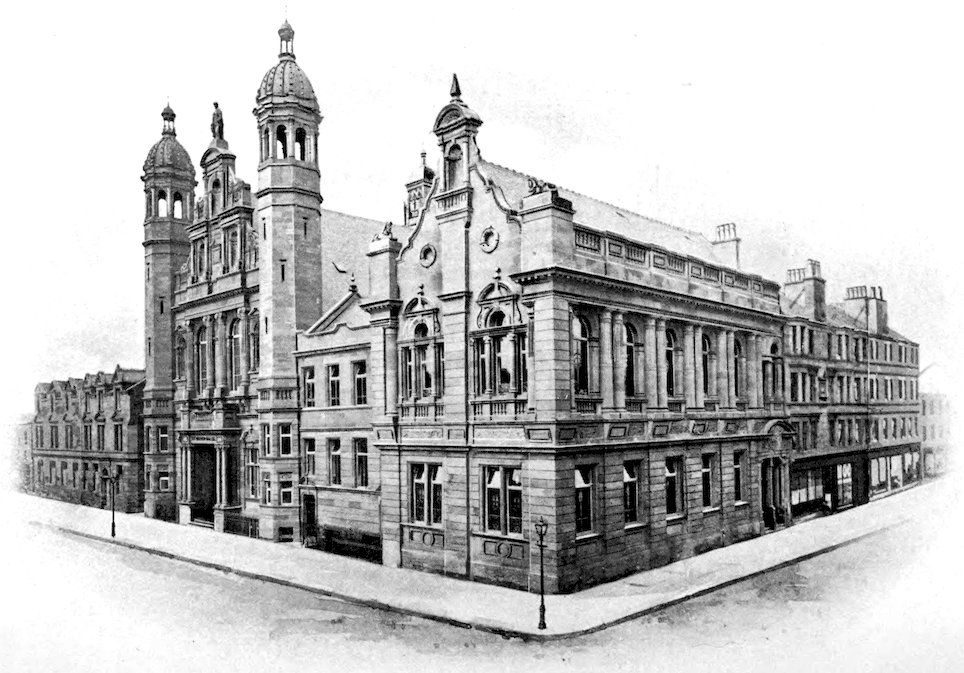
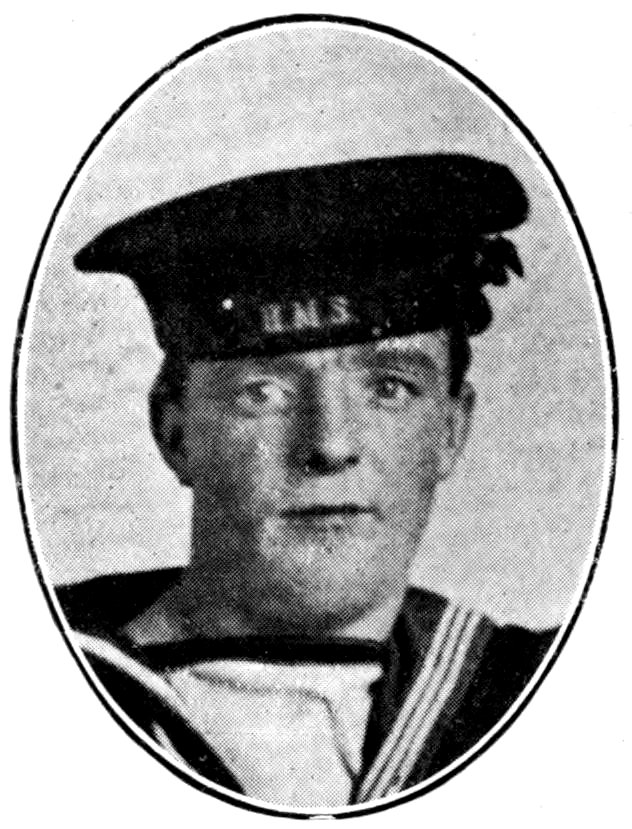
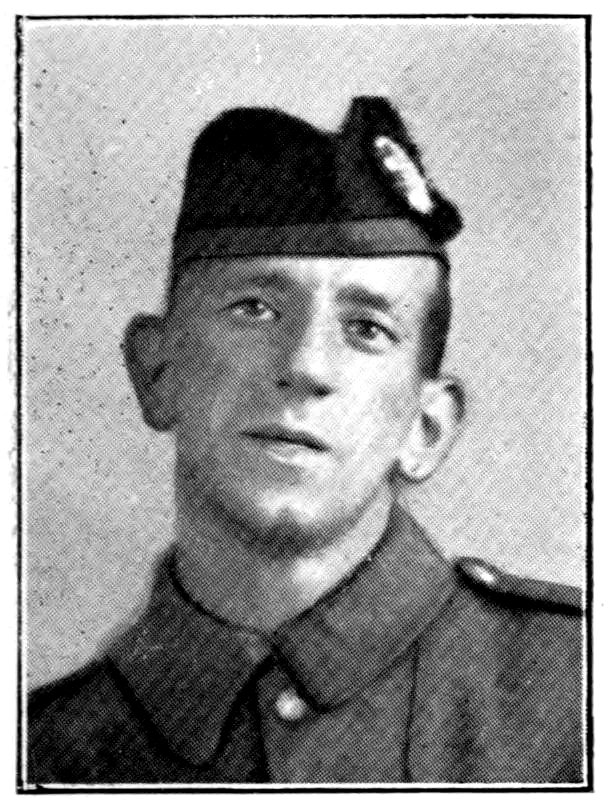
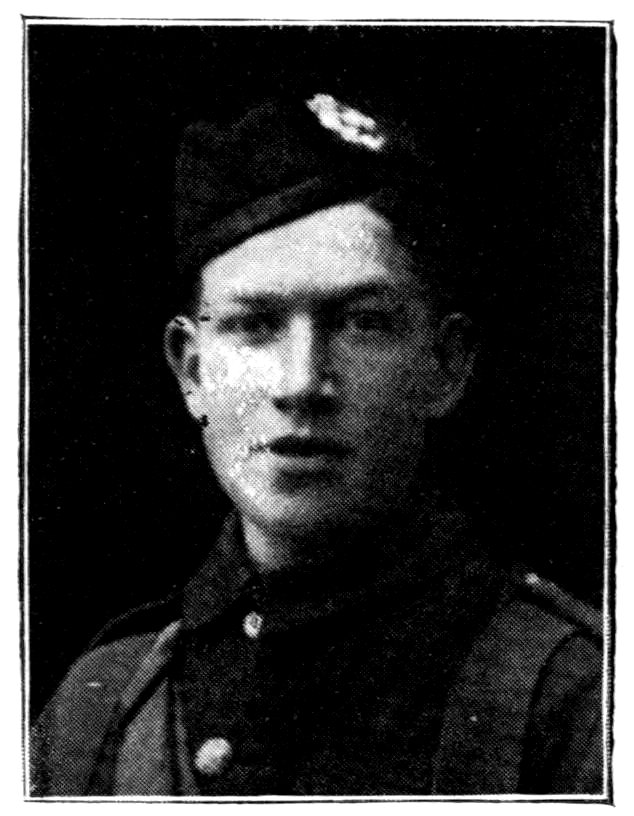
CHAPTER I. SCOTLAND IN THE SEVENTEENTH AND EIGHTEENTH CENTURIES. — IMPROVING CONDITIONS. — THE FACTORY SYSTEM.
1
GENERAL SOCIAL CONDITIONS—EARLY FARMING METHODS—POVERTY OF
THE PEOPLE—MINERS AS SERFS—“THE SOUTH SEA BUBBLE”—IMPROVING
CONDITIONS: THE ACT OF UNION AND ITS EFFECTS—THE
INDUSTRIAL REVOLUTION—THE FACTORY SYSTEM: ITS EFFECT
ON THE STATUS OF MEN.
The conditions under which the people of Scotland lived during
the seventeenth and eighteenth centuries were rude and
uncouth, and, when judged by modern standards, could scarcely
be described as other than appalling. In the few towns of any
size, stone buildings were the rule; but in the rural districts
the majority of the people lived in huts, the walls of which were
built of sods and stones, and which were roofed with wattles
and thatched with rushes. These huts were windowless save
for a hole in the wall which admitted some air but very little
light during the summer, and which was stuffed with rags and
rushes during winter in order to keep out the snell North wind.
The floor was but earth, hardened with the trampling of countless
feet; and fireplace or chimney there was none, unless a
few stones set in the middle of the floor or against one of the
gables can be called a fireplace, and a hole in the roof, through
which the smoke found its way after it had explored every nook
and cranny of the house, a chimney.
Famine was an almost annual visitor. The majority of the
people lived by agriculture, but the land was cold and undrained,
and the methods of tilling were ineffective. The motive power
was sometimes provided by oxen, but often the people harnessed
themselves to the primitive implements. The result was that
the grain grown was poor in quality and scanty in quantity,
while often it failed to ripen because of the wetness of the soil,
and because, also, of lateness in sowing. The cattle were poor
and underfed. Roots for feeding purposes were unknown until
2near the end of the period; there was no grain to spare, and
little straw or hay for winter feeding, so that the poor brutes
had to forage for themselves as best they could.
In the hall of the laird the position was a little better, but
few of the lairds of that day could aspire to the standard of
living of a moderately well-to-do farmer of to-day. Of food
there was always enough in the hall, but it was coarse and
unsavoury. Throughout the winter fresh meat was unknown.
The cattle were killed in the autumn; the meat was stored in
brine barrels, and this brine-soaked meat, or swine flesh preserved
in the same manner, was the only meat which found a
place on the table of the laird during the winter months, except
on the few occasions of great importance when one or two
fowls were killed.
The farming class, if it be not a misnomer to call them
farmers, usually lived in groups of such huts as are described
above, and tilled their land more or less in common. The system
chiefly in vogue was the “run rig” system, under which exchange
of ground took place every year. The more important of their
crude implements were also held in common, and as these could
only be used by one person at a time—as, also, it was often
well on in the spring before any thought of tillage occurred to
them or the condition of their water-logged soil would permit of
it, and as much time was often lost in deciding the rotation in the
use of the implements—the return in the good years was only
just sufficient for their wants. As the bad years were generally
twice as numerous as the good years, the conditions of the rural
workers were generally most miserable. Ill-treated Nature,
receiving no encouragement from man save the “tickling of
her face with a stick,” refused to give of her bounty, and the
people who depended on her for life suffered accordingly.
A condition of continual hunger was the lot of the labourers
who had no land to till. They were often forced to depend for
food on the roots and berries they could gather in the woods; the
scraps which went to feed the laird’s pigs were luxuries which
only came their way at long intervals. Work was intermittent;
it was poorly paid, for money was even scarcer than food. The
only landless men who had what might be termed a decent
living wage for the period were the miners. They received about
a shilling a day; but, in return, they sold themselves into
3serfdom, for, from the beginning of the seventeenth century until
the closing year of the eighteenth, no man, woman, or child who
once entered a mine to work in it could leave it again. If the
mine was sold the sale carried with it the right to their labour;
they were bondslaves until death, the great emancipator, burst
their shackles and set them free for ever.
On the large farms, which became more numerous during
the eighteenth century, ploughmen received the truly magnificent
salary of 35/ a year, with one or two perquisites, of which one
was a pair of boots. The ploughman’s daughter, if she went to
the farm to assist the farmer’s wife and daughters with the cows,
received, as a reward for her labour, 13/4 a year, a piece of coarse
cloth for an apron, and a pair of shoes.
In the towns the conditions were little better. In the early
years of the eighteenth century a succession of bad years brought
distress to all sections of the populace. There was much
unrest, which was fanned into flame by the passing of the Act
of Union in 1707, when a considerable amount of rioting took
place in various parts of the country. In addition, the foreign
trade of the country had been ruined by the English Navigation
Act of 1660, which provided that all trade with the English
Colonies should be carried in English ships alone.
In the closing years of the seventeenth century Paterson,
the founder of the Bank of England, launched his Darien scheme,
famous in history as “The South Sea Bubble,” for the purpose
of inaugurating a great world exchange and mart at the Isthmus
of Panama. Scotsmen became responsible for £400,000 of the
capital, and actually paid in £220,000. The jealousy of the
English merchants, however, together with the fact that it had
been proposed to establish a depot on land which was claimed
by Spain, without having gone through the formality of consulting
that country beforehand, handicapped the scheme from
the outset. Nevertheless, although opposed by the English, and
cold-shouldered by the Dutch, whose help they had hoped to
enlist, the Scotsmen persevered with their project. A company,
numbering 1,200, set out for their destination, landed, and
erected a fort. Difficulties came fast, however. The King had
not given his consent to the scheme, and the American colonists
refused to have anything to do with them. Supplies gave out
before the new crops were ready, and none were forthcoming
4from home, so that at the end of eight months the colony was
broken up. Out of a total of 2,500 persons who had left Scotland,
not more than thirty ever reached home again. The failure of
the scheme caused untold misery and ruin in Scotland, and
did much to engender the bitter feelings toward the English
which showed themselves when the union of the two Parliaments
was being discussed; but, worst of all, it bled the country white;
so much so that when, a few years later, the British Government
called in the Scottish coinage in order to replace it with coinage
of the United Kingdom, only coinage to the value of £400,000
was returned to Scotland.
The Act of Union was exceedingly unpopular, but, as it
turned out, it was not an unmixed evil, for it placed Scottish
traders on the same footing as the English in respect to trading
with the Colonies, from which they had been debarred for fifty
years. It also gave Scottish ships free entry to English ports
and Scottish goods free entry to English markets, and so
marked the beginning of the increasing prosperity which has
come to Scotland since then.
In particular the opening up of trade with the Southern
Colonies had much to do with laying the foundation of the
proud commercial position which Glasgow holds to-day.
Merchants from the little town on the banks of the Clyde began
to trade with these Colonies, bringing back in exchange for
their wares tobacco and other products, including cotton.
During the same period there was introduced from Holland the
art of fine spinning, and on these two articles of Colonial
produce—tobacco and cotton—were built up many fortunes.
Later in the century the invention of the spinning jenny, the
carding frame, and the power-loom, and the discovery by Watt
of how to harness the power of steam to production all gave
an impetus to the commercial growth of Scotland. With the
application of the power of steam the foundation of Scotland’s
pre-eminent position in the manufacture of iron and steel
and in the building of ships was laid, for by the application
of steam-power to pumping machinery and to haulage it was
found possible to keep her coal pits free from water and to
dig vertical shafts to the coal seams.
5Thus the eighteenth century, which had begun with the
Scottish people in the direst poverty, ended with many of them
in comparative comfort and with the standard of living for all
definitely raised. Never since then, not even in the period of
deep poverty which followed the close of the Napoleonic war
nor in the “hungry ’forties,” have the whole people fallen back
into the depths of misery in which they were sunk at the
beginning and all through the seventeenth century and well
into the “’twenties” of the eighteenth. At times since then
progress seemed to be at a standstill; at times it seemed even
to be on the down grade; but the impetus has always been
recovered; the standard of living has been rising gradually,
and although we are still far removed from the rude profusion
which has caused the century in English history which followed
the “Black Death” to be spoken of as “the golden age of
labour,” the trend of our march is in the direction of a condition
which, measured by the different standards of to-day, will
approximate to that long past happy period.
While it is admitted that the inventions and discoveries of
Sir Joseph Arkwright (partner of David Dale at Lanark),
Hargreaves, Crompton, and Cartwright revolutionised industry,
and in the long run brought a higher standard of living to the
people, yet the first results of their application were not wholly
good. For centuries spinning and weaving had been carried
on in the homes of the people, but with the invention of the
spinning jenny, the carding frame, and the power-loom the
weaving industry was removed to larger buildings. At first
these were merely makeshifts. A disused stable or cowshed,
any building, in fact, which would house a number of looms
was good enough for the new industry. The hand-loom weavers
soon found that they were unable to compete with the new
methods. To make matters worse, where they did not themselves
give up and take service under the new regime, their
wives and their children did, and became competitors in driving
the husbands and fathers out of the industry.
Soon the millowners discovered that in the new methods
with the new cheap labour there was a mine of wealth and,
their greed growing by what it fed on, they sought for even
6cheaper labour than that of the poorly paid wage-slave women
and children. This cheaper labour they found in the thousands
of pauper children under the care of the supervisors of the poor.
The story of the cruel treatment of these poor little mites, who
were often chained to the frames of the looms and whipped to
keep them awake, is one of the blackest pages in the whole
history of the growth of the capitalist system in Great Britain.
In the weaving trades the entry of women and children
changed the whole economy of the weavers’ homes. Formerly
the work had been done by the male members of the families,
assisted to some extent by the women, but under the new
system the factory owner found that he could get as much work
done by the mother at a considerable reduction on the wages
paid to her husband, and so the husband found himself workless.
Then it was found that the children soon became as expert as
their elders, and so a further reduction in wages took place.
The net result was that it became a case of equal pay for
equal work, but the standard of pay was that of the women
and not of the men, and soon the whole family had to work to
provide the necessaries of life for the home which should have
been provided by the wages of the husband alone. Even to-day,
while the women of the cotton mills who are members of their
unions are probably the best paid female workers in the country,
the standard for men is much below that for male workers in
other trades; so that, in the case of the factory workers,
“equal pay for equal work” has meant a general lowering of
the standard of pay.
CHAPTER II. THE DAWN OF CO-OPERATION. — CO-OPERATION AS WE KNOW IT. — CO-OPERATIVE BAKERIES. — STIRLINGSHIRE AND HILLFOOTS SOCIETIES. — BAKING SOCIETIES IN FIFE AND THE NORTH. — BAKING IN THE BORDERLAND. — GLASGOW SOCIETY. — THE FIRST FEDERATED BAKERY.
7
CO-OPERATION IN PREHISTORIC TIMES—EARLY TEUTONIC CO-OPERATION—THE
SCOTTISH CLAN SYSTEM—THE PRESENT CO-OPERATIVE
SYSTEM—FENWICK AND OTHER CO-OPERATIVE SOCIETIES—EARLY
CO-OPERATIVE BAKERIES—THE GLASGOW BAKING SOCIETIES—EARLY
METHODS OF CONTROLLING PRICES—STIRLINGSHIRE AND THE
HILLFOOTS—BAKING SOCIETIES IN FIFE AND THE NORTH—CO-OPERATIVE
BAKING IN THE BORDERLAND—GLASGOW SOCIETY—CO-OPERATIVE
BAKING IN 1866—THE FIRST FEDERATED BAKERY.
The Co-operative principle is as old as human intelligence. As
soon as man became possessed of the first faint glimmerings of
reason he began to seek communion with his fellows, and began,
also, to take concerted action with them for mutual protection.
It was natural that this should be so. The world must have
been a terrible place for the human race in those early days.
On land, in the sea, and in the air it was peopled with monsters,
against whose attacks the unaided strength and skill of a solitary
human were of no avail. Only by combination could he hope
to survive. Results have proven that combination—Co-operation—is
the law of life; that the men, the animals, the
insects even which have learned to combine, have progressed
in the scale of evolution; while the solitary monsters of past
ages have disappeared, and are known only from a bone found
here and a partially complete skeleton there.
That the human race gathered together in communities very
early in its history there is abundance of evidence. In some of
our cliffs there are caves which bear traces of human habitation;
while scattered here and there over the world are immense
mounds of shells, extending sometimes to a depth of many feet
and acres in width, on what is believed to have been the seashore
of prehistoric times, which show that, for a long period, these
places were frequented by communities.
This community living has continued all down the ages. The
“commune” system in vogue amongst the Teutonic races was
8an imperfect system of Co-operative farming by an agricultural
community, which finally ceased in Germany during the nineteenth
century. It was introduced into this country by the
invading Teuton races in the early centuries of the Christian
era; and, with various modifications and adaptations, was still
in being at the time of the Norman conquest. From that date
it gradually declined, until, by the end of the sixteenth century,
it had all but died out in England, but was still alive in parts of
Scotland in the clan system. There the old community spirit
continued to prevail until after the rebellion of 1745, when the
common lands of the clans were given to the chiefs. In the
lowlands, also, some trace of this principle continued to be visible
amongst the farming community.
When or where Co-operation, in the sense in which the
word is used to-day, first came into being there is no means of
knowing. Mr Maxwell, in his “History of Co-operation in
Scotland,” tells the story of the old society originated by the
weavers of Fenwick one hundred and fifty years ago, before
Robert Owen was born; but, although this is the oldest
Co-operative society of which any record remains, it by no means
follows that others did not exist even earlier. Indeed, Mr
Maxwell himself mentions that traditions of other old societies
exist in various parts of the country. Of these, no records
remain. It is only ten years since there vanished from the ken
of the people of Govan a society which kept proudly painted
over its door a record of the fact that it was established in 1777—eight
years later than Fenwick. There still exists in Glasgow
a society which dates back to the first year of the nineteenth
century, and the Lennoxtown Society celebrated its centenary
seven years ago. All over Scotland there exist societies which
are nearing a century of life, and Mr Maxwell has rescued from
oblivion the names, and sometimes part of the records, of others
which long ago disappeared.
In their practice these old-time societies differed in material
points from the practice which takes its name from the
Lancashire weaving town where it originated—Rochdale—but the
spirit which inspired those pioneers and the broad principles of
self-help in Co-operation under which they worked, are the spirit
9and principles of the Co-operators of to-day. They were, in
fact, the spirit and principles which combine to make progress
possible, and in the absence of which come stagnation and
decay.
Like the inception of Co-operation itself, the beginnings of
baking Co-operatively are lost in the misty past. Where the
first Co-operative bakery was started, or when, there is no
means of knowing.
Research has shown that, in the early years of last century,
bread was being produced and distributed by Co-operative
bakeries in Glasgow, but how many in number these bakeries
were, where exactly they were situated, or what turnover they
had it is not possible to discover; indeed, it is probable that we
should never have known of their existence, except as a tradition,
had it not been for the fact that a Glasgow writer, who published
in 1816 a book in two volumes dealing with the affairs of Glasgow,
thought it necessary to defend the private bakers of the city
at that time against any possible accusation of overcharging for
bread, by describing the methods which were adopted by the
Co-operative societies, and emphasising the fact that they sold
bread at the cost of production, and only to their own
members.
This Glasgow author, Mr Cleland by name, had been
describing the means which had been taken by the Governments
of George II. and George III. to regulate the price of bread in
accordance with price of wheat. His description is very
interesting, if only for the fact that it shows that steps had to be
taken to regulate the exactions of the profiteer, even in those
early days. It shows, also, that the methods of our various
“Controllers,” “Food Committees,” etc., are not new, but
are very much along the same lines as those devised to keep
down the price of bread a century and a half ago. The price of
bread was regulated in accordance with the price of wheat, and
the baker was allowed a fixed sum per sack of flour for his
expenses of baking and distributing.
In the various cities and towns the application of this Act
was in the hands of the magistrates; and, in Glasgow, bread
prices were fixed at various intervals until 1800, when it was
decided at the last Bread Court held to cease the practice, as,
10in the opinion of the magistrates, such a course was unnecessary;
but the weight of loaves continued to be standardised at
4 lbs. 5 oz. 8 drams for the quartern loaf, and 2 lbs. 2 oz. 12 drams
for the half-quartern loaf. In view of the price of bread to-day,
it is interesting to note that the price of the half-quartern loaf
was fixed by the last Glasgow Assize, held in 1800, at 10d. for
fine wheaten bread and 7½d. for household bread, which was
evidently of a much coarser and poorer quality.
Some of the Bread Assize regulations were peculiar. For
instance, the baker had to produce eighty loaves from the sack
of flour, and sell these eighty loaves at the exact price which
they cost him, in accordance with the cost of flour. “As,
however,” says Mr Cleland, “they usually were able to get two
loaves more from the sack, and these two loaves were clear
profit, the price at which they were sold was a consideration.”
At the beginning of the nineteenth century the expenses per
sack allowed to the bakers were 14/, but by 1816 this sum had
been increased to 16/9.
It was within the right of any two bakers to call the attention
of the magistrates to the fact that the price of bread or flour
had risen or fallen, and to offer proof. When this was done the
magistrates or Justices of the Peace were obliged to take
evidence as to the current prices, and, if they found any variation
from the last price fixed, “they shall immediately set a new
price, which shall remain unaltered until a new Assize has been
held.” One wonders whether the magistrates of those days
were as difficult to convince that any alteration was necessary
as have been the Food Control officials during the last year of
the war.
“In 1801 no Assize was held, and it was left to the bakers
to sell bread at such price as they could afford.” It is probable
that in the results of this decision the reason for the starting
of Co-operative societies is to be found, for human nature and
the practices of the times being what they were, we may be sure
that the bakers saw to it that, however much their profits might
increase, they did not go down at all.
Mr Cleland goes on to say:—
“During the last fifteen years, when no Assize has been fixed in
Glasgow, the bakers have uniformly proportioned the price of bread
to the price of wheat, similarly to what it would have been had the
Assize been sitting. There are instances, however, of individual
11bakers selling their bread somewhat lower than the general run of
the trade; and baking societies have been established in the suburbs
who uniformly sell their bread one penny, twopence, and sometimes
even threepence on the quartern loaf lower than the bakers’ price.
These societies do not sell their bread to anyone but their own
members; they give no credit and receive neither profit from the
concern nor interest on their capital; besides, the members are
subjected to the risk of loss incident to the breach of trust in their
servants. The greater part of these societies make no household or
coarse bread, and no loaf less than quartern; by which arrangement
it is evident the lower classes are excluded, as they neither can
advance their share of capital nor at all times purchase a quartern
loaf. Moreover, the bakeries belonging to these societies being all
situated outside the royalty, the flour is exempt from ‘multures,’
a tax to which the flour baked within the royalty is subject,
amounting to one eighty-fourth of the whole. As the Assize laws
wisely determined (for the sake of the lower classes of the people)
that bread shall be baked from a peck loaf down to a quarter-quartern
loaf, in exact proportion, and that the twopenny and penny loaves
shall be of a weight exactly corresponding to the price of the quartern
loaf, it is evident that the person who manufactured the small and
the coarse bread, from which the labouring classes of the community
are generally supplied, all bearing the same proportion to the wheaten
quartern loaf, cannot sell so cheap as the societies; among other
reasons because the additional labour is very considerable, and in
weighing out the aliquot parts, unless some allowance is made in the
dough, the small bread will be deficient in weight when it comes out
of the oven; besides, the regular baker must support his family,
pay his business, and pay local taxes; he has also to run the risk
attending credit, and frequently to give one penny to the shilling
discount to chandlers who retail his bread.”
The above is the sum of our knowledge of these early
Glasgow baking societies, but the fact that they were able to
sell their bread a penny to threepence per quartern loaf below
the prices charged by the private bakers, at a time when the
quartern loaf cost 1/8 and 1/3, is significant. It meant that
the baker was getting from 6/8 to 20/ per sack of flour over
the cost of production of the societies, and that, therefore, the
cost to the consumer was extortionate. Doubtless, also, the
conditions which led to the formation of Co-operative societies
in Glasgow prevailed elsewhere, and it is quite likely that baking
societies existed at that early date in other parts of Scotland,
had their day, and passed out of existence without a trace
remaining. Even of those of the existence of which we do
know particulars are absent; in most cases the name alone
remains, and often not even that but only a tradition.
12
Early in the nineteenth century Co-operation found a home
in Stirlingshire. In the thirtieth year of the century the
Bannockburn Co-operative Society came into being as the result
of a lecture on “Co-operation,” which was given by Mr William
Buchanan, a resident medical man. So impressed were members
of his audience with what they had heard that a committee
was formed immediately to draft rules and take the steps
necessary for the formation of a society. The rules were agreed
to at a meeting which was held on 27th November 1830.
Bannockburn Society still exists and flourishes to-day, after
an unbroken career of eighty-nine years.
About the same time—it may have been earlier or a little
later, for no information about its beginning can be found—a
baking society was formed in Bannockburn, and continued to
flourish for a number of years. Of the fact that the members of
the other Bannockburn Society were interested in the doings of the
baking society evidence is given in a minute of that society
in the early ’thirties, in which it is noted that the baking society
had agreed to supply Alva Society with bread. Incidentally,
this entry would seem to fix a period at which the Alva Baking
Society was not in existence. The Bannockburn Baking Society
was amalgamated with the Bannockburn Society in 1846.
In the year 1847 one of the most flourishing baking societies
in the country came into existence, for on the 23rd June in that
year the Bainsford and Grahamston Baking Society was formed.
Notwithstanding that general societies have grown up all
round the town of Falkirk, this society continues to maintain
a separate and flourishing existence, its latest balance-sheet
showing a membership of 4,733 and an average output of 371
sacks per week.
Other baking societies were formed in the same district.
Quite recently one of these, Stenhousemuir Baking Society,
was amalgamated with the Stenhousemuir Equitable Society,
after a separate existence of many years. Another baking
society was situated in the little village of Carronshore. In the
Hillfoots district some time in the late ’forties baking societies
came into existence at Alva and Tillicoultry. The baking
society at Tillicoultry amalgamated with the Tillicoultry Society
13in 1905, and the Alva Society with the Alva Bazaar Society
a few years later.
In Fifeshire, also, baking societies were coming into being;
indeed, the earliest baking society whose name is known was
formed at Leven in 1828. In 1840 Kingskettle Baking Society
was formed, and it remains strong and vigorous to-day. It is
one of the few of these early baking societies about which it is
possible to give a little information. The society was only a
small affair at the beginning; indeed it is not very large even
to-day; but what it lacked in size it made up for in vigour,
and since its formation it has never looked back. It is recorded
that in its early days the bread was delivered by the aid of a
donkey cart; to-day the society has several vans on the road
and supplies a population of several thousands with bread.
Somewhat earlier than the formation of the society in
Kingskettle a baking society was formed in the village of Leslie,
situated a few miles from Kirkcaldy. The reason for its
formation was the same as that responsible for the formation
of others in these early days—small wages and the extortionate
charges for their bread made by the local bakers. The success
which attended the baking venture led in 1840 to the formation
of a general society. In later years this society split over the
question of adopting the Rochdale system of disposing of the
surpluses, and a new society was formed which continues strong
and vigorous; and with this new society the baking society
finally amalgamated. Later still a society was formed in
Dunfermline, which in 1866 showed a surplus on working of £493.
Meantime Co-operation was going ahead in the North.
Societies had been formed in Kirriemuir, Brechin, Arbroath,
and Forfar, and very early in its history Kirriemuir took up
the baking of bread. Arbroath West Port Association began
the baking of bread in 1846, while in the year immediately
preceding—1845—Arbroath Guthrie Port Association, in
altering their rules, placed first in the list of the objects of the
society “to make bread and to deal in bread,” so that it is
evident that the society was then baking or had baking in
contemplation. This is the society which is now known by the
name of Arbroath Equitable Society.
14
Co-operation does not seem to have found a footing in the
South quite as early as it did in the North and West, but the
Borderers were not far behind, and they have proved that having
once started they believed in perseverance. It was in 1839 that
Galashiels Store Company was formed, and the question of
bread supply was soon under consideration. In its earliest
years the society seems to have had considerable difficulty in
getting a satisfactory supply of bread, with the result that by
1844 they had established a bakery of their own. An
interesting fact which is related by Mr Maxwell in his “History
of Scotland” is that they applied for information about baking
to two societies, long disappeared, Coupar Angus and Alyth.
Probably some one connected with the society was a native of
Forfarshire, and, knowing that these societies had bakeries,
suggested that information be got from them. The number
of these efforts to cheapen the staff of life must have been very
great, for references to them keep cropping up in old newspapers
and pamphlets, showing that Co-operative activity, much of it
inspired doubtless by the teachings of Owen, was widespread in
Scotland.
Hawick Store Company began a few months later than the
Galashiels venture, but it was not until 1851 that the members
added baking to the list of their enterprises.
Turning again to Glasgow, where the first Co-operative
bakeries of which there is any record were established, we find
that many attempts had been made in the interval to establish
Co-operative trading on a firm foundation, but in vain. How
many of these early Co-operative failures were due to the fact
that the surpluses accruing from the trading transactions were
divided in proportion to the capital held, without any regard
being paid to the trade done with the society by the holders of
the capital, it is not possible to say, but the system was bound
to have a disturbing effect on the minds of those members who,
although too poor to invest much capital, were loyal purchasers
from the store.
However that may be, after a lecture by Holyoake, a fresh
15attempt to establish Co-operation in the city was made, and for
a time the new venture seemed to flourish, only to perish
eventually like its predecessors. What makes this society
interesting at this point is that of it is recorded the fact that it
possessed “a modern baking department,” and is said to have
supplied the neighbouring societies with bread. The society
came to an end in 1865, and with it ended Co-operative baking
in the city for the time being. When next we hear of it it is in
a new, and as it turned out, a stabler and more permanent form.
At this point it may be interesting to note some particulars
of the Co-operative baking societies in existence in Scotland in
1866, as taken from the returns sent in to the Registrar of
Friendly Societies in Scotland. It is probable that the list is
far from complete, and it takes no account of the societies having
bakeries of their own who dealt in other goods as well. These
societies were:—
|
Value of Property. |
Profits. |
| Airdrie Bread |
No property. |
£252 |
| Alva Baking |
£l,184 |
331 |
| Bainsford and Grahamston |
1,484 |
788 |
| Coatbridge Bread |
857 |
466 |
| Dalry Baking |
20 |
50 |
| Dunfermline Baking |
116 |
493 |
| Edinburgh Bread |
422 |
271 |
| Leven Baking |
200 |
120 |
| Roslin Baking |
|
82 |
| Stenhousemuir Baking |
782 |
350 |
A notable absentee from the above list is the name of
Kingskettle Baking Society.
As it was in Ayrshire, in the little village of Fenwick, that, so
far as is known, the first Co-operative society was established,
so also to Ayrshire belongs the honour of having established
the first federated bakery. Co-operation in Fenwick had died
in 1801 with the demise of the old Meal Society, and it was not
until 1840, when Darvel Industrial Society was founded, that
it again secured a footing in the land of Burns. The society
founded 79 years ago continues to flourish, but for the first
twenty years it had to flourish alone. Then, in 1860, Kilmarnock
Society was founded, and following it there came in
quick succession Crosshouse, Auchinleck, Mauchline, Galston,
16Newmilns, and Catrine. In 1867 five of these societies—Kilmarnock,
Crosshouse, Galston, Mauchline, and Newmilns—combined
to form a baking society, while three other societies—Troon,
Catrine, and Darvel—although not members, took bread
from the federation. In 1870 premises were built for the
federation, and the trade increased steadily. Gradually,
however, the more distant societies began to erect bakeries of
their own, and in the early ’nineties of last century the bakery
was taken over by Kilmarnock Society, who erected a new and
up-to-date bakery for themselves on the site of the old one.
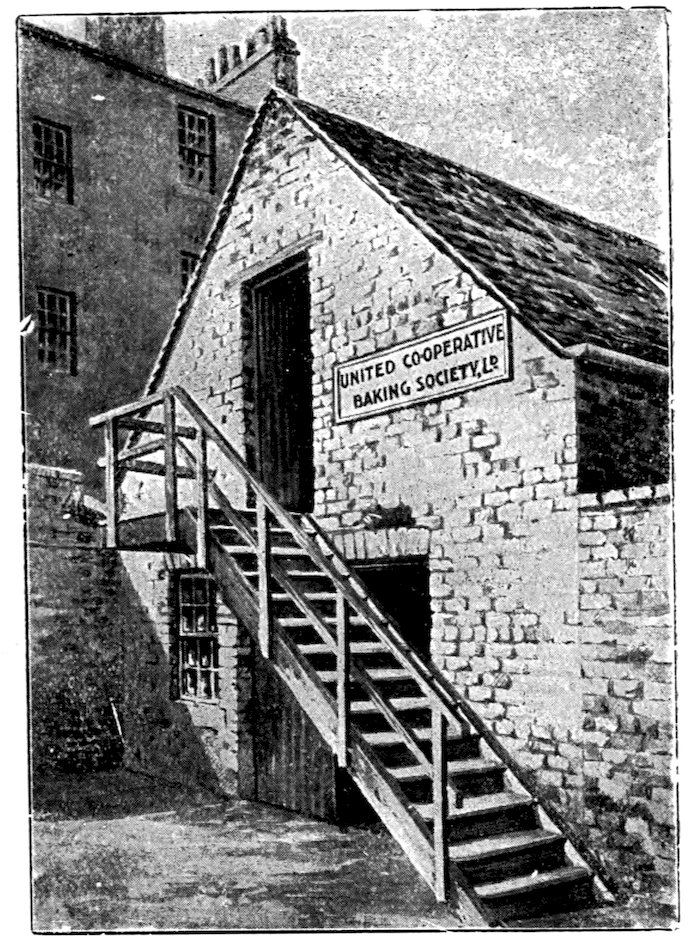
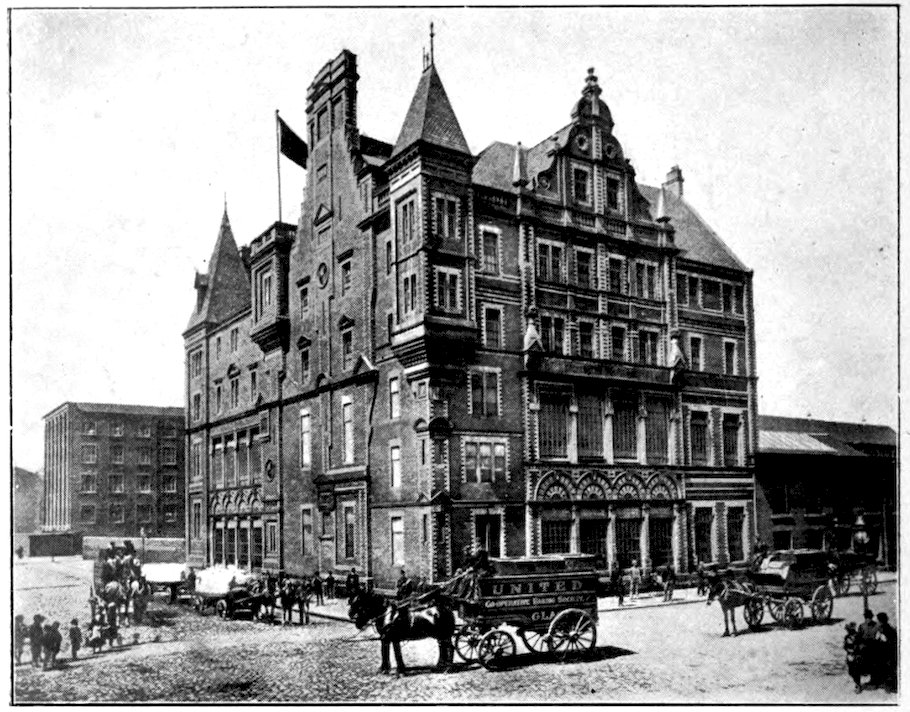
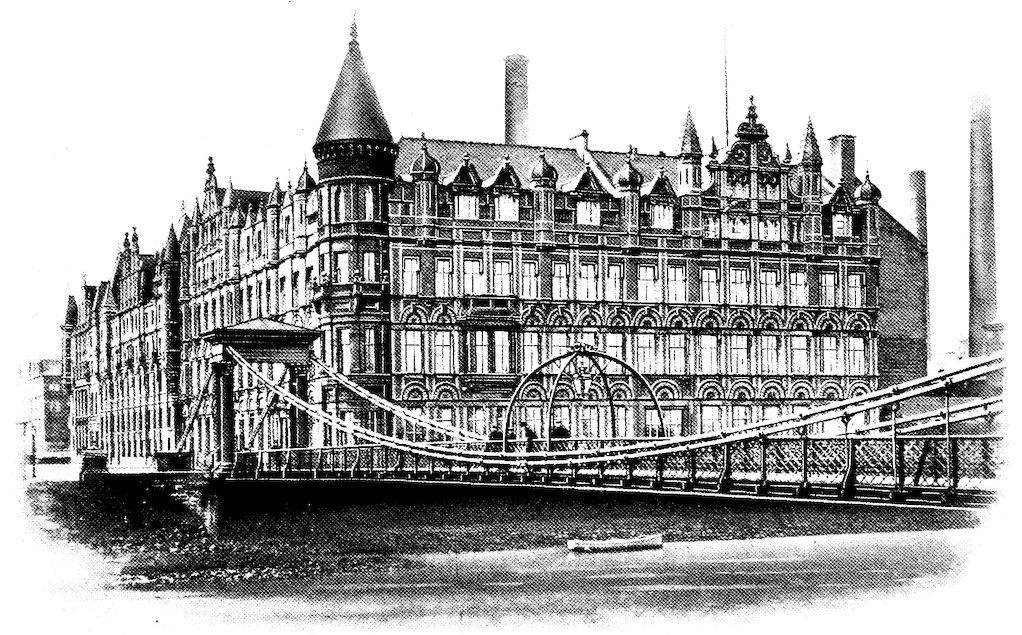
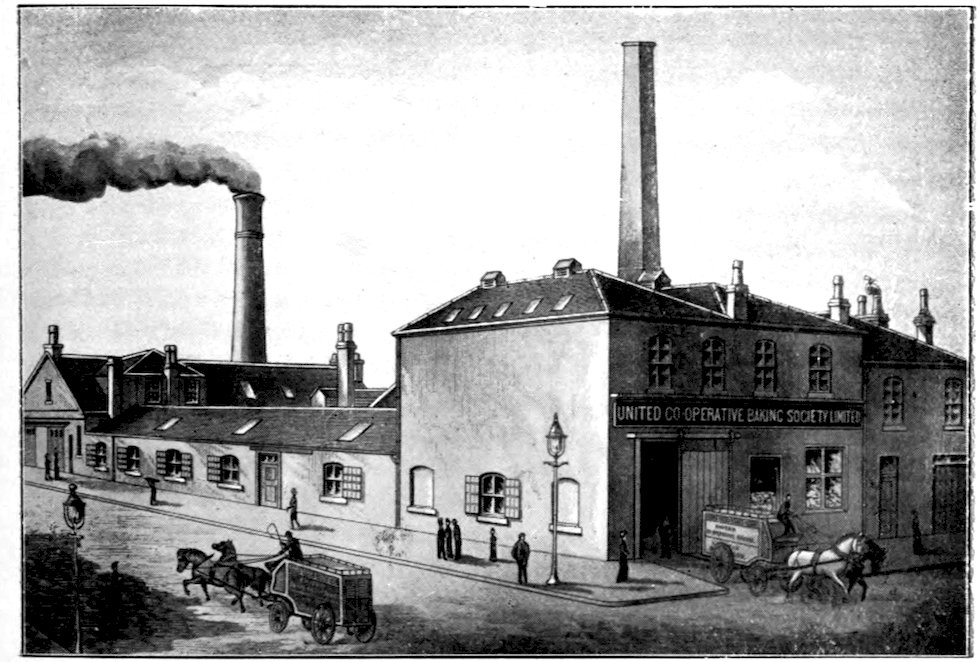
M‘NEIL STREET PREMISES (1886–1890)
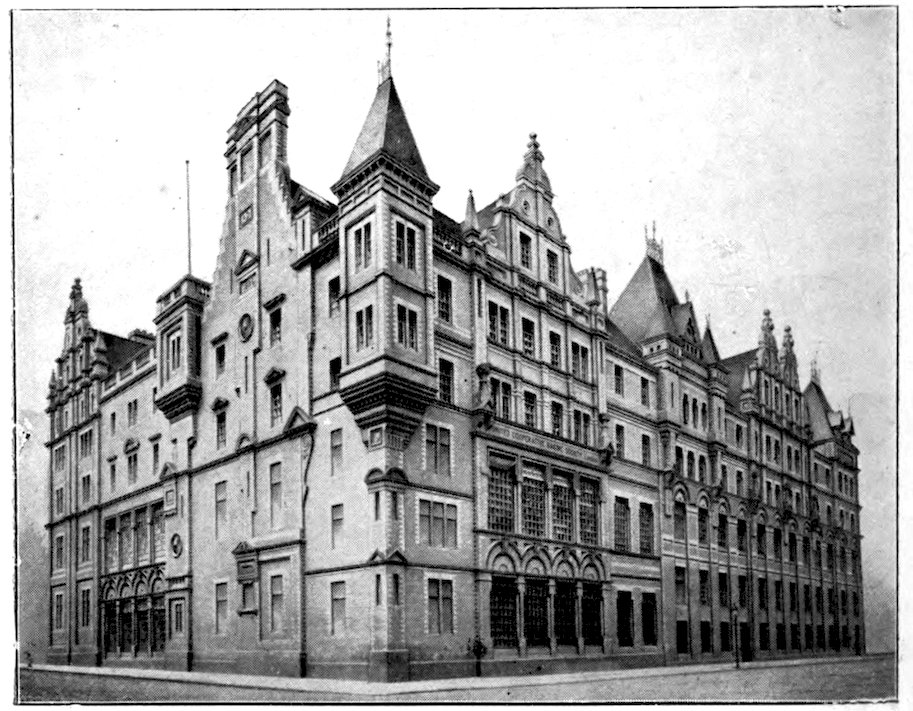
M‘NEIL STREET PREMISES (1890–1894)
CHAPTER III. THE FIRST YEAR. — THE SOCIETY FORMED. — DIFFICULTIES BEGIN. — A MANAGER APPOINTED. — SOMETHING ATTEMPTED, SOMETHING DONE.
17
GLASGOW IN THE ’SIXTIES—THE SOCIETY FORMED—MEN WHO WROUGHT—THE
FIRST BAKERY—STARTING BUSINESS—A DISASTER AVOIDED—BETTER
PROSPECTS—A MANAGER APPOINTED—LARGER PREMISES
WANTED—SOMETHING ATTEMPTED, SOMETHING DONE.
In the ’sixties of last century Glasgow was not a pleasant place
for working men to live in. The city was contained in the four
parishes of Barony, City, Govan, and Gorbals; only a small
proportion of its population being resident in the last-named
parish, however. The conditions of life for the workers were
not good. Houses were small and inconvenient, disease was
rampant, and poverty the common lot. There were 87,604
inhabited houses in the city in the year 1864, and of these
35,788 were rented at £5 per annum, or under; the average
rental being £3, 7s. 3d. Other 35,393 houses had rentals of
between £5 and £10, the average rental being £6, 17s. 3d., and
the average rental of these 71,181 houses, forming 81·75 per
cent. of the total housing accommodation of the city, was
£5, 5s. per annum. Further light is thrown on the housing
conditions by the fact that, while the aggregate rental for these
71,181 houses was £373,441, the aggregate rental for the
remaining 16,423 houses was £502,687; an average rental per
house of £30, 10s. The proportions of these lowly-rented houses
were fairly equal in all four parishes, and even when allowance
is made for the fact that rents were much lower in those days
than they have been in recent years for similar accommodation
it is evident that the housing conditions left much to be desired,
and that the “homes of the people” must have been veritable
hotbeds of disease. In the statistics consulted the proportion
of one-apartment houses is not given, but in view of the whole-hearted
condemnation of such houses voiced by Dr Russell,
Medical Officer of Health for Glasgow, twenty years later, and
18the large proportion of Glasgow’s citizens who were then living
in houses which were kitchen, parlour, bedroom, and washhouse
all in one, it is easy to believe that the houses of the earlier
period were no better than the low rentals would warrant.
Further evidence of the correctness of this assumption is
found in the vital statistics of the period. In 1864 the deaths
of children under five years of age were 46·93 per cent. of the
total deaths; in 1862 they had been 48·85 per cent. of the total.
In those years the children were dying at the rate of one in every
nine of the population, a deathrate nearly equal to that of the
British Army during the four years of war. The effects of
poverty and bad housing on the health of the population were
further evidenced by the number of deaths of children under
five from tubercular diseases. In 1863 these were 381; in
1864, 378; while the total deaths from tuberculosis were 1562
and 1763 respectively for the same years. In his report to the
Corporation for the year 1864, Mr Watson, Town Chamberlain,
points out that there was ample scope in the statistics he had
compiled for showing the need for benevolence “in alleviating
the character of the dwellings of the very poor,” and he urged
the need which existed to provide other and better houses.
At the same time he notes that employment generally was good
in this year. In 1868, 786 children under five died from consumption,
and in 1869 the total infantile deathrate (children
under one year) was 48·20 per 1,000. In the Clyde area it was
56·81 per 1,000.
It was in a city in which the conditions of the people were
such as the figures quoted above reveal that, on the last Monday
in January 1869, what was destined in the course of fifty years
to become the largest business of its kind in the world opened
its doors for trade. For six years the idea of the federation of
Co-operative societies for trading purposes had been occupying
the minds of the Co-operators of Scotland, keenly interested
as they were in the progress of the North of England Co-operative
Wholesale Society. Only a little over two years before, also,
those of them in the West who took an interest in the affairs
of their Co-operative neighbours had seen the Co-operative
societies of Ayrshire join together to form a baking association
for the purpose of supplying themselves with bread; and in
September 1868 the Scottish Co-operative Wholesale Society
19had been safely launched, after several years of anxious consultation
and consideration. No sooner had the S.C.W.S. been
sent on its way than the stalwarts of the West turned their
attention to yet another venture. Since the collapse of the
second Glasgow Society there had been no Co-operatively-produced
bread in the city. The price which was being charged
for bread by the private bakers was considered too high, and
yet not one of the societies thought itself strong enough to
finance a bakery of its own.
They had faith in the Co-operative principle, however, and
what they could not do as individuals they fancied they would
be able to do in combination. They reasoned that, if a number
of people by combining together could procure the goods they
needed more cheaply than any one of them alone could do,
there was no good reason why a number of societies by combining
together could not do what no one of them acting alone was
strong enough to do.
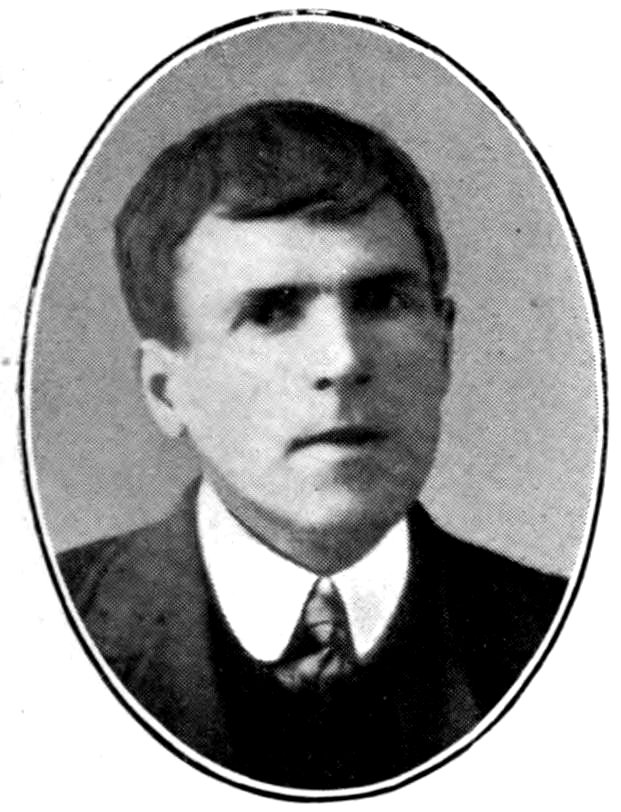
It is to Mr Gabriel Thomson of St Rollox Society, then
treasurer of the newly formed S.C.W.S., that the honour of first
bringing the idea of a federated bakery publicly before the
co-operators of the West belongs. The first idea was that the
work should be undertaken by the recently-formed Wholesale
Society, but a little consideration showed that this plan was
hardly feasible. It was thought that it would scarcely be
right to adventure the capital of societies scattered all over
Scotland in an undertaking from which many of them could not
possibly derive any direct benefit, and so this idea was dropped,
and finally it was decided to start a federated baking society.
In the new venture St Rollox Society was the prime mover.
In those days the men who controlled St Rollox Society believed
in the infinite possibilities of the application of Co-operative
principles. They were joined with other Glasgow societies
in a drapery federation. They took up shares in the St Rollox
Cooperage Society, in the Ironworks, and in the Oakmill Society,
each as it arose, and to Co-operation they looked for escape
from the exactions of the master bakers of Glasgow. A meeting
was convened by them in the month of October 1868, and to
that meeting Mr Gabriel Thomson read a paper on “Federation,”
in which he dealt at length with the principle as it could be
applied to the baking of bread. This paper so strongly
20influenced the delegates that there and then they approved of
the principle, and went back to their societies to report. In a
few weeks another meeting was called, which was attended by
representatives from Barrhead, St Rollox, Paisley Provident,
Paisley Equitable, Glasgow Eastern, Anderston, Parkhead,
Johnstone, Howwood, Glasgow Southern, Motherwell,
Lennoxtown, and others. At this meeting the proposal was
discussed further, and at the close the delegates pledged
themselves to go back to their societies and do all in their power
to get these to take part in the formation of the federation.
A third meeting was held a fortnight later, and at this meeting
eight societies intimated their willingness to join in forming
the Federation. These were Anderston, Barrhead, Cathcart,
Johnstone, Lennoxtown, Motherwell, St Rollox, and
Thornliebank. An interim committee was formed, consisting
of Messrs Gabriel Thomson and John West (St Rollox), James
Borrowman and Alexander Douglas (Anderston), James
Ferguson and Alexander Johnstone (Barrhead), and Joseph
Gibb and Donald Cameron (Thornliebank). Three of their
number—Messrs Thomson, Borrowman, and Cameron—were
appointed a sub-committee to look out for suitable premises,
consider the working of the bakery and the delivery of the bread,
and report to a future meeting.
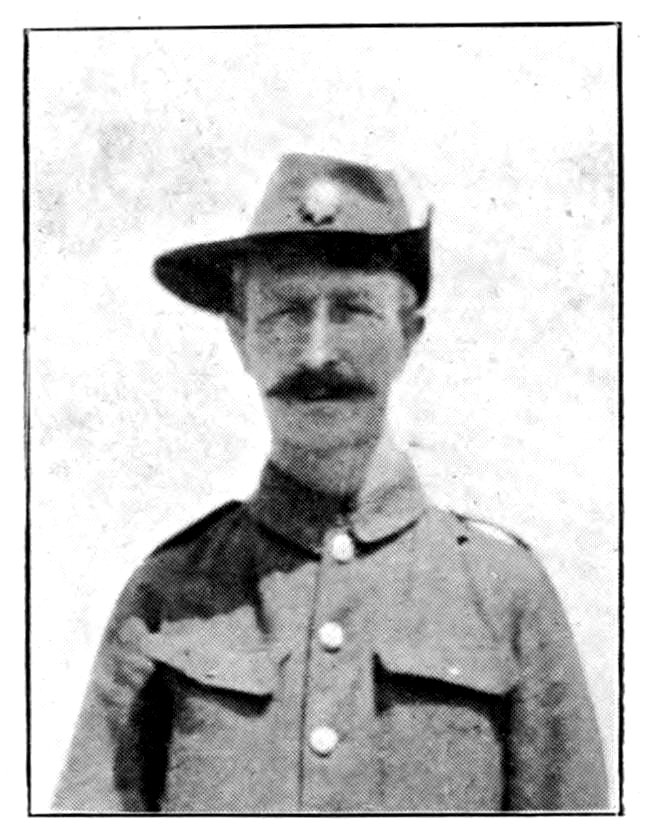
No better men could have been selected for the task. Mr
Thomson was the originator of the scheme, and was also the
treasurer of the S.C.W.S. Mr Borrowman had already made
a name for himself as the most powerful advocate of Co-operation
that Scotland had produced. He had taken a leading part in
establishing the S.C.W.S., and was now its manager; while
Mr Cameron was not only a shrewd and earnest Co-operator,
but appears also to have had some knowledge of the baking
trade. We can well imagine the zeal and earnestness with
which they set about their task. They knew that they were
setting out on a journey along an untrodden path, but they had
a faith which lighted up the dark places before them, and a
determination to see the mission on which they had entered,
the first step to the fulfilment of their hopes, accomplished as
soon as possible. Inside two weeks they were back to the
21parent committee, their task accomplished, bringing with them
particulars of a bakehouse which they thought would suit the
requirements of the new society, a scheme for carrying on the
business, and particulars about methods of delivery. Their
report was approved, the bakery at 52 South Coburg Street
was leased, and instructions were given for its immediate repair.
The minute of committee, the first minute of the new
Society, is as follows:—
“A meeting was convened to-day to hear the report of the
committee in the office of the Scottish Co-operative Wholesale Society.
At this meeting the following societies were represented—Barrhead,
St Rollox, Anderston, Eastern, Motherwell, Dalziel, Cadder, and
Thornliebank. A report was submitted by the committee stating
that premises had been secured and that they were convinced that
the business would pay well, and recommended an immediate start.
The report was accepted and the following sub-committee was
appointed to carry out the resolution—viz., Gabriel Thomson,
president; John West, treasurer; James Borrowman, secretary;
and Alexander Douglas. Same committee to get the rules printed
in accordance with the alterations made on the Ayrshire United
Co-operative Societies Baking Association, and submit the same to
the general meeting of the delegates before registration.”
All that now remained to be done was to get the bakery into
working order, and ten days sufficed to have this work completed.
Meantime, however, the committee were not idle. Vans had
to be procured and other details of the work inside and outside
seen to, and bakers had to be employed. The committee met
on 23rd January, and appointed a Mr Currie as foreman baker,
while on 6th February they decided to purchase a second van
at a cost of £18 and a horse for a similar sum. A vanman was
also engaged at a wage of 20/ a week.
These little details are all in the minutes, but no mention of
the situation of the bakery appears therein, nor is there any
mention made of the date of beginning business. These old-time
Co-operators were so engrossed in the work they were
doing that they had no thought for the people who would come
after them, eager for information about what they had done
and how they had done it. It would appear from the minute
book itself that it was written up at a date later than the
beginning of the Society, probably from notes made by Mr
Borrowman at the time, and this may account for the omission
22of any mention of the date of beginning business or of the
location of the bakery.
We know, however, that the bakery was situated in South
Coburg Street, a street which connected Bedford Street with
Norfolk Street, parallel with and immediately behind Eglinton
Street. The buildings in this street are evidently much older
than those of Eglinton Street. The site of the first premises
of the U.C.B.S. is now covered by a part of the Coliseum theatre.
Here, in this small place, the modest beginning was made on
the morning of 26th January 1869. One is curious as to the
quantity turned out in this first baking, but that is a matter
on which all records are silent. Occasionally we are told of the
purchase of flour and of the price which was paid for it, but for
some time no mention is made of the quantity baked into bread.
At that time the secretary was a very busy man. Not only
was he during these first few months virtual manager of the
bakery, but he was also the manager of the S.C.W.S., and he
had his hands full of work.
Although the minutes are silent on some phases of the work
of the committee, however, they are prolix enough on others.
The wages of the vanman are given, and at the same meeting—that
of 6th February—we are told that the wages of the foreman
baker were fixed at 34/ a week. It was also agreed at the same
meeting that the bread be sold at current retail price and that
a discount of 10 per cent. be given. Three weeks later the
need for a larger van was being discussed, and at the next
meeting, held a week later, it was decided that a Parkhead
van-builder be given the order to build a van large enough to
contain fifty dozen loaves; and that another horse be
purchased. A shop in connection with the bakery had now
been opened, and it was decided that the shop hours should be
from eight a.m. until seven p.m. The question of a weekly
half-holiday, presumably for the girl in the bread shop, was also
considered, but allowed to lie over. From the next minute
it becomes evident that the committee’s idea of the class of
horse which was required for the work of the Society had
undergone some change during their month’s experience, for
whereas the first horse which they purchased cost £18, they
paid £40 for the next one.
At the beginning of the month the hours of the shop girl
23had been fixed at from eight to seven, but on the 27th of the
same month an alteration was made, and it was agreed that the
shop should open at 7·30 in the morning and remain open until
7·30 at night. On Mondays it was to be shut at 5 p.m. and on
Saturdays to remain open until 9 p.m., while the price of bread
was fixed at 5½d. The committee were now finding that they
required stable and van room more than they had available,
and agreed to advertise for it. Evidently the shop girl found
the 7.30 a.m. start too early for her, for at a meeting of the
committee held a fortnight after the earlier opening of the shop
had been decided on, the minute records that she should “be
spoken to about attending at her hour in the morning.”
By this time the members of the committee were beginning
to realise that there were difficulties in running a baking
business. Complaints had been made that the bread was sour,
and the foreman baker laid the blame on a change of temperature.
The explanation was quite likely to be the correct one,
although a foreman with an interest in his work might have
been expected to take precautions against such difficulties.
The committee were not long in discovering that this was just
what their foreman did not do. At the next meeting his
attention was again called to complaints about the bread. This
time it was being sent out to the shops in a dirty condition.
He was also informed that the blend of flours which he was
using was costing too much, and the committee decided that
they should draft a statement of the proportions in which the
differently priced flours were to be used. It was also decided
to dismiss one of the vanmen on the ground that he was careless
about his work and his horse.
In the case of the baker matters went from bad to worse
until, an earlier historian[1] tells us, he struck work altogether.
The committee for some time had been in constant fear that
some morning the ovens would be found cold, or else that the
bread would be burnt black, and the crisis came when, at
11 p.m. one Thursday toward the end of May, the president
was aroused from sleep to receive the intelligence that the
Baking Society had given up business. This was serious news;
24but sure enough, when he had hurriedly dressed himself and
made his way with all speed to Coburg Street, he found the
bakery in darkness. Mr Borrowman was next awakened,
and told the doleful tidings. Both gentlemen hurried to the
foreman’s house to discover that happy-go-lucky individual
soundly asleep, careless that hungry Co-operators would be
breadless in the morning. He was induced to go to work, and
next day the committee were hastily summoned, only to
discover that the foreman was tired of his job, and had fully
made up his mind that he was going to be responsible no longer
for supplying Co-operators with the staff of life. The committee
were at their wits end, but there was nothing for it but to get
another baker. Here the minutes take up the story. The
committee at their meeting spoke to the foreman about the
loss on the first quarter’s working, which amounted to £37.
His reply was to the effect that he never expected to make a
profit the first quarter. They then spoke to him of the
numerous complaints which were being received with reference
to the quality of the bread, and he replied that as he was unable
to do better the best thing he could do was to resign. His
resignation was accepted, and after very considerable difficulty
another man was found to take his place; but he only remained
a week or two, and ultimately, in June, another man was
procured who was able to do better. No balance-sheet was
printed for any of the quarters in the first year, but a written
statement, showing the position of the Society, was sent to
each member. The first quarterly meeting was held on 29th
May, when the rules were adopted. Mr Gabriel Thomson was
elected president; Mr John West (St Rollox Society), treasurer;
Mr James Borrowman (Anderston Society), secretary; and
Messrs James Ferguson (Barrhead), Joseph Gibb (Thornliebank),
Alexander Douglas (Anderston), and Weir (Motherwell) as
committee. It was also agreed that the secretary be paid
£1, 10s. and the treasurer £2 quarterly.
With the appointment of a new foreman the bakery was
now running more smoothly than during the first quarter, but
it was not yet paying its way, for the minute of 29th June
records the fact that the loss at that date was £25. The
explanation of this position, as given by the secretary, was
that a liability of £4, 15s. had not been taken into account at
25the last balance, some flour which had been bought had not
been used when the price fell, and this had entailed a loss of
£6, 10s. An encouraging feature, however, was a report given
by the new foreman which showed that a profit had been made
in each of the two weeks with which it dealt. The sales were
also rising, but the committee were not satisfied with the trade
the Society was doing, and were desirous that the turnover
should be raised to sixty sacks or seventy sacks a week, as they
thought that with such a turnover they would have a good
profit. As a preliminary step to securing this turnover they
determined to send out several of their number as missionaries
to societies which had not yet joined, with the object of getting
them to do so, or, at least, to purchase their bread from the
Society. Amongst other minor difficulties with which the
committee were being faced at this time was the lack of suitable
stabling for their horses. Their stable was too small, and it
was unhealthy. It is true that horses were not very costly,
but neither was money too plentiful, and they could not afford
to run any risks. One of the horses which they had bought
in the beginning of the year was ill, and had to be sold for £6.
A decline of £12 in the value of a horse inside a few months
was evidence that there was something wrong somewhere, but
suitable stabling was difficult to secure.
In the minutes the most important things sometimes crop
up in the most casual manner. At a meeting of the committee
which was held on 18th September, one of the principal themes
of the evening’s discussion was the purchasing of new horses.
A horse was to be returned as unsuitable, and another horse
priced at £30 was to be taken on trial, as it would not suit the
committee that anything should be paid to the owner as “rue
bargain.” Then, quite casually, the minute goes on to mention
that “the engaging of Mr Sturrock as manager of the Baking
Society was then gone into.” This is the first mention made
in the minutes of the proposal to appoint a manager; but,
from the document which had been prepared and which was
transcribed into the minute of the meeting, it is evident that
the subject had been under consideration for some time. It is
interesting to note in this agreement that “the manager was
26not to exceed 3/ for baking and firing.” He was to determine
“the quality and also the maker’s flour he shall use, but the
committee reserve the right to prevent the price of flour used
any week exceeding the average price of extra flour.” He was
to keep the accounts of the Society, and prepare weekly
statements which would give
“the number of sacks baked and also the cost of the flour and other
materials, wages, rent, cost of horse-keep, etc., giving the total of
the whole, with a statement of the number of loaves baked from
each sack, the total number of dozens of loaves produced, with smallbread;
also the cash value of the loaves and smallbread added and
the expense with the cost deducted, showing clear profit; also a
statement showing the number of dozens of loaves and smallbread
sent to each society, with the number left on hand at the end of
each week.”
The pay of the manager was fixed at 35/ per week until the
Society was able to pay a bonus of sixpence per £, when his
wages were to be advanced to 40/ per week.
Already the directors were beginning to find that if it was
difficult to sell as much bread as they desired, it was equally
difficult sometimes to get payment for the bread they did sell.
There was hardly one of the Glasgow societies but had to struggle
hard to keep going at all. Of all those societies in the city to
which the new venture must look for its best support there
were not more than two which emerged safely from the
struggles of those early days, and those two survived only
because the men in charge of them refused to recognise defeat
and kept going even against the advice of the friends who
foresaw in a longer struggle but greater disaster. Of the eight
societies which had joined in the formation of the Federation
only two were pursuing smoothly the even tenor of their way,
free from the irritating worries produced by the difficulty of
making ends meet. These two societies—Thornliebank and
Barrhead—were associated with the Bakery from the very
first meeting, and being successful they were in a position to
pay their way promptly; but some of the others were not so
fortunate, and so, in October of the first year, we find the
manager being instructed by the committee to write to the
societies and point out to them that as the capital was limited
it would be an advantage if payment was made promptly when
the accounts were rendered. Frequently during the next few
27years the same complaint crops up, and there were times when
the Society was owing the S.C.W.S. large sums of money which
at the moment it was quite unable to pay because of the fact
that the societies were not paying promptly for the goods they
received.
The third quarterly meeting took place on 4th December.
Although there is nothing about it in earlier minutes, a hint is
given that the committee or the manager had not been keeping
to the strict line of instructions given at the August quarterly
meeting, for a motion is agreed to “that the alteration in the
price of bread take place on the same day as the Glasgow
prices.” A profit had been made on the quarter’s transactions,
but it was not large enough to divide, and the delegates gave
authority to the committee “to apply it to redeem fixed stock.”
About this time the Society was having trouble with the quality
of flour purchased. The flour was returned, and the manager
was authorised to cancel the order if that sent in exchange was
not of better quality. The committee at the close of their
first year were discussing the necessity of getting more ovens,
as the old bakery was quite inadequate to meet the trade which
was being done. It was agreed to endeavour to get other two
ovens; and, failing that solution of the difficulty, to see if a
nightshift could be employed. Later minutes are silent as to
how the difficulty was overcome during the three months which
elapsed ere the new bakery in St James Street, Kinning Park,
was ready for occupation.
During the first year the committee had been feeling their
way. They had met and overcome many difficulties, some of
which, like the incident of the chairman and secretary hunting
up a recalcitrant baker in the small hours of the morning in
order to induce him to go to work, have a humorous enough
aspect when viewed at a distance of fifty years, but must have
seemed tragic to the actors, for the whole future of the infant
venture would seem bound up in an unbroken sequence of
bread deliveries. For the first year the committee met in the
premises of the S.C.W.S. in Madeira Court. Usually the meeting
place was the warehouse, for the room in which Mr Borrowman
worked was but small, although it possessed the only window
28in the place. There they fitted up a temporary table, using
boxes for seats. Indeed, so long as Mr Borrowman continued
secretary of the Baking Society, the committee continued to
meet frequently in the Wholesale’s premises, although the
sub-committee usually met in a small room, 10 ft. by 6 ft.,
fitted up in the bakery premises at St James Street. At times
the full committee of sixteen met here also, packed together
like herrings. Such were the conditions to which those heroes
of the Co-operative vanguard accommodated themselves in
order that the cause they had at heart might prosper.
During the first year the Society had baked 2,116 sacks of
flour, equivalent to an average turnover of 40¾ sacks per week;
but as the turnover during the latter part of the year was
approximately 70 sacks per week, it must have been much less
than 40 at the beginning. For the first six months losses
amounting to £62, 10s. had been made, but in the second six
months these losses had been wiped out, the fittings had been
depreciated by over £30, and although no dividend was declared
they had a balance of surplus to carry forward which amounted
to £23, 3s. 1d. The value of the goods sold during the year had
been £5,081, 13s. 6d.; the value of the fixed and live stock was
£243, 15s. 8d.; and the value of their building, as shown in
the balance-sheet, £110, 9s. 6d. The societies held share
capital amounting to £193, 12s. and loan capital amounting
to £145, and £10, 6s. 1d. had been paid as interest. Thus the
position was quite good. The corner had been turned; a surplus
was being shown most weeks, and the directors were assured
that with careful nursing and a steady influx of trade prosperity
was in sight. Many rocky headlands had yet to be weathered,
many shoals avoided, adverse winds and tides overcome, ere
their bark reached the wide open sea of prosperity; but the
mariners were shrewd and careful, and although for one reason
and another several changes of captain and even of crew took
place, the new crews and the new captains sailed their ship
always with the skill of the old and, successfully overcoming
all difficulties, were at last wafted by fair winds over a smooth
sea.
CHAPTER IV. ST JAMES STREET BAKERY. — THE NEW PREMISES. — THE CHAIRMAN RETIRES. — MORE CAPITAL WANTED. — SLOW PROGRESS. — PROPOSALS FOR BETTER WORKING.
29
A HINDRANCE TO THE PROGRESS OF THE SOCIETY—THE SEARCH FOR NEW
PREMISES—THE NEW BAKERY—RUNNING INTO DEBT—THE CHAIRMAN
RETIRES—MORE CAPITAL WANTED—SLOW PROGRESS—THE MANAGER
RESIGNS—JOINING THE WHOLESALE SOCIETY—PAYMENT OF BONUS
COMMENCED—MR BARCLAY RESIGNS—ADDITIONAL PROPERTY PURCHASED—MR
CAMERON RESIGNS—MR ANDREW BROWN BECOMES
CHAIRMAN—BAD BREAD AND DELIVERY DIFFICULTIES—FURTHER
EXTENSIONS—MONEY DIFFICULTIES—MR BORROWMAN RETIRES—BECOMING
BISCUIT AGENTS.
Long before the end of the first year of their tenancy of Coburg
Street bakery the committee had come to the conclusion that
if their business was to grow and flourish they must remove to
more suitable premises at the earliest possible moment. As
one of themselves put it, they discussed “the present bakery
as a hindrance to the progress of the Society.” The result of
this discussion was that a circular was issued to the societies,
in which the committee recommended the building of a new
bakery. During the months of October and November 1869
the question was discussed on several occasions, and at least
two special meetings of the committee were held for its
consideration. At the second of these, held on 6th November,
a sub-committee was appointed to look out for a site, and a
week later it was decided to write to Mr M‘Kay, of Alva, asking
his advice on the subject. There is no doubt that the matter
was urgent. The trade was growing rapidly, and there were
numerous complaints regarding late delivery of bread. The
subject crops up in the minutes again and again, and the manager
is unable to get out enough bread early in the day to meet the
demand.
Still, the committee are cautious. They have now
discovered that the Society can be made a success; they have
also gained some knowledge of the difficulties which are to be
30encountered; and so, not content with applying to the Alva
Baking Society for information, they also get into communication
with the Dunfermline Baking Society, and receive a letter in
which that society’s bakery is described. Meantime, the
sub-committee appointed to look out for a site had not been
idle. They had discovered a building at the corner of St James
Street and Park Street, Kinning Park, which was for sale, and
which they thought could be so altered as to make suitable
premises for the Society and, after due consideration doubtless
and careful inspection, although the minutes are silent on the
subject, the matter was brought before the December quarterly
meeting and purchase was approved of, provided the cost was
not more than £400.
The building was purchased at once, and steps were
immediately taken to have it fitted up as a bakery. It was
decided to erect four ovens at an estimated cost of £210 for the
four, while a part of the building was fitted up as a stable.
To-day, the fitting up of a bakery of this size would seem quite
a small matter and not at all a thing to make a fuss over, but
it is easy, nevertheless, to imagine the loving care with which
those old veterans watched the transformation which was
taking place; how they deliberated over the merits of asphalte
as a satisfactory material for the floor, and the utility of cast-iron
fittings as against wooden ones for the stable. The manager
made a special journey to Irvine to arrange at the quarry there
for proper stones for the oven soles, what time the sub-committee
were arranging to get estimates for tables and
troughs for the bakery. By the end of January the manager
was able to announce that the stable was finished, and was
instructed to employ a man to take charge of it and attend to
the horses. At the same meeting it was agreed that the
S.C.W.S. be allowed stabling for a horse and van, and that
they pay a fair share of the expenses. Already, too, the new
bakery was so far advanced towards completion that the
committee had begun to consider the question of having a
formal opening ceremony, and a supper, to which it was
proposed that “two or three members of the committee of each
society within easy distance should be invited, whether they
were members or not.”
31By the middle of March the manager was in a position to
state that the bakery “would be ready for business in two or
three weeks’ time at most.” At the same time it was decided
to erect a house for the manager on the property, the rent of the
house to be considered later. At the same meeting the committee
had a visit from Mr Keyden, writer, who stated that he
had learned that the Society were desirous of raising a loan on
their property, and had called to find out what the amount was
and what rate of interest they were willing to pay. The
secretary stated that the amount would be from £400 to £500,
and the rate of interest 4½ per cent. per annum. At a later
meeting the question of the opening celebrations was again
considered, when, amongst other decisions arrived at, was one
to the effect that two gallons of “drink,” presumably whisky,
should be procured for the use of those who attended. It was
agreed that invitations be sent to societies who were members
and to others within a convenient distance, also to the employees
of the Society, past members of the committee, Mr M‘Kenzie,
of the P.C.M.S., Mr Marshall S.C.W.S., and such Wholesale
Society directors as lived within a suitable distance for attending.
The decision about the whisky evidently did not find favour
with some people, for at the next meeting of the committee the
matter was again under consideration, “and after mature
deliberation it was then agreed to have none, as the committee
had been informed that there were many objections to the
same.” In the beginning of May the new bakery was opened
for business.
But in thus following up the negotiations about the new
premises, we have been running ahead. The fourth quarterly
meeting was held on 19th February 1870, when some important
changes were made in the method of conducting the business.
For the first year each society which was a member of the
Federation had a representative on the committee, and this
arrangement was continued by resolution of the quarterly
meeting. The whole committee resigned in order that it might
be reconstructed, and Mr Thomson was re-elected to preside
over the business of the meeting. Some of the regulations
drafted that afternoon are amusing. It was decided that each
member of committee receive one shilling for every meeting
of the committee which he attended, along with travelling
32expenses; but it was also decided that any member of the
committee who was later in arriving at a committee meeting
than fifteen minutes after the time fixed for the meeting should
not only forfeit his allowance for attending, but should also,
unless reasonable excuse was shown, be fined sixpence for being
late. What was to happen if a member did not attend at all
was not stated, but no member of the committee was to be
paid his allowance unless he was present at the meeting.
A large number of changes were made in the personnel of
the committee at this meeting. Mr Gabriel Thomson retired
from the presidency, and Mr William Barclay, also of St Rollox
at that time, was elected president in his stead. The other
members of committee were Messrs Ferguson, Barrhead;
Gibb, Thornliebank; John Borrowman, Anderston; Kinniburgh,
Cadder; Mungall, Cathcart; and Shaw, Lennoxtown;
with Mr James Borrowman still secretary. At this meeting
exception was taken to the propaganda activities of the
committee, for a letter from Paisley Equitable Society was read
to the meeting in which the Society was charged with trying
to injure that society’s trade with the Provident Society, and
the secretary was instructed to reply denying that such had
been the policy of the Society. It was also from that quarterly
meeting that the proposal came that a house should be built
for the manager in the new premises, in order that he might
have the premises under his supervision at all times.
As the Society, at the end of the first year, had only a paid-up
capital amounting to £338, all of which was locked up in stock,
fixtures, etc., it was evident that they required much more if
they were to finance their larger venture. The visit of Mr
Keyden has already been referred to, and ultimately a bond on
the property was taken up through him, but the committee
were desirous of securing capital also from the societies. These
were written to by the manager, requesting them to increase
the amount of loan capital they had with the Society, and by
the middle of April six societies had increased their loans by an
aggregate amount of £275.
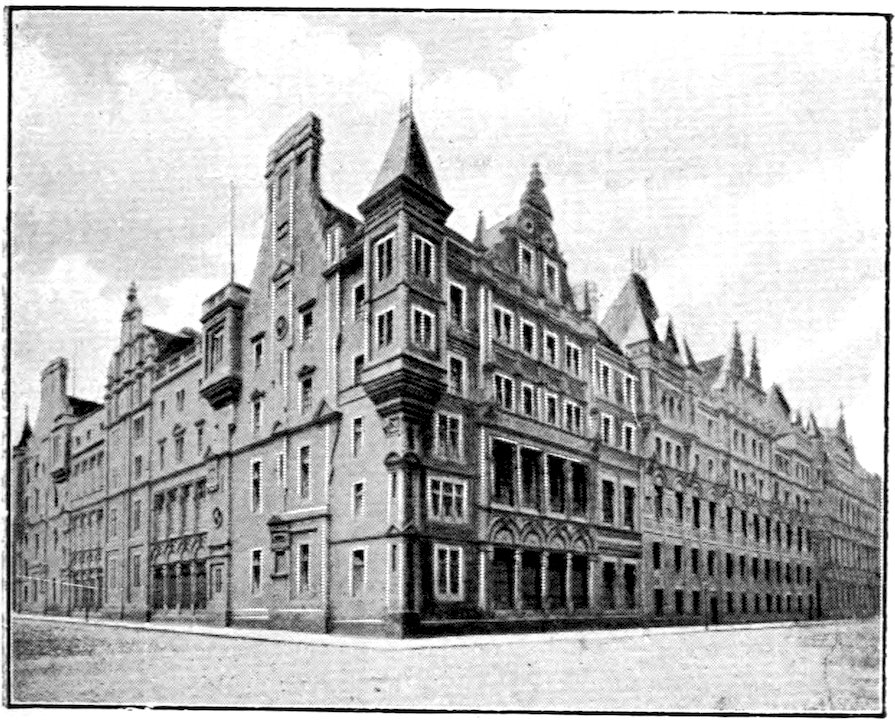
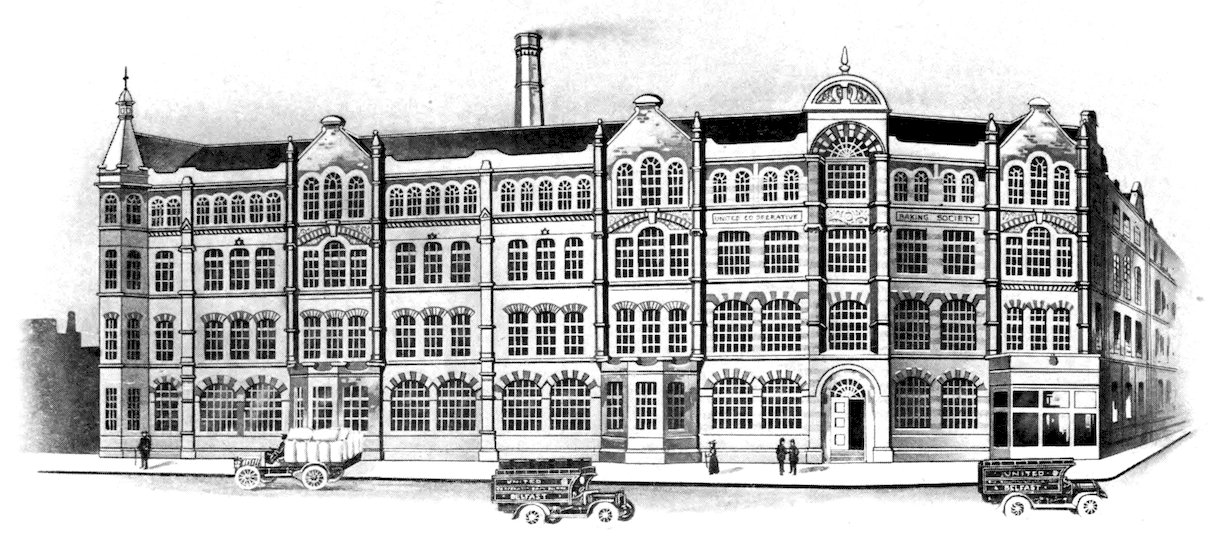
M‘NEIL STREET PREMISES (1897–1903).
33The insurance on the new premises was fixed at £1,000,
divided into £400 on stock, £300 on the buildings, and £300
on horses and vans. For several years the Society continued
to suffer from lack of capital, however, and it was not until it
had been in existence for nearly ten years that the committee
ceased to be troubled with financial worries. On several
occasions appeals were made to the delegates attending the
quarterly meetings that they would bring under the notice of
their societies the urgent need of the Baking Society for more
capital, and for several years a system of receiving loans from
private depositors was adopted, but this system was stopped,
except in the case of employees, when the Federation began to
receive enough capital from the societies to meet its needs.
The difficulty which arose from shortage of capital was not
the only one with which the committee was faced, unfortunately.
Foreman baker after foreman baker was tried, but still
complaints of the poor quality of the bread continued to pour
in. Added to this there were the difficulties of delivery. When
the Co-operators of to-day see the vans of the U.C.B.S. arriving
at the various shops with the regularity of clockwork, they may
have some difficulty in realising that fifty years ago the problem
of prompt delivery was a very serious one, and one which
engaged the attention of management and committee almost
continuously for several years. In part, this was due to the
fact that the baking of bread had not been reduced in those
days to a state of scientific accuracy, as it is to-day, and partly
it was due to the shortcomings of the human element, which
has always a tendency toward failure at the most unexpected
times and often in the most unexpected ways. The craze for
new bread was as great fifty years ago as it is to-day, but the
difficulty of delivering it was very much greater, and it was
especially great in the earlier years of the Baking Society’s
existence because of the fact that the majority of the societies
in the outer area supplied by the Federation were but small
and could give but small orders, thus increasing the cost of
delivery until sometimes it transformed trade which should
have been profitable into a losing business.
So much so was this the case that, in the first two or three
34years, society after society, which had joined the Federation
and were anxious to trade with it, had to be asked to withdraw
because the cost of delivery was so great that it could only be done
at a loss to the Federation. The first societies to suffer in this
way were Motherwell and Dalziel. At a later date, Vale of
Leven Society, which had been having their bread sent by rail,
had to withdraw, and later still, Lennoxtown were asked to
make arrangements for getting bread elsewhere as soon as
possible, on the ground that the Baking Society was losing
eleven shillings every week through delivering bread to them
by van.
As time went on, too, the position was becoming more and
more difficult for the manager. He does not seem to have been
a strong man, or else he had grown careless. At all events,
at one quarterly meeting when the criticisms of the delegates
had been even more searching than usual, he left the meeting
before its close, and when the committee adjourned to the
committee room at the close of the meeting they found a letter
from him intimating his resignation. Whether it was with the
idea of getting a little of his own back, or because he thought
that having engaged the employees it was his duty to dismiss
them is unknown, but when he took his own departure he also
dismissed the office and breadroom staffs, and there was a little
difficulty for a day or two until they were brought back or
others procured in their places. After discussion, the committee
decided that they would not advertise for a manager,
but for a confidential clerk and cashier, and Mr Robert Craig,
then bookkeeper with the S.C.W.S., was the successful applicant.
The trade was increasing slowly but steadily, and during
the second year averaged 90 sacks per week. Shortly after the
removal to the new bakery the Society had four vans on the
road, and was supplying eleven societies. In June of that
year it was decided to take up thirty shares in the S.C.W.S.,
and pay one shilling per share, but a month later this decision was
departed from in favour of one that the question of joining the
Wholesale Society be left to the quarterly meeting. This
decision had its origin most probably in the fact that the Society
had no money to spare at the moment for investment, as at
the same meeting it was decided that the manager make an
effort to pay the flour merchant and take flour into stock.
35At the quarterly meeting it was decided that the Society should
join the S.C.W.S., and take up two shares for every society
which was a member of the Federation. At the same time,
the members of the committee were becoming more confident
in their handling of the business, one evidence of this being the
fact that they were purchasing flour in much larger quantities.
The new bakery had only been in operation for six months
when the trade had increased so much that the erection of other
two ovens was being considered, and at the same time the
reroofing of a shed for the purpose of turning it into a flour
store was agreed on, and the manager was instructed to “get
estimates of the cost of having the floor laid with any material
that would keep out rats.” It would appear, however, that
the cost was more than the committee could venture to face
at the moment, and it was not until the following April that
the question of new ovens was again raised, when all the
societies were written to on the subject and all agreed to the
proposal of the committee.
Meantime the second year had ended with the position of the
Society improving. The sales had amounted to over £9,000,
and a dividend of sixpence had been paid each quarter. Stock
and buildings were valued at £1,370, while the members held
£279 in share capital and £709 in loans. The nucleus of a
reserve fund had been formed, and the property of the Society
had been depreciated by £150. It is interesting to note also that
with the beginning of the second year the Society had begun
to pay bonus on wages, a practice which has continued without
intermission ever since. The beginning was humble—the
amount paid in this first year was only £20, 17s.—but it marked
the recognition of the principle that the worker was something
more than a mere hireling; that he was a being who had
something to do with the making of profits, and therefore had
a right to share in them.
The committee continued unremitting in their attempts
to extend the trade of the Society. Every complaint was
inquired into closely, and every little while a deputation was
sent to one or other of the societies with the view of inducing
them to become members or to extend their trade. It is
interesting to note also that the cost of flour, which had been
31/ in May 1869, had advanced to 41/ in April 1871. The first
36quarter of the third year was a decidedly successful one, as it
showed a surplus over cost which enabled a dividend of one
shilling per pound of sales to be declared. The membership
had increased to 14, and the turnover to 102 sacks per week,
an increase of 11 sacks per week in one quarter. At the end
of this quarter Mr Barclay retired from the presidency, after
having held that position for fifteen months, and Mr Donald
Cameron, Thornliebank, was elected to the chair. At the
following quarterly meeting it was agreed that, in future, tickets,
with a programme of business for the quarterly meeting, be sent
to the societies.
Before the end of the year a building in Park Street,
adjoining the Society’s premises, came on the market, and was
purchased by the Society for £735. At the same time the
building of other two ovens was undertaken, thus bringing the
capacity of the bakery up to eight ovens. The building which
was purchased was in use as an engineering workshop, rented
at £67, 10s. per annum, and the purchase price included an
engine and boiler.
At the quarterly meeting which was held in December, the
first mention was made of a subject which was to engage the
attention of many quarterly meetings before being finally
disposed of. This was a suggestion by Johnstone Society that
the Baking Society should consider seriously the possibility
of opening branch bakeries as their business extended.
Meantime, Vale of Leven Society had approached the Baking
Society with the view of having bread delivered to them by
rail, and a van had been fitted up for this purpose, so the Board
came to the decision to hold over the consideration of branch
bakeries until they saw what the results of conveyance by rail
were going to be. The delivery difficulty was getting more
acute every week at this time, and it was found that two
societies which had ceased to take their bread from the Society,
and whose action had been described by the committee as
“utterly subversive of true Co-operation and detrimental to
the interests of the Baking Society,” had done so because of
the irregularity of delivery, and declared themselves “willing
to begin again as soon as they could see an assurance of a
regular and steady supply.”
In order to suit the convenience of Glasgow societies an
37arrangement came into force in the beginning of 1872 whereby
the Baking Society undertook to deliver bread at the houses
of the members of these societies for an additional charge of
9d. per hour for the time spent in this work. About the same
time the question of baking biscuits on days when the general
work was easy was considered, and this new branch of business
was finally entered on. The turnover for the third year was
larger than that of the first two combined, being 6,341 sacks;
an average of 122 per week. Owing to the rise in the price of
flour, however, and in some degree also to the heavy costs of
delivery, the surpluses on the year’s trading showed considerable
fluctuations; for while the dividend earned during the first
quarter was one shilling, those for the succeeding quarters were
fivepence, sixpence, and threepence respectively. The Society
was now quite a large property owner, the value of the buildings
as shown in the balance-sheet being £2,421, while the value of
live and other stock was £870. Several new vans of a four-wheeled
design had been built during the year in order to
facilitate delivery, and several new horses had also been
purchased. The cash value of the sales for the year was over
£16,000, and the combined share and loan capital was £1,411.
Reserves had been increased to £54, and buildings and stocks
written down by £368 during the year.
In March 1872 Mr Cameron resigned from the presidency of
the Society as he had become an employee, and Mr Andrew
Brown (Paisley Provident) was elected president until the
quarterly meeting, when his appointment was confirmed.
Meantime the Society was having some trouble with the last
pair of ovens erected. The gentleman appointed as inspector
reported that they were not according to specification, and
were of less value than had been contracted for. At the same
time he suggested that an endeavour should be made to settle
the matter amicably, “as a lawsuit would result in a loss to
both parties”; which sensible advice was taken by the committee,
who, however, decided “to retain the money lying in
their hands until satisfied with the finish and durability of the
work.” They also decided to deduct £10 from the estimate
price for departure from the terms of specification. At a later
meeting, however, it was decided to meet the oven-builder half
way and be content with a deduction of £5.
38For some time negotiations had been going on between the
Society’s tenant of the engineering shop and the committee on
the question of whether the boiler in that shop, which was the
property of the Society, should be kept in repair by the tenant
or by the owners. The committee contended that, according
to the terms of the lease, the duty of keeping the boiler and
other machinery in repair devolved on the tenant, but as a
way out of the difficulty offered to sell the boiler and engine to
him. The matter was finally adjusted by the tenant taking
over the engine and boiler, and paying for them by an increase
in rent amounting to £5 per annum. At the quarterly meeting
which was held on 2nd June 1872 the balance-sheet was submitted
to severe criticism, the ground of complaint being the smallness
of the profit shown in view of the increasing sales of the Society.
For the first time in the history of the Society the turnover
had exceeded £2,000 for the quarter, but the surplus was only
£119, and the dividend sixpence, while nothing was added to
the reserve fund. The delegates to the quarterly meeting also
combined to express considerable dissatisfaction with the
quality, shape, and general appearance of the bread, and the
committee were urged to take energetic measures to place the
Society in a better position in this respect as well as in that of
profit. At almost every meeting of the committee complaints
were being made about the quality of the bread and lateness of
delivery, and they were at their wits end to find a remedy.
Discussions took place meeting after meeting about difficulties
of delivery, varied every now and again by a discussion on the
subject of the high rate of expense. Investigations into the
cost of baking were set on foot, but with no results. A
suggestion was made by Paisley Provident Society that the
discount allowed to the societies be reduced from 10 per cent.
to 7½ per cent. in order to cover losses in working, but no action
seems to have been taken in this direction at the moment. In
order to find remedies for the continuous complaints about the
quality of the bread and its delivery, a rearrangement of duties
took place; the stable foreman being made responsible for the
delivery, and the foreman baker for the quality of the bread, while
the manager continued to act as cashier and bookkeeper. These
alterations did not seem to make much difference, however, as
complaints continued to come in with as great frequency as before.
39The arrangement which had been made to supply Vale of
Leven Society with bread had evidently not been working
satisfactorily, for that society intimated its intention of withdrawing
from the Federation. The adjustment of the terms
of this withdrawal took many months of negotiation. It was
on 4th May 1872 that the committee received the intimation
that the society intended to withdraw from the Federation, but
it was not until 19th April 1873 that the final adjustments were
made and the matter settled. In this case there was dispute
as to the amount which the withdrawing society should pay
for the delivery of their bread by rail, this being finally adjusted
by computing the cost of delivery per 100 dozens to Barrhead
and to Vale of Leven, and charging the latter society with the
difference. Another peculiar practice of the Federation at
this time was that of retaining for the reserve and depreciation
funds a proportion of the capital of retiring societies. This
was done even when the societies withdrew at the request of
the committee and against their own wishes, although in the
three or four cases where this occurred the percentage deducted
was less than that usually retained. In the case of Vale of
Leven Society 7½ per cent. was charged, while Dalziel and
Motherwell societies were only charged 5 per cent.
By the end of the third quarter in 1872 a further extension
had become necessary in order that more storage room might
be had, and it was decided that the only way to get the necessary
space was to build another storey to the present flour store.
The great difficulty was lack of the necessary money, but it
was thought that if the extension became imperative a bond
might be obtained to cover the cost. A short time later a letter
was received from the Anderston Society, in which a protest was
entered against any further extensions being made in the bakery
meantime. At this time the Society was in somewhat grave
difficulties for want of money, as, in addition to other debts
which were owing, their account with the Wholesale Society
amounted to £4,000, equivalent to nine weeks turnover. Inside
the next fortnight, however, the manager was able to report
that he had paid £1,000 to the Wholesale Society.
At this time the committee had under discussion the method
of supplying flour to the Society. It was alleged by some
members of the committee that the manager had not a free
40in ordering flour, as “another party” had taken it upon
himself to send in flour without the knowledge of the manager.
Mr Sturrock stated that he was aware of all contracts entered
into, but that on a recent occasion he had to cancel an order
because he found after his order had been given that flour was
being sent to the bakery without his knowledge. At the
following meeting this question was again taken up, and it
appears from what transpired at that meeting that Mr Borrowman
was the “other party” referred to above. That gentleman
explained that the contracts were made through the Wholesale
Society, and no irregularity could occur if the manager sent
his orders to the Wholesale Society instead of sending them to
the millers, as he had been in the habit of doing. In the course
of the conversation the chairman pointed out that although,
because of the fluctuations in the price of flour which were
taking place, they had for some time delegated their power to
make contracts to the manager and Mr Borrowman jointly—not
separately as some people had supposed—they still retained
in their own hands such powers, to be used as soon as they
might think it right so to do.
Early in the third quarter of this year Mr Smith (St Rollox)
was appointed assistant secretary, as Mr Borrowman was sometimes
unable to attend. At the quarterly meeting, which was
held on 1st March 1873, Mr Smith was appointed secretary,
and Mr Borrowman retired from the committee, after having
taken a large share in the conduct of its affairs from the
inception of the Society. At the December quarterly meeting
the manager resigned, as already stated in the beginning of this
chapter, and Mr Robert Craig was appointed. The fourth year
was not to end without more trouble however. A special meeting
was called on 28th December 1872, at the request of Barrhead
and Thornliebank societies, and Mr Ferguson (Barrhead), who
had been one of the first directors of the Federation, placed his
society’s case before the meeting. He stated that his society
was of opinion that the Baking Society was in an unsatisfactory
state, and on behalf of Barrhead and Thornliebank societies
placed eight propositions before the meeting with the object
of putting the Federation on a more stable basis.
41
The first proposition was that a manager be employed; but
this was defeated by an amendment that the management be
left in the hands of the committee. The second proposal was
that the foreman baker should be the party who should judge
the quality of the flour before purchasing, the quantity to be
decided by the committee, and it was accepted, as was the third—that
no person be a member of committee who has anything
to do with the making or selling of flour to the bakery (but not
to the exclusion of operatives) so that the committee be left
perfectly untrammelled in their actions.
Another proposition was to the effect that the members of
the Baking Society’s committee should be elected for that
committee only, and not be simply delegates from the committee
of their society; but as this affected one of the rules of the
Society it was not discussed. It was also proposed that the
committee should watch the purchases of societies with a view
to dealing with those who were not purchasing enough to earn
their fair share of profit, and considering whether they should
be allowed to continue as members of the Society. The committee
pointed out that they were already doing this, and the
meeting agreed to the proposal. Another proposal was to the
effect that when the additional shares had been called up the
committee should purchase flour where it could be had best.
This proposal sounds as if there was some suspicion in the minds
of the proposers that the Society was being hampered in
obtaining the best flour for its purpose by lack of money, and
as the delegates gave a general acquiescence to the proposal it
would seem that the suspicion was fairly general. It certainly
could be said for the proposal that it gave the committee full
power to do the best they could for their Society.
Just before the end of the fourth year Motherwell and
Dalziel societies dropped out of the Federation at the request
of the committee, as although both societies were loyal
purchasers, the cost of delivery was so great that the Society
was losing money on their trade. The Federation still consisted
of fifteen societies, however—viz., Anderston, Barrhead, Busby,
Cathcart, Johnstone, Lennoxtown, Cadder, Parkhead, Elderslie,
Howwood, Eastern, Paisley Provident, Thornliebank, St Rollox,
42and Avonbank—and other societies were being supplied with
bread. About this time, also, a new departure was made.
The committee had found that their biscuit trade was not a
profitable one, and the cashier was instructed to make inquiries
as to the terms on which some of the Glasgow biscuit manufacturing
firms would supply them with biscuits. It was finally
arranged that Gray, Dunn & Co. supply them with biscuits
through the Wholesale Society, and this arrangement continued
for some time until a fire at the biscuit factory put an end to
the connection, when the trade went to Herberts Ltd.
During the fourth year the Society had made considerable
progress, and the trade for the year showed a substantial
increase, but it had not been very profitable. Indeed in the
fourth quarter, after provision had been made for interest and
depreciation, there was nothing left to divide, while nothing
had been added to the reserve fund during the year. The
aggregate output for the year was 7,955 sacks, equal to an
average of 153 sacks a week, which was an average increase of
31 sacks per week over the turnover of the previous year. The
Society was still much hampered in its operations from lack
of capital; the total share and loan capital being only £1,618.
During the latter half of the year the price of flour had been
very high, reaching in the later months of the year 45/6 per
sack for the average quality used.
Yet, although there were still many anxious days ahead for
the committee and not a few lean years, with the close of the
fourth year the Society had been established on a firm foundation.
Henceforth there were not the same defects of management to
contend with, and what difficulties did arise were due to weakness
in the societies which were customers of the Bakery rather than
to causes operating within the Federation itself. In a later
chapter mention will be made of some of the difficulties which
arose owing to the weakness of some of the societies which were
members of the Federation.
CHAPTER V. THE BRANCH CONTROVERSY. — JOHNSTONE SOCIETY’S REPORT. — To the Committee of Management and Delegates representing the United Co-operative Baking Society Limited, Glasgow. — Another View of the Case. — BARRHEAD OPPOSITION. — BARRHEAD DECIDES TO WITHDRAW. — DISSATISFACTION IN PAISLEY AND JOHNSTONE. — A BRANCH IN GLASGOW. — THE END OF THE PROPOSAL. — BARRHEAD, JOHNSTONE, AND PAISLEY PROVIDENT WITHDRAW.
43
A LENGTHY CONTROVERSY—TO BRANCH OR NOT TO BRANCH?—AN
OPTIMISTIC REPORT—LACK OF CAPITAL—STRONG OPPOSITION—BARRHEAD
THREATENS WITHDRAWAL—THE QUESTION REOPENED—BARRHEAD
DECIDES TO WITHDRAW—SHELVED AGAIN—DISSATISFACTION
IN PAISLEY AND JOHNSTONE—BRANCH OPENED IN GLASGOW—THE
FINAL DECISION—BARRHEAD, PAISLEY PROVIDENT, AND JOHNSTONE
WITHDRAW.
In the preceding chapter we noted that a proposal was made
at one of the general meetings of the Society that branch
bakeries should be established. It was a proposal which
occasioned a great deal of discussion and was the cause of
several heated debates during the next few years, and it is
therefore important enough to merit a chapter to itself. The
idea was first mooted at the quarterly meeting held in
December 1871, when Johnstone Society delegates in the
course of a general discussion brought forward the suggestion
“that the Baking Society should think of the possibility of
opening branch establishments as their business extends.” The
idea was favourably entertained then; but it was obviously
impossible to do anything at the time, and it was not until the
quarterly meeting which was held on 30th November 1872,
exactly a year later, that anything further was heard of the
subject.
At that meeting a general discussion took place “as to the
desirability of opening a branch bakery in Paisley or Johnstone.”
The matter ultimately dropped for the time being, but it was
left with the committees of Johnstone, Paisley Provident, and
Paisley Equitable societies “to make inquiries in their respective
localities as to a suitable place for the business, which could be
rented, leased, or bought, the probable cost, and all other
information that may be necessary, and forward the information
obtained at as early a date as possible to the committee.” The
44Johnstone committee were especially enthusiastic about the
proposal, and before next quarterly meeting a report was in
the hands of the committee. This report was read to the
delegates at the next general meeting of the Society, and a
general conversation took place in the course of which the
opinion was expressed that however desirable it might be that
the Society should branch out in the manner indicated, it was
inexpedient that it should be done then in view of the state of
the Society’s affairs. The committee of Johnstone Society
were, therefore, thanked for the trouble they had taken over
the business and for the report which they had prepared. It
was also agreed that this report be printed and circulated
amongst the members of the Federation, and that the subject
be brought up at next quarterly meeting.
The report of the Johnstone Society is so interesting and
throws so much light on the affairs of the Federation that it is
worthy of being printed in full, as issued in circular form
by the Bakery committee.
Gentlemen,—Having been appointed at your quarterly meeting,
held 30th November 1872, to report on the results which would be
likely to flow from your Society having a branch bakery in Johnstone,
we respectfully beg to offer the following for your consideration.
The advantages which the promoters of your Society saw in
having a “united management, a concentration of labour, and a
combined purchasing power,” is nearly, if not altogether, neutralised
by the high cost of your productive and distributive departments;
ten shillings a sack is, we believe, something unknown in Scotland
as the cost of baking and distributing common loaf bread, and in
your establishment it cannot be set down even at this high rate,
as your auditors at last quarterly meeting warned us that the
depreciation of your fixed stock was not commensurate to its “tear
and wear,” and we believe investigation during the quarter now ended
has brought out that your liabilities in direct debts were greater than
was accounted for in your balance of October last.
This being the case, it is a duty incumbent on all to examine into
and see if anything can be done to remove the obstruction to progress
and place the Federation on a sound and stable basis, beneficial alike
to individual and to the union of societies.
To do this reforms of more or less consequence may require to be
introduced, but the one on which we are commissioned to report, and
which appears to us as the most urgent, and the most likely in being
45effectual in removing the evils complained of, is the setting down of
a branch in Johnstone, or some other place, where a great amount of
distributive expense could be saved at a small outlay.
The cheapness of carriage of flour in the bulk and its dearness
when manufactured into bread, which is at once bulky, fragile, and
heavy, suggests readily the idea that it would be well to have branches
set down in localities where there is a consumpt of bread large enough
to work them successfully; we consider Johnstone a place of this
class, and desire to lay before you, in detail, some of the reasons why
we think so.
In making Johnstone a district with a branch bakery we would
class the following societies together, viz.:—Paisley Provident, Paisley
Equitable, Howwood, Elderslie, Kilbarchan, Linwood, and Johnstone.
Taking October balance as an average of the bread taken by these
different societies, we find in the aggregate that the six societies
first named took bread to the value of £892, 10s. 6d., and that
Johnstone Society took bread to the amount of £884, 12s. 9d., a total
of £1,777, 3s. 3d., or within £100 of being a third of all the purchases
made at the Bakery during the quarter. The Johnstone Society’s
quantity, £884 a quarter, averages something like sixty-four dozen
loaves daily, the outcome of four sacks of flour; say, then, with the
other societies named, eight sacks of daily consumpt. The weight
of this number of sacks, in the bulk, is one ton (twenty cwt.), and the
price of carriage and delivery in Johnstone, from Glasgow, is four
shillings. These eight sacks, made into bread in Glasgow, gives a
weight, including boards, of over thirty-four cwt.; this is exclusive
of vans, which, we believe, are about half as much more, or seventeen
cwt. each. In this condition, then, of baked bread it costs your
Society thirty shillings or over daily to deliver to the various societies
of the named district. Supposing, then, that you had a branch in
Johnstone and a more restricted delivery system adopted, we entertain
no doubt but one horse and van could overtake the whole three mile
radius, give and deliver the required bread to the different societies.
The cost of this would be about twelve shillings a day, which would
leave a clear profit to the Society of fourteen shillings a day, or
£54, 12s. a quarter, nearly £220 a year.
We have had an interview with a practical managing baker, and
his estimate of the cost of production is much below your present
expense; he considers that the quantity required (eight or nine sacks
a day) could be baked into loaves at a cost of three shillings per sack
(he laid stress on the fact that the job was loaf baking alone, and said
that men were able and really did do more of this kind of work).
Buying the flour at the then price of fifty shillings per sack, and
adding three shillings for baking, rent, etc., we have a gross cost
of fifty-three shillings per sack. The outcome from this quantity of
flour should be sixteen dozen small loaves; retailing them at the
then price of 4¼d. each, you have the sum of sixty-eight shillings;
10 per cent. less would be sixty-one shillings and twopence, or a profit
of eight shillings and twopence on each sack baked and sold; this eight
46times (a daily output) would give sixty-five shillings and fourpence
per day, or £19, 12s. a week, £254, 16s. a quarter. But allowing
half this quantity has to be delivered to societies, and say this will cost
three shillings per sack, which would give a total cost of about
£48, 15s., which sum deducted from the £254, 16s. would still leave
the sum of £206 a quarter of a clear profit realised from the business
done by the seven societies comprising the proposed district.
Regarding the practical part of the scheme we have nothing to
offer in way of a ready-made bakehouse or other suitable premises,
and we are afraid that should the business be gone into, as proposed,
new premises would require to be got; on this, however, we ask your consideration
to the fact that your present premises have not the necessary
storage for flour which your large turnover requires. This is attested
by the proposal which was made six months ago for alterations, and
if it is true, as we believe it is, that properly stored flour is from
one to two shillings a bag better in outcome than when used as has
hitherto been done at the Bakery, one shilling on each sack baked
for a quarter, say 1,800 sacks, and you have a sum of £90.
The alterations which were proposed and were estimated to cost
about £200 have never been carried into effect, consequently the
Bakery labours under the disadvantage of want of storage at a loss
equal to something like £90 a quarter.
We know full well the high cost of distribution, and some are
sanguine the productive cost could also be lessened; could not this
sum, then, of £200, or say £300, required for storage purposes be laid
out on a branch bakery in the Johnstone district, and take away a third
of the trade from the centre; you would then have storage to suit
your requirements for some time to come, very probably you would
be less for productive expenses, and most certainly your cost of
distribution would be so much curtailed as to release the Federation
from the incubus which at present keeps her down.
Gentlemen, our aim and earnest desire is the prosperity of the
Federation and its component parts; we lay these considerations
before you and leave the matter in your hands, being confident your
united wisdom will be well able to direct the path which will
earliest and best lead to better and happier times for the United
Co-operative Baking Society.
The Johnstone Society’s Committee.
Johnstone, 21st February 1873.
At that time it would seem that the representatives of all
the societies were enamoured with the idea of branching out,
especially in view of the very rosy picture which had been
presented in the Johnstone Society’s report, but they realised
that at the moment branching out was impossible. The
Federation’s commitments in capital expenditure were already
as much as could be borne; the cost of building a new bakery
would add considerably to the burden, and neither delegates
47nor directors could see how it could be carried; so, when the
subject was brought up again at the June quarterly meeting,
it was left in the hands of the committee, with the proviso that
no extension take place until a general meeting of the members
had been called.
The proposal, however, had never been one which was
pleasing to Barrhead Society. Immediately after the remit to
Johnstone Society and the Paisley societies to collect information,
a deputation from Barrhead had waited on the Bakery
committee, and, after pointing out that the capital of the
Society was far from being what it ought to be, they said
they had been instructed by their committee to state that
they considered it inexpedient in the meantime to proceed with
the proposed branch at either Paisley or Johnstone because of
the plant and other necessaries which would be required and
which the funds of the Federation were not in a position to
meet. It was owing to the determined opposition of the
Barrhead and Thornliebank delegates and the strength of their
argument that the capital of the Society was insufficient for the
enterprise, that the Johnstone scheme was held over.
Nothing further was heard of the proposal until the
beginning of 1876. By that time the trade of the Federation
was taxing the productive capacity of the bakery to its utmost
limits, and on the 29th of April a special meeting of delegates
was convened for the purpose of considering the situation, and
especially a recommendation by the committee that a small
bakery which was to let in Paisley Road should be taken for
a period of three years. A lengthy discussion took place.
Mr Inglis, Paisley Provident Society, moved “that the committee
be empowered to open a branch bakery, either in Paisley
or Johnstone, and to lease temporary premises in the locality
chosen until the new bakery was ready.” At once Mr Tolmie,
of Avonbank, brought forward an amendment “that the
committee be empowered to take such action at once as will
appear to them to be for the best interests of the Federation.”
Mr Paton, Paisley Provident Society, seconded Mr Inglis’s
motion, and Mr Johnstone, Barrhead, the amendment of Mr
Tolmie; but the motion that a branch be opened in the West
was carried by 42 votes to 39 for the amendment. While the
amendment did not prohibit in so many words the suggestion
48contained in the motion, it was believed that it would have
that effect, because, although on this question of branching
out the committee as a body had always held a neutral position,
it was believed that they were not very favourable to the
proposal of the Paisley and Johnstone societies.
It might appear that the question was now settled finally,
but that was far from being the case. The Barrhead Society
had always been opposed to the suggestion that a branch should
be established at either Paisley or Johnstone, and it was
suspected that the adoption of this proposal would lead to their
withdrawal from the Federation. Whatever influence the
decision may have had on the final step taken by Barrhead
Society, however, other influences were at work there in favour
of the society commencing to bake bread for themselves. At
a meeting of the committee of that society, held on 6th March
1876, the propriety of the society erecting a bakery of their
own was discussed on the motion of a Mr M‘Quarrie. The
committee were not favourable to the idea, but at the monthly
meeting, which was held four days later, a more extended
discussion took place, and, although no formal motion was made
at the time, the minutes of the society record that “the
members seemed to be rather in favour of starting a bakery.”
At the next monthly meeting, also, held in the beginning of
April, the quality of the bread which they were receiving from
the Federation was discussed, and a suggestion was made that
the society intimate to the Baking Society that it was their
intention to erect a bakery of their own. It is apparent,
therefore, that the idea of entering into the baking industry for
themselves was being considered by the Barrhead people before
any definite decision had been come to by the U.C.B.S. on the
question of placing a branch in the West. That decision brought
the question to a crisis in Barrhead, however, and at the
quarterly meeting of the society, which was held on 9th May
1876, the following motion was adopted by the meeting:—
“With a view to mend past and present complaints of the bread
received from the wholesale bakery, and of preventing the committee
from carrying out the motion passed by the delegates at their last
general meeting to plant a branch bakery in Paisley, involving us
in more debt, resolved that it is the opinion of this meeting that
49we withdraw from the Bakery and start a bakery on our own
account.”
On 22nd May a committee was appointed by the committee
of Barrhead Society to look out for premises which would be
suitable for a bakery. This did not settle the question even yet,
however. At the meeting of the Baking Society committee,
which took place on 17th June, a deputation from Barrhead
came to make suggestions, particularly about the delivery of
bread in the latter part of the week. From the U.C.B.S.
minute we can gather, reading between the lines, that the
discussion had been warm. The committee’s account of what
took place states that they had “no difficulty in overtaking
orders in the beginning of the week, but it was somewhat
difficult to overtake them at the latter end; but the committee
refused to say that they could not supply the full complement
to Barrhead on the Saturday; and that Barrhead be left to
conduct their business as they thought best.” It would appear,
from what is known of what was taking place in Barrhead, that
the deputation had mentioned the likelihood of that society
withdrawing from the Federation, and the last clause was the
committee’s answer to what they may have interpreted as a
threat. One good result of the meeting of representatives of
the two boards was that the Barrhead people were induced to
reconsider their position, for a special meeting of the members
was held on 30th June at which the following resolution was
adopted:—
“That the question of withdrawal from the U.C.B.S. and of
baking for ourselves be adjourned sine die, and that this meeting
declares itself of opinion that the bread supplied, while it is pure
and wholesome, has not been up to the standard of quality and
appearance required by our members; and that we are unanimously
opposed to any extension of the United Bakery beyond the premises
that it at present occupies; and that a deputation be appointed
from this meeting to place these matters before its committee of
management, and to urge upon them the adoption of means to
improve the quality of the bread, and the necessity of reconsidering
the recent resolution to plant a branch bakery in Paisley or Johnstone,
in order to preserve the integrity and harmony of the Federation.”
The result of this deputation’s visit was that a special meeting
of the U.C.B.S. committee was held on 29th July, when the
committee decided “that we, as a committee, take no action
towards the increasing of the productive power of the bakery
50until such time as we hear the opinion of the forthcoming
quarterly meeting on the matter.”
Everything seemed to be going smoothly now, but it was
only surface tranquillity, for at the same meeting where the
Barrhead Society passed the resolution quoted above they also
unanimously adopted another “to grant powers to the acting
committee of this society (the committee which had been
appointed to look out for premises suitable for a bakery) to
rent, lease, purchase, or erect premises suitable for carrying on
its own trade.” At the September meeting of the Baking
Society, Mr Stark, Barrhead, moved “that in order to preserve
the integrity and harmony of the Federation we consider it
necessary that the resolution passed at special meeting of the
Federation, held on 29th April, ‘to plant a branch bakery at
Paisley or Johnstone,’ be rescinded by this meeting, and that
no permanent extension of the bakery take place beyond the
present premises.” Mr Hall, Thornliebank, seconded.
At once Paisley Provident delegates were on the alert, and
Messrs Lauchland and Cumming of that society moved as an
amendment: “That this meeting adheres to the resolution
agreed to at special meeting on 29th April, in reference to the
planting of a branch in Paisley or Johnstone.” The discussion
was long and animated, but again the glamour of a branch was
on the delegates, and the Paisley amendment was agreed to
by 41 votes to 30 for Barrhead motion.
This decision at once made its influence felt in Barrhead,
and at the monthly meeting of that society which took place
on 12th September notice was given of a resolution to the effect
that “This Society hold a special meeting on 8th November to
consider a motion ‘that this Society withdraw and cease to
be a member of the U.C.B.S.’” At this special meeting the
resolution to withdraw was agreed to by a very large majority,
and on 4th December it was agreed that the Bakery committee
be informed officially of the decision to withdraw, and that the
letter state that the society would continue to purchase bread
until their own bakery was ready. It is probable that this
letter was a result of what had taken place at the Bakery
quarterly meeting on the preceding Saturday, when the
51chairman had been questioned about the withdrawal of the
society, and had stated that nothing official had yet been received
from Barrhead Society with reference to their withdrawal.
He was also questioned as to whether any steps had been taken
with regard to establishing a branch bakery, and stated that
no action had been taken regarding the branch. The subject
then dropped.
It is easy to understand that the Paisley and Johnstone
societies were not satisfied with the delays which were taking
place in placing a branch somewhere in their neighbourhood.
They had succeeded in carrying their point in 1873, but the
financial position of the Federation had prevented anything
from being done. Then in April of 1876 they had secured a
majority of votes—true, it was only a majority of three—in
favour of their proposals, and in September this decision had
been confirmed by a much larger majority. Yet, in view of
the strenuous opposition of Barrhead Society and the repeated
threats of withdrawal made by that society, they must have
recognised that it would not do to hurry matters, for with almost
600 dozen loaves taken away from the weekly output of the
Federation, the premises would be ample; and, in view of that
contingency, the committee of the Bakery were justified in
pursuing a cautious policy. Notwithstanding the chairman’s
disclaimer of any “official” knowledge of Barrhead Society’s
intentions, it was generally known throughout the Federation
that they had decided to start baking for themselves, and it
was doubtless this knowledge which was responsible for the
statement by the chairman that “no action had been taken”
to establish a branch being allowed to pass as quietly as it did.
Whatever might be the result of the withdrawal of Barrhead
Society, however, if and when it did take place, there was no
doubt but that the capacity of the bakery premises were overtaxed
at the moment. The committee had been compelled to
refuse offers of trade because of inability to supply the societies,
and on discovering that a small bakery, situated in Paisley
Road adjacent to their central premises, was to let, they
52came to the decision to appeal to the members for power to
rent it for a year while awaiting developments. A circular
was drafted and sent out to the societies, in which were
explained the committee’s reasons for not proceeding with the
branch bakery, and also the reasons why they considered it
advisable that the small bakery in Paisley Road should be rented.
The contents of this circular fanned the ire of the Paisley and
Johnstone societies, whose delegates turned out in great force
to the quarterly meeting, held on 3rd March 1877.
The circular was submitted by Mr Slater, secretary of the
Federation, and gave rise to a lengthy discussion. It does not
seem to have occurred to anyone that the Paisley and Johnstone
societies might follow the example of Barrhead and withdraw,
and the idea was largely entertained by the delegates that if
a branch was established in that locality, it would relieve the
congestion in the Central Bakery for a long time to come.
Finally, after a very long discussion, Mr Inglis, Paisley Provident,
moved “That the circular lie on the table, and that the committee
take their instructions as to how they should meet the
extra demand from the resolutions agreed to on the matter at
previous meetings.” Mr Paton, Paisley Provident, seconded.
Mr Steel, Avonbank, moved, and Mr Stark, Barrhead, seconded,
“That the committee be empowered to rent premises
temporarily in the vicinity of the present bakehouse.” The
vote resulted in the amendment of Mr Steel being carried by
39 votes to 34 for the motion of Mr Inglis. The question was
not yet settled, however. Immediately the result of the vote
was declared, Mr O’May, Paisley Provident, rose and moved:
“That this question be again brought up at the quarterly
general meeting six months hence.” It should have been
apparent to the delegates that this was a blocking motion and
might prevent the committee from doing anything, but it was
evidently not so regarded, or else the delegates could not make
up their minds on the subject, for it was agreed to without
comment. The committee did not allow the motion for
reopening the question in six months to hinder them from going
on with the new branch, for immediately the meeting was over
they gave instructions to the sub-committee to secure temporary
premises in the vicinity.
53
The subject again arose at the 34th quarterly meeting, held
on 1st September, when Paisley Provident was again forward
with a motion: “That if a branch be required after Barrhead
had left the Federation, it be established at Paisley or
Johnstone, and that the present branch in Glasgow be not
retaken.” To this it was moved by Mr Gardiner, Cathcart,
and seconded by Mr M‘Murran, Glasgow Eastern, as an
amendment, “That this question lie over for six months.”
After a long discussion the Paisley motion was withdrawn, on
condition that the amendment limit the period of lying over to
three months, and that, meantime, a special committee,
constituted from the delegates present and from the committee,
be appointed to investigate the matter and report to the next
quarterly meeting. This was agreed to, and Messrs M‘Murran,
O’May, Aitchison, Brown, and Slater were appointed the special
committee. In less than three months’ time the committee
sent out their report to the societies. The report contained
details of three plans which the sub-committee had considered.
The first of these, that of a branch bakery in Paisley, they
considered could not be worked except at a slight loss. With
regard to the second one, that of a branch at Johnstone, they
considered that the loss would be slightly greater; while, with
the branch at Johnstone, the trade would be more difficult to
work. The third proposal which had been considered was that
of increasing the number of ovens in the present premises, and
in the report they stated they were not prepared to recommend
any one of the schemes in the meantime, but recommended,
instead, that the branch in Paisley Road be taken for another
year. The reason they gave for this recommendation was that
they considered that an inquiry should be made into the
advisability of introducing machinery into the bakehouse,
as the whole of their premises would be vacant in eighteen
months and could be utilised; if the result of the inquiry was
satisfactory, steps should then be taken to have it introduced.
This report was accepted by the delegates at the quarterly
meeting, and so a subject which had been a fruitful source of
controversy at the general meetings of the Federation for
nearly two years disappeared. It was again raised at a
54quarterly meeting some years later, when the question of
removing altogether from St James Street was being discussed,
but was summarily disposed of by the delegates.
Meantime the Barrhead bakery was ready for work and
baking was commenced in the last week of the year, but the
society, although it had withdrawn a large proportion of the loan
capital invested with the Baking Society in order to pay for the
erection of its own bakery, retained membership of the Federation
until requested by the committee to withdraw as the interest on
the share capital was an unnecessary burden on the Federation’s
funds. The society was allowed to withdraw without any of
its capital being retained, being the first of the withdrawing
societies to which this privilege was extended. In 1894, after
fancy biscuit baking had been firmly established by the Baking
Society, Barrhead Society rejoined again, taking up 1,500
shares.
Another withdrawal which occurred in a comparatively
short time, and which was doubtless influenced to some extent
by the refusal to establish a branch in the West, was that of
Johnstone Society. At a meeting of the committee which took
place on 15th February 1879, the minutes record a conversation
which took place regarding a decision of that society, come to
the previous evening, to start baking for themselves. The effect
of the information that they were likely to lose Johnstone
Society’s custom so soon after having lost that of Barrhead had
a damping effect on the spirits of the committee, and it was
decided that in the meantime the erection of the new ovens
which they had proposed to build be not proceeded with. With
the withdrawal of Paisley Provident Society at the end of 1880,
consequent on having a bakery of their own ready for occupation,
the controversy with respect to the branch, and also its effects
on the welfare of the Federation, may be said to have ended.
The Federation had lost three of its best customers, but it
had succeeded in keeping its business centralised. It must
always remain a matter of argument whether it would have been
better to branch out at an earlier date and do for the societies
in Renfrewshire that which in later years it has done for
55Clydebank and the North of Ireland. The question of branches
is still one on which there is considerable controversy, and, at
any rate, it is certain that the committee, and latterly the
delegates, played for safety, and chose to conserve the strength
of the Federation at a time when all its strength was
needed rather than weaken it by widening the scope of the
society’s energies. The majority of the committee, it is quite
evident, were opposed to branching out, for had this not been so,
they would have gone ahead when two general meetings of the
Society gave them the mandate.
It is difficult to see that any great harm was done by the
course which was adopted. The growth of the three societies
has been so great that each of them is large enough to maintain
a bakery of its own, and although the Federation had one or
two temporary setbacks, none of them was serious enough to
affect its stability or its efficiency. It is possible, therefore,
to argue that either decision would have had equally good
results. There we may leave what was undoubtedly a stirring
controversy while it lasted, the importance of which at the
time forms sufficient justification for the space which has been
devoted to it.
CHAPTER VI. ST JAMES STREET: DEVELOPMENTS. — UNINFORMED CRITICISM. — EXTENSIONS AND A FIRE. — RESIGNATION OF MR CRAIG. — A BAD INVESTMENT. — GOOD NEWS. — MACHINERY INSTALLED. — GETTING RICH. — FURTHER EXTENSIONS PROPOSED. — THE RESULTS OF TEN YEARS’ WORK.
56
IMPROVED MANAGEMENT—PRIVATE LOANS—IRREGULARITY OF ORDERS AND
OTHER DIFFICULTIES—A NEW FOREMAN BAKER—SHORT WEIGHT IN
FLOUR—DELIVERY DIFFICULTIES CONTINUE—UNINFORMED CRITICISM—AN
ECHO OF THE IRONWORKS FAILURE—NEW MEMBERS—AMENDING
THE RULES—EXTENSIONS—MANAGER RESIGNS: SECRETARY APPOINTED—OAKMILL
SOCIETY—APPEAL FOR FUNDS—TRADE AND FINANCIAL
POSITION IMPROVING—ANDERSTON SOCIETY’S FAILURE—GOOD NEWS—MACHINERY
INSTALLED—BECOMING RICH—TEN YEARS’ WORK.
In tracing the development of the agitation for and against
the establishment of a branch bakery we have been running
ahead of the calendar. A new cashier, who was virtually
manager of the business, had been appointed in the last days
of 1872, and during the next two and a half years he carried on
the business with as much success as the conditions under
which he was compelled to work permitted. In these two and
a half years he inaugurated a system of private loans to the
Federation for the purpose of increasing the working capital of
the Society; the smallness of the capital having been until
then the greatest difficulty under which the Federation laboured;
and so successful was this venture that by April 1875 the
Society was in a position to deposit £500 on loan with the
S.C.W.S., while six months earlier he was in a position to
recommend to the committee that the acceptance of private
loans except from those who had already deposits with the
Society, and from the employees, be discontinued; a recommendation
which was put in force by the committee a month
later.
In other ways, too, Mr Craig brought prosperity to the
Federation. He found it in a position of peril. For a long
time after his appointment he found himself in the position,
meeting after meeting, of having to present to the committee
accounts which had been incurred by his predecessor without
57being able to check them in any way. One of these, presented
in 1874, had been incurred from 1870 to 1872, and the
explanation offered by the contractor was that he thought the
U.C.B.S. and the S.C.W.S. were all the same, and had kept
the invoice back until the building was finished. Mr Craig was
given the job of arranging on the best terms possible. For
several years the difficulty already alluded to, that societies did
not pay their accounts promptly, continued. This was
particularly the case with two of the societies which were in
very low water about this time, one of them eventually
succumbing. There was also continuous difficulty about the
maintenance of sales. Sometimes a society would take bread
for a number of weeks or months, and then cease all at once
without any reason being given. At other times there would
be a series of complaints about the quality of the bread and the
reluctance of members to purchase, and investigation showed
that these complaints emanated from the shopman and had
very little foundation in fact. In some cases the shopman was
the society, the committee seeming to exercise little or no
supervision; while in other cases there was, of course, genuine
cause for complaint owing to bad or irregular deliveries or to
barm going wrong with the baker. Such causes were not
sufficient to account for the constant stream of complaints
which were launched at the heads of the committee, however,
and doubtless close investigation would have shown that many
of them had their origin in a desire on the part of salesmen to
do business with firms which made it worth their while. With
the appointment of Mr Lang as foreman baker there was certainly
a decrease in the number of complaints, and the sales improved.
A discussion which took place at a committee meeting in
June 1873 showed that there was not only a dispute with
Barrhead Society, a deputation having been sent to that society’s
meeting and been refused admission to the meeting, but also
that the Baking Society’s committee had not yet been placed
on a satisfactory basis. The chairman stated at the committee
meeting that his committee had only heard of the Barrhead
meeting casually, and expressed the opinion that it was the
duty of the member of the board from Barrhead Society to have
informed the Bakery board of the fact that it was being held.
On the other hand the Barrhead delegate said that he had
58forgotten all about it, and that in any case he had no authority
from Barrhead committee to say anything on the matter. It
would appear that a long discussion took place on the subject,
and especially on the position of members of the Baking Society’s
committee in relation to the work of that society, the opinion
being freely expressed that to members of the board of the
Baking Society the affairs of the Baking Society should be the
first consideration. The subject was ultimately dropped, on
the understanding that it was the duty of any member of the
Baking Society’s committee to inform that board forthwith of
anything which affected the interests of the Society.
About this time, also, some trouble was being experienced
with one of the millers who were supplying them with flour.
Several sacks of flour had been weighed by the manager, and
each had been found to be short in weight to the extent of
several pounds. The result was that the committee determined
to purchase a “beam and scales” in order that the flour might
be weighed as it came into the bakery, and meantime it was
decided that at present no more flour be purchased from the
defaulting miller. At the same time a claim was made against
him for short weight. About this time, also, some difficulty
arose with respect to the delivery of bread to Lennoxtown
Society. For some time the committee had been of the opinion
that they were losing money by delivering bread to this society,
and several suggestions had been made as to the most economical
means of delivery. No one of these seemed to find favour with
the Lennoxtown people, however, and that committee ultimately
decided to ask the Bakery board to supply them with bread
by means of the van as usual, and, if necessary, to retain the
dividend. The Bakery committee, however, after considering
the matter, came to the conclusion that, apart from the principle,
this method would not pay them, and decided to make no
alteration. The secretary was instructed to reply to this effect,
and also to state that the Bakery would stop supplying bread
to Lennoxtown as soon as that society was able to make other
arrangements.
At the quarterly meeting the attention of the delegates was
called by the chairman to the cases of one or two societies in
Glasgow which were members of the Federation, but which
purchased little or no bread from the Society. At this meeting,
59also, attention was again called to the needs of the Federation
for more capital. The work of Mr Craig in securing individual
depositors had not yet begun to have any noticeable effect on the
finances of the Society. At this time propaganda work was
engaging the attention of the committee, and a conference of
societies in and near Glasgow was held for the purpose of
inducing them to become better customers of the Federation.
At one of the meetings about this time the chairman suggested
that another meeting place be got for their committee meetings,
as the business was being overheard where they met at present.
Societies were now beginning to join up more freely. Applications
from some of the outlying societies were held up for
consideration, but in November 1873 Kinning Park joined the
Federation, taking up 100 shares, and a short time later London
Road Society became a member.
About this time the editor of the Co-operative News seems
to have been criticising the Society’s balance-sheet, for a
discussion took place in committee on the subject, and it was
duly minuted that “the remarks of the editor with regard to
the balance-sheet were wrong; that it had been the same with
the quarter previous, and he considered the editor should make
himself better acquainted with the circumstances of the business
before commenting on it.” At this period the Federation had
been caught on a rising market with a very small stock of flour
on hand. The master bakers of the city had a meeting, but
two of them refused to raise the price of bread, having evidently
large stocks in hand. Flour was eight shillings a sack dearer
than when the price of bread had been fixed. It was decided
to maintain the price of bread in a line with Glasgow prices;
but it was agreed that if a general rise took place in the various
districts the members of committee should notify the manager
so that he could act accordingly.
At the meeting of the committee which was held on 17th
January 1874 the overdrawing by the Ironworks of their account
with the Wholesale Society was referred to. It was stated that
the amount overdrawn was £9,000. A lengthy conversation
took place as to the advisability of having a more thorough
check upon the transactions of the Bakery manager so as to
60prevent the possibility of a like occurrence; but, after the
matter had been discussed in all its bearings and various plans
had been suggested, no definite decision was arrived at, except
that the finance committee were instructed to make a regular
inspection of the books and use every means to ascertain the
real position of the Society. The delegates to the Wholesale
meeting had also reported that it had been agreed by that
society to charge 5 per cent. on overdue accounts after a certain
date. This was going to hit the Baking Society heavily, and
the committee expressed the opinion that they should not be
liable as they were only receiving half bonus. There is no
reason given, however, why they should be receiving only half
bonus, as they had become members of the Wholesale Society
quite a long time previously. Bridge of Weir and Kilbarchan
societies were admitted members of the Federation, but the
admission of Milngavie Society was held over for a further
period. It was decided in February 1874 to recommend the
delegates to the quarterly meeting to amend the rule relating
to the representation of societies on the committee, as it was
thought that with the increase in the number of the societies
who were members of the Federation the committee was
becoming unwieldy because of its size. From the beginning
each society which joined the Federation had been entitled to
be represented on the committee. There were now twenty
societies in the Federation, and, although the average attendance
at a committee meeting was about fourteen, the more the
membership of the Federation was added to the larger the
committee would become. After having been considered by
the societies for a year, the recommendation of the committee
was agreed to, and the membership of the committee was fixed
at twelve—president, secretary, treasurer, and nine representatives
of societies.
The trade of the Federation had fallen off somewhat during
the fifth year, owing to the fact that several of the societies had
been asked to withdraw and that the trade of one or two others
was declining. The turnover was 7,514 sacks, as compared with
7,955 for the preceding year, thus showing a decline of 441
sacks. The average price of bread had been slightly higher,
however, for the cash value of the goods sold was £22,153, an
increase of £131. The average dividend paid had been 5½d.—4d.,
616d., 6d., and 6d. respectively for the four quarters—and
the reserve fund had been more than doubled during the year,
while depreciations to the amount of £719 had been made. The
capital of the society was still very small in proportion to the
turnover, however, being only £2,300. The societies themselves
were mostly small; they had not very much capital to spare
for investment, and those of them which were members of the
U.C.B.S. had to divide that between that Federation and the
S.C.W.S. Added to this was the fact that several of the societies
which were members of the Federation were in a position which
was gradually becoming more hopeless, with the result that not
only were they unable to invest in the Federation, but they were
barely able to pay for the bread they bought.
At the quarterly meeting which took place in December 1874
it was decided that the erection of the flour loft, which had been
held over for more than a year, should be proceeded with, but
a disaster which befell the Society at the end of the month put
a stop to the carrying out of that particular proposal for some
time. This disaster was the burning down of the premises
adjacent to the bakery and the property of the Society, which
were being utilised as a bolt and rivet works by tenants of theirs.
The reconstruction of this property occupied the attention of
the committee for the next few months, and it was not until
May that estimates for the completion of the flour loft were
received and the contracts placed. When the accounts for the
rebuilding of the burned-out property had all been submitted it
was found that they were £70 less than the sum which had been
received in insurances on the property, and the manager was
presented with £5 and was granted a fortnight’s leave of absence.
The insurance on the property and stock of the Society was now
increased by £2,000 to £7,000.
At the next meeting of the committee, held on 10th July
1875, a letter was received from Mr Craig, in which he stated
that owing to a sudden change in health he was compelled to
resign his position as cashier and manager. The committee were
unanimous in their expressions of regret, and a deputation was
62appointed to meet with Mr Craig and learn whether it would be
possible for him to return to his position in the event of assistance
being given in the office. At the next meeting this deputation
reported that they had met Mr Craig, who stated that the medical
advice he had received was that he should leave the country,
and that he had decided to do so. They had therefore advertised
the position. The committee thereupon recorded their appreciation
of the work which Mr Craig had done for the Society in the
following terms:—
“While we accept Mr Craig’s resignation as manager, we desire
to record our heartfelt sympathy with him in his circumstances and
the high esteem in which he is held by all the members of this
committee as an honest and upright individual, an intelligent and
energetic man of business, and a faithful servant who, for the past
two and a half years, has conducted the business to the great
pecuniary advantage of all the members connected with it. While
we regret the loss of such a valuable servant, we hope that he may
secure in the country to which he is emigrating a restoration of
health and strength, together with a due amount of worldly
prosperity.”
Alas, it was not to be. No improvement took place in Mr
Craig’s health from his residence abroad, and in a short time
he was back in Glasgow again, his death taking place in the
summer of 1877.
At the August quarterly meeting of the Society a grant of £20
was made to a testimonial which was being got up for Mr Craig,
and the secretary was instructed to record in the minute of the
proceedings that the grant was made
“In recognition of his sterling worth as a man and the able
business abilities he showed by the successful manner in which he
conducted the affairs of this Society during the period he held the
office of manager to the Society.”
Mr David Smith, who had been acting as secretary since Mr
Borrowman had resigned from that office, was appointed manager,
and Mr Thomas Slater, London Road Society, was elected
secretary.
In the middle of September there came an appeal from the
Oakmill Society that the Baking Society should invest in its
funds. The matter was delayed for one reason or another, but
finally, at the quarterly meeting which was held in March 1876,
it was agreed to invest £200. At this time the financial position
63was improving every week. The profits on working were well
over £30 per week, and the committee were not so chary of
spending money as they had been in earlier years. Among other
donations to which the Society agreed was one of £20 towards
the expenses of the Co-operative Congress which was to be held
in Glasgow in 1876. Several of the societies which were affiliated
with the Baking Society were in a bad way at this time.
Blairdardie Society had had their premises destroyed by fire,
and a deputation was received by the Bakery directors. The
deputation explained that the purpose of their visit was to get
some consideration shown to them by giving them their regular
supply of bread until they were able to complete their arrangements.
The committee agreed that Blairdardie should receive
their usual supply of bread for a month, at the end of which
period the question would be further considered. Anderston
Society also had fallen on evil days. For some time the Bakery
committee had had considerable difficulty in securing prompt
payment by that society for bread supplied to it, and early in
1876 they reduced by half the number of shares they held in
the Bakery, as their membership was declining. They struggled
on until the middle of 1878, but after taking stock in July of
that year they gave up in despair and closed the shop. At the
time when they closed down they were owing the Baking Society
some money, and Mr Smith transferred that amount from their
share account to their goods account. The chairman had, however,
some doubt as to the legality of this action, and it was
afterwards decided that should any of the other creditors object
the Society would not take any action to uphold their claim.
The debts of the Anderston Society were taken up by the
Wholesale Society, however, and after a considerable amount of
correspondence between the committees of the two Federations
the balance of the share capital of Anderston Society was
transferred by the Bakery committee to the Wholesale Society,
the latter Federation agreeing to relieve the Baking Society from
any responsibility they might incur by so doing.
At the beginning of the year 1878, Barrhead Society ceased
to purchase bread from the Baking Society. This meant a
reduction in turnover of nearly 600 dozens of bread every week,
and for the time being put an end to all thoughts of branching
out. Other societies, too, were going the way of Anderston,
64and about this time the most remarkable point in the minutes
of the Baking Society is their record of the names of societies
which have long ceased to have any separate existence.
Maryhill, Petershill, Bloomvale, Anderston, and Southern all
lived a more or less precarious existence during the first decade
of the Federation’s existence, and all disappeared. One result
of the failure of Anderston Society was an alteration in the rules
of the Baking Society for the purpose of giving a lien on the
shares of a debtor member. It was also decided about this time
that societies which had ceased to be purchasers be removed
from membership, and have their shares paid out to them.
It was at the quarterly meeting held in December 1876 that the
first mention is made of a practice which has since that time
gladdened the hearts of many hundreds of weary delegates.
At that meeting, Mr Neil, Kilbarchan, moved, and Mr M‘Duff,
Linwood, seconded a motion: “That at our quarterly meetings
in future the delegates be supplied with tea.” The motion was
agreed to unanimously. The tenants of the bolt and rivet
works in property owned by the Society wished for an
extension of their lease or, alternatively, to be allowed to break
their lease and remove, and the Society agreed to allow them to
remove provided the removal was carried out in three months.
At the end of May 1877 the Society’s stable in St James Street
was destroyed by fire and six horses were killed; at the same
time some doubts were being entertained as to the stability of
the bakery itself, as it was feared that the back wall was too
weak for the load of flour it had to bear. Then the members
of the committee were again being worried with complaints
about the quality of the bread, and especially of the fine bread.
When they came to compare their bread with that manufactured
by competing bakers, however, they usually were of the opinion
that the bread they were baking was as good as any.
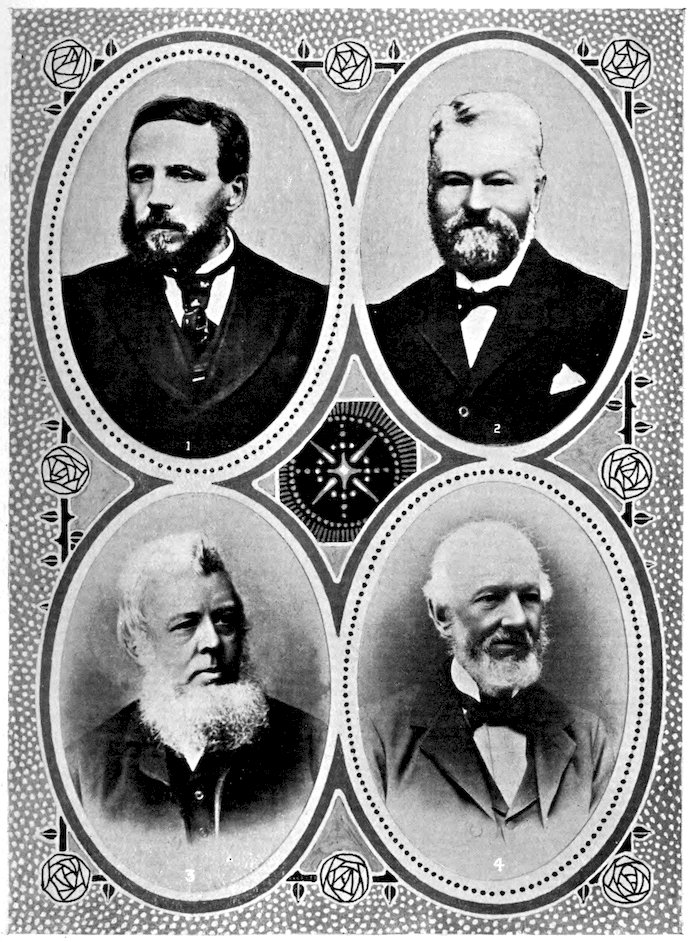
PAST PRESIDENTS
1. GABRIEL THOMSON. 2. WM. BARCLAY.
3. DONALD CAMERON. 4. ANDREW BROWN.
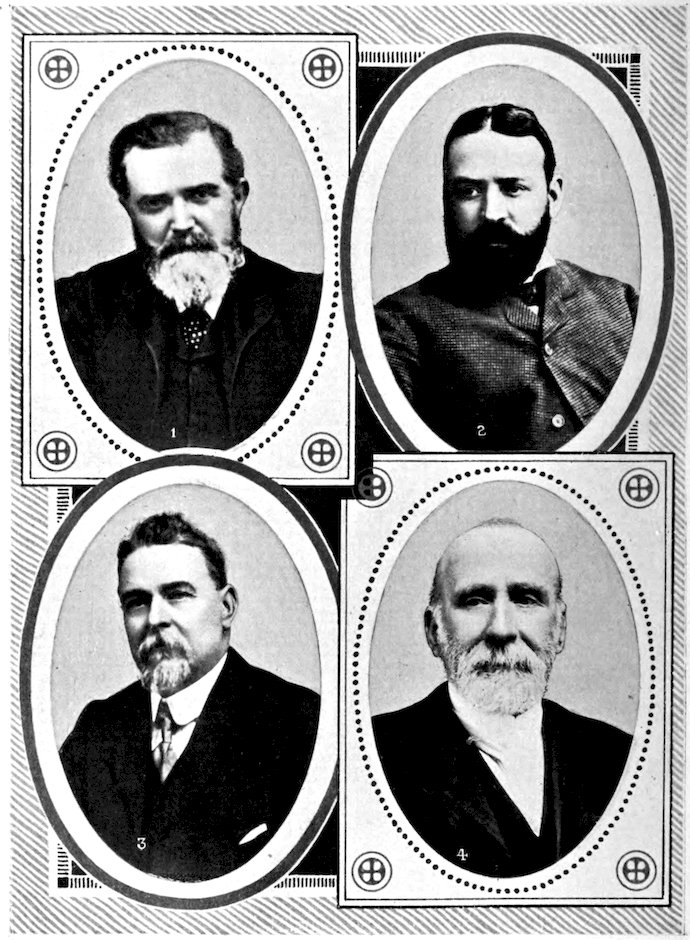
PAST PRESIDENTS
1. ALEXANDER FRASER. 2. JOHN FERGUSON.
3. DUNCAN M‘CULLOCH. 4. DANIEL H. GERRARD. J.P.
65
At one of the meetings of the committee, held towards the
end of 1877, an interesting report was given by the Johnstone
representative, which was not without its humorous side.
Nearly a year earlier the Bakery committee had installed
machinery for biscuit baking, and had been building up a good
trade. Nevertheless, the Johnstone committee had thought
it necessary to inquire into complaints which were being made
by their members. The biscuits manufactured by the Baking
Society were sold in paper bags which contained 28 for 1/,
and the members complained that other grocers gave 30 biscuits
for 1/. The committee of Johnstone Society had carried out
their investigation in a practical manner. They had purchased
a bag of each of the other makers’ biscuits and had weighed them.
The result showed that the U.C.B.S. 28 biscuits were heavier
by 5½ oz. than were the 30 biscuits of one maker, and were as
heavy as 34 biscuits of another maker, while in each case the
Society’s biscuits were pronounced to be the better in quality.
It is easy to imagine how heartening to a committee who were
continuously being pestered with complaints about the quality
of their wares such a report would be, and the chuckles with which
the humorists amongst them would agree that it should be
engrossed in the minutes “for the information of the delegates
attending the quarterly meeting, so that they may be in a
position to lay the matter before their respective committees;
which may result in a considerable extension of this branch of
trade.”
For some months the committee had been discussing
tentatively the installation of baking machinery, but without
coming to any definite decision on the matter. In the beginning
of 1878, however, they began to inquire into the subject in earnest,
and appointed a committee to get all necessary particulars as
to cost, effect on working expenses, and effect on the quality
and appearance of the bread, of such machinery. After this
committee had reported, the subject was discussed by the general
committee and then remitted to the quarterly meeting. There
the delegates ordered the report to be printed in circular form
and sent out to the societies, so that the delegates might come
to the next quarterly meeting with instructions. At the next
meeting a motion that machinery be installed in the bakery
was agreed to by a small majority. The amendment, “that it
be not installed,” seems to have been the last protest from those
societies who wished a branch to be established at Paisley or
Johnstone, but with the installation of machinery their last
hope of achieving their purpose disappeared.
66
When the Society purchased the property in St James Street
they were very poor and had to take a bond on the property,
and when, a year or two later, the adjacent property in Park
Street was purchased, the amount of the bond was increased,
the total being £830. Now, in 1878, the committee found
themselves in a position to pay out the bondholders, and
accordingly this was done. The views of the committee on
the subject of “bonds,” as reported in the minutes, are
interesting and worthy of quotation. They state:
“The uplifting of the bonds has entailed a considerable expense
to this Society. The amount was advanced by four separate parties,
who had each to be secured by a separate bond. We should draw a
lesson from this which might be beneficial to us in the future, to
make us beware that this or any of our respective local societies
never have a ‘bond’ on any property where it is possible to get
co-operative money.”
At this point it may be interesting to note the apparent
effect which the withdrawal of the trade of Barrhead Society
had on the Bakery. For the ninth year the average turnover
of the Society was 223 sacks per week, while in the tenth year
this fell to an average of 188. The position is more fully
illustrated by taking the totals for the two years; that for the
ninth year being 11,588 sacks, while that for the tenth year had
fallen to 9,774 sacks. About this time the members were
beginning to be uneasy about the Oakmill Society, in which they
had invested £200, and at one quarterly meeting a delegate
wished to know whether the committee considered the shares
of this society a safe investment. The meeting was assured by
Messrs Barclay and M‘Nair, who were both members of the
Oakmill Society, that they considered the investment quite a safe
one. At the quarterly meeting in March 1879 question was
again raised, when Mr Alexander, the treasurer of the Baking
Society, gave it as his opinion that “the loan capital in Oakmill
Society was as safe as ever it was.”
Meantime negotiations had been going on as the result of
which the tenants in the bolt and rivet shop agreed to remove,
and their boiler, engine, and shafting were purchased by the
67Society for use in driving the machinery which was being
installed in the bakery. A new roof was also being put on the
bakery, and the question of erecting two new ovens in the
premises vacated by their tenant was being considered, when
the news came that Johnstone Society had decided to start
baking on their own account. This put an end for the time
being to any thought of erecting new ovens, as the withdrawal
of this society would again reduce the trade to below the
capacity of the ovens already erected, but, notwithstanding that
fact, it was decided that the whole question should be submitted
to the quarterly meeting for its decision. The 40th quarterly
meeting was held on 1st March 1879. The society had now
been in existence for ten years, and although the outlook at the
moment was not very bright, yet worse times had already been
met and overcome. Doubtless, the members of committee were
looking forward to the time when other societies at a distance
from the centre would begin baking on their own account, but
they knew also that the membership of the societies in the
immediate vicinity of the Bakery was increasing, and hoped to
recoup themselves in this way. At the quarterly meeting a
general discussion on the question of building new ovens, in
view of the fact that Johnstone Society was withdrawing, took
place, but no decision was come to.
In considering the trade for the ten years during which the
Society had been established, it is to be noted that that for the
ninth year was the greatest, 11,588 sacks having been turned
into bread and biscuits in that year. The tenth year was the
first in which there was a fall in the turnover, each of the first
nine years showing a steady increase over that immediately
preceding, and the reason for the drop in the tenth year was so
obvious and so insurmountable that no uneasiness arose in
consequence. From the second quarter in the seventh year
the dividend each quarter was almost uniformly a shilling or
over, and by the end of the tenth year no less than £8,051 had
been allocated in dividend, as well as £75 as dividend to non-members;
while £1,548 had been paid as interest on share and
loan capital. Thus in the first ten years, those associated with
the Bakery had received nearly £10,000, which they certainly
68would not have received had the Baking Federation not been
started. In addition, they had a valuable property represented
by shares and loans amounting to £5,706, while private loan-holders
had also £544 invested. At the same time, in addition
to the employees being paid wages equal to those paid elsewhere
in the trade, £766 had been divided amongst them in the form
of bonus. The directors were also extremely liberal in their
depreciations, for during the ten years £4,270 had been written
off property, stocks, machinery, fittings, and live stock. This
made for the stability of the Society. In view of the fact that
the capital was small and the capital outlay comparatively
large, the financial policy adopted of devoting large sums to
depreciation instead of paying them away in dividends was a
sound one, and enabled the committee to undertake with a
light heart extensions which would otherwise have caused
them considerable anxiety. They had established on a sound
financial basis a structure which was to prove of lasting benefit
to the co-operative movement, and which was to bear no uncertain
testimony in future years to the ability of the builders and to
the soundness of the principles on which they were carrying on
their business.
CHAPTER VII. ST JAMES STREET: CONGESTION. — RELATIONS WITH EMPLOYEES. — CANVASSING FOR TRADE. — THE GROUND ANNUAL. — DIFFERENTIAL TREATMENT. — PRESIDENT AND TREASURER RETIRE. — KEEPING DOWN PRICES. — THE OAKMILL INVESTMENT. — FURTHER EXTENSIONS. — COSTLY LITIGATION. — TRANSFERABLE CAPITAL. — STILL FURTHER EXTENSIONS.
69
A FALL IN MEMBERSHIP—RELATIONS WITH EMPLOYEES—CANVASSING FOR
TRADE—GOOD BREAD—GROUND ANNUAL PURCHASED—DIFFERENTIAL
TREATMENT—PRESIDENT AND TREASURER RETIRE—KEEPING DOWN
PRICES—OAKMILL FAILURE—A PECULIAR COMPLAINT FROM KINNING
PARK—FURTHER EXTENSIONS—COSTLY LITIGATION—TRANSFERABLE
CAPITAL—STILL FURTHER EXTENSIONS.
In the preceding chapter the decline in the turnover of the
Federation, and the circumstances to which that decline was
due, have been detailed. During the latter half of the tenth
year three societies had withdrawn or been paid out, and the
membership of the Federation, which had consisted of twenty-six
societies at the beginning of the year, consisted of only
twenty-three at the end. For three years no new societies had
joined, and the increase which had taken place in the trade was
due entirely to increased membership of the societies which
were members of the Federation, and to a growing demand on
the part of the members for co-operatively produced bread.
Two of the societies whose names had been struck off the roll
had been little more than nominal members for years, and their
loss scarcely affected the trade at all, while, by the beginning
of the eleventh year, the substantial decrease which had resulted
from the withdrawal of Barrhead Society showed signs of being
completely overcome. The turnover, which had averaged 185 sacks
per week in the last two quarters of 1878, as compared with 226
in the third quarter of 1877, rose in the first quarter of 1879 to
207 sacks, and by the end of that year was up to 216¾ sacks.
The prospects for the immediate future were not too bright,
however, as Johnstone Society, in reply to a letter which had
been sent by the Bakery board, stated that they had definitely
decided to begin baking for themselves. On 21st February 1880
the committee had before them the formal notice from the society
of their withdrawal from the Federation, which was accepted.
70At the same meeting Mr Green, who had been the representative
of Johnstone Society on the committee for eight years, was
thanked by the committee for the great interest he had taken
in, and the valuable services he had rendered to, the Baking
Society. Mr Small, Johnstone, who had been one of the auditors
since the beginning of 1876, had resigned six months earlier, in
view of the fact that his society proposed withdrawing from the
Federation.
Notwithstanding the fact that the withdrawal of Johnstone
Society was imminent, and that the quarterly meeting of
delegates had given no decision on the subject when it was before
them at the fortieth quarterly meeting, the committee, by a
majority of 9 votes to 2, decided at their next meeting to proceed
with the erection of two ovens additional in the premises just
vacated by their tenants. At the same time the work of
installing machinery was proceeding, and by the middle of the
summer the work was completed, as was also that of reslating
the bakery roof. The whole of this work was earned out at a
cost of almost a thousand pounds, and placed the Federation
in a position to handle a considerably larger trade than they
were doing at the moment.
At the same time they were considering the wages of their
bakers and vanmen. These workers had always been paid the
wages current in the trade, and now it was reported to the committee
that the wages of bakers in the city had been reduced
by 2/ per week. The subject was discussed on several occasions,
being postponed month after month for lack of precise information,
and perhaps, also because they were loth to take the step
of reducing wages. Finally, a decision was arrived at. The
information was to the effect that nineteen bakers, eight vanmen
and stable hands, and four employees in the breadroom and
office were receiving a total of £46, 16s. per week. The details
of the bakery wages showed that the ordinary bakers were being
paid 29/ per week; the ovensmen, 32/; the stockkeeper, 33/;
the biscuit baker, 35/; and the under foreman, £2, 2s.; and
it was agreed that the wages all round be reduced by 2/ per week.
The vanmen who had charge of two-horse vans had their wages
reduced from 27/ to 25/; one man who had 24/ had his wage
71reduced to 23/; and those who were being paid 21/ had no
reduction made. Naturally, this reduction did not meet with
the approval of the employees, but for three months they do
not seem to have taken any action. At the end of that period,
however, the committee were memorialised by both bakers and
vanmen, and the request made that their wages should be
brought up to the former figures. In reply to the vanmen’s
request, the committee said that after careful consideration they
could see no good reason why they should alter their former
decision. The reply to the bakers was couched in somewhat
different terms, but it was to the same effect. It was stated that
the reduction was entirely due to the state of the labour market
in the country. From the reports which had appeared in the
public press, it seemed that similar reductions had been made
in other baking establishments, and, as the Federation had
advanced wages when advances were given elsewhere, when
reductions were made they were only following the usual course
which regulated wages in the trade. The minute continues:
“But to show that we have no wish to take any undue advantage
of their position, if they can establish to the satisfaction of this
committee that the United Baking Society are paying less than
the standard wage current in Glasgow, we as a committee would
have much pleasure in reconsidering the whole question at
next meeting. Until that is done we adhere to our former
agreement.”
Meantime, the committee had not been idle. They visited
a number of societies which were taking bread from them, but not
all that they required, with the view of getting them to place
the whole of their orders with the Society. They also visited
several societies which were within a comparatively short
distance of Glasgow, and one of these—Renfrew Equitable—was
so pleased with the quality of the bread supplied that after
a comparatively short trial they agreed to take the whole of
their supplies from the Federation. This was cheering news,
and offset some of the other worries which were cropping up
occasionally. Flour at this time was rising very rapidly in price.
During the quarter it had risen by 10/6 per sack, the last rise
being 4/6, and the bread had, in consequence, to be advanced in
price—the common bread to 7d. per 4–lb. loaf and the “fine”
72to 8d. Some trouble was also being experienced with the engine
which they had put in. New rings had been put on the piston
rod, and the engineer informed them that this would require to
be done about once in every six months. At first the committee
were sceptical, but inquiries elsewhere confirmed the engineer’s
opinion. The trade at this time was fairly prosperous, for the
profit realised was averaging about £30 per week. They were
very particular also to see that their financial position was kept
on safe lines, and spent a good part of one night discussing the
allocation of the cost of the additions to the property to the
various accounts. The result was that they agreed to add the
cost of the new machinery to fixed stock account, the cost of the
new ovens and division wall to property account, to be depreciated
according to rule, while the cost of reroofing the bakery and
refitting the breadroom they decided to pay out of revenue. The
latter decision was challenged at next quarterly meeting, but
on a division the delegates by a large majority upheld the
decision of the committee. Towards the end of 1879 they made
another comparison of their bread with that of their competitors,
and came to the conclusion that, as the minute puts it, “the
Society’s bread was superior both in shape and colour, while the
members had great reason to be satisfied with the great improvement
which had been made in the french and pan bread. A
unanimous expression of opinion was given that it had been the
best comparison they could remember where the Bakery bread
stood in such a pre-eminently favourable position.” After
making due allowance for the partiality of the committee for
bread of their own manufacture, it would, appear that the
expectations of good to be derived from the installation of
machinery were being realised. The committee also this year
issued calendars to the societies. This had been done on at least
one previous occasion.
At one of the last meetings held in 1879 Mr Slater drew
attention to the fact that the payment of the ground annual
for the land on which the bakery was built was costing the
Society £68 a year. He suggested that this should be bought
out, giving the probable cost as about £1,400, and also that the
necessary money might be raised by means of loans from
73societies and individuals connected with the movement, pointing
out that it would be a good investment for the Society and a
safe one for those who lent the money. The suggestion was very
favourably received by the members of the committee, and was
brought to the notice of the delegates at the first general meeting
of the Society. There the committee were instructed to put it
on the programme of business for the annual meeting of the
Society. At that meeting, however, the question was shelved
for the time being, a motion being agreed to “that they delay
at present taking any active steps to purchase the ground
annual, and that the matter be left in the hands of the committee
to bring it up again when they consider that the Society
is in a position to do it with advantage.” It was not until a
meeting of committee held on 18th November 1882 that the
subject was raised again, and again this was done by the
secretary in the form of a definite motion “that steps be taken
to purchase the ground annual.” He pointed out that they
were paying £68 per annum to persons outside who had no
other interest in the movement, and that this sum would be
retained for the benefit of the Federation, while the purchase
would also assist to a certain extent in the solution of the
problem of what to do with their surplus capital. The other
members of the committee agreed, and it was decided to call
a special meeting at the end of the 56th quarterly meeting to
consider the question. At this meeting the committee were
empowered to make the purchase at once, and entered into
negotiations with the proprietors, with the result that after a
considerable amount of negotiation and delay the Society
became the owner of the ground annual at a cost of £1,652, 2s. 6d.,
being twenty-three and a half years’ purchase of the sum paid
annually. The Society was now so wealthy that the directors
were able to pay this sum from the bank balance without
interfering with their deposits in the Wholesale Society.
For some reason which is not very easy to understand after
the lapse of time the committee did not treat alike all the
societies which withdrew from the Federation. For instance,
Barrhead Society had no deduction made from its capital on
withdrawing, while Johnstone Society, two years later, was
74asked to pay 7½ per cent. toward the reserve and depreciation
funds. As the circumstances which led to the withdrawal of
the two societies were practically similar, and as the financial
position of the Federation had changed, if at all, for the better
in the interval, to find a reason for the differentiation is a
little difficult. Parkhead Society, which withdrew shortly
after Johnstone, were charged 10 per cent., but in this case
the society had not been regular or consistent customers of
the Federation, and at the meeting at which intimation of
their withdrawal was given very serious complaints of their
unco-operative methods were made by the sub-committee.
The year 1880 was notable for the retiral of two officials of
the Society who had given long and faithful service. Mr
Alexander, who had been treasurer almost from the beginning,
was defeated at the annual meeting held in March, Mr James
M‘Murran, Glasgow Eastern, receiving the greater number of
votes. At the same meeting Mr Andrew Brown, who had been
president of the Federation from 1872, intimated that it was
not his intention to seek re-election, his reason for this course
being that his society, Paisley Provident, had decided to open
a bakery of their own. At the following quarterly meeting the
delegates decided to present Mr Brown with £30 as a token of
esteem for the manner in which he had conducted the business
of the Society during the years in which he had been president.
This decision called forth a protest from Paisley Equitable
Society—in the first place from the committee of the society,
and later by the authority of a quarterly meeting—but the
committee of the Baking Federation held that as the decision
had been that of the delegates the matter was one in which they
could not interfere, and in due course the presentation to Mr
Brown took place. Mr Alexander Fraser, Busby, was elected
president in succession to Mr Brown, and during his term of
office the Society entered on a period of prosperity much greater
than any which had been experienced hitherto.
By the withdrawal of Johnstone and Parkhead societies the
membership of the Federation now numbered only twenty-one
societies, and for four quarters there was no addition. But
although societies did not join up with the Federation very
75rapidly customers on a non-member basis were coming in.
First there was a request from Allander Society for supplies,
coupled with the promise that in a very short time an application
for membership would follow, and the committee agreed to
supply them provided that the accounts were settled fortnightly.
In September the Society was admitted to membership. Owing
to the coming withdrawal of Paisley Provident Society the
committee took energetic steps to make good the deficit in the
output which would occur when this took place. They selected
Greenock district as a likely field to tap, with such good results
that Greenock East-End Society soon became purchasers and
were admitted to membership early in the following year. Port-Glasgow
Society followed, and after a little Ann Street Society,
Greenock, became a customer, to be followed shortly afterwards
by Dalmuir, Clydebank, and Cowlairs societies. Then came
Clippens Society and Greenock Industrial. To get in all these
societies, however, had taken nearly two years, and there had
been decided fluctuations in the output during the period. With
the withdrawal of Paisley Provident Society, notwithstanding
the increased trade which came from Greenock, the number of
sacks baked had dropped from 235 in the 48th quarter to 186
in the 51st; then there began a gradual rise until the 63rd
quarter showed an average output of 267 sacks per week. The
withdrawal of Paisley Provident Society had meant a loss to
the Baking Society of trade amounting to about £2,000 a quarter.
There is nothing new under the sun. During the war period
it has been common knowledge that the U.C.B.S. was responsible
for keeping down the price of bread when the other master
bakers desired to raise it. This was not an entirely new role
for the Society to play, however. In 1880 it was successful in
forcing the bakers of Glasgow to reduce the price of bread within
a fortnight after having raised it, because of the Society’s refusal
to raise the price also.
The members of the committee had been somewhat chary
about investing any money in the Oakmill Society, although it
was finally decreed by the quarterly general meeting of the
76Society that this should be done. For some time there had been
reports that all was not well with this society, and more than
once questions had been asked in the Baking Society’s general
meetings on the subject. At length matters were coming to a
crisis, however, and a circular was issued to the societies by the
S.C.W.S. in which that society wished to be informed how much
they were prepared to give to Oakmill Society on loan. The
Baking Society’s committee replied that they could do nothing
until they had consulted the general meeting of members. The
circular had been issued in June, and in August the committee
decided to withdraw the amount of interest on their loan to
Oakmill Society which had been allowed to accumulate, and now
amounted to £47. At this meeting it was also decided that the
question of a further loan be not brought before the quarterly
meeting. Shortly afterwards the society went into liquidation,
and when the final settlement was made the Baking Society found
that they had lost £122, 11s. 8d. This sum was liquidated by
being paid from the reserve fund.
In 1882 a disaster befell Barrhead Society, their bakery being
burned down, and during the time it was being rebuilt they got
their bread from the U.C.B.S. This meant an immediate increase
of twenty sacks per week in the turnover, which was of importance
at the time; but what was of still more importance, it served
to lessen the breach which had opened between the Federation
and the society and paved the way for the return of the society
to the fold at a later date.
During the earlier years of the Society’s history the mention
of letters in “red ink,” sent as reminders to societies that their
indebtedness to the Federation was exceeding reasonable limits,
was frequent in the minutes, but in these later years such “red
ink” circulars do not seem to have been sent. At anyrate,
mention of them no longer appears. This did not mean,
unfortunately, that all the societies were now sufficiently alive
to the need of paying their debts promptly and that they had
the cash at hand wherewith to pay them. The position of some
of the societies was still a matter of grave concern to the Baking
Society’s committee, and in one or two cases societies went into
liquidation. One such society was Allander, which had only
joined the Federation in 1881, and which went into liquidation
towards the end of 1883. From this society they got one shilling
77in the pound. Another case was that of Petershill Society, which
went into liquidation early in the same year and which had paid
its debt to the Baking Society in full.
At one time there was trouble with Kinning Park Society of
a peculiar kind. The committee of that society sent a letter
to the Baking Society’s committee, in which it was stated that
the impression in that society was “That if a situation is wanted
in the Bakery, the most effective way to secure it is to denounce
Co-operation, and the Kinning Park Society in particular.”
The board, in discussing this letter, expressed the opinion that
it was a matter with which they had nothing to do. It was no
business of theirs where their employees did or did not purchase
their goods. This sound business rule is one which is still in
operation in all well-regulated societies. At the same time, it
must be admitted that when a man is working for a principle
as well as for a livelihood, his work is likely to be better done.
There are still workers in the movement, however, who, while
professing to work for it, treat it worse than they would be
allowed to treat a private employer, by denying it the efficient,
loyal, and painstaking service which they would be compelled
to render for wages alone. No more was heard of Kinning Park
complaint. The terms of the letter were probably an
exaggeration of whatever grievance there was.
For some years the fluctuations in the trade of the Society
had been such that further extensions had been unnecessary,
but, by the end of 1882, the congestion had become so great
that it was necessary that further baking accommodation should
be procured at an early date. This raised a debate as to the
respective merits of increasing the oven accommodation at
St James Street or putting down a branch bakery at Greenock
to supply the societies in that area. The societies in the
Greenock and Port-Glasgow area were all members of the
Federation, but there were both difficulty and expense
entailed in sending the bread from Glasgow, and, especially
in winter, when there was fog on the river, there was
occasionally irritating delay. The result of the debate was that
a committee was appointed to consider the different schemes
and report.
78When the special committee reported on the various points
which had been remitted to them to discuss there was considerable
difference of opinion amongst the members of the
Bakery board as to which was the best plan to adopt. Finally,
on a vote being taken, it was agreed, by a majority, to recommend
to the general meeting the erection of a branch bakery
in Greenock. When the question came before the delegates
at the quarterly meeting, however, the scheme for a branch
in Greenock was not adopted, and it was decided to proceed
with the erection of two additional ovens at St James Street.
In 1884, however, the trade was again outgrowing the
accommodation, and in November of that year the committee
decided to rent a bakehouse in Scotland Street in order to
relieve the congestion. The membership of the Federation was
again up to 26 societies, and the output at the end of 1884 was
281 sacks per week.
For a considerable part of this period the Federation were
buying much of the flour they used elsewhere than from the
Wholesale Society, and discussions on the subject took place
from time to time. The contention of the Bakery board was that
they were being asked by the Wholesale Society to pay considerably
more for flour than they could buy the same quality
for elsewhere, and from the minute of an interview which took
place between representatives of the two boards, it appears
that the Wholesale representatives agreed that this was the
case at the time. The Wholesale board could not see their way
to make any alteration at the time on their method of charging,
however. Nevertheless, it is gratifying to know that in a short
time the Wholesale Society was in a position to meet competitors
on level terms, and towards the end of 1884 a large proportion
of the flour used was purchased from the Federation.
Early in 1884, the Society became involved in a lawsuit.
An accident took place through which a horse belonging to the
Glasgow Tramway and Omnibus Company was killed, and as it
was found impossible to come to any arrangement which would
be satisfactory to both parties, the Sheriff-Substitute for
Renfrewshire was called upon to decide. The committee were
agreeable to take responsibility for the accident, which had been
79caused by one of their horses running away while being unyoked.
The Tramway Company valued the animal killed at £35, while
the veterinary surgeon employed by the Society to value it
immediately after the accident placed its value at £16, but the
Tramway Company manager refused to make any concession.
After the dispute had dragged on for a month, during which the
case was taken into Court and the Society lodged £20 in full of
all claims, the Tramway Company’s agent offered to try and
induce his clients to accept £30 in full of all claims, each party
to pay their own expenses. This offer the Society refused to
accept, but when the case came before the Sheriff-Substitute
he decreed for £35; at the same time passing severe strictures
on the method in vogue at the bakery when horses were being
yoked and unyoked. An appeal to the Sheriff-Principal was
lodged, but he also decided against the Society, with the result
that, instead of settling for £35, they had also a heavy bill to
pay for expenses.
At the quarterly meeting held in June 1884, some reorganisation
of the work of the office took place. As a preliminary step,
the office of treasurer to the Society was abolished. With the
exception of a short period at the beginning, this office had been
held by two men—Mr Alexander of Paisley and Mr M‘Murran
of Glasgow Eastern Society. At the meeting at which the office
of treasurer was abolished, an attempt was made to make all
the capital of the Society transferable, but this proposal was
defeated by a narrow majority; fifty-eight delegates voting for
the proposal and thirty-two against it. As a two-thirds majority
was necessary, the vote in favour was six short of the
necessary number.
During the summer of 1884 the Society was experimenting
with a new form of barm, produced by a patent process. The
results of the experiments, however, were not satisfactory.
The new barm was found to be no improvement on the old,
while the recipe would cost £5, and thereafter there was to be
a royalty of a halfpenny per sack of flour used, which was to
continue for a year, so the committee decided that no advantage
would accrue to the Society by adopting the new system. About
the same time the committee were in correspondence with
80Mr E. V. Neale on the question of the best method to be adopted
for making the loan capital of the Society secure. They considered
the information they received from Mr Neale so valuable that
they decided to print it and send a copy to each member society.
Notwithstanding the difficulties with which they were
meeting, consequent on their shortage of oven accommodation,
the committee were ever zealous in their endeavours to get
new trade from societies which were not members and to increase
the trade of those which were. During the summer months
they caused a number of letters to be sent to societies, requesting
that deputations should be received, and by this means they
were able to secure increased trade from some of the societies
which were not as loyal as they might have been. Arising out
of the correspondence with Mr Neale, it was agreed at the
September quarterly meeting in 1884 to appoint a special committee
to go into the whole question of the capital of the Society,
with special reference to that held on loan, and with power to
consult a Scottish legal authority on the subject, the committee
to report to the December quarterly meeting. The special
committee consulted the Lord Advocate on the subject, with
the result that, at a special meeting which was held in March of
the following year, the whole share capital of the Society was made
transferable, while the interest on loans was reduced from
5 per cent. to 4½ per cent.
It was becoming increasingly evident that the St James
Street bakery had reached the limit of its usefulness to the
Society. Although biscuit baking and the baking of pastry and
smalls had been transferred to the Scotland Street premises,
it was becoming impossible for St James Street to meet the
demand for bread, and therefore another small bakery situated
in Hill Street was rented for a time. This was only a temporary
arrangement, however, and could not be expected to continue.
The Bakery was now turning over considerably more than 300
sacks of flour per week, and the trade was increasing at such
a rapid rate that it was practically impossible to keep pace with
it in the premises as they then were. The need for a new
bakery was clamant, and much consideration was given to the
question ere a decision was arrived at. That decision, when
come to, proved to be the most momentous in the history of
the Federation, and may well form the subject of another
chapter.
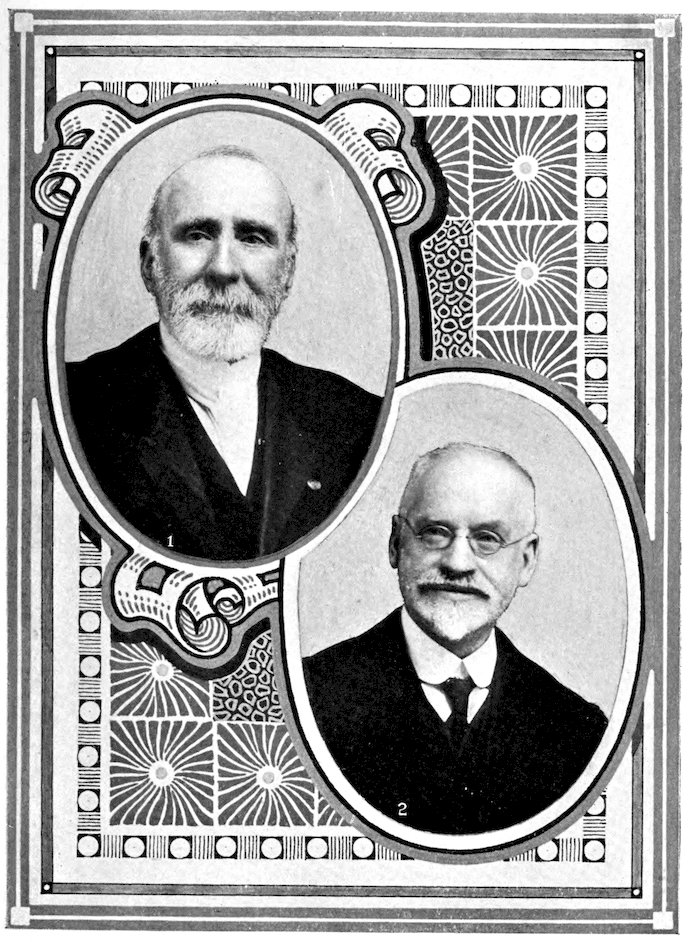
1. DANIEL H. GERRARD. J.P.,
President.
2. JAMES BAIN,
Secretary.
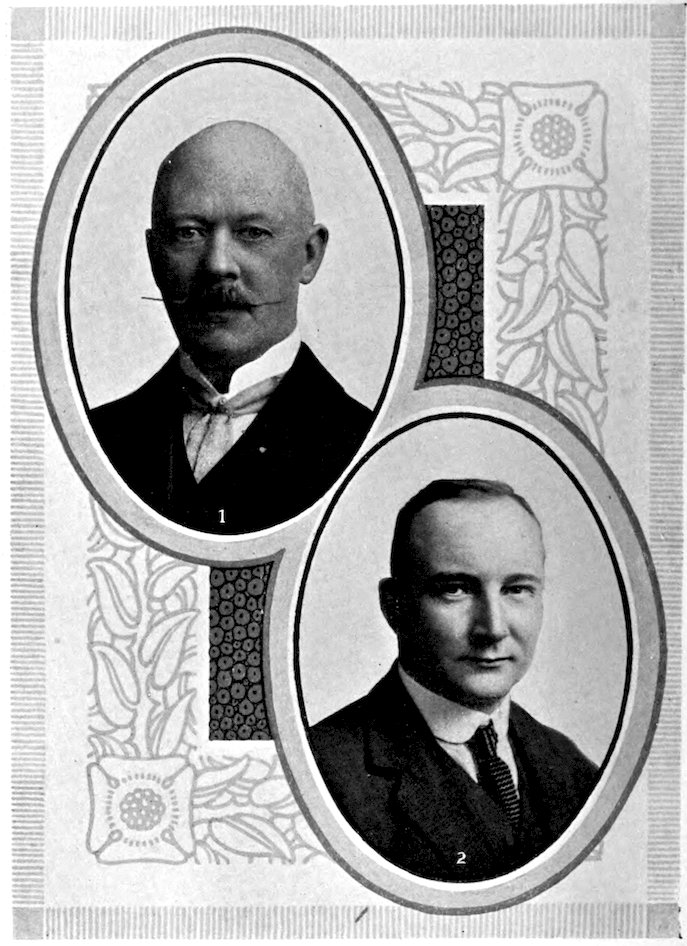
AUDITORS
1. WM. H. JACK, F.S.A.A
2. JOHN M. BIGGAR.
81During practically the whole of the period which is embraced
in this chapter, two gentlemen, still well known, active in the
movement and highly respected—Messrs Allan Gray and
Robert Macintosh—acted as auditors for the Federation, and
during their period of office made several suggestions affecting
the financial stability of the Federation, which, when put into
operation, helped materially to make it the strong concern
financially that it is to-day. In particular, they were the means
of getting the depreciation placed on a sounder basis than it
had been for some time. Investigations which took place more
than once had the result of showing the committee that the rate
of depreciation was not enough, as the book value of fixed and
live stock and machinery was greater than the valuation
showed that it should be. Ultimately, this was put right, and
the finances of the Society were established on a firm footing.
CHAPTER VIII. M‘NEIL STREET. — PURCHASE OF M‘NEIL STREET GROUND. — BUILDING DIFFICULTIES. — THE OPENING CEREMONY. — AN UP-TO-DATE BAKERY. — PROPAGANDA WORK. — RECOGNISING LOYAL SERVICE. — A STABLE INSPECTOR. — FINANCE. — AN INVESTMENT. — A RIGHT OF WAY CASE. — A NEW VENTURE. — THE CHAIRMAN RETIRES. — INCREASES ALL ROUND.
82
INCREASING TRADE—THE DIRECTORS’ DILEMMA—M‘NEIL STREET GROUND
PURCHASED—THE NEW BAKERY: BUILDING DIFFICULTIES—THE
OPENING CEREMONY—AN UP-TO-DATE BAKERY—PROPAGANDA WORK—RECOGNISING
LOYAL SERVICE—A STABLE INSPECTOR—FINANCE—AN
INVESTMENT—THE PURCHASE OF FLOUR—A SOCIAL MEETING AND
ITS OBJECT—A RIGHT OF WAY CASE—THE NEW BAKERY COMPLETED—A
NEW VENTURE—THE CHAIRMAN RETIRES—ALL-ROUND INCREASES.
At the end of the preceding chapter we saw that the trade of
the Society had become so large that it was forcing the question
of a new bakery on the attention of the directors. With the
purpose in view of securing the necessary capital, the sub-committee
advertised the St James Street premises for sale,
but the only offer they received was one to lease the premises.
As this was of no use for their purpose at the moment nothing
further was done. Circumstances, and the policy of the committee,
were responsible for the still more rapid increase of
trade. In the beginning of 1885 the price of flour went up with
a rush, but as the Federation was in the happy position of
having bought a large quantity of flour just before the rise
they were able to continue selling their bread at the old price
while the other bakers had to raise it, with the result that the
trade continued to increase very rapidly. One of the results
of this rapid increase in trade was that the Society was once
again placed in the position of being compelled to refuse orders
because of its inability to execute them. For this reason
Blantyre and Burnbank societies, which had made proposals to
join the Federation, had to be refused for the time being.
The directors were literally at their wits end. They could
not sell their premises. Unless they got new premises they
could not hope to provide for the trade which came pouring in
in ever-increasing volume, and they did not know what was the
best thing to do. To begin with they got a firm of architects,
83Messrs Bruce & Hay, to prepare a sketch plan for a new
bakery on the St James Street site which would contain twenty-four
ovens, together with ample accommodation for storing
flour, and stables, a breadroom, and a van yard. When the
architects came to prepare their plans, however, they found
that the space available was not large enough to give all the
accommodation desired. The plans, when submitted, showed
a bakery with twenty-three ovens, stable accommodation for
nineteen horses, van shed, offices, breadroom, and store, and
the cost was estimated at £6,200.
The committee decided that before they would proceed
further they would consider carefully the progress which had
been made by the Society in the ten years which had elapsed
since 1875, and this study of the work which had been done
showed that the ratio of increase in trade had grown larger in
the two years immediately preceding 1885, while the trade which
was being done at the moment warranted them in believing
that this rate of progress would be maintained. This being so,
the conclusion at which they arrived was that, even if they did
build at St James Street, only a few years would elapse before
the accommodation would be too small. They decided, therefore,
to bring their difficulties before the quarterly meeting
and leave the decision with them.
Three schemes were laid before the quarterly meeting,
including the rebuilding of the St James Street premises, which,
however, the directors deprecated. The proposals were discussed
at length by the meeting, but no decision was arrived at, the
question being remitted back to the committee for further
consideration and inquiry. The questions which were remitted
for consideration were: The cost of land in or near Glasgow,
and the cost of erecting thereon a bakery large enough to meet
the wants of all the members; or, alternatively, the cost of
land in or near Paisley, and the cost of erecting a branch bakery
there large enough to meet the demands for bread from the
societies in the West.
There was evidently a desire to reopen the question of a
branch in Paisley, which had been closed since the end of 1876,
but the delegates to the special meeting which was held on
8411th July to hear the report of the committee on the question
of whether a new central bakery should be built or whether
they should content themselves with a branch in or near
Paisley, decided by an overwhelming majority in favour of a
central bakery in Glasgow, and remitted to the committee the
selection of a site.
The sub-committee went about their business of securing a
site expeditiously, with the result that at the meeting which
was held on 22nd August they were able to inform the committee
of two sites, one in Fauld’s Park, Govan, the price of
which was 12/6 per yard; and the other at M‘Neil Street,
costing 15/6 per square yard. It was also intimated that the
latter site had some buildings on it which might be of use to
the Society. The members of the committee visited both sites,
and after having inspected them came to the conclusion that
the M‘Neil Street one was best suited to their purpose, and
empowered the sub-committee to offer £4,000 for it, with power
to go to £4,500 if necessary. At the meeting of committee
which was held on 19th September it was intimated that the
“Nursery Mills,” M‘Neil Street, had been bought for £4,500,
that a deposit of £500 had been made, and that the keys had
been given up to the Society. The property had been insured
for £1,000. The engine and boiler in the building were inspected,
and Messrs Bruce & Hay were instructed to prepare plans of
a bakery containing twenty-four ovens, a travelling oven for
biscuits, and three or four ovens for pastry, as well as van sheds,
stabling, etc. On 13th October the committee empowered the
officials to pay the full cost of the site and take possession of
the title deeds. It was also decided to dispose of the boilers
contained in the property, and at a later date, of the engines;
the total sum received being £207, 10s.
When the plans for the new bakery were submitted to the
committee decided disapproval was expressed, on the ground
that the site was not being utilised to the best advantage, that
the existing buildings were not being used, although they were
worth from £1,200 to £1,300, and that provision was made in
the plan for a courtyard out of all proportion to the requirements
of the Society. It was decided to ask the architect to
prepare other plans, and instructions were given that the
buildings at present on the site were not to be interfered with,
85and that another architect was also to be asked to prepare
plans, with the same instructions. At the same time it was
agreed to sell the St James Street property for £4,500 if a
sale could be effected, and if not that it be rented, the rent
to be £300 per annum. For the next week or two the committee
met weekly. On plans being submitted for the second
time those of Messrs Bruce & Hay were adopted, with some
alterations suggested by the committee, and a building committee
was appointed to supervise the work of erecting the
bakery. Some little difficulty was experienced, however, in
getting the plans through the Dean of Guild Court. Objection
was taken at the Court to the fact that the stable gangway
was not fireproof, and the plans were sent back for alteration.
Presumably all was in order at their next presentation, for
nothing further appears in the minutes on the subject. An
inspector of works was appointed for the job, contracts were
fixed up, and the work commenced. The financing of the
building scheme was also considered by the committee, and
they agreed to appeal to the societies for the necessary money,
at the same time recommending, as an inducement to the
societies to subscribe, that the interest on the loan capital be
increased from 4½ per cent. to 5 per cent. This recommendation
was agreed to by the delegates to the quarterly meeting, and
the committee were also empowered to reopen the private loan
fund if they considered such a course advisable. One result of
the decision of the quarterly meeting was that at the committee
meeting held a fortnight later it was reported that already
£2,080 had been received as loans from three societies—Thornliebank,
Glasgow Eastern, and Kinning Park—while 150
additional shares had been allocated. At the same meeting the
Secretary intimated an offer from Kilbarchan Court, A.O.F.,
offering £400 on loan. This kind offer the committee had to
decline, however, on the ground that the loan fund was as yet
only open to Co-operative societies.
The building work was proceeding satisfactorily, but the
same could not be said of the joiner work. The Dean of Guild
Court had been pushing the Society to get the work of
barricading the building and laying down a pavement done
86The joiner had erected the barricade and made the footpath in
M‘Neil Street, but refused to do this in Govan Street, stating
that he would “go to Court first.” The Society had written
to him, informing him that if he did not do the work, for
which he had contracted, the Society would have it done and
deduct the cost from his account. There was also delay in
pushing on the joiner work in connection with the building
itself, which was delaying the remainder of the work of
building.
The duties of the committee at this time were arduous and
engrossing. They had set out with the intention of erecting a
bakery which would be second to none in the city, and with
this object in view they were not too bigoted to change their
minds when any suggestion was brought to their notice which
was likely to be an improvement on the course they had decided
on. One such alteration was in connection with the new
engine for driving their machinery. The fact that the engine
which they had decided on was too powerful for the work for which
it was needed had been brought to their notice, and they
at once made inquiries and consulted with the maker. After
he had given the matter his attention this also was his opinion,
and he therefore offered them a less powerful engine at a
reduction in price of £65, and they decided to have it put down.
Then “with the object of securing the latest improvements in
bakery machinery, a deputation, consisting of the managers,
foreman baker, and two members of the committee, were
appointed to visit the exhibition of bakery machinery at
Edinburgh, see the machines at work, and report.” As one of
the results of this visit machinery to the value of £500 was
purchased.
The committee continued to complain of the slow progress
which was being made with the new building, and the
architects were appealed to to endeavour to get the contractors
to speed up by putting more men on the job, but with little
success. The lessees of the St James Street premises had been
promised entry by Whitsunday 1887, but as time passed the
committee began to get anxious about their ability to fulfil
this part of their contract. The engines and machinery, also,
were ready to put in, but this could not be done because the
other contractors were behind with their sections. So bad
87did the position become that ultimately the committee were
forced to put the matter into the hands of their agent.
However, this difficulty also was overcome without further
friction. The lessees of St James Street bakery now began
to press for entry, and the committee were compelled to ask
for their forbearance, as they were afraid that the new bakery
would not be ready for occupancy at the time stated.
It was agreed that a social meeting be held on the occasion
of the opening of the new premises, and that the premises be
open to the general public for inspection during the whole of
the opening day. A band was engaged to play selections in
the courtyard for three hours in the afternoon, and the building
was decorated with flags. Finally, such progress was made
with the equipment of the premises that the committee were in
a position to fix 21st May as the opening day, and preparations
for the great event went forward rapidly.
The opening ceremony is said to have been one of the most
imposing Co-operative functions ever held in Scotland. The
buildings were gay with flags and bannerettes, while a military
band discoursed sweet music in the courtyard. The premises
were thrown open to the public, and it is estimated that more
than 30,000 people passed through the building between 10 a.m.
and 5 p.m. More than 500 delegates were present at the
luncheon, when Mr Alexander Fraser, president of the Society,
presided. Stirring speeches were delivered, and the premises
were declared open amid a scene of great enthusiasm.
In the evening a monster social meeting took place in the
Wellington Palace, at which there were present upwards of
1,000 people. Speeches were delivered by Mr William Maxwell,
chairman of the S.C.W.S., and Mr Henry Murphy, Lanark.
It was generally admitted that the demonstration had proved
the greatest advertisement which Co-operation in Scotland had
ever received, and that the virtues of the movement had been
brought to the notice of thousands of people who had never
before given it a thought. The result was that a great impetus
was given to the movement in Glasgow, and the great development
of Co-operation in the city which has made Glasgow a
stronghold of the movement began about that time. No doubt
88further stimulus has been given from time to time—the Congress
of 1890, the opening of the S.C.W.S. central premises in
Morrison Street, the Seaside Homes bazaar, the various
Co-operative festivals all had an influence—but to the Baking
Society much of the original impulse is due, just as to it also—through
the refusal of the directors to increase the price of
bread unnecessarily in the early months of the war—the latest
impulse must be credited.
The bakery was planned on what were then the most
modern lines. It contained twenty-eight ovens. Twenty-four
of these were Scotch bread ovens, while three were specially
built for the production of pastry, scones, etc., and one was a
revolving oven for the production of pan loaves. In the original
plan there was a proposal for a travelling biscuit oven, and
space for this had been left in the bakery. The flour loft was
on the top floor of the building, and everything was arranged
for convenience and rapidity of output. The facilities provided
for an output of some 700 sacks per week, and when the new
premises were planned it was thought that there would be ample
accommodation to meet the requirements of the Society for a
number of years, but so great had been the development of the
Society’s business while the bakery was in course of erection,
and so rapid was the increase when the new premises were
opened, that soon the question of extensions was again to the
front.
In tracing in a connected form the work of the committee
in deciding on and carrying through the work of erecting the
new bakery, however, we have been compelled to leave other
important work unnoted. Just at the time when the discussion
of the proposals for a new bakery was taking place intimation
was received from Kilbarchan Society of that society’s
intention to begin baking on their own account. The letter
from the society was read to the meeting which was called to
consider the erection of a new bakery, but had no effect on the
decision, and shortly afterwards the Kilbarchan people changed
their minds about baking for themselves and decided to remain
members of the Federation. It was otherwise with some
89of the societies further west. Greenock East-End Society
withdrew in September, Greenock Central and Paisley Equitable
soon afterwards, while Partick Society was in a bad way, and
a deputation from the board was sent to the committee of that
society in order to try and make some arrangement about
regular payments. This they were able to do, as the Partick
committee agreed to pay for the bread they received at the
end of every week, at the same time making payments toward
the reduction of the balance which they owed the Federation.
But if societies were withdrawing as they became strong
enough to start bakeries of their own, other societies were
coming in to take their places, while the societies in Glasgow
were growing stronger and stronger. Gilbertfield and Cambuslang
societies joined up early in 1885; Cessnock Society, an
offshoot from Kinning Park, became a member a month or two
later. South-Eastern Society and Parkhead, two societies which
had been members in the early days but had withdrawn, were
again admitted to membership; Renfrew Society again became
purchasers; Newton Mearns and Maryhill societies became
members; Westmuir Economical Society became a purchaser
and, later, a member. Newton Society also joined the Federation,
and Blairdardie returned to the fold after an absence of
several years. Then came Hallside, and by the end of April
1888, Shettleston, making the thirty-sixth member of the
Federation. All this increase in the membership was not
spontaneous, however; it was the reward of much propaganda
work, the writing of many letters and the paying of many visits
by the members of the committee. They were building, and,
later, they had built a huge bakery. It was their intention that
it should be working to its full capacity at the earliest possible
moment, and so they went about their propaganda in a
systematic manner, dividing up the area into districts, which
were placed in charge of certain members of the committee, to
be worked up at every opportunity.
During the whole of the time which it took to build the new
bakery the Society was working at a disadvantage. Notwithstanding
the leasing, first of Scotland Street bakery and then
of that in Hill Street, it was impossible to keep pace with the
90demand for bread. The result was that the committee decided
to sound the foreman baker on the question of whether the
men would be willing to begin work an hour earlier in the
mornings. The men when approached agreed readily, and thus
the difficulty was met to some extent. In recognition of this
willingness on the part of the men to meet them, the board
decided spontaneously to advance the men’s wages by 1/ per
week. One cannot help but contrast this willingness of the
men to help the Society in a difficulty with incidents which
have occurred at later dates, when the bakers could not be
induced on any terms to work extra hours in order that
difficulties might be overcome. The first attitude rather than
the second one is that which makes for the avoidance of friction
and the creation of a fraternal spirit between the directors of
a Co-operative concern and their fellow-members who carry on
the work of the Society. It is, unfortunately, a fact which is
to be deprecated that employees are disposed to treat
Co-operative societies worse instead of better than they treat
other employers, and the process of reasoning which leads to
such results is somewhat difficult to follow.
Away back in the second year of the Federation’s existence
Mr Ballantyne had been appointed stable inspector to the
Society. The appointment had been made by the committee,
but evidently the committee of the period with which we are
dealing were unable to find any record of the fact, and seem
to have taken exception to his work, which, according to one
minute, “was independent of the board, and how or when he
had been appointed could not be discovered.” The difficulty
was not a great one, however. It was remitted to the sub-committee
for investigation and, doubtless, a consultation with
Mr Ballantyne, the gentleman in question, would put them on
the track of the necessary information. Mr Ballantyne, during
practically the whole period of the Society’s existence, had
exercised supervision over the horses which were the property
of the Society. He made a regular examination, and recommended
the committee to dispose of horses which he considered
unfitted for the work of the Society. The committee were
evidently satisfied with the report which was made to them,
91for at the next meeting they endorsed and confirmed Mr
Ballantyne’s appointment and agreed to pay 20/ a quarter for
a monthly report from him on the condition of horses, vans,
and all matters connected with the stable department—the
appointment to be an annual one.
The question of the proper depreciation of the property,
fixed and live stock of the Society, to which attention had
been called by the auditors on many occasions, had not yet
been placed on a satisfactory basis. The committee brought
in several amendments of rules for the purpose of putting the
matter right, but these were not accepted by the delegates;
nor was a counter proposal, that a sum of £200 be taken from
the reserve fund and applied to reducing the value of the horses
and plant. This latter proposal received a majority of the votes
at the quarterly meeting, but as a majority of three-fourths of
those voting was necessary before any money could be withdrawn
from the reserve fund, and the majority was not large
enough, both proposals dropped, and the old, unsatisfactory
position continued. At a later date the question was again
brought up by Mr Macintosh, who, in response to a request by
the committee, outlined a scheme for putting this important
branch of the Society’s financial arrangements on a sound
footing. The practice had been to allocate a certain percentage
of the profits each quarter to depreciation account; Mr
Macintosh urged that for this method they should substitute
that of allocating a fixed percentage of the initial cost, and that
this should be regarded as a charge on the trade of the Society
and should be allocated before the profits were ascertained and
irrespective of whether there were any profits. The committee
were in favour of the proposed alteration, but considered the
time inopportune to have it made as so large a proportion
of the property was unproductive at that time. They therefore
decided to delay the matter for twelve months. It was not
until the end of 1888 that depreciation was put on a satisfactory
basis.
It was during this period that the Scottish Co-operative
Farming Association came into being. The Bakery board were
92supporters of the proposal from the first. In discussing the
subject the committee took into consideration the fact that
they were spending nearly £200 a quarter for feeding-stuffs
and buttermilk for baking purposes, and they thought that if
such an association was in existence a large proportion of these
articles could be got from the farm. They agreed, therefore,
to recommend to the delegates at the quarterly meeting that
a special general meeting be held to consider the advisability
of becoming members of the Farming Association. When this
meeting was held it was agreed that £50 be invested in the
funds of the association. Unfortunately, however, the speculation
did not turn out a success, as, after struggling on for several
years, the association had to succumb to adverse circumstances.
For some considerable time there was a certain amount of
looseness in conducting the stable, and the result was that finally
the committee felt compelled to make a change there by dispensing
with the services of the foreman. There was trouble at
Hill Street also for a time, but eventually this was overcome.
For some considerable time, however, both before and after the
opening of the new bakery, the complaints about the quality of
the bread, which for some years had been almost negligible,
revived, and sometimes the committee at the monthly meetings
had letters from as many as a dozen societies. The causes of
complaint were various, but seemed persistent for a time.
Once before the S.C.W.S. had thought that they had reason
to complain of the share of the U.C.B.S. trade in flour which was
being put past them, and after two or three years had passed
the same subject came up again through a deputation from the
Wholesale Society waiting on the Baking Society’s Board.
The whole subject was gone into minutely, and the Wholesale
deputation were told plainly that while the U.C.B.S. directors
had every desire to trade with the Wholesale Society they could
not do so while such a discrepancy existed between the prices
which the Wholesale Society charged for flours and those at
which similar flours could be purchased elsewhere. The result
of this first meeting was that a second meeting was arranged
between representatives of the two societies, when the whole
subject was investigated. Both committees, it is stated,
“received from each other much valuable information which
would be advantageous to both societies.”
93Reference has already been made to the propagandist work
carried on by the directors at this time. Amongst other work
of a propagandist nature, they held, in the autumn of 1887, a
social meeting, to which the employees of the various societies
dealing with them were invited. The object of the social
gathering was twofold. In the first place, they wished to give
the employees a good time; but they had also an ulterior object
in view, and so they took advantage of the opportunity given
by the social meeting to bring to the notice of the employees
the good which accrued to Co-operators generally by making
the Co-operative movement self-contained and self-supplying,
as far as that was possible. It is not possible to say whether
this first attempt to secure the co-operation of the employees
in pushing the wares of the Society met with much visible success,
but it was one of those efforts from which something might be
gained but by which nothing could be lost. Since that day the
Co-operative employee has been a frequent visitor at social
gatherings convened by the U.C.B.S.
In the course of the propaganda campaign carried out by the
directors, some peculiar proposals were made to them. By the
committee of one society the deputation were informed that the
private bakers from whom bread was being bought not only
supplied the shops, but delivered bread at the members’ houses
as well. In addition, they carried goods from the shops to the
members and, in general, acted as delivery vans for the society.
Nor was this all. In addition to delivering the bread to the
members’ houses, they went the length of absolving the society
from responsibility for loss through non-payment by the members
of their bread accounts. The Baking Society could not hope to
compete against such practices, and the directors said so. In
other instances the societies were prepared to assume
responsibility for payment of the bread supplied to members
if only the Baking Society’s van would deliver it, and the committee
were willing to entertain this proposal, but the quarterly
meeting of the Baking Society decided that bread should be
supplied to shops only of customer societies.
A paragraph of a rather peculiar character appears in the
last minute for 1885. At that time the committee were in the
94thick of their preparations for the new bakery, and must have
been extremely busy. Nevertheless, some time during the
month, a letter was received which must have worried the
secretary and the sub-committee not a little. It was signed
“Thomas Mann,” and was as follows:—
“Gentlemen,—As aiders and abettors in the Kilbarchan Right
of Way case I have to inform you that the expenses, amounting to
£850. are still unpaid, and that unless an arrangement is made with
my law agent within eight days an action will be raised against you
in the Court of Session for the full amount.”
The manager had replied wishing to know on what authority
Mr Mann had taken it upon himself to state that the Society
were aiders and abettors in the action referred to; and in reply
was referred to a paragraph in the Paisley newspaper of 15th
July 1883, in which the Co-operative Baking Society, Kinning
Park, was published as one of the abettors. Mr Mann had no
doubt that the statement was correct, and warned the Society
that it was necessary to attend to his former letter at once to
save future trouble. The Bakery board replied to threat by
threat. If any further communication was received from Mr
Mann, the matter was to be put into the hands of the Society’s
law agent, who was to raise an action against him for trying to
extort money on false pretences, as the Society had never paid
any money to assist in the “Right of Way” case. Nothing
more seems to have been heard of the subject, for nothing
further appears in the minutes regarding it.
In August 1887 the building committee, having completed
their labours, were thanked for their services, and dissolved.
The buildings, plant, and stocks in the new bakery were insured
for £16,000, while the buildings and plant in St James Street
were insured for £2,000. About this time the directors were
called on to consider some grievances under which the employees,
and particularly the vanmen, alleged that they suffered. The
first of those had reference to attendance at the stables on
Sundays. The committee made investigations, and came to
the conclusion that no grievance was suffered. Attendance on
Sundays to look after the comfort of the horses was not work,
they decided, but an act of mercy, which was not paid for
anywhere. The other grievance—that the vanmen by the
nature of their work did not get regular holidays “and had no
opportunity of going to the coast with their families”—the
95directors thought well founded, and they decided to allow three
consecutive days to each man in future, in addition to the
holidays they at present received; stipulating, however, that
no two men were to be on holiday at the same time.
In September, after the new bakery was opened, the Society
began the baking of morning rolls, a branch of trade which
immediately became popular with the members of the societies.
For this trade two light vans and two fast horses were purchased,
and the result was that not only was a large trade in breakfast
rolls done, but the bread trade increased rapidly also. The
baking of rolls had, as a matter of fact, cut the last link which
chained some of the societies to the private baker. The bakers
did not surrender the trade of the societies without a struggle,
however. Finding that they were ousted from the roll trade,
they turned their attention to buns as a means of recapturing
the lost trade, and for a time they were successful with a number
of the societies. But the Bakery directors were alive to the
danger, and ere long they also were baking buns at M‘Neil Street.
Having seen the new premises in full operation, Mr Fraser
came to the conclusion that the time had come when he should
resign his position as president of the Society. During his seven
years of office he had seen the trade doubled; he had seen the
handsome new bakery erected and opened; and he had seen the
Society established in an unassailable position. While a member
of the committee, during the presidency of Mr Brown, and while
he had been president, he had been a hard worker for the success
of the Society, and well deserved the words of eulogy in which
Mr Slater conveyed the thanks of the committee to him at the
last meeting of the board before his retiral. He was succeeded
by Mr John Ferguson, Glasgow Eastern Society.
Inside a month or two, he was followed into retirement by
Mr Thomas Slater, secretary. Mr Slater had been elected
secretary in 1875 when Mr Smith became manager, and had
discharged the duties of his office faithfully and well. At the
time of his retiral, and indeed for many years before then, he
96had the longest record of service on the board of the Society.
Mr Peter Glasse, St George, succeeded him.
At the end of 1887 the Society was doing a trade of over
410 sacks per week, and in the first month of the new year 600
new shares were granted to societies. By the end of the 77th
quarter the trade had risen to 446 sacks per week, and a
dividend of 1/3 was paid. The increases which were taking
place in the numbers of shares held by the societies pointed to
increases in membership, and therefore to opportunities for
increased trade by the Federation. The directors were fully
alive to this phase of the subject, and although they were still
a considerable distance from producing the full capacity of the
bakery, it was becoming evident that if the present rate of
increase continued that limit would soon be reached. At the
same time they could be pardoned if they felt that the delegates
were not as appreciative of the work which was being done as
they might have been. This lack of appreciation was shown
in a remarkable and unprecedented manner at the 76th quarterly
meeting of the Society when, by a majority of two votes, it was
decided to reduce the payments made to them for their services
from 3/ to 2/ per meeting. Lack of appreciation could hardly
have gone further short of asking them to resign in a body. It
was a very shabby return for the years of strenuous work which
had made the Baking Society that outstanding instance of
Co-operative enterprise which it had become. The directors
went on with their work calmly, however, content to merit,
even if they did not receive, the appreciation to which their
efforts for the success of the Federation entitled them.
CHAPTER IX. M‘NEIL STREET: RAPID DEVELOPMENTS. — FURTHER EXTENSIONS. — THE U.C.B.S. AND THE S.C.W.S. — AN ACCIDENT. — RESIGNATION OF FOREMAN BAKER. — RESIGNATION OF MANAGER. — THE FIRST GLASGOW BOYCOTT. — A NEW PRESIDENT. — MAJORITY CELEBRATIONS. — THE DINNER. — STILL MORE EXTENSIONS. — STILL FURTHER EXTENSIONS. — NEW BUILDING COLLAPSES. — MORE BUILDING.
97
A BISCUIT FACTORY—FURTHER EXTENSIONS—THE U.C.B.S. AND THE
S.C.W.S.—AN ACCIDENT—RESIGNATION OF FOREMAN BAKER—CO-OPERATIVE
FAILURES—THE MANAGER RESIGNS—FIRST GLASGOW
BOYCOTT—A NEW PRESIDENT—MAJORITY CELEBRATIONS—THE DINNER—STILL
MORE EXTENSIONS—THE INFLUENCE OF CONGRESS—EXTENSIONS
AGAIN—ST JAMES STREET PREMISES SOLD—NEW BUILDING
COLLAPSES—MORE BUILDING—BUILDING DEPARTMENT STARTED.
The Baking Society had now entered on a period of extraordinary
development. Department was added to department and
extension followed extension with marvellous rapidity. It
seemed, indeed, as if the spirit of Co-operation had only been
waiting for a suitable habitation in order to show the great
things of which it was capable. In the six years—1888–1894—the
output of the Society rose from 466 sacks per week to 1,254,
and the number of departments in the bakery from two to seven,
while tearooms had been opened, a purveying department was
being carried on, and a workshops and trades department was in
operation. The sales for the 77th quarter were £12,438; by
the end of the year they were £16,490, and by the 88th, which,
however, was a fourteen week quarter, they were £27,210. The
trade had more than doubled in three years. In the same period
the membership, which had been thirty-six societies at the end
of the 77th quarter, had grown to forty-six at the end of the 88th.
Before the Society had been six months installed in M‘Neil
Street the committee were beginning to have visions of congestion
such as they had experienced in St James Street, unless
they took time by the forelock and made arrangements which
would enable them to grapple with their ever-increasing trade
before it again overwhelmed them. The first business they
decided to tackle was that of erecting a biscuit factory, where
they could produce fancy biscuits of all kinds. Hitherto they
had been getting such biscuits as they were able to sell from a
98firm of manufacturers in the city, and were having them invoiced
through the S.C.W.S. Investigation showed that this mode of
procedure was one which was not profitable to the Society, but,
at the time when the investigation was made, the directors were
not in a position to do anything; and when they secured the
ground on which to build their new factory the congestion
in their bread department made instant provision for that
department the premier necessity. But now that they had the
bread difficulty settled for a short time they turned their attention
to the question of biscuits. Provision had been made in the new
building for a travelling oven, but its installation had been held
over while the more important work was being carried out.
Early in 1888, however, it was decided to purchase a biscuit cutting
machine, and one similar to the working model which
was being shown in Glasgow Exhibition was ordered, at a cost
of £258. They did not act without caution, however, for before
the machine was purchased they wrote to the manager of
Crumpsall bakery for his opinion of the biscuit machines made
by the firm from which they proposed to purchase. With the
object of ensuring that everything possible would be done to
promote the sale of the biscuits when they were made, the
committee also approached the directors of the Wholesale
Society as to the likelihood of that federation becoming agent
for the U.C.B.S. in the biscuit trade. They were informed that
the Wholesale Society viewed the proposal favourably, and were
likely to adopt it when the occasion arose. The societies were
all circularised with the view of ascertaining what was the
aggregate trade in biscuits which might be expected.
Hitherto the committee had only the erection of a biscuit
factory in mind, and plans for that building had been prepared,
and in January of 1889 were considered by them. By February,
however, they came to the decision that a biscuit factory was not
enough. The trade now exceeded 600 sacks per week, an increase
of 200 sacks inside the year, and they were of opinion that
further extensions were necessary to meet the growing demand
for bread. They therefore asked the quarterly meeting for
permission to spend between £3,000 and £4,000 on the erection
of a new wing to the bakery. This power was granted readily.
99They were now ready to proceed, but they had learned
something from their experience while the first portion of M‘Neil
Street premises was being erected, so they decided to consult
with the architect as to whether it would be advisable to put
the whole of the work in connection with the erection of the
building into the hands of one contractor, so as to get a time
limit inserted in the contract. The architect, however, was not
in favour of placing all the work in the hands of one contractor.
The firm of masons who had built the earlier section were again
successful in obtaining the contract for the building work. The
contracts for the whole of the building work were fixed for a total
sum of £5,532. A few weeks later a contract was fixed up for
the erection of a travelling biscuit oven, at a cost of £200.
The new building when completed added very considerably
to the Society’s productive power. It contained on the first flat
the pastry bakehouse with four ovens; on the second flat the
fancy biscuit department with one travelling oven and four
ordinary ovens; the third flat was devoted to the operations
of the biscuit and pastry packing workers; while on the fourth
flat was the new oatcake bakery. The whole of the new wing
was finished and ready to start operations at the beginning of
April 1890, and not before it was required, for the average output
had grown by then to 715 sacks per week, fifteen sacks more than
the first building in M‘Neil Street had been erected to produce.
At the end of 1888 the Wholesale Society had become
members of the Baking Society, and had taken out 240 shares.
This was done, doubtless, in view of the fact that the Wholesale
Society had consented to act as agents for the Baking Society’s
biscuits. On the other hand, the trade which was being done
in flour with the Wholesale Society was far from satisfactory,
and at a meeting of the Baking Society’s committee, which took
place in February of 1889, attention was called by the sub-committee
to the fact that, of over 2,000 sacks of flour which
had been purchased during the month, only 300 sacks had been
bought from the Wholesale Society. It was agreed to call the
attention of the Wholesale directors to this fact, and to state
that the trade was going past them because their price was higher
than the same flour was being purchased at elsewhere. As a
100result of this letter, the Wholesale Society appointed a deputation
to meet with a deputation of the directors of the Baking Society
for the purpose of considering the trading relations between the
two societies. Exactly what the result of the meeting was,
however, is not shown in the minutes; all that these contain
being the statement that Mr M‘Culloch gave a very full report
of what had taken place. From the frequency with which this
subject had been cropping up in recent years, however, it was
evident that there was something wrong somewhere. At this
late date it is not possible to do more than guess at the reasons
why the Wholesale Society was not in a position to compete,
but it was probably owing to the fact that the Baking Society
was now so large a purchaser of flour that it was able to buy
from the millers on as good terms as the Wholesale Society
itself could do.
Notwithstanding the large number of vehicles which the
Society had on the road, it had been wonderfully free from
accidents of a serious nature. Hitherto the killing of the
Tramway Company’s horse had been the most serious, and the
results of that accident had been serious, not so much because
of the accident itself, as because of the litigation which followed.
Early in 1889, however, an accident occurred on the Albert Bridge,
which although, fortunately, not so serious as it might have been,
yet served to impress on the vanmen in the service of the Society
the necessity for caution when driving through the streets of
the city. Two men were run down on the bridge by one of the
Society’s vans and injured, and the vanman was arrested and
fined. The Society agreed to pay the fine, and also settled with
the injured men for £10, but the vanman was dismissed from
the service of the Society.
About this time a petition was again received from the
vanmen with reference to holidays and Sunday labour. The
men wished the three days’ holidays which they were allowed
increased to six days, while they also wished payment for
attending to the horses on Sundays. The committee could not
see their way to make any further concession of holidays, but
they agreed that men who had to spend a full day in the stable
on Sundays should receive a day’s pay. This was probably the
first occasion in Glasgow on which it was recognised that wages
101paid to vanmen and carters were for a six-day week, and that
work on the seventh day should be paid for. In this matter as
in so many others the Baking Society were pioneers, and it was
not until more than twenty years had passed that the trade
union was able to enforce all over the city the rule that Sunday
work in the stables should be paid for.
At the end of the 79th quarter Mr Lang, who had been
foreman baker with the Society during all the time they had been
in St James Street, resigned his situation, and a Mr Marshall was
appointed. Mr Marshall came to the Society with excellent
testimonials, but, somehow or other, after his appointment the
number of complaints with regard to the quality of the bread
increased steadily, and at times came in from a dozen societies
at once. He was interviewed repeatedly by the committee
and the necessity of maintaining a high standard in bread was
impressed on him, but little improvement took place. At
length it was discovered by the sub-committee that he was
absent from work without leave, and he was suspended by them,
and at the next meeting of the full committee was dismissed,
and Mr Robert Fraser was appointed. From Mr Fraser’s
appointment complaints became much less frequent.
There were districts where Co-operation was not yet firmly
established, and through the policy of the directors, which
made for helping societies wherever possible, small sums were
still being lost occasionally. The next society to close its doors
was Clippens. For some time it had been in low water, and
as the Federation was finding it impossible to obtain payment
the supply of bread was stopped. The committee of the Renfrewshire
Co-operative Conference Association undertook, however,
to try and get that association to become security for payment,
and supplies were again granted, but only for a short time as,
when the matter came before the Conference, the delegates
refused to accept any responsibility. It was then arranged
that payment should be made for the bread on delivery, and
that payments should be made periodically for the purpose of
reducing the debt of the society. In a very short time this
arrangement also was departed from, and the society shortly
afterwards collapsed, the assets only paying ½ per £ of the
102debts owing. There were other societies which were not paying
their accounts regularly, and on several occasions these were
written to and requested to make prompt payments. About
this time, also, Cessnock Society went into liquidation, but
were able to pay about twenty shillings in the pound.
Mr David Smith had been manager of the Society from the
time when Mr Robert Craig resigned, in the summer of 1875;
while prior to that time he had acted as secretary, and he had
been a member of the committee from the first year of the
Society’s existence, having been the representative of St Rollox
Society. He had thus an unbroken acquaintance with the
work of the Society as member of committee, secretary, and
manager for almost twenty years; but the time had now
arrived when he decided to sever his connection, and so, in
October 1889, he intimated to the committee that he was
resigning in order to commence business for himself. His
resignation was accepted, and at the same meeting a special
sub-committee was appointed to make inquiries from the heads
of the various departments with the object of ascertaining
whether it was possible to carry on the business without a
general manager. The result of this inquiry was that the
committee decided to rearrange the methods of business by
giving each departmental manager full control of his department
under the committee, thus obviating the necessity of appointing
a general manager in the meantime. Instead of a general
manager it was decided to appoint a cashier and accountant
who should have full control of the office, and Mr James H.
Forsyth, from the accountancy department of the Wholesale
Society, was appointed.
It was in the later years of the ’Eighties that the first
Glasgow boycott took place, and it struggled on spasmodically
for several years. It had very little evil effect on the progress
of the Co-operative movement, but here and there it served to
teach the members and directors of societies a much-needed
lesson as to the value of Co-operative federal institutions.
Particularly was this the case with one society mentioned in
103the last chapter as receiving exceptional conditions from
private bakers. As a result of the boycott two out of the three
baking firms which had been supplying the society with bread
refused to do so any longer, with the result that the directors
had to appeal to the Federation to come to their rescue. This
the directors of the Federation were quite ready to do, and so
the society joined the Federation and had bread delivered to
its members at a cost of 1/3 per hour, instead of getting it
delivered free and being relieved from responsibility for bad
debts, which were the terms given by the firms which had
failed it when the strain came. Another society which was
suffering through the application of the boycott by the bakers
who supplied it was High Blantyre, which also appealed for
assistance, and shortly afterwards became a member of the
Federation. The membership of the city societies was also
growing very rapidly, and this growth was being reflected in
the sales of the Federation, which showed a progressive increase
every quarter. At the beginning of the 78th quarter the number
of societies affiliated was thirty-six; when the coming-of-age
celebrations took place two years later the membership had
increased to forty-two societies notwithstanding that Clippens
and Cessnock societies had ceased to exist.
Another important change which took place at the end of
1889 was the retiral from the presidency of Mr John Ferguson
and the appointment of Mr Duncan M‘Culloch in his place.
This change marked the beginning of a period of unexampled
expansion in the growth of the Society. Just about this time,
also, the Federation was asked to supply Dumbarton Society
with bread while that society’s own bakery was being rebuilt.
The Federation at the end of this year was making a big bid
for the trade of the societies in cakes and buns for the New Year
trade. They had embarked on this trade on a small scale some
time earlier, but the business done for the season 1889–1890
was important enough to find a place in the minutes as being
25 per cent. greater than that of the previous year.
Early in February 1890, when the new buildings were
approaching completion, it was decided that the opening of
104these for trade should also be taken advantage of to celebrate
the coming of age of the Society, and somewhat elaborate
provision was made to have a function which would advertise
the business of the Society. It was agreed that five tickets
should be sent to every society doing a trade of £250, ten tickets
to those societies whose trade was between £250 and £500, and
fifteen tickets to societies whose trade was over £500. At a
later meeting it was agreed that one bottle of beer be supplied
to each guest attending the celebration.
The celebration of the majority of the Society, combined as
it was with the opening of the new wing of the bakery premises,
was a notable demonstration of the progress of Co-operation.
The opening ceremony was on a grand scale, as in addition to
the large number of delegates who had been invited there were
also present a number of visitors, including some from England.
Mr M‘Culloch presided, and the opening ceremony was performed
by Mr Glasse, secretary of the Society, declaring the premises
open in a brilliant speech in which he traced the history of the
Federation from its earliest days, and commented on the
wonderful progress it had made. The occasion, he said, was
one of which the Co-operators of the West of Scotland should
be proud. They were met in buildings which were magnificent,
and which were a fine example of what might be done by
working men. He reminded his audience that only three years
had elapsed since they had met at the same place to open the
original buildings. At that time the committee did not think
that an extension would be required so soon; the only
difficulty they had anticipated being that of finding sufficient
trade to keep the bakery fully occupied. That difficulty was
soon overcome, however, and the trade had increased so
rapidly that they were forced to proceed with the buildings
they were met to open that day. How necessary the new
buildings were he illustrated by pointing out that while M‘Neil
Street original bakery had been erected to do a trade of 700
sacks per week, the quarter which would end on the 27th April
would show, he anticipated, an average output of 715 sacks
per week. When they had started in St James Street it took
fourteen years to work up to their full capacity of 400 sacks
per week, but now they had increased their trade by over 300
sacks a week in rather less than three years. He hoped that
105the biscuit factory which they were opening that day would
prove as great a success as the bread baking factory had done,
and that many societies outside the Federation’s radius for
bread would avail themselves of its products. The United
Co-operative Baking Society was one of the grandest examples
of Co-operation which they had in the country, and it was fast
becoming one of the largest producers of bread in the West of
Scotland. He referred to the conditions under which the baking
trade was carried on in the small bakeries, quoting the Lancet
as having stated that many of the workmen had to work under
conditions that were abominable, and he invited those present
to walk through the bakery and see that everything there was
clean and sweet. He pointed out that, of the 140 bakeries in
Glasgow, three did as much trade as the whole of the remainder.
It was gratifying, he continued, that during the whole twenty-one
years of its existence the Baking Society had not had a
single dispute with its employees. They had always paid the best
wages and employed the best hands. Besides the usual discount,
also, the Society had paid £34,170 as dividend on purchases, and
that fact in itself spoke for the value of the Federation.
Mr Glasse then, by pulling a lever, set the machinery in
motion and declared the premises open.
Mr M‘Culloch presided also at the dinner, at which more
than 400 guests were present, including Mr Ben Jones. In his
address of welcome the chairman asked the delegates to project
their minds into the future and ask themselves what would be
the magnitude of that branch of the Society’s business which
they were starting that day when they met to celebrate the
coming of age of the biscuit factory twenty-one years hence.
He also referred to the fact that all the presidents of the Society
but one were present with them.
Speeches were delivered by Messrs J. Lochhead, Ben Jones,
William Revie, Gabriel Thomson, Donald Cameron (two
ex-presidents), Mr Glasse, Mr J. Ferguson, Mr J. M‘Murran,
Mr William Barclay (another ex-president), and Mr Malcolm
Neil. Mr Jones described London, from which he had come,
as “a Co-operative desert,” while, in proposing “Retail
Co-operation,” Mr Glasse said that in the Second City of the
106Empire retail Co-operators were nearly as bad as they were in
the first, although during the past five years some headway had
been made in the city.
The year 1890 was the year in which the Co-operative
Congress was last held in Glasgow. There had been an earlier
Congress held in the city—in 1876—but it passed without much
note being taken of it, and seemingly without having had much
influence save on those who were in close touch with it. It was
different with the Congress of 1890, however. It gave an
impetus to Co-operation in the city which was felt by every
society, and the effects of which have not died out even yet.
It was like that first strong push which overcomes the inertia
of a snowball at the top of a steep slope, and sends it rolling
down hill, ever increasing in speed and in size as it rolls on. To
some extent the ground had been prepared for the Congress by
the Wholesale Society in its erection of the buildings at
Shieldhall; an evidence of the life of Co-operation in the city
which could not fail to appeal to the imaginations of a commercial
people like the Glaswegians; and by the opening of
the new bakery at M‘Neil Street, and the big Co-operative
demonstration which accompanied that opening. Shieldhall
and M‘Neil Street might be likened to the gentle rain which
watered the feeble plant of Co-operation in the city, and the
1890 Congress to the sun, the warmth of whose rays caused it
to blossom and grow strong.
Co-operation made itself manifest in various ways during
Congress week. The Bakery was thronged with visitors; flags
floated gaily from the tops of the buildings, and a grand
Co-operative procession took place through the city, during
which the lifeboat “Co-operator” was launched on the Clyde.
The directors of the Baking Society were not slow to take
advantage of all this enthusiasm for Co-operation. They took
a stall at the Congress Exhibition of Co-operative productions,
and attracted much attention by the high quality of the goods
shown. The result was that the trade of the new biscuit
department received a send off it might not otherwise have
secured. Many orders were booked during the Exhibition
week, and others came flowing in for weeks afterwards.
107At the 85th quarterly meeting, held just at the close of
Congress, the chairman made the new biscuit factory the text
of his opening remarks to the delegates, pointing out the
facilities which the Society now enjoyed for carrying on this
trade, and impressing on them the desirability of fostering it
in the societies by every means in their power. The result was
that the trade developed at a rapid rate. At first the committee
had been in doubt as to whether sufficient trade could be secured
to keep the one travelling oven which they had erected fully
employed, but almost from the start these doubts were resolved.
Another source of gratification was to be found in the fact that
the societies were well pleased with the quality of the biscuits
which were being made, and that a fair return was being secured
on the trade done. Arrangements had been made with the
Wholesale Society at the beginning of the new department,
whereby that society became agents for biscuits, but some
misunderstanding seems to have arisen, for towards the end of
the year the society wrote to the Baking Society’s committee,
complaining that the terms of the agreement between the two
societies with regard to the biscuit agency were not being adhered
to. This led to meetings between the two boards, as a result of
which all the difficulties were removed, and an immediate
increase in the trade in biscuits amongst the societies in Scotland
followed.
The bread trade of the Society also continued to increase
at an extraordinary rate. So much so that, by the beginning
of 1891, nine months after the opening of the last addition to
the bakery, the trade was within fourteen sacks of the full output
capacity of 1,000 sacks per week. The directors saw that some
steps must be taken at once to increase baking capacity, and
applied to the quarterly meeting for power to take over or to
sell St James Street property, and at the same time for power to
acquire land for the purpose of extending the bakery. Power
in both directions was granted, although a director of the
Wholesale Society, acting, he stated, on the authority of his
board, moved that power be not granted. Evidently, however,
this gentleman had misunderstood the attitude of the Wholesale
Society’s directors, for subsequently a letter was received from
the secretary of that federation, in which it was stated that they
108had given no instructions to oppose the extension of the Baking
Society’s premises, and that, in fact, they were in favour of this
course being taken.
St James Street premises were offered for sale at £3,960,
and again at £3,600, but there were no offerers. Ultimately,
however, they were disposed of for £3,100.
The intention of the committee was to purchase the block
of ground adjoining the bakery at the corner of Govan Street
and South York Street, but as they considered that the price
which was being asked was too great, it was decided to proceed
with the erection of an addition at the north end of the present
property in M‘Neil Street. The plans of the extension, when
completed, showed provision for twenty-seven ovens additional,
which would allow a trade of 1,650 sacks per week to be done.
At the same time, steps were taken to add another flat to the
stables, and to remove the office to the first flat of the biscuit
factory.
Satisfactory progress was being made with the new building
and the addition had been nearly completed when a disaster
occurred which caused much of the work to be done over again.
One of the tie-rods in the north portion of the building broke,
with the result that the whole arch gave way, falling through
the two floors beneath and carrying them with it, as well as the
first and second floors in the southern section of the building.
The result was that a large portion of the walls had to be taken
down and rebuilt, the cost of the damage being at least £1,000,
in addition to the delay occasioned. Investigations into the
cause of the collapse did not result in any definite cause being
discovered, although the engineers who made the investigation
reported several points which, in combination, were likely to
have been responsible. This collapse had occurred in August,
but so expeditious were the builders that by the beginning
of December the Society was getting the use of five ovens, and
by the beginning of March 1893 the whole of the addition was
ready for occupancy.
At the same time another addition, which included
duplicating the stable accommodation and carrying both
sections a storey higher, was being carried out. By this time
109also, new ground had been secured in South York Street, and it
was decided to utilise the buildings there for a new biscuit
factory, in which one double travelling oven and six hand ovens
would be built. It was also agreed to put in a hoist into the
building, so as to enable it to be used for packing and storage
purposes.
It is worthy of note, in connection with the alteration of the
old building to make it suitable for a biscuit factory, that it was
decided to have the work done by means of labour employed
directly by the Society. This decision marks the inception of
the building department of the Society, a department which
has since then carried out some of the most important work
done by the Society. The block of land, which had been the
most recent purchase, and which cost £8,500, made the Society
the owner of the whole of the M‘Neil Street-South York Street
block, and gave space for expansion which has only been
completely utilised in comparatively recent years.
The most recent addition to the Society’s premises was not
completed any too soon. The membership by this time
consisted of 51 societies, although several of these, including the
Paisley and Johnstone societies, were customers for biscuits
only. The trade being done amounted to over 1,200 sacks per
week, or 15,700 a quarter, while about 450 sacks were being
turned into biscuits in the quarter, and over 360 sacks of oatmeal
into oatcakes. The progress which was being made in those two
departments was remarkably rapid, and must have been most
encouraging to the directors, and the general progress made
showed that only a very short time was likely to elapse ere still
another extension would be called for.
CHAPTER X. FURTHER DEVELOPMENTS. — THE SCHEME APPROVED. — INSURANCE FUND STARTED. — ADVERTISING THE SOCIETY’S PRODUCTS. — A PURVEY DEPARTMENT. — A NEW FORM OF BOYCOTT. — FEEDING THE HUNGRY. — A WORK’S FIRE BRIGADE. — CONTINUOUS GROWTH.
110
BONUS INVESTMENT SOCIETY FORMED—AN INSURANCE FUND—ADVERTISING
THE SOCIETY’S PRODUCTS—PURVEY DEPARTMENT AND TEAROOMS—FEEDING
THE HUNGRY—A WORK’S FIRE BRIGADE—CONTINUOUS
GROWTH—DELIVERY DIFFICULTIES—ELECTION OF MR JAMES BAIN.
It is to the late Mr Peter Glasse that the honour of suggesting
the formation of the U.C.B.S. Bonus Investment Society
belongs. Probably the idea would have occurred to someone
else sooner or later, but Mr Glasse is entitled to the honour
which is given to all pioneers. It was at the meetings of the
sub-committee, held during December 1887, that Mr Glasse
first brought up the subject, and at the committee meeting
which was held on 17th December of that year the question of
doing something to induce the employees to capitalise their
“bonus” in the Society, instead of withdrawing it each
quarter, was considered. It was left at that time in the hands
of the committee to consult with the employees on the subject,
but for some time the sub-committee were too busily employed
on other matters connected with the Society to do anything,
and it was not until nearly four years had elapsed that anything
practical was done. The question was again raised by Mr
Glasse, who moved a resolution, which was unanimously agreed
to by the committee, expressing the opinion that the large sums
of money which had been paid by the Society in the form of
“bonus” had not been the means of helping forward the true
principles of Co-operative “profit sharing,” and agreeing that
a committee of three be appointed from the board to meet with
the employees, with the object of arranging a more satisfactory
system. Messrs M‘Culloch, Glasse, and M‘Intosh were appointed
to carry the proposal through.
This decision was arrived at in February 1891, and in April
of that year a conference of the directors and the employees
111took place, presided over by Mr M‘Culloch, at which the
chairman put before the employees the desire of the board that
the workers should take a greater interest than hitherto in the
business of the Society. He pointed out that it was with this
object that the payment of bonus had been started. Since the
commencement of the bonus payments large sums had been
paid to the employees, but many Co-operators believed that
this was only the first step in profit sharing. He suggested that
a full and free discussion take place, promising that if the
employees agreed to form a society with the object of becoming
shareholders in the Federation, the board would do all in their
power to have the rules altered so that this could be done.
After the proposal had been fully discussed, it was agreed to
by a large majority of those present, 61 voting for a motion
that the employees leave not less than one-fourth of the bonus
received for investment in the shares of the Society, and 17 for
an amendment that they do not agree to leave any of the
bonus. A sub-committee, consisting of Messrs M‘Culloch,
Glasse, and M‘Intosh from the board, and of Messrs Clubb,
M‘Allister, and Miller from the employees, was appointed to
prepare a scheme for submission to the members at a general
meeting.
The scheme was brought before the members at the quarterly
meeting of the Society held in September of the same year.
It provided for the formation of a Bonus Investment Society
confined to the employees of the U.C.B.S. Ltd., the object of
which was that of enabling the employees to become members
and invest their bonus in shares of the U.C.B.S. The shares
were to be paid up by the retention of not less than one-fourth
of the bonus payable to employees whose wages were over £1
per week. Any employee leaving the service of the Society
ceased to be a member of the Bonus Investment Society, and
was compelled to place his shares on the transfer list, and all
transfers were to be made through the board of management.
The Bonus Investment Society was to have one vote at the
general meetings of the U.C.B.S. as a member, with an additional
vote for every £80 of shares held in the Society. When the
scheme came before the general meeting it was approved by a
large majority of the delegates, only one amendment being made,
112which made withdrawal from the Bonus Investment Society
optional instead of compulsory on leaving the service of the
Society. At the ninety-first quarterly meeting the rules were
altered to permit of the new society being admitted a member
and exercising the right of voting agreed on in the scheme.
Since that time the rules of the Bonus Investment Society
and the conditions on which membership in the Federation is
held have been altered on several occasions. First, the sum
which must be held in the Federation to qualify for one vote
was raised to £250, and again to £500; while, on a later occasion,
it was also decided that the maximum number of votes which
the society could exercise was twenty-five. On several
occasions, also, determined attempts were made to have the
payment of bonus discontinued, but always without success.
In the first year in which the society was instituted the number
of members was 135, and the amount paid in was £336. At the
end of the twenty-seventh year the membership was 797, and
the total holding in the Society £24,265. During these twenty-seven
years the holding of the members in the Federation has
shown a steady growth, and many employees have little nest
eggs laid past for the ever-dreaded rainy day which they would
not have had but for the institution of the Bonus Investment
Society.
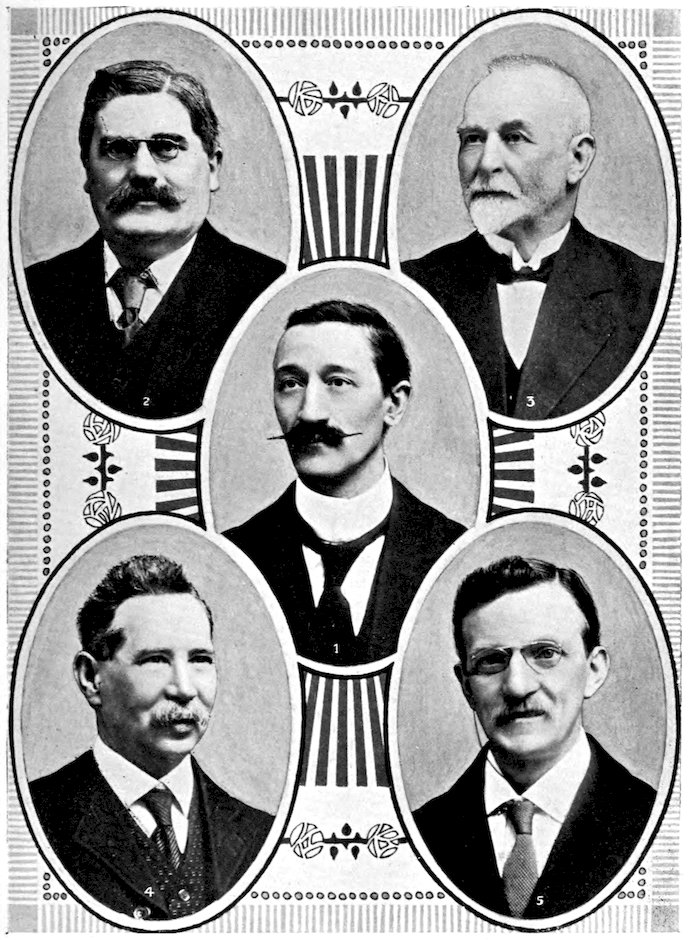
PRESENT BOARD
1. ALEXANDER BUCHANAN, President.
2. THOMAS M‘LEAN.
3. JOHN YOUNG.
4. MATTHEW H. CADIZ.
5. JAMES HAMILTON.
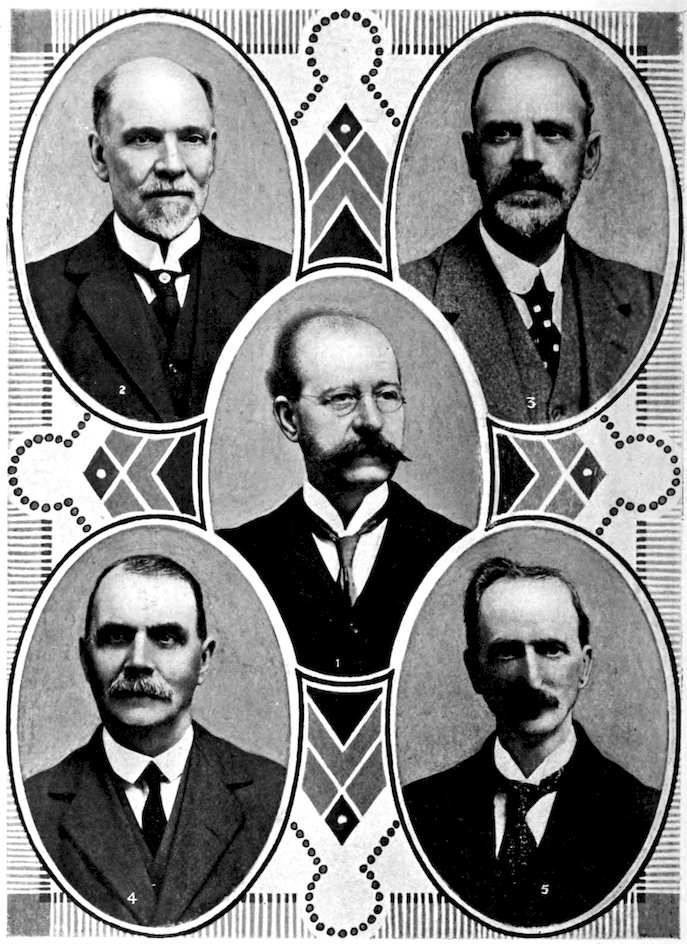
PRESENT BOARD
1. JOHN B. MONTEITH.
2. ROBERT M‘LAY.
3. JOHN F. JOHNSTONE.
4. JOHN SIMPSON.
5. JOHN B. WALKER.
113
A proposal which gave rise to a considerable amount of
discussion at the quarterly meeting, held in the beginning of
December 1890, was that of the committee to form an insurance
fund of their own. At the meeting of the committee immediately
prior to that quarterly meeting, the members of the board
agreed to recommend that £500 from the profits of that quarter
be taken to start an insurance fund, and that a special meeting
be held at the close of the quarterly meeting to consider the
question of taking £1,000 from the reserve fund and placing it
to the insurance fund. At the quarterly meeting the proposal
was hotly debated. Approval of the proposal of the committee
to allocate £500 to the insurance fund was moved, and was met
by an amendment that the proposal be deleted from the minutes.
This amendment became the finding of the meeting, receiving
104 votes against 87 votes for approval of the proposal. The
subject cropped up again in the balance-sheet, where, in the
“allocation of profit account,” the £500 was shown as being
devoted to an insurance fund, and a further crop of motions
and amendments was the result. It was moved that the £500
be added to the reserve fund; that the balance-sheet, as
printed, be adopted; and that the £500 be carried forward to
next quarter. The vote resulted in two favouring the transfer
of the £500 to the reserve fund, while 113 favoured the adoption
of the balance-sheet as printed, and 98 the carrying forward
of the sum. This vote was a clear reversal of the previous one,
and showed that the delegates had no very clear conception of
the business on which they were voting or else that some of
them had changed their opinions with almost lightning-like
rapidity. One might be pardoned for believing that it should
not be possible for a business meeting to come to two diametrically
opposed decisions on the one subject at the same meeting.
However, the result was that the committee got their insurance
scheme through, and when the special meeting was called upon
to transfer £1,000 from the reserve fund to the insurance fund
this was done by 145 votes to 34; and the 34 were not cast
against the proposal to have an insurance fund, but in favour
of a proposal that the fund should be built up from the profits
of the Society quarter by quarter. At the same meeting the
payment to the members of the committee was again raised to
3/ a meeting, after having remained at 2/ for three and a half
years.
Mention has already been made of the success with which
the Society met in their exhibition of the bakery productions
at the Congress Exhibition. This success seems to have
encouraged the directors to further efforts in this direction,
and so we find the first mention made, in the minute of November
1890, of the institution of what has since been, until the war
brought it to an end for the time being, the most popular
function of the Scottish Co-operative year—the Bakery annual
cake show. The results of the first show were most gratifying.
Encouraged still further by this success the committee decided
shortly afterwards to have a stall in the Glasgow East-End
Exhibition. At this stall bakery products were sold as well as
exhibited, with the result that in the ten weeks the sum of
£179 was received for the sale of pastries, etc., and the committee
114were so pleased with this result that they gave the young lady
who had been in charge of the stall £2 as an evidence of their
satisfaction with her work.
Almost from the start the Society had been affiliated with
the Glasgow and Suburbs and Renfrewshire conference associations,
but now they decided to affiliate also with the Central
Conference Association, and shortly afterwards with the East
of Scotland Association. This extension of their affiliations
showed that societies situated at a distance from Glasgow were
now taking an interest in the work of the Federation, and were
becoming purchasers of their productions. About the middle
of this year the bakers made a request for a reduction of their
working day from 9½ hours to 8½ hours, thus making the working
week one of fifty hours. It was also decided to alter the rate
of interest payable on loans to 4 per cent. for money at call
and 4½ per cent. on money deposited at twelve months’ notice
of withdrawal.
It was towards the end of 1891 that the Society inaugurated
that hospitality to other organisations for which it has since
become so justly famous. The half-yearly meeting of the
Scottish Convention of Co-operative Societies took place in
Glasgow in September, and it was decided that the delegates
should be shown over the bakery premises and afterwards
entertained. Later in the same year an invitation was extended
to the ladies of the Co-operative movement and the members
of the women’s guild to visit the bakery and be entertained to
tea. The meeting was a great success, over 400 ladies attending.
About the same time photographs of the buildings and plant
were taken, and lantern slides were prepared for exhibition
purposes, a set being presented to the Central Board of the
Union, while a set was retained. Two thousand show cards
for distribution amongst the societies were also purchased, and
it was decided to exhibit the Society’s biscuits again at the
Congress Exhibition.
In order that the biscuit factory might be equipped on the
most up-to-date lines possible, the chairman, secretary, and
foreman baker were appointed a deputation to visit the C.W.S.
biscuit factory at Crumpsall. On their return the chairman
reported that much valuable information had been gained
from the visit by both the foreman baker and himself.
115The Society has ever been noted for its generosity to deserving
causes, and it is not surprising, therefore, to find that when the
delegates were called upon to choose between a donation of
£200 and one of £100 to the funds of the Seaside Homes
Association they decided on the larger sum. In order to
interest the employees in the Bonus Investment Society, to
establish which power had been granted by the delegates at
the December quarterly meeting, the directors decided to have
a social meeting with the employees, which took the form of
a concert and assembly. At this meeting the benefits which
they would derive from becoming members of the new society
were eloquently portrayed by various speakers.
The oatcake trade was now becoming a feature of the
Society’s work, and four hot-plates were erected specially for
this trade. The scone trade was also developing at a rapid
rate, and sixteen hot-plates were erected for it. In order that
space might be found for the extensions which were proposed,
Mr Geddes, who had been using as a boat shed a shed which
was the property of the Society, was induced to give it up, and it
was fitted up as a temporary stable, with accommodation for
eleven horses. About the same time the Society reduced the
hours of their women workers by five per week.
There were and are large numbers of Co-operators in Glasgow
who require to take at least one meal per day away from home,
but until this time no attempt had been made to cater
co-operatively for their wants. Co-operators, also, had many
pleasant little functions—marriages, social meetings, etc.—for
the creature comforts dispensed at which they had to be
dependent on non-co-operative sources. For some time prior
to the autumn of 1892 this fact had been receiving the attention
and consideration of the directors of the Baking Society, and
in August of that year the sub-committee were empowered to
get all the necessary plant to enable them to do a purveying
business for soirees, marriages, etc. At the September quarterly
meeting the directors recommended that premises should be
rented in the centre of the city suitable for first-class tearooms,
and by a small majority this recommendation was agreed
to by the meeting. The purvey department was started
116immediately, a manager being engaged, and it was decided that
members purchasing through that department should get full
dividend. Unfortunately the committee at the beginning of
their experiment were not happy in their choice of manager;
first one and then another having to be dismissed, and it was
not until Mr Robert Watson was engaged that the department
was set thoroughly on its feet. Early in 1893 premises were
taken in Renfield Street for the purpose of opening first-class
tearooms there. Even before the tearooms were opened a
deputation from the West of Scotland Club and Institute was
forward with a proposal to have a portion of the building set
apart for their use, but after having a look over the place it
was decided that the matter be left in abeyance meantime.
The purvey department by this time was in full operation, and
was being much praised for the style in which the work was
being conducted. By June the tearooms were ready for
opening, and it was decided at the quarterly meeting that
twelve tickets be sent to each society so that members might
visit the premises and have a cup of tea there. It was also
decided that, in order to advertise the tearooms, a small map
of the city, showing the railway stations and the position of
the tearooms, and containing on the other side an advertisement
for the tearooms, be sent out to all the societies in Scotland.
In connection with the purvey department a boycott in
another form than the usual was experienced at this time. It
is well within the recollection of many readers that, on the
occasion of the marriage of the present King, Glasgow
Corporation entertained 10,000 of the poor of the city to a
dinner. The Baking Society wrote to the City Chamberlain
asking for permission to quote for part of the purveying, and
even called on the chamberlain, pointing out that the Society
was a large ratepayer in the city as well as a large purveyor,
and stating that it was considered that it had a right to be
given a chance to quote. No notice, however, was taken of
the application. Since that time the U.C.B.S. has been able
to compel orders for purveys, and the failure even to acknowledge
the letter showed a petty meanness on the part of either the
committee in charge or of the officials, which was not at all in
117keeping with the ostensible object of the dinner. This was,
however, but one out of many illustrations of the lack of public
spiritedness which has been manifested by the councillors of
the Corporation of Glasgow when the claims of any section of
the Co-operative movement have had to be considered. In all
cases of public contracts the committees of the Council do not
give Co-operation a chance if they find it possible to do otherwise,
and cases are on record when contracts have been given
to middlemen in preference to Co-operative societies, in which
these middlemen filled their contracts with goods purchased
from Co-operative sources at prices higher than those which
the Co-operative Society had quoted to the Corporation in the
first instance. With the object of popularising the new
tearooms it was decided to institute a series of social and
literary evenings there once a fortnight.
It has always been widely known that the ears of those
responsible for the conduct of the Baking Society’s business
are ever open to a call of distress from whatever quarter it
comes. When the Society was young and struggling it granted
a donation from its all-too-meagre funds to those left desolate
by the Udston Colliery disaster, and on various other occasions
similar action was taken. The winter of 1892–93 was one of
the worst on record for the people of Glasgow and district.
Work was so scarce that it was almost unprocurable, and the
result was that thousands in the city were on, or over, the verge
of starvation. There is no more hopeless position in which a
man can find himself than that of being able and willing to
work and yet having to trudge about day after day and week
after week unable to find anyone willing to employ him, while
those dependent on him are slowly starving. When to this
lack of food and soul-destroying idleness are added the rigours
of an almost Arctic winter, life becomes practically unbearable,
and many hitherto honest and industrious men are driven to
crime by despair. It is doubtful whether any more formidable
and damning indictment can be framed against the present
unco-operative system of society than is contained in the
regular periodicity of these unemployment crises. A system of
society which fails to provide means for the maintenance of all
118the individuals who comprise it is a system of society which
contains within itself and provides with sustenance the seeds
of its own decay.
The distress in Glasgow and the West was very great, and
at the December quarterly meeting of the Society the committee
were empowered to distribute 20 dozens of bread each week in
the manner they considered best calculated to alleviate distress.
This distribution was carried on for twenty-six or twenty-seven
weeks, the Society distributing free in that time over 500 dozens
of bread. When the following winter came round it soon became
apparent that conditions were not going to be any better than
they had been in the one preceding, so the committee again
received permission from the general meeting of delegates to
distribute bread on the same lines as on the previous occasion.
The summer of 1894 is still remembered in Scotland as the
year of the big coal strike. There is this peculiarity about the
economic position in the Central and Western districts of
Scotland that, when from any cause there is a slackness in the
coal trade, that slackness soon manifests itself also in the whole
commercial life of the community. The strike of 1894 had the
effect of paralysing industry all over the country, and soon
distress was manifest, not only in the coal mining districts, but
in every industry which was dependent on coal for motive
power. By the beginning of August distress was widespread,
and appeals to the Baking Society for assistance in feeding
the wives and children of the strikers and of others in distress
through the strike resulted in a special meeting of the committee
being called to deal with the matter. At that meeting it was
decided that the committee revive the powers granted them
earlier for the purpose of dealing with distress. In the course
of carrying out this noble work the Federation distributed
several thousands of dozens of loaves.
The effect of this good work on the movement, and on the
Federation in particular, was doubtless not apparent at the
moment, but the growth of the spirit of brotherhood which it
fostered must have had its influence in strengthening the position
of Co-operation generally and thus, indirectly, the position of
the Federation. The Federation cast its bread upon the waters,
as the result of an impulse which was purely humanitarian,
and any results of a commercial nature which accrued in later
119years were unsought and but a reflex result of a policy which
in its impulse was entirely worthy and without ulterior motive.
Towards the end of 1892 a work’s fire brigade was started;
a large supply of hose was procured, and after a short period
of training uniforms were procured by the committee. The
committee took a keen interest in the proposal to hold a bazaar
in aid of the fund for providing a Co-operative seaside home for
convalescents. When the ladies of the movement first met to
consider plans for the bazaar they were the guests of the Society;
representatives of the Society attended the meetings held to
make preparations for the bazaar; the purvey department
undertook the catering during the three days it lasted, and the
profits accruing from the sales, amounting to over £17, were
handed over to the Bazaar Committee. On several occasions
requests by the vanmen for a full six days’ holiday every year
had been refused by the committee; but in the beginning of
1893 the question was again considered, and it was agreed
that the bakers, vanmen, and breadroom workers each get
five days of continuous holiday instead of three.
During the whole of the period from the beginning of 1892
until well on in 1894 the time of the committee was much occupied
with matters connected with the extensions which were going
on. Although the addition at the north end of M‘Neil Street
was finished and occupied early in 1893, the work in connection
with the new stables and the fitting up of the biscuit factory
called for constant attention on the part of the committee, and
every minute contains details of contracts entered into or being
carried out; while, in addition to the work which was being
done by contract, the Society had bricklayers, painters, and a
plumber working under their direct employment. A building
department had not yet been formed, but the Society was
gathering together the nucleus of this department which took
shape and being at a later date.
When the new buildings at M‘Neil Street were commenced
the private loan fund was again opened, but now money was
coming in so rapidly with the continuous growth which was
120taking place in the membership of societies that the committee
recommended again that this fund should cease. How continuous
and great was the increase in the share capital of the
Society is shown by the fact that on one occasion the new shares
issued in the months of June and July totalled 1,320; while,
on other occasions, shares were applied for by single societies
in batches of 600, 800, and 1,000. When the first M‘Neil Street
premises were opened in 1887, the Federation consisted of
thirty-six societies, and was doing a trade of slightly over 400
sacks a week. At the majority celebrations in 1890 the number
of society members had grown to forty-three, and the turnover
was 715 sacks weekly. Now at the end of another four years
the membership had grown to fifty-two, and the turnover to
1,254 sacks. Thus, when the Society had attained its semi-jubilee,
it was doing a trade of £137,500 a year, and making
a profit of £11,600; while the output of the twenty-fifth year
was 64,308 sacks, and the average dividend for the year was
1/(4½).
Undoubtedly the progress made from the opening of the
new bakery had been little short of marvellous; yet, good
though it was, it did not satisfy the committee, for there were
still societies within easy reach of the bakery which gave a
large proportion of their trade to outside bakers, and at least
one was yet without the pale altogether. On the other hand,
one society distant over 100 miles from the centre was getting
a regular supply of bread, although this was soon to stop when
the society began to bake for themselves. Difficulties of
delivery still existed, and seemed to form the ground for a large
number of the complaints which were made by societies. A
further proportion of such complaints dealt with the prevalence of
underbaked bread, which was but another phase of the delivery
difficulty, as the bread was too quickly fired in order that the
vans might get away on their rounds at the earliest possible
moment. These difficulties it was hardly possible for the
committee to overcome successfully, for the situation was
dominated by the Bakers’ Union, who for a time decreed a
five o’clock start. After a time, however, the Society was
successful in arranging for a four o’clock start, and just before
the conclusion of the period with which we are dealing a three
o’clock start was arranged for. This arrangement made for
121the lessening of worry to the Bakery officials by allowing the
bread to be well baked and yet to be ready for early delivery;
but it meant for the bakers the turning of night into day.
In this connection it is worthy of note that in the last
four months of 1893, after the new hours for the bakers
came into operation, no complaints whatever came in from
societies.
Mention has already been made of the cake trade and of the
beginning of the cake shows in order to foster that trade. It
was growing rapidly, and the sales for the season 1893–94 reached
the grand total of 32½ tons, representing 14,533 cakes of 5 lbs.
each in weight, and 4½ tons of shortbread. The tearooms
and the purvey department also were flourishing, and were
showing useful profits on the turnover. It is said that there
is nothing new under the sun, and everyday experience goes to
prove the wisdom of the Hebrew philosopher who is credited
with having been the first to note the fact. At the quarterly
meeting which was held in December 1893 notice was given of
a motion to print synopses of the minutes and distribute them
to the societies before the quarterly meetings. The motion
was defeated, but it kept on making its appearance on the
agenda with unfailing regularity until a few years ago it found
favour with a majority of the delegates. Another motion of
which notice was given at the same meeting, and which found
a great deal of favour with the delegates when it came up for
ratification at the 100th quarterly meeting, was a proposal
made by Mr William Barclay, Kinning Park, on behalf of that
society, that the shares of the Society should be raised from
10/ to 15/ each. The motion received the votes of a majority
of the delegates, but as it meant an alteration of rule a two-thirds
majority was necessary, and so it too was lost, as was
also a proposal for raising the purchase qualification for a vote
from £160 or a fractional part thereof to £320. At the quarterly
meeting, however, perhaps the most notable thing done was
the election of Mr James Bain, of Glasgow Eastern Society, as
secretary. Mr Bain thus completed twenty-five years of service
as secretary at the 200th quarterly meeting of the Society,
held in March last. Mr Bain had served, however, a period as
the representative of his society on the board of the Federation
ere his election as secretary.
122In looking over the various reports of contracts made during
the time the stables and biscuit factory were in course of
erection, it is interesting to note that one or two small contracts
were secured by the S.C.W.S., particularly in connection with
engineering work. Amongst other things which they did was
the supplying of an elevator for the biscuit factory.
CHAPTER XI. FURTHER EXTENSIONS. — INCREASING BUSINESS. — THE OPENING CEREMONY. — THE POSITION OF THE FEDERATION. — NEW STABLES. — ORGANISATION. — MANAGER OR NO MANAGER. — THE SOCIETY AND THE C.W.S. — THE BIG BOYCOTT. — RELATIONS WITH MASTER BAKERS. — SOME NOTEWORTHY ALTERATIONS. — THE FARMING ASSOCIATION. — ACCIDENTS. — THE OATCAKE DEPARTMENT. — ADVERTISING AND ENTERTAINING. — DONATIONS. — A WORKS DEPARTMENT. — A FOUR YEARS’ RECORD.
123
MORE TEAROOMS—INCREASING BUSINESS—NEW BISCUIT FACTORY AT
WORK—ANOTHER EXTENSION—MORE GROUND PURCHASED—NEW
BAKERY OPENED—THE POSITION OF THE FEDERATION—NEW
STABLES—ORGANISATION—MANAGER OR NO MANAGER?—RELATIONS
WITH THE C.W.S.—THE BIG BOYCOTT—RELATIONS WITH MASTER
BAKERS—SOME NOTEWORTHY ALTERATIONS—THE FARMING ASSOCIATION—ACCIDENTS—THE
OATCAKE DEPARTMENT—ADVERTISING AND
ENTERTAINING—DONATIONS—A WORKS DEPARTMENT—A FOUR
YEARS’ RECORD.
So successful were the tearooms in Renfield Street proving that,
at the 101st quarterly meeting of the Society, the directors
sought power to increase the number of these places of business.
There was a difference of opinion amongst the delegates as to
the best course to pursue. Some were not in favour of any
further extension of this branch of the business, and carried
their opposition so far as to move an amendment that power
be not granted. Others favoured the principle, but urged the
committee to “hasten slowly,” and moved that power to open
one only be granted. The vast majority of the delegates, however,
were fired with the enthusiasm of the committee, or, at
least, were prepared to trust them not to go further than was
going to be for the benefit of the Society; so the powers sought,
which were “to open one or two more tearooms as opportunity
offered,” were granted by a large majority. The result of this
permission was that rooms were taken at Glasgow Cross—they
will be remembered by most Co-operators. They were leased
for ten years, the rental being £100 for the first two and a half
years and £115 for the remainder of the period. Steps were
immediately taken to have them fitted up as first-class tea and
dining rooms, and it was decided that they should be lighted
by electricity. The premises were opened to the public on 25th
October, when there was a large gathering of representatives
124from the societies in the Glasgow and Suburbs Conference area,
friendly and other societies, and trade unions. Mr M‘Culloch
presided, and the rooms were declared open by Mr Maxwell,
president, S.C.W.S. Mr Glasse, Mr Bain, Mr Chaddock, and
other gentlemen also delivered addresses.
While negotiations and preparations had been proceeding
for the opening of the Cross tearooms, preparations were also
being made at the bakery for the opening of a dining hall and
bread shop, and shortly after the function at the Cross these
also were opened.
The next venture of the Federation was in Paisley Road,
where, on 25th May 1895, tearooms were opened. Following
on the opening of the Paisley Road premises, no alterations took
place in this section of the Society’s business until the end of
1897, when the committee, having failed to come to an arrangement
with the factor for the Renfield Street premises, and being
faced with the prospect of having to pay increased rent for the
premises if they renewed their lease, decided to accept an offer
of premises at 102 and 104 West Nile Street at £300 rental per
annum. It was decided that the tearooms should be known
as “The Union Rooms,” and also that electric lighting be
installed. Quite a long time was spent in fitting up the new
premises so as to make them thoroughly worthy of the part
which it was hoped they would play in the social life of the
Co-operative community of the city and district, and it was not
until the 28th of June 1898 that they were formally opened.
The premises comprised a tearoom and smaller rooms and offices
on the ground floor, as well as two large flats above. To
celebrate the opening the board had decided that a tea should
be given to the regular customers of the Renfield Street premises,
and of these about 100 attended at a social gathering. A jovial
evening was passed in song and sentiment, and many kind things
were said of Mr Watson, manager, and the new premises.
Meantime, the Society had undertaken yet another venture
in the catering line. In connection with the National Halls,
Main Street, Gorbals, there had been a catering department,
which was giving up business, and the business and plant were
purchased by the Baking Society, a tearoom and an auxiliary
purvey department being established there in the spring of
1898.
125
For many years the hands of the Bakery board were never
out of the mortar tub, and by a slight inadvertence they fell foul,
in the early summer of 1894, of the building regulations of the
city. From the beginning of the year they had been in communication
with the master of works of the city about some
alterations which they wished to make on an old building
situated on their land at Clydeside. It was necessary that some
work should be carried out inside this building, and, in the course
of alterations, a part of the outside wall was taken down, and
was in process of rebuilding when the master of works came on
the scene, stopped the work, and reported the Society to the
Procurator Fiscal for a contravention of the by-laws. The
result was that the Society was fined £1, 1s., but, as the work
they had done was allowed to stand, they came out of the
business not so badly.
By the middle of August 1894, the new biscuit factory had
started operations, and the Society was able once more to fulfil
the orders for biscuits which came pouring in. Already, however,
the latest extension of the bread bakery was beginning to have its
productive capacity taxed, and at the 104th quarterly meeting the
directors obtained power from the quarterly meeting to proceed
with a further extension of the bakery, this time at the corner
of Govan Street and South York Street. First, however, they
turned their attention to a further extension of the biscuit
factory, where they had plans prepared for the erection of
another flat, with provision for seven ovens. Already they had
a biscuit traveller on the road who was doing well, and by the
middle of the year arrangements were made with the Wholesale
whereby they secured premises for a biscuit depot at Leith, and
a van was placed on the road for the delivery of their goods in
the East.
It was not until the beginning of the following year that the
plans for the addition to the bakery were ready. These provided
for a building with three flats of ovens, giving an additional
baking capacity of fifty ovens. When the plans were agreed to
by the quarterly meeting a strong recommendation was made
that the work be carried out by the Society’s own workmen, and
this was done.
126The next step in the scheme of extensions was the purchase
of the ground at the south corner of South York Street and Govan
Street on which the stables and St Mungo Halls now stand. This
ground, which had an extent of 9,813 square yards, cost
£8,839, 9s. In pursuance of the policy of the Society to carry
out the construction of the addition to the bakery themselves,
a foreman builder was engaged, at a salary of £4 a week, and
building plant was bought at a cost of almost £500. The new
addition was not completed until October 1897; its opening
being made the occasion of a demonstration, at which a company
of 1,600 people were present. The cost of the new building was
£29,000. The building was a bakery complete in itself, having
fifty ovens, a barmroom, breadroom, and storage for 3,000 sacks
of flour. The whole bakery now had a baking capacity of 150
ovens, capable of turning out over 560,000 loaves per week.
The formal inauguration of the new buildings was performed
by Mrs M‘Culloch, wife of the president, who turned the steam
on to the engine which was to drive the machinery in the department.
In a short speech, Mr Bain then sketched the history of
the Federation. On entering, each of the ladies present had been
presented with a silver souvenir brooch bearing a representation
of the building, and at the conclusion of the opening ceremony
Mrs M‘Culloch was presented with a gold brooch of similar
design.
A huge vehicular demonstration, in which over a hundred
vehicles took part, paraded the streets of the city after the
opening ceremony. Many mottoes were displayed on the
decorated lorries and vans, amongst the most prominent being
one which stated “Our answer to the boycott—other 54 ovens
added.” The dinner took place in the East End Industrial
Exhibition buildings, and Mr M‘Culloch, president of the Society,
presided.
In welcoming the visitors, he referred to the inception of the
Society in a little back court in Coburg Street, with a bakery
capable of doing a trade of forty sacks a week, and contrasted
that small beginning with the size and strength of the Federation
that day; the possessor of plant capable of dealing with 3,500
sacks each week. He laid stress on the fact that the building
127had been done by the Society’s own workmen, and that over
£11,000 had been paid in wages to the builders.
Mr Peter Glasse said the Society had proved to the world
the power of the Co-operative movement. During its twenty-eight
years of existence it had disbursed £143,000 in the form of
dividends to customers, and during all that time it had never
had a strike of its workers, because it had always paid the
highest rate of wages and worked the shortest possible number
of hours.
Mr William Maxwell, in the course of a stirring address on
“Co-operation,” said that through the influence of the
Co-operative movement the masses had learned that that
inanimate thing called capital could be made into a willing and
obedient servant, instead of, as formerly, a harsh taskmaster.
There was a community of thought and action in the Co-operative
movement which was bringing out much that was noble and
sympathetic in human nature. The social gulfs which lay
between the various classes in society would never be bridged
over by the competitive system, because that system was the
cause of these gulfs. That bridging could only be done by
Co-operation. Their opponents were saying that they were
lamentably deluded, but, if those opponents only knew it, they
had aroused the members of the movement from that apathy
and indifference in which they had hitherto lain dormant.
The point of Mr Maxwell’s address, which was punctuated
with applause, was that the “boycott” movement was then
at its height in Glasgow and the West, and everywhere attempts
were being made to intimidate Co-operators into forsaking the
stores. These attempts only resulted in giving the movement
a splendid advertisement. Everywhere the opponents came
out into the open they were defeated, and some well-known
firms, which, until then, had been reaping large profits from
their trade with Co-operation, found that the boycott was a
double-edged weapon, and that the measure which they meted
out to Co-operative workmen could be meted out to themselves
by Co-operative societies.
As showing the power and influence to which the Federation
had attained by this time, we cannot do better than quote from
128an article which appeared in Copartnership for June 1897. After
describing the beginnings of the Society, the writer goes on:—
“But the day of small things is past; the society has grown into
one of the largest as well as one of the most important in the movement.
The trade last year—1896—was £220,536; but in case that sum should
not convey a definite notion of the work involved it should be
remembered that the U.C.B.S. carries on the largest business of its
kind in the United Kingdom. At present 340 sacks of flour are baked
into 65,300 loaves every day, while 25 sacks are made into pastry and
hand-made biscuits, 20 sacks into machine-made biscuits, and the
oatcake department requires 13 sacks daily; practically 400 sacks of
flour and meal daily; a great growth from the early days when it was
difficult for the committee to keep with them the baker they employed,
who had no faith in the society’s future.
The biscuits and cakes are sold not only in Glasgow and all over
Scotland, but are now finding their way into England, and winning
favour. These goods, of course, go by rail, but it will readily be
understood that the bulkiest part of the trade, bread for use in the
co-operative households in and around Glasgow, requires a large staff
and rolling stock; and, as a matter of fact, the delivery department
employs 62 carmen, dealing with 71 vehicles and 107 horses.
A great capital is needed to carry on so large a business, and the
extent of the capital is shown in the following figures:—
| Capital. |
Societies. |
Workers. |
Outside Individuals. |
| Shares |
£37,907 |
£2,900 |
Nil. |
| Loans |
79,114 |
580 |
£10,728 |
| |
|
|
|
| |
£117,021 |
£3,480 |
£10,728 |
| |
Total |
£131,229.” |
|
The article goes on to state that the total number of
employees was 829, 77 of these being employed in the building
department, while 275 were members of the Bonus Investment
Society. It concludes:—
“Some organisations are mere aggregations without either heart
or mind. The parts mistakenly believe that they can evade as
organisations duties that belong to them as individuals. But the
problem before co-operators allows no such evasion. They have to
set up, not only good businesses in sanitary buildings, but also a new
industrial system, where labourers are recognised as human beings
entitled to share in the results and direction of their own lives.
Because the leaders of the United Baking Society have recognised
this, and have not allowed prosperity to poison aspiration, all men
will wish them well, and we may say with an inner meaning to the
words that we hope in time great multitudes may eat their bread
and be thankful.”
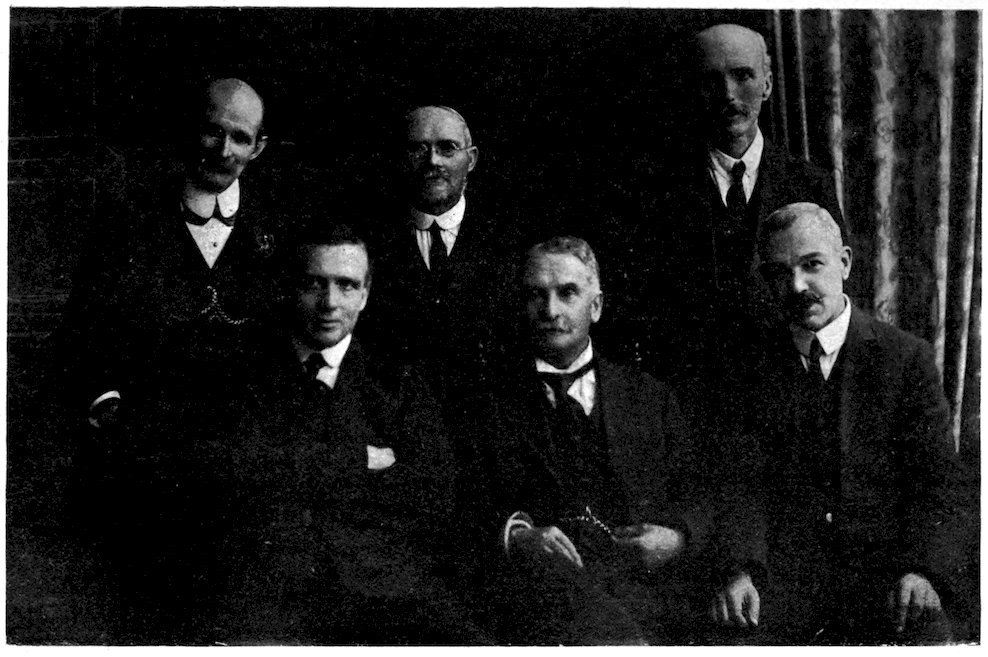
BELFAST ADVISORY COMMITTEE
Top Row—ALEXANDER PATTERSON; JOHN PALMER; DAVID T. GILCHRIST.
Bottom Row—JAMES MURPHY; WILLIAM J. M‘GUFFIN, Chairman; ROBERT RODGER, Secretary.
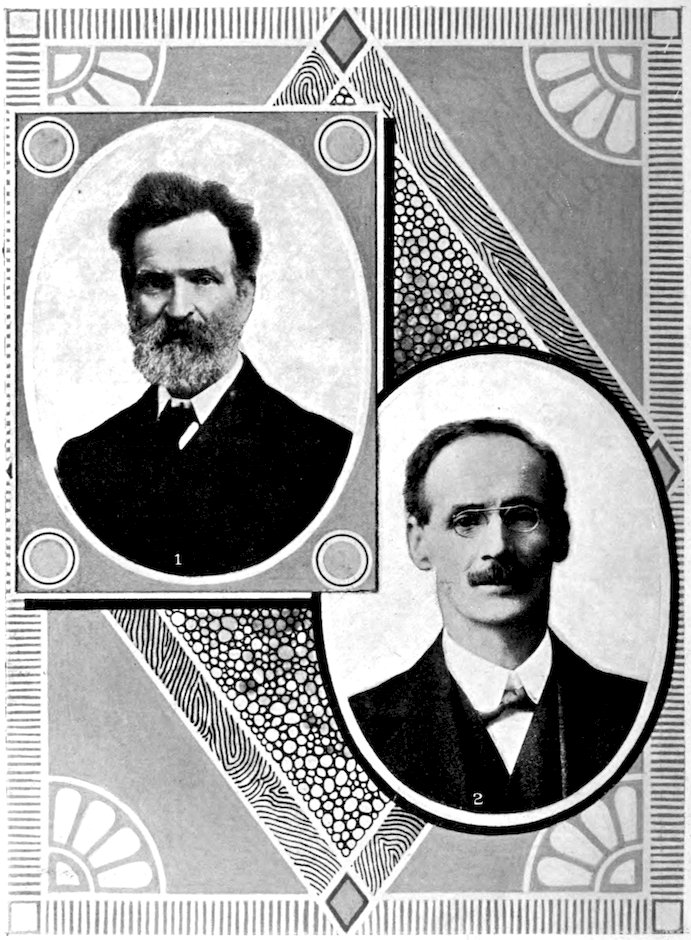
1. JAMES YOUNG,
General Manager.
2. JAS. H. FORSYTH,
Cashier and Accountant.
129
The rate at which the trade of the Society was growing called
for an almost continuous growth in live and rolling stock, and
consequently for increased accommodation. Already the provision
for stables and van-sheds which had been made when the
removal to M‘Neil Street took place was much too small, and
various makeshift methods had to be adopted to provide the
necessary accommodation for the growing stud of horses. At
the same time the committee were now getting a different idea
of the possibilities of the enterprise, and were desirous, therefore,
of making the bakery as compact, and with its various parts
as well co-ordinated as possible. They were desirous, therefore,
of removing the stables away from the bakery altogether, and
it was with this object in view that the ground on the south side
of Govan Street was purchased. At the quarterly meeting held
in September 1896 they were granted power to proceed with the
erection of stables and workshops, and this work was commenced
immediately. At the same time, plans were prepared and the
erection proceeded with of a temporary stable on a part of the
same ground. By the end of 1898 the new stables and workshops
were completed, and the December meeting of the Society was
held there, so that the delegates might have an opportunity of
being shown over the premises.
Never at any time had the directors shown carelessness in
their supervision of what had now become a gigantic concern,
and they were continually giving thought to means of improving
the organisation of the Federation and of improving the supervision
by the committee. Early in the period with which this
chapter deals, they made arrangements whereby the members
of the committee took it in turn to visit the bakery each week.
These visits were found of value by the members of the committee,
as it enabled them to acquire fuller information about
the working of the Society. Each member reported the result
of his visit to the sub-committee, together with any suggestion
he had to make.
Towards the end of 1894 the committee appointed a biscuit
traveller, Mr Archibald Petrie being the man appointed.
130
The quarterly meeting had under consideration the question
of the general management of the Society, the points discussed
being the appointment of a general manager, or the development
of the system of departmental managership. The discussion
was inaugurated on a motion moved by Mr Malcolm of Newton
Society, “that a general manager be appointed.” The result
of the discussion was the adoption of a suggestion by Mr Glasse—who
said he had sat in committee with a manager and without
a manager, and was of the opinion that the business could be
best managed without a manager. He suggested that the matter
should be remitted back to the committee for consideration and
report, and the other motions and amendments which had been
moved were withdrawn in favour of this suggestion.
The committee took up consideration of the question within
a month, and came to the conclusion that the business of the
Society could be best managed by being divided into six
departments, with a departmental manager over each, who
would be in direct touch with the committee. These departments
were: (1) The counting-house; with Mr James H.
Forsyth as head—this department to include all the commercial
transactions of the Society. (2) The productive department,
including the production of all bread, smallbread, biscuits, and
oatcakes; to be under the charge of Mr Robert Fraser, who was
also to have control of the enginemen and oilers. (3) The
distributive department, which was to include the dispatching
of the bread and the packing and dispatching of the biscuits
and oatcakes; to be under the management of Mr William
Miller. (4) The delivery was to be under the control of Mr Milne,
stable foreman, who was to have control of all the horses,
vanmen, and nightwatchman. (5) The building and repairs
department, including the tradesmen and their assistants; to
be controlled by Mr Davidson. (6) The purvey department
and tearooms, under the management of Mr Robert Watson.
The committee recommended, further, that they should meet
fortnightly, but that the monthly meeting remain as at present,
the bi-monthly meeting to be devoted to the interviewing of
all the heads of departments, each of whom was to present a
written report. Another recommendation was that the term
131for which members of committee were elected should be extended,
as they were of opinion that the frequent changes amongst the
membership of the Board prevented members from acquiring
a proper knowledge of the business, and had in this way interfered
with the successful management of the Society. They believed
that, if the delegates would accept this suggestion for the
alteration of the rule governing elections, it would do much to
consolidate the management of the business in the hands of the
committee. At the following general meeting of the Society
the principle of the report was accepted, and it was decided to
hold a special meeting at the close of the next general meeting
for the purpose of considering the alteration of rule proposed.
At this special meeting the delegates, however, refused to make
the alteration, and the tenure of office of members of committee
remained at one year.
In 1894 the Society attained to the dignity of a registered
telegraphic address, “Federation” being the name adopted.
They also had the telephone installed, as well as private lines
communicating with their teashops. At the end of the year they
became members of Kinning Park, St George, and Glasgow
Eastern societies for the purposes of trade, and later, of other
societies as well. They also undertook a census of their employees
for the purpose of finding out who amongst them were
Co-operators and who were not. The census showed that the
Society had 431 employees, of whom 236 were unmarried. Of
the remainder 152, or 78 per cent., were associated with
Co-operative societies, and 43, or 22 per cent., were not.
Naturally the directors were anxious to push their biscuit
trade as rapidly as they could, and having fixed up a trading
agency with the S.C.W.S. and with the Co-operative Institute,
London, they endeavoured to do the same with the C.W.S.
This society had a biscuit factory of their own, however, and
were, not unnaturally, reluctant to introduce what were really
the goods of a competing concern, therefore they refused to
accept the agency. The next step taken by the Society was
that of appointing a traveller for the purpose of pushing biscuits
and oatcakes in England. Against this step, however, a very
vigorous protest was made by Mr James Young, who considered
132that there should be no further pushing of the Society’s goods
into English societies against the wishes of the English Wholesale
Society’s committee. Following on this decision, it was agreed
that the Society’s productions should be exhibited at the Crystal
Palace Exhibition. This activity in England brought a letter
from the C.W.S. committee, who pointed out that the action of
the Baking Society would lead to competition and overlapping.
Later, that committee also passed a resolution in which they
stated that they were ready and willing to supply all the societies
in England with biscuits if they would only be allowed to do so,
and sent a copy of the resolution to the Baking Society’s
committee.
Reference has already been made to the boycott of
Co-operators which was inaugurated all over Scotland and
continued throughout 1896 and 1897. The traders had made
their organisation very complete, with the result that every
manufacturing firm on which they were in a position to bring
pressure was compelled to discharge all employees who remained
members of Co-operative societies, or whose parents continued
members, or else to suffer very considerable loss of trade. In no
department of labour was it easier to bring effective pressure to
bear than on the baking trade, and the result was that all the
big baking firms in the city were compelled to post up notices
informing their employees that they must cease to trade at
Co-operative stores or leave their employment. Similar notices
were posted up in every workshop and factory where the Traders’
Association was in a position to apply any pressure, often against
the will of the employers, who recognised that those of their
workers who were Co-operators were usually the best and
steadiest men, but who were compelled to choose between
perpetrating a manifest injustice and seeing their businesses
ruined. No tactics were too mean or despicable to be resorted
to by the traders’ organisation. They had their spies everywhere,
and a favourite method of operations was that of
watching the shops of the Co-operative societies and tracking
the customers home, then ascertaining where the husbands were
employed, and writing to their employers to demand their
dismissal. This espionage system was very perfect in its way,
and considerable hardship was caused to individual Co-operators
133by it; while the boycott had a lasting effect in another direction,
for it was the direct cause of the large proportion of householders,
in the places throughout Scotland where the boycott raged most
fiercely, which became represented amongst the shareholders
of the societies by the wives of the householders instead of by
the householders themselves.
While it lasted the boycott was not without its humorous
incidents. If the traders had their system of espionage, so also
had the Co-operative Defence Association, and there was not a
meeting of the Traders’ Association held, however great the
precautions which might be taken to ensure absolute secrecy,
of which a practically verbatim report of the proceedings was not
in the hands of the secretary of the Co-operative Defence
Committee next morning. One of the laughable incidents concerned
one such meeting, a full report of which was published by
the Co-operators. This was followed by a visit from an irate
traders’ official, who demanded to know the source from which
the report had come. It is hardly necessary to state that he
went away without the information asked for, and to this day
it is probable that the source of the information is known to less
than half a dozen people, not one of whom had anything to do
with the traders’ organisation.
But if the boycott was the cause of hardship to individuals
here and there, it brought grist in a very real sense to the
Co-operative mill in other directions. Already, in this chapter,
it has been pointed out that it was a two-edged weapon, and
while Co-operative societies did not cease to trade with private
manufacturers who did not adopt the boycott, they were kept
well informed of those manufacturers who did. It was found
that while some manufacturers had no wish to employ
Co-operative labour they were keenly desirous of retaining
Co-operative custom, and it came as an unpleasant surprise to
some of them to find that Co-operative societies objected to the
dismissal of employees because of their Co-operative connection,
and that they refused to trade with manufacturers who adopted
such tactics. It is said that one Glasgow firm lost Co-operative
trade at this time worth £20,000 a year and never regained it.
In two directions the boycott benefited Co-operative production,
therefore. It turned the attention of those at the head
of the movement to the need of being as far as possible independent
134of private manufacturers for supplies, and thus it did much
to stimulate Co-operative manufactures and to hasten entry
into new spheres of work. On the other hand, the operation
of the boycott, where manufacturers refused to supply goods
which were already being produced Co-operatively, increased
the demand for the Co-operative manufactures; while the
process of retaliation mentioned above also stimulated this
demand. In both of those directions, the Baking Society was
a gainer. One or two societies in the neighbourhood of Glasgow,
which hitherto had always stood aloof from the Federation
and had done very little trade with it, now approached it for
supplies; while a rapidly growing city society, whose members
had consistently refused to give the Federation the whole of
their bread trade, were now prepared to do so. Notwithstanding
the fact that the capacity of the bakery was fully taxed, an
endeavour was made by the committee to supply the wants of
those societies who had brought home to them in this manner
the value of federation in the day of adversity. A big trade in
biscuits had also been done hitherto with Co-operative societies
by the biscuit manufacturers of Glasgow, but the boycott put
an end to that trade, and in this direction also the Bakery gained
very considerably. It may be asserted with confidence, therefore,
that not only did the traders’ organisation fail to achieve the
object they had in view—the destruction of the Co-operative
movement in Scotland, and especially in Glasgow and the West—but
their campaign had exactly the opposite effect, and ended
by leaving the Co-operative movement stronger in membership,
stronger in trade and capital, and with a membership more
closely knit together than it would have been but for the
agitation and the boycott.
The members of the Federation were not slow to recognise
the vital nature of the issues at stake, and placed a credit of
£1,000 in the hands of the directors to use as they might deem
advisable for the defence of the Co-operative movement. At
the Perth Congress, which was held when the boycott campaign
was at its height, the delegates had decided in favour of
Co-operative representation in Parliament; and later, when the
Co-operative Union sent out a circular, with the object of
ascertaining what support a Parliamentary campaign was likely
to secure amongst the societies, the delegates to the Baking
135Society’s meeting, by a large majority, decided in favour of a
Parliamentary campaign; mainly owing to the eloquence of
the chairman, Messrs Glasse and MacNab, Wholesale, Mr Gerrard,
and Messrs Low and Stewart of Kinning Park. Undoubtedly,
the boycott had its influence on the decision. The chairman
was particularly strong in his remarks at the meeting, and, in
referring to the debate on the subject which had taken place at
Congress, suggested that if their English friends had had a taste
of the boycott they would put aside any party prejudices. With
the defeat of the traders, however, and the apathy of the
Co-operators on the other side of the Border, the agitation died
down, and, except as a subject of academic debate at Congress,
nothing further was heard of it for some years.
In the middle of 1896, the Master Bakers’ Association held
a meeting to consider the price of bread. Out of 48 firms
represented, 44 voted against making any reduction in price at
the moment, while four were in favour of a reduction. After
the meeting those four firms met and agreed to reduce the price.
They got other three firms to join with them; with the result
that on the morning of 15th June an advertisement appeared
in the Glasgow papers which stated that these seven bakers had
reduced the price of their bread. The committee of the Baking
Society met that evening, and they decided that while the price
of flour did not warrant the reduction, yet, in order that the
Federation might maintain its position it was their unanimous
finding that the price should be reduced by one halfpenny on the
four-pound loaf. At the same meeting it was agreed that, as the
sale of “common” bread was very small, the Federation should
cease baking it altogether, and produce only the one quality of
bread in future—“fine.” This decision was adhered to for six
months, at the end of which period it was agreed to begin the
baking of “common” bread again. At a later period this connection
with the Master Bakers’ Association was called in
question at a quarterly meeting, and gave rise to a lengthy
discussion. Mr Glasse of the Wholesale board was the chief
critic, and moved that the Federation be not represented at
these meetings in future. Several of the delegates, in supporting
this motion, pointed out that some of the master bakers present
136at these meetings of the association were men who had signed
an agreement to do their best to put down Co-operation, and one
delegate described the association as a syndicate, the members
of which wished for big profits and cared for no one but themselves.
It was pointed out by the chairman that this was not a properly-constituted
association, but an informal gathering of people
engaged in the same business. The Federation had been invited
to send a representative, and had got some useful information
there, but were not committed in any way. Finally, on being
put to the vote, the motion of Mr Glasse was defeated in favour
of an amendment that the committee act as they had been doing.
The question was one which cropped up periodically at meetings
of the Federation, but always with the same result of leaving
the Federation unfettered to do the best they could in the interest
of the concern they were appointed to manage.
For several years the rates of interest which had been paid
for loans had been 4½ per cent. for money deposited on twelve
months’ notice of withdrawal and 4 per cent. on money at call,
but the rate of interest in the money market had shown a decided
downward tendency for some time, and towards the end of 1896
the directors recommended that the rates to be paid by the
Federation should be reduced to 3½ per cent. and 3 per cent.,
a recommendation which was adopted by the general meeting.
At the same meeting a reform which certain members of the
committee and certain delegates had advocated for some years—the
raising of the value of the share from 10/ to 15/—was at
last agreed to. This had the effect of adding 50 per cent. to the
capital of the Society. At the same time the influx of new
societies into the Federation and of new members into the
societies continued at a rapid rate, so that from this source also
the capital of the Society was being increased so rapidly that
it was practically keeping pace with the big capital expenditure
necessitated by the rapid growth of the Society’s business.
In June 1897 Mr Robert Fraser, who had been foreman
baker for a number of years, left the service of the Federation
to take up another situation, and the committee took advantage
of the fact to make some important rearrangements in the
management of the bakery. This was done by dividing the
137productive work into three sections: bread, biscuits, and pastry.
Mr Murdoch Richard, who had been assistant to Mr Fraser for
several years, was given full charge of the bread department;
Mr John Gilmour was made manager of the machine-made
biscuit and oatcake sections; and Mr William Seivewright was
placed in charge of the pastry and hand-made biscuit section.
In September of the same year Mr Allan Gray, who had been
one of the auditors of the Society for the long period of seventeen
years, retired owing to pressure of other business, and was
awarded the hearty thanks of the delegates for the long and
faithful service he had given. Mr William H. Jack, of St George
Society, was elected his successor. At the general meeting held
on 4th December 1897, it was decided that the Federation join
the International Co-operative Alliance. Earlier in the same
year they had taken up 500 shares in the Scottish Co-operative
Laundry Association Ltd., and, owing to their large purvey
and tearoom department, were likely to be one of the largest
customers of that concern. Indeed, so great was their laundry
bill that at one time the directors gave serious consideration to
the question of starting a laundry department of their own, for
the girls in the packing and oatcake flats were supplied with
overalls which required laundering every week. The Federation
also adopted the policy of providing the girls who served in the
tearooms with dresses. In the spring of 1898 the Society became
members of the Scottish Co-operator Federation. Owing to the
large proportion of employees, particularly in the stable department,
who were going off ill, a medical man was engaged to call
at the factory regularly and supervise the health of the
employees. This year the Society started the manufacture of
plum puddings, and were making strenuous efforts to develop
the pie trade. An expert piemaker was engaged, the societies
were circularised, and a small van and a fast pony were purchased
so as to ensure quick delivery. At the quarterly meeting held
in March 1898, the chairman stated that, owing to the number
of societies which were starting bakeries of their own and were
withdrawing their loan capital from the Federation for this
purpose, the committee had decided not to proceed further with
the stores which they had proposed to erect in the new premises.
The work had been stopped meantime, but it could be proceeded
with at any time desired. He also asked for permission to
138reopen the private loan fund again, the interest to be paid being
3½ per cent. at twelve months’ notice and 3 per cent. at call,
and this permission was granted. He explained that they were
not altogether in want of money, but desired to have a little
more liquid capital than they had in hand at the moment. After
one or two questions had been asked, the permission desired
was granted.
When the Scottish Co-operative Farming Association was
formed the Baking Society took a keen interest in it, and for such
products as were of use to it was always a good customer. At
a later date in the history of the association an overdraft of £200
was granted. Unfortunately, from causes which were fairly
obvious, the Association, after some years of fair success, fell on
evil days, and during the period with which this chapter deals
the committee approached the Baking Society to take one of the
farms rented by the Association. The board of the Baking
Society viewed the idea with favour, believing that a farm would
be a useful auxiliary to their distributive department, while it
would be to the advantage of the movement if the Farming
Association could be preserved from collapse; and when the
question was brought before the general meeting of the Society
the majority of the delegates were also in favour of the scheme,
and gave full power to the committee to proceed. Thus armed
with full powers the members of the committee were wise enough
to take expert advice before committing themselves definitely,
and delegated two practical farmers to examine the farm and
report. The reports presented by these gentlemen were
unanimous, and were to the effect that the farm was very badly
drained and in poor condition; the rent was too high, and it
could not be made to pay either as a cropping or as a dairy farm.
As a result of this report, and in view of the fact that inside two
months the Farming Association went into liquidation, it was
decided to have nothing more to do with the proposal.
The Society had still some further trouble to face in
connection with the Association however. A large quantity of
hay had been bought and paid for, to be delivered as required,
but when the liquidators came to examine the stock on the farm
they claimed this hay as part of the assets of the Association,
and a considerable amount of negotiation took place before the
139matter was settled. The final result was that, by the failure
of the Association, the Federation lost £346, 14s. 7d.
Probably it was owing to the much greater number of
vehicles now owned by the Federation, and the much larger
number of persons employed, that the accidents recorded in the
period with which we are dealing exceeded in number all those
which have been recorded hitherto. Fortunately, many of them
were not of a serious nature, but during the four years three fatal
accidents took place. In one case a man was knocked down by
a van belonging to the Society and killed, but the police report
was to the effect that no blame attached to the driver of the van.
Out of sympathy with the widow thus suddenly deprived of her
breadwinner, however, the committee gave her a grant of £40.
In another case a bricklayer lost his life, again without blame
attaching to the Society, and in this case a grant of £20 was made
to the widow; while the third case was that of a plumber employed
by the Society, who died as the result of an accident at the
bakery. In this case also a grant of £30 was made.
During the period under review an extraordinary development
of the business of the oatcake department took place, and an
aggregate addition of thirty-eight hot-plates for the use of this
department alone was installed between March 1894 and July
1897. The committee did their best to push the trade, sending
circulars and samples of the cakes to societies in the North of
England, with results which were beneficial to the trade of the
department. Later, a traveller was employed on salary and
commission to push the Federation’s goods amongst English
societies. Another branch of the Society’s trade which was
making rapid strides every year was that of New Year cakes.
In 1896 18,870 five-pound cakes sold at the cake show, and in
the following year the number rose to 25,000.
The directors early recognised the value of a social meeting
as a means of advertising the Society and its goods, and in
December 1894 a large number of the ladies of the movement
140were invited to inspect the premises of the Society and were
afterwards entertained to tea. From that time it became a
practice of the Federation to entertain branches of the women’s
guild, conference associations, etc., while they were generous in
grants of bread to persons who were suffering from the effects
of unemployment, whether caused by dullness in trade or strikes.
During the winters of 1892–3 and 1893–4 large quantities of
bread were distributed to those in want from the former cause,
while during the continuance of the miners’ strike and the
engineers’ strike further quantities were distributed and, in
addition, a grant of £100 was made to the strike fund of the
engineers. In 1895 an incident took place which at one time
seemed likely to lead to friction between the two big Scottish
federations. The Wholesale Society brought before its members
a proposal to start a biscuit factory in Leith, with the result that
the committee of the Baking Society sent out a circular to all
the societies in the larger federation, protesting against the
proposal as one which would set up competition between the
two federations, and pointing out that it was in a position to
meet all the needs of the societies in biscuits. Fortunately, the
proposal went no further, and thus what would have been a bone
of contention between the societies disappeared.
The Society also took advantage of every opportunity to
bring the goods manufactured under the notice not only of
Co-operators but of the general public. Beginning with the
Congress exhibition in 1890, it continued to exhibit on every
available opportunity. The Co-operative festivals which began
to be organised provided suitable opportunities and, in order
that the goods might be displayed as effectively as possible, a
new showcase was procured from the Wholesale Society’s cabinetmaking
department, at a cost of £200. In 1895 it was decided
to issue a “Year Book” instead of the usual calendar. This
“Year Book,” which was compiled by Mr Lochrie, of the
Scottish Co-operator, contained 231 pages, including advertisements
and a street map of Glasgow, in which was shown the
premises of the Wholesale Society and the Baking Society, as
well as the tearooms of the latter Society. The principal feature
of the book was a concise little history of the Baking Society to
the date of its issue. In the following year Mr James Campsie,
M.A., was commissioned to write a co-operative book for
141children, with the title “Glimpses of Co-operative Land,” of
which over 20,000 copies were issued. At the opening of the
extension of the bakery in 1897, in addition to the souvenir
brooches which were issued to the lady delegates, similar brooches
were presented to the lady employees of the Society, a kindly
and thoughtful act which doubtless had its effect in cementing
the good relationship existing between them and the directors.
Amongst other visitors who were shown over the premises of
the Society from time to time special mention is made in the
minutes of a visit which was paid by the senior pupils from four
Glasgow schools, accompanied by their teachers, who were
escorted through the various departments and afterwards
entertained to tea.
In the early days of the Society the directors were very
careful of the money of which they were the trustees, although,
even then, after the first few quarters had passed, donations,
amounting at first only to £5 a quarter, but gradually increasing
in amount as the Society increased in wealth, were given to
various public philanthropic institutions, of which the infirmaries
were the principal recipients. Now these donations had
increased to £175 a year, while, in addition, during the period
under review £50 had been granted to the Co-operative Festival
Fund; three donations, amounting in the aggregate to £550,
had been given to the building fund of the Co-operative
Convalescent Homes Association; £50 was given to the Perth
Congress Reception Fund; £100 to the Engineers’ Strike Fund;
£25 to the Cowdenbeath Society Fund; £100 in commemoration
of Queen Victoria’s Diamond Jubilee to the Royal Infirmary;
two sums of £15 and £25 to the Municipal Election Fund of the
Defence Committee; and £100 to the Indian Famine Fund;
while £500 were guaranteed to the 1901 Glasgow Industrial
Exhibition.
With the beginning of the period the Federation’s works
department may be said to have been fairly launched. The
first extension of the biscuit factory had been carried out under
the Society’s own auspices, and the foreman who had charge of
that work was retained in the employment of the Society for
repair work when the biscuit factory was finished. Then a
142blacksmith’s shop, which was a part of the buildings purchased
by the Society in South York Street, was taken over by the
Society, and a blacksmith was engaged; to be followed shortly
afterwards by a plumber and a painter. The first job of any size
to be tackled by the Society’s own building department, however,
was the extension at the corner of Govan Street and South
York Street. This job set the building department on its feet,
for the total cost when finished was £29,000. From that time
practically all the building work of the Society has been done
by its own building department. At about the same time as the
building department commenced a van building section also
began work, and the first van was turned out complete in the
middle of April 1896. So great was the demand for new vans,
however, that for a time it could hardly be met. To some extent
the boycott accounted for this, for the terrorism exercised
by the traders’ organisation extended to the van building firms
as well as to others, and eventually all the work of this department
was done either by the Federation’s own department or by that
of the Wholesale Society.
Before closing this chapter it may be well if we take a look
at what had been accomplished during the four years with which
it deals. At the close of the twenty-fifth year the Society was
baking 1,254 sacks per week, while the turnover for the 117th
quarter was 32,987 sacks, or 2,537 sacks per week; so that, in
four years and a quarter, the trade had more than doubled.
The output of the biscuit factory had been doubled; the output
of the oatcake department had been increased manyfold, and
notwithstanding the fact that several societies which were taking
all their bread from the Federation at the beginning of the period
had started baking for themselves before its end, the output
in the bread baking department had come within a few sacks
per week of doubling. An addition to the bakery had been
erected at a cost of £29,000; new stables and workshops were
in course of erection and nearing completion; the purveying
department and tearooms had been greatly extended; a branch
had been opened in Leith, for which extended accommodation
had already to be secured, and a footing for the productions
of the Society had been found South of the Border. The
143Federation had stood the test of the most virulent attacks which
all the malice of enemies could devise, and, like the whole movement,
had emerged stronger than before; while last, but by no
means least, an educational fund had been started and an
educational committee established. These four years show a
record of growth and expansion which was phenomenal, and
completely dwarfed all that had been done before. It lay with
the period which followed to show that, rapid though it was,
there was nothing which was mushroomlike in this growth.
CHAPTER XII. CONTINUOUS DEVELOPMENT. — PROPAGANDA IN IRELAND. — SEEKING TRADE IN ENGLAND. — THE SOCIETY AND ITS EMPLOYEES. — A GENERAL MANAGER. — THE TEAROOMS. — THE DELIVERY QUESTION. — GLASGOW EXHIBITION. — EXTENSIONS.
144
PROPAGANDA IN IRELAND—MR M‘CULLOCH READS A PAPER—SEEKING
TRADE IN ENGLAND—C.W.S. OBJECTIONS—THE SOCIETY AND ITS
EMPLOYEES—A GENERAL MANAGER—THE TEAROOMS—THE DELIVERY
QUESTION—GLASGOW EXHIBITION—IRISH VISITORS—EXTENSIONS—A
PROVIDENT FUND DISCUSSED—STABLE INSPECTOR RESIGNS:
POSITION ABOLISHED—IMPROVING FINANCIAL POSITION.
The development, which had been so marked a feature of the
Society’s business ever since the removal from St James Street
to M‘Neil Street, continued during the next four years, if not
with such markedly rapid progress as during those which have
just been reviewed, at least at a rate which must have proved
eminently satisfactory to directors and shareholders alike. One
of the results of the slight slackening down of the rate of growth
was that the directors had more time to devote to the thorough
reorganisation of the business and to bringing all the knowledge
and experience which they had gained to bear on its extension.
They were not unmindful of the need for extension and
reorganisation at the bakery itself, and this work received a good
deal of attention during the period, but they also kept in view
the desirability of bringing in new trade from every quarter where
it could be procured, and so we find strenuous efforts being made
to develop connections in England and Ireland, as well as to
widen the scope of their operations in Scotland.
The first attempt to do business with Irish societies was made
in the summer of 1898, when Mr Petrie, traveller, and Mr
Hamilton, director, visited a number of societies in the North,
with the object of inducing them to do business with the Baking
Society. This visit proved to be an eminently satisfactory one.
Several good orders were secured, and at the Irish Conference,
145which had been attended by Mr Hamilton, it had been agreed
that the president of the Baking Society should be invited to
read a paper on “Federated Baking Societies” to a later
conference. This conference took place on the 27th of August,
when, in addition to Mr M‘Culloch, Mr Deans of the Scottish
Section was present, and, at the request of the delegates, gave
a report of the position of the boycott in Scotland. In the course
of his report, Mr Deans pointed out that Mr Robert Walker, the
organising secretary of the Traders’ Defence Association, had
already turned his attention to Ireland, and had held in Belfast
a preliminary meeting with the merchants of that city. He had
received an invitation to address a larger meeting at an early date,
but Mr Deans expressed his confidence that, if an attempt was
made to introduce the boycott there, the Co-operators of the
North of Ireland would know how to deal with the situation.
The address of Mr M‘Culloch was published in full in the
local Wheatsheaf of the Lisburn Society, and from that report
it appears that he began his address by quoting from Ben Jones:
“If Co-operation is to be as rich in benefits to working people
as its advocates have always expected it to be, it must be successfully
and universally applied to the production and
manufacture of all the commodities that are used or consumed
by the human race.” With this as his text he proceeded to
develop his theme by pointing out that bread was the safest and
best commodity with which to begin production, for it was the
most important of all commodities. In times of dull trade they
could do without everything which might be considered a luxury,
but they could not do without bread. “The question which
was before the conference that day,” he proceeded—“Is it
possible or is it desirable to have a Federated or United Bakery?”—depended
so much on local circumstances that he was sure
they would not expect him to give a definite answer, and what
he proposed to do was to tell them what had been done in
Scotland. After describing the progress of the U.C.B.S. from
its inception, he examined the position in the North of Ireland.
There, there were five societies—Belfast, Lisburn, Portadown,
Cullybackey, and Londonderry—with an approximate
membership of 919 and a trade of £5,930 a quarter. Of these
societies Londonderry was 101 miles distant, and it might be
better at present not to consider that society, but, if they took
146the other four, they found an approximate trade in bread and
smalls of £720 a quarter. This represented a trade of 20 sacks
per week to start with. Their distributive expenses, if they
decided to start, would be greater because some of their trade
would be 7, 25, and 32 miles away; but on the other hand the
possibilities of Belfast itself were so great that he thought they
need have no difficulty in answering in the affirmative the
question which they were considering, and saying that a
Federated Bakery was both possible and desirable. Continuing,
he said that if they decided to begin he would advise them to
lease a small bakery with two ovens or more. They would thus
require so much the less capital, and would gain time to acquire
experience and confidence in themselves, and to inspire their
members with the necessary confidence to invest their capital.
If, on the other hand, they could not get a bakehouse, or preferred
to build, he had prepared a plan for a bakehouse with two ovens,
a barm cellar, flour store, stable, and van shed, which would cost
approximately £600.
After some more practical hints had been given by Mr
M‘Culloch, the paper was thoroughly discussed, and the conference
committee recommended that the paper should be read
and discussed at a general meeting of each of the societies. This
paper is of very considerable interest in a history of the United
Co-operative Baking Society, for it may be claimed for it that it
was the foundation of that bond of unity between the
Co-operators of the North of Ireland and the U.C.B.S., of which
the magnificent building at Ravenhill Avenue is the outward
and visible token.
Meantime Londonderry Society had become a member of
the Baking Society a week or two before this conference was
held, and was followed a little later by Lisburn Society. Belfast
Society did not join up until the end of 1900, and was followed
by Armagh in June 1901.
The work in England proceeded on somewhat different lines.
There the Society worked on the plan of appointing travellers
on commission. These activities of the Society, however, were
not viewed with favour by the C.W.S. directors, and in May
1899 a meeting of representatives of the two boards took place,
147at which the situation was discussed. The English Society
complained of the action of the Baking Society in putting
travellers on the road, and stated that from the report of the
quarterly meeting which had appeared in the Co-operative News
they had learned that it was the intention of the Baking Society
to alter their rules so as to permit of the admission of English
societies to the Federation. They contended that hitherto
there had been a clear line of demarcation, and they regretted
that the Baking Federation now saw fit to overstep this. In
reply the representatives of the U.C.B.S. stated that they were
not going into England for the purpose of competing with
the C.W.S., but with the object of getting the Scottish trade
there which was going past the movement at present, and they
stated that if the C.W.S. had consented to become agents for
the Baking Society when the last interview took place the
present difficulty would not have arisen. The Baking Society
representatives were pressed to withdraw their traveller, and,
although they would not consent to do this, they promised that
before any English society was admitted a member of the Baking
Federation, the Wholesale Society would be acquainted with
the fact.
Again in September of the same year a request that the
Baking Society’s travellers should be withdrawn from England
was received from the Wholesale Society, but this the directors
refused to do. Instead of withdrawing, two additional representatives
were appointed in the following year, and, some time
later, Mr Forshaw, the Society’s traveller in the East of Scotland,
was sent on a visit to Newcastle-on-Tyne and Gateshead, which
resulted in good orders being received and shortly afterwards in
Newcastle-on-Tyne Society joining the Federation. At the
quarterly meeting, which was held on 2nd September 1899, the
rules of the Federation were altered to permit societies which
were not customers for loaf bread to become members on taking
out not less than fifty shares in the Federation, and at the same
meeting it was agreed to raise the value of the shares from 15/
to 20/ each. The date of the quarterly meetings was altered
from the first Saturday to the third Saturday of the month,
and the basis of membership was altered so that, instead
of a second delegate being allotted for £160 of purchases, the
purchases of the largest society, divided by fifty, formed the
148basis of representation. It was also agreed that in future the
balance-sheet be issued half-yearly instead of quarterly.
Hitherto the relations of the Society with its employees had
been cordial, but with the growth of the Operative Bakers’
Trade Union restrictions began to be applied which sometimes
worked a little unfairly against the Society, particularly in its
competition with firms in which the bakers were not well
organised. The directors always came to an amicable arrangement
with the Union, however. A rather remarkable decision
by the Union is referred to in the minute of 19th August 1898,
which states that “A deputation from the Bakers’ Union had
waited on us anent our foreman having suspended thirty men
for two half-days. This had been done owing to our stock
accumulating, and this was explained to the deputation, who
stated that the Union preferred the dismissal of men and jobbers
taken on when required.” The minute proceeds, “Although this
was much against the wish of the committee, they had no
alternative but to dismiss eight men from the smallbread
department.” The question was raised at the next quarterly
meeting, and the chairman somewhat amplified the statement
contained in the minute by stating that the difficulty had been
with the biscuit bakers. At that season of the year, the trade
in hand-made biscuits went down owing to the holiday season,
and as it was not desirable that these biscuits should be kept
too long in stock the foreman had suspended the men for two
afternoons. The usual procedure was to do the pastry in the
mornings and the biscuits in the afternoons, and the foreman
thought it better to suspend the men than to do without the
services of any of them. The Union pointed out that their
great difficulty was to prevent this practice creeping in all over
the city, as it might become a serious thing for the men. The
sub-committee had a meeting with the men, and a vote was
taken on whether they preferred to be suspended or that some
of their number should be dismissed, when, by a very large
majority, they voted in favour of suspension. The following
week, however, they held another meeting under the auspices
of their Union, at which they reversed their former decision,
and intimated that they were now unanimously in favour of
149dismissal, so that the committee had no alternative but to agree
and engage “jobbers,” although this meant increasing this class
of worker.
At this time there was also some friction amongst the workers
in the oatcake factory. When the oatcake factory was started,
the women engaged mixed their own meal, but, later, with the
object of introducing machinery into this section of the factory,
a man was put in to do the mixing, as an experiment. The
man was mixing for twenty-four women, who had only to do
their own cutting and firing. The chairman explained that, as
the result of a week’s experiment, the foreman had fixed the
number of parcels to be baked by these women at nineteen,
which was the average of the numbers produced by all these
women. All the women said the mixing of the dough was the
heaviest part of the work, and the result was that those who
were getting their dough mixed for them were finished before
those who had to do their own mixing, and, in addition, with
the new arrangement, the dough was more evenly mixed. The
subject was not pursued further at that meeting, but from what
took place at the following meeting, it seemed that it had been
much canvassed in the interval, especially in Kinning Park
Society. According to the chairman,
[2]“There had been some discontent after the last general meeting,
and they were just getting over it when certain statements were made
in Kinning Park Society which again caused discontent amongst the
girls. Previous to this question being raised, the girls were doing
all that was asked of them without complaint. The system was an
experiment, and would have been past that stage now had the question
not been raised. It was the intention of the committee to consider
the girls’ wages in event of the trial being successful, but even that had
been prevented now. As a result of the discussion, the work was not
being done. The Society was not getting one third of the work which
was being got by other bakers in this department. It had been stated
also that the department was in an insanitary condition, and the
gentleman who made the statement confessed that he had done so
simply from report. It had been said that the girls were being slowly
poisoned. The books of the Society, however, showed that that was
not so, but that the average sickness here was not half of other
departments where extreme heat had not to be contended with.”
After some discussion and an expression of opinion that the
chairman had vindicated the position of the board, the subject
was again dropped. At a later period it was stated that the
150arrangement referred to had proved so satisfactory that the
wages of the girls were increased by 1/ per week.
At this meeting the appointment and wages of the engineer
were discussed at some length, and it was suggested that the
wages which were being paid to him were not enough for the
job, but it was explained by the chairman that his wages would
be raised after he had proved his capacity.
The directors were gradually coming to the opinion that it
was not possible for them to keep in that close touch with the
work of all the various departments in their spare time which
was necessary, and had discussed the subject on several occasions.
The result was that a definite motion “to appoint a general
manager” was tabled and was discussed on two or three
occasions, after which a special committee was appointed to
go into the whole question of the management of the Federation.
When this special committee brought in their report, it was
adopted in principle in the somewhat vague form, “that someone
be appointed to represent the committee during working hours.”
Naturally, this gave rise to several questions at the following
general meeting of the Society, but no definite expression of
opinion for or against was forthcoming from the meeting, so that
the committee were left to pursue their own way unfettered.
This they did at a later meeting by advertising for a general
manager, who should be possessed of a good, general knowledge
of business, and be in sympathy with the movement. As to his
duties, it was agreed that all goods should be purchased by the
committee through him, and invoiced to one centre, and that
he should conduct all correspondence and see that the instructions
of the committee were carried out, as well as maintaining
discipline, regularity, and good order. Mr James Bain, secretary,
and Mr James Young, director, were amongst the applicants for
the position, and, perhaps for that reason, it was decided to take
a ballot vote on the seven candidates who had been interviewed.
The result was that Mr Young was appointed, and it was agreed
that he take up his duties on 29th May 1899.
The tearoom adventure was proving only moderately successful,
and, in reply to a question, the chairman admitted at
151one meeting that the profit shown on the balance-sheet had all
been made by the purvey department. At another meeting,
he stated in reply to a question about electricity that at M‘Neil
Street, where they generated their own current, they found
electric lighting to be cheaper than gas, but where they had to
take their supplies from the Corporation it was more costly,
his reply being—“In West Nile Street, where we get our supply
from the Corporation, it is nearly killing the place.” The
organ of the Traders’ Association made great fun of this remark,
stating that “the tearooms in West Nile Street must be in a
perilous condition when the difference in the cost of gas and
electricity is nearly killing the business”; and went on to point
out that “tearooms must have a practical proprietor.” “Here,
then, is an excellent example of the fact that where overcharges
cannot be made on the goods sold, Co-operation cannot prosper.”
Doubtless the Commercial Record man was entitled to his little
chuckle, but his premises being faulty, his conclusions were
equally faulty. There were other factors than overcharges
which entered into the failure of the U.C.B.S. to make a commercial
success of their tearoom business, and led to its being
finally abandoned. It is probable that the West Nile Street
place was too large and too heavily rented to permit any firm,
however experienced, to make tearooms a success in a back
street. Then, the people who acquire the tearoom habit are
business people, and are therefore not too friendly disposed to
any Co-operative enterprise and, having a very wide choice
of such establishments, their prejudices took them elsewhere.
That Co-operative tearooms can be made a success, even in
Glasgow, the Drapery and Furnishing Society has proved, but
it is questionable whether Co-operative tearooms anywhere,
which are not conducted as an adjunct to other businesses, and
very near to central drapery or similar premises, have ever
proved successful, and there is no place in Great Britain where
the ordinary tearoom is so good as in Glasgow, and, therefore,
where a Co-operative tearoom which is called to stand on its
own legs, so to speak, has such strenuous competition to face.
In August 1899 Mr Robert Watson resigned to take over the
management of the S.C.W.S. dining and purvey department,
and a Mr J. M. Picken was appointed his successor. The
management of the purvey and tearoom departments were also
152separated. Mr Picken did not prove a success, however, and
was succeeded by Mr Thomson. At the end of the lease, the
Society decided to give up the Main Street purveying branch,
but to keep on the tearooms. At several general meetings
suggestions had been made that the Society should open
tearooms of a cheaper class, to suit the pockets of the workers,
and the committee made some inquiries about this but found
that the rents in the city were very high. A place in Clydebank
was considered but abandoned owing to the lack of accommodation,
and also because of opposition to the project from the
committee of Clydebank Society. It was decided finally to fit
up the Main Street shop for this purpose, but, after a short trial,
the tearoom there was given up.
For some unexplained reason the people of Glasgow and
district have always been particularly addicted to the consumption
of new bread. Time after time efforts have been made
to wean them from this indigestion-producing habit, but all in
vain until the Great War came and with it a shortage of grain,
necessitating the husbanding of the nation’s bread supplies.
Then, without any fuss, with scarcely a murmur even, the people
submitted for two years to a restriction which prohibited the
sale of bread until it had been out of the ovens for a period of
at least twelve hours. This demand for new bread had always
been a source of worry to the Baking Society. There was, on
the one hand, the restrictions imposed by the Operatives’ Union
as to the hour of commencing work, which regulated the hour
at which the bread came out of the ovens; on the other hand,
there was the demand of the members of local societies for new
bread at an early hour and, as a consequence, the demands by
the societies for early delivery of bread. These demands for
early delivery the Society was only able partially to meet; and
the distance of some of the shops from the centre made it quite
impossible that they should be supplied with bread which was
steaming hot from the oven. Hence, week after week, the
committee had to deal with complaints about lateness of
delivery. Time after time the chairman appealed to societies
at the quarterly meetings to be less insistent in their demands
for hot bread, but without avail, for no sooner did one society
153respond for a little to these appeals than others began to demand
that they get the bread hot and early.
At length, toward the end of 1898, the subject was taken up
by the Convention of City Societies, and the Baking Society’s
board being only too willing to render all the assistance in their
power, a representative meeting was held in the Union Hall,
West Nile Street, at which Mr James Bain, secretary of the
U.C.B.S., read a paper. Mr Bain entitled his paper “Our
Bread Delivery,” and dealt at length with the craze for new
bread and the difficulties which it imposed on bakers and baking
firms. He began by describing the evil conditions which it had
introduced into the baking trade, the principal of which was
probably the “jobber,” or half-day man. Alluding to a
correspondence which had been going on in a Glasgow paper for
some time, he said that they, in M‘Neil Street, could not describe
the jobbers as anything but clean, respectable, intelligent
tradesmen, the majority of whom were only waiting until a
regular opening occurred for them. Under a more humane
system, however, they could all be dispensed with, and all the
men required could be employed regularly. Mr Bain pointed
out that the limited time between the hour when the bakers
started work and that at which societies demanded that they
should have their bread delivered was too short to allow the
bread to be thoroughly and carefully prepared. The rush did
not allow the bread room workers the time necessary to pack
the vans carefully, so that it frequently happened that the
bread was crushed and bruised into shapes it was never intended
to assume. The demand for new bread also entailed great
hardships on the bakers because of the early hour at which they
had to begin work, and he was convinced, he said, that bread
baked in the morning and delivered in the afternoon, and bread
baked in the afternoon and delivered next morning, would be
healthier and more suitable for use. All the medical opinion
was against the use of new bread; certain chemical changes
took place in the bread after it was baked and before it was fit
for consumption, and some hours were necessary to permit these
changes to take place. He suggested, as a remedy, that the
Co-operative societies should lead the way in fostering a demand
for stale bread, and that the bakers, through their Union, should
assist in educating the general public into a more rational system.
154Commenting on this subject, the Scottish Co-operator said:—
“It is the duty of co-operators to make arrangements which will
allow those who produce the bread to work under conditions which
will allow them to live more enjoyable lives than they do at present.
There are no reasons why they should not begin work at 6 a.m., and
the first delivery of bread might be made by 11 o’clock, while that
baked in the afternoon could be kept until next morning, and delivered
as soon as the stores are open. All that is required to make this
possible is a little rational co-operation between the Baking Society,
the distributive societies, the salesmen, and the members.”
Unfortunately, this rational co-operation was not forthcoming;
the practice continued, and it required a world war,
which accustomed the people to many other and greater inconveniences,
to bring about a reform which practically everyone
believes to be desirable.
The Society had guaranteed £500 towards the expenses of the
Glasgow Industrial Exhibition, and the directors were desirous
of taking every advantage of the Exhibition as an advertising
medium. At first it was proposed that there should be a joint
Co-operative stall, in which the two Wholesale societies, the
Paisley Manufacturing Society, and the Baking Society should
take part. The S.C.W.S. had been trying to obtain a plot of
ground, and had succeeded, on the understanding that they
should pay £2,000 of the cost, and the U.C.B.S. £1,300, but this
arrangement was departed from, on the ground, as stated in the
Baking Society’s minutes, that neither the English Wholesale
Society nor the Paisley Manufacturing Society were taking part.
The Baking Society then decided to proceed themselves and,
after having made arrangements with two bakery machinery
manufacturing firms, they made an offer for the right to erect
a model bakery in the Exhibition. This offer was not accepted,
however, although it was considerably higher than the offer
which was finally accepted, the reason given being that the
exhibit offered by the Baking Society was not likely to be so
interesting as that of either of the two other firms which offered.
The affair caused a considerable amount of discussion at the
time, and the opinion was freely expressed that, while no doubt
could be cast on the good faith of the Exhibition committee
themselves, they had been misled by the experts whom they had
consulted, and that the most interesting of the proposed exhibits,
155as well as the one which would have paid the Exhibition committee
best to accept, was that of the Baking Society. However,
if they were unable to exhibit a model bakery in full working
order, and including a biscuit oven as well as bread making,
they were able to secure a stance where they were able to make
a display of goods which attracted much attention.
Among other methods which they adopted to advertise
their goods and to keep the salesmen of the societies in touch
with new departments and new goods, was a monthly letter,
which they issued to salesmen, in which attention was called to
anything which was new. During this period, also, they began
to pack their biscuits in fancy, enamelled tins, and these had
a great sale. The cake shows also were proving of great value
in increasing the trade in this Christmas luxury; each year’s
show meaning a big increase in sales; that for 1901 showing an
increase of 6,255 large cakes and of 629 dozens of small cakes
over the sales of the preceding season.
In the autumn of 1901 the delegates to the Irish Conference
Association were the guests of the Federation in Glasgow, which
provided them with lodgings and took them for visits to
Shieldhall, the Bakery, and the Municipal Buildings, as well as
for a drive round the principal places of interest in the city.
In 1901 the Society won first prize for oatcakes at the Bakers’
Exhibition held in the Agricultural Hall, London. Earlier, too,
as a result of a discussion which had taken place at a meeting of
Glasgow Town Council, the committee sent one of their loaves
to the City Analyst to be analysed. The analyst’s report was
to the effect that the loaf had been weighed before being analysed;
and he stated:—“We are of opinion that this is a loaf of the best
quality. It contains an extra large proportion of albuminous
compound and the minimum of water.”
At the beginning of 1902 the directors agreed to furnish one
of the bedrooms at Seamill Home, while another was furnished
by the heads of departments, and, at the quarterly meeting
immediately following, the delegates voted £500 as a donation
towards the building fund for the Inland Home at Galashiels.
Other donations were:—£20 to the Gladstone Memorial, £50
to the Festival Fund, £40 to the Indian Famine Fund, £50 to
the Lord Provost of Glasgow’s Special War Relief Fund, £25
to the Owen Memorial Fund, £500 to the Glasgow Technical
156College Fund, and £20 to the Thomas Slater Testimonial, as
well as smaller sums to many other deserving objects.
During this period the extensions were neither so numerous
nor so extensive as in that which immediately preceded it, for
the increase in trade did not continue at a rate quite so rapid,
but, nevertheless, several rather important extensions were made.
Entry into the workshops, which were in course of completion
in the summer of 1898, was secured in the autumn of that year,
and to the new stables shortly afterwards, and about that time
it was agreed to extend the biscuit factory and to utilise the old
stable building, after reconstruction, as a biscuit warehouse and
packing department. A considerable number of new machines
were also purchased, these including fourteen or fifteen “dough-dividers”
of a new pattern, manufactured by Werner,
Pfleiderer & Perkins Ltd., at a cost of over £200 each, and a
machine for the manufacture of sugar wafers. Three new
travelling ovens were also procured for the biscuit factory.
At the June 1899 quarterly meeting power was given to complete
the South York Street building, operations on which had
been suspended for nearly two years. At a later period it was
agreed to roof in the north end of the courtyard and build a new
reel oven there. It was also decided to increase the accommodation
for the oatcake factory, so that the number of
hot-plates might be increased from 80 to 140.
A proposal which occasioned some discussion at one or two
of the general meetings of the Society was that of the directors
to begin a provident fund for the employees. A number of
employees had a sick benefit fund of their own, but it was proving
inadequate to meet the demands on it, and those in charge
approached the directors for assistance. This was granted,
but, as the directors recognised that unless it was placed on a
more or less compulsory basis it was not likely to secure the
necessary stability, they had several consultations with representatives
of the employees, and then took a ballot vote of the
whole of the employees on the proposals which were submitted
to them. This vote showed a majority of three to one of the
employees in favour of the scheme, which was then brought
before the delegates for their consideration and approval.
157Permission to hold a special meeting of the Society for the
purpose of altering the rules to permit of a provident fund
for the employees being established was granted, but at the
special meeting the vote for the alteration of the rules was one
less than the number necessary to give the requisite two-thirds
majority, and so the proposal was defeated for the time being.
In the autumn of 1898 Mr Ballantyne resigned from his
position of stable inspector, after having acted in that capacity
for the long period of 28 years. At the quarterly meeting he was
thanked for the long service he had given to the Society. The
committee decided that the office should be abolished. Just at
the end of this period it was decided to open a distributive depot
in Falkirk, for the purpose of supplying the societies in that
district. It was reported to the committee that there were
altogether nineteen societies within a radius of twelve miles
having 38 shops, which were purchasing over 500 tins of biscuits
and 5,000 lbs. of oatcakes weekly. The new system was going
to be more costly at the beginning, but the committee were under
the impression that the trade would so increase under the new
system that it would more than compensate for the additional
cost.
At the end of 1901 the value of the Society’s property,
including land, buildings, and fixtures, was £145,450, while the
share capital, reserve, and insurance funds amounted to
£102,441. Thus 70·5 per cent. of the total value of the buildings
was covered. At the end of 1889, only 23 per cent. of the value
had been so covered, and, notwithstanding the great increase
in the value of the properties which had taken place since that
time, the capital, reserve, and insurance funds had increased
so much more rapidly that this very desirable result had been
achieved in twelve years. The trade had grown very rapidly
also in the same period, and, just at the close of the period,
permission was granted to the directors to hold a demonstration
for the purpose of celebrating a turnover of 3,000 sacks per week.
CHAPTER XIII. CLYDEBANK BRANCH. — INCREASING TRADE. — A DISASTROUS FIRE. — A BAD SMASH.
158
PRELIMINARY NEGOTIATIONS—THE BRANCH DECIDED ON—THE HUNT
FOR A SITE—THE BUILDING ERECTED—INCREASING TRADE—FURTHER
EXTENSIONS—A DISASTROUS FIRE—THE PREMISES REBUILT—A BAD
SMASH—PRIZE WINNERS—GOVERNMENT CONTRACTS.
The time was now fast approaching when the committee were
to be called on once again to consider the question of branching
out. For some time the members of Clydebank Society had
been a little restive. They demanded new bread, and they
demanded that they should have it early in the day. This
demand the directors were finding it difficult to meet, for
the campaign in favour of stale bread, with a later start in the
mornings for the bakers and a reasonable working day, had
not borne much fruit. At length, towards the end of 1900, a
request for a deputation from the Baking Society’s board was
received from Clydebank directors. This deputation on their
return reported that they had been informed that there had
been an agitation among the members of Clydebank Society
for a bakery of their own, and before they would do anything
the committee of the society had wished to consult with the
directors of the U.C.B.S. as to what the Federation was
prepared to do. The deputation suggested that if the Clydebank
directors would undertake to recommend to their members the
erection by the U.C.B.S. of a branch bakery, they on the other
hand would make the same recommendation to the delegates
at the quarterly meeting. As Clydebank committee were
divided in opinion on the matter, however, it was decided that
the question should be delayed until further developments
took place.
It was not until ten months after the events recorded above
that anything further was heard of the proposal to erect a
branch at Clydebank, and then it came in the form of information
159that the society had agreed to erect a bakery for themselves.
The directors of the Baking Society decided to send a letter
expressing surprise that they had not been informed of what
was proposed before the decision was arrived at. To this the
Clydebank people replied that they would be willing to discuss
the matter still; and another deputation was appointed to
meet with them. In giving instructions to their deputation,
the directors of the Baking Society decided to offer that, if the
Clydebank Society delayed taking action, they would recommend
to the first quarterly meeting of the Baking Society the erection
of a branch to meet the needs of the Clydebank district. The
result of this meeting was that a special meeting of the members
of Clydebank Society was called, at which representatives of
the Baking Society were invited to be present. The minutes
are silent as to what transpired at this meeting, but, from the
fact that at the quarterly meeting of the Baking Society the
directors came forward with a recommendation that a branch
be established in Clydebank, it is evident that the meeting had
been of a friendly nature. The chairman, in supporting the
proposal at the quarterly meeting, stated that the delivery of
bread, which had much to do with the question being raised,
had greatly improved in the interval; but as the question
had again been brought up in Clydebank, the committee had
considered the whole matter, and were of opinion that no further
extension should be made at M‘Neil Street in the meantime.
Delegates from Kinning Park and Cowlairs moved delay,
and the consideration of the question was put back for three
months. At the next quarterly meeting, however, the chairman
stated that the reasons which he had given at last meeting for the
step which the board advocated had become more forcible in
the interval. The trade of the Federation was growing so
rapidly that if the delegates did not agree to this proposal
something else would have to be done to lessen the congestion
at M‘Neil Street. On the recommendation being put to the
vote, it was carried by a large majority.
Some little time elapsed, however, before suitable ground
was procured and the plans approved, and it was not until the
end of August that operations really commenced. Land was
feued between Yoker and Clydebank at John Knox Street and
abutting on the North British Railway, and here a large
160building consisting of three storeys and attics was erected,
having accommodation on two floors for thirty-two large draw-plate
ovens. The upper floors were to be utilised as flour stores,
and a large sifting and blending plant was erected. Ample
lavatory and bath accommodation was provided for the workers,
and arrangements were made at the back of the building whereby
the railway wagons ran underneath a wing of the building,
allowing the flour to be lifted direct from the wagons to the
store. Ample stabling and van accommodation was provided
at the end of the building, and the precaution was taken to
secure sufficient land to render any future extensions easy.
The interior walls were lined throughout with white glazed
brick, and everything that skill could devise was done to make
the new building a model bakery. The total cost of the new
building and equipment was about £17,000, and all the work
of erection was carried out by the Society’s own workmen,
while the Society could congratulate itself on the fact that no
accident of any sort involving danger to life or limb took place
during its erection.
Only eight ovens were erected at first, as it was thought
that the production from these would meet the requirements
of the societies in the district. Since then, however, further
extensions have taken place. The first eight ovens erected
were gas fired, but at the June 1904 quarterly meeting the
directors in their report had to admit that the results had not
been what were expected, and it was possible that some change
might have to be made. The draw-plate ovens would be a
distinct improvement if they could be made as steady and
reliable as were the Scotch ovens, and Scottish engineers were
directing their attention to this, the report stated. The difficulty
with one section of the ovens continued, however, and before
long it was decided to abandon gas-firing and fire by coke.
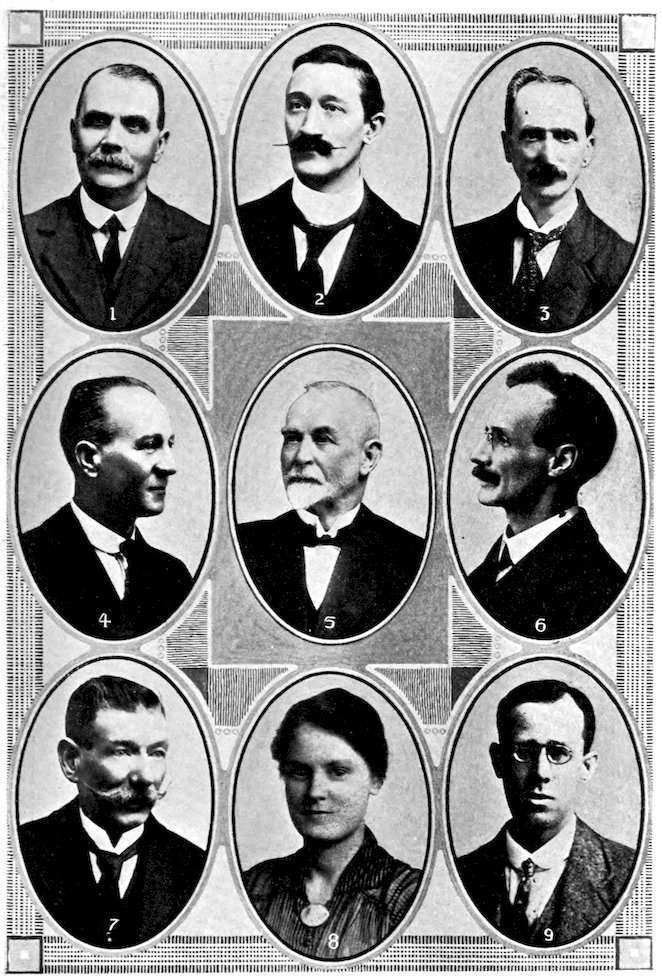
EDUCATIONAL COMMITTEE
1. JOHN SIMPSON.
2. ALEXANDER BUCHANAN.
3. JOHN B. WALKER.
4. JOHN TOWART, Secretary.
5. JOHN YOUNG, Chairman.
6. JAMES H. FORSYTH, Treasurer.
7. JOHN URQUHART.
8. MARY KENNEDY.
9. HUGH MURDOCH.
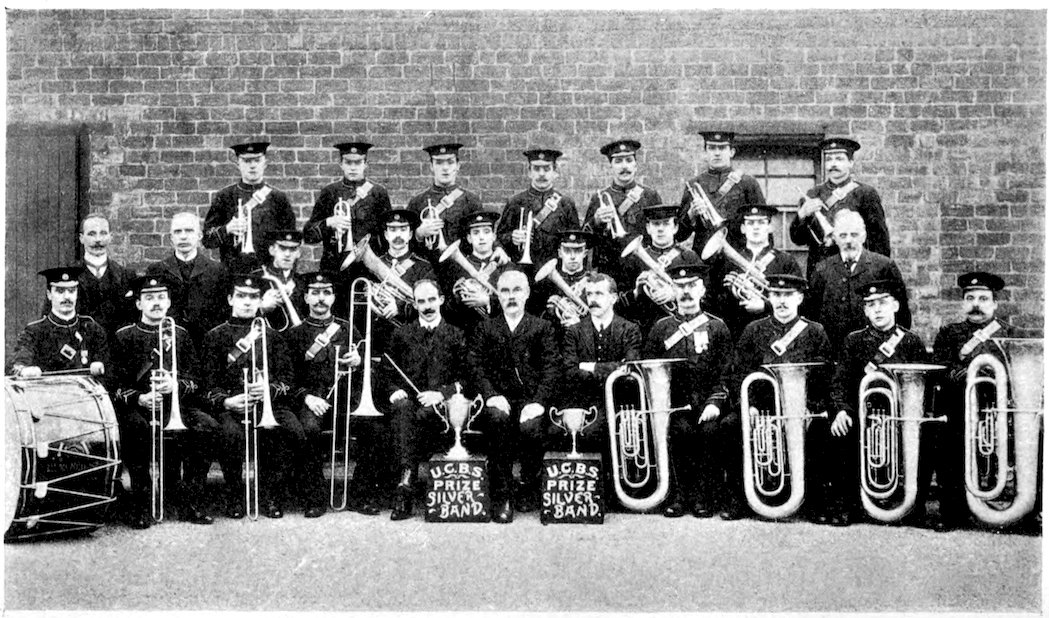
PRIZE SILVER BAND
H. A. MELLOR, Bandmaster. WILLIAM MILLER, President. JAMES THOMSON, Secretary.
161
It was not long before the manager was again reporting to
the committee that the premises at M‘Neil Street were being
congested, and intimating that they would require to consider
the building of additional ovens at Clydebank or else the opening
of a branch in the east. The result was that four additional
ovens were built on a plan devised by the engineer and foreman
baker, and called the “Scott-Richard” oven. By the 140th
quarter the branch was in full working order, and the number
of sacks baked that quarter was 2,502. The output of the
branch continued to increase, and by the 148th quarter had
risen to an average of 352 sacks per week. So rapidly had the
sales of the branch grown that less than eighteen months after
it was opened the directors found it necessary to add other
three ovens, bringing the total up to fifteen. These also were
of the Scott-Richard type.
By the beginning of 1906 the congestion at Clydebank and
at M‘Neil Street had become so great that it was decided to
proceed with the completion of the Clydebank premises at a
cost of £10,000. This extension provided for the erection of
sixteen new ovens, thus practically completing the productive
capacity of the building. The extension was completed in
June 1907, and the June quarterly meeting was held in one of
the flats there. Amongst other innovations introduced during
the completion of this extension was a large water-storage tank
of capacity sufficient to provide a day’s supply of water in event
of any breakdown in the public water supply. Provision was
also made for electric power and light, and two electric lifts
were installed.
At the meeting the chairman, Mr D. H. Gerrard, said the
branch was up to date in every respect, and could be characterised
as a modern bakery in every sense of these words,
equipped with the latest and most improved means of production.
It was an institution of which they need not be ashamed—indeed,
he would say rather it was an institution of which they might
be justifiably proud that they were the owners. They were
exhorted in the Old Book that they should forget the things
that were behind and press onward to the things that were
before. In a general sense that advice was pretty good,
especially when looking back might have a depressing effect on
one’s spirits; but it might be helpful to take a retrospect of the
past and look for a short time on the day of small things: the
days of their weakness, and ponder over them. After paying
a tribute to the work done for the Baking Society by Mr
M‘Culloch, Mr Gerrard went on to suggest that the United
Baking Society was one of the wonders of modern times, and
was an eloquent testimony to the shrewdness and business
162qualifications of the working men who had managed it during
the thirty-eight years of its existence. Referring to the branch,
he stated that it had now capacity for a trade of 1,400 sacks
per week, and pointed out that since Clydebank bakery was
commenced, in 1902, the trade of the Society had increased by
nearly 1,500 sacks per week.
The new premises had only been opened for a few months
when, one Sunday morning in October, those responsible for
carrying on the work of the branch were horrified to discover
that fire had broken out. The fire was first discovered by one
of the men employed in the stables, whose attention was
attracted by the sound of breaking glass. He at once raised
the alarm, and while the local fire brigade was being summoned
the stablemen did their best to overcome the fire, but without
success. By the time the local fire brigade arrived the fire
had gained a firm hold, and assistance was telephoned for to
Glasgow. The appliances of the local brigade were not of
much use, and all that the Glasgow brigade were able to do
when they arrived was to confine the fire to the upper floors,
which, with their contents, were completely destroyed.
Fortunately the lower floors were fireproof, and beyond damage
by water there was little harm done.
Arrangements were at once made to transfer the bakers in
the Clydebank factory to M‘Neil Street so as to cause the
minimum of inconvenience to the customers of the Society,
and an agreement was come to with the Operative Bakers’
Union whereby the men were allowed to begin work an hour
earlier in the mornings and two hours earlier on Saturdays
while the reconstruction was taking place. Fortunately, very
little damage was done to the lower part of the building; but
it was decided that in rebuilding the upper portion it should be
made entirely fireproof. For this reason it was decided that
the new roof should be flat and of concrete. The damage done
by the fire amounted to over £10,900. So quickly was the work
of renovation begun that by the Saturday of the week in which
the fire took place a temporary roof had been erected, and the
work of baking had again been started. It is interesting to
note here that Barrhead Society, which had, not long before,
163completed the erection of a new bakery of their own, offered to
place it at the disposal of the U.C.B.S. if they should require
it; but, fortunately, the directors found themselves in a position
to decline this kind offer.
The facilities for extinguishing a fire of such magnitude
possessed by Clydebank Town Council had proved to be quite
inadequate for the purpose, and a strong protest was made
by the board. Particularly the water pressure had been found
quite inadequate for the work. By the beginning of December
the directors had submitted plans to the Dean of Guild Court
for the reconstruction of the premises, and these were passed
on an undertaking being given that the boiler flue, to a defect
in which it was supposed that the fire had been due, would be
built to the satisfaction of the master of works. The building
was quickly completed, and soon work was in full swing again.
In the month of January 1909 a bad smash took place in
Partick between a motor van from Clydebank bakery and two
Glasgow tramcars, in which damage amounting to £174 was
done to the van. This accident gave rise to counter-claims by
Glasgow Corporation and the U.C.B.S., but it was not until
June 1910 that the case was finally disposed of, the Sheriff
finding that the driver of the Bakery motor van was entirely
to blame for the collision. The case aroused considerable
interest at the time because of the legal aspect of the question
as it affected the “rule of the road” in connection with the
passing of cars which ran on rails in the middle of the streets or
roads. By that decision it was decreed that fast vehicles passing
tramcars going in the same direction should do so on the left
side, whereas the ordinary rule of the road in Scotland decrees
that all other vehicles must be passed on the right side. The
total cost to the U.C.B.S. of the accident, including litigation
costs, was almost £1,700.
In 1909 the Clydebank branch achieved fame by winning
first prize in the loaf-baking competition conducted by the
S.C.W.S., and the presentation of the shield was made the
occasion of a social meeting, at which the president of the
Society presided, and the presentation of the shield was made by
Mr Stewart, president of the Wholesale Society. At the meeting
164a number of complimentary things were said about Mr Reid,
foreman, and the work of the bakery which he controlled.
In the following year Clydebank lost the shield, but were
successful in winning several prizes for smallbread.
During the first ten years after the branch was opened the
progress continued steady, the turnover for the tenth year
amounting to 35,638 sacks, equal to an average output of 687
sacks per week. At this time it was decided to extend the
bakery, and eight new ovens were put in. Just before the
outbreak of war the branch secured the contracts for supplying
the Territorial camps at Jamestown and Dunoon, and as soon
as war was declared and mobilisation begun it was kept very
busy with orders for military use, and, later, secured a big
contract to purvey for Navy men. The output continued to
increase steadily. By 1915 it had risen to 1,000 sacks per week,
and by 1917 to 1,038 sacks. With the coming of Government
controlled flour and the consequent unpalatable bread a decrease
took place in the output, from which the branch was just
beginning to recover at the period with which this history of
its operations ends. During the fifteen and a half years since
its erection over 520,000 sacks of flour were turned into bread,
and the congestion at M‘Neil Street was relieved to that extent;
while the primary purpose for which the branch was erected,
that of ensuring to the societies on the western side of the
Society’s delivery radius an earlier supply of bread each day,
was accomplished to their satisfaction, and the Co-operative
production of bread was stimulated by means of the increased
orders secured. There can hardly be any doubt but that the
policy adopted by the directors of branching out where a branch
could be carried on successfully has found its justification in
the success which has attended Clydebank branch since its
formation, and that until now the fears entertained by those
who opposed this policy at the beginning have not been supported
by the results achieved.
With the growth and prosperity which has come to Clydebank
and the neighbouring portion of Greater Glasgow, and with
the further growth of that prosperity which the future seems
likely to bring with it, the success of the branch is assured,
and the probability is that before many years have passed
further extensions will have been rendered necessary by the
165expansion of trade. Unquestionably the erection of the branch
was an experiment. It was a departure from what had been
hitherto the established policy of the Federation, but it was an
experiment which was justified by the circumstances of the
time, and was the first step in a policy which has since brought
not only the societies on Clydeside into close co-operation with
the Federation, but has had the same effect in the North of
Ireland, and it is a policy which is spreading in both countries
to the advantage of the Co-operative movement.
CHAPTER XIV. BELFAST BRANCH. — EARLY BAKING PROPOSALS. — DISPUTE WITH LOCAL BAKERS. — SCOTLAND COMES TO THE RESCUE. — THE BAKERY. — THE BAKERY COMPLETED. — THE ADVISORY COMMITTEE. — CONTINUOUS PROGRESS. — GOVERNMENT CONTRACTS. — THE WAR AND ITS EFFECTS.
166
CO-OPERATION IN THE NORTH OF IRELAND—EARLY BAKING PROPOSALS—DISPUTE
WITH LOCAL BAKERS—SCOTLAND TO THE RESCUE—A
TEMPORARY BAKERY—EXPANDING TRADE—THE BAKERY COMPLETED—THE
OPENING CEREMONY—GROWTH AND DEVELOPMENT—GROCERS
AS AGENTS FOR BREAD—EXTENSIONS NECESSARY—THE ADVISORY
COMMITTEE—CONTINUOUS PROGRESS—A SERIES OF EXTENSIONS—SOME
RETAIL SOCIETY FAILURES—HELP FOR DUBLIN STRIKERS—GOVERNMENT
CONTRACTS—A REGRETTABLE ACCIDENT—THE FEDERATION’S
GENEROSITY—THE WAR AND ITS EFFECTS—OATCAKE BAKING
STARTED—THE BELFAST STRIKE—A TRADE UNION TESTIMONIAL—THE
INFLUENCE OF THE U.C.B.S. ON IRISH CO-OPERATION.
The Co-operative movement in the North of Ireland is a plant
of comparatively recent growth. In the early ’nineties of last
century there were only some four or five retail societies in the
whole North, and most of them were far from strong—so weak,
indeed, that two of them afterwards went down. When they
came under the control of the Co-operative Union they were
placed under the wing of the Scottish Sectional Board, and that
Board undertook a large amount of propaganda work which had
the effect of strengthening the existing societies and of leading
to the formation of new ones. Amongst those which were
formed as the result of this propaganda zeal on the part of
Scottish Co-operators the strongest which remain to-day are
Armagh and Portadown, but the work of Co-operation in
Lisburn and Belfast was strengthened materially by the
propagandist efforts of the Scottish enthusiasts.
At that early period the society which then existed in
Londonderry was probably the strongest in the whole of Ireland,
and it was the first Irish society to become a member of the
United Baking Society, but, unfortunately, the closing down at
a later period of the work in which the majority of the members
were employed led, indirectly at least, to its collapse. Another
society which was only able to struggle on for a few years was
167that situated at Lurgan. Belfast was in a bad way. It had
practically no capital and was carrying on by the aid of bank
overdrafts. Nor at that time was Lisburn in much better case.
Through the visits of Mr James Deans and of other Scottish
propagandists the societies in the North of Ireland began to
hear tales of the success which was attending the work of the
Federated Baking Society in Glasgow, while in 1898 the Baking
Society sent over Mr Petrie and one of the directors on a
propaganda tour, with the view of opening up a business
connection with the Irish societies. These gentlemen attended
a meeting of the Irish Conference Association, and Mr Hamilton
told the delegates something of the work which the Federation
was doing, with the result that some good orders were received.
It was as a result of this visit that Londonderry Society joined
the Federation, to be followed in succeeding years by Lisburn
and Belfast. It was as a result of this visit also that Mr
M‘Culloch, President of the Baking Society, was invited to read
a paper on “Federated Baking” at a conference which was held
in Belfast in August of the same year. There was no immediate
fruit from the reading of Mr M‘Culloch’s paper, but when, some
years later, the private baking firms in the North of Ireland
began to apply the screw to Irish Co-operators the proposals he
had made were recalled and a deputation was sent over to seek
help. Meantime the societies in Ireland were increasing in
number and in strength. Lisburn had started into new life;
Armagh and Portadown societies had been formed; and Belfast
was making headway slowly but surely. Until this time little
trade in bread had been done by the U.C.B.S. with the Irish
societies, the bulky character of the commodity and the long
distance from the centre militating against this, although for a
time at least ’Derry Society had bread sent over in hampers.
It was in 1903 that the private bakers in Ireland began to
show their hostility to Co-operation. At first this hostility did
not take the form of an absolute refusal to supply bread, but
the equally effective one of reducing the discount allowed and
at the same time refusing to undertake delivery. In Belfast
168the society was badly hit by this policy, and in their need they
applied to the U.C.B.S. for assistance, asking them to supply
the society with bread and at the same time to take into
consideration the opening of a branch bakery in Belfast.
Belfast Society followed up their letter by a deputation, and
as a result of the interview the Bakery Board agreed to supply
the society with bread in the meantime and also to lend them
two vans to enable them to distribute the bread to their members.
At the June quarterly meeting of 1903 a Belfast deputation
again attended to plead their cause with the delegates. Mr
Gilchrist was their spokesman and made a lengthy statement,
explaining the friction which had arisen between the society and
the local baking firms and the steps which the society had taken
to meet the difficulty. He stated that the membership and
trade of the society were both increasing rapidly, and made
a strong plea that the Federation should come to their help by
planting a branch bakery in Belfast. The result was that power
was given to the committee of the Federation to help Belfast
Society in any way possible. One of Kinning Park delegates
moved an amendment to the effect that power be not given,
but this amendment did not meet with much support.
The result of this decision was that the Committee appointed
a deputation to visit Belfast with the object of finding out the
real position there and what buildings or land might be available
for the planting of a branch. A bakery, consisting of two Scotch
ovens and one draw-plate oven, together with the necessary
bakery plant, had been discovered, and seemed a suitable
place, while the price was £750, but it was ultimately decided
that ere making an offer all the Irish societies should be
consulted as to the best method of assisting Irish Co-operation
under the circumstances. By the time the replies to the letters
sent had been received, however, the Committee were informed
that the bakery they had under consideration had been sold,
with the result that the manager and secretary of Belfast
Society were requested to supply particulars of other vacant
sites, and particularly of open ground suitable for building on.
When these reports came to hand they contained particulars of
six different plots of ground, ranging from one acre to five
acres in extent, and with prices ranging from £26 per acre to
£60 per acre—the latter price, however, including the making
169of streets. With these reports before them the Committee
decided to delay coming to any decision until after the question
had been again before the quarterly meeting, but to go forward
to the quarterly meeting with a recommendation that a branch
be erected at Belfast.
At this time the position in Belfast warranted fully the
optimistic tone in which Mr Gilchrist had spoken three months
earlier of its future. The society had been established for
fourteen years and its sales were rather more than £30,000 a
year. It was not their size, however, but the rapidity with
which they were growing which led to the optimism of those
who were responsible for the management of the society. In
one year they had grown from £5,000 a quarter to £10,000 a
quarter. From the one tiny branch in Shanklin Road the
society had grown until it was now the owner of four branches,
and the members continued to join the society in large numbers.
All this the delegates had found out during their visit to Belfast,
and they considered that the facts justified the recommendation
they were making—that a branch should be established there.
In bringing the recommendation before the delegates the
chairman stated that Belfast Society was purchasing at the
moment from 400 dozens to 500 dozens of bread weekly, notwithstanding
the fact that the bread was a day old before they
received it. The membership of Belfast Society was 1,200, and
was increasing rapidly, and both manager and committee were
of opinion that the trade would be doubled if they had a bakery
on the spot which could supply them with new bread daily.
While a sum of £2,000 or £3,000 would be sufficient to erect a
bakery which would meet present requirements, the idea of the
Federation directors was that sufficient land should be acquired
and they should build on a plan which would permit of
expansion in the future. The directors, he concluded, were
unanimously of opinion that not only would a branch bakery
be of immediate service to Belfast Society, but that it would
consolidate and strengthen the whole movement in the North
of Ireland, while it could be established without any serious
risk to the Federation. The motion that the proposal of the
directors be approved was moved by Mr Duncan of Kinning
170Park, who had moved the rejection of the proposal to give
assistance three months earlier, and the recommendation received
the unanimous approval of the delegates.
Thus the fateful decision was taken—a decision which, as
Irish Co-operators will be the first to acknowledge, was fraught
with possibilities of immense good to Ireland, possibilities which
have fructified into actualities as the years have passed. The
decision strengthened the hands of Belfast Society at the moment,
but it has done far more during the period which has intervened,
for the powerful aid which the U.C.B.S. has been ever able and
ever willing to render has made it possible for the Irish societies in
the North, at a time when no one of them was overburdened
with capital, to devote what capital they did possess to the
extension of their businesses in other directions, secure in the
knowledge that the staff of life was assured to their members
for such period as they were able to make reasonable provision
for the payment of the services thus rendered.
Having secured the approval of the delegates for their
proposals, the first duty which devolved on the directors was
that of finding a suitable site. In order that all the members of
the committee might be able to come to decisions with the
fullest knowledge obtainable, they decided at the outset that
they should visit Belfast in a body, and inspect the various
sites of which they had information, meantime delaying the
final decision. Eight different sites were examined, and,
ultimately, the final decision rested between two of these, that
at Ravenhill Avenue being the one which finally found favour,
at a rental of £80 per annum. Mr W. J. Gililand, Belfast, was
appointed architect, and was instructed to prepare plans for a
temporary bakery, containing four ovens, to meet immediate
needs, before proceeding with plans for the general building.
At a later meeting it was decided that the delivery of the bread
should be undertaken by Belfast Society, and that special terms
should be arranged for this service. By January the temporary
building had been commenced, and by the beginning of June
was ready to begin operations. Mr George Forshaw, East of
Scotland representative, was appointed commercial manager
and Irish traveller, and Mr James Moffat, Belfast, foreman
171baker. Baking was begun on 2nd June, the temporary building
having been fitted-up with one Scotch oven and three draw-plate
ovens. Unfortunately, a dispute between the architect
and the Corporation of Belfast had hindered the erection of the
temporary bakery for a little, but, during a special visit paid to
Belfast, Mr Young, manager, was able to arrange matters
amicably. Nevertheless, the dispute cost the Society over £18
in legal and other expenses.
The area in which the Society’s bread was used soon began
to widen. At first Belfast was practically the only customer,
but in the course of a month or two society after society became
customers, so that by the beginning of August there were five
societies, in addition to Belfast, customers for bread. This
good result was due to visits which had been paid by some
members of the directorate to the committees of the societies.
At the same time, Lurgan Society applied for membership and
was admitted.
It was not until the middle of November that tenders for the
completion of the main building were accepted, and then the
committee had not finally made up their minds how much of the
work they were going to complete at once, but reserved to themselves
power to stop with the completion of the front section if
they thought this plan desirable. When the matter was further
considered in March, however, the committee were unanimously
of the opinion that the building should be two storeys in height.
Some of the difficulties which had worried the committee so
much when the first section of the M‘Neil Street building was under
construction manifested themselves again at Belfast, and it was
found that it was not in Glasgow alone that builders were dilatory.
The committee had hoped that the finished building would
be ready for opening in September, but it was not until April
of the following year that it was completed. The building
erected contained provision for eighteen ovens on two floors;
but at first only nine ovens were built on the ground floor, the
upper floor being used for storage purposes. The ovens were
of the draw-plate type, and amongst the machinery installed
was an automatic dough-divider and handing-up machine,
capable of weighing accurately 2,800 loaves per hour.
172Elaborate arrangements were made for the opening ceremony,
for truly it was a great day for Ireland. All the societies in the
Federation were invited to send delegates to Belfast, and
provision for their conveyance and comfort was made by the
Baking Society. The U.C.B.S. band accompanied the party,
and discoursed sweet music during the journey from Ardrossan
to Belfast. After spending the hours of Sunday in whatever
manner they felt inclined, the delegates were driven in brakes
on the Monday morning to Ravenhill Avenue. The procession,
for that is what it amounted to, attracted great attention as it
drove through the streets of the city with bands playing.
Doubtless, many of the good folks of Belfast wondered what all
the noise was about, for at that time Co-operation had but a very
small share in the commercial life of the commercial capital of
the Green Isle, and it is quite likely that many thousands of the
inhabitants of the city knew nothing of the momentous event
which was going to take place that morning. To many of them
Co-operation was only a word, the meaning of which they did
not understand, and to many more even the word was unknown.
At the opening ceremony Mr James Bain, the secretary of
the Federation, presided, and, in the short speech he delivered
in introducing Mr Gerrard, who was to declare the premises
open, he voiced the true spirit of Co-operation. Their meeting,
he said, was a public assurance that wherever the brotherhood
of Co-operation existed, no matter whether a society was in the
throes of adversity or rejoicing in the hope of prosperity, they were
ready to lend a helping hand in adversity or to share in the joys
of prosperity. When the word had come to Scotland that their
Celtic brothers were in need of assistance the U.C.B.S., in season
and out of season, had done their best to give the needed help.
He was glad that the request they had made had been so far
acceded to, and that they were there on that glorious Easter
Monday morning to witness its fruition. They looked forward
to the new branch as a means of consolidating and advancing
Co-operation not only in the North of Ireland but throughout
the whole of Ireland. It was only their first branch, but they
were looking forward to the time when they would have a great
many more branches scattered over the whole of Ireland.
Mr Gerrard had presented to him a handsome gold key with
which to open the door of the building. In declaring the
173premises open, he said they were that day marking an important
epoch in the history of Co-operation. In Ireland distributive
Co-operation could not be said to be flourishing like the green
bay tree. On the contrary, its progress had been slow and its
development difficult. In that the progress of the movement
did not differ from its progress elsewhere. Everywhere there
had been societies which were weak, but in Ireland, as elsewhere,
those who constituted the membership had struggled heroically.
Under difficulties and discouragements, before which many would
have gone under, they had endeavoured to hold fast that which
they had, and taking encouragement to themselves from their
belief that the principle of associated effort for mutual benefit,
which they represented but feebly, would ultimately be grasped
by their fellow-countrymen and would work for their common
good, they had struggled on.
Later in the day luncheon was served in the Y.M.C.A. Hall,
after which more congratulatory speeches were delivered, the
speakers including, besides Mr Gerrard, Mr Richardson (president
of Belfast Society), Mr James Deans, Mr Duncan M‘Culloch,
Mr Robert Fleming, Mr Alexander Hamilton, and others, after
which the Scottish visitors joined the steamer again en route for
home; which, however, many of them did not reach without
discovering that “a life on the ocean wave” was not without
its drawbacks.
The opening of the new bakery at once sent the trade up with
a jump; so much so that, at the close of the half-year which
ended in July, a profit of £550 was shown as compared with a
profit of £116 for the half-year which ended in January. During
the half-year 3,853 sacks were baked, an increase of 59 per week
over the previous half-year, notwithstanding the fact that the
large bakery had only been working for three months. From
that time onward the output showed a practically continuous
increase. The reasons for this were many. The Irish societies
in the North were increasing in membership and strength, and
new societies were being formed and were joining the Federation.
Particularly was this increase in membership and strength notable
in Belfast, where the movement has never looked back since the
opening of the bakery. The quality of the bread had also something
to do with the increase in trade. Before the temporary
bakery had been long in existence the foreman sent samples of
174his workmanship to the Bakers’ Exhibition held in the
Agricultural Hall, London, where he was successful in securing
first and third prizes. This superiority in the quality of the
bread baked has been maintained throughout the life of the
branch. So superior, indeed, was the bread baked at Ravenhill
Avenue that Belfast Society found their bread trade a useful
feeder for their membership roll, customers joining the society
as members for bread only at first, and gradually going on to
the purchase of other goods until they became full-fledged
members purchasing from every department.
The committee were assiduous in their endeavours to maintain
and increase the sale of their products. Thus, when owing
to lack of enthusiasm Banbridge Society gave up business, the
Society decided to continue on the road the van which had been
working for that society, employing the man who had done
the work for the society, so that the bread connection might
not be lost. So successful did this method prove that in a comparatively
short time they were employing another horse and
van as well. Their bread was becoming so famous in the North
of Ireland that grocers in the outlying villages were anxious to
become agents for it, and, after consideration, the committee
agreed, with the proviso that this should not be done where
there was a Co-operative society in the place.
In order that the delegates of the Irish societies might become
familiar with the Society and its work the committee also invited
the Irish Conference Association to hold their conference under
the auspices of the Federation. So successful were all these
means of propagating the sale of bread that, before the new
bakery had been in operation for a year, the foreman baker was
approaching the committee with a proposal for more oven
accommodation.
The Society had given horses and delivery carts on loan to
the societies when the bakery was started, but it was felt that
this method of conducting the business was not satisfactory and
could not be allowed to continue indefinitely, so letters were
sent to the societies inviting them to a conference at which the
whole question of delivery could be discussed. At this conference,
which took place in July 1907, the board proposed that
these horses and vans be handed over to the societies, the
Federation, however, retaining a lien on them for three years
175so that, in the event of any society discontinuing the purchase of
bread inside that time, the Federation could resume possession.
It was also agreed that, in future, the Federation should deliver
the bread at the place most convenient to each society, but that
each society would be responsible for delivering the bread to
its own members. This arrangement was approved by the
representatives from the Irish societies who were present at the
conference.
Already, at the beginning of 1907, the bakery was proving
too small for the work which had to be done, and by the middle
of the year it was decided to add three more ovens, while by
the end of the year it had become necessary to extend the
bakery, and it was agreed that this should be done, at a cost
of almost £3,000. At the end of 1907, also, Mr George Forshaw
resigned his position as manager of the branch, and Mr Duncan
M‘Innes, who was in charge of the branch at Falkirk, was
appointed manager in his place.
The members of the board had now had almost a year’s
experience of managing Belfast Branch, and had come to the
conclusion that in order that the work should be carried on
satisfactorily in every respect it was desirable that representatives
of the local societies should be associated in the
management. For this purpose they drew up a scheme for an
advisory committee, to consist of three representatives of
Irish societies. These proposals were approved by the delegates
at the quarterly meeting, and were afterwards submitted to
representatives of the Irish societies and approved by them.
Mr Robert Fleming, Belfast, was appointed convener of the
committee, and associated with him were Messrs Crook, Lisburn,
and Palmer, Portadown. The constitution of the Advisory
Committee was as follows:—
The committee shall consist of three members—one of whom
shall act as convener and correspondent.
They shall be elected at a meeting of representatives of Irish
societies to be summoned by the board of management in the month
of July in each year. They shall hold office for two years.
Their duties, generally, shall be to supplement the efforts of the
board of management in developing and consolidating the business of
Belfast branch. To this end, they shall meet and confer with those
members of the board who visit the bakery monthly. They shall
176keep in touch with the several societies in the Federation, and advise
as to the most economical means of serving them. They must visit
the societies when commissioned to do so by the board, and carry
out any particular duties assigned to them—such as attending
monthly meeting, conferences, verifying stocks, etc.
They shall be paid at the same rate as the members of the board
of management doing the same work.
From time to time since then the constitution of the
advisory committee has been amended and its membership
added to. Very shortly after its formation it was increased to
four members; in 1912 another member was added; and in
September 1918 yet another, making the membership now
six.
An important amendment of the constitution was made in
1912, when it was altered to the following:—
The committee shall consist of five members—chairman, secretary,
and three society representatives.
They shall be elected at the annual meetings of representatives
of federated Irish societies held in July of each year, and shall hold
office for two years (societies shall be entitled to representation at
such meetings in like proportion as to quarterly meeting immediately
preceding). The chairman and one society shall be elected in
alternate years with the secretary and two societies. If through
death, resignation, or otherwise, a vacancy should occur in the case
of an ordinary member, his society shall fill up the vacancy, and in
the case of an official the committee shall have the power to fill up
the vacancy from their own number, subject to the approval of the
following general meeting.
Their duties generally shall be to co-operate with the board of
management in developing and consolidating the business of the
Belfast branch. A sub-committee, consisting of the secretary and
one member (members of the committee attending in rotation for
the purpose), shall be held not later than Thursday in each week
except in such weeks as full meetings of the committee shall be held,
as hereafter provided. They shall inspect the premises and plant,
noting anything requiring attention of manager or board of management.
They shall afterwards receive reports (on prescribed forms)
from distributive and productive managers, who shall both be in
attendance to supplement and explain verbally the reports submitted
by them. The manager shall further report any complaints received,
and the steps, if any, taken to remedy the matters complained of.
He shall also report purchases made and any contracts entered into
for supply of goods.
All correspondence from board of management or elsewhere
bearing on the work of the branch shall be taken up and dealt
with.
A copy of the minutes of each sub-committee meeting, with any
recommendations the committee desire to make, shall be forwarded
by the secretary to the board of management in time for consideration
at the board’s weekly meeting held on Friday.
177Full meetings shall be held on the second and last Saturdays
of each month or other convenient dates, three to form a quorum.
Two representatives from the board of management shall attend
one of these meetings. Cost and profit statements and statistics of
trade with societies for previous month shall be submitted and
considered at this meeting. Matters of general policy and questions
remitted from board of management shall be discussed with visitors.
Minutes of all sub-committee meetings shall be submitted for confirmation
to next full meeting. Distributive and productive managers
shall be in attendance at all meetings.
Appointments for stocktaking, quarterly meetings of the
Federation, visits to societies, conferences, etc., shall be made and
reports of same received at full meetings.
The manager shall consult the members of the advisory committee
when it is possible to do so on matters requiring to be dealt with
between meetings, but this general instruction shall not prevent him
acting on his own initiative when circumstances demand an immediate
decision.
They shall be paid at the same rate as the members of the board
of management doing the same work.
In 1917 Mr R. Fleming, who had acted as convener of the
advisory committee from its formation, was elected a member
of the board of the C.W.S. This necessitated the resignation
of his position on the advisory committee, which took effect
at the annual meeting with the Irish societies in July of that
year. Mr J. M‘Guffin, president of Belfast Society, was elected
his successor, and the thanks of the Bakery board and of the
Irish delegates were accorded to Mr Fleming for the work he
had done for the branch. At the quarterly meeting of the
Federation in Glasgow which was held in June Mr Fleming was
present, and there also the thanks of the delegates were conveyed
to him by the chairman in an appreciative speech, to which
Mr Fleming made fitting response.
In 1918 there were some differences of opinion on questions
of management between the advisory committee and the board
of management, with the result that the advisory committee
suggested resigning in a body from their offices. This course
of action did not commend itself either to the board of
management or to the delegates, and the cause of friction was
removed by another alteration of the constitution of the
advisory committee, which gave that body another member.
The principal alteration, however, was contained in the following
178clause which was added to the paragraph in the 1912 constitution
which dealt with “Duties”:—
“Should any difference arise between the committee and the
board of management which cannot be adjusted by correspondence,
a joint meeting of both bodies shall be convened, and the matter
determined by their united vote.”
This clause has the effect of giving the Irish societies one third
of the total representation on the board of management
when matters affecting Ireland which are controversial in their
nature are being discussed and, while maintaining that
supremacy which is the right of the larger and more powerful
section of the Federation, ensures that the case of Ireland shall
be put and determined in an atmosphere in which the fullest
consideration will be given to the arguments adduced.
Already the new bakery was becoming too small for the work,
and in August 1908 it was agreed to complete the central portion
of the building by the addition of other two storeys at a cost of
£2,263. Just prior to this time, however, the committee felt
compelled to dispense with the services of their foreman baker,
and Mr W. H. Bell, who had been his assistant, was appointed
in his place. For several years Belfast Society used the stable
at the bakery for stabling their horses, while they were also
permitted to erect a cart shed and a shoeing forge. Later this
society erected stables, etc., for themselves on property adjoining
the bakery, and the ground which had been occupied by them
was utilised by the Federation for necessary extensions to the
bakery.
By March 1909 the extended premises were ready for
occupation. It was not long ere the directors were in the mortar
tub again, however, for another extension costing almost £4,000
was entered on in the autumn of 1910; and not long after it
was completed there came, in December 1911, an urgent request
from the advisory committee for more ovens, and another
extension, at a total cost of almost £5,000, was entered on and
completed in 1912. These various extensions practically
completed the bakery as it stands at present, except for alterations,
minor in themselves, which were made from time to time
during the war period with the object of increasing the working
facilities.
179In July 1909 the committee recorded their satisfaction that
the average weekly sales from the bakery amounted to £1,219,
while in March 1910 the weekly turnover had reached 500 sacks;
and to meet the increasing demand three new ovens had to be
erected. The Bakery continued to win prizes at the Agricultural
Hall and other exhibitions, thus proving that Co-operative
bread baking on a large scale was equal to producing bread of
the finest quality.
Early in 1910 the directors were saddened by the news that
one of the members of the first advisory committee, Mr Crook,
of Lisburn, had passed away.
Although most of the societies in the North were doing well,
there were one or two which were in a bad way. In 1908 Lurgan
Society had to close its doors. The Federation were creditors
to the extent of £114, and when settling day came it was found
that the assets of the dead society were only capable of returning
1/6 in the pound. In 1910 Newry Society went the same
way. The Federation were creditors to the extent of £200, and
it was expected that the assets would realise 10/ per pound.
In Newry the Federation made temporary arrangements to
carry on the bread trade, as had been done in Banbridge, but
after some time this course was abandoned.
Shortly after the new bakery was opened the two Dublin
societies were in consultation with the committee of the
Federation about the erection of a bakery, and the committee
agreed to assist them. The two societies were unable to agree,
however, and the idea of a federal bakery for Dublin was
departed from. In 1910 Dublin Industrial Society erected a
bakery for themselves, and the opening of this bakery was
followed in a short time by the amalgamation of the two societies.
The Dublin Society, however, experienced considerable difficulty
in acquiring the knack of baking good bread—their position in
this respect recalls some of the earlier experiences of the
U.C.B.S.—and the Federation readily consented to Mr Bell or
his assistant visiting Dublin to put them on right lines. In 1913,
when the distress due to the strike was at its height in Dublin
and the Trade Unions Congress was coming to the rescue with
financial support, the Industrial Society received a contract
for the supply of from 3,000 to 5,000 loaves daily. As they
were unable to handle the contract in their own bakery they
180secured the assistance of the U.C.B.S. bakery in Belfast, which
supplied them with the needed quantity of bread during the
period covered by the contract. Later, during the period of
the war, the Industrial Society was in considerable difficulty
for a time, and those responsible for its management were
exceedingly anxious that the U.C.B.S. should take over the
bakery. This was not done, however, and fortunately the
society was able to maintain and even to improve its position.
At the beginning of 1909 the Bakery secured a contract for
the supply of bread and flour to Newtownards Barracks, and
since then have supplied from time to time that Barracks, as
well as those of Holywood, Belfast, and Kilroot, while, either
directly or through local societies, they have been successful in
securing contracts for various local institutions, one society
during the war securing the contract for the Admiralty.
In 1912 the Society had loaned some motor lorries for an
excursion, and during the day a painful accident took place
whereby one child was killed and three others were severely
injured. The Society’s motorman was completely exonerated
from blame for the accident, but in token of their sympathy the
Society paid the doctor’s fees and granted £55 to the relatives.
In 1913 two of the societies were experiencing difficulty in
selling the bread because of the unfair competition to which
they were being subjected in attempts to cause them to give
up the bread trade, but the Federation came to their assistance
by allowing them a little additional discount on their purchases.
In 1911 the Irish Agricultural Wholesale Society was appointed
agent in Ireland for the Federation, and some time later it was
stated that since that federation had become agent the trade
had increased. At the Dublin Congress in 1914 the Federation
erected a scone and oatcake baking plant as part of their exhibit
in the Congress exhibition, and this exhibit was an object of
much interest to the Dublin visitors to the exhibition.
In Ireland, as in Scotland, the commanding position of the
U.C.B.S. had a steadying effect on the price of bread at the
181outbreak of war. The Society carried good stocks of flour, and
by adopting the fixed policy of regulating the price of bread by
the average price of the flour in stock was able to maintain the
price at a lower level than the current price of flour warranted.
In this way, while it was possible to maintain full stocks of
flour, the Bakery was able to keep the price of bread at a
halfpenny per 4–lb. loaf below the price at which other bakers
wished to sell it, and so saved the people of the North many
thousands of pounds.
The difficulties of transport were experienced by the branch,
however, in a much more marked degree than by the parent
body. All coal, flour, sugar, etc., used in the bakery had to be
imported, and as transport costs went up so also did prices,
until bread was being sold in Belfast at one shilling for the
4–lb. loaf. So short did the supply of coal become that in 1915
Belfast Corporation was unable to supply the Bakery with coke
for firing purposes and a supply had to be sent over from
Glasgow. Flour and sugar also became very scarce, but notwithstanding
those facts the output of the Bakery continued to
increase rapidly until the coming of Government Regulation
flour, with its huge proportion of offal and other nastinesses,
created a distaste for bread amongst the public. At the outbreak
of war the output of the Bakery averaged 766 sacks per week,
while by the end of 1916 this had risen to 892 sacks per week,
an increase of 16½ per cent. in two and a half years. From then
it gradually declined, until at the end of the 63rd quarter of the
working life of the branch it was only 683 sacks per week.
From that time and during the next six months the trade again
increased, so that by the end of the period with which this
history deals, although it had not reached the high-water mark
of 1916, all the evidence went to show that that point would
soon be left behind.
In 1918, with the object of relieving the congestion at
M‘Neil Street, it was resolved to establish an oatcake baking
department at Belfast, and for this purpose several hot-plates
were transferred to the Belfast bakery, as well as several girls
from the M‘Neil Street oatcake factory. This department has
since proved a valuable adjunct to the branch, the plant having
had to be augmented and the number of bakers employed
increased.
182Just at the end of the period Belfast became involved in one
of the most widespread strikes in the history of the Labour
movement, and practically all work except that of bread baking
was brought to a standstill. The electricity workers of the
Corporation came out on strike along with the other workmen,
but fortunately for the branch it had a power-generating plant of
its own, and so was able to continue at work. By this means
the trade of the branch was materially increased. The fact
that the Federation has always been willing to meet the requests
of the employees in a reasonable manner has always enabled
the branch to maintain its popularity with the Belfast workmen,
and so impressed were the executives of the Operative Bakers’
Society with the fairness and even liberality of the committee
that on one occasion an official letter was sent from the union
in which the board of management were thanked for the
assistance which their prompt action in agreeing to the request
of the union for a shorter working week had been in enabling
that concession to be imposed in the baking trade of the city.
When the branch was established in Belfast the distinct
understanding on which the U.C.B.S. took action was that as
soon as convenient it should be taken over by the local societies,
but as the years pass the likelihood of this being done seems to
become more remote. As has already been stated, the branch
has been of great assistance not only to Belfast Society but
also to the majority of other societies in the North. It has
fostered the Co-operative spirit and Co-operative idealism.
From a weakling which was very much in need of the fostering
care of the movement in Scotland Co-operation in Ireland, and
especially in the North of Ireland, has grown to be a strong and
healthy organisation, with its centre in Belfast and with branches
scattered all over Ulster. It is probable that the Irish societies
are strong enough now to take over the branch if they were so
disposed, but the farseeing spirits amongst them see that there
is other work lying to their hand to which, relieved of the
working of the bakery, they can turn their undivided attention.
On the other hand, the proposal, adopted in 1917, that the
Federation should proceed, as and when expedient, to plant
branches in other centres of Co-operation in Ireland, will in
course of time cause the U.C.B.S. in Ireland to cease to be an
exclusively North of Ireland concern. It will do much, just as
183the other federation in Ireland, the I.A.W.S., is doing much,
to weld together into one united movement the whole of the
Co-operative societies in the country. It will serve for Ireland,
as it and its kindred associations in Scotland and England are
serving to-day, as an illustration of the fact that Co-operation
is not merely a principle for adoption by a few farmers or a few
workmen in a given district, but is also a principle on which
these isolated groups can be united into one powerful whole,
by becoming an institution where all can meet on a common
platform.
CHAPTER XV. A NEW PRESIDENT. — ST MUNGO HALLS. — MR M‘CULLOCH RETIRES. — AN AMALGAMATION PROPOSAL. — PURVEY AND CONTRACT DEPARTMENT. — THE FIRST MOTOR VAN. — A BREAD EXPERIMENT. — PROPAGANDA AND PUBLICITY. — UNEMPLOYMENT. — THE EFFECT ON CO-OPERATION. — SOME BUSINESS ITEMS. — THE SOCIETY’S POSITION.
184
A GREAT DEMONSTRATION—A NEW TYPE OF OVEN—ST MUNGO HALLS—TEAROOMS
BURNED DOWN—MR M‘CULLOCH RETIRES; MR GERRARD
ELECTED PRESIDENT—AN AMALGAMATION PROPOSAL—PURVEY AND
CONTRACT DEPARTMENT—THE FIRST MOTOR VAN—A BREAD EXPERIMENT—PROPAGANDA
AND PUBLICITY—UNEMPLOYMENT—THE EFFECT
ON CO-OPERATION—CO-OPERATION THE REMEDY—SOME BUSINESS
ITEMS—THE SOCIETY’S POSITION.
In tracing the history of the two branches at Clydebank and
Belfast we have wandered far ahead of the general development
of the Society, and must now retrace our steps to the main
road of our story at the point at which we left it. In the period
which began with the beginning of the thirty-third year the
directors were kept very busy with business which was connected
with the development of the two new branches, but
the parent institution was not allowed to suffer from neglect.
The great demonstration which was held in the summer of 1902
to celebrate the attainment of an average output of 3,000
sacks per week proved a great success. The demonstration
was in two parts. In the first place, the employees and their
families and friends, to a number which filled three special
trains, went picnicing in the morning to Milngavie. In the
second place, a gigantic vehicular procession, which included
about 100 vehicles and 150 horses, paraded through the city
and out the Milngavie Road as far as Canniesburn Toll,
returning to M‘Neil Street by another route. This procession
was headed by a charabanc containing the members of the
Society’s band, and the gaily decorated lorries and vans
attracted much attention as they passed through the streets.
All the mottoes displayed in the procession had some reference
to Co-operation.
But, while it is good to demonstrate and advertisement has
certainly its uses, bread must also be baked, and the object of
185a Co-operative society is, or ought to be, to produce the best
possible bread at a minimum cost. This was a fact of which
there was not much danger that the directors would lose sight,
and even if they did the representatives of the societies would
very quickly remind them of the lapse. They were about to
build a new bakery; and, with the view of testing the
efficiency of a type of oven then practically unknown in
Scotland, they decided to erect two draw-plate ovens at
M‘Neil Street. The tests seem to have been satisfactory, for
in both Clydebank and Belfast branches this type of oven
formed the majority of those installed.
Meantime other matters were engaging their attention.
When the new stables had been erected on the land purchased
at the south corner of South York Street and Govan Street
a considerable portion of the ground—more than half indeed—remained
unbuilt on, and early in 1902 the educational
committee of the Society came forward with the recommendation
that in any further building which might be erected a hall
which could be used for educational purposes should be
included. The committee also were desirous that the Society
should have a hall of their own, and later in the same year the
architects were instructed to prepare plans for the utilisation
of this vacant land which should include halls and accommodation
for the headquarters of the purvey department. At
the quarterly meeting in March 1903 power was given to
proceed with the erection of the buildings. These were to
consist of five halls, containing accommodation for from 200
to 1,500 people, with the necessary siderooms, etc., and with
ample accommodation for the purvey department. Permission
was also given for the erection of three tenements of dwellinghouses,
with shops on the ground floor; the total cost to be
from £14,000 to £15,000 for the halls and purvey department
buildings, and £6,400 for the tenements. Eleven months
passed, however, before the building of the halls was begun,
and they were not completed until 1906.
Toward the end of 1903 the Paisley Road tearooms were
destroyed by fire, and in restoring them the committee decided
to add another storey. The landlord agreed to bear a
186proportion of the cost, and on the reconstruction being
completed they were named the “Wheatsheaf” tearooms.
For several years the chairman had been desirous of
retiring, but had been induced to remain in office until the
schemes on which he had set his heart—the erection of
Clydebank and Belfast branches—were well on the way. In
1904, however, he definitely decided to end his official
connection with the Society. For fifteen years he had acted
as president. He was first appointed to the board by his
society in June 1888, and had continued to act on the board
until his retiral.
Mr Daniel H. Gerrard was elected president in succession
to Mr M‘Culloch. For a short time he had represented
St George Society on the board prior to his election, while the
active part which he had taken, as a member of the Scottish
Sectional Board, in combating the boycott in the later
“’nineties” and his position as chairman of St George Society
had made him well known to the majority of Scottish
Co-operators.
In the autumn of 1903 an interesting proposal was made
by the directors of Hamilton Baking Society. This was to the
effect that the two societies should become amalgamated.
During the following year several meetings took place between
representatives of the two societies, but ultimately negotiations
were broken off, the members of Hamilton Baking Society
having expressed disapproval of the proposal. If the scheme
could have been carried through it would have left the Baking
Society in the position of being the only federated society
producing bread in the West, with the exception of Chapelhall,
and might have paved the way for that society to come in also.
Meantime the work of the purvey department was growing.
For the two years 1902 and 1903 the department secured
contracts from Glasgow Corporation for the supply of bags of
eatables on Children’s Day. In the aggregate the bags supplied
187numbered 190,000, of a total value of about £1,800, and
requiring somewhere about twenty-five tons of flour for their
manufacture. When the “Wheatsheaf” tearooms were reopened
after the fire an “at home” was held to which the
customers were invited. The purvey department was also an
offerer on most occasions when purveys on a large scale had
to be carried through, often with success. The department
was successful in securing the purveying contract for the
tearooms in the East-End Exhibition. It was also a successful
offerer in 1904 for the supply of bread to Gailes Territorial
Camp, and in the following year Jamestown Camp was supplied
from Clydebank.
The tearooms continued to give cause for a considerable
amount of anxiety on the part of the committee. Sometimes
a small profit was made on the working and sometimes a loss
resulted, but there never was that increase in trade for which
the board thought they had a right to look. With the erection
of St Mungo Hall and the transference of the catering headquarters
to South York Street the need for Main Street as a depot
for the catering department disappeared, but for some time it
was carried on as a workmen’s tearoom, always without any
signs of assured success, however. Finally, in 1904, it was
given up altogether. Nor were the London Street halls or the
Union rooms much more successful. Several experiments were
made at London Street, with the object of making the place
more popular. The whole of the three upper flats were taken
by the Society, and several trade union and friendly society
branches made the rooms their headquarters, but the place
was never really popular. An attempt which was made to run
the second flat as workmen’s dining and tea rooms did not
meet with much success, and it seemed as if anything the
board could do was not of much use in popularising the place.
Nor were the Union rooms much more successful. They just
managed to keep going, but they did not become, as had been
hoped, a rendezvous for the men and women of the Co-operative
movement. Nevertheless the committee did not despair. They
always kept on hoping that the tide would turn and renewed
the lease time after time, still looking for the Co-operative
patronage which never came in sufficient quantity to make the
place a success.
188
For practically the whole of the nineteenth century the
power-driven road vehicle had to struggle against the bigotry
of the people and the interested opposition of the proprietors
of other systems of locomotion. Steam-driven road cars and
wagons were in use long before Stephenson had designed and
completed his first railway, but they met with strong and
unreasoning opposition on the part of many people instigated
by the owners of post and passenger coaches, who saw in the
new method of locomotion a menace to their welfare, and also
by other horse owners, who found these steam-driven, noisy
vehicles intolerable nuisances which frightened into panic the
high-strung horses unfortunate enough to meet them on the
roads. This opposition translated itself into Acts of Parliament
which imposed heavy taxation on the newer mode of locomotion,
and culminated in 1836 in the famous “man with the red flag”
provision in the Act of that year, which was the means of
clearing practically every “faster than walking pace” power-driven
vehicle off the roads. This Act, passed at the instance
and in the interests of the railways, had a most detrimental
effect on the development of road and also of canal traffic, and
left the country completely at the mercy of the railway
companies until the “red flag” restriction was practically
laughed out of existence in the last decade of the century by the
development of petrol-driven motors, and the prohibition was
removed in 1896.
After 1896 the development of power-driven vehicles for road
traffic made rapid strides, but it was not until some seven years
later that the U.C.B.S., on the instigation of the makers, put
a bread motor van on the road for a trial. After working for
some months, the committee decided to send a note of their
experience of its working to the makers, and at the same time
to point out some defects which they had discovered. Gradually,
however, the new means of delivery superseded the old, until
all the Society’s long-distance work was done by means of
motor vans. For many years, however, the construction of the
motor engines placed a serious obstacle in the way of the
adoption of motor vans for short journeys or for journeys which
entailed frequent stops. The engine, from its nature, requires
189that the cylinder should be charged and the charge compressed
before ignition can take place. Drivers were therefore faced
with the alternatives of putting the engine out of gear and
leaving it running—at a considerable expenditure for fuel which
gave no return in work done—or of having much laborious
cranking for the purpose of charging the cylinder and compressing
and igniting the gas, the latter plan, particularly in
cold weather, often entailing considerable expenditure of time
as well as of energy. Nowadays, however, most up-to-date
motor engines have a small electric engine for doing this work.
For a long time it had been the wish of the manager and
directors of the Baking Society to introduce a natural working
day into the bread trade, and they had done their best some
years earlier to have the matter taken up by the societies and
the public, but without success. Now, in the autumn of 1905,
another attempt was made, a squad of bakers beginning work
at 9 a.m.; the bread thus baked being delivered on the following
morning. A number of the societies in Glasgow and neighbourhood
were induced to take up the sale of this bread, with the
result that the sales speedily rose; but after a trial which lasted
several months the scheme was abandoned, as the directors
found that instead of helping the general work of delivery it
was proving a hindrance to that work.
This decision of the committee met with a considerable
amount of opposition from delegates to the quarterly meeting,
but the directors were not in a position to do other than they
had done. The real obstacle was to be found in the fact that
the public insisted on having new bread, and with a number of
the bakers beginning work late in the day for the production of
“natural working day” bread, as it had been named, there was
not labour enough in the early morning to meet the demand
for new bread by ten o’clock. Thus the second attempt of the
Baking Society directors to introduce a natural working day
into the baking trade came to naught, through no fault of theirs,
but because of a public who would insist on having bread
steaming from the ovens.
190
During these years the directors continued to adopt every
reasonable method of keeping the Federation and its productions
before the public. They took advantage of every opportunity
offered by exhibitions to show the quality of goods which were
produced by the Society; they exhibited also at shows, and
were occasionally successful in securing prizes, although the
rush conditions under which their bread had to be produced
in order to cope with the ever-increasing demands of the
societies did not provide the conditions necessary for producing
bread of show quality.
At the same time the entertaining of women’s guilds,
conference associations, and other Co-operative organisations
was further developed, and many Co-operators who before had
but a very hazy idea of the size and importance of the U.C.B.S.
were enlightened as a result of these visits. The cake shows,
also, held annually, were excellent propaganda. Here, inside
one hall, were to be found specimens of all the productions of
the three bakeries; and these productions came latterly to
include many novelties which were not to be found in everyday
use, as well as the more common specimens of cakes, buns,
bread, etc., and a large variety of biscuits. Thus the cake show
came to be regarded as the annual exhibition of Bakery
productions, which indeed it was, and it was one of the most
eagerly anticipated Co-operative functions of the year.
Unfortunately, during the years 1904–1905 there was a very
severe economic crisis which was the cause of widespread
unemployment, and Glasgow and the West suffered severely.
Such economic crises had been periodic during the past century,
and differed materially from those which occurred in earlier
centuries. Until the beginning of the nineteenth century
economic crises were really due to actual scarcity of foodstuffs,
and people went hungry as much because there was not enough
food to go round as because they had no money with which to
buy their share of what there was. Thus, in Scotland, until
about the close of the Napoleonic wars, the periods of comparative
plenty or of scarcity depended largely on the character
191of the seasons. While it is true that the common people were
always in want, in bad seasons they died of starvation.
With the coming of the industrial era, however, there took
place a gradual change. While prices still depended on the
seasons, and were moderately or extravagantly high as the
seasons were good or bad, there entered into the problem a new
factor, and the people became poor and were unable to purchase
because they had produced too much and there was not an effective
market for the goods. As it has been tersely put: “The
shoemaker’s children went barefoot because their father had
produced too many boots; and the tailor’s, naked, because he
had made too many clothes.”
This was a new phenomenon for which history provides no
parallel, and it has persisted, ever increasing in intensity, until
towards the end of the first decade of the twentieth century
as many as 42 per cent. of the breadwinners in a respectable
working-class district in the East-End of Glasgow have been
found to be unemployed at the same time.
These periods of unemployment seem to be in the form of
more or less regularly recurring cycles. There is first a gradually
increasing inflation of the volume of trade. New works are
started, old works are enlarged, and everywhere there is a boom,
until the zenith is reached. Then comes a gradual slackening
off. The supply of goods has outstripped the limits of effective
demand and sales gradually decline as warehouses become full.
The rate of slackening increases; statisticians begin to watch
the rapidly ascending unemployment curve, which in itself does
not record the full slackening, as many workers are on short
time. This increase of unemployment still further weakens the
effective demand for goods and still further accelerates the
growth of unemployment, with the result that in about another
year the unemployment crisis is reached, soup kitchens and
relief works open; thousands of hitherto steady workmen
become derelicts—and the huge commercial and industrial
concerns take advantage of the slackness to squeeze small
rivals out of business or to swallow them up, while at the same
time improving their own machinery of production.
Another feature of these industrial phenomena is the
acceleration of their periodicity. During the decades which
marked the end of the nineteenth century and the beginning of
192the twentieth, the number of years which elapsed between one
crisis and the next was becoming smaller and the periods
were appreciably shorter than those of the earlier cycles.
Fourteen, twelve, or ten years used to be the intervals between
crises, but in the last forty years this interval has gradually
shortened, until only three years intervened between the end of
one crisis and the beginning of the next. This is in strict
accordance with what we would expect to find. The means of
supplying the effective demand of the people for goods has
increased out of all proportion to the increase in that effective
demand, with the natural result that the market gets choked
full to overflowing in an ever-shortening time. When to this
is added the continuous perfecting of processes and equally
continuous speeding up of production, we see that under the
conditions which obtain it necessarily follows that the periods
which must elapse before the markets are choked up with goods
must get progressively shorter, while the periods necessary to
relieve the glut again grow gradually longer. Thus, we had a
crisis in the late “’seventies,” another in 1888–89; another in
1893, of a milder type; another in 1898; another, very acute,
in 1904–05; and another, the worst the industrial world in
Britain has known, in 1908–09–10; while evidences were not
wanting when war broke out that we were again on the
downward sweep of the cycle.
The Co-operative movement in general is profoundly
influenced by conditions of unemployment, which is our excuse
for what has been written above. The vast majority of
Co-operators depend for their incomes on their being employed
in ordinary industrial undertakings, and when the machinery
of industry breaks down their spending power is affected.
Those in fortunate positions can carry on economically for a
longer or shorter period on their investments in their societies,
but those fortunate individuals constitute but a small proportion
of the whole membership. When an unemployment crisis comes
it means distress to a large number of Co-operators, for those
who have large savings to fall back on are usually in more or
less important positions in the concerns by which they are
employed and are amongst the last to be dismissed—are, in fact,
193rarely out of employment at all. Sales of Co-operative societies
go down, while working expenses continue. In this respect,
however, the Baking Society has always been the last to suffer,
for people continue to buy bread when they have almost ceased
to be able to purchase anything else. But there is always during
such crises a proportion of Co-operators, varying in different
districts, whose incomes are barely sufficient to meet physical
needs while they are in constant employment and who are
thrown on their beam ends by even a fortnight of unemployment,
and the hardship of these crises is that this is the class of people
on whom the curse of unemployment falls first and on whom it
rests longest.
Fortunately, the milk of human kindness is not quite dried
up in Co-operators, and so soon as genuine cases of distress are
known steps are taken to ameliorate the condition. In this
process of amelioration the Baking Society has always played
a big part. We have already seen that during the miners’ and
engineers’ strikes and during periods of distress due to unemployment
the Society distributed thousands of pounds worth
of bread, and now, during 1904–05, the same policy was pursued.
If one was inclined to moralise much might be said about
the mentality of a people who continue content to endure such
straits in a country where wealth abounds in superabundance,
and also about the mentality of statesmen who could find no
remedy for such a constantly recurring cancer of the body
politic; but this is hardly the place for that, and all that can
be done is to suggest that in a country in which the Co-operative
principle was predominant a remedy would be found. The
sufferers themselves, and those who act for them, have tried
to do something through limitation of output and the shortening
of the working day, but in normal times the onward march of
production has more than kept pace with such crude attempts
to outwit it. The remedies had the fatal defect of attempting
to deal with a symptom while leaving the root disease untouched,
and the result, necessarily, has been failure.
From the beginning until 1905 the S.C.W.S. had only paid
half dividend on flour purchases. The directors had been
approached by the Baking Society’s board on more than one
194occasion to have this practice altered, but without success.
However, at the beginning of 1905 the S.C.W.S. directors
decided that in future they would pay full dividend on flour on
all new contracts. They were again approached by the U.C.B.S.
directors, who had a large contract for flour placed with the
S.C.W.S. at the moment, to extend the privilege to contracts
at present running, but this they were unable to do. The
financial standing of the Society was improving with every year
that passed, and in 1905 they found that notwithstanding the
very large additions which had been made recently to land and
buildings the shares and reserves covered all but 11½ of the
total. At the quarterly meeting held in March 1905 it was
agreed that the Society take out ten shares in the North Wales
Quarries Society, and at a later meeting this number was
increased to 100. Unfortunately, this society, which had been
formed to provide work for slate miners out of work because
of a trade dispute, did not prosper, and after a few years of a
precarious life was forced to go into liquidation.
On several occasions the Baking Society placed orders for
biscuit cartons in America until they were able to procure
such goods at home. One such order, placed in 1905, was for
100,000 cartons. They were also utilising motors to some
extent for bread delivery, and, in addition to their first
purchase, other two were now bought. In September of this
year—1905—another attempt was made to get the C.W.S. to
acknowledge the Baking Society’s invoices, but again without
success. The contention of the C.W.S. directors all the time
was that they were quite able to do all the trade in England, and
that therefore the U.C.B.S. did not require to go there at all.
The relations of the directors with their employees have
always been cordial, and whenever conditions of trade have
permitted concessions in a shorter working week and in wages,
where these were not regulated by national agreements, were
made from time to time. One such concession was made in
1905, when the hours of the girls in the packing flat were
reduced from fifty-one to fifty per week without any request
from the employees.
From time to time, also, meetings of the board with the
heads of the various departments took place, so that the
directors might place before them the nature of the complaints,
195suggestions, etc., which came from societies, and solicit their
co-operation in extending and consolidating the business through
the production of first-class goods and speedy distribution. At
one meeting of the board, held shortly after the close of Paisley
Congress, a special vote of thanks to the manager, purveyor,
and heads of departments was recorded for the efficient manner
in which all the work of purveying for that huge assembly had
been carried out.
During the period under review Messrs Scott (engineer) and
Richard (bread baking manager) had made some improvements
on a type of draw-plate oven. These alterations were patented
in the joint names of the two gentlemen and the Baking Society,
and arrangements were made with Messrs Baker & Son, bakery
engineers, London, for the manufacture of the oven. Messrs
Scott and Richard were also the joint inventors of a divider and
moulding machine.
Much important work was done in the three years from
1902 to 1905. Clydebank bakery was erected; Belfast Bakery
was commenced, as was St Mungo Halls, and both were nearing
completion; three tenements of houses had been erected in
Govan Street, with shops on the street level, and these shops
were ultimately all occupied by Kinning Park Society. One
result of this policy was that the Baking Society ceased to retain
the bread damaged in manufacture, and this trade was taken
over by Kinning Park Society. Henceforth, until for a short
time they retailed the bread they made in Rothesay Bakery,
the Society did a wholesale business only. Notwithstanding
the opening of Clydebank Bakery, the sales of loaf bread from
M‘Neil Street were greater than they had been at the beginning
of the period, while the turnover in smallbread, oatcakes, and
biscuits had all increased considerably, and the total production
for the last six months of the period under review was 92,336
sacks for the three bakeries, as compared with 73,821 at the
beginning of 1902. During the four years the membership had
increased by thirty-four societies, and the value of the sales by
£61,092 for six months. The rate of surplus had been fluctuating
between 2/ per £ and 1/8 per £, and for one half-year it
was 2/2.
196Big things were also in prospect. The need for new offices
was forcing itself on the attention of the directors; and, with
the prospect of increased trade in front of them, consideration
was already being given to the utilisation of their ground at
the north-west corner of South York Street, although the time
for extensions there had not yet arrived.
CHAPTER XVI. FROM STRENGTH TO STRENGTH. — EXTENSIONS. — THE QUALITY OF THE BREAD. — THE TEAROOMS. — ORDERS FROM EGYPT. — ORGANISATION. — ANOTHER UNEMPLOYMENT CRISIS. — RAILWAYMEN’S CONGRESS ENTERTAINED. — THE BAND. — PROPAGANDA WORK. — THE SOCIETY AND ITS EMPLOYEES. — THE OLDEST SCOTTISH SOCIETY GOES UNDER. — THE CO-OPERATIVE INSURANCE SOCIETY. — THE SOCIETY’S PROGRESS.
197
STEADY PROGRESS—EXTENSIONS—NEW OFFICES—THE QUALITY OF THE
BREAD—THE TEAROOMS—ORDERS FROM EGYPT—ORGANISATION—A
SPECIAL COMMITTEE—MR ALEXANDER HAMILTON RETIRES—THE
SOCIETY JOINS GLASGOW CHAMBER OF COMMERCE—AUSTRIAN
CO-OPERATORS VISIT THE BAKERY—ANOTHER UNEMPLOYMENT
CRISIS—RAILWAYMEN’S CONGRESS ENTERTAINED—BAND SUCCESSES—PROPAGANDA
WORK—CLYDEBANK BAKERY SECURES FIRST PRIZE
FOR BREAD AT S.C.W.S. BAKING COMPETITION—THE SOCIETY AND ITS
EMPLOYEES—COMPULSORY TRADE UNIONISM—A SHORTER WORKING
WEEK—THE OLDEST SCOTTISH SOCIETY—THE CO-OPERATIVE
INSURANCE SOCIETY.
The growth of a great organisation may be likened to that of
a river. Away up in the mountains where the river takes its
rise every stone has weight to turn it aside. It trickles down
the hillside with noisy babble, here almost stagnant, there going
forward with a rush; ever gathering strength as it is joined
by other streams. But by and by it reaches the plain. The
strength of its rush down the hillside carries it forward with
gradually diminishing pace until finally it subsides into an easy
forward motion, placid and smooth, yet deep enough and strong
enough to bear on its broad breast the ships of a hundred
nations.
So it has been with the U.C.B.S. At first it was like the
tiny rivulet, directed hither and thither by the rocks in its
path, with its progress seemingly altogether arrested for a
time, then going forward again with a rush and gathering
impetus as it went. The last great rush may be said to have
been taken when it transferred to M‘Neil Street. Its progress
down to the final placidity of the valley was rapid but gradually
diminishing in speed as it reached the level of the plain, so that
having traversed the hills of difficulty and gathered to itself
tributaries as it flowed onward, it was now settled into a strong
but smooth onward flow. Henceforth the difficulties and
198dangers were gone; henceforth also was gone the rapidity of
the current of prosperity; to be replaced by calm, steady
progress which swept forward with the irresistible strength of
a mighty river. No longer was there doubling of output in
a year or two; no more was it necessary to add extension to
extension in order to keep pace with a rapidly growing trade;
yet an increase in turnover which averaged 250 sacks per week
in a year and 1,000 sacks a week in four years was made. It
was a huge increase; actually it was larger than any which
had gone before it; yet it was not so impressive as the smaller
increases which had preceded, for in relation to the total trade
it was much smaller.
It was not that the work of the Society was not going
forward as rapidly in the years 1905 to 1910 as it had done in
preceding years, for the progress made in those four years was
probably greater than ever before; but that the gradually
increasing volume did not call for the same feverish exertion as
formerly. In reality the work done during this period was
probably the greatest in the history of the Federation until
then, and the extensions were also probably the largest.
St Mungo Halls were completed; Belfast Bakery was built and
extended; while Clydebank Bakery was more than doubled in
size. Then the new offices of the Society at the Adelphi Street
corner of M‘Neil Street were also erected, making total additions
to the value of the Society’s property of something like £40,000.
There were other minor alterations and additions also, such as
the covering in of Hayfield Street in order to convert it into a
garage. Altogether the additions to the productive departments
alone were such as allowed an additional turnover of over 1,000
sacks per week.
The new offices were not built before they were required.
The old offices had sufficed indifferently well for the needs of
the Society when they were built, but the continuous and rapid
extension of the business soon made them altogether inadequate,
and by the time the new offices were ready for occupation the
old ones were absolutely crowded out.
The new offices were built to meet all emergencies, however,
and during the eight years in which they have been occupied
have proved quite adequate for the growing business needs of
199the Society and its ever-increasing staff. Just before building
was commenced, lengthy negotiations which had been proceeding
between the Society and the Corporation of Glasgow for land
between the building line and the river were completed through
the purchase by the Corporation of the land for £1,000; the
Corporation agreeing, in addition, to make and maintain the
street. This was a good bargain for the Society, for they had
obtained £700 more for the land than it had cost them; while
a good part of that £700 would have been swallowed up in
making the new street. The covering in of, first, the stable
courtyard and, later, of Hayfield Street was also excellent
business, which made for the comfort and convenience of the
men and horses, and was well worth the £670 which the two
operations cost.
For a long time little had been heard of complaints about
the quality of the bread, but towards the end of 1905 these
became so numerous that the committee called a conference
of the foremen in the various departments for the purpose of
discussing the matter. The case, as put by the committee, was
that they were supplying the best materials, that they were
paying good wages and giving the best conditions of labour,
and that, naturally, they looked for good results. The serious
nature of some of the complaints was emphasised by the
convener of the productive committee; while Mr Young stated
that the last six months had been the worst for ten years, and
hoped that a strong effort would be made to maintain the high
reputation of the bakery. The runners, in replying, one and
all complained of the inferior quality of the flour, especially
that which was used in sponging. They also pointed out that
the rush to get ready for the morning deliveries was, to a very
large extent, responsible for the inferior quality, owing to the
limited time allowed for preparing, proving, and firing. A few
suggestions were made which it was thought would make for
improvement.
During most of these years the tearooms continued to be
the “lame dog” of the Society. Little or no improvement
took place, and balance-sheet after balance-sheet showed a loss
in working or an infinitesimal profit. The question cropped
200up regularly at the quarterly meetings, and countless suggestions
for improvement were made. Particularly was this the case
with regard to catering for the less wealthy class of the
community. A conference with the respective heads of the
tearooms took place, with the object of going into the whole
question, but it does not seem to have borne much fruit. The
suggestions made, as recorded in the minutes, were of a negative
character, and nothing was done. Later, Mr Towart, purvey
department, was put in charge of London Street and Paisley
Road Rooms for a month, with the object of seeing what could
be done to improve the position. On the result of Mr Towart’s
experiment the minutes are silent; but, from the fact that in
less than six months thereafter the Wheatsheaf Rooms were
bought over by the manageress, it would seem that it did not
give much hope of success for that branch at least.
The fame of the U.C.B.S. was by this time extending, with
the result that in August of 1907 an order was received from
a merchant in Alexandria for 500 barrels of biscuits. This was
followed in October of the same year by a similar order. In
the beginning of 1908 the Falkirk depot was closed. The
coming of motor transport had made it possible to supply
direct from M‘Neil Street the district which had been supplied
from the depot. An alteration in the rules which was made in
March 1908 allowed the directors to serve, in future, for two
years without coming up for re-election. This rule ensured
that when a society had been appointed to send a representative
to the board, that society should be represented on the board
for at least two years.
There has always been more or less controversy amongst
bakers as to the respective merits of barm and yeast as an
aerating agency for bread, and as the bread at Belfast was
baked by the yeast process, while in M‘Neil Street barm was
used, it was resolved, early in 1907, to have a test in order to
find out which ingredient gave the best results. The nature
of the test or how it was carried through is not given in the
minutes, but it is stated that the Glasgow bread was favoured
by the majority of the directors. On the other hand it was the
201case that such prizes as were gained at the Agricultural Hall
Exhibitions were gained mostly by Belfast bakery; but this
might be due to any of a variety of causes, and not affected
at all by the variety of aerating agent used.
In March 1907 a resolution was approved by the quarterly
meeting delegates, the purpose of which was the appointment
of a sub-committee to inquire into and report regarding the
duties and emoluments of the members of committee, and the
advisability of adopting fixed rates of remuneration in place
of payment per meeting. It was agreed that the special
committee consist of seven members, two of whom should be
members of the board. Sixteen delegates were nominated,
and it was agreed that the names of these be printed on ballot
papers, which should be sent out to the societies so that they
could record their votes. At the June quarterly meeting the
auditors reported on their counting of the votes on these ballot
papers, when it was found that the elected nominees were
Messrs Cadiz, Kinning Park; M‘Pherson, Cowlairs; Gamble,
Glasgow Eastern; Smith, St George; and Pringle, St Rollox.
At this meeting, also, the special committee was given additional
work, for the delegates refused to adopt the report of the
committee with regard to the representation of Irish societies
on the directorate, and remitted the subject to the special
committee for their consideration.
The special committee reported to the December quarterly
meeting, the more important of the recommendations being that
the board be divided into three sub-committees—two for M‘Neil
Street and one for Clydebank, and that the supervision of
Belfast be continued on the lines adopted by the board. They
recommended, also, that the method of payment per meeting
be adhered to, and that payment be continued at the rates in
vogue. With respect to the representation of the Irish societies
on the board, a deputation of the committee had visited Ireland
and had interviewed representatives of societies and others there
able to give information, and, as a result, they declared it to be
impossible to give the Irish societies representation on the board
because of the geographical position of the branch. They recommended,
therefore, the appointment of an advisory committee, to
be appointed by the Irish societies. These recommendations of
the select committee were all approved and given effect to.
202Meantime the Society was continuing its policy of doing as
much as possible of its work by its own employees, and it now
began to add to its work that of completing the building of motor
vans, ordering the chassis from the manufacturers and putting
on the bodies themselves. Incidentally, it was decided that
from the month of July 1907 all the shops west of Govan Town
Hall should be supplied in future from Clydebank factory. In
September 1907 Mr Alexander Hamilton, who had been a member
of the directorate for a number of years, resigned, and was
awarded the thanks of the delegates for the services he had
rendered to the Society. In furtherance of the methods of the
directors, who believed in testing every appliance which was
likely to be of use in improving the quality or cheapening the
cost of the goods they manufactured, a “Cook” steam hot-plate
was installed early in 1908, and was found to work very satisfactorily.
At this period the minutes record that the properties
and stocks of the Society were insured for £172,000, divided as
follows:—M‘Neil Street, £83,500; stables and workshops, £14,350;
tenements and halls, £31,400; Clydebank, £29,000; Belfast, £10,500.
In 1908 the board recommended that the Society should
become a member of the Glasgow Chamber of Commerce, and
this recommendation was unanimously agreed to by the delegates.
During this year one of the most notable events was the visit of
a deputation of Austrian co-operators, including Dr Karpeles,
who were making a tour of British Co-operative institutions.
During one of the days they were in Glasgow the foreign visitors
were the guests of the U.C.B.S., and were enthusiastically
welcomed. One cannot help wondering whether the welcome
would be quite so enthusiastic and unstinted if they were to
return to-day. In a speech which he made during his visit to
the bakery, Dr Karpeles pointed out that in a Parliament of
517 representatives they in Austria had 88 Labour representatives,
and contrasted this with the thirty or so in the British House of
Commons. He also referred to Co-operators as all belonging to
one family, and stated that the members of the deputation left
Scotland, not only full of gratitude for the reception given them,
but full also of new ideas for the spread of Co-operation. That
was only ten years ago, but to-day Austria is a dismembered
wreck, and International Co-operation has received a setback
from which it may take a generation to recover.
203
Only three years had elapsed since the last unemployment
crisis ended, but at the September 1908 quarterly meeting the
chairman felt under the necessity of stating that they were in
the midst of the worst unemployment crisis of the last thirty
years, and voiced the sympathy of those present with the
sufferers, a sympathy which he had no doubt would take practical
form ere the meeting ended. Later in the meeting it was agreed
that £100 be subscribed to the Lord Provost’s Fund for the
unemployed, and, in the course of the discussion of this proposal,
it was stated that the Baking Society had already given free
bread to the value of £300. It was decided that in order to avoid
overlapping the distribution of free bread in Glasgow should
cease, but the directors were empowered to deal with applications
received from outside Glasgow. The unemployment
epidemic continued right through 1909 and well into 1910, and
had not quite disappeared in 1911. It was the most serious in
its results which had ever been experienced by Britain since it
became an industrial nation.
In October of 1908 the annual Congress of the Amalgamated
Society of Railway servants was held in Glasgow, and, on the
Monday night of the week in which the Congress was held, the
delegates were the guests of the U.C.B.S., the whole suite of the
St Mungo Halls being placed at their disposal. The guests were
welcomed by Mr Gerrard in name of the Society. He said the
railwaymen all over the country were a tower of strength to the
Co-operative movement, and in every town which was a railway
centre there also they would find a strong, well-managed
Co-operative society.
In 1909 the price of flour took an upward tendency, but at
the time the movement began the U.C.B.S. were well prepared
to meet it as they had a stock of 75,000 sacks in hand; sufficient
to carry them on for four months. Later in that year the
directors had a conference with the directors of the Wholesale
Society, as they were dissatisfied with the quality of the flour
they were getting from Regent mill. The result of the conference
was that they agreed to try Chancelot flour for a time.
204New trading terms were also arranged with the S.C.W.S. for the
sale of biscuits. This year’s sales of cakes and other Christmas and
New Year goods were considered very satisfactory, 68¼ tons of
large cakes being sold. During the period of cake distribution
what was considered a record run was made by one of the Society’s
motors; 140 miles being covered in fifteen hours, and goods
delivered on the route.
During the years since its formation, the U.C.B.S. silver
band had been gradually increasing in efficiency. At first,
when it entered competitions, it was only occasionally in the list
of prize winners, and its engagements in the course of a year
were not many in number, but as the members gained in knowledge
of their instruments and experience as a musical combination,
this position gradually bettered, until in 1906 they were
winners of three first prizes and several others of lesser value.
These successes were followed in the ensuing years by others,
so that by the end of the season of 1908 the Iles cup had become
their own property, having been won for three successive years,
and the prizes were formally presented at a social meeting, which
was held on 3rd December of that year. Mr William Miller,
who was president of the band, and who had taken a keen interest
in its development from the beginning, presided, and stated
that the season had been the best on record, as they had had
thirty-five engagements during the season. One of the chief
aims of the band, he said, was to spread a greater love for brass
band music. During the evening Mr Lawson, chairman of the
Scottish Central Brass Band Association, presented the prizes
which had been won during the season. These included the
challenge cup, the Iles cup, and the second-class championship
cup. Mr Miller was presented by the bandsmen during the
evening with a clock and ornaments in recognition of the services
he had rendered to the band during the eleven years it had been
in existence. Mr Miller, in returning thanks, hoped that the
U.C.B.S. band would be the nucleus of a Co-operative band
which would represent the whole movement, and which would
be able in time to take its place alongside even the “Besses of
the Barns.” Unfortunately, Mr Miller’s hopes have not yet
been realised, and now there are two bands in the movement
instead of one.
205
The Society was continuously devising new forms of propaganda,
and extending and developing old forms. Much of this
propaganda and advertising work was philanthropic in its nature,
and took the form of entertaining various Co-operative and
other organisations, but some of it was also utilitarian. For
instance, it was usually arranged that the heads of the departments,
or some of them, should attend the annual exhibitions
of bakery productions in London, and frequently specimens of
the Society’s productions were shown there. Then the annual
cake show grew to be the most sought after function of the whole
year in the Co-operative movement, and committeemen and
Co-operative employees from all over the country came to
inspect and select, while the departments of the three bakeries
vied with each other in devising new dainties with which to
please the eye and tempt the palate of Co-operators.
Unfortunately, amongst other evils which the war brought in
its train was the cessation of this annual Co-operative show.
In another direction, also, the propaganda work of the
Society was utilitarian as well as philanthropic. A considerable
sum was spent every year on educational work, and much of
this money was devoted to the promotion of education and
recreation amongst the employees. Then, too, when new
instruments became necessary for the band, a grant of £200 was
made from the Society’s funds, while uniforms were also provided.
Every opportunity of exhibiting the Society’s
productions was also seized with avidity, and at the 1906
Congress sufficient space was secured to enable an oatcake
baking plant to be set up, thus advertising still further the
Society’s products amongst the Co-operators of the South. In
1907 a conference was held with representatives of society
members and their employees for the purpose of stimulating
the pastry trade. Toward the end of the same year, a society
in Amsterdam was granted the use of lantern slides of the
bakery for propaganda purposes. Twenty vehicles were sent
out to take part in the Co-operative demonstration held in
connection with the Co-operative Festival in the beginning of
1908, while every year for a time an inspection of the Society’s
horses took place in Glasgow Green on an evening in the summer,
206and prizes were given to the employees for the best groomed
horses and best kept and cleaned harness. During a bakers’
strike at Lanark in the early autumn of 1908, the Bakers’ Union
applied to the Baking Society for bread, which they purposed
to sell in opposition to the local bakers. This request was
complied with on the condition that the Union did not sell in
competition with the local society.
Late in 1908, the bakery of Kilbirnie Society was burned
down, and that society was supplied with bread until their own
bakery was reconstructed again. At an exhibition and test of
motor vehicles, which took place towards the end of 1908, an
Albion car which was the property of the Society was awarded
first prize and a Halley car, also their property, second prize.
The prizes, £4 and £2, were given to the drivers. Pie-heaters
had been supplied to one society in the Glasgow area by the
Baking Society, and these having been found exceedingly useful
in stimulating the sales of this variety of the Society’s productions,
it was agreed by the directors that any other society
which was desirous of using them should have similar facilities.
Toward the end of 1909 it was agreed to hold a competition
amongst the squads of bread bakers in M‘Neil Street and
Clydebank, and to enter bread baked by the winners for the
S.C.W.S. bread baking competition. Clydebank branch secured
first prize at the bread baking competition of the S.C.W.S., and
the championship shield was presented to the U.C.B.S. at a
social meeting of the Bakery employees, which was held at
Clydebank shortly afterwards. The M‘Neil Street squad
foremen who had won prizes also had these presented to them
at a social meeting which was held in Glasgow about the same
time. Hopes were expressed at the meeting in Clydebank that,
having gained the shield, Clydebank would remain possessors
of it, but this was probably too much to expect. At all events,
no society succeeded in winning it twice while the competition
was in being.
In 1910 the miners of Leadhills, who had since become more
closely associated with the U.C.B.S., were on strike against the
very bad conditions of their employment, and £20 was granted
by the Bakery to the strike funds. In March 1910 “Puffing
Billy,” the first steam motor owned by the U.C.B.S., was disposed
of for £70, after having given some eight years of faithful service.
207
The good terms which existed between the Society and its
employees continued during the period with which we are
dealing. In great measure this was due to the kindly consideration
with which they were treated by the directors and
managers generally. In addition to the bonus—and the facilities
given, not only to invest it in the Society’s funds through the
investment society, and the opportunities which that society’s
membership of the Federation gave for bringing grievances
before the general body of the members—facilities, by the way,
which during the long history of the Society have never had to be
used—the directors were continuously thinking out plans for
interesting the employees in their work, and as opportunity
offered were bettering the conditions under which work was
carried on. It is scarcely possible to conceive conditions under
which the work of bread bakers will be other than laborious,
but the strong efforts made by the directors to inaugurate a
natural working day for the bakers—efforts which failed because
the general body of the public were more concerned about suiting
their own convenience than they were about making a baker’s
working life more bearable—showed that the directors had the
interests of their employees at heart and desired to make working
conditions as tolerable as possible.
With many of the representatives of the societies this idea
was also foremost, and doubtless it was because that they
recognised that trade unionism was the surest safeguard of the
welfare of the employees that, in 1907, they adopted a resolution
which made it imperative that where there were trade unions
with which it was possible for the employees to become associated
they must be members of these unions. Another step which
was taken by the directors spontaneously had for its object the
wellbeing of the workers. This was the inauguration in
September 1907 of a 44–hour week for the oatcake bakers.
In later years the number of hours worked by the female
employees in all departments was also gradually reduced.
The Society also bore a share of the expenses of the
employees’ picnics and social meetings, usually contributing
a sum sufficient to clear all or almost all the expenses of the
juniors. In 1909 the top flat of the biscuit warehouse was fitted
208up as an employees’ dining room. In the middle of 1910 the
board were called on to arbitrate in a case where three of the
blacksmiths employed by the Society had failed to maintain
themselves in membership of their trade union and had been
dismissed by the manager as a result. After considering the
case, the directors upheld the decision of the manager.
Until the year 1908 the oldest Co-operative society in Scotland
and probably in the world was located in Govan. Govan Old
Victualling Society kept painted over its doors while in business
the statement: “established 1777.” Doubtless, this statement
was legendary and would be difficult to prove, but it is certainly
worthy of acceptance in view of the fact that other Scottish
societies are known to have existed at a very early date.
However, the society had fallen on evil days, and in the
beginning of 1907 sent a request to the directors of the U.C.B.S.
that its shares should be placed on the transfer list. Towards
the end of 1908 it was forced to go into liquidation, but an
unsuccessful attempt was made to carry on the business, in order
that the deficit of some £900 which the accounts showed
might be cleared off. Thus the last remaining link with the
Co-operators of the eighteenth century disappeared, after what
was doubtless a very useful career of one hundred and thirty
years.
For many years after the formation of the Co-operative
Insurance Society the Baking Society had held aloof from it and
refused to become a member, but in later years more Co-operative
councils prevailed, and it had become affiliated. On the death
of Mr Andrew Miller, secretary of the S.C.W.S., who had been
for many years a Scottish representative on the C.I.S. board,
Mr James H. Forsyth, cashier of the Baking Society, was
nominated and secured election, retaining his office until the
taking over of the C.I.S. by the two Wholesale societies.
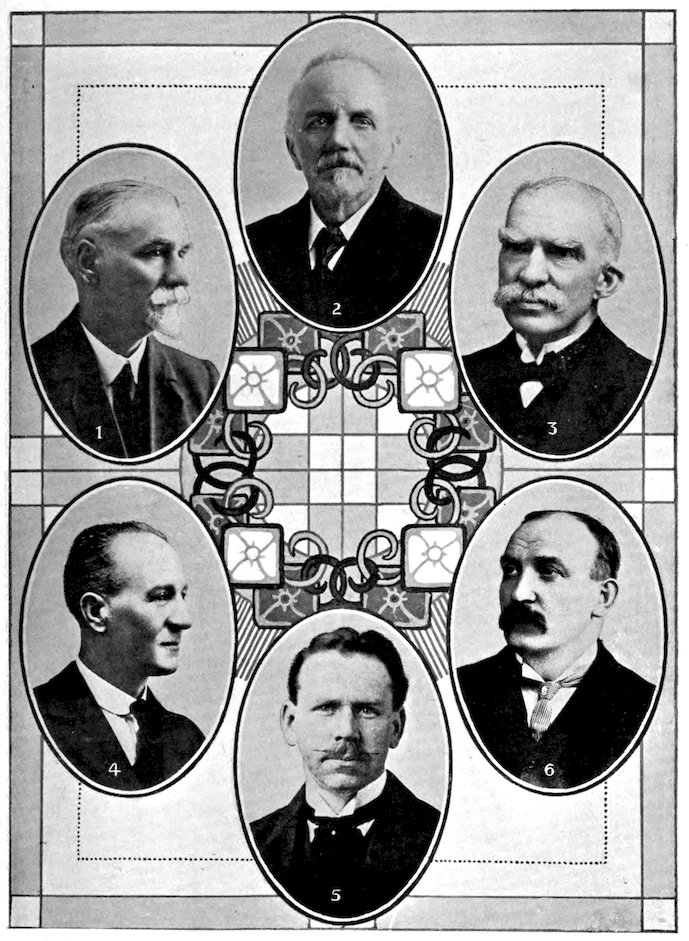
DEPARTMENTAL MANAGERS
1. WILLIAM MILLER,
Distributive Manager, Glasgow.
2. JOHN DAVIDSON,
Master of Works, Glasgow.
3. JOHN M‘PHAIL,
Delivery Manager, Glasgow.
4. JOHN TOWART,
Purveying Manager, Glasgow.
5. WILLIAM NINIAN,
Biscuit Production Manager, Glasgow.
6. MURDOCH RICHARD,
Bread and Pastry Production Manager, Glasgow.
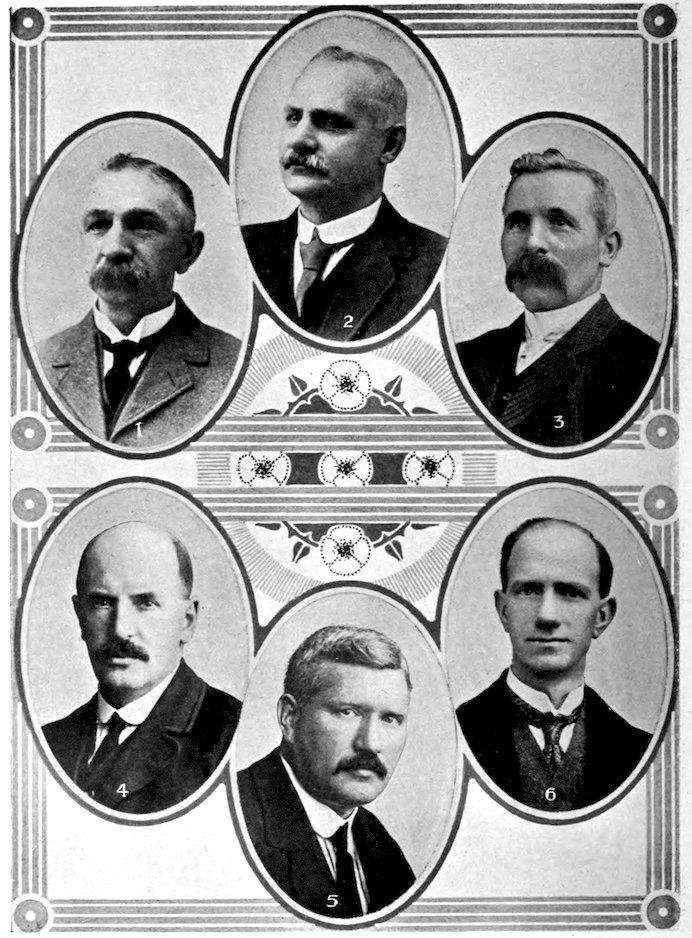
DEPARTMENTAL MANAGERS
1. JOHN REID,
Productive Manager, Clydebank.
2. ALLAN STEWART,
Distributive Manager, Clydebank.
3. MALCOLM M‘FARLANE,
Delivery Manager, Clydebank.
4. DUNCAN M‘INNES,
Branch Manager, Belfast.
5. WILLIAM BELL,
Productive Manager, Belfast.
6. DUNCAN GRAHAM,
Branch Cashier, Belfast.
209
Notwithstanding the difficulties which the depression of
1908–09–10 had placed in the way of increased trade for the
Society the progress made was substantial, and the yearly
turnover, which was £480,000 at the beginning of 1906, had risen
by the end of 1910 to £564,000, while the membership had
increased from 143 to 171. At the beginning of the period the
weekly turnover in sacks averaged 3,405, while by the end of
the period it was 3,795. This was a much smaller increase than
in the preceding period, and it was also a decrease of 125 sacks
from the trade which was being done in 1907–08, but in view
of the labour conditions which prevailed in Glasgow during the
later years of the period it was very good indeed, representing
as it did an increase in turnover of 10,000 sacks a year.
CHAPTER XVII. PROGRESS CONTINUES STEADY. — COVER-PLATE OVENS. — COMPLETION OF M‘NEIL STREET BAKERY. — A SERIOUS FIRE. — A NEW VENTURE. — BLEACHED FLOUR. — A BREAD TEST. — ADVERTISING WORK. — FRESH OVERTURES TO C.W.S. — TESTING DEPARTMENT CONSIDERED. — PROPOSED SUPERANNUATION FUND. — THE INTERNATIONAL CO-OPERATIVE CONGRESS. — THE HOLIDAY CAMP. — THE SOCIETY’S PROGRESS.
210
BISCUIT FACTORY REMODELLED—COVER-PLATE OVENS—COMPLETION OF
M‘NEIL STREET BAKERY—A SERIOUS FIRE—A NEW VENTURE—SUCCESSFUL
CONTRACTORS—BLEACHED FLOUR—A BREAD TEST—ADVERTISING
WORK—FRESH OVERTURES TO C.W.S.—A TESTING
DEPARTMENT CONSIDERED—PROPOSED SUPERANNUATION FUND—THE
INTERNATIONAL CO-OPERATIVE CONGRESS—THE HOLIDAY CAMP—THE
SOCIETY’S PROGRESS.
The new offices of the Society were ready to be occupied in 1910,
and in March of that year they were formally opened. In the
course of the same year, the remodelling and bringing thoroughly
up to date of the biscuit factory was commenced. This remodelling
scheme had its origin in the fact that the old engine
which provided the power for the biscuit-making machinery
was wearing done; and after considering the whole position
the members of the board decided that the interests of the
business would be best served by transferring from steam to
electricity as a motive power. It was therefore agreed that
henceforth each machine in the factory should be motor driven.
The cost of installing twelve motors and controllers was over
£500; but it made for ease in working and also in controlling
the machinery.
About the same time a new type of bread baking oven was
installed. The ovens in the older part of the bakery were
becoming worn out, and that section of the bakery also required
remodelling in order to bring it into line with the newer ideas
of the twentieth century. But the ovens in the old bakery had
been built on the Scotch principle, and there was not sufficient
space available to permit of draw-plate ovens being installed
without a reconstruction of the premises which might have proved
more costly than the provision of an entirely new building. Just
at this time they had submitted to them for their consideration
211a new type of oven which seemed specially designed to meet
cases of reconstruction like theirs. This type of oven, which
has come to be known as the “cover-plate oven,” had much
the same features, so far as the actual baking was concerned,
as had the draw-plate oven, but it differed from the latter in
that, instead of requiring a large space in front of the oven to
permit of the oven sole being drawn out to receive the bread
before baking and to permit of its removal afterwards, it had
a moveable cover, which was raised to permit of the bread being
placed on and removed from the oven sole, and which was
lowered to retain the heat when the unbaked bread had all been
deposited on the sole. The first of these ovens was installed
about the end of 1910, and so satisfactory did the trial prove
that first No. 5 bakehouse and then No. 11 bakehouse were
entirely remodelled and ovens of this new type installed. Before
deciding finally on the adoption of the new type of oven, however,
numerous experiments and tests were carried through. The
Bakery engineer (Mr Scott), the chief foreman baker (Mr
Richard), and the master of works (Mr Davidson) were all
requested to submit reports. These reports were eminently
satisfactory, particularly that of Mr Richard, who reported on
the saving in fuel and wages which was effected by the new
oven.
At the time when the directors decided to install the first
set of six of the new pattern ovens, they also decided to install
one complete set of automatic baking machinery, manufactured
by the same firm of baking machinery manufacturers, the
estimated cost of six ovens and machinery being £4,000. This
automatic machinery has proved so effective in the various
processes of dough making and bread moulding that less than
half the number of bakers are required to perform the work
where it is installed as are required where it is absent. As
indicated above, so effective did the combination of new ovens
and new plant prove that in little more than a year after the
first £4,000 had been spent on the installation it was decided to
extend it at an additional cost of £7,000. Since then, additions
have been made which bring the total number of this type of
oven to twenty.
At the same time as this improvement in their baking
plant was decided on, the committee also decided on extensive
212alterations in connection with the oatcake factory. These included
the removal of the hot-plates from their former situation
to the flat immediately above the biscuit factory, at a cost,
including structural alterations, of over £2,000.
No sooner were these alterations carried through successfully
than the committee turned their attention seriously to another
project which had been receiving consideration at intervals for
some time. This was the completion of the Govan Street,
M‘Neil Street, Adelphi Street, South York Street square by the
erection of an entirely new block on the site of the old buildings
at the South York Street and Adelphi Street corner—the north-west
corner of the square; and at the quarterly meeting held on
20th September 1913 they were granted powers to proceed.
The plans for the new building provided for a workers’ dining
room in the basement flat. The ground floor was to form an
extension of the biscuit factory, which had become congested
in recent years and was too small to enable the Society to meet
the demand for biscuits. The first floor was to be used as an
icing room, and the icing room then in use it was proposed to
utilise as a cake factory, building four Scotch ovens for that
purpose. The second flat was to be utilised as an extension of
the biscuit-packing warehouse; while the upper flat it was
decided to fit up as a dressing room for the female workers. The
approximate cost was given as £11,000.
The new building was commenced in the spring of 1914, but
before much had been done the outbreak of war began to hamper
building operations very seriously, and it was not until the
summer of 1916 that the building was completed.
In November 1913 a fire occurred in the top flat of the
stables at South York Street. In this flat 180 tons of hay were
stored, and before the fire could be subdued the whole of the
hay was destroyed and the roof had fallen in. Fortunately,
the damage was covered by insurance, and the sum of £543 was
received from the insurance company. It was exceedingly
fortunate that the fire originated in the upper flat, as otherwise
many valuable horses might have been destroyed.
213
For the Christmas trade of 1910 a new branch of trade was
started. During the preceding two winters unemployment
had been rife, and as a result the trade done in Christmas goods
had shown a tendency to fall off, but by the end of 1910 business
was getting back to normal again, and in order that Co-operators
might be able to take full advantage of the facilities for the
production of Christmas luxuries which the Baking Society
possessed, a range of Christmas hampers, containing seasonable
goods produced by both U.C.B.S. and S.C.W.S., was placed on
the market. To popularise these hampers amongst the members
of the various societies, contribution cards, enabling the societies
to form “hamper clubs,” were distributed. This branch of
business proved instantly successful, over 3,000 hampers being
sold. Altogether, at the cake show this year, 102 tons of cakes
were disposed of, as well as shortbread to the value of almost
£2,000.
The Society was now almost continuously successful in their
tenders for contracts on a large scale. On several occasions
they had supplied the provisions for the children entertained
during the summer months in the public parks by Glasgow
Corporation, and during this winter they were the successful
tenderers for the supplying of five centres for the feeding of
necessitous children; while in 1911 they obtained the Corporation
contract to cater for 67,500 children at the Exhibition of that
year, as well as the contracts for the Coronation dinners in St
Mungo Hall and Maryhill. The year 1911 must also have been
a busy year for weddings, for it is recorded in the minute of 7th
July meeting that already that year 208 bridecakes had been
made at M‘Neil Street. Tenders for supplying a number of
industrial schools were also accepted, and the contracts for
supplying a number of military camps with bread were received.
In the following year the contracts for supplying bread to a
number of the Territorial camps in Scotland were also secured,
and these contracts continued to be held by the Society until
the outbreak of war. In the autumn of 1912 a certificate was
received from the War Office for prompt and regular delivery
of bread to the camps; and this promptness and regularity of
delivery had doubtless much to do with the fact that for so many
214years in succession the contracts for supplying these camps were
held by the Society.
For the Christmas trade of 1912 136 tons of cakes were sold,
while 80,000 children were supplied on Glasgow Corporation
Children’s Day.
The validity of the bleaching of flour by chemical process
was a question which engaged the attention of many official
Co-operators during the spring and summer of 1912.
Uddingston Society was prosecuted for a contravention of the
Food and Drugs Acts because they had sold to a Food and
Drugs inspector one pound of flour which had been bleached
or oxidised by artificial means. The case was defended by the
S.C.W.S., from whom the flour had been purchased, and at
whose Regent mills it had been milled. Almost all the chemical
and milling experts in the country gave evidence as witnesses on
one side or the other, and the Sheriff before whom the case was
heard was left with a mass of opposing technical evidence to
unravel such as he had seldom had to face. Ultimately he
found the case not proven and, contrary to expectation, the
decision was not appealed from. The U.C.B.S., like most of
the other Co-operative societies in Scotland, had been using a
proportion of this chemically whitened flour, but in November
of 1911, shortly after the seizure of the sample at Uddingston,
they decided to write to the S.C.W.S. and inform them that no
further deliveries of bleached flour could be accepted. Nothing
further was heard of the controversy which had raged so fiercely
in Hamilton Sheriff Court, however, and so it may be taken for
granted that, whatever virtues or failings flour so treated may
have had, injury to health could not be proved.
Although the committee of the Baking Society and their
experts took every precaution and themselves made every test
possible, so as to ensure that only products of the highest quality
were sent out from the bakery, they did not always rest content
with having done that, and one of the occasions when they took
steps to get the unbiassed opinions of the customer societies
arose shortly after the introduction of the cover-plate ovens into
the bakery. They sent out samples of the bread produced by
215Scotch, draw-plate, and cover-plate ovens to every society
customer, with a request that the societies should test the
three different loaves and indicate their preference. Altogether
634 samples were sent out and 439 replies were received. Of
these 47 per cent. favoured the bread baked in the cover-plate
oven, 34 per cent. favoured the draw-plate bread, and 19 per
cent. the bread baked in the Scotch oven. At the same time
fourteen samples had been sent to a private firm at the request
of the firm, and the results there were somewhat similar. This
test seemed to establish the superiority of the cover-plate oven
over either of the other two forms.
When preparations were being made for the 1911 Glasgow
Exhibition, the Baking Society’s committee decided to approach
the boards of the S.C.W.S. and the P.C.M.S., with the object of
having a joint Co-operative stand. Later, a sub-committee of
the S.C.W.S. was interviewed, and an agreement was reached
that a portion of the space reserved for that federation should
be placed at the disposal of the Baking Society for the purpose
of erecting a working exhibit. On interviewing the manager
of the Exhibition, however, it was found that that gentleman
would not sanction a working exhibit in that section of the
Exhibition, with the result that the Baking Society’s committee
decided to drop the proposal and thanked the S.C.W.S. for their
kindness. Meantime, however, advantage was taken of the
exhibition of Co-operative productions which was got up by the
S.C.W.S. in connection with the jubilee celebrations of St Rollox
Society, and there an exhibit which took the form of oatcake
baking by a number of alert and smartly dressed girls, together
with showcases filled with a tempting collection of the most
toothsome dainties produced by the Society, was shown. At
the same time, a similar exhibit was shown at Newcastle-on-Tyne.
Meantime, the engineering department of the Society undertook
a very important piece of work. This was the making of
several “Unitas” moulding machines for use in the bakery.
The making of these machines was placed in the hands of a
Scottish firm on what were deemed satisfactory terms.
About this time Enniskillen Society in Ireland was having
a bad time of it because of the unfair competition of the master
216bakers of the town, and assistance in the form of an increased
percentage on bread was given by the Belfast Branch. The
directors also lodged a protest with the Irish Master Bakers’
Association. In the early weeks of 1911, the Society carried
out a test at Clydebank for the purpose of ascertaining the
comparative costs of gas and electricity for lighting purposes.
This test showed that the Society would save 9/ per week by
using electricity.
At the beginning of 1911, a deputation from the board was
visiting Newcastle on business, and it was decided that advantage
should be taken of the opportunity to interview the Newcastle
section of the C.W.S. board again, with the object of having
U.C.B.S. invoices to English societies recognised by that
federation. The interview was of a most friendly nature, and
the members of the Newcastle section of the board promised
to bring the suggestions made before the full board of the
C.W.S., and give them full consideration and an early decision.
This was done, but, unfortunately, with the same result as on
previous occasions; the C.W.S. refused to recognise U.C.B.S.
invoices.
An interesting sidelight on the enormous trade done by the
Federation in pastries, teabread, cakes, etc., is given in a report
which was prepared by the Federation at the instance of the
Co-operative Union. The Union was collecting information
with the object of having the tax on sugar repealed or reduced,
and the information supplied by the U.C.B.S. showed that the
amount of sugar consumed by that Federation in its various
products during the past year had been 837 tons; while the
taxation which had been paid on this article was £1,500.
Various items of business were engaging attention, all of
which had a bearing on the success of the Society. The
Continental Tyre Company offered a prize of 5/ to the vanmen
for every tyre of theirs which was run more than the guaranteed
10,000 miles, and the directors agreed to accept this; as not
only was it good for the tyre manufacturers, but it also made
for the saving of outlay on tyres. A test of flour for shrinkage
was carried out for thirty-three days, with the result that it
was decided to call the attention of the S.C.W.S. to the excessive
shrinkage shown. This was explained later as being due to the
217great demand for flour, which necessitated its being sent out
from the mill too soon after being milled, and an amicable
settlement was reached. In November 1911, it was agreed to
insure the members of the board against accident when engaged
on the business of the Society. The only surprising thing about
this step is that it had not been taken before.
In November 1911, a special report by Mr Murdoch, principal
of the Baking Section of the Glasgow Technical College, was
received, the subject of which was the standardisation of flour,
so far as proportions of moisture and gluten contained were
concerned. Mr Murdoch suggested that the flour should be
tested at the beginning of the season and a standard of moisture
for each brand fixed; he also suggested that baking tests should
be made with the object of comparing the relative values of the
various brands. After this report had been considered for some
time by the members of committee, it was again discussed, but
decision was delayed, and it was not until May 1913 that mention
of it again appeared in the minutes. It was then decided that
a chemical analysis of the various ingredients in a laboratory
was not necessary, but it was thought that an experienced baker
might be engaged who would devote his time to making
experiments with the various brands of flour, checking costs
and testing new recipes; and the whole question was remitted
to the productive committee to make further arrangements.
The coming of the war put a stop to definite steps being taken,
however, and it was not until the end of the fiftieth year of the
Society’s history that it was finally decided to establish a testing
department. For this purpose, the services of Mr Murdoch,
the Technical College expert, were secured for the exclusive
use of the U.C.B.S.
By a coincidence it came about that the two big federations
in the Scottish Co-operative movement were called upon to
consider the question of the superannuation of their employees
about the same time. It was in the month of August 1912 that
the question was raised in the U.C.B.S. boardroom. Mr Miller,
the Shettleston representative on the board, who had given
218notice some time earlier, moved at the committee meeting held
on 2nd August “That we consider the possibility of forming a
compulsory contributory superannuation fund for all employees,
with a compulsory retiral at sixty-five years of age.” This
motion, which was seconded by Mr M‘Lean, was agreed to, and
it was remitted to the finance committee, manager, and cashier
to prepare a scheme for submission to the board.
It is difficult to say whether the two things had any relation,
but at anyrate it is remarkable that at the quarterly meeting
of the S.C.W.S. which took place in September of the same year
a motion for the appointment of a committee to consider the
superannuation of directors and employees and to prepare a
scheme was given notice of by Kinning Park Society.
At the quarterly meeting of the Baking Society which was
held in June 1913 a draft scheme was submitted by the directors
for the consideration and provisional approval of the delegates,
the chairman stating that if this was done the scheme would
be submitted to an actuary for his report on the financial
proposals.
Delay was moved on behalf of Kinning Park Society, in
order that the societies should have an opportunity of submitting
amendments. On the other hand, those who favoured
giving the board the provisional approval they asked for argued
that the proper time to submit amendments was after the
actuary had considered the financial proposals and had come to
a decision as to their soundness or otherwise. Disapproval of
the whole proposal was also moved, but eventually the motion
for delay became the finding of the meeting.
The proposals of the committee were most elaborate. They
proposed that all employees who had been in regular employment
by the Society for six months and who were in the
employment of the Society at the date of commencing the fund,
if they were sixteen years of age or upwards and not over fifty
years of age in the case of males or forty-five years of age in the
case of females, should be members of the fund. The proposed
scale of contributions to the scheme was 5 per cent. of the wages
or salary received, and contributors were to be eligible at sixty
years of age to retire on pension if they so desired. At the age
of sixty-five for males and fifty for females they would be
eligible to receive annuities ranging from 25 per cent. of their
219salaries, after ten years’ payment of contributions, to 85 per
cent. of their salaries after having paid contributions for fifty-one
years. To assist in launching the scheme it was proposed
that the Society should make an initial contribution of £10,000.
It was also proposed that the superannuation fund should be
managed by a committee of seven, which committee should
consist of the chairman and three directors for the time being
of the U.C.B.S. and three representatives of the employees, who
must have at least three years’ service with the Society.
When the scheme was brought forward again at the
September meeting of the Society one of the amendments sent
in was from St George Society, and called for the rejection of
the scheme in its entirety. The motion to reject the scheme
was seconded by a representative of the employees, who referred
to the “autocratic” methods of the directors in adopting this
scheme and bringing it forward without consulting the workers.
The result was that the scheme was disapproved. The scheme
which was brought forward by the S.C.W.S. for the superannuation
of their employees suffered the same fate.
It was as the result of an invitation which came from the
Scottish National Co-operative Conference, held in Kilmarnock
in 1910, that the International Co-operative Congress held in
Hamburg in the autumn of that year decided to come to Glasgow
for the 1913 Congress rather than go to Vienna, the claims of
which city were strongly urged by Dr Beno Karpeles, in
opposition to the claims of Glasgow, as set forth by Mr James
Deans.
The year 1913 was a big year for Scottish Co-operators, for
not only had they to entertain the International Congress in
the autumn, but Scotland was also the location of the British
Congress in the summer, and pessimists were not wanting who
thought that the Co-operators of Scotland had undertaken a
task which was too heavy for them when they decided to entertain
two so great Congresses as the British and the International in
one year. Events proved that the pessimists were wrong, however.
One of the first duties which fell to the lot of the
committee which was appointed to make preparations for the
International Congress was that of finding a suitable house for
220it, but they did not require to look far afield. The U.C.B.S.
were the owners of the best hall in the city for the purpose for
which it was required. In St Mungo Hall there was ample
accommodation for the Congress itself, while in the adjoining
halls ample space for dining the delegates could be provided.
The Bakery was just across the street, and cooking and waiting
facilities were all that could be desired. So it was decided that
in St Mungo Hall the Congress should be held.
The U.C.B.S. undertook all the work of catering for the
delegates at luncheon each day. They also undertook the
provision of the luncheon which was given by the reception
committee on the Saturday, and they themselves provided the
entertainment for one of the afternoons of Congress. It was
universally acknowledged that the International Congress of
1913 was the best International Co-operative Congress held, and
to this happy result the U.C.B.S. contributed no small share.
The event was one which will not readily be forgotten by those
privileged to take part. Alas, that the expressions of fraternity
so freely uttered then should have been so soon made of no avail
by the outbreak of war.
It is to Mr John Dewar, for many years president of the
Renfrewshire Co-operative Conference Association, that the
idea of a Co-operative holiday camp owes its origin. For many
years Mr Dewar was an enthusiastic Volunteer, and his
experiences under canvas during the annual training periods
of his regiment impressed him with the value of this form of
holiday. Associated with him in his propaganda for a camping
association on Co-operative lines was Mr James Lucas, at that
time president of the Glasgow and Suburbs Conference
Association, and latterly, also, Mr John Paton, of the
Renfrewshire Conference council, who had been converted to
the idea as the result of a visit to Douglas, I.O.M., where he had
seen the huge city under canvas which for a number of years
housed thousands of holiday-making Lancashire lads every
summer.
By 1910 these gentlemen had been able to get their
organisation so far advanced that they had selected a site on
the Ayrshire Coast for their first camp, and had made
221arrangements with the farmer who rented the land. At the
last moment, however, the landowner stepped in and vetoed
the whole proceedings. This put an end to doing anything
further with regard to a camp during that year, but the search
for a suitable site continued and, at length, the little farm of
Roseland, situated on Canada Hill, Rothesay, overlooking the
Bay, was secured. The farm was for sale, but the committee
in charge of the arrangements considered that purchase was too
bold an initial step to take, so they leased the farm for six months;
securing an option to purchase at the end of that period if they
wished.
Here, in the summer of 1911, the first Scottish Co-operative
holiday camp was established. It was rather a primitive affair,
that first camp. The cooking was done in the little farmhouse,
while the campers had their meals in a large marquee. The
U.C.B.S. directors took a keen interest in the camp from the
very beginning. The catering was done by them, and the
catering staff were housed in the little farmhouse.
Primitive though the arrangements were, they appealed to
the campers, who were unanimous in their praise of the
beautiful situation, the pure air, the perfect catering, and the
small outlay for which they secured a perfect holiday. Thus
encouraged, the committee which had promoted the camp
proceeded to organise a Co-operative society to work it, and in
this Co-operative society the U.C.B.S. took out twenty-five
shares. The farm was purchased for £600, and in September
the Baking Society increased the number of their shares
to 100.
In 1912 the camp was much better organised than in 1911,
but it was still far from being what its promoters desired to see
it. They were hampered for lack of funds, however, as the
Co-operative societies were showing caution and a lack of faith
in the enterprise, and were not providing the capital necessary
to work it properly as readily as had been expected. The only
fault which the committee found with the site lay in the fact
that in dry summers the water supply was inadequate. The
summer of 1912 also showed them that it was desirable that
something more impervious to rain than a marquee was desirable
for the gatherings of campers and, in order that these two
defects might be put right, they applied to the U.C.B.S. for a
222loan of £1,000 on the security of the property. This loan was
granted them, and so good use did they make of the power
which it gave them that, before the time came for opening the
camp in 1913, they had put down a huge storage tank for water,
capable of storing 20,000 gallons; and had erected a dining
hall large enough to dine several hundred persons.
The camp was a very great success in the third year. Its
popularity was so great that the committee found it quite
impossible to provide accommodation for all who wished to
avail themselves of its facilities for holiday making, and this
has been the case in each succeeding year, notwithstanding the
influence of the war. At the end of the third season, however,
the committee of the association came to the conclusion that,
if the camp was to be made the success they believed it was
capable of becoming, some rearrangement of its management
would require to be made, so they invited the Baking Society
to take it over as a going concern and work it themselves.
They explained to the directors of the Baking Society that
they were not taking this step because they disbelieved in its
success, but solely on the ground that they considered that dual
control was not good for discipline and did not make for good
management.
The directors of the Baking Society promised to consider
the matter, and the result was they brought forward to the
quarterly meeting, held in March 1914, a recommendation
that the camp should be taken over, and this recommendation
was accepted by the delegates. Since then the camp has been
managed by the U.C.B.S.
In 1914 accommodation was provided for 250 persons,
and it is extremely probable that greatly increased accommodation
would have been provided before now had it not been
for the intervention of the war which, by providing another
and much more strenuous form of camping for the past and
prospective frequenters of Canada Hill, prevented for the time
being such further developments. Doubtless, however, with
the return of Europe to sanity, such developments will take
place; until, before many years are past, almost the whole of
the Society’s seven-acre estate will be covered in the summer
and autumn months with the picturesque pyramids of white
canvas.
223
In all its branches, with the exception of the tearooms, the
progress of the Society during these four years had been
remarkable. In 1913, however, the London Street tearoom
was closed, and as soon as the lease of the Union Halls expired
they also were given up. At the beginning of the period the
output had averaged 3,820 sacks per week, while at its end the
average output was 4,648, an increase of 848 sacks per week
in four years. The aggregate sales for the year which ended
in July 1914 were £692,600. Truly, the Society had travelled
far from the days when a small two-oven bakehouse sufficed
for all its output. The membership now consisted of 201
societies; which was also a contrast to the eight small struggling
societies which had banded themselves together in the last
days of December 1868 to form the Federation.
The time had now arrived when the Federation was to be
put to a more severe test than ever before since it had attained
to years of maturity. Like a thunderclap the war storm which
had been gathering over Europe during the month of July
burst on an astonished world which had almost come to believe
war on such a gigantic scale impossible, and many were the
doubts expressed, even by sincere wellwishers of the Co-operative
movement, as to how it would weather the storm. The next
chapter will tell how one federation kept the Co-operative flag
flying and added to the laurels it had gained by its devoted and
loyal service to the interests of the common people.
CHAPTER XVIII. BAKING UNDER WAR CONDITIONS. — HALF-PAY TO SOLDIER EMPLOYEES. — ARMY CONTRACTS. — DEATH OF BISCUIT FACTORY MANAGER. — MORE ARMY CONTRACTS. — EXTENSIONS AND ALTERATIONS. — BUSINESS ORGANISATION. — THE PRICE OF BREAD. — BISCUIT AND TEABREAD TRADE. — THE SOCIETY AND ITS WORKERS. — DELIVERY DIFFICULTIES.
224
THE EARLY DAYS OF WAR—KEEPING DOWN PRICES: THE DIRECTORS’
VIEW—HALF-PAY TO SOLDIER EMPLOYEES—ARMY CONTRACTS—HORSES
AND MOTORS COMMANDEERED—PRICE OF BREAD ADVANCED—DEATH
OF BISCUIT FACTORY MANAGER—MORE ARMY CONTRACTS—EXTENSIONS
AND ALTERATIONS—M‘NEIL STREET BLOCK COMPLETED—BUSINESS
ORGANISATION—TEABREAD AND PASTRY SHOPS—THE
PRICE OF BREAD—INCREASING OUTPUT—BISCUIT AND TEABREAD
TRADE—THE SOCIETY AND ITS WORKERS—DELIVERY DIFFICULTIES—DEATH
OF MR DUNCAN M‘CULLOCH.
On the fourth day of August 1914, Great Britain entered on
a new era. There are not awanting cynics who declare that
Great Britain is hardly ever out of war, but however that may
be, there never has been in the world’s history a war which
seemed in its early days to be fraught with so dire consequences
for civilisation as did that into which the nations of Europe
plunged in those early days of August 1914. For the first few
days it seemed as if chaos had suddenly developed. The
people seemed to go mad with panic, and rushed to purchase
goods wherever these could be procured, careless of the prices
which they were called on to pay. To the traders, large and
small, it must have seemed like the beginning of a trading
millennium, and they took immediate advantage of the position
in which they found themselves. Prices doubled, trebled, and
quadrupled; yet the eager rush to buy continued. The poor
bought what they could, but they soon reached the end of their
meagre resources. Not so the rich, however. Amongst them,
the panic seemed to be even greater than amongst the poorer
sections of the community, and they provisioned their houses
as if for a siege, careless as to who must want if only they had
plenty in store.
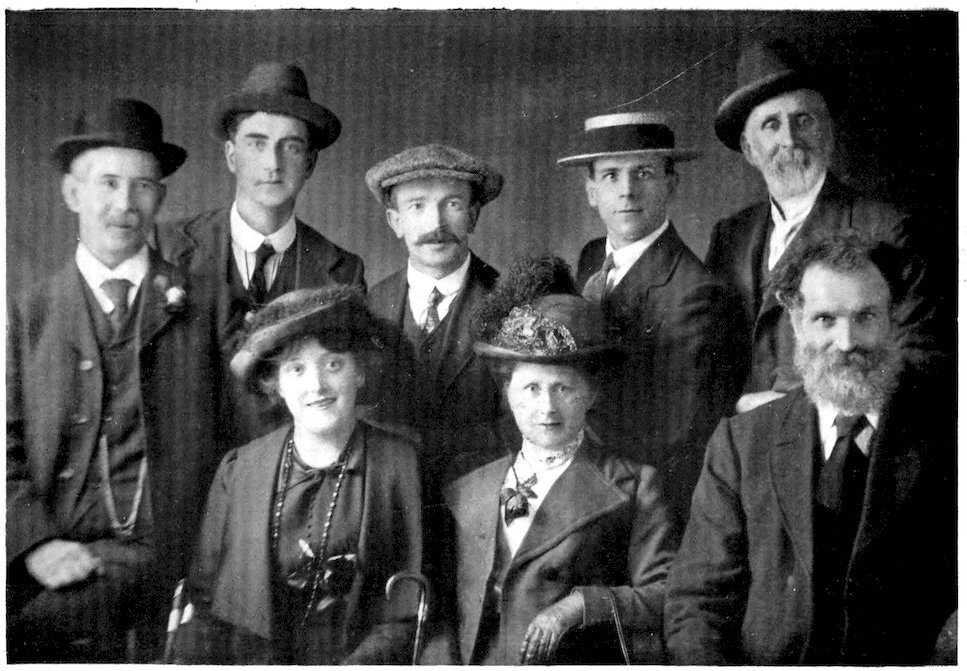
EDUCATIONAL DEPUTATION TO ENGLAND
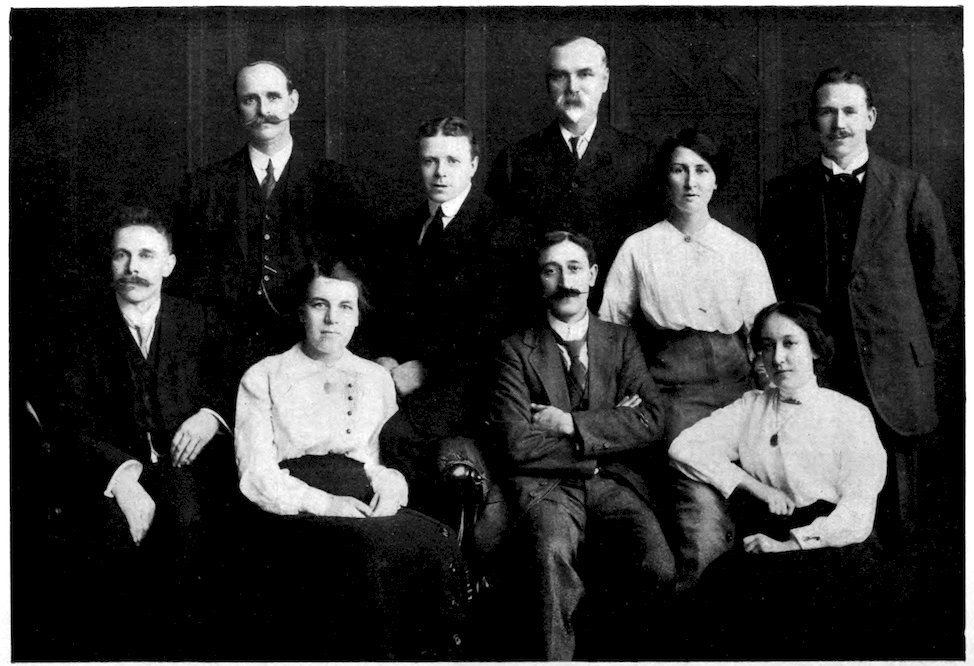
EDUCATIONAL DEPUTATION TO ENGLAND
225The bakers of Glasgow were also the victims of the profiteering
craze which had suddenly enmeshed the trading public, and at
a meeting which took place on the afternoon of 3rd August,
they proposed that the price of bread should be raised. Mr
James Young, manager of the U.C.B.S., had been present at
this meeting and had opposed the proposal, with the result
that it was not carried out. This action of his was homologated
by his board at a special meeting which was held the same
evening, while at another meeting, held three days later, the
committee decided that they would not raise the price of bread
in the meantime. The Baking Society found itself in a very
favourable position at this time. In M‘Neil Street there were
supplies of flour which would keep the bakery going for nine
weeks, while Clydebank had supplies for six, and Belfast for
seven weeks. They were thus in a position to view the situation
with more or less equanimity. The S.C.W.S. were also in a
good position so far as supplies of flour and wheat were
concerned, having some nine or ten weeks’ supplies either on
hand or on board ship at the outbreak of war, and the rapidity
with which the German fleet was bottled up within its own
harbours gave security of passage for the time being to food-carrying
vessels. Nevertheless, the general panic of that first
week of war affected the wheat and flour trade as much as it
did many others, and it was not long before flour was selling at
a price which had never been asked for it in the whole course
of the Federation’s history.
These were conditions under which the two great Co-operative
federations were able to show to advantage, and they were
conditions also which proved the wisdom of the Wholesale
Society in establishing its own purchasing agency in Canada;
for while outside millers were asking as much as 65/ a sack for
flour in the first week of the war, the highest price quoted by
the Wholesale Society was 37/, and ordinary flour was sold by
them at 1/6 per sack advance on normal price. Thus the two
federations were in a position to see to it between them that
on this side of the Atlantic, at least, no undue advantage was
taken of the circumstances created by the war. At the meeting
of the Baking Society’s board, which took place on 1st September,
the committee placed on record their appreciation of the manner
in which the crisis brought about by the war had been met by
the manager, heads of departments, and employees generally,
and desired the manager to convey this expression of the board’s
appreciation to the heads of departments and employees. At
226the quarterly meeting of the Society, the directors had a similar
compliment paid to themselves; Mr Shaw, Cambuslang Society,
moving, and Mr Glasse, S.C.W.S., seconding a motion which
received the unanimous endorsement of the delegates, thanking
the directors for the splendid lead which they had given to the
purveyors of bread in the city and far beyond. Mr Shaw drew
attention to the importance and magnificence of what had been
done, and thought that the nation was entitled to recognise
what the Co-operative movement had done, not only now but
at all times, in keeping down prices and in keeping goods pure.
Perhaps the position in which the Federation was placed by
the war and the view of it taken by the directors can be explained
most clearly in the words of Mr Gerrard himself. Addressing
the September quarterly meeting, he stated that the profits
for the half-year which had ended in July had been a little
better than usual, but [3]“the future was so indefinite that no
one could foresee with any accuracy what would happen.
They had been blamed, and were still being blamed in certain
quarters, for not increasing the price of bread, but they had
resolutely refused, thinking it their duty as a Federation to
keep the price of bread and other commodities as low as
possible. Notwithstanding, he understood the price of
biscuits had been increased in some quarters, and this had
brought them some trade that they should have had before.
The way in which prices were rushed up at the commencement
of the war had seemed to the board most unseemly and
unpatriotic, and seemed to show that everyone was trying to
make as much as possible out of the war. It was unfortunate
that the price of bread would require to be increased before
the war was over, but until that step was absolutely necessary
they would not increase it, and then only as far as was
necessary. They had received several contracts for bread, and
the manner in which the manager, heads of departments, and
the general body of the employees acted under the stress of
these circumstances was worthy of all praise.”
At the outbreak of war, a number of the employees had been
members of the Territorial Forces and had been called up at
227once, and the board decided to grant them half-pay. Later,
when the call for more men came, many of the employees
joined up, and the directors decided that those who enlisted
should be placed on the same footing as regarded half-pay as
were those who had been called up at the outbreak of war.
At this quarterly meeting the directors were accused by a
representative of the Bonus Investment Society of not being
so generous to their employees who were serving with the
Colours as were some other Co-operative societies, but the
chairman was able to satisfy the delegates that, in those cases
where generosity was most necessary—those of wives with
large families—the Baking Society’s scheme was the one which
gave the wife the larger total income.
This meeting was the one at which the method of giving
the minutes in the form of synopses was first adopted, and
one of the delegates took occasion to compliment the secretary
on having produced synopses of the various minutes which gave
the delegates enough information about the business done to
enable them to find out what was taking place. At this meeting
also a grant of £100 was made to the Belgian Relief Fund, the
chairman stating that further grants could be made if occasion
demanded. Other donations made were:—£500 to the War
Relief Fund, £100 to the Lord Mayor of Belfast’s Fund, and
£100 to the fund being raised by the Provost of Clydebank.
It was urged very strongly by several of the delegates that the
administration of the relief fund should be in the hands of the
Government. In the minute of the board meeting of 2nd
October, the fact is noted that during the past quarter the
Society’s motors had covered a distance of 125,015 miles. It
had certainly been a busy quarter.
Immediately the war broke out, the United Baking Society
were inundated with Army contracts. In the first few days
they had to make arrangements for supplying camps all over
the country, in addition to those for which they had held the
contracts. These new camps included those at Perth,
Inverness, Falkirk, and Dunblane, and all were supplied at
current prices. Yet, notwithstanding the fact that the Baking
Society were doing much work for the Army in that first week
228of the war, they were not allowed to escape from some of the other
discomforts which come to the owners of horses and vehicles in
a nation at war. On the 6th of August 18 horses, two motors,
and one lorry were commandeered for military purposes. Other
large bakers suffered in the same way, and on behalf of all of
them a telegram was sent to the Officer in Command, pointing
out the importance of the work which was being done by the
baking firms in the distribution of food, and complaining that
serious hardship to the people would ensue if bakers’ horses
were removed. With this telegram the committee of the
Baking Society associated themselves. To enable them to
overtake their work, the Society decided to purchase several
motors which had been offered to them, while a circular-letter,
explaining the position, was sent out to the societies. That
the War Office officials were not ungrateful for the assistance
which had been rendered them in the emergency of mobilisation
was shown by the fact that at the board meeting which was
held on 7th August, letters of congratulation on the manner in
which the service of bread to two camps had been carried out
were read to the committee.
Among the minor results due to the war may be mentioned
the cancelling of a number of social meetings, excursions,
marriages, etc., and the closing down of the holiday camp at
the end of August. At the beginning of October, another
attempt was made by the Glasgow Master Bakers’ Association
to have the price of bread raised, but again the directors of the
Baking Society blocked the way. At the same time, however,
the committee came to the decision that, in view of all the
circumstances, they would not raise any objection should
another overture be made. At the beginning of October, the
situation was again reviewed and, in view of the fact that by
the beginning of the year the price of flour would be greatly
in advance of that then being used, it was agreed to resist no
longer a slight advance in the price of bread. For three months
the Society had been the means of keeping the price of bread
at the rate at which it was being sold at the outbreak of war.
If we assume that their action influenced only two hundred
thousand households, and that the average consumption of
bread in each household was only one 2–lb. loaf per day, this
action of the Baking Society was responsible for saving to these
229householders in three months no less a sum than £21,250, and
probably double that sum, for that only supposes an advance of
one farthing per loaf. The first advance in the price of bread
took place on 16th November. In Belfast the price of bread
had been advanced ¼d. per 2–lb. loaf on 19th October.
Mr John Gilmour took charge of the Society’s biscuit factory
shortly after it was commenced, and he continued to manage
it until his death, which took place on 9th October 1914. He
was highly respected by both directors and workmen for his
devotion to business and his tact and kindness in dealing with
those under him. He was succeeded by Mr William Ninian, who
had the distinction of being a Bakery-trained man and who was
acting as Mr Gilmour’s assistant at the time of that gentleman’s
death.
At the quarterly meeting, the chairman made fitting and
sympathetic reference to the loss which the Society had sustained
through the death of Mr Gilmour. He also referred to
the retiral from active work of one of the Society’s bread bakers,
Mr W. Lees, who had been in the employment of the Society for
forty and a half years. During the quarter an electrically-driven
motor had been at work in Glasgow for the Society.
It was proving very satisfactory and the board, he said, considered
that before long these electrically-driven cars would replace
horses on the streets, although petrol-driven cars would still
be used for the long journeys.
At this quarterly meeting, some of the delegates wished to
know why the board had decided that they would no longer
resist an increase in the price of bread seeing that in their
minutes they stated that their contract for flour was still
unbroken. The chairman, in replying, pointed out that flour
at the moment was about 10/ higher in price than before the
war, and the board thought it better that the price should
be raised by a halfpenny now than that it should be put a penny
or three halfpence later, when the stock of cheap flour was
completely exhausted. He also stated that eighty-six of the
Society’s employees were then serving in the Army. At this
quarterly meeting, also, the question of granting relief to what
were termed “innocent enemy aliens,” in other words, British
230women who had married subjects of nations at war with Britain,
and who through the operation of war were left destitute in this
country, was raised through an appeal on their behalf issued
by the International Co-operative Alliance executive. A
proposal was made to grant £25 to the fund which was being
raised, but this was defeated by a two to one majority. The
cake show was held this year as usual, but, as was to be expected,
the sales were not so great as in some former years. The price
had been advanced on the average one penny per pound. In
their report to the delegates to the December quarterly meeting,
the directors stated that they would regard it as an instruction
to make no increase in the prices of their goods so long as they
were able to work without actual loss.
In September, an arrangement had been entered into with
the Army Authorities by which the Government supplied the
flour and the Baking Society baked it into bread for the troops.
In addition, several contracts for biscuits for the Army were
received. The first three of these totalled 200 tons. The
contracts for the baking of bread for the Army continued until
early in 1916, when an intimation was received from the
Quartermaster of the Scottish Command that the contract
would cease, as the Government were now erecting field bakeries
for themselves. Two months later, however, another contract
was entered into with the Scottish Command on the same terms
as formerly. The contracts carried out by Clydebank and
Belfast Branches have already been referred to.
For the whole of the first year of war and almost the whole
of the second year, the building department of the Society was
kept busy with the extension to the M‘Neil Street premises.
The principal reason for this extension was the necessity for
securing more space for the biscuit factory, and as soon as
practicable this extension was carried through. A new
travelling oven was installed early in 1915 at a cost of £175, and
at the same time a new biscuit cutting machine was got at a
cost of £300. A gas-fired travelling oven was also installed
before the end of the year and another one, built in accordance
231with alterations suggested by the bakery staff, was installed
in October 1916. In the spring of 1915, it was decided to cover
over the space between bakehouses Nos. 11 and 12 for the
purpose of providing dressing rooms for the workers, and at the
same time it was decided to put fans in each flat for ventilation
purposes.
M‘NEIL STREET BLOCK COMPLETED.
Parts of the new block at the Adelphi Street and South York
Street corner were occupied as they were completed.
Particularly, the ground floor was occupied as an extension to
the biscuit factory, but it was not until June 1916 that the entire
building was ready for the official opening ceremony. This
was of a very modest character, for, as the chairman stated, the
directors did not think the circumstances of the time lent
themselves to the celebration of the opening of their splendid
addition by means of a grand function, and in this he believed
the board had interpreted the wishes of the delegates.
The dressing room for the female workers, which was situated
on the fourth flat, was fitted up in an excellent manner. Each
worker had a locker of her own, made of cast steel, of which
she alone held the key. Fourteen wash-hand basins were fitted
up and eight spray baths. There was also an excellently appointed
sickroom, where a girl who became unwell suddenly
could rest, and also a room fitted up with the appropriate
scientific appliances, where accidents could be treated at once.
At the quarterly meeting, which took place on the day on
which the new wing of the building was opened, the chairman
stated that the total cost of the land and the buildings on it had
been £11,800, while the total cost of the bakery buildings,
including the addition, had been £131,000; which had been
depreciated to the extent of £52,000.
Shortly after the outbreak of war, the Canadian Government
made a donation to the Mother Country of a large quantity of
flour, and in the beginning of 1915 the Baking Society purchased
10,000 sacks of this flour. The committee decided that when
the bags were emptied they should be sold as souvenirs, and from
their sale the sum of £87 was realised, which was distributed
amongst local war charities. In March of this year, the board
232had a very satisfactory conference with the board of Kinning
Park Society and the dairy employees of that society. The
subject of the conference was a project of Kinning Park board
that the dairy shops of that society should be fitted up for the
sale of teabread and pastries. Later, the board of the Baking
Society discussed the question of opening shops throughout the
city for the sale of smallbread and pastries, but owing to the
difficulties imposed by war conditions, the subject was dropped
for the time being. Immediately the Armistice was signed,
however, the subject was again taken up by the board, with
the result that, at the 200th quarterly meeting, proposals were
submitted in which were embodied a suggestion that the Society
should open a development account and offer to those societies
operating in the Glasgow and Suburban area, which were willing
to co-operate with the Federation, a proportion of the cost of
fitting up shops for the sale of teabread and pastry. In this
offer it was provided that the shop, locality, and scheme of
fitting should be approved by the directors of the Federation;
that only U.C.B.S. goods and confections of Co-operative
manufacture should be sold for a period, the period suggested
being ten years. If these provisions were agreed to the Baking
Society would be responsible for one third of the cost of fitting
up the shop, provided that one third did not exceed £150.
The scheme received the hearty commendation of the delegates
at the meeting at which it was submitted, the only objection
taken being to the fact that for the time being it was confined
to the Glasgow area.
Reference is made above to the part which was played by the
Federation in keeping down the price of bread. In November
1914 the price of the 4–lb. loaf was increased by a halfpenny;
in January 1915 another halfpenny advance took place; and
in March of that year another halfpenny; while by the month
of May the price had risen to 8d. per 4–lb. loaf. In February
1916 another halfpenny was imposed, and in May of that year
yet another halfpenny; while before control came into operation
the price in Glasgow and Clydebank had risen to 11½d. and in
Belfast to 1/ for the 4–lb. loaf. A rather remarkable note in
one of the board minutes for 1916 is that which states that a
233letter had been received from a co-operative society, protesting
against the action of the Federation in refusing to consent to
an increase in the price of bread. The secretary of the
Federation mercifully kept the name of the society out of the
minute of the meeting.
Prior to the beginning of 1915, the catering for the meals of
the employees had been done by a committee of themselves,
but in March of that year they approached the board with the
request that the Society should take over and carry on this work.
During these years the output of the Society was increasing
gradually but surely. For the year which ended in January
1915, the output was 230,780 sacks, an average of 4,440 sacks
per week for the year, and an increase of 440 per week in three
years. On the 3rd of April, it was reported that during the
preceding week 5,351 sacks had been baked. This constituted
a record week’s baking for the Society, but for some
time afterwards, until the coming of Government Regulation
flour, record after record was made only to be broken. By the
month of September 1916, the turnover had risen to 5,410 sacks
per week, or almost a thousand sacks of a weekly increase in
eighteen months. In the end of that month, the output was
5,925 sacks, and by the end of February 1917 the record figures
of 6,012 sacks were reached. In these increases all three
bakeries participated, and the rapid increase for 1916 and the
early months of 1917 is all the more remarkable in view of the
fact that the amount of baking which was done for the military
was not nearly so great as it had been in the earlier months of
the war. On the last Saturday in 1916, 21,546 dozens of bread
were baked and seventy bridecakes made. There had evidently
been an epidemic of war marriages at this Hogmanay.
In the biscuit trade as well as in the bread trade, the
directors carried out as far as possible their policy of keeping
prices as low as was consistent with securing the Federation
against loss, but the rapidity with which the various ingredients
for these luxuries of the baking trade increased in price caused
the prices to the societies to be raised shortly after the outbreak
of war. In March 1915, it was decided to reduce the discount
allowed on teabread by two and a half per cent., in order to
234compensate in some measure for the increases in the cost of
materials. Toward the end of 1915 the Society found that
their stocks of biscuits were falling very low, owing to the
shortage of labour, as about 30,000 tins of biscuits were being
sent out every week. Systematic overtime was worked in the
biscuit factory with the object of overcoming the shortage.
The Society were also faced with a serious shortage of biscuit
tins, due to the fact that societies were not returning the empty
tins promptly, while the manufacturers were not able to supply
the demand for new tins. To meet this difficulty the directors
authorised the purchase of a machine for the manufacture of
the tins. By the beginning of 1916 the shortage of materials
necessary for the manufacture of pastries, and especially of
sugar, was becoming very marked, and in March of that year
it was decided to stop the manufacture of a number of the
varieties of which sugar was a considerable ingredient. In May,
it was found necessary to advance the price of biscuits by, on the
average, nine shillings per cwt., yet, notwithstanding the high
price, the Society were having difficulty in fulfilling their orders.
Earlier in the year it had been decided to look out for suitable
ground for an extension of the biscuit factory, and at the quarterly
meeting held in September power was granted the directors to
spend up to £9,500 in purchasing land for this purpose. By
October, the price of biscuits was advanced other eight shillings
per cwt., but as this was four shillings per cwt. below the price
which other merchants were charging the societies were getting
a very good bargain. In November, it was decided to cease
the manufacture of all French, iced, and sugar-coated pastries,
owing to the increasing shortage of sugar.
At the outbreak of war many employees joined the Army
or Navy, and to these the Society decided to pay half-wages.
As the months passed, more and more of the younger men joined
up, first under the Derby Scheme and later under the
Conscription Act, so that the carrying out of the policy of paying
half-wages meant the disbursing of a considerable sum every
half-year, and by the end of 1916 the sum of £10,628 had been so
expended; £7,892 being paid to dependants and £2,736
retained in the hands of the Society at the credit of employees
235serving with the Colours. At this time, 304 of the Society’s
employees had joined the Services, and eighteen had made the
great sacrifice.
This drain on the male workers of the Society brought
troubles of its own in its train. We have already seen that
considerable difficulty was being experienced in meeting the
demand of customer societies for biscuits, while the difficulty
in meeting the demand for bread was equally great. Toward
the end of 1915, the Operative Bakers’ Union consented to allow
their members to begin work one hour earlier on Saturday
mornings, while a number of men who had been formerly
employed as “jobbers” were given full-time employment.
In the beginning of the following year an attempt was made to
induce the Bakers’ Union to permit the employment of women
in the bakery, but this permission they refused, although they
admitted that “dilution” was in operation in similar
establishments. In July of 1916 an agreement with regard to
dilution was reached, whereby it was decided that, after all
reasonable efforts had been made to obtain male labour,
females should be appointed in the same proportion as
apprentices; that two girls could be appointed for every man
who left, and that the arrangement was to continue for the
duration of the war or of conditions created by the war.
In that year some difficulty was experienced in getting the
bakers to come to terms with the employers in the Glasgow
district on the question of wages, but the dispute was finally
adjusted after notices to cease work had been handed in. The
terms finally agreed on were substantially those which had been
offered by the Federation, and gave the bakers an increase in
wages of four shillings per week. The bakers did not take
kindly to the proposal to introduce female labour into the
bakehouse, and when the directors proposed to take that step
protested strongly, notwithstanding the agreement which had
been arrived at on the subject, and although they were working
very many hours of overtime each week. The directors
therefore decided that the question of the employment of female
labour should be referred to the War Emergency Committee,
and that committee gave their award in favour of the introduction
of female labour into the pastry and smallbread flats, but would
not allow them to take part in the baking of loaf bread.
236
We have already seen that the needs of the war transcended
all other considerations in the opinion of the War Office officials,
who commandeered many horses and vans from the Society
at the outbreak of war and later. The difficulties of delivery
thus created the directors endeavoured to overcome by the use
of motors for delivery. But even machinery will not go on for
ever without requiring repairs, and as breakdowns became
more frequent increasing difficulty was being found in having
the necessary repairs done, because of shortage of labour of the
necessary skill, and because also of the shortage of the necessary
material. Another delivery difficulty had a different cause.
The shortage of labour was general, and the retail stores were
as greatly handicapped as were other businesses. In 1916, with
the view of overcoming this handicap to some extent and at the
same time ensuring as far as possible that the shops should not
be open in the absence of skilled supervision, the societies adopted
the policy of closing their shops during the lunch hour. To some
extent this policy attained the object which the societies had in
view, but as soon as it was put into operation the Baking Society
found their delivery difficulties increased, for their vans had to
stand idle while the shops were closed. Representations on
the subject were made to the various societies, which gave
very favourable consideration in most cases, and the practice
grew up of leaving one employee in each shop to take delivery
of goods which arrived during the lunch hour.
Early in 1916 the societies gave tangible form to their
recognition of the strenuous work which was being imposed on
the directors by circumstances brought about by the war;
this tangible recognition taking the form of an all-round increase
in salaries and allowances for committee work.
Yet strenuous as had been their work during those first two
years of the war, and great as had been their difficulties, the
two years on which they were about to enter were to provide
even more strenuous work and to produce difficulties which
were so great as to prove almost insurmountable. They were
to provide conditions of bread baking which were to change
loaf bread from being one of the most palatable forms of food
into for the time being one of the most detestable and detested.
237While the Congress was meeting at Leicester in 1915, the
news arrived that Mr Duncan M‘Culloch, who had done so much
to build up the Baking Society, had passed away, and fitting
reference was made to his decease at the quarterly meeting in
June, and also at the annual meeting with the representatives
of the Irish societies in July. His death removed a man to
whom the shareholders of the Baking Society, and particularly
the shareholders in Ireland, owed much, and many were the
expressions of regret when the news became generally known.
CHAPTER XIX. BREAD BAKING UNDER CONTROL. — BAKERS’ DIFFICULTIES. — THE POSITION OF THE U.C.B.S. — A BIG LAND PURCHASE. — ILLNESS OF PRESIDENT. — A NATURAL WORKING DAY—BY ORDER. — ENTERTAINING SOLDIERS. — BRANCH BAKERIES. — ROTHESAY BRANCH. — SUBSIDISED BREAD. — AN INDUSTRIAL COUNCIL. — EMPLOYEES ON MILITARY SERVICE. — THE END OF THE TASK.
238
FAMINE POSSIBILITIES—CHANGES IN QUALITY OF FLOUR—FOOD CONTROL
DEPARTMENT ESTABLISHED—BAKERS’ DIFFICULTIES—THE POSITION
OF THE U.C.B.S.—A BIG LAND PURCHASE—ILLNESS OF THE PRESIDENT—A
NATURAL WORKING DAY BY ORDER—ITS DIFFICULTIES—ENTERTAINMENTS
TO SOLDIERS—BRANCH BAKERIES—IRELAND—LEADHILLS—ROTHESAY—BUTE
CO-OPERATIVE SOCIETY FORMED—SUBSIDISED
BREAD—AN INDUSTRIAL COUNCIL—DELIVERY DIFFICULTIES—EMPLOYEES
ON MILITARY SERVICE—THE END OF THE TASK.
The first two years of the war had brought difficulties in their
train which the bakers of the country found considerable difficulty
in overcoming; but the conditions under which they were called
on to produce bread in the following two years were such as
had not been experienced for at least a hundred years, and
there came a time when the country was faced with the
possibility of having to do without bread altogether for a period.
Fortunately this possibility did not become reality, but it was
the cause of material changes in the quality of the flour used
for breadmaking and of the conditions under which the bread
was made and sold which would have seemed impossible before
the war began. By the early winter of 1916 the possibility of
a condition of things obtaining which would prevent the
importation of foodstuffs, and particularly of wheat, in sufficient
quantities to provide full supplies for the population of the
British Isles began to force itself on the Government, so they
appointed a gentleman to the position of Food Controller and
conferred on him almost despotic powers. One result of this
control of food was a drastic interference with the milling of
flour. In Scotland the millers produced flour in ordinary times
which contained a little more than 70 per cent. of the wheat;
the first fruits of the new order of things was a regulation that
the extraction from the wheat should be increased, by about
8 per cent.
239There can be no doubt that under the circumstances this
regulation was necessary. There was a time in the history of
these islands when practically all the food consumed by the
people was grown in the country; but during the lifetime of
the last generation this position had gradually altered until
Britain was dependent on wheat imported from abroad for four-fifths
of the bread supply of her people. There had always
been pessimists who foresaw, as a result of a war with a maritime
power, a danger of interruption to the steady supply of seaborne
food which was necessary if the people were to be saved
from starvation, and who uttered warnings which passed more
or less unheeded; but the time had arrived when these warnings
seemed likely to become justified. Towards the end of 1916
it was becoming apparent that there was likely to be a world
shortage of foodstuffs, and particularly of wheat, and doubts
were being expressed in well-informed circles as to whether
there would be supplies sufficient to enable the people to carry
on until the 1917 crop was ready. While this world shortage
was due in a measure to the war, because of the number of men
who usually devoted themselves to agricultural pursuits who were
then engaged in war work of one form or another or serving
with the Forces, it was also due in large measure to a world
shortage for which Nature, through the medium of a bad
summer and a wet autumn, was responsible.
The result was that in this country the regulations affecting
flour extraction became more and more rigorous, until not only
were millers extracting a proportion approaching 25 per cent.
additional from the wheat, rejecting practically nothing but
the outer husk, but many other varieties of cereal, even
including a considerable proportion of maize, were pressed
into service and mixed with the flour from which bread had
to be baked. In some cases potato flour was also used for
this purpose. Fortunately, the famine which had threatened
in the summer of 1917 was staved off, but the inveterate submarine
campaign waged by the Germans during the whole of
that year was responsible for the destruction of many food-carrying
ships and of many thousands of tons of wheat and
flour which were being conveyed to this country from America
as well as of many other varieties of food.
240
All this was the cause of much worry to bakers. They had
been accustomed to the manufacture of bread from flour the
quality of which was well known and regulated with almost
scientific accuracy, but under the new order of things they
found the knowledge which they had acquired laboriously over
a long period of years almost useless to them. So long as they
were dealing with wheat flour, even if that flour did contain
a large proportion of offal which had formerly been used to
feed cattle, the position was not quite so bad, for most of them
had been in the habit of baking a greater or lesser proportion
of what was termed “wheaten” and “wholemeal” bread. But
when flour produced from rye, barley, and even maize had to
be added their troubles began, for only by chemical analysis
was it possible for them to determine the proportions in which
the various cereals were used, and these proportions were varied
arbitrarily week by week at the whim of the Wheat Commission
authorities; while the millers were absolutely prohibited from
giving any information on the subject. Thus, when after a
series of experiments they had ascertained the method by which
they could produce the best loaf from a given flour, they
suddenly discovered that the mixture had been altered, and
that their experiments had to begin all over again; and this
continued to be the position for some time even after the end
of the war.
While the position of the average private baker was that
which has been described above, the baking departments of
Co-operative societies found themselves in a very much worse
position in direct ratio as they had been loyal hitherto in the
use of Co-operatively milled flour. The flour mills of Scotland
did not produce more than one half of the flour which was
used in the country, with the result that the remainder had to
be imported; but the Scottish Co-operative Wholesale Society
imported wheat and themselves milled practically all the flour
sold by them. The consequence was that as the quality of
“Government Regulation” flour deteriorated, the flour which
was supplied by the Wholesale Society’s mills, in common with
that supplied by the other millers, was of such a nature
241that bread baked with it was inferior in quality and unpalatable.
As, however, bakers were compelled to take flour from the
source from which they procured it at the time when the Food
Control regulations came into force, those who had formerly
used a considerable proportion of imported flour were allowed
to mix a good percentage of the flour which was still being
imported with the “Regulation” flour, and were thus enabled
to produce a comparatively white and palatable loaf; while
the Wholesale Society, which had not been in the habit of
importing much flour, were now allowed by those responsible
for the bread regulations to import only a very small proportion,
and their customers suffered accordingly. It was only after
repeated representations had been made to the Government
and the Wheat Commission that, ultimately, the proportion of
imported flour which Co-operative bakers generally were
allowed to use was raised considerably.
From this cause the Baking Society was as great a sufferer
as were the others. The bread became more and more
unpalatable as the admixture of foreign cereals in the flour
used increased, and complaints about the quality of the bread
began to come in with irritating frequency. The receipt of
these complaints, justifiable as they were, must have been all
the more irritating to the committee from the fact that they
found themselves the victims of circumstances over which they
had not the slightest control. They knew that the bread which
they were producing was unpalatable, and the fact that the
Germans had to eat bread which was very much inferior was
but poor consolation in view of the fact that many of their
trade rivals were able to produce better bread because of the
larger proportion of white flour which they were allowed to
use. There ensued, as a consequence, a very considerable
decline in the bread sales of the Society. The customer
societies would have taken the bread, but their members could
not and would not eat it. From much the same causes the
trade in biscuits and in teabread declined also. The use of
sugar in biscuits or in teabread was prohibited, as was the
manufacture of pastries. The result was that while the output
for the quarter which ended in October 1916 was 68,533 sacks,
that for the quarter which ended in October 1917 was 67,132
sacks, and that for the corresponding quarter of 1918 was
24262,867. And if the details for loaf bread in M‘Neil Street alone
are taken, the contrast is still more striking. The output for
1918 had fallen below that of 1915 by over 400 sacks, and below
that of the quarter which ended in April 1917 by over
12,000 sacks.
By the end of 1916 M‘Neil Street bakery, and particularly
the biscuit factory, was again becoming congested, and power
was obtained from the quarterly meeting to spend up to £9,750
on the purchase of more ground. At the time this power was
obtained, the committee had under consideration the fact that
the ground on the east side of M‘Neil Street, extending from
the Clydeside to Govan Street, was in the market, and
ultimately the purchase of this ground was completed at a cost
of £9,750. The ground contained an area of 6,590 yards. Much
of it was occupied by buildings of a temporary character; the
only buildings of a permanent nature on the site being two
tenements at the southern end. This site has not yet been
utilised by the Society, but it forms an admirable property
which is available for any extensions which may require to be
undertaken in the future. Meantime it is let at a rental
which gives a net return of 3⅓ per cent. on the capital cost of
the site.
In November of 1916 Mr Gerrard was laid aside for a number
of weeks by a severe illness, from which, fortunately, he
recovered after a time. With the exception of one short
interval, he was able to carry out his duties until the beginning
of November 1918, when he was again laid aside with an illness
so severe in its nature that ultimately he was informed by his
medical adviser that he would have to give up all thought of
public work for the future. The last regular meeting of the
committee at which he was able to be in attendance was that
held on 10th October 1918.
Several years before the outbreak of war the directors of
the Baking Society made a determined effort to institute a
natural working day for bakers, but were unsuccessful, as a
natural working day meant the use of bread which was cold
243before it reached the shops, and this the members of the stores
refused to accept. In March of 1917, however, the Government,
impelled by the exigencies of war, were able to do, practically
with the stroke of a pen, what the unaided efforts of the Baking
Society had failed to do. This Order of the Food Controller
decreed that bread must be at least twelve hours old before it
was sold in the shops. It is quite likely that those who devised
the Order did not know and did not desire to know how their
proposals were going to affect those engaged in the trade. The
bakers were faced with the necessity of rearranging their methods
at a moment’s notice. They had to rearrange the working
day, and also to find storage accommodation overnight for their
total day’s output, and on Friday nights for almost double that
quantity. One good result of the Order was, as has already
been mentioned, that the working bakers at last obtained a
natural working day, for their hours of work were fixed to begin
at 8 a.m. and to end at 4.30 p.m.
The storage difficulty was one which was more difficult to
overcome. At M‘Neil Street storage accommodation had to
be found for 84,000 2–lb. loaves on ordinary weekdays and for
156,000 on Fridays. This meant the fitting up of every available
space with racks and trays in which to place the bread, and a
very serious addition to the amount of labour necessary. On
the other hand it meant that there would be a considerable
saving on delivery charges, as societies were able to take in larger
quantities in the mornings, and so minimise the duplication
of deliveries. The difficulties were all overcome, and, in a very
short time, the delivery side of the business was working as
smoothly as the attenuated state of the delivery staff could be
expected to permit.
During the years of war a feature of the philanthropic work
of the Society was the entertaining of large parties of convalescent
soldiers from the Glasgow military hospitals. The Society
began this good work in August 1916, when a party of
convalescent soldiers from Stobhill Hospital, numbering 200,
were conveyed to Calderwood Castle in brakes, and entertained
there. The party were accompanied by the Society’s Silver
Band, and an enjoyable afternoon was passed. Then, early in
2441917, another party of wounded were taken to a matinee at a
theatre in the afternoon, and were afterwards conveyed in
brakes to the Society’s premises, where they had tea, and a
splendid concert was provided. Several of these theatre
entertainments were given, and were much appreciated by the
recipients of the Society’s kindness.
In another way the Society also showed kindness to men
who had been fighting their country’s battles. An “Overseas
Club” for members of the Colonial Forces had been established
in Glasgow, and during 1918 and 1919 a party of visitors from
this club were taken over the bakery every Thursday, being
afterwards entertained to tea, when the work which was being
done by the Federation and the principles on which it was
managed were explained to the visitors. Early in 1919, a letter
was received from the Scottish Sectional Board of the Co-operative
Union, commending the propaganda work which was being
done in this way by the U.C.B.S. directors, and offering a number
of copies of “Working Men Co-operators” for distribution.
The Baking Society directors were much gratified by this
commendation and gladly accepted the gift of books, which
were afterwards distributed to the Colonial visitors.
Various difficulties attach to a gigantic bread bakery
which are not apparent in the working of any other commercial
concern of similar size, and chief amongst these is that of rapid
and cheap delivery. The perishable nature of bread and the
ease with which it is injured by crushing make carriage by
railway impracticable, while combined with these difficulties
is the fact that the majority of bread customers desire to have
it as soon after it is baked as possible. All these disadvantages
combine to limit the distance within which a bakery can operate
successfully to a radius of about twelve miles, and even on the
outer edges of that radius it is doubtful if the cost of delivery
does not counterbalance the saving caused by larger production.
Yet the advantages of having bread baked by a large
Co-operative organisation, instead of by many small ones, are
obvious. In the first place, the large buyer has the advantage
of buying all the raw materials used at rock-bottom
prices: he has the advantage also of a wider knowledge of the
245fluctuations of a market notorious for rapidity of rise and fall,
and this expert knowledge enables him in normal times so to
average the cost of flour used that it is always at the lowest
average possible.
It can be easily understood, therefore, that Co-operators,
struggling with adversity and yet desirous of providing
Co-operatively-baked bread for their members, should turn to
the U.C.B.S. for help.
In this way there had come to the directors within recent
years numerous calls for help. Unfortunately, the majority
of these arrived at a time when it was impossible to give the help
desired. The first of these calls came from Ireland. In and
around Dublin there were several small societies, having a
combined membership of somewhere over two thousand. The
Dublin Industrial Society, after unsuccessfully endeavouring
a few years earlier to get the Baking Society to help in the
financing of a bakery in Dublin, had gone ahead with the
erection of a bakery for themselves, but it had never been very
successful. The Society itself was not too successful for a time,
owing to the fact that the members were not pulling very well
together; and indeed, at one period during the early years of
the war, it seemed to be in danger of collapsing altogether.
The bakery was not very successful, because the quality of the
bread which was being produced left something to be desired,
and this again was due in some measure at least to the fact that
the men employed did not seem to realise that there were some
operations in connection with bread baking which could not
afford to wait on the convenience of anyone if disastrous results
to the quality of the finished product were not to accrue. On
more than one occasion one or other of the foremen in Ravenhill
Bakery went down to Dublin to give the Co-operative bakers
there the benefit of his expert advice.
Finally, an invitation came from Dublin, asking that representatives
from the management of the Baking Society should
attend a meeting of representatives from five societies in and
around that city, with a view to taking over and working the
bakery belonging to Dublin Industrial Society in the interests
of Co-operators in and around the city. The members of the
board discussed the question in all its bearings—social, political,
and financial. They recognised that the cause of Co-operation
246in Dublin was much in need of a helping hand, and they were
also well aware of the difficulties from a trade point of view
which would confront them, but they resolved to attend the
conference. They suggested, however, that representatives
from the executive of the Co-operative Union, the Irish
Agricultural Wholesale Society, and the Belfast advisory
committee should also be invited.
At the same time, a request for the erection of a branch
bakery was received from Enniskillen Society and several
agricultural societies in the neighbourhood of that town, and
the deputation took advantage of the opportunity which their
visit to Dublin gave them to visit Enniskillen also. The
information gained in the course of this visit was discussed at
a special meeting of the board, which was held on 23rd August,
when it was resolved, in the interest of the Co-operative movement
generally, and in view of the success which had attended other
efforts, to place the subject on the programme of business for
the quarterly meeting, with a recommendation from the board
that they be empowered to establish branch bakeries in Ireland.
When the recommendation came before the quarterly meeting
of the members, Mr Gerrard explained that there were a number
of small associations of Co-operators in various districts in
Ireland who were anxious to use Co-operatively-produced bread,
but who could not be expected to produce it for themselves.
They were situated so far from Belfast that they could not be
supplied economically from there, and the only other alternative
was that small branch bakeries should be opened in these
districts. Already negotiations had taken place, but before
the members of the board went further, they wished to know
whether the delegates were prepared to continue the policy of
good work which had been begun at Belfast. The recommendation
of the board was approved by a very large majority
of the representatives of the societies present at the meeting,
in opposition to an amendment which laid down the proposition
that “no new bakery be erected in Ireland until definite details
had been submitted for approval to an ordinary or special
meeting of the Society.”
After some further inquiries had been made, the board as
a whole gave further consideration to the question at a special
meeting which was held on 27th November 1917. At this
247meeting it was stated that in and around Dublin there were ten
societies within a radius of twenty miles, whose capital amounted
in the aggregate to about £3,000. Dublin Society were willing
to dispose of their bakery for £2,000. Only a meagre response
had been given, however, to inquiries as to the amount of trade
which was likely to be obtained from these ten societies, but the
opinion was expressed that if the branch was once established
the trade would be sure to come in time. Reference was made
at this meeting to the lethargic state of the Co-operators of the
district, and to the need which existed to give the movement
a lift out of the weak state into which it had fallen. All the
members of the committee who had visited the district were
impressed with the fact that a good field for Co-operative work
existed, provided that good management was given. The
committee expressed agreement that, given normal conditions,
there were reasonable prospects of the success of a branch
established at Dublin, but they were divided on the question of
whether the purchase should be made at that time, and remitted
the decision on that point to the whole board.
With respect to the proposal to establish a branch at
Enniskillen, the members who had visited the district were in
agreement. There was in the district a nucleus sufficient to
warrant placing a branch there, but no bakery was available,
although a building capable of being made into a bakery could
be purchased. The restrictions placed on the use of building
material and on the supplying of machinery placed an embargo
on going ahead at the moment, however, and they must wait
until the war was over.
Mr Young, the manager, spoke strongly in favour of
rendering help to Dublin Society; but he pointed out that for
some time, at least, there would be little surplus if any, although
when the district was penetrated thoroughly with Co-operative
principles there would come ample compensation for the initial
sacrifices. He thought, therefore, that it was the clear duty
of the Baking Society to take it in hand. The board, however,
was very evenly divided on the question, five voting for making
no recommendation to take over the Dublin bakery meantime,
while six voted in favour of making such a recommendation.
With respect to Enniskillen, however, the board were unanimous
that a branch should be established there as soon as possible,
248and agreed to recommend that this be proceeded with at the
end of the war. At the quarterly meeting held in December,
however, the proposal to take over Dublin Society’s bakery
and establish a branch there was defeated, although that to
establish a branch at Enniskillen was approved. How much
the situation which had developed in Dublin and neighbourhood
in the spring of 1916 had to do with the decision of the delegates
it is impossible to say, but undoubtedly the political situation
when combined with the influence of the known apathy towards
Co-operation of the people of Dublin and the financial risk with
no sure prospects of recovery weighed with the delegates when
coming to the decision they did.
Since then premises have been acquired at Enniskillen, on
a site quite near to the premises of the S.C.W.S., and the whole
position has been surveyed thoroughly, but no definite steps
to erect a bakery there have yet been taken as the cost of
building materials has been found prohibitive.
Shortly after the outbreak of war the U.C.B.S. became
shareholders to the extent of £1,000 in the Irish Agricultural
Wholesale Society, and at the quarterly meeting of members,
which was held in December 1918, they took up 100 one pound
shares in the Enniskillen Co-operative Milling Association, a
Co-operative association which has been formed to establish
a meal mill at Enniskillen.
So far we have been considering only the establishing of
branches of the Baking Society in Ireland, but requests for
branches were received at various times from widely distant
parts of Scotland as well. In particular, just at the time when
a final decision was arrived at on the question of taking over
Dublin Society’s bakery, a request was received from the
neighbouring societies of Leadhills and Wanlockhead that the
Baking Society should take over and work a bakery in Leadhills
for the purpose of supplying these two societies with bread.
The master of works was sent to inspect, with the result that,
later, the board were empowered to open a bakery at the place
they deemed most suitable for supplying the trade of the
district. Like every other building scheme, this of theirs was
hung up during the war; but after careful consideration it
was decided that a bakery should be established in Leadhills,
and this has now been done. An application was received from
249Kirkconnel Society about the same time as that from the
Leadhills district, and it was thought at first that one bakery
might be erected which would suffice to serve both districts,
but an inspection of the road connecting the two places showed
that if this was not impracticable it would be at least dangerous,
and the idea was abandoned. Nothing further has been done
yet with respect to a branch at Kirkconnel.
For years attempts have been made to establish a branch of
the Co-operative movement in Rothesay, but this was found
to be impossible until the Baking Society took the job in hand.
Their possession of Roseland Camp on Canada Hill had given
them a footing in the town, and in some measure this was of
assistance to them. Early in 1917 the board received information
that a bakery situated on the water front was to let,
and they made arrangements to secure it with such celerity
that by the 24th of March in that year it came into their
possession on a three years’ lease. They were not long in
possession, however, before they were informed that the lease
would not be renewed when it expired. It seems that the
private traders of the town had made representations to the
owner of the property, and this was the result. For years the
traders had proved uniformly successful in preventing Co-operation
from getting a foothold in the town, and they were
not going to be baulked without an effort to prevent it. But
the directors of the Baking Society were just as determined as
were the traders of Rothesay, and after lengthy and long-continued
negotiations with the directors of the Wholesale
Society, who had been on the lookout for premises in Rothesay
for many years but had been uniformly unsuccessful in
securing them, the Baking Society became, early in 1918,
proprietors of the property in which their bakery was situated.
The property which had been purchased included a shop
which could be used as a grocery department, and for some
time efforts were made to get one or other of the Glasgow
societies to open a branch there, but unsuccessfully. The
committee of Clydebank Society were inclined to view the
matter favourably, but when the question was brought before
a general meeting of the members of the society for their
250approval, they refused to consent. Greenock Central Society
were also given the opportunity of opening a branch, but they also
were afraid to venture in face of the prevailing restrictions on
supplies. The result was that those who had been customers
of the Baking Society in Rothesay were invited to form a
society of their own, the Wholesale Society and the Baking
Society subscribing a large part of the capital between them.
The society was formed with Mr William Maxwell, J.P.,
president of the International Co-operative Alliance, as
president. Co-operation had been established in Rothesay.
The traders of the town had not yet shot their bolt, however.
The Co-operative bakery was doing well, and it was possible
that a Co-operative grocery and provision business would do
equally well; but, fortunately for the traders, the local Food
Control Committee refused permission to the new society to
open their grocery branch, on the plea that the shops already
open in the town were sufficient in number to do the trade,
and in this attitude they were backed up by the Edinburgh
Court. At the beginning of 1919, however, the embargo was
removed, and the new society has proved very successful.
In September of 1917 the Food Control Department of the
Government decided to fix the price of the four-pound loaf at
ninepence, giving the flour to the bakers at 44/3 a sack. As
the stocks which the bakers had bought had cost much more
than this price, the Food Control Department agreed to make
up the difference between 44/3 and the invoice price, allowing
a maximum discount on the invoice price of 18/ per sack. A
maximum allowance for carriage, baking material, and wages
was 23/ per sack. When the Baking Society had taken stock
of their flour they found that the difference between the
discount allowed by the Government and the invoice price of
the flour represented a loss to the Society of nearly £7,000.
To the delegates at the quarterly meeting the chairman
explained that this was due to the fact that the Society had
purchased a large quantity of white flour in order to improve
the quality of the bread. This flour had cost from 80/ to 90/
a sack, and even with the maximum Government discount
allowed they were losing about 30/ a sack.
251The general result of the Government’s policy was that
bread which, if sold at a price which corresponded with the
market price of flour, would have cost one shilling for the four-pound
loaf, has been sold at ninepence, the taxpayer paying
the difference, which amounted to about £50,000,000 per annum.
Early in 1918 an Industrial Council for the Baking Trade
was set up on the lines laid down in the Report of the Royal
Commission for the avoidance of Industrial Disputes. On this
council Mr James Young, manager of the Baking Society, was
appointed to look after the interests of the Co-operative
societies in Scotland which had bread bakeries. The objects
of the council provide for the joint consideration by representatives
of employers and employees of such questions as
wages, working conditions, regulation of employment, entry of
apprentices and their training. So far as it has gone the council
has proved of service in bringing representatives of the employers
and the workers together at regular intervals to discuss affairs
of the trade.
The Baking Society contributed its full quota to the Forces
of the Crown during the war. In all 426 employees served in
one or other of the Arms of the Crown: M‘Neil Street contributing
331; Clydebank, 60; Belfast, 34; and Rothesay, 1.
Of that number fifty made the great sacrifice, eleven became
prisoners of war, and forty-four were discharged as unfit for
further service; while, at the signing of the armistice, 321 men
were still serving. To these men or their dependants the Society
paid from 4th August 1914 to 26th January 1919, the date
which marks the end of the fiftieth year of the Society’s
existence, the sum of £30,105. The arrangement made by the
directors was that each man who joined up should receive half-wages
irrespective of what his Army allowance might be. By
this method they ensured that the men with the largest number
of dependants should be in receipt of the largest total incomes.
We have now come to the end of our task. In the preceding
pages we have traced the growth of the Society from its infancy
252when it was cradled in the little bakery in Coburg Street; we
have followed it through all the struggles of its early years, and
have seen difficulty after difficulty surmounted. Growth has
followed on growth, and the Society has gone on adding to its
usefulness until it stands to-day a monument to the faith and
foresight of the men who conceived it, and a monument also
to the shrewdness and integrity of the men who in successive
generations have had charge of its welfare. In its early years
the directors were often in need of money with which to meet
expenses. To-day it has invested funds not required at the
moment for business purposes, and including £70,000 in War
Loan, which amount in the aggregate to considerably over
£300,000. It began with a membership of eight societies and
a few pounds of capital. At the end of the fiftieth year the
share capital was almost £250,000; while loans and deposits
were in excess of that sum, and there were 211 shareholding
societies.
The prospect is rosy. The directors are on the outlook for
new worlds to conquer. Already they have devised plans
whereby they can come to the assistance of the Glasgow
societies in setting up shops for the sale of teabread and
pastries. They have requests for branch bakeries from various
parts of Scotland and Ireland which have yet to be considered.
They have the ever-increasing urgency of the transport problem
to deal with, and on them falls, also, the duty of counteracting
the ever-present tendency on the part of societies at the outskirts
to break off and begin baking for themselves. That is to
say, they have ever before them the problem of making the
huge organisation which they control more and ever more
efficient, while maintaining those good relations with their
employees which have been such a noteworthy feature during
the long life of the Society; and they have to continue to do
this while continuing to manifest that true spirit of Co-operation
and brotherliness which has been so distinguishing a feature of
the attitude and atmosphere which surrounds the Federation.
That they will achieve all this there is little doubt, for the
directors of to-day are worthy successors of the men who
wrought and fought that the Federation might stand where
it does.
CHAPTER XX. EDUCATIONAL WORK. — A NEW DEPARTURE. — THE DEPUTATION. — A SECOND DEPUTATION. — VALUABLE WORK. — THE YEARS OF WAR.
253
IMPORTANCE OF EDUCATION—EARLY EDUCATIONAL WORK OF THE SOCIETY—AN
EDUCATIONAL COMMITTEE FORMED—ITS CONSTITUTION—WORK
AMONGST THE YOUNG—THE U.C.B.S. BAND FORMED—SOCIAL WORK—LECTURES—CLASSES
DURING WORKING HOURS—A NEW DEPARTURE—AN
EDUCATIONAL TOUR—A SECOND TOUR—VALUABLE WORK—THE
YEARS OF WAR.
In all propaganda work there must necessarily be an element
of education, for at least a part of educational work consists in
the imparting of information, although the more important
part is the training to think. Co-operators from the very
earliest days of the movement have recognised the necessity of
education, and have devoted a part of the funds which came
to them from Co-operative trading to its support. Indeed the
Rochdale Pioneers went further, and amongst their objects
they placed taking control of the functions of education, meantime
devoting 2½ per cent. of the surplus which accrued to them
from their Co-operative trading to the furtherance of education
amongst themselves. This example of theirs was followed by
many other societies, and associations of a more or less
educational nature were formed wherever a number of
Co-operators could find it convenient to meet. It was from
the conferences of representatives from the societies that the
idea grew of what has become ultimately the supreme
educational authority of the movement in Britain, the
Co-operative Union. Even before the formation of the Union,
conferences were being held in Scotland to discuss Co-operative
problems, and almost from the beginning the Baking Society
affiliated with the nearest of the Associations under whose
auspices such conferences were held. Thus we find them
subscribing to the funds of the Glasgow and Suburbs Conference
Association and the Renfrewshire Conference Association, and,
later, to all the other district associations in the country. But
254even before they began to subscribe to the conference
associations they were taking an interest in and giving support
to the literature of the movement. We find them at the
quarterly meeting which took place on 26th August 1871
agreeing to subscribe for twelve copies of the Co-operative News,
which were to be distributed amongst the employees in the
bakery.
The members of the committee were evidently diligent
readers of this journal too, for, as has been noted previously,
they embodied in their minutes at a later date a criticism of
some remarks which had appeared in that journal relative to
the Society. It was not until 1896, however, that it was
decided to set up a separate committee, which would have
under its control the educative and recreative agencies of the
Society. Just prior to that they had published a Year Book
which contained a history of the Society to date. A branch of
the Women’s Guild had also been formed, and classes in singing
and ambulance work, as well as a literary society. At a special
meeting which the committee held on 1st February 1896 they
came to the unanimous decision that the time had now arrived
when an educational and charitable fund should be formed by
the Society, out of which all charitable donations and subscriptions
should be taken. At the following meeting the sum
of £50 was voted for the purpose of forming an educational
fund.
The members of the board took the employees into consultation
with respect to the administration of the educational
fund, with the result that the following constitution was drawn
up and agreed to:—
DUTIES AND WORK OF EDUCATIONAL COMMITTEE.
This Committee shall consist of three Directors, who shall hold
office for one year, and shall be elected at the December meeting of
each year. They, along with the four members appointed by the
employees, shall form the Educational Committee.
They shall take a special oversight of all the clubs, classes, and
meetings of an educational nature connected with the Bakery.
They shall have at their disposal for the furtherance of educational
work connected with the Bakery 10 per cent. or such other proportion
of the Educational and Benevolent Fund (Rule 14) as the Directors
may from time to time determine.
It will further be expected from them to make recommendations
to the Directors from time to time on matters of public educational
255interest, and it shall be competent for the Directors at any time to
remit such matters to them for consideration and report.
They shall meet monthly or oftener if required, and submit a
short minute of their proceedings at the Directors’ bi-monthly
meeting.
The first report of the educational committee was issued in
December 1896. From this report it appeared that the nucleus
of a library had been brought together, and that the library
had been opened with 180 volumes; the literary association
had had a membership of 105, and the women’s guild a
membership of fifty. A musical association had also been
conducted under the auspices of the committee, which had
secured forty-nine members, and the choir had given a concert
in the Wellington Palace. They had also sung at a mass meeting
of Co-operators held in the City Hall, and had supplied the music
at a propaganda meeting held at Blairdardie by the Glasgow
and Suburbs Conference Association council. A swimming
class had had a membership of sixty, and an ambulance class
had a membership of thirty-five on the roll. A physical drill
class had been started for the younger lads in the factory, and
a Christian Association with twenty members on the roll had
been started, and carried on a service every Sunday in the
Society’s hall. Altogether the committee had done a remarkably
good year’s work for a beginning, and had reason to congratulate
themselves on the success which had attended their efforts.
The members of the educational committee had not been
long at work before they came to the conclusion that the
Society owed a duty to its younger workers which it could not
afford to neglect. The Society employed over a hundred young
people under eighteen years of age, and it was the wish of the
committee that they should find some method by means of
which they could assist these young people. Their first step
was the convening of a meeting of the young people in the
London Street tearooms, where they were addressed by Dr
Henry Dyer and Mr James Campsie; and, as a result of this
meeting, eleven of the young people joined the Glasgow
continuation classes. It was during the second year of the
educational committee’s existence that the Society’s band was
formed, and the educational committee lent valuable financial
aid in establishing it, with the result that in the years which
have followed the band has proved itself a most valuable
256Co-operative asset. Mr James Campsie, M.A., was also
commissioned to write a booklet for the children, which was
entitled “Glimpses of Co-operative Land,” and of which some
22,000 copies were sold.
The committee and the various agencies under its control
also took an active part in the work of the Homes bazaar, with
the result that they were in the happy position of being able
to contribute £480 to its funds. The members of the committee
also took an active part in the elections to the various local
governing bodies of the city and in the work of the Ward
Committee. In 1899 a holiday club was formed, which in its
first year of existence disbursed £220 amongst the members at
holiday time. New agencies were continually being added,
and new methods tried of influencing the younger members
amongst the firm’s employees and of providing recreation and
education for them. In 1903 a junior musical association was
started, and continued to do well for a number of years, as
did also an offshoot in the form of a kinderspiel choir, which
gave each year successful performances of operettas to large
audiences. A rowing club also became an immediate success
until the war brought to many of the members another form of
outdoor exercise of an even more strenuous nature.
In 1905 a series of lectures was organised; such well-known
men as Mr Will Crooks, T. P. O’Connor, M.P., and David
Macrae being the lecturers engaged. Annual festivals of the
employees also became the rule, and later, annual excursions
in the summer, which proved very successful. A whist club
and a football club were next formed, and in 1908 a beginning
with a holiday camp was made, twenty-five young people being
sent to the Y.M.C.A. camp at Ardgoil, with the assistance of
the educational committee. From time to time the committee
paid the fees of employees who attended classes at the Technical
College, and in 1912 they came to the unanimous decision that
in future the fees of all employees, irrespective of age or sex,
who devoted their spare time to attendance at technical or
continuation classes, should be paid for them, provided the
attendances they made satisfied the committee. They also
decided that all junior employees who attended the Technical
College for a session should be allowed to attend day classes
at the college, time so spent to be accounted as part of their
257day’s work. This admirable decision, arrived at long before
any steps in this direction were taken by the educational
authorities on either side of the Border, is an evidence of the
value which the committee set on education.
During these years one or more prominent lecturers were
engaged each quarter to deliver lectures to the employees.
Amongst such lecturers, there were in later years, Mr Andrew
Young, Miss Margaret M‘Millan, and Mr Philip Snowden.
The Society’s kinderspiels continued to be very successful, as
did the other agencies, but there was a sameness about the work
of the committee which made for monotony; and in 1913 Mr
James Young came forward with a suggestion to the committee
which met with their hearty and unanimous approval.
Mr Young pointed out that, while with some people education
ceased as soon as they left school, with others it did not cease
until they had had a University course and a tour round the world.
The workers could not afford a tour round the world, nor a
University course, but it was within the power of the educational
committee of the Society to appoint several of their employees
to make a tour of some of the most prominent concerns on the
other side of the Border, and so learn their methods of doing
business; how they provided for the housing of their employees,
the relation of the employees to trade unionism, recreative
societies, conditions of labour, hours, etc., and he suggested that
such firms as the C.W.S., Cadbury’s, Lever’s, and Rowntree’s
might be visited with profit. On the return of the deputation,
short papers might be prepared by the members in which they
would give accounts of what they had seen.
He pointed out that civic and other bodies believed in the
value of deputations as necessary in enlarging the outlook and
in helping the development of education.
The deputation, which consisted of three male and two
female employees, the manager, the chairman, and Mr Cadiz,
spent the last week of June 1913 in visiting the premises of
several English firms, for the purpose of getting information
on the points mentioned above, and recorded their experiences
258and impressions in a pamphlet which was printed and issued to
employees and members of the Society. The principal points
dealt with were superannuation schemes; training of youth
schemes and technical classes; wages and hours of labour;
discipline; piecework, etc., of female employees; conditions
of workrooms, costumes, baths, dining facilities, etc., of female
employees; wages, hours, and working conditions of men
employees and their relation to trade unions; social activities
in factories; bands, athletic clubs, holidays and holiday
arrangements; and housing schemes; each member of the
deputation being responsible for a paper on one of the groups
of subjects. The net result of the visit of the deputation was
the collection of a considerable amount of valuable information
respecting betterment schemes: information which, no doubt,
had an influence on the directors when the plans for the erection
of the last section of the M‘Neil Street premises were being
considered. It had the subsidiary result of showing also that, while
so far as wages and hours of labour were concerned, the Co-operative
societies were decidedly in the front, in provision of outlets
for the social activities of their employees and in housing and
environment schemes they were far behind the best which was
being done by private firms. It is interesting to note, in view
of the fact that since then both the delegates to the Scottish
Wholesale Society’s meeting and to the Baking Society’s
meeting have refused to adopt superannuation schemes for their
employees, that in every one of the firms which were visited,
including the C.W.S., a superannuation or pension scheme was
in operation; in some cases non-contributory and in other
cases contributory. It is noticeable also that, in two of them,
housing schemes of an elaborate nature were in operation, and
that, in each case, a town on the most up-to-date garden city
lines had been erected. It is perhaps also worthy of note here
that, as this book is being written, these firms have been placed
first and second respectively in a competition as to which firms
in Great Britain are the best employers, while no Co-operative
society is even mentioned.
This pamphlet, “Education By Impression,” which was
edited by Mr Young, must have been of some value in opening
the eyes of the more farseeing Co-operators to what they had yet
to do before the Co-operative movement could claim to be in
259all respects a first-rank employer. On the other hand, Mr
Young, in his editorial note, pointed out that it might be possible
to carry organisation, even the organisation of an industrial
heaven, that far that the independent character of the Scot
might rebel. As a result of what he had seen, Mr Young recommended
certain modifications which he thought could be made
at M‘Neil Street with advantage. Some of these have since
been incorporated to a greater or lesser extent in the methods
of works organisation in use at M‘Neil Street.
So successful had the first visit to English factories been,
and so great was the information acquired, especially on points
affecting the welfare of the employees, that in the following
year a second deputation was sent, which was equally successful
in its results; and had it not been for the coming of war,
doubtless others would have followed. Like their predecessors,
the members of this deputation placed their impressions on paper,
and these were also incorporated in a pamphlet which was issued
under the title, “Seeing Is Believing.”
On this second occasion, the deputation consisted of three
ladies and six gentlemen, including Messrs Buchanan and
M‘Auslane, directors; and Mr Miller, distributive manager;
and as on the previous occasion each member of the deputation
was given a special subject, points in connection with which
he or she had to note and report on. These points included
housing; holiday camps; rest homes, etc.; profit sharing and
bonus to labour; general conditions of female employment;
superannuation; factory equipment; shop organisation;
apprentices and conditions of employment of female employees.
In connection with the housing investigation, which was carried
out by Mr Buchanan, Letchworth Garden City was visited, as
well as several other garden villages of a more or less satisfactory
character.
There can scarcely be anyone who will question the
educational value of such visits as these. Not only are they of
great value educationally to those privileged to take part in
them, but the results of the investigations carried out, when
made available as these were, in book or pamphlet form, convey
260much valuable information and become the means of imparting
many new ideas to people to whom the larger books in which
such information is to be found are not available. If they should
have served, in however small a measure, in penetrating the
veneer of complacency with which the average untravelled
and uninformed Co-operator regards his own movement as in all
things the last word in perfection of organisation and treatment
of those employed, they would be worth far more to the movement
than the few pounds which each trip cost.
At first the war did not make much difference to the work of
the educational committee or of its agencies, but as more and
more of the younger male employees were called up or joined
voluntarily, there was a perceptible falling off in the membership
of the various agencies. The rowing club had to suspend
operations altogether, and the band was hard put to it to maintain
the balance of instruments, new players having to be brought
in to take the places of those who had joined up. Meantime
a senior choir had been formed, and did much good work,
not only by providing concerts in St Mungo Hall, but by
singing at concerts organised in aid of war charities and to
provide entertainment for convalescent soldiers. In work of a
semi-military character, the band also took a full share.
The educational committee also took charge of the funds
organised by the various departments to provide parcels for
employees serving with the Forces, and in this way a constant
stream of parcels went from the Bakery to distant comrades.
The provision of lectures by prominent men and women in the
Co-operative and kindred movements continued to be a feature
of the work carried on by the committee each winter, while it
was usually arranged that some prominent Co-operator should
give an address at the quarterly meeting held under the auspices
of the committee, such addresses being generally on matters of
current interest.
The work of an educational committee is usually arduous
and somewhat discouraging. In commercial work the results
of a policy are generally forthcoming immediately, but
educational work is somewhat like scattering bread upon the
waters. Doubtless good results accrue, but time must elapse
261before they show themselves, and the intervening period is one
of faith and hope. Then, also, educational work is work in
which a departure from stereotyped methods is necessary
occasionally. There is a monotony in doing the same work
year after year, which tends to “grooviness,” and this is a
danger which must be avoided at all hazards, for from
“grooviness” comes staleness and with staleness comes satiety.
When an educational committee breaks new ground, as the
Baking Society’s committee did in 1913 with their deputation
to works of prominent firms in England, interest is stimulated,
and even the stereotyped work takes on a new freshness. In
the future we may hope to see the good work already done by
the Baking Society’s educational committee broadening out in
new directions, and acquiring fresh vigour with new successes.
The educational committee has been in the past a welfare
committee in the best meaning of that word, and without any
of the prying, sometimes nicknamed “spying” by the
employees, it has done much to promote the physical and mental
wellbeing of those for whom it works. As the years pass,
fresh outlets in this direction for its energies will also manifest
themselves, and these it will take advantage of as readily as
it has done in the past.
CHAPTER XXI. MEN WHO WROUGHT. — GABRIEL THOMSON. — JAMES BORROWMAN. — DAVID SMITH. — ROBERT CRAIG. — WILLIAM BARCLAY. — THOMAS SLATER. — ANDREW BROWN. — ALEXANDER FRASER. — JOHN FERGUSON. — DUNCAN M‘CULLOCH. — JAMES H. FORSYTH. — JAMES YOUNG. — PETER GLASSE. — D. H. GERRARD, J.P. — JAMES BAIN. — THE PRESENT BOARD.
262
GABRIEL THOMSON—JAMES BORROWMAN—DAVID SMITH—ROBERT CRAIG—WILLIAM
BARCLAY—THOMAS SLATER—ANDREW BROWN—ALEXANDER
FRASER—JOHN FERGUSON—DUNCAN M‘CULLOCH—JAMES H. FORSYTH—JAMES
YOUNG—PETER GLASSE—DANIEL H. GERRARD—JAMBS BAIN—THE
BOARD AT THE END OF FIFTY YEARS.
The Co-operative movement has ever been rich in men and
women who have given to it devoted, whole-hearted, and able
service. There have always been men with sufficient faith in
the principles on which the movement is based to spend themselves,
their energies and their money, in furthering it, from
the days when Robert Owen, working to better the conditions
of the miserable creatures who were helping to pile up wealth
for himself and his partners, discovered that it was through
striving to help others that man could best help himself, and
devoted his wealth and the remainder of his life to the
promulgation of this doctrine. In men whose faith in this
principle was great and whose work for its enthronement in
the councils of the world was arduous the United Co-operative
Baking Society has been rich. They have all of them been
men who believed that Co-operation was the true principle of
progress, and in their own way and time each one did his best
to further the cause he had at heart.
It is peculiar that of the man who played perhaps the most
prominent part in the work of establishing the United Baking
Society little has been placed on record. Mr Gabriel Thomson
was a man in late middle life when the proposal to establish
the S.C.W.S. was being discussed. He was a representative of
St Rollox Society at the meeting at which it was finally decided
that a Scottish Wholesale Society should be established, and
moved the resolution to that effect. When the committee was
263being formed he was appointed treasurer, and when the
proposal for a federated bread baking society was being
discussed he read a paper on the subject which went far to
decide the delegates in favour of the proposal to establish the
United Baking Society, there also moving the resolution in
favour of its formation. He was appointed first chairman of
the Society, thus acting as chairman of the U.C.B.S. and
treasurer of the S.C.W.S. at the one time; but he only remained
at the head of affairs for the first year, and his official
connection with the Society then severed. He died in the
Townhead district about the end of the century.
Those who knew James Borrowman have described him as
one of the most effective Co-operative propagandists and
platform men that the movement in Scotland has produced.
He was a man of boundless energy and enthusiasm, and was
filled with a lofty idealism which caused him to look ever ahead
beyond the petty difficulties of the moment. Unfortunately,
his abounding faith in the possibilities of Co-operation caused
him to overlook sometimes the immediate and practical
difficulties in the way and, reversing the position of the men
who are unable to see the wood for the trees, his gaze was fixed
so firmly on the beautiful vista ahead that he failed to observe
the rocks in the pathway on which he trod until he had
stumbled over them. Mr Borrowman was one of the pioneers
of Crosshouse Society, but at the time when the Baking Society
was being discussed he had just been appointed manager of the
newly formed Wholesale Society and had joined the Anderston
Society. He worked faithfully as secretary of the Baking
Society until pressure of work for the S.C.W.S. caused him to
resign, and but a few years later his unquenchable optimism
caused him to make the mistake of allowing the Ironworks
Society to overdraw largely on the Wholesale Society. This
finished his outstanding work for the cause of Co-operation.
When Mr Borrowman resigned the secretaryship of the
Baking Society he was succeeded by Mr David Smith, who had
been acting as assistant secretary for some months before the
264resignation took place. Mr Smith was a representative of
St Rollox Society on the board of the U.C.B.S., making his first
appearance as a representative from that society at the
committee meeting which was held on 15th March 1872. On
the resignation, in the summer of 1875, of Mr Robert Craig
from the management of the Society, Mr Smith was appointed
manager, and continued to act in that capacity until the end
of 1889, when he resigned in order to start in business as
a baker in Maryhill. Unfortunately, he did not succeed, and
shortly afterwards went to South Africa. Evidently he did not
find things to his liking there, for in a year or two he was
back in Scotland again, and was acting as master of works in
connection with the reconstruction work of the Drapery and
Furnishing Society. He died almost exactly seven years after
severing his connection with the Baking Society.
Mr Robert Craig was only a short time—two and a half
years—in the service of the Society, but during that short
period he did such good work as to cause a general regret on
the part of those who knew him when ill-health caused him to
sever his connection with it. In a vain effort to restore his
health he went to Spain, but, finding that he was not benefiting
by the change, he returned to Glasgow again, where he died in
1877. Mr Craig was a native of Barrhead, and before taking
up his duties as cashier to the Baking Society he acted as
bookkeeper with the Wholesale Society. He seems to have
been of a most lovable disposition, beloved by all who came
into contact with him.
The name of William Barclay will always be associated
with the Scottish Co-operative Convalescent Homes Association,
which he helped to found, and for which he worked earnestly
and enthusiastically. In the early days of the U.C.B.S. he was
associated with St Rollox Society, and it was as a member of
that society that he was appointed to the chair of the Baking
Society in 1870. He continued to act as chairman for fifteen
months only, and then severed his connection with the
committee. In his later years he was associated with Kinning
265Park Society, and it was as a member of that society that he
did his work in connection with the Homes Association.
When Mr David Smith resigned the secretaryship of the
Society to take up its management he was succeeded by
Mr Thomas Slater, who represented London Road Society on
the board, and Mr Slater continued to act as secretary until
the end of 1887. During his term of office Mr Slater had
proven himself a most efficient and painstaking secretary, and
it was due to his initiative that the ground annual of the
St James Street property was purchased by the Society. After
ceasing his official connection with the Society he continued to
take a keen interest in its affairs and at times even to criticise
the policy of the directors through the columns of the press.
It is probable that it was to the wise guidance of Mr Andrew
Brown more than to the work of any other man that the
Baking Society was able to overcome the difficulties of its
early days. He was appointed to the chair in 1872, and
continued to act as president during all the strenuous days
when the proposals for building a branch bakery farther west
were being discussed with vigour. When he became president
the Society had many difficulties to contend with, not the least
of which were inefficient workmen, while shortage of money
retarded its operations to a very great extent. Mr Brown
continued to act as chairman until his society—Paisley
Provident—withdrew from membership at the end of 1880.
All those who had the pleasure of knowing him speak of him
as a cautious leader, shrewd and clear-sighted, who always took
a business view of the proposals which came before the committee.
Thus he was able to steer clear of the many pitfalls which lined
the pathway of his Society.
Mr Alexander Fraser succeeded Mr Brown in the chair.
At the time of his appointment to the chair he had been
continuously a member of the board of the Society from March
2661873, as the representative of Busby Society, and he continued
to perform the duties of president of the Society until the
quarterly meeting which was held in December 1887.
Mr Fraser had thus an unbroken connection with the
committee of the Society for the long period of fourteen years,
until then the longest period during which any member had
filled a seat on the board. During his term of office he had
seen the Society grow wondrously. He had seen it become too
big for its home at St James Street, and had steered it safely
to its new home, erected specially for its occupation, at
M‘Neil Street, and he felt that, that task accomplished, he did
well to lay aside his task. He was a worthy successor to
Mr Brown and a worthy predecessor of the men who followed
him.
Mr Fraser was succeeded by Mr John Ferguson, of Glasgow
Eastern Society. Before Mr Ferguson came to the Baking
Society’s board he had filled many positions of responsibility in
the Eastern Society. He was member of the committee for a
number of years, a member of the first educational committee of
the society when it was formed in 1876, and was also president
of the society for a number of years. In his own society and
in the Baking Society he did good work for Co-operation, and
was much respected by all who came into contact with him.
He, too, joined the great majority a number of years ago.
Mr Duncan M‘Culloch was born in the little village of Carfin
in Lanarkshire. After serving his apprenticeship as a joiner in
Wishaw, he came to Glasgow, and on marrying became connected
with Kinning Park Society. In 1887 he was made
president of the society, and afterwards a member of the then
newly formed educational committee. He took a prominent
part in the formation of the first branch of the Scottish
Co-operative Women’s Guild—Kinning Park Central branch—and
came to be known amongst the ladies of the guild as “The
Father of the Guild,” a title of which he was justly proud.
After having been for a short time a member of the committee
of the Baking Society, he was elected chairman in 1889, and
continued to occupy that honourable position for the long
267period of fifteen years. During these years the Baking Society
entered on a period of expansion which raised it from the
position of a moderately sized bakery, doing a trade of 700
sacks a week, to that of the largest institution of its kind, with
a trade of almost 4,000 sacks weekly. He saw the biscuit
factory started, and during his term of office the Clydebank
branch was opened and the Belfast branch was commenced.
Mr M‘Culloch also took a warm interest in the affairs of the
Convalescent Homes Association, and he served for many years,
until his death in the summer of 1915, as a director of this,
“the brightest jewel in the Co-operative crown,” as the
chairman of the Homes Association sometimes describes it.
Mr M‘Culloch became again a president of Kinning Park Society,
and there, as in the work of the Baking Society, he displayed
enterprise, acumen, and firmness. He was a man of strong
will and dominant personality, and his work on the various
boards of the Co-operative movement with which he was
associated was always marked by strong common sense. On
the Co-operative Defence Committee and on the Scottish
Sectional Board he was also a tower of strength; never
favouring schemes or policies which were far in advance of the
times, but never holding back when he thought action was for
the benefit of the movement to which he had devoted the
leisure moments of his life. For some time in 1915 he had been
laid aside with illness, and as the Congress of that year met
for its first session the news of his death arrived and cast a
gloom over the minds of the Scotsmen present, who felt that
one who had been all a man had gone from them.
The genial cashier of the Baking Society is one of the best
known and most highly respected business men in the
Co-operative movement. His balance-sheets are models of
lucidity, and this feature is often commented on in the columns
of the financial press. Mr Forsyth has had a lifelong acquaintance
with Co-operative accounting. As a lad he entered the office
of the Wholesale Society, and waited there until, as he himself
has put it, he began to understand what double entry bookkeeping
really was. Then a desire to see other lands possessed
him for a time, and he voyaged to the great Republic of the West.
268He had been there for only two years, however, when the homing
instinct possessed him, and returning to Glasgow, after a short
interval, entered the office of the Baking Society as bookkeeper.
Here he had been for some four years when Mr David Smith
retired from the management of the Society, and the board,
deciding that they were going to try and work the Society for
a time at least without a manager, appointed Mr Forsyth
cashier and bookkeeper, and cashier and bookkeeper he has
been ever since. Mr Forsyth is one of those officials who treat
the business for which they work as if it was their own. He is
indefatigable in his efforts to maintain and even to improve
the wellbeing and to accelerate the progress of the Baking
Society, and during the strenuous years of the war, when the
demands of the War Office were depleting his staff, nevertheless
he “carried on” in a manner which won the approval of
management and delegates alike. He is one of those careful,
painstaking officials who are assets of great value to the societies
fortunate enough to possess them.
Mr James Young, the widely respected manager of the
Baking Society, is an idealist turned business man. He has
the vision of the poet, and is ever looking forward from the
sordid to-day to the brighter and better to-morrow; but he
is none the less a business man. He served on the board of the
Baking Society as a representative of Uddingston Society for
some three years before he was appointed, in 1899, manager of
the Society. Since then he has conducted the business of the
Society wisely and well, and his advice is eagerly sought after
in matters connected with the trade. He is very popular with
all with whom business brings him into contact, for he is
recognised by all to be a man of high principle, who is incapable
of stooping to anything mean. To this aspect of his character
is probably due the remarkably good terms which have always
existed between the Society and the employees, for he is kind
and considerate to those whom fortune has placed under his
charge. Unfortunately, in these latter years his health has not
been quite as robust as his friends would like, but one and all
hope that many years of service yet remain to him.
269
Mr Peter Glasse succeeded Mr Slater as secretary. He was
the representative of St George on the board of the Baking
Society at the time of Mr Slater’s resignation, and was for many
years one of the most active Co-operators in the West of
Scotland. He took a very active part in all the strenuous work
which fell to the lot of good platform men during and after the
boycott of 1896–97. On several occasions he served with
distinction in the chair of his own society, and was for many
years a member of the board of the Wholesale Society. He
demitted office as secretary of the Baking Society in the spring
of 1895. From 1896 until the merging of the West of Scotland
Co-operative Defence Committee in the National Co-operative
Defence Association, Mr Glasse acted as chairman of the
committee, and then as chairman of the National Association
until its work was merged in that of the Scottish Sectional
Board. He died early in 1917 after a life which had been full
of service to Co-operation.
Mr Daniel H. Gerrard, J.P., is one of the best known figures
in the Co-operative movement, and it is a matter for sincere
regret to his many friends that he is not able to go out and in
amongst them as of yore, and doubly regrettable that illness
should have stricken him down two months before the Society
for which he had worked so hard completed its fiftieth year of
existence. Mr Gerrard is a Southerner, but he has lived so
long in Scotland that he has become acclimatised. His first
connection with Co-operation was with the second Maryhill
Society, in the formation of which he took an active part, and
of which he was president for many years. When that society
amalgamated with St George he threw himself with equal
vigour and success into the work of his new society, and ere
long was appointed to the presidency. Then fifteen years ago
he was elected to the chair of the Baking Society, and continued
to act in that capacity until he was compelled by the orders
of his medical man to give it up. He was an able and earnest
advocate of Co-operation, and took an active part in the
strenuous work of the boycott days as well as in Co-operative
270missionary work in Ireland and elsewhere. It is the earnest
wish of all friends that in his retirement he will be long spared
to look back with complacency over his many fights for the
cause he loved.
Mr James Bain, the genial secretary of the Baking Society,
has had a long and active connection with the cause of
Co-operation in Glasgow. He succeeded Mr John Ferguson as
chairman of Glasgow Eastern Society, and was chairman of
that society when the Dalmarnock Road premises were opened
in 1893. He was also treasurer of the society for a number of
years. In the spring of 1895 he was elected secretary of the
Baking Society in succession to Mr Glasse, and that position he
continues to fill with honour to himself and profit to the Society.
Nor, although the secretaryship of the Baking Society would
seem to be enough spare-time work for any man, does he rest
content with that. Ever since its formation he has acted as
president of that beneficent Co-operative institution, the
Co-operative Veterans Association. In his work for the Bakery
he has always been conscientious and clear, and has also done
much work which lies outside his special work as secretary.
For example, he read a paper a number of years ago at a
conference of representatives of the Glasgow societies, in which
he advocated strongly the desirability of establishing a system
of bread baking which would enable the bakers to begin their
work at a reasonable hour. He is getting on in years now,
but his minutes are as clearly written as ever, and his many
friends hope that it will be long ere he has to lay down his
secretarial pen.
The members of the present board have served Co-operation
well in many capacities, and several of them have had long
years of service on the board of the Baking Society. Mr
Buchanan, the present chairman, for instance, was elected to
the board of the Society in the year in which Mr Bain became
secretary. Mr M‘Lean has represented Glasgow Eastern Society
for many years, and Mr Young St Rollox for a long period.
Mr Monteith had done good work in St George Society before
he came to M‘Neil Street, while this is equally true of Mr M‘Lay’s
connection with Cowlairs. Mr Hamilton was for a number of
271years the representative of Pollokshaws Society, and his
untimely death while this book was being written served to
act as a reminder that “life is but a fleeting vapour.” Another
member of the group who has done good service to Co-operation
in his own society as well as in the Baking Society’s board is
Mr Cadiz, for a number of years the energetic secretary of the
Glasgow and Suburbs Conference Association. Mr Johnstone
has done good service in Shettleston Society, and Mr Simpson
in London Road Society; while Mr Walker, the “baby” of
the board—he only joined it two months before the end of the
fiftieth year—has been well known for a number of years as a
representative of Clydebank Society.
Nor can we close this record of “men who wrought” without
reference to some of the men who, while not quite so prominent
in its affairs as others, yet had something to do with shaping
the destinies of the Society. Prominent amongst such was
Mr Alexander, who represented Paisley Provident Society on
the board from the election of Mr Brown as president until
their society withdrew from the Federation. For the greater
part of the time he acted as treasurer of the Federation. Mr
Ballantyne, of Thornliebank, also was one of the earliest
members of the board, and continued to be associated with its
work, as stable inspector, for many years. The late Mr James
M‘Murran, of Glasgow Eastern, was the Federation’s last
treasurer, the office being abolished during his tenure. Nor
must the names of the late Homer Robertson and Michael
Shiels be omitted. For a number of years Mr Robertson
represented St George Society on the board, while Mr Shiels
was for long the representative of Cowlairs Society, and both
gentlemen died in harness within a few months of each other.
For a long time two gentlemen very well known in another
section of the Co-operative movement, Messrs Robert Macintosh
and Allan Gray, acted together as auditors of the Society.
Mr Wells, the respected secretary of Cambuslang Society, was
an auditor of later date, retiring when the amended Industrial
and Provident Societies Act of 1913 made it compulsory that
auditors of Co-operative societies must be public auditors. He
was succeeded by Mr John M. Biggar. The auditor who has
served the members of the Society for the longest period, however,
is Mr William H. Jack, who has audited the Society’s
272books for over twenty-one years, having been elected in
September 1897 on the retiral of Mr Allan Gray.
The work of many others, who in one way and another
helped while they could, has gone to build up the Society. They
are gone, leaving often not even a name behind them, but the
result of their labours is preserved as by a monument in the
strong, virile Society of which we speak so familiarly as
“The U.C.B.S.”