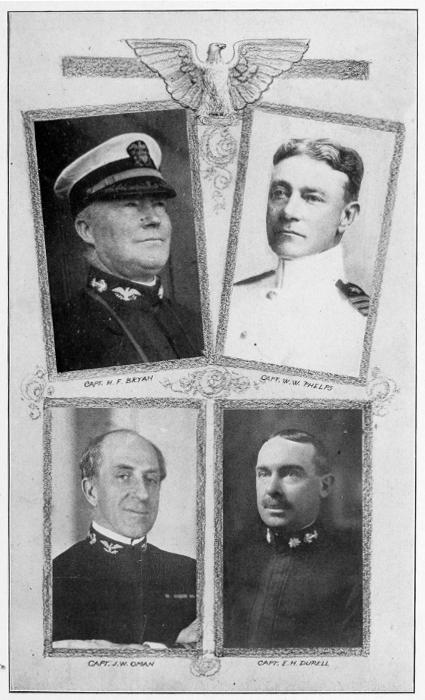
By Captain William W. Phelps, U. S. Navy
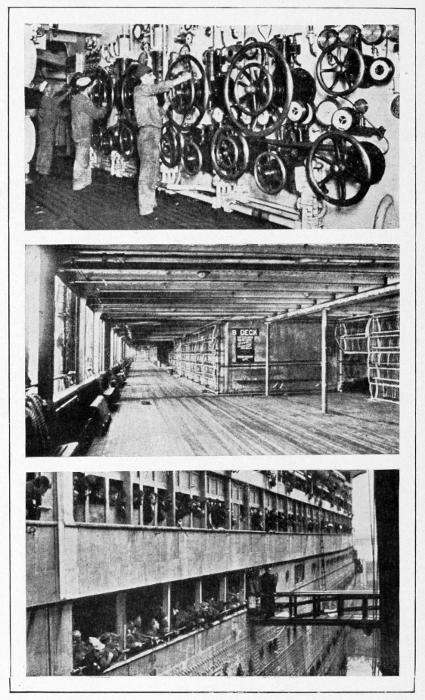
The power to drive the Leviathan is distributed into turbines
driving the four propellers. In the open sea the steam
is distributed in what we call the high pressure cruising combination,
whereby the turbines operate at their highest economy.
But in this combination the engines cannot be thrown back
instantly, so that in the open ocean in considering her safety
and manœuvering, the rudder effect only can be relied upon.
She must be considered as having no backing effect. For leaving
port, entering port and manœuvering about the dock or
about the anchorage, there is thrown in what is called the
manœuvering combination. In this combination the highest
speed the ship is capable of is sixteen knots ahead, and the
combination permits steam to be thrown into the backing turbines.
When there is little or no wind the ship steers very well.
When it blows strong on the beam or on the quarter, the enormous
area of the ship’s freeboard makes her act like a catboat,
she wants to fly up into the wind. She requires a weather helm
or to put it in modern language, a lee rudder. She will turn
very quickly into the wind, but she will turn away from the
wind only slowly and reluctantly. Consequently we always
dislike going into New York or out of New York in a gale of
wind, where the restricted channel requires prompt and accurate
turning of the ship. Under normal conditions the manœuvering
of the ship with her propellers, in spite of her great
length of 954 feet, is all that can be desired.
Ambrose Channel is dredged to forty feet at low water.
On the spring tides the low water may fall another foot, leaving
but thirty-nine feet in the Ambrose Channel at low water.
As the ship draws between thirty-nine and forty feet on arrival
at New York, it is not safe to try to enter at any other stage
of the tide than at high water. Owing to her great bulk it is
improbable that any amount of tugs could dock the ship at
Hoboken when the current is running in the North River, so
for docking at Hoboken, the ship’s arrival must be timed so
that she is off Hoboken at the slack water. As the slack water
at Hoboken is after the slack water in Ambrose Channel, we
enter Ambrose Channel then at high water and carry slackwater
all the way up the channel and dock at Hoboken on the
high water slack tide. On sailing from Hoboken she is undocking
on the low water slack tide, so as to arrive in Ambrose
Channel at the next high water. The deep draft of the ship
on leaving New York, namely, forty-one feet ten inches, requires
that in leaving New York Harbor and as far as the Narrows,
the ship must seek what might be called the prehistoric gorge
of the Hudson River. There are many places between Hoboken
and the Narrows even in what ordinarily would be called the
navigable fairway, that are so shallow that the Leviathan would
go aground. This prehistoric gorge is accurately known to
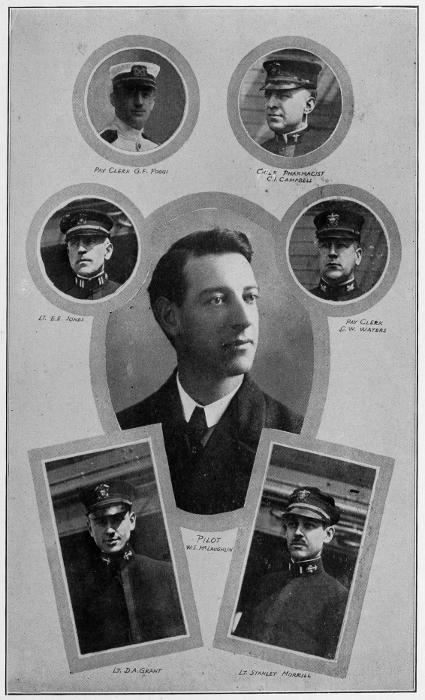
Captain William S. McLaughlin, Master Pilot of the New York-Sandy
Hook Pilots, who always pilots the Leviathan out and in.
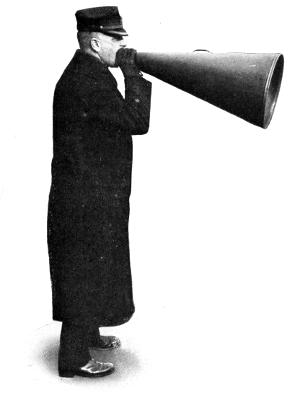
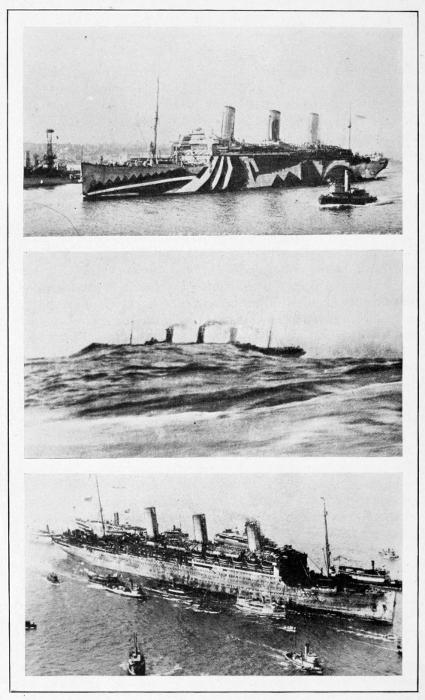
Directing the Docking of the U. S. S. “Leviathan”
In docking the Leviathan there is no particular trick that
must be known, but on undocking her it must be so timed that
while on the New Jersey side at Hoboken the water is dead
slack, the flood on the New York side has just begun to make.
This helps the operation in two ways. First, by getting her
away from the dock before the flood current begins to press her
against the dock, and second when she backs out, the beginning
of the flood current on the New York side assists to turn her
stern upstream and operates to point her correctly. In leaving
New York for sea, the ship must be manœuvered over to the
New York side, the deepest water being on the New York side.
In midstream and on the New Jersey side, between Hoboken
and the Statue of Liberty, there is not enough water to float
the Leviathan. In docking and undocking we need from fourteen
to sixteen tugs. Abnormal conditions can be expected in
the winter months. Upstate freshets and northerly gales sometimes
operate to kill the flood current off Hoboken and to cause
a continuing ebb current. Such a condition has happened,
making it impossible to point the ship correctly downstream,
and it has been necessary to yield to the elements and to permit
her to turn the ship. There is always an apprehension in
entering and leaving New York Harbor lest merchant vessels
carelessly anchor themselves in the Leviathan’s fairway. Such
a condition adds difficulties to the piloting of the ship.

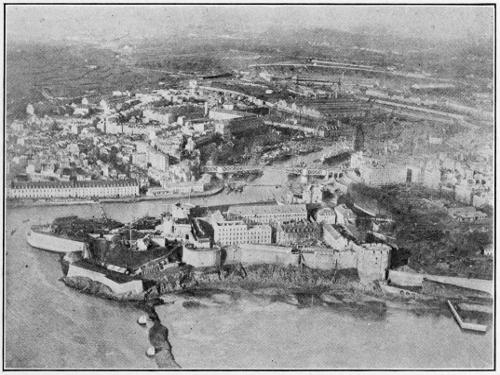
Brest Harbor
Like most passenger vessels she is designed to have a slow
and easy roll, which means that she has not a great margin of
stability. In entering New York, bringing troops homeward,
it is necessary to keep the troops in control and evenly distributed,
because in their excitement and happiness, they tend
to rush from one side to another on the passing of every cheering
ferryboat, heeling over even this great ship. When this
ship heels over, owing to her great beam, and to her box-like
dead-flat section, it materially increases her already great draft.
Large ballast tanks with suitable pumps are provided for the
purpose of counteracting the tendency of the ship to heel over,
but in spite of this, at sea she lies over to the breeze, and in
entering New York she is very sensitive to the movement of
troops about the deck.
In mooring to the buoy in Brest Harbor, it is an advantage
to arrive at slack water; she must be brought to the buoy with
her momentum entirely gone, for her great weight of sixty-nine
thousand tons, if moving when the buoy is correctly placed,
would make it impossible for the mooring party to handle the
great heavy links of four-inch chain, and to connect the mooring
shackle.
By Lieut. A. W. Minuse, U. S. N. R. F.
Drydocking a ship in a graving
dock means placing the ship in a dock
or basin at the entrance of which is a
gate or caisson, accurately centering
the ship over a system of blocks or
beds, previously prepared according
to plans and then pumping the water
out of the dock.
When a ship is designed the Naval
Architect always prepares a docking
plan showing in detail just how to
prepare these beds so that the ship will
rest evenly without straining her in
any way. Ordinarily, docking a ship
up to 32,000 or 33,000 tons is not
much of a problem, nor does it involve
much of a risk, but on larger ships with all the necessary data
known, those connected with the docking always feel easier when
they see the ship setting safely on the blocks.
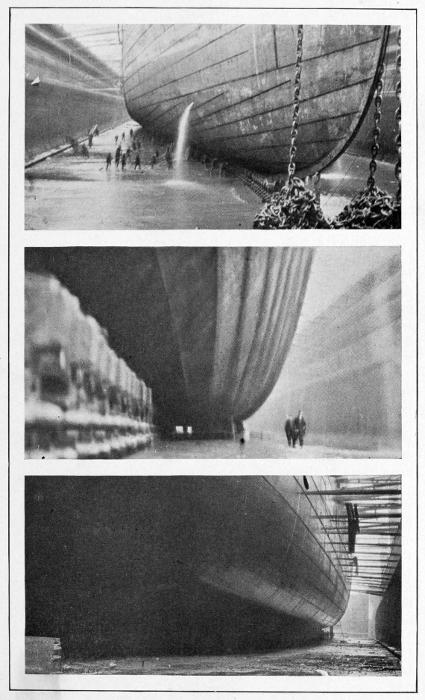
To give some idea of the size of the Leviathan consider
our latest, biggest and most powerful battleship, the New
Mexico. She weighs 32,000 tons. The Leviathan weighed
or displaced at the time of docking more than twice this, or
approximately 66,000 tons.
We had no docking plans nor plans of any description
showing her form or construction. The Germans had either
destroyed or removed all her plans. This was the problem
we were confronted with in January, 1918, when it was decided
to dock the ship in Liverpool for the necessary cleaning and
painting of her body under water, and doing other necessary
work, including a clump on her forefoot for towing the paravanes,
or mine-sweeping device.
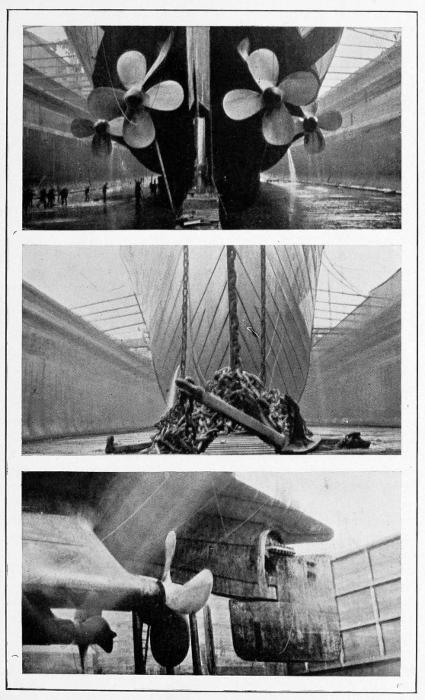
In Dry Dock
The Gladstone Dock in Liverpool was the only drydock
in the world at the time that would take the Leviathan. The
entire development of this dock, which included a tidal basin,
was not completed when the war broke out, so the tidal basin
was abandoned and one of a pair of docks was finished up and
a long channel dredged to the River Mersey.
The ship drew so much that we could not enter the dock
except at the spring tides, or in other words, only about two
days out of a month would permit us to enter the dock, provided
the wind did not cut the tide too much.
The next thing was to decide on how to prepare the beds
of the drydock to receive the ship. An examination of her
bottom was necessary. Divers were sent down and they reported
that she had neither docking nor bilge keels, and that
her keel plate consisted of a plate of about 2 inches thick by
3 feet wide.
In converting the ship from a passenger to a troop ship,
we naturally became familiar with every detail of her construction.
With this knowledge of her construction and due
consideration being given to the location of the heavy weights,
etc., it was decided to place the main bed under the third intercostal,
this bed running from frames 220 to 101, or a distance
of 358 feet amidships. The spacing of these blocks was 6 feet,
or every other frame space. The center of these blocks was
25½ feet from the center line of the ship.
In addition to the center line bed, which is placed underneath
the keel, and the two main beds, one port and one starboard,
which is placed under the third intercostal, an outer
bed, consisting of four sets of five blocks each, space 6 feet
centers, was placed under the fore and aft coal bunker bulkhead,
at the intersection of the thwartship bulkheads.
The fore and aft center of these blocks came at frame
199, 174, 151 and 126. Blocks of the outer bed were staggered
with those of the inner bed. This outer bed was 35
feet from the center of the ship. At the fore and aft ends
of the ship where the dead-rise is considerable, an inner bed
a few inches from the center of the ship for a distance of 60
feet was prepared, 12 feet 6 inches forward, and 13 feet
9 inches aft.
After deciding the location of these beds, the next step
was to get some idea of how to prepare them, so that they
would conform to the shape of the ship. Preparing the center
line bed was of course easier, as it was known that the keel of
the ship was a straight line.
The forward end of the center line bed consisted of a
solid line of blocks for a distance of 104 feet, and the after
end of a solid line of blocks for 144 feet, where exceptionally
heavy weights would be carried. The balance of the blocks
was spaced every 15 inch centers, except in the way of water-tight
bulkheads. Under these bulkheads the blocks were filled
in solid for 7 blocks. On each side of these, two spaces were
omitted and then filled in solid for 5 blocks. Reference to the
docking plans will show the spacing of these blocks.
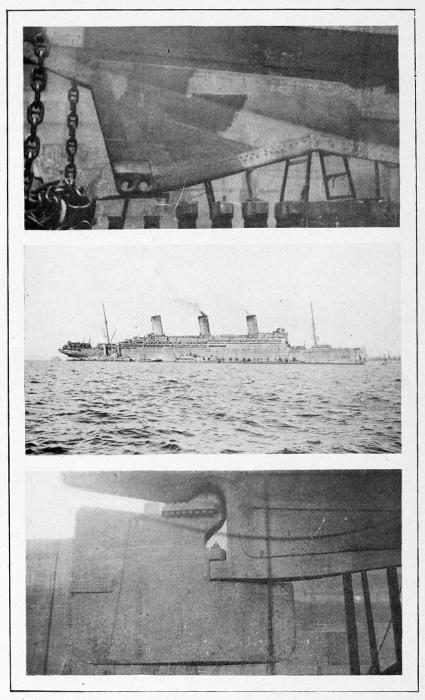
An idea of the blocks used in building the beds can be
had by referring to the photograph. They consisted of 3 cast
steel wedges, which, when placed upon each other, were about
3 feet high, 15 inches wide at the bottom, and 3 feet 6 inches
long. On top of these steel wedges was placed a hardwood
block 12 inches square and 4 feet long, and on top of the hardwood
blocks was placed a soft wood cap 12 inches wide by
4 inches thick by 4 feet long.
To prepare the main, inner and outer beds, it was necessary
to have some idea of the form of the ship. By opening
up the water-tight doors in the fireroom we were able to get a
base line 300 feet long. Every other double bottom tank was
pumped out and offsets taken at the fore and aft ends of these
tanks, in way of the main, inner and outer beds. The taking
of these offsets was greatly facilitated by the fact that the
double bottom was found to be flat in both the fore and aft
thwartships direction. Buttocks were run through these offsets.
While these buttocks faired up very well, it was realized that
the measurements would not be accurate enough for the actual
preparation of the beds; therefore they were prepared to
within 4 inches of these measurements.
Several hundred wedges of varying thicknesses were made
ready in advance, and after the ship was placed on the center
line blocks, the space between the main and outer beds and
the ship’s bottom was packed with the wedges by divers.
The Gladstone Dock was prepared according to the above
description, carefully checked and measured, and then flooded
to about 10 feet, so that no one could tamper with it. After
the dock was prepared, we had to wait several days for a spring
tide, and also to dredge out a shifting shoal at the entrance of
the channel leading to the dock.
The first tide that the ship could enter the dock was at
11:50 A. M., January 14, 1918. She was brought to as even
a keel as possible, which was 35 feet 9 inches forward and
37 feet 6 inches aft. This was accomplished by filling the
forward tanks and emptying the after tanks and placing about
1,400 tons of coal in her reserve and forward bunkers. This
was the nearest to an even keel that we had ever had the ship
up to this time in the light condition. I might mention here
that in this condition the ship is extremely tender, and that
Lieut. Watts of the Engineering Department, displayed great
diligence and good judgment in keeping her perfectly upright,
while setting her on the blocks.
On January 14, 1918, the ship proceeded down the Mersey
River to the entrance of the dock, but the wind was too high to
attempt making the entrance, and we had to return to Princess
Landing. On the 15th conditions were much better but none
too favorable. However, as it was the last day of the spring tide
we had to make the attempt. The spring tides are about 21
feet, and the current is very swift, so we had less than an hour
in which to enter the dock and close the caisson.
The entrance was very narrow, so that tugs were of little
assistance and she had to go in under her own power. It was
a fine piece of seamanship and was successfully accomplished
without damage to either the ship or the dock. The handling
of the ship in the long entrance channel to the dock was done
by the Senior Captain of the Cunard Line on shore. We were
all greatly shocked about two weeks later to learn of his death,
due to a channel steamer being torpedoed on its return from
France, where he had been called on an important conference.
It was the loss of such fine men through the treacherous German
submarines that brought home to us more than ever our solemn
duty to beat the Germans at all costs.
On the 16th everything was ready for setting her on the
center line blocks. The weather conditions were ideal; the
wind was on the stern and the ship was on an even keel. The
stern touched the blocks and she settled at 3:55 P. M.
Previous to setting the ship on the blocks 12 sighting
battons were erected along the level of “B” deck from stem to
stem, so that if the ship was strained in any way it could be
readily noted. A piano wire was also stretched from side to
side at the top of the thwartships coal bunkers amidships and
connected to a spring balance, so that any opening up effect,
due to the divers not properly packing the main beds, would
immediately show.
As soon as the stern touched the blocks the top row of side
shores were set up commencing from aft. These shores were
spaced every 5 frames, or about 15 feet centers. Altogether
there were three rows of these side shores. The water was
then lowered to a depth of 32 feet and the water maintained
at this depth while the divers packed the main, inner and outer
beds. As soon as possible after the water reached 32 feet,
the water in all the tanks was pumped out with the exception
of the feed tanks and No. 23 and 24 fresh water service tanks.
The stem and side anchors were lowered and the pig iron in
No. 17 tank, amounting to about 473 tons, was removed.
The water was maintained in the dock at 32 feet, because
at this depth the ship was just resting nicely on the center line
blocks and would not compress the soft wood caps. We did
not want any unnecessary weight on the center line blocks until
the divers had finished their work on the main and outer beds,
so that when the dock was finally pumped out, the ship would
imbed itself in the soft wood capping at a uniform depth.
This worked out exceptionally well, and was remarkably uniform
on all beds, amounting to about 2 inches at the end of
the third day. On the third day the spring balance on the
piano wire registered less than an ounce difference. The
sighting battons showed that she had settled amidships about
1⅜ inches. After floating she returned to ⅛ inch of the
original condition. This I believe to be the natural hog of
the ship.
The undocking of the ship was somewhat unusual in that
7,800 tons of coal were placed aboard while she was in dry
dock, 1,400 tons while the dock was absolutely dry and the
balance of the coal, with from 35 to 37 feet of water in the
dock. This was not sufficient to float the ship, and she still
rested upon the docking beds. Immediately before letting in
the water, all the bilge and hanging shores, and shores under,
the stem and stern that would in any way injure the ship should
she take a sudden list, or any undue change of trim, were
removed. These shores were removed at about 15 minute intervals,
so that the ship could adjust itself and any undue
settling could be noticed. During this operation men were
stationed at the sighting battons and the piano wire. Water
was then admitted as quickly as possible to 35 feet and maintained
at this level while additional coal was put aboard from
barges admitted to the dock at low tide. This was a rather
trying ordeal, but was successfully accomplished in 5 days.
Arrangements had been made to leave the dock on
February 11th. It was therefore decided to float her on the
10th, and an estimate was made of the coal on board and
such tanks as were necessary to bring her to an even trim and
even keel, were filled. She floated at 1:20 on the 10th with
38 feet 11 inches draft aft, 39 feet 6 inches draft forward,
and less than ½° list to starboard.
I cannot speak too highly of the hearty co-operation received
from the ship’s officers and crew, especially Naval Constructor
J. H. Jack, U. S. N. This applies not only to the
docking of the ship, but to her conversion from a passenger
ship to a transport. No duty was too strenuous or hours too
long, and during the conversion the living quarters on the ship
were not of the best. They were continually shifted from one
part of the ship to the other, even the meals were of a
makeshift character and at times irregular. Every man seemed
to realize what we were up against and that we must make
good. Everyone pulling together, accomplishment was made
possible.
The conversion of the ship to a transport speaks volumes
for the Navy Department organization and more particularly
for the New York Navy Yard, under whose direct supervision
the work was undertaken.
The ship was so big that she could not be taken to a
shipyard, nor transferred to the Navy Yard. The task had
to be undertaken where she lay at her piers in Hoboken and
the New York Navy Yard organization was elastic enough and
active enough to carry on the work outside the Navy Yard.
W. J.
General conditions on the bridge were good. Instruments
had deteriorated somewhat, owing to the long stay in port and
not being used.
All signal flags and navigation instruments, including
the three chronometers which comprised part of her equipment
were removed. The ship was equipped with two master gyroscopic
compasses installed on “G” deck and seven repeaters for
use on the bridge in steering and taking bearings; these were all
found to be more or less in need of repairs and after days of
hard and tedious work on the part of Lieut. W. H. F. Schluter
and his well organized staff they were put in fine condition
and have been kept in this manner constantly even though he
has had to add pieces of lead to each master gyro to maintain
a level. Being of German manufacture, no spare parts could
be obtained during the war, but whenever they were needed
Lieutenant Schluter proved to be the “man of the hour.”
The gyros were only one of his many troubles for, being electrical
officer, there were numerous other duties about the ship.
There were a great many German charts left on board but the
ship was equipped by the Bureau of Navigation with American
charts before leaving port. The steering gears and all the
telegraphs were changed to English speaking. The deep-sea
sounding machines are still in commission after a great amount
of usage, and the motors attached to them for heaving in the
lead are still in good working order. The patent log for
measuring distance is the “Forbes,” an English patent. Loudspeaking
telephones reached to all the principal parts of the
ship, and are very much used. A fire-alarm indicator is placed
in the wheelhouse and is set at fifteen-minute intervals. This
indicator has pipes leading to all holds through which the
smoke from any fire in a hold would be drawn and can be
seen in the wheelhouse when the alarm goes off. A steam hose
can be connected to the pipe and the fire smothered. There
is a control for operating water-tight doors and a diagram showing
location of each door; upon this diagram an electric light
burns when each door is closed, showing the officer of the deck
whether the control works properly.
The big 44-inch searchlight on the foremast is controlled
very readily from the bridge by a small lever; the fog
bell is rung and all whistles are blown by an electrical attachment.
The master electric clock is on the bridge and gives
the time to 550 repeaters situated throughout the ship. These
clocks required a great amount of painstaking labor to be put
into good condition and demand constant care and supervision.
During the alterations in which first class staterooms were
ripped out to make troop quarters, the wiring system to the
clocks was torn out by the workmen as well as everything else
which happened to be in their path.
As mentioned previously the ship’s chronometers, three in
number, were missing. These were afterwards found by the
Secret Service in a nautical school in New York City. The
commanding officer had to send them to the Naval Observatory
at Washington, D. C. This was done with great reluctance as
they were of the finest type and a good chronometer is a very
valuable and much used article aboard a ship. Others were
sent to replace them. The bridge and signal bridge were
altered for transport purposes. The fire control and range finder
stations being built on the signal bridge, and the fine bright
finish of the wood was changed to the more popular color at
that time—the war gray. Otherwise the Leviathan remains
the Vaterland, as when she was in the merchant service—a
German transport in disguise.
F. C. W.
When the Leviathan was taken over by the Navy, the chief
difficulty that presented itself was the scarcity of men available
for the deck force. Only a few of the crew that had been
assigned to the ship had ever been to sea. A few—gun crews,
for the most part—had had some experience, but not enough
to qualify them as seamen. This was partly due to their short
terms of service.
As a result, the brunt of the work fell upon the shoulders
of a few experienced petty officers, who fortunately had been
assigned to the ship. These men worked day and night in a
supreme effort to organize their crews and create a working
machine. For the first few days they did everything from
scrubbing the decks to exploring the double bottoms. There
was no distinction between the rated men and the seamen in this
line of work.
The size of the ship added to the confusion. It was impossible
to keep a detail together for more than a minute and a
half. It was easy for an entire working party to get lost between
decks. It was easier for some to get lost than others.
Finally, it was decided that the only way to keep a working
party together was to hang a bell around the neck of the petty
officer in charge. This scheme worked well until two working
parties met, when it was necessary to call in a traffic cop to get
them separated.
Because of their unfamiliarity with the ship, details were
apt to deliver sacks of “spuds” to the Commander’s cabin, and
stationery to the blacksmith shop. This situation was relieved by
the appointment of guides to conduct the working parties around.
The parts of the ship allotted to the deck division (at that
time we could only boast of one), were in rather good shape,
considering the time the ship had been laid up. The weather
decks were littered up like an old woman’s backyard after a
hard day’s washing, but most of the truck was movable. Boats
were piled across the hatches and all over the decks, making it
impossible to get around. Boxes, stores and cordage were
everywhere.
The process of making the ship habitable was accomplished
by a mere handful of men, most of the division being assigned
to various details for work in other compartments.
After the work of cleaning up had been completed, attention
was turned to the rigging. The running rigging was in
bad shape and it was found necessary to refit all of the davits
that were rigged with manila rope. The booms were also refitted
with new whips and guys. Requisitions for wire and
manila lines were made right and left and all of the rigging
was overhauled.
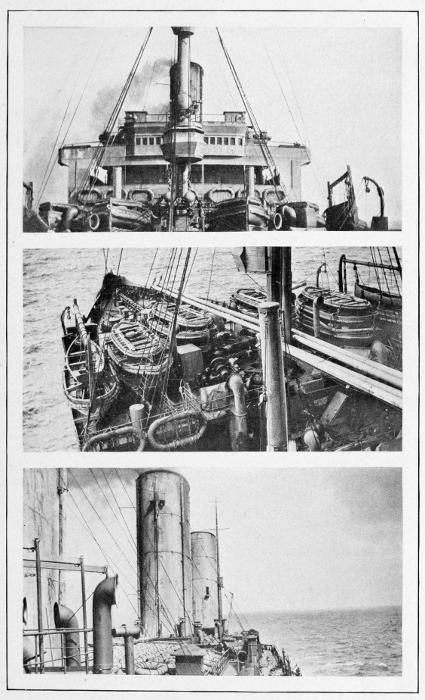
Of the 72 boats on board, 26 were equipped with friction
winches and needed no power for rigging out and loading.
The power for hoisting was furnished by electric motors, each
one operating two or more winches. These winches were given
a thorough overhauling and found to be in excellent condition.
The boat falls, which were of special laid wire, were then
unrove and tested. Only two of the entire number needed
attention. At that time we had no serviceable wire, and it
was a case of a few well-made long splices.
The ground tackle on the ship was all that could be desired.
Of the three Hall type anchors, the largest, or stem
anchor, weighed a little more than twelve tons. The other two,
port and starboard, tipped the scales at eleven tons. These
little trinkets were the only articles on board considered safe
from souvenir hunters. For the information of landsmen, the
“anchor watch” has no connection with the anchor itself, but
is merely the men on watch as Officer of the Deck’s night messengers
while the ship is at anchor.
The stem anchor was fitted with a 4-inch stud link chain,
150 fathoms in length. The port and starboard anchors had
chains of 164 and 150 fathoms, respectively. The chains for
the latter were three and three-eighths inches in diameter, the
size of a chain being measured by the diameter of the material
of which the links are formed.
The anchor engines were of corresponding size, and could
be connected with the capstans on deck. In addition to them,
there were seven more engines for capstans in all parts of the
ship. In consequence, mooring the ship to a dock was not the
hard task that it usually is.
The stern anchor and chain had apparently been left in
Hamburg. The hawse pipe aft, and the stern chain locker were
utilized for the handling and stowage of the heavy manila
hawsers.
Most of the manila hawsers on board had to be replaced.
Natural decay or possibly a small application of acid had so
weakened the lines that they had a tendency to break at the most
inopportune moments. The wire hawsers, however, were in
A-1 condition, and up until the present time, have never been
replaced.
But the work of fitting out was not all that had to be
done. Men must be fed; and it seemed, from the accumulation
of provisions on the dock, that we were being depended upon
for the entire job of feeding the A. E. F. Truckload after truckload
of stores was piled on the dock, and hoisted aboard, day
after day. We soon learned that one trip with 10,000 red
blooded men aboard involved the consumption of almost everything
we had been piling into the ship’s storerooms and refrigerators.
Besides food, there were general stores to be handled,
including everything from safety pins to dishwashing machines.
Every department was working overtime to get things ship-shape,
and the deck force most of all.
At last it was rumored that we were about to make our
maiden trip under the American flag. This was followed by a
speeding up in all departments. It received final substantiation
when military equipment and stores began to arrive. The time
had come for a real test.
We had a chance to test our booms when a five-ton truck
showed up as a part of the equipment to be loaded. The booms
were of three-ton capacity and it was necessary to strengthen the
lifts and rig a purchase in lieu of the single whip. It was taken
aboard without mishap.
Just before leaving all boat-falls were given a final test.
Every boat was rigged out and lowered to within a few feet of
the water. A party of sixty-five men then clambered in and
the boat was hoisted and lowered ten feet or more. This party
was used for all of the boats, which were found to be in satisfactory
condition. A few boats not on davits were hoisted overboard
and tested for watertightness.
One morning in the fall of 1917 we slipped away. There
were many conjectures as to our destination, one opinion being
that we were bound for Panama for a last overhauling in dry
dock. It developed that we were taking 1,500 marines to
Guantanamo.
Upon our arrival in Cuba, we discharged all equipment
and turned our attention to the boats once more. The boat
officers were given their first lesson in the handling of the boat
winches, and some of the men were given their first experience
in a boat under oars.
Back again to Hoboken—more handling of stores and provisions.
The Marines, although few in number, had managed
to put quite a hole in our store of provisions. But the worst
was yet to come. Orders sending the ship to France came, and
with them 7,500 soldiers.
We had one piece of luck in getting off. While the crews
of other transports had been compelled to sit and watch civilian
stevedores put their stores aboard, the crew of the Leviathan
were allowed to handle everything going aboard the ship themselves.
There were no restrictions whatever, permission even
being given to work night and day at the job. All of the equipment
handled by the civilian stevedores belonging to the army.
The crew handled all of the naval equipment aboard, including
Liberty motors, aeroplanes and S. P. boats.
Liverpool had the honor of receiving us on our first and
second voyages. Here we went into dry dock for final repairs,
and here we had our first experience coaling ship in drydock.
Coaling was carried on from cars running along the dock and
also from small lighters or flats in the dock itself. The lighters
were emptied and taken away only at certain stages of the tide.
There was always a chance of the ship floating during one of
these manœuvers, and the work of bringing loaded lighters into
the dock and sending the emptied ones out required quick
action and plenty of it. The notorious punctuality of time and
tide is especially noticeable in the Liverpool drydock, and
we worked at all hours of the day and night to keep in step.
The bottom of the ship was given a new coat of paint, and
we left for Hoboken and more troops. On our second voyage
to Liverpool our paravanes were installed, adding a little to the
work, but contributing a good deal to our sense of security.
Once more, for the benefit of the landsman: The paravanes, or
PVs, are contrivances fitted to the bow of the ship, as a protection
against mines, so constructed that they will automatically
pick up the moorings of a mine and cut it adrift.
Beginning with our third trip, we worked on an express
train schedule. Everything depended upon speed. Our cargoes
increased at the same time. In addition to all kinds of
army equipment, we frequently carried aeroplanes, boats for
overseas duty, and on one trip a large mooring buoy. In order
to load them on board, additional changes had to be made in
the rigging, purchases and guys of the booms. Even the weather
decks were utilized for the transportation of cargo for the naval
forces overseas.
At the present writing the good old ship is still on the job—bringing
them back. The machine is running as smoothly as
the ship’s engines, and instead of having a few inexperienced
men in the deck force, we have an organization, built from
almost nothing, that can compete with anything in the navy.
W. S. A.
This is a brief description of how the Leviathan’s human
cargo was loaded and unloaded. The plan had been followed
from the beginning with slight changes made by experience
in carrying troops over before the armistice and
carrying them back afterwards.
The ship’s troop capacity began at 6,800 and on the 13th
voyage it was approximately 12,000. Throughout the war
it averaged about 10,000. In addition, officers’ space has
varied between 400 and 600.
Throughout the war, carrying troops east, five gangways
were employed on G-deck forward, to fill forward compartments;
C-deck and F-decks amidships, to fill amidship compartments;
E-deck and G-deck gangways aft to fill after compartments.
On each gangway, the compartment farthest away and
lowest was filled and so on to the gangway compartment. In
no case did troops crowd through a filled compartment.
It was early realized that loading the ship with troops
was a Navy function and was treated as such. The organization
at each of the five gangways was: one naval officer in
charge and assisted by one chief petty officer and fifteen men.
Wherever Army officers were available one was detailed to
assist the Naval officer.
Prior to embarkation on each voyage, the ship’s embarkation
officer made an assignment of all troops the ship was
to carry, so organizations would not be split up but located
in the same part of the ship to facilitate work. Often this was
a problem on account of the arrival of trains or ferries and
the size of organizations carried. Also, troop compartments
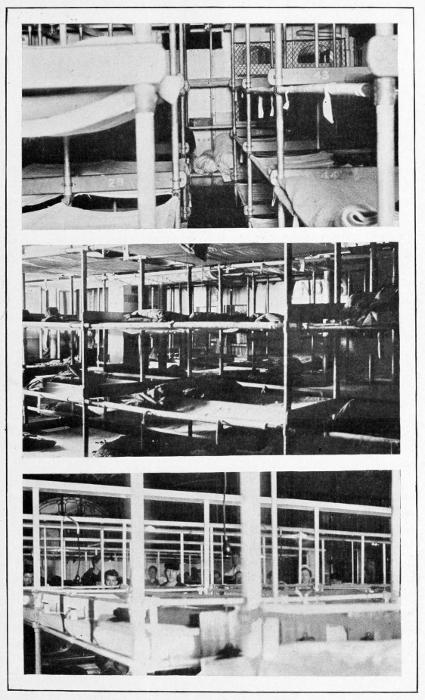
had an arbitrary number of bunks in them, based on the amount
which could be put in and not upon the number in military
organizations. By planning we were able to get a complete
regiment amidships, one aft, and a battalion forward, then
filling in smaller units up to capacity.
Generally a battalion, or approximately 1,000 men, came
to the ship a day in advance of embarkation for the guard and
mess details. The next day the balance of the troops arrived.
When the guard was not posted before embarkation, the troops
were all over decks, superstructure, and masts, resulting in
much unnecessary confusion.
Embarkation usually began about 8 o’clock or 9 o’clock
in the morning, although on one occasion it began as early
as 5:30 A. M. Organizations marched on the dock, both upper
and lower levels, the Army checkers checked the individual
soldier’s names upon the passenger lists and the soldier would
receive a billet ticket which showed his compartment, bunk
number, deck space, abandon ship station, safety rules, etc.
Then the column would move over the gangway and the prescribed
routes to the compartment. Each of the five columns
were led by a Naval guide, and other Naval guides were posted
along the route and seven or eight Navy men in the compartment,
to direct the columns to the proper bunks and put the
soldiers in the bunks called for by the billet tickets. The numbering
in compartments generally began in the forward starboard
corner and ended in the after port corner. Later on,
the bunks in the amidship compartments were renumbered so
that a column of troops could be directed up a passageway and
men could get into the bunks on both sides of it.
A company officer would go into the compartment being
filled and assist the Navy detail; troops got into their bunks as
soon as found, and stayed there until embarkation over that
gangway was completed. No smoking was allowed in compartments.
Without strict adherence to these rules, embarkation
was hindered. Generally it was possible to take troops
aboard nearly as fast as they arrived on the dock and many
times the dock would be emptied before the next organizations
would arrive. The troop mess hall on F-deck was
used as a reservoir to hold over 1,000 troops marching in a
serpentine line which proceeded into the compartments being
filled. The Naval officer in charge of the gangway circulated
from the gangway over the route into the compartment and
saw that all went smoothly. The embarkation officer moved
around all gangways into compartments being filled and upon
the deck, generally overseeing and directing embarkation.
The Navy men for the forward gangway were from the
first division, midship gangways from the third division and
the other gangways from the fourth division. With the inborn
aptitude of the American youth, they soon became experts in
embarking and made short work of filling compartments.
There was little change in the details during the entire war
period. The men took real pride in their work. Embarkation
of 10,000 troops, each soldier into his own numbered
bunk, could not have been effected in a period of six to eight
hours, if it had not been for the zeal and ardor and intelligence
which the men put into their work.
Whenever a bunk was found which could not be used and
compartments were checked over before embarkation, the
ticket was taken up from the soldier and another secured at
the gangway so the man could occupy a bunk in the vicinity
of his company.
Relations between the ship’s officers concerned with embarking
and the army officers of the port of embarkation staff were
harmonious and co-operation grew as trips increased. On
some occasions the ship’s officers went to the army camps,
gave talks and distributed ship’s pamphlets in advance of embarkation
which were of assistance in embarking and getting
the army settled on board.
On these war time embarkations, one noted the eagerness
with which the troops came aboard to get to the scene of
war. On one occasion a number of colored troops went up
E-deck gangway, which had an angle of nearly forty-five degrees,
upon their hands and knees for safety’s sake. This
caused great laughter.
Only on one or two embarkations were there any substantial
delays, as trains and ferries generally arrived on
schedule. Once an entire regiment was fitted up with two pairs
of trench shoes upon the upper level of the dock. During the
influenza epidemic in the fall of 1918 taking the temperatures
of all troops slowed up embarkation.
During the war, debarkation on the first two trips to Liverpool
was simply to march the troops over the G-deck forward,
F-deck amidships, and G-deck after gangways on the landing
stage in reverse order of embarkation, where they mustered
by organizations and entrained. On the third trip to Liverpool,
in November, 1918, the Leviathan ran her nose into the
Mersey mud off the Gladstone dock in a heavy fog. The tide
ebbed and the ship began to list. All the Mersey ferry boats
were commandeered and the 8,000 troops were debarked on
them from F-deck gangway amidships and G-deck gangway
aft, in three hours. Gangways to the ferries in several cases
were at an angle of sixty degrees. Debarkation was rushed
to lighten the ship, and she was backed off on the rising tide
that evening under her own power.
At Brest, during the war, a different plan was followed.
Coaling began soon after the ship was moored. G-deck gangways
aft, port and starboard sides, were the only gangways
available to debark troops onto lighters. B-deck and the troop
mess hall were used as debarking mustering stations. Organizations
moved to them from their compartments, according to
prearranged plan, as it was essential to send the troops ashore
by organizations. B-deck held about 1,800 men with their
packs and the mess hall about 1,200. When assembled, they
moved to lighters lying at the after gangway. These held
at first according to size, from 600 to 2,200 men and they were
packed tight. Their capacity was reduced on later voyages.
The troops cheered the old Leviathan as their lighters drew
away, and our men responded. The Leviathan carried many
organizations which later paid heavy toll of casualties in
battles.
When the armistice was signed and the westbound tide
set in, it required considerable work to reverse the procedure
of embarking at Brest and debarking at Hoboken. The entire
embarkation was over G-deck gangway for all compartments
up to the thirteenth voyage, as it proceeded during coaling.
The procedure of filling compartments was the same, but
it was necessary to unload lighters quickly and get them away
so the line of troops to compartments was extended to fill
A-deck, B-deck, D-deck forward and aft, from whence the line
of troops fed down into the compartments.
From 1,100 to 2,200 sick and wounded were embarked
at the same time as the other troops, this was done under supervision
of the medical officer, assisted by the hospital corps.
The casuals were taken to sick bay or E-deck compartments
especially set aside for them.
Debarkation at Hoboken was the quick and happy event
following the reception the ship received coming up the harbor.
G-deck forward, C and F-decks amidships, and G-deck after
gangways are used. The troops march out on them in reverse
order of embarking. Units muster on the dock according to
their organizations. Briefly, the procedure resembles pouring
liquid out of three different pitchers, just the reverse of filling
the compartments upon embarkation. The debarkation of
troops was completed in about three hours.
The dock was always a lively place with throngs of reporters
and welfare workers present with refreshments and smokes
for the boys. The canine mascots generally got aboard unobserved,
but in debarkation they proceed with their proud masters
down the gangways and are admired as returning heroes
by those upon the dock. Many of the dogs were “prisoners of
war,” having come over to the American trenches from the
enemy.
Such, briefly, is the story of the loading and unloading
of the Leviathan’s human cargo. The doughboys have bravely
done their part in winning the war. We of the Leviathan have
had the happy and important duty of getting them over safely
and bringing them back home.
E. E.
Abandon ship drill is the most important drill on board
ship as the saving of the lives of all would depend upon the
degree of perfection, organization, and speed of execution. It
is easily seen that a ship the size of the Leviathan by reason of
her water-tight doors would not sink for several hours after a
torpedo attack or after striking a mine; thus the great danger
to be avoided is the panic attendant upon such a contingency.
The end to be attained is the conducting of all the troops in
an orderly and expeditious manner to the weather decks where,
equipped with life jackets and canteens, they can climb over
the side on sea ladders rigged for the purpose and reach the
rafts and boats already lowered into the water.
The abandon ship organization requires the second in army
command to be in charge of the troop movement. He has as
his assistants thirty-five captains as troop compartment officers—they
are the senior officers in each troop compartment—and
seventy lieutenants, the junior compartment officers. As a
special abandon ship detail there are twelve majors acting as
abandon ship mustering station officers and twenty-four captains
and lieutenants acting as assistants to these officers.
The abandon ship mustering stations are distributed over
the ship and include all available space on the weather decks
except such space as is necessary to the lowering of boats or to the
actual navigation of the ship. The routing of the troops to
these stations is worked out on the principle that all watertight
doors will be closed as soon as abandon ship signal sounds.
The capacity of these stations is limited to a minimum of three
cubic feet of deck space per man, giving also due consideration
to the disposition of the ship’s boats.
During the war the first abandon ship drill was held prior
to the sailing of the ship. All men aboard were obliged to
keep their life jackets within reach at all times. For the first
three drills the troops were sent below to their compartments
at the call “assembly” on the bugles so they would become
familiar with their abandon ship route. After the first three
drills, troops already up on deck proceeded directly to their
mustering stations.
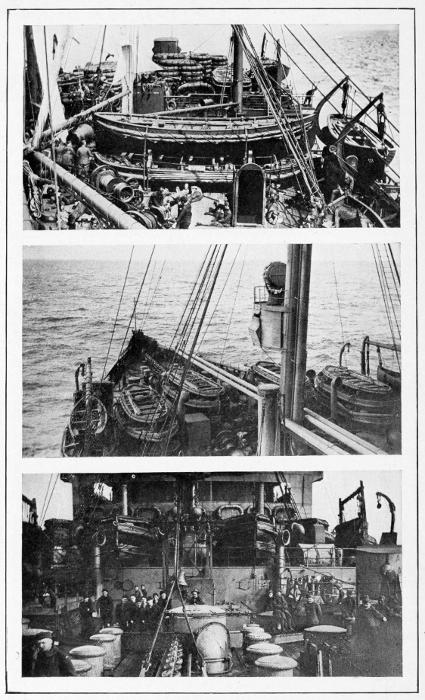
Going to Bring the Doughboys Home
Troops were not required to wear their life jackets when
hostilities ceased, but when abandon ship drill was held they
were sent below to assemble in their compartments, put on
their life jackets, and then at the abandon ship call proceed
over the abandon ship route to their mustering stations to stand
by for further orders or until “secure” is sounded.
The plan followed throughout the ship called for the
emptying of the lowest compartment first. Other compartments
using the same abandon ship route stand fast until the
troops in the lowest compartment have filed past.
It was found that by this drill all compartments could
be emptied and all troops assembled at their abandon ship
mustering stations within fifteen minutes of the sounding of the
abandon ship signal, or within one half hour of the blowing of
the “assembly” which sends the troops to their compartments.
- Creed H. Boucher, Lieut., U.S.N.; assigned, August 3, 1917; detached, April 20, 1918.
- Arnold H. Bateman, Lieut., U.S.N.; assigned, April 20, 1918; detached, October 27, 1918.
- Charles K. Osborne, Lieut. Comdr., U.S.N.; assigned, October 27, 1918; detached, April 3, 1919.
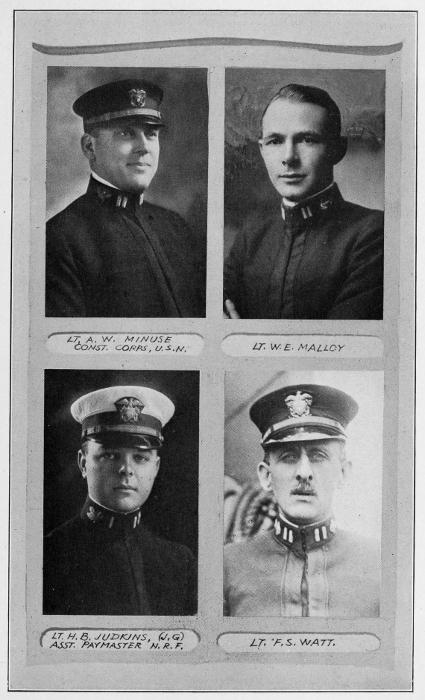
- William E. Malloy, Lieut., U.S.N.; assigned, October 8, 1917.
(Lieut. Malloy was detached as assistant Gunnery Officer in
order to take over the duties of First Lieutenant of the ship.)
- Arthur B. Dorsey, Lieut., U.S.N.; assigned, July 30, 1917; detached, January 22, 1919.
- John T. Swift, Lieut., U.S.N.; assigned, January 22, 1919; detached, March 6, 1919.
- James F. Williams, Gunner, U.S.N.; assigned, January 20, 1919.
(Gunner Williams served on board as a Chief Gunner’s
Mate from August, 1917, until he was made Gunner in
January, 1919.)
Lieut. Boucher, Lieut. Malloy and Lieut. Dorsey, were
the officers in charge of the installation of the battery, fire
control system, etc., the training of gun crews and lookouts,
and in fact all the numerous details required to have the ship
in readiness for sea and action when she cleared the net in
New York Harbor. Great credit is due these officers and the
men of their department for the excellent manner in which this
work was carried out. Much credit is also due the officers and
men who succeeded them for the excellent manner in which
they maintained the high standard of efficiency that had been
set for them.
There were also six Chief Gunner’s Mates and seven gunner’s
mates of lower ratings attached to the ship during her
voyages across the Atlantic.
No technical discussion of ordnance and gunnery will be
attempted in these pages, just a general description of guns,
fire control systems, etc., and their method of operation.
The armament and equipment of the Leviathan consisted
of the following:
- 8—6-inch 50-Cal. guns Mk. VIII.
- 2—1-Pdr. guns, Mk. VIII.
- 2—“Y”-Guns for throwing depth charges.
- 2—Colt Machine Guns.
- 1—Lewis Machine Gun.
- 150—.30-Cal. Springfield Rifles.
- 75—.45-Cal. Colt Automatic Pistols.
- 1—Large Bausch and Lomb 12-Ft. Range Finder.
- 2—Small Barr and Stroud 1-meter Range Finders.
- 1—Ford Range Keeper.
The six-inch guns were installed on October 5, 1917—four
aft and four forward. The distance between the forward
and after guns was about seven hundred feet, which is a
greater distance than the entire length of any battleship we
have in commission.
The work of installation was carried on by ordnance men
from the New York Navy Yard, assisted by the ship’s gunnery
department.
Splendid co-ordination existed at all times between the
Navy Yard people and the ship’s force which helped materially
to expedite the work. Considerable effort and labor were
required to get the ship in readiness to receive the guns, mounts,
etc. Gun foundations and gun platforms had to be built;
blast bulkheads erected in proper places so as to protect one
gun from the fire of the other; certain portions of the deck
were extended in order to give the after guns a greater arc of
train. Lines of communication, voice tubes and telephones, had
to be run from all guns to fire control and spotting stations;
and salvo bells and buzzers installed. All of this work was
completed in record time and gave excellent results throughout
the war.
Foundation and mount tests were held on November 20,
1917, on our trial trip to Guantanamo, when three shots were
fired from each six-inch gun. These tests proved satisfactory
in every respect.
The 1-pdr. guns were not installed until September 28,
1918. These guns were mounted on the port and starboard
sides of C-deck amidships. They also proved satisfactory when
fired for tests on September 30, 1918. Lieutenant Boucher
originally made a request for four 1-pdr. guns and also two
anti-aircraft guns, but only the two 1-pdr. guns were allowed
this ship.
The original depth charge outfit of this vessel consisted
of the earlier type of depth charges, containing only fifty-two
pounds of TNT as an explosive. We were allowed ten of
the charges and a chute was rigged over the stern for launching
them.
On July 27, 1918, two “Y” guns were installed
which throw a charge of TNT weighing 300 pounds. These
were tested out by filling four large paint drums with wet sand,
to bring them up to the required weight, and firing them from
the “Y” guns. The cans landed approximately 200 feet from
the ship, our extra high freeboard causing them to travel farther
than if fired from the deck of a torpedo boat.
We never had the opportunity of trying our depth charges
on a real submarine. A ship of this size would have to be
extremely lucky to manœuvre so as to be in a position to drop
a depth charge on a submarine.
The “Y”-guns were removed December 30, 1918, after
the armistice had been signed.
The two Colt machine guns were mounted forward on
C-deck gallery, abaft No. 3 and No. 4 guns, and the Lewis
machine gun aft by the depth charge station. The primary
object of the machine guns was for sinking floating mines.
The crews were kept in practice by firing at driftwood, floating
boxes, fish, etc. The 1-pdr. crews also engaged in this kind
of practice.
The range finders were mounted on the forward superstructure
just abaft and above the signal bridge. The large
range finder being mounted on a specially constructed stand
amidships between the port and starboard fire control stations,
and at a height of 124 feet above the water-line. Both control
stations were always within easy means of communication
with this range finder by means of voice tubes. The two small
range-finders were mounted on platforms—one on the outside
of each fire control station.
It is difficult to use the range finder against a periscope
for the simple reason that the periscope is visible for only a
short length of time, and is hard to get a quick reading on.
The range will have been obtained by spotting the shots before
the range finder can be brought into play. However, the range
finder would have been invaluable had we been attacked by
a raider, or a submarine on the surface.
The ammunition allowance for the ship was:
- 1,200—6-inch shells, long point.
- 1,200—6-inch 50-cal. powder charges.
- 80—6-inch flat nose shells. (Non-ricocheting, for submarines when submerged.)
- 480—1-pdr. cartridges.
- 89,000—Cartridges, for .30-cal. rifle.
- 10,000—Cartridges, for .45-cal. automatic pistol.
In addition to the above, blank ammunition for rifles was
carried for training with ex-caliber.
Forty shells were carried in shell racks at the guns at all
times, and twenty rounds of powder at each gun while at sea.
The rest of the ammunition was carried in the magazines forward
and aft (seven decks below) and supplied to the guns
by means of elevators and ammunition parties.
Gun and fire control drills were held daily to keep all
hands in practice. These drills were discontinued while in the
war zone. Actual conditions were simulated as much as possible
at all drills.
When not in the war zone two guns forward (one on each
side) and two guns aft, were manned by a crew of six men at
all times, with a man at the telephones of each of the guns off
watch. The men off watch had to remain in the vicinity of
their quarters ready for instant call.
While in the zone all guns were manned by a crew of six
men with six men standing by in reserve. The guns were kept
loaded, both in and out of the zone, with powder and shell—ready
for instant firing by inserting a primer.
Good lookouts are absolutely essential to a ship’s safety.
They have one of the most important positions on the ship. On
their alertness depends the discovery of any submarine or suspicious
object in his arc of lookout and the immediate and
accurate reporting of it to the fire control officer, so that the
guns may be brought into action in the quickest possible time
against the enemy.
There were twelve lookout stations on this vessel—six
on each side—so arranged that each lookout had an arc of
thirty degrees to keep under close observation. Of course there
were additional lookouts on watch at all times, such as the gun
crews, control officers, signalmen and officers-of-the-deck. Each
tried to be the first to spot a hostile periscope.
The personnel of the gun crews, lookouts, etc., showed
excellent qualities and sense of duty during the period of the
war. In all attacks by submarines, and false alarms, every
man performed his duties as he had been taught at drill,
showing no undue excitement, always on the job and ready for
more.
The letter from 6-inch gun crew No. 2 quoted below is
an example that well shows the spirit of the men.
U. S. S. Leviathan,
April 26, 1918.
From Number Two Gun Crew
To Commanding Officer,
Via Executive Officer.
Subject: Request to be transferred with 6″ Naval Gun to
Western Front.
1. It is respectfully requested that the Number Two Gun
Crew be transferred with a 6″ Naval Gun to the Western Front
to aid American Artillery.
2. The entire crew of Number Two gun are very desirous
of a six months’ tryout to prove their ability, and if the service
rendered is satisfactory, it is recommended that more gun crews
from U. S. Naval ships be transferred to the Western Front; the
transfer to be voluntary.
3. This is being done in the French and British Navies, and
is proving very successful.
(Signed) P. R. Bradley,
Gun Captain No. 2 Gun.
First Endorsement
U. S. S. Leviathan,
April 29, 1919.
From Gunnery Officer
To Commanding Officer,
Via Executive Officer.
1. Forwarded. Recommended that if the ship is required
to furnish a gun crew for the proposed Naval Artillery Brigade,
this request be favorably considered. The spirit of the gun crew is
especially to be commended.
(Signed) A. H. Bateman,
Lieutenant, U. S. N.
The American Artillery referred to was the U. S. Naval
Brigade. They served on the Western Front under the command
of Admiral Plunkett, United States Navy, and did great
credit to themselves and the naval service.
Our first target practice was held November 27, 1917,
while returning from our trial trip to Guantanamo, Cuba.
During the time the ship was being prepared for sea at
Hoboken, little time was had for drills and preparing the gun
crews. However, they were all drilled in their various duties
and every effort was put forth to get them in shape.
The practice was held in a choppy sea with a stiff wind
blowing and an overcast sky, making it difficult to pick up the
targets—two spars, so weighted as to make them float upright.
Despite this handicap and the newness of the crews, an excellent
score was made.
Shots fired, 78; hits made, 63; percentage of hits, 75.42
per cent.
This good shooting called forth the following note of
commendation from the Gunnery Officer to all gun crews.
U. S. S. Leviathan,
December 7th, 1917.
Memo from Gunnery Officer
To All Gun Crews:
The Gunnery Officer is highly pleased with the results of the
late target practice. Such accurate firing in action would almost
surely put a submarine out of action in short order, and if we
are ever called upon to fight for our lives, the Gunnery Officer is
confident that the Gun Crews will bear themselves as calmly as
they did a few days ago and shoot as accurately.
(Signed) G. H. Boucher,
Lieutenant, U. S. N.
Our second target practice was held June 5, 1918, while
on our way from Brest, France, to New York. Spotters who
had had no previous experience at actual spotting were picked
to control the gun fire and made an excellent showing.
Shots fired, 38; hits made, 28; percentage of hits, 70.62.
Gunnery Officer, Lieut. A. H. Bateman, U. S. N.; Chief Umpire,
Lieut. R. H. Jones, U. S. N.
The third and last practice was held on our way from New
York to Brest, France, on October 4, 1918. We had unfavorable
conditions as to weather and visibility. A high wind and
a large swell on the starboard quarter rendered the ship a most
unsuitable gun platform. The speed was twenty knots. However,
it proved valuable because of the difficulties to contend
with. In this practice, as in the second practice, new spotters
were put in control of guns in order to gain experience.
Shots fired, 32; hits made, 18; percentage of hits, 51.66.
Gunnery Officer, Lieut. A. H. Bateman, U. S. N.; Chief Umpire,
Lieut. R. H. Jones, U. S. N.
The submarine attacks and alarms are described in detail
in Part II of this book. See the following dates: May 6, 1918;
May 30, 1918; June 1, 1918; June 25, 1918; September 2,
1918; October 31, 1918.
F. I. Collup, Chief Gunner’s Mate, U. S. N.
W. S.
Lieutenant W. H. F. Schluter reported for duty July 29,
1917. The electrical plant at that date was in charge of Mr.
Joe. O’Donnell, head electrician, Navy Yard, New York. The
civilian force were scattered over the ship, tracing out and
locating circuits. This was a most difficult procedure because
there were absolutely no plans of circuits nor any descriptive
matter of electrical apparatus.
On August 13, 1917, the first Navy electrician reported
for duty and a few days later more reported. As soon as
enough electricians reported, the civilian electricians were
relieved from dynamo watch. Next the entire communication,
lighting and power details were taken over by the Navy electricians,
both regular and reserve.
When these details were arranged the Navy Yard electricians
were relieved from the maintenance of the plant and
attended to new installation and repair work only. It was at
this point where actual headway was made in preparing the
plant for sea, for under the former arrangement the Navy Yard
electricians could not devote their entire time to repair work
and new installation without being called off their job every
little while.
The co-operation between the civilian and enlisted electricians
was splendid and too much credit cannot be given to
these two classes of men. It was fine to see the spirit that
prevailed, for both were anxious to get the ship ready for sea.
To say that this called for good hard work, hour after hour
and day after day, is putting it mildly.
To describe in detail just how all this was accomplished
would fill a book in itself, but it may be grouped under the
following heading and then each group described in general
terms.
The first problem was light. To solve this so as to be able
to have battleship control, it was necessary to locate every light
on its proper circuit. There are about fifteen thousand lights,
controlled from eighty-one lighting or power stations and each
station containing from eighty, the highest, to ten the lowest,
local branch circuits, which in turn are supplied from seventy-six
main circuit switches and these again from eight main
switchboard feeder switches. When this lighting is distributed
over fourteen decks, of which the main deck, at sea level,
has an area of seventy-six thousand square feet, one may grasp
the magnitude of the problem attempted by these men. This
had to be completed without any wiring plans and without
interfering with the ship’s repair work of other departments.
To crown it all, along came the wreckers. That is, the
construction gang who stripped four decks of all room paneling.
If it had not been for the alertness and co-operation
of the electrical force, both civilian and enlisted, serious fires
would have surely resulted. As it was, not a fire alarm was
turned in during the entire reconstruction period, due to nothing
else except the alertness of these loyal men.
During the day the electricians would search out lighting
stations, turn off lighting switches, test out circuits and do all
minor repair work. At night after the main working force had
knocked off, the electricians would muster in primary station
number two, main lighting distribution station. Then a main
distribution switch of either general lighting, police gangway,
or police cabin lighting would be cut off. Emergency lighting
was never cut out. The men would then leave in squads and
make note of what lighting was cut out and what remained in;
and in that manner the lighting control was traced down to such
a degree of safety that at dusk all lights that might be visible
to the enemy and at the same time provide sufficient lighting
for reasonable comfort for the crew and troops could be controlled
from one central lighting station and cut out in less
than a minute’s time.
The proof of how successfully this was accomplished, is in
the fact that during the entire period of the war, only one light
was reported visible by the escort and that was due to the carelessness
of a young officer who left a port open against orders.
Emergency lighting circuits were picked up by cutting
out all general lighting circuits and then marking all remaining
lights with a blue stripe. These circuits were then cut down
to bring them to a safe carrying capacity of a 110 volt, 140
ampere storage battery, which was installed for additional
safety in case of accident. These latter circuits were so
arranged that if for any reason the main supply should fail a
solenoid would automatically cut them in on the storage battery.
The next problem was the ventilation of the ship. There
are 113 ventilating blowers (51 exhaust and 62 supply) and
after all blowers were located the problem that remained was
to locate the compartment they ventilated. No plans were
available. This system was traced out by starting a blower
and then tracing up the ducts and recording the particular
section that it ventilated.
All interior communication was traced out in the same
manner, i. e., start from the transmitting apparatus and from
there on trace the piping and wiring until finally we arrived
at the receiving end. Then there were two Anshutz Gyro compasses,
which no one knew anything about, but here, again,
through the close co-operation of the Navy Yard force and the
ship’s electrical force, the secret of operating these compasses
was successfully solved.
To sum up the whole, one may say, it was the dogged
determination of the electrical forces, both civilian and enlisted,
who never gave in to any proposition that came before them,
that carried everything through to a successful issue.
E. P. H.
The control and manœuvering of a large ship such as
the Leviathan is a responsible job. This vessel’s steering
arrangement, or steering gear, is of steam engine type, connected
to a hydraulic telemotor. The gear is so easily manipulated
that a small boy standing on the bridge of this great
ship can control any course or given route that is desired to
be taken.
The engines, of which there are two, one port and one
starboard, are connected to the rudder head, which is approximately
thirty inches in diameter, by meshing into a huge
quadrant gear twenty-four feet in diameter. This gear secured
to the rudder head or stern is moved right or left, i. e., starboard
or port, by a simple turn of a small steering wheel on the bridge.
This wheel is connected to the telemotor, which is simply a
hydraulic ram of two system pipe lines with plungers set amidships
when the rudder, engines, steering wheel and rudder
quadrant are in a neutral or center line position. The telemotor
is in the wheel house on the bridge approximately 800
feet from the steering engine, which is aft or at the stern of
the ship. Two small three-quarter inch copper pipe lines, one
port and one starboard, extend from bridge to steering engine
room and these little pipe lines are filled with a fluid mixture
of fifty per cent glycerine and fifty per cent water. When
the hand wheel on the bridge is moved, this forces the hydraulic
ram down or up, causing the fluid in pipes to open a control
valve on the steam steering engine operating this engine and
moving quadrant to right or left as desired.
This rudder and stem and steering engine quadrant are
the largest and most powerful installed on any vessel afloat.
BY ONE OF THEM—H. E.
The fire room boys of the Leviathan came from almost
every State in the Union. They worked hand in hand from about
August 1, 1917, until the end of the war. The success of the big
ship is due to their hearty co-operation. The part taken in the
war by the Leviathan is known the world over, and the spirit of
the “black gang” merits commendation and a chapter in this
book.
While in the dreaded war zone, trip after trip, these boys
plugged the fires, day and night, determined to beat Kaiser
Bill and fool the submarines. The submarine scare from time
to time aroused the firemen and the ship made far greater
speed than even the original contractors thought possible. The
pressure on the gauges at all times was on the blood mark.
The pass word throughout the fire rooms was: “Give her
hell, boys.”
At no time was there a boy or man who showed signs of
fear during any run, they had no time to think of “subs.”
Speed, chow and liberty in Hoboken was all we thought of.
Our work was hard and laborious, but no one grumbled.
Believe me, we had at first some ash-hopper installation.
The Germans who installed the outfit in these fire rooms should
have been made prisoners before the war started. Water in
fire rooms was ankle deep. We were also obliged to use coal
from the barrows in charging the furnaces owing to the Leviathan’s
goat getter “flarebacks.”
“Split Hoof” Barnes, “Handsome” Hook, “Horse” Ross
and Gus Rush, the grouchy old chief water jerkers, made four
round trips, before either of them showed signs of a smile.
But they were far better off on this ship, wading in water up
to their knees, than they would be on many German ships
where the crew had to carry the ashes through the main dining
saloon to dump over the side. After a few trips with this installation
the whole system was thrown on to the Gladstone Dock
Piers in Liverpool, and a new style, such as human beings would
put in any sea-going ship, was installed. The Germans sure
are a funny people!
The fire rooms were touted later and all that was necessary
to make the fire rooms complete was a little plush furniture.
The boilers shaped up spick and span and the bilges were free
from water. With this accomplished real efficiency began.
The team work of firing the furnaces on bell signal caused
many witnesses to wonder in amazement. Boys who were away
from home for the first time stood manfully before the raging
fires and defied the intense heat in performance of their duty.
The average weight of these boys when reporting for duty
averaged about 130 pounds. Being bright and young, with
lots of pep, they grew strong and became efficient firemen.
The work seemed to agree with them, even if it was particularly
strenuous. In conclusion let us tell about “Wop”
Cariddo.
Cariddo was passing coal for seven and ten boilers in
number four fire room, as the ship was speeding through the
war zone on the 4 to 8 watch, when resting just inside the
bunker, one of the destroyers in our convoy, dropped a depth
charge just off our port beam. The report and jar of the
explosion caused the coal in this bunker to shift. “Wop” was
somewhat upset and surprised, but not frightened. He came
dashing out of the bunker. Old “Biff,” the “War Horse,” who
chanced to be passing through this fire room at the time grabbed
him.
“What do you mean by jumping around in this way?
Don’t you know that is a water-tight door on G-deck?
“It’s water-tight hell,” shouted the “Wop.” “I think that’s
what they call a ‘can,’ but I ain’t bluffed, I’m game. I just
want to stay with the boys a minute. Just give me a sandwich
and I will heave more coal out of that bunker than any five
boilers on this ship can burn”—and he did.
G. A.
No original records or blueprints were found on the ship
for the radio equipment when she was taken over by the Navy.
This necessitated tracing out each and every individual circuit
and making blueprints of the same for future use. All apparatus
installed was of German make—Telefunken Wireless Telegraph
Company of Berlin. There were three complete telegraph
transmitters on board and three receivers. The large
transmitter was rated at ten kilowatts and was what is known
as an “undamped transmitter.” Under favorable atmospheric
conditions it was capable of working across the Atlantic and
has been known to do so.
During the three-year period of internment it had been
allowed to deteriorate to such an extent that it would have been
necessary to practically rebuild it in order to use it again.
The main trouble was caused by the salt water cooling system
eating its way through a galvanized iron case and getting into
the frequency transformer coils making them unfit for use.
It has not been used since. The second transmitter, known as
a five kilowatt quench gap set, did excellent work ever since
the ship was taken over. It is good for 1,200 miles under fair
conditions and has worked 2,200 miles. The third transmitter
is a one-half kilowatt spark coil set and can be used from the
ship’s power mains for short distances, or in case of emergency
(if the dynamos were not working for any reason), it can be
used from power supplied by storage batteries. Its radius is
about two hundred miles.
Two of the original German receivers were kept, but one
was replaced by a later type U. S. Navy receiver. The ship was
never out of transmitting communication as the European
coast is picked up before the American coast is lost and vice
versa. The large transmitting stations of the United States and
Europe are copied from any part of the ocean. Honolulu,
a high powered station, has been copied while the ship lay in
Liverpool, England, a distance of approximately 8,000 miles.
When at sea we had special stations to copy on specified
schedules, so that messages to the ship from the United States
are copied when the ship is only a few hours from the European
ports. These messages are acknowledged after transmitting
communication has been established with the United States.
There are three antennæ, or aerials, two used for telegraphic
transmission and one for telephonic transmission. All
three are used for receiving. The radio telephone set has
been installed since the ship was taken over and is an American
invention. It is very effective up to twenty miles and has been
used to transmit a distance of thirty-six miles from this vessel.
It was used during the war for inter-communication among the
ships of a convoy or to and from the convoy and their escort,
and after the war was used for inter-communication between
ships lying in a harbor and the harbor station itself. This
eliminates interference with the main harbor station working
ships at sea. At the same time it allows the ships in the
harbor to work among themselves or communicate with the
shore. Prior to the telephone invention this work was done
by visual signal when the ships were within visual signal distance
with each other or the shore. When not so situated it
had to be done by boat, as so many ships using their telegraph
would have made it practically impossible for the shore station
to work ships at sea on account of the interference. The voice
over a radio phone has been proven to be clearer and more
distinct than over land line telephones.
On the Leviathan there are three operators and a messenger
on duty at all hours of the day and night when at sea. One
operator supervises the watch, two are constantly “listening in”
with telephones, and one man does the messenger work. Both
“listening in” operators copy signals practically all the time
when on watch. Each has an antenna and a receiving set of
his own and listens on different wave lengths. Two messages
may be sent simultaneously, or two received simultaneously,
but it is not possible to send and receive at the same time. The
two receiving operators sit within a foot of each other, yet it has
happened more than once, that while one operator was copying a
message from Rome, Italy, at the same instant the other man
was copying a message from Balboa, Canal Zone. It is a common
occurrence for one operator to be copying a European
station while the other copies a United States station. The radio
force at present consists of one radio gunner, one radio officer,
one chief radio electrician and nine operators.
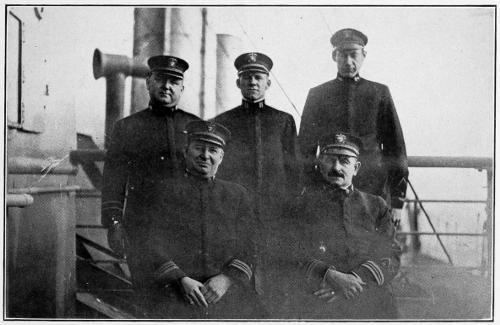
Upper Row, Left to Right—
Lieut. Comdr. J. W. Ford Lieut. R. S. Skead Ensign H. B. Rowedder
Bottom Row, Left to Right—
Lieut. Comdr. J. Foster Lieut. Comdr. J. J. Jones
By Commander Vaughn V. Woodward, U. S. N.
On July 26, 1917, the Commandant ordered me to report to
the Vaterland for duty, which I did, and on the above date the
vessel was commissioned. When I arrived on board, the engineering
department was in charge of the Shipping Board Engineers
and personnel. There had also recently arrived about 200
Navy firemen and a few petty officers; this was the total of Navy
engineering personnel on board. In company with one of the
junior engineers I went below for an inspection of the department.
During the next three days all my time was taken up
getting my bearings below and the layout fixed in my mind in
order to make out a station bill so that I could determine as
quickly as possible the personnel required.
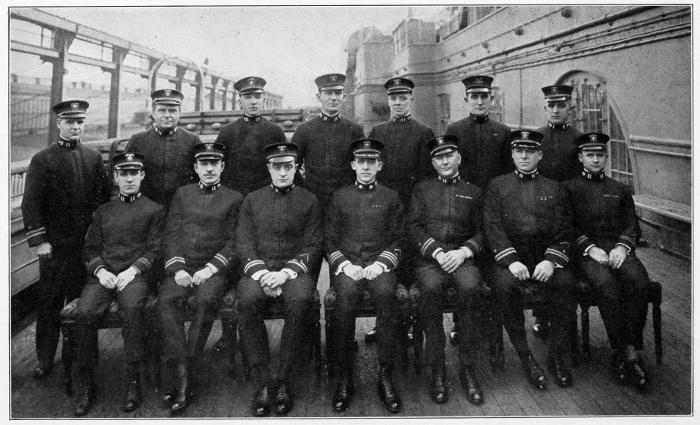
The Engineer Officers
Lt. Watson Lt. Miller Ens. Leventhal Lt. Keeser Lt. Kirk Ens. Wilson Lt. Bright
Lt. Lau Lt. Edwards Lt. R. H. Jones Com’dr. Woodward Lt. Andrews Lt. Schluter Lt. Parker
At the end of the third day I conveyed this information to
the Captain with the request that he bring pressure to bear on
the Bureau of Navigation to send our personnel, both officers
and enlisted men, as quickly as possible. The men and officers
began to arrive and by August 15th the last officer of the complement
had arrived. As each arrived he was put in charge
of a station and told to trace out his station, make a thorough
examination of the interior of all piping and machinery and
submit a report on repairs necessary and estimated time. Most
of my time during the day was spent below and the nights were
occupied drawing up station bills and handling the office
paper work, my only assistant being a reserve yeoman in the
service of the Shipping Board. I realized that, even at the
expense of time that should be spent inspecting repair work, I
must get my organization planned and laid out as quickly as
possible, and in operation. By August 5th all station bills and
organization had been completed and blueprinted and all officers
on board instructed. At this time, on account of report of
damage to machinery under repair on German ships by aliens,
I organized a secret service force below in an effort to detect
any attempts made to inflict damage. I purposely let the report
spread around among the civilian workmen that there was a
large force of government agents employed among them and
also in the crew. This seemed to have the desired moral effect,
because during the entire period there was but one case of
attempted malicious damage, which was discovered immediately.
An attempt had been made to thrust welding wire into
both of the L. P. astern turbines through the gauge line holes in
the flanges and thus damage the blading.
I will not go into details as to the condition of the
machinery, but will indicate some of the work done and the
changes made in order to get her ready for sea in the quickest
possible time. Most of the changes in design and arrangement
were made before her dock trial.
Each piece of machinery and boiler was opened up in all
its parts and thoroughly examined for foreign material or
damage. While open necessary repairs were made.
The joint on every auxiliary steam and exhaust line at
the piece of machinery was broken and steam blown through
before attempting to operate the machine: this to free the line
of foreign material.
All main, spring and thrust bearings were opened up,
examined, cleaned and realigned.
The float of the main thrusts were changed from .006 to
.015 inches to conform to U. S. Naval practice.
The rotors and casings of the four astern turbines were
all partially rebladed in place in the ship.
The dummy ring and piston were found broken in the port
H. P. astern; but these were renewed and machined in place,
the jacking engine turning the rotor while a cutting tool was
attached to the flange of the casting, thus making a lathe out of
the turbine and solving the practically impossible problem of
removing the rotor from the ship to be placed in a lathe ashore.
It was found that the impulse stages in this turbine had
been the cause of the damage to this dummy, so it was decided
to remove the impulse stages entirely, which was done. This
decreases the economy of the turbine, but the safety guarantee
to the successful operation of this unit so far overbalanced this
factor that economy was sacrificed.
The starboard H. P. astern casing had several bad cracks
in both top and bottom, and from records on board had not
been in use on the last voyage of the vessel. This was in
process of being electrically welded when I reported on board.
The method in use, however, proved later on test, to give a faulty
weld, so that it was decided to cut a deep “V” groove in the
cracks and lace with steel studs, the lacing being filled in with
the weld, thus giving the weld holding power due to the welding
material fusing with the studs. This machine operated successfully
during the entire commission of the vessel with no signs
of ruptures or faulty welds.
On examination of the main throttles the starboard H. P.
astern throttle spool was found to be broken and off the stem.
This throttle was renewed and operated satisfactorily.
The system of automatic control of feed pumps in the
engine room by float and pressure control was decided on as
being highly dangerous, this system was at once removed and
hand control of pumps substituted.
After operating for some time it was found impossible
to obtain a vacuum that would afford economical operation for
a turbine plant. The capacities of the pumps and condensers
were computed and checked up and found adequate for the
horsepower to be handled. The low pressure system was then
tested out by water pressure and every noticeable leak stopped.
This however gave us no better results, the best vacuum we
could obtain averaging around 27 inches under normal operating
conditions. The question of the wet and dry suctions of
the pumps was next taken into consideration and it was
decided to blank the dry suction off from the condenser and
lead it into the wet suction of its own pump. This was done
and with the results desired. The vacuum desired can be
obtained at all times. With circulating water at forty degrees
a vacuum of as high as twenty-nine inches has been obtained.
The average vacuum under all conditions obtained since this
change is about twenty-eight inches.
In order to further increase economy a radical change
was made in the method of supplying the turbines with gland
steam. As installed, all turbine glands required the use of
live steam, which with turbines of such large dimensions, was
quite an item. By a simple change in pipe leads and valves,
the leak off from the H. P. ahead glands, which formerly
led to the condenser, was piped to supply the glands of all
astern turbines and the I. P. and L. P. ahead turbines, thus
utilizing a three-inch line of steam which was formerly wasted
in the condenser. It is believed that this vessel is the only vessel
afloat that uses this system of gland steam.
The above concludes briefly a history of the major items
of alterations and repairs in the engine rooms.
In the fire rooms, all boilers were opened up and thoroughly
cleaned and all zincs removed. My attention was first
attracted by several burned boilers and next by the elaborate
system of automatic feeding of each individual boiler by means
of floats, levers, valves, etc. This system was at once dismantled,
removed from all boilers and scrapped. I then heard
reports that the Germans had experienced great trouble with
leaky tubes at the back ends of the boilers. Trams were at
once made and accurate measurements taken on the expansion
of the boiler between upper and lower drums on raising steam.
This was found to be quite excessive and greatest between the
back ends of the drums. After several experiments and
deductions from results obtained, it was decided to remove the
short circular internal feed in the front end of the steam drum
and fit a standard Navy internal feed pipe running the entire
length of the drum. This was done in all boilers and the
expansion was reduced about eighty per cent. Since her commission
we have never had to reroll a leaky boiler tube.
From commissioning to Nov. 11, 1918, there has been a total of
7,198 boiler steaming days, or an average per boiler of 156.5
days of 3,756 hours. Great care was exercised in the cleanliness
of the boilers and boiler water. No pits or corrosion
have been found in any part of the boilers.
On the first trip overseas great difficulty was experienced
in steaming, all boilers were in use and 144 revolutions per
minute was about the maximum speed we could maintain for
any length of time. There was an excessive amount of clinker
formation covering the grate bars. On diagnosing this trouble
and consulting standard works on combustion, air required per
pound of fuel, etc., it was decided that the grate bars did not
have sufficient air space. From computations made, a new
grate bar was designed with an increase in air space over the
old of thirty-five per cent. Our troubles in this line at once
ceased, and our trip home was made at 151 revolutions per
minute with forty-six boilers in use. Later we used thirty-eight
to forty boilers for as high as 154 revolutions per minute.
We experienced a great deal of trouble with the side brick
walls of the furnaces the first two trips, which required the
renewal of about 4,000 bricks each voyage. On being notified
that we would be required to start making quick turn-arounds
on the next voyage, I realized that this could not be done with
such an amount of brick work to be repaired. After many conferences
while at sea, we finally decided to tear all the brick
work out of one boiler and substitute cast iron liners, shaped
to fit the drums and punched with holes for ventilation. This
idea proved highly successful. All boilers were immediately
fitted likewise and all operated successfully. Besides the
elimination of the expense for the purchase of bricks and
cement, the labor and time of cleaning furnaces was reduced
ninety per cent. All that is necessary for cleaning and repairing
furnace walls at the present time is one man and a corn
broom.
The steaming efficiency has been greatly hampered at all
times by the flow of water over the fire room floor plates, due
to the faulty design of the German ash ejector. After many
attempts to remedy this by altering the design, we were finally
compelled to replace the hoppers with new hoppers of the See
type.
There was at all times a great deal of trouble experienced
in carrying over water from the boilers to the turbines. The
water in the boilers was carried at the lowest level consistent
with safety, but in spite of this the trouble still continued. On
inspection of the main steam lines and boiler steam drums it
was found that they were practically bare of lagging. All
these lines and drums were immediately covered with two-inch
of magnesia eighty-five per cent pure, and all water trouble was
then eliminated. The water level in the boilers was also raised
from two to four inches, thus giving a greater factor of safety
here.
After several trips we noticed that the uptakes were excessively
hot and also that at times torching occurred at the stack
tops. This being a menace to the safety of the ship in the war
zone, it had to be remedied. After examining the uptake, furnaces
and path of gases we decided to alter the baffling. This
was done by installing flame baffles at the base of the uptake
in each boiler. It not only eliminated the torching, but also
decreased the amount of soot formation about fifty per cent.
This includes all the major items of the fire rooms. A
few general items follow:
An interesting phase of our overhaul was the method of
conducting our dock trial, after all repairs and tests to individual
main and auxiliary machinery had been completed. It
was realized that it was out of the question to attempt to turn
the engines over at a speed which could be called a fair trial,
for the reason that there was no mooring that could possibly
hold the ship at the dock. After lengthy conference with
officers, it was decided to break the tail shaft couplings and
jack the tail shaft aft about two inches to clear the line shafting.
This was done on each shaft and we ran each engine
individually for 4 hours up its designed speed 180 revolutions
per minute, then in manœuvering combination to full
speed, 119 revolutions per minute, then all four shafts in
cruising combination up to 180 revolutions per minute. The
dock trial proved a success from start to finish, no casualty
of any kind occurring. In this connection, in order to get
a test on the boilers, No. 1 fire room was used the first day of
the trial, No. 2 the second day, No. 3 the third day, and No. 4
the fourth day.
During the period between August 15th and October 16th,
I can safely say that the officers and men of the department
averaged every day, Saturdays and Sundays, included, eighteen
working hours below without complaint or murmur. It seemed
to be a matter of great pride and determination with them.
We had heard many reports that the Vaterland would never
leave the dock, and many letters came threatening some officer
or man in the department. Of the men and petty officers we
were compelled to work with, I should say that twenty per cent
of them had never been on board a ship previous to their
reporting here. They were all recruits direct from recruiting
rendezvous, with the exception of a few C. P. O.’s who came
from the fleet. During all our overhaul and repair we had no
plans to guide us, all lines and arrangements had to be traced
out by the officer concerned, who submitted sketches to me.
These sketches have been forwarded to the Bureau of Steam
Engineering.
We found three logs made by the Germans on the Vaterland.
These logs, I believe were forwarded to Washington,
but to the best of my memory the speeds on these three trips
averaged for the entire voyage 22.4, 21 and something over 20
knots, with an average coal consumption per day of about
1,100 tons, running up to about 1,157 for one voyage. The
present consumption of this vessel at 20 knots is 816 tons per
day east bound, and 720 west bound. West bound we use
Welsh coal. We have never steamed at 22 knots for any period
long enough to obtain a point.
Going to Liverpool on a trip during an emergency she
maintained a speed of 181 revolutions per minute for a short
period of time until a slow bell was received.
Since the war service of the vessel started until November
11, 1918, the Leviathan has never had an engineering casualty
of any description, nor has the ship been delayed due to any
cause in the engineering department.
By Dr. Dunlap
The Medical Department is represented by the Senior
Medical Officer, Commander F. A. Asserson, M. C. U. S. N.,
four Junior Medical Officers with the rank of Lieutenant each,
one Chief Pharmacist, one Pharmacist, two Chief Pharmacist’s
Mates, and about one hundred and thirty Hospital Corpsmen.
There are also eight nurses, in charge of Miss Mary M. Robinson,
Chief Nurse, U. S. N. The units composing the Department
are as follows: Office of the Senior Medical Officer;
office of the Medical Officer of the Day; Major and Minor
Operating Rooms; Laboratory; Sick Officers’ Quarters of
ten beds; Medical and Surgical Wards with one hundred
and thirty-two beds; Isolation Ward with forty beds; total, one
hundred and eighty-two beds; Diet Kitchen; two Sick Call
Stations; Dispensary; Mental Ward; Guinea pig houses.
The history of this department dates from July, 1917,
when the first medical officers, Drs. F. J. Carroll, and E.
M. Hudson came aboard. These officers, both Lieutenants in
the U. S. Naval Medical Corps, were on duty at the U. S.
Naval Hospital in Brooklyn when our government assumed control
of the Leviathan, and they were ordered to report aboard
for duty. The vessel at that time being just as the Germans
had left her. Drs. Carroll and Hudson at once began tentative
plans for a medical department capable of handling the sick
among the thousands of troops the Leviathan was being rapidly
fitted to carry. Plans were drawn by them converting the social
hall on A-deck into wards and operating rooms. The orchestra
stage at the forward end of the hall was to be cut away, lowered
to the level of the deck and that space utilized as two operating
rooms with a sterilizing room. Wash rooms, toilets, linen
lockers, and an Isolation Ward were also provided for. Places
fore and aft were chosen as sick call stations and Dispensary.
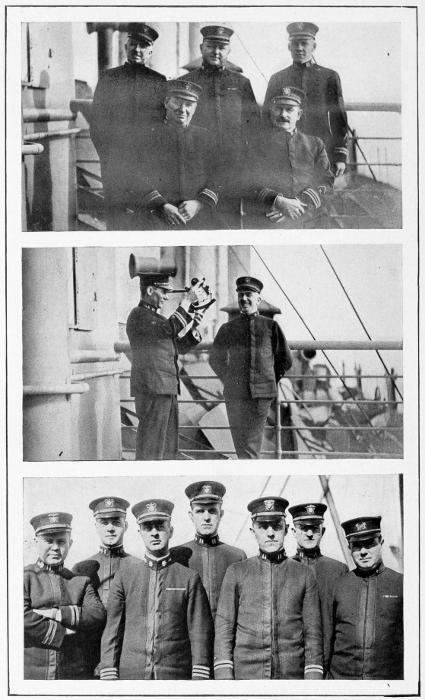
Center Picture: Left to Right—“Our Navigators”
Lieut. J. L. Beebe, Lieut. Com. H. C. Cunningham.
Bottom Picture, Left to Right—Dr. J. E. Porter, Dr. T. C. Hemingsen,
Dr. F. A. Asserson, Dr. W. F. Rathbun, Dr. H. F. Howell,
Dr. E. F. Crofutt, Pharmacist F. B. Redman.
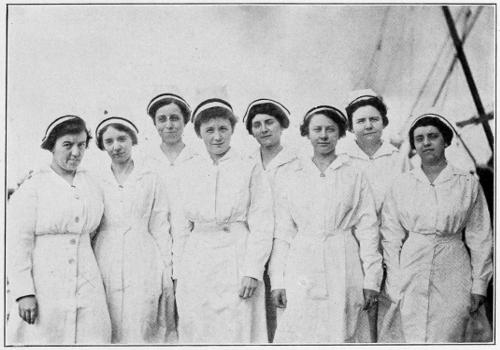
The Leviathan Nurses
On August 9, 1917, Commander John J. Snyder, M. C.
U. S. N., reported aboard as the first Senior Medical Officer.
The plans for the medical department were submitted to Dr.
Snyder and to the Naval Constructor, and were later adopted
by the Bureau of Medicine and Surgery. Before the first trip
three more medical officers reported, viz: Lieut. Commander G.
T. Vaughan, U. S. N. R. F., Lieut. Max M. Braff, M. C. U. S. N.,
and Lieut. S. Strauss, M. C. N. N. V., so that on the first trip
there were five medical officers, besides the Senior Medical
Officer. After the trial trip to Cuba the Leviathan went to
Liverpool. The amount of work was found to be too much for
the number of doctors, and upon returning to the States another
Medical Officer was requested. Lieut. A. K. Dunlap, M. C.
U. S. N., was sent aboard in February, 1918, so that on the
second trip seven doctors were aboard. On subsequent trips
into New York, Lieut. Robt. Lorentz, M. C. U. S. N., Chief
Pharmacist C. I. Campbell, U. S. N. R. F., and Lieut. Edward
Crofutt, M. C. U. S. N., were sent aboard for duty. During
the month of May, 1918, Commander Snyder left to assume
his new duties as Fleet Surgeon, and his position on board as
Senior Medical Officer was assumed by Commander H. A.
May, M. C. U. S. N. Lieut. Harold Hulbert, M. C. U. S. N.,
and Pharmacist F. B. Redman also joined the ship about the
same time. Later in the summer the medical corps was further
strengthened by the addition of Lieuts. Harry L. Howell and
John E. Porter, U. S. Navy Medical Corps. In December, 1918,
Dr. May was detailed to duty ashore and the duties of Senior
Medical Officer assigned to Commander F. A. Asserson, M. C.
U. S. N. Lieuts. Walter L. Rathbun, Thos. Sheppard, and
A. T. Weston, M. C. U. S. R. F., reported at the same time. As
new officers reported on board from time to time, others were
relieved and detailed elsewhere. For the greater part of the
time since the ship has been in commission the medical department
has had nine doctors on board.
As the Leviathan transported nearly one hundred and
twenty thousand men to Europe during the war, and has brought
back nearly as many since, it requires no active imagination to
realize that the medical department has had its hands full.
The percentage of sickness bound to occur among thirteen
thousand men was enough to keep nine doctors busy, and this
was only a small part of their work. Sanitation on such a
huge ship was in itself a problem. Samples of food and water
had to be examined and accepted or rejected; troop compartments
and every nook and corner of the ship were inspected
daily and a high sanitary standard maintained; quotative
examinations of the air in the troop spaces were made at different
hours both day and night to determine the temperature,
humidity, and amount of carbon dioxide in these places; these
observations were made the subjects of various reports and
resulted in the installation of new ventilating systems and correction
of those already in operation; during threatened epidemics
of infectious diseases it was often necessary to take
cultures and do other laboratory work among hundreds of men.
In July, 1918, the Leviathan began transporting wounded men
and has carried a large number of them to date. The wounded
required much attention and the manner in which they have
been cared for on board this vessel reflects great credit upon
the medical department.
A new departure for ships of war was the Nurse Corps.
The corps consists of Mary M. Robinson, Head Nurse, U. S. N.,
Irene Reed, U. S. N., Charlotte F. Hyde, U. S. N., Ruby F. Nutling,
U. S. N. R. F., Ruby Russell, U. S. N. R. F., Madelon
Stowell, U. S. N. R. F., Alice B. Newcomb, U. S. N. R. F., Vera
O. Harmon, U. S. N., Mary A. O’Neill, U. S. N. R. F. These
were the first nurses who ever had duty on a man-o’-war. Their
duties have been supervisory over the hospital corps, and their
training and experience as nurses have made them of invaluable
assistance.
The following are extracts from reports of the influenza
epidemic submitted to commanding officer by Lieut. Com. H. A.
May, M. C., October 11th, 1918:
There were 260 officers and 8,873 enlisted men of all
grades reported as present when the ship left the dock in
Hoboken. These made up the personnel of several organizations—the
323d Field Signal Corps, the 401st, 467th and
468th Engineers, the 302d Water Tank Train, a September
Automatic Replacement Draft, the 57th Pioneer Infantry, and
the 73d Medical Replacement Section. In addition, there were
191 members of the 60th and 62d units, Army Nurse Corps.
The ship sailed on September 29th. Because troop space
H-8 was deemed unfit for occupancy by reason of inadequate
ventilation, troops quartered there were moved on the 30th to
other compartments, causing congestion in many spaces. All
available bunks in the sick bay were filled by army sick before
the morning of September 30th. Arrangements were then made
to empty F room section 3, port side, containing 200 standees.
These bunks were filled within a few minutes with sick men
picked up from the decks. When this space was found to be
insufficient E room section 2, starboard side, 415 bunks, was
vacated (October 1st), and the occupants sent down to H-8
regardless of improper ventilation. On October 3d, the port
side of E room section 2, 463 bunks, was vacated by the Army
guard, those sick in F. H. S. 3 were moved up to E. R. S. 2, and
the guard sent below to be scattered wherever they could find
space. Thus, on the night of October 3d, there was, beside the
sick bay, a ward on E-deck capable of bunking 878 men. As
the bunks are arranged four in a tier, one above the other,
the top bunk could not be used for the sick, except in emergencies,
because nurses could not climb up to them nor could
sick men climb down to go to toilets.
The Navy medical officers confined their efforts mostly to
those in the sick bay spaces, while all the sick quarters below
were turned over to the army medical officers. The army chief
surgeon, Colonel Decker, and two of his juniors became ill on
October 1st, leaving but eleven army doctors to hold sick call,
treat patients below, and care for about thirty nurses and twenty
officers who were ill in rooms. The navy medical officers stood
watches in E. R. S. 3 at such times as they could be spared
from the sick bay work, and relays of army nurses were assigned
to duty below, with the pneumonia cases in the isolation
ward, with sick officers in the officer’s ward, and with sick nurses
and officers in staterooms. In fact every available medical
officer, nurse and hospital corpsman was utilized to the extreme
of endurance. Below, in the E-deck ward, every possible
appliance for the care of the sick was furnished to the army
surgeons on duty. The commissary officer placed at our disposal
stewards, cooks and mess men, and furnished just the kind of
food required, in the best possible fashion. The Medical Department
of the ship owes, and I wish here to acknowledge, a
great debt of gratitude to the Commissary Department, and
to Paymaster Farwell and Chief Commissary Steward Flowers,
especially, for their co-operation in this matter, the success with
which they gave comfort and aid to the sick, and removed from
our shoulders the always worrisome burden of feeding men
unable to eat regular diet.
This was influenced materially by these main factors:
First, the widespread infection of several organizations
before they embarked, and their assignment to many different
parts of the ship.
Second, the type of men comprising the most heavily
infected group. These men were particularly liable to infection.
Third, the absolute lassitude of those becoming ill caused
them to lie in their bunks without complaint until their infection
had become profound and pneumonia had begun. The
severe epistaxis which ushered in the disease in a very large
proportion of the cases, caused a lowering of resisting powers
which was added to by fright, by the confined space, and the
motion of the ship. Where pneumonia set in, not one man
was in condition to make a fight for life.
As noted above, the sick bay was filled a few hours after
leaving Hoboken. All pneumonia cases were placed in one
isolation ward at the beginning, and another isolation unit was
set aside for measles and mumps, both of which diseases were
present among the troops. The other isolation units were first
filled with influenza cases and later with pneumonias. Until
the fifth day of the voyage, few patients could be sent to duty
because of great weakness following the drop in temperature
as they grew better. Only the worst cases in E-deck ward were
sent to sick bay at any time, and all were potentially pneumonias.
The E-deck ward was more than full all the time and
there were many ill men in various troop spaces in other parts
of the ship.
There are no means of knowing the actual number of sick
at any one time, but it is estimated that fully 700 cases had
developed by the night of September 30th. They were brought
to the sick bay from all parts of the ship, in a continuous
stream, only to be turned away because all beds were occupied.
Most of them then lay down on the decks, inside and out, and
made no effort to reach the compartment where they belonged.
In fact practically no one had the slightest idea where he did
belong, and he left his blankets, clothing, kit, and all his possessions
to be salvaged at the end of the voyage.
During October 1st, every effort was made to increase
hospital space below, as noted above. The heretofore satisfactory
arrangements for army sick call were not adhered to by
the army medical officers, and hundreds of men applied for
treatment at the E-deck ward instead of going to the twelve
outlying sick call stations. On this day, Colonel Decker, the
Chief Army Surgeon, became ill. As he was the only army
medical officer who had had army experience in administrative
matters there was now no competent head to the army organization.
Two other medical officers also became ill and remained
in their rooms to the end of the voyage.
Late in the evening of this day the E-deck ward was
opened on the starboard side and was filled before morning.
Twenty army nurses were detailed for duty during the night.
When patients were brought up, their mates carefully left their
blankets and clothing below and scouting parties had to be
sent through the compartments to gather up all loose blankets
for use of the sick. Fortunately we had about 100 army
blankets in the medical storeroom which had been salvaged on
other voyages. These were used while they lasted.
The conditions during this night cannot be visualized by
any one who has not actually seen them.
The morning of October 2nd brought no relief. Things
seemed to grow worse instead of better. Cleaning details were
demanded of the army, but few men responded. Those who
came would stay awhile and wander away, never to be seen
again. No N. C. O.’s were sent, and there was no organization
for control. The nurses made a valiant effort to clean up and
the navy hospital corpsmen did marvels of work, but always
against tremendous odds. Only by constant patrolling between
the bunks could any impression be made upon the litter and
finally our own sailors were put on the job. They took hold
like veterans and the place was kept respectably clean thereafter.
The first death from pneumonia occurred on this day, and
the body was promptly embalmed and encased in a navy
standard casket.
When evening came no impression had been made upon
the great number of sick men about the decks and in their own
bunks. So arrangements were made to enlarge the hospital
space by including the port side of E. R. S. 2. On October 3rd
this was accomplished and from that time to the end of the
voyage we had enough bunks to accommodate practically all
the worst cases. Three deaths occurred this day and all were
embalmed and encased. After going through the hospital and
troop spaces that night it was estimated that there were about
900 cases of influenza in the ship. In the wards we sent back
to bunks below all men whose temperature reached 99 and
kept all bunks filled with cases of higher fever.
October 4th, seven deaths during the day. The sea was
rough and the ship rolled heavily. Hundreds of men were
thoroughly miserable from seasickness and other hundreds who
had been off the farm but a few weeks, were miserable from
terror of the strange surroundings and the ravages of the epidemic.
Dozens of these men applied at the wards for treatment
and the inexperience of army doctors in the recognition
of seasickness caused a great many needless admissions to the
hospital.
Many officers and nurses were ill in their rooms, and
required the constant attention of a corps of well nurses, and
an army medical officer to attend them.
Each succeeding day of the voyage was like those preceding,
a nightmare of weariness and anxiety on the part of
nurses, doctors, and hospital corpsmen. No one thought of bed
for himself and all hands worked day and night. On the 5th
there were 10 deaths, on the 6th there were 24, and on the
7th, the day of arrival at our destination, the toll was 31.
The army ambulance boat was promptly alongside, and debarkation
of the sick began about noon. The sick bay was
cleared first and we at once began to clean up in preparation
for the wounded to be carried westbound. E-deck was then
evacuated, but all the sick could not be handled before night,
about 200 remaining on board.
On the 8th these were taken off by the army, but not before
fourteen more deaths had occurred. Although on this day
almost the entire personnel (army) had gone, the nurses
remained until the last sick man was taken off.
It is the opinion of myself and the other medical officers
attached to the ship that there were fully 2,000 cases of influenza
on board. How many developed pneumonia there are
no means of knowing. Over 75 cases of the latter disease were
admitted to the sick bay, most of them moribund. Of these, 3
improved so much that they went back to their compartments,
29 were transferred to hospital ashore, and about 40 died.
As the records required to transfer patients from the army to
the navy medical officers were furnished in but few cases, and
as my records embrace all the dead, I had no means of knowing
how many died in the sick bay and how many in the E-deck
ward. Cases of pneumonia were found dying in various parts
of the ship and many died in the E-deck ward a few minutes
after admission. Owing to the public character of that ward,
men passing would see a vacant bunk and lie down in it without
applying to a medical officer at all. Records were impossible,
and even identification of patients was extremely difficult
because hundreds of men had blank tags tied about their necks.
Many were either delirious or too ill to know their own names.
Nine hundred and sixty-six patients were removed by the army
hospital authorities in France.
Ninety-one deaths occurred among the army personnel,
of whom one was an officer, as follows:
| October |
2 |
1 |
death |
| ” |
3 |
3 |
deaths |
| ” |
4 |
7 |
deaths |
| ” |
5 |
10 |
deaths |
| ” |
6 |
24 |
deaths |
| ” |
7 |
31 |
deaths |
| ” |
8 |
14 |
deaths |
| ” |
10 |
1 |
death |
The sick officer was treated in the open air on B deck, had
a special army nurse during the day, and a navy hospital corpsman
at night.
I cannot speak in terms of sufficient commendation of the
work of the hospital corps of this ship. Every man was called
upon to exert himself to the limit of endurance during the entire
round trip. No one complained, every man was on the job.
Many of them worked twenty-four hours at a stretch amid
conditions that can never be understood by one ashore or on a
man-of-war. Some of the embalming detail, worked at their
gruesome task forty-eight hours at a stretch without complaint,
and at the end I had to drive them away to a bath and bed.
I have learned that the following named men of the Commissary
Department voluntarily remained on duty with the
sick on E-deck during the entire voyage.
| George Willis |
CCS |
| H. L. Ringrose |
SC-2 |
| A. Barbel |
SC-4 |
| R. Steinman |
SC-4 |
Had we been in the midst of smallpox or plague they
would doubtless have done the same. The actual danger to
all hands was extremely great and all these men deserve the
highest commendation for their actions.
F. L. F.
As soon as the decision was made that the Navy would
have charge of the commissary departments on the transports,
plans were promptly made to effect the most complete and
satisfactory arrangements for the subsistence of the troops
en route. A board of three expert commissary officers was
appointed with instructions to prepare a well-balanced standard
bill-of-fare for use on board all of the transports. The bill-of-fare
for a fourteen-day period submitted by the board, was
approved and copies forwarded to the commanding officers
of all transports for their guidance with the request that it be
followed as nearly as possible. Experienced officers of the
Supply Corps were then recommended for assignment to the
transports and nothing was left undone which would contribute
in any way to perfect arrangements for the satisfactory feeding
of the troops. This work was new to the navy, as transports
were heretofore operated exclusively by the army.
On this account and because, as stated by the Secretary
of the Navy, “The success of the transfer of the army troops
will depend to a large extent on the conduct of the commissary
service on each vessel.
“It is especially gratifying to be able to report that the
subsistence of the troops en route overseas has been satisfactory
in every respect. This fact is confirmed by reports received
from time to time.”
This extract from the Paymaster General’s report marks
the success of the enormous task given the Bureau of Supplies
and Accounts of feeding the A. E. F. while being carried overseas
on American transports.
The menus mentioned in the report actually originated
from the Leviathan, and the general instructions at that time
were to “live up to the standard required by the sample menu,
and to do better, if possible.” This was the slogan of all the
general messes in the transport service, and it is a well-known
fact that the army as a whole has had nothing but praise for
the Navy Commissariat.
The Leviathan, being the largest carrier of all the transport
fleet, naturally placed the supply officer, Paymaster Geo. C.
Schafer and his assistants, headed by H. B. Judkins, Ensign,
U. S. N. R. F., Pay Corps, on their mettle to make a success of
this enormous undertaking, although at that time and even up to
the time the first meal was served to the troops, the huge task
was hardly realized.
During the period of fitting out and on the first trip, there
were only five men in the Commissary Department who were
known to be familiar with the navy general mess requirements
and navy discipline, the rest of the Commissary Department
was made up from men taken from all walks of life—lawyers,
college men, horseshoers, business men, actors, etc.; only about
thirty men having any experience as cooks and bakers, and
among these only a comparative few who had any seagoing
experience. Even these men were of an unknown quantity until
tried out, in the actual experience of cooking and serving food
to 10,000 troops and crew, the proportionate number carried
the first trip through the war-zone. This was the biggest feeding
task ever undertaken in the history of the maritime world.
These men came from various sources of recruiting, mostly
from the headquarters and commissary schools connected with
the Third Naval District, arriving in batches of one to ten almost
every day until ready to sail. None of them came fully
equipped or uniformed and the first real muster of the Commissary
Department was unique in the history of the ship, about
three hundred men falling in on B-deck. An attempt was made
to drill them into something near the navy standard. At that
time it seemed a hopeless task—none seemed to know what was
required of them, even to the simple movement of opening ranks
for inspection. The inspection was a joke, no one in uniform,
and the expression “Coxey’s Army” would describe the general
appearance of the men.
However, the spirit was there, and in an incredibly short
time the men were properly uniformed and at the first crew
inspection made a very creditable showing, even in the opinion
of the old-timers.
Most of these men had the American knack of adaptiveness
and soon fitted into the duties required of them; showed such
a splendid desire to make good that after the first trip we were
able to compare the Commissary Department, and by no means
discreditably, with that on the huge British transports, Olympic
and Mauretania.
The system steadily improved, and it is safe to assume
that we are unexcelled by any other similar sea-going
organization.
Because of the “training afloat” system laid out by the
Navy Department it is estimated that about 100 trained men
have left the Leviathan, trained by actual experience in cooking
and baking, thus giving the growing navy a trained personnel,
not only cooks and bakers, but American man-o’-war’s men,
developed as such by the stern requirements of war conditions.
Each man reporting aboard was required to fill out a questionaire
blank stating experience, etc. This was done so that
men could be placed to the best advantage in the galley, bakery,
storerooms and offices. Some of the answers were laughable.
For instance, one stated that his sole experience was cooking
for his sisters when mother was obliged to go out. Another had
been a horseshoer for about eighteen years, another had no
experience, but he knew that cooking was very easy to learn
and that he was there for that purpose. One man made a
strong bid for the billet of head waiter and informed the Commissary
Steward that if he gave him the job he would send at
once to Chicago for his Tuxedo.
During this time it was well known that the German Secret
Service was much interested in the Leviathan and for that
reason all new arrivals were carefully watched. One suspicious
commissary recruit was picked out and turned over to the authorities.
He was so clearly German, both in speech and
appearance, that it would have been impossible for him to
get by, and although nothing was heard of his fate, it is safe
to assume that he was interned in a safe place until the end
of the war.
The actual fitting out was a tremendous problem, most of
the German kitchen machinery and utensils were found either
in bad condition or useless for the coming needs and almost
a new installation was built, using, however, the German kettles
and ranges when possible, discarding anything not absolutely
essential. It was often a matter of considerable thought and
discussion to decide what should be kept and what discarded.
There were found on the ship seven complete kitchens,
counting the two Jewish kitchens which were designed for
Kosher cooking. These were intended to provide for the large
number of Jewish immigrants carried over in the third class or
steerage compartments and all these galleys had been splendidly
fitted out to care for about 5,000 passengers and 1,000
crew. As the problem was to prepare for about 15,000 it can
be readily seen that some drastic changes were required.
In connection with this it might be well to state that the
first letter written about commissary affairs asked that 27 steam
kettles of 100 gallons capacity, 3 dough mixers of two barrel
capacity, and 7 navy standard bake ovens be obtained. These
were installed in addition to the German equipment left, after
the rip-out period was finished.
All except the first and second class galley were dismantled.
All the kettles and one large electric bake oven were
installed in the first class galley compartment, thus consolidating
the cooking machinery in the present spaces which were
renamed the Troop Galley.
On E-deck aft, the third class galley was ripped out and a
blacksmith and coppersmith shop installed. The third class
dining room, later the engineer’s force mess room, became temporarily
the crew mess room until the number became too large
and the first class saloon was used until the deck force quarters
were fitted up. It was during this time that a large number of
the crew were ptomaine poisoned by eating hash that was prepared
from infected corned beef, probably made so by defective
tinning. The entire Medical Department was busy all that day,
but luckily no lives were lost. The rumor leaked out that in
some way “Fritz” had got in some fine work, but this was denied
upon investigation.
Another phase of the preparation presented itself, the
storage of provisions. The combined experience of the leading
men in the department was brought into play to solve the many
problems involved, to provide for storing and keeping of over
two millions of pounds of provisions in the space allotted. The
principal items and their quantities required for this loading
were as follows: 200,000 lbs. of flour, 60,000 lbs. tinned
meats, 25,000 lbs. salt meats, 120,000 lbs. smoked meats, 260,000 lbs.
fresh meats, 25,000 lbs. turkey and fowl, 30,000 doz.
eggs, 140,000 lbs. beans, 75,000 tinned vegetables, 420,000
fresh vegetables, 22,000 cereals, 145,000 dried, tinned and
preserved fruits, 175,000 fresh fruits, 40,000 lbs. coffee, 3,000
lbs. cocoa, 2,500 lbs. tea, 60,000 evaporated milk, 5,000 qts.
fresh milk, 5,000 qts. of cream, 40,000 lbs. fresh butter,
15,000 lbs. of lard, 15,000 lbs. salt, 175,000 lbs. of sugar.
These quantities were estimated to subsist 10,000 troops
twenty-five days and 1,400 crew one hundred and twenty days.
Careful consideration had to be given to the location, size,
drainage and estimated temperatures of the various storerooms
and cold storage. Also the items of provisions and quantities
of each item required and the storeroom best adapted by size
and accessibility. This was worked out so successfully that
when the actual provisioning was finished only about five hundred
packages were left out of the allotted spaces due to the
fact that at the last moment, passages had to be left in several
rooms to give access to manhole plates leading into the double
bottoms.
The cold storage spaces were an unknown quantity, only
uncertain data (not from German sources) being available concerning
the temperatures of the various compartments. However,
this part of the provisioning was also successfully finished
and it might be well to state that since the first loading, to the
end of hostilities, only about 3,000 pounds of meats, and 6,000
pounds of fruits and vegetables were lost through deterioration.
Enough provisions were carried in the ship to approximate
the supply of ten battleships and one supply ship. This comparison
was often used when explaining to distinguished guests
the enormous size of the Leviathan’s larder.
During this phase of the work great consideration was
given to the method of issuing the food to the individual soldier.
No data was obtainable except the general requirements of the
army regulation. How to make these requirements fit into the
planned system of feeding was a problem, which however was
so successfully solved that the Leviathan system of issue was,
either in whole or in part, practically adopted for all transports.
The general scheme is an elaboration on a rough, but
efficient system of feeding landing forces of sailors at Guantanamo,
where it was the custom to land the various ship battalions
and go into camp at Deer Point for small arms practice.
The equipment then was a limited one, namely, a mess table
at the foot of each company street and four syrup barrels
filled with soap and water for washing the mess gear. From
this crude idea was built up a system that operates as follows:
In the after end of the troop mess hall are placed twelve
tanks fitted with direct steam jets. These tanks have specially
fitted tops and are capable of holding eight insets or food containers,
each container holding about seventy pounds of food
or coffee. The steam jet is turned on when the tank is filled
with the food containers, thus enabling the food to be placed
ready for serving, some time before the messing, keeping the
food warm and palatable.
This tank, or serving station, contains such items of the
meal as meats, gravy, vegetables and beverages. In addition to
each serving station is an auxiliary serving table from which is
served, bread, butter and desserts. Each serving station and
table has a detail of four men and a messing sergeant who
draws the food from the galley and serves to the men as they
file past their particular station.
The men march from their compartments under control of
their compartment officer in four lines, two from forward and
two from aft, meeting on E-deck at the grand staircase leading
into the troop mess hall coming down the staircase four abreast.
When in the mess hall the column is split into twelve lines and
pass the serving stations at a slow walk through to the mess
tables. When finished, they go on to the forward end of the
mess hall, where there are the washing tanks somewhat similar
to the tanks at the serving stations. These tanks have hot soapy
and clear water in which the men wash and rinse their mess
gear, returning to their compartments by other established
routes. All the mess lines, both to and from the mess, are kept
under control so that in case of an emergency during the messing
the men may be brought to their proper stations quickly
and without confusion. This arrangement of the messing lines
and mess hall has kept intact and separate the feeding space of
the troops from their sleeping quarters, an arrangement of
much sanitary value and in evidence only upon United States
Navy transports.
The system holds the world’s record for feeding the largest
number of men in the shortest period of time, ashore or afloat.
Nine thousand men in an average time of ninety minutes were
fed. The best time, however, for the same number of men was
sixty-seven minutes; this means that during the messing one
soldier was served a ration every thirty-six seconds.
It must be remembered that these huge commissary problems
has been solved with deep thought and precision, overcoming
the enormous difficulties presented on shipboard by the
confined space and the mass of floating population equal that
of a large town or small city.
On the afternoon of December 14th, the day previous to
the starting on that historical first trip, the first meal was served.
Previous to serving this meal, the carefully planned organization
had to be put into operation. This required numerous
army details for messing, kitchen work and working parties.
These reported to the commissary office and after being properly
stationed were given instructions to carry on the messing.
This was done about two hours after the troops were embarked
and the mess movement was started in the troop mess
hall. There were many hitches in the mess movement to the
serving stations, but all the troops were fed in about two and
one half hours and after the second day the messing organization
“shook down” so well, that the Commissary Department
was able to report that the messing system was a success. In
fact, the first meal had not been going ten minutes when it was
realized, much to the relief and joy of those who had worked
so hard on the fitting out the messing organization, that the
system planned was very effective. One strict rule had to be
made in connection with the embarkation, which was that no
meals would be served until all messing details were stationed,
and although it seemed harsh, an amusing incident proved its
value. Soldiers are akin to sailors, inasmuch as they are blessed
with healthy appetites, so that invariably when troops arrive
aboard they are hungry, and if not restrained naturally gravitate
to the kitchen. The first troops aboard followed their natural
instincts and wormed their way into the galley. Their tales of
hunger told to the sailor-cooks in the galley so worked on their
sympathies that a relief party began issuing sandwiches. In a
few minutes by some mysterious way the good news was passed
that the good-natured sailors were handing out “chow” and in
about ten minutes a thousand hungry troopers were crowded
into the galley clamoring for “eats.” The resulting confusion
almost upset the embarkation and a hurried S. O. S. to the
army headquarters was made to get the soldiers to clear the
galley. It is needless to say that the galley cooks never allowed
their good nature to get the best of them again during other
embarkations.
Although the start was splendid it must not be thought
that it was plain sailing on following days for the Commissary
Department. In fact, it was much to the contrary and the
men who had the responsibility of the undertaking speak of
that trip as a nightmare.
The winter days were short and war conditions required
that nearly all lights, inside the ship and out, must be extinguished
one hour before sunset. This condition meant that
most of the work had to be done in almost total darkness. No
refuse could be disposed of until one hour after sunset and all
wood had to be burned. The men detailed for this purpose
were compelled to grope their way about a strange ship in the
dark.
The galley and bake shop were conducted under much the
same conditions, but the troops were fed. The Leviathan’s
standard bill-of-fare was carried out in every detail.
Because the Leviathan was expected to arrive in port
on Christmas eve, a regular navy holiday dinner with all the
fixings was given to all hands on the day before. This dinner
was given complete and went off smoothly with but one hitch.
As said before, soldiers have healthy appetites and a strong
affection for pie, and, in order to get more pie than their share,
a great many doubled back in the mess lines and perhaps more
than once, for there were over 15,000 rations of pie served out
on that strenuous day. For a while it looked as if we were
going to be overwhelmed and that the last thousand troops to
go through the mess lines would not get any holiday dinner, but
a good substitute dinner was provided and it is recorded that
everybody was made happy.
All this work was accomplished under such adverse conditions
and with the added strain incidental to our first trip
through the war zone, that it was with relief we arrived in port
and fed the soldiers their last navy meal alongside the landing
stage in Liverpool. Each man leaving the ship was given a
lunch to stay him on the next stage of his journey and with
it went the good wishes of the Leviathan’s crew. The practice
of providing a lunch to debarking troops has been carried out
in all succeeding disembarkations.
The big feat was accomplished and the rest given by the
necessarily long stay in Liverpool was well earned and enjoyed.
As a result of the experience of the trip, many improvements
were made in the messing organization and galley installation,
the most noteworthy of which was the abandoning of the galley
forward, moving the kettles, etc., to the troop galley and giving
up the two other mess hall spaces for berthing—messing all the
troops in the present large mess hall. This brought about a
consolidation of the general mess and made the task easier.
Subsequent trips saw consistent improvement until a new
record was established during the thirteenth trip when about
eleven thousand home-coming troops were fed in seventy-six
minutes best time and an average time of about ninety minutes.
Over 150,000 overseas troops have been fed on the Leviathan’s
trips and the good ship’s commissariat has become famous
wherever the A. E. F. have gone. The Leviathan’s apple pie
has been, to quote a returning wounded soldier, placed second
in popularity with the justly famous Salvation Army doughnut.
The success of the first trip was undoubtedly due to the
earnest work of all hands under the able direction of Paymaster
Simon Pietri, Supply Officer and Assistant Paymaster
H. B. Judkins. The work in the galley was ably directed by
ship’s cook 1st class, later Chief Commissary Steward, Martin
J. Flynn, and it can be said without fear of contradiction, that
the entire success of the enormous undertaking depended largely
on his splendid judgment and ability. This must in justice
also be said of Chief Commissary Steward W. J. Linn, who took
entire charge of the stores and whose long and varied commissary
experience helped us over difficulties which at times
seemed unsurmountable.
Subsequent trips under the direction of Paymaster Farwell
and Paymaster Edwards, his successor and present Supply
Officer, have brought in their wake many improvements so that
now the Leviathan’s Commissariat is considered the standard of
its kind.
The following is a sample of a day’s menu on board the
Leviathan:
MENU
SUNDAY, APRIL 20, 1919
Breakfast
- Oat Meal
- Milk
- Boiled Eggs
- Fresh Fruit
- Bread and Butter
- Coffee
Dinner
- Turkey
- Tinned Asparagus
- Mashed Potatoes
- Pie and Cake
- Bread and Butter
- Coffee
Supper
- Head Cheese
- Creamed Potatoes
- Bread and Butter
- Coffee
Quantities Used to Provide the Above
|
Lbs. |
| Oat Meal |
1150 |
| Milk |
1056 |
| Sugar |
1500 |
| Eggs (doz.) |
3180 |
| Butter |
660 |
| Apples |
6470 |
| Coffee |
400 |
| Milk |
480 |
| Salt |
10 |
| Turkey |
15581 |
| Chicken |
2021 |
| Asparagus |
2856 |
| Mashed Potatoes |
5850 |
| Butter |
675 |
| Coffee |
400 |
| Milk |
480 |
| Sugar |
400 |
| Salt |
40 |
| Cake |
5740 |
| Head Cheese |
425 |
| Potatoes |
800 |
| Coffee |
200 |
| Sugar |
200 |
| Salt |
20 |
| Bake Shop: |
|
| Flour |
7800 |
| Yeast |
135 |
| Lard |
130 |
| Salt |
100 |
| Sugar |
200 |
| Cinnamon |
4 |
Rations issued to 13,699.
G. F. P.
“When do we eat? When’s pay day? When can I draw a
pair of shoes? Got any ‘Bull’-an’ soap-an’ peanut brittle? Can
you get us a piano, an anchor, a car of lumber and a dozen 13
inch gadjets before we shove off?”—questions that are part of
the sailors’ existence and the cause of the Supply Officer’s
dilemma.
How well they are answered speaks volumes for the organization,
zeal and efficiency of the Supply Department. To feed
fourteen thousand men (and a thousand or so women, generals,
admirals, diplomats, lieutenants and bo’sns); to operate canteens
throughout the ship that rival in their activities Woolworth’s
chain of stores; to keep the storerooms stocked with
every conceivable kind of supplies which are or may in any
emergency be required in the many departments of the ship; to
clothe properly the crew of more than two thousand men; to
keep the accounts of these men and to pay them twice a month;
to—but limited space does not permit. Enough to state that the
patience of Job, the wisdom of Solomon, the agility of Mercury
and the persistency of Bryan are among the requirements necessary
to manage successfully the diversified activities of the
Supply Department. Verily, the life of the Supply Officer is
far from being a bed of roses.
Five distinct divisions of the Supply Department were
organized during the early days of going into commission—Commissary,
Disbursing, Sales, Storekeeping, and Officers’
Mess—each in charge of an Assistant Supply Officer. The original
plans of organization and operation, evolved by Captain
G. C. Schafer, were developed and carried out by Lieut.-Comdr.
F. Simonpietri, upon whom rested the responsibility of filling
the office of Senior Supply Officer on the Leviathan’s maiden
trip with more than ten thousand men on board. Under his
able guidance the routine of the various divisions were systematized,
improved and proven. Each subsequent trip brought
forth new problems which were masterfully dealt with and
solved by Lieut.-Comdr. Simonpietri and his able successors,
Lieut.-Comdr. N. B. Farwell and Lieut.-Comdr. E. C. Edwards.
A silent tribute to the results achieved by these Supply Officers
is the fact that to the large transports commissioned later the
Leviathan was called upon to furnish many trained men as a
nucleus for the Supply Departments of these new ships, where
Leviathan methods were introduced and are being successfully
carried out.
During the early voyages Assistant Supply Officers Colburn,
Barker, Poggi, Waters and Judkins wrestled with their
respective divisional duties by day, and by way of diversion
alternated as Senior Lookout Officers by night, making hourly
rounds of the lookout stations, from the forepeak to the after
crow’s-nest, fair weather and foul. Inclined a bit toward
rotundness, it was a ne’er to be forgotten privilege to see the
form of “Jeff” Colburn silhouetted against the starry heavens,
en route to the crow’s-nest. “Behold!” quoted “Doc” Carroll
one cold evening, when he espied “Jeff’s” figure looming in
the shrouds like a square-rigger, “behold yon sylph-like Romeo
seeking his fair Juliet!”
Other assistant supply officers who have been assigned to
the Leviathan for duty or instruction are Messrs. Carter,
Wrigley, Bishop, Harris, Schuler, Hoffman, O’Shaughnessy,
Stevens, Ingram, Finstemacher and Miller. Of the “old timers”
but Waters and Poggi remained to continue “carrying on” in
charge of the Storekeeping and Sales Divisions respectively.
The Sales Division comprises live ship’s stores (canteens)
and the clothing and small stores issue room. With troops on
board, the canteens, which are located in accessible parts of
the ship, make approximately ten thousand separate sales each
day, with a total daily cash receipt of about $5,000. The
largest day’s business amounted to $6,498, another record to
be added to the many laurels already won by the Rainbow
Division, units of which were being transported at the time.
As one of the canteen storekeepers put it, “If those Rainbows
can fight like they can spend, I’d like to see them in action!”
On the shelves of these canteens may be found the usual
line of necessities—and luxuries—carried in all Navy canteens,
but in unusual quantities; from the most commonplace pair
of shoe laces to the most dainty package of bon-bons. Naturally,
a vast amount of small items must be handled to make up
$5,000 worth of daily sales. And these sales are made, not
in leisurely lady-like fashion, over counter and show-case, but
through the canteen window to a never-ending line of clamoring
sailors and doughboys by but five storekeepers—one to each
canteen. These five “salesmen,” especially selected and trained
for this type of duty, wait on more “customers” in a day, it
is believed, than any other sales people in existence, including
the busiest dispenser of wet-goods on Broadway during that
torrid spell just prior to July 1st, 1919.
In view of the reported atrocious activities of the Hun
in our country during the war, every precaution was taken to
procure uncontaminated supplies for use of the crew and troops.
As a safeguard, samples of edible stores taken on board were
submitted to Surgeon Dunlap for examination in the ship’s
laboratory.
While the duties of the sales force are necessarily active
and exacting, discretion and tact are exercised in handling such
a large body of waiting “customers,” which accounts for the
fact that errors and “kicks” are few and far between.
In studying the likes and dislikes of the troops being transported,
in order to ascertain the varieties and quantities of
canteen stores to carry for sale, it was readily discovered that
tastes of the various units differ as widely as do their geographic
origins. Hence, when a division that originated in Dixie embarks,
peanut candy to the tune of from six to eight tons will
be consumed during the voyage, together with prodigious packs
of cigarettes; when a mid-western outfit takes passage, peanut
candy and cigarette sales fall off, but large inroads are made
in the stock of chocolates, chewing tobacco and Navy postcards;
when far westerners like the Sunset Division come aboard
mountains of “Bull Durham,” brown cigarette papers, caramels
and playing cards are broken out of the store rooms, for the
boys of the West are not strong for chocolate and peanut candy,
though they do “roll their own” and wear out the ship’s police
force by endeavoring to keep pinochle games going in every
conceivable part of the ship. But regardless of geographic
origin, stormy weather creates desires much akin to all doughboys—a
desire to lay off such joys as chocolates, bon-bons and
poker; a desire to be left alone, not too far from the out board
rail, with a package of that wonderful panacea, lemon drops,
of which as many as three tons will be consumed during a
particularly stormy crossing. During a bit of heavy weather,
one of the ship’s wits, feigning much excitement, rushed into a
group of forlorn sea-sick warriors, to inform them that “Here
comes a torpedo—straight for us!” “Thank God,” came the
answering chorus.
Aside from the fifteen tons of various candies loaded in
Hoboken, each trip witnesses the consumption of approximately
two hundred thousand cigarettes, twenty thousand cigars, three
thousand packages of Bull Durham and eleven thousand pieces
of soap.
The Clothing and Small Stores issue to the crew about
nine thousand dollars’ worth of wearing apparel monthly. This
active branch of the Sales Division carries a stock of supplies
valued at fifty thousand dollars—from three cent spools of
thread to twenty dollar overcoats. For the hard to fit and the
Beau Brummel C. P. O.’s, the made-to-measure business is no
small item.
The total annual business done by the Sales Division—sales
to the crew and troops, including transfers of stores to
other ships and stations in Europe, amounts to nearly half a
million dollars. All items handled by the ship’s stores are
sold at cost, with but a very small margin of profit. In some
instances the selling price is lower than the cost. It is endeavored
to make not over ten per cent profit, the money thus
accumulated going to the entertainment fund, which provides
the means of entertaining the crew and troops with movie shows
each night, and various other activities and equipments which
are necessary to keep the boys amused and happy. The Disbursing
Division of the Supply organization is just what the
name implies, and expends more real cash than a flock of
youthful Pittsburgh millionaires. Besides paying the volumes
of never-ending bills for never-ending supplies used on board,
the pay roll of the ship’s officers and men are kept by the yeomen,
who comprise the personnel of this division. The Disbursing
Officer peels off seventy thousand cold iron men each
pay day, which happens twice a month. Pay day, the day the
Eagle does his big stunt, to the sailors is “Der Tag.” The
annual wages paid to the ship’s company approximates one
million eight hundred thousand dollars.
The Storekeeping Section procure and carry in stock all
the varied supplies used on board for the operation and maintenance
of the ship. The store-rooms are veritable storehouses,
stocked with every conceivable kind of supplies from deck
swabs to grate bars.
One of the chief difficulties encountered during the early
days was to find spare parts for the German electrical equipment.
Our American standard equipment does not fit the
German installations, and unless spares could be obtained the
whole electrical system would have to be replaced with standard
American fittings. Fortunately, there was quite a stock of
German equipment remaining in England since the pre-war
days. This had been carried in stock for the use of German
ships calling at English ports. Practically all of this stock
was purchased by the Leviathan, and was sufficient to run the
ship until our own factories could be equipped to turn out this
type of supplies and equipment. When the Army, Navy Yards
and Shipping Board were clamoring for supplies, the task of
procuring stock in quantities demanded by such a huge ship
was indeed a difficult one. Thanks to the loyal co-operation
of New York and New Jersey business men, and the Naval
Commandeering Board, sufficient quantities of supplies were
secured to keep going. A typical example of the difficulties
encountered can be illustrated by the activity necessary to equip
the ship’s hospital. The market was bare of such supplies,
due to the incessant demands from our own and our Allies
Army and Navy Medical Departments. Manufacturers of surgical
supplies from all over the country were appealed to.
Some had one kind of instrument, some another; from all of
them finally evolved a complete and excellently equipped hospital,
equalled by none afloat and surpassed by few ashore.
This one purchase required nearly six weeks of effort and search
to complete.
Some idea of the volume of supplies necessary to keep
the good ship running may be gathered from the following:
For washing the interior decks, etc., about six tons of soap,
six tons of soap-powder, and two tons of lye are used each trip.
The canvas bunk-bottoms represent an $85,000 purchase,
while $6,000 would be necessary to replace the bed sheets.
Blankets for the staterooms and hospital represent an expenditure
of $30,000, while one of the many manila mooring lines,
each 720 feet long, thirteen inches in circumference, and weighing
7,631 pounds, cost $2,403.77. The four-inch anchor chain
cost $2,869.42 for each ninety foot length.
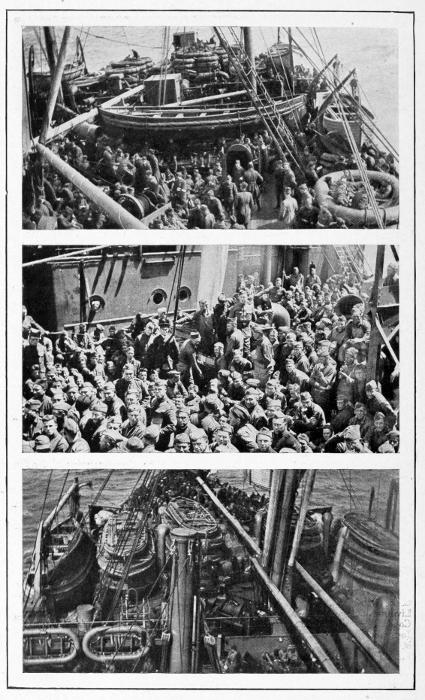
Returning Doughboys
Part IV — Some Passengers Carried — Roster of Officers (Alphabetically) — Nurses — Roster of Crew — Additional Roster of Crew — Gun Crew of the U. S. S. Leviathan — Gun No. 1 — Gun No. 2 — Gun No. 3 — Gun No. 4 — Gun No. 5 — Gun No. 6 — 6-Inch Gun No. 7 — 6-Inch Gun No. 8 — 1-Pounder Gun No. 1 — 1-Pounder Gun No. 2 — “Y” Gun No. 1 — “Y” Gun No. 2 — Machine Gun No. 1 — Machine Gun No. 2 — Range Finders — Comparison of the Fifteen Leading Transports — Daily Routine in Port — Daily Routine at Sea — The U. S. S. Leviathan — U. S. S. LEVIATHAN STATISTICS OF NUMBERS CARRIED Up To and Including 14th Trip — List of Sick and Wounded Carried by Leviathan — NOTES
- Brig. Gen. Samuel T. Ansell.
- Prince Axel of Denmark.
- William A. Ashbrook, M.C.
- Chandler P. Anderson, War Industries Board.
- M. J. Abbott, Liquidation Commission.
- Daniel R. Anthony, M.C., Committee on Military Affairs.
- Major General George Barnett, U.S.M.C., Commanding Officer U.S.M.C.
- Mrs. George Barnett.
- Samuel Blythe, American Red Cross.
- Dr. Herman H. Biggs, American Red Cross.
- Dr. Edward R. Baldwin, American Red Cross.
- H. S. Brown, Liquidation Commission.
- Col. Robert Bacon, Ex-ambassador to France.
- Newton D. Baker, Secretary of War.
- Mr. John L. Bouchal, Vice Consul to Prague, Bohemia.
- Mrs. Marie Bouchal.
- Mr. W. Bolling, brother-in-law of President Wilson.
- John E. Baker, Congressman.
- Maj. Gen. A. Cronkheit.
- Irvin S. Cobb, Journalist.
- T. A. Chandler, M.C.
- Frank I. Cobb, Journalist.
- Walter M. Chandler, M.C.
- Tom Connally, M.C.
- Frank K. Cameron, Representative of the Department of the Interior.
- Sam J. Cook, Liquidation Committee.
- Chas. P. Caldwell, M.C., Committee on Military Affairs.
- Maj. Gen. Joseph P. Dickman.
- Henry P. Davison, Head of American Red Cross.
- C. H. Dillon, M.C.
- Livingston Davis, Asst. to Mr. Roosevelt.
- Col. The Hon. Lord Decies, British Army.
- Josephus Daniels, Secretary of the Navy.
- Mrs. Josephus Daniels.
- Paul K. Dayton, Liquidation Commission.
- S. H. Dent, M.C., Committee on Military Affairs.
- G. A. Ellston, M.C.
- Martin Egan, Journalist.
- Rear Admiral Earle, Chief of the Bureau of Ordnance.
- Major General Chas. S. Farnsworth.
- William Fleischman, United States Shipping Board.
- Commander Foote, Aide to Secretary Daniels.
- Mrs. Sample B. Forbus and child, wife American Consul, Brest, France.
- Wm. J. Fields, M.C., Committee on Military Affairs.
- Alvan T. Fuller, M.C., Committee on Military Affairs.
- Benj. L. Fairchild, M.C.
- Hon. Albert M. Franklin, Italian Minister to Mexico.
- Lady Mabel Emily Grant, wife of Vice-Admiral Grant, R.N.
- Brig. Gen. Walter H. Gordon.
- Admiral Griffin, U.S.N., Chief of the Bureau of Steam Engineering.
- William R. Green, M.C.
- Jas. P. Glynn, M.C.
- Hoyt S. Gale, Representative of the Department of the Interior.
- Martin Green, Journalist.
- Capt. Walter H. Gerhardi, U.S.N.
- Frank L. Green, M.C., Committee on Military Affairs.
- Thos. S. Grago, M.C., Committee on Military Affairs.
- Brig. Gen. John N. Hodges.
- Fred. C. Hicks, M.C.
- Brig. Gen. Frank B. Hines.
- Preston Herbert, Chief of Tobacco Section, Subsistence Division, also Vice-President American Tobacco Co.
- E. N. Hurley, Chairman United States Shipping Board.
- Mrs. E. N. Hurley.
- W. W. Hastings, M.C.
- Dr. Samuel M. Hamill.
- Dr. L. Emmet Holt.
- Senator Henry F. Hollis.
- Harry E. Hull, M.C., Committee on Military Affairs.
- Thos. W. Harrison, M.C., Committee on Military Affairs.
- William Jenkins, American Ambassador to Odessa, Russia.
- Rabbi Samuel J. Jack, Jewish Welfare Board.
- Senator Homer H. Johnson.
- Fred. P. Kepple, Third Asst. Sec. of War.
- Charles C. Kearns, M.C., Committee on Military Affairs.
- Mr. Marshall Langhorne, First Secretary of the Legation at The Hague.
- Mrs. Marshall Langhorne.
- Major Harry Leonard, U.S.M.C., of Boxer Campaign fame.
- Senator James Hamilton Lewis.
- Jean L. Lafoert, U.S., Vice Consul at Algiers.
- Maj. Gen. LeRoy S. Lyon, U.S.A.
- C. T. Lewis, Secretary to American Ministry to Belgium.
- Miss Julia Lathrop, Children’s Bureau, Department of Labor.
- Ladislas Lazaro, M.C.
- Fiorello H. LaGuardia, M.C., Committee on Military Affairs.
- Brig. Gen. L. L. McCauley, U.S.M.C.
- Brig. Gen. Samuel McRoberts, U.S.A.
- Brig. Gen. G. H. McManus.
- Joseph F. Marius, United States Shipping Board.
- Guy H. Moon, United States Shipping Board.
- Brig. Gen. John F. Madden.
- Mr. S. S. McClure, of McClure’s Magazine.
- Mr. May, Personal Secretary to Mr. Daniels.
- John W. Morin, M.C., Committee on Military Affairs.
- John F. Miller, M.C., Committee on Military Affairs.
- Earl C. Michener, M.C.
- Hon. Henry Morgenthau, ex-Ambassador to Turkey.
- Our French pilot, Jean Metayer, Major de la Flotte.
- Major Gen. O’Ryan.
- Mr. and Mrs. George Patullo, Journalists.
- Mr. Chas. P. Pressley, Vice Consul General at Paris.
- Mrs. Chas. P. Pressley.
- Miss Marguerite Pressley.
- William J. Pike, American Consul to St. Gall, Switzerland.
- Edward E. Phalen, United States Shipping Board.
- Brig. Gen. Thomas H. Rees.
- Franklin D. Roosevelt, Asst. Sec. of the Navy.
- John Randolph, Vice Consul to Odessa, Russia.
- Major General Harry W. Rogers, Quartermaster General.
- C. W. Ramseyer, M.C.
- David Runyon, Journalist.
- Brig. Gen. W. C. Rivers.
- Mrs. Joan F. L. Morgan Singer, wife of Rear Admiral Singer, R.N.
- Miss Joan F. L. Singer, daughter of Rear Admiral Singer, R.N.
- Master Michael Morgan Singer, son of Rear Admiral Singer, R.N.
- Thos. D. Schall, M.C.
- Mrs. Thos. D. Schall.
- William G. Sharpe, Ambassador to France.
- William G. Sharpe, Jr.
- Felix W. Smith, American Consul to Tiflis, Russia.
- Addison Southard, American Consul to Aden, Arabia.
- Mrs. Addison Southard.
- Inman Sealby, United States Shipping Board.
- Hatton W. Summers, M.C.
- Addison Smith, M.C.
- John N. Tillman, M.C.
- G. B. Thomason, M.C.
- Brig. Gen. Harry Taylor.
- Lieutenant General Emile Adolphe Taufflieb, French Army.
- Madame Taufflieb.
- Maj. Gen. Peter E. Traub.
- Rear Admiral Taylor, U.S.N., Chief of the Bureau of Construction and Repair.
- Dr. Fritz B. Talbot.
- Maj. Teiusanu, Roumanian Attaché at Washington, D. C.
- Mrs. Teiusanu.
- John Z. Tilson.
- Brig. Gen. Edward Vollrath.
- Carl Vrooman, Asst. Sec. of Agriculture.
- Lieutenant Commander N. Wilkinson, R.N.R., Camouflage expert.
- Mrs. N. Wilkinson.
- Brig. Gen. C. B. Wheeler.
- J. Harry Welling, United States Shipping Board.
- Jas. C. Wilson, M.C.
- Dr. William H. Welch.
- Hon. Hugh C. Wallace, American Ambassador to France.
- Mrs. Wallace.
- George Wadsworth, Vice Consul, Nantes, France.
- George M. Young, M.C.
- Brig. Gen. Chas. X. Zimmerman.
- F. D. Scott, Member of Congress.
- C. C. Michener, Member of Congress.
- C. P. Caldwell, Member of Congress.
- J. W. Morin, Member of Congress.
- B. L. Fairchild.
- S. King, Member of Congress.
- H. E. Hull, Member of Congress.
- F. L. Greene, Member of Congress.
- W. J. Snow, Maj. Gen., Chief of Field Artillery.
- J. L. Bouchal, Vice-Consul to Prague.
- J. L. Bouchal, Mrs., wife of Vice-Consul.
- N. D. Baker, Secretary of War.
- C. P. Pressley, Vice-Consul to Paris.
- C. P. Pressley, Mrs., wife of Vice-Consul.
- Warren Pershing, son of General Pershing.
- W. G. Sharp and family, returning Ambassador to France.
- Brig. Gen. MacArthur, Commanding 84th Div.
- Major General McAndrews, Chief of Staff, A.E.F.
- Major General Shanks, Port of Embarkation, Hoboken, U.S.A.
- Sir and Lady A. Newsholme, K. C. B.
- W. H. George, Vice-Consul.
- F. Hitchcock, ex-Postmaster General.
- George V. L. Meyer, Mrs., wife of ex-Secretary of the Navy.
- O. C. Crosby, Mrs., wife of ex-Secretary of the Treasury.
- B. L. French, Member of Congress.
- W. R. Greene, Member of Congress.
- C. D. Radford, Brig. Gen., U.S.M.C.
- R. Crane, U. S. Minister to Czecho-Slovak.
- A. Gleaves, Vice-Admiral, Commander Cruiser and Transport Force.
- J. Haygood, Brig. Gen.
- F. H. Schofield, U.S.N.
- H. P. Davidson, head of A. R. C.
- R. Olney, Member of Congress.
- J. M. Morin, Member of Congress.
- C. P. Caldwell, Member of Congress.
- Alexander, Edward J., Lieut. (P. C.), U.S.N.
- Alexander, Albert E., Lieut. (j. g.), U.S.N.R.F.
- Allen, William S., Ensign, U.S.N.R.F.
- Althiser, Edwin, Lieut. (j. g.), U.S.N.R.F.
- Amberg, Edward J., Ensign (P. C.), U.S.N.R.F.
- Andrews, Ellwood W., Lieut., U.S.N.
- Armiger, William J., Ensign, U.S.N.R.F.
- Arnold, Leslie J., Ensign, U.S.N.
- Asserson, Frederick A., Commander, U.S.N.
- Ast, Raymond J., Ensign, U.S.N.R.F.
- Baker, James M., Jr., Lieut. (j. g.) (P. C.), U.S.N.R.F.
- Banks, Earl F., Carpenter, U.S.N.R.F.
- Barber, William A., Jr., Ensign (P. C.), U.S.N.R.F.
- Barcus, James S., Ensign, U.S.N.R.F.
- Barker, Edwin F., Lieut., U.S.N.
- Bateman, Arnold H., Lieut. (j. g.), U.S.N.
- Beardsley, Ralph A., Ensign, U.S.N.
- Beebe, John L., Lieut., U.S.N.R.F.
- Bense, Frederick, Lieut. (j. g.), U.S.N.
- Benton, William M., Lieut. (M. C.), U.S.N.
- Bergman, Milton, Gunner, U.S.N.
- Billingsley, Joe K., Ensign (P. C.), U.S.N.R.F.
- Bishop, Stuart A., Lieut. (j. g.), U.S.N.R.F.
- Blackburn, John H., Commander, U.S.N.
- Boucher, Creed H., Lieut., U.S.N.
- Braff, Max M., Lieut. (M. C.), U.S.N.
- Braunwarth, Albert, Boatswain, U.S.N.R.F.
- Bright, Roscoe C., Lieut. (j. g.), U.S.N.
- Britt, Benjamin B., Carpenter, U.S.N.
- Brockie, William J., Machinist, U.S.N.
- Bruns, Harry, Gunner, U.S.N.
- Bryan, Henry F., Captain, U.S.N.
- Burtis, William H., Lieut., U.S.N.
- Cadmus, Charles E., Ensign, U.S.N.R.F.
- Campbell, Carl I., Chief Pharmacist, U.S.N.R.F.
- Carlon, Charles B., Ensign, U.S.N.
- Carroll, Frank J., Lieut. (M. C), U.S.N.
- Carter, William J., Lieut. (j. g.), U.S.N.
- Coghlan, Daniel, Boatswain, U.S.N.R.F.
- Cole, Raymond, Gunner, U.S.N.
- Coulbourn, Theodore S., Lieut. (j. g.) (P. C.), U.S.N.
- Cox, Christopher C., Ensign, U.S.N.
- Croasdale, Ernest S., Ensign, U.S.N.
- Crofutt, Edward F., Lieut. (M. C.), U.S.N.R.F.
- Cummins, David E., Lieut. (j. g.), U.S.N.
- Cunningham, Harold A., Lieut. Comdr., U.S.N.R.F.
- Davidson, Harold, Lieut., U.S.N.R.F.
- Deacon, Joseph Gurney, Ensign, U.S.N.R.F.
- Denison, Ross E., Ensign, U.S.N.
- Ditmars, John R., Jr., Ensign, U.S.N.R.F.
- Dorsey, Arthur B., Lieut., U.S.N.
- Dundon, William A., Mach., U.S.N.R.F.
- Dunlap, Albert K., Lieut. (M. C.), U.S.N.
- Durell, Edward H., Captain, U.S.N.
- Edwards, Eaton C., Lieut. Comdr. (P. C.), U.S.N.
- Edwards, Henry I., Lieut., U.S.N.
- Erickson, Edward B., Lieut. (P. C.), U.S.N.
- Estey, Edward, Lieut. (j. g.), U.S.N.
- Evans, John C., Ensign, U.S.N.R.F.
- Ewbank, Henry L., Ensign, U.S.N.
- Fagan, George, Ensign, U.S.N.R.F.
- Fagan, John J., Mach., U.S.N.
- Fales, De Coursey, Ensign, U.S.N.R.F.
- Farwell, Neal B., Lieut. Comdr. (P. C.), U.S.N.
- Fenstemaker, Marvin C., Ensign (P. C.), U.S.N.R.F.
- Ferguson, John, Ensign, U.S.N.R.F.
- Ferry, John M., Jr., Ensign, U.S.N.
- Fisk, Harvey E., Ensign (P. C.), U.S.N.R.F.
- Fitzsimmons, George R., Ensign, U.S.N.
- Ford, James W., Lieut. Comdr., U.S.N.R.F.
- Foss, Albion F., Lieut, (j. g.), U.S.N.R.F.
- Foster, John, Lieut. Comdr., U.S.N.R.F.
- Foster, Leroy B., Lieut. (j. g.), U.S.N.R.F.
- Froehlich, Sylvan L., Ensign, U.S.N.R.F.
- Fry, Alfred B., Captain, U.S.N.
- Gahagan, Allen J., Ensign, Lieut. (j. g.), U.S.N.R.F.
- Gay, Nelson, Ensign, U.S.N.R.F.
- Gaynor, Thomas A., Ensign, U.S.N.R.F.
- Glaser, Alfred W., Mach., U.S.N.R.F.
- Graeff, Warren L., Ensign, U.S.N.
- Grant, Deloss A., Lieut. (j. g.), U.S.N.R.F.
- Gunnell, Vaughn J., Lieut. (P. C.), U.S.N.
- Hackett, Paul B., Ensign, U.S.N.
- Hagerman, Oliver S., Mach., U.S.N.R.F.
- Haines, Rowland B., Ensign, U.S.N.
- Halsey, William H., Lieut. Comdr. (M. C.), U.S.N.
- Haltnorth, Oliver J., Lieut., U.S.N.
- Hammond, Carlton M., Ensign, U.S.N.
- Hankinson, Otto L., Lieut., U.S.N.R.F.
- Hannon, Frank, Mach., U.S.N.
- Harding, Arthur E., Lieut. (j. g.), U.S.N.
- Harper, Fred K., Lieut. (j. g.), U.S.N.R.F.
- Harris, Lester L., Ensign (P. C.), U.S.N.R.F.
- Heinz, Earnest D., Elec. Gunner, U.S.N.
- Hamby, Cleveland, Lieut., U.S.N.
- Hilliard, Charles C., Lieut. (j. g.), U.S.N.R.F.
- Hoffman, Leonard G., Lieut. (P. C.), U.S.N.
- Howe, Paul B., Ensign, U.S.N.R.F.
- Howell, Harry M., Lieut. (M. C.), U.S.N.
- Hudgins, Earle P., Carpenter, U.S.N.
- Hudson, Erastus M., Lieut. (M. C.), U.S.N.
- Hulbert, Harold S., Lieut. (M. C.), U.S.N.R.F.
- Ingram, Herbert R., Ensign (P. C.), U.S.N.R.F.
- Jack, John H., Lieut., U.S.N.
- Jeffers, William N., Comdr., U.S.N.
- Jensen, Joseph, Mach., U.S.N.R.F.
- Johnston, George O., Ensign, U.S.N.R.F.
- Johnston, William, Boatswain, U.S.N.
- Jones, Edward E., Lieut., U.S.N.R.F.
- Jones, John, Lieut. Comdr., U.S.N.R.F.
- Jones, Richard H., Lieut., U.S.N.
- Judkins, Holland B., Lieut. (j. g.) (P. C), U.S.N.R.F.
- Katzmarek, John E., Ensign, U.S.N.R.F.
- Keating, Thomas E., Lieut., U.S.N.R.F.
- Keeser, George, Lieut., U.S.N.
- Kennedy, Patrick F., Lieut. (D. C.), U.S.N.
- Kirk, Colin, Lieut., U.S.N.R.F.
- Knight, Rufis H., Ensign, U.S.N.R.F.
- Krez, Conrad A., Lieut., U.S.N.
- Lau, Walter, Lieut., U.S.N.
- Le Clerq, Frederick D. K., Ensign, U.S.N.R.F.
- Leiper, John A., Ensign, U.S.N.R.F.
- Leonard, Arthur T., Lieut., U.S.N.
- Lequin, Maurice L., Ensign, U.S.N.R.F.
- Leventhal, Lewis F., Ensign, U.S.N.
- Looney, William C., Lieut. (j. g.), U.S.N.R.F.
- Lorentz, Robert, Jr., Lieut. (M. C.), U.S.N.
- Lovell, Douglas G., Lieut., U.S.N.
- Luskin, Abraham, Pay Clerk, U.S.N.R.F.
- Malloy, William E., Lieut., U.S.N.
- Mann, Harry A., Ensign, U.S.N.R.F.
- Manock, Frank D., Lieut. Comdr., U.S.N.
- Martin, Robert, Pharmacist, U.S.N.
- Maune, James J., Carpenter, U.S.N.
- May, Henry A., Comdr., U.S.N.
- Meagher, James F., Ensign, U.S.N.R.F.
- McDonald, Eugene E., Captain (C. C.), U.S.N.
- McLeod, Daniel, Carpenter, U.S.N.
- Metayer, Jean, French Pilot.
- Milan, Daniel F., Ensign, U.S.N.R.F.
- Millard-Turner, R., Lieut. (j. g.), U.S.N.R.F.
- Miller, Charles H., Ensign, U.S.N.R.F.
- Miller, L. Dee, Lieut., U.S.N.R.F.
- Minuse, Alfred W., Lieut. (j. g.), U.S.N.R.F.
- Morrill, Stanley, Lieut. (j. g.), U.S.N.R.F.
- Nichols, Spencer V., Ensign, U.S.N.R.F.
- Nordstrom, Isador, Lieut. (j. g.), U.S.N.
- Nuber, Horace D., Lieut. (P. C.), U.S.N.
- O’Donnell, Joseph A., Elec. Gunner, U.S.N.R.F.
- Ohmer, August, Carpenter, U.S.N.
- Oman, Joseph W., Captain, U.S.N.
- Osborn, Charles K., Lieut. Comdr., U.S.N.
- O’Shaughnessy, Louis B., Ensign (P. C.), U.S.N.R.F.
- Palen, Milburn R., Ensign, U.S.N.R.F.
- Parker, John C., Lieut., U.S.N.
- Phelps, William W., Captain, U.S.N.
- Poggi, Godfrey F., Pay Clerk, U.S.N.R.F.
- Porter, John E., Lieut. (M. C.), U.S.N.
- Rapkin, Alfred C., Ensign, U.S.N.R.F.
- Rathbun, Walter L., Lieut. (M. C.), U.S.N.R.F.
- Rector, Frank L., Boatswain, U.S.N.
- Redman, Foster B., Pharmacist, U.S.N.
- Reimann, Carl, Gunner, U.S.N.
- Roberts, Jack B., Jr., Ensign, U.S.N.R.F.
- Rowedder, Herbert B., Ensign, U.S.N.
- Schad, Theodore S., Ensign (P. C.), U.S.N.R.F.
- Schafer, George C., Lieut. Comdr., U.S.N.
- Schildhauer, Clarence H., Ensign, U.S.N.
- Schluter, Wilhelm H. F., Lieut., U.S.N.
- Schoeffel, M. F., Ensign, U.S.N.
- Seaman, Elbert C., Ensign, U.S.N.R.F.
- Shannon, Charles R., Elec. Gunner, U.S.N.R.F.
- Sheppard, Thomas T., Lieut. (j. g.), U.S.N.R.F.
- Sherlock, Archibald J., Ensign, U.S.N.R.F.
- Shuler, John W., Ensign (P. C.), U.S.N.R.F.
- Simonpietri, William L. F., Lieut. Comdr. (P. C.), U.S.N.
- Singleton, Louis P., Ensign, U.S.N.R.F.
- Skead, Robert G., Lieut., U.S.N.R.F.
- Smith, Charles W., Boatswain, U.S.N.R.F.
- Smith, Walter E., Pay Clerk, U.S.N.R.F.
- Snyder, John J., Comdr. (M. C.), U.S.N.
- Soars, Charles A., Lieut. (P. C.), U.S.N.
- Stafford, Archibald S., Ensign (P. C.), U.S.N.R.F.
- Staton, Adolphus, Comdr., U.S.N.
- Stephans, Frederick J., Ensign (P. C.), U.S.N.R.F.
- Strauss, Spencer G., Lieut. (M. C.), U.S.N.R.F.
- Swift, John T., Lieut., U.S.N.
- Tawes, George V., Lieut. (j. g.), U.S.N.R.F.
- Thomas, Wilmer J., Ensign (P. C.), U.S.N.R.F.
- Thompson, Edward H., Ensign, U.S.N.R.F.
- Vars, Addison F., Ensign, U.S.N.R.F.
- Vaughn, George T., Lieut. Comdr. (M. C.), U.S.N.
- Wainwright, Stuyvesant, Lieut. (j. g.), U.S.N.R.F.
- Waters, Clifford W., Ensign (P. C.), U.S.N.
- Waterston, Fred C., Boatswain, U.S.N.
- Watson, James P., Lieut., U.S.N.R.F.
- Watt, Frank S., Lieut., U.S.N.R.F.
- Weston, Albert T., Lieut. (M. C.), U.S.N.R.F.
- Whitney, Rintoul T., Lieut. (j. g.), U.S.N.R.F.
- Willey, James H., Lieut., U.S.N.R.F.
- Williams, James F., Gunner, U.S.N.
- Wilson, Arthur L., Mach., U.S.N.R.F.
- Wilson, Tom C., Mach., U.S.N.
- Woodward, Vaughn V., Comdr., U.S.N.
- Wrigley, Edmund J., Ensign (P. C.), U.S.N.R.F.
- Wright, F. G., Lieut., U.S.N.R.F.
- Wyatt, Thomas H., Lieut. (j. g.), U.S.N.R.F.
- Ziesel, Carl Stanley, Lieut. (j. g.), U.S.N.
- Ch. Nurse, Mary M. Robinson, U.S.N.
- Res. Nurse, Irene Reid, U.S.N.
- Nurse, Mary A. O’Neill, U.S.N.
- Nurse, Ruby E. Nutting, U.S.N.R.F.
- Nurse, Madelon Stowell, U.S.N.R.F.
- Nurse, Alice B. Newcomb, U.S.N.R.F.
- Nurse, Ruby Russell, U.S.N.R.F.
- Nurse, Vera Harmon, U.S.N.
- Nurse, Charlotte Hyde, U.S.N.
- Nurse, Frances Dobson, U.S.N.R.F.
- Nurse, Kathryn Leary, U.S.N.R.F.
- A. L. A., Edward H. Virgin
- Y. M. C. A., Maurice S. Safford
- K. of C., Francis C. O’Neill; Thomas Walsh; Howard Reilly
- A. R. C., Sherburn M. Becker
- J. W. B., Leo C. Baum; Walter Hymes
- Aas, E. W.
- Abraham, Leslit
- Abrahams, James J.
- Abrams, Leonard M.
- Abeln, Herman T.
- Abriel, George D.
- Adams, James A.
- Adams, Samuel N.
- Adamson, Joseph
- Adang, Frank J.
- Adcock, John R.
- Agustin, Alfredo
- Aitken, Robert
- Albert, Edward Gus
- Alcol, Animo
- Aldridge, William F.
- Alexander, Claude M.
- Alexander, Joseph H.
- Alexander, Henry S.
- Alexy, Louis Albert
- Allen, Alfred C.
- Allen, Charles C.
- Allen, Cragon Batson
- Allen, Oliver Geo.
- Allen, Warren Reynolds
- Almond, Lloyd J.
- Alt, Theodore
- Amato, Sam
- Ambos, Ferdinand William
- Ambraz, Joseph
- Ammerman, D. F.
- Andersen, Harold M.
- Anderson, Arthur Lyman
- Anderson, Charles G.
- Anderson, D. W.
- Anderson, Harry E.
- Anderson, Herman R.
- Anderson, Horace Woods
- Anderson, Joel A.
- Anderson, Marius H.
- Anderson, Sigurd Melvin
- Andres, Walter S.
- Andrews, Robert W.
- Applin, Raymond Nelson
- Archer, John J.
- Ardelt, Herman A.
- Armbruster, J. A.
- Armstrong, Geo. Custer
- Armstrong, John
- Armstrong, Thomas J.
- Arneson, Fred A., Jr.
- Arnold, Louis
- Artz, Earl I.
- Ashley, Robert H.
- Astromolsky, Abraham
- Atherton, William McN.
- Atkins, Thomas P.
- Atsma, Lambert W.
- Auger, Leroy B.
- Augustine, Lionel J.
- Auth, Fred
- Avery, Ira
- Axford, Joseph D.
- Axman, William
- Ayers, Aaron, D.
- Ballew, Roy A.
- Bass, Melville R.
- Bachmeier, Charles
- Bagley, Gawn A.
- Bagley, Geo. M.
- Bahnsen, Henry A.
- Bailess, Benson Lyle
- Bailey, John J. R.
- Baker, James
- Bakken, Elby Severnine
- Baldwin, Sidney
- Bales, William Emit
- Balkhaus, Reinhart F.
- Ballein, Orville E.
- Baltimore, Roland C.
- Bannerman, Frank M.
- Bannon, James Stephen
- Bannon, Robert
- Barber, Carl B.
- Barhite, Raymond R.
- Barker, Albert T.
- Barkowik, Harry
- Barlow, Raymond H.
- Barnard, Warren H.
- Barnes, John
- Barnes, Samuel Clark
- Barney, John L.
- Barr, Joseph F.
- Barrett, Thomas E.
- Barroza, Domingos G.
- Barry, Hugh Patrick
- Barry, Joseph O.
- Bartholomew, Nicholas
- Bartlett, Dudley C.
- Baskin, Ernest Gamble
- Bates, Harry W.
- Bauer, Joseph
- Baur, Otto Benjamin
- Bays, Earl R.
- Beaird, Paul D.
- Bean, Otis Eugene
- Beatty, Geo. Edw.
- Beavers, Geo. William
- Becker, Geo. J.
- Becker, Jacob
- Becker, Leslie L. C.
- Bednar, Stephen G.
- Beebe, Herbert R.
- Beetham, Harry R.
- Beighley, Earl Glen
- Bellerson, Geo. Frederick
- Benfer, Albert G.
- Benford, William F.
- Benjamin, C. V.
- Bennett, Arthur August
- Bennett, Peter
- Benson, H. J.
- Bentley, Albert
- Benton, Eugene D.
- Berard, Raymond J.
- Bercume, Andrew L.
- Bergner, Chas. A. William
- Berger, Geo. I.
- Berger, William J.
- Berner, John
- Bernstein, Harry M.
- Berrie, Geo. E.
- Berry, Fred E.
- Berry, Stewart S.
- Bert, Edward J.
- Bertenshaw, Earl
- Best, Harry E.
- Betlej, Michael A.
- Betterton, William T.
- Betzold, Victor L.
- Bianchi, Victor J.
- Bianculli, Pasquale
- Biehn, Byron B.
- Bigelow, James A.
- Bilby, Austin Charles
- Biles, Otis O.
- Bishop, Irwin Leslie
- Bishop, Luther E.
- Bissell, Warren S.
- Bittlingmaier, Henry
- Black, R.
- Blackburn, Roy James
- Blackstock, Samuel H.
- Blake, Claude N.
- Blanchard, Joseph L.
- Blerk, W. A.
- Blevins, Don Clifford
- Blumfield, Morris
- Boak, Deo
- Boehmer, William F.
- Boettcher, Paul W.
- Boguilon, Pedro T.
- Bohan, Thomas
- Boles, Charles E.
- Bonner, Charles A.
- Bonner, Milford C.
- Bonnin, Celestin
- Bolton, Robert John
- Bomstad, Mahlon Mayo
- Booker, Herbert M.
- Borden, Albert R.
- Borders, Lyndon C.
- Borrello, Louis R.
- Bort, Harold D.
- Boss, Geo. D.
- Boswell, Martin Hugh
- Boswell, Russell P.
- Botke, John James
- Bowens, Fred
- Bowers, Horace A.
- Bowles, Clarence H.
- Bowles, Thomas V.
- Bowling, Leo Leslie
- Boyce, Lafayette
- Boylan, Sidney E.
- Boyle, Harry J.
- Bradford, Frederick G.
- Bradley, James J.
- Bradley, Philip R.
- Brakstone, Israel
- Branch, Jackson A.
- Braswell, William C.
- Bray, Walter J.
- Breitman, Mitchell C.
- Brellis, Stanley J.
- Brennan, Frank J.
- Brennan, Martin.
- Bresnahan, Cornelius R.
- Brett, James V.
- Brewer, Elmer A.
- Bridgman, Geo. W.
- Brierley, Clifton
- Brierley, Vernon H.
- Brindle, James J.
- Brinton, Harold
- Briscoe, Chas. B.
- Broadbent, Floyd W.
- Brock, John J.
- Broderick, James W.
- Brooker, John H.
- Brooks, Jimmie Lee
- Brooks, Lawrence D.
- Brophy, Robert J.
- Broring, Benjamin Joseph
- Broughton, William I.
- Brouillette, Alaide T.
- Brouillette, Jules G.
- Brown, Charles
- Brown, Edely H.
- Brown, Egbert Lee
- Brown, Geo. Eben, Jr.
- Brown, Geo. Taylor
- Brown, Henry James
- Brown, Harold S.
- Brown, Hugh W.
- Brown, Ira Oscar
- Brown, Isidore
- Brown, Jefferson C.
- Brown, Jesse A.
- Brown, Lee E.
- Brown, Pat
- Brown, Reuben William
- Brown, Thomas Lanier
- Brown, Vernie Aldwin
- Brown, Wille
- Brownell, Herbert Leslie
- Broyderick, Francis H.
- Bruch, Edward P.
- Brunce, Peter J.
- Brusa, John W.
- Bucher, Luther Allan
- Buck, David Vincent
- Buckley, John P.
- Buckley, Thomas E.
- Buckner, Clifton
- Buckowski, Felix
- Budge, Russell E.
- Bulat, Marco, Jr.
- Bull, Curtis 0.
- Bull, Frank Wadsworth
- Bullington, Preston G.
- Burgermaster, William L.
- Burgum, Arthur C.
- Burke, Elmer
- Burke, Fredrick H.
- Burke, James E.
- Burkey, Elmer A.
- Burnes, James Edwin
- Burnett, John A.
- Burns, James Eddie
- Burns, Robert J.
- Burnside, Archibald J.
- Buron, Romeo H.
- Burris, Lester Leo
- Burriss, John H.
- Burroughs, Edgar S.
- Burton, Lavar Miller
- Burrell, Virgil E.
- Buse, Geo. S.
- Butler, Thomas Jr.
- Butterfield, John R.
- Buttles, Marion Arthur
- Butts, Geo. W.
- Byrne, John J.
- Byrne, Robert T.
- Byrne, F. H.
- Byrnes, Walter J.
- Byron, Cyril A.
- Baumgarden, Willis A.
- Behman, August Scott
- Brown, Walter
- Cabrera, Rafael H.
- Cagnon, Joseph A.
- Cain, John A.
- Caliao, Alfredo
- Callahan, Joseph H.
- Callahan, William H.
- Calloway, James C.
- Calloway, James C.
- Camacho, Lope
- Cameron, Walter G.
- Cameron, J. J.
- Campbell, Franklin G.
- Canfield, William J.
- Cannistraci, Salvestore
- Cantwell, Charles E.
- Caprile, Louis
- Caradonna, Gaspare
- Carey, Alexander J.
- Carey, Everett
- Cargile, Louis L.
- Carley, Mathew J.
- Carley, William E.
- Carls, Walter
- Carlson, Carl Stanley
- Carlson, Herbert S. E.
- Carmichael, Joe H.
- Carmichael, Wilbert D.
- Carolan, Peter X.
- Carolan, John F.
- Caron, Theodore Fred
- Carpenter, Herbert P.
- Carpenter, Leonard F.
- Carpenter, William G.
- Carnes, John Thomas
- Carr, Henry W. R.
- Carroll, Joseph Francis
- Carroll, Joseph Walter
- Carrow, Lyle
- Carter, Geo. W.
- Carter, James Carleton
- Carter, William
- Carter, J. N.
- Cartier, Arthur L.
- Carver, Warren W.
- Caryl, Charles F.
- Casey, Charles Victor
- Casey, Michael
- Casey, Peter Henry
- Cashman, Robert J.
- Casper, David Joseph
- Casserly, W. M.
- Catanzano, Guiseppe
- Cathcart, Joseph
- Cator, Robert W.
- Cecil, Lawrence Walter
- Chalstrom, Oliver Floyd
- Chapman, Abram
- Chapman, Geo. McKinley
- Chapman, Ernest Donald
- Charles, Joseph
- Chase, Charles C.
- Chew, Sidney W.
- Chichester, William P.
- Chilinski, E. M.
- Chisholm, John A.
- Chlebek, William J.
- Chrastil, J.
- Christ, Archie J.
- Christiansen, Elmer
- Christmas, Robert
- Christiansen, Wollert M.
- Church, Charles R.
- Chute, Gordon
- Ciocchetti, Guiseppe
- Citron, I. S.
- Clancy, Thomas J., Jr.
- Clark, John F.
- Clark, John H.
- Clark, Miner C.
- Clark, Thomas H. W.
- Clarke, Edward W.
- Clause, John N.
- Clelland, Paul S.
- Clements, Henry Geo.
- Clifford, Roy F.
- Clift, Corbett E.
- Cline, Joseph B.
- Clottstein, Louis
- Clough, Edwin O.
- Clough, Stevan W.
- Clougherty, John
- Clow, William Q.
- Coates, Charles McK.
- Cobb, E. C.
- Coblentz, Harry M.
- Cochrane, David A.
- Cochran, Ralph P.
- Cockrum, William Orlando
- Codyer, Fred J.
- Coen, Vincent Boardman
- Coffey, Jesse E.
- Cogan, Daniel J.
- Cogswell, George A.
- Cole, Albert C.
- Cole, William J.
- Cole, Austin Tilgham
- Cole, Charles Burril
- Cole, Francis E.
- Cole, H. H.
- Coles, Robert L.
- Collins, Allan B.
- Collins, John Henry
- Collins, John J.
- Collup, Floyd Ingham
- Colvin, Howard H.
- Colvin, Elmer Irvin
- Combs, Cullen I.
- Conerty, Raymond P.
- Conger, Elmo Raymond
- Conjurski, Paul
- Conlon, Michael J.
- Connolly, Patrick J.
- Connolly, Terence
- Connolly, S. G.
- Connor, Benjamin
- Connor, E. J.
- Conrad, Edward
- Conrad, Robert H.
- Conway, Eugene V.
- Cook, Robert W.
- Coonce, Claud Ray
- Cooper, Ottis C.
- Cooper, Richard F.
- Cope, Titus W.
- Copeland, Clarence F.
- Coroy, John Peter
- Corkbill, George B.
- Costello, Joseph
- Cowan, Lucio
- Corman, Kenneth J.
- Cornell, August E.
- Cory, Halsey D.
- Cosper, Raymond W.
- Costello, Herbert
- Cotman, John Daniel
- Covert, Randolph W.
- Cowdrey, Fred Leslie
- Cowper, Charles L.
- Craddock, Ralph
- Craig, Ambrose J.
- Craig, Thomas Joseph
- Craine, Hubert Walter
- Crane, Lyman Elwood
- Crapps, Cecil
- Crawford, Charles I.
- Crawford, Robert A. L.
- Craycraft, George H.
- Creelman, John Newton
- Crockett, John Edward
- Crose, Claude W.
- Cross, Raymond J.
- Crossland, Ellis
- Crotty, Thomas Edward
- Croushorn, George
- Crow, Walter V., Jr.
- Crowley, Timothy J.
- Crozer, Peter W.
- Crum, Solomon
- Crumley, Raymond A.
- Crumm, Verne Ernest
- Crummy, Andrew Bernard
- Cubile, Saturnino
- Culligan, Walter James
- Cummings, Forrest L.
- Cummings, Haydn
- Cuneo, Antonio Newton
- Cunningham, John Porter
- Curry, Paul Jones
- Curry, Thomas Joseph
- Curtis, Edwin
- Curtis, Harvard Geo.
- Cussuca, James
- Custard, Herman L.
- Dahlin, Ernest M.
- Dailey, Bernard J.
- Dalstra, Andrew
- Daltuvas, John J.
- Daly, Thomas L.
- Dalzell, Lloyd Hunter
- Damaskev, Walter
- Dancer, F. O.
- Dandrade, Conrad
- Danielsen, C. W.
- D’Arcangelo, Michael
- Darch, William J.
- Davenport, L. S.
- Davey, Raymond
- David, Bryan I.
- Davis, Clyde
- Davis, Dewey Lee
- Davis, Edward Lorenzo
- Davis, Francis Joseph
- Davis, John Joseph
- Davis, James D.
- Davison, Lee Roy
- Dawson, Benjamin A.
- Dawson, Ernest Leroy
- Dean, Chester B.
- Dearbanne, Willis
- Dearborn, Geo. E.
- Dearth, Thomas H.
- Debrine, James J.
- Deford, Seth A.
- Delgado, Frank A.
- Delgreco, John
- Dellaporta, Luderico
- DeLeon, Gregoria
- DeLong, Harry Peter
- DeLong, Ronald Morgan
- Demarah, Richard A.
- Demery, N. P.
- Demetrion, Peter
- Dempster, James
- Dennis, Dewey J.
- Derouet, Camille
- Derring, Henry Franklin
- Derstine, John B.
- Deschamps, Eugene
- Desesky, Joseph
- Desjardin, Geo. A. N.
- Desjardins, Philip
- Deslandes, Henri
- Desmond, James F.
- Desplechin, Charles M.
- Devanney, Albert R.
- Devers, Daniel F.
- DeVette, Anton C.
- Devine, William F.
- DeWall Malefyto, Anthony
- Dewdney, Harry
- Dibrill, Joe Glass
- Di Camillo, Baldwin D.
- Dietrich, William Harvey
- Digons, Walter James
- Di Lella, Antonio
- Dileo, Vito
- Dillard, Clyde Rugus
- Dillman, John Joseph
- Dillon, Thomas P.
- Dimling, Henry
- Di Pietro, Bartolo
- Disalvio, Thomas R.
- Divan, Mathew E.
- Dixon, Charles L.
- Dixon, George
- Dixon, Henry Arthur
- Dodge, Ellsworth R.
- Dodson, William E.
- Doherty, Earl
- Doherty, Patrick J.
- Dolan, Joseph L.
- Dolan, George Lester
- Dolan, T. J.
- Domach, Stephen Edward
- Dominiak, Chester Jos.
- Donaghue, Clement R.
- Donahue, Edward P.
- Donnelly, James P.
- Donnelly, James William
- Donnelly, Joseph
- Donnelly, Thomas F.
- Donnelly, Bernard C.
- Donner, Dee Arthur
- Donnie, Louis D.
- Donohue, Joseph
- Donovan, Florence A.
- Doody, George A.
- Dorio, Dominick A.
- Dosch, J. G.
- Doudna, Francis M.
- Dougherty, Francis D.
- Dow, William P., Jr.
- Dowd, Francis Herbert
- Dowler, Thomas
- Downing, James B.
- Doyle, Andrew James
- Doyle, Foster G.
- Doyle, William F.
- Drainville, Emile
- Drew, Arthur Weston
- Dube, Charles Henry
- Duckworth, John Y.
- Dudley, John A.
- Duffey, John J.
- Duffy, James J.
- Dufresne, Henry J,
- Dugale, Daniel
- Duggan, Alston Hardy
- Duggan, Norman H.
- Dummett, Francis F.
- Dumm, W. E.
- Dumpprope, William B.
- Dunaway, Arley Otto
- Dundon, John
- Dunham, George L
- Dunham, Lyle A.
- Dunn, Harrison
- Dunn, David O. S.
- Dunn, Edwin C.
- Dunn, William D.
- Dupre, John R.
- Durbin, Lawrence Patrick
- Durernay, E. F.
- Durkin, John Harold
- Durkin, Joseph H.
- Durkin, Robert J.
- Durnick, Arthur M.
- Dushuttle, Louis E.
- Dwyer, John Joseph
- Dyer, Barksell
- Dzilsky, Geo. William
- Eaione, Carmine Joseph
- Eason, Andrew L.
- Eason, Clarence J.
- Eberhardt, Louis Charles
- Eckler, Hayland R.
- Eddinger, Vernon C.
- Edmondson, John O.
- Edwards, Hubert Foster
- Eilers, Charles F.
- Eleria, Pedro
- Elkind, Paul David
- Elliott, Hubert J.
- Ellis, Carlton
- Elward, Leroy John
- Engel, Albert
- Engel, William Frederick
- Engles, Orie Lurvine
- Eppert, Louis
- Epstein, Jules
- Erb, Albert J.
- Erickson, Victor Emanuel
- Ericson, Ernest C.
- Ertel, Mike A.
- Erlenbach, Martin A.
- Euler, Frederick William
- Euler, Henry
- Everhart, Frank L.
- Exerjian, Gabriel M.
- Exner, Edward Frederic
- Fabrizio, Ralph
- Fagan, F. K.
- Faherly, J. L.
- Farber, Joseph Geo.
- Farquar, Alan Benton
- Farley, Louie L.
- Farrar, Geo. Washington
- Farrell, Peter
- Fastenberg, Irving
- Fastoff, Alexander
- Faughnan, Charles J.
- Faulkner, Harry
- Fawcett, Lyman W.
- Feeny, James F.
- Feinster, James Dugan
- Feinstein, Charles
- Felder, Clarence
- Felder, John, Jr.
- Fellona, Joseph A.
- Fenton, John
- Ferguson, Jack Gordon
- Ferm, Evan Malcolm
- Ferrier, Eugene S.
- Fettinger, George, Jr.
- Fick, Edward F.
- Fickett, George E.
- Fiel, Louis A.
- Field, Donald E.
- Field, Ralph
- Fields, Cecil
- Files, Charles J. F.
- Filipski, Stanley F.
- Finan, Russell John
- Finch, Jos. L.
- Fine, Joseph
- Finley, John A.
- Finley, Royden Manfold
- Finn, John Henry
- Finnegan, Arthur R.
- Finnerty, William G.
- Firman, Joseph J.
- Firth, Geo. W.
- Fischer, George Adam
- Fisher, Frank B.
- Fisher, William Wallace
- Fitting, Chas. G.
- Fitzgerald, Arthur R.
- Fitzgerald, John J.
- Fitzmartin, Raymond
- Flaherty, Thomas H.
- Flanagan, Robert
- Fleenor, William H.
- Fleming, Alphus J.
- Fleming, Roy Arthur
- Fleming, Thomas
- Fliegel, Christian F.
- Flowers, Frank
- Flynn, Daniel C.
- Flynn, Martin J.
- Fochs, Herbert N.
- Foden, Joseph James
- Fogle, Eddie
- Foisett, Charles W.
- Foley, Daniel E.
- Foley, Thomas J.
- Foley, T. J.
- Forbes, Daniel G.
- Forsythe, Ray M.
- Fortney, Myrle H.
- Foster, William
- Fox, David E.
- Fox, Albert Nathal
- Fox, William John
- Foy, Robert Oliver
- Francia, Primo
- Francisco, Elery D.
- Franklin, Robert E. L.
- Franz, Gus.
- Franzen, Antone F.
- Frarer, John H.
- Fream, Chester Baldwin
- Freeman, Geo. Arthur
- French, Henry Feather
- French, James F.
- Fresen, Joel B.
- Freund, Philip P.
- Freyburger, Roy L.
- Frick, Fred.
- Friday, Attly Travis
- Friedhand, Jacob
- Frison, Joseph
- Fritz, Geo. Wash.
- Froelich, Irving F.
- Frock, Charles R.
- Frost, Emery Larenzo
- Frost, Percy A.
- Froula, Otto Frank
- Fuller, Frank N.
- Fuller, William Bernard
- Furlong, Raymond C.
- Furst, Fred
- Fuskerud, Albert
- Gabrenas, Anthony Paul
- Gabrysewski, John (Gabel)
- Gagne, Irving M.
- Gagon, Chauncey A.
- Gago, Tudor
- Gallagher, Neil
- Gallant, Charles J.
- Gallaspie, Hubert E.
- Gallent, Clifton N.
- Gallo, Jack
- Gammill, Wendell Brooks
- Gapinski, Frank V.
- Garball, Arthur
- Garner, Hubert M.
- Garner, Arthur L.
- Garner, Clarence Eugene
- Garrison, Melvin
- Garver, Floyd
- Gash, Lawrence W.
- Gatcho, Dalmacio
- Gatling, Harry N.
- Gaucher, Eugene Alfred
- Gaunt, Henry E.
- Gavin, Thomas James
- Gay, William M.
- Gaylo, Benedict J.
- Gemmel, Adam
- Gentile, Philip
- Gentry, Jack Adams
- Gentzsh, Charles T.
- George, Albert
- George, Joseph Salvatore
- George, Leonard G.
- George, Leroy Delphin
- Gerard, Paul George
- Giangrandi, Giralamo
- Giardina, Giuseppe
- Gibbons, Myles
- Gibney, Patrick Christ.
- Gibney, Henry G.
- Gilbert, Davis L.
- Gilkye, J. W.
- Gill, John Phillip
- Gillenwater, Joel R.
- Gilliece, Leo J.
- Giminez, Fernando
- Girardi, Angelo
- Gish, George B.
- Glaser, Edward J.
- Gleason, Michael D.
- Glenny, Henry T.
- Glick, J. W.
- Godfrey, Horace Chilton
- Godin, Frank
- Goelzer, Samuel
- Goff, David Oliver
- Goggin, William J.
- Goldman, Adolph Arthur
- Goldman, Anton C.
- Goldman, Edward
- Goldberg, Max
- Goldsmith, Joseph
- Gonzalez, Feliciano
- Good, Fred. I.
- Goodnetter, Geo. J.
- Goodrich, Dalton E.
- Goodstein, Maurice
- Goodwin, Starlin F.
- Goolazian, Masrob
- Gordinier, William W.
- Gordon, David
- Gordon, Nelson
- Gosline, Fred S.
- Goss, Ora Martin
- Gottlies, Harry
- Goudreault, William L.
- Gozzetta, John
- Grabowski, John T.
- Grady, George J.
- Grady, William F.
- Graham, Thomas James
- Graham, William E.
- Granes, Elmer G.
- Grayless, C. E.
- Grant, James Albert
- Gray, Richard
- Greene, Victor F.
- Greenstein, Sally
- Gregory, Edward
- Grey, Willmot H.
- Gries, Carl
- Griffin, James
- Griffith, Freddie T.
- Griffith, Geo. Morgan
- Griffiths, Geo. E.
- Grimes, Lawrence D.
- Grondine, Raoul J.
- Grossett, David, Jr.
- Group, Frank J.
- Groves, William M.
- Gruber, Eugene Charles
- Gruen, Frank Henry
- Gruenwald, Alfred
- Guffin, W. E.
- Guidotti, Numa
- Gullickson, Reuben M.
- Gunn, John G.
- Gurholt, Carval G.
- Gusky, Jerome
- Guy, Thomas
- Gwyn, Oliver Berley
- Gwynn, Henry A.
- Gwynn, Richard H. D.
- Hackett, W. H.
- Hackley, Herbert M.
- Haire, Homer H.
- Hakeem, John M.
- Halbison, Greer B.
- Haley, Vincent Francis
- Hall, Burl
- Hall, Cecil
- Hall, Virgil Maxwell
- Hall, Walter Lloyd
- Halle, James G.
- Halter, Conrad Geo.
- Hamilton, Thomas D.
- Hamlin, Gilbert
- Hammen, Roy Merrill
- Hamor, James E.
- Hand, Wendell G.
- Hane, J. E.
- Hankinson, Louis A.
- Hanlon, Edward P.
- Hanlon, John Andrew
- Hanna, Louis A.
- Hanne, Charles W.
- Hans, Francis A.
- Hansen, Charles T.
- Hanson, Henry
- Hanson, J. A.
- Hanvey, Louis O.
- Hardiman, John J.
- Hargreave, Roy Wm.
- Harnisch, Le Roy L.
- Harper, William L.
- Harris, Archibald J.
- Harris, Elbert Clifton
- Harris, Floyd R.
- Harris, Glenn F.
- Harris, John J.
- Harris, Philip
- Harrison, Arthur J.
- Harrison, Charles H.
- Harrison, John C.
- Harrison, Lloyd Elkins
- Hart, Rexford E.
- Hartigan, William R.
- Hartsock, Ernest H.
- Harvey, Arthur
- Harwood, Alvin
- Hasbrouck, Melvin B.
- Haske, Frederick B.
- Haskins, Francis J.
- Hass, Joseph Jacob
- Hasse, Julius
- Hassmann, Joseph C.
- Hastings, Jerome L.
- Hatch, Walter Coit
- Hauenstein, Lawrence C.
- Haughey, William
- Havers, Geo. Mathew
- Hawkacki, John A.
- Hay, Lorin D.
- Haynes, Joseph
- Head, Hovie
- Hebensberger, Frank A.
- Hedenburg, Harry C.
- Heggen, Karl A.
- Heim, Peter
- Hein, Alfred W.
- Heindl, Lee J.
- Heironimus, Charles K.
- Helcamp, Will.
- Heligensten, Henry G.
- Hendernon, Raymond
- Henderson, Aquilla R.
- Henderson, Charles Porter
- Henderson, John D.
- Henderson, John M.
- Henderson, Frank Smith
- Henderson, Robert E.
- Henderson, William
- Hendren, Millard F.
- Hendrickson, Alfred Wm.
- Hendrickson, Gilbert C.
- Hendrix, Thomas W.
- Henkel, Joseph G.
- Hennessy, Gerald
- Hennessy, Joseph F.
- Hennessy, Lawrence E.
- Henry, Alfred D.
- Henry, Francis S.
- Henry, Frank S., Jr.
- Henry, James Richard
- Henze, Herbert Hugo
- Herbert, Jasper
- Herman, Leon
- Hermann, John
- Herne, Howard
- Herrman, Sidney
- Heroy, James H.
- Herring, Frank J.
- Hersham, Frank
- Heuskin, Emil F.
- Herzog, William E.
- Hess, Edward Walter
- Hesse, Frederick W.
- Hession, Edward M.
- Heuisler, Joseph S.
- Heyl, Howard V.
- Heys, Thomas A.
- Higginbotham, Geo.
- Higgins, Arthur J.
- Higgins, Edwin E.
- Higgins, Fred Monroe
- Higgins, Edwin F.
- Hill, Harvey W.
- Hill, Homer L.
- Hilton, Cecil
- Hilz, Frank L.
- Hinds, Henry Carl
- Hines, Joseph A.
- Hinsdale, S. O.
- Hinterleiter, Rae E.
- Hirsch, Joseph
- Hirshfield, Simon
- Hirsch, A.
- Hirst, Peter
- Hiscox, Everett H., Jr.
- Hobbs, Crosby Edwin
- Hobson, Brook Henry
- Hochstein, Samuel
- Hodges, James Clark
- Hodges, Otis Elbert
- Hodrus, Walter J.
- Hoffman, Archie
- Hoffman, James L.
- Hogan, Cornelius J.
- Hogan, Edward J.
- Hogard, Joseph
- Hogendobler, Geo. H.
- Holcombe, Howard A.
- Hollings, Grover C.
- Hollins, Roderick Esmond
- Holman, Albert Newton
- Holmes, Stephen, Jr.
- Holtzman, Max
- Homrich, Leslie A.
- Honer, Frank Joseph
- Honeycutt, William T.
- Hood, Aubrey Ray
- Hock, Rufus Hermon
- Hooper, Moreau
- Hoose, Fred W.
- Hopkins, Karl H.
- Hopkins, Wilbur F.
- Horan, Frank J.
- Horn, Charles A.
- Horner, Wright Blaine
- Horowitz, Sam Jacob
- Horrigan, William A.
- Horter, William F.
- Horton, Riley
- Horwitz, Abraham
- Hoseth, Einar A.
- Houlihan, Eugene F.
- House, Clinton
- Hovde, Theodore P.
- Howard, Leander Ray
- Howard, Jas.
- Howe, Geo. E.
- Howe, Joshua B.
- Howell, Perry S.
- Howery, Charlie Lee
- Hubert, Frank P.
- Hubert, Ralph S.
- Huckaly, Grady K.
- Huckey, D. J.
- Hudack, Joseph M.
- Hudgins, Jefferson A.
- Hudson, Charles J.
- Hudson, James A.
- Hudson, Willie A.
- Hudspeth, Robert E.
- Huecker, Lawrence A.
- Huffaker, R. M.
- Huffstetler, Joseph H.
- Hughes, Arthur G.
- Hughes, Maurice L.
- Huisheere, Oliver J.
- Hulmes, John E.
- Huneke, Herbert C.
- Hunt, Jacob O.
- Hunter, Isaac Roy
- Hunter, Leon Brann
- Huntley, W. H.
- Huntsinger, Archie S.
- Hurley, David W.
- Hurt, Albert C.
- Hussey, Gilbert F.
- Hutts, John Edward
- Hylas, Michael J.
- Iacono, Joseph A.
- Ignatz, William
- Igo, James T.
- Iles, Edward Albert
- Imbriano, Edward
- Irwin, Shuter
- Ison, Charlie F.
- Iverson, Marcus P.
- Iverson, Walter I.
- Ix, John Peter
- Ivy, John Wallace
- Jablowski, Felix
- Jackson, Asher Hardy
- Jackson, Broaddrus A.
- Jacob, Wilbert Ovila
- Jacolbe, Bernard Joseph
- Jacobs, Alphonse J.
- Jacobs, Horace
- Jacobs, Sam
- Jacobson, Merrill
- Jacoby, Frank
- Jacoby, Robert E. H.
- Jager, Julius, Jr.
- Jahnsen, James
- James, Edward E.
- James, John Watter
- Jameson, James Patrick
- Jannetta, Anton Victor
- Javier, Conrado
- Jeffs, Adelbert
- Jeger, J. E.
- Jenkins, Elwin W.
- Jennings, Daniel O.
- Jennings, Harry C.
- Jensen, Edward P.
- Jensen, Elmer
- Jensen, Leo Daniel
- Jeremias, Julius E.
- Jizejian, Joseph
- Johnson, Alex
- Johnson, Alfred M.
- Johnson, Aubrey Allison
- Johnson, Charlie
- Johnson, Clarence J.
- Johnson, Gus
- Johnson, Hallie McK.
- Johnson, Howard Hall
- Johnson, Hillary N.
- Johnson, John Richard
- Johnson, Norman E.
- Johnson, Oscar N.
- Johnson, William M.
- Johnson, Roy
- Johnson, Troy W.
- Johnson, Verne L.
- Johnson, William A.
- Johnson, William H.
- Johnston, Arthur H.
- Jolly, Raymond I.
- Jones, Bailey F.
- Jones, Charlie
- Jones, Fred Ernest, Jr.
- Jones, Henry William
- Jones, James
- Jones, James W.
- Jones, John
- Jones, Paul
- Jones, William D.
- Jordan, Matthias A.
- Jordon, George
- Jordon, Richard D.
- Joseph, William F. L.
- Josephs, David
- Juby, William S.
- Juhnke, Walter A.
- Junior, Marshall A.
- Jwanicki, Felix
- Kaiser, Irwin Charles
- Kalsch, Frank
- Kane, Charles J.
- Kane, Edward James
- Kane, Philip J.
- Kantufsky, Chester
- Kaplan, Charles I.
- Kaplan, Jacob A.
- Karp, Nathan
- Kastenhuber, William G.
- Katz, Benjamin
- Katz, Harry
- Kaufman, Isidor
- Kaufman, Joseph
- Kay, John
- Keane, Joseph D.
- Kearney, Edward C.
- Keenan, Grover Evert
- Kehoe, Bernard J.
- Keleher, Joseph J.
- Kelleher, Richard D.
- Keller, Frank Joseph
- Keller, William G.
- Kelly, Chester A.
- Kelly, David A.
- Kelly, Philip Joseph
- Kelly, William
- Kelly, William R.
- Kendrick, William H.
- Kenemer, Henry Clay
- Kenemer, Thomas W.
- Kenley, William M.
- Kennedy, Samuel Jos.
- Kennedy, Walter H.
- Kennedy, Walter Joseph
- Kenney, Samuel F.
- Kennick, Martin John
- Kenny, John Eugene
- Kenyon, Elmert Plant
- Kerns, Howell F.
- Kershaw, Rolston J.
- Kessler, Samuel
- Kessler, Julius
- Ketchum, Walter S.
- Ketron, Hubert William
- Kettlehut, Dellmer E.
- Kibble, Sidney E.
- Kientzle, Emmett Jos.
- Kiernan, Patrick
- Kight, Fred
- Kilburn, Leonard
- Kilroy, Bernard
- King, Chas. H.
- King, Ivan
- King, John A.
- King, Michael J.
- King, Samuel
- Kingsley, Paul Grant
- Kinnison, Floyd Webb
- Kirk, Thomas F.
- Kirnan, Frank A.
- Kitchin, Harvey Lee
- Kleinbub, Frank G.
- Kleinkurt, Albert
- Klerinsky, Maurice
- Klinger, Elmer
- Klinner, William H.
- Kluge, James Edward
- Knott, William Michael
- Knowlen, Oscar T.
- Knowles, Wilbur C.
- Knutson, A. P.
- Kohke, Henry Francis
- Kohl, Fred Jacob
- Koiner, Edward L.
- Kopielski, Ben
- Kosluski, Louis A.
- Kovach, Albert
- Kozenesky, Joseph
- Kral, Frank
- Kramer, Peter E.
- Krasnipol, Louis
- Kratky, Joseph
- Krawczewski, Nicholas
- Kreyer, Louis F.
- Kroshbein, C. H.
- Krumbach, Carl William
- Kruse, Arthur W.
- Krusinski, Roman
- Kucera, Wesley
- Kuebler, Harold
- Kurtz, George Stanley
- Kurzawa, Anthony M.
- Kutz, Samuel E.
- Kyle, Clarence B.
- Kytola, Waino K.
- Labati, John
- La Boissiere, Frank J.
- Ladd, Thomas N.
- Lafferty, Cecil Andrew
- Lagow, Robert E.
- Lagut, Francis J.
- Lampley, Walter Jentry
- Landers, Everett Jay
- Landry, Luzan J.
- Lanewe, Vincent
- Lang, Frank Otto
- Langdon, Robert McDermot
- Lagenbacker, George F.
- Langhouser, Joseph A.
- Larsen, Chris
- Larsen, John Daniel
- Larson, Alfred J.
- Larson, Edward B.
- Larson, Joseph Omar
- Lashkowski, Joseph J.
- Lashus, H. A.
- Laskauski, Joseph
- Laspe, Edward
- Lassen, Fletcher A.
- Latchis, Emanuel D.
- Latham, Willie Blair
- Lathrop, Roy B.
- Lathrop, Wilbur Peck
- Lattimore, Bennie
- Lauricella, Thomas
- Lavallee, Francis R.
- Lavoie, Joseph A.
- Lavorato, Sam
- Lawhon, Robert H.
- Lawrence, Eli B.
- Lawrence, Harry Stanton
- Lawrence, Homer A.
- Lawson, Harold G.
- Lawson, Lawrence
- Lawson, Oliver B.
- Lax, Abraham
- Leach, Warren W.
- Lee, Glenn G.
- Lee, Christopher Joseph
- Lee, Joseph F.
- Lee, Robert Franklin
- Leedy, Roscoe
- Leeper, Alva Norton
- Lehneis, Christian, Jr.
- Lemay, John
- Lemonde, Edgar
- Lenihan, George J.
- Leonard, Lavy L.
- Lepley, Roy W.
- Lerch, Robert A.
- Lessard, Wilfred A.
- Lesser, George
- Levene, Henry E.
- Levine, Abraham
- Levine, Leo Wolf
- Levitt, William M.
- Levy, Max
- Lewin, Edward
- Lewis, Henry G.
- Lewis, Francis H.
- Lewis, Walter F.
- Liebig, Emlyn Albright
- Lieder, Stephen M.
- Lightfoot, E. M.
- Lillibridge, Robert C.
- Limberg, John A.
- Limgren, Carl A.
- Limper, Robert C.
- Lincks, William Clarence
- Lind, Herbert A.
- Lindell, Juel C.
- Linder, Abraham
- Linder, Carl G.
- Lindquist, Thomas
- Lindsay, William Muir
- Linn, William J.
- Linsley, Edward H.
- Lippert, Leonard
- Lipscomb, Clifton C.
- Lisdero, Valentine
- Little, John J.
- Lohrer, Walter W.
- Logan, R. S.
- Long, George D.
- Long, Jesse William
- Long, H. V.
- Long, W. A.
- Loomis, Floyd
- Loop, Harold W.
- Lord, Claud
- Lord, Leslie M.
- Louis, Lesser H.
- Lovejoy, Herbert W.
- Lowe, Robert McK.
- Lowe, William E.
- Lowe, A. J.
- Lukaiowicz, John
- Luna, Sanford D.
- Lund, Leo Lloyd
- Lunsford, James V.
- Lusk, Geo. Eugene
- Lustig, Philip
- Lutthaus, Fred
- Luvisch, Abraham
- Lydon, James Keven
- Lynch, John Henry
- McAdams, William
- McAllister, Daniel J.
- McCabe, James Thomas
- McCandlish, James F.
- McCarthy, Alfred P.
- McCarthy, Charles L.
- McCarthy, Clinton C.
- McCarty, Leon B.
- McCauley, Herbert J.
- McChesney, Roy Clifford
- McClarnon, Augustine
- McClement, Philip H.
- McCollister, Isaac F.
- McCollough, John H.
- McConnell, Joseph J.
- McCorkle, Pope
- McCrory, J. E.
- McDermott, Charles
- McDermott, Thomas J.
- McDonald, Thomas F.
- McDonald, John J.
- McDonald, John Jos.
- McDonnell, James J.
- McDow, Cicero
- McElhiney, Leslie E.
- McFarland, Jerry Don
- McFarlane, Osmond
- McFee, G. A.
- McGarry, John C.
- McGiboney, Auby
- McGilvray, Duncan D.
- McGinn, Geo. Clyde
- McGovern, John E. J.
- McGray, Donald
- McGregor, John Murdo
- McIntire, Claud L.
- McIntosh, Clarence P.
- McKee, John Robert
- McKeen, Albert L.
- McKendrick, Ruben
- McKenzie, Albert W.
- McLane, Oscar W.
- McLaughlin, Edward J.
- McLellan, Floyd E.
- McLeod, Clarence P.
- McMahon, John
- McMahon, Joseph J.
- McManamon, Vern A.
- McManus, Charles J.
- McManus, Harry R.
- McMaster, Leo Joseph
- McMullen, Allen D.
- McNabney, Francis
- McNair, Malachi
- McNally, James B.
- McNickles, Tomie
- McPhail, Carl
- McQuade, Frank J.
- McRae, Saxton
- Macauley, Charles C.
- MacCauley, Thomas J.
- Macavella, Patrick J.
- MacDonnell, Julian
- Mackey, Anthony
- MacKenzie, Frederick W.
- Mackintosh, William H.
- Mackney, Loyd Raymond
- Mackritis, George
- Macris, Panagia
- Magann, Francis X.
- Magill, Walter E.
- Magner, Patrick E.
- Magnusen, Lewis W.
- Magratten, Leo J.
- Maguire, Harry R.
- Maher, E. W.
- Mahr, Henry John
- Malfetano, Sylvia
- Mallay, Jules L.
- Mallow, Walter F.
- Malo, Arthur
- Malo, Raymond A.
- Maloy, John M.
- Malone, Philip Vincent
- Maloney, Leo Griswold
- Maloney, Martin Joseph
- Manda, Charles E.
- Mangold, Julius C.
- Mann, Nelson L.
- Manning, Edward I.
- March, Philip Edward
- Marcinkowski, Peter
- Marcoux, Florien
- Marforio, Martin
- Marien, Leo
- Marion, Joseph Scott
- Marks, John Joseph
- Marshall, James, Jr.
- Marsland, Alfred L.
- Martin, Charlie B.
- Martin, Daniel Thomas
- Martin, Jacob H.
- Martin, John F., Jr.
- Martin, George E.
- Martin, Wesley
- Martin, J. J.
- Maske, F. B.
- Maslow, Samuel
- Mason, Morris James
- Massey, Emory L.
- Mathews, Samuel J.
- Mathews, William H.
- Mathews, W. L.
- Mathien, George J.
- Mathies, Arthur J.
- Matt, Frank
- Matthews, James E.
- Maxim, Earl H.
- Maxwell, Lovell
- May, Robert M.
- May, W. F.
- Mayer, Nathan
- Mayernick, John Corey
- Mayo, Edward
- Mays, Oscar
- Mazzadri, Michael Joe
- Mazzeta, Joseph
- Mead, Charles Julian
- Meade, Hansford
- Medick, Arthur Ellsworth
- Mehann, G. L.
- Melendres, Leo
- Meline, Wallace M.
- Mellett, Peter
- Melton, Eiley King
- Mendenhall, Chas. T.
- Meneely, James Knox
- Menges, William David
- Menk, Charles I., Jr.
- Mercier, Alton Lee
- Meridith, Jean Homer
- Merrill, Leslie Jordan
- Merrill, William Jesse
- Merry, Chauncey C.
- Metz, Geo. Burt
- Meyers, Clyde F.
- Meyers, William A.
- Mezzel, Johnnie Mitchel
- Michalski, Charles
- Mickiewcz, William
- Middleton, Samuel P.
- Miele, Dominick
- Miers, Charles Jack
- Milburn, Orville
- Miles, Charles Wm.
- Miles, Samuel Bascal
- Milkon, M. J.
- Miller, Clarence W.
- Miller, Fred Hugh
- Miller, Isadore
- Miller, John Adam
- Miller, John Henegar
- Miller, Martin C.
- Miller, Halsey W.
- Millet, Hylton Berchmen
- Milligan, Walter Scott
- Milling, Edward L.
- Million, James W.
- Millis, C. D.
- Mills, Charles O.
- Mills, Fred Jones
- Mills, Henry A.
- Minton, Forrest D.
- Misavage, Lewis
- Mitchell, Finley E.
- Mitchell, Joseph Henry
- Mitchell, Otto G.
- Mithalovich, John J.
- Mittlestadt, Arthur Emil
- Mix, Joseph S.
- Modran, Paul W. R.
- Moffatt, Laurence
- Mohr, Herman Peter
- Moisan, Charles A.
- Molter, Matthew Joseph
- Molloy, John J.
- Monaghan, Charles J.
- Moncriieft, V. G.
- Monk, William
- Monken, August L.
- Monroe, Geo. B,
- Monson, Arthur E.
- Moody, Willey M.
- Moore, Albert Gus
- Moore, Allen Woodruff
- Moore, Carl B.
- Moore, Edward
- Moore, Percy J.
- Moore, Richard Morris
- Moore, Warner R.
- Moorehouse, Henry F.
- Moran, Edmund
- Moran, John Francis
- Moran, Raymond T.
- Morgan, William A.
- Morin, Ephriam Die
- Morette, James E.
- Morris, Lloyd Robert
- Morris, Wilson J.
- Morris, Everett P.
- Morrissette, John
- Morrone, Edward
- Morrow, E.
- Mortimore, Oscar Frank
- Moses, Harvey Huston
- Mosley, Thomas M.
- Moss, Herman P,
- Motherall, William.
- Motley, Warren T.
- Mount, Joseph A.
- Mountain, Matthew D.
- Moyer, Robert O.
- Mueller, Herbert Geo. Wash.
- Mullen, Edward J.
- Mullen, Joseph Thomas
- Muller, Charles F.
- Mullins, Cecil Emerson
- Mulrein, William Cole
- Murphy, Daniel Paul
- Murphy, Callahan
- Murphy, John J.
- Murphy, Joseph F.
- Murphy, Leo Joseph
- Murray, John Joseph
- Murray, Thomas A.
- Murray, J. C.
- Musich, John Leo
- Myers, Dale Powell
- Myers, John Dolan
- Myers, Monroe S.
- Myers, Meyrl Edward
- Nagee, John Kram
- Nawrocki, Joseph A.
- Neal, Ivan Samuel
- Neal, Moncellia T.
- Nee, James A., Jr.
- Needham, Willie John
- Neeley, James F.
- Neely, Robert F.
- Neff, Alfred H.
- Nelson, Anton H.
- Nelson, Arthur Wilbur
- Nelson, Clarence Peter
- Nelson, Edward L.
- Nelson, Harrison
- Nelson, James
- Nelson, John Iderman
- Nelson, Sven
- Nesbitt, Isaac E.
- Nester, Edward M.
- Neuber, Paul Adolph C. G.
- Newhauser, Benjamin F.
- Neville, Victor Robert
- Newcomer, Roy S.
- Nicholas, Eugene Fulton
- Nickel, Joseph J.
- Nicolette, David Anthony
- Nicosia, Sam Joseph
- Nieland, Harry William
- Nies, Mark Bernard
- Nipper, Geo. Dewey
- Nixon, John Robert
- Noble, John Dewey
- Nolan, John Lee
- Noone, Charles E.
- Nonnenmacher, Carl
- Noonan, Clement Samuel
- Noonan, Edward James
- Nordlund, Earl Milton
- Nordstrum, Reuben Peter
- Norgiel, John J.
- Norian, Edward O. H.
- Northrup, Gerbert L., Jr.
- Northup, H. E.
- Novak, Emanuel A.
- Nowicky, John
- Nyboes, John F.
- Nyiri, John A.
- Oaks, Carlton V. V.
- Oberg, Bror W.
- Obert, Arthur W.
- O’Brien, Michael
- O’Brien, James A.
- O’Brien, James J.
- Ockenfels, Geo. W.
- O’Connell, Joseph
- O’Connell, Wilbert
- O’Connell, Wm. E.
- O’Connor, Cornelius A.
- O’Connor, John P.
- O’Connor, Thomas P.
- O’Connor, William
- O’Donnell, N. E.
- Oesterreicher, Ben
- Offerman, John Henry
- Offutt, Joseph Paul
- Ogden, Joseph F., Jr.
- Ogg, Robert M.
- O’Hanlon, James
- O’Keefe, John P. J.
- O’Leary, B. J.
- Oldfather, Walter Emmett
- Olling, Geo. Peter
- Olmstead, Harry F.
- Olsen, Floyd Bernard
- Olsen, Richard
- Olsen, Svend A. H.
- Olson, Alfred T.
- Olson, Almer O.
- Olson, H. I.
- O’Meara, Edward J.
- Ommert, William N.
- O’Neil, David Patrick
- O’Neill, John Emmett
- O’Neil, William M.
- Ong, George
- Orchen, Abraham
- Orlando, Alessandro
- O’Rourke, Arthur
- Ostrowski, Edward F.
- Ottinger, Emil
- Ottley, George Burgess
- Outhouse, William E.
- Owens, Michael B.
- Ozminski, Adam W.
- Packenham, James F.
- Page, Louis
- Painter, Earl E.
- Palmer, Edward L.
- Paimes, Ernest R.
- Paith, Arthur H.
- Pangburn, William H.
- Panneton, Andre Alphonse
- Panter, Clarence J.
- Park, Walter L.
- Parker, Floyd Logan
- Parks, George F.
- Parks, Leo V.
- Parsons, George Henry
- Partisis, Savus
- Parvin, William E.
- Pastori, Alfred
- Pate, Jessie D.
- Patrick, Andy, Jr.
- Patrick, Casimir
- Patrick, Thomas
- Patterson, Egbert G.
- Patton, James Chambers
- Paulsen, Antonio C.
- Payne, James Patrick
- Peabody, Roy Louis
- Peachey, Gerald A.
- Pearce, Thomas R.
- Peart, Alfred G.
- Pechonhuk, Frank J.
- Peck, Hazen P.
- Peden, Herman Alexander
- Pelleteir, E. H.
- Pemberton, Norman
- Pennery, Augustus
- Peniston, Jennings Bryan
- Penzick, Moses
- Peo, William O.
- Peppard, John
- Peppers, John C.
- Perkins, Charles Eugene
- Perkins, Percy B.
- Perrault, Paul J.
- Perry, Charles T.
- Perry, Ernest L.
- Perry, George I.
- Perry, John
- Persons, Geo. Kuse
- Peschko, Rudolph B.
- Petersen, Alfred Iver
- Petersen, Otto
- Peterson, Carl R.
- Peterson, Geo. Widgred
- Peterson, Harry W.
- Peterson, Sam Sanborn
- Petty, R. W.
- Pfeifer, Joseph H.
- Phelps, Peter
- Phillips, David
- Phillips, Floyd Clinton
- Phillips, Raymond
- Phoenix, Charles Edward
- Picard, Ernest
- Picha, Charles Louis
- Pike, Alva E.
- Pickett, Paul Hutchinson
- Pielage, Albert H.
- Pilkington, Peter H.
- Piper, Thomas J.
- Pippincott, Paul Thomas
- Piquette, Emile J.
- Pirce, R. W.
- Pitt, Jasper
- Poad, Joseph Edwin
- Poindexter, John W.
- Poitras, Raymond E.
- Polhemus, Russell Merritt
- Polito, Anthony
- Pollak, Solomon N.
- Pollard, Arthur
- Pollard, Charles Arthur
- Ponder, Ambrus
- Pontz, James H.
- Pope, Harvey Peter
- Porter, James E.
- Poslusny, Albert
- Potter, Elmer
- Powell, Ernest Lawrence
- Powers, Robert Emmet
- Powers, Walter Edward
- Prast, John Fred
- Prescott, John W.
- Prescott, Karl R.
- Pressnall, Ernest J.
- Price, Lloyd Lewis
- Price, Walter Peter
- Priddy, Henry Earl
- Primrose, Arthur E.
- Prisk, Clarence W.
- Prochaska, John
- Proctor, Douglas K.
- Przyeyszewski, Stephen F.
- Puglia, Frank
- Puppel, Adolf, Jr.
- Pulol, Leo Leonard
- Purtle, William L.
- Quinn, Eugene L.
- Quinn, Thomas J.
- Quint, L. Aldeyge
- Rabinowitz, Samuel
- Raimondi, Michael J.
- Raimey, Charles C.
- Rakerstraw, Chester G.
- Ramirez, Manuel
- Ramsey, Willis Carrol
- Rand, James Milton
- Rand, Wendell G.
- Randolph, Garvin Theodore
- Rankin, M. L.
- Rasmussen, Robert
- Rawson, Melvin O.
- Ray, James F.
- Ray, M. G.
- Raymond, Jack E.
- Reagan, Francis John
- Reagan, Thomas L.
- Rebman, Bert.
- Reckinger, Raymond M.
- Reddington, James A.
- Redmond, John L.
- Rees, Clarence E.
- Reeves, Thomas C.
- Reid, Elliott H.
- Reid, Thomas J.
- Reilly, John Jos.
- Reinhart, J. F.
- Reiss, Fred
- Renard, Claud R.
- Renda, James
- Renzulli, Pasquale
- Reynolds, Frank J., Jr.
- Reynolds, Gustauis Napolian
- Reinhart, Clarence Lee
- Reynders, Floyd
- Rhodes, John
- Ricardson, D. A.
- Rice, George Archibald
- Rice, Linville Steward
- Rich, William L.
- Richardson, Earl C.
- Richter, Daniel
- Ridoux, William N.
- Riker, Howard J.
- Riley, Frank J.
- Riley, Harold
- Ringrose, Harold LeRoy
- Risley, William K.
- Rivers, Troy
- Rizzo, Jack J.
- Rizzolo, Leonard A.
- Robbins, Afdent S.
- Robbins, Archie V.
- Roberson, Lige F.
- Roberts, Chester A.
- Roberts, Ernest M.
- Roberts, Everett H.
- Roberts, John Arthur
- Roberts, John A.
- Robertson, Lewelling
- Robertson, Thomas A.
- Robins, Fred Alfred
- Robinson, Arthur
- Robinson, Frank H.
- Robinson, George B.
- Robinson, George J.
- Robinson, Geo. Lee
- Robinson, John Joseph
- Robinson, Leslie R.
- Robinson, Morris A.
- Robinson, Richard
- Robinson, Vernon M.
- Robinson, William B.
- Robinson, Elmer A.
- Robinson, Pierce H.
- Roche, William L.
- Rockafellor, Chas. Wesley
- Rodgers, William D.
- Rodriguez, William
- Roebuck, Andrew
- Roeder, Clemins E.
- Roels, Roger A.
- Roemer, Alben Alois
- Rogers, Charles A.
- Rogers, George J.
- Rogers, Howard H.
- Rogers, John C.
- Rogers, Thomas Joseph
- Rogers, C. E.
- Rogers, Earl H.
- Rohr, Walter
- Romas, Gus A.
- Romer, A. C.
- Romero, Apolinar
- Rommerein, Gilbert
- Roschinsky, Martin H.
- Rose, Clayton J.
- Rose, Frank
- Rosen, Moe
- Rosenburg, David
- Ross, Charles
- Ross, Harold B.
- Ross, John McKinley
- Rostron, Geo. F.
- Rote, Lawrence
- Roth, Benjamin
- Roth, Charles E.
- Rothwell, Freeland
- Rowley, James
- Rozsa, Evans
- Rubin, Samuel
- Rubin, William
- Ruble, Bryan
- Ruck, William
- Rude, Charles
- Rudig, Alfred Jasper
- Rudiger, Joseph J.
- Ruehl, Fred, Jr.
- Ruggiero, Michael A.
- Rusby, Paul
- Rush, Augustus Lee
- Rushin, Oscar
- Russell, James C.
- Russo, Albert A.
- Russo, John
- Russo, G.
- Ryan, Frank
- Ryan, Jeremiah
- Ryan, John W.
- Ryan, William L.
- Ryle, Thomas J.
- Sacks, N.
- Safstrom, Carl W.
- St. Halaire, Carl R.
- St. John, Hugh Raymond
- St. John, William Peter
- Salk, Emil John
- Sampson, William B.
- Sanders, Charlie C.
- Sanders, William
- Sanders, William Frederick
- Sanderson, Floyd E.
- Sanford, Charles E.
- Sattelin, Walter Fred
- Saturnin, Eugene Joseph
- Sauers, Walter F.
- Saulman, Clifford B.
- Saunders, Albert Martin
- Saunie, Hugh
- Scairrino, Vito
- Scanlon, Thomas F.
- Scarborough, Jos. M.
- Scardopoke, Aramano
- Scharding, James A.
- Schatz, Albert H.
- Schea, Lawrence H.
- Scheckowitz, Charles
- Scheller, Francis H.
- Schiaffino, Prospero
- Schiffbauer, Daniel J.
- Schimmels, Thomas L.
- Schindler, Charles E.
- Schipske, George J.
- Schlotter, H.
- Schmidt, Edgar Frank
- Schmidt, William
- Schmitz, John Joseph
- Schmuker, John I.
- Schnabel, George M.
- Schneck, Harry
- Schneider, Howard O.
- Schoepke, Harvey
- Schollenberger, Wm. Henry
- Schork, Frederick, Jr.
- Schorling, Henry
- Schorr, Louis
- Schrage, Elmer N.
- Schroeder, Edward
- Schuck, George B.
- Schuermann, Ferdinand H.
- Schulthers, Joseph J.
- Schultz, Fred
- Schulz, Emil
- Schulz, William O.
- Schumacher, Claude D.
- Schwartz, Benjamin
- Schweikert, Russel C.
- Scott, Clarence Waldie
- Scott, Jake
- Scott, Prielson H.
- Scott, R. W.
- Seakaes, Carl Peary
- Sears, William F.
- Seebeck, Curtis H.
- Seilman, Herbert W.
- Seigmen, Clarence H.
- Sellers, Albert T.
- Sellers, Delbart U.
- Selig, Sidney
- Sengelaub, John F.
- Senkeisky, Walter F.
- Serth, Austin
- Senffer, John G.
- Shaffer, Edwin Beverly
- Shanahan, Robert
- Shand, James Valentine
- Shanley, George J.
- Shapiro, Sherman L.
- Shaull, John J.
- Shavers, J. A.
- Shaw, Harold J.
- Shawl, Clastus F.
- Shea, L. M.
- Shehan, Joseph J.
- Sheek, John Lafayette
- Sheek, Rodney E.
- Sheemar, William Francis
- Shedron, Frank H.
- Sheldon, Van Chas.
- Shell, Leonard
- Shelley, Walter L.
- Shelton, Arthur Miller
- Shelvey, James Joseph
- Sheridan, Joseph C.
- Sherman, Thomas D.
- Sherrill, Harry Collins
- Shetterley, Joseph H.
- Shimon, Harold A.
- Shleeker, Lenard L.
- Shockley, Emerson G.
- Shook, Roy L.
- Short, William J.
- Shortley, William F.
- Shuck, William R.
- Siglin, Howard P.
- Sigowney, Clyde William
- Silverman, Leo Harry
- Simmons, Vernon Irel
- Simon, Elias
- Simpson, Elvis Earl
- Sims, James Lindsay
- Sims, Robert Lloyd
- Sinclair, Thomas, Jr.
- Singer, Harold T.
- Sink, John
- Sinnett, Arthur
- Sinnott, William F.
- Sipchen, William C.
- Sirovatka, Joseph
- Sisk, Fred M.
- Sisk, Isaac Randolph
- Sittig, Paul Frederick
- Sixsmith, William
- Skipper, Will C.
- Skonicki, John
- Slaayton, Lester G.
- Slack, John Edwin
- Slade, Roscoe C.
- Slavin, John Francis
- Slayton, Lester J.
- Sly, Victor H.
- Smale, Oswald P.
- Small, William A.
- Smalley, Harold H.
- Smallwood, Melville Robert
- Smith, Alfred Henry
- Smith, Charlie C.
- Smith, Clarence
- Smith, Clifford D.
- Smith, Claud B.
- Smith, Eugene L.
- Smith, Harold E.
- Smith, John W.
- Smith, Elmer
- Smith, George V.
- Smith, James
- Smith, John B.
- Smith, Leon E.
- Smith, Merlin L. D.
- Smith, Robert Jackson
- Smith, Robert Hawthorne
- Smith, Solomon Merwin
- Smith, Steward W.
- Smith, Truman Eugene
- Smith, Walter E.
- Smith, Arthur J.
- Smithyman, Earl Goodwin
- Snyder, Robert W.
- Sobienski, John E.
- Sockloski, Charles
- Soffel, Charles
- Sohl, Edward G.
- Solan, Vincent A.
- Sollberger, Walter A. L.
- Solleridge, Samuel
- Solomon, Frank Wells
- Somers, Arthur Lunn
- Somma, Frank B.
- Sommerfeldt, Alfred Walter
- Sorenson, Carl C.
- Sosnosky, John L.
- Southard, Harold E.
- Sparks, P. W.
- Spear, Philip Bennet
- Spencer, George
- Spencer, Howard G.
- Spencer, Louis C.
- Spencer, Roy Franklin
- Spiese, Paul Llewellyn
- Spinney, Roy
- Sprowls, Harlon A.
- Spyker, David Foache
- Staff, Louis Joseph
- Staffel, Gerald
- Stafford, Floyd E.
- Stalberger, Edward J.
- Stalder, Edwin Franklin
- Stalder, Edgar Francis
- Stamper, Harvey Hugh
- Stamper, Kepper
- Stanhope, Howard Nelson
- Stanley, Jess
- Stanley, Jesse S.
- Stanton, Virgil X.
- Stanton, Charles J.
- Stanwood, Chester W.
- Stark, Raymond H.
- Steacy, Rosswell H.
- Stedman, Charles Milton
- Stedron, Frank Henry
- Steed, Netum H.
- Steele, Arthur W.
- Steele, Ellsworth C.
- Steel, Charles William
- Stein, Alex
- Steinman, Reuben
- Stephens, Arthur E.
- Stephens, Drew E.
- Stephens, Ivery Nathaniel
- Steratt, Charlie G.
- Stern, Samuel
- Stewart, Charles N.
- Stewart, Paul
- Stewart, Walter H.
- Stewart, William Curtis
- Stiles, Jesse
- Stingley, John August
- Stock, Harry E.
- Stocker, Christopher H.
- Stoerback, Carl C.
- Stokes, Homer Arden
- Stone, Thomas C., Jr.
- Stranigan, Edgar
- Strecker, Charles Joseph
- Street, Glenn I.
- Striver, Lloyd A.
- Stromosky, Frank
- Stroube, Harry A.
- Strumpf, Harry
- Stryker, Harry
- Stuart, Clarence O.
- Stubblefield, James F.
- Stuhre, John W.
- Stull, Errett D.
- Stults, Claude Marshall
- Sullivan, Daniel Aloysius
- Sutton, Joseph James
- Sullins, Elsa V.
- Sullivan, Daniel B.
- Sullivan, Frederick J.
- Sullivan, George Victor
- Sullivan, Richard N.
- Sullivan, Thomas Patrick
- Sullivan, Walter Thomas
- Sullivan, William D.
- Summers, James F.
- Sundstrom, John Edward
- Sutherland, Lloyd Elbert
- Sutton, William J.
- Swallow, Axel Eddie
- Swanson, Gideon N.
- Swaybill, Irving
- Sweeney, Joseph Aloysius
- Swenson, Floyd E.
- Swetman, Frederick
- Swim, William David
- Swisher, Clarence M.
- Tack, William
- Tambella, Italo
- Tansey, John Charles
- Tardelli, Rinaldi A.
- Tate, Harry
- Taylor, Bayard Phelps
- Taylor, Daniel Joseph
- Taylor, Everett
- Taylor, Garrett Lawson
- Taylor, J. H.
- Taylor, Kenneth W.
- Taylor, Thomas W.
- Taylor, William, Jr.
- Teague, William H.
- Teeter, Eidden John
- Tefft, George H.
- Tejral, Fred
- Teeotsky, Alexander B.
- Terwilliger, Raymond G.
- Tesariero, Guisappa
- Tessens, Joseph A.
- Tews, Walter Albert
- Thagard, Henry F.
- Theiss, Harry L.
- Thismann, Arthur Joseph
- Thisser, Henry
- Thistelthwaite, Charles J.
- Thomas, John William
- Thomas, Philip
- Thomas, De Witt Ousler
- Thomas, Gerald M.
- Thomas, John Mayford
- Thomas, Samuel R.
- Thompson, Thacker O.
- Thompson, Warren O.
- Thompson, Edward Francis
- Thompson, Ralph O.
- Thoms, Frederick
- Tighe, Morgan Jeremiah
- Tighe, Thomas, Jr.
- Titus, Geo. Francis
- Tlover, Samuel
- Toms, Raymond W.
- Tollett, Carl H.
- Tomaselly, Antonio
- Tompkins, Alvah
- Tonkin, Frank
- Toole, Chas.
- Tordeur, Raymond Leon
- Torkelson, Arthur G.
- Towell, James M.
- Towhill, John Patrick
- Trachtenberg, Benjamin
- Tracy, James B.
- Tracy, James Frank
- Trankle, William
- Trask, Leslie Maurice
- Trice, Clyde
- Triffitt, Stephen H.
- Tripp, Stanley Everett
- Tripple, Geo. Edmund
- Tromblay, Arthur A.
- Troope, Sterling
- Trope, Frank
- Trout, Chauncey Marion
- Tronkatos, Wm. B.
- Tucker, Alphonse
- Turner, Bernard E.
- Turner, Lauran R.
- Turnpauck, Charles L.
- Turriff, John Angus
- Turzay, Michael
- Twist, Edward Hiram
- Tyndall, Warren H.
- Tyrell, Floyd
- Ullman, Nathan
- Ulmer, Joseph C.
- Underwood, Harry Walsh
- Unger, Carl Henry
- Urban, Alfred
- Vaccaro, Thomas
- Vaccaro, John B.
- Vanacore, Aniello
- Van Auken, Ross Depue
- Vanderbush, William Henry
- Van Hoosier, William S.
- Van Romondt, Harold S.
- Van Valenburgh, Vernon
- Van Wagoner, Charlie
- Vardy, Francis Z.
- Varmedor, Carroll
- Varmuh, James Lucius
- Varner, Thomas L., Jr.
- Vaughan, Morgan Wm.
- Vegelann, Harry A.
- Veno, George W.
- Verioni, William
- Vestal, Harry Arthur
- Veissem, Elias
- Vidal, Magin Manuel
- Vienot, Walter
- Viets, Charles McL.
- Villaflor, Lorenzo
- Viliar, Russell J.
- Vinick, Maurics
- Vogler, Herman Elmer
- Volk, Charles Aloysius
- Volk, Kyle R.
- Von Hagan, Elmer H.
- Wagner, Arlington R.
- Wagner, Andrew
- Wagner, Leo Ernst
- Waldron, Lloyd D.
- Walker, Alvin J.
- Walker, Charlie
- Walker, Floyd
- Walker, Fred. Wm.
- Walker, Jesse Allen
- Walker, Morris J.
- Walker, Roy L.
- Wallace, David A.
- Walley, Lowman Leroy
- Wallin, Ranson H.
- Walesley, Albert H.
- Walpole, James J.
- Walsh, Harold
- Walsh, James F.
- Walsh, Joseph James
- Walsh, T. J.
- Walukas, Albert
- Walver, Alphonse J.
- Warburton, Lawrence H.
- Ward, Andrew Harrison
- Ward, Chester A.
- Warner, Leslie L.
- Warner, Harold S.
- Warren, Charles Edward
- Washington, George
- Washburn, Clinton I.
- Waters, William F.
- Watins, L. H.
- Watson, Claude
- Watson, Francis W,
- Watson, George James
- Watson, Leroy W.
- Watson, Myron John
- Watters, William Larkin
- Weaver, Richard Parks
- Webber, Charles F., Jr.
- Weber, John A.
- Webster, Robert K.
- Weddle, Alexander
- Wehman, Frederick, Jr.
- Weimaier, Geo. Edward
- Weisberg, William L.
- Wells, Charles Elbert
- Wells, Bruce E.
- Wells, Harry F.
- Weimer, Lawrence B.
- Weinstein, Reubon
- Weiss, Frank
- Welsh, Clarence Patrick
- Welsh, Earl Sylvester
- Wenman, Harry
- Wens, John J.
- Werbesky, John Joseph
- Werda, Joseph
- Werle, John William
- West, Clyde Otha
- West, Homer L.
- Westwood, Charles E.
- Wetzel, Charles T.
- Whaley, Vilas Henry
- Whatley, Daniel B.
- White, Evert Calvery
- White, Floyd H.
- White, Frank J.
- White, Jeffrey
- White, John C.
- White, Junius L.
- White, Theodore
- Whitney, Francis H.
- Whitney, John Francis
- Whittaker, Edwin Ralph
- Whittaker, William
- Whitten, Julius Perry N.
- Whittington, Luther E.
- Whittle, Henry E.
- Whittup, Herbert Leo
- Wieber, Joseph William
- Wilborn, William B.
- Wilburn, Guy
- Wilburn, James Clarence
- Wiles, Charles Cedric
- Wiles, John James
- Wilhelms, Archie Cortice
- Wilkins, Tom Walker
- Wilkinson, Elder Zenobia
- Wilkinson, Gladstone C.
- Willey, Harold Albert
- Williams, Bennie H.
- Williams, Duval George
- Williams, George M.
- Williams, Harold S.
- Williams, John Bryant
- Williams, J. D.
- Williams, James Francis
- Williams, Lewis Edward
- Williams, Walter Edward
- Williams, William L.
- Williamson, Edward
- Williamson, Randolph Earl
- Williamson, Reginald J.
- Williamson, F. E.
- Williquette, Clarence P.
- Wilson, David R.
- Wilson, David Samuel
- Wilson, Edward C.
- Wilson, Harold J.
- Wilson, Herbert
- Wilson, John Jacob
- Wilson, Marshall E.
- Wilson, Stanley Earl
- Wilson, Willie
- Wilton, Orville Richard
- Winans, Harold Paul
- Winans, Raymond Harvey
- Winnick, Paul
- Winter, Herman
- Wippert, George
- Wirth, Albert
- Wiseman, Frank Allen
- Wiseman, William J., Jr.
- Wittman, George J.
- Witzell, Chas. E.
- Woos, Herman G.
- Wood, Eugene E.
- Wood, Steven
- Wood, C. L.
- Wood, J. H.
- Woodward, Charles W.
- Woodward, Earl Kenneth
- Woodbury, Earl Walter
- Woodcock, William H.
- Woods, Raymond Stanley
- Woods, Robert Dale
- Woodson, James
- Woodward, Raymond W.
- Woody, James L.
- Woolward, William K.
- Wordley, Peter J.
- Worthington, Richard J.
- Wright, David N.
- Wright, Jesse Morgan
- Wright, Joe T.
- Wright, Richard A.
- Wright, Von Poe
- Wright, C. L.
- Wrightington, William
- Wynn, Leon Columbus
- Yeakel, Warren S.
- Yearwood, Percy A.
- Yeomans, T. M.
- Yessman, John
- Yokley, Willard Henderson
- Yost, S. M.
- Young, George E.
- Young, Hiter S.
- Young, Percy James
- Young, Robert Kenneth
- Young, David W.
- Youngblood, Harry
- Youssi, John.
- Zeller, Ernest E.
- Zemantick, Andrew A.
- Zero, Thomas F.
- Ziegler, Jennings Bryan
- Ziefeldt, Albert Victor Alfred
- Zimbroff, Jacob
- Zimmerman, Howard
- Zimmerman, John
- Zimmerman, Lewis M.
- Zitomersky, N. J.
- Zoebelein, William
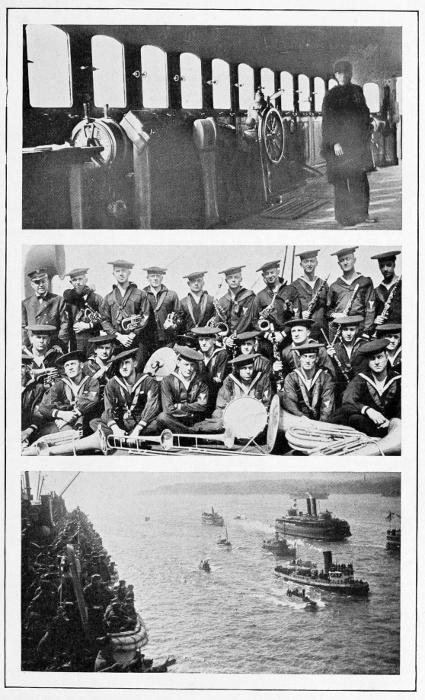
Upper—The Helmsman.
Center—The Band.
Lower—The Home Coming of the 27th Division.
- Abell, Henry Frank, Jr.
- Abraham, Leslie
- Albert, Alexander
- Ackerman, Ralph
- Adams, James A.
- Adams, William A.
- Adley, Michael Joseph
- Allen, Warren R.
- Anderson, Frederick Edw.
- Anderson, Harry E.
- Andras, Joseph, Jr.
- Anthony, Robert W.
- Archer, John Joseph
- Arent, Stephen T.
- Armstrong, Frank
- Armstrong, William V.
- Arvidson, Milton E.
- Bahnsen, Henry A.
- Balaz, Joseph Patrick
- Barclay, Reginald
- Barr, Charles Morris
- Barr, Eugene Wendil
- Bartlett, Donald A.
- Basler, Loren H.
- Bean, Otis E.
- Beck, Alvin
- Beck, Barney
- Bedale, Joseph Hillman
- Beeler, James Madison
- Behman, August Scott
- Behrend, Harry G.
- Bell, Thomas
- Benson, Freeman Leroy
- Bent, James Edward
- Bertenshaw, Earl
- Berry, Peter Joseph
- Best, Charles F.
- Biagiotti, Victor
- Bielfield, Richard James
- Bigelow, Ralph Brown
- Bingley, Ellis S.
- Biondi, Nicholas
- Blackburn, Roy James
- Blaney, Harold J.
- Bledsoe, Roy T.
- Bligh, Alfred Aloysius
- Boarman, Francis Herbert
- Bogart, Humphrey DeForest
- Bohrer, Glenn H.
- Boone, Charlie Earl
- Bopp, Harold
- Bourgeois, Edgar
- Bowens, Fred
- Bowles, Thomas V.
- Block, Edgar Deane
- Blumfield, Morris
- Bowdoin, Clayton
- Boyce, Richard, Jr.
- Boyd, Thomas, Jr.
- Boyle, William G.
- Brachat, August
- Branden, Sigurd
- Bradshaw, Claude Henry
- Breen, Lawrence B.
- Breiman, John
- Breitschuh, Edward
- Brewer, Frank F.
- Brinkman, Frederick
- Brinton, Harold
- Brooks, Alfred E.
- Brooks, Valentine C.
- Brown, George R.
- Brown, Lawrence S.
- Brown, Walter
- Brown, William Leroy
- Browning, Joe D.
- Broome, Ronald
- Brown, Ebna
- Brucker, Reuben
- Bruns, Harry
- Buckley, Charles Henry
- Buford, William H.
- Bullington, Preston G.
- Bulmer, Albert T.
- Burke, Thomas F.
- Bushenville, Moses J.
- Byrns, Edward Thorn
- Cahn, Harvey Newman
- Calamia, Bertram Plaint
- Caldwell, Patrick F.
- Calhoun, John W.
- Campbell, Theodore J.
- Canady, Jesse James
- Canavan, John Mooney
- Canzler, Eugene
- Carreiro, Manuel P., Jr.
- Carroll, Martin H.
- Carson, Beauregard E.
- Cassavant, Henry B.
- Carter, Harry B.
- Carter, William F.
- Cass, Stewart E.
- Catsiff, Harry I.
- Cenedella, Charles M.
- Chamberlain, Fred A.
- Chambers, Lannie
- Chase, Randolph M.
- Chenkin, Saul
- Chick, Charles E.
- Christmas, Harold
- Christmas, Robert
- Chrysler, Howard M.
- Clancy, Kenneth Henry
- Clark, Glenn Arnold
- Clark, Raymond Vincent
- Clark, Sumner
- Clevenger, Thomas
- Clifton, Bennie A.
- Cline, Joseph B.
- Coffman, Carleton C.
- Cohan, Henry
- Cohen, Archie
- Cole, Francis E.
- Coleman, Grant
- Collier, Albert L.
- Combes, Tandy Y.
- Conley, Lyndon E.
- Conlon, Hugh M.
- Conover, Harry Lester
- Conway, Joseph Edward
- Cooney, Elwood Patrick
- Cooper, Richard F.
- Cooper, Wendell Earl
- Corey, Brayton Curtis
- Cowley, Joseph P.
- Cox, Raymond C.
- Coyle, James Joseph
- Craycraft, George H.
- Cross, Emil John
- Culler, Paul Arthur
- Cunha, Toney
- Curfman, Albert J.
- Currie, Merton Charles
- Curry, Thomas James
- Curtis, Charles Menzo
- Cushman, Clarence Chas.
- Dailey, Walter A.
- Dalbey, Henry C.
- Dale, George G.
- Dalton, Harry M.
- Dalzell, Lloyd Hunter
- Daniell, Wm. Lawrence
- Danielson, Christian M.
- Darling, James Jouett
- Dauch, Frederick Wm.
- Daugherty, Harold J.
- Davis, Arthur D.
- Davis, Carter H.
- Davis, Charles O.
- Davis, Edward C.
- Davis, John Philip
- Dean, James Edward
- Debusk, Harvey Clay
- DeCremy, Loretto
- Deering, Charles J.
- Delaney, Henry J.
- Demarah, Richard A.
- Denison, George
- Depelio, Joseph
- Derrick, Clarence L.
- DeSousa, Albert M. R.
- DeSenso, Arthur Joseph
- Dery, Cyrus Camille
- Dewdney, Harry
- Dilena, Ernest T.
- Divine, Dewey James
- Donaghue, Valentine M.
- Donnelly, William P.
- Dodge, Victor Raymond
- Doody, William
- Doran, Joseph F.
- Doughty, Royal Freemont
- Douglas, Otha Wilbur
- Dowling, John Francis
- Drennan, Everett
- Dribben, Charles K.
- Duckett, William Henry
- Duerr, Bernard A.
- Duffy, Charles Rall
- Duggan, Raymond Wm.
- Dumpprope, William B.
- Dunn, Harrison
- Dunphy, Augustine M.
- Easter, Roswell R.
- Eckert, John Burns
- Eckhardt, George C.
- Eddy, John Lawson
- Eddy, George Roberts
- Elefant, Harvey
- Ellis, Steve
- Ells, Marshall Redonte
- Evans, Clarence S.
- Eveland, Orville LeRoy
- Fagan, John James
- Farrar, Raymon S.
- Farrell, Albert Grover
- Faulkner, Henry O.
- Favicchio, Michelle
- Fawcett, Thomas, Jr.
- Felsch, John A.
- Fenicehia, Mariano
- Fenimore, Michael J.
- Fidel, Paul Bernard
- Fiddelke, Herbert John
- Field, Donald E.
- Field, Keith Joy
- Fields, Carl T.
- Finely, Louis Wilford
- Firchau, William H.
- Fitzgerald, Alphonsus
- Fitzpatrick, Edward A.
- Fitzimmons, John F.
- Fiytok, Frank
- Flanagan, Joseph Patrick
- Fleming, John Joseph
- Fleming, Everett F.
- Fletcher, David W.
- Flitton, Alton Lee
- Flynn, Daniel C.
- Flynn, James Francis
- Fontaine, Emile Roul
- Foster, Clarence L.
- Foster, Perry Lee
- Foutch, Jay B.
- Freda, Dominick
- Freeman, Willard Albert
- Frederick, Arthur
- French, Harry Arthur
- French, William T.
- Freund, Albert J.
- Freyburger, Roy L.
- Fricker, Albert B.
- Friesch, Steve J.
- Fromme, Arthur Carl
- Frook, Floyd
- Frost, Frank
- Frost, Percy A.
- Frost, Raymond J.
- Fuller, Frank N.
- Galbreath, Lawrence B.
- Gallaspie, Hubert E.
- Gajzik, Joseph Francis
- Gallagher, John Wallen
- Gallagher, Raymond
- Gallagher, William Geo.
- Gall, Frederick Henry
- Gamble, George F.
- Gardinier, Ted
- Garland, Joseph H.
- Gary, Frederick Samuel
- Geldersma, Dewey
- Giardina, Giuseppe
- Giglio, Vincent
- Gilbert, Davis L.
- Gillane, Thomas John, Jr.
- Gitlitz, Louis
- Gochnaur, Walter Alfred
- Goings, Howard
- Goldman, Adolph Arthur
- Good, Earle V.
- Good, Fred I.
- Gordon, Nelson
- Gould, Harold T.
- Gordon, Herbert James
- Gorman, Kenneth J.
- Grady, Patrick L.
- Gramling, George F.
- Gray, David
- Gregory, Edward
- Gregory, Lawrence Alex.
- Gregg, Charles P.
- Griffin, William L.
- Grimshaw, William H.
- Guadagno, Thomas
- Guernsey, Frederick S.
- Guerrero, Eusebio
- Guisness, Carl Earl
- Hagelstein, Kingston B.
- Haire, Homer H.
- Halek, Frank Joseph
- Hall, Ozin
- Halliday, Charles W.
- Hamlin, Paul A.
- Handlowitch, Michael
- Hanke, Edward H.
- Hannon, Daniel Edward
- Hansen, Charles Theodore
- Hanson, Henry August
- Hardt, Frank J.
- Harris, David Earl
- Hartigan, William Raymond
- Hayes, Julian
- Hebb, Allen
- Hecker, Stanley E.
- Hedge, Clayton D.
- Hedlander, Robert L.
- Heine, Harry
- Helcamp, Will
- Henopp, Adam
- Henry, John Leonard
- Hensley, George C.
- Henzel, William
- Hermann, William E.
- Herring, Frank J.
- Herron, Elmer Ernest
- Herzog, William
- Heyman, John So.
- Hicks, Ralph Waldo
- Hill, Frederick C.
- Hill, Joseph T.
- Hill, Harold Joseph
- Hillman, Calman
- Hills, Clifford A.
- Hochstein, Samuel
- Hock, Frank H.
- Hoenig, Louis H., Jr.
- Holland, Monroe M.
- Holley, Robert
- Holmes, Harry Jay
- Horwitz, Abraham
- Holt, Archibald G.
- Hopper, William Edwin
- Horn, Thomas A.
- Hough, Irving Clermont
- Houser, William Geo.
- Houting, Charles
- Howard, Charles Joseph
- Howard, James Francis
- Howe, Joshua Brewster
- Hubert, Ralph S.
- Hudson, Thomas F.
- Hughes, John Vincent
- Hunter, James H.
- Huston, Louis D.
- Huston, Sherman C.
- Hutchins, Earl Stanley
- Hutchinson, John Niel R.
- Hutson, Arthur
- Hyde, Louis H.
- Iacono, Joseph A.
- Immediato, Ralph Joseph
- Imperial, Joseph T.
- Israel, Samuel E.
- Isreall, Roy John
- Jacobsen, William J.
- James, Walter A.
- Johansen, John J.
- Johnson, Alfred M.
- Johnson, Henry B.
- Johnson, Oliver W.
- Johnson, Raymond Carl
- Jones, Frederick John
- Jordon, Richard D.
- Josephs, David
- Joyce, Martin Francis
- Kadish, Joseph
- Kaiser, Victor L.
- Kalinoski, Edward
- Kandel, Moses
- Karlewitz, Anthony
- Keahon, Patrick Henry
- Kearney, Kenneth John
- Kearns, Thomas J.
- Keck, Ralph Frederick
- Kee, Oliver A.
- Kelle, Arthur E.
- Kellar, Milton Russell
- Kelly, Michael W.
- Kelsey, Joseph K.
- Kennedy, Malcolm E.
- Kerwin, William D.
- Kest, Saul
- Keville, John
- Kientzle, Emmett Jos.
- King, Charles Elmer
- King, Gerald A.
- King, Hillyer Clark
- King, John Rinehart
- King, Melvin E.
- Kinney, Harry J.
- Kirby, Forest Whitfield
- Kirkland, Roy Henderson
- Kissinger, William Henry
- Klan, Charles Jacob
- Kligeld, Jacob
- Klipp, Carl
- Knight, Winfield Westcott
- Knoth, George, Jr.
- Kobusch, Walter Henry
- Koch, Charles
- Kono, Lewis C.
- Konwiczka, Louis S.
- Koster, Richard D.
- Krahenbuhl, William J.
- Kral, Charles F.
- Kratochvil, Fred H.
- Kress, Louis Charles
- Kretz, John Henry
- Kulis, Joseph
- Kwasny, Edward
- Laird, James
- Laird, William John
- Lambert, Joseph E.
- Landis, Oliver Dockery
- Langdon, William
- Langhouser, Joseph A.
- Langley, Frank, Jr.
- Larson, Albert Andrew
- Larson, Frederick Harry
- Lawrynowicz, John F.
- Lazarus, Thomas
- Ledamun, Arthur
- Lee, Christopher Joseph
- Lemasters, Everett M.
- Levey, Norman B.
- Lewin, Edward
- Lewis, Comer John
- Lightell, Frank
- Lind, Curtis P.
- Lindahl, Harry Anderson
- Linn, Otto M.
- Lippincott, Ralph
- Lisdero, Valentine
- Littleton, William
- Lockwood, Willis A.
- Loftin, Orden G.
- Loftus, John Joseph
- Loguidice, Thomas
- Longobardi, John
- Loper, Ira B.
- Lotzgeselle, Justis
- Loughrey, Thomas E.
- Lundberg, Gustaf F.
- Lynch, James J.
- Lynch, Jeremiah M.
- Lyons, John W.
- Lyons, William D.
- McBride, Peter
- McCabe, Francis Sheldon
- McClary, George R.
- McCormac, Joseph P.
- McCorkle, Pope
- McCreight, Roy
- McCurdy, Thomas
- McElligott, John Joseph
- McEvoy, John J.
- McGee, James V.
- McGinnes, Eugene W.
- McGuire, Thomas F.
- McKinely, Hugh E.
- McKinney, Charles H.
- McManus, Charles B.
- McManus, Francis
- McMillan, David S.
- McMurdy, Harmon
- McNenny, Francis S.
- McNesby, Albert J.
- McReynolds, Wm. J.
- McWhorter, William D.
- Mack, Percy F.
- Mackenstadt, Herbert A.
- MacLaren, Norman A.
- Madore, Arthur
- Mahery, Harold A.
- Mahon, Daniel Francis
- Mahoney, James J.
- Maley, William, Jr.
- Maloney, Thomas
- Manchester, Gail H.
- Maracek, Stephen J.
- Marc Aurele, Donald
- Marien, Leo
- Marinello, Accurso
- Martin, Frederick C.
- Martin, Maxwell M.
- Martin, Thomas
- Martin, Fred E.
- Martino, Marco
- Martinson, Melvin N.
- Mason, Max Arnold
- Melfi, Philip
- Menck, Ray R.
- Melville, Clarence B.
- Mertz, Charles C.
- Meyers, George A.
- Miller, Earl M.
- Miller, Forest E.
- Miller, Hugh Leonard
- Miller, Ralph Edgar
- Miller, William W.
- Millet, Hylton Berchman
- Millet, Patrick
- Mitchell, George Clayton
- Monahan, Thomas
- Montgomery, William E.
- Moore, Edward
- Moore, Richard Morris
- Moore, Walter Thomas
- Moran, Eugene, Jr.
- Morgan, Charles William
- Morris, Walter J.
- Moross, Arthur William
- Mullins, Cecil Emerson
- Mulloy, John W.
- Murphy, Albion P.
- Murphy, Daniel Paul
- Murphy, William U.
- Murrain, Alec. Turner
- Murray, James P.
- Murray, William J.
- Napierala, Ignatius J.
- Nebel, Peter V.
- Nee, James A., Jr.
- Neely, John T.
- Neff, John White
- Nelson, Edward L.
- Nelson, John
- Nelson, Daniel H.
- Nett, Alfred
- Newsom, Frank Martin
- Nix, Joseph Patrick
- Nolan, Edward L.
- North, Reginald W.
- Nutting, William A.
- Oakley, Edwin L.
- O’Brien, Alfred E.
- O’Brien, John J.
- O’Connor, John Vincent
- Oldfather, Walter Emmett
- Ojeska, Albert
- Olsen, Elmer O.
- O’Malley, Peter John
- O’Marah, George R.
- Osborne, Silas Peter
- O’Shea, Martin
- Palmer, John J.
- Parnin, Eugene E.
- Parsons, Edgar Jesse
- Partridge, Harry
- Paston, John Rae
- Patton, Thomas Thompson
- Persse, George G.
- Peckham, Albert F.
- Peden, Herman Alexander
- Penzick, Moses
- Perkins, Percy B.
- Perron, Adolphe
- Perry, Arthur
- Peterson, Sam Sanborn
- Peterson, Alexander B.
- Phillips, John Lilburn
- Philippson, Abraham P.
- Piacine, Joseph Francis
- Pickard, Gilbert A.
- Pickell, Ernest James
- Pilcher, Lloyd W.
- Pitscner, Gustave
- Plank, Lewis
- Polland, Walter
- Pollock, William
- Pope, Harvey Peter
- Porter, Frank L.
- Post, Leroy R.
- Pristash, John
- Provan, Francis H.
- Provencher, Frank
- Pucklitsch, Arnold
- Puderbaugh, Walter A.
- Quinn, Louis Estel
- Rabinowitz, Mike
- Randall, Arthur L.
- Rayford, James Miller
- Raynor, Clarence K.
- Rebman, Bert
- Reckinger, Raymond M.
- Reynolds, Rufis Arvin
- Rhynders, Floyd
- Richards, Frederick A.
- Richmond, Ralph W.
- Riker, Leonard W.
- Riley, Leo Orvid
- Riordan, Thomas Francis
- Ritchotte, Edgar A.
- Rizzolo, Leonard Aloysius
- Robinson, Robert H.
- Roosa, John Moses
- Rosenberg, David
- Rude, Charles
- Ruger, Benjamin Franklin
- Russell, Christopher A.
- Ryan, Frank
- Ryan, John J.
- Ryan, William Joseph
- Sacks, Nathan
- Salerno, Anthony
- Salk, Emil John
- Sandell, William H.
- Sanders, Jewell Gaskill
- Sandford, Joseph, Jr.
- Satcher, Thomas E.
- Satterfield, Lucian Earl
- Scarborough, Lennie M.
- Schoenbeck, William Carl
- Schrafel, Joseph A.
- Scott, Walter John
- Secore, Bartow
- Schimpf, Joseph G.
- Schlessinger, Edward L.
- Schorck, Frederick, Jr.
- Schmitt, Walter Dewald
- Schneider, Fred W.
- Schultz, Anthony
- Schulz, Herman Charles
- Seeber, Fred J.
- Segerstrom, Raugnar Seifert
- Shaw, Vivian Alonzo
- Shea, Bernard J.
- Sheehan, James
- Shepherd, Thomas F.
- Seidel, Charles
- Sheridan, Thomas Bradford
- Shymansky, Joseph Peter
- Silberstang, Isidore
- Sillcox, Wilden B.
- Siminski, Stanley
- Simmons, Henry G.
- Simon, Elias
- Sims, Robert Lloyd
- Sims, Roy Devine
- Sister, Tony
- Smith, Alfred Ferris
- Smith, Horace Frederick
- Smith, Doane White
- Smith, Ephraim H.
- Smith, James F.
- Snyder, Melville A.
- Snyder, Robert W.
- Solan, Bernard Joseph
- Solleridge, Samuel
- Sorge, Gustave, Jr.
- Sourbrine, Amos James
- Sousire, Peter
- Southgate, Harold
- Spencer, Roy Franklin
- Spinnelli, Morto
- Staker, Christopher Wm.
- Stallberger, Edward John
- Stanford, Walter W.
- Stanley, Omer Adria
- Steidl, Hugh Joseph
- Stiles, David McCormack
- Stockinger, Christian W.
- Stokes, Edward J. V., Jr.
- Stolfors, Martin
- Stone, Edward Hannon
- Stover, Robert A.
- Strecker, Charles Joseph
- Stromwall, Ernest Harold
- Stubblefield, Clyde
- Sturtz, Lloyd A.
- Sullins, Elza V.
- Sullivan, John Lauren
- Sullivan, Robert E.
- Suter, Arnold L.
- Swanson, Leonard Nels
- Tarches, Benjamin E.
- Tardieu, Ernest James
- Tassi, William J.
- Taylor, Charles H.
- Teeling, John Francis
- Terwilliger, Raymond G.
- Tessens, Joseph A.
- Thelen, Cecil Ray
- Thomas, Kenneth Champion
- Thomas, Gerald H.
- Thomas, Stanley T.
- Thomas, William T.
- Tighe, Thomas, Jr.
- Tobin, Harold
- Tollison, James Frank
- Toole, Alfred Wallace J.
- Turkus, Andrew George
- Turner, Rommie E.
- Twist, Edward Hiram
- Underwood, Goebel
- Valla, James
- Vanderbrandt, John
- Vandervelde, Marcel H.
- Van Vliet, Roy
- Varner, Fred
- Viggiano, Dominick
- Waggoner, Robert B.
- Wagner, Charles A.
- Walker, Ernest Sylvester
- Walker, Floyd
- Walker, Fred Wm.
- Walker, Henry C.
- Waldrop, Cloney Oren
- Walsh, Albert A.
- Walsh, Patrick
- Walsh, Stephen
- Walters, Abram B.
- Warner, John F.
- Weaver, Walter William
- Weber, Adam
- Weed, David S.
- Weigel, Harry Henry
- Weisberger, Maurice
- Weiss, Charles Leonard
- Werle, John William
- Wexler, William
- Whaley, Vilas Henry
- Wharton, Jack
- White, Albert G.
- Whitehurst, Bertram G.
- Wiggins, William H., Jr.
- Wilkins, Tom Walker
- Wilkinson, William S.
- Willers, George A.
- Williams, Axel L.
- Williams, David M.
- Williams, James F.
- Williams, Onel Oren
- Williamson, Francis E.
- Williamson, Robert A.
- Wilson, Lawrence Edward
- Winans, Harold Paul
- Winslow, Eugene W.
- Wise, George William
- Wishinsky, Louis
- Wisker, John G.
- Witherspoon, Albert Amber
- Witte, William Bernard
- Wolfe, Arthur G.
- Wood, Jesse Eugene
- Woods, Walter Harry, Jr.
- Wright, Lyle H.
- Zammataro, Frank
- Zanitsky, Solomon
- Zazzarino, Leo
- Zezulak, John
- Zuccaro, Joseph
- Gun Captain—Canzler, E., BM1c; Fanning, J. P., Cox.
- Pointer—Lynch, J. J., Sea.; Halek, F. J., Sea.
- Trainer—Moorehouse, H. F., Sea.; Motley, B. D., S2c.
- Sightsetter—Blackburn, R. J., Sea.; Gray, R., Sea.
- Rammerman—McLeod, C. P., Sea.
- 1st Shellman—Avery, I., Sea.; Lynch, J. J., S2c.
- 2nd Shellman—Atsma, L. W., Sea.
- 3rd Shellman—Boss, G. D., Sea.
- 1st Powderman—Brown, W. L., Sea.
- 2nd Powderman—Anderson, H. R., Sea.
- Voice Tubeman—Grey, R., Sea.
- Trayman—Halle, J. G., Sea.
- Gun Captain—Bradley, P. R., Cox.
- Pointer—Wilburn, P. R., Sea.
- Trainer—Chisholm, J. A., Sea.
- Sightsetter—Loftus E. J., Sea.
- Trayman—Guernsey, F. S., Sea.
- Rammerman—Stanley, O. A., Sea.
- 1st Shellman—DeBusk, H. C., Sea.
- 2nd Shellman—Bazin, A., Sea.
- 3rd Shellman—Croushorn, G. D., Sea.
- 1st Powderman—Hutchins, C. E., Sea.
- 2nd Powderman—Boyce, R., Sea.
- Voice Tubeman—Seaquist, C. F., Sea.
- Gun Captain—Biagotti, V. E., BM2c.
- Pointer—Brandon, L. A., Sea.; Rizzolo, L. A., Sea.
- Trainer—Meyers, W. A., Sea.
- Sightsetter—Strecker, C. J., Sea.
- Trayman—Cooper, W. C, Sea.
- Rammerman—Engle, W. F., Sea.
- 1st Shellman—Carter, H. B., Sea.
- 2nd Shellman—Dietrick, W. H., Sea.
- 3rd Shellman—Higgenbotham, G., Sea.
- 1st Powderman—Dilena, E. F., Sea.
- 2nd Powderman—Littleton, W., Sea.
- 3rd Powderman—Goings, H., Sea.
- Voice Tubeman—Bledsoe, R. T., Sea.; Carter, J. B., Sea.
- Gun Captain—Clark, J. F., Cox.
- Pointer—Meyers, G. A., Sea.; Dwyer, J. J., Sea.
- Trainer—King, C. E., Sea.
- Sightsetter—Boyd, T., Sea.
- Trayman—Davis, J. J., Sea.
- Rammerman—Kretz, J., Sea.
- 1st Shellman—Fitzgerald, A. R., Sea.
- 2nd Shellman—Benford, W. F., Sea.
- 3rd Shellman—Flemming, A. J., Sea.
- 1st Powderman—Barefield, T. K., Sea.
- 2nd Powderman—Feeney, J. F., Sea.
- Voice Tubeman—Snyder, R. W., Sea.
- Gun Captain—Canfield, W. J., BM1c.
- Pointer—Gagnon, C. A., Sea.; Blackwood, L. E., Sea.
- Trainer—Hennesey, J. F., Sea.
- Sightsetter—Sturtevant, J. F., Sea.
- Trayman—Nutting, W. A., Sea.
- Rammerman—Marcoux, D., Sea.
- 1st Shellman—Keahon, P. H., Sea.
- 2nd Shellman—Cox, R. G., Sea.; Dobson, W. E., S2c.
- 1st Powderman—Brown, H. S., Sea.
- 2nd Powderman—Dailey, B. J., Sea.; Murray, G., Sea.
- 3rd Powderman—Hendrix, T., Sea.
- Voice Tubeman—Witherspoon, A. A., Sea.
- Gun Captain—Abell, H. F., Cox.
- Pointer—Kirkland, R. H., Sea.
- Trainer—McClary, G. R., Sea.
- Sightsetter—Magann, F. X., Sea.
- Trayman—Garner, C. E., Sea.
- Rammerman—Wehman, F., Sea.
- 1st Shellman—Gordon, H. J., Sea,
- 2nd Shellman—Klipp, C, Sea.
- 1st Powderman—Duckett, H. W., Sea.
- 2nd Powderman—Cope, T. W., Sea.
- 3rd Powderman—Bingley, E. S., Sea.
- Voice Tubeman—Traccey, P. L., Sea.
- Gun Captain—Esser, C. A., Cox.
- Pointer—Thomas, W. T., Sea.
- Trainer—Cameron, W. G., Sea.
- Sightsetter—McNenny, F. S., Sea.
- Trayman—Dyer, B., Sea.
- Rammerman—Stockinger, C. W., Sea.
- 1st Shellman—Howe, J. B., Sea.
- 2nd Shellman—Duschuttle, L. E., Sea.
- 3rd Shellman—Polland, W. Sea.
- 1st Powderman—Crapps, C., Sea.
- 2nd Powderman—Landis, O. D., Sea.; Cavey, H., Sea.
- 3rd Powderman—Howery, C. L., Sea.; Stevens, W. B., Sea.
- Voice Tubeman—Ashley, J., Sea.; Abells, W. R., Sea.
- Gun Captain—Chapman, A., BM1c.; Wherry, J. B., Cox.
- Pointer—Olsen, E. A., Cox.
- Trainer—Whitehurst, B. G., BM2c.
- Sightsetter—LaValle, F. R., Cox.
- Trayman—Urban, A., Cox.
- Rammerman—Durkin, R. J., Sea.
- 1st Shellman—Stokes, E. J. J. V., S2c.; Stanford, W. W., Sea.
- 2nd Shellman—Simmons, H. G., Sea.
- 1st Powderman—Martin, W., Sea.
- 2nd Powderman—Kelley, W., Sea.
- 3rd Shellman—Borrello, L. R., Sea.
- Voice Tubeman—Winslow, E. W., Sea.
| Bahnsen, H. A. |
Sea. |
| Primrose, A. H. |
Sea. |
| Fellona, J. A. |
S2c. |
| Hamke, E. H. |
Sea. |
| Ganley, J. B. |
Sea. |
| Houting, C. |
Sea. |
| Bachmier, C. G. |
Sea. |
| Crowley, J. T. |
Sea. |
| Sampson, W. D. |
Sea. |
| Gillane, T. J. |
Sea. |
| Bonner, C. A. |
Sea. |
| Herr, J. H. |
Sea. |
| Fillipski, S. F. |
Sea. |
| Brownell, H. L. |
Sea. |
| Finley, R. M. |
Sea. |
| Prochaska, J. |
Sea. |
| Bull, F. W. |
Sea. |
| Gwynn, O. |
Sea. |
| Manning, E. J. |
Sea. |
| Boiden, C. |
Sea. |
| Alton, L. S. |
Sea. |
| Taylor, C. H. |
Sea. |
| Duff, G. L. |
Cox. |
| Roylance, W. |
Sea. |
| Southgate, H. |
Sea. |
| Curry, T. J. |
Sea. |
(From The Transport Ace, Newspaper printed on board the “Leviathan”)
The following comparison shows the number of round trips made,
and the number of troops carried to Europe, by the fifteen leading
transports up to the time the Armistice was signed, November 11, 1918.
| Ship |
No. of
round
trips |
Largest
No. in
one trip |
Total
troops
carried |
| Leviathan |
10 |
10,860 |
119,215* |
| George Washington |
9 |
5,529 |
46,159 |
| President Grant |
8 |
5,811 |
44,182 |
| America |
9 |
5,327 |
39,674 |
| Agamemnon |
10 |
4,917 |
35,026 |
| Mount Vernon |
9 |
4,763 |
33,549 |
| Great Northern |
10 |
3,058 |
27,590 |
| Aeolus |
8 |
3,551 |
24,327 |
| President Lincoln |
5 |
4,888 |
23,438 |
| Northern Pacific |
10 |
2,755 |
21,903 |
| Martha Washington |
8 |
3,055 |
21,900 |
| Covington |
6 |
4,133 |
21,754 |
| Princess Matoika |
6 |
3,865 |
21,163 |
| Huron |
8 |
2,917 |
20,771 |
| Pocahontas |
9 |
2,920 |
20,474 |
* The total of 119,215 for the Leviathan includes Naval Supernumeraries and
crew carried on the first ten Eastbound trips. The present voyage makes the 14th
round trip for this vessel.
The greatest number of persons carried by the Leviathan was on
our sixteenth westbound trip when we had on board (including Naval
Crew), a total of 14,300 persons.
| A.M. |
|
| 4:00 |
Call ship’s cooks of the watch. |
| 4:30 |
Fires started in running steamer. |
| 4:45 |
Call masters-at-arms, boatswain’s mates, buglers and hammock stowers. |
| 5:00 |
Reveille. Call all hands, pipe “up hammocks,” serve out coffee;
light the smoking lamp. |
| 5:15 |
Haul over hammock cloths and stop them down. Master-at-arms report
decks clear of hammocks. |
| 5:20 |
Pipe sweepers. Sweep down thoroughly before decks are wet. |
| 5:30 |
Turn to. Out smoking lamp. Execute morning orders. Stow away ditty
boxes; clear lower decks. Five minutes before sunrise, station men
for turning off anchor, boom and gangway lights. Scrub clothes. |
| 6:00 |
Knock off scrubbing clothes; trice up lines; hoise ashes. |
| 6:45 |
Take off gun covers and hatch hoods, unless the weather is foul.
Hammock stowers haul back hammock clothes. |
| 7:00 |
Up all hammocks. |
| 7:15 |
Mess gear. Light smoking lamp. Publish uniform of the day. |
| 8:00 |
Colors. |
| 8:15 |
Turn to; out smoking lamp. |
| 8:30 |
Sick call. |
| 8:45 |
Retreat from bright work. Sweep down. Stow away all wash deck gear
and all ditty boxes. Clear up the deck for quarters. |
| 9:10 |
Officers’ Call. Divisions fall in for muster. |
| 9:15 |
Quarters for muster and inspection. Physical drill followed by
the drill prescribed. |
| 11:30 |
Retreat from drill. Pipe down scrubbed clothes, if dry. Sweep
down. Light smoking lamp. Mast for reports and requests. |
| M. |
|
| 12:00 |
Dinner. |
| P.M. |
|
| 12:30 |
Band call; band concert till 1:00. |
| 1:00 |
Turn to. Out smoking lamp. Pipe sweepers. Pipe down aired bedding,
if up. Pipe down wash clothes, if dry. |
| 1:30 |
Drill call. |
| 2:30 |
Retreat from drill. Turn to. |
| 4:00 |
Knock off work. Pipe down clothes, if up. Sweep down. Light smoking lamp. |
| 5:30 |
Clear up decks. Stow away ditty boxes. |
| 5:45 |
Mess gear. |
| 6:00 |
Supper. Five minutes before sunset call guard of the day and band.
Station detail for all lights. Turn on lights at sunset. |
| 6:30 |
Turn to. Pipe sweepers. Wet down after main-decks for scrubbing clothes. |
| 7:30 |
Hammocks. No smoking below the main decks. |
| 8:00 |
Muster the anchor watch. Searchlights and signal drills, if ordered. |
| 8:30 |
Trice up the clothes lines. |
| 8:55 |
First call; out smoking lamp. |
| 9:00 |
Tattoo. Pipe down. Silence. Muster and set first anchor watch. |
| 9:05 |
Taps. |
| A.M. |
|
| 2:00 |
Relieve wheel and lookouts. |
| 3:50 |
Call the watch section. |
| 4:00 |
Relieve the watch. Muster the watch section and life boat’s crew.
Light smoking lamp. Call ship’s cooks of the watch. Five minutes
before sunrise station details at running lights. Turn off at sunrise.
Relieve lookouts and station masthead lookouts. |
| 5:00 |
Call idlers and section of the watch sleeping in. Coffee. |
| 5:20 |
Pipe sweepers. |
| 5:30 |
Turn to. Out smoking lamp. Execute morning orders. |
| 6:00 |
Relieve the wheel and lookouts. Trice up clothes lines. |
| 6:45 |
Hammock stowers haul back hammock cloths. |
| 7:00 |
Up all hammocks. |
| 7:15 |
Hammock stowers stop down hammock clothes. Mess Gear. Light smoking lamp. |
| 7:30 |
Breakfast. Shift into the uniform of the day during the meal hour. |
| 8:00 |
Relieve the watch; both sections on deck. Muster watch and life boat’s crew. |
| 8:15 |
Turn to. Out smoking lamp. Deck and gun bright work. |
| 8:30 |
Sick call. |
| 8:45 |
Knock off bright work. Sweep down. Stow away ditty boxes and wash
deck gear. Take down towel lines. Clear up decks for quarters. |
| 9:10 |
Officers’ Call. Divisions fall in for quarters. |
| 9:15 |
Quarters for muster and inspection. Physical drill and drills as prescribed. |
| 10:00 |
Relieve the wheel and masthead. |
| 11:30 |
Retreat from drill. Pipe down washed clothes, if dry. Sweep down. |
| 11:45 |
Mess gear. |
| M. |
|
| 12:00 |
Dinner. |
| P.M. |
|
|
| 12:30 |
Relieve the watch. |
| 1:00 |
Turn to. Pipe sweepers. Out smoking lamp. |
| 1:45 |
Abandon ship drill call. |
| 2:00 |
Relieve the wheel and masthead. |
| 2:15 |
Retreat from drill. Pipe sweepers. Turn to. |
| 3:30 |
Pipe down wash clothes, if up. |
| 4:00 |
Relieve the watch. Muster watch and life boat’s crew. |
| 4:30 |
Sweep down. Knock off ship’s work. Light smoking lamp. Five minutes
before sunset station details at running lights. Turn on running lights
with senior ship present. Station deck lookouts. Muster life boat’s crew.
Inspect life boats. |
| 5:30 |
Clear up decks. Stow away ditty boxes. |
| 5:45 |
Mess gear. |
| 6:00 |
Supper. Relieve the wheel and lookouts. |
| 6:30 |
Turn to. Sweep down. Wet down after raindeck. |
| 7:00 |
Band concert for crew until 8:00. |
| 7:30 |
Hammocks. No smoking below decks. |
| 8:00 |
Call the watch. Relieve the wheel and lookouts. Relieve the watch.
Muster watch and life boat’s crew. Turn out all but standing lights
and lights in officers’ quarters and chief petty officers’ mess room. |
| 9:00 |
Out smoking lamp. Turn out lights in chief petty officers’ mess room. |
| 10:00 |
Relieve the wheel and lookout. Turn out lights in officers’ quarters
unless an extension has been granted. |
| 11:50 |
Call the watch. |
| Midnight. |
Relieve the watch. Muster the watch and life boat crew. |
The Leviathan is 954 feet long, 100 feet beam, and, when leaving
New York, draws 41 feet 10 inches of water. Place her on Fifth Avenue
and she would spread from 42d Street across 45th Street. Stand her
on end alongside the Woolworth Building, and she would overtop the
Woolworth Building more than 50 feet. She weighs 69,000 tons; more
than twice the displacement of the world’s largest dreadnought.
She stows 8,700 tons of coal and carries 5,000 tons of fresh water.
If we would be permitted to run her at the speed she is capable of, she
would burn between 900 and 1,000 tons of coal a day. When we dock
at Hoboken she must have eighteen tug boats to assist her. She can
enter New York only on the high water, for the Ambrose Channel is not
dredged deeper than 40 feet. She can move at Hoboken only on the
slack water, for no amount of tugs could dock her at Hoboken while the
tide is running. Before the armistice she carried ten loads of troops
to Europe; about 4,500 officers and 100,000 men. Thus she has alone
handled one-twentieth of the A. E. F. Twenty Leviathans alone could
handle all the A. E. F. Alone, the Leviathan has placed in Europe
more U. S. Troops than Meade commanded at the decisive battle—Gettysburg.
Her Engineering Department requires 12 officers and 950 men.
Her Commissary Department requires 7 officers and 350 men. When
you have roast beef they have to cut up 40 steers.
During the war, on the eastward voyage, the Commissary Department
has fed 10,000 troops in 70 minutes, and at that permitting men
to come back for the second.
Even if the East River were deep enough her funnels are six feet
too high to go under the East River bridges.
Those on the bridge stand with their eyes 87 feet above water.
Against submarines we had eight six-inch guns and a supply of depth
charges always manned; but only twice have periscopes appeared, both
times in her rear. Both times the destroyers bombed at them well.
| VOYAGE |
LEFT |
ARRIVED |
Days at Sea |
Days in Port |
PASSENGERS |
SHIP’S COMPANY |
Total on Board |
COMMANDING OFFICER |
| Troops |
N. C. O.’s |
Army Officers |
Nurses |
Civilians |
Misc’l |
Naval Super-
numeraries |
Total Passengers |
Naval Officers |
Navy Enlisted |
Misc’l |
Total Navy |
EAST
1
WEST |
New York
Dec. 15, 1917 |
Liverpool
Dec. 24, 1917 |
9 |
50 |
6839 |
Included with Troops |
277 |
138 |
... |
... |
... |
7254 |
62 |
1625 |
... |
1687 |
8941 |
CAPT. J. W. OMAN |
Liverpool
Feb. 12, 1918 |
New York
Feb. 20, 1918 |
8 |
12 |
5 |
Included with Troops |
... |
... |
... |
19 |
77 |
101 |
62 |
1625 |
... |
1687 |
1789 |
EAST
2
WEST |
New York
Mar. 4, 1918 |
Liverpool
Mar. 12, 1918 |
8 |
29 |
7695 |
56 |
439 |
... |
5 |
47 |
100 |
8342 |
59 |
1798 |
... |
1857 |
10199 |
CAPT. H. F. BRYAN |
Liverpool
Apr. 10, 1918 |
New York
Apr. 17, 1918 |
7 |
7 |
5 |
... |
... |
... |
... |
37 |
204 |
246 |
58 |
1789 |
2 |
1849 |
2095 |
EAST
3
WEST |
New York
Apr. 24, 1918 |
Brest
May 2, 1918 |
8 |
3 |
8208 |
97 |
361 |
229 |
13 |
1 |
443 |
9352 |
65 |
1986 |
1 |
2052 |
11404 |
CAPT. H. F. BRYAN |
Brest
May 5, 1918 |
New York
May 12, 1918 |
7 |
10 |
14 |
... |
... |
... |
3 |
8 |
44 |
69 |
65 |
1984 |
2 |
2051 |
2120 |
EAST
4
WEST |
New York
May 22, 1918 |
Brest
May 30, 1918 |
8 |
2 |
9944 |
111 |
399 |
99 |
17 |
7 |
736 |
1313 |
65 |
1960 |
3 |
2028 |
13341 |
CAPT. H. F. BRYAN |
Brest
June 1, 1918 |
New York
June 8, 1918 |
7 |
7 |
25 |
... |
... |
... |
1 |
7 |
1 |
34 |
64 |
1972 |
1 |
2037 |
2071 |
EAST
5
WEST |
New York
June 15, 1918 |
Brest
June 22, 1918 |
7 |
2 |
9833 |
149 |
395 |
... |
2 |
21 |
743 |
11143 |
62 |
1949 |
2 |
2013 |
13156 |
CAPT. H. F. BRYAN |
Brest
June 24, 1918 |
New York
July 1, 1918 |
7 |
7 |
14 |
... |
... |
... |
31 |
3 |
... |
48 |
62 |
1949 |
1 |
2012 |
2060 |
EAST
6
WEST |
New York
July 8, 1918 |
Brest
July 15, 1918 |
7 |
3 |
9944 |
138 |
437 |
... |
8 |
18 |
448 |
10993 |
63 |
1932 |
1 |
1996 |
12989 |
CAPT. H. F. BRYAN |
Brest
July 18, 1918 |
New York
July 25, 1918 |
7 |
9 |
183 |
... |
79 |
... |
72 |
... |
383 |
717 |
62 |
1932 |
1 |
1995 |
2712 |
EAST
7
WEST |
New York
Aug. 3, 1918 |
Brest
Aug. 11, 1918 |
8 |
2 |
10305 |
94 |
482 |
... |
3 |
12 |
518 |
11414 |
63 |
2080 |
1 |
2144 |
13558 |
CAPT. H. F. BRYAN |
Brest
Aug. 13, 1918 |
New York
Aug. 20, 1918 |
7 |
11 |
204 |
16 |
321 |
... |
25 |
8 |
141 |
715 |
64 |
2079 |
1 |
2144 |
2859 |
EAST
8
WEST |
New York
Aug. 31, 1918 |
Brest
Sept. 7, 1918 |
7 |
5 |
9953 |
78 |
407 |
99 |
... |
5 |
597 |
11139 |
68 |
2154 |
1 |
2223 |
13362 |
CAPT. H. F. BRYAN |
Brest
Sept. 12, 1918 |
New York
Sept. 19, 1918 |
7 |
10 |
300 |
25 |
125 |
2 |
99 |
33 |
38 |
622 |
68 |
2150 |
1 |
2219 |
2841 |
EAST
9
WEST |
New York
Sept. 29, 1918 |
Brest
Oct. 7, 1918 |
8 |
2 |
8839 |
34 |
260 |
191 |
2 |
1 |
254 |
9587 |
64 |
2157 |
1 |
2222 |
11809 |
CAPT. W. W. PHELPS |
Brest
Oct. 9, 1918 |
New York
Oct. 17, 1918 |
8 |
10 |
260 |
19 |
96 |
2 |
11 |
66 |
49 |
503 |
64 |
2158 |
1 |
2223 |
2726 |
EAST
10
WEST |
New York
Oct. 27, 1918 |
Liverpool
Nov. 3, 1918 |
7 |
31 |
7140 |
52 |
367 |
... |
4 |
1 |
565 |
8129 |
68 |
2258 |
1 |
2327 |
10456 |
CAPT. W. W. PHELPS |
| Liverpool Dec. 4 |
Brest Dec. 5 |
1 |
3 |
3634 |
Included with Troops |
78 |
15 |
252 |
23 |
4846 |
8870 |
70 |
2278 |
... |
2348 |
11218 |
| Brest Dec. 8, 1918 |
N.Y. Dec. 15, 1918 |
7 |
40 |
|
EAST
11
WEST |
New York
Jan. 24, 1919 |
Brest
Jan. 31, 1919 |
7 |
3 |
10 |
... |
6 |
... |
19 |
1037 |
1 |
1073 |
76 |
2157 |
8 Nurses |
2241 |
3314 |
CAPT. W. W. PHELPS |
Brest
Feb. 3, 1919 |
New York
Feb. 11, 1919 |
8 |
5 |
9040 |
130 |
359 |
30 |
20 |
26 |
53 |
9658 |
76 |
2157 |
8 Nurses |
2241 |
11899 |
EAST
12
WEST |
New York
Feb. 16, 1919 |
Brest
Feb. 23, 1919 |
7 |
3 |
7 |
2 |
6 |
... |
8 |
358 |
158 |
539 |
83 |
1918 |
8 Nurses |
2009 |
2548 |
CAPT. W. W. PHELPS |
Brest
Feb. 26, 1919 |
New York
Mar. 6, 1919 |
8 |
9 |
9714 |
133 |
319 |
66 |
23 |
78 |
50 |
10383 |
84 |
1960 |
8 Nurses |
2052 |
12435 |
EAST
13
WEST |
New York
Mar. 15, 1919 |
Brest
Mar. 23, 1919 |
8 |
3 |
2 |
... |
5 |
... |
29 |
57 |
4 Officers |
97 |
73 |
2083 |
15 |
2171 |
2268 |
CAPT. W. W. PHELPS |
Brest
Mar. 26, 1919 |
New York
Apr. 2, 1919 |
7 |
5 |
11441 |
143 |
460 |
28 |
11 |
11 |
9 Officers
3 Enlisted |
12106 |
73 |
2083 |
15 |
2171 |
14277 |
EAST
14
WEST |
New York
Apr. 7, 1919 |
Brest
Apr. 14, 1919 |
7 |
4 |
3 |
... |
8 |
... |
39 |
4 |
... |
54 |
69 |
2063 |
16 |
2148 |
2202 |
CAPT. E. H. DURELL |
Brest
Apr. 18, 1919 |
New York
Apr. 25, 1919 |
7 |
... |
11442 |
172 |
409 |
... |
43 |
6 |
8 Officers |
12080 |
68 |
2091 |
18 |
2177 |
14257 |
The following list shows the number of sick and wounded transported
by the Leviathan on our return trips from Liverpool and Brest:
| Trip |
|
Trip |
|
| 1 |
0 |
9 |
271 |
| 2 |
4 |
10 |
1,429 |
| 3 |
0 |
11 |
2,132 |
| 4 |
0 |
12 |
1,251 |
| 5 |
0 |
13 |
1,152 |
| 6 |
116 |
14 |
1,263 |
| 7 |
105 |
15 |
1,091 |
| 8 |
265 |
16 |
1,090 |
| Total number carried up to date |
10,169 |
Not only did the Leviathan carry a total of 14,300 persons on
board her 16th trip, 23 more than she has ever carried before,
but her trip from Sandy Hook to Brest and return is the fastest she
has ever made.
The Leviathan cleared Ambrose Channel on May 27th at 6:56 P. M.
and arrived June 11, at 3.00 A. M., or in a total elapsed time of only
15 days 8 hours and 4 minutes. Her best previous trip was when she
did the same circuit in 15 days 15 hours and 3 minutes, sailing on May
6th and next arriving at Ambrose Lightship on May 22nd.
Previous to this, her two best round trips were those of June and
July, 1918, when the pressure of troop movement to France was at its
height. These two trips were negotiated in 16 days 0 hours and 23
minutes, and 16 days 12 hours and 12 minutes respectively.
Not only has the Leviathan carried in the 15th and 16th trips a total
of 28,412 persons against 26,145 for her two best previous trips, but her
intervening stays in Hoboken between her last two trips was only 4
days, while the Hoboken layover between her two best former trips
was seven days.
Besides this record breaking showing, the boys of the Leviathan
found enough cash to subscribe $193,000 to Uncle Sam’s Victory Loan
while the Navy’s next best ship could only put up $129,000.
The 17th round trip established a new record of 14 days and 21
hours, when she carried 4,000 Army Officers and 3,000 troops, after
a stay of 40 hours in Brest, coaling (4,500 tons) and watering (3,000
tons).
On her 19th trip westbound, she carried General John J. Pershing
and his famous composite regiment selected from the entire A. E. F.
While under the German flag, the Vaterland (Leviathan) made
only one round trip and a half. She was ready for her return trip
August 1, 1914, but was held at Hoboken when the world war broke
out, July 30 of that year.