Appendix A.
CONSTITUTION OF CALIFORNIA.
PROCLAMATION TO THE PEOPLE OF CALIFORNIA
The delegates of the people assembled in Convention,
have formed a constitution, which is now presented
for your ratification. The time and manner
of voting on this constitution, and of holding the
first general election, are clearly set forth in the schedule.
The whole subject is, therefore, left for your
unbiassed and deliberate consideration.
The Prefect (or person exercising the functions of
that office) of each district, will designate the places
for opening the polls, and give due notice of the election,
in accordance with the provisions of the constitution
and schedule.
The people are now called upon to form a government
for themselves, and to designate such officers as
they desire, to make and execute the laws. That
their choice may be wisely made, and that the government
so organized may secure the permanent welfare
and happiness of the people of the new State, is the
sincere and earnest wish of the present Executive,
who, if the constitution be ratified, will, with pleasure,
surrender his powers to whomsoever the people may
designate as his successor.
Given at Monterey, California, this 12th day of
October, A.D., 1849.
(Signed)B. Riley,
Brevet Brig. General, U.S.A., and Governor of California.
(Official)H. W. Halleck,
Brevet Captain and Secretary of State.
WE THE PEOPLE OF CALIFORNIA, GRATEFUL TO ALMIGHTY
GOD FOR OUR FREEDOM, IN ORDER TO
SECURE ITS BLESSINGS, DO ESTABLISH THIS CONSTITUTION:—
Sec. 1. All men are by nature free and independent,
and have certain inalienable rights, among
which are those of enjoying and defending life and
liberty, acquiring, possessing, and protecting property,
and pursuing and obtaining safety and happiness.
Sec. 2. All political power is inherent in the people.
Government is instituted for the protection, security,
and benefit of the people; and they have the
right to alter or reform the same, whenever the public
good may require it.
Sec. 3. The right of trial by jury shall be secured
to all, and remain inviolate for ever; but a jury trial
may be waived by the parties, in all civil cases, in the
manner to be prescribed by law.
Sec. 4. The free exercise and enjoyment of religious
profession and worship, without discrimination
or preference, shall for ever be allowed in this State;
and no person shall be rendered incompetent to be a
witness on account of his opinions on matters of religious
belief; but the liberty of conscience, hereby
secured, shall not be so construed as to excuse acts
of licentiousness, or justify practices inconsistent with
the peace or safety of this State.
Sec. 5. The privilege of the writ of habeas corpus
shall not be suspended, unless when, in cases of rebellion
or invasion, the public safety may require its
suspension.
Sec. 6. Excessive bail shall not be required, nor
excessive fines imposed, nor shall cruel or unusual
punishments be inflicted, nor shall witnesses be unreasonably
detained.
Sec. 7. All persons shall be bailable, by sufficient
sureties: unless for capital offences, when the proof is
evident or the presumption great.
Sec. 8. No person shall be held to answer for a
capital or otherwise infamous crime (except in cases
of impeachment, and in cases of militia when in actual
service, and the land and naval forces in time of
war, or which this State may keep with the consent
of Congress in time of peace, and in cases of petit
larceny under the regulation of the Legislature,) unless
on presentment or indictment of a grand jury;
and in any trial in any court whatever, the party accused
shall be allowed to appear and defend in person
and with counsel, as in civil actions. No person shall
be subject to be twice put in jeopardy for the same
offence; nor shall he be compelled, in any criminal
case, to be a witness against himself, nor be deprived
of life, liberty, or property, without due process of
law; nor shall private property be taken for public
use without just compensation.
Sec. 9. Every citizen may freely speak, write, and
publish his sentiments on all subjects, being responsible
for the abuse of that right; and no law shall be
passed to restrain or abridge the liberty of speech or
of the press. In all criminal prosecutions on indictments
for libels, the truth may be given in evidence
to the jury; and if it shall appear to the jury that
the matter charged as libellous is true, and was published
with good motives and for justifiable ends, the
party shall be acquitted: and the jury shall have the
right to determine the law and the fact.
Sec. 10. The people shall have the right freely to
assemble together, to consult for the common good, to
instruct their representatives, and to petition the legislature
for redress of grievances.
Sec. 11. All laws of a general nature shall have a
uniform operation.
Sec. 12. The military shall be subordinate to the
civil power. No standing army shall be kept up by
this State in time of peace; and in time of war no
appropriation for a standing army shall be for a
longer time than two years.
Sec. 13. No soldier shall, in time of peace, be
quartered in any house, without the consent of the
owner; nor in time of war, except in the manner to
be prescribed by law.
Sec. 14. Representation shall be apportioned according
to population.
Sec. 15. No person shall be imprisoned for debt
in any civil action on mesne or final process, unless
in cases of fraud; and no person shall be imprisoned
for a milita fine in time of peace.
Sec. 16. No bill of attainder, ex post facto law, or
law impairing the obligation of contracts, shall ever
be passed.
Sec. 17. Foreigners who are, or who may hereafter
become, bona fide residents of this State, shall
enjoy the same rights in respect to the possession, enjoyment,
and inheritance of property, as native born
citizens.
Sec. 18. Neither slavery, nor involuntary servitude,
unless for the punishment of crimes, shall ever
be tolerated in this State.
Sec. 19. The right of the people to be secure in
their persons, houses, papers and effects, against unreasonable
seizures and searches, shall not be violated;
and no warrant shall issue but on probable cause,
supported by oath or affirmation, particularly describing
the place to be searched, and the persons and
things to be seized.
Sec. 20. Treason against the State shall consist
only in levying war against it, adhering to its enemies,
or giving them aid and comfort. No person shall be
convicted of treason, unless on the evidence of two
witnesses to the same overt act, or confession in open
court.
Sec. 21. This enumeration of rights shall not be
construed to impair or deny others retained by the
people.
Sec. 1. Every white male citizen of the United
States, and every white male citizen of Mexico, who
shall have elected to become a citizen of the United
States, under the treaty of peace exchanged and ratified
at Queretaro, on the 30th day of May, 1848, of
the age of twenty-one years, who shall have been a
resident of the State six months next preceding the
election, and the county or district in which he claims
his vote thirty days, shall be entitled to vote at all
elections which are now or hereafter may be authorized
by law: Provided, that nothing herein contained
shall be construed to prevent the Legislature, by a
two-thirds concurrent vote, from admitting to the
right of suffrage, Indians or the descendants of Indians,
in such special cases as such a proportion of the legislative
body may deem just and proper.
Sec. 2. Electors shall, on all cases except treason,
felony, or breach of the peace, be privileged from arrest
on the days of the election, during their attendance at
such election, going to and returning therefrom.
Sec. 3. No elector shall be obliged to perform militia
duty on the day of election, except in time of war or
public danger.
Sec. 4. For the purpose of voting, no person shall
be deemed to have gained or lost a residence by reason
of his presence or absence while employed in the
service of the United States; nor while engaged in
the navigation of the waters of this State, or of the
United States, or of the high seas; nor while a student
of any seminary of learning; nor while kept at any
almshouse, or other asylum, at public expense; nor
while confined in any public prison.
Sec. 5. No idiot or insane person, or person convicted
of any infamous crime, shall be entitled to the
privileges of an elector.
Sec. 6. All elections by the people shall be by
ballot.
The powers of the government of the State of California
shall be divided into three separate departments: the
Legislature, the Executive, and Judicial;
and no person charged with the exercise of powers
properly belonging to one of these departments, shall
exercise any functions appertaining to either of the
others; except in the cases hereinafter expressly
directed or permitted.
Sec. 1. The legislative power of this State shall
be vested in a Senate and Assembly, which shall be
designated the Legislature of the State of California,
and the enacting clause of every law shall be as follows:
"The people of the State of California, represented
in Senate and Assembly, do enact as follows."
Sec. 2. The sessions of the Legislature shall be
annual, and shall commence on the first Monday of
January, next ensuing the election of its members;
unless the Governor of the State shall, in the interim,
convene the Legislature by proclamation.
Sec. 3. The members of the Assembly shall be
chosen annually, by the qualified electors of their
respective districts, on the Tuesday next after the
first Monday in November, unless otherwise ordered
by the Legislature, and their term of office shall be
one year.
Sec. 4. Senators and Members of Assembly shall
be duly qualified electors in the respective counties
and districts which they represent.
Sec. 5. Senators shall be chosen for the term of
two years, at the same time and places as Members
of Assembly; and no person shall be a Member of the
Senate or Assembly, who has not been a citizen and
inhabitant of the State one year, and of the county
or district for which he shall be chosen six months
next before his election.
Sec. 6. The number of Senators shall not be less
than one third, nor more than one half, of that of the
Members of Assembly; and at the first session of the
Legislature after this Constitution takes effect, the
Senators shall be divided by lot as equally as may be,
into two classes; the seats of the Senators of the first
class shall be vacated at the expiration of the first
year, so that one half shall be chosen annually.
Sec. 7. When the number of Senators is increased,
they shall be apportioned by lot, so as to keep the
two classes as nearly equal in number as possible.
Sec. 8. Each house shall choose its own officers, and
judge of the qualifications, elections, and returns of
its own members.
Sec. 9. A majority of each house shall constitute a
quorum to do business; but a smaller number may
adjourn from day to day, and may compel the attendance
of absent members, in such manner, and under
such penalties as each house may provide.
Sec. 10. Each house shall determine the rules of
its own proceedings, and may with the concurrence
of two-thirds of all the members elected, expel a
member.
Sec. 11. Each house shall keep a journal of its own
proceedings, and publish the same; and the yeas and
nays of the members of either house, on any question,
shall, at the desire of any three members present, be
entered on the journal.
Sec. 12. Members of the Legislature shall, in all
cases except treason, felony, and breach of the peace,
be privileged from arrest, and they shall not be subject
to any civil process during the session of the Legislature,
nor for fifteen days next before the commencement
and after the termination of each session.
Sec. 13. When vacancies occur in either house, the
Governor, or the person exercising the functions of
the Governor, shall issue writs of election to fill such
vacancies.
Sec. 14. The doors of each house shall be open,
except on such occasions as in the opinion of the house
may require secrecy.
Sec. 15. Neither house shall, without the consent
of the other, adjourn for more than three days, nor to
any other place than that in which they may be sitting.
Sec. 16. Any bill may originate in either house of
the Legislature, and all bills passed by one house may
be amended in the other.
Sec. 17. Every bill which may have passed the
Legislature, shall, before it becomes a law, be presented
to the Governor. If he approve it, he shall
sign it; but if not, he shall return it, with his objections,
to the house in which it originated, which shall
enter the same upon the journal, and proceed to reconsider
it. If, after such reconsideration, it again
pass both houses, by yeas and nays, by a majority of
two-thirds of the members of each house present, it
shall become a law, notwithstanding the Governor's
objections. If any bill shall not be returned within
ten days after it shall have been presented to him
(Sunday excepted,) the same shall be a law, in like
manner as if he had signed it, unless the Legislature,
by adjournment, prevent such return.
Sec. 18. The Assembly shall have the sole power
of impeachment; and all impeachments shall be tried
by the Senate. When sitting for that purpose, the
Senators shall be upon oath or affirmation; and no
person shall be convicted without the concurrence of
two-thirds of the members present.
Sec. 19. The Governor, Lieutenant-Governor, Secretary
of State, Comptroller, Treasurer, Attorney
General, Surveyor-General, Justices of the Supreme
Court, and Judges of the District Courts, shall be
liable to impeachment for any misdemeanor in office;
but judgment in such cases shall extend only to removal
from office, and disqualification to hold any office
of honor, trust or profit, under the State; but the
party convicted, or acquitted, shall nevertheless be
liable to indictment, trial and punishment, according
to law. All other civil officers shall be tried for misdemeanors
in office, in such manner as the Legislature
may provide.
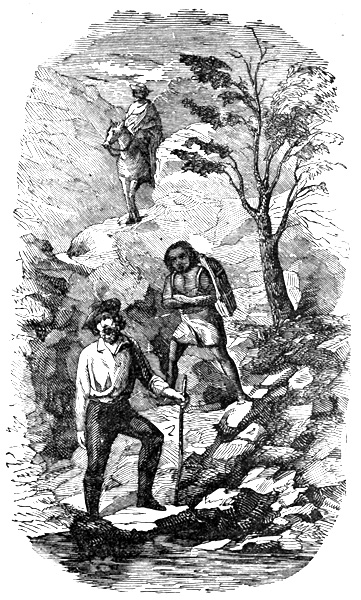
CROSSING THE ISTHMUS.
Sec. 20. No Senator or member of Assembly shall,
during the term for which he shall have been elected,
be appointed to any civil office of profit, under this
State, which shall have been created, or the emoluments
of which shall have been increased, during such
term, except such office as may be filled by elections
by the people.
Sec. 21. No person holding any lucrative office
under the United States, or any other power, shall be
eligible to any civil office of profit, under this State;
provided, that officers in the militia, to which there is
attached no annual salary, or local officers and postmasters
whose compensation does not exceed five
hundred dollars per annum, shall not be deemed lucrative.
Sec. 22. No person who shall be convicted of the
embezzlement or defalcation of the public funds of this
State, shall ever be eligible to any office of honor,
trust, or profit, under the State; and the Legislature
shall, as soon as practicable, pass a law providing for
the punishment of such embezzlement, or defalcation
as a felony.
Sec. 23. No money shall be drawn from the Treasury
but in consequence of appropriations made by
law. An accurate statement of the receipts and expenditures
of the public moneys shall be attached to,
and published with, the laws, at every regular session
of the Legislature.
Sec. 24. The members of the Legislature shall
receive for their services, a compensation to be fixed
by law, and paid out of the public treasury; but no
increase of the compensation shall take effect during
the term for which the members of either house shall
have been elected.
Sec. 25. Every law enacted by the Legislature,
shall embrace but one object, and that shall be expressed
in the title; and no law shall be revised, or
amended, by reference to its title; but in such case,
the act revised, or section amended, shall be re-enacted
and published at length.
Sec. 26. No divorce shall be granted by the Legislature.
Sec. 27. No lottery shall be authorized by this
State, nor shall the sale of lottery tickets be allowed.
Sec. 28. The enumeration of the inhabitants of this
State shall be taken, under the direction of the Legislature,
in the year one thousand eight hundred and
fifty-two, and one thousand eight hundred and fifty-five,
and at the end of every ten years thereafter;
and these enumerations, together with the census that
may be taken, under the direction of the Congress of
the United States, in the year one thousand eight
hundred and fifty, and every subsequent ten years,
shall serve as the basis of representation in both
houses of the Legislature.
Sec. 29. The number of Senators and Members of
Assembly, shall, at the first session of the Legislature,
holden after the enumeration herein provided for are
made, be fixed by the Legislature, and apportioned
among the several counties and districts to be established
by law, according to the number of white inhabitants.
The number of Members of Assembly
shall not be less than twenty-four, nor more than
thirty-six, until the number of inhabitants within this
State shall amount to one hundred thousand: and
after that period, at such ratio that the whole number
of Members of Assembly shall never be less than thirty,
nor more than eighty.
Sec. 30. When a congressional, senatorial, or
assembly district, shall be composed of two or more
counties, it shall not be separated by any county belonging
to another district; and no county shall be
divided, in forming a congressional, senatorial, or
assembly district.
Sec. 31. Corporations may be formed under general
laws, but shall not be created by special act, except
for municipal purposes. All general laws and
special acts passed pursuant to this section may be
altered from time to time, or repealed.
Sec. 32. Dues from corporations shall be secured
by such individual liability of the corporators, and
other means, as may be prescribed by law.
Sec. 33. The term corporations, as used in this
article, shall be construed to include all associations
and joint-stock companies, having any of the powers
or privileges of corporations not possessed by individuals
or partnerships. And all corporations shall
have the right to sue, and shall be subject to be sued,
in all courts, in like cases as natural persons.
Sec. 34. The Legislature shall have no power to
pass any act granting any charter for banking purposes;
but associations may be formed under general
laws, for the deposit of gold and silver; but no such
association shall make, issue, or put in circulation,
any bill, check, tickets, certificate, promissory note,
or other paper, or the paper of any bank, to circulate
as money.
Sec. 35. The Legislature of this State shall prohibit,
by law, any person or persons, association, company,
or corporation, from exercising the privileges
of banking, or creating paper to circulate as money.
Sec. 36. Each stockholder of a corporation, or
joint-stock association, shall be individually and personally
liable for his proportion of all its debts and
liabilities.
Sec. 37. It shall be the duty of the Legislature to
provide for the organization of cities and incorporated
villages, and to restrict their power of taxation, assessment,
borrowing money, contracting debts, and
loaning their credit, so as to prevent abuses in assessments,
and in contracting debts, by such municipal
corporations.
Sec. 38. In all elections by the Legislature, the
members thereof shall vote viva voce, and the votes
shall be entered on the journal.
Sec. 1. The supreme executive power of this State
shall be vested in a chief magistrate, who shall be
styled the Governor of the State of California.
Sec. 2. The Governor shall be elected by the
qualified electors, at the time and places of voting for
Members of Assembly, and shall hold his office two
years from the time of his installation, and until his
successor shall be qualified.
Sec. 3. No person shall be eligible to the office of
Governor (except at the first election) who has not
been a citizen of the United States and a resident of
this State two years next preceding the election, and
attained the age of twenty-five years at the time of
said election.
Sec. 4. The returns of every election for Governor
shall be sealed up and transmitted to the seat of government,
directed to the Speaker of the Assembly,
who shall, during the first week of the session, open
and publish them in presence of both houses of the
Legislature. The person having the highest number
of votes shall be Governor; but in case any two or
more have an equal and the highest number of votes,
the Legislature shall by joint-vote of both houses,
choose one of said persons, so having an equal and
the highest number of votes, for Governor.
Sec. 5. The Governor shall be commander-in-chief
of the militia, the army, and navy of this State.
Sec. 6. He shall transact all executive business
with the officers of government, civil and military,
and may require information in writing from the
officers of the executive department, upon any subject
relating to the duties of the respective offices.
Sec. 7. He shall see that the laws are faithfully
executed.
Sec. 8. When any office shall, from any cause, become
vacant, and no mode is provided by the constitution
and laws for filling such vacancy, the Governor
shall have power to fill such vacancy by granting a
commission, which shall expire at the end of the next
session of the Legislature, or at the next election by
the people.
Sec. 9. He may, on extraordinary occasions, convene
the Legislature by proclamation, and shall state
to both houses, when assembled, the purpose for which
they shall have been convened.
Sec. 10. He shall communicate by message to the
Legislature, at every session, the condition of the
State, and recommend such matters as he shall deem
expedient.
Sec. 11. In case of a disagreement between the
two houses, with respect to the time of adjournment,
the Governor shall have power to adjourn the Legislature
to such time as he may think proper; Provided
it be not beyond the time fixed for the meeting of the
next Legislature.
Sec. 12. No person shall, while holding any office
under the United States, or this State, exercise the
office of Governor, except as hereinafter expressly
provided.
Sec. 13. The Governor shall have the power to
grant reprieves and pardons after conviction, for all
offences except treason, and cases of impeachment,
upon such conditions, and with such restrictions and
limitations, as he may think proper, subject to such
regulations as may be provided by law relative to the
manner of applying for pardons. Upon conviction
for treason he shall have the power to suspend the
execution of the sentence until the case shall be reported
to the Legislature at its next meeting, when
the Legislature shall either pardon, direct the execution
of the sentence, or grant a further reprieve. He
shall communicate to the Legislature, at the beginning
of every session, every case of reprieve, or pardon
granted, stating the name of the convict, the
crime of which he was convicted, the sentence and its
date, and the date of the pardon or reprieve.
Sec. 14. There shall be a seal of this State, which
shall be kept by the Governor, and used by him
officially, and it shall be called "The Great Seal of
the State of California."
Sec. 15. All grants and commissions shall be in
the name and by the authority of the people of the
State of California, sealed with the great seal of the
State, signed by the Governor, and countersigned by
the Secretary of State.
Sec. 16. A Lieutenant-Governor shall be elected
at the same time and place, and in the same manner
as the Governor; and his term of office, and his qualifications,
shall also be the same. He shall be President
of the Senate, but shall only have a casting
vote therein. If, during a vacancy of the office of
Governor, the Lieutenant-Governor shall be impeached,
displaced, resign, die, or become incapable
of performing the duties of his office, or be absent
from the State, the President of the Senate shall act
as Governor, until the vacancy be filled, or the disability
shall cease.
Sec. 17. In case of the impeachment of the Governor,
or his removal from office, death, inability to
discharge the powers and duties of the said office,
resignation or absence from the State, the powers and
duties of the office shall devolve upon the Lieutenant-Governor
for the residue of the term, or until the
disability shall cease. But when the Governor shall,
with the consent of the Legislature, be out of the
State in time of war, at the head of any military force
thereof, he shall continue commander-in-chief of all
the military forces of the State.
Sec. 18. A Secretary of State, a Comptroller, a
Treasurer, an Attorney-General and Surveyor-General,
shall be chosen in the manner provided in this
Constitution; and the term of office, and eligibility
of each, shall be the same as are prescribed for the
Governor and Lieutenant-Governor.
Sec. 19. The Secretary of State shall be appointed
by the Governor, by and with the advice and consent
of the Senate. He shall keep a fair record of
the official acts of the Legislature and Executive
Departments of the Government; and shall, when
required, lay the same, and all matters relative thereto,
before either branch of the Legislature: and
shall perform such other duties as shall be assigned
him by law.
Sec. 20. The Comptroller, Treasurer, Attorney-General
and Surveyor-General, shall be chosen by
joint vote of the two Houses of the Legislature, at
their first session under this Constitution, and thereafter
shall be elected at the same time and places,
and in the same manner, as the Governor and Lieutenant-Governor.
Sec. 21. The Governor, Lieutenant-Governor, Secretary
of State, Comptroller, Treasurer, Attorney-General,
and Surveyor-General, shall each at stated
times during their continuance in office, receive for
their services a compensation, which shall not be increased
or diminished during the term for which they
shall have been elected; but neither of these officers
shall receive for his own use any fees for the performance
of his official duties.
Sec. 1. The judicial power of this State shall be
vested in a Supreme Court, in District Courts, in
County Courts, and in Justices of the Peace. The
Legislature may also establish such municipal and
other inferior courts as may be deemed necessary.
Sec. 2. The Supreme Court shall consist of a
Chief Justice, and two Associate Justices, any two of
whom shall constitute a quorum.
Sec. 3. The Justices of the Supreme Court shall
be elected at the general election, by the qualified
electors of the State, and shall hold their office for
the term of six years from the first day of January
next after their election; provided that the Legislature
shall, at its first meeting, elect a Chief Justice
and two Associate Justices of the Supreme Court, by
joint vote of both houses, and so classify them that
one shall go out of office every two years. After the
first election, the senior Justice in commission shall
be the Chief Justice.
Sec. 4. The Supreme Court shall have appellate
jurisdiction in all cases when the matter in dispute
exceeds two hundred dollars, when the legality of
any tax, toll, or impost, or municipal fine is in question:
and in all criminal cases amounting to felony,
or questions of law alone. And the said court and
each of the Justices thereof, as well as all district and
county judges, shall have power to issue writs of habeas
corpus, at the instance of any person held in
actual custody. They shall also have power to issue
all other writs and process necessary to the exercise
of the appellate jurisdiction, and shall be conservators
of the peace throughout the State.
Sec. 5. The State shall be divided by the first
Legislature into a convenient number of districts,
subject to such alteration from time to time as the
public good may require; for each of which a district
judge shall be appointed by the joint vote of the
legislature, at its first meeting, who shall hold his
office for two years from the first day of January
next after his election; after which, said judges shall
be elected by the qualified electors of their respective
districts, at the general election, and shall hold their
office for the term of six years.
Sec. 6. The District Courts shall have original
jurisdiction, in law and equity, in all civil cases where
the amount in dispute exceeds two hundred dollars,
exclusive of interest. In all criminal cases not otherwise
provided for, and in all issues of fact joined in
the probate courts, their jurisdiction shall be unlimited.
Sec. 7. The Legislature shall provide for the election,
by the people, of a Clerk of the Supreme Court,
and County Clerks, District Attorneys, Sheriffs, Coroners,
and other necessary officers; and shall fix by
law their duties and compensation. County Clerks
shall be, ex-officio, Clerks of the District Courts in
and for their respective counties.
Sec. 8. There shall be elected in each of the organized
counties of this State, one County Judge
who shall hold his office for four years. He shall
hold the County Court, and perform the duties of
Surrogate, or Probate Judge. The County Judge,
with two Justices of the Peace, to be designated according
to law, shall hold courts of sessions, with
such criminal jurisdiction as the Legislature shall prescribe,
and he shall perform such other duties as shall
be required by law.
Sec. 9. The County Courts shall have such jurisdiction,
in cases arising in Justices Courts, and in special
cases, as the Legislature may prescribe, but shall
have no original civil jurisdiction, except in such special
cases.
Sec. 10. The times and places of holding the
terms of the Supreme Court, and the general and special
terms of the District Courts within the several
districts, shall be provided for by law.
Sec. 11. No judicial officer, except a Justice of the
Peace, shall receive to his own use, any fees, or perquisites
of office.
Sec. 12. The Legislature shall provide for the
speedy publication of all statute laws, and of such
judicial decisions as it may deem expedient; and all
laws and judicial decisions shall be free for publication
by any person.
Sec. 13. Tribunals for conciliation may be established,
with such powers and duties as may be prescribed
by law; but such tribunals shall have no
power to render judgment to be obligatory on the
parties, except they voluntarily submit their matters
in difference, and agree to abide the judgment, or
assent thereto in the presence of such tribunal, in
such cases as shall be prescribed by law.
Sec. 14. The Legislature shall determine the number
of Justices of the Peace, to be elected in each
county, city, town, and incorporated village of the
State, and fix by law their powers, duties, and responsibilities.
It shall also determine in what cases
appeals may be made from Justices' Courts to the
County Court.
Sec. 15. The Justices of the Supreme Court, and
Judges of the District Court, shall severally, at stated
times during their continuance in office, receive for
their services a compensation, to be paid out of the
treasury, which shall not be increased or diminished
during the term for which they shall have been elected.
The County Judges shall also severally, at stated
times, receive for their services a compensation to be
paid out of the county treasury of their respective
counties, which shall not be increased or diminished
during the term for which they shall have been elected.
Sec. 16. The Justices of the Supreme Court and
District Judges shall be ineligible to any other office,
during the term for which they shall have been elected.
Sec. 17. Judges shall not charge juries with respect
to matters of fact, but may state the testimony and
declare the law.
Sec. 18. The style of all process shall be "The
People of the State of California;" the prosecutions
shall be conducted in the name and by the authority
of the same.
Sec. 1. The Legislature shall provide by law, for
organizing and disciplining the militia, in such manner
as they shall deem expedient, not incompatible with
the constitution and laws of the United States.
Sec. 2. Officers of the militia shall be elected, or
appointed, in such manner as the Legislature shall
from time to time direct; and shall be commissioned
by the Governor.
Sec. 3. The Governor shall have power to call forth
the militia, to execute the laws of the State, to suppress
insurrections, and repel invasions.
The Legislature shall not in any manner create any
debt or debts, liability or liabilities, which shall singly,
or in the aggregate, with any previous debts or liabilities
exceed the sum of three hundred thousand dollars,
except in case of war, to repel invasion, or suppress
insurrection, unless the same shall be authorized by
some law for some single object or work, to be distinctly
specified therein, which law shall provide ways and
means, exclusive of loans, for the payment of the
interest of such debt or liability, as it falls due, and
also pay and discharge the principal of such debt or
liability within twenty years from the time of the
contracting thereof, and shall be irrepealable until the
principal and interest thereon shall be paid and discharged;
but no such law shall take effect until, at a
general election, it shall have been submitted to the
people, and have received a majority of all the votes
cast for and against it at such election; and all money
raised by authority of such law shall be applied only
to the specific object therein stated, or to the payment
of the debt thereby created; and such law shall be
published in at least one newspaper in each judicial
district, if one be published therein, throughout the
State, for three months next preceding the election at
which it is submitted to the people.
Sec. 1. The Legislature shall provide for the election,
by the people, of a Superintendent of Public
Instruction, who shall hold his office for three years,
and whose duties shall be prescribed by law, and who
shall receive such compensation as the Legislature may
direct.
Sec. 2. The Legislature shall encourage, by all suitable
means, the promotion of intellectual, scientific,
moral and agricultural improvement. The proceeds
of all lands that may be granted by the United States
to this State for the support of schools, which may be
sold or disposed of, and the five hundred thousand
acres of land granted to the new States, under an act
of Congress distributing the proceeds of the public
lands among the several States of the Union, approved
A.D. 1841; and all estates of deceased persons who
may have died without leaving a will, or heir, and
also such per cent. as may be granted by Congress on
the sale of lands in this State, shall be and remain a
perpetual fund, the interest of which, together with
all the rents of the unsold lands, and such other means
as the Legislature may provide, shall be inviolably
appropriated to the support of Common Schools
throughout the State.
Sec. 3. The Legislature shall provide for a system
of Common Schools, by which a school shall be kept
up and supported in each district at least three months
in every year: and any school district neglecting to
keep up and support such a school, may be deprived
of its proportion of the interest of the public fund
during such neglect.
Sec. 4. The Legislature shall take measures for the
protection, improvement, or other disposition of such
lands as have been, or may hereafter be, reserved or
granted by the United States, or any person or persons
to this State for the use of a University; and the
funds accruing from the rents or sale of such lands, or
from any other source, for the purpose aforesaid, shall
be and remain a permanent fund, the interest of which
shall be applied to the support of said university, with
such branches as the public convenience may demand
for the promotion of literature, the arts and sciences,
as may be authorized by the terms of such grant.
And it shall be the duty of the Legislature, as soon as
may be, to provide effectual means for the improvement
and permanent security of the funds of said
University.
Sec. 1. Any amendment or amendments to this
Constitution may be proposed in the Senate or Assembly;
and if the same shall be agreed to by a majority
of the members elected to each of the two houses, such
proposed amendment or amendments shall be entered
on their journals, with the yeas and nays taken thereon,
and referred to the Legislature then next to be chosen,
and shall be published for three months next preceding
the time of making such choice. And if, in the
Legislature next chosen, as aforesaid, such proposed
amendment or amendments shall be agreed to by a
majority of all the members elected to each house, then
it shall be the duty of the Legislature to submit such
proposed amendment or amendments to the people, in
such manner, and at such time, as the Legislature shall
prescribe; and if the people shall approve and ratify
such amendment or amendments, by a majority of the
electors qualified to vote for members of the Legislature
voting thereon, such amendment or amendments
shall become part of the Constitution.
Sec. 2. And if, at any time, two-thirds of the Senate
and Assembly shall think it necessary to revise and
change this entire Constitution, they shall recommend
to the electors, at the next election for members of the
Legislature, to vote for or against the convention;
and if it shall appear that a majority of the electors
voting at such election have voted in favor of calling
a convention, the Legislature shall, at its next session,
provide by law for calling a convention, to be holden
within six months after the passage of such law; and
such convention shall consist of a number of members
not less than that of both branches of the Legislature.
Sec. 1. The first session of the Legislature shall be
held at the Pueblo de San Jose, which place shall be
the permanent seat of government, until removed by
law; provided, however, that two-thirds of all the
members elected to each house of the Legislature
shall concur in the passage of such law.
Sec. 2. Any citizen of this State who shall, after
the adoption of this Constitution, fight a duel with
deadly weapons, or send or accept a challenge to fight
a duel with deadly weapons, either within the State
or out of it; or who shall act as second, or knowingly
aid or assist in any manner those thus offending, shall
not be allowed to hold any office of profit, or to enjoy
the right of suffrage under this Constitution.
Sec. 3. Members of the Legislature, and all officers,
executive, and judicial, except such inferior officers as
may be by law exempted, shall, before they enter on
the duties of their respective offices, take and subscribe
the following oath or affirmation.
"I do solemnly swear (or affirm, as the case may
be,) that I will support the Constitution of the
United States, and the Constitution of the State of
California: and that I will faithfully discharge the
duties of the office of ——, according to the best
of my ability." And no other oath, declaration, or
test, shall be required as a qualification for any office
or public trust.
Sec. 4. The Legislature shall establish a system of
county and town governments, which shall be as
nearly uniform as practicable, throughout the State.
Sec. 5. The Legislature shall have power to provide
for the election of a board of supervisors in each
county; and these supervisors shall, jointly and individually,
perform such duties as may be prescribed
by law.
Sec. 6. All officers whose election or appointment
is not provided for by this constitution, and all officers
whose offices may hereafter be created by law, shall
be elected by the people, or appointed as the Legislature
may direct.
Sec. 7. When the duration of any office is not provided
for by this constitution, it may be declared by
law; and if not so declared, such office shall be held
during the pleasure of the authority making the appointment;
nor shall the duration of any office, not
fixed by this constitution, ever exceed four years.
Sec. 8. The fiscal year shall commence on the first
day of July.
Sec. 9. Each county, town, city, and incorporated
village, shall make provision for the support of its
own officers, subject to such restrictions and regulations
as the Legislature may prescribe.
Sec. 10. The credit of the State shall not in any
manner be given or loaned to, or in aid of, any individual,
association, or corporation; nor shall the
State, directly or indirectly, become a stockholder in
any association or corporation.
Sec. 11. Suits may be brought against the State,
in such manner, and in such courts, as shall be directed
by law.
Sec. 12. No contract of marriage, if otherwise
duly made, shall be invalidated, for want of conformity
to the requirements of any religious sect.
Sec. 13. Taxation shall be equal and uniform
throughout the State. All property, in this State,
shall be taxed in proportion to its value, to be ascertained
as directed by law; but assessors and collectors
of town, county, and State taxes, shall be elected by
the qualified electors of the district, county, or town,
in which the property taxed for State, county, or
town purposes is situated.
Sec. 14. All property, both real and personal, of
the wife, owned or claimed by her before marriage,
and that acquired afterwards by gift, devise, or
descent, shall be her separate property; and laws
shall be passed more clearly defining the rights of the
wife, in relation as well to her separate property, as
to that held in common with her husband. Laws
shall also be passed providing for the restoration of
the wife's separate property.
Sec. 15. The Legislature shall protect by law, from
forced sale, a certain portion of the homestead and
other property of all heads of families.
Sec. 16. No perpetuities shall be allowed, except
for eleemosynary purposes.
Sec. 17. Every person shall be disqualified from
holding any office of profit in this State, who shall
have been convicted of having given or offered a bribe,
to procure his election or appointment.
Sec. 18. Laws shall be made to exclude from office,
serving on juries, and from the right of suffrage, those
who shall hereafter be convicted of bribery, perjury,
forgery, or other high crimes. The privilege of free
suffrage shall be supported by laws regulating elections,
and prohibiting, under adequate penalties, all
undue influence thereon, from power, bribery, tumult,
or other improper practice.
Sec. 19. Absence from this State on business of
the State, or of the United States, shall not affect the
question or residence of any person.
Sec. 20. A plurality of the votes given at any election
shall constitute a choice, where not otherwise
directed in this constitution.
Sec. 21. All laws, decrees, regulations and provisions,
which from their nature require publication,
shall be published in English and Spanish.
The boundary of the State of California shall be as
follows:—
Commencing at the point of intersection of the 42d
degree of north latitude with the 120th degree of
longitude west from Greenwich, and running south on
the line of said 120th degree of west longitude until it
intersects the 39th degree of north latitude; thence
running in a straight line in a south-easterly direction
to the River Colorado, at a point where it intersects
the 35th degree of north latitude; thence down the
middle of the channel of said river, to the boundary
line between the United States and Mexico, as established
by the treaty of May 30th, 1848; thence running
west and along said boundary line to the Pacific
Ocean, and extending therein three English miles;
thence running in a north-westerly direction, and following
the direction of the Pacific coast to the 42d degree
of north latitude; thence on the line of said 42d
degree of north latitude to the place of beginning.
Also all the islands, harbors and bays, along and
adjacent to the Pacific coast.
Sec. 1. All rights, prosecutions, claims and contracts,
as well of individuals as of bodies corporate,
and all laws in force at the time of the adoption of
this Constitution, and not inconsistent therewith, until
altered or repealed by the Legislature, shall continue
as if the same had not been adopted.
Sec. 2. The Legislature shall provide for the removal
of all causes which may be pending when this
Constitution goes into effect, to courts created by the
same.
Sec. 3. In order that no inconvenience may result
to the public service, from the taking effect of this
Constitution, no office shall be superseded thereby, nor
the laws relative to the duties of the several officers
be changed, until the entering into office of the new
officers to be appointed under this Constitution.
Sec. 4. The provisions of this Constitution concerning
the term of residence necessary to enable
persons to hold certain offices therein mentioned,
shall not be held to apply to officers chosen by the
people at the first election, or by the Legislature at
its first session.
Sec. 5. Every citizen of California, declared a legal
voter by this Constitution, and every citizen of the
United States, a resident of this State on the day of
election, shall be entitled to vote at the first general
election under this Constitution, and on the question
of the adoption thereof.
Sec. 6. This Constitution shall be submitted to the
people, for their ratification or rejection, at the
general election to be held on Tuesday, the thirteenth
day of November next. The Executive of the existing
government of California is hereby requested to
issue a proclamation to the people, directing the Prefects
of the several districts, or in case of vacancy,
the Sub-Prefects, or senior Judge of First Instance,
to cause such election to be held, on the day aforesaid,
in their respective districts. The election shall
be conducted in the manner which was prescribed for
the election of delegates to this convention, except
that the Prefect, Sub-Prefect, or senior Judge of First
Instance ordering such election in each district, shall
have power to designate any additional number of places
for opening the polls, and that, in every place of holding
the election, a regular poll-list shall be kept by the
judges and inspectors of election. It shall also be the
duty of these judges and inspectors of election, on
the day aforesaid, to receive the votes of the electors
qualified to vote at such election. Each voter shall
express his opinion, by depositing in the ballot-box a
ticket, whereon shall be written, or printed "For the
Constitution," or "Against the Constitution," or
some such words as will distinctly convey the intention
of the voter. These Judges and Inspectors shall
also receive the votes for the several officers to be
voted for at the said election, as herein provided.
At the close of the election, the judges and inspectors
shall carefully count each ballot, and forthwith
make duplicate returns thereof to the Prefect, Sub-Prefect,
or senior Judge of First Instance, as the
case may be, of their respective districts; and said
Prefect, Sub-Prefect, or senior Judge of First Instance
shall transmit one of the same, by the most safe and
rapid conveyance, to the Secretary of State. Upon
the receipt of said returns, or on the tenth day of
December next, if the returns be not sooner received,
it shall be the duty of a board of canvassers, to consist
of the Secretary of State, one of the Judges of
the Superior Court, the Prefect, Judge of First Instance,
and an Alcalde of the District of Monterey,
or any three of the aforementioned officers, in the
presence of all who shall choose to attend, to compare
the votes given at said election, and to immediately
publish an abstract of the same in one or more of the
newspapers of California. And the Executive will
also, immediately after ascertaining that the Constitution
has been ratified by the people, make proclamation
of the fact; and thenceforth this Constitution
shall be ordained and established as the Constitution
of California.
Sec. 7. If this Constitution shall be ratified by the
people of California, the Executive of the existing
government is hereby requested, immediately after
the same shall be ascertained, in the manner herein
directed, to cause a fair copy thereof to be forwarded
to the President of the United States, in order that
he may lay it before the Congress of the United
States.
Sec. 8. At the general election aforesaid, viz:
the thirteenth day of November next, there shall
be elected a Governor, Lieutenant-Governor, members
of the Legislature, and also two members of
Congress.
Sec. 9. If this constitution shall be ratified by the
people of California, the Legislature shall assemble
at the seat of government, on the fifteenth day of
December next, and in order to complete the organization
of that body, the Senate shall elect a President
pro tempore, until the Lieutenant-Governor shall
be installed into office.
Sec. 10. On the organization of the Legislature, it
shall be the duty of the Secretary of State, to lay
before each house a copy of the abstract made by the
board of canvassers, and, if called for, the original
returns of election, in order that each house may judge
of the correctness of the report of said board of canvassers.
Sec. 11. The Legislature, at its first session, shall
elect such officers as may be ordered by this Constitution,
to be elected by that body, and within four days
after its organization, proceed to elect two Senators
to the Congress of the United States. But no law
passed by this Legislature shall take effect until signed
by the Governor, after his installation into office.
Sec. 12. The Senators and Representatives to the
Congress of the United States, elected by the Legislature
and people of California, as herein directed,
shall be furnished with certified copies of this Constitution,
when ratified, which they shall lay before the
Congress of the United States, requesting, in the name
of the people of California, the admission of the State
of California into the American Union.
Sec. 13. All officers of this State, other than members
of the Legislature, shall be installed into office
on the fifteenth day of December next, or as soon
thereafter as practicable.
Sec. 14. Until the Legislature shall divide the
State into counties, and senatorial and assembly districts,
as directed by this Constitution, the following
shall be the apportionment of the two houses of the
Legislature, viz: the districts of San Diego and Los
Angeles shall jointly elect two senators; the districts
of Santa Barbara and San Luis Obispo shall jointly
elect one senator; the district of Monterey, one senator;
the district of San Jose, one senator; the
district of San Francisco, two senators; the district
of Sonoma, one senator; the district of Sacramento,
four senators; and the district of San Joaquin, four
senators:—And the district of San Diego shall elect
one member of assembly; the district of Los Angeles,
two members of assembly; the district of Santa Barbara,
two members of assembly; the district of San
Luis Obispo, one member of assembly; the district
of Monterey, two members of assembly; the district
of San Jose, three members of assembly; the district
of San Francisco, five members of assembly; the
district of Sonoma, two members of assembly; the
district of Sacramento, nine members of assembly;
and the district of San Joaquin, nine members of
assembly.
Sec. 15. Until the Legislature shall otherwise direct,
in accordance with the provisions of this Constitution,
the salary of the Governor shall be ten thousand
dollars per annum; and the salary of the Lieutenant-Governor
shall be double the pay of a state senator;
and the pay of members of the Legislature shall be
sixteen dollars per diem, while in attendance, and
sixteen dollars for every twenty miles travel by the
usual route from their residences, to the place of holding
the session of the Legislature, and in returning
therefrom. And the Legislature shall fix the salaries
of all officers, other than those elected by the people,
at the first election.
Sec. 16. The limitation of the powers of the Legislature,
contained in article 8th of this Constitution,
shall not extend to the first Legislature elected
under the same, which is hereby authorized to negotiate
for such amount as may be necessary to pay the
expenses of the State government.
R. SEMPLE,
President of the Convention
and Delegate from Benecia.
Wm. G. Marcy, Secretary.
| J. Aram, | B. S. Lippincott, |
| C. T. Botts, | M. M. McCarver, |
| E. Brown, | John McDougal, |
| J. A. Carillo, | B. F. Moore, |
| J. M. Covarrubias, | Myron Norton, |
| E. O. Crosby, | P. Ord, |
| P. De La Guerra, | Miguel Pedrorena, |
| L. Dent, | A. M. Pico, |
| M. Dominguez, | R. M. Price, |
| K. H. Dimmick, | Hugo Reed, |
| A. J. Ellis, | Jacinto Rodriguez, |
| S. C. Foster, | Pedro Sansevaine, |
| E. Gilbert, | W. E. Shannon, |
| W. M. Gwinn, | W. S. Sherwood, |
| H. W. Halleck, | J. R. Snyder, |
| Julian Hanks, | A. Stearns, |
| L. W. Hastings, | W. M. Steuart, |
| Henry Hill, | J. A. Sutter, |
| J. Hobson, | Henry A. Tefft, |
| J. McH. Hollingsworth, | S. L. Vermule, |
| J. D. Hoppe, | M. G. Vallejo, |
| J. M. Jones, | J. Walker, |
| T. O. Larkin, | O. M. Wozencraft. |
| Francis J. Lippitt, | |
The undersigned, delegates to a convention authorized
to form a Constitution for the State of California,
having, to the best of their ability, discharged the
high trust committed to them, respectfully submit the
accompanying plan of government for your approval.
Acknowledging the great fundamental principles, that
all political power is inherent in the people, and that
government is instituted for the protection, security
and benefit of the people, the Constitution presented
for your consideration is intended only to give such
organic powers to the several departments of the proposed
government, as shall be necessary for its efficient
administration: and while it is believed no power has
been given, which is not thus essentially necessary, the
convention deem individual rights, as well as public
liberty, are amply secured, by the people still retaining
not only the great conservative power of free
choice and election of all officers, agents, and representatives,
but the unalienable right to alter or reform
their government, whenever the public good may
require.
Although born in different climes, coming from different
States, imbued with local feelings, and educated,
perhaps, with predilections for peculiar institutions,
laws, and customs, the delegates assembled in convention
as Californians, and carried on their deliberations
in a spirit of amity, compromise, and mutual concession
for the public weal.
It cannot be denied that a difference of opinion was
entertained in the convention, as to the policy and
expediency of several measures embodied in the Constitution;
but looking to the great interests of the
State of California, the peace, happiness, and prosperity
of the whole people,—individual opinions were
freely surrendered to the will of the majority, and,
with one voice, we respectfully but earnestly recommend
to our fellow citizens the adoption of the Constitution
which we have the honor to submit.
In establishing a boundary for the State, the convention
conformed, as near as was deemed practicable
and expedient, to great natural landmarks, so as to
bring into a union all those who should be included by
mutual interest, mutual wants, and mutual dependence.
No portion of territory is included, the inhabitants of
which were not or might not have been legitimately
represented in the convention, under the authority by
which it was convened; and in unanimously resolving
to exclude slavery from the State of California, the
great principle has been maintained, that to the people
of each State and Territory, alone, belongs the right
to establish such municipal regulations, and to decide
such questions as affect their own peace, prosperity
and happiness.
A free people, in the enjoyment of an elective
government, capable of securing their civil, religious,
and political rights, may rest assured these inestimable
privileges can never be wrested from them, so long as
they keep a watchful eye on the operations of their
government, and hold to strict accountability those to
whom power is delegated. No people were ever yet
enslaved, who knew and dared maintain the co-relative
rights and obligations of free and independent citizens.
A knowledge of the laws—their moral force and efficacy,
thus becomes an essential element of freedom
and makes public education of primary importance.
In this view, the Constitution of California provides
for, and guarantees in the most ample manner, the
establishment of common schools, seminaries and colleges,
so as to extend the blessings of education
throughout the land, and secure its advantages to the
present and future generations. Under the peculiar
circumstances in which California becomes a State—with
an unexampled increase of a population coming
from every part of the world, speaking various languages,
and imbued with different feelings and prejudices,
no form of government, no system of laws, can
be expected to meet with immediate and unanimous
assent. It is to be remembered, moreover, that a considerable
portion of our fellow-citizens are natives of
Old Spain, Californians, and those who have voluntarily
relinquished the rights of Mexicans to enjoy
those of American citizens. Long accustomed to a
different form of government, regarding the rights of
person and of property as interwoven with ancient
usages and time-honored customs, they may not at
once see the advantages of the proposed new government,
or yield an immediate approval of new laws,
however salutary their provisions, or conducive to the
general welfare. But it is confidently believed, when
the government as now proposed shall have gone into
successful operation, when each department thereof
shall move on harmoniously in its appropriate and
respective sphere, when laws, based on the eternal
principles of equity and justice, shall be established,
when every citizen of California, shall find himself
secure in life, liberty, and property—all will unite in
the cordial support of institutions, which are not only
the pride and boast of every true-hearted citizen of the
Union, but have gone forth, a guiding light to every
people groping through the gloom of religious superstition
or political fanaticism—institutions, which even
now, while all Europe is agitated with the convulsive
efforts of nations battling for liberty, have become the
mark and model of government for every people who
would hold themselves free, sovereign, and independent.
With this brief exposition of the views and opinions
of the convention, the undersigned submit the Constitution
and plan of government for your approval. They
earnestly recommend it to your calm and deliberate
consideration, and especially do they most respectfully
urge on every voter to attend the polls.
The putting into operation of a government which
shall establish justice, insure domestic tranquillity,
promote the general welfare, and secure the blessings
of civil, religious, and political liberty, should be an
object of the deepest solicitude to every true-hearted
citizen, and the consummation of his dearest wishes.
The price of liberty is eternal vigilance, and thus it is
not only the privilege but the duty of every voter to
vote his sentiments. No freeman of this land who
values his birthright, and would transmit unimpaired
to his children an inheritance so rich in glory and
honor, will refuse to give one day to the service of
his country. Let every qualified voter go early to
the polls, and give his free vote at the election appointed
to be held on Tuesday, the 13th day of November
next, not only that a full and fair expression of
the public voice may be had, for or against a constitution
intended to secure the peace, happiness and
prosperity of the whole people, but that their numerical
and political strength may be made manifest, and
the world see by what majority of freemen California,
the bright star of the West, claims a place in the
diadem of that glorious republic, formed by the Union
of thirty-one sovereign States.
(Signed)
| Joseph Aram, | Edw. Gilbert, |
| Chas. T. Botts, | Wm. M. Gwin, |
| Elam Brown, | Julian Hanks, |
| Jose Anto. Carillo, | Henry Hill, |
| Jose M. Covarrubias, | J. D. Hoppe, |
| Elisha O. Crosby, | Joseph Hobson, |
| Lewis Dent, | H. W. Halleck, |
| Manuel Dominguez, | L. W. Hastings, |
| K. H. Dimmick, | J. McH. Hollingsworth, |
| A. J. Ellis, | Jas. McHall Jones, |
| Stephen G. Foster, | Thomas O. Larkin, |
| Pablo De La Guerra, | Francis J. Lippitt, |
| Benj. S. Lippincott, | Jacob R. Snyder, |
| M. M. McCarver, | W. Scott Sherwood, |
| John McDougal, | Wm. C. Shannon, |
| Benj. F. Moore, | Pedro Sansevain, |
| Myron Norton, | Abel Stearns, |
| P. Ord, | W. M. Steuart, |
| Miguel De Pedrorena, | R. Semple, |
| Rodman M. Price, | Henry A. Tefft, |
| Antonio M. Pico, | M. G. Vallejo, |
| Jacinto Rodrigues, | Thos. L. Vermule, |
| Hugh Reed, | Joel P. Walker, |
| John A. Sutter, | O. M. Wozencraft. |
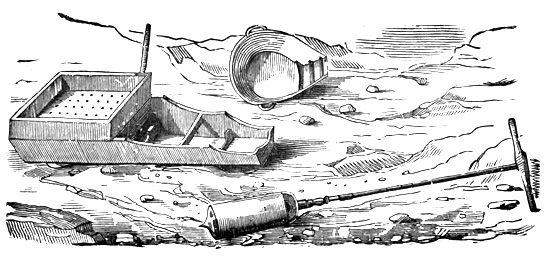
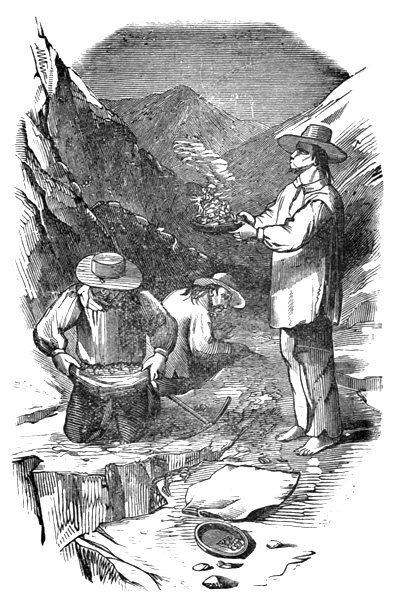
GOLD ROCKER, WASHING PAN, AND GOLD BORER.
Transmitting information in answer to a resolution of the House
of the 31st of December, 1849, on the subject of California and
New Mexico.
To the House of Representatives of the
United States.—I transmit to the House of Representatives,
in answer to a resolution of that body
passed on the 31st of December last, the accompanying
reports of heads of departments, which contain
all the official information in the possession of the
Executive asked for by the resolution.
On coming into office, I found the military commandant
of the department of California exercising
the functions of civil governor in that Territory; and
left, as I was, to act under the treaty of Guadalupe
Hidalgo, without the aid of any legislative provision
establishing a government in that Territory, I
thought it not best to disturb that arrangement, made
under my predecessor, until Congress should take
some action on that subject. I therefore did not
interfere with the powers of the military commandant,
who continued to exercise the functions of civil
governor as before; but I made no such appointment,
conferred no such authority, and have allowed no
increased compensation to the commandant for his
services.
With a view to the faithful execution of the treaty,
so far as lay in the power of the Executive, and to
enable Congress to act, at the present session, with as
full knowledge and as little difficulty as possible, on
all matters of interest in these Territories, I sent the
honorable Thomas Butler King as bearer of despatches
to California, and certain officers to California and
New Mexico, whose duties are particularly defined in
the accompanying letters of instruction addressed to
them severally by the proper departments.
I did not hesitate to express to the people of those
Territories my desire that each Territory should, if
prepared to comply with the requisitions of the Constitution
of the United States, form a plan of a State
Constitution and submit the same to Congress, with a
prayer for admission into the Union as a State; but I
did not anticipate, suggest, or authorize the establishment
of any such government without the assent of
Congress; nor did I authorize any government agent
or officer to interfere with or exercise any influence or
control over the election of delegates, or over any
convention, in making or modifying their domestic
institutions, or any of the provisions of their proposed
Constitution. On the contrary, the instructions given
by my orders were, that all measures of domestic
policy adopted by the people of California must
originate solely with themselves; that while the Executive
of the United States was desirous to protect
them in the formation of any government republican
in its character, to be at the proper time, submitted
to Congress, yet it was to be distinctly understood
that the plan of such a government must, at the same
time, be the result of their own deliberate choice, and
originate with themselves, without the interference of
the Executive.
I am unable to give any information as to laws
passed by any supposed government in California, or
of any census taken in either of the Territories mentioned
in the resolution, as I have no information on
those subjects.
As already stated, I have not disturbed the arrangements
which I found had existed under my
predecessor.
In advising an early application by the people of
these Territories for admission as States, I was actuated
principally by an earnest desire to afford to the
wisdom and patriotism of Congress the opportunity
of avoiding occasions of bitter and angry dissensions
among the people of the United States.
Under the Constitution, every State has the right
of establishing, and, from time to time, altering its
municipal laws and domestic institutions, independently
of every other State and of the general government;
subject only to the prohibitions and guaranties
expressly set forth in the Constitution of the United
States. The subjects thus left exclusively to the
respective States were not designed or expected to
become topics of national agitation. Still, as, under
the Constitution, Congress has power to make all
needful rules and regulations respecting the Territories
of the United States, every new acquisition of territory
has led to discussions on the question whether
the system of involuntary servitude which prevails in
many of the States should or should not be prohibited
in that Territory. The periods of excitement from
this cause which have heretofore occurred have been
safely passed; but during the interval, of whatever
length, which may elapse before the admission of the
Territories ceded by Mexico as States, it appears
probable that similar excitement will prevail to an
undue extent.
Under these circumstances, I thought, and still
think, that it was my duty to endeavor to put it in
the power of Congress, by the admission of California
and New Mexico as States, to remove all occasion for
the unnecessary agitation of the public mind.
It is understood that the people of the western part
of California have formed a plan of a State Constitution,
and will soon submit the same to the judgment
of Congress, and apply for admission as a State.
This course on their part, though in accordance with,
was not adopted exclusively in consequence of,
any expression of my wishes inasmuch as measures
tending to this end had been promoted by the officers
sent there by my predecessor, and were already in
active progress of execution before any communication
from me reached California. If the proposed
Constitution shall, when submitted to Congress, be
found to be in compliance with the requisitions of the
Constitution of the United States, I earnestly recommend
that it may receive the sanction of Congress.
The part of California not included in the proposed
State of that name is believed to be uninhabited, except
in a settlement of our countrymen in the vicinity
of Salt Lake.
A claim has been advanced by the State of Texas
to a very large portion of the most populous district
of New Mexico. If the people of New Mexico had
formed a plan of a State government for that Territory
as ceded by the treaty of Guadalupe Hidalgo,
and had been admitted by Congress as a State, our
Constitution would have afforded the means of obtaining
an adjustment of the question of boundary with
Texas by a judicial decision. At present, however,
no judicial tribunal has the power of deciding that
question, and it remains for Congress to devise some
mode for its adjustment. Meanwhile, I submit to Congress
the question whether it would be expedient,
before such adjustment, to establish a territorial
government, which, by including the district so
claimed, would practically decide the question adversely
to the State of Texas or, by excluding it,
would decide it in her favor. In my opinion, such a
course would not be expedient, especially as the people
of this Territory still enjoy the benefit and protection
of their municipal laws, originally derived
from Mexico, and have a military force stationed
there to protect them against the Indians. It is undoubtedly
true that the property, lives, liberties, and
religion of the people of New Mexico are better protected
than they ever were before the treaty of cession.
Should Congress, when California shall present herself
for incorporation into the Union, annex a condition
to her admission as a State affecting her domestic
institutions, contrary to the wishes of her people,
and even compel her temporarily, to comply with it,
yet the State, could change her Constitution at any
time after admission, when to her it should seem
expedient. Any attempt to deny to the people of the
State the right of self-government, in a matter which
peculiarly affects themselves, will infallibly be regarded
by them as an invasion of their rights; and,
upon the principles laid down in our own Declaration
of Independence, they will certainly be sustained by
the great mass of the American people. To assert
that they are a conquered people, and must, as a
State, submit to the will of their conquerors in this
regard, will meet with no cordial response among
American freemen. Great numbers of them are native
citizens of the United States not inferior to the
rest of our countrymen in intelligence and patriotism;
and no language of menace, to restrain them in the
exercise of an undoubted right, guarantied to them
by the treaty of cession itself, shall ever be uttered
by me, or encouraged and sustained by persons acting
under my authority. It is to be expected that, in the
residue of the Territory ceded to us by Mexico, the
people residing there will, at the time of their incorporation
into the Union as a State, settle all questions
of domestic policy to suit themselves. No material
inconvenience will result from the want, for a short
period, of a government established by Congress over
that part of the Territory which lies eastward of the
new State of California; and the reasons for my
opinion that New Mexico will, at no very distant period,
ask for admission into the Union, are founded on
un-official information, which, I suppose, is common to
all who have cared to make inquiries on that subject.
Seeing, then, that the question which now excites
such painful sensations in the country will, in the end,
certainly be settled by the silent effect of causes independent
of the action of Congress, I again submit to
your wisdom the policy recommended in my annual
message, of awaiting the salutary operation of those
causes, believing that we shall thus avoid the creation
of geographical parties, and secure the harmony of
feeling so necessary to the beneficial action of our
political system. Connected as the Union is with the
remembrance of past happiness, the sense of present
blessings, and the hope of future peace and prosperity,
every dictate of wisdom, every feeling of duty, and
every emotion of patriotism, tend to inspire fidelity
and devotion to it, and admonish us cautiously to avoid
any unnecessary controversy which can either endanger
it or impair its strength, the chief element of
which is to be found in the regard and affection of the
people for each other.
Z. TAYLOR.
Washington City, D.C., January 21st, 1850.
Monterey, August 30, 1849.
General:—I have the honor to transmit, herewith,
copies of civil papers and letters issued by me since
my despatch of June 30, and to continue my report
on the civil affairs of this country from this date.
Accompanied by Captain Halleck, Secretary of
State for California, and Major Canby, Captain Wescott,
and Lieutenant Derby, of my military staff, I
left this place on the 5th July for the purpose of inspecting
the military posts in the interior, and of
learning from personal observation the actual state
of affairs in the mineral regions, and also of allaying,
so far as I could, the hostile feeling which was said to
exist between the Americans and foreigners who were
working in the gold placers. My report on the state
of the troops and a more detailed account of my tour
will be forwarded with my military papers.
Passing the mission of San Juan Bautista, we
crossed the coast range of mountains near the ranche
of Senor Pacheco, and struck the San Joaquin River
near the mouth of the Merced; and, after visiting
Major Miller's camp on the Stanislaus, we proceeded
to examine the principal placers on the tributaries of
that river and of the Tuolumne. These washings or
diggings have been among the richest and most productive
in California.
They are situated within a circuit of some twelve
or fifteen miles, and are known as Jamestown, Wood's
Creek, Sonoranian Camp, Sullivan's Creek, Curtis's
Creek, French Creek, Carson's Creek, and Angelo
Creek. Some of these have become places of considerable
business, particularly the Sonoranian Camp,
which presents the appearance of a city of canvas houses.
Passing the Stanislaus River in the mountains, we
proceeded to Major Kingsbury's camp near the mouth
of the American River, crossing in our route the
Calaveras, Moquelume, Seco, and Cosumnes Rivers;
all of which have rich washings near their sources,
and on their bars and islands. From Major Kingsbury's
camp we ascended the American River to Cullamo
Hills, where the first placer was discovered by
Captain Sutter's employees in the spring of 1848.
From Cullamo we crossed the country to Stockton, a
new town on an estero some distance above the mouth
of the San Joaquin, and thence proceeded to Colonel
Cazey's camp at the straits of Carquinnes; returning
via San Francisco to Monterey, which place we
reached on the afternoon of the 9th instant.
We found the country at this season dry and
parched by the sun, the heat of which became very
great the moment we crossed the coast range of mountains.
The thermometer ranges as high as 113° Fah.
in the shade, and above 140° Fah. in the sun. A
great portion of the valley of the Joaquin is so barren
as scarcely to afford subsistence for our animals, and
can never be of much value for agricultural purposes.
There, however, is, some excellent land on the east
side of that river, bordering its large tributaries. A
considerable portion of the valleys of the Moquelume,
Seco, Cosumnes, and American Rivers is also well
adapted to agriculture; and the broad plains lying
between them furnish abundant pasture for raising
stock. But the amount of good arable land, as compared
with the extent of country which we passed
over, is small, and I am inclined to believe that the
richness and extreme fertility of certain localities
have led to erroneous conclusions respecting the
general character of the country. Certain it is, that
while there may be found sufficient arable lands to
support, if well cultivated, a numerous population,
here is also a very great extent of rough and mountainous
country and sandy and barren plains which
are of little value. The great difficulty to be encountered
in agricultural pursuits in some portions of
California is the want of water for irrigation; but
possibly this difficulty may be overcome in part by
resorting to artesian wells. If so, much of the public
land which is now unsaleable may be brought into
market, and the settlement of the country greatly accelerated.
I would, therefore, suggest whether it
may not be advisable for our government to direct
some experiments to be made at the public expense in
sinking wells of this character, for even if unsuccessful
as a means of irrigation, their construction will
greatly assist in determining the geological character
of the country. At present nearly all agricultural
labors are suspended in the general scramble for gold;
but the enormous prices paid for fruit and vegetables
in the towns will undoubtedly induce many, during
the coming year, to turn their attention to the cultivation
of the soil. The failure on the part of Congress,
at its last session, to authorize the sale of public lands
in California, has proved detrimental to the agricultural
interest of the country.
A large number of those who have recently emigrated
to California are desirous to locate themselves
permanently in the country, and to cultivate the soil,
but the uncertainty which exists with respect to the
validity of land titles in California, and to what actually
constitutes the public domain, serves as a serious
check to the forming of new agricultural settlements;
moreover, speculators are purchasing up fraudulent
and invalid titles to large tracts of the public domain,
and selling them off in parcels, and at enormous profits,
to those who have recently arrived in the country, and
who are necessarily ignorant of the real state of the
case. All the mission lands in California were secularized,
or made government property, by a law of
Mexico, dated August 17th, 1833, and the territorial
government of California, under the authority of the
Mexican laws, leased and sold a portion of these lands
and mission property. Another portion of this property,
however, still remained unsold when the Americans
took possession of the country, and it has since
been left in the hands of government agents for preservation.
Erroneously supposing that these lands are
subject to pre-emption laws, some of the recent emigrants
have attempted to settle upon them.
But I cannot deem myself justifiable in permitting
this, for I do not conceive that lands which have been
under cultivation for half a century, and now belong
to government, can be subject to the pre-emption
claims of private individuals, in the same manner as
the uncultivated lands of the public domain. It is,
however, important for the interest of the country that
these mission lands be brought into market with the
least possible delay, and also that provision be made
by law for the settlement and sale of other public lands
in California. And as disputes are almost daily occurring
between individuals respecting the extent of
their several claims, and the validity of their titles, I
would urge upon our government the necessity of
immediately taking measures for the speedy and final
settlement of these titles upon principles of equity and
justice. This is absolutely essential for the peace
and prosperity of the country.
For information connected with this subject, I beg
leave to call attention, to the report of Captain Halleck,
Secretary of State for California, which was
forwarded to Washington by my predecessor, in the
early part of April last.
Before leaving Monterey I heard numerous rumors
of irregularities and crimes among those working in
the placers; but, on visiting the mining regions, I
was agreeably surprised to learn that every thing was
quite the reverse from what had been represented,
and that order and regularity were preserved throughout
almost the entire extent of the mineral districts.
In each little settlement, or tented town, the miners
have elected their local alcaldes and constables, whose
judicial decisions and official acts are sustained by the
people, and enforced with much regularity and energy.
It is true, that in a few instances certain local questions
have produced temporary excitements and difficulties,
but none of these have been of a very important
character, or led to serious results. Alcaldes have
probably in some cases, and under peculiar circumstances,
exercised judicial powers which were never
conferred upon them by law; but the general result
has been favorable to the preservation of order and
the dispensation of justice.
The old placers are still exceedingly productive, and
new ones are almost daily discovered in the smaller
streams running from the western slope of the Sierra
Nevada into the great valleys of the Sacramento and
San Joaquin Rivers.
I am satisfied, however, from personal observation,
that very exaggerated accounts have been sent to
the United States respecting the ease with which the
precious metal is extracted from the earth, and that
many who come to this country with the expectation
of acquiring sudden wealth, with little or no labor, will
be sadly disappointed. It is true that the reward of
labor in the mines is very high; but it should not be
forgotten that gold digging and gold washing in that
climate require strong constitutions and great physical
exertions, and very few need expect to acquire fortunes
by working the placers, without severe labor
and fixed habits of industry and temperance. The
yield of different localities is, of course, very different,
some of the placers being exceedingly rich, while the
product of others is scarcely sufficient to pay the
expenses of working. But I think the general averages
per diem, for those actually employed in washing for
gold, will not vary much from an ounce or an ounce
and a half per man; some make much more than that
sum, while those who are less fortunate fall much short
of it. The actual number of persons working the
placers will not vary much from ten thousand. The
entire population now in the mining district is much
greater than that number; but many are engaged in
mercantile pursuits and in transporting goods and
provisions, while others employ much of their time in
"prospecting," or looking for newer and richer localities.
I also found that the reports which had reached me
of hostilities between Americans and foreigners, in
the mining districts, were greatly exaggerated, and
that, with a few individual exceptions, every thing had
remained quiet and orderly. In some of the northern
placers a party of Americans and Europeans, urged
on by political aspirants, who seem willing to endanger
the peace and tranquillity of the country, in order to
promote their own personal interest, have assumed the
authority to order all Mexicans and South Americans
from that part of the territory. Their orders were
quietly submitted to by the foreigners, a portion of
whom removed to the mines further south, where the
American population manifested a very decided disposition
to afford them protection should they be further
molested. The more intelligent and thinking portion
of Americans regard this measure as illegal and injudicious,
and will discountenance any repetition of
movements so well calculated to disturb the public
tranquillity, and to create bitter and exasperated feelings,
where it is evidently our policy to cultivate those
of the most friendly character. Some of the English,
Irish, and German emigrants, in the northern placers,
assisted in this movement against the Mexicans, Peruvians,
and Chilians, and probably exerted themselves
much more than any of our own citizens to create a
prejudice and excitement against the Spanish race.
They were probably actuated by pecuniary interest.
The great influx of people from the southern portion
of this continent was diminishing the price of labor in
the towns near the northern rivers, and the large
number of pack animals brought from Lower California
and Sonora was producing a corresponding reduction
in the expenses of transportation.
For example, the price of a pack mule in some
parts of the mining districts a few months ago was
about $500, whereas they can now be purchased for
less than $150. The cost of transportation from the
principal landing on the San Joaquin River to the
Sonoranian camp was $75 per hundred, whereas at the
present time it is only about $7.
This has reduced the prices of provisions in the
placers one and two hundred per cent. Some of the
merchants who had large stocks of goods in the mines,
and those who were engaged in transportation at the
prices formerly paid, have suffered by the change,
and it is natural that they should feel incensed against
that class of foreigners who have contributed most to
effect it.
But it is thought by others that the great majority
of the laborers and consumers in the mining districts
have been benefited by this change, and that it would
be injurious to the prosperity of the country to restore
things to their former state by the expulsion and prohibition
of foreigners from the mines.
Americans, by their superior intelligence and
shrewdness in business, generally contrive to turn to
their own benefit the earnings of the Mexicans,
Chilians, and Peruvians in this country, and any
measure of exclusiveness which is calculated to diminish
the productive labor of California would be of exceedingly
doubtful policy.
When applied to by the different parties for my
opinion on the question of expelling foreigners, I have
uniformly told them that no persons, native Americans
or foreigners, have any legal right to dig gold in the
public lands; but that, until the government of the
United States should act in the matter, they would
not be molested in their pursuits; that I could not
countenance any class of men in their attempts to
monopolize the working of the mines, and that all
questions touching the temporary right of individuals
to work in particular localities, of which they were in
actual possession, should be left to the decision of the
local judicial authorities.
I cannot close my remarks on this subject without
again calling the attention of government to the
importance of establishing a mint in California at the
earliest moment.
This measure is called for by every consideration
of natural policy and of justice to the mercantile
mining population of California.
General Kearny, during his administration of affairs
in this country, appointed, by virtue of his authority
as governor of California, two sub-Indian agents, who
have ever since been continued in office, and their
services found of great utility in preserving harmony
among the wild tribes, and in regulating their intercourse
with the whites.
They have been paid from the "civil fund" very
moderate salaries, which will be continued until arrivals
of agents regularly appointed by the general
government. Notwithstanding every effort on the
part of those agents and of the officers of the army
here, it has not been possible at all times to prevent
aggression on the part of the whites, or to restrain
the Indians from avenging these injuries in their own
way.
In the month of April last, the agent in the Sacramento
valley reported that a body of Oregonians and
mountaineers had committed most horrible barbarities
on the defenceless Indians in that vicinity.
Those cruel and inhuman proceedings, added, perhaps,
to the execution of a number of chiefs some year
and a half since by a military force sent into the San
Joaquin valley by my predecessor, (the facts of which
were reported to Washington at the time,) have necessarily
produced a hostile feeling on the part of the
natives, and several small parties of whites, who, in
their pursuit of gold, ventured too far into the Indian
country, have been killed.
My correspondence with the Indian agents and
military officers established in the Sacramento and
San Joaquin valleys will inform you of the measures
taken to prevent a repetition of these difficulties.
I would respectfully recommend that at least three
sub-Indian agents be appointed for this country, and
stationed in the valleys of the Sacramento and San
Joaquin.
These agents should receive ample pay in order to
enable them to defray the expenses of living in that
part of the country, and should be men of the highest
moral character; for otherwise they would not resist
the temptation to engage in illicit trade with the
natives, or to employ them for the individual benefit
of the agents in washing for gold.
The election called by me for the 1st instant was
held on that day, and has been attended with the
most happy results.
Every district has elected its local officers, and
appointed delegates to meet in general convention at
this place on the 1st proximo, to form a State Constitution
or plan of territorial government, which will
be submitted to the people for their ratification, and
transmitted to Washington for the action of Congress.
Most of the local and judicial officers named in my
proclamation of the 3d of June, have already entered
upon their duties, and the interest which was taken
by the people in every part of the country in this
election, and the zeal manifested by those elected and
appointed to office, afford strong hopes that the existing
government will be able to preserve order and
secure the administration of justice until a new one
shall be put into regular and successful operation.
In my former despatch I mentioned that the civil
officers of the existing government would be paid their
regular salaries from the "civil funds," which had
been formed, under the direction of the governor of
California, mainly out of the proceeds of the temporary
custom-houses established by my predecessors on this
coast.
It will also be necessary to use a portion of this
fund in the immediate construction of jails for the
security of civil prisoners.
The want of such jails has already led to the most
serious inconveniencies; prisoners have so frequently
effected their escape, that, on several occasions, the
people have risen in masses and executed criminals
immediately after trial, and without waiting for the
due fulfilment of all the requisitions of the laws.
In many cases it has been found necessary to confine
civil prisoners on board vessels of war, and in the
guard-houses of the garrison; but in towns, at a distance
from the coast and the military posts, the difficulty
of retaining prisoners in custody has led, in some
instances, to immediate and summary executions.
This evil calls for an immediate remedy, which will
be afforded, so far as the means at my disposal will
admit.
I beg leave, in this place, to add a few remarks on
the use which has been, and will continue to be, made
of this "civil fund."
In the instructions from Washington to General
Kearny, in 1846, for his guidance in California, the
establishment of port regulations on this coast was
assigned to the commander of the Pacific squadron,
while it was said "the appointment of temporary collectors
at the several ports appertains to the civil
governor of the province."
It was also directed that the duties at the custom-houses
be used for the support of the necessary
officers of the civil government. This division of
duties, and this disposition of the proceeds of the
customs were continued during the whole war.
On the receipt of the Treasury Department regulations
respecting the collection of military contributions
in Mexico, officers of the army and navy
were made collectors at some of the ports, but at
others the civil collectors appointed by the Governor
of California were retained.
At the close of the war, Governor Mason, for reasons
already communicated, determined to continue
the collection of revenue in the country, on the authority
which had previously been given to him, until
Congress should act in the matter, or orders to the
contrary be received from Washington. He, therefore,
as governor of California, again appointed civil
collectors in the ports where military officers had temporarily
performed those duties, and collected the
customs on all foreign goods, in accordance with the
provisions of the tariff of 1846, while the commander
of the Pacific squadron continued the direction of
all matters relating to port regulations. A double
necessity impelled the governor to this course. The
country was in pressing need of these foreign goods,
and Congress had established no port of entry on this
coast. The want of a more complete organization of
the existing civil government was daily increasing, and,
as Congress had made no provisions for supporting a
government in this country, it was absolutely necessary
to create a fund for that purpose from the duties collected
on these foreign goods. It is true that there
were no laws authorizing the collection of these
duties; but at the same time the laws forbade the
landing of the goods till the duties were paid. Governor
Mason, therefore, had no alternative but to
pursue the course which he adopted. He immediately
communicated to Washington his action in the case;
and as the receipt of his despatch was acknowledged
without any dissent being expressed, it must be presumed
that his course met the approbation of the
government. When I assumed command in this
country as civil governor, I was directed to receive
these communications and instructions from Governor
Mason, for my guidance in the administration of the
civil affairs of this Territory. I have accordingly
continued the collection of the revenue, and added
the proceeds to the "civil fund," using that fund for
the necessary expenses of the civil government. The
expenses of employing civil officers in this country
are very great; and as I have no authority to lay
taxes, this fund forms my only means of carrying on
the government. The necessity of employing these
officers, and of paying them the full salaries authorized
by law under the existing state of affairs, is too obvious
to require comment. I have pledged myself to
pay these salaries from the "civil fund," unless forbidden
to do so by direct orders from Washington;
and that pledge will be fulfilled. This "civil fund"
was commenced in the early part of 1847, and has
been formed and used in the manner pointed out in
the early instructions to the governor of the Territory.
This money has been collected and disbursed
by the "Governor of California" and by those appointed
by him in virtue of his office. He is, therefore,
the person responsible for this money, both to
the government and to the parties from whom it is
collected, and it can be expended only on his orders.
None of the military departments of the army, nor
any army officer simply in virtue of his commission,
can have any control, direct or indirect, over it. It is
true that some of this money has, from time to time, as
the wants of the service required, been transferred to
the different military departments; but this transfer
was in the form of a loan, and the money so transferred
will be returned to the "civil fund" as soon as
arrangements can be made for that purpose. The increased
expenditures for the support of the existing
government will soon render the restoration absolutely
necessary; especially as the transfer of the custom-houses
to the regular collectors appointed by the
general government, will now cut off all further means
of supplying the civil treasury. These collectors have
not yet arrived, but are daily expected.
Very respectfully, your obedient servant,
BENNET RILEY,
Brevet Brig. Gen. U.S. Army,
and Governor of California.
Major-General R. Jones,
Adjutant-General of the Army, Washington, D.C.
The following official despatch of General Persifor
F. Smith, contains an opinion of the position of San
Francisco totally different from that of the numerous
California tourists. It is a valuable opinion, nevertheless,
and led to the selection of the town of Benicia,
on the Straits of Karquinez, as a military and naval
station.
Headquarters Third Division,
San Francisco, April 5, 1849.
General:—Since my last communication no troops
have arrived to change the strength of the force here;
but the steam transport Edith arrived on the 21st of
March, and reports that the transports Iowa and
Massachusetts, the former having General Riley with
a part of the 2d infantry, and the latter having the
command of artillery for Oregon on board, left Valparaiso
about the 8th of February. The former is
expected here every day, and the Edith is held in
readiness to convey the troops south to the position
they are to occupy.
There will be great difficulty in establishing and
maintaining a post at the mouth of the Gila,
until more knowledge is acquired of the navigation
of the head of the gulf of California and the
lower part of the Colorado. Transportation by land
from San Diego is impossible for large quantities
of stores.
In the gulf, the winds blow in the winter almost
invariably from the northward; and in the summer,
when they come occasionally from southward, it
is in violent gales, with severe squalls and thunder,
rendering it very dangerous to be in the
gulf then. In other words, it is always difficult to
run up the gulf, but almost always easy to run south.
These circumstances render the employment of steam
vessels very advantageous. If the navigation of the
gulf permits the Edith to be used she will answer,
having both sails and steam. If she draws too much
water, others of lighter draught could be procured.
I mention this now, as the boundary commission will
commence their labors on this end of the line, and
will be on the Gila next season. I should have observed
that the Colorado is supposed to be navigable
only for boats drawing three or four feet.
I see no reason for posting troops on any other
point out of reach of the ports on the Pacific. The
Indians in the interior do not make it necessary, and
it would be useless to place them near the mines to
maintain order there. Nothing but the establishment
of a regular civil government, to be carried on by
those most interested in the existence of good order,
will answer that end.
Such detachments as go to the southern part of the
Territory will accordingly be placed, as heretofore
mentioned, in healthy and convenient positions, and
those on this bay at such points as will combine good
climate, convenience of supply, and facility of movement.
I propose, when such a point is found, to have
removed all the public stores there, both from this
place and Monterey, leaving the heavy ordnance and
stores.
The town of San Francisco is no way fitted for
military or commercial purposes; there is no harbor,
a bad landing-place, bad water, no supplies of provisions,
an inclement climate, and it is cut off from
the rest of the country, except by a long circuit
around the southern extremity of the bay. In time
of war, enemies' troops could be landed for many
miles south of the entrance of the bay on the sea
beach, and thus cut it off by a short line across the
peninsula on which it stands. There are points on
the bay, more inland, having good harbors and landings,
good water, and open to the whole country in
rear, and accessible without difficulty to ships of the
largest class. One of these should be the point at
which the future depots should be established; and I
propose to go to-morrow in the Edith, in company with
Commodore Jones and other officers of the army and
navy, to examine the straits of Karquinez, said to
combine most advantages. I hope to return and
report the result of our examination before the next
mail boat leaves, (on Monday, 9th,) but at any rate
by the succeeding boat, a few days afterwards.
I hope that in fixing the port of entry, capital, or
other public places, the law will leave to the President
the selection; otherwise, private interests already
involved in speculation here, will, by misrepresentation,
lead to a very bad choice.
If Congress has not provided by law for the government
of this Territory, or its admission as a State, I
would be very glad that the government would officially
promulgate its views as to the civil authority now
exercised here. Some important questions of law,
involving both life and property, are now depending;
and judges and jurors, without experience in these
difficult questions, are called upon to act under great
responsibility.
It appears to be the opinion of merchants in many
of the ports of the Pacific—and they allege in support
of it the advice of some of our consuls—that in
virtue of the circular of the Secretary of the Treasury
of October 30, as the Treasury Department could not
collect duties on imports in California, their goods,
though dutiable, could be imported without paying
duty. I have held that this was not the construction
proper to be given to the circular, but only that the
law had not provided the means of collecting duties
here, that law being still in force which prohibits certain
goods being introduced into the United States,
unless they pay duties as prescribed; that consequently
no dutiable goods can be landed in California
unless they shall have paid their duties elsewhere—the
effect of which would be, that they could not be admitted
at all from foreign ports.
Under the circumstances, which showed a very hard
case, I thought it proper that the parties should be
allowed to deposit the amount of duties and land the
goods; but, lest this should be construed as giving
them a right for the future, and as the president may
think proper to put an end to this indulgence, I have
addressed a circular to all our consuls on these seas,
warning them of this possibility—a copy of which is
inclosed.
I was directed, when coming here, by the Secretary
of War, to do all I could to facilitate the arrival of
the civil officers of government in Oregon, as the
public service required their presence there. The
steamer in which we came here could go no farther
north, and there was no possible way of those gentlemen
getting there, except on a small vessel about sailing,
on which there were no accommodations.
Commodore Jones kindly sent carpenters from the
fleet to put up some berths, and on General Adair's
(the collector's) representation, that no bedding could
be procured, I directed the quartermaster to issue him
the necessary number of blankets for the voyage, and
take his receipt for them. I respectfully ask that
this may be approved, and the amount charged to
General Adair. The quartermaster could not tell him
the price of the blankets when he took them.
As the rainy season has ended, people are again
repairing to the mines. New discoveries farther
south are said to have been made; and it is now
pretty certain that the whole slope of the Sierra Nevada,
comprised within the head waters of the San
Joaquin to the south and those of the Sacramento to
the north, contains gold. These two rivers, forming,
as it were, a bracket, join to enter the bay of San
Francisco; and their tributaries from the east, in
their beds, expose the deposits of gold as they descend
from the mountains. It is on the banks and branches
of these streams that adventurers are now at work;
but some excavations elsewhere, to a depth equal to
that worn by the creeks, have disclosed quantities similar
to those most generally found. There appears to
be a line parallel to the summit of the main ridge,
and some distance down the slope, at which the product
of gold is at its maximum; but whether this be
from the quantity deposited, or from the different
position as relates to the surface, or from the difficulty
of working it, I have not the means of knowing.
The gold is found in small particles: the largest I have
seen, but such are rare, weighs seventy-one ounces troy.
The appearance invariably is as though it had been
spurted up when melted through crevices and fissures
in drops, which have often the form of the leaves and
gravel on which they have fallen. I speak of this
as an appearance, not as a theory or hypothesis. The
extent ascertained within which gold is thus found is
at least four hundred miles long by forty wide; in almost
every part of which, where the surface is depressed
by the beds of rivers, gold has been obtained
without digging more than ten feet below the surface,
and very seldom that much.
It is impossible to furnish any grounds for estimating
the number of people engaged in mining, or the
amount they have produced. Persons engaged in
trading with the miners say they amount to about ten
thousand, but I cannot say with what reason. They
can better judge of the amount produced, which the
lowest estimate places at $4,000,000. More than
three thousand persons have been added to the miners
up to this time,—chiefly from Mexico and South
America.
When the mines were first discovered, all the ports
of South America on the Pacific, and of the Sandwich
islands, sent the merchandise collected and stored
there to be sold here. They realized enormous profits,
before any competition from our eastern States could
meet them; and these goods were generally owned by
European houses, who thus became possessed of the
first fruits of the mines, which were shipped to Europe
on their account; and it is thus that so little
gold has reached the United States.
When the merchandise now on its way from our Atlantic
States arrives, and is sold, the current will set
that way; but the profits will be much diminished by
competition, and still more by the enormous expenses
here for labor, storage, &c. These are almost incredible;
the ordinary wages for the poorest laborer is $6
per day; many receive $10.
The extent and richness of the gold region have
not been exaggerated; and the exorbitant prices paid
for labor, rent, and subsistence, have hardly been
fully set forth. But all the estimates of the amount
actually produced are but mere suppositions, which
may surpass or may fall short of the truth.
I have already directed that the men to whom their
commanding officers may give short leaves of absence
may be employed by the quartermasters at the usual
rates here. This will be an encouragement to the
men and an advantage to the public service, as labor
is hard to get. But I doubt the propriety of yielding
to the current of gold-seeking, and allowing large
bodies of the men to go to the mines. It may be
permitted to reward good conduct, as any other indulgence
is; but to make it general, would be either to
acknowledge the right of the men to modify their
obligations as they please, or to confess our inability
to enforce their fulfilment. For the sake of principle
and preciseness, it would be better to adhere to what
is right now, though the effect here in this particular
instance would be the desertion of the men.
I am, with respect, your obedient servant,
PERSIFOR F. SMITH,
Brevet Major-General, commanding 3d Division.
Brigadier-General R. Jones,
Adjutant-General.
The following despatch contains instructions to General
Kearny concerning the conquest of California,
contained in a despatch from the Secretary of War,
marked confidential. But a portion of these instructions
were carried out, in consequence of the anticipation
of the conquest by Commodore Stockton and
Colonel Fremont.
[Confidential.]
War Department,
Washington, June 3, 1846.
Sir: I herewith send you a copy of my letter to
the governor of Missouri for an additional force of
one thousand mounted men.
The object of thus adding to the force under your
command is not, as you will perceive, fully set forth
in that letter, for the reason that it is deemed prudent
that it should not, at this time, become a matter of
public notoriety; but to you it is proper and necessary
that it should be stated.
It has been decided by the President to be of the
greatest importance in the pending war with Mexico
to take the earliest possession of Upper California.
An expedition with that view is hereby ordered, and
you are designated to command it. To enable you to
be in sufficient force to conduct it successfully, this
additional force of a thousand mounted men has been
provided, to follow you in the direction of Santa Fe,
to be under your orders or the officer you may leave
in command at Santa Fe.
It cannot be determined how far this additional
force will be behind that designed for the Santa Fe
expedition, but it will not probably be more than a
few weeks. When you arrive at Santa Fe with the
force already called, and shall have taken possession
of it, you may find yourselves in a condition to garrison
it with a small part of your command (as the
additional force will soon be at that place), and with
the remainder press forward to California. In that
case you will make such arrangements as to being
followed by the reinforcement before mentioned, as in
your judgment may be deemed safe and prudent. I
need not say to you that in case you conquer Santa
Fe, (and with it will be included the department or
state of New Mexico), it will be important to provide
for retaining safe possession of it. Should you deem
it prudent to have still more troops for the accomplishment
of the objects herein designated, you will
lose no time in communicating your opinion on that
point, and all others connected with the enterprise, to
this department. Indeed, you are hereby authorized
to make a direct requisition for it upon the governor
of Missouri.
It is known that a large body of Mormon emigrants
are en route to California for the purpose of settling
in that country. You are desired to use all proper
means to have a good understanding with them, to
the end that the United States may have their co-operation
in taking possession of and holding that
country. It has been suggested here that many of
these Mormons would willingly enter into the service
of the United States, and aid us in our expedition
against California. You are hereby authorized to
muster into service such as can be induced to volunteer;
not, however, to a number exceeding one-third
of your entire force. Should they enter the service
they will be paid as other volunteers, and you can allow
them to designate, so far as it can be properly done,
the persons to act as officers thereof. It is understood
that a considerable number of American citizens
are now settled on the Sacramento River, near Sutter's
establishment, called "Nueva Helvetia," who are
well disposed towards the United States. Should
you, on your arrival in the country, find this to be
the true state of things there, you are authorized to
organize and receive into the service of the United
States such portion of these citizens as you may think
useful to aid you to hold the possession of the country.
You will in that case allow them, so far as
you shall judge proper, to select their own officers.
A large discretionary power is invested in
you in regard to these matters, as well as to all
others, in relation to the expeditions confided to your
command.
The choice of routes by which you will enter California
will be left to your better knowledge and
ampler means of getting accurate information. We
are assured that a southern route (called the caravan
route, by which the wild horses are brought from that
country into New Mexico) is practicable, and it is
suggested as not improbable that it can be passed
over in the winter months, or at least late in autumn.
It is hoped that this information may prove to be
correct.
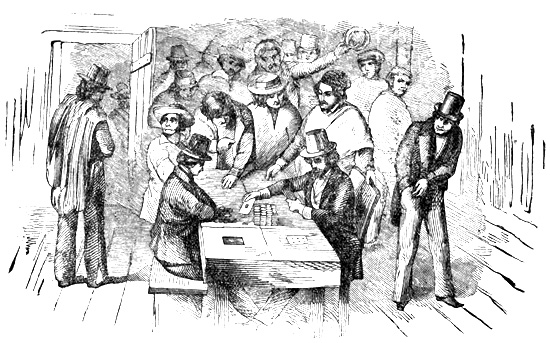
GAMBLING SCENE AT SAN FRANCISCO.
In regard to the routes, the practicability of procuring
needful supplies for men and animals, and
transporting baggage, is a point to be well considered.
Should the President be disappointed in his cherished
hope that you will be able to reach the interior of
Upper California before winter, you are then desired
to make the best arrangement you can for sustaining
your forces during the winter, and for an early movement
in the spring. Though it is very desirable that
the expedition should reach California this season,
(and the President does not doubt you will make
every possible effort to accomplish this object), yet
if, in your judgment, it cannot be undertaken with
a reasonable prospect of success, you will defer
it, as above suggested, until spring. You are left
unembarrassed by any specific directions in this
matter.
It is expected that the naval forces of the United
States which are now, or will soon be in the Pacific,
will be in possession of all the towns on the seacoast,
and will co-operate with you in the conquest of California.
Arms, ordnance, munitions of war, and provisions
to be used in that country, will be sent by
sea to our squadron in the Pacific for the use of the
land forces.
Should you conquer and take possession of New
Mexico and Upper California, or considerable places
in either, you will establish temporary civil governments
therein—abolishing all arbitrary restrictions
that may exist, so far as it may be done with safety.
In performing this duty, it would be wise and prudent
to continue in their employment all such of the existing
officers as are known to be friendly to the United
States, and will take the oath of allegiance to them.
The duties at the custom-house ought at once to be
reduced to such a rate as may be barely sufficient to
maintain the necessary officers, without yielding any
revenue to the government. You may assure the
people of those provinces, that it is the wish and design
of the United States to provide for them a free
government with the least possible delay, similar to
that which exists in our territories. They will then
be called on to exercise the rights of freemen in
electing their own representatives to the territorial
legislature. It is foreseen that what relates to the
civil government will be a difficult and unpleasant
part of your duty, and much must necessarily be left
to your own discretion. In your whole conduct you
will act in such a manner as best to conciliate the inhabitants
and render them friendly to the United
States.
It is desirable that the usual trade between the
citizens of the United States and the Mexican provinces
should be continued, as far as practicable,
under the changed condition of things between the
two countries. In consequence of extending your
expedition into California, it may be proper that you
should increase your supply for goods to be distributed
as presents to the Indians. The United States superintendent
of Indian affairs at St. Louis will aid you
in procuring these goods. You will be furnished with
a proclamation in the Spanish language, to be issued
by you and circulated among the Mexican people on
your entering into or approaching their country.
You will use your utmost endeavors to have the
pledges and promises therein contained carried out to
the utmost extent.
I am directed by the President to say that the rank
of brevet brigadier-general will be conferred on you
as soon as you commence your movement towards
California, and sent round to you by sea or over the
country, or to the care of the commandant of our
squadron in the Pacific. In that way cannon, arms,
ammunition, and supplies for the land forces will be
sent to you.
Very respectfully, your obedient servant,
W. L. MARCY,
Secretary of War.
Colonel S. W. Kearny.
Fort Leavenworth, Missouri.
The particulars of the conquest of Upper California,
as well as the suppression of the insurrections,
we have already given in substance as they are in the
despatches of General Kearny and Commodore Stockton.
But we have said nothing of the transactions
in the Peninsula, as that afterwards was surrendered
to Mexico. All that is interesting in the conquest of
Lower California, will be found in the following
despatches from the commander of the New York
regiment of volunteers, which with a number of
marines were the only troops employed in that quarter.
We premise, that, after the United States
marines had taken San José, the natives rose, and
they were reduced to the necessity of taking refuge
in an old fort, or cuartel, in the town.
Barracks, Lower California,
San Jose, February 20, 1848.
Sir: I continue my report from the 22d ultimo,
from which time my force consisted of twenty-seven
marines and fifteen seamen, of whom five were on the
sick report, besides some twenty volunteers, Californians,
who at least served to swell the numbers. From
that date the enemy were continually in sight of us,
intercepting all communication with the interior, and
driving off all the cattle from the neighborhood. A
party of our men who went out to endeavor to obtain
cattle, were driven in and narrowly escaped being cut
off. We succeeded in obtaining a few cows, however,
which were very necessary to us in the reduced state
of our provisions, as, in addition to our garrison, we
were obliged, in humanity, to sustain some fifty women
and children of the poor, who sought our protection
in the greatest distress. I found it necessary, as
soon as our fresh beef was consumed, to put all hands
on half allowance of salt provisions. We had no
bread. On the 4th of February, the enemy closed
around us more, and commenced firing upon all who
showed themselves at our port-holes, or above the
parapets. On the morning of the 6th the enemy appeared
to be a little scattered, a considerable force
being seen riding about some distance from the town,
and at the same time a strong party of them posted
at the lower end of the street were keeping up an
annoying fire upon us. I judged this a favorable
opportunity to make a sortie upon them, and taking
twenty-five men with me, closed with them and dislodged
them, driving them into the hills without the
loss of a man on our part, and returned to the cuartel.
On the morning of the 7th it was reported to me that
the enemy had broken into the houses on the main
street, and there was some property exposed which
might be secured. I took a party of men and went
down and brought up a number of articles belonging
to the Californians, who were in the cuartel; some
distant firing took place, but no injury was sustained.
On the same day, hearing there were some stores of
rice and tobacco in a house some three hundred yards
down the main street, I determined upon an effort to
obtain them, and sallied out with thirty men: these
were immediately fired upon from several different
quarters, and some fighting ensued, resulting in the
death of one of my volunteers—shot through the
heart. We charged down the end of the street, and
drove the enemy to the cover of a cornfield at the
outside of the town, where they were considerably
reinforced, and recommenced a hot fire; but we were
enabled to save a part of the articles which we were
in search of, though we found that the enemy had anticipated
us in this object, having forced the building
from the rear. On the afternoon of the following
day, Ritchie's schooner, having provisions for us from
La Paz, came in sight and anchored, but a canoe
which was enticed toward the shore by a white flag
displayed by the enemy, was fired upon, and the
schooner immediately got under way.
On the 10th the enemy had entire possession of the
town: they had perforated with port-holes all the adjacent
houses and walls, occupying the church, and,
hoisting their flag on Galindo's house, ninety yards distant,
held a high and commanding position, which exposed
our back yard and the kitchen to a raking fire,
which from this time forth was almost incessant from
all quarters upon us, the least exposure of person creating
a target for fifty simultaneous shots. The enemy
appeared to have some excellent rifles, among other
arms; and some of them proved themselves tolerably
sharp shooters, sending their balls continually through
our port-holes. On the 11th the fire was warm, but
on our part it was rarely that we could get a sight of
them. In the afternoon of this day we had to lament
the death of Passed Midshipman McLanahan, attached
to the United States ship Cyane; a ball striking him
in the right side of the neck, a little below the thyroid
cartilage, lodged in the left shoulder. He died in
about two hours. He was a young officer of great
promise, energetic, of much forethought for his age,
and brave to temerity. All lamented his untimely
fate, and all bear willing testimony to his worth.
On the morning of the 12th, at daylight, we discovered
that the enemy had thrown up a breastwork
upon the sand, about one hundred and fifty yards to
the north-east of the cuartel, and entirely commanding
our watering place. We fired several round shot
at it, with little effect. We succeeded in getting in
being in strong force, and kept a close watch upon us.
Their force was over three hundred, speaking within
bounds. I immediately commenced digging a well in
the rear of Mott's house, which is the lowest ground.
I found that we had to go through rock, and judged
we should have to dig about twenty feet. I thought
it imprudent to blast, as the enemy, suspecting our
intention, would throw every obstacle in our way. The
men worked cheerfully on this and the succeeding
day against all difficulties. Our situation was becoming
now an imminently critical one, having with the
greatest economy but four days' water. On the 14th
we continued digging for water. We found that the
enemy had thrown up a second breastwork more to
the westward, giving them a cross-fire upon our watering
place: there was a continual fire kept up upon the
cuartel during the day. At three o'clock, 30 minutes
P.M., a sail was reported in sight, which proved to be
the United Ship Cyane. She anchored after sundown.
It was of course a joyful sight to us to see
friends so near; but I was apprehensive that they
could render us but little assistance, the enemy being
so vastly superior in numbers. The enemy continued
their firing upon us during the night. On the 15th at
day-light, we became aware that the Cyane was landing
men. They soon commenced their advance, which for
a few moments was opposed only by a scattering fire;
then the enemy opened upon them in earnest. They
had concentrated nearly their entire force near San
Vincente. We saw the flash of musketry through all
the hills above the village. There was the odds of
three to one against our friends. Steadily they came
on, giving back the enemy's fire as they advanced.
There was still a party of the enemy occupying the
town, firing upon us. I took thirty men, and sallied
out upon them, drove them from cover, killed one
and wounded several of them, and marched out to
join the Cyane's men, who, with Captain Dupont at
their head, had now drawn quite near to us. There
were small detached parties of the enemy still hovering
about them, and firing at them, but the main body
of the enemy had been broken, and retired to "Las
Animas," distant two miles. The march of the
Cyane's men to our relief, through an enemy so vastly
their superior in numbers, well mounted and possessing
every advantage in knowledge of the ground, was
certainly an intrepid exploit, as creditably performed
as it was skilfully and boldly planned, and reflects
the greatest honor on all concerned. It resulted most
fortunately for us in our harassed situation. They
had but four wounded; this cannot be termed any
thing but the most remarkably good luck, considering
the severe fire that this heroic little band were exposed
to. The loss of the enemy we have not positively
ascertained: we hear of thirteen killed, with
certainty, and general report says thirty-five;
wounded not known. Of the total loss of the enemy
in their attack upon the cuartel, I cannot speak with
certainty; we have found several graves, and know
of a number wounded, one of whom we have in the
cuartel a prisoner. I suppose their total loss to be
not far from fifteen killed, and many wounded; I am
sure it could not be less than this. Our own total
loss was three killed and four slightly wounded. After
the death of Passed Midshipman McLanahan, there
remained but one officer to my assistance, Passed
Midshipman George A. Stevens, to whom, for his
coolness and indefatigable zeal at a time when so
much devolved upon him, I am most happy to accord
the highest credit; and at the same time I must
honorably mention the conduct of a volunteer, Eugene
Gillespie, Esq., who, although suffering from illness,
never deserted his post, and was with me in the
sortie of the 7th. The non-commissioned officers and
men went through privation, unceasing watchfulness,
and danger, without a murmur. I cannot express too
highly my satisfaction in their conduct. Captain
Dupont immediately upon his arrival here, becoming
aware of our situation as regards provisions, took measures
for our supply. The day after the battle of San
Vincente he despatched a train, which brought us by
hand (the enemy having driven off all the mules and
horses) a quantity of stores and articles of which we
stood most in need, among the rest, bread, and has since
been unceasing in his exertions for our relief. I cannot
too earnestly express the obligations which we are under
for the prompt and efficient assistance which Captain
Dupont, his officers, and crew have rendered us.
I am, sir, respectfully, your obedient servant,
CHAS. HEYWOOD,
Lieutenant U.S. Navy, com'g., San Jose.
Lieut. Col. Henry S. Burton,
U.S. Army, com'g. troops in Lower California.
W. T. SHERMAN,
First Lieutenant 3d Artillery, A.A.A. General.
United States Barracks,
La Paz, California, April 13, 1848.
Sir: I have the honor to acknowledge the receipt
of your letter of March 1, 1848, and to report the
arrival of the army storeship "Isabella" at this place
on the 22d of March, 1848, with Captain Naglee's
company (D) New York volunteers, and one hundred
and fourteen recruits for the detachment of New York
volunteers stationed at this place.
The rescue of the prisoners of war on the 15th ultimo
caused great excitement among the enemy, and tended
very much to disorganize their forces, and the important
arrival of the reinforcements to my command
determined me to take the field as soon as possible;
accordingly, I left this place on the morning of the
26th instant with two hundred and seventeen officers
and men; Lieutenant Halleck, United States engineers,
acting chief of staff, and Passed Midshipman
Duncan, United States navy, temporarily attached to
the mounted portion of Captain Naglee's command.
The afternoon of the 27th, a party of fifteen men
captured, in San Antonio, Pineda, the commander of
the Mexican forces, with his secretary, Serrano.
The morning of the 29th, having received information
that the enemy had concentrated their forces in
Todos Santos, we pressed on with all speed, fearing
they might evade us, by retreating towards Magdalena
Bay. The morning of the 30th, about ten o'clock,
having received accurate information respecting the
enemy, Captain Naglee with forty-five mounted men
was despatched to intercept the road leading from
Todos Santos to Magdalena Bay, and, if practicable,
to attack the enemy in the rear at the same time our
main body made its attack in front.
The road leading from Todos Santos to La Paz, for
some distance before reaching the first named place,
passes through a dense growth of chaparral, (very
favorable for an ambush), and in this the enemy made
their arrangements to receive us. We left the road
about five miles from Todos Santos and marched along
a ridge of high land on the north side of the river,
having full view of the enemy's operations.
They then took possession of a commanding hill
directly in our route, between three and four miles
from Todos Santos, with their Indians in front. Companies
A and B, under the direction of Lieutenant
Halleck, were deployed as skirmishers in such a manner
as to expose the enemy to a cross-fire. The enemy
opened their fire at long distance, but our force advanced
steadily, reserving their fire until within good
musket range, when it was delivered with great effect,
and the enemy retreated very rapidly, after a short
but sharp engagement. At this time, Captain Naglee
being near Todos Santos, and hearing the firing,
attacked the enemy in rear, and after a severe action
completed their dispersion. Our men and horses being
too much fatigued by their long march to pursue
the scattered enemy, we marched on to Todos Santos.
The loss of the enemy in this engagement cannot
be ascertained with any accuracy; we know of ten
killed and eight wounded. Our loss was nothing; one
man and the horse of Acting Lieutenant Scott were
slightly wounded, the enemy, as usual, firing too high.
Our officers and men fully sustained the character
they won on the 16th and 27th of November last.
My warmest thanks are due to Lieutenant Halleck,
for his assistance as chief of staff, and I present him
particularly to the notice of the colonel commanding,
for the able manner in which he led on the attack on
the 30th ultimo.
Captain Naglee also deserves particular notice for
the energetic and successful manner in which he fulfilled
his instructions.
On the 31st ultimo, Captain Naglee, with fifty
mounted men of his company, was ordered to pursue
the enemy in the direction of Magdalena Bay. He
returned to La Paz on the 12th instant, having pursued
the enemy very closely, capturing five prisoners
and some arms.
Lieutenant Halleck started for San José with a
party of mounted men, consisting of one officer and
twenty-five non-commissioned officers and privates, on
the 5th instant, for the purpose of communicating
with Captain Dupont, commanding United States
sloop-of-war Cyane. He returned here on the 11th
instant, having captured ten prisoners on his march,
and taken a number of arms.
From him I learn that the naval force at San José
have thirty odd prisoners, and among others "Mauricio
Castro," the self-styled political chief of Lower
California. Lieutenant Selden, with a party from the
Cyane, made a most opportune march on Santiago,
where he captured a number of the enemy who had
fled from the field of Todos Santos. Castro, who
commanded the enemy's forces in the action of the
30th, was arrested near Maria Flores by the civil
authorities and delivered up to Lieutenant Selden.
During the stay of our main body at Todos Santos
fourteen prisoners were captured; among them two
sons of the reverend padre Gabriel Gonzales, officers
of the Mexican forces.
We left Todos Santos on the 5th instant, and arrived
at this place on the 7th. The result of this short
campaign has been the complete defeat and dispersion
of the enemy's forces.
We have captured their chief and six officers, and
one hundred and three non-commissioned officers and
privates; and others are daily presenting themselves
to the civil authorities in different parts of the country.
The captured arms have been given to those rancheros
known to be friendly to the interests of the
United States, for their protection.
I am, sir, with much respect, your obedient servant,
HENRY S. BURTON,
Lieutenant Colonel New York Volunteers.
Lieutenant W. T. Sherman,
Act. Ass. Adjt. Gen. Tenth Mil. Dep.
W. T. SHERMAN,
First Lieut. 3d Artillery A.A.A. General.
The following despatch from Governor Mason, gives
an account of the state of affairs in Upper California,
in October, 1847:
Headquarters Tenth Military Department,
Monterey, California, October 7, 1847.
Sir: I returned from San Francisco yesterday, and
found here Mr. Toler, with despatches from Washington,
the receipt of which I have the honor to acknowledge.
I am also informed by Commodore Shubrick
that the sloop-of-war Preble is ready to sail for
Panama, with Passed Midshipman Wilson as bearer
of despatches for the United States. I therefore avail
myself of the opportunity to send you my letter of
the 18th of September, with its several packages, and
now have to communicate the result of my visit to
San Francisco.
I found the town flourishing and prosperous, with a
busy, industrious population of Americans, and refer
you to the copies of my military correspondence for the
steps adopted to give them a good town government.
The Bay of San Francisco, you are well aware, is a
spacious, elegant harbor, susceptible of the most perfect
defence; but as yet nothing has been done
towards fortifying it, or even placing any of the heavy
guns in position at the old fort. It is found almost
impossible to get much work out of the volunteers;
and all that I can now expect of the two companies
of Major Hardie's command will be to improve their
quarters at the old presidio. This they are at present
engaged upon, using lumber made at the horse saw-mill,
under direction of the assistant quartermaster,
Captain Folsom. All this labor is done by the volunteers,
so that the improvements will be made at very
little expense to the government. The price of lumber
at San Francisco is $50 per M.; but Captain
Folsom says that he has it sawed and delivered, by
the labor of the volunteers and his own machinery, at
about $16. The mill is placed in the timber known as
the Red Woods, near the mission of San Rafael, on
the west and north sides of the bay, where any amount
can be had. If the government design to erect permanent
structures to any extent in this country, it
would be advisable to send out a steam engine, with
all the necessary frames and iron-work to adapt it to
immediate use in connexion with the saw and grist
mills now in possession of the quartermaster's department
here. The site at present selected by Captain
Folsom is well adapted, as easy water communication
is had with the San Joaquin and Sacramento Rivers as
well as the parts of the country south of San Francisco.
At San Francisco I found all the powder, arms,
accoutrements, and perishable ordnance property well
stored in a building prepared for the purpose at the
presidio barracks; but the guns, mortars, carriages,
shot, and shells are in the town in the open air, protected
by paint alone. The great difficulty of hauling
such articles over the rugged hills between the town
and presidio will prevent their being hauled to the
latter place this season.
I did design to continue my tour of inspection to
Sonoma and the Sacramento River, but was recalled
by hearing of the arrival of the bearer of despatches
at Monterey.
When on my way up to San Francisco, I was overtaken
by Captain Brown, of the Mormon battalion,
who had arrived from Fort Hall, where he had left
his detachment of the battalion, to come to California
to report to me in person. He brought a muster-roll
of his detachment, with a power of attorney from all
its members to draw their pay; and as the battalion
itself had been discharged on the 16th of July, Paymaster
Rich paid to Captain Brown the money due the
detachment up to that date, according to the rank
they bore upon the muster-rolls upon which the battalion
had been mustered out of service. Captain
Brown started immediately for Fort Hall, at which
place and in the valley of Bear River he said the
whole Mormon emigration intended to pass the winter.
He reported that he had met Captain Hunt, late of
the Mormon battalion, who was on his way to meet
the emigrants and bring into the country this winter,
if possible, a battalion according to the terms offered
in my letter to him of the 16th of August, a copy of
which you will find among the military correspondence
of the department.
In my letter I offered Captain Hunt the command
of the battalion with the rank of lieutenant-colonel,
with an adjutant; but I find, by the orders lately
received, that a battalion of four companies is only
entitled to a major and acting adjutant. I will notify
Captain Hunt of this change at as early a moment as
I can communicate with him. I am pleased to find
by the despatches that in this matter I have anticipated
the wish of the department.
Last season there was a great scarcity of provisions
on the coast of California; but when the stores are
received that are now on their way, there will be
an ample supply for the coming winter. The crops in
this country have been very fine this season, and at
present wheat is plenty and cheap at San Francisco.
Beef is also plenty. Beans can be purchased at the
southern ports, and sugar imported from the Sandwich
Islands; but for all other subsistence stores we
are dependent upon the South American ports or
those of the United States. I have directed Captain
Marcy, acting commissary of subsistence at this post,
to supply the chief of his department with the market
price of all kinds of provisions, with such other facts
as may enable his department to act with the proper
economy. The want of good clothing for the regulars
and volunteers is already felt in California; and unless
a supply has already been despatched, many of the
garrisons will be without shoes and proper clothing
this winter. The price of such articles here is so
exorbitant as to place them beyond the reach of the
soldiers. The volunteer clothing brought by Sutler
Haight has already been disposed of to citizens and
soldiers, and there are no means of his renewing the
supply except by sending to the United States. Justice
to the soldier demands that he either be comfortably
clad by the government, or that it should be within
his power to clothe himself on the allowance provided
for that purpose by law.
I respectfully recommend, if it has not already been
done, that a large supply of infantry undress winter
clothing be sent immediately to this country, to be
distributed, so as to enable each volunteer to purchase
for his own immediate use at cost prices. No summer
clothing is needed, as the climate is too severe, summer
and winter. Such articles as good blankets, cloth
overcoats, caps, jackets, overalls, stockings, and shoes
with stout shirts and drawers, are the only ones that
will ever be needed here.
General orders No. 10, of 1847, promotes Lieutenant
Loeser, third artillery, and orders him to join
his company. I regret that at this moment his services
cannot be spared, and I am compelled to retain him
on duty with company F, third artillery, because the
absence of Captain Tompkins, the death of Lieutenant
Minor, and Lieutenant Sherman being detached as
acting assistant adjutant general, has reduced the
number of officers of that company to but two—Lieutenants
Ord and Loeser. I trust that the two
companies of regulars in this country will be kept with
a full supply of officers, that an officer, upon being
promoted, may be enabled to join the army in the
field, and participate in the active operations to which
he looks for distinction and experience.
Captain H. M. Naglee, seventh New York volunteers,
with a strong detachment of his company, is
now absent in pursuit of Indians in the valley of the
San Joaquin. He has with him Lieutenant Burton's
company of California volunteers, which is expected
to return to Monterey before the end of this month;
in which case I shall cause it to be mustered out of
service, and discharged on the 31st day of October.
Again I have to report the death, by sickness, of
an officer of my command—Lieutenant C. C. Anderson,
seventh New York volunteers, who contracted a
fever when on duty at Fort Sacramento, and died in
consequence at San Francisco on the 13th of September.
He was buried with military honors by the troops
at San Francisco, under direction of Major Hardie.
This death reduces the number of officers in Captain
Brackett's company, seventh regiment New York
volunteers, to one captain and one second lieutenant.
Commodore Shubrick will sail for the west coast of
Mexico from this harbor next week; and having made
application to me, I have directed Lieutenant Halleck,
of the engineer corps, to accompany him, and shall
give Lieutenant Colonel Burton, in command at La
Paz, Lower California, authority to accompany Commodore
Shubrick, should the latter design an attack
upon any point or points of the west coast of Mexico,
with orders, of course, to resume his position at La
Paz as soon as the object is accomplished for which
his command is desired.
Note.—Colonel Burton will be directed to leave a
sufficient number of men at La Paz to keep the flag
flying.
It affords me much pleasure to assure the department
that the most perfect harmony subsists between
the members of the naval and land forces on this coast,
and that the most friendly intercourse is kept up
between the officers. I have had frequent occasion
myself to ask assistance of Commodores Biddle and
Shubrick, and my requests have been granted with
promptness and politeness; and in return I have
afforded them all the assistance in my power. Our
consultations have been frequent and perfectly harmonious,
resulting, I hope, in the advancement of the
common cause of our country.
I have the honor to be, your most obedient servant,
R. B. MASON,
Colonel 1st Dragoons, Commanding.
To General R. Jones,
Adjutant-General, Washington, D.C.
We have already given the substance of Governor
Mason's despatch to the government, giving an account
of the gold discovery and a visit to the placers.
There is, therefore, no necessity for inserting that
official document. The appearance in Upper California,
in July 1848, of Don Pio Pico, the former governor
of the territory, gave rise to serious apprehensions
of another insurrection. The despatch of Col.
Stephenson, the commander of the garrison at Los
Angeles, to Colonel Mason, contains an account of the
matter, together with a description of the ex-governor.
Headquarters Southern Military District,
Los Angeles, California, July 20, 1848.
Sir: By the last mail I informed you of the arrival
of Don Pio Pico in this district. I subsequently
learned that he had passed through San Diego without
presenting himself to Captain Shannon, or in any
manner reporting his arrival. Immediately after his
arrival, rumors reached me of conversations had by
him with his countrymen, in which he stated that he
had returned with full powers to resume his gubernatorial
functions, and that he had only to exhibit his credentials
to you to have the civil government turned
over to him. I found the people becoming very much
excited, and some rather disposed to be imprudent. I
sent for Jose Ant. Carrillo and some others in the
town, who were giving currency to these reports, and
informed them that I should hold them responsible
for any imprudent or indiscreet act of their countrymen,
and that, at the first appearance of any disrespect
to the American authorities, I should arrest
and confine them in the guard-house. This had the
effect to check all excitement here; but as Don Pio
removed up the country, the same excitement began
to spread among the rancheros. In the mean time,
his brother Andreas informed me that he, Don Pio,
would come in and report to me in person in a few
days, as soon as he had recovered from the fatigue
of his journey. On Saturday, the 15th instant, he
reached the ranch of an Englishman named Workman,
some eighteen miles from here. This man has
ever been hostile to the American cause and interest,
and is just the man to advise Pico not to come in and
report to me.
On Sunday and Monday I was advised that many
Californians had visited Pico at Workman's, and that
the same story had been told them of his having returned
to resume his gubernatorial functions, &c., and
also that he should not report to me, but go direct to
San Fernando, from whence he would communicate
with you. The moment I became satisfied that he
intended to adopt this course, I issued an order (copy
inclosed) requiring him to report to me immediately
in person. I sent my adjutant with a detachment of
men to the ranch of Workman to deliver to Don Pio
in person a copy of this order, with instructions to
bring him in by force, in case he refused or even
hesitated to obey. The adjutant returned here at
twelve o'clock on Monday with information that the
Don had left for San Fernando. I immediately despatched
Lieutenant Davidson with a detachment of
dragoons and a copy of the order, with instructions
similar to those given Adjutant Bonnycastle. About
five o'clock on Tuesday morning I received a visit
from a gentleman named Reed, living at the mission
of San Gabriel, who informed me that Don Pio Pico
had arrived at his house quite late in the evening of
Monday, on his way to San Fernando. Reed inquired
if he did not intend reporting to me in person; he
answered in the negative; when Reed assured him,
if he attempted to pass my post without reporting, I
would cause him to be arrested, and that he was
aware of my being displeased at his passing through
San Diego without reporting to the commandant of
that post. Don Pio Pico, upon receiving this information,
became alarmed, and requested Reed to come
in and see me, to say he intended no disrespect, and
would come and report at any hour I would name.
Reed is a highly respectable man, and has ever been
friendly to the American cause; and I gave him a
copy of the order I had issued in regard to Don Pio,
requesting him to deliver it, and say to Don Pio, he
could come in at any hour he chose, within twenty-four
hours. Accordingly about eight P.M., the same
evening, the ex-governor came in. He was unaccompanied
even by a servant, evidently desiring it should
not be known he was in town. I received him kindly,
told him I had no desire to treat him harshly, but that
the American authorities must be respected, and if he
had not come in I should certainly have arrested him.
He informed me that he left Guaynas on the 22d of
May, crossed to Mulige, which he left for California
on June third, and arrived at San Diego, July sixth.
He says that when he left Guaynas nothing had been
heard of the action of the Mexican Congress upon
the treaty, but it was generally supposed it would be
ratified. He says the Mexican government did not
answer any of his communications; and the moment
he saw the armistice published in a newspaper, he
determined to return home, as he supposed he could
return with credit, under the stipulations of the
armistice. He brings with him no other authority
for his return, and says he desires to live peaceably,
and attend to his private affairs. He denies ever
having said that he came back with powers to resume
his gubernatorial functions, and that he rebuked such
of his friends as he had seen for their last attempt at
a revolution, and advises that they remain quiet and
obey the laws, as no part of the people of the conquered
Mexican territory have been treated as kindly
as the Californians have been by the American authorities.
He thanked me for my personal kindness
to his family and countrymen in general, and said if
I would permit him he would go to San Fernando,
from whence he would answer that part of my order
which required a written communication from him. I
gave him permission to leave, and offered him an
escort, which he thanked me for, but declined. Don
Pio Pico is about five feet seven inches high, corpulent,
very dark, with strongly-marked African features;
he is, no doubt, an amiable, kind hearted man,
who has ever been the tool of knaves; he does not
appear to possess more intelligence than the rancheros
generally do; he can sign his name, but I am informed
he cannot write a connected letter; hence, as
he informed me, he would be compelled to send for
his former secretary before he could answer my order
or communicate with you, which he advised me he
intended doing. I have promised to take charge of
and forward any communication he may choose to
make you. He left town on Wednesday morning very
early, as obscurely as he had entered it; and those
who advised him to assume the bombastic tone he did
upon his first arrival, have done him irreparable injury
for he is now ridiculed by many who before entertained
a high respect for him.
I have the honor to be, very respectfully, your obedient
servant,
J. D. STEVENSON,
Colonel 1st New York Regiment, commanding
S. M. District.
Colonel R. B. Mason,
1st U. Dragoons, Governor of California.
P. S.—Since writing the above, I have received the
inclosed note from Don Pio Pico, inclosing a communication
to your excellency. In the note of Don Pio
to me, you will perceive that he is no sooner arrived
at San Fernando than he claims to have returned to
California as its Mexican governor, to carry out the
provisions of the armistice. I shall not answer his
note until I have heard from you; but I shall keep
an eye on him, and if I find he is preaching sedition,
I will bring him in here at short notice.
J. D. STEVENSON,
Colonel, commanding.
W. T. SHERMAN,
First Lieutenant 3d Artillery, A.A.A. General.
On the 13th of April, 1849, Colonel Mason at his
own request, was relieved from the post of Governor
of California, and Brigadier-General Riley took his
place. The despatch of that officer, dated 30th of
June, following his assuming the duties of his post,
is important, as containing an account of the state of
feeling in California, upon the subject of the laws at
that time in force, and the difficulties with various assemblies
elected in the northern part of the territories.
Executive Department of California,
Monterey, June 30, 1849.
General: I have the honor to transmit herewith
copies of all civil correspondence and papers since
the 13th of April last, at which time I relieved Colonel
Mason from his duties as Governor of California.
It was (with the advice of Colonel Mason) my intention,
on assuming the direction of civil affairs in
this country, to complete the organization of the existing
government; at the same time to call a convention
for forming a State Constitution, or plan of territorial
government, to be submitted to Congress for its approval.
But on further consultation it was deemed best
to postpone all action on this subject, until I could
ascertain what had been done in Congress. On the
first instant I received reliable information by the
steamer "Edith" that that body had adjourned without
organizing any territorial government for this
country; and accordingly, on the 3d instant I issued
my proclamation to the people of California, defining
what was understood to be the legal position of affairs
here, and pointing out the course it was deemed advisable
to pursue in order to procure a new political
organization better adapted to the character and
present condition of the country. The course indicated
in my proclamation will be adopted by the
people, almost unanimously, and there is now little or
no doubt that the convention will meet on the first of
September next and form a State Constitution, to be
submitted to Congress in the early part of the coming
session.
A few prefer a territorial organization, but I think
a majority will be in favor of a State government, so
as to avoid all further difficulties respecting the question
of slavery. This question will probably be submitted,
together with the Constitution, to a direct vote
of the people, in order that the wishes of the people
of California may be clearly and fully expressed. Of
course, the Constitution or plan of territorial government
formed by this convention can have no legal
force till approved by Congress.
On the receipt of the treaty of peace with Mexico,
doubt was entertained by a portion of the people here
respecting what constituted the legal government and
laws of the country. A few contended that all
government and all laws in California were at an end,
and that therefore the people, in their sovereign
capacity, might make such government and laws as
they should deem proper. Accordingly, in two of the
northern districts, local legislative assemblies were
organized, and laws enacted for the government of
the people of these districts. The members of the
Sonoma assembly, however, soon became convinced
of their error, and that body was dissolved. But in
San Francisco the assembly continued its sessions,
making laws, creating and filling offices, imposing and
collecting taxes, without the authority and in violation
of law, and finally went so far as to abolish the office
of alcalde, whose records and papers were seized and
forcibly removed from his custody. On receiving
official information of these facts, I issued my proclamation
of the 4th instant. Since then I have made
a personal visit to San Francisco, and find that the
more respectable members of the so-called district
assembly are convinced of the impropriety of the
course pursued by that body, and in a very short time
I think all the difficulties will be amicably arranged.
These difficulties arose in part from a misapprehension
as to what constituted the legal government of
the country, and in part from the unpopularity of the
first alcalde of that district, against whom serious
charges had been made. Unfortunately, there was
at the time no legal tribunal for investigating these
charges; and, there being no other magistrate in that
district, I could not, with propriety, remove him from
office. A new election, however, will soon be held to
supply his place; and on the organization of the
"superior court," the charges against him can be
properly investigated.
The publication of a portion of the instructions
received from Washington respecting the government
of this country, and the disposition manifested by the
authorities here to enforce the existing laws, have
done much to remove the erroneous opinions which
were for a time entertained by a portion of the people
of California. The civil government of this country
has been, and will continue to be, administered on the
principle laid down by the Supreme Court of the
United States, viz: on the transfer of the ceded
territory, it has never been held that the relations of
the inhabitants with each other undergo any change.
Their relations with their former sovereign are dissolved,
and new relations are created between them
and the government which has acquired their territory.
The mere act which transfers their country transfers
the allegiance of those who remain in it; and the law
which may be denominated political is necessarily
changed, although that which regulates the intercourse
and general conduct of individuals remains in force
until altered by the newly-created power of the
State.
The treaty is the law of the land, and admits the
inhabitants of [California] to the enjoyment of the
privileges, rights, and immunities of citizens of the
United States. It is unnecessary to inquire whether
this is not their condition, independent of stipulation.
They do not, however, participate in political power;
they do not share in the government till [California]
shall become a State. In the mean time, [California]
continues to be a territory of the United States,
governed by virtue of that clause of the constitution
which empowers Congress to make all needful rules
and regulations respecting the territory and other
property belonging to the United States.
When we take into consideration the great mass of
floating population of the United States and of other
countries—people of all nations, kindreds and tongues—which
has been suddenly thrown into this country,
it must be acknowledged that every thing has, thus
far, remained remarkably quiet, and that the amount
of crime has been much less than might, under the
circumstances, have reasonably been expected. It is
to be feared, however, that during the coming winter,
when large numbers of the miners collect in the towns,
public order may be occasionally disturbed. But it is
believed that in the mean time a more complete organization
of the existing government will be effected, so
as to enable the authorities to enforce the laws with
greater regularity and efficiency.
Rumors have reached me that there is no very
amicable feeling existing between the Americans and
foreigners in the gold regions, and that the former
are disposed to forcibly expel the latter from the placer
districts. I shall soon visit the valleys of the Sacramento
and San Joaquin, and hope to be able to report
upon the true state of affairs there by the August
steamer. As Congress has declined passing any laws
restricting the working of the placers, I shall not
deem myself authorized to interfere in this matter, any
further than may be necessary to preserve the public
tranquillity. Indeed there is much reason to believe
that Congress has pursued the best policy, under the
circumstances, in leaving the placers open to all; for
it would be exceedingly difficult to enforce any regulations
not absolutely required by the necessity of the
case, and it is more than probable that any attempt
at this time to rent out the mineral lands, or to tax
their products, would involve a great expense, and it
is quite possible that such an attempt would lead to
very serious difficulties. Of the large numbers who
have been attracted to this country by the flattering
prospect of sudden wealth, and with the intention of
returning to their former homes to enjoy their gains,
many foreigners as well as Americans are becoming
established in business, and will make California their
permanent place of residence. It is therefore well
worthy of serious consideration whether the present
system may not prove equally beneficial with that of
a more exclusive policy. It certainly conduces much
towards developing the resources of the country, extending
its commerce, and rapidly augmenting its
wealth and population. As soon as I have made a
personal examination of the gold regions, I shall be
prepared to express my views on this subject; but I
cannot omit the present occasion to urge upon the
government the importance of establishing a mint in
California, with the least possible delay.
Information, not official, has been received, that the
revenue laws of the United States have been extended
over this country, and that a collector and deputies
may soon be expected to take charge of the collection
of revenue in this district. On their arrival, all custom-houses
and custom-house property will be turned
over to them, and the temporary collectors employed
by my predecessor and by myself will be discharged.
The moneys collected during and since the war, under
the direction of the governor of California, and not
required for defraying the expenses of the civil government,
will be kept as a separate and distinct fund,
subject to the disposition of Congress. The grounds
upon which this revenue has been collected since the
declaration of peace, are fully stated in a letter to the
collector of San Francisco, dated the 24th of February
last. It may be proper to add, that the course pursued
by my predecessor was rendered absolutely
necessary by the peculiar circumstances of the case.
The wants of the country rendered it imperative upon
him to permit the landing of foreign goods in this
territory; and had this been done without the collection
of duties, large amounts of dutiable goods would
have been placed in depot on this coast, to the manifest
injury of the revenue and prejudice to our own
merchants. The importers have sold their goods at
such prices as to cover the duties paid, and still leave
them enormous profits; and to now return these
duties to the importers would be a virtual gift, without
in any way benefitting the people of California. But,
to expend this money in objects of public utility in
the country, would confer a lasting benefit upon all.
I would therefore recommend that such portions of
these moneys as may be left, after defraying the
expenses of the existing civil government, be given to
California as a "school fund," to be exclusively devoted
to purposes of education. No difficulty has been
experienced in enforcing the tariff of 1846, and the revenue
has been collected at a very moderate expense,
considering the peculiar circumstances of the times.
All officers of the civil government of California
will be paid out of the "civil fund" arising from the
customs, the salaries fixed by law, and I would recommend
that those officers of the army and navy who
have been employed as collectors and receivers of
customs in California, both during and since the war,
be allowed a fair per centage on the money which
they have collected and disbursed. Two and a half
per cent. on the amount collected, with the restriction
contained in section 2 of the Act of March 3, 1849,
is deemed a fair allowance for collecting these customs,
and two and a half per cent. on the amount actually
expended is deemed ample compensation for keeping
and accounting for the same. It would be more just
and proper to make the allowance for the actual expenditures
than for receiving and keeping these
moneys; because, if the reversed rule were established,
officers who have received large sums, and within a
few days transferred them to others, with no other
trouble than merely passing receipts, would be entitled
to a higher pay than those who have had all the
trouble of expending this money in small sums, and in
keeping and rendering accounts of these expenditures.
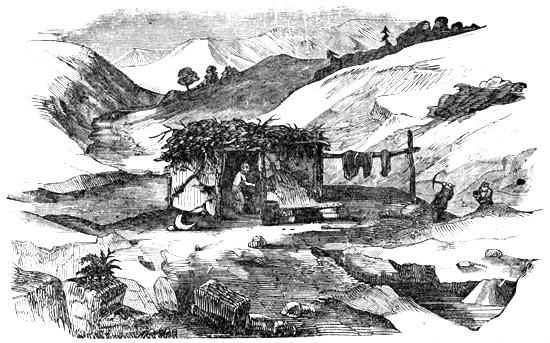
As soon as these "civil funds" can be collected
from the officers now holding them, it is proposed to
place them in the hands of some officer, or other
responsible person, who will act as treasurer for the
civil government, with a fixed compensation for his
services. On the arrival of the regular collector and
deputies, appointed according to law, a full statement
will be made of all the moneys which have been collected
in California, and the papers and accounts connected
with the expenditure of this civil fund will be
sent to Washington, as heretofore, in order that all
officers who shall receive or expend the same may be
held to a strict accountability.
I am, sir, very respectfully, your obedient servant,
B. RILEY,
Brevet Brig. Gen. U.S.A., and Governor of California.
Major-General R. Jones,
Adjutant General of the Army, Washington, D.C.
Governor Riley took occasion to make an excursion
through the gold regions, soon after his affairs with
the assemblies were disposed of. A reconnoisance
of the valleys of the Sacramento and San Joaquin was
made, and particular care given to the matter of establishing
military posts for defending the miners and
others from the attacks of the Indians. After his return
to Monterey, the following despatch was sent to the
headquarters of the United States army. The subject
of the Indian troubles receives especial consideration.
Headquarters Tenth Military Department,
Monterey, California, August 30, 1849.
Colonel: I found, on my return to this place from
a reconnoissance of a portion of the valleys of San
Joaquin and Sacramento Rivers, general orders No. 1
from the headquarters of the army; and, as I cannot
have copied in season for transmission by the steamer
of the 1st proximo the military correspondence at
these headquarters, I respectfully submit, for the information
of the commander-in-chief, a brief summary
of reports heretofore made in relation to military
affairs in this department.
My attention was directed, on my arrival in this
country, to the unparalleled excitement in relation to
the mineral regions; the imminent danger that our
troops, as they arrived, would desert to the "placers,"
and, instead of giving protection to the parties, and
aid in the preservation of order and tranquillity, would
themselves become the very worst element of disorder;
the great extent of Indian frontier to be
guarded, and the difficulties then apprehended from
the unsettled state of affairs in the mining districts.
An attentive consideration of these subjects impressed
me with the opinion that the policy most likely to
prove advantageous to the service, would be the concentration
of all the troops serving in this department,
except the necessary guards for the depots at one or
more points in the immediate vicinity of the gold
regions, from whence a portion of them might be permitted
to visit the placers for the purpose of working
them for their own benefit—the remainder to be held
embodied in a proper state of discipline, in readiness
for any emergency that might occur. After the expiration
of the furlough of the first class, a second
class to be furloughed, and so in succession with the
remainder; the troops stationed at points so distant
from the mines, that they could not be furloughed, to
be relieved by exchange with commands that have
been more favorably situated. The practice of granting
furloughs, adopted at some of the posts in this
country, with the sanction of the former department
commander, had succeeded well, and the information
received about the time of my arrival from the southern
part of this department confirmed me in the
opinion previously entertained, that the mania for gold-hunting
would exist, in its most exaggerated form, at
points most remote from the placers. I accordingly,
immediately after relieving Colonel Mason in the
command of the department, recommended the adoption
of the policy above indicated. It is a matter of
regret, that the emergencies of the service have been
such that it could not be carried out to the extent recommended;
for the experience of the past four
months has convinced me that it is the only course
that can be adopted, with reasonable hope of success,
until the state of affairs in this country is materially
changed. In addition to the mere question of expediency,
Indian difficulties that were then occurring,
and the threatening danger of a proximate collision
between the different classes at work in the gold region,
made it highly important that a strong military
force should be established in the immediate vicinity
of the mining region.
For the disposition of the troops in the department,
and the measures taken to prevent desertions, &c., I
respectfully refer to department order and special
orders forwarded to you by this mail. These furnish
you with a history of the operations in the department
since my assumption of the command. The present
disposition of the troops is the same as indicated in
orders No. 16, except that company A, 2d infantry,
re-inforced by details from other companies—in all,
four officers and eighty men—has been detached, under
instructions from the commander of the division,
as an escort for Captain Warner, topographical engineers,
and company E, 1st dragoons, when en route
for the station, was diverted from that route, for the
purpose of securing the perpetrators of some murders
committed by Indians on or near Los Reyes River.
The difficulties apprehended from a collision between
the different classes of the mining population
have not yet occurred in the form which it was feared
they would assume, and at present I do not apprehend
any serious difficulty from that source. Some serious
Indian disturbances have occurred on the American
fork of the Sacramento, and a few isolated murders
have occurred at other points; but at the date of the
last report from the frontier, every thing was quiet.
The Indians of the Sierra Nevada, although in a great
number, are of a degraded class, and are divided into
so many different tribes, or rancherias, speaking different
languages, that any combination on their part is
scarcely to be apprehended. Their depredations
heretofore have been confined generally to horse-stealing,
and only occasionally have murders been committed
by them. These, however, have been made
the pretence, by the whites in their neighborhood, for
the commission of outrages of the most aggravated
character—in one or two cases involving in an indiscriminate
massacre the wild Indians of the Sierra
and the tame Indians of the ranchos. The commanders
of detachments serving on the Indian frontiers are
instructed to prevent any authorized interference with
the Indians by the whites, and to support the Indian
agents of their districts in the exercise of their appropriate
duties. From the character of the mining
population, and the nature of their occupations, unless
a strong military force be maintained on that frontier,
it will be impossible to prevent the commission of outrages
upon the Indians; and they, in turn, will be
avenged by murders committed upon isolated parties
of whites. Unfortunately, the eagerness with which
gold is sought after by detached parties of miners,
gives many opportunities for the commission of such
outrages. To seek after and apprehend the perpetrators
in cases of this kind, a mounted force is absolutely
necessary; and, although great difficulty will
be experienced in obtaining forage and replacing
horses that may be disabled, its services are so indispensably
necessary, that I greatly regret my inability
to supply more than one company on the Indian frontier
until after the company now on duty with the
commissioner of the boundary survey is relieved.
I have heretofore called the attention of the War
Department and the division commander to the insufficiency
of the force assigned to this department
by general order No. 49 of 1848. As it may not be
possible, with the present military establishment, to
order any additional force to this country without the
action of Congress, I respectfully invite the attention
of the commanding general to the views heretofore
expressed on this subject. A topographical sketch
of a portion of this department is herewith inclosed,
upon which I have indicated the positions or neighborhoods
in which I deem it important that troops
should be established. The amount and character of
the force required in my report to division headquarters,
of June 11, is also inclosed.
The embarrassments under which the service has
labored will be so readily appreciated at home, that
it is unnecessary to refer to them here except to say
that, great as these embarrassments have been, they
have been greatly increased by the want of line and
staff officers.
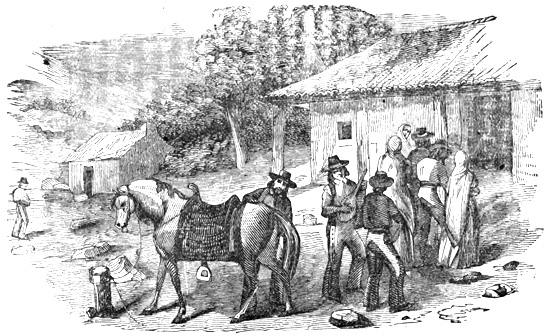
GOING TO A FANDANGO.
In consequence of the extraordinary prices of labor,
and the consequent enormous expenditures in this country,
young officers of the line should not be, in justice to
the service and themselves, as they have unnecessarily
been, encumbered, in addition to their company duties,
with money and property responsibilities to a very
great amount. Experienced officers of the quartermaster's
department are required at San Francisco,
San Diego, and with the commands on the upper Sacramento
and San Joaquin Rivers. I have now but
one officer, Captain Kane, of that department, under
my control; and he is necessarily detained at department
headquarters in the preparation of my estimates
for the services of the ensuing year. Quarters must
soon be erected at several of the posts in this department;
and I cannot spare line officers for this duty,
without destroying their efficiency with their companies,
even were it proper to do so. There are no topographical
engineers on duty in this department, and,
in consequence of the want, I have been able to perform
very little of the duty devolved upon me by the
111th paragraph general orders No. 49, of 1848. A
reconnoissance of a portion of the valleys of the Sacramento
and San Joaquin Rivers, undertaken for the
purpose of determining the position to be occupied, as
recommended in my report to division headquarters
of April 16, to the War Department of the 25th of
the same month, has strengthened my opinion of the
importance of giving the country a most thorough
examination before any military posts are permanently
located in the interior. The whole district of country
lying between the coast range and the Sierra Nevada
is exceedingly sickly at certain seasons of the year.
The common timber of the country (oak) is not fit for
building purposes; and I was greatly disappointed in
finding that south of the Sacramento River, pine fit
for lumber exists only on the spur of the mountains
in small quantities, and in places difficult of access.
Stone, as a building material is scarce; and at several
of the points where it may be desirable to establish
military posts, grain for forage is out of the question,
and grass can only be found in exceedingly limited
quantities. I expressed a hope in my despatches to
the War Department of June 30, that I would be able
to make an examination of the country along the
western slope of the Sierra Nevada, from the source
of the San Joaquin to the southern boundary of California;
but the season is now so far advanced that I
fear I shall not be able to accomplish more than the
determination of a position to be occupied in the
neighborhood of Los Reyes River. It is of great importance
that this point should be determined as
soon as possible; for the new discoveries of gold
constantly being made in that direction, are attracting
thither a large portion of the mining
population. The rapidly increasing population of the
northern placers is gradually forcing the Indians to
the south, and congregating them on the waters of the
Lake Buena Vista, (Tula.) This position should be
occupied, if possible, before the miners have become
established in Los Reyes and the neighboring rivers;
and the necessary examinations and arrangements will
be made as soon as it is possible to do so.
Since my application (April 25) for officers of the
quartermaster's department was made, two officers of
that corps, Majors Allen and Fitzgerald, whom I had
supposed would be available for duty in this department,
have been permanently separated from it; and
the number then applied for should be increased by
two.
Two of the medical officers in this department are
now prostrated by disease; and as their places cannot
be supplied here, there should be at least three in this
department, in addition to those actually required for
duty at the different posts in the department, to meet
emergencies of this kind.
The ordnance depots at Monterey and San Francisco
are under the charge of military store-keepers.
It is important, for the preservation of this property
in a serviceable condition, that they should be under
the supervision of an experienced ordnance officer.
With the exception of the assistant quartermaster
above referred to, the officers above enumerated have
heretofore been applied for; but as none have been
reported to me, I will state in detail what officers are
absolutely required with this command:
Four officers of the quartermaster's department in
addition to Captain Kane now on duty here:
Two topographical engineers:
Three additional medical officers:
One officer of the ordnance department:
One officer of the subsistence department.
The irregular communication with some of the interior
posts, creates a good deal of embarrassment by
delaying the department returns. In consequence of
this I am unable to furnish a later return than for
June. The transport Mary and Adeline, with companies
A and F, 2d infantry, reached San Francisco
on the 8th ultimo. The detachment of dragoons, on
their march to the department with the collector of
this district and the Arkansas emigrants, have not
yet arrived. During the months of July and August,
so far as reports have been received, there were but
few desertions, except from the company detailed for
the escort of Captain Warner, topographical engineers;
thirty-four men, more than half the whole number
reported, have deserted from this company. The
entire force in the department at this time does not
probably exceed six hundred and fifty, (aggregate;)
and consequently more than four hundred recruits are
now required to fill up these companies to the standard
authorized for this department.
A detailed report of my reconnoissance in the valleys
of the San Joaquin and Sacramento will be forwarded
by the next steamer. I have delayed it in
order to embody in it information in regard to the
country in the neighborhood of the Tula, which I am
in the daily expectation of receiving.
The want of company officers is very much felt; and
I request that authority may be given me to break up
the companies whose captains are permanently absent,
transferring the officers to other companies, as their
services may be needed.
I have the honor to be, very respectfully, colonel,
your obedient servant,
B. RILEY,
Brevet Brigadier-General U.S. Army, commanding.
Lieut.Col. W. G. Freeman,
Assistant Adjutant General U.S. Army,
Headquarters of the Army, New York.
In the early part of 1848, Lieut. H. W. Halleck,
of the Engineers, was ordered to make a reconnoisance
of the coast of Lower California, with reference
to the location of works of military defence. In his
report to Colonel Mason, after giving a general description
of the coast and harbors, and proposing a
system of military defence, he submits some remarks
upon the commercial and military importance of the
peninsula. The whole report is interesting, and furnishes
the most correct information upon the subject
of the reconnoisance. It will form an interesting
conclusion to a work which has been principally
devoted to a description and history of Upper California.
La Paz, April 12, 1848.
Sir: In compliance with the instructions of the
commanding general of the department to make a
"reconnoisance of the coast of California, with reference
to the location of works of military defence," I
reported in my last upon so much as relates to the
upper province, and I now submit a few remarks on
the military defence of the peninsula of Lower California.
I. General description of the coast and harbors.—The
principal ports of the coast of Lower California,
visited by whaling and merchant vessels, are San
Quintin, Magdalena, San Jose, La Paz, Escondido (near
Loreto), and Mulige.—There are some other points
which vessels occasionally touch for supplies and at
trade, but they are comparatively of little commercial
or military importance. The port of San Quintin,
in latitude thirty degrees twenty-three minutes, is represented
as affording a secure anchorage for vessels
of every description, and to be sufficiently commodious
for the reception of a numerous fleet. The extensive
bay of Magdalena has acquired considerable
notoriety from its being resorted to every winter by
large numbers of whaling vessels. Its size gives it
the character of an inland sea, its waters being navigable
for the distance of more than a hundred miles.
It furnishes several places of safe and commodious
anchorage. The bay of San Jose, near Cape Saint
Lucas, is much frequented by coasting vessels, and
occasionally visited by whalers and men-of-war. Being
the outlet of a fertile valley, extending some
forty or fifty miles into the interior, it is probably the
best place in the peninsula for supplying shipping
with water and fresh provisions. It is, however, a
mere roadstead, affording no protection whatever during
the season of southeasters.
La Paz is the seat of government and the principal
port of Lower California, and its extensive bay
affords excellent places of anchorage for vessels of
any size, and is sufficiently commodious for the most
numerous fleets. The principal pearl fisheries are
in this immediate vicinity, and also the most valuable
mining districts. It is the outlet of the fertile
valley of the Todos Santos, and of the produce of
the whole country between Santiago and Loreto.
The cove or estero, opposite the town of La Paz, furnishes
spacious and safe anchorage, which may be
reached by vessels drawing not more than eighteen
or twenty feet of water; and the cove of Pichilingue,
at the south-eastern extremity of the bay, and about
six miles from the town, affords an excellent anchorage
for vessels of any size; but the inner bay can be
reached only by small merchant vessels. The bar,
however, between the two is only a few yards in extent;
and if the importance of the place should ever
justify it, the channel might be made deeper without
difficulty or great expense. The adjacent country
being barren and mountainous, and the roads to the
interior exceedingly difficult, this place can never be
the outlet of much agricultural produce. But as the
island of Carmen, nearly opposite the entrance to
this bay, contains an almost inexhaustible supply of
salt, very easy of access, it is possible that the trade
in this article may eventually give considerable importance
to the port of Escondido.
The bay of Mulige contains several places of anchorage,
but none of them are deemed safe for large
vessels, or even from small vessels, at all seasons of
the year. There are also several other parts in the
gulf farther north which are occasionally visited by
coasting vessels, but it is not known that any of them
are likely to be of much commercial importance.
II. Proposed system of defence.—It is not supposed
that, under existing circumstances, any military
post will be necessary on the western coast of the
peninsula; nor is it probable that, for many years,
any place there will become of sufficient importance
to justify the construction of military works for its
defence. It is true that the whale fishery on this
coast has become, from the amount of shipping engaged
in it, an object of the highest consideration;
but our having ports of refuge at San Francisco or
San Diego, and at La Paz, strong enough to resist a
naval coup de main, will, it is believed, afford sufficient
security to these whalers in case of a war with a
maritime power.
On our arrival here in October last, it was deemed
desirable to establish a small military post at San
Jose, for the double purpose of giving protection to
the friendly inhabitants against a band of Mexican
freebooters who had crossed the gulf from Guaynas
to Mulige and Loreto, and of preventing the further
introduction of men and munitions from the opposite
coast. The old mission building was found well
adapted to the purpose in view, and with a few
repairs and improvements served as an admirable protection
for the little garrison in the several attacks
which it afterwards sustained from greatly superior
forces. It will probably be necessary to continue
this post during the war with Mexico, or at least so
long as there is any danger of the enemy's sending
troops from the opposite coast to again disturb the
tranquillity of the peninsula; but it is not deemed advisable
to establish at this place any works of permanent
defence, the character of the port not being such
as to warrant expenditures for this purpose. The
defences of the cuartel or mission building are deemed
sufficient for all purposes of temporary occupation.
Should the war with Mexico continue, and the
naval forces be again withdrawn from the gulf, it may
be necessary to establish temporarily a small military
post at Mulige; but no permanent garrison will be
required either at that place or Escondido, unless,
perhaps, hereafter the commercial importance of the
latter port should justify such a measure.
La Paz is, therefore, the only port in Lower California
which it will be necessary, for the present, to
occupy with a permanent military force, or to secure
by means of fortifications. For temporary purposes,
the site of the old cuartel is well suited
for the construction of defensive barracks, inasmuch
as it commands the town, and may readily be
secured against an attack from the side. The
buildings at present occupied as barracks are not
judiciously located. A permanent work on Punta
Colorada will completely close the entrance to
Pichilingue cove, and its heavy guns will reach the
entrance to the channel of La Paz; but to give the
requisite security to the latter, a small battery will be
necessary on Punta Prieta. The topographical features
of both these points are favorable for the construction
of small fortifications: Stone of good
quality for building purposes is found in the immediate
vicinity, and good lime may be procured at the
distance of only a few miles. Quarries have been
opened in the "Calaveras," and the stone, though
soft and easily worked, is found to be in this climate
of a very durable character. La Paz is not difficult
to defend against a naval attack, and the proposed
fortifications may be constructed in a short time and
without a very large expenditure of money. The commercial
character of the place, its military importance
as connected with the defence of the peninsula,
its great value as a naval depôt and port of refuge
for our commercial and military marine in case of war
with any naval power, will, it is believed, fully justify
the expenditures necessary for securing this port
against a maritime attack.
III. Commercial and military importance of Lower
California.—Thus far in my report I have proceeded
on the supposition that it is the intention of our government
to retain the whole of California in any
treaty of peace with Mexico; but doubts have recently
been expressed on the policy of retaining this
peninsula, on account of its being of little or no value
to the United States. As the guerrilla forces which
were sent over from Mexico the past summer, during
the absence of our squadron from this coast, to regain
possession of Lower California, and force the inhabitants
to their allegiance to the Mexican government,
have been defeated and completely dispersed, leaving
our own troops in undisputed possession of the territory,
nothing but a conviction of the utter worthlessness
of the country could now induce our government
to consent to its abandonment. On this subject I
beg leave to add a few remarks:
The peninsula of California lies between twenty-two
degrees fifty minutes and thirty-two degrees thirty
minutes north latitude, being about seven hundred
miles in length, and varying from fifty to one hundred
miles in breadth. An irregular chain or broken ridge of
mountains extend from Cape St. Lucas to the frontiers
of Upper California, with spurs running off on each
side to the gulf and ocean. Between these spurs are
numerous broad plains covered with stunted trees,
and during the rainy months with a thin but nutricious
grass. In the dry season this grass is parched
up like hay, but from its nutricious character it affords
abundant food for the herds of cattle and horses
which constitute the principal wealth of rancheros.
The dryness of the soil prevent the growth of trees
of any considerable magnitude, except on the borders
of a few mountain streams. This timber, though far
from being plentiful, is exceedingly durable and much
esteemed in ship-building. The greatest height of the
mountains is estimated five thousand feet; many of
them are piles of mere broken rocks, while others are
covered with grass, shrubbery, and small trees. The
plains are sandy and mostly unproductive—not, however,
from any natural barrenness in the soil, but
from a deficiency of water. There are but few
durable streams in the whole country, and streams of
good water are extremely scarce. But in the plains
and most of the dry beds of rivers water can be obtained
by digging wells only a few feet in depth; and
wherever irrigation has been resorted to by means of
these wells, the produce of the soil, from its remarkable
fertility, has abundantly rewarded the labor of the
agriculturist. Much of this soil is of volcanic origin,
having been washed from the mountains by the action
of heavy rains, and the produce extracted by means
of irrigation from these apparently barren and unprolific
sands is something most marvellous. The
general aspect of the country on the coast is exceedingly
barren and forbidding, but I have seen no instance
where the soil is properly cultivated that the
labor bestowed on it is not well rewarded. The
growth of vegetation is exceedingly rapid, and the
soil and climate are such as to produce nearly all the
tropical fruits in great perfection. But the inhabitants
are disinclined to agriculture, and most of them
live indolent and roving lives, subsisting principally
upon their herds. Notwithstanding the unfavorable
character of the country, it is capable, in the hands
of an industrious and agricultural people, of supporting
a population much more numerous than the present.
In the time of the missions, when very small
portions of the soil were cultivated, and even these
but rudely, by the Indians, the four districts of San
Jose, Santiago, San Antonio, and Todos Santos contained
a population of thirty-five thousand souls,
whereas, the present population of the same districts
is only seven thousand.
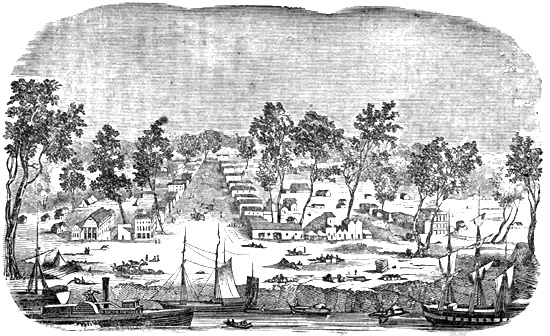
SACRAMENTO CITY.
The agricultural products of Lower California are
maize, sugar-cane, potatoes, dates, figs, grapes, quinces,
lemons, and olives. A considerable quantity of
hides, beef, cheese, soap, sugar, figs, raisins, &c., is
annually exported to Mexico and Upper California,
flour and merchandise being received in exchange.
The vegetable market of Mazatlan is also in part
supplied from the valley of San José.
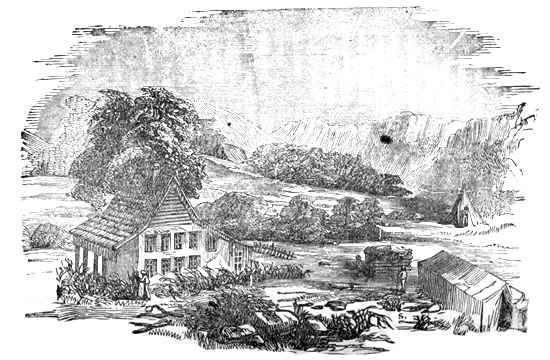
ONE OF THE OLD SPANISH HOUSES, SAN FRANCISCO.
But the value of Lower California does not result
from its being either a grazing or agricultural country.
Its fisheries, mines, commerce, and the influence of
its geographical position, are matters of much higher
importance than its agricultural productions.
The whole coast of the peninsula abounds with fish;
clams and oysters are found in great plenty and of
every variety. The islands of the gulf abound with
seal, and the whaling grounds on the Pacific coast are
of great value. During the past year Magdalena
bay alone has, at one time, contained as many as
twenty-eight sail, all engaged in this fishery. The
pearl fishery is also exceedingly valuable. Formerly,
when it was conducted with system and regularity,
the annual produce of a single vessel with thirty or
forty divers, between the months of July and October,
usually amounted to about $60,000; and now, badly
as the fishery is conducted, the annual exportation of
pearls amounts to between forty and fifty thousand
dollars. Tortoise and pearl shells are also articles of
exportation.
Lower California contains valuable mines of gold,
silver, copper, and lead; but, for the want of capital,
very few of these are worked, and this in the rudest
manner possible. Nevertheless, the labor expended
on them is well rewarded; and there can be no doubt
that with capital and suitable means they would yield
very handsome profits. The salt mines on Carmen
island are capable of supplying the whole coast of
Mexico and California; already the duties on this
article amount to a considerable sum.
The commerce of the peninsula is now very limited,
being principally confined to a coasting trade with
the ports of Mexico. The whole population of the
country is but little more than ten thousand, and the
annual imports and exports are estimated at $300,000.
But in our hands this commerce, freed from the absurd
restrictions imposed by Mexico, will soon receive
a very great extension. La Paz will become the principal
depot of American goods for the western coast
of Mexico; and in a few years most foreign goods intended
for this coast will also be deposited in the
warehouses of Lower California, to be transferred to
the ports of Mexico at such times and in such quantities
as the demands of the market may require. In
the present variable state of Mexican trade, resulting
from an irregular and fluctuating tariff, which differs
for each port and changes with every change of
general or state administration, it is frequently necessary
to transfer vessels with their cargoes from one
port to another, or to keep them for weeks at sea,
standing off and on, so as to enable the agents to
arrange the rate of duties at the custom-house before
landing the cargoes. Sometimes the consignees are
obliged to send their vessels to the Sandwich islands
or Valparaiso until a change of administration will
enable them to avoid the exorbitant demands of some
petty governor or collector of customs. Moreover,
the principal commercial ports of this coast (Mazatlan
and San Blas) are inaccessible to merchant vessels for
four months of each year, and during that time are
visited only by small coasters. But, with Lower
California in our possession, merchant vessels of
whatever character, at all seasons and in all winds,
can find a refuge in La Paz, and their cargoes
despatched in such quantities and to such points of
the opposite coast as circumstances may justify. This
place in a few years will be what Mazatlan now is,
and Mazatlan experience the fate of San Blas and
Acapulco.
The importance, however, of this port results mainly
from its geographical position, and the influence it
is likely to exert as a military and naval depot upon
our commercial interests in the Pacific. The port of
San Francisco, in Upper California, should be well
fortified, and every care taken to make it a harbor
of refuge for our merchant and military marine, in
case of a maritime war; but it must be remembered
that that place is nearly fifteen hundred miles from
the nearest port of Mexico, and that it is very far
north of some of the best whaling grounds in the Pacific,
and too distant to afford much protection to our
commerce with Central America, although its position
gives it a controlling influence over the commerce of
Sandwich Islands, Upper California, and Oregon.
In the same way a well-fortified naval station at La
Paz, from its immediate proximity to the coast of
Mexico, would have a most beneficial influence on our
commercial and whaling interest in this part of the
Pacific. The great value, in time of maritime war,
of such key points as La Paz, and the commanding
influence exercised by them in the protection of commerce,
have become settled principles in military
defence; and England shows her appreciation of their
truth, and the wisdom of her own policy, in establishing
stations and points like St. Helena, Cape of Good
Hope, Gibraltar, Malta, Corfu, and Bermuda.
Again, the growing commerce of California and
Oregon, and the political importance of our possessions
on the Pacific, render it necessary that we should
have some means of rapid communication between
them and the seat of government at Washington.
This communication must be effected by the isthmus
of Panama or of Tehuantepec. In either case steamers
bound to Upper California and the Columbia River
must have one or more intermediate depots of fuel;
and in time of war it is important that these depots
be established in our own rather than in a hostile territory.
A glance at the map will show that La Paz
is nearly equidistant from the extremities of this line;
and that Tehuantepec, La Paz, and San Francisco
divide into four equal parts the whole distance from
Panama to Oregon. Moreover, as this ocean is peculiarly
suited to steam navigation, a large part of the
commerce of the Pacific must eventually be carried on
in steam vessels; and in all probability not many
years will elapse before a portion of our naval force in
these waters is of the same character. Under this
supposition, the importance of our possessing some
naval depot and harbor of refuge and repair south of
Upper California is too manifest to require argument
or illustration.
But whatever may be thought of the value of this
peninsula or of the gulf as a natural boundary between
us and Mexico, instead of an imaginary line drawn
from the Colorado to the Pacific, thus separating a
kindred people, and exposing the governments of the
two territories to continual collisions, the propriety of
retaining Lower California is, in my opinion, now no
longer an open question. When this country was first
taken possession of by the forces of the United States,
the people were promised the protection of our government
against Mexico, and guarantied the rights secured
by our Constitution; and in November, 1847, they
were assured by the commander-in-chief of the Pacific
squadron, (with the approbation of the Secretary
of the Navy,) that this territory would be permanently
retained by the American government; and again,
by the President of the United States, in his annual
message of December, 1847, that it "should never
be given up to Mexico." Acting under these assurances,
all the most respectable people of the territory
not only refused to take part with the Mexican forces
which were sent to attempt the recapture of that country
from the Americans, but many of them actually took
up arms in our defence, and rendered most valuable
services in ridding the peninsula of the guerrilla hordes
sent over from Mexico for the purpose of effecting
our expulsion. In this conflict, some who thus sided
with us lost their lives, many their property, and all
have exposed themselves to the vengeance of the
Mexican government. But these losses and dangers
they have willingly encountered, in the hope of obtaining
the better government of the United States.
They have regarded these promises as made in good
faith, and have been guided in their conduct by the
assurances thus held out to them by the agents of the
American government; and now, for the United
States to voluntarily surrender this country to the
republic of Mexico, and leave these Californians exposed
to the loss of life and confiscation of property
for having sided with us, under the assurances thus
held out to them, would not only be in itself a breach
of national faith, but would make us appear in the
eyes of the world guilty of the most deliberate and
cruel deception.
H. WAGER HALLECK,
Lieutenant of Engineers.
Colonel R. B. Mason,
Commanding Tenth Military Department.