(THIRD JUNIOR RESERVES.)
It affords the writer pleasure to respond to the invitation
of Judge Walter Clark, himself a distinguished officer of the
boy-soldiers, to make a lasting memorial of the courage and
heroism of the brave and patriotic lads who composed the
Third Regiment of Junior Reserves, known since the war as
the Seventy-second Regiment of North Carolina Troops. It
is to be regretted that the task has not been performed at an
earlier day, before the stirring scenes in which these youths
took so conspicuous a part have faded into the dim outline of
a shadowy dream. Some inaccuracies must now necessarily
creep into this sketch. The writer was Assistant
Adjutant-General of Lieutenant-General Theophilus H.
Holmes, who commanded the Reserves of North Carolina,
and he has in his possession many valuable records pertaining
to that office, access to which has been of great assistance in
the preparation of this regimental history.
It is deemed not inappropriate here to narrate some things
of a general nature concerning the Reserves.
The year 1863 closed with depression and gloom throughout
our young Confederacy. Missouri, Kentucky, Louisiana,
Tennessee and the Arkansas and Mississippi Valleys had
been lost. Vicksburg, with its ill-fated commander, had surrendered.
Gettysburg, in spite of the heroic efforts of Carolina’s
best and bravest, had been turned by Longstreet’s default
into a Union victory. All of our ports had been blockaded.
Sherman with his army of bummers, was preparing
for his infamous march through Georgia and the Carolinas, in
which he emulated the atrocities of the Duke of Alva, proclaiming
as his excuse that “War is hell,” and violating, with
fire and sword, every principle of civilized warfare. Grant
had been placed in command of all the Union armies and was
preparing to take personal charge of a campaign of attrition
against the Army of Northern Virginia, willing to swap five
for one in battle, if need be, in order to exhaust his straitened
adversary—a process by which with his unlimited resources
of men, he knew he was bound to win in the end.
It was in such dire distress that the Confederate Congress
17 February, 1864, aroused to a full sense of the magnitude
of the struggle, and recognizing the necessity for putting
forth our whole strength in the contest for Southern independence,
passed an act for the enrollment of the Junior and
Senior Reserves—the former, lads between 17 and 18 years—the
latter, old men, between 45 and 50 years—thus, in the
language of President Davis, “robbing the cradle and the
grave.”
Lieutenant-General T. H. Holmes was entrusted by President
Davis with the organization of the reserve forces in
North Carolina. General Holmes was the son of Governor
Gabriel Holmes. He graduated at West Point in 1829, and
was assigned to duty with the Seventh Regiment of Infantry.
With this regiment he served with distinction in the Seminole
War and also in the Mexican War, in which he was brevetted
Major for conspicuous gallantry at Monterey. With his
keen sense of honor, pure Christian character, devotion to
duty and utter forgetfulness of self, he was fit to be a companion
of the knights who sat at King Arthur’s round table.
A true son of the Old North State, he had promptly responded
to her call, and resigning a Major’s commission in the
United States Army, had been appointed by the President
first Colonel, then Brigadier, then Major-General and finally
Lieutenant-General. As courageous as a lion, he was as gentle
as a woman. At the battle of Helena, Arkansas, amid a
storm of shot and shell, with a coolness which the writer has
never seen surpassed, he rode into Graveyard Hill, upon
which was concentrated the fire at short range of fifty cannon
and five thousand muskets. It was a daring and fearless
ride. Like General Pettigrew, he was one of the few men
who declined promotion. Well does the writer remember the
receipt by General Holmes, when commanding the Trans-Mississippi
Department in Little Rock, of a Lieutenant-General’s
commission, all unsought and unexpected. He at once
dictated a letter to the President, declining with grateful
thanks the high honor and requesting him to bestow it upon a
worthier man. It was only upon Mr. Davis’ insistence that
the promotion was afterwards accepted.
Mr. Davis in his “Rise and Fall of the Confederate Government,”
says of him:
“He has passed beyond the reach of censure or of praise,
after serving his country on many fields wisely and well. I,
who knew him from our school boy days, who served with
him in garrison and in the field, and with pride watched him
as he gallantly led a storming party up the rocky height at
Monterey, and was intimately acquainted with his whole
career during our sectional war, bear willing testimony to the
purity, self abnegation, generosity, fidelity and gallantry
which characterized him as a man and as a soldier.”
A truer, braver, purer heart never beat under the Confederate
gray.
General Holmes on 28 April, 1864, established his headquarters
at Raleigh, N. C., and undertook the task of organizing
the Reserves of the State. His staff consisted
of:—
Lieutenant-Colonel Frank S. Armistead, a graduate of
West Point, as Inspector-General. He was later elected Colonel
of the First Regiment of Junior Reserves and was afterwards
assigned to the command of the Junior Reserves brigade
consisting of the first three regiments. He was recommended
by General Holmes for the appointment of Brigadier-General
in terms of high praise.
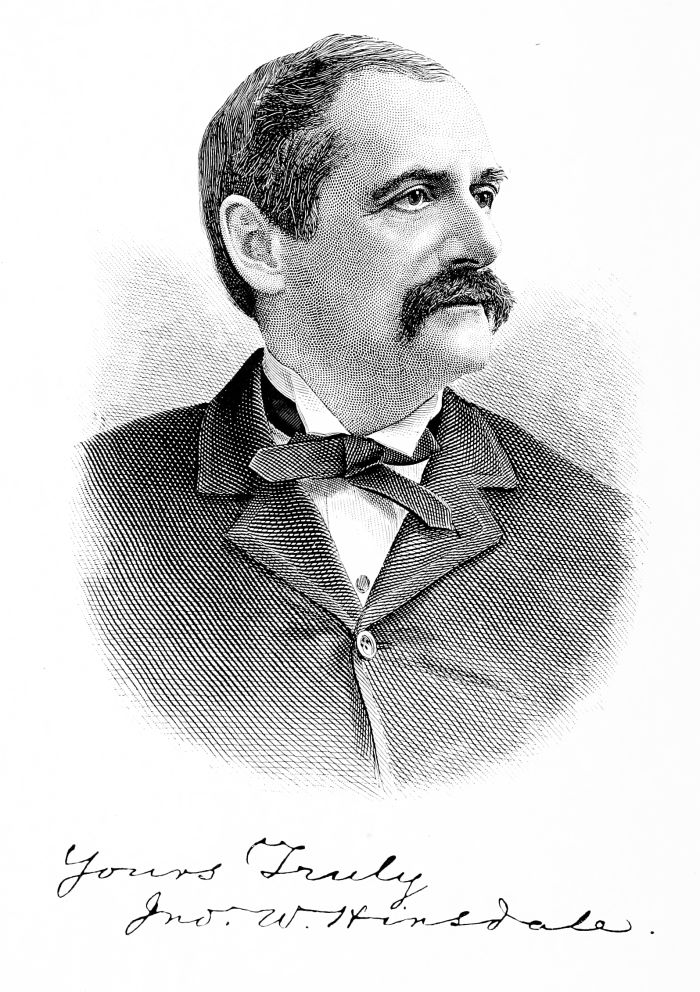
Captain John W. Hinsdale, as Assistant Adjutant-General,
who had served in this capacity on the staffs of Generals
J. Johnston Pettigrew at Seven Pines, and William D.
Pender, through the Seven Days’ Fight around Richmond,
and also with General Holmes in the Trans-Mississippi.
First Lieutenants Charles W. Broadfoot and Theophilus
H. Holmes, Jr., Aides-de-Camp. The latter, a mere boy, soon
afterwards gave his young life to his country while gallantly
leading a cavalry charge near Ashland, Virginia. The former,
a member of the Bethel Regiment, rose from private to
Lieutenant-Colonel of the First Junior Reserves, and is now
the first lawyer of the upper Cape Fear.
First Lieutenant Graham Daves, appointed Aide-de-Camp
after the death of young Holmes and the promotion of Lieutenant
Broadfoot. He was a brave and efficient officer of
scholarly attainments and high integrity.
A. W. Lawrence, of Raleigh, Ordnance Officer.
Major Charles S. Stringfellow, now one of Richmond’s
most distinguished lawyers, succeeded Captain Hinsdale as
Assistant Adjutant-General upon the latter’s promotion to
the Colonelcy of the Third regiment of Junior Reserves.
A roster in the writer’s possession shows that the Medical
Department of the Reserves was organized as follows:
Dr. Thomas Hill, now an eminent physician of Goldsboro,
North Carolina, Medical Director.
Dr. G. G. Smith, Assistant Surgeon of the First Regiment
of Junior Reserves.
Dr. A. W. Eskridge, Assistant Surgeon of the Second Regiment
of Junior Reserves.
Dr. E. B. Simpson, Assistant Surgeon of the Third Regiment
of Junior Reserves.
First Lieutenant J. M. Strong, Assistant Surgeon of the
Fourth Regiment of Senior Reserves.
Dr. W. L. Glass, Assistant Surgeon of the Fifth Regiment
of Senior Reserves.
Dr. A. W. Nesbitt, Assistant Surgeon of the Sixth Regiment
of Senior Reserves.
Dr. David Berry, Assistant Surgeon of the Eighth Regiment
of Senior Reserves.
Dr. G. H. Cox, Assistant Surgeon of the Eighth Regiment
of Senior Reserves.
Dr. James S. Robinson, Assistant Surgeon of the Second
Battalion of Senior Reserves.
The Third Regiment of Junior Reserves was formed 3
January, 1865, by the consolidation of the Fourth Battalion,
commanded by Major J. M. Reece; the Seventh Battalion,
commanded by Major W. F. French; and the Eighth Battalion,
commanded by Major J. B. Ellington. It is proper,
therefore, to give an account of their services as separate organizations.
The Fourth Battalion, four hundred strong, was organized
at Camp Holmes, near Raleigh, N. C., on 30 May, 1864,
by the election of J. M. Reece, of Greensboro, Major; John
S. Pescud, of Raleigh, was appointed Adjutant. Pescud
was a brave, true-hearted lad, and is now an honored citizen
of Raleigh. The battalion was sent to Goldsboro 2 June.
It was composed of the following companies:
Company A—From Guilford County—John W. Pitts,
Captain; J. N. Crouch, First Lieutenant; T. A. Parsons and
George M. Glass, Second Lieutenants.
Upon the resignation of all the company officers, W. W.
King was elected First Lieutenant and Davis S. Reid Second
Lieutenant. The former was in command of the company
at Fort Fisher, Kinston and Bentonville. He also acted as
Regimental Adjutant for a time, when D. S. Reid commanded
the company. Both of these officers were intelligent,
brave and efficient.
Company B—From Alamance and Forsyth Counties—A.
L. Lancaster, Captain; A. M. Craig, First Lieutenant; William
May and C. B. Pfohl, Second Lieutenants.
Company C—From Stokes and Person Counties—R. F.
Dalton, Captain; G. Mason, First Lieutenant; G. W. Yancey
and J. H. Schackelford, Second Lieutenants.
Company D—From Rockingham—A. B. Ellington, Captain;
J. P. Ellington, First Lieutenant; F. M. Hamlin and
William Fewell, Second Lieutenants. This company was
added to the Battalion 15 June. Captain Ellington was promoted
to the Majority when the regiment was formed.
Lieutenant J. P. Ellington in July, 1864, was drowned
in Masonboro Sound, while in the discharge of his duty as officer
of the day, visiting the pickets on the beach. His body
was recovered by exploding torpedoes in the sound.
Lieutenant F. M. Hamlin was promoted to the First Lieutenancy
and commanded the company until he was made Adjutant
of the regiment.
The battalion soon after its organization was ordered to
Goldsboro to report to Brigadier-General L. S. Baker, commanding
the district of Southern Virginia and Eastern
North Carolina. It was sent thence to Kinston and there
did guard and picket duty. On 15 June it was ordered to
report to Lieutenant-Colonel Frank S. Armistead at
Weldon. He had been placed in command of the
defences at that point. On 26 June the battalion
was ordered to report to General W. H. C. Whiting, at Wilmington,
the only remaining blockade-running port of the
Confederacy. The battalion thereupon was stationed at Camp
Davis near Wilmington, on Masonboro Sound, under command
of Colonel George Jackson, an efficient officer, and
did picket and guard duty on the sound and the beach to prevent
the landing of the enemy, the escape of slaves to the
blockaders and all communication with the passing vessels.
It was here that young Ellington, of Company D, lost his life,
crossing the Sound in a storm while on his rounds as officer of
the day. He was a zealous and capable officer. The salt
works, from which large supplies of salt were obtained for the
army, were in the vicinity of this camp, and were guarded
by the battalion.
From Camp Davis the battalion moved to Sugar Loaf, on
the Cape Fear River, about fifteen miles below Wilmington,
six miles above Fort Fisher and one mile from the ocean,
where it drilled and did guard and picket duty. “Sugar
Loaf” is a singular formation. It is a high sand hill running
from the river bank half way across the peninsula, steep
on the exterior, but sloping on all sides to a basin in the centre.
It is a natural fortification, which the engineering skill
of General Whiting, by fosse and rampart, had converted
into an almost impregnable intrenched camp, containing perhaps
one hundred acres.
On 9 December, 1864, the battalion went from Sugar Loaf
to Belfield, Virginia, in company with the Seventh and
Eighth Battalions. Its future movements will be described
in connection with the other two battalions.
The Seventh Battalion, 300 strong, was organized at Camp
Lamb, near Wilmington, in June, 1864, by the election of W.
F. French, of Lumberton, Major, and E. F. McDaniel, of
Fayetteville, was appointed Adjutant. This battalion was
composed of the following companies:
Company A—From Cumberland, Robeson and Harnett
Counties—T. G. Hybart, Captain; D. S. Byrd, First Lieutenant;
C. C. McLellan and C. S. Love, Jr., Second Lieutenants.
Upon the death of Captain Hybert, on 9 September, D. S.
Byrd was promoted to the Captaincy.
Company B—From New Hanover, Brunswick and Columbus
Counties—John D. Kerr, Captain; J. B. Williams, First
Lieutenant; E. H. Moore and B. F. Gore, Second Lieutenants.
Company C—From Richmond County—Donald McQueen,
Captain; A. B. McCollum, First Lieutenant; A. C. McFadyen
and S. A. Barfield, Second Lieutenants.
The battalion did guard duty at Wilmington until the middle
of July. Here Captain Donald McQueen died of typhoid
fever on 25 June. He was a fine soldier, an honor to his
name and his cause. Lieutenant McCollum succeeded him
in command of the company.
On the night of 3 July, 1864, Lieutenant Cushing, of the
Federal Navy (the same who blew up the Confederate ram
“Albemarle” at Plymouth), with a few detailed men, entered
the Confederate headquarters at Smithville (now Southport)
and carried off General Paul O. Hebert’s Adjutant-General
to the Federal fleet. Thereafter the Seventh Battalion was
ordered from Wilmington to Smithville for its protection.
It camped in a beautiful grove of live oaks back of the town.
Here it did its full share of guard and picket duty under the
command of General Hebert, an old officer who had served
with distinction in Mexico and had been Governor of Louisiana.
It was here that Captain T. G. Hybart, of Fayetteville,
was stricken with typhoid fever and died 9 September, 1864.
He was one of the best officers in the command, and had he
lived and the war continued, would have made his mark.
The battalion remained at Smithville until 9 December when,
with the Fourth and Eighth Battalions, all under Colonel
Jackson, it moved to Belfield, Virginia, to repel a Federal
raid.
The Eighth Battalion, three hundred strong, was organized
at Camp Vance, near Morganton, N. C., on 7 June, by the
election of James B. Ellington (First Lieutenant of Company
D, Sixty-first North Carolina Regiment), as Major.
It was composed of the following companies:
Company A—From Iredell County—W. G. Watson, Captain;
George Rufus White, First Lieutenant; Amos M. Guy
and Sinclair Preston Steele, Second Lieutenants.
Captain Watson resigned in January, 1865, for the purpose
of joining a cavalry regiment in Lee’s army. He returned
home to procure his outfit for the service, but was
captured by Stoneman and sent to prison in Louisville, Ky.
He is now the excellent and popular clerk of the Superior
Court of Rowan County. Upon his resignation, Lieutenant
White was promoted to the Captaincy.
Company B—From Catawba—J. R. Gaither, Captain; J.
M. Lawrence, First Lieutenant, (both captured at Fort
Fisher); Charles Wilfong and J. M. Bandy, Second Lieutenants.
Lieutenant Wilfong resigned after the battle of Kinston,
and Lieutenant Bandy thereafter until the surrender, commanded
the company. He made a fine officer. After the
war he was for a number of years a professor in Trinity College.
He now resides in Greensboro, where as a civil engineer
he ranks high in his profession. Sergeant James M. Barkley
was elected Second Lieutenant and F. H. Busbee Junior Second
Lieutenant. Both of them were excellent officers. Lieutenant
Barkley is now an able and eminent minister of the
gospel in Detroit, Mich. I am indebted to him for many
data which I have incorporated into this sketch. Lieutenant
Busbee is now one of the first lawyers of the State—a brilliant
advocate and a wise and learned counsellor.
Company C—From Burke and Caldwell Counties—Lambert
A. Bristol, Captain; Marcus G. Tuttle, First Lieutenant;
George T. Dula and Horace W. Connelly, Second Lieutenants.
Captain Bristol is now the worthy Clerk of the
Superior Court of Burke County.
George T. Dula resigned and John W. Harper was elected
Junior Second Lieutenant. He soon thereafter laid down
his young life on his country’s altar. He was killed at the
battle of Kinston.
The battalion remained for some days at Camp Vance and
was drilled by Lieutenant Bullock, a drill master. On 24
June, it was ordered to Raleigh and at Camp Holmes was
uniformed and equipped with small rifles, which were very
inferior and quite dangerous—to the “man behind the gun.”
On 26 June the battalion was ordered to Wilmington. It
went into camp at Camp Davis. It afterwards did picket
and patrol duty on Masonboro and Wrightsville Sounds under
Colonel George Jackson. On 4 August it was ordered to report
to General L. S. Baker, at Goldsboro, but returned to
Wilmington 16 August and was again placed under Colonel
Jackson’s command at Masonboro Sound.
On 2 September, under orders from the War Department,
Major Ellington, who when elected Major was disabled from
active service by wounds, and who afterwards recovered, was
relieved of his command and sent to his company near
Petersburg, Virginia. He was soon afterwards killed at
Fort Harrison, Virginia. Major Ellington was a gallant
officer and much beloved by the boys. It was a mistake to
have relieved him. General Holmes afterwards secured a
ruling of the War Department by which the officers of the
Junior Reserves after they reached the age of 18, were retained
with their commands. But the privates and non-commissioned
officers were still required to be sent to General
Lee as fast as they became eighteen years old.
Captain William G. Watson succeeded Major Ellington in
the command of the battalion. In the fall, the battalion was
ordered to Sugar Loaf, on the Cape Fear river, where for
several months it did picket duty, drilled, etc. On 10 December
it was ordered to Belfield, Va., under Colonel Jackson.
Its further career will be traced in connection with the
Fourth and Seventh Battalions from which it never after
separated until Johnston’s surrender.
On 8 December, 1864, General Whiting was notified by
General Lee that the Fifth and Second Corps of Grant’s
army, with Bragg’s Division of Cavalry, were moving under
General Warren upon Weldon, and that they were near Belfield
and that Hill and Hampton were following them. One
object of this raid was to destroy the railroad bridge at Weldon
and thus cut off supplies for Lee’s army from that direction.
General Whiting at once ordered Colonel George Jackson
to proceed with the Fourth, Seventh, Eighth and Ninth
Battalions of Junior Reserves and four pieces of Paris’ Artillery
with three days’ cooked rations, to Weldon, and there
report for temporary service to General Leventhorpe, commanding.
The latter, an Englishman by birth, was the first
Colonel of the Thirty-fourth and then of the Eleventh
North Carolina Regiments, and had done splendid service in
clearing the enemy from the Roanoke river and in defending
the Wilmington & Weldon Railway.
The four battalions assembled in Wilmington from Sugar
Loaf and Smithville. Through the efforts of Major French,
the troops were here shod. They were placed on flat cars
and thus exposed, were transported to Weldon. The weather
was intensely cold. More than once the train had to be
stopped, fires made in the woods and some of the boys lifted
from the train and carried to the fires and thawed out. Many
went to sleep in their wet clothes to find them frozen stiff
upon awakening. This suffering was undergone without a
murmur. The old guard of Napoleon on the retreat from
Moscow, never displayed more heroism and fortitude than
did the boy-soldiers—the “Young Guard of the Confederacy.”
Under the law, the reserves could not be required to cross
their State lines, but without hesitation and without an exception,
the brave boys at Weldon hurried on to Belfield, Virginia,
there to meet the invading foe. The Federals withdrew,
leaving their dead unburied, after a sharp fire and repulse
from the reserves who had just reached the battlefield,
and the latter joined in the pursuit across the Meherrin river
at Hicks’ Ford. On 17 December, 1864, the General Assembly
of North Carolina, recognizing their heroism, passed the
following resolutions:
“Whereas, The Legislature has heard with satisfaction
of the good conduct of the officers and soldiers of the Junior
Reserves and Home Guards, who volunteered to cross the
State line into Virginia, in order to repel the late advance of
the public enemy on Weldon; therefore,
“Resolved, That the officers and soldiers of the Junior Reserves
and Home Guards, so acting, deserve the commendation
of their fellow citizens, and are entitled to the thanks of
this Legislature.”
“Resolved, That a copy of these proceedings be transmitted
to Lieutenant-General Holmes and Major-General R. C. Gatlin,
that it may be communicated to the commands which
they are intended to honor.”
From Belfield the four battalions, together with the First
and Second Regiments of Junior Reserves, were ordered, under
Colonel Leventhorpe, to Tarboro to repel a Federal raid
from Washington, N. C. The command moved to Hamilton,
some miles below Tarboro. The enemy retired upon the advance
of the Confederate troops. The battalions remained
there a day or two and returned to Tarboro. The troops
camped about a mile northeast of the town for several days.
The boys were without overcoats, tents or tent flies, and lay
upon the bare ground in the rain and sleet and snow. Many
of them were frost bitten. A good old farmer along side of
whose fence the boys camped on the first night of their stay,
kindly gave them leave to start their fires by using the top rail
of his fence. When he came back next morning there was
not a rail to be seen. When he protested with some warmth,
saying that they had taken more than he had given them leave
to take, one wag said: “No, sir; as long as there was a top
rail, we had your permission to burn it. We never took any
but the top rail.” The old man laughed good naturedly and
left.
The severity of the experience of the Reserves on the Belfield
expedition may be realized when it is stated that although
they had been in camp over six months and had been somewhat
enured to a soldier’s life, over one-half of them were
sent to the hospital when the battalions returned to Wilmington.
The command was marched from Tarboro to Goldsboro and
by train was conveyed to Wilmington, and thence back to
Sugar Loaf. There they remained under the command of
General W. W. Kirkland until the battle of Fort Fisher.
This officer was a splendid fighter and a superb soldier. He
was Colonel of the Twenty-first North Carolina Regiment,
and afterwards commanded Early’s Brigade, Pettigrew’s Division.
He had taken part in many of the desperate battles
of Virginia and had been twice severely wounded. He was
transferred to Wilmington late in December and established
his headquarters at Sugar Loaf.
The three battalions composing the Third Regiment of
Junior Reserves participated brilliantly in the defence of
Fort Fisher, when attacked by General B. F. Butler and Admiral
Porter on 23, 24 and 25 December, 1864.
Fort Fisher was located on the point of a narrow peninsula
which extends southwardly from New Inlet between the
ocean and Cape Fear river, near its mouth. It defended
Wilmington, the last remaining port through which army
supplies, ammunition, clothing and food for Lee’s Army
were brought in by blockade runners. Under its guns, the
“Ad-Vance” brought in supplies of inestimable value to the
North Carolina troops. Its defence was of supreme importance
to the Confederacy. It was an earthen fort of an irregular
form, with bastions at the angles. The land face, 250
yards long, was continuous from ocean to river. The sea
face was 1,300 yards long. Both faces were mounted with
heavy guns, mortars and light artillery, presenting a formidable
front to the enemy. It was the strongest earthwork
built by the Confederacy, and really, as Admiral Porter said,
“stronger than the Malakoff tower which defied so long the
combined power of France and England.” Two miles above
the fort were the Half Moon and the Flag Pond Batteries,
and a mile and a quarter below, and at the extreme end of the
peninsula, Battery Buchanan with four heavy guns.
When Butler’s expedition of 8,000 men set forth against
it, the fort was garrisoned by only 667 men—a totally inadequate
force for its defence. General Butler, with General
Weitzel and his troops, appeared in transports off New Inlet,
near Fort Fisher, on 15 December. The navy under Admiral
Porter, did not appear until the 18th. He had collected
the largest and most formidable naval expedition of
modern times. The weather being stormy, prevented any
hostile operations until the 23d. On the night of the 23d,
Admiral Porter anchored a powder ship, containing 215 tons
of powder, about 800 yards from the northeast salient of the
fort. It was anticipated that the explosion of this mass of
powder would greatly impair, if not destroy, the works, and
the least effect expected was that the garrison would be so paralyzed
and stunned as to offer but small resistance to subsequent
attacks. The explosion did no more harm than a
Chinese fire-cracker. Colonel William Lamb, then in command
of the fort, wired General Whiting at Wilmington that
one of the enemy’s fleet had blown up, so little impression did
it make on him.
General Benjamin F. Butler, of New Orleans fame, in his
autobiography, gives an amusing account of an interview
with Major Reece, who commanded the Fourth Battalion of
Junior Reserves and was captured at Fort Fisher. Butler
says: “I inquired of him where he was the night before last
(the night of the explosion of the powder boat). He said
he was lying two miles and a half up the beach. I asked
him if he had heard the powder vessel explode. He said he
did not know what it was, but supposed a boat had blown up,
that it jumped him and his men who were lying upon the
ground, like pop-corn in a popper, to use his expression.” It
is hard to tell which most to admire, Butler’s gullibility or
Reece’s “jollying” extravagance.
The next day, 24 December, was employed by Porter in
bombarding the fort, dropping into it as many as 130 shells
a minute. At this time the three battalions of Junior Reserves,
about 800 strong, were encamped near Sugar Loaf, six
miles up the Cape Fear river from the fort. On the night
of the 24th, the Fourth, Seventh and Eighth battalions were
assembled at Sugar Loaf under Brigadier-General William
W. Kirkland. Major French had been temporarily assigned
to the command of a regiment of Senior Reserves, but at his
request was permitted to return to his own command and follow
its fortunes. General Whiting directed General Kirkland
to send these battalions to Battery Buchanan, there to
take boat for Bald Head and relieve Colonel J. J. Hedrick
and his seasoned veterans, in order that they might reinforce
Fort Fisher. They marched soon after midnight through
Fort Fisher to Battery Buchanan, on the extreme end of the
peninsula. In the darkness, many of the boys while passing
through the fort, stumbled into the holes which were made in
every direction by the shells. All the battalions arrived at
Fort Buchanan before day. The boat which was to carry
them to Bald Head could not make a landing on account of
the tide, whereupon Captain Bristol early in the morning reported
in person the situation to Colonel Lamb, who ordered
the Juniors into the Fort. This was early Christmas
morning.
Between Fort Buchanan and Fort Fisher is a clear, open
beach, upon which a partridge could not hide himself, over
which they must pass in full view of the fleet. As soon as
the march began the fleet poured upon the command a terrific
discharge of shot and shell. The first one killed at Fort
Fisher was private Davis, of French’s Battalion of Juniors,
who on this march was cut in two by a large shell. Another
private was severely wounded by the same shell. Nothing
but the poor practice of the fleet saved the boys from utter
destruction on this perilous march. When they reached
Fort Fisher a scene of desolation met their gaze. The barracks
had been destroyed and the interior of the fort was
honeycombed by holes in the ground large enough to bury
an ox team, made by the huge shells from the fleet. French’s
battalion and as many of the others as could be accommodated,
were placed in the already over-crowded bomb-proofs. Those
who could not obtain protection here were carried by Major
Reece to the breastworks at Camp Wyatt, three miles above
the fort. The gunboats soon discovered their presence there
and enfiladed the trenches with a terrific fire. The boys sought
shelter under the banks of the river, where they spent the day
listening to the music of the great guns of the fleet and watching
the great shells as they passed over them into the river—a
grand, but not a very engaging spectacle.
It was dark when Major Reece determined to take his
command back to the fort. Late in the afternoon he heard
the report of small arms in the direction of the fort. He
knew that a land force was attacking the fort, and he felt
that it was his duty to take his boys to the rescue. He
marched them down the river towards the fort but unfortunately
he failed to put out a skirmish line and fell upon a
regiment of General Weitzel’s troops by whom he and a majority
of his command were captured and carried to Point
Lookout. The following is a list of the officers who were
taken prisoners:
Major J. M. Reece, Captain J. R. Gaither, First Lieutenant
J. M. Lawrence, of Company B, Eighth Battalion;
First Lieutenant M. G. Tuttle, Company C, Eighth Battalion;
Second Lieutenant George W. Yancey, Company C,
Fourth Battalion; Second Lieutenant C. P. Pfohl, Company
C, Fourth Battalion. Those officers who escaped were Captain
A. L. Lancaster, Company B, Fourth Battalion; First Lieutenant
G. R. White, Company A, Eighth Battalion; Second
Lieutenant Amos Guy, Company A, Eighth Battalion; Third
Lieutenant S. P. Steele, Company A, Eighth Battalion.
First Lieutenant F. M. Hamlin, Company D, Fourth Battalion,
a brave young subaltern, led part of his company up
the river and escaped capture. They found their way to
Kirkland’s Brigade at Sugar Loaf and rejoined their command
at the fort next day.
The fleet bombarded the fort until 12 o’clock Christmas
day, when Butler landed 2,500 troops near the Half Moon
Battery, about two miles north of Fisher. He immediately
pushed up Curtis’ Brigade within a few hundred yards
of the parapet of the fort. A skirmish line was then advanced
to within seventy-five yards of the fort. Upon the
approach of the enemy, the Junior Reserves sprang to the
parapet of the land face which was swept by the guns of the
fleet, and by a well-directed fire, delivered with a coolness
which could not be excelled, they repelled the attack. One
little fellow from Columbus County, whose name is not remembered,
being too small to shoot over the parapet, mounted
a cannon and fired from there as coolly as if he were shooting
squirrels, until he fell wounded. About dusk the Reserves
were ordered to the palisades in front of the parapet
and immediately under the guns of the fort, where they remained
till morning. The guns of the fort were discharged
over their heads. The rain was descending in torrents. That
night the Federals re-embarked most of their men.
General Whiting in his report says: “Colonel Tansill
was ordered to the command of the land front. The gallant
Major Reilly, with his battalion and Junior Reserves, poured
cheering, over the parapet and through the sallyport to the palisades.
The enemy had occupied the redoubt (an unfinished
fort) and advanced into the port garden. A fire of grape
and musketry checked any further advance. The garrison
continued to man the out-works and channel batteries throughout
the night, exposed to a pelting storm and occasionally exchanging
musket shots with the enemy. The fire had been
maintained for seven hours and a half with unremitting
rapidity.”
Colonel William Lamb, the hero of Fort Fisher, who, under
General Whiting, commanded the troops, in his report says:
“At 4:30 p. m., 25 December, a most terrific fire against the
land face and palisades in front commenced, unparalleled
in severity. Admiral Porter estimated it at 130 shot and
shell per minute. The parapet and the guns were manned
by regulars and the Junior Reserves.
“During the night the rain fell in torrents, wetting the
troops and their arms, but it did not dampen their spirits nor
interfere with their efficiency. * * *
“On Tuesday morning the foiled and frightened enemy
left our shores. I cannot speak too highly of the coolness
and gallantry of my command.”
Colonel Lamb at another time said: “Be it said to the
eternal credit of these gallant boys that they, from this first
baptism of fire, emerged with a reputation for bravery established
for all time, and that to no troops more than these is
due the honor of our splendid victory.”
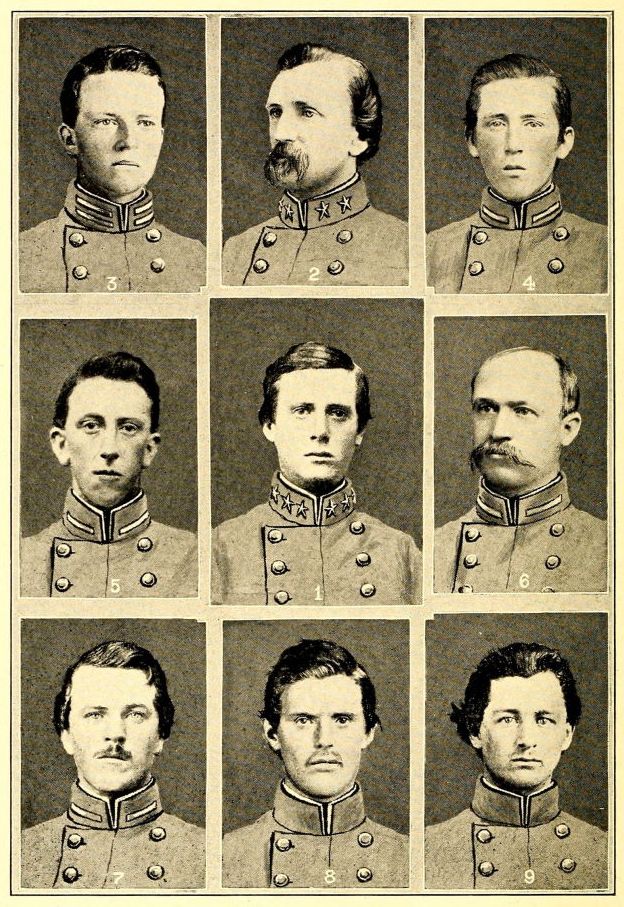
SEVENTY-SECOND REGIMENT.
| 1. John W. Hinsdale, Colonel. |
5. H. W. Connelly, 2d Lieut., Co. C. |
| 2. W. Foster French, Lieut-Colonel. |
6. J. M. Bandy, 2d Lieut., Co. E. |
| 3. W. W. King, 1st Lieut., Co. A. |
7. D. S. Reid, 2d Lieut., Co. K. |
| 4. Jno. W. Harper, 2d Lieut., Co. C. |
8. C. W. Taylor, Orderly Sergt., Co. C. |
| 9. J. L. McGimpsey, Private, Co. B. |
The troops were complimented in general orders by General
Bragg for their heroism and gallantry. The heaviest
loss suffered by any one command in the fort was by the
Junior Reserves. Thus ended the first glorious defence of
Fort Fisher.
When the news was flashed to Raleigh that Butler’s ships
had appeared off Fort Fisher, Lieutenant-General Holmes
promptly tendered his services to assist in repelling the threatened
attack and was assigned to duty by General Bragg in the
city of Wilmington, where he was put in charge of the movement
of troops at that point. The writer who accompanied
General Holmes as his Adjutant-General, unfortunately did
not participate in the battle of Fort Fisher. He is indebted
to Lieutenant-Colonel French for most of the foregoing details.
On 26 December, the reserves were moved to camp on Bald
Head Island, where they remained on guard and picket duty
for several days when they were ordered to Camp McLean, at
Goldsboro, N. C.
On 6 December, there had been an attempted consolidation
of these three battalions near Sugar Loaf, when Captain
William R. Johns was elected Colonel; Captain C. N. Allen,
Lieutenant-Colonel; and A. B. Johns, Major. Captain W. R.
Johns, a disabled officer, was then in the enrollment service
under Colonel Peter Mallett, the Commandant of Conscripts
of North Carolina, and being unable to undergo the hardships
and exposure of camp life, declined the election. Captain Allen,
the Lieutenant-Colonel, declined for the same reason.
Major Johns was never assigned and never entered upon the
discharge of the duties of Major and so the battalions continued
to serve under separate organizations. Major Johns
afterwards formally tendered his resignation, which was accepted.
On 3 January, 1865, while the regiment was at Camp McLean,
near Goldsboro, it was finally organized by the election
of Captain John W. Hinsdale, Colonel; W. F. French,
Lieutenant-Colonel, and Captain A. B. Ellington, Major.
On 7 January the last two were assigned to duty. Frank M.
Hamlin, one of the gallant young officers who refused to surrender
with Major Reece, was appointed Adjutant. But
from time to time Lieutenants W. W. King, Andrew J. Burton
and Frank S. Johnson, son of Senator R. W. Johnson, of
Arkansas, who had shortly theretofore left the University of
North Carolina and volunteered in the Third Regiment, acted
as Adjutant. J. K. Huston was appointed Quartermaster
Sergeant, and George B. Haigh, of Fayetteville, grandson of
the Hon. George E. Badger, Commissary Sergeant. Drs. E.
B. Simpson and J. S. Robinson were assigned to the regiment
as Surgeon and Assistant Surgeon.
The companies composing the regiment were then lettered
and designated as follows:
Company A—From Guilford County—Captain, John W.
Pitts.
Company B—From Alamance and Forsyth Counties—Captain,
A. L. Lancaster.
Company C—From Stokes and Person Counties—Captain,
R. F. Dalton.
Company D—From New Hanover, Brunswick and Columbus
Counties—Captain, John D. Kerr.
Company E—From Catawba County—Captain, J. R.
Gaither.
Company F—From Iredell and Rowan Counties—Captain,
W. G. Watson.
Company G—From Burke and Caldwell Counties—Captain,
L. A. Bristol.
Company H—From Cumberland, Robeson and Harnett
Counties—Captain, D. S. Byrd.
Company I—From Richmond County—Captain, A. B.
McCollum.
Company K—From Rockingham County—Lieutenant, F.
M. Hamlin.
Colonel Hinsdale, upon receiving notice in the city of Raleigh
of his election, at once signified his acceptance, but it
was questioned by General Holmes whether he was eligible
under the orders of the War Department, by reason of the
fact that he was not a disabled officer. The matter was referred
to the authorities in Richmond and after considerable
delay the department decided in Colonel Hinsdale’s favor
and he was assigned to the command of the regiment on 14
February, 1865, by the following all too partial general
order:
“Headquarters Reserves North Carolina,
Raleigh, N. C., 14 February, 1865.
General Orders No. 4.
“Major C. S. Stringfellow, Assistant Adjutant-General
C. S. P. A., will relieve Captain John W. Hinsdale, Assistant-Adjutant-General
of Reserves of North Carolina, and
the latter officer will proceed to join the Third Regiment Reserves
of North Carolina as its Colonel, he having been duly
elected to that office on 3 January, 1865.
“The Lieutenant-General commanding in taking leave of
Colonel Hinsdale, tenders his warm congratulations on his
promotion and earnestly hopes that the intelligence, zeal and
gallantry, which has characterized his services as a staff officer
may be matured by experience into greater usefulness in his
new and more extended sphere.
“Theo. H. Holmes,
“Lieutenant-General Commanding.”
While at Camp McLean, near Goldsboro, the regiment was
ordered to Halifax to repel another Federal raid. It remained
there only a day or two, the enemy having withdrawn.
It returned to Goldsboro where it remained drilling
and doing guard duty until the last of January. It was then
ordered to Kinston and camped near the beautiful home of
Colonel John C. Washington. It was here employed in constructing
the breastworks and fortifications for the defence
of the town and especially of the county bridge across the
Neuse river. Kinston was in easy reach from New Bern
and had been visited by many Federal raiding parties from
time to time. Our boys were heartily welcomed by the good
people of that town.
The rations which were issued to officers and men while
here and at Goldsboro were very scant. They consisted
of half a pint of black sorghum syrup, a pint of husky meal
every other day, a third of a pound of pork or Nassau bacon
and a few potatoes occasionally. The old soldiers will all
remember Nassau bacon, a very gross, fat, porky substance
which ran the blockade at Wilmington and was distributed
among Lee’s veterans as bacon. When a ration of cornfield
peas was issued, the boys were in “high jinks” indeed. But
never was there collected together more uncomplaining men.
They recognized the fact that the Confederacy was doing for
them its best.
Upon the discovery of the advance of the enemy from New
Bern, whence they set out early in March, General Hoke’s
Division was ordered to Kinston. On 6 March, the Junior
Reserve Brigade, consisting of the First Regiment under
Lieutenant-Colonel Charles W. Broadfoot; the Second under
Colonel John H. Anderson, and the Third under Colonel
Hinsdale, and Millard’s Battalion under Captain C. M. Hall,
all under Colonel F. S. Armistead, marched through Kinston
and across, to the south side of Neuse river, which here runs
in an easterly direction, past the breastworks which they had
so laboriously constructed. They marched down the river
road which leads out in a southeasterly direction to Southwest
creek. This creek is a sluggish, unfordable stream, which
runs in a northerly direction and empties into the river about
six miles below Kinston. The regiment was placed in some
old breastworks on the margin of a swamp, about a hundred
yards from the creek. Our pickets were stationed on the
creek. The next day the enemy made their appearance on
the other side of the stream and established a line of skirmishers
and sharpshooters. During the day our skirmishers
were engaged and occasionally a minie ball would whistle
over the breastworks as each individual boy of the regiment
believed, “just by my ear.” On the morning of 8 March,
General Hoke, whose troops were also stationed along the line
of the creek, was relieved by the arrival of D. H. Hill’s troops.
Hoke’s Division crossed the creek and made a detour down
the lower Trent road which crossed the British road at Wise’s
Fork, about three miles in our front. The lower Trent road
runs in a southeasterly direction to Trenton. The British
road runs in a northeasterly direction towards the river. General
Hoke with his usual dash surprised a Federal brigade,
captured it and sent it to the rear. The reserves held the
breastworks throughout the 8th. On the morning of the 9th,
the reserves crossed Southwest creek on an improvised bridge
constructed by them about 200 yards above the bridge on
the Dover road which had been destroyed. This bridge was
made by felling trees across the creek and covering them
with lumber taken from Jackson’s mill in the vicinity. Line
of battle was formed on the east side of the creek on swampy
ground and the brigade was ordered forward under fire
through fallen trees, brush, brambles, and bullets—making
it difficult to preserve the alignment. They advanced as
steadily as veterans, driving the enemy who were fresh troops
from New Bern, well dressed, well fed, well armed and well
liquored, as was evidenced by the condition of some prisoners
captured. The Third Regiment suffered the loss of a number
of brave officers and men, among them Lieutenant John
W. Harper, a gallant young officer of Company C, from Caldwell.
Here also Lieutenant Hamlin was wounded in the
arm. That night General Hoke undertook a flank movement
down the British road and the Neuse river road, the Junior
Reserves being a part of his command. We could plainly hear
the enemy at work on their fortifications. The night was
rainy and so dark you could not see your hand before you.
After marching through slush and rain about six miles, we
countermarched and returned. On the afternoon of the 10th
all of our troops fell back to the entrenchments on the British
road, and later in the day we re-crossed the Neuse, burning the
bridge behind us, and marched through Kinston, our brigade
camping at Moseley Hall. This retrograde movement was
the consequence of the arrival of Sherman’s army in North
Carolina.
The operations near Kinston, sometimes called the battle
of Kinston, but usually the battle of South West Creek, were
upon the whole a Confederate success, and when the disparity
in numbers between the contending forces is considered,
were very creditable to the Confederates. General Bragg in
general orders thanked the troops for their heroism and valor
and complimented them upon their achievements.
The arrival of Sherman in Fayetteville and the approach
of the troops from Wilmington to form a junction with Sherman
at Goldsboro, made it necessary for us to withdraw to
prevent being cut off and in order to form a junction with
General Johnston’s Army, which was moving in the direction
of Smithfield. On 15 March Colonel John H. Nethercutt,
of the Sixty-sixth North Carolina, was placed in command
of our brigade which was permanently assigned to
Hoke’s Division.
Arriving at Smithfield 16 March, we remained two days
and there witnessed one of the saddest spectacles of the war—a
military execution. The regiment constituted a part of
the military pageant which attended the shooting to death of
G. W. Ore, a private of Company B, Twenty-seventh Georgia
Regiment, who had been tried and condemned for mutiny
by a court-martial. The poor fellow was first marched
around, to the solemn music of the Dead March, in front of
the regiments which were drawn up in an open square, facing
inwards, he was then made to kneel, and was tied to a stake on
the open side of the hollow square. A detail of twelve men
drawn up at ten paces from him performed the painful duty
of carrying out the sentence of the court. At this late stage
of the war, when the struggle was perfectly desperate and all
hope of success had fled, the execution seemed to us to be little
less than murder.
BENTONVILLE
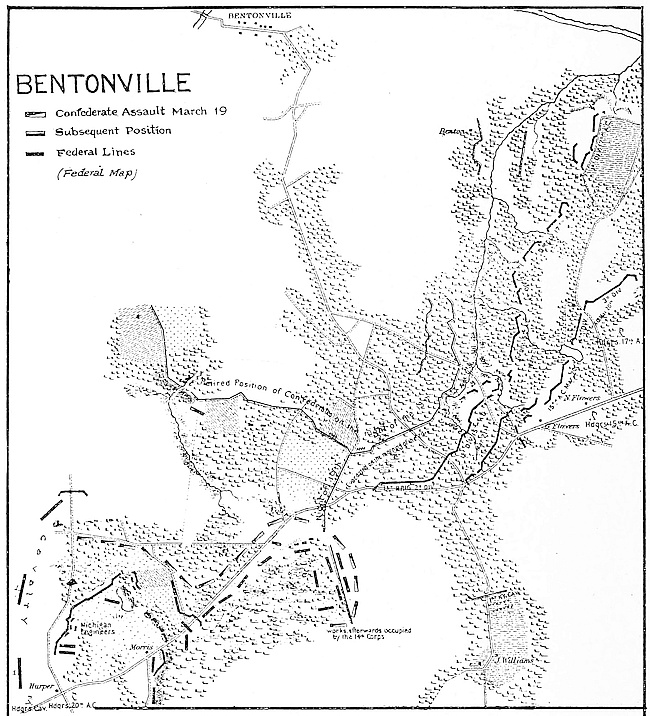
AVERASBORO, N.C.,
fought March 16th, 1865.
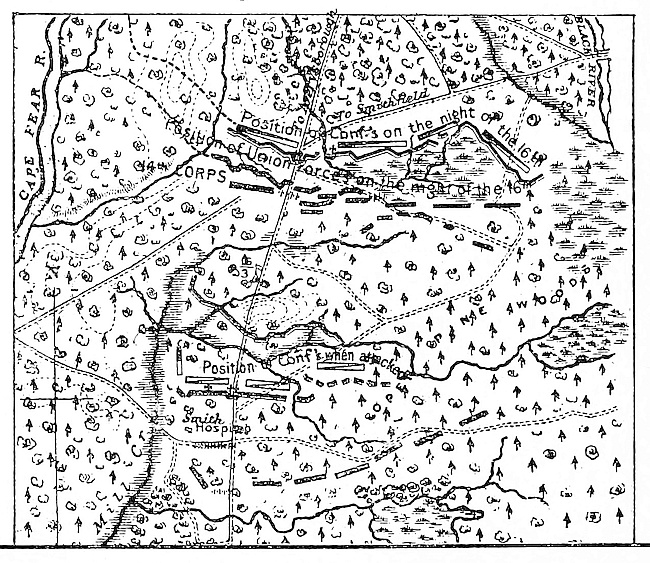
On 18 March we marched again, not to the West, but to
the South. We knew that Sherman was approaching from
that direction, and we surmised that there was serious work
before us. General Joseph E. Johnston, who rode for a short
distance on that day at the head of the Third Junior Reserves,
said as much to its commander. Sherman was moving
from Fayetteville in the direction of Goldsboro in two
parallel columns, about a day’s march apart. General Johnston
had determined to take advantage of the fact that Sherman’s
left wing was thus separated from the right, and to
strike a bold blow on the exposed flank at Bentonville in Johnston
County.
As soon as General Hardee, 19 March, our corps commander,
reached Bentonville with his troops, he moved by
the left flank, Hoke’s (our) division leading, to the ground
previously selected by General Hampton. It was the eastern
edge of an old plantation, extending a mile and a half
to the west, and lying principally on the north side of the
road and surrounded east, south and north by a dense thicket
of black-jacks. There was but one road through it.
Hoke’s Division formed with its line at right angles
to the road on the eastern edge of the plantation and
its left extending some four hundred yards into the
thicket on the south. The Junior Reserves constituted
the right of Hoke’s Division and supported a battery
of Starr’s Battalion of artillery commanded by Captain Geo.
B. Atkins, of Fayetteville. The brigade of Juniors were led
by Colonel John H. Nethercutt, who had superseded Colonel
Armistead. This gallant officer was Colonel of the Sixty-sixth
North Carolina Regiment—a plain, blunt man, but
every inch a soldier. The Third Regiment threw out a skirmish
line which was commanded by Captain Bristol and hurriedly
constructed a rail fence breastworks. Here under a
fire of artillery we suffered many casualties. The troops belonging
to the Army of Tennessee were formed on the right
of the artillery. A wooden farm house in front of the Third
Regiment for some time afforded cover for a number of
sharpshooters, who did excellent practice on our line, until
Captain Atkins, with a few well-directed shells, caused them
to pour out like rats from a sinking ship.
The enemy soon thereafter charged Hoke’s Division, but
after a sharp contest at short range was handsomely repulsed.
On the morning of the 20th it was reported that the Federal
right wing had crossed over to unite with the left wing
which had been driven back, and was coming up rapidly upon
the left of Hoke’s Division. That officer was directed to
change front to the left. By this movement, his line was
formed parallel to and fronting the road. Here light entrenchments
were soon made out of dead trees and such material
as could be moved with our bayonets. From noon to
sunset Sherman’s army thus united made repeated attacks
upon Hoke’s Division of six thousand men and boys, but
were uniformly driven back. The skirmish line of our brigade
was commanded by Major Walter Clark, of the Seventieth
Regiment (First Juniors), on the 20th and 21st. On
the 21st the skirmishing was heavy, and the extreme of the
Federal right, extending beyond our left flank made our position
extremely hazardous in view of the fact that the bridge
over the creek in our rear was our only chance of retreat.
The Seventeenth Army Corps of the enemy late in the afternoon
broke through our line considerably to the left, but by
superhuman effort, its leading division was driven back along
the route by which it had advanced.
That night the Confederate Army re-crossed the creek by
the bridge near Bentonville and were halted beyond the town
two miles north from the creek. The Federals made repeated
attempts to force the passage of the bridge, but failed in all.
At noon the march was resumed and the troops encamped near
Smithfield. Sherman proceeded on his way to Goldsboro
to form a junction with Schofield, without further molestation.
The Confederate losses in the battle of Bentonville
were 2,343, while that of the Federals was nearly double.
(For many of the foregoing facts, see Johnston’s Narrative,
pages 381 and 393, from which liberal extracts have been
made.)
The Confederates never fought with more spirit, and the
Federals with less, than in the battle of Bentonville. General
D. H. Hill remarked upon this and said: “It may be
that even a Yankee’s conscience has been disturbed by the
scenes of burning, rapine, pillage and murder so recently
passed through.”
General Hampton said of this last great battle of the Civil
War, that in his opinion it was one of the most extraordinary:
“The infantry forces of General Johnston amounted to about
14,100 men, and they were composed of three separate commands
which had never acted together. These were Hardee’s
troops, brought from Savannah and Charleston; Stewart’s
from the Army of Tennessee; and Hoke’s Division of
veterans, many of whom had served in the campaigns of Virginia.
Bragg, by reason of his rank, was in command of this
latter force, but it was really Hoke’s Division, and the latter
directed the fighting. These troops, concentrated recently
for the first time, were stationed at and near Smithfield,
eighteen miles from the field, where the battle was
fought, and it was from there that General Johnston moved
them to strike a veteran army numbering about 60,000 men.
This latter army had marched from Atlanta to Savannah
without meeting any force to dispute its passage, and from the
latter city to Bentonville unobstructed save by the useless and
costly affair at Averasboro, where Hardee made a gallant
stand, though at a heavy loss. No bolder movement was conceived
during the war than this of General Johnston when he
threw his handful of men on the overwhelming force in front
of him, and when he confronted and baffled this force, holding
a weak line for three days against nearly five times his number.
For the last two days of this fight he only held his position
to secure the removal of his wounded, and when he had
accomplished that he withdrew leisurely, moving in his first
march only about four miles.”
The Junior Reserves lost quite a number of officers and
boys in this battle. Their conduct was creditable to the last
degree. General Hoke, their attached and beloved commander,
thus writes concerning them: “The question of
the courage of the Junior Reserves was well established by
themselves in the battle below Kinston, and at the battle of
Bentonville. At Bentonville you will remember, they held
a very important part of the battlefield in opposition to Sherman’s
old and tried soldiers, and repulsed every charge that
was made upon them with very meagre and rapidly thrown
up breastworks. Their conduct in camp, on the march, and
on the battlefield was everything that could be expected of
them, and I am free to say, was equal to that of the old soldiers
who had passed through four years of war. On the return
through Raleigh where many passed by their homes,
scarcely one of them left their ranks to bid farewell to their
friends, though they knew not where they were going nor
what dangers they would encounter.”
The regiment remained in camp near Smithfield until 10
April. During this time our corps under command of General
Hardee was reviewed by General Johnston, General Hardee,
Governor Vance and others. There was not in the grand
parade of that day—the last grand review of the Confederate
Army—a more soldierly body of troops than the Junior Reserves.
Later in the day, Governor Vance made a stirring
speech to the North Carolina troops, which by its eloquence
aroused enthusiasm and caused the fire of patriotism to burn
more brightly in our hearts. On 10 April we begun our last
retreat before Sherman.
On 12 April we reached Raleigh. I recall how we marched
through Raleigh past the old Governor’s Mansion on Fayetteville
street, facing the Capitol, then up Fayetteville street
and west by Hillsboro street past St. Mary’s young ladies
school in a beautiful grove on the right. How the servants
stood at the fence with supplies of water for us to drink!
How the fair girls trooped down to see us pass! How one
tall, beautiful damsel exclaimed: “Why, girls, these are all
young men,” and how one of our saucy Sergeants replied:
“Yes, ladies, and we are all looking for wives!” It was in
Raleigh that we heard the heartrending rumor of General
Lee’s surrender.
Our line of march was through Chapel Hill. The University
at that place was deserted and many refugees from the
lower counties were again preparing to fly. After leaving
Chapel Hill we camped on the Regulators’ Battleground,
thence our line of march was on the Salisbury and Hillsboro
road, over which 200 years before the Catawba Indians passed
in their visits to the Tuscaroras in the East. Governor Tryon
and later Lord Cornwallis had led their troops over this historic
way in the vain endeavor to subdue the men whose sons
now trod, footsore and weary, over the same old red hills, engaged
in a like struggle for local self government.
When we reached Haw river on Saturday, 15 April, we
found the steam rising rapidly. In crossing the river, several
of our boys were drowned by leaving the ford to reach
some fish traps a short distance below and being caught by
the swift current and swept down into the deep water.
On reaching Alamance creek we had a novel experience.
On account of heavy rains the stream was much swollen
and the current very strong. General Cheatham’s command
was moving in front of General Hoke’s Division and on attempting
to ford the stream several men were swept down by
the current, whereupon the others absolutely refused to move.
This halted the entire column, and as the enemy’s cavalry
were closely pressing our rear, the situation was becoming
critical. General Cheatham rode to the front and learning
the cause of the halt, ordered the men to go forward, but, emphasizing
their determination with some pretty lively swearing,
they doggedly refused to move, whereupon General
Cheatham seized the nearest man and into the stream they
went. After floundering in the water awhile, he came out,
after repeating the process for a few times, they raised a
shout and proceeded to cross. Three wagons, two with guns
and one with bacon, capsized and were swept down the river.
Some lively diving for the bacon followed, but I guess the
guns are still rusting in the bottom of the creek. I am sure
none of them were disturbed on that occasion.
In the midst of the peril of the crossing of the river, Lieutenant-Colonel
French realizing the danger to which the
smaller boys were exposed, jumped from his horse, and stationing
himself in mid-stream just below the line of march,
rescued several of the brave lads from inevitable death.
Standing there, watching his chance to save life, he was every
inch the faithful officer and brave soldier, and no wonder the
boys loved him. Within the last twelve months he, too, has
crossed over the river and is now resting under the shade of
the trees. Farewell my dear old comrade!
We reached Red Cross, twenty miles south of Greensboro,
late on 16 April. Here we stayed until the following
Easter Sunday morning. On Saturday afternoon, a bright
boy from Cleveland County, named Froneberger, was killed
in camp by lightning within ten steps of regimental headquarters.
His death was instantaneous. The next morning,
17 April, after a scanty breakfast we made ready as
usual to resume the march, but received no orders. We
waited till noon, then all the afternoon, then till night, and
still no orders. The next morning we heard that General
Johnston had surrendered.
We camped at Red Cross for a few days. Meanwhile it
became known that we had not surrendered; but that Johnston
and Sherman had undertaken to make terms for the surrender
of all the then existing armies of the Confederacy and for
the recognition of our state governments—one of the decent
acts of Sherman’s life. But it came to naught by reason
of its disapproval in Washington. The armistice which
had been entered into for this purpose was terminated, and
the toilsome, weary, hopeless march was resumed, but we all
knew that the war was over.
It was at this time that a quantity of silver coin, in Greensboro,
belonging to the Confederate Government was seized
by General Johnston and distributed among his officers and
men—each receiving one dollar and twenty-five cents without
regard to rank. The writer has in his possession the identical
Mexican milled silver dollar which came to him on this
occasion. On one side of it has since been engraved “Bounty
to John W. Hinsdale for four years’ faithful service in the
Confederate Army.” One hundred times its weight in gold
would not purchase this old piece of silver, associated as it
is with loving thoughts of comrades and heart-breaking memories
of surrender.
The regiment marched about eight miles to Old Center
Meeting House, in Randolph County, staying here about
three days and then we moved by way of Coleraine’s Mills to
Bush Hill (now Archdale), and came to a halt one mile from
old Trinity College.
General Johnston on 26 April made his final surrender of
the army to General Sherman and on 2 May, 1865, at Bush
Hill, all who remained of the one thousand boy-patriots of the
Third Junior Reserves were paroled, and turned their faces
sorrowfully homeward. The last roll had been called, the
last tattoo beaten, and the regiment was disbanded forever.
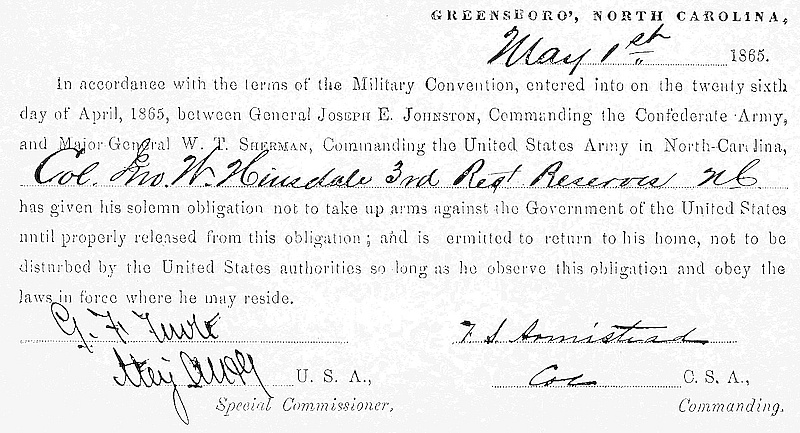
A PAROLE FROM JOHNSTON’S ARMY.
Fac-simile of parole of Jno. W. Hinsdale, Colonel, 72d Regiment
(3d Junior Reserves).
GREENSBORO’, NORTH CAROLINA,
________________________ 1865.
In accordance with the terms of the Military Convention, entered into on the twenty sixth
day of April, 1865, between General Joseph E. Johnston, Commanding the Confederate Army,
and Major General W. T. Sherman, Commanding the United states Army in North-Carolina,
_______________________________________________
has given his solemn obligation not to take up arms against the Government of the Unites States
until properly released from this obligation; and is permitted to return to his home, not to be
disturbed by the United States authorities so long as he observe this obligation and obey the
laws in force where he may reside.
_______________________ _____________________
_______________ U. S. A., _____________ C. S. A.,
Special Commissioner. Commanding.
This was the end of all our hopes and aspirations. Might
had prevailed over right, and the conquered banner had been
furled for all time.
Judge Clark in his Regimental Histories reproduced fac-similes
of two paroles, one of an officer in the army of Northern
Virginia, who surrendered at Appomattox Court House,
the other, of the writer of this sketch, an officer of the last
grand army of the Confederacy, commanded by General
Joseph E. Johnston. This parole appears on the opposite
page. It was in keeping the inviolate faith of a similar parole
issued to our great commander, Robert E. Lee, that General
Grant, be it said to his everlasting credit, stayed the hand
of President Johnston, who, soon after the war, issued a
shameful order for the arrest of the “noblest Roman of them
all.” By this one act, General Grant won the respect and
esteem of the entire South.
North Carolina has much to be proud of. She was first
at Bethel, she went farthest at Gettysburg, she was last at
Appomattox, her dead and wounded in battle exceeded in
numbers those of any other two States of the Confederacy together.
But, her last and most precious offering to the cause
of Liberty were her boy-soldiers, who at her bidding willingly
left their homes, and marched, and fought, and starved, and
froze, and bled, and died that she might live and be free.
God bless the Junior Reserves. Their memory will ever be
cherished by the Old North State they loved so well.
The following patriotic lines, written by the author of the
“Conquered Banner,” will appeal to the heart of many a
mother whose young son marched away with the Junior Reserves:
“Young as the youngest, who donned the Gray,
True as the truest who wore it,
Brave as the bravest he marched away
(Hot tears on the cheeks of his mother lay)
Triumphant waved our flag one day—
He fell in the front before it.
Firm as the firmest where duty led,
He hurried without a falter;
Bold as the boldest he fought and bled.
And the day was won—but the field was red—
And the blood of his fresh young heart was shed
On his country’s hallowed altar.
On the trampled breast of the battle plain,
Where the foremost ranks had wrestled,
On his pale pure face not a mark of pain,
(His mother dreams that they will meet again),
The fairest form amid all the slain,
Like a child asleep he nestled.
In the solemn shade of the wood that swept
The field where his comrades found him,
They buried him there—and the big tears crept
Into strong men’s eyes that had seldom wept,
(His mother—God pity her—smiled and slept,
Dreaming her arms were around him).
A grave in the woods with the grass o’ergrown,
A grave in the heart of his mother
His clay in the one lies lifeless and lone:
There is not a name, there is not a stone,
And only the voice of the winds maketh moan
O’er the grave where never a flower is strewn,
But his memory lives in the other.”
John W. Hinsdale.
Raleigh, N. C.,
26 April, 1901.
The writer appends hereto two letters received by him
approving the accuracy of the foregoing sketch—one from
the distinguished jurist, who was his comrade in arms in the
Junior Reserve brigade, and to whom the old soldiers owe a
debt of gratitude for his monumental service in editing the
Regimental Histories, the other by one of Lee’s best fighters
and most trusted lieutenants, and the beloved commander of
the boy-soldiers, whose valor is only equaled by his modesty.
STATE OF NORTH CAROLINA,
SUPREME COURT.
Raleigh, N. C., October 18, 1901.
Colonel John W. Hinsdale,
My Dear Colonel,
****
***
***
Let me congratulate you upon your sketch which is decidedly
one of the most interesting and valuable in the whole
four volumes, and your conclusion is the most eloquent and
touching thing I have read in many days. The Juniors will
take off their hats to you.
Your friend and comrade,
WALTER CLARK.
SEABOARD AIR LINE—GEORGIA, CAROLINA &
NORTHERN RAILWAY CO.
R. F. Hoke, President.
Raleigh, N. C., January 4, 1901.
Colonel John W. Hinsdale,
My Dear Colonel,
I am pleased to read your sketch of the Third North Carolina
Junior Reserve Regiment, that you kindly sent me,
which is very accurate as to their service while they were in
my command. Not knowing whether you intended me to
keep it or not, I return it with my thanks, and wishing you a
most happy and prosperous New Year, I am,
Very truly your friend,
R. F. HOKE.
TRANSCRIBER’S NOTE
Obvious typographical errors and punctuation errors have been
corrected after careful comparison with other occurrences within
the text and consultation of external sources.
Except for those changes noted below, all misspellings in the text,
and inconsistent or archaic usage, have been retained.
Pg 5: ‘insistance that’ replaced by ‘insistence that’.
Pg 15: ‘Fourth Batalion of’ replaced by ‘Fourth Battalion of’.
Pg 23: ‘of Campany C’ replaced by ‘of Company C’.
Pg 23: ‘we countermached’ replaced by ‘we countermarched’.
Pg 25: ‘sharp shooters, who’ replaced by ‘sharpshooters, who’.
Pg 28: ‘heartrendering rumor’ replaced by ‘heartrending rumor’.
Pg 30 (Illustration): ‘and is ermitted’ replaced by ‘and is permitted’.
Pg 31: ‘fac similes’ replaced by ‘fac-similes’.
Pg 32: ‘lifeless aud lone’ replaced by ‘lifeless and lone’.