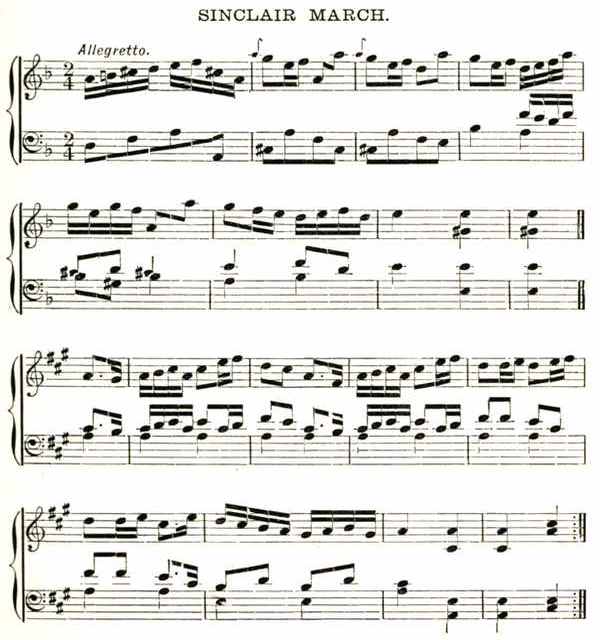
The so-called Calmar War, between Denmark and
Sweden, was carried on from the spring of 1611 until
the winter of 1613. Christian IV. ruled at that time
over the kingdoms of Denmark and Norway; while in
Sweden reigned Charles IX., who died at the commencement
of the war, leaving its prosecution to his
son Gustavus Adolphus, then only seventeen years of
age, and who subsequently became so famous.
In 1612 Gustavus caused foreign troops to be
enlisted in the Netherlands, in England, and in Scotland,
by Johan Munkhaven, or Mönnichhofen, a
colonel in the Swedish service, and by James Spens,
an Englishman. According to the historian Widikindi,
the corps thus raised amounted to 2,200 men,
while Puffendorff estimates its strength at 2,300.[62]
These troops, of which 2,000 had been recruited in
Scotland, were transported in ships, forming two
squadrons, of which one was commanded by Munkhaven,
the other by the Scottish Colonel George Sinclair,
or Saint Clair, as his name is also written.
Munkhaven, with his 1,400 men, steered into the
Trondhjem fiord on the 19th July 1612, and thought
he would be able to surprise the city of Trondhjem;
but the citizens opposed him and his ships so well
from their blockhouses outside the town that he
hastened away as quickly as possible, and landed
at Stordalen, whence he marched, ravaging and burning,
until he reached Sweden.[63] A few weeks
after Munkhaven, the other detachment of hired
troops, led by Colonel Sinclair, arrived in two Scottish
ships.
But Sinclair and his men were not destined to
escape so easily as Munkhaven. The Fates ordained
that they should all, with the exception of a few, find
a grave among the mountains of Norway. The reason
why both Munkhaven and Sinclair landed in Norway,
instead of proceeding direct to Sweden, was that the
approach to the small stretch of Swedish coast on the
North Sea was closed to them after the Danes had
occupied the fortresses of Elfsborg and Gullberg, at
the mouth of the Gotha river. Moreover, the Danish
fleet had the mastery on the seas.
There are various statements as to the number of
the Scots that accompanied Sinclair. If the total
number of troops recruited for Sweden was, as already
mentioned, 2,200 or 2,300, of which Munkhaven
arrived with 1,400, Sinclair's corps must have
amounted to 800 or 900 men, and the latter number
is also quoted in the church register of Vaage.[64] Consequently,
the number could not have been 1,400, as
sung by Storm, nor 600, as stated by Slange. It is,
however, probable that Slange was right, as his statement
agrees approximately with Kruse's Report, which
says that, according to the depositions of the Bönder
"who were present at that battle, and who buried
and counted the dead and defeated, the Scots must
certainly have numbered at least 550." Less probable
appears to be the statement of the captured
Scots, to the effect that they were "350 men strong
at the utmost." One Saga says that Sinclair came
into Romsdalen with 1,400 men, and that these
were divided at Jora Bridge, in Lessö, after which
one division went over the Dovre Fjeld, and subsequently
through Österdalen, in order to unite again
with the other division which took the road through
Gudbrandsdalen. The same Saga says that the division
which went through Österdalen came across the
Norsemen at the frontier, when a battle ensued, in
which those Scots were shot down to the last man.
But that Saga is not generally current; and it appears
probable that Munkhaven's expedition, or possibly
some other event, has been mixed up in the
narrative.[65] It appears that Sinclair had calculated
on joining the Swedes in Southern Norway, where,
however, we know from history there were no Swedes
at that time; for Jonas Ramus states[66] that, from
Gudbrandsdalen, Sinclair wanted to "unite with the
Swedes who were supposed to be in Hedemarken," or,
as stated in the entry above quoted from the Vaage
church register, at Borge Church, in Smaalenene.
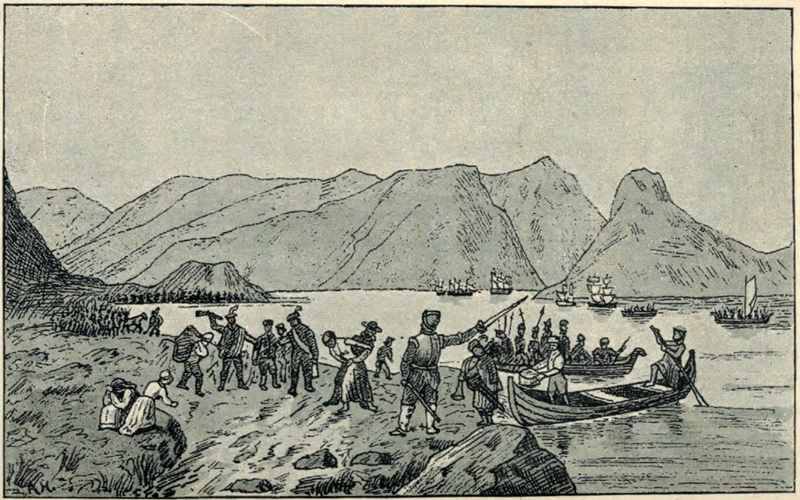
It was on the 19th or 20th August[67] that Sinclair,
with all his hired followers, approached the Norwegian
coast, and steered into the Romsdal fiord; but
a Saga relates that before he entered that fiord he
landed on a small island on which dwelt a wealthy
man. The wife of the latter is said to have been an
intelligent and talkative woman, and Sinclair entered
into a jocose conversation with her. Although he had
not yet made known that he was an enemy, yet
the woman said she well understood the object of
his coming; that his expedition into Norway would
end badly, and that when he got inland he would
come to bite the dust on meeting the hardy men of
the glens. This enraged Sinclair, and he left the
island with the threat that when he returned victorious,
he would seek her out and have her cut to
pieces for her flippancy.
It is possible that this and other similar Sagas may
have induced the poet Storm to sing about a mermaid.
It is also related that the mermaid's name was Ellen.
Others say that was the name of Sinclair's wife; for
the Sagas say she accompanied him. She went on
board with the troops, in disguise, and only made
herself known after they had got out to sea. She is
said to have given birth to a child on the voyage.
A Bonde called Peder Klognæs, seeing from his
Gaard or farm of Klognæs,[68] in the parish of Grytten,
in Romsdalen, Sinclair's ships out in the fiord, supposed
they were vessels laden with corn, took his
purse in which were three dollars, and rowed out to
them, with the object of purchasing before the vessels
reached Væblungsnæs, towards which Sinclair was
steering. As soon as Peder Klognæs got on board,
he understood what kind of folk they were; and as
they wanted to compel him to pilot the ships to
Væblungsnæs, at the head of the Romsdal fiord, he
reflected hurriedly, and soon determined what he
should do. He made them believe that the water
was too low to admit of the vessels sailing further
into the fiord, and that all they could do was to land;
and Peder Klognæs was forced to accompany them.
In order that he should not escape, they fastened a
cord to his hair and led him by it. The Scots then
disembarked at Skothammer, or Skotkleven (the
Scots' Cliff), as the place is now called, in the vicinity
of Klognæs gaard (farm). Before they proceeded any
further, Peder Klognæs, after much supplication, obtained
permission to go first into his house. Although
a guard followed him, he found an opportunity of
sending a Budstikke,[69] announcing the arrival of the
enemy, and calling upon the people to take up arms.[70]
He gave the letter to his servant-maid, who hid it in
one of her stockings, and dressing herself in tattered
clothes, pretended she was a beggar as well as idiotic,
and in that manner, but with difficulty, she slipped past
the Scottish watch. When the latter wanted to prevent
her from passing, she said, "Lord, bless us! it is
too hard that poor folk should not be able to go their
way," on which the watch allowed her to pass. She
got safely to the sea-shore, and rowed to Væblungsnæs
with the letter (or Budstikke), which was sent forward
from thence. Meanwhile Peder Klognæs led the Scots
two miles[71] out of the way, round the Iisfiord, over
mountains and marshes, and through woods in which
there were no roads, as well as over rivers where
they had to wade, so that, as Peder Klognæs had intended,
they were considerably delayed on the march.
The Bönder in the several parishes had thus time to
save themselves and also their goods from being plundered,
and time was moreover gained for the circulation
of the message.
It was under these circumstances that Sinclair with
his Scots landed in the country in which he thought
he was going to play the part of a conqueror; for,
according to the Saga, he said that he would "recast"
the Norwegian lion into a mole which would not dare
to creep out of its hole, and he promised his men that
after the conquest of the country they would get "the
fairest maidens and the best farms." It was further
promised to them that Hedemarken would be to them
"a land of Canaan."
There are not many Sagas respecting the behaviour
of the Scots, and as to what occurred on their march
until they reached Gudbrandsdalen. It is, however,
related that on the circuitous and difficult way round
the Iisfiord they came to the small farm of Thorvig.
Its inhabitants had fled, and had hidden their bedding
in a cleft on the fjeld; but the Scots found it, cut
holes in it, shook out the feathers, and took the covers
with them. They arrived at last at Omdals or Aansdals-næs,
where they rested after the fatigues of going
round the Iisfiord. Here Peder Klognæs, the guide,
found an opportunity of hiding, unobserved, the three
dollars already mentioned under some birch bark,
where he found them on his return.
According to Kruse's Report, the Scots made two
Bönder prisoners in Romsdalen, and employed them
as guides; and Slange likewise states that they compelled
some Bönder to go in advance and tell the
peasantry to supply provisions at certain places and
at a time indicated, under threat of killing and burning
if this was not done. From Omdals-næs the
Scots marched some miles along the ordinary road up
the Romsdal. At a cottage called Aagerreiten, on the
estate of Aag, close to Omdal, a small building was
being erected. The workmen fled when they heard of
the enemy's approach. This building still stands, and
the date 1611 is to be seen carved on a board near
the chimney.
At a farm-house—it is not known which—lower
down in Romsdal, the Scots are said to have cut off
the feet of a dog which the people, who had run away,
had fastened to the door of their store-house, in order
that it might let them know when the Scots came.
At the farm of Eidet (Ödeeidet) one of the Scots is
reported to have been shot from the other side of the
river by a man who belonged to a farm called Fiva.
From the farm of Maange, a little further up in
Romsdal, the inhabitants had fled, but food had been
left placed on the table. At Rödstulen farm, a "wild
Turk," as the Saga calls him, who accompanied the
Scots, was shot. Schöning[72] relates that the Romsdal
men assembled and attacked the Scots with sticks and
stones, without, however, being able to arrest their
advance. The Saga also says that they had intended
to attack them at Maangehammer and at Skiri, as
well as at Kyllinge Klev and Björnekleven—the latter
being a mountain pass where Romsdal joins Gudbrandsdal;
but nothing came of it, as the Scots got
to those places too early, and the Romsdal men, moreover,
lacked both arms and leaders. Sinclair therefore
advanced without hindrance, and committed
many an act of cruelty on his march. Dread and
terror were therefore connected with his name. Many
fled to the mountains, but some were seized by the
Scots. It is said that girls and young married women
were violated and then mutilated, and left in that
condition by the Scots. All they were able to find in
the way of money—silver or gold—they took with
them. Corn-fields and meadows were trodden down,
farms were burned, and so forth. Storm describes the
frightful conduct of the Scots in powerful language:—
"And with him fourteen hundred men:
On mischief all that band were bent;
They spared nor young nor aged then,
But slew and burnt as on they went.
"The child they killed at mother's breast,
Nor cared how sweet soe'er its smile;
Of widows' tears they made a jest;
Sorrow's loud cry arose the while."[73]
When the Scots got to the head of the Romsdal
valley, they did not dare to keep to the road any
further, and being afraid of passing the Björnekleven
(the "Bears' Cliff"), they took to the mountains.
They probably came down again at the farm of
Eneboe,[74] in Lessö, Gudbrandsdalen. There is a post
at that farm on which the date 1612 is said to have
been cut as a memorial of somebody that had been
killed there by the Scots. When they got thence to
the farm of Skauge, they found that the owner and
all the other inhabitants had fled, except the owner's
grandmother, who thought she had nothing to fear on
account of her advanced age. The Scots killed the
old woman and burned the farm. A little to the south
of that farm is a plain which was and still is called
Mærrasletten, where they encamped and rested a day.[75]
It is further related that when they came to the farm
of Kjelshuus, in Lessö, they found a meal prepared
for them; but on leaving, they emptied a barrel of
flour out on the road, and burned the farm. The
people had fled to Lordalen, on the west side of the
Laagen.[76] At Nordrehuus farm there was a stout-hearted
woman called Sönnef, from Lom, married to
Nordrehuus. While the Scots were ravaging the
valley, she did not run away with the rest, but
remained, although she was pregnant; and when the
enemy came to the farm, she hid herself in a barn,
in order to put out any fire which the Scots might
kindle on their departure. She was fortunately not
discovered, nor was the farm burned down. At Bjokne
farm the house-wife had on her flight forgotten to
take with her some valuables, and therefore hurried
back to save them. As soon as she had done this,
she saw the vanguard of the Scots already approaching
the farm; but she got away safely. The man at
Töndevold[77] had intended to make a stand at once
against the Scots with the people of Lessö, but found
they were too weak. He then set out a quantity of
food and drink on his table, while he and his wife
went up an eminence opposite the farm to watch
the fate of their house. The Scots, on reaching the
farm, regaled themselves with the viands which they
found, and it is said the table on which Sinclair ate
is still preserved. After they had eaten, they searched
the house for anything that might be worth carrying
away; but they only found behind the door of the
cow-house a heifer, and they cut off its legs. On
leaving, they are said to have set fire to one of the
out-houses; but it went out of itself without spreading.
Where they found food set out at farms, they
were afraid lest the Bönder had poisoned it, and
therefore they first gave their dogs to eat of it.
As already stated, the people fled everywhere to the
mountains. Amongst other places to which some fled
were the Sjonghöiderne (heights), from which they saw
the march of the Scots through the parish. When
the Scots saw people on the heights, it is reported
that they said they would visit those "fjeld cats"
after they had conquered the country.
At bridges and cross-ways their guide, Peder Klognæs,
was compelled by menaces to tell if any danger need
be apprehended, which was the right way, etc. When
they got to Bottems Bridge, at Lessö, they burned it,
as they feared that the Bönder of that district might
fall upon them in the rear; and they then marched
to the parish of Dovre. As the road seemed to be
too long to Peder Klognæs, who was still obliged to
remain with the Scots, and as he had long been tired of
their company, he is said to have found at the Kjörum
farms an opportunity of leaving them, and was already
a short way on the road back when he was overtaken
and compelled by cuts and blows to go on with them.
When they thus reached Jora Bridge, a short distance
thence, the Scots were afraid that some danger might
be at hand; consequently they had the bridge examined,
and sent out spies. As they found at that
bridge two roads,—of which one went southwards,
the other eastwards,—and Peder Klognæs having
pointed out the former, which they thought was not
the right direction, they suspected him of an intention
to deceive them; therefore they hung him over the
bridge, and ducked him several times in the river,
threatening to leave him there if he did not show
them the right way. But he kept to his statement,
which was really a true one, and said, "If I were to
die here—so help me, God!—I know no other road,"
on which they drew him up and proceeded further.
Others allege that this happened at Dovre Bridge. It
is said that on their march through Dovre parish, on
a plain called Kraakvolden, below the farms of Landhem,
they held a feast in a barn (still extant in 1836),
and amused themselves with dancing. The people
who had fled to the mountains saw them dancing
there. It is also related that they here held a day of
prayer, on account of the proximity of Rosten, Bægilskleven,
and "the high bridge," in order that they
might safely pass those dangerous places.[78]
Meanwhile the arrival of the Scots had been reported
in the south part of Gudbrandsdalen. The
soldiers belonging to that valley were then away on
the Swedish frontier fighting the enemy. All the
troops that had been stationed in the South Fjeld
district had, in fact, been drawn away, partly to the
frontier at Bahuus Lehn, partly to the Danish army
which had invaded Sweden from Skaane.[79] It was
therefore only the Bönder of that valley who could
oppose the Scots.
No sooner had the lensmand[80] Lauritz (or Lars)
Hage,[81] who lived at Hage farm, in Dovre parish,
heard of the arrival of the Scots, than he determined
to oppose their march. He quickly caused messages
to be sent to the adjoining parishes, whence they were
carried further up the valley. It is said that he came
into the church at Dovre during divine service, and
giving three knocks on the floor with his staff, said,
"Give attention! The enemy has come into the
country," on which the service was stopped, and the
people hurried out of the church. At his summons
the Bönder armed themselves and hastened to march
a Norwegian mile and a half south to the above-mentioned
cliff-road of Rosten, a little north of the
post-house of Laurgaard, in Sel. Here they halted,
and intended to await the Scots. For that purpose
they began to prepare a breast-work, or a construction
such as that which was later raised at Kringlen;
but the result of a council, at which the men of
Dovre and Lessö voted for continuing the work,
while the rest were of the opposite opinion, was that
they abandoned the work they had commenced, and
withdrew further south. But on Lauritz Hage's wise
advice, in order to delay the enemy, they first destroyed
Rosten Bridge; and consequently, when the
Scots got to Rosten they were obliged to take to the
fjeld.[82]
When the Bönder got down to Sel, they combined
with a number of others, who had come from the
south, probably from Froen and Ringebo. Here they
remained for the night at Romungaard, Jörgenstad,
Olstad, and other farms,[83] which then lay more in a
cluster than now. There they got hold of some
barrels of beer, and several of the Bönder gave themselves
up to carousing during the night. When the
morning came, and they had to go further, some of
the peasants would not leave their beloved ale. Others
were, however, wise enough to spike the beer-casks
by knocking in the spigots and then cutting them off
close. The carousers could therefore get no more;
otherwise they would probably have remained drinking
until the Scots came up to them. Nor were the
latter far off; for the very day on which the Bönder
left, the Scots arrived in the evening, and took up
their quarters there for the night. The Bönder then
went one and a half mile (Norwegian) southwards,
and finally halted at Kringlen, where they determined
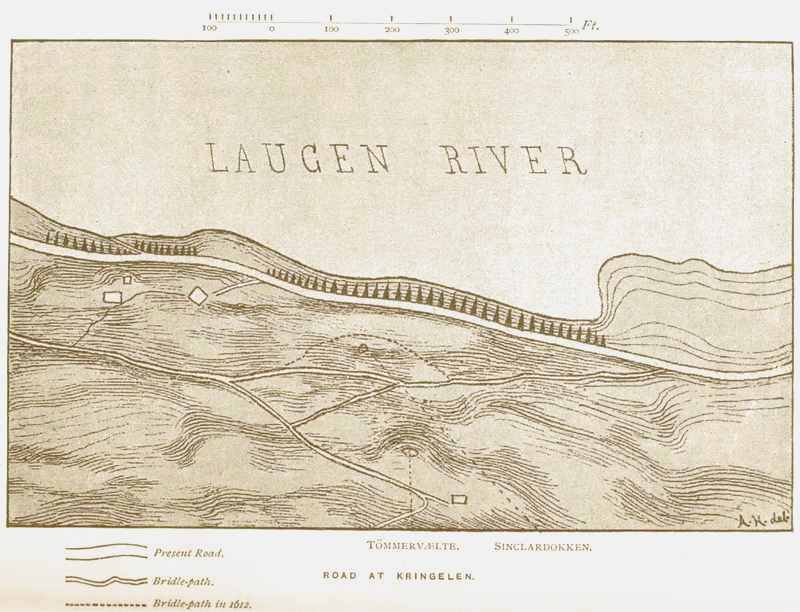
to await and attack the Scots. This place is situated
in Bredenbygd, in Sel's annex to Vaage parish, and is
a mountain slope, over which the road goes. At the
foot of that slope, which is in many places excessively
precipitous, flows the Laagen. At that time the road
was only a narrow path or bridle-path, but it has
since been altered and enlarged into a highway.[84]
Moreover, the ground has undergone some change
since 1612, especially in consequence of the landslip
of 1789, when it became less precipitous. There was
also more wood then than now. The name of the
place is generally written "Kringlen," under which
designation it has become best known. On the other
hand, in the language of the common people the place
was called Kringom, or Hög Kringom.[85]
The Bönder who there assembled were from Vaage,
Lessö, Froen, and Ringebo. Both Slange and Edv.
Storm state that the Bönder from Lom were there
too, and it is possible that some may have been
present, perhaps, from Garmo, an annex to Lom; but
according to a very common tradition current at Lom
itself, the men of Lom, although they assembled and
marched out, did not take part in the fight. The fact
is, that the people from the southern or greater part
of Skjager annex went over the Findal Mountains,
and down again through Vaage, in order to engage
the enemy, but arrived too late. Those of the parish
of Lom proper, and of the northern part of Skjager,
also went part of the way—namely, within half a
Norwegian mile to the east of Lom Church, to a
hill in the neighbourhood of Graffer farm; but here
they began to deliberate as to what they should do,
and the result was that they returned to their several
homes, on the advice of the "lads from Skjelqvale,"[86]
and more especially after considering that
the Scots would not in any case come to Lom, and
that the matter, consequently, did not concern them.
That hill is to this day called "Raadsbakken,"[87] or
Council Hill. In addition to the Bönder assembled
at Kringlen, the peasantry of Gusdal and Öiers took
up a position in the above-named Bægilsklev, or Bæggersklev,
in Ringebo, about five Norwegian miles to
the south of Kringlen, under the leadership of
Lauritz (or Lars) Gram, the bailie of Gudbrandsdalen,
who lived at the farm of Steig, in Froen. That position
was probably selected in order to meet the possibility
of the Scots escaping from the Bönder posted
to the north. The latter were led by Lauritz Hage,
lensmand at Dovre (in Lessö?), and Peder Randklev,
lensmand in Ringebo. According to some accounts,
Guldbrand Sejelstad, of the same parish, was also
amongst the leaders.[88]
The Bönder now prepared at Kringlen to meet
Sinclair and his Scots. As already stated, the latter
had taken to the mountains in order to avoid Rosten,
and had descended into the valley at Horgenlien in
Nordre Sel, and taken up their quarters there for
the night, after the Bönder had retired from that
farm in the morning. Sinclair slept at Romungaard,
where are still to be found the remains of the room
he occupied, and now used as a barn.[89] The Bönder
in Nordre Sel had fastened oxen to the fences, in
order that the enemy should not burn down their
farms. Some say that the Scots remained a day at
Sel before they proceeded further. "Now begins
prosperity; it will be better still over in Hedemarken,"
Sinclair is reported to have said to his people.
In the morning, before he marched up from Sel, a
few hours previous to the battle at Kringlen, he is
said to have burned some powder on the palm of his
hand, in order to ascertain whether his march would
be successful or not. The smoke having gone up
against his breast, he is reported to have exclaimed,
"This day I shall suffer loss in my men, however
great that loss may be." Sinclair was accompanied
by a "Veirlöber,"[90] or hound; some called it a "Værkalv,"
others a "Vildtyrk" or "Tryntyrk",[91] "able to
detect the enemy like a hound." It could, they said,
scent "Christian blood." It is likewise related that
the thick part of its legs had been removed in order
that it might run with greater lightness. The Veirlöber
was shot the same morning at the farm of Ödegaard.
An elderly farm labourer had remained there
in order to see what the enemy would do, and hid
himself with his steel-bow in a field of hemp; and
another, who had likewise remained behind, got into
a chimney to give the signal to the archer. After
drinking some sour milk in the dairy, the hound
came up to them. It is said that the sour milk,
together with the smell of the hemp, prevented the
nose of the Veirlöber from discovering the man who
was concealed, and whose unerring shot stretched him
on the ground, so that the sour milk "spouted out of
him." A similar Vildtyrk, as already stated, had
been shot in Romsdalen. The Saga says it was fortunate
for the Bönder that these Vildtyrker had been
shot, for they were dangerous spies. It is probable
that they were nothing more than Sinclair's sleuth-hounds.
This is to be inferred both from the descriptions
given and from statements respecting the one
that was shot at Ödegaard—namely, that he ran
about in the fields and barked.
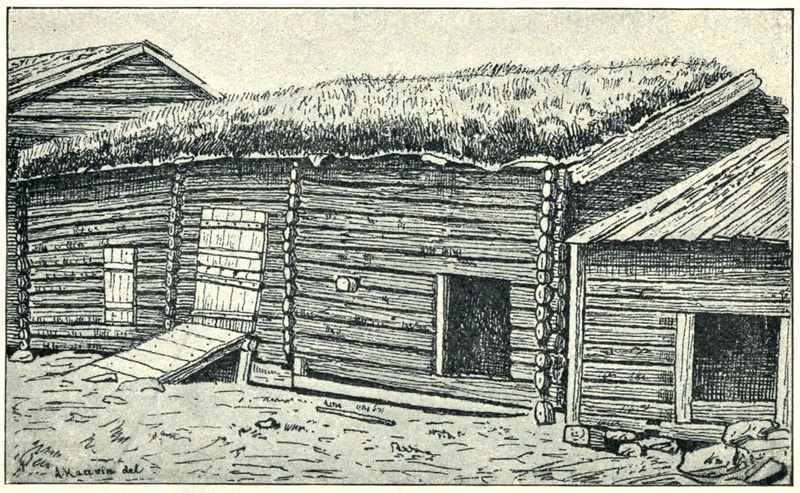
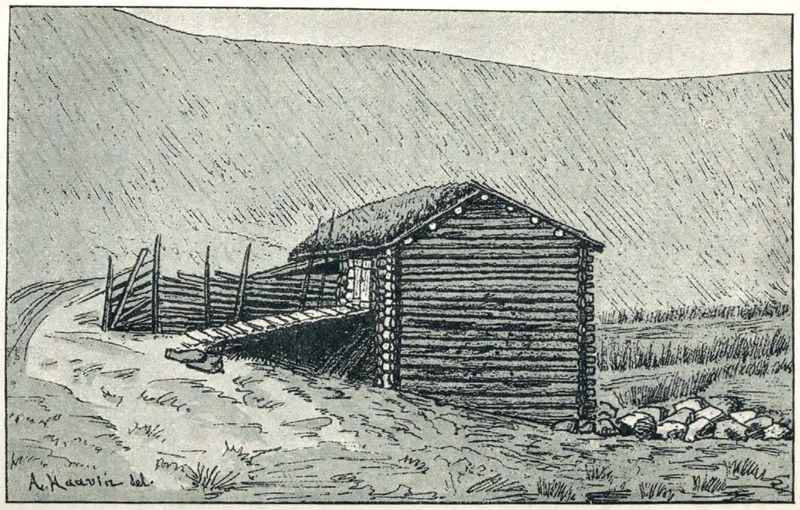
BARN AT
ROMUNGAARD.
Still shown as that in which the Scots passed the night before the fight at Kringelen.
Page 96.
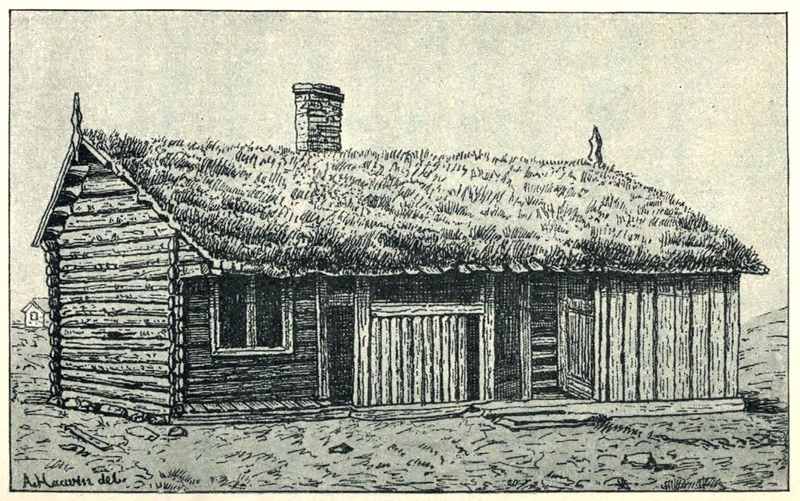
COTTAGE AT
ROMUNGAARD.
Still shown as that in which George Sinclair slept the night before the fight at Kringelen.
Page 96.
The Scots then advanced from Sel. It was on the
26th August 1612,[92] a day which has remained so
memorable in the history of Gudbrandsdal. It was a
Wednesday. To the strains of martial music the
whole of the Scottish force marched southwards.
Some of them hearing the cries of children on the
mountains, to which the mothers had fled, are said
to have called out in derision, "Hear the witch-cats
how they screech; when we come again we shall
visit them." But soon their mockery was to be
silenced, and their music to sound for the last time;
and the young blood now flowing in their veins was
in a few moments to stain the rocky sides of Kringlen
and the gray waters of the Laagen. Step by
step they approached the spot where this expedition
was to end so quickly and sadly. The Bönder at
Kringlen were waiting for them. Here, on convenient
places above the road, they had raised huge
breastworks, and a kind of trap of stones and timber.
The trap was laid on logs held together by means of
rope, and propped up with supports in such a manner
that when the ropes were cut and the props removed,
the logs and stones would roll down the whole hill-slope.[93]
The object was to let the mass fall down as
soon as the enemy got below it, and thereupon to
attack the survivors with weapons in hand. The
whole of the construction of stones and logs, as
well as the Bönder, who stationed themselves behind
that awful barricade, were concealed by leafy
branches of trees and by fir trees, so as to give the
appearance of a small wood. A small body of
Bönder concealed themselves a little to the north, and
on hearing the noise of the conflict were to have
descended into the road, to prevent the enemy from
running back. The Bönder also cut down large trees,
and made chevaux-de-frise out of them, to be rolled
in the front and in the rear of the enemy along the
narrow road, in order to shut him in and prevent him
from going either forwards or backwards.
In a ballad older than Edvard Storm's poem, undoubtedly
composed by a Gudbrandsdal man, and of
which there are a few imperfect copies, the position of
the Bönder is thus described:—
"There is a cliff in Gudbrandsdal,
Which is called Kringlen;
There lay the men of the valley,
In all near five hundred.
Intrenching there, they built a wall,
And raised up stones many.
They lay in wait as doth a cat
That wants to catch a mouse."
In order to be informed how near the Scots had
come, and thus to determine when to expect them,
they sent out, says the Saga, as a spy, a Bonde of
the name of Audon Skjenna[94] of Sel. He went direct
to Skjenna farm, and saw Sinclair reviewing his men
on the green outside that farm. When he saw them
afterwards passing over Laur Bridge, which spans
the Laagen immediately to the north of the Ulen
river, he hastened back. The Scots, however, got
sight of him, and are said to have called out, "See
how the boor is running away on a 'pert.'"[95] It was
necessary for the Bönder to divert the attention of
the Scots from their ambuscade, and to ascertain
when the main force of the enemy was below it, for
that would be the time for them to begin the battle.
With the latter object one of the Bönder was ordered
to remain on an island called Storöen, in the Laagen;
and then riding on a white horse out of gunshot of
the enemy, he was to keep in a line with the
enemy's main force, or with the head of it, and when
it reached the appointed place to give notice by suddenly
turning round. Some say that, in order the
better to divert the enemy's attention, he sat backwards
on the horse; while others affirm that, with
the same object, he wound a large red plaid round
his throat and down the chest of his white horse.
Other arrangements were also made to divert the
enemy's attention. On the advice of Arne Nedre-Gunstad
from Ringebo,[96] the least capable of the men
who had met there were stationed on Storöen, in
order to deceive the enemy by a feint attack, and
thereby to draw off his attention from the place
where lay the real force of the Bönder. They further
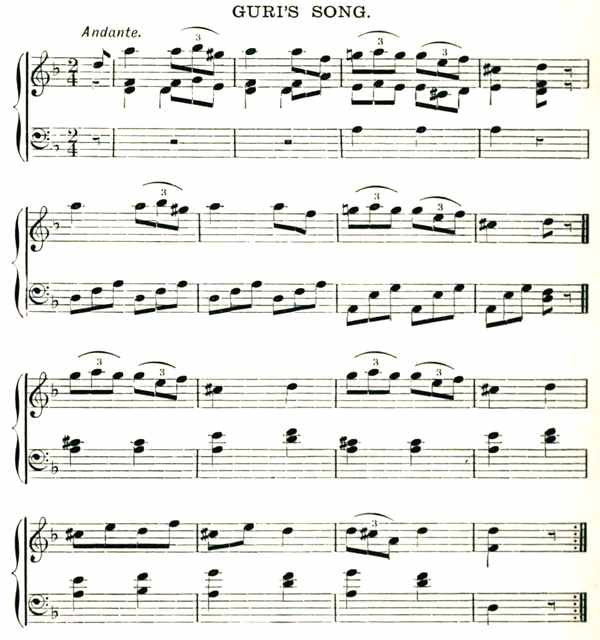
sent a girl of the name of Guri, generally called
Pillar Guri, who knew well how to blow a horn,[97] to
stand on Selsjordskampen, a mountain point on the
left side of the Laagen, from which she could see the
surrounding country and the approaching enemy.
When the main force of the enemy got between her
and the place selected by the Bönder she was to
blow the horn, to attract the attention of the enemy
towards the point at which she was placed, and
which was opposite to the position occupied by the
Bönder; and also to signal to the Bönder, who could
not see the enemy from their ambuscade, how far
they had advanced. It is also related that, likewise
by arrangement with the Bönder, she held hanging
down in front of her a long white scarf, which she
twisted round her arm, and by gradually shortening it
signalled to the Bönder the approach of the enemy.
Now came the Scots. Their advanced guard of
sixty, according to others one hundred, men, who
marched a little ahead, passed unattacked. The girl
on the mountain top did not blow her horn, but
waited for the main body. It is strange that the
advanced guard observed nothing of the Bönder.
After that came the main force of the Scots; but
the Bönder remained quiet, each ready at his post.
Among them was also Berdon or Bardum Sejelstad
of Ringebö,[98] who, together with two other skilful
marksmen, was one of the leaders chosen to take aim
at Sinclair; and Berdon had stipulated that no one
should shoot before he did. The Scots thought that
the Bönder force was further in advance of them,
and expecting no attack there, approached reliantly,
and were "cheerful." As soon as they came sufficiently
near, they heard the girl play on the horn
from the mountain-top. The Scots stopped and
listened to the unusual and melancholy strains. Sinclair's
band thereupon replied to her with a march.
The girl played the same air again, and the Scots
replied a second time.[99] After that began the attack
from the island. Many shots were fired, but no
bullet reached so far. A volley and then several
volleys were fired, but with the same result; and the
Scots laughed at what they thought was a cowardly
attack, and in derision lifted their hats after each
discharge. But suddenly the signal was given to the
concealed Bönder, and the scene changed. The masses
of rock and timber now tumbled down, and at the same
moment Sinclair fell at the first shot that was fired.
Berdon Sejelstad had taken aim at him from behind
some pine trees; and as Sinclair was considered to be
a mighty and brave warrior, invulnerable to bullets,
Berdon, in order, as he thought, to be more certain of
success, took the silver button from the neck of his
shirt, chewed it into a lump, and loaded his gun with
it.[100] Some say also that the gun missed fire the first
time. The bullet is said to have struck Sinclair in the
forehead, just over his left eye. As he fell he is said
to have exclaimed, "That is Berdon Sejelstad's arquebuse."[101]
The place where he fell is still called "Sinclar's
Dokken." Immediately after the colonel had
fallen it went badly with the rest; and the Bönder
threw themselves forward with courage and speed,
spreading fear and death by shooting with rifles and
hewing with axes. The position of the Scots was
bad in the highest degree; for the narrow pass in
which they were crowded, and the declivity of the
mountain on which they stood, admitted of no battle-array.
From north and south, and from above them,
the Bönder fell upon the Scots with fury. The above-mentioned
ballad says:—
"They were surrounded south and north—
Which they must most have regretted:
There was committed upon them a miserable murder." ...
They attempted to run up the mountain to close
with the Bönder, but were hurled down. "Those
who were not shot jumped into the river to save
themselves, but were there drowned; and those of
them who got alive over the river were quickly killed
by the Bönder on that side."[102]
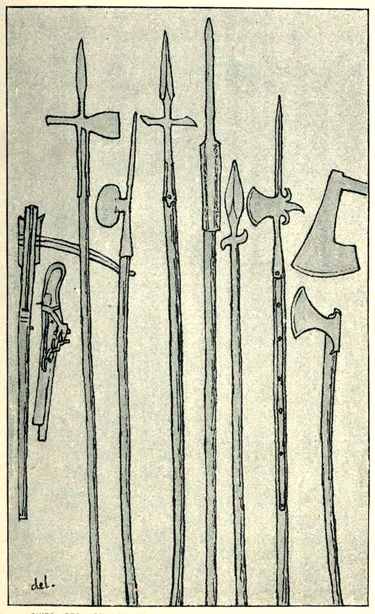
PIKES, ETC., OF NORWEGIAN PEASANTS IN SEVENTEENTH CENTURY.
In the "Ballad of the Valley" the battle is further
described as follows:—
"The colonel rode in the foremost rank,
Right proudly himself he bore;
He was first shot down from his horse,
And became at once quite powerless.
He died and there at once on the spot
With others at that time;
Georgius Sinclar was his name,
Who then was stretched a corpse.
"There staggered many a brave hero,
And danced against his will;
Horse and man to earth were felled,
That is how the Dalesmen entertained them.
"The balls as thick as hail did fly,
Men had to stop there and bide;
There was heard many a shout and cry,
Yes, there ached many a side.
There was sweated much bloody sweat,
Many a cheek was white....
"They tried to climb the mountain steep,
The Norsemen death to deal;
But from the rocks were forced to leap
By logs and stones and steel.
Hard by the precipice there runs a river,
Its waters run so strong
That all who cannot reach the bank
Are borne by the stream along.
"They swam both hither and thither,
On their backs or as best they could;
That art they had diligently learnt;
But they had to go to the bottom.
They were fired at right sharply,
So the water splashed about their ears;
They had to remain on that spot,
And reached not the dry land."
The girl on the mountain crag continued to play her
horn during the battle, until she saw the Laagen dyed
with blood. She then threw the horn over her head,
went away, and changed her song into weeping. Some
say that Sinclair's wife was also killed in the fight, together
with her child. According to tradition, when the
rest went to battle, Kjel Fjerdingreen[103] of Hedalen, a
parish annexed to Vaage, was persuaded by his sweetheart,
who had a foreboding of misfortune, to remain
behind; but when she heard that Sinclair's wife was
with him, and that she carried a new-born babe, she became
anxious about her fate, and as much as she had
previously bid him remain behind, she now bade him go,
not to take part in the carnage, but, if possible, to save
the child. "You shall not gain my hand, Kjel," she is
said to have told him, "before you have saved the child."
He therefore accompanied the others. In the tumult
of the battle, Kjel rushed forward in order to comply
with the touching entreaties of his sweetheart. The
child had just been hit by a ball. Kjel found Mrs.
Sinclair, who was beside herself with grief, on horseback,
and stanching the blood of her child. As he
was going to take it (others say that it had fallen
from her, she having dropped it in her fright, and
that Kjel took it up and handed it to her), she thought
he wanted to injure it, and impelled by fear and
motherly affection she thrust a dagger into her benefactor's
breast. Others say she stuck the dagger into
his back as he was stooping to take the child. It is
said that one of Kjel's companions then shot Mrs.
Sinclair down from her horse, and that her body
was afterwards seen in the Laagen. It is stated by
others that the Bönder threw her into the Laagen,
taking her for a witch, and that she sat (on the
water) stanching the blood of her child, and that the
Laagen bore her a long way before she was drowned.
When the child was killed, and before Mrs. Sinclair
fell a prey to the waves, she is said to have struck up
a wild song in her despair,—others say in her scorn.
The place where she remained for some moments on
the surface of the water is said to have been immediately
opposite to the most northerly point of Kringlen.
Others again say that she was afterwards amongst the
prisoners, and that her life was spared. The inscription
in the parish register of Vaage[104] states that she survived.
The battle probably took place from a little north
of that point to a little south of the highest part of
Kringlen, where the wooden post stands. According
to Kruse's Report, it lasted an hour and a half. As
soon as the battle was over and the victory gained, the
Bönder went after the men of the vanguard, whom
they had allowed to pass unhindered. These had
fled forward when they perceived the defeat of the
rest; but they were overtaken on a plain at Solhjem
farm, a little to the south of Kringlen. As the
Bönder came rushing to the attack with the cry,
"Fall to! fall to! here are more of them," and the
Scots saw "what would result from it," they at once
sent their interpreter forward and said they would
surrender as prisoners. Thereupon they laid down
their arms; but when they saw that the Bönder were
not so many as they had at first thought, they took
their arms up again and wanted to fight their way
through; but they were now met in such a manner
that they were all either shot and cut down or taken
prisoners. Peder Klognæs the guide was with the
vanguard, and nearly shared its fate; but on the cry,
"I am Peder Klognæs, I am Peder Klognæs, and am
one of your own people," he escaped, and returned
later in safety to his home in Romsdalen.
The strength of the Bönder force which fought at
Kringlen was between four hundred and five hundred
men,[105] of whom six were killed and some few wounded.
According to the ballad—
"When the Dalesmen this had done,
And thus destroyed the foe,
I have been told of a truth
That six of them were killed
In the battle on the cliff;
And there were stretched as corpses,
Beside those who wounded were,
Who are but few to mention."
The Bönder proceeded at once with the prisoners
to Qvam, a parish annexed to Froen. After the glory
just acquired, the Bönder committed next day a sanguinary
deed, which the inhabitants of the valley
now speak of with abhorrence, wishing it had never
been done. "The principal men among those who
were there" wished indeed that the prisoners, whom
they had confined in a barn at Klomstad farm, should
all be conveyed to Agershuus.
"But this pleased not the Dalesmen
That they should thus take them
Through the long and narrow way,
And give the country trouble."
The majority shouted that the prisoners should all
lose their lives, on which, so strong was the general
exasperation, they took them out of the barn,[106] one by
one, and shot them all, except eighteen or some few
more. Five or six whom, owing, it is said, to "magic
art," the shots would not affect, were put to death with
pikes. The "Ballad of the Valley" says:—
"They minded neither lead nor powder,
It dried upon their brows;
So tough was their flesh and their skin
That lead could not through them go.
Through cunning and magic art,
Which they learned to a nicety,
What was done to them was in vain,—
They did not even hiccough;
So (the Bönder) took to their sharp pikes,
And had to run them through;
Then both skin and flesh were torn,
And they made an end of them.
But of the prisoners there were spared,
I know, one less than twenty.
Amongst them were two captains—
I will not tell a lie—
The one Captain Bruce by name,
The other Captain Ramsey."
Kruse writes respecting the prisoners:—"On the
day the battle took place one hundred and thirty-four
Scots were taken prisoners, who were straightway the
next day killed and shot by the Bönder, with the exception
of the above-named eighteen, the Bönder saying
to each other that his Royal Majesty had enough to feed
in those same eighteen. Some of these were, however,
wounded, and some had bullets in their bodies when
they arrived here.[107] Of the above-mentioned eighteen
soldiers we now send to you[108] the three principal
ones, who are a captain of the name of Alexander Ramsay,
and his lieutenant of the name of Jacob Mannepenge
[James Moneypenny], who has previously been
both in Denmark and Sweden, and who on this their
expedition served as an interpreter; the third is called
Herrich Bryssz [Henry Bruce], who, according to his
own statement, has served as a soldier in Holland,
Spain, and Hungary. As regards the remaining fifteen
persons, some of them have straightway taken service
among good folk here in the country, and some who
will willingly serve your Royal Majesty in Jörgen
Lunge's[109] regiment, I sent at once to Elfsborg." This
is alluded to as follows in the Valley Ballad:—
"They were then to the castle brought,
No desire had they to remain....
They could not relish the fare so hard
Which the Gudbrandsdal men gave—
Here are not many hens or sheep—
But lead and powder they got in their insides."
That at least eighteen remained alive can thus be
seen from Kruse's Report, and, moreover, that some
few remained behind in the valley is recorded by
tradition. Storm sings that none of the Scots ever
saw their own country again. Nevertheless it is related
of at least one of them that "he came home."[110]
The place in Qvam parish where the Scots killed at
the barn were buried, is still shown a little to the
north of the barn, and is called Skothaugen ("The
Scot hillock").
The conduct of the Bönder towards their prisoners
can certainly not in any way be justified; but so long
as there is much that can be pleaded in extenuation,
we should, on the other hand, be cautious in pronouncing
an unqualified condemnation. According to tradition,
they were excited to that deed by Peder
Klognæs, who had seen so many cruelties committed
by the Scots on the way, and who had himself suffered
so much at their hands. It can be imagined that the
real state of the case was possibly this: the Bönder,
weary after a march of several days, and after the
last day's work and fighting, came to Qvam with
their prisoners, when they began, it may be supposed,
to be weary of leading them further. It was the
busy harvest time; they were possibly short of provisions.
Perhaps some of them had a debauch, as
previously at Sel, and excited by liquor as well as by
the account of the cruelties of the Scots, they considered
the latter worthy of death, and quickly set to
work to slaughter them, notwithstanding that the
principal men had opposed such a proceeding. (See
ante.) It may be that the prisoners themselves had
given them fresh cause for exasperation during their
conveyance or while they were being guarded; and
such a supposition is all the more within the range
of possibility, since it is otherwise very singular that
the Bönder did not kill their prisoners immediately
after the affair at Solhjem (since their exasperation
was so great on the following day), but conducted
them one mile and a half (Norwegian) on the way
to Agershuus.
Special circumstances, no longer known, may have
occurred as contributory reasons for such conduct.
Moreover, before pronouncing judgment on the inhabitants
of Gudbrandsdal, we must remember that
wars at that time, and the Calmar War as a whole,
were conducted with much cruelty, and we must
take into consideration the spirit of the age. Nor
should we forget that more than two centuries lie
between them and us. A far higher stage of culture
has been attained of later years, and yet they have
produced not a few examples of similar barbarity.
We have only to remember what is related respecting
the cruelty of the Duke of Cumberland in 1746 after
the battle of Culloden in Scotland, General Moreno's
murder of General Torrejos and his sixty comrades in
misfortune on the plains before Malaga in 1832,
General Minas's cruelty at Lacaroz in 1835, and the
cruelties of the Carlists towards the English prisoners
at Tolosa in 1837, etc.
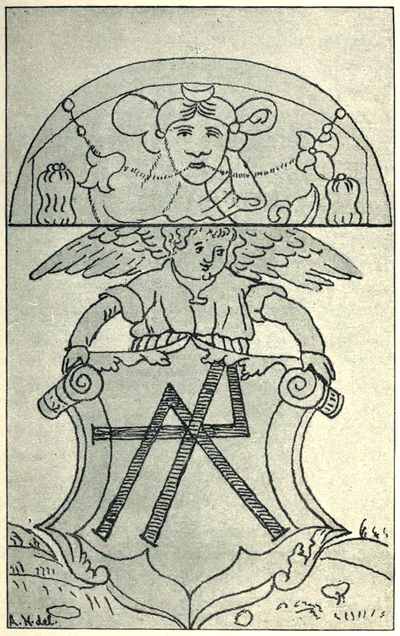
CENTRE PANE OF WINDOW PRESENTED BY A SCOTTISH PRISONER
SAVED BY A NORWEGIAN BONDE.
(
Now in the Anglican Church, Christiania).—
Page 117.
Respecting one of the Scottish prisoners who remained
alive, tradition relates that when he saw a
musket being aimed at him he ran to Ingebrikt
Valde[111] of Vaage, and with pitiful gesticulations asked
for life and protection, seeking shelter under his
horse; whereupon Ingebrikt lifted his axe in defence
of the man, threatening to cut down any one
who killed him. That Scot is said to have been a
glazier, and to have subsequently settled in the
country. As a token of his gratitude he sent some
windows to Ingebrikt Valde, whom in his letters he
always called his "life's father." Of these windows
one is still to be seen at Valde farm.[112] Some lines,
burnt into one of the panes, form a shield, on which
are seen a figure like a crest (perhaps Ingebrikt
Valde's seal or signature) and an angel with hands
held protectingly over it. Another of the prisoners
remained in Vaage, where he got a piece of land to
cultivate, and which clearing is now a farm called
Skotlien.
Either at the engagement at Kringlen or during the
affair at Solhjem one of the Scots is said to have saved
himself by swimming over the Laagen, whence he took
to the mountains. In the evening (the mountains
being only a Norwegian mile across) he came down to
Ellingsbö farm in Hedalen, and his appearance bespoke
fright and hunger. The farmer, who, according to
Gram's Census, was called Christian, placed food before
him. While the Scot sat and ate the mowers came
home. At the sight of those men and their scythes
he thought they were some of those who had been
at Kringlen, so he jumped up and showed signs of
fear lest his life should be taken; but the Bonde
soon quieted him. The Scot remained there four
years, went to Oslo,[113] where he settled as a goldsmith,
and sent as a present to his benefactor at Ellingsbö
silver cups for his children.
From one of the prisoners, who is said to have
been a cardmaker, and who married in the country, a
family with the surname of Matheson is descended,
and several of its members still reside in the province
of Trondhjem.[114]
Among the prisoners was also a woman, whom Lars
Hage afterwards met at the house of a merchant at
Oslo. He recognized her, and she him. The merchant
told her to draw a jug of ale for the man. But as he
would not drink, she said, "Drink, good man, I have
done you no harm;" and the merchant having asked
her, "Do you know to whom you are offering that
good ale?" she replied, "I know him well enough.
They were not 'boors,' but devils, that lay in the
bushes."[115]
A prisoner who had been quartered at Veikle farm
in Qvam parish, and who had been well treated, sent
later, says tradition, "when he got home," six silver
spoons to the farmer,[116] as a token of remembrance.
Respecting two other prisoners, one of whom was at a
farm in Qvam, the other at a farm in Sel, it is related
that they were shot the same autumn, "as the proprietors
did not find it would pay them to feed them
over the winter." Another of the prisoners is said to
have been killed at Vaage. The farmer with whom he
lived took him on a journey into the woods. On the
way, it is said, they began to talk about the battle at
Kringlen. The prisoner having said that if the Scots had
known about the Bönder as much as the latter had known
of them matters would have turned out differently, the
farmer got angry and cut his prisoner down on the spot.
It is related of the Bönder from Vaage that on the
return homewards they met at Kalsteen, in Vaage, a
portion of the men of Lom who intended to encounter
the Scots. An argument arose between the men of
Vaage, proud of victory, and those of Lom, and a
bloody battle very nearly ensued, but it was prevented
by individual representations. A certain Peder
Killie[117] of Dovre is reported to have said on his return
home from the battle that he thanked God he had not
fired a shot at the Scots; but when another Bonde,
his neighbour, heard this, he became angry, quickly
cocked his gun to shoot him, and would have killed
him had not others intervened and prevented him.
A man called, Jörgen Fjerdingreen[118] of Hedalen is
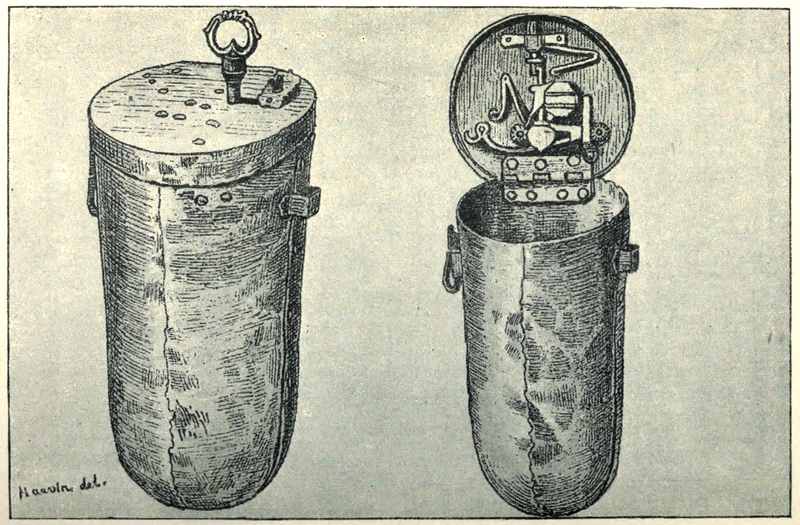
said to have got possession of Sinclair's money-chest
(or holster), and was carrying it home on a pack-horse.
At Breden farm he went inside to enjoy himself; but
spending a long time over his dinner, the holster, which
he had left outside, was carried away.[119] This has given
rise to the saying, which, however, is not very general,
"to dine like Jörgen."
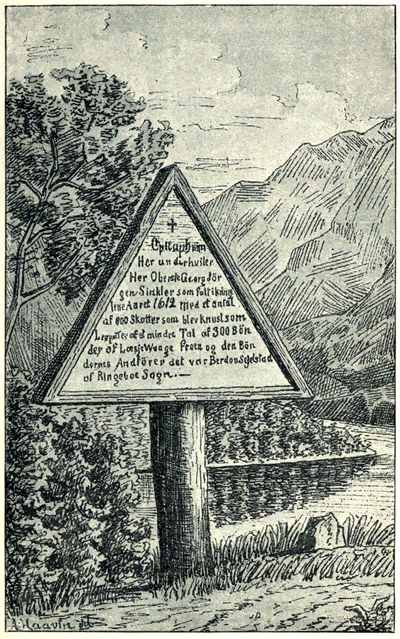
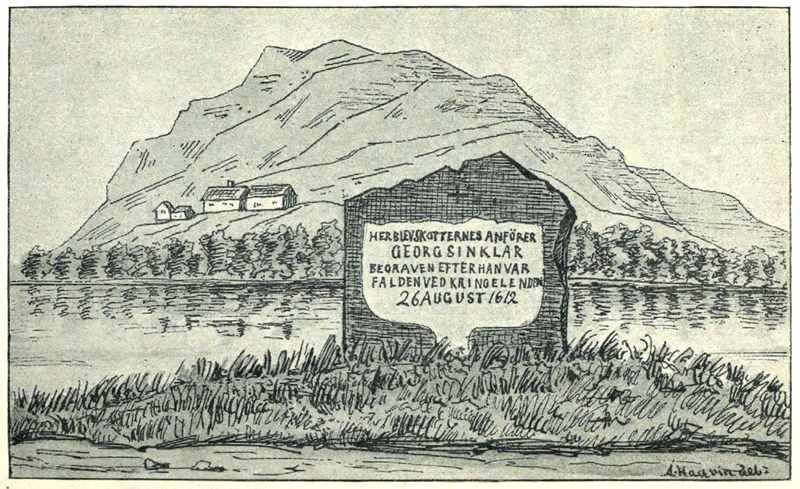
OLD MONUMENT OVER SINCLAIR'S GRAVE.
Page 121.
Sinclair's body was carried to Qvam and there buried
just outside the church-yard, as the exasperated
Bönder would not allow him to lie in consecrated
ground. It is told that one of his relatives thought
he had not been killed, but only taken prisoner, and
therefore came to Norway in search of him, but found
only his grave. A simple wooden post close to the
road, a little to the south of the church,[120] shows to
this day where he lies buried. A board with the following
inscription is fastened to the post:—

Epitaphium.
Here below rests
Mr. Colonel
George Jörgen Sinkler,
Who fell at Kringlene,
In the year 1612, with a force of 900 Scots,
Who were crushed like earthen pots
By a smaller number of 300 Bönder
Of Lessöe, Waage, Froen; and the
Leader of the Bönder was Berdon
Sejelstad of Ringeboe Parish.
[121]
On the spot where Sinclair and his Scots fell, a
monument was also raised in commemoration of the
event. In lieu of the stone pillar which, according to
Slange, had the inscription, "Here was Colonel George
Sinclair shot the 26th August, anno 1612," the present
post was raised in 1733, on the occasion of King
Christian the Sixth's journey to Trondhjem. The
monument, which stands under the shadow of a birch
tree on the top of the hill beside the road, and a few
paces to the south of the spot where Sinclair was shot,
is in the form of a simple wooden cross, with a board
on which the inscription is as follows:—
"Courage, loyalty, bravery, and all that gives honour,
The whole world 'midst Norwegian rocks can learn.
An example is there seen of such bravery,
Among the rocks in the North, on this very spot:
A fully-armed corps of some hundred Scots
Was here crushed like earthen pots;
They found that bravery, with loyalty and courage,
Lived in full glow in the breasts of the men of Gudbrandsdal.
Jörgen[122] von Zinclair,[123] as the leader of the Scots,
Thought within himself, 'No one will here meddle with me.'
But, lo! a small number of Bönder confronted him,
Who bore to him Death's message by powder and by ball.
Our northern monarch, King Christian the Sixth,
To honour on his way,[124] we have erected this;
For him we are ready to risk our blood and life,
Until our breath goes out and our bodies lie stiff."
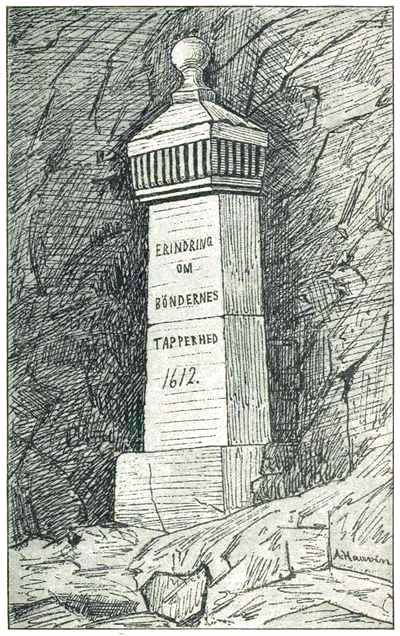
PRESENT MONUMENT ON HIGHROAD MARKING VICINITY OF SITE
OF FIGHT AT KRINGELEN.
Page 123.
"In commemoration of the bravery of the Bönder, 1612."
Yet another post in commemoration of the battle
was set up by a private individual in the year 1826,
a little to the north of Kringlen, at the farm of Pladsen
or Söudre (South) Kringlen. It is about five feet
high, of soapstone, and in the form of an obelisk surmounted
by a ball. This monument will be set up in
a more appropriate place when the road is altered.[125]
The inscription on it will only be in these words,
"The 26th August 1612."
The origin of the plant called cow-bane or water
hemlock[126] (Cicuta virosa s. aquatica), which is very
poisonous, and which grows in great quantities in a
marsh at Nordre (North) Sel, dates, according to
tradition, from the time of the Scots. It is said the
Scots sowed that herb; but that this has only been
attributed to them out of hatred need scarcely be
added. On an islet opposite Kringlen stood, until the
great flood of 1789, a large fir tree, in the trunk of
which some musket balls, as well as many traces of
them, were to be found, and some years ago human
bones were found where the wooden cross now stands.
Various weapons and other things still remain after
the Scots in many parts of the valley. Thus at the
farm of Mælum in Bredebygd is a drum, which is
called the "Scots' drum." It was brought thirty or
forty years ago from Ringebo, where it was likewise
known under the same name.[127] At Nordre Bue farm
are a musket and a sword which belonged to the
Scots. At the farm of Söudre Kringlen or Pladsen a
spur and a knife were found a short time ago on the
hill where the battle took place. In the parish of
Vaage, at Lunde farm, is a dirk which had belonged
to the Scots. There is also a dirk at Kruke farm
in Hedalen, and this is said to be the one with which
Mrs. Sinclair stabbed Kjel Fjerdingreen. According
to an English traveller who has seen them, these dirks
are similar to those still carried by a regiment in
Scotland which is armed in the old style. At Fjerdingreen
farm is a purse made of steel-wire rings, also
a large and a small powder-horn, which are said to
have belonged to Colonel Sinclair. In the parish of
Dovre, at the farm of Ödegaarden, is preserved a chest
bound with iron, which is said to have been Sinclair's
money-chest, as well as a large and a small powder-horn,
also reported to have belonged to him. There is likewise
a powder-horn at the farm of Sönstebö, in the
parish of Læssö. Among the things that belonged to
Sinclair, Peder Klognæs is said to have got a pair of
snuffers, which he took home with him, and which
are said to be still preserved at Mandalen farm in
Romsdalen. In the Armoury of the fortress of Agershuus[128]
are preserved muskets[129] which had belonged to
the Scots. In the Museum at Bergen are the stock of
a pistol and a powder-horn, and in the Museum of the
University of Christiania the stock of a pistol inlaid
with ivory—all relics of the Scots. Sinclair's pistols
are kept in the Museum at Copenhagen. They are
described as follows in the catalogue of the Museum:—
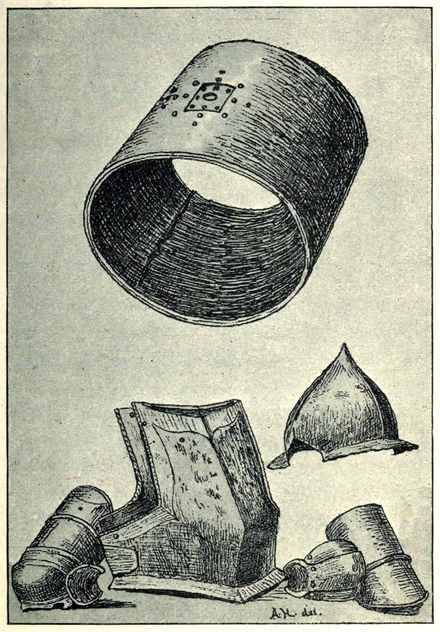
REMAINS OF SCOTS' DRUM AND ARMOUR.
Page 124.
"The locks have pans of the so-called Spanish kind,
but amongst the oldest of those patterns the barrels
are of brass. On them are engraved the Scottish thistle
and the letters A. S. In the year 1690 Lieutenant-General
Johan Wibe sent those pistols to King
Christian V., with the observation that they had
belonged to the 'Scotch Colonel George Sinclair, who
in the year 1612 fell with his Scots in Gudbrandsdalen.'"[130]
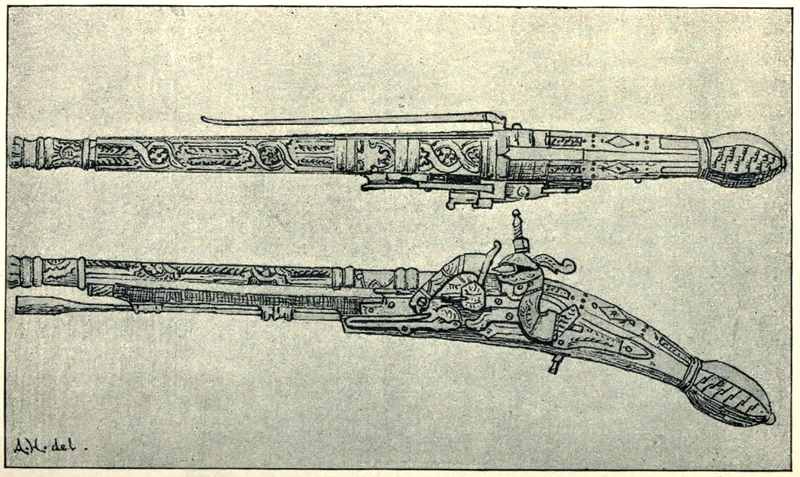
PISTOLS ALLEGED TO HAVE BELONGED TO GEORGE SINCLAIR.
Page 125.
(
In Copenhagen Museum.)
At the close of the last century, a Count Laurvig
is said to have owned Sinclair's pistols,[131] and Count G.
C. R. Thott his musket, which was for a long period
preserved in the family of Berdon Sejelstad, who, as
the slayer of Sinclair, got it as his booty. At the
beginning of the present century Thor Bratt of Tofte
owned Sinclair's fighting sword, which he gave away
to be sent to the Art Museum at Copenhagen.[132]
Just as Christian IV. punished severely the nobleman
Steen Bilde and the men of Stordalen and Jemtland
for having made no opposition to Colonel Munkhaven
on his march through the country to Sweden,
so was the conduct of the men of Gudbrandsdal, differing
as it did from that of the others, not allowed by
the king to pass unrewarded. By letters-patent, dated
from the Castle of Frederiksborg, September 3, 1613, he
gave to Lars Hage the farm (Hage) which he occupied, together
with the farm of Landnem; to Peder Randklev
the farm (Nedre Randklev) on which he lived, together
with the farm of Gundestad; and to Berdon Sejelstad
likewise the farm he occupied (Övre Sejelstad);—"to
them and their descendants in perpetual possession, for
their fidelity, diligence, and manliness in the late war."[133]
The descendants both of Lars Hage[134] and of Peder
Randklev still live; but the family of Berdon Sejelstad
is said to have died out, at all events at the farm
where he lived—namely, Övre Sejelstad. Gulbrand
lived at Nedre Sejelstad, and the present occupant of
the farm is his fifth descendant in a direct line.
According to Hjorthöi's account (part ii., pp. 7, 135,
137, and 138), Arne Gunstad, whom he calls the next
in command of the Bönder (from Ringebo?), and who,
according to tradition, distinguished himself by his
bravery and extraordinary strength, was rewarded by
the exemption of his farm from the assessment called
"Foring." The same immunity was granted to Lars
Hage, Peder Randklev, and Berdon Sejelstad, in respect
of their several farms; and that freedom from
taxation is enjoyed by those farms to this day.
According to tradition, Audon or Ingebrikt Skjenna of
Sel also received as a reward of his bravery the gift
of the farm of Sel, of which the present occupiers are
said to be his descendants. The girl Guri, says tradition,
had the farm of Rindal in Vaage, subsequently
called Pillarvigen, given to her as a recompense.
The battle at Kringlen[135] will ever remain a remarkable
event in our history. It is certainly not
remarkable on account of the number of the combatants
or the magnitude of the defeat, but for the
manner in which the enemy was annihilated. It
was Bönder led only by Bönder who, with presence of
mind, knew how to select excellent ground, utilized it
with sagacity to carry out in harmony a plan of attack
that had been decided upon, and who fell with such
courage on a superior enemy. Moreover, the event will
serve to increase the series of examples which history
has preserved to us, of how dangerous it is for an
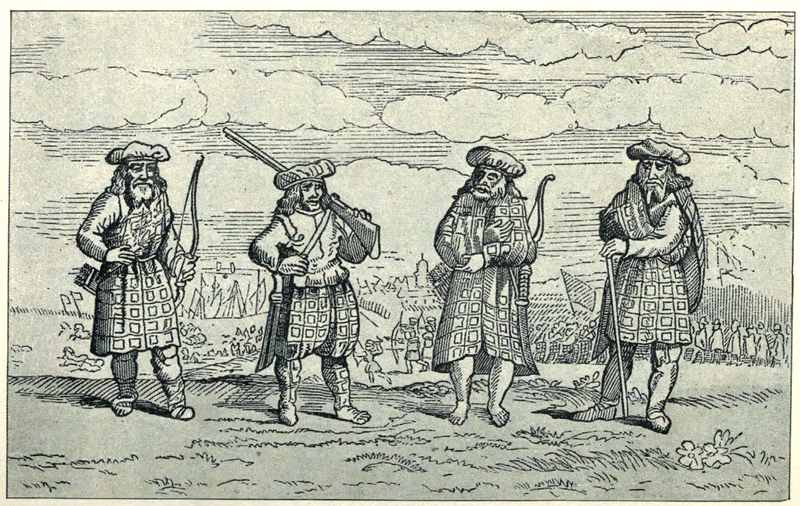
enemy to penetrate far into a mountainous country.