1848.
Staff appointments—Survey of London—Colour-sergeant Smith—Sergeant
Bay—Trigonometrical operations—Opposition to the military survey—Observatory
above St. Paul’s; the scaffolding—Privates Pemble and Porteous—Sergeant
Steel—Industry and conduct of the Sappers in the Metropolitan
survey—Preliminary arrangements of the Arctic expedition—Privates Waddell
and Sulter—Corporal Mackie—Expedition starts; corporal McLaren—Coasting
journeys and services—Overland march—Winter at Fort Confidence—Party
detached to Great Bear Lake—Close of the search for Sir
John Franklin and his crews.
Sergeant-major Jenkin Jones was commissioned to be quartermaster
to the corps on the 11th January, 1848, vice Hilton
retired. These pages amply testify to the merits of Mr. Jones.
A more indefatigable non-commissioned officer never served his
country, nor one more worthy of the honours conferred upon
him. Colour-sergeant Michael Bradford, a good soldier and
foreman, succeeded him as sergeant-major at Woolwich.
With a view to establish a system for the sanitary improvement
of the drainage of London, a survey of the metropolis,
under the auspices of the Commissioners of Sewers, was commenced
in January, 1848, and continued with a fluctuating
detachment—once as many as forty-three strong, and as few as
two men only—until January, 1850. Captain Yolland, R.E.,
2had the direction of the work, and colour-sergeant Joseph
Smith[1] was first appointed to the executive charge, but he
being soon afterwards discharged, it then fell upon sergeant
Andrew Bay,[2] sergeant Doherty, and others. With this survey
was connected the determination of the relative levels of all
parts of London.
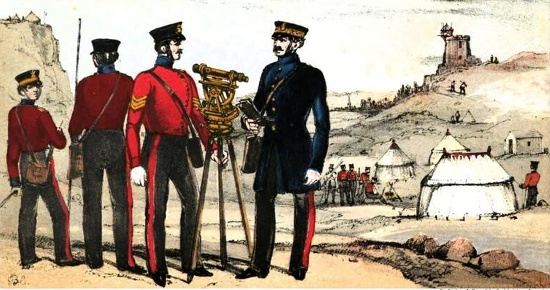
3The great triangulation was the first point attended to.
“That wonderful specimen of skill, the scaffolding on and
around the cross of St. Paul’s, put up in the spring, was the
main station for observations. The summits of Primrose and
other hills, the towers,” steeples, “and roofs of churches, the
parapets or terraces of public buildings or houses,” were made
“available as the sites for signal-staffs, visible from each other
and from St. Paul’s.”[3] By these observations, “the relative
angular positions” of the several points were obtained, from
which, as the bases of the work, a detailed survey was made,
embracing not only the principal streets and squares, but the
minutiæ of alleys and single buildings. Of every street the
slope or ascent was ascertained, and also the exact height of
every spot above the assumed datum or base-line.[4] The benchmarks
to show the permanent points of the survey and levels
were cut in stone, or on the most prominent objects, by the
sappers, who, though not brought up to that work, became very
expert in the use of the mallet and chisel. At least twelve
parties with twelve-inch instruments were scattered to the most
conspicuous places in the metropolis and its vicinage, to complete
the observations; and sergeant James Donelan, with the
great three-feet instrument, visited some of the old stations
celebrated by the labours of General Roy and other officers, to
check the smaller triangles formed by the operation of the
twelve-inch instruments. Some of those stations were at
Hanger’s Hill near Twyford, Banstead Downs, Severndroog
Castle on Shooter’s Hill, &c. The survey, including the city,
extended to a distance of eight miles in every direction from
St. Paul’s.[5]
London was unaccustomed to see soldiers employed in so
important a work as the metropolitan survey, and much excitement
was caused by their unobtrusive and peaceful operations.
The jealousy of a class of surveyors was at once called into
angry activity, and under the name of the “Associated Civil
Surveyors,” they formed themselves into a body, and opposed
by meeting, petition, and remonstrance, the continuance of the
4sappers on the duty.[6] The Metropolitan Commissioners did
the Association the honour calmly to investigate their grievance;
but from the lucid and truthful statements of Mr. Edwin
Chadwick and others, the continuance of the sappers on the
duty was confirmed and justified, not only on the score of competency,
but of policy, from the disciplined experience of the
men, and the perfection of the Ordnance system of responsibility
and resource.[7]
The particular objects which elicited from the public the most
attention were the observatories on the summit of the north-west
tower of Westminster Abbey, and above the cross of St. Paul’s.
The latter, from the dexterity with which the construction of
the cradle at that dizzy height was pursued, supported only by
the architectural ornaments of the structure, excited much
curiosity and wonder. The scaffolding was of rough poles;
the stage, ten feet square, formed of planks, which supported
the observatory, rested on the golden gallery on the top of the
great cone. “The four lower posts, twenty-nine feet long, stood
upon short planks bedded on the stone footway; and the top
supported the angles of four horizontal planks, each twenty-three
feet long, bolted together at the angles. From these planks a
screen of boards was erected to prevent materials, &c., from
falling. The base of the four upper posts, fifty-three feet long,
rested on the angles of the above planks; and the scaffold, in
addition to these posts, consisted of four sets of horizontal and
four sets of transverse, braces on each of the four sides, the
whole being fastened together with spikes and ropes. Fifty-six
of the uprights were double poles, placed base and point, and
bound together with hoop iron and wedges, and with bolts and
hoop iron at the splices. The height from base to floor was
5eighty-two feet, and to the extreme top of the observatory, ninety-two
feet.”[8] A railing, roughly but securely put up, surrounded
the “crow’s-nest.” “The ascent was by the inside of the tower
or lantern to the circular openings, then to the outside of the
foot-ladders set at the north-east corner, parallel to the north-east
principal post inside the scaffold. The whole of the
materials were drawn up from the floor by a permanent windlass
erected in the tower, to the golden gallery, and thence
passed to the outside, horizontally, through an aperture thirty-two
inches wide, and finally were drawn up and put into position
by purchase erected for the purpose.”[9] The whole construction
weighed about five tons, and though designed by sergeant
James Steel, was erected by sergeant James Beaton, the most
successful builder of these aerial fabrics, assisted by privates
Richard Pemble and John Porteous,[10] and some civil labourers,
under the direction of Captain Yolland.[11] The time occupied in
going up the ladder was about seven minutes, but the descent
required only four or five.[12] On the 2nd November the last
piece of the scaffolding was removed and carted away. In the
hazardous and intricate operations of building and dismantling
it, not the slightest accident to human life or limb—not even
the breaking of a single pane of glass—occurred.[13]
6The observations were taken by sergeant James Steel with
an eighteen-inch theodolite, both at Westminster Abbey and
St. Paul’s. When not prevented by haze, the sergeant attended
to his duty, frequently when the breeze shook his small location
to a perilous degree, with a coolness, perseverance, and accuracy
that were highly praiseworthy. Sometimes he and his
assistant sapper—private John Wotherspoon[14]—ascended to the
observatory at St. Paul’s as often as three times a-day, and
this carried through a period of four months—between the
17th June and 16th October—with unflinching resolution and
assiduity, made the sergeant and the sappers objects of much
interest and of curious and anxious inquiry. The observations
taken from this height comprised between 8,000 and 10,000.
In many instances the same subject was gone over as many as
six times, none less than three or four, and the utmost distance
obtained was twenty-six miles.[15] The points thus trigonometrically
fixed were 2,140, a vast number being church towers,
spires, conspicuous public buildings, and manufactories.
To carry on the survey during the day in crowded streets,
with an unbroken stream of vehicles in double transit, was an
extremely difficult and irksome operation; but to be free as
much as possible from this interruption, the sappers went to
work every morning as soon as day broke, and pushed the
survey while the metropolis was still at rest. The survey was
completed in January, 1850, and the mapping finished at
Southampton. For the merit and talent with which the work
was conducted, the periodical press frequently expressed its
admiration; and Sir Henry de la Beche and Mr. Edwin Chadwick—two
of the Commissioners of the highest authority—praised
7the survey as being one of extreme success.[16] At
another time the former gentleman observed at a special court
of the Commissioners, that “the Ordnance undertook the work
of the surface. A triangulation of no common order, but such
as they might have expected from that distinguished service,
was undertaken and executed; and upon that triangulation was
founded a block plan of extreme efficiency and completeness;
and it was also no common map, for it always had reference to
that great triangulation to which he had already referred.”[17]
The arctic expedition, which halted in October, 1847, for
the winter, detached in the spring of 1848 a party of sappers
to Cedar Lake to repair the boats, first cutting the wood for
the purpose. When this preliminary service was accomplished,
six of the party were selected to drag three planks each to
Cedar Lake. Each man took with him ten days’ provisions;
but from the weary labour and fatigue of carrying such heavy
burdens, and the snow-blindness that affected the men, the
journey was not completed under sixteen days. The party
consequently suffered great privation. After the boats were
made thoroughly seaworthy, the sappers brought them and the
stores up to Cumberland House on the first opening of the
Saskatchewan.[18]
Privates James Waddell and John Sulter afterwards started
from Cumberland House without a guide, considering the
half-disclosed tracts of a previous party to be sufficient for
their purpose. They were going to Cedar Lake. At Point
Partridge, however, the snow having fallen heavily, the track
was missed and they lost their way. For several days they
continued to travel, and were wholly without food for more
than seventy-two hours. Hunger pressed them to resort to
expedients to mitigate their cravings. In this extremity Waddell,
who had a spare pair of mocassins and a morsel of buffalo
grease, consigned both to the canteen. When boiled, the old
boots were speedily devoured, and the soup equally divided
8among the famished adventurers, formed a novel but refreshing
repast. Onwards the party went, winding through the woods
and trending through the deep snow, when after a journey of
about four miles they gained an Indian encampment, where the
natives provided them with musk-rats to eat, and one of their
number guided them to the lake.
It is right also to record another little adventure in which
lance-corporal Robert Mackie was the actor. He strayed in
the winter on Cedar Lake. Overpowered by exertion and
weariness he laid down on his planks and fell asleep. When
he awoke two of his toes were frozen. Nothing dismayed by
this untoward affliction, he started off to seek a retreat from
his difficulties. A native sent to search for him, found the
wanderer “contentedly steering for the moon, which being near
the horizon and gleaming red through the forest, was mistaken
by him for the fire of the men’s bivouac. The snow which
covered the ground at the time fortunately enabled the Indian
who went in pursuit of him to trace his steps before he had gone
many miles.”[19]
Reinforced by the party from Cedar Lake, the expedition
started in May, 1848, from Cumberland House, with boats
fully laden, leaving two sappers behind “who were unequal to
the labours of the voyage.” One had received an injury in the
hand by which he lost a joint of one of his fingers, and the other
suffered from scurvy and pains in the bones. Both were sent to
England by the first conveyance after their arrival at York
Factory; and the expedition thus lost the services of second-corporal
James McLaren, a man of enlarged intelligence and
experience, and active zeal.
Very prosperously the expedition now moved on, crossing
rivers, lakes, and streams, pulling the boats over difficult and
rugged portages, and bearing heavy burdens. For three days
they were delayed by ice in Beaver Lake, and then pressing on
anew, tracked the course to Methy Lake, where on the 27th
June, Sir John Richardson reached his men. They had
encamped at the landing-place the previous day, and were
9advanced one stage of different lengths according to the
physical capabilities of the respective individuals. “On visiting
the men, Sir John found two of the sappers lame from the
fatigue of crossing the numerous carrying places on Churchill
River, and unfit for any labour on the long Methy portage.”[20]
The baggage, which it was indispensable to carry with the
expedition, was equally distributed, which gave to each man a
burden of 450lbs., exclusive of his clothing and bedding, all of
which he shouldered over the portages in three or more trips
according to the measure of his strength. This was an enormous
load, and was borne day after day under constantly-varying
circumstances of trial and fatigue. The boats with their masts,
sails, anchors, &c., were also carried by the whole party at
every portage.[21]
“On the 3rd July the baggage and the boats were brought to
the banks of the Little Lake; and on the 6th, everything
having been taken over to Clear-water River, the expedition
descended from the Cockscomb, where they had been encamped
for two days,” and in nine days more completed the laborious
passage of the Methy portage. “The transport of the four
boats was made on the men’s shoulders, and occupied two days
and a half.”[22]
On the 7th two of the boats were broken in crossing the
portage of the woods, but, being repaired with some dexterity
by the sappers, they were ready for proceeding the following
morning. Athabasca Lake was entered on the 11th July, but
two of the boats taking a more easterly branch of the river in the
night, delayed the arrival at Fort Chipewyan. In the misguided
craft were the chief artificers of the sappers, and the accident
prevented the boats being completely repaired and furnished
with false keels, to contend with the difficulties inseparable from
adventure. All leaks, however, were stopped, and some
damaged planks replaced, which enabled the party to start again
on the 12th July.[23]
Many days were now spent in effecting the clearance of
10numerous portages over broken and rocky prominences, and
driving on through narrow and tortuous channels made
picturesque by the presence of frosted cascades, dashing over
ledges, or rushing past blocks of trees and drift timber—the
accumulation of ages. A boat was upset in one of the portages
by lowering it down a narrow channel, when several articles of
marine importance were lost or damaged, among which were the
indispensable oars, which, however, were soon replaced by the
assiduity of the sappers. Fort Resolution was gained on the
17th July, from which, by rapid marches, laboured boat
journeys, and toilsome industry, they made, on the 24th, the first
range of the Rocky Mountains. Hurried stages, through
intricate courses and over rocky chasms, with gales blowing and
heavy rains falling, brought them on the 2nd August to Point
Encounter, where they encamped for the night; and on the 3rd
they reached the estuary of the Mackenzie River, where a horde
of Esquimaux visited the boats. The interview on the part of
the natives was characterised by a spirit of intrigue and hostility,
but terminated without serious consequences; and, striking out
from the shore, the boats pushed on to Copland Hutchison Inlet,
Cape Bathurst, Point Deas Thomson, and Cape Young, where
the expedition went ashore to repair the boats, which had been
rendered unseaworthy by the ice tearing the planks into leaks.
The damage was repaired by the sappers in the evening.
Near Point Cockburn, on the 22nd August, a storm overtook
the party. The sky was dark and lowering, heavy showers fell,
and a waterspout was seen on shore. Sir John Richardson thus
alludes to it. “Ice-floes lying close off Cape Hope caused us
no little trouble, the passages among them being very intricate,
and the perpendicular walls of the masses being too high to
allow of landing or seeing over them. In the afternoon we
passed Cape Bexley, running before a stiff breeze, and at 5 P.M.
a storm suddenly coming on we were compelled to reduce our
canvas to the goosewing of the mainsail, under which we scudded
for an hour, and then entering among large masses of ice, about
two miles from Point Cockburn, found shelter under some pieces
that had grounded.” To encamp was impracticable, for the
11shore was flat, and they passed a bitter night in the open boats.
“The ice-cold sea-water chilled the men as they waded to and
fro;” and, as the wind was too strong to admit of the employment
of any expedient to shelter or warm them, no protection
could be afforded against the biting bleakness of the storm.[24]
On the 26th August the expedition was at Lambert Island.
A frosty night covered the sea and ponds with young ice,
and glued all the floes immoveably together so that the
rise of the tide was no longer of service. “Assisted by
the seamen, the sappers launched the boats and carried the
cargo ashore, devoting the greater part of the day to the
operation of cutting through tongues of ice, dragging the boats
over the floes, moving large stones” that intersected the route,
and resorting to every conceivable expedient to make progress.
Two more rugged portages were also crossed; and in that day
of severe toil and unremitted zeal a journey of five miles only
was accomplished. Heavy snow-storms now succeeded, the cold
became intense, and the surface of the pools of sea-water was
converted into a consistency like paste, which demanded great
physical exertion in pushing on the boats. On the 28th, three
hours were spent in moving forward an inconsiderable distance—about
one hundred yards—owing to the benumbing coldness
paralysing the physical energies of the men.[25]
With little incentive to spirit and none to amusement, save
what the incidents of arctic travel were calculated to produce,
the men relaxed no effort, and avoided no danger, in their
endeavour to achieve the great purpose of the enterprise.
Against obstacles both by land and sea, from wind and storm,
they bore an undismayed front, and, driving on day by day, they
gained Basil Hall Bay, and encamped about eight miles from
Cape Kendall. In dragging the boats over the floes in these
parts they were greatly shattered, the planks being torn and
broken, although they had been strengthened by the sappers
“on the water-line with sheets of tin beat out from the pemican
cases.”[26]
12Here terminated the coasting voyage, some distance from the
Coppermine River, on account of the ice having, from the
severity of the weather, become too thick and firm to admit the
continuance of the ascent, without jeopardising the safety of
the expedition, in the few frail boats employed in their along-shore
adventures. An overland journey in quest of Sir John
Franklin and his missing crews was therefore decided upon,
and arrangements for the march were at once entered into.
Thirteen days’ provisions were packed up for the party, with
cooking utensils, bedding, snow-shoes, fowling-pieces, a portable
boat, &c. The burdens were apportioned by lot, each load
weighing about 70lbs.[27] The boats, tents, stores, &c., that
could not be taken on were abandoned on the coast; and on the
3rd September, after breakfast, prayers being read to propitiate
guidance and protection from a gracious Providence, the march
commenced. With few exceptions, the men trudged on with so
indifferent a pace, that to keep up they lightened their loads by
leaving their carbines behind. About seven-miles from Cape
Kendall a halt was made, and the men slept at night in the cold
air, under the miserable shelter of some towering blocks of basalt
200 feet high. Private Donald Fraser this day sprained his
knee, and on the next he was so unfit for his task that his burden
was eased by throwing away his large hatchet, and distributing,
for carriage, a portion of his pemican among the other travellers.
Several of the men straggled and made but slow progress. Rae’s
and Richardson’s Rivers being crossed—the latter by a portable
boat fastened to a hawser—the expedition reached, on the
5th September, the Coppermine River and bivouacked about
three miles above a dreary spot bearing the tragic designation
of the Bloody Fall.[28]
On the 6th the weather was clear, with a hard frost, but the
sun, which had been a stranger for more than a fortnight, now
shone brilliantly. Generally the party walked briskly, protected
in some degree from frostbite by an addition to their cumbersome
apparel of warm seal-skin boots; “but three of the seamen and
two of the sappers and miners were so lame it was necessary to
13make long and frequent halts to allow them to close in;” so
much so, that they “were unable to accomplish two geographical
miles in the hour.” To give respite to their sufferings and
time to gather strength, a camp was formed which greatly
refreshed them; and next day they resumed the march in
the face of a snowstorm, heightened by a piercing northerly
wind.[29] Two rapid torrents, full of boulders, were forded in the
course of the day’s journey, and “the discomfort of the march
was greatly augmented by the men’s clothes, which had
been saturated in crossing the streams, freezing on their
backs.” In the vicinity of some narrow lakes by the side of a
cluster of low, naked, but wide spreading spruce trees the
expedition encamped, and here, as in other places, they
arranged a “bivouac by placing small branches between
the frozen ground and their blankets.” The following day
found them resting near the Copper Mountains, crossing which,
they walked onwards in snow-shoes, not without much difficulty
and fatigue; and those of the travellers who lagged were
assisted on their way by easing them “of everything but their
blankets, spare clothing, and a few pounds of pemican.”[30]
The Kendall River was crossed on the 11th by a raft made
on the spot of dry timber assisted by the sappers. It supported
in its transit three at a time. A fresh disposition of the burdens
was made here, and the carriage of some books and dried plants
relinquished. The log raft was also broken up to recover the
cordage by which the timbers were lashed together. This done
the course of the party was shaped across the country for
Dease’s River. They started in a fog, which became denser as
they proceeded, so that at length an object three yards in
advance could not be seen. The compass was necessarily used
to steer by; all wended onwards in Indian file, and though the
pace was brisk none fell back. The lakes which barred their
way had a dreary aspect, for they were not seen until the
travellers “came suddenly to the brink of the rocks which
bounded them, when the contrast of the dark surface of their
waters with the unbroken snow of their borders, combined with
14the loss of all definite outline in the fog, caused them to resemble
hideous pits sinking to an unknown depth.” The intersection
of their track by these lakes was very hazardous, and it was a
wonder none of the straggling explorers fell into the abysses
and met their fate. At night they spread their blankets on an
isolated rock, and without supper, or the cheering gleams of
a fire to give solace to their spirits, sought to snatch some repose.
Snow fell on their exposed bodies as they lay. Many groaned
bitterly with pain, and but few could sleep. Next morning,
however, all were early afoot, and before the day fairly opened,
they had marched three hours, and forded, up to their waists, a
tributary of the Kendall, by which they “were all more or less
benumbed.”[31]
In a country like the arctic region much is uncertain, and
extremes may be experienced with almost incredible rapidity.
Here a supperless night was succeeded by one which gave a
sumptuous meal of venison, and a sound night’s rest in a snug
encampment. With light loads, full stomachs, and a long halt
in prospect, the spirits of the party received a barometrical rise
that indicated alike their satisfaction and cheerfulness. Hill
after hill they mounted; and traversed, with unusual alacrity
and ardour, stretches of undulated country. Now they were
wading through a swamp, now trending a rough hummocky
tract of land, now scaling a difficult height, and then forcing
across an expanse of deep snow. The journey was trying and
harassing, and each night, the party, jaded, lame and footsore,
sought repose in open bivouac; but on the morning of the 15th
of September, after fording the Dease, the travellers arrived at
Fort Confidence—the haven appointed to recruit their wasted
energies, and to shelter them from the storms and tempests of
the coming winter. The overland journey had occupied thirteen
days.
Three days subsequently, Sir John Richardson, finding he
could dispense with the services of eighteen persons, sent them
on to the fishery location of Big Island on Great Slave Lake.
Ten of the detached party were sappers, leaving only three of
15the corps with the chief, viz: lance-corporals James Mitchell
and Robert Mackie, and private David Brodie. The two latter
fitted up the meagre establishment with tables and chairs, and
such other social commodities as were considered to be requisite
to give the fort a character of domestication, and to afford
facilities of comfort to the adventurers. The fort was about
three miles from the mouth of the Dease River and near to
Fishery Island.
As far as the European contingent was concerned, the expedition
was brought to a close; and the search, prosecuted
under very trying circumstances, amid perils, hardships, and
want, failed to discover any trace of the whereabouts of Sir
John Franklin and his crews. The shores of Wollaston and
Victoria could not be examined as had originally been intended,
as Sir John Richardson had no means of carrying out the project,
his craft having, unavoidably, been abandoned in September,
1848. With the only boat, however, taken up to Fort
Confidence, Mr. Rae, with a party of natives, essayed unsuccessfully
to pass to Wollaston land. Had this been achieved, a
defined clue, in all probability, would have been presented to
the track of the missing adventurers. It was in the vicinity of
this region, a few years after, that the mournful relics of the
fated explorers, found by some Esquimaux, passed into the possession
of Mr. Rae, and confirmed in this country the certainty
of the appalling destiny of the expedition.
1848.
16
Augmentation to corps—A calculating prodigy—Company removed from
Portsmouth to Ireland—Chartist demonstration and services of the sappers
in London—Road-making in Zetland—Company to the Mauritius—Major
Sandham—Sergeant Anderson—Sergeant Ross—Sir Harry Smith’s frontier
tour at the Cape—Passage of the Mooi; corporal Pringle—Passage of the
Konap; sergeant McLeod; also of the Orange River—Boem Plaatz—Spirited
conduct of a party in removing an ammunition tumbril, which had upset in
some burning grass—Peace—Inspection at Gibraltar by Sir Robert Wilson—Also
at Hong-Kong by Major-General Stavely—Company at Corfu—Return
of party to England from the Falkland Islands—Sergeant Hearnden.
The nineteenth company was formed on the 1st of April and
appropriated for the duties of the survey.[32] On the 1st of
September, another company, numbered the 20th, was organized,
which increased the establishment from 1,800 to 2,000
of all ranks. The detachment of one sergeant, one corporal
17and twelve privates, formed by royal warrant in July, 1839, for
service in South Australia, merged into the establishment in
December, by an order dated 15th of that month, and thus
reduced the corps from 2,000 to 1,985 of all ranks. This
measure was effected to simplify details and to make the detachment
form part of a company, without removing it from the
province. Its expense still continued to be borne by the colonial
government.
The company at Portsmouth, ninety-eight strong, under
Captain Robertson, R.E., was sent by rapid conveyances to
Dublin, and arrived there on the 2nd of April, to assist in
quelling the rebellion in Ireland. Late in July, Lieutenant
Akers, R.E., with one sergeant and fifteen rank and file,
accompanied the troops under the command of Major-General
Macdonald to Thurles, and encamped about a mile from the
town, and returned to Dublin in September, without any necessity
for their services arising. The meditated revolt was
crushed, and Smith O’Brien with some other demagogues,
convicted of traitorous designs, were expatriated. The company
on being withdrawn from Ireland, removed to Woolwich,
where it arrived on the 19th of February, 1849.
A rising of the Chartists being anticipated, measures were
taken to thwart their designs. Troops were collected with
rapidity from all quarters and appointed to various posts in
London, to act if occasion required. Late in the evening of
Saturday the 8th of April, a company of 100 strong with
sergeant-major Bradford, under the command of Captain
Tylee, R.E., was detached from Woolwich to the Tower of
London. Each man took with him forty rounds of ammunition.
The company slept in the Tower that night, but early next
morning, two sergeants and thirty-two rank and file, under
Lieutenant Sedley, R.E., were sent to the Ordnance Office,
Pall Mall, to oppose any attempt at possession by the Chartists.
Another party with sergeant-major Bradford under Lieutenant
Wilkinson, R.E., was removed to the Bank of England. On
the roof of this edifice were built platforms; and at certain
places, massive timbers with loop-holes were run up as positions
18for defence. Several thousand sand-bags filled the upper tier of
windows facing the Royal Exchange, and others as high as a
man were piled upon the parapet of the roof, with apertures
between them for musketry. Over the entrance of the building,
a strong wooden machicouli, resting upon ponderous beams,
projected into the street, which held a party of the corps ready
to open a volley on the rabble, had an attempt been made to
force an entrance. In the yard leading to the workshops, &c.,
the sappers also erected an enormous barricade of casks, handcarts,
&c.
The detachment at the Tower was no less zealous. At the
Byward tower, the face—overlooking the entrance to the fortress
from the Thames by the bridge—was loop-holed, as also a
building to command the other entrance. About thirty yards
inside—from the gate of the Byward tower—a strong intrenched
stockade was erected; and on the wharf near the Traitor’s
tower, two barricades were constructed of crates with bricks in
them, iron coal boxes, &c., which were loop-holed for musketry.
Along the Traitor’s wall was an erection of sand-bags with
openings for firing, and on the roof of the barracks, banquettes,
to enable the troops to play on the mob in the rear near to the
Mint, were formed of scaffolding and military forms. The old
bricked-up embrasures facing Tower Hill were also rendered
ready for the reception of guns by picking out the bricks and
clearing away the debris, which for years had been accumulating
there. Fortunately no outbreak occurred, and the company
returned to Woolwich on the 14th of April.
There happened at the time to be a handful of the corps in
London employed in the metropolitan survey, who, as the
occasion was ominous and pressing, were relieved from their
professional operations to assist in those of defence. So well
did they discharge the duties intrusted to them in barricading
the entrances to the high offices of the State, that their conduct
was acknowledged in a communication from Lieut.-Colonel
Alderson of the engineers in these terms. “I have been requested
by Mr. Trevelyan, on the part of the Chancellor of the
Exchequer and other authorities of the government, to express
19their satisfaction at the good conduct of the detachment of
royal sappers and miners, under the command of colour-sergeant
Smith, during their employment under me at the
Treasury and government-offices on Sunday, Monday and
Tuesday last; also in the efficient professional aid they afforded,
in putting the Treasury-buildings and Downing-street in a
state of defence.”
In May, Captain Webb, R.E., with one sergeant and one
private, both surveyors, proceeded to Zetland by an order from
the Commissioners of the Treasury, and laid out and surveyed
nearly ninety miles of road, upon which the poor of the islands
were employed to afford them relief. In September, the party
returned to Woolwich, where Captain Webb and the sergeant
completed the plans of the work for the Home Office. The
conduct and zeal of sergeant R. Forsyth were specially brought
to the notice of the Treasury, and in a letter from Sir Charles
Trevelyan to Captain Webb, dated 26th of December, 1848,
it is stated, “that my lords have received with satisfaction
your report of the zeal and intelligence displayed by sergeant
Forsyth in assisting in this service; and that if his exertions
shall continue to be equally useful, they will be prepared to
grant him some moderate additional remuneration when these
operations have been brought to a close.”[33]
A new station was opened for the corps this year, by detaching
to the Mauritius a company of 100 strong, under the
command of Captain J. Fenwick, R.E., which embarked at
Gravesend on the 2nd of May, and landed from the ‘Edmundsbury’
on the 19th of August. A half company had previously
been employed there, but on the completion of the citadel in
1840, it was removed to the Cape of Good Hope.
Captain John Walpole, R.E., was commissioned as brigade-major
to the corps on the 1st of June, 1848, vice Major
Sandham removed to the ordnance office as second inspector-general.
With the sappers, Major Sandham had served for
20many years, and the great interest he took in their concerns is
well known. Strict impartiality and a penetrating discrimination
marked his whole conduct; and his attention to the
discipline and drill, raised the character of the corps for
military appearance and efficiency. The ready testimony of
Lord Bloomfield, the commandant of Woolwich garrison, was
frequently awarded to Major Sandham for his success in these
particulars, and never was the corps present at a garrison
parade, but his lordship called the attention of his staff to
its correct marching and manœuvring. A sterling friend to
the sappers, Major Sandham, with hearty goodwill, provided
many non-commissioned officers and men with comfortable and
lucrative situations in civil life, although in doing so, he laid
himself under many and deep obligations to those from whom
he obtained the patronage.[34]
21At the Cape of Good Hope, the companies were still dispersed
to about fifteen stations on the eastern frontier and at
Pieter Maritzburg. In February, corporal George Pringle,
having under him twelve men of the 45th regiment, threw a
raft of casks for the passage of his Excellency Sir Harry Smith
and his guard, over the rivers Umgani, Mooi, Bushman’s, and
the two Tugelas. Sir Harry was taking a peaceful tour of the
colony from the frontier to Natal, during which he inquired
into the disaffection of the Boers, and settled matters with
Pretorius relative to the sovereignty of some territory north of
the Orange river, and eastward as far as the Draakenberg
mountains.[35] Corporal George Pringle and party, under
Lieutenant Gibb, R.E., went from Pieter Maritzburg to the
foot of the Draakenberg range, about 120 miles, to meet him.
His Excellency noticed corporal Pringle for the activity and
intelligence he displayed on this service. When crossing the
Mooi, in consequence of the strain on the hawser which had
been previously fastened to the opposite bank, the raft capsized,
and threw the pontoon party and fifteen men of the Cape
mounted rifles into the stream. Corporal Pringle and a man
of the 45th regiment, alone clung to the raft; and as it swept
along with the rapid current, whirling round and round with
the eddy, the corporal dexterously seized the end of a breast-line,
jumped into the stream, and swimming to the shore,
moored the raft to a clump of bush, by which it swung in safety.
All the saddles and carbines, the waggon, and Sir Harry
Smith’s horse, which were on the pontoon at the time, were
thrown into the river. The horse, by means of a lasso, was
soon rescued; and the waggon, about five feet under water,
was recovered by the coolness of the corporal, who swam to the
spot, and lashing it to the boom, hauled it, with the assistance
of his party, to the bank. All the soldiers were saved. The
corporal now adopted another method to take his Excellency
and the guard across, and the passage of the Mooi, more than
fifty yards wide, was eventually effected without accident to the
troops or injury to the baggage.
22Six privates, under sergeant Alexander M. M‘Leod, left
King William’s Town on the 2nd August with a division commanded
by Sir Harry Smith, to chastise the rebel Boers at
Boem Plaatz. On nearing the Konap, the party was sent in
advance to discover the ford. All night was spent in the
tedious search, but by daylight next morning it was effectually
traced and the march across the Konap commenced. The
train, however, was soon stopped in its progress, as the leading
waggon, unskilfully conducted by the vorlooper in charge of it,
got off a ledge of rock upon which it was proceeding safely,
and sinking into the water, the gunpowder it contained was
destroyed. At the same time the vorlooper, young and weak,
unable to stand against the current, was swept off his legs. In
this emergency Colonel Buller directed the sergeant to assist
the train in crossing. Standing in the centre of the stream, he
controlled the refractory oxen and drove them to the opposite
shore. There, however, fresh difficulties arose, for, as the soil
was greasy and the bank steep, the oxen could not draw the
waggons out of the river. Instantly the party of sappers reduced
the bank, and throwing the excavated earth on the
slippery beach, the waggons were at length dragged to the
shore.
Arriving at the Great Fish River, the troops, guns, and baggage
were ferried across on the India-rubber raft taken with
the sappers, while the empty waggons were drawn over by
means of a hawser. On the 20th the Orange River was
reached; next day four other sappers were added to the party,
and on the 22nd, at day-light, the India-rubber float was
launched for the passage of the division. The river was 250
yards wide and a very rapid tide was running, when, having
stretched a sheer line across the stream fastened on either shore
to a tree, the operation was successfully carried out. Forty
men were ferried across at a time, the expedient of the
guiding hawser considerably lessening the labours of the party.
Three guns and several waggons were also taken over. The
latter were simply rolled on the raft without disturbing their
loads, and were deprived of any dangerous motion by blocking
23their wheels. Not a single accident occurred; and in compliment
to the unfailing zeal and efficiency of the men, Sir Harry
Smith took occasion, on a general parade at Graham’s Town in
October, 1848, to acknowledge that to the royal sappers and
miners he was “greatly indebted for the means with which he
had been enabled to make the passage of the Orange River,
many of the men swimming in the river like dolphins in getting
across the baggage and material.”[36]
Marching for Boem Plaatz the detachment was present in
an engagement with the Boers, remaining for a time in the rear
in charge of ten ammunition tumbrils, and four engineer waggons,
containing engineer tools and stores; but ordered to the
front by the Governor’s aide-de-camp, Captain Holdich, they
pressed forward with four ammunitionammunition waggons, and did good
service, during the remainder of the action, by serving out the
cartridges to the troops.
It was not long before the Boers were beaten, and the column
advanced, followed by the sappers and the train of waggons.
The grass was on fire on either side of the road. Just at this
time the fore-skean or linch-pin of the leading waggon broke,
the near fore-wheel came off, and the tumbril upset. Another
minute and the burning grass would have blown it up; but
there were resolute spirits in the party, who, undaunted by the
danger, rushed to the spot, raised the dismembered waggon
from the fire, and replacing the wheel, fastened it by the drag-chain
through the spokes to the tessel-boom. The expedient
answered its purpose for twelve miles, when, by Sir Harry
Smith’s orders, the ammunition was removed to a commissariat
waggon.
On the 30th August, at Bloem Fontein, the Sovereignty
was proclaimed to be British territory. A few days after,
marching for Wynberg, the sappers cut a road up the steep and
rugged banks of the river they crossed on the route, and repaired
a drift for the waggons at Wynberg. There a review
was held by Sir Harry Smith. Moshes, the paramount chief of
the Sovereignty, and his sons were present, attended by a
24cortege of 800 armed horsemen clothed in European garb, and
1,500 foot warriors in their war costume and accoutrements.
When the display terminated, the Kaffirs formed a circle round
Sir Harry Smith and the chief Moshes, and performed a frantic
war-dance to serve as an additional proof of the re-establishment
of peace. The sappers with the other troops witnessed
this barbaric demonstration, and afterwards returned to Bloem
Fontein.
The companies at Gibraltar, brought to a strength of 197
men by the arrival of a reinforcement of 53 rank and file,
were inspected by the Governor, Sir Robert Wilson, in May,
and his report complimented them on their efficiency, zeal, and
capacity. “Under arms,” Sir Robert added, “their appearance
is soldier-like, and their exercises were creditably performed.”
His Excellency, however, had to regret “that the
vice of drunkenness should exist in a corps otherwise so respectable.”
In October, Major-General Stavely inspected the half company
at Hong Kong, but while he commended the men for
their “fine looks” and “being well dressed,” he censured the
irregularity which had recently marked their conduct. Intoxication,
the greatest bane of the colony, was the chief
predisposing cause of disease; and the sappers, who from
the nature of their service were continually employed and
often much exposed to the sun, carried the propensity to an
extent which produced much sickness, and justly called for the
Major-General’s animadversion.
Very different, however, was the conduct of the seventh company
at Corfu, which, having completed its tour of foreign
duty, was relieved early in the year and returned to Woolwich.
The Lieutenant-General spoke of their constant good conduct
and exertions during the period they had been under his command,
and commended them for the excellency of their services.
In parting with the company he expressed his good wishes for
their welfare, and a vast concourse of the inhabitants cheered
them through the streets to the point of embarkation. Since
1824, the companies successively sent to Corfu were chiefly
25employed in the works of the citadel, and the defences of
Vido. Fort Neuf and the church in the citadel, as well as
Fort George, Lunette Wellington, and the Maitland Tower
at Vido, attest the skilful workmanship of the sappers. Individuals
or small parties were at different times detached on
particular duty to Santa Maura, Zante, Paxo, and Cephalonia.
Of this special duty some idea may be formed, from the nature
of the employment of a corporal, who being sent to Santa
Maura in December, 1845, by order of the Lord High Commissioner,
superintended the workmen engaged in opening a
new channel into the port, to render the inner passage once
more practicable for ships sailing either up or down the coast.
The detachment at the Falkland Islands was removed from
that settlement on the recall of Governor Captain Moody, and
landed at Woolwich the 29th November, 1848. For more
than six years the party had discharged all the duties of
soldiers and artificers, assisted by about forty civilians chiefly
labourers; and in that short period a considerable improvement
had been made in the colony. Several buildings had been
erected, including the Government-house and offices; also a
school-house and barracks, and cottages for emigrants and
workmen, with houses for boats and stores. Jetties were also
constructed, sea-walls made, roads traced and formed, bridges
thrown, weirs made for fishing, and kraals for cattle, with numerous
ditches, drains, sod walls, and sod huts. To these must be
added the performance of an endless variety of services, which
the wants and contingencies of a new and inhospitable colony
rendered indispensable. Four of the detachment were discharged
in the settlement, and the remaining four, soon after
reaching England, left the corps by purchase or on pension.[37]
1849.
27
Breach in the sea embankment at Foulness—Company to Portsmouth—Augmentation
to corps—Homeward journey of the Arctic expedition—Private
Brodie—Great Slave Lake party—Expedition arrives in England—South
Australia—Sergeant R. Gardiner—Road-making in Zetland—Survey of Dover—Wreck
of the ‘Richard Dart’—Miserable condition of the survivors on
Prince Edward’s Island—Found, and taken to the Cape—Remeasurement of
the base-line on Salisbury Plain—Shoeburyness—Eulogium by the Marquis
of Anglesey—Fatal accident at Sandhurst College.
On the 10th January fifty-five men, under Captain Tylee of
the engineers, were sent by express conveyances from Chatham
to Foulness Island, near the entrance of the river Burnham on
the coast of Essex, to repair the sea embankment which for
about 200 feet had been forced away by a heavy sea. The
detachment took with it a quantity of intrenching tools, water-boots,
and stores, including 300 fascines and 3,000 sand-bags,
which were made and filled in about three hours. In less than
twelve hours from the commencement of the work, the breach
was effectually mended by an ingenious placement of fascines
and sand-bags, at an expense not exceeding 6l. 10s. The
party worked in two divisions. The day was extremely wet,
but the men laboured with the utmost zeal, and their conduct
both on sea and land was exemplary.[38]
A company was sent from Woolwich to Portsmouth in
January to supply the place of the one removed from that
garrison to Dublin in February, 1848. The return of a
company to Portsmouth induced much opposition to its employment
on the part of the civil workmen, and disparaging
remarks, with respect both to its conduct and its mechanical
abilities, appeared in the provincial journals of the time.
28One company, the twenty-first, was raised 1st February, and
another, the twenty-second, on the 1st March, thereby increasing
the establishment of the corps from 1,985 to 2,185 of all
ranks. The royal warrant, authorizing the formation of the
last eight companies, is dated 22nd August, 1849, and on its
authority the companies were organized as follows,—
| |
Colour sergeant. |
Ser-
geants. |
Cor-
porals. |
2nd Corp. |
Pri-
vates. |
Bugl. |
Total. |
General Total. |
| 17 |
Companies, Service, each |
1 |
4 |
5 |
5 |
2 |
83 |
100 |
= |
1,700 |
| 1 |
Company, Corfu |
1 |
2 |
3 |
3 |
2 |
51 |
62 |
= |
62 |
| 3 |
Companies, Survey, each |
1 |
6 |
7 |
7 |
2 |
82 |
105 |
= |
315 |
| 1 |
Company, Survey |
1 |
4 |
5 |
5 |
2 |
83 |
100 |
= |
100 |
| 2,177 |
| Staff—1 Brigade-Major, 1 Adjutant, 1 Quartermaster, 2 Sergeant-majors, 2 Quartermaster-sergeants, and 1 Bugle-major, |
} |
8 |
| |
Total |
2,185 |
When the summer fairly set in, the arctic expedition under
Sir John Richardson commenced its return. The van, with
corporal Mackie, started about a week before Sir John, who
followed on the 7th May with Mitchell, Brodie, and three
seamen. In five and a half days the journey over the ice was
completed, and on the 12th they encamped at Cape Macdonald,
clearing away for the purpose snow to the depth of five feet.
They then moved on to Fort Franklin, where the advance
division had arrived with a good supply of provisions for the
voyage. Soon afterwards a detached party was commissioned
to Fort Norman for a barge and stores, for which Sir John
Richardson waited nearly a month, having with him Mitchell
and Brodie and two fishermen, who, in the mean time, lived on
trout, whitefish, herrings, and geese, and “bivouacked under
the shelter of a boat’s sail as a substitute for a tent.” In time
they quitted the vicinity of the fishing-hut, and moved to the
banks of the Bear Lake river, where they encamped until the
9th June, when the descent of the river commenced. In the
fishing coble brought from Fort Norman, Sir John Richardson
with three of the party embarked, whilst Mitchell, Brodie, and
a fisherman named Morrison, walked along the bank of the
river, each of them carrying his own bedding and clothing.
29Narcisse, another fisherman, was left behind in charge of some
stores. Half an hour after setting out, the party in the coble
put ashore, “and in a short time Corporal Mitchell and Morrison
joined them, but private Brodie, having struck into the
woods with the view of making a straighter course, did not
arrive in the hour that the chief waited for him;” and expecting
that he had gone past, the voyage was resumed with
Mitchell and Morrison added to the party in the boat.[39]
Fourteen miles from the lake a cache was reached; and as
Brodie had not arrived in the course of the day, it was evident
he had lost himself, and therefore corporal Mitchell and
Morrison were sent “back to the lake to acquaint Narcisse with
what had happened, and to engage an Indian living at the
fishery to go in quest of Brodie. In the meantime the party
at intervals fired their fowling-pieces, and set fire to some trees,
that the smoke might be seen by the strayed wayfarer at a
distance.”[40]
Next day the men came back from the lake. “After placing
written directions for Brodie in the cache, the expedition re-embarked,
and in a short time came to the influx of the Black
River, then flooded. There another paper of instructions was
left for Brodie, directing him to the cache for provisions, and to
remain with Narcisse until the barge came for him.” “The
incident,” writes Sir John Richardson, “of Brodie’s straying
gave me much uneasiness, as I feared he would experience
some suffering, though I did not apprehend he would lose his
life. He was a man of much personal activity and considerable
intelligence. When he discovered he was walking in a wrong
direction, he began to mend his pace, and to run, as is usual in
such cases, but took an inland course, and at length came to
the borders of an extensive swamp. Here the woods being
more open he obtained a distant view of the ‘hill at the
rapid,’ which he recognized, from having seen it on his former
journey to the cache; and as he knew that he must pass it in
descending the river, he resolved on walking straight for it,
in the hope of arriving there before us. After this he came to
30the Black River,” a rapid, unfordable stream, scarcely passable
by a raft; but, continues Sir John Richardson, “being a
fearless swimmer, he swam across it carrying his clothes on
his head. The stream being very tortuous, came again in his
way, when he crossed it a second and a third time in the same
manner; but on the last occasion, his bundle slipping off,
floated away, and he regained the bank with difficulty in a
state of perfect nudity. After a moment’s reflection, he came
to the conclusion that without clothes he must perish, and that
he might as well be drowned in trying to recover them as to
attempt proceeding naked. On which he plunged in again,
and fortunately landed this time safely with his habiliments.
He now refreshed himself with a part of a small piece of dried
meat, which in his anxiety he had hitherto left untouched, and
forthwith decided on finding the cache and returning from
thence to the lake. On the third day (11th June) he found
my note, together with some provisions which had been suspended
to a pole for his use, but he had so husbanded his own
small supply, that he had still a morsel of dried meat remaining.
He had no difficulty afterwards in joining Narcisse,
by keeping sight of the river the whole way;”[41] and in due
course he joined the expedition at Fort Simpson, in a barge
sent to receive him.
At this fort also joined the ten sappers who had wintered on
the Great Slave Lake; and on the 25th June Sir John started
again on his homeward journey, encountering a succession of
hardships, until he arrived at Norway House on the 13th
August. The services of the mission were now wholly ended,
and of the sappers, Sir John Richardson thus recorded his
opinion: “During the time these men were under my command,
not a single act of disobedience occurred. Crews better
fitted for heavy portage work and for the ordinary duties of a
winter’s residence in the north, might doubtless have been selected
in the country, but none that I could have depended upon
with so much confidence in adverse circumstances.”[42]
The arctic travellers arrived in England in November 1849,
31when three or four, in recognition of their usefulness, received
gratuities of 15l. each, and the remainder 10l. each.
Captain Freeling, R.E., appointed surveyor-general in South
Australia, with a party of five surveyors—sappers and miners—sailed
for Port Adelaide on the 6th March, and landed there
the 21st June. These men were forwarded to the colony to
fill the vacancies occasioned by men discharged. Captain
Frome, R.E., who had commanded the detachment in that
province since 1839, was recalled to the corps in consequence
of his period on the seconded list having expired.[43]
Early in March one sergeant and five rank and file under
the orders of Captain Webb, R.E., returned to Zetland to lay
out and superintend the construction of the roads surveyed in
the two previous years. Up to this time, there was nothing in
the island that could be called a road, except from Lerwick to
Scallaway, a distance of about six miles, which, though not
finished, was passable for riders, &c. Captain Craigie, R.N.,
the commissioner for Zetland, accorded them high credit for
their exertions in directing the work, and controlling the poor
employed upon it; and in a report to the Edinburgh section of
the Central Board, he thus wrote of their usefulness and merits:
“I cannot close this report without bearing my humble testimony
to the invaluable services of Captain Webb, R.E.,
sergeant Forsyth and the staff of royal sappers and miners,
and recording the gratitude felt towards Government by the
whole community, for their consideration in granting an officer
32so eminently fitted to conduct and carry out to completion,
works of such public and permanent utility. But great and
most important as these works unquestionably are, they fall into
comparative insignificance as compared to the social regeneration
now in progress, in the industrious habits of the people, and
to which their efforts have mainly contributed. The patience,
forbearance, the tact and temper with which Captain Webb
and his staff have led the people on, step by step, to a knowledge
of their physical powers; their indefatigable industry and
disregard of difficulties of no ordinary kind in such a climate
and country; but above all, their being looked up to as the
organ and representatives of government in this remote region,
have invested them with a moral influence among all classes
which can scarcely be calculated.”
In April eight rank and file from Chatham were employed
under the direction of Lieutenant Stotherd, R.E., in completing
the survey and contouring of Dover.
A detachment of one sergeant, one corporal, and twenty-six
privates, with four women and nine children, embarked at
Woolwich on the 3rd April, 1849, on board the brig ‘Richard
Dart,’ for New Zealand, under the command of Lieutenant
Liddell, R.E. The ship sailed from Gravesend on the 5th April,
and made a pleasant voyage until the 15th June, when, to the
southward of the Cape of Good Hope, foggy and rainy weather
set in, which continuing till the 19th, the ship was carried to the
north side of Prince Edward’s Island and struck on the rocks.
The waves at the time ran high, and within a few short minutes,
the stern cabin-windows were stove in, the boats were filled and
torn from the quarter, and while the vessel, beaten by a raging
sea fell to pieces, wave after wave swept the decks and rigging
and carried forty-seven of the crew and passengers into the
deep. Of this number twenty-four men belonged to the detachment
of sappers, who, with all their wives and children, and
Lieutenant Liddell, perished.
Eleven souls only out of sixty-three were saved. Among
those who escaped were the captain of the ship—Samuel Potter—and
four sappers, named Thomas Inglis, Owen Devany,
33James Reid and William Goldsmith. They took refuge in
the mainmast rigging; and the wreck, having been driven
broadside to the shore, the mainmast went by the board, falling
fortunately upon the rock, and the survivors crawled along the
shaking spar to the shore. The rocks being exceedingly steep
and difficult of access, the men had to undergo much labour and
fatigue in reaching the summit of the cliff, occasionally hanging
on by fragile sea-weeds and every now and then throwing
themselves into crevices to prevent the receding surge drawing
them into the sea. Most of the party were barefoot and thinly
clad. The night was cold; the snow fell fast and thick, and
beating upon their drenched and shivering frames, their sufferings
may possibly be imagined but never adequately described.
The island was a mass of black rocks, torn by volcanic
violence, and wore an aspect of wild and sterile desolation.
Selecting a small green spot where fresh water was found,
they made it a temporary residence, and built with the wood
recovered from the wreck and some sods, a small hut, which
sheltered them in a measure from the bitter wind and frost. A
few sperm candles and some blankets, washed from the wreck,
were all that could be found to reward their anxious exertions.
No provisions of any kind could be picked up; but at length,
when forced by hunger, they killed some young albatrosses and
fed sparingly on the raw flesh. The candles in this extremity
became savoury morsels and were devoured with considerable
relish. As they were without fire, or the means of procuring
any to assuage the bitterness of their distress, they determined,
on the seventh day of their deliverance, to explore the island
and see what Providence might turn up to their hopes.
Two of the men, from being frostbitten and cut in the feet,
were unable to walk. The remaining nine, therefore, started,
leaving a stock of raw meat with the two sick sappers, who
laid themselves down on the cold ground only to feel the
increase of pangs which the presence even of a spark of fire
would have helped to soften. Without a cheering ray to palliate
their wretchedness, with the nipping frost gnawing their
reeking wounds, they gave themselves up to the destiny which
34seemed to await them. Hourly the toils and miseries of the
adventurers increased. After travelling all day, sometimes
over high hills covered with sharp vitrified cinders, sometimes
on marshy ground up to their hips in bog, they stopped for the
night by the side of a frowning rock. The rain poured in
torrents; shelter could not be found; no expedient for kindling
a flame succeeded; and in this deplorable condition they sat
down on the charred ground, huddled together to preserve
some little warmth among them, exposed throughout the night
to the drenching storm, covered only by their blankets.
Next morning, resuming their travels, they gained a beach
where four sea-elephants were lying basking in the sun, for the
day opened with a cheering summer’s warmth. Two of the
monsters they killed, but made no use of them. Here the
travellers waited for a few days to recruit their strength. The
place was called “Double Beach,” but no fissure or cavity could
be found to hide them from the winds and rains; and so night
after night, rolling themselves up in their blankets, they slept
in the open air. After a few days, private Reid, with some
others, returned to the first location to visit the invalids. Private
Goldsmith—a mere lad, slim and weakly by nature—was
much worse; his frame was frightfully emaciated, his agony
intense, and his toes were sloughing with gangrene; but private
Devany—constitutionally stout and strong—was improving
though unable to walk. Three days they remained with their
sick comrades to encourage and cheer them with a narrative
of their proceedings and a recital of their hopes; and on the
1st July they again repaired to Double Beach, leaving with the
sick men the raw flesh of six birds, equal to a week’s provisions.
Devany was most assiduous in his attentions to the dying man,
and to save his poor mouth from the exertion of mastication,
tore up the uncooked flesh into small pieces, and fed him. But
the time came when he was no longer able to receive the
morsels—the last struggle was upon him—and he closed his
eyes for ever.
A snow-storm now set in, which lasted all night and throughout
the day of the 2nd. Raw flesh was their only repast, and
35of this, from the want of powder and gun, they could not obtain
a sufficiency to sustain their strength. Weak and attenuated,
and completely benumbed by exposure to frost and snow, but
little could be done in the way of exploration. Nevertheless
they lagged on in their desperate mission, like men contending
against some crushing adversity, determined to win. Crusoes
they could not hope to be in such a clime and such a barren
sea-holm; but whatever was practicable to their ingenuity and
strength, they adapted to their use to support life till deliverance
gave them succour.
The night of the 2nd July was still more severe in its effects
upon the spirits and constitutions of the party, and the rain
poured on them incessantly. Miserable nights were these to
spend their vigils. Up, however, they rose with the returning
dawn—stiff and aching in every limb; then wringing the
wet from their stanched blankets, and feasting upon the
raw breast of an albatross, journeyed on to seek a retreat
from the recurring storms. On the 3rd, private Inglis discovered
a cave close to the shore, whither the party joyfully
repaired; and as the day was fine, they dried their dripping
clothes and blankets. Meanwhile, watching from their lairs
upon the passing birds, they brought down eighteen from the
wing to replenish their impoverished game store. Stones they
threw as if fired from rifles and used sticks with an address
not inferior to Kaffirs. Necessity indeed was indulgent to give
certainty to the primitive means they employed to secure their
prey. Next day, from the return of a severe frost, all power of
feeling and motion left their feet and fingers, and confined
them to the dreary cave for a full week.
Until the 26th July, the cave afforded them a partial retreat
from the severe inclemencies of the weather. On that day,
private Inglis, the most successful of the adventurers, discovered
a small hut about three miles away, in which a number of men’s
names were carved. Under the last name was cut the words,
“On a journey round the island, 27th May, 1849.” This
unlooked for intimation gave rise to strange emotions and
speculations, and the last cloud of despair vanished before the
36sudden hope which sprung up in his breast. How intensely
did he gaze upon the portentous words! and how often did
he read them to assure himself that the passage was not the
insane impression of a diseased mind! Satisfied that the
inscription was not a mental caprice, he started off to announce
to his fellow-sufferers the purport of his discovery. All received
the intelligence with wondering doubt. “Where! where!”
burst from every lip, and hastening forward, they followed
Inglis to the hut. There indeed was the “handwriting on the
wall;” and seeing in that ominous sentence, the legacy of their
lives bequeathed to them by Providence, each voice was swelled
in thankful ascriptions to that gracious Power, which, hitherto,
had so marvellously preserved them.
It was now resolved that the captain, one seaman, and
privates Reid and Inglis, should take a circuit of the sea-girt
isle, until they regained the cave, to see whether any
one was near to help them. Having started, they reached
the hut early in the morning; but as, at the time, it was
blowing a heavy gale and snowing hard, they waited a day
or two for the weather to moderate. During this interval
they consulted together as to their future movements; and
private Reid having volunteered to remain alone at the hut,
the others commenced, on the 30th July, to make the special
tour. Next day two of the party returned to the hut, so that
on the 31st July the adventurers were thus dispersed—three on
the search, three at the hut, two at the cave, and one of the two
sailors in charge of the two sappers at the sick dêpot. The
explorers made a long march the first day, examining every
nook and every cliff for fresh evidences of habitation. The
rain pelted on them; the snow sat in flakes on their gaunt
frames; and wearied and foot-sore they dropped at night on
the spot where the last speck of twilight left them in darkness.
Next morning they were early afoot, and onward they travelled
in pursuit of what, so far, seemed an ignis fatuus. Resolved to
win their spurs, they would not suffer despondency or gloom
to cheat them of their expectations; and another morning had
scarcely opened upon them when the reward of their endurance
37and exertion was within their grasp. It was on the 1st August,
when, after rambling about the island for no less than six
weeks, shaken and enfeebled by hunger, pain, toil, and frost,
they fell in with a party of twelve seafaring men in the service
of Mr. Geary of Cape Town. The meeting was one in which
mutual amazement and happiness were keenly felt; and for the
following thirty-two days, no vessel having touched at the
island, the Cape seamen generously shared with the adventurers
their scanty stock of farina. Poor Goldsmith was still
alive. The strangers carried him more than thirty miles to the
cave on the south beach of the island in which they resided.
One by one his toes dropped from his feet, and he perished on
the 24th August. With every feeling of affection and sorrow
for his unhappy fate, his comrades interred his remains on the
spot where he ceased the mortal struggle.
The schooner ‘Courier,’ of Cape Town, at length brought
up at the island with a supply of provisions; and the survivors
of the wreck, after seventy-two days’ sojourn in that bleak and
desolate region, having embarked on board of her, landed at
Table Bay on the 10th November, where they were gratefully
welcomed and entertained by a party of the corps.[44]
A party of sixteen non-commissioned officers and men, afterwards
increased to nineteen of all ranks, under sergeant James
Steel, was detached on the 1st May with sufficient camp-houses,
equipage, and stores, to carry out the remeasurement of the
base line on Salisbury Plain, by means of the compensation bars
invented by General Colby.[45] No man or officer on the survey
had ever seen the apparatus in position before; and sergeant
Steel, therefore, has the credit of acquiring a full knowledge of
the adaptation and uses of the various instruments belonging
to the apparatus, unassisted by the teaching of any practician.
This he achieved by more than three months’ unwearied study of
some manuscript records on the subject, and by closely observing
the results of a series of experiments which he conducted.
During the first fortnight, the line, six miles and three-quarters
in length as the crow flies, was three times measured
38with the chain, marked off, cleared of wood, furze, and other
obstacles, and again roughly surveyed. The little wooden
encampment of the detachment was by this time in excellent
order; and, after three days’ tedious work in testing the apparatus
by comparison with the standard bar, the first compensation
bar in the remeasurement was laid at Beacon-hill. Owing
to the steepness of the ground, and other causes, progress over
the hill was both slow and wearisome; but having once mastered
the descent, the operation throughout its length presented less
difficulties than were at first encountered. From time to time
the sergeant communicated to the ordnance map office at
Southampton the obstacles, both physical and instrumental, he
met with in his progress, and the contrivances he resorted to,
to overcome them. The journal so sent was full of practical
instruction, of a kind to be easily acquired on future reference,
and was replete with interesting information.
The distribution of the party gave ample employment to
every man, and the division of labour was adapted to the attainments
of the men and the necessities of the duty. Corporal
William Jenkins assisted the sergeant at the bars and microscopes.
The latter compared the microscopes with the standard
on Sundays; and frequently, after a severe day’s work, the
same process was necessarily gone through, and other adjustments
of the instruments effected. Corporal Edward Harkin
constantly attended to the aligning instrument, whilst one man
assisted him in preparing the stations, &c.; two privates levelled
the triangles for the feet of the supporting stools for the bars;
two attended to the adjustment of the stools on the triangles,
levelled the camels on them, and moved forward the microscopes,
&c.; two carried forward the bars and point-carriers,
and levelled the former and fixed the latter; one registered the
bars and microscopes, and otherwise aided in moving them forward
and adjusting them; one, a carpenter, made the pickets,
and repaired the mallets, tents, &c.; four attended to the shifting
and placement of the tents; one was sentry over the bars at the
dinner hour and during the night, to prevent any disturbance
in the apparatus; and two attended to the domestic and miscellaneous
duties of the huts.
39The camp occupied three different positions on the line. It
was thus moved twice forward. On each occasion, for a few
days, no progress was made in the remeasurement, and sergeant
Steel with two privates, filled up the interval in comparing the
bars and microscopes with the standards. In the meantime,
the remainder of the detachment fitted up the portable huts in
the position selected for them.
Great nicety and precision were required in the placement of
the bars; and so rigidly did the sergeant enforce the strictest
exactness in their alignment and contiguity, that he would not
order the “move forward” until he satisfied himself that the
possibility of an error in the operation was not likely to exceed
the 10,000th part of an inch. In this way the work was continued
till the 16th October, 1848, when the 3,484th bar shot
over the old Sarum terminus of the line. This was followed by
a spontaneous cheer, hearty and sustained, from the assembled
party who thus commemorated the successful accomplishment
of the operation. By previous computations from the Lough
Foyle base, the perfect accuracy of the remeasurement was
proved; for, not only did the predetermined bar reach the gun,
but the very inch of it entered the muzzle.
To ascertain by the usual computations whether any error
by the omission in the registry of a bar or microscope could be
detected, the line was divided into three parts, and each part
was used as a base for a minor triangulation. Very great care
was taken in executing this triangulation, but it failed to discover
any inaccuracy in the measurement. Sergeant James
Donelan and corporal William Jenkins, with the two 3-feet
instruments, carried out this special service.
The results of the two measurements stand on record as
under:—
| By General Mudge with Ramsden’s steel-chains in 1794 |
36575·64 |
feet. |
| By sergeant Steel, with Colby’s compensation-bars, in 1849 |
36577·95 |
” |
| Computed from Lough Foyle base |
36577·34 |
” |
The precision of the two operations by such different instruments
is strikingly close and beautiful, and not only illustrates
the excellence of the instruments, but the perfection of the
work.
40On the completion of the service, corporal Jenkins was intrusted
with one of the great theodolites, and removed with a
camp party from the base detachment to a mountain station.
The remainder were soon dispersed on the general duties of the
survey, and sergeant Steel, after again comparing the bars and
microscopes with the standard measures, returned with the compensation
apparatus, &c., to Southampton.[46]
On the 7th June, one sergeant and twenty-five rank and file
were removed from Woolwich to Shoeburyness to erect temporary
barracks, &c., for the royal artillery, and also to lay platforms,
build batteries, and to execute the varied works which a
new station might call for, both for the convenience of the
ordnance troops and the interests of the service. The party
was increased to thirty of all ranks in July, but in October following
was reduced to six non-commissioned officers and privates.
Ever since this period, a small detachment has been
retained at the station to carry on the current repairs and improvements,
and its strength has fluctuated from time to time,
in accordance with the prevailing emergencies.
The convicts had been working for a time in repairing the
main-sewer in the royal arsenal at Woolwich, but in consequence
of the unhealthiness of the duty, were withdrawn
from it. As the work was one of considerable importance to
the locality in a sanitary point of view, volunteers to finish the
drain were therefore demanded from the royal sappers and
miners. One sergeant and eight privates at once undertook
the work, continuing at it during a portion of the month of
August, and its execution was effected without the slightest
injury to any one engaged. This led the Marquis of Anglesey,
then Master-General, on the 5th September to extol the
labours of the party in these words: “I desire to mark my
41high approbation and admiration of the gallant conduct of the
corps of royal sappers and miners, in volunteering an unpleasant
and even dangerous service in the cause of humanity.
Such self-devotion, wholly devoid as it is of the stimulus of
public honour and of glory, far exceeds the renown gained
in the battle-field. I offer my thanks to all the individuals
concerned.”[47]
On the 6th October an experiment was made at the Royal
Military College at Sandhurst, to blow in the barrier-gate of
the bastion-fort, which cost the lives of the sergeant and one of
the privates employed. Sergeant John Cameron under Major
Adams, had the conduct of the arrangements and the preparation
of the fuse. Nine pounds of powder were placed in a sand-bag
having a canvas tube joining into the middle of the powder.
In this canvas tube was fixed a grenade fuse with a piece of
cotton in it, calculated to burn a sufficient time after the cotton
should burst into flame. The bag of powder placed against
the barrier, was covered over with a curved iron shield with a
hole in it to permit the fuse to come through, and then four
sand-bags were lodged against the shield. The arrangements
being completed, all the sappers retired except the sergeant
and a private to ignite the fuse. Suddenly the explosion took
place, and at once the sergeant was blown into the wet ditch,
and the private knocked down on the berm. Both were mutilated
in a frightful manner and in a few days expired. The
accident is supposed to have arisen from some defect in the
fuse which was made by the sergeant. Sergeant Cameron was
a zealous and talented non-commissioned officer, had several
seasons been employed with great advantage at the college, and
presented the institution with some interesting military models.
His widow was granted a pension of 10l. a-year.
1850.
42
Sir Robert Gardiner’s opinion of the corps—Party to the penal settlement at
Swan River—Detachment to New Zealand—Draft to Hong-Kong—Mining
operations at Seaford Bay—Determinations of the latitudes of various trigonometrical
stations—Sergeant James Steel—Professor Airy—The leisure of
the sergeant—New method of acquiring a knowledge of chess—Hardships
of a party landed at Rona.
Early in the year, Sir Robert Gardiner, the governor at
Gibraltar, wrote a complimentary letter to Sir John Burgoyne,
relative to the companies of the corps under his Excellency’s
command. “My opinion of the sappers,” he says, “is everything
that you, in your personal, natural, and official station
would desire; their movements surprise me, and are proofs of
the care and attention of the officers, who must be good tacticians,
as well as good engineers.”
On the 15th February, five rank and file embarked at
Deptford in the ‘Scindian’ convict ship, under Captain E.
Y. W. Henderson, R.E., for the Swan River settlement, and
landed at Freemantle on the 11th June. The captain had
been appointed comptroller-general of prisons, and obtained the
authority of Earl Grey, then Secretary of State for the colonies,
to take with him this small detachment. The men were experienced
as soldiers and tradesmen: one of their number was
a competent draughtsman and architect, and another was acquainted
with surveying, camp-duty, and the mode of blasting
rock. On their arrival in the colony, they were appointed
warders over the convicts, as well to keep them in discipline
as to direct them in the execution of the various works that
might be undertaken for the establishment of a penal settlement
and the development of the colony. The party was
also intended to superintend the submarine operations required
in the removal of the bar at the mouth of the harbour.
43The rates of working-pay granted to them, ranged between
1s. 3d. and 2s. a-day. A full company has since been added
to the command on the recommendation of Captain Henderson,
R.E.
Late in March one sergeant and twenty-six rank and file
embarked for New Zealand, under Lieut. F. R. Chesney, R.E.,
and landed at Auckland on the 26th August, increasing the
detachment there to a half-company of forty-one strong. The
removal of this party from Woolwich was occasioned by the
loss by shipwreck, near the Cape of Good Hope, of the detachment
which sailed for that colony in April, 1849.
Fifteen rank and file embarked on the 15th May for China,
and landed at Victoria on the 18th October. This was the
fifth detachment sent to that country. Two men sent from
Woolwich in April, to superintend the laying of asphalte on
the government works, arrived at Hong Kong on the 17th
June.
At Seaford Bay, on the coast of Sussex, the sea had made
considerable encroachment, so as to jeopardise much of the
adjacent property, and also the defences and martello-tower
in its vicinity. Large sums of money had been expended in
the construction of wood groins and clay embankments, with
only partial success; and as an effectual remedy, it was proposed
to throw down by mining a portion of the chalk rock
itself, in the direction of the tidal current, and thus cause it to
accumulate the shingle and protect the land and contiguous
property. The cliff was high, bold, and bare, and worn at the
base into hollows and long perpendicular crevices by the lashing
of the waves, which, at high water, rushed up its aged and
craggy face. With the view to efficiency and economy, the
Master-General approved of the operations being carried out
by a detachment of sappers and miners; and accordingly
two sergeants and forty-four rank and file of the fourth company
left Portsmouth at the end of July under Lieutenant
E. W. Ward, R.E., who, on arriving at Seaford, lost no time
in commencing the interesting undertaking. Late in August,
the party was increased by ten rank and file under Captain
44Craigie, to assist in completing the final arrangements, and to
take the military duty consequent upon the anticipated explosion.
The works were conducted under the direction of Colonel
G. G. Lewis, R.E., with Captain E. C. Frome as his executive
officer. In the face of the cliff, about thirty-five feet above
high-water mark, a nearly horizontal gallery was cut a considerable
distance into the chalk. The mouth of this gallery
was approached by a ladder and platform, supported by scaffolding.
Inside the opening a cave was formed for spare tools
and materials, and another also was excavated at the end of the
gallery for a similar purpose. At right angles from this gallery,
extending fifty-five feet to the right and sixty-five to the left,
were corresponding galleries, at the extremities of which were
two chambers of about seven feet cube, containing 12,000 lbs.
of powder each. Two wires, respectively in connexion with
two of Grove’s batteries, completed the arrangements for exploding
these charges simultaneously. The chambers of powder
were about seventy feet from the face of the cliff, and were
intended to drive out its under portions and roll them towards
the sea. Upon the surface of the rock, eighty-four feet from
its edge, were sunk five vertical shafts, at the bottom of which
other chambers were excavated, containing, in three of them,
each 600 lbs. of powder, to be fired simultaneously with the two
great charges. The two other chambers were not loaded, from
the non-arrival of a sufficient quantity of powder. The shaft
chambers were connected by wires to a Smee’s battery, placed
in a wooden shed erected about 180 feet from the edge of the
cliff. The wires to convey the electric fluid to each chamber
were covered with tape and varnished or tarred over. The
galleries were tamped with sand and chalk, in bags, to within
fifty feet of the mouth, both branches being tamped up, and
twenty feet down the large gallery. “The men worked in
reliefs for the whole twenty-four hours. For the gallery three
reliefs of four men each, were appointed; and subsequently for
the branches three reliefs of six men for the two.... The
relieving hours were 6 A.M., 6 P.M., and midnight, except at
45periods when the high spring tides prevented the relief passing
a projecting part of the cliff at the proper hours, when arrangements
were made to equalize the extra time the men were so
employed.... The work was hardly ever interrupted in its
progress, for by compelling each relief to be in barracks six
hours before their turn came for work, the men were invariably
fresh at the commencement of their time; and as the working
pay was good and the best miners were always employed, the
average amount of work performed by night equalled that
accomplished by day.”
All the necessary operations being completed, the great
explosion, on a signal from the galvanic battery by sergeant
Edward Wright took place on the 19th September, under the
immediate orders of Colonel Lewis. The effect of firing the
two great chambers was to throw out the under portions of
the rock, which, from the downward pressure of the superincumbent
masses, rolled with a convulsive heaving towards the
sea, carrying with them the three smaller chambers unexploded,
and causing deep fissures in the chalk as far back as the very
foundation of the battery shed. The undertaking, so far as
dislocating an immense mass of chalk from the cliff was concerned,
was thus perfectly successful; but subsequent experience
has thrown doubts upon its utility as a breakwater, for the chalk
is gradually being washed away, and if some natural intervention
does not take place to conglomerate the mass into a
compact resisting body, time will remove the headland altogether,
and expose as before the land and its defences to the
gradual invasion of the sea.
The explosion was one of the largest that had ever occurred,
and passed off without accident, delay, confusion, or inconvenience
to any one of the detachment engaged, or to the thousands
of spectators who witnessed the operation.[48] The quantity
46of chalk displaced was about 200,000 cubic yards, or about
292,000 tons. The distance the debris was hurled in front of
the original line of cliff was more than 300 feet. The average
breadth of the mound formed was about 360 feet, and its
mean height about 50 feet.
Much of the expense of the service was paid by Mr. Catt, jun.,
a miller, to whom the surrounding property belonged, and who,
as well for his own interest as for the welfare of Newhaven and
its harbour, undertook a large share in the liability. The total
cost of the work was 907l. 12s. 11½d. Of this sum only
92l. 3s. 1d. was spent on sapper labour, which included their
services for levelling the ground, and other preliminary duties,
excavating the galleries, shafts, and chambers, digging a trench
above the cliff, loading and tamping the mines, making surveys
and sections of the cliff and the works, preparing and laying
wires, clearing away the debris, and various other miscellaneous
duties, which the extensive and peculiar character of the operations
rendered essential.
Lieutenant-General Sir John Burgoyne, the inspector-general
of fortifications, Lieutenant-General Sir Charles Pasley, and a
number of officers of royal engineers, were present to witness
the explosion. Later in the day the non-commissioned officers
and privates commemorated the successsuccess of their exertions with
an excellent dinner. “Night and day,” wrote Colonel Lewis,
“the detachment worked with great zeal and alacrity, exposed
to colds from draughts and alternations of temperature, and to
injury from falling masses. Nevertheless, no material accident
occurred to any one, and all gained the praise of their officers,
and the respect of the inhabitants of Seaford for their courteous
behaviour and good conduct.”[49]
The observations made with Airy’s zenith sector for the determination
of the latitudes of various trigonometrical stations
47used in the ordnance survey of the British Isles, which commenced
in 1842, terminated in December 1850, and the results
have become the subject of an important volume from the pen of
Captain Yolland, R.E. The instrument at first was in charge of
officers of the corps, but in course of time, from a paucity in their
number, it devolved upon corporal, afterwards sergeant, James
Steel. The first man of the sappers honoured with the use of the
instrument was private Benjamin Keen Spencer,[50] who was employed
with the earliest parties in carrying on the observations;
and it is not a little curious to add, that General Colby directed
his own personal observations, the work of his most able days
to be tested by sergeant Steel. This is a striking proof both
of the greatness of his mind, and his freedom from those petty
jealousies which sometimes mar the superiority of distinguished
characters.[51]
The following table (p. 48), taken from Captain Yolland’s
Sector Volume, “shows in a condensed form the stations
observed from, the period during which the observations were
in progress, the officer of royal engineers, or non-commissioned
officer of royal sappers and miners in charge of the instrument,
and the strength of the party; also the number of nights on
which observations were made, and the number of observations
registered at each station.”[52]
| Stations |
Observations in progress. |
Officer or non-commissioned Officer in charge of the Instrument. |
Strength of the Sappers. |
Number of Nights on which Observations were made. |
Number of Single Obserations. |
| From |
To |
| South Barule, Isle of Man. |
} |
11 Oct., 1842 |
12 Oct., 1842 |
{ |
Lieuts. Hornby and Gosset |
} |
6 | 2 | 113 |
| Blackdown, Dorset |
26 Nov. ” |
1 Jan., 1843 |
|
Ditto |
7 | 20 | 1087[53] |
| Precelly Mountain, Wales |
} |
11 Apr., 1843 |
10 May ” |
{ |
Lieuts. Hornby and Luyken |
} |
5 | 17 | 674[53] |
| Forth Mountain, Wexford |
} |
29 May ” |
17 June ” |
|
Lieut. Hornby |
7 | 12 | 659 |
| Hungry Hill, Co. Cork |
} |
30 June ” |
31 July ” |
|
Ditto |
7 | 9 | 295[53] |
| Feaghmann, Co. Kerry |
} |
14 Aug. ” |
26 Aug. ” |
|
Ditto |
7 | 9 | 395[53] |
| Tawnymore, Co. Mayo |
} |
2 Oct. ” |
14 Oct. ” |
|
Ditto |
2 | 7 | 294 |
| S. End of L. Foyle Base |
} |
8 Nov. ” |
15 Nov. ” |
|
Ditto |
2 | 6 | 335 |
| Monach, Stornoway |
16 June, 1844 |
3 July, 1844 |
Lieut. Gosset |
5 | 10 | 180 |
| Ben Hutich, Sutherlandshire |
} |
5 Nov. ” |
24 Nov. ” |
|
Ditto |
6 | 10 | 480 |
| Hensbarrow, Cornwall |
} |
9 June, 1845 |
14 June, 1845 |
|
Corporal Steel |
4 | 6 | 290 |
| South Barule, Isle of Man |
} |
21 July ” |
5 Aug. ” |
|
Ditto |
3 | 2 | 114 |
| Ben Lomond |
2 Sept. ” |
4 Oct. ” |
|
Ditto |
4 | 11 | 635 |
| Ben Heynish, Isle of Tiree |
} |
11 Nov. ” |
28 Dec. ” |
|
Ditto |
4 | 10 | 267 |
| Week Down, Isle of Wight |
} |
26 Apr., 1846 |
17 May, 1846 |
|
Ditto |
4 | 11 | 556 |
| Dunnose, ditto |
24 May ” |
6 June ” |
|
Ditto |
4 | 13 | 643 |
| Boniface Down, ditto |
} |
13 June ” |
21 June ” |
|
Ditto |
4 | 7 | 356 |
| Port Valley, ditto |
} |
28 June ” |
14 July ” |
|
Ditto |
4 | 10 | 411 |
| Saxavord, Unst, Shetland |
} |
3 Oct. ” |
26 Jan., 1847 |
|
Ditto |
4 | 20 | 566 |
| Gerth of Scaw, ditto |
} |
16 Feb., 1847 |
10 Apr. ” |
|
Ditto |
4 | 21 | 581 |
| Balta, in Shetland Isles |
} |
30 Apr. ” |
13 July ” |
|
Ditto |
4 | 20 | 732[54] |
| Cowhythe, Banffshire |
} |
7 Aug. ” |
27 Sept. ” |
|
Ditto |
4 | 18 | 641 |
| Southampton |
21 Oct. ” |
4 Sept., 1848 |
{ |
Sergt. Steel and Corp. W. Jenkins |
} |
2 | 180 | 8730 |
| St. Agnes, Scilly |
} |
13 May, 1850 |
1 June, 1850 |
|
Sergeant Steel |
4 | 11 | 418 |
| Goonhilly Down, Cornwall |
} |
25 June ” |
28 July ” |
|
Ditto |
4 | 9 | 442 |
| North Rona, Co. of Ross |
} |
11 Sept. ” |
16 Sept. ” |
|
Ditto |
4 | 5 | 428 |
| Great Stirling, Aberdeenshire |
} |
14 Nov. ” |
6 Dec. ” |
|
Ditto |
4 | 9 | 439 |
“The list of stars,” says Captain Yolland, “selected for
observation fell within the parallels of declination of 37° 38´
and 69° 54´. About two-thirds of this number were originally
chosen, so as to admit of a continuous series of observations
48being made when the weather proved favourable throughout the
night, and two observers were for some time employed with the
instrument, who relieved each other after an interval of several
hours’ work. The observations were frequently carried on continuously
for upwards of eight hours, but six hours’ constant
observing was reckoned a good night’s work for one person, in
consequence of the fatigue caused by his having to ascend
twice to the table to make each complete or double observation.”[55]
49In the course of the service additional stars, not
originally selected for observation, were occasionally observed,
some of which were not found in the works of the best authorities.[56]
Two men, ready penmen, were also employed in booking,
and afterwards copying, the observations on the skeleton
forms, for transmission to the map office at Southampton, where
the necessary computations in connection with the observations,
were carried out and completed under the direction of Captain
Yolland, R.E.
It would be out of place here to make any copious detail of
the employment of the sappers on this special duty, belonging
as it properly does to the history of the operation, and being
so amply recorded in Captain Yolland’s Sector Volume; but
exception may fairly be taken to a few particulars in the personal
services of the sergeant, which may prove interesting to
the reader, and induce other non-commissioned officers in the
corps to render themselves not only useful to their officers, but
to deserve, in executing any important duty for which they may
be selected, their confidence and approbation.
Sergeant Steel’s first station was at Hensbarrow,[57] from which
he was removed to South Barule, and after completing his
observations there, he was stationed for a time on the wild and
romantic hill of Ben Lomond. There he witnessed a phenomenon
which, perhaps, had never before been seen by any one.
He had frequently been above the clouds, and at Hensbarrow,
of a low altitude compared with Ben Lomond, he had observed
the stars a whole night when the clouds beneath him were
saturating with their vapour the little village of Roach below;
50but on Ben Lomond he saw extensive masses of cloud settle
down into a level wide-spread stratum, the upper surface of
which was at least 500 feet beneath the camp. This was after
sunset, on the 10th September, 1845, with a beautiful moon
and a clear blue sky above, altogether presenting an impressive
coup d’œil. Such was the depth and density of the mass, that
it required the powerful influence of the sun’s rays for the two
following days to dispel it. The whiteness of snow was grey,
contrasted with the silver hoar of the heavy cloud when the sun
rose on the 11th, and it offered, said Steel, in his forcible
language, “a strong temptation to a lover of nature’s wildest
grandeur, to treat himself to a celestial walk on its upper surface
to the peak on the neighbouring hill.” Some tourists ascended
the mountain on the 11th and 12th of September in the true
spirit of enthusiastic enterprise, wishing to connect their names
in history with this startling, yet truly magnificent phenomenon,
but their amazement was indeed great, when, after penetrating
the cloud, they saw above them an encampment of soldiers
carrying on the official services of the station, with all the
activity and fearlessness of men accustomed to such extraordinary
appearances.
At Ben Heynish, in Tiree, one of the westerly isles of Scotland,
the sergeant had to struggle in watching and taking a
few observations between the almost incessant storms. Next he
was employed in the remeasurement of the latitude of Dunnose,
the southern extremity of a British arc of meridian, to verify
its result as determined with Ramsden’s zenith sector in 1802,
and also to test the value of Professor Airy’s sector. The
observations for this purpose were carried on both at Week
Down and Dunnose. “The near agreement in the results of
the comparison proved very satisfactory as regards the work
performed with both instruments; but to endeavour to trace the
extent and amount of the disturbance that evidently affected
the inclination of the plumbline at Dunnose,” the sergeant
afterwards made observations both at Boniface Down and Port
Valley, in the Isle of Wight, by which “the difference in the
geodetic and astronomical amplitudes between Greenwich and
51Port Valley were found to be almost insensible, and the comparison
with Boniface Down and Week Down tolerably good.”
The discovery, however, of singular disagreements in the
observations at “one of the stations in the Isle of Wight,
which had hitherto been looked on as the southern extremity
of the longest of the British arcs of meridian, and where no
sensible deviation could à priori have been anticipated, led to
the re-examination of the northern extremity of the same arc,
situated in Balta Island, by revisiting it, and by observing also
from two other stations in the Shetland Islands contiguous to it,
viz., Gerth of Scaw and Saxavord.”[58] The disturbance alluded
to—the effect of local attraction—caused the plumbline and
level to be deflected or acted upon, as a loadstone would influence
the needle of a mariner’s compass, and thus, when the
levels indicated that the instrument was pointed at zenith, it
was in fact directed to a point nearly four seconds to the north
of it.
To Unst, in Shetland, the northern extremity of the arc just
mentioned, sergeant Steel now repaired, and ascertained the
existence of a disturbance at Saxavord, but in the contrary
direction. This was fully established by taking a similar series
of observations at the Gerth of Scaw, near Lambaness, and on
the small uninhabited island of Balta. The relative position of
these stations he fixed astronomically as to latitude, and geodetically
by triangulation and levelling from the mean level of
the sea, which involved observations with regard to the ebb and
flow of the tides. By the series of observations so far made, it
was clearly proved, that the latitude of a place could not be
measured with the degree of certainty formerly supposed, and
that though astronomers may profess to give seconds, tenths, and
even hundredths of a second of their latitude, yet the real truth
is, that the record may often be several whole seconds in error.
The discovery, now confirmed by sergeant Steel’s inflexible
accuracy, is likely to produce some interesting discussion in the
scientific world, and has already been made the subject of an
52article in the ‘Philosophical Journal of Science’ for April, 1853,
embraced in a review of Captain Yolland’s Sector Volume.[59]
53After passing a station at Cowhythe Hill, in Banffshire, to
verify the sector operations of 1813, and which object was
satisfactorily attained, the sergeant fixed his observatory at
Southampton, where, in carrying on the duty, he made various
experiments to ascertain the cause of apparent errors. In taking
the usual readings of the telescope micrometers, the value of
the zenith point, derived from each double observation of a star,
varied sensibly. To determine this more accurately, by ascertaining
the true value of the divisions of the screw, and correcting
the error involved in the reduction of the whole of the observation,
he adopted the method of making two distinct observations
of the same star without reversal of the revolving frame, in the
manner described in the Sector Volume, page xxvii, and so
excellent was this method considered, that the value of the screw
thus obtained, was finally applied to all the observations.
In prosecuting the work, it was also evident, that the most
northerly stars furnished the greatest, and the most southerly
the least resulting latitudes. To arrive at the cause of this
anomaly, sergeant Steel devoted much of his time to careful
investigation, and his efforts and experiments were both ingenious
and interesting. These embraced comparisons of the arc
with Simms’ dividing engine, by which the non-existence of any
sensible error in the divisions of the limb that would account
for the observed errors was proved; but it was at the same
time clearly ascertained, after a patient examination of the
micrometer screws, the levels, the lenses, and the fullest consideration
of the law of expansion by heat or contraction either
by cold or pressure, that the immediate cause of the disparity
arose from the compression of the divided limb by the downward
pressure of the upper screw pivot, which, at each station,
varied in proportion to the degree of pressure supplied. This
was, ever after, a special point of attention with the sergeant,
and as, from the construction of the instrument, no
absolutely permanent and uniform pressure could be insured at
all times, he regulated its extent as well by his judgment as his
recollection.
It was a rule with him, notwithstanding the apparent errors
54that might be the result, to register his observations with the
strictest exactness. Experience had taught him to expect them
as well from local as from indefinable causes. He considered,
moreover, that the more perfectly an instrument was constructed,
the more honestly would it report the discrepancies of both
maker and observer, and that although the conclusions would
seem to be a volume of errors, more credit and merit were due
to the observer for ascertaining, instead of concealing or covering
his errors. Influenced by this novel consideration, he threw
an amount of earnestness, care, and faithfulness into his work,
that rendered his observations of the highest class for accuracy,
and deserving of the fullest confidence.
At Southampton he was assisted in the sector service for
nearly twelve months by corporal William Jenkins: the one
observed from sunset till midnight, and the other from midnight
till sunrise. His final observations were at St. Agnes in Scilly,
Goonhilly Down near the Lizard Point, North Rona, and Great
Stirling—the north-east peak of Scotland. By this series of
observations, the arc of meridian, which before terminated at
Forth Mountain in the county of Wexford, and Monach in
Lewis, was extended to St. Agnes in the south, and to Rona in
the north, a small, unknown, and stormy island, about 100 miles
west of Orkney.
At Stirling, according to instructions, he examined the promontory
to select for his observations a spot, which would be
probably free from unequal attraction, and fix its position by
triangulation. In this he was quite successful. The point was
“so far to the east as to be out of the direct meridional line of
attraction of the hills lying south of Cowhythe,” and by this
series of observations it was ascertained, “that the deflection
existing at Cowhythe, is not general in those latitudes, and that
the discrepancy between its observed and calculated latitude,
is not due to an error in the figure used in computing the
geodetic result, but to local attraction affecting the astronomical
latitude.”[60] The fact of local attraction was now fully established;
but from some peculiarities of its influence in
55particular districts, the inference derivable from it is, notwithstanding
the skilful conclusions of scientific men, that the
figure of the earth is different to the commonly-received
opinion of its form.
In these later services he and his party were alike exposed to
dangers at sea, and to trials and privations on land; and besides
encountering many perils in difficult boat service, and in landing
on almost inaccessible coasts and islets, they were on several
occasions nearly shipwrecked.
A small party at Rona was subjected to severe hardships.
Its number consisted of corporal Michael Hayes and ten civil
labourers, who embarked with sergeant Steel’s party on the
29th of August, 1850, to survey the island. On the following
day, by a desperate effort, the corporal and his labourers pushed
into the boat, and taking with them a little provisions scrambled
amid the surf on shore; but as the weather was boisterous, and
there was no harbour or anchorage in which the schooner could
lie-to, she was compelled to return that evening to Stornoway
with sergeant Steel and the sector party. Several days were
now spent in intrepid attempts to regain the island, but such
was the roughness of the sea, and such the fury of the wind,
that all efforts to do so proved fruitless; thereupon, the master
of the vessel considering the undertaking to be impracticable
threw up his contract, and it was not until the 7th of September,
when another vessel had been engaged for the service, that
Rona was approached, and a landing effected. All this time,
seven days and eight nights, corporal Hayes and his party
were pent up in Rona upon a very scanty allowance of food,
and exposed without shelter of tent or hut, or even the comfort
of warm clothing, to the cold and tempestuous storms of that
dreary and desolate island.
1851.
56
Malta—Portsmouth—Swan River—Brown Down batteries—Kaffir war—Strength
of sappers at the Cape—Corporal Castledine—Attack on Fort
Beaufort—Whittlesea, &c.—Skirmish near Grass Kop Tower—Also in
Seyolo’s Country—Patrol—Fight at Fort Brown—Patrol—Storming Fort
Wiltshire—Patrols—Action at Committy’s Hill—Gallantry of corporal
James Wilson at Fort Cox—Patrols—Increase to the Cape by withdrawal
of Company from the Mauritius—Sir Harry Smith’s opinion of the
sappers—Eulogies concerning them by Lieutenant-Colonel Cole and Captain
Stace, R.E.
The fourth company under the command of Captain Craigie,
R.E., was removed from Portsmouth on the 3rd January, and
sailed from Southampton for Malta, where it landed on the 17th
of that month. This was a new station for the corps, and its
employment there was recommended on the ground that its services
would be of great advantage in the erection of the proposed
fortifications, and in providing an efficient force for the purpose
of defence, in the event of the contingencies of the times rendering
its co-operation desirable. Head-quarters were established
at Valetta, and a large detachment was sent to St. Clement’s to
build new barracks. Much opposition was shown by the working
people to the employment of the company for months after
its landing, and even violence in some instances was resorted to.
The press of the island also entered into the controversy, and
the ‘Mediterraneo’ used its agency in strong editorial articles
against the company to effect if possible its removal from the
island; but the ‘Malta Times’ ably defended it, and successfully
exposed the statements of its contemporary. Malignant as
the ‘Mediterraneo’ was, it nevertheless concluded one of its
articles thus:—“The sappers and miners are, we admit, a
57most efficient and therefore highly useful body of men everywhere.”
Immediately on the removal of the company to Malta another
from Chatham succeeded it on the works of the royal engineer
department in the Portsmouth district.
The small party of five men at Freemantle, Western Australia,
was this year increased to a company by the arrival of
ninety-five non-commissioned officers and men under Lieutenant
Wray, R.E. The additional force was sent out to superintend
the convicts in the erection and repair of the various public
works and buildings, and to afford military protection to the
colonists in the event of any demonstration of the convicts
against authority or the settlers. The first detachment of
sixty-five non-commissioned officers and privates embarked at
Woolwich 10th September, 1851, under Lieutenant Wray, and
anchored in Gage’s Roads 17th December, 1851. The second,
under Lieutenants Crossman and E. F. Du Cane, R.E., of two
sergeants and twenty-eight rank and file, embarked as a convict
guard 21st October, 1851, and landed 2nd February, 1852.
The number of women and children that accompanied the
parties were seventy-one of the former and ninety of the latter,
and ten children were born on the voyage. Located for a time
as a sanitary expedient on a slip of land running into the sea,
called Woodman’s Point, the company was removed, as soon as
the restriction was rescinded, to Freemantle, where the projected
works for the formation of the convict establishment at
once commenced. Many of the men were appointed instructing-warders,
with working pay at 2s. a-day each. The company
was soon after distributed in small sections through the
penal district, superintending the formation of labour depôts
for ticket-of-leave men, or working at their trades at the different
convict buildings, bridges, &c., and also in the making
of roads. One man for many months assisted in the duty of
exploring and surveying a portion of the colony under the
Surveyor-General; and another—private John Cameron—did
good service as a diver in recovering from the wrecks of vessels
on the coast, treasure and valuable property.
58An additional company was added to the Portsmouth district
by the arrival at Gosport from Woolwich on the 10th December,
of the second company under the command of Captain J. H.
Freeth, R.E. The object of this reinforcement was to enable
the commanding royal engineer to construct two large earthen
batteries on the sea-shore at Brown Down, some two or three
miles below Gosport. As soon as the works were completed,
the company, early in April, 1852, was removed to Chatham
for instruction in the field duties of the corps.
Hostile irruptions had occasionally been made on the
frontiers of the Cape of Good Hope by the Kaffirs from the
adjacent territories, and murders of peaceable subjects perpetrated,
which rendered it essential to check by force of arms
their incursions and their crimes. With that intention the first
movement of troops took place in December, 1850. The
opposition of the enemy was determined and furious, and there
was every appearance in the onslaught to induce the belief that
the contest would be severe and protracted.
At the period of the outbreak the total of the sappers in the
colony, scattered to fifteen posts and forts on the frontiers, was
about 200 of all ranks, and notwithstanding that their services
were much required in carrying on the temporary defences in
the several localities, they were, in this war, called upon for a
more general co-operation than in any previous struggle in the
colony.
From the unexpected firing of a field-piece from the tower of
Fort Beaufort on the 20th January, 1851, it was feared that the
enemy by some means had entered the place unobserved. Corporal
Benjamin Castledine of the corps, without any delay,
reported the circumstance to Colonel Sutton, Cape mounted
rifles, and received his orders to assemble the troops under
arms at their several posts. The order was promptly obeyed;
but scarcely had it been effected when a reinforcement of the
Graaf Reinet levy rode up, and the tumult was readily explained.
The firing was given as a salute to the reinforcement by some
imprudent civilians who had not communicated their intentions
to the authorities. The people who had thus so alarmed the
59fort were arrested, so that the affair might be fully sifted; but
while measures were being taken with this object by Captain
Pennington and a detachment of the 91st regiment to secure
the persons of the offenders, a concourse of people assembled at
Colonel Sutton’s quarters, where his lady was alone and unprotected,
and there deported themselves with gross outrage, at
the same time demanding an entrance. Corporal Castledine
arrived at the moment, threw himself between the garden-gate
and the excited people, and effectually prevented, by his firmness
and military bearing, the ingress they so valorously sought.
The party then made off, but all concerned were afterwards
arrested to await the result of a full inquiry into their conduct.
At this investigation, the explanations given being sufficiently
satisfactory to exonerate them from the perpetration of intentional
alarm or of complicity with the enemy, the Colonel at
once released them from restraint. The “Graham’s Town
Journal” of the 8th February, contained some animadversions
on the conduct of corporal Castledine in this matter, which led
Colonel Sutton, in the impression of that Journal for the 22nd
February, to vindicate in every particular the corporal’s conduct,
and added “Corporal Castledine is one of those well-educated,
respectable, and efficient soldiers which are only at present occasionally
met with.... During twenty-four years’
service as a regimental officer I have never met corporal Castledine’s
superior in his position—seldom his equal.”
In the attack on Fort Beaufort in which Hermanus was killed,
corporal Castledine was posted with seven sappers in charge of a
tower where the ammunition was kept, and commanded a 24-pounder
howitzer mounted on it. The post of honour was given
to this trustworthy non-commissioned officer in anticipation of an
attack from Sandilli, who showed in force on the opposite side of
the town. At the commencement of the action corporal Castledine
was nominated to be garrison sergeant-major, and held the
appointment until ill health compelled him to resign. This occurred
in February, 1852, when Major-General Somerset, in a
division order, acknowledged that “corporal Castledine had
performed its arduous duties with the highest credit.” Colonel
60Sutton, for many months, was the only officer at Fort Beaufort,
and on many occasions, when the nature of the service required
his presence elsewhere, corporal Castledine commanded the
garrison in his absence. Often he had to send escorts of provisions
and ammunition to supply General Somerset’s division,
which service was always so satisfactorily performed that both
the General and Colonel Sutton repeatedly commended him for
his judgment, promptitude, and zeal.
Five rank and file attached to Captain Tylden, R.E., employed
surveying in the territory of the chief Mapassa, being
interrupted in the duty, were now necessarily occupied in adopting
expedients for protection. Early in the year they assisted
the inhabitants of Whittlesea in strengthening their houses
against attack, and in converting the village into a strong
defensible position. Afterwards they constructed a small
musket-proof redoubt of dry stones, twelve feet square, with
walls three feet thick and seven high, round their own camp,
to protect the field guns, military stores, and equipment. The
waggons were also brought into requisition, and stone walls
were built up under them to render them defensible. By the
evening of the second day everything was completed. Into this
miserable post the Captain with his five sappers, one officer, a
sergeant of police and his wife and four children, took refuge.
The sappers worked so hard during the day that the Captain
had to take his turn at sentry during the night.[61] Soon after
these precautionary services, repeated actions took place between
the garrison with the levied troops raised by Captain
Tylden, and the neighbouring tribes, in every one of which,
though attacked by an immensely-superior force, the little band
beat off their assailants with severe loss, and gained for it the
admiration and thanks of the General commanding-in-chief.
The desperation and difficulties of their isolation, coupled with
the paucity of their numbers, whetted their spirit of enterprise,
and though their endurance and heroism might be equalled,
they could never be excelled. In all the operations at Whittlesea,
and in the actions with the tribes at adjacent places, as
61many of the few sappers as could be spared from the redoubt
and the village were engaged, who participated with credit in
the frequent desperate attacks, exceeding twenty in number,
which it fell to the good fortune of Captain Tylden to repel, and
to his strategical tact and prowess to win.
Sergeant John Poole accompanied a patrol of fifteen mounted
men on the 18th February, under Ensign Gill of the Cape
mounted rifles, in pursuit of Kaffirs. Near Grass Kop Tower
the spoor of cattle was discovered and followed up to within
sight of Double Drift, where some cattle were seen in charge
of about twenty of the enemy. Taking at once to the bush,
half the detachment advanced, unperceived, until within a few
yards of the kraal, where the Kaffirs fought for a short time,
and then fled to the river. In crossing the stream, sergeant
Poole shot one of the rebel Kaffir police, and one of the two other
Kaffirs who were killed on the occasion. In this gallant affair
the patrol captured 106 head of cattle, 2 guns, 3 horses, &c.,
and received the approbation of Sir Harry Smith. Sergeant
Poole was second in command of the party.
One sergeant and twenty rank and file were attached, on the
28th March, to a patrol of 900 men under Major Wilmot, R.A.,
and assisted in the devastation of Seyolo’s country until the
31st March. With a detachment of the 6th regiment the sappers
remained in charge of the pack-horses and ammunition,
and when attacked, vigorously dispersed the enemy. Private
George Wilson killed two Kaffirs in this skirmish, and private
Charles Jarvis was wounded, the ball striking the fore-finger
and thumb, and lodging in the stock of his carbine.
Two rank and file under Lieutenant Jesse, R.E., were present
in the field with Major-General Somerset’s division from the
27th March to 9th April. During this patrol the country was
scoured near the old Tyumie Post, Hertzog, Eland’s Post,
and the adjacent highlands. The two men were found very
useful in repairing the numerous bad drifts through which the
guns and waggons had to pass, and in the execution of various
incidental services of a professional character.
Sergeant John Poole and one corporal of the corps were
62present in repulsing a midnight attack on Fort Brown on the
9th April. The enemy consisted of ninety-three Hottentots
and fifteen Kaffirs. Robert Dunlop of the corps was the corporal
of the guard that night. Hearing the dogs barking more
than usual, he went out to see that the sentries were on the
alert; but finding the Hottentot posted over the cattle, away
from his post in a cloak, he was satisfied of the existence of
some traitorous design, and discovered that the enemy was
already in the kraal. Giving the alarm, the guard and the
military in the fort were quickly assembled, and, under the
command of Ensign Gill of the Cape mounted rifles, a sharp
action for two hours was maintained, when the enemy was
driven from the fort with great loss. The rebels attacked both
the tower and the kraal; but from the latter they succeeded in
carrying off about 200 head of cattle.[62]
From the 20th to the 24th April, four sergeants and seventy-six
rank and file under Lieutenant Pasley, R.A., were despatched,
with Major Wilmot’s patrol, into the country of Stock and
Seyolo. Near the Keiskama the sappers and artillery were
placed in ambush to attack the flank and rear of the enemy,
while the main body of the patrol engaged the Kaffirs in front.
The country through which the division passed was very perilous,
consisting of high kloofs and dense bush, broken by precipices.
In this march the sappers assisted in destroying about 100 huts,
several large gardens of the enemy, and capturing some large
granaries of corn. In returning, the detachment, acting with
the 6th regiment as skirmishers, kept the enemy at bay and
desolated their crops.
On the 30th April, two sergeants and forty-eight rank and
file, in burgher jackets, and laden with provisions and the usual
war equipment, were engaged with the Kaffirs on the march
from the Chumie junction to Fort Wiltshire, and shared in
storming and driving them from the heights, where they had
occupied a strong position, under cover of the ruins of an old
tower and a detached outwork. On the 1st May the party was
again in action on the Keiskama; and after five days’ patrolling
63through the territories of Seyolo, Stock, Sonto, Tola, and
Botman, regained King William’s Town on the 2nd May.
The troops were reported to have conducted themselves admirably.
As the sappers re-entered King William’s Town,
Sir Harry Smith welcomed them by saying, with characteristic
cordiality, “Well done, my lads; you can both build works
and storm them!”
Two sergeants and sixty-nine rank and file, from the 9th to
the 13th May, were employed with Major Wilmot’s patrol in
the Amatola Mountains. In carrying out the service, the
division penetrated difficult and precipitous fastnesses, surprised
several of the enemy, and captured some cattle. The sappers
were reported to have conducted themselves on this duty with
willingness and zeal.
From the 17th to the 22nd May, one sergeant and twenty-one
rank and file accompanied a patrol of 800 men under Major
Wilmot to Seyolo’s country as far as Fort Peddie, and returned
with a convoy of waggons, cattle, &c. A similar patrol of two
sergeants and forty-one men scoured the Amatola range, was
once engaged with the enemy near Bailie’s Grave, and returned
to King William’s Town, after a harassing march of seven days,
on the 31st May. One sergeant and twenty men were out
with another detachment under Major Wilmot as far as Fort
Peddie. The march extended over ten days, and the patrol
returned to King’s William’s Town on the 14th June. Again
from the 19th to 21st July two sergeants and forty-nine men
were detached with Colonel Eyre’s patrol, and assisted in clearing
the rebels out of the Buffalo Poorts and Mount Kempt.
The marching was very heavy, being for the most part, between
eighty and ninety miles, through dense bush.
Under Captain Robertson, R.E., four sergeants and seventy-seven
rank and file quitted King William’s Town, with the
force, about 400 strong, under Lieutenant-Colonel Burns of
the 2nd Queen’s on the 30th August. A body of Kaffirs and
Hottentots being at Committy’s Hill, the troops marched on
the 1st September from their bivouac at Fort Montgomery
Williams by Breakfast Vley to the hill. One division of the
64sappers was extended as flankers on each side of the advancing
column, and upon them a galling fire was soon opened from the
bush. The sappers readily charged into it, and where the
thicket could be penetrated drove the enemy back; but the
denseness of the kloof in rear afforded the Kaffirs much security
in retreating. Having ascended the summit of the hill, the
sappers faced right about, and made a rapid charge down the
hill on the enemy, who were gradually collecting in the bush
from which they had just been driven, and inflicted considerable
loss upon them. The charge was made with cheering, yet not
in a hurry; the men stopped at each kloof and fired volleys
into it, and then dashed after the fugitives. “It is most gratifying,”
writes Captain Robertson, “to report the admirable and
gallant conduct of the men under my command during this
conflict which lasted nearly three hours, and of the readiness
with which they advanced to carry off the wounded of their
own and of other corps under a heavy fire.” The officers of
the 2nd Queen’s spoke in terms of high commendation of the
spirited manner in which the sappers acted, and of their cheerfulness
in obeying their officers. Private James Murray behaved
with great courage in exciting the men both of the 2nd and his
own corps to follow him. Running forward like one whose life
depended on the action of the moment, he was followed by
several who lined the bush to which he drew them, and some
fell in their gallant exertions. Among them was private
James Fergus, whose arm was pierced by a ball which passed
through the left breast and out near the spine below the heart.
He died in camp soon after the action. Private Patrick
Conroy, a cool and brave soldier, fired at a Kaffir more than
300 yards away and killed him. Private John Arthur came
in contact with one in passing round a bush, and in a personal
conflict laid him dead at his feet; and private Robert M‘Intosh,
whilst in the act of ramming home a cartridge, saw a Hottentot
about to fire at him, but not having time to withdraw the ramrod
capped and fired, and the ramrod passed through his opponent’s
body. Lance-corporal Hosick Cowen and privates Charles
Foot and Thomas Brooking were wounded; the last severely.
65At Fort Cox, on the 28th September, second-corporal James
Wilson behaved with intrepidity in repulsing a meditated attack
on the cattle-guard. A body of Kaffirs intended to drive the
cattle from the post unperceived, and then to massacre the
guard. Two civilians and the corporal happened to go out at
the time for recreation to an unfrequented spot, and were
unconsciously directing their steps to the bush where the enemy
were concealed in ambush. Fortunately one of the two in
advance fired a random shot, and suddenly more than 200
Kaffirs made their appearance. The civilians were in front,
and the corporal considerably in rear followed in support. A
sharp fire now opened on the corporal, and the enemy made a
disposition to surround him; but the corporal stealthily retired,
and took up a favourable position, from which he kept up an
unerring fire on his adversaries, who fortunately for him seemed
more bent on capturing the cattle than spending their efforts in
beating down a single opponent. Taking advantage of their
predatory activity, the corporal shot down five of the Kaffirs
before any assistance was rendered by the military cattle-guard.
On being apprised of the approach of the enemy, the guard
lost no time in collecting and driving off the cattle to a place of
security, but in the attempt two soldiers of the 45th were shot
dead. The Kaffirs at once stripped them, and placing their red
jackets on their own bodies, danced frantically at their triumph.
While this scene of exultation was going on, corporal Wilson,
through the intricate windings of the bush, cautiously neared
the group, and firing, one of the savages received the ball from
his carbine and fell dead. On the troops advancing, the corporal
at once joined them, and assisted in driving the enemy
from the post.[63]
66From the 14th to the 31st October, two sergeants and thirty-one
rank and file served in the field operations with Major-General
Somerset’s division in the Water Kloof, Fuller’s Hoek,
Blinkwater, and Kat river. Again, from the 4th to the 7th
November, two sergeants and forty rank and file were on patrol
in Seyolo’s country; and again, from the 1st December until
the 18th January, nine rank and file were present in the long
marches and difficult services of the division under Colonel
Eyre. This party was intended to cut loop-holes in the missionary
station at Butterworth. The India-rubber pontoon
raft taken with the party, was used in the passage of the Kei.
This service occupied two days, and the sappers worked with
much ardour in its accomplishment.
With the exception of two or three patrols, in which the
sappers were commanded by the officers already named, it was
the good fortune of the corps in every instance during the campaign
to be under the orders of Captain C. D. Robertson, R.E.
The cessation of the works at the Mauritius made the services
of the company there available for duty at other stations.
Accordingly, with the sanction of Earl Grey, the seventeenth
company, under Captain Fenwick, R.E., quitted the island on
the 25th October, and landed at the Cape of Good Hope on the
19th November. The force of sappers on the Eastern frontier
now consisted of three companies, and counted 276 men of all
ranks.
Speaking of the reinforcement Sir Harry Smith thus wrote
to Earl Grey, under date the 4th October, “I assure your
Lordship that I very much appreciate the value of this reinforcement.
No officers and soldiers in Her Majesty’s army do
their duty in a more gallant and exemplary manner.”[64] On the
same date, Sir Harry thus wrote to Sir John Burgoyne, the
inspector-general of fortifications, “I have 120 sappers here
now, under as gallant a fellow as ever lived—Captain Robertson.
These men are the finest soldiers I almost ever saw, and have
taken their tour of most arduous patrol duty heart and soul.”
67“From being employed on the works,” wrote Lieutenant-Colonel
Cole, the commanding royal engineer, “and their usual
industrious habits, the men were generally found to endure
long marches and fatigues better than the line, particularly
in the commencement of the war.” “Besides,” said Captain
W. C. Stace, R.E., “the performance of garrison, patrols, and
escort duties in the field at most of the posts on the frontier,
the works provided for in the annual estimates, and several
special and numerous incidental services, many of them contingent
on the war, were executed by the sappers and miners, and
their important and valuable services have been duly acknowledged
to me verbally by different officers. The want of such
a body of men would have been seriously felt on many urgent
occasions during the war, in consequence of the difficulty at all
times, and sometimes impracticability, to obtain artificers when
required.”
1851. GREAT EXHIBITION.
68
Sappers attached to it—Opening—Distribution of the force employed—Duties;
general superintendence—Clerks and draughtsmen—Charge of stationery—Robert
Marshall—Testing iron-work of building—Workshops—Marking
building—Receiving and removing goods—Custom-house examination—Fire
arrangements—Ventilation—Classmen—Private R. Dunlop—Clearing
arrangements—Miscellaneous services—Bribery—Working-pay—Close of
the Exhibition—Encomium by Colonel Reid—Also by Prince Albert and
the Royal Commissioners—Honours and rewards—Their distribution—Statistical
particulars—Lance-corporal Noon—Removing the goods—Return
of companies to Woolwich—Contributors to the Exhibition—The Ordnance
survey—And Mr. Forbes, late sergeant-major.
It was the good fortune of the royal sappers and miners this
year to be associated with the Great Exhibition of the Industry
of all Nations, by which its name and character, its acquirements
and usefulness, became more extensively known, appreciated,
and commended. For this honour, the corps is indebted
to Lieutenant-Colonel Reid, the Chairman of the Executive
Committee. Receiving the cordial concurrence of his civil
colleagues, he represented to Prince Albert and the Royal
Commissioners, the desirableness of military co-operation for
carrying out the subordinate details of the work. The measure—at
once approved of—was ordered to be carried into effect,
and accordingly, three lance-corporals—Richard Rice Lindsay,
Thomas Baker, and Charles Fear—were attached on the 11th
September, 1850, to the executive committee. The two former
were clerks and draughtsmen, and the latter an ingenious
mechanic and modeller. Their first duty was to execute a plan
and model of the proposed arrangements for the Exhibition.
By the end of the year, fifteen rank and file, clerks and draughtsmen,
including a founder and an engineer, were added to the
party, who for a time were quartered in Kensington cavalry
69barracks. By degrees the force continued to augment, and at
last by the arrival of the fifth and twenty-second companies,
under Captains Owen and Gibb, R.E., and a strong detachment
under Lieutenant Stopford, R.E., who was appointed
acting-adjutant, the corps, on the 21st April, 1851, counted
200 non-commissioned officers and men. This was the greatest
number of the sappers ever employed at the Exhibition. The
enlarged force was furnished on the ground that as the corps
was composed of artizans, its services would be especially useful,
particularly in the mechanical part of the arrangements. As
soon as the small cavalry barrack was full, the subsequent
arrivals at the Exhibition were quartered in the royal palace
at Kensington, and ultimately the detachment in the former
barrack was also removed to the palace.
Just prior to the opening of the Exhibition on the 1st May,
parties of the corps placed barriers across the various entrances
into the building and also at some of the naves leading into
the transept. At each outer barrier a small section of men
was posted to prevent its removal, or the ingress of persons not
authorized to view or take part in the state ceremonial.
Within the area of the transept a strong detachment was
stationed near Her Majesty, to attend to any orders which
Prince Albert or the Royal Commissioners might see necessary
to enforce. As the crowd kept flowing in, the “temporary
barriers to protect the space round the throne were in part
swept away” by the excusable impetuosity of the throng, “and
the entire space of the nave seemed to be permanently in
possession of the spectators. In this emergency Colonel Reid
called out a party of sappers who soon restored order, and
thus,” wrote ‘The Times,’ to whose columns these pages are
indebted for the above description—“added one additional
service to the many others which they had contributed for
months within the walls of the Exhibition.” With temper and
management the confusion soon subsided, and by ten o’clock
order was established, “and reasonable facility afforded for the
royal progress round the nave of the building.”[65] Immediately
70the Queen proclaimed the Exhibition opened, the sappers removed
the barriers, and the avenues of the building were at once
rendered free for the unrestrained passage of the people. For
the temperate, quiet, and efficient conduct of the sappers on the
occasion, they received the thanks of Colonel Reid, Sir George
Grey, the Home Secretary, and Sir Richard Mayne, the Chief
Commissioner of Police.[69]
The subjoined table shows the strength of the corps at the
Exhibition at the beginning of each month from October, 1850,
to December, 1851, and also illustrates the divisions of labour
in which the several parties were occupied.[70]
| |
1850 |
1851 |
| RANKS—DISTRIBUTION |
Sep |
Oct |
Nov |
Dec |
Jan |
Feb |
Mar |
Apr |
May |
Jun |
Jul |
Aug |
Sep |
Oct |
Nov |
Dec |
| Strength:— |
|
|
|
|
|
|
|
|
|
|
|
|
|
|
|
|
| Colour-Sergeants |
|
|
|
|
|
|
2 |
2 |
2 |
2 |
2 |
2 |
2 |
2 |
2 |
|
| Sergeants |
|
|
|
|
|
2 |
4 |
6 |
4 |
6 |
5 |
6 |
4 |
3 |
2 |
1 |
| Corporals |
|
|
|
|
|
1 |
7 |
10 |
7 |
10 |
6 |
10 |
10 |
9 |
9 |
2 |
| Second Corporals |
1 |
1 |
2 |
2 |
2 |
3 |
10 |
13 |
8 |
14 |
10 |
13 |
10 |
9 |
8 |
3 |
| Privates |
6 |
5 |
5 |
9 |
11 |
31 |
142 |
158 |
160 |
155 |
137 |
144 |
142 |
132 |
154 |
17 |
| Buglers |
|
|
|
|
|
|
2 |
4 |
4 |
4 |
4 |
4 |
4 |
4 |
4 |
1 |
| Total Strength |
7 |
6 |
7 |
11 |
13 |
37 |
167 |
193 |
185 |
191 |
164 |
179 |
172 |
159 |
179 |
24 |
| Distribution:— |
|
|
|
|
|
|
|
|
|
|
|
|
|
|
|
|
| General superintendence |
|
|
|
|
|
|
2 |
2 |
2 |
2 |
2 |
2 |
2 |
2 |
2 |
|
| Clerks, draughtsmen, autographic press, &c. |
4 |
3 |
4 |
8 |
9 |
15 |
13 |
25 |
17 |
17 |
17 |
22 |
22 |
17 |
7 |
7 |
| Charge of stationery, &c. |
|
|
|
|
|
|
2 |
2 |
2 |
2 |
2 |
2 |
2 |
2 |
2 |
2 |
| Testing iron-work |
2 |
2 |
2 |
2 |
2 |
2 |
2 |
|
|
|
|
|
|
|
|
|
| Modellers—workshops |
1 |
1 |
1 |
1 |
1 |
1 |
1 |
2 |
10 |
10 |
10 |
10 |
8 |
7 |
2 |
1 |
| Lettering and laying out passages |
|
|
|
|
|
18 |
18 |
10 |
|
|
|
|
|
|
|
|
| Receiving, arranging, unpacking, and removing goods |
|
|
|
|
|
|
44 |
46 |
23 |
28 |
|
12 |
3 |
5 |
121 |
4 |
| Custom-house examinations |
|
|
|
|
|
|
24 |
24 |
6 |
6 |
4 |
4 |
2 |
2 |
10 |
2 |
| Charge of gates |
|
|
|
|
|
|
2 |
2 |
|
|
|
|
|
|
|
|
| Charge of fire-engines, &c. |
|
|
|
|
|
|
14 |
9 |
20 |
20 |
20 |
22 |
20 |
12 |
3 |
3 |
| Ventilation |
|
|
|
|
|
|
|
|
2 |
2 |
2 |
2 |
1 |
1 |
|
|
| Class superintendents |
|
|
|
|
|
|
21 |
48 |
46 |
46 |
49 |
50 |
41 |
42 |
3 |
|
| Cleaning British side of building[66] |
|
|
|
|
|
|
|
|
38 |
38 |
38 |
38 |
37 |
39 |
|
|
| Collecting and arranging specimens |
|
|
|
|
|
|
|
|
|
|
|
|
13 |
4 |
4 |
4 |
| On guard |
|
|
|
|
|
|
4 |
4 |
4 |
4 |
5 |
5 |
5 |
5 |
5 |
|
| Cooks and cooks’ mates |
|
|
|
1 |
1 |
1 |
10 |
8 |
9 |
9 |
6 |
6 |
8 |
8 |
10 |
1 |
| Sick |
|
|
|
|
|
|
7 |
9 |
3 |
5 |
3 |
2 |
1 |
1 |
2 |
|
| Absent from various causes[67] |
|
|
|
|
|
|
|
1 |
3 |
1 |
2 |
|
4 |
3 |
3 |
|
| Tailors |
|
|
|
|
|
|
3 |
1 |
|
1 |
2 |
2 |
3 |
8 |
4 |
|
| On command[68] |
|
|
|
|
|
|
|
|
|
|
|
|
|
1 |
1 |
|
| Total |
7 |
6 |
7 |
12 |
13 |
37 |
167 |
193 |
185 |
191 |
162 |
179 |
172 |
159 |
179 |
24 |
71A brief but more extended exposition of their duties than the
above detail adduces, is here given to show the general nature
of the connection of the sappers with the Exhibition, and the
availability of the men to discharge onerous duty and varied
occupation.[71]
One of the colour-sergeants during the arrangements superintended
the sappers on the British side, and the other on the
foreign side. After the opening of the Exhibition, colour-sergeant
Thomas Harding acted as sergeant-major; and
colour-sergeant Noah Deary as foreman of works, in the repair
of damages which accidents and the pressure of the crowd were
continually causing to the railings, counters, &c. On two or
three occasions when there was a press for money-takers, colour-sergeant
Deary and sergeant Thomas P. Cook and William
Jamieson did duty as collectors.
The clerks were employed under the various officers, military
and civil, of the Executive Committee; the draughtsmen, partly
under Sir W. Cubitt and Mr. M. Digby Wyatt, when they
found such assistance necessary in the superintendence and
record of the progress of the building; but principally under
the Executive Committee, in making the numerous plans which
were necessary during the preliminary arrangements. It was
from their surveys and drawings that the plans in the Commissioners’
First Report were made. The men employed as
clerks and draughtsmen varied at different times from three to
forty in number. One of the men, lance-corporal John Pendered,
was also employed in working an autographic press,
which was useful when a few circulars were required at a short
notice. The facility with which he acquired a knowledge of
the apparatus was creditable to his aptitude, and the simple
method he adopted to throw off the copies with rapidity and
clearness proved him to be intelligent and skilful. The most
distinguished of the draughtsmen were lance-corporals James
Mack, Thomas Baker, and Nicholas Clabby, corporal Archibald
Gardner, and lance-corporals Richard R. Lindsay and John
72Venner. The large plans, both of the ground and galleries,
made for the convenience of the visitors, to enable them to find
their way more easily to the parts likely most to engage their
curiosity, and which were displayed at the south side of the
transept during the later months of the Exhibition, were prepared
by corporals Mack, Baker, Gardner, and Gabby. Both
were considered to be highly-creditable specimens of drawing,
combining boldness and skill with perspicuity. A daily journal,
after noticing one of the drawings, thus wrote of the sappers,
“Indeed that body have rendered invaluable services, not only
in the general arrangements of the interior, but more especially
in making those nice measurements which were essential with
reference to the question of space.” It then concluded its
notice by making some flattering allusions to the proficiency of
the sappers employed on the national surveys.[72] The plans were
each twenty-one feet long by six feet wide. Similar drawings
on a very reduced scale, from which the plans in the first report
were engraved, were executed by corporals Gardner, Mack,
Clabby, Venner, and Lindsay, but the principal and most
effective part of the work devolved on corporal Mack. The
ground plan was drawn by the three first-named non-commissioned
officers, and the galleries by corporals Mack and
Venner. The interesting coloured diagram to show the fluctuations
in the number of visitors, and other characteristic details,
was wholly drawn by corporal Mack. The plan of the exhibition
building to illustrate the water-supply, and measures for security
against fire, was drawn by corporal Lindsay. These four
drawings comprised the plans in the First Report.
The chart exhibited in the transept on the 6th October, to
show by diagrams the fluctuations in the number of visitors to
73the building, was prepared by corporals Gardner and Mack,
under the direction of Captain Owen. ‘The Times,’[73] said it
was “a production of great merit and of much public interest,
and resembled those scales of mountain elevations which are
usually prefixed to atlasses. The shilling days were the
Himalayas and Andes of the chart; while the half-crown and
five shilling days were represented by heights of much lower
altitude.” With the permission of the Executive Committee,
these two non-commissioned officers compiled, on the same
principle, a similar diagram with more copious general information,
for the proprietors of the ‘Weekly Dispatch,’ from which
an engraving was made, and copies in immense numbers were
thrown off and issued on two stated occasions to the purchasers
of that newspaper. Referring to the great chart shown in the
Exhibition, the ‘Weekly Dispatch’ thus wrote: “This chart,
which is beautifully executed, and is altogether a production of
very great merit, reflects the utmost credit upon the authors—corporals
Gardner and Mack of the royal sappers and miners,
a corps which has rendered most intelligent and valuable service
to the Exhibition.”[74]
Corporal Baker, under Mr. Henry Cole, had the honour of
preparing a coloured plan of the arrangements for Her Majesty,
another for Prince Albert, one for the Duchess of Kent, and
several for the members of the Royal Commission. He also
surveyed the whole of the arrangements on the ground floor.
In an instructive article in ‘Chambers’ Journal,’ on the
‘Crystal Palace,’ allusion is popularly made to this portion of
the sappers’ duty, and it is justly added, that “the men were
found very useful. All our surveying and planning have been
done by them.”[75]
During the latter months of the Exhibition, corporal Clabby
recorded hourly the number of visitors who had entered the
building up to the time of making the registry. This he did
on a large sheet of paper fixed in the transept, at a sufficient
elevation for the public to consult it. The rush at the moment
74of making the record was always great, and the interest with
which the corporal was greeted and questioned by the curious,
was accompanied by many honourable indications of kindness
and good will.[76]
Two men were in permanent charge of the receipt and issue
of printed forms, and all articles of stationery to the various
officers. Second-corporal John Vercoe was in chief charge.
He also assisted as a clerk, and was pay-sergeant for Lieutenant
Stopford’s detachment. From the 2nd October, 1850, to 23rd
January, 1851, he had the charge of the party then at the
Exhibition, and for his courteous deportment and address,
was well spoken of by those with whom he was brought in
contact.[77]
Two men were employed during the erection of the building
in testing the cast-iron girders and columns with an hydraulic
press, &c., and in ascertaining that all the bolts were sufficiently
screwed up; also in keeping a record of the ironwork fixed
each day. This duty was intrusted to lance-corporals Robert
Fleming and Joseph Barrow; the former tested the girders,
and the latter the proper adjustment of the fitments and bolts.
In cases of dispute about the practicable application of some
defective columns and girders, the opinion of corporal Fleming
was, on three or four occasions, sought for; and he gave it in
75so clear and manly a manner, that his views were readily
followed by the contractors. It is not a little remarkable
that this non-commissioned officer was the only sapper
recommended by Sir William Reid for promotion, during
the period that the Colonel commanded the corps at the
Exhibition. Corporal Barrow, when not employed in examining
the fitments, took his place in the drawing-room, and notwithstanding
the rough occupation he had been accustomed to,
was found efficient. For the successful stability of the building,
some little credit is at least due to these two humble officials.
Their exertions were very great, and their vigilance in the
important work intrusted to them was fully equal to the
responsibility.
Soon after the building was constructed, and before the
goods began to be deposited, it was considered desirable to
ascertain the effect of regular oscillation in the galleries. Experiments
of different kinds were tried, but to carry out
that which was regarded as the most trying, a strong detachment
of the corps in close columns, keeping military time and
step, was marched several times up and down, and round, and
finally were made to mark time. With the result of this last
test the eminent scientific men present expressed themselves
highly gratified, and the incident was considered to be sufficiently
interesting to become the subject of illustration in a popular
journal.[78]
Lance-corporal Charles W. Fear made, in the early part of
the arrangements, a model of a portion of the building for the
information of the Royal Commissioners, and afterwards was
employed in making small models of counters of various parts
of the building and other things of the kind required during
the progress of the work. After the opening of the Exhibition
a party was employed in repairing damages caused to the
railings, counters, &c., and in copying, in model, some of the
simplest and most instructive mechanical inventions and appliances
for provincial institutions. The better to carry out the
new style of constructing models, four of the party attended
76lectures on the subject delivered by Professor Cowper at King’s
College, Somerset House.
A party, varying from five to twenty-five men, all painters,
was employed during the arrangements in numbering and
lettering the columns, and laying down on the floor of the
building the plan of the proposed passages and counters.
Lance-corporal John Venner, who also worked as a clerk and
draughtsman, was conspicuous in this division of duty. Corporal
Archibald Gardner, also a draughtsman, was in great request
for printing. The facility with which he lettered notices,
labels, &c., required in an instant, brought him greatly into
favour with the officials. The amount of work he had to execute
rendered it indispensable that some more convenient substance
than Indian ink, which took an immense time to grind, should
be found. This he effectually provided, and thereby caused a
considerable saving of expense. Gas-stoves were used in the
Exhibition offices, in which he observed a very available
description of soot to accumulate; and carefully collecting the
material and mixing it with common ink and a little glue,
he manufactured an abundance of a fine jet black preparation,
which was always ready for emergencies.
The number available for unloading the goods when they
were coming in varied from twenty to fifty men, and was not
sufficient without the assistance of considerable numbers of
porters from the docks. As the waggons containing the packages
arrived within the building, they were driven to the centre
of the transept and there unloaded and marked by a Custom-house
officer. From the transept relays of sappers conveyed
the packages in trucks to the compartment of the foreign
country from which they had been consigned, where another
band of Custom-house officers was ready to receive them.
There was always a fresh supply of sappers with chisels and
other implements to break open lids or other coverings, and
who, with military determination, swept everything before them
until the goods were revealed. This was the usual course of
the reception arrangements.[79] “We have here,” writes a
77London Journal, “to commend the aptitude and intelligence
with which the force of sappers execute the duties intrusted to
them. So quietly and precisely do they obey instructions, that
their assistance is properly considered of material consequence
to the punctual fulfilment of the arrangements in which they are
concerned.”[80] Another thus writes, “The sappers and miners
form prominent objects in the animated scene. Their work is
principally to facilitate the reception of goods, and they get
through all they have to do with great energy, and with a certain
observance of military precision which is not without its interest
to the looker on.”[81]
From ten to twenty men were employed during the receipt of
goods in opening the cases, and in assisting the Custom-house
examination. Both in this duty and in removing the goods the
greatest care was taken; so much so indeed, that only two or
three accidents by breakage occurred to the exhibitors’ property.
As early as January, 1851, while the building was still under
the control of the contractors, a party of four men of the royal
sappers and miners patrolled the building and its workshops
every evening after work, remaining until they had seen every
fire and light properly extinguished except those in the offices,
where the great press of work rendered it necessary to allow
fires and lights to be kept up during the night. With the addition
of a party of the London fire brigade, this arrangement
remained in force until the opening of the building, when a
picquet of twenty-four men of the corps was mounted in the
building at eight P.M.; this party on arriving at the Exhibition
was marched round it to all the stations where the different
fire-engines, fire-cocks, tanks, buckets, &c., were placed; thus
every individual ascertained that all the stores were correct and
ready for use. The whole of the men of the corps at the Exhibition
had been drilled to the fire-engines, and made acquainted
with all the arrangements undertaken to provide for
the immediate extinction of any fire. The twenty-four men
slept in the building every night, one man remained on sentry
78to be in readiness to rouse the men in case of alarm, and a
non-commissioned officer and two men patrolled the building
every two hours. The picquet came off duty at six A.M., when
another party of the sappers relieved them for the usual daily
duty. This arrangement continued until the 4th November,
1851. The number was then reduced to twelve, and on the
11th November to two men, who remained all night in the
building until it was again given over to the control of the contractors,
Messrs. Fox and Henderson, in December, 1851.
By day two non-commissioned officers were selected, one for
each side of the building, Foreign and British, whose sole duty
it was to take charge of the men who belonged to the fire-party,
and in conjunction with the men of the London fire brigade on
duty at the building, they were held responsible for all the
stores connected with the fire department, that everything was
in its proper place and ready for immediate use, and also that
the water was on, and the pressure not less than sixty feet.
When the body of sappers was marched to work in the building
each day, a party of twelve or fifteen men was allotted for each
side of the Exhibition, and placed under these two non-commissioned
officers, who distributed them to the various fire
stations, and visited them during the day to see that they were
at their posts, and alert.[82] The promptitude with which this
service was attended to was exemplified on an occasion when a
fire, in the southern part of the Colonial collection, raised an
alarm. The flue attached to a stove in one of the offices of the
contractors having become heated, ignited a piece of wood with
bunting attached to it. A piece of the burning cloth fell into
an open cask of Indian corn, but the drapery of the counter
concealed for a time what had happened. Eventually the
smoke began to break forth, and as soon as the existence of
fire was ascertained, it was extinguished before it had time to
do more than slightly char one plank of wood. The stores in
charge of the non-commissioned officers were 8 engines complete,
40 cisterns, 16 hydrants, 410 spare buckets, 16 spare
hose, 16 axes, 18 hand-pumps, and 15 fire annihilators.
79Opening and closing the louvre-boards for ventilation, and
keeping a register of the temperature in the building, were
attended to by a few of the men. The register was kept from
19th May to the 11th October, and the indications of fourteen
thermometers were taken three times a-day.[83] Corporal Thomas
Noon was the chief at this duty, and was found very intelligent
and attentive.
There were one or more men, termed classmen, attached to
each class on the British side, who carried out the orders of
the class and district superintendents during the arrangements,
and also during the time of the Exhibition. The number of
classmen appointed to the thirty divisions of the arrangements
during the progress of the building, &c., was fifty-seven; and
the number included in the organization for assisting in the
classes during the exhibition, was sixty-one of all ranks. Five
or six men also assisted on the foreign side, of whom two were
attached to the Chinese court. The classmen afforded material
help to the exhibitors and their assistants in displaying their
property to advantage, and in protecting it.[84] They likewise
80were often found very useful in giving information to the public,
and in conducting individuals through the masses, to those parts
of the building which they were the most anxious to visit. Their
courteous demeanour and intelligence were rewarded with repeated
expressions of thanks and satisfaction, and the exhibitors
were desirous to mark, in a substantial form, their appreciation
of the services of the classmen, but it was declined on military
considerations. Private tokens of respect, however, were frequently
presented by some of the superintendents and class
assistants to their military subordinates.
A party of about forty men came early in the morning during
the Exhibition, and superintended a force of boys in sweeping
the British side of the building. The arrangement was systematic,
simple, and effective. Six hours—from four o’clock
in the morning until ten—were dedicated to this purpose. Had
it not been for the peculiarity of the structure, the duty of
sweeping would have been insurmountable, but fortunately
both floors and roof assisted very greatly to carry off much of
the dust and dirt.[85] After finishing the service each morning,
the detachment was either kept as a reserve, or returned to the
barracks.
In addition to the above they on several occasions assisted
the police in their duties, especially on the opening and closing
days; occasionally a few trustworthy non-commissioned officers
issued tickets during the arrangements,[86] and some of the
81privates rung the bells at the time the building closed each
day. In assisting the police, corporal George Pearson detected
an official personage, holding a lucrative situation at the Exhibition,
taking money from the place in which it was deposited.
The corporal for a long time watched his proceedings, and
making known the case to the superintendent of police, the
delinquency of the official was fully proved, and his dismissal
from employment forthwith ordered.
During the preliminary arrangements the non-commissioned
officers who issued tickets, and took charge of the gates and
private entrances, were frequently besought by bribes to permit
individuals the privilege of entering the building, &c., but no
man of the corps was so wanting in a right sense of his duty as
in this way to break the trust reposed in him. An instance of
another kind was brought to the notice of Colonel Reid by
sergeant Thomas P. Cook, who had a party under him employed
removing goods from the hoarding to their destination in the
building. Many of the exhibitors, wishing to insure a priority
of attention in the removal of their property, offered considerations
to effect it, but they were justly exposed, and the Colonel
made it the occasion of complimenting the sergeant for his
integrity.
The working-pay of the non-commissioned officers and men
was 1s. 3d. a-day each; but from twenty-five to thirty of the
most useful draughtsmen and others received 2s. a-day.
The Exhibition was closed on the 15th October, on which
occasion small parties of sappers were posted at the barriers,
and in the various passages leading to the transept, to assist
the police in preventing the rush of the crowd. They were also
placed around three sides of the dais from which the ceremony
took place, and from which Prince Albert “took leave of all
those who had given their assistance towards conducting the
Exhibition to its prosperous issue.”[87] The sappers were engaged
the whole of the previous night in removing obstacles likely to
interfere with the arrangements for the ceremonial. They also
constructed the platform, or dais; and while attending, on the
82morning of the ceremonial, to the preliminary arrangements
for the temporary accommodation of the Prince and the Commissioners,
a sustained cheer was given by the visitors for the
sappers, as a parting token of thanks and satisfaction for their
past services.
Colonel Reid, now Sir William, on being appointed Governor
of Malta, resigned on the 27th October, 1851, his charge in
London, and the command of the corps at the Exhibition
consequently devolved on Captain H. C. Owen, R.E. “I
have,” said Sir William on leaving, “the most perfect confidence
that they will continue to the end of this service, to
perform their duties with the same zeal which they have
hitherto invariably shown, and with the same considerate and
forbearing conduct towards all with whom they have been
connected in this arduous undertaking.”
The crowning testimony to the useful services of the corps
was graciously given by Prince Albert and the Royal Commissioners
in a letter to the Marquis of Anglesey, the Master-General
of the Ordnance. In promulgating the letter,[88] a copy
of which follows, his Lordship expressed his confidence that this
high testimonial in approbation of the valuable services of those
immediately concerned, would be received with feelings of pride
and gratitude by the whole corps of ordnance.
“Windsor Castle, Oct. 29th
“I have the honour, as President of the Royal Commission for the Exhibition
of 1851, to convey to your Lordship, both in my own name, and in that
of the Commission, our thanks for the cordial aid you lent us in allowing
several of the corps of royal engineers, and two companies of royal sappers and
miners to assist the executive committee in the arrangement and management
of the Exhibition.
“Her Majesty’s Commissioners consider it due to the officers of royal engineers,
and to the non-commissioned officers and privates of the royal sappers and
miners, who have been thus employed, to express to your Lordship, in strong
terms, the sense which they entertain of the admirable conduct of the whole
body while engaged in this novel, delicate, and responsible duty.
“The officers of engineers have, in the able assistance rendered by them,
afforded another instance of the useful manner in which a military body may
be employed in civil services during a time of peace.
“The Royal Commissioners, being desirous of marking their sense of the
83share which the different persons employed in connexion with the Exhibition
have had in bringing it to a successful issue, have requested the various civilians
so employed to accept a certain sum of money in recognition of their
services. We have ascertained from Colonel Reid, that such a course would
not be agreeable to the feelings of the engineer-officers who have similarly
given their assistance, and to whom we could have wished to offer a similar
token.
“With regard to the non-commissioned officers and privates, it gives me
much pleasure to state, that at the period of the preliminary arrangements,
when the labour required was sometimes excessive, their exertions were always
cheerfully made. During the course of the Exhibition, they practically demonstrated
the great value of their schools of instruction by the many useful
plans which they drew; and by carefully acting always in subordination to
the civil police force, they established for themselves a character for good conduct
and attention to the exhibitors and visitors, greatly to the credit of the
corps to which they belong.
“The Royal Commissioners have therefore thought fit to award a sum of
600l., to be laid out either in drawing or mathematical instruments, or in other
suitable lasting memorial of their connection with the Exhibition, for the non-commissioned
officers and privates of the royal sappers and miners, to be distributed
by the officers in such manner as your Lordship and the Inspector-General
of Fortifications may approve; and we trust that you will give your
sanction to the acceptance of these testimonials of their good conduct.
“I have, &c.,
“Albert, President Royal Commission.
“Field Marshal the Marquis of Anglesey,
“Master-General of the Ordnance.”
In the first report of the Commissioners to the Right Honourable
the Home Secretary, the corps of sappers and miners was
thus alluded to: “In many parts of these arrangements, both
before and after the opening of the Exhibition, the Commissioners
derived the most important benefit from the co-operation
and assistance of the corps of royal engineers and royal sappers
and miners, who had been placed at their disposal.”[89]
To carry out the intentions of the Commissioners with respect
to the disposal of the 600l. according to individual merit, a
board of officers of royal engineers—Captains Owen and Gibb,
and Lieutenant Stopford—laid down rules to guide them in the
distribution. The cardinal grounds for exclusion were, that
84none should participate in the rewards who had been less
than a month at the Exhibition, or who had been sent to
head-quarters in consequence of irregularity, or who had been
notoriously idle and useless. Of this character it is satisfactory
to add, that among the whole body employed, from the very
beginning to the close, only two privates had earned the unenviable
distinction.
The distribution of the grant was arranged into sums considered
to be equivalent to the criteria of five specific classes of
qualification and utility. On this principle therefore, the first
class comprised men only, who in situations of considerable
responsibility, drew public attention for their steadiness and
general ability.
The second and third classes embraced men, who in various
degrees called for favourable mention, and who displayed considerable
aptitude and zeal.
The fourth class contained men, who not having the same
opportunities of distinguishing themselves as the men in the
previous classes, gained the commendation of their officers and
others for attention to duty, and cheerfulness and exertion in
its execution.
The fifth class comprised men who had only been a short
time at the Exhibition, but who, nevertheless, rendered themselves,
by their conduct and zeal, deserving of a slight memento
of their services.
According to this classification, the prizes distributed were in
value and number as follows:—
| Class. |
|
Value. |
Number. |
| |
| 1st. |
each |
10l. |
13 |
| 2nd. |
|
5l. |
41 |
| 3rd. |
|
3l. |
41 |
| 4th. |
|
1l. |
97 |
| 5th. |
|
10s. |
14 |
| |
|
|
—- |
| |
|
Total |
206 |
The prizes embraced a selection of gold and silver watches,
cases of instruments, portable writing-cases, and such other
articles as would tend to increase the professional efficiency of
85the men, and at the same time form a suitable and handsome
memorial of their services. Every article was suitably inscribed
with the owner’s name, and the source from whence it was
obtained.
In addition to these rewards, each non-commissioned officer
and soldier, to the extent of the above number, received a bronze
medal inscribed with his name, in a morocco case, to be kept as
a token of useful services rendered, and also a pictorial certificate
signed by Prince Albert.
The number of men sent to the Exhibition from September
1850 to December 1851, reached a total of 274 of all ranks.
Sixty-eight of the number reaped no advantage from the grant.
Of these, twenty-four had been removed to head-quarters for
slight irregularity, two deserted, two did not participate on
account of indolence, thirty-three were only three weeks at the
Exhibition before it closed, and the remainder, seven men, were
removed after short periods of employment, in consequence of
illness.
Only one casualty occurred in the companies during their
service under the Royal Commissioners. Lance-corporal
Thomas W. Noon had obtained leave to visit his friends at
Oxford, and was killed by a railway accident at the Bicester
station on the 6th September. Liberally educated, and brought
up to the profession of an architect and builder, he promised to
be very useful both as a non-commissioned officer and foreman.
In several situations of responsibility, he proved the superiority
of his attainments, and was consequently one of the first men
selected for duty in London. Mr. Wiltshire, under whom he
was employed at the Exhibition, bore testimony to the value of
his services. Much esteemed by his comrades, his melancholy
end was deeply deplored, and his remains, interred in the
cemetery of St. Sepulchre, at Oxford, were followed to the
grave by a large concourse of mourners, among whom were
seven non-commissioned officers of the corps from the Exhibition.
In a funeral sermon, preached by the Rev. W.
Mitchell, M.A., in Hornton-Street Chapel, Kensington, was
given a review of the history and character of the deceased,
86which awakened interesting sympathies in the crowded congregation.
The removal of the goods commenced immediately after the
closing of the Exhibition, and all the available sappers were for
some weeks employed in assisting the exhibitors and their
assistants to pack their property, and remove it from the
building. Soon these duties, from the rapidity with which the
clearance was carried on, permitted a large force of the corps
to be withdrawn, and accordingly, the 22nd company quitted
for Woolwich on the 4th November, and the 5th company
with the greater part of Lieutenant Stopford’s detachment on
the 11th November. Of the number left, a few were employed
in collecting and arranging specimens presented to the Commissioners
for the formation of a trade museum, and gradually the
numbers were reduced to twenty-four, and by the end of the
year to nine men only.
Among the contributors to the Exhibition were the Ordnance
Survey, and Mr. Forbes, late sergeant-major of the corps.
The Survey sent a number of artistic specimens of maps, one
of which, Lancashire, was fifty feet in height and twenty-seven
feet in width. A plan of the city of Dublin, on a scale of sixty
inches to the mile, was the finest specimen of map engraving
ever produced in the United Kingdom.[90] With this plan was
associated the name of colour-sergeant John West, late of the
corps, whose services have already received honourable mention
in these pages. Among the other maps exhibited, which especially
attracted attention, was one of the borough of Southampton,
on a scale of six inches to a mile. For finished beauty
of execution and truthful delineation of the various features of
the ground, it was regarded as unrivalled. This specimen was
executed by Charles Holland, formerly second-corporal in the
corps, and who is still the leading draughtsman at the Ordnance
Map office, Southampton. As already noticed in these pages,
he received a case of instruments from Prince Albert for his
talent in drawing a similar plan of Windsor. Six or seven
specimens of electrotype, to illustrate the different stages of the
87process of engraving the copper-plates, were also exhibited.
Sergeant Donald Geddes assisted in mounting the maps, which
from the colossal dimensions of one of them, was found very
difficult; and he also arranged the various specimens in the
space assigned to them at the end of the western gallery.
“The Council gold medal was granted to the Ordnance Department
who exhibited the maps, as a just and honourable
tribute to the meritorious and scientific officers of that department
who prepared them.”[91] “For the copper-plate etchings,
and for the use of the electrotype process in reproducing the
plates, our eulogium,” say the Jurors, “is justly due to the
establishment at Southampton, where they are executed.”[92]
Sergeant Geddes had from the first the charge of the electrotype
branch at Southampton, under the executive officers of
royal engineers, Captain Yolland, and afterwards Captain W.
D. Gosset; and by his skill and acquaintance with chemical
science, attained that perfection in the art which, but a few
years past, it would have been thought chimerical to expect.
Mr. Forbes exhibited a beautiful model of his spherangular
pontoon in raft, with all its stores complete, and waggon for
carriage. He also contributed the model of an apparatus for
the ventilation of mines. Both objects were inventions of his
own, and the former, though not adopted in the service, gained
for him the present of one hundred guineas from the Board of
Ordnance. Mr. Forbes was very late in submitting the articles,
and they have therefore not been included in the official catalogues.
1851. SHETLAND ISLANDS.
88
Observations—Road from Lerwick to Mossbank—To the western districts—And
southwards—Between Olnafirth and Doura Voe—Voe to Hillswick;
corporal Andrew Ramsay—Island of Yell; sergeant John F. Read—Intrepid
bearing of corporal Ramsay—Conduct and usefulness of the party employed
on the roads.
For nearly four years one sergeant and five men of the corps
had been employed in Zetland constructing some trunk lines of
roads, with the view of relieving the wants of the poor of the
islands, who, from the failure of their fisheries and other dreadful
visitations, were threatened with starvation. Captain T.
Webb, R.E., directed the operations of the party for three
years, but throughout the fourth year, sergeant Robert Forsyth
was alone responsible for its discipline and conduct. With
respect, however, to the execution of the works he received
instructions from Captain Craigie, R.N.
The roads constructed under the superintendence of the
sappers were, considering the character of the country, its
frequent storms, heavy rains, and bleak winds, and the utter
inexperience of the peasantry in land labour and the use of implements,
very extensive and difficult.
In 1849 there was scarcely a practicable road in Zetland,
except a few isolated portions in bad condition. But on the
removal of the party in January, 1852, more than 100 miles of
excellent road, including the island of Yell, had been made
practicable both for pedestrians and wheel vehicles.
From Lerwick to Mossbank, twenty-five and a half miles of
good road were cut through a mountainous country intersected
89with large plots of deep bog. It was fifteen feet wide clear of
the water-tables. All through the line it was properly drained
and gravelled to a depth of between fourteen and eighteen
inches. The undulations of the country and the occurrence of
streams called for considerable engineering skill. At different
parts of this road were built two stone bridges, the first of
fifteen feet span and twenty feet high, and the second of ten
feet span. Both were of the best rubble masonry. In different
parts of the line there were twenty-four large culverts built of
dry masonry as substitutes for bridges. A number of cross
drains were also laid and properly paved. About eight miles
of the road ran along the side of a high hill, and here an embankment
and wall were raised on the lower side, and a cutting
made on the upper.
The road from Lerwick to the western districts was constructed
over the steep and rugged heights of Wormiedale, for
one mile of which a cutting was made from the upper side,
which assisted in forming an embankment of five feet average
on the lower. From thence to the head of Weesdale Voe the
road ran comparatively easy. A large stone causeway, however,
had to be built over the point of a sheet of water which
communicated with the sea. In this causeway were six openings
of two and a half feet by four feet for the free passage of the
tide. From the head of Weesdale Voe to the Scord of Tresta,
one mile, a cutting was made on the upper side, and a retaining
wall built on the lower side of the road. To Gruting Voe, six
miles, the road was easily prepared. On this line two bridges
were erected: one at Bixter with piers of rubble masonry and
the superstructure of stout oak, with a span of ten feet; the
other at Tumlin of dry masonry with three openings. At the
head of Gruting Voe, a causeway of stones, six feet high by
thirteen feet broad, with seven openings of two and a half feet
wide each, was constructed, crossing a part of the Voe for 120
yards, and thereby shortening the distance to Walls by three
quarters of a mile.
From Lerwick, southwards, a road of twenty-three miles was
formed to Dunrossness, and portions of the Test road were
90also improved. Four stone bridges and a wooden one were
constructed on this line over heavy and sometimes impassable
streams.
From the bridge at Fitch, four miles from Lerwick, a road
of one and a half mile long was made, which joined the Scalloway
road and the trunk line together.
From the main line at the Olnafirth branch another road
was cut for three and a quarter miles, connecting Olnafirth and
Doura Voe, whence there is an easy access by boat to Lerwick.
One stone bridge of twelve feet span and nine feet high was
erected on this line.
From Voe to Hillswick fifteen miles of bridle road were
made, and two substantial stone bridges thrown over deep and
rapid burns. The ground was very difficult, and in many places
the red granite was so hard that blasting the rock was necessarily
resorted to. This road passed through part of the parish of
Delting, connecting it with North Mavine by a narrow isthmus
about sixty yards wide from sea to sea. On the south of this
the hills rose to a height of about 700 feet above the level of
the sea, and terminated on the shore in very high precipitous
cliffs. To surmount such a barrier with anything like tolerable
gradients, it would have been necessary to make a detour of at
least one mile and three-quarters over uneven and rough
ground. To obviate this, a road was cut along the base of the
bold cliffs of Cliva for 590 yards, which, considering the
description of labour employed, was an undertaking of no
ordinary kind. The method adopted was to blast the face of
the cliff, in which only 250 lbs. of powder were expended, and
this removed more than 10,000 tons of rock. With the dislodged
fragments a retaining wall was built, which formed a
rampart of thirteen feet broad and twelve feet average height.
Some of the stones used in the wall were two tons weight.[93]
Corporal Andrew Ramsay was intrusted with the execution of
the work, and the fact that 1,700 blasts had been fired by him
among a people unused to these operations, and without a single
91accident occurring, affords sufficient proof of his caution, discretion,
and attention.[94]
In the island of Yell a road of twenty miles, nine feet wide,
was cut between the two principal harbours—Cullivoe and
Burravoe. The line was through a rugged country, with peat
morasses, rapid streams, and mica and silicious rocks. In some
places deep excavations were made before gravel could be obtained
to form the surface of the road; and from the swampy
nature of the ground much draining was required to render the
foundation solid and the line durable. The danger of sinking
in boggy ground for gravel was often felt. Once in particular
when the party had dug to the depth of fourteen feet in a broken
morass, the sergeant (Read) observed the whole mass of moss
in motion. Instantly he ordered the workmen to leave the pit.pit.
Scarcely had they done so when the sides began to close in,
and, as a rush of water at the same time came from beneath,
the bog was quickly dislocated, and toppling over, filled the
pit.[95] Owing to the inequalities of the surface it was difficult
to carry on the line with easy gradients, and from Bastavoe and
Mid Yell Voe, running far inland, its course was therefore
circuitous. A bridge was constructed over the burn of Dalsetter
in North Yell, ten feet span and nine feet high, with
piers of strong masonry, while the cross beams, planking, and
handrail were of substantial oak. A similar bridge was erected
over Laxo burn, Mid Yell, and five large culverts, locally
termed sivars, with heavy embankments, between that and
Burravoe in South Yell. To accommodate South Yell, and
to remove a serious obstruction to the conveyance of the mail
and the passage of travellers in the winter season, bridges
of ten feet span and seven feet high were erected over the
dangerous streams of Hamnavoe and Arrisdale. In building
that over Arrisdale a middle pier was erected, the span of
the arch being otherwise too great to make it a sound work.[96]
Sergeant John F. Read was intrusted with the construction of
this road. His conduct throughout his service in Shetland was
92correct and soldierlike.[97] His report on the character of his
operations in Yell, detailing the difficulties he surmounted and
the improvements effected in the industrial habits of the people,
is highly creditable to his ability.[98]
On one occasion while assisting the making of the Yell road,
the conduct of corporal Ramsay, under peculiar and trying
circumstances, elicited the praise of his officers.[99] An outbreak
occurred in his party, and being unarmed he was placed in a
critical position. He was, however, cool and determined, and
resisted in a manly but forbearing manner the demands of his
labourers. By persuasion and command the angry feelings of
the labourers were eventually allayed, and they were induced
to resume with a more contented spirit the employment they so
unsparingly abused.
In accordance with arrangements made by the Secretary of
State for the Home Department, the connection of the party
with the Highland Destitution Board closed early this year,
and the men arrived at Woolwich on the 27th January. In
parting with the detachment Captain Craigie, R.N., spoke
highly of its efficient and creditable services and its excellent
conduct. Privates Alexander Smith and David Muir executed
all the masonry work on the roads. Sergeant Forsyth, in his
character of superintendent, evinced considerable ability, zeal,
and intelligence in the discharge of his duties, and was unremitting
in his efforts to render Captain Webb’s absence as little
felt as possible.[100]
1852.
93
Party attached to the Commissioners for the Great Exhibition—Mount Alexander—Corporal
John McLaren—Spike Island—Brown Down—Hurst Castle—Holmfirth
Reservoir—Alderney—Cambridge Asylum—Tidal observations,
river Dee—Van Diemen’s Land—Channel Islands—Kaffir war—Passage of
the Kei—Patrols—Party benighted in the bush—Action at the Konap pass—Patrol—Fort
White—Patrols—Expedition against Moshesh—Orange River—Passage
of the Caledon—The Lieuw—Battle of Berea—Return of the
expedition; crossing the drift at the Lieuw—Repassage of the Caledon—Perils
of the “sick-waggon” in crossing—Thanks of General Cathcart—Conduct
of the sappers during the campaign.
The detachment in London under Captain Owen was throughout
the year, attached to the Commissioners for the Exhibition
of 1851. Four of the party were generally in the office performing
the duty of clerks and draughtsmen. Among the
services executed by them was the organization and classification,
for historic and scientific purposes, of the voluminous
correspondence, documents, and tabulated forms and returns of
the department, previous to their deposit in the royal archives.
To this was added the duty of preparing the various certificates
with the signature of Prince Albert, and forwarding them, with
the exhibitors’ and jurors’ medals, and juries’ reports, to the
different local and foreign committees throughout the world.
To corporal Gardner was intrusted the office of stamping the
Prince’s signature. Before he commenced the task he made
some experiments to ascertain the best mode of transferring the
royal name from the block to the paper. His object was to
make the impression a perfect resemblance of the original, to
accomplish which the use of common ink was a desideratum.
Observation and ingenuity soon led him to adopt an expedient
94that proved to be very successful. About 20,000 of these
certificates he prepared, and many of the transfers were such
faithful fac-similes of the original, that the minutest examination
of their details failed to discover the slightest deviation
from the character of the royal autograph. For two or three
months when the men were not employed on more pressing
services, they were advantageously occupied in collecting and
arranging specimens received from the exhibitors, now composing
the trade collection at Kensington palace. They also
examined and took charge of the Exhibition photographs,
executed in Paris, 18,000 in number, after their return by
Messrs. De la Rue and Co. who mounted them. In the
evening after the day’s labour had ended, five of the party
attended for four months the Government school of design
at Somerset House, and received instruction in free-hand
drawing. The privilege thus conceded was not only unprecedented
but greatly enhanced by an instant departure from
the rule of the institution, which required candidates to avail
themselves of its benefits in their turn. By the end of the year
the sappers with Captain Owen were reduced to four non-commissioned
officers.
In January and February two non-commissioned officers with
six civilians as labourers, under Mr. John McLaren,[101] the
95deputy surveyor-general of South Australia, were employed in
establishing an overland route from Adelaide to Mount Alexander.
They laid out a line of road between these points
through the wilderness, removed all striking obstructions, and
formed at every practicable locality convenient wells of water
for the use of travellers. The object of laying down this line
of communication was principally to assist the transit of the
“gold diggers” of the Mount and the contiguous country into
Adelaide.
Twelve rank and file were sent from Woolwich in April to
Spike Island, to superintend the convict mechanical skill and
labour placed at the disposal of the Ordnance, in carrying on
the defences of the island and other posts in Cork harbour.
This measure was strongly urged by Colonel Oldfield, the commanding
royal engineer in Ireland, on the score both of utility
and economy; and the services of the party in directing the convicts
in the quarries, the excavations, and at their trades, were
followed by results, indisputably advantageous to the public.
The seventh company, employed first at Portsmouth and
then at Gosport, in conjunction with the second company, in
constructing the batteries at Brown Down, was removed in June
from Fort Monckton to Hurst Castle, to repair its defences and
construct new batteries. The men, not quartered in the castle,
were provided with accommodation in a detached shed, which
was converted into a barrack for the purpose.
Early in the year, under orders from the Home Government,
four men of the corps under lance-corporal James S. Taylor,
made surveys and plans of the Holmfirth reservoir and the
country in its neighbourhood, to assist Captain R. C. Moody,
R.E., in his inquiries to ascertain the cause of the bursting of
its embankment and the consequent destruction of life and
property. On the completion of the work the men were
96commended for the active and able manner in which it had
been executed, and received a liberal allowance for their
services.
A new station was opened for the corps this year at Alderney,
one of the Channel Islands, whither the eleventh company,
under the command of Captain W. F. D. Jervois, R.E., repaired
from Woolwich, and arrived at the island on the
30th June. Some four weeks after the men commenced the
construction of the permanent works considered necessary in
those precarious days, to enable the garrison to resist any
attempt at invasion by the enemy. There being but little accommodation
in the island for troops, unused as it had been to
have soldiers quartered on it, the company was necessarily
divided into two portions, and domiciled more than a mile
apart, at Longy and Corblets. The “Nunnery” was constituted
an hospital for the sick.
An appeal was made to the corps in June to subscribe
towards the erection of an asylum for soldiers’ widows in
memory of the late Duke of Cambridge. From most of the
companies it was met by contributions, which in the aggregate
amounted to 101l. 17s., and thus insured to the corps a permanent
interest in the institution to the extent of nine votes at
every election of a widow. The gift from the non-commissioned
officers and men of the sappers was the most liberal that had
been received from any regiment in the service.
Sergeant John Berry and one private, both surveyors, were
employed under Captain Vetch, late R.E., from June to August,
in conducting a series of tidal observations in the River Dee at
Chester, for the harbour department of the Admiralty, and to
carry out also the provisions of the “Dee Standard Restoration
Act.” The observations were to extend over a period of twelve
months, but the service was concluded in a fourth of the time.
The duty was very carefully attended to, and the registrations
were always accurately made by the sergeant and his assistant.
One sergeant and fourteen rank and file embarked for Van
Diemen’s Land on the 19th July on board the ‘Lady Montagu,’
as a guard over convicts, in conjunction with a detachment of
97the line under the command of Captain J. S. Hawkins, R.E.,
and landed at Hobart Town on the 11th December. The
Lieutenant-Governor of the colony applied for the assistance of
the sappers to constitute, in the first instance, the nucleus of an
efficient survey body, and to carry on, both in the city and the
distant bush, the trigonometrical and detail survey of the settlement.
The men, eleven of whom were married and had
families, were selected from the survey companies, and were all
competent for the duty both as surveyors and draughtsmen. A
change in the designation of the settlement caused the party to
be denominated the “Tasmanian Detachment.” Very early
after its arrival, the legislative council of the colony showed
much hostility to the employment of the sappers, and at last
gained the point for which it had pertinaciously worked. After
a service of nearly four years in the triangulation and survey of
Tasmania, the detachment quitted Hobart Town on the
9th February, 1856, and landed at Sydney, for similar duty, on
the 13th following.
A party of six men from Chatham was employed under
Captain G. Bent, R.E., from 24th September to 13th December,
in surveying and levelling the ground in the neighbourhood of
St. Helier’s, Jersey, to the extent of about ten square miles;
and afterwards the same party was removed to Alderney,
where, under Lieutenant Martin and Captain Jervois, it completed
for military purposes a special survey of the island, in
May, 1853.
Hostilities at the Cape were this year continued in the same
desultory and unsatisfactory manner as in the previous year.
The attempts for a fair open fight were quite unsuccessful, and
the patrols undertaken to drive the enemy into action were
equally as harassing and arduous as in any former war. In
these operations the sappers participated to the extent of their
numerical means, not without, in one particular instance, suffering
greatly both in loss of life and property. The following
detail embraces the active services of the corps on the Cape
frontier this year.
A party of two sergeants and sixty-five rank and file, under
98Captain H. C. B. Moody, R.E., returned to King William’s
Town on the 1st January, 1852, after three days’ march in
escorting supplies to Forts White and Cox.
One sergeant and thirty rank and file accompanied a patrol
of nearly 500 troops from King William’s Town, under the
command of Lieutenant-Colonel Skipwith, 43rd regiment, on
the 3rd January. Captain Moody with Lieutenant Fowler,
R.E., commanded the sappers. The American pontoon was
carried with the party. The division crossed the Kei on foot,
at a drift, on the 7th and 8th. On the 14th Colonel Eyre’s
division appeared in sight, but as the Kei had then risen considerably,
the pontoon was used with effect to cross the stream.
About one mile and a half above the drift, at a point where
the water was smooth though the current was strong, the raft
was employed. The river was about 100 yards wide, with a
muddy bottom; the bank was easily accessible by infantry, but
not by cavalry or artillery. To form the communication a
strong hawser was passed over to the opposite bank, and the
pontoon, attached to it by two short lines with running loops,
was passed from shore to shore, carrying forty men at each trip.
On the first day, seven companies of the 73rd and 60th regiments
were in this manner ferried across, as also about 100
Fingoe women and children. During the day the tide again
rapidly fell, and the waggons, &c., crossed the stream at the
main drift. Captain Moody, in reporting upon the conduct of
his detachment, said, “Nothing could exceed the energy and
willingness with which they all worked.”
From the 31st January to 2nd February one sergeant and
forty rank and file, under Lieutenant Fowler, R.E., accompanied
the patrol under the command of Captain Campbell, Cape
mounted rifles, and, supplied with sickles, assisted in devastating
the crops of the enemy in the neighbourhood of Perie and
cutting off their supplies. On the Mangoka river a like razzia
was effected, and after a night’s bivouac on the Gwokkobi,
several huts were burnt and fifty acres of corn cut down.
Further destruction was carried on up the Gwokkobi and
Umnaza rivers to the Perie station, to the extent of eighty
99acres. After a slight skirmish with about 200 Kaffirs in the
Perie bush, the patrol returned to King William’s Town,
laying waste in its route the gardens in the vicinity of Fort
Beresford and down the Umtabini to the point of its junction
with the Buffalo river, comprising another area of about eighty
acres of thriving corn.
Captain Fenwick, R.E., with twenty rank and file, formed
the European part of an escort of 100 strong, which conveyed
supplies in five bullock waggons, in addition to seventy head of
cattle, to Major Kyle’s column in the Tomacha—a distance of
seventeen miles from King William’s Town, to which place
the detachment returned on the 5th February after two days’
patrolling.
From 27th January to 28th February ten rank and file,
under second-corporal William Roberts, were attached to
Lieutenant-Colonel Eyre’s column, and during the operations
on the march to the Keiskama, and beyond it, were employed in
making drifts practicable for waggons, throwing temporary
bridges for the passage of the troops, and assisting in the
destruction of the enemy’s crops.
A similar party during the same period, under corporal
George Grubb, accompanied Major Kyle’s division to Seyolo’s
country; and, in addition to the ordinary duties of the camp,
assisted in devastating the crops of the Kaffirs, and improved
the drifts for the passage of the waggons and the fording of the
troops. This detachment also formed part of the waggon escort
which conveyed provisions to the column from Fort White.
On the 22nd and 23rd February one sergeant and sixty rank
and file were on patrol to Fort White, with supplies for the
columns of Colonel Mitchell and Major Kyle. Ten waggons
were in charge of the party, five of which were delivered to an
escort from Major Kyle’s patrol, and the remainder were
unloaded at the Fort. The party then returned to King
William’s Town, capturing on the road two Kaffirs and six
horses.
From 5th to 27th March nine rank and file under Captain
Robertson, were present in the operations of the force under his
100Excellency the Commander-in-Chief, in driving the enemy from
the Waterkloof and adjacent fastnesses, and finally from the
Amatola mountains. The sappers, commanded by Captain
Fenwick, R.E., were most useful in rendering the drifts injured
by heavy rains practicable for the passage of waggons. On this
service four men of each regiment accompanied the head-quarters
as the Commander-in-Chiefs escort. The party of sappers
also shared in the honour, by being permitted to add five men
to his Excellency’s body guard. One corporal was also attached
to the division under Colonel Eyre, and was present in all its
operations from 5th March to 27th April. To this patrol were
added seven rank and file on the 20th April, who assisted in
the concluding services of the division.
Sixty sappers formed part of a patrol of 150 men, under the
command of Captain Moody, R.E., sent out on the 27th March
to co-operate with Colonel Eyre’s division, and also to intercept
fugitives, cattle, &c., flying from him in the direction of
the Isili range. That day Captain Moody formed a junction
with Colonel Eyre’s force under Murray’s Kraantz, and in
working up by Kaffir tracks to the high ground burnt several
of the enemy’s huts. The service required that the party
should descend again: this was done in a different direction
over shelving rocks and through dense underwood. It then
crossed one of the sources of the Buffalo, scoured the country
in its vicinage, and returned again through the bush under the
Buffalo range towards Colonel Eyre’s camp. The paths were
most intricate and rocky, and the detachment consequently
marched in Indian file. While in the heart of the bush night
came on. The darkness was so intense that the men were
obliged to trail on by feeling and calling to each other. It was
with the greatest difficulty that the path was kept, but at last
it was lost altogether, and halting near a stream the men lay
down on the wet ground, without fires, and passed the night in
a comfortless bivouac. At grey light next morning the patrol
was in motion, and the sappers emerged from the bush after
about four hours’ exertion. One man missed his way in the
jungle, and spent eighteen hours in endeavouring to gain the
101detachment. He had nearly exhausted his energies in extricating
himself from the steep and broken rocks that lay in his
track, when luckily he was rescued by some of his comrades
who were sent in quest of him. After renewed efforts to clear
the bush of prowling Kaffirs, and driving them and their cattle
in the direction of Colonel Eyre’s division, the detachment on
the 29th March returned to King William’s Town, laying waste
on the route three Kaffir gardens. “As usual,” wrote Captain
Moody, “the sappers behaved in an excellent manner.” Their
conduct also met with the approval of Colonel Eyre.
With a patrol of about 240 troops, commanded by Captain
Robertson, R.E., was sent a party of one sergeant and forty
rank and file, under Lieutenant Siborne, R.E. The patrol left
King William’s Town on the 30th March. The sappers, broken
up into small sections, aided in scouring the Isili Berg. On the
1st April the patrol quitted the bivouac at the source of the
Yellow Wood river, destroyed a few huts and several fields of
corn, and reached head-quarters on the 2nd April.
A patrol of 300 men, under Captain Moody, R.E., conveyed
supplies of cattle and provisions to Fort Cox for the divisions
working in the Amatolas, and returned with the empty waggons
without opposition from the enemy. The escort was out three
days, from 5th to 7th April, and 100 sergeants and rank and
file of the corps, under Lieutenant Siborne, R.E., formed a part
of the force.
Sergeant John Mealey and ten rank and file accompanied,
on the 7th April, a small escort under Lieutenant Broke, 60th
rifles, with provisions in waggons to the Green river for Colonel
Percival’s division, and returned the next day to King William’s
Town.
Soon after this, a detachment of thirty-one men, under
Lieutenant Siborne, R.E., built a defensible tower in the
Keiskama Hoek, for the purpose of making a demonstration
of a fixed purpose permanently to eject the Gaika tribe from
that territory and to occupy the Amatolas.
The head-quarters of the ninth company was removed from
King William’s Town on the 28th May by Graham’s Town
102and Fort Brown to Beaufort, at which fort it arrived on the
19th June. Previously to its arrival it was overtaken in the
Konap pass on the 13th June by a body of 200 rebel Hottentots,
under Ian Cornelis and Damon Kuhn, and at noon
was suddenly brought into action. The small force under
Captain H. C. B. Moody, R.E., consisted of two sergeants,
thirty-one rank and file, and one bugler, in charge of five waggons
containing baggage, arms, engineer stores, and 30,000
rounds of musket-ball ammunition, with four women and ten
children. The Pass—a long and dangerous one—has a serpentine
direction, accommodating itself to the tortuous ravine
through which it ascends. On the left, the whole way is a
rocky precipice some forty feet high, scarped either by manual
labour to form a road or by descending torrents in bygone
ages, the summit of which is covered with bush. On the
right rises a steep hill, inaccessible, and thickly wooded to the
brim; a better position adapted to a lurking foe could not well
be imagined, affording the means of enfilade fire at every
turn of the road.[102] Acquainted by spies with the movements
of the convoy, the rebel Hottentots had before its approach
concealed themselves in an impenetrable ambuscade, and as the
sappers ascended the hill, the advanced guard was met with a
volley which killed three of the mules in the leading waggon
and stopped the progress of the train, the road being too narrow
to turn it. So sudden and fierce a beginning did not appal the
detachment, for instantly, without disorder, they joined issue with
the enemy though far superior in force and almost unassailable
in position. Some of the party soon tried to push into the bush
above them, but the rebels already occupied it close to the edge
of the road; and as the thicket was too dense to work in, the
men were compelled to retire. At this moment one of the
leading drivers showed unmistakeable symptoms of treachery
and fraternization with the rebels, and he was instantly shot
down by a sapper.[103] In a few seconds the firing was general for
more than 150 yards on both sides of the Pass, but the detachment,
103careful of its ammunition, only fired when the enemy
could be seen and picked off. At length the advance men fell
back and took cover under the bank, and between it and the
leading waggon, where they received a reinforcement of a few
men from the rear. Each waggon was now defended with great
determination and intrepidity, and each man fought his way
through fearful straits. The firing was chiefly within five yards
and less of their antagonists. Sometimes in venturing from
their shelter to fire upon the rebels in the kloof, they were
opposed by a deadly fire from behind, which always lessened
the number that returned. At the head of the road a force of
the enemy occupied a position which enfiladed the detachment,
but the rebels there were held in check by the steady firing of
a few men who kept a vigilant look out for them. Without
diminishing his fire in the parts he already occupied, the enemy
rapidly increased the extent of his flanks and was trying to surround
the little band, but to prevent this, and as the men had
been driven to the last stand and were fast falling, Captain
Moody gave the reluctant order for the women and children to
leave the waggons, and all to commence a retreat. Not a
move was made to the rear until the order was given; and,
with as many of the wounded as could assist themselves, and
the women and children—the retreat towards the old Konap
post was conducted with steadiness and without precipitation
under a spirited fire from the rebels. On clearing the gorge, a
section of the men was extended into the bush to keep the
advancing enemy in check, and under its cover the detachment
gained an abandoned inn, which was soon converted into a post
of defence by barricades and loopholes. Here a final stand was
to be made, but the Hottentots, although they were aware of
the weakness of the party, dared not renew the attack. The
action lasted an hour; three-fourths of the time being spent in
defending the waggons, which were riddled with balls. The
casualties were——
| 104 |
| Killed |
7— |
Lance-corporal John Hitchings; bugler David Brotherston; privates John Crilly, John Gillies, James Marr, Edward Phillips, and William Sanderson. |
| |
|
Also the wife of private Thomas Hayward, and three or four of the drivers, including young Webb, a lad of eighteen years of age, who was shot dead while receiving some caps from a sapper.[104] |
| Died of wounds |
2— |
Privates William Forgie and John Arthur. |
| Wounded severely |
6— |
Corporal Edward Wilmore; second-corporal William Marshall, and privates Henry Scott, John Cloggie, Philip Gould, and James Reynolds. |
| Wounded slightly |
1— |
Private Thomas Seaman. |
| Total |
16 |
|
The enemy, though ensconced in the thicket, had many
killed.[105] All the spare arms, Minié rifles, ammunition, oxen,
baggage, and equipments were captured by the rebels, but the
waggons, engineer stores, and some minor articles were recovered.[106]
The Minié rifles luckily had been “rendered useless
by the precaution of removing the nipples.”[107]
Captain Moody’s conduct throughout commanded the confidence
of his men. Of their coolness and courage he reported
in the highest terms. Colour-sergeant Alexander Spalding who
commanded the rear-guard, and sergeant William King, who
had charge of the advance, were favourably noticed in the
Captain’s despatch. Sergeant John Davis of the 12th regiment,
was also highly spoken of, as well for his coolness and courage,
as for his offer to proceed with four volunteer sappers to Fort
Brown for assistance. While Captain Moody was assisting the
105men in their charges, one of the rebels took a steady aim at
him by resting his gun on the branch of a tree, but his piece
snapped, and before he could re-cap he was shot down by
private John Murphy.[108] Three times sergeant King collected
his men, and bravely headed them in their fruitless charges on
the rebels.[109] Private Thomas Hayward volunteered to go to
Fort Brown alone, in disguise, after dusk for assistance, but
the firing having been heard at that fort, a detachment of the
12th regiment soon appeared, and rendered the hazardous
enterprise of the private unnecessary. The arrival of the
reinforcement, however, put the men again on their mettle, and
Captain Moody and his sappers returned with the party to the
scene of the disaster. On both sides of the road they scoured
the jungle, but the rebels had decamped with as much booty as
they could carry off.[110] “The little band of sappers,” wrote a
London journal, “were noble fellows, who often before, under
another of their officers, had fought bravely in a fairer field.”[111]
In the Government notice of the Commander-in-Chief, dated
June 16th, 1852, the conduct of the men “in defending the
waggons to the last,” and their “steady and good order in
retreat after inflicting a severe loss on the enemy,” were much
lauded. The notice then added, that “the greatest credit is
due to Captain Moody and his small party of sappers for their
soldier-like and gallant bearing on the occasion.” Even the
rebel Hottentots themselves in speaking of the massacre said,
that “the sappers fought like men.”[112]
106The remnant of the party, taking with it the killed and
wounded, and the women and children, reached Fort Brown at
dusk on the 14th June. There the brave men who lost their
lives were interred. A subscription was forthwith made among
the officers, non-commissioned officers, and men of the royal
artillery and 12th regiment to meet the urgent wants of the
party, and the necessities of the motherless children of private
Hayward. A further sum of 100l. was collected among the
benevolent citizens of Graham’s Town for the same purpose,
and the amount was distributed to the sufferers in proportion to
their losses and wants.
A visit to the fatal spot a day or two after afforded unmistakeable
evidence of the obstinate nature of the conflict. Dead
horses, oxen and mules, shot in the fray, blocked up the road.
Two of the Hottentots lay stanched in their blood, and wells of
gore were scattered about the path in sickening frequency.
Two waggons, speckled with shot-holes, had been overturned;
and further on, in the line of retreat, were strewn quantities of
torn uniform, broken muskets, blood-stained linen, and commissariat
supplies.[113]
Captain Moody, having under him thirteen rank and file, was
out on patrol with the force under General the Honourable
George Cathcart, from the 6th to 15th July. The sappers
kept with the guns. They carried with them a proportion of
tools to improve the roads, and assisted in some of the operations
for driving the enemy from the Kroome range and the
Waterkloof.
On the 25th July sergeant John Mealey and nine men of
the corps at Fort White were present with about 100 men of
the 12th Lancers, 2nd Queens, and Cape Corps in repulsing an
attack on the cattle guard. The Hottentots, about 200 in
number, under Uithaalder were on the plain in front of the fort
in good skirmishing order. After crossing a drift they stood
for a time, and kept up a smart fire on the garrison. They
then retreated with the loss of six men to Slambie Kop, to the
foot of which they were pursued. The British casualties only
107counted two slightly wounded. The sappers turned out with
great promptitude, not waiting to cover themselves with their
jackets, and conducted themselves as good soldiers. Captain
Robertson, R.E., was also present, and two of the sappers were
near to him in the hottest of the fire. The rebels had a bugler
among them who was proficient in his duty. The bugle on
which he sounded had been captured by the Hottentots in the
Konap Pass a month before from bugler Brotherston, who was
killed in the action.
Again Captain Moody, in command of twenty-eight rank and
file of the corps, was attached to the troops under his Excellency,
which operated from the 29th July to the 29th August
across the Kei, by Aland’s Post and Whittlesea. On the 6th
August the party was increased by the arrival of nine men at
Brome Neck, with the patrol from King William’s Town under
Lieutenant-Colonel Mitchell. This party brought up the India-rubber
pontoons, but the low state of the tides rendered their
use unnecessary. The detachment more immediately with
Captain Moody was employed on the journey in repairing the
defective drifts, and establishing a defensible kraal on the Kei
at the standing camp. The conduct of the sappers was well
spoken of by the Captain, and his Excellency expressed his
satisfaction with all that had been done by them.
A detachment of twenty-seven non-commissioned officers and
men landed at the Cape from England on the 11th September,
which increased the corps in the colony from 268 to 285 of all
ranks.
Eight rank and file left Fort Beaufort, under Captain Moody,
on the 11th September, and were attached to the division under
his Excellency, to make a demonstration in the Waterkloof.
At Nelle’s Farm, under the direction of Captain Jesse, R.E.,
they constructed an intrenched camp, assisted by the rifle brigade,
and formed a similar one in the valley of the Waterkloof
near Brown’s Farm. These services were rapidly and creditably
executed.
Four rank and file were present in the field services of the
column under Colonel Eyre, from 30th September to 30th
108October. Four also served in the various operations with
Major-General York’s division from the 12th to 28th October.
To the expedition against Moshesh commanded by his Excellency
Lieutenant-General the Honourable George Cathcart,
were attached, on the 7th November, serjeant Joseph Ireland
and 13 privates of the corps under Lieutenant Siborne of the
engineers. In the column of route, the sappers marched in
front of the leading waggon, which carried the intrenching
tools; and on several occasions preceded the force, clearing
away impediments in the drifts to prevent delay in the progress
of the troops. Lieutenant Siborne, aided by Lieutenant Smith
of the Kat river levy, directed the sappers in these hurried interstitial
labours.
Streams and rivers abounding in the country, the India-rubber
floats were necessarily resorted to, to push on the army.
The first water of any magnitude on the line of march, was the
Orange River, which, having sunk to an accessible depth, the
troops breasted it; but to free them from hazard in crossing,
their arms, appointments, knapsacks, and personal war equipment
were ferried over on the raft by the party of sappers.
Traversing an open country for about 34 miles the army
reached the Caledon, which offered the first serious obstruction
to the march. The troops luckily had passed on foot, but by
the time the waggons arrived the river had risen fifteen feet.
Now the current was fierce, surging, and full of eddies; and
the trunks of old trees, which, for years, perhaps, had floated
with the changing tide, up and down the stream, materially
interfered with the operations of the pontoon; but it nevertheless
was made to do its work, and the waggons with the
supplies were rapidly passed to the opposite bank.[114] Captain
Tylden and Lieutenants Stanton and Siborne—the last in
charge of the raft—were thanked for their “aid and exertions”
in effecting the passage.
A journey of more than seventy miles brought the expedition
to the Lieuw—a narrow fordable water, with a dashing tide
confined within steep banks. Before however the waggons
109could cross, both shores had to be cut away to a convenient
level by the whole force of sappers assisted by a fatigue party.
Still, so difficult was the passage, that five hours were spent in
taking over about one-half the train; and then only by the
sturdy exertions of a double team of oxen whipped into extra
activity by rows of persevering men occupying positions in the
river up to their waists in water.[115]
Continuing the march, the Caledon River—which swept
round from the level in which it was first encountered—was
a second time approached, but as the stream was fordable, the
operation of crossing was unattended by the exercise of more
than ordinary energy. The troops then moved on to the Berea
mountain and fought a battle with the well-equipped horsemen
of Moshesh, in which the British casualties were severe. Corporal
Edward A. Henderson was the only sapper present in
the action, he being at the time with the rocket section of
artillery, attached to Dr. Fasson, the Ordnance surgeon, in the
capacity of medical orderly. The pontoneers were left in camp
at the Caledon with the raft.
Having made the chief aware of the political consequences
of his defeat, and obtained his subscription to a treaty, the
victorious troops retraced their steps to the colony. The
Caledon was easily passed, and after a march of about fifty
miles, the Lieuw was gained. Recollecting the difficulty of
the previous operation, Colonel Eyre ordered that some efforts
should be employed to discover a really practicable drift. A
few of the waggons crossed at the old ford, but in the mean
time sergeant Ireland—a man who had received praise for his
boat services and usefulness in the demolition of the wreck of
the ‘Royal George’—discovered a diagonal drift so convenient,
as to render the passage one of maximum facility. The bottom
was rocky the whole distance, with a shallow flow trippling over
the stones; while the general stream escaped through fissures
and cavities in the rock, and merged into the river at the other
side of the bar. The trickling, however, at the drift, caused it
to be very slippery, but to make the footing sure, the defect
110was remedied by scattering along its surface a quantity of sand,
which brought the new ford into favour, and the old one was
abandoned.
Crossing the Caledon, a second time, without difficulty, the
march was sustained to the Orange River. Its passage, however,
was a tedious and protracted operation. The rains had
increased the height of the stream, and expanded it to 225 yards.
The current was resistless and the weather squally. A heavy
flat-bottomed punt and the India-rubber cylinders were the only
means within reach to achieve the movement. Such an organization,
to throw over an army of some strength with guns and
troops of horses, attended by a cumbersome train of waggons
of unusual magnitude for number was ridiculously small. Five
sappers with Lieutenant Siborne manned the raft, and a like number
of the troops oared the punt, each working its course, from
bank to bank, on a separate hawser stretched across the stream.
Thirty-five men, armed and fully accoutred, were taken over at
each trip and landed every ten minutes. Indeed the passage
across only occupied a third of the time, owing to a skilful
use of sheaves—instead of thimbles and eyes—running on the
warps, to which short lines were attached issuing from the raft.
The latter again was placed obliquely to the warp, by which
one of the angles or shoulders of the float was pressed forward
to the hawser. All this is probably too technical to be generally
understood. The current just suited the arrangement,
and lashing against the cylinders—which were broadside to it—drove
the raft onward at a rapid rate. Not needing to help in
its propulsion, the men, looking to their equilibrium, simply
balanced themselves on the deck. Until sergeant Ireland hit
upon this expedient, the iron thimbles worked but idly on the
rough hawsers, and the raft was necessarily hauled across by
the manual dexterity of the pontoneers. Horses, mules, oxen,
howitzers, guns, and all sorts of military equipment were passed
over on the pontoons; whilst the punt, which could only bear
one waggon at a time, and one or two struggling horses, was in
constant requisition to take over the baggage and material of
the army. Fortunately the evenings were moonlight, which
111graced the operation with a charm that influenced the ardour
and exertions of the men. Under this sombre aspect, the rush
of the stream, the splash of the wave, the dip of the paddles,
and the gliding of the raft, gave the exploit a feature as
romantic as martial. On two or three occasions the hawsers
stretched to their utmost tension, by the increasing height of
the river, snapt at their weakest points. To renew them was a
labour of some eight hours’ toil; and then, such was the
strength of the flow, they could not be safely used. The pontoons
too, being light and inflated, danced like corks on the
troubled water, and were nearly torn at times from under their
superstructure. Still, the men accustomed to such perils were
only the more daring and energetic, and the passage was prosecuted
without accident. Under the altered circumstances of
wind and current, the punt would have lain idle for the want of
a tow-line by which to work its way from side to side, but Lieutenant
Siborne, enlarging his sphere of action, had the boat
pulled down on either bank to a good offing and made to do its
share of hard duty. It was however a wearying and exhausting
process, for each trip was not performed under three-quarters
of an hour.
The conveyance of the “sick waggon” claimed especial
care, but untoward mishaps made its short career eventful.
When about half way across, one of its sweeps or long oars
broke, and the boat with its living freight was at the mercy of
the impetuous torrent. Drifting with the current it at length
plunged among some willow trees below the landing-place,
where a rope, passed from tree to tree, being quickly fastened
to the punt, a party on shore hauled it to an opening in the
bank. The hawser, however, unable to bear the strain, gave
way, and the boat whirled off furiously towards a rapid in the
middle of the stream. Recovered again, it was pulled up to
the trees with so much force, that the overhanging branches
became entangled with the waggon and nearly capsized it into
the river. In this dilemma, some four or five sappers, under
the direction of Lieutenant Stanton, nimbly vaulted into the
willows, and with axes, promptly cut down the impeding
112branches, whilst others of the pontoneers, “swimming about in
the boiling flood,” assisted to clear them away. All the obstacles
being thus removed, the punt was successfully pulled to the
sand-drift, and biding a prudent opportunity, was safely passed
to the other bank.[116]
No less than eight days were consumed in this exciting operation,
and the detachment, which had been left behind its division,
to complete some necessary details, were now in full route for
head-quarters. By forced marches, in forty-eight hours it overtook
the column under Colonel Eyre, which had taken five days
to travel the same distance. The subsequent rivers in the
journey, being as shallow as rivulets, were easily forded, and no
necessity occurred for employing the resources which the sappers
had at command. The detachment arrived at King William’s
Town on the 29th January. Four other sappers despatched
from Bloom fontein and attached to the division under Colonel
Napier, were also engaged as pontoneers, and completed the
concluding operations for crossing the column. On arriving at
Graham’s Town they joined a detachment of the corps there.[117]
On the following muster parade, a letter was read, in which his
Excellency commended the zeal and activity of the sappers as
displayed in the passage of the Orange river by the divisions
under Colonels Eyre and Napier, and justly attributed the success
of the manœuvre to the able manner in which it had been
conducted by Lieutenant Siborne.
Lieutenant-Colonel Cole, the commanding royal engineer, in
his final report, dated 1st March, 1853, to Brigade-Major
Walpole, communicating the termination of the war, thus wrote
of the services and conduct of the corps:—“I cannot conclude
what is probably my last report to you, without conveying the
gratification I have experienced throughout by the value which
has been attached to the services of the non-commissioned
officers and men of the royal sappers and miners, not only in
public dispatches, but from the opinion expressed to me by the
113late commander of the forces especially, and the officers under
whose command they have served, and who have in many instances
shown their confidence practically.
“I am enabled to add that from the reports I have received
and my own observation, the non-commissioned officers and men
have in all instances throughout this arduous struggle shown
a zeal and determination to further the service in which they
were engaged, and have displayed their usual gallantry and
discipline whenever they have been in the presence of the
enemy.”
1853.
114
Expedition to Central Africa—Private E. Swenny—Journey to Beni-Olid—Hospitality
of the natives at Sokna—Black Mountains—Privations and exertions—Private
John Maguire—Gatrone—Sufferings of the slaves in their
march across the desert—Evidences of the number that perish—Trials of the
expedition; halts at Kouka—Party with the department of Practical Art—Sanitary
survey of Woolwich—Detachment for survey of Van Diemen’s
Land—Additional commissions to the corps—Company at Alderney—Corporal
James S. Taylor at New York—Company recalled from the Cape—Company
to the Mauritius—Party to Melbourne—Inconvenience of its popularity—Epidemic
at Bermuda—Detachment for the Mint at Sydney—Greatcoats.
Corporal James F. Church and private Edward Swenny,
energetic and intelligent men, were appointed on the 19th
February to join the expedition to Central Africa under Dr.
Barth. The former was a carpenter, and the latter a surveyor
and draughtsman acquainted with the management of philosophical
instruments, and had, previously to his enlistment,
travelled in Belgium, France, Algiers, and Milan. From
political considerations they quitted in the character of civilians,
but were armed each with a Colt’s revolver, a rifle, a double-barrel
fowling-piece, a bowie knife, and an axe.
On the 20th February they embarked at Southampton, under
Dr. Vogel, a young German astronomer attached to the expedition,
and after a short stay on shore at Malta, proceeded to
Tripoli, where they tarried for some months, devoting their
leisure to learning the Arabic dialect, and familiarizing themselves
with the mode of riding on camel-back. Corporal
Church also mastered the use of the sextant, mountain barometer,
azimuth compass, &c., so as to make ready observations
with them.
115From a dangerous illness private Swenny could not go on
with the expedition, and was sent to England with high testimonials
for zeal and ability from Dr. Vogel and Colonel Herman,
the Tripoline consul. The ill chance which deprived the
enterprise of his valuable services was much regretted by Lord
Clarendon, who granted the invalid in addition to his salary a
gratuity of 15l. His place was supplied by private John
Maguire, a fine soldier and skilful mechanic, who was selected
from among thirty-six volunteers of the company of the corps
at Malta.
The caravan under Dr. Vogel was a large one of thirty-seven
camels, carrying upwards of four tons of baggage and
presents for the sultan of Bornou and other chiefs. The
organization of the force, with the packing and distribution of
the baggage, was chiefly confided to corporal Church, who in
consequence of the temporary indisposition of Dr. Vogel set
out in charge of the expedition on the 19th June, in company
with Mr. F. Warrington, a gentleman well known in Tripoli,
to Beni-olid, where he arrived on the 26th. There Dr. Vogel
joined on the 2nd July, and a day or two afterwards the
caravan was again in motion.motion.
At Sokna, midway between Tripoli and Moorzuk, a number
of the natives approached them with greeting, and conducted
them to an ample residence already prepared for their accommodation.
A supply of provisions, consisting of melons, green
figs, dates, two sheep, two large dishes of bazeen, and three
dishes of some other compound, owning a name more curious
than intelligible, was placed at their disposal. In the evening
a similar presentation was made to them, and the like extravagant
proofs of generosity were continued to the travellers for
four days more. Presents were made in return to compensate
for this hospitality; but the natives would only accept a few
specimens of English cutlery in the shape of knives and razors.
On quitting Sokna the governor and the people accompanied
the caravan a short distance on the road, and took their leave
of the adventurers with unequivocal demonstrations of sympathy
and good will.
116Next day the expedition entered the pass of Gible Asswaa,
or Black Mountains, a region of dreariness and desolation. In
every direction masses of basalt seemed to have been upheaved
by some convulsion of nature, whilst in some places the rock
had all the semblance of iron suddenly cooled after leaving the
furnace. Much of the road was of the worst character for
travelling, for it was not only hard and broken, but ridged with
knife-like edges, which gashed the camels’ feet and lamed them.
This sterile region extended for more than fifty miles without
even a shrub or an insect to invite observation. To add to
their trials, the travellers were four days and a-half without
water save that carried by the camels, which from being constantly
acted upon by the sun was always more than tepid and
lost much of its relish. In these mountains the heat was excessive.
When exposed to the full blaze of the sun the mercury
in the thermometer rushed up speedily to 150°; and
afterwards, when corporal Church withdrew the instrument
from the sand in which he had buried it about six inches deep,
the indication was 130°. After passing the Black Mountains,
the corporal counted in one day nine skeletons of camels which
had fallen in the waste from exhaustion.
The expedition now traversed a far-spreading plain, and
being short of water, pushed on night and day by long marches
for the well called Omhul-obid, or the Mother of Slaves.
Before gaining it, they were wearied with sixty-six hours’
exertion in the saddle out of eighty, and the camel which
Church had ridden from Tripoli, fell dead at Erfad from
fatigue.
In a few days afterwards—5th August, 1853—the expedition
reached Moorzuk, where private Maguire joined it on
the 31st of the same month. This soldier, cool and confident,
journeyed from Tripoli with three or four Arabs who were
unable to speak a word of English. He was equally unable to
exchange with them a word of Arabic. Gesture and grimace,
therefore, were the means employed by him to communicate his
orders and to express his feelings of satisfaction or discontent;
but notwithstanding this impediment, he gallantly drove on,
117and in thirty-four days accomplished the journey under a fierce
sun, without casualty and with credit.
On the 16th October the adventurers left Moorzuk, and had
a toilsome journey as far as Gatrone, where they arrived on
the 24th of the same month. Seven days Dr. Vogel and his
sappers remained at this place to await the arrival of the rest of
the lagging camels and stores. In that time they were joined
by a caravan of merchants with about fourteen Arabs from
Egypt, going to Bornou to purchase slaves.
While at Gatrone a batch of more than 700 slaves, nearly
all women and children, passed through the place. The
grown-up men in the drove did not seem to exceed twenty
in number. All were in a miserably withered state, and many
were panting and dying from fatigue and want. Already they
had been driven across a desert between 600 and 700 miles,
and had yet to go to Tripoli, nearly 700 miles more. Every
step of the journey was to be tramped, and most of them had
burdens to bear on their heads, of from fifteen to twenty pounds
or more in weight, according to their strength. The slave-masters
were very cruel to the wretched creatures, for, if they
showed signs of lassitude or fell exhausted on the sand, the
whip was applied with unmeasured severity to their naked
bodies; and if the horrid scourging failed to move them on,
they were abandoned to their fate, perhaps three days from the
next well, to perish from raging thirst.
The expedition reached Teghery on the 3rd November, and
resting for a few days, after collecting dates for the use of the
camels, moved on the 7th into the Great Desert. In the first
three days no less than 250 skeletons of slaves were passed, and
fragments of bones were scattered about in such vast numbers
on the route, that one could traverse the wilderness unguided,
without much chance of missing the track. At the wells of
Meshroo, about two days’ journey from Teghery, the ground had
the appearance of an excavated cemetery, or the site of a well-contested
battle; and to be free from these sickening relics of
mortality, the doctor and his sappers pitched their tents for the
night at a distance.
118The travelling was carried on at the rate of twelve or
thirteen hours a-day, without halting, which was equal to a
journey of from twenty-five to thirty miles. This was reckoned
to be very fair work, as camels usually only go over two miles
and a half of ground in an hour. The average heat of the sun
ranged from 125° to 130°, and beamed upon the wayfarers
with so oppressive an intensity that their substance and their
strength were wasted in excessive perspiration. In the evening
they halted, spread canvas, and lay down for the night. The
two sappers posted themselves in turn as sentries over the
caravan, to protect it from injury or surprise. During the
night, owing to the state of the atmosphere falling from its
fiery day heat to a temperature sometimes as low as 45°, the
men suffered from a feeling of extreme cold.
In this way the expedition journeyed for sixteen days without
seeing a single native. For ten marches of the period they
looked in vain for the slightest trace of herbage, but at a
Waddy called Ekaba, a not very luxuriant oasis, they found
a little coarse grass that afforded an acceptable change to the
camels after feeding for ten days upon dry dates. On the
27th November the expedition was at Ashanumra, in the
country of the tribes of Tibboo.
In due time the expedition reached Kouka where it remained
for a while, as Dr. Barth had gone on to Timbuctoo. The
return of the chief being uncertain Dr. Vogel explored the
country in the vicinity of the lake, taking with him corporal
Maguire. Corporal Church was left to carry on the meteorologicalmeteorological
observations. Contrary to expectation, Dr. Barth, who
had been reported dead, returned to Kouka, and soon after,
corporal Church accompanied him home. Whatever services
may since have been conducted by Dr. Vogel—of which no
account has been communicated to the corps, it is proper,
nevertheless, to record to the credit of the corporal the very
kind terms in which, under date the 4th December, 1855, the
doctor wrote of him to the Consul-General at Tripoli:—
“I beg to recommend to your special notice my faithful
companion John Maguire, royal sappers and miners, who has,
119notwithstanding a serious indisposition under which he suffered
in the beginning of our journey, used every exertion to promote
the object of the expedition, and behaved in the most praiseworthy
manner.” For his services corporal Church received a
gift of 15l. from the foreign minister and a silver watch from
the Royal Geographical Society.
The small party under Captain Owen, R.E., at Marlborough
House, was increased in February to five rank and file. On
the completion of the referential arrangement of the correspondence
and documents connected with the Great Exhibition,
they were attached in May to the department of practical
science and art, under the superintendence of Mr. Henry Cole.
Since the transfer they have been engaged in services of a very
miscellaneous character, embracing the distribution to national
and public schools of examples and models for teaching elementary
knowledge, form, and colour, mounting and tinting
examples and prints, preparing models, &c., and officiating as
clerks and draughtsmen in the offices at Marlborough House.
Corporal Mack, in addition to his ordinary duties, produced
two or three plans of an interesting character. In arranging
some dietary tables Dr. Lyon Playfair engaged the assistance
of the corporal. The ingredients used as food, extending to
twenty-three substances, having been subjected by the professor
to analysis, required to be classified into a simple and consistent
arrangement. This the corporal effected by means of
an ingenious diagram in colours. Dr. Playfair was well
pleased with the illustration, and when at a meeting of the
Royal Society, to which the corporal had the honour of being
invited, the professor announced his intention of publishing it
for the use of schools, the promise was received with applause.
True to his intention, Professor Playfair afterwards produced
the plan in colours on a very large scale, and gave it a distribution
as wide as the United Kingdom. On the 8th June,
1853, the diagram was exhibited at the Mansion-house, and
attracted much attention. A reduced plan of the illustration
was also made for the Dean of Hereford, which forms the
frontispiece to the sixth edition of his work on ‘Secular Education.’
120Corporal Mack constructed another elementary diagram,
commencing with the diet of an agricultural labourer
and ascending to that of a convict. Singular to add, by this
scale it appears that good diet is increased in the same ratio
as crime; and the industrious husbandman fares worse than the
felon!
Corporal Gardner, with an assistant sapper, had charge of the
decorative furniture of cabinetry, silk tapestry, and drawings,
exhibited at Gore House. He received the various specimens,
assisted to arrange them, and was intrusted with the responsible
duty of securing their safety. On his removal to the
royal mint, to receive instructions in the process of coining, he
was succeeded by second-corporal John Pendered, who retained
the charge of the cabinetry until the close of the exhibition in
September, 1853. He also had the care of Gore House estate
and the adjoining grounds, purchased by the Royal Commissioners.
Second-corporal Frederick Key, the foreman of carpenters
at Marlborough and Gore Houses, superintended the
construction of the fitments for the exhibition of cabinetry, and
the necessary repairs to the interior of Gore House. The
working pay of the party, in addition to their regimental allowances,
was 2s. each a-day, but corporal Pendered was allowed
3s. a-day, in consideration of the extra charge confided to him
in the care of Gore House estate.
On the 15th February was commenced the sanitary survey
of Woolwich for the Local Board of Health by corporal James
Macdonald, having under him a small variable party of sappers
and civil assistants. The survey comprised that part of
Woolwich lying south of the river Thames, and was finished
in October, the work having been delayed for a few months
by the withdrawal of the party for the military survey of
Chobham. Corporal Macdonald was provided with outline
tracings from the 5-feet initial plan of the metropolitan survey,
enlarged to ten feet to a mile. These he carefully corrected,
and filled in the details, embodying such other minutiæ as
were necessary to assist the local authorities in effecting improvements
in the drainage, &c. The whole work, so creditable
121to corporal Macdonald, mapped on about twenty full
sheets, was done at the expense of the Woolwich Board of
Health for 450l.
Under the authority of a royal warrant dated 24th February,
a detachment of one sergeant, two corporals, and twelve privates
was raised for the survey of Van Diemen’s Land, which
brought the establishment of the corps to a force of 2,200
officers and men. In anticipation of this sanction, the party
had been organized and sent to Hobart Town in 1852.
On the 1st April two Quartermasters were added to the
corps by the Master-General—Lord Raglan. One was attached
to the royal engineer establishment at Chatham, and
the other to the companies employed on the ordnance survey.
Major Walpole originated the former, Lieutenant-Colonel
Hall the latter, and Sir John Burgoyne, the inspector-general
of fortifications, ably supported the suggestions by his recommendation.
These commissions were bestowed to reward
merit, and to place the corps on an equal footing of advantage
with the royal artillery, which regiment, taking its published
force at the time as a datum, gave one commission from the
ranks for every 700 men.
The eleventh company was removed from Alderney to
Woolwich on the 2nd June, owing to the diminished strength
of the corps there and at Chatham, rendering the withdrawal
expedient. For twelve months it had been stationed on the
island, and during that period its services were confined principally
to the construction of the Longy lines and to scarping
the rock in front of them, with the view of making the place
less accessible to invasion. The masons always had full employment,
but the greater part of the company, failing work at
their own trades, took service in the quarries, and furnished
the stones for the fortifications. Private Simon Williams was
noticed as the best and most successful cutter and builder.
On the removal of the company, a small party was left for
special duties as foremen and clerks.
An incident occurred in July which from its novelty is deserving
of record. Private William Calder committed forgery
122and theft, and deserted from the corps. His movements being
traced and his assumed name discovered, second-corporal James
S. Taylor, fully acquainted with his delinquencies, was sent to
the United States, provided with a warrant from the Foreign
Secretary, to demand, under the Convention, the apprehension
and extradition of the culprit. He had embarked at a Scottish
port on board the ‘Dirigo,’ and as she was sailing up to New
York, corporal Taylor, who had arrived in a steamer before
her, boarded the trader, captured the thief, and found in his
possession all the property he had stolen from his comrades and
the Ordnance. The case was taken before Judge Edmonds—notable
for his eccentric decisions—and, contrary to the clearest
evidence, he discharged the offender, and insinuated, from some
extraordinary reasoning he employed, that the corporal himself
had committed the forgery. Protesting against the inference,
with soldier-like forbearance and respect, he induced the judge
to make a promise to cancel his unjust remarks, but his Honour,
regardless of his word, afterwards published them without modification.
The unmerited accusation, however, did not discourage
the corporal from following up his duty; and he made
two other attempts to secure the person of the deserter, by
asking a remand until direct evidence could be adduced from
England, but the partisan judge, proof against proof, ordered
the unconditional dismissal of the thief, and thus afforded an
asylum to a fugitive, whose character is a reflection on the
verdict that shielded him from justice. The exemplary conduct
of second-corporal Taylor, eulogized by Sir John Burgoyne
and Lord Raglan, gained for him promotion to the rank of corporal.
‘The Albion,’ a New York Paper, of 3rd September,
1853, gave a spirited leader in vindication of the “soldierly
honour” of the corporal; and added, that he “gave his testimony
with an air and tone manly, direct, and irreproachable.”
On the other hand, the forensic turpitude of Judge Edmonds
was strongly condemned, for treating the prisoner as the victim
of government persecution instead of a renegade charged with
heinous and multiplied crime. The prompt measures taken in
the case were intended not merely to punish the offender but to
123deter others of the corps intrusted with responsibility, money,
and property, from the commission of similar offences; and
though it failed to secure the delinquent, it opened up for
future guidance a sure line of proceeding, which it is hoped
there may never be occasion to resort to.
Soon after the close of the Kaffir war the ninth company
was withdrawn from the Cape, and landed at Woolwich the
19th September. During its service in the colony, its casualties
in action were ten men killed and eleven wounded.
On the representation of Lieutenant-Colonel Waters, commanding
royal engineer at the Mauritius, a company was
detached from head-quarters in May, which disembarked there
on the 25th September. On landing, the fine appearance of
the men, their size and soldierlike bearing, attracted the
attention of the staff officers and officers of the garrison. In
the afternoon they were entertained with a substantial repast,
furnished by the spontaneous generosity of the company of
royal artillery there. On the following day they were inspected
by Major-General Sutherland, who complimented Colonel Waters
by observing, “that they were the finest company of soldiers he
had for a long time seen.” A testimony like this from the
Major-General, who is known not to be satisfied with even
mediocrity, was certainly flattering.
A party of three men embarked under Captain A. P. G.
Ross, R.E., for the colony of Victoria, landed at Melbourne on
the 14th October. Selected as they were with reference to
their qualifications as mechanics and general intelligence, they
had been appointed to oversee the skill and labour employed
in the construction of works for the defence of the harbour, and
the rapidly-increasing towns in its vicinity. The defence of the
bay by the contemplated fortifications was reported by the
Captain to be impracticable, and the party awaited for a time
the decision of the provisional government on the point.
Meanwhile the sappers were efficiently employed in carrying
out some subordinate details connected with the Melbourne
Exhibition. It was also proposed by the Harbour commission
that works should at once be commenced for the extension of
124the wharfage on the river Yarra, to give importance and
vitality to the shipping and commercial aspects of the colony.
Tenders were even called for to carry out the work, but, difficult
to satisfy the antagonistic views of a capricious legislature, the
suggestion was indefinitely postponedpostponed. Thereupon the Captain
and his three sappers returned to England, arriving at Woolwich
in the summer of 1855.[118]
The yellow fever, so frequently the scourge of the Bermuda
islands was prevalent at St. George’s from August to November,
and carried off its victims in greater numbers than in the
fatal epidemics of 1819 and 1843. It commenced among the
convicts in the ‘Thames’ hulk, and spread with frightful
rapidity, first to the military and civil establishments, and
then to the residences of the native population. The first
soldier who died was a sapper, and before the sickness had ceased,
no less than twenty-five men of the corps, out of a detachment
of forty-seven of all ranks, became its victims. Three women
and one child of the party also died. Colonel Phillpotts, the
commanding royal engineer, and Lieutenant Greatorex, R.E.,
were among the dead, as also the wife of Lieutenant Whitmore,
R.E. All the men of the detachment except three were
attacked with the fever, and many suffered relapses. To relieve
them as much as possible from the influence of infection,
they were early removed from their quarters to an encampment
on the north side of the island, near the naval tanks, and
finally to Prospect Hill and Port’s Island. “Those who were
able,” reports Captain White, R.E., “showed themselves to
great advantage by the cheerful way in which they attended to
the sick. Their exertions were above all praise.” Several
opinions have been ventured relative to the exciting cause
125of the epidemic, but the general belief was, that from some disturbance
in the position of the hulk by the pressure of strong
winds and agitated tides, the atmosphere became impregnated
with mephitic gases emitted from the accumulation of impurities
around her bottom. Ireland Island, where a half company of
sappers was stationed, was not visited by the calamity.
A warrant dated 15th of August, sanctioned the formation
of a detachment of one sergeant, one corporal, three second-corporals
and eleven privates, for service in the mint at New
South Wales, which increased the corps to a total of 2,218 of
all ranks. To fit them for the duty, they were quartered for
several months within the royal mint, near the Tower, where
the departments of the establishment were thrown open for their
instruction. From a desire to monopolize the craft of the
mintage to themselves and their families, the moneyers viewed
the employment of the sappers in this confidential work with
jealousy and opposition, and just imparted to their military
pupils as much knowledge of the art as they cared to divulge.
The party, however, made up by attention and observation for
what was withheld from them, and promptly acquired full information
with respect to the working of the machinery, and the
various processes used in coining. Two or three of the smiths
were also initiated in the method of adjusting weights and
scales, and in the construction of balances and patent locks and
safes. Instruction in these mechanical expedients was given
them by Mr. Hobbs, celebrated for his exploits in picking locks
before considered invulnerable. The first instalment of the
detachment, consisting of sergeant Archibald Gardner and nine
rank and file, embarked at the London Docks on board the
‘Maid of Judah,’ on the 3rd of December, 1853, and landed
at Sydney in March, 1854.
The grey greatcoat, which for nearly half a century had
been worn by the corps without improvement, was in November
of this year superseded by a blue cloth greatcoat of the same
cut and fashion as its predecessor, except that the cuffs for all
ranks were abolished, the capes diminished, and the sergeants’
collars were of scarlet, instead of blue cloth.
1853. CHOBHAM CAMP.
126
Nature of the ground—Position of the sappers—Their strength—Quarters and
cantonments—Equipment—Duties and services—The survey—Marking out
the encampment—Forming tanks—Wells—Lakes—Construction of stables—Camp-kitchen—Oven—Incidental
employments; Royal pavilion; Queen’s
road—Sentry-boxes—Post-office and postal statistics—Intrenchments—Submarine
mining—Passage of Virginia Water—Her Majesty’s gracious acknowledgments
of the conduct of the sappers in the operation—The second passage
of the lake—Also of the Thames at Runnymead—Field-days—Inspections
by the Queen—Breaking up the camp—Satisfaction of Colonel Vicars and
Lord Seaton.
In common with the army, the royal sappers and miners furnished
detachments for the camp at Chobham about four miles
from Chertsey. The common where the encampment was
formed was an extensive tract of waste, varied with hill and
dale. The amplitude of the district, its freedom from enclosures,
from wood or bush, or from barriers or hedges to mark the
boundaries of individual or corporate properties, and its succession
of swelling heights, well adapted it for the purposes of an
instructional encampment, and for the campaigning evolutions
of a concentrated force, assembled less for military parade and
display than to realize in degree some of the chequered difficulties
and vicissitudes which fill up the hard and comfortless career of
an army engaged in the active operations of war.
The camp was established on the concave edge of the ridge.
Each end was advanced, while the centre with a sweep receded,
giving to the position a curved line approaching the segment of
a circle. The detachment of sappers was tented south of the
‘Magnet,’ the name given to the hill where the head-quarters
were established, and next to the left of the Coldstream guards,
close to the road leading across the common to Bagshot. The
127line regiments which succeeded, fell back from the detachment.
To be regimentally correct, the sappers should have been on
the right of the Grenadier guards, but the position was chosen
for the corps because it was central, prominent, and easily
accessible to the troops requiring the use of entrenching tools
and field implements. The division, consisting of a due proportion
of cavalry, artillery and infantry, was under the orders of
Lieutenant-General Lord Seaton, G.C.B. The sappers were
among the first troops on the ground. AsAs soon as it was determined
to form the camp, the party at Sandhurst—one sergeant
and twelve rank and file—was directed to suspend its services
at the college, and remove to the encamping district. It commenced
work on the 21st of April and ceased on the 7th of
May, when it returned to the royal military college to carry out
the concluding operations of the term. Lieut. Drake, R.E.,
commanded this party.
To make a hurried survey of the ground one sergeant and
eighteen rank and file were detached from Southampton between
the 27th of April and the first of May, who, as the service
permitted, returned in sections to the ordnance survey. A
small party detained at Windlesham for special purposes, in
connexion with the military survey, did not quit the district
till late in July. Lieutenant Stotherd, R.E., directed the
detachment.
Colour-sergeant Henry Brown and twenty rank and file
from Chatham, reached the encamping ground on the 9th of
May. On the 13th following, this detachment was increased to
a company (numbered the 2nd) of three sergeants and eighty-seven
rank and file from the royal engineer establishment, under
the command of Captain Lovell, R.E. Lieutenant and Adjutant
Somerset from Woolwich, joined the company on the 14th of
June. The whole were under the orders of Lieutenant-Colonel
Vicars, R.E.
To diversify the operations, a pontoon train was ordered to
be attached to the division; and on the 20th of June, the
sappers appointed for this duty commenced to move in detachments.
The force consisted of drafts from the first, fifth, and
128eleventh companies detached from Chatham, and reached a
total of
| 1 |
quartermaster—George Allan, |
| 1 |
sergeant-major—William Read, |
| 12 |
sergeants, |
| 16 |
corporals, |
| 3 |
buglers, and |
| 156 |
privates. |
| 189 |
Total |
under the command of Colonel Harry D. Jones, assisted by
Captains H. St. George Ord, G. Ross, and W. M. Inglis, and
ten subalterns of the royal engineers. The great bulk of the
men arrived at Wellington camp on the 22nd of June, on which
date the totals of the combined force of sappers counted 297 of
all ranks.
A day or two after the pontoon operations at Virginia Water
were concluded, the first company, with a detachment of the
eleventh, quitted Wellington camp, and returned to Chatham
the same day.
The second company at Chobham camp was relieved on the
22nd of July by the fifth company, with the greater part of the
eleventh from the Wellington camp, and repaired that day to
Chatham. The company was played from the ground by the
band of the 79th Highlanders, who, from good feeling, volunteered
to confer the honour; and as it passed the tents of the
79th three cheers from the assembled regiment testified its
esteem and friendship for the departing company.[119] The total
force then left for the field duties of the camp, exclusive of the
surveyors, numbered 100 men of all ranks.
As some further pontoon operations were ordered to be
executed, and the force at the camp was considered to be numerically
inadequate for the duty, sixty-five non-commissioned
officers and men were sent to the field from Chatham on the
25th of July, and after the completion of the work, they returned
on the 28th to their destination.
The party from Sandhurst and colour-sergeant Brown’s detachment
129were billeted at Sunning-hill and Sunning-dale. On
Captain Lovell arriving with his company at Shrub’s-hill, finding
no billets or tents he stayed for three days in a barn at
Bagshot Park House. On the 16th of May the company was
for the first time tented on the skirts of Colonel Challoner’s
wood, then on Sheep’s-hill, and lastly on the Oystershell-hill
near the “Magnet.” The division under Lord Seaton reached
the encampment on the 14th of June, when in allusion to the
appearance and exertions of the troops as they took up their
ground, a leading journal of the day observed, “that the sappers
and miners, probably the most intelligent and best-educated men
in our army, make the least external show.”[120] The pontoon train
was encamped about one and a half miles from Virginia Water,
near the Wellington Bridge, from which the camp took its
name. The detachment of sixty-five men furnished to assist in
the formation of the bridge across the Thames at Runnymede,
was billeted during its short stay at Egham.
The camp equipment for the Chobham company embraced
five marquees, fourteen circular tents, one hospital tent for
officers’ mess, one for orderly room, one guard tent, and one
store and ammunition tent, besides fourteen Flanders’ kettles.
For the pontoon train there were four marquees, thirty-four
circular tents, two hospital tents for workshops and stores, one
laboratory tent, and twenty-five camp kettles. Each man was
supplied with a wooden canteen, haversackhaversack and blanket, but no
bedding. Straw was afforded in abundance to sleep on. The
men were distributed in parties of nine and ten to each tent,
which permitted the senior non-commissioned officers to be provided
with ample canvas accommodation, and some spare tents
to be used for various incidental military purposes.
A detail of the duties and services performed by the sappers
and miners in connexion with the encampment follows. In some
of them they were assisted by small levies from the guards and
the line. The senior non-commissioned officers were colour-sergeants
Henry Brown, Noah Deary, and Timothy Sillifant,
who throughout the service were indefatigable in their exertions,
130and their skill and contrivances were on many occasions found
very useful.[121] In the early stage of the preparations, Viscount
Hardinge inspected the camp on Sheep’s-hill, and expressed
in a few pointed sentences his satisfaction of the appearance
of the field, and the steps taken to render the accommodation
of the troops as comfortable as the resources of the district
would admit.
It was deemed indispensable that a map should be provided
of the country for several miles round the encampment, to guide
the Generals in the choice of positions, manœuvres, marches,
&c. The district had been surveyed sixty years before, in
common with the general survey of the south of England, and
was drawn on a scale of two inches to a mile. The better
to meet the present requirement, the plans were enlarged
and drawn to a scale of four inches to a mile. All the improvements
which had arisen within the last half century
were also supplied, and the original work corrected where
necessary. This was done by taking magnetic bearings with a
prismatic compass and pacing the ground. The distance examined
and corrected, included an area of about 220 square
miles, the cardinal angles of which were Chertsey, Wokingham,
Farnham, and Guildford. All was carried out and completed
between the 1st May and 14th June. The principal
part of the hills were sketched by Lieutenant Stotherd, assisted
by four non-commissioned officers of the corps, who, although
heretofore wholly employed in the operations of a civil survey,
were, without any previous practice in the art, made to turn
their talents to account in military sketching. The survey—comprised
on four large sheets—was compiled, lithographed,
131and coloured under the direction of Captain W. D. Gosset, R.E.
Corporal Sinnett drew the 12-inch plan of the encampment
furnished for the use of Colonel Vicars. A special survey of
the ground at Aldershot Heath was also made and plotted on a
scale of six inches to a mile, by sergeant Spencer and corporal
Macdonald. The soldiers most conspicuous for their usefulness
in the Chobham survey were—
Sergeant Benjamin Keen Spencer; for surveying, levelling, and hill
sketching.
Corporal William Jenkins; trigonometrical observations, levelling, and
traversing.
Second-corporal James Macdonald; traversing and surveying.
Lance-corporals John Erskine Daveran and Valentine Sinnett; hill
sketching, surveying, &c.
Marking out the encampment was done by the sappers under
Colonel Torrens, assistant quartermaster-general, by driving
pickets into the ground in the places selected to mark the
salient points of the boundaries, to be occupied by the several
regiments.
The springs and watercourses were sought for and collected
into small reservoirs or basins, at sites as convenient for access
as practicable. In some places small trenches were excavated,
to afford easy channels for conveying the water to the terraces.
These tanks were for domestic uses. Attached to them were
larger ones for washing purposes, which were filled by the surplus
water from the drinking reservoirs through the agency
of small troughs, fixed near the top of the partitional embankments.
From the dipping and trawling of so many utensils of
different kinds into the tanks, and the constant washing of the
water against the sides of the embankments, it became very
dirty and disagreeable. To obviate this, pumps were fixed in
the tanks, large wooden troughs being added to them to convey
the water to the recipients, and sentries being posted over the
reservoirs to compel all parties to take the water from the approved
contrivances instead of resorting to the objectionable
mode which had been attended with so much discomfort.
Where springs could not be found in sufficient number, wells
132were sunk to afford water for the troops. Some of these answered
excellently, and yielded a good supply. In several
instances the men were interrupted in the service by the presence
of moving quicksand, which prevented them digging to
the depth they otherwise would have done. These wells, nevertheless,
were ultimately made available for use. To keep the
ground from being undermined by the sand, rough sap rollers
were at first constructed and sunk, but as these were found
inadequate to meet the difficulty, on account of the sand oozing
through the interstices of the brushwood, some barrels were
securely fixed at the bottom, which at once offered an effectual
resistance to any encroachment, and secured a serviceable
quantity of good clean water. Into several of the wells two or
three bushels of pebbles and shells were thrown to purify the
water in its infiltration. Wells cased or lined with fir poles—an
expedient first resorted to—were found not to answer, as the
water collected in them tasted disagreeably of an impregnation
of turpentine. Many failures in seeking for water occurred.
Three or four in elevated parts of the field were sunk through
a stratum of sand and clay to the depth of thirty-five feet without
success. Two artesian wells were also bored late in July,
one to a depth of sixty feet and the other to thirty-five feet,
without any beneficial result.
Tradition or experience was of little avail in selecting places
to sink the wells with anything like certainty of finding water.
Nor were any men present who possessed the occult and
mysterious faculty of using the divining rod to discover it.
Several ingenious suggestions were made and acted on with
no better result. All depended upon chance; and to make up
for the deficiency from this source, greater attention was paid
to gathering the nests of springs, and opening up courses and
channels for their unfettered issue into reservoirs. Commonly,
depths beyond thirty feet were obtained without the use of the
windlass, or the application of materials to support the sides.
Many of the sappers in these experiments turned out expert
well-diggers, and executed the heavy duty with energy and
coolness.
133The formation of lakes was effected by damming up some
small brooks and rivulets, in the valleys which emptied themselves
into Virginia Water. The dams were raised on piles
formed from the ends of fir poles, which, to make a firm foundation,
were driven into the ground about ten or fifteen feet wider
at the base than the road was at the top. The sides were built
with good sods, and filled in with the best soil that could be
gathered on the spot. Where the bog was unstable, it was replaced
by stiff clay, which was puddled. In this way two or
three fine expansive sheets of water were formed, which were
extremely useful for the cavalry horses; and a safe and ready
passage was also afforded for the troops across some valleys
and morasses over the roadway of the dam. One sheet was
behind the cavalry stabling on Egham Common, and the others,
named “The Great Arm” and “The Little Arm,” were at the
base of Black-hill and of Sheep’s-hill.
The stables were constructed of a uniform width, but the
length varied according to circumstances. For a stable of six
horses, the dimensions were twenty-seven feet by thirteen feet
six inches. The uprights or stanchions were nine feet long,
three feet of which were driven into the ground and well
rammed. A wall-plate was then fixed to the stanchions at the
height of six feet from the ground. The rafters were made of
rough poles, secured by a collar-beam four feet from the top,
and then nailed firmly down on the wall-plates, every alternate
one being strapped with hoop-iron. The centre was supported
by a king-post rammed three feet into the ground, and besides
being nailed to the collar-beam, was tied for steadiness and stability
at the top with rope-yarn. Poles were also fixed and
secured on either side and at the ends, which, with the doors,
were thatched or wickered with fir branches, compactly intertwined.
The whole was roofed with canvas, and stayed by guy-ropes.
The canvas was made under contract, in pieces to cover
a stable for six horses, but after a few days’ rain the pieces
shrunk about sixteen inches, and caused throughout the period
of the camp much inconvenience to the horses. The stabling
was made to accommodate 1,800 horses at an expense of nearly
1341,000l. An experimental stable of the above form was run up
in two hours and a quarter by twelve men, under sergeant
George Pringle, directed by Lieutenant Drake, in the presence
of the Commander-in-Chief—Viscount Hardinge—who expressed
his satisfaction both with the exertions of the men and
the suitability of the construction.
The camp-kitchen for the sappers was built six feet wide
and ten feet long, and was approached by a ramp. The flues
were ten feet long and one foot wide, with a space intervening
through the entire length of twenty inches, which was six inches
deep in front and lessened to nothing as it neared the neck of
the chimney, for the purpose of facilitating the action of the air
and producing a rapid draught. Its sides were built up with
sods to the height of fourteen inches, and the top was covered
over with the blades of broken shovels. Intervals of nine inches
were left to receive the camp-kettles. A trench was dug
round the kitchen from which at one end rose, to the height of
above six feet, a mud stack containing two distinct chimneys
shaped into ornamental pots. At the other end, the two fires
were lighted. The flues were kept independently of each
other, and, with the chimney-stack, were plastered both inside
and out with clay. This expedient gave to the kitchen a neat
appearance, and sufficient durability to stand the wear and tear
of constant use. Sometimes it was converted into an oven by
removing the kettles, and temporarily closing the open spaces
with sods. The kitchen cooked for 100 men. Though somewhat
troublesome to inexperienced men to construct, compared
with the old Peninsular range adopted by some regiments in
camp, it was a decided improvement both in form and utility,
inasmuch as it economised fuel, received with readiness the
few appliances used in military cooking, and enabled the culinary
art to be carried on with more alacrity and on a larger
scale.
An oven was also constructed after the model of the kitchen
with one flue and chimney only. It was built with bricks
made on the spot, from clay in the vicinity of the camp. Amid
so much rusticity and so many rude campaigning inventions,
135this oven, from its neatness and success, was much admired.
Sergeant Timothy Sillifant, an ingenious mechanic, designed
both the kitchen and the oven, and superintended their construction.
Some incidental services executed by the sappers were of a
character which it may not be considered inappropriate to
notice. So various were their duties and so frequent the calls
for their assistance, that the encomiums passed upon them after
a full test of their usefulness were not extravagant when it was
said “that in all their capacities, from the driving of a nail to
the marking out of a fortification, they seemed to be equally as
au fait as if each service was their special and sole vocation.”[122]
They repaired and adapted the poor-house at Burrow Hill for
a general hospital; erected a flag-staff for displaying the royal
standard; enclosed a large area of ground with a canvas wall
seven feet high, within which were pitched marquees and different
tented conveniences for the use of the Queen and Her
Majesty’s Consort and guests; and watched and managed the
tent-ropes of the royal pavilion, &c., within the compound.
Here likewise they erected a cookhouse of brick, after the form
of their own kitchen, and cut a road about two miles long, from
Colonel Challoner’s plantation to the “Magnet,” as a carriage
drive for Her Majesty. The road led across one of the artificial
sheets of water, and at either side of this causeway was
fixed a temporary railing, which gave it an appearance of
strength and completeness. Contrivances were also adopted
for permitting the water to run freely through the embankment
so as to insure the stream rising to the same level at both sides
of the bridge. The road was, moreover, a useful one, for in
manœuvring the troops it was sometimes employed to accelerate
their movements, and the passage across it formed a grand
feature in the reviews. It was called the “Queen’s Road,”
and the dam across the sheet of water was dignified with the
name of the “Queen’s Bridge.” The sappers also attended
to the pitching and adjusting of the marquees of some of the
staff officers; drained the camp ground; taught soldiers of the
136line the readiest methods of effecting these duties, and built
several sentry-boxes. One was erected under the superintendence
of a French captain, of rough poles driven into the
ground in a circle, after the manner of the initial gabion. In
front, one stake was omitted for the entrance. The box was
built to the usual height, was covered in with a conical top,
and the whole was thatched with, straw in courses, which gave
it in the distance, when the sun was shining upon it, the semblance
of a richly-flounced dress. Another box of this kind
revolved on a pivot at pleasure, to screen the sentry from wind
or rain; and after the camp was broken up, it was given a
place in the grounds of Colonel Challoner. A third was run
up by private James Queen,[123] which, from its mechanical pretensions,
was applauded as a work of taste, but could never
be successfully imitated unless by talented workmen accustomed
to build with neatness and exactness. The structure was of a
mural character and defensible, having loopholes in its sides
and rear. An heroic bust, made of clay by the private, who had
shown some aptitude as a sculptor, was to have surmounted the
box, but it was unfortunately destroyed by some of his comrades,
during an excited criticism upon its merits.
“Much as we admired,” wrote a London daily journal, “the
universal utility of the corps, we thought we had seen the
extent of their capacities, but when looking a little more into
the variety of their employment we found them in a new sphere,
and discovered that corporal Richard J. Letton had been,
under Mr. Smith, discharging the details connected with the
Post-office with the usual off-hand success which seems to
pertain to the corps.”[124] The receiving-office at the “Magnet,”
was a sub one to the post at Chertsey. The number of letters
sent to and from the camp, as detailed below, from the first
day of opening the office to the day of closing it on the removal
of the troops, shows that it transacted a fair amount of
business.
| 137 |
| First division—from 13th June to 13th July. |
| Inwards |
33,783 |
|
| Outwards |
29,614 |
|
| |
——— |
63,397 |
| |
| Second division—from 14th July to 20th August. |
| Inwards |
42,105 |
|
| Outwards |
37,500 |
|
| |
——— |
79,605 |
| |
|
——— |
| Total |
|
143,002 |
| |
|
——— |
Of these the number of registered letters were 257, and the
postage-stamps sold realized the sum of 123l. 17s. 3d. The
number of letters to the camp showed but little variation
through the course of the month, but those despatched from it
were much affected by the field days, and on one occasion they
fell from 1,526 to 601. The management of the postal arrangements
was highly satisfactory, and reflected great credit upon
Mr. Smith and the corporal.[125] The latter, in a testimonial from
his chief, was eulogized for having performed his duty with the
greatest zeal, integrity, and attention.
To give an additional warlike feature to the evolutions of the
division, some temporary field-works were thrown up. These
consisted of three redoubts, two irregular, with faces of very
unequal length, on Oystershell and Catton hills, and one regular,
on Sheep’s-hill. The one on Oystershell-hill was revetted on
one of its faces with brushwood and fir-branches woven upon
pickets, while its remaining sides were cased with sods. The
other redoubts were revetted wholly with sods. Sheep’s-hill
redoubt was a square work, with two platforms for one field-piece
each, and its sides in the interior were each sixty feet
long. Four shafts of six feet deep were sunk under its right
face, and the charges, in boxes containing each 100 lbs. of
gunpowder, were laid and tamped ready for explosion on the
1386th August. The Queen was present on that day and witnessed
the manœuvres, which were closed by blowing up the
redoubt. At the appointed time, the wires were applied to the
voltaic battery, but from some mismanagement, supposed from
the communication becoming disconnected, the mines did not go
off. Two sappers immediately repaired to the spot where the
charges were chambered, and after removing the earth which
covered them, and affixing in the ordinary way the powder-hose
to form the train, Captain Inglis fired it with portfire, and a
successful explosion was the result. The whole face was blown
up. The field-works were completed early in August, and were
only on three or four occasions used in the general operations.
Contingents of men from the guards and the line threw them
up. Some of the sappers acted as overseers, and others took
part in the trenches. The shafts for the mines were dug and
the powder placed in them in the night-time.
A series of seven or eight sub-aqueous mines, fired by
voltaic electricity, were made in Virginia Water, to show the
effect of such expedients if the service rendered recourse to
them desirable. The largest charge fired contained 35 lbs. of
powder. The charges were fixed in tin cans of sizes to suit
the bulk of the powder, and fired from the shore. Sergeant
Entwistle and one private had the preparation of the charges, &c.,
and Captain Inglis, R.E., invariably fired them. One on the
12th July was exploded in the presence of the Prince of Wales,
and was successful, a column of water being thrown into the air
to a considerable height.
As soon as the pontoon train and equipment arrived, the
corps commenced and continued for several days to carry out
such instructional practice as was considered essential to render
the contemplated bridging perfect. The train consisted
of—
| 30 |
cylindrical pontoons, |
| 4 |
india-rubber ditto, |
| 1 |
demi india-rubber ditto, |
| 6 |
carriages, |
and the requisite stores, forge, &c., and all were packed on the
margin of Virginia Water on the 25th June, 1853.
139In accordance with appointed arrangements, a military display
took place on the 5th July, in the presence of Prince
Albert and Her Majesty. Early in the morning about 8,000
troops were marched to the Water, on the north side of which
an enemy was supposed to have established himself, represented
by the second company of sappers and detachments of the Grenadier
guards and 23rd fusiliers. While a sharp and prolonged
attack was being made upon the brigade of Sir De Lacy Evans
at Blacknest Bridge, a body of sappers 125 strong, directed by
a captain and five subalterns of royal engineers, began to form
the pontoon bridge, and to carry out other subsidiary means
for effecting the passage of the lake. The six carriages of the
train, packed with twelve pontoons and their superstructure,
were horsed by the royal artillery, and moved down to the
water’s edge, where they were unloaded. The remaining pontoons,
eighteen in number, had already been stored on the
margin of the lake in readiness for the service. The moment
the order was given, the sappers in fatigue-dress launched the
pontoons, and with the greatest silence, precision, and diligence,
formed in forty-five minutes a bridge of thirty cylinders with
two bays across an arm of the lake 324 feet broad. The pontoons
were lashed in intermediate intervals of eight feet apart,
which is considered to be the proper adjustment of buoyancy
for the transport of the varied weights of artillery. While the
bridge was booming out, Her Majesty and His Royal Highness
Prince Albert, with their illustrious guests, embarked in a
royally-decorated barge, drew near the bridge and watched with
evident interest the movements and exertions of the men.
During the operation a party of twenty-one non-commissioned
officers and men, under three subalterns of the royal engineers,
formed two rafts and one demi-raft of the India-rubber pontoons,
and rapidly ferried across the lake four companies of the
rifle brigade, who took shelter in the woods close to the edge of
the water. This service was executed in exactly the same time
that was occupied in forming the bridge.
About noon, the cannonade on the left at Blacknest Bridge
ceased, and the supposed enemy, having discovered Lord Seaton’s
140real intention, advanced to dispute his passage over the
pontoons. Not a moment was now lost on either side. One
wing of the rifles was thrown across, and forming line on the
opposite bank, opened a spirited fire on their opponents. The
batteries also boomed from the south side of the water, and
under cover of the cannonade—for the whole woodland for
some minutes was shrouded in the smoke it occasioned—a
battalion of the Grenadier guards defiled over the bridge.
Scarcely had they concealed themselves in the embowering
woods when the sappers, who had left the pontoons for an
interstitial duty, suddenly returned with bundles of fern and
brake, which they strewed over the superstructure to render
the passage as secure as practicable for the batteries and the
cavalry. Now followed two 6-pounder batteries and a 9-pounder
battery of 6 guns each, the 6th Dragoon guards, and a battalion
of the Coldstream guards and of the 42nd Highlanders, with
all the staff.
The remainder of Major-General Fane’s brigade of cavalry
proceeded by the iron gate to the high ground on the north side
of the lake, whilst the brigade of Sir De Lacy Evans, now unopposed
by the enemy, marched by Blacknest Bridge to Smith’s
lawn, where the troops were reviewed by Her Majesty. The
second company only of the corps was present at the review; the
other companies being necessarily detained with the pontoons.
To provide as much as possible for the safety of the horses
in crossing, the sappers, with an oar extended from man to
man, lined the bridge at each side, by which a kind of railing
or balustrade was formed from one end of the bridge to the
other. The plan had unquestionable advantages in encouraging
the horses and retaining them in their places, but it was
somewhat dangerous to the men. As the second battery approached
the middle of the stream, the floating motion of the
bridge caused some of the horses to become restive, and in the
efforts made to control their progress, five of the sappers were
thrown into the lake. No casualty, however, happened, and
the men, after a little swimming, resumed their stations on the
bridge.
141In testimony of the services of the corps on this occasion, Lord
Seaton published the following order from Her Majesty:—
“Horse Guards, 5th July, 1853.
“General Viscount Hardinge has received the Queen’s commands to express
Her Majesty’s satisfaction in having witnessed this day the laying down
of the cylindrical pontoon bridge, which was completed in less than one hour,
for the passage of the artillery, cavalry, and infantry.
“Her Majesty did not fail to remark the order, the silence, and the perfect
acquaintance with every detail, which prevailed throughout all ranks of the
sappers and miners.
“Her Majesty highly appreciates the service of this portion of her army.
“From the date of its original formation this corps has been remarkable in
the annals of the British army for the scientific attainments of its officers and
the practical knowledge of its men, and has justly acquired the confidence and
esteem of the army by its skilful arrangements, and by being at all times foremost
in the perilous duties of war. In peace upholding its high reputation by
the useful labours which it so cheerfully performs.
“Viscount Hardinge requests Lord Seaton will convey to Colonel Jones, of
the Royal Engineers, who directed the pontoon train, and to Colonel Vicars, in
charge of the engineer duties in the camp, and to the officers and men of all
ranks of the Royal Sappers and Miners, the Queen’s approbation of their state
of discipline and conduct.
“By command of General Viscount Hardinge.
“(Signed) G. Brown, A. G.”
The 11th July was another day of field manœuvring appointed
expressly to experimentalize with the pontoons. Before the
arrival of the troops at the lake, a bridge was quickly formed with
twenty-four pontoons, on the same site as that occupied on the
5th instant, and by the same detachment. At eleven o’clock a
part of the division under Major-General His Royal Highness
the Duke of Cambridge passed over it in the order of movement
detailed below:—
4 companies of the 93rd Highlanders,
13th Light Dragoons,
6 companies of the 93rd,
38th regiment,
17th Lancers,
1st Life Guards,
1 troop of Royal Horse Artillery—six guns,
2 nine-pounder guns; and
4 small ammunition waggons.
The time occupied in the passage of the troops was fifty minutes,
and on its completion, the bridge was speedily broken up into
142rafts. These, with the assistance of the India-rubber rafts,
manned by the same detachment as on the 5th July, were afterwards
employed in ferrying back the 38th and 93rd regiments
at a spot 150 yards wide, below where the bridge had been
constructed. This duty was also completed in fifty minutes.
In all the operations, there appears to have been a remarkable
coincidence of duration, which, had the facts not been carefully
ascertained and recorded, would seem to be the errors of carelessness
or inexperience.
In crossing the bridge, many of the horses of the Life Guards
became unmanageable. Not a few of them got into a gallop
and started off, sometimes as many as three abreast. Several
of the artillery horses also were restive. Among so much violence
and disorder, the sappers, who lined the bridge as before,
had to bear their full share of accident and danger, and before
the passage was effected, as many as twenty-five sergeants and
rank and file were thrust overboard. All fortunately could
swim, and soon made good their places on their respective
rafts.
This day’s bridging closed the operations on Virginia Water.
With the exception of seven rafts and the six carriages, the
remainder of the pontoons and stores were packed up and
removed to their original stations at Woolwich and Chatham.
The seven rafts, &c., were soon afterwards conveyed to Staines,
in readiness for ulterior service over the Thames.
On the 27th July another pontoon bridge was thrown, this
time across the Thames, at Runnymede, celebrated alike for its
historic claims and attractions, and for the beauty of the surrounding
landscape. The point chosen was an angle of the
river about a mile from the town of Egham, opposite Ankerwycke
House. The operation bore some resemblance to that which
took place on Virginia Lake on the 5th July. The sappers
commenced their march at eight o’clock in the morning, and,
proceeding with the pontoons along the Windsor and Staines
roads, halted on the banks of the river at Runnymede at a
quarter to eleven. At once the men set to work, and under the
more natural circumstances of steep banks and a strong tidal
143current, unfelt at Virginia Water, threw in thirty-five minutes
a bridge consisting of six rafts of twelve cylindrical pontoons in
open order, twelve feet apart, and two half bays. To allow the
operation to be conducted without interruption, a mimic battle
was fiercely carried on some distance higher up the river, and to
afford protection to the bridge as it approached the Ankerwycke
shore, parties of the 79th Highlanders were rapidly rowed
across in punts, which at the time were lying unemployed and
captured for the occasion. Soon the combat was removed to
the pontoons, and a heavy fusillade was for a long time kept
up. Under cover of the guns of the horse artillery, fired from
a commanding position, the troops poured over the bridge in a
continuous stream, and followed the retreating enemy, with all
the impetuosity of enthusiastic pursuit into Magna Charta
Island. There the fight was hotly maintained, and ultimately
won by the little band of mixed troops under the command of
Lieutenant-Colonel Vicars.
The troops that crossed the bridge were a battalion of the
Guards, 4th Light Dragoons, the other battalion of Guards,
79th Highlanders, the Horse Guards Blue, and some batteries
of horse and foot artillery.
An accident took place just as the last battery was crossing
the bridge. The vertical motion of the rafts was such as to
startle the horses, and some, from the dull reverberating noise
produced by their tramp, coupled with the booming roll of the
heavy wheels on the superstructure, became ungovernable, and
six horses tumbled into the stream dragging with them a gun
with its carriage and limber. As usual, the sappers lined the
bridge with extended oars, and in the struggling of the horses,
four of the men were swept into the current. Three of them
were injured—two severely. These were privates John Piper
and William Swann,[126] who were also nearly drowned. The
latter was entangled with the horses in the water, and it was
with great difficulty he succeeded in getting on the back of one
144of them, when he was picked up by the crew of a boat quickly
manned for the purpose. Four of the horses were cleverly
rescued by colour-sergeant William Jamieson and private
Henry Collins, who dexterously cut the traces; but the two
wheel-horses, borne down by the carriage, could not be saved.
Privates Daniel Port, Henry Collins,[127] and Elias Garratt conducted
themselves with intrepidity on the occasion by plunging
from the bridge into the river to rescue the men and save the
horses.
After the operation the sappers bivouacked on the ground,
and dined on the day’s ration taken with them from the camp.
The bridge was afterwards dismantled, packed on the waggons,
and then accompanied the troops to Staines. The company
belonging to the Chobham force did not reach its tents till
eight o’clock in the evening.
On field days the sappers, together with a company of the
Guards, on several occasions under Captain the Prince Edward
of Saxe Weimar, and a company of the 23rd fusiliersfusiliers, represented
the enemy under the command of Colonel Vicars, R.E.
All acted as skirmishers; and when pressed by charges of
the troops, formed squares, or resorted to such other simple
manœuvres as were best adapted to their position and circumstances.
145On these days the expenditure of ammunition by the
company was enormous; 100 rounds per man at least were
consumed. On the first day of the pontooning at Virginia
Water, the sappers, who were posted to prevent the passage of
the troops by Blacknest Bridge, fired in an hour and a-quarter
about 120 rounds a man. The firing of the main body of the
division was always comparatively trifling. From the hard
nature of the duties that devolved upon the enemy, the men
composing it gained in camp the familiar designation of “The
Kaffirs.” The last field day at Chobham was one of labour
and fatigue to the men. They fired more than an average
quantity of ammunition, and at its close the sappers marched
at the head of the line in review, before the Duke of Cambridge
and Lord Seaton. Their blackened faces, dingy accoutrements,
and well-worn apparel afforded a striking contrast to the clean
appearance, unsoiled appointments, and bright uniform of the
passing squadrons and battalions; and it was no inappropriate
commendation to say on this, their last camp inspection, that in
their endurance, their hardihood, their wearied but dauntless
aspect, they looked like “Polish patriots—few, but undismayed.”
On the 21st June and 5th July the Queen inspected the
second company in common with the rest of the troops at the
camp. The Prince Albert and Lord Hardinge accompanied
Her Majesty. The King and Queen of Hanover were present
on the first day. The fifth company and a detachment of the
eleventh were also reviewed by the Queen and the Prince Consort
on the 4th and 6th August. On the latter date Her
Majesty did not personally inspect the troops. On all occasions
of the royal presence at the camp, the sappers were in full
notice of Her Majesty, for they possessed the advantage of
occupying a position close to the Bagshot road, and next to one
of the special entrances, which led the Queen and the royal
cortege immediately past their tents to the “Magnet.”
After the breaking up of the camp, the sappers remained for
four days to dismantle the stables and collect the stores. All
the canvas was stripped off the stables, and packed in two days
146and a half, throughout which time the men were exposed to a
ceaseless rain, which fell in torrents. The pontoons and carriages
were conveyed to Chertsey, and embarked for Chatham.
After completing these duties, the fifth company and the detachment
of the eleventh, under Captain W. M. Inglis and
Lieutenant W. C. Anderson, R.E., arrived respectively at
Chatham and Woolwich on the 24th August. On that day
Lord Seaton finally gave up his command. A party of one
sergeant and eight privates—the last troops at the camp—detained
for the closing duties of clearing the ground, and
collecting and packing the Ordnance and Commissariat stores,
joined at head-quarters on the 27th August. Novel and
memorable was the reappearance of these companies with the
corps, for both officers and men had doffed their plumes, and
substituted for them bunches of blooming heather, gathered
from the ridges and valleys of the now famous Chobham. On
their route to Chertsey they were met by Colonel Vicars, who
complimented them for their excellent conduct and exertions
during the period of their encampment, and expressed to them
the satisfaction of Lord Seaton for their alacrity and readiness
at all times to meet the wants of the service. This testimony
was afterwards corroborated in a letter dated Hyam’s, 25th
August, 1853, to Lieutenant-General Sir John Burgoyne, in
which his lordship, after alluding to the active assistance of the
officers of royal engineers, and the detachment of the corps of
sappers under the command of Colonel Vicars, added “that
their conduct and exertions on all occasions have been most
satisfactory.”
1854-1856.
147
Staff appointments—Party to Melbourne—Mint detachment to Sydney—Survey
of Aldershot heath—Department of Practical Science and Art—Staff
ranks to the survey companies—Dress—Party detached to Heligoland—Also
to Paris for the Exhibition—Corporal Mack’s services in testing woods—A
foreigner’s surprise at the varied employments of the sappers—Sergeant
Jenkins’ interview with the Emperor—Fire at the Manutention du Commerce—Radical
change in the dress—Arms and accoutrements—Costume of the
quartermasters—Supernumerary sergeants—Additional staff appointments—Exhibition
at the Mauritius—Arrival of company from Bermuda, and removal
to Aldershot—Chatham becomes the head-quarters—Rejection of the
services of Van Diemen’s Land detachment by the Legislative Council,
which are accepted by the Governor of New South Wales—Organization
and pay of driver troop—Additions to the corps and various incidental alterations—Detail
of establishment of corps—The band—Its costume—Dress of
the bandmaster—Party recalled from Purfleet—Detachment to Hythe for
rifle practice, &c.; the system pursued there becomes a leading feature in
the instruction at Chatham.
Major Walpole, on his promotion to be lieutenant-colonel,
was removed from the appointment of brigade-major to the
corps, and succeeded by Captain Frederick A. Yorke, R.E.,
on the 17th February. Lieutenant-Colonel Walpole had been
commissioned to the office from the Cape of Good Hope, where
he had served for many years in command of the tenth company,
and been twice dangerously wounded in action with the
Kaffirs at Fort Peddie. During the six years he had held the
appointment he carried out in all respects its requirements with
a diligence, consideration, and success, that were of great
advantage to the corps, and enhanced in public estimation its
services and merits.
In Major Yorke, now Lieutenant-Colonel, the corps has the
good fortune to have for its chief executive an officer who, for
148the greater part of his military career, has been much employed
with it both at home and abroad. Under Major-General
Matson, when brigade-major, he was the acting-adjutant at
head-quarters, and thus early became acquainted with the organization,
character, services, and resources of the royal sappers
and miners.
On the 3rd March one sergeant and five rank and file sailed
from Southampton for Melbourne to reinforce the civil staff
employed in the survey of the waste districts of the Crown, and
landed on the 24th July. This addition was made to the
colonial establishment, as applications for land by the emigrants
were increasing and urgent, and could not be met by any resources
to be engaged in the colony.
In April a party, hutted on the bleak heath of Aldershot,
commenced a series of surveys, having reference to the use of
the moor as a military camp for periodical evolution and exercise.
The detachment mustered at one time as many as
twenty-four non-commissioned officers and men, and dwindled
down to an initial party of a few choice hands to finish the
operation. Captain Cameron, R.E., had the direction of the
service; and corporal James Macdonald, now sergeant, a non-commissioned
officer of tried ability and indefatigable activity,
was its local superintendent. In ten months the detachment,
after being instructed by the corporal, completed a survey of a
selected district of about 800 acres for the Commander-in-Chief;
another of some 1,500 acres for the professional use of Major-General
Sir Frederic Smith; and a general one for the Ordnance,
including the ground specially surveyed, extending over
an area of 13,000 acres. Each survey provided its contours to
suit particular requirements; and the whole range of duties for
providing data for the plans, usually performed by different
parties, with qualifications adapted to each particular service,
were wholly carried out by corporal Macdonald[128] and his party.
The work has since been engraved on the 6-inch scale.
149Six rank and file to complete the mint detachment at Sydney,
embarked in two parties on the 8th April and 19th June, taking
with them the portable houses, shops, machinery, and stores
necessary for the formation of the establishment. The men had
all been instructed prior to leaving the royal mint in London in
the art of coining, and were taught by Messrs. Walker, of Millwall,
the method of fitting together the iron roofing, cisterns,
girders, &c., to form the mint buildings. One man had also
been instructed by Messrs. Whitworth and Co. at Manchester,
in the manipulation and action of the several lathes to be used
in the coining processes. They respectively reached Sydney on
the 10th July and 24th October.
Three men were withdrawn from the department of science
and art in the summer for service in the East, viz., two for
employment as photographers, and one—corporal Dickson—as
conductor of the pontoon equipment and stores. One of the
photographers—corporal Pendered—had, while in that department
the care of the students’ drawings sent from the various
local schools of art, in competition for prizes offered by the commissioners.
Corporal Dickson, who until his removal had acted
as a clerk at Marlborough House, received from the Board of
Trade a gratuity of 5l. in recognition of his usefulness. The
non-commissioned officers who remained under Captain Owen,
R.E., were corporals Frederic Key and James Mack; the
former, stated to be full of invention and intelligence, continued
throughout the year to act as overseer of the civil carpenters
employed at Gore and Marlborough Houses; and the latter,
remarkable for his good information and acquirements, was
found a most useful clerk and draughtsman. It should also be
noted that one or other of these non-commissioned officers
travelled during the autumn to several provincial towns in
England and Scotland, such as Nottingham, Coventry, Sheffield,
Warrington, York, &c., and exhibited to local institutions
in connection with the central school of design at Somerset
House, a collection of students’ drawings for which prizes had
been awarded at the spring examination at Gore House. The
exhibition was so arranged as to be packed and conveyed from
150town to town with readiness and facility, and wherever they
itinerated with their charge, were treated with attention and
courtesy.
As a reward for undoubted merit two staff ranks—sergeant-major
and quartermaster-sergeant—were given to the survey
companies on the 28th July by Sir Hew Ross, Lieutenant-General
of the Ordnance. Similar appointments had been
held by the companies for many years with only modified advantages,
but now they were constituted permanent ranks and
carried with them all the benefits prescribed by the rules of the
service.
This year the moustache, under certain restrictions, was
permitted to be worn; and the Kilmarnock bonnet, discarded
in 1837, was revived. Its dimensions, however, were of a more
reasonable measurement than in olden times, and suitable for
campaigning. A yellow band was added, also a plain yellow
ornament on the crown, and the scanty peak worn for nearly
forty years, was replaced by one familiarly termed the war peak,
sufficiently large to offer an efficient shade to the face from the
sun.
Leaving the great events which occurred about this period,
to be treated without interruption in subsequent chapters, the
more ordinary incidents of the corps will first be disposed of.
Unable to obtain British troops to furnish contingents of
sufficient magnitude for the East, parliament voted the formation
of regiments of foreigners to meet the pressure. Depôts
for their enrolment were fixed at different places, but the
principal station was at Heligoland, a small rocky island in the
North Sea. As however the embodiment could not take place
without the means of sheltering the force, the island itself
having only accommodation for the native population, Lieutenant
A. R. Lempriere of the engineers, with three sapper carpenters,
were sent there in March, in the steamer ‘Hamburg.’ Towards
the end of the month the party landed, and with the
assistance of some broad-backed women—the men being too
indolent to work—the huts brought out were carried up the
stairs—a stupendous flight exceeding 200 steps formed in the
151face of the steep cliff—to the position where the cantonment was
to be established. Hopeless to complete them within the time
required, twelve other sappers, mostly carpenters, under sergeant
Goodear, sailed from Woolwich on the 28th July. In a few
days they were deep in the work. Rows of huts covered with
Croggan’s asphalted felt, built in streets, were always ready by
the time the troops arrived to occupy them. It took one
hundred and four of these portable houses to accommodate
the legion. Tanks were also built to supply water in case
of fire, and an apparatus was erected for distilling sea-water so
that it might be used for domestic purposes by the troops.
When all these services were completed, the sappers no longer
needed in Heligoland were shipped for England, landing at
Folkestone on the 29th December. Lieutenant Lempriere
remained, as did also sergeant Goodear, to oversee the native
workmen in the formation of roads and in executing repairs to
the huts. At the conclusion of the war they returned home.
The efficiency and usefulness of the party were warmly acknowledged
by Colonel Steinbach, commanding the legion.
At the instance of the Royal Society, a sergeant and three
rank and file were sent to Paris in April to exhibit, at the
Palais de l’Industrie, several specimen maps and some of the
chief instruments used in the trigonometrical surveys of the
United Kingdom. The two non-commissioned officers employed
under the Board of Trade at the department of Practical
Science and Art also accompanied Captain Fowke and Mr.
Henry Cole, to assist in the British section of the Exhibition.
The sappers were—
- Sergeant—William Jenkins.
- Corporals—Frederick Key and James Mack.
- Second-corporal—Nicholas Clabby.
- Privates—Ludovico Hart and James Kelly.
Besides arranging spaces for the exhibitors, opening the cases
as they arrived, and arranging the articles for exhibition, the
sappers turned their hands to a hundred different duties, making
themselves generally useful and sustaining the character which
the corps had received for its services at the Great Exhibition
152of 1851. The British department was surveyed by them and
corporals Mack[129] and Clabby drew the plans. Key was the
overseer of skilled labour and likewise superintended the
hanging of the paintings at the Palace des Beaux Arts. The
remainder had the care of the professional instruments. Of
these Hart was instructed at Paris in the process of photography
by Mr. Thurston Thompson, and the proficiency he attained
there in the art, has introduced him to a similar duty at Southampton,
in which the progress he has made promises to be a
great saving to the public by reducing plans photographically,
and thus superseding the hand-labour of draughtsmen.[130]
153The Emperor in one of his visits to the Palace examined the
maps and instruments, and sergeant Jenkins had the singular
distinction of explaining their nature to His Imperial Majesty.[131]
154This was the first party of English soldiers that had been in
Paris since the army of occupation quitted the suburbs of the
French metropolis in 1815. Appearing invariably in the
uniform of the corps they were regarded with peculiar interest,
and from all quarters were received with a friendliness more
than ordinarily debonair and cordial. For their assistance
in extinguishing a fire at the Manutention du Commerce, the
press of Paris handsomely acknowledged their services.[132] Individuals
left for England at different times, and on the return of
the last two in January, 1856, the Board of Trade honoured
the whole party with presents. Sergeant Jenkins received a
silver watch with the most approved compensation arrangements
for use in connexion with astronomical observation; Key a gold
one; Mack an expensive photographic apparatus; and the
other three each a case of beautifully finished mathematical
instruments. The gifts bore an inscription to the effect that
they were given “for services at the Paris Exhibition, 1855.”
The French Commissioners also gave them bronze medals.
An agitation which for more than a quarter of a century had
exposed the inappropriateness of the old costume, at last succeeded
in effecting its abandonment. Involved in the change
the royal sappers and miners adopted an uniform under royal
155sanction, which has the credit of being the neatest in the
service.
Late in the summer the coatee with its double breast, short
body, garish trimmings, and narrow skirts gave place to a
scarlet single-breasted tunic with facings and edgings of dark
blue plush. Falling back with a curve, the collar is bound all
round with yellow cord while the pointed cuffs are embellished
with an Austrian knot of yellow cord which, stretching over the
plush rises with a flowing involution more than seven inches up
the sleeve. Plain skirts measuring about twelve inches long,
lined with white shalloon, are broken in their plainness by two
upright pocket slashes with plush edgings having three points
and as many buttons. Double cords take the place of the huge
epaulettes of former days, and the buttons unaltered in shape
and device, are sewn two inches asunder down the breast as low
as the waist, and two smaller ones add to the ornamentation of
the cuff. All ranks wear the same description of tunic. That
for the drivers is shorter in the skirts for riding.
Corresponding with their grades the sergeants and staff-sergeants
have finer cloth and wear royal gold cord on those
parts where the rank and file display yellow worsted cord only.
Rank is shown by chevrons of gold lace worn above the elbow,
but the badges to denote the staff-sergeants occur just above the
sleeve knot with the points upward. Lance-corporals have one
stripe on the right arm; other ranks have the marks on both
arms. Second corporals one on each arm; corporals two;
sergeants three and an embroidered crown; colour-sergeants an
equal number of chevrons surmounted by an open banner and
based by a couple of crossed swords; and the staff-sergeants
four badges of broader lace and an embroidered crown. The
last, in addition, have facings of garter blue silk velvet, shoulder
knots of treble twisted gold cord with blue eyes bearing silver embroidered
grenades; sleeve knots traced in and out with Russia
gold braid and the skirts lined with white kerseymere. The
bugle-major’s rank, in addition to the chevrons and crown, is
indicated by a musical device with banners, which must have
puzzled the professors of embroidery to make it sufficiently
156characteristic, elaborated with cross trumpets, rams’ horns,
tambourines, and other insignia, around a lyre and grenade.
The artificers of the driver troop—farriers, shoeing smiths,
wheelers, and collar-makers—are distinguished by the usual
devices, worn above the elbow.
The buglers wear worsted embroidered cross trumpets on
both arms, and the good conduct men are distinguished by
badges of narrow gold lace on the right arm just above the
knot.
No better colour for trowsers than dark Oxford mixture cloth
could be introduced. They have therefore been retained, as also
the red stripes down the outer seams. The working trowsers
are of the same colour, and similarly striped, but a few shades
coarser in texture. The driver troop wear strapped trowsers of
the regimental quality, of which each man receives two pairs
annually.
In the midst of a variety of conflicting ideas as to what constitutes
the best head-dress, the uncomfortable chaco still holds
its unsightly place as a component of sapper uniform. Top-heavy
for the drivers in riding, the chaco forms no part of their
uniform, and so the forage-cap is made to do double duty.
The fatigue jacket is of red cloth. Loose and suitable for
working it descends as low as the hips, but is militarized by
blue cloth pointed cuffs, single twisted shoulder-cords of yellow
worsted, and a blue cloth rounded collar. As before, the
buttons are small and convex, bearing the garter device, and
worn about an inch apart, evincing less coxcombry than in the
defunct days of close buttons. All the non-commissioned
officers wear gold chevrons and gold single twisted shoulder-cords.
Scarlet jackets, after the fashion of the fatigue ones, are
worn by all ranks on drill parades and in walking. In addition
to their chevrons the sergeants and colour-sergeants wear embroidered
crowns, the latter rank being distinguished from the
former by a fourth chevron. Besides the plain single-breasted
blue surtout, modernized with a rounded collar, the staff-sergeants
appear, on parade occasions, in scarlet jackets with
157the badge of their rank, gold studs down the front, and dark
blue silk velvet cuffs and collar, both trimmed with Russia gold
braid, and finished with what the tailors, in the poetry of their
trade, term crowsfeet. There are no buttons on the jacket,
except two on each cuff and two to sustain the double shoulder-cord.
The fronts are closed by hooks and eyes.
The cloth forage-cap—a delicate institution of peaceable
times—was set aside by the adoption of a small Kilmarnock
bonnet and chin-strap, well suited for the rough usages of war.
Worn with a dragoonish air in the day, it offers itself as a
substitute for a pillow at night without the fear of spoiling its
shape. It is of dark blue wool banded with a yellow stripe
manufactured in the web and decorated with a brass boss in
the centre of the crown. The buglers wear the distinction of a
pair of crossed trumpets on the front of the cap, while the
sergeants and staff-sergeants have small dark-blue cloth caps with
large projecting peaks, trimmed with scarlet piping and gold lace
bands. The crown of the cap, à la cavalry, is formed of eight
pieces—a curious fancy—radiating from the centre and covered
at the point of union with a gold netted convex boss. The
band of the staff-sergeants is wider and richer than that of the
sergeants.
That important article of dress, “the ammunition boot,” has
been much improved in these late days. Before railways were
invented the laced-up boot was a favourite among soldiers, particularly
those who could boast of having performed long
marches in the Peninsula and France; but when travelling by
rail began to be the fashion of the service, it was discovered
that the laced-up boot was not only odious in regimentals and
uncomfortable, but not water-tight. So by degrees the Blucher
boot was introduced in the army, and the sappers, the last
troops, perhaps, to adopt it, received Bluchers this year for the
first time. The troop of drivers wear half Wellingtons.
The carbine introduced in 1843 being discarded, the Lancaster
percussion-musket was given to the corps late in the year.
Bored elliptically without groove, and carrying an elongated
bullet, its range exceeds 1,000 yards: that of the carbine, even
158in extravagant instances of flight, scarcely ever struck a mark
at 300 yards and was uncertain at 200. After a few rounds
had been fired it was inefficient, and impromptu expedients had
to be resorted to, when the bore fouled with the powder, to
ram the cartridge home. Many a man broke the ranks to find
a brickbat or other rude assistance to hammer the ramrod into
the barrel. These primitive severities are now at an end. The
bayonet can be used in the double capacity of a sword or
bayonet. With a hilt partly of black skin cross-pressed, and
partly brass, with a transverse brass bar guard, it is fixed to the
musket by a suture and spring. The blade, about two feet
long, has a rounded back and runs on with a spine to the point,
from whence a return stretches with a slight swell up its back,
and then loses itself in the spine about ten inches from the
tip. Thus the sword for a certain distance is two-edged, and
when fixed, the length of the musket, prepared for a charge, is
shorter by one inch than the abandoned carbine and sword
bayonet.
The accoutrements remain as formerly; but the appointments
of the staff-sergeants, now of white patent buff, consist of a
waist-belt with slings and gilt waist-plate bearing the royal
arms, and a pouch-belt, both plain and two inches broad. To
the latter is attached a black leather pouch carried by gilt rings
and mountings, having on the flap the device of the royal arms
and supporters with the corps motto. Swords hilted like those
of the quartermasters, but of a peculiar metal, sheathed in
steel scabbards and tasselled with gold acorns, complete the improvements
of this period.
The drivers have no rifles or muskets, but are armed with
light Prussian swords having half basket-hilts and buff leather
tassels. The gripe is partly of black japanned wood, ridged;
all else, with the scabbard, are steel. The narrow buff waist-belt,
with slings which suspend the sword, have a plain brass
waist-plate. In addition, the non-commissioned officers have a
buff pouch-belt carrying a small plain black leather pouch. The
former bears a brass slide at the breast as a substitute for a
buckle. All ranks wear swan-necked spurs with spiked rowels.
159Of the dress of the quartermasters nothing has yet been
recorded in these pages. Their costume is similar to that of
the subalterns of engineers, with the exception of the appointments.
The tunic harmonizes with that of the staff-sergeants,
except that the sleeves bear no device beyond the Austrian
knot, and the gold cord is larger.
The jacket is also similar to the staff-sergeants, deviating
only by the addition of gold Russian braid down the fronts and
round the girth, finished at the centre of the waist and collar
seam with crowsfeet.
A waistcoat is also worn of scarlet cloth, single-breasted,
with gilt studs crowded down the front. Hooks and eyes serve
the place of buttons. Collar, pockets, and edges are trimmed
with gold braid and graced with crowsfeet at the centre of the
collar, and at each end and centre of the pockets.
A surtout is permitted as a lounging appendage to the costume,
but it would require the professional assistance of a
Buckmaster to describe without fault the man-millinery of this
military frock. It is of dark-blue cloth, single-breasted, opening
five inches down the breast to show the waistcoat, up to which
from the waist the fronts are closed by hooks and eyes. Eight
loops of braid nearly two inches broad, with two rows of netted
barrels or olives on each side—two on each loop—descend from
the shoulders in lessening lines to the waist. The ends of the
loops inwards have flys three inches long which fall down like
tags, covering the inner row of barrels. The front edges,
rolling collar, and pointed cuffs, hind arm and back seams are
trimmed with braid seven-eighths of an inch broad traced in
and out and finished on the cuffs and centre of collar with
crowsfeet. From the back seams flow two streamers eight
inches long on each skirt of the same width of braid as that
which covers the seams; and the tracing on both edges terminates
in two crowsfeet. All the trimming and traceries are of
mohair braid.
The trowsers are the same as the uniform of the corps, but
with gold lace stripes one inch and three-quarters wide for dress
occasions. The cloak is of blue cloth, riding length, with
160sleeves. Lined with scarlet shalloon, and amassed with a cape,
make it waterproof in a storm. An upright collar of scarlet
cloth with gilt fuming grenades, chains, hooks, and buttons,
make up the sum of its ornaments.
Every non-commissioned officer, as he ascends the weary
ladder of preferment, keeps his eye steadily on the cocked-hat.
It would therefore be unpardonable to omit the description of a
badge which has given rise to more ambition in the ordnance
corps than can possibly be satisfied. It is the only commission
open to them, and the struggle to gain it is far more difficult
than for born gentlemen to attain the rank of General. If life
be spared this comes as a matter of course, but only one in
thousands can hope to be invested with the latter. The cocked-hat
then is a small one compared with the Kelvenhuller,
and though as confined in its dimensions as the Ramilies, is
very unlike it. It seems to be a sort of compromise between the
two. The right leaf stands six inches and three-quarters high,
while the fan, its fellow leaf, tops it by nearly an inch. The
former bears a cockade of black watered ribbon and a gold-laced
loop two inches broad, which is stayed by a regimental
button. The corners or shoots are nearly five inches long and
two and a half broad, bearing tassels of small gold and crimson
bullion affixed to gold netted pads which lie snugly in the
recesses formed by the overlapping of the fan. The ribbon
worn on the sides of the left leaf is of plain black silk. Surmounting
all is the plume, five inches and a half long, made of
cock-tail feathers, which fall over the crown of the hat in the
shape of a mushroom.
The forage-cap is assimilated to that worn by the staff-sergeants;
the gold-laced band being broader and richer.
Coming to the appointments, they consist of waist and
pouch belts of white patent leather, respectively one inch and
a half and two inches wide, the former having narrow slings,
gilt buckles, rings, and waist-plate with the corps’ device in
silver, and the latter a gilt engraved buckle and mountings to
correspond with the hilt of the sword. These ornaments are
worn on a fly of the belt just above the pouch, which is small, of
161black patent leather, bearing the regimental badge of the royal
arms and supporters with the corps’ motto, and attached to the
belt by rings issuing from gilt leaves. The sword is thirty-two
inches and a half long by one inch and a half wide. Its gripe,
of black fish-skin, is ribbed with treble gold wire, sustained by
a plain gilt back, the lower half grated to assist the grasp.
The hilt is of the half-basket kind, formed of rolled gilt metal,
scrolled, pierced, and engine-turned, embellished with a gold
acorn attached to a length of royal gold cord, which after ramifying
the perforations, evolves in a tassel. To complete the
details, let it be added, that the scabbard which sheathes the
blade—proof against any amount of hard work and figured with
military insignia—is of burnished steel.
Some important augmentations had been made to the corps,
which will be found among the services out of which they in
great part arose. Other desirable additions followed, which,
belonging more to the incidents of home, will follow in this
chapter. A number of sergeants usually employed as clerks,
drill-masters, and instructors in the schools, always kept the
companies to which they belonged more or less impoverished;
so to end a system that could not be avoided, but which operated
injuriously, Lord Panmure gave authority, on the 9th October,
for the removal of fourteen specially employed sergeants from
the companies, bearing them on the rolls of the corps as
supernumeraries. Two of the number were appointed staff-sergeants.
Widening daily into unwieldy dimensions, with a meagre
controlling staff, gave rise to other essential appointments in
the corps. On the 17th December, an Adjutant (Captain F. E.
Cox, R.E.) and a Quartermaster (Michael Bradford, from the
rank of sergeant-major) were commissioned.[133] The appointment
162of Brigade-Major, long felt to be an inadequate staff rank, was
changed to that of Assistant Adjutant-General. Heretofore the
chief executive of the royal sappers and miners held no higher
163regimental rank than that of Captain, with the staff commission
of Brigade-Major. Under the same authority a sergeant-major
and a quartermaster-sergeant were added to the corps.
There was an Exhibition at Fort George, Mauritius, in
December, 1855, of a collection of productions indigenous to
the island, and subjects of a constructive nature, to represent
the industrial habits of the community in that distant region.
Indebted for the idea to its great prototype in London, the
Exhibition originated with the 22nd company of the corps
stationed there, and most of the articles—such as models of
inventions and objects of mechanical interest in the island—were
contributed by non-commissioned officers and privates of
the company, of whom sergeant Frederick Hibling was the chief
exhibitor. The exposition was open for a week. Each day
had its appointed charge varying from 3d. to 2s., and the surplus
receipts were applied to charitable purposes.
From Bermuda the 21st company arrived on the 22nd
December, leaving a small detachment of invalids to carry
on the works. Its removal was accompanied by a representation
which told of the loss the colony would sustain by the
step; but the urgency of affairs in the East admitted of no
consideration interfering with the resolve of sending the company
to the Crimea, constituted as it was of climatized men
and competent artificers. At the time of their landing, however,
there were strong indications of diplomatic negociations
putting an end to existing differences; but to prepare the
company for the worst, it was forwarded to Aldershot on the
8th January, 1856, under the command of Lieutenant J. H.
164Wilson, to be trained in camp to the discipline and usages of
war.
Another of the changes which resulted from the incorporation
of the ordnance service with the army was the removal of the
head-quarters from Woolwich to Chatham. Successive Directors
of the establishment at Chatham had shown the benefits probably
to accrue to the corps by the measure, but forty years’ representation
were insufficient to dispose of the counter-advantages
which were considered to be the effect of instruction carried out
at two stations—one for forming the soldier, the other for
working up the soldier into a sapper. At a time when the
country was expecting changes, and those changes promised a
return to the State more beneficial than an adherence to old
systems was likely to yield, nothing was permitted to stand in
the way of making the trial. Accordingly the fiat was issued
by Lord Panmure; and Chatham from the 10th January became
the head-quarters of the corps. On that day, Lieutenant-Colonel
Yorke, Assistant Adjutant-General, marched into
Brompton Barracks at the head of the sappers, leaving for the
works at Woolwich a strong company quartered in temporary
huts erected in Mill Hill road.
A detachment had been sent to Van Diemen’s Land in 1852
at the request of the Colonial Legislature to carry on the surveys
of the settlement, but it had barely entered on its duties
when a feeling of hostility was shown to its employment. Whenever
a chance offered of presenting it in an unfavourable aspect,
the Legislative Council greedily accepted it, and gave the imperial
party the full weight of its opposition. In August, 1855,
the Governor-General sent a message to the Council recommending
Captain Hawkins who commanded the surveyors, for
the appointment of Surveyor-General, but between a select committee
nominated to inquire into its necessity and the Legislative
Council, the office was never conferred. Matters went on
coldly enough; the Council had grown stubborn in its sentiments;
and to show that the colony had a will of its own, notwithstanding
a royal warrant had been issued to form the
detachment in accordance with the warm wishes of those who
had authority to represent the wants of the province, the
165colonial secretary coolly intimated to Captain Hawkins, on the
16th October following, that himself and detachment were at
the disposal of the Governor of New South Wales! The men
composing the party were volunteers, had made sacrifices to
emigrate, had purchased land in the vicinity of their labours,
and were collecting about them members of their families, who,
by ones and twos, had struggled to leave their English homes
and were on their way to distant Tasmania. In revoking the
service, the conduct of the rulers was as heartless and supercilious
as absolute; and in beguiling men, by fair promises, to
volunteer to serve them; then discountenancing their efficient
exertions, and finally, without consulting their wishes, arranging
for their transfer to any colony which might be in need of such
a detachment, was a feature in colonial management strongly
savouring of exceptional faith. The end of all was, that a few
of the party, sooner than break up their new homes, took their
discharges, and the remainder leaving Hobart Town on the
9th February, arrived in five days after at Sydney, to renew
in that colony, under the auspices of Sir William Denison,
those services so little appreciated by the censors of Van
Diemen’s Land. Captain Hawkins, still in command of the
detachment, fixed his head-quarters at Paramatta.
Under the authority of Lord Hardinge, the Commander-in-Chief,
dated 2nd April, several increases and alterations took
place in the corps. The 23rd company being composed of
drivers was thrown out of the numeral roll of the companies and
designated the A troop of the royal engineer field equipment.
Its constitution and pay was fixed as under:—
| |
|
|
s. |
d. |
|
| 1 |
troop sergeant-major |
|
3 |
9 |
a-day. |
| 1 |
troop quartermaster-sergeant |
|
3 |
9 |
” |
| 4 |
sergeants |
each |
2 |
10 |
” |
| 6 |
corporals |
” |
2 |
4 |
” |
| 6 |
second-corporals |
” |
2 |
2 |
” |
| 1 |
farrier |
|
3 |
4 |
” |
| 4 |
shoeing smiths |
each |
2 |
0 |
” |
| 2 |
collar-makers |
” |
2 |
0 |
” |
| 2 |
wheelers |
” |
2 |
0 |
” |
| 100 |
drivers |
” |
1 |
9 |
” |
| 2 |
buglers |
” |
1 |
9 |
” |
166To fill up the gap occasioned by its withdrawal, another company,
numbered the 23rd, was formed in April. The Corfu
company which held a distinct organization, had its establishment
risen from 82 to 120, so that it might take its place among
the general service companies. A Band was also formed, consisting
of one sergeant, one corporal, one second corporal, and
thirty private musicians. The detachments raised by special
royal warrants for service in Van Diemen’s Land and Sydney
were absorbed in the 20th company. The result of all was that
the corps gained a clear augmentation of 169 non-commissioned
officers and men, and its organization was established according
to the following detail:—
| |
Colour Sergeants. |
Sergts. |
Corpls. |
2nd Corpls. |
Buglers. |
Privates. |
Total. |
|
General Total. |
| 22 |
general service companies, each |
1 |
5 |
6 |
6 |
2 |
100 |
120 |
= |
2640 |
| 1 |
survey company |
1 |
5 |
6 |
6 |
2 |
100 |
120 |
= |
120 |
| 1 |
survey company |
1 |
7 |
8 |
8 |
2 |
99 |
125 |
= |
375 |
| |
3135 |
| |
The band |
1 |
1 |
1 |
|
33 |
|
33 |
| |
Sergt.-
Major |
Q.-mast.-
Sergt. |
Sergts. |
Corpls. |
2nd
Corpls. |
Artif-
icers. |
Bugl. |
Drivers. |
Total. |
| Driver troop |
1 |
1 |
4 |
6 |
6 |
9 |
2 |
100 |
129 |
= |
129 |
| |
Staff— |
Supernumerary sergeants with the rank of colour-sergeant
4 sergeant-majors;
4 quartermaster-sergeants; 1 bugle-major, and 2 staff-sergeants |
11 |
| |
1 assistant adjutant-general; 2 adjutants to corps, 1 adjutant of field equipment, and 4 quartermasters. |
8 |
| |
General Total |
3328 |
This establishment was far greater than had been allowed
even during the oppressive years of the Peninsular war, and
the number of companies, long in its teens, had swept on by
successive augmentations to 27—one being a driver troop.
Without any increase of pay from state sources, the band is
supported by an annual subscription from the officers of engineers
managed by a committee, of which the assistant adjutant-general
is president. Though never recognised, a brass band
had been in existence for many years, but when the new order
of things was sanctioned, a reed band was established as more
in keeping with the refinements of a distinguished corps. The
167accomplished features of an operatic orchestra were also introduced
combined with the sacred musical accessories of the
church; and the bald services of a garrison chapel which, until
the arrival of the head-quarters at Chatham, was conducted
without singing, has recently been varied and made additionally
grateful by the use of chants, glorias, psalms, &c.[134]
The costume of the band, approved by Prince Albert, is
perhaps the handsomest in the service though the contrasts are
extreme. A black bear-skin head-dress, scarlet cloth trousers,
and white cloth tunic constitute the uniform. The first is free
of embellishment and without feather or plume, but has a gilt
curb chain for the chin. The trousers have a stripe of gold lace
five-eighths of an inch broad down the outer seams, a distinction
never before, it is believed, conferred on any band in the
service. After the Hungarian fashion, but less picturesque, the
tunic is tastefully trimmed with gold lace, gold traceries, and
gold square untwisted cords for the shoulders. All the lacing
is half an inch wide and the tracing is worked with Russian
braid. Cut on the model of the corps’ tunic, except that the
skirts have no slashes and the fronts are curved, its facings and
edgings, of silk plush, are of a bright blue, and agreeably
harmonize with the white cloth, giving it an appearance of ultra
delicacy. Let but a storm soak it, and its elegance departs.
The collar is laced all round and traced on the inner edges,
enlivened by eyes in the angles, and a crowsfoot at the centre.
The cuffs are similarly laced, and traced on both edges with a
series of eyes and finished with crowsfeet. Down the front
168edges and back seams to the bottoms of the skirts both in front
and rear, the lace again occurs traced in and out and figured
at the terminations with a play of artistic fancy developed into
highly florid crowsfeet. Simpler configurations crown the
lacing of the back seams, which is relieved at the waist by
ornithological devices resembling, with greater truth, a sprig of
shamrock than the object to which the tailors have so strangely
likened them. Down each breast are five bars compressed in
length as they reach the waist, traced on both edges, having
eyes at the corners and terminating at the points, with the ever-present
crowsfeet. Except the two shoulder buttons, the tunic
possesses no adornment of this kind, the fronts being closed by
hooks and eyes.
The waist-belt is of white patent leather; the plate the same
as that worn by the staff sergeants, the sword has for its hilt
an ornamental Maltese cross bearing the device of a buglehorn,
and sheathed in a black leather scabbard with brasses ornamentally
shaped. It is shorter than the one worn by the
buglers. The forage cap is similar to the sergeants; but the
jacket and trousers are like the drill dress of the privates with
an addition to the jacket of twisted gold shoulder cords, blue
cloth edgings, and blue cloth piping down the hind arms and
back seams terminating with blue cloth cushions as substitutes
for buttons.
A very pleasing uniform has been adopted for the bandmaster,
of scarlet cloth without breast bars. In all other essential
particulars it is laced, traced, and figured like the tunics
of the musicians. The facings and edgings are of garter blue
silk velvet. The collar is traced with a series of eyes on the
inner edges of the lace; and the shoulder-cords trebly twisted
are ornamented with embroidered grenades. The trousers, for
bandmaster and bugle-major, are of dark Oxford mixture with a
stripe of rich gold lace, one inch and three quarters wide, down
each outer seam. In undress is worn a dark-blue cloth surtout,
single-breasted, hooked up to the neck, with upright rounded
collar, and five loops two inches wide of mohair braid down the
front, which are further ornamented by the addition of a row of
169netted barrels, and flys. All the rest of the trimming is similar
to that on the surtout of the quartermasters. The forage cap
and trousers are also similar, but the accoutrements of the bandmaster
with one exception correspond with those of the staff
sergeants.
Instead of a sword he wears an elegant scimitar, short and
light, in a brass scabbard, the hilt being composed of masks
and foliage of the “cinque-cento” period. The curve of the
gripe issues in a lion’s head, with ring attached, bearing a
flowing treble twisted fretwork chain united to a ring at the guard.
Considered advisable to add to the system of instruction at
Chatham the art of photography, four non-commissioned officers
were sent to Kensington Palace on the 6th March to learn the
process; and after being taught at Gore House by Mr. Thurston
Thompson, returned to Chatham on the 5th May; since which
date photography has formed an interesting item in the instructional
proceedings of the establishment.
Akin with this is the system introduced by Captain Du Cane
on his return from the Crimea for teaching non-commissioned
officers and men the method of using the electric telegraph for
military purposes. So successfully had the schooling of the
men in this department of field usefulness been conducted, that
in June a small force of sapper telegraphists was sent to Aldershot
to establish the field telegraph. Three stations were soon
in action, one at each of the camps, and one at Farnborough close
to the electric telegraph company’s office. Double needle instruments
were used at each of the stations and double wires
connected with them stretched over the roofs of the huts and
borne over the open spaces by poles rising between twenty and
thirty feet high. A non-commissioned officer or more acted at
each station and two always at Farnborough. Line orderlies
attended the sappers to carry the messages.
Purfleet, attached from time immemorial to the Woolwich
district, was, under the new order of things, combined with the
created district of Waltham, and the small party of six sappers,
which for many years had been employed in the Ordnance
repairs at the station, was removed to Woolwich in May.
170To add to the military efficiency of the corps, one sergeant
and eight rank and file, commanded by Lieutenant G. R.
Lempriere, were sent to Hythe in May to learn under Colonel
Hay the approved method of rifle practice and judging distances.
Their success was looked upon as very satisfactory.
Though less time at drill than other detachments they stood
well in the comparison, and one of their number, lance-corporal
John Yelland, bore away the prize pen and certificate awarded by
Colonel Hay. He was the best shot out of 164 men of different
regiments who had for some months been contending for
the honour. The sappers returned to Chatham on the 5th
August, and the information obtained at Hythe has become one
of the leading features of instruction at the royal engineer establishment.
Lieutenant Lempriere is the instructor; and some
of the men who have passed through his hands have proved
themselves better shots and better in judging distances than the
Hythe prizeman.
1854. BOMARSUND—TURKEY—BULGARIA—WALLACHIA.
171
War with Russia—Detachment attached to Baltic fleet—Second company to
the Aland Islands—Landing—Brigadier—General Jones—Preliminary services—Operations—Fort
Nottich attacked—Adventure at Fort Tzee and escape
from it—Bomarsund captured—Destruction of the forts—Conduct of the
company—Sickness; it returns to England—Detachment to Turkey—Augmentation
to the corps—Seventh company withdrawn from Hurst Castle—Eleventh
and seventh companies to Turkey—Odessa—Services of the first
detachment in Turkey—Corporal Cray—Gallipoli; Boulair; Ibridgi—Commendation
by Sir George Brown—Tenth and eighth companies to Scutari—Redoubt
Kaleh—Works there—Circassia—Working-pay—Companies attached
to divisions of the army—Buyuk Tchekmedjie—First detachment
to Varna—Followed by the tenth company—Also by the eleventh—Complimentary
order for services of the latter—Contrast between the French
and English sappers—Works at Varna—Also at Devno—Encampments at
Aladyn and Varna—Works at Gallipoli and Boulair—Eighth company to
Varna—Gallantry of corporal Swann and private Anderson—Sappers join at
Varna from the fleet—Coast of Circassia—Photographers—Detachment to
Rustchuk—Trestle bridge at Slobedzie—Bridge of boats over the Danube—Return
to Varna of a portion of the sappers from Rustchuk—Misconduct of
the detachment; also of the seventh company—Spirited conduct of corporal
Cray—Major Bent and party of sappers to Bucharest—Private Anderson and
the Austrian Dragoons—Fourth company to Varna—The Somerset Fund—The
Central Association.
To obtain a religious protectorate in Turkey, Russia menaced
the independence of the Sultan, which led to a long diplomatic
negotiation between the Western powers and the Czar; but as
the Emperor Nicholas persisted in interfering with the rule of
the Sultan, and attempted to enforce his pretensions by occupying
with a belligerent army the Danubian principalities, Great
Britain and France declared war against Russia. Measures
were instantly taken to give effect to the declaration by
despatching powerful expeditions to the East and the Baltic.
172To the Baltic fleet were attached, on the 9th March, one
sergeant and nineteen rank and file of the second company,
under the command of Lieutenant Nugent of the engineers,
which embarked at Portsmouth on board the ‘Duke of Wellington,’
flag-ship of Vice-Admiral Sir Charles Napier, and accompanied
it in its reconnaissance of the Baltic Sea and the
Gulf of Finland as far up as Cronstadt. The object of sending
the party with the fleet was, that it might take the lead of the
seamen and marines in any escalading operations ashore; but
the nature of the service was such that no occasion offered for
resorting to the expedient. During the time that the cholera
was rife in the fleet, several of the detachment were seized with
the malady, and three died.
When it was resolved to make a descent upon the Aland
Islands, a division of the French army was despatched from
Calais to carry out the enterprise. The second company, of
eighty strong, under Captain F. W. King, royal engineers, was
added to the force, and sailing from Deptford in the ‘Julia’
transport on the 15th July, with every conceivable engineering
requirement, arrived at Calais on the 17th, and took on board
225 officers, non-commissioned officers, and rank and file of the
51st infantry of the line. The sappers were the only troops
that accompanied the French contingent.
Before daylight on the 8th August, the second company,
600 of the royal marines, and 2000 French troops landed at a
small cove a few miles N.E. of Bomarsund, and taking a
winding route by the village of Monkstetta, encamped about
1,200 yards from Fort Tzee, sheltered by a hill on which the
breaching battery was afterwards constructed. The advance of
the van was formed by the sappers from the flag-ship, carrying
besides their carbines an assortment of bill-hooks, hand-saws,
axes, and hatchets, and the column was closed in rear by the
second company under Captain King.
The British operations were wholly carried out under the
direction of Brigadier-General Jones, R.E., an officer of
matured judgment and experience, gained by hard service in
the Peninsular War, and by some forty years of after study
173and experiment. He was assisted by Captain H. St. George
Ord, and four other officers of the corps.
Nearly five days were employed in collecting the tools and
stores, cutting roads, effecting preliminary reconnaissances, preparing
an hospital, and in providing domiciles for the temporary
accommodation of the company, by making huts of the branches
of fir trees; while a strong party, about 400 yards from the
hill, worked with unflagging industry in making fascines and
filling sand-bags, which, when finished, were carried by the
seamen and marines to the depôt near the site of the intended
battery.
Meanwhile two or three attempts had been made by some
officers of the corps, attended by a few intrepid sappers, to
trace the battery; but the enemy opened so heavy a fire upon
the parties, that a suspension of their exertions necessarily followed.
Determination and tact, however, got over the difficulty.
No trace was used, but a simple alignment struck,
from which, on the 13th August, under shade of the evening,
sergeant John Jones and twenty-four rank and file, began to
construct the battery, under the orders of Captain Ord. Without
the chance of digging a shovel-full of earth to give solidity
and strength to the cover, the battery was built on the bare
rock entirely of fascines and sand-bags. The sappers reared it
unassisted, except that the royal marines carried the material
from the engineer’s park to the hill. Sergeant John Jones had
the honour of laying the first sand-bag. In ten hours, the detachment,
unrelieved, nearly completed the battery, which
would soon have opened upon Fort Tzee; but the French
having forestalled the arrangement by obtaining the surrender
of its commandant, the battery was free for other employment,
and its direction was consequently changed against Fort Nottich.
Speedily the epaulement which flanked the battery was
prolonged, the platforms promptly laid, and three 32-pounders
having been placed in position, the embrasures were unmasked
by some daring sappers, and the firing, which lasted about nine
hours, ended at the fall of the day in the capture of the garrison.
It was surrendered to Captain Ord, R.E., who had with him to
174receive the formal capitulation, a force of 100 of the royal
marines and five rank and file of the sappers.
The added work was partly constructed in the day, under
fire, as was also the laying of the platforms. Corporal Peter
Leitch,[135] a first-class carpenter with some handy men of the
company, attended to this service. The working party was
relieved every four hours day and night, until the battery was
completed, and also during the siege, to throw fatigue and
danger equally upon all. The guns fired by the seamen and
marine artillery were first drawn by them to the battery on
sledges of a novel construction, over steep and rugged ascents.
When they reached the camp, however, their labours were considerably
diminished, as a road to assist them had been cut by
the sappers, up the hill to the breaching battery, under the
orders of Captain King. Corporal George Luke acted as overseer
in this duty. Two of the men were allotted to each of the
guns to keep the embrasures in good order. This they usually
attended to while the gun was loading, and not a few displayed
a stoical coolness and intrepidity in repairing the damaged
merlons, and clearing away the debris occasioned by the
enemy’s cannonade. Though the fire upon the battery was
warm at times, the casualties only embraced two killed, of
whom one was the Hon. Lieutenant Cameron Wrottesley, R.E.,
and one wounded. None of the sappers were even touched;
and this good fortune, as well for them as the seamen and
marines, was attributed to the prudence of Brigadier-General
Jones, who had men appointed to look out and warn the battery
when the enemy’s guns were fired. These “look-out” men
were sappers—alert spirits with quick eyes and stout hearts—who
gave the alarm the instant a flash was seen at the fort.
The better to enable them to give the intimation they took
ground in advance of the battery in some chasms of the rock,
where, although partially screened by the natural cover of their
hiding places, it was a wonder that they escaped unhurt.unhurt. Privates
175James Moncur[136] and Thomas Ross[137] were most conspicuous
in this hazardous duty.
When the French had captured Fort Tzee the Brigadier-General
gave an order for sergeant John Jones to make a plan
of it. He had a note to the officer commanding the garrison
requesting the service to be permitted. Taking with him
privates John S. Rowley and George Peters to assist, he started
on the morning of the 15th, but contrary to expectation found
the French had abandoned the work and taken shelter in an
advanced trench. Presenting the request to the French Commandant,
the sergeant awaited authority to proceed. The fort
was on fire, having been shelled by the Russians the previous
evening. The Commandant and several French officers advised
Jones not to venture into the place, but with soldier-like
firmness he persevered in urging the performance of the duty;
and permission being granted, he and his assistants went on.
Going through one of the embrasures, which was on fire, and
the gun-carriage burning, they pushed into the tower. Loose
powder, broken cartridges, and five shells were lying about;
the flames had nearly spread to the principal magazine, the
remainder of the building had more or less fire in every casemate,
and the smoke in thick columns was streaming from the
crackling apertures. With difficulty they gained the first floor,
and then, finding the stairs, penetrated to the roof, not without
being almost suffocated, and losing, for a time, private Rowley
in the smoke. From floor to floor and embrasure to embrasure
they moved, in hopes of stealing the barest chance of taking
even a few measurements, but their efforts were unavailing;
and so, compelled to quit the tower, they had scarcely reached
176their own camp, about 1,200 yards away, when the flames having
communicated with the magazine, it exploded, and the fort blew up.
Without attempting to chronicle the different incidents of
the campaign, in which the fleet and the French troops so gallantly
participated, it will be sufficient to note that Bomarsund,
the principal fort of the Aland Islands, capitulated without material
opposition, and the Russians were marched out prisoners
of war. The sappers and miners and royal marines formed in
line, faced by a force of the French infantry; and through
their divided ranks, the Russians moved pensively away to the
point arranged for their departure.
No sooner were the forts in possession of the allies than
measures were taken to disable the guns and dismantle the
works. The sappers only were employed in carrying out the
mining operations under the direction of their officers. In
this duty they worked with so much energy, that their exertions
were scarcely checked by the fatigues to which they were
necessarily subjected. Forts Prasto, Nottich, and Bomarsund
all fell in turn—blown up by mines skilfully laid and fired.
The magazines also were exploded, the shot and shell removed,
and stores of timber, prepared for use in the contemplated fortifications,
were burnt. The work of destruction extended even
to the garrison chapel; it was sacked and then destroyed, and
all the unfinished forts and buildings, rising from foundations
which marked the extent of a stupendous engineering design,
were torn up by mines and thrown down. The stone landing-pier
was likewise demolished, and not a slab of granite which
promised to be of service in future works was left unbroken.
But a few weeks, and what a change! This proud maritime
position—this formidable outport of the yet impregnable Cronstadt,
studded with forts and bristling with ordnance, was one
widespread area of ruin and desolation!
Brigadier-General Jones and the officers of the corps were
well pleased with the military bearing and exertions of the
company, and commended the “cheerful and willing manner in
which they performed the laborious duties” assigned to them.
Besides the non-commissioned officers and men named above,
177there were others noted for their services. Privates John
Williams,[138] John Veitch,[139] and Francis Enright, for their boldness,
resolution, and zeal. Corporal George Luke,[140] for his
ability and usefulness as a miner in the demolition of Bomarsund.
Sergeant John Jones,[141] for his assistance as a draughtsman;
and sergeant Richard P. Jones,[142] for his general diligence
and intelligence, as well in the general operations as in the
special one of diving. The ‘Penelope’ having run ashore on
an unknown rock off Bomarsund, was compelled to throw
fifteen of her guns overboard to float and save her. Several
naval divers attached to the fleet were afterwards employed to
bring them up; but as some submarine difficulties prevented as
speedy an accomplishment of the undertaking as was desired,
the co-operation of sergeant Richard Jones was found to be an
acquisition, inasmuch as he recovered five 8-inch guns and one
10-inch.
There was much sickness among the sappers during the brief
campaign, and on one day no less than forty-seven men out of
a company not a hundred strong, were on the sick-list with
choleraic symptoms; but owing to the attention of the naval
surgeons, only two died. Quitting the Baltic Sea in the
‘Cumberland,’ the company rejoined the corps at Woolwich on
the 16th October, and before two months had intervened, was
despatched in all haste to Turkey.
It is now time to turn to the East, to trace the movements
and services of the corps in that interesting quarter. The van
of the army sent thither under the command of Lord Raglan,
was a small party of six rank and file of the sappers and miners
under Captain Chapman of the engineers. They belonged to
the fourth company, at Malta, whence they sailed in the
178‘Banshee’ on the 25th January, and having arrived four days
after in Beicos Bay, were the first British soldiers landed on the
Ottoman shores.
To meet the calls for its services in the coming struggle, the
corps, by order of Lord Raglan under date the 23rd February,
was augmented from an establishment of 2,218 of all ranks to
2,658 officers and men, by enlarging the organization of each
of the twenty-two companies with one sergeant, one corporal,
one second-corporal, and seventeen privates. The corps was
now fixed according to the following details:—
| |
|
Colour |
Ser- |
Cor- |
2nd |
|
Pri- |
|
|
General |
| |
|
Sergeant. |
geants. |
porals. |
Corp. |
Bugl. |
vates. |
Total. |
|
Total. |
| 17 |
general service companies, each |
1 |
5 |
6 |
6 |
2 |
100 |
120 |
= |
2040 |
| 1 |
company for Corfu |
1 |
3 |
4 |
4 |
2 |
68 |
82 |
= |
82 |
| 3 |
survey companies, each |
1 |
7 |
8 |
8 |
2 |
99 |
125 |
= |
375 |
| 1 |
survey company |
1 |
5 |
6 |
6 |
2 |
100 |
120 |
= |
120 |
| |
Sydney mint detachment |
. |
1 |
1 |
3 |
. |
11 |
16 |
= |
16 |
| |
Van Diemen’s Land detachment |
. |
1 |
2 |
. |
. |
12 |
15 |
= |
15 |
| |
|
|
|
|
|
|
|
|
|
-—— |
| |
|
|
|
|
|
|
|
|
|
2648 |
| |
Staff—1 brigade-major, 1 adjutant, 3 quartermasters, 2 sergeant-majors, 2 quartermaster-sergeants, and 1 bugle-major |
10 |
| |
|
|
|
|
|
|
|
|
|
—— |
| |
|
|
|
|
|
|
Total |
|
|
2658 |
| |
|
|
|
|
|
|
|
|
|
==== |
To concentrate the available force for active duty, the seventh
company, employed in services of a secondary character only,
was withdrawn from Hurst Castle, and removed to Woolwich.
While at the castle the company had assisted in strengthening
the place by constructing two batteries for ten and twelve guns
respectively, and also three loopholed caponniers, built of brick
and cement in the moat of the castle. Quartered as it was
upon an exposed shore, in a spot that was isolated and dreary,
the conduct of the company was anything but satisfactory, and
in the short space of eighteen months, out of a strength that
scarcely exceeded ninety non-commissioned officers and men,
no fewer than twenty-three privates deserted.
On the 24th February the eleventh company, under Captain
Hassard, embarked at Southampton for Turkey on board the
‘Himalaya’ steamer, in which was shipped a store of intrenching
tools for field operations. At Malta they landed on the
8th March, and were temporarily quartered at Floriana. The
179seventh company—Captain Gibb’s—joined them on the 27th
March, and brought with them a further supply of tools and
implements. Two days later both companies embarked in the
‘Golden Fleece,’ and steamed off with the rifle brigade to
Gallipoli, where they landed with Lieutenant-General Sir
George Brown on the 8th April. About forty non-commissioned
officers and men of the corps were left at Gallipoli, and
the remainder, marching nearly nine miles, took up a position
not far from the village of Boulair, from which the camp
derived its name.
On the 17th April twelve rank and file of the eleventh company,
detached to Constantinople, joined the ‘Fury’ steamer
for service in the Black Sea, and were present at the bombardment
of Odessa. The squadron was hotly engaged when the
‘Fury’ arrived, and after firing a few rounds, was signalled
from the action by the Admiral. On the 23rd April she was
again in the fight for two hours, but her presence in the action
is not noticed in the official despatches.
Meanwhile the six men with Captain Chapman, R.E., who in
the course of a few months had been in six different vessels,
were, during the intervals, employed under their officers, surveying
Fort St. Nicholas, on the Asiatic side of the Dardanelles,
and the country from thence as far as the gulf of Saros. A few
weeks later they assisted in a similar service at Boulair and
Gallipoli, and then sailing again up the Bosphorus to Beicos
Bay, landed at Therapia, from whence seven days after they
removed to Constantinople, pushing out a party of four men
under Lieutenant De Vere to survey Buyuk Tchekmedjie, a
district some twenty miles from the port.
When Sir John Burgoyne was in the country prior to the
arrival of the troops, private James Cray was his orderly, and
accompanied him to Varna and Shumla. Majors Dickson and
Wellesley, with Lieutenants Burke and the Honourable George
Wrottesley and lady, were of the party. From rough roads
and inclement weather the journey was not without its trials;
and at night the little expedition rested by the road-side in any
nook or hovel where they could find shelter.
180Subsequently private Cray was orderly to the heroic Lieutenant
Burke, R.E. With him he passed a few days at Silistria,
and then took horse to a small town on the banks of the
Danube nine miles from Rustchuk. Major Wellesley had
given him a sword, but this was not considered sufficient for
his defence, and he was provided from the Turkish armoury
with a Minié rifle and revolver. Thus armed, he joined the
Ottoman forces in an action against the Russians, who under
cover of a fusillade from a strong body of riflemen, were endeavouring
to cross the river. Met by a fire it was impossible to
stand against, they faced about and retreated in their boats to
land. Cray was thus the first soldier of the British army engaged
in the common cause, and for his conduct on the occasion
was presented by Lieutenant Burke to Omar Pacha. His next
ride was to Sistova. At the time the party entered the town an
engagement was going on, and the Turks were again victorious.
Journeying onwards they crossed to an island, where Lieutenant
Burke and his orderly at imminent risk laid out new works, and
traced batteries to complete the defences of the place. On that
occasion private Cray exchanged between twenty and thirty
shots with the enemy, who kept up a sharp fire upon the party
from the opposite bank. In all his tours of inspection and
survey, from the Danube, across the Balkan chain to Adrianople,
and back again by another route to Constantinople,
private Cray accompanied Lieutenant Burke, and for his usefulness
and spirited conduct was made lance-corporal and afterwards
attached as orderly to the Brigade-Major.
The detachment at Gallipoli erected piers at the port, for
landing stores, guns, &c., and prepared hospitals for the sick.
The companies at Boulair assisted to form the lines on the left
of the position allotted to the British troops to execute. About
1,500 men of the infantry were daily distributed for some
months to the trenches and roads, and performed their tasks
with ardour and cheerfulness. One man detached to Ibridgi,
about fifty miles distant on the north side of the gulf of Saros,
superintended the Greeks in felling and collecting brushwood
and timber, for the construction of magazines, platforms, log-huts,
181&c. A fluctuating party, numbering at one time nine
men under a corporal, was afterwards detached on this duty.
When Sir George Brown, who commanded the division, took
his departure for the frontier, he communicated in orders of the
6th May “his entire approbation of the general conduct, zeal,
and industry of the royal sappers and miners on the works, both
at Gallipoli and the camp at Boulair.”
Two other companies were quickly reorganised to reinforce
the corps in the East. These were the tenth under Captain
Bent, to form the pontoon train, and the eighth from Gibraltar,
under Captain Bourchier. The former embarked at Woolwich
in the ‘City of London’ steamer, on board of which was Lieutenant-General
Sir De Lacy Evans and staff, and the staff of the
Duke of Cambridge. Sir De Lacy Evans was well pleased with
the conduct and services of the company on board, for they had
much to attend to in strengthening the horse-boxes. Landing
at Constantinople on the 24th April, the company was quartered
in Scutari barracks, as was also the eighth on debarking
from the ‘Albatross,’ on the 9th May. The pontoons sent out
in the ‘Melbourne’ in charge of corporal William Dickson, an
able and intelligent non-commissioned officer, reached Constantinople
on the 13th May.
The sappers attached to Her Majesty’s ship ‘Fury’ being
transshipped to the ‘Agamemnon,’ bearing the flag of Rear-Admiral
Lyons, served with the squadron in a obsolete’obsolete’ on the
coasts of Circassia, Georgia, and Anatolia, and were present on
the 19th May in the reduction of Redout Kaleh.
Next morning the party landed, and were employed for two
days as overseers in the defensive occupation of the place, under
the orders of Lieutenant H. Cox and H. B. Roberts, of the
royal marine artillery. Parties from all the ships were ashore
at the works. The Turks, utterly unacquainted with the mode
of protecting themselves by intrenchments, were instructed by
the sappers. A Russian barrack was speedily loopholed, a
stone building in a commanding situation was converted by
massive planks into a block-house as an outwork, and a parapet
was formed, flanked by a deep marsh. Houses, too, that could
182not aid in the defence were thrown down, whilst others, well
sited, were turned into points of security and resistance. The
old fort on the land side was also strengthened with additional
works. When these services were sufficiently advanced, the
Turks with two sappers were left to complete the defences, and
the Anglo-French working parties, with the remainder of the
sappers, returned to their ships.
Renewing its cruise, the squadron anchored off Bardan.
Landing Captain Brock, R.N., Captain Stanton, R.E., a doctor,
and four sappers, they started, guided by an escort of Circassians
commanded by Ismail Bey, over the mountains, to
communicate with the prophet-warrior Schamyl.
Late in May, Lord Raglan ordered the sappers, when employed
as artificers “in repairing tools, constructing wharves,
and the like,” to receive working pay; the non-commissioned
officers at the rate of 1s. a-day, and the privates 6d. to 1s. a-day
each, according to conduct and ability. The non-commissioned
officers appointed conductors of stores, photographers, electricians,
&c., were granted 2s. a-day each.
To form a connexion between the sappers and miners and
the army, the four companies with the expedition were attached
to the divisions as follows:—
| 1st |
division. |
11th |
company |
Captain Hassard. |
| 2nd |
” |
8th |
” |
Captain Bourchier. |
| 3rd |
” |
7th |
” |
Captain Gibb. |
| Light |
” |
10th |
” |
Captain Bent. |
Four men employed for a few weeks with Captain Chapman,
R.E., in the survey of Buyuk Tchekmedjie, were recalled to
Constantinople late in May, as the intention of forming that
district into an encampment had been abandoned, owing to the
altered character of events.
While the carpenters of the companies at Scutari were fitting
up horse-boxes for the cavalry on board the transports, a forward
movement was commenced by a detachment of one sergeant—John
F. Read—and twenty-seven rank and file of the
tenth company, commanded by Lieutenants E. C. A. Gordon
and Pratt, which landed at Varna from the ‘Caradoc’ on the
18322nd of May. Precedence was given to this party for the
purpose of erecting jetties to land the troops, horses, and ordnance,
on the arrival of the army.
On the 26th of May, the remainder of the company under
Captain Bent, disembarked at Varna with the pontoons, from
the ‘Cyclops’ steamer. The removal of the company was an
expeditious operation, for in less than ten hours from the time
of receiving orders, the pontoons, stores, horses, and all the
miscellaneous gear attending a war company of sappers, were
stowed into one vessel, and then transshippedtransshipped into another when
subsequent orders rendered such an arrangement imperative.
In allusion to the company’s departure, the corps was spoken of
in the ‘Times,’ as a “most indefatigable and invaluable body
of men.”[143]
Simultaneously with this movement, Captain Hassard’s company
sailed from Gallipoli, when their exertions elicited the
following complimentary order from the officer of Royal Engineers
in command.
“On board the ‘Emu,’ 25th May, 1854.
“Captain Gordon thanks the eleventh company for the
zealous and willing manner with which they worked during
the whole of last night, and till six o’clock this morning, embarking
intrenching tools and stores, immediately after their
march in from the camp at Boulahar. This exertion, so cheerfully
performed, as to enable the company to proceed without
loss of time on active service, will be brought to the notice of
the Brigadier-General.” It was so and received his hearty
acknowledgments.
The company disembarked at Varna on the 27th, and the
scene at the quay was strikingly interesting and animated.
About 250 French sappers had also landed from the ‘Cacique,’
and working as they did some twenty yards from the British
sappers, a good opportunity was afforded for contrasting the
temperament and military habits of the two nations. The
French, gay, volatile, and impulsive, stirred about with elated
spirits and elastic activity, that gave a cheerful, though an impetuous
184aspect to their exertions; whilst the English sappers,
grave, impassible, and taciturn, wheeled off scaling ladders
and stores so devoid of bustle and joyousness, and with so
much attention to order and composure, that an air of stern
and serious necessity was impressed on their labours. Nevertheless,
the work was done with a business-like energy and
earnestness that seemed more than adequate for any task or
enterprise.[144]
Varna for a few months was the principal frontier station and
depot for engineer stores and pontoons, from whence parties
were thrown out to Devno, Aladyn, Monister, Rustchuk, &c.
At Varna the companies built a stone pier of some pretensions,
and a wooden one at the south side of the bay, run out into
deep water 140 feet from the beach. They also banked up the
shore, deepened the little harbour, and improved the almost
trackless roads beyond and within the vicinity of Aladyn,
making them passable for heavy wheeled conveyances. Much
of the work was carried on in bog and water, which, however,
was ultimately discontinued, as it was found that some of the
men who were so employed, died from cholera, traceable to
their exertions and exposure.
About seventy men of the tenth company marched to Devno
on the 29th May, who repaired the roads, removed the accumulations
of years from deserted fountains, rendering them again
useful for thirsty wayfarers, built ovens for baking bread, raised
dams to collect water for the troops, and constructed a bridge
across the lake. From a lonely burial-ground, filled with
blocks of unhewn and unsculptured granite, marking nevertheless
the sites of numerous graves, the sappers took the
largest stones, and used them in erecting a bridge over one of
the narrow channels which joined the lakes of Aladyn and
Devno. The men worked very hard, at times up to their breasts
in water. The correspondent of the ‘Times,’ in speaking
of this work—June 29th—termed the sappers “a most utilitarian
corps while Captain Gordon, in a letter to a brother
officer, remarked with respect to its general services, “that
185the men work well and behave well. To be with them is a
pleasure.”
A party of twelve men with sergeant Thomas Dumvill, under
Lieutenant Creyke of the engineers, was employed for three
days at Carra-Houssan; and having placed the several wells in
order, and rendered the neglected fountains available for use,
it returned to Devno. It was expected that the light division
would march through the village of Shumla, but the intention
was afterwards abandoned. The sappers therefore were the
only British troops at this advanced frontier station.
At Aladyn, the sappers were encamped in a valley covered
with the thickest foliage, and its many rural accessories of
creepers, clematis, wild vines, &c., made the scene as picturesque
as grateful.[145] At Varna, the companies were tented
as nearly as possible to their work, while a detachment was
quartered for a time, close by the city walls, to be ready for
any emergency:[146] but when the cholera had to some extent
decimated the camp, the sappers were removed, to improve
their sanitary condition, to a healthier location on the south
side of the bay.
The seventh company at Gallipoli and Boulair, in addition
to their duties on the lines, constructed a number of log-huts,
stores, and stables for the cantonment of a regiment, in the
event of the army being compelled to fall back to the isthmus,
as to another Torres Vedras, for succour and safety.
The eighth company from Scutari landed at Varna on the
19th of June from the ‘Golden Fleece’ steamer, and joined the
frontier companies.
Lance-corporal William Swann and private Andrew Anderson
accompanied Captain Bent and Lieutenant Burke to the beleagueredbeleaguered
fortress of Silistria, starting on the 17th of June.
Arriving too late to share in its defence, they shortly afterwards
repaired to Rustchuk, where a hazardous attack upon the
Russians holding the opposite bank of the Danube, was undertaken
on the 7th of July by Hassan Haki Pacha, the commander
186of the Turkish force at that fortress. The attack was made on
three points, Captain Bent leading one of the divisions. Lieutenant
Burke also led a detached party of Turkish troops across
the river in boats. The two sappers were attached to him, and
it is of their conduct particularly, and not the general incidents
of the battle, that the following record will give an account.
Gaining the island, the party of Turks jumped on shore, and
forming in line, gallantly pushed on, and were met by superior
numbers. A fierce hand to hand struggle ensued, and Lieutenant
Burke, with desperate valour, slew with his own strong
arm six of his opponents, falling early on the strand covered
with frightful wounds. The sappers stood by their officer, and
fought “well and bravely.” In the midst of the conflict, private
Anderson, a stalwart soldier, tried to save the heroic young
man whose spirit inspired all with courage; but though the
attempt unhappily failed, he dealt out slaughter among the
Russians with incredible effect. It was not long before the
little band of Turks, overpowered by numbers, retreated to the
boats. Mindful of the sacred duty that devolved upon him,
Anderson, with daring devotion, three times threw himself into
the ranks of the enemy, and at last rescued the bleeding body
of his officer. Though encumbered with his carbine and other
arms, he endeavoured to bear it away on his back, but such was
its weight—for the lieutenant was a powerful man, and of
robust stature—and such the heaviness of the fire upon him, he
was obliged to relinquish his purpose, leaving the body concealed
in some long grass. Taking the dead man’s sword to
save it from falling as a trophy into the hands of the enemy, he
made good his retreat to the river. Scrambling down its sedgy
bank, which varied from three to six feet in height, the party
renewed the conflict, and improved their cover by a hasty entrenchment,
in the formation of which the Turks used their
hands and bayonets, and the sappers their swords. Corporal
Swann was here soon disabled; and, wounded in the head by a
blow from the butt end of a musket, he was falling, when, a
second blow across the shoulder-blade, threw him into the water.
There for four hours he lay insensible, and was providentially
187saved from drowning by a thick woollen shirt he wore.[147] Anderson,
now the only British soldier with the little batch,
acted as became his manly character, and encouraging the
Turks by his prowess and endurance, the brave detachment
maintained the unequal contest with veteran firmness, and only
recrossed the Danube when the necessity for their services had
ceased. In that hard-contested battle, private Anderson killed
no less than fourteen Russians, himself escaping miraculously
without wound or hurt. Next morning, though it was uncertain
whether the enemy was in ambush or not, he pushed over to the
island again, and recovered the body of his officer, but what a
sad spectacle did it present! It was headless; thirty wounds
from bullet, sabre, and bayonet, riddled his remains, and his
fingers had been chopped off to secure the rings he wore! The
battle of Giurgevo ended in a victory for the Turks. Ten
hours the fight lasted, and the loss on both sides was considerable.
For their gallantry Swann was promoted to be second
corporal,[148] and private Anderson decorated, by Omar Pacha,
with the order of the Medjidie. His highness himself placed
the star on the brave man’s breast, and then, in friendship,
warmly shook his hand. In the ‘London Gazette’ of January
12, 1855, appeared the following gratifying announcement.
“The Queen has been pleased to grant unto private Andrew
Anderson of the Sappers and Miners, her royal license and
permission that he may accept and wear the order of the
Medjidie, which the Sultan has been pleased to confer upon
him, in approbation of his distinguished bravery and good
conduct at the passage of the Danube on the 7th of July last,
and subsequently in rescuing the body of his commanding
officer, Lieutenant Burke, after he had fallen; and that he may
enjoy all the rights and privileges thereunto annexed.”—“And
also to command that Her Majesty’s said concession and
188especial mark of her royal favour be registered, together
with the relative documents, in Her Majesty’s College of
Arms.”
The four sappers landed from the ‘Agamemnon’ in May,
were for six weeks in Circassia with Captain Brock, R.N. In
returning to the ship, they, with six other men of the detachment
on board of her, accompanied the fleet in its subsequent
cruises along the coast, and in the Black Sea. No longer
required for service afloat, the party landed at Baltschik, and
marching to Varna, rejoined their companies on the 16th and
18th July.
Early in July, Lieutenant Lempriere left Varna for Circassia
in the French steamer ‘Vauban’ with orders to place in a state
of defence, some of the towns along the coast, which, having
been wrested from the Russians were now being menaced
by them. Sergeant Marshall and private Richards accompanied
him. On the 11th the party landed at Churuksu, the
Turkish head-quarters on that frontier, and soon completed a
survey of the place and its vicinity. Obliged to remain there a
few days, three or four officers of the ‘Vauban’ and Lieutenant
Lempriere visited some of the Turkish outposts and detached
forts. With the party were some French sailors and private
Richards. When about to return, two of the sailors and the
sapper were missing. Nothing could be heard of them, and it
was concluded they had strayed into the hands of the Russians.
Skirmishers were sent out to scour the country. Wood, wild,
and mountain were threaded in quest of the wanderers, and all
hope of tracking them had wellnigh been given up, when a
quick eye observed them in the bush—apparently unconscious
of the concern they had created or of the chances there were of
the enemy capturing them—coolly stuffing themselves with
blackberries! Stocked with a good supply of the fruit, they
were guided back to the party, who, no longer uneasy about the
safety of their attendants, shared with the wayfarers the contents
of their wallets and enjoyed an agreeable dessert.
At Redoubt Kaleh a small body of Russian cavalry closely
approached the Turkish works to reconnoitre the position, but a
189few rounds from the batteries quickly dispersed them. Information
had reached the enemy of the arrival of some English
troops, which, in all probability, was more than corroborated, by
the glimpse they must have caught of one of the four red-coated
sappers constituting, at that time, the entire British contingent
on the coast of Circassia. Whether this was or was not enough
to excite the fears of the Russians, certain it is, that a considerable
body of them in anticipation of an attack, threw up some
earthworks on the banks of the river about five miles away.
Cruising along the coast, now in the ‘Vauban,’ now in the
‘Wasp,’ Lieutenant Lempriere and his men landed for short
intervals at Pitsunda, Soukum Kaleh, Redoubt Kaleh, Anacrea,
Churuksu, Batoum, and lastly, all went up to Trebizonde. The
two Kalehs were the fortresses at which the services of the
sappers were chiefly given. At Redoubt Kaleh two men who
had been left by Captain Stanton as overseers to the Turks
joined Lieutenant Lempriere’s little force. In addition to
instructing the Ottoman soldiers in the mode of forming fieldworks,
the sappers superintended the restoration of some old
batteries and revetments, the construction of various new defences,
and assisted Lieutenant Lempriere in the surveys be found it
necessary to make for professional purposes. While they were
thus busy, the Crimean Expedition had been determined on, and
as every sapper was wanted for the enterprise, the party was
recalled and rejoined the corps just as the siege was about
to open.
Corporal John Pendered and lance-corporal John Hammond
arrived at Varna on the 24th July, and were attached as photographers,
under Captain Hackett, 77th regiment, to the
head-quarters of the army. Previously to leaving London
they had been instructed in the art by Mr. Thompson, and had
practically tested their efficiency at Chatham, where patches of
broken ground, and military scenes and fortifications, gave
them a variety of subjects to portray. Many of their photographic
sketches, taken under circumstances of difficulty and
disadvantage, were exhibited at Gore House during the summer
months; but without having the chance of proving their usefulness
190and skill, these two young men, promising and enterprising,
perished in a storm.
At the request of Omar Pacha a detachment of the corps,
under Captain Gage, R.A. and Lieutenant Pratt, R.E., started
from Aladyn for Rustchuk on the 8th July, to form a bridge
over the Danube for the passage of the Ottoman troops. It
consisted of sergeant John F. Read, one bugler, and thirty-two
rank and file, accompanied by fifteen French pontoneers, and
thirty-five English seamen from the fleet, under Lieutenant
Glynn and Prince Leiningen, R.N., twenty of whom led the
way, and fifteen covered the rear. With characteristic pride,
the seamen gave importance to the honour accorded them by
carrying unfurled, both in front and rear, a large union jack.
All were on horseback. Next to the advance sailors were the
sappers, unskilled in equitation, in every conceivable attitude,
mounted on young horses. Each led a second horse loaded
with intrenching tools, &c. Behind them followed about 150
horses ridden by native grooms and guides, bearing tools, baggage,
and forage; and then came the party of French pontoneers.
The expedition went from twenty to thirty miles in
twelve hours, killing three horses in the first two days. Many
of the animals, unaccustomed to the rattling of picks and shovels
against their flanks, were difficult to manage, and in their fright
and restiveness, frequently dashed away from the cavalcade.
Considerable delay occurred in recovering and restraining them,
and what with unavoidable halts at Schumla and Rasgradt, the
party did not reach Rustchuk until the 13th July, though the
distance travelled was only 120 miles. This novel equestrian
journey was accomplished without any material mishap, except
a few almost harmless falls, and the occasional diversion of a
horse and his rider rolling together on the road. Hard riding,
however, on ill-formed and broken tracks, made the men so sore
and stiff, that when the time for rest arrived, they found it
preferable to sleep standing!
On the 15th, the sappers were sent over to Giurgevo, and
for a few days assisted to intrench the position of the Turks;
when, on the 19th, at the desire of Omar Pacha, they moved
191up to Slobedsie, and under the superintendence of Captain
Bent and Lieutenant Pratt constructed, in a very creditable
manner, a trestle bridge over the Slobedsie Creek, which was
450 feet across, to a small island in the Danube. Notwithstanding
that several of the men, as many as fifteen in one
day, had been ill during the operation, the work was finished
on the 25th.
Next day the sappers joined the French pontoneers and
English sailors, in throwing a bridge of boats across the main
stream, at a place some 890 yards wide. A few boats had
been laid when the sappers commenced. The pontoneers worked
from one shore, the sappers from the other; whilst the sailors
rowed up the boats and assisted to secure them in position.
The boats, fixed with a clear bay of twenty feet between, gave
for each of the series about forty feet of bridge. The breadth
for the roadway was eighteen feet six inches. Wood was
scarce at the spot, and the timbers for the superstructure in
great part were obtained from Sistova and Widdin. Intended
for heavy service the bridge was made of massive baulks and
stout oak planking, strongly bolted, cramped, and racked.
Much “difficulty was experienced in securing some of the
boats in the more rapid part of the stream, but by mooring
them with four anchors each, and the aid of heavy ordnance
sunk above the boats and securely fastened to them,” they
stood against wind and surge, firm and unbroken.[149] “It was
completed on the 4th August, and on the 5th received some
damage from the first Austrian steamer that passed during the
war. This was soon repaired,”[150] and to obviate a similar
casualty, an opening was contrived to permit the navigation to
continue, which, when not required, was closed up again by a
moveable raft to make good the bridge. In appearance it was
as artistic and elegant as useful. The longest boats occupied
the centre, from which the smaller craft gradually fell away to
the two shores. Like ancient galleys they were shaped with
stems and prows curving gracefully upwards from the water.[151]
The bridge was no unworthy rival of the celebrated one formed
192by Xerxes, in his passage of the Hellespont at Abydos. “On
the 10th, Omar Pacha opened it in person, and complimented
the officers and men for the zeal and ability they had shown in
its construction. Captain Bent was in command of the
sappers.”[152] For the ceremony two triumphal arches of evergreens
were run up, one at each end of the bridge, and above
them proudly waved the allied banners of England, France,
and Turkey. To crown the service, both French and English
met in unmixed cordiality and friendship, at a costly repast
provided by Omar Pacha.
No longer required for service with the force of his highness,
eighteen of the detachment returned, on horseback, to Varna,
under Lieutenant Pratt, R.E., passing through Turtukai and
Silistria, where joining the English seamen, they quitted it again
on the 15th August. At night, after a march of twenty miles,
the party halted at Kinarjik. On the next day a further march
of thirty miles found them encamped at Karapelt; another
thirty took them to Karayal, where a sapper who had died on
the route was buried. A beautiful spot was selected for the
encampment, and at sunset the deceased was interred in a
hastily-excavated grave, beneath the sombre shade of a wild
pear-tree.[153] All the officers and men were present, and from
the absence of all display, and the fatigued, rusty, and travel-stained
aspect of the men, the ceremony was impressive and
mournful. On the 18th August, travelling fifteen miles that
morning, the sappers reached head-quarters, and rejoined the
tenth company. Corporal Swann, who had been appointed by
Lord Raglan provost-sergeant to the mule-drivers at Rustchuk
with a salary of 4s. 6d. a-day, returned to Varna with the
party.
Not without mortification it is necessary to introduce in this
place a record relative to the misconduct of the Rustchuk
detachment. Honoured as they were by being the only British
soldiers selected for an advanced frontier duty, much was
expected from their conduct and exertions; but their extreme
193irregularity and drunkenness, with few exceptions,[154] offered a
striking contrast to the behaviour of the party of sailors and
the Turkish garrison. To mark therefore the displeasure of
Brigadier-General Tylden, he subjected the detachment to
a course of severe discipline, and stopped the promotion of some
of the non-commissioned officers. Several men of the seventh
company also, who had commenced a career of intemperance at
Hurst Castle, behaved with equal discredit, and disgusted their
officers. It is a pity in a corps possessing the advantages of
education, skill, and mechanical attainments, that there should
exist anything to tarnish the fame the well-intentioned are
striving to brighten.
As a set-off against this censure, it is well there is occasion
to give place to an instance of individual good conduct, as
honourable as meritorious. Varna was set on fire by some
Greek incendiaries, instigated by Russian agents, and was only
extinguished after much of the city had been laid waste, and
considerable munitions destroyed. Brigadier-General Tylden
directed the operations for saving the town. The companies of
sappers, being on the south side of the bay, were not present,
but lance-corporal James Cray, whose services under Lieutenant
Burke have been already noticed, acting as the Brigadier’s
orderly, lent material aid by his intrepidity in arresting the
flames. “When the danger was greatest,” says the official
report, “and the spreading flames threatened to reach the large
Turkish powder-magazine, corporal Cray laboured voluntarily
and incessantly, by mounting scaling-ladders and closing the
openings with blankets, thus not only largely contributing to the
safety of the magazine, but setting an example to the sailors
and others assisting, which was of the greatest service.” He
was promoted to be second-corporal for his conduct.
Captain Bent, with fifteen non-commissioned officers and men
left at Rustchuk under Omar Pacha, accompanied the Ottoman
troops into the Wallachian principality, entering the capital
on the 22nd August. Corporal Harding, a zealous and able
194sapper and pontoneer, died that day from cholera on the line of
march, and was buried in the graveyard of a small country
Greek church. His remains, covered with a union jack, were
attended to their final resting-place by all the Englishmen in
Bucharest, and the service was read by Mr. Meyer, a missionary
clergyman. A private was attacked by the grave of his comrade,
and returning to his tent, soon afterwards died. He was
buried in the Lutheran churchyard. Several other choleraic
seizures occurred in the detachment, which were ascribed to the
intemperance of the men, and their imprudent use of fruits.
No British soldiers, save this small party, served during the
campaign in the Wallachian capital.
The occupation of Bucharest by the Austrians was followed
by many ungracious acts which it was never anticipated a
chivalric nation would impose on a defenceless people. These
were chiefly felt in the forcible possession of the houses of the
citizens without the courtesy of seeing whether they could be
accommodated. No excuse could be offered for such ungallant
proceedings, as the police had provided the Austrian troops
with suitable billets. The same inconsiderate demeanour was
paraded before the few British sappers quartered in the capital,
who, to prevent the possibility of a pretext for collision, were all
pent up with their Captain-Bent-in one domicile.[155] In their
activity to find comfortable stabling, some Austrians, commanded
by a sergeant, ordered the horses belonging to Captain Bent to
be taken out to make room for three lively steeds which the
pirating party had brought with them. It was not to be borne
that they should attempt to encroach upon premises already
too limited for the reasonable wants of the Captain and his
sappers; and private Andrew Anderson, who happened to be
on the spot at the time, met their demands with courageous
sternness. This unexpected resistance caused the sergeant
valorously to motion with his sabre, and to threaten, among
other desperate penalties, to hang the Englishman; but Anderson,
indisposed to yield his trust—though the odds were against
him—made so imposing a demonstration of physical determination,
195that the dragoons, taken somewhat aback at his boldness,
quickly decamped, and abandoned the intention of quartering
themselves or their horses in the British billets.
The fourth company from Malta, under Captain Craigie,
reinforced the corps at Varna on the 14th August, and a
detachment of the third company at Corfu was also sent thither,
arriving at the head-quarters on the 25th August. They were
ordered from their respective stations to the seat of war by
Lord Raglan.[156]
1854. CRIMEA. September—18th October.
196
Instructional operations—Embarkation for the Crimea—The landing—The
sappers sink wells—Attempt to erect a pier for landing the horses—Bed
of the Bulganak improved with reeds for the passage of artillery—The
Alma—Services of the sappers during the battle—They repair the Buliack
timber bridge—March to Balaklava; Sir John Burgoyne; services of the
third company—The corps encamps at Balaklava—Then removes to the
heights before Sebastopol; misery for want of tents—Parties assist to reconnoitre
the positions and trace the lines—An instance given—Two sappers
carrying the mail miss their way, are wounded and benighted—Destruction
of Upton’s aqueduct—Positions on the heights; staff engineers—The attacks;
parks—Sapper brigades—Reliefs—Breaking ground—Duties of the sappers—Their
deficiency of tact in working the skilled portions of the batteries—Progress
of the works; a party wanders from the trace—Sergeant Morant
misses his way, and only discovers his mistake when encountered by a
Russian guard—A mistrusted guide restores confidence by his conduct—State
of the works on the night before the first bombardment—The batteries
and parallels—Siege operations—Restoration of the works—Sir John Burgoyne’s
remarks on them.
Preliminary to active operations in the Crimea, the companies
of the corps at Varna superintended contingents of the line in
preparing a park of gabions, fascines, sand-bags, and platforms
for siege purposes. Each sapper at the duty had charge of
fifteen men of the line, divided into three squads of five in a
squad. The troops were also practised in the hasty formation
of field-works; and these instructional services were not without
profit to the men of the corps, who, as overseers, superintended
their execution.
Early in September the allied forces embarked for the
197Crimea, and the naval arrangements for the occasion, though
vast and complicated, were comprehensive and perfect. To
each of the British divisions was attached a body of sappers
and miners, bearing with them intrenching tools. Up to this
time there had landed in Turkey six companies of the corps,
mustering a force of 513 non-commissioned officers and men,
which had been reduced to 492 men by the decease of 21 non-commissioned
officers and privates, chiefly from cholera and
exposure. Leaving the seventh company at Gallipoli, also
detachments at Varna, Redout Kaleh, and Bucharest, and the
sick on board the transports and at Scutari, the force of sappers
and miners that landed near Lake Tuzla in Kalamita Bay on
the 14th and 16th September counted a total of 308 of all
ranks.
Under a teeming rain, two of the companies debarked, and
without tents or covering, took up a miserable bivouac with their
divisions. In the night they lay huddled together for warmth,
while the storm beat ceaselessly upon them, and turned their
selected resting-places into pools and quagmires. The returning
day found them drenched, stiff, and comfortless; but in
none, except those poor enfeebled fellows still suffering from
the pest that had proved so fatal to the troops at Varna, was
there wanting a cheerfulness to work, a spirit to master hardship,
and a determination to endure. Unsheltered as they
were, that fearful weather brought on many aggravated cases
of cholera.
Water, the first want felt after landing at Lake Tuzla, caused
several wells to be sunk by the sappers on the strip of land
which stretched between the lake and the Black Sea. The
supply thus obtained was too brackish for human use, and the
duty of furnishing the troops, therefore, depended on the fleet.
At noon on the 15th, a detachment of the fourth company
commenced to erect a temporary pier for landing the
horses, with timbers furnished by the fleet. For a considerable
distance to seaward, the water was shallow, but it swelled to
the beach, and broke there with great violence. Trestles fixed
and braced were held for a time in their places by sturdy men,
198but the driving breakers rushed to the shore with so resistless
a force it was impracticable to proceed; and men and timbers
borne away in the surge, only escaped by grasping at ropes
which were laid conveniently to the site in anticipation of such
accidents.
When the army was put in motion, and the Bulganak
stream was reached, its bed was found to be too muddy for the
passage of the artillery with the 4th division. Early in the
morning of the 20th a portion of the fourth company was told off
to make a track through the water for the guns. Collecting
the reeds which grew there in abundance, the sappers tied them
faggot fashion into long bundles, and placing them in the bed
of the stream from bank to bank, the artillery, in twenty-two
minutes from the time of commencing, was crossing the river
with clean wheels in comparative ease.
On the 20th was fought the battle of the Alma, which was
gained in three hours by the allies, with a loss to the British
exceeding 2,000 killed and wounded; whilst the carnage
amongst the Russians was even greater. The sappers and
miners during the action were thus distributed:—
| |
|
|
No. |
| Head-quarters. |
3rd |
company |
36 |
| Light division, |
10th |
” |
62 |
| 1st ” |
11th |
” |
62 |
| 2nd ” |
8th |
” |
77 |
| 3rd ” |
4th |
” |
34 |
| 4th ” |
4th |
” |
35 |
The fourth division was not engaged, being in reserve; but
the sappers with the other divisions, though not called upon to
participate to an extent that placed them in much danger, were
under fire. The companies were held back, ready with their
intrenching tools, to perform any service for which they might
suddenly be required; but the daring advance and overpowering
prowess of the British rendered a resort to field-works as a
means of defence wholly unnecessary. The tenth company
crossed the river by the ford and bridge while the battle raged.
The eighth company, attached for the moment to one of the
field-batteries, assisted in dragging through the river some field-carriages
199belonging to the royal artillery, one of which, having
become disabled, capsized in the stream.
The eleventh company, under the direction of Captain
Montagu of the engineers, rapidly repaired the broken timber
bridge of Buliack, part of the sheeting of which had been
removed by the Russians, leaving the end on the side of the
British untouched. Had this artful contrivance not been discovered,
the troops would doubtless have suffered fearfully in
their attempt to pass over the bridge. Its restoration was of
great service, as it enabled the whole of the baggage to be up
with the army the same evening. For six hours there was an
uninterrupted stream of well-laden carts and other vehicles
crossing it, which tested to the utmost the efficiency of its
renewal, and corroborated in part the encomium of Captain
Montagu that it was “done right well and very quickly.” The
fourth company was stationed about a quarter of a mile away
from the Alma, and the third was with the baggage in rear.
On the night of the 20th the companies bivouacked on the
site of the battle, where one of the privates, worn out by disease
and fatigue, covered himself with his blanket and died.
Resuming the march, the allies passed the Katscha on the
23rd September, on which day the third company, attached to
the head-quarters of the army, was reinforced by the arrival
from Woolwich of 66 non-commissioned officers and men under
Captain W. M. Inglis of the royal engineers. Two days later
the march was continued across the Belbec, and on the 26th to
Balaklava by a bold flank movement through a difficult and
thickly-wooded country. Sir John Burgoyne passed a night in
bivouac with the company, and all that could be got for him to
rest upon was an old door. Upon that the aged warrior
stretched himself with a composure and satisfaction that showed
how well he had braced himself to the vicissitudes and hardships
of war. On the way the baggage of a Russian division,
spreading over a vast extent of road, fell a prize to the British
army. The third company was hurried to the front with artillery
to remove it, and tumbling the waggons over the hill they
broke in fragments in the valley. When the army pushed
200forward, the third company remained, blew up a magazine of
thirteen barrels of gunpowder which was found with the train
of baggage, and then hastened to Balaklava. All the companies
arrived there on the 27th September, and were at once
disposed of in making roads, sinking wells, and repairing shattered
waggons, while the third company made good a rough
pier at Balaklava, at which were landed the heavy ordnance,
ammunition, and siege stores.
The royal engineers formed their encampment on the S.S.E.
of the harbour of Balaklava, whither the siege material was
conveyed. With great promptitude, guns and ammunition,
gabions, fascines, sand-bags, and tools of all descriptions, unsurpassed
in magnitude, were collected, and then despatched to the
depôt about four miles nearer to the scene of operations.
By the 30th September a strong force of sappers moved to
the ground, and soon commenced those services which the
public, too enthusiastic in its anticipations, expected would
reduce a fortress of unexampled strength in a few days. Full
twenty days the company were without tents, their camp
equipage having been left in the ships which conveyed the
sappers from the shores of Bulgaria; and, exposed as they
were in bivouac to the damp and chills of night, many robust
and able men fell a prey to cholera at Balaklava, or predisposed,
by these early trials and rigours, to disease, were struck
down by suffering and exhaustion in the camp before Sebastopol.
Next night some sappers, pushed forward under their officers,
assisted to examine the ground in front of the fortress towards
Chersonese Bay; and although at times within rifle-range of
the walls, were unmolested by the Russians. It was at first
intended that the English troops should occupy this position,
but in consequence of the tools of our allies being too light to
carry out the heavy intrenchments assigned to them on the
right, the disposition of the forces was altered to adapt them to
the situations for which their material seemed to render them
adequate. This change in the arrangements was followed by
the preliminary duty of tracing the sites of the required trenches
201and batteries inland, in which some sappers were permitted to
participate.
Among those who first left the camp to reconnoitre were
lance-corporal McKimm and private Jenkins, in whose resolution
and discipline reliance could be placed. They were apt
men and sufficiently acute in comprehending orders not to worry
their officers with strings of fatiguing questions about small
details; and such was their stamp and bearing, they were not
likely, in danger, to leave their officer unshielded. To Captain
Montagu’s party of six sappers they were attached. In the
darkness of the morning of the 1st October, the whole moved
on in advance of the outlying pickets for nearly a mile and
a-half, and quietly and in whispers, wandered over a country
guarded by pickets in ambuscades as yet unknown. On their
way they passed some posts which were alive with Cossacks,
one of which they unwittingly approached so closely, that a
couple of shots were fired at them. This was simply tendered
as a warning to depart, for the Cossacks made no attempt to
follow the explorers, and so continuing to give the points of
ground and intersections to the Captain to enable him to form
his sketch of the position of the left attack, the delineation was,
in three or four hours, finished. With a careful pace yielding
no perceptible sound, and a sharp look out, the party in returning
crossed hill and ravine and passed pickets and sentries,
reaching the camp safely at six o’clock in the morning.
It being necessary to despatch the mail from the first division
at Balaklava to that of General Cathcart’s on the heights S.W.
of Sebastopol, corporal John McQueen and private James
Brennan volunteered for the duty. Cheerfully they jogged
along the lonely road, and having delivered the letters at the
camp commenced to return with that easy abandon so becoming
soldiers. McQueen had been out on a coasting expedition,
and prided himself with the belief that because he knew Sebastopol
from the sea, he must as a consequence know every step
of the road to Balaklava. He, however, soon found out his
mistake. Losing their way, the letter-carriers struck on a road
which took them into the Picket House ravine, up which they
202strode at a steady pace, straining their eyes through the
darkness to discover a clue which should enlighten them as to
their situation. Presently they were hounded by some dogs
led on by a horseman with a glimmering lamp attached to his
girdle. Luckily a cavern was near, and the sappers bounding
into it, the dogs and the Cossack passed on. Allowing sufficient
time to elapse to confuse the rider and his canine attendants,
the comrades emerged from the cave, and regaining the road,
turned in the direction of Sebastopol, impressed with the conviction
that they had taken the correct route for the port.
Allured by a fire which was burning on the hill to the left of
the ravine, they began to ascend the slope to join the picket—supposed
to be a Turkish one—who, grouped around the blazing
sticks, were enjoying their pipes—an enviable pastime in which
McQueen was anxious to participate. The night was still
black; nothing could be seen, especially in the valley, for the
picket-fire spread its capricious illumination over so small an
area, that beyond the guard, the faint outline of objects only
could be traced, and a little further on the dimness thickened
into impenetrable darkness. So, suddenly coming on a pair of
sentries concealed under some overhanging rocks, the sappers
as suddenly stopped without losing their coolness. “Give me
light, Turco?” said McQueen, placing a pipe between his
teeth and pressing its bowl near the sentry’s chibouk. The
sentry shrunk back: he was a Russian; and without word or
challenge, in a moment the bayonet flashed, and the next it
was plunged through the corporal’s body, while the companion
sentry stabbed Brennan in the left shoulder. At the instant
McQueen shot up in the air, then fell; but deadly wounded as
he was, his entrails bursting through the puncture, he started
from the ground, and, accompanied by Brennan, both ran at a
furious speed pursued by the swift-footed sentinels. A wide
ditch interrupted their course, into which McQueen and Brennan
tumbled, but the cowardly Russians—for such they were to
attack two unarmed men—gave up the pursuit.
McQueen moved not from the spot where he fell, for the
shock he had received had doubled him up, and though his
203agonies were deep, he retained his consciousness. Brennan,
suffering himself, set to work to alleviate, if possible, those
mortal pains which at times made the corporal writhe and
groan. His hand came on a well of blood, which told him, if
the flow were not immediately stopped, the closing scene would
soon be over. His plan of action in this extremity was quickly
fixed, and taking off his shirt he tore it in strips, and tying
them into one length bound it round his comrade. This, however,
was not enough, for the blood still oozed through the
bandage, and tearing away as much as he could of the corporal’s
shirt without increasing his pangs, he knotted this also,
as he added shred to shred, and plied it over the wound. This
was the most he could do, except to encourage his spirit to
bear the trial with the manliness his comrades would expect to
hear he had exercised. “My head feels cold,” said he faintly.
Both had lost their caps in the violent run they made to the
ditch. Brennan instantly took off his coatee and turbaned it
round the poor fellow’s head. “Here is a little bag with fourteen
shillings in it,” said the corporal, as he released it from
his neck. “Give it to my wife. It will never be my happiness
to see her or the children.” This he said with an affectionate
but choked utterance. “Tell her,” he added in a stronger
voice, “I’m sorry I shall not see Sebastopol fall.”
“Why not? there’s plenty of skill in the camp to cure you,”
returned Brennan in a tone of mingled sympathy and confidence.
But McQueen had become absorbed in his thoughts, and his
agonies giving him but little disposition and energy to hear with
attention anything that Brennan might say, the latter proposed
to reconnoitre in the hope of discovering some means of bringing
in succour or of escaping. The corporal assented, and Brennan
stole away bare to the waist with a streaming wound bitten by
the cold of a raw night. The battery above them was an
earthen one well armed, but no gunners were in it. From its
ditch he proceeded by a sort of ramp towards the Garden
batteries, and came upon a strong structure built, as it seemed,
out of a ship’s side. It was near the Flag-staff battery, and
204mounted many guns, forty-five of which he counted—some of
very large calibre. Clear it was that he was in the heart of the
Russian outworks. In that direction there was no escape, and
as every step towards the creek bore the aspect of seeking
danger when there was still a chance of evading it, he returned
to the ditch, and threw himself by the side of the corporal.
Time wore on sluggishly; moments were minutes, minutes
hours. At length the morning broke; still he waited till it
had sufficiently opened, to guide himself, to the best of his
reason, aright; when, gathering up the wounded man, he bore
him in his arms to a broken wall in front of a wine-press where
had lived a Scotchman for more than twenty years before the
war had driven him from his chosen homestead. Here Brennan,
overpowered, laid down his comrade, for he was a massive man
and deadly heavy. Concealing him in a secure place, and
binding up his head with a handkerchief, Brennan dressed himself
again in his worn coatee, and darted off for assistance,
keeping well under the rocks which, overgrown with broom and
wild vegetation, helped to cover him from observation. At last
he made the bend of the ravine, and climbing up the steep,
gained the top, where, crawling onwards among the heather
and scrub he saw at the back of the hill the red points of six
English tents—distant about fifty yards. It was a grateful
sight, but he had not time fully to enjoy it; and so dashing
up to the encampment, breathlessly demanded help for his
suffering comrade. A few words to explain the nature of the
painful adventure which had occasioned his unexpected appearance
was more than enough for the officer of the 60th rifles in
command. With two men of his regiment bearing a stretcher
they hastened along the ravine guided by Brennan, now running,
now walking to recover breath. It was a bright morning;
hazard was in every step, but the errand was one of humanity,
and they pushed on. At length they made the broken wall,
from whence they carried the corporal for more than two miles
to the tents of the rifle guard. In a few minutes medical aid
was doing its best for the sufferer, but though his wounds were
laved and dressed, the air had caught his torn bowels and gangrene
205was irretrievably at work. He was now borne to the
camp at Balaklava, where, gradually sinking, he was the first of
the siege army to die by the hand of the enemy before Sebastopol.
Meanwhile a party of twelve armed sappers, with sergeant
James H. Drew, directed by Lieutenant Ravenhill of the royal
engineers, repaired to the Inkermann ravine, and cut off the
main aqueduct which supplied the docks in the Karabelnaia
with water. This was known as Upton’s aqueduct. It was
situated in a hollow of the plain which stretched onwards, and
at its extremity were some well-appointed horsemen or Cossacks
watching for chances to display their prowess. When they
retired, the sappers, concealed by some bushes which clothed
the slopes of the valley, crept from the underwood and stole on
to the reservoir, advancing two sentries to look out from among
some trees to give warning of impending peril. The sluice of
the aqueduct was arched with stone. All the machinery by
which it was manipulated was destroyed; the gate driven into
the channel to stop the supply, and coping-stones, key-bricks,
and earth jammed into the well and against the now useless
gate. Without opposition the demolition was effected, and the
little party returned to camp after being out seven hours in this
preliminary adventure.
Charged with the right attack, the British held the position
which approached the Tchernaya valley, while the French
spread in a curve to the left, as far almost as Chersonese Bay.
The ground was a sterile waste, wild, rocky, and undulated;
bleak in winter, burning in summer. Sir John Burgoyne conducted
the British portion of the siege, supported by Colonel
Alexander, Major J. W. Gordon, and many officers of the
corps. Colonel Alexander, from overwork and anxiety, soon
died, and the executive direction of the works devolved on
Major Gordon. In time the veteran engineer Sir John
Burgoyne, recalled to England to discharge the responsible
duties of his home appointment, was succeeded by Major-General
Jones, who had received honour and promotion for his
distinguished services in the capture and destruction of Bomarsund.
206Major, now Colonel, Gordon commanded the companies
in the Crimea as a regiment; Captain, now Major, C. B. Ewart
filled the appointment of adjutant, and Lieutenant A. Leahy
that of quartermaster, afterwards that of Deputy-Assistant
Quartermaster-General.
The British force was divided into two attacks, called
“right”[157] and “left,”[158] their contiguity being broken by a deep
ravine through which passed the Woronzoff road. The right
abutted on the heights overlooking the middle ravine, and the
left leaned away to the position of the allies, but separated from
it by the precipitous sides of the Picket House ravine, which
debouched on the head of the inner harbour. No longer
attached to divisions, the fourth, eighth, and tenth companies
of sappers were appointed to the right, and the third and eleventh
companies to the left. The united strength of the companies
amounted to a force of about 386 non-commissioned officers and
men, 32 of whom were sick and 21 at Balaklava. On the high
road leading from Sebastopol, and near the windmill, was stationed
the engineer depôt for the right attack; while that for
the left occupied an area in rear of the third division, on a
plateau adjacent to the artillery depôt. At both the parks, the
carpenters, sawyers, and blacksmiths of the companies carried
on the mechanical requirements of the operation unprotected
from the weather, or at best in scanty sheds of the most primitive
character. In order that the sappers might be easily distinguished
in the trenches, they were ordered to wear a band
of white tracing tape round the forage-cap.
The strength of the brigades of sappers altogether depended
upon the exigencies of the duty, and the numbers available for
work. As a general rule, however, each brigade of sappers
comprised a non-commissioned officer and eight privates; and
each brigade of carpenters a non-commissioned officer and three
privates. Whatever may have been the changes in the distribution
of the men, there were seldom less at work, on the right,
207than three brigades of sappers and two of carpenters by day;
and two of sappers and one of carpenters by night; while on
the left, where a diminished force was employed, the arrangements
only permitted for the daily routine two brigades of
sappers and one of carpenters; and, for the night duty, one
brigade of each.
Usually, the brigade remained twelve hours in the trenches,
being relieved at daybreak and soon after dusk; but this period
of duty, on many occasions, was necessarily prolonged, when
any pressure required particular works to be completed in haste.
Some of the most reliable men were on duty in the front eight
nights out of nine. Fatigue and sickness caused very inconvenient
fluctuations in the numbers disposable for the operation;
but when less vigour was demanded in the formation of the
lines, the men were relieved from duty in the trenches for three
or four days at a time—the interval being filled up with labours
in the camp, and in the performance of a variety of services
subsidiary to the siege.
At nightfall, on the 8th October, ground was broken before
Sebastopol. It commenced at the Greenhill battery left
attack; and on the right attack at the 5-gun battery in front
of Victoria hill, and at the picket-house for the right Lancaster-gun.
By order of Lord Raglan, the working-parties, after receiving
the necessary tools and instructions, were marched from
the park, guided by engineer officers and sappers, to the
trenches. This proceeding was followed throughout the siege;
and it was also a practice to send both sappers and operatives
into the batteries unarmed, to prevent the paramount work of
the lines being neglected for the more natural one of resorting,
on any slight instance of alarm, to measures of personal defence.
Acting as overseers, it was the province of the sappers and
miners to instruct the line and the Turks in forming the trenches
and batteries, attending themselves to the more constructive
portions of the works requiring art and skill;—such as laying
the gabions, fascines, sand-bags, and platforms; erecting the
splinter-proof magazines, and sloping and lining the embrasures.
Formidable obstacles occasionally offered serious
208impediments to the progress of the excavations, for the soil was
rocky: to overcome the difficulties, the sappers led the way
with an earnestness and zeal that stimulated the workmen to
activity and exertion; but such was the sacrifice of useful
energy, that many a brave fellow, already enfeebled by overwork,
scanty rations, and hard weather, faltered from the
trenches never more to return.
Singular as it may appear, the sappers at first were somewhat
at a loss in carrying out their more ordinary duties.
The details were easy enough in peaceful practice; but in a
siege where every effort required the utmost care and caution
to make the work strong and durable and to avoid danger, it
was much more difficult. A little earnest experience however
in actual conflict, taught them the secrets of their art, gave
them confidence and cunning, and rendered them, as far as
their numbers permitted, quite equal to the emergencies of the
enterprise.
Everywhere the lines continued to be prosecuted with commendable
rapidity, and to claim even the fastidious attention of
the sappers with regard to the smoothness and accuracy of the
slopes of the interior revetments and the sharpness of the
angles. The Madras platforms, to which a high reputation
was attached, were quickly laid for the general siege-pieces,
and common ones were fixed for the naval guns. There were
times, however, when, from the guiding sappers missing their
way to the appointed hill, the works were somewhat retarded in
their execution. An instance of this kind occurred on the
10th October, when some sappers, sent to throw up a battery in
front of the right of the light division, could not discover the
position. The night was densely dark, foggy, and close. For
more than two hours they endeavoured to find the points
marked previously by Major Gordon, but finally seeing the
fruitlessness of their efforts, they quitted the front and returned
to camp. The working parties were retained in rear under
cover; the only men exposed on the hill-top that night were
two captains of engineers, and sergeant Coppin and lance-corporals
Stupple and Kerr.
209A more serious mistake occurred, the next night. Ground
had been broken at eight o’clock by a working party of 400
men on the brow of a hill to the left of the light division.
Sergeant Joseph Morant, who had received instructions as to
the direction he was to take to reach the work, started at midnight
with seventeen sappers to relieve the men of the corps
whose tour of night-duty had expired. Marching along the
Woronzoff ravine, he passed a huge boulder on which was
carved a cross, and shortly after reached a large shell which
had stuck in the middle of the road. These, for want of
better indications, were two of the points on which he relied for
the accuracy of his course. Having still to press on for
another half-mile and more, and the night being dark, he
missed the hollow up which he was to move to the site of the
parallel. On he went with his men, when, seeing at length on
either height a picquet, he hesitated under an impression he had
gone too far; but private George Harvey, apparently priding
himself upon his knowledge of the locality, persisted in saying
that the picquets were British. Unable to trust to his own
sight, for his vision was defective, the sergeant, thus assured,
pushed forward steadily with the party, till he observed a few
yards in his front, an outpost drawn up across the road. The
sappers now halted, and the two parties strained their eyes in
surprise at this unexpected proximity. Morant, who was intently
looking about him, struck against a wooden pillar of
some altitude, streaked with painted bands of alternate black
and white-supposed to be a milestone. By this his conviction
was settled that the Russians were facing him. Alarmed at
the visit, the enemy’s picquet fell back on the main body, and
Morant just then gave orders for his men, who were unarmed,
to retire stealthily. This was done for a short distance, when
turning about, the whole batch, as if winged for the occasion,
run the gauntlet for their lives between the two hill picquets,
relieving themselves as they fled of such encumbrances as were
likely to impede their haste. In this way their greatcoats and
wooden canteens, in part, were left behind; and as the distance
between the parties was inconsiderable, and the fire from the
210different picquets sharp upon the sappers, it is somewhat extraordinary,
that not a man was wounded so as to draw blood,
Several had their greatcoats, trousers and jackets perforated
or torn by bullets, and a few were grazed on the legs and
arms, while the sergeant had a choice lock of his hair clipped
off, and a slight touch in the cartilage of the left ear.[159]
This mishap was not without advantage, for it frustrated the
execution of a sortie which was then preparing. From the
flashes of the Russian fire, strong battalions of infantry could be
seen moving towards our works, to repel which the second and
light divisions at once turned out; the riflemen too, always
ready, poured a destructive fusillade into the advancing battalions,
and the artillery, never from their posts, saluted them
with volleys of shot and shell. For nearly an hour the combat
lasted, when the enemy, flying before the rush and cheer of the
88th, took shelter under the walls of the fortress, keeping up,
however, for the rest of the night, a desultory fire upon the
works. The loss in the trenches was trifling, and our batteries,
which were much exposed, remained intact.
Notwithstanding this attack, the new battery was considerably
advanced in its construction before the morning, for no
less than 840 gabions had been laid in it during the night by
lance-corporal George H. Collins.
A few nights after the mishap stated above, the non-commissioned
officer just named was selected to conduct a working
party to the 21-gun battery. It was exceedingly dark, and the
men moved on cautiously. The “valley of the shadow of death”
had been crossed; the picket-house passed; indeed the greater
part of the journey had been marched when the field-officer in
charge expressed his doubts that the proper track had been
taken. To remove the officer’s misgivings and to prove the
correctness of his own conduct, the corporal offered to go alone
211to the battery, which, regarded as the wiser course, was at once
approved of. Off started the guide, and having reassured himself
by a visit to the work, that his direction was right, returned
to the officer within a quarter of an hour. To regain the party
was more difficult than he anticipated. He knew not the relative
position of the point where the halt was called, and on
coming back bore away to the right about 200 yards. He
judged by the time he was absent that he must be near the
workmen, and so hailing them by whistling signals, which were
recognized and answered, he was extricated from a dilemma it
would probably have taken the night to solve. Satisfied with
the integrity of his guide, the field-officer now readily moved on
the column as Collins led, and soon reached the battery. The
work was afterwards known by the name of the “Gordon
Battery.”
By the 16th October the vigilance of the working parties had
placed the lines in so forward a state that, on the following
evening, orders were issued to the troops respecting the bombardment.
No exertions were spared throughout the night to
complete the works in every detail, and the sappers, being told
off into storming parties of twenty men each under an officer of
the corps, were attached to the several divisions of the army to
lead the way in any enterprise in which their professional services
might be demanded. For this purpose they were furnished
with picks and shovels to form lodgments; crowbars, felling-axes,
and sledge-hammers to remove impediments; bags of
gunpowder for blowing in gates; and scaling ladders with
which to storm walls and towers.
Eight or more distinct works had been erected, mounting
above sixty guns, including Lancasters, which, during the siege,
were increased or diminished according to circumstances. They
were connected with a line of excavations exceeding a mile in
length on the right, and 1,200 yards on the left, including
deviations offered for acceptance by the undulations of the
hills. The chief batteries—named after the officers of engineers
who superintended their construction, held a position on
the heights at a distance exceeding 1,350 yards from the
212Russian lines, while the French, working in easy soil, pushed
up much nearer to the fortress by the usual process of sapping
and mining. On the part of the English the plan of attack
was necessarily a departure from recognized rules, owing to the
rocky character of the ground and the deep glens which separated
the works.
On the morning of the 17th, there were, including the sick,
351 non-commissioned officers and men in camp and in the
trenches. As many as could possibly be collected were sent to
the batteries to share in the first day’s bombardment. Under
cover of the darkness, the embrasures of the batteries, blinded
with gabions, were quickly unmasked by the sappers, and
before the dawn had fairly opened, sixty-three guns belched
their fire upon the fortress. By a preconcerted signal the
French, hurling destruction from fifty-six pieces of ordnance,
commenced the siege simultaneously with the English, and the
allied navies took part in the contest. This was the first day’s
firing on the part of the besiegers; and although the garrison
kept up a warm cannonade upon the allies from the moment
that any show was made in the construction of the trenches, the
Anglo-French never once attempted, by the discharge of a
single piece of ordnance, to lessen the interference of the
enemy, or to interrupt the progress of their defences.
From both sides the cannonade was continued with more or
less vigour according to the nature of events, and the result
evidenced only too plainly the devastating effect of the firing.
Our batteries were much damaged; those of the allies were
scattered, whilst two of their magazines blew up with mournful
results. The works of the enemy were in some places almost
demolished: their firing varied as they found cover to stand to
the guns; but the day’s fury was at length terminated by the
terrific explosion of a magazine behind an earthen redoubt,
which threw a feeling of awe even among the besiegers. There
was much skill, however, in the Russian engineers, and before
morning, by extraordinary exertion, the works were restored
and replaced with guns. No less energetic were the English
sappers in strengthening the lines and repairing the batteries;
213for although erected with admirable solidity, the shells from the
fortress ploughed up the works and tore down the embrasures.
In all such cases, if the restoration could not be deferred till
night, the sappers, with a daring equal to their usefulness,
would spring into the openings, and while exposed to the
hottest of the fire, make good the breaches. One of the
bravest and best in this exposed service was corporal John Paul.
Fortunately, in the early stages of the siege, repairs in
open day were seldom imperative. The damages done in the
day by the cannonading of 155 guns were expeditiously made
good at night; and so efficiently, that each morning the batteries
stood up as compact and bold as they did before the
firing opened on the 17th October.
After the first day’s firing, Sir John Burgoyne thus wrote to
the Commander-in-chief. “I would call Lord Raglan’s attention
to the great and successful exertions of the royal engineers
and sappers under very trying circumstances. The very rocky
soil presents the extreme of difficulties to the establishment of
trenches and batteries; the very act of obtaining cover in one
night in such soil, which was done on every occasion, requires a
great effort, and to construct in it substantial batteries, still more.
“The proportion of good platforms and stuff for magazines
embarked, was too insignificant to be worthy of notice: these
objects had to be prepared (and for a very heavy description of
ordnance) from the irregular masses of timber and plank that
could be procured from buildings pulled down. Notwithstanding
all these difficulties, the work has been pushed on with
rapidity, the substantial nature of the parapet has been proved
by the few casualties incurred, and the embrasures and platforms
have required, during the very heavy cannonade of yesterday,
less repairs and adjustment than I have ever been witness
to on similar occasions; and no accident has occurred to any
magazine, although some shells have been observed to explode
on them, all proving the substantial goodness of the works performed.”
1854. SIEGE OF SEBASTOPOL. 18th October-31st December.
214
A corporal guides the field officer to the 21-gun battery in open day—The last
shot—Two sappers mend a gap of some magnitude in a mortar battery—Scarcity
of soil and materials for carrying on the works—Picket-house battery—Mishap
to a tracing party—Platforms—Magazines—A detachment
with arabas moves from the valley during the battle of Balaklava—Private
Lancaster the only sapper engaged in it—Steady conduct of the sappers at
the platforms during Sir De Lacy Evans’s combat—Battle of Inkermann—A
corporal gallantly alters the splay of an embrasure while the fight rages—Sappers
trench the road leading to the heights from the harbour—Two privates
repair an embrasure under a severe fire—Submarine divers—Progress
of the works—Hurricane of the 14th November; wreck of the ‘Prince’—and
the ‘Rip Van Winkle’—Effects of the storm on shore—Lines of Inkermann—Mode
of proceeding with the construction of the general works—Strength
of corps at the siege and detached—Field electric telegraph—Sergeant
Anderson—Casualties—Sergeant Drew—Arrival of second company;
its colour-sergeant taken for a Pacha—Incentives to induce the Turks to
work—The Navvies—Army Works Corps—The sappers, though under a
seeming cloud, are upheld by a vigorous vindication in Parliament.
Next day the bombardment continued to rage, and Colonel
Hood of the Grenadier Guards, the field-officer of the trenches
on the right attack, was killed. He was succeeded by Colonel
Walker of the Scots’ Fusilier Guards. Corporal George H.
Collins, chosen as a sure guide, went off with the colonel,
passing from the engineer park by the sailor’s camp into the
ravine. They then took the Woronzoff road at a run for nearly
half-a-mile, and arrived at the foot of a rocky watercourse leading
to the hill on which was situated the 21-gun battery, where
the colonel dismissed the corporal, and dashed on alone into the
work. In going, shot and shell fell furiously into the valley,
requiring a sharp look-out to keep clear of splinters. It was
even worse in returning; for as the corporal’s back was turned
215to the fire, he barely allowed himself time to see what were his
chances of life and death. Considering that his risks increased
by delay, he bounded along the tortuous and broken road,
stopping now and then to take breath and cover under some
low rocks which jutted from the hill side; and then, pushing
up the other slope of the ravine, marched into the camp unhurt.
One might have thought that a service of this nature would
have excused the corporal from a tour in the trenches; but such
was the pressure for sappers, it could not be. At night he was
on duty in the Gordon parallel, and four days later was grazed
in the back by a shot, which, after striking the earth, rushed
past him, and knocked him senseless.[160] He was superintending
at the time a party working in the right Lancaster battery,
clearing away the rock for a platform.
Lance-corporal Rinhy, a ready and spirited sapper, was in
No. 3 battery of the left attack on the 19th. Well had he
worked that day in the embrasures; and at dusk, as the order
was given to cease the cannonade, he went up to No. 6 gun to
see the last shot fired. The sailors manned the gun, loading it
with a Russian 26-pounder ball, which had hopped among the
shot piled in rear of the parapet. The ball stuck in the muzzle,
and while Rinhy and the seamen were vainly trying to withdraw
it, another shot whisked through the embrasure, cut the man-o’-war’s
man in two, and striking the trunnion from the gun, the
24-pounder fell and smashed the sailor underneath it. The
same shot passed so close to Rinhy, that it rasped a button from
his jacket, and the ferocity of its wind knocked him against a
traverse some five yards away. In the same battery, two or
three days later, he repaired an embrasure no less than twenty-one
times during his tour of duty, and kept the cheeks in such
serviceable order, that the 68-pounder which fired there, discharged
before nightfall as many as 198 shells and 84 shot into
the Russian works, dismounting, according to nautical calculation,
no less than six guns in the Redan.
216Private William Denham was killed this day, while repairing
a platform in the 21-gun battery. A shot carried away the
back of his head.
Among the instances of well employed zeal that occurred in
this bombardment, was one in which privates Jenkins and John
Wallace signalized themselves under the eye of Major Biddulph,
of the artillery, assistant engineer. They were stationed on the
22nd in No. 3 battery left attack, against which the fire of
several guns was concentrated with so ruinous an effect, that
about fourteen feet of the parapet was broken down before ten
o’clock in the morning. To venture into so exposed a gap in
broad day, under a frightful fire, needed a courage which few
men could prevail on themselves to exercise; but with a willing
promptitude which spoke of their resolution and daring, these
two stern sappers passed into the breach, each working for a
quarter of an hour at a spell, with the strength of a giant. In
seven hours the damage was mended, during which the battery
continued in action, though a mortar or two was necessarily
silent until sufficient cover was obtained to shield the seamen
fighting there.
Everywhere the soil was scanty, and the materials for gaining
cover scarce. The few houses that existed in the vicinity of
the camp had early been demolished, and the old timbers borne
away for fuel. Brushwood and young trees, wherever they
could be found, were also taken away; and when the cold became
extreme, and the ration wood reduced to a few sticks, the
ground was turned over in every direction, by perishing men,
to collect the roots for firing. Earth was brought from the
rear, in baskets, to fill the gabions; and sand-bags, ready for
use, were also brought from the park, or wherever the earth
could readily be obtained. As they frequently caught fire and
burst on the explosion of the guns, a substitute was found for a
time by making the bags from the skins of sheep and from
bullocks’ hides, which stood remarkably well, but they could
not be procured in sufficient quantity for the work. The inner
necks of the embrasures were revetted with sand-bags and the
cheeks lined with fascines. The basis of all the works was the
gabion. In places not opposed by artillery, stones were used
217for lining the trenches, which gave them the appearance of
ancient walls. The traverses were revetted with old gabions,
discarded casks, worn biscuit-bags from the fleet, and ammunition
cases. Indeed every material was pressed into the siege
that could be turned by ingenuity to any useful purpose. On
all sides the works exhibited a curious employment of rude expedients
and adaptations to meet the straits and difficulties of
an unexampled attack.
With all these shifts, from the inadequacy of material resources
to carry on the works, such was the recklessness of the
soldiers in seeking means to afford them a modicum of comfort,
that the sand-bags were constantly abstracted from the trenches
to line their trousers and gaiter their legs; and when wood
could not be readily procured, they made no scruple in frosty
weather, of purloining fascines and gabions to light their
fires. Mandates against such practices were disregarded, and
vigilance was no match for men driven by cold to such extremities.
On the 24th October, a battery for three guns and a 10-inch
mortar was opened on the left above the picket-house to destroy
a two-decker lying snugly in the inner harbour. A few red-hot
shot being sent into her, she hastily moved off, and the
battery was quickly turned to swell the general armament
against the enemy’s land works.
The same night two privates were out in some advanced
works tracing a battery under Major Gordon. When returning
by a whistle-signal from the Major, they were mistaken
for Russians, and fired upon by a party of the 79th Highlanders.
The result was that private James Bland, a good sapper, was
struck down by a rifle-shot which passed through both his
thighs.
It was not long before the Madras traversing platform, considered
to be the specific for a great siege, was shown to be a
failure. From the hard and uneven bottom of the trench the
platforms were, to save them from injury and secure their efficiency,
laid upon sand-bags well tamped, but the violent and
sudden action of the guns in their recoil shivered the platforms
to pieces. A rude substitute was expeditiously furnished by
218tearing down some dilapidated wooden houses in the neighbourhood
of the camp; and resorting to the old expedient of
sleepers and floors, the platforms, so prepared by the sapper
carpenters, were found to be far less liable to derangement
than the engineering-exotic from Madras.
While the Russians and our allies experienced very heavy
losses in the destruction of their magazines, no accident whatever
occurred to the English powder-magazines, “although
more than once exposed to the test of the fall and explosion of
a 12-inch shell.”[161] Offering, as the record does, a tribute of
credit to the efficiency of the contrivance, it is no less a testimonial
to the skill of the sappers, who, in consequence of the
special nature of the service, constructed the magazines themselves.
The magazines on the left were constructed on the
established model, in places assigned to them by the old engineers,
but on the right the ammunition was dispersed in
sheltered spots in small receptacles attached to the parapets of
the different batteries. The large depôts of ammunition were
formed in the caves of the neighbouring ravine; and all the
magazines were well protected by sand-bags.
On the 25th October was fought the memorable cavalry
combat at Balaklava. Sergeant Joseph Morant and six privates,
having in charge thirty Turkish arabas drawn by sixty bullocks,
had nearly passed the valley with the train when the fight commenced.
The escort was moving to the port for stores, and
several of the waggons still within the boundary of the battlefield,
were swept and pierced by shots from the Russian artillery.
As this was no place for a cumbersome train of conveyances,
Morant and his men goaded and whooped on the oxen to
Balaklava; and speedily loading the arabas, returned, after the
action, to the engineer park in front of Sebastopol. These
seven sappers and eleven others who were in the vicinity of the
battle, were honoured with the distinction of the Balaklava
clasp.
There was only one sapper actually engaged in the battle.
Sir Colin Campbell, anticipating an attack, ordered an able
sapper to be sent to the Turkish redoubts to superintend any
219repairs that might be needed. Sergeant Dickson despatched
private James Lancaster for the duty. At five o’clock on the
evening of the 24th, he arrived at No. 4 redoubt, situated close
under the hills of the plateau where the corps d’observation of
General Bosquet was encamped. All night Lancaster worked
with the Turks in strengthening the faces of the redoubt; and
in the morning stretched himself in a shallow trench to take a
little sleep. He had not long covered himself with a tarpaulin—a
cold substitute for a blanket—when the Russians attacked
No. 1 redoubt, which was a considerable distance from No. 4.
Instantly awakened by some Turks, who seemingly wanted an
Englishman to keep alive in them the little valour they possessed,
he was quickly among them. There was also a British
artilleryman in the redoubt, with whom the sapper, sharing the
kin of country, behaved as became their national prestige.
While the cannonading was doing its work on No. 1, a Russian
battery pushed up to a height opposite No. 4, and opened its
guns on No. 3. The attack was sharp, but the Turks wanting
spirit and firmness, made a weak defence, and flew from the
fort. In time Nos. 1, 2, and 3 were taken. When the guns in
No. 3 were silenced, the Russian battery increased its fire on
No. 4, which answering with an energy probably emboldened
by the nearness of supports, checked the enemy in his
career of success; and though No. 4 might easily have been
captured, it escaped the fate which sealed the others. It is
due to the gallantry of the Turks in No. 4 to acknowledge that
while many of the infantry vaulted in alarm over the parapet
at the first blush of the fight, and ran from the opportunity to
cover themselves with honour, there were not wanting stanch
artillerists, firm and courageous, to stand to the guns; and, as
instructed by the British gunner, to work them manfully. The
Pasha in command was an old but a brave officer, and his worst
trouble was to beat back the flying Turks to join in the defence.
The enemy now commenced another movement by collecting on
the heights overlooking the plain between the redoubts, the whole
strength of his cavalry—a solid menacing body, which in its heaviness
threatened that day to strike a decisive blow. Meanwhile
220the Turks in No. 4, regarding any display of courage on their
part as useless, and their position untenable, withdrew the two
guns to the rear, halting them on the crest of a slope; and
after spiking the ordnance and breaking the spokes of the
wheels and the shafts of the carriages, tumbled them into the
valley. The garrison then retired to the position where the
Highlanders were drawn up. The artilleryman and sapper
stood by the Turks to the last, but in the retreat each took a
different direction. While sitting in the valley a short distance
from the redoubt, Lords Lucan and Cardigan with their staff
galloped up to the sapper, and grouped round him. Learning
the cause of his presence there, he was asked what he knew of
the attack. Lancaster answered to the effect that two of the
forts had already been taken, and the others, having been abandoned,
would, he feared, soon follow. Away rode the commanders
and the staff; the trumpets sounded, and removing
the cavalry behind a mound, soon after occurred those cavalry
dispositions, and that extraordinary conflict, which prevented
the Russians from pouring into Balaklava, and capturing the
great base of the allied operations. Private Lancaster succeeded
in making good his retreat, under a heavy fire, without
mischance.
Neglecting to erect earth-works to defend the right of the
position towards Inkermann led to an attack by the Russians,
which was met and repulsed with vigour on the 26th October,
by the division under the command of Sir De Lacy Evans.
The sappers turned out and marched to Victoria Hill, in readiness,
if required, to take part in the action. A portion of them
was posted behind a rubble wall in “Water” Valley, which
was loopholed during the fight; and four men were in the
5-gun battery. The usual parties were also distributed to the
trenches, working away in the different batteries as if the
combat were at a distance. The fire on the 21-gun battery was
very sharp, but under its fierceness a brigade of carpenters,
directed by corporal Kester Knight, repaired a platform no less
than five times in the course of two hours. It was broken each
time by the heavy recoil of the gun. Once, while mending it,
221a shot plunged through the embrasure and shattered a wheel of
the carriage; but looking upon the incident almost as one of
the civilities of the siege, the carpenters continued to work
vigorously till they had obtained something like the desired
solidity.
Another attack followed on the 5th November, in which the
English and French, numbering about 14,000 bayonets, were
opposed by an army of nearly 60,000 fighting men. For upwards
of ten hours the conflict lasted, and ended in a victory to
the allies, while the Russians, driven from the hills at all points,
took refuge in flight. The losses in the Anglo-French ranks
were very severe, but those of the enemy, incredible as it may
seem, far exceeded the total force of the allies engaged. This
splendid achievement, in which the soldiers stood against overwhelming
odds with unconquerable firmness and bravery, will
ever rank in the annals of war as one of the most remarkable
struggles of modern times. Occupied in the trenches, and
forming a guard over the engineer park, the sappers and miners
did not fire a shot in either of the engagements. They were,
however, drawn up while the fight at Inkermann was raging,
prepared to defend the siege depôt had the Russians penetrated
to the engineer plateau. Being in position during the battle,
the sappers and miners have been considered entitled to the
Inkermann decoration, and 341 non-commissioned officers and
men of the corps present on the occasion had the honour of receiving
the clasp.
Though the night was thick and foggy, the Russian columns
were seen surging towards Inkermann from the Mamelon. None
of our siege guns could be brought to bear on them; and as it
was considered an object of the first moment to rake the masses,
orders were given to alter the embrasure of a gun in the old
right Lancaster battery, beyond the right of the first parallel.
Lance-corporal Trimble, a young and agile soldier, had charge of
the two embrasures in the battery, and had with him four men
of the 47th regiment to assist in the repairs. No sooner was
the decision communicated to the corporal, than he leaped into
the opening, followed by his party. Gabions, barrels, fascines,
222and sand-bags, quickly disappeared; all were thrown or pushed
into the ditch in front of the battery, as the readiest means of
performing a service from which so much was expected. Then
commenced the reformation of the splay by cutting away full
half of the merlon on the right cheek, which separated the
24-pounder from the Lancaster gun. When finished, the embrasure
had a skew form, with a widened mouth; but as the service
was pressing, and the artillerymen impatient—for twice did
they stop the work to try the effect of a few rounds—it could not
be revetted, and the parapet was necessarily left without a
gabion to bank up the earth. The 47th men took a bold and
active part in the service, and within an hour, under a fire that
would have made many a head reel, the corporal and his men
completed the alteration. Barely had they jumped from the
opening, when the gunners recommenced a cannonade from the
Lancaster which made deadly gaps in the Russian battalions, as
in winding round the Mamelon they retreated to their own
lines. For their assistance in this hurried duty, one or two of
the linesmen were made corporals and decorated with medals;
and Trimble, though his rewards were deferred, was promoted
to be second-corporal, and honoured with a special gratuity of
ten pounds and medal for gallant conduct.
From the stern grandeur of the battle, it was not improbable
the attack would be repeated, when, in some degree, the
Russians had recovered from the shock. To render an approach
less likely to succeed, Lieutenant Ravenhill and a party
of sappers repaired to the heights to destroy the road winding
from the head of Sebastopol harbour up the ravine to Inkermann.
This was simply as a first defensive resource, to be followed
by regularly planned works. The hill-top and its slopes
were covered with killed and wounded, among whom perhaps
the sappers might have performed any amount of duty without
accident; but possessing a settled distrust of the honour of the
Russians, they first collected all the arms they could see within
sixty yards of their work, and broke them in pieces. Thus relieved
from a temptation to which the vanquished in their hatred
have been known treacherously to yield, the sappers moved to
223the site of their work, and in eight hours dug a trench across
the road eight feet deep and twelve broad.
A few nights later, privates Charles Harris and Nicholas
Garrett revetted an embrasure in the 21-gun battery, which had
been torn to pieces in the early part of the morning. Shot and
shell frequently fell into the work, but the sappers swerved not
from the peril it seemed impossible to escape. Lieutenant
Murray stood himself in the aperture to relieve the men of the
necessity for watching, and warned the two gallant fellows when
projectiles were approaching. In such instances, to lessen the
chances of risk, all three threw themselves on the sole of the
work, and, when the danger passed, resumed the revetment,
quitting it only when the embrasure was finished.
When the Russians learnt that a descent was to be made on
the Crimean coast, they sank several of their large war vessels
and blocked up the passage into the harbour of Sebastopol.
Since nautical skill and manœuvring were confessedly unequal
to master the difficulty, submarine blasting was proposed as the
readiest and most effectual method, and four sapper divers,
selected from volunteers at Chatham, accompanied by the necessary
apparatus and stores, sailed in the ‘Prince’ on the
27th October, and arrived in the harbour of Balaklava on the
7th November. Several other sappers, then before Sebastopol,
who had been practically trained in the art by actual service in
the demolition of the wreck of the ‘Royal George,’ were to
have been engaged in the perilous duty.
On the 11th November was commenced the second parallel
on the left attack, 360 yards in advance of Chapman’s battery.
The ground presented a surface of interminable rock, which
caused the soil, as before, to be brought from a distance to form
the parapets. The labours of the sappers were confined chiefly
to mining the hill and blasting the rock, and also placing the
gabions in position. Some 350 yards in front of the new
parallel a row of Russian riflemen was established, who picked
off the guard of the trenches with fatal rapidity. A dash was
made for the pits on the 20th, which, after a smart little
224combat, were captured and occupied by our light troops. The
holes were afterwards connected by boyaux to the second
parallel. On the right attack a place of arms was formed to
shelter the troops when drawn up for assault. A long boyau
was run out half way to the intended spot, and the centre portion
of the parallel was thrown up by flying sap. Communications
being also effected with the rear by means of a double set
of approaches, guns and cohorns were mounted in the batteries
to defend the stormers and play on the works. This new
formation afterwards took its place in the series of trenches for
the second parallel.
For two or three weeks the weather had been unpropitious.
Snow was upon the ground, and sometimes rain, sleet, and
hail varied the inclemency, while frost intervening, nipped the
men with its cold grasp, and added to their sufferings. The
prevailing aspect of the clouds was gloomy and lowering, but
there was nothing to indicate the approach of that memorable
storm, which on the 14th November, swept over the Black Sea
and the Crimea. Early in the morning the hurricane began its
portentous howling, and it was not long before it committed
terrific havoc at sea. Ingenuity and precaution did much to
save the ships from disaster, but many of the transports, too
soon becoming unmanageable, were engulfed as by a spell in
the raging surf, or broken to pieces on the shore. Among
these was the ‘Prince,’ a magnificent steamer of heavy tonnage,
freighted with winter clothing for the army and the diving
machinery. For two hours she stood bravely against the storm,
but at length driven against the rocks at Balaklava, her timbers
were rent in every direction, and she went down. The four
sapper divers on board of her, sergeant William Carne, and
privates Samuel Lewis, Thomas Price, and Thomas Toohey,
sank in the wreck, as also Captain W. M. Inglis, who had been
observed on a spar struggling to gain the shore, when a wave of
foam broke over him, and he was seen no more.
A like fate attended the ‘Rip Van Winkle;’ and the two
sapper photographers—corporal John Pendered, and lance-corporal
225John Hammond—well educated and trained at great
expense in the art, perished in the foundered vessel. The
knapsacks and kits of the eighth company were also lost.
On shore the hurricane was not so calamitous, but the tents
were all torn up and blown to a distance. Only one solitary
marquee remained to mark the site of the encampment. In
common with the army the sappers and miners felt the shock of
the storm, and were left shivering on the heights, unclad and
comfortless. Those in the trenches experienced equal misery,
but their zeal in the prosecution of the works was only checked
by the fury of the raging wind and the deluging rain. The
road to Balaklava soon became one long morass, and both man
and horse, in travelling to the port, had to wade the distance
up to their knees in mud. From this time the suffering and
privations of the troops considerably increased in extent and
severity; but, borne with uncomplaining endurance and fortitude,
earned for them the abiding admiration and sympathies
of their countrymen.
Two days after the conflict at Inkermann, parties of the corps
were allotted for the duty of raising appropriate field-works to
protect the right, which, shortly after, were increased by the
fourth company encamped on the heights. Ill able to spare
the men from the general works, the seventh company under
Captain Gibb was removed from Gallipoli to take part in the
operation. Arriving at Balaklava on the 28th November, the
company reinforced the camp before Sebastopol on the 2nd December.
Until the 17th, it was employed in the work of the
trenches forming the ‘right attack,’ but on the following day it
moved to the heights of Inkermann to complete the approaches
against the town, and to erect batteries to oppose those of the
enemy on the side of the Tchernaya. The fourth company
being relieved, was returned to the operations of the right attack.
At these lines the sappers, whose numbers varied between 58 and
31, worked only by day, except in a few special instances when
the firing of the enemy was too hot and accurate to admit of day
labour being carried on with any chance of success. The chief
of their work was performed in the parallel, Redoubte du 5me
226Novembre, and the Mortar and St. Laurent’s batteries. They
also laid the platforms, formed the embrasures and traverses,
and restored them when injured. Two magazines in the St.
Laurent’s battery, constructed by the French of indifferent
rubble, were so damaged by shells that both were rebuilt by
the English sappers in a serviceable style, with a roof of
sand-bags and fascines, covered with a thick substratum of
well-tamped earth. Relieved from duty one afternoon, the
party was thrown into the trenches at night to level the top of
the parapet. Though few in number, they worked with so
much energy, that the object of their employment was fully
accomplished in the darkness. Another night they crept down
into the glen on the right, and tearing down some Russian
houses, the timber brought away with them was afterwards
turned to account for platforms, &c. In the general business
of the trenches they were much impeded by the severity of the
weather. The depth of the snow almost baffled them; but by
removing it day after day from the interior of the lines, they
made commendable progress in the batteries. Blasting rock
was one of their ordinary duties; and after the 21st January,
when the line troops were wholly withdrawn, the sappers were
the only British soldiers working in concert with the allies.
A 24 lb. shot struck one of the tents of the seventh company on
the 4th February, and, singularly enough, glanced off the
canvas without occasioning any casualty. After completing the
Mortar battery and perfecting the details of the St. Laurent,
the company, on the 7th, quitted the heights, leaving the works
solely to the French.
As the siege wore on, it was found advantageous to make
each relief commence its allotted labour at the most advanced
point, and work backwards. The infantry parties usually
opened ground as far as practicable, using straw baskets to
gather earth for cover in places where it was insufficient.
Wherever the pick was used it struck upon rock, which offered
an unfailing obstruction to the progress of the lines. The
sappers invariably followed these surface pioneers, and blasted
or removed the stony portions. “In this service,” it is recorded,
227“these men’s exertions have been altogether invaluable, and
such as could not be supplied from any other part of the
army.”
On the 1st December the strength of the corps in the East
was as follows:—
| |
No. |
| Present at the siege and effective |
401 |
| Sick in field hospitals |
40 |
| Balaklava |
23 |
| Bucharest |
14 |
| Varna |
17 |
| Gallipoli |
11 |
| Constantinople and Scutari |
18 |
| Total |
524 |
A feeble force compared with the extreme exigencies of the
period.
Two sappers in charge of the field electric telegraph for
service in the Crimea, arrived at Balaklava on the 7th December,
and repaired to the camp on the 19th, taking with
them the instruments, batteries, insulated wire, and appliances,
packed in two waggons. Twenty-four coils of wire, each a mile
long, were packed in them, as also a subsoil plough, appropriate
tools, and boats. The apparatus, only available for
short distances, was worked by six or eight men. To establish
a communication between any two points, the wire, which
uncoiled from a drum, revolving horizontally in a carriage
drawn in advance, was laid in a shallow trough made by the
plough, which served the double purpose of cutting the furrow
and depositing the line. The trough was just deep enough to
protect the wire from ordinary accidents. Equally effective was
the apparatus for communicating with vessels at sea. The two
sappers were specially instructed in the electric telegraph establishment
at Lothbury in the mode of working the instruments,
laying the wire, and in the ingenious manipulation required to
give effect to the process. Such, however, was the state of the
weather from snow storms, hard frosts, and heavy rains, it was
some weeks before the telegraph could be employed. Meanwhile,
as the instrument was regarded as an important appendage
228to the army, sergeants James Anderson[162] and Montgomery, with
several non-commissioned officers and privates, were educated in
the art by corporal Peter Fraser; so that when the time arrived
for using it, there was an adequate staff of operators to attend
to its scientific details and requirements.
Up to this period, in addition to the casualties already mentioned,
the following men were put hors de combat:—
Private James Dilling—killed, by the bursting of a gun.
The wounded were—
Private John McLean—slightly, in the head, by the bursting of a shell.
” James Wheeler—severely, in back of head and right shoulder, by splinters of shells.
” William Haines—severely, in back, by a spent 32 lb. shot rolling over the parapet on him.
” John Hutton—slightly, in the head.
” John Giles—severely, in left clavicle, and collar-bone broken, by grape-shot.
After returning to England had a severe attack of small-pox,
from which he recovered, but lost his right eye.
” Robert McFarlane—dangerously, in the thigh, by splinter of shell.
Sergeant James H. Drew—dangerously, in the left shoulder and collar-bone, by a shot.[163]
Private Samuel Coles—killed by a round shot, which struck his left shoulder, and carried away his arm.
Lance-corporal William Eastley—severely, in left leg, by splinter of shell.
229The second company of 113 strong, under Captain King,
reinforced the corps in the Crimea on the 20th December. As
the weather was severe and the road to the camp almost
impassable, the company was attached to the invalid battalion
at the port. Considerations for its convenience did not, however,
long prevail, for the want of sappers at the siege brought
an order from Lord Raglan to remove the company on Christmas-day
with its camp equipage and stores to the right attack.
To assist the men on the march his lordship sent 150 Turks
to meet them at the French barrier near Kadikoi, guided by
sergeant Ramsay and another sapper who had reached the
rendezvous before the company. The arrival of the new
sappers elicited no concern from the stolid Turks, who, seated
on the ground, smoking their fuming chibouks, declined to
attend to any orders which should impose on them the labour
of carrying the stores. Captain King did his best to beguile
their obedience, but without effect. It so happened that colour-sergeant
Brown of the company, who had been in Syria, had
picked up a smattering of Arabic and knew something of the
native idiosyncracy. Permitted by his captain, he tried to win
the acquiescence of the Turks by appealing gestures and the
stammering out of a few imperfect words, which must have
grated on their ears as so much jargon; but his best arts, either
to force or delude them, failed to dissipate their obstinacy. In
the meantime he told off the officers and men to their duties.
Brown wore on his breast three medals, one of which he had
230received from the Sultan for services in Syria. On its reverse
was an Ottoman inscription, similar to the standard impression
on the Turkish money. Curious to know the history of the
medals, a young officer of the detachment stepped up to the
sergeant, and handling the decorations, was surprised to find
that one of them was the gift of the Sultan. Naming the fact
to a group of his brother-officers, it quickly spread among the
men, who, thinking that Brown was invested with authority
from his Majesty, bounded to their feet, loaded themselves like
mules with the equipage, and paced away with their burdens at
a warm and earnest rate, stopping not, though fatigued, till
their arrival at the sapper camp before Sebastopol. What was
more remarkable in the affair, was the refusal of the Turks,
though indisposed to give their labour without adequate compensation,
to take tickets for working pay. Lieutenant Ewart,
at a loss to conjecture the reason, whether to ascribe it to disaffection
or disinterestedness, was not a little tickled when
informed, that the demonstration arose from the Turks regarding
the sergeant as a pacha.
In the early part of the siege, from the afflictions of a hard
campaign, great difficulty was found in procuring a sufficiently
strong party from the line for trench duty; and to make up for
the deficiency a regiment of Turks, quartered at Balaklava, was
appointed to the front. From their idle habits and indulgences,
seldom could more than 400 men be brought together for work,
which number was still further frittered away by disease and
death to about 200. From the lack of land transport this force
was usually absorbed in the carriage of stores to the batteries.
To stimulate them to exertion, the sappers who superintended
them were empowered to give such of their parties as deserved
it, a ticket for pay, or even two, if their zeal were conspicuous;
but to withhold the recognition, if from indolence they did but
little to further the service. A sergeant of sappers—who was
cashier and paymaster—always gave a day’s pay for every
authorized ticket presented to him; and this system, acting like
the prick of a spur on the sides of a sulky hack, moved them
to the exercise of an amount of effort which it would have been
231next to impossible to have wrung from them by any other
scheme.
Reduced when hostilities commenced to the minimum of
peace requirement, the sappers, whose duty it was to execute
any description of work which war or the elements might
originate, were unable to spare a man from the trenches for the
pressing services of the rear. The troops of the line, decimated
and exhausted, were utterly inadequate to meet any extra
contingency; and thus arose a crisis in the affairs of the campaign
which led to the gravest considerations and misgivings at
home. So terrible had been the weather, so destructive the
storms, so complete the disruption of the communication
between Balaklava and the camp—in consequence of the road
having become a swamp—that no resource was left to the War
Minister but to seek for remedies by the employment of novel
establishments. At his call a corps of hardy navvies sprung up
in a day, and controlled by civil superintendents, untrammelled
by the rigours and nice exactions of military discipline, the
Balaklava railway was commenced and carried through with so
much despatch, that no one regretted the temporary creation of
a force which in its wonderful zeal relieved the overworked and
perishing troops of one of the most appalling miseries of the
campaign.
So obvious were the benefits evolved from this experiment,
that when the engagement of the navvies had ceased, the idea
of perpetuating the existence of so useful a body in an altered
character assumed a permanent form. Though ready, the
navvies were rough and undisciplined, bearing no connection
with the great military expedition of which they formed a part.
This gave rise to the Army Works Corps, for the execution of
all extra services not properly belonging to the battle-field, the
trenches, or the operations of an army. It was arranged, it
would seem, that their duties should embrace the construction
of roads and drains, preparation of sites for encampment,
erection of huts, &c. The pecuniary advantages offered to
candidates were of such a high standard that an enthusiastic
recruitment was the consequence. A few weeks were more
232than enough to embody the corps, which consisted principally
of navigators, and about a fifth of mechanics of various crafts.
Overseers were engaged to superintend the gangs, with designations
suitable to their avocations, and a civil engineer commanded
the whole, with the relative rank of colonel. Later the
force formed an important branch of the army. Fostered and
shielded by the ministry, it was equipped with gear and working
accessories of the most perfect and costly kind; and before the
close of the war, it had grown into an authorized body of 3,470
officers and men, requiring for its sustenance in strength and
efficiency no less a sum for one year than 408,595l.
In time, the formation of this working force was much commented
on in the House of Commons. While it was regarded—with
insufficient reason perhaps—as a reflection on the efficiency
of the royal sappers and miners, there were not wanting
advocates—and none more earnest than members of the
ministry, particularly Mr. Monsell—to vindicate the character
of the corps, and to compliment it, in terms full of appreciation
and praise for its usefulness at the siege, and its capability,
with augmented numbers, of performing any amount of work
which the terrible exigencies of storm or war might render indispensable.[164]
1855. 1st January-8th April. SIEGE OF SEBASTOPOL.
233
Sanitary state of companies—Warm clothing—Collecting detachments in England
to forward to the siege—Services of party with Omar Pasha’s army—Granted
medals by the Sultan—Mishap on the Tchernaya—Destruction of
the village of Inkermann—Exertions of sappers in the trenches during snow
storms—Anecdote, Corrigan’s charcoal—Obstructions to the trenches by
mud—Arrival of first company—Hut stables for the cavalry horses—French
build No. 9 battery; right attack—Conduct of corporal Lendrim—Sappers
share of the work—The parallels-Huts—French sappers entertained at
Southampton—Casualties—Reforming works to counteract enfilade fire—Nos.
7 and 8 batteries, left attack—Moving guns to the front—International
parallel; zeal of non-commissioned officers—Destroying a rifle screen—Completion
of the parallel—Death of captain Craigie—Sir John Burgoyne’s
farewell address—Sorties—Bearing in a wounded Russian—Augmentation to
corps—Driver troop—Efforts to obtain recruits; militia men—Sergeant
Docherty captured on suspicion of being a Russian spy—Countermine under
cave magazine—Casualties—Zigzag from right rifle pit in advance of second
parallel; wound sustained by a singular agent—Death of Lieutenant Bainbrigge—Third
parallel, right attack—Progress of the works—Faultless energy
of sappers in building a two-gun battery in the third parallel, left attack—Two
corporals singularly escape from a shell which destroyed the magazine
they were erecting—Embrasures of No. 7 battery opened—Preparations for
a bombardment—The weather.
From the laborious nature of the duties in the trenches, the
sappers were absolutely ragged, and as the frost had set in,
late in December, with unusual rigour, it is surprising they
possessed stamina and spirit enough to bear up against the exposure
to which they were subjected. Nevertheless the sickness
was trifling compared with the appalling details of casualties
reported in other corps; for on the 1st January, out of a
234strength of 639 non-commissioned officers and men, only
ninety-two were in the field hospitals and at Scutari. Diarrhœa,
fever, and frostbite were, however, very prevalent during the
month, and the increase in the sick was considerable. In that
period no less a number than 273 had been under treatment,
exclusive of the invalids sent to the hospitals on the Bosphorus.
The number available for the siege, including the sick
present, was 519. The remainder were detached to Balaklava,
the Monastery of St. George, Gallipoli, Scutari, Constantinople,
and Bucharest.
As soon as it was determined to provide the troops with
winter clothing, an ample supply was furnished for the sappers
and miners at an expense of 4,260l., which enabled the following
articles to be issued to each man:—
- 2 pairs of worsted stockings.
- 2 pairs of woollen drawers.
- 2 pairs of woollen mitts.
- 2 woollen guernseys.
- 1 woollen neck-comforter.
- 1 blanket-cover.
- 1 railway-wrapper.
- 1 fur cap.
- 1 overcoat.
- 1 pair of long boots.
All the articles were excellent in quality, strong, warm, and
adapted to the Crimean climate. Previous to the supply arriving,
the sappers, to a certain extent, were furnished with
buffalo skins for beds, heavy Turkish gregos with hoods for
trench duty, rugs, Jerseys, &c.
Driven for men to send to the war, some of the stations by
degrees were either wholly denuded of their forces or considerably
reduced. The half company at Hong Kong was first
removed, landing at Woolwich on the 3rd January. During
its service in China its character was so uniformly exemplary
that Sir John Burgoyne complimented the men in a general
order. On embarking for England Captain Whittingham, the
commanding royal engineer, made a flattering report of their
conduct. “The proofs,” he wrote, “are patent in the few
deaths, in the few cases of intermittent or other climatal
235diseases, and in the absolute cessation of courts-martial, although
the ratio of exposure to a tropical sun—the engendering
cause of disease and drunkenness—has been far greater than
those of other troops and has almost exhausted the stamina of
the men.” “Their extreme good conduct” was also the subject
of a report from Lieutenant and Adjutant Lloyd, 59th
regiment, who commanded the troops on board. A few years
ago three privates superintended under the colonial clerk of
works the erection of the Government offices. From December,
1852, three other men were employed under Mr. Cleverley,
the surveyor-general, as overseers in building the Government-house;
and on quitting the island, he testified to the very great
benefit that had been derived from their supervision of the
works. For more than eleven years a small force of the corps
had served in China, the first party having landed in October,
1843. The total number which had been sent there amounted
to 113, of whom 33 died, 27 were invalided, 1 was discharged
in the colony and died, 7 deserted, 23 returned to England by
reliefs, and 22 reached home on the final removal of the detachment
from Hong Kong.
The small party at Spike Island was withdrawn the same
month. Four months later the Melbourne detachment returned
to England; then followed the seventeenth company from the
Cape in July; and gradually Gibraltar, Corfu, and Bermuda
were left with only invalid nuclei unfitted for the stern vicissitudes
of campaigning but able for the works of the stations.
A detachment of unmarried men was also ordered from the
remote settlement of the Swan River, but arrived too late to
share in the glories of the siege. This shearing, however, furnished
but a unit of accessible sappers—for it brought to this
country a number of men who required to be physically renewed
before sending them on a hard service, where the trials
of weather alone were likely to break them up without subjecting
them to the severities of the trenches.
Two sapper divers landed at Balaklava from the ‘Robert
Lowe,’ on the 4th January, under the command of Captain De
Moleyns, having in charge Mr. Rendel’s loaded cylinders to be
236applied for blasting the sunken ships at the mouth of the
harbour.[165]
The small detachment under Major Bent, of the engineers,
joined at the camp about this time from Bucharest, marching
with the Turkish army; and the following dispatch from his
Highness Omar Pasha, so complimentary to its efficiency, was
communicated by Lord Raglan to the Minister of War:—
“His Highness Omar Pasha has requested me to write to your Lordship, to
return his best thanks for the services rendered to his army by Major Bent, of
the royal engineers, and the detachment of sappers under his command.
“His Highness desires me to express his regret at the losses which have
been sustained by this small detachment, who, under the direction of Major
Bent, have well sustained the character of the British army.
“His Highness has already expressed to your Lordship his regret at the loss
of Lieutenant Burke, of the royal engineers, whom His Highness considers to
have been an officer of much merit.
“His Highness desires me to inform your Lordship, that he has done himself
the honour to write to the Turkish Ambassador at the Court of St. James’s
expressing the desire of His Majesty the Sultan that private Andrew Anderson,
of the royal sappers and miners, may receive and wear the decoration of the
fourth class of the order of Medjidie, in commemoration of his gallantry in recovering
the body of Lieutenant Burke, after he was killed at the passing of
the Danube on the 7th of July last. In the meantime he has presented private
Anderson with the decoration, and trusts your Lordship will allow him to wear
it until the commands of Her Majesty may be received.[166]
“His Highness further desires me to express to your Lordship his entire
approbation of the manner in which Major Bent has conducted his duties.
“He desires me to inform your Lordship that this officer showed great
energy in his endeavours to enter Silistria before the siege was raised; that he
subsequently showed great gallantry at the passage of the Danube, when he
was the first to land on the left bank, and covered the landing of the Turkish
237troops with a detachment of riflemen, who maintained their ground under a
heavy fire until the disembarkation of the supports was effected.
“Major Bent and his sappers were subsequently of great service in throwing
up the tête de pont at Giurgevo, and in the construction of the bridge across
the Danube.
“His Highness desires to take this opportunity of expressing to your Lordship
his high sense of the services rendered by Lieutenant Glyn, R.N., and
H. S. H. Prince Ernest of Saxe Leiningen, with the detachment of sailors of
Her Majesty’s fleet under their command, in the construction of the bridge
across the Danube.
“His Highness considers that the success of the construction of this bridge
is in great measure attributable to their well-planned dispositions, which,
although executed with limited means, proved fully effective to resist the
storms and strong currents of the Danube.[167]
“He desires me to say that he is fully satisfied with the zeal and energy of
this detachment of Her Majesty’s fleet under the able direction of Lieutenant
Glyn, whom he considers a very promising officer, and entirely worthy of the
confidence of your Lordship.
“His Highness desires me to add, that it would be very gratifying to him if
Her Majesty could in any way reward these officers for the able services they
have rendered to the Ottoman army and the common cause.
“I am, &c.
(Signed) “J. L. A. Simmons,
“Field-Marshal Lord Raglan, G.C.B., &c. Lieut.-Colonel.”
This encomiastic testimonial was apparently insufficient to
mark the appreciation of their military services, and decorations
were added to commemorate the campaign. In the brigade
orders of the 23rd July, 1855, the Sultan’s gift was thus alluded
to:—“The Turkish government having awarded a certain
number of medals to the officers of royal engineers and the
royal sappers and miners who were engaged in the campaign of
1854 on the Danube, the Major-General commanding has much
pleasure in publishing the following extract from a letter addressed
by his Highness Omar Pasha to Lieut.-Colonel Simmons,
Her Majesty’s Commissioner with the Turkish forces.”
“I beg you will distribute these medals amongst the officers
and men according to the accompanying list, as a mark of the
great satisfaction my Sovereign has always experienced from
the manner in which they conducted themselves whilst sharing
238the dangers and fatigues of the campaign of 1854 against our
common enemy.”
The non-commissioned officers and men who received the
medals were—
| Colour-sergeant |
John F. Read. |
| Corporal |
James Curgenven. |
| ” |
James Cray. |
| ” |
Joseph J. Stanton. |
| 2nd corporal |
Robert M. Rylatt. |
| Lance-corporal |
Michael Westacott. |
| Private |
John Boyles. |
| ” |
John Bramley. |
| ” |
John Doran. |
| ” |
William Henderson. |
| ” |
Alexander McCaughey. |
| ” |
William Morrison. |
| ” |
George Scown. |
| ” |
William Allen. |
| ” |
James Bland. |
| ” |
John Piper. |
These sixteen sappers were the only British soldiers honoured
with the distinction.
There existed an intention for a time of attacking the enemy
across the Tchernaya; but as the bridge which spanned it,
stript of its planking, was impassable, it was necessary, before
providing an expedient for the passage of the troops, to ascertain
the characteristics of the river and take its soundings. A
portion of the seventh company had constructed a raft of four
common sized beer barrels, lashed together in pairs and overlaid
with an ordinary superstructure of balks and chesses.
Early in January, in the dusk of the evening, twelve sappers
under Lieutenant Drake, R.E., left the Inkermann camp with
the small float, carried shoulder high by four men at a spell.
Though the moon had risen, it was heavily beclouded, and
the party was covered from Russian observation by the hills
which, on either side of the winding road, rose sometimes
sloping, sometimes abruptly, to their summits. The stream
was nearly two miles away, and the carriage of the raft, over a
broken country, where every step was fraught with danger and
the supports distant, was no light enterprise. At length the
239bank was reached. It was then dark; but an occasional gleam
of the moon, lit up the men and threw a pale streak across the
water, which though it assisted to add a pleasing feature to the
picture, was altogether unsuited to the secrecy of the service.
Another long black cloud now spread itself over the meek orb,
and no sooner was the little raft launched, than Lieutenant
Drake, followed by corporal Ramsay, leaped upon it, and booming
out took the required soundings and measured the breadth
of the river. This done Lieutenant Drake landed on the
opposite side and went forward to reconnoitre. Not long had
he been away when one of the leaky barrels, becoming filled with
water, drew the head of the float under the stream. Feeling that
in all probability the whole raft would sink, Ramsay called
lustily for Lieutenant Drake to return. If he came instantly
there was a chance of recrossing in safety. Ramsay’s voice
was powerful; and ringing among the hills and over the quiet
stream, it was loud enough to collect a swarm of Russians at
the spot, but none fortunately were seen. Lieutenant Drake,
hearing the summons, quickly reappeared, and bounding from
the bank to the sinking raft it capsized, pitching both into the
river among the piles of the old bridge. It was excessively
cold, snow was on the ground, and the water—though not iced
over—was freezing. The officer swam ashore, but Ramsay,
entangled among the guys of the raft could not strike out. On
gaining the bank Lieutenant Drake asked whether his partner
in adversity wanted help, and was about to re-enter the river to
afford it, when the party hauled on the ropes, and Ramsay
holding on with a benumbed grip to the raft, was pulled to
land. Theirs was a miserable march to camp, but cold and
frozen as they were, their unfailing spirits sustained them, and
the corporal was more than compensated for his mishap by the
reception he met with from a subaltern of the corps, who throwing
aside the conventionalities which separate the soldier from the
officer, gave him a place in his tent and entertained him hospitably.
Three months after, this non-commissioned officer
was killed at the Inkermann light-house battery.
A few nights later, the seventh company quitted the heights
240under an assistant engineer—Mr. Newsome, who afterwards got
a commission in the corps—to collect timber to be used for
magazines and platforms in the mortar battery at Inkermann.
Reaching the village unperceived, several of the men ascended
the housetops, and throwing down the tiles, dislodged the beams
and sheeting, whilst others ript up the floors and removed
everything capable of serving the wants of an insatiable siege.
Bearing loads far greater than under ordinary circumstances
would have been allotted for carriage, the sappers turned their
backs upon that desolate homestead; and, as if driven into the
earth, bent under the pressure of their burdens. It was a
severe night, and the nipping air so braced up the men that
their power to bear was redoubled, but their progress with such
weights was necessarily slow. Soon they reached a steep hill
up which they clambered with a lagging tread and hard breath,
retaining with difficulty their footing, for the slope was slippery.
Nevertheless they gradually pushed up, till a heavy shot made
them drop their loads, to seek, by prostration, a possible escape.
Every one was down in an instant, and the hissing projectile
plunged into the hill side two or three feet above the head of
private A. Grant. Another such a shot was aimed at them
before they reached the summit of the hill, but it soared far too
high to do any injury. Quickened by the danger of their
situation, and thus feeling less the heaviness of their burdens,
the party jogged on at a greatly accelerated pace, and reached
the camp unharmed. This was the only instance, it is said, of
the Russians firing at night while the Inkermann works were in
progress, and was no doubt due to the noise occasioned by the
rattling of tiles and timbers in devastating the village.
For some period in the new year, the weather continued so
inclement that very little progress was made in the works. On
several occasions the line parties could not be employed, for
necessity more than commiseration returned them freezing to
their tents. Directed by their officers, the sappers, only, held
their posts and laboured as best they could against the stinging
storms and winds which swept over the frosted hills. Many
were frostbitten, several acutely; a few lost their limbs, and
241one man fell never to rise more. Yet amid all this severity
they blasted the rock in many places to obtain cover, made
loop-holes, erected gabion revetment, and where the drift had
piled the snow in the more important excavations, removed it
with almost impossible energy.[168]
On the 16th January, there were furnished for the right
attack a minimum party of twenty-eight linesmen and two
brigades of sappers under Captain Craigie and Lieutenant De
Vere of the engineers. Bitter weeks of hard weather had
already been experienced, but it required no uncommon spirit
and fortitude to bear up against the trials of this day. By employing
only a few men and constantly relieving them, it was
hoped that the batteries might be kept clear. The men
could scarcely feel their tools; their clothes in a few minutes
became frozen; and a mass of ice covering those hirsute
arrangements to which the dire necessities of war had given
rise, all that could be seen of the countenance was a couple
of patches of cadaverous skin drawn tightly over protruding
bones. With the line the attempt to make way against the
242elements was given up; but the sappers stood boldly to their
work though the drift fell in quite as fast as they shovelled it
out, and the snow in heavy flakes beat against them. At
length, however, they abandoned, not before they were ordered,
a task in which no amount of human exertion could succeed.
Hobbling home benumbed in every limb with curdled blood
and almost lifeless hearts, they appeared at the tents covered
from head to heel in a panoply of ice. What misery followed
their return few can imagine. From their great coats they
shook the snow in cakes, and tore it from their beards and
moustaches; then throwing themselves on their wretched pallets
undressed and unbooted, sought repose in a rest that was as
cold as comfortless.
Equal suffering was felt on the same day by 56 sappers and
104 men of the infantry dispersed in the trenches on the Inkermann
ridge. The latter attended in chief to the removal of
the snow, which heaped up in pyramids to the crests of the
works, choked every angle of the batteries. The former tore
down the walls of a damaged magazine, revetted embrasures,
and heightened the parapets. In these services their exertions
were much impeded by the storm, and when withdrawn, after
six hours’ exposure and labour, they waded to the camp like so
many icebergs.
The night of the 25th opened very mildly. Lieutenant
De Vere was the officer of engineers on duty on the right
attack. He had under him a sergeant and four sappers
who superintended forty-eight Turks, as also forty men of
the line during the first relief, and thirty the second. The
former relief worked five hours; the latter four; the sappers
and Turks were on duty the whole period. Sturdy attempts
were made to improve some of the slopes in the second parallel,
but with a return altogether incommensurate with the labour
bestowed, for the frost had so firm a hold of the ground that
the pickaxes flew from it as from a rock. Beyond bringing up
some hurters for platforms and clearing the drains in the 21-gun
battery and boyau leading to the work in advance, very
little was effected. By degrees the night fell peculiarly dark,
243increasing in blackness, till, at one time, it was suffocatingly
dense. A man could scarcely discern his uplifted hand. While
this phenomenon brooded over the trenches, the cold was
intense; it nipt deeply, and the feeling was quite as painful
as if the skin were peeling from the face. Work was out
of the question. It was as much as the men could do to
save themselves from frostbite and numbness, by chafing the
face and hands and briskly exercising the lower limbs. In
this way the party continued until relieved at four o’clock in the
morning, at which hour all were fatigued and worn by their
exertions to keep the vital stream within them from curdling.
Up to the 3rd February, the staple work in the trenches was
the removal of snow, and then followed an interval during
which the men were mid-leg in mud. To remove this obstruction
the draining was improved and otherwise facilitated by
making additional openings in the parapets to carry off the
water and convey it by natural channels down the slopes of the
hills into the ravines. These impediments, though they greatly
interfered with the general progress, did not slacken the exertions
of the sappers, who were everywhere seen building
magazines, making traverses, blasting rock, and fulfilling the
multifarious details essential to constitute the batteries and
their field appurtenances, efficient and complete. So far it
was found impracticable to do more than keep the current
constructions in tolerable repair. To advance was out of the
question. Some French officers of engineers who had observed,
from the beginning, the firm and laborious activity of the
sappers, spoke of them with admiration. “Des braves soldats,
et des bon sapeurs et travailleurs,” was their constant commendation.[169]
The first company, 101 strong, under the command of
Captain J. M. F. Browne of the engineers, landed at Balaklava
on the 7th, where it was retained for engineer services,
chiefly in the removal and erection of the huts which had
already arrived in great numbers. Its employment at that
244port was considered sufficient for its wants, and the detachments
hitherto cantoned there were recalled to their companies
at the siege. Such however was the demand for sappers
in front, that the company itself was soon moved to the camp
for trench duty.
Corporal James Hawes and private William Pettit had been
sent to Lord Lucan’s division to build stabling for the horses.
It was intended that Lieut. Lennox should superintend the
service, but such was the pressure in front for engineer officers
he was removed the next day, and Major Hall of the Bengal
engineers, was made responsible for its execution. The sappers
commenced work on the 9th December, 1854, and finished on
the 11th February following.[170] Daily the corporal had under
him eighteen troopers—carpenters, masons, and bricklayers,
and a force of Turks, for a fortnight, sometimes as many as
200, digging foundations and bringing up stones from an old
wall which enclosed a large building—a well—to-do farm-house
and grounds—known as Lord Lucan’s depôt. Anxious for its
speedy erection Lord Lucan was constantly moving among the
workmen, and encouraging the corporal in his exertions and
supervision. Wood for a time was with difficulty procured,
but when ready, it was brought from Balaklava by the
ablest of the cavalry horses, the timbers and planks being
slung on both sides of their saddles with the ends trailing
through the mud and snow. The first stable constructed was
that for the depôt near Kadikoi. It was completed about
the 20th December; the stabling then swept in a curve
round the slope of the hill, the foot of which run into the
basin where the famous battle of Balaklava was fought,
and terminated at the road leading towards the Sebastopol
camp. The length of stabling and the number of horses hutted
when the work was finished were as follows:—
| 245 |
| |
Length of Stabling |
Number of |
| |
occupied by |
Horses |
| |
each Regiment. |
accommodated. |
| |
Feet. |
|
| Lord Lucan’s depôt |
430 |
106 |
| 6th Inniskillings |
330 |
92 |
| 2nd Greys |
455 |
130 |
| 5th Dragoon Guards |
270 |
78 |
| 1st Royal Dragoons |
390 |
108 |
| 11th Hussars |
90 |
26 |
| 4th Light Dragoons |
120 |
28 |
| 13th Light Dragoons |
153 |
34 |
| 8th Hussars |
129 |
26 |
| 4th Dragoon Guards |
488 |
122 |
| |
2855 |
750 |
This quantity of stabling was about 150 yards less than half-a-mile
long. The regiments were brigaded in the above order;
the depôt being on the right; the 4th Dragoon Guards on the
left. The stabling was not turned out of hand in this consecutive
manner; but after the depôt for the sick horses was finished,
the hutting for the cavalry was commenced simultaneously for
each regiment in proportion to the number of artificers each
could furnish. As the work progressed—not waiting for the
actual completion of each hut—horses were daily added to the
general number accommodated, protected at night by loosely
boarding up the open ends to screen the animals from the frost
and snow drift. In this way sometimes eleven, sometimes
twelve horses were every day picketed under cover. Considering
the small force of mechanics employed, the extreme cold of
the season, and the dread frost which pinched the men as they
laboured, the construction of the stabling was really a masterpiece
of rapidity; and Lord Lucan who had just then been
recalled, was so well satisfied of the thorough zeal and exertions
of corporal Hawes, that one of his Lordship’s last acts before
leaving the Crimea, was to send for him on shipboard, and
present him, in writing, a testimonial which spoke of the corporal’s
qualities and his Lordship’s admiration of them.
On the 13th February, an 8-gun battery, No. 9, was commenced
in rear of the right advanced parallel. This was occasioned
by the intended occupation of the Mamelon as an
246emplacement for a battery to be used by the French against
the Malakoff. Scarce in linesmen, and Turkish co-operation
having dwindled to a few files, the allies undertook to rear the
work. Guided by the sappers to the site, 200 Zouaves broke
ground, and the cover obtained by them in the night was excellent.
Their recklessness of toil displayed a strong contrast
to the conduct of the English working party who, disregarding
the orders of the officer in charge, did little, on relieving the
French, to add to the extension of the works. The duty of the
latter simply included the carrying of gabions, which, “chiefly
by the exertions of the sappers,” were lodged in front of the
battery as a temporary screen to the men shovelling in front of
the parapet. Without this screen the workmen could not have
stood their ground in the day-time.
Next morning, lance-corporal William J. Lendrim was selected
as the sapper superintendent of the battery by Lieutenant Anderson,
R.E., who directed the service. One hundred and fifty
chasseurs were told off to it. A vigorous firing on the work for
more than an hour knocked over several of the gabions, and to
fill up the breaches was a species of forlorn hope, as two of the
Frenchmen were killed and four others wounded in the trench.
Corporal Lendrim, an intrepid and skilful man, accustomed to
lead, zealously pushed on from gap to gap, and by his exertions
every gabion was firmly replaced. The French officer in charge
of the chasseurs witnessed with admiration the corporal’s “coolness
and good example,” and applauded them to the British
engineer.
There were other obstacles to contend with in the construction
of this battery from the presence of rock, the stubborness
of which required the aid of sappers to blast it; and on the
15th it is recorded, “that considering the darkness of the
night, they worked very satisfactorily in mining.” On the 19th
the initial part of the battery being completed, the French were
withdrawn, taking with them an enviable character for their
well-directed efforts and good behaviour. For the sappers
were reserved the dress and finish of the battery, the formation
of the embrasures, the construction of the magazines, and the
247general drainage; and as time wore on, when fitted up with
its armament, it played an active part in the subsequent
siege.
Already the right attack had finished its second line of
trenches. The approaches and cuttings between the parallels,
bore, in their ensemble, the appearance of a leaning tower with
a battlemented crown. The left attack broke ground, on the
14th of February, for its third parallel. Approached by
regular zigzags, the works exhibited none of that intricacy
which, on the right was unavoidable, from the ever changing
enfilade of the enemy’s constructions.
When it was decided the army was to winter in the Crimea,
no delay occurred in obtaining wood for housing the troops.
Bell tents were considered unsuited to a region subject to heavy
storms of rain and snow and high freezing winds. Accordingly
on the 9th November, 1854, Lieutenant De Vere and four
sappers were sent to Sinope to procure boards and scantling for
huts. Timber grew in abundance along the shores of the
Black Sea, and quantities of it were shipped for Balaklava.
As the troops were absorbed in trench and other duties, and
hired labour could not be had, there existed insuperable difficulties
to constructing the huts. When this was known at
home the Government entered into contracts to provide a large
number of wooden buildings cut into planks and complete in
fitments, which, with printed instructions and a few sappers
conversant with the mode of putting them together, might
readily be erected by unskilled workmen. Thirteen sapper
carpenters were selected for the service, who, for a time, were
stationed at Portsmouth and Southampton; and after making
themselves acquainted with all the details of the structures,
embarked singly or in twos, in some of the vessels which conveyed
the prepared timbers to the Crimea. The first parties
left about the 5th December, 1854; the last arrived at Balaklava
on the 22nd February following; and those men were distributed
through the camp to aid the building of the huts, which,
from the utter failure of the means of transport and the want of
strength in the men to bear them to the front, progressed at so
248tardy a rate, that the spring was far advanced before the whole
of the troops were hutted.[171]
On the 27th February, the sappers had laid some platforms,
opened embrasures, and drained a portion of the magazine in
the 8-gun battery on the right attack, when some accurate
firing into it, killed one man and wounded six others, two of
whom were sappers. These were privates David Cuthbert
severely in the right arm by the explosion of a shell, and
Thomas Gilchrist slightly in the left hand by a rifle bullet.
The majority of the line quitted and several hours’ progress in
the work were lost in consequence. The sapper brigades in no
degree deterred by the casualties, continued, with their usual
good luck, to exert themselves at the revetments without further
accident.
Many portions of the right being enfiladed by the enemy’s
riflemen posted on the spur leading to the Mamelon, a new
trace was adopted to counterbalance its effects. It was begun
on the night of the 27th, and before the morning seventy yards
of ground were opened, and a dead mound of earth more than
four feet high faced the enemy. With the same object parapets
were heightened and those in advance thickened, whilst a zigzag
leading to the advanced parallel was changed in its direction.
In this zigzag, to suit the changed character of the trench, the
parapet close to the well—for there were wells in the excavations—was
pulled down and a drain built through it. Stones
also were placed at easy distances, as in an Irish bog or shallow
249stream, to enable the men going for water to keep their feet
dry and prevent the destruction of the sewer.
In the night of the 2nd March the sapper brigades made a
road for the passage of ordnance into the eight-gun battery, and
two were brought in and mounted by the artillery. At daybreak
the opening was blinded with gabions and fascines, and
continued so masked till the time for passing the remaining
armament into the battery. Next night, with a line party, they
commenced in front of the third parallel on the left attack an
elevated sand-bag battery, technically termed No. 7, for six
guns. Captain Hassard directed the work. The approach to
it was by flying sap. About 10,000 sand-bags were laid during
the darkness on open ground without shelter. The cover
exceeded five feet, and its thickness at bottom six feet. Earth
was thrown among the layers of bags by a strong force of
shovellers from the outside. The soil was of a clayey nature,
and made the work compact. Three traverses were built and
two magazines well advanced. The embrasures, formed as the
work proceeded, were blinded just before the relief, so that at
daylight the battery seemed like a common mound only. It,
however, told its tale to the enemy. The first relief gave 165
men of the line, but only 90 for the second. The number of
sappers in the battery were about 120. The 17th, 57th, and
Rifles worked very well, but the contingents from other regiments
left with discredit. “The sappers worked admirably
throughout the night without being relieved.” One regiment
in the following night, though remonstrated with by General
Barnard, laboured very indifferently. By the 7th the parapet
of the battery had attained an average width of 16 feet, and
the right epaulment had risen to an altitude which afforded
excellent cover to the sappers constructing the magazines during
the day.
Four days after was commenced No. 8 battery of the same
attack for eight guns. The strength of the sappers employed
at it varied each relief, but at one time there were 40 of the
corps engaged in its construction. It was traced by Major
Bent and Lieutenant Graham on a shoulder of the right of the
250third parallel. Lance-corporal George H. Collins, a very apt
sapper, was very ready in measuring the distances, and afterwards
in distributing and superintending the working party.
When finished, the battery was an excellent field structure, and
seemed furbished up like a model for the inspection of the
curious. Its slopes, levels, and angles were true, its magazines
well built and strong, and the genouillères were revetted in a
way to admit the guns being run well up the embrasures, the
cheeks of which were protected by hide bags. This, as well as
No. 7 battery, were completed by the mutual co-operation of
the line and sappers, the latter taking those portions which
demanded art and dexterity. The rolling of heavy ordnance
into these batteries on ponderous carriages, down narrow
trenches deep in mud and mended with fascines and stones,
was a very difficult operation. Now and then the ropes broke,
and the strong iron hooks which connected them to the wheels
of the carriage, yielding their tension to the strain, became
straightened like bars, and jerked from the eyes in which they
were locked. To make sure of the cut through which to pass
the gun and its carriage in the dark was a masterpiece of dexterity;
and in one instance a 68-pounder was pulled so wide of
the mark that the sappers were obliged to enlarge the gap in
the parapet. This was a far easier expedient than backing the
gun to make another run for the opening. It took about eighty
artillerymen, and no end of assistants, to man the drag-ropes
and pass the great siege gun in question to its platform in No. 7
battery.
Meanwhile the brigades on the right attack were no less
zealously occupied in furthering the general works. Among a
wearying number of incidental services, they made magazines,
platforms, and sand-bag traverses. They also formed rifle-pits
on a knoll 130 yards in advance of the right mortar-battery,
where, the ground being rocky, protection for the light troops
was procured by stones and sand-bags built on the crest of the
pit. On the night of the tenth the sappers toiled for ten hours
unrelieved, and quitted the works with the commendation of
their officers for having worked “remarkably well.”
251Next day the trenches were visited by Major-General Jones in
company with Generals Niel and Bizot of the French engineers.
It was then determined to open a new approach on the right of
the advanced mortar-battery in the third parallel to run into
the middle ravine, and there connect with the French parallel
from the Inkermann attack. In the following night the work
was commenced with a force of 28 superintending sappers,
some of whom were early dismissed from day duty to keep their
energies intact for the new work. The line furnished two
reliefs of 285 and 211 men, for each of which the duration of
work was about five and a half hours, but for the sappers
eleven. As if by the touch of a magician’s wand, though the
night was excessively dark, 444 gabions were lodged along the
outstretched arm of the parallel. The sappers led the way,
leaving the line to seek the cover; and in this also the former
afforded active assistance when they had completed the deposition
of the gabions. In some parts the cover was very inadequate,
owing to the rocky nature of the ground, and the work
was somewhat interrupted by an alarm which drove the working
parties to their arms. With all this obstruction the progress
was surprising, and corporal Alexander Ramsay of the corps—a
man of cultivated ideas and daring demeanour—was particularly
useful during the night in leading and instructing the
men. Two other corporals—William Wilson and Kester
Knight—displayed so much “zeal and capacity” in the operations
that, noticed by Lieutenant-Colonel Tylden, they were
promoted to be sergeants, and a like advancement would have
been conferred on corporal Ramsay, but he early fell an example
of bravery and devotion.
Before commencing the work, Majors Gordon and Tylden
went out to trace it, taking with them lance-corporal Evans[172] and
private William Harvey, as also a man of the 34th as a sentry.
Having gone as far as they intended, the Majors went away
alone to reconnoitre, leaving the men lying on the alert at the
end of the tape. In a few minutes the officers returned, and all
252went forward some distance to a semi-circular rifle-screen built
of loose stones about six feet high. This was to be destroyed
with all possible haste and the utmost quietness. Pushing into
the screen, the sappers disintegrated the stones and handed
them to the officers outside, who laid them gently on the
ground. Not one was permitted to drop. So went on the
demolition till about three feet of the wall had been taken
down, when, some Russians having crept up to occupy the
screen, and finding from the grating of the stones, which they
could distinctly hear, that strangers were present, fired a volley
and killed the sentry, who was shot in three places. At the
instant, the unarmed sappers vaulted over the masonry, but
Harvey having leaped against Major Tylden, both rolled into
a stony hollow which had been broken by quarrying. Beyond
a bruise or two they felt no inconvenience from the fall.
Quickly regaining their feet, they bounded swiftly onwards with
Major Gordon and the corporal, and returned to the trenches
followed by a stream of fire which miraculously missed them. Of
Harvey the official record runs thus:—“He has done good
service on different occasions, particularly in assisting to trace
works near the enemy’s sentries.”
In the succeeding night the ground was further opened for
200 yards, but a sortie obstructed the operation; and on the
return of the Russians they coolly bore away with them, as
trophies of their boldness, between forty and fifty unwieldy
gabions to embody in their own defences. On the 13th the
enemy’s fire on the extended parallel was so annoying the linesmen
were withdrawn, leaving two brigades of sappers to continue
the work, but they, too, were eventually recalled to save
them from unnecessary danger. Night after night the work
on this long lean arm of the parallel was pushed forward, and
as much accomplished in daylight as the Russian fire permitted.
Much blasting was required to deepen and widen the trench,
and on several occasions none but sappers could be allotted for
the work. Once, when so disposed—the sappers being concealed
behind a bend of the revetment—some Russian riflemen
stole up in daylight to the head of the trench and rolled from
253the trace several baskets, which they bore away as far as they
were able. Nothing could have been more tantalizing than
this audacious proceeding, but there was no help for it, as the
sappers were unarmed. Gabions being scarce, cover was
obtained by building strong stone rubble walls. With entire
success and without material loss, though close to the enemy’s
riflemen and exposed to shot, shells, and grape, the Anglo-French
parallels were connected on the 17th March.
A few days prior to the union of the international trenches,
Captain Craigie of the Engineers was killed. He was returning
with his sappers from the 21-gun battery, and had reached
the middle ravine, when a shell from the Malakoff burst in the
air, and a splinter striking him in the back he fell dead. He
was preceded by his bugler—Armstrong—and followed by corporals
Kester Knight and John Rowley. When the shell burst,
the two non-commissioned officers, seeing the splinter coming,
moved on either side, and it passed between their heads, fatally
alighting on the Captain. His party carried his body to the
camp, and he was mourned by the men as an officer whose
kindness had been shown to them in a thousand inobtrusive
ways. Just before he dropped he had been conversing with his
non-commissioned officers on the best mode of avoiding an
exploded shell, but a bursting missile defies all theory and
experience, and makes the escape of life depend not on the
adroitness of poor humanity, but the will of Providence. The
fourth company, which the captain had commanded for several
years, and over whose interests he had watched as a friend and
father, erected a small monumental cross to his memory at the
spot where his remains were interred.[173]
Private Henry Masters was wounded on the 14th.
Sir John Burgoyne, who held a consultative appointment,
and shared in degree with Lord Raglan the responsibility of
the siege, was, though an aged General, ever present to direct
254the various works, and on resigning his connection with the
army, he issued the following parting address to the corps:—
“Head-quarters before Sebastopol,
“21st March, 1855.
“The Inspector-General of Fortifications cannot quit this army without expressing
his strong testimony to the exemplary manner in which the officers of
royal engineers, and non-commissioned officers and privates of royal sappers
and miners have performed, under his own eye, their arduous duties before
Sebastopol.
“The I. G. F. is not aware of any siege which has been carried on under more
trying and difficult circumstances, and he has had great pleasure in repeatedly
pointing out to the Commander-in-Chief how gallantly and creditably every
operation by the engineer department has been conducted.
“In now taking leave of his comrades of all ranks he thinks he cannot wish
them better fortune than that finally in this enterprise they may meet with
success, that as far as depends upon them is so well earned.”
To this was added the following remark:—
“I entirely concur in the sentiments above expressed.
(Signed) \“Raglan.”
A sortie was made on the night of the 22nd March against
Nos. 7 and 8 batteries of the left third parallel, in which
Captain Montagu of the Engineers was taken prisoner. For
half an hour the batteries were held by the Russians, whose
impetuosity had given them a footing there. Driven out at
length at the point of the bayonet, led by Captain Chapman,
20th regiment, assistant engineer, they took with them in their
flight 70 pickaxes and 50 shovels. There were only eleven
sappers in the trenches at the time, who, being unarmed and
dispersed over the different works, were unprepared for the
fight. A few of them, however, joined in the repulse with arms
taken from the grasp of some slain linesmen, whilst others did
their best in bludgeoning the Russians with pick-helves and
sticks.
A like sortie rushed into the advance parallel and mortar-battery
on the right attack, but was repulsed with loss. Three
British officers were killed and two wounded. Of the latter one
was Major Gordon of the Engineers, severely in the right arm.
Of colossal height, he was observed on the top of the parapet
with no better defence than a swish whipping the Russians from
255the works. Under his orders there were five brigades of sappers
scattered to various points of the chequered operations, who
escaped that night without casualty.
After the sortie had failed, corporal Lendrim, led by the
groans of a wounded man about thirty yards in front of the
battery, clambered over the parapet, and followed by two linesmen,
moved to the spot where the sufferer was lying. He was
a Russian. No lack of bullets were flying at the time to warn
the corporal and his comrades of the risk they incurred, but
holding to the task they had humanely undertaken, they carried
him to the parapet. Gently laying him down, they were about
to renew their lift, when the last struggle seized the poor
Russian, and in a few seconds he was no more.
Too weak to afford an adequate force for the emergencies of
the siege, irrespective of the demands which had been fruitlessly
made for its services in the rear, it was considered of moment to
augment the corps. Accordingly, on the 22nd March, an
authority was given for forming four new companies of 120 sergeants
and rank and file each, by which the royal sappers and
miners were swollen from a strength of 2,658 officers and men
to one of 3,140 of all ranks. The new companies were designated
the 23rd, 24th, 25th, and 26th. The first two were
raised on the 1st April; the others were not embodied before
September and October.
The 23rd company was constituted a driver troop for the
conveyance of the royal engineer field equipment. Hitherto
the engineers had to depend in great measure for the movement
of its stores on the resources of other departments, which
too frequently accorded insufficient assistance. To be at the
mercy of any caprice or department was undesirable in a service
whose success, in degree, depended upon the prompt transport
of its materials; and the suggestions on this question,
derived from the experience of the Peninsular engineers, meeting
with the approbation of Lord Panmure, the troop was called into
existence. Very readily was it formed, for the standard to
recruit ostlers and others of that genus, was reduced so low
that a lad of ordinary growth could easily command the admitted
256altitude. In a few days the necessary number had been enlisted;
but this troop of dwarfs, accustomed though they had been to
horses and driving, required some time to throw them into
shape and order, and this could only be done by discipline and
imparting to them as much of the art of military equitation and
manœuvring as was consistent with their organization and
intended services. One hundred and twenty round-bodied
cobs, purchased at an expense of 36l. each, formed the complement
of horses for this novel troop. Captain Siborne was its
commanding officer. A few months after its formation, Sir
John Burgoyne inspected the corps at Woolwich, and he was
more than surprised at the smartness of the company and the
expertness with which the young troopers managed their horses.
A sergeant from the royal artillery—William Handyside—was
promoted into the company with the rank of Lieutenant and
Adjutant, but before the appointment reached him, having
obtained a commission in the Land Transport Corps, he declined
the Adjutancy. It proved a wise resignation for him, as soon
after, he was promoted in his own corps to the rank of Captain.
Another sergeant—Henry Saville—from the artillery in the
Crimea, was commissioned into the troop on the 22nd October,
1855, with the pay of 9s. 10d. a-day.
To supply the general increase, several new recruiting stations
were opened, and the militias were canvassed for candidates.
The old stations sent in batches with their usual
steadiness, scarcely accelerated by the popularity of the war;
but the new ones, opening with a sort of burst, detailing the
advantages of enlistment on gorgeous bills, offering high bounties,
and lecturing the applicants with that hyperbolical eloquence
which, though unfair, is tolerated as a necessary evil in military
life, were very successful. Strong instalments of militia-men constantly
arrived, but recruited as many of them were by line officers
appointed to canvas particular districts, who knew nothing of the
qualifications required of the candidates, not a few were useless
for the general duties of the corps. But those were not times to
stand opposed to the reception of men who, though they lacked
the antecedents so uniformly exacted from recruits by officers of
257the royal engineers, might yet be made to perform serviceable
duties in the trenches. In this way a vast number of militia-men—too
many of them undersized, unseemly, and professionally
incapable, of an entirely different stamp in character and impress
to the genuine craftsman and sapper—fell into the ranks of the
corps, who in less pressing times would have been regarded as
not worth the trouble of a negotiation. In the course of
nine months from the date of the increase no less than 500
militia-men and about 800 other recruits joined the royal
sappers and miners.
At night on the 27th, sergeant Docherty accompanied Lieutenant
Penn, R.A., to a point in the ravine near the cemetery
where some rifle pits were to be established. After acquainting
himself with the locality, he was directed by the officer to return
to the trenches and visit the workmen. The night was very
dark, and danger was apprehended from some Russian screens
near the garden wall. Docherty picked his way as best he could,
without a track to guide him, over broken ground and by detached
blocks of rock and precipitous cliffs, till he clambered
up a beetling brow to the crest of the valley, where, lying
down, he applied his ear to discover if any one was astir in his
vicinity. There were footsteps not far from him—the measured
pace of a sentinel, towards whom he cautiously moved; but as
he went nearer, he saw, through the darkness, the shadowy
outline of two men whom he suspected belonged to a Russian
picket. Wishing, as he was still unobserved, to be assured of
his position before proceeding further, he used the faint whistle
which the English sentries knew how to acknowledge, and his
signal was returned by a purling sound equally faint. No
longer in doubt of his safety he advanced to the two men, one
of whom was a sergeant; but as Docherty, approaching them
from the front, was looked upon as a spy, he was marched to
the field officer of the trenches. Speaking English, and making
known his corps and rank, were only so many proofs to the sergeant
that his prisoner was a clever Russian. The field officer examined
him, and receiving accurate replies to his interrogatories
on subjects which a sapper only could have become acquainted
258with, dismissed him—to the surprise of the sergeant, who was
thus deprived of the chance of recording, among the incidents
of his trench life, the capture of a Russian spy.
Fears were expressed on the 29th March that the enemy was
mining under one of the cave magazines on the right attack.
A sapper acquainted with the methods of detecting subterranean
noises volunteered to enter the cave to ascertain if any
work was being carried on beneath it. In this hole, with
enough gunpowder in it to excite alarm, he coolly immured himself
for more than two hours; but hearing nothing to convince
him of the existence of a countermine, quitted his concealment
and allayed by his report the apprehension.
On the 31st March, private William Relf was severely
wounded in the knee, and second-corporal Richard Bridgman
was hit slightly in the face and shoulder. Both were struck by
splinters from the same shell. For months this non-commissioned
officer was daily and nightly in the trenches serving out
the tools on the right attack, and on three or four occasions the
helves of axes and shovels have been shattered in his hand
while passing them to the workmen.
During the night of the 2nd April, a zig-zag was opened from
the right rifle pit in front of the advanced parallel right attack
by flying sap. One hundred and twenty yards were trenched,
and the cover thrown up was very tolerable. The moon being
bright, the “flying” nature of the operation was reduced to
one of tardy but impulsive efforts. As the light, however,
gave but a dim outline of the sap to the enemy, the Russian fire
from two field-pieces was delivered indifferently; but when the
morning began to break, greater accuracy was obtained, and a
few men were struck down. Among them were privates Robert
Russell killed, and Thomas McNeilMcNeil severely wounded. The
former had his head smashed by a round shot, and, singularly
enough, a fragment of his quivering jaw flew off and wedged
into the jaw of his comrade—McNeil—and broke it.
Early in the morning of the 4th April, Lieutenant Bainbrigge
of the engineers was killed. He had given directions to corporal
William Baker of the seventh company, relative to
259strengthening the parapet of a battery to the left of No. 9, in
the second parallel right attack, when a shell was observed
coming towards them from the Redan. Roth were on the
open without the remotest chance of taking cover. To avoid
the danger the corporal started to the right, the young subaltern
to the left, as if to allow the missile to pass between
them. At that instant it plunged at the feet of the officer, and
bursting, blew his body to atoms. The corporal was untouched.
There were, at the time, fifteen of a working party in a shallow
trench, throwing earth from the front to the merlon of the
battery, but not a man was struck.
Next night corporal J. J. Stanton, with four sappers, was
entrusted with the extension of the third parallel, right attack.
He was a daring man was the corporal, and flying on with the
work, he laid himself no less than 170 gabions. His four overseers
filled them with bags of sand, handed forward by a working
party of 200 men, who also broke the ground and improved
the cover, despite an annoying fire from the rifle-pits about
fifty yards in front. The soil fortunately was easy, and the
men worked so well that, when the morning relief arrived, the
parapet had risen to a height sufficient for a working party to
improve the trench by day. The corporal was named in brigade
orders for his spirited example and successful superintendence.
Increased exertions were turning to deadly account all the
means necessary for giving magnitude and certainty to the
operations. Everywhere the works were rising in different
forms, menacing in aspect, which, only for the wide area of
stony clay and rock which covered the hills, would, by this time,
have almost intermingled with the advanced positions of the
Russians. Impenetrable by pickaxe, mining was the common
process of dislodging the stones. At particularly hard or
exposed works it was impossible to employ any but sappers.
The 21-gun battery, insatiable in its wants, commanded the
zeal of strong parties. Rifle screens were begun, deepened, or
improved far away in advance to pioneer the enterprise. That
system of hostile espionage had been so successful, it was enlarged
to lessen the fire of the enemy’s tirailleurs. An advanced
260excavation had been formed across the Woronzoff road in the
middle ravine; but this not affording sufficient security against
a surreptitious sortie, was further defended by a stout chevaux-de-frise
fixed some distance in its front. Splinter-proof surgeries
were also constructed, intimating an impending struggle.
Limestone caverns in the sides of the hills were converted into
receptacles for ammunition, shells, &c., and their rude entrances
were protected by walls of sand-bags and dry stones. Other
magazines were also made by driving galleries under the super-incumbent
rock into a bed of clay resting on a vein of shells.
Scooping out the earth between, artificial caves were thus
formed with rocky roofs and testaceous floors. To provide
against the chances of the arches falling in, by the concussion
of heavy mortars in the batteries, strong props were fixed in
those grottoes, and the powder deposited within them was
preserved by the usual contrivances. All the revetments were
put into fighting trim, and embrasures cut or masked as events
dictated. The merlons, too, were thickened, so also were the
traverses and parapets, more particularly in the parts where
the works standing on the crests of the hills in advance were the
most exposed. On the right attack, the sappers were driving
on vigorously in advance of the second parallel. The first
night’s work for this object was given on the 3rd April. In a
short time the zig-zag was run out to the intended point, and
turning off like a shepherd’s crook, it seemed as if it were ambitious
to hook on to the Redan.
Three days later, seventy men were employed on the left
attack, forming, on the right extremity of the third parallel, a
work for two 9-pounders. Four hours they had laboured at it,
when daylight having exposed them, the field officer refused to
permit the continuance of their services. As, however, it was
important to push the work, Major Chapman, of the 20th regiment,
the assistant engineer on duty, ordered ten sappers under
lance-corporal Robert Hanson, to repair to the trench. It was
a clear morning and the work exciting. Gabions and fascines
had been laid by a previous party, so that the sappers were
covered from musketry, though not from heavier missiles. As
261they were strengthening the parapet, the earth thrown up
being seen by the enemy, a fire of every description of projectile,
even links of chain, was hurled against it. In some
measure to prevent accident, a “look-out man,” in turn, took
his station at the head of the trench to peep round the hot
corner. Sweeping with a quick eye the cordon of ordnance in
front, the caution to “look out” came thick and fast. In time
it was so rapidly reiterated, occasioning interruptions which did
not coincide with the men’s notions of progress, that, preferring
to toil without this species of questionable assistance, the “look
out man” was withdrawn, and made to unite his strength with
the shovellers. With faultless energy and confidence, they
persevered in the work though harassed by an incessant fire,
with grape in clusters, blown from mortars, dropping into the
trench. Presently a shot crashed against the revetment, capsized
three gabions and two fascines, wounded lance-corporal
James Veal in the neck, and knocking down corporal Hanson,
buried him beneath the rubbish. There was great reason to fear
that the smash was fatal, and Major Chapman, who happened
to be in the work at the moment, called out in the forlorn hope
of receiving a reply, “Are you hurt, corporal?” Unexpectedly
there was a movement in the mass; the gabions rolled lazily
aside as the corporal struggled from the debris; and in springing
to his feet he cheerfully exclaimed, “All right, sir!” The
perils of the battery were of a nature to induce Major Chapman
instantly to withdraw the sappers. Two nights after, the work
was finished and its embrasures were opened.
On the day of the 7th, lance-corporals Rinhy and Jenkins
were building a magazine in No. 8 battery of the left attack.
The timbers were just rising when, seeing a 13-inch shell
approaching from the Flagstaff, the latter dashed between the
uprights and screened himself behind a traverse. Rinhy, less
fortunate, had to endure all the horrors of anticipated annihilation,
for the shell, plunging towards him, passed with the swiftness
of a meteor an inch or two from his back, and in bursting
carried away the frame, without touching the carpenter.
During the next night the mouths of No. 7 battery, on the
262left attack, were cut by a strong party of sappers, but the
deep mud in the excavations did not admit of the guns being
moved into position, so that in the interim the openings were
blinded with sand-bag screens.
Extra exertions were made in every work for an impending
bombardment. All the sappers available for duty, including
those even who had been relieved from the front at six o’clock
in the morning, were dispersed through the batteries, mending
the soaked embrasures and parapets.
The weather had been tempestuous, and the rain, which fell
as in a storm, flooded the trenches. The winds were howling
and driving, and the cold very great. To work under such
disadvantages was exceedingly hard. “Man or beast,” says
‘The Times,’[174] “could not remain without some shelter. Not
a man is now out, except the shivering camp sentinels and the
men employed in the batteries.”
1855. 9th to 19th April. SIEGE OF SEBASTOPOL.
263
Second bombardment—Gallant exertions of individual sappers—Repairing a
magazine—Assistance to a comrade in an embrasure—Fatal meeting of
schoolfellows—Cheerfulness in suffering—Slippery platforms—Repairing
telegraph wire—Resistance of the magazines—Inkermann lighthouse battery—Progress
of the siege—Mud in the trenches—Battery for two light field-pieces—Magazine
on fire—Burning sand-bag on a merlon—Fixing mantlets—Unshrinking
labours of sappers—Damages and repairs—Progress of the
siege and works—Gallantry of two sappers—and two linesmen—Noble perseverance
in an embrasure—Exertions at the batteries—Explosion of a magazine—No.
9 battery, left attack—Gallant extension of left advance sap,
right attack—Devotion and firmness of the last leading sapper in it—Progress
of the works—Capture of the rifle-pits—Gallantry of sergeant McDonald—Casualties—Devotion
of corporal Coles—Acknowledgment of services of
sappers in the attack.
As most of the works were ready it was considered advisable
not to delay the second bombardment, which, on the morning
of the 9th April, commenced on our side from 101 guns and
mortars. Nearly all our batteries were in full play, whilst the
Russians, opening by degrees a powerful array of ordnance
from their extensive defences, checked the otherwise irresistible
vigour of our well-served armaments. On the left attack, after
blocking up a gap made for the passage of artillery, the workmen
were withdrawn to the first parallel to place them out of
immediate danger, leaving thirteen sappers with Captain Belson
to attend to the urgent details of the fighting batteries.
On the right attack there were 28 men of the corps dressed
like their comrades on the left, in waterproofs and long boots.
264During the cannonading, 90 soldiers of the line fed the sappers
with sand-bags for the 21-gun battery, and assisted them in
covering the roof of a magazine in 12-mortar battery. Other
sappers worked in No. 10 battery in providing channels for
clearing away the mud which obstructed the artillerymen at
the guns. The damage done by the enemy’s fire was comparatively
trifling, and the breaches, in all vital cases, were promptly
restored. Iron gabions made of the hoops of barrels and the
bands of trusses of compressed hay, were, for the first time,
opposed to discharges of heavy metal, and proved their
excellence for defence. The Madras platform, still in use,
only added to the cumulative facts of its inutility. The
Russians fired about one shot to the besiegers’ three; yet the
result of this battering fell marvellously short of what was
expected. “The sappers behaved remarkably well” this day,
and second-corporal James Edward McKimm and private
Neil McInnes, of the corps, were mentioned in brigade orders
for their energy and ardour in repairing the works in exposed
situations.
The corporal was in charge of eight sappers and a detachment
of the line in the 21-gun battery, and, by his example,
excited so strong an emulation among his men, that the repairs
were executed with beautiful rapidity. Late in the day, when
his parties—which had toiled for many hours with scarcely a
minute’s rest—began to show signs of exhaustion, his conduct
was marked by an energy which seemingly rekindled with his
straits. Moving from embrasure to embrasure, he worked upon
the tired powers of the men by his own manly labours, aiding
them, when, from lack of strength or spirit, they were unable to
cope with the quickly-recurring damages. McInnes and John
Harris, his most willing assistants, kept up to the last, but
McInnes was the most distinguished sapper of the day. He
had charge of the repairs of three embrasures; two of them did
not require much attention, but the one numbered 17 was
pressing in its wants. The firing upon it was very hot, and
while McInnes occupied the opening, building its cheeks with
sand-bags, six men were killed, and several wounded. Captain
265Crofton witnessing his extreme exposure, desired him to suspend
work, but the solid man with a calm smile declined, observing, “I
want to make a good job of it.” He was, however, not permitted
to do this, for Lieutenant-Colonel Tylden soon after appeared,
and ordered him from the embrasure. A private of the 47th
helped McInnes as long as he needed sand-bags, bravely persisting
in the duty, though he had been wounded in the head.
In the course of the day a shell entered a magazine in the
vicinity of McInnes’s work, which sheared away a portion of the
roof. To wait for adventitious chances to apply his skill in
such cases was not his maxim, and so walking up to the point
of danger, commenced the repair, assisted by private Patrick
Nelles and two or three men of the 47th regiment; and though
another shell struck the roof, and threw the sand with violence
in his face, he gave himself up to the work with so noble a
pertinacity that Captain Peel of the navy, eulogized his
exertions to Captain Crofton; and when the time arrived for
showing the estimate made of his soldier-like bearing and
activity, he was awarded a medal for distinguished service
accompanied by a gratuity of five pounds.
“The country,” wrote Lord Raglan, “was covered with
water, and the ground was again very deep. The trenches were
likewise extremely muddy, and their condition added greatly to
the labours of the men employed in the batteries, chiefly of
sailors, artillerymen, and sappers. They conducted their duties
admirably.”[175]
In the 21-gun battery the revetment of an embrasure had
tumbled down and covered the muzzle of a gun. Corporal
McGinn at once jumped into the aperture to remove the debris.
Seeing him unassisted sergeant Joseph Morant forced among
the rubbish, and while the corporal laid the bags, the sergeant
shovelled up the earth and packed it to give firmness to the
structure. The day was very wet, and the earth which had
fallen on the sole of the embrasure, had become so muddy and
greasy, they found it difficult to prevent themselves slipping
266into the ditch. Trying and hazardous as was the duty, the
orifice was restored before the adventurers quitted it.
In the same battery, Morant was speaking of by-gone times
to two seamen, one of whom, named Soper, had been “a school
and form fellow” of the sergeant. “This,” said he to Morant,
“is not such a cricket-match as we used to have at Portsmouth,
and I’d advise you to look well to your stumps.” Scarcely had
he uttered the caution when a shot carried away his head, and
scattered his brains over the breast of his old schoolfellow.
One sapper—private Thomas Muir—was dangerously
wounded in the calf of the right leg, while mending the embrasure
of the right 68-pounder gun in the 21-gun battery.
As sergeant Morant was marching the party down the middle
ravine, he jocosely remarked to Muir, that one or the other
would be struck that day. Two hours after, Muir passed on a
stretcher, and seeing Morant, he called out with unmistakeable
cheerfulness, “You see, sergeant, I’m the first struck;” and
onwards he was borne to the camp, singing all the way, as if
for the entertainment of his bearers, some of those inspiriting
Scotch airs which connected his heart with home. Amputation
was resorted to to save his life, but gradually sinking, he died
on the 15th May.
Towards the close of the day the sappers busied themselves
in draining the trenches, wretchedly deep in water and mud.
Sawdust was scattered on the platforms to relieve them from
slipperiness. Sliding about in every direction on the unctuous
soil, the heavy mortars were unmanageable, and so to help the
gunners in moving them, they were supplied with iron-shod
handspikes from the engineer park. At night 58 sappers were
thrown into the left attack, and about 28 into the right, and
through the darkness and storm, though miserably wet and cold,
completed all the essential restorations by the following morning.
“The officers of engineers,” writes Major-General Jones, “and
sappers and miners continue active and zealous; the duty in
this weather is very hard and severe upon them.”
For some time the field electric telegraph had been in operation
under Lieutenant Stopford. It was worked by several
267sappers, sergeant Anderson being the chief executive non-commissioned
officer. By the 8th April, lines of communication
were open to the stations of divisions, to the trenches, and to
head-quarters. That night the wire was laid to a cave near the
first parallel on the right attack. It was no sooner completed
than the sergeant received an order from Lieutenant Stopford
to fix an instrument and battery in the cave, to obtain two
orderlies from the covering party in the trenches, and apprise
head-quarters as soon as the service was accomplished.
This done, Anderson was directed to remain and work the
instrument. Pleased with this the first appointment to the
station—a dismally picturesque spot it was—he sent and
received several messages. Among the latter was one to the
general in command of the trenches, “to open fire from every
gun at daylight.” The bombardment commenced at daybreak,
but in the midst of the din, at ten o’clock in the morning,
an orderly, in breathless haste, delivered a note to the sergeant
announcing the rather startling news that no communication
could be sent to him from head-quarters, as it was supposed the
wire was cut. He was, therefore, directed to examine and
repair it. With some of the party, off he started, in a
drenching rain, driving through sheets of water and swamp,
and sinking at every step midleg in mud. He did not
require to use the galvanometer to test the wire, for after
bounding over the 21-gun battery, he soon found the spot where
the current was interrupted. It was in the Woronzoff ravine,
near the road, and in rear of the battery. A Russian 68-pounder
had cut the line and laid about five feet of it bare.
The duty was not devoid of danger. Shells burst around and
shots flew by, but none of the manipulators were hurt. Removing
the damaged wire, the sergeant replaced it with an
approved piece, securing the connection by two joints; and after
covering it with gutta-percha, relaid it in the furrow. It was a
delicate operation to be performed under fire and required a
cool head and a steady hand to effect it. On returning to the
cave his situation was extremely disagreeable. Driven by a
cutting wind, the rain beat into the chamber, and pattered
268against the faces of the operators. At whatever cost, the
sergeant was determined to maintain the instrument in working
order, and, accordingly, without any consideration for his own
comfort, took off his mackintosh, and with it hooded the instrument
which was yet to carry out important correspondences.
There was no rest in the cave; the mind was anxious, the eye
on the stretch; and in that miserable hole, for more than thirty
hours, the sergeant was at his post. When relieved, he again
passed along the communication to mend it, if necessary; but
in all parts it was efficient, although he found six shot holes
and several cannon balls lying on the line. His two orderlies
belonged to the 47th regiment, intelligent and willing men,
who exerted themselves creditably in conveying the various
messages to the trenches of both attacks.
Next day the bombardment was renewed. There were 36
sappers in the right works, and 30 in the left. The ordnance
organized to play on the Russian works were about 94 pieces.
Much injury was done to the magazines, embrasures, and parapets,
chiefly by the heavy rains causing the sand-bag revetments
to yield in several places. Though struck by several shot, the
magazines on the whole stood well. One in the 21-gun battery
bore up against the shock of a 13-inch shell. It was nevertheless
much riven, but rapidly repaired. A 10-inch shell
exploded on a magazine close to General Jones, simply disturbing
a few sand-bags and the superincumbent earth.
The casualties were very few. Among them was Lieutenant
Graves of the engineers, who received a contusion from stones
thrown up by a shot striking a damaged embrasure, the repair
of which by a sapper he was superintending. Private John
Baston was also severely wounded and lance-corporal Peter
Towell slightly. “The sappers behaved very well in repairing
the embrasures, and even reconstructing them under fire;” and
the coolness and soldier-like conduct in this service of privates
George Harris, second company, and William Bruce of the
seventh, were brought to the attention of Lord Raglan, and
also communicated to the corps in general orders.
Early in the morning a corporal and five sappers were sent
269to the Inkermann light-house battery on the extreme right of
the French position, to open embrasures and fit the work to
share in the bombardment. It was manned at the time by
British artillerymen, and the sappers were despatched to the
battery at the instance of the adjutant of the siege-train. Two
embrasures only were cut through, when the eager gunners
opened fire on the enemy. So weak an armament brought upon
it a crushing cannonade, which effected considerable mischief
before the Russian fire could be drawn off to other batteries.
Corporal Ramsay—“a valuable man”[176]—“one of the best
corporals at the right attack, and a most efficient sapper”[177]—was
killed by a round shot, which made a trough in his chest
and tore out his heart. Of this non-commissioned officer
Lieutenant-Colonel Tylden thus wrote: “This morning corporal
Ramsay was killed while at his duty in charge of a
detachment opening embrasures of the battery opposite to the
light-house at Inkermann; and such is the high character this
non-commissioned officer bore, and such the very high opinion
entertained of his merits and services since he joined the siege,
that I am inclined to submit to the major-general commanding
royal engineer, that some recognition of his merit be recorded in
corps orders.” Impressed with the justice of this suggestion,
Lord Raglan gave directions that his name and deeds be
recorded at Chatham. Private William Taylor was severely
wounded in the right hand. Two casualties out of this weak
brigade induced the artillery adjutant to relinquish the employment
of the men by day in so fatal a spot. At night the work
was completed by four sappers under the foremanship of corporal
George Cann.
During the night of the 10th there were allotted to the engineers
seventy-three sappers, who were so disposed that the repairs
were executed with promptitude. The trenches were knee-deep
in mud; the night was foggy, and the wind and rain, though
heightening the miseries of the men, scarcely interrupted their
exertions. Of the 9-pounder battery on the left attack, the
270revetments of one of its epaulments, penetrated by wet, subsidized
and partially tumbled down. Efforts were made to
restore it, but the morning broke before the desired solidity
was attained. In every battery of the first parallel the embrasures
were rebuilt and several magazines repaired and strengthened.
Three embrasures were also reconstructed in the Picket
House battery, and several gun and mortar platforms mended
in different places. Among the numerous works on the right,
the 21-gun battery and those bearing the numbers 8 and 11
claimed especial attention. When the working party had been
removed at three o’clock in the morning three brigades of
sappers were retained to finish the repairs. By daylight the
embrasures, merlons, and parapets were all squared, even to
their crests, and ready again for action.
Sixty-six fresh sappers were at work on the 11th. With the
assistance of strong parties of the line all essential repairs were
made to the batteries, traverses, &c. Sand-bags were filled in
great numbers, and a magazine cave on the left of the second
parallel of the Chapman attack was completed. The mud was
cleared away in several places to the depth of eight inches.
Pools standing in hollows or rocky localities were drained off
and a flooded magazine was relieved of the storm water by
baling. Difficulties like these added vastly to the fatigues of
the workmen, and now and then, as a shell with its roaring
fuze plunged near them, their only resource for safety was to
dive into the turbid soil, from which, when the danger passed,
they arose more picturesque than comfortable. The Major-General
commanding made known in orders his appreciation of
the good conduct of the companies in performing the laborious
duties required of them in the siege.
Corporal William Hollis and private Joseph Finch were this
day distinguished among their comrades for quickness and
cleverness in the batteries, imperilled as were their lives by the
enemy’s fire. It occurred in this way. The parapet on the
right of No. 8 battery in the third parallel of the left attack
had been washed down by the storm for several yards. It was
an object of great moment to restore it, with a view to protect
271from enfilade a two-gun battery on its right. The ground was
so muddy the two sappers were obliged to undermine the low
parapet by drawing from it some dry earth and spreading it in
the direction of their exertions to render their task less heavy.
No sooner had they repaired the revetment with sand-bags and
thickened the work as far as an elbow of the trench, than they
were appointed to clear the embrasures of the new battery on
the right for two light field-pieces to play on the quarries, which,
harbouring a nest of expert marksmen, picked off our artillerymen
at the guns. Wanted in a hurry, it was impossible to
provide platforms in the time named, and a couple of boards
for one gun having been laid to assist the recoil, in a few
minutes a 9-pounder was run up to the aperture and fired on
the quarries. At every discharge the boards sank deeper into
the soil; now one, then the other was depressed so much that
the gun heeled on either side and threw it out of the line of
aim. Energetic attempts were made by the sappers to rectify
the defect by forcing earth under the plank which happened to
be lower; but the next discharge driving the boards still deeper
in the mud and tilting the gun it was evidently useless to persevere
in a service which demanded labour altogether disproportioned
to its questionable advantages. Both embrasures
were finished and supplied with temporary platforms in the
night, and afterwards the battery swelled into a formidable
structure—No. 14—armed with 32-pounders.
Larger contingents of men were sent to the attacks the following
night, among whom were 90 sappers and miners. This
was rather an effective party, and the weakened works were
reproduced in as strong a condition as practicable. A new
mortar-battery—No. 12 on the right—was also completed, and
the great 21-gun work, with its ragged revetments, worn platforms,
and disfigured magazines and traverses, was adjusted in
a manner that, however dexterous were the men who wearied
themselves in patching up its breaches, still bore the rugged
features of its stern resistance.
The dawn of the 12th opened with the customary firing, but
its results were far more serious than for the few days previous.
272The enemy had ascertained the range of the 21-gun battery
with so much exactness that every shot or shell, falling true at
the work, tore up its embrasures and parapets. Two 13-inch
shells, however, fell upon magazines without breaking through
them. From splinters of shells the casualties were many. In
the naval brigade alone about twelve men were killed and
wounded. Captain Crofton of the Engineers was severely
injured and died of his wounds. Private Alfred Jarratt was
killed; both of his legs were carried away: and three privates
were wounded. One—Donald McArthur—died a few days
after the amputation of one of his legs, and James Bayne had
his jaw fractured and his left cheek wounded.
A live shell having struck the roof of the magazine near the
right 68-pounder gun in the 21-gun battery, some of the sandbags
took fire. Apprehending danger, Captain Peel of the
navy begged some soldiers near him to quench it, who, indisposed
to risk an enterprise so perilous, refused compliance.
Two sappers superintending the man-o’-war’s men, though busy
in repairing the embrasures, were then called on by the Captain
to extinguish the burning bags. Without hesitation, corporal
James Wright and lance-corporal William J. Lendrim leaped
on the roof, and, under fire from the enemy, quickly removed
them, refilling the chasm with fresh sand-bags. Captain
Peel himself assisted in the work. The delay of a few seconds
might have seen the magazine in the air and the ground
strewed with lifeless artillerymen. In descending, Captain Peel
thanked the sappers for their exertions; but they had scarcely
time to reflect on the service they had accomplished when a
ball tearing through the battery covered them with earth. At
this addendum to their labours the sailors chuckled with their
accustomed mirth, and swore that was the fulsome way in which
the Russians always bespattered the British with praise.
The same day Lendrim was about to enter an embrasure to
remove a sand-bag which was burning on the sole, when the
petty officer in charge of the gun mounted there requested him
not to do so until he had fired, as the piece was already loaded.
While waiting, a very young naval officer approached, and
273asked Lendrim why he delayed the service. He soon explained,
but the midshipman as quick as thought leaped into the opening
and threw the bag on the merlon. Piqued at this interference,
Lendrim told the officer he did not thank any one for doing a
duty for which he was responsible; and added, “Since you
have done so much you had better finish the job.” With as
much good sense as good nature, the officer, seeing the chafed
spirit of the sapper, did not attempt to supplant him, and so
Lendrim sprang into the embrasure. With some water brought
to him by an assistant line soldier he quenched the smoking
sand-bag and patched up the breach in the stricken check.
Witnessing the corporal’s coolness and celerity the officer
observed, evidently to dissipate the unpleasant feeling which
his daring had induced, “I would not have touched the bag
had I known you were one of the old sappers.” Lendrim was
more than satisfied with this complimentary apology.
Sixteen extra sappers were sent to the left in the afternoon
for exposed duty, and in two or three hours fixed mantlets
across the gaping mouths of No. 7 battery. Under fire all the
time the operation was necessarily hurried, and did not admit
of those nice attentions which unopposed exertions would have
permitted. The mantlets were simply suspended across the
openings on a piece of wood jambed into the parapets of the
embrasures. Four guns of the battery did good service against
the Boulevard works. In the course of the evening two of the
mantlets were blown away, but the battery stood up firmly.
In allusion to the officers and men under this date ‘The
Times’ thus speaks of their unshrinking labours:—“It is impossible
to deny to the Russian engineers great credit for the
coolness with which they set about repairing damages under
fire; but words cannot do more than justice to the exertions of
our own men and to the engineer officers and sappers engaged
in this most perilous duty. When an embrasure is struck and
injured it is the business of the sappers to get into the vacant
space and repair the damage, removing the gabions, &c., under
fire, and without the least cover from shot, shell, or riflemen.
Our engineer officers have frequently set the example to their
274men in exposing themselves when not called upon to do so;
and I believe that, as yet, there has not been a single instance
in which a gun has been silent owing to damage done to an
embrasure. The officers and men charged with this dangerous
work have not waited for the cover of night to effect repairs,
but have carried them on in the face of the enemy.”[178] This
eulogium is corroborated by a conversation held between two
officers of the engineers, in which one exclaimed to the other,
“How admirably and cool these sappers behave under fire.
They are really good men and brave soldiers.”
As the night crept on 900 of the line and 89 sappers marched
into the trenches, who, scattered among the batteries, left no
point unstrengthened, no embrasure unequal to its wonted work.
Everywhere the platforms obtained fixity, and the gaps which
had been made in the parapets for the passage of cumbersome
guns were filled up before the darkness sped. Much shattered
was the Gordon battery, and its fascines, broken at the bands,
were strewn in waste about the gorges, while the sand-bags
were ripped up and disembowelled by every telling shot and
tearing splinter. Iron gabions and fresh sand-bags were pressed
into the embrasures to patch up their furrowed cheeks, and
the shot-holes behind were plugged up with earth. A new
sand-bag battery for four guns on the right attack was founded
this night in rear of the left communication from the 8-gun
battery to the left boyau. Much would have been done to
raise it, but the night was dismally dark, and as rain was
falling the men straggled on the road and loitered in their
tasks. With fruitless effect the engineers and sappers tried to
awaken in the workmen something like passable animation.
Nevertheless 1,600 sand-bags reached the site and the sappers
tossed and packed them in their places with nonchalant dexterity.
Though much annoyed by fire from opposing rifle-screens,
four men, superintending 100 of the infantry, made
good progress in rendering defensible the advanced works on
the left of the second parallel across the Woronzoff road, and
six sappers in the 8-gun battery first relieved it of the debris
275which choked up the embrasures and then masked them. Early
in the morning private Joseph McAsh was killed.
The fifth day’s bombardment commenced on the 13th April,
and No. 9 battery on the right attack opened for the first
time on the Malakoff and Mamelon. Until ready to fire its
embrasures were blinded with hide bags filled with hay, which
effectually answered the intention of their employment. No. 7
battery on the left was silenced by overpowering discharges
upon it from the Upper Garden batteries. It was, moreover,
much broken and its salients knocked into grotesque
forms. Ninety-four sappers were in the trenches eleven hours
giving heed to the quickly-recurring urgencies of the siege.
In the following night No. 7 battery was again in battle order,
and No. 8, which had been delayed from untoward vicissitudes
in weather, was also provided with its equipment of heavy guns.
About this time the scaling-ladders at the parks were prepared
and held in readiness with selected parties of sappers to take
advantage of any event that might turn up by tactics or strategy
to render an assault desirable.
In a despatch dated 14th April Lord Raglan remarked:—“Our
parapets and batteries continue to stand remarkably well,
notwithstanding the very unfavourable state of the weather.
Although the duties have been unusually severe and arduous
both by night and day during the week they have been carried
out with the utmost cheerfulness and zeal, reflecting much
credit both on officers and men.” The necessity for these
repairs and exertions were constant, and never more so than on
the date of the despatch.
Captain Burnett of the navy, who narrowly watched the
efforts made to execute the repairs in the 21-gun battery, was
impressed with the steadiness and intelligent activity of privates
Robert Crawford Cowan and William Baker, seventh company,
while working at the embrasure for the Lancaster gun. It was
mended with gabions, fascines, and sand-bags. Completing
the restoration before quitting the opening, their gallant perseverance,
despite the bursting of shells and the flight of Miniés,
was recorded by Major-General Jones in brigade orders. Indeed
276the cheeks were thrice patched up during the day by these
intrepid men who also attended to the lesser damages in Nos.
15 and 16 embrasures. With No. 17 embrasure, these three
constituted, in the homely phraseology of the sailors, “the
slaughter-house.” Lieutenant-Colonel Tylden also observed
that he could mention other sappers who were zealous and
unflinching under fire; “but,” he proceeds, “I am glad to be
able to report that the men generally do their duty so well that
there are few who can be named as exceptions.” Private
William Smale was severely wounded this day in the right leg
by the splinter of a shell while repairing a platform in the
21-gun battery.
It will not, perhaps, be misplaced to mention here the names
of privates Samuel Evans and James Callaghan of the 19th
regiment. Seeing a sapper—private Alexander McCaughey—toiling
by himself in the difficult repair of a broken embrasure—No.
17 of the 21-gun battery—the former voluntarily went
into the opening and shared with the overseer the duty of
removing the debris. The latter received a blow on the head
from a stone sufficient to draw blood, and certainly sufficient for
ninety-nine men out of a hundred to get excused from a working
party, but he nevertheless remained steadily at work.[179] These
instances of devotion were noticed in general orders and praised
by Lord Raglan.
After the embrasure spoken of was cleared Evans quitted it;
and private David Thompson, who had just finished the repair
of a neighbouring one, came to the assistance of McCaughey.
Both were robust men, immovable in danger, and nobly stood
the fire of two guns from the Redan, the accurate aim of which
sent several missiles into the work. Of one cheek they had
replaced the gabions and partly filled them, when a 68-pounder
shot swept four of them from the row, and shortly after another
whizzed closely over Thompson’s head as he was springing
from the sole to avoid the threatened blow. In another instant
277both were at work again, but as the firing became still warmer,
their labour was obviously as fruitless as that of Sisyphus.
“You cannot do impossibilities, men,” said Captain Owen, who
witnessed their perseverance, and ordered them from the aperture,
which, on leaving, they blinded with a gabion. The gun
mounted in rear of the opening was a 68-pounder, and a black
sailor, considered to be one of the best artillerists in the battery,
usually fired it. McCaughey was “considered an able and
active sapper for difficult duty in the trenches;” a character he
well sustained throughout the siege.
Throughout the following night spirited efforts were made to
mend the breaches sustained in the day. There were nearly
700 of the line and 82 of the corps given up to these midnight
labours. Great as the force was it scarcely fulfilled the immediate
requirements of an exacting siege. Mist and rain fell
through the darkness, the men were drenched, and the wind
swept with unfriendly chills over the hills; but before the morning
the damages were nearly all made good in battery and
trench to prolong a contest the end of which was still far distant.
As the morning arose with renewed demands and dangers
the engineers for the day were early astir, and the works so
gravely handled by the enemy’s fire still looked haughty and
imposing. To a working party of 480 linesmen there were 50
sappers, who, for the most part, were detailed to the 21-gun
battery, upon which the fire from the Redan had a mischievous
effect. Worn and battered as it was the embrasures were
repaired without any appreciable interruption of the besiegers’
fire. Between the rounds the sappers leaped into the apertures
and built up as much of their cratered faces as the activity
they could command permitted. Those working in the left
advanced approach towards the crest of the hill overlooking the
Woronzoff road were much impeded by discharges of round
shot and musketry from the Redan, during which, flying on with
the sap, private John Lethbridge and one of the working party
were killed. “The conduct of the officers and men,” wrote
Major-General Jones, “has been such as to merit the warmest
278approbation of the Major-General commanding; the duties on
which they have been employed being most arduous and requiring
the greatest steadiness.”
Next night 87 sappers were in the trenches, and in the succeeding
day 60. The 21-gun battery, cleared of its old gabions
and fascines, was resuscitated by the morning and fired well in
the day’s struggle. Advantages always seem to be chased
away or ridden over by catastrophes, for a magazine in the
centre of the work, visited by a shell which obtruded at the
door, blew up and killed a gunner and wounded eight or nine
more. Out of about thirty magazines on the right attack this
was the only one, after eight days’ firing, which broke up and
collapsed.
Fifty-five sappers were allotted to the left attack, where
No. 9 battery, commenced on the 14th April, was in course of
completion. It was cut for six pieces of ordnance; the rock
cropping up to the surface was blasted by some miners of the corps
and the broken stones were built into the parapet. Soil to fill
the gabions was brought in basket-loads from a sand cave on the
left of the second parallel, which subsequently was converted into
a magazine for ammunition. Alderson platforms were laid in
the battery by the sapper carpenters on the 16th with so much
expedition that their usefulness and skill were noticed with
encouraging commendation. The battery was completed and
armed by the 23rd.
Passing on to the night of the 17th, when 80 sappers were in
the lines—28 being on the right and 52 on the left—corporal
Joseph J. Stanton and four leading men, with 200 of the infantry,
were detailed for the extension of the left demi-parallel situated
between the third parallel and Egerton’s rifle-pit under Captain
King of the engineers. The little brigade crept silently to the
head of the sap, and after placing the gabions crammed them
with sand-bags passed from hand to hand. As the sappers
steadily moved on, the working party broke the ground and
increased the cover. In this way, though the soil was very
rocky, about a hundred gabions obtained a footing before morning.
It was hot work to advance even the length of a yard,
279and gabion after gabion torn from the row was gallantly replaced.
Constant volleys from the rifle-pit in front compelled the men to
proceed with the greatest caution and silence. Persevering in
this way till reaching the brow of the hill, they were stopped
by an old Russian rifle-screen, which was immediately reversed
by transferring the large gabions and sand-bags forming the
original revetment to the opposite side. During the operation
Captain King was severely wounded in the thigh and expired
a few days after. Three of the sappers were also wounded—privates
Alexander McCaughey, John Limming, and George
Hobson: the last was wounded in the arm, had three or four
bullets through his greatcoat, and the frog of his waist-belt
carried away. Among the workmen there were five injured.
Best able to judge of the exertions of the party, Lieutenant-Colonel
Tylden thus wrote of them:—“The conduct of the
sappers under Captain King and the working party under
Major Welsford, 97th regiment, exposed the whole time to a
most galling and dangerous fire, was admirable.”
Private Boyland carried Captain King from the trench to the
21-gun battery, and though such an act might fairly have excused
him from further duty that night, he returned with all
haste to his post. There were still between fifty and sixty
gabions to place. Hobson was at the head of the sap, and the
firing was close and destructive, for the enemy’s ambuscades
were only about twenty yards in front. In time Hobson was
disabled, and it became Boyland’s turn to lead. He was
pushing on very successfully, when Colonel Tylden appeared,
and seeing that the opposition to progress was excessively sharp,
he ordered Boyland to place six gabions at a right angle to
keep the enemy’s fire from enfilading the new piece of trench.
Ready and fearless, he commenced the work; but, in order that
it might be finished with greater expedition, he begged, as all
the sappers save the corporal who was superintending had
been wounded, to have the assistance of any men of the 88th
who would volunteer to join him. One was speedily at his
service. The gabions were quickly planted despite an unceasing
fusillade; but while filling them with sand-bags, the
280poor 88th man was shot through the side. Calling for help, an
officer sprang up to the gorge, and Boyland and he bore the
spirited volunteer under cover. Colonel Tylden, who was
never disposed to relinquish a moment’s work if he thought it
could be employed to advantage, would not permit the sapper,
who had escaped so many perils and whose firmness and exertions
received his praise, to return again that night to the head
of the sap.
Day and night the companies furnished parties equivalent to
their strength for the inexhaustible wants of the siege. Batteries
misshapen and tottering, put on stubborn and threatening
aspects after a few hours’ toil. New armaments were made
up, new batteries opened; and to ensure their stedfastness,
one at least boasted of a parapet 26 feet thick. This was
No. 13, a sand-bag battery on the right attack. Approaches
by the stealthy boyau were cautiously cut, but invariably opposed
by vigilant sharpshooters who held positions in screened
defences. For any one work, few only of the sappers could be
spared. Half a brigade was in this sap, half in that; two or
three were in the right rifle-pits, two or more in the left; nine
in the most advanced trenches placing gabions and protecting
themselves by heaping up earth from the tops of barren rocks;
four at the communication between the caves at the advanced
post, and others deputed to an infinite variety of field employment.
So passed on the siege to the 19th April; and taking
the interval from the 17th, only one sapper, private James
Queen, was killed. He was shot through the head by a rifle-bullet.
“Up to this time,” says the record, “the repairs to the
batteries injured by the enemy’s fire have throughout been performed
in a very satisfactory manner by the sappers, many of
whom have been particularly active and zealous.” To the list of
names already honourably mentioned, must be added that of
private James Lancaster of the 3rd company. Being a powerful
man, whom no amount of exertion could tire, he was conspicuous
for his very good work and coolness in forming a communication
from the left of No. 7 battery to the “Ovens.” He
was the leading sapper in scarping the rock under corporal
281Joseph T. Collins, and continued with abiding zeal at this heavy
service, though a constant rifle firing was maintained on the
work.
The rifle-pits on the left advance sap of the right attack had
fatally annoyed the besiegers in their foremost works, and it was
determined either to destroy or seize them. With this object
they were attacked at half-past nine o’clock in the evening of
the 19th April. There were 600 bayonets of the 77th regiment
engaged in this nocturnal assault, commanded by Colonel
Egerton. When the orders were given, the troops rushed forward,
and after a warm engagement for about half an hour,
were masters of the pits, with a loss of two officers and several
men. Colonel Egerton also sustained a contusion of the thigh.
As soon as the covering sentries were posted, Lieutenant-Colonel
Tylden advanced with the working party of 150 men, headed
by colour-sergeant Henry McDonald and six sappers, under the
personal orders of Captain H. C. C. Owen and Lieutenant
Baynes of the engineers. The Russian gabions were quickly
faced about, the sand-bags thrown down, and after reducing the
earth, the enemy’s pits were incorporated with a communication
which led to the boyau in rear. The lodgment was achieved in
about two hours, under a roar of missiles from rifles and ordnance,
with so little confusion and so much gallantry, that the
affair deserves to be characterized as a dashing exploit.
Colour-sergeant McDonald took the lead in the sap, followed
by private Thomas Ewen and other sappers who planted the gabions
as fast as they could be handed up. The officers of engineers
assisted pressing in their turn to the very head. At intervals
they and the sergeant moved among the workmen, instructing
them how to fill the gabions and where to lodge the sand-bags.
As the sergeant was pushing up the trench, he stumbled over a
prostrate officer; and on inquiring, found that Captain Owen
was at his feet, dangerously wounded. McDonald proposed to
bear him from danger on his back, but the captain, preferring a
stretcher for the purpose, one, after a little time, was brought
by the sergeant. On this field convenience Lieutenant Baynes
and McDonald carried the wounded officer bleeding from the
282pit. His left leg was afterwards amputated and he lived to
obtain the honours due to his heroic efforts. Finding some
sappers in the old trench sending up the gabions, Lieutenant
Baynes relieved the sergeant and sent him again to the pits,
following himself as soon as he had despatched the captain to
the camp; but in forcing to the front, this young officer was
mortally wounded in the chest and arm. In retracing his steps,
McDonald was astonished to find the working party running
from the lodgment. Asking the reason, he was informed that
the Russians, in some strength, had driven up to the work and
forced them back. At once McDonald ordered them to stand,
and after facing them to the right-about, drew his sword and
placed himself at their head. Ewen was there ready to second
his authority with any amount of daring he might find it necessary
to command. Seeing the Russians still creeping over the
works, the sergeant desired the workmen to kneel, and after
firing a volley, to charge. Strictly obeyed were the orders; the
charge was gallantly made, and the enemy having vanished
before the cool volley and the bayonet point, the pits were reoccupied
and the lodgment resumed. The commanding officer
and Lieutenant-Colonel Tylden now appeared, the covering
party being about 200 yards away; and on learning what had
happened, Colonel Egerton praised the sergeant for his energy
and valour. To protect the linesmen from further molestation,
the colonel distributed a portion of the covering party in front
of the lodgment. Next in command of the workmen, McDonald
aided Lieutenant-Colonel Tylden in directing the new trench.
Moving to the gorge, still followed by Ewen, he quickly fixed
the gabions one after another, intermixing with them the
Russian baskets and sand-bags. Just as he had completed the
curve at the vent of the sap, Colonel Tylden again appeared,
and laid with his own hands the last gabion. The steady and
zealous demeanour of the sergeant attracted the notice of
Colonel Egerton, who, standing over him, encouraged his exertions
by commendations and promises; but he too at last fell
back severely wounded by a grape-shot in the right side.
Colonel Egerton was near at the time and administered his
283brandy-flask to sustain, in a measure, the drooping head of that
brave soldier.
Three hours after the pits had been captured the enemy in
strong force made a sortie to recover them. So far had they
succeeded, that the sentries and workmen occupying the further
screen were driven back into the nearest trench; but the lodgment
there had been so well managed and its details so well carried
out, that the troops holding it made sure work of the defence,
and the Russians, pressed at all points, hastily retreated. Now
it was that the valiant Colonel Egerton was killed. His promises,
however, were caught up by Colonel Tylden, who failed
not to make such a representation of sergeant McDonald’s conduct
as earned for him substantial reward and honour. After
the hopeless abandonment of the pits, the enemy, from the
furthest screen, which was still in his possession, kept up a constant
rifle fire on the sappers and line in the lodgment. Lieutenant
James, royal engineers, directed them in their final
efforts till daylight, and received, as a sign of his presence, a
ball through his cap. He arrived just as McDonald fell; and
himself, with that good and constant man Ewen, assisted to bear
the sergeant to the rear.
The casualties in the assault were 6 officers and about 40
men. Of these, three were sappers—the colour-sergeant before
named, lance-corporals John Evans, killed, and Peter Towell,
dangerously wounded. The right arm of the latter was broken,
and the amputation which followed ended in his death. This
non-commissioned officer had only been wounded a few nights
before.
It should be noted to show the ardour of the man, though
perhaps in many cases such conduct would be imprudent, that
corporal Samuel Cole left his post at the sand-bag battery without
orders and pitched into the thick of the fight. In reversing
the trench he laboured with great zeal, and while endeavouring
to place a gabion in a difficult spot, Evans, a fearless soldier,
not to be outdone in prowess, leaped outside the trench and
pressed the basket in the line. In this act of devotion he fell by
the blow of a grape-shot.
284The following complimentary order was promulgated to the
corps relative to the assault:—
“Brigade orders before Sebastopol, April 23, 1855.
“It was with much satisfaction that the Major-General Commanding received
Lieut.-Colonel Tylden’s report of the able manner in which, on the
night of the 19th instant, a lodgment was effected in the enemy’s rifle pit immediately
in front of the left advance, ‘right attack,’ under Captain Owen and
Lieutenant Baynes, R.E., whose zeal and gallantry were most conspicuous,
while the conduct of colour-sergeant McDonald, royal sappers and miners,
on the same occasion, when, in consequence of the above-named officers being
severely wounded, he was left in charge of the working party, was not only
highly creditable to that non-commissioned officer, but so distinguished as to
attract the notice of the field officer commanding in the trenches; and the
Major-General is glad to find, that the sappers engaged, exerted themselves
with their accustomed energy.”
1855. 20th April-15th May. SIEGE OF SEBASTOPOL.
285
First day’s work in the lodgment—Improviséd grenades—Polish fusilier—Capture
of the third rifle pit—Preliminary incidents connected with it—Saps
issuing from the pits—No. 13 sand-bag battery—No. 9 battery, left attack—Building
a magazine in day-time—Constancy of sappers in the trenches—But
little relief afforded them—Apparent want of ingenuity in their camp
arrangements—Reason why so few sappers die—Their miserable condition—Regimen;
its effects—Care of the baggage animals—The means employed
to preserve them becomes a vexed question—Rifle holes—No. 11 battery,
left attack—Generals’ and engineers’ huts—Diversified engagements of the
sappers—Death of Lieutenant Carter—Progress of the works—Wells—Repairing
the advance saps after a sortie—Expedition to the sea of Azoff—Storms
of rain, and consequent difficulties in carrying on the works—Sortie—Effects
of the rain—Endurance of the men exposed to it—Casualties.
Twenty armed men from the 7th foot were appointed to labour
in the captured pits on the 20th April, into which for about
thirty yards they crawled on their hands and knees. Sergeant
Joseph Morant was with them, so also was Lieutenant Sheehy,
of the 64th, assistant-engineer, who directed their exertions.
Many of the gabions had only been partly filled the previous
night, and spaces of a few inches occurred here and there between
the baskets. Barely had the linesmen placed their muskets
at the back of the trench, when a provoking fire from the
near pit and quarries, knocked over four or five of their number.
Unaccustomed to work in such slight cover, very little progress
was made in improving the trench, and Lieutenant Sheehy withdrew
the men. Waiting a short time, twelve sappers arrived;
and with four or six volunteers from the 7th regiment, the work
286in the approach was resumed. In four hours much had been
done to strengthen it, and the parapet, in great part, was made
defensible with banquettes. Finding that the trenchmen pertinaciously
held to their work, the Russians tried the effect on
them of a couple of great guns. The first rounds pitched high;
but the next, better aimed, hurled the gabions from the trace,
and dividing the parapet by an ugly chasm, separated the workmen
into two parts. Those in the left of the pit, struck with
stones and half blinded with sand, not seeing their danger, were
about to join the main body by crossing the gap; but the warning
of their comrades stopped their precipitation and confined
them for a time behind a few feet of insecure revetment. Had
they attempted to move, not a man would have escaped, for the
muzzles of the Russian rifles, only a few yards off, would have
struck them down. Hot as was the place, the sappers and volunteers
continued to work, and the breach quickly filled up with
sand-bags, soon extricated the men at the end of the zigzag
from hazards to which less alacrity and courage would have
committed them. So jealous was the enemy of any progress in
this quarter, it was not an easy, matter to throw a few shovels-full
of earth over the parapet without a visit from a pair of
round shot. That so little harm was done to the workmen was
due to the nearness of a Russian screen to the captured pit.
Generally the practice was high. To have struck the new approach
and not the Russian pit, would have been a nice achievement
in gunnery. At last Captain Browne of the engineers,
removed the line party, but left the sappers at the end of the
trench with orders not to throw anything over the parapet. No
exertion being now visible to the enemy, the fire from screen,
quarry, and fortress was, in great part, discontinued, and the
sappers quietly improved the revetment till nightfall, when
another party relieved them.[180]
287Before daylight on the morning of the 21st, the furthest
screen in the Russian series, about fourteen yards in front of
the captured pits, was taken by a detachment of 100 men from
the guard of the trenches, under an adjutant, accompanied by
a small band of twelve volunteers as a working party consisting
of four men of the 19th regiment, four of the 90th, and three of
the sappers, under the direction of corporal George Cann of
the 7th company. The covering party was directed not to fire
but to use the bayonet. All having mustered on the open, the
adjutant gave the word to advance. On went the stormers at
the charge, and jumping into the screen, which fortunately had
been vacated, they took possession of it unassailed by a single
shot. Quietly the destroying party set to work, and before returning
to the trenches, completely uprooted the ambuscade.
The parapet had been formed of discarded casks, crested with
large sand-bags made of old sails, specimens of which were
brought away by the men to show the expedients adopted for
Russian protection. The names of the sappers who shared in
the sortie were lance-corporal William J. Lendrim, and privates
William Harvey and Alexander Hosie.
This service will bear a little elucidation. At dusk the previous
evening, the four sappers went into the trench issuing
from the first captured pit, to reconnoitre. Each selected his
own place to look out, but Harvey having crawled round the
head of the sap on all fours, watched for a few minutes the
operations in front. The Russians were busy in the screen, and
seeing one more bold than the rest strengthening the parapet,
288Harvey remarked, as he returned to the trench, it was strange
that the sentry, a man of the 88th, did not pick him off. He
was a Milesian was the 88th man, and a good deal irate to
think that, though he felt sure he could lessen the number in
the pit by at least the head which dared now and then to overlook
the parapet, he was under orders not to fire: but when he
learned from Harvey that the pit was to be captured in the
morning, the sentry, forgetting his orders, discharged a bullet at
the Russian, and thus brought on a fire which produced a
number of casualties. Taking up the arms of a wounded man,
Harvey, mounting the parapet with others, blazed away till he
was called from the summit by Lieut.-Colonel Tylden to answer
for his conduct in bringing an unnecessary fire of musketry on the
sap. He had been reported by the officer of the line on duty there
as the cause of it; but a few words of explanation made clear
the misunderstanding, and Harvey, the first to volunteer for the
assault, was so conspicuous in his exertions to raze the screen,
that he was subsequently distinguished by a medal for gallant
behaviour, and received a gratuity of five pounds. It was well
that the firing took place as it did, for to its warmth is no
doubt attributable the evacuation of the pit without a hand-to-hand
encounter.
It was not long before these pits were incorporated with the
besiegers’ works by communications hastily thrown up and
revetted despite the accurate firing of the enemy’s riflemen;
and they held so prominent a place in the tactics of the engineers,
that in an after period they formed the outlet for a sortie
upon the celebrated quarries. A flying sap from the screens
was early extended to the left as far as the rim of the hill overlooking
the Woronzoff road, and again to the right, in line with
a row of pits still possessed by the Russians, and which run along
the whole extent of the quarries. The cover in the lodgment
was almost made impenetrable by the sappers who erected a
wall of gabions, sand-bags and stones intermixed, as far as the
very edge of the ridge.
On the right attack, No. 13 battery for four guns was
finished and armed on the night of the 21st April. It was
289situated to the left of the second parallel near the Woronzoff
ravine. Between eight and ten thousand sand-bags swelled its
dimensions into a noble field construction. The men of the
corps who gave it form from the engineer’s trace, finished it off
with something like artistic neatness. The defences of the
battery were improved by the addition of lock traverses across
the boyau on its left. This was perhaps the first battery built
during the siege entirely of sand-bags; and though well
ploughed with shot and shell, it made a fair resistance. Its
bags frequently burst, and gaps were often made in its puffed-up
features, while the pent-up sand was showered over the
battery as if winnowed by the wind. There was no lack of the
reliable sand-bag, however, and the damages sustained were
always expeditiously repaired.
During the same night the embrasures of No. 9 battery on
the left attack were nearly all cut through by the sappers and
the openings covered up again with masks before daylight. By
the 23rd, at night, the remaining mouths were opened and the
cheeks of all were flattened by a few parting plashes of the
spade. Grim guns occupied the spaces, and at the proper moment
No. 9 co-operated with the other works in shelling the
enemy’s defences. In the formation of the battery, corporal
Robert Hanson of the 7th company, displayed great zeal and
ability in superintending a detachment of the 50th regiment, of
whose exertions more than once creditable mention was made.
So well in range was No. 10 battery on the left attack it was
hazardous to venture into it. Still it was necessary to furnish
it quickly with a magazine. To obtain the chance of executing
the work in day-time, a temporary blind of sand-bags was
thrown up in front of the site during the night, and the sapper
carpenters and miners took their stations behind the screen at
dawn. The delving and blasting for a durable foundation
were done in broad daylight; then up went the frame, and the
sheeting followed, covered for a roof with timbers, sand-bags,
and earth; and in a few days, without casualty among the
builders, the magazine was completed.
Whatever accidents or failures in arrangements took place
290with the line contingents by which they were late for the
trenches or not provided, the sappers always appeared in
the lines and turned to the work with great ardour. As an
instance, it may be mentioned, that the trench party of twenty-eight
sappers were, on the 22nd April, three hours in the
batteries before the morning relief arrived, during which,
besides attending to various matters of essential detail, they
levelled two crumbling embrasures in the 21-gun battery, and
rebuilt them for action with stout revetments in little more than
two hours.
Too inexorable was the siege to allow any relaxation in the
development of the lines, and every day added to the accumulation
of posts and duties which called for the anxious attention
and valorous exertions of the engineers. The officers were
severely wrought and the casualties among them spoke of their
labours and exposure. The sappers likewise were greatly
overtasked. Some nights they were in the trenches as long
as the darkness lasted, and then only left to repeat their long
vigils the ensuing night. Next day, perhaps, they would be
permitted to rest for a few hours, when at noon some camp
duty, some hutting or draining, the making of fascines, or the
execution of a tedious round of et cetera, absorbed the remaining
portion of the day. The approaching night or the next, again
saw them at work in the far-spreading trenches. For several
months this was their constant routine, when, happily, reinforcements
arriving, they were, in degree, relieved from an excess of
fatigue and watchfulness which, were it not for their hardihood,
would have considerably diminished their weak files.
It has been remarked that the sappers exhibited less ingenuity
and application of resource in their camp arrangements
than many regiments in the Crimea. Much skill was shown
by some corps in the use of contrivances and rural expedients
for rendering their locations comfortable within, and pleasing
and picturesque without. All these devices were strangely
absent among the sappers. Oddly enough this seems; but it is
easily accounted for by the fact, that the men, more constantly
at work than other troops, were too tired to seek for superfluous
291comforts when ordinary ones satisfied their few wants. Indeed
they had no leisure to busy themselves about extraneous conveniences.[181]
Overworked as the linesmen were, the regiments possessed
facilities for carrying out domestic minutiæ which wore off the
rougher asperities of a trying campaign. To most of them
washermen were appointed who attended to the concerns of
the regimental laundry and ensured to the men the comfort of
wearing clean linen. Such was not the good fortune of the
sappers. Every man was wanted for some absolutely pressing
duty, and it was only when the caprices of chance threw in
their way a vagrant interval that they could seek to afford
themselves the companionship of a well-washed shirt. From
this cause it can occasion no wonder that the men were often
foul and distressed by vermin. In this condition there were not
a few who would steal at times into some cave to relieve themselves
in silence of the loathsome brood. No perseverance,
however, was sufficient to free them from the creeping things
which swarmed in every seam and around every fretted hole of
their threadbare clothes. So extreme was this discomfort felt
by many poor fellows, that a general officer of the corps, who
took great interest in the feeble and attenuated invalids as they
landed at Portsmouth from the Crimea, was constrained officially
to represent the pitiable state in which he found them. Comparatively
of all the troops they were the most miserable and
sympathising with their misfortunes, the general and his benevolent
lady generously supplied the sufferers with clean linen
and apparel.
Then, again, though sufficient food was afforded them, it was
not of that description and variety to give the pioneer adequate
strength and cheerfulness to bear up against his depressing toils.
292Hard biscuit, salt beef and pork formed the staff of the military
regimen. Now and then they enjoyed the luxury of tasting
fresh meat. None of the sappers at this time could command
sufficient relief from front duty to master the mysteries of the
cuisine so as to manufacture anything like a relishable meal.
This was left as an achievement for after times when the
inimitable Soyer superintended the military kitchens. Many
hardy men at last broke up; and one hale fellow—the type of
many more—in alluding to his trials on account of the rations,
observed, “My teeth are the only parts that are failing me!”
Hardship was unequal to make an inroad upon that strong
man’s frame, but flinty biscuit and tough beef spoiled the
efficiency of an apparatus which, under other circumstances,
might have stood his need for half a century. He then added,
“all the money I can get goes for soft bread to ease my teeth
and mitigate the aching of my jaws. The French come round
with it almost every day, and we give 2s. 6d. and sometimes
3s. for a three-pound loaf!” Those indeed were hard times
and the prices such as would be excessive in a famine.
If there were reason to complain of the want of fresh meat
none could be alleged against the quantities of rations supplied.
While the troops were suffering great privations, the sappers
always had full provisions and “when warm clothing was
available for them it was brought up without delay.” This
arose from the mules furnished for the engineer field service
having been planked up in sheds at Balaklava in the early
campaign and carefully attended to.[182] In the fatal winter that
followed, the engineer mules were thus protected from its
rigours, while the unsheltered baggage animals of different
corps, and even the troop horses, fell dead in frightful numbers
at their tethers. The great storm of November, 1854, rendered
the animals almost powerless and the little strength they possessed
wholly gave way when the slightest pressure was applied
to derive from their employment any urgent assistance. Nothing
on the other hand baffled the few mules attached to the
engineer department but the conveyance of the huts; and this
293was a service so extremely heavy, it was utterly beyond their
capabilities. To corporal Matthew Stevens was attributed the
preservation of the engineer transport stud. He had with him
a small party of sappers who soon turned themselves into efficient
drivers, and emulating the energy and care of the corporal,
assisted to produce a result which became a striking
incident of the campaign.[183]
So effective an adjunct of the siege was the rifle screen, that
on the left attack four pits commanding the Woronzoff ravine
were commenced in front of the second parallel on the night of
the 22nd April and daily additions were made to the number.
A fortnight later other pits in the same attack were made extending
from the right of the second parallel to the front of the
third, and also from the right flank of No. 8 battery. The
chain consisted of forty holes spotting the ground with light
troops in snug and commanding positions. These were commenced
by Lieutenant C. G. Gordon of the engineers, with a
force of 180 linesmen and a proportion of 24 sappers who were
that night allotted for the works. In time the pits became an
enlarged item in the system of attack, and formed, occasionally,
the starting points from which new zigzags or parallels were
struck out. Old pits, moreover, which had been abandoned by
the Russians—as the besiegers’ works compressed their circumvallation—were
taken advantage of and turned against them.
Corporal John Landrey, a very good sapper, was noticed
for his zeal and intelligence in leading and instructing the working
parties on the 24th, and sergeant Benjamin Castledine,
while visiting a working party in the extended parallel to the
right of the mortar battery on Gordon’s attack, received a
bullet wound in the hand.
294Battery No. 11 for seven guns was begun in the night of the
27th on a rocky eminence, somewhat isolated though imposing,
to the left of the second parallel. Ground was broken by 300
of the line and 50 seamen with as many sappers as could be
taken out of 35 detailed that night for the trenches of the left
attack. Captain Porter had the direction of the work. All
his arrangements were so admirably carried out, that the
parapet—256 long—was risen to a height of six feet, and the
two right gun portions and epaulment, worked as a half sunken
battery, had a parapet nearly twelve feet thick revetted with
sand-bags. Nor was this all; the remaining portion of the
battery, shaped after the elevated form, was revetted partly
with casks and partly with gabions, and obtained a thickness
varying from seven to nine feet. Receiving no little access of
spirit from the joyous exertions of the happy sailors, the men
worked hard and excellently, but at the period of relief they
left the battery jaded and exhausted. Sergeant Jarvis, and
lance-corporals Hanson, J. T. Collins, and Jenkins of the
sappers, acquired the credit of having laboured splendidly,
which was recorded to their honour in the orders of Major-General
Jones. A constant and irritating fire was directed
against the workmen the greater part of the night, but the
result when summed up, was one slight wound, and the smashing
of six stands of arms.
A few nights later Captain Armit gave orders for the earth of
the battery to be thrown well to the front. With a manner less
absolute than persuasive, Sergeant Drew, who was in charge, requested
the workmen to go on the parapet for the purpose, but
they refused, alleging, “it was sappers’ work.” The moon was
shining bright in the rear, baring the battery to Russian fire
and rendering the duty anything but inviting. Taking Rowland
Hill’s plan of doing the work himself when his servants
quarrelled about their legitimate portions, the sergeant laid
aside his jacket and pushing on the merlon toiled away like a
navvy. Distributed to various details of the battery, the sappers
hearing that the working party had declined to assist, left their
several tasks and joined the sergeant. This was more than a
295brave rifleman could well bear, and with an example that none
of the workmen cared to imitate, he attempted to take his place
with the shovellers; but a sapper who happened to be below,
altogether averse to accepting any services which seemed to
spring from other considerations than duty, pulled the rifleman
down, observing, in tones of sarcastic resentment, “that, as the
work was, according to the opinions of the party, purely sappers’
work, none but sappers ought to share in the credit of its execution.”
The strengthening of the merlon, therefore, that
night, with heavy discharges of shot and some shell directed
against it, was wholly carried out by sergeant Drew and his
sappers.
Before the end of April, a few men of the corps assisted by
working parties completed a hut for the general officer of the
trenches on the right attack with stout timbers and sheeting
and gave it as much proof with sand-bags and earth as practicable.
A similar chamber was reared soon after for the
general on the left. Considering its position it was a cozy
quarter in the storm, and its social character was enhanced by
the introduction of an old door and a glazed window screened
from fire by a traverse. All that it wanted was a stove and the
wreathing smoke from a chimney-pot to make it a palace for a
peasant.
The engineer hovel of the left attack—used as an office by
each succeeding engineer as he took possession of the trenches—exhibited
some points of needy refinement; for it not only
possessed a door and a glazed sash, but a stove with a pipe
leading through the splinter proof roof which boasted a covering
of asphalted felt! From a sunken foundation the hut rose up
under a broad parapet in the first parallel between Nos. 1 and
2 batteries, and was built chiefly of sand-bags with an interior
nearly ten feet square fitted with the bare conveniences of seats
and a desk—all, however, sufficiently rough to identify the
structure with the rigours of a stern siege. In the area in front
of the hut was a sort of engineer depôt from whence the tools
and materials were distributed to the working parties.
Meanwhile the sappers in small batches or in ones and twos
296were lost among the military operatives, distinguished by the
badge of a piece of tracing tape around their caps. Usually
in the 21-gun battery were found the greatest number and
half a brigade or so of selected men could be counted in each
of the new batteries on the right attack. These run from
10 to 14. On Greenhill the works also claimed a share of
sapper labour, but in the batteries numbered 10 and 11 on the
left, the parties, as far as strength was concerned, were more
ostentatious.
To be a little precise, let a survey of their engagements be
undertaken. Look first among the embrasures, and there,
ant-like, is seen an isolated red-coat coolly pegging up hides
or fixing gabions, while two or three carpenters, with upturned
sleeves, are discovered crouching low, fixing platforms or renewing
sleepers and fighting bolts. Go next to the caves and
call—“Sapper?” One immediately emerges from its murkiness,
spade in hand, with begrimed face and dishevelled
beard, to show the quality of his exertions. Step to the saps
right and left, and in each on bended knee with whirling pick
and cap well down is traced the sapper. To his sturdy efforts
the earth yields and the gabion soon is filled. Watch him as
he goes ahead with cautious crawl and daringly places another
basket on the line. How many rifle balls, how many shots fly
past, few can tell; but on he urges as if nothing had occurred,
and perhaps the next discharge kills him. Steal now along the
trench to its advanced limit, and there is seen a group of busy
miners black with gunpowder in shallow depths, blasting the
rock to deepen the approach and strengthen the cover. How
well they know their art. Not a head is seen above the young
parapet and scarcely that of a hammer; but when a strong
blow is required, up it goes and the sun sparkling on the burnished
steel gives a mark to the enemy. Bullets from the
screens are quickly fired and an occasional shot trundles in
among them, but undauntedly they proceed, watchful as dogs,
till at last the mine explodes. A volume of vapour affords
another indication of their activity to the enemy. Shot and
shell plunge on and tear up the ground, but the miners have
297flown to a distance and quietly await the cessation of the fire to
resume their tasks. Walk over to the sailors’ battery where
surely none but seamen may be seen. There, in truth, the blue
jackets are in droves with their droll sayings and unsteady gait;
but press forward. “Is that a marine?” “No, it’s a sapper
trimming the parapet.” There, too, is another tricing up the
flaccid cheeks of an embrasure; and beyond is a third giving
position to platforms for sea-service mortars or naval guns. Go
round that traverse: the universal man is there completing it;
another is strengthening the parapet; another repairing the
merlon; a fourth is in the right epaulment; a fifth in the
left; a sixth is elsewhere constructing loopholes with barrels;
others are revetting the works with tubs, casks, gabions, and
hide-bags, while a couple of broad-backed miners are burrowing
underground and driving a tunnel into the jaws of some
convenient cavern. The tour is incomplete without a visit
to the pits. Come with the night relief and see them. Jump
into that screen; there again is the sapper enlarging loopholes
or picking the rock to sink the pit. Plunge into the
next one: there too is the military Tonson improving the cover
with stones while the eager riflemen jostle him as they press
forward to get a chance shot at some unwary Russian. Enter
now the 21-gun battery where four magazines are rebuilding.
The sappers are quite at home raising the frames by the sickly
beams of a feeble siege lamp; but look, a flying stone has just
broken the horn and the wind has extinguished the flame. Yet,
undiscouraged, the sappers work away by feeling the points and
bases of their timbers. Go where you will, in battery, trench,
or mine, a sapper is the centre of each party toiling at his
hazardous vocation through the long dark night. Daylight has
returned. “What can that moaning noise be?” A 13-inch
shell has dashed against a magazine and blown it up! The
gunners are maimed, suffocated, or killed! and the timbers are
either carried away or left charred and tottering on the rock.
Run and see the effect. The magazine is a ruin, the ground
smokes and burns, and the dead and mutilated are being
borne away; but there again are the sappers tearing through
298the smouldering frames and fallen planks, examining the extent
of the disaster and preparing for the restoration. “These men
tho’ few in number seem everywhere and in everything. What
can be their motto?” “Ubique quo fas et gloria ducunt!”
“That accounts for it.”
At midnight on the 2nd May, a sapper was putting a new
face to the embrasure of the flank gun in No. 8 battery, on the
left attack, when a round shot ploughed the crest of the parapet
on its right flank and struck down Lieutenant Carter of the
engineers, killing at the same moment Lieutenant Curtis of the
46th regiment. The flying sand bespattered the workman but
he was else unhurt. Quitting the embrasure, he sought by his
attention to lighten, if possible, the mortal throes of his officer.
In a few moments all was over, and the sapper, with grave
sympathy, bore away the body of that brave young man to the
camp.
With the morning relief of the 3rd, 60 sappers were sent to
the trenches, who in addition to the duty of overseers laid platforms
in No. 14 and the 21-gun batteries. Sergeant Philip
Morant, while superintending on the right, was slightly
wounded in the shoulder by a rifle bullet, which, being almost
spent, bounded back after delivering the blow. This was his
first day in the trenches. No. 1 battery on the left attack,
which was much cut up, was completely renovated by thirteen
sappers; and four miners performed good service in blasting a
communication to the ammunition caves. In the ensuing night
the advance boyau to rifle-pit on the right attack was prolonged
and strengthened, and a strong party of the corps worked with
acknowledged energy in constructing No. 12 mortar battery on
the left. Some also were with a line party adding solidity to
the broad parapet of No. 8 battery, who, however, were subsequently
removed, as the clear moon, shining in a cerulean sky,
exposed the men to an annoying fire of grape from the Redan.
Two nights later, there were forty-three of the corps in the
trenches; twenty being scattered in the right works, and twenty-three
in the left. A sortie on the left sap of the Gordon
attack interrupted the operations, but the enemy was driven
299back without effecting any serious detriment to the works. A
heavy fire of shells was also directed against the 21-gun
battery, and though the casualties for the night amounted to
4 killed, 18 wounded, and 2 missing, none of the sappers were
touched. At the time of the attack eight rank and file of the
corps were in No. 14 battery repairing embrasures, 1 in the
second parallel making loop-holes and patching up the parapet,
2 in No. 8 battery replacing dislodged sand-bags, and 2 in the
21-gun battery filling up the chasms in the fourteenth embrasure
and altering the features of the twentieth.
About an hour after midnight on the 8th, sergeant Drew had
dismissed a working party under charge of second-corporal
Fraser employed in forming rifle-pits in advance of the third
parallel. Retiring together, they resolved to visit the caves
known by the name of the “Ovens,” then the post of the advanced
picquet, to see a communication, which had been much
talked of by the sappers, cut through the solid rock by private
Simon Williams, by which an unexposed track was open from
cave to cave. They were dressed at the time in Mackintoshes,
fur caps, and long boots. The officer in charge of the picquet
at the “Ovens,” apparently unaware that works were in progress
in his front, was struck with the intrusion of the visitors
and captured them as spies. Speaking good English was no
proof they were not Russians, and accordingly they were sent
to the field-officer of the trenches, Lord West, under a strong
sergeant’s escort. Trying to guide it by a nearer way than the
one it was taking, was received as a certain indication of their
character, for the guard fancied “the spies” were planning to
beguile them into Sebastopol. Indeed they had some misgiving
that the two sappers were a couple of clever desperadoes, ready
for any cruel work that their evil natures might prompt them to
perpetrate. The escort therefore marched, brimful of caution,
with the prisoners, and were only too glad, on reaching the
goal, to be rid of such a pair of suspicious adventurers. On
being confronted with his lordship, he asked them many searching
queries, to which they gave remarkably accurate replies;
but the question of their identity was at length settled by
300Captain Armit, the engineer officer on duty for the night who
had just returned from the rifle-pits by another route. Of course
they were at once released, and many a good laugh was enjoyed
at the pardonable blunder of capturing two honest sappers
as Russian spies.
Water in the trenches had now become scarce; indeed, the
cisterns in the 21-gun battery, formed of barrels, were dry.
This gave rise to the prudent precaution of sending the working
parties to the lines with full canteens. New wells were immediately
sunk by the sappers in the quarries of the 21-gun
battery, and cans, barrels, and metal powder cases deposited in
promising spots along the parallels, to allure the springs to the
desired outlets. Very limited was the area for exploring, and
the water therefore was never sufficiently plentiful to relieve the
workmen from the necessity of filling their water-bottles prior
to entering the batteries. About a fortnight later, the well in
the second parallel on the right attack yielded a fair supply. It
was a sort of pool of Siloam for the weary and thirsty, and to
shield them from casualty in their pilgrimage to it, the assiduous
efforts of 4 sappers and 20 linesmen threw up a parapet with
sufficient altitude, to afford them convenient shelter.
During the darkness of the 9th, a sortie was made by the Russians
which was gallantly repulsed by the guard of the trenches
on the right. The Russians left many dead on the field, while
the casualties among the besiegers did not exceed 13 wounded.
There were 20 sappers in the right works at the time, who,
as soon as the sortie terminated, were doubled up to the
left advance saps, and before the coming relief, replaced the
gabions and sand-bags which had been capsized and plugged
up all the gaps and shot-holes in the parapets. That night a
new communication was begun from the second parallel to the
right advanced trench. Eight sappers were employed in
heading the sap and lodging the gabions, of which no less than
150 were firmly fixed; and the cover obtained was such that the
exertions of the workmen were justly praised. The work was
on the slope of a hill exposed to an oblique fire; and though
difficult to form the parapet at the extremity from the presence
301of rock, it yielded at length to perseverance which was as constant
as intrepid.
The tenth company under Lieutenant-Colonel Gordon and
Major Stanton of the engineers, were afloat in the ‘William
Jackson,’ with the expedition to the Sea of Azof from the 3rd
to the 8th of May. Without attempting operations, the troops
were suddenly recalled, and landing at Balaklava on the 8th,
the sapper contingent marched two days later to their old places
in the trenches.
Rain set in on the night of the 10th and turned the lines
into wet ditches. Working parties, furnished as usual, persevered
in vain to make way against the drenching storm and the
strong wind that blew. Every step buried them over their shoe-tops.
Returning to camp, wet and miserable, with soaked
beards swabbing their breasts, not a few seemed by their
bemired appearance, as if some catastrophe had rolled them in
a marsh. Throughout the day of the 11th the rain continued
to pour; the mud had much increased, and sheets of water
stood in the batteries and parallels at places where hollows or
uneven ground favoured such accumulations. The soles of the
embrasures were ankle deep, and seams were made in the
merlons and roofs of the magazines by the wearing flow of the
rain. The sappers and working parties again held their places
in the batteries, for nothing excused them as long as there was
a chance of making progress, however trivial. Much was attempted,
but little succeeded beyond replacing some overturned
gabions and patching up rifts in some of the more important
constructions. Sergeant Kester Knight, and a small force of
carpenters on the right attack, toiled with exemplary zeal at one
of the magazines of No. 14 battery; but their progress was at
length interrupted by a considerable portion of the timber prepared
for the work having been abstracted. Some of the beef
barrels, likewise, wanted for revetments in other parts of the
trenches, were unhooped, and the staves captured for camp uses
by the working party. Strange that men should sacrifice to personal
objects the very means provided to give efficiency and
success to the operations for defending them!
302On the night of the 11th no working party was provided the
weather being fearfully stormy. There were, however, 24
sappers, heavily clothed in long boots, overcoats, and waterproofs,
dispersed in the right trenches under Lieutenant Graves
of the engineers, who worked through the darkness unsheltered
from the rain. One brigade was extended in the new communication
on the right, in front of No. 8 mortar battery, blasting
the rock and building the loosened boulders into the parapet;
another brigade was in No. 14 battery, attending to the magazines
and embrasures and clearing the choked-up channels for
the passage of the water into the ravine. Eight carpenters were
engaged for awhile in laying platforms in No. 12 battery, but
the rain fell with such heaviness, that the spaces prepared to receive
the sleepers were soon inundated. In this extremity the
men made furrows in the sloughy ground, and thus drained the
sites to permit them, when the storm should abate, to resume
their tasks.
Nothing, it would seem, was enough to induce the Russians
to seek repose; rather, indeed, the presence of storms, the more
angry the better, whetted their spirit for activity and assault.
Two hours before midnight they opened a sharp fire of musketry,
accompanied by a cannonading of shells upon our works,
which was stoutly met by incessant volleys from the guard of
the trenches and five guns in the 21-gun battery. On the left
attack, where Captain Hassard was on duty, there were only
four sappers to carry out his orders. But little could be expected
from such initial means in such a supremely dismal
night. In about two hours, however, under a constant torrent,
they altered the flank embrasure of No. 8 battery, to enable its
gun to play into the extreme Russian rifle-pit on the right.
Just as they had finished, corporal Thomas Kirkwood, who had
subordinate charge of the party, heard the bustle of an approaching
sortie. Communicating the intelligence to his
officer, Captain Hassard flew through the zig-zags and parallels
and had the guard of the trenches in readiness to meet it. This
was barely accomplished when the enemy tore up the hill from
the rifle-screens in the Woronzoff ravine. Now they were near
303the parapet, and about to enter at its most accessible points;
but so close and prompt was the resistance they received from
the works that a hasty retreat was the consequence. Light
balls, thrown from a Cohorn mortar in No. 7 battery, discovered
a second column pressing to the centre of the advanced
parallel. A few, more daring than the rest, even jumped into
the trenches; but the vigour of the besiegers pushed back the
assault with severe loss to the enemy. No. 1 battery opened on
the quarries, No. 2 on the Redan, and some effective rounds
were fired from the flank gun of No. 8 battery by Captain Collingwood
Dickson of the artillery. The loss sustained by the
British was 1 officer and 5 men killed; 1 officer and about 30
men wounded. The four sappers being unarmed, were withdrawn
to preserve them from danger.
Where sand-bag revetments had been used, the havoc committed
by the tempest was general. Want of slope was the
cause. Being early constructions, they had not shared in the
improvements which experience had subsequently introduced.
Some of the works, loosened by degrees, fell down and encumbered
the trench. The surgeon’s hut was a ruin. Sixty-four
sappers were appointed to the trenches on the 12th May, to
make good the damages. In a day or two the medical quarter
in No. 2 battery on the left was rebuilt by 17 sappers; the huts
for the generals were repaired and strengthened; the embrasures
and magazines mended, and all the revetments strongly
bolstered up and properly battered. The draining, moreover,
was enlarged and considerable advancement made in all the
details of the new batteries. Blasting rock on the left was a
special feature in the day’s labour. Twelve sappers were employed
in the duty in No. 11 battery, and in front of the inner
ammunition cave, from which they also constructed a ladder to
the shaft leading to the trench above.
Showers were frequent during the day and heavier in the
following night. No working party was provided, but 20
sappers under Lieutenant Drake, who seemed to be invulnerable
against inclemency, were far away in advance draining
the approach to the right rifle-pit in the Gordon attack.
304Against the darkness and rain they endured with commendable
resolution, and though restricted by the storm in their exertions,
nevertheless afforded an instalment of relief to the screen. A
few of the most energetic and skilful also rebuilt, in the 21-gun
battery, an embrasure which had been washed down by the
rain.
So went on the works to the 15th, when private Reuben
Wiles, one of a few miners employed in cutting rock at the
caves on the left attack, in connection with the left boyau, was
wounded. During the preceding night, the heavy firing from
the Creek batteries had upset several of the gabions and made
a wide breach in the parapet. It was when passing this gap,
bearing gunpowder and fuses for blasting purposes, that a
round shot, striking the broken angle of the trench, tore away
a sand-bag, and threw it full at the chest of the miner. Wiles,
who was knocked down by the blow, was also covered with a
shower of stones; which, besides bruising him in different
places, made a gash across his nose, contused one of his eyes,
and wounded him in the right knee. A similar accident, the
following night, wounded private Edward R. Hodgkinson
severely in the head.
1855. 16th May-7th June. SIEGE OF SEBASTOPOL.
305
The batteries—Stoical tranquillity in blasting rock—Round-hill or fourth
parallel—State of the works—Siege materials and expedients—Corporal
William Swann—Expedition to Kertch—Second international communication—No.
15 battery on the right—Rope mantlets—Hospital caves—Companies
reviewed by General Jones—French officers’ opinion of the corps—Repairing
right rifle pit—Arrival of ninth company—Progress of the works—Third
bombardment—Bravery in the embrasures—Corporal Stanton in the batteries
of the second parallel on the right attack—Casualties—First appearance
of ninth company in the trenches—The sailors—Voluntary resolution of
Corporal Lockwood and his sappers—The engineers—Inobtrusive devotion
in an embrasure—Adam McKechnie—Death of Captain Dawson—Selection
of old sappers for front duty; their sterling exertions—Labours in the batteries;
platforms—Magazine blown up—Russian plan of extending their
trenches—Capture of the quarries and white works—-The lodgment—Death
of Lieutenant Lowry; bravery of corporal Stanton—Casualties—Lord
Raglan’s approbation of the sappers—Infernal machines in the quarries.
By the 16th May all the batteries as far as No. 14 on the right,
and Nos. 10 and 11 on the left, were finished and provided with
pieces of heavy artillery. No. 14, founded on a bed of rock,
was strongly built in the centre of the second parallel, and the
cheeks of its embrasures, formed in the ordinary way with
gabions and sand-bags, were lined with hide-bags. No. 10
was partly revetted with stones; and No. 11, from the hard
nature of the ground, occasioned considerable difficulty in its
construction, inasmuch as mining—a tedious operation under
fire—was constantly resorted to to procure cover. It was
chiefly revetted with casks and gabions. The two latter
batteries were also built in the second parallel, the former to
fight the barrack battery, and the latter, rising from a trench
306which run out at right angles from a backward bend of the
parallel to the crest of a precipitous cliff, raked the Picket-House
ravine and the cemetery, and plunged its shells into the
works at the dock-yard creek.
Soon after commencing No. 11, the firing into it was very
hot one morning. Corporal Hollis had charge of 200 men
engaged in various details connected with its progress, the bulk
of the workmen being scattered over the shelving rocks of the
ravine in rear, collecting earth from the nooks and hollows to
fill the sand-bags. Shells played on them from the bastion du
Mât and an unseen battery near the creek, which killed three
men and wounded four others. Grumbling at an exposure
which was considered to be uncalled for, 150 of them were withdrawn;
and as the 50 that remained scarcely cared to prolong a
stay which cost them now and then a casualty, it was pleasant,
amid so much hesitation, to see one cool fellow doing his duty.
Private Clubb, who was drilling a hole to blast the foundation
for a platform, was sitting behind a full gabion that blinded the
neck of a partly-cut embrasure, and being intended for a sea-service
gun, it had a genoullère only about a foot in height.
Presently he was covered with earth by a shot which struck the
gabion and passed a few inches over his head into the ravine
in rear. “That’s close shaving, Hollis,” said he, looking up
with a calm smile without losing his hold of the jumper; and
thinking the incident undeserving of any further notice, he
retained his seat and resumed the boring with as much unconcern
as if he knew nothing of fear.
A batch of rifle-pits on the left attack, commenced in front
of Nos. 7 and 8 batteries, subsequently became an extended series
of screens, spotting the ridge on its very brow, each connected
with the other by an approach, which, in time, encircled
the hill and formed a continuous line of intrenchment for musketry
fire within fair range of the enemy’s batteries and quarries.
As the nights were bright, a heavy cross fire of shells and grape
was constantly poured upon the sappers and workmen, that
rendered the operation as trying as perilousperilous; but it well repaid
the trouble and courage exercised in its construction, as the
307riflemen picked off the Russian gunners, and thus silenced some
of the ordnance which cannonaded the trenches from the Redan
and barrack batteries. The round-hill trench—an astonishing
achievement of persevering skill and courage, formed, for the
most part, through rock at an extraordinary outlay of labour,
under very adverse circumstances and interruptions from the
galling play of musketry and artillery—was designated the
fourth parallel, and though it was at no time armed with a
battery, it was mailed at all points with selected light troops.
Every hour made obvious the necessity of hastening the
termination of a struggle which had swallowed up an army in
its checkered events. The secret of success in a siege, next to
good generalship, is expedition in the construction of essential
works and attention to their efficiency. This was ever borne
in mind; and though opposed by astounding obstacles, never a
day passed but a sensible addition was made to the vast network
of trenches. Parallels and approaches now covered the
hills, and saps daringly progressed in front. Dingy pits
filled with groups of prying and fatal marksmen studded the
advances and flanks. Caves were augmented in size and
number in the sides of the ravines to give safety to the gunpowder,
and shell-rooms were constructed to hold the combustibles.
All existing batteries were maintained intact and
new works by degrees were thrown up in front to grapple with
the sturdy formations of the Russians. As they were finished,
the masks which blinded the apertures were removed, and heavy
guns, peering through them, flashed on the enemy’s works.
One hundred and sixty-five guns and mortars of all weights
and calibres were in position, and the average distance of the
advanced batteries from the Russian lines was, on the right, for
11 guns and 5 mortars, 360 yards; and on the left, for 20 guns
and 3 mortars, about 460 yards.
Many were the expedients introduced to supply the absence
or deficiency of the usual siege materials, or to take the place of
established contrivances which had now proved their comparative
uselessness. The Madras platform fully gave place to the
Alderson invention. Iron-hooped gabions were resorted to
308with increased favour for revetments, but as it was found that
the earth—when its moisture had dispersed—riddled through
the hoops and lessened the amount of protection they were
calculated to afford, the precaution was taken of packing them
with bags filled with sand or small stones. Wicker baskets,
which had held an immemorial reputation, still maintained their
fame, but the constant drain on them had wholly impoverished
the parks. Not a stick could be gathered in the vicinity to
augment the supply, and Balaklava and the neighbouring
heights and hollows were hopelessly explored for brushwood.
Saplings for the purpose were therefore brought from Karani
and even from Constantinople and Sinope. Hide-bags now
seemed to outvie with the canvas ones, and sheets of tough
bull’s skin were picketed to the cheeks of the embrasures to
save the gabions and fascines from taking fire. Nevertheless,
the sand-bag—the ancient ally of the brushwood gabion—stood
its ground, and to economize its expenditure, beef and powder
barrels, casks, and tubs were used in the shady parts of the
works. Fragile things, too, were the sand-bags, for they
frequently burst by concussion or the influence of the weather,
and, moreover, required nice adjustment to make them lie
effectively. From the pressure behind they sometimes tumbled
down. The doctor’s hut, from this cause, fell with a crash and
more than astonished the busy occupants; and to obviate the
recurrence of similar disasters, a greater slope was imparted to
the parapets and walls. Two guns were spread over the space
allotted to three, which greatly enlarged the mass of the batteries.
The magazines were formed of a triangular shape as
being less liable to injury than the quadrangular ones. Splinter
proofs were raised in all the works to protect the artillerymen
when not working at the guns and afford them shelter from the
burning sun or pelting rain. Parados were erected in the
batteries to shield the workmen and others from splinters and
flying stones set in motion by bounding shot or bursting shells.
A crusade was also entered against banquettes except where
indispensable for defensive positions. In other situations they
reduced the amount of cover which a safe parallel or communication
309should possess and subjected the besiegers to unnecessary
casualty. Copying the Russians, loop-holes were made to the
rifle-screens in the body of the parapet, and the simple but
hazardous employment of sand-bags for this purpose was in
great part abandoned. Other refinements were also introduced
by this time. Sun-shades and tentes d’abris were scattered in
profusion through the works; but however excellent were the
conveniences thus afforded, they did not escape an occasional
removal, to convert the props into firewood, and the canvas into
long under-gaiters, waistcoats, or towels.
Corporal William Swann, who had distinguished himself at
the battle of Giurgevo, was severely wounded on the 20th by a
grape-shot while in the trenches of the left attack. His right
leg being amputated, his stamina went with it and he expired.
He had just been promoted to the rank of corporal for his
activity and usefulness in the batteries. At the same attack in
the third parallel private Neil Campbell was killed on the 21st
May by a round shot, which carried away a portion of his head,
while building an abutment on the left of the traverse in No. 14
battery. Private Joseph Finch working by his side, with a
bared breast, was hit by a fragment of his comrade’s skull,
which stuck like an arrow in his neck.
A division of the army sent to the Sea of Azof, under the
command of Lieutenant-General Sir George Brown, to reduce
the Russian strongholds on the coast, took with it 43 men of
the seventh company, who embarked in the ‘Bahiana’ at Balaklava
on the 22nd May and landed at Kimish-Corum in the
neighbourhood of Kertch on the 24th. Captain Hassard commanded
the sappers, with whom were Captain Stanton and
Lieutenants Murray and Drake. Lieutenant-Colonel Gordon
directed the engineering arrangements. After assisting the
Land Transport corps in landing and removing the stores and
horses, in which their services were most useful, they burnt
down the bullet manufactory in the suburbs of Kertch; threw
up, with the infantry, a line of intrenchments from the sea
to the centre of the position, the French constructing the other
moiety; demolished several sea batteries commanding the
310channel of the Sea of Azof, and made preparations by collecting
stores and materials for an attack on Anapa.
On the 23rd, at night, was begun on the right attack a
trench along the track which interposed between our right and
the French Inkermann left. The old arm which some time
before had been made to grasp the works of the allies, was now
enfiladed from the Russian trenches in front of the Mamelon,
and many men having been picked off by musketry in passing,
it was regarded as too unsafe for future use. The work was
divided into two portions. Eight sappers were allotted to the
first, and one hundred of the infantry, with eight other sappers,
to the second. It was a very exposed quarter, and the men
selected to take the lead, accustomed to foremost duty, knew
well how to force the work with the least amount of danger.
The excavations were pushed on rapidly, re-using from the old
communication the gabions which revetted it. A field-piece
from the enemy constantly fired on the party, without, however,
interrupting the work or occasioning any casualty.
Next night eight fresh sappers and one hundred linesmen
were distributed in the communication, who were exposed to so
harassing a fire from the Mamelon and other batteries, that
Lieutenant James of the engineers had some difficulty in
inducing the working party to go on steadily. The sappers,
however, urged a-head, dropping gabion after gabion, checked
ever and anon by an excess of fire, which caused them to stoop
for shelter under the securer parapet. In about an hour, the
workmen becoming cool, they handled their tools with unexpected
earnestness. Sixty-three gabions—all that were brought
from the abandoned parallel—were staked. Thirty-eight of
them were filled, for which distance tolerable cover was thrown
up. Great as was the cannonading it was singularly harmless;
but just as the party were about to leave the trenches, a shell
from a howitzer mounted in the works at the left of the round
tower, fell into the communication, killing private Richard
Walsh and wounding private George Wood and another
sapper, as also two of the workmen. Each succeeding relief
gave itself to the work with activity, preserving the strictest
311discipline. Rock had often to be removed to deepen and
widen the trench, and it required at times more than usual
caution and judgment in placing the gabions. Seldom were
fewer than sixty fixed in prolongation of the work, but as this
was always done by the flying method, the sappers were necessarily
exposed during the whole distance. In returning from
the head of the work, it was not an uncommon occurrence to
find several of the gabions thrown down by projectiles from the
Mamelon. Here, then, was the greatest danger, but not less
expert than resolute, the capsized baskets were speedily reset by
the overseers and adjusted to the trace. So went on the
trench till the night of the 28th May, when the sappers, with
admirable coolness, running along the remaining trace planted
sixty-six gabions. The last gabion entered a cutting through
the old international communication—a part of it free from
enfilade fire. It was thus embodied with the new work and
that night the confederate parallel was re-established.
On the 24th was commenced No. 15 battery on the right
attack for three mortars, by a brigade of sappers and 100 men.
It was traced on the crest of the Woronzoff ravine among some
quarries, by Lieutenant James of the engineers, 50 feet of
which offered a natural revetment. The remainder of the trace
was marked by a lodgment of fifteen gabions. Good work was
performed though the site was rocky, and before daylight the
parapet was well risen. Heaps of stones, which were contiguous,
were built into it and both epaulments. Vigilant as was
the enemy, he did not discover the battery and it proceeded
that night without molestation. By the 2nd June it was ready
to join issue in the struggle. It was a solid construction; the
communication to it, through an indurated soil, was very strong;
and situated on the extreme left of the second parallel, it was
the only battery which, for a while, watched the road and
ravine. It, moreover, fired into the Redan.
In numbers 7 and 8 batteries on the left, mantlets of tarred
cordage were suspended across the necks of the embrasures to
mask them from the enemy. This was, apparently, the first
time of their employment in the British batteries. Simple as
312they were, they fulfilled the object of their use. Each of the
mats had a narrow cut at the bottom to allow the gun to run
out and also a small opening for the artillerymen to take aim.
Where all is rough and dependent in some measure upon experience
acquired in hazardous situations, and the quick adaptation
of the commonest means to different ends, the application
of the rope mantlets was forcibly in keeping with the grim
and rugged character of the trenches.
One of the hospital caves was in No. 7 battery which had
been deepened and widened by the miners’ art into a chamber
of approved dimensions. Other huts there were in the trenches
in no case exceeding seven feet in height, but the capacity of
one or more gave measurements of six by fifteen feet. They
were built after the fashion of magazines, but so arranged as to
admit more light for the surgeons on duty to carry out those
primary remedies which the injuries of the wounded imperatively
demanded.
Major-General Jones reviewed the corps in the Crimea on
the 25th May. Seven companies passed under his inspection.
One, at the time, was with the Kertch expedition. Thinned by
the casualty of war, sickness, death, and invalids, the sapper force
then paraded, scarcely exceeded 400 bayonets. The major-general’s
impressions of the inspection and his opinion of the
services and character of the sappers were eulogized in a report
to Sir John Burgoyne. “It affords me,” writes the general,
“great pleasure to be enabled to state, that the appearance of the
men was most satisfactory, and more so than might have been
expected after the severe trials they had to undergo during the
severity of the winter, and their constant and very laborious
duties in the trenches since October last, and which they have
performed with a zeal and readiness which reflects the highest
credit upon them. Their conduct has, with few exceptions,
been exemplary. The officers attached to the several companies
evince a strong desire to have them in the best state of
efficiency, and pay the greatest attention to the interior economy,
&c. It is surprising that the discipline of the companies
should be so good as it is, considering the disadvantagesdisadvantages the
313men labour under from the frequent change of officers attached
to them. The eleventh company has had seven commanding
officers within a few months.
“No medals,” concludes the general, “have been sent out
for the royal sappers and miners for distinguished conduct. The
strength of the corps serving with the army is equal to any
regiment of the line, and, therefore, the sappers and miners
should be considered entitled to the same number, at least, as
have been sent out for a regiment; and by the conduct of so
many men who have distinguished themselves, there will not
be any difficulty of finding men entitled to them under the
terms of the royal warrant.”
A French officer of high rank who had served before Sebastopol
and possessed opportunities of studying the organization and
soldierly attributes of the British army, communicated his
opinions of the service to a brother officer at Paris. Publicity
was given to his views in a free translation by a retired British
officer in the ‘Daily News.’ That concerning the engineers
and sappers appeared in its columns—strangely enough—on
the very day the inspection just noticed was made, and forms
an apposite counterpart to the handsome acknowledgment of
Major-General Jones. “I will begin,” says the writer, “with
the English engineers, a corps which, from what I have seen of
its working, can never have been excelled and seldom equalled
in any army in the world. The education of the officers, the
training and intelligence of the men, the activity of the whole
corps, and the manner in which they carry on their works, are
fully equal to the same qualifications in our own regiments of
engineers. Of the courage of these troops I need not speak—they
are like the rest of the English, brave almost to a fault.
If ever there was a corps of which a nation should be proud it is
that of the English engineers, or sappers and miners as the men
are called, whilst the regiment itself and the officers are called
the royal engineers.”
On the 31st at night the sappers on the right were thus dispersed.
Eight in No. 15 battery; six in the 21-gun battery
taking down one of the naval magazines injured by a shell bursting
314on it; and four in the new right boyau. After the working
party had left the trenches, the sappers, sent in advance to the
right rifle pit, restored before day-break, the parapet which had
been thrown down by the fire of the enemy, and also effected
indispensable repairs in the communication leading to the field-gun
emplacement.
Between the 24th and 31st only one casualty had occurred—private
George Clubb wounded in the right hand by a round
shot when repairing an embrasure.
June, the ninth month of the siege, had arrived, but the end
of the struggle was still distant. Many a hard day’s work and
many a furious fight was in store for the antagonists. Difficult
and harassing as was the enterprise and frightful the carnage
that month after month had occurred, there was no ground for
the confederates to be dismayed, no reason for lessening that
ardour, which, if steadily persevered in, was sure to win the
game.
As the works were spreading, it was clear that to carry them
on with expedition and success a reinforcement of sappers was
essential. Appeals, not without anxiety, were made for them,
which were met by efforts of corresponding solicitude. The
ninth company, almost reorganized, sailed from Liverpool in
the ‘Resolute’ steamer on the 9th May and landed at Balaklava,
118 bayonets strong, on the 4th June. Captain Dawson,
of the engineers, commanded it. Several men were in it who
had served through the Kaffir war and were present in that
murderous razzia which swept off half the detachment in the
Konap Pass. The kind of warfare suited to contend with a
barbaric race and to which they had been accustomed, was ill
adapted for the scientific and open field hostilities practised by
civilized nations. The sapping attainments, therefore, of the
company fell short for a time of the requirements of the siege.
Added to the right attack it passed a day or two in camp and
then defiled into the trenches.
Considerable advancement had been made in the British
works, in which an average of about sixty sappers for the day
duties and forty for the night accompanied the several reliefs to
315the trenches. On the 1st while laying gabions in the left advance
sap on the right attack private John Wright was killed
by the explosion of a shell. A magazine in the 21-gun battery
being damaged by the enemy’s fire six zealous men were turned
into it to render it serviceable. This they achieved in the open
day amid the bursting of shells; and the powder was replaced
before nightfall. A couple of sappers also assisted to make
good the repairs to the picket-house battery; others improved
the tub revetment round the shaft of the ammunition caves;
others fixed additional chevaux-de-frise across the Woronzoff
road to block up the ravine; and a moving force repaired by
night the breaches which daily were made in the various batteries.
These were cleared of broken gabions, shattered bags
and loose earth, and the embrasures were again finished with
visages so stern and solid they seemed as if no harm had ever
befallen them. Nos. 12, 13, and 14 batteries were hourly
growing into the required stature. No. 12 was on the curve of
the second parallel at a point from whence issued a rocky communication
to No. 11. Nos. 13 and 14, with No. 8 between,
were situated on the crescent of the third parallel, and communicated
with No. 15 on the right and 7 on the left. The
circuitous trench or fourth parallel was strengthened in parts by
a double gabionade, and everywhere the sappers and line miners
were blasting the rock to obtain stones for cover. On the 5th
at night a solitary sapper mounted the roof of the magazine
in No. 14 battery on the right attack, cleared away some superabundant
earth, and after he had completed the service proceeded
to one more dangerous. It was the right rifle pit in
advance of the third parallel. The parapet had only just been
thrown down by a round shot and wounded a man. The next
shot might have wounded him, for the screen was accurately in
range, but no consideration was so paramount as the execution
at all hazards of a necessary restoration. Warily, and by
degrees, he filled up the gap while the fire was upon him,
and before day-break finished his fatiguing task.
It was arranged among the generals to make another assault
preceded by an uninterrupted cannonade of some hours’ duration.
316Accordingly at three o’clock on the afternoon of the
6th began the third bombardment. The French opened with
a crashing array of ordnance, and the British had 158 pieces
of artillery in vigorous play, to which the Russians replied from
more powerful armaments in the Mamelon, Redan, the barrack
and upper garden batteries, and those also from the town and
creek. Admirably was the fire maintained. Projectiles of
every weight crossed in showers, but so dense was the smoke—resting
like storm-clouds on the terrible scene—that neither
side could take better aim than what the flashes of the guns
afforded. At dusk the cannonading waned on both sides, at
which time the enemy confined his demonstration to a few guns
only. All the Russian works were much injured, the batteries
broken up, and parapets and embrasures, in part, demolished.
Those of the British, on the contrary, presented effects so disproportionate
as to make the contrast between them and those
of the besieged almost marvellous. Nos. 9 and 14, two contiguous
batteries, seated on the swell of the second parallel on
the right attack, however, fared less fortunately than the rest:
they were knocked into strange shapes and three of their guns
were disabled. Shot and shell flew into them so accurately
that the revetments fell as if shaken by an earthquake into
hopeless ruins. All else stood nobly up, escaping with only
trivial injuries, which a little sagacity and expertness in the
sappers soon made sound and efficient.
There were told off for the batteries and trenches this day
twenty-eight sappers for the right attack and sixty-one for the
left, who gave attention to the damages as they occurred, and
also in blowing up the rock in the new advanced trenches.
Even while the bombardment was at its highest the miners were
busy in the approaches to the fourth parallel, turning with
tedious process the jumper in the rock, loading the holes which
had been sufficiently deepened, and firing them one after
another in open day. Eight other sappers were employed in
rebuilding the electric telegraph station in one of the dismal caves
on the right attack. All the men behaved with steadiness in
their several duties, and some showed so much confidence and
317daring in re-forming the shattered embrasures, despite the firing,
that their names were brought to the notice of Lord Raglan.
These were corporal Joseph J. Stanton, second corporal Samuel
Cole, and private Alexander McCaughey, to whom was presented
by his lordship’s order, a donation of two pounds each
in acknowledgment of their gallantry; and subsequently each
was honoured with the badge of a silver medal for “distinguished
service in the field,” accompanied by gratuities of ten
pounds each to the two former and five to the last.[184]
Corporal Stanton had to look after the batteries of the second
parallel on the right attack, having under him a small party of
the Buffs and two sappers of the ninth company, none of whom
had been in the trenches before. His superintendence was
therefore irksome and laborious. By his steadfastness and the
vigour of his actions, he gradually dissipated their hesitation,
and following where he led, they assisted to remove
obstructions from the embrasures, particularly the broken hide
mantlets stuffed with wool, which, with their fastenings, had
dropped across the openings and choked up the gorges. Moving
from battery to battery, Stanton was repeatedly in the embrasures
and even where the mantlets were sound, cut them down
with a strong arm—for he was a powerful man—as the advantage
of their retention as shields was far outweighed by the
terrible hazards of clearing them away should they fall in the
embrasures. While these deeds were in progress, showers of
grape and groups of shot and shell poured into the batteries
causing accidents of a very singular character. A shell came
over into No. 13 battery, and striking another shell which was
being loaded, an explosion took place wounding the captain
and the sergeant of artillery engaged in the service. The
right gun of the battery had become useless from one of its
trunnions breaking; and so to prevent unnecessary casualty
one of the sappers filled up the neck of the embrasure with a
mask of sand-bags. While so employed a shot just passed
318over his head and entered the disabled gun sticking fast in
the muzzle. Narrowly, on two occasions, he escaped during
the day, but his comrade was severely wounded in the head by
the bursting of a 10-inch shell.
Among the troops the casualties were considerable, but in the
sappers three only were wounded:—
Colour-sergeant Alexander M. McLeod—slightly, in the head, by a shell
splinter.
Private John Peterson—slightly, in the face and head, while blasting.
” John Patterson—severely.
For the two attacks there were fifty sappers provided at dusk
to shore up the works and mend the breaches in the parapets
during the night. Some of the troops who occupied a dangerous
post in front to guard the trenches fell asleep, and thus failed to
fire into the embrasures of the Redan. This arose from a misconception
of orders. It is worthy of record, nevertheless, to
show how cool were those brave men who, only a bow-shot from
danger, as if in undisturbed possession of an English barrack-room
and unaffected by care, reposed on the banquettes. The
working party on the right attack in No. 9 battery evinced
great want of spirit in the measures necessary to repair it. A
ruinous fire had broken it up and knocked down its embrasures.
Much exertion was needed to make it equal to the struggle, and
the party quitted at the time for relief, without having made
that progress which it was calculated would result from the
number of men appointed to make good the damages. The
corporal of sappers in charge of the workmen who was consequently
involved in their inactivity, was subjected to the
penalty he merited. Lieutenants James and Somerville were
the engineers responsible for the restorations on the right, and
they had under their orders thirty-two sappers. Half of the
number had been taken from the ninth company newly arrived
from England. This being their first time in the trenches they
scarcely understood their duty in the impromptu way in which
war teaches it; but yet, they left the advance that night with
approbation. Corporal David Simpson of the ninth company,
was conspicuous for his tact and coolness in mending an embrasure
319at grey light in the morning, while shells fell wide of
the devoted man who filled up the gap. Lord Raglan awarded
him two sovereigns in token of his satisfaction. Throughout
the night the cannonading was continued principally by vertical
fire and additional damage was done to the works; but, with
few exceptions, the injuries were repaired, and all the embrasures
supplied with sound gabions and sand-bags before daybreak.
Even the batteries which kept up their fire were attended
to, and the shattered baskets and tubs, and the torn hides and
sand-bags, were replaced during the intervals of the several
rounds. No time was lost, no exertion withheld, to give an
appearance to the general works of freshness and strength.
The sapper carpenters repaired the various platforms in the
21-gun battery and the roof of the right magazine of No. 9
battery, which, struck by a shell, was much shaken. Alexander
Montgomery, the sergeant in executive charge of the sappers
on the right—who had served in many a fight as a military
adventurer in maintaining the royal cause both of Portugal and
Spain against insurgents ranked on the side of powerful pretenders—was
commended by Major-General Jones for his
zealous conduct and intelligent assistance to his officers.
A party of sailors thrown into the trenches worked exceedingly
well. Indeed, without their help the repairs to the 21-gun
battery could not have been completed. The man-o’-war’s-man
labours in his own way, and does it with so much
heartiness that, however singular and incautious may be his
modes of proceeding, he achieves his end in time. Five of the
seamen were wounded, but none of the sappers, though equally
exposed, were hurt.
Just as the sappers were paraded at the engineer hut in the
first parallel to return to camp, an artillery officer appeared and
represented that the embrasures of No. 11 battery—the only
work which raked the picket-house ravine—needed immediate
attention. The news was not pleasant to men who had performed
a fatiguing night’s labour. Feeling the hardship of this
extra duty, the engineer officer was disinclined to order any of
his sappers to undertake the repairs, and so, calling for volunteers,
320his wishes were instantly met by several willing men
offering for the service. Such unhesitating renunciation of
themselves was deservedly applauded. Corporal Joseph Lockwood,
lance-corporal Samuel Varren, and privates John Jaffray
and Charles Carlin, passing from No. 5 by the trench
which rounded No. 9, pushed onwards by the continued communication
into No. 11, and leaped into the embrasures. In
about two hours, with such old materials as they could find,
they patched up the shapeless cheeks in as solid a form as the
urgency of the occasion permitted. The repairs were necessarily
of a rustic character, for wooden and iron gabions, sandbags,
fascines, earth, and loose stones—the available litter of
the battery, in fact—were all employed in tinkering the
breaches. From the moment the Russians perceived the
sappers in the openings, a steady fire of Miniés was maintained
against them, and a couple of furious shells burst in their
rear; but they passed untouched from the trenches, and their
exertions and resource were acknowledged by Major-General
Jones in brigade orders.
The works of the adversary which had been uprooted by the
fierceness of the besiegers’ fire were rebuilt and rearmed in the
night. There were some, however, which seemed to totter on
their bases. Wondrous must have been the energy employed
to give completeness to such a series of extensive formations as
comprised their defences. There was, let it be acknowledged,
a Vauban in the fortress. Todleben was he, an ardent and
skilful general and engineer, whose genius made him equal to
any pressure and capable of compassing any amount of devastation.
We, too, had Vaubans, disciples of the most approved
military masters; and the solid field structures founded by
their talent and directed by their skill and sleepless industry,
prove their worthiness to rank with the best engineers of any
country. It only wanted this unprecedented siege to make
clear that which, for forty years, was an open question.
No working party was furnished for the left attack on the
7th. There were, however, 54 sappers in the trenches who
mended the embrasures and threw up the rock by mining in
321different places in the third parallel. Private Walter Conning,
a delicate man but of robust purpose, was noticed by Major Bent
for his calm activity while mending an embrasure in No. 4
battery on the left attack. His duty was to attend to the
repairs of the platforms; but as these were in a serviceable state
and he did not choose to remain idle, he leaped into an embrasure
and assisted his comrades to rebuild it. While doing
so he was struck down by a spent shot which knocked him from
the aperture against the traverse. This self-imposed employment,
an instance of unobtrusive devotion, coupled with his
uniform steadiness and zeal in working the advanced trenches,
gained for him promotion and the decoration of the Military
War Medal of France.
Adam McKechnie—a private—was no less conspicuous in
No. 9 battery repairing with sand-bags two embrasures which
had been knocked to pieces. A blaze of fire was upon him
during the whole time, but he continued his exertions for more
than two hours with a bearing so manly, that Lieutenant Oldfield
of the royal navy and his seamen, looked on with as
much admiration as surprise.
Among those who were the most praised was private Andrew
Fairservice. He is stated to have been “exceedingly active in
repairing embrasures under heavy fire;” so much so, indeed,
that his valour and perseverance gained him the honour of a
“distinguished service” medal and a gratuity of five pounds.
For the right attack the numbers detailed—about forty—were
told off to their posts by sergeant Donald McFarlane.
Captain Dawson of the engineers, the officer on duty, was
killed early in the morning in the 21-gun battery. He was the
captain of the ninth company and this was his maiden tour in
the trenches. In little more than two hours after leaving the
camp he was borne back dead, his head having been shattered
by a round shot. Incessant repairs to the embrasures
and parapets kept the sappers constantly exposed, and they
toiled with all the ardour for which they had now become
famous.
Some men of the ninth company in the 21-gun battery
322were unequal to the hard work of the embrasures, and
Captain Peel of the navy urged the necessity of sending some
old sappers—meaning men who had been at the siege from the
commencement—to be allotted to the duty. Second-corporal
George H. Collins and a brigade of eight men were at once
sent to the front, and so incessant were their labours, they were
never clear of the embrasures for five minutes during the ten
hours they served in the battery. All day long the sun was
hot and burning, the sky clear, and not a man that thrust himself
into the shattered apertures could reckon for an instant on
his safety. Not a shadow was thrown to conceal him from
observation, and he trusted to his agility to escape, when the
“look-out man” warning him of approaching shot or shell,
gave him the chance of making a desperate leap from the
opening.
Most assiduous were the carpenters in strengthening the
platforms, for the continued friction of the guns in their heavy
and irresistible recoil injured not a few of them. A platform
on the right of the 21-gun battery required in haste for an
effective piece of ordnance was rapidly refitted; but before the
mortar could be shifted on it, a 13-inch shell from a battery in
rear of the Redan struck the flooring and broke it in pieces.
In the afternoon, the strongest and most secure magazine on
the right attack was blown up. It was on the left of the 8-gun
battery. A shell plunged through the roof and bursting, all
that remained of the magazine was a smoking ruin. Private
John Heaton who was returning to his party after mending a
platform at a distance, was killed by the explosion and not an
atom of his remains was ever discovered. Privates George
Wright and Stephen Gossage were wounded by fragments of
the scattered timber. On hearing the report—ominous of
loss both of material and life—the Russians jumped on their
batteries and parapets, and, intimating their joy at the calamity
by a fiendish yell, quickly disappeared behind their revetments.
Wherever the Russians had established screens, they opened
communications to them, and then connecting each with the
other, so formed a parallel. One of this kind stretched its
323length 150 yards in front of the British trenches which was
nightly strengthened, widened, and improved. The line,
extending from the Mamelon to the Quarries, formed the
enemy’s exterior defence, beyond which except the rifle-pits
he was never able to advance. As the besiegers flung out their
boyeaux and breasted them with batteries or filled them with
sharp-shooters, the Russians, equally pushing, spent their arts
and energies in rendering their works both formidable and
inaccessible. This advanced parallel having greatly annoyed
the besiegers and laid many a brave section low, a combined
attack was determined on,—the French to assault the Ouvrage
Blancs and the Mamelon; the English, the Quarries and its
appended works facing the left of the right attack.
At about six in the evening—just as the sun was setting—the
assault was made by half a battalion of infantry from the
light and second divisions headed by Lieutenant Lowry of the
engineers and a small party of royal sappers and miners. The
whole were commanded by Colonel Shirley. Divided into two
columns of 200 each, the half battalion dashed on to the flanks
of the Quarries, and supported by a reserve of 600 men, fought
nobly against odds which threatened to overwhelm them. A
tremendous cannonade had swept the Quarries until a few
minutes before the encounter, when all the batteries turned
their venom on the Russian lines and broke them up one after
another. Repelled once, the assailants soon recovered themselves
and drove the Russians before them; but, contending
against an enemy almost invincible, the stormers again and
again were forced back. At this moment, Lieutenant-Colonel
Tylden of the engineers, who had a working party of 800 men
under his orders, let loose his armed pioneers, and three-fourths
of them rushed into the quarries—those impregnable hollows,
hemmed in by walls of rock and paved with broken stones and
boulders—to share in the contest. This timely help, giving fresh
vigour to the assault, the stormers, renewed in spirit, bravely
seconded the stern efforts of the reinforcements; and a withering
musketry, close and telling, struck down their antagonists
to the earth, leaving chasms in their masses which a stream of
324troops from the Redan as quickly refilled. Swoop following
swoop levelled section after section, succeeded by a temporary
wavering which augured a retreat. The quivering, however,
passed, and the enemy yet stood in the pits which so long had
shielded them and worried the assailants as if the last man
intended to die in the ambuscade. Already the immolation
showed how desperate was the strife; the Russians at length,
were well nigh exhausted; but a few minutes more, and the
besiegers, struggling over the debris of old explosions and amid
rocky traverses and huge fragments of stone, pressed the
enemy’s columns at all points and drove them bewildered into
the Redan. The Ouvrage Blancs and the Mamelon by this
time were gallantly taken by the French.
As soon as the seizure had been accomplished, Lieutenant-Colonel
Tylden moved up from the right-ravine communication
his working party of 200 eager men led by a few sappers with
corporal Joseph J. Stanton. There was no confusion; no complexity
of detail; and at once, under Lieutenant Elphinstone
of the engineers, the lodgment was commenced, while the
zigzag from the quarries, to connect with the left advanced
sap adjoining Egerton’s rifle-pits, was opened under Captain
Wolseley of the 90th regiment, assistant engineer. Every
nerve was strained to perfect the works before morning; the
trenches were quickly reversed; and the earth and stones belonging
to the old revetment were built into the new parapet
which was faced with gabions, 200 of which, all that were
brought in by the working party, were laid by Lieutenant
Elphinstone, corporal Stanton, and the sappers. Bold efforts
were ineffectually made by the Russians to regain their loss,
even carrying away, in their desperate prowess, some of the
lumbering gabions; but the victors, indisposed to yield an inch,
retook the baskets and held the ambuscade with intrepid
tenacity, while the working party, saved by the vigilance of
the stormers from material interruption in their exertions succeeded,
before the arrival of the new relief, in giving to the
lodgmentlodgment and communication sufficient cover for immediate
defence. All this being effected in a dark night, with thick
325dangers around, was creditable to the endurance and industry
of the officers who directed and the soldiers who toiled. Captain
Browne of the engineers had the general superintendence
of the works under Colonel Tylden.
Lieutenant Lowry, a young officer, led the storming party
most gallantly and was killed while rallying the men after
having been repulsed. He was carried away by some sappers,
who, working on the parapet of the quarries saw him fall.
His sword was delivered to corporal Stanton, of which he made
good use. A Russian was outside, behind a gabion, bent
on his knee. Observed while in the act of levelling his musket,
Stanton waved the sword, and with one blow struck him down.
Lieutenant Elphinstone and corporal Stanton were working side
by side at the time, but the former was unaware of his danger
till the deadly act of the latter had removed the cause.
Lieutenant Anderson of the 96th regiment, assistant engineer,
was wounded early in the night. The sappers present
in the storming were about 12, divided between the two
assaulting columns; 40 were with the reserve battalion and
the working party, and other brigades were distributed to the
batteries. The casualties among the parties were eight
wounded:—
Second-corporal Peter Luxton—severely, in the head, by grape-shot.
Private William McDonald—dangerously, by fracture of skull, from gun-shot. He died of his wounds.
” William R. Collings—dangerously, in left leg, by rifle-ball. He had crept up the open and was in the act of stretching the tape by which to place the line of gabions to connect the zigzag from the quarries to the left advanced approach, when the ball entered below the swell of his leg and issued at the knee. He died of his wounds.
Lance-corporal Robert Young—severely, in the right arm, in Greenhill battery.
Private Walter Conning—slightly, in the hip.
” Samuel Dines—slightly, in the head, by a rifle ball, while entering an embrasure of the 21-gun battery.
” Alexander Hosie—severely, in the throat, by splinter of a shell, while in the 21-gun battery.
” Peter Slade—severely, in the head, in No. 9 battery, left attack.
“Notwithstanding,” wrote Lord Raglan, under date the 9th
June, “the frequency of the endeavours of the Russians to
326regain possession of the quarries, and the interruptions to the
work to which these attacks gave rise, Lieutenant-Colonel
Tylden was enabled to effect the lodgment, and to establish the
communication with the advanced parallel; and this redounds
greatly to his credit and that of the officers and men employed
as the working party; and I cannot omit this opportunity to
express my approbation of the conduct of the sappers throughout
the operations.”
With remarkable skill the quarries had been entrenched by
the Russians and novel schemes adopted to render them
successful against an assault. About twenty yards in front of
the works there were hidden dangers intended to throw
advancing columns into hopeless confusion. It was well that
the troops had no knowledge of their presence or they might
have shrunk from an attack which yielded them such important
advantages. Entering the quarries by the flanks, they were
preserved from calamities that awaited them had they made the
attack direct. Cubical boxes, filled with gunpowder, were
buried in the ground with glass tubes attached to them containing
an explosive composition. Delicately adjusted, though
roughly constructed, these infernal machines only required the
tread of hasty feet to produce combustion and blow up the
stormers. Luckily, no accident occurred during the attack; and
although forty or more of the boxes had subsequently been
extracted from the soil, only two or three, bursting by pressure,
occasioned any accident.
1855. 8th June-18th June. SIEGE OF SEBASTOPOL.
327
Repairs to the works—Death of corporal Fraser—Conduct of private Orr—Improviséd
church—Perseverance in the quarries—Segmental trench in
front of them—Successful exertions of the miners—Yenikale—Cape St. Paul—Detail
of sappers furnished for the trenches—Completion of defences in
the lodgment—Casualties in a party mending a trench bridge—State of the
works—Platforms—What is an embrasure?—Destruction of one—Its repair—Casualties—A
tolerated grumbler—Generous conduct of corporal Lockwood—Fourth
bombardment; preparations for assault—Vigorous conduct
of sergeant Anderson in repairing the electric wires—And of corporal Borbidge
in renewing a platform for a sea-service mortar—First storming of the
Redan—Chivalric behaviour of private Head—Casualties—Conduct of the
sappers in the assault—Volunteer services of sergeant Drew and corporal
Jenkins—They rescue some of the wounded—So also does private Ramsay—Brigadier-General
Eyre’s column in the cemetery grounds—Valiant behaviour
of corporal Baker—General casualties—Death of Lord Raglan.
No time was lost in making the most of the position won by the
gallantry of the besiegers; but on the 8th June, owing to the
exhausted state of the troops from the labours of the previous
night, no working party could be provided for the right attack.
Fifty-two sappers, however, took their places as usual in the
lines, repairing embrasures, improving the cover of the quarries,
and deepening the communications to them. To preserve their
energies, they were employed in four reliefs of four hours each
throughout the day. Very heavy was the firing from the
Russian batteries during the first relief, occasioning many
casualties among the guard of the trenches and harassing
though not interrupting the workmen. On the left there were
150 linesmen and 38 sappers scattered over the trenches,
328restoring demolished embrasures and parapets, and re-roofing
magazines torn up by shells.
While thus employed in No. 10 battery situated on a central
projection of the second parallel, second-corporal James Fraser—a
fearless young non-commissioned officer—was killed.
Fraser was working in an embrasure—a mere crag, so complete
was its disruption—patching up the left cheek with sandbags,
while corporal McEachern was reconstructing the right
one. The firing on the battery was very fierce, but the two
corporals, stript to their trousers and shirts, toiled away with
dauntless perseverance. “Never mind the rascals,” said
Fraser, with an encouraging smile, “we’ll finish it in spite of
them.” Such was his determination; but a few moments after,
he was blown from the embrasure by a round shot, which carried
away his right arm and the whole of his breast and ribs,
exposing his quivering heart. McEachern heard the shot pass
and felt the heat which its velocity imparted; and on turning
round to see how his comrade had fared, he saw him doubled
up on a pile of projectiles and the gunners and workmen
gathering up his remains. McEachern had seen too many
such catastrophes to slacken his energies, and so resuming the
work as if nothing had happened he left it only when the
cheeks were finished.
Private John Malcolm, an hour after, was sent into the same
embrasure to clear the sole, as the gun in its rear could not be
sufficiently depressed to fire with advantage. Stripped to the
work, he was shovelling away the debris, when a splinter from
a shell struck him severely on the head. At the instant, he
fell from the aperture to the platform, and the next moment a
shower of fierce stones fell on him, fretting his flannel shirt as
if a rasp had torn it up and wounding him in both shoulders.
In the night following there were 59 sappers in the front,
who were succeeded next morning by 71 men. Many laboured
at the different batteries and privates John Sykes and William
Orr, in charge of No. 10 battery, left attack, were named to
Lord Raglan as having behaved with conspicuous zeal and
coolness in removing the debris of broken gabions and split-bags
329from the disfigured embrasures and rebuilding the cheeks.
So heavy was the fire at the time, that one gun was disabled
in the battery and some of the artillery carriages injured.
General Jones was an eye-witness of the manly way in which
Orr entered the embrasures between the rounds of fire, and of
his unruffled exertions to clear the soles and mend the revetments;
and when the general had it in his power to mark, in
a substantial manner, his appreciation of the private’s intrepid
demeanour, he obtained for him a “distinguished service”
medal and a gratuity of five pounds.
Before nightfall the lodgment was made completely defensible,
and a chevaux-de-frise was fixed, in the shape of a half moon,
by a few sapper blacksmiths, some distance in front, to protect
the working parties from sudden assaults.
It was about this time that the companies, in the midst of
their exertions and trials, eked out sufficient leisure from their
camp duties to show their reliance upon that religion which
alone could sustain and console them in vicissitude and peril.
The edifice they erected in which to offer up their devotions
was characteristic, and the following account of it, transcribed
from the ‘Daily News,’ gives a fair view of the details of this
improviséd and unique military cathedral:—
“One among the many interesting objects in the British camp
before Sebastopol is the Sappers’ church, ‘right attack,’ where
the Rev. Mr. Taylor officiates. Its structure affords an excellent
example of the adaptation of local circumstances to a particular
object. It is built wholly of siege apparatus; but these
are neither injured nor rendered unfit for their ultimate purpose;
on the contrary, the materials are so arranged that they
are only in store, as it were, ready for use as soon as required.
The articles employed in the construction have been scaling-ladders,
gabions, fascines, timbers ready cut and shaped for
gun-platforms, a few planks, and some pieces of rope. Two
scaling-ladders locked into each other at the top, so as to give
and derive mutual support, form, at certain intervals, the
columns which separate the aisles from the body of the church,
and bear the roof. The framework of the outer wall is made
330by long upright timbers, which lean against the summits of each
set of ladders respectively, and are secured by cords. Across
these a few joist-beams are lashed, and the outer wall of
gabions, though thicker at the base than above, in a great
degree rest against these horizontal supports. To form the wall
the gabions are placed end to end, one above the other, until
they reach the height of the roof. Nothing can be more agreeable,
during the heat of the day, than the sensation produced
by the air entering through this gauge-work of twigs; it passes
freely, but is so sprinkled, as it were, in its passage—its force
is so broken, that, however strong without, it fails to cause any
unpleasant disturbance within. The sun’s light is broken with
an equally pleasing effect, for the rays which find their way in
are so refracted and disturbed, that all glare and dazzle are
prevented. The roof is made by the platform timbers laid between
the tops of the ladders on each side, and at right angles
to these the fascines are laid in regular rows, until a complete
covering is formed. The roof is light, admits of course of free
ventilation, and gives a perfect protection against the direct
rays of the sun. At the end opposite the entrance into this
truly military church, a semicircular sweep is given to the
gabion wall, and in the recess thus formed several sacks stuffed
with straw are arranged, to form a reading-desk and kneeling-cushion
for the preacher. Planks are laid on each side from
ladder to ladder, resting at a convenient height on the lower
rails, and these benches are appropriated for the use of the
weak and convalescents from the hospital; the other soldiers
stand during the service.
“When the Union-Jack has been thrown over the primitive
reading-desk above mentioned, and the clergyman is in his
usual robes, and the engineers and sappers are filling the space
in their military costume, all seems so appropriate and in such
harmony, that should a visitor be among the number of the
congregation, he soon ceases to feel the peculiarity of the place,
and forgets, while engaged in the service, that he is not in one
of the ordinary churches, with its stoned walls and steepled roof,
in his own mother-country. Now and then the attention of the
331listener to the “mission of peace and good-will among men”
may be distracted for a moment by the heavy thunder of a
gun, or the bursting of a shell; for the Sappers’ church is on
one side of the ravine leading to Careening Bay, and since the
Russian redoubts and French works have been established on
the heights above, such sounds have become frequent on all
days, and at all hours of the week. But the sappers themselves
know that their yard is out of range, though only just out of it,
and habit in this, as in other matters, produces its usual effect.
The gun is discharged, the shot whizzes through the air, and
the shell explodes; but the sounds, if heard, are not heeded, for
the attention is otherwise occupied.”
By the 10th June, on which date there were 94 sappers in
the front, the batteries were all in admirable order, another
screen overlooking the Woronzoff road was finished, and the
lodgment and its communications looked grim with details
which promised to be formidable when completed. On that
day, fifty men of the line had been thrown into the quarries to
assist in converting them to the besiegers’ will; but after
a while, so accurate and fierce was the fire upon them from a
mortar and a gun on the right of the tower, that the party was
necessarily withdrawn. “Whistling Dick,” from the mortar
alluded to, was doing its best to thin the workmen; but luckily
its terrific presence was unaccompanied by any serious disaster.
Still the sappers, twelve in number, were retained at this
dangerous spot; and working away amid descending shells
bursting in all directions and splinters driving even into obscure
angles, they strengthened the parapet by building stones into
the revetment, made loopholes, and continued the formation of
the banquette. At three o’clock in the afternoon, Captain
Browne of the engineers, persevering in his endeavours to
work the lodgment, sent other fifty men into it who laboured in
the quarries till regularly relieved. More than fifty casualties
occurred in and about the quarries during the day; among
these was private William Lang who was dangerously wounded
by a shell which carried away his arm. A group of his comrades,
who were near at the time, threw themselves down to
332avoid its splinters. Awful moments followed, each expecting,
but hoping to escape the death that seemed inevitable. Fortunately
the shell buried itself in the earth, then fizzed in
paroxysms for a few seconds, when, grinding further into the
soil, the fuze providentially was smothered. Another sapper,
name unknown, was wounded in the left attack.
Seventy men of the corps were in the trenches during the
night of the 10th scattered over the works of the two attacks.
The lodgment, still offering occasion for anxious solicitude, progressed
with energy and a new trench was formed on a segmental
trace in front of the quarries, taking the captured ambuscade
as the base of the figure. The spring of the bow
issued from the right of the lodgment, then, bending away in
an arch, abutted on the left of the quarries. The trench was
clear of the salient of the Redan, but intersected the Malakoff
abattis at a point where a gap had recently been made by a
round shot from the besiegers. All the gabions, 180 in number,
which lined the excavation, were staked and filled before the
morning. Not a shot or bullet came in the direction during its
progress. Twelve sappers were appointed to this new trench,
who, receiving the gabions from the line, placed them on the
sweep of the curve with a rapidity and sprightliness so marked,
it seemed as if the men were chasing each other to the goal.
The workmen were chiefly of the 19th regiment, by whom, and
a party from the light division, about 180 in all, the gabions
were filled.
Next day there were 103 sappers in the lines, and 74 at
night. At daybreak on the 12th, there were 81 men in the
front. Considerable exertions had been made in mining on the
left attack, principally in the round-hill parallel, where, stopped
by rock at every step, not a move could be made ahead, till by
great bodily exertion, and patient coolness against inevitable
personal risks, the obstruction was blown away. Laborious and
fatiguing as were these duties, they were executed with no
abatement of care; and it may be mentioned that from the
first, out of thousands of blasts fired successfully throughout the
works, and many more which failed in critical situations, only
333two accidents by mining had occurred. A more striking proof
of the proficiency of the men need scarcely be adduced. The
sufferers were private John Stancombe who lost the sight of
one of his eyes, and lance-corporal William Eastley who was
severely wounded by a stone of about 14 pounds weight striking
him in the back. The former was blown up, and receiving the
blast full in his face, blood poured from a hundred punctures,
and when the wounds were healed, his skin was thickly speckled
with blue marks as if elaborately tattooed by some unskilful
mariner.
Leaving a party of fourteen rank and file at Yenikale, the
remainder of the company with Sir George Brown’s expedition
re-embarked on the 11th June under Captain Hassard and
landed at Balaklava on the 14th. Lieutenant Anderson was
located at Yenikale with six sappers, and Captain Stanton and
Lieutenant Drake proceeded with the rest to Cape St. Paul.
The works to defend these captured positions were commenced
respectively on the 15th and 18th June, the French superintending
one portion, the English the other, both assisted by
strong parties of Turks, sometimes as many as a thousand a-day
at each fort. At Yenikale some old houses were pulled
down which furnished timber for the works, and when this
source failed, planking and nails were obtained from some
stranded vessels in the channel. The lines consisted of a
cordon of trenches with a strong lunette in rear and a series of
rifle-pits in front. The stockades, platforms, and the folding
loopholed gates of the lunette were chiefly executed by the
sappers, who, after the 14th July, worked in concert with the
French in continuing the covered way on the right to the sea.
On the 4th August, Lieutenant Anderson and his sappers reappeared
in the trenches before Sebastopol.
At Cape St. Paul the intrenchments, extending more than a
thousand yards inland, abutted on bold precipices overhanging
the sea. Following the contour of a broken country, the knolls
embraced in the lines became so many salients armed with one
or more field-pieces. Strong works were thrown up in advance
of the main trenches to flank them, and rifle-screens were constructed
334on eminences to command access to the wells, which,
situated about 1200 yards in front of the works, were open to
hostile interference. The hard nature of the soil in some places
prevented the digging of ditches, and to counteract the defect,
escarpments were erected about 12 feet high. A considerable
portion of the redoubt at the extreme inland angle of the
trenches was built with rough stones, faced by hewn blocks of a
softer kind, accumulations of which were found already dressed
and fit for use. Around St. George’s Hill huge boulders encumbered
the trenches, which in time were borne up by manual
strength and built into the parapets. Thunderstorms frequently
occurring, the rains beat down portions of the earthen cover,
which were renewed, though at great labour, with less yielding
expedients. A mamelon, too, was wholly cut away to insure
completeness in the defences, and the isolated battery on the
promontory of Akbornou, standing up with a cold and truculent
aspect, was levelled to the rock out of which it sprang. At
that point was thrown up a bastioned trench by the 71st regiment
to protect the right of the position. The sappers, eight
in all, first under Captain Stanton, then Lieutenant Drake,
superintended the construction of the several works, and returned
to Sebastopol in the middle of December. Corporal
McKimm and lance-corporal R. Crawford Cowan, two excellent
sappers both of whom had been named with honour for their
gallantry at the siege, were with the party.
At night on the 12th, Lieutenants Elphinstone and Graham
traced the first portion of the fifth parallel facing the right flank
of the Redan. They had with them second corporal George
H. Collins and private Moncur, two smart and reliable sappers,
to whom the executive superintendence of the work was intrusted.
After completing the trace, 7 other sappers and 120
of the line commenced a boyau from the most advanced trench
in front of the quarries. Fifty-six gabions were laid and filled
in this approach, and then the sappers run along the new
parallel with fifty other gabions, placing ten more at the extremity
of the series, with a short obtuse angle backwards, to
screen the linesmen while filling the baskets and forming the
335parapet of the new work. Alarms twice occurred which
caused the workmen to retire. Collins, indisposed to yield to a
questionable danger, went some distance to the front to ascertain
if there existed any reason for it; but seeing nothing to
justify the retreat, he encouraged the men to return and they
readily resumed work. The relief had been in the trench
some time when the second interruption took place. Again
Collins restored confidence by mounting the parapet and
there remaining till the ill-founded fears of the linesmen had
subsided. Both parties, nevertheless, worked very well and obtained
excellent cover. The sappers were on duty at this new
sap for seventeen hours without relief.
The following detail shows the force of sappers furnished by
night and day for front duty during the period comprised in
the table. Ever-varying circumstances caused the number to
fluctuate, so that with each party it was hardly possible to afford
a stronger contingent of overseers than was marched at daybreak
and at dusk into the trenches:—
| |
|
|
Attacks. |
No. of Men. |
Officers on Duty. |
| Night |
12th |
June |
Right |
48 |
Lieuts. Elphinstone and Graham. |
| |
|
|
Left |
33 |
Capt. Belson and Lieut. Donnelly. |
| Day |
13th |
” |
Right |
40 |
Capt. Browne and Lieut. Darrah. |
| |
|
|
Left |
63 |
Major Chapman, 20th regt., assist. eng. |
| Night |
13th |
” |
Right |
40 |
Lieut. Fisher. |
| |
|
|
Left |
32 |
Captain Jesse and Lieut. Neville. |
| Day |
14th |
” |
Right |
44 |
Lieuts. James and Somerville. |
| |
|
|
Left |
65 |
Capt. Penn, R.A., assistant engineer. |
| Night |
14th |
” |
Right |
40 |
Capt. De Moleyns and Capt. Wolseley, 90th, assistant engineer. |
| |
|
|
Left |
36 |
Capt. Armit and Lieut. C. G. Gordon. |
| Day |
15th |
” |
Right |
40 |
Lieuts. Graves and Graham. |
| |
|
|
Left |
49 |
Lieut. Donnelly. |
| Night |
15th |
” |
Right |
40 |
Capt. Browne and Lieut. Darrah. |
| |
|
|
Left |
34 |
Capt. Belson and Major Chapman, 20th. |
| Day |
16th |
” |
Right |
40 |
Lieut. Elphinstone and Major Campbell, 46th, assistant engineer. |
| |
|
|
Left |
42 |
Lieut. Neville. |
| Night |
16th |
” |
Right |
40 |
Lieuts. Murray and Fisher. |
| |
|
|
Left |
35 |
Capt. Jesse and Capt. Penn, R.A. |
| Day |
17th |
” |
Right |
{ 32 |
Lieuts. Murray and Fisher. |
| |
|
|
|
{ 44 |
Lieuts. James and Somerville. |
| |
|
|
Left |
24 |
Lieut. C. G. Gordon. |
| 336Night |
17th |
” |
Right |
12 |
Capt. Wolseley, 90th, assist. engineer. |
| |
|
|
Left |
23 |
Capt. Armit. |
| Day |
18th |
” |
Right |
20 |
Capt. De Moleyns. |
| |
|
|
Left |
24 |
Capt. Armit and Lieut. Jones, 46th, assistant engineer. |
During these few days, as an assault was in contemplation,
the line workmen were active and pushing. Rather strong
parties of sappers superintended them, who also cut and formed
the embrasures, and took the lead in the new trenches where
the skill of craftsmen was indispensable. The lodgment was
now wholly completed, communications to it were perfected, and
a boyau, issuing from the left of the quarries, had been thrown
up with almost daring impertinence for about 120 yards towards
the Redan. The gabions were lodged by some sappers in so
ready and firm a manner it seemed as if they possessed a genius
for such enterprises. Far from being reckless, they advanced,
though diligently and coolly, by prudential efforts; and thus
effected, so to speak, their own deliverance; while the line, less
calculating the danger of their work and less of course accustomed
to it, were struck down in rather serious numbers.
A new battery, No. 16, for three 32-pounders, and one for four
mortars, No. 17, also rose up in the vicinity of the lodgment.
Rapidly they were completed with magazines, platforms, and
traverses, and the guns and mortars, drawn at night to their
positions by the track from Egerton’s rifle-pit, were promptly
placed on their beds, armed with gunners, and worked with more
or less fury as occasion served against the enemy. When all
was done the half-moon chevaux-de-frise of spikes was withdrawn
from the front and piled up in the lodgment.
On one of these nights ten men of the infantry under a
sapper were sent to repair a bridge over which the ammunition
was usually conveyed to the batteries in the third parallel. The
bridge spanned the fourth boyau a little in rear of No. 13 battery
of the left attack. Sergeant Drew set the men to work;
but as the shelling was warm on the spot the party asked to be
removed. It was of some moment to repair the smashed
timbers, and the sergeant urging the men by an appeal to their
337courage to resume the work, said he would visit them again
in ten minutes. He reappeared within the time appointed, but
the whole party had decamped. Going in quest of them, he
found that two of the men had been severely wounded, and the
rest were carrying them on stretchers to the rear.
Looking abroad on the works which now spread over many
miles of ground, meshed by cross-trenches in all directions, it
was obvious that nothing had been omitted which it was in the
nature of foresight, resource, or exertion to have executed. In
every battery the revetments had been strengthened or rebuilt;
the gabionades improved or restored, and cheeks, merlons, traverses,
magazines, and every imaginable desiderata attended
to with spirited pertinacity. The usual expedients for field constructions
had long since began to fail, but now their deficiency
was largely felt. Still never at a loss for schemes, the engineers
applied all sorts of agencies, regarding nothing as crude
or trivial, to perform in emergencies effectual parts in the
great siege. Iron and wooden hurdles, powder-boxes and ammunition-cases,
were thus pressed into the service to do the
work and stand the wear of better contrivances. Frequently
molested by riflemen and shelled from the batteries, the sappers
and pioneers held their posts with unflinching constancy, and
each succeeding night saw the restoration of the day’s havoc.
Even in the glaring sunlight the most essential repairs were
executed, while shot and shell were dropping around and
Minié bullets were pinging over the parapets and thugging into
the slopes. A rifle-screen on the right attack was erected in
one night on the very edge of the cliff to sweep the ravine,
which harboured in its cavities the Russian sharpshooters. It
was difficult of access, but to lessen the danger of reaching it, a
species of approach was formed to protect the light troops while
driving into the pit. Ten men of the line prepared the screen
superintended by a sapper. The 21-gun battery, as of old,
received material help to make vigorous and solid its vast proportions
and to mend its long inventory of damages. It was
the head-quarters for the right-attack, from whence the working
parties, guided by the sappers, filed off to their appointed
338duties. The batteries on Greenhill, the picket-house, and those
in the foremost parallels, were also attended to with equal
promptitude and maintained in a state remarkably efficient.
None laid the platforms or built the magazines, splinter-proofs,
&c., but the sappers. Everything, indeed, which came
under the denomination of artificers’ work, was executed by
them. The fixing of platforms was only second in importance,
as far as hazard was concerned, to the formation of the embrasures.
Repeatedly the carpenters were called upon in broad
daylight to render them serviceable. Relaying sprung sleepers
or planks, and renewing cleets or bolts broken by the violence
of the fire or a tearing recoil, were frequently attended to
whilst the siege was at its highest; and the only protection
which the carpenters received under such circumstances was the
scanty cover of a shallow genouillère, with perhaps a sapper or
two in the gorge busy mending the cheeks of a shivered embrasure.
In former sieges the laying of a platform under fire
was held to be an act of great personal daring; but in this
wonderful enterprise, it was so much a habit of the sappers to
see to this particular detail, that it passed among occurrences
as a common matter.
What is an embrasure? So much has been said about it, it
needs the question; and the answer may not be misplaced here.
Look at one while the battle rages. It is a formal cut in a
mound of earth, taking the shape of a wedge, with the broad
end to the enemy, the narrow to the platform. The narrow end
is called “the neck,” and possesses just width enough to admit
a man or the muzzle of a gun. It then extends to the
front for more than twenty feet with a widening orifice,
ten or twelve feet broad at the greatest expansion, which is
designated “the mouth.”
Bold men stand in rear of the opening and equally bold are
they who work. With some certainty the range is known and
but few shots or shells miss their mark. A ball of weighty
metal strikes the embrasure, and makes a crevice to its centre,
scattering the sand as in a sirocco. Another comes and gashes
a well-formed cheek, blows away an angle or a shoulder, and
339topples into the space below, broken hide-bags from the crest
and the earth that covers them. The concussion of our own
guns assists to loosen the work and the hot fire of the artillerymen
dries up the gabions rendering them less susceptible of
resistance. These, ere long, woven with so much compactness,
are broken up and strewn as in a wood-yard, and fascines
unband and yield their bundles to choke up the gorge.
One slope after another loses form and splay, fissures appear,
stones rock and fall, and the structure totters on a few fragments.
Still it bravely holds up in its ruggedness against a
storm of fire. Another well-directed shell is delivered and its
splinters knock everything to pieces. The feeble props at
length are torn away, and all above, like an avalanche, slides
upon the sole, which heaving with its own weakness gives way,
and in part crumbles into the ditch. Necks, cheeks, and
throat—all now have disappeared; and of the outline of that
stern formation, nothing remains but a distorted mouth, with
the broken wattle of gabions and the stakes of fascines sticking
confusedly out along its extended jaw; and there, too, is the
remnant of a sand-bag, caught upon a bending twig, waving
lazily with the wind as if begging a truce.
Who will dare stand among the ruins? Here comes a sapper
followed by another from behind a traverse to survey the desolation.
Well is it that night approaches to cover the adventure.
It is more than dusk already. Into the breach they vault with
fluttering hearts, for no panoply guards them; no helmet, no
cuirass, protects them. Soon the emotion passes and the calmness
of extremity prepares them for the worst. Each has his cap
pressed down on his brow, and his greatcoat—pegged or pinned
in front, with perhaps a solitary button to connect the breasts—is
girdled with a couple of well-worn belchers or a piece of
cordage. Removing the debris, they build up the faces with
fresh materials handed to them by some constant linesmen.
Now a gabion is fixed and others are forced into position in
quick succession. Sand-bags are crushed into the baskets till
they creak, and others, laid row on row, crown the work. Care
is taken to give the necessary slopes to the cheeks to prevent
340them tumbling down. All the interstices and crests are made
solid with rammed earth and bags, and not a nook or chink
occurs but something is found to jam into it to make it whole.
Upon the merlon toils another sapper strengthening it with
stones and earth handed to him by his assistants in the battery.
Perspiration drops like rain over his beard, and, driven by his
strong energy through every pore, moistens the rags which
cover him from the night damp. Some bales of hides being
brought, feeling makes up for the want of vision in so dark a
night, and the cheeks are at length covered with hairy skins.
Prudence has adapted their use as well to aid in preserving
the embrasures, as to save them from flaming during the rapidity
of our own fire. Now the sole of the opening is being
improved and sloped. Up to the front the comrades push. So
far are they away you scarce can see them. Deadly missiles fly
onward and around and Minié bullets with a wheezing noise
spend their force in the parapet. Who’s touched? Neither.
One however has had a ball through his cap. Still on they
work with strength somewhat abated, but no deterioration of
spirit, till a couple of gabions, struck behind by a shell, are
forced outwards and knock down the operators. The fall of
one is awkward, for his head overhangs the trench and the
shelving slope of the sole threatens to shoot him headlong into
the ditch. Catching at a stake he breaks his descent and
wriggling back into the aperture, crawls to the spot where his
exertions were interrupted. Joined by his comrade just rising
from beneath a pile of broken sand-bags they recommence the
restoration. Fair excuse this for suspending the work but
undismayed they persevere. EventuallyEventually their toils end; their
work is completed; and after six hours’ exposure, they quit
the scene uninjured. It is otherwise in the next embrasure,
for one is mown down by a shot and the other badly wounded.
Such is the fortune of war.
With all this danger, and though the fire from the
Russians for the period comprised in the above table was
fierce and destructive, the following men only were killed and
wounded:—
341
June 14th—Private John McRoberts—wounded dangerously, died next day.
” ” John Murphy—wounded severely in the head, by rifle bullet, while in the quarries.
” 15th—Lance-corporal George Peter—wounded in the head and ear.
” 15th—Lance-corporal Stephen Daft—wounded severely in the left arm by grape-shot.
” 16th—Private William Smale, wounded dangerously, died next day. He was struck when working in the advanced trench approaching the Redan. Tall, stalwart, and strong, few sappers were more active in the trench than he; few more skilful; and he bore the scar of a severe wound sustained by him at the siege on the 14th April.[185]
” 17th—Corporal William James—killed by a shell which struck him in the chest.
” 17th—Private Thomas Patterson—wounded severely in the right shoulder by gun-shot.
” 17th—Private James Clyde—wounded dangerously, died next day.
For several days each embrasure in the fighting batteries had
its sapper who was held responsible for its efficiency. It so
happened, in No. 7 battery, on the 17th of June, a gabion
had been knocked from the cheek and fell across the mouth
of the aperture. In other respects the embrasure was sound
enough. The artillery would not fire as long as the obstruction
remained, and called upon the sapper—a young one—to
remove it. Thinking the operation was needless, as it did not
interfere with the line of fire; and if it did, that a single discharge
would blow it out, he declined to incur the risk. Corporal
Lockwood who was in charge of the sappers in the
342battery, concurred in the propriety of the refusal, but leaped
himself into the embrasure and threw the gabion into the
ditch. The full blaze of day was on him, and as he bounded
back to the platform, he was followed by a string of rifle
balls which whizzed into the opening and harmlessly struck the
cheeks.
Twelve days cannonading, sometimes warm, sometimes lessened
to an insignificant demonstration, had, it was considered,
so weakened the enemy’s works, it was decided to assault the
Redan and the Malakoff on a great anniversary day—the
18th of June.June. At one o’clock on the morning of the 17th the
fourth bombardment began, just prior to which a brigade of
carpenters had traversed the different batteries and examined
and repaired all the platforms, while the remainder in both
attacks, filled up holes and chasms in the parapets, and left
every part in excellent condition for the fight. At that hour
there were 72 sappers in the trenches, who were relieved at
night by a small party of 35 men divided between the two
attacks superintending a force of 700 men. On the 18th
before a ray of light had broken the darkness, 44 sappers
were in the lines, with 100 men to assist them on the left, and
six only on the right. Whatever further repairs required were
quickly executed, and the necessary scaling ladders, pickaxes,
and shovels, laid out in the first parallel of the Gordon attack
for the use of the columns then parading for the assault.
During the night Captain Du Cane of the engineers, in charge
of the field electric telegraph, directed sergeant Anderson to
sleep in the office at head-quarters, and be ready by two in the
morning to accompany him and the staff to the trenches for the
purpose of sending any messages from the telegraph cave which
Lord Raglan might wish to despatch. He had barely turned
in to take the little repose allowed him, when a mounted hussar
arrived from Sir George Brown in command of the light division,
bearing information to the effect, that the electric wires were
cut and no communication could be held with head-quarters.
Sergeant Anderson at once tried the instrument in the office and
found the line incompetent. It was about ten o’clock. Not a
343moment was to be lost; but it was a question whether it was
possible by the hour named for the attack, to renew the lines.
In an important point like this, there was no room for speculation.
Much depended upon tact and quickness. The captain
felt most anxious about it, and ordered the serjeant to test
the line and repair it immediately. Lamed by a fall from a
horse the sergeant was unequal to the exertion of running on
foot, and so mounting the hussar’s charger, he bounded off and
arrived at the light division camp just as the stormers were
mustering for the assault. Borrowing a lantern he threaded
the line from the station, carefully examined the wires, and
at last came upon the breaks which had occasioned the interruption.
The wires had been cut accidentally by round shot or
shells. With corporal Truscott he finished the lines a few
minutes before the storming columns moved to the assault, and
enabled Captain Du CaneDu Cane, who was well pleased with the prompt
energy of the sergeant, to report to Major-General Jones the
re-establishment of the required communication.
No. 13 battery of the left attack, armed with 13-inch mortars,
had fired on the Russian works with tremendous results, but its
efficiency was, in time, impaired, by the destruction of one of its
platforms. It was of great moment to renew it, and corporal
Borbidge and six carpenters commenced the work at four o’clock
in the evening while the battery was still in action. A naval
mortar required a ponderous arrangement of sleepers and
planks to sustain it, for, with an ordinary charge of gunpowder,
it has been known to make a vertical jump some six inches high
and reach the stand again with a crushing jerk sufficient to
shake the structure in every part. To meet concussions of such
violence the platforms for sea-service mortars were invariably of
the strongest kind. That constructed by Borbidge and his
sappers—the type of many more—had, for its foundation, three
transverse sleepers measuring ten inches deep and eight broad.
Above them were laid, longitudinally, six beams eight inches
wide and eight in depth, to which was spiked the covering consisting
of massive planks nine inches in breadth and four deep.
At the sides, ribands or stays of proportionate strength were
344bolted to the flooring, and when all was completed the platform
spread over an area ten feet square. This however gives but a
faint idea of the amount of labour employed in producing it.
After collecting the timber—principally old joists and rafters
from ruined houses—it took those seven men, using their best
skill and exertions, thirteen hours to complete it! The darkness
increased the difficulties of its construction, and prepared
as it was under a fire of some intensity with blazing shells dropping
and bursting around them, the service was advanced to the
dignity of an example for future imitation. It was ready for
action at five o’clock on the morning of the 18th of June.
Corporal Borbidge had the reputation of being a brave man.
He was the tallest sapper at the siege, approaching in height
six feet four inches, and the doubled-up positions into which he
was forced by the peculiar exigencies of his work, did not in
the least affect a stature which was admitted to be perfect in
straightness and equipoise.[186]
To the French was assigned the attack on the Malakoff; to
the British that on the Redan. Four columns of the latter
were formed up; the first to enter the left face between the
flanking batteries; the second the salient angle of the work;
the third the re-entering angle formed by the face and flank;
and the fourth, moving towards the Woronzoff ravine, to enter
the right flank of the Redan. To each column was added
a brigade of eight sappers and four carpenters laden with crowbars,
sledge-hammers, grapnels, axes, and powder-bags for
removing abattis, palisades, or any other obstacles which
345might oppose the onward dash of the stormers, and also to
blow down gates and barriers.
The right column to scale the re-entering angle was formed
up in the trench leading out of the right of the quarries in the
following succession under the command of Colonel Yea of the
royal fusiliers:—
100
8
4
50 |
rifles, 1st battalion—skirmishers
sappers and miners
carpenters, carrying cutting tools, powder-bags, &c.
rifles, each with a wool-bag |
 |
Under Lieut. Fisher,
R.E., with sergeant John
Landrey of the royal
sappers and miners. |
| 400 |
storming party |
|
Under Capt. Jesse, R.E. |
| 800 |
supports |
|
|
| 2 |
brigades of sappers for the lodgment |
 |
Under Lieut. Somerville, R.E. |
| 400 |
working party, carrying 200 pickaxes, 200 shovels, and as many gabions. |
The other columns were marshalled in similar sequence in the
foremost trenches, but it may be well to add the names and
duties of the officers allotted to the left column, appointed under
the command of Major-General Sir J. Campbell to attack the
right flank of the Redan.
Lieutenant Murray, to lead skirmishers and sappers with sergeant John Coppin.
Lieutenant Graham, to lead the parties with wool-bags and ladders.
Major Bent, to lead the storming party and supports.
Lieutenant C. G. Gordon, to control the working party with two brigades of
sappers.
Obedient to the signal, about half-past three o’clock in the
morning the right column debouched from the quarries, the
skirmishers opening out in good order and advancing steadily
on the Redan. The spaces between the files exposed the
sappers to a heavy fire, but they pressed forward led by Lieutenant
Fisher, preserving their narrow rank compactly. Bravely
moved the rest of the column headed by Lieutenant Graves,
but the weight borne by the ladder parties did not admit of a
dashing approach; the more so, as the seamen and rifles had
to cross with their burdens, two old Russian trenches before
they could lay hold of the skirts of the wool-bagwool-bag party. Lieutenant
Fisher, nevertheless, strode on at a confident pace, not
346too hurried, his sappers at his side, under a shower of grape and
musketry; and on gaining the abattis, halted to receive the
strength of the ladder party, as well as the stormers and supports.
Standing longer inactive than he expected, swept by
grape from the Redan, Lieutenant Fisher’s party threw themselves
down to await the moment when the column could rush
forward, unclogged, to the assault. Interrupted by ditches,
the riflemen and sailors bearing the ladders could only scramble
forward. At every step they were smitten by unerring volleys
and with them fell the ladders. All this time Lieutenant
Fisher maintained his post with invincible command. To stand
against a storm of fire with a bared breast was not an easy
virtue, yet his men wavered not. Looking back with some
anxiety to watch through the dim grey light the progress of
the seamen and rifles, he could not see a single ladder. Minutes
past and no help reached him; his men were falling fast
and his straits increasing. Emboldened by the apparent hesitation
which had held back the column, the enemy sprang upon
their parapets and fired upon the little force which had the
temerity to reach the barricade. Crouched as the men were
under the boughs of the abattis and doubled up in shell-holes,
they were somewhat saved from its fierceness, but every moment
augmented the chances of their not returning. Cool and lion-hearted,
the young engineer was everywhere among his parties
commending their bravery and endurance; and sergeant Landrey,
nobly assisting his officer, encouraged by his conspicuous
example and his cheers the dislocated files of the forlorn hope.
Still the ladders were unseen; the stormers were yet in rear,
and, at length, as no means for scaling the ramparts were with
the advance and its numbers were reduced to a handful, Lieutenant
Fisher, seeing no officer present senior to himself, reluctantly,
but wisely, retreated with his men to the trenches.
A beautiful instance of valiant humanity occurred in the
retreat. Seeing a wounded officer lying near the abattis with
a shattered leg, Lieutenant Fisher, assisted by a sailor, carried
him some distance. Already fatigued by his exertions at the
storming, he was soon exhausted, and private Jesse Head, pushing
347out from a piece of broken ground in which he had sheltered
himself, took charge of the helpless grenadier and bore
him into the trenches. So grateful was the officer for the devotion
shown to him, that he offered the gold watch he wore
to private Head, who, with the generous feeling of a chivalric
soldier, refused the gift. The officer was shot through the leg
below the knee. He was a very tall fine-looking man, belonging
to a grenadier company of, it is believed, the 33rd or 34th
regiment.
Meanwhile, the left column, under the command of Sir John
Campbell, moved out of the trenches to attack the right flank
of the Redan. The skirmishers went boldly forward followed
by Lieutenant Murray of the engineers, leading the sappers
and carpenters with destroying tools and powder-bags. All
edged well to the left taking a sort of cart-track winding along
the broken crest of the Woronzoff ravine. Close upon them
were the ladders under Lieutenant Graham, who had in his
party two able leaders, corporal Paul and private Perie. The
sappers with this column belonged to the left attack and were
less acquainted with the characteristics of the ground than those
on the right. “Who of the sappers here know anything of the
ground?” asked Lieutenant Graham. “I do, sir,” cried Perie,
with an impatience that evidenced his desire for selection, “I
know every inch of it;” and he was accordingly appointed to
head the sailors with the ladders. The hindmost spur of the
hill was reached when tremendous peals of musketry and grape
from the Redan, flanks, and creek batteries, made the skirmishers
falter. Here they halted, lying down for a few minutes
to spring onwards when the fire should lessen. Lieutenant
Murray early fell severely wounded. Though agonising with pain
he declined, after sergeant Coppin and private Mole had bound
up his shattered arm, to be borne away by his men, and so
alone and unaided he walked in a sinking state to the trench
and soon after expired. His place was instantly supplied by
Lieutenant Graham. Tall, commanding, and collected, vigourous
in purpose and brave in danger, he took the direction of
the contingents. It was now that Lieutenant-Colonel Tylden
348rushed to the front to impart by his presence, spirit and confidence
to the skirmishers. Barely had he approved of Lieutenant
Graham storming the salient instead of the flank of the
Redan than a grape-shot passed through his thighs and took
from the crisis an engineer, whose valour and exploits blazon
history. The truly generous neglect their own safety in the
humane wish to administer relief to those who suffer. Lieutenant
Graham first on the spot, raised him from the ground;
and sergeant Coppin with private Ewen of the eighth company,
both of whom more than once had proved their devotion to their
officers, carried the colonel to a sheltered spot under a ledge of
rock at the side of the Woronzoff ravine and there laid him
down. Faint as he was from the loss of blood he would not
retain the sergeant; and so dismissing him to his party, Ewen
remained to soothe the colonel by his attentions, and later in
the day to assist four or five sappers in bearing him from the
nook to the camp.
Seeing no chance of an opportunity to make the flank, the
skirmishers rose from the holes into which they had crushed
themselves and retreated to the advanced trenches in the
quarries. Some time was spent in filling up the blanks in the
ladder men, who, as soon as the bearers were paired, were impatient
to proceed. Corporal Paul was now strictly enjoined by
Major Bent not to permit the ladder men to move a step forward
unless orders were given for renewing the assault. It was
difficult to fetter the impetuosity of eager men; but corporal
Paul, an imperturbable sapper, displayed so much cool discipline
himself, that gross indications of rashness were immediately
restrained the moment his measured voice was heard among
them. Once indeed for the exactness with which he carried
out his orders, he was likely to have been bayoneted by a brave
but inconsiderate comrade. Paul was not the man to flinch
from any attack, or to repel one by a force as irrational as that
which threatened him; and so simply lifting his finger, as if that
were sufficient to ward off the thrust, the exasperated man,
sobered by the corporal’s composure, averted the weapon and
both, at the proper moment, went on with the ladders.
349In the same order as before, the stormers again advanced—this
time to scale the salient of the Redan. When the ladders
had passed to the front of the advanced trench, the skirmishers
had moved so much to the left, that the sappers and escalading
parties were much exposed. Lieutenant Graham now halted
the sailors and riflemen to allow the skirmishers to rectify their
position, and shelter in degree the sappers, woolsack men and
escalading parties; but the firing on them continued so terrific,
the skirmishers, valiant as they were, could not effect the movement;
and the whole, by order, after standing for ten minutes
bared to a ceaseless cannonade, were withdrawn into the advanced
trench. Hopeless as it was to push on with so small a
front, the struggle nevertheless could not be abandoned save on
the gravest grounds; and arrangements were again made by
Lord West, who commanded the storming-party, to essay the
assault. Yet a third time the skirmishers re-formed with a
front increased by a detachment of the 57th regiment led out
by one of its captains, who soon fell. The sappers, too, were
drawn up with their axes, grapnels, and powder-bags, so also
were the woolpack men, and the seamen and riflemen with the
ladders. Steadily and firmly they advanced met by a crashing
and annihilating fire. Every step onwards was retarded by
shocks which made the stormers desperate. A few more
bounds were attempted, succeeded by another halt that showed
the enterprise was impossible; and swept back by a continuous
roll of musketry and shells no troops could withstand, the
daring men who thrice threw themselves before the enemy,
reeled back into the trenches defeated.
But few of the stormers succeeded in reaching the abattis.
Of the sappers, there were at least four or five who gained it,
or nearly so. Coppin and private Mole, belonging to the party
with destroying tools, made the barricade to the left, while
corporal Paul and Perie went directly to the front. All bent
themselves behind knots of rock, or dropping into shell-holes or
hollows, fired away with all the coolness of riflemen, such
ammunition as they could collect from the pouches of the
killed and wounded. When it was evident the day was lost,
sergeant Coppin, directed by Lieutenant Graham, ran to the
350front to command the skirmishers to retire. His mien was that
of a calm man and a fearless soldier. He first communicated
the orders to the officer in command of the rifles, and then to
the sergeant of the 57th, as the captain who had led them to
the front was killed. Coppin was thus one of the last men to
return to the trenches. Paul and Perie were afterwards
awarded distinctions, which but a minimum of their comrades
attained. Besides a gratuity of ten pounds and a medal for
distinguished service, Paul was promoted to the rank of sergeant
and received the Legion of Honour; while Perie, an unlettered
man but a first-class sapper and leader, was decorated
with the military war-medal of France “for valour and discipline.”
Coppin, though it was not his good fortune to obtain a
badge to show his merit, was, by the voice of his comrades, as
brave and ready a sapper as ever toiled in the trenches.
Among the sappers with the right column there were five
casualties:—
Private Thomas McNeil
” Joseph Barnes |
} |
killed. |
Lance-corporal Joseph Maycock, wounded in the head
Private Samuel Spear, wounded in the left knee |
} |
Both were struck by rifle-balls, and died of their wounds. |
| ” Edward Pearson, wounded in the hand. |
Private McNeil, when found next day, was under the abattis
riddled with balls. He was a good and an ardent soldier, and
his comrades spoke in high terms of his bravery on all occasions.
As already shown, he had his jaw broken in a strange
manner on the 3rd April.
Captain Jesse, who hastened to the front to ascertain the
complexion of affairs, was shot through the head while speaking
to Lieutenant Fisher. Lieutenant Graves was also killed.
Three sappers with the left column were put hors-de-combat:
Private Robert Eadie—killed by a round shot which went through his chest
and knocked him to pieces. He was with the Staff at the time
bearing signal flags.
” John Perie—wounded in right side, by rifle bullet.
” William Preece—wounded slightly.
Two casualties occurred in the column under General
Barnard, placed in position on the right of the Woronzoff
road, viz:—
351
Private William Rollings—killed by the blow of a shot which rolled over a
precipice on his neck and broke his spine. He was knocked a few
yards down the hill, “where,” an observer has written, “he sat as
if asleep with his face turned up, but he was stone dead.dead.”
” Aaron Tickell—wounded severely; leg amputated, and died December,
1855.
Sergeant William Dobbie—wounded in the right shoulder by a spent 32 lb. shot.
He was the sergeant in charge of the sappers in reserve.
“I must not conclude,” wrote Lieutenant Fisher, “without
bringing under your notice the very gallant conduct of sergeant
Landrey, whose steadiness in the advance, and exertions in
cheering on the men were most praiseworthy.” Lieutenant-Colonel
Tylden, being unable to report on the operations of
Lieutenant Fisher and his sappers, Colonel Gordon supplied
the omission. “The officers of engineers and men,” he wrote,
“attached to this column, performed their duty in a brave and
devoted manner. The non-commissioned officers and men
bravely followed their officers, and were foremost among the
assailants. Sergeant Landrey particularly distinguished himself.”
In awarding high praise to the naval brigade for their noble
behaviour with the ladders, Lieutenant Graham acknowledged
“the steady conduct of the party of sappers under sergeant
Coppin of the fourth company,” and drew attention to the
valiant behaviour of private John Perie. Alluding to the
latter at another time, Lieutenant Graham wrote, “he was invaluable
to me on that day, as he followed me everywhere, and
was always ready when I wanted anything done.” His cool
determination in taking a message to Lieutenant Murray in
front during the thick of the fight, and returning with an
answer, was one of the instances which called for Lieutenant
Graham’s special commendation. When the assault was over,
a naval officer, seeing a wounded man lying exposed in front,
asked for assistance. With his natural brusqueness, Perie said
to Lieutenant Graham, “I’ll follow you, sir!” All three
bounded over the parapet and brought in the injured man.
Had further help of the kind been needed they would have
humanely exercised it. The front fortunately was clear; and
352so, anxious to prevent the chance of anything falling into the
hands of the enemy, they threw themselves again over the
parapet, and lugged into the trench some ladders from the open.
The devotion of Perie to his brave leader was the more remarkable,
as he had already been wounded by a rifle-bullet in
the side.
Major-General Jones also made this record to the credit of
the corps: “The royal sappers and miners continue to distinguish
themselves by their gallantry and good conduct.”
Under Lieutenant Neville of the engineers and Captain
Penn, R.A., Sergeant Thomas R. Drew and 30 sappers, with
destroying implements and powder-bags, were detailed to act
with Brigadier-General Barnard’s division, which, having
marched across the Woronzoff ravine and halted under the
cliffs, was to move forward and capture the Barrack Battery as
soon as the Redan and Malakoff had been taken; but the utter
discomfiture of the two columns placed this subsidiary attack in
the category of impossibilities. While the assault was still at
its highest, corporal Jenkins obtained permission to go to the
front to watch its desperate phases. He was accompanied by
sergeant Drew. Keeping close under the beetling rocks, which
in a measure shielded them from the gusts of fire that struck
the steep and broken sides of the ravine, they at length reached
the left flank of the advance trench, where for a while they
looked at the doubtful strife, and returned to report its progress.
Again they moved to the quarries by the rough unbeaten track
they had previously traversed, guiding Lieutenant Neville and
Captain Penn. A short reconnaissance determined Lieutenant
Neville to send Jenkins with a message to General Barnard.
Off he started, and communicated to the General the information
he had been commissioned to convey. Colonel Waddy of
the 50th regiment, who had been appointed to lead the stormers
of General Barnard’s column, expressed a wish to go to the
front to see the aspect of affairs, if any one would show him the
road. “Follow the sapper!” said Jenkins, using the phrase of
the trenches; and Colonel Waddy, glad of the offer, run along
under the brows of the rocks, whither the corporal conducted,
353and found himself in less than ten minutes safe in the quarries.
A few glances put him in possession of intelligence he did
not expect to learn; the attack was failing; the scenes he witnessed
were untoward and disheartening, but he still had hope
of doing some service to retrieve the fortunes of the day.
Placing himself again under the guidance of the corporal, the
rough route by the hill-side was speedily retraced; and the
colonel, boiling over with desire and anxiety, proposed to lead
out the stormers at once without waiting the accomplishment of
those operations which were considered essential before the
secondary attacks should commence. But the orders for the
movement of the column were too explicit and imperative to
admit a deviation without special directions from the ruling
authority, and so Colonel Waddy had not the honour on this
great occasion to “do or die.”
Jenkins now rejoined the officers in the quarries. This was
his third march over that toppling hill-side, almost suffocated with
dust and fatigued with a restless foot, which for six hours and
more had been in active motion. Before this time the fate of
the day was irrevocable; the cannonade had ceased, the
stormers had retired, the open was clear, but a murderous crossfire
of musketry still played on our works. Seeing a wounded
man of the 57th regiment struggling in front of the Quarry
batteries, Jenkins and Drew volunteered to bring him in. To
this Lieutenant Neville assented, and in broad daylight they
bore him to the trench, resigning their charge to a party of the
57th in the rear. The poor fellow had been deeply struck
in the right thigh and ankle and was torn with stones and
splinters. A little later they saw other men lying exposed with
bad wounds on the reverse of the advance trenches. With a
broken stretcher, the sergeant and Jenkins carried away one
after another into safe cover. This was a service of supreme
risk, and many of the defeated stormers who filled the trenches,
pale with enervation and panic, possessed nevertheless sufficient
self-command to make their surprise obvious. “Look at those
mad sappers!” said they, envying the courage they feared to
exercise; but the humane non-commissioned officers, heedless
354of the taunts that assailed them, never slackened their hand till
there was no longer a necessity for their exertions. Again
Jenkins pushed into the ravine by the old track. “A corporal
of sappers came along the hill-side from the direction of the
Redan,” wrote Lieutenant-Colonel Sir James Alexander,
14th regiment.[187] “I asked him what was the news of the assault
from the trenches of the right attack? He said, ‘Bad news,’
and in a few words he told of the disastrous events of the
morning.” The corporal alluded to was Jenkins. Seeing a
comrade, private Rollings, killed and huddled up on the slope
with a broken neck, he begged Lieutenant Neville’s sanction to
bear him away, as no sapper had yet been buried in the trenches.
His request being granted, he, with the help of three volunteers,
carried the dead sapper on a scaling-ladder across the ravine to
the first parallel of the left attack, from whence he was removed
to camp and honoured with a soldier’s funeral.
Equally conspicuous was private George Ramsey in his endeavours
to succour the wounded. He too belonged to Lieutenant
Neville’s party, and crept along under the rocks till he
made the open. It was a wonder with so hot a fire of musketry
that he escaped. He first removed a wounded sailor
who had pushed himself into a rifle-pit; and afterwards, with
the assistance of Lieutenant Hallowes of the royal navy, then
mate of the ‘Wasp’ steam-sloop, and a few men, he bore away
on a scaling-ladder softened with wool taken from the sacks of
the stormers, a brave rifleman who was struck down with severe
wounds near the abattis.
The cool bravery of these three sappers was brought to the
notice of Major-General Jones by Lieutenant Neville, who recommended
them for distinguished medals. They “succeeded
under a very heavy fire,” he reported, “in rescuing the bodies
of several wounded men of the 57th regiment lying out in front
of the Redan.”
The column under Brigadier-General Eyre was directed to
push down the picket-house ravine past the cemetery into the
rear of the Barrack Battery, and there co-operate with General
355Barnard in its capture. This column bore on with an irresistible
front into the grounds near the graveyard, but were locked
in among some houses of the suburb, beyond which it would
have been more than madness to proceed. As it was, they
held the position until evening under a harassing fire, and retreated
with the loss of no less than 31 officers killed and
wounded, as also the Brigadier struck in the head.
Of second-corporal William Baker, third company, who
went forward with this column, a more than passing notice may
be permitted. He was on duty in the third parallel, and left it
without orders, declaring at all hazards he would that day enter
the town. But how brittle is human intention! Armed with his
carbine and a full pouch of ammunition, he joined the 38th
regiment; and losing sight of the fact that he was not in charge
of a working party in the saps, cheered on the men with the
inspiriting cry, “Now, my boys, follow the sapper!” In the
excitement of the moment he caught up the expression,
because it had become a settled by-word of the trenches. On
went poor Baker, heedless of those who followed, and he was
killed in the ravine beyond the grave-yard. Disembowelled,
wounded in the breast, and with a broken leg, he lay for a
time in great pain. He was seen to wave his hand as if entreating
assistance, but so thick was the firing up the valley
from the crow’s-nest and garden batteries, none dared to pass
into it to help the corporal in his last agonies.
The casualties in the English troops this day were very great.
Both officers who led the columns on the Redan were killed. In
addition to the engineer officers already named, Major-General
Jones was wounded in the head by a grape-shot; and his
Brigade-Major, Captain Bourchier, received a slight contusion
in the arm. The French, in their imposing but unavailing
attacks upon the Malakoff, lost 2 generals, 37 officers, and
1544 men killed, wounded, and missing; while the Russians in
their sturdy defence, achieved a victory at a sacrifice which
counted thousands of killed and wounded. No less than 797
fell dead in the various works, and 4979 were wounded.
It was a terrific struggle and a memorable failure. Already
356weakened by disease, Lord Raglan, ill able to bear the
defeat, survived it only a few days. A warrior, trained under
the Duke of Wellington, possessing in the highest degree
habits of calmness, patience, and controlling perseverance, he
was the fittest general in the English army at the time to bear
the responsibility of a great and critical command; and the
distinguished talent and bravery with which he conducted it,
gaining three brilliant battles and sustaining a violent siege
for seven months with only one drawback—that which cost him
his noble life—his career as a commander-in-chief in a great
war, will, in after time, meet the honourable reward it merits
from impartial history.
General Simpson, the chief officer of his lordship’s staff, succeeded
to the command.
1855. 18th June-16th July. SIEGE OF SEBASTOPOL.
357
Condition of the batteries; their repair—Alarm of a sortie—Noble intention of
four comrades to recover the body of corporal Baker—Strategic occupation
of the rifle redoubt behind the cemetery—Interchange of civilities between
the Russian and English truces—Capture of a memento—Escape of Lieutenant
Donnelly and lance-corporal Veal—Lodgment in the cemetery—A
sortie frustrated—Destruction of the rifle redoubt—No. 18 battery, right
attack—Perils in the saps in advance of the quarries—Progress of the works—Re-occupation
of the cemetery—The stone double sap; corporal J. T. Collins—The
two Dromios—Industry of the miners—Progress of the works
and repairs—Even during a storm—Advance of the chevaux-de-frise up the
Woronzoff ravine—Sappers annoyed by light balls—Difficulties in executing
the works—Demolitions in the rear parallels—The Picket-house—Approach
to the cemetery—Wooden bridge—General officers’ hut—Abstraction of
gabions by the French—Gallantry in pushing the sap from left advanced
parallel, right attack—Night details—No. 15 battery, left attack—Obstacles
to success in commencing the fifth parallel, right attack—Trenches in the
cemetery—Progress of the works—Conduct and exertions of the engineers
and sappers.
By the enemy’s fire, a number of embrasures had been seriously
damaged or demolished, and their early fall was ascribed to the
unsubstantial manner in which they had been built under the
superintendence of some young and inexperienced sappers fresh
from England. The works which bore the brunt of the fight
were the 21-gun battery and Nos. 13, 14, and 17 on the right
attack. The first had ten embrasures in ruins, while the remaining
batteries scarcely retained a vestige of resemblance to their
original construction. At night there were 20 sappers on the
right, and 22 on the left, assisted respectively by working parties
358of 100 and 273 men. Many of the damaged embrasures were
rebuilt before morning; a passage was widened round the traverse
in Egerton’s pit for the passage of guns, and a number of
gabions which had been thrown down or fractured during the
bombardment were replaced in the zig-zags leading to the
quarries, and in the saps issuing from them. The platforms
which had been stoutly laid resisted with firmness the violence
to which they had been subjected, and the magazines withstood
an exasperated cannonade with remarkable success. Several
scaling ladders which had fallen with their intrepid bearers in
the unavailing assault, and many of the abandoned woolsacks
were removed; and it was due to the endeavours of
a few spirited volunteers, that about twenty-five men, found
on the field disabled by frightful wounds, were carried to the
trenches.
At midnight there was an alarm of a sortie among the
French in front of the Mamelon, which rapidly spread to the
quarries. A brisk play of projectiles took place on both sides,
in which the men in the rear trenches heartily joined. Without
a real object to deserve such warmth—for the Russians had not
left their works—they necessarily fired at random, and some of
the workmen in the foremost trenches were wounded from our
own missiles.
A wounded sergeant of the 3rd division had crept into the
lines next day, and reported that a corporal of sappers was still
alive in the garden. Four of his comrades—corporals William
Donald, John Medway, Samuel Varren, and Robert J. Fitzgerald,
all of the third company—with a nobleness of feeling
that did them infinite credit, agreed, though not on duty, to go
out and bring him to camp. Accordingly they pushed into the
trench in front of the caves, and seeing, by the aid of an opera
lorgnette, that Baker was motionless, they were desired by
Lieut. Donnelly to defer the attempt, as a truce would shortly
take place, which would enable them to recover the corporal
without peril or molestation.
Major-General Eyre wanting support, was compelled to leave
the cemetery he had gallantly taken on the 18th. Conceiving
359that circumstances favoured a bloodless appropriation of the
rifle-pits near the cemetery, Lieutenant Donnelly secured the
services of these four men to accompany him; and while he
collected twenty volunteers from the 20th regiment, private
Fitzgerald was sent away to get ten riflemen. Communicating
his orders to the officer commanding the covering party of the
rifle brigade, the number of men were soon made up; but
before Fitzgerald arrived with the detachment, Lieutenant
Donnelly had gone with his party from the left of No. 11
battery down the ravine to the garden, where, as the firing was
hot, he and the volunteers were obliged to lie among the grass
and fruit trees till a momentary lull gave them an opportunity
of moving cautiously to some suburban houses, among which
they dodged, and then crept on all-fours to the wall of the
cemetery, where they concealed themselves. Meanwhile Fitzgerald
leading the riflemen, started from one of the boyaux
behind No. 7 battery, and dashing down the hill under a close
fire—for all were exposed—they reached the garden wall
nearest to our trenches. It was some five or six feet high,
built of dry rubble stone, behind which, as they were blown by
their fleetness, they halted to take breath. Relieved by a brief
stay, Fitzgerald, the first to spring over the wall, was followed
by the rifles, like bloodhounds in full chase; and redoubling
their speed, raced onwards under an incessant rattle of musketry,
stopping not till they had joined Lieutenant Donnelly at
the cemetery wall.
Another move was now made to the head of the ravine, where
Lieutenant Donnelly placed four men in the first pit, and
pushed on to a more commanding pit on a green knoll; but,
unable to occupy it, he distributed his volunteers, for safety,
among some trees and old walls in the neighbourhood. While
these dispositions were being enacted a truce was agreed upon,
which turned the young officer loose on the little Mamelon,
around which he placed his detachment as sentries. The Russians
regarding the pits as in our possession, did not ascend the
mound, but an officer, disinclined to yield the spot, passed the
sentries; and after scrutinizing the locality with speculative
360curiosity, returned to his men. The four sappers then went in
quest of Baker. When found, he was dead, and had been so
for some hours. He was, therefore, borne away to camp.[188]
At last the melancholy duty of giving a rough and unceremonious
sepulture to the many dead was accomplished, and
Lieutenant Donnelly descending the mound, moved to the
nearest rifle-pit, as did also lance-corporal James Veal, who
bore the white flag. Whilst standing near the pit, shrouded by
the sacred truce, two rifle shots, and shortly after, a score or
two of Miniés were aimed at them. This angry attack was no
doubt occasioned by the report of the officer who forced the
sentries. It was useless now to wave the banner to seek protection
under colour of the truce, and as little hope for their
lives was left them, they depended upon the tact they could
exercise to effect their escape. Lieutenant Donnelly jumped
over the parapet, and as he ran, a constant fire, which would
have appalled many an older head, neither made him falter nor
361stay his course; and he reached the trenches, as if an egis had
shielded him, without a stroke. Veal remained in the pit,
assailed by an incessant shower of grape and Miniés, shot and
shell, which made gaps in the screen that covered him. There
he stood till the darkness fell; when stealing unperceived from
the danger he had for so many hours outlived, he scrambled
ahead as best he could, and picking his way through the
suburbs and gardens, hastened up the hill-side to the 5-gun
battery in the first parallel, with the same scathless fortune as
his officer.
This strategic episode opened up new advantages which
were instantly turned to account by the besiegers. Strong
parties were sent into the cemetery grounds to extend the
lodgment as far as the vineyard wall. A communication was
likewise opened to it, in part, from the fourth parallel. Near
the vineyard, however, the Russians burnt down some houses,
which enabled them to see into the position and worry the
workmen. In the night of the 19th, corporal Lockwood had
with him a party deputed to a portion of the duty. From the
left of No. 7 battery, which overhung the ravine in rear of the
caves, he marched along the side of the hill, and, diving into
the valley, entered the cemetery through a door-way in the
stone boundary wall. His men threw up a parapet from the
wall to some rifle-pits; another party under corporal William
Donald, continued the trench from the pits, which afterwards
became the left portion of the fifth parallel; and a third party
under corporal George H. Collins, worked from the fourth
parallel down the hill to meet the trench opened by corporal
Donald. These three parties were superintended by sergeant
Coppin. The firing on the cemetery and the new trenches was
fierce and constant; grape and shells fell in incessant showers;
and in corporal Lockwood’s party alone, no less than fourteen
men were killed and wounded before day-break. In the face of
so much hostile activity, with sheets of flames from the burning
village lighting up the work, it was not an easy matter to
labour, but yet the sappers and linesmen persevered for a time
in placing and filling no less than eighty gabions. At last the
362working party, among whom so many casualties had occurred,
decamped, leaving their tools behind them, which were carried
away by the sappers, who returned twice to the deadly trenches to
complete the removal of the stores and the muskets of the killed
and wounded.
For a few nights the work continued under circumstances of
great peril. Flights of bullets were levelled at the workmen
from musketeers, who, having crept up among the smouldering
houses in the vineyard, and sheltered themselves in unseen
positions, calculated too truly—from their previous occupation
of the place and their foresight—where the besiegers would be
appointed to toil. In the night of the 21st it was hardly
possible, except at a prodigal loss, to employ more than twenty
men and three choice sappers in the lodgment. Covered by a
party from the 4th foot under the command of Captain Dowbiggen,
who had judiciously posted his guard to make the most
of any sudden attack, the workmen repaired the breaches
in the trench, and filled as many gabions as it was found
practicable to stake. The linesmen and sappers were directed
by Lieutenant C. G. Gordon of the engineers. A body of
Russians advanced with a cheer towards the cemetery from the
vineyard and threatened by their strength to annihilate the
little party; but their fire having been returned with more
warmth by the guard than was anticipated, the Russians,
doubtlessly possessing a delusive notion that the cemetery was
held by a powerful force, retired without personally contesting
an occupation which would have ended to their credit. That
the gallant bearing of the party had deceived the enemy is
almost proved by the fury with which it was plied. During
the whole night four mortars played on them from the garden
batteries; and frequent shots and grape raked them from the
Creek and Barrack batteries causing among the steadfast
sentries and the industrious sappers and workmen about twenty-two
casualties.
It behoved the engineers to proceed with caution in so fatal
a spot, and if they could not readily adapt the cemetery to their
own purpose, to make it inoperative to the enemy. At the
363time, the sacrifice of life in working it was more than the
advantage of its retention; and it was, therefore, determined to
destroy the position and evacuate it. Quietly and quickly
were the entrances from the Russian works into the pits filled
up, and other depredations committed to nullify communication
with the cemetery and little Mamelon behind. In the
night of the 22nd, in order to extend the demolition, five
sappers under Lieutenant Neville of the engineers, crept into
the rifle redoubt above the cemetery with destroying implements.
It was a covered loop-holed ambuscade made up of old doors
and window-shutters. No time was lost, for the duty was
one of imminent risk. Mounting the work, the sappers threw
down about thirty-five feet of the splinter proofing, and, hurling
it into the ditch, concealed it from observation by a covering of
earth. So hard and zealously did the sappers work under
a heavy fire of grape and shells, that their names were recorded
for the notice of Lord Raglan. Second-corporal George Henry
Collins, and privates David Muir, William Goddard, John
Ford, and William Eddy, were the men engaged in this intrepid
demolition.
The operation was repeated the next night by four sappers
under second-corporal Trimble, who worked for four hours
filling up the old Russian trenches, while a rattling musketry,
intermingled with crashing projectiles, scarcely checked the
vigour of their exertions. Though not wholly destroyed, the
ambuscade was abandoned, marked only by one trifling wound
among the men and the breaking of a shovel helve in the hand
of the industrious man who was using it. When the night of
the 25th had well advanced, Captain Belson, unaware that the
screen had been relinquished, told off a working party to
augment the ruins; but finding it unoccupied by a guard, he
distributed his men to the general trenches, and went on with
corporal Stredwick and a few cool sappers to complete what
human energy had not time as yet to accomplish. There was
no cover, except what the few standing grave-stones offered,
and even this was questionable from the many sharp-edged
fragments which, chipped from the slabs at every stroke of shot
364or shell, fell among the party. A heavy fusillade from sharpshooters
in the screens made the situation of the sappers very
critical. They worked, nevertheless, with a manliness that gave
a noble aspect to labour; parapets were thrown down, ditches
filled in, and timbers dislocated; but at length, as a sortie was
apprehended—of which there were unmistakeable indications, for
the enemy was seen moving up in broken bodies to the little
Mamelon—the sappers were withdrawn by Captain Belson from
the enclosure without even a scar to tell of their endurance and
danger. It was a lucky escape, for a few minutes after, the
Russians were in the pit.
A new battery—No. 18—for six heavy guns was reared
under many difficulties, to rake the middle ravine and throw its
metal into the Redan and the Malakoff. It was built on the
swell of a trench a little in advance of a group of zig-zags and
lateral excavations issuing from the second parallel of the right
attack. The work was commenced on the 23rd June, and does
not appear to have been wholly completed till the 7th July.
Strong parties worked in it at each relief, and when finished,
its revetments, standing up in the most solid and approved
forms, resisted with some tenacity the crashing cannonade
brought to bear upon it.
In the advance trench on the right of the quarries, the
sappers, for three or four nights, had to watch with more than
usual solicitude in making way against the perils which
threatened them. It was good work to place as few as twenty-six
gabions in this exposed situation, for the moon shining
brightly in the heavens discovered to the enemy the true
character of the progress effected; and being within about
300 yards of the Russian batteries, it needed that the men
entrusted with the operation should be as collected and brave,
as resolute and dexterous. As the moon rose with its meek
but tell-tale face, the four sappers were obliged to quit the head
of the sap and retire where the cover was thick, to protect
them from the projectiles, which frequently overturned the
baskets; but when the luminary was dimmed by a passing
cloud, which made the gabionade appear indistinct, the sappers
365rushed forward, reset the overturned gabions, and staked as
many more as the duration of the obscurity permitted. In this
way was completed a line of initial revetment extending to
about 45 feet. No pickaxe could be used or blasting resorted
to in the vicinity of the sap. The gabions were, therefore,
filled by fits and starts with earth gathered at a distance,
brought to the work by thirty linesmen.
On a subsequent night the sky was almost cloudless, and the
moon gleamed with so much clearness, that the danger of working
the sap was as great as if conducted at noon-day. There
were four sappers in the advance and fifty of a working party.
When only a gauzy cloud moved between them and the moon,
the former, bounding as from a lair, leaped a-head with the
gabions and employed the transient intervals in giving them a
place. Their exertions were carried on in paroxysms, and a
night’s vigilance and ardour only counted the lodgment of nine
gabions! So fearful was the risk of achieving even this trivial
progress, that none but sappers could be confidently allotted to
it. The line was, nevertheless, beneficially tasked in strengthening
the cover of less exposed works.
Activity was the order of the trenches. Proud instalments
of progress in every direction showed how well the men toiled,
and how expeditiously they converted the enemy’s formations
into terrible constructions for the future siege. On the right,
the quarries, far in advance, were turned into formidable
defences. They were strong by nature but vastly improved by
art. The high gabions and flour barrels which faced the
enemy’s revetments, were made to serve similar purposes in the
besiegers’ works. Those quarries became the park for the
front, in which was erected the engineer hut—scarcely bullet-proof—from
whence orders were dispersed with cool despatch
by the officers charged with the execution of the several works.
From thence issued the fourth parallel—partly a Russian
entrenchment—which cut up the hill and extended as far as
the middle ravine; while approaches shot out daringly in front
from the left of the old ambuscade in hazardous contiguity to
the Russian lines and pits. Against the incessant firing of
366clear-sighted sharpshooters it was difficult to stand and persevere;
yet on went the sap, sneaking stealthily forward like a huge
snake, till branching off on either hand, it stretched its length
in another parallel in front of the Redan. Three boyaux, cut
on the crest of the hill in advance of the quarries, led to the
fifth parallel; which, pushed along by energetic men, joined
an abandoned Russian trench that breasted the left flank of the
Redan, and run along ridge and glen to the famed Mamelon.
Old magazines evincing signs of decay were revived, new ones
constructed, and traverses, platforms, and the unending appurtenances
of a gigantic siege, were made, repaired, or reformed.
Instances of instability in the batteries had occurred, which
caused the embrasures, &c., to be rebuilt by experienced hands.
The 21-gun battery had past its day as a depôt. It was no
longer the heart of the system, communicating life by its
supplies to the arteries of the hills. Stupendous as it was, it
lost everything but vitality, and the importance it had once
acquired was now possessed by the quarries.
The weather had settled with intolerable heat, and a blazing
sun beaming in a sky of unbroken blue, bronzed the lean faces
of the workmen, and, sweating their spare frames, affected the
stamina of all. A thunderstorm interposing, cooled the air and
moistened the rock. It was an auspicious visitation, for it
lessened the oppression and parching to which the workmen
were subjected. The rain fell in torrents, and gushing down
the ravines in floods, tumbled over balls, fragments of shells,
and clods like so many cascades. Young trenches were
inundated and older ones in some places covered with water
ankle deep. Fears were entertained for the stability of the
works and the efficiency of the drains, but when the tempest
had ceased, so little was the damage done to the batteries that
the necessary repairs were executed in a few hours. The
water channels, on the contrary, were much impaired and
became one of the chief difficulties in conducting the siege. At
this period the number of the corps available for trench duty
was 351 only. The sick present were 110 and those at Scutari,
&c., were 51. The force detached to different places to carry
367out the multifarious services for which sappers were constantly
demanded was 160. The total strength in the Crimea and in
Turkey, as these details show, was 672 of all ranks.
On the left attack the Mamelon Vert above the Cemetery
having been taken by the French, the post in the graveyard
which had been abandoned was reoccupied in the night of the
27th by a British picquet to protect the right of the allies.
The works in it were speedily turned and traverses constructed to
ward off the firing from the Flagstaff batteries; while the enemy,
confined within the main line of his defences, scarcely dared pit
a rifleman beyond the chain. A brigade of sappers followed by
a working party descended the side of the ravine warily pushing
on gabion after gabion, and then trenching along its bottom
and driving through rocks and unsheltered ground, at length
reached a wall through which a breach being quickly made, on
went the trench in the direction of a lone house in the valley,
and in time was extended by blasting to the cemetery.
By the 27th of June, the covered-way, termed by the sappers
the “stone double sap,” to protect the two large caves or
“ovens” where a strong day picquet was posted, was completed.
Like a terrace it run along the slope of the picket-house
ravine among steep and jutting rocks, for about 300 feet,
and was hollowed, every inch of it, by mining. Its face was
between three and four feet high of solid rock, and above was
placed a revetment of gabions, powder-cases and bread-bags
filled and backed by fragments of stone blown up in the blasts
and macadamized. Sand-bags were also used, and earth
brought from the rear was shovelled among the stones to
make the mass compact. To protect the trench from enfilade,
six traverses of rock were formed as the work proceeded; but
a bold one, seven feet in altitude, facing the mouth of the first
cave, pushed across the trench for 22 feet, and possessed a
breadth adapted to the object it was intended to serve. A
curved continuation of the trench, stretching up the hill for
100 feet, rounded the second cave, whose enlarged mouth
opening on the Russian batteries required strong cover to
shield the chamber from the enemy’s fire. A parapet was
368therefore risen like a butt, some 16 feet broad at the crown,
which stood well against grape and shot and averted dangers
it seemed incapable of meeting. The revetment started from a
foundation of rock built up to the necessary height with sand-bags.
Subsequently it was thickened with earth and stones six
feet broad, and faced inwardly by a row of large beef barrels
crammed with rock and clay and crested by sand-bags. The
caves themselves were connected by a cutting effected by four
hard-working sappers under lance-corporal Simon Williams.
Two cut from one cave, two from the other, descending on
either side into easy soil to avoid the rock. Where the latter
occurred, it was removed by points and hammers. The passage,
about 26 feet through, was five feet six inches high and three
feet three inches wide, and was completed in ten hours. A
free communication was thus open from one to the other
without the necessity of passing into the trench. Avenues
were opened from the covered-way to the rear, and forward
by a long arm, which, joined to a succession of saps like so
many prodigious limbs or joints, skirted the ridge overlooking
the ravine, and then connected with the fourth parallel. The
approach from the caves to the communication leading to the parallel
was by a natural opening in the surface of the hill, widened
into a man-hole by the jumper and mining. At its base there
were five or six stairs hewn out of the rock, on which was super-added
an oaken ladder slanting to the top of the shaft; the
entrance to which was screened by a semicircular revetment of
beef barrels loaded with stones. This covered-way was of great
importance, extremely difficult of execution, and as hazardous
as laborious in working it. When finished, it was so perfect a
cover, that the picquet quartered in it sustained a daily fire with
impunity. Corporal Joseph T. Collins under Major Bent, was
its plodding and steadfast overseer. He had with him six
picked sappers and three miners of the 68th regiment, who
were specially allotted to the task. More than three months
were spent in its accomplishment, during which, and the forming
of the correlative communications, corporal Collins was
daily in the trenches. In that time many a bullet whizzed
369near him, and many a shell burst, splintering the rock and
tearing down the barrels and sand-bags in his front and rear,
but he neither dropped his head nor slackened his hand.
Ardent, cool, and efficient, his example and exertions were of
undisguised advantage in the prosecution of the sap, and his
resolution to be compassed by no obstacle had the effect of
establishing among his comrades a spirit to persevere and
succeed. Once only was he struck while driving the sap.
A blast went off unexpectedly, setting a shower of stones in
motion, one of which hit him above the eye, and another, of
crushing size and weight, hurtled past his breast. At last
he was overtaken by a serious wound. On the 2nd of July he
was passing through No. 14 battery left attack, when a rifle
bullet pierced his thigh and took him from the trenches. Three
months, save one day, 18th June, when he was granted the
luxury of a little extra repose, he was daily under a fire of
varying fierceness, and for his intrepid conduct in the “stone
double sap,” coupled with other conspicuous acts of skill and
fearlessness, he received two steps of promotion, was granted a
gratuity of five pounds, decorated with a “distinguished service”
medal, and also with the star of the French Legion of
Honour.[189]
Hourly the assailants encroached on the area which separated
370them from the besieged, beset in their industry by strange and
incessant difficulties. Almost within hail of the Russians, the
miners day and night carried out their tedious labours. As
many as forty sappers were frequently thus employed in the
advanced parallels and boyaux. A number of the line, between
80 and 100—practical quarrymen—afterwards joined
them, who, directed by experienced corporals of the corps,
worked with unwearied exertion. In sets of threes they carried
out the operations, one turning the jumper while the others
struck it blow for blow as in a smithy with hammers of about
seven pounds’ weight. The constant clashing of these heavy
tools, which could even be heard at the camp, made the lines
as alive with din and rattle as an arsenal, and brought on the
miners a fire at time so furious, that to see them, amid casualty
and death holding to their employments, was a scene not to be
surpassed by any spectacle of endurance in the trenches. Excavations
cut by the pickaxe or blown into trenches by blasting,
completed, so far, a series of communications which, like so many
ligatures, tied together the several works in front and rear.
Elaborate with entrenchments and batteries, the ground with its
mammoth parallels, subordinate approaches and passages, places
d’armes, rifle pits and screens, appeared like a vast labyrinth
puzzling to the last degree; but to provide against chances of
miscarriage, the engineers and sappers, forming a corps of guides,
so led the workmen by night and by day, that few parties
failed to reach the sites where they were appointed to toil. Yet
with all this duty and peril, only two sappers were wounded
between the 19th and 30th June. These were sergeant Philip
Morant severely in the right cheek, the ball passing through his
nose and escaping from the other cheek; and corporal James
Douglas slightly in the head. The former who was the sergeant
of the trenches on the right attack was working in the
quarries when struck; the latter had just told off a brigade of
sappers and 200 of the line to the works.
371July found the siege a fixed employment, increasing in magnitude
and approaching nearer to the Russian batteries. On
the 1st, there were 24 sappers on the right and 57 on the left
blasting in the fourth parallel, as also in No. 15 battery and the
reserve ammunition magazine. With these they carried out
various services in connection with batteries 13, 14, and 15,
situated on the third parallel, which, from their prominence,
shared largely in the hostile attention of the Russians. Their
parapets which had been riven and loosened by the cannonade
and washed down by the rain, were raised and strengthened;
and their cheeks insufficiently sloped when originally
built, were taken down and reconstructed; terrepleins were also
formed in them and new magazines reared, with passages cut
round the sites; while a strong body of miners improved the old
road communication from No. 5 battery in the first parallel to
No. 9—the left end battery—of the second parallel. On the
right, Nos. 14 and 18 batteries had large parties appointed to
them. The latter, a new formation, had no less than 160 men
shovelling earth on the parapet, and eight sappers fixed the
frames and splinter-proofs to its magazines. No. 14, occupying
nearly a central position in the second parallel, had two of
its embrasures cut and formed by the sappers. Others were
widening approaches and communications, draining the second
parallel, making a rifle pit in front of it, constructing sea-service
mortar platforms on left of the 21-gun battery, repairing the
parapet in the left communication to No. 18 battery, and removing
revetting stores from No. 6 battery in the first parallel
to the new works in front. The working parties consisted of
600 men; and though shelled with some briskness during portions
of the day, all left the trenches unharmed.
Next day at dawn, 56 sappers, chiefly miners and carpenters,
were sent into the foremost trenches on the left to blast the rock
and lay platforms in the new batteries. They were unassisted by
the line workmen, for a drenching rain confined them to camp.
As from waterspouts the torrent fell, choking up the channels,
inundating the works, and beating down some of the more
fragile batteries. In such weather it was out of the question to
372continue the mining; but every man though wet and smoking
with heat, exerted himself in clearing the standing water from
the different formations. On the right attack there were 310
men in the trenches during the storm with 28 sappers under
Captain De Moleyns. The second relief, at 3 o’clock, gave
200 men with 20 sappers, while the numbers furnished for
the left attack were 400 under Major Chapman, assistant
engineer.
In the following night 800 men, guided by 24 sappers, were
sent into the right attack, and 150 of the infantry and 25
sappers into the left. The chevaux-de-frise in the Woronzoff
ravine, which did good service in checking the advance of the
enemy’s riflemen, was now moved from its original position
to one in line with the memorable quarries, so that the rear
works were not likely to be attacked by Russian columns stealing
up the valley. A banquette was also made behind the iron
barricade for a row of sharpshooters to pick off the artillerymen
serving the Russian guns. The firing on various parts
of the works was heavy through the night, and bouquets of
shells were discharged with no better effect than slightly
wounding three or four men, one of whom was private Thomas
Luscombe.
On the 4th at night, four sappers and fifty men in the right
portion of the trench in front of the quarries, pushed the sap to
the right and widened and deepened the passage that led to it.
Two light balls sent among them fell so near, one in front the
other in rear, that, enclosed for nearly a quarter of an hour
within a blaze, they were compelled to bend under the low
parapet to save themselves from the effects of a furious shelling.
Relays of grape succeeded, intermingled with Miniés, all striking
the work but none injuring the workmen. Stout as was the
opposition no less than twelve gabions were fixed by the sappers,
and more would have followed, but the moon, appearing with a
steady light uneffaced by driving clouds, caused the party to be
withdrawn from the trench.
As cover could not be procured with sufficient expedition in
the saps, earth was brought in baskets from a distance to make
373screens for the miners whilst blasting the rock. Excessive was
the labour necessary to form the foremost trenches, and the
perils attending the exertions of the miners, who made head
against extraordinary difficulties, were only mitigated by wiles
which experience and vigilance had taught them to employ. It
was a subject of astonishment how the rock—that giant obstacle
which appeared in every trench—could, in the face of a keen
enemy, be thrown up and worked into solid mounds of parapet.
A passage was cut that night in a novel manner with as much
design and self-possession as on an English railway. One party
descended the hill, the other forced up from the valley; and
though the labourers encountered no end of trials from the obtrusion
of rock, they effected a junction, building as they proceeded,
a parapet two feet six inches in height. The miners
were brawny fellows—each, in truth, a Hercules. Nothing
overmatched their strength and industry; every foot driven in
advance was full of interest; and in a few nights more, an
uninterrupted communication of 250 yards with sufficient cover
was completed from the left of the round hill parallel into the
sombre graveyard. This parallel was a wonderful work. Its
most advanced point was a place of arms. From its form and
strength it was called by the sappers “the double elbow.”
Jealous of the gradual development of our colossal system of
saps and batteries, the enemy poured streams of grape and
canister into the advances, causing many casualties. Hand
balls in groups of forty or fifty thrown from mortars, were
added to the roll of deadly agencies employed to pick off the
miners.
No longer of use, the old engineer hut in the first parallel
was pulled down and the barrels which made it splinter proof,
were turned to account in improving the revetments of Nos. 14
and 16 batteries on the left attack. The picket-house battery,
No. 6 armed with three heavy guns and three 10-inch mortars,
posted on the French side of the ravine, was also demolished,
and its serviceable materials used in the advanced works.
The battery took its name from a deserted residence that
stood in the glen a little below it, and which, from the commencement
374of the siege was occupied by a picket. The picket-house,
known as such, par excellence, was situated on the crest of
the Woronzoff ravine to the rear of the 21-gun battery. It was
first the look-out place of the generals, and lastly the rendezvous
of officers and amateurs of all countries; but even that interesting
quarter yielded to the devastating necessities of the siege and was
razed to the ground by some sappers. Its rafters, planks, and
doors, torn by many a shell, were converted into platforms and
splintering for magazines and huts. By degrees the walls were
removed, chiefly for building hospitals; and fragments of wood,
turned into articles of taste, were retained by the curious as
memorials of the picket-house. Nothing was left of that
celebrated structure, associated with so many exciting reminiscences,
but the crumbled vestiges of its humble stateliness designated
by the French “La ruine des Anglais.”
Corporal Lockwood on the 7th had charge of fifty men and
three sappers forming a parapet with stones in the communication
leading from the fourth parallel to the graveyard. The
sappers attended to the building of the wall and the line handed
to them the blocks and fragments. In time not a stone could
be found not even as large as a walnut; and in order to keep
the builders at work, the corporal spread a few of his party over
the hill side in front to collect materiél. In this situation they
were uncovered. Just then a fire-ball dropped among them,
and on came discharges of grape and shells which struck down
the corporal wounding him severely in the right thigh by the
splinter of a shell.
About this time the sapper carpenters built a wooden bridge
across the communication from the fourth boyau to No. 14
battery on the left attack. The battery rose out of the centre
of the third parallel, and the approach stretched obliquely
across the hill. This and one or two other similar constructions
were the only instances during the siege of bridges being
thrown under fire. The ramps formed out of the solid rock
were blasted and shaped by six miners. Indeed the entire communication,
about sixty feet, was driven through rock with no
little skill.
375On the right the sapper carpenters erected a splinter-proof
hut for the general of the trenches in the new zigzag from the
left of the second parallel. The struts and timbers were strong
and braced, to resist, as far as contrivance could ensure safety,
the shocks of heavy projectiles. Its roof was formed of fascines
resting on rafters, thickened by three layers of sand-bags with
earth riddled in among them to fill up the vacuities. The hut
was nine feet six inches long by six feet broad and about seven
in height, with a passage into it just ample enough for a good
sized man to enter. There was no royal road to safety; no
means of isolating this interesting quarter from the chances of
danger. Sunken as it was, bringing its roof only a few feet
above the level of the trench, and protected by traverses and
parapets, splinters of shells and large shot were lying in its
environs in dismal corroboration of the fact that the siege was
no respecter of persons nor recognised any spot as entitled to
the privilege of escape.
Seeing a collection of gabions idle, some French soldiers of
the 20th and 27th regiments of the line, carried off about a
hundred from the store and broke them up for firewood. Private
Calderwood in charge of them, failing to make his bad French
understood, remonstrated with the depredators by an extravagant
display of gesture and grimace. The allies were humourous
and treated the appeal of the irate sapper with more
risibility than was agreeable. Lieutenant Darrah of the
engineers appearing, he spoke of the abstraction to one of
their officers, telling him the gabions were British property;
and as if to add weight to his assertion, pointed out the unarmed
soldier who had charge of them. Without attempting
to excuse the appropriation, the French officer shrugging his
shoulders, merely observed, that as the sapper had no carbine
to show the nature of his authority, he could not be regarded
as a sentinel; and so the gabions were borne away to cook
French soup!
Next night 2 privates and 50 of the line were deputed to the
right advance of the Gordon attack, who, in the face of light-balls
and grape, staked no less than 79 gabions. Under the
circumstances this was a feat in war. Nevertheless, from the
376briskness of the fire, there was an unwillingness to continue the
sap, and the private in charge withdrew the party for a time to
the left advanced trench, reporting the arrangement to Lieutenant
Graham, who indisposed to spare the labour of a moment
from the work, repaired himself to the spot. No sooner had
he and the sapper arrived, than a shot bounded before them,
and scattering the stones with great force, wounded Lieutenant
Graham so severely that the trenches for a while were deprived
of his services. The fire on the party in its new position, being
still unrelaxed, the line-officer who commanded felt it his duty
to take his men away, telling the sapper left in charge, that he
regarded the place too perilous for line-men to work in. Inferentially,
it was not too dangerous for sappers; but as a
solitary individual could not hope to do much in so exposed a
situation, he was removed by the assistant-engineer, Captain
Wolseley, 90th regiment, to other work in the foremost
trenches. Private Bernard Murray was this night wounded in
the right hand, and next day privates James Mehan in the right
ankle and Peter McNulty slightly by rifle bullets. The last
had done good service in repairing an embrasure under fire
at the request of a naval officer; and besides being in brigade
orders for his conduct was given a donation by Lord Raglan.
On the night of the 10th, 18 sappers provided for the
Gordon attack were told off to the following works under
Captain Cooke of the engineers and Major Campbell, 46th,
assistant-engineer:—
| Sappers. |
Men. |
|
| 3 |
200— |
new trench in front of No. 18 battery; placed and filled 143 gabions. |
| 1 |
38— |
building 18 battery. |
| 1 |
41— |
building traverses in 19 battery, and trenching an approach to it. |
| 1 |
21— |
carrying platforms. |
| 2 |
50— |
left advanced trench; placed and filled 14 gabions and improved old part of trench. |
| 2 |
80— |
right advanced trench; placed and filled 42 gabions, and connected the cutting with end of new wall. |
| 4 |
60— |
wall in continuation of right advanced trench; built it up four feet high and two feet six inches thick, grape proof. |
| 3 |
90— |
turning the advanced Russian trench into a parallel, in which considerable progress was made. |
| 1 |
20— |
excavating for small arm ammunition magazine and engineer hut. |
377The above detail, taken with all its precision from the diary
of the siege, may be regarded as the type of employment and
distribution of the sappers at this era of the struggle.
About this time was finished No. 15 mortar battery in the
third parallel. It was commenced on the 24th June, under the
foremanship of second-corporal James Hill, who since the
middle of May had been employed as one of Major Bent’s
permanent day overseers. The way to it, from No. 14 battery,
was driven through rock when occurred a good stiff clayey soil,
upon which the new formation was founded. Wholly built of
earth accessible at the spot, without a single sand-bag to assist
its solidity, it was reckoned to be the boldest construction on
the left attack. Stretching along the trench for 200 feet, with
a parapet about 10 feet deep and 26 to 30 broad, it covered an
armament of twelve 10-inch mortars, which were fed from three
strong magazines and a shell-room. Free from the annoyance
of cross-fires, there were no traverses in the work; and it was
remarkable that during its progress only three shells pitched
into it in day-time. One killed a line-man at the mouth of a
magazine, another burst in the distance, and the third passed
between Major Bent and the corporal. It was near enough to
be alarming, but both were instantly prostrate, and on exploding
the splinters flew high above them. When the battery opened
fire, the earth shook down in various places, especially at the
angles; to remedy which powder-barrels were added to the
revetment. No work perhaps throughout the siege cost less
labour in repairs and less casualties than No. 15 battery.
On the 14th July was commenced the fifth parallel of the
Gordon attack on most intricate ground. The pioneers were
horribly exposed to a cannonading from the Redan, Garden
batteries, and Bastion du Mât. Hours of dogged labour failed
to show an excavation which was worth the trouble of calculating
its dimensions. Earth was collected with as much care
as flour in a famine and brought on men’s shoulders from a
distance to give quality to the cover. Every stone dislodged
by the miners, treasured as if it possessed intrinsic value, was
pitched into the gabion or added to the parapet behind. Upon
378the tier of gabions forming the revetment, sand-bags were laid
in courses as fast as they could be delivered by the line. The
trials of this foremost work were incalculable; the placement of
every gabion was opposed, and every inch of progress furnished
its obstacles. On one occasion several of the baskets were
thrown down and not a few were broken and rendered useless.
Difficult to labour under such circumstances, most of the working
party were withdrawn; but all the breaches nevertheless were
made good before the morning at a cost of two sappers and six
of the line wounded.
Blanched bones buried for years in the Russian cemetery
turned up in the excavations, took their places in the parapets
with blocks of rock, broken tombstones, shattered coffins, and
consecrated earth. It was not a time to care about memories,
or removing marks fixed with hallowed care to point out the
sites of favoured remains, but an innate feeling of reverence for
the dead prevented the sappers and workmen, as much as in
them lay, from disturbing the dread repositories of the dead or
defacing the memorials, rude as many of them were, which
filled the graveyard with melancholy records of the departed.
This consideration for the relics of poor humanity did not produce
among the workmen any false sentiment with regard to
the living; and on every side powerful works and engineering
stratagems were in operation to weaken the vigour and hauteur
of a brave but insolent enemy.
Ceaseless perseverance drove on the works and sustained
valour kept the men at their posts. One trench after another
was added to the vast net-work of defences, which, crowding on
the edges of the hills, descended the valleys as if pushed down
by some capillary law. In this way the glens were crossed more
than twice with saps. New approaches were thrown out in
front like so many antennæ striving to clutch the enemy’s
works. Still the progress was slow, for the oolitic rocks out of
which the hills were formed obtruded everywhere, defying from
their hardness all arts but those of blasting. Rifle-pits on the
right were constructed on the very rim of the hill in front of the
fourth parallel, to which they were connected and each to the
379other by long zigzags and passages. One built in a secluded
nook or gorge commanded the chevaux-de-frise which stretched
across the Woronzoff road. About this time the use of hay-band
hurdles was resorted to with fair success as screens to the
embrasures, to cover the artillerists at the guns. The pressure
in front for materials caused some of the field-battlements in
the rear to be dismantled, and the stores and armaments to be
employed in the new works, while a few coopers augmented the
stock by recovering the staves of broken casks and rehooping,
them with iron.
So well, indeed, were the extensive and complicated requirements
of the siege attended to, that Major-General Jones, a
close observer of the exertions of his force, commended it in
these encouraging words on the 16th July. “The officers of
engineers and the men of the royal sappers and miners continue
to perform their duties in a very zealous manner.” None
flinched, none evaded his allotted labour; but many, from the
“great heat of the trenches,” and the constant recurrence of a
hard and fatiguing duty, were worn out or laid up and consumed
by fevers. Truly wasting was the season, very light breezes only
being astir to mitigate its oppressiveness. Strong hot winds at
times, and heavy thunderstorms with frightful lightning playing
above in angry forks or blazing sheets, told of its sultriness.
Genial showers, however, now and again occurred to relieve
it, which had the effect, in some degree, of refreshing the men,
and giving an inspiriting spur to the flagging energies of overtasked
industry.
1855. 17th July-25th August. SIEGE OF SEBASTOPOL.
380
Trials in carrying on the works—Fifth parallel, right attack—Detachments
and statistics—Spirited conduct of corporal Ross—Neglect of non-commissioned
officers—Trench dress of the line—Shifts of the miners to form the
parallels and approaches—Siege minutæ—Trenches flooded—A sergeant, in
the absence of an engineer officer, in charge of the lines—Casualties—Sortie
by the Russians—Sergeant Docherty examines the chevaux-de-frise—Overseers
of the miners—The carpenters—Renewal of the chevaux-de-frise demolished
in the sortie—Casualties during a moonlight night—Exertions of
sergeant Jarvis and party; the sailors—Strange sensation produced by the
blow of a shell splinter—Resources for field-work purposes—Progress of the
trenches and batteries—Removal of the right attack sappers to the camp of
the left attack—They thus escape a subsequent catastrophe—Fifth bombardment—Cost
of a whiff of tobacco—Activity of the sappers in the batteries
and works—Anecdote of a new comer visiting the works—No. 17 battery,
left attack—Corporal Jenkins, the master carpenter of the left attack—The
white-banded cap—Fifth parallel, right attack—Breaking ground
from it for the last approach to the Redan—Workmanlike industry and
vigour of corporal Ross in the sap—Corporal William Baker, 7th company—Progress
in the advanced trenches; sergeant Hale of the guards; corporal
Stanton—Prolongation of fifth parallel, right attack—Effects of wounds.
In the trenches were distributed, on the 17th July, a working
party of 550 men superintended by 97 sappers. Of the latter,
73 were on the left where the mines demanded the skilled employment
of men used to blasting. Several carpenters were
detailed to the platforms and magazines, and others were
sprinkled singly to the different works, embrasures and traverses.
The majority were in advance prolonging the parallels
and blowing up the rock. On the right attack, corporal George
Luke was killed. A first-class miner and sapper, he was of
381signal service in the trenches, and his steady conduct throughout
the siege added to the credit he had received for his exertions
at Bomarsund.
In the night an old Russian trench, which by degrees had
been reversed, was connected with the fifth parallel on the right
attack by 11 sappers and 200 men, while 4 of the corps and
100 linesmen joined the approach from the left of No. 19
battery to the fourth parallel. These junctions were both
effected under Lieutenant Brine of the engineers. Of the fifth
parallel, a moiety was formed wholly of rubble masonry.
Lacking gabions and revetting materials, the stones thrown up
in blasting were the readiest means of forming the parapet.
This rubble mound, forming a line of trench for about 450 feet,
and stretching along the brow of the hill to the left of a hollow
in the rock, which had acquired in official description the designation
of the “little ravine,” was completed and backed in with
earth by the 28th July. Being so near the enemy’s works, and
disturbed by daily showers of grape, shell, &c., the construction
of this stone parapet formed one of the curiosities of the siege.
Both attacks were hourly approaching nearer to those extraordinary
structures it was hoped every day to storm. It still
required time to render the preparations complete for the
dénouement. The ever present rock, covered only by a few
inches of soil, greatly increased the trials of the workmen.
Sacrifices of energy and strength were made in its removal that
ended in casualties unknown in former wars. The siege was one
continuous battle; yet it was more than strange, considering the
ferocity of the cannonade, that comparatively so few casualties occurred.
Engines to destroy human life in the most approved
methods were complete among the Russians; still they did not
scruple to resort to the uncivilized use of horse-shoes and scrap-iron
to mow down the assailants. So close were the parallels
to the enemy’s works, that, on a clear day, a finger could easily
be discovered above the parapet. Where the cover was scanty,
it was a virtue to double up one-self into a cramped position and
labour like a giant. The miners and sappers in every contortion
of body, wheedled themselves under cover and stole onwards
382with insidious certainty; but to preserve a strict concealment
was not an easy matter. For ambitious men the times
were tempting; opportunities seemed to impel one forward, or
to unbend one-self into an erect posture in delivering a blow;
for, intent on progress, the mind forgot dangers, and it was just
then that the ardent man let his head or his arm appear above
the parapet, or his leg stray beyond the last pitched gabion,
when he was struck down. It was different, however, at night,
when all were alike veiled by the darkness. Works then were
commonly prosecuted on the open in front of batteries, on
the tops of merlons and magazines, and the crests of parapets.
Experienced sappers after dusk seldom sought to shield themselves
by the sap-roller or mantlet. A check to their progress,
it was almost always cast aside to be used by men who feared
to go ahead without it.
Private Rowland Nicholas was struck severely in the right
foot while working in the fifth parallel of the right attack, and
died of his wounds. The firing was more true than severe and
eight casualties occurred in this parallel during the night.
There were nine companies in the Crimea on the 21st July,
each of reduced strength, giving a total of 678 sergeants and
rank and file. Of these there were 97 detailed to the following
places:—
| |
Sergts. |
Corporals. |
Bug. |
Privates. |
Total. |
| St. Paul near Kertch. |
0 |
2 |
0 |
12 |
14 |
| Scutari |
2 |
3 |
0 |
21 |
26 |
| Balaklava |
2 |
6 |
0 |
22 |
30 |
| The monastery |
0 |
0 |
0 |
2 |
2 |
| Telegraph stations |
1 |
1 |
2 |
10 |
14 |
| Head-quarters of the army |
1 |
2 |
0 |
8 |
11 |
| |
|
|
|
|
97 |
| Otherwise employed, and as batmen |
5 |
0 |
1 |
33 |
39 |
| |
|
|
Total |
|
136 |
At St. Paul the detachment conjoined with the French and
Turks in raising defences for the protection of the post. The
men at Scutari attended to the artificers’ work in the hospitals
and barracks, many being foremen, and sergeant William
383Sargent overseer. This non-commissioned officer was soon after
discharged and appointed civil foreman of works at that great
invalid depôt. Corporal Rinhy was the military foreman, and
a most energetic and useful man he was found. Other non-commissioned
officers were detached to the hospital-stations on
the Bosphorus as overseers. Sergeant Barnard was at Pera,
sergeant Lynn at Kulalee, corporal Cann at Ismid,[190] and corporal
J. T. Collins, after leaving the trenches in consequence of his
wound, was appointed sapper superintendent in the island of
Proti, where the Russian prisoners were confined, and for whose
accommodation huts were erected and an old Greek monastery
converted into an hospital. At Balaklava the detachment
superintended the removal and erection of the huts at the
camp and elsewhere, and fulfilled various duties in relation to
the stores, wharves, and defences; while the party at the
monastery and with the telegraph were busy in carrying out the
details of that interesting field adjunct. Those at headquarters
were employed in offices and as orderlies. Sappers
were appointed bâtmen from the impossibility of retaining civil
servants with the officers, and thus a rule had been broken,
which for forty-four years had been adhered to without infringement.
Of the remaining number on the rolls, there were 90
men sick in camp, and 59 dispersed in invalid ships and in the
hospitals on the Bosphorus. Taking all these details into account,
there were only 393 fighting-men left for trench-work,
which will at once show how hard must have been the duties of
that half-battalion. As, moreover, there were other indispensable
services in camp which could not be relinquished, it followed
that the usual routine of the companies necessarily appointed
the same men to the trenches every other day or intervening
night; and this, continued without intermission for
months, amid varying vicissitudes of weather, of fearful exposure
and untold hardships and suffering, gives an aspect of
384sapper character and endurance which few will be slow to eulogize.
Indeed several of the non-commissioned officers charged
with particular services, were every day in the trenches and
sometimes even at night. Nor should it be omitted to observe
that the extreme heat of the season had so enervated the men,
that none but the most acclimatized and inured to fatigue
could bear up against its exhausting influence. Thinned, therefore,
by disease, hard work, long vigils, and night damps in the
trenches and mines, the numbers of the sick fluctuated to such
an extent, that the proportion above stated was at times considerably
overshot. The reinforcements which arrived from
England to fill up the places of casualties almost to a man fell
sick from these causes, and many wanting sinew and hardihood
were removed as invalids from the camp without seeing the
trenches.
There were some works in the advance which required a nice
appreciation of intention on the part of the operatives to carry
them into effect. Of these the connection of an approach with
a parallel, and one trench with another, were among those
which called for particular circumspection. Expert men were
invariably selected for those duties, whose wariness greatly
mitigated their risks. Few appeared to be more skilful in
these employments than their comrades, but on the night of the
21st, corporal John Ross, untiring, patient, and intrepid, pushed
on like a master in the sap, and connected, under showers of
grape, enough to disturb the equanimity of the sternest coolness,
the fourth parallel with an old Russian rifle-pit in front.
It will help to elucidate the business of a sapper to describe
the process by which the corporal accomplished this service.
With 200 men and a couple of privates of his own corps, he
was sent forward, after dark, to trace and form an approach
between the fourth parallel and the Russian advanced trench.
Halting his men in the parallel, each bearing an intrenching
tool and a gabion, he moved to the front with his two sappers
and traced the zig-zag. Without losing a moment he returned
to the party, and to prevent confusion, led them from the trench
in single file. As each man arrived at his place, one sapper
385staked the gabion, and the other instructed the workman with
respect to the space to be left for a berm and how to act in
forming the parapet. So pushed on the line of gabions, till the
end one touching the rifle-pit, approached within forty yards
of the Russian trench. All the way the ground was solid rock.
To make up for this disadvantage the corporal sent to the
depôt for baskets and had the earth brought up a distance of
sixty or seventy yards. So spiritedly was everything done
through his own laborious example, that the gabions were not
only filled but cover sufficient was obtained for the miners to
work in the approach the next day. To a brisk musketry fire
the party was exposed the whole time, but the darkness of the
night favoured the exertions of the corporal and his men, and
they left the boyau without casualty. Corporal Ross’s conduct
in effecting the junction was noticed in brigade orders, and
considered so deserving of reward that General Simpson
ordered him to be paid a gratuity of two pounds. Private
James Lacy of the ninth company was also noticed for his zeal
in the work.
Next day private Nathanial Gillard, a rough but hardy
miner, was killed in the advance trenches on the right attack.
While no instance of applause in which the merits of the men
are concerned have been omitted, it would be unfair to hide any
indiscretions which may have subjected any of them to censure.
These pages would be incomplete if commendable deeds only
were paraded and the objectionable ones suppressed. Well is
it, however, that no case of cowardice has occurred in our ranks,
although instances of natural timidity were sometimes discovered.
Neglect in the trenches amount to offences among
the sappers which in other corps would not be entitled to more
than ordinary notice. A flagrant instance occurred on the
night of the 22nd July. Very little work was done though
the party was large. A sharp fire was maintained upon the
linesmen which made it difficult to keep them to their tasks.
Greatly as this may have operated in retarding the works, the
indolence of the workmen was chiefly attributable to the carelessness
of the non-commissioned officers of sappers in charge,
386who added to their heedlessness a disregard of orders repeatedly
given them. Lying down in the trenches, the parties idled
away their hours under the apparent sanction of the overseers,
and the names of three non-commissioned officers seemingly
unimpressed with the importance of their responsibility, were
mentioned to General Simpson.
On the 25th the linesmen appeared in the trenches in a brown
linen fatigue suit, like so many storehousemen from a sugar
refining establishment. Unrestrained by stout cloth and tight
sleeves they worked with obvious energy. This novel dress
had also the advantage of enabling the engineer to distinguish
the workmen at a glance from the guard of the trenches, and of
assisting the sappers to look after their parties and prevent
attempts at straying or shirking.
On the left three more rifle-pits were sunk in sheltered spots
to command positions from which danger threatened. In broad
daylight the blasters carried out their duties in the communication
leading to the French picket near the cemetery. Many
sappers were pushed into the foremost trenches of both attacks,
who blew out the rock with a spirit that suffered no abatement,
though the same men for many successive days had given
their exertions in removing impediments which nothing but
mining could reduce. Impossible to get earth in those difficult
trenches, it was even scraped from the face of the rock, and
picked out of crevices and indentations in which the sweeping
wind or the rushing torrent had lodged it. Soil carried from
the rear was husbanded in diminutive heaps, and shovelled at
night on the incipient works. Clay also was gathered for the
purpose and borne in baskets to the front. Walls of loose
stones were formed in short lengths along the different traces to
protect the sappers in their progress. Without this temporary
expedient they could not have advanced. Where
their lives were imminently imperilled, the trench was not
thrown forward by day, but was simply deepened or widened
by numerous small explosions. The boulders and stones
thus loosened were worked unsquared into the parapets
at dark, and all vacuities stuffed with clay or earth. So
387effectual were the efforts of the blasters, it was ascertained that
one sapper in daylight upheaved enough rock to occupy nine
men for four hours at night in giving it a lodgment in the
parapet.
In the valleys the besiegers had penetrated to some old walls
and crazy structures, which formed the buildings of a wild and
scattered suburb. All these were made to serve their uses,
either as parts of the trenches, or in furnishing materials for
platforms and magazines. A few brigades of carpenters having
the run of the batteries, took pride in the efficiency of their
labours. In the front parallels sand-bag loop-holes, and others
of wooden troughs after the Russian fashion, were built to scour
the ravines. The latter never obtained favour with the British
riflemen, because the smoke moved lazily from the tubes and
precluded the chances of seeing the effect of the fire. Shot-holes
were plugged up in all the parapets, and breaches mended
in places of arms. Unfinished works, and embrasures ruptured
by the enemy’s shot and shells, necessitated considerable attention;
but as revetting materials had reached their utmost limit
of scarcity, the Turks and Sardinians helped by their labours to
meet the deficiency. Gabions made by the former were slack
and ricketty, fit only for secondary uses, while those put out of
hand by the Sardinians were everything that could be desired.
New batteries with ample magazines were formed on rocky
sites and others powerfully enlarged. No. 18 battery, on the
right attack, was armed on the morning of the 26th July with
seven 13-inch mortars, three of them being sea-service ones.
The work spread out in great length in the first demi-parallel,
nearly to the crest of the middle ravine. Some of the earliest
batteries wore an appearance of age and even permanence,
for spots of scanty verdure grew upon their slopes, and rank
herbelets sprang from shot-rents and seams. The soil had
solidified, and tearing shells had less effect upon them than
younger constructions; still the repairs they needed were
generally of some magnitude, because they were assailed
by the heaviest ordnance, of the largest calibres and weightiest
missiles. For several days heavy showers diversified the obstacles
388of progress and attack. Fortunately the works suffered
little, but some of the low parts of the trenches were
flooded. The increase of mud, deep as it was, was barely regarded
as a difficulty, although every tramp buried the leg to
the swell and played annoying pranks with boots and shoes
inadequately secured with thongs or laces. This was far from
pleasant, and consequently efforts to avoid the pools were
carried to an extravagant pitch by many, who, sooner than soil
a badly-polished boot or draggle in mire the legs of an old
pair of trousers, risked their lives by mounting the reverse of
the trench in passing to their duties. All these discomforts
were however speedily relieved, and eventually in great part
removed, by cutting tunnels through the rock and forming
channels by chisel and jumper along its face.
On the 28th at night, Major Campbell of the 46th regiment,
assistant engineer, was wounded in the back and obliged to
retire from the right attack. Sergeant Philip Morant succeeding
him, it fell to his lot to distribute the working parties to
their several duties and control their services until the day
relief. It also happened on the 30th, from some miscarriage
of arrangement, that sergeant Docherty, by order of Major
Bent, was placed in charge of the workmen on the left attack.
For the day he stood in the place of an engineer and kept his
widely-spread parties in full activity. These are the only
instances during the siege in which non-commissioned officers
of the corps held positions of unusual responsibility.
Casualties from splinters of shells and flying stones, from
cohorns in the Redan, and heavy shells and carcases discharged
from the collateral works were very great. Those
which occurred among the sappers from the 23rd to the end of
July were as follows:—
Day 23rd—Colour-sergeant Alexander M. McLeod, slightly wounded in the
right breast. This was his second wound, having been struck
in the head on the 6th June.
Day 25th—Private Alfred Rowlett—killed on the right attack.
Night 25th—Private John Miller—killed on the left attack. Was struck by
the splinter of a shell, which carried away part of his head
when superintending 20 men employed in repairing damages
389done by the Russian fire to the central boyau leading to the
fifth parallel.
Day 26th—Lance-corporal Richard Pinch—slightly wounded by the bursting
of a shell, while at work in the fourth parallel, left attack.
Night 26th—Private James Drummond—dangerously wounded on the right.
It was excessively light during the night. Grape and shell
swept over the trenches, and one of the latter on bursting
broke his thigh. He died of his wounds.
Night 27th—Private Francis Collins—wounded in right thigh—right attack.
Night 27th—Private Roderick Stewart—wounded in right side—right attack.
Night 28th—Private Alexander Sparks—wounded slightly in the neck in the
right advance trenches.
Day 29th—Private Robert Sharp—severely wounded in right leg, by the
splinter of a shell, while cutting the shell-room in No. 17 battery,
left attack.
Entertaining a predilection for sorties, the Russians attempted
an attack on the night of the 2nd August, sending forth a small
force to feel the way, intending, if access were readily attainable,
to rush upon the quarries with powerful columns. Driving
up the Woronzoff ravine, the enemy was brought to a stand by
the iron chevaux-de-frise which crossed the valley and blocked
up the road. Confused movements and the clanging of arms
was heard by the British picket in the ravine, who, thus put on
their guard, opposed the assailants with volleys of musketry,
from which the Russians turned and ran into their works,
leaving, however, the impress of their perseverance in the
partial destruction of the chevaux-de-frise. During the sortie
the fire by the besieged upon the right demi-parallel was very
fierce. Five sappers and 45 men, altering its direction from a
curvilinear trench to a straight one, held unflinchingly by their
tasks and acquired much credit for their labours. Lance-corporal
John Miller was killed on the right attack.
Sergeant Docherty went into the ravine after the Russians
had retired to ascertain the extent of the damage. He passed
along the entire length of the barricade. The centre was embedded
in sand washed down by heavy rains. As it could not
be readily dislocated, its spikes were stricken off by the enemy
at the axis. Most of the chains which connected the tubes
were wrenched from their staples, the flank pieces drawn aside,
and gaps at intervals occurred along the line. There were
390only seven portions of the chevaux-de-frise left in a serviceable
state, and such of the other tubes and spears as could not be
borne away in the flight were broken with sledge hammers and
scattered in fragments to wide distances over the ground. The
sergeant’s little episode was not without its risks; for the ground
was dangerous and the enemy’s picket-house near. While
Docherty was busy ascertaining the extent of the demolition, the
moon rose brightly above and he was perceived. One bullet
after another whizzed in his direction and two of them perforated
his greatcoat, but he cleverly eluded the Russian riflemen
by creeping up a rut in the side of the ravine, which worn
away by storm-flows, was sufficiently deep to cover him. On
returning to the trenches he reported the result of his reconnaissance
to the assistant engineer on duty, Lieutenant Jones
of the 46th regiment.
Next day there were 97 sappers in the trenches of the left
attack principally occupied in blasting hard ground in the
advance saps. With the aid of line quarrymen, there were
turned into the parallels at least 80 blasters at every relief.
The non-commissioned officers superintending the miners on
the 4th August were noticed in the official journal. Their
names are here preserved, having as overseers superintended
the formation of works which in after time, looking at the
danger and extreme difficulty of their execution, may doubtlessly
be held up as examples of extraordinary toil. These
were second-corporals Robert Hanson, John Paul, and James
Hill, all of whom received promotion for “conducting operations
of the siege entrusted to them with ability and perseverance
whilst under a constant heavy fire.” Speaking of the
first Colonel Gordon of the engineers acknowledged, under
date the 6th December, that he was one of the “most distinguished
in the corps for bravery, and had just received a step
of rank ”—that of corporal—“for very distinguished service in
the field.” This eulogium had reference to his intrepid services
on the left attack, from the beginning of May to the end of
the siege, in conducting the blasting operations for forming the
fourth and fifth parallels from the double sap to the cemetery.
391Hanson was an indefatigable man, uniting to a strong frame
vigour of purpose and great energy, which led to his selection
by Major Bent to be one of his standing overseers. Boring
rock was a tedious and uninteresting sort of employment. It
chafed many a brave spirit, who would have preferred the rash
hazards of assault to the plodding exertions and quiet discretion
of a resigned miner. Besides its hard difficulties it was attended
with perpetual risks. The ringing of hammers on the
jumpers boring the rock, and the rising clouds of smoke from
the blasts, gave indications so certain that projectiles of all
kinds, from the invisible Minié bullet to the raging shell, were
directed against the quarriers. So greatly exposed were these
parallels, especially on the crest of the ravine and in driving
down its broken side, that the casualties were excessive. Still,
though the working of them was one continued adventure,
Hanson moving among his parties early and late, day after
day without missing a tour, was never touched!
So extensive now was the work for carpenters in the front it
was found necessary to break in upon the routine of the rollster
and send them irrespective of any assumed periods of relief to
the trenches. Even those of the corps employed in the parks
were added to the skilled resources of the engineers in both
attacks. Magazines and platforms required repairs in every
battery and new huts were wanted for doctors. Little clusters
of these craftsmen were told off to every work, and without
making a marvel of their exertions it is not the less creditable
to say that their perseverance and quickness under the superintendence
of non-commissioned officers who were citizens of
the trenches, were, if not astonishing, highly satisfactory.
The chevaux-de-frise demolished on the 2nd, which left a
clear passage for a sortie of between 45 and 50 yards, was almost
made good in one night by a few sapper blacksmiths, under
a direct fire of Miniés, shells, and grape. More would have
been accomplished, but it was found an intricate matter in the
dark to fellow the iron fitments. Next night two of the men
repaired to the ravine to finish the barricade, but unable to
procure help from the guard of the trenches, the moon rose
392upon them before the gap was filled up, and it was left for a
subsequent night to complete the junction.
In the night of the 4th the moon again was up, and undimmed
by mist or cloud, shone brightly over the trenches,
telling our secrets to the Russians ensconced in concealed pits.
Harassed in their work, the workmen in the fifth parallel of the
right attack were withdrawn to less open trenches. The firing
upon Nos. 17 and 20 batteries was very warm and the casualties
heavy. The line officer in charge was dangerously injured,
and between 20 and 30 other accidents occurred, among whom
were a corporal and two sappers slightly wounded.
On the 6th August sergeant George Jarvis, a useful and
pushing overseer and accredited to be one of the most competent,
gallant, and go-ahead sergeants of the left attack, held
a roving superintendence with a party of 54 men of the 68th
regiment and 4 sappers. With broken stones they filled up the
shot holes and craters in the second, third, and fourth parallels,
and also collected loosened rock in heaps to be worked into the
parapets at night. Sand-bags and gabions at this time were
very scarce. In some works they could not be had. The
latter, heavy with wet and bulged and ricketty by pressure and
hard service, were nevertheless made to do duty in the front,
intermixed with gabions woven with the iron hoops of broken
barrels. These, with beef casks, worn tubs, and fascines tied
with rope-yarn, strips of hide or iron bands, were the staple of
the new constructions; and bread or biscuit bags, laid with gingerly
care, formed faces to the revetments, backed by blocks of
rock rolled into the parapets by manual labour. Even coal-sacks,
heavy as they were when filled with earth, were found to be
useful auxiliaries to the sand-bags. With singular abnegation
the stalwart sailors mended their own embrasures, supervised
by a few of the old sappers; and in driving some new communications
gave material help, overriding by their strange but
energetic combinations and procedure the more orderly but
less picturesque efforts of disciplined troops.
On the 8th, though a storm broke over the trenches,
choking up the channels and beating down the parapets, the
393men still worked. Many casualties were counted in the
advance saps that day, two of whom were sappers—privates
Matthew Hall wounded in the head, and John Fraser in the
face, both slightly.
In the following night, the play of cohorn shells was more
grand and vivid than hurtful. As many as sixteen of these
missiles were screaming in the air at one time, marking their
vicious courses through the darkness by a continuous burst of
fire. Several of them pitched in the unfinished portions of the
fifth parallel of the right attack, where parties of sappers and
some men of the 31st regiment were busy reversing an old
Russian trench. Corporal Curgenven, who was in charge,
seeing no absolute shelter anywhere hugged the parapet
closely, as did also a sergeant and an officer of the 31st who
fell in line behind the corporal. Just then a shell burst above,
scattering its splinters without apparently touching any one.
“Are you hit, corporal?” asked the sergeant. “Not I,” said
Curgenven, cheerfully. “Depend upon it you are,” returned
the sergeant, “for a fragment fell so near you, I wonder you
are alive to say you escaped.” When about to withdraw from
the parapet, the corporal felt so heavy a weight on his hand, he
fancied a portion of the revetment must be bearing on it. He
was soon undeceived. A splinter had struck him, benumbing
the limb to such an extent that the sensation produced was one
of overpowering pressure. After satisfying himself that no
bones were broken, and binding up his hand which was bleeding
and much swoln, he resumed work as if nothing had transpired
to cause him a moment’s uneasiness.
It was a hard matter when grape showered among the parties
to keep them at their tasks. From this cause in the same
night very little progress was made. An unarmed detachment
appointed to cut a drain to the front on the left of the
fourth parallel of the right attack wavered in its performance
notwithstanding the personal risks and labours of the sapper in
charge to win their firmness and zeal. At daybreak on the
11th sergeant Jarvis was again the chief sapper superintendent
on the left, and with a force of sixty linesmen attended to the
394general drainage of the trenches. In the following night forty
men were employed clearing loosened rock in the fifth parallel
and building traverses. This party, under corporal Cray,
whose constant faithfulness and ardour secured him many commendations,
worked exceedingly well. On the 12th there were
ninety-eight sappers mostly miners, boring and blasting in the
fourth and fifth parallels. This was the largest force of sappers
in the trenches of either attack at one time, except on the
3rd March, the first night of breaking ground for No. 7 battery
of the left attack. At midnight on the 14th, twenty-five men
in charge of a corporal of sappers, extending the fifth parallel
of the right attack to the white Russian rifle pit, were opposed
by shells and shot, which breaking the rock threw the stones
into the gabions; but one striking more effectually tore up the
last-pitched gabion and dashing it at the corporal knocked him
down. Next day private Alexander Weir, a strong and pushing
miner, was killed on the left attack; and in the succeeding
night sergeant William Wilson on the right attack was entrusted
with raising from the trace a 2-gun battery (No. 21)
to enfilade the right face of the Redan. It was built on the
right central boyau leading to the fourth parallel.
By the middle of August the whole sapper force on the right
was removed to the royal engineer camp on the left attack. In
the former camp they held a forward position on the extreme
right of the light division, and next to them on their left were
the rifles. From high elevations shot and shells sometimes
dropped in their vicinity, and one plunging furiously into the tent
of sergeant-major Pringle shattered the table at which he was
writing, and driving through a box of clothes and comforts buried
itself in the earth. The startled occupant escaped, but in the
violent overturning of his table and chair he was knocked down.[191]
395On the morning of the 16th the Russians attempted a sortie,
but before they had proceeded far up the Woronzoff road were
compelled to retire followed by a sharp fire which accelerated
their retreat. This was succeeded on the 17th, as soon as day
broke, by the English and French opening their batteries for
the fifth bombardment with a sweeping fire upon the whole
range of the enemy’s works. In the early part of the day the
cannonading was frightfully brisk: on both sides it was accurate;
but as the hours wore on, the Russian batteries, crumbling
into useless shapes, no longer able to cover the artillerymen
at the guns, fell off by degrees in fierceness till the intervals
became so long, it seemed as if the silence was the solemn
consequence of the slaughter. In several places the parapets
were so ploughed up and shaken, that, tumbling into the
ditches, wide breaches were exhibited which clearly told of
the ravages committed by shot and shell. It would indeed
have been remarkable had not the destruction been excessive,
for the guns and mortars playing from the British
batteries alone were 187. In the right attack there were 20
batteries, but only 19 in action. The great 21-gun battery,
early the terror of the siege, now shorn of its strength, was more
than rivalled by No. 16 battery which had 14 pieces of artillery
at work. The first eight batteries too distant for a striking
cannonade only counted 18 pieces of artillery among them.
On the left attack the batteries were numbered up to 17, but
of these 5 and 6 were defunct, the materials composing them
having been employed in more recent constructions. In No. 1
battery there were 13 guns and mortars, and in 14 and 15,
11 each. The English formations suffered but little comparatively
and only five guns were disabled and a few carriages
shattered. From our own sharp fire many of the embrasures
were injured in the necks; and in the old batteries there was
a general tottering which occasioned much labour to prop them
up for battle. Nos. 7 and 8 were the most unstable and beaten.
396The turgent sand-bags and the worn-out gabions, alternately
wet from violent rains and dry from the charring heat of the
sun, burst and broke up at every blow. A couple of 13-inch
shells struck two platforms in No. 14 battery of the Chapman
attack and tore them from the sleepers. Shocks of shot and
pieces of shells shivered some timbers in different works, and in
others drew the bolts which held them in their places. Three
shells one after another exploded on a magazine in No. 8 battery
left attack, breaking the roof and starting the frame. The
smoke still hovered over the spot when lance-corporal Jenkins with
that spirited readiness for which he was remarkable, entered the
place to ascertain the extent of the injury. It was of a nature
to require the instant removal of the powder, in which Jenkins
assisted, and by the next morning the damage was made good
and the powder replaced. On the right there were 28 sappers
in the batteries who were relieved in the afternoon by 36 of
the corps. Their duties were those which arose out of superintendence
and the platforms. On No. 14 battery of the Gordon
attack, the firing had told so destructively that two of the embrasures
were in ruins. As sappers could not be had in the
work to effect the restoration, the naval captain in command of
the seamen gunners telegraphed to the rear for a reinforcement.
A few able fellows were hurried to the battery, who at once
commenced and continued through the heat of the bombardment
to remove the debris which choked up the openings and
to rebuild the cheeks with gabions and fascines handed to them
by the willing sailors. It was an exciting sight to watch the
firmness and exertions of privates David Boyd and George
Harvey in one of the embrasures, who remained at their
posts till the renewal was finished; and when, after risking
perils with fearless indifference, they leaped from the opening,
the admiring seamen welcomed their escape with cheers.
Privates Allan Hay, Alexander Norval, and William Robertson,
also acted with firmness in mending the embrasures of
No. 9 battery of the same attack; and Lieutenant Brine,
the officer of engineers on duty, reported that the five men
just named “displayed great courage and energy in repairing
397embrasures and clearing them out under fire.” On the
left no working party was employed, but three sappers opened
an embrasure in No. 1 battery; 20 posted in front of No. 7
improved its cover; 30 in No. 16 built the terreplein, and six
carpenters with saws, chisels, and bags of bolts and nails traversed
the batteries to make repairs wherever emergency called
for their services. The general casualties in the day’s bombardment
were severe. Of the sappers two were killed and five
wounded, viz.:—
Left attack.—Private Henry Masters—killed; a round shot carried away the
top of his head. He had been wounded in the trenches on the
14th March.
Right attack.—Private William R. Collings—killed.
2nd corporal Harry B. Smith—wounded severely in right leg.
Lance-corporal Edward McGinn—wounded severely in the
back.
Lance-corporal Joseph Finch—wounded slightly in right knee.
Private John Delany—wounded slightly in the face.
Private John Lloyd—wounded slightly in right leg.
Collings, Smith, McGinn, Delany, and Finch, had been repairing
platforms on the left of the second parallel, which being
in a serviceable condition, they thought to relieve the suspense
of the temporary leisure with a whiff of tobacco. Lighting
their pipes they had scarcely begun to feel the comfort of the
luxury when a shell bursting knocked down the whole of them.
Collings struck in the heart fell dead and a second shell tearing
through the parapet buried the lifeless man under a pile of earth
and stones. McGinn for a time was ignorant of the injury he
had received and was only made conscious of it by feeling a
weight at his back and strange sensations of fainting.
Next night the sappers were mainly employed repairing the
different batteries and filling up shot-holes and gaps in the
parapets and revetments. An incessant musketry fire followed
them wherever they went, but the shelling was unimportant.
On the left attack, private Lancaster had charge of the work
in the double sap. He had with him seven men of the 9th
regiment, and another party was employed in the rear filling
sandbags to permit the advance to proceed unchecked. As
398these were brought to the front, the linesmen assisted Lancaster
to throw the earth over the parapet and also to load some
biscuit bags for the purpose of superadding them to the revetment.
While filling one of the bags a shell plunged among
the party and with its splinters killed two and wounded five.
Lancaster strangely enough escaped. He threw himself down
at the instant close to the half-filled bag, and when the shell
burst he was only stunned. As soon as he had recovered himself
and saw the havoc committed among his assistants, he went
into the parallel for help; and on returning received a slight
bayonet thrust from one of a party of men who in haste were
retreating from the rear of the sap. The whole of the workmen
laboured through the darkness with praiseworthy activity, especially
the parties under corporals Cray[192] and McEachran,
to whom much credit was given for their exertions and example
in coolly entering the broken embrasures and replacing
the damaged gabions and sandbags with old powder barrels
or any other means which could at the moment be obtained.
399The stricken gabions, turned with their best sides to the
front to form the cheeks, were picketed down to insure their
steadfastness. Almost all the embrasures in No. 16 battery
were mended in this way, and McEachran not to be outdone in
the work even gathered some of the broken gabions from the
open, and while the fire was warm on the battery built them
with much tact and as much exertion into the cheeks. On the
right the masked approach to No. 19 battery was thrown down
and a ramp rapidly formed for the passage of the guns. As
soon as they were hauled through, the gorge was remasked
with gabions. One sapper and ten men effected this operation.
The succeeding day private Michael McNamara, a firm soldier
under fire, was killed by a round-shot while eating his dinner.
The ball carried away part of his head.
Immediately after completing No. 15 battery, corporal Hill
was directed to oversee by day the miners working in the
right demi-parallel of the left attack, which swept in a curve
over the edge of the hill, and dropping down its side crossed
the Woronzoff road. Under his charge a portion of this trench
on the crest of the ravine was converted into No. 17 battery
for two guns. As the principal materials for forming it were
obtained by quarrying, the construction was difficult and arduous.
The revetments were chiefly of stone. Large gabions
filled with fragments of rock faced the embrasures, and the soles
were bevelled outwards from the necks to admit the guns being
sufficiently depressed to fire down the ravine. A magazine for
gunpowder and shot was hollowed out of the rock under the
parapet, and two traverses were built to protect the gunners from
the cross fire of the Malakoff. Constantly were the workmen annoyed
by musketry. Shells fell so truly at times that they even
burst on the platforms, but the steady miners, habituated to
danger, never quitted their labours. Just finished was the work
when its overseer, losing the use of his limbs from exertion and
exposure, was relieved on the 20th August from the fatigues he
had sustained so well during the siege.
On the 21st lance-corporal William Jenkins was slightly
wounded in the right knee. Such however was his spirit he
400would not leave the front. Exposed to so many hazards in
“repairing embrasures and platforms under the most severe fire
of the enemy,” and present in so many sorties and bombardments
it was a wonder he escaped with so insignificant a reminiscence
of his exploits. At different times no less than four
furious shots have flown through his huge legs without affecting
his composure or staying the exertions of his strong arm.[193] Herculean
in stature and strength he was acknowledged by officers
and men to be a brave man and competent and quick in every
work. Master carpenter of the left attack he was every day in
the trenches from the 1st of May, and was considered even by
his comrades to be one of the most unexceptionable sappers
among the rank and file. As a recognition of his useful and
gallant exertions he was decorated with a “distinguished service”
medal, and granted a gratuity of 5l.[194]
By this time the fifth parallel on the right was completed,
lying in almost a straight line across the hill from crest to crest,
leaving an opening in a fall of the ground near the small quarry
next the middle ravine. It was judged best not to touch the
hollow as the sacrifice of life in attempting it would then have
been enormous. But even this resolve was afterwards given up
401and the cavity trenched to finish the parallel. In connection
with this parallel was an abandoned Russian white rifle pit,
which was converted into a commanding post with parapets and
banquettes. Smart Minié practice was carried on from that
screen by lynx-eyed musketeers, who drew upon themselves
showers of grape and canister that considerably damaged the
parapets and lessened the number of the marksmen. All repairs
however were rapidly executed, which kept the post in
constant efficiency.
On the night of the 22nd was commenced a new approach
from the fifth parallel on the right attack towards the salient of
the Redan. It jutted out from an angle about the centre of
the trench. Four or five of the old sappers, indomitable men,
with a party of the 1st Royals, worked remarkably well in its
execution. Captain Cooke of the engineers had the honour of
opening this boyau, and eighty-seven gabions set by flying sap
were filled with earth brought from the remote rear in breadbags.
Partial cover was obtained without interruption for
fifty-eight yards, during which only one of the working party
was wounded.
Next night one hundred men in two reliefs with four sappers
under corporal John Ross were pushed into this trench. The
corporal marched the working party into the fifth parallel and
awaited orders. Captain Wolseley of the 90th regiment,
assistant engineer, was on duty in charge of the advance
works. From him the corporal received directions to distribute
the men to the best advantage. Half the party he detailed to
fill bags to be carried by the other half to the sap as required.
After these preliminary arrangements he sought the field officer
of the trenches and obtained a covering party of twenty men.
Eight of the number he kept as sentries in the approach and
with the others crept onwards, posting them individually a
short distance apart in front of the trace where the sap was to
be extended. Having instructed them how to act should the
slightest movement of the Russians be heard, and cautioned
them, should a light-ball come over, to roll themselves up a
short distance from it and lie quiet, he reappeared among his
402men. With his four sappers he moved to the vent of the
zigzag. Gabions and earth were carried to them by the fifty
men. The corporal himself placed the gabions and the sappers
emptied the earth into them. Grape and musketry from the
Malakoff and the Redan made the task very laborious, for
frequently the staked gabions were capsized and had to be
renewed. However, they succeeded in placing and filling
twenty-five, despite the blazing of light-balls which pitched at
times around them and exposed their work. Thus far had the
corporal proceeded when he moved the whole party forward,
and leading the way with lance-corporal William Baker in
opening a trench by the side of the newly-laid gabions, the work
had good cover before the morning, and that also which had
been executed the night before was strengthened and improved.
So interesting and exciting was the work that Captain Wolseley
was constant in his visits to the sap and encouraged its progress
by his praises. The lance-corporal was wounded a few minutes
before the relief arrived. For the “extremely creditable”
manner in which corporal Ross performed his duty, he received
a present from General Simpson of three sovereigns. This was
the second instance of his being rewarded by the commander-in-chief
for distinguished services.
Four men of the 77th were wounded and two killed in this
zigzag. Two also of the five sappers were wounded, viz.,
lance-corporal William Baker, seventh company, slightly in the
head with stones thrown at him by a round shot, and private
James Colquhoun slightly in the right leg. Spare in person
like a lean boy, ready apparently to snap at any pressure, Baker
stood up in singular contrast to his comrade Jenkins; but few
possessed more spirit than Baker; few more of that solid dash
indispensable to the stormer. Signalised by his calmness and
qualifications in the open embrasures his name was once brought
before Lord Raglan, and promotion was given him in appreciation
of his soldierly merits.
During the night of the 24th, sergeant Benjamin Castledine
was slightly wounded in the head by a rifle ball—the second
stroke he had received during the siege. He was giving instructions
403at the time with respect to the revetment of No. 21
battery, situated on the central boyau between the third and
fourth parallels of the right attack, and though the wound was
such as would have sent most men to the rear, he remained in
the trenches after receiving the blow for seven hours visiting his
parties.
The new sap on the Redan was the absorbing work on the
right attack. Ninety men were told off for it this night; but
as the moon had risen, a portion of the men only were permitted
to enter the zigzag, who toiled by reliefs an hour at a time. A
few experienced sappers acquainted with the incidents and
chances of advanced trench duty, pushed spiritedly ahead, and
placed eighteen gabions. These were filled in part by the
Grenadier Guards, and the former night’s work was strengthened
by earth thrown over the parapet from sacks passed from
hand to hand. The operation was a confined one, for the
brightness of the night made it hazardous to send them forward
on the reverse of the trench. Sergeant Hale of the Guards kept
a small detachment of his regiment so well at work and in such
perfect discipline that he was rewarded by General Simpson with
a gift of three sovereigns, one of which he retained for himself,
generously distributing the remainder among his comrades.
Corporal Joseph J. Stanton was in charge of the front saps that
night, and amid defections in some of his parties, which it
seemed impossible by any amount of example and daring to
overcome, the conduct of Hale and his men was so marked that
the corporal felt proud to name the sergeant to the engineer
officer on duty. Of Stanton, it may be added, that no soldier
in the army perhaps, quitted the Crimea with so many decorations.
He had medals for the Danube and Crimea with three
clasps, a medal for “distinguished service in the field,” and the
French Legion of Honour. He also became a colour sergeant
and was offered a commission, but the war, closing before it
could be consummated, the rank was consequently lost.
In the night of the 25th, was begun a prolongation of the
fifth parallel on the right, down a small ravine towards a
screened wall where the Russians had a picket in ambuscade.
404When the moon had gone down, the ground was quickly opened
and forty-seven gabions were planted and tolerably filled by five
sappers and one hundred men. Three sappers and seventy
men were also driving as far as they dare between the small
ravine and the white pit connected with the fifth parallel. By
these means the entrenched “hollow,” commenced with fatal
anticipations, was gradually united to the French line of
works.
This day lance-corporal William Monds on the right attack
was dangerously wounded in the back by a rifle ball, while laying
a bridge of planks for the passage of artillery into Nos. 18
and 19 batteries. Strangely enough he was struck a little
above the same spot on the 7th June by a sand-bag thrown at
him by a shot; and though this injury did not fall into the
category of wounds, it caused him much more suffering than
the rifle wound which threatened his life.
1855. 26th August-5th September. SIEGE OF SEBASTOPOL.
405
State of the works—Russian floating-bridge across the harbour—Gallantry of
corporal McMurphy and his sappers—The sailors—Advance from fifth
parallel on salient of Redan—And on its extreme left flank—Defection of the
workmen in the latter sap and firmness of the two sappers in charge—Valour
of sergeant Castledine and private McKellar—Intrepid continuance of the
right sap—The double sap, left attack—Fifth parallel of the same attack;
corporal Paul its overseer—Experienced hands selected for the front; charge
of the non-commissioned officers—Casualties—Fresh details—Trench from
fifth parallel to cemetery—Unsuccessful attempt to open a screen in advance
of white rifle-pit—Notice of corporal Phillips—A sapper guides his party
along the open or part of fifth parallel in preference to taking a longer route
though a covered one—Perseverance of sappers in the front saps—Sixth
bombardment—The works and repairs proceed steadily—Results of the cannonading—Fatal
meeting of friends—Siege career of sergeant Wilson.
All the batteries were again fresh and capable, and trunnionless
guns and guns with broken muzzles or irreparable vents
were in great part replaced by serviceable ordnance. The
magazines were firm and full, platforms sufficient and steady,
and the traverses stood with scarcely a shot-hole unplugged.
On the right the new field structures to rake the Redan and
collateral works were in clusters of threes. In front of the
famed quarry, and near the fourth parallel, were batteries 16,
17, and 20, facing the salient of the Redan; and 18, 19, and
21, were formed in some trenches in advance of the second
parallel, and in rear of the small quarry contiguous to the
middle ravine. All the rest of the batteries rose up in natural
positions in the parallels and zigzags. Parapets were now
formed in both attacks for rockets, which played with brilliant
406effect on the Russian works, throwing into flames a building in
the Karabelnaia faubourg. A well with a clear spring in the
third parallel was protected by a stone wall and ditch, and the
parched trenchmen drew in safety from its depths. Bread-bags
now almost wholly supplanted the sand-bags. Though ill-adapted
for hard service, exigency regarded with favour any
device that could be made to do duty in a siege which had
more than exhausted the trench materials of our parks and
arsenals. To save it from enfilade fire, the left of the fourth
parallel of the Chapman attack was altered by cuttings and traverses
into the form of a serpentine sap.
With vigour quite as conspicuous, the Russians were toiling.
Their immense lines of works, of unequalled strength, were in
admirable condition; and rising tier above tier were armed at
all points with the heaviest artillery, to bear with harassing
results on all our most imposing works and approaches. While
fires gleamed from different buildings, and others were breached
and broken from base to coping, the enemy, fully alive to the
chances of defeat, employed all their disposable tradesmen in
constructing a wooden bridge of great length, to span the
harbour from Fort Catherine to Fort Nicholas. Signs of activity
for this undertaking were first perceived on the 29th July. The
wharfs were crowded with stores of all kinds, and many small
craft were moored along the quay to assist in the service. As
by degrees the vast heaps of timber disappeared, the floating
bridge assumed proportions of increasing vastness; and by this
time—ponderous, like everything Russian—the causeway was
completed for the passage of the troops, when the extremity
should arrive to necessitate such an operation.
Extremely brilliant was the night of the 26th; nevertheless,
an average quantity of progress was made in the foremost
trenches. Grape and shell fell so truly into the saps, that the men
were in frequent alarm; and of the 90th regiment alone, 30 men
were killed and wounded. Corporal McMurphy was in charge
of 130 men of different regiments scattered in the advances.
Thirty of the number, allotted to the approach from the fifth
parallel to a rifle-pit on the right, were under the foremanship
407of privates Moncur and Joseph Fitzgerald. The work was
about 200 yards from the proper right of the domineering
Malakoff, and the left of the ambitious Redan. From the
latter an active fire was opened on the little batch of pioneers,
and also from four embrasures on the right flank of the Malakoff.
For a time nothing touched them. Shells and grape
whizzed over the works, shaking many a nerve and swimming
many a head. Few could keep cool in such danger, and picks
and shovels were used with timid vigour; but the steadiness of
the two overseers was the record of the day. At length the
range of the trench was so accurately obtained, that the shells
plunged into the very gabions the sappers were filling, and
broke them up in the explosions. The wavering of the party
was now very apparent, and corporal McMurphy, an old soldier
who before had been in a hot siege of thirty days at Natal,
exerted himself manfully to keep the men at their tasks. A
few tardy efforts was the measure of their reluctant obedience,
when one of the party being killed by the corporal’s side, the
entire detachment ran from the trench, leaving the three sappers
ahead bent to their work. McMurphy followed, entreating
them, if they intended to abandon their posts, at least to return
and carry away the dead body of their comrade. Too craven
to perform even this touching duty, the corporal repaired with an
undismayed pace to the sap, and with the assistance of his two
intrepid overseers, bore the shattered corpse to the rear amid
a tempest of fire, escaping without a stroke. For their gallantry
on this occasion the commander-in-chief presented the
privates with two sovereigns each and the corporal with three,
who, subsequently, was decorated with the French military
war medal. Private Moncur also obtained a “distinguished
service” medal and a gratuity of 5l., for throughout the siege
he proved himself to be a dauntless man under the heaviest
fire, and one of the most efficient sappers for conducting difficult
work in the advances and in repairing embrasures.
Two days later sergeant Jarvis was again in the trenches of
the left attack, having under him 3 sappers and 50 men draining
the fourth parallel and making banquettes for riflemen. Sailors
408were, for some days, cutting a communication from the first
parallel to No. 10 battery in the second parallel, and sometimes,
to carry on the approach effectually, they turned miners
and blew out patches of rock that impeded them. Nothing
was amiss to the men-o’-war’s men. In ship, battery, and
trench, they were alike English and welcome. Broad-backed,
mature, and potent, with beards that fell deep on their breasts,
and whiskers that nearly concealed their honest faces, it seemed
as if some difficulty would be felt in controlling their energies;
but though they defied in their exertions the set rules of procedure,
none were more easily led. Working for their own
honour they were not jealous of any fame which others might
acquire; and knowing nothing of those bickerings and rivallings
which in other services often operate mischievously in conducting
an enterprise, they laid themselves out cordially to the tasks,
and toiled with as much interest and vigour under the engineers
and sappers as under their own officers. In ordinary works
one sapper was enough for their superintendence, and even
when the boring and blasting were in operation the number of
overseers among them seldom exceeded two. Indeed they were
splendid fellows. Such is the testimony of every sapper who
had the pleasure to labour with them.
Going over to the right attack on the night of the 28th, the
working parties were seen pushing on in the advanced trenches
so sedulously that early developments were promised. Four
sappers and forty men were in the boyau stretching towards
the Redan. Too light to approach by flying sap, the overseers
adopted the method of lodging one gabion and filling it
before staking another. In this way the trench was extended
twelve gabions. Next night the same number of workmen
widened the trench and improved its cover, while eight sappers
fixed the gabions and reset those which were occasionally capsized.
Every step ahead was treacherous, for the moon was
high and clear, and constant vigilance was needed to save the
sappers from incautious exposure. To work in day-time in so
perilous a spot required bold spirits to make the venture. The
engineers would not order the linesmen into it: it was therefore
409left for volunteers to choose the service. Only ten men
offered, who at the morning relief moved to the far front, and
superintended by a sapper, “worked well and steadily.” Passing
on to the night of the 30th, eight men of the corps were
in the trench continuing it by flying sap. Fifteen gabions were
pitched and filled by them. Very hard was the soil: the rock
had to be split and rent from the ground for cover, while a
heavy fire of shot sometimes made gaps in the new parapet by
overturning the gabions. It was a night of toil to these ten
sappers, and the result of six hours’ patient perseverance only
extended the boyau some thirty feet. Eighty linesmen followed
deepening and widening the trench. In the night of the 31st
eight sappers and ten of the line were again in the Redan
advance. So deadly was the approach considered, that the
brave men before entering it bade adieu to their comrades.
Marvellous indeed it seems that close as it was to the beleaguered
defences so few casualties were counted among the
working parties. Ten gabions were that night placed and filled
by the brigade while the ten linesmen sunk the trench and
strengthened the parapet. This was recorded as very excellent
progress.
During the same period the new zigzag up the little ravine
was steadily advancing on the extreme left flank of the Redan.
Major Campbell, assistant engineer, had under his orders on
the night of the 28th two sappers and 30 men, who attended
so well to their work, that besides improving the trench 30
gabions were planted and made bullet-proof. Fifty more were
added the next night by four sappers; and 80 linesmen filled
them with stones, bread-bags, and loose earth, persisting in the
duty notwithstanding that two of their number were killed and
four wounded.
The coolness of different detachments in the foremost trenches
was unaccountably dissimilar. Some, though in terrible danger,
held by particular enterprises with unrelaxed industry, while
others at the moment of alarm took refuge in flight. Many
instances of both kinds have been given; here follows another.
In the darkness of the 30th there was a mixed community of
41062 linesmen in the approach in charge of two sappers, who, as
overseers, moved along the exposed trace and staked nearly
50 gabions. The operation of filling them was about to commence,
when some twenty-five Russians, jumping in at the head of
the sap with a cheer, so terrified the working party and sentries
that they decamped in utter disorder, despite the efforts to rally
them of Captain Wolseley, assistant engineer. The trench, now
left to itself, was traversed in its whole length by the Russians,
who removed the unfilled gabions,threw down much of the finished
sap, and retreated, taking with them several muskets which had
been left behind by the timid workmen. “Shortly after this,
Captain Pechell of the 77th, at the head of a body of his men,
rushed up the trench, drove the Russians in from a small rifle-pit,
and held it for the night.”[195] The artillery fire from the
Malakoff, and rattling discharges of musketry from the ravine,
occasioned twelve casualties among the workmen and wounded
Captain Wolseley severely in the face and leg. The two
sappers—privates B. Murray and Patrick Nelles—it is noted
stood by their captain to the last; but their steadiness behind
the imperfect cover of some overturned gabions—the one firing,
the other working—had not the effect of provoking the recreants
to re-enter the trench.
It was an adventurous sap this, menaced at every point of its
progress by shells and Miniés, and checked by reiterated attacks
of Russian detachments, who, surging over the parapet, burst
in the trench itself. In the night of the 31st it was again
assailed. Eight sappers and 50 men of the line were allotted
to extend the approach, with corporal Taylor in charge. Sergeant
Castledine was directed to superintend both advances, but
from necessity his exertions were chiefly confined to the sap in
question. He had been in this boyau before and knew its
danger, for he had seen as many as five shells blazing in it at
one time. Private John Bramley being the oldest sapper took
the lead. He had to place two gabions, and after filling them
fall to the rear. Before, however, completing his task, which
was about half an hour after the workmen had been distributed,
411the enemy—more than a company strong—appeared on the high
ground near some rifle-pits, and firing on our sentries the
latter hastily retired. As soon as they were calmed, sergeant
Castledine, by order of Captain Fraser of the 95th regiment,
who commanded in the sap, reposted them in the most desirable
positions. A desultory firing was kept up for a while without
again alarming the sentries or disturbing the labours of the
trench; but when another half-hour had elapsed the enemy
suddenly pushed up the slope, attacked the sentries, and driving
them into the trench, the workmen and covering party took
fright and retreated in confusion. Castledine and private
McKellar of the ninth company, who were at the head of the
sap, alone stood firm; and before the enemy had approached
too far, the sergeant sent his steady assistant to recall the
sappers from the fifth parallel, into which they had hastened to
recover their arms. At this moment a sergeant of the 3rd
Buffs, who had heard the firing, ran across the open and voluntarily
joined Castledine. In a few seconds the sapper brigade,
with that manly fellow McKellar in front, flew into the work,
and with this small force the sergeant bounded over the parapet,
poured a volley into the hesitating Russians, and then for two
or three minutes, while retiring to the sap, continued an independent
discharge, which kept the enemy at bay till the
covering party, rallied by Captain Fraser, returned and increased
by its fire the efficiency of the defence. In the struggle
Captain Fraser, who had publicly acknowledged the valour of
sergeant Castledine, fell deeply wounded; the other officers were
also struck down, and the command of the parties now devolved
on Castledine. His force of character gained the noblest support
from his brigade as well as from the sergeant of the 3rd Buffs,
and even held together the young men who for the first time
were entrusted with duty in so perilous a sap. Though the fire
of artillery and musketry was sharp enough to make the stoutest
hearts quiver, Castledine retained the trench and resumed the
work; but, as every missile that entered the sap drove the
workmen to their arms, very little resulted from energies so
harassed and so capriciously employed. Still, such was his
412high respect for authority, the sergeant would not take on himself
the responsibility of ordering the workmen to retire, and so
sending corporal Taylor to the engineer officer—who was directing
the progress of other works—he requested permission to remove
them. This was acceded to soon after midnight, the party
taking with them eleven of their comrades and three of the four
officers wounded. The sappers now had the run of the deadly
trench, and, undisturbed by the fears and clamours of timid men,
laboured with so much dexterity, that, by the hour of relief—two
in the morning—they had succeeded to admiration not
only in strengthening a portion of the old trench, but in
resetting and filling sixteen of the gabions capsized by the
Russians the previous night.
Equally dangerous was the double sap forming the central
communication between the two foremost parallels on the left
attack. Not without great toil and watching was it completed.
In aspect it bore a wild crenated outline, as if the miners, in
struggling to make a direct approach, were so oppressed with
difficulties that, defying the energy and capacity of art, they
were forced to make progress by running into sidings and
notches. The last gabion to connect the sap with the parallel
was fixed by corporal Lendrim. The whole way was broken up by
mining, and the planting of every gabion was attended with imminent
risk. Stones blown from the rock were built into the
parapets and compacted with earth and clay thrown among the
blocks from sacks and bread-bags. So fierce at times was the
firing and so clear the moon, that the extension of the trench
throughout an anxious night was confined to the placement of
only four gabions. Some nights the sap was pushed ahead as
much as ten yards, which was regarded as an exemplary effort.
“For every three gabions fixed during the night two were
knocked down at daylight by round shot;” and not unfrequently
one has been struck from the hands of the sapper essaying to
stake it. Such gaps and such violence sufficiently mark the trials
of the undertaking and account for its slow and wearying progress.
Up to the close of the siege the sap demanded the
labour and vigilance of small parties to patch up the broken
413revetments and replace the shivered gabions. Never were
there less than two sappers in this zigzag; seldom fewer than
20 of the line.
Perhaps one of the hardest services during the whole operation
was the working of the fifth parallel on the left attack.
Sweeping round the brow of the hill, it dropped down the cliff
towards the chevaux-de-frise, and ended at a cave which served
as a place of arms. To the left it extended, with diminished
cover, towards the direct double sap. The boyau communicating
with the right of the parallel was a trench about forty
yards long, and from the parallel itself issued several small
covered ways in advance, with pits at the extremities for riflemen.
No trace was followed in the execution of these lines;
no breadth, no width uniformly adhered to. All depended on
the nature of the obstacles encountered and the stern intricacies
of the work, which, giving rise to many deflexions to meet the
broken contour of the ground, resulted in a line of sap so irregular
in form, as to require many stout traverses and auxiliary
cuttings and parapets to prevent certain parts being raked and
exposed to cross fires. The labour in executing it was immense,
for every inch of the way was driven through rock by the
irksome processes of boring and blasting. The hazards were
unmitigated; the firing at times terrific; but guided and
managed by the experience and judgment of corporal Paul—to
whom was entrusted the superintendence of the parallel and
its branches—the casualties were so few as to excite surprise.
Only one man of the blasting party was killed in the parallel.
He was a brave and pushing miner of the 20th regiment.
Seldom were less than twenty mines fired in a day, frequently
as many as forty. The stones thus broken up were mostly
worked into the parapets during the night, but the facing of
the work and the formation of the banquettes were left for the
miners to attend to in day-time. All the large stones were employed
for these purposes; and on one occasion, when building
the revetment in the portion of the parallel which descended the
hill, one huge block required the united strength of the overseer
and the 20th man to fix it firmly. It was a stubborn task,
414executed only by risking danger; and at frequent intervals for
nearly a quarter of an hour they were exposed from the waist
upwards in doing it. Immovably calm, always fresh in vigour
though constantly at work, a better overseer than Paul could
scarcely have been provided for difficult employment, and as a
consequence, his example—of zeal, perseverance, and coolness,
approaching even to placidity—had the best effect on his parties.
So wrapt up was he in the progress of the trench—indeed
it was said he was never happy out of it—that his comrades
termed the work “Paul’s parallel!” Let not this be an aggravation
of the charge preferred in jealousy and ill-feeling against
the engineers, because certain works, by common consent, were
called after the names of engineer officers—now memorable in
history. In this case the application of the designation was
simply a sapper one; and if among his comrades who knew of
his soldierly qualities and exertions in that trench, which but for
his care would perhaps have become a human shambles, he was
considered entitled to this very natural honour, who will write
an angry pamphlet and say the distinction is unbecoming and
should be borne by some one of another corps? From the
beginning of the siege he performed severe duties in the front.
Before his worth as a sterling sapper was known he was commonly
four or five nights in the trenches out of six, and was
one of the surest guides to the works when the positions and
the roads to them were as yet ill understood by the troops.
Selected by Major Bent to be one of his foremen of miners, he
was daily in the saps from the middle of May. His permanent
duty commenced with the boyaux between the second and third
parallels and only terminated a day or two before the fall of
Sebastopol. So much for the bravery and spirit of a non-commissioned
officer, who, deserving great rewards, became a
sergeant, received a gratuity of 10l., a silver medal for “distinguished
service in the field,” and the proud decoration of the
Legion of Honour.
Here it may be remarked that for all the foremost works
only experienced hands, upon whom reliance could be placed
for qualification and constancy, were selected to lead the work-men.
415Young soldiers lacking strength and patience in toil
and danger were unfitted for the hardships and vicissitudes of
the front. So scattered at times were the working parties over
the embarrassing meshes of trenches that a private of the corps
at different points of the works has been nominated to oversee
two small detachments of the line. Wanting rank as non-commissioned
officers, they were often resisted, and as supineness
in the pioneers sometimes followed, the service naturally
suffered. In most cases, however, the sapper privates gained
the compliance of their men more by their own earnest example
and exertions than by any exercise of authority. Corporals
and sergeants frequently controlled the energies of very heavy
parties, but when they had any trying or dangerous works to
execute entailing the necessity of close observation and personal
toil, the workmen under them were usually limited in number.
In the latest weeks of the siege, sergeant Jarvis, who was almost
daily in the trenches, had with him a force of between forty
and fifty men and three or four sappers. His duties were
then mostly confined to the fourth parallel on the left, and
included the drainage and repairs to banquettes, traverses, and
parapets. A firm soldierlike man, with strong physical powers,
his conduct throughout the siege in the execution of hard and
critical services attracted the notice of his officers, and his
bustling activity and usefulness, coupled with his bravery,
gained him the decoration of the Legion of Honour. Corporal
Cray shared largely in the concluding operations in mending
and re-forming embrasures and batteries, assisted sometimes by
as many as eight sappers and fifty workmen. His chief work
in the trenches was overseeing the rebuilding of No. 8 battery,
left attack, so as to alter its line of fire; and the creditable
manner in which it was executed was recorded by Major
Chapman as one of the incidents of his brave and useful
services in Bulgaria and the Crimea. Corporal Hanson is also
named in connection with services discharged in 19 battery of
the Chapman attack, in which, aided by two sappers and fifty
men, he mined the rock and thickened the parapet with the
stones thrown up in the blasts. These instances, officially
416recorded, and, hence, here preserved, may be taken as the
average measure of command meted to non-commissioned
officers of sappers in the closing throes of this great struggle.
Between the 30th August and 2nd September the following
casualties occurred:—
| Left attack. |
—30th. |
Private Thomas A. Eccles—wounded severely in the head. |
| |
31st. |
Private William Thompson—wounded slightly in right shoulder. |
| Right attack |
—2nd Sept.
2nd ” |
Lance-corporal Charles Bell
Private John Morrison}killed, while fixing the last |
| |
splinter proof timber to the magazine of No. 21 battery, by a shell—the first that
dropped there from the Malakoff. The former
was struck in the side; the latter in the
head, besides which a fragment shattered one
of his arms, and another exposed his bowels. |
| |
2nd. ” |
Private Joseph Fitzgerald—wounded dangerously;
his head was fractured by the blow of a
stone, which drove a portion of the peak of
his cap into his skull. Persevering and cool,
he was a man in whom dependence could be
placed for progress under difficulties; and
for his valiant conduct on the 26th August
was noticed in the orders of General Jones,
and rewarded by the Commander-in-Chief. |
Early in September a small batch of sappers and linesmen
fixed six lengths of chevaux-de-frise in extension of the barricade
across the Woronzoff valley, and threw up a circular
breastwork, issuing from the trench on the right of No. 17
battery of the left attack to flank the main road. An attempt
was also spiritedly made to connect the two attacks by running
an arm across the ravine and up the hill from the second parallel
of the left attack to the right of the third. The gabions
laid for the purpose by the sappers were rapidly filled by the
line, and a few nights more would have witnessed the completion
of the communication, but ulterior events rendered
further labour in that trench unnecessary. In the fifth parallel,
facing the Redan, two sappers formed loop-holes, chiefly of
bread-bags, at intervals along the entire trench for light
troops.
In the cemetery the gabionade being much shattered was
quickly repaired. A trench too was run out from that gloomy
417area, crested by a parapet made up of the usual expedients;
and the rude slabs and blocks which, struck down and broken
by shot and shell, lay confusedly over the ground. Another
was cleverly cut from the point where the double sap joined
the centre of the fifth parallel, and, descending the hill in a
backward sweep, connected with the approach from the cemetery.
Two or three brigades of sappers, working simultaneously
at different parts of the trench, fixed the gabions
sometimes by the flying method, and at others, when the firing
was heavy, by the surer plan of completing the cover before
moving an inch in advance. One night at this sap corporal
Henry T. Stredwick had with him a half brigade of sappers
who were tasked to lodge and fill eighteen gabions, but the
moment they began to work a galling array of heavy projectiles
opposed every foot of progress. Repeatedly the
gabions were capsized; full ones on two or three occasions were
blown from the trace, and the sappers knocked over and
buried under them. Even resolute men would have had ample
excuse for abandoning so murderous a spot; but regarding
nothing as insuperable or too hot, the sappers held obstinately
to the work, and succeeded in lengthening the trench
by twelve gabions. A rifle-screen was partly formed half way
between the cemetery and the central communication to the
fifth parallel, and two old Russian pits, by a slight deviation,
were embodied in the sap. A gentle ridge being on the line
of trace, the sappers, too quick to calculate the inconvenience
of their go-ahead zeal, planted the gabions for the revetment
nearly on its edge. Once filled, the earth thrown up for the
parapet fell down the slope, and no end of bread-bags were
emptied to gain cover. There was no remedy for the defect
but perseverance; and this being cheerfully yielded, a tolerable
mound in time had risen, which outvied in strength with the
contiguous parapets. The work was chiefly done at night; the
darkness was great, the firing incessant. Varied was the
progress; sometimes as few as nine or ten gabions were fixed,
at others as many as twenty-four. This was looked upon
as excellent work, and St. Jacques of Monzon himself might
418have been proud, to share in such success. Steadily was the
trench pushed on, and in a few days it was numbered among
the finished formations.
In the night of the 2nd it was intended to open a screen in
advance of the white rifle-pit on the right attack. Two officers
of engineers reconnoitred the ground, attended by a volunteer
party carrying tools and gabions. Being perceived, the
enemy’s pickets plied them with so hot a fire they were compelled
to make a hurried retreat, while the men who were
struck bore on as best they could with gashing wounds; but
one poor fellow, more deeply injured than the rest, was left on
the field. Indisposed to yield their comrade, sergeant Newman
of the 62nd led back six men, one of whom was private
McNamara of the sappers, to search for the missing man and
recover the abandoned tools; but another volley of hissing
bullets drove them in haste to the sap. Yet again did these
men offer their services to renew the search; but as the moon
had newly risen, rendering distant objects visible, the engineers
wisely declined to permit an exploit which in all probability
would have sacrificed the entire party. For his spirited conduct
the sergeant received a present of three sovereigns from General
Simpson.
Passing on to the night of the 4th, there were 17 sappers in
the trenches on the left, and 32 on the right. Those on the left
were distributed in 17 and 19 batteries, and the circular breastwork,
flanking the Woronzoff ravine; a few also were in the
cemetery, and others in the excavation leading down the hill to
it. Of this small party two were wounded: private John Boyce
severely in the eye, and second-corporal Charles Phillips, “a
most zealous and active non-commissioned officer,” in both
arms. The left was broken above the elbow by a grape-shot,
and though subsequently cured without amputation, a frightful
limb was left, withered, rigid, and useless. He had been working
during the early night in the double sap with Mooney and
Lancaster, two first-class sappers, from which he was removed
by Lieutenant Neville to complete the screen spotted half-way
between the cemetery and the sap to the fifth parallel. He
419had with him four men of the 57th regiment. As the screen
was small, and barely permitted the little batch to move in it,
the corporal jumped from the hole, and directed their exertions
on the open slope. He also withdrew one of the privates, and
soon after on came the grape, inflicting the injuries described
and striking the hilt from the bayonet of his comrade.
Boyce had missed his way and wandered with his men into
the double sap. Corporal Phillips happening to be there at
the time, instructed him how to rectify his course. The route
was one of risk, for the trench down the hill had only been cut
in parts. Sooner than retrace his steps, and thus obtain the
cover necessary to protect him, he shot across the open at the
head of his men, and luckily reached the spot to which he
had been appointed without casualty. The injury to his eye
occurred soon after.
The sappers on the right were chiefly in the advance works,
extending the trenches by flying saps. That on the Redan was
prolonged 31 gabions, which were all loaded with earth and
stones; and the other up the little ravine had 36 gabions
staked, but only 16 filled. The moon now appearing put an
end to the onward flight of the sappers, who when withdrawn
into safer cover brought with them the body of Captain
Anderson of the 31st regiment, assistant engineer, who was
killed while directing the approach to the Redan. Few, indeed,
left those perillous saps without a scar, or a shot-hole in their
garments. “From the heavy fire maintained on the head of
our sap,” wrote General Simpson, under this date, “the progress
made has been slow, and accompanied, as must be
expected, by several casualties among the sappers and working
parties.”
At the morning relief of the 5th there were 53 sappers and
41 line miners in the left trenches from five to nine o’clock, and
17 from three to seven in the evening, who placed the batteries
in substantial order for the intended cannonade, and completed
the splinter-proof hut for the surgeons in the first parallel. To-day
commenced the sixth bombardment, very warmly by the
French, less so by the English, who only discharged periodical
420shells at the Redan and Garden batteries. Brisk as was the fire
from the Russians, only one man of the working party, out of
about three hundred men, was killed on the left, viz., lance-corporal
Richard Pinch—a very useful sapper, who had been
wounded on the 26th July.
On the right there were 16 sappers employed all day in
superintendence, chiefly in the deadly saps. A few were also
scattered singly to No. 18 and the batteries in the first and
second parallels, restoring embrasures and revetments. Two
or three were finishing the doctors’ hut in the quarries, a like
number plugged up shot-holes in the parapets, and three others
were founding a new battery—No. 22, near Egerton’s pit—to
open on the left flank of the Redan. With singular good
fortune, only one casualty occurred among the workmen in the
right attack, although a fire of average steadiness dismounted a
gun in No. 17; knocked down the embrasures of No. 14, and
damaged two or three magazines.
Night came on, and 32 sappers with 400 linesmen poured
into the Gordon trenches, and half the number were detailed
for the Chapman lines. Both parties were on duty for six
hours, confining their exertions, in great part, to the renovation
of the embrasures, merlons, and magazines. The front saps
were still perseveringly advanced. Sixteen gabions were added
to that advancing towards the Redan; and the unfilled ones,
lodged the previous night near the little ravine, were
crammed with earth in sand-bags brought from the rear.
What was most unusual, not a shot or shell entered the saps
during the darkness, and freed from this annoyance the workmen
added much to the solidity of the trench. No. 22 was
rapidly rising amid the general restorations, and while the
chasms produced by driving shot and bursting shells were being
filled up with the readiest contrivances, the battered magazines
stood up with stronger roofs and stouter stanchions.
The effect of our fire was visible in the burning of a line-of-battle
ship in the harbour, which threw out sheets of flame of
such breadth and intensity, that the Russian works were wholly
illuminated. Its magazines blew up, one after another, its
421shotted guns exploded, and in time the huge timbers which
formed its ribs and walls were burnt to the water’s edge. Some
storehouses on the west side of the dockyard creek also took
fire, and blazed away till they had collapsed into ruins. These
calamities did not in the least check the vigour of the besieged;
the usual firing was kept up but with insignificant results. Not
a man on the left was injured; and this shows what an outlay of
treasure, endurance, and courage it costs to take at long ranges
a single life. Private James Chesterman, on the right attack,
was wounded slightly.
Two old acquaintances who had not met for years chanced
in the early night, as the darkness was falling, to recognize
each other in the quarries. Each grasped the other’s hand,
and while engaged in an animated greeting, with the warm
smile of welcome on their lips, a round-shot struck off both
their heads! The friends were sergeants William Wilson of
the corps and Morrison of the royal artillery. A genuine
Scotchman was Wilson, with an accent as provincial as a Highlander.
Thick-set, well knit, and athletic, he was formed for
the hardships of labour. His composure under fire was remarkable;
of danger he knew nothing. Among detachments of the
corps he was the spirit of the trench, and moved about the lines
and batteries with the same air of tranquillity as in a workshop.
As a sapper few were more excellent, few more apt and bold in
situations of difficulty, peril, and surprise than he. Throughout
the siege he scarcely ever missed his turn in the front. If
counted up, it would be found there were not many in the corps
who had passed as many months in the trenches as Wilson.
Safe and reliable, he was greatly in requisition by his officers.
When new approaches were to be opened or new batteries
constructed, Wilson, if not more importantly employed, was
mostly deputed to start them. Indeed, of the execution of
many he had the charge, and the tact he exercised in the arrangement
of his working parties was something extraordinary.
For many weeks of the concluding operations he was rarely
away from the trenches, and had he lived, his brilliant services
would have put him in the possession of the highest honours it
422belonged to his class to wear. That non-commissioned officer
must have been a valuable public servant, when testimonies
like the following—written under feelings of sorrow and sadness
for his loss—became records of his merits:—
“I regret much,” wrote Lieut.-Colonel Chapman to Sir Harry Jones, on the
6th, “to have to report that sergeant Wilson of the first company royal sappers
and miners was killed in the quarries by a round-shot yesterday evening.
“Frequently commended, and not long ago promoted for his distinguished
conduct during the progress of the siege, this excellent sergeant of sappers has
earned the esteem not only of three successive directors of the right attack,
but also of every officer under whom he has done duty.
“Always ready for whatever he might be called upon in the severe weather
of last winter; ever foremost at the point of danger, he has left to the young
soldiers of the corps an example of devotion to the service which they may do
well to emulate.”
This was the opinion of an officer who had a thousand opportunities,
in the different phases of the siege, of taking the
measure of this exemplary non-commissioned officer. A reflex
of this commendation found its place in the brigade-orders of
the 6th September in these words:—
“The corps of royal sappers and miners has lost in the late sergeant
Wilson a non-commissioned officer distinguished for his conduct throughout
the siege; ever foremost in danger and respected by the various officers of
royal engineers under whom he served in the campaign.
“Such an example is worthy of imitation by the young soldiers of the corps,
whose reputation must always be increased while numbering among its members
individuals like the late sergeant Wilson.
“By order,
(Signed) “E.F. Bourchier.”
Such was Wilson.
1855. 6th September-9th September. SIEGE OF SEBASTOPOL.
423
State of the batteries—The foremost saps—Repairs to embrasures while opposed
by blinding dust driven through the trenches by a fierce wind—Distribution
in the trenches—No. 22 battery—Final attack of the Redan and the
Malakoff—Names of the sapper storming party—Their brave and steady
demeanour and exertions—Escapes of corporal Baker—Valour of private
Bowman—Casualties—Continuation of the foremost saps—Daring adventure
of corporal Ross—His report leads to the bloodless occupation of the Redan—Conduct
of the corps in the siege—Captain Ewart—Reflections.
With no abatement of activity the works progressed on the
6th. The sap on the Redan had 60 men working in it, and
extra efforts were given to build No. 22 battery on the right.
In both attacks there were 58 sappers, 32 of whom were carpenters.
The embrasures were put in as fresh a state as
possible; the platforms were in good condition; the magazines
and traverses tolerably sound, and even the early batteries,
whose age and decrepitude gave reason to expect their fall,
looked up with more firmness than was warranted by their
seared complexion and feebleness. Broken and hollowed, as if
water-courses had worn their faces, the best that could be done
was to bolster them up to stand a share of the fire from day to
day. Sand-bags were filled in great numbers during the night,
and eight sappers cut new embrasures in No. 13 battery, and
patched up its shivered parapets and merlons. Forty men of
the 14th regiment passed the materials to the sappers, and
424exerted themselves with so much spirit that the work was nearly
finished. “Great credit,” says Captain Nicholson of the engineers,
“is due to them and also to the sappers who directed
them.”
At eight in the evening 34 sappers were pushed into the right
lines, and 16 into those of the left, who were generally employed
in restoring the bombarding batteries, several of which had
been greatly injured during the day; some of the merlons were
also damaged, and there were gaps in different parts of the
revetments. Nearly all the repairs and reforms had been
executed before the parties quitted at two in the morning. The
few embrasures which could not be completed were masked, to
protect the sappers who might be allotted to the work next
day.
In the fiery sap on the Redan there were 2 sappers and 40
of the 90th regiment, by whose exertions twenty-five gabions
were added to the trench, which was, moreover, strengthened
where necessary, and backed up with earth. The approach
now began to curve to the left, and thus to form the starting-point
of the sixth parallel. The head of the sap turned into an
indurated vein, which, from the difficulty of moving it, augmented
the fatigues of the men. Crowbars and picks driven
into chinks partially loosened the rock, which, broken up into
fragments, was piled into the parapet. All worked with so
much zeal that notice was taken of their services, and corporal
John Wright and private Bernard Murray were named to
General Simpson for their personal labours and effective superintendence.
During its progress a light-ball fell very near the
sap, which exhibited its whole outline. Every head was sunk
below the revetment in an instant, and as the flaming compound
was speedily extinguished by earth thrown on it from the parapet,
not a man was touched.
In the right approach near the little ravine there were two
sappers and about 50 men. Its prolongation was by flying sap,
but its progress was exceedingly tedious. Eleven gabions were
staked, but nine only filled. So true was the work in range,
that the party shelled out had to take refuge in securer trenches,
425bringing with it four men wounded. Not only had the workmen
to bear a direct fire, and to be disturbed and interrupted
by light-balls, but to suffer from accidents arising from shot
and shell rebounding from the hill-side, and rolling in all their
fury into the sap beneath.
Six sappers in the 21-gun battery repaired each an embrasure,
all of which were in a very shattered state. Fierce and gusty was
the wind at midnight, collecting the dust and light sand in its
vortex, and blowing it in the faces of the workmen. The
trenches were swept as if a hurricane were passing. Difficult to
hold up against an annoyance of this kind, the progress made
in every direction was, nevertheless, satisfactory. “I may,”
writes Lieutenant Ranken, who was the engineer on duty for the
right attack, “take this opportunity of reporting very favourably
of the manner in which the sappers and men employed in
repairing the embrasures of the batteries performed their work,
in spite of a high wind and blinding dust;” and Sir Harry
Jones, in seconding the commendation, thus wrote to the Commander-in-chief,
“I should recommend that notice be taken in
general orders of the conduct of the sappers and 90th regiment.”
On the 7th, 55 sappers remained a long day of fourteen hours
under fire. On the right the linesmen were relieved four times;
on the left twice in the day. The carpenters, 16 in number,
were chosen men under sergeant Leitch, the master-carpenter
of the right attack, who had been daily in the trenches from
the end of June. With energy never before surpassed they
laid four gun platforms in No. 22 battery and built there a
magazine, as well as one in the quarries for small-arm ammunition.
In the following night there was a similar force of
sappers at work, who, having had an ample supply of sand-bags
and gabions, made good all the breaches in the embrasures and
parallels. Accustomed to encounter danger, they worked
steadily and manfully, as if the point of hazard and duty were
the place of safety. The distribution of the workmen on the
right attack was as follows:—
| 426 |
| |
Sappers. |
Line. |
| No. 22 battery |
4 |
60 |
| Magazine in quarries |
1 |
10 |
| Fifth parallel |
6 |
160 |
| Repairing embrasures |
14 |
70 |
| Sap on Redan |
4 |
80 |
| Total |
29 |
380 |
The working party and sappers on the left, were confined in
great part to the bombarding batteries.
No. 22 battery was completed during the night, its embrasures
opened, ramps cut and guns brought into it; but this
formation, pushed on with so much zeal, was never armed.
Near Egerton’s pit it stood, the creation of many hours’ strenuous
toil, as impotent as a ruin.
The sap leading to the Redan was improved in cover by
heaping sand-bags on the gabions. It had been run out about
600 feet, and stopped 197 yards from the salient. As far as it
went it was complete, and banquettes were built along its
length as also in the fifth parallel for sharpshooters. A
hundred men of the Highland brigade built the steps, of old
casks, broken gabions, and fascines, under private George
Harvey, whose spirit and steadiness never relaxed for the
eighteen hours he was on trench duty. Nothing was left
undone to be ready for an attack, which it was arranged should
take place the following morning.
Next day—8th September—17 sappers and 50 men of the
infantry were in the left works, mending the breaches as they
occurred in battery and trench; and one man of the corps was
wounded. No working party was given for the night attack, as
the assault on the Redan by the English, and the Malakoff by
the French, was ordered to take place at midday. A number
of scaling ladders had been carried to the sap approaching the
salient during the preceding night, and all the engineering
details for the storming were fully prepared by daybreak.
For the assault a column from the second and light division
was formed as under:—
| 427 |
| |
Men. |
|
| Covering party |
200— |
to keep down the fire from the enemy’s embrasures. |
| Armed party |
320— |
to carry and place ladders, with 21 sappers under Lieut. Ranken, R.E. |
| Main body of assault |
1000 |
|
| Armed working party |
200— |
with entrenching tools under Captain Sedley, R.E., to follow when a lodgment had been effected. |
| Supports |
1500 |
|
| Gunners |
20— |
under an officer with spikes to spike guns, or turn them if necessary. |
| Additional supports |
3000— |
drawn up in 3rd parallel, in communication with the French right attack, and in the middle ravine. |
The whole were under the command of Lieutenant-General Sir
William Codrington and Major-General Markham, but the
storming party was directed by Brigadier-General Windham.
Sir Harry Jones, the chief engineer, though suffering from an
attack of sciatica, and barely recovered from his wound, was
borne to the sap on a litter to witness the assault.
Three days’ incessant firing had considerably injured the
enemy’s works, and loosened the whole fabric of the lines; but
the guns of the Redan and various batteries, peeping from
beneath strong rope mantlets, triply plied and tarred, were still
serviceable. The apertures through which the missiles were
disgorged—small as possible for the purpose—were further
blinded by a tarred rope disc matted round the muzzle of the
gun just in front of the trunnions, which interposed between the
sight of the English riflemen in the trenches and the unseen
gunners in the Redan. Ragged and deformed as were the
batteries, they, nevertheless, bore up with veteran fronts, and as
but few of the Russian artillery were silent, it was expected that
the resistance would be obstinate.
At twelve o’clock the French, emerging from their saps—which
were about 20 yards from the edge of the Malakoff
ditch—bounded into the tower and the little Redan. With a
display of heroism which befitted their ancient prestige they
captured the Malakoff; but though the little Redan was penetrated
by a portion of the column, it was met by a solid mass
428of the enemy, which sprang on the allies with a fierceness
so irresistible it was in vain they contended; and a few minutes
more saw them hastily retreating to their lines. Meanwhile
the attack on the tower proceeded with desperate violence.
Few struggles for triumph were more determined and terrific.
At last the Malakoff was won; but the achievement cost a
shuddering sacrifice of the best troops of the Emperor.
Now came the signal for the English to advance. When the
column knew that the French had conquered, excitement was at
its highest, and eager to show how the Redan could be captured,
the skirmishers vaulted unexpectedly over the parapet
from the advance saps before the party with the ladders had
time to debouch from the head of the trench. This was an
anxious moment for Lieutenant Ranken. Equal, however, to
the difficulty, he run out the sappers, carrying crowbars, axes,
and a few intrenching tools, with all speed to the front, and flew
on with the foremost ladders under a close fire of musketry and
grape. The distance between the gorge of the sap and the
ditch at the salient was 197 yards, and in striding on with the
ladders across the open slope many a brave man fell. Nevertheless
there was no halting, for the stormers were selected for
the duty on account of their approved courage; and the column
pressed on to the abbattis, which was instantly trodden down or
pulled aside by the foremost men with as much ease as if the
boughs had been faggots of sticks. Through the gaps the
assailants pushed, followed unswervingly by the leading ladders,
each 24 feet long, which were quickly planted against the
counterscarp of the ditch, the height of which was barely 15
feet. The first one was planted by sergeant Leitch and private
Harris, and the latter was the first man to descend by it into
the ditch. Scrambling down, many tumbling headlong from
the surge behind and many more in the heat of desire jumping
into the moat, the stormers quickly tossed the ladders across to
the escarp, up which ascended a stream of daring fellows into
the body of the work. So skilfully were the ladders placed
around the salient, that the troops in sinking into the ditch or
climbing into the Redan were but little exposed to the flanking
429fire of its faces. The first portions of the column moved on
steadily to the attack, but succeeding parties running to the
head of the sap were so blown, they waited for a few minutes
to recover breath. This done, they started in fitful batches,
assailed by a withering mitraille. No longer in the orderly
formations which characterize the battle-field, the troops in
independent groups or sections reached the ditch, where,
swelling around the salient, they dived into the fossé, and
ascended or descended the ladders, as the events in the Redan
fed their courage or starved their ardour. General Windham,
whose valour and marvellous escapes on that day have
astonished Europe, made his way into the place with some 80
or 100 men, but such was the virulence of the fire, such the
carnage, a few only of the bold men who had had the temerity
to mount the parapet could be induced, though the General
himself walked amid the deadly storm, to rush from the
traverse behind which they had shielded themselves.
Meanwhile the sappers, one of whom was appointed to every
two ladders, after assisting to rear them in the most secure and
advantageous situations, were collected by Lieutenant Ranken
and set to work to form a practicable entrance into the Redan
by means of a ramp. Wherever else their discipline failed,
here it was perfect; and not a pulse of fear seemingly beat in
any breast. Earth for the ascent was tumbled from the parapet
above by a few of the party. Harris was the foremost sapper.
Under a horrible fire he bravely tried to dig himself down
behind the escarp revetment in order to push the gabions into
the ditch, but the soil had been so strongly tamped, and was
otherwise so solid with shot and shell which had poured into it
from the breaching batteries that he gave up the attempt, and
employed himself in efforts which, though they promised less,
were in the end more certain of success. At this time there
was only one shovel with the party; the few intended to come
up with it had failed through casualties and accident. The
hulk of the tools were with the lodgment party still in rear.
Much depended on the use of this one shovel, but it was soon
shattered to atoms in the hands of the workman, private Oldham.
430The earth was now literally pushed from the parapet, and
a rough incline in a few minutes was executed. So easy indeed
was the ascent by this simple means, that the stormers rushed
up the slope, steep and yielding as it was, in preference to
climbing the ladders. As the workmen, waiting for the signal
to advance had not yet come up, Lieutenant Ranken now appointed
his sappers, aided by a few men of the assaulting
column, to throw up a breastwork to the left of the salient across
the ditch, to counteract the raking fire of the enemy. Well was
it that the moat was only eight feet broad. Had it been a yard
or two more the service might have been attended with a sacrifice
of life appalling to contemplate. Gabions and fascines and
boughs of trees and small rough timbers which had been used as
binders by the Russians, were torn by some strong and impetuous
sappers from the face and crest of the counterscarp to form the
caponnière. Earth too was thrown on the rising mound from the
parapets above, and the gabions, by extraordinary zeal, were
loaded with sand and stones dislodged from the revetment and
grubbed up from the bed of the ditch. In this way partial cove
was obtained, but it was yet too shallow to protect the troops
from the sharp peals of musketry which poured up the fossé.
For about twenty minutes the work was persevered in when the
impossibility of proceeding, temporarily suspended its progress.
By this time a working party of fifty men of the 77th regiment
arrived. No signal for advancing had been given to
them, for the almost hopeless state of affairs in the Redan did
not warrant the step; but corporal Baker, a trustworthy sapper
of known intrepidity and judgment, properly anticipating
there would be occasion for the services of a working party, led
the detachment to the salient, and driving into the ditch was
soon engrossed in the construction of a caponnière across its
bottom, a little on the right of the salient. While these engineering
details were being stubbornly executed, the troops in
the Redan, vainly waiting for two hours to seize an opportunity
to dash into the town, many falling in the stand they had made
around the traverse, commenced the retreat. With it retired
the working party, the ladder-men and sappers; and in passing
431the open—till the gorge of the foremost sap was reached—so
hot was the fire upon the repulsed stormers, that the ground
was covered with slaughtered hundreds.
The names of the storming party of sappers were—
| |
Company. |
|
| Sergeant Peter Leitch |
2nd |
—wounded severely in the head. |
| Corporal James Curgenven |
10th |
|
| 2nd corporal David S. Osment |
1st |
|
| Lance-corporal William Baker |
7th |
|
| Private John Stephens |
1st |
|
| ” David Boyd |
1st |
|
| ” William Bennett |
1st |
|
| ” Peter Delany |
1st |
|
| ” Thomas Whyte |
1st |
|
| ” David Carswell |
1st |
—wounded dangerously in the head, died 18th September, 1855. |
| ” John T. Harris |
2nd |
|
| ” Samuel Hammett |
2nd |
—wounded by grape-shot in left leg, and while hobbling back to the 21-gun battery, was killed in the trenches by a round-shot, which carried away his head. |
| ” James Broad |
7th |
|
| ” James Aitcheson |
7th |
—wounded slightly in the right arm. |
| ” Christopher Digweed |
9th |
|
| ” John Whitford |
9th |
|
| ” William Clark |
9th |
|
| ” John Oldham |
9th |
|
| ” John Wotherspoon |
10th |
|
| ” Peter Ruthven |
10th |
|
| ” Robert Garrett |
10th |
|
“The sappers,” writes Lieutenant Ranken, “all behaved
well and exerted themselves in carrying out my orders to the
best of their power.” He then proceeds, “I beg especially to
call your attention to the conduct of sergeant Leitch who was
wounded, and corporal Curgenven who, with privates Harris
and Wotherspoon were up with the leading ladders and who
worked hard in pulling down gabions and placing and filling
them according to my instructions, and of lance-corporal Baker
who came up subsequently with the working party of the 77th,
and who showed coolness, zeal, and activity in executing my
orders.”
Singular were the escapes of corporal Baker. A musket-ball
passed through his cap carrying it a few yards in his rear,
432and another bullet knocking both heads out of his water-bottle
struck him in the hip as if a stone had been thrown at him.
Had it not been that his canteen was full of water, the ball in
all probability would have inflicted a dangerous wound.
It is not often that men who have but little hope of distinction
before them, voluntarily undertake a supererogatory service, in
venturing which is likely to subject them to the penalties of
martial law. Such however was the case with private John
Bowman of the first company who was of great height and
strength, intrepid and useful. He had been sentry over the
tools in the quarries; but when the signal for the advance was
given he quitted his post without orders. In passing to the
front he saw Captain Sedley of the engineers in the fifth parallel
severely wounded. Tendering his assistance he placed his
strong arm round the body of the captain and holding him
up by the waist-belt supported him to the rear, where he left
him in care of a few men who bore him to the camp. Impatient
to share in the assault, he now ran through the trenches, and
on his way to the Redan accoutred himself with the arms and
appointments of a slain linesman. With all haste he joined
Lieutenant Ranken and ascended the parapet, where, after
firing for a time and throwing heavy stones with his strong
arm at any Russians who dared to show themselves; he was
killed. He fell on the crest of the work and then pitched
headlong into the ditch followed by a mass of earth which
crushed him beneath it.
That so few casualties occurred among the sappers of the
storming party is attributable to the manner in which Lieutenant
Ranken directed the placement of the ladders. More
serious however were the casualties in the batteries and
parallels. Those struck in the trenches were—
Lance-corporal John Fulton[196]—wounded severely in the left hand by the splinter
of a shell, whilst in the fifth parallel.
433Private William Brine—killed in front of the 21-gun battery. Was struck
in both arms, and also disembowelled.
” Edward Lewis—right arm shot off—amputation was performed in the
trenches, and repeated a few days after in the camp. Died 18th
September.
” John Gregory—wounded dangerously in the back. Died 17th Sept.
” Jesse Head—wounded severely in the back.
The assault having failed, Captain Montagu, who was in
command of the royal engineer department for the day, employed
in the afternoon the sappers and working party at his
disposal, in continuing the right advance sap in the direction of
a rifle pit which this day’s operations had embraced in the
British circumvallation. So wearied and stricken were the
Russians by their exertions and losses that they permitted
the approach to proceed unmolested.
In the night of the 8th no sappers were told off to the left
attack, but thirty-six non-commissioned officers and men were
distributed to the lines on the right. Three sappers in charge
of one hundred men of the 42nd Highlanders were thrown into
the right advanced sap and prolonged it by staking and filling
one hundred gabions, in which they were only slightly interrupted
by the enemy. The remainder of the brigades and
working parties bustling among the parallels and batteries,
repaired the embrasures, merlons, and platforms. Corporal
John Ross was in charge of a party mending the embrasures
of the quarry battery.
While these services were in progress fires broke out in
several places in Sebastopol, and magazines blew up which cast
at intervals over the doomed fortress a dismal glare of illumination,
which was again deadened by clouds of thick smoke
hanging heavily in the air. Conceiving that these were the
throes of a general wreck, indications in fact of the desperation
with which the enemy was resigning his stronghold, corporal
John Ross who has more than once been noticed for his bravery
at the siege, went forward to test the accuracy of his surmises
and search for two missing sappers who had been left behind in
the retreat. It was a beautiful night, mild and starlight.
Four or five explosions had just taken place, which in the
434corporal’s view were ominous of the grave events transpiring
in the fortress. As it was not usual to interfere with the sappers
in the trenches go where they would, Ross had no trouble to pass
the pickets and sentries in the fifth parallel, and a few more
paces found him in the last approach. An artillery officer was
there looking earnestly over the parapet, but the corporal
moved silently along stepping over the bodies of the wounded,
who in numbers had crawled into the trench after the failure.
Inquiring hastily whether they had observed any Russian
pickets lately, he was told they had been withdrawn early in
the night. “Have you seen any wounded sapper lying outside?”
he asked. “One straight to the front under the abattis,”
was the reply of an infantry man who had witnessed his
struggles. With this information Ross went on. It was about
a quarter-past twelve o’clock when he issued from the outlet of
the sap and directed his course to the Redan. The dead were
strewn thickly on the open, and the wounded were writhing helplessly.
When near the abattis another mine was sprung in the
fortress. Ross stopped, for the coolest minds in extreme danger
hesitate to make an useless venture. The bursting of magazines
and the blowing up of forts and fortifications impressed him with
the necessity of caution; and lying still in a momentary reverie,
he was again shook into activity by falling stones from
the explosions. On his hands and knees over torn ground,
cannon balls, fragments of shells, and decomposing remains, he
crept noiselessly on. Under the abattis he found his comrade
private Carswell and a sergeant of the rifles. The meeting in
such a spot was hurried, but as cordial as friendship and imminent
hazard could make it. A few interrogatories and
answers were interchanged which verified the report relative
to the withdrawal of the Russian outposts. “That’s well,”
said Ross, calmly. “I’m going into the Redan, and if all
goes right I shall be back directly and have you taken to
camp.” With them Ross left his flask of rum and water, and
moved away. “Thanks—God speed you!” reached his ears in
whispers as he glided ahead cheered by the hope that Providence,
which had hitherto miraculously saved him from hurt or
435harm, would extend to him in this adventure the same gracious
protection. As the distance between him and the fortress lessened
his daring increased, and without a tremor to disturb the
firmness of his purpose, he found himself at the brink of the ditch.
For a short time he lay and listened. Russians might have
been there plundering the dead and alarming the dying, but
not a soul was astir. Hearing nothing but the groans of the
wounded, he slid into the fossé, clambered up the escarp by
the ramp made during the storming, and entered the jaws of a
broken embrasure on the right of the salient of the Redan.
The gun was there but no artillerymen. Yet he pressed his
ear in the direction of the interior to discover, if possible, the
footsteps of the gunners or the sound of voices. All was silent,
and with a burglar’s creep, soft and wary but determined, he
gained the neck of the aperture. At either side he looked,
but nothing started up to show that the batteries were occupied.
He looked ahead with straining eyes and onwards; still, nothing
could he see but huge broken works, and streams of light
shooting from burning buildings. All indeed was quiet save
the crackling timbers in the distance, the booming of mines and
the falling of houses. The Redan, that furnace of the siege,
was indeed deserted and desolate! Being alone and unarmed
Ross did not descend into the place to invite a conflict with
concealed prowlers; and so after keeping watch for a few
minutes in the withered embrasure, he quitted the opening
while tongues of lurid flame jetting from clouds of heavy smoke,
enabled him to pick his way from the battery without treading
on wounded men struggling in dissolution. Charged with the
possession of important intelligence he ran across the open,
recovering himself with strange celerity as he dropped into
shell holes or tripped against obstacles that encumbered the
ground; and moving with almost winged haste to the engineer
hut, he reported, about a quarter to one o’clock, the result
of his self-imposed mission to Captain De Moleyns of the
engineers.
The Redan evacuated! This was news indeed, and the
captain with a young subaltern, Lieutenant Dumaresq, strode
436away to authenticate by a personal visit to the Redan the
corporal’s report. He was also accompanied by sergeant
Landrey, corporal Ross and a few sappers, who were joined in
the fifth parallel by some men of the line. On the way the
corporal pointed out his wounded comrade and the rifleman.
Over the first Ross placed his greatcoat, and Lieutenant Dumaresq
took off his peacoat and spread it over the sergeant;
at the same time a few of the privates were despatched to the
trenches for stretchers. The little band now shot on briskly
to the salient. Ross and a line sergeant were in front. When
the ditch was gained the party pushed into it, and quickly ascending
the escarp by the ramp, they drove through an embrasure
into the interior, where, seeing a Russian, the sergeant
of the line sprang on him, and seized him as his prisoner. No
time was lost by the officers in making a reconnaissance of the
place; all sorts of dimensions were taken and a mental inventory
of its peculiarities treasured up. Between five and ten
minutes the adventurers were in the body of the work, and as
explosions were going off every few minutes, the debris from
which was falling on them, it was considered wise to return.
Ross brought away with him two Russian musquets, the first
trophies from the Redan. With a generosity equal to his
bravery he gave one to Captain De Moleyns and the other to
Lieutenant Dumaresq. On the way back the party sought the
wounded men, and as the stretchers had not arrived, Ross bore
away poor Carswell and Landrey the rifle sergeant. Of the
gallant demeanour of these non-commissioned officers, Captain
De Moleyns spoke commendably. The corporal’s report, first
received with incredulity, was now satisfactorily affirmed, and
General Simpson, who had intended to renew the assault at
daybreak, gave orders for the re-occupation of the place. At
the dawn of the 9th the troops marched unchecked into the
Redan and took possession of the two towns which the enemy
had evacuated.[197]
437“Throughout this long and arduous siege,” wrote Sir Harry
Jones on the 9th, “the royal sappers and miners have invariably
performed the duties required of them in a highly satisfactory
manner. Many have been conspicuous for their bravery and
coolness under fire. Their names I brought under the notice
of the Commander of the Forces, who was pleased to reward
them according to the nature of the case.
“The duties of the Adjutant to the royal sappers and
miners,” adds the General, “have been very efficiently performed
by Captain Ewart, who has devoted his best energies to
the men.”
In the order issued by the Commander-in-Chief, when the
occupation of the Redan had become a settled event, occurs
this passage:—
“General Simpson avails himself of this opportunity to congratulate
and convey his warmest thanks to the general officers,
officers, and soldiers of the several divisions, to the royal
engineers and artillery, for their cheerful endurance of almost
unparalleled hardships and sufferings, and for the unflinching
courage and determination which, on so many trying occasions,
they have evinced.”
So ended a conflict carried through a period of 337 days
made up of a freezing winter and a wasting summer. The
trenches were nearly nine miles long, and counted 22 batteries
on the right and 20 on the left, which, for the final assault,
were armed with 116 guns and 85 mortars. In the formation
of the works no less than 20,000 gabions, 4,000 fascines,
340,000 sand-bags, 7,413 bread-bags, and a hundred different
extemporized expedients had been employed to give them shape
and solidity. Some of them were of colossal magnitude and
master-pieces of field art. Rearing such formidable structures
in rocky ground, amid hardships and catastrophes, harassed by
sorties, surprises, and alarms, and opposed by tempests of shell
and shot, grape, canister, and Miniés, were exploits of toil and
438constancy, the lustre of which can never be lessened by any
example which history may offer as a parallel; and when it is
considered that the works were run up by men overworked and
wearied, oppressed by sickness, privation, and difficulties, and
carried on in the presence of an enemy teeming with numbers,
inspired by religious fanaticism, and protected by a stupendous
array of works backed by an arsenal exhaustless in siege appliances,
in artillery, and the engines of war, a day may come when
it will be the fashion of the world to speak less of the military
achievements of old Greece and Rome, but more of those of
England and France.
1855. SEBASTOPOL. 9th September, 1855-28th January, 1856.
439
Statistics—Andrew Anderson—Misconduct of the sappers—Non-commissioned
officers and men who received honours, appointments, or commissions for
their gallantry or useful services—Sergeant Samuel Cole—Field electric
telegraph—Private Fox taken prisoner—Exploring the batteries for machines
and electric wires—Commence batteries near Fort Paul—Sappers removed
to the Karabelnaia—Reinforcements from Gibraltar and England—Driver
troop to Scutari—Sapper quarters in the docks—Huts—Companies attached
to divisions of the army—Expedition to Kinbourn—Marshal Pelissier’s
acknowledgment of services of the sappers attached to it—Sir William
Codrington assumes the command of the army—Explosion of the great
French magazine—Exertions of tenth company in arresting the fire—Gallantry
in preserving the Inkermann magazine mill—And removing live shells
from the vicinity of the flames—Construction of a magazine for small-arm
ammunition—Stone bridge over the middle ravine—Barrel causeway across
its swampy bottom—Another reinforcement from England.
The siege concluded, it may not be amiss to afford a statistical
recapitulation of matters connected with the contest which concern
the royal sappers and miners. From the commencement
of the campaign nine companies were sent to Turkey and the
Crimea, as also small parties for especial services. Some of the
companies served for a period in the unhealthy region of Varna,
and detachments were employed on the Danube, at Bucharest,
and in Circassia. The united sapper force despatched to the
East up to the 9th September, 1855, counted a total of 935
non-commissioned officers, privates, and buglers. Of this number
887 reached the Crimea, the remainder being retained in Bulgaria,
Scutari, and Gallipoli for particular services, or on account
of sickness which invalided them to England.
440The casualties were as follows:—
| |
Men. |
|
|
|
| Killed in the trenches |
37 |
|
|
|
| Died of wounds |
18 |
|
|
|
Wounded severely, who survived
Wounded slightly |
|
61
42 |
} |
103 |
| Perished by drowning |
6 |
|
|
|
| Frozen to death |
1 |
|
|
|
| Died from frostbite |
4 |
|
|
|
| Found dead |
2 |
|
|
|
| Missing, supposed to have perished |
3 |
|
|
|
| Died from cholera, diarrhœa, &c. |
152 |
|
|
|
| Total |
223 |
|
|
|
| |
Those invalided amounted to 119 non-commissioned officers
and men, of whom 4 died in this country and many were discharged,
one of whom, private A. McConnell, had lost his feet
from frost-bite. Out of a force of 935 of all ranks there were
therefore 445 casualties.
None of the corps were killed or wounded at the Alma,
Balaklava, or Inkermann. With the exception of a proportion
of those who died from cholera, all the rest of the casualties
occurred in the Crimea. Nearly all the men that were wounded
were struck, strangely enough, on the right side. The men
drowned were wrecked in the Black Sea during the storm of the
14th November, 1854. Private James Deacon was frozen to
death; corporal Thomas Leonard, lance-corporal Joseph Gordon,
and privates Jonas Cole and John Porter died from frost-bite;
those found dead were privates A. Anderson[198] and John C. Guy;
441and those missing were privates Thomas Callaghan, John G.
Williams and James Thomas. The two former were lost after
the battle of the Alma. Suffering from cholera and unable to
march—one on the banks of that stream and the other on the
Katcha—they were left behind to embark for Scutari, and most
probably perished in some miserable nook on the Kalamitean
shore. Thomas was sent an invalid from the camp to Balaklava
on the 2nd November, 1854, and is supposed to have been
nipped by the frost, and died away from the track of men from
cold and exhaustion. A strict but fruitless search was set afoot
to ascertain their unhappy fate.
Four privates of the corps deserted from its ranks in the
Crimea, but none of them entered the service of the enemy.
Intrusted as the sappers were with important duties, and its
privates even invested with authority in the trenches, it may
occasion surprise that the self-respect arising from these circumstances
did not check them from the commission of gross
delinquencies. Like their brothers in arms, too many of them
fell by similar temptations, and the inordinate use of strong drinks—an
habitual and disgusting practice with several—subjected a
large catalogue of offenders to that description of disgrace
which the enlightened humanity of the country had, after years
of agitation, reduced to a few stripes. It was found one of the
chief difficulties of command to arrest the pitch to which the
vice had risen, and Colonel Gordon tried the effect of a monthly
exposé. After showing that for three months ending 30th
November out of an average force of 687 non-commissioned
officers and men no less than 11 in every 100 per month had
been awarded punishments of various kinds, he thus wrote in
his orders of the 3rd December, 1855:—“Such a record would
bring shame on any corps on home service. In the field it
brings positive disgrace on the royal sappers and miners. Till
the flood of drunkenness has abated,” continued the Colonel,
“and there remains no longer a necessity of recording our
442disgrace as a means of helping to remove it, a similar return to
the above will be published monthly.” And what was the
result? The habit of intoxication still went on; and in March,
1856, when the last account was published, the number of
instances of drunkenness out of a strength of 766 of all ranks
had swelled to 16 in every 100 men per month, or 4 daily, on
the whole strength. A public charge like this it would have
been unjust to suppress; and though the light it affords is rather
a lurid one, it may still serve as a beacon to avoid, in future,
the shoals of excess, and lead to the improvement which the
stern confessions of history are intended to effect. Though
the truth is stated, there is no ground for supposing that the
corps was more addicted to intemperance than other troops.
Its offences had been recorded with almost conscientious
scrupulousness; and if in other regiments the same strictness
has been followed, a comparison, could such be instituted,
would not yield a result unfavourable to the sappers.
As a rider to these frailties, let it be repeated how heroic
was the general demeanour of the men in the batteries and
trenches. In the order alluded to occur these sentiments:—“Colonel
Gordon has great satisfaction in knowing there are
plenty of men who have nobly done their duty in the field, and
who have conducted themselves well amidst the prevailing drunkenness....
Great is their merit. Their good example is
more than ever required, and Colonel Gordon thanks them;
and he begs them to persevere in upholding the reputation of
the corps.” These pages testify to many individual cases. Not
a few were rewarded with pecuniary grants; many received
promotion, and a chosen number received medals and honours
for their gallant services before Sebastopol.
Those upon whom were bestowed medals for “distinguished
service in the field,” accompanied by gratuities, were:—
| Colour-sergeant Henry McDonald |
annuity of |
20l. |
a-year. |
| ” Alexander M. McLeod |
gratuity of |
15l. |
|
| Corporal Samuel Cole[199] |
” |
10l. |
|
| 2nd corporal John Paul |
” |
10l. |
|
| ” William Trimble |
” |
10l. |
|
| Lance-corporal Joseph T. Collins |
” |
5l. |
|
| ” William Jenkins |
” |
5l. |
|
| ” Charles Rinhy |
” |
5l. |
|
| 443Private William Harvey |
” |
5l. |
|
| ” William Orr |
” |
5l. |
|
| ” William Bruce |
” |
5l. |
|
| ” Alexander McCaughey |
” |
5l. |
|
| ” James Moncur |
” |
5l. |
|
| ” Neil McInnes |
” |
5l. |
|
| ” Andrew Fairservice |
” |
5l. |
|
Those who obtained the French military war medal “for
valour and discipline,” were:—
Colour-sergeant Kester Knight.
Sergeant John McMurphy.
Corporal John Ross.
” Robert Hanson.
” William J. Lendrim.
2nd corporal Walter Conning.
Private John Perie.
The non-commissioned officers created Knights of the Imperial
Order of the Legion of Honour of France by the
Emperor Napoleon III., as a mark of His Imperial Majesty’s
approbation of their distinguished services before the enemy
during the war, were:—
Colour-sergeant Henry McDonald.
” John Landrey.
” Kester Knight.
” George Jarvis.
” Peter Leitch.
” Joseph J. Stanton.
Sergeant John Paul.
” Samuel Cole.
Corporal Joseph T. Collins.
444Those decorated by Her Majesty with the Victoria Cross for
acts of bravery performed by them before the enemy, were:—
| Corporal |
John Ross. |
| ” |
William J. Lendrim. |
| Private |
John Perie. |
Noted for their care and intelligence in the discharge of
difficult and trying duty, the following non-commissioned
officers, recommended by Sir Harry Jones, were appointed by
Lord Panmure to be conductors of engineer stores, with the
salaries affixed to their names.
| Colour-sergeant George Pringle |
100l. |
a-year. |
| ” Alexander M. McLeod |
90l. |
” |
| Sergeant William Dickson |
80l. |
” |
| Colour-sergeant Benjamin Castledine |
80l. |
” |
| ” George Wohlmann |
70l. |
” |
To hold these non-combatant situations, they were, so to
speak, seconded, and retained possession of their regimental
allowances; but when no longer required for the appointments,
they fell back into their old ranks in the corps.
Sergeant William Sargent, who from the first had been employed
as a military foreman, in carrying out the works at
Constantinople and other places on the Bosphorus, was discharged
from the sappers, and confirmed as a civil foreman of
works in the royal engineer department.
And to this list must be added the names of non-commissioned
officers who were commissioned by Her Majesty into the
Land Transport Corps. They were—
| Colour-sergeant |
James Falkner[200] |
 |
|
| ” |
John Landrey |
|
| ” |
James Spry |
as Cornets. |
| ” |
George Wohlmann |
|
| ” |
Cornelius Godfrey |
|
| ” |
William Lambert |
|
as Quartermaster. |
When the honour was conferred on the first two sergeants,
Colonel Gordon of the engineers thus alluded to it in his
445brigade orders of the 1st December, 1855, “These are the
first non-commissioned officers of sappers who have been rewarded
with commissions for their good and distinguished conduct
in the field. Having contributed by good conduct and
gallant bearing to raise the reputation of the corps of royal
sappers and miners, they carry with them to the honourable
positions to which they have been raised, the best wishes of
Colonel Gordon and of all the corps under his command.”
The roll of non-commissioned officers and men who deserved
substantial appreciation for their merits might have been extended
ad infinitum, but the distinctions offered by the Government
and the French Emperor were confined to the limits
which these few paragraphs detail.
Here may be a fit place to allude to an institution of the war,
suggested by Major-General Wylde, which was found an important
auxiliary to the army. The field electric telegraph,
used for the first time in any campaign, came first into operation
a few months after the great storm of November, 1854, and
was placed under the direction of Lieutenant Stopford. From
him it passed, in the early summer, to Captain F. Du Cane, and
in September, 1855, to Lieutenant Fisher, Captain Du Cane
having been compelled to relinquish it on account of ill health.
By degrees the ramification of the lines extended to eight
stations, each connected with the other by under-ground wires,
laid in furrows about eighteen inches deep, and afterwards
covered up. The several lines made up an aggregate length of
nearly 24 miles of current. The stations were at Head-quarters,
Kasatch, the Monastery, Engineer park, Right attack,
Light division, Kadikoi, and Balaklava. Various obstacles
occurred to delay the establishment of the stations, such as
snow storms, hard frosts, and heavy rains; the failure of the
plough to dig the trenches in which to deposit the wires, and
the consequent resort to the employment of working parties,
already weakened by overwork, insufficient diet, a dreadful
winter, and unnumbered hardships and trials. These, however,
at length, were to some extent overcome; and the first telegraphic
communication was opened between Lord Raglan’s
446head-quarters and Kadikoi, a distance of three miles, on the 7th
March. Other stations opened in quick succession, and that
formed in one of the caves between the two first parallels of the
right and left attacks commenced work on the 8th April, 1855.
The offices were the purest make-shifts—the strongest contrasts
possible to the stately establishments of home. Those of
the engineer park and light division were in bell tents; that
near St. George’s Monastery was at an inn which, when the
monks were the occupants of that isolated cloister, formed a sort
of refectory for those abstemious celibates. Four others were
in huts, and the last was in a small cave in the Woronzoff
ravine, partially protected from a daily fire by a traverse of
sand-bags. Private East, both night and day, in storm, rain,
and wasting heat, occupied alone that dismal recess, sleeping,
when he could get the chance, on a shelf of rock. So used
indeed had he become to it that few men in camp were more
indifferent to comfort, few less disposed to cavil with disadvantages
and hardships than he.
Until the beginning of August the telegraph was exclusively
worked by sappers selected from the companies in the Crimea,
who were taught the use of the instruments and signals by
corporal Peter Fraser—a pupil of the establishment at Lothbury.
The instruction was necessarily hurried, but the men
proved to be so quick and intelligent that they were ready to
commence their novel duties when the first station was opened.
As manipulators most of them were very good, particularly the
buglers, two of whom, John Filkin and William Algar, could
read sixteen and a half words in a minute! From the single
needle instrument, which was used at all the stations, this was
regarded as a feat in telegraphy, and probably the best manipulator
in London would scarcely come up to this test of sharpness
of sight and fleetness of reading.
Two sappers generally were attached to each station, but two
or three corporals and as many buglers attended to the necessities
of head-quarters. Each office had a single needle instrument,
alarm, and batteries, besides a supply of zinc-plates,
acids, &c. The duties of the sappers comprised the manipulation
447of the instruments, attending to the batteries, sending,
receiving, and writing all messages and despatches; recording
such as required to be noted, and filing others. Though carried
on amid the excitements and turmoil inseparable from war, and
the pressure arising from haste and a variety of complicated
contingencies and emergencies, the details of the system,
including the registry, check, and examination, were, all things
considered, very complete. Two orderlies from regiments of
the line were allotted to each station to take the messages to
their destination; at the head-quarters there were three.
The messages were on every class of subject from the affectionate
inquiries of anxious parents and friends to the stern
orders for bombardment or assault. Nothing that was required
to be communicated rapidly—from those who had authoritative
access to the offices—was conveyed by any other agency than
the field telegraph. All despatches to and from the Commander-in-chief
on matters in which secrecy was essential were
in numeral cypher; all else were couched in brief but expressive
English. An exposition of all the vouchers and messages which
passed in and out of the different offices would form a curious
episode in the history of the war. In August, 1855, one of the
months of the siege in which the cannonading was the hottest,
the number of messages received at head-quarters was 464, and
the number sent 402, being an average respectively of 15 and
13 a-day. The station in the caves of the Woronzoff ravine,
which opened on the 8th April, 1855, received, up to the conclusion
of the siege, 160 messages, or one a-day. To keep on
perpetual watch for this singular dispatch was enough to wear
out the most exemplary patience; and when to this tiresome
experience was added the miseries of a dank vapoury hole in
winter and a broiling furnace in summer, it may occasion but
little wonder that the occupant of the cave was not very remarkable
for sobriety. Sergeant Anderson, the senior non-commissioned
officer at the instruments, was stationed at St. George’s
Monastery. He received the despatches from England through
the submarine line from Varna, and telegraphed them to head-quarters.
In like manner he received those from Lord Raglan
448and the staff, and also the Sardinian Commander-in-chief,
through the head-quarter office, and conveyed them to the submarine
line for communication by way of Varna to England
and elsewhere. Corporal Fraser, the chief telegraphist, was in
charge of the manipulators at the head-quarter office. The
extra allowances paid to the sappers for this duty ranged from
1s. to 5s. a-day. Those who received the last rate in succession
were sergeants Anderson and Montgomery and corporal
Fraser.
Every day the sappers were at the instruments, and each,
turn about, continued at work throughout the night. It was,
however, permitted to the men on night duty to snatch, if they
could, any intervals which might offer for rest; and so rolling
themselves up in their blankets they commenced a series of forty
winks in front of their apparatus. No dependence could be
placed on a single minute for tranquillity; for in all probability
just as the sapper had made himself as comfortable as his
limited means allowed, and he was beginning to close his
drowsy lids in grateful unconsciousness, he was again forced to
his seat by the alarm bell, which continued its shrill noise
until the disturbed manipulator communicated with the station
from whence the ringing originated. This however was
barely regarded as a hardship; but it really amounted to one
when the sappers who had been relieved from duty were
driven from their slumbers to assist their comrades. Delays
were inadmissible, and no inconvenience, circumstance, or right
of remission from labour, could be pleaded as an excuse to stave
off applications which pressed for communication. Disturbances
like this occurred as many as three or four times in a night,
and to shake oneself from sleep when nature was well nigh spent
for the want of it, demanded a strength of effort and purpose
which few men would be willing to exercise. And yet the operators
were seldom indisposed to give their services however
unreasonable or litigious were the calls for them. What with
constant watching, the irritating interruptions of sleep, the
tedious care to prevent error, coupled with the anxieties which
each felt for the success of a new and rather tender undertaking,
449it is somewhat remarkable that none of the sappers
broke down from their vigils and overwork.
It not unfrequently happened that the gutta-percha covered
wire which carried the electric stream from station to station
became broken. The causes were various and even curious.
Digging in the neighbourhood to find roots for fuel, or by
traffic, was a common cause of interruption; burying horses’
offal, &c. was another. Often the line was cut by designing
men, who, having abstracted a few yards of it, withdrew the
wire from its covering and used the hollow gutta-percha tubing
for pipe stems! Once the current was stopped on the Kazatch
line by the industry of an insidious field mouse. With great
difficulty the site of the disconnection was detected, when
baring the line, it was found that the wire, which passed
through a nest of mice, was bitten in two by the matron of
the haunt. Occasionally accidents to the line took place during
bombardments by round shot and splinters of shells. Not without
some trouble were the lines repaired. Two interesting instances
have already appeared in the narrative.
From August the telegraph was mutually worked by civilians
and sappers. The Government having sent out a civil superintendent
and ten civil telegraph clerks to the Crimea, they were
added to the staff under Captain Du Cane, who distributed them
to the several stations—one sapper and one civilian to each.
The men whose services were thus dispensed with, and who
had assisted to give efficiency by their care and attention to a
delicate experiment, were sent into the trenches. It was a
needless arrangement this, for the sappers at the time were
performing the duty with every satisfaction. Whatever may
have induced the incorporation of the civil element with an
undertaking that had been organized and carried out as a
military duty, it is enough to show the interest with which
this scientific appendage to the army was held by the Ministry
at home; and whatever success may have resulted from the
combination of the two elements in working the field telegraph,
is due equally to the intelligence and efficiency of
each, but more so to the officers whose anxious superintendence
450and incessant watchfulness, gave vigour and all but
perfection to the system they devised and directed. In time
the entire charge of the field telegraph was confined to the
sappers, and the civilians on being removed joined the submarine
branch.
The officers who commanded the sappers on this duty have
thus spoken of their aptitude and labours:—
Lieutenant Stopford writes: “The sappers showed great
quickness in learning the use of the instrument, although not
one of the men, except corporal Fraser, had any knowledge or
indeed had seen the single needle instrument before; therefore
to him is due the credit of teaching all the manipulators. Sergeant
Anderson was in charge of the telegraph party and one of
the first to learn the use and working of the instrument.” When
reporting upon the operations generally, Captain Du Cane commended
them for their exertions in these words: “I consider
great credit is due to the sappers for the prompt manner in
which the repairs”—to the wires—“were executed.” Elsewhere
in his report he mentioned, “that the sappers evinced
considerable intelligence in working the telegraph, and although
in one or two instances misconduct occurred, yet on the whole
they discharged their duties in a satisfactory and efficient
manner.” “The working of the telegraph,” says Lieutenant
Fisher, “was done in the most satisfactory manner by men of
the royal sappers and miners, many of whom, more especially
the buglers (four), showed a very great aptitude for learning
the manipulatory process. Fifteen of the corps had been
wholly initiated in the art, and,” continues the officer, “from
the great pains taken by corporal Peter Fraser in their instruction
many of the men and boys have become excellent telegraphists.”
Early in the morning of the 9th two sappers actuated by an
inquisitive feeling approached within a short distance of Fort
Nicholas, which was still in possession of the enemy. One was
a bugler, the other a private. The latter had armed himself
with a Russian musket. Having satisfied their curiosity they
were waiting a chance conveyance to take them over to the
451English side of the dock-yard creek. Private George Fox
descrying a well-laden boat in the distance went in its direction.
It pulled towards him, and the sailors stepping to land courteously
gave him a place among them. They turned out to be
Russians, and Fox was thus a prisoner of war. After seeing
the boat push off and waiting about an hour the bugler returned
to camp. Rejoining the corps by exchange on the 26th
January, 1856, Fox went into hospital five days after and
died on the 14th February. Worthless as a man from his
dissipated habits, Colonel Gordon however placed it on record
that he “was a most valuable sapper in the trenches.” He
was the only sapper taken prisoner during the war.
After the troops had occupied the Redan, small parties under
Major Montagu and Lieutenant Lennox of the engineers, and
Captain Penn of the royal artillery, were employed in examining
the ground for explosive machines and searching for galvanic
wires leading to magazines. Several were discovered in
different places where it was expected the assailants would enter
in storming the works.
Detachments of sappers, assisted by working parties and
sailors, commenced on the evening of the 11th the construction
of a battery for two ninety-five cwt. guns on the right of St.
Paul’s battery. Some little progress had been made in rearing
it, when the work was abandoned. A fortnight later a more
extensive battery near the ruins of Fort Paul was begun, for
ten guns to sustain a contest with Fort Sivernaia on the opposite
side of the harbour. It was built in a bakery, the rear
wall having been thrown down, leaving the under portion of it
as a parapet, while the front wall, retained as a mask which a
few shots would have crumbled into ruins, concealed the nature
of the battery from the enemy. The firing from the northern
works was nevertheless pretty brisk, but harmless, and the work
proceeded steadily. Other objects, however, being determined
on, the battery, though its embrasures were partly cut and
revetted, was never armed.
In the meantime the eighth company and a detachment of the
3rd Buffs moved into the Karabelnaia to be employed in the
452destruction of the docks, and were quartered in the storehouses
of the dockyard, which being exposed to the Russian fire from
across the water, was occasionally visited by the intrusion of
shot. Two or three of these missiles plunged into the barrack-room
but providentially not a man was injured by them.
Demands for men became so urgent as the siege progressed,
that, while waiting for reinforcements from England, Gibraltar
was called upon to furnish as many sappers as possible from its
effective rolls. Accordingly on the 29th August, 48 men
under Lieutenant Cumberland embarked on board the ‘Orinoco,’
and landed at Sebastopol six days after its fall.
Under Lieutenant Edwards, 51 non-commissioned officers
and men from Chatham arrived at Balaklava in the ‘Adelaide’
on the 18th September; and then followed on the 5th October,
the disembarkation at Scutari of the twenty-third company—93
strong—under Captain Siborne. This was the driver troop,
a community of little jockeys, light in weight and sprightly in
action, whose antecedents as ostlers, cabbies, grooms, and
carters, rendered them so ductile in military equestrianism
that, when inspected at Woolwich on the 17th August by
Sir John Burgoyne, he pronounced their evolutions and the
management of their horses to be very commendable. Captain
Siborne had the merit of achieving this proficiency, as his adjutant
did not join the troop until its arrival at Scutari. Eighty-eight
horses were sent out in the ‘Assistance’ steamer with the
company, nine of which were killed before the landing of the
drivers. The stations of the troop were at Haida Pasha, Kulalee,
and Scutari. The total force despatched to the East up
to this time counted 1,127 non-commissioned officers and men.
Late in September the eighth company was removed from
the docks. A month later the eleventh company was sent to
the Karabelnaia, and took possession of the same store for a
barrack. It was a cold and cheerless fabric, built on the wharf
of the creek. At this time the fire upon it was considerably
diminished. Two or three companies of the 18th regiment
deputed to work with the sappers occupied quarters in the same
range. These were the only troops except the allies quartered,
453at one time, in the dockyard. The French miners were cantoned
in stores at the West end—the English sappers at the
East. In the selection of barracks there was no occasion for
national jealousies or bickerings, for neither district was a Belgravia;
that of the French only possessing the designation without
its style or a tithe of its comfort.
Working from the experience of the previous winter the
Government entered into contracts in the summer for the
immediate provision of materials for hutting the army in the
Crimea. For a supply of such magnitude a forest was scarcely
sufficient, and no less than thirty-four vessels of good tonnage
were freighted with the residences. Between the 31st August
and 10th October, all the ships were at sea, accompanied by 67
non-commissioned officers and men, chiefly carpenters, in charge.
In the ‘Cochrane’ only one sapper had embarked, but in all
the rest two each. The first vessels arrived on the 13th October
luckily when the pressure in front had ceased, and then
followed others in quick succession. Second corporal R. Lewis
was appointed under the authority of a general order issuer of
huts with an allowance of 2s. 6d. a-day from the 20th October.
Two of the hutmen did not arrive until about the 31st December.
Between the erection of the huts and the demolition of the
docks, the business of the sappers was principally divided.
There were besides many other services which claimed their
attention, such as dismantling the trenches and batteries, mending
the roads, repairing hospitals, wharves, piers, waggons, &c.,
and surveying. A company was attached to each infantry
division[201] of the army to attend to its exigencies. It was not
however removed from its original hutting ground, except when
the requirements of the division rendered it desirable. As this
arrangement necessarily limited the command of the chief
engineers in the direction of the energies of the sappers so
far as any work not a divisional one was concerned, an explanatory
instruction soon after followed.[202] Each company was
considered as under the orders of the general commanding the
454division, and to preserve that command, the sappers when
wanted for a public duty, were obtained for its performance on
the authority of the commander of the forces communicated to
the general officers of the respective divisions. In this way
there was no check to the fullest employment of the corps, and
the identification of particular companies with particular divisions
was not without advantage.
With the allied expedition sent to attack Kinbourn in October
there were sixty non-commissioned officers and men of
the corps under Major Bent of the engineers. The British
contingent was commanded by Brigadier-General the Hon.
A. Spencer. On the 15th the disembarkation took place on a
tongue of land stretching into the sea; and the troops were
halted at a spot, which from its broken features and the presence
of small patches of morass in its front, rendered it acceptable
for a defensive position. Encamped on salient hillocks,
the regiments were concealed from Russian observation by spreading
their canvas on the reverse of the declivities. The line,
traced by Major Bent and a French engineer, took advantage
of the abounding irregularities of the ground, and was closed
on the left by a species of hornwork with its two salients rising
from the summits of two small mounds, and its flanks resting on
the Licame sea. Into this “keep” it was intended, in the
event of any mischance, that the troops should retire and hold
it by intrepid fighting till the last man had returned to the
ships. On the right of the line two small detached works were
also traced on commanding heights to flank the front of the
position and to be defended by pickets. In the night of the
15th the intrenchments commenced by each regiment throwing
up the necessary cover in its immediate front. The “keep”
and the outworks were also advanced; and wells, which produced
excellent water at a depth of seven feet, were also sunk.
Under the superintendence of the royal engineers and the
company of sappers, the field defences, adequate for the
protection of kneeling musketeers, were finished on the 17th.
The excavation was six feet wide and three deep in which a
banquette was formed three feet broad. When the land arrangements
455were perfected, the allied fleet opened a sharp fire on
the old masonry fort and its two sand redoubts, mounting respectively
60, 11, and 9 pieces of artillery. A block of buildings
in the fortress was speedily in flames, the old ramparts fell
down, many guns were destroyed, and the carriages upon which
they were mounted were shivered and disabled. To an attack
so irresistibly conducted, the garrison about 1,200 strong soon
capitulated with the loss of 60 killed and wounded, while the
casualties in the Anglo-French fleet were insignificant. On
the 20th the troops, none of whom took part in the fight, moved
to the village; and on the following day, when the main body
of the expedition marched to enforce a reconnaissance of the
country, Major Bent, left in charge of the camp, set to work to
repair the damaged barracks. At this and kindred services in
which the skill of artificers was needed, the sappers laboured in
unison with the French, and were warmly complimented for
their “intelligence, zeal, and activity,” by the French general
in chief. Major Bent and his company embarked on board the
‘Indian’ on the 29th October, anchored at Kazatch 2nd November,
and soon after landed to share in the general employments
of the camp. Their return to Sebastopol was followed
by a communication from Marshal Pélissier, a copy of which is
added, acknowledging the co-operation of the English with the
French sappers in the restorations at Kinbourn.
Etat Major Général,
No. 815,
Au sujet de la
brigade du Général Spencer.
“Grand Quartier Général à Sébastopol,
le 7 Novembre, 1855.
“Le Général Bazaine m’a prié de vous exprimer
combien il a eu à se louer de ses relations de
service avec le Brigadier-Général Spencer, et de la conduite des beaux regiments
composant la brigade placée sous ses ordres. Les relations les plus
amicales n’ont pas cessées un instant de régner dans les deux brigades, et les
soldats du Génie des deux armées ont travaillés avec le plus grand ensemble à
la ré-édification de la forteresse de Kinbourn. Je dois vous recommander
particulièrement le Major Bent, du corps Royal des Ingenieurs, qui à dirigé
avec beaucoup d’intelligence le travaux qu’il a eu à faire exécuter.
“Veuillez agréer, mon cher Général, l’assurance de ma haute considération,
et de mon affectueux dévouement.
“Le Maréchal Commandant-en-Chef,
(Signed) “A. Pélissier.
“Monsieur le Général-en-Chef
de l’armée Anglais.”
[Translation.
456
“Head-Quarters, Sebastopol,
November 7th.
“My dear General,
“General Bazaine has begged me to express to you how much he has
to congratulate himself on his military services with Brigadier-General Spencer,
and with the conduct of the splendid regiments placed under his orders.
“The most amicable arrangements have not for an instant ceased to exist in
the two brigades, and the soldiers of engineers of the two armies have worked
together with the greatest cordiality at the restoration of the fortress of Kinbourn.
I must particularly recommend to you Major Bent, royal engineers,
who has directed with great intelligence the works which he has had to
execute.
“Pray receive, my dear General, the assurance of my high consideration
and my affectionate devotion.
“The Marshal Commanding-in-Chief,
(Signed) “A. Pélissier.
“The General in Command of the
English Army.”
General Sir James Simpson, who had commanded the army
since the death of Lord Raglan, resigned his high office on the
11th, and was succeeded by General Sir William Codrington.
The great French magazine on the brow of the Ravin du
Carénage blew up on the 15th November. For miles the
ground was convulsed by the explosion as if an earthquake
had shaken the land, and in the vicinity of the devastation
hill and ravine were covered with the black dust of the gunpowder
as if the area were the approach to another Erebus.
Shot, carcases, rockets, and shells, with their myriad splinters,
fell in a terrible shower breaking up tents, collapsing stables,
throwing into ruins store-sheds and hospitals, burning huts and
siege materials, and striking down men at a considerable distance
from the scene. The number of officers and soldiers
killed and wounded were as many as might have occurred in a
sharp action. Bugles were sounded to form a general parade,
and the troops drawn aside to a neighbouring height looked on
in bewildered amazement. The only two of the corps present
at the moment of the catastrophe were Lieutenant Brine and
sergeant Jarvis, who were inspecting work done at the stables
of Captain Travers’ small-arm ammunition brigade. That
grave explosion blew down the stables and also those of the
Y battery, and let loose some four hundred horses which ran
wildly over the hills. As soon as the nature of the disaster
457had been ascertained, Lieutenant Brine sent his sergeant for
the tenth company. It soon arrived with picks, shovels, hooks,
&c.; and, wrote Lieutenant-Colonel Lloyd, “rendered valuable
service.” The army was then away, and the little band of
sappers set to work under the eye of Sir William Codrington
to arrest the conflagration. The powder mill at Inkermann
was between two fires, and had been greatly injured by the
concussion. But little danger was apprehended from the one
on the valley side of it, because the ravine intervened; but some
burning shells having penetrated a number of old French huts
beyond the magazine, the little settlement was soon in flames,
and as the wind was blowing in the direction of the mill it was
a matter of first moment to stay the spread of the conflagration
and render the magazine safe. To these duties the greater portion
of the company was detailed. By digging a trench around
the burning locality and throwing the excavated earth on the
fire it thus became isolated, and the flames were gradually reduced
by tearing down the planking and beams and removing
them to a distance. Strong parties of the line, sent from the
heights, working by reliefs, also assisted to extinguish the
burning mass, and succeeded in preventing a repetition of the
calamity.
Meanwhile the powder mill, on which all eyes were fixed,
was scaled by some gallant fellows risking a jeopardy it was
exciting to witness. Lieutenant Brine, who was directed to
superintend the arrangements for subduing the fire, and to
devise means for succouring the magazine, ordered sergeant
Jarvis and corporal Osment to ascend it. Without hesitation
they did so, followed by other sappers and Major Grant of the
artillery and Lieutenant Hope 7th Fusiliers. Sparks were falling
on them like pyrotechnic rain, and shells and rockets were
still bursting, throwing their splinters and burning fragments
in that perilous direction. With wet blankets handed to them
from below they “promptly” covered the roof of the magazine
and only gave up the task when the officers were convinced that
further exertions were unnecessary. Of the brave and ready
conduct of corporal Osment, Major Grant reported most highly
458to Lieutenant Brine, and he was therefore selected to protect
the entrance to the magazine which, facing the flames, was
most likely to take fire and yield to unforeseen disaster. At
once he covered it with wet blankets suspended from posts,
and building against it a wall of sand-bags, further protected it
in front by a sand-bag traverse. This done, all alarm was
finally allayed by Lieutenant Brine reporting to Sir William
Codrington the perfect security of the mill.
When the magazine blew up, some of the company were
working at a stone bridge in the ravine about 300 yards distant,
and escaped without injury, while several of the line who were
assisting, were killed and wounded. The party joined the
company as soon as it was perceived to be mustered for duty
in front of the huts of the 33rd regiment. Sir William
Codrington observing the fire sweeping on to the right of the
siege train, asked for volunteers to extinguish it. Several
daring fellows answered the call and were soon in the heart
of the flames tearing down the burning tents; but as this
service did not seem to be of much profit in the presence of
more imminent danger, an artillery officer enlisted their exertions
to remove many box loads of live shells which, packed
in the park of the siege train, were imminently exposed; so
much so that while bearing them away, one after another
ignited and burst, knocking down men, mules and horses, killing
some and wounding others. To some excavated hollows
where there had been an encampment, about 150 yards off,
the shells were taken and buried. The French and soldiers
of all corps assisted in the removal; those of the sappers
who most distinguished themselves were sergeant James,
corporal Enwright, privates William Church, John Burt, and
others.
The explosion led to the construction of a very strong magazine
on the plateau in rear of the land transport corps with the
light division. It was sunk partly in rock six feet deep, and
was 24 feet by 12 feet in the clear. The interior was walled
with rubble stone, and splinter proofs ten inches square formed
the roof, above which was a covering of earth between five and
459six feet deep. It was made to contain, if necessary, more than
a thousand barrels of small-arm ammunition. Masons and
carpenters of the tenth company built it assisted by parties
from the 97th regiment, under Lieutenants Brine, R.E., and
Hudson, 97th. It was completed on the 14th December, and
being a somewhat showy structure of its class, the little details
connected with its erection were inscribed on a slab built into
the work.
When in command of the light division, Sir William Codrington
desirous of adding facilities to the movement of the
troops, directed a bridge to be thrown across the middle ravine
to connect with the main road. The tenth company, with the
assistance of infantry detachments, built it in November under
the superintendence of Lieutenant Brine, R.E., who commanded
the company. Sergeant Jarvis was his foreman, and corporal
Rylatt his principal artificer. The bridge was of stone having
one arch of nearly twenty feet span and a roadway of seventeen
and a half feet, approached at each end by a long causeway
with a gentle descent from the road. The foundations were of
ragstone collected in the vicinity, and the piers, of great apparent
strength, were formed of white stone from the Redan.
The planking was secured to ten baulks, each 24 feet long and
10 inches square, taken from the white barracks in the Karabelnaia.
A stout wooden handrail lined both sides of the
bridge for convenience and finish. No mortar was used to give
solidity to the masonry; and though the rains and melted
snows, rushing down the slopes of the ravine, beat with violence
against the rubble piers, the bridge stood as firm as a rock,
while other temporary structures of the kind were carried away
by the flood. On a stone let into one of the piers of this neat
specimen of military engineering, was cut this inscription—
Erected
By 10th Company R. S. & M. and Detachments
of the Light Division, under
the superintendence of Lieut. Fred.
Brine, R.E. Commenced and finished
November, 1855.
In the same ravine, more towards its head, was constructed,
460in January, another bridge, unique and picturesque, under the
direction of Lieutenant Brine, by the tenth company and parties
of the line. Sergeant Jarvis and corporal Luly had the superintendence
of the work. The bridge was to open a readier
communication between the first and second brigades of the
light division, encamped on opposite heights. It was formed
of pork barrels two feet eight inches long and two feet at the
swell, easily procured, but greatly inferior to porter barrels
inasmuch as they were not iron hooped. No excavation was
made, but the barrels were laid along the swampy bottom of the
ravine, transversely in the centre and vertically at the ends.
The upright barrels, formed, so to speak, the buttresses, fifty-four
being on the first brigade side and thirty-six on the second.
This arrangement appears to require explanation. For the
former there were five barrels placed for a base and seven for
the latter, overlaid by another row, which, pushing well into the
broken slopes of the valley, took eleven barrels for the first and
eighteen for the second. This was the nature of the formation
at both sides; but, to make the bottoms firmer, a couple
of barrels were introduced at each end and the spaces thus enclosed
were made solid with earth. The centre division took
168 barrels, which were laid heads to the stream on their swells,
end to end, three in a row, with another layer, of equal number,
above them. Strips of iron hoop were nailed on the casks
through the length of the bridge, and their steadiness was
further assisted by filling in the interstices with earth and small
stones. The bridge, intended for foot-passengers and equestrians,
was 118 feet long and 8 feet wide, with a cross-braced
hand-rail rising more than 3 feet above its level supported by
six struts sunk into the ground. Heavy stones of large and
irregular sizes were built on the edges of the structure, between
which 18 inches of metalling was strewn over the bridge, as
ballast to sustain it in position. Small roadways, about 10 feet
broad, were made to and from this rustic causeway. If baulks
could have been promptly procured, the bridge would have been
constructed very differently; but the existence of barrels in
great numbers offered the best chance of its speedy formation,
461which was effected in six days. Its strength was proved by
passing over it a 9-pounder field-piece, which was borne without
the barrels evincing any signs of weakness, and it resisted with
unexpected firmness the dashing torrent that in heavy storms
poured down the ravine.
A further reinforcement of 150 non-commissioned officers
and men, under the command of Captain Lambert with 29
horses, reached the seat of war on the 28th January, 1856,
in the ‘Indiana.’ The bulk of the detachment sailed for
Balaklava, leaving 23 drivers who joined the field equipment
troop at Scutari. Only 15 of the horses landed, 11 having
died or been killed on the voyage and 3 left at Gibraltar. The
total force of sappers, which up to this date had landed in the
East, was 1,344 of all ranks.
1855-56. 13th September-1st March. DEMOLITIONS AT SEBASTOPOL.
462
Testing the authenticity of some Russian plans concerning the docks—Force
employed in the demolition—Situation of the docks—Their magnitude and
strength—The operations—Difficulties encountered in their execution by
storms and frosts—Labours and hardships of the miners—The explosions—Destruction
of the docks—Accidents; intrepid exertions of corporal Cray—Poisonous
gas in a gallery; prompt efforts to rescue the sufferers—Shelling
the docks while the demolitions were proceeding—Sir William Codrington’s
dispatch reporting the success of the operations—Also Colonel Lloyd’s report—The
White Barracks—Their destruction—Death of Major Ranken;
notice of conduct of second corporal Baker.
Meanwhile the mining of the docks proceeded. On the
13th September, one sergeant and nine sappers with some line
miners only were employed; but their efforts were mainly
directed to prove the authenticity of some Russian plans which
had fallen into our hands when the allies first ascended the
heights. A few shafts had been excavated in different places
behind the revetments when, on the 19th, a subaltern of engineers
and forty-two sappers having been detached from the
camp, the works spread over a larger area, and were continued
till the 24th September, when the service was suspended.
Whether or no these preliminary exertions verified the information
which had fallen by the chances of war to the assailants
it is needless to inquire, but the resolution had gone
forth which doomed the docks to destruction. Accordingly
on the 24th October, the sinking of shafts was resumed by
forty-eight sappers commanded by a subaltern, who took possession
of the large storehouse vacated by the previous detachment.
463A few companies of the 18th foot were also appointed
to assist, a portion of whom from the 2nd of November was
domiciled with the sappers. Another reinforcement of forty-eight
men of the corps under a subaltern was, about this time,
turned into the shafts; and as the demolition progressed, and
the line miners began to show expertness in the duty, some of
the best of them toiled equally with the sappers in the pits and
galleries.
Late in November a demand for more help was met by
the addition of sixty sappers to the docks. There were now
156 men of the corps and 150 of the line in the Karabelnaia.
A party of linesmen was also sent up daily from the camp, so
that the working means at the disposal of the engineers was
swelled to a force of about 500 of all ranks. This perhaps
was the greatest number employed in the demolitions. Nine
hours the men worked daily; but on the 24th November, as
important events were evolving which seemed to urge a rapid
completion of the service, the whole 24 hours saw reliefs of
sturdy men in the mines. Each relief was on duty eight hours.
Now it was that serious impediments occurred from the presence
of water in the shafts and galleries, but the chief result of
these untoward obstacles was the exercise of an energy as extraordinary
as continuous. When, however, about the 17th
December, the frost set in and the miners suffered severely,
night duty, except on pressing occasions, was given up; but to
make up for this remission, the sappers and infantry miners
toiled in reliefs thirteen hours a-day. In the middle of January,
1856, the 18th foot was relieved by an equal number of the
48th, and the ninth company, brought from Kamara, took
the place of the 11th. The second, fourth, and eighth companies
of the corps also shared in the operations. Major
Nicholson was the superintending engineer.
The docks were situated on the southern extremity of the
Karabelnaia creek, and their destruction was a mutual operation
between the French and English. For their share the
allies took the two outer or northern locks with the three interjacent
locks; while that apportioned to the English were the
464three inner or southern docks. Between these structures was
an immense quadrangular fitting-basin rising nearly 30 feet
above the level of the Black Sea, supplied with water from
the Tchernaya, pouring into the reservoir through aqueducts
and tunnels. Thus provided, it fed the five docks; and the
outlet for the waste run between the two French docks by a
channel with a series of prodigious locks into the sea. Of this
basin the French was charged with the destruction of the half
contiguous to the northern docks, and the English that adjacent
to the southern.
Of the nature of the duty which had devolved on the assailants
some idea may be gleaned from a consideration of the
dimensions of the docks. Stretching a line longitudinally from
end to end the mean distance was 205 feet. The width was
92 feet; the depth 29 feet. The floors measured 190 feet long,
compressed at the sides into a width of 40 feet. The revetments
at the top were nearly 7 feet. The French docks were
each 188 feet long and 92 feet broad. All the works were
of the most solid kind. The hills out of which they were hollowed
were of clay abounding with rock. They were thus in
great part embedded in rock or hewn out of it at every point
where the geological strata favoured the adaptation of natural
expedients to a great end. Hard limestone was abundantly
used in the work; so also was a material of a softer kind in
unexposed situations. Granite of different colours in heavy
blocks was used in all parts where resistance and impregnability
were essential. In their massiveness and durability both
docks and basin seemed likely to tire the patience of old Time
himself. The steps—of the heaviest masonry—cut around the
elliptical hollows, forming them, as it were, into amphitheatres,
were “fit for a giant’s staircase.” But what seemed impenetrable
to the wear and tear of ages and innocuous to those
influences which insidiously eat away vitality from the mightiest
fabrics was, in a few short months, torn up by mines and dashed
into ruins as prodigious perhaps as those of Nineveh. Curved
iron gates, unrivalled for size and strength, and covered with
thick iron sheets overlapping each other and rivetted like the
465plates of a leviathan boiler, closed the entrances to the several
docks. They might have served to turn back the sea in some
turbulent strait; and when it was required to move a single
pair of them as memorials of Russian greatness and our own
energy, it took no less than 140 artillerymen under a skilful
engineer, Lieutenant-Colonel Bent, to lift them from their
position, not in their entirety, but rib by rib and sheet by sheet.[203]
To accomplish the overthrow of such stupendous works shafts
and galleries were sunk and driven in various places to different
depths and lengths. The shafts behind the revetments were at
least 30 feet deep; those running along the floors not less
than 12, whilst others sunk in salient spots varied between the
extremes. The shafts were more than 70; the mines not less
perhaps than 150. Culverts were also employed as galleries
where their use promised to be of advantage. All the chambers
held specific charges calculated with extreme nicety. In each
case the result was a more than tantamount destruction with
the least possible show. The English docks being four feet
below those of the French were never free of water. There
the land-springs, seeking the lowest levels, emptied themselves.
To cope with a difficulty of such magnitude it needed more
than the resource of the bucket and pulley; and yet these
simple means were not less serviceable than more ambitious
466appliances. Pumps of various kinds were employed, but failing
in the deep shafts to raise the water to the summit, their use
was confined to the pits of the floors, where they seemed more
successful. In the deep shafts the run of the bucket was
incessant, for a suspension of labour, however short, was likely
to be attended with an influx that would have overmatched any
exertion. “The sappers,” observed ‘The Times,’ “experienced
great difficulty in firing the mines in consequence of the
water running in on them from the clay, but with their usual
energy they worked away and formed the mines.”[204]
The works pressed on satisfactorily till the 16th December,
when there occurred a storm which had been ushered in by two
or three days’ heavy rain. As may be expected, the shafts
were inundated; those behind the revetments were filled nearly
to the surface; some had twenty feet of water in them, while
the bottoms of the docks were covered with the tempest rain to
the height of two feet and more. Against such obstacles who
could bear up? And yet none concerned in the works succumbed.
To clear the water from the deep shafts with the
means at command was impracticable. It was therefore permitted,
in great part, to waste away; while the primitive service
of the bucket and pulley aided somewhat to reduce the quantity.
On the floors of the docks coffer-dams were constructed to
detach the several shafts from the general flow, and pumps were
worked by stout hearts to draw off the water; but the pressure
for progress did not allow of this tedious process, and luckily
the expedient was hit upon of cutting a channel through the
revetment wall of the entrance into the feeder of each dock.
The French miners made the desired opening, and the docks
were almost drained. Still the shafts were full, and it was only
by a sustained outlay of unrelaxed effort that the water was
sufficiently reduced to enable the sappers to go below and
fashion the galleries.
It was a great blow to the works was this storm. Everything
was put back by it. Some of the shafts were given up as
beyond all power to continue them, and many of the galleries,
467almost completed, had to be driven anew. Choked up with
mud, the difficulties of working them were tenfold more trying
than before. To master them the labour was as unsparing as
incredible. Even in home works, away from the annoyance
of an enemy, to overcome such obstacles would have been
regarded as extraordinary. In such circumstances it needed
artificial stimulants to maintain the strength and spirit of the
men and offer an antidote against ills to which they were constantly
exposed. An extra half-gill of rum was therefore issued
daily to the sappers and linesmen, under the sanction of the
Commander-in-Chief. But it did little to check the sickness
which the miseries of the enterprise gave rise to. A nipping
frost having succeeded the storm added greatly to their risks.
Working in wet shafts in a close atmosphere, with vapour rising
in streams from the depths, weakened the men by excessive
perspiration. It is also recorded that many of them on reaching
the surface from the galleries became frozen. Colds were so
frequent and coughs so general that the barrack was like an
hospital. Dredging-boots were scarcely any protection to the
sappers and line miners, for the water poured in over the thigh
tops and kept the limbs in perpetual slop. The few who were
covered in miners’ suits were hardly better off than their comrades.
To them was assigned the most laborious portions of
the work. Driving wet and muddy galleries was a relief compared
with the operation of stowing away the powder in the
chambers. Inclosed in three or four boxes or casks, the charge—sometimes
weighing with its cases as much as 320 lbs.—was
pushed on skids to the extremity of the narrow gallery. It
required a series of plunges to move the burden to its place
and give it a compact standing in a safe corner; and this
frequently was done while the miners were up to their waists in
water. Soaked to the skin, and coated with clay, it was a
wonder that the workmen did not flinch from such hardships
and break up under such trials. He indeed was a strong man
who had worked his way through the entire demolition without
a chest complaint or a pulmonary disease!
The blowing up of the docks was controlled by circumstances.
468It was hoped to level at a crash the entire works by a simultaneous
burst of the whole magazines. The intention, however,
was shown to be abortive by the constant intrusion of water into
the mines, which necessitated the less striking resort to a piecemeal
demolition. The explosions were numerous, but three or
four large ones were ventured which amply repaid by their
success the risk of the experiments. Several failures took place,
as was natural in an undertaking so great, from the unavoidable
dampness of the powder and accidents to the agencies of
ignition. The quantity of powder used was 49,384 lbs. or more
than 22 tons! On the 6th of February the last explosion took
place, and the memorable docks of Sebastopol were numbered
with the structures of the past.
Who could look over the ruins without melancholy reflections
on the insignificant origin of such a catastrophe? At an outlay
of treasure that would have made an ordinary kingdom bankrupt
those once superb docks were built. It took years to
construct them, but a few months were more than enough to
blot them out of the roll of Russian wonders! Uprooted from
their foundations and tumbled over in the hollows, scarcely any
two blocks maintained their former fellowship. Counterforts,
copings, quoins, steps, and the general masonry were broken up
and hurtled into strange heaps. Mingled with the tumuli were
fractured beams and timbers, massive frames, and portions of
the ponderous gates. Here and there were torn sheets of iron,
splintered pintels, fragments of heavy posts, broken ribs, and
bolts like crowbars, with clump heads as large as sledge-hammers.
Sticking up in the confusion were the angles of
mammoth blocks of granite, some red, some blue, which by
their garish aspect in the midst of so much devastation gave a
play of vividness to the desolation. All that remained were a
few dingy cantles of wall smoked by the explosions tottering
upon the corners of some broken steps, waiting for a gustgust of
wind to blow them down. As if to remind one of the incalculable
loss to which the aggressive pride of Russia had given
rise, there in all their vastness stood the scarps of the hills in
which the overthrown docks had been reared. Fissured and
469caved they resembled frowning cliffs eaten away by a surging
sea and the wear of centuries. Blackened craters and chasms
intervened among the piles of fallen greatness and helped to
augment the sternness and solitude of a demolition which was
as complete as engineering skill could make it.
Beyond the ailments induced by wet, cold, and fatigue, the
sappers quitted the docks, having suffered but triflingly from
accidents. Private William Harvey was injured while at the
bottom of a shaft by a man of the 18th regiment falling on him.
A private of that regiment fell, on the 10th December, at night,
into a pit upwards of thirteen feet deep and three parts full
of water. His breast struck against an obstruction, which took
away his consciousness. Corporal Cray, whose recklessness of
self repeatedly gained him praise, descended the shaft to rescue
the miner. The water was thick and discoloured with clay.
Unable to feel the man, he was obliged to come up to recover
breath. The second descent took him to the end of one gallery
without success, and the third gave him the only hope of
finding him in the other gallery. The struggles of the linesman
had carried him in that direction, and Cray, almost
exhausted, bore him to the top of the shaft, but life was
extinct. Cray—poor fellow—ready in every danger, and foremost
in many, was not, though he had escaped often and
strangely, invulnerable against exposure, and the result of his
gallant efforts was an attack which, reducing his voice to the
feebleness of a whisper, sent him an invalid to England.
A fatal accident occurred to a private of the 48th regiment
working at the bottom of a shaft close to the ruins of a culvert
which had only a few hours before been blown up. It was near
a dock-gate, and the gas from the explosion having penetrated
the intervening earth diffused through the gallery, which had
been driven in about twenty-eight feet. The 48th man was at
its end and private Neville of the sappers at its mouth. Both
becoming insensible, “with infinite alacrity and courage,” wrote
‘The Times,’ “non-commissioned officers and soldiers descended
the shaft, braving a danger which seemed the greater because its
extent and nature were unknown, to succour their comrades, and
470as they got down they in turn were overpowered by the offensive
gas. Major Nicholson and Lieutenant Graham also went
down and suffered in consequence.” The former was insensible
when, supported by his men, he reached the top of the
shaft, and it was some time before he recovered.[205] Besides the
48th man who perished six or eight other miners were seriously
affected, particularly private Neville. The sappers who behaved
so nobly were second-corporal Alexander Gray, who had charge
of the shaft and was the first to descend; lance-corporal Marks,
who got out Neville and Gray, and was himself thrown down
by the poisoned air; and lance-corporal Normansell, who sent
up corporal Marks and recovered the 48th man. Normansell
had a rope round him, and feeling the gradual loss of power in
his wrists and arms rushed to the end of the gallery, quickly
tied the rope round the miner, dragged him to the mouth of the
shaft, when, calling for help, both were borne to the surface.
The corporal was unconscious, and remained so for some time,
but the poor linesman was irretrievably gone.
While the operations were progressing the enemy fired at
times with some briskness. Many shells pitched into the docks
and exploded, but generally they fell short or wide of the shafts;
“and though,” says the official record, “the working party had
some extraordinary escapes, only one sapper was wounded, and
a private of the 18th regiment lost his arm.” The sapper
alluded to was second-corporal William Eastley, who was severely
struck on the 19th January, 1856, in the right shoulder by the
splinter of a shell. He was, however, returned as only slightly
injured. This was the third time that the corporal was wounded
during the siege.
Well may the corps refer to the destruction of these docks as
a proof of their usefulness and of their capacity to undertake
any skilled employments which war might suddenly throw in
their way. Among the many operations of difficult and hazardous
labour which have been achieved by their intelligence and industry,
none, perhaps, will display in the chronicles of military
engineering a more creditable page than this—the great concluding
471event of the struggle with Russia. At every stage of
the work their movements were known to those whose commendation
it was an honour to merit; and when all was over
their conduct and exertions were alluded to in terms of praise
in a dispatch of the 2nd February from the Commander-in-Chief
to the Minister for War.
“Amid great difficulties of cold and wet,” wrote Sir William
Codrington, “a very severe frost at one time and perpetually
recurring pressure at another, the work went steadily on; and
great praise is due to all those concerned—the engineers and
sappers, parties of the royal artillery, the 18th regiment, and latterly
the 48th. These parties return to their duties to-morrow
after constant and laborious work.[206]
“The casualties have been but six, of which two only have
been fatal; and one man of the 48th was lost by foul air in a
shaft; after several vain attempts by Major Nicholson, other
officers, and men—themselves descending at great risk—the
poor fellow’s body was brought up, but life was gone.”
It only remains to close the mention of this signal service by
appending the copy of a letter from the commanding royal
engineer at Sebastopol, affording some details of the demolition
and eulogizing the corps among others for its exertions:—
“Head-Quarters, Camp, Sebastopol,
February 1.
“Sir,
“After a period of three months’ unceasing labour in the dock-yard,
for the destruction of the docks, in compliance with Lord Panmure’s orders,
it affords me very great satisfaction to report, for your Excellency’s information,
the termination of our exertions in the demolition of that portion allotted
to the English, which consisted of the three docks on the south side, and one-half
of the east and west sides of the basin.
“The result of our operations has been the perfect destruction of the
whole, the foundations being completely torn up. The length of time occupied
in effecting the above object has, I regret, far exceeded what had been
anticipated, owing to many circumstances over which no human being could
have any control. Your Excellency, I believe, is aware that on the morning
of the 16th December, 1855, after a very heavy and continuous fall of rain,
all the shafts which had been sunk behind the revetment walls of the docks
were found to have 20 feet of water in them, the shafts being 30 feet deep;
and the shafts along the bottoms of the docks, which had been sunk to a depth
472of 12 feet, were not only quite full of water, but had two feet six inches of
water above the floors of the docks themselves.
“A very large party was employed day and night endeavouring to reduce
the water, and effected this object but slowly, as the water continued to find its
way in by percolation. At this stage of the work the wet weather was suddenly
succeeded by intense frost, which for some days rendered our pumps
useless, thus causing a further delay, and obliging us to bale the water out of
the shafts, resuming the pumping as soon as the pumps would work again,
which has been continued to the very last.
“It was the intention to have destroyed one entire dock at a time, but owing to
the influx of water such an arrangement was obliged to be abandoned, and such
charges only as could from time to time be prepared were fired, the pumping
in many cases being kept up day and night until the last moment. The bottoms
and sites were blown up before the sides were destroyed, which enabled
us to be satisfied that the former were thoroughly demolished.
“I must observe that, as the demolition of the northern portion was carried
out by the French, it is incumbent on me to explain why their operations were
not subjected to as many difficulties as fell to our lot. Their docks were four
feet higher in level than ours, and in no instance had they, I understand, any
water to contend against, or, at least, so small a quantity as to be scarcely
appreciable. Their charges in the bottoms were not more than six feet deep,
whereas ours averaged ten feet six inches in depth.
“Though the external effect of some of our explosions may not appear
great, I am happy to say that every portion of the masonry is either absolutely
torn down or left in so dangerous a condition that it will very much add to the
difficulties of rebuilding.
“I was extremely anxious that the facilities afforded by Her Majesty’s
Government for the employment of voltaic batteries on a large scale, as sent
out by the Admiralty under Mr. Deane, should be fairly tested under the most
favourable circumstances. I applied to Vice-Admiral Sir E. Lyons, who
kindly offered the services of Mr. Deane, submarine engineer, to carry out the
voltaic operations; and this gentleman had every assistance in skilled labour
afforded him from the royal sappers and miners.
“Many failures having taken place in firing the charges of electricity,
owing to different causes, I am inclined to doubt its advantages as applicable
generally to military purposes.
“The pair of dock-gates ordered to be taken down and sent as trophies to
England were removed with considerable difficulty, being very massive and
strongly put together with bolts, nuts, &c., which had become rusty.
“I cannot say too much in praise of the exertions both of officers and men,
including a party of 350 of the 18th and 48th regiments, in addition to the
royal sappers and miners, amounting to 85,[207] in the destruction of the docks,
though they had to work, for the greater part of the time, day and night during
the severest weather; and in having brought this service to a successful issue,
after so many drawbacks, which, instead of causing despair and dispiriting
those employed, only stimulated them to renewed exertions.
“I should be remiss in my duty were I to omit acknowledging the very
valuable assistance I have received throughout from Colonel Gordon, C.B., the
473executive officer, Major Nicholson, who was the resident engineer, and Lieutenants
Cumberland, Graham, and C. Gordon, royal engineers; their unremitting
zeal, attention, and devotion to the work, in accomplishing this troublesome
task under difficulties of no ordinary nature, claim my warmest thanks. I am
also much indebted to Mr. Deane, submarine engineer, whose valuable services
in preparing and firing most of the mines by voltaic action were kindly placed
at my disposal by his Excellency Vice-Admiral Sir E. Lyons.
“I must not omit to acknowledge the professional aid received from the
chief and assistant engineers of Her Majesty’s ship ‘Royal Albert,’ (until that
ship sailed for Malta,) in the taking to pieces of the dock-gates. In connexion
with this service, the assistance afforded by a large party of the royal artillery,
placed at my disposal by Lieutenant-General Sir Richard Dacres, and under
the superintendence and direction of Lieutenant-Colonel Bent, royal engineers,
I cannot but greatly appreciate.
“I have, &c.,
(Signed) “E. T. Lloyd,
“Lieut.-Colonel Commanding Royal Engineer.
“His Excellency,
General Sir W. Codrington, K.C.B.,
Commander of the Forces.”
As the last efforts were being made to overthrow the remnants
of the docks, the engineers sent a force of 180 sappers with
100 men of the line under Major Ranken to destroy the White
Barracks, built of stone, situated to the west of the Karabelnaia.
In their magnitude they were nearly equal to the artillery
barracks at Woolwich. The east and west ranges were almost
a quarter of a mile in length, while the north and south ranges
measured each 582 feet long. The area enclosed within the pile
was a rectangle. The two latter ranges had three stories, the
west two, the east one. Many other buildings for offices and
domestic purposes occupied the interior of the rectangle, starting
inwards from the eastern range, leaving a wide street adapted for
parades towards the west. The clock tower stood over an arched
entrance in the centre of a group of miscellaneous buildings.
Heavy vaults were in the principal structures, in which were
several sets of apparatus for warming the rooms. In most cases
the walls were four feet thick. The west range rested upon two
rows of strong pillars, and heavy masonry occurred in situations
where taste and artistic development were desirable for strength
and display. During the siege some of the walls and roofing
had been pierced and torn by shot and shells. Much of the
timber had been burnt, and a great quantity abstracted for war
474emergencies; but injured and dismantled as were some of the
buildings enough remained to excite the destructive action of an
army bent upon humbling the military greatness in the Crimea
of a stiff-necked and aggressive people.
No end of mines were made by the sappers in the piers of
the windows, dead walls, vaults and cellars, and in pits underground.
Innumerable were the charges varying in each
chamber from 15 lbs. to 600 lbs. of gunpowder. The largest
charges were placed in the vaults. Always tedious were the
processes; the labour in many instances considerable, and the
hardships experienced were those which arose out of intense
cold, snow-storms, thaws and frost. The first charges were
fired on the 30th January, the last on the 1st March, when the
six largest vaults each loaded with 600 lbs. of powder were demolished.
The great result of the operations was the complete
destruction of the barracks. Here and there, however, were
broken clumps of wall gravely standing as so many monuments
of the general wreck, creaking upon shattered bases, all sufficiently
dangerous to render the removal of every stone and plank
from the site essential before attempting the re-establishment of
such another pile.
The only drawback to this service—and a lamentable one it
was—was the death of Major Ranken of the engineers on the
28th February. Sergeant Coppin went forward to ignite some
mines which were ready for exploding. Four of them were in
the angle of the south building, seven in adjacent windows and
one outside. These he commenced to fire, passing on rapidly
from one to the other, when to ignite the last he had to jump
out of the window. In applying the light a rather large heap
of powder in its vicinity caught the flame, which caused the hose
prematurely to go off with luckily no other damage than burning
his hand. Four of the mines missed. To repair the failure
promptly was the major’s determination, and so the charges
were relaid in the gable to be fired from one focus, consisting of
a three-feet length of fuse attached to the powder-hose. The
major took with him second-corporal Baker, a man of tried
intrepidity, who assisted in adjusting the fuses and hoses for
475explosion, and then passed out of the window already much
shaken by two explosions, through which the major intended to
escape after firing the charges. In front of the opening the
corporal stood to attract the attention of the major, so that
should any mishap occur he might readily find his way out.
The corporal saw the match applied, he saw the danger—the
mines suddenly went off! In one fall down came the gable
wall and angle of the building with the roof, and before the
major could escape he was caught by the breaking mass and
mangled under the ruins. Baker run at the instant, struck as
he flew in several places, and was miraculously saved. Expecting
that the major was following he looked back with a foreboding
impulse to see how he fared; but his excitement and
sorrow were great, when, seeing nothing behind him but the
thick dust settling slowly over the ruins, it became his unhappy
duty to bear the harrowing tale of the major’s untimely death
to those who were awaiting their return. With melancholy
anxiety the sappers and others turned over the mound of rubbish
to extricate the officer possibly with life. All night the duty
was continued, and his remains were not discovered till eight
o’clock the following morning. In this sad way was lost to the
corps and the service as good and brave an officer as ever drew
sword. His death was the last tragic event of the war!
1856. CONCLUDING SERVICES IN THE CRIMEA.
476
Surveys, &c.—Casemates in the Redan and contiguous works—Roads—Injuries
sustained by men in their execution—Huts and stables—Wharfs at Balaklava—Company
to Cossack Bay—Peace—Bridge across the Tchernaya—Reinforcements
to the East—Barrel-floats for the embarkation of the army—Graveyards
and monuments—Parting Order by Lord Paulet to tenth company—Final
services; Miss Nightingale—Order of leaving the Crimea and
Turkey—Reviews at Aldershot; inspections by the Queen—Names of the
distinguished men specially paraded before Her Majesty—Wreck of the
Clarendon—Last detachment from the East—Statistics since the fall of
Sebastopol—Surveys near Erzeroum—Parties detached for employment in
the rectification of the Moldavian and Danubian boundaries—Company
added to the Cape of Good Hope command—Corporal Mack present at the
coronation of the Emperor of Russia at Moscow—A company to Portsmouth—Another
to Aldershot—Removal of the museum from Marlborough House
to Kensington Gore—A company moved to Devonport—Augmentation—A
party embarks for Ceylon—Another for Mitylene—Corporal Pennington
wins the “Champion’s Belt” at the foot races on Chatham Lines—Corps
incorporated with the royal engineers—Grade of private changed to that of
sapper—History of the royal sappers and miners closed.
While the services described in the previous chapters were in
progress, others were in hand, which though not so striking,
possessed importance either as necessities, precautions or improvements.
A few intelligent men assisted their officers in making observations
and surveys of our trenches and the Russian works, and
also of the country and coast in the vicinity of the conquered
fortress, embracing an area of about twenty square miles.
Other non-commissioned officers and men assisted in taking
an inventory of engineer stores which stocked the arsenal of
Sebastopol.
477The lines covering the fortress were remarkable for the bold
expedients adopted by the enemy to shelter the troops required
to defend the several works. Rude as they were they were
speaking specimens of a nation’s warlike genius. Caves had
been hollowed out of the terreplein behind the traverses which
ran parallel to the faces of the several formations, and were made
bomb-proof by ships’ masts and spars covered by a deep substratum
of earth. The descent into them was by narrow flights
of stone steps. Lighted by small loop-holed windows, a few
inches above the level of the ground, and fitted up with guard-beds,
tables, &c., these spacious subterranean chambers gave
cover to a large force of defenders who were thus shielded from
the chances of hurt even during the raging of a bombardment.
As soon as the curiosity with which these structures had been
viewed had passed, Captain Schaw of the engineers having
under him a number of sappers and miners, set to work to
destroy them. Holes were augured into the beams and ribs—hard
almost as rock—and when loaded with gunpowder, were
blown to pieces. The wood thus broken up was stacked by the
line; and in the cold winter, when the means of obtaining fuel
was precarious, the supply from the demolished Redan and contiguous
ruins was found nearly equal to the demand.
For road-making a large force of sappers was daily detailed.
Enormous working parties from the line were also employed.
The great trunk communication from Balaklava to Cathcart’s
Hill was improved and partly formed from the port to the windmill
by the Army Works Corps, and from the Forks on the
plateau to the hill by the sappers and line. The stone for it
was obtained by mining from two quarries, one on either side of
the ravine. To make a solid foundation, the ground for the
latter portion was picked up by the line, and when properly
formed was covered by Macadamized stone. Its length from
the Forks was about two miles, and its width thirty-five feet,
including the side channels hollowed out by blasting for carrying
off the surface water. It was a thorough serviceable
road, and ages will roll over before this instance of British
industry will be effaced from those physical characteristics by
478which the allied occupation of that war-trodden country has been
marked. From this great road radiated others, somewhat
narrower, from the commissariat stores on the plateau to the
several divisions. The ninth company at Kamara with the
Highland division repaired the old Baidar road, and made a
new piece, nearly half a mile long, running through the Sardinian
encampment, which connected the Baidar and Woronzoff
roads. Stretches of thoroughfare were also constructed through
the cantonment. Each regiment at Kamara furnished working
parties for the duties; and all the roads, except that confined to
the exertions of the Army Works Corps, were superintended
by the sappers as overseers, the engineer officers being the
directors.
The sappers injured in forming or mending the roads were
privates Alexander Allan and Charles H. Cronk. Both were
blown up, receiving severe wounds in the face. Private Samuel
Williams at head-quarters had his back broken by a bank
of earth falling on him, and died in consequence.
Hutting was another of their employments, and building
stables or sheds for horses and mules. The companies with
the divisions provided parties for these services. The form of
the stabling varied according to circumstances and situation.
Some of them—those of the first division for example—were as
long as sixty yards by sixteen feet in the clear, with a passage
up the centre marked by lines of poles supporting the roof.
The sides and ends were made of the staves of barrels, which
being bent and open assisted ventilation. Close boarding would
have made the places insufferably hot. The roofs were of
rough scantling; the planks overlapped and were spiked to
rafters. Louvre boards run along the ridge the entire length
of each gable. A little more attention and skill were paid to
the internal fitments of the officers’ stables; and stalls, troughs
and mangers were added.
For several months corporal Stacey superintended the erection
of the wharf works at Balaklava, and was removed, when but
little was required to be completed, on the 28th February 1856.
The wharfage built round the harbour exceeded 500 yards and
479was appropriated for the use of the several departments, each
bearing its own name. There was the “Commissariat wharf,”
which had a run of nearly 300 yards; the “Ordnance wharf”
had less ambitious dimensions; the “Quarter-Master-General
wharf” occupied a length of shore for 150 yards, while the
“Engineer wharf” and the “Cattle wharf” were amply provided
with spaces. Strong piles from forty to fifty feet in height
supported the flooring composed of timbers three inches thick.
Vessels to receive their freight came broadside to the wharfs
which had been built well into the sea for the purpose. These
wooden quays were rapidly and substantially built, everything
being put out of hand to serve the wear and tear of years, and
was as creditable to the skill of the artificers as if they had been
produced in times less trying and exciting. The whole range
of wharfs was chiefly built by the 89th and 82nd regiments with
casual assistance from other corps and a few sappers. On being
relieved from the duty, corporal Stacey was commended for his
“excellent conduct and steady perseverance” in constructing
the wharf works “in a most satisfactory manner.”
On the 26th the eighth company, under Captain Schaw, with
Lieutenant Edwards attached, marched to Cossack Bay, and
had traced out a line of entrenchments to be executed for
covering the embarkation of the rear of the army in the event
of such an operation being needed, when an event transpired
which rendered the service unnecessary. The company remained
nearly two months at the bay, during which it built a pier on
the shore and run a road to it from the camp.
An armistice was concluded in the Crimea on the 29th, which
temporarily suspended military operations till the 31st March;
but as the plenipotentiaries at Paris had not then made known
their agreement to a treaty, the armistice was prolonged indefinitely.
The treaty, however, had already been ratified bearing
date the 30th March, and on the 2nd April peace was proclaimed
in the Crimean camps, ending a stubborn war which
had taught Russia a grave lesson of the strength and firmness
of the Anglo-French alliance, and proved that her shores and
her fortresses—though vaunting an aspect of menacing impregnability,
480were open to the endurance and valour of the quadruple
league.
To break the boundaries which war had narrowed to prison
limits and afford opportunities of intercourse between the belligerents
was now a measure of first consideration. This was
the chivalric wish of Sir William Codrington. To effect it the
Tchernaya bridge was renewed. In thirty-two hours a party
of sappers, directed by Lieutenant C. G. Gordon of the royal
engineers, built a superstructure on the burnt tops of the old
piles. The damaged portions, in part, were cut away, and
cross beams being spiked to them, each pair of piles was clamped
together by their heads. There were six pairs of piles at either
side of the bridge, and along the series of clamps was stretched
from end to end a stout beam on which rested a number of
girders to support the roadway. This roadway was ten feet
broad and twenty-six long from bank to bank and raised
eighteen inches above the level of the stream. The Tchernaya
was not a tidal river, but was swelled at times to an average
depth of ten feet by mountain streams and the meltings of snow
from the Tchater-Dagh range. The communication between
the armies was open on the 6th April.
While a probability existed of the pending negociations for
peace terminating unfavourably, the War Minister, alive to
this eventuality, did not stay his hand in keeping up the organizations
of the Crimea to an efficient standard. Unmitigated
vigour was displayed everywhere; troops were on the way to
Balaklava, and a reinforcement of sappers, 299 strong, which
had embarked at Liverpool on the 10th March, landed at
Scutari on the 8th April. This force consisted of the 17th and
24th companies, with detachments to complete the old companies
which had suffered during the war. Too late to be of service,
they had not the good fortune to tread on Crimean soil. Up
to this date the strength of the corps despatched to the East,
including Lieutenant and Adjutant Saville, who joined from the
royal artillery at the siege, reached a total of 1,644 of all ranks.
One of the stipulations of the treaty was the rapid evacuation
of Russian territory; and the British troops, with inviolable
481honour, were not slow in fulfilling this condition. The breaking
up of camps and the pulling down of huts and stables followed
with rapidity. The sappers and miners performed its share in
this extraordinary clearance, and among an endless variety of
services, made stalls for the officers’ horses on board ships, and
portable deck contrivances for the accommodation of the troops;
but its most popular labours, at this time, were devoted to the
construction and working of flying bridges for the embarkation
of the army. No less than sixty rafts, made of beer barrels
and rum casks, with the usual superstructure of baulks and
chesses, were prepared for the operation. Each raft had fourteen
barrels—seven to a pier; and the sixty rafts were lashed
together into eight floats, varying in length according to circumstances,
with pier-heads nearest the shore to bear the
pressure of heavy baggage. The vessels were anchored with
their sterns to the shore, so that each occupied a position
between two bridges; and the troops, as they marched down
the floats, only halted to run up the ladders, which had been
reared for them, to the decks. Every movement of the floats
was carried out so adroitly and with so much celerity that one
regiment—second battalion of the rifle brigade—was embarked
in less than twenty minutes!
Rubble walls were built round several of the British graveyards
by some bricklayers and masons of the corps, while many
stone-cutters were permitted to erect tombs and monuments to
departed worth. Most of the memorials were built and inscribed
by the sappers. Lance-corporal Simon Williams was
one of the best artificers in this description of service. He
erected the monument to the 44th regiment; the modest stone
which covers the grave of Sir John Campbell; and the simple
cross and reclined slab which mark the spot where repose the
remains of Lieutenant-General Sir George Cathcart. The
epitaph, which records in simple language the great events of
his life, is written in English and Russian.[208] Corporal Keyte
482built the monument to the corps of sappers, which bore the
name of every man who had fallen or died during the war. He
also worked several other tombs and grave-stones, among the
best of which was the one erected in honour of Major Ranken
of the engineers. Private David Thompson, an excellent mason,
erected the monuments to the officers of the 23rd, 30th, and
33rd regiments. The masons of the tenth company, under the
direction of Lieutenant Brine, executed the obelisks which stand
at Balaklava and Inkermann. The one built in front of the
Redan—of stones taken from the docks of Sebastopol—was
reared chiefly by the companies quartered in the Karabelnaia
and finished by the tenth. These three memorials rested on
pedestals with copings, mouldings, and simple ornature, and
were approached by three or four steps with broad treads. One
panel of each displayed a cross, the other three short inscriptions
in English and Russian. Private D. Thompson lettered
those at Balaklava and Inkermann and assisted to inscribe the
Redan monument. Private James Dickson of the third company
executed two of its epitaphs and the cross.[209]
483Just prior to breaking up the light division, Major-General
Lord William Paulett commended the tenth company in his
orders of the 7th June—“My thanks,” wrote his Lordship,
“are also due to the officers, non-commissioned officers, and
men of the tenth company royal sappers and miners, whose
assistance has been most valuable to the division and their
conduct most exemplary.” Lieutenant Brine commanded the
company.
The last services performed by the corps in the Crimea were
building two tablets in memory of Lord Raglan in the wall of
the room where his lordship died.[210] This was done by private
William Church. A monument was also built on Balaklava
heights, overlooking the Sanatorium, which could be seen from
the sea. It was a plain white marble colossal cross, without
inscription, cut by Turkish and Armenian masons at Constantinople,
and arrived after all appliances necessary to raise it
had been stowed away in the ships about to sail for England.
Its erection, nevertheless, proceeded, tackle being lent for the
purpose from the ‘Leander,’ and was accomplished by some
sappers hurriedly and with difficulty under Mr. Sargent, late of
the corps. The cross was risen at the expense of Miss Nightingale,
whose many graceful acts of deep sympathy and patient
exertion for a suffering army have given her name historic
celebrity. A strange influence she possessed which worked
out remarkable results. Hundreds of mutilated soldiers, and
hundreds more wasted by pestilence and disease, seemed to
revive by her presence; and lived to bless her, or died unrepining,
cheered through the vale, by the solace of her voice and
the charm of her encouragement. How she brought order out
484of chaos; how she overcame giant obstacles; how she managed
interminable offices, nursed the sick and wounded stretched
before her in miles of ward and corridor, and in her tender
devotion was herself twice thrown down by dangerous fevers, to
renew, when only partially recovered, her hard but noble labours,
are events which belong to the history of the world as well as
the war. England has produced many self-denying and heroic
philanthropists whose calm zeal to ameliorate human misery and
suffering have won the lasting admiration of nations; but the
beautiful honour of being the chief of that excellent band
belongs to Florence Nightingale.
The companies of royal sappers and miners embarked at
Balaklava in the following order:—
| 23rd May |
2nd |
— |
landed at Gibraltar 4th June, and there took up its station. |
| 27th ” |
1st |
— |
landed at Malta 7th June, and there remained. |
| 27th ” |
9th |
— |
landed at Corfu 3rd June, and there remained. |
11th June
11th ”
11th ” |
4th
7th
8th |
} |
landed at Portsmouth 9th July; moved to Aldershot
the same day, and marched into Chatham 19th
July under Major Nicholson, R.E. |
11th July
11th ”
11th ” |
3rd
10th
11th |
} |
landed at Portsmouth from the ‘Dragon,’ 5th August, and marched into Chatham the 9th, under the command of Major Robertson, R.E. The accommodation on board the war steamer was very limited, but Captain Houston Stewart, R.N., permitted the quarter-deck to be fitted up for them, which prevented that inconvenience and sickness to which a crowded vessel is usually subject. Exemplary was the behaviour of the men, “and Captain Stewart expressed to them the great satisfaction their good conduct and willingness in rendering assistance in carrying on duties on board had given him.” |
| 12th ” |
17th |
— |
embarked at Scutari; landed at Malta 22nd July, 1856, and there remained. |
| 17th ” |
A troop |
— |
embarked at Kulalee, landed at Woolwich 9th August, and removed next day to Aldershot to be stationed. |
| 22nd ” |
24th |
— |
embarked at Scutari; landed at Gibraltar 5th August, and there remained. |
The three companies which marched to Aldershot under
Major Nicholson were inspected with the division at the camp
on the 15th July by Lieutenant-General Knollys. Next day
all the troops that had served under fire in the Crimea were
inspected by the Queen. The 17th was a day of review, when
485all the sappers, including the 21st company, had again the
honour of appearing before the Queen. The companies
manœuvred with the troops as a battalion of infantry, and
though they had not been regularly drilled for some years, their
steadiness was very remarkable. In line their movements were
not inferior to any troops on the field, and Her Majesty did not
permit the occasion to pass without expressing her approbation
of their appearance. Driving through the camp on the 18th,
the Queen pulled up at the quarter occupied by the sappers and
directed Major Nicholson to bring before her some of the men
who had distinguished themselves during the war. The order,
suddenly given, did not admit of making the best selection, and
a number were instantly paraded. Major Nicholson explained
their services, and “the Queen was graciously pleased to express
herself in terms of great admiration of the devotion shown by
this branch of the service;” and after speaking a few never-to-be-forgotten
words to each man, Her Majesty ordered the
Major to send a list of those whom she had seen to Osborne.
The non-commissioned officers and privates who were thus
honoured and whose names are among the royal documents are
the following:—
| Colour-sergeants |
 |
John Coppin. |
| Joseph Stanton. |
| Kester Knight. |
| Sergeants |
|
William Harvey. |
| Andrew Greenwood. |
| John Paul. |
| Corporals |
|
Robert Purdy. |
| William J. Lendrim. |
| William Trimble. |
| Second-corporal |
|
William Baker. |
| Privates |
 |
Neil McInnes. |
| William Orr |
| William Bruce. |
| John Perie. |
| Henry Bullen. |
| Frederick Dimmer. |
Most of the above had been decorated with medals or orders
for bravery and unfailing zeal in the trenches. “Upon the
486sappers undoubtedly devolved the hardest work of the siege,”
and Major Nicholson in his several personal interviews with
the Queen was gratified to find that their services were fully
appreciated. Desirous of retaining the recollection of their
merits, Her Majesty ordered as an additional mark of her royal
favour that four of the distinguished men should be photographed
by Mr. Cundall of Bond Street. Those selected for
this special distinction, and whose likenesses are among Her
Majesty’s Crimean portraits, were—
| Colour-sergeants |
{ |
Joseph Stanton.
Kester Knight. |
| Sergeant |
|
John Paul. |
| Private |
|
William Bruce. |
Eight sappers embarked in the ‘Clarendon’ on the 9th July
at Balaklava. The troops on board were 150 and the horses
111. Lieutenant Graham, R.E., was in command. Buffeted
and strained by a heavy gale the transport sprang a leak; but
wearing on till the next day at noon—when the water had extinguished
the fires—the troops, no longer able to remain with
safety, were removed in boats without casualty to the French
merchant ship ‘Constance’ off Cadiz. Several horses, however,
had been killed during the storm, three of which belonged to
officers of engineers. The ‘Clarendon’ after running ashore
six miles to the westward of Cadiz was next day got off and
towed by two steamers into the harbour with nine feet of water
in the hold. In the ‘Constance’ the sappers remained about a
week, from which they were transferred to H.M.S. ‘Centaur,’
and sailing for Portsmouth landed on the 12th August, arriving
soon after at Chatham.
The last detachment from the East was one of 34 non-commissioned
officers and men, which embarked at Scutari in the
‘Resolute’ on the 31st July, under the command of Lieutenant
Malcolm of the engineers, and marched into head-quarters on
the 17th August.
To complete the detail of Eastern statistics which have
already been shown to the 9th September in a previous chapter,
the following statement of casualties is added:—
| 487 |
| |
Number. |
|
| Died from injuries |
1 |
|
| Died from other causes |
18 |
|
| |
— |
19 |
| Taken prisoner |
1 |
|
| Wounded severely |
1 |
|
| Injured by explosions |
2 |
|
| |
— |
4 |
| Invalided, of whom 6 died |
82 |
| |
Total |
105 |
The total casualties from the beginning of the war to the date
when the last detachment quitted the Bosphorus was 550 out of
a strength of 1,644 of all ranks; and if anything is calculated
to excite remark and amazement it is the fact that out of so
large a force only 252 had died!
Two months after Kars had fallen, second-corporal Edward
Stephens and Thomas McEneney left England on the 28th
January for Erzeroum to make special surveys of the city and
its environs. At Marseilles they took passage on board the
‘Sima,’ and on arrival at Scutari waited till telegraphic instructions
had been received, which directed them to proceed to
Trebizond. Embarking on board the Lloyd’s Austrian boat
‘Egitto,’ the vessel pushed into the Black Sea, and three days
after, while passing Karasund, struck on a rock and remained
fast. Amid the alarm and consternation which followed, the
corporals sustained the British character for firmness and
courage; and seeing that boats were approaching from the
little watering village, quickly got their vast stores and luggage
on deck and removed them to the shore. While doing so they
had to stand with bared swords at the gangway to prevent the
property in their charge being tumbled into the sea; for although
there was no danger to be apprehended, the rush to the boats
was such as might have been expected had the ship given signs
of immediate sinking. At the command of the Pacha of Samsoon,
who was on board, a Turkish war steamer on the third
day arrived, and pulling the ‘Egitto’ from the rock, she sailed
for Trebizond. Landing there, the corporals were provided by
the consul with every requisite for their journey. Fifteen horses
488was the measure of transport allowed for themselves and stores,
and off they started for Erzeroum through a country strangely
wild and picturesque. Theirs nevertheless was a long and
dreary ride over mountains—one having an altitude of 9,000
feet above the sea—with the snow in places rising by drift into
piles from two to twenty feet in height. Along precipices where
the path was barely two feet broad they rode for an hour at a
time, from which an inauspicious slip might have dashed them
down the cliffs a thousand feet below. Skeletons of horses were
bleaching by hundreds at the base of those terrific heights, which
told a melancholy tale of accident and death. After a journey
of thirteen days over tracks unimproved for centuries, they
arrived at the seat of the pachalic on the 21st March 1856, and
reported themselves to Colonel Geils, H.M. commissioner and
chief engineer with the army of Anatolia. In a day or two the
corporals had full employment. Stephens was sent ten miles
away to reconnoitre an advanced position for a Turkish
entrenched camp, and McEneney was despatched to Alti for a
similar purpose. While these warlike reconnaissances were in
execution the news of peace reached Erzeroum on the 11th
April, and the surveyors were recalled to carry out services in
the city and vicinity. When the last accounts were received
in England the corporals were about to be employed, one in
laying out a line of road from Erzeroum to Persia, and the
other to Trebizond. What specific services they accomplished
in connection with this or other objects are unknown at head-quarters.
Enough, however, has been communicated to show
that they have added, by the efficiency of their labours, to the
reputation of the corps. Under date of the 3rd June, Colonel
Geils wrote to Lord Panmure concerning them in these terms:
“The party of surveyors have been at work from eight to
twelve hours a-day since their arrival, with the exception of one
Sunday. I have now had an opportunity of testing their
abilities, and find them excellent draughtsmen and experienced
surveyors. Their rank produces most disagreeable results when
brought into contact with Turkish officers. These corporals are
superior in military acquirements to most high officers in the
489Turkish army. Their character has been severely tested and
found to be unexceptionable, and I think Her Majesty’s service
would profit by their being commissioned officers. I consider the
step advisable on the score of merit, even more than expediency.”
And as if to fritter away this anomaly to the greatest extent in
his power, the colonel promoted them to be lance-sergeants.
Out of the treaty of peace arose the appointment of distinct
commissions to carry on special surveys of the territory to be
ceded by Russia both as a penalty for her aggressive predilections
and to lessen the chances of future pretexts for interfering
with neighbouring states. To assist these commissions Lieutenant-Colonel
Stanton and two officers of royal engineers with
seven sappers—corporal James Fisher being the chief subordinate—were
sent to Bessarabia in May to survey the line of the
new boundary between Russia and Moldavia; and Major Stokes,
R.E., having under his orders five of the corps, including the
two lance-sergeants from Erzeroum, was despatched soon after
to survey and regulate the Danubian demarcations. These two
men joined Major Stokes from Erzeroum early in September.
As the surveyors will have to undergo great hardships in carrying
on the work, much in water, along muddy shores and through
the winter, usually severe in those regions, Lord Panmure has
sanctioned the issue to them of rates of survey pay to the extent
of four shillings a-day according to the amount of ability and
energy each may display.
To supply the place of the company removed from the Cape
of Good Hope during the war, the twenty-fifth company under
Captain Akers embarked for that colony on the 25th July,
increasing the sapper force there to two companies.
The singular honour of permitting a non-commissioned officer
of sappers to be present at the coronation of the Emperor of
Russia is an incident in its history of which the corps may be
honestly proud. Corporal James Mack, whose services in connection
with the Great Exhibition, the Department of Practical
Science and Art, and the Paris Exposition have been so highly
appreciated, was selected for this interesting tour. He left for
Moscow at the end of July with the Embassy Extraordinary to
490Russia, and returned to London at the conclusion of the fêtes
and reviews in October, bringing with him a collection of
photographs of the most striking scenes he had witnessed, and
which he had himself photographed for national uses. A
greater honour succeeded. A day was fixed for his attendance
at Windsor Castle, when in person he was permitted to present
to Her Majesty and Prince Albert a set of his photographic
views, explaining, as the Queen and His Royal Highness passed
from one to the other, the incidents and specialities of each.[211]
He has also had the gratification of exhibiting them to H.R.H.
the Duke of Cambridge, Lord Panmure, Mr. F. Peel, and Sir
Benjamin Hall.
A new station was opened for the corps at Portsmouth on the
5th August, on which date the eighth company, under the command
of Major De Vere, was removed from Chatham for the
duties of the engineer department. A few days after, a detachment
of the company was sent to the Isle of Wight, taking up
quarters in Cliff-end Fort.
The strength of the sappers at Aldershot was increased on
the 9th by the arrival there of the 4th company under Major
Nicholson.
On the 12th August twelve non-commissioned officers and
men were sent to Kensington Palace to remove the Museum
from Marlborough House to Brompton House at Kensington
Gore, and to assist in its re-arrangement. The services of the
sappers were so truly useful that an addition of eighteen men
was made to the party two months subsequently.
Devonport, another new station for the corps, was occupied
by the seventh company, which proceeded thither on the 26th
August under Lieutenant Anderson.
As the army works corps had been disbanded, and the
disasters in the Crimea, arising from an insufficient sapper
force leading to sudden and expensive organizations, had
shown the necessity of maintaining the corps in tolerable
strength as a working body to meet unforeseen pressures in
491war, its establishment was increased on the 1st October, from
twenty-six to thirty-two companies, exclusive of the troop of
drivers, each company being constituted as follows:—
| |
Colour Sergeant. |
Ser-
geants. |
Cor-
porals. |
2nd
Corpls. |
Bugls. |
Privates. |
Total. |
|
General Total. |
| 28 |
general service companies, each |
1 |
5 |
6 |
6 |
2 |
100 |
120 |
= |
3360 |
| 4 |
survey companies, each |
1 |
7 |
8 |
8 |
2 |
94 |
120 |
= |
480 |
| |
The band |
0 |
1 |
1 |
1 |
0 |
30 |
33 |
33 |
| |
Troop
Serg.-
Major. |
Troop
Q.-M.-
Serg. |
Sergts. |
Far-
rier. |
Corpls. |
2nd
Corpls. |
Shoe-
ing
Smiths. |
Collar
Ma-
kers. |
Wheel-
ers. |
Trump-
eters. |
Drivers. |
Total. |
| Driver troop |
1 |
1 |
4 |
1 |
6 |
6 |
4 |
2 |
2 |
2 |
100 |
129 |
= |
129 |
| |
Staff— |
Non-commissioned officers: 4 sergeant-majors; 4 quartermaster-sergeants;
1 bugle-major; 2 staff-sergeants, and 12 supernumerary-sergeants |
23 |
| |
Officers— |
1 assistant-adjutant-general, 2 adjutants to corps, 1 adjutant
of drivers, 4 quartermasters, and 1 veterinary surgeon |
9 |
| |
General Total |
4034 |
Three non-commissioned officers with sergeant Winzer in
charge, sailed for Ceylon on the 8th October in the ‘Sumatra’
from London. This little party of observers, surveyors and
draftsmen, were asked for by Captain W. D. Gosset, the surveyor-general,
who having for many years been the executive
under the superintendent of the national surveys, knew the
varied qualifications of the sappers and the value of military
organization in conducting the duty “in a country chiefly
wooded and excessively rough in many districts.” While he
sought to obtain subordinates with the amplest qualifications for
colonial survey duty, Captain Gosset took care to secure, as an
equivalent for their employment in a hot climate, an income
which has far exceeded any remuneration ever offered to a
soldier. According to their merits and exertions he has the
power to reward each with a daily pay ranging from 5s. to
15s., exclusive of imperial pay and other colonial allowances.
Four non-commissioned officers under the command of Lieutenant
R. M. Smith embarked at Portsmouth in the ‘Gorgon’
on the 13th October for Greece to be employed, as may be
directed by Mr. Newton the vice-consul at Mitylene, in making
excavations in the buried city of Teos, now Boudroun, to discover
monuments, statues, and other antiqua for the British
Museum. The party was selected with reference to the nature
492of the work to be carried out. One was a draftsman and photographer;
the others respectively a carpenter, a stonemason,
and a blacksmith, all able and handy men, adapted by
strength, experience and intelligence to any service. Two of
them had been travellers prior to their enlistment, and understood
Greek. To associate these sappers with an interesting
mission their names are given below:—
Second-corporal William Jenkins.
Lance-corporal Benjamin L. Spackman.
” Patrick Nelles.
” Francis Nelles.
All but Spackman had been in the Crimea and received medals
and clasps. Jenkins, a ponderous man with a shaggy beard,
the true type of an Englishman, was well known throughout
the army for his services at the siege; and his gallantry on
more than one occasion, was acknowledged by the gift of a
medal “for distinguished service in the field.”
On the 17th October—the second anniversary of opening
the siege—the designation of the Royal Sappers and Miners
was altered by Royal authority, probably as a compliment to
the corps for its approved services before Sebastopol. The announcement
was made in the ‘London Gazette’ as follows:—
“The Queen has been graciously pleased to direct, that the
corps of royal sappers and miners shall henceforward be
denominated the corps of royal engineers, and form one body
with the existing corps of royal engineers.”[212]
493Thus is removed that standing misnomer by which the sappers
and their officers, virtually one body, were by some incomprehensible
caprice in the now obsolete military economy of the
ordnance, called by a plurality of titles. Separated by name
from their officers, and thrown seemingly into a cold unfriendly
shade, the want of a family patronymic—one title of identity in
common—was keenly felt by the sappers. Sir Charles Pasley
was the first to moot the question. His representations ran
through a period of forty years. Many other officers, considering
that no sacrifice of exclusiveness should stand in the way of
improving the status of the corps, adopted his views; and with
the generous assistance of Sir John Burgoyne and the ready
acquiescence of Lord Panmure the change was effected—breaking
up an anomaly which it is proudly hoped will interlink
and cohere both officers and men.
Accompanying this change was the abandonment of the rank
of private—an unmeaning name for a well-defined grade, and
substituting for it the more expressive and appropriate designation
of sapper.
The history of the Royal Sappers and Miners is now closed.
Henceforward its services belong to the history of the Royal
Engineers.
1856. Concluding Chapter.
494
Establishment of the corps—Organization of companies—Distribution—Establishment
at Chatham—The Ordnance Survey—Its divisional districts—and
military character—Qualifications of the observers—List of the non-commissioned
officers employed as such—Greatest distances observed by
them—Importance of the services of the non-commissioned officers, as proved
by the reduction of the officers—Situations of trust filled by them—Strength
of the companies—Average distribution in the United Kingdom—Division
of labour—Great triangulation—Private James Weir—Secondary and minor
triangulations—Other general survey duties—Perambulation of boundaries—Sergeant
Robert Meade—Pay and allowances—Skilful and distinguished
talents and usefulness of eleven non-commissioned officers; and of quartermaster
William Young—Merits and services of the survey companies.
The establishment of the corps, excluding the nine staff officers
attached to it, counts a total of 4,025 of all ranks. This
number is divided into thirty-two companies, twenty-eight of
which were raised for general service, and four for the duties
of the national surveys. There is also one troop of drivers.
Each general service company is organized, with respect to
trades, in numbers equivalent to the assumed wants of the
service; and thus constituted, it is in a position, in proportion
to its numerical efficiency, to undertake and accomplish any
work within the scope of military purpose and requirement.
The skill of the workmen and their ability as a body are
rendered certain, by the enlistment of none but good or promising
artificers, and the extreme care taken to form a company
for duty.
Such, however, is not the rule in completing a survey company,
for men of superior intelligence and acquirements only
are drafted to them, irrespective of any classified organization
of their establishment with respect to trades.
495The distribution of the corps is as follows:—
| |
Companies. |
| Chatham |
6 |
| Woolwich |
1 |
| Aldershot |
2 |
| Portsmouth |
1 |
| Devonport |
1 |
| Gibraltar |
2 |
| Malta |
2 |
| Corfu |
1 |
| Halifax, N. S. |
1 |
| Mauritius |
1 |
| Cape of Good Hope |
2 |
| Western Australia |
1 |
| New Zealand |
1 |
Detachments from the above are at the following places:—
| London—Department of Practical Science and Art. |
| Shoeburyness. |
| Alderney. |
| Isle of Wight. |
| Greece—Boudroun. |
| Danube. |
| Bessarabia—Bolgrad. |
| Turkey—Scutari—(one corporal only closing up, under Major E.C.A. Gordon, the transfer of the buildings in charge of the expedition). |
| Ceylon. |
| Bermuda. |
| South Australia—Port Adelaide. |
| Victoria—Melbourne. |
| Sydney, New South Wales. |
| |
|
Companies |
| |
Service companies |
22 |
| |
Companies not formed |
6 |
| |
Survey companies |
4 |
| |
|
32 |
| |
Aldershot—Driver troop |
1 |
| |
Total |
33 |
For Sandhurst a detachment is furnished for two periods in
each year for the practical instruction of the cadets in field
engineering, pontooning, and bridgemaking. A similar party
is also provided for the instruction of the gentlemen cadets at
Woolwich; but its services are simply confined to the construction
496of a few field-works, and the making of fascines and
gabions.
It will be unnecessary to allude to the present employment of
the sappers further than to notice, that at all engineering
stations at which they are quartered, they are appointed to
share in the execution of ordnance works.
At Chatham the sappers receive instruction in the field services
of the royal engineer department. The course followed
is very complete, omitting no detail with which a sapper should
be acquainted, and embraces the teaching of a system of pontooning
with every variety of means and appliance, also bridgemaking,
photography, telegraphy, and the recently-introduced
system of rifle science and judging distances. Now that permanent
teachers are appointed to the establishment to afford
tuition in the elementary principles of fortification, and in plan-drawing
and surveying, there is every reason for anticipating
that the corps will much improve in the theoretical as well as
practical knowledge of its peculiar duties, and be better fitted—when
thrown by accident away from their officers into circumstances
of difficulty and danger—to apply the resources of
their acquirements and experience to master the one and
conquer the other.
The four survey companies are engaged in completing the
secondary and minor triangulation of Great Britain; the detail
survey and contouring of Scotland and the four northern
counties of England, and the revision and contouring of the
northern counties of Ireland. Occasionally they carry on
special surveys for the Government; execute similar work
for sanitary purposes for local boards of health, and make
surveys of particular towns, parishes, and manorial estates—for
municipal service or proprietary record and reference—at
the expense of local corporations or of private noblemen and
gentlemen. Small parties have at times been employed in
making tidal observations for investigating the theory of the
tides and for other scientific uses, and also in gleaning much
subsidiary information, to be embodied in the Ordnance Memoir
of the Survey, should it at a future day be published. In
497Ireland, the companies did excellent service in collecting
various statistical details, and gathering minerals, fossils, and
objects of natural history, to assist in developing the investigations
of those interesting subjects. In conducting the
survey of Great Britain, however, that branch of the duty has
been abandoned.
The survey department comprises nine divisions, the headquarters
of which are at Newcastle-on-Tyne, Darlington,
Carlisle, Glasgow, Edinburgh, Kelso, Ayr, Dumfries, and
the Harris isles, a group in the Hebrides. Southampton is
the chief station. Special divisions also include detachments
employed in the triangulation, perambulation of boundaries,
in the duty of levelling and contouring, and hill-sketching,
while a strong force is employed in Ireland, with its principal
offices at Dublin, Belfast, and Enniskillen. No idea, however,
can be formed from this detail of the actual distribution of the
survey companies, for the men are dispersed, singly or in small
numbers, throughout the United Kingdom. The duty of
levelling alone at one time engaged no less than thirty-six
detached parties.
The survey is organized and conducted on military principles,
“and though the assistance of civilians is largely made
available, it is simply to serve as the muscles for the military
skeleton. No branch of the duty,” except the engraving, “is
performed exclusively by civilians.” The officers of royal
engineers have the chief direction. “Their number, however,
is by no means constant, but is regulated by the extent of
ground under survey, and by the degree of proficiency of the
non-commissioned officers.”[213]
Until 1843 one or more officers always remained with each
great instrument, “but now the non-commissioned officers are
so well instructed, that they can observe as correctly as their
superiors, and the constant presence of an officer is no longer
necessary.”[214]
The non-commissioned officers who have, as observers, had
charge of the different great instruments are as follows:—
498Ordnance 3-feet Theodolite by Ramsden.
Sergeant James Donelan from December, 1841, to April, 1842, and again
from January, 1843, to September, 1849. He also held the charge for
some months in 1849 and 1850 of the Royal Society’s instrument, which
he set up at near stations to his own.
Corporal William Jenkins, from September, 1849, to October, 1852, when
it was returned into store at Southampton.
Royal Society’s 3-feet Theodolite by Ramsden.
Corporal James Mulligan, January to March, 1843, when he quitted for
the boundary survey of America.
Second-corporal Thomas Cosgrove, November, 1843, from Lieutenant
Luyken, R.E.
Second-corporal James Stewart, August, 1844.
Corporal James Steel, June, 1845.
Corporal Robert Forsyth, August, 1845.
Corporal John Winzer, January, 1846.
Sergeant James Donelan, March, 1849.
Corporal Walter Grose, November, 1850.
Colour-sergeant James Donelan and corporal Walter Grose, August to
December, 1852, at Goat Fell, relieving each other constantly.
Corporal Walter Grose, December, 1852, to March, 1855, when the use of
the theodolite was discontinued.
This is the instrument that was used by General Roy, and
subsequently by Captain Kater, in making the trigonometrical
observations for determining the difference of longitude between
the observatories at Greenwich and Paris.
The greatest distance ever observed by sergeant Donelan
was to an object 106 miles from his station. His next two
greatest were to points between 104 and 105 miles off. Corporal
Jenkins even gained upon his instructor, and observed
distances of 106 and 107½ miles. Corporals Forsyth and
Stewart were more successful still. One distance obtained was
106 miles, another 108 exactly, and both observed an object
upwards of 111 miles away. This achievement records a
measurement which exceeds in distance any observation heretofore
made on the Ordnance Survey.
The 2-feet Theodolite was used by—
Corporal Andrew Bay, from March, 1843, to May, 1847.
Sergeant James Beaton, from May, 1850, to March, 1855.
Mr. late sergeant James Donelan, from April to September, 1855.
Sergeant James Finch, March, 1856, and still retains it.
499The 18-inch Theodolite has been employed by—
Corporal James Steel, from August, 1841. Corporal James Beaton had charge of it for about three months when corporal Steel was at Southampton, in the summer of 1844.
Corporal John Winzer, June, 1845.
Sergeant James Steel, February, 1848, for the London survey.
Corporal William Jenkins and second-corporal John Wotherspoon assisted sergeant Steel in the London triangulation.
Second-corporal John Wotherspoon, November, 1848.
Mr. James Donelan, January, 1853, to May, 1855.
Private William McConomy, June, 1856, and still retains it.
At one period there were forty-five officers on the survey;
at another nine only; now there are nineteen including the
superintendent. Although the number of officers is very small,
considering the extent of the total force employed, yet, by a
simple arrangement, the numerous detachments are effectually
commanded by the officers. The strength of the different
parties is not proportioned to the ranks of the officers, but to
the exigencies of the service on which they are employed.[215]
Except at Southampton and Dublin nearly all the offices of
importance and trust on the survey are filled by sappers, “no
civilian,” except in a few instances, “being responsible for
more than his individual labour.” Each section in the field,
however small, “is under the charge of either a non-commissioned
officer or private, who is responsible that the work
is carried on according to orders, and that every precaution to
prevent negligence or deception is taken. In the office likewise,
a non-commissioned officer superintends each department
of the work and reports either directly, or through a senior
non-commissioned officer, to the officer of engineers in charge.
Every division having commonly several small detachments in
the field, the payment of each detachment is necessarily made
through the non-commissioned officer in charge of it.”[216]
The actual strength of the corps on the survey on the 14th
June, 1849, taken from a return presented to the Committee of
the House of Commons on Army and Ordnance Expenditure,[217]
is subjoined:—
| 500 |
| England. |
| |
Sergeants. |
Bugl. |
Rank and File. |
| Head-quarter office-general work and computing |
0 |
2 |
38 |
| Principal triangulation |
2 |
0 |
28 |
| Inserting improvements, &c., in the 1-inch map. |
0 |
0 |
1 |
| Secondary and minor triangulation |
0 |
0 |
1 |
| Levelling and contouring |
1 |
0 |
9 |
| Six-inch survey and plan drawing of Yorkshire and Lancashire |
8 |
1 |
110 |
| Survey of London for sanitary purposes |
5 |
0 |
20 |
| Survey of Devonport for military purposes |
1 |
0 |
11 |
| Total |
17 |
3 |
218 |
| Head-quarter Stations.—Southampton, Wakefield, York, and Doncaster. |
| Scotland. |
| |
| Secondary and minor triangulation |
|
0 |
0 |
6 |
Six-inch survey and plan drawing of Kirkcudbright,
Dumfries-shire, and the Isle of Lewis |
} |
3 |
0 |
63 |
| Total |
|
3 |
0 |
69 |
| Head-quarter Stations.—Dumfries, Stornoway. |
| Ireland. |
| Plan drawing, printing, workshops |
1 |
1 |
5 |
| Contouring Donegal |
0 |
0 |
3 |
| Revising Donegal and Londonderry |
3 |
0 |
15 |
| Total |
4 |
1 |
23 |
| General Total |
24 |
4 |
310[218] |
| |
| Head-quarter Stations.—Dublin and Londonderry. |
The survey strength and distribution on the 17th October,
1856, the date of changing the designation of the corps, were
as follows:—
| |
Quarter-master. |
Staff-sergeants. |
Sergeants. |
Bugl. |
Rank and File. |
| Head-quarter Office, Southampton. |
 |
Drawing, computing, tracing,printing, &c. |
 |
1 |
2 |
2 |
4 |
32 |
| Ditto. |
|
Detached, levelling, and contouring |
|
0 |
0 |
0 |
0 |
4 |
| Ditto. |
|
Ditto, secondary and minor triangulation |
|
0 |
0 |
2 |
0 |
14 |
| Carlisle |
|
Detail surveying and drawing plans |
|
0 |
0 |
2 |
0 |
22 |
| Levelling and contouring |
|
0 |
0 |
2 |
0 |
13 |
| Newcastle |
Detail surveying and drawing plans |
0 |
0 |
2 |
0 |
27 |
| Darlington |
Ditto ditto ditto |
0 |
0 |
2 |
1 |
28 |
| |
Total |
1 |
2 |
12 |
5 |
140 |
| |
Quarter-master. |
Staff-sergeants. |
Sergeants. |
Bugl. |
Rank and File. |
| Edinburgh |
|
Levelling and contouring |
|
0 |
0 |
2 |
0 |
13 |
| Detail surveying and drawing plans |
|
0 |
0 |
1 |
0 |
33 |
| Glasgow |
Ditto ditto ditto |
0 |
0 |
2 |
0 |
28 |
| Dumfries |
Ditto ditto ditto |
0 |
0 |
1 |
0 |
31 |
| Ayr |
Ditto ditto ditto |
0 |
0 |
2 |
0 |
36 |
| Kelso |
Ditto ditto ditto |
0 |
0 |
1 |
0 |
32 |
| Harris Isles |
Ditto ditto ditto |
0 |
0 |
0 |
0 |
4 |
| |
Total |
0 |
0 |
9 |
0 |
177 |
| |
Quarter-master. |
Staff-sergeants. |
Sergeants. |
Bugl. |
Rank and File. |
| Dublin |
|
Drawing, tracing, printing, and contouring |
|
0 |
0 |
2 |
1 |
20 |
| Enniskillen |
Revision survey |
0 |
0 |
3 |
0 |
30 |
| Belfast |
Ditto and contouring |
|
0 |
0 |
3 |
0 |
41 |
| |
Total |
0 |
0 |
8 |
1 |
91 |
| General Total—Great Britain and Ireland. |
1 |
2 |
29 |
6 |
408 |
There was also a civil force, working with the survey companies,
of upwards of 1,700 persons, more than 600 of whom
were labourers. The remainder, for the most part, were engravers,
surveyors, draughtsmen, computers, and clerks.
For the last thirteen years the strength of the corps on the
duty has been disposed of as follows: The totals calculated
from the monthly records are the annual averages. Of this
force a strong detachment has always been employed in the
work of the triangulation, at one time amounting to fifty-four
men, who alike visited the mountains of Scotland and England.
Such also was the case with the contouring detachment, which
in the early part of 1853 and down to October, 1856, numbered
about forty men of all ranks. Both parties are included in the
averages for England, as their location, from being constantly
on the move, has not been determined in the general monthly
returns of the corps:—
| |
| |
|
|
|
North America. |
|
|
|
| |
England. |
Scotland. |
Ireland. |
Bound. |
Explor. |
Paris. |
Erzeroum |
Total. |
| |
|
|
|
Surv. |
Surv. |
|
& Danube. |
|
| 1844 |
199 |
6 |
26 |
20 |
0 |
0 |
0 |
251 |
| 1845 |
209 |
14 |
25 |
10 |
0 |
0 |
0 |
258 |
| 1846 |
198 |
28 |
23 |
7 |
13 |
0 |
0 |
269 |
| 1847 |
206 |
30 |
29 |
0 |
11 |
0 |
0 |
276 |
| 1848 |
216 |
43 |
28 |
0 |
10 |
0 |
0 |
297 |
| 1849 |
233 |
71 |
28 |
0 |
0 |
0 |
0 |
332 |
| 1850 |
202 |
79 |
28 |
0 |
0 |
0 |
0 |
309 |
| 1851 |
203 |
61 |
28 |
0 |
0 |
0 |
0 |
292 |
| 5021852 |
190 |
57 |
26 |
0 |
0 |
0 |
0 |
273 |
| 1853 |
169 |
84 |
35 |
0 |
0 |
0 |
0 |
288 |
| 1854 |
182 |
89 |
75 |
0 |
0 |
0 |
0 |
346 |
| 1855 |
180 |
123 |
85 |
0 |
0 |
3 |
0 |
391 |
| 1856 |
173 |
147 |
88 |
0 |
0 |
0 |
2 |
410 |
The greatest strength of the sappers employed on the survey
duty, was, in October, 1856, 446 of all ranks.
The division of labour is perfect in detail, and as comprehensive
as its delicate minutiæ will permit. To each department
of duty a proportion of sappers is attached with reference
to their acquirements and experience, and the wants of the
service. In the principal triangulation recently finished, the
sappers always took an important part. Young soldiers newly
posted to the companies, who displayed no particular aptitude
for finer work, were usually sent upon it. The duty was
arduous and severe, and the men invariably slept in tents or
portable huts, on mountain slopes at high altitudes. A sketch
of a survey hill encampment may be seen in the Aide Memoire,
which graphically illustrates the rugged character of the site,
and by inference, the difficult and trying nature of the duty.[219]
In the great triangulation, the 3-feet, 2-feet, and 18-inch
theodolites are used to make the required observations. At
the several stations selected for the work, each instrument is
fixed in a “crow’s nest” on some mountain peak or crag, or
perched upon the turret or narrow towering steeple of some
country church or city cathedral, or stayed by guy-ropes among
the battlements of some deserted old castle.[220] For the last
503thirteen years, non-commissioned officers with strong camp
parties under them have fulfilled this duty, and have visited, in
every vicissitude of weather, nearly all the leading trigonometrical
stations in Great Britain. “It is, perhaps, right,” says
Captain Yolland, “to mention, that whereas formerly, it was
deemed necessary to employ general officers of the army and
scientific individuals to make the required observations with
the theodolite to carry forward the principal triangulation, the
whole is now done by non-commissioned officers of sappers, the
504only difference being, that in the one case the general officer
worked out his own results, and in the other the non-commissioned
officer simply forwards his observations to Southampton
for computation. That” continues the captain, “is a very
important economical result of employing sappers and miners.”[221]
“In justice to the highly meritorious body of non-commissioned
officers of the corps of royal sappers and miners,” writes Colonel
James, “I should state, that whilst in the early part of the
survey the most important and delicate observations were
entrusted solely to the commissioned officers, these duties have
of late years been performed by the non-commissioned officers
with the greatest skill and accuracy.”[222]
Several parties are also employed in conducting the secondary
and minor triangulations. In prosecuting the former, theodolites
of 12 and 10 inches diameter are used, in the latter 9 and
7 inches. The use of the smaller instruments was commenced
about 1826 by the sappers, who carried on the observations in
connection with the chain survey. Next year a few sergeants
were entrusted with 12-inch instruments. In 1833 some expert
men were attached to the mountain party of Captain Portlock,
who thoroughly trained them as observers. About 1838 a
selection of some forward and enterprising sappers was sent to
Lieutenant Downes, to replace the civilians in charge of the
observing parties. From this time is dated the general employment
of sappers in the use of the secondary class of instruments.
“The system of employing trained sappers” in the work of the
triangulation, and in the use of the zenith sector was “introduced
by General Colby, and attained during his time its
fullest development.”[223] Here it should be noted, however,
that the sappers in the field are confined to the practical duty of
observing only, and consequently take no part in the responsibility
of the calculations, which are entirely carried out under
the direction of the officers of royal engineers. As mere observers
505the non-commissioned officers have succeeded eminently,
and their observations will bear the strictest comparison with
any previously made either with the great instruments or the
zenith sector.
The other duties of the companies comprise the computation
of distances, areas, altitudes, latitudes and longitudes, the detail
survey of the kingdom, and the drawing and colouring of the
necessary plans for engraving and publication. Several men
have the important duty to discharge of examining the work on
the ground, before the plans are fairly finished; and a number
are constantly employed in contour levelling. The great bulk,
however, of the companies is dispersed on the detail survey and
in plan-drawing.
A few non-commissioned officers are also engaged in the
perambulation and notation of public boundaries—a branch of
duty demanding from those selected to carry it out a good
understanding, a habit of sifting and weighing evidence of a
confused and contradictory character, and mental vigour sufficient
to bear up against the hard and depressing study of wearying
and uninteresting details and registries. Long-standing litigations
between parishes and townships respecting the demarcation
of certain lands have often been investigated by the non-commissioned
officers, and upon the accuracy of the reports drawn
up by them depended the decisions of the superintending
officer. In elucidating the features of particular territorial
disputes, dry legal enactments and charters, corporate and
manorial records and histories, have not unfrequently to be
consulted. Some important cases, shrouded in difficulty and
complexity, have called for a more lengthened inquiry and
application; and the plodding perambulators, to make themselves
masters of the points at issue, have even extended their
researches to the study of old and abstruse authorities, such as
Pope Nicholas’ Taxation, the Valor Ecclesiasticus of Henry
VIII., and the MSS. of Torre and Archbishop Sharpe. Some
of the reports display a more than average amount of talent,
argumentative skill, and antiquarian information.[224]
506The following detail shows the regimental and survey rate of
pay received by the sappers on the 14th June, 1849, at the
time the committee was sitting on army and ordnance expenditure:—[225]
| |
|
Regimental Pay. |
Survey Pay. |
| |
|
s. |
d. |
s. |
d. |
|
s. |
d. |
| 1 |
sergeant-major |
4 |
7½ |
4 |
0 |
|
|
|
| 3 |
colour-sergeants |
3 |
3½ |
2 |
9 |
to |
4 |
0 |
| 20 |
sergeants |
2 |
9½ |
2 |
1 |
” |
3 |
0 |
| 25 |
corporals |
2 |
3½ |
1 |
4 |
” |
2 |
10 |
| 26 |
second corporals |
1 |
11¾ |
1 |
4 |
” |
2 |
6 |
| 2 |
privates |
1 |
3½ |
2 |
0 |
” |
2 |
6 |
| 170 |
privates |
1 |
3½ |
1 |
0 |
” |
2 |
0 |
| 91 |
privates |
1 |
3½ |
|
|
under |
1 |
0 |
| 338 |
Total. |
|
|
|
|
|
|
|
The majority of the lowest class were men who had but
recently joined the survey, and whose attainments and usefulness
had not been sufficiently known to warrant their being
advanced to the higher classes. The working pay is fixed
by the superintendent at a rate for each “according to his
acquirements and industry; and for the satisfactory performance
of duties requiring management and ingenuity, such, for instance,
as reflecting with the heliostat, piling hills with judgment,”
accuracy and expertness in taking astronomical observations,
&c., “it is customary to allow special rewards.”[226]
507A few of the non-commissioned officers and men not already
mentioned in these records, who have been conspicuous on the
duty, and have gained special attention for their abilities and
advantageous services in very responsible situations, are here
given as examples, to encourage others in the corps to seek and
cultivate still higher attainments, and to emulate their usefulness
and zeal.
Second-corporal William Lowrie. Enlisted in July, 1833.
Application and industry soon made his services of value to the
survey. His maps of the city of Limerick and town of Liverpool
have ranked him among the first class of draughtsmen.
In January, 1845, he purchased his discharge, and obtained
profitable employment in the Assessionable Manors’ Commission.
He is now surveyor and draughtsman at a high salary to
the harbour department of the Admiralty.
Sergeant James Sinnett. A non-commissioned officer of indefatigable
energy and intelligence; was one of the best
draughtsmen in the corps, and excelled in landscape drawing;
was also an efficient superintendent, and after a service of more
than eighteen years, died at Liverpool in August, 1844.
Sergeant William Jenkins. Has been principally employed
in the triangulation, and has observed with the 3-feet theodolite
from some of the most important trigonometrical stations in the
kingdom. Through a long catalogue of great instrument
observers—from the eminent General Mudge to the non-commissioned
officers of the corps who had completed the grand
triangulation, sergeant Jenkins stands unrivalled. His reputation
in this department of duty depends not on opinion but on
a fact which has become a feature in the history of the operation;
for his observations, computed comparatively with those of other
observers, have, in their value, proved to be the best. During
the London survey in 1848 he assisted sergeant Steel in taking
observations from the station above the ball and cross of St.
Paul’s. He also distinguished himself in the use of the zenith
sector at Southampton, and subsequently was second in charge
of the re-measurement of the base on Salisbury Plain. In 1855
he was selected to exhibit at the Paris Exposition the scientific
contributions from the ordnance survey, during which, he had
508the rare distinction of offering explanations concerning the maps
and instruments in his charge, to the Emperor; and also of
being the bearer to Colonel James, as head of the national
survey of the United Kingdom, a gold medal of honour and
a first class silver medal, in testimony of the high appreciation
with which the survey specimens of art, had been received in the
French metropolis. At present he has charge under Captain
Clarke of the persons employed at Southampton on the computations
of the secondary and minor triangulations and of the
correspondence with the parties engaged on that duty in the
field.
Sergeant William Scott, after a service of twenty years, left
the corps in November, 1845. He joined it a lad from the
Hibernian School. His acquirements were varied and above
the average of intelligent men. Whether as a surveyor,
draughtsman, examiner, or superintendent, his work was always
executed with quickness and accuracy, and he was frequently
encouraged in his duty by preferment and eulogy. In 1839
he had the charge of the detail survey of the city of Limerick,
and the preparation of the plans on the 5-feet scale. The
survey was executed entirely by chain triangulation, in a manner
so superior as to elicit the marked approbation of his officers.
On retiring from the corps he commenced life anew as a civil
engineer, and obtained good employment in the profession in
England. His success, however, did not keep pace with his
wishes and exertions, but sailing for the West, he was not long
unknown in Canada. Under his superintendence the western
division of the Great Western Railway was executed. On its
completion in 1854, and when his connection with the undertaking
had ceased, he was presented by the employés of the
company at a public dinner, with a gold watch of the value of
500 dollars, as a token of high respect for his professional knowledge,
and for his zeal and amiable firmness in directing the
works. He now holds, through his own unassisted efforts, an
honourable position in society, is esteemed for his attainments
in science and engineering, and his prosperity has placed him
in circumstances of moderate wealth.
Corporal William M‘Lintock was a very clever artizan. An
509ingenious machine was invented by him for ruling the lines of
even shades on the copper, superseding its execution by hand
engraving; and another for producing a finer, smoother, and
more uniform impression of the characteristics of the maps.
They are still in use at Southampton. The first, by a simple
and beautiful process of mechanism is, when arranged, set in
motion, and performs its delicate operations unaided, until the
particular service assigned to it is accomplished. The other
produces its advantages by an effective adaptation of the
hydraulic principle and steam. Both inventions possess many
excellences over the former modes of executing these fine
and scrupulous details, and not only save much time and
labour, but the chance of inaccuracy and irregularity in the
performance.
Sergeant James Beaton has given much satisfaction as an
observer. He is also well known for his successful daring
in the building of structures for trigonometrical purposes.
Since 1840 he has superintended the erection for these objects
of at least fifty scaffoldings with stages, on the summits of
towers or spires of churches, and in other prominent positions,
in various parts of the British isles. Some of these structures
have exhibited great skill, and the ingenious arrangement
of the timbers, cordage, and fastenings, made the scaffolds
with their platforms, objects alike of curiosity and architectural
merit. The celebrated stages at Calaiswold near Bishopwilton,
and Arbury Hill near Daventry, were massive and imposing
structures. The former was 78 feet high, and 300 trees from
the estate of Sir Tatton Sykes were used in its construction: the
latter was 80 feet high, and the timber employed in it took
a waggon and four horses for six days to collect it on the
site. The scaffolds and stages on the steeples of Thaxted and
Danbury churches in Essex were cleverly executed. The
Thaxted one was a particularly difficult service, and accomplished
at imminent personal risk. It was nevertheless a very artistic
and beautiful work, and of sufficient interest to receive delineation
in a London journal. It was built in April, 1844.
The scaffold and stage were more than 102 feet in height, and
510rose from the crown of the tower, which had an elevation of 100
feet from the ground. His most distinguished work was superintending,
in 1848, the erection of the scaffolding and stage
around and above the ball and cross of St. Paul’s Cathedral,
and which earned the reputation of being a “wonderful specimen
of skill”[227] and workmanship. The design for it was made by
sergeant James Steel; but sergeant Beaton effected some important
improvements in its details, which gave solidity and
stability to the delicate fabric. His coolness, scrupulous care,
and unflinching zeal in carrying on the work were astonishing,
and during its progress he was visited by many architects,
engineers, and professional men, who treated him with great
courtesy, and eulogised his talent and courage. In the metropolitan
sanitary survey sergeant Beaton took the trigonometrical
observations at nine points of the district, the chief stations
being on the cupola of the Colosseum, St. Luke’s, Chelsea, the
Pagoda Tower at Kew Gardens, and the Wimbledon and
Highgate churches. The stage at the Pagoda was very difficult
of erection. The tower is 140 feet high, and the pole
from its apex rises to an elevation of 20 feet. Above this pole
in a very skilful manner was the stage constructed, which rested
upon four 30-feet spars based upon the cupola. While the
work was in progress frost set in, and the roof, smooth as a sheet
of glass, rendered the movements of the workmen very perilous;
but the sergeant, equal to the occasion, by means of a circle of
sheeting secured at the foot of the uprights, and the strewing
of gravel on the planks, effected the service with his accustomed
success. At Wimbledon spire the scaffolding from the base to
the top was 85 feet, and from its neatness had so beautiful an
appearance, that a drawing of it was transferred to the pages of
the ‘Illustrated London News.’ It was built during the prevalence
of a strong gale, and to insure security against an increased
pressure of wind on the superstructure, 700 yards of chain and
500 yards of rope were fixed to the base of the main posts, and
passed fourfold through the belfry windows, and made taut to
the eight-bell frame by powerful tackling. The strength of
511the fabric was afterwards severely tested, for a violent storm
came on, and whilst large trees were thrown down and others
were snapped off above ground, the stage on the fragile spire of
the church weathered the hurricane. At Highgate church he
built a similar stage above a spire of 60 feet, rising from a
tower of 70 feet: this spire was architecturally embellished
with turrets, pinnacles, &c., and eight flying buttresses. A
storm set in here also, which shook the houses in the vicinity of
the church. At midnight the sergeant was awakened by the
wind, and dressing himself hastened to the top of the steeple.
Nothing daunted by the oscillations of the stage he secured the
instrument, and reefing a part of the canvas of the observatory
saved it from destruction. This incident is given to show the
sergeant’s spirit and devotion to the service. At Gloucester
Cathedral he erected on the tower a neat scaffolding and double
stage, to receive his observatory, which was made to peer over
the delicate pinnacles of the edifice. The pinnacles rose 52 feet
above the roof, while the height of the building from the ground
to the top of the spires measured 226 feet. This service was
carried out with his usual ability and care, and the damage done
to the cathedral in the fixing, and afterwards in the removal of
the heavy timbers and stores, cost to repair it only the small sum
of 1s. 4d. Similar scaffolds and double stages were constructed
by him on the towers of Tewkesbury Abbey and Worcester
Cathedral. From 1850 to 1855 he conducted the trigonometrical
observations with the 2-feet theodolite from the top of
Nelson’s Monument on Calton Hill, from the turret over the
crown-room at Edinburgh Castle, and from many mountain
stations in Scotland. At one period of his service he was
employed in the triangulation of Lewis, and underwent incredible
hardships in its prosecution. Indeed, throughout his
survey career of more than twenty-three years, his adventures
and vicissitudes on mountain duty, in observing, in scaffold
building, in travels by land and sea, exposed in camp to frost
and snow, to violent winds, storms, and deluging tempests,
belong almost to the romance of science. This is true not only
with respect to the arduous and trying services of sergeant
512Beaton, but to many others who, like him, have been allotted to
the laborious duty of the great triangulation.
Colour-sergeant James Donelan was discharged in April,
1853, and, subsequently, for his excellent services received a
silver medal and an annuity of ten pounds a year. From the
year 1839 he was employed in charge of parties on mountains
and at other stations, in making observations of angles and
bearings, for the secondary and minor triangulation of Ireland.
From December, 1841, to April, 1842, and from January,
1843, to late in 1852, he had the sole charge of Ramsden’s
three-feet theodolite, and made observations for primary triangles,
some of whose sides were more than 100 miles in
length. This class of observations previously had been performed
by officers and mathematical assistants of great experience
only, but the observations made by sergeant Donelan proved
on calculation to be equal in accuracy to those of his predecessors.
To his credit it must be recorded, that he was the first
non-commissioned officer of the corps intrusted with the charge
of a three-feet instrument. For more than twelve years he was
encamped on remote mountain heights, or moving from one
wild spot to another as the requirements of the service demanded.
In this way he visited upwards of fifty trigonometrical
stations in the British isles, many of which have become famous
by the labours of General Roy, General Mudge, Captain
Kater, and General Colby. Robust and physically adapted
for laborious employment, he sustained with cheerfulness and
evenness of temper and purpose, the arduous toils and difficulties
of his duty, and the privations, discomforts, and atmospherical
vicissitudes of a trying situation. His was necessarily
a rugged life, but in all he acted like a true soldier, and was
faithful and efficient alike as a sapper and an observer. Here
it may be proper to mention that at Leith Hill, in Surrey,
he received a visit from an eminent stranger, of whose position
in society he was at the time unconscious. With the strict
injunction that he was not to touch the instruments, or to interfere
or speak while the observations were being conducted, the
gentleman was admitted into the observatory. Sergeant Donelan
513having closed the series of the arc to the Whitehorse-hill heliostat,
entered into conversation with the stranger, and after an
unrestrained reciprocation of thought and opinion on professional
matters, he was embarrassed to learn that the visitor was
no other than Professor Airy, the Astronomer-Royal. The
visit was a beneficial one to the sergeant, for the professor, in a
half-hour’s stay, imparted to him much valuable information,
and complimented him in a letter to Southampton for his care,
industry, and ability. Among his later military services he
was engaged for some months in the irksome operation of
refinding the trigonometrical stations in Ireland. The duty
was one of no common difficulty, but with his accustomed
perseverance and precision, he succeeded in effecting it to the
perfect satisfaction of his officers. He not only found the
various sites, some of them almost hopelessly lost, but to render
them easily accessible to future observers, described their characteristics
and the physical features and bearings of the most
remarkable objects in their vicinity. He is now employed as a
civilian, observing with a 12-inch theodolite for the second and
minor triangulation at a salary of 7s. 3d. a-day, in addition to
his pension of 2s. 0½d.
Sergeant Joseph Longland served about seventeen years in the
corps, was proficient in the field duties of the survey, and bore
the character of being a fine draughtsman. Coupled with his
charge of the drawing and tracing at Mountjoy, he superintended
the revision of the engravings for Ireland. For several
years he took the meteorological observations, directed the
reduction of them for publication, and not only proved himself
to be an excellent and careful observer, but introduced improvements
in the meteorological registry. At Southampton,
under the executive, he superintended, with singular efficiency
and correctness, the staff of draughtsmen, civil and military,
employed at the Ordnance map office. The vast range of his
information, his habit of close reflection and studious application,
rendered him a trustworthy and successful assistant. Thrice
he has appeared before the public as a poet. His works bear
the titles of ‘Othello Doomed,’ ‘Bernard Alvers,’ and ‘Trephely.’
514The two first are richly imaginative, displaying a
versatility of style, an originality and wildness of idea and
incident, a gracefulness and sublimity of diction, that bid fair,
as he expands in experience and familiarizes himself with the
compass of his powers, to give him a high stand among the
poets. His last production, however, does not come up to the
expectations of his admirers. It is too vague, eccentric, and
improbable to meet with favour. Undoubted evidence it bears
of spirit, thought, care, and ambition, but it lacks the charm—the
merit of his earlier works. In 1855 he received a commission
as Quartermaster in one of the foreign legions, but the
labours to which he was subjected in the organization of a new
corps with whose language he was utterly unacquainted, not
suiting the bias of his mind for close sedentary occupation,
induced him to resign. The step was accompanied with
pecuniary inconveniences. Fairly thrown on the world, with
good talents and proper ambition to start with, there is little
doubt but that his energy of character will introduce him to
employment which will make up for the honourable position he
felt it expedient to sacrifice.
Sergeant Donald Geddes possessed varied ability both as a
surveyor and a mechanic. He was also a clear-headed and
suggestive clerk of works, and not without pretensions as an
architectural draughtsman. When discharged in the summer
of 1853, he was in subordinate charge of the electrotype
apparatus and copper-plate printers at the Ordnance map office
at Southampton, under Captain W. D. Gosset, R.E., in
which, through his assiduity and intelligence, the process of
producing the copper for engraving was carried out very successfully.
In attending to this duty his attention had been
much engaged in scientific investigations and chemical experiments,
and his diligent application made him intimately
acquainted with the sciences of galvanism and electricity. Frequently
on these subjects he lectured at the Polytechnic
Institution at Southampton to large audiences, and his addresses
were invariably reported in their entire length
in the local papers. In January, 1852, he was honoured by a
515request to open the session of the institution with a lecture. This
sergeant Geddes complied with. His subject was “The Advantages
of Scientific Knowledge,” and it was received by a
crowded assembly with enthusiasm. “The eloquence, ease of
illustration, and fine talent of the lecturer, were surprising, and
professors with a stream of initial titles to their names could
not more have instructed and delighted their audiences at the
royal and other metropolitan institutions than did sergeant
Geddes.”[228] An incident occurred on this occasion which, from
its remarkable character and effects, should not be omitted.
The lecturer in alluding to the electric-telegraph, drew attention
to the fact that friendly salutes had, by its agency, been
fired between the coasts of England and France. “Let us
only imagine,” he continued, “that this wire were carried
across the channel and attached to the cannons of Paris or
Madrid; let us wish to salute them on some great occasion,
and by the simple touch of our wires it is done!” Here the
lecturer united his wires, and lo! three pieces of artillery were
fired in the adjacent grounds, to the great astonishment of the
audience; but though the experiment was successful, it was
attended by one of those striking accidents which, instead of
damping the interest of the assembly, assisted to increase its
zest and to prolong its hearty applause. The distance that the
guns were likely to be out of the road of doing harm was not
accurately ascertained, and when the explosion took place the
crash that ensued embraced the destruction of more than 100
panes of glass in the Polytechnic building! At the invitation
of Mr. Andrews, the Mayor of Southampton, he afterwards
delivered a lecture at St. John’s House, Winchester, on voltaic
and magnetic electricity. “The lecture, so interesting and yet
so practical in its illustrations, accompanied by experiments so
brilliant and successful, was listened to with the most earnest
and intelligent attention.”[229] Mr. Andrews and Miss Smith—the
heroine of the ‘Amazon’—were present; and sergeant
Geddes, during his sojourn at Winchester, was the honoured
516guest of the mayor, and favoured with the amiable and intelligent
company of the accomplished lady. In March, 1855, he
delivered perhaps his best lecture at Southampton in the Polytechnic
Institution, on the “Monumental Remains of Egypt,
Assyria, and Greece.” It was illustrated by drawings and
photographs of striking subjects—gleaned chiefly from Layard’s
remarkable discoveries. There was also a view of Attica, nine
feet long, sketched by Mrs. Bracebridge, celebrated for her
heroic devotion and gentleness to our sick troops in the hospitals
on the Bosphorus. The hall was filled to inconvenience, and
he was encouraged by the presence of many of the notabilities
of the city. A respectable local paper spoke of the lecture as
being comprehensive and “greatly enhanced in effect by his not
having to refer to a single note throughout.” The journal
further observed, that “the lecture was altogether one pleasing
flow of words, strictly appropriate, forcible in a scientific point
of view, and convincing, as in all other respects, to the
inquisitive mind of an audience excited to the highest pitch
of attention.”[230] On several occasions sergeant Geddes has
contributed to the columns of the ‘Hampshire Advertiser’
original and popularly written articles on art and science. In
the erection of the new gaol at Southampton, he held the office
of clerk of the works; and he now fills, by the patronage of
Colonel James, the superintendent of the survey, a similar
appointment in connection with the building of fire-proof offices
and stores at the Ordnance map office, for which a sum of
8,000l. has been voted by Parliament.
Sergeant-major James Steel.—From the first he had a taste
for the investigation of abstruse questions of science and philosophy,
and his strong mind and perseverance, his power of application
and fulness of resource, have made him acquainted with
a fund of knowledge and information not commonly possessed
by men in his sphere of life. As a mathematician he holds a
fair reputation for proficiency and accuracy, but it is chiefly
with the work of the triangulation and astronomy he has most
517distinguished himself. His early service was passed on severe
hill duty. Ben Auler and Creach Ben were his first mountain
stations. There he experienced a round of the varied hardships
and dangers peculiar to a trig camp.[231] Possessing a buoyant
temper and a hardy constitution he for many years bore with
happy composure all the stern trials and changes to which the
service exposed him, and carried on his duties with unrelaxed
ardour and success. At Creach Ben he learnt the use of the
instrument, and succeeded Lieutenant Hamley, R.E., in its
charge in 1841. He is the first non-commissioned officer of
the corps who used one of the larger instruments. In prosecuting
his new trust, his travels embraced all parts of the
British Isles. Now he would have his station on the mountain
top, now on some craggy peak, and anon staged on the tower of
some majestic castle or cathedral. This again he would leave
for service on some stormy coast, or to perch his observatory on
the slender weather-worn spire of some quiet village or city
church. At Norwich cathedral his observatory rested on a
scaffolding 315 feet from the floor of the building—nearly the
height of St. Paul’s, but without the advantage of a dome at
the base, to diminish the apparent distance of the observer from
the ground. Here he used to creep into the “nest” through
a hole in its floor. Some of the men were weeks before they
could reach the top, while it was the duty of sergeant Steel and
others to ascend it, and carry on the work in the most tempestuous
weather and in the darkest nights. The oscillations
of the structure were frequently very violent, but the observer,
cool and fearless, continued to complete his arcs and to record
the movements of the stars. In one of the storms which broke
over Norwich an architect paid the sergeant a visit, but the vibration
of the “nest” appeared so alarming to him, that through
his representation a peremptory order was given to abandon
the station, by removing the instrument and scaffolding from the
spire. At Beachy Head the sergeant spent a winter season,
where he was exposed to cold the bitterest he had ever experienced.
518This was in March, 1845, and at midnight, when
the temperature was 25° below freezing-point, he did not
forsake his work, but continued to observe the elongations of
the pole-star, protected only by the canvas sides of his frail
observatory. In moving from place to place he acquired much
skill and facility in the constructionconstruction of scaffolding and stages,
and some of these fabrics, from his own designs, have only
perhaps been excelled by the interesting works of sergeant
Beaton. Soon after this, sergeant Steel, instructed by his
officers in the use of the transit and zenith sector instruments,
was employed during periods of five years in carrying on a
series of astronomical observations with Airy’s zenith sector
for the determination of the latitude of various trigonometrical
stations used in the Ordnance survey of the British isles. Out
of the twenty-six sector stations he visited seventeen, at fifteen
of which he took the whole of the observations with the exception
of a few at Balta, and about one-half at Southampton,
which were made by corporal William Jenkins. The record
of his observations, comprising about 700 quarto pages of
closely-printed matter, attest both his industry under difficulties,
and his talents. In this honourable service he displayed a
quickness of perception, an accuracy in the manipulation of his
instrument, and a skill and dexterity in the taking and registration
of his observations, that place him in an enviable light
even among scientific men. The most important work with
which the name of sergeant Steel is popularly associated is the
triangulation of London for the Sewers’ Commissioners. He
it was who designed the beautiful scaffolding around and above
the ball and cross of St. Paul’s, and who for four months
carried on his duties from the observatory, cradled above the
cross, with so much spirit and zeal, notwithstanding at times
its alarming oscillations. In that period he made between
8,000 and 10,000 observations, and on the completion of the
service superintended the removal of the scaffolding, which was
found to be an operation even more difficult and hazardous than
its erection. Another important work superintended by him,
was the remeasurement of the base line on Salisbury Plain by
519means of the compensation-apparatus, which he conducted with
his accustomed fidelity. In this delicate and peculiar duty his
readiness of invention and perseverance enabled him to master,
with complete success, the various obstacles he met with in its
progress. So important a charge as this was never before
intrusted to the responsibility of a non-commissioned officer, for
heretofore the base lines were measured only by general
officers of great scientific merit and experience. That on
Salisbury Plain was executed by General Mudge in 1794, and
its remeasurement was, in its operation and results, fully equal,
in point of skill and correctness of execution, to any of its predecessors.
Subsequently he took a leading part in the survey
of the Queen’s estate at the Isle of Wight, for which Prince
Albert presented him with a cheque for ten pounds “as a mark
of His Royal Highness’s approval of his attention and care in
making the survey of Osborne.” On the 14th August, 1855,
after a stay of ten days on the summit of his old acquaintance
Ben Lomond, he arrived at Arthur’s Seat, where the zenith
sector was awaiting him. No time was to be lost in working
it, as a measure of the local attraction of the mountain—to be
supported by about 850 determinations of latitudes and theodolite
observations at three stations—was to be delivered for the
consideration of the savans of the British Association, at their
gathering on the 15th September. Quickly rearing his instrument,
and obtaining the loan of a chronometer from the astronomer-royal
of Scotland—Piazzi Smythe—he threw his whole
energy into the operation, labouring with his untiring sappers
for twelve, sixteen, and sometimes twenty hours a-day. Thus
robbing nature of her wonted rest, he registered by the 13th,
with his usual accuracy, the necessary number of observations,
but the result by calculation did not turn out as was expected.
An additional spur was thus given to scientific inquiry, experiments
were renewed and investigations made, which ended in
establishing, to some extent, the existence of a disturbing power
in that romantic hill, besides its understood attraction, to influence
the plumb-line. Of that other disturbing force the cause
520is still a mystery, but as Arthur’s Seat is in the vicinity of the
Modern Athens, and is daily visited by professors and students
of geology and other branches of natural philosophy, there is
every chance of this strange phenomenon being sooner or later
discovered and explained.[232] Of his services Colonel James
thus wrote: “The observations were made by sergeant-major
Steel, during the months of September and October last; 220
double observations of stars were taken at each station, and the
results have justified my confidence in him as an observer.”[233]
Sergeant Steel’s services and attainments have always been of
the highest class for usefulness and integrity, and his attention
to the public economy was marked by a penetrative species of
calculation, which made him more than a match for such
contractors as it was occasionally his duty to engage. Under
521the years 1848, 1849, and 1850, the valuable services of this
non-commissioned officer are more particularly alluded to in
connection with the special services upon which he was then
employed. It is only a poor act of justice here to mention
that in this instance, as in all others in which non-commissioned
officers and men have signalised themselves, the corps is deeply
indebted to the Royal Engineers for information, direction,
opportunity, patient instruction, and an interest in the development
of individual character and talent; so that, for nearly a
quarter of a century, the officers have assigned to them the
performance of many important services, which from the accuracy
and integrity of their accomplishment have greatly enhanced
the corps in the confidence of their officers and in public
esteem. Sergeant—now sergeant-major—Steel is the chief non-commissioned
officer of the corps on the survey, and is stationed
at Southampton, where, under Captain Clarke, he is superintending
the calculations for the publication of the principal and
secondary triangulation of the United Kingdom.
Colour-sergeant William Campbell.—Joined the corps in
1829, and early distinguished himself by his attainments. This
led to his selection, when quite a junior non-commissioned
officer, to give instruction to the inspectors of national schools
in Ireland in surveying and levelling. These gentlemen were
appointed to watch over the schools in the twenty-five educational
districts into which Ireland was divided, to carry out the
spirit and intentions of Lord Stanley’s plan for Irish education.
Sergeant Campbell spent two months in training the superintendents,
during which time he was brought into contact with noblemen
and distinguished personages, all of whom uniformly treated
him with marked courtesy. On completing the service he was
rewarded in 1838 by the Commissioners of Education, of whom the
Duke of Leinster was the chief, with a handsome case of drawing-instruments.
His pupils also, in testimony of their esteem for his
attention and ability, presented him with a purse of ten sovereigns,
accompanied by a flattering address. When removed
to the survey of England, his experience and the wide range of
522his information qualifying him for more extended usefulness, he
was appointed, under the executive officer at Southampton, to
fill the second subordinate post of importance on the duty.
There he had charge of the correspondence, accounts and
returns of all parties employed in the principal triangulation,
and was responsible for all the money received for their payment,
which at the time amounted to about 6,000l. a-year. He
was also in charge of the calculation and preparation of the
initial spirit-levelling, showing the relative altitude of land,
which forms the basis of the whole of the contouring and
vertical survey of Great Britain and Ireland. The importance
of this duty, and the fidelity with which it was executed, gave
him a high stand in the estimation of his officers for intelligence
and resource. The special survey and mapping of Southampton
for sanitary purposes was completed under his superintendence,
with Captain Yolland as director. Under that officer he had
charge of the construction and preparation of the Block-plan of
London for the Metropolitan Commissioners of Sewers, comprising
847 sheets on the 5-feet scale, and also a plan on the
12-inch scale, containing 44 sheets, which was subsequently
engraved at the Ordnance map office for the commissioners.
By Captain Beatty he was intrusted with a like superintendence
of the 10 and 12-feet plans of seventeen other towns, surveyed
for local boards of health by parties under the direction of the
captain. In conducting the survey of Southampton, he became
popular with the citizens, and was commended by the corporation.
By some of the municipal authorities he was called upon to
suggest the best means of supplying the town of Southampton
with water. With the sanction of his commanding officer he
made a minute examination of the sources from which the town
could be provided, and furnished his opinion in a lucid and
spirited report on the propriety of selecting the Otterbourne
Spring.[234] Twice sergeant Campbell was examined on his project
by a committee of the House of Commons; but the bill was
523eventually lost, not from his being unable to afford proof of its
practicability and preference of selection to other springs, but
from want of zeal and unanimity on the part of the corporation
to prosecute the scheme. When the Society of Associated Engineers
was formed, several condemnatory letters and articles
appeared in various public journals prejudicial to the Ordnance
system of employing officers of engineers and soldiers of the royal
sappers and miners to execute the government surveys; and the
‘Builder’ was indefatigable in promulgating the statements.
Sergeant Campbell undertook a defence of the Ordnance system;
and fortified as he was by facts and accurate results, a
thorough acquaintance with the effective working of the survey
machinery, and a facility of expressing his views with force and
clearness, his four well-known letters to the ‘Builder’ in 1849,
tended in great measure to terminate the controversy, and to
render the operations of the associated society innocuous to the
corps. After serving on the national surveys for more than
twenty-two years, and reaping its highest honours and rewards,
he was discharged in July, 1852, on a pension of 1s. 11½d. a-day.
On parting with him, Colonel Hall recorded his opinion of
the very satisfactory manner in which sergeant Campbell had
performed all the responsible and trustworthy duties so long confided
to him, and the great value of his services to the survey,
both as an able superintendent and a first-class assistant. His
regimental pay and allowances were 7s. 3d. a-day, with quarters
&c.; and since his retirement he has been awarded, through
the influence of Colonel Hall, an annuity of 10l. a year, and a
silver medal for “meritorious service” in the corps. From the
ranks of the sappers he passed into comfortable employment in
civil life. Out of a tiring number of candidates who offered
themselves, with brilliant testimonials, for the office of cashier
to the Peninsular and Oriental Steam Navigation Company, he
was selected to fill it, at a salary of 210l. a year; since which—such
has been his probity and efficiency—his income has been
increased to 300l. a year.
Quartermaster William Young.—This rank was conferred
524upon Mr. Young in April, 1853, as a reward for his talents
and pre-eminently useful services. He joined the corps from
the Hibernian school in July, 1825, and soon, by study and
application, became a well-informed mathematician. In 1830
Captain Henderson confided to him the calculations of the
secondary and minor triangulation and trigonometrical altitudes
of one of the districts in Ireland, in which, from his quickness,
mental vigour, and extraordinary power of memory with reference
to the logarithms of numbers, and the results of various
calculations, his services were found, even at this early period,
to be exceedingly advantageous. Promotion, however, being
slow, it was not until 1838 he became a full non-commissioned
officer; and soon afterwards, he succeeded a civil gentleman of
experience and ability in conducting, under the direction of his
officers, the computing department for the survey of Ireland.
In that country his duties were always onerous and responsible;
and the care, rapidity, and correctness with which they were
executed, marked him out for higher employment in England.
At Southampton he was intrusted with duties never before performed
by a non-commissioned officer. Next to his officers he
held the most important post on the survey, and fulfilled its
requirements with no common ardour, integrity, and accuracy.
For fifteen years he superintended a large force of computers
and others, employed in carrying out the various calculations
for the principal, secondary, and minor triangulation, the preparation
of diagrams, the calculations of latitudes, longitudes,
and meridional bearings, also the computation of distances and
positions for the hydrographical office to enable the Admiralty
to project the nautical surveys of the coast of the United Kingdom.
With these scientific duties was connected the computation
of trigonometrical and meridional and parallel distances for
the surveys and large plans of towns. In 1844, when the Admiralty
sanctioned Mr. Airy’s project for the chronometrical
measurement of an arc of parallel between Greenwich and
Valentia Island, the professor was requested to alter his formulæ,
to enable the calculations to be carried out more correctly.
525He accordingly supplied new formulæ, which being submitted
to the most rigid tests, it was found that not only “none of the
approximate processes given by the various writers on geodesy
were sufficiently exact to reproduce the original assumed latitude,
longitude, and bearing, on carrying the calculations to
the point at which they commenced,” but that those of the
royal astronomer’s also failed to accomplish the object, “until
it was found that the normal, or radius of curvature perpendicular
to the meridian for the latitude of the given station,
must be used in that of the determination of the second station,
and the normal for the latitude of the second in the determination
of that of the third, and so on, instead of using any approximate
radius.” This was ascertained by sergeant-major
Young, “after repeated attempts had been made, without
success, to alter or modify the various approximate processes
which had been tried, so as to cause them to reproduce the
assumed data, on continuing the computations to the original
point; and it was then also discovered by him, that in addition
to obtaining accurate results, the calculations might be materially
abridged by using the normal, as it then became unnecessary
to convert the difference of longitude on the assumed
or fictitious sphere used in the calculations, to the corresponding
difference on the spheroid.”[235] The reversal of the steps of these
improved formulæ also gave the means of finding accurately,
when the latitudes and longitudes of any two points are known,
the distances between them and their reciprocal bearings.[236] In
publishing the work called ‘Lough Foyle Base,’ Captain Yolland
acknowledged the services rendered in its progress by
sergeant-major Young, “in charge of the computing branch”
at Southampton, “for various improvements in the calculations,
and for the rigid manner in which they were performed.” It
was moreover added, that to his “quickness, accuracy, and skill
in mathematical calculations, the survey is much indebted.”[237]
526He also afforded material aid, being Captain Yolland’s principal
assistant, in the reduction and preparation for publication,
of the astronomical observations with the zenith sector for the
determination of the latitudes of twenty-six different trigonometrical
stations used in the Ordnance Survey. The published
work comprises 1,009 quarto pages of closely printed tabulated
matter, displaying an array of results that must have cost both
chief and assistant a great sacrifice of mental energy and unwearied
application to make the necessary calculations and deductions.
For some years Mr. Young superintended, under an
officer of engineers, the compilation and calculations for the
publication of the grand triangulation of the United Kingdom,
and the arcs of the meridian connected with it. In addition
to these scientific duties, he had charge of an official correspondence,
and the management of large public accounts, the
magnitude of which may be judged by the fact that in four
years alone more than 100,000l. passed through his hands—50,000l.
at least in personal payments, and the remainder in
issues through him, to other persons rendering their accounts
to him for examination. This brief abstract affords sufficient
evidence of the extent and responsibility of his duties, which,
Colonel Hall reported, “could only have been performed, in
the highly-efficient manner in which they had been, by the possession
on his part of great mathematical knowledge and aptitude
for applied sciences.” In some respects to compensate
him for his services, he had, when a non-commissioned officer,
been awarded the highest military rewards and allowances that
the regulations permitted: viz., 4s. a day and an annuity of
10l. a year and a silver medal. These, with his sergeant-major’s
pay, made his annual allowances reach about 170l.
a year, exclusive of his regimental advantages of excellent
quarters, fuel, and clothing. Even this, the ultimate stretch of
military reward, was wholly incommensurate with his acquirements
and deserts; and to retain his services in the department,
it became necessary that a special course should be
taken to better his station in the corps. This was successful;
527and by the cordial and generous advocacy of Sir John Burgoyne,
a commission was obtained for him to the rank of
Quartermaster, by which he is placed, in a pecuniary view, in
a position above the chief civil gentlemen on the survey, and on
a par nearly with the lieutenants of engineers employed on it.
Throughout his career, it is not a little curious to add, that he was
the first non-commissioned officer on all occasions selected to
receive the advantage of all the additional honours and rewards
conferred on the survey companies, for he was the first who received
the 4s. a day survey pay, the first appointed sergeant-major,
the first medallist, the first annuitant, and the first quartermaster.
Of the general merits and services of the survey companies,
both General Colby and Colonel Hall, R.E., have spoken in
high terms. In September, 1846, the former officer, who for
twenty-two years had commanded them, called attention to
their peculiar habits of order, intelligence, integrity, and zeal
for the public service. Had it not been for these qualifications,
the great reduction in the number of officers from forty-five to
nine must have been ruinous to the survey. “In fact,” adds
the General, “the royal sappers and miners on the survey are
intrusted with the charge of difficult and important works
without the advantage which other soldiers have, of being
under the control of officers who have ample time to direct
them in all cases requiring knowledge and consideration.”
Colonel Hall’s testimony is an echo of the General’s matured
opinion. He speaks of the non-commissioned officers particularly,
as being men of very superior attainments, and highly
valuable to the Ordnance Survey, and that when discharged,
they constantly receive employments in situations of considerable
trust and importance at high salaries, which they fill with
credit and success. In August, 1854, Colonel Hall ceased his
connection with the survey, and was succeeded by Major, now
Lieutenant-Colonel James, R.E. In his parting address he
warmly eulogized, in general terms, both civil and military, for
the services they had rendered to the national survey, and
528alluded with modest pride to a few of the advantages he had
obtained for those who had so faithfully served under him.
“For the military,” he wrote, “I have had the pleasure of
procuring three important appointments: viz., a quartermaster
with a high rate of working pay in addition to his regimental
pay; a permanent sergeant-major, and a permanent quartermaster
sergeant. These are prizes two years ago unknown in
the survey companies; which, whilst tending to raise the tone
of the sappers generally, should act as inducements to young
men to strive to distinguish themselves for early promotion, and
for meriting further indulgences.”
APPENDIX. — APPENDIX I. — APPENDIX II: — APPENDIX III. — APPENDIX IV. — APPENDIX V. — APPENDIX VI. — APPENDIX VII. — APPENDIX VIII. — APPENDIX IX— Casualties . — APPENDIX X.
529
WARRANT FOR FORMATION OF THE FIRST COMPANY OF THE CORPS.
GEORGE R.
Whereas it hath been represented by the Governor, Lieutenant-Governor,
and Chief Engineer of our garrison and fortress of Gibraltar,
that many advantages would arise to our service if the fortifications,
buildings, and repairs in that place, which are under the department
of the Ordnance, were performed and carried on for the future by a
military company of artificers, and that besides a saving of expense,
the said company, by being subject to military command and discipline,
would be more orderly and regular in their behaviour than has
been hitherto experienced in the hired artificers employed there:
Our will and pleasure therefore is that a company of artificers be
forthwith raised, formed, and from time to time recruited with such
soldiers serving in any of our regiments doing duty at Gibraltar, as
may be fit for that purpose, being volunteers, and having the consent
of the Colonels or Field Officers commanding such regiments respectively,
or with any other men properly qualified, who shall have been
bred to the trades of stonecutters, masons, miners, lime-burners, carpenters,
smiths, wheelers, or gardeners, and who shall be duly enlisted
in the said company, which shall not exceed the number of sixty-eight,
non-commissioned officers and drummers included, with the respective
pays mentioned in the establishment hereunto annexed. Our will and
pleasure also is, that as soon as the said Company is raised and
completed, you do cause them to be employed in performing and
carrying on the fortifications, buildings, and repairs at Gibraltar, and
to be instructed and paid, from time to time, by the paymaster of the
Ordnance there, upon the same footing as the rest of our troops in
that garrison are paid. And you are to cause such of the artificers
hired in England, and now employed on the works at Gibraltar, as
shall not enlist in the said company, to be sent back to England as
soon as the nature of the service will admit. Our further will and
pleasure is, that the said company shall be under the command and
direction of the chief engineer of the said garrison for the time being,
who is hereby appointed captain of the said company, and of such
530engineer or engineers serving at Gibraltar, as he shall find necessary
for his assistance in the command of the said company. And we do
hereby authorize you to pay, or cause to be paid, unto the non-commissioned
officers and private men composing the said company,
such allowance per diem for working money as you shall think fit, not
exceeding two reals per diem each for the days they are actually
employed on the fortifications, works, and repairs, over and above their
established pay; the expense of the whole to be inserted in your
estimates, and to be presented to Parliament.
Lastly, we do hereby require the Governor, Lieutenant-Governor, or
Officer commanding in our said Garrison now and for the time being,
to be aiding and assisting to the utmost of their power in carrying
these our orders into execution; and for so doing, this shall be as well
to you, as to them, and to all others concerned, a sufficient warrant.
Given at our Court of St. James’, the 6th day of March,
1772, in the 12th year of our Reign.
By His Majesty’s command,
(Signed) ROCHFORD.
To our Trusty and well-beloved Councillor Henry Seymour
Conway, Lieutenant-General of our Ordnance, and to the
rest of the principal Officers of the same, and to the Master-General,
Lieutenant-General, and the principal Officers
of our Ordnance for the time being.
Establishment of a Military Company of Artificers to serve in the Garrison and Fortress of Gibraltar.
| |
|
Per Diem. |
|
Per Annum. |
| |
£. |
s. |
d. |
£. |
s. |
d. |
| Captain, Chief Engineer of the garrison for the time being. |
|
|
| 1 sergeant and as adjutant |
0 |
3 |
0 |
54 |
15 |
0 |
| 3 sergeants, 1s. 6d. per diem each, |
0 |
4 |
6 |
82 |
2 |
6 |
| 3 corporals, 1s. 2d. per diem each. |
0 |
3 |
6 |
63 |
17 |
6 |
| 60 privates or working men, 10d. per diem each. |
2 |
10 |
0 |
912 |
10 |
0 |
| 1 drummer |
0 |
0 |
10 |
15 |
4 |
2 |
| 68 clothing, 2d. each per diem |
0 |
11 |
4 |
206 |
16 |
8 |
| Total |
3 |
13 |
2 |
1,335 |
5 |
10 |
531
Masters-General of the Ordnance in command of the Corps, since its formation in the year 1772.
| John, Marquis of Granby |
1 July, 1763. |
| George, Viscount Townsend |
1 Oct., 1772. |
| Charles, Duke of Richmond, K.G. |
1 Jan., 1782. |
| George, Viscount Townsend |
1 April, 1783. |
| Charles, Duke of Richmond, K.G. |
1 Jan., 1784. |
| Charles, Marquis Cornwallis, K.G. |
13 Feb., 1795. |
| John, Earl of Chatham, K.G. |
16 June, 1801. |
| Francis, Earl of Moira |
14 Feb, 1806. |
| John, Earl of Chatham, K.G. |
4 April, 1807. |
| Henry, Earl of Mulgrave |
5 May, 1810. |
| Arthur, Duke of Wellington, K.G., G.C.B., G.C.H. |
1 Jan., 1819. |
| Henry, Marquis of Anglesey, K.G., G.C.B., G.C.H. |
1 April, 1827. |
| William Carr, Viscount Beresford, G.C.B., G.C.H. |
28 April, 1828. |
| Sir James Kempt, G.C.B., G.C.H. |
30 Nov., 1830. |
| Sir George Murray, G.C.B., G.C.H. |
18 Dec., 1834. |
| Richard Hussey, Lord Vivian, G.C.B., G.C.H. |
4 May, 1835. |
| Sir George Murray, G.C.B., G.C.H. |
8 Sept., 1841. |
| Henry, Marquis of Anglesey, K.G., G.C.B., G.C.H. |
8 July, 1846. |
| Henry, Viscount Hardinge, G.C.B. |
8 Mar., 1852. |
| Fitzroy, Lord Raglan, G.C.B. |
30 Sept., 1852. |
The appointment of Master-General was abolished on the 25th May, 1855.
The military control of the royal sappers and miners was consequently transferred
to the General Commanding-in-Chief of the army; and the civil, to the
Minister for War.
Chief Engineers and Inspectors-General of Fortifications, second in
command of the Corps, from 1787. (From 1772 to 1788 the officers in
command of companies corresponded direct with the Master-General and
Board.)
| General Sir William Green, Bart. |
15 Nov., 1786.c |
| ” Robert Morse |
1 May, 1802. |
| ” Gother Mann |
23 July, 1811. |
| Major-General Sir Alexander Bryce, C.B., K.C.H. |
28 Oct., 1829. |
| ” Robert Pilkington |
5 Oct., 1832. |
| Lieutenant-General Sir Frederick Mulcaster, K.C.H. |
July, 1834. |
| ” Sir John Fox Burgoyne, Bart., G.C.B. |
July, 1845. |
Lieutenant-General of the Ordnance.
| General Sir Hew D. Ross, K.C.B., during the absence of Lord Raglan in Turkey when the appointment was cancelled by transferring the control of the ordnance corps to the Commander-in-Chief and Minister for War. |
2 May, 1854 to 25 May, 1855, |
532
Adjutants and Brigade-Majors of the Corps at Head-quarters, from 1795.
| Lieutenant |
John Rowley |
|
Adjutant |
|
15 May, 1795. |
| Captain |
John Thomas Jones |
|
” |
|
1 Jan., 1807. |
| ” |
Gilbert Buchanan |
|
” |
|
1 July, 1809. |
| ” |
Rice Jones |
 |
” afterwards
Brigade-Major 20 Dec., 1814. |
|
1 Feb., 1812. |
| ” |
Frank Stanway |
|
Brigade-Major |
|
8 June, 1830. |
| ” |
Henry Sandham |
|
” |
|
14 Feb., 1831. |
| ” |
John Walpole |
|
” |
|
1 June, 1848. |
| ” |
Frederick Augustus Yorke |
” |
|
17 Feb., 1854. |
| Assistant Adjutant-General. |
| Lieutenant-Colonel Frederick Augustus Yorke |
17 Feb., 1854. |
| Acting Adjutants at Woolwich to assist the Brigade-Major. |
| Lieutenant |
Robert Dashwood |
9 Nov., 1835. |
| ” |
Frederick Augustus Yorke |
4 Nov., 1839. |
| ” |
Theodosius Webb |
1 Aug., 1844. |
| ” |
George Ross |
16 July, 1846. |
| ” |
Fitzroy Somerset |
1 April, 1852. |
| ” |
Francis Edward Cox |
29 May, 1854. |
| ” |
George Reid Lempriere |
12 May, 1855, to 31 Mar., 1856, |
| |
when the appointment ceased, in consequence of the amalgamation of head-quarters with the establishment at Chatham. |
Directors Royal Engineer Establishment at Chatham from its formation in 1812.
| Major |
Charles William Pasley |
23 April, 1812. |
| Colonel |
Sir Frederick Smith, K.H. |
1 Jan., 1842. |
| ” |
Harry D. Jones |
1 May, 1851. |
| ” |
Henry Sandham |
1 Mar., 1855. |
Adjutants of the Corps at Chatham.
| Second-Captain |
John M. F. Smith[238] |
|
|
|
1 Dec., 1812. |
| ” |
Richard Zachary Mudge |
|
|
|
21 Mar., 1815. |
| ” |
William Reid |
|
|
|
13 Mar., 1816. |
| ” |
Harry David Jones |
|
|
|
22 April, 1824. |
| ” |
Edward Matson |
|
|
|
14 Jan., 1826. |
| ” |
Joshua Jebb |
|
|
|
14 Feb., 1831. |
| ” |
Henry Sandham |
|
|
|
1 Aug., 1837. |
| ” |
Montgomery Williams |
|
|
|
24 May, 1841. |
| ” |
St. George V. Whitmore |
|
|
|
1 May, 1843. |
| ” |
James Lynn |
|
|
|
18 June, 1846. |
| ” |
Charles Fanshawe |
|
|
|
26 Jan., 1847. |
| ” |
St. George Ord |
|
|
|
1 Jan., 1852. |
”
” |
Fitzroy Somerset
Francis Edward Cox |
{ |
Joint
Adjutants |
} |
17 Feb., 1854.
17 Dec., 1855. |
533
| Date of Appointment. |
Sub-Lieutenants. |
| |
| 1806 Dec. 1. |
John Palmer, died at Chatham March 9, 1814, aged 77. |
| ” |
James Smith, died at Portsmouth October 10, 1828, aged 84. |
| ” |
William Browne, died at Devonport February 21, 1833, aged 85. |
| ” |
Anthony Haig, died at St. Helier’s, Jersey, January 9, 1836, aged 88. |
| ” |
John Eaves, died in 1851, aged 89 years. |
| 1807 June 1. |
David Falconer, died at Elgin May 20, 1833, aged 62. |
| Nov. 12. |
Robert Davie, was commissioned into the corps from the rank of quartermaster-sergeant in the royal artillery, in which he had enlisted in April, 1778. Served at the siege of Cadiz and battle of Barrosa. Was a few years on the recruiting service in Ireland, and enlisted upwards of 1,200 recruits for the corps. Died at Woolwich March 22, 1830, and the humble stone which marks the spot where his remains lie, alludes, with excusable particularity, to the fact of his success on the recruiting service. |
| ” |
George Robinson, died at Carlisle October 8, 1821. |
| 1809 May 22. |
Charles Millar, died at Devonport March 10, 1832. |
| 1811 June 1. |
Thomas Longshaw, died September 29, 1825. |
| ” |
Alexander Munro, died at Stepney, January 19, 1834. |
| ” |
Alexander Ross, died at Nairn, February 7, 1826. |
| ” |
John Dunbar, died at Guernsey, March 23, 1812. |
| ” |
John Smith, was much employed on the recruiting service. In 1812, when the disturbances took place at Manchester, General Dirom ordered the recruiting parties of artillery and sappers to be placed under his orders, with six field-pieces from Lord Grey’s, to assist in keeping the malcontents in order. His conduct was much praised on the occasion, and General Dirom made a report of it to the Commander-in-Chief. |
| ” |
Patrick Whelan, died at Kildare May 21, 1825. |
| ” |
Robert Gibb, served at Cuidad Rodrigo and Badajoz, also in the operations in East Catalonia, including the siege of Tarragona, and was afterwards at Genoa and Gibraltar. Died at Lochee, September 4, 1828. |
| July 1. |
Deskford Charles, from sergeant-major royal artillery, in which he had served more than twenty-one years, and was present at Dunkirk and Nieuport in 1793, and the action of May 18, 1794. Died at Gillingham December 7, 1847, aged 80. |
| ” |
Charles Booth, died at Freinada March 4,1813. |
| ” |
Alexander W. Wallace, from royal artillery, in which he had served fifteen years, and was in the West Indies from 1796 to 1802. In the sappers he was wounded at Badajoz. He was also at San Sebastian, Bidassoa, Nivelle, bridge on the Adour, and Bayonne. Five years also he served at St. Helena while Napoleon was an exile. |
| ” |
Stewart Calder, from royal artillery. Was present at the siege of Cadiz and the actions in the Pyrenees, Bidassoa, Nivelle, Nive, Orthes, Toulouse, and Algiers, where he was wounded. Died at Carlisle October 16, 1822. |
| 5341812 Mar. 16. |
Richard Turner, served in the Peninsula, including Vittoria and Sun Sebastian, also at Waterloo. Died at Gibraltar July 16, 1825. |
| April 8. |
John Sparks, served eighteen years in the royal artillery, during which time he was present at Maida, Mount Leon, Scylla Castle (wounded), storming of Alexandria, and wounded at the siege of Rosetta; was also at the bombardment of Scylla in 1808, and capture of Ischia and Procida in 1809. In the sappers he served in the Netherlands and France and at Bermuda. He had two sons, John and Edward, educated at Sandhurst, who received commissions in the army, first as ensigns and afterwards as lieutenants. The former joined the 5th foot, from which he exchanged into the 95th, and afterwards selling out, obtained a majority in the Canadian Militia during the Papineau rebellion. He perished in October 1843, in an attempt to reach the shore from a vessel driven in a storm on the coast near Blackpool. The latter served an honourable career in Scinde, &c., in the 2nd foot, and with a young lieutenant and a military surgeon was, in 1839, while out shooting, burnt to death by the accidental firing of the jungle. |
| July 1. |
William Robertson, served in Holland in 1799, Hanover in 1805. |
| Dec. 1. |
Charles Gratton, commissioned from 3rd foot-guards for his bravery at Burgos. Served in the actions of the 8th and 19th September, and 2nd and 6th October, 1799, in Holland. At the last he was wounded. Also in Hanover; at the passage of the Douro, Talavera, Busaco, Fuentes d’Onoro, Cuidad Rodrigo, Salamanca, and Burgos. In the sappers he was at San Sebastian, Pampeluna, passage of the Adour, and siege of Bayonne, and also in the Netherlands and France. Died at Deptford July 4, 1848. |
| |
[The above officers, with the exception of Lieutenants Palmer, and Booth, retired from the corps on full-pay March 1, 1817.] |
| 1813 Feb. 1. |
Hugh Baillie M‘Kenzie, enlisted into the corps January 17, 1809, was sergeant June 1, 1811, and from that rank received his commission. Talented, energetic and soldierlike, he filled for a time the office of Town Major at Bermuda. After retiring from the corps on full pay in June, 1817, he held for many years the rank of paymaster in the 77th regiment, and subsequently in the 70th, from which he retired on half-pay in March, 1853, and died June 25, 1854. |
| Mar. 1. |
James A. Stephenson, enlisted June 6, 1809; served in the war in Canada; retired on full-pay December 1, 1817, appointed clerk of works royal engineer department at Fort George, Upper Canada, in June, 1819, and died at Niagara June 11, 1828. |
| April 1. |
William Stratton, from royal artillery, in which he had served at Valenciennes, Dunkirk, Lincelles, Lannoi, Cateau, Camp of Cæsar, Tournai, and the actions of the 17th, 18th, and 22nd May, 1794, near Lille, also at Nimeguen, where he was wounded. In Turkey he was at Salahieh, Baalbec, and Grand Cairo. After joining the sappers he was at San Sebastian, Nivelle, Nive, bridge on the Adour, Bayonne, and storming of Peronne, where he was wounded severely, and for which he received six months’ pay. Retired on full-pay March 1, 1817, and died at Devonport September 27, 1851. |
| 535July 1. |
Thomas Adamson, enlisted in May, 1796, as a drummer, was commissioned from the rank of sergeant, and killed at the storming of Bergen-op-Zoom March 8, 1814. |
| ” |
William Knapp, commissioned from a militia regiment, in which he held the rank of lieutenant, and died at Tournay June 17, 1815. |
| 1814 Jan. 14. |
Edward Sanders, commissioned from the Cornish miners, in which he was the sergeant-major; served in the Netherlands and France. After retiring on the 1st March, 1817, on half-pay, he went to France and engaged largely in the coach trade. During the revolution which dethroned Charles X. the vehicles of Mr. Sanders were broken up for barricades, and his horses plundered for the service of the insurgents. His stock in trade was worth about 8000l., but the wholesale destruction of his property by the rebels, ruined him. Subsequently he earned a scanty living by translating for a printer at Boulogne French works into English, and died in almost abject circumstances in 1851. |
| Mar. 21. |
Patrick Johnson, from royal artillery, in which he served eighteen years. Was in the actions at Antrim and Ballynahinch in 1798; also at Roleia, Vimiero, Madrid, Benevento, Astorga, Corunna, two sieges of Badajoz (wounded), Salamanca, Burgos, Vittoria, and San Sebastian. In the sappers he received the thanks of Sir James Carmichael Smyth for bringing up his company by a forced march, under peculiar circumstances, from Antwerp to Waterloo on the 18th June, 1815. Retired on half pay March 1, 1817, and died at Stirling Castle, September 7, 1833. |
| ” |
James Adam, from royal artillery; while in that regiment he served with the Turkish army at Salahieh, Baalbec, Elhanka, and Grand Cairo; he was also present at Walcheren. In the sappers he was at the bombardment of the French fleet at Antwerp in 1814, and served subsequently in Belgium and France. Retired on half-pay March 1, 1817, and died at Barrie, Canada West, January 20, 1845. |
| 1815 Mar. 25. |
John Armstrong, enlisted July 7, 1806, and served at Copenhagen and Walcheren; was commissioned from the rank of colour-sergeant on the recommendation of Colonel Pasley. Retired on half-pay March 1, 1817. In April, 1819, he enlisted into the 2nd dragoons, but his previous rank having been discovered while he was serving as a lance-corporal, he was discharged in August, 1823. Died at Cork December 1, 1831. |
| April 1. |
John Hoyland, from royal artillery, was present in the actions of Aboukir, siege of Aboukir Castle, and battle of Alexandria. Retired on half-pay, March 1, 1817. |
| ” 22. |
Samuel McLean, from royal artillery. Was present at the battle of Corunna, and retired on half-pay March 1, 1817. |
| Oct. 2. |
Michael Knowles, from royal artillery. Served at Flushing, two sieges of Tarragona, and at Fort St. Philip. Retired on half-pay March 1, 1817. |
| Nov. 1. |
William Stevens, joined as a sergeant from the Royal Cornwall miners. Served at the bombardment of the French fleet at Antwerp and the storming of Bergen-op-Zoom, in 1814. Was promoted to be colour-sergeant for his gallantry at Merxam, in erecting a magazine under a spirited fire from the enemy. Retired on half-pay March 1, 1817, and died at Penzance November 21, 1851. |
536
| Date of Appointment. |
Quartermasters. |
| 1814 Feb. 1. |
James Galloway. He discharged the duties of his appointment with singular correctness and efficiency to the end of his days, and died at Belle-vue House, Shooter’s Hill, November 9, 1835, aged 65 years. His only son is the senior colonel of the 70th regiment. |
| 1835 Nov. 9. |
James Hilton, retired on full-pay January 14, 1848. |
| 1848 Jan. 14. |
Jenkin Jones, still serving in the corps. |
| 1853 April 1. |
George Allan, commissioned as captain in the Turkish contingent engineers, June, 1855. |
| ” |
William Young |
|
Still serving in the corps. |
| June 26. |
Thomas Connolly |
| Dec. 17. |
Michael Bradford |
| 1796 May 1. |
John Johnson, enlisted March 13, 1788, and attached to the Portsmouth company. Was commissioned in the 29th foot as ensign. |
| Oct. |
George Ross, enlisted July 31, 1788, and attached to the Gosport company. Was appointed lieutenant in the Carnarvon militia. |
| 1799 May 22. |
Matthew Singleton, enlisted into the corps as sergeant-major, September 10, 1798, and promoted to the 46th regiment as quartermaster. |
| 1828 Jan. 24. |
Thomas Townsend, commissioned as second lieutenant and adjutant of the second battalion 60th regiment. Ultimately he received a captaincy in the same regiment. A few years later he sold out, and is now a barrackmaster in the Ordnance department at Gibraltar. |
| 1851 Sept. 23. |
Edward Hill possessed very creditable attainments. His duties, either as a clerk or as an overseer, were always executed with diligence and efficiency. Sir William Reid, under whom he was employed at Woolwich, praised him for his exertions and services. Ambitious and enterprising, he accepted the adjutancy of the Gold-Coast corps, and filled, in addition to his regimental offices, the appointments of colonial engineer, and clerk of works in the royal engineer department. In three or four expeditions against neighbouring chiefs, his military acquirements were found of great advantage in directing the formation of camps and the construction of roads and bridges. Once he commanded at Mansu, a body of 12,000 fighting men, gathered from the native tribes in alliance with the British Governor; and, a little later, he had under his orders four field-pieces and an army of 21,000 men, 18,000 of whom bore arms. His head-quarters were at Yancoomassie, and his force—distributed as far as Douguah, with divisions intermediately at Wartett and Donasi—carried out, under his personal orders, the field services necessary to render the movements of the contingents unchecked and successful. The army, intended to bring the king of Ashantee to terms, had the effect of inducing that powerful chief to accept, without a blow, the ultimatum of the Governor. Early in the next year Adjutant Hill was detached to Accra, to defend the Christianburg castle against an armed body of natives who menaced it. With his usual spirit and bravery he set about the work and met his fate on February537 22, 1854 (a few days after he was commissioned to be lieutenant), by the explosion of a small powder magazine while he was in the act of firing a gun upon the enemy. His employment in the colony was noticed in honourable terms in ‘The Globe’ for January, 1853. “Yesterday,” wrote Colonel Hill, the Governor, “the service lost a gallant, zealous, and most energetic and useful officer, by the demise of my valued adjutant, to whose memory much praise is due for the very efficient manner he ever performed his onerous duties in this trying climate, and to whom myself and the service are much indebted for his valuable and faithful services.” His widow, through the feeling appeal of Colonel Hill, received the Queen’s Bounty of 60l. a-year; and from the Compassionate Fund, an allowance of 40l. a-year for her three infant children. |
| 1854 Oct 6. |
John Joseph Grinlinton, commissioned as ensign in the 65th regiment, and afterwards removed to the 4th King’s Own, with a view to render his sound practical intelligence and experience available in the Crimea. During his short career as an officer he has won golden opinions from his own circle and his commanding officers. Indeed it would seem that his connexion with the ranks has rather helped to increase than diminish his success, and the appreciation evinced for his exertions and efficiency. On his transfer to the 4th foot, his commanding officer officially stated, that his removal would be a loss to the 65th depôt. In less than six months after doffing the uniform of a non-commissioned officer, he received promotion as lieutenant, March, 1855; and in allusion to this rise, his former commanding officer, in a congratulatory letter, made this gratifying observation: “I frankly tell you that you carry under your head-piece the makings of a good officer.” Subsequently was at the siege of Sebastopol, where, receiving an appointment as assistant engineer, was generally employed on surveying duties, and recommended by Sir Harry Jones for promotion in a dispatch dated 16th September, 1855. |
| 1855 June 12. |
James Simpson. Was commissioned as staff-quartermaster to the British Swiss Legion stationed at Dover, and on its disbandment, was removed with the same rank on the 1st October, 1856, to the depôt battalion at Stirling. |
| ” 26. |
George Allan. From quartermaster; was commissioned as Captain in the Turkish Contingent Engineers. |
| July 13. |
Joseph Longland. Commissioned as battalion quartermaster in one of the British foreign legions stationed at Shorncliffe. The duties of his office in connection with the organization of a new force, which were most irksome, shattered his health, and induced him to resign on the following 31st August. |
| Dec. 1 |
James Falkner. From colour-sergeant |
|
to be Cornets, Land Transport Corps. |
| ” |
John Landrey. From sergeant |
| ” 16. |
James Spry. From colour-sergeant |
| 1856 Feb. 4. |
William Lambert. From colour-sergeant to be quartermaster Land Transport Corps. |
| ” 9. |
George Wohlmann. From colour-sergeant |
|
to be Cornets, Land Transport Corps. |
| ” 9. |
Cornelius Godfrey. From colour-sergeant |
| |
[The sergeants appointed to the Land Transport Corps had all served at the siege of Sebastopol.] |
538
| Date of Appointment. |
Sergeant-Majors. |
| |
| 1772 May 22. |
Thomas Bridges. See note, p. 5, vol i. |
| 1781 Sept. 29. |
Henry Ince. See p. 31, vol i. |
| 1787 Oct. |
John Drew. See note, p. 68, vol i. |
| Nov. 1. |
John Sipple, a native of Hesse-Cassel, born in 1740, joined from the royal artillery and was attached to the Portsmouth company. In June, 1791, he was transferred to the invalid artillery. |
| ” 4. |
Charles Palmer, from royal artillery as sergeant-major; was attached to the Chatham Company, and commissioned as Sub-Lieutenant December 1, 1806. |
| ” 19. |
Alexander Spence. See note, p. 68, vol i. |
| ” |
John Hopkins, joined the Plymouth company as sergeant-major, and died there March 1, 1788. |
| 1788 Mar. 2. |
William Browne, enlisted into the royal artillery in 1770, in which he became a sergeant-major in 1783. With that rank he joined the Plymouth company, and was commissioned as Sub-Lieutenant December, 1806. |
| ” |
Anthony Haig, enlisted as a matross, in 1770, into the royal artillery. Served in Canada from May, 1773, to November, 1787, and was at the siege of Quebec, where he was wounded, and favourably mentioned for his gallant conduct in general orders by Lord Dorchester. In 1788 he joined the Guernsey half company, and in 1795 was highly complimented by General Small for his efficient services in training and drilling the royal Guernsey cavalry. On December 1, 1806, he was commissioned to be Sub-Lieutenant. |
| 1791 June 1. |
James Smith, after a service of twenty-four years was transferred from the royal artillery, as sergeant-major, and attached to the Portsmouth company, in which he was made Sub-Lieutenant December 1, 1806. |
| Nov. |
Charles Millar, enlisted in March, 1778, in the royal artillery, and served at the siege of Gibraltar. Was transferred to the corps, as a corporal, in July, 1788, and became sergeant-major of the Jersey half company. In October, 1797, he was discharged and appointed overseer in the department at Jersey, in which situation he continued until May 1809, when he was made a Sub-Lieutenant. |
| ” |
Joseph Chambers. See note, p. 20, vol i. |
| 1793 Nov. |
John Finlay, enlisted July, 1788, and accompanied the expedition to Holland as sergeant-major. On December 24, 1794, he was reduced to a private, and on his return from Flanders was sent to the West Indies, and died April 20, 1797, on board the ‘Orpheus’ transport. |
| 1794 Jan. 1. |
Matthew Hoey. See note, p. 90, vol i. |
| 1795 Jan. |
Andrew Gray, in 1793 accompanied the expedition to Holland, and served in the campaigns of the Duke of York until 1795. He succeeded to the sergeant-majorcy of the Flanders company on the reduction of John Finlay, and was promoted in December 19, 1801, to the corps of surveyors and draughtsmen. |
| May 11. |
Thomas Fortune. See note, p. 117, vol i. |
| 1790 Dec. 1. |
Joseph Makin joined the royal artillery December 30, 1768; from the second battalion of which, he was transferred to the corps at Gibraltar May 21, 1774, and served at the siege of that fortress. In July, 1804, he was superannuated. |
| 5391799 May 15. |
John Eaves, was a native of Brumen, in Hanover, and enlisted October 15, 1773, as a drummer in the royal artillery. His promotions were, first gunner, August 1, 1779; bombadier, August 1, 1781; corporal July 1, 1791; and sergeant, November 1, 1793. His active services were at Goree, from 1779 to 1781; Gibraltar, July, 1783, to November, 1785; West Indies, from December, 1785, to May, 1790; and the campaigns in Holland, from February, 1793, to May, 1795. He joined the corps as sergeant-major, and from his fine soldierlike appearance, experience, and knowledge of drill, was retained for duty at Woolwich; and, sometimes, during the absence of the adjutant, carried on the duties of the chief executive of the corps. Became Sub-Lieutenant December 2, 1806. |
| 1800 May 2. |
James Shirres. See notes, pp. 35, 120, vol i. |
| 1802 April. |
Matthew Prideaux, appointed to the half company at Guernsey, where he died November 6, 1803. |
| 1803 Mar. 1. |
Edward Watson. See notes, pp. 123, 135, vol i. |
| Nov. 1. |
David Falconer, became Sub-Lieutenant in June, 1807. The whole of his service was passed at Gibraltar. |
| 1804 Oct. 5. |
John Levick, joined as an artificer from the artillery in April, 1791. Was sergeant-major of the company at Spike Island, where he died April 22, 1805. |
| 1805 Oct. 8. |
William Bishop, joined the corps as a sergeant from the artillery in October, 1805, when he was attached to the Spike Island company, from which he was pensioned at 2s. 1d. a-day, on December 31, 1814. |
| 1807 Jan. 1. |
Robert Wakeman, enlisted into the corps April 2, 1789, and on May 1, 1789, was promoted to be sergeant. Four years he served as sergeant-major of the company at Plymouth, and died there April 15, 1811. |
| ” 12. |
John Cutteridge had been two years in the 46th regiment, and enlisted into the royal military artificers, January 8, 1807. Many years of his service were spent at Cambridge in recruiting for the corps. In March, 1821, he was appointed quartermaster-sergeant, and in February, 1824, pensioned at 3s. 6d. a-day. |
| Mar 2. |
George Robinson, from the artillery as sergeant-major, and commissioned as Sub-Lieutenant November, 1807. |
| July 1. |
Thomas Longshaw, enlisted July 19, 1793. For many years he served in Halifax, Nova Scotia, and was an able mechanic and assiduous foreman. He became a Sub-Lieutenant in June, 1811. |
| Aug. 1. |
Alexander Munro, was five years in the royal artillery, and transferred to the corps August 1, 1803. In January, 1805, he was promoted to be corporal, and in June, 1806, to be sergeant. He was a man of considerable ingenuity and talent, and for his services and useful inventions was made sergeant-major. On the formation of the establishment for field instruction at Chatham he was removed there to assist the director, and was commissioned as Sub-Lieutenant in June, 1811. See note, p. 186, vol i. |
| 540 ” 1. |
Joseph Forbes, enlisted in the corps August 3, 1797, was promoted to be corporal March 1, 1803, and sergeant March 1, 1805. Being a skilful mason, his efficiency on the works frequently gained him the praise of his officers. From sergeant-major of the Dover company he was selected, on account of his attainments, to accompany the expedition to Walcheren, and, after serving at the siege of Flushing, died at Middleburgh, September 17, 1809. |
| Oct. 1. |
Richard Turner, enlisted November 17, 1798, and gained the rank of sergeant in February, 1806. Most of his service was spent at Gibraltar. Became Sub-Lieutenant in March, 1812. |
| 1808 Jan. 1. |
James Galloway, joined from royal artillery. Enlisted in February, 1790, and served in Holland in 1799. The excellence of his conduct, and his imposing soldierlike appearance, won him the appointment of regimental sergeant-major. His efficiency in the office was quite a feature in his day; and in the absence of the adjutant he carried on the official business of the corps by corresponding with the commanding officers at the different stations. He was promoted to be quartermaster February 1, 1814. |
| Dec. 1. |
John Black, enlisted July 24, 1790. Was sergeant-major to the Guernsey half company. At the close of the war was appointed quartermaster-sergeant. |
| 1809 April 3. |
Alexander Ross, enlisted January 7, 1789. Was both a carpenter and mason, and a valuable foreman. Was removed from Guernsey to be sergeant-major to the Portsmouth company. On the 19th October, 1808, he was discharged and appointed overseer of works in the royal engineer department, but his military knowledge and attainments again brought him into the corps in June, 1811, with the rank of Sub-Lieutenant. |
| July 10. |
John Smith, from royal artillery, as corporal, December 31, 1807, in which he had served ten years, and was wounded in action near the Seven Churches, county of Wicklow, in June, 1798. After his promotion to be sergeant-major, he was attached to the Walcheren expedition, and was present at the siege of Flushing. In June, 1811, he was made a Sub-Lieutenant. |
| 1811 Jan. 1. |
John Dunbar, enlisted March 23, 1793, and in June, 1811, was commissioned as Sub-Lieutenant. |
| ” |
Patrick Whelan, joined from the 68th foot in June, 1803, as a corporal, and, serving many years with the corps in the West Indies, was present in many actions and captures. In June, 1811, he became a Sub-Lieutenant. |
| ” |
Robert Gibb, enlisted March 1, 1804, and in June, 1811, received a Sub-Lieutenancy. |
| June 1. |
George Poe, enlisted December 1, 1791. Served most of his time on the works at Portsmouth. Was present at Oporto and Talavera in 1809. On his return from the Peninsula was promoted to be sergeant-major. In February, 1819, he was pensioned at 2s. 3d. a-day, and died at Woolwich in December, 1848. |
| 1812 May 1. |
Thomas Hounslow, served at Flushing. Cadiz, and Barrosa. For his efficiency and zeal, Colonel Ford, royal engineers, presented him with an elegant sword. Pensioned at 2s. a-day in March, 1817, he went to Canada, and obtained the appointment of foreman in the royal engineer department. About 1848 he died in London. A son of his, during the Papineau rebellion in Canada, was lieutenant and adjutant in the Beauharnois Loyal Volunteers. He did good service during the outbreak, and was taken prisoner by the rebels in November, 1848. He is now clerk of works in the royal engineer department at the Mauritius. |
| 5411815 April 1. |
John Craig, died at Woolwich September 15, 1815. |
| |
| Oct. 23. |
James Douglas, enlisted September 1, 1806. Was second-corporal September 2, 1810; corporal, February 1, 1811; sergeant, August 1, 1812. Served at Roleia, Vimiera, Torres Vedras, Cuidad Rodrigo, Badajoz, Vittoria, San Sebastian, Bidassoa, Nivelle, Nive, Orthes, Toulouse, and Waterloo, besides in numerous lesser affairs. He was an excellent artificer and a brave soldier. In moments of danger his presence of mind and facility of resource and invention made his services valuable. He died at Woolwich November 9, 1827. |
| |
| 1821 Mar. 1, |
Thomas Townsend, enlisted May 6, 1812. Was second-corporal, February 1, 1813; corporal, December 9, 1813; sergeant, August 12, 1814; and colour-sergeant April 1, 1816. Served a station at Gibraltar. Was a very fine soldier and a successful drill-master. For seven years he was the regimental sergeant-major at Chatham, and was commissioned as Second-Lieutenant and Adjutant in the 60th rifles in January 1828. |
| |
| 1827 Nov. 10. |
James Hilton, served with credit in Holland in 1813 and 1814, and in the Netherlands and France to 1818. Was sergeant-major of the corps in France, and afterwards at Woolwich. Became quartermaster in 1835. |
| |
| 1828 Feb. 1. |
Jenkin Jones, served a station at Barbadoes, and many years at the royal engineer establishment at Chatham, Was always an indefatigable and enterprising non-commissioned officer, and no man in the corps, perhaps, has been subjected to, and escaped without hurt, so many dangers. The innumerable experiments in mining, blasting, sapping, and the varied applications of gunpowder at the establishment in which he was engaged, were frequently not only attended with great hazard but accident. His particular services have been mentioned in the memoir. In 1848 he was appointed quartermaster to the corps. |
| |
| 1835 Nov. 10. |
James Forbes, mentioned in the Memoir. Retired from the corps on a pension of 2s. 4d. a-day, in April, 1843, having received an appointment on the Trent and Mersey Canal. |
| |
| 1843 Apr. 12. |
George Allan, served a station at Gibraltar. Was a very successful drill-master. His promotion as sergeant-major took him to Chatham, where his exertions and experience were of advantage in the practical education of the men in the field duties of the corps. As a reward for his services he received the commission of quartermaster to the royal engineer establishment, and in June, 1855, became a Captain in the Turkish Contingent Engineers. |
| |
| 1848 Feb. 1. |
Michael Bradford. Promoted to be quartermaster in December, 1855. |
| |
| 1853 Apr. 1. |
William Read, serving at Chatham. |
| |
| 5421854 Aug. 1. |
John J. Grinlinton, in the space of ten years became sergeant-major of the survey companies. Well educated, clear-headed, and accurate, he was intrusted with duties of great responsibility. For several years he annually disbursed about 24,000l. on the public service; and such was his physical activity and mental strength, that no amount of labour seemed to tire or weaken his energies. In the absence of his officers on particular duty, he acted with intelligence, decision, and firmness in emergencies and difficult cases. It was these capabilities, coupled with his gentlemanly manners, address, and deportment, that induced Colonel Hall, the superintendent of the ordnance survey, to bring forward his merits, to obtain for him a commission in the line. In this he succeeded. The Colonel stated, in his official recommendation of sergeant-major Grinlinton, that his ability could be turned to good account in a regiment by instructing young officers in the mode of sketching ground, describing localities and positions, and in various other staff duties essential for the movements of an army across a country. Being a good surveyor and draughts-man, and possessed of attainments to render him successful in services of reconnaissance, he was regarded as specially adapted for a post in the Quartermaster-General or Adjutant-General’s department of the army. In October, 1854, he was commissioned as ensign in the 65th regiment; and a few officers, under whom he had served, presented him with a purse of forty sovereigns, accompanied by a letter full of expressions of eulogy and esteem. |
| |
| Oct. 6. |
James Steel, serving on the ordnance survey at Southampton. |
| |
| 1856 Jan. 1. |
John Jones, serving in Chatham. |
| |
| ” |
John Poole, serving at Chatham. Has been in Canada, Cape of Good Hope, Turkey, and the Crimea. Was mentioned in a dispatch for distinguished conduct in an affair near Grass Kop Tower in February, 1851, under Ensign Gill, cape mounted rifles. Was at the formation of the lines of Boulair, and those on Inkermann heights after the battle of the 5th November, 1854. For a period he was the sergeant-major of the corps at the siege of Sebastopol. |
| |
| |
Quartermaster-Sergeants. |
| |
| 1811 June 1. |
Francis Allen, enlisted July 6, 1793. Was present at the siege of Flushing. Most of his time was spent at Chatham. Pensioned in 1833. See note, p. 290, vol i. |
| |
| ” |
George Hardie, after thirty years’ service, was discharged in March, 1817, on a pension of 2s. 4d. a-day. |
| |
| 1814 July 1. |
Joseph Paul, gained his several steps of promotion with great rapidity, and died after seven years’ service, at Truro, in May, 1815. |
| |
| 1815 June 1. |
George Hay, served thirteen years in the corps, and died at Woolwich, in November, 1820. |
| |
| ” |
John Black, after a service of twenty-eight years was discharged in February, 1819, and died some years after at Chatham. |
| |
| 1821 Mar. 1. |
John Cutteridge, on his removal from the recruiting service at Cambridge was found to be about 900l. in debt. Aberration of mind followed the discovery, and he was pensioned in February, 1824, at 3s. 6d. a-day. |
| |
| 1824 Mar. 1. |
William Parker, was a man of varied information and a clever clerk. After twenty-five years’ service he was discharged in September, 1829. |
| |
| 1829 Oct. 1. |
Britton Francis, was an able clerk, served many years at Gibraltar, and received much credit for his abilities and efficiency. Six years he filled the office of quartermaster-sergeant at Woolwich, and was discharged in October, 1835. He died at Newport, in 1851. |
| |
| 5431835 Oct, 14. |
John Bennett was discharged in January, 1843, after twenty-eight years’ service. See note, p. 257, vol i. |
| |
| 1841 Aug. 1. |
Thomas Fraser, was discharged in July, 1849, and retired as a farmer to Kinlochunagan, Inverness. See note, p. 379, vol. i. |
| |
| 1843 Jan. 11. |
Robert Shorter, was discharged in January, 1850, and is now a yeoman of the Queen’s guard. See note, p. 262, vol. i. |
| |
| 1849 July 11. |
William Ralph, served at the Cape of Good Hope and Gibraltar for fourteen years. Was an active and intelligent non-commissioned officer. He was removed from Gibraltar, where he held the office of acting sergeant-major, to Chatham, on promotion, and was presented by the non-commissioned officers of the corps at that fortress with a silver snuff-box as a tribute of esteem for his character and impartiality. Discharged in May, 1854. |
| |
| 1850 Jan. 9. |
Thomas Connolly, who was commissioned to the rank of quartermaster in June 1855. |
| |
| 1854 May 16. |
Samuel March, serving at Chatham. |
| |
| Aug. 1. |
James Steel, promoted to be sergeant-major, October, 1854. |
| |
| Oct. 6. |
James Simpson. Most of his military career was passed on the national surveys, and in appreciation of his rectitude, intelligence and activity, was promoted to the rank of staff-sergeant. When the foreign battalions were being organized, he was presented with a staff-quartermastercy in the British Swiss Legion in June, 1855. |
| |
| 1855 June 26. |
Noah Deary, served at Woolwich, and was discharged on receiving the appointment of foreman of works in the royal engineer department at the Cape of Good Hope. |
| |
| July 1. |
Benjamin Keen Spencer, serving at Southampton. |
| |
| 1856 Jan. 1. |
Henry Brown, serving at Chatham. |
| |
| |
Bugle-Majors. |
| |
| 1811 June 1. |
James Bailey, enlisted August 1, 1797. Served in Holland in 1799. Was first drum-major, and a few years after was appointed bugle-major. In July, 1835, he was discharged and died at Guernsey, about 1849. |
| |
| 1835 July 8. |
David Youle, serving at Chatham. |
| |
| |
Staff-Sergeants. |
| |
| 1855 Oct. 9. |
James Rainey Mutch, chief clerk to the Assistant Adjutant-General. See Appendix vii. |
| |
| ” |
John Jones, chief clerk and draughtsman to the director of the royal engineer establishment. Served five years at Corfu, and while with the Baltic fleet was present at the capture of the Aland Islands and destruction of Bomarsund. Promoted to be sergeant-major, January, 1856. |
| |
| 1856 Jan. 1. |
Richard Leonard, succeeded the former on promotion. Served nearly eight years at Gibraltar, where he was the chief military clerk under the commanding royal engineer. So well did he discharge his duties that Colonel Rice Jones—a most particular officer—treated him with unlimited confidence. |
Though the title of staff-sergeant is general in the service for all grades
above that of colour-sergeant, the designation is employed as a specific rank
for the two senior clerks of the corps.
544
Annuities and Medals to Staff-Sergeants and Sergeants for distinguished or meritorious Services.
1846.
Jan. 1. |
Sergeant-major Jenkin Jones |
£.
20 |
|
Was distinguished in the discharge
of his duties in the
West Indies, and at Chatham
and Woolwich. Relinquished
the annuity on being
commissioned to the rank of
quartermaster in the corps. |
| ” |
Quartermaster-sergeant Robert Shorter |
10 |
|
For zealous and efficient services
both at home and
abroad. Was fourteen years
at Corfu. |
| ” |
Colour-sergeant James Young |
10 |
|
For distinguished conduct in
action with the Boers at
Natal, and for highly efficient
services and coolness
in the defence of the position
during its protracted
siege by the Boers. |
| ” |
Colour-sergeant Wm. Black |
10 |
 |
For devoted services at Corfu,
Gibraltar, and Halifax, N.S.;
and particularly so on the
Euphrates expedition and
in the Syrian campaign. Was
present at the taking of
Beyrout and Acre. |
1848.
Jan. 14. |
Colour-sergeant Wm. Young |
10 |
|
For valuable services in connexion
with the varied calculations
pursued on the
ordnance survey. Relinquished
the annuity on
being commissioned to the
rank of quartermaster. |
1848.
Jan. 14. |
Sergeant Thomas Connolly |
10 |
|
For service in the brigade-major’s office at head-quarters. |
1853
April 1. |
Colour-sergeant Wm. Campbell |
10 |
|
For distinguished services in
prosecuting the ordnance
surveys of Great Britain
and Ireland. |
| ” |
Bugle-major David Youle |
10 |
|
For long service, well-directed
zeal in the discharge of his
duties, and proficiency in
conducting the band. |
1855.
April 1. |
Sergeant-major Mich. Bradford |
10 |
|
For constant zeal and uniform
efficiency in his duties.
Served several years at
Gibraltar. Relinquished the
annuity on being commissioned
to be quartermaster. |
| June 26. |
Sergeant-major Henry Brown |
10 |
|
545For highly useful services at
Gibraltar, in Syria, the
Aland Islands, and Crimea.
Was at the taking of Tyre,
Sidon, and Beirout, the destruction
of Bomarsund, and
siege of Sebastopol. |
| Dec. 17. |
Colour-sergeant James Donelan |
10 |
|
For unimpeachable accuracy
in observing with the three-feet
instrument for the great
triangulation of the United
Kingdom—a duty to which
he attended for many years
under strange vicissitudes
and difficulties. |
1856.
April 1. |
Colour-sergeant Hen. McDonald |
20 |
|
For conspicuous bravery in the
capture of the rifle-pits, 19th
April, 1855, during which
he was severely wounded.
Served at Gibraltar, in Turkey,
Bulgaria, and the
Crimea. Was at the battles
of Alma and Inkermann, and
siege of Sebastopol. |
Rewards to
Non-commissioned OfficersOfficers and
Soldiers of the
Corps, from public or private sources, for particularly commendable services.
1831 Second-corporal Henry Scrafield. From Royal Humane Society. A
reward of 2l. for endeavouring to rescue from drowning, five
boys who had fallen into the Mulgrave Reservoir at Woolwich.Woolwich.
For his spirited and humane conduct on this occasion, he was
also promoted to be second-corporal.
1833 Sergeant James Forbes. From the Governor, Royal Military College,
Sandhurst. A case of mathematical drawing instruments, “for
his intelligence, zeal, and good conduct, in charge of the detachment
employed in the field-work instruction at the college
for four years.”
1835 Private John Down. From his officers at Chatham. A hold-all, containing
a silver knife, fork, and spoon, and useful toilet articles,
with an appropriate inscription on a silver plate, “for his gallant
conduct in rescuing a comrade, private Thomas Adams,
from drowning.”
1835 Sergeant-major James Hilton. From the officers of royal engineers at
Woolwich. A purse of 20 sovereigns, and a regimental sword,
suitably inscribed, on his promotion to the rank of quartermaster,
as a token of their esteem for his services.
1837 Sergeant Hugh Lanyon. FromFrom the Governor of the Royal Military
College, Sandhurst. A case of mathematical drawing instruments,
“for the intelligence, zeal, and uniform good conduct
evinced by him in charge of the detachment employed in field-work
instruction at the college.”
5471838 Sergeant-major Jenkin Jones. By the sergeants of Chatham garrison.
A silver tankard, “in testimony of their gratitude for the undeviating
attention evinced by him while superintending the
formation of a military swimming-bath.”
1838 Second-corporal William Campbell. By the Commissioners of Education
in Ireland. A case of mathematical drawing instruments,
“in testimony of the intelligence and ability he displayed in
teaching surveying and levelling to the inspectors of national
schools.”
1838 Corporals William Spry and William Richardson. Gold medals
from Sultan Mahmoud II. for service in Constantinople from
1836 to 1838.
1841 Private Henry Entwistle. From the Royal Humane Society. A silver
medallion and vellum certificate for courage and humanity,
during the pontoon practice on the 30th August, 1841, in plunging
into the river Medway, near Rochester Bridge, and at
imminent personal risk, rescuing from drowning private Samuel
Turner of the corps, who had accidentally fallen overboard,
and was unable to swim. Became a sergeant, and died before
Sebastopol, 29th November, 1854.
1842 Sergeant-major Jenkin Jones. By the Corporation of the Trinity House.
A gold snuff-box “to commemorate the assistance he rendered
in the destruction of two wrecks in Sea Reach, by submarine
explosions.”
1843 Corporal James Henry Drew. By the Society of Teetotallers. A silver
medallion with gold lozenge-shaped coat-of-arms in centre, “as
a token of respect for his talented lecture on the principles
of total abstinence and Rechabitism, as well as for valuable
services as local secretary at Chatham in promoting the cause.”
Died from wounds received at the siege of Sebastopol, 22nd
November, 1854.
1845 Private Patrick J. Hogan. From H. R. H. Prince Albert. A present
of 5l. in admiration of his talents as an artist, as displayed in a
beautiful etching of the Victoria Oak, in the Green Park at
Windsor. He had previously received the high honour of an
audience with the Prince Consort on his presenting to H. R. H.
an etching of the Adelaide Oak in the Home Park.
1845 Privates Patrick J. Hogan and Charles Holland. From H. R. H.
Prince Albert. Each a case of mathematical drawing instruments,
“as a mark of his approbation for merit in the execution
of a survey and drawing of Windsor and its vicinity.”
1847 Corporal John Rae. From the Governor of the Royal Military College,
Sandhurst. A case of mathematical drawing instruments,
“for intelligence, zeal, and uniform good conduct in charge of
the detachment employed in field-work instruction at the college.”
Is now staff-sergeant at the college.
1847 Sergeant James Rainey Mutch. By the members of the Woolwich
Literary and Scientific Institution. A silver snuff-box “for his
valuable and successful services as secretary to the Institution.”
This non-commissioned officer was chief clerk in the Assistant-Adjutant-General’s
office at Chatham. His attainments are
of a character to make his services very efficient and satisfactory.
Having studied in King’s College, Aberdeen, where he
graduated M.A., he has a fair knowledge of Greek and Latin,
and is well grounded in mathematics. For many years, apart
from his military duties, he held the office of secretary to the
Woolwich Institution; and to his perseverance and untiring
advocacy, it was mainly indebted for continuing so long in existence.
548When it passed from under his superintendence into
other hands, it gradually lost energy and vitality, and, in time,
uniting itself to a local speculation, fell to pieces with the
insolvency of its new alliance. It should also be mentioned, to
his credit, that sergeant Mutch had the honour of originating
in Woolwich the movement in favour of the Great Exhibition.
By consulting a few leading men, the project received the
countenance it merited, and eventually, a meeting to extend
the object, the largest demonstration ever known in Woolwich,
was held in the riding-school, under the auspices of Lieutenant-General
Sir Thomas Downman, who presided on the occasion.
1847 Private James Peat. Bronze medallion, from the Royal Humane Society,
for prompt and intrepid conduct in assisting to rescue
from drowning, two gunners of the royal artillery, who had
sunk while bathing in St. Mary’s Creek. Private Peat was
pontooning at the time.
1849 Privates William Thomas, Daniel Jones, and James Cray. Bronze
medallion each, from the Royal Humane Society, “for their
noble courage and humanity in endeavouring to rescue from
drowning their comrade, private Joseph Cox, who had fallen into
the river Medway, on the 26th April, 1849.” The first private,
on a previous occasion, had jumped into the Medway after a
civilian, and brought the body ashore too late for resuscitation.
1850 Private Robert McDonald. A handsomely-bound Polyglot Bible, from
the teachers and children of the village of Elrig, Mochrum,
“in token of his Christian benevolence in founding the Sabbath
school at Elrig, and conducting it with unwearied labour and
at much sacrifice of his limited means and time to its present
flourishing condition.” The Bible was presented at a soiree,
and Mr. Routledge, on the part of the meeting, “expressed
the gratitude felt to private McDonald for having reclaimed so
many poor children, and brought them together for a purpose
so calculated to promote their interests.”
1851 Colour-sergeant John Carlin. Gold pen and engineering pencil-case,
from Lord Frederick Fitzclarence, “for showing himself exceedingly
clever in calculations of a rather puzzling nature,
and being a most zealous, active, and painstaking non-commissioned
officer.”
1852 Sergeant Henry Quodling. By a number of civilians at York. A case
of professional instruments, “was a token of their affectionate
regard on his leaving England for Van Diemen’s Land.” It
was presented to him at a dinner provided by the subscribers;
“and it must,” writes the ‘Yorkshire Gazette’ of June 12,
1852, “be highly gratifying to the members of the corps connected
with the ordnance survey in the city, to find that their
general conduct has been such, as to win for them the respect
of the citizens of York.”
1854 Sergeant Benjamin Castledine. From the Governor of the Royal
Military College, Sandhurst. A case of mathematical drawing
instruments, “for intelligence, zeal, and uniform good
conduct in charge of the detachment employed in the field-work
instruction at the college.”
1855 Quartermaster Michael Bradford. From the non-commissioned
officers of the corps at Woolwich. An elegant double-handled
silver goblet, “as a mark of regard and esteem.”
1855 Sergeant-major James Steel and Quartermaster-sergeant B. Keen
Spencer. Each a present of 10l. from Prince Albert, “as a
mark of H.R.H.’s approval of their attention and care in
making the survey of Osborne.”
5491856 Quartermaster Michael Bradford. From Captains Theodosius Webb,
G. Ross, F. E. Cox, Fitzroy Somerset, and Lieutenant G. R.
Lempriere, R.E. A regimental sword, “as a mark of their
regard and esteem for his character and conduct.” He was
the sergeant-major at head-quarters, while the officers who
made the presentation successively filled the appointment of
Acting Adjutant.
1856 Staff-sergeant James Rainey Mutch. From “inhabitants of Woolwich.”
A neat silver tea-service of three pieces, “in grateful
acknowledgment of the eminent services he has rendered to
the Literary and Scientific Institution, the Mutual Benefit
Building Society, and other associations, having for their
object the benefit of the community.” The service was handed
to sergeant Mutch by Richard Pidcock, Esq., the church-warden,
at a public meeting of the subscribers. Mr. Mutch
has since been promoted to be Quartermaster in the Corps.
1856 Corporal James Frankham Church. From the Royal Geographical
Society of London. A silver watch and appendages, by Frodsham,
in appreciation of “his meritorious and intelligent
services on the Central African Expedition, 1853–54.” The
testimonial was presented to him by the President, Admiral
Beechey, and Sir John Burgoyne did the corporal the honour
of replying to the observations of the Admiral, and thanking
the society for the gift.
Rewards to Non-Commissioned Officers and Men of the Corps, for Services at the Great Exhibition of 1851 under the Royal Commissioners.
Each man received a bronze medal, a certificate signed by Prince Albert,
and a present, according to the value stated against the respective classes.
1st CLASS.
Presents value 10l. each.—No. 13.
| Colour-sergeant |
Thomas Harding |
Acting sergeant-major, and general superintendent. |
 |
Gold watch each. |
| Ditto |
Noah Deary |
In charge, foreign side |
| Sergeant |
William Jamieson |
In charge, British side |
| Corporal |
Archibald Gardner |
Clerk and draftsman |
|
Silver watch, box of instruments, and writing-case. |
| Second-corporal |
William Dickson |
Clerk and draftsman |
|
Gold watch each. |
| Ditto |
John Vercoe |
Clerk, charge of stationery, &c. |
| Ditto |
West T. Birmingham |
Clerk and draftsman |
|
Box of instruments and colours, and writing-case. |
| Lance-corporal |
James Mack |
Clerk and draftsman |
|
Gold watch |
| Lance-corporal |
Joseph Barrow |
Testing fitments, draftsman, &c. |
|
Silver watch and box of instruments. |
| Ditto |
Robert Fleming |
Testing girders, columns, &c. |
|
Gold watch each. |
| Ditto |
Richard Rice Lindsay |
Clerk and draftsman |
| Ditto |
John Pendered |
Clerk, autographer, &c. |
| Private |
George Campbell |
Clerk and draftsman |
|
Silver watch, box of instruments & box of colours. |
2nd CLASS.
Presents value 5l. each.—No. 41.
| Sergeant. | James Henry Prance |
|
Box of instruments each. |
| Lance-corporal | John Flude |
| Private | Henry Hunt Smith |
| Ditto | James William Newton |
| Corporal | James Stein |
 |
Silver watch each. |
| Ditto | George Jarvis |
| Ditto | Thomas Dumvill |
| Ditto | William Robinson |
| Ditto | William Fraser |
| Ditto | George Moore |
| Ditto | John McQuillan |
| Second-corporal | John Kendrick |
| Ditto | Robert Shears |
| Ditto | Aaron Crout |
| Ditto | William King |
| Ditto | George Lendrim |
| Lance-corporal | Thomas Hanns |
| Ditto | Thomas Wm. Noon |
| Ditto | Charles Wm. Fear |
| Ditto | Nicholas Clabby |
| Ditto | Michael Kelly |
| Ditto | Henry Jarvis |
| Ditto | William Barnard |
| Ditto | Thomas Jane |
| Ditto | George Gall |
| Ditto | James Miles |
| Ditto | David Mitchell |
| Ditto | James J. George |
| Ditto | Thomas Baker |
| Ditto | Robert Dow |
| Ditto | John Venner |
| Ditto | James Wright |
| Ditto | Thomas Pike |
| Ditto | Charles J. Mortimer |
| Ditto | George Pearson |
| Ditto | John Ferguson |
| Ditto | John Rose |
| Private | James B. Murray |
| Ditto | Andrew Anderson |
| Ditto | John Smith |
5503rd CLASS.
Presents value 3l. each.—No. 41.
Lance-corporal
Ditto |
William Taylor
Thomas Bennett |
|
Box of instruments each. |
| Sergeant |
Jacob Cavill |
|
Silver watch each. |
| Ditto | John Spencer |
| Second-corporal | Thomas P. Cook |
| Lance-corporal | William Wilson |
| Lance-corporal | William Chambers |
| Ditto | William Strachan |
| Ditto | William Thomas |
| Ditto | James Hart |
| Ditto | Joseph Gartshore |
| Ditto | William James |
| Ditto | John Ancell |
| Ditto | Richard J. Letton |
| Ditto | James Curgenven |
| Ditto | William Stewart |
| Private | Edward Gill |
| Ditto | William Jose |
| Ditto | Thomas Hay |
| Ditto | John Doust |
| Ditto | James B. Miller |
| Ditto | William Maddick |
| Ditto | William Webb |
| Ditto | John Rae |
| Ditto | Servetus Bispham |
| Ditto | James Craig |
| Ditto | Alexander Dunlop |
| Ditto | Samuel Harding |
| Ditto | William H. Hayman |
| Ditto | James Kelly |
| Ditto | John Lidford |
| Ditto | Lewis Miller |
| Ditto | James McAdam |
| Ditto | Charles Nobbs |
| Ditto | Thomas Paterson |
| Ditto | George Bartlett |
| Ditto | William Ferguson |
| Ditto | Charles Reeves |
| Ditto | Thomas Thomas |
| Ditto | Lawrence Bowers |
| Ditto | Robert Robertson |
| Corporal | Edward Taylor |
 |
Box of instruments each. |
| Lance-corporal | Francis Irwin |
| Ditto | William Simpson |
| Private | Alfred Andrews |
| Ditto | Richard Bridgman |
| Ditto | Christopher Brown |
| Ditto | Mark Day |
| Ditto | George Fraser |
|
551 |
| Ditto | George L. Law |
| Ditto | Farquhar McRae |
| Ditto | Richard Newcombe |
| Ditto | John Pheasant |
| Ditto | John Stewart |
| Ditto | William Turner |
| Ditto | Alexander Cook |
| Ditto | William Chapman |
| Ditto | George Farrar |
| Ditto | Charles Burton |
| Ditto | Matthew Bowling |
| Ditto | Alexander Douglas |
| Ditto | William Kelly |
| Ditto | Benjamin Mann |
| Ditto | Adam McKechnie |
| Ditto | James Peacock |
| Ditto | John Smith |
| Ditto | Alfred Spencer |
| Ditto | William Bilton |
| Bugler | Edward Charles Dean |
| Ditto | Joseph Lyndall |
| Private | Thomas Evans |
|
Case of instruments and penknife each. |
| Ditto | Edwin L. Gwyther |
| Corporal | William Hutchens |
 |
Writing-case each. |
| Ditto | William Threipland |
| Second-corporal | William Wakefield |
| Ditto | William Millin |
| Ditto | John Cosh |
| Private | James Holton |
| Ditto | James McNicholl |
| Ditto | George Low |
| Ditto | George Anderson |
| Ditto | Charles Symon |
| Ditto | David Lindsay |
| Ditto | Samuel Coles |
| Ditto | Charles H. Cronk |
| Ditto | Peter Collings |
| Ditto | Robert Dixon |
| Ditto | James Inkpen |
| Ditto | George James |
| Ditto | Thomas Jones |
| Ditto | Robert Parker |
| Ditto | Michael Park |
| Ditto | William H. Reeves |
| Ditto | George Stewart |
| Ditto | Seth Scottow |
| Ditto | John Summers |
| Ditto | John Stephens |
| Ditto | John Beaton |
| Ditto | Thomas Booler |
| Ditto | Arthur Gwin |
| Ditto | Thomas Harvey |
| Ditto | James Osborne |
| Ditto | Samuel Orr |
| Ditto | William Thomas |
| Ditto | Nicholas Bowers |
| Ditto | Walter Travenar |
| Ditto | William Dickenson |
| Ditto | John Wilson |
|
552 |
| Ditto | John Whyte |
| Ditto | John Stewart Rowley |
| Ditto | John Gogan |
| Ditto | John Henderson |
| Ditto | William Brown |
| Ditto | John Bandey |
| Ditto | John H. Biles |
| Ditto | William Frost |
| Ditto | Charles Hayman |
| Ditto | Frederick Hazard |
| Ditto | John Henderson (2nd) |
| Ditto | David Lloyd |
| Ditto | Robert Lennox |
| Ditto | Edward Mitchell |
| Ditto | John McGowan |
| Ditto | William Philpin |
| Ditto | Richard Potter |
| Ditto | William Thompson |
| Ditto | John Thompson |
| Ditto | William H. Townsend |
| Ditto | James Thompson |
| Ditto | William Crowdy |
| Ditto | William Dowling |
| Ditto | Samuel Morgan |
| Ditto | Alexander McIntosh |
| Ditto | James Reynolds |
| Ditto | John Stickland |
| Ditto | John Warner |
| Ditto | John Waycott |
| Private | John Cummings |
|
Pocket-compass. |
5th CLASS.
Presents value 10s. each.—No. 14.
| Corporal | Thomas Parker |
|
Case of instruments each. |
| Ditto | Richard P. Jones |
| Ditto | James B. Walker |
| Second-corporal | John Donaldson |
| Private | Charles Perry |
| Ditto | Edwin Prowse |
| Ditto | Richard Davis |
| Ditto | William Hawkins |
| Ditto | William Holland |
| Ditto | James Ransey |
| Ditto | John Williamson |
| Private |
John Cameron |
|
Writing-case. |
| Ditto | John Langfield |
|
Penknife each. |
| Ditto | Thomas Riddle |
The four last classes attended to the general duties of the exhibition, both
during the preliminary arrangements and during the exhibition. Many were
classmen; several were clerks and draftsmen; a detachment attended to the
fire arrangements; a few to the ventilation and registration of the thermometers;
one was a modeller and in charge of carpenters; and one or two
were attached to the photographical department. See also year 1851 of
the memoir.
553
| INCREASE. |
| Year. |
Strength. |
Additions by |
Total Strength. |
|
| Recruits. |
Transfers. |
Deserters rejoined. |
Total Increase. |
| 1st Jan. |
|
1831 |
1342 |
39 |
4 |
2 |
45 |
1387 |
| 1832 |
1312 |
35 |
|
1 |
36 |
1348 |
| 1833 |
1179 |
36 |
1 |
1 |
38 |
1217 |
| 1834 |
1102 |
12 |
3 |
|
15 |
1117 |
| 1st April |
 |
1835 |
1011 |
65 |
1 |
|
66 |
1077 |
| 1836 |
985 |
90 |
2 |
|
92 |
1077 |
| 1837 |
1004 |
91 |
2 |
1 |
94 |
1098 |
| 1838 |
1016 |
60 |
20 |
1 |
81 |
1097 |
| 1839 |
1028 |
166 |
6 |
3 |
175 |
1203 |
| 1840 |
1126 |
134 |
6 |
3 |
143 |
1269 |
| 1841 |
1169 |
204 |
4 |
5 |
213 |
1382 |
| 1842 |
1310 |
52 |
5 |
3 |
60 |
1370 |
| 1843 |
1296 |
68 |
3 |
6 |
77 |
1373 |
| 1844 |
1260 |
102 |
3 |
1 |
106 |
1366 |
| 1845 |
1280 |
134 |
5 |
1 |
140 |
1420 |
| 1846 |
1311 |
349 |
13 |
4 |
366 |
1677 |
| 1847 |
1555 |
356 |
22 |
13 |
391 |
1946 |
| 1848 |
1768 |
333 |
37 |
10 |
380 |
2148 |
| 1849 |
1979 |
197 |
28 |
8 |
233 |
2212 |
| 1850 |
2042 |
129 |
6 |
8 |
143 |
2185 |
| 1851 |
2064 |
115 |
|
6 |
121 |
2185 |
| 1852 |
2084 |
100 |
7 |
12 |
119 |
2203 |
| 1853 |
2046 |
189 |
22 |
14 |
225 |
2271 |
| |
[244] |
|
|
|
|
|
|
| DECREASE. |
| Year. |
Total Deaths. |
Discharges |
Desertions. |
| For disability. |
By purchase. |
Free by reduction or for inefficiency, &c. |
On modified pension. |
Limited service expired. |
For mis-
conduct. |
Trans-
ported. |
| 1st Jan. |
|
1831 |
41 |
19 |
2 |
1 |
|
|
7 |
1 |
4 |
| 1832 |
31 |
35 |
5 |
84 |
|
|
8 |
1 |
5 |
| 1833 |
25 |
60 |
2 |
24 |
|
1 |
|
1 |
2 |
| 1834 |
27 |
57 |
1 |
19 |
|
|
|
|
2 |
| 1st April |
|
1835 |
27 |
47 |
3 |
5 |
|
|
8 |
|
2 |
| 1836 |
20 |
29 |
5 |
5 |
|
|
6 |
|
8 |
| 1837 |
21 |
33 |
11 |
5 |
|
1 |
3 |
|
7 |
| 1838 |
21 |
22 |
5 |
7 |
|
2 |
5 |
|
4 |
| 1839 |
21 |
25 |
10 |
8 |
|
1 |
2 |
|
9 |
| 1840 |
25 |
37 |
19 |
|
|
|
7 |
|
10 |
| 1841 |
19 |
24 |
11 |
1 |
|
|
4 |
|
10 |
| 1842 |
20 |
31 |
10 |
|
|
|
|
|
13 |
| 1843 |
44 |
39 |
9 |
3 |
1 |
|
12 |
|
5 |
| 1844 |
27 |
42 |
5 |
4 |
4 |
|
|
|
2 |
| 1845 |
16 |
48 |
20 |
11 |
2 |
|
3 |
|
7 |
| 1846 |
21 |
56 |
25 |
|
|
|
4 |
|
15 |
| 1847 |
22 |
65 |
16 |
32 |
|
|
5 |
|
31 |
| 1848 |
26 |
77 |
24 |
5 |
2 |
|
5 |
2 |
22 |
| 1849 |
50 |
73 |
18 |
2 |
1 |
|
6 |
|
19 |
| 1850 |
23 |
60 |
5 |
2 |
|
|
7 |
1 |
23 |
| 1851 |
28 |
26 |
15 |
1 |
|
|
5 |
|
25 |
| 1852 |
40 |
61 |
14 |
2 |
|
|
1 |
2 |
37 |
| 1853 |
48 |
38 |
39 |
8 |
|
|
2 |
|
54 |
| |
[244] |
|
|
|
|
|
|
|
|
|
| DECREASE. |
| Year. |
Transient to other regiments, and deserters removed to their regiments. |
Total Decrease. |
Total Strength. |
Wanting to complete. |
Establishment[239] |
Year. |
| 1st Jan. |
|
1831 |
|
75 |
1312 |
34 |
1346 |
1831 |
|
31st Dec. |
| 1832 |
|
169 |
1179 |
5 |
1184 |
1832 |
| 1833 |
|
115 |
1102[240] |
|
1067 |
1833 |
| 1834 |
|
106 |
1011 |
56 |
1067 |
1834 |
| 1st April |
|
1835 |
|
92 |
985 |
82 |
1067 |
1836 |
 |
31st March |
| 1836 |
|
73 |
1004 |
63 |
1067 |
1837 |
| 1837 |
1 |
82 |
1016 |
29 |
1045 |
1838 |
| 1838 |
3 |
69 |
1028 |
65 |
1093 |
1839 |
| 1839 |
1 |
77 |
1126 |
71 |
1197 |
1840 |
| 1840 |
2 |
100 |
1169 |
36 |
1205 |
1841 |
| 1841 |
3 |
72 |
1310[241] |
|
1295 |
1842 |
| 1842 |
|
74 |
1296[242] |
|
1287 |
1843 |
| 1843 |
|
113 |
1260 |
27 |
1287 |
1844 |
| 1844 |
2 |
86 |
1280 |
7 |
1287 |
1845 |
| 1845 |
2 |
109 |
1311[243] |
|
1287 |
1846 |
| 1846 |
1 |
122 |
1555 |
42 |
1597 |
1847 |
| 1847 |
7 |
178 |
1768 |
29 |
1797 |
1848 |
| 1848 |
6 |
169 |
1979 |
203 |
2182 |
1849 |
| 1849 |
1 |
170 |
2042 |
140 |
2182 |
1850 |
| 1850 |
|
121 |
2064 |
118 |
2182 |
1851 |
| 1851 |
1 |
101 |
2084 |
98 |
2182 |
1852 |
| 1852 |
|
157 |
2046 |
136 |
2182 |
1853 |
| 1853 |
1 |
190 |
2081 |
572 |
2653 |
1854 |
| |
[244] |
|
|
|
|
|
|
|
|
554
Names of Men who have been Killed or Drowned while on Duty or otherwise, by Accident, but not in Action, as far as
the same can be now ascertained.
| Date. |
Rank. |
Names. |
Where. |
Under what circumstances. |
| July 13, 1772 |
Private |
John Dobbs |
Gibraltar |
Killed |
blown up whilst blasting rock. |
| |
Sergeant |
George Sherriff |
 |
|
|
| |
 |
Michael Gib |
| George Shearer |
| Robert Taylor |
| William Robertson |
| John Mair |
| William Scott |
| Andrew Lindsay |
| Edward Fryer |
| David Buney |
| Francis Hardie |
| William Cleghorn |
| Henry Lyall |
| William McLean |
| William Duguid |
| John Brown |
| George Henry |
| John Steedman |
| John Burns |
| Robert Garrow |
| Thomas Peacock |
| Sept. 24, 1786 |
Recruits |
 |
David Bain |
 |
Near Dunkirk, on passage from Leight to Gibraltar |
Perished. |
|
In the wreck of the brig ‘Mercury’, with all their wives and children, numbering 28 of the former, and 14 of the latter. |
| John Stuppert |
| George Burn |
| John Napier |
| Charles Comb |
| Archibald Fullerton |
| William Muir |
| Peter Anderson |
| Thomas Hastie |
| John Hutton |
| James Ore |
| Robert Young |
| John Brander |
| James Douglas |
| Henry Lawson |
| Charles Ross |
| Gustavus Ross |
| |
|
 |
James Tosh |
 |
|
|
| Alexander Gray |
| George Duguid |
| John Macdonald |
| Simon Fraser |
| William Ross |
| Timothy Clark |
| Charles Crosbe |
| Joseph Abdy |
| James Burnton |
| David Hunter |
| James Comb |
| Alexander Forbes |
| James Burgoes |
| John Westwaters |
| Alexander White |
| Andrew White |
| William Ramage |
| 25 or 26 Sept. |
Recruit |
Daniel Thomson |
Mardyck near Dunkirk |
Perished |
After gaining the shore from the ‘Mercury,’ from cold, wounds, and exhaustion. |
| June 4,1789 |
Private |
Francis Pearce |
Plymouth |
Killed |
In a riot. |
| June 26, |
Drummer |
Thomas Mitchell |
Chatham |
Killed |
By a wooden pipe 14 feet long, falling from a pump on his head. |
| 1791 |
Sergeant |
John Fraser |
Gibraltar, at Ragged Staff |
Drowned |
|
| Dec. 18, 1794 |
Private |
John Vernon |
Woolwich |
Drowned |
|
|
555 |
| |
Private |
Miles Ratcliff |
Barbadoes |
Drowned |
|
| Aug. 1797 |
” |
Alexander Wright |
On passage from England to West Indies. |
Drowned |
|
| Aug. 1, 1798 |
” |
John Nancarrow |
On expedition to Surinam |
Drowned |
|
| April 19, 1799 |
” |
Philip Patterson |
On passage from England to Turkey |
Drowned |
Washed overboard. |
| May 27,1800 |
” |
George Laken |
Off Turkey |
Drowned |
|
| Aug. 21, ” |
” |
James Strang |
Chatham |
Drowned |
When mooring a boat opposite Cockham Wood. |
| Oct. ” |
” |
Walter Allen |
Halifax, Nova Scotia |
Drowned |
Fell overboard in the harbour. |
| June 2, ” |
” |
John Rogers |
River Nile, near Rahmanieh,Egypt |
Drowned |
While assisting in the construction of a temporary bridge across the Nile. |
| Aug. 15, ” |
” |
John Bain |
From St. Thomas
to Martinique |
Drowned |
|
| April 4, ” |
” |
Daniel Brown |
Jersey |
Killed |
By falling from the top of a tower while mounting guns. |
| Feb. 1806 |
” |
John Marley |
From England to
Gibraltar |
Drowned |
|
| June 22, ” |
” |
James Dane |
Spike Island |
Drowned |
By the upsetting of a boat. |
| Jan. 9, 1808 |
” |
Thomas Mitchelson |
Gibraltar |
Killed |
|
By blocks of stone falling on them from the quarry at the Devil’s Tower. |
| Jan. 26, ” |
” |
Charles Cranham |
Gibraltar |
Killed |
| Sept. 15, ” |
” |
George Spratt |
Merida, Spain |
Killed. |
By private Robert Costello in a quarrel; stabbed with a sword. |
| Oct. 7, ” |
” |
Thomas Lane |
Madeira |
Killed |
By an explosion when reloading the evening gun at Ilches Rock. |
| Mar. 21, 1810 |
” |
Thomas Hughes |
Tarifa, near to |
Killed |
By the springing of a mine. |
| June 15, ” |
” |
John Screech |
Newfoundland,
Signal Hill |
Killed |
By being blown up in blasting a well. |
| Oct. 22, ” |
” |
William Cock |
Newfoundland |
Drowned |
|
| Dec. 3, ” |
” |
Benjamin Hall |
Puntales, Cadiz |
Killed |
By the fall of a wall under which he was mining. |
| May 26, |
Corporal |
James Roope |
Newfoundland |
Killed |
By suffocation in a lime-kiln while on duty. |
| Oct. 4, ” |
” |
William Brown |
Cadiz, near
Isla de Leon |
Murdered |
Supposed by a private of the corps, who was tried, but escaped for want of evidence. |
|
556 |
| June 24, 1812 |
Private |
Thomas Grewer |
Carthagena |
Killed |
By being blown up whilst mining. |
| Nov. 28, ” |
” |
Paul Harvey |
Tarifa |
Killed |
|
| April 21, 1813 |
” |
William Liddle |
Gibraltar |
Drowned |
By being carried down the main drain during a storm, into the sea. |
| June 21, ” |
” |
William Dunstan |
Gibraltar |
Killed |
By the springing of a mine. |
| July 6, ” |
” |
James Ashcroft |
Woolwich |
Drowned |
|
| Dec. 27, ” |
Sergeant |
Patrick O'Brien |
Dublin |
Drowned |
By losing his way in a dense fog, and falling into the Ring’s End Docks., |
| Dec. 31, ” |
Private |
Edward Mooney |
Nive, near Ustaritz |
Drowned |
|
| Nov. 22, ” |
” |
Michael Fitzgerald |
From England to Peninsula |
Drowned |
|
| Jan. 1, 1814 |
” |
James Duffy |
York, Canada |
Burned to death |
By the conflagration of the barracks. |
| Jan. 14, ” |
Corporal |
George Mulrean |
Falmouth |
Perished |
|
In the wreck of the ‘Queen Charlotte.’ |
| Jan. 14, ” |
Private |
James McCartney |
Falmouth |
Perished |
| Jan. 28, ” |
” |
John Stewart |
From Plymouth to Portsm. |
Drowned |
Fell overboard. |
| Feb. 24, ” |
” |
John McNight |
Adour, near Bayonne |
Perished |
|
In the foundering of a chasse-marée
in crossing the dangerous bar of the river. |
| Feb. 24, ” |
2nd Corpl. |
Patrick Power |
Adour, near Bayonne |
Perished |
| Sept. 18, ” |
Private |
John Benoy |
Chatham, St. Mary’s Creek |
Drowned |
Whilst bathing. |
| Feb. 19, 1815 |
” |
Daniel Dougherty |
Newfoundland |
Frozen to death |
Was benighted, and falling from exhaustion in the snow,
was smothered, and thus died. He was discovered by a Newfoundland dog. |
| March 6, ” |
” |
Edward Miah |
Off Dauphine Island, Amer. |
Drowned |
|
| April 7, ” |
” |
Robert Hoston |
Bermuda |
Drowned |
|
| July 13, ” |
” |
Thomas Williams |
Newfoundland |
Drowned |
He was pursued by a party sent in quest of him, and jumping into
the Great Pond at Signal Hill to effect his escape, was lost in the attempt. |
| July 20, ” |
” |
James White |
Seine, near Paris |
Drowned |
By falling off the bridge on arousing from sleep. |
| July 31, ” |
” |
David Morgan |
St. Denis, France |
Killed |
By falling from a window, supposed in a state of somnambulism. |
| Nov. 1, ” |
Sergeant |
William Ritchie |
Epinay, France |
Murdered |
By private David Smith of the corps, who was executed 12 Dec., 1815. |
| May 1, 1816 |
Corporal |
Morgan Williams |
Plymouth |
Killed |
By a stone of 2 tons weight falling on him in a quarry when mining. |
| Aug. 8, ” |
” |
James Miller |
Gibraltar |
Drowned |
|
|
557 |
| June 22, ” |
” |
ohn Tretheway |
Chatham |
Drowned |
Whilst bathing. |
| Aug. 16, ” |
” |
James Verner |
Barbadoes |
Killed |
By the explosion of a mine. |
| June 19, 1818 |
” |
Alexander Milne |
Rheims, France |
Murdered |
|
Perpetrators were never discovered. |
| Oct. 22, ” |
” |
James Scott |
France |
Murdered |
| Jan. 11, 1819 |
” |
William Liddle |
Kingston, Upper Canada |
Drowned |
While endeavouring to cross the ice on Lake Ontario. |
| Jan. 19, 1821 |
” |
Gamaliel Ashton |
Corfu |
Killed |
By falling from a scaffold. |
| Jan. 11, 1822 |
” |
Walter Urie |
Chatham |
Killed |
By falling into the ditch of the fortifications. |
| April 1, ” |
” |
Michael Connolly |
At sea, on board H.M.S.‘Salisbury.’ |
Killed |
By falling down the hatchway. |
| Sept. 8, ” |
Corporal |
Michael Harle |
From Gibraltar to England |
Drowned |
|
| April 5, 1823 |
Private |
James Blake |
Bermuda |
Drowned |
|
| Nov. 14, ” |
Corporal |
William Williams |
Gibraltar |
Killed |
By a fall. He had given orders to fire a mine, and was springing by means of a rope across a chasm, to take
cover from the explosion behind a bold rock, when the rope was cut through by a projecting ledge, and
falling many hundred feet down the eastern precipice, he was dashed to pieces. |
| July 29, 1824 |
Private |
James Ross |
Chatham |
Drowned |
Fell overboard from a pontoon raft. |
| Sept. 26, 1825 |
|
William Berry |
Chatham |
Drowned |
Fell overboard from a pontoon raft. |
| Dec. 23, ” |
” |
William Widders |
Bermuda |
Drowned |
|
| July 14, 1826 |
” |
David Marshall |
Corfu |
Killed |
Whilst blasting rock. |
| March 17, 1827 |
” |
Richard Rosevere |
Bermuda |
Killed |
By being blown up when blasting rock. |
| July 24, ” |
” |
Andrew Mathieson |
Chatham |
Drowned |
Whilst bathing. |
| Sept. 3, ” |
” |
Henry Bennett |
Gibraltar |
Killed |
By falling from the rock when at work. |
| Dec. 1,, ” |
” |
James Masters |
Rideau Canal, Canada |
Killed |
By being blown up whilst blasting rock. |
| Feb. 16, 1829 |
” |
Walter Sim |
At sea, on passage to Bermuda. |
Drowned |
|
Fell overboard from the ‘Weymouth.’ |
|
558 |
| March 4, ” |
” |
Peter Bamford |
Bermuda |
Drowned |
|
| Aug. 24, ” |
” |
Thomas Duffy |
Rideau Canal, Canada |
Killed |
By blasting in a quarry. |
| May 29, 1830 |
” |
James Simmons |
Rideau Canal, Canada |
Killed |
By being blown up in a quarry. |
| June 18, ” |
” |
John Kerr |
Halifax, Nova Scotia |
Killed |
By a stone falling on him on the works. |
| July 6, ” |
” |
Alexander McMicken |
Bermuda |
Killed |
By the explosion of a box of gunpowder when blasting rock. |
| Jan. 28, 1831 |
” |
Leonard Jasper |
Rideau Canal, Canada |
Killed |
By being blown up in a quarry. |
| March 9, ” |
” |
John Higford |
Rideau Canal, Canada |
Killed |
By an explosion in the canal. |
May 31, ”
” ” |
”
” |
Gumple Nathan
William Street |
Gibraltar
Gibraltar |
Killed
Killed |
|
By the falling of large pieces of rock upon them,
which crushed them to death. |
| Aug. 11, ” |
” |
Charles Shambrook |
Barbadoes |
Killed |
By the falling of the hospital during a
hurricane, which crushed him to death. |
| Nov. 10, ” |
” |
William Gunn |
Rideau Canal, Canada |
Drowned |
|
| July 22, 1832 |
” |
Nathaniel Fulcher |
Halifax, Nova Scotia |
Killed |
By falling over the works at Fort George. |
| Nov. 6, 1834 |
” |
John Strachan |
Bermuda, Morris' Island |
Drowned |
|
| Feb. 6, 1835 |
” |
James Bennie |
Lough Strangford, Ireland |
Drowned |
By the upsetting of a boat while surveying
the islands in the Lough. |
| Feb. 22, 1836 |
” |
Matthew Rosevere |
Bermuda |
Killed |
By the explosion of a box of gunpowder when blasting rock. |
| May 21, ” |
” |
Archibald McDonald |
River Euphrates |
Drowned |
By the upsetting of the ‘Tigris’ steamer, during a hurricane. |
| July 3, ” |
” |
John Crossett |
Leixlip to Chapelizod |
Killed |
By a fall from a car. |
| July 17, ” |
Corporal |
John Reid |
L'Agulhas Reef, 70 miles S.E. Cape of Good Hope |
Perished |
With his wife and four children in the wreck of the barque ‘Doncaster.’ |
| Mar. 8, 1837 |
Private |
John Porteous |
Passages, Spain |
Killed |
By a fall. |
| July 19, ” |
” |
Robert Steele |
Chatham |
Drowned |
Whilst bathing. |
| May 21, 1838 |
2nd Corpl. |
Henry Mitchell |
Off Tilbury Fort |
Drowned |
In a diving apparatus, while employed at
the demolition of the brig ‘William.’ |
| Mar. 31, 1840 |
Private |
Thomas Bonds |
Bermuda |
Killed |
By an explosion in blasting rock. |
| Dec. 10, ” |
” |
Joseph Maxwell |
Coast of Kerry |
Drowned |
By being washed from a rock into the
sea, whilst endeavouring to recover his
note-book. He was surveying Valentia
Island. |
| April 24, 1842 |
” |
Edward Lowe |
Kat River, Cape of Good Hope |
Drowned |
|
| Oct. 15, ” |
2nd Corpl. |
William Finlay |
MoorsundeMoorsunde, River Murray, South Australia. |
Drowned |
In endeavouring to recover a wounded duck. When found he was entangled
in the reeds at the bottom of the lagoon, with the duck clenched in his fist. |
|
559 |
| April 27, 1844 |
Private |
John Skelton |
Spithead |
Drowned |
By falling over the gunwale of a boat, during a lurch in a swell of the sea. |
| July 30, ” |
” |
Daniel Martin |
St. Roque, Spain |
Killed |
In a quarrel, by a Spaniard striking him on the head with a chair. |
| Oct. 22, ” |
” |
George Shanks |
Bermuda |
Drowned |
Whilst trying to swim from the sloop ‘Annawan’ in Grassy Bay to the shore. |
May 16, 1845
” ” |
2nd Corpl.
Private |
Thomas Bone
Peter Marshall |
Bermuda
Bermuda |
Drowned
Drowned |
|
By the boat in which they were crossing the little sound near Hunt’s Bay,
striking against a sunken rock and foundering. |
| June 12, ” |
” |
William W. Riddle |
Chatham, St. Mary’s Creek |
Drowned |
|
Whilst bathing. |
| July 11, ” |
” |
John Hamill |
Bermuda |
Drowned |
| Nov. 26, ” |
” |
John Trellevin |
Hong Kong, China |
Killed |
By falling down a steep bank. |
| June 16, 1846 |
” |
Thomas Kilbride |
River Ouse, York |
Drowned |
Whilst bathing. |
| Dec. 14, ” |
” |
Joseph Rawlings |
Near Bermuda |
Drowned |
Fell overboard from the ‘Athol,’ during one of the heavy lurches of the vessel. |
| Jan. 2, 1848 |
” |
Hugh Arnold |
Kowie River, Cape of Good Hope |
Drowned |
On the tide receding, he was found not
far from the shore, in a hole. He is
supposed to have missed his way, and
fallen into the river. |
| June 25, ” |
” |
Thomas Hudson |
Red River, Hudson’s Bay |
Drowned |
Whilst bathing. |
| Aug. 3, ” |
” |
William Miller |
Hong Kong to Macao |
Drowned |
Fell overboard. |
| April 26, 1849 |
” |
Joseph Cox |
Chatham |
Drowned |
Fell from a raft whilst pontooning. |
| June 19, ” |
Sergeant |
John Sutton |
|
Prince Edward’s Island, 12° south of the Cape of Good Hope, on passage to New Zealand. |
Perished. |
|
In the wreck of the ‘Richard Dart,’ freight-ship, with their wives and
children, numbering four of the former and nine of the latter. |
| ” ” |
Corporal |
Bartholomew Griffiths |
| ” ” |
Bugler |
William Henderson |
| ” ” |
Private |
David John |
| ” ” |
” |
Joseph McLachlan |
| ” ” |
” |
Robert Martin |
| ” ” |
” |
James Scott |
| ” ” |
” |
Charles Quigley |
| ” ” |
” |
James Baker |
| ” ” |
” |
William Walsh |
|
560 |
| ” ” |
” |
Malcolm Nicholson |
| ” ” |
” |
Samuel Pinch |
| ” ” |
” |
Alexander Clark |
| ” ” |
” |
William C. Green |
| ” ” |
” |
John Mulreany |
| ” ” |
” |
Robert Alexander |
| ” ” |
” |
Nathaniel Vicary |
| ” ” |
” |
Samuel Peters |
| ” ” |
” |
Paul Orchard |
| ” ” |
” |
Richard Holt |
| ” ” |
” |
Robert Bruce |
| ” ” |
” |
James Ferguson |
| ” ” |
” |
William Thomas |
| ” ” |
” |
William Mitchell |
| Aug. 24, ” |
” |
William Goldsmith |
Prince Edward’s Island, 12° S. of the Cape. |
Perished |
From frostbite, exposure, and exhaustion. |
| Sept. 4, ” |
” |
William Hillman |
Fort Brown, Cape of Good Hope. |
Killed |
By a waggon running over him. |
Oct. 10, ”
Oct. 23, ” |
Sergeant
Private |
John Cameron
Robert Player |
Sandhurst
Sandhurst |
Killed
Killed |
|
By an explosion of gunpowder, whilst employed
in blowing up an experimental stockade. |
| Mar. 30, 1850 |
” |
John Burgess |
Bermuda |
Drowned |
By missing his way in the dark and falling into the sea. |
| Sept. 6, 1851 |
” |
Thomas W. Noon |
Bicester, near Oxford |
Killed |
By the upsetting of a railway train. |
| Aug. 9, 1852 |
” |
David Jones |
Keiskama Hock, Cape of Good Hope. |
Killed |
By an explosion when blasting rock. |
| Oct. 31, ” |
” |
John Callan |
Keyhaven, nr Hurst Castle |
Drowned |
By the upsetting of a boat. |
| Nov. 9, ” |
” |
James Hicks |
Malta |
Killed |
By falling from a wall 36 feet high, on the works. |
| Dec. 27, ” |
” |
John Harris |
Corfu |
Killed |
By a blow in the face from a comrade, who was tried for the offence, and sentenced to six months' imprisonment. |
| May 27, 1853 |
” |
John Olivey |
River Swale, near Richmond, in Yorkshire. |
Drowned |
Whilst bathing. |
|
561 |
May 14, 1853
” ” |
Private
” |
Alfred Hawkins
Samuel Parsons |
|
In a lake on the north shore, about 6 miles from Auckland, New Zealand. |
|
Drowned |
 |
In a heavy gale of wind, by the swamping of a boat of peculiar construction,
known as a “twin-boat,” consisting of two bottoms united by one deck, while out with Lieut.
C.T. Hutchinson, R.E. who also perished. The officer had been taking sketches of the shore. |
| Mar, 11, 1854 |
” |
Henry Clark |
Bermuda |
Killed |
By falling into Barrack-hill quarry. |
| June 7, ” |
Recruit |
John Bell |
Bangor |
Drowned |
Whilst bathing. |
| June 10, ” |
Private |
Richard Pemble |
Elvanfoot, Lanarkshire |
Perished |
From exhaustion and the inclemency of the weather. After a fatiguing day’s
work he lay down to rest by the side of a mountain stream, and died. |
| June 29, ” |
” |
Richard Wilkinson |
Halifax, Nova Scotia. |
Murdered |
Was shot through the heart by private William Sime, of the corps. |
Nov. 14, ”
” ”
” ”
” ” |
Sergeant
Private
”
” |
William Carne
Samuel Lewis
Thomas Price
Thomas Toohey |
|
Outer Harbour of Balaklava, Crimea |
|
Perished |
|
During a storm in the wreck of the screw steamer ‘Prince.’ |
” ”
” ” |
Corporal
Private |
John Pendered
John Hammond |
|
Outer Harbour of Balaklava, Crimea |
|
Perished |
|
During a storm in the wreck of the ‘Rip Van Winkle.’ |
| Nov. 19, ” |
” |
Donald McKenzie |
Belfast Lough, off Bangor |
Drowned |
By falling out of a boat while sitting on the gunwale. |
| Jan. 4, 1855 |
” |
James Deacon |
Near the camp in front of Sebastopol. |
Perished |
Found frozen to death in the snow. |
| Feb. 23, ” |
” |
Daniel Law |
St. George’s, Bermuda. |
Drowned |
Whilst bathing. |
| Feb. 23, 1856 |
Corporal |
John Rowse |
On passage from Natal to Cape Town. |
Drowned |
Fell overboard from the ‘Wanderer’ schooner, during a heavy lurch of the vessel. |
| Aug. 11, ” |
Private |
Michael McGreevy |
River Tweed, Inverleithin. |
Drowned |
Went to fish. Was subject to fits, and it is supposed that being seized with one,
he fell into the stream. His body was found at Kelso, upwards of forty miles
from the spot where he perished. |