Footnotes have been collected at the end of the text, and are
linked for ease of reference. The numbering of footnotes began at ‘1’ for
each chapter. In this version, footnotes have been re-sequenced
across the text for uniqueness of reference. There are also several instances
of footnotes appearing as glosses on other footnotes, identified
in all instances as ‘a’. These have been numbered ‘Na’, where ‘N’
is the number of the note.
Minor errors, attributable to the printer, have been corrected. Please
see the transcriber’s note at the end of this text
for details regarding the handling of any textual issues encountered
during its preparation.
Any corrections are indicated using an underline
highlight. Placing the cursor over the correction will produce the
original text in a small popup.
Any corrections are indicated as hyperlinks, which will navigate the
reader to the corresponding entry in the corrections table in the
note at the end of the text.
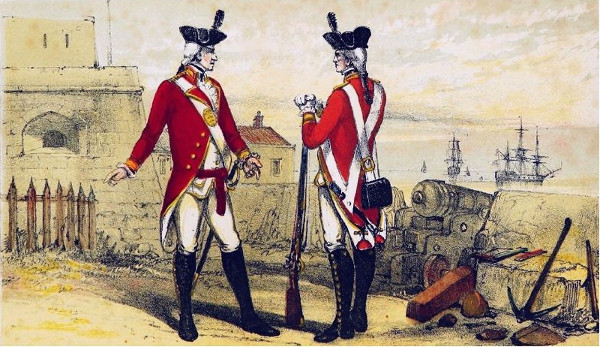
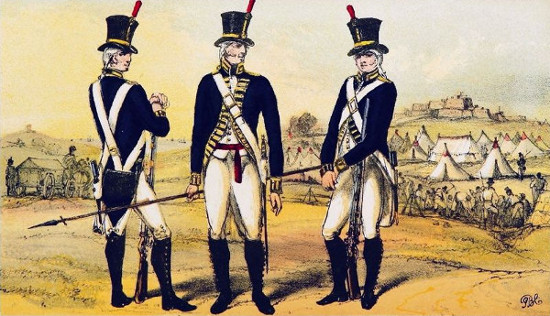
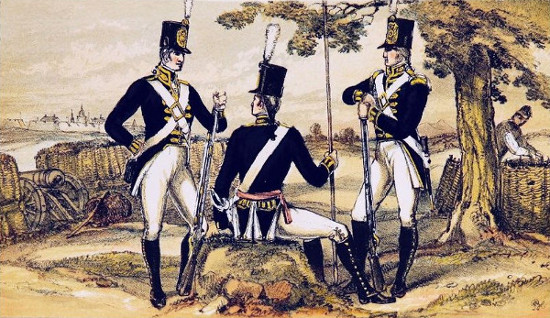
SOLDIER ARTIFICER COMPANY
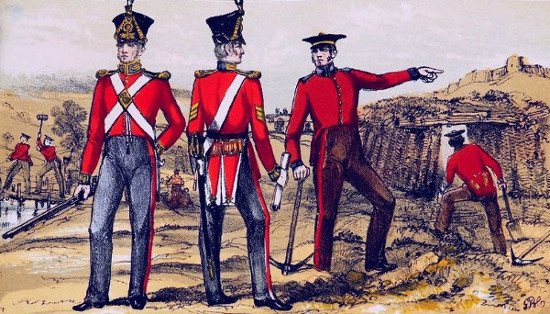
Plate I.
UNIFORM 1786
Printed by M & N Hanhart.
I
FROM THE FORMATION OF THE CORPS IN MARCH 1772, TO THE DATE
WHEN ITS DESIGNATION WAS CHANGED TO THAT OF
ROYAL ENGINEERS,
IN OCTOBER 1856.
BY
T. W. J. CONNOLLY,
QUARTERMASTER OF THE ROYAL ENGINEERS.
“Of most disastrous chances,
Of moving accidents, by flood and field;
Of hair-breadth scapes i' the imminent deadly breach.”—Shakspeare.
“There is a corps which is often about him, unseen and unsuspected, and which is labouring
as hard for him in peace as others do in war.”—The Times.
With Seventeen Coloured Illustrations.
SECOND EDITION, WITH CONSIDERABLE ADDITIONS.
IN TWO VOLUMES.—VOL. I.
LONDON:
LONGMAN, BROWN, GREEN, LONGMANS, AND ROBERTS.
1857.
LONDON: PRINTED BY W. CLOWES AND SONS, STAMFORD STREET AND CHARING CROSS.
PREFACE TO THE SECOND EDITION.
iii
The First Edition of the Work has long been out of print, and
the Second would have been published earlier, only that an
expected change in the designation of the corps delayed its
appearance. That change having occurred, the volumes are
republished, recording the services of the corps to the date it
continued to bear its old title.
Revised in many places, with verbal inaccuracies corrected,
aided moreover by journals and official memoranda placed at
my disposal to modify or enlarge certain incidents and services,
the work is as complete as it would seem to be possible at
present to produce it.
The concluding Chapters record the services of the corps in
the Aland Islands, in Turkey, Bulgaria, Circassia, Wallachia,
and the Crimea. The siege of Sebastopol and the destruction
of the memorable docks have been given with the fulness which
the industry and gallantry of the sappers merited; and in
order that the many adventures and enterprises recorded in the
final years of the history should not fail in interest and accuracy,
Colonel Sandham, the Director of the Royal Engineer
Establishment, with the permission of General Sir John Burgoyne,
kindly lent me the assistance of the Engineers’ Diary
of the Siege, as well as several collateral reports concerning
ivits progress and the demolition of the docks. At the
same time I think it right to say, that no attempt has been
made in these pages to offer a history of the Crimean operations.
So much only of the details has been worked into the
narrative as was necessary to preserve unbroken the thread of
sapper services in connexion with particular works and undertakings.
It should also be borne in mind, that these volumes are
devoted to the affairs of the Royal Sappers and Miners; and,
consequently, that care has been taken to touch as lightly as
practicable on the services of other regiments. Hence the
officers of the Royal Engineers have only been named when
it was desirable to identify them with parties of Sappers, whom
on certain occasions they commanded.
I feel a loyal pride in being able to state that the work has
been honoured with the munificent patronage of Her Majesty
the Queen, and of His Royal Highness the Prince Albert;
than which nothing could be more acceptable to me, either as
an author or a subject.
In closing I beg to express my deep obligations to General
Sir John Burgoyne, Bart., G.C.B., the officers of the corps
generally, my personal friends, and the public, for the patronage
with which I have been favoured; and also to the Press, for
the handsome manner in which it has noticed and commended
my labours.
Brompton Barracks,
March 1857.
PREFACE TO THE FIRST EDITION.
v
In 1836, soon after Lieutenant Robert Dashwood, R.E., was
appointed Acting Adjutant of the Royal Sappers and Miners
at Woolwich, he was directed by Brigade-Major, now Colonel
Matson, to prepare a list of officers of the Royal Engineers who
had commanded, from time to time, the different companies of
the corps. I assisted him in the duty; but while he was in the
midst of his work, he was prematurely cut off by death, and the
task of completing the statement devolved on me. It now
forms a referential record at the head-quarter office.
Led in its progress to consult old documents and returns, I
conceived the idea of making myself acquainted with the whole
history of the corps. With this view, after daily fulfilling the
routine duty of the office, I spent all my leisure intervals in
bringing to light old books and papers, which for years had
been buried in disused depositories and stores.
Whilst thus engaged, two Acting Adjutants, Lieutenants
F. A. Yorke and T. Webb, R.E., were successively appointed
to the corps at Woolwich. Both officers entered with some
spirit into the attempt to trace a history of its services; but
before they had proceeded to any great length, were interrupted
in their labours by removal to other stations in consequence of
promotion. Adjutant Yorke, however, succeeded so far, that
he drew up a brief account of the formation of the sappers,
vicommencing with the Gibraltar company in 1772, and detailed
its subsequent augmentations and reductions. This statement
also forms a permanent record in the office; and Captain Webb
made fair progress with an outline account of its active services.
To both officers it was my good fortune to afford such aid as
they required, in the collection of information for their respective
efforts.
In 1847, when medals were granted to the veterans of the
last war, Brigade-Major, now Colonel Sandham, observed the
readiness with which I spoke of historical events in which the
corps was concerned, and of the services of particular individuals
who had belonged to it. He also saw the facility with
which I supplied the information required to establish the
claims of the several applicants for medals and clasps. This
induced him, after some little conversation on the subject, to
direct me to prepare for publication a history of the corps.
Much fragmentary matter I had already accumulated, for
twelve years had been consumed by me in wading through
books and documents in quest of dates and occurrences.
Nevertheless, it was not without serious misgivings that I set
myself officially to the task, and the researches and labours
embodied in the following pages are the result.
In the intervals of important and onerous public duty, the
materials for the memoir have been collected and the work
methodized and written. Necessarily severe was the application
required under such circumstances; but by steady perseverance,
even at times when my health was scarcely able to bear
up against the exertion it needed, I have succeeded, without
omitting any service that I know of, in completing the history to
the siege of Sebastopol.
The work certainly is one of no pretension, and on this score
may be regarded as having cost but little toil in its preparation;
viibut I may observe, that from the absence of many particular
records, the unaccountable neglect in furnishing others, and
the striking imperfections in many of the remaining papers,
arising from complexity, vagueness, obliteration, or decay,
more than ordinary difficulty, research, and trouble were experienced,
in gathering the materials essential to give anything
like a reasonable delineation of the events narrated in the
Memoir. Paucity of detail in numbers, want of description
with reference to particular occurrences, and gaps in many
years from the loss of muster-rolls and official documents, run
through a period of nearly half a century, from 1772 to 1815:
and strange as it may appear, even the casualties in action so
carefully reported in other corps, have, from some inexplicable
cause, either been omitted altogether in the war despatches or
given inaccurately. In later years, however, the connexion
between the officers of the Royal Engineers and the soldiers of
the Royal Sappers and Miners has been so fully established,
that attention to these important minutiæ forms a decided
feature in the improved command of the corps.
In employments of a purely civil character in which the
Royal Sappers and Miners have shared, care has been taken to
explain, as fully as the records and collateral evidence would
admit, the nature of its duties; and, likewise, to multiply
authorities to prove the estimation in which it was held for
its services and conduct. This has been mainly done, to offer
a practical reply to an association, incorporated within the last
twelve years, which, in the course of a futile agitation, endeavoured
by injurious statements to lessen the corps in public
esteem.
All mention of the Royal Engineers in this memoir has been
studiously suppressed, except when such was unavoidable to
give identity to the different duties and services of the Royal
viiiSappers and Miners, and also, when their direct and particular
connexion with the corps in certain situations, rendered allusion
to them justifiable. This course was suggested to me by an
officer of high rank, for the obvious reason that, as the Royal
Engineers is a body entirely distinct from the Sappers and
Miners, and possesses its own annals, any reference to, or particularization
of, its services in a work professedly confined to
the corps, would not only be extraneous, but tend to lessen its
value, and weaken its interest with those for whose information
it was especially written.
Here, however, it should be observed, that the Royal Sappers
and Miners, though a separate and integral body of itself,
is nevertheless, and has been from the commencement, officered
by the Royal Engineers; and whatever excellence or advancement
is traced in its career and public usefulness, whether as
soldiers or mechanics, is fairly, in a great degree, attributable
to the officers; for, in every circumstance of service and situation,
they have liberally opened up for them new channels of
employment to engage their faculties and energies, and have
afforded them at all times scope and facilities to develop their
mental and physical resources, and to fit them to perform with
credit, not only the circumscribed duties of soldiers, but the
more extended requirements of sappers, artizans, and professional
men.
By the omission of all but special reference to the officers,
room has thus been given for mentioning many non-commissioned
officers and privates, who have attracted public attention
and gained encomium for their meritorious services; some for
their skill and ingenuity; others for their integrity and devotion;
and others for their acquirements, their vigorous exertions
and labours; their ardour, their endurance, and their valour.
While the recognition of such examples cannot fail to incite
ixothers to emulate the military virtues of their more distinguished
predecessors and comrades, it is earnestly hoped, that
every member of the corps will be led to feel a personal interest
in its reputation and honour, and a pride in its discipline and
loyalty; its usefulness and efficiency in peace; its heroism and
achievements in war.
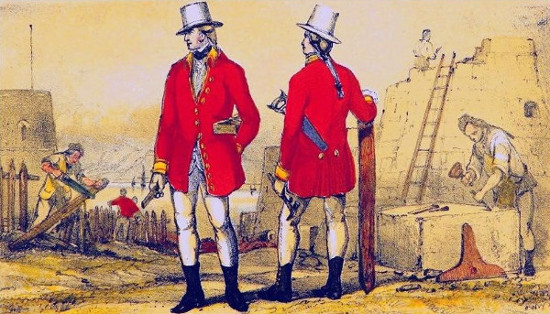
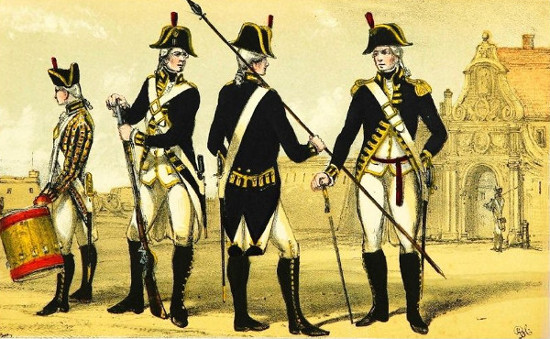
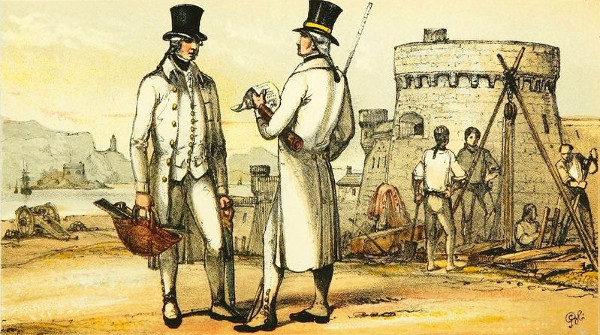
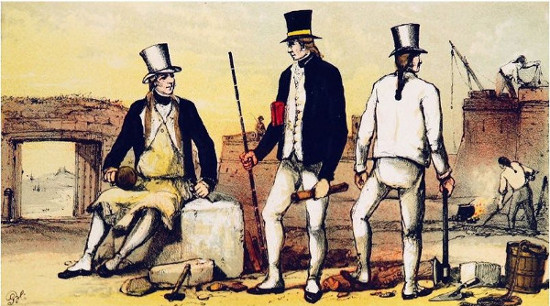
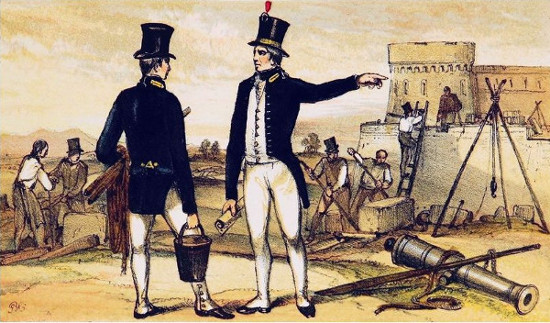
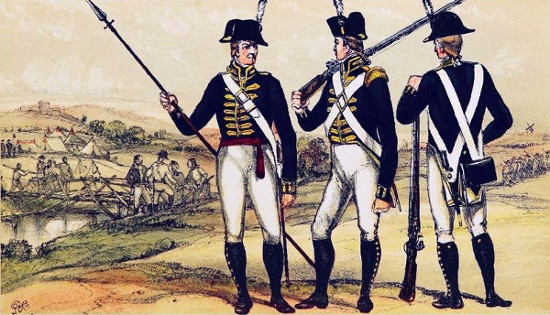
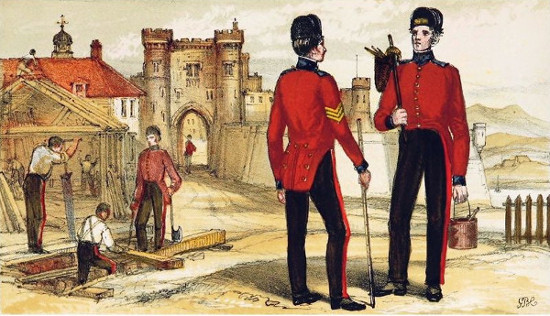
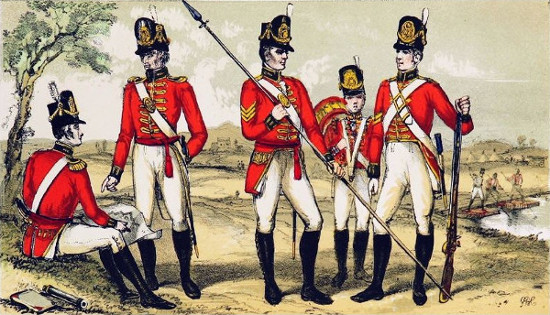
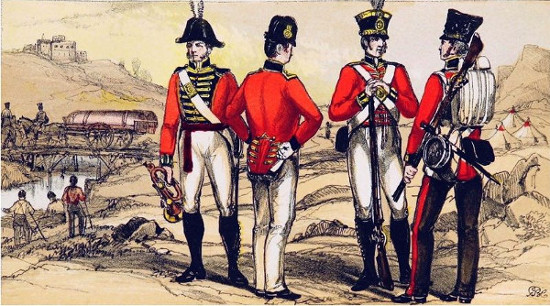
The drawings were executed on stone by George B. Campion,
Esq., master of landscape drawing at the Royal Military
Academy, Woolwich. In illustrations like those in the present
volumes, it was scarcely possible to delineate with exactness
the complicated ornament which make up the ensemble of a
soldier’s uniform. Notwithstanding this disadvantage, the
costume has been well defined, and much interest given to the
embellishments, by the introduction of accessories, characteristic
of the duties and employments of the corps.
My respectful acknowledgments are due to Sir John Burgoyne,
the Inspector-General of Fortifications, for making the
subject of my exertions known in a circular from his own hand,
to the officers of the Royal Engineers; and in offering him the
expression of my gratitude, I think it right with a feeling of
sincere thankfulness to mention, that the success which has
attended that kind appeal, has been more, perhaps, than I
could reasonably expect. Several of the officers have afforded
me much encouragement in the work, as well by suggestion
and advice, as by the liberality of their contributions; but,
wanting the liberty to publish their names, I am precluded
from making a record, to which it would have been my pride to
give publicity.
To my own corps I am also indebted for many pleasing
proofs of concern, as evinced in their anxiety to see the undertaking
prosper. Nearly 200 copies have been demanded by
the non-commissioned officers, including a few of the privates,
xand when the price of the work is considered, the generosity of
my patrons is as striking as noble.
To S. W. Fullom, Esq., I here offer the expression of my
grateful thanks for his amiable and disinterested counsel, cheerfully
accorded on the many occasions I had to seek it; and for
kindly assisting me in looking over the sheets as the work
passed through the press.
I now submit the volumes to my corps and the profession,
and am not without hope that they may also be acceptable to
a portion of the public. As far as the sources of my information
and research have extended, the memoir will be found
truthful and impartial. It was my aim to execute it with an
integrity that would place me beyond impeachment: I therefore
feel some confidence that indulgence will be shown for its
defects, and also for whatever errors, through inadvertency,
may have crept into the work.
THOMAS CONNOLLY.
Royal Sappers and Miners’ Barracks,
Woolwich, March 1855.
CONTENTS OF VOL. I.
xi
1772-1779.
PAGE
Origin of Corps—Its establishment and pay—Engineers to command it—Its designation—Working pay—Recruiting—Dismissal of civil artificers—Names of officers—Non-commissioned officers—First augmentation—Consequent promotions—Names of other officers joined—King’s Bastion—Second augmentation
Jealousy of Spain—Declares war with England—Strength of the garrison at Gibraltar—Preparations for defence and employment of the company—Siege commenced—Privations of the garrison—Grand sortie and conduct of the company—Its subsequent exertions—Origin of the subterranean galleries—Their extraordinary prosecution—Princess Anne’s battery—Third augmentation—Names of non-commissioned officers
Siege continued—Magnitude of the works—Chevaux-de-frise from Landport-Glacis across the inundation—Précis of other works—Firing red-hot shot—Damage done to the works of the garrison, and exertions of the company in restoring them—Grand attack, and burning of the battering flotilla—Reluctance of the enemy to quit the contest—Kilns for heating shot—Orange bastion—Subterranean galleries—Discovery of the enemy mining under the Rock—Ulterior dependence of the enemy—Peace—Conduct of the company during the siege—Casualties
Duc de Crillon’s compliments respecting the works—Subterranean galleries—Their supposed inefficiency—Henry Ince—Quickness of sight of two boys of the company—Employment of the boys during the siege—Thomas Richmond and John Brand—Models constructed by them
State of the fortress—Execution of the works depended upon the company—Casualties filled up by transfers from the line—Composition—Recruiting—Relieved from all duties, garrison and regimental—Anniversary of the destruction of the Spanish battering flotilla
Company divided into two—Numerous discharges—Cause of the men becoming so soon ineffective—Fourth augmentation—Labourers—Recruiting, reinforcements—Dismissal of foreign artificers—Wreck of brig ‘Mercury’—Uniform dress—Working ditto—Names of officers—Privileges—Cave under the signal-house
Colonel Debbieg’s proposal for organizing a corps of artificers—Rejected—Employment of artillerymen on the works at home—Duke of Richmond’s “Extensive plans of fortification”—Formation of corps ordered—Singular silence of the House of Commons on the subject—Mr. Sheridan calls attention to it—Insertion of corps for first time in the Mutiny Bill—Debate upon it in both Houses of Parliament
Constitution of corps—Master artificers—Officers—Rank and post of the corps—Captains of companies; stations—Allowance to captains; adjutants—Recruiting—Labourers—“Richmond’s whims”—Progress of recruiting—Articles of agreement—Corps not to do garrison duty—Sergeant-Majors—John Drew—Alexander Spence—Uniform dress—Working dress—Hearts o' pipe-clay—“The Queen’s bounty”—Arms, &c.—Distinction of ranks—Jews’ wish
Appointment of Quartermaster and Colonel-Commandant—Distribution of corps, Captains of companies—Jealousy and ill-feeling of the civil artificers—Riot at Plymouth—Its casualties—Recruits wrecked on passage to Gibraltar—Song, “Bay of Biscay, O!”—Defence of the Tower of London against the Jacobins—Bagshot-heath encampment—Alterations in the uniform and working dress
War with France—Artificers demanded for foreign service—Consequent effects—Detachment to West Indies—Fever at Antigua—Detachment to Flanders—Siege of Valenciennes—Waterdown Camp—Reinforcement to Flanders—Siege of Dunkirk—Nieuport—Another reinforcement to Flanders—Toulon—Private Samuel Myers at Fort Mulgrave—Formation of four companies for service abroad—Establishment and strength of corps
Working dress—Company sails for West Indies—Martinique—Spirited conduct of detachment there—Guadaloupe—Mortality—Toulon—Flanders—Reinforcement to company there—Return of the company—Works at Gravesend—Irregularities in the corps—Causes—Redeeming qualities—Appointment of Regimental Adjutant and Sergeant-major—Consequences—Woolwich becomes the head-quarters—Alteration in working dress
Companies to St. Domingo and the Caribbee Islands—Reduction of St. Lucia—Conduct of company there—Gallantry in forming lodgment and converting it into a battery—Attack on Bombarde—Distribution and conduct of St. Domingo company—Mortality in the West Indies—Detachment to Halifax, Nova Scotia—Dougal Hamilton—Detachments to Calshot Castle and St. Marcou
Detachments to Portugal—To Dover—Transfers to the Artillery-Enlistment of artificers only—Incorporation of Gibraltar companies with the corps—Capture of Trinidad—Draft to West Indies—Failure at Porto Rico—Fording the lagoon, by private D. Sinclair—Private W. Rogers at the bridge St. Julien—Saves his officer—Casualties by fever in Caribbean company—Filling up company at St. Domingo with negroes—Mutinies in the fleet at Portsmouth—Conduct of Plymouth company—Emeute in the Royal Artillery, Woolwich—Increase of pay—Marquis Cornwallis’s approbation of the corps—Mutiny at the Nore—Consequent removal of detachment to Gravesend—Alterations in dress
Contribution of corps to the State—Detachment with expedition to maritime Flanders—Destruction of the Bruges canal—Battle near Ostend—Draft to West Indies—Capture of Surinam—St. Domingo evacuated—Expedition to Minorca—Conduct of detachment while serving there—Composition of detachments for foreign service—Parties to Sevenoaks and Harwich—Mission to Turkey—Its movements and services—Special detachment to Gibraltar to construct a cistern for the Navy—Detachment with the expedition to Holland—Its services—Origin of the Royal Staff Corps
Mortality in the West Indies—Blockade of Malta—Capture of a transport on passage from Nova Scotia—Movements and services of detachments in Turkey; attacked with fever—Anecdote of private Thomas Taylor at Constantinople—Cruise of expedition to Cadiz—Attack on the city abandoned—Subsequent movements of the expedition; Malta; and re-embarkation for Egypt—Statistics of companies at Gibraltar
Distribution of corps—Dispersion of West India company—Statistics—Detachment to St. Marcou—Capture of Danish settlements—Casualties in West India company—Compared with mortality in Gibraltar companies—Working dress—Services, &c., of detachment at Gibraltar—Conduct of Sergeant W. Shirres—Concession to the companies by the Duke of Kent—Cocked hat superseded by the chaco
Party to Ceylon—The treaty of Amiens broken—State of West India company—Capture of St. Lucia—Tobago—Demerara, Essequibo, and Berbice—Works at Spike Island—Capture of Surinam—Conduct of private George Mitchell—Batavian soldiers join West India company—Fever at Gibraltar—Consequent mortality—Humane and intrepid conduct of three privates—Invasion of England—Works at Dover—Jersey—Chelmsford—Martello towers at Eastbourne—Bomb tenders at Woolwich—Recruiting—Volunteers from the Line and Militia—Treaty of St. Petersburg—Party to Naples—Ditto to Hanover
First detachment to Cape of Good Hope—Misfortunes at Buenos Ayres—Reinforcements to Gibraltar—Services at Calabria—Formation of Maltese military artificers—Increase of pay to royal military artificers—Augmentation to the corps and reorganization of the companies—Establishment and annual expense—Working pay—Sub-Lieutenants introduced—Indiscipline and character of the corps
Appointments of Adjutant and Quartermaster—Captain John T. Jones—Disasters at Buenos Ayres—Egypt—Reinforcement to Messina—Detachment of Maltese military artificers to Sicily—Newfoundland—Copenhagen—Captures in the Caribbean Sea—Madeira—Danish Islands in the West Indies—Hythe
War in the Peninsula—Expedition thither—Detachments to the seat of war, with Captains Landmann, Elphinstone, Squire, Burgoyne, and Smyth—Captain John T. Jones—Reinforcement to Newfoundland—Discipline at Halifax—Services at Messina—Parties temporarily detached to different places—The queue
xvRetreat to Coruña—Miserable state of the detachment on reaching England—Hardships of the stragglers—Capture of Martinique—Skill of George Mitchell at the siege—Fever in the West Indies—Reduction of the Saintes—Detachment to Portugal—Battles of Oporto and Talavera—Casualties in the retreat, and distribution of the party—Naples—Zante and the Ionian Islands—Term of service of the Maltese military artificers—Siege of Flushing—Services of the military artificers there—Gallantry, in the batteries, of John Millar, Thomas Wild, and Thomas Letts—Conduct of corps at the siege—Casualties by the Walcheren fever—Skilful conduct of Corporal T. Stevens in the demolitions at Flushing—Captain John T. Jones—Servants—Incidental detachments
Capture of Guadaloupe—Of St. Martin’s and St. Eustatius—Torres Vedras—Anecdote of Corporal William Wilson at the Lines—Almeida and Busaco—Detachments to Cadiz—Puntales and La Isla—Destruction of Forts Barbara and St. Felipe, near Gibraltar—Santa Maura—Occasional detachments
Mortality in the West Indies—Strength and distribution of detachments in the Peninsula—Recapture of Olivenza—Field instruction prior to siege of Badajoz—Conduct of corps at the siege—Conduct of Sergeant Rogers in reconnoitring—Reinforcement to Portugal and duties of the detachment—Its distribution and services—Battle of Barrosa; gallant conduct of Sergeant John Cameron—Tarragona—Defence of Tarifa—Augmentation to corps and reconstruction of companies—Annual expense of corps—Command of the companies—Their stationary character—The wealthy corporal—New distribution of corps—Commissions to Sub-Lieutenants, and ingenious inventions of Lieutenant Munro
Plymouth company instructed in field duties—Engineer establishment at Chatham—Major Pasley appointed its director—Discipline and drill of corps—Its character—Sir John Sinclair ex-private—Title of corps changed—Captain G. Buchanan—A sergeant acrobat—Cuidad Rodrigo—Exertions of a company on the march to the siege—Repairs to the fortress—Siege of Badajoz—Difficulties in removing the stores to the park—Duties of the sappers in the operation—Gallant behaviour of Patrick Rooney and William Harry—Also of a party at Fort Picurina, and of Patrick Burke and Robert Miller—Hazardous attempt to blow down the batardeau in the ditch of the lunette, and conduct of corporal Stack—Bravery of a party in mining under the bridge of the inundation—Distribution of the Peninsular companies and their services—Bridges of Yecla and Serrada—Reinforcement to Spain—Salamanca—Burgos, and boldness of Patrick Burke and Andrew Alexander at the siege—Bridge of Alba—Carthagena—Reinforcement to Cadiz; action at Seville—Reinforcement to the Peninsula and distribution of the sappers—Green Island—Tarragona—First detachment to Bermuda
Designation of corps modified—Uniform—Working dress—Arms—Mode of promoting non-commissioned officers—Rank of colour-sergeant created—Company to Canada—Reinforcement to Bermuda—Sub-Lieutenant Mackenzie appointed Town-Major there—Sickness at Gibraltar—Services of company in East Catalonia—Malha da Sorda—Services on the advance to Vittoria—Bridge at Toro—Blockade of Pampeluna—Pyrenees—Stockades near Roncesvalles—San Sebastian and services of the corps at the siege—Valour of sergeants Powis and Davis—Of private Borland; and of corporal Evans—Casualties in the siege—Restoration of the fortifications—Pontoon train—Bidassoa—Bridge across it, and conduct of privates Owen Connor and Nowlan—Vera—Nivelle, and behaviour of corporal Councill—Bridge over that river—Bridges over the Nive, and daring exertions of private Dowling—Fording the Nive, and posts of honour accorded to corporal Jamieson and private Braid—Strength and distribution of corps in the Peninsula—Recruiting
Wreck of ‘Queen’ transport; humanity of sergeant Mackenzie; heroic exertions of private M‘Carthy—Quartermaster; Brigade-Major—Santona; useful services of corporal Hay—Bridge of Itzassu near Cambo-Orthes; conduct of sergeant Stephens—Toulouse—Bridge of the Adour; duties of the sappers—Flotilla to form the bridge—Casualties in venturing the bar—Conduct of the corps in its construction—Bayonne—Expedition to North America—Return to England of certain companies from the Peninsula—Company to Holland; its duties; bridge over the Maerk; Tholen; Fort Frederick—March for Antwerp—Action at Merxam—Esprit de corps—Coolness of sergeant Stevens and corporal Milburn—Distribution; bridge-making—Surprise of Bergen-op-Zoom—Conduct of the sappers, and casualties in the operation—A mild Irish-man—Bravery of corporal Creighton and private Lomas—South Beveland—Reinforcement to the Netherlands—Review by the Emperor of Russia—School for companies at Antwerp—Detachments in the Netherlands, company at Tournai—Movements of the company in Italy and Sicily—Expedition to Tuscany; party to Corfu—Canada; distribution of company there, and its active services—Reinforcement to Canada—Washington, Baltimore, New Orleans—Notice of corporal Scrafield—Expedition to the State of Maine
xviiSiege of Fort Boyer—Alertness of company on passage to New Orleans—Return of the sappers from North America—Services and movements of companies in Canada—Also in Nova Scotia—Captures of Martinique and Guadaloupe—Services and movements of companies in Italy—Maltese sappers disbanded—Pay of Sub-Lieutenants—Ypres—Increase to sappers’ force in Holland; its duties and detachments; notice of sergeant Purcell—Renewal of the war—Strength of the corps sent to the Netherlands—Pontoneers—Battle of Waterloo—Disastrous situation of a company in retreating—General order about the alarm and the stragglers—Sergeant-major Hilton at Brussels—Notice of lance-corporal Donnelly—Exertions of another company in pressing to the field—Organization of the engineer establishment in France—Pontoon train—Magnitude of the engineer establishment; hired drivers; Flemish seamen—Assault of Peronne, valour of Sub-lieutenant Stratton and lance-corporal Councill—Pontoon bridges on the Seine—Conduct of corps during the campaign—Corporal Coombs with the Prussian army—Usefulness of the sappers in attending to the horses, &c., of the department in France—Domiciliary visit to Montmartre
Movements in France—Return of six companies from thence to England—Strength of those remaining, and detachments from them—St. Helena—Return of company from Italy—Disbandment of the war company of Maltese sappers—Battle of Algiers—Conduct of corps at Valenciennes—Instances in which the want of arms was felt during the war—Arming the corps attributable to accidental circumstances—Training and instruction of the corps in France—Its misconduct—But remarkable efficiency at drill—Municipal thanks to companies at Valenciennes—Dress—Bugles adopted—Reduction in the corps—Sub-lieutenants disbanded—Withdrawal of companies from certain stations—Relief of company at Barbadoes—Repairing damages at St. Lucia; conduct of the old West India company—Corfu—Inspection of corps in France—Epaulettes introduced—Sordid conduct of four men in refusing to wear them—Murder of private Milne, and consequent punishment of corps in France by the Duke of Wellington—Return of the sappers from France
Reduction in the corps—Distribution—Sergeant Thomas Brown, the modeller—Reinforcement to the Cape, and services of the detachment during the Kaffir war—Epidemic at Bermuda—Damages at Antigua occasioned by a hurricane—Visit to Chatham of the Duke of Clarence—Withdrawal of a detachment from Corfu—A private becomes a peer—Draft to Bermuda—Second visit to Chatham of the Duke of Clarence—Fever at Barbadoes—Death of Napoleon, and withdrawal of company from St. Helena—Notice of private John Bennett—Movements of the company in Canada—Trigonometrical operations under the Board of Longitude—Feversham—Relief of the old Gibraltar company—Breast-plates—St. Nicholas’ Island—Condition of company at Barbadoes when inspected by the Engineer Commission—Scattered state of the detachment at the Cape—Services of the detachment at Corfu—Intelligence and usefulness of sergeant Hall and corporal Lawson—Special services of corporal John Smith—Pontoon trials—Sheerness—Notice of corporal Shorter—Forage-caps and swords
Dress—Curtailment of benefits by the change—Chacos—Survey of Ireland—Formation of the first company for the duty—Establishment of corps; company to Corfu—Second company for the survey—Efforts to complete the companies raised for it—Pontoon trials in presence of the Duke of Wellington—Western Africa—Third company for the survey: additional working pay—Employments and strength of the sappers in Ireland—Drummond Light; Slieve Snacht and Divis—Endurance of private Alexander Smith—Wreck of ‘Shipley’ transport—Berbice; corporal Sirrell at Antigua
Augmentation—Reinforcement to Bermuda—Companies for Rideau Canal—Reinforcement to the Cape—Monument to the memory of General Wolfe—Increase to the survey companies—Supernumerary promotions—Measurement of Lough Foyle base—Suggestion of sergeant Sim for measuring across the river Roe—Survey companies inspected by Major-General Sir James C. Smith; opinion of their services by Sir Henry Hardinge—Sergeant-major Townsend—Demolition of the Glacière Bastion at Quebec—Banquet to fifth company by Lord Dalhousie—Service of the sappers at the citadel of Quebec—Notice of sergeants Dunnett and John Smith—Works to be executed by contract—Trial of pontoons, and exertions of corporal James Forbes—Epidemic at Gibraltar—Island of Ascension; corporal Beal—Forage-caps—Company withdrawn from Nova Scotia—Party to Sandhurst College, and usefulness of corporal Forbes
The chaco—Brigade-Major Rice Jones—Island of Ascension—Notice of corporal Beal—Detachment to the Tower of London—Chatham during the Reform agitation—Staff appointments—Sergeant McLaren the first medallist in the corps—Terrific hurricane at Barbadoes; distinguished conduct of colour-sergeant Harris and corporal Muir—Subaqueous destruction of the ‘Arethusa’ at Barbadoes—Return of a detachment to the Tower of London—Rideau canal; services of the sappers in its construction; casualties; and disbandment of the companies—Costume—First detachment to the Mauritius—Notice of corporal Reed—Pendennis Castle
xixInspection at Chatham by Lord Hill—Pontoon experiments—Withdrawal of companies from the ports—Reduction of the corps, and reorganization of the companies—Recall of companies from abroad—Purfleet—Trigonometrical survey of west coast of England—Draft to the Cape—Review at Chatham by Lord Hill—Motto to the corps—Reinforcement to the Mauritius—Inspection at Woolwich by Sir Frederick Mulcaster—Mortality from cholera; services of corporals Hopkins and Ritchley—Entertainment to the detachment at the Mauritius by Sir William Nicolay—Triangulation of the west coast of Scotland—Kaffir war—Appointments of ten foremen of works—Death of Quartermaster Galloway—Succeeded by sergeant-major Hilton—Sergeant Forbes—Notice of his father—Lieutenant Dashwood—Euphrates expedition—Labours of the party—Sergeant Sim—Generosity of Colonel Chesney, R.A.—Additional smiths to the expedition—Loss of the ‘Tigris’ steamer—Descent of the Euphrates—Sappers with the expedition employed as engineers—Corporal Greenhill—Approbation of the services of the party—Triangulation of west coast of Scotland—Addiscombe—Expedition to Spain—Character of the detachment that accompanied it—Passages; action in front of San Sebastian—Reinforcement to Spain—Final trial of pontoons—Mission to Constantinople
Change in the dress—Increase of non-commissioned officers—Services of the detachment at Ametza Gaña—Oriamendi—Desierto convent on the Nervion—Fuentarabia—Oyarzun—Aindoin—Miscellaneous employment of the detachment—Trigonometrical survey west coast of Scotland—Inspection at Woolwich by Lord Hill and Sir Hussey Vivian—Staff appointments—Labours of sergeant Lanyon—Staff-sergeants' accoutrements—Expedition to New Holland—Corporal Coles selected as the man Friday of his chief—Exploration from High Bluff Point to Hanover Bay; difficulties and trials of the trip; great thirst—Exertions and critical situation of Coles—His courageous bearing—Touching instance of devotion to his chief—Employments of the party—Exploration into the interior with Coles and private Mustard—Hardships in its prosecution—Threatened attack of the natives; return to the camp
xxServices of party in New Holland—Start for the interior—Labours of the expedition; corporal Auger—Captain Grey and corporal Coles expect an attack—Attitude of private Auger at the camp against the menace of the natives—Captain Grey and Coles attacked; their critical situation: the chief wounded; devotion of Coles—Usefulness of Auger—Renew the march; Auger finds a singular ford—Discovers a cave with a sculptured face in it—Mustard traces the spoor of a quadruped still unseen in New Holland—A sleep in the trees—Trials of the party—Primitive washing—Auger the van of the adventurers—Humane attention of the Captain to Mustard; reach Hanover Bay; arrive at the Mauritius—Detachment in Spain—Attack on Orio—Usurvil; Oyarzun—Miscellaneous employments of the party—Reinforcement to it; Casa Aquirre—Orio—Secret mission to Muñagorri—Second visit to the same chief—Notice of corporal John Down—Bidassoa—Triangulation of north of Scotland—Also of the Frith of the Clyde—Insurrection in Canada; guard of honour to Lord Durham—Company inspected by the Governor-General on the plains of Abraham—Inspection at Niagara by Sir George Arthur—Services and movements of the company in Canada; attack at Beauharnois—Submarine demolition of wrecks near Gravesend—Expedient to prevent accidents by vessels fouling the diving-bell lighter—Conduct of the sappers in the operations; exertions of sergeant-major Jones—Fatal accident to a diver—Intrepidity of sergeants Ross and Young—Blasting the bow of the brig ‘William,’ by sergeant-major Jones—Withdrawal of the sappers from the canal at Hythe
Expedition to Western Australia under Captain Grey—Excursion with Auger to the north of Perth—Search for Mr. Ellis—Exploration of shores from Freemantle—Bernier and Dorre Islands; want of water; trials of the party—Water allowance reduced—A lagoon discovered—Privations and hardships of the party—Return to Bernier Island for stores—Its altered appearance—Destruction of the depôt of provisions—Consternation of Coles—Auger’s example under the circumstances—Expedition makes for Swan River—Perilous landing at Gantheaume Bay—Overland journey to Perth; straits of the adventurers—Auger searching for a missing man—Coles observes the natives; arrangements to meet them—Water found by Auger—A spring discovered by Coles at Water Peak—Disaffection about long marches; forced journeys determined upon; the two sappers and a few others accompany the Captain—Desperate hardships and fatigues; the last revolting resource of thirst—Extraordinary exertions of the travellers; their sufferings from thirst; water found—Appalling bivouac—Coles’s agony and fortitude—Struggles of the adventurers; they at last reach Perth—Auger joins two expeditions in search of the slow walkers—Disposal of Coles and Auger
xxiServices of the detachment in Spain—Last party of the artillery on the survey—Survey of South Australia—Inspection at Limerick by Sir William Macbean—Triangulation of north of Scotland—Also of the Clyde—Pontoons by sergeant Hopkins—Augmentation of the corps—Also of the survey companies—Supernumerary rank annulled—Tithe surveys; quality of work executed on them by discharged sappers; efficient surveys of sergeant Doull—Increase of survey pay—Staff appointments on the survey—Responsibility of quartermaster-sergeant M‘Kay—Colonel Colby’s classes—Based upon particular attainments—Disputed territory in the State of Maine—Movements and services of the party employed in its survey; intrepidity of corporal M‘Queen—Experiments with the diving-bell—Also with the voltaic battery—Improvement in the priming wires by Captain Sandham; sergeant-major Jones’s waterproof composition and imitation fuses—Demolition and removal of the wreck of the ‘Royal George’—Organization of detachment employed in the operation—Emulation of parties—Success of the divers; labours of the sappers—Diving-bell abandoned—Accident to private Brabant—Fearlessness of corporal Harris in unloading gunpowder from the cylinders—Hazardous duty in soldering the loading-hole of the cylinder—First sapper helmet divers—Conduct and exertions of the detachment
Return of the detachment from Spain—Its conduct during the war—Survey of the northern counties of England—Notice of sergeant Cottingham—Secondary triangulation of the north of Scotland—Increase to survey allowances—Augmentation to the survey companies—Renewal of survey of the disputed boundary in the state of Maine—Corporal Hearnden at Sandhurst—Wreck of the ‘Royal George;’ duties of the sappers in its removal—Exertions of sergeant-major Jones—The divers—An accident—Usefulness of the detachment engaged in the work—Boat adventure at Spithead—Andrew Anderson—Thomas P. Cook—Transfer of detachment from the Mauritius to the Cape—Survey of La Caille’s arc of meridian there—Detachment to Syria—Its active services, including capture of Acre—Reinforcement to Syria
Syria—Landing at Caiffa; Mount Carmel—Cave of Elijah; epidemic—Colour-sergeant Black—Inspection at Beirout by the Seraskier; return of the detachment to England—Expedition to the Niger—Model farm—Gori—Fever sets in; return of the expedition—Services of the sappers attached to it—Corporal Edmonds and the elephant—and the Princess—Staff-sergeant’s undress—Staff appointments—Wreck of the 'Royal George'—Sergeant March—Sapper-divers—Curiosities—Under-water pay; means used to aid the divers—Speaking under water—Gallantry of private Skelton—Alarming accidents—Constitutional unfitness for diving—Boundary survey in the state of Maine—Augmentation to corps for Bermuda—Sandhurst; corporal Carlin’s services—Quartermaster-sergeant Fraser—Intrepidity of private Entwistle—Colonel Pasley—Efficiency of the corps—Its conduct, and impolicy of reducing its establishment—Sir John Jones’s opinion of the sappers—And also the Rev. G. R. Gleig’s
xxiiParty to Natal—The march—Action at Congella—Boers attack the camp—Then besiege it—Sortie on the Boers' trenches—Incidents—Privations—Conduct of the detachment; courageous bearing of sergeant Young—Services of the party after hostilities had ceased—Detachment to the Falkland Islands—Landing—Character of the country—Services of the party—Its movements; and amusements—Professor Airy’s opinion of the corps—Fire at Woolwich; its consequences—Wreck of the 'Royal George'—Classification of the divers—Corporal Harris’s exertions in removing the wreck of the ‘Perdita’ mooring lighter—Assists an unsuccessful comrade—Difficulties in recovering the pig-iron ballast—Adventure with Mr. Cussell’s lighter—Isolation of Jones at the bottom—Annoyed by the presence of a human body; Harris, less sensitive, captures it—The keel—Accidents—Conflict between two rival divers—Conduct of the sappers employed in the operation—Demolition of beacons at Blythe Sand, Sheerness—Testimonial to sergeant-major Jones for his services in connection with it
Draft to Canada—Company recalled from thence—Its services and movements—Its character—Labours of colour-sergeant Lanyon—Increase to Gibraltar—Reduction in the corps—Irish survey completed; force employed in its prosecution—Reasons for conducting it under military rule—Economy of superintendence by sappers—Their employments—Sergeants West, Doull, Spalding, Keville—Corporals George Newman, Andrew Duncan—Staff appointments to the survey companies—Dangers—Hardships—Average strength of sapper force employed—Casualties—Kindness of the Irish—Gradual transfer of sappers for the English survey—Distribution; Southampton
Falkland Islands; services of the detachment there—Exploration trips—Seat of government changed—Turner’s stream—Bull-fight—Round Down Cliff, near Dover—Boundary line in North America—Sergeant-major Forbes—Operations for removing the wreck of the 'Royal George'—Exertions of the party—Private Girvan—Sagacity of corporal Jones—Success of the divers—Exertions to recover the missing guns—Harris’s nest—His district pardonably invaded—Wreck of the 'Edgar,' and corporal Jones—Power of water to convey sound—Girvan at the ‘Edgar’—An accident—Cessation of the work—Conduct of the detachment employed in it—Sir George Murray’s commendation—Longitude of Valentia—Rebellion in Ireland—Colour-sergeant Lanyon explores the passages under Dublin Castle—Fever at Bermuda—Burning of the ‘Missouri’ steamer at Gibraltar—Hong-Kong—Inspection at Woolwich by the Grand Duke Michael of Russia—Percussion carbine and accoutrements
xxiiiRemeasurement of La Caille’s arc at the Cape—Reconnoitring excursion of sergeant Hemming—Falkland Islands—Draft to Bermuda—Inspection at Gibraltar by General Sir Robert Wilson—Final operations against the ‘Royal George’—and the ‘Edgar’—Discovery of the amidships—incident connected with it—Combats with crustacea—Success of corporal Jones—Injury to a diver—Private Skelton drowned—Conduct of the detachment employed in the work—Submarine repairs to the ‘Tay’ steamer at Bermuda by corporal Harris—Widening and deepening the ship channel at St. George’s—Accidents from mining experiments at Chatham—Notice of corporal John Wood—Inspection at Hong-Kong by Major-General D’Aguilar
Sheerness—Increase to the corps at the Cape—Survey of Windsor—Skill of privates Holland and Hogan as draughtsmen—Etchings by the latter for the Queen and Prince Albert—Unique idea of the use of a bullet—Inspection at Gibraltar by Sir Robert Wilson—Falkland Islands—Discharges on the survey duty during the railway mania
Boundary surveys in North America—Duties of the party engaged in it—Mode of ascertaining longitudes—Trials of the party; Owen Lonergan—The sixty-four mile line—Official recognition of services of the party—Sergeant James Mulligan—Kaffir war—Corporal B. Castledine—Parties employed at the guns—Graham’s Town—Fort Brown—Patrols—Bridge over the Fish River—Field services with the second division—Dodo’s kraal—Waterloo Bay—Field services with the first division—Patrol under Lieutenant Bourchier—Mutiny of the Swellandam native infantry—Conduct of corps in the campaign—Alterations in the dress—Drainage of Windsor—Detachment to Hudson’s Bay—Its organization—Journey to Fort Garry—Sergeant Philip Clark—Private R. Penton—Corporal T. Macpherson—Lower Fort Garry—Particular services—Return to England
Exploration survey for a railway in North America—Services of the party employed on it—Personal services of sergeant A. Calder—Augmentation to the corps—Reinforcement to China—Recall of a company from Bermuda—Royal presents to the reading-room at Southampton—Inspection at Gibraltar by Sir Robert Wilson—Third company placed at the disposal of the Board of Works in Ireland—Sergeant J. Baston—Services of the company—Distinguished from the works controlled by the civilians—Gallantry of private G. Windsor—Coolness of private E. West—Intrepid and useful services of private William Baker—Survey of Southampton, and its incomparable map
Detachments in South Australia—Corporal W. Forrest—Augmentation to the corps—Destruction of the Bogue and other forts—Services of the detachment at Canton—First detachment to New Zealand—Survey of Dover and Winchelsea—Also of Pembroke—Flattering allusion to the corps—Sir John Richardson’s expedition to the Arctic regions—Cedar Lake—Private Geddes’s encounter with the bear—Winter quarters at Cumberland House—Road-making in Zetland—Active services at the Cape—Company to Portsmouth
Origin of Corps—Its establishment and pay—Engineers to command it—Its
designation—Working pay—Recruiting—Dismissal of civil artificers—Names
of officers—Non-commissioned officers—First augmentation—Consequent
promotions—Names of other officers joined—King’s Bastion—Second
augmentation.
Before the year 1772, the works at Gibraltar were mainly
executed by civil mechanics from the Continent and England,
who were not engaged for any term of years, but were hired
like ordinary artificers, and could leave the Rock whenever
they felt disposed. Not being amenable to military discipline,
they were indolent and disorderly, and wholly regardless of
authority. The only means of punishing them was by reprimand,
suspension, or dismissal, and these means were quite
ineffectual to check irregularities. The dismissal of mechanics
and replacing them by others was always attended with considerable
inconvenience and expense, and often failed to secure
an equivalent advantage. Consequently, the works progressed
very slowly, imposing much additional trouble and anxiety upon
the officers. Even the better class of artificers—locally termed
“guinea men” from their high wages—who had something at
stake in their situations, could not be relied upon. It therefore
2became necessary that steps should be taken to put a stop to
the evil, and to secure the services of a sufficient number of
steady, obedient mechanics, upon whom dependence could, at
all times, be placed, for the proper execution of the works.
With this view, Lieutenant-Colonel William Green, the chief
engineer at the fortress, suggested the formation of a company
of military artificers as the only expedient. Of the value of
this suggestion some experience had been derived, from the
occasional occupation on the works, of mechanics belonging to
the different regiments in garrison. Indeed, ever since the
taking of Gibraltar, in 1704, soldiers had so been employed,
particularly artillerymen, whose services to the fortress were
always found to be beneficial. There was every reason, therefore,
to expect that, when the department became entirely military
in its character, corresponding results on a large scale would
ensue. Besides which it was considered, that the employment
of a military company on the works, organized expressly for
the purpose, would produce a great saving of expense to the
public; and also, that the men would be ready to participate
in any military operation for the defence of the place, either
as artificers or soldiers, should our relations with other countries
render it desirable.
Influenced by these considerations, Colonel Green submitted
the suggestion to the Governor and Lieutenant-Governor of
Gibraltar. Too well aware themselves of the disadvantages
of the system of civil labour in carrying on the works of The
fortress, they were favourable to the trial of any experiment
that promised success; and in recommending the plan to the
attention of the Secretary of State, they expressed their decided
opinion that many advantages would certainly arise to the
service and the fortress by its adoption. The royal consent was
accordingly given to the measure in a Warrant, under the sign
manual, dated 6th March, 1772; and thus originated the corps,
whose history is attempted to be traced in these pages.
The Warrant authorized the raising and forming of a
company of artificers to consist of the following numbers and
ranks, with the regimental pay annexed to each rank:—
Privates, or working men skilled in the following trades:—Stone-cutters, masons, miners, lime-burners, carpenters, smiths, gardeners, or wheelers, each
0
10
”
1
Drummer
0
10
”
68
Total.
And officers of the corps of engineers were appointed to
command this new body, to which was given the name of “The
Soldier-Artificer Company.”[2]
Each non-commissioned officer and man was to receive as a
remuneration for his labour a sum not exceeding two reals[3]
a day in addition to his regimental pay; but this extra allowance
was only to be given for such days as he was actually
employed on the works.
The recruiting for the company was a service of but little
difficulty, as permission was granted to fill it with men from the
4regiments then serving in the garrison; and although the
company was restricted to the taking of properly qualified
mechanics of good character, yet, at the end of the year, after
supplying the places occasioned by casualties, there were only
eighteen rank and file wanting to complete. As vacancies
occurred, such of the soldiers of the garrison as came up to
the established criteria, and wished to be transferred into the
company, were allowed the indulgence; and this mode was the
only one followed, for filling up the soldier-artificers, for many
years after their formation.
The whole of the civil mechanics were not discharged from
the department on account of this measure. Such of them were
retained as were considered, from their qualifications and conduct,
to be useful in the fortress, and they were placed under
the superintendence of the non-commissioned officers of the
company, who were appointed foremen of the different trades.
The foreign artificers were, with few exceptions,exceptions, dismissed; and
twenty English “contracted artificers,” or “guinea men,” were
sent home. Previously, however, such of the good men of the
number as were willing to be “entertained” in the company
were permitted the option of enlisting, but none availed themselves
of the offer.
The officers of engineers who were first attached to the
company were the following:—
Lieutenant-Colonel William Green, captain.
Captain John Phipps, Esq.
Capt.-Lieut. and Captain Theophilus Lefance, Esq.
Lieutenant John Evelegh.
And they were desired to take under their command and inspection
the non-commissioned officers and private men of the
company, and to pay particular attention to their good conduct
and regular behaviour.[4]
5On the 30th June, the date on which the company was first
mustered, the non-commissioned officers were—
who completed the non-commissioned officers to the full number
authorised by the warrant.
6At the time the soldier-artificers were raised, the extensive
works ordered to be executed by his Majesty in October, 1770,
were in progress, and furnished an excellent opportunity for
testing their capabilities and merits. The advantage of the
change, and the consequent benefits accruing to the fortress,
were soon apparent. Scarcely had the company been in
existence a year, before Major-General Boyd, the Lieutenant-Governor,
impressed with the conviction of its usefulness,
represented, in several communications to Lord Rochford, the
Secretary of State, the expediency of augmenting it; and he
was the more urgent for its sanction as the new works in hand—which
were absolutely essential for the defence of the place—required
to be hastened with all possible despatch. The recommendation,
coming from so high an authority, met with ready
attention, and a Warrant dated 25th March, 1774, was accordingly
issued for adding twenty-five men to the company. Its
establishment was then fixed as follows:—
Sergeant-major
1
Sergeants
4
Corporals
4
Drummer
1
Private artificers
83
Total
93
To the former list of non-commissioned officers were now
added—
Ensign William Skinner joined the company 20th May, and
Ensign William Booth 23rd June.
7No sooner was the company completed to its new establishment
than the engineers proceeded with greater spirit in the
erection of the King’s Bastion, the foundation stone of which
was laid in 1773 by General Boyd.[7] This work, which was of
material consequence for the safety of the fortress, caused the
General much concern, and he employed his best efforts for its
8completion.[8] But, unavoidable delay in some official arrangements
at home, coupled with a little misunderstanding and the
loss of many civil mechanics, greatly retarded the work.
This led General Boyd in 1775 to apply for another augmentation
to the soldier-artificers, which was the more necessary
as three regiments, furnishing a number of mechanics for the
fortifications, were about to leave the Rock; and also as the
foreign artificers—several of whom had been re-engaged since
the pressure of the works—were like birds of passage, abandoning
the fortress when they pleased. This the soldier-artificers
could not do. To their attention and assiduity, therefore,
the progress of the bastion and other works of the garrison
were mainly attributable; and General Boyd, in a letter to
Lord Rochford, dated 5th October, 1775, gave them full credit
for their services. “We can,” wrote the General, “depend
only upon the artificer company for constant work, and on
soldiers occasionally. Had it not been for the artificer company,
we should not have made half the progress in the King’s
Bastion, as well as in the other works of the garrison.”
On the 16th January, 1776, His Majesty sanctioned an addition
to the company of one sergeant, one corporal, one drummer,
and twenty privates, all masons, who were to be reduced again
when the Hanoverian troops should leave the fortress.[9] With
9this increase the company consisted of 116 non-commissioned
officers and men.
Steadily the works advanced; soon the King’s Bastion[10] was
finished, and the fortress was now in such a state of defence
as greatly to alleviate the apprehension, which, a few years
before, caused General Boyd so much anxiety. Though not
exactly all that could be desired to oppose the onslaught of a
determined and daring adversary, it was yet capable of a long
and obstinate resistance; and, from the political phases of the
period, it did not seem at all unlikely that its strength would
soon be tried, and the prowess and fortitude of the garrison
tested.
1779-1782.
10
Jealousy of Spain—Declares war with England—Strength of the garrison at
Gibraltar—Preparations for defence and employment of the company—Siege
commenced—Privations of the garrison—Grand sortie and conduct of the
company—Its subsequent exertions—Origin of the subterranean galleries—Their
extraordinary prosecution—Princess Anne’s battery—Third augmentation—Names
of non-commissioned officers.
Gibraltar, ever since its capture by the English in 1704, had
been a source of much jealousy and uneasiness to Spain, and
her desire to restore it to her dominions was manifested in the
frequent attempts she made with that view. Invariably she was
repelled by the indomitable bravery of the garrison; but a
slave to her purpose, she did not desist from her efforts, and in
the absence of any real occasion for disagreement with England,
scrupled not to create one, in order that she might attack, and
if possible, regain the fortress.
A favourable opportunity for the purpose at length arrived.
Soon after the convention of Saratoga in 1777, the Americans
entered into an alliance with France, which was the cause of a
rupture between the latter nation and Great Britain. Hostilities
had been carried on for six months, when Spain insinuated
herself into the dispute under pacific pretensions. Her
proposals, however, were of such a nature as rendered it impossible
for the British Government to accept them without lessening
the national honour; and being rejected, the refusal was
made the pretext for war. It was accordingly declared by
Spain on the 16th June, and her eager attention was at once
turned to Gibraltar. On the 21st of the same month she took
the first step of a hostile nature, by closing the communication
between Spain and the fortress.
11At this time the garrison consisted of an army of 5,382
officers and men under General Eliott. Lieut.-General Boyd
was second in command. Of this force the engineers and
artificers amounted to the following numbers under Colonel
Green:—
No particular demonstration on the part of the Spaniards
immediately followed the closing of the communication; but
General Eliott, anticipating an early attack upon the Rock,
made arrangements to meet it. All was activity and preparation
within the fortress; and the engineers with the artificers
were constantly occupied in strengthening the defences. For
better accomplishing this paramount service, the company was
divided into three portions on the 23rd August, and directed to
instruct the line workmen in the duties required of them. To
prevent misunderstanding with regard to the line non-commissioned
officers—who might under certain circumstances become
litigious—the Chief Engineer issued orders to the effect, that
all such soldiers coming into the king’s works, were to take
directions from the non-commissioned officers of the company in
the execution of their professional duty.[12]
On the 12th September, General Eliott commenced operations
by opening a fire on the enemy, which was so unexpected,
that the latter were surprised and dispersed. On recovering
from the panic, they scarcely ventured, or indeed cared, to retaliate;
for their object obviously was, not to subject themselves
to a costly expenditure of ammunition, shot, &c., but to distress
the garrison by famine, and thereby obtain an easy surrender.
In this, however, they were disappointed; for the enduring
12hardihood of the garrison, and the occasional arrival of relief,
frustrated their object, and compelled the Spaniards to have
recourse to the more expensive and difficult method of besieging
the place.[13]
At this period the privations of the soldiers in the fortress
were of so severe a nature, that many of them were constrained
to seek expedients from unusual resources to supply their
wants; and in this way, thistles, dandelion, and other wild
herbs, the produce of a barren rock, were used to satisfy their
cravings. The following enumeration of some of the necessaries
of life, with their prices affixed, will afford an idea of the extent
of the scarcity:—
s.
d.
s.
d.
Mutton or beef .
2
6
to
3
6
per lb. sometimes higher.
Salt beef or pork
1
0
to
1
3
per lb.
Biscuit crumbs
0
10
to
1
0
per lb.
Milk and water
1
3
a pint.
Eggs
0
6
each.
A small cabbage
1
6
A small bunch of outward leaves
0
6
Thus curtailed in their provisions, the wonder is, that the
men were at all capable of supporting life, and keeping their
opponents in check. But notwithstanding this embarrassing
privation, their energy and courage were by no means weakened,
nor their spirit and ardour depressed.
In November, 1781, the Spaniards were very zealous in completing
their defences; so much so that towards the latter part
of the month their batteries presented an appearance at once
stupendous and formidable. This proud bulwark naturally
arrested the Governor’s attention, and as naturally engendered
the determination to assault and destroy it. On the 26th
November, he desired a selection to be made from the troops
for this purpose. To each of the right and centre columns a
detachment of the company—in all twelve non-commissioned
officers as overseers, and forty privates—was attached, under
13Lieutenants Skinner and Johnson of the Engineers; and 160
working men from the line were directed to assist them. To
the left column a hundred sailors were told off to do the duty
of pioneers. The soldier-artificers were supplied with hammers,
axes, crow-bars, fire-faggots, and other burning materials.
Upon the setting of the moon at three o’clock on the morning
of the 27th November the sortie was made. The moment
Lieut.-Colonel Hugo, who had charge of the right column,
took possession of the parallel, Lieutenant Johnson with the
artificers and pioneers commenced with great promptitude and
dexterity to dismantle the works. Similar daring efforts succeeded
the rush of Lieutenant Skinner’s artificers and workmen
into the St. Carlo’s Battery with the column of Lieut.-Colonel
Dachenhausen; but the number of the soldier-artificers attached
to the sortie, whose ardour and labours were everywhere apparent,
being both inconsiderable and insufficient to effect the
demolition with the expedition required, the Governor sent
back to the garrison for the remainder of the company to come
and assist in the operation.[14] Hurrying to the spot to share in
the struggle, they were soon distributed through the batteries;
and the efficiency of their exertions was sensibly seen, in the
rapidity with which the works were razed and in flames. Only
one of the company was wounded.[15]
General Eliott in his despatch on this sortie, observes, “The
pioneers,” meaning artificers, “and artillerists, made wonderful
exertions, and spread their fire with such amazing rapidity, that
in half an hour, two mortar batteries of ten 13-inch mortars,
and three batteries of six guns each, with all the lines of
approach, communication, traverses, &c. were in flames and
reduced to ashes. Their mortars and cannon were spiked, and
14their beds, carriages, and platforms destroyed. Their magazines
blew up one after another, as the fire approached
them.”[16]
Shortly after the sortie the repairs to the defences at the
north front and other works of the fortress, found full employment
for the company. Leisure could not be permitted, and
the necessary intervals of rest were frequently interrupted by
demands for their assistance, particularly in caissonning the
batteries at Willis’s.[17] Sickness also set in about this time;
nearly 700 of the garrison were in hospital; the working parties
were curtailed; and officers' servants and others, unused to
hard labour and unskilled in the use of tools, were sent to
the works to lessen the fatigue to which their less-favoured
comrades were constantly subjected. Much extra duty and
exertion were thus necessarily thrown upon the company, and
though frequently exposed to imminent danger, they worked,
both by night and day, with cheerfulness and zeal. In the
sickness that prevailed, they did not share so much as might be
supposed from the laborious nature of their duties, sixteen only
being returned sick, leaving eighty-one available for the service
of the works.
On a fine day in May 1782, the Governor, attended by the
Chief Engineer and staff, made an inspection of the batteries at
the north front. Great havoc had been made in some of them
by the enemy’s fire; and for the present they were abandoned
whilst the artificers were restoring them. Meditating for a few
moments over the ruins, he said aloud, “I will give a thousand
dollars to any one who can suggest how I am to get a flanking
fire upon the enemy’s works.” A pause followed the exciting
exclamation, when sergeant-major Ince of the company, who
was in attendance upon the Chief Engineer, stepped forward
and suggested the idea of forming galleries in the rock to effect
15the desired object. The General at once saw the propriety of
the scheme, and directed it to be carried into execution.[18]
Upon orders being issued by the Chief Engineer, twelve good
miners of the company were selected for this novel and difficult
service, and sergeant-major Ince was nominated to take the
executive direction of the work. On the 25th of May, he commenced
to mine a gallery from a place above Farringdon’s
Battery (Willis'), to communicate, through the rock, to the
notch or projection in the scarp under the Royal Battery. The
gallery was to be six feet high and six feet wide. The successful
progress of this preliminary work was followed by a desire
to extend the excavation from the cave at the head of the
King’s lines, to the cave at the end of the Queen’s lines, of the
same dimensions as the former gallery. A body of well-instructed
miners was expressly appointed for the duty,[19] and on
16the 6th July, they began this new subterranean passage. On
the 15th, the first “embrasure was opened in the face of the
rock communicating with the gallery above Farringdon’s.” To
effect this, “the mine was loaded with an unusual quantity of
powder, and the explosion was so amazingly loud, that almost
the whole of the enemy’s camp turned out at the report: but
what,” adds the chronicler, “must their surprise have been,
when they observed whence the smoke issued!”[20] The gallery
was now widened to admit of the placement of a gun with
sufficient room for its recoil, and when finished, a 24-pounder
was mounted in it.[21] Before the ensuing September, five heavy
guns were placed in the gallery; and in little more than twelve
months from the day it was commenced, it was pushed to the
notch, where a battery, as originally proposed, was afterwards
established and distinguished, on account of its extensive
capacity, by the name of “St George’s Hall.”[22]
At Princess Anne’s Battery (Willis'), on the 11th June, a
shell from the enemy fell through one of the magazines, and,
bursting, the powder instantly ignited and blew up. The whole
rock shook with the violence of the explosion, which, tearing
up the magazine, threw its massive fragments to an almost
incredible distance into the sea. Three merlons on the west flank
of the battery, with several men who had run behind them for
shelter, were blown into the Prince’s lines beneath, which, with the
Queen’s lower down the rock, were almost filled with the rubbish
ejected from the upper battery, as also with men dreadfully
scorched and mangled. The loss among the workmen was very
17severe. Fourteen were killed and fifteen wounded.[23] Private
George Brown, a mason of the company, was amongst the
former.
In July the company could only muster ninety-two men of
all ranks, including the wounded and sick, having lost twenty-two
men during the siege by death, six of whom had been
killed. This was the more unfortunate, as the siege was daily
assuming a more serious aspect, the enemy collecting in greater
force, and the effect of the cannonade upon the defences more
telling and ruinous. Naturally the Governor’s attention was
called to the deficiency; and as his chief dependence rested
upon the soldier-artificers for the execution and direction of the
more important works, he was not only anxious for their completion
to the authorized establishment, but convinced of the
desirableness of augmenting them. In this view he was the
more confirmed, by the representations of Major-General Green,
the chief engineer, and Lieutenant-General Boyd. As soon,
therefore, as an opportunity offered, he urgently requested the
Duke of Richmond, then Master-General of the Ordnance, to
fill up the company with mechanics from England, and also to
make a liberal increase to its establishment. His Grace accordingly
submitted the recommendation to His Majesty, and
a Warrant, dated 31st August, 1782, was issued ordering the
company to be increased with 118 men. Its establishment now
amounted to—
1
Sergeant-major.
10
Sergeants.
10
Corporals.
209
Working-men.
4
Drummers.
Total
234
To carry out the wishes of General Eliott, the Duke of
Richmond employed parties in England and Scotland to enlist
the required number, which for the most part consisted of carpenters,
sawyers, and smiths. With great spirit and success the
recruiting was conducted; and in less than a month 141
18mechanics—more than enough to meet both the deficiency and
the authorized increase—were embarked for the Rock on board
the transports which accompanied the relieving fleet under Lord
Hood. Twenty landed on the 15th October; a similar number
next day, and the remaining 101 on the 21st. By this increase
the carpenters were 66 in number, the sawyers 31, and the
smiths 57. The masons at this time were 30 strong.
The non-commissioned officers,[24] as they stood immediately
after this augmentation, were as follows:—
And the officers were, in addition to those mentioned at
pp. 4 and 5, Lieutenants William M‘Kerras, John Johnston,
and Lewis Hay.
1782-1783.
22
Siege continued—Magnitude of the works—Chevaux-de-frise from Landport
Glacis across the inundation—Précis of other works—Firing red-hot shot—Damage
done to the works of the garrison, and exertions of the company in
restoring them—Grand attack, and burning of the battering flotilla—Reluctance
of the enemy to quit the contest—Kilns for heating shot—Orange
Bastion—Subterranean galleries—Discovery of the enemy mining under the
Rock—Ulterior dependence of the enemy—Peace—Conduct of the company
during the siege—Casualties.
In August the siege daily wore a more significant appearance,
and the enemy was diligent in concentrating his resources—unlimited
both in means and materials—to make an extraordinary
attack upon the fortress. To cope with these
preparations General Eliott was no less alert. All was ardour
and cheerfulness within the garrison, and every one waited
impatiently for an opportunity to end the strife, which had
held thousands close prisoners to their posts for more than
three years.
At this time the defensive works were very extensive, and
many important alterations had yet to be made in several of
the batteries, to afford more effectual cover to the artillery.
The workmen consequently were greatly increased. Daily,
nearly 2,000 men of the line were handed over to the engineers
for the service of the fortifications; and the soldier-artificers
were employed in their greatest force—two only being in
hospital—to instruct and oversee them. In the more difficult
works requiring experience, and the exercise of skill and ability,
the company always laboured themselves.
In the most vulnerable part of the fortress, from the foot of
Landport Glacis adjoining Waterport, to the sloping palisades
23on the causeway across the inundation, the greater part of the
carpenters of the company were occupied in fixing a chevaux-de-frise.
They completed the work without the least interference
from the enemy—a surprising instance of his inattention
or forbearance.
While the chevaux-de-frise was in course of erection, covered
ways were being constructed at the different lines on the north
front, large and lofty traverses were raised along the line wall,
the flank of the Princess Anne’s Battery was rebuilt, the subterranean
passages were pushed forward with vigour, and a
covered way from the Grand Parade to the Orange Bastion
was completed. Green’s Lodge and the Royal Battery were
also caissoned with ship-timber, and considerable alterations
were made at Willis’s. Indeed nothing was omitted to render
the fortress capable of sustaining any attack to which it
might be subjected from the enemy’s immense and well-armed
batteries.
These works and many others of a similar nature were in
progress when the firing of red-hot shot from the north front,
under General Boyd’s directions, commenced upon the enemy’s
batteries. The effect of this destructive expedient was astounding,
and the demolition of the enemy’s lines in great part soon
followed. Panic-stricken or confused, the besiegers returned
but a tardy fire, and the injury sustained by it was of little
moment.
The bold attack of the garrison, however, aroused the
Spaniards, who, quickly repairing their works, opened, on the
next day, a warm and powerful fire upon the Rock from 170
guns of large calibre. Nine line-of-battle ships also poured in
their broadsides, in which they were assisted by fifteen gun and
mortar boats. Considerable injury was thus done to the north
front, as also to the Montague and Orange Bastions; the
obstructions at Landport were likewise in great measure
demolished, and many other works were partially razed. The
engineers with the artificers and workmen were unremitting in
their exertions, both during the night and in the day-time, to
restore the defences where their importance, from their exposed
24situation, rendered immediate reparation desirable. At Landport,
notwithstanding the sharp firing of the enemy, the
carpenters of the company were constantly detached to repair
the fresh-recurring breaches, which, Drinkwater states, “were
kept in a better state than might have been expected.”
This attack and retaliation, however, were as yet only preliminary
to the greater one which was to follow. The interval
was filled up by discharges of cannon, averaging 4,000 rounds
in the twenty-four hours. On the 12th September the combined
fleets of France and Spain arrived before the Rock with
ten floating batteries, bearing 212 guns; while their land
batteries, strong and terrible, mounted 200 heavy guns, and
were protected by an army of 40,000 men.
In their several stations the battering flotilla were soon
moored, and the fleet anchored in less than ten minutes. The
first ship having cast her anchors, that moment the garrison
artillery began to throw its burning missiles. A tremendous
rejoinder from the enemy succeeded. Upwards of 400 pieces
of the heaviest artillery were disgorging their dreadful contents
at the same instant. Of these the garrison only employed 96.
For hours the balance of the contest was equal, the battering
ships seemed invulnerable; but, at length, the red-hot shot
gave evidence of their efficacy in the sheets of resistless flame
that burst in all directions from the flotilla. By the 14th the
whole of the floating batteries were burnt: their magazines
blew up one after another; and it was a miracle, that the loss
of the enemy by drowning did not exceed the numbers saved
by the merciful efforts of the garrison.
Notwithstanding this appalling reverse the enemy were still
reluctant to quit the contest. Many proofs they had had of
the unconquerable spirit of the besieged even whilst suffering
from pinching privation, and warring against such overwhelming
odds; but they still clung to the hope of compelling the
surrender of their invincible adversaries, though their repeated
defeats should have taught them a far different lesson.
This obstinacy, of course, necessarily caused other and more
effectual preparations to be made in the fortress, to meet and
25withstand any future attacks. Red-hot shot was considered to
be the grand specific. To supply it in sufficient quantities,
the company of artificers erected kilns in various parts of the
garrison. Each kiln was capable of heating 100 shots in little
more than an hour. By this means, as Drinkwater writes,
“the artificers were enabled to supply the artillery with a constant
succession for the ordnance.”
The struggle continued for some time much less terrific than
has just been stated. From 1,000 to 2,000 rounds, however,
were poured into the garrison in the twenty-four hours, and
were followed up with more or less briskness for a few months,
according to the varying caprice of the assailants. During this
cannonade, the artificers under the engineers were constantly
engaged in the diversified works of the fortress, and they began
to rebuild the whole flank of the Orange Bastion on the sea-line,
120 feet in length. All the available masons and miners
of the company were appointed to this important work, and
were greatly strengthened on the arrival of the 141 mechanics
under Lord Hood. In the face of the enemy’s artillery, the
artificers continued fearlessly to rear the flank, and at last
completed it in about three months, to the amazement and
satisfaction of the Governor and the garrison. The erection of
such a work, in solid masonry, and under such circumstances,
is perhaps unprecedented in any siege, and is alike highly
honourable to the engineers and to the company.
Nor was the subterranean gallery under Farringdon’s Battery
prosecuted with less zeal under serjeant-major Ince. Five
embrasures by this time had been opened in the front of the
Rock facing the neutral ground. The miners exerted themselves
with an energy that was conspicuous and commendable.
This singular work seemed to be the Governor’s hobby; he
expected much from it, and ordered a similar Battery for two
guns to be cut in the Rock, near Croutchet’s Battery, above the
Prince of Hesse’s Bastion. Its completion, however, was not
effected until after the siege.
To the schemes of the enemy there appeared to be no end;
neither did they lack hope nor want confidence. They had
26failed to obtain the submission of the garrison by famine;
equally so, by a protracted bombardment; nor was their
tremendous attack by a bomb-proof flotilla, assisted by their
formidable land batteries, attended with better success. They
now attempted a fourth stratagem, to mine a cave in the Rock
by which to blow up the north front, and thus make a breach
for their easy entrance into the fortress. Chimerical as the
project might appear, it was conducted with some spirit, and
occasioned the garrison much employment. Information of the
infatuated design was, in the first instance, given by a deserter
from the enemy, which, however, was cautiously received; and
as it was impracticable to perceive the miners at work, doubts
still existed whether the enemy had actually embarked in the
scheme. These doubts were at length removed by sergeant
Thomas Jackson,[31] of the artificer company, by whose enterprising
efforts the movements of the enemy were rendered indisputable.
It was his duty to reconnoitre[32] the north front, in
addition to other services for which he was held responsible.
Anxious to ascertain the cause of so much mysterious activity
at the Devil’s Tower, he descended the steep and rugged rock
by means of ropes and ladders. The attempt was as bold as
it was hazardous. Stopped by an opening very near to the
base of the cliff he explored the entrance, and hearing the hum
of voices and the busy strokes of hammers and picks he was
well assured of the purpose for which the excavation was
intended. Climbing the steep again, he reported what he had
discovered. A stricter watch was therefore kept upon the
Tower to prevent communication between it and the Rock.
Hand-grenades and weighty fragments of stone were frequently
27hurled over the precipice to terrify the workmen below, and
choke up the entrance to the gallery; and though these means
did not make the intrepid miners relinquish their project, they
yet greatly interrupted its progress. The notion of the engineer
who proposed the mine must have been the result of desperation,
for what must have been its nature to crumble in its explosion a
huge mass of compact rock, nearly 1,400 feet of perpendicular
height, into a roadway, by which to enter the fortress as
through a breach?
Since the flotilla had been burnt and the fleet had disappeared,
it was evident that the enemy now depended for a
triumph on their gun-boats and land-batteries, and also the
mine at the Devil’s Tower. For a time they warmly plied the
fortress with shot and shell, to which the garrison responded
with considerable animation. Intervals followed, induced by
indecision or caprice, in which the firing from the enemy was
very desultory and inefficacious; but that from the garrison
was always well sustained. The soldiers of the Rock seemed to
rise in spirit and activity as the enemy declined in these qualities.
With the latter, the barometer of their hopes fell with
their energies. Still they fruitlessly laboured on, the mine
under the Rock being the principal object of their attention,
until relieved from the disgrace of another defeat, by the
arrival of news from home of the signing of preliminaries for a
general peace. The intelligence was communicated to the
garrison on the 2nd February, 1783, and on the 5th, the last shot
in the conflict was fired from the fortress. Thus terminated a
siege, extending over a period of nearly four years, which, when
all the circumstances connected with it are taken into account,
can scarcely find its parallel in the chronicles of ancient or
modern warfare.
During the whole of this memorable defence, the company
of artificers proved themselves to be good and brave soldiers;
and no less conspicuous for their skill, usefulness, and zeal on
the works. With their conduct and exertions in the performance
of their various professional duties, their officers were always
well pleased; and, not unfrequently, the Governor, and General
28Boyd, in witnessing their services, encouraged and flattered
them with expressions of their admiration. In later days, when
the expediency of raising a corps of military artificers was discussed
in the House of Commons, Captain Luttrell stated,
“that during the siege, the corps at Gibraltar had been found
of infinite service.”[33]
The following is a detail of the casualties that occurred in
the company at this siege:—
Officers.
Sergeants.
Rank and File.
Total.
Killed[34] Wounded, severely Wounded, but recovered
0 0 0
1 0 3
6 7 30
7 7 35
}
49
Dead by sickness
0
0
23
23
Total
2
4
66
72
Besides which, two men having plundered the King’s stores,
were executed for the offence at the Convent in Irish Town, on
the 29th May, 1781.[35]
It is, however, satisfactory to mention, that of the forty-three
desertions recorded to have taken place from the garrison, none
were from the artificer company. One regiment was decreased
eleven men from this cause, and another nine.
1783.
29
Duc de Crillon’s compliments respecting the works—Subterranean galleries-Their
supposed inefficiency—Henry Ince—Quickness of sight of two boys of
the company—Employment of the boys during the siege—Thomas Richmond
and John Brand—Models constructed by them.
The cessation of hostilities brought the commanders of the two
powers together, and a most interesting interview took place
between them. During the visit of the Duc de Crillon, he was
shown all the marvels of the Rock; but the fortifications especially
engaged his attention. Having been conducted to the
batteries on the heights, his Grace made some remarks on the
formidable appearance of the lower defences, and on the good
state of the batteries in so short a period. “These,” writes
Drinkwater, “produced some compliments to the chief engineer;”
and, continues the historian, “when conducted into the
gallery above Farringdon’s Battery—now called Windsor—his
Grace was particularly astonished, especially when informed of
its extent, which at that time was between 500 and 600 feet.
Turning to his suite, after exploring the extremity, he exclaimed,
these works are worthy of the Romans.”[36]
For many years the galleries thus eulogized by the Duke were
in course of construction, and are formed, as already stated, by
deep excavations in the solid rock. Passing round the north
face in two tiers,[37] mounting about forty pieces of heavy
ordnance, they command the approach to the fortress from the
neutral ground, and render it almost impregnable on that side.
Large magazines and spacious halls—in like manner hewn out
of the rock—are attached to them. The work, as a whole,
30executed principally by the jumper and blasting, is curious and
even marvellous, bearing also unequivocal evidence of ingenuity
and of immense labour. Than these subterranean passages and
chambers, no better testimony need scarcely be desired of the
successful superintendence of sergeant-major Ince and of the
skill and exertions of the company.
Notwithstanding the formidable character of these defences,
doubts seem to exist as to their real efficiency in a siege. These
doubts have arisen from the idea that the report of the explosion
would not only be deafening, but that the smoke would return
into the galleries and suffocate the men.[38] No experiments
have ever been made with the view of ascertaining these particulars:
speculation is therefore properly admissible. Once,
indeed, in 1804, they were fired in salvo to dispel, if possible,
the then raging fever;[39] and at distant intervals since, some of
the guns have been discharged; but no complaint was ever made—at
least became public—of the inutility of these galleries from
the causes stated. To expect a loud report is certainly
natural, but much less so the recoil of the smoke, as a strong
current of air is always passing in the galleries, and rushing
with some force through the embrasures. No matter how
sultry the day, how still the air, or how fiercely the sun may
beam upon the Rock, in these galleries a strong breeze is
constantly felt; and the fresher the wind from the outside,
whether from the north-east, and blowing directly into the
embrasures, or sweeping round the Rock, the stronger is the
current within the galleries to force back or disperse the smoke.
But little, therefore, of the vapour can find its way back, and
that little must be much less annoying to the gunners than in
an open field when, firing smartly in the teeth of the wind, the
whole volume turns back and beclouds them as long as the
cannonade continues. However, should the alleged defect be
found on trial to exist, there is no reason to fear but that the
31military engineer will readily adopt some effectual contrivance
for removing the annoyance, and for obtaining all that power
and efficiency which the galleries were designed to possess and
should be capable of commanding.
Since these excavations—these vaults of solitude—which excite
some degree of awe from their magnitude, and the proud array
of ordnance that arm them—have always been highly praised by
military men, and been visited both by officers and others as a
species of marvel at the fortress, it will not be out of place to
introduce the projector—Henry Ince—to notice. He was born
in 1737 at Penzance in Cornwall, was brought up to the trade
of a nailor, and afterwards acquired some experience as a miner.
Early in 1755 he enlisted into the 2nd Foot, and served some
time with it at Gibraltar, where he had been much employed on
the works in mining and blasting rock. After a service of
seventeen and a half years in the 2nd regiment, he joined the
company, then forming, on the 26th June, 1772. The same
day he was promoted to be sergeant. Having showed superior
intelligence in the execution of his duties as a foreman, and
distinguished himself by his diligence and gallantry during the
siege, he was, in September, 1781, selected for the rank of
sergeant-major. In the following year he suggested the formation
of the galleries, and was honoured by being directed to
conduct the work himself. This he continued to do until it was
finished. As “overseer of the mines,” he had the executive
charge of all blasting, mining, battery building, &c., at the fortress,
and was found to be invaluable. He was active, prompt,
and persevering, very short in stature, but wiry and hardy in
constitution; was greatly esteemed by his officers, and frequently
the subject of commendation from the highest authorities
at Gibraltar. In February, 1787, when the Duke of
Richmond was endeavouring to economize the ordnance expenditure
at the Rock, the emoluments of sergeant-major Ince
claimed his attention: but remembering his fair fame, his
Grace thus wrote concerning him:— “I do not object to sergeant-major
Henry Ince being continued as overseer of mines at 4s.
per day, as I understand, from all accounts, that he is a meritorious
32man, and that he distinguished himself during the siege;
but, as such allowance, in addition to his pay, is very great, I
desire it may not be considered as a precedent; and whoever
succeeds him must only receive 2s. 10d. per day, like the foremen
in other branches, if he should be appointed a foreman.”
In 1791, after a period of thirty-six years' active service, he was
discharged from the company, but was still continued on the
works as an overseer. On the 2nd February, 1796, he was
commissioned as ensign in the Royal Garrison Battalion, and on
the 24th March, 1801, was promoted to be lieutenant. In 1802
the regiment was disbanded. All this time, however, Ince was
attached to the department as assistant-engineer; but at length,
having worn himself out in the service of the fortress, he
returned to Penzance, and died in June, 1809, at the age of
seventy-two.[40]
Among the various stirring incidents narrated by Drinkwater,
is the following, relative to the peculiar advantage of the boys
of the soldier-artificer company during the siege.
“In the course of the day,” 25th March, 1782, “ a shot came
through one of the capped embrasures on Princess Amelia’s
Battery (Willis’s), took off the legs of two men belonging to the
3372nd and 73rd regiments, one leg of a soldier of the 73rd, and
wounded another man in both legs; thus four men had seven
legs taken off and wounded by one shot. The boy, who was
usually stationed on the works where a large party was
employed to inform the men when the enemy’s fire was directed
to that place, had been reproving them for their carelessness in
not attending to him, and had just turned his head toward the
enemy, when he observed this shot, and instantly called for
them to take care; his caution was, however, too late; the shot
entered the embrasure, and had the above-recited fatal effect.
It is somewhat singular that this boy should be possessed of
such uncommon quickness of sight as to see the enemy’s shot
almost immediately after they quitted the guns. He was not,
however, the only one in the garrison possessing this qualification;
another boy, of about the same age, was as celebrated, if
not his superior. Both of them belonged to the artificer
company, and were constantly placed on some part of the
works to observe the enemy’s fire; their names were Richmond
(not Richardson, as stated by Drinkwater) and Brand; the
former was reported to have the best eye.”[41] Joseph Parsons,[42]
another youth of the company, was also employed as a looker-out
on the works; and though his name has escaped the notice
of the historian, he was nevertheless no less efficient.
It was an object that every one in the fortress should be
rendered useful in some way or other, and the boys of the
company—out of sympathy for their youth—were, for some
time after the commencement of the siege employed on the
works at Europa quarry, then but little annoyed by the
enemy’s fire. At length, inured to labour, and taught by
events to expect danger, it was considered of greater advantage
to occupy their time at the different batteries; and on the 15th
February, 1782, the Chief Engineer directed their removal to
the works and fortifications,[43] with the view of looking out for the
34enemy’s projectiles, and giving warning of their approach. On
the 21st June following, such of the boys as were masons in
the company were engaged under Mr. Hutchinson, a civil
foreman, in rounding stones, agreeably to the instructions
of Major Lewis of the artillery. These stones, according to
Drinkwater, were “cut to fit the calibre of a 13-inch mortar,
with a hole drilled in the centre, which being filled with a
sufficient quantity of powder, were fired with a short fuse
to burst over the enemy’s works.” It was an unusual mode of
annoyance, and for its novelty was employed for some time; but
not effecting the damage that was desired, it was ultimately laid
aside.[44] On the failure of this experiment, the boys returned to
the perilous posts assigned to them on the batteries to look out.
At this duty they continued as long as the siege lasted, and
doubtless, by their vigilance in its execution, they were the
means of saving many valuable lives, or otherwise preventing
casualty.
Of the two boys who have been so favourably noticed by
Drinkwater, it may not be unacceptable to devote a small
space here to their brief but honourable history. Their names
were Thomas Richmond[45] and John Brand; the former was
known at the Rock by the familiar sobriquet of shell, being the
better looker-out; and the latter by the name of shot. Richmond
was trained as a carpenter; Brand as a mason. Their
fathers were sergeants in the company.[46] Richmond’s was
killed at the siege. As might be expected, the beneficial
services of these boys at the batteries acquired for them no
common celebrity and esteem.
The siege being over, the youths were sent to Mr. Geddes’s
school, at that time the principal seminary at Gibraltar. This
gentleman paid every attention to their instruction and improvement,
and, as a consequence, they progressed rapidly in
35their studies. Being found quick, intelligent, and ingenious,
some officers of the company patronized them, and placed them
in the drawing-room under their own eye, with the view of
making them competent to fill better situations. Brand in time
became corporal, and Richmond lance-corporal, which ranks
they held on the 8th May, 1789, when they were discharged
from the corps, and appointed by the Commander-in-Chief
assistant-draughtsmen.[47]
Having made considerable proficiency in their trades, they
were employed for some years previous to their discharge as
modellers, which art they continued to follow with great tact,
skill, and perseverance, until they quitted the fortress. After
several trial models of various subjects, these young men commenced
the gigantic task of modelling Gibraltar, at which they
worked with unwearied application for nearly three years.
Succeeding so well in this their first great and public undertaking,
Brand[48] was directed to make a model in polished stone
of the King’s Bastion, and Richmond[49] a model of the north
front of Gibraltar. Nearly the whole of the years 1790 and
1791 were spent in perfecting them; and for these noble specimens
of art they were favoured with the flattering congratulations
of the highest authorities at the fortress. The better to
exemplify the appreciation entertained of the models, and of the
merits and talents of the modellers, they were recommended to
the Duke of Richmond for commissions. His Grace immediately
ordered them to proceed to Woolwich, to undergo some
slight preparatory training. That training was short—a few
months sufficed, and then they were honoured with appointments
as second lieutenants in the royal engineers. Their commissions
were dated 17th January, 1793.[50] Soon the young subalterns,
36rich in intelligence and full of promise, were sent abroad; but
before the close of the year, both fell a prey to the prevailing
yellow fever in the West Indies.[51]
The three models alluded to were brought to England in
1793 by desire of General O’Hara. The large model of the
entire Rock was deposited in the museum in the Royal Arsenal,
and the other two were presented to His Majesty George III.
Private Joseph Bethell had charge of the first model,[52] and
Private Thomas Hague[53] of the other two. The large model,
37from being lodged in a public place open to visitors, was well
known. It was an object of considerable attraction, “and was
much admired,” so Drinkwater writes, “for beauty of execution
and minute correctness.”[54] A visitor to the Arsenal in those
days corroborates the just encomium of the historian, and thus
records his impressions:—
“I walked yesterday morning to Woolwich Warren, that
immense repository of military arts, the palladium of our
empire, where one wonder succeeds another so rapidly, that the
mind of a visitor is kept in a continual gaze of admiration.
Should I be asked what has made the strongest impression on
mine, it is a magnificent view of the rock of Gibraltar, which
was made there, formed of the very rock itself, on a scale of
twenty-five feet to an inch, and presents a most perfect view of
it in every point of perspective.”[55]
Nine years after its placement, the museum in the arsenal
was fired by an incendiary, and this celebrated model was
unfortunately destroyed.[56] The other two models, which held
38a place in Buckingham Palace for about twenty-seven years,
were presented in 1820 by George IV. to the Royal Military
Repository at Woolwich. They are now daily exhibited in
the Rotunda, and are, perhaps, about the best specimens of
workmanship and ingenuity in the place. That of the King’s
Bastion is finely wrought, and is really beautiful; that of the
north front, bold and masterly. Both claim the particular
attention of visitors, exciting at once their surprise and admiration.
1783.
39
State of the fortress—Execution of the works depended upon the company—Casualties
filled up by transfers from the line—Composition—Recruiting—Relieved
from all duties, garrison and regimental—Anniversary of the destruction
of the Spanish battering flotilla.
For about six months previously to the termination of hostilities,
the siege had been carried on with fearful vigour, and the
destruction it occasioned, revealed to a mournful extent the
efficiency of the enemy’s cannonade. The tiers of batteries on
the north front, the whole of the fortifications along the sea
face, and indeed every work of a permanent character, were
considerably damaged or thrown down. The town too was
little better than a vast ruin, and its houses were levelled to the
rock, or were left standing in tottering fragments, or at best in
their shells, despoiled and untenanted, as so many monuments
of an unbounded calamity. The inhabitants, driven shelterless
into the streets, were compelled either to leave the fortress, or
to locate themselves under canvas amid the general desolation;
or to seek a comfortless retreat in the dark and gloomy caverns
of the rock. Such was the wreck to which Gibraltar was
reduced at the close of the siege, and the work of restoration,
therefore, was both extensive and pressing.
The reconstruction or repair of the fortifications and other
public works at the fortress, in great part depended upon the
company; and the more so, since the numbers of the line competent
to work as tradesmen were inconsiderable. Assistance
from the civil population of the place was neither given nor
expected, as the works in the town secured to them abundance
of employment and excellent wages. Policy, therefore, dictated
40the expediency of paying particular regard both to the numerical
and physical efficiency of the company.
At the close of the siege, there were twenty-nine rank and
file wanting to complete the soldier-artificers, which number
was increased to thirty-nine by the end of May. To supply
this deficiency, the Governor ordered the transfer of an equal
number of artificers from regiments in the garrison; and on the
31st July, the company was complete. Still, there were many
of the men who, from wounds received at the siege, or from
privation and hardship, or from exposure in camp, in summer,
to the excessive heat of the sun, and in the autumn, to the
heavy rains, were unequal to the exertion required from them
on the works. Among them were the best masons and carpenters
of the company, who were stated to have been “expended”
during the siege. Accordingly, on the 31st of August, sixty-seven
men, good “old servants, and those that had lost the use
of their limbs in the service,” were discharged and “recommended,”
whose vacancies were at once filled up by volunteers
from the line.
After this desirable pruning, the composition of the company
stood as under:—
1
Sergeant-major.
10
Sergeants.
10
Corporals.
4
Drummers.
38
Masons.
33
Smiths.
54
Carpenters.
21
Sawyers.
32
Miners.
6
Wheelers.
5
File-cutters.
4
Nailors.
3
Gardeners.
7
Lime-burners.
3
Coopers.
1
Painter.
1
Collar-maker.
1
Brazier.
Total
234
As far as circumstances permitted, the strength of the company
41was never allowed to sink beneath its establishment, for
whenever a casualty occurred, it was immediately filled up.
Not only was the Chief Engineer anxious on this point, but the
Governor and Lieut.-Governor felt equal concern, and were
ready to give effect to any measure which should yield the
required result. If, at Gibraltar, the recruiting failed from the
want of the proper classes of mechanics to join the company,
the Duke of Richmond found means in England and Scotland
to meet the case. His Grace was both an admirer and an
advocate of the military system of carrying on the works, and
took peculiar interest in the recruiting, even to superintending
the service, and acting in some cases as the recruiting sergeant.
Hence the company, seldom short of its complement of men,
invariably afforded a force of more than 220 non-commissioned
officers and artificers to be employed constantly in restoring the
fortifications, &c.: the sick at this period averaged about eight
a day.
To obtain the full benefit of their services, and to expedite
the works, the soldier-artificers were excused from all garrison
routine—as well as from their own regimental guards and
fatigues—and freed from all interferences likely to interrupt
them in the performance of their working duties. Even the
cleaning of their rooms, the care of their arms and accoutrements,
and the cooking of their messes, were attended to by
soldiers of the line. Every encouragement was thus given to
the company to work well and assiduously, and every liberty
that could possibly be conceded, not excepting a partial abandonment
of discipline, was granted to them. Nevertheless, to
impress them with the recollection that their civil employments
and privileges did not make them any the less soldiers, they
were paraded generally under arms, on the Sunday; and to
heighten the effect of their military appearance, wore accoutrements
which had belonged to a disbanded Newfoundland
regiment, purchased for them at the economical outlay of 7s.
a set. Perhaps no body of men subject to the articles of war
were ever permitted to live and work under a milder surveillance;
and it might be added, that none could have rendered
42services more in keeping with the indulgences bestowed. They
did their duty with zeal, and the works progressed to the satisfaction
of the engineers and the authorities.
The remembrance of the late siege was not likely soon to be
effaced from the memory of those who participated in it; and
hence the company, regarding themselves in a peculiar sense as
the fencibles of the fortress, and as having contributed largely
to its defence, commemorated the event by means of a ball and
supper. The festival was held at the “Three Anchors Inn,”
on the 13th of September—the anniversary of the destruction
of the battering flotilla—on which occasion Lord Heathfield,
and Sir Robert Boyd, the Lieutenant-Governor, with their
respective staff-officers, dined with the company, and retired
after drinking one or two complimentary toasts in praise of
their gallantry at the siege, and their useful services on the
fortifications and works.[57]
1786-1787.
43
Company divided into two—Numerous discharges—Cause of the men becoming
so soon ineffective—Fourth augmentation—Labourers—Recruiting reinforcementsRecruiting reinforcements—Dismissal of foreign artificers—Wreck of brig ‘Mercury’—Uniform
dress—Working ditto—Names of officers—Privileges—Cave
under the signal house.
On the 30th June the Duke of Richmond divided the company
into two, owing to the professional duties of the Chief Engineer
rendering it impracticable for him to pay proper attention to
the discipline and interior management of so large a body.
The two senior officers at the fortress were appointed to take
immediate charge of these companies, and each was authorized
to receive an allowance of 56l. 10s. per annum in lieu of all
charges for repair of arms, &c.[58] The Chief Engineer, nevertheless,
continued in command of both companies. In the
estimates, however, annually presented to Parliament, the corps
was not recognized as being formed into two companies, possibly
with a view to prevent the members of the House of Commons
being drawn into a profitless debate upon a fancied attempt to
increase the corps; a debate which, very likely, would not have
been productive of compliments to his Grace, as by his extensive
but lately rejected schemes for national defence he had
made himself in some respects obnoxious to the House and to
the country.
By this time there were many men in the corps, who from
length of service and other causes were no longer fit for the
44duties of the department; and there were others, also, who from
continued misconduct were worthless and burdensome. Captain
Evelegh, returning to England about this period, lost no time
in making the Duke of Richmond acquainted with the state of
the companies, and of advising the discharge of all who were
inadequate to their pay. His Grace at once acquiesced, and
the companies being well weeded, eighty-two men were discharged
during the winter and ensuing spring.
In so young a corps, scarcely fourteen years embodied, it
might occasion some surprise why so many men became ineffective
in so short a time. The reason is obvious. At all
periods since the formation of the corps, the demands for mechanics
of good qualification were urgent. Under thirty years of
age men could seldom be had from the line, whose services
were worth acceptance, being either irregular in conduct, or
possessing but little pretension to ability as tradesmen. Mechanics
were therefore generally received at thirty-five to
forty-five, and oftentimes at the bald age of fifty. Neither age
nor height was an insuperable disqualification, provided the
candidate for transfer or enlistment possessed sufficient stamina
for a few years' hard wear and tear. It was not therefore to
be expected that they could serve long in the companies, more
especially, as, the works of the fortress being always important
and pressing, the men were obliged to labour zealously to meet
the exigency, exposed to all the fitful and depressing changes
of wind and temperature.
In the course of the interview with the Duke of Richmond,
Captain Evelegh proposed that an augmentation of 41 labourers
should be made to the companies. Of the necessity for this his
Grace was not so well persuaded, for knowing the ready disposition
of the Governor of Gibraltar to provide men, at all times,
for the services of the works, he felt assured that no difficulty
would be found in obtaining any number required from the
line, on a proper representation of their need being made. He
would not therefore sanction the measure; but, as his Grace
was aware, from the extent of the works in progress, that the
demand for mechanics was very great, and as he was moreover
45much averse to the employment of civil artificers, he considered
it would be a far greater public benefit to increase the corps
with mechanics than labourers. He therefore, in September,
took upon himself the responsibility of augmenting the companies
with forty-one masons and bricklayers, which fixed the
strength of the corps as under:—
1
Sergeant-major.
10
Sergeants.
10
Corporals.
4
Drummers.
250
Private artificers.
Total
275
Each company was to consist of 137 non-commissioned officers
and men.
His Grace, moreover, ordered that such of the artificers as
were not sufficiently skilful at their trades, to the number of
forty, were to be employed as labourers, if required, but he did
not contemplate that any such could be found in the corps.
From this slight innovation, however, soon after followed the
authorized enlistment of labourers as a part of the establishment,—a
measure not in any sense welcomed by the old artificers,
who conceived they were losing caste and position by the
association.
Means for obtaining transfers and recruits at Gibraltar were
now considerably straitened. The Duke of Richmond, therefore,
undertook to furnish the number authorized to be added
to the corps, and to supply the constantly-recurring casualties.
Upon this duty his Grace employed several officers of engineers
in the manufacturing districts of England and Scotland.
Captain Rudyerd was the chief recruiting officer in North
Britain, and he seems to have been the most successful in
obtaining recruits. Married men[59] with families were not
46debarred from enlistment, if their personal appearance and
talents as tradesmen were favourable. More attention was now
paid to age than heretofore; and none were received over thirty-five
years old, unless under extraordinary circumstances. The
bounty allowed to each candidate was 13l. 13s. 6d.
Five batches[60] of recruits, numbering in the whole 183 artificers,
were sent to the Rock in rapid succession; but as they
were long in arriving, it was considered expedient to hire civil
artificers from Portugal and Italy to expedite the works. However
desirable it might have been to adopt this course, the
Duke of Richmond disapproved of it. He had always a great
aversion to the engagement of civil artificers, whether from
England or from places on the Continent, arising from the
great expense attending their employment and their general
irregular conduct. His Grace, therefore, ordered that the
foreign artificers should be discharged on the arrival of the
recruits, which was accordingly done.
Of the second party of recruits, it may be permitted to take
a more than passing notice. It was composed of 58 men, all
mechanics, “in the prime of life,” under charge of sergeant
Sherriff, accompanied by their wives, 28 in number, and 12
children—in all 101 persons. They embarked at Leith on the
21st September, on board the brig ‘Mercury,’ Thomas Davidson,
master. The crew consisted of 11 men. The ship sailed
47with a fair wind; but on the 23rd, when nearing the coast of
Flanders, she was greatly buffeted by a boisterous gale. At three
o’clock on the morning of the 24th, Sunday, the steeple of Ostend
was recognised, and, accordingly, the course of the vessel was
shaped towards the chops of the channel. A storm now set in,
and as danger was apprehended, the captain and crew were
anxious and vigilant. Skill and exertion, however, were of no
avail, for at seven o’clock in the evening she struck upon a
sand-bank, about six miles off Dunkirk. The wind continued
blowing hard to the north, while the sea, “running mountains
high,” dashed the frail bark to and fro with a fury that
broke her masts, destroyed her bulwarks, and tore her sails to
shreds. At nine o’clock she went to pieces, and melancholy to
add, all on board perished but three. The survivors were John
Patterson, ship’s carpenter; Walter Montgomery, blacksmith;
and Daniel Thomson, mason. The two latter were recruits.
On fragments of the wreck they floated all night, and at ten
o’clock next morning, Patterson and Montgomery, just ready to
relinquish their hold from cold and exhaustion, were picked up
by a pilot-boat and taken on shore at Dunkirk. The other
sufferer, Thomson, was found some hours after in the surge,
helpless and shivering, clinging to a spar. At once he was
conveyed to Mardyck, three miles to the westward of Dunkirk,
where he only lived a few days. Of Walter Montgomery
nothing further is known. As at the time he was reported to
be very ill, and not likely to recover, he probably died at the
place where he was given an asylum.[61]
No information can be obtained relative to the dress of the
companies until 1786.[62]Then, the uniform was a plain red
48coat, double-breasted, with two rows of large flat brass buttons
down the front, placed at equal distances of two inches apart.
The buttons were one inch and a quarter in diameter, and bore
the Ordnance device of three guns and three balls. The left
breast buttoned over the right at the pit of the chest, from
which upwards the coat turned back in the form of lappels.
The cuffs and collar were orange-yellow, laced round with
narrow red ferreting. The collar was turned over like the
common roll collar, and was ornamented with a red rectangular
loop at each side. Down the front of the coat to the
end of the skirts, narrow yellow ferreting was sewn, as well
as upon the inside edges of the skirts, which were very broad,
descending to the leggings, and were buttoned back at the
bottom to show the white shalloon lining. Small plaited frills
about five inches long, were worn at the breast, to the right;
and full ruffles at the wrists. Over the black leather stock, a
white false collar fell down about an inch. The waistcoat was
white cloth, bound with yellow ferreting, and came well down
over the abdomen. At the bottom, it was cut so that the angle
or corner of each front separated about seven inches. The
pocket-holes were slashed; each slash was two inches deep, and
bound round. The buttons were small and flat, similar in device
to the coat-buttons. The breeches were white, of a texture like
kerseymere, and secured below the knee with three small buttons.
The leggings were black cloth, reaching to the knee and strapped
under the shoe; they buttoned on the outside, and were fastened
to a small button above the calf of the leg. The buttons
were like those worn on the waistcoat. The hat was cocked,
the same as that commonly worn; the cock was in the front,
directly over the nose, with a cockade to the right of it supporting
a black feather. In other respects it was quite plain.
The arms and accoutrements consisted of white leather cross-belts,
black cartouch-box with frog, and musket and bayonet.[63]49The breast-plate was oval, bearing the Ordnance device: above
the balls was the word Gibraltar; below the guns Soldier-Artificers.
The sergeants had swords, silver-mounted, with
a plain guard of one bar only; tassel, white leather. The distinctions
with regard to ranks were as follows: the sergeants
had clothing of a superior fabric; their breeches and waistcoats
were kerseymere; the lace on their coats was gold;
they also wore a crimson sash with tassels, under their coats,
and laced shoulder-straps. All the other ranks wore linen or
cotton ferreting; but the corporals had gold fringed shoulder-knots,
and the lance corporals one gold knot on the right
shoulder.[64] (Plate I.)
‘SOLDIER
Plate II.
ARTIFICER
Printed by M & N Hanhart.
The working-dress was a plain long red jacket in winter, and
a linen one in summer, with a single row of large brass buttons,
wide apart, down the front. It descended to the hips, opened
from the chest upwards to show the shirt, and from that point
downwards to show the waistcoat. Convenient to the hand on
each side was a huge pocket covered with a broad slash. The
collar and cuffs were of yellow cloth, the former turned over
or rolled, and at the small of the back were two large buttons.
Under the jacket a waistcoat was worn—in summer linen, in
winter flannel—of the same cut as the regimental one, but not
laced or ferreted. Similar in material were the pantaloons;
and to these were attached a pair of black gaiters, of linen or
cloth, corresponding with the season. They reached a little
above the ankle, and buttoned on the outside. No particular
regard was paid to the neck covering. Stocks of leather, or
velvet, or silk, or black handkerchiefs, were indiscriminately
used. A white hat completed the suit. It was about six
inches high, had a straight pole with yellow band of an inch in
width, and a broad brim edged with yellow tape or ferreting.
50Plate II. The description of working-dress worn by the non-commissioned
officers has not been ascertained, nor can any
record be discovered of the precise uniform dress adopted for
the drummers, or of the peculiar badge that distinguished the
sergeant-major from other sergeants.
The only complete record that has turned up to research,
showing the names of the officers who were attached to the companies
since the year 1772, is a return for 1787, by which it
seems the following officers did duty with them:—
Captain Robert Pringle, chief engineer.
Captain William Campbell Skinner, died 24th April, 1787.
First Lieutenant, Thomas Skinner.
First Lieutenant, William Kerstiman. Joined 25th May, 1787.
About this time, it appearing to be of some consequence to
cut and form a ditch immediately under the Crillon Battery,
situated on the south flank of the King’s, Prince’s, and Queen’s
Lines, a strong party was set to work by order of the Chief
Engineer. They executed their laborious task in a comparatively
short period, which elicited the warmest praises of
General O’Hara. To mark his sense of their services, however,
in a form more gratifying than words, he gave permission
to the companies to pass to the neutral ground, and out of
garrison, on Sundays and all holidays without a written pass, or
restraint of any kind. With this privilege was also conceded
the liberty to appear on such occasions in whatever apparel
their fancy suggested, except in their uniform coats. It was
not uncommon, therefore, for the non-commissioned officers
and the respectable portion of the privates, to stroll about the
garrison or ramble into Spain, dressed in black silk or satin
breeches, white silk stockings, and silver knee or shoe-buckles,
drab beaver hats, and scarlet jackets, tastefully trimmed with
white kerseymere.
Governor O’Hara was a constant visitor at the works, and
51took much interest in their progress. Even as early as the
morning gun-fire, he was perambulating the fortifications and
batteries, and worming his way among the mechanics. Almost
to the last man, he could call each by name, and knew the best
artificers too well ever to forget them. Familiar with their
zeal and exertions, he regretted sometimes to find that a few
men were absent from the works undergoing sentences of confinement
to the barracks. This induced the General to relax a
little in strictness towards the companies. None of the men
would he suffer to be punished for intoxication, or other slight
offences committed when off duty or on the works, in order
that he might have them all employed. This slackening the
reins would, no doubt, be looked upon now-a-days as a monstrous
and culpable dereliction, however plausible might be the
object intended to be gained by it. To justify or condemn the
act is obviously out of place here. It is simply mentioned as a
fact; and while it remains a singularity in military jurisprudence,
the main point that originated it must not be overlooked,
viz., the estimation in which the Governor held the corps
for their services in the restoration or improvement of the works
of the fortress.[66]
In enlarging the works of the garrison, the military artificers
frequently opened up cavities in the promontory which were
mostly of sufficient interest to excite the curiosity of geologists;
but one discovered in 1789, by some miners of the corps, while
scarping the back of the Rock, attracted, at the time, unusual
attention. It was situated about 160 feet from the foot of the
cliff, on its eastern side, nearly under the Signal House, and its
extent classed it among some of the largest within the area of
the fortress. Removing the rank vegetation which had overgrown
its mouth, a small chasm was bared, opening into a cave
containing several chambers and grottoes, entered by narrow
funnel-shaped crevices, some so low and winding that ingress
52could only be obtained by crawling through the long misty
passages on all-fours. Seemingly, the roofs were supported by
a number of pillars, which the dripping of ages had congealed
into all shapes and sizes and into all degrees of hardness, from
patches of soft silvered powder to the bold indurated columnar
stalactite. On the floors, at different heights, were stalagmites,
some peering up like needles, and others, swollen and grotesque,
rose from frothlike cushions of delicate finish, which, “on being
rudely touched, dissolved instantly into water.” The hall at the
extremity was divided into two oblong recesses, floored by a
“deep layer of vegetable earth,” where not a clump of the
lowliest weed or a blade of grass was seen to show that vigour
was in the earth.[67] Nothing seemed capable of living there but
a colony of bats, some flapping about on lazy wing, and others
torpid; no process to be active, but the cold one of petrifaction,
which, in nature’s own confused method, had elaborated throughout
the cavern, columns and pinnacles and cushions, puffs and
concretions, some as fleecy as snow, others as crisp as hoar-frost,
and others of an opal hue as transparent as crystal. All
was rich, beautiful, and sparkling. It was a marvel to
adventurers, but unfit for habitation; yet, in later years, this
hole of the mountain was possessed by a Spanish goat-herd, who
reached his solitude by the same threadlike but dangerous
tracks as his goats. There might the recluse have lived till his
bones fell among the petrifactions, but he was at length expelled
from its gloomy precincts on account of his contraband
iniquities.
1779-1788.
53
Colonel Debbieg’s proposal for organizing a corps of artificers—Rejected—Employment
of artillerymen on the works at home—Duke of Richmond’s
“Extensive plans of fortification”—Formation of corps ordered—Singular
silence of the House of Commons on the subject—Mr. Sheridan calls attention
to it—Insertion of corps for first time in the Mutiny Bill—Debate
upon it in both Houses of Parliament.
When Spain declared war with England in June, 1779,
Lieutenant-Colonel Hugh Debbieg of the engineers, seems to
have been impressed with the necessity of raising a corps of
artificers for service in this country. He had made several
excursions through Kent and a part of Sussex, no doubt with
the object of ascertaining the probabilities that existed for
resisting any attempt at invasion. Whether such was his
intention or not, these professional tours appear to have assisted
his views greatly, in all that was essential to prepare the
country to repel aggression. He therefore made large demands
for cutting tools; conceiving, as he states, “very extensive
ideas of their use in all cases,” and recommended the formation
of a corps of artificers. In his letter to General Lord Amherst,
of the 30th July, 1779, he wrote: “I must take the liberty of
mentioning how very advantageous to the service it would be,
if a corps of artificers was to be selected from the army. The
present establishment of pioneers to each regiment will prove in
no case sufficient or equal to the purpose of advancing an army
through such a country as this.”
As if to show that his proposal was no crude idea, nor the
dreamy suggestion of some needlessly-alarmed engineer, the
Colonel dipped a little into the history of the subject, to claim
54respect for it on the ground of its antiquity, and pointed out
the way in which the measure could be effected. He says,
“The great attention of the ancients to this particular was
wonderful, and the highest point of perfection in the Roman
legion was, that when it made detachments, though ever so
small, they carried with them a just proportion of the component
parts of its excellent system—artificers of all denominations.
Modern armies differ from those of the ancients scarcely
in nothing but the arms they use; in all other points, we cannot
imitate them too exactly. I am sensible the subject is not
new to your lordship, and if it did not strike me as a thing
absolutely necessary for the good of His Majesty’s service, particularly
at this time, I should not have troubled your lordship
thereon.
“It is a most essential part of the soldiers' duty, I allow, to
be as expert as possible at covering themselves with earthworks;
but then, there is also a necessity for a band of leading men
capable of instructing others, and of conducting works with
more regularity than has been usually done where I have yet
been upon service, as also with greater dispatch.
“I will not presume to point out to your lordship the means
of establishing such a corps, nor how far two men per company
would go towards making it numerous enough for the purpose
from the militia alone; but I will venture to say, had such a
body of men been constantly here, these lines (Chatham) would
have been nearly completed; and you know what state they are
in at present.”
Colonel Debbieg’s attempt to revive an old practice, constituting
one of the military glories of the ancients, was certainly
worthy of the best attention, involved as England was at the
time in a struggle with France and Spain; and it would have
been more so, had allusion been made to the beneficial services
of the companies at Gibraltar. Omitting this is singular
enough, and readily urges the supposition, that their name and
duties were scarcely known beyond the scarps of the Rock,
even to the engineers themselves. However, Lord Amherst,
much as he may have appreciated the represented perfection of
55the Roman legion in the organization of its detachments, was
not by any means disposed to incur the responsibility of reproducing
that system in the English army; and on the 11th
August following communicated his sentiments on the subject
to the Colonel. “Your idea,” writes his lordship, “about
forming a corps of artificers from the army, is a very good one,
as far as that such a corps would be very desirable; but at
a time when it is a material subject of consideration to increase
the army by every possible means, the forming such a corps
cannot be thought of. In the case of any service happening
in this country, the general business of the pioneers must
be done by the able-bodied men amongst the peasants of the
country.”
His lordship here confesses the desirableness of the measure,
but at the same time repudiates it as inexpedient, because the
army requires to be increased! No rejoinder or explanation
appears to have been made by Colonel Debbieg; and the proposal,
somewhat modified, was left to be iterated at a subsequent
period by Charles, third Duke of Richmond.
On the appointment of the Shelburne administration in
July, 1783, his Grace was nominated Master-General of the
Ordnance. Immediately after his installation, he caused the
fortifications to be examined, and finding they were in such a
state as to need the intervention of the House of Commons
to put them in repair and completeness, he demanded large
sums of money for the purpose in the Ordnance estimates for
1783.
His Grace’s projects were on a scale of great magnitude, and
his estimates were necessarily large; but in order to curtail the
amounts as much as possible, and thus win the concurrence of
both parties to his plans, he proposed to employ a considerable
part of the royal artillery as artificers and labourers in the
arsenal at Woolwich, Purfleet, and the outports, giving them
only half the wages then paid to civil mechanics for performing
similar work, whereby it was computed that a saving of
12,000l. to 15,000l. a-year would be realized, and that the
services of the ordnance being more regularly performed, the
56regiment would have a body of artificers, always available for
active duty in the event of a war, for which they would be
much required.[68] There was nothing in this suggestion to
excite alarm or particular remark. No new corps was recommended
to be raised, but simply the adaptation of means
already disposable (which would have to be maintained under
any circumstances) to a twofold object, as also to lighten the
existing pressure upon the finances of the State. The proposal,
being merely incidental to the graver matter with which it
stood connected, gave rise to no discussion; and it is presumed,
though no specific organization of artificers such as his Grace
contemplated took place, that artillery soldiers were employed
in great numbers at the different stations mentioned in his
Grace’s famous report.
With the change of ministry in April, 1783, the Duke of
Richmond quitted his post as Master-General; but resumed it
again in the following December on the formation of the Pitt
Cabinet. The fortifications continued to be his Grace’s hobby.
Yearly he requested large sums for the erection of new works
and the repair of old ones. Consequently, public attention
was excited to review these apparently exorbitant items of expenditure,
and, as may be expected, very little was done towards
effecting his Grace’s views. Money was voted for the purpose,
but none was expended.
In 1785, his Grace’s plans for national defence were more
extensive than ever, and were brought forward as usual by Mr.
Pitt. Though anxious to carry out the gigantic projects proposed,
still, from the growing inquisitiveness of the country,
and probably the misgivings of the Minister himself as to their
maturity and utility, Mr. Pitt submitted them for the opinion
of a Board of general and flag officers. Guided by their
recommendation, he again introduced the subject for the consideration
of the House, but on the 27th February, 1786, it
was rejected by the casting voice of the Speaker as a “measure
totally inexpedient and dangerous.”
In no way discouraged, however, on the 17th May following,
57he ventured to submit a similar question to the House considerably
reduced in its demands. But as the subject of the
fortifications had long been before the public, had also been
well investigated, and was extremely unpopular both in the
House and out of it, it may occasion no wonder to state, that
the Duke’s favourite scheme was again set aside; and its noble
projector, subjected to repeated and vexatious disappointments,
was made a butt for the keen attacks and provoking taunts of individuals,
who scrupled not to lay bare his Grace’s engineering,
and to question his Grace’s professional attainments. In this
last defeat, however, some little concession was made to Mr. Pitt,
by which he was permitted to make an estimate for improving
and completing the old works at Portsmouth and Plymouth
dockyards, which on being presented was ultimately agreed to.[69]
In the diminished estimate for 1786 the amount asked
58was quite inadequate to effect the purposes designed; and to
enable his Grace the better to accomplish them, he suggested
to Mr. Pitt the necessity of raising a corps of military artificers
on the model of the companies employed at Gibraltar. Experience
had demonstrated beyond all dispute their excellency as
artificers and soldiers, and the economy of their services. He
had watched and studied their discipline and advantage for
some years, and with these incentives, he felt no hesitation in
urging their immediate formation. Better reasons could
scarcely have been desired by Mr. Pitt, who readily gave his
assistance in obtaining a warrant from the King to sanction the
measure. He did not attempt, however, to enlighten the
House upon the matter before appealing to His Majesty,
knowing that it would be treated with unmerited distrust, and
probably crushed under a weight of prejudice and misconception.
Strictly speaking, there was nothing unconstitutional
in this manner of proceeding; it was warranted by many
precedents, but it gave rise in a subsequent session of Parliament
to some observations which required Mr. Pitt to
explain his conduct in the affair. The warrant was signed
on the 10th October, 1787.
The Ordnance estimates for that year were not brought
forward until a late hour on the 10th December; and, as but
little time was afforded for discussing their merits, and particularly
the novel measure of embodying a corps of military
artificers, a motion was made that their consideration should
be adjourned to the next day. It was lost by a large majority,
and the sums asked for were voted without debate.
In this vote was involved the formation of the corps.
That a measure on so extraordinary a principle, and so
hateful to the sentiments of the country generally, should have
passed without scrutiny is remarkable; but Mr. Sheridan, on
the 17th December following, thinking that the estimates were
imprudently hurried through the House, introduced them
again to notice. At the same time he endeavoured to bring
the suggestion of raising a corps of mechanics into contempt.
He called the project singular and extraordinary; ridiculed
59the idea of putting the artificers under martial law, and
thereby to abridge their liberty. Moreover, he did not conceive
that men, capable of earning half-a-crown a-day, would
enlist as soldiers and work in their respective occupations at
one-third of that sum for the mere douceur of military discipline.
Then, with regard to the economy of the measure,
he remarked, “That in the report of 1783, the Master-General
had stated, that by suffering some of the artificers at Woolwich,
Sheerness, &c. to be put into companies, the artillery
would never want artificers; and a saving of 15,000l. would be
made to Government. Before, therefore, any new plan of
raising a distinct corps of artificers was authorized, it would be
proper to know what the saving made in consequence of the
original plan had amounted to; because, if no great saving had
been made, the plan now proposed would evidently be attended
with additional expense to the public.”[70] Mr. Sheridan did
not embody this subject in his motion. His remarks upon it
were merely incidental to his speech on the intended fortifications
in the West Indies, and elicited no discussion. The
Chancellor of the Exchequer replied to Mr. Sheridan; but he
spoke only to the motion, and made no allusion whatever to the
new corps. Thus quietly did the Duke of Richmond gain a
project, which there was reason to expect would not be granted
without decided indications of repugnance and hostility.
The scheme, however, though it easily received the approval
of the House of Commons, was doomed, ere long, to
have a severe sifting. In both Houses the question was very
roughly handled by the Opposition. Had it been brought
forward as a specific measure at first, it would, in all probability,
have been rejected or passed by a scanty majority; but being
covered by a vaster and more momentous question, it escaped
observation and slipped through the Commons concealed under
the wings of its parent. The time, however, had arrived, when
the subject, stripped of its covering, should be laid bare, and
fairly and openly discussed; but after a warm debate, the project
was again sanctioned, and the formation of the corps confirmed.
60A summary of the debate, which originated in the introduction,
for the first time, of the corps of artificers into the Mutiny
Bill, and which is given in Dodsley’s ‘Annual Register’ for
1788,[71] is subjoined.
“On the 12th of March, the report of the Committee on the
Mutiny Bill was brought up; and on reading the clause for
incorporating in the army the newly-raised corps of military
artificers, the same was strongly objected to as a dangerous
innovation, and as militating against the most favoured principles
of the constitution. The same system, it was said, might
next be extended to shipwrights, and so on to every description
of persons in the service of the executive government; and
therefore the House was called upon to repel so alarming an
innovation in limine. In defence of the measure it was urged,
that it would be attended with an annual saving of 2,000l.,
upon an expenditure of 22,000l.; and that it was necessary to
extend the military law to the corps in question, as the only
means of keeping them together, and preventing their desertion
of the public service in time of war.
“This disposition to adopt a new principle of expediency and
economy, upon a subject which went to the diminution of the
liberties of the subject, instead of the old principle of actual
necessity, was severely reprobated. Several country gentlemen
declared, that if the House should agree to put 600 Englishmen
under martial law, merely for the paltry consideration of saving
2,000l. per annum, they would betray their constituents, and
would be devoid of those feelings for the constitution, which
ought to make their distinguishing character. It was denied
that any necessity for so extraordinary a surrender of the liberties
of a part of the community was made out; it having never
been asserted, nor being indeed true, in fact, that there was any
difficulty in procuring artificers for the Ordnance service in
time of war. The sense of the House being taken on the
clause, there appeared, ayes 114, noes 67.[72]
61“The same subject was again discussed on the third reading
of the Mutiny Bill, when it was asked, whether any part of the
corps was already enlisted and embodied? This question being
answered in the affirmative, it was strongly contended that the
authors of the measure had been guilty of an illegal act, in
raising a body of men without the consent of Parliament; and
that it was a violent and arbitrary measure to subject those men
to military law, who at the time of their enlisting, were evidently
not included in the Mutiny Act. On the other hand, Mr. Pitt
contended, that, by a liberal interpretation of the King’s prerogative,
government was authorized, on the late alarm of war, to
raise the corps in question: and Sir Charles Gould, the Advocate-General,
maintained, that every soldier enlisted, became,
ipso facto, subject to be tried by martial law. The House
again divided on the question, ayes 142, noes 70.
“Upon the commitment of the Bill in the Upper House, the
Duke of Manchester rose and declared his intention of opposing
the novel clauses that it contained. He was an avowed enemy,
he said, to the extension of military law, unless in cases of
absolute necessity; and that the present Bill went unnecessarily
to extend that law, by making a number of artificers subject to
its severe effects, who had hitherto enjoyed their liberty in
common with their fellow-subjects. Could it be proved necessary
for the defence of the kingdom, he should not entertain the
least objection to the increase of the army; but in a time of
profound peace, the adoption of a measure of so singular a
nature as the present, called for jealousy and caution.
“The Duke of Richmond entered into a full explanation of
the plan of which he had been the author. It had occurred to
62him, he said, that the formation of a regular corps of artificers,
who would in future wars, be applicable to any service when
wanted, either at home or abroad, could not but be attended
with very beneficial consequences. In all the armies abroad,
such a corps made part of those armies, and as their utility was
unquestionable, he had concluded that there ought to be such a
corps in our army, and therefore he had considered it as his
duty to submit the proposition to His Majesty, who had approved
of it, and it had been since laid before the House of Commons,
and voted by that branch of the legislature. With regard to
putting them in the Mutiny Bill, being a part of the army, enlisted
regularly as soldiers, like other soldiers, they ought
undoubtedly to become subjected to the same law, as the policy
of the State had considered it as right that all soldiers should
continue in such a state of subordination. At the same time,
it was not to be considered as any hardship, since no species of
trial, however popular it might be, was, he believed, more fair
and candid than trials by court-martial. He added, that the
corps of artificers proposed to be formed, was not only highly
useful, but, at the same time, so far from being an additional
expense, they would prove a saving, because the difference
between getting such a number as heretofore, and having them
formed into a regular corps as intended, would render the usual
expense less by 2,000l.
“Lord Porchester objected principally to that part of the
new establishment which subjected the artificers to the arbitrary
punishment of the Master-General of the Ordnance. In one
instance they might be reduced for want of skill, of which the
Master-General was made the sole judge, to the rank of
labourers, and thereby be deprived of one-third of their pay;
and in another, he was also the sole judge of the quantum to
which their pay should be reduced in cases of idleness or misbehaviour.
“Lord Carlisle ridiculed the strange reason given for adopting
the new project, that it would be a saving of 2,000l. a year.
If their lordships were to be governed by such arguments, they
would be led into so absurd a matter as the calculation of what
63the surrender of the rights of the subject was worth per man;
and if the rights and liberties of 600 artificers were worth just
2,000l., they would see that the noble lord valued the rights of
every individual exactly at 3l. 10s. each.
“Lord Cathcart and Lord Rawdon were of opinion, that the
plan formed by the noble duke would be attended with many
considerable military advantages; and the question being at
length put, the clause was carried without a division. The
corps now, for the first time, was made legally amenable to the
provisions of the Mutiny Act; and, for a few years at least,
was permitted to go on with its organization and duties without
being again noticed or interrupted by the opposition in Parliament.”[73]
1787—1788.
64
Constitution of corps—Master artificers—Officers—Rank and post of the
corps—Captains of companies, stations—Allowance to Captains, Adjutants—Recruiting—Labourers—“Richmond’s
whims”—Progress of recruiting—Articles
of Agreement—Corps not to do garrison duty—Sergeant-majors—John
Drew—Alexander Spence—Uniform dress—Working dress—Hearts
o’pipe-clay—“The Queen’s bounty”—Arms, &c.—Distinction of ranks—Jews'
wish.
The King’s authority “for establishing a corps of royal military
artificers,” alluded to in the preceding chapter, was conveyed
in a warrant, dated 10th October, 1787, to Charles Duke
of Richmond. It was to consist of six companies of 100 men
each. The constitution of each company, and the pay of its
different ranks were fixed as follows:—
s.
d.
1
Sergeant-major
2
3
a-day
Working-pay, in addition, not exceeding 9d. a-day to each non-commissioned officer and man for the days actually employed on the works.
3
Sergeants
each
1
9
”
4
Corporals
each
1
7
”
2
Drummers
each
0
9
”
Privates—
12
Carpenters
10
Masons
10
Bricklayers
5
Smiths
5
Wheelers
4
Sawyers
8
Miners
2
Painters
2
Coopers
2
Collar-makers.
30
Labourers
each
0
6
”
The sergeants consisted of a carpenter, a mason, and a smith,
who were styled masters; and the corporals were a master
bricklayer and a master wheeler, one foreman of miners and a
65foreman of labourers.[74] The civil master artificers had the offer
of enlisting and being appointed to these ranks. Those who
refused were discharged as soon as the military establishment
was complete.
Officers of the royal engineers were appointed to command
the corps. All serving at the particular stations at which the
companies were forming were attached to do duty with them.
When required to parade with other regiments, the corps
was directed to take post next on the left of the royal artillery.
The officers were to fall in with the corps.[75]
The Duke of Richmond located the companies at the principal
dockyards or military stations, and ordered the following
officers to command them:—
Woolwich—Colonel Robert Morse.
Chatham—Colonel William Spry.
Portsmouth—Colonel John Phipps.
Gosport—Lieut.-Colonel James Moncrief.
Plymouth—Lieut-Colonel Fred. George Mulcaster.
One company was ultimately divided between the islands of
Guernsey and Jersey.[76]
The officers above named were the commanding royal engineers
at the respective stations.[77] To each was allowed the
66sum of 56l. per annum for defraying certain incidental items
connected with his company; and a lieutenant of engineers
was appointed adjutant, with an extra allowance of 2s. a-day, to
assist in conducting the drill and in maintaining discipline.
The recruiting was carried on by the captains of companies,
assisted by seven other officers of engineers, with several transferred
soldiers of the royal artillery, at Landguard Fort,
Tynemouth, Dover, Guernsey, Edinburgh, Fort George, and
Berwick. They were not restrained from putting into operation
any measure which seemed to be best calculated for obtaining
recruits. There was no standard as to height fixed; but
labourers were not enlisted over twenty-five years of age, nor any
artificer over thirty, unless he had been employed as a mechanic
in the Ordnance department, and known to be an expert
workman of good character. All recruits, however, whether
previously under the Ordnance or not, were “to be strong
able-bodied men, free from all infirmity, and duly qualified for
their several trades and occupations.” The miners were all
got from Cornwall. The bounty given at first was five guineas
to each attested recruit; which, on the 21st November, 1787,
was reduced to the usual peace allowance of three guineas.
These general instructions for recruiting were soon afterwards[78]
much altered by the Duke of Richmond, who was anxious to
make the corps as perfect as possible with regard to tradesmen.
On the decision of his Grace all the men were afterwards enlisted
as labourers at 6d. a-day. The bounty was continued at
three guineas. Growing lads from sixteen to eighteen years of
age, not under five feet four inches high, were preferred before
all others, and were instructed in the trades most required by
the corps. Over eighteen years of age none were taken less
than five feet six inches.
This was a measure of just precaution, as several men had
already enlisted as artificers, who upon a fair trial were found
to know but little of their craft. The Duke now thought
to insure his object by enlisting every man as a labourer, and
after a few months' experience of his abilities, promoting him
67to be an artificer, or retaining him as a labourer, until recommended
for preferment. On promotion to artificers, each man
received a bonus or reward of two guineas, an additional 3d.
a-day pay, and was distinguished from a labourer by being
allowed finer clothing and a gold-laced hat.[79] “I think,” wrote
his Grace, “that this method, although the slowest, will in the
end be the best means of acquiring a good corps of artificers.”
Whatever may have been the result of this change, it shows that
the Duke was interested in the most trifling concerns of the
corps; so much so indeed, that the men were aware of it, and
familiarly styled his measures and arrangements “Richmond’s
whims.”
Great exertions were made to give effect to the Duke’s orders
and wishes, particularly at Portsmouth and Plymouth, where
the dockyards were to be fortified on a plan approved by his
Grace. About three months after the date of the warrant, upwards
of 100 men had been enrolled, besides several artificers
transferred from the royal artillery to form the nucleus of each
company. The growth of the corps was tardy at first and continued
dilatory for a year and more; after which, however, as
the prevailing prejudices began to die away, greater success was
apparent.
As the enlistment of mechanics to work at their trades under
military discipline was quite new to the country, the greatest
care was taken to prevent misconception and complaint. The
Duke of Richmond was sensible that both his plans for national
defence, and for the establishment of a corps to accomplish
them, were sources of suspicion and watchfulness on the part of
the Opposition in Parliament; and hence he was cautious, particular,
and explanatory, even to indulgence. The recruit was
required to sign certain articles of agreement, showing fully his
obligations to the service, and those of the public towards himself.
Among the terms was prominently placed his engagement
68“to be liable to all military duties, subject to the articles of
war, and all other military discipline like other soldiers, and to
serve in any part of the world to which his Majesty might order
him.”[80]
To protect the companies from being unnecessarily interfered
with, and to insure their constant employment on the works,
directions were given to the commandants or governors of the
different garrisons where they were stationed, not to call upon
them to do any duty that would take them from the public
works, except in cases of war, internal commotion, or any very
urgent necessity. Such has been the abiding rule of all garrisons
to the present day, and the corps is only expected to
provide its own essential guards.
The sergeant-majors were selected from the royal artillery,
first being recommended as competent to drill and pay a company,
and able to enforce discipline and maintain order, which
were the duties they were particularly required to attend to.
None were tradesmen. Most, if not all, had been in the American
war, had distinguished themselves in action, and were promoted
into the corps as a reward for their services.[81]
69The uniform, which was issued every alternate year, consisted
of a blue coat with long skirts, rolling collar, black cloth
facings, white shalloon lining to the skirts, and lappels at the
breast; which, with the slashes on the cuffs and pocket-holes,
were laced with rectangular loops, having a button at one end
of the loop. The buttons were similar in size, material, and
device to those already described as being regimental at Gibraltar.
At the breast frills were worn, and at the wrist small
ruffles. The stock was of black leather with a false collar
turned over it about a quarter of an inch. The breeches and
waistcoats were of white cloth, and the gaiters of black cloth,
which reached as high as the knee, and were secured round
the leg by a row of small buttons, eighteen in number, on the
outer seam. To prevent them twisting they were steadied by a
button at the bend of the knee. The cocked hat, worn transversely,
was ornamented with a binding of gold lace, a short red
feather, horse-hair rosette, and gold loop and button. The
hair was clubbed and powdered. Plate III.
Royal Military Artificers
Plate III.
UNIFORM 1787
Printed by M & N Hanhart.
The working dress was a plain white raven duck, or canvas
frock, reaching nearly to the ankles, with a rolling collar, and
brass buttons down the front; white duck waistcoat and pantaloons,
tongued and buttoned at the bottom, and plain black
felt hats.[82] Leather stocks and frilled shirts were also worn.
The hair was queued but not powdered. Plate IV.
Royal Military Artificers
Plate IV.
WORKING-DRESS, 1787
Printed by M & N Hanhart.
Two suits of this dress were furnished to every man annually—each
suit lasted six months. They were also provided with a
70pair of serge breeches and a flannel waistcoat. Under what
circumstances and on what occasions these articles were to be
worn, was never determined, and the men were therefore at
liberty to dispose of them as they pleased. To distinguish
them from the necessary items of the working dress, they were
denominated “The Queen’s Bounty.”
The arms of the rank and file were those common to the
period—firelocks, pouches and cross belts of buff leather pipe-clayed.
The sergeants had pikes, and long narrow thrust-swords—the
latter purchased at their own expense: the gripe
was steel, with a single gilt guard; the scabbard was black
leather, mounted with a gilt tip, top and boss, and the shoulder
belt, with a frog to hold the sword, was pipeclayed like those of
the privates. The sergeant-majors wore swords and belts the
same as the sergeants, but no pikes. The drummers were
armed with brass-handled swords, short in the blade, but
broader than the sergeants, and black scabbards with brass
mounting. All ranks had a square breast-buckle to their belts;
those of the superior ranks were gilt.
The distinctions in regard to rank were as follows:—Labourers,
coarse clothing, yellow tape lace on their coatees and
hats. Artificers, clothing of a much finer quality, same kind
of tape lacing on their coatees, but gold lace on their hats.
Drummers, same clothing as artificers, with this difference—instead
of plain yellow tape, they had broad livery lace of a
quality like tape, bearing the Ordnance arms of three guns and
three balls, extending from the collar downwards in parallel
stripes. Corporals, same as artificers in every respect, but, in
addition, small gold-fringed knots on the shoulders.[83]Sergeants,
crimson sashes and swords, gold lace on coats, but no knots on
shoulders: they wore laced straps only. Sergeant-majors, sashes
and swords, gold lace on coatees, bullion epaulettes, and silk
velvet facings.
71In the working dress there was no apparent distinction between
the labourers, artificers, and drummers. The corporals
and sergeants were distinguished by black hats of the same
shape as the privates, with a gold-lace band, about an inch
broad, around the bottom of the pole, and their frocks, &c., were
finer in fabric and whiter in colour. The sergeant-majors always
appeared in uniform, for which purpose they were allowed a
complete suit annually.
It may not be amiss to notice, in connection with the dress of
the corps, an interesting offer that was made to the companies
at Gibraltar, on the change of their uniform from red and
yellow to blue and black. At the fortress the companies were
much esteemed for their good conduct and civility, and the best
understanding existed between them and the inhabitants. This
feeling of respect was particularly shared by the Jews, who
desired to express it in a manner that would be more convincing
than a mere verbal assurance. On the new clothing arriving at
the Rock, the Jews, regarding the alteration with satisfaction,
agreed among themselves to provide for the companies, as a
mark of their regard, whatever gold lace might be required for
the clothing, free of cost, to be worn in place of the yellow
tape; but it need hardly be mentioned, that the desired deviations
of this kind people from the established patterns of the
corps could not be permitted.
1789—1792.
72
Appointment of Quartermaster and Colonel-Commandant—Distribution of
corps, Captains of companies—Jealousy and ill-feeling of the civil artificers—Riot
at Plymouth—Its casualties—Recruits wrecked on passage to Gibraltar—Song,
“Bay of Biscay, O!”—Defence of the Tower of London against
the Jacobins—Bagshot-heath encampment—Alterations in the uniform and
working dress.
Heretofore the captains of the different companies communicated
with the Master-General or his secretary direct. This
led to much inconvenience, and tended to establish a distinctiveness
of character and position for each company, that was
neither contemplated nor desired. To prevent its continuance,
the Duke of Richmond, on the 13th January, appointed Lieutenant
William George Phipps, royal engineers, quartermaster
to the corps; and on the 12th February, directed the chief
royal engineer, Major-General Sir William Green, Bart.—who
originated the companies at Gibraltar, and served with them
at the fortress until November 1786—to be Colonel-Commandant.
The former attended to all matters connected with
the clothing, &c., and to the latter all the correspondence concerning
the different companies was addressed.
The first complete returns of the corps which have yet been
found occur in the month of February, immediately after Sir
William Green’s appointment. From these returns and other
documents, the following information relative to the distribution
of the corps, the strength of the different companies, and
the names of the captains, have been collected, viz.:—
73
Strength of Company.
Captains.
Woolwich
47
Colonel Robert Morse.
Chatham
47
Colonel William Spry.
Portsmouth
72
Lieut-Colonel Fred. Geo. Mulcaster.
Gosport
69
Lieut.-Colonel James Moncrief.
Plymouth
104
Lieut.-Colonel Edward W. Durnford.
Guernsey
6
Lieut.-Colonel Alexander Mercer.
Jersey
Formation not commenced.
The company at Plymouth was above the established strength,
arising from the works there being more important than at any
other station. In May the strength of the half company at
Guernsey was twenty-three of all ranks, and at Jersey twenty-one.
Symptoms of discontent were frequently shown by the civil
mechanics in the Government service at the authorized employment
of the military artificers. They looked upon the measure
as a political move, or as a dangerous experiment to ascertain
how it would work; and then, if found to answer, to extend a
like control to the other workmen in the Crown establishments.
This notion they imbibed from the expressed apprehensions of
some leading men of the liberal party in parliament; and, as
a consequence, they were jealous of the military artificers, whom
they treated with great disrespect. A species of rivalry was
thus induced that rather increased than allayed the feeling of
mutual animosity. The civilians were not sparing of their
taunts, nor were the military artificers as temperate in their
retorts as might have been wished. Quarrels naturally ensued,
individual feuds were frequent, and in this way did the civilians
endeavour to hold up the military artificers to ridicule and disgrace
for the purpose of goading the Government to disband
them; but how far they succeeded the existence of the corps at
this day affords a satisfactory reply.
At one of the stations the bad feeling that existed between
the civil and military artificers was exhibited in an altercation
that originated between the latter and some sailors, in which
the dock workmen interfered. This brought about a serious
rupture, the particulars and consequences of which are given
below
Matches for wrestling and cudgelling between soldiers and
74sailors were arranged to take place in a field adjoining Stoke
Church, near Plymouth, on the afternoon of the 4th June—the
King’s birthday—on which occasion the soldier-artificers, in
common with the civilians, were granted a holiday. The victors
were to be rewarded with buckskin breeches and silver cups.
But few of the military would venture to take part in the
amusements, so that the company and the sailors, and some
mechanics of the dock-yard, were the principal actors. The
men of the soldier-artificers who entered the lists were chiefly
from Cornwall and adepts at wrestling, They only went, however,
to witness the games—not to join in them; and it was not
till they were challenged that they entered the arena. Having
done so, they exerted themselves according to the fashion of
their country, and succeeded in gaining almost the whole of the
prizes; which, as was natural, they bore away with suitable
demonstrations of pride and pleasure.
A dispute arose between a couple of rivals about the unfair
award of a prize. It was given to a sailor, although
fairly earned by a military-artificer. The misunderstanding
would have been easily settled had it been left to the wrestlers
themselves to decide; but the dock people interfered, and
fomented the quarrel, directing their abuse in particular to the
soldier-artificers. For a time the latter calmly submitted to
these insults, and yielded the prize for the sake of peace; but
roused at length to retaliate, they sought satisfaction in the
ordinary way by fighting. Overpowered, however, by numbers,
they were very severely treated and driven into barracks, where
they remained for two or three hours. At last, breaking this
self-imposed restraint, they again appeared in the town, having
taken the precaution to prepare themselves with pick-handles
and short sticks concealed about their persons, to resist any
attempt at violence on the part of the civilians; and the better
to cope with their opponents, they walked into the streets, when
occasion required, in small parties or sections; which, however,
had the unfortunate semblance of defiance, and excited the
sailors and dockmen to renew their insolence.
Thus aggravated, the military artificers fell upon the civilians
75and drove them pell-mell through the town. Intelligence of
the resumed affray soon spread, and numbers of holiday folk
joined the ranks of the rabble. Armed with bludgeons, staves,
and broom-handles, the civilians paraded the streets, and finding
a small party of the military artificers refreshing themselves
at an inn, the rabble entered and furiously attacked
them. Against such overwhelming odds the little party could
not hold up, and being easily mastered, they were forcibly
ejected from the house and pursued to the barracks.
What had happened was, as yet, merely a series of individual
or sectional encounters—the preliminaries to something more
serious. Galled by a second reverse, the military artificers
now mustered in full strength, together with their non-commissioned
officers, and sallied into the street, brandishing brooms,
pick-handles, clumps of wood, and various other unmilitary
weapons. Some marines and a few other soldiers, sympathizing
with the company, joined in the unhappy broil. By
this time the civilians and sailors were also considerably
strengthened, and every moment crowds were pouring in to
swell the hostile mob.
The instant the two parties came in sight the conflict recommenced.
Closely and warmly it continued for about an
hour, when the civilians gave way, running in all directions
from the field and leaving the military victors. The mob,
soon rallied, and assembled more numerous than before,
on the government ground between Cumberland and St.
George’s Squares, to make another and a final struggle for
the ascendancy. Thither the military artificers with their
partisans hurried. Nothing dismayed by the numbers collected
to oppose them, they resumed the combat. Pokers, bars
of iron, and bludgeons were used with merciless fury; stones
of all sizes, broken bottles, and crockery-ware were thrown, and
weapons even were pressed into the riot. The scene that ensued
was frightful, and the civilians continued the contest with
much rancour and obstinacy. They were routed once, but
suddenly turning, they dashed at the soldiers again with a
frenzy that deserved a better result. The effort exhausted
76them; the spirit of the soldiers was stirred afresh, and, plunging
among the enraged but feeble throng, they spared none that
had the daring to confront them. Beaten at every point by a
handful of soldiers, the civilians faced about, and retreated precipitately
from the contest by the nearest avenues. The military
artificers and soldiers, flushed with success, would have pursued
them, and repaid their insolence in a manner not soon to be
forgotten; but by the activity of Captain Jonathan Passingham,
of the 38th Regiment, who paraded the town with the
main guard from the lines, the intention was frustrated. The
conflict lasted several hours, and many of each party were left
for dead. Several, however, soon recovered, and it was then
found that the casualties were—one military artificer killed, and
two severely wounded; and on the side of the sailors and dock
men, one killed, two mortally wounded who died, and three
severely wounded.[84] Of the less serious wounds and accidents,
from which very few escaped, no notice appears to have been
taken.
For three days the company was confined to barracks by
order of the Commandant, to allay the popular excitement.
But whatever may be thought of the part taken by the military
artificers in this riot, certain it is that it taught the dock workmen
a good lesson, and had the effect of repressing their insults
and annoyances, and making their future demeanour more
pacific and respectful.
Several recruits having enlisted in Scotland for the companies
at Gibraltar, passage was provided for them on board a
ship—the name of which cannot be confidently traced—and
they landed or “joined” at the fortress on the 16th April,
1791. When in the Bay of Biscay the vessel encountered a
white squall, accompanied by terrific thunder and lightning,
which carried, away her main and foremasts. Each moment,
indeed, her final plunge was expected, and the passengers and
crew, clinging to spars and boxes, shreds of sails, and fragments
of the dismantled bulwarks, as the last and only chance for
77their lives, awaited in suspense the time when the dread alternative
must be taken. With the appearance of the morning,
providentially came the desired calm. All hands immediately
set to work to right the vessel; the jury-mast was rigged, and
the shivered ship, once more under weigh, wore on with struggling
throes, and made good her passage to the Rock. The
wreck and its circumstances gave rise to a song, called “The
Bay of Biscay, O!”[85]
In January and February, 1792, the Woolwich company
was employed at the Tower of London, constructing an earthen
battery for four guns in front of the gates, and a wooden battery
for four guns, projecting from the coping of the wall of the
fortress facing the Minories, to sweep the ditch and the hill.
These defensive measures were undertaken by Captain Holloway
of the engineers, sergeant John Watson being the overseer, and
78were intended to oppose any attack on the Tower which might be
attempted by the turbulent Jacobins.
Royal Military Artificers
Plate V.
UNIFORM 1792
Printed by M & N Hanhart.
The Prussian system of tactics being lately introduced into
the army, it was ordered that a union of corps should take
place to ascertain its efficiency. An encampment for the
purpose was formed on Bagshot Heath, early in July, under
the Duke of Richmond, the Master-General of the Ordnance.
The regiments present were the 2nd, 3rd, 14th, and 29th
Foot; two regiments of light dragoons, two battalions of
artillery, and one company of military artificers, made up of
men from the Woolwich, Chatham, Portsmouth, and Gosport,
companies, under Lieutenant-Colonel Moncrief, royal engineers.
The sergeant-majors of these four companies were
present. A large quantity of intrenching implements and
tradesmen’s tools accompanied the party. The encampment
lasted for about a month, the troops marching from one position
to another, and manœuvring in a body, as if in actual warfare.
During this time there were three grand field-days and two
sham battles; at the whole of which his Majesty was present,
as also, on some occasions, were the Prince of Wales and the
Dukes of York and Gloucester. The company of artificers
manœuvred with the troops when not otherwise required; but
more generally they were employed in making bridges over
small rivulets for the passage of the troops, throwing up occasional
earthworks, as well as mining and constructing wooden
redoubts. One of the mines was sprung on the 4th August,
and created quite a spectacle. It raised the earth in a solid
mass about thirty feet in diameter, throwing its contents to a
considerable distance. Another mine was exploded on the
7th August, under one of the advanced redoubts, with equal
success; but the third and last mine was the largest, and
almost amazing in its effects. Of this mine some particulars
have been preserved. Upon a round hill was erected one of
Colonel Moncrief’s square wooden redoubts, that the results of
the mine under it might be better discerned. The artificers
broke ground against the side of the hill, 152 feet from the
redoubt, and about 20 feet below the summit of the hill. The
79first gallery was driven 112 feet in length, about 3 feet wide,
and 3½ feet high, from whence commenced a turning 22 inches
wide and 3 feet high, which stretched under the redoubt. A
second turning of 6 feet was made for the chamber, into which
was put a wooden box of gunpowder lined with pitched canvas.
The quantity of powder used was 72 lbs., and was exploded by
means of a wooden trough containing a canvas pipe filled with
powder. When fired, the whole redoubt was lifted up about
40 feet, and disappeared in fragments, dust, and smoke, leaving
a large chasm where it stood, nearly 40 feet wide and 20 feet
deep. It was a magnificent sight, and called forth the spontaneous
acclamations of the throng that witnessed it, and the
praises of the Duke of Richmond.[86] These were the first field
services in which any of the military artificers had been employed.
They returned to their respective stations about the
8th August.[87]
This year the black felt round hat superseded the cocked
hat. The drummers' livery lace was a mixture of black, red,
and yellow worsted—the Ordnance device was not woven in it
as formerly. It was sewn on the coats in the same style as the
privates' lace. Worsted wings of the three colours intermixed
were now worn by the drummers for the first time. The
quality of the cloth in all ranks was somewhat deteriorated this
year. Plate V.
To suit the seasons the working dress was considerably
altered. In summer a plain raven duck jacket was substituted
for the long frock of 1787. The duck waistcoat for summer
was abolished. In winter a blue jacket with black cuffs and
collar was worn, precisely similar in cut and make to the duck
80jacket. With this jacket a flannel waistcoat was worn, and
serge trowsers or pantaloons of the same form or style as the
original pantaloons. To the “Queen’s Bounty,” consisting of
a pair of serge breeches and an under serge waistcoat, was
added a second serge waistcoat. The shirts were now worn
quite plain in front; the hair continued to be queued; and the
sergeants and corporals to be undistinguished in rank in the
working dress. Plate VI.
Royal Military Artificers
Plate VI.
WORKING DRESS 1794
Printed by M & N Hanhart.
1793.
81
War with France—Artificers demanded for foreign service—Consequent
effects—Detachment to West Indies—Fever at Antigua—Detachment to
Flanders—Siege of Valenciennes—Waterdown Camp—Reinforcement to
Flanders—Siege of Dunkirk—Nieuport—Another reinforcement to Flanders—Toulon—Private
Samuel Myers at Fort Mulgrave—Formation of
four companies for service abroad—Establishment and strength of corps.
Louis XVI. having been dragged to the scaffold and beheaded,
the event became the subject of grave consideration in
the British Cabinet, resulting in the dismissal of the French
ambassador in London, and in the declaration of war by the
Convention against Great Britain. Immediately following this
publication of hostilities, British troops were sent to Holland to
co-operate with those of the Stadtholder against the common
enemy, as well to the West Indies for the reduction of the
French settlements there.
The new position into which England was thrown by the
declaration of war, gave prominence to a feature in the royal
military artificers, which had almost been lost sight of;—that
was, the liability of the men to serve in any part of the world
wherever their services might be required. Although every
care was taken to prevent misconception on this point, by obtaining
from every recruit a signed agreement, expressive of his
willingness to comply with this condition, still, it was regarded
by all, as a mere formal arrangement, never to be acted upon;
and in this notion they were afterwards strengthened by the fact,
that when candidates were desired for service at Gibraltar, none
were sent there unless with their own free consent. Now,
however, their forgotten agreements were shown to be binding,
82and, accordingly, men were demanded from the English companies
for active service in Flanders and the West Indies.
As may be supposed, the order occasioned no little surprise
and regret, as at this period, the military artificers were living
under circumstances of the most favourable character—treated
indeed more like citizens than soldiers. Many were married
and had families; some few had property in land and houses;
and all, or nearly all, had profitable engagements in civil life,
which they were permitted by their officers to follow, after the
demands of the service had been attended to. To avoid therefore
the chance of being separated from such advantages, several
obtained their discharges by providing substitutes at considerable
cost, whilst a far greater number took the very dishonourable
alternative of deserting. During the year 1793, the
desertions were, perhaps, more in number than in any other
year since the formation of the corps.
The Plymouth company was called upon to furnish one corporal
and seventeen private miners for the service of the
Engineer department in the West Indies, who, embarking in
February, in due time, arrived at Grenada. Divided between
that island and Antigua, they had scarcely commenced their
duties before the unhealthiness of the climate began to be felt
among them. Fever, the prevailing scourge of the islands,
seized them, and ere the close of the year, all, except private
William Trevethick, had died! He survived his comrades
about two and a half years; and with his decease was completed
the extermination, by fever, of the first foreign detachment
of the corps.
At Antigua, it should be mentioned, that the malady was
conveyed on shore through the unconscious imprudence of one
of the party. He had gone on board a vessel called the
‘Experiment,’ which had just arrived in English Harbour in
great distress, having lost nearly all her hands by fever. Of
the existence of the disease in the ship the artificer was not
aware, and he slept in a blanket belonging to one of the dead
men. Seized with the disorder, he died in a few hours, and his
wearing apparel and blanket, being taken to the Ordnance
83quarters as his property, the infection was thus communicated
to the rest of the detachment; next to the artillery, and from
them it spread to the 31st regiment, committing fearful ravages
in its course.[88]
Five non-commissioned officers, 30 artificers, 50 labourers,
and 1 drummer; total 86, collected from the different stations
and formed into a company at Woolwich, under Captain
Gother Mann, R.E., embarked at the royal arsenal on the 16th
of March, to join the army in the Low Countries under the
Duke of York, taking with them an abundant assortment of
intrenching and tradesmen’s tools. Most of the men had been
encamped, in 1792, at Bagshot Heath, and were in some measure
acquainted with the art of field fortification and military
mining. Colonel Moncrief, who had greatly distinguished himself
during the American war, was appointed chief engineer to
the expedition.
Of the company’s landing, and its early services in Holland,
nothing is known, but at the siege of Valenciennes it played an
important part. All the non-commissioned officers, and most
of the more skilful of the miners, acted as foremen, and from
300 to 400 men were frequently placed under the executive
charge of one military artificer. Those of the company not
considered fit for overseers, were distributed singly among the
working parties to stimulate them by their example to equal
zeal and exertion. In the more difficult services of the siege,
or when occasion required, the labourers, miners, and artificers,
of the company worked in twos or in greater numbers. The
working party from the line was seldom less than 14,000 a day.
In the final assault of the fortress, on the 25th of July, a
portion of the company under Captain Sutherland, R.E., was
attached to the left column appointed to attack the salient
angle of the ravelin of the hornwork. Three globes of compression
which had been pushed under the works to be stormed,
were exploded at short intervals, after nine o’clock, with complete
success. Breaches being thus formed for the columns to
enter the works, they did so with great ardour and forced the
84enemy to fly into the fortress. While these external operations
were in course of accomplishment, the miners bravely rushed
from the ditch into the enemy’s subterranean galleries, took the
workmen in them, and saved the mine from being sprung. To
these underground manœuvres and the promptitude and gallantry
of the detachment of artificers and line workmen in
preventing the explosion of the enemy’s mines, the fall of
Valenciennes was chiefly indebted. It capitulated on the 28th
of July. Sir James Murray, in a despatch, dated 26th July,
1793, thus writes—“A detachment of the company of artificers,
under Captain Sutherland, accompanied the column to the
ravelin of the hornwork, and performed the duty allotted to
them with great activity and resolution.” One labourer—private
Robert Freeman—was killed.[89]
General Dundas, about this period, introduced the system
of drill so long distinguished by his name; and to test its
efficiency a camp was formed on the 1st of July, at Waterdown,
under the Duke of Richmond. The troops, both horse and
foot, numbered 7,000. To this camp was attached, by the
Duke’s order, four non-commissioned officers, thirty-six privates,
and one drummer of the military artificers, under Lieutenant
George Bridges, R.E., who took with them a proportion of field
implements and artificers' tools. For three weeks, the season
being exceedingly fine, the drill was briskly carried on; but
was succeeded by an interval of idleness and discomfort occasioned
by heavy and continuous rain. On the 4th of August,
the troops moved to Ashdown Forest, where they manœuvred
for a week and finally marched to Brighton: there they drilled
for a fortnight, producing some grand military displays in the
presence of the Prince of Wales, and returned to their stations
on the 22nd of August. In the purely military evolutions of
the camp the artificers took no part; but when the troops were
moving they always preceded them to construct temporary
bridges over the rivulets and ditches that intercepted the march,
and to cut away obstacles to afford an easier road for the
85passage of the artillery. The materials for the bridges were
cut on the spot, formed into faggots, and hastily thrown over
the streams in view of the troops. At Brighton, the party was
daily occupied in bridge-making, and became very expert in
that description of field service.[90]
A few days previous to the dispersion of the camp, the Duke
of Richmond ordered another selection of four non-commissioned
officers and ninety-eight artificers and labourers, to be made
from the English companies to reinforce the corps in Flanders;
and in order that the party should be formed of the most
efficient men, his Grace desired as many as could be spared to
be taken for the service from the Brighton detachment. To
press as lightly as possible upon individual interests, volunteering
was freely allowed, and the remainder were obtained by
casting lots. The companies at Woolwich, Portsmouth, and
Gosport, were also required to provide their quota; and being
collected at head-quarters, they sailed late in August, and in a
few days arrived at Ostend. With this reinforcement, the
military artificers in the Low Countries amounted to 7 non-commissioned
officers, 41 artificers, 104 labourers, and 1
drummer; total 153.
Immediately on landing, they were marched to join the company
then before Dunkirk, and were employed in the operations
for the reduction of that fortress until the 7th of September,
when the Duke of York was compelled to abandon his position.
On returning to the Artillery Park, the artificers exerted themselves
86in spiking all the guns that could not be carried with the
army and in disabling their carriages, as well as in throwing
about 500 barrels of gunpowder into the river and destroying
nearly all the intrenching tools. In this siege, three artificers
were killed—privates William Drummond, John Fairbairn, and
John Wilson; and one was missing—private Thomas Howell;
but of the number wounded, no record can be found. Colonel
Moncrief, the chief engineer, was dangerously wounded in repulsing
a sortie by the enemy on the 6th of September, and
died a few days after at Ostend, where he was interred under
the flagstaff by some of his own company.
A portion of the corps was employed in October in the
defence of Nieuport, but in what manner cannot now be ascertained.
Indeed, from the paucity of information, either verbal
or documentary, rendering it impracticable to trace, with anything
like distinctness, the services and movements of the
military artificers during the remainder of this and the subsequent
campaigns in the Low Countries, unsatisfactory gaps will
necessarily appear in this narrative at times, when the most
interesting details might have been expected.
Whilst the siege of Nieuport was progressing, Sir Charles
Grey with his expedition arrived at Ostend, and learning the
critical situation of the garrison determined to relieve it; but no
sooner had he made arrangements for doing so, than the enemy
retired and left the fortress and the field in quiet possession of
the allies. To Sir Charles Grey’s force was attached 2 non-commissioned
officers and 28 artificers, under Colonel Elias
Durnford, royal engineers, drafted from England, with which
number the corps in Flanders was augmented to 182 of all
ranks. Winter setting in soon after, and the strife in the Low
Countries being suspended for the season, a company was recalled
from thence, and, on arrival at Spithead, sailed with
the fleet for active service in the West Indies.
In September, a detachment of 1 sergeant—Edward Smith—2
corporals, and about 20 privates, were selected from Captain
Nepean’s company at Gibraltar, and sailed with the armament
under General O’Hara for Toulon on board H.M. ships
87‘Egmont’ and ‘Terrible.’[91] The officers of engineers with the
party were Captain Nepean and Lieutenant De Butts. On
landing, the men were detached in twos and threes to the
different points of defence around Toulon; and their duties
consisted in directing, under the general superintendence of
their officers, the several working parties employed in constructing
the batteries, &c. In the various actions and operations
at this place, the detachment was more or less engaged,
and “all were most zealous, active, and distinguished in their
several capacities.” Some were wounded; and in the desperate
defence of Fort Mulgrave, three were killed.
At this fort, private Samuel Myers, who had previously
served at the siege of Gibraltar, was conspicuous in his exertions
under Lieutenant John Duncan, royal artillery, assistant
engineer. At one of the guns all the artillerymen were either
killed or disabled, for the post was a dangerous one; and the
gun was consequently silent, though in a position to do much
service. Observing this, Myers, having given general instructions
to those who were under him as to the manner in which
they were to perform their work, repaired with some volunteers
to the battery and manned the gun. For a considerable time
he laid and fired it himself with a precision and effect that
checked the fierceness of the enemy’s cannonade, and attracted
the notice of General Dundas. Highly approving of the zeal
and gallantry of the self-constituted gunner, the General made
him a corporal on the spot, and would have honoured him with
a higher rank, only it was found that the custom of the corps did
not admit of this distinction being conferred. Throughout the
remaining period of the defence, Myers divided his attention
between this gun and the works, attending to both with an
ardour and fearlessness that gained him much praise. Early
in the next year he was killed in Corsica.
Two of the English companies out of six having already been
sent abroad, and the nature of our relations with France rendering
88it highly probable that more would be demanded, the
Duke of Richmond represented to his Majesty the benefit that
would result to the service, if a corps of artificers and labourers
were formed expressly for employment abroad. His Grace the
more readily recommended this measure, as the various stations
from which detachments were sent were compelled to hire civil
tradesmen to supply their places, at wages considerably higher
than the estimates warranted; and whilst it checked improvement
in the labourers, which his Grace was anxious to see
developed, it also crippled, in some degree, the general efficiency
of the companies. Concurring, therefore, in his Grace’s proposition,
His Majesty granted a warrant under date the 11th
September, 1793, for raising a corps of royal military artificers
and labourers, to consist of four companies and to be distributed
as follows:—
Flanders
2
companies
West Indies
1
”
Upper Canada
1
”
The command and composition of the companies were to be
similar in every respect to the English companies; they were to
be stationary in the countries where they were appointed to
serve; and the men were to receive the like advantages in pay,
allowances, and clothing. A distinct position would seem to
have been given to these foreign companies by the warrant,
but they nevertheless, though designated a corps, were comprehended
with the English companies in one united body, and
depended upon the latter companies for the maintenance of
their strength and efficiency. Such, however, it may be observed,
was not the case with the companies at Gibraltar, which
yet remained a separate and independent body, though differing
from the home and foreign companies only in non-essentials of
a local character.
The warrant just alluded to does not appear to have been
carried out in the manner intended. Instead of sending a reinforcement
to Flanders to complete the companies there to the
authorized establishment, one company was withdrawn from
thence and sent to the West Indies; while as regarded the
89latter station, in addition to the company ordered, a party also
embarked with it, forming, with the detachment already in those
islands, the nucleus of a second company. The total number
of artificers and labourers in Flanders, after this change, was 82
of all ranks, and in the West Indies 126. On what ground
this reversionary alteration was adopted is not precisely known;
but it may reasonably be assigned to the pressing appeals from
the West Indies for more men, and the inactive position of
affairs in the Low Countries permitting it to be effected without
detriment to the service. The company for Canada was never
embodied, though the idea of forming it was cherished until
December 1798, when it was abandoned.
At the end of the year the establishment and strength of the
corps were as under:—
Home companies
600
Foreign companies
400
Total
1000
establishment
Strength
588
Wanting to complete
412
1794—1795.
90
Working dress—Company sails for West Indies—Martinique—Spirited conduct
of a detachment there—Guadaloupe—Mortality—Toulon—Flanders—Reinforcement
to company there—Return of the company—Works at
Gravesend—Irregularities in the corps—Causes—Redeeming qualities—Appointment
of Regimental Adjutant and Sergeant-major—Consequences—Woolwich
becomes the head-quarters—Alteration in working dress.
This year the working dress of the corps was considerably
modified. The raven-duck frock was succeeded by a plain
round blue jacket for winter, and a raven-duck jacket for
summer. The colour of the working hat was changed for the
privates from black to white; and the corporals and sergeants
were distinguished from the inferior ranks by a band of gold
lace round the pole of the hat at the bottom. See Plate VI.
The company from Flanders under Colonel Elias Durnford,
royal engineers, intended for service in the West Indies, rendezvoused
for a time at Spithead. While there, every care was taken
to make it as efficient for active duty as possible; and several
men who were suffering from the fatigues of the sieges of Dunkirk
and Nieuport, were accordingly re-embarked and their places
supplied by others from the Portsmouth and Gosport companies.
After being provided with the necessary field equipment, the
company sailed with the fleet from Spithead on the 3rd
November, 1793, and arrived at Barbadoes the 6th January,
1794. Its strength on landing was ninety-four of all ranks,
including its sergeant-major—Matthew Hoey.[92]
91From Barbadoes the company proceeded with the expedition
under General Sir Charles Grey and Admiral Sir John Jervis
to Martinique; and having landed, commenced and completed,
during the night of the 10th February, the erection of the required
batteries on Mount Matherine against Pigeon Island.
On the surrender of this island on the morning of the 11th, a
portion of the company, under Lieutenants Fletcher and Durnford,
royal engineers, was formed in line with a brigade of the
royal artillery and a part of the 70th regiment, to protect the
stores then landing, and to support the left of the army in the
attack upon the heights of Souririe. The post was soon carried;
and the entire company subsequently participated very essentially
in the siege of Fort Bourbon. After a month’s unceasing
exertion before that fort, it was captured on the 25th March,
and Martinique then became the prize of Britain. In noticing
the services of the company, Sir Charles Grey, in his despatch
of 25th March, writes:—“Colonel Durnford, with the corps of
engineers, have also a claim to my warmest approbation for
their exertions in placing and constructing the batteries.” The
casualties were one killed—private William Simpson, on the
11th February at Pigeon Island—and three wounded.[93]
After the successful attack on Souririe, corporal James Kerr
of the royal military artificers, and a detachment of the company
under his orders, were employed on field duty at noon-day
in front of the army. A very superior force of the enemy
attempted to surprise them, but as soon as they perceived their
danger, they retired and defended themselves in so steady,
spirited, and soldierlike a manner, as to command the admiration
of many officers and others.
Nearly the whole of the company were subsequently employed
92in the reduction of the Islands of St. Lucia and Guadaloupe;
but what services were rendered by them in those
captures have not been recorded.
Sir Charles Grey, having succeeded in the enterprise with
which he was intrusted, left Major-General Dundas in command
at Guadaloupe and made arrangements to return home. The
fever peculiar to the country, soon afterwards made its appearance
in the island and the General died. Taking advantage of
this event and the daily increasing sickness, the French rose
against the British and retook Fort Fleur d’Epée. Sir Charles
Grey, hearing of the disaster and anticipating its consequences,
returned with all haste to Guadaloupe and resumed the command
of the troops. At this time the company was divided
into almost equal proportions at each of the subjugated islands,
to assist in carrying on the various works. Thirty-one non-commissioned
officers and men had been left at Guadaloupe on
its capture under Lieutenants Dowse and Durnford, royal
engineers; but at the period of the outbreak only twenty-one
men were present, ten having already died of the fever.
At Guadaloupe the military artificers were employed in the
repairs of magazines and barracks, and in the construction of
field works at Basseterre: subsequently they superintended the
erection of batteries, &c., against Point à Pitre in the endeavours
to recover Grandeterre; but as all attempts to regain this
branch of the island were now abandoned, the detachment
retreated to Berville with the army for the purpose of preventing
Basseterre falling into the hands of the enemy. Here
the artificers were engaged in various works for the defence of
the camp, and shared in repulsing the three attacks made on
the position in September and October. By climate, fatigue, and
privation, their numbers gradually dwindled away; and when the
post was captured on the 7th October, only ten men were living.
Six of these were taken prisoners,[94] with Lieutenant Durnford of
93the engineers; and the other four, under Lieutenant Evatt, R.E.,
served at the defence of Fort Matilda from the 14th October
to the 10th December, the date of its evacuation.[95] During that
protracted struggle, the services of these four men, especially
sergeant John Morris and private Samuel Bowes, were found to
be particularly useful in every respect. Such was the opinion
of Lieutenant Evatt, who, fifty years after, also afforded a
general testimony to the merits of the company, by stating that
“wherever their services were required they were ever conspicuously
forward.”
The yellow fever continued its ravages throughout the year
with frightful violence, and carried off more than half of the
company. In May the sickness was very general among the
artificers. That month twenty-five died; and of the survivors,
very few were found sufficiently effective for the service of
the works. In June, the party at St. Lucia, which so far had
escaped the prevailing scourge, was removed to Martinique to
hasten the restoration of Fort Bourbon. But little advantage,
however, was obtained by this arrangement, as nearly the whole
of the men were immediately seized by the sickness. At the
close of the year sixty-five non-commissioned officers and
privates had died; of whom forty-two were at Martinique and
twenty-three at Guadaloupe; as also Colonel Durnford, Captain
Chilcot, and Lieutenants Dowse and Lawson of the royal
engineers. The strength of the company was now reduced to
twenty-six of all ranks, including the prisoners of war, but the
effectives of this number did not exceed ten.
Toulon was evacuated in the middle of December, 1793,
and the remnant of the army employed there soon afterwards
landed in Corsica. With this force the detachment of military
artificers shared in the various actions and sieges of that island,
particularly at San Fiorenzo, Bastia, Ajaccio, and Calvi. In
directing the construction of the required works and batteries,
more especially at the lengthened siege of Calvi, their services
were highly spoken of by their officers and the assistant
engineers under whose instructions they for the most part
94acted; and though so few in number, they were considered by
the army to be most useful and valuable soldiers.[96] Most of
them were killed at San Fiorenzo and Calvi, and the rest were
wounded; of whom two privates only survived. These two
men, previously to the evacuation of Corsica in October, 1796,
were present at the capture of the Island of Elba, and in
January, 1797, returned with Lieutenant De Butts, royal
engineers, to Gibraltar.
Hostilities were resumed in Flanders as soon as the severity
of the winter had subsided. To compel the French to evacuate
Flanders was now the purpose of the allied commanders. To
this end, on the 16th May, the whole force made a forward
movement. The column under the Duke of York, to which the
company of artificers was attached, marched to Lannoy and
then to Roubaix driving the enemy before it. On the 18th
May the French, making a determined stand, hotly pressed the
British in front and rear by an overwhelming force, and obliged
his Royal Highness to resort to the daring alternative of
retreating through the enemy’s line, which he accomplished,
but with great loss. In this action the artificers had four
wounded, one missing—private John Smart—and seven taken
prisoners.[97]
The Earl of Moira being appointed to command a corps
intended to act on the offensive against France, one sergeant,
one corporal, twenty-one artificers, and eight labourers of the
home companies were selected to accompany it. Early in
January the detachment was forwarded to Southampton and
there encamped for several months, drilling with the troops.
Ultimately the destination of the expedition was changed, and
his lordship was directed to co-operate with the Duke of York.
95The armament forthwith embarked, and sailing for Ostend,
landed on the 26th June. After a march of more than thirty
days, executed with cheerful resignation, the Earl of Moira
effected a junction with the Duke of York’s column at a time
when, from the precarious situation of his Royal Highness, an
addition to his resources was imperatively needed. The detachment
of artificers with his lordship now joined Captain Mann’s
company, the strength of which, since the opening of the winter
of the previous year, had been reduced by deaths from eighty-two
to seventy. With the present increase the total of the
corps in Holland amounted to 101 of all ranks; but of this
number, many were no longer equal to the fatigues of a campaign
owing to the diseases contracted by them, from unavoidable
exposure, during a season of unusual inclemency; and
several suffering from incurable frostbites were placed in the
category of wounded men.
On the 12th May, 1795, the above company, transferred to
the command of Captain Johnson of the engineers, arrived at
Woolwich. Its strength was eighty-six, including its sergeant-major.
Being no longer required for foreign duty, the men were
distributed among the Portsmouth and Gosport companies and
the Guernsey and Jersey half companies. Twelve were left at
Lisle sick and prisoners of war: three of them died, seven returned
to England at different periods and the other two—Private
George Horn and John Bristo—continued to be recorded
as prisoners until February, 1797; when, not having rejoined
their corps, they were struck off the strength. By the reduction
of the Flanders company the establishment of the corps
was diminished from 1,000 to 800 of all ranks.
About this period, a detachment of one sergeant, thirty-three
carpenters, and two drummers, under Captain C. Holloway, royal
engineers, was sent to Gravesend to make various repairs and
additions to the defences on the shores of the Thames, as the
state of European politics and our unsettled relations with France
rendered these precautionary measures absolutely indispensable.
They were picked men, of good qualification; and to distinguish
them from the corps employed at Woolwich, Purfleet, and
96Chatham, were permitted to wear a very long fantastic feather
of black, topped with crimson. Tilbury Fort and the Blockhouse
at Gravesend were thoroughly repaired by this detachment,
and the requisite arrangements and appliances for
establishing a communication across the Thames, by means of
barges for the passage of an army, were effected by them.
They also constructed two batteries for four 24-pounders each,
with temporary wooden barracks for artillerymen at Shornmead
and Hop-Point, below Gravesend. These services were
barely finished when thirty of the detachment were recalled to
join the expeditions for St. Domingo and the Caribbee Islands.
The party that remained, was shortly afterwards increased to
one sergeant and fifteen carpenters. Detachments of varied
strength were also employed in strengthening the defences on
the coast of Sussex, and in repairing the castles at Hurst,
Cowes, and Yarmouth.
Drunkenness and irregularity were now very prevalent in
the corps. Many of the men, from their abandoned habits,
were insensible either to advice or punishment: whilst others,
whose moral conduct could not be reproached, were negligent
of that proper respect for personal cleanliness and appearance
which is one of the first considerations of a soldier in every
well-regulated regiment. In some degree to check these evils,
a few of the most incorrigible among the labourers were dismissed
from the corps, or were either turned over to the navy or
sent to the West Indies. But even these severe but necessary
measures failed to produce that wholesome impression on the
habitual delinquents, which it was reasonable to anticipate
would be the result.
The first symptoms of disorder in the conduct of the men
appeared when they found they were liable to be sent abroad if
occasion required their services. Led by their constitution and
employment to consider themselves permanently settled, they
were quite unprepared for any innovation which had a tendency
to subvert their position or to interrupt the advancement
of their individual interests. The married men particularly
received it with unequivocal dissatisfaction. Unwilling to submit
97to the change, which struck at the root of their privileges,
several deserted; and others, not daring to involve themselves
in the consequences of so serious a step, remained only to
drown their discontent in dissipation, and bring discredit on
the corps.
This was not the only source of demoralization. Ever
since the formation of the corps little or no attention had
been paid to its military efficiency. Discipline was almost
entirely relinquished, and drill was an unfashionable exercise.
The former was relaxed on account of the men being regarded
more in the light of civilians than soldiers, and the latter was
nominally given up on the plea, that it was of far greater
public benefit to keep them constantly on the works than at drill.
From the leniency of the one, numbers paid but little regard to
authority on military matters, and were only too ready to evince
a spirit of disaffection when anything occurred to infringe upon
liberties or privileges that the usages of the corps had given
them a sort of right to enjoy; and from the neglect of the other,
they were awkward and dirty in appearance and slovenly in their
attire. By the many well-intentioned and orderly men in the
corps, the laxity of the discipline and infrequency of the drill
were certainly recognized and appreciated as indulgences; but
the advantages bestowed were more than counterbalanced by the
evils they induced; for several men—not labourers only, but
artificers—distinguished by their abilities as tradesmen, but too
depraved to profit by the mildness of the discipline, plunged into
all the excesses of disorder and drunkenness. Yet, with all
this misconduct and want of training in soldierlike principle
and bearing, they always exhibited an active pride in their fair
name as mechanics, and committed, comparatively, but few
offences on the works.
Another element in producing the irregularity complained of
is traceable to the manner in which the corps was recruited.
From the difficulty of obtaining good tradesmen with satisfactory
testimonials of previous conduct, the pernicious system
of receiving men without characters was resorted to. Ability
as tradesmen was the great specific, conduct being a non-essential
98qualification. Consequently, in the removals from the
line especially, many men were transferred to the military
artificers, whose dissolute habits rendered their influence both
mischievous and demoralizing, although, from their merits as
mechanics, they were found far too valuable to dismiss, and too
useful to be subjected to a protracted punishment.
But with all this dissipation and disorder there was much in
the corps to approve, much to admire. The non-commissioned
officers, the majority of the artificers, and a goodly number of
the labourers were well-conducted men, and upheld their military
character and appearance in a becoming manner. On
the works, besides being able and expert artificers, they were
found to be industrious and efficient, supporting and assisting
their officers in every duty or enterprise of difficulty or danger
with readiness and zeal. Though differing from other troops
in many essential points, still there was much sterling worth in
the royal military artificers, rarely to be met with in any other
corps in the service.
Recourse to discipline and drill seemed to be the only chance
of preventing the increase of irregularity, and of permanently
improving the character and condition of the corps. At each
of the stations the experiment was now in partial operation, but,
simultaneously with this judicious effort, another measure had
been effected which promised to be of material advantage in
bringing about the desired change. This was the appointment,
on the 15th May, of Lieutenant John Rowley of the royal
engineers, to be Regimental Adjutant to the corps. To each
company, from its formation, an adjutant had been and continued
to be attached; who, however, from the paramount
importance of the works and other circumstances, was too
engrossed by his attention to professional duties and details to
be of much service to his company. The Regimental Adjutant
was stationed at Woolwich, and through him was carried on all
the correspondence of the corps. His office, however, was at
Westminster. To assist him, therefore, company sergeant-major
Anthony Haig, who was an excellent drill-master and
a talented non-commissioned officer, was promoted to be regimental
99sergeant-major on the Staff at Woolwich with the pay
of 3s. a-day.
These appointments were immediately followed by an alteration
in the system of recruiting as conducted by the officers
commanding companies. Experience had proved that such a
system was detrimental to the corps, and that its discontinuance
would narrow the sources from which some of the existing evils
originated and were fed. With this view, the particular
charge of the service was intrusted to the Regimental Adjutant.
Recruits were now enlisted for general service, and when ready
to join the corps, were, in the first instance, sent to Woolwich.
On their arrival they were clothed, equipped, and subjected to
the same drilling as infantry soldiers under the sergeant-major
and adjutant; and, when trained, were posted to the companies,
whether at home or abroad, most in want of men. Even this
slight modification produced a more than corresponding improvement
in the corps, and revived in some degree, at the
different stations, the discipline and drill. At Portsmouth
especially, at a later period, under Colonel Evelegh, who was
the first Adjutant of the corps and served with its companies at
the siege of Gibraltar—the disciplinary arrangements were so
satisfactorily enforced and sustained, that it was a custom for
some years to remove all the irregular men to that station, to
place them under the operation of a strict and wholesome surveillance.
A few years after, about 1806, to give the corps the
advantage of manœuvring in masses, the companies at Portsmouth
and Gosport, with all the subaltern officers in command,
were, once a week during the summer months, brought together
for drill under their respective Adjutants—Lieutenants Hamilton
and Oldfield.
Woolwich now became the head-quarters of the corps, and
all invalids were ever after sent to it from the different stations
for discharge, instead of being disposed of, as heretofore, by the
captains of companies.
This year the working jacket was somewhat altered. Broad
skirts with pocket slashes were appended to it, and, for the
sake of giving a more military appearance to the men, a yellow
100worsted lace triangle was sown between the two back buttons,
and a frog was added to each side of the collar. These ornaments
on the sergeant’s jacket were of gold lace. The hats of
the privates were changed from white to black felt, and the
sergeants, in addition to the gold band, wore rosettes and
crimson plumes. See Plate VII. All ranks wore clothing of
precisely similar fabric.
Royal Military Artificers
Plate VII.
WORKING DRESS 1755
Printed by M & N Hanhart.
1795-1796.
101
Companies to St. Domingo and the Caribbee Islands—Reduction of St. Lucia—Conduct
of company there—Gallantry in forming lodgment and converting
it into a battery—Attack on Bombarde—Distribution and conduct of St.
Domingo company—Mortality in the West Indies—Detachment to Halifax,
Nova Scotia—Dougal Hamilton—Detachments to Calshot Castle and St.
Marcou.
War, coupled with fever, had by this time made considerable
havoc among the troops in the West Indies, and reduced the
force to a number totally inadequate for the services of the
different islands, much less to resist efficiently the encroachments
of a vigilant enemy, and check the insurrectionary
demonstrations of a disaffected negro population. In some
respects to supply this deficiency, reinforcements having been
applied for, two expeditions were fitted out at Spithead, and
sailed in November, 1795, under Sir Ralph Abercrombie, for
St. Domingo and the Windward Islands.
To each expedition a company of sixty non-commissioned
officers and men of the military artificers were attached, equipped
with tools appropriate to their trades, in addition to their arms.
The company for St. Domingo, under Lieutenant Crozier,
royal engineers, was formed by men drafted from the Woolwich
and Chatham companies; and that for the Caribbee
Islands, under Lieutenant Gravatt, R.E., by men from the
Gosport, Portsmouth, and Plymouth companies.
Both companies arrived—after a long and dangerous passage,
particularly in clearing the Channel—in March, 1796. In
disposing of the two companies, Sir Ralph despatched, under
Lieutenant Crozier, thirty-three non-commissioned officers and
102privates, including two men who had been prisoners of war at
Guadaloupe, to St. Domingo, detaining the remainder to act
under himself with the Caribbean company, which now reached
the strength of seventy-seven of all ranks.
The reduction of St. Lucia was early the intention of Sir
Ralph, and the expedition accordingly sailed thither. The
company of artificers, under the command of Captain Hay,
royal engineers, landed on the 26th April, and at once were
told off for the duties of the siege. In addition to the construction
of some extensive batteries to act against Morne
Fortuné, they superintended the formation of a communication
by means of a new road from Choc Bay to the Morne. By the
24th May the English had pushed up to within 500 yards of the
fort, and the garrison capitulated on the 26th May.
From the nature of the ground and other circumstances, the
operations for the reduction of the fort were extraordinary
and arduous, and the exertions of the company conspicuous.
These attracted the notice of Sir Ralph, who, through the
medium of Captain Hay, conveyed his thanks to the military
artificers for their good conduct and soldierlike behaviour at the
siege.
In the attack on the enemy’s advanced posts at Morne Fortuné
on the 24th May, a detachment of about twenty noncommissioned
officers and men of the company, under Lieutenant
Fletcher, R.E., with handspikes, axes, and picks, rushed
gallantly forward and formed a lodgment, which was rapidly
converted into a battery of five 24-pounders to breach the
body of the place. The exertions of this party greatly contributed
to the success of the assault and to the fall of St
Lucia. Lieutenant Fletcher was wounded, as also two rank
and file.[98] Of the other casualties in the company from the
opening of the siege to the assault no record has been preserved.
The detachment of thirty-three non-commissioned officers and
men, under Lieutenant Crozier, R.E., arrived at Cape Nichola
Mole, St. Domingo, on the 2nd May, and Captain W.
103M‘Kerras, royal engineers, assumed the command of it. On
the 8th June following, about twenty of the party were engaged
in the attack on Bombarde, in which one private—John
M‘Donald—was mortally wounded, and one sergeant—Hugh
Taylor—was taken prisoner.[99] On the 11th June, the St.
Domingo detachment was further increased by the arrival from
St. Lucia of one sergeant and fourteen privates under Lieutenant
Stewart.
Of the ulterior active services of this detachment, nothing
can be satisfactorily traced. It was, seemingly, broken up into
small parties, and disposed of at St. Marc, Jeremie, Grande
Ance, the Mole, and Port au Prince, superintending under
their officers, the execution of various works which were deemed
essential for defence, on account of the arrival at Cape François
of Rochambeau, Santhonax, and several other republicans of
consequence. In these and former works the men seem to have
exerted themselves with zeal, and to have obtained commendation
for their good conduct. “Indeed, I must say,” writes
Captain M‘Kerras to Sir William Green, the chief engineer,
under date July, 1796, “that I have never seen a better set of
people in every respect and manner than they were.”
To a great extent the fever still prevailed in the West
Indies, and had raged fearfully during the months of June
and July. It was not confined to any particular island, but was
general throughout the group. Never had a more melancholy
scene of mortality attended any expedition than befel those to
St. Domingo and the Windward Islands. Of the company of
military artificers at the former island, twenty-five had died in
June and July alone, and by the end of the year it was reduced
to nineteen men only. The Caribbee Islands' company, during
the same period, suffered still more severely; inasmuch as it
was diminished from seventy-seven to thirty-one of all ranks;
whilst the company that served at the captures of Martinique,
St. Lucia, and Gaudaloupe, in 1794, had frittered away by
deaths and invaliding to eighteen non-commissioned officers and
104men.[100] Of the survivors more than half were incapacitated for
duty from sickness, and, consequently, the services of the department
pressed very heavily upon the effectives. On the 1st
September the remnants of the two latter companies were amalgamated,
and reached a total of 49 of all ranks.
In June a detachment of one sergeant, two corporals and
twenty artificers, embarked for Halifax, Nova Scotia, where
the classes of tradesmen most needed for the works could not
be obtained except at extravagantly high wages. Some care
was therefore taken to select mechanics fully equal to the requirements
of the settlement. The detachment landed in
September following, and Captain James Straton, commanding
royal engineer, was appointed to command it. Various works
were in progress at the time of their arrival, to which they were
distributed according to circumstances; but the service upon
which they were chiefly employed was the erection of the lighthouse
in Halifax harbour. Over this work, private Dougal
Hamilton, a very intelligent and skilful mason, was appointed
foreman, and acquitted himself throughout with credit. Subsequently,
when about to quit the province as an invalid,
H.R.H. Prince Edward ordered his immediate disembarcation,
and placed him at the disposal of the treasurer of the settlement,
by whom he was employed as a foreman in building the
Shelburne Lighthouse on the coast of Halifax.
Early in the spring a party of the Portsmouth company was
detached to Calshot Castle to repair and strengthen it; and
another from the Guernsey half company, to renew the defences
at the Island of St. Marcou. In carrying on the works at the
latter place, privates Roger Hambly and Hugh M‘Laughlin
were dreadfully wounded by the explosion of a mine in the
execution of their duty.
1797.
105
Detachments to Portugal—To Dover—Transfers to the Artillery—Enlistment
of artificers only—Incorporation of Gibraltar companies with the corps—Capture
of Trinidad—Draft to West Indies—Failure at Porto Rico—Fording
the lagoon, by private D. Sinclair—Private W. Rogers at the bridge St.
Julien—Saves his officer—Casualties by fever in Caribbean company—Filling
up company at St. Domingo with negroes—Mutinies in the fleet at
Portsmouth—Conduct of Plymouth company—Émeute in the Royal Artillery,
Woolwich—Increase of pay—Marquis Cornwallis’s approbation of the
corps—Mutiny at the Nore—Consequent removal of detachment to Gravesend—Alterations
in dress.
Early in January, Lieutenant F. W. Mulcaster, R.E., with a
party of one sergeant, one corporal, five artificers, and four
labourers of the Woolwich company, embarked for Portugal
to join the force under the command of Lieutenant-General
Charles Stuart, which was sent to that country for the purpose
of preventing its invasion by the armies of France or Spain.
The nature of the service did not call for any display of character,
and the detachment being withdrawn in October 1798,
immediately proceeded with the expedition to Minorca.
In February one corporal and seven miners of the Plymouth
company were detached to Dover to carry on the mining operations
at that station under Captain H. Bruyeres, R.E. They
were farther increased in October to two corporals, eleven
artificers, ten labourers, and one drummer, as well to conduct
the mining as to assist in repairing the works on the Western
Heights. A detachment was also sent from this company to
Berryhead near Torbay, to erect fortifications.
A great deficiency occurring in the numerical establishment
of the royal artillery, the Master-General desired that as many
106of the labourers of the corps of artificers as were anxious to
avail themselves of the opportunity of transferring their services
to that regiment, should be permitted to do so. The transferring
continued from March to May, and the corps was thus reduced
sixty-seven men, each of whom received one guinea on being
accepted by the Artillery.[101]
This reduction in the establishment of the labourers was
followed in August by an order, that the recruiting for the
corps should be limited to the artificer part only. Labourers
and men not bred to the regulated trades were no longer enlisted,
and every artificer so enlisting only received the bounty
and subsistence of a labourer, until he had been approved as a
competent artificer. This was a wholesome precaution, as those
enlisted under the assumed name of mechanics were continued
as labourers, until industry and improvement had rendered them
worthy of advancement.
In June the soldier-artificer corps at Gibraltar was incorporated
with the royal military artificers. Ever since its formation
in 1772 it had held a distinct position, and was an integral
body of itself. Its establishment was two companies of 5 sergeants,
5 corporals, 2 drummers, and 125 private artificers
each, with 1 sergeant-major to both companies; but its actual
strength on the amalgamation was only 255 of all ranks. In
the regular monotonous routine of that garrison there was little
occasion for their services except as artificers. At this period
their conduct was far from commendable. Much addicted to
drunkenness, they were the constant subjects of courts-martial;
but on the works, under the eye of their officers, they behaved
well and were very good mechanics, particularly the non-commissioned
officers, who, besides, were skilful foremen. By
the incorporation of these companies with the corps, it was increased
from 801 to 1,075 of all ranks; but its actual strength
only reached 759 men.
107Sir Ralph Abercrombie having resolved to make an attempt
on the island of Trinidad, an expedition under himself and
Admiral Harvey sailed accordingly from Martinique on the 12th
February. To this force were attached one sergeant-major, two
corporals, and nineteen artificers, under Major Charles Shipley,
and Lieutenants Gravatt and Lefebure, royal engineers. From
an accident by fire, which consumed the enemy’s ships on the
night preceding the morning arranged for the attack, the island
became an easy conquest and surrendered by capitulation on the
18th February.
Soon after the taking of this island, a detachment under
Lieutenant Ford, R.E., of three sergeants, two corporals, and
twenty privates, drafted from the Portsmouth company, landed
and joined Major Shipley’s company at Martinique, the
strength of which, with the increase, amounted to sixty-five of
all ranks.
Sir Ralph Abercrombie and Admiral Harvey now assembled
an expedition against Porto Rico and landed there on the
17th April. The company of artificers furnished about forty
non-commissioned officers and men for this service, including
Lieutenant Ford’s party. Here they constructed, assisted by
a party of the 14th regiment, two batteries, one for mortars and
the other for guns. A large magazine abandoned by the
enemy, was also partially converted into a battery for two
mortars, but its completion was relinquished in consequence of
the ordnance intended to arm the battery having been swamped
in a morass in crossing. Notwithstanding the exertions made
to reduce the place, the enterprise failed, and the troops were
withdrawn on the 30th April. Previously, however, to effecting
the evacuation, the artificers, to prevent the enemy following
in the retreat, destroyed the bridge which connected the island
of St. Julien with the main; and afterwards hastily reared a
breastwork of sandbags to cover the embarkation, which, however,
was not required, as the expedition was suffered to leave
the island unmolested. The casualties in the military artificers
were five privates killed, viz., Joseph Featherstone, George
Clark, Samuel Hague, George Winter, and John Cameron,
108and four severely wounded; besides about twenty more who
sustained slight contusions or mutilations.[102]
Among the measures suggested for reducing Porto Rico was
one for taking the town, by forcing the troops through the
lagoon bounding the east side of the island. Before the
project could be entertained, it was considered advisable to
ascertain if the stream were fordable. An officer of Sir Ralph’s
staff having requested permission to undertake the service, he
was voluntarily accompanied by private David Sinclair of the
military artificers. In the night, at the appointed hour, both
entered the lagoon together, each provided with a long staff.
With this support they probed their adventurous way, and at
length succeeded in gaining the opposite slope; where, standing
near one of the redoubts which defended a broken bridge, they
distinctly heard the vigilant sentinels talking and walking on
their beats. With the same caution as before, they picked
their course back again, and then coolly repeated the duty
without the aid of props. The officer reported the ford to be
fully practicable, and at the same time lauded the intrepidity
of the soldier who accompanied him. Thereupon Sir Ralph
praised him for his gallantry and rewarded him with a johannes—a
piece of eight dollars. The idea of making the assault by
passing the stream was given up, in consequence of the British
force being too weak to cope with an enemy powerful in men
and means, and almost impregnable in position. Sinclair died
the 28th July, 1797, and during his short career in the West
Indies, an officer under whom he served has left this testimony
to his worth, “that he was ever conspicuous in every service.”
Determined upon relinquishing Porto Rico, Sir Ralph ordered
Lieutenant C. Lefebure, of the royal engineers, with a detachment
of the artificers, early in the morning of the 30th
April, to repair to the bridge which connected the island of
St. Julien with the Main and demolish it, for the purpose of
preventing the Spaniards following and harassing the army
during the retreat. The bridge was an old crazy structure of
109stone consisting of nine arches. All were directed to work at
the road-way of the centre arch, but to private William Rogers,
at his particular request, was assigned the difficult and dangerous
duty of dislodging the key stone. The ground was soon
harrowed up, a gap made across the middle, several stones were
removed from the pier-heads, and the bridge exhibited signs of
instability. Nothing daunted, Rogers boldly stepped upon the
crown of the arch, and after a few heavy blows with his
pickaxe, scooped the stone from its bed. At once the arch
gave way; and the others leaning towards it, cracked as
though torn by an earthquake and fell beneath him. Rogers’s
situation was one of imminent peril, but with a fearlessness that
was remarkable, he plunged from the crumbling bridge into the
stream, and was fortunately preserved from any serious harm,
whilst five of his comrades were crushed to death by the fall;
four also were severely wounded; and all the rest, save corporal
William Robinson, were injured.
Nor was this all. Rogers swam about the heap to afford
help to those who were suffering and dying. It was yet dark,
and the thick dust still rising from the fall, made the darkness
denser. Groping, therefore, among the ruins, he found an
individual who still had signs of life, struggling, ineffectually,
to free himself from some massive fragments that entangled
him. Rogers set to work to release the drowning man: this
he quickly accomplished, and, swimming with his charge to
the shore, the rescued turned out to be his own officer—Lieutenant
Lefebure. The life of that gallant subaltern, however,
was only prolonged to fall a sacrifice to his heroism on the
walls of Matagorda in 1810. Rogers’s exertions were not
confined to his officer only, for several of his comrades who
were precipitated into the water and were unable to swim, he
saved, assisted by those of the party who had sustained but
trivial injuries.
A desolating epidemic still raged in the Caribbee Islands
and greatly diminished the numbers of the company. In
November particularly, the climate was extremely hot and
unhealthy and the deaths by fever considerable. During the
year the casualties were, deaths, thirty-one, of which fifteen
110occurred in November; sent home invalided, six; deserted,
two; total, thirty-nine; leaving the company, of all ranks, only
thirty-three strong at the end of the year.
At St. Domingo the great want of artificers for the service
of the engineering department being severely felt, Captain
McKerras, R.E., in February, represented the expediency of
keeping up the company with negroes. The number of the
military artificers then serving in the colony was nineteen of
all ranks, a third of whom were constantly unfit for any kind of
duty, suffering as they did from over exertion and frequent
relapses of remitting fever. To Europeans the climate was
“the most pernicious and abominable in the universe,” and
none but the strongest could at all bear up against its influences.
To fill up the vacancies in the company, therefore, by
drafts of mechanics from England, would have incurred a
heavy outlay without reaping a commensurate return. Considerations
like these prompted Captain McKerras to suggest
the measure, and he was further influenced by the conviction,
that, since civil labour could not be procured in the colony unless
at an enormous expense, that of the slave would, after receiving
instructions from the present climatized artificers of the company,
be found of great advantage to St. Domingo, and a vast saving
to the public. The slave artificer was to receive food, clothing,
and barrack accommodation, but no pay. Whatever attention
may have been paid to the proposal, certain it is, that the company
was never recruited by blacks. This probably arose from
the island having been abandoned in the autumn of 1798.[103]
The memorable mutinies in the fleet at Spithead at this
111time were followed by the rising of some unprincipled men,
who, as emissaries of revolt, traversed the country endeavouring
by every device to shake the allegiance of the soldiery.
Efforts of this kind were also attempted with the royal military
artificers, particularly at the ports, but beyond a few desertions,
without effect. Most of the companies publicly opposed
these agencies; but the Plymouth company in an especial
manner distinguished itself by its open and soldierlike activity
against their disloyal exertions.
The document,[104] printed by the company and widely circulated
112through Devonshire, was sent by Major-General Mercer, captain
of the company, to Lord Cornwallis the Master-General;
who expressed very great satisfaction with the loyal sentiments
it avowed, and highly approved of the spirit and zeal of the
men in giving the declaration publicity at so opportune a
moment.
Some delay occurring in extending the King’s beneficence to
the Ordnance corps with respect to the increase of pay, the
royal artillery at Woolwich, impatient to obtain it, exhibited
unmistakable symptoms of discontent and insubordination.
“More pay; less drill!” were their constant complaints, and
hundreds stood by their arms ready to use them in compelling
attention to their claims. One night particularly there was
much disturbance, and next morning about daybreak, the
Commandant of the garrison, Colonel Farringdon, of the royal
artillery, ordered the whole of the military artificers to proceed
to the artillery barracks and barricade the rear entrances.
Captain Holloway, R.E., complied; and whilst the men were
effecting the service as quietly as circumstances would admit,
they were discovered by the mutineers, who showered upon
them sundry articles of barrack furniture; and then bursting
open the doors, fell upon the party and forced them from the
barricades. Colonel Farringdon, who was witnessing the progress
of the work, felt the shock of the sortie, and at once
ordered the company of artificers to be withdrawn to preserve
them from further danger. In the course of the morning the
Duke of York made his appearance, and on promising to give
the claims of the regiment immediate consideration, the disaffected
were appeased and returned to duty.
Already the subject of pay to the Ordnance corps had been
under review, but the émeute at Woolwich hastened the decision
upon it. It was clear that the various allowances—permanent,
incidental, and temporary—were insufficient to answer the
objects for which they were intended; and also, that the
application of them from sundry causes was both intricate and
difficult. It was therefore recommended to discontinue all
extra allowances, except a small sum, annually, for defraying
113the expense incurred in altering clothing; and issuing a rate
of pay to all ranks adequate for every purpose, which measure
His Majesty approved in a warrant dated 25th May. A
comparison of the military allowances of the artificers prior to
the promulgation of the new warrant, and the pay sanctioned
on 25th May, is subjoined:—
In promulgating the augmentation of pay to the corps, Lord
Cornwallis felt it his duty to accompany the pleasure of the
King with an expression of his own sentiments; and accordingly,
in the orders dated 31st May, issued on the 2nd of
June, he thus wrote:—
“Marquis Cornwallis, Master-General of the Ordnance, feels
himself happy in announcing to the corps of royal military
artificers and labourers the increase which His Majesty has
been graciously pleased to make to their pay, which puts it in
their power to enjoy every comfort which a good soldier can
reasonably desire.
“The Master-General takes this opportunity of expressing
his satisfaction at the regular behaviour and good conduct
which this corps has manifested, and trusts it is not in the
power of the most artful traitor to seduce the soldiers of the
royal military artificers and labourers from their loyalty and
attachment to their King and country; and when he assures
them he shall always take the greatest pleasure in rendering
them a service, he is persuaded they will continue to prove
themselves deserving of his good offices.”
114Scarcely had the mutinies at Portsmouth subsided, before a
more formidable one appeared in the fleet at the Nore. Equitable
concessions had already been made to the navy; but at
the Nore these were not received with satisfaction. Other
exorbitant demands were made by the Nore seamen, and legitimate
authority was resisted even by force of arms. This
bold menace then led the Government to compel unconditional
submission; and the instigators of the mutiny, with Richard
Parker at their head, suffered the extreme penalty of the law.
During this alarming outbreak, the company of artificers in the
Medway division were very zealous in the completion of various
works to be employed against the mutineers, should the crisis
arise to require them. The companies at the different ports
were also on the alert and distributed to several posts of
importance. A detachment of sixteen non-commissioned officers
and men—withdrawn from Gravesend in April—were returned
to that station in June. This detachment erected two batteries
at Northfleet for four and two guns of heavy calibre, to fire
into the ‘Neptune,’ 98, and ‘Lancaster,’ 64, lying off Greenhithe,
should they attempt without proper orders to pass to
the Nore. They also made such repairs as were necessary to
the blockhouse and batteries at Gravesend, and also strengthened
the fortifications and renewed the furnaces for heating
shot red-hot at Tilbury Fort. Here also, before returning to
Woolwich in August 1798, the detachment built a wooden
river-wall at the Ferry-house.
This year the cocked hat was revived. It was an adaptation
of the pinched-up Nivernois hat and the ample Ramilies. The
flaps were edged with broad black binding instead of gold lace
as formerly. The cockade and gold loop were retained; but
the short red feather was displaced by an eight-inch length
white heckle. At each of the shoots or angles of the hat was a
rose-shaped ornament of gold lace. The hats of the sergeants
and sergeant-majors were of equal fineness and edged with
black silk lace, flowered; while those of the corporals, artificers,
and drummers were much superior to the labourers. The
latter did not wear roses. Alterations were also made in the
115dress, inasmuch as the coatee, with its long skirts, was reduced
to what was called a half-coat with short skirts. Lappels were
abolished, and the laced looping was succeeded by frogging.
The drummers wore scarlet for the first time, with the usual
livery lace. Clubs were still in vogue; but the use of hair
powder ceased. Sashes were now worn over the coatees of the
ranks entitled to the distinction. See Plate VIII.
Royal Military Artificers.
Plate VIII.
UNIFORM, 1797
Printed by M & N Hanhart.
1798-1799.
116
Contribution of corps to the State—Detachment with expedition to maritime
Flanders—Destruction of the Bruges canal—Battle near Ostend—Draft to
West Indies—Capture of Surinam—St. Domingo evacuated—Expedition to
Minorca—Conduct of detachment while serving there—Composition of detachments
for foreign service—Parties to Sevenoaks and Harwich—Mission
to Turkey—Its movements and services—Special detachment to Gibraltar to
construct a cistern for the Navy—Detachment with the expedition to Holland—Its
services—Origin of the Royal Staff Corps.
France, having but little occupation for her armies, turned
her attention to England and matured arrangements on a scale
of surpassing magnitude for its invasion. In this country all
ranks and orders of men were affected by the threat; and such
was the spirit of military ardour it induced, that corps of volunteers
were rapidly embodied to meet the exigency of the times.
Throughout the kingdom the wealthy contributed largely to
assist the measures for defence; and the army, influenced by
the popular feeling, joined in the demonstration and tendered
subscriptions to the Government to aid in the realization of its
purposes. The corps of military artificers also, prompted as
well by a desire to relieve the general burden of the nation as
from gratitude to the King for the recent addition to their pay,
gave, in February, a contribution of three days' pay to the
Treasury, to be applied as should be considered best for the
defence of the state.[106] In acknowledging the letter conveying
117the gift, General Morse, the Colonel-Commandant, writes
under date of 13th February, “their loyal and laudable offer
has afforded me great satisfaction.”
An expedition under Major-General Coote was fitted out in
May, at Margate, for service against maritime Flanders. The
design of the enterprise was to destroy the works and sluices of
the Bruges canal near Ostend, and to cripple the internal
navigation. To effect these services a detachment of the corps,
experienced in mining, from the Chatham and Plymouth companies,[107]
under Lieutenant Brownrigg, royal engineers, was
attached to the force and sailed from Margate on the 14th
May on board H.M.S. ‘Expedition,’ in which was General
Coote himself.
The force disembarked in three divisions on the 19th May,
and the artificers, who had been instructed on board ship by
118Lieutenant Brownrigg in the duties required of them, accompanied
the first division, provided with intrenching tools, wooden
petards, &c. On landing, the troops took possession of the
forts that protected the sluices, in order that the intended work
of destruction might be carried on successfully. The artificers,
with a company from the 23rd regiment and a detachment of
royal artillery, commenced the appointed work, and in about
four hours laid the locks, gates, and sluices in ruins, burned
several gun-boats, and effected an explosion in the basin of the
canal that almost demolished it, and drained it dry. In this
service the exertions and efficiency of the party may be inferred
from the praises bestowed by General Coote upon Lieutenant
Brownrigg.[108]
Having thus accomplished the object of the expedition the
troops were ordered to re-embark. At the appointed hour
the weather had become boisterous, and the violence of the
surf rendered it impracticable to reach the shipping. A position
was, therefore, taken up on the sand-hills before Ostend,
which was strengthened in the night by the military artificers
with intrenchments suitable to the occasion; but on the 20th,
the British, hemmed in by a much stronger force, were compelled,
after an obstinate contest, to surrender themselves
prisoners of war. The casualties in the detachment were—killed,
two; wounded, five; and thirteen, including the wounded,
taken prisoners.[109] The survivors returned to England, and rejoined
their companies in March, 1799.
In the West Indies the Caribbean company was reduced at
the end of the previous year by fever to thirty-three men, who
were distributed in ones and twos through different districts of
the conquered islands. None could be spared for active duty
without detriment to other services equally important; and
119several expeditions were, therefore, undertaken without a military
artificer accompanying them. In some measure to supply
the numerous vacancies that had occurred, one corporal and
twenty-nine privates embarked in February on board the
‘Union’ transport under Lieutenant T. R. I’Ans, R.E.; and
on their arrival the company was increased to fifty-seven non-commissioned
officers and men.
On the 20th August, the expedition under Lieut.-General
Trigge, which included three corporals and eleven men of
Lieutenant-Colonel Shipley’s company, captured the Dutch
settlement of Surinam, which surrendered without resistance.
One artificer, John Nancarrow, mason, was accidentally drowned
on this service; and this was the only casualty that occurred to
the expedition.
At St. Domingo the detachment fast wasted away on account
of the arduous services of the island and the diseases of the
climate; and on the evacuation of the place in September only
two of the company, with Lieutenant H. Morshead, of the
corps,[110] survived to embark with the troops. Of the original
company, which numbered forty-seven on its arrival in May,
1796, thirty-six died, seven were invalided, two deserted, and
the remaining two[111] were sent to do duty at Jamaica.
In November three sergeants, four corporals, fifty-five artificers,
three labourers, and one drummer, total, sixty-six, formed
from the party employed in Portugal, and from artificers of the
companies at Gibraltar, were sent with the force under General
Charles Stuart against Minorca. On landing, the Spaniards,
without offering any resistance, retired into the town of Citadella,
which possessed a sort of fortified enceinte. A battery for
a few field-pieces was constructed against it in the night by the
120artificers under Captain D’Arcy, royal engineers, and after
firing a few shots the place surrendered on the 15th November.
Soon after the capitulation, the detachment was very much
dispersed through the island, employed on various defensive
works; and on Sir Charles Stuart quitting it, the military artificers
remained to restore the fortifications. In January, 1801,
the detachment was denominated the Minorca company; but in
August, 1802, it was withdrawn, and being disbanded, the men
were distributed among the companies of the corps at home and
at Gibraltar.
During their stay in Minorca it seems that their conduct was
not above reproach, nor their services on the works as useful as
desired. Sir Charles Pasley has recorded that they were
found to be very inefficient, and ascribes it to their having been
selected for the expedition from the Gibraltar companies, which,
from circumstances, were for a number of years the worst in the
corps.[112] Here, however, it is proper to add, that their inefficiency
did not arise from their want of ability and skill as
mechanics,[113] but from their general irregular behaviour occasioned
chiefly by intemperance. Writing of the Gibraltar
companies, Sir Augustus de Butts, in a letter dated 11th July,
1848, says:—“I cannot speak so confidently of their general
conduct, but on the works, under the eye of their officers, they
behaved well, and were very good artificers, particularly the
non-commissioned officers.”
On the composition of detachments for foreign duty, Sir
Charles Pasley has made some observations which may not inappropriately
be introduced here. “When any expedition,” he
writes, “was to be undertaken, the number of royal military
artificers required were in all cases, selected by small detachments
121out of the stationary companies; and as the commanding
engineers at the several fixed stations were naturally averse to
parting with their best men, the detachments thus formed for
field service, were generally composed of the stupidest and least
trustworthy non-commissioned officers, and of the most ignorant,
profligate, and abandoned of the privates.”[114] This was, it would
appear, the general rule, but exceptions may fairly be taken in
favour of the detachments forwarded to Toulon, St. Domingo,
Halifax, and Ostend, as well as to some of the reinforcements
sent to the Caribbee islands. These detachments were not
formed of bad men weeded from the different companies, but
of non-commissioned officers and privates whose qualifications
and utility as mechanics were unquestionable, and whose conduct
was approved.
In April and May a corporal and party of carpenters of the
Woolwich company were detached to Sevenoaks, and there
built temporary wooden barracks for a company of artillery; a
second party was employed in repairing Falmouth Castle from
May to November; and in the latter month two carpenters and
two masons, all privates, were sent to superintend workmen in
the erection of fortifications and temporary defences at different
places from Chelmsford to Harwich, in which duty they continued
until April 1800.
Napoleon, by a series of successes, had gained a firm footing
in Egypt, and the subjugation of India was contemplated by
the French Directory. As well to thwart the intention, as to
stimulate the Turks, the British Government determined to
send a military mission to the dominions of the Sultan, to cooperate
with the Ottoman army in their hostile movements
against the French. The mission being formed of artillery,
engineers, and artificers, in all seventy-six persons, under Brigadier-General
Koehler, of the royal artillery, embarked in
the ‘New Adventure’ transport in February, but did not sail
from England till April. The military artificers, selected by
Major Holloway, royal engineers, from the Woolwich company,
numbered one sergeant—Edward Watson—two corporals, nineteen
122artificers, and two labourers; and as Major Holloway had
proceeded overland to Constantinople,[115] were consequently placed
under the orders of Captain Lacy, R.E. On the near approach
of the ‘Adventure’ to Gibraltar she was partially wrecked. A
quantity of stores and some pontoons were thrown overboard,
and private Philip Patterson, whilst exerting himself in casting
away the stores, was washed off the deck by a wave into the
sea and drowned. On the 14th June the transport arrived at
Constantinople, and Major Holloway assumed the command of
the artificers.
On the removal of the mission to Levant Chiflick, five of the
detachment were detained with the officers at Buyukdere, and
the remainder were occupied in various services at the former
place and Kaithana, where they erected a furnace for heating
shot. Shortly afterwards experiments with red-hot shot were
carried on in the presence of the Sultan, who, at the close of
the practice, having reviewed the mission, presented each
person with a gift suitable to his rank. Whilst building the
furnace, the artificers, exposed to marsh miasma, were early
attacked with fever. At first the cases were slight, but relapses
following with malignity, three of the detachment died. To
preserve the mission, therefore, it was removed in October to
the Dardanelles. Previously to the embarkation, the artificers
constructed a handsome model of the upper castle at Chennekalleh,
on the Asiatic side of the Dardanelles, with Major
Holloway’s improvements, which model was presented by that
officer to Hadgi Ibrahim Effendi, Secretary at War for the Ottoman
123Porte. Subsequently, at the Dardanelles,[116] they were
employed in effecting various alterations and additions to the
castle until the 2nd December, when the mission was suddenly
recalled to Constantinople; and landing on the 4th, awaited
orders to proceed on more active service.[117]
At the instance of the Admiralty, a detachment of one sergeant,
one corporal, and forty privates, chiefly masons and
bricklayers, able-bodied men and good artificers, under Lieutenant
C. Mann, royal engineers, sailed for Gibraltar in May
on board the ‘Fortitude,’ and landed there the following month.
The party was specially employed in constructing a cistern for
naval purposes, under the military foremanship of sergeant
Joseph Woodhead; and in October, 1800, it was incorporated
with the Gibraltar companies.
England and Russia having concluded a treaty to send an
army to Holland to reinstate the Stadtholder, a corps of 12,000
men, under Sir Ralph Abercrombie, embarked for the Helder
and landed on the 27th August. Attached to this expedition
was a party of military artificers, consisting of one sergeant,
two corporals, thirty-five artificers—seventeen of whom were
carpenters—and one drummer, commanded by Lieutenant-Colonel
Hay, R.E. The detachment embarked on board the
‘Amphitrite,’ and disembarking with the second division, were
present in the action of that day.
124After forming the engineer park near the Helder, about ten
men were left to repair the fort; and the remainder, divided
into brigades of four to each brigade, followed the troops in
their forward movement in charge of the intrenching equipment
of the expedition, which was conveyed in waggons. Early in
September, the detachment constructed several batteries for
guns and mortars to defend the post at Zuyp; as also, subsequently,
at Hoorn and Egmont-op-Zee; and to facilitate the
march of the army to the latter place, they assisted in the formation
of three flying bridges over canals that intersected the
route. In the retreat, they were continually employed in
throwing small bridges across the canals by means of planking,
felled trees, and other chance materials. At Alkmaer they constructed
several defensive works; and on retiring from thence,
where three roads met, they raised, in an incredibly short
time, a mound of earth about twelve feet high, across the junction,
with the view of impeding the enemy in their pursuit of
the British. None of the military artificers were killed or
wounded on this service. On the evacuation of Holland in
November the detachment rejoined the companies.
Here, perhaps, it would be proper to allude, in a general
remark, to the practice of providing detachments for foreign
service. It will already have been observed, that whenever any
expedition was undertaken, resort was invariably had to the
royal military artificers for a selection of men to accompany it,
suitable to the work upon which it was contemplated they
would be employed; but the numbers furnished were always
insufficient for the purpose, and no representations or remonstrances
could avail in altering a custom, which, from causes
not easily surmised, seems to have been pertinaciously persevered
in.
This remark is fully borne out by the statement of a highly
distinguished officer;[118] and is moreover corroborated by the fact,
that about this time, the particular attention of the Commander-in-Chief
was drawn to the subject, without, however, accomplishing
what the interests of the service greatly needed. It is
125said, that when the Duke of York was preparing his expedition
for Holland, he demanded efficient assistance from the royal
engineers and royal military artificers, which, for some reason,
the Ordnance authorities reluctantly met with an inadequate
provision. Annoyed by the limited number tendered, his Royal
Highness determined to establish a corps competent to discharge
the duties usually devolving upon the royal engineers, “which
should be absolutely at the disposal of the Horse Guards; and
as his Royal Highness held office in times when the thoughts of
statesmen were bent rather to render the means of the country’s
defence complete, and to aid other nations in opposing the
aggressions of an arrogant and unscrupulous power, than to
effect savings in the public expenditure, he found no difficulty
in consummating his wishes, and hence arose the royal staff
corps.”[119]
1800.
126
Mortality in the West Indies—Blockade of Malta—Capture of a transport on
passage from Nova Scotia—Movements and services of detachments in
Turkey; attacked with fever—Anecdote of private Thomas Taylor at Constantinople—Cruise
of expedition to Cadiz—Attack on the city abandoned—Subsequent
movements of the expedition; Malta; and re-embarkation for
Egypt—Statistics of companies at Gibraltar.
From the diminished state of the company in the West Indies,
and the impracticability of filling up the constantly-recurring
vacancies by drafts from England, authority was given to the
Commanding Engineer in the Leeward Islands, to obtain on
the spot, men for the company properly qualified and climatized,
either by enlistment or transfer from other corps. This led to
an immediate incorporation, in April, of one sergeant, twenty
privates, and two drummers, from the 43rd and other regiments;
and though the plan was attended with considerable
success, the still greater mortality from fever always kept the
company greatly below its establishment.
In addition to the repeated allusion made to the military
artificers in the West Indies, the following statistics of mortality,
as far as the same can now be ascertained, affording a tolerably
correct idea of the unhealthiness of the climate, and the sufferings
to which the men must have been subjected, may here not
be misplaced.
127
Number of Deaths.
1793
17
1794
65
1795
19
1796
70
1797
37
1798
12
1799
10
1800
9
—
Total
239
The aggregate number of artificers and labourers sent there
from year to year, including those transferred from other corps
and enlisted on the spot, amounted to about 350. More than
two-thirds of the number, therefore, fell victims to the war and
the climate! Many also were sent home invalided, several of
whom died on the passage, or soon after landing in England.
At the close of 1800, the strength of the company did not
exceed seventy-eight of all ranks, twenty-two being required to
complete it.
In February, private Evan Roberts, an active and intelligent
artificer, was chosen from the Minorca company for service at
the blockade of La Valetta, and arrived at Malta before the
end of the month. From that time until the surrender of the
fortress on the 15th of September, he served in the department
with zeal and efficiency under Captain Gordon, royal engineers;
and continued, though a private, to discharge the duties of an
overseer of works until the formation, in 1806, of the first
company of Maltese artificers, to which he was transferred as
sergeant.
At Halifax, Nova Scotia, three invalids embarked on board
the ‘Diamond’ transport on the 15th of September, with
several invalids of Captain R. Wright’s company of royal
artillery, and sailed with the fleet on the 19th of that month.
Previously to weighing anchor, private Walter Allan was
accidentally drowned in the harbour by falling overboard; and
the other two, privates Ninian Kerr and Samuel Milman,
were captured by the French some time in October. But all
efforts to ascertain where, or how, the enemy effected the seizure
128of the vessel with her crew and passengers, have proved unsuccessful.
Soon after the removal of the mission from the Dardanelles
to Constantinople, Captain Lacy and Lieutenant Fletcher, R.E.,
were detached to join the Turkish army in Syria. With these
officers two military artificers were also sent, one of whom
returned from Cyprus with the former officer in April, and the
other reached the mission again, some two months later, with
Captain Lacy. On the 13th of June, the artificers sailed from
Constantinople[120] with the mission, and landed at Jaffa on the
2nd of July, where they encamped with the Turkish army and
commenced, under the foremanship of sergeant E. Watson, the
improvements suggested by Major Holloway in the fortifications
of that port. These, however, though far advanced, were ultimately
set aside, and the artificers were appointed to erect
several new works in front of Jaffa; which, in consequence of
the French being in great force at Catieh, were considered to
be more essential than the proposed alterations to the defences
of the town. With great ceremony, on the 30th of August,
the first stone of the intended new bastion was laid by the
Grand Vizier; and shortly after, his Highness having reviewed
the mission, marked his approbation of their appearance by a
present to each non-commissioned officer and soldier. In
December the fever, which had been alarmingly rife in the
Turkish camp, attacked the mission. Its first victim was a
military artificer; and before the end of the month, though the
cases of mortality were few, the mission had to lament the loss
by death, of their commander, General Koehler, R.A., and his
lady. Major Holloway, royal engineers, then assumed the
command, and at the close of the year, a change of cantonment
129having re-established the health of the men, the works at the
new bastion progressed vigorously.[121]
In April, a detachment of one sergeant, two corporals, and
thirty artificers, under Captain Bryce, R.E., accompanied the
expedition under Sir Ralph Abercrombie, for employment on
secret service. The men were selected from the different home
companies, and all were “sufficiently qualified in their respective
trades, as well as able-bodied.” Proceeding to Portsmouth,
they remained inactive for about six weeks; and, at length embarking
on board the ‘Asia’ transport, sailed in June with the
expedition. In the Channel off Portland, the fleet encountered
a gale, and was driven back to Portsmouth; but on a fair wind
springing up, got under weigh again, and in due time ran up
the Tagus. From thence the ‘Asia’ proceeded to Gibraltar,
lay there about a month, and sailing for Minorca, soon reached
that island and landed the artificers; where, for about seven
weeks, they were employed in the construction of temporary
barracks, &c., for the troops put on shore. At the expiration
of this period, the artificers returned to the ‘Asia’ and retracing
the route to Gibraltar, anchored for a fortnight. There
they were reinforced by one sergeant, one corporal, and five
miners of the companies at the fortress; and at the appointed
hour, the ‘Asia,’ again weighing anchor for Tetuan Bay, took
water there and sailed with the fleet for Cadiz.
When off Cadiz, the artificers were told off into two brigades,
and six of the boldest and most expert men were selected
to land with the first division, and the remainder with the
second. On the morning of the day in which the attempt was
to be made, the artificers, as a preliminary measure, removed
all the intrenching tools and engineers' stores into the launches,
and then took their places in the boats, provided with adzes,
pole-axes, and miners' tools for removing impediments, &c.
A long interval of breathless suspense followed, in which the
seamen rested impatiently on their oars; but, as an epidemic
raged at the time in the city, the landing was countermanded,
130and the men and stores being reshipped, the meditated attack
upon Cadiz was relinquished. The ‘Asia,’ consequently, sailed
for Tetuan Bay, where, exposed to a storm, she was compelled
to cut her cable and run for Cape Spartel. There she
anchored for four days, and on the wind shifting again made
for the bay.[122]
At this rendezvous the fleet was divided into three divisions,
and the artificers accompanied that under Sir Ralph Abercrombie
to Malta. There they were landed; and after a stay
of about seven weeks, during which they were employed preparing
platforms and fascines, re-embarked on the 17th of
December, seven on board the ‘Ajax,’ 74, Captain the Hon.
Sir Alexander Cochrane, and the remainder on board the
‘Asia’ transport. Hitherto the service of the expedition had
been expended in a series of cruises or reconnaissances alike
harassing and wearying, but at length, a glimpse of approaching
activity burst upon the armament. Soon the enterprise
commenced, and terminated with glory to Britain by rescuing
an inoffensive nation from the eagle grasp of an oppressive
republic.
Ever since the incorporation of the Gibraltar companies with
the corps, the power to recruit for those companies was vested
in the commanding royal engineer at the fortress, and, so far,
was exercised with tolerable success. This permission was the
more necessary, as, from the frequent calls made upon the
home companies to detach parties for the service of particular
expeditions, it was impossible, so to attend to those companies
as to keep them numerically complete. The effect of that
power was, that from the date of the incorporation to the end of
1800, ninety-six artificers had either been enlisted or received
as transfers from regiments in the garrison; but from the unavoidable
exposure of the men to the sun in carrying on their
working duties, and the general unhealthiness of the climate,
the casualties in the companies far exceeded the number that
131joined. Of the increase and decrease in the companies for
the above period, the following is an accurate exposition:—
Strength at the incorporation, of all ranks
255
Joined from employment at the naval reservoir
36
Enlisted or transferred from regiments in garrison
96
Total
387
The decrease was:—
Deaths
45
Discharges
31
Invalided
38
Desertions
4
118
269
Wanted to complete
6
Establishment
275
1801-1802.
132
Distribution of corps—Dispersion of West India company—Statistics—Detachment
to St. Marcou—Capture of Danish settlements—Casualties in West
India company—Compared with mortality in Gibraltar companies—Working
dress—Services, &c., of detachment at Gibraltar—Conduct of Sergeant W.
Shirres—Concession to the companies by the Duke of Kent—Cocked hat
superseded by the chaco.
On the 1st January the corps was distributed in companies and
detachments as follows. The names of the officers in command
and the senior non-commissioned officers at the several stations
are also added:—
Sergeant-majors.
Woolwich
Lieut.-Col. B. Fisher
John Eaves.
Chatham
Lieut.-Col. Thos. Nepean
John Palmer.
Portsmouth Gosport
}
Col. John Evelegh
{
James Smith. Alexander Spence.
Plymouth
Maj.-Gen. Alex. Mercer
William Browne.
Jersey
Capt. John Humfrey
Anthony Haig.
Guernsey
Lieut.-Col. J. Mackelcan
Andrew Gray.
Dover
Gibraltar
Lieut.-Col. Wm. Fyers
Joseph Makin.
Minorca
Capt. Robert D’Arcy
{
Sergeant Jas. Shirres, Foreman of Carpenters.
Nova Scotia
Capt. Wm. Fenwick
{
Sergeant John Catto, Foreman of Masons.
West Indies
Col. Chas. Shipley
Serg.-Maj. Matthew Hoey.
Egyptian Expedition
Capt. Alex. Bryce
{
Sergeant John McArthur, Master Smith.
Jaffa, with the Ottoman Army
}
Major C. Holloway
{
Sergeant Edward Watson, Master Carpenter.
The head-quarters of the West India company were at Martinique,
from which non-commissioned officers and men were
detached to St. Lucia, St. Vincent’s, St. Kitt’s, St. Pierre’s, the
Saintes, Surinam, and Barbadoes, for the purpose of acting
133as overseers on the works or for employment on particular
services.
The establishment of the corps was 975; but wanting 232 to
complete, its strength only amounted to 743 of all ranks. Of
this number 403 were abroad and 340 at home.
Early in the year a small party of one sergeant, and seven
artificers from the Portsmouth and Gosport companies were
sent to St. Marcou, an island on the coast of France, seven
miles east of Cape la Hogue, to repair the fortifications; and
having accomplished the service returned to their companies in
November.
To the expedition which proceeded against the Danish settlements
in March, under the command of Lieut.-General
Trigge, were attached one sergeant-major, two corporals, and
twenty privates of the military artificers, who were present at
the capture of the islands of St. Bartholomew, St. Martin, St.
Thomas, St. John, and Santa Croix.
The loss in the West India company by fever and other
diseases during the year amounted to twenty, whose vacancies
were immediately filled up by transfers from the line.
In May the working dress consisted of a blue cloth jacket
with skirts, two serge waistcoats with sleeves, two pairs of blue
serge pantaloons, a black round hat, and a pair of half black
gaiters. One of the waistcoats and a pair of pantaloons formed
the second working dress. The new jacket was made of stouter
and better cloth than formerly; sleeves were added to the serge
waistcoats, and the second pair of pantaloons were substituted
for the canvas ones. These improvements were considered
equivalent to a linen shirt, a pair of stockings, and a canvas
jacket previously supplied with the working suit, but which,
from this year, ceased to be issued to the corps.
At the opening of the year the military artificers with the
British mission to Turkey, reduced to fifteen men, were occupied
in the erection of the new bastion at Jaffa, which was finished
and the guns placed on the platforms with great pomp on
the 27th January. Of the detachment with the mission, two
were styled labourers, from their not having been promoted to
134the rank of artificers; and they, when not immediately occupied
on the works, acted in the capacity of servants to Major Holloway.
One of these labourers when out one afternoon some
distance from Jaffa, exercising the Major’s horses, was attacked
by a party of Arabs on a predatory excursion, by whose fire
the Major’s horse was killed, and the bâtman wounded with
balls and slugs in nine different places. The servant of Major
Hope, R. A. was also in the assault; and by great exertion succeeded
in bearing his comrade back to the camp. Dr. Wittman,
of the mission, with celerity equal to his skill, extracted the
missiles and the sufferer speedily recovered.[123]
On the 2nd February, Captain Lacy, royal engineers, was
despatched to El Arish to collect military information, accompanied
by a private of the artificers who early fell a sacrifice to
the plague that prevailed there. On the 25th of that month,
the Ottoman army commenced its march to Grand Cairo, the
British mission being attached to the body guard of his Highness
the Vizier, mounted on fine horses superbly caparisoned,
and attended by Arabs. Passing through Ashdod, the army
encamped for a while at Gaza, where the military artificers
were separated into three parties, and attached to the divisions
respectively commanded by the Grand Vizier, Mahomed Pacha,
and Taher Pacha; but it is difficult to record with satisfactory
distinctness, the particular services in which they subsequently
participated. On the 28th March the army entered the Desert
at Kahnyounes, and traversing that arid and inhospitable region
for about 150 miles, subjected to occasional deprivation of food
and water, and exposed to sultry heats, infectious diseases, and
danger, reached Salahieh on the 27th April, after a tedious and
harassing march of thirty-two days. Two of the military artificers
died in the Desert; and the survivors, who were present
at the capture of Salahieh and Belbeis, and in the action near
135the village of Elhanka, entered Cairo on the 11th July. There
they were employed during the remainder of the year, in
renewing the bridge of boats across the Nile constructed
by the French to preserve a communication with Gizeh, and
also in repairing the fortifications of the city, until the 19th
February, 1802, when they quitted for Rosetta. From this
town they were removed to Alexandria, and afterwards to
Malta, where, finally embarking for England, they arrived
at different periods in the fall of 1802 and spring of
1803.[124] The strength of the detachment on joining the
Turkish mission, was twenty-four of all ranks; eleven only
returned! Of the casualties eleven died of fever or the plague,
and two were drowned accidentally. “After a series of painful,
harassing, and critical events,” says the journalist, “the labours
of the mission closed; and the patience, forbearance, and circumspection
of the individuals engaged in this long and perilous
service, were manifested on a variety of trying occasions, which
required all the energy inherent in the British military
character.”[125]
Meanwhile the detachment of the corps with the force under
the command of Sir Ralph Abercrombie reached Marmorice
Bay; and with the exception of the party on board the ‘Ajax’,‘Ajax’,
landed, and prepared a shipload of fascines and gabions to be
used in the intended enterprise. Five of the ‘Ajax’ men
were employed in different repairs to the vessel; and the other
two, assisted by a corporal of the 44th regiment, made an
elegant double couch of mahogany covered with various beautifully-marked
skins from Rhodes, for the Turkish General
Mustapha, which was presented to him by Captain the Hon.
136Alexander Cochrane, R.N. On the 17th February, the fleet
set sail for Egypt, and running into Aboukir Bay on the 1st
March, the troops landed on the 7th, and then followed a
display of invincible ardour and bravery on the part of the
British, that checked France in her career of success, and
turned all her glorious Egyptian conquests into painful disasters
and capitulations.
With the first division were landed the seven military artificers
of the ‘Ajax,’ who were present in the action of that
morning; and eight hours afterwards commenced to trace the
necessary works for besieging Aboukir Castle. Next day the
remainder of the detachment landed from the ‘Asia’ transport,
and dispersed in small parties of about four each to the several
brigades of the army, advanced to Alexandria. Under the
direction of their officers, the ‘Ajax’ artificers superintended
the construction of batteries for eleven guns and three mortars
in front of Aboukir, laying all the platforms themselves, and
restoring, when damaged by the enemy’s fire, the cheeks of the
embrasures which were formed by a double row of sand-bags
backed or strengthened by a row of casks filled with earth, a
plan suggested by Major M‘Kerras, royal engineers, previously
to his being killed; but which was not again resorted to, during
the subsequent operations of the campaign. On the 19th March
the castle surrendered.
On the heights of Alexandria, the artificers with the column
under Sir Ralph Abercrombie, superintended the erection of
batteries and redoubts of sand-bags, fascines, and gabions,
which formed a strong line of defence from the sea to Lake
Maedie. The Aboukir party joining on the 20th, also assisted
in the works until their completion. Unable, from being unarmed,
to take an active part in the battle of Alexandria on
the 21st March, they occupied themselves in the essential duty
of carrying shot, shell, and ammunition to the artillery and the
troops.
After the battle the military artificers had the charge, under
their officers, of renewing the works on the heights, and when
completed were appointed to aid in effecting the inundation of
137a portion of the country. This was accomplished by cutting
seven channels in the dyke of the canal of Alexandria, through
which the waters of Lake Aboukir rushed into Lake Mareotis,
then nearly dry, and about ten feet below the level of Lake
Aboukir. Across the Nile they subsequently threw a bridge
of boats, to facilitate the communication between Alexandria
and Rosetta, re-forming it when swept away by the rapidity
of the current; and afterwards they assisted in the construction
of a similar bridge across the openings in the dyke of the canal
of Alexandria for the convenience of the shipping.
Four of the artificers who were at the siege of the castle of
Aboukir were attached to the brigade under Colonel Spencer,
and served at the reduction of Rosetta, Fort St. Julian—against
which they constructed batteries for two guns and two mortars—Elhamet,
Alkam, and Rahmanieh.
Shortly after they proceeded to Grand Cairo and were
present at its surrender on the 27th June. A brief interval
elapsed, when they returned to Alexandria, by the river Nile, in
the largelarge which contained the field equipment of the detachment.
On reaching Alexandria, the entire detachment was
divided into two parties, one under Captain Bryce, the chief
engineer, and the other under Captain Ford, royal engineers;
and were subsequently present at the siege of the castle of
Marabout, the taking of Redoubt de Bain, and at the final fall
of Alexandria on the 27th August. No casualties in killed and
wounded are reported to have taken place among the men
during the campaign; and though no particular testimony to
their merits appears to have been recorded, from the circumstance
of their being so few in number, and from the absence of
prominent occasions of exhibiting their zeal and efficiency,
arising from the enemy capitulating and surrendering many of
his works without resistance, still they were permitted in common
with the other troops that served in Egypt, to wear the
device of the Sphinx on their appointments. A like honour was
also conferred upon the military artificers who served with the
mission to Turkey.
Immediately following the capture of Alexandria, an expedition
138was sent to Elba, under Admiral Lord Keith and
General Sir Eyre Coote. Five military artificers were attached
to it on board the ‘Amphitrite’ transport, under the orders of
Captain Birch, royal engineers; but, when between Rhodes and
Candia, an English man-of-war brought intelligence of peace to
Lord Keith, and the descent upon the island was relinquished.
Thereupon the ‘Amphitrite’ sailed for Malta, where the artificers
remained for six weeks, employed in repairing the fortifications.
During this period, they were joined by others of
the detachment from Alexandria, and re-embarking, arrived in
England in February, 1802. The residue of the detachment,
detained for a while at Alexandria and Malta watching the
development of events, reached these shores in August, 1803.
On the Duke of Kent being appointed Governor of Gibraltar,
his first care was to introduce some wholesome regulations
for diminishing the drunkenness and crime so prevalent in the
garrison. Stringent measures were therefore adopted with
regard to the sale of liquors and wines in the canteens, scrupulous
attention was paid to the appearance of the men in
the streets, and drill and discipline were rigorously enforced.
These reforms, however, were received with much discontent;
and on Christmas-eve of 1802 the stifled feeling of insubordination
broke out into mutiny.
In this émeute the greater part of the military artificers took
an unequivocal but unimportant part. The Duke’s new rules
interfered more essentially with the practices and indulgences
of the companies, than with any other troops in the garrison.
Besides being subjected to the general rigours imposed on the
troops, the artificers were deprived of the privilege of working
privately in the town, and were once a week taken from the
command of their own officers, and drilled and disciplined by
the Town Major. These innovations upon old usages produced
considerable disaffection in the companies, and many of the
more reckless and turbulent were not backward in ranging
themselves on the side of the mutineers. Joining a party of
the Royals at night, at the Town Range Barracks, they proceeded
in company to the South Barracks, where, on approaching
139to make arrangements for a simultaneous rising, the 18th
Royal Irish fired upon them, with no better result than
tearing the feather from the hat of one of the privates of the
artificers.
This harmless volley had the effect of cooling the ardour
of the mutineers, and the rebel artificers becoming tranquil,
returned home; but on the Saturday following, another and
more decided exhibition being expected, the officers of engineers
met at the barracks, to endeavour to prevent any co-operation
with the mutineers. Meanwhile the companies received their
working pay, and all restrictions being taken off the canteen,
the intemperance that followed soon rendered the men too
insensible to discharge any duty effectually, either for the
Crown or the mutineers. During the night a strong party
of the 25th regiment appeared at the gates to demand the
services of the companies; but sergeant William Shirres, assisted
by a small guard of the corps, closed and daringly held
the gates against the exasperated rebels, and prevented any
communication with the barracks. Without entering further
into the progress of the mutiny, it will be sufficient to add, that
it was soon suppressed, and three of the ringleaders of the 25th
regiment were shot on the Grand Parade by sentence of a
general court-martial.
A few days after the Duke of Kent ordered the companies
to be specially paraded for his inspection. Having passed
down the ranks and moved to the front, his Royal Highness
addressed them. He appeared to have been informed that
the artificers had joined with the Royals and 25th regiment
in their intemperate display; but added, that he felt every
reluctance to give credence to the report, and also made
some complimentary allusions to the services of the companies
at the fortress. He then desired to know if there were any
complaints, in order, if reasonable, to adjust them. The men,
thus courteously invited, having stated their wish to be drilled
by their own officers, his Royal Highness directed the Town
Major to manœuvre the companies. Carefully the Duke
watched the firelock exercise and the execution of the various
140evolutions, and, expressing his satisfaction with their appearance
and drill, granted their request.
This year the cocked hat, worn since 1797, was superseded
by the chaco, similar in size and shape to the one commonly
adopted in the army. So strange an alteration—from the
sage-like cocked hat to its trim substitute—obtained for the
new head-gear the cimmerian appellation of the “smoke-jack.”
The white heckle feather worn with the cocked hat, was retained.
See Plate IX. As time wound up, this description of
chaco lost its upright lines for one which, approaching a cone
in shape, was called the “sugar-loaf cap.” The latter, again,
was superseded by another in 1813, which, from its peculiar
form, was familiarly styled the “bang-up.”
Royal Military Artificers
Plate IX.
UNIFORM 1802
Printed by M & N Hanhart.
1803-1805.
141
Party to Ceylon—The treaty of Amiens broken—State of West India company—Capture
of St. Lucia—Tobago—Demerara, Essequibo, and Berbice—Works
at Spike Island—Capture of Surinam—Conduct of private George
Mitchell—Batavian soldiers join West India Company—Fever at Gibraltar—Consequent
mortality.—Humane and intrepid conduct of three privates—Invasion
of England—Works at Dover—Jersey—Chelmsford—Martello
towers at Eastbourne—Bomb tenders at Woolwich—Recruiting—Volunteers
from the Line and Militia—Treaty of St. Petersburgh—Party to Naples—Ditto
to Hanover.
Lieutenant-Colonel Bridges having been appointed commanding
royal engineer in Ceylon, he applied for a detachment
of the military artificers to accompany him to that station.
The requisite sanction being procured, six artificers, comprising
one corporal, two carpenters, one mason, one bricklayer, and one
smith, embarked for the East in January. The precise object
of despatching so small a party to so distant a settlement cannot
now be learned, but every care was taken to choose men for
the service whose activity and abilities as craftsmen were well
known, and whose conduct was unexceptionable. “Select,”
says the order to the officer called upon to furnish the party,
“such men as you would prefer if going on the service yourself.”
In June the party arrived at Trincomalee, but what
specific services were performed by them in the colony it would
be idle to conjecture. Before the autumn of 1806, four of the
men died, but the other two held up against the climate till
1815, when one left for England and was discharged,[126] and the
other died in April, 1817.
142The treaty of peace between France and Great Britain was
signed on the 27th March, 1802, and hailed everywhere with
exultation. Soon, however, Buonaparte began to exhibit a
spirit at variance with the solemn engagement, and his irrepressible
ambition forced him to seek occasions for gratifying
it. Increased power and dominion were the engrossing objects
of his genius; and, singular as it may appear, states and
republics fell under his sway without his lifting a sword to
conquer them. All this transpired while yet the burst of joy
at the peaceful negotiation was ringing in the courts of Europe;
but Great Britain, though a sullen spectator of these events,
caring more to be blamed for reluctance than impetuosity, at
length interfered, and the result was, that war was declared
with the French republic on the 18th May, 1803.
At that period the company stationed in the West Indies
had nearly reached its establishment; and, as the sickness, so
rife in former years, had greatly lessened both in malignity and
extent, the general health of the men had much improved. So
keen was Lieutenant-Colonel Shipley about maintaining his
company complete, that whenever a death occurred or an artificer
quitted the station through ill health, he invariably applied
direct to the general officer in command of the troops, to order
a tradesman of approved qualification and conduct to be transferred
to it from the line. Alike interested in the efficiency of
the company, the general officer always acceded to his request;
and the company, consequently, was in excellent condition for
affording effective co-operation in any active service.
Intelligence of the renewal of hostilities soon reached the
West India islands, and an expedition was forthwith prepared
to be employed in the capture of St. Lucia, under the command
of General Grinfield and Commodore Hood. To this force
were attached one sergeant-major, three sergeants, five corporals,
143and sixty-eight privates of the military artificers, who were
engaged, on the 22nd June, in the storming of Morne Fortuné
and taking of St. Lucia. Corporal William Dyson was killed
at the storm,[127] but of the wounded, no particulars exist. Of
the services of Colonel Shipley and his company in this capture,
the General, under date of June 22nd, thus wrote:—“To
Lieutenant-Colonel Shipley and the royal engineers, he is
indebted in a high degree for assistance and professional
advice.”[128]
In July the same company was present at the capitulation of
Tobago, which surrendered without bloodshed to the forces
under General Grinfield. “Great praise,” says the General in
his orders of the 1st July, “is also due to the alertness and
readiness of the royal artillery and royal artificers in their embarkation
and disembarkation, both of themselves, ordnance,
and stores, and for their attention to their discipline and
duties” [129]
In the following September, Colonel Shipley and one sergeant-major,
three sergeants, one corporal, and thirty-three
privates, were attached to another expedition under the same
General, and were present at the capture of the colonies of
Demerara, Essequibo, and Berbice. Like Tobago, these
islands surrendered without resistance. At each of the subjugated
settlements and at Trinidad, a small party was left to
carry on the current services and improve the defences. The
head-quarters still remained at Martinique. During the year
the deaths in the company did not exceed twelve men; and its
strength at the end of the year was eighty-seven of all ranks, of
whom only eight were ineffective from sickness.
Early in the year Lieutenant-Colonel Sir Charles Holloway
was appointed commanding royal engineer at Cork, and at
once commenced a minute examination of the fortifications
under his charge. These were found to be defective, inasmuch
as they did not sufficiently command the surrounding country
144and harbour. Sir Charles, therefore, among many works which
he suggested for the defence of the district, projected an extensive
fort for Spike Island to be erected on the site of Westmoreland
Fort, which was to be demolished. Authorized to
carry his plans into execution, he applied and obtained in
October, the services of an efficient detachment of tradesmen,
consisting of a sergeant, and master mason, thirteen artificers,
and one labourer of the Woolwich company, to aid in destroying
the old fort and in erecting the proposed new one. As the
works progressed and their completion was pressed, the detachment,
in December, 1804, was augmented to thirty-eight non-commissioned
officers and artificers; and in January, 1805, to
a full company of one hundred strong, under the denomination
of the “Spike Island Company.” Between five and six thousand
civil mechanics and labourers were daily employed at the
fort, over whom, to a certain extent, were placed the non-commissioned
officers of the company, as masters of the respective
trades, or foremen of particular portions of the work.
Arrangements for an expedition against Surinam having
been perfected, Major-General Sir Charles Green and Commodore
Hood sailed there in April. Lieutenant-Colonel Shipley,
royal engineers, as also one sergeant-major, two corporals,
twenty privates, and one drummer of the artificers accompanied
it, the rest of the company not being available for the service in
consequence of being greatly dispersed through the different
islands. Surinam being very difficult of approach, Lieutenant-Colonel
Shipley, on the 29th April, went on shore to procure
tidings with respect to the best means of reaching the settlement.
On returning, he reported that a body of troops might
be conducted to the rear of Forts Leyden and Frederici.
Accordingly, twenty of the military artificers with side arms
and felling axes, ten of the 6th West India regiment similarly
provided, a detachment of 140 men of the 64th regiment,
and about thirty seamen, all under Brigadier-General Hughes,
landed on the night of the 29th, and proceeded through almost
impassable woods, led by negro guides, to the place of assault.
After five hours' laborious marching, the stormers arrived near
145the rear of Frederici Battery, which was gallantly taken, as was
also Fort Leyden soon after; and Surinam surrendered on the
5th May. “No obstacle,” says the despatch of Sir Charles
Green, “could damp the enterprising spirit of our seamen and
soldiers. They underwent great fatigue in executing these
works, which, however, they cheerfully submitted to under
Lieutenant-Colonel Shipley, who, as usual, was unceasing in his
exertions.”[130] Severe as the storming is described to have been,
only three soldiers were killed; of whom one was a military
artificer,[131] private James Connolly, at the assault of Fort Leyden.
Of the number wounded, no official account has been
traced.
Private George Mitchell, represented as a highly-meritorious
soldier, distinguished himself in the assault, as, indeed, did the
whole of the detachment. As well on the march as in the two
successive assaults, he was conspicuous for his perseverance,
promptitude, and bravery, and when entering Frederici with
the foremost troops, was severely wounded by the side of his
officer, Lieutenant J. R. Arnold, R.E., who led the storm. For
his services on this occasion he was promoted to be corporal,
and subsequently for the same reason to the rank of sergeant.
He also received a present from the Patriotic Fund at Lloyd’s,
in testimony of the opinion entertained of his services.[132]
On the reduction of the place, the Batavian troops were
released from their former allegiance, and at liberty to become
either citizens in Surinam, or soldiers in his Britannic Majesty’s
forces; but the barren and uninviting prospects that a captured
country presented prevented many from settling, and they
readily offered to enrol themselves under the British standard.
Availing himself of the opportunity, Lieutenant-Colonel Shipley
146accepted the services of seventeen Batavian artificers and enlisted
them for the company. Fourteen deaths were reported
in the company during the year; and on the 31st December
its strength was eighty-eight of all ranks.
A fever of a very malignant character appeared at Gibraltar
in August, and continued its ravages during the autumnal
months. Brought in by a foreigner, who took up his abode in
the vicinity of the married quarters of the royal artillery, the
disorder was soon communicated to the latter; and, by the end
of September, it spread with a rapidity only equalled by its
virulence. Ere long the whole fortress was infested by the
pestilence; and, as if to render the calamity more awful, it was
preceded by an earthquake, which agitated the whole Rock.
Out of a population computed at 10,000, including 4,000
troops, no less a number than 5,946 died between the 1st September
and 31st December. So great a mortality in so short
a period is unexampled in the history of that fortress.[133]
The two companies of artificers in the garrison were early
visited by the epidemic and but few comparatively escaped.
Of those who were fortunate enough to bear up successfully
against the disease, it was ascertained that the chief part had
previously suffered from yellow fever in the West Indies. The
artificers' barracks at Hargraves' Parade were a considerable
distance from the locality where the disorder originated, and
consequently, for a time, were free from fever; but several of
the men having been employed in attending the sick civil master
artificers of the department, at their own homes in the town,
and the married families of the companies having unrestrained
access to the Parade, infection was thus communicated to the
single men in barracks; and the effect was seen too late to
adopt any sanitary measures or restrictions to prevent its ingress.
In August three men died, and in September ten, whilst the
numbers affected by the malady were very considerable. By
the beginning of October the fever had extensively spread;
and all work in the engineer department being suspended, the
companies were confined to barracks, and the families in
147quarters prohibited from appearing in the streets of the town
unless from urgent necessity. Soon afterwards, to preserve
their health, they were removed into camp at Beuna Vista.
Nothing, however, could arrest the advance of the disorder:
gloom and horror hourly increased, and in a very few days the
sickness at the encampment far exceeded anything that had
occurred at Hargraves', By the end of the month a mournful
diminution had taken place, ninety men having fallen a prey to
the epidemic! In November, providentially, the fever sensibly
waned, and only twenty-three men died; and in December,
after carrying off four more men, its influence ceased to be felt
at the fortress. At the approach of the disease the companies
mustered 263 of all ranks; but by the termination of the year
130 had died; thus reducing the companies to the strength of
133.[134] Here it may be added, that the royal military artificers
lost during the fever more men proportionally than any regiment
or corps in the garrison.[135]
Amidst so much mortality, great alarm and irresolution
naturally prevailed; and whilst many excusably avoided all
possible contact with the infected, there were not wanting men
of humanity and courage to volunteer their attentions and services
to the sick and dying. Several instances of signal disinterestedness
could be recorded, and the names of not a few
mentioned, who fell a sacrifice to their generous zeal; but the
following men, by their exertions and unshaken devotion in
the discharge of the onerous offices assigned to them, seem to
have been regarded with peculiar admiration, and therefore
deserve whatever notice can be accorded to their merits in these
pages.
Private John Inglis performed the important duty of orderly
148to the sick in the hospital at Windmill-hill, and to assiduous
attention united marked kindness and tenderness, shrinking
from no difficulty and dreading no danger. During the fatal
month of October his watchfulness and exertions were incessant,
and his patience and humanity were as conspicuous as his
fortitude.
Private James Lawford undertook the melancholy service of
receiving the dead, both for the artificers and the artillery, and
conveying them to the burying-ground near the Grand Parade.
Horrible and hazardous as was this duty, he persevered in its
performance with a coolness and intrepidity that was perfectly
amazing.
Private James Weir was the principal gravedigger, and
attended to his appointment with unflinching ardour and self-possession.
Surrounded by the pest in its worst forms, and
inhaling the worst effluvia, he never for a moment forsook the
frightful service, but laboured on, inspiriting those who occasionally
assisted him, until the necessity for his employment no
longer existed.[136]
An attempt at invasion being daily expected from the French,
earnest attention was turned to those parts of the coast of
England upon which the descent would probably be essayed.
Immense sums of money were accordingly placed at the disposal
of the officers of engineers to carry into effect whatever
projects might be approved for rendering the shore defences
more secure. Increased exertions were, therefore, made in
strengthening the permanent fortifications, enlarging the defences
of Dover and Chatham, “constructing batteries at various
points, building temporary barracks along the coast, and studding
our shores with martello towers.”[137]
149Besides using all vigilance and exertion at the different ports
where the royal military artificers were stationed, in furtherance
of the general business of preparation and defence, detachments
of the corps were constantly on the route from one place to
another, erecting temporary or permanent works. In April, at
the suggestion of Major-General Twiss, then commanding royal
engineer in the Southern District, the party at Dover was much
increased to assist in forming casemates in certain positions of
the works on the western heights, by which to remedy the
defects in the original construction.
At Jersey, in the same month, every precaution was taken to
render the island capable of resisting any encroachment from
its turbulent neighbours; and all the batteries and forts, as far
as practicable, were manned with ordnance. In the execution
of this service corporal and master-carpenter Daniel Brown,
described as “a worthy man and a useful artificer,” was killed
by a fall from the top of Platte Rocq Tower.
In September a small party was detached to Chelmsford, and
superintended, under the direction of Captain G. Whitmore,
royal engineers, the construction of a chain of temporary fieldworks,
consisting of intrenchments, batteries, and redoubts, from
Woodford Windmill to the windmill at Gallywood Common, a
distance, by the line of works, of about two miles and a half.
Various regiments of militia provided their contingents to
execute these works, in which they were assisted by detachments
from the royal waggon train and royal staff corps.
About the same time another party was despatched to Eastbourne
to aid in building the circular redoubt there, as also in
erecting several martello towers on the coast, at points best
suited to protect our shores. Fluctuating in strength according
to the general emergencies of the service, this detachment continued
to work in the Eastbourne district until the summer of
1817, when, after assisting in the erection of all the towers as
far as Rye Bay on the one side of Eastbourne, and Seaforth on
the other, it quitted the district and the men composing it
rejoined their companies.
At Woolwich, during the later months of the year, parties
150were specially engaged in preparing and fitting out bomb
tenders for the Channel fleet, by casing their magazines,
making racks for shot, and executing such other precautionary
services as would insure them from explosion and destruction
in action.
Nor should the efforts made to carry on the recruiting with
success be overlooked, since the steps taken were chiefly induced
by the spirit of the times, and the anticipated wants of the
coming war. In the previous year, after the treaty of Amiens
was signed, the recruiting was suspended; but in June, 1803,
it was resumed with an energy that promised to yield an
abundant result. In addition to the old stations, several new
ones were opened for obtaining candidates, and the bounty for
recruits was increased to 14l. 3s. 6d. each! whilst the reward
to the soldier, to stimulate him to exertion and vigilance, was
augmented to 4l. 14s. 6d.! The former levy money was ten
guineas, but the improved premium amounted to nineteen
guineas.
Notwithstanding the great demand for men, every care was
taken to receive none in the corps who were not in every
particular fully equal to its various duties; and the officers
employed on the service were specially enjoined to engage
such candidates only as were “stout made, able-bodied, well-limbed,
healthy, and active, of good character, and good abilities
as tradesmen; not over 30 years of age, nor under 5 feet
6 inches in height.” Under these restrictions, and as the call
for mechanics in civil life was loud and pressing, only 53
artificers were received and approved of this year, leaving at
its close 351 men to complete the corps to its establishment
of 1,075.
No better success attended the recruiting in the year 1805.
Full employment was offered by the country to every artisan
disposed to handle his tools, and the sources of enlistment,
therefore, were almost choked up. In this extremity, as the
corps was very much below its establishment, application was
made to the different regiments of militia for candidates; and
the effect was, that 134 volunteers—all tradesmen and miners—joined
151the artificers, in April and May, from forty-six regiments.
After a short interval, a similar application was made
to the Horse Guards to allow artisans from the line to enter
the corps. His Royal Highness the Duke of York, acquiescing
in the proposal, conveyed his commands on the 8th
July to every battalion in the service, both at home and abroad,
to have volunteers, to the number of two carpenters and three
bricklayers from each, transferred to the military artificers. By
this arrangement the corps, which was 112 men in arrear of its
establishment when the order was promulgated, was rendered
complete by the end of the year. To each volunteer received
was paid a bounty of ten guineas. The total number of recruits
and men transferred from the line and militia during the year
amounted to 435.
Filling up the corps in this manner was highly prejudicial to
its best interests and general efficiency, so far as the transfers
from the regiments of the line were concerned. Officers of
those regiments were naturally averse to parting with their
good men, and out of a batch of volunteers the five least
reputable in every battalion, unless under extraordinary circumstances,
were selected to be transferred. To prevent the
reception of objectionable men, every precaution was taken by
the officers of engineers appointed to this duty; but, with all
their circumspection, some of the most abandoned characters
were passed into the corps. With the different militias, however,
this was not the case. All the volunteers were unreservedly
surrendered to the recruiting-officer, who was at liberty
to pick from the number those whom he desired, and subject
them to whatever examination he pleased before accepting them.
In this way some of the ablest mechanics and many of the best-conducted
men and finest-looking soldiers joined the corps, and
their behaviour and usefulness in after service furnished the
best test of the advantages derived by receiving volunteers from
the militia.[138]
152England had not yet taken any active measures against
France, busied as she was in endeavours to protect her own
shores; but as soon as the Powers of Europe had formed themselves
into a coalition, under treaty signed at St. Petersburgh
on the 11th April, to check the progress of Buonaparte, the
British Government lost no time in giving effect to the engagement.
Accordingly in that month, a body of troops under Sir
James Craig embarked for the Neapolitan States to join with
the Russians in expelling the French. To this expedition was
attached a party of one sergeant, one corporal, and thirteen
artificers of the Woolwich company, under the command of
Captain C. Lefebure, royal engineers, which landed at Naples
in November. Here the expedition remained inactive until the
19th January, 1806, when, from the defection of the Russians,
it was deemed prudent to withdraw the troops and proceed
to Messina, where the military artificers landed on the 18th
February, 1806.
In October, another force was sent to Hanover, under Lord
Cathcart, which, after it should achieve the liberation of that
State, was destined to advance into Holland for the same purpose.
One sergeant, one corporal, and fourteen privates of the
Chatham company, under Captain J. F. Birch of the engineers,
accompanied the expedition and landed in Swedish Pomerania
the same month; but, by the time the force was prepared to enter
into the contest, affairs were on the change; and Buonaparte
having gained the brilliant victory of Austerlitz, the treaties of
Presburg and Vienna followed, putting an end to the war, and
leaving England alone an enemy to France. Unable, without
assistance, to re-establish the independence of Hanover and
Holland, Lord Cathcart’s army returned to England early in
1806, and the detachment of artificers rejoined the Chatham
company in February of that year.
1806.
153
First detachment to the Cape of Good Hope—Misfortunes at Buenos Ayres—Reinforcement
to Gibraltar—Services at Calabria—Formation of Maltese
military artificers—Increase of pay to royal military artificers—Augmentation
to the corps and reorganization of the companies—Establishment and
annual expense—Working pay—Sub-Lieutenants introduced—Indiscipline
and character of the corps.
In August of the previous year, an expedition under Sir David
Baird sailed against the Cape of Good Hope, to which were
attached one sergeant, two corporals, and seventeen artificers
of the Plymouth company under Captain J. C. Smith of the
royal engineers, who embarked on board the ‘Melantho’
transport. The artificers landed on the 4th January, 1806,
with the artillery, and marched and encamped with them in the
field; but Sir David Baird, conceiving that their services
would be more beneficial in the castle after its capture, than
in action, would not permit them to take part in the operations.
They therefore halted about a quarter of a mile to the right
rear of the position, and there remained until they marched
with the troops into the castle. Ever since this capture,
a detachment of the corps of varying strength has been
employed in the colony, not only at Cape Town, but at many
posts and forts at a considerable distance inland and upon the
frontiers.
Two privates of the Cape detachment under Captain Kennett,
of the corps, sailed in April with the force under General
Beresford against Buenos Ayres. Landing at Point de Quilmes
on the 25th June,[139] they were present at the surrender of
154the city on the 27th following. After a time the Spaniards,
recovering from the panic which lost them their capital, retook
it with signal success, and those of the British not killed, were
taken prisoners. Captain Kennett was among the former, and
one of the artificers was wounded. On the loss of their
captain, the two men were attached to the artillery and
served in the action of the 12th August, 1806, under Captain
Alexander Macdonald, royal artillery: they subsequently were
taken prisoners and remained so until January 1808, when
they returned to England with the forces under General Whitelocke.
To supply the casualties at Gibraltar occasioned by the fatal
fever of 1804, a detachment of 133 artificers,[140] under Captain
H. Evatt, royal engineers, embarked on the 31st December,
1805, and landed at the fortress in February following. The
strength of the companies was thus increased from 174 to 307
of all ranks.
Sir John Stuart, who commanded the army in Sicily, now
undertook, at the solicitation of the Court of Palermo, an expedition
against the French in Calabria. The detachment of
artificers at Messina, reduced to twelve in number, furnished
ten men, under Captain C. Lefebure, royal engineers, to
accompany the troops. They were present on the 4th July
at the battle of Maida; and afterwards at the siege of Scylla
Castle from the 12th to the 23rd of the same month. Shortly
after the capture, six of the party returned to their old
quarters at Messina, leaving two non-commissioned officers
and two artificers under Lieutenant George Macleod of the
engineers, to superintend the restoration of the castle defences.
In October the four men rejoined the detachment at Messina,
where the whole continued to be employed in various engineering
services for several years.
Artificers under military control and discipline being much
required for the works at Malta, Lieutenant-Colonel R. T.
Dickens, R.E., recommended the formation of three companies
155of Maltese tradesmen for the service of the engineer department;
two to be stationed at Malta and Gozo, and one for
employment in general duties in the Mediterranean, Gibraltar,
and Egypt. English companies of artificers would have been
proposed for the works of the stations named, had the efficiency
and conduct of detachments previously sent from Gibraltar to
Minorca, Sicily, and other parts of the Mediterranean, warranted
it; “but,” says Sir Charles Pasley, “as the Gibraltar
companies were, from circumstances, the worst in the corps, the
detachments formed from them * * * * were found so very
inefficient, that Maltese and Sicilians were preferred to Britons
in the Mediterranean, for the important service of the royal
engineer department.”[141] As well from this, as from other
local[142] and economical considerations, the Government approved
of the measure, and the royal authority for its accomplishment
being obtained, the companies were formed on the 1st May.
The Mediterranean or war company consisted of—
4
sergeants,
4
corporals,
100
privates,
1
drummer,
10
boys.
Total
119
and the companies for Malta and Gozo, numbered each—
2
sergeants,
4
corporals,
60
privates,
1
drummer,
Total
77
An adjutant from the royal engineers was appointed to the
1st company, and one, a foreigner—Matteo Bonavio[143]—to the
other two companies at Malta and Gozo, to which was also
156added one sergeant-major and quartermaster-sergeant Guiseppe
Sinerco, stationed at Malta. The total number of these
companies with the staff amounted to 276. The pay of the
war company was assimilated to that of the royal military
artificers, while that of the other companies was fixed as
under:—
s.
d.
Sergeant-major or quartermaster-sergeant.
3
0
a-day.
Sergeant
1
6
”
Corporal
1
3
”
Private, or drummer
1
1
”
Boy
0
6
”
The adjutants received 3s. per day each extra,[144] and the
working pay of the non-commissioned officers and men was
divided into two classes of 6d. and 9d., which they received
in addition to their regimental pay. The non-commissioned
officers, who were foremen, received as working pay 1s. a-day
each.
These companies were formed into a corps with the title of
Maltese military artificers, and, like the old artificer company
at Gibraltar, remained a distinct and separate body. They
were officered by the royal engineers. Their clothing consisted
of a close blue cloth jacket with black collar and cuffs, and
Ordnance buttons; open blue cloth pantaloons and a military
hat and feather. The sergeants were distinguished by sashes,
the corporals by chevrons, and the sergeant-major by a uniform
like the sergeant-major of the English companies.[145]
This year Mr. Windham, the Secretary-at-War, warmly
espoused the cause of the army, and ultimately obtained for it
the redress he so earnestly sought. This was promulgated in
the well-known Warrant called “ Windham’s Act,” which increased
157the pay of the soldier while serving, and provided a
liberal pension for him on retirement, corresponding to his infirmities
and services. On the 1st September, the Act alluded
to was extended to the royal military artificers, and the advantages
conferred upon the corps were as under:—
Total amount of pay a-day.
Increase.
d.
s.
d.
Sergeant-major on the staff.
5¼
3
11½
Sergeant
3¼
2
6½
Corporals:—
After 14 years
3¾
2
4½
Between 7 and 14 years
2¾
2
3½
Under 7 years
1¾
2
2½
Privates and Buglers:—
After 14 years
2
1
4½
Between 7 and 14 years
1
1
3½
Under 7 years
no increase
1
2½
In the prospect of a long war, to provide reinforcements for
the execution of the extensive works in progress at Dover and
Nova Scotia, and to be capable, to a certain extent, of meeting
the contingencies that might arise, a royal warrant was issued
dated 5th September, sanctioning a reorganization of the corps
for general service, an augmentation of two companies, and a
small increase to each of the other ten companies.
Under this arrangement the corps was distributed as follows,
and the companies for the first time, appear to be distinguished
by numbers; which, however, from the long habit of designating
them by stations, soon became obsolete:—
158By the authority of the warrant alluded to, the establishment
of each company was remodelled, the ranks of Sub-Lieutenant
and second corporal were created, and the total of all ranks
per company increased from 100 to 126. Under the previous
system of detaching men, the companies were mutilated, disordered
and reduced; but under this enlarged organization,
it was considered they would be more accessible, and better
able to afford such accidental assistance as might be needed,
without diminishing the companies to an inconvenient strength,
or without particular detriment to the station. The subjoined
detail shows the approved composition of a company at this
period.
1
Sub-Lieutenant,[147] a new rank, with pay of 5s. a-day.[148]
1
Sergeant-major.
5
Sergeants.
5
Corporals.
10
Second Corporals,[149] a new rank, pay fixed at 1s. 9d. a-day.
30
Carpenters, including 4 top sawyers.
20 18
Masons, Bricklayers,
}
including slaters, tiles, and plasterers.
10
Smiths,
10
Miners,
4
Wheelers,
4
Collar Makers,
2
Coopers,
2
Painters,
4
Drummers.
Total
126
The total establishment of the corps, including the adjutant
and sergeant-major on the staff, amounted to 1,514, exhibiting
an increase above the former establishment of 439 men;
159and its expense for one year, exclusive of the working pay
and other miscellaneous allowances, reached the sum of
45,500l.45,500l. 17s. 7¼d. With the three companies of Maltese
artificers, the corps mustered a force of 1,790 officers, non-commissioned
officers, and men.
As a means of encouraging the men to exertion and good
behaviour, their working pay was permitted to be increased,
under the authority of the warrant before mentioned, from
6d. to 9d. or 1s. a-day. The non-commissioned officers invariably
received the highest rate. None, however, could be
advanced from the lowest to the superior rates without first
being recommended to the commanding royal engineer at the
station, by the junior officers, foremen, or overseers; and this
system of rewards, except for special services, has been observed
in the corps ever since.
The sergeant-majors who received the first commissions had
been in the artillery, and were distinguished for their good
services and bravery. To their zeal and expertness as soldiers,
they added an intimate knowledge of drill and discipline—requisites
of essential importance in the organization of a new
force, but which, from the vague and indefinite character of the
corps, became, almost necessarily, too temporizing and elastic
to be sufficiently beneficial or respected.
Efforts had on one or two particular occasions been made
to avoid the faults and supply the omissions of earlier years;
but the improvement before alluded to, had not reached the
expectations of those who felt an interest in the corps. One
obvious reason was, the nominal appointment of officers to companies,
who were so incessantly shifted, that it was not uncommon
to find a company passing under the command of three or
four different officers in the course of twelve months;[150] and
another was, the reluctance with which some commanding
160officers permitted the temporary withdrawal of the men from
the works for the purposes of drill and discipline.[151] The free
use of the means to train the men to subordination and the
use of arms, to restrain them from irregularities, and fully to
develop the organization and purposes for which the corps was
raised, being thus interrupted, naturally tended to vitiate and
lower its military pride, spirit, and appearance.
Bald and grey-headed non-commissioned officers with ages
varying from forty-five to sixty-five, good artificers and foremen,
but lacking the energy and demeanour of soldiers, were
no rarities in the royal military artificers. Disinclined to learn,
they but very imperfectly understood their military station,
and seldom exercised their authority, except in the emollient
guise of persuasion and advice. On all sides there was a
yielding, that in some measure obliterated the lines of distinction
between the different grades. Their interests seemed
to be reciprocal and interwoven, and the best workman was
generally esteemed the best man. Almost every military
idea was sacrificed for “the works,” in which it would be
hazardous to say, that they did not labour with ability and
industry.
To check the growth of these unmilitary principles and
practices, to enforce respect for position and authority, and to
assist in maintaining in the corps the exercise of proper discipline
and drill, the Sub-Lieutenants were established. Their
duties were like those of adjutants, whom they superseded, and
were, therefore, held responsible to their Captains for the
conduct, efficiency, internal management, and payment of their
respective companies. This, however, was but a transient
expedient. An instalment only of the good that was expected
was realised;[152] and it was left for a later period to enlarge and
perfect what in this year, though spiritedly commenced, fell
considerably short of success.
1807.
161
Appointments of Adjutant and Quartermaster—Captain John T. Jones—Disasters
at Buenos Ayres—Egypt—Reinforcement to Messina—Detachment of
Maltese military artificers to Sicily—Newfoundland—Copenhagen—Captures
in the Caribbean Sea—Madeira—Danish Islands in the West Indies—Hythe.
It having been determined to consolidate the appointments of
Adjutant and Quartermaster to the royal military artificers,
Major John Rowley[153] and Colonel George W. Phipps[154] resigned
their offices.
To succeed to the vacancies thus created, Captain John
Thomas Jones, an officer of undoubted ability and military
experience, was brought from Sicily, and on the 1st January
commissioned to hold both appointments.[155] Upon him, therefore,
devolved the difficult task of arranging and directing the
details of the new organization both at home and abroad, and
of carrying into effect a general system of drill and discipline.[156]162In this duty he continued until July, 1808, when, ordered on
a particular service to the Asturias, he resigned the staff rank.
From the time of the appointment of Captain J. T. Jones, the
Adjutant was permanently stationed at the head-quarters at
Woolwich, and his office also was established there.
Early in the year an expedition was sent against Chili under
Major-General Crawford, accompanied by a sergeant and ten
artificers under Captain J. Squire, R.E. Instead of proceeding
to Chili, counter orders were received, and Captain Squire and
his eleven men sailed with the force to Buenos Ayres. Arriving
at Monte Video on the 14th June, they were accordingly
landed and took part in the disastrous attack on Buenos Ayres,
in which all the artificers were taken prisoners, and so remained
until January, 1808, when they quitted with the force under
General Whitelocke.
On the 6th March, Major-General Frazer, at the head of a
small armament, sailed from Messina to dispossess the Turks
of Egypt. To this force were attached, under Captain J. F.
Burgoyne, royal engineers, four of the military artificers furnished
from the detachment in Sicily, who embarked on the
19th February. Having in due time landed at Alexandria,
they served at the capture of that city, also in the attack of
Rosetta, and in the retreat to Alexandria. In September
following these four artificers rejoined the party at Messina.
In the meantime the detachment at Messina was reinforced
by a sergeant, one corporal, and eighteen privates of the Gibraltar
companies, under Lieutenant George J. Harding, R.E.,
who embarked at the Rock on the 14th April. With the
exception of the non-commissioned officers, this party was composed
of irreclaimable drunkards, worthless alike as artificers
or soldiers.
From the inefficiency of these men, the Maltese war company
was ordered to furnish its contingent for service in Sicily, and
accordingly a detachment of one sergeant—Evan Roberts—one
corporal, and twenty-nine artificers, embarked at Malta on
board the ‘Charlotte’ transport on the 23rd, and landed at
163Messina on the 30th July. In the autumn following, the whole
of the party with two men of the royal military artificers as
foremen, were detached to Augusta and Syracuse, to be employed
on the works under sergeant Roberts.
Newfoundland now became a station for the corps. A
detachment of eighteen non-commissioned officers and men, all
masons and miners, embarked at Plymouth in May, on board
His Majesty’s ship ‘Isis,’ under Captain George Ross of the
royal engineers, and arrived there in July. Before the end of
August, the detachment was further strengthened by six artificers
from Halifax, Nova Scotia. Until proper accommodation
could be provided, they lived in huts like the Esquimaux or
emigrant fishermen, or under canvas in a dreary uncleared
valley between Signal Hill and the sea. In some measure to
relieve the monotony and mitigate the rigours of an inhospitable
country and climate, permission was granted to the men to
spread their nets in the waters near St. John, and to catch as
much fish as was needful for the sustenance of themselves and
families. Provisionally, also, the married portion of the detachment
were allowed small allotments of land, which they cleared
and cultivated at intervals, when they were not employed on
the works. From these sources of occupation they were kept in
constant industry and amusement, and their health effectually
preserved and invigorated.
Two sergeants, two corporals, six second corporals, and forty-one
artificers, with Captain Fletcher, R.E., embarked at Woolwich
for Copenhagen on the 29th July, and landed there the
16th August. In the bombardment of that capital they served
under the immediate direction of Lieutenant-Colonel R. D’Arcy,
R.E.; and, in returning to England, served as Marines under
Lieutenant Bassett of the royal navy. The party rejoined
their companies on the 7th November.
One second corporal and three privates of the West India
company were embarked in August, on board His Majesty’s
ship ‘Blonde,’ V. V. Ballard, Captain, to act as artificers and
seamen during a short cruise in the Caribbean sea; and while
164forming part of the crew of this ship, they served at the guns
in the capture of the undernamed French privateers:—
Guns.
Men.
15th August
‘La Dame Villaret’
5
69
16th ”
‘L’Hortense’
8
90
14th September
‘L’Hirondelle’
8
84
23rd ”
‘Duquesne’
17
123
14th October
‘Alerte’
20
149
An expedition was sent to Madeira in October under General
Beresford, to which was added a detachment from the Spike
Island company of one corporal, one second corporal, and ten
privates, under Captain A. Morshead, royal engineers. They
landed in December, and were stationed at Funchal until May,
1812, when they were withdrawn and despatched to their companies
in Portugal.
In December, General Bowyer ordered a party of the West
India company to be attached to his expedition about to sail
against the Danish islands of St. John, St. Thomas, and St.
Croix. Three sergeants, four corporals, and forty-two privates
were accordingly selected, and embarked for that service on
the 16th December; but the islands having surrendered without
resistance, the detachment rejoined at Barbadoes on the
13th January, 1808. A sergeant was left at St. Croix to superintend
repairs to barracks, &c. Six mechanics belonging to
the Danish service, taken prisoners at St. Thomas and St. Croix,
enlisted into the company.
Throughout the year a small party of the Dover company
was employed on the works at Hythe, under sergeant Adam
Cowan, and continued so occupied for several years.
1808.
165
War in the Peninsula—Expedition thither—Detachments to the seat of war,
with Captains Landmann, Elphinstone, Squire, Burgoyne, and Smyth—Captain
John T. Jones—Reinforcement to Newfoundland—Discipline at
Halifax—Services at Messina—Parties temporarily detached to different
places—The queue.
Napoleon had now fairly reared his eagles in Spain and Portugal,
and compelled the reigning monarchs of those countries
to renounce their thrones. To his brother Joseph he gave the
sovereignty of the former kingdom, retaining for himself the
sceptre of the latter. England, more indignant than alarmed
at these spoliations, but eager to dispossess the invader of his
acquisitions, at once willingly responded to the desire of Portugal
to restore the dynasty of Braganza to the throne, and
also tendered her assistance, uninvited, to Spain, to carry on the
war.
No sooner had the ministry determined upon sending succours
to the Peninsula to effect the overthrow of Napoleon, than
different expeditions were fitted out and sent to the seat of war.
Small parties of the military artificers, selected from the various
companies of the corps, were at the same time forwarded with
these forces.
On the 13th May, two miners, under Captain G. Landmann,
royal engineers, were sent from Gibraltar to Cadiz with the
division under General Brent Spencer, and were afterwards
removed to the scene of active operations in Portugal.
On the 18th June, one sergeant, one second corporal, and
eleven privates, armed with small swords only, embarked at
Woolwich under Captain Elphinstone, R.E., and joined the
force under Sir Arthur Wellesley. Both these parties were
166present at the battle of Roliça on the 17th August, and Vimiera
on the 21st of that month.
A detachment of one sergeant, one second corporal, and
twelve privates, under Captains J. Squire and J. F. Burgoyne,
royal engineers, was forwarded on the 29th April with Sir John
Moore’s army to Gottenburg to assist the Swedes against the
Russians. The arms and appointments of the corps were taken
from them, and they were supplied for defence with a short
hanger sword. Several of the party had already been on service
at Buenos Ayres under Captain Squire, and were again solicited
by that officer for this expedition. The rest were men specially
selected for the duty, both on account of their abilities and conduct
as artificers and soldiers. After the force was recalled
from its inactivity in Sweden, the detachment of artificers
accompanied it to Portugal.
About this period three artificers proceeded to the Peninsula
with Sir David Baird’s division, and one man was attached to
the force under Sir Harry Burrard.
In September, one corporal, one second corporal, and fourteen
privates embarked for Spain on board the ‘Sisters’ transport
under the command of Captain J. Carmichael Smyth, R.E.,
and joined the army under Sir John Moore in November.
The total artificer force in the Peninsula, comprising six
different parties, was forty-nine of all ranks. This number
does not include Captain J. T. Jones, the adjutant, who quitted
Woolwich in July for special service in the northern provinces
of Spain under the orders of Major-General Leith.[157]
To reinforce the party in Newfoundland, a detachment of one
sergeant, one corporal, one second corporal, and forty-six privates
embarked at Portsmouth in June, and landed at St. John’s
from the ‘Vestal’ frigate on the 18th July. Early in the
following year the detachment was increased to the establishment
of a company.
Lieutenant Oldfield of the royal engineers—a painstaking
167officer—was removed to Halifax about this time and appointed
adjutant to the company stationed there. Having previously
held a similar commission at Portsmouth—the model station for
discipline—he commenced his duties with a favourable prestige.
The materials he had to work upon were old in years, misshapen
from habit and labour, and somewhat addicted to the
prevailing vice of intemperance; but even these worn-out men
he moulded by his once a-week drill into an appearance which
enabled them to march past creditably with the Line on the
Sunday garrison parades. Most of the company had been
many years in the Province, and though not very tight and tidy
soldiers, were nevertheless valuable as workmen and specially
useful as foremen when military working parties were employed.
Both parties employed in restoring the fortresses at Syracuse
and Augusta were recalled to Messina, and assisted to repair
and improve the defences of that place.
At the Cape of Good Hope parties were detached at intervals
during the year to Stellenbosch, Simon’s Town, and Hout’s
Bay; and at Halifax to St. Andrews and Fort Clarence. At
the latter fort, the non-commissioned officer detached was
employed surveying. From Newfoundland a detachment was
sent to Cape Breton; and from Gibraltar, also, second corporal
Thomas Paul and four privates were detached to Perexil, a
small islet opposite the Rock between Ceuta and Apes' Hill,
where they dismantled all its batteries, magazines, and storehouses.
Parties were also employed at Hurst Castle and the
Isle of Wight.
The time-honoured queue, which had long formed a conspicuous
appendage to the soldier’s head-dress, was abolished
in the corps in August; and the closely-cropped hair of the
present day, and small whisker extending to the lobe of the ear,
were then adopted.
1809.
168
Retreat to Coruña—Miserable state of the detachment on reaching England—Hardships
of the stragglers—Capture of Martinique—Skill of George
Mitchell at the siege—Fever in the West Indies—Reduction of the Saintes—Detachment
to Portugal—Battles of Oporto and Talavera—Casualties in
the retreat, and distribution of the party—Naples—Zante and the Ionian
Islands—Term of service of the Maltese military artificers—Siege of Flushing—Services
of the military artificers there—Gallantry, in the batteries, of
John Millar, Thomas Wild, and Thomas Letts—Conduct of corps at the
siege—Casualties by the Walcheren fever—Skilful conduct of Corporal
T. Stevens in the demolitions at Flushing—Captain John T. Jones—Servants—Incidental
detachments.
Excepting the two miners with General Spencer, the whole of
the royal military artificers in Spain joined Sir John Moore’s
army. When the force was put in motion, the senior sergeant
of the detachment was left at Lisbon for special duty. The
remainder accompanied the army in the retreat, and with the
exception of two men taken prisoners and seven stragglers, were
present at the battle of Coruña.
Immediately after, the detachment embarked for England.
The season being stormy there was no regularity in the arrivals.
Some, therefore, landed at Portsmouth and others at Plymouth
between January and March. They were destitute of every
article essential to their comfort or equipment. Several were
shoeless and clad in tatters and undistinguishable uniforms;
while the majority, haggard and attenuated, suffering from
shipwreck, privation, and sickness, afforded indubitable evidence
of the severe and arduous campaign, through which the necessities
of war had recently carried them.
Left to their own resources, the seven stragglers retraced
169their steps, between 300 and 400 miles, to Lisbon. In undertaking
the journey, during a very inclement season, they
encountered many dangers, endured frequent trials and hardships,
and barely supported life upon the scanty offerings which
chance and a ransacked country afforded them.
On the 28th January, three sergeants and seventy-one rank
and file of the West India company, under the command of
Brigadier-General Shipley, embarked at Barbadoes with Lieutenant-General
Beckwith’s expedition and landed at Martinique
on the 30th. The company was further increased by a sergeant,
three corporals, and seventeen artificers under Lieutenant
Robert Thomson, royal engineers, who embarked at Halifax,
Nova-Scotia, with Lieutenant-General Sir George Prevost’s
division. Both parties, when not engaged as overseers, were
employed in the general labour of the trenches and the park,
and performed the duties allotted to them, particularly in the
destruction of Forts Bourbon and Desaix, with activity and
zeal. Several non-commissioned officers and men were distinguished
by special commendation; and the skill of corporal
George Mitchell gained for him the reputation of being the
best miner in the service. Private George Thomas was killed
22nd February in the advanced battery before Fort Bourbon.
After the surrender of Martinique it became the head-quarters
of the company. The Nova Scotia party returned with Sir
George Prevost and landed at Halifax the 17th April. During
the operations the rains were heavy and incessant, and the men
being much exposed, fevers and dysentery were rife among
them. By the end of the year, twenty-one of the company had
died and five were invalided.
In April, two sergeants and seventeen rank and file were
present at the reduction of the Saintes under the command of
Lieutenant Hobbs, R.E., and were employed during the service
in the construction of the required batteries, magazines, &c.
The party returned to Martinique the latter end of the month.
A detachment of one sergeant and eighteen rank and file
embarked at Portsmouth, on the 14th March, under the command
of Lieutenant-Colonel Fletcher, for Portugal, and arrived
170at Lisbon on the 5th April. It was composed of men chosen
from the Portsmouth and Gosport companies, among whom were
several who had served in the previous campaign. Writing
from Portsmouth, the Colonel says, “I find that all the men
now here, who were with me before, are very anxious to go out
again, but one cannot ask for everybody.” On arriving at
Lisbon the party was joined by a sergeant and the seven
stragglers of the Coruna party. It was thus increased to
twenty-eight total, and shortly after another private from
England was added to the number.
On the 12th May was fought the battle of Oporto: twenty-five
men of the artificers were present. They afterwards repaired
the wooden bridge which led into the town. Moving
with the army they mustered at Coimbra on the 1st June, and
at Castello Branco on the 1st July. At the battle of Talavera,
on the 27th of that month, fifteen of the detachment were
present. Private Aaron Delacourt was taken prisoner while
endeavouring to convey to the rear Captain Boothby of the
royal engineers, who was wounded, and had his leg amputated.
Of the artificers not present at the battle, two were at Lisbon,
three on route to join the army, four at Abrantes, sick; and
one on the Alberche. With the exception of two at Lisbon all
joined at Talavera before the end of July.
A severe retreat succeeded the battle, in which the party
suffered very much. At Merida they were mustered on the
1st September. Lisbon was their head-quarters in November,
at which time they were greatly scattered. A sergeant only
was at Lisbon and the rest were distributed as follows:—one
Abrantes, one Badajos, one Oeyras, four Sobral, and six Torres
Vedras. Of the other artificers in Portugal, four were in the
general hospital sick, and one a prisoner of war. The casualties
since the opening of the campaign were six deaths, two
missing, and two invalided to England.
The company of Maltese military artificers at Messina was
increased in April by seventeen rank and file from Malta. On
the 1st June following, sergeant Roberts and thirty-eight men
of the company, were attached to the expedition for the invasion
171of Naples. Twelve of the royal military artificers also went
with the expedition, and served under the command of Lieutenant-Colonel
A. Bryce, royal engineers, in the reduction of
the islands of Ischia and Procida.
Returning to Messina in August, six of the royal and eight
of the Maltese artificers were added to the force under Brigadier-General
Oswald, and were present, on the 2nd October,
at the surrender of Zante and other Ionian islands. These
parties continued at Zante until after the taking of Santa
Maura in the next year.
The Maltese artificers being enlisted for a term of three years
only, their engagements expired in the summer. Upwards of
sixty men consequently claimed their discharge, and in July
the third Maltese company was re-formed.
In the mean time a force of one sub-lieutenant—George
Robinson—two sergeant-majors—Joseph Forbes and John
Smith—ten sergeants, and about 280 rank and file[158] had been
selected for an expedition to Holland under the Earl of
Chatham, to destroy the fleet and arsenals on the Scheldt.
The youngest and most active men were chosen for the service,
and were provided with swords and belts. The greater portion
were also armed with muskets, under an impression that
they would have to fight their way on shore. The detachment
was divided into two operations to proceed against Flushing and
Antwerp; the former under the command of Lieutenant-Colonel
R. D’Arcy, R.E., the latter under Colonel Fyers, R.E. Both
brigades embarked the 19th July, and having landed near Goes
and Walcheren, a small force was employed in the operations
in South Beveland under Captain Squire, R.E., and the remainder,
with Sub-Lieutenant Robinson, were engaged in
the bombardment of Flushing. The meditated attack on
Antwerp was abandoned. Private Anthony Webster was
killed at the seamen’s battery on the 13th August, and two
men were wounded.
172During the bombardment, fifty of the detachment were permanently
employed in making fascines and gabions, and about
eighty carpenters prepared and put up the splinter-proof magazines
and laid the platforms. The remainder were distributed
to the batteries as sappers and miners or overseers. One of
the batteries which was required in a hurry was worked solely
by the royal military artificers, and completed in twenty-eight
hours.[159] Generally they attended to the more difficult and
dangerous portion of the batteries, and besides repairing the
parapets and platforms, improved the embrasures when injured
by the enemy’s cannonade.
In this service privates John Millar,[160] Thomas Wild, and
Thomas Letts acted very praiseworthily in situations of great
danger, and showed examples of courage, zeal, and attention to
duty much beyond the rest of the detachment. On occasions
when particular parts of the batteries were broken, these men
fearlessly forced themselves into the embrasures to renew the
work. The firing upon them was usually heavy. To effect
their purpose with less interruption, they spread across the
mouths of the embrasures, wet bulls' hides with the hairy surfaces
to the fortress; and bearing as they did a resemblance to
the newly disturbed earth, the enemy was deceived and withdrew
their firing upon the work. The injured parts of the
embrasures were thus restored with incredible dexterity. The
two former were promoted to be second-corporals for their
gallantry, and a similar rise was offered to Letts but he preferred
to remain a private.
The conduct of the detachment at Walcheren is thus noticed
by the Earl of Chatham:—“The active and persevering exertions
of the corps of royal engineers have been conducted
with much skill and judgment by Colonel Fyers, aided by Lieutenant-Colonel
D’Arcy.”[161] Elsewhere their exertions in the construction
of the batteries are stated to have been indefatigable.[162]
173After the occupation of Flushing, the fever common to the
country set in with peculiar virulence; and the royal military
artificers suffered very severely. Employed as they frequently
were in conducting excavations in marshy and unhealthy situations,
nearly the whole of the detachment were seized with the
malady and thirty-seven died. Sergeant-major Forbes was of
the number.
By repeated removals of the sick, the detachment was reduced
to about eighty of all ranks, who were employed, previously to
the evacuation of the island, in the demolition of the basin of
Flushing and the naval defences of the place under Lieutenant-Colonel
Pilkington, royal engineers. Second-corporal Thomas
Stephens was intrusted with the practical conduct of the destruction
of one of the piers of the flood-gates. The task
imposed on him was so ably executed, that when the explosion
took place, the bottom of the pier was forced out and the
superincumbent masonry fell without projecting a stone to any
distance. Though only a second corporal he was appointed
lance-sergeant on the spot for his skilful conduct.
Captain John T. Jones, the adjutant, was removed from the
royal military artificers, on the 1st July by promotion, and
was succeeded in the appointment by Captain Gilbert Buchanan,
R E. In reorganizing the corps, Captain Jones had effected
considerable improvements and raised in a high degree its
morale and military efficiency.
The practice of employing men of the corps as servants to
officers of royal engineers was discontinued in August. On
active service the custom was found to be a great disadvantage.
Stringent measures were therefore adopted to prevent its recurrence;
and to this day, the officers are required to affirm
quarterly, that they do not employ any men of the corps in
their private service.
Detachments are traced during the year at the following
new stations:—to Alderney, seven rank and file were removed
from Guernsey by order of Lieutenant-General Sir John
Doyle. Two armourers were employed in the royal manufactory
for small arms at Lewisham, and continued on this service
174for many years. The Eastbourne party was scattered along
the Sussex coast, working chiefly at Hastings and Bulverhithe.
The Newfoundland company gave a strong party for the King’s
works at the south side of the harbour, which remained there
for many months. A non-commissioned officer of the Halifax
company was employed on a tour of inspection to Cape Breton
and Prince Edward’s Island; and the detachment at the Cape
of Good Hope was distributed to Simon’s Town, Hout’s Bay,
King’s Blockhouse, and Muyzenberg.
1810.
175
Capture of Guadaloupe—Of St. Martin’s and St. Eustatius—Torres Vedras—Anecdote
of Corporal William Wilson at the Lines—Almeida and Busaco—Detachments
to Cadiz—Puntales and La Isla—Destruction of Forts Barbara
and St. Felipe, near Gibraltar—Santa Maura—Occasional detachments.
On the 22nd January, Colonel William Johnston and Lieutenant
Hobbs, royal engineers, with three sergeants and forty-five
rank and file of the West India company, embarked at
Martinique under Lieutenant-General Beckwith. The detachment
was appointed to the fifth or reserve brigade under the
command of Brigadier-General Wale; and having landed at
St. Mary’s Capisterre, served at the taking of Guadaloupe.
A small party under Captain Hobbs, R.E., afterwards accompanied
the force under Brigadier-General Harcourt, and was
present at the capture of the islands of St. Martin’s and St.
Eustatius.
The celebrated Lines of Torres Vedras, commenced in
October, 1809, were fully completed late in 1810. The
number of the royal military artificers employed in their construction
never exceeded eighteen of all ranks, who were
distributed in ones and twos throughout the whole extent of
country to be intrenched.[163] Under the superintendence and
control of their officers, they directed the labours of many
hundreds of the peasantry. Some of the party were responsible
for the efficient services of no less than 500 to 700 workmen.
In this duty second-corporal William Wilson and private James
Douglas rendered themselves conspicuous by their skill and
activity. Both were promoted in consequence.
Corporal Wilson was selected by Colonel Fletcher, the commanding
engineer, to be his orderly, in which capacity he served
until the death of his chief at St. Sebastian. At Torres Vedras
176the corporal had charge of a work, and a party of the Portuguese
Ordenanza Militia was placed under his orders to
execute it. Two of the men were put to a task to be completed
within a certain time; but regarding the work as impossible,
they refused to comply and complained to their officer,
who took their part and was inclined to censure the corporal.
However, with more manliness than soldier-like propriety, the
corporal offered to bet the officer a dollar that he would accomplish
the task himself within the time. The bet was accepted.
Corporal Wilson stripped, easily won his dollar, and prevented
the recurrence of similar complaints during the progress of the
Lines.
Four of the royal military artificers were attached to the
army on the Coa, and were present at the action near Almeida
in July, and the battle of Busaco in September. Retreating
with the army to Torres Vedras, the four men rejoined the
detachment, and the whole continued to do duty in the Lines
until removed for more active service.
On the 13th March, one corporal and eleven men of the
Portsmouth and Gosport companies embarked with the force
under Sir Thomas Graham for Cadiz. The non-commissioned
officers were “careful trusty persons,” and the men “stout, able,
and good tradesmen.” They landed from the ‘Concord’
transport on the 24th March, and were commanded by Major
C. Lefebure, royal engineers, until he received his death wound,
which took place in April as he was descending the walls of the
fortress of Matagorda during its evacuation. Meanwhile a
reinforcement from Portsmouth increased the party to two
sergeants and forty-eight rank and file; and in October it was
again augmented, by artificers selected from the different companies,
to three sergeants, nine corporals, five second-corporals,
two drummers, and seventy-three privates, with Sub-Lieutenant
R. Davie. The last draft landed at Cadiz from the ‘Diadem’
transport.
In defending the fort of Puntales, which sustained a bombardment
from across the water, a portion of the company was
always employed. There private Benjamin Hall was killed,
177and several privates were injured by a wall, under which they
were mining, falling on them. The remainder of the company
were occupied in fortifying the position of La Isla for the defence
of Cadiz. Their particular duty consisted in making platforms,
palisades, &c., and in acting as overseers to the military
working parties of the line, assisted by artificers drawn from the
regiments in garrison. The principal share of the work was
done by task, which, being laid out beforehand, the royal
military artificers showed the workmen their respective portions
as soon as they arrived on the ground,[164] and superintended
its correct execution, both in quantity and detail. At La Isla,
the company was stationed at the park, and domiciled in one of
the powder-magazines which had been made defensible.
Under the direction of Lieutenant-Colonel Evatt and Captain
G. J. Harding, royal engineers, Forts Barbara and St. Felipe,
on the Spanish lines in front of Gibraltar, were demolished by a
strong detachment from the two companies stationed at the
fortress. The operations occupied a few months; and during
the work the detachment was covered by a force from the
garrison of 500 to 800 soldiers. In firing a mine near St.
Felipe, private John Barber lost an arm, both eyes, and part of
his chin and teeth. In springing another mine near Tarifa,
private Thomas Hughes was killed.
From Zante a party of five royal and eighteen Maltese
military artificers sailed with the force under Brigadier-General
Oswald, and were present on the 16th April at the
capture of Santa Maura. This service effected, the detachment
returned to Messina, leaving for the works of the newly-captured
island a corporal and a mason of the royal military artificers.
During the year, parties or individuals of the corps were
employed on particular service abroad—at Ceuta, Tarifa, and
at Sidney in Cape Breton; while, at home, men were detached
to Hythe, Isle of Wight, and Northfleet. At the latter place
the party was employed, from August to December, in surveying
under Mr. Stanley of the royal military surveyors and
draftsmen.
1811.
178
Mortality in the West Indies—Strength and distribution of detachments in the
Peninsula—Recapture of Olivenza—Field instruction prior to siege of Badajoz—Conduct
of corps at the siege—Conduct of Sergeant Rogers in reconnoitring—Reinforcement
to Portugal and duties of the detachment—Its
distribution and services—Battle of Barrosa; gallant conduct of Sergeant
John Cameron—Tarragona—Defence of Tarifa—Augmentation to corps and
reconstruction of companies—Annual expense of corps—Command of the
companies—Their stationary character—The wealthy corporal—New distribution
of corps—Commissions to Sub-Lieutenants, and ingenious inventions
of Lieutenant Munro.
The West India company being gradually reduced to about
fifty men, it was strengthened in March to 110, by the arrival
at Barbadoes, in the ‘Flora’ transport, of fifty-eight men.
During the years 1810 and 1811 the number of deaths in the
company from yellow fever was thirty.
The detachment of the corps in Portugal was increased to
seventy-eight of all ranks, by the landing at Lisbon of two
sergeants and fifty-seven rank and file under Lieutenant P.
Wright of the royal engineers. Thirty-four of the reinforcement
were forthwith sent to the Lines of Torres Vedras and
the Almada position; and the remaining twenty-five joined the
head-quarters of the army, under Captain George Ross and
Lieutenant Stanway.[165]
While these movements were being effected, two artificers of
the detachment were present at the recapture of Olivenza in
April, under the command of Captain Squire, R.E.[166]
Soon after the reduction of Olivenza the siege party was
augmented to twenty-seven, by the arrival at Elvas of twenty-five
men under Captain George Ross. Of this increase not a
man had ever seen the construction of a sap, battery, or trench.
179The whole were therefore daily drilled in the formation of fieldworks
and in making fascines and gabions.[167] In these instructional
operations they soon acquired sufficient knowledge to
render themselves useful to their officers; and, at the same
time, showed intelligence and alacrity in aiding in the construction
of the flying-bridges across the Guadiana at Juramenha.
These twenty-seven men were employed in the first siege
of Badajoz. Reduced by two, they were also present at the
second siegesiege of that fortress. On both occasions the diligence
and exertions of the detachment were prominent; and, assisted
by the line workmen, they quickly repaired the broken batteries
and damaged embrasures. “Many a fine fellow,” says a well-known
author, “lost his life in endeavouring to vie with the
men of the engineers.”[168]
In the second siege, on the night before the storming, sergeant
William Rogers, and three intrepid men of the corps, accompanied
Captain Patton, R.E., on the dangerous service of
reconnoitring the fords of the Rivillas, and the approach to the
castle breach beyond the river. They conducted the examination
for a time and then returned to the works for a file of men
as a guard. With this escort they retraced their steps; but
left it behind at a short distance from the breach, when the
captain and his “trusty sergeant” went forward alone and
completed the reconnaissance. In returning to the guard the
captain stumbled, and the clanking of his sword drawing the
attention of the French sentinels, they fired, and he fell mortally
wounded. Sergeant Rogers protected his captain till he
gained the escort, with whose assistance he succeeded in bearing
him alive to the trenches. Captain Patton was able to make
his report of the practicability of the assault and soon afterwards
expired.[169] Sergeant Rogers died at Fuente Guinaldo in
the following August. Of him Colonel Fletcher wrote: “he
180was an attentive, good soldier, and in every way a most estimable
character.”
In May the detachment under Lieutenant-Colonel Fletcher
received an addition of thirty-nine men; and on the 29th June
a further reinforcement of sixty-three non-commissioned officers
and men under Lieutenants Melhuish and De Salaberry, royal
engineers. In consequence of this augmentation, the men of
the infantry acting as overseers and mechanics on the lines,
rejoined their respective regiments; and the posts thus vacated
were occupied by the newly-arrived detachments of military
artificers.[170]
The whole force of the corps in Portugal amounted in July
to 8 sergeants, 5 corporals, 16 second corporals, 3 drummers,
and 145 privates; total, 177. Of this number a comparatively
small party only was kept with the army, whilst the remainder
were distributed to the lines, Sobral, Oeyras, the Almada
position, Peniche, Abrantes, Alhandra, Fort St. Julian, &c.
In conducting the works at those places, “the abilities and
good conduct of the men were found of the utmost advantage.”
At Fort St. Julian particularly, where they were employed in
the formation of four extensive jetties for the embarkation of
troops in case of necessity, their skill and expertness were
found of great importance. Sergeant John M‘Kay had the
executive superintendence of the work under the direction of
Captain Holloway, R.E.
The detachment with the moving army was broken up into
sections of five or six men to each division or corps, and one or
other of them was at the blockade of Almeida, Fuentes d’Onoro,
Albuera, Campo Maior, and the several other actions which
occurred in the Peninsula during the campaign of 1811.
From Cadiz Sub-Lieutenant Davie and fifty men under
Captain J. F. Birch of the royal engineers, were detached with
Sir Thomas Graham’s force, and landed at Algeciras 22nd
February. Being armed with short swords only, Sir Thomas
caused them to be furnished with such spare muskets, accoutrements,
and ammunition as could be collected, to defend themselves
181if necessary on the march. They were then placed at
the head of the column to remove obstructions and facilitate the
advance of the army. On the 5th March, Barrosa was fought,
and the detachment of artificers was present in the battle.
Here sergeant John Cameron gave a manifestation of his zeal
by leading to the charge a section of seven men. They pressed
where the fight was warmest; and in a few moments lost one
private—John Storie—killed and two wounded. The blue
uniform of the artificers was distinctly seen among the red
coats of the line, and Sir Thomas Graham ordered the instant
withdrawal of the party to the rear, observing that he might
want it for other work. The sergeant was to have been tried
by a court-martial for taking the men into action without orders;
but his bravery saved him.
In June a second-corporal and four military artificers of the
Cadiz company under Lieutenant Harry D. Jones, were attached
to Colonel Skerrett’s expedition to assist the Spaniards
in sustaining the siege of Tarragona; but the fortress fell while
the British troops were in the roadstead. The party of artificers
landed and occupied quarters in St. George’s Barracks, near
Mahon, in the island of Minorca, and returned to La Isla in July.
In the following October, two artificers were sent from Cadiz
for the defence of Tarifa under Captain C. F. Smith, R.E. Two
also were sent there from Gibraltar by Colonel Sir Charles
Holloway, the chief engineer at the fortress. Ultimately the
engineers' means were increased to seventeen men of all ranks,
who were employed as overseers in strengthening the defences of
the place, and they carried on their duty with energy and credit.
One private was wounded on the 29th December. A detachment
of variable strength continued at Tarifa until April, 1813,
when it returned to Cadiz.
A reinforcement of twenty men under Sub-Lieutenant Stewart
Calder, sailed in November on board the ‘Tartar’ transport for
Cadiz, and landed before the end of the year. The artificer
force there now counted 101 of all ranks.
Anholt, an island of Denmark in possession of the British,
had been attacked by the Danes in March, and the fortifications
182consequently were much damaged. No officer of the royal
engineers being available for the duty of restoring the defences,
corporal Alexander Borthwick of the royal military artificers,
an experienced mechanic, was sent there in His Majesty’s ship
‘Helder,’ with two privates as overseers. They landed in
September and were quartered in Fort Yorke under Lieutenant
John Bezant, the ordnance storekeeper. The marines on the
island were employed on the works, and each received for
his labour 2s. 4d. a-day. They worked with attention and
spirit. In six months all the authorized renewals and improvements
were executed; and in May, a further sum of 3,700l.
having been voted for completing the defences of the island,
additional works were commenced to place the fortifications in
a state to sustain a regular siege. In preparing to meet an
apprehended attack on the island by the Danes, corporal Borthwick
made various effective arrangements for the disposition
and employment of the working parties, and gained the thanks
of the Military Commandant, Major Torrens, royal marines.
Shortly after, Admiral Martin being of opinion that the fortifications
were sufficiently tenable to stand an attack, the works
were suspended; and in August, 1812, Borthwick and his
overseers returned to England. For his conduct and services
at Anholt he was promoted to be sergeant; and a commission
to a sub-lieutenancy was to have been conferred on him, but in
the interim he became involved in some serious irregularities,
which prevented the reward and ultimately ruined him.
So many detachments had been provided for the colonies
and the war, that appeals for reinforcements or more extended
aid could only occasionally be attended to. From the Peninsula
and elsewhere, therefore, representations had been made of the
necessity for increasing the corps, and augmenting the engineers'
means for carrying on with efficiency the duties of the
department. The proposals at length met with due consideration;
and on the 28th May a warrant was issued for an
improved organization of the corps, enlarging its establishment
to an extent commensurate with the precautions which the disturbed
state of Europe rendered advisable.
183The warrant sanctioned an increase of 1,347 men, abolished
the rank of company-sergeant-major, added to the number of
the sub-lieutenants, and divided the corps into four battalions of
eight companies, each company being constituted as follows:—
exclusive of the three companies of Maltese military artificers.
The annual expense of the corps, not including working pay and
other fluctuating contingencies, amounted to 87,736l. 14s. 3¼d.
At this period 5 sub-lieutenants, 1 sergeant-major, and 130
men were employed on the recruiting service.
184In all practicable cases, general and field-officers were deprived
of the command of companies, which now ceased to be
stationary, but were removed by rotation of relief from one
station to another, the same as the companies of the royal
artillery. The employment of men on detached duties was
also discouraged, and companies were composed of a convenient
strength to enable them to move in bodies.
Upon the stationary condition of the corps a celebrated
officer of the royal engineers has made the subjoined correct
remarks:—[173] “From the close of the American war till the year
1811, all the companies of royal military artificers were kept
permanently fixed at their respective stations, both at home and
abroad, where they remained for life, in what may, for military
men, be styled a state of vegetation; so that they were, at that
period, a vast number of men who had actually grown grey in
the corps, who had never entered a transport, nor made a single
day’s march from the head-quarters of their company. To the
men at Gibraltar and other foreign stations the service of the
corps was thus rendered almost equivalent to transportation for
life. Everywhere they intermixed with civilians; they married
in a proportion unknown in any other corps; so much so, that
the number of women and children belonging to one company
was often equal to that of a battalion of the line.”[174]
Under the new arrangement the companies were distributed
as follows:—
Companies.
Woolwich
6
Chatham
2
Portsmouth and Gosport
3
Plymouth
2
Dover
2
Guernsey
1
Jersey
1
Cork
2
Gibraltar
3
Newfoundland
1
Halifax
1
West Indies
2
Cadiz
2
Portugal
4
185with detachments from the above to Eastbourne and the Sussex
coast, Hythe, Cape Breton, New Brunswick, Ceylon, Cape of
Good Hope, Sicily, the Ionian Islands, and Madeira.
The companies at Cadiz were the sixth and seventh of the
first battalion; and those in Portugal were the fifth, sixth,
seventh, and eighth of the second battalion. At this time
the corps counted a force of nearly 1,500 men. More than
half were employed in foreign possessions and colonial defence.
The remainder, distributed in home garrisons and the Channel
Islands, included a large proportion of aged men, invalids, and
recruits. By the end of the year the reconstruction of the
companies was completed; and from continual accessions of
squads of recruits, rapidly equipped and disciplined, the corps
was soon in a condition, to a greater extent than heretofore, to
meet such incidental necessities as might arise.
Eleven sergeants were commissioned to be sub-lieutenants
during the year. Some joined from the royal artillery. All
were distinguished either as soldiers or artificers, particularly
Sub-Lieutenant Munro, who was an “ingenious and skilful
mechanic,” and his inventions, which met with general approbation,
were attended with considerable saving to the Government.
The captain of his company, in making a record of his
acquirements, wrote that Lieutenant Munro “was the most
186zealous and intelligent non-commissioned officer whom he had
met in the course of his services.”[175]
1812.
187
Plymouth company instructed in field duties—Engineer establishment at
Chatham—Major Pasley appointed its director—Discipline and drill of corps—Its
character—Sir John Sinclair ex-private—Title of corps changed—Captain
G. Buchanan—A sergeant acrobat—Cuidad Rodrigo—Exertions of a
company on the march to the siege—Repairs to the fortress—Siege of Badajoz—Difficulties
in removing the stores to the park—Duties of the sappers
in the operation—Gallant behaviour of Patrick Rooney and William Harry—Also
of a party at Fort Picurina, and of Patrick Burke and Robert Miller—Hazardous
attempt to blow down the batardeau in the ditch of the lunette,
and conduct of corporal Stack—Bravery of a party in mining under the
bridge of the inundation—Distribution of the Peninsular companies and
their services—Bridges of Yecla and Serrada—Reinforcement to Spain—Salamanca—Burgos,
and boldness of Patrick Burke and Andrew Alexander
at the siege—Bridge of Alba—Carthagena—Reinforcement to Cadiz; action
at Seville—Reinforcement to the Peninsula and distribution of the sappers—Green
Island—Tarragona—First detachment to Bermuda.
Major Pasley, R.E., on his appointment to the Plymouth
station, occasionally practised his company in sapping and
mining. He was one of those officers who took pains to improve
the military appearance and efficiency of his men, and to make
them useful either for home or foreign employment. He is
believed to have been the first officer who represented the
advantage of training the corps in the construction of military
field-works.
After the failure of Badajoz in 1811 the necessity of this
measure was strongly advocated by the war officers. Then
it was recommended to form a corps under the name of royal
sappers and miners, to be composed of six companies chosen
from the royal military artificers, which after receiving some
instruction in the art, was to be sent to the Peninsula to aid the
troops in their future siege operations.[176] Early in this year
188[1812] the suggestion was repeated by Sir Richard Fletcher;
and Lord Wellington having also, in the most forcible manner,
brought the subject to the notice of the Secretary of State,[177] a
warrant was issued under date of the 23rd April for the formation
of an establishment for instructing the corps in military
field-works.
Lord Mulgrave, the Master-General, selected Chatham as
the most suitable place for carrying out the royal orders, and
appointed Major C. W. Pasley director of the establishment.
The exertions of that officer at Plymouth naturally singled him
out for the post. The better to effect his purpose, he published
for the use of the corps, elementary works on fortification,
geometry, &c. of the greatest simplicity; and they have
ever since been the text-books of the institution. In addition
to sapping and mining, his system comprised bridge-making,
pontooning, the use of ropes, mechanical appliances, and all
other arts and contrivances, which the corps, in its connection
with the engineer department, is likely to be called on to perform.
“Uniting,” says Sir John Jones, “great zeal and
unwearied perseverance with good talents” and judgment,
Major Pasley “succeeded in extending the course far beyond
these objects,” and not only “filled the ranks of the corps
with good scholars, good surveyors, and good draughtsmen,”
but enabled many, after quitting the service, to occupy with
ability and credit, situations of considerable importance in civil
life.[178]
The formation of the school at Chatham increased the means
for discipline and drill. Other stations, stimulated by the
example, paid greater attention to their enforcement. The
injurious system of changing officers incessantly was now abolished;
and the juniors, among a stated number of the second
captains, first lieutenants, and second lieutenants of the royal
engineers, were appointed regimental officers of the companies.
Sir John Jones has recorded that “the men generally were of
superior acquirements and well-disposed,” and the above changes
189had the best possible effect upon their general behaviour.[179] “By
linking officers and men together,” he added, “and closely
connecting their mutual interests, discipline and pride were given
to the soldier,” and character to the corps.[180]
More fully to accord with its recognized duties the Master-General
on the 4th August, ordered that the royal military
artificers should be hereafter styled, Royal Military Artificers or
Sappers and Miners.[181]
Captain G. Buchanan, the adjutant, resigned the appointment,
and Captain Rice Jones, under commission dated 1st
February, succeeded to it. During his period of office,
Captain Buchanan, besides attending to its many official requirements
and details, performed duty on the works like other
officers of engineers. By his application and exertions he
ruined his health. Captain Rice Jones was relieved from the
duties of the district, and the pay of the appointment was
increased from 6s. to 10s. a-day.[182]
190The siege of Cuidad Rodrigo began on the 8th and terminated
on the 19th January when the fortress was carried by
storm. In this siege eighteen rank and file of the royal military
artificers were present, of whom one was killed and ten were
wounded. In carrying on their duties they were sometimes
annoyed by the presence of light balls thrown by the enemy into
the sap. The instant they alighted some bold sappers, heedless
of the peril they incurred, rushed to the spot, and in a few
seconds extinguished them with sand-bags or smothered them
by shovelling earth upon the flames.[183] The conduct of the party
during the operations was praised by Lord Wellington.[184]
To join the siege party, the fifth company second battalion
of forty-one men, had been embodied at Alhandra from the
different districts of Torres Vedras, and marched for Cuidad
Rodrigo on the 2nd January. It had in charge a large assortment
of intrenching tools to be used in the works before that
fortress. The weather was bitterly cold, a considerable quantity
of rain had fallen, and the roads were cut into deep ruts and
covered with pools. Frequently the jaded mules dropped from
fatigue; and to relieve them, the men were constantly compelled,
either to lead them instead of the disaffected muleteers, or take
the labour of the animals themselves. After a trying and toilsome
journey of seventeen days, the company arrived in front of
Cuidad Rodrigo on the night of the 19th January, but took no
part in the storming.[185]
191The above company and detachment were afterwards employed
in restoring and improving the defences of the place.
Paid by measurement for their labour, they greatly exerted
themselves, notwithstanding the bitter weather to which they
were exposed. Corporal James Douglas was intrusted with the
charge of the restoration.
In the siege of Badajoz from 16th March to 6th April, the
military artificers bore an important part. There were present
115 of all ranks, being portions of the fifth and seventh companies,
second battalion, from Cuidad Rodrigo; and the sixth
of the second battalion from the Almada position. A company
from Cadiz comprising men of the sixth and seventh companies,
first battalion, did not join till nearly the conclusion of the
siege. The company disembarked at Ayamonte and ascended
the valley of the Guadiana on the Portugal side, partly by boats
and partly by marching. No British soldiers, save this company,
had ever been in that part of Portugal.
All the engineers' means for the operation were conveyed
from Elvas to Badajoz under charge of the corps, for which
purpose 120 pairs of bullocks were pressed into the service.
The effectual removal of the stores was accomplished under
great difficulties. From the desertion of the drivers, taking
with them their oxen, and the weakly condition of others, many
of the sappers frequently yoked themselves to the abandoned
burdens, and in carrying them through the Guadiana at the
fords, were sometimes borne down the stream by the rapidity of
the current. Nearly all the stores, however, reached the depôt
at the appointed time.
In the distribution of the men, a strong party was nominated
for the duty of the park, to repair tools, make scaling-ladders,
platforms, &c., and the remainder, told off into seven brigades,
performed good services as overseers and leading sappers in
the trenches and the batteries. Sub-Lieutenants A. Wallace
and R. Gibb who joined in January, volunteered their services
as assistants in the trenches, and both discharged their duties
“extremely well.” Their conduct was noticed in flattering terms
in a letter to General Mann, the inspector-general of fortifications.
192Soon after commencing operations, corporal Patrick Rooney
signalized himself by laying gun platforms in the day-time
under a warm fire from the enemy. No less conspicuous was
private William Harry, who opened in daylight under fire of
the Picurina, the embrasures of a masked battery. In executing
these dangerous services, their firmness and skill had the
effect of stimulating the workmen to the prompt performance of
similar exploits.
At the storming of Fort Picurina the royal military artificers
who preceded the columns, conducted themselves with the
“greatest gallantry and coolness.” Particular mention is made
of those who accompanied Captain Holloway of the royal
engineers, in leading the reserve column to the place. Encumbered
with ladders and axes, they broke through a line of
palisades on the covertway, planted the ladders against the
counterscarp, and then, descending into the ditch, moved the
ladders across to the scarp with the greatest “steadiness and
precision.” Instantly they mounted, and after tearing down the
fraises to a sufficient extent for the escalade, ascended the
ramparts and dashed through the embrasures into the fort.
Private Patrick Burke, a bold soldier, took a leading part in
the assault and was amongst the foremost that entered the
place. On the parapet Captain Holloway fell severely wounded.
Lance-corporal Robert Miller rushed to his rescue, and at
imminent personal peril, guarded his body and bore him in
safety to the camp.
Late in the siege a hazardous attempt was made by Lieutenant
Stanway, R.E. to blow down the batardeau in the ditch
of the lunette for the purpose of drawing off the inundation.
He was accompanied by an officer and twenty men of the royal
military artificers, of whom lance-corporal William Stack gave
proof of prominent zeal and daring. The powder-barrels were
duly placed against the dam and fired; but the effect intended
was not produced, and the party returned to the trenches
without loss.
In the final assault of Badajoz, selected men of the corps
accompanied each of the columns to the breaches, bearing
193ladders, hatchets, crowbars, &c., and executed the duty allotted
to them with the utmost bravery. After storming the lunette
St. Roque, a party of the royal military artificers, under Lieutenant
Wright, R. E. displayed expertness and courage in
mining under the dam and bridge of the inundation. Of the
general services and conduct of the sappers “during the operations
of the siege and in its close,” it is recorded that they
“distinguished” themselves.[186]
Privates William Bond and Edward Doran were killed, and
five rank and file wounded at the storming. In the trenches,
during the operations, corporal John Blackadder was killed, and
Sub-Lieutenant Wallace wounded. Many others also were
wounded, but the precise number cannot be traced.
Soon after the capture, the detachment of the sixth and
seventh companies, first battalion, returned to Cadiz, Major-General
Cooke having represented the desirableness of maintaining
the corps in adequate strength to carry out the defensive
operations under his orders.[187] The sixth of the second battalion
was attached to the expedition for besieging Tarragona,[188] and
portions of the fifth and seventh companies, second battalion,
remained at Badajoz to assist in the repairs of the breaches, and
in improving the defences of the town. One private was killed
by the unexpected explosion of a blast when he applied the
match to fire it. The restorations were effected before the close
of the year, and to mark the date, some masons of the corps
built the number of the year with 24-pound shot in the escarp
wall of the face of the bastion La Trinidad.
194The bridges of Yecla and Serrada, which spanned the Yebra—a
branch of the Douro between Salamanca and Cuidad
Rodrigo—were mined in December 1811 by Spanish miners,
with a few privates of the sappers as overseers, under the
direction of Lieutenant W. Reid, royal engineers. Owing to
the flinty nature of the cement giving the compactness of rock
to the structures, it required a fortnight’s unceasing toil—day
and night—to drive the shafts. The mines were fired in April,
following, when one arch of the Yecla was blown down, and a
pier and two arches of the Serrada were destroyed.
Sub-Lieutenant C. Booth and ninety-five men reinforced the
companies in Spain under Sir Richard Fletcher. Nine men
also joined from Madeira. Both parties landed in April
increasing the artificer force to 273 of all ranks. All the
effective men were attached to the different divisions of the
army, or were dispersed on various duties throughout the
country. Those remaining at Badajoz were instructed in sapping
and mining under Lieutenant Harry Jones of the royal
engineers.
In June, nine rank and file were present under Lieutenant-Colonel
Burgoyne, R.E., at the siege of the fortified posts at
Salamanca. Private James Durant was killed in the trenches
on the night of the 17th June, and four privates were wounded.
Thanks for their good conduct in the siege of the forts was conveyed
to them in general orders.[189]
Eight of the corps were present in August at the capture of
the Retiro at Madrid, and at the siege of Burgos in September
and October. All were employed as overseers in the park and
the trenches. Corporal M. Develin was killed, and the remaining
seven were wounded. The whole party proved themselves
to be good soldiers and skilful miners. Deriving their instruction,
in great part, from the labours of previous sieges, they
knew the best methods to achieve success. At Fort Christoval
the want of experienced miners rendered it impracticable to crown
the glacis and prevent the garrison removing the debris from
the foot of the breach. At Burgos, on the contrary, though
195the assaults were frequent before the place fell, this handful
of sappers, assisted by some miners from the guards, successfully
worked up to the fortress, and formed effective breaches
by mining, in the castle walls.[190] Private Patrick Burke, a
distinguished stormer at Badajoz, was remarked for his usefulness
and resolution in the explosion of a mine; and private
Andrew Alexander for his valour in leading the workmen to
crown the crater of a mine on the enemy’s glacis before the
breach. The fifth company, second battalion, was sent in
advance with stores for the siege but arrived too late to share
in the operation.
In the retreat to the frontier of Portugal a few men of the
corps mined the bridge at Alba on the Tormes, under Captain
Goldfinch of the engineers. An eye-witness who observed their
exertions says, “In crossing the bridge, we found the sappers
hard at work mining and laying barrels of gunpowder to blow
up the centre arch.”[191] The bridge was accordingly destroyed
to check the advance of the enemy. This small party also
assisted in the hasty intrenchments thrown up to defend the
castle, and was present in repulsing the attack on the place.
In January a corporal and nine privates were detached from
La Isla to Carthagena to strengthen the fortifications there.
Private Thomas Grewer was killed in springing a mine. The
detachment returned to La Isla in April, 1814.
A draft of twenty-eight non-commissioned officers and men
landed at Cadiz in April to reinforce the sixth and seventh
companies, first battalion. In August following, a sergeant
and ten rank and file were present with Colonel Skerrit’s force
in the action at Seville on the 27th of the month. They rejoined
their companies in September.
Late in the year Lieutenant Matson of the royal engineers,
having under his command Sub-Lieutenants R. Turner and C.
Gratton and 135 non-commissioned officers and men, joined the
corps in the Peninsula. Many of them had been instructed in
196the formation of military field-works. The total of the artificer
force in Spain and Portugal in December, reached the following
numbers:—
Lisbon, Badajoz, and with the army in the field
303
Alicant
92
Cadiz
103
Tarifa
11
Carthagena
6
Total
515
including Sub-Lieutenants Wallace, Gibb, Booth, Turner, and
Gratton. During the year the casualties in the detachment
under Sir Richard Fletcher were, nine invalided and forty-three
deaths. In May the number sick counted thirty-one; in
December it was increased to sixty-one.
At Green Island, opposite Algeciras, four privates were
employed in repairing the defences early in the year under
Lieutenant A. Brown of the corps. When completed they
returned to Gibraltar.
The first company of Maltese Artificers of forty-one total,
and one smith of the royal military artificers, left Messina in
June under the command of Major Thackeray, R.E., with the
expedition against Tarragona. At Port Mahon, Minorca, they
were joined by the sixth company, first battalion. Both companies
soon afterwards landed at Alicant, and portions of them
were employed on such occasional services as the course of
events demanded.
Bermuda was this year appointed a station for the corps.
Two sergeants, one drummer, and fifty rank and file, embarked
on the 21st August on board the ‘Catherine,’ freight-ship, and
arrived at the island 20th November. The detachment generally
were inferior artificers and ill-behaved men. Throughout
the voyage they were discontented and mutinous; and after
landing, animadversion and punishment for a long time had
but little effect in checking their excesses and insubordination.
Captain Cunningham, royal engineers, commanded the party.
1813.
197
Designation of corps modified—Uniform—Working-dress—Arms—Mode of
promoting non-commissioned officers—Rank of colour-sergeant created—Company
to Canada—Reinforcement to Bermuda—Sub-Lieutenant Mackenzie
appointed Town-Major there—Sickness at Gibraltar—Services of
company in East Catalonia—Malha da Sorda—Services on the advance to
Vittoria—Bridge at Toro—Blockade of Pampeluna—Pyrenees—Stockades
near Roncesvalles—San Sebastian and services of the corps at the siege—Valour
of sergeants Powis and Davis—Of private Borland; and of corporal
Evans—Casualties in the siege—Restoration of the fortifications-Pontoon
train—Bidassoa—Bridge across it, and conduct of privates Owen Connor
and Nowlan—Vera—Nivelle, and behaviour of corporal Councill—Bridge
over that river—Bridges over the Nive, and daring exertions of private
Dowling—Fording the Nive, and posts of honour accorded to corporal
Jamieson and private Braid—Strength and distribution of corps in the
Peninsula—Recruiting.
To correspond with the intentions of the Government with
respect to the future duties of the corps, the title was again
changed on the 5th March, from “royal military artificers or
sappers and miners,” to “Royal Sappers and Miners.” Some
mistrust and discontent were occasioned by this second alteration,
but conciliatory explanations restored confidence and
satisfaction.
A change of dress followed the change of name. This
originated with the war officers in the Peninsula. Working
with the line at the sieges, it was considered desirable to assimilate
the dress of the two services; and scarlet with blue facings
was introduced to render the men less conspicuous to the
enemy and less subject to danger. No material alteration
was made in the cut and frogging of the coatee. For particular
parades, the white breeches and long gaiters were continued,
except in the Peninsula, where grey trousers and ankle
198gaiters were substituted. The chaco—a singular concoction
from the German mitre, preserved in Hogarth’s “March to
Finchley,” and the “smoke-jack”—was much higher in front
than in rear and decorated with yellow cords and tassels. A
short white feather, worn at the left side of the chaco, just
peered above the curve of the fan. See Plate X.
The working dress consisted of a plain red jacket with short
skirts, grey trousers with red stripes, short spats, shoes with
brass clasps, and a leather cap worn lengthways, or square,
bearing on its front leaf in brass, the initials of the corps,
and subsequently a crown and garter ornament. This much-disliked
head-covering was a remote but unsightly variety of
the cocked hat; and in lieu of tassels was furnished at the
corners with black silk ribbon ties of some length. See Plate
XI. Some companies wore white linen overalls, buttoned the
whole length of the outer seam. At Cadiz, previous to the
general change, the companies wore grey trousers with a black
stripe down each outer seam, and a grey cloth forage-cap,
trimmed with black braid, and the letters R. M. A. on the left
side of the cap.
Greater attention was now paid to arming the corps. Heretofore,
in this respect, many irregularities had crept in. At
Newfoundland the detachment was armed with swords, cutlasses,
and accoutrements of every shape, saved from the
American war. In the West Indies the companies used the
shattered remains of old armouries and black accoutrements
of various patterns. In Sicily the military artificers could only
muster a few foreign cumbersome firelocks; whilst the Maltese
artificers were unable to appear with a weapon of any kind.
For a number of years the Gibraltar companies wore the
obsolete accoutrements and cartouche-boxes of a disbanded
Newfoundland regiment; and a party of the corps on its way
to the Peninsula, did duty with pikes and blunderbusses.
Among the sergeants the swords and belts were very dissimilar.
Permitted to purchase their own arms, more attention
was paid to fancy and ability of payment than uniformity.
These and other anomalies were progressively removed from
199the corps in consequence of the improved method of officering
the companies.
Royal Sappers & Miners
Plate X.
WORKING DRESS, 1813
Printed by M & N Hanhart.
Royal Sappers & Miners
Plate XI.
UNIFORM. 1813
Printed by M & N Hanhart.
In March an important plan was adopted for the promotion
of non-commissioned officers. All men at home recommended
for advancement, were sent to Woolwich to be examined. If
found competent as artificers and soldiers, they were especially
instructed in a uniform system of routine and drill, and
returned perfect to their companies. A few years, however,
showed the expense and inconvenience of the system, and it
was necessarily relinquished.
In July the rank of colour-sergeant was granted to the
corps. One was appointed to each company with the pay of
2s. 9¼d. a-day, and was distinguished by the badge of the open
colour and cross swords on the right arm. Sixpence a-day was
also added to the pay of the sergeant-majors, which raised it
to 4s. 1¼d. a-day.
The third company, third battalion, of eighty-one men under
Lieutenant G. Philpotts, R.E., and Sub-Lieutenant James A.
Stephenson, sailed for Canada on board the ‘Zodiac’ transport
on the 23rd April, and landed at Quebec on the 5th June.
They had been trained in the field duties of the department at
Chatham, and were the first of the corps ever employed in the
Canadas. Nothing satisfactory is known of their services; but
they appear to have been much dispersed through the country,
the greatest numbers being at Burlington Heights, Prescott,
Point Henry, York, and Kingston. The last station was the
head-quarters of the company.
In the summer the detachment at Bermuda was increased to
a company by the arrival of thirty men under Sub-Lieutenant
Hugh B. Mackenzie,[192] from his Majesty’s ship ‘Ardent.’
At Gibraltar the companies suffered much from sickness
during the year. Ophthalmia was also very prevalent. In
December a malignant epidemic appeared in the garrison and
nineteen deaths occurred in the companies. Nine other deaths
200took place in the year, and twenty-four were invalided. The
three companies at the Rock were now reduced from 267 to
141 of all ranks.
The sixth company, second battalion, attached to the Anglo-Sicilian
army at Alicant, sent during the year portions of the
company with three expeditions undertaken by Sir John
Murray and Lord William Bentinck, who were present in the
several movements and affairs of the campaign, including the
action at the Biar Pass, battle of Castalla, siege and capture
of Fort Belaguer, and the second and third sieges of Tarragona.
Thirty-nine men of the Maltese sappers and miners
accompanied these expeditions. Detachments of both corps
were also cantoned, at different intervals, at Valencia; and
thirty men of the company made, in the island of Ivica, a
liberal provision of fascines, gabions, and platforms, for the
last siege of Tarragona. After Suchet evacuated the place, and
Lord William had marched to Villa Franca, the royal and
Maltese sappers and miners commenced to clear and repair the
breaches, and to restore, generally, the fortifications. Until
April 1814 they continued so employed, when, the works having
been placed in as defensible a state as before their recent destruction,[193]
they sailed to rejoin the force under Lord William
Bentinck in Italy.
With the exception of a few scattered detachments, the
companies in the Peninsula under Sir Richard Fletcher were
concentrated at Malha da Sorda, and in January the seventh
company, first battalion, from Cadiz, also joined there. All
were practised as occasion permitted in the construction of
field-works under Lieutenant E. Matson, royal engineers. Sub-Lieutenant
Gratton, who was appointed adjutant, drilled the
companies and conducted the roster.
On the army breaking up cantonments, the seventh company,
first battalion, and the fifth and seventh companies, second battalion,
with Sub-Lieutenants Calder, Gratton, and Wallace,
were attached to the pontoon train. The royal staff corps
also accompanied it. Both corps assisted in the formation of
201bridges for the passage of the army. Carrying the pontoons
down the steep banks of the Esla was an arduous service, but
the bridge was thrown across the river with promptitude.
Without loss or material casualty, the companies reached Vittoria,
but were not present at the battle. At Zamora and Toro
parties were left to construct earthworks for cover in the event
of a retreat. Others stationed on the Douro and the Esla,
guarded and used the flying bridges over those rivers whenever
required by the troops.
The eighth company, second battalion, with Sub-Lieutenant
Turner, was attached to the light division and encamped with
the 43rd regiment. At night, while the Toro bridge was still
burning, the company repaired the broken arch with ladders,
trees, and planks, under the direction of Lieutenant Edward
Matson, R.E.,[194] and was present at the battle of Vittoria on
the 21st June, but not actively engaged. One private was
severely wounded; and Sub-Lieutenant Turner received three
shots about his person, but remained unhurt.
At the blockade of Pampeluna, from 25th June to 1st November,
a detachment of twelve sappers and miners was employed
and superintended the working parties under the
direction of Major Goldfinch, royal engineers. Private James
Napier was killed.
The seventh company first battalion, with Sub-Lieutenant
Calder, attached to the corps of the army under the command
of Lieutenant-General Sir Rowland Hill, was present at the
operations in the Pyrenees, including the actions at Maya and
Roncesvalles.
Under Lieutenant Peter Wright of the engineers, this company,
assisted by working parties from the line, erected several
musket-proof stockade-redoubts on the summits of the ridges in
the neighbourhood of Roncesvalles; and as the weather was
extremely cold, accompanied with rain and sometimes snow, the
interior was so constructed as to serve the purpose of a barrack
to shelter a garrison of about 200 men. Young trees were found
202in great abundance on the mountain sides, which were sawn in
two for the work, and “the berms were filled up with a triangle
of earth,” to prevent the enemy creeping up the slopes and
firing into the loop-holes. Attention was also paid to providing
the troops with sufficient sustenance and the means of defence
for a fortnight. Water was obtained from a cask sunk in the
centre of the stockade, and an ample supply of loaded shells
was procured from a foundry in the neighbourhood, to roll down
the mountain should the enemy attempt to pass at its base, or
to hurl into the ditch should he assail the garrison. The stockades
were also provided with small ordnance when the situation
required a more powerful armament.[195]
The fifth, seventh, and eighth companies, second battalion,
and detachments of the sixth and seventh companies, first
battalion, were present at the siege of San Sebastian from the
11th July to the 8th September. The second company, second
battalion, joined there on the 20th August from England, and
was the first company in the corps that appeared in the scarlet
uniform. All the men composing it had been instructed at
Chatham, and were derisively styled “Pasley’s cadets.” The
greatest number at the siege counted five Sub-Lieutenants—Gratton,
Stratton, Turner, Wallace, and Johnson, and 305 non-commissioned
officers and men. The eighth company, second
battalion, with Lieutenant Turner, was posted on the Chofre
hills, and the other companies on the isthmus. The men were
divided into three reliefs; each relief was on duty eight hours,
but when the works required to be pressed, the periods of rest
were shortened to meet the emergency. The sub-lieutenants
acted as assistant engineers. A large party of the corps did
duty in the park, and the remainder were employed as overseers
of the working parties. They also had to place the gabions,
fascines, platforms, &c., open and repair the embrasures, and
execute all services requiring more than ordinary skill, such as
commencing the saps and leading their progress. In the early
203part of the siege the batteries and communications were wholly
constructed by the sappers; but from the 16th July, these
services, except in occasional instances of difficulty and danger,
were performed by the line.
In both assaults parties of the corps assisted in carrying and
placing the ladders for the stormers; others bore axes, crowbars,
and intrenching tools. In the second assault it is recorded, that
the party with picks and shovels “long persevered, with cool
intrepidity, to form cover on the face of the breaches, but in
vain.” The assault, however, ultimately succeeded. As well
in the trenches as at the stormings, the sappers and miners
distinguished themselves by their usefulness, intelligence, and
gallantry.[196]
Here may be given a little incident to show how cool were
the sappers in carrying on their duties. Colonel Pasley has
stated that “several of the embrasures of the breaching battery
were cut in broad daylight, under fire, by a party of the corps
under Lieutenant E. Matson, R.E., after the guns in a part of
the battery previously finished, had actually opened against the
fortress.”[197]
Another instance is equally worthy of notice. “At one time,”
according to Major Reid, “the trunk of a large poplar tree
completely stopped the progress of the men and defied all their
efforts to move it, until a daring sapper gallantly jumping from
the trench, stood exposed until he moved it from the head of
the sap, and returned without being wounded.”[198]
Striking instances of individual exploit follow, which are
creditable to the soldiers whose names are associated with their
performance. Sergeants William Powis and John Davis accompanied
the first assault. Forced down the breach with the
retreating stormers, they perceived Captain G. G. Lewis, R.E.,
lying badly wounded exposed to the enemy’s fire; and Davis,
204who but a few moments before had been wounded in the arm,
returned with Powis to the breach and carried off their officer to
the trenches. In effecting this gallant and humane act, Davis
was a second time struck by a musket-ball, through which he
lost an eye. By Major Pasley he was reported to be “a man
of extraordinary merit and abilities, and a most skilful and
ingenious artificer.”[199]
No less distinguished was private Hugh Borland at the
second storming. In placing his ladders he discovered that
they were likely to become useless, from the joints being insecure,
and while in the act of binding the ends together with his
braces—an act of supererogation which the service scarcely
contemplated—a ball pierced the root of his tongue and killed
him.
Santa Clara, a rocky island off St. Sebastian, had been taken,
and it was necessary to communicate with the officer of engineers
there on a matter of great importance. It being broad
daylight, no boat could venture across the bay without the
certainty of being sunk. Corporal Thomas Evans therefore
volunteered to execute the service. He immediately stripped
himself, tied his cap round his neck with the despatch in it, and
plunging into the stream, performed, under fire from the castle,
this gallant exploit unscathed. The distance to the island was
nearly a mile, and he returned with an answer in about an hour.
The casualties at the siege were as follows:—
At the sortie—one killed; private James Hicks: three taken prisoners,[200]
one of whom, private Owen Connor, was wounded.
In the trenches—four killed; second-corporals Findlay McDonald and
Daniel Niblock, and privates Thomas Penhorwood and Peter Milne;
Sub-Lieutenant Turner, wounded.
First storm—five killed; privates Samuel Clarke, James Dunn, William
Cormack, Jonathan Millar, and James Morris: one died of wounds,
private Stephen Teaff.
Second storm—four killed; second-corporal Henry Logan, privates Peter
Walsh, John Flannagan, and Hugh Borland: twenty-nine wounded,
of whom one died, second-corporal William Dodds.
205Correct particulars of the wounded from the opening of the
operations until the last assault cannot be obtained. The three
prisoners taken at the sortie were returned to the corps on the
8th September. Not allowed, during their confinement, to throw
up cover for their own safety, they were exposed in the castle, in
the yard of the magazine, to all the fury of the siege.
On the removal of the troops from St. Sebastian, the fifth
company, second battalion, was left at the fortress. Under the
orders of Captain Frank Stanway, royal engineers, it superintended
a body of Spanish soldiers in reforming and restoring
the fortifications. The company continued so employed for
nearly five months after the abdication of Napoleon, and returned
to Woolwich in September, 1814.
The remaining four companies moved with Lord Wellington’s
army, having in charge the stores and matériel of the
department. On the arrival of the pontoon train at Passages, a
strong detachment of the corps was placed under the direction
of Lieutenant Piper, R.E., to assist in the formation of the
required bridges.
In the passage of the Bidassoa on the 7 th October, the
sappers threw a pontoon bridge across the river near Irun. It
was soon afterwards carried away by the tide; but, on being
recovered, was speedily replaced.
About three miles higher up the river, at the foot of the
Pyrenees, they also constructed a trestle bridge with a roadway
206of sleepers, covered by fascines and earth, under Captain
Dickens, R.E. This bridge also was washed away by the
violence of the current, and with it privates Owen Connor and
John Nowlan, who at the time, were under the superstructure,
fastening ropes from the land to the trestles to give stability to
the bridge. Both these intrepid bridgemen, after a hard
struggle, gained the shore.
The second company, second battalion, under Captain Pitts
of the corps, was present in the action at Vera, and afterwards
threw up a line of breastworks at the gorge of one of the
passes through the mountains, and constructed several other
works about the position.
At the battle of Nivelle, on the 10th of November, the four
companies above mentioned were present but not actively
engaged. Two or three small parties of the corps, however,
had the honour of leading a strong force of the 27th regiment
to the storming of a strong redoubt, under Lieutenant George
West, R.E. They took with them long sand-bags, filled at
the instant with fern, which they threw into the ditch; and
jumping upon them, sprang to the parapet and entered the
redoubt. Lance-corporal Edward Councill of the corps, led
one of the detachments to the storm and dashed into the works
with the foremost soldier, who was a sergeant of the 27th
regiment.
On the 11th November the second company, second battalion,
threw a trestle bridge across the Nivelle, below Sarre, constructed
from materials obtained from a farmhouse, under the
direction of Captain Pitts and Sub-Lieutenant Stratton.
The seventh company, second battalion, being detached to
Socoa, to arrange the hawser bridge for the passage of the
Adour, the three remaining companies were present at the
battle of the Nive, and the actions in front of Bayonne, from
the 9th to 13th December. For the passage of the corps
d’armée under Marshal Beresford and Sir Rowland Hill, the
companies threw two bridges at Ustaritz, and repaired the shattered
arches of another bridge at that place and one at Cambo.
The first bridge thrown was made of pontoons under Captain
207Boteler, R.E., in which private William Dowling distinguished
himself by gallantly swimming across the river with the sheer
line, and securing it to a picket on the enemy’s side. When
striking home his stake, he drew the fire of some French sentinels
upon him, but returned unhurt. The second bridge resting
upon eleven bays, was made by the second company, second
battalion, under Sub-Lieutenant Stratton, directed by Captain
Henderson, R.E., and formed from chance materials collected
in the wood and the village. During the operations, another
bridge was thrown by the sappers over a deep stream with a
rapid current, beyond the Nive, and was formed of wine pipes
and barrels, strengthened by two skiffs or chasse-marées, with a
hastily-prepared roadway laid upon them.
Previous to the battle a few expert swimmers were selected
to find the fords of the Nive, and to note the exact rising and
falling of the tides. Corporal Alexander Jamieson and private
William Braid found the three fords near Cambo. In the
passage of the troops these two men, by appointment, guided
the columns of Generals Byng and Barnes across the stream;
and for their coolness and steadiness in executing the service,
were rewarded by the Generals. The former received two
doubloons, the latter one.
The four companies with the army were reinforced in November,
by forty-nine men under Captain English, royal
engineers, from England. On the 30th of the month, the
total number in the south of France, at St. Sebastian, and
Alicant, reached six sub-lieutenants and about 500 non-commissioned
officers and men. The number sick in the different
hospitals amounted to between sixty and seventy. The
casualties during the year were, killed fifteen, deaths thirty-three,
missing five, and invalided thirteen. The head-quarters
of the companies with Lord Wellington’s army, were at Cambo,
Ustaritz, and St. Jean de Luz, but the men were greatly dispersed
and variously employed, in making redoubts, batteries,
and entrenchments, and in the preparation of materials and
appliances for the formation of bridges.
208During the year the recruiting was carried on with great
spirit. The number received by enlistment was 431, and by
transfer from the militia 334. Six sub-lieutenants, one sergeant-major,
and 144 non-commissioned officers and men, were employed
on this service in the United Kingdom and Ireland.
The corps now counted a total strength of 2,373, leaving still
to complete it to the establishment 484 men.
1814.
209
Wreck of ‘Queen’ transport; humanity of sergeant Mackenzie; heroic exertions
of private M‘Carthy—Quartermaster; Brigade-Major—Santona;
useful services of corporal Hay—Bridge of Itzassu near Cambo—Orthes;
conduct of sergeant Stephens—Toulouse—Bridge of the Adour; duties of
the sappers—Flotilla to form the bridge—Casualties in venturing the bar—Conduct
of the corps in its construction—Bayonne—Expedition to North
America—Return to England of certain companies from the Peninsula—Company
to Holland; its duties; bridge over the Maerk; Tholen; Port
Frederick—March for Antwerp—Action at Merxam—Esprit de corps—Coolness
of sergeant Stevens and corporal Milburn—Distribution; bridge
making—Surprise of Bergen-op-Zoom—Conduct of the sappers, and casualties
in the operation—A mild Irishman—Bravery of corporal Creighton and
private Lomas—South Beveland—Reinforcement to the Netherlands—Review
by the Emperor of Russia—School for companies at Antwerp—Detachments
in the Netherlands, company at Tournai—Movements of the company
in Italy and Sicily—Expedition to Tuscany; party to Corfu—Canada;
distribution of company there, and its active services—Reinforcement to
Canada—Washington, Baltimore, New Orleans—Notice of corporal Scrafield—Expedition
to the State of Maine.
Late in December, 1813, sergeant Richard Mackenzie with
six invalids and their wives and children, embarked at Lisbon
on board the ‘Queen’ transport. Separated during a tempest
from the convoy, the vessel, after a dangerous passage, arrived
off Falmouth, and entering the harbour, anchored at about
half a mile from the shore to await a fair wind to sail for
Portsmouth. On the 14th of January, at night, a violent storm
arose; and early next morning, the ship, snapping her cable
and parting her anchor, drifted on the rocks off Trefusis Point
near Falmouth. The unabated severity of the wind kept the
vessel constantly bumping upon the rocks, and in a short time
the ‘Queen’ broke amidships. As long as practicable the
crew and passengers clung to the gunwale and rigging, but the
long-boat being at last disengaged, numbers crowded into it.
210Sergeant Mackenzie was about the last who entered it; and
even then, though the chance of life was hanging upon the
prompt effort of the moment, he caught up a poor orphan boy
shivering from cold and fright, and pushing him into the vessel
first, followed after, and wedged himself in the bow of the boat.
Without rudder or oars, the boat, scarcely able to hold the
weight she bore, drifted to sea. Masses of the wreck floated
about her and beat against her sides. Shock succeeding
shock soon loosened her timbers, and the bottom giving way,
the human freightage was cast into the sea. In less than two
hours, out of 336 souls, 195 were lost. Two of the number
with three women and their children, belonged to the party of
sappers. One was private James M’Carthy, who had gained
the shore on a fragment of the wreck, and plunging into the
sea again, perished in an heroic attempt to save the wife of a
comrade.
The commissions of Adjutant and Quartermaster, hitherto
held by one officer, were separated in February; and quarter-master-sergeant
James Galloway was promoted to be Quartermaster
from the 1st of that month, with the pay of 8s. a-day,
and 18l. 5s. a year for a servant. His dress and appointments
were assimilated to those of the subaltern officers of royal
engineers, with the exception of the head-dress, which was a
cocked-hat, plumed with flowing cock-tail feathers. On the
20th of December following, the Adjutant, Captain Rice Jones,
was advanced to the staff appointment of Brigade-Major;
which rank has ever since been borne by the chief executive
officer of the corps.
After the passage of the Bidassoa, Captain Wells, with
two men of the eighth company second battalion, marched
to Santona to co-operate with the Gallican, or fourth Spanish
army, under General Barco. The historian of the Peninsular
war has stated, that some sappers and miners were sent to
quicken the operations of the Spanish officers, but a French
writer, erring beyond all excuse, has magnified the two men
into a whole battalion.[201] Under their captain, they superintended
211the prosecution of various field-works; and on account
of his usefulness and intelligence, lance-corporal Hay was
styled assistant engineer. Several villages in the vicinity
of Santona were called upon to supply a certain number of
scaling ladders for the operation, and corporal Hay, furnished
with authority from General Barco, visited those localities, superintended
the making of the ladders, and had them conveyed
to the park. Both the sappers were present in the escalade of
the fort of Puntal on the 13th February, and at the storming
of the town and fort of Laredo on the 21st. Throughout the
operations, corporal Hay was particularly noticed for his ability
and zeal. Santona ultimately capitulated, and the two sappers
rejoined their company in front of Bayonne.
Early in January ten artificers of the seventh company, first
battalion, assisted by fifty Spanish soldiers, threw a very efficient
bridge across a loop of the river Nive at Itzassu near Cambo,
under the direction of Sub-Lieutenant Calder. The bridge
was constructed by order of General Hill at the request of the
Spanish General Morillo, to establish a communication with
the rear and a brigade of his division which had not crossed
the stream. A ferry had formerly existed at the spot by
means of a small canoe which the enemy, in his retreat, had
taken the precaution to sink. It was recovered by the sappers
and turned to advantage in the operation. The site chosen
for the bridge was accessible and convenient, being directly in
rear of the division. For some distance along the shore the
north side had a perpendicular face, high and craggy with
projecting ledges; whilst the opposite shore was low and
shingly, and inundated in wet weather. The bed of the river
was rocky and uneven, showing such abrupt variations in its
level, that piles or trestles could not be used for the formation.
In some places the depth was 15 feet; in others not more than
4 or 5. Boats or craft of any kind could not be procured, and
the expedient of a bridge of casks was therefore resorted to.
Barrels for the purpose—four feet long by two feet at the
swell—were obtained from a wine manufactory in the village;
chestnut planking, nails and bolts from different houses; trees
212from the adjacent plantations to form the framework and shore
piles; and bars of iron grating, taken from the vaults of a
country churchyard, were converted into a chain of 20-inch
links, and stretched across the river. This chain was fastened
at one bank to a huge fragment of rock, brought from a
distance by means of a hastily-constructed sledge; and at the
other it was held firmly by one of the ordinary methods. The
number of casks employed in the formation were thirty-five,
arranged in five floats or piers of seven each, two piers being
lashed together at each end of the raft, 18 feet from either
shore, and one in the centre with a space between of 12 feet
from either float. The piers were fixed in strong cradles or
frames, and by simple connections each maintained a reciprocal
bearing upon the other. From the low or south shore the
raft was approached by a jetty 120 feet in length, resting on
young trees driven into the soil in a double row, 8 feet wide
and 10 feet asunder; and from the other by a wide gangway
supported on a sunken rock, which was heightened to the
required altitude by a pier of stout masonry built at the moment.
The superstructure consisted of planks secured to frames, and
also to baulks longitudinally laid on the floats; and when all
was completed, the bridge was held in position by means of
poles, 8 feet in length, running from the piers and linking to
small double chains, which again were moored to the great
chain cable by a series of stout hanger hooks. The slopes to
the raft at each end were easy and natural, and contrivances
were effected which permitted the bridge to ride with the tide
without disarrangement. On both sides a hand-rail was placed
for the convenience of the troops, which gave it a neat and
finished appearance; and though executed with the hurry which
a pressing movement demanded, it was so firmly put together
that it fulfilled in every respect the objects of its construction,
without even sustaining a break from the force of the current
or fury of the storm.[202]
213The above company with its sub-lieutenant, and the eighth
company, second battalion, struck camp in February and moved
forward with the army. The former company was attached to
the column under Sir Rowland Hill, and the latter to Marshal
Beresford’s. Both companies, numbering 130 of all ranks,
were present at the battle of Orthes on the 27th of February,
but their services in the action were of little importance. A
portion of the companies being attached to the pontoon train,
assisted to re-establish the ruined bridge of Berenx during the
night of the 26th; and on the 27th, a small party under
sergeant Thomas Stephens, who had distinguished himself in the
demolition of the flood-gates at Flushing, destroyed a barricade
in front of a bridge which led into the town of Orthes. In this
little rencontre, sergeant Ninian Melville and private Samuel
Needham were wounded, the latter mortally.
These companies, still attached to the advancing army,
aided in forming the several pontoon and flying bridges
required for the passage of the troops, both on the march from
Orthes and just before the battle of Toulouse. In this action,
fought on the 10th of April, the two companies were present,
but were not required to perform any service worthy of especial
remark.
During the winter of 1813, the seventh company, second
battalion with Sub-Lieutenant Wallace, was detached to St.
Jean de Luz to prepare a bridge for the passage of the Adour;
and early in January, Sub-Lieutenant Stratton with the
second company, second battalion, was sent to Socoa to hasten
its completion. These companies with the artificers of the
guards and staff corps, and large parties of the royal navy,
worked incessantly at the undertaking under the direction of
the engineers.[203]
In the middle of February, the necessary apparatus and
stores being ready and every preliminary arrangement completed,
the greater part of the two companies were shipped on
board the chasse-marées, intended to form the bridge. In two
214vessels six sappers were embarked, in others three, but the
majority carried only two, who were destined to cut “away the
waste boards to render the deck level, and also to spike down
the timber, prepared with grooves to receive the cables, the
moment the vessels should be moored.”[204]
On the night of the 22nd, the flotilla put to sea and encountered
some stormy weather on the passage. In the afternoon
of the 24th it neared the Adour, when the sea, tossed
into foaming waves by a driving gale, wore an aspect of
peculiar danger. A high and angry surf being on the bar and
the tide furious, many of the native crews ran below in terror
and refused to navigate their boats. Several fell on their knees
and spent much of their energy in earnest devotion. At
length, urged to their duty by the angry threats of the engineers
and sappers, most of the masters yielded a reluctant
but desperate submission, and steering into the channel, one
vessel after another cut through the frightful breakers and soon
gained the position chosen for the bridge.
This hazardous service was not accomplished without loss to
the sappers. In an instant, one vessel was engulphed on the
bar, and second-corporal Patrick Power and private John
M‘Knight, perished. Another vessel had safely outridden the
surf, but was overtaken by an overwhelming wave that dashed
her to pieces. In this wreck, corporal James Gorman and private
William Bunn were washed to the shore, and after several
hours' insensibility and exposure to cold, reached their company
in a miserable plight, the next morning.
In forming the bridge, the chasse-marées were anchored
head and stern, about 30 feet apart; and as soon as the washboards
were cut away and the grooved timbers spiked to the
decks, the cables were stretched across the vessels from shore to
shore, and the planks or superstructure quickly lashed to them.
On the right bank of the river, the ends of the cables were
secured to some 18-pounder guns half buried in the marsh; and
on the left bank were hauled taut by mechanical ingenuity.
215From the violent heaving of the vessels it was unsafe to fix the
planks in the intervals between them, but there were not wanting
men who thought less of the danger than the prompt execution
of the service. With skill equal to their assiduity, the
companies laboured in completing the bridge, even working
throughout the night, and the structure was fully ready for the
passage of the troops on the 26th of February.[205] The boom was
laid by the navy and completed soon after the bridge.
Admiral Penrose, in his despatch of 25th February, thus
notices the services of the sappers, “That so many chasse-marées
ventured the experiment, I attribute to their having
been one or more sappers placed in each of them, and a captain
and eight lieutenants of engineers commanding them in divisionsdivisions.”[206]
The Admiral further stated, “that the sappers not
only proved themselves good soldiers, but intrepid seamen.”[207]
Major Todd of the royal staff corps, who assisted in planning
the bridge, informed the author of the ‘Peninsular War,’ “that
he found the soldiers, with minds quickened by the wider range
and variety of knowledge attendant on their service, more
ready of resource, and their efforts, combined by a more regular
discipline, of more avail, with less loss of time, than the irregular
activity of the seamen.”[208] Honourable mention is also
made by the great historian of the intrepidity of the sappers;
and in winding up his remarks upon the operation, he writes,
“this stupendous undertaking must always rank amongst the
prodigies of war.”[209]
The subsequent charge of the bridge being confided to the
royal staff corps under Major Todd, the two companies of
sappers were removed to Bayonne to take part in the siege.
Including the second company fourth battalion with sub-lieutenant
Millar under Captain Blanshard, R.E., which arrived
from Portsmouth in the ‘Warren’ transport, and landed at
216Passages on the 16th March, the royal engineers had collected
for the blockade four sub-lieutenants—Wallace, Gratton,
Stratton, and Millar—and a body of nearly four hundred
well-trained sappers and miners,[210] who were chiefly employed
as overseers in conducting the execution of the required fieldworks.
A strong party was on duty in the trenches when the
sortie was made from the citadel on the night of the 14th April,
but no casualties among the men were reported. Throughout
the operations the sappers and miners, from their skill and
exertions, gave the highest satisfaction to their officers.
At Bayonne the last blow of the war was struck; for as soon
as the news of Napoleon’s abdication had arrived, hostilities
ceased. In May the five companies at Bayonne and Toulouse
marched from their respective cantonments to Blanquefort and
Bordeaux, where they were encamped for a few weeks awaiting
the general evacuation of the country. An expedition being
ordered to proceed to North America, the second company
fourth battalion embarked with it on the 27th May; and the
other four companies, viz., the seventh of the first battalion and
the second, seventh, and eighth of the second battalion, sailed
from Poulliac on the 22nd June, and landed at Portsmouth the
10th and 14th July, leaving fifty-five men sick in France. The
casualties in these companies for the half year were thirty deaths
and one missing.
The sixth company second battalion was removed to Italy in
April. The sixth company first battalion from Cadiz, and the
fifth company second battalion from St. Sebastian, sailed from
Spain the latter end of August, and arrived at Woolwich early
in September. These two companies were with the last troops
which left the Peninsula after the close of the war.
The fourth company second battalion, counting eighty-two
men, with Sub-Lieutenant T. Adamson under Captain R.
Thomson, left Margate with the expedition under Sir Thomas
Graham, and landed at Williamstadt the 18th December, 1813.
There the company suffered loss by the accidental burning of the
barracks in which it was quartered. After removing the stores
217from the shipping, parties were employed in preparing fascines
and gabions, in bridge-making, constructing a landing place of
faggots for the disembarkation of the cavalry, and in removing
the platforms and heavy mortars from the ramparts at Williamstadt
for carriage to Merxam.
These services being accomplished, the company was distributed
to Klundert, Groat Zundert, Zandaarbuiten, Tholen,
Steenbergen, and Fort Frederic near Lille. Among other
duties the detachment at Zandaarbuiten formed, in a very
expeditious manner, a bridge of country-boats over the river
Maerk under two young lieutenants of engineers, which served
for the conveyance of the heaviest artillery. The boats were
of different shapes and sizes, collected for the occasion, and the
materials for the superstructure were of irregular scantling,
partly collected in the neighbourhood and partly felled on the
spot.[211] At Tholen a corporal and eight men under Lieutenant
Eyre, R.E., attached to the Prussians, built a battery on the
bank of the river for the protection of a flying bridge; and at
Fort Frederic a party restored a battery for two guns, which
afterwards held an unequal contest with a French eighty-four
gun ship, and prevented her proceeding to Bergen-op-Zoom
with provisions. No less than forty-one, including the commander,
were killed and wounded on board the man-of-war,
while the casualties at the battery only amounted to one killed
and two wounded.
Leaving sixteen men at Tholen and Zandaarbuiten, the
remainder of the company, armed with short swords, felling-axes,
saws, &c., and guarding an establishment of mules
drawing about one hundred waggons laden with intrenching
tools, commenced the march for Antwerp. They followed
the royal artillery, and reliefs of twenty men were, by turns,
repeatedly ordered to the front to remove abattis and other
obstructions that were met with on the route. From intense
frost and a heavy and continuous fall of snow blowing in their
faces, they encountered many difficulties and suffered extremely
during the journey.
218Merxam being taken on the 2nd February the company
and a strong force of the guards and line, began the erection
of batteries to attack the fleet at Antwerp. By command, no
relief was permitted to the sappers, and they continued on duty
for seventy-two hours without intermission. Their steady
labours at the Napoleon battery of sixteen guns, and their skill
in revetting the embrasures, and in attending to the more
perilous parts of the works, were the wonder of both officers and
soldiers. Sir Thomas Graham, in general orders dated Merxam,
5th February, did full justice to the zeal and exertions of the
sappers, and stated, “that they deserved the highest praise.”
Two privates were wounded.[212]
Sergeant William Stevens and corporal Thomas Milburn
distinguished themselves by their coolness and bravery in
superintending the laying of platforms and making a splinter-proof
magazine under a heavy fire. Recommended by Colonel
Carmichael Smyth, the commanding royal engineer, the former
was forthwith appointed colour-sergeant, and soon afterwards
commissioned to a sub-lieutenancy in the corps; and the latter
was promoted to be sergeant.
After the failure at Antwerp, the head-quarters of the company
went into cantonments at Rosendaal, and parties were
detached to Groat Zundert, Fort Henrick, Calmthout, Eschen,
and Brieschaet. At Groat Zundert seven men under corporal
James Hilton conducted some experimental bridging in the
presence of Sir Thomas Graham and Colonel Carmichael
Smyth, with the view of adopting the easiest plan for crossing
ditches in future enterprises. Sir Thomas was struck with the
simplicity of the corporal’s arrangement and the rapidity of
219its execution; and as a proof of his approbation gave him a
Napoleon.
On another occasion, that distinguished general took particular
interest in the formation of a ditch bridge and even
laboured himself in its construction. From the unevenness of
the banks the baulks did not lie firmly. Private James McKay
was in the act of obtaining the desired steadiness, when Sir
Thomas took a spare spade, cut some sods, and assisting to
place them in the required positions, only gave up when the
work was satisfactorily accomplished.
In the surprise of Bergen-op-Zoom on the 8th March, parties
of the company were attached to each of the columns appointed
for the attack. There were about forty men in all, who were
provided with axes, saws, and crowbars, and also a few ladders
to scale the walls of the fortress. At about half-past ten
o’clock the attack was made. The sappers cut down the
palisades, crossed the ditches, planted the ladders, and leading
the way in the escalade, were the first soldiers on the enemy’s
ramparts. They then pushed forward to remove any obstacle
that opposed the advance of the assailants, and persevered in
their several duties till the place was captured. A reverse,
however, awaited the British: the enemy renewed the attack
with unwonted vigour, and in a few hours regained the fortress.
During these extraordinary operations the following casualties
occurred in the detachment: Sub-Lieutenant Adamson was
killed by a cannon-ball on the glacis when advancing. About
twelve were wounded, of whom two mortally—privates John
McKeer and James Munro—and ten were taken prisoners, and
conveyed to Fynaart, but shortly afterwards released. Of the
conduct of the sappers in this coup-de-main Colonel Carmichael
Smyth has left it on record, that the company conducted themselves
with the utmost coolness and courage, and the Master-General,
in a letter dated 2nd April, was pleased to express
himself highly satisfied with the zealous conduct of the Royal
Sappers and Miners on the above occasion.[213]
220The gallant behaviour of corporal James Creighton and
private Edward Lomas is deserving of notice. After breaking
through a palisade on the ramparts, they dashed forward and
were challenged by a vigilant sentinel, who fired and shot
Lomas in the thigh and then charged Creighton. Creighton
parried the bayonet with his axe, and, seizing the Frenchman’s
musket, a desperate struggle ensued. The sentinel, who was
a powerful man, at length threw his antagonist violently to the
ground, and stamping his foot on his breast, endeavoured to
wrest the firelock from the corporal’s grasp. His strength
spent, Creighton could scarcely maintain the contest, when
Lomas, yet bleeding from his wound, rushed to the rescue of
his comrade and struck the Frenchman with a pole-axe on the
back of his head. The blow was fatal. Lomas now armed
himself with the musket and ammunition of the sentinel, and
pressing forward into the fortress, his resolution and daring
were further signalized by his killing two other Frenchmen, and
wounding two more. The latter he delivered over as prisoners
of war to sergeant Thomas Milburn of the company, first breaking
their muskets in their presence, and then dispossessing them
of their accoutrements.[214] Corporal Creighton followed Lomas
in the adventure, but was too much fatigued and weakened to
be of material service.
Soon after the reverse at Bergen-op-Zoom, the greater part
221of the company was sent to South Beveland and attached to
the engineer brigades of Captains R. Thomson and Oldfield, to
be employed in the attack of Fort Batz. The night that ground
was to have been broken news arrived of peace. The company
returned into cantonments at Rosendaal, then changed its head-quarters
to Horst, and in May assembled at Antwerp, where it
remained, with the exception of some small detachments, to the
end of the year.
In July another company—fourth of the third battalion—under
Lieutenant P. Cole, arrived in that city from Woolwich.
It was sent there to assist in the demolition of its fortifications
and arsenal, as, by treaty, it was decided that Antwerp should
only be a commercial port. On the advice, however, of the
Duke of Wellington, who inspected that great naval depôt on
his way to Paris, the operations were suspended.
While stationed at Antwerp both companies were quartered
in the Hotel de Salm, where the French had established their
head-quarters and sapper barracks. When the Emperor
Alexander of Russia visited the city, the two companies were
turned out with the garrison to receive the Czar, and specially
attracted his majesty’s attention. In September the companies,
under the command of Captain Oldfield, were inspected at
Antwerp by Lieutenant-General Clinton, who expressed himself
highly pleased with their appearance.
The idea that the sappers should be properly educated, led,
even in an enemy’s country, to the establishment of a school
for their professional instruction, and they were permitted the
privilege of assisting their officers in the preparation of projects
for the destruction of the docks and several fronts of fortification.
The drill too was strictly attended to, and to keep up
their military spirit and bearing, they were marched two days
a week into the country, and joined the troops at all garrison
parades. Captain Oldfield, the resident engineer, commanded
the companies.
The strength of the sappers in the Netherlands was now 152.
The sub-lieutenants belonging to them were James Adam and
Edward Sanders. For several months of the year the parties
222detached were employed at Liere, Schilde, Graven Wesel,
Brussels, Tournai, and Mons. Subsequently the fourth company,
third battalion, was wholly removed to Tournai, and
employed in the repair of the citadel, under the command of
Captain W. D. Smith.
The sixth company, second battalion, from Tarragona, with
Sub-Lieutenant Gibb, landed at Genoa from the ‘Mercury’
transport on the 4th May; and on the 11th June following
removed to Messina, leaving a small party at Genoa. Other
detachments were also employed at Savona, Palermo, and Faro.
Sixteen men of the Maltese company at Palermo were
attached to Lord William Bentinck’s Tuscany expedition, and
served at Leghorn, Pisa, and Lucca from February to April.
In the latter month the company of Maltese sappers at Tarragona
was increased to forty-nine men. In May, it landed at
Genoa, and changed its quarters to Palermo in June, where both
detachments were incorporated into a company of 110 strong.
In November seven men of the Maltese sappers were detached
to Corfu.
The third company, third battalion, in Canada retained its
head-quarters at Kingston; but throughout the campaign was
much dispersed on various important duties to York, Point
Kerry, Fort Niagara, Snake Island, Montreal, Ganonoque,
Fort Wellington, Prescott, and Bridge Island. Parties are
also traced at the attack and burning of Oswego under
Lieutenant Gossett, and at the assault of Fort Erie under
Lieutenant Phillpotts. In the latter service they received the
acknowledgments of Lieutenant-General Drummond for their
ability and exertions.
A second company—fourth of the fourth battalion—embarked
for service in Canada in April, and disembarked at Quebec
from the ‘Belfield’ transport in June. In August the company
was attached to the expedition under Sir George Prevost,
and was present at the attack on Plattsburg, where they constructed
sand-bag batteries, temporary bridges of felled trees,
and planted the ladders against the walls for the storm. Subsequently
to the assault, the company removed to Lacolle, and,
223after fortifying Ash Island, wintered at Prescott. During
the campaign parties were detached to Montreal, Cascade-Montmorenci,
Isle-aux-Noix, Turkey Point, and Burtonville.
Captain Blanshard’s company-second of the fourth battalion—which
sailed from Bayonne on the 27th May, was transhipped
in July from the ‘Thames’ frigate to the ‘Golden
Fleece’ transport, and landed at Benedict in the Patuxent on
the 19th August. Marching with the troops, the company of
sixty-two strong was present in the action at Bladensburg on
the 24th, and had three men taken prisoners, two of whom were
wounded. At Washington the company was employed in
burning the Senate-house,[215] President’s palace, War-Office,
and other public edifices and establishments. Fully expecting
that the British would fall, as at Saratoga, a prize to the republic,
the President, in the extravagance of his anticipations,
had prepared a sumptuous repast to entertain the chiefs of the
captive British staff; but so singular are the chances of war,
it fell to the lot of the sappers instead of the staff to do
justice to the President’s hospitality. Afterwards the company
was present in the action near Baltimore and at the attack of
New Orleans. In the latter they were joined by the seventh
company, first battalion, with Sub-Lieutenant Calder under
Captain A. Emmett, who disembarked from the ‘Bedford’ and
‘Maria’ transports. Both companies were of great service
224during the operations and at the assault. The casualties were
one missing and four wounded—one mortally.
A party of one colour-sergeant and six men under Captain
Nicolls, from Halifax, Nova Scotia, was attached to the expedition
under Sir John Sherbrooke, and served, in August and
September, at the capture of Moose Island, Castine, and Belfast,
in the State of Maine.
1815.
225
Siege of Fort Boyer—Alertness of company on passage to New Orleans—Return
of the sappers from North America—Services and movements of companies
in Canada—Also in Nova Scotia—Captures of Martinique and
Guadaloupe—Services and movements of companies in Italy—Maltese sappers
disbanded—Pay of Sub-Lieutenants—Ypres—Increase to sappers' force
in Holland; its duties and detachments; notice of sergeant Purcell—Renewal
of the war—Strength of the corps sent to the Netherlands—Pontoneers—Battle
of Waterloo—Disastrous situation of a company in retreating—General
order about the alarm and the stragglers—Sergeant-major Hilton at
Brussels—Notice of lance-corporal Donnelly—Exertions of another company
in pressing to the field—Organization of the engineer establishment in
France—Pontoon train—Magnitude of the engineer establishment; hired
drivers; Flemish seamen—Assault of Peronne, valour of Sub-lieutenant
Stratton and lance-corporal Councill—Pontoon bridges on the Seine—Conduct
of corps during the campaign—Corporal Coombs with the Prussian
army—Usefulness of the sappers in attending to the horses, &c., of the
department in France—Domiciliary visit to Montmartre.
In February of this year nine men were present at the siege of
Fort Boyer, near Mobile, and their services on the occasion have
been cited as a remarkable proof of the utility of the corps. Sir
Charles Pasley thus writes concerning the party:—“The first
night of the operations soldiers of the line only were employed.
From a want of skill and experience in the nature of the duties
required of them, and there being very few engineer officers to
direct, they collected in groups, instead of being spread out
as they ought to have been. Consequently, out of one small
party of twenty men, fourteen were killed and wounded by a
single discharge of grape-shot; and such confusion ensued, that
very little progress was made in the course of that night. On
the second night of the siege, the small party of sappers was
employed in addition to the troops of the line. By the assistance
of these few men the officers of engineers were enabled
to regulate their working party to so much advantage, that
226before morning they had completed a parallel of 200 yards in
extent within 50 yards of the enemy’s works, besides approaches
in advance, which, being filled with sharpshooters, the Americans
were unable to show themselves at their guns, and the
fort surrendered. It is proper to explain, that as the army
sailed from the Mississippi in divisions, the main body of the
royal engineer department had not arrived at the period of
the attack. The nine men who so particularly distinguished
themselves happened to be on the spot before the others, because,
being all carpenters by trade, they had been lent to the
Admiral to repair the boats of the fleet.”[216] One private was
wounded.[217]
After a detention of about six weeks from contrary winds,
the eighth company, second battalion, with Sub-Lieutenant
P. Johnston under Captain Harry D. Jones, cleared the
channel on the 25th December and sailed for New Orleans.
While off Madeira, the company was served out with the serviceable
carbines and blunderbusses belonging to the transport,
and drilled to the use of the carronades on board. These
measures were necessary from the presence of American vessels
and privateers hovering about the convoy. The company was
consequently kept perpetually on the alert until it landed at
Dauphine Island on the 28th February, too late to take part in
the war.
Hostilities closed in North America with the capture of Fort
Boyer, and the three companies with the force under Major-General
Lambert, re-embarked at Dauphine Island for England
in March. The eighth company, second battalion, returned to
the ‘Dawson’ transport, and the other two companies were put
on board the ‘Hyperion,’ and all arrived at Woolwich in June
following.
The two companies in Canada were continually on the move
fortifying the frontiers. The third of the third battalion
maintained its head-quarters at Kingston; and the fourth of
the fourth battalion commenced the year at the Holland River.
It was next removed to Penetanguishine Harbour, where half
227of the company under Captain W. R. Payne, completed the
military arrangements for establishing a naval depôt. It then
proceeded to York; afterwards to Fort George, Sandwich, and
Drummond’s Island, on Lake Huron. From one or other of
the companies, parties were thrown out to Fort Niagara,
Turkey Point, Amherstberg, Fort Wellington, Montreal,
Coteau de Lac, and Lower Canada. In carrying on the
various duties of the department, the sappers, who were employed
as overseers of military working-parties, were found of
great advantage.[218] During the year, eighteen men deserted
from the companies, most of whom were seduced from their
allegiance by sergeant Robert Hunter of the corps. When
he headed the deluded party into the States, he was off Fort
Grochett, River St. Clair, on his way from Sandwich to Machinac’Machinac’, Lake Huron.
From the company at Halifax detachments were sent on
particular duties to the harbour posts, but chiefly to the works
at Sherbrooke’s Tower on Manger’s Beach.
On the 2nd March, one sergeant and eight rank and file
embarked at Barbadoes for special service under Captain A.
Brown, R.E. On the 28th May, the party was increased to
thirty-three men of all ranks, and was present with the force
under Lieutenant-General Sir James Leith at the captures of
Martinique on the 5th June, and Guadaloupe on the 9th
August. In the latter attack the sappers were engaged with
the artillery at the guns. The head-quarters of the sappers
were then changed from Barbadoes to Guadaloupe; and the
establishment of the corps in the West India command was
reduced from two companies to one.
The sixth company, second battalion, and sixty men of the
Maltese sappers at Messina, embarked at Milazzo on the 17th
May and landed at Naples on the 27th. On the 2nd July
following they re-embarked, and arrived at Genoa on the 11th
of that month. There the Maltese sappers were reinforced by
the landing of the remainder of the company from Messina on
the 18th October. The number of the whole reached 101 men,
228including the small party which rejoined the company from
Corfu in April. Throughout the year, detachments of the
sixth company, second battalion, were maintained at Palermo
and Faro; and a party of two sergeants and nineteen rank and
file, sent on a secret expedition, was afterwards on duty for a
few months at Milan and Marseilles.
Under a royal warrant, dated 5th October, the two companies
of Maltese sappers stationed at Malta and Gozo, were
disbanded; and the war company—retained for general service—was
assimilated in all essential respects to the royal sappers
and miners. The establishment of the company was fixed at
one sub-lieutenant, five sergeants, five corporals, five second-corporals,
three drummers, and seventy privates; and its
strength was sustained, from time to time, by transfers of
Britons, Maltese, Sicilians, and Italians—all properly-qualified
artificers—from the regiments serving in the Mediterranean.
The designation of the company—“Maltese Sappers and
Miners”—assumed in 1813 for the sake of uniformity, was
confirmed by the warrant, and the colour of the dress was
changed from blue to red.
On the representation of four sub-lieutenants, the regimental
allowances of officers of that rank were brought under consideration.
On active duty the pay was found to be inadequate
to meet the requirements of the service. In the Peninsula, the
officers with the army had to endure much hardship, and were
continually menaced with pecuniary difficulties and embarrassments.
Aware of these facts, Lieutenant-Colonel Burgoyne and
Major Rice Jones backed the appeal by forcible recommendations
to Lieutenant-General Mann, and on the 9th November
the Prince Regent was pleased to increase the pay of the sub-lieutenants
from 5s. 7d. to 6s. 7d. a-day.
In January the fourth company, second battalion, moved
from Antwerp to Ypres, where they were quartered in the
bishop’s palace and adjoining convent, which had been sacrilegiously
converted by the French into an engineer establishment.
The defences of Ypres had not been repaired since the
fortress was taken by the French in 1794. Two considerable
229breaches were in the body of the place and the various outworks
were in a dilapidated condition. The officers of engineers
and the company were employed in restoring the works to a
state to resist a field attack or a coup-de-main. This last
contingency, however, was not calculated upon until Napoleon
had regained the capital and the royal family fled to the
frontier. The startling intelligence was announced to the
resident engineer—Captain Oldfield—at six o’clock one evening,
and by the same hour next morning, parties of sappers
under two officers of engineers had opened the sluices and
covered, with inundations, the two breaches on the Bailleul
front. Immediately after, large military parties under the
direction of the sappers and the officers of royal engineers commenced
the work of strengthening the fortress, and further
assisted by labourers of all ages intermixed with stout women
and sturdy girls from the town and adjacent villages, the
fortress was renewed with singular despatch. Sub-Lieutenant
Adam, who was appointed assistant engineer, superintended
the restoration of the body of the place near the Lille gate and
the outworks in front of the Menin and Dixmude gates; he
also attended to the repairs of the communication boats and
bridges, barriers, posterns, &c. With the exception of the
sappers, the garrison was entirely composed of foreign troops
who could not speak a word of English, and as the sappers had
only mastered a few elementary snatches of the Flemish language,
the duty of superintendence was not accomplished
without difficulty.
To the force in Holland was added the fifth company, second
battalion, which embarked at Woolwich on the 2nd January,
and landed at Antwerp the same month. This company and
two others already there, were employed for several months in
improving the defences of the frontiers of the Netherlands, particularly
at Ypres, Tournay, Mons, Menin, Dendermond, Ath,
Namur, Charleroi, and Brussels. The various works were
subdivided amongst the non-commissioned officers and privates,
each of whom was held responsible for the proper execution of
the work intrusted to his superintendence. The peasants and
230women under the direction of each counted from 20 to 100, and
even more, according to circumstances.[219] Sergeant John Purcell
had from 300 to 400 women under his orders at Ypres; and
from some winning peculiarity in his mode of command, obtained
from their willing obedience and energies an amount of
labour that was almost astonishing. No less than about 1,800
peasants and 2,000 horses were engaged in these works, and,
by all accounts, they were conducted with the greatest regularity
and despatch. Sir Charles Pasley attributes no inconsiderable
credit to the sappers for their assistance in the general services
of the frontier;[220] and the Master-General, the Earl of Mulgrave,
in a letter dated 4th April, expressed his “warm approbation
of their zeal and exertions.” The Duke of Wellington
also on visiting the frontier, awarded similar praise to the officers
and sappers, particularly for their efficient labours at Ypres.
Meanwhile Napoleon, breaking his captivity in Elba, reappeared
in France, and wherever he journeyed, was enthusiastically
welcomed by his former legions. As by a spell, the
army gathered under the wings of his eagles, and again lifted
him into the imperial seat from which he had been so recently
expelled. Europe was once more thrown into commotion by
the event, and to crush the lofty hopes and pretensions of an
intolerable ambition, war was at once declared by the Allies
against the usurper.
At the instance of the Duke of Wellington,[221] who requested
“the whole corps of sappers and miners” to be sent to Brussels
to join his Grace’s force, seven companies of the corps,
instructed in their art, were hurried off to Ostend between the
24th March and 10th June, and distributed with all possible
haste to those frontier posts and fortresses in the Netherlands
that most required their services. Those companies were the
Third and sixth of the first battalion;
Second and eighth of the second battalion;
First and seventh of the third battalion; and
First of the fourth battalion:
231and they were employed in constructing indispensable fieldworks,
or improving the fortifications at Ostend, Ghent, Nieuport,
Tournay, Oudenarde, Boom, Escaneffe, Antwerp, Lille,
Liefkenshoek, and Hal. Not less than 20,000 civil labourers
with very strong military parties, were employed on the line of
works extending from Ostend to Mons, and it was due to the
intelligent manner in which the sappers carried out the duties
of overseers, that this important field operation was so efficiently
executed. Hal was the depôt from which the engineer brigades
were equipped. The three companies in the Low Countries,
before the campaign opened, were the fourth and fifth of the
second battalion, and the fourth of the third battalion. The
total strength of the whole ten companies reached the following
numbers:—
The Sub-Lieutenants were A. Ross, J. Sparks, W. Stratton,
P. Johnston, W. Knapp,[223] J. Armstrong, A. Turner, C. Gratton,
J. Adam, and E. Sanders.
—
In order that the organizations of every description with the
army should be as complete as forethought could make them,
the Duke of Wellington recommended the employment of two
companies of seamen as pontoneers. No exertions were omitted
to give effect to his Grace’s wishes, and 200 hardy man-o'-war’s
men, with Captain Charles Napier, R.N., at their head,
were speedily embarked in the ‘Euryalus’ to join the army as
bridgemen for the campaign. Meanwhile the Duke, who was
unaware of the extensive character of the instruction imparted
to the sappers at Chatham, was informed, that the companies of
the corps in the Netherlands had, for the most part, been trained
in the art of constructing military bridges, and had acquired an
expertness in all the details and management of floating equipments
under the careful tuition of Lieutenant-Colonel Pasley,
232that promised to equal the most gigantic requirements of the
service. His Grace, only too glad to learn this agreeable
intelligence, revoked his original intention, countermanded
the landing of the seamen, and thus the duty of forming the
bridges for the passage of rivers, was wholly confined to the
royal sappers and miners.[224]
At the battle of Waterloo the royal sappers and miners
were not engaged. Three companies, however, were brought
conveniently near to act in the event of their services being
needed; and two companies with the pontoons, were quartered
at Malines. Of the former companies, the first company,
fourth battalion, is considered to have behaved with
discredit in quitting the field without sufficient reason, and
losing, in the precipitancy and confusion of the march, its
baggage and field equipment. But the stigma seems to have
been attached to the company without an adequate investigation
of the circumstances under which the retreat was imperatively
resorted to.
The details of the affair are as follows:—On the 17th June
the company moved from Hal by Braine-la-leud towards
Waterloo, marching the whole of the night, and was on the
position when the action commenced on the morning of the 18th.
After a time, it was ordered to the rear by Major Sir George
Hoste, and accordingly it marched to the furthest end of the
village of Waterloo under Lieutenant W. Faris and Sub-Lieutenant
R. Turner. There the company remained till
between three and four o’clock P.M., when Lieutenant C. K.
Sanders, R.E., joined it. About this time a brigade of Hanoverian
artillery and cavalry, and several of the British cavalry,
were retiring. The latter had vainly laboured to penetrate
the retreating crowds, and informed Lieutenant Sanders that
the French were at the other end of the village. In a wood
on the right, discharges of musketry were heard, and both
officers and men, who hurried away from the battle, corroborated
the general testimony, that the enemy not only had
233possession of the wood, but in a short time would cut off the
British from the road. Still incredulous of the alarming
rumours which reached him, Lieutenant Sanders sought more
decisive information as to the reported advantages of the
French, and at length, satisfied with the additional affirmations
of hundreds of officers and soldiers, who threatened in
their flight to overrun the company, he at once ordered it to
retire. The circumstances fairly justified this step. But the
company had not proceeded far before it was unavoidably
thrown into difficulties and disorder. To relieve itself from
the masses was impossible. Driven in rear, and encompassed
by overwhelming numbers of different regiments, it was borne
along at a very rapid rate, in the vortex of the confusion. By
the presence of cavalry and cannon, and of capsized waggons
and baggage, its march was interrupted and its files broken.
Many of the men, therefore, who could not keep up were dispersed
among the fugitives; the brigade of waggons, stopped
by insuperable obstructions on the road, was abandoned, and
the company thus routed lost many of its knapsacks and most
of its intrenching tools, baggage, and horses.[225] Such are the
234facts of this ill-understood affair, which deserve to be viewed
more with regret than animadversion; but Colonel Carmichael
Smyth, jealous of the honour of the corps, and feeling this
apparent taint upon its character, was highly displeased, and
235refused to recommend the officers andand men of the company for
the Waterloo honours and advantages.[226]
Another company ordered to Waterloo on the 18th June,
gained much praise for its firmness and regularity in pushing
up to the field. This was the eighth company, second battalion,
under Sub-Lieutenant Patrick Johnston. At 2 o’clock on the
morning of the 18th it marched from Antwerp, and on arrival
at Brussels Lieutenant Johnston, finding that the captain of
the company as well as the commanding royal engineer and
his staff were in the field, at once moved on for Waterloo.
Crowds of wounded soldiers, anxious runaways, dismantled
waggons and cannon, greatly impeded the march. From all
he met he received the most discouraging advice, but amid the
general panic and the numerous obstacles he had to contend
with, he resolutely pursued his march and reached the village
236of Waterloo at 4 o’clock P.M., in a state that reflected great
credit upon the discipline and perseverance of the company.
Late in the evening, after firing had ceased, as there were
many inducements to plundering and straggling, Lieutenant
Johnston withdrew the company a short distance on the
Brussels road, and placed it in an empty barn till next morning,
when it commenced its march for Paris. In applauding
the company for its steadiness and order under trying circumstances,
Colonel C. Smyth alluded in a particular manner to
the meritorious conduct of Lieutenant Johnston. Neither the
officer nor his men were considered entitled to the Waterloo
medal and extra service; and for several years afterwards
many of the company claimed these advantages with unprecedented
pertinacity, but without effect.
“The experience of former defects in the Peninsula,” wrote
Lieutenant-Colonel Pasley, “led to the more perfect organization
of the field establishment of the royal engineer department.”
On the 20th June orders to effect the arrangement
were issued by Colonel C. Smyth. “ Every division of the
army had one engineer’s brigade attached to it; each brigade
consisting of a complete company of well-trained sappers and
miners, with drivers, horses and waggons carrying entrenching
tools sufficient to employ a working party of 500 men, besides
a proportion of artificers' tools, and other engineer stores.”[227]
The number of companies so distributed was six. “A captain
and a certain number of subaltern officers were attached to each
brigade, and were responsible for the discipline of the men and
efficiency of the horses,” &c.[228]
Four companies were attached to the pontoon train, “which,”
according to the same authority, “consisted of eighty pontoons,
besides store-waggons, &c., and was drawn by nearly 800
horses, the whole being under the command of Brevet-Major
Tylden of the engineers, assisted by a due proportion of
captains and subalterns of the same corps.”[229] The second
company, fourth battalion, under Sub-Lieutenant Samuel
237M‘Lean, of sixty-seven total, having joined the army from
England soon after the disposition, was also added to the
pontoon train.
The total of the engineer establishment with the army and
in the Netherlands, under the command of about sixty officers
of engineers, amounted to 10 sub-lieutenants and 838 soldiers
of the royal sappers and miners, and, adds Lieutenant-Colonel
Pasley, “550 drivers in charge of 160 waggons, pontoon carriages
included, and more than 1,000 horses.” Besides
medical officers and other non-combatants, and a large force
of peasants employed on the works, “a small number of
Flemish seamen, accustomed to rivers and coasting navigation,
was attached to each division of the pontoon train.”[230] The
hired drivers, paid at 1s. 6d. a-day each and rations, were
provided with a uniform of grey clothing, having red cuffs and
collars to their round jackets; and the Flemish seamen, receiving
each an allowance of 2s. a-day and rations, were
dressed like British sailors, having on the front of their low
glazed caps, painted in white, the word “Pontoneer.”
All the companies of the corps moved with the army towards
Paris, leaving a few small detachments dispersed in Flanders.
The second company, second battalion, attached to the first
division, was present at the capture of Peronne on the 26th
June under Sub-Lieutenant W. Stratton and two captains of
engineers. The ladders used on the occasion were collected in
the neighbourhood, but being too short were lashed together.
The company had the honour of leading the brigade of guards
to the assault,[231] and behaved remarkably well.[232] Preceding
the column, they threw a number of fascines and faggots,
hastily prepared by them, into the ditch of the hornwork,
and thus enabled the troops to pass its swampy bottom into
the body of the place.[233] A party of the company advanced
under a heavy fire to force the main entrance. No ladders
238were carried with it, nor any sledge-hammers or instruments
by which to force it open. Daring men were in the batch,
and their first impulse, forlorn as it was, urged them to mount
the gate. Lieutenant Stratton and lance-corporal Edward
Councill soon gained the top, and tearing themselves over the
spikes which crowned it, jumped into the place, tore down the
fastenings, and pulling the gate open, admitted the troops.
In leading the stormers into the work, Captain Alexander
Thompson, R.E., and Lieutenant Stratton were severely wounded,
as also two men of the company. Corporal Councill was dangerously
wounded in the breast.
For the passage of the army to Paris, a pontoon bridge was
thrown over the Seine at Argenteuil early in July. Twenty
pontoons were employed in its formation, and also some
trestles, which were placed next to the banks of the river.
On its completion, the Duke of Wellington, who was present
during the greater part of the operation, first passed over
leading his horse, and then the whole army with its artillery
and baggage.
From the acute winding of the Seine it was again necessary
to pass the troops over the river, and a pontoon bridge similar
to the one laid at Argenteuil was thrown at Aniers. The fifth
company, second battalion, and seventh company, third battalion,
constructed these bridges. Some Flemish seamen assisted
in their formation, confining their exertions chiefly to
mooring the pontoons. Skilful as they were as sailors, their
want of previous training as pontoneers, rendered them far less
serviceable than the royal sappers and miners.[234] The bridges
were maintained for some months on the Seine, facilities being
afforded for continuing the navigation without interruption.
For this purpose an opening was made in the centre of each
bridge, and when required to be re-established for the passage
of the troops, the floating rafts were lashed in their places and
removed again when the occasion was served. A sufficient
detachment under Sub-Lieutenant James Adam was posted for
a season at Chatou, to attend to a similar duty at the bridge
239thrown there by the Russians. Three companies with forty
pontoons were also stationed at Epinay.
After the capture of Paris, the Earl of Mulgrave, then
Master-General of the Ordnance, in a letter dated 11th July,
expressed his high appreciation of the zealous, able, and beneficial
exertions of the officers and soldiers of the corps during
the successful progress of the campaign; and also of the services
of the officers and men at the different fortresses.
Corporal Joseph Coombs, of the fourth company, second battalion,
detached to Maubeuge on the 23rd July, under Captain
Harding, royal engineers, was present at the sieges of Philipville,
from the 7th to 18th August, and Rocroy on the 15th
and 16th following. He was with the army commanded by
Prince Augustus of Prussia, and was the only British sapper
engaged. On leaving that army in October, Captain Harding
said that the corporal had conducted himself extremely well,
and was both intelligent and active in the different services in
which he had been employed.
During the year a number of hired drivers deserted. They
were generally ignorant of their duties and many of them of
bad character. To take care of the horses was the principal
object of the chief engineer and his officers. Obtaining an
equal number of foreign drivers to replace the vacancies occasioned
by desertion, afforded no promise of advantage or
improvement. It was, therefore, determined, to make an
experiment by appointing the royal sappers and miners to the
duty. Accordingly, the number of men required was attached
to the horses, and “from their peculiar habits of zeal and
exertion, they made no difficulty of reconciling themselves to
the novel occupation of grooms and drivers.” The experiment
was eminently successful. “The horses were kept efficient and
in proper condition;” and, “but for this measure, a number of
valuable horses must have been ruined, and the pontoon train,
as well as the engineers' brigades, by degrees, have become
totally unserviceable.”[235]
At Paris the sappers were called upon to perform a domiciliary
240visit to the capital, which probably is the only instance
on record of British soldiers being so employed in an enemy’s
country. The Duke of Wellington having been informed that
arms were carried nightly into Paris from Montmartre, desired
Sir Thomas Brisbane, commanding the seventh division of
the army, to order Captain Harry Jones, R.E., to take the
company of sappers attached to the division, with such tools as
might be necessary, and examine rigidly every part of Montmartre
where it was probable arms might be concealed. The
officer commanding the troops stationed within the intrenchments,
had orders not to allow any person to pass out, until
Captain Jones had completed his examination. The sappers
were employed nearly the whole day in making the search.
Every cellar, house, and garden was examined; no place
where it was possible to conceal arms was unexplored, but the
result was unsuccessful. No doubt, however, existed, that the
information communicated to the Duke of Wellington was well
founded.
1816-1818.
241
Movements in France—Return of six companies from thence to England—Strength
of those remaining, and detachments from them—St. Helena—Return
of company from Italy—Disbandment of the war company of Maltese
sappers—Battle of Algiers—Conduct of corps at Valenciennes—Instances
in which the want of arms was felt during the war—Arming the
corps attributable to accidental circumstances—Training and instruction of
the corps in France—Its misconduct—But remarkable efficiency at drill—Municipal
thanks to companies at Valenciennes—Dress—Bugles adopted—Reduction
in the corps—Sub-Lieutenants disbanded—Withdrawal of companies
from certain stations—Relief of company at Barbadoes—Repairing
damages at St. Lucia; conduct of the old West India company—Corfu—Inspection
of corps in France—Epaulettes introduced—Sordid conduct of four
men in refusing to wear them—Murder of private Milne, and consequent
punishment of corps in France by the Duke of Wellington—Return of the
sappers from France.
After the capitulation of Paris, the royal sappers and miners
were encamped in the vicinity of the city. Late in the year
they were removed to other stations on the northern frontiers
of France; and until the formation of the army of occupation,
were constantly changing their quarters and furnishing detachments
for particular services at different places.
To meet the arrangements for reducing the army in France,
six companies quitted the country for England in January.
Four embarked at Boulogne and two at Calais. The former
arrived at Woolwich on the 9th February and the latter on the
following day.
Five companies remained with the army of occupation and
were attached to divisions as follows:—
1st division
8th com., 2nd batt.
Sub-Lieut. P. Johnston.
2nd division
1st com., 3rd batt.
Sub-Lieut. W. Stevens.
3rd division
4th com., 2nd batt.
Sub-Lieut. J. Adam.
Pontoon train
{
2nd com., 4th batt. 5th com., 2nd batt.
Sub-Lieut. S. M‘Lean, Sub-Lieut. C. Gratton.
242Their united strength counted 435 of all ranks, and they
were quartered at Valenciennes, Raismes, Cantain, Bellain,
St. Amand, Pernes, Denain, and Houdain. These places were
the chief stations of the corps until its removal from France in
1818. Parties were also detached to Cambrai, St. Pol, and
other places. Raismes was the head-quarters of the pontoon
train. Each company attached to the train had twenty pontoons
with stores and waggons in charge. The second company,
fourth battalion, was attached to the right bridge of the
train, and the fifth company, second battalion, to the left.
The former bridge was permanently stationed at Raismes,
but the latter was repeatedly moved from village to village
for service and instruction, making its chief halts at Raismes
and Aubry.
On the 26th January the seventh company, fourth battalion,
of forty-eight total under Sub-Lieutenant A. Wallace followed
Napoleon to St. Helena, and landed from the ‘Phaeton’
frigate on the 13th April. Major Emmett, R.E. took command
of the company on its arrival. In carrying on the duties of
the island the men were much detached and separated. Many
acted as overseers of the Chinese and line workmen, and were
found very useful in their several occupations. The headquarters
were at St. James', and parties at different periods
were employed at Prosperous Bay, Turk’s Cap, Sandy Bay,
Great Pound Ridge, Horse Pasture Point, Lemon Valley,
Rupert’s Hill, Rupert’s Valley, Ladder Hill, &c. Besides
attending to the repairs of the barracks and public buildings
and strengthening the sea-defences, the company rendered
efficient assistance in the building of a residence for Napoleon
at Longwood. The structure was of one story only and contained
about forty rooms. It was, however, never occupied, as
the ex-emperor expired before the furniture had been arranged
in the several apartments.
On the evacuation of Italy the sixth company, second battalion,
under Sub-Lieutenant R. Gibb, sailed from Genoa and
landed at Gibraltar on the 17th March. Two months after,
a fourth company was added to the engineer force on the Rock,
243by the arrival, in the ‘Kennesby Castle’ transport, of the first
company, fourth battalion, from Portsmouth.
The Maltese company of sappers quitted Genoa with the
British troops and landed at Malta in March. It continued to
maintain its military organization and character until the 31st
March, 1817, when, by the Prince Regent’s command, it was
disbanded. This was the last company of the Maltese sappers
and miners.
On the 27th August the seventh company, first battalion
under Captain William Reid and Major William Gosset, R.E.,
“had the high honour,” says Sir John Jones, “of participating
with the fleet,” under Lord Exmouth, “in a splendid naval
triumph.” This was the battle of Algiers. “Under the idea,”
adds Sir John, “that it might become necessary to land and
destroy some of the batteries and works covering the harbour
of Algiers, the company,” eighty-four strong, “was embarked
with the fleet; but owing to the daring intrepidity and able
nautical manœuvres of Lord Exmouth, their services as miners
were rendered unnecessary.”[236] Throughout the action, therefore,
they fought with the seamen at the guns of the ‘Queen
Charlotte’ and the ‘Impregnable,’ and gained equal credit
with the navy and marines for their “noble support.”[237] Sub-Lieutenant
S. Calder and fifteen rank and file were wounded,
of whom private David Campbell mortally. The company returned
to England in the ‘Queen Charlotte’ and the ‘Glasgow’
frigate in October, and as a reward for their services each
soldier received a gratuity of two months' pay.
Comparatively unnoticed, from the nature of their duties, it
was seldom that the sappers and miners were referred to in the
despatches of general officers; but the rule seems to have been
infringed by Lieut.-General Sir Charles Colville, who on quitting
his command at Valenciennes early in 1817, offered the
following tribute to their merits:—
London, 19th April, 1817.
My dear Sir Charles,
I am unwilling to part with those whom I regard so much, without
bidding them adieu, and therefore request you will accept yourself, and have
244the goodness to express to the other officers of the royal engineers of the
Valenciennes' staff and pontoon train, as well as those who were attached to the
late third division, my sincere good wishes for their continued honour and
welfare, and that you and they and the officers and privates of the royal sappers
and miners will accept my thanks for the promptitude and correctness with
which my wishes were met by them, during the time I had the honour to have
them under my command.
I am, &c.,
(Signed) Charles Colville.
Lieut.-Colonel Sir C. F. Smith, R.E.
Arming the corps efficiently had for years been a subject of
discussion and representation. Lord Mulgrave, the Master-General,
however, could not be persuaded of the necessity of
the measure, and under the opinion that a working corps ought
not to be armed, sent detachments to the Peninsula equipped
only with swords. The evil of this was greatly felt, as the
sappers could not march across the country without being
guarded by other troops. For the same reason the company
attached to the light division, which was required for the siege
of Bayonne, was unable to join. Upwards of 400 sappers were
employed in that siege, and might, had they been equipped
with fire-arms, have rendered important assistance in repelling
the disastrous sortie.
Eleven companies were sent to the Netherlands in a similarly
defenceless state. Before moving them, Earl Mulgrave was
ready to abide by the views of the Duke of Wellington on
the point, as his Grace promised to consider the question
when the first company should arrive; but no farther notice
appears to have been taken of the subject, and the whole eleven
companies landed without a firelock.
When the alarming and unfounded reports of the retreat of
the British from Waterloo reached Malines, Major Tylden,
with the pontoon companies under his command, assumed a
posture of defence; but the attitude, from want of arms, was
necessarily impotent and embarrassing. This gave the Major
a notion, when afterwards crossing the plains of Waterloo, of
arming the companies with muskets and accoutrements scattered
on the battle-field; the idea, however, from some regimental
considerations was not carried out.
245On one occasion, near St. Denis, all the sappers of the army,
nearly 1,000 strong, were assembled to witness an execution,
and strange to add, in that imposing force there was not a
single fire-arm! At another time there was an inspection of
the pontoon train of eighty pontoons and other carriages, with
horses, drivers, and pontoneers, occupying a line of road nearly
two miles in length. The sappers were present in their whole
strength, but without a musket in their ranks to show the
quality of protection they could afford to the immense charge
intrusted to them. Fifty men with fire-arms could easily have
destroyed the whole force in ten minutes. These instances and
others equally striking, occurring in an enemy’s country, were
strongly brought under the notice of the higher powers; but,
where representations and remonstrances founded on the necessities
of the service failed to obtain attention, accidental circumstances
at last gained the desired object. At the great reviews
in France, the bridges required for the passage of the army
were thrown the evening previously, and the sappers consequently
were free for any other duty. Usually they were
employed to represent the enemy, and to show the line of the
enemy’s position to advantage it was considered best to effect it
by musketry fire. Orders were therefore given, on the 8th October,
to supply the companies with muskets and bayonets from
the stores at Valenciennes; and from this trivial incident may
be dated the period from which the corps was properly and uniformly
armed.
To keep up the training and efficiency of the corps in France,
Sir James Carmichael Smyth issued to each non-commissioned
officer and fifty of the most steady and intelligent privates,
books and useful articles for their instruction and improvement.
Schools were also established for the men, and prizes liberally
awarded for industrious application and advancement. To
perfect the corps in the use of the firelock and marching evolutions,
five serjeants from the light infantry regiments in France
were specially appointed to the duty. Each company was also
required to execute a certain portion of field-work every year
and reports of individual progress in instruction were prepared
246weekly, which were carefully examined, and promotion distributed
according to merit. The pontoon train, which was constantly
in motion and sustained a high character for activity
and usefulness, was only expected to do half the work demanded
from the divisional companies; and this course of professional
and general education, based upon the system of Lieutenant-Colonel
Pasley, was scrupulously enforced until the companies
quitted France in November, 1818.
Notwithstanding all this attention on the part of the officers,
there was much misconduct prevalent in the sappers. During
the period that eleven companies were with the army, courts'
martial were very uncommon, and the punishments infinitely
fewer than were found necessary to keep only five companies
in order. This suggests a difficulty not easily explained; for,
when the six companies were removed from the country in 1816,
the weeds from the other five were sent to England, and their
places supplied by privates of unexceptionable character.
So rigid indeed had the drilling been enforced that at the
last reviews in the vicinity of Valenciennes, the correct manner
in which the royal sappers and miners were handled by Captain
Harry D. Jones, when representing the enemy, excited general
approbation. Their light infantry evolutions even emulated
those of their old companions in arms of the light division,
whose only business was that of constant exercise in the requirements
of the parade and in martial movements and combinations.
The formation of “rallying square” by the companies
was particularly commended; and those who did not justly
appreciate their military attainments from the semi-civil nature
of their many employments—expected to see them fly, as the
cavalry, in its impetuous charges over the plain, furiously approached
their compact and immoveable phalanx.
While these disciplinary exercises were in operation, it happened
that the fourth company second battalion at Valenciennes,
was suddenly called upon to extinguish a fire in the
town. So well applied were their efforts in this humane service
that the flames were speedily suppressed amid the thankful
shouts of the people. This seemingly was not enough to mark
247their gratitude, and therefore the mayor and corporation in full
municipal costume bearing the symbols of their offices, waited
upon Captain Harry Jones to express the deep acknowledgments
of the inhabitants “to the officers and men of the corps for their
conduct on the occasion.” In his orders of the 2nd November,
Captain Jones added, “The activity displayed by the non-commissioned
officers and privates as well as the cheerfulness with
which they executed all orders reflects the highest credit upon
them. The bold conduct of private Thomas James deserves to be
particularly mentioned,” and he was appointed a lance corporal.
Early in the year the high-fronted chaco was superseded by
a black felt cap of more military pretensions than was formerly
worn. It was embellished with yellow cords and tassels, which
fell with chivalric gaiety upon the left shoulder. The sergeants
and staff sergeants wore white heckle feathers, gold bands and
cords, with gilt scales and ornaments.-See Plate XII. 1823.
In March the drums throughout the corps were abolished and
bugles adopted. The rank of drummer was also changed to
accord with the alteration, and drum-major James Bailey, the
first of the rank, was now styled bugle-major.
The return of peace gave rise to a gradual reduction in the
corps. On the 16th August, 1816, twenty-five men per company
were lopped off. This took away 800 men, reducing the
corps from 2,861 to 2,061 of all ranks. By the royal warrant
of the 4th February, 1817, an entire battalion was disbanded,
and a further diminution of ten privates and one drummer took
place in each of the remaining twenty-four companies. From
the staff was taken one adjutant, one sergeant-major, and
one quartermaster-sergeant, and also the whole of the sub-lieutenants,
thirty-two in number.[238] The establishment of the
248corps was thus decreased to twenty-four companies of 1,258 of
all ranks.[239]
In consequence of these orders, the companies at Dover and
Spike Island were withdrawn, as also the detachment at
Guernsey. The force at Gibraltar was reduced from four to
three companies, and the strength at Woolwich and Chatham
was brought down to a fluctuating establishment of five companies.
The company discontinued on the works at Spike Island,
sailed for Barbadoes on the 17th December, 1817, on board
the ‘Thames of London’ freight-ship, to relieve the old company
which landed there in January, 1794. The vessel
encountered some very stormy weather on the voyage, from
the effects of which Lieutenant Rogers, R.E., who commanded
the company, died when near Madeira, and the charge of the
men devolved upon Captain Robert Duport of the royal
artillery. Not a single irregularity was committed by the
sappers during the voyage, and on their arrival in Carlisle
Bay on the 18th January, Lord Combermere, the governor,
expressed in orders his high satisfaction of their excellent
conduct as reported to him by Captain Duport.
On the landing of the new company, the old West India
hands, dwindled to twenty-eight in number including sergeants,
were sent to St. Lucia, and assisted in repairing the damage
done by a recent hurricane. In March following, they arrived
in England and were disbanded. In summing up their character,
Colonel William Johnston, of the engineers, thus
249wrote, “They are a drunken set, and require to be thought of
and provided for like babies;” but, nevertheless, he urged that
the sapper force in Barbadoes should be always maintained
complete, as it would act as a check upon the contractors, and
enable the estimates to be carried into execution with more
despatch, economy, and superiority of workmanship in almost
all the details, than if an equal number of artificers were
derived from the country.
A company of fifty strong, intended for the service of the
palace of the Lord High Commissioner at Corfu, embarked at
Portsmouth on the 4th May, and after a month’s detention at
Malta reached its destination in August. The employment of
the company was chiefly confined to clearing away the rock, by
blasting, for the foundations of the palace, and in executing
such other miscellaneous services as were required. From
local disagreements regarding the working pay of the company,
the men were precluded from taking part in the artistic details
of the palace, and eventually, from the same cause, it was
removed from the island.
Colonel Carmichael Smyth made his last general inspection
of the corps in France in May, and in complimenting the companies
for the excellency of their discipline, interior economy,
and improvement in the field duties, awarded to fifteen non-commissioned
officers and men—the most advanced in the
course of instruction—a silver penholder each as a token of his
approbation.
This year, the companies in France substituted yellow
worsted epaulettes for the plain shoulder-strap, the expense
of which was borne by the men themselves. Among the
companies there were four unepauletted privates who at all
times fell in, like branded castaways, in the rear of their company.
The badges had been placed on their shoulders, but,
more mean than avaricious, they refused to pay for them. Feeling
none of that becoming pride which has always been so
largely developed among even the commonest soldiers, they
were publicly stripped of the epaulettes intended to give them
distinction, not allowed to disfigure the ranks with their presence,
250and ultimately removed in contempt to England. The
circumstances of this curious proceeding are given in the following
spirited order of Colonel Carmichael Smyth.
“C. E. O. Head Quarters, Cambray, 30th May, 1818.
“The commanding engineer has received a report that four men of Captain
Stanway’s company, viz., privates—
Patrick O’Kean,
Andrew Graham,
James Ballingall,
James Scoble,
have refused to sign their accounts, alleging that they have no right to pay for
the additional fringe for their epaulettes, as sanctioned by the commanding
engineer’s orders of 4th April, 1818.
“Colonel Carmichael Smyth had not an idea that, in the whole of the five
companies in this country under his command, four men of so sordid and mean
a disposition would have been found. He holds them up to the contempt of
their comrades, as void of every feeling that ought to actuate a soldier with
pleasure or pride in the character or appearance of the company to which they
belong.
“He directs that the epaulettes may be forthwith cut off their shoulders, and
that they are in future to parade upon all occasions in the rear of the company
until an opportunity offers to send them away from it altogether. They will
be removed to either the Gibraltar or West India company, being perfectly
unworthy of serving with this army.
“Colonel Carmichael Smyth feels confident that the non-commissioned
officers and men of the sapper companies with this army must be sensible of
their improved state of discipline, regularity, and appearance, and how much
in consequence, their own individual happiness and respectability are increased.
The character, conduct, and appearance of a corps, reflects good or evil upon
every soldier belonging to it as the case may be.
“The sapper companies have fortunately established a respectable character,
and are well thought of in this army. The epaulettes have been adopted as
distinguishing them from the infantry. The sapper’s duty requires much more
intelligence, and much more previous training, than that of a common infantry
soldier. He is better paid and better clothed, and ought to conceive himself
happy at being permitted to wear a distinction showing that he is a sapper.
Such, no doubt, will be the view taken of the subject by every non-commissioned
officer and sapper who feels any way interested in the welfare and
respectability of the corps.
“The sooner men who have not this feeling are got rid of the better. They
are unworthy of belonging to this army.
(Signed) “John Oldfield.
“Major of Brigade.”
On the 19th June, private Alexander Milne of the corps was
found in a wheat-field, near Raismes, murdered! A number of
the men of his company had been in the habit of breaking out
251of their quarters after tattoo roll-call, and spending the time of
their absence in gambling. Some were said to have been
playing with the deceased on the night of the murder. Strong
suspicion attached to the card-party, but as the perpetrator of
the deed could not be discovered, the Duke of Wellington,
convinced that the murderer was in the ranks of the corps,
ordered all the sappers and miners with the army, both near
and distant, to parade every hour of every day from four in the
morning till ten in the evening, as a punishment for the crime;
and as the order was never rescinded, it was enforced—with
only a slight relief—until the very hour the companies quitted
France.[240] Several of the officers and many of the men were
worn out and laid up with fevers by the rigour of the penalty,
and its execution fell with singular hardship upon one of the
companies which, quartered with the division encamped near
St. Omer, was, at the time, seventy miles away from the place
of the murder!
Early in November, on the breaking up of the army of occupation,
the eighth company, second battalion, took charge of
the pontoons and stores to Antwerp, and the other four companies
marched from Cambrai to Calais, where, as arranged by
General Power with the French governor, they were encamped
on the glacis on the east side of the town. This was requisite,
as by the treaty of the 3rd November, 1815, no troops of the
army of occupation could be quartered within any of the fortresses
not specified in the treaty. At Calais the companies
252remained about a week, assisting in the embarkation of the
army and the shipment of the cavalry horses. In this service
the sappers became so expert, that a regiment was embarked
and many were landed at Dover during the same tide. All
the companies arrived in England before the end of November.
One sergeant and twenty men, under Lieutenant Hayter, of the
engineers, after the sailing of the troops, guarded the military
chest both at Calais and on the passage, and rejoined their
companies, when the important duty for which they were selected
was completed.
1819-1824.
253
Reduction in the corps—Distribution—Sergeant Thomas Brown, the modeller—Reinforcement
to the Cape, and services of the detachment during the Kaffir
war—Epidemic at Bermuda—Damages at Antigua occasioned by a hurricane—Visit
to Chatham of the Duke of Clarence—Withdrawal of a detachment
from Corfu—A private becomes a peer—Draft to Bermuda—Second
visit to Chatham of the Duke of Clarence—Fever at Barbadoes—Death of
Napoleon, and withdrawal of company from St. Helena—Notice of private
John Bennett—Movements of the company in Canada—Trigonometrical
operations under the Board of Longitude—Feversham—Relief of the old
Gibraltar company—Breastplates—St. Nicholas' Island—Condition of company
at Barbadoes when inspected by the Engineer Commission—Scattered
state of the detachment at the Cape—Services of the detachment at Corfu—Intelligence
and usefulness of sergeant Hall and corporal Lawson—Special
services of corporal John Smith—Pontoon trials—Sheerness—Notice of corporal
Shorter—Forage-caps and swords.
By the royal warrant of 20th March, 1819, the peace establishment
of the corps was further reduced, from twenty-four companies
of 1,258 total, to twelve companies of 752. Of this
number the staff embraced one brigade-major, one adjutant,
one quartermaster, two sergeant-majors, two quartermaster-sergeants,
and one bugle-major. The organization of each
company was fixed at the subjoined detail:—
1
colour-sergeant,
2
sergeants,
3
corporals,
3
second-corporals,
2
buglers,
51
privates.
Total
62;
and the whole were distributed, with regard to strength, consistently
254with the relative wants of the several stations. These
stations were Woolwich, Chatham, Portsmouth, and Plymouth;
Gibraltar, Corfu, Bermuda, Barbadoes, St. Helena, Kingston
in Upper Canada, and the Cape of Good Hope.[241]
A reinforcement of thirty men, under Lieutenant Rutherford,
R.E., arrived at the Cape of Good Hope on the 24th July. In
consequence of hostilities with the Kaffirs the detachment
marched 700 miles to the south-eastern frontier. It traversed
a wild and thickly-wooded country, where there were neither
bridges nor roads; and in the absence of soldiers of the
quartermaster-general’s department, facilitated by their exertions
the progress of the troops. In places where civil artificers
could not be procured at any rate of wages, they executed
various services and works of defence for the security and tranquillity
of the settlement. On one occasion they constructed a
temporary bridge, of chance materials, to span one of the principal
rivers of the country, which was swollen by floods, and
rendered deep, rapid, and dangerous. The bridge was thrown
in six hours, and the whole of the force, about 2,000 horse and
foot, a demi-battery of guns with ammunition waggons, about
100 baggage waggons with commissariat supplies, camp equipage,
&c., crossed in perfect safety in three hours. “Without
the assistance of these sappers,” writes Colonel Holloway, R.E.,
“the river could not have been passed without much delay,
loss of property, and perhaps loss of life;” and, “both on the
255frontier, and at the seat of government, they were always found
of the utmost benefit.” The detachment returned to Cape Town
in December, when the remnant of the old party, which had
been in the colony since 1806, quitted for England and arrived
at Woolwich on the 5th September, 1820.
An epidemic fever of a severe character raged at Bermuda
during the months of August and September, and out of a
company of fifty-two total, no less than one sergeant, twenty
rank and file, three women, and one child, fell victims to its
virulence. Captain Cavalie S. Mercer who commanded the
company, was also numbered with the dead.
From Barbadoes, thirty non-commissioned officers and men,
under the command of Captain W. D. Smith, were detached
to Antigua, in November, and worked in the engineer department,
repairing the damage caused by a recent hurricane,
until the January following, when they returned to their former
station. Small parties, of fluctuating strength, were also detached
to Trinidad, St. Lucia, Tobago, and Demerara, and
had charge of different working parties at those islands for
several years.
At Chatham on the 11th November, the Duke of Clarence
reviewed the corps under arms; and after witnessing various
field operations, including the firing of mines, the construction
of flying saps, and the manœuvring of pontoons, inspected the
model and school rooms. In the latter, he watched with great
interest the system of instruction as carried out by Lieutenant-Colonel
Pasley; and in expressing his perfect satisfaction with
all he saw, added his opinion, that the establishment was one of
great public utility.
On the 14th of the same month, thirty-four non-commissioned
officers and men of the company at Corfu were withdrawn from
the island in the ‘Christiana’ transport, and sailed for England.
On arriving at Gibraltar, one sergeant and nineteen rank and
file joined the companies there under an order from General Sir
George Don; and the remaining twelve reached Chatham on
the 2nd April, 1820. The conduct of the company during its
brief tour of duty at Corfu, was reported to the Inspector-General
256of Fortifications in very favourable terms, by Lieutenant-Colonel
Whitmore, R.E.[242]
On the 5th June thirty-one men, chiefly masons and bricklayers,
under Lieutenant Skene, R.E., arrived at Bermuda, to
replace the men who had died during the epidemic. A party
of variable strength, with the exception of occasional periods of
temporary withdrawal, was permanently detached to execute the
defences at Ireland Island.
In August the Duke of Clarence again visited Chatham,
and a full routine of military and field operations was carried
on for his inspection. With the works, the schools, and model
rooms, his Royal Highness expressed his approbation in language
that was both flattering to the corps and honourable to
the institution.
In October the yellow fever again visited Barbadoes, but its
violence, contrasted with former visitations, was considerably
assuaged, and its fatality less felt among the population.
Forty-six of the corps were present during its prevalence, and
though nearly the whole of the number were attacked, only
eleven died, and but fifteen were invalided. The loss in the
company, however, was proportionally more severe than in any
other corps in garrison, and the deterioration in the general
health of the men drew the particular notice of the Commander
of the Forces, who made repeated comments on it in his reports
to England. In consequence of these reports, the
company was relieved early in 1822, some months before the
completion of its tour of service. Its character while in the
West India command was flatteringly spoken of by Captain
W. D. Smith, R.E. In one of his communications he wrote,
257“Its conduct, I have pride in saying, has been most exemplary.”
Napoleon died at St. Helena on the 5th May, and his remains
were deposited with quiet solemnity in an unpretending
tomb, shadowed by a willow, in Slane’s valley. The company
of sappers at the station took part in the funereal arrangements.
The stone vault was built by privates John Warren and James
Andrews. The body was lowered into its resting-place by two
privates of the company, and other privates, appointed for the
duty, refilled the grave, and secured all with plain Yorkshire
slabs. Thus, without epitaph or memorial, were entombed the
ashes of the most extraordinary man of modern times. As the
necessity for retaining the company, now reduced, by deaths
and the withdrawal of a detachment in 1819, to twenty-five of
all ranks, no longer existed, it quitted the island and arrived
at Woolwich on the 14th September. Private John Bennett
was detained for three months after the removal of the company,
and during that period he was employed with the Clerk
of Works, in giving over the stores of the engineer department
to the island storekeeper.[243]
The company in Upper Canada changed its head-quarters
in June, from Kingston to Isle aux Noix, and afforded parties
for service at Quebec and Fort George, both of which were
recalled to Isle aux Noix in August. In November, 1822,
the greater part of the company was removed to Quebec, and
the remainder were retained for the works at Isle aux Noix.
From July to November, a sergeant and nine men, chiefly
carpenters and smiths, were employed by the Board of Longitude
under Major Colby and Captain Kater, in the operations
for determining the difference of longitude between the observatories
at Paris and Greenwich; and visited ten of the principal
258trigonometrical stations in England. Besides attending
to the laborious requirements of the camp, the party erected
poles, and constructed stages or platforms wherever needed, on
commanding sites and towers, for purposes of observation; and
were also intrusted with the care of the philosophical instruments.
In the professional operations of the season they took
no part.[244]
In June, one sergeant and thirty-nine rank and file under
Captain John Harper, R.E., were detached from Woolwich to
Feversham, and after destroying the powder-mills and premises
connected with them, returned to head-quarters in September.
The first company of the corps, which had been at Gibraltar
since 1772 and was present at the celebrated siege a few years
afterwards, was removed, in the course of relief, from that fortress
to Woolwich in June.
Breast or belt-plates of brass, in place of buckles, were
adopted early in the year by permission of General Gother
Mann. All ranks wore a plate of uniform device and dimensions,
and each soldier paid for his own. The device consisted
of the royal cipher, encircled by the garter, bearing the name
of the corps and surmounted by a crown.
A fluctuating detachment, not exceeding thirteen masons
and miners under a corporal, was detached in the autumn from
Devonport to St. Nicholas Island, and remained there for
nearly four months repairing the fortifications.
At the fall of the year the engineer commission to the West
Indies, composed of Colonel Sir James Carmichael Smyth,
Major Fanshawe, and Captain Oldfield inspected, in the course
of their professional tour, the fourth company of sappers stationed
at Barbadoes under the command of Captain Loyalty
Peake. Its state was most creditable. Since its arrival in the
command it had only lost one man and that from an accident.
Whilst other troops quartered under the same roof were
259withered and sickly, the sappers were healthy—a fact that
was ascribed to the attention of the officers, and the absence
among the men of those intemperate habits, which in a hot and
enervating climate, originate so many ailments.
Royal Sappers & Miners
Plate XII.
UNIFORM 1823.
Printed by M & N Hanhart.
The small detachment at the Cape of Good Hope was much
dispersed at this period. The men detached are traced at
short intervals at Cape Town, Kaffir Drift, Wiltshire, Port
Elizabeth, and New Post Kat River.
The Corfu detachment of seven men was removed to Gibraltar,
in the ‘Frinsbury’ transport, in December, and arrived at the
Rock on the 6th March, 1824, bearing with it records of its
uniform exemplary conduct and public utility. Being first-rate
workmen, they were the leading men of their trades, and some
of the best work at the palace was the result of their superior
mechanical acquirements and skill. Sergeant John Hall was
overseer and master carpenter for four years, and corporal
Andrew Lawson, a man of considerable talent, was clerk of
works, and also directed the masons and bricklayers.[245] Captain
Streatfeild in parting with them, wrote “They are a very
260honest, trustworthy set of men, and do honour to the corps.”
“The worst mechanic among them,” said Lieutenant G.
Whitmore, “would be almost invaluable in the corps.” Before
the company quitted Corfu, four deaths had occurred; four
also took place in the small party that remained, one of whom,
private Gamaliel Ashton, a bricklayer, was killed by falling
from a scaffold while at work at the palace.[246]
Second-corporal John Smith was sent from Quebec in the
summer to examine the freestone quarries of Nova Scotia and
New Brunswick, and to report upon their capabilities and
facilities for furnishing stones of certain dimensions for the
service of the department. He started on his mission in a
merchant schooner on the 7th August, and, with Captain
Melville Glenie, of the 60th rifles, was nearly wrecked on the
Beaumont shoals. The flag of distress and the shouts of the
passengers being unheeded, corporal Smith procured an old
musket and some powder, and having with some difficulty fired
a few rounds from it, the situation of the vessel was observed
by some pilots, who rescued the passengers. Next day the
corporal re-embarked on board another vessel, and landing at
Miramichi, visited the quarries there, and also at Remsheg,
Pictou, Mergomish, and Nipisiguit. Upwards of two months
were spent in completing his researches; and, returning to
Quebec on the 16th October with specimens of the building
stones and slates taken by him from the various quarries he
had examined, he made a lucid report of their capabilities, &c,
and detailed the terms upon which the owners of the properties
were prepared to deal with the department. Colonel Durnford,
the commanding royal engineer, expressed his entire satisfaction
of the manner in which the duty was performed, and of
the intelligence evinced by the corporal in his descriptive
report.[247]
261In September and October trials of the pontoons, invented
respectively by Sir James Colleton and Lieutenant-Colonel
Pasley, were made in the open part of the Medway near the
Gunwharf, and at Rochester Bridge—on the 9th and 10th
September, in the presence of a committee of seven officers of
the royal artillery and royal engineers, Lieut.-General Cuppage,
R.A., being the president; and on the 1st October in the
presence of his Royal Highness the Duke of York. One or
other of the rival systems was to supersede the use of the old
English tin pontoons. To work the buoy pontoons of Sir James
Colleton, seamen were lent from H.M.S. ‘Prince Regent.’
The third and sixth companies were employed with Colonel
Pasley’s decked canoes. The manœuvres were exceedingly
laborious, and the men were exposed a greater part of each
day to very heavy rains. They not only, however, did everything
to the satisfaction of his Royal Highness and of the
officers composing the committee, but several distinguished
naval officers declared it was impossible that any operations
with boats could have been better or more quickly performed.[248]
From early in November to the 21st January, 1825, a party
of ten privates with second-corporal Robert Shorter, was employed
at Sheerness under the command of Lieutenant E. W.
Durnford, R.E., in boring to ascertain the nature of the strata
with a view to determine its practicability for building some
262permanent works of defence. The borings were carried on at
all the salient points of the contemplated fortifications, ranging
in depth from thirty to sixty feet. Borings were also made on
the Isle of Grain, and the men of the party were occasionally
employed at their trades in the engineer department. Corporal
Shorter registered the daily progress and results of the operation;[249]
but, although the intended works were never undertaken,
the borings were not without interest in adding their quota
of information to the cumulative discoveries of geological research.
The leather forage cap introduced in 1813, was this year
superseded by a dark blue cap, called the Kilmarnock bonnet,
with a yellow band manufactured in the web, and a peak and
chin-strap. The crown was of immense circumference. See
Plate XIII. The corporals wore the chevrons of their rank
above the peak. The superior ranks had blue cloth caps, with
peaks, chin-straps, and gold lace bands. The Kilmarnock
bonnets were purchased by the men; the leather caps had
been supplied by the public.
About this period the army pattern sword for staff-sergeants
and sergeants was adopted in the corps; but the swords introduced
for the buglers were of the artillery pattern.
Royal Sappers & Miners
Plate XIII.
UNIFORM & WORKING DRESS, 1825
Printed by M & N Hanhart.
1825-1826.
263
Dress—Curtailment of benefits by the change—Chacos—Survey of Ireland—Formation
of the first company for the duty—Establishment of corps; company
to Corfu—Second company for the survey—Efforts to complete the
companies raised for it—Pontoon trials in presence of the Duke of Wellington—Western
Africa—Third company for the survey; additional working pay—Employments
and strength of the sappers in Ireland—Drummond Light;
Slieve Snacht and Divis—Endurance of private Alexander Smith—Wreck of
‘Shipley’ transport—Berbice; Corporal Sirrell at Antigua.
Early in the year the breeches, long gaiters, and shoes, ceased
to be worn by the corps, and in their stead were substituted
light blue trousers, with scarlet stripes, and short Wellington
boots. The coatee was stript of its frogging on the breast;
and the skirts, with the slashes sewn transversely on the loins,
were lengthened to the swell of the thigh. White turnbacks
were added to the inner edges of the skirts, and brass grenades
united the turnbacks near the bottom of the skirts. The working
jacket was simply altered in the collar from the open to
the close Prussian fashion, and the working trousers were dyed
of a deeper grey.—See Plate XIII.
These alterations were followed by curtailments of benefits
heretofore enjoyed by the corps, inasmuch as the stockings,
shirts, and forage caps, annually issued with the clothing, ceased
to be provided at the public expense. The allowances for oil
and emery, and shoes, were also abolished; but in lieu of the
one pair of shoes formerly issued, and the compensation for a
second pair, the corps had the advantage of receiving, yearly,
two pairs of short Wellington boots.
The low chaco of 1817 gave place to one of about ten inches
264in height, bearing a goose feather of a foot long in an exploded
grenade. The ornaments consisted of scales secured by lions'
heads, the garter and motto encircling the royal cipher surmounted
by a crown, and also a cluster of forked lightning,
winged. For protection to the neck in wet weather, a varnished
canvas ear-cover was attached to the back of the cap.—See
Plate XIII. The ornaments on the staff-sergeants' chacos
were of excellent gilt, and a band of rich silk, embossed with
acorns and oak leaves around the top of the cap, gave it an
elegant appearance. The sergeants' ornaments were manufactured
of a metal resembling copper, and the black bands were
of plain narrow silk. Both ranks wore white heckle feathers.
In June, 1824, a committee of the House of Commons
recommended the trigonometrical survey of Ireland, with the
view of apportioning equally the local burdens, and obtaining a
general valuation of the whole country. The measure was
sanctioned, and Colonel Thomas Colby, R.E., was appointed to
superintend the work. It being intended that the survey should
be conducted under military supervision, Major William Reid
suggested the advantage to be derived from the co-operation
of the royal sappers and miners in carrying out its subordinate
details. Colonel Colby after due reflection, the result of a discussion
of nearly six weeks' duration with Major Reid, considering
the plan to be not only practicable but desirable, made
known his wishes to the Duke of Wellington, then Master-General
of the Ordnance, and on the 1st December, 1824, his
Grace obtained a royal warrant for the formation of a company
of sixty-two non-commissioned officers and men, to be employed
in the operations of the survey in Ireland.[250]
This company was at once organized at Chatham; and the
men, selected from the most intelligent of the corps at the
station, were specially trained for the duty by Lieutenant-Colonel
Pasley. It, however, remained for Colonel Colby, in
giving effect to his great and comprehensive system, to develop
and enlarge the acquirements and efficiency of the men, by
265adapting them to the various details and necessities of this
novel service. In doing so he encountered difficulties of no
ordinary character; but eventually he succeeded in achieving
the end he sought, not without credit to the mass whom he
moulded and fashioned to the purpose, as well as great honour
to himself.
By the augmentation of this company the establishment of
the corps was increased to thirteen companies, of 814 of all
ranks, including the staff. The first detachment of one colour-sergeant
and twenty rank and file was conveyed to Dublin in
March under the command of Lieutenant Edward Vicars, R.E.,
and was soon removed from Mountjoy to Dromore, where, in
April, further reinforcements arrived, completing the company
to its establishment; and the whole were distributed in small
sections to Antrim, Belfast, Coleraine, Dungiven, Londonderry,
&c., from whence the corps, by degrees, traced its
progress all over Ireland. Major Reid was appointed to
command the first survey company, which was numbered the
thirteenth.
On the 24th March, the sixth company, of sixty-two total,
sailed for Corfu on board the ‘Baltic’ merchant transport, and
landed there on the 14th May. This addition to the command
was made at the instance of the Ionian government for the
purpose of executing the works and fortifications at Corfu and
Vido. By the warrant for raising this company, dated 4th
April, 1825, the corps mustered fourteen companies, and
counted 876 officers and soldiers of all ranks. All the regimental
and working disbursements of the company, and of
others arriving at the station in periodical relief, were for a
number of years paid from the Ionian exchequer.
While the instruction of the first survey company was still
in progress, steps were taken for the formation of another company
for the same service. The Duke of Wellington expressed
his conviction of the propriety of the measure from the satisfactory
advancement already made in the professional education
of the company raised for the duty early in the year. On the
4th April, 1825, therefore, his Grace obtained another warrant
266for the employment of a second company in the operations of
the survey of Great Britain and Ireland. This company was
numbered the fourteenth; and being of the same numerical
organization as the other companies, viz., sixty-two men, the
establishment of the corps was raised from 876 to 938.
At Harwich, Hull, Newcastle-upon-Tyne, Liverpool, Cornwall,
Fort George, as well as in London and Edinburgh,
recruiting for these companies was carried on very briskly.
Recruiting at Dublin was also permitted; and some draftsmen
from the Dublin Society School were, about this period,
enlisted for the survey companies. The Military Asylum at
Chelsea and the Hibernian School were likewise canvassed to
procure eligible boys for training; but such was the circumscribed
nature of the education imparted to the children at
Chelsea, that of the number selected to join the companies, a
few only were found that gave promise of future aptitude and
usefulness; and of those who succeeded, none ever distinguished
themselves by their talents. From the Hibernian School ten
boys were received, all of whom were clever and intelligent;
but one lad far outshone his comrades, and in time, by his zeal,
extensive mathematical attainments, and varied acquirements,
gained the highest position in the sappers on the survey. The
person alluded to is Quartermaster William Young.
The fourteenth company quitted Chatham for the survey, and
landed at Belfast, its first head-quarters, on the 15th July.
On the 26th September, a trial of the capabilities of the
pontoons invented by Sir James Colleton, Colonel Pasley, and
Major Blanshard, took place at Chatham in the presence of the
Duke of Wellington; and the men of the corps employed on
the occasion displayed much zeal, spirit, and activity. Sergeant
Jenkin Jones was particularly praised for his conduct in managing
the pontoons of Major Blanshard; and as the Master-General
arrived a day earlier than was expected, and ordered
at night the exhibition to take place the next morning, much
of the success of the efforts in favour of the cylindrical pontoons
is ascribed to the sergeant’s able and zealous arrangements
and personal exertions. This induced Colonel Pasley to recommend
267sergeant Jones as a non-commissioned officer fit to be
entrusted with any difficult or important detached duty, which
might save the services of an officer. One private, William
Berry, fell from a raft during the trial, and was drowned.
Sergeant William Addison and second-corporal James
White embarked at Portsmouth on board the ‘Despatch’ in
November for the coast of Africa, and were employed under the
direction of Captain R. Boteler, R.E., in surveying the British
dependencies and forts at Sierra Leone and the Gold Coast.
The corporal died on the service, and the sergeant landed at
Portsmouth 10th August, 1826, and rejoined his corps.
A third survey company, of sixty-two non-commissioned
officers and men, was formed in December, under a royal
warrant, dated 20th October, 1825, and was numbered the
sixteenth. The establishment of the corps was thus augmented
from 938 to 1,000 officers and soldiers. The rates of working
pay authorized by the successive warrants were limited to the
three ordinary classes of 6d., 9d., and 1s. a-day; but extraordinary
powers were granted to Colonel Colby, of awarding
increased rates, proportionate to the attainments and exertions
of the men, up to 2s. a-day. The maximum allowance was
rarely bestowed, and then only upon non-commissioned officers,
whose undoubted talents and services rendered them deserving
of the distinction which the exclusiveness conferred.
By the end of the year the effective men on the survey
counted 109 of all ranks, who were chiefly dispersed in the
field. Several were employed in offices as draftsmen and computers;
but at this early period very few were intrusted with
any particular responsibility. Civilian assistants, for the most
part, were second to the officers, and aided in superintending
the management of the districts; but in the field, the sappers
took the lead as surveyors, never working as chainmen, or
subordinately to the civilians. As the duty was new, their
qualifications required tact and practice before a fair return of
progress could be realized. In August very few had proved
themselves of sufficiently matured acquirements to merit advancement
268to Colonel Colby’s classes, and five only of the
number had graduated as far as 1s. 4d. a-day.
The third survey company proceeded to Ireland in September.
In December the total force there numbered 129 of
all ranks, and 61 men were under training at Chatham.
At the close of the year a party of the corps was attached to
Captain Drummond to assist him in carrying on experiments
and observations with his lamp and heliostat. The observing
station was on Divis Mountain, near Belfast, and the season
was fearfully inclement. Frequently the mountain and the
camp were enveloped in snow, and the blowing of a keen cold
wind made their situation anything but agreeable. On two or
three occasions a storm visited their desolate location, and
carried away in its blast, tents, baggage, and stores. Still the
men were sturdy in frame, willing in disposition, and exerted
themselves in the discharge of their duties under trials of no
ordinary character. A few men of the party, thirteen in
number, were removed to Slieve Snacht in Donegal, to exhibit
the light, that it might be observed from Divis. The distance
between the heights was sixty-six miles. The camp on Snacht
was at an altitude of 2,000 feet, and the party peculiarly exposed.
Few in number, they were ill able to buffet with the
tempests of those cold regions; “and the tents were so frequently
blown down,” and had become so shattered and torn,
“that, after the first few days, they abandoned them, and constructed
huts of rough stones, filling the interstices with turf.”
On this bleak mountain the success of the light was first proved.
At night the lamp was directed on Divis. It was then dark,
and both the camps were covered with snow. The wind blew
piercingly over the mountain tops, and almost flayed the faces
of the men as they worked. But it was on that stormy night
that the light, first seen by the sapper sentry, “burst into view
with surpassing splendour,” and afterwards became one of the
most useful agencies in the prosecution of the survey.[251]
Of this mountain party one man in particular was noticed
269for his hardihood and endurance. This was private Alexander
Smith. In the morning he would leave the camp, and, after
journeying about twenty miles, return to the height weighed
down with a mule’s load, and on gaining the summit, would
after relieving himself of his burden, resume his work in the
camp, without exhibiting any symptoms of fatigue, or evincing
a desire for rest. On one occasion, having been at Buncrana,
about ten miles from the station, he was returning late with his
freight, comprising a side of mutton, a jar of spirits, a number
of lesser articles, and a bag of letters. Wrapped up in his
greatcoat, and his cap pulled over his ears, he commenced to
pick his way up the ascent; but the tempest beat against him,
the piercing wind opposed his progress, and the snow covered
alike the lone traveller and the waste. As he encountered this
war of elements, darkness closed upon him, and, losing his
track, he passed the night exposed to the pitiless storm,
wandering about on the mountain. At day-break he crawled
into the camp—a picture that gave a melancholy interest to the
wild landscape around; but such was his endurance, and such
his fortitude, that beyond the pain of numbness, he felt no inconvenience
from the sufferings and exertions of that dreadful
night. The devotion of this man was the admiration of Captain
Drummond, and his promotion to second-corporal was the
reward of his willing zeal. Ultimately he reached the rank of
sergeant, and was discharged in October, 1839, from a chest
complaint, which traced its origin to his labours and exposure
on Slieve Snacht.
The third company, of sixty strong, under Lieutenant Gregory,
R.E., embarked at Woolwich, 26th February, on board
the ‘Shipley’ transport for the West Indies, and was wrecked
on the morning of the 19th April on the Cobbler’s Rocks near
Barbadoes. The ship had made the land at half-past ten
o’clock the preceding evening, and, hauling up to S.S.E., the
agent on board counselled that the ship should stand off till 3
o’clock. Soon after 12 at night, the master, contrary to the
naval officer’s advice, ordered the ship to stand for the land,
and went to bed, leaving in charge a man who soon became
270intoxicated and fell asleep. Thus left to herself, the vessel
got out of her course, and about 3 A.M. dashed with a frightful
crash upon the reef. At this time it was pitch dark, and the
frequency of the shocks split and tore the ship in every direction.
While the crew and the sappers were getting tackle ready to
hoist the long-boat out, the cook-house caught fire, but it was
promptly extinguished with wet blankets and sails. The freshness
of the wind driving the sea against the shore, and the
steepness of the cliffs which were higher than the ship’s royal
mainmast, made it impracticable to land a boat; but the
boatswain, taking with him a deep sea-line, gained a craggy
pinnacle on the rocks, and throwing it to a black fisherman on
the top, who chanced to reach the spot at the moment, a six-inch
tow-line was quickly passed to him, by which the troops,
with their wives and families, in slings and cradles, worked
themselves to the summit of the precipice. In ten minutes
after the ‘Shipley’ became a total wreck, and the company
lost its entire baggage, equipment, &c. Lieutenant Gregory
was the last to quit the sinking ship. Being almost naked and
barefooted, a number of greatcoats and ample land-carriage
were sent for the company; and in this state, under an oppressive
sun, they reached their quarters at St. Anne’s on the
evening of the 19th April.[252]
A party of this company was constantly detached to Berbice
for the service of the engineer department; and second-corporal
Thomas Sirrell, an able artificer, superintended the construction
of the iron hospital at Antigua, where he died. To acquire a
knowledge of the application of iron to be used in the erection
of barracks in the West Indies, he had been specially employed
for six months under Lieutenant Brandreth in the foundries at
Birmingham.
1827-1829.
271
Augmentation—Reinforcement to Bermuda—Companies for Rideau Canal—Reinforcement
to the Cape—Monument to the memory of General Wolfe—Increase
to the survey companies—Supernumerary promotions—Measurement
of Lough Foyle base—Suggestion of sergeant Sim for measuring across
the river Roe—Survey companies inspected by Major-General Sir James
C. Smyth; opinion of their services by Sir Henry Hardinge—Sergeant-major
Townsend—Demolition of the Glacière Bastion at Quebec—Banquet
to fifth company by Lord Dalhousie—Service of the sappers at the citadel
of Quebec—Notice of sergeants Dunnett and John Smith—Works to be
executed by contract—Trial of pontoons, and exertions of corporal James
Forbes—Epidemic at Gibraltar—Island of Ascension; corporal Beal—Forage-caps—Company
withdrawn from Nova Scotia—Party to Sandhurst
College, and usefulness of corporal Forbes.
Great inconvenience was felt in carrying on the public works
abroad, from the inadequacy of the strength of the corps to
supply the number of workmen for services in which their employment
would have been useful and economical; and as very
heavy expenses had been incurred, in having recourse to a
greater proportion of civil workmen, at high wages, than would
otherwise have been necessary, General Gother Mann, in July,
1826, submitted some suggestions on the subject to the Master-General
and Board, and obtained their authority to carry out
his plans.
In December, consequently, orders were given for the formation
of a company of 81 strong, for employment on the works
at Bermuda, and for augmenting the company already there
from 51 to 70 privates. The company was accordingly formed
in January, 1827, and with the reinforcement to complete the
other company, sailed from Devonport in the ‘Hebe’ freightship,
and landed at Bermuda on the 25th of May. The
272sappers at the station were then divided between St. George’s
and Ireland Island.
A royal warrant, dated 26th March, 1827, confirmed the
raising of the company for Bermuda, and ordered a further
augmentation of two companies of eighty-one strong each for
the works of the Rideau Canal in Canada. The fifteenth and
seventeenth companies were appointed for this service under
Captains Victor and Savage, R.E. The former landed there
from the ‘Southworth’ transport on the 1st of June, and the
latter from the ‘Haydon,’ on the 17th of September.[253] The
establishment of the corps now reached nineteen companies, and
counted, of all ranks, 1,262.
The sappers at the Cape of Good Hope were reinforced to
thirty of all ranks by the arrival of one sergeant and eleven
privates in August. At this period the men were chiefly employed
at Cape Town and Graham’s Town. Occasionally,
men are traced at Wynberg, Franch Hoek, and Simon’s Town.
The detachment rendered essential aid in the execution of the
services of the engineer department, and the necessity for
maintaining its numerical efficiency was represented by Major
General Bourke and Lord Charles Somerset.
The fifth company at Quebec, on the 15th of November,
1827, was present at the laying of the foundation stone of the
monument erected to the memory of General Wolfe. All the
masonic tools required for the ceremony were made by men of
the company, and the stone was lowered into its bed by some
selected masons with colour-sergeant Dunnett. The formal
laying of the stone was accomplished by the Earl of Dalhousie
and Mr. James Thompson, a venerable man in the ninety-fifth
year of his age, the only survivor in Canada of the memorable
battle of Quebec, in which Wolfe fell. A few days afterwards,
the silver trowel used on the occasion was generously presented
by his lordship to sergeant Dunnett.
Great interest was taken by the Duke of Wellington in the
273survey of Ireland, and he was anxious that it should be prosecuted
with all possible despatch. Augmenting and completing the
three companies being considered the most important means to
facilitate that object, his Grace and the Honourable Board, on
the 1st January, sanctioned an increase to the survey companies
of nineteen privates each, and on the 13th of March, a
further addition of thirty privates; both of which augmented
the survey force from 186 to 273 of all ranks, and the establishment
of the corps from 1,262 to 1,349 officers and men.
At the commencement of the survey, all promotion was suspended
for a time, to enable Colonel Colby to select the ablest
men for preferment. He found great difficulty in choosing individuals
qualified for it; but in less than two years after, so satisfactory
was the improvement made in the attainments and
efficiency of the companies, that the Colonel felt it essential to
create by authority, supernumerary appointments as a reward
for past diligence and an incitement to future exertion. This
measure was the more necessary, as the most important part
of the work was performed by the non-commissioned officers,
who were mostly detached in charge of small parties of the
corps with an equal number of civil chainmen. Each non-commissioned
officer was thus the chief executive of a certain
portion of work, and was responsible for its correct and rapid
execution to the officers of the divisions. On the 17th of
January, the supernumerary appointments were sanctioned by
the Duke of Wellington without limit as to number, and
Colonel Colby made ample use of the reward. The advantage
enjoyed by the supernumeraries extended only to pay, they
receiving the rate of the rank to which they were appointed.
Service in the supernumerary grades did not reckon for their
benefit towards pension.
From the 6th of September, 1827, to the 20th of November,
1828, with occasional intervals of cessation, a detachment
varying from two sergeants and twenty-three rank and file, to
two sergeants and six rank and file, were employed on the
measurement of Lough Foyle base in the county of Londonderry.
A strong detachment of the royal artillery was also
274employed on this service. The duties of the sappers did not
extend to the scientific and more precise details of the operation,
but were limited to those subsidiary services which were essential
to the rigid execution of the former. Their attention, in fact, was
confined to the labours of the camp, the placement of the triangular
frames, pickets, trestles, and such other incidental services
as were indispensable to obtain an exact level alignment for the
application of the measuring bars. A non-commissioned officer
invariably attended to the adjusting screws; another frequently
registered the observations, another attended to the set of the
rollers and the regulation of the plates; and a fourth, with a
few men, erected the base tents, moved them forward to the
succeeding series of bars, and looked to the security of the
apparatus for the night.[254] All these duties, though of a subordinate
nature, nevertheless required the exercise of intelligence,
and much careful attention on the part of those employed.
In connexion with the base operations, the name of sergeant
Thomas Sim of the corps, is noticed with credit. Carrying
the measurement across the river Roe, about 450 feet broad,
was, through his ingenuity, found a more simple matter than had
been expected. After giving a good deal of consideration to the
subject, the sergeant proposed a plan, which enabled the measurement
to be completed in one day and verified the next. This
was accomplished, by driving, with the assistance of a small pile
engine, stout pickets to the depth of about six feet into the
sand and clay, in the exact line of the base, then placing on the
heads of the pickets, by means of a mortice, a stretcher perfectly
horizontal, and finally, laying upon the upper surfaces of
the stretchers, a simple rectangular frame, with two cross pieces
to support the feet of the camels or tripods.[255]
By the month of August, the force of the sappers in Ireland
amounted to 26 non-commissioned officers, 227 privates, 6
buglers and 11 boys, total 270. In September, the survey
companies were inspected by Major-General Sir James
Carmichael Smyth, royal engineers, and in his report he stated,
“when the detached nature of the duty is considered, and how
275the soldier is necessarily left to himself, the appearance of the
men under arms, as well as the zeal and goodwill they evince
in the performance of a duty so new and so laborious, are very
much to their credit.” In March previously, Sir Henry
Hardinge, in his evidence before the Select Committee on
Public Income and Expenditure, spoke of the services of the
corps on the survey, as being cheap and successful. To put
the question fairly at issue, certain districts of the same nature
were conducted, some by engineers with sappers and miners;
others, with engineer officers and civil persons and it was
satisfactorily proved, that the progress made by the sappers
under military authority, was greater than that made by the
civil surveyors, and the cheapness commensurate.[256]
On the 24th of January, sergeant-major Thomas Townsend
was removed from the corps as second lieutenant and adjutant
to the second battalion, 60th royal rifles, through the intercession
of Lieutenant-Colonel Fitzgerald who commanded that
regiment, and in the lapse of years became a captain. In
1844, he retired from the regiment by the sale of his commission,
and obtained a barrack-mastership under the Ordnance.
To proceed with the formation of a new citadel at Quebec,
it became necessary to remove a portion of the old French
works called the Glacière Bastion, comprising the face and
flank, about 260 feet in length and 25 feet in height, to give
place to a new counterguard intended to cover the escarp of
both faces of Dalhousie Bastion from the high ground on the
plains of Abraham. This was done by mining, in which service
the fifth company of the corps was employed. The whole
operations being completed with the desired efficiency by the
19th of February, the Earl of Dalhousie, then Governor-General,
accompanied by his staff and a vast assemblage of civil and military
persons, attended to witness the demolition. The mines
were to have been fired at three points to insure the entire mass
coming down at once, but the sapper[257] stationed at the third
mine, without waiting for the necessary signals, applied his
276match to the charge, and the whole of the mines, twenty in
number, were simultaneously exploded, crumbling the escarp
to pieces, without projecting a stone fifty feet from its original
position, and levelling at one crash the whole of the work. The
effect produced far surpassed the expectations of the officers
employed. Of the services of the company, the commanding
royal engineer, in his orders of the day, thus expressed himself:
“To colour-sergeant Dunnett, sergeant Young, acting-sergeant
Smith, and the non-commissioned officers and privates
of the fifth company, Colonel Durnford begs that Captain
Melhuish will convey his high approbation of the zeal and
ability with which they have performed this portion of practical
duty, and to assure them, that a report of it shall be made to
the Inspector-General of Fortifications, in order that the success
of the operations may be recorded to the credit of the fifth
company.”[258] To mark his sense of the services of the sappers
on the occasion, the Earl of Dalhousie, in a style of rare munificence,
entertained them with a ball and supper on the evening
of the 7th of March, in the casemated barracks erected by
themselves in the citadel. All the wives, families, and friends
of the company attended. Sir Noel and Lady Hill, the
Honourable Colonel and Mrs. Gore, Captain Maule, aide-de-camp
to his Excellency, the officers of royal engineers and
artillery, and several officers of the garrison were present.
After supper, the officers of the company and gentlemen
visitors took their stations at the head of the table, and at the
call of Captain Melhuish, the usual toasts were disposed of.
After due honour had been paid to the toast for the health of
the Earl of Dalhousie, Captain Maule then rose and spoke as
follows:—
“Sergeant Dunnett and soldiers of the fifth company of royal
sappers and miners, nothing will be more agreeable to me, than
the duty of reporting to his lordship, the Commander of the
Forces, the manner in which you have drunk his health. The
trait in a soldier’s character, which above all others, recommends
him to the notice of his General, is a cordial co-operation
277on his part, heart and hand, in the undertaking of his officers
more immediately placed over him. The fifth company of royal
sappers and miners have ever eminently displayed this feeling,
but on no occasion more conspicuously than lately in the demolition
of the old fortifications. The skill with which this work
was devised, the zeal and rapidity with which it was executed,
and the magnificent result, will long remain a memorial of all
employed in it; and if I may judge from the manner in which
you have done honour to his lordship’s health, this mark of his
approbation has not been bestowed on men who will soon forget
it. I beg all present will join me in drinking the health of
Captain Melhuish, the officers, non-commissioned officers, and
privates of the fifth company of royal sappers and miners.”
Thanks being returned for the company by Captain Melhuish,
sergeant Dunnett, in a most soldierlike manner, gave the health
of the ladies and gentlemen who had honoured the company
with their presence. Soon after, the company retired to the
ball-room, accompanied by the officers and their ladies, and the
festive entertainment was kept up with spirit and propriety until
five o’clock the next morning.[259]
In the erection of the citadel at Quebec, the sappers were
constantly engaged, and some of its chief work was executed
by them. The superintendence was carried on by the non-commissioned
officers—colour-sergeant Dunnett[260] and acting-sergeant
John Smith[261] being the principal foremen. Soon after
the arrival of the company, Mr. Hare,[262] the foreman of works at
Quebec, died; and on the completion of the works at Kingston,
the master mason there was sent to Quebec; but so efficiently
had the masons' and bricklayers' work been executed under
278military supervision, that Colonel Durnford, the commanding
royal engineer, ordered the recently-arrived master mason to
attend to the repairs of the old fortifications and buildings, and
not to interfere with the superintendents at the new citadel.
The company quitted Quebec in October, 1831, with an excellent
character, both as workmen and soldiers. Only five men had
deserted during the period of the station, two of whom were
recovered to the service and pardoned by the Earl of Dalhousie.
This was another proof of his lordship’s high estimation of the
services and conduct of the company.
A select committee on public income and expenditure sat
early this year to scrutinize the Ordnance estimates. By this
committee the duties and services of the corps were considered.
In the report upon the evidence adduced, the committee
strongly recommended that all work which admitted of being
measured should be done by contract, and that the sappers and
miners employed on buildings at day-work should be diminished.[263]
The effect of this measure was simply to confine the
labours of the corps to the repairs and fortifications, and
occasionally to building, without reducing its numerical establishment.
Another trial of pontoons took place at Chatham in July, and
the exertions of the detachment employed on the occasion under
Captain J. S. Macauley, R.E., were warmly acknowledged by
Sir James Colleton, one of the competitors. Captain White of
the royal staff corps, who was engaged on the part of Sir James,
thus wrote of the sappers:—“During my long acquaintance
with military men, I never witnessed in any troops a greater
determination to perform to the utmost of their power the duty
on which they were placed. Where all have done their duty
with such energy, I cannot make any distinction in conveying
to you my good wishes towards them, except in the conduct of
corporal James Forbes, who appears to me to be a first-rate
non-commissioned officer, and who has on this occasion done
his duty in a manner highly creditable to himself.”[264]
279An epidemic fever of nearly equal severity to the one of 1804
raged at Gibraltar in September and October. The greater
part of the sappers at the Rock were seized with the complaint
and nineteen died. Being quartered in the barracks near the
unhealthy district and in the vicinity of the line of drains, the
companies furnished the first victims to the disease;[265] and to
lessen the mortality which this circumstance was likely to induce,
they were, for a time, encamped on a rocky flat below
Windmill Hill. The deaths at the fortress during the prevalence
of the fever were 507 military and 1,700 civilians.[266]
Lieutenant H. R. Brandreth, R.E., early in 1829 proceeded
to Ascension, and having made a survey of the island, returned
to England and reported on its capabilities for defence and
eligibility for an Admiralty station. Lance-corporal William
Beal was attached to that officer and employed under him from
March to September. His duty was chiefly that of a clerk, but
he also assisted in making the measurements of the survey, and
in collecting geological specimens to illustrate the character of
the strata. In the discharge of these services, his zeal and
intelligence were found very useful, and on his return he was
deservedly promoted to be second-corporal.
In June the forage caps were somewhat altered. The yellow
band was abolished, and hoops and stiffening were forbidden.
The cap was now of plain blue web, with leather peak and chin
strap. The sergeants' caps were of plain blue cloth, hooped
and stiffened, with three chevrons of gold lace in front over the
peak. The staff-sergeants retained the gold bands.
Nova Scotia, which ceased to be a station for the corps in
1819, was again opened for a company this year, which landed
from the ‘Sophia’ transport on the 10th June, 1829. A company
of the corps has ever since been employed there in carrying
on the ordinary works and fortifications, and in the erection of
the citadel.
Twelve privates under corporal James Forbes, were, in
September, for the first time, sent to Sandhurst to afford
280practical instruction in sapping, mining, &c., to the gentlemen
cadets at the Royal Military College. The term extended over
September and October, and the party returned to Chatham
with the highest character. Much praise was awarded to
corporal Forbes for his exertions and attainments, and his
promotion to the rank of sergeant followed in consequence.
From that time a detachment has, during each term, been
attached to the college for the same useful purpose, and has
invariably performed its duties with credit and effect.
1830-1832.
281
The chaco—Brigade-Major Rice Jones—Island of Ascension—Notice of corporal
Beal—Detachment to the Tower of London—Chatham during the
Reform agitation—Staff appointments—Sergeant M‘Laren the first medallist
in the corps—Terrific hurricane at Barbadoes; distinguished conduct of
colour-sergeant Harris and corporal Muir—Subaqueous destruction of the
‘Arethusa’ at Barbadoes—Return of a detachment to the Tower of London—Rideau
canal; services of the sappers in its construction; casualties; and
disbandment of the companies—Costume—First detachment to the Mauritius—Notice
of corporal Reed—Pendennis Castle.
The chaco was altered this year to one of a reduced form, and
decorated with yellow lines and tassels, which fell upon the
shoulders and looped to the centre of the breast. The brasses
comprised a radiated star with three guns, carriages, and
sponges, surmounted by a crown. The scales were, for the
first time, worn under the chin, and a goose feather ten inches
long, was held upright by an exploded shell. The ear-cover
was removed, and a patent leather band was substituted.—See
Plate XIV., 1832. The sergeants and staff-sergeants had
chacos of a superior description with ornaments of fine gilt,
bearing guns, carriages, and sponges of silver. The lines and
tassels were of gold cord, and were worn only at reviews or on
special occasions. Oil-skin covers were sometimes worn by the
officers, and oil-skin cases for the feather by all ranks in rainy
weather. Worsted mitts were also adopted at this time instead
of leather gloves. The sergeants and the staff wore white
Berlin gloves.
Major Frank Stanway, R.E., was appointed brigade-major
282to the corps on the 8th June, vice Lieutenant-Colonel Rice
Jones removed on promotion. The post had been held by
Colonel Jones for seventeen years. Under his guidance,
a successful check was given to those deep-rooted habits of
indiscipline which had characterized the corps, and cramped
its efficiency. This was not accomplished without encountering
many obstacles; but firm in his purpose, and decided in his
bearing and orders, he soon reaped the reward of his perseverance
and diligence; and when the custom of the service
required that he should relinquish his charge, he delivered
the corps to his successor in a state that reflected upon him
the highest honour.
Second-corporal William Beal returned to Ascension in
August with Captain Brandreth, and continued with him till
September, 1831. During this period he assisted in marking
out the sites of the principal works proposed to be erected for
the improvement and establishment of the colony as a naval
victualling station, and performed his duty in an able and
satisfactory manner.[267]
Reform was, at this period, the turbulent cry of the country,
and masses of the people in consequence of its delay, assumed a
menacing attitude. Anticipating an outbreak in the metropolis,
283one sergeant, two corporals, and twenty-eight privates under the
command of Lieutenant George Page, R.E., marched to the
Tower on the 8th November. The two following days the
detachment was under arms with the other troops to put down
any attempt at insurrection, but both days passed off without
any demonstration requiring the interference of the military.
After constructing some temporary works in and about the
Tower, the party returned to Woolwich 22nd January, 1831.
At Chatham during the same period, Colonel Sir Archibald
Christie, the commandant, did the corps the honour of confiding
to it the charge of the magazines within the lines. Repeatedly
the guards were approached by suspicious persons; and on one
occasion private John Herkes was fired at by an unseen hand,
but the ball missed him and perforated the sentry-box. The
vigilance of the men and the strictness with which they discharged
their duty, gained them the highest credit.
Captain Edward Matson was appointed brigade-major to the
corps on the 14th February, vice Major Stanway who resigned;
and Captain Joshua Jebb was commissioned as adjutant to the
establishment at Chatham from the same date in the room of
Captain Matson.
Colour-sergeant James McLaren was the first soldier of the
corps who received the gratuity and medal. The distinction
was conferred upon him in April, and well he merited it, both
on account of his excellent conduct and his good services at
St. Sebastian, Algiers, New Orleans, and the Cape of Good
Hope. He only survived the receipt of his honours a few days.
Barbadoes was visited by a hurricane at midnight on the
11th August, and its results far exceeded in magnitude the
fearful storms of 1675 and 1780. The loss of life on this
occasion was calculated at 2,500, and the wounded at 5,000
persons; while the value of property destroyed, exclusive of
losses by the government and the shipping, was estimated at
more than a million and a half of money. But in this universal
devastation the military suffered but little. The company of
sappers was quartered in the barracks at the parade-ground.
The lower part, occupied by the artillery, lost only the jalousie
284windows; while the upper part, where the sappers were located,
was considerably cracked, the roof uncovered, and several of
the rafters broken, by the falling of the parapet upon them.
Still with all this danger no accident happened which affected
life or limb.[268] At the hospital the consequences were different.
Strongly built and appearing to defy the most powerful storm,
that building was blown down, and private Charles Shambrook
crushed to death in the fall.[269] During the hurricane it is recorded,
that colour-sergeant Joseph Harris signalized himself
at the hospital of the 36th regiment by his praiseworthy exertions
in rescuing sufferers from the ruins; and his skilful and
zealous conduct was applauded by the officers who assisted him.[270]
Corporal Andrew Muir of the corps also, at great risk to his
life, distinguished himself by his activity in every part where
his assistance was required, and being a very powerful man,
was eminently successful in relieving his suffering fellow-soldiers
of various corps.[271]
Soon after the hurricane, the ‘Arethusa,’ of Liverpool, a
ship of 350 tons, was blown to pieces by gunpowder in the
harbour of Barbadoes, by colour-sergeant Harris and a party
of the 19th company under the direction of Major, now
Colonel Sir William Reid. The destruction of the ship was
effected by a number of successive small charges of gunpowder
applied to the ship’s bottom as near the keel as possible, and
fired at high water;[272] and as it has not been discovered, in
the history of engineering, that the entire demolition of a wreck
was ever accomplished by these means, it is therefore memorable
that the royal sappers and miners were the first who ever
destroyed a sunken wreck by submarine mining.[273]
On the 7th October, the House of Lords threw out the
285Reform Bill, and as consequent riots had occurred in various
parts of the country, it was expected that an attack would be
made on the Tower of London. To assist in repelling any
attempt upon that fortress, two sergeants and thirty-three rank
and file under the command of Lieutenant John Williams, R.E.,
were sent there on the 8th November, but after being under
arms for a week, they returned to Woolwich, without any
necessity arising for the employment of their services.
Late in December, second-corporal Edward Deane and
private James Andrews, accompanied Captain C. Grierson
to Western Africa, where they were employed in surveying
the coast and the town of Bathurst. On this duty they were
found particularly useful, and rejoined at Woolwich in June,
1832.
The Rideau Canal, began in 1827, was finished in the winter
of 1831, connecting the trade and commerce of the two provinces
of Canada, on which, by means of locks and dams,
vessels are raised to a summit level of 283 feet in eighty-four
miles, and again descend 165 feet in forty-three miles.[274] The
object of the undertaking was, in the event of a war with the
United States, to have a secure water communication open
between the lakes and Lower Canada.[275] Two companies of the
corps were employed on this service under the command of
Lieut.-Colonel By of the engineers, whose name was given to
the town which rose up in the wild spot selected for the headquarters.
The earliest hut in Bytown, now a flourishing
settlement, was built by the sappers. For the first summer
they were encamped on a height near the Ottawa, but before
the winter set in were removed into temporary barracks erected
by themselves. Most of the work of the canal was executed by
contract, but in some parts of the line where the engineering
difficulties were great, sapper labour was chiefly resorted to—the
non-commissioned officers acting as foremen of trades and
overseers. Parties were detached during the progress of the
canal to Merrick’s Mills, Isthmus of Mud Lake, Upper Narrows,
286rivers Tay and Richmond, Jones' Falls, Claffey’s Mills,
Newborough, and Isthmus of Rideau Lake.
Among the chief services rendered by the companies it is
recorded, that a party levelled and cleared the channel of the
river between Black Rapids and the head of Long Island.
Over the canal they built a bridge connecting upper and lower
Bytown, which still bears the designation of the “Sappers'
bridge.” In the construction of the first eight locks at the
Ottawa, the companies participated to an important extent, and
Sir Henry Hardinge, in his evidence before the Select Committee
in March, 1828, alluded to their employment at some of
the most difficult parts of the work towards the Ottawa.[276] No
less difficult was the work executed by them at Hog’s bank.
The dam there had been commenced by the contractor, but he
ultimately abandoned the undertaking. Sixty men of the corps
were withdrawn from the Ottawa to recommence it, and, with
some hundred labourers, were employed at the dam all the
winter of 1828 and 1829. Before the breaking up of the
frost, the masonry was nearly completed with a base of 25 feet;
but on the 6th April, 1829, the water found its way through
the frozen earth, and making a breach in the dam, carried away
everything opposed to it. This was the second failure. Still a
third time it was attempted, and under the superintendence of
Captain Victor of the royal engineers, a strong framework of
timber was formed in front of the breach, supported and
strengthened by enormous masses of clay, stone, and gravel,
with a base of 250 feet, which successfully overcame the difficulty;
and the dam, in 1837, was the most substantial work
on the whole line of canal.[277]
Royal Sappers & Miners
Plate XIV.
UNIFORM 1832
Printed by M & N Hanhart.
On the completion of the work, which cost upwards of a
million of money, the two companies were disbanded in December.
Their united strength on leaving England was 160,
and the casualties during their period of service at the canal
were as follows:—
287
Deserted
35
Of whom two were apprehended and transported.
Transported
1
Died
16
Killed
5
By blasting rock, either in the quarries or the canal.
Drowned
1
Discharged
71
Thirty-seven at the Isthmus of Rideau Lake, and thirty-four at Bytown.[278]
Invalids, and remnant of companies returned to England
}
31
Total
160
By the reduction of these companies the establishment of the
corps fell from 1,349 to 1,187 of all ranks.
A material alteration was made in the clothing this year by
changing the colour of the coatee from scarlet to the infantry
red, and the style and decoration of the dress were also modified,
to correspond with the form of lacing adopted generally in
the line.—See Plate XIV.
The coatee of the bugle-major remained in all respects the
same as before. The buglers also retained the scarlet, but
the style of wearing the lace accorded with that of the privates.
For the working dress, a round jacket with bell buttons bearing
the corps device, was established, instead of the jacket with
short skirts. Of both uniform and working trousers, the colour
was changed from light blue to dark Oxford mixture; but the
uniform trousers as formerly, were much finer than the working
ones. The red stripe down the outer seam was two inches
broad on the former, and half an inch wide on the latter.
Laced boots were also introduced this year in place of the
short Wellingtons, issued for the first time in 1825. The
leather stock hitherto supplied by the public, was now made an
article of necessaries and provided at the cost of the soldier.
A detachment of seven masons and bricklayers under corporal
John Reed, embarked for the Mauritius on the 25th May and
arrived there in the ‘Arab,’ transport, on the 13th November.
This was the first party of the corps that had ever landed at the
Isle of France. On board ship, great irregularity prevailed
288among the troops; but corporal Reed’s party behaved in so
exemplary a manner, that the report of their creditable conduct
was made the subject of a general order to the corps.[279] The
detachment was sent to the island at the recommendation of
Lieutenant-Colonel Fyers of the royal engineers, for the purpose
of leading and instructing the native artificers, and were quartered
in some old slave huts at the Caudon. The first work
undertaken by the sappers was the tower at Black River.
While this was in progress, a reinforcement of one colour-sergeant,
and twenty-two rank and file, under the command
of Captain C. Grierson, R.E., landed from the ‘Royal George,’
freightship on the 22nd January, 1833, and afterwards assisted
in the works at Black River, and also in the erection of two
martello towers at Grand River. When these were completed,
the services of the entire detachment were chiefly confined to
the building of the citadel on the Petite Montagne.
In May six rank and file were detached from Plymouth to
Pendennis Castle. In June of the next year the party was
increased to two sergeants and eighteen rank and file, who were
employed there until August in repairing the barracks and
strengthening the ramparts.
1833-1836.
289
Inspection at Chatham by Lord Hill—Pontoon experiments—Withdrawal of
companies from the ports—Reduction of the corps, and reorganization of the
companies—Recall of companies from abroad—Purfleet—Trigonometrical
survey of west coast of England—Draft to the Cape—Review at Chatham
by Lord Hill—Motto to the corps—Reinforcement to the Mauritius—Inspection
at Woolwich by Sir Frederick Mulcaster—Mortality from cholera;
services of corporals Hopkins and Ritchley—Entertainment to the detachment
at the Mauritius by Sir William Nicolay—Triangulation of the west
coast of Scotland—Kaffir war—Appointments of ten foremen of works—Death
of Quartermaster Galloway—Succeeded by sergeant-major Hilton—Sergeant
Forbes—Notice of his father—Lieutenant Dashwood—Euphrates
expedition—Labours of the party—Sergeant Sim—Generosity of Colonel
Chesney, R.A.—Additional smiths to the expedition—Loss of the ‘Tigris’
steamer—Descent of the Euphrates—Sappers with the expedition employed
as engineers—Corporal Greenhill—Approbation of the services of the party—Triangulation
of west coast of Scotland—Addiscombe—Expedition to
Spain—Character of the detachment that accompanied it—Passages; action
in front of San Sebastian—Reinforcement to Spain—Final trial of Pontoons—Mission
to Constantinople.
The corps at Chatham, consisting of two companies and a
detachment, were inspected by Lord Hill, the Commander-in-Chief,
on the 16th August, 1833, and his Lordship was pleased
to express his approbation of their efficiency and appearance.
On the 20th of the same month, some experimental practice
was carried on with Major Blanshard’s cylindrical pontoons on
the canal in the royal arsenal at Woolwich, in the presence of
Lieutenant-General Sir James Kempt, the Master-General. In
these trials two non-commissioned officers and twenty-four
privates from Chatham assisted, and their activity and energy
elicited the thanks of the inventor and the commendation of the
Master-General.
On the recommendation of a committee appointed by the
Master-General, the company at Plymouth with the detachment
290at Pendennis, was removed to Woolwich on the 18th August,
1833, and the company at Portsmouth was also transferred to
head-quarters on the 29th of the same month. For nearly fifty
years a company had been quartered at each of those ports, and
their withdrawal was caused by some approaching alterations in
the construction and distribution of the corps.
The expediency of reducing it, and remodelling the organization
of the companies, had been under consideration for months;
and it was believed that even after providing an adequate establishment
of sappers and miners proportionate to the strength
of the infantry, the numbers of the corps might be so diminished
as to lessen its expense 5,000l. annually. Major-General Pilkington,
the Inspector-General of Fortifications, laid down
the rule that 100 sappers was a fair number to be attached to
4,000 infantry, subject, however, to augmentation in particular
cases, according to the nature of the country in which operations
might be carried on. On these data, Sir James Kempt ordered,
on the 30th August, 1833, the companies of the corps to be
compressed from seventeen into twelve, and the establishment
to be reduced from 1,187 to 1,070 of all ranks.
Under the same order, the eight general service and three
survey companies were composed of the following ranks and
numbers:—
Colour-sergeant.
Serg- eants.
Corp- orals.
2nd corps.
Bugl.
Priv.
Total.
General Total.
1
2
3
3
2
80
91 for 11 Comps.=
1,001
The Corfu Company, paid by the Ionian Government, was unchanged in its establishment, and consisted of
1
2
3
3
2
62
62
1,001
1,063
The Staff, including Brigade-major, Adjutant, Quartermaster, 2 Sergeant-majors, 1 Quartermaster-sergeant,[280] and 1 Bugle-major, amounted to
7
Making of all ranks a total of
1,070
291The distribution of the companies was fixed as follows:—
Companies.
Woolwich
3
Chatham
1
Survey
3
Gibraltar
1
Corfu
1
Bermuda
1
Halifax
1
Cape of Good Hope
½
Mauritius
½
Mauritius
½
Total
12
The companies at Barbadoes and Quebec, and the second
companies at Gibraltar and Bermuda, were recalled and incorporated
with the newly-constructed companies, or reduced as
the circumstances of the service required. The reduction was
a progressive measure, and not finally effected till the 6th
November, 1834.
A party of six rank and file was sent in January to Purfleet;
and a like number continued for more than twenty years to be
employed there in carrying on the current repairs to the departmental
property with advantage to the public service.
In May, sergeant George Derbyshire and five rank and file
were detached under Captain Henderson, of the engineers, on
the trigonometrical survey of the west coast of England. The
operations embraced the triangulation of the Lancashire and
Cumberland coasts with the Isle of Man, and part of the coast of
Scotland. The sergeant and one of the privates were employed
as observers; the remainder assisted in the erection of objects
for observation, stages, &c., and attended to the duties of the
camp. The party quitted the mountains in October and rejoined
their several companies.
In the same month, at the Cape of Good Hope, the detachment
was augmented to half a company of forty-eight of all
ranks. The necessity for this addition had been repeatedly
represented by the commanding royal engineer at the station.
Scarcely a bricklayer or mason could be found in the colony who
had served an apprenticeship; and those who professed these
trades were not only unskilful and indolent, but generally
drunken and dissipated. It therefore became an object of
292much importance to increase the sappers at the Cape to a
number sufficient to meet the exigencies of the service.
On the 3rd June a company and detachment of the corps
were reviewed at Chatham with the troops in garrison by Lord
Hill, who expressed his approbation of the soldier-like appearance
and effective state of the sappers.
His Majesty, in July, 1832, ordered the motto “Ubique quo
fas et gloria ducunt” to be borne on the appointments of the
corps, in addition to the Royal Arms and Supporters; and this
year the cap-plates and breast-plates were made to accord with
the King’s command. The cap-lines or cords and tassels
issued in 1830 were abolished this year, and the staff-sergeants
were permitted to wear, instead of the forage-cap, a silk
oilskin chaco of the same size and shape as the regimental chaco.
In July a reinforcement of fifteen rank and file landed at the
Mauritius from the ‘Valleyfield’ freightship, increasing the
detachment to a half company of forty-five strong.
On the 16th August the three companies and detachment
at Woolwich were inspected by Major-General Sir Frederic
Mulcaster, the Inspector-General of Fortifications, and the perfect
satisfaction he felt at what he witnessed was made the
subject of a general order to the corps.
For four years the cholera had been prevalent in many parts
of Great Britain and the colonies, but owing to the admirable
precautions adopted, the disease was not only less formidable,
but much less fatal among the military than the civil population.
In the royal sappers and miners the numbers seized with
the malady were comparatively insignificant; and during this
period, though the disease had visited most of the stations
where companies of the corps were quartered, the fatal cases
only amounted to sixteen men, five women, and four children.
Those cases occurred at the following stations:—
Serg.
Priv.
Wom.
Child.
Quebec, in July and September, 1832
..
..
..
Portsmouth, August, 1833
..
1
1
2
Gibraltar, July, 1834
1
3
3
3
Halifax, N.S., in August and September, 1834.
..
7
..
..
At Portsmouth ten men were admitted into hospital with the
disease. The company was consequently removed to Southsea
293Castle and the cholera disappeared. At Gibraltar thirty-one
men were admitted, and the deaths were few in proportion to
the loss of some regiments in garrison, the 50th regiment
having lost nearly fifty men. Of the military at the fortress
about 140 died of cholera, but the civilians counted 470 fatal
cases. During the raging of the disease, corporal John Hopkins
and lance-corporal William Ritchley were conspicuous for
their zeal and attention to the sick. Their duties were attended
with considerable personal risk; and to the valuable
assistance they rendered to the men in the early stages of the
attack, both by their cheerful exertions and judgment, is attributed
the rapid recovery of many of those who were sent to the
hospital. Corporal Hopkins was promoted to the rank of
sergeant in consequence. At Halifax, Dr. M‘Donald of the
ordnance medical department, gained much credit for his indefatigable
attention to his numerous patients, twenty-six of whom
recovered under his skilful treatment; and his great success in
so many cases was lauded both by the medical chief of his own
department, and the Master-General.
In December the foundation stone of the citadel of La Petite
Montagne, Mauritius, was laid by Major-General Sir William
Nicolay, the governor of the colony, with all the parade and
ceremony usual on such occasions. The company was present,
and private William Reynolds, the most skilful mason in the
detachment, had the honour of assisting his Excellency in the
deposition of the stone. In the evening of the same day to
commemorate the event, the detachment with their wives and
families partook of a sumptuous supper generously furnished by
his Excellency.
From June to October, sergeant George Darbyshire and five
men were employed under Captain Henderson, R.E., in the
triangulation of the west coast of Scotland, and were encamped
during the operations on the mountains.
At the Cape of Good Hope the incursions of the Kaffirs
brought on a desultory war this year, and the detachment of
the corps in the colony was scattered in small parties over the
frontier. Though much employed with the advanced forces in
superintending the construction of redoubts and other indispensable
294defensive works, they were never called upon to take
any particular part in attacking the enemy. The marching to
which they were subjected, through a country of bush and
mountain, was severe, and exposed under canvas or in bivouac
to every variation of the climate, they shared all the trials and
sufferings incident to the troops.
Sir Hussey Vivian, the Master-General, entertained so
favourable an opinion of the corps, that he felt it right, on the
6th October, to order increased encouragement to be given to
non-commissioned officers of proper attainments and merits, by
appointing them occasionally to be foremen of works in the
royal engineer department. The first appointed under this order
was sergeant Henry French,[281] and at distant intervals the following
non-commissioned officers were promoted to that rank—viz.,
sergeants Nicolas Markey,[282] William Spry,[283] John Wood,[284]295William Jago,[285] Hugh Munro,[286] John Hopkins,[287] second-corporal
Daniel Rock,[288] sergeant William Sargent,[289] and quarter-master
sergeant Noah Deary.[290]
296Quartermaster James Galloway died on the 9th November
at Wellesley House, Shooters' Hill, after an active service of
forty-five years, which he performed with a faithfulness amounting
to devotion. Few officers in the army in passing from the
ranks to a commission, gained higher respect than he did, and
in his death few were more regretted or more honoured.
Sergeant-major James Hilton succeeded to the vacancy—a
distinction he merited by his long services, uniform zeal,
and soldier-like qualities. He was presented on the occasion
by the officers of royal engineers at Woolwich with a sword,
and a grant was made to him of 20l. to assist him in his
outfit.
Sergeant James Forbes was promoted to be sergeant-major
by Sir Hussey Vivian as a reward for his services. For six
years he had been employed, during every spring and autumn,
at the royal military college at Sandhurst, in the instruction
of the gentlemen cadets, and returned to his corps on every
occasion with fresh claims to approbation. Every season at the
college was marked by his effecting some improvement in the
course and in rendering some new and essential service to the
institution. Among many minor subjects necessary to complete
the experimental course, he introduced the use of various mechanical
expedients in connexion with purposes of military
science, and the construction of military bridges of different
kinds, from the rudest adaptations of rough timber and wicker
work to the finished formation of a pontoon bridge.[291] Observing
his indefatigable exertions in carrying out his professional
duties at the institution, Sir George Scovell, the Lieutenant-Governor,
was induced to say, that “sergeant Forbes had
laid the college under great obligations to himself and the
admirable corps to which he belonged;” and in acknowledgment
of that obligation, Sir Edward Paget, the Governor,
presented him with a valuable case of drawing instruments.
297Subsequently he had the high honour of being admitted to an
audience with his Majesty, William IV.;[292] in which interview
the King graciously commended his conduct, ability, and zeal.
Soon afterwards the Master-General, who frequently wrote in
eulogistic terms of his services, promoted him from the rank of
sergeant to be sergeant-major.[293]
In December, Lieutenant Robert Dashwood, R.E., was appointed
acting-adjutant at head quarters, to assist the brigade-major
in the office and parade duties. This was the first appointment
of the kind in the corps at Woolwich. Smart, strict in
discipline, and exact in the performance of duty, he promised
to advance the sappers to the high development attained in
well-disciplined regiments, but his career of usefulness was
suddenly cut short by disease of the heart, of which he died on
the 21st September, 1839.[294]
In the summer of 1834 an expedition under the command of
Colonel Chesney was projected, to ascertain the practicability
of the Euphrates for opening a route by steam navigation to
India. A detachment of the royal artillery and five men of the
corps were appointed to it. One, sergeant Thomas Sim, was a
surveyor, and the rest were smiths, and their qualifications in
steam machinery, surveying, and drawing, had particular
reference to the wants of the enterprise. When selected their
names were submitted to the King.[295] For their military dress
was substituted a plain blue suit, consisting of a slouched cap,
frock coat with gilt buttons, and loose trousers, as more suitable
298to the climate of the East. The beard and moustache after the
oriental fashion were also worn.
In September the party was sent to the factory of Messrs.
Laird and Co., at Birkenhead; and after receiving instructions
in riveting and the management of steam engines, sailed on
the 10th February, 1835, for Syria. Three of the party only
landed; the other two having, by some mismanagement, returned
to England from Malta. From the mouth of the
Orontes to Bir, a distance of 145 miles, the three sappers, as
well as the other soldiers and seamen, were employed in transporting
the materials for the construction and armament of
two steamers, across a country of varied and difficult features,
intersected by a lake and two rapid rivers. Boilers of great
weight were forced up hills, inch by inch, by means of screw-jacks;
and through the unflagging exertions of officers and men,
and their patient endurance of suffering and fatigue, was accomplished
“one of the most gigantic operations of modern
times.”[296]
While these arduous labours were in operation, two of the
three sappers died—sergeant Sim and lance-corporal Samuel
Gidens. For the most part, the sergeant had been employed
with Lieutenant Murphy, R.E., or alone, in surveying the
country from Latakia to the Gulf of Scanderoon; and in
which, from his previous knowledge and experience, he was
found of great use; but while prosecuting this duty, he frequently
slept on the sands or in open boats, and thus contracted
a disease no skill could eradicate. When surveying on Beilan
mountain he suffered much from the keen and penetrating
wind to which he was exposed, and was removed to Antioch
for the benefit of his health. A slight improvement urged him
to the field again; but at Suedia, being thrown from a horse
and much injured, he was again sent in a litter to Antioch,
where he breathed his last on the 19th September, 1835.
The corporal died at Fort William on the 3rd August. Up
to the date of his illness he worked most diligently; and to
mark the sense entertained of his services, a gratuity of 100l.
299was granted by the Treasury to his bereaved family on the
recommendation of Colonel Chesney, to whose honour it should
be recorded that out of his own purse, he liberally supported
the widow and her children, until the award was made by the
Government.
Feeling the want of the two smiths who had been sent home
from Malta, Colonel Chesney applied to have them re-attached
to the expedition. His wish was at once acceded to, and with
them sailed two other privates, on the 3rd January, 1836, for
Syria. Arriving at Malta, they were passed on with all dispatch
in the ‘Columbia’ sloop of war, and reached Antioch late
in February, in time to take part in the final preparations for
floating the steamers. This reinforcement of “promising men,
brought the party,” so the Colonel writes, “to efficiency once
more,” and on the 16th March the descent of the river was
commenced. There were now five sappers with the expedition—one
surveyor, and four blacksmiths and millwrights, including
corporal William Black, all valuable as artificers and engineers.
Three were allotted to the ‘Euphrates’ steamer, and
two to the ‘Tigris.’ Civil engineers were also attached to each
vessel, to whom the sapper smiths acted as subordinates, and
were styled assistant engineers.
On the 21st May a calamity occurred which deprived the
expedition of nearly one half of its force. The steamers were
descending the river with success, when they were overtaken by
a hurricane of indescribable violence which placed both vessels
in imminent peril. The storm raged only eight minutes, but
during those fearful moments the ‘Tigris,’ caught up in its
furious vortex, was engulfed with twenty of its officers and men.
Corporal Benjamin Fisher and private Archibald McDonald
of the sappers were on board: the former was dashed on shore
and saved, the latter perished; but his comrades had the satisfaction
of recovering and interring his remains on the banks of
the stream, near Anna.
The descent of the “Great River” was accomplished by
reaching its junction with the ‘Tigris’ at Kurnah, on the 18th
June, 1836, and seventy-two guns having been fired the next
300day in honour of His Majesty William IV., the steamer crossed
the Persian Gulf to Bushire, to meet expected supplies from
Bombay. After three months' delay at the former port refitting
the vessel and completing the engines with the assistance of the
sappers, and a fresh crew having been obtained from the Indian
navy, the steamer re-crossed the Persian Gulf, and the ascent of
the river commenced.
The chief engineer having died the first day of the ascent,
the engines were entrusted to the sole management of corporal
Fisher, who continued to perform this duty most satisfactorily
up to the termination of the service. Corporal Black
was the senior non-commissioned officer of the party, but his
health had previously become so much impaired that he was
sent from Bussora to Bombay for its recovery. Of this non-commissioned
officer Colonel Chesney wrote, that “both as a
soldier and a man, in every way, he does credit to his corps.”
With the highest testimonials the party rejoined the corps at
Woolwich in May, 1837.[297] As engineers they had been found
of the greatest service to the expedition; and for the skilfulness
and efficiency with which the engines were worked, the Government
divided the engineers' pay among them for the period
they were so employed in the following proportions:—corporal
Black 13l.; lance-corporal B. Fisher 19l.; lance-corporal T.
Edrington 21l.
Lance-corporal William Greenhill was attached to Lieutenant
Murphy, R.E., and his duties were those which arose
out of surveying and astronomy. In the whole of the survey
of the two rivers and the countries adjacent to their banks, he
took an important part, and after the death of that officer was
employed on the line of levels between the two rivers, with
reference to a canal of intercommunication for commercial purposes.
Captain Estcourt, 43rd regiment, the second in command,
in writing of this non-commissioned officer, says: “A
301more willing, honest, active man does not exist, and he is sober
and trustworthy in the highest degree.” “All,” writes the same
officer, “are valuable men, and capable of rendering important
services wherever they may be employed.”
The approbation of the commissioners for the affairs of India
was accompanied with the following gratuities:—to corporal
Black 39l., and to each of the other three non-commissioned
officers 19l. 10s.; and further, Sir Hussey Vivian, the Master-General
ordered the promotion of corporal Black to the rank
of sergeant, second-corporal Fisher to corporal;[298] and lance-corporal
William Greenhill to be second-corporal.[299]
In May the operations for the triangulation of the west coast
of Scotland were resumed, for the third time, under Captain
Henderson, R.E., by six non-commissioned officers and men of
the corps, who were continued on the service till the early winter.
They then returned to Woolwich with a good character for
activity and exertion.
At the request of the court of Directors of the East India
Company, seven rank and file were employed at the seminary
at Addiscombe, in throwing up field-works for the instruction
of the gentlemen cadets, during the months of August, September,
302and October. The corporal in charge received 2s.
a-day working pay, and the privates 1s. a-day, each. For the
two succeeding terms, a similar party was provided for the
seminary, and on each occasion received much credit for its
services. After the third term it was found desirable to discontinue
the detachment, and the Addiscombe authorities drew
the means of instruction from their own resources.
By an order from Lord Palmerston, Lieutenant Edward
Vicars, R.E., and one sergeant and twelve rank and file, embarked
at Woolwich on the 10th July, in the ‘Pluto,’ steamer,
and landed at San Sebastian on the 19th, taking with them a
limited supply of field equipment and engineer stores. The
party was attached to the royal marines, with the British naval
forces under the command of Lord John Hay, and was intended
to take part in any operations deemed necessary to defend the
Queen of Spain against the adherents of Don Carlos. All the
men were volunteers, fully capable of constructing field-works
and military bridges, and qualified, also to direct and take
charge of working parties.
The major part of the detachment were men of notoriously
bad character, appointed to the service to afford them a chance
of reclaiming themselves; but their arrival in Spain was soon
marked by those habits of turbulence and dissipation which
rendered them a burden at home. Without zeal, spirit, or
subordination, they were found almost useless on the works,
and to such a pitch was their misconduct carried, that Lieutenant
Vicars contemplated dispensing with their services as
sappers and miners. By the removal, however, of a few of
the grossest offenders, the punishment of others by the navy,
and the infusion of a better class of men among them from
England, the inevitable disgrace of the corps was prevented;
and eventually, with few trifling exceptions, the detachment
established a character for discipline, good conduct, and usefulness.
On landing, the party was removed to the eastern heights of
Passages to complete works for the protection of the shipping
in the harbour. Here the royal marines were employed for
303a time, as also a force of about 200 of the auxiliary legion.
Late in September, a few of the party assisted in throwing up a
work for the defence of a bridge leading into San Sebastian, and
secured the position held by the force on the left of Passages.
It was now understood that the Carlists intended to attack
General Evans: a redoubt was forthwith constructed on a commanding
hill in front of the enemy, and a battery for four guns
and some breastworks were thrown up on the extreme left of
the position. The legion furnished a working party of 200
men for these operations. On the 1st October, the enemy
attacked the lines in front of San Sebastian, directing their fire
principally on the picket-house, near which the battery was
progressing. Against this battery, also, another battalion was
sent, and having taken it, the column pressed on to the walls
of the station; but the party within remained firm, and the
Carlists were ultimately driven from the contest with the loss of
1,200 in killed and wounded. In this action were present four
sappers, one of whom was wounded.
On the 31st October, the detachment in Spain was increased
to twenty-five non-commissioned officers and men, by the arrival
of twelve rank and file from Woolwich, in the ‘Rhadamanthus’
steamer, who were at once disposed of between San Sebastian
and Passages, and assisted in the completion of the fort and
barracks at the latter.
Experiments with the pontoons of Colonel Pasley and Major
Blanshard, took place at Chatham on the 1st July. Sir Hussey
Vivian, the Master-General, was present. For a few years previously,
a portion of the summer of every year had been pastpast
in practically testing the projects of rival competitors for the
passage of rivers; but on this occasion the trial ended in favour
of the cylindrical pontoon of Major Blanshard. In all these
trials a detachment of the corps was employed, and in this, the
last experiment, executed under the disadvantage of extreme
heat, Colonel Pasley warmly praised the party for its zeal and
activity in working the two bridges.
With the mission to Turkey under the command of Captain
du Plat, R.E., were embarked on the 15th September, two
304lance-sergeants of the corps on board the ‘Astrea,’ which
entered the port of Constantinople on the 31st October. One
was a surveyor conversant with the management of surveying
instruments, and the other skilled in the details of the duties
connected with the system of instruction carried out at Chatham.
The mission took stores as presents to the Sultan. A
sergeant of the royal artillery and a civil mechanic from the
royal arsenal with Lieutenant Knowles, R.A., accompanied it.
At the time of its arrival the plague was prevalent, and under
orders from His Majesty’s ambassador at the Porte, the mission
passed a few months in the ‘Volage’ and ‘Carysfort,’ lying in
the Bosphorus. When the plague abated, the presents were
conveyed to the Sultan—Mahmoud II.; and his Highness as a
token of satisfaction presented each officer and soldier with a
gold medal, and the artizan with a gold snuff-box. The non-commissioned
officers of sappers who had the honour of receiving
the distinction, were William Spry and William Richardson.
Each medal bore a gold clasp, upon which was inscribed the
name of the recipient and that of the Sultan. During their
service with the mission each received 1s. 6d. a-day working
pay, and on arrival in England in April, 1838, a gratuity of
10l.
1837.
305
Change in the dress—Increase of non-commissioned officers—Services of the
detachment at Ametza Gaña—Oriamendi—Desierto convent on the Nervion—Fuentarabia—Oyarzun—Aindoin—Miscellaneous
employments of the detachment—Trigonometrical
survey west coast of Scotland—Inspection
at Woolwich by Lord Hill and Sir Hussey Vivian—Staff appointments—Labours
of sergeant Lanyon—Staff-sergeants' accoutrements—Expedition to
New Holland—Corporal Coles selected as the man Friday of his chief—Exploration
from High Bluff Point to Hanover Bay; difficulties and trials of
the trip; great thirst—Exertions and critical situation of Coles—His courageous
bearing—Touching instance of devotion to his chief—Employments
of the party—Exploration into the interior with Coles and private Mustard—Hardships
in its prosecution—Threatened attack of the natives; return to
the camp.
This year the colour of the coatee was changed from red to
scarlet—Plate XV., and the huge Kilmarnock woven cap was
superseded by a neat superfine blue cloth cap, stiffened, with
peak and chin-strap. The sergeants were distinguished by
black oak-leaf bands and gilt ornaments, comprising a grenade,
encircled by a laurel wreath, and surmounted by a crown and
three chevrons. The other non-commissioned officers wore
chevrons according to their ranks. The oil-skin chaco of the
staff-sergeants was put aside for a forage-cap, with a gold oak-leaf
band and gilt ornaments of a crown within a laurel-leaf.
By a royal warrant dated 24th April, an increase of one
sergeant, one corporal, and one second corporal was made to
each company by reducing five privates per company. Recourse
to this expedient was necessary on account of the control of the
companies being much diminished by the several detached
duties upon which non-commissioned officers were employed, as
well as a number being always required to take charge of the
306workshops and working parties. The strength of each company
was now fixed at 1 colour-sergeant, 3 sergeants, 4 corporals,
4 second-corporals, 2 buglers, 75 privates; equal 89;
which, for 11 companies, gave an establishment of 977. The
Corfu company, paid by the Ionian government, did not, from
its weak numbers, participate in the alteration. Its strength,
therefore 62, with the 3 officers and 4 non-commissioned officers
of the staff, made the total establishment of the corps sanctioned
by the warrant reach the total of 1,048. The number
reduced was 22 privates.
In the early months of the year the detachment in Spain was
employed on the eastern heights of Passages in superintending
the completion of the fort and barracks, and also on the island
of Santa Clara in making platforms and repairing batteries.
On the 10th March, seventeen of the party were present in
the attack on Ametza Gaña, and were subsequently employed
in strengthening the redoubt previously occupied by the Carlists
on that position.
In the action at Oriamendi on the 15th and 16th March,
they also served. Ten of the number assisted in levelling the
enemy’s parapets and destroying their barricades and works.
The other seven, under Lieutenant Burmester, R.E., did duty
with the royal artillery commanded by Lieutenant-Colonel Colquhoun.
Their help, readily afforded at a time when it was of
much value, enabled a third gun to be brought into action;
and in cutting fuzes and loading shells, &c., they were found
but little inferior to experienced artillerymen. Lord John Hay
complimented Lieutenant Vicars upon the good service of this
detachment; and the officers of the royal and marine artillery
were loud in their praises of the exertions of the sappers, and
of the efficiency of their assistance at the guns. One private
was wounded.
A brief interval of repose followed, in which the detachment
was occupied in fortifying the eastern entrance of Passages,
also in barricading the advanced picket-house near that point,
and in completing the batteries on Santa Clara. Four men
were likewise detached to the river Nervion, and, with the
307crews of the ‘Scylla’ and ‘Savage,’ restored the works of the
Desierto convent which protected the communication with
Bilbao. On the return of the men, the commander of the
‘Savage’ brig spoke most favourably of their conduct.
In the operations of the army under Espartero on the 14th
May, fifteen of the detachment were present and assisted in
working the guns of the royal artillery. On the 17th they
embarked to act in an attack on Fuentarabia, and were present
at its capitulation on the 18th May. Here the detachment
restored one of the ruined bastions of the fortress, and, besides
making embrasures for two heavy guns, cleared away the debris
from other parts of the defences and placed them in temporary
repair.
At Oyarzun the Carlists were in the habit of creeping up to
the town and annoying the troops. To prevent this, the hill
above was crowned with a square redoubt for two guns. Ten
of the detachment superintended its construction, and the work
was executed in so excellent a manner, that experienced officers
spoke of it with unqualified satisfaction. The working party
consisted of peasants who were skilful in the construction of
earth-works, and zealous in the use of the spade and pickaxe.
At the solicitation of General O’Donnell of the Spanish
service, nineteen of the sappers, under the command of Lieutenant
Vicars, were attached to his force. The party reached Aindoin
on the 11th September, and were set to work with a company
of Gastadores under them, on a height on the extreme left of
the position. Very rapidly, a large hedge surrounding the
height was turned into a parapet; and in places where it was
too high to cut down, loopholes were formed. A dense wood
that joined the hedge was partly felled, and from its ample resources
abattis were thrown out in front of the line of hedge.
For three days the work progressed; at intervals under heavy
rain; and on the 13th September a formidable work of more
than half a mile in length was ready to obstruct the advance of
the enemy. At daylight on the 14th the Carlists opened fire
on Aindoin, and the first shot went through the house where
the sappers were quartered. At once they were withdrawn to
308the church, and ultimately removed to a circular fort to attend
to orders either from Lord John Hay or General O’Donnell.
Scarcely had they commenced the movement before the enemy
approached the church with irresistible impetuosity, and drove
the forces of O’Donnell from the town with signal disaster.
The escape of the detachment of sappers was almost miraculous;
a few moments later would have thrown themthem wholly into the
hands of the Carlists.
During the later months of the year the detachment repaired
Fort Morales, and the lines on the western heights of Passages.
There also they fitted up barracks for the royal marines, and
strengthened the advanced picket-house. Four of the men
superintended a working party of the royal marines in completing
and arming the redoubts around San Sebastian, in
which service much difficulty was experienced from the want of
an adequate working party and materials. So impoverished
were the stores, that to provide planks and sleepers for the
platforms and magazines, recourse was had to old splintered
timbers from ruined sheds and buildings. Among other services
performed by the detachment was the construction of a
redoubt at Cachola on the high road from San Sebastian to
Hernani, to protect that communication.
On the 13th May, six rank and file were attached to Captain
A. Henderson, R.E., and were employed for the fourth summer
under his direction in the trigonometrical survey of the western
coast of Scotland for the Admiralty. The nature of the operations,
as on former occasions, necessitated their encampment on
the mountains; and when the service closed in November, the
party returned to Woolwich.
Lord Hill and Sir Hussey Vivian, the Master-General, inspected
the seventh company and detachment of the corps at
Chatham on the 15th June, and afterwards witnessed the siege
operations carried on by the troops and sappers under Colonel
Warre. At the steadiness of the latter on parade, and the able
manner in which the siege details were executed, his lordship
expressed the highest gratification; and Colonel Warre, in his
public orders of 16th June, also eulogised the corps for the
309cheerful and indefatigable manner in which they had worked in
the field, adding, “that the construction of the works did credit
to their skill as engineer workmen, and their appearance to
their discipline and efficiency as soldiers.”
Second-Captain Henry Sandham, R.E., by commission dated
1st August, was appointed adjutant to the corps at Chatham
vicê Captain Jebb promoted. The latter had filled the office
with much advantage to the public service; and his many
excellent qualities, as evinced in the discharge of his duties,
commanded the esteem of the corps, and caused him to be
much regretted at his leaving.
Sergeant Hugh Lanyon, after Sergeant-major Forbes’s removal,
was appointed to the charge of the detachment at Sandhurst
College, and carried on the field details in every way to
the satisfaction of the authorities. For many years, as a private
and non-commissioned officer, he worked at the college, and his
example had the best effect on the successive parties with which
he served. As a practical sapper he was one of the ablest and
most skilful in the corps, and in the rapidity with which he
threw up earth-works was unsurpassed. Sir Charles Pasley has
done him honour by noticing the extraordinary labours of the
sergeant in his ‘Practical Operations for a Siege.’[300] His willingness
310and ability in this respect, covered, in great measure,
his educational deficiencies. In charge of the detachment he
displayed his usual industry and exertion, kept his men in perfect
discipline and order, and the excellent work resulting from
their united efforts elicited an encomium in a popular periodical
very creditable to the sergeant and his party.[301] Indeed, so
effectually were all the instructional operations carried out, that
the governor of the college, with the sanction of the Master-General,
presented him in November with a case of drawing
instruments, bearing an inscription flattering to his zeal and
services.[302]
Late in the year the shoulder-belt of the staff-sergeants was
superseded by a buff waist-belt, two inches broad, having carriages
for the sword, with gilt plate, buckles, swivels, and hooks.
The plate bore the royal arms—without supporters—within a
wreath, with the motto “Ubique” at its base, and above, a
crown. The sword was the same as issued in 1824, and as at
present worn, but adapted by rings to be slung to the improved
accoutrement.—See Plate XVI., 1854.
Under orders from Lord Glenelg, the Secretary of State for
the Colonies, corporals John Coles and Richard Auger were
attached to the New Holland expedition under Captain Grey,
the object of which was to gain information as to the real state
of the interior and its resources. On the 5th July, 1837, they
sailed in the ‘Beagle’ from Plymouth, and at the Cape of
Good Hope were removed into the ‘Lynher’ schooner. There,
311private Robert Mustard joined the party, and all reached
Hanover Bay, Western Australia, on the 2nd December.
Captain Grey had early formed a good opinion of corporal
Coles and made him his chief subordinate.[303] He was emphatically
his man Friday, and his conduct in striking instances of
suffering and peril was marked by unfaltering devotion and
fortitude, combined with diligence and humanity. Auger was
‘jack of all trades;’ the mechanic and architect; equally a
tailor and a tinker; the ready mender of boats, and the efficient
millwright and armourer of the party.
On the day of arrival the Captain landed with five persons
and three dogs at High Bluff Point, to explore from thence to
Hanover Bay. Coles was one of the number. The sun was
intensely hot. A long confinement on ship-board had made them
unequal to much exertion. Forward, however, they journeyed,
without the advantage of trees or foliage to screen them from
the sun’s burning rays. The country, too, was rocky; and its
surface, jagged and torn into crevices, being overgrown with
spinifex and scrub, they frequently either slipped or fell into
the covered fissures. Soon the party was overcome by thirst
and lassitude. Two pints of water was all that was brought
from the ship, and this, shared with the panting dogs, left but
little for the adventurers. As time wore on, their weariness,
before excessive, became worse, and the dogs falling back exhausted,
were never recovered. Water was at length observed
at the bottom of a ravine, and down its precipitous slopes Coles
and others scrambled, only to mock the thirst they craved to
satiate, for the inlet was salt water! However, after travelling
for about another mile, fortune favoured them with a pool of
brackish water, from which they drank freely.[304]
Whilst the party rested by the pool, Captain Grey, accompanied
by Coles, explored the ravine, and then returning, led
the party into the country by a fertile valley surrounded by
rocky hills. Not long after, the thirst and fatigue so dreaded
before, recurred in an aggravated form, and some were almost
completely worn out by it. To march through the night without
312fresh water was next to impossible; and as a last effort to
obtain relief, the Captain pushed on for the coast, directing that
when he fired, Mr. Lushington with the party should follow.[305]
The arranged signals being given and answered, the party
moved on. Corporal Coles was in the van, and forcing his way
over broken rocks and down steep cliffs, he was the first to
reach the Captain. At this spot he followed the example of his
chief, and, plunging into the sea, refreshed his strength and
appeased his thirst. Mr. Lushington and the sufferers now
arrived, and, leaving them to try the effect of bathing, the
Captain and his corporal moved along the coast to find the
‘Lynher,’ and send a boat to the party. About two miles they
had journeyed when their progress was arrested by an arm of
the sea, about 500 yards across. Coles kept firing his gun in
hopes it might be heard on board. From hill to hill and cliff
to cliff, its report re-echoed, but no answering sound came
back. The Captain now resolved to swim the arm; and as
Coles was unskilful in the water, he was directed to wait until
the others came up and remain with them until the Captain
returned. The latter then plunged into the sea, and left Coles
alone in that solitary spot with wild and rugged cliffs overhanging
the shore, and the haunts of savages in his vicinity.[306]
After dark the flashes of the guns had been seen by the
schooner, and a boat was instantly despatched for the party.
Coles was the first found; but fearing, if he then availed himself
of the protection of the boat, he would lose the clue by
which to trace the Captain, he directed the mate to pass on for
the others. They were soon picked up, and returning for Coles,
he was found at his post—one of danger and honour—and
taken into the boat with his companions. The other shore was
soon reached and the Captain found.[307]
“Have you a little water?” he asked, as he entered the
boat. “Plenty, sir!” answered Coles, handing him a little,
which the Captain greedily swallowed. That choice drop of
water was all that was in the boat when Coles was picked up,
313and although he suffered severely from thirst, he would not
taste it as long as he retained any hope that his chief might be
found and be in want of it.[308]
For several days the sappers and others of the expedition
were employed in searching for water, taking short exploratory
trips, and in removing the live stock and stores from the
‘Lynher’ to the location fixed upon by Captain Grey. To
facilitate the service, a rude pathway was formed by firing the
bush, and removing, with much toil, the rocks and vegetation.
So rough was the track that a wheelbarrow could not be used
upon it, and every burden was, therefore, necessarily carried on
the men’s shoulders. By the 16th December, the country had
been taken possession of, and the encampment completed.[309]
On the following evening, Captain Grey with corporal
Coles and private Mustard, started from the camp to penetrate
some distance into the interior. Confident in the steadiness and
courage of his men he felt no anxiety. Each carried ten days'
provisions, a day’s water, and his arms and ammunition. Thus
laden, in a tropical climate, their progress was slow and
laborious. Their route lay through a region of romantic
beauty. Now they were urging their course through deep
ravines alive with the gush of water and the foaming of
cascades; now threading their tiresome way through the
devious forest with its prickly grasses and entangled bush.
Again they were climbing crumbling ranges, scrambling down
precipices, tearing themselves through mangroves and densely-matted
vegetation, traversing some wild broken land, or
worming themselves among lofty and isolated columns of sandstone
mantled with fragrant creepers, which, like the remains of
ruined temples of classic ages, afforded indubitable evidence
of the ravages of time upon rock and range. Wherever they
journeyed, they found the same chaos—beautiful in its wildness
and eccentricity—rich in its luxuriance and picturesqueness.[310]
Nearly six days were spent in this march, and the trials
endured were only a prelude to what were to follow. Rice and
314tea in small quantities formed the staple of their diet. An
occasional slice from a pheasant’s breast, or a bite from the
remains of a crane left by the rats, gave relish to their repast.
The Captain was the game purveyor to the party and Mustard
its Soyer. On the first night they slept in a bark hut of their
own making at the foot of a towering precipice; the second
was passed under some overhanging rocks. On the other three
nights they bivouacked on the slopes of the glens under the
lightning’s vivid flash, exposed to the rains of violent thunderstorms.
Early in the journey Mustard became ill, but he was
soon sufficiently recovered to sustain the toils and privations of
discovery and the discomfort of unsheltered sleep. Dripping
wet, tired, weary and hungry, these brave men carried out the
purposes of their mission, and, with unwavering faithfulness and
zeal, penetrated wherever their chief desired. “Three of us,”
writes the Captain, “slept in the open air without any covering
or warm clothes for five successive nights, during three of which
we had constant showers of heavy rain, and yet did not in any
way suffer from this exposure.”[311]
Want of food at length compelled the adventurers to return.
Having gained the summit of a range, the rain began to fall in
torrents. To escape it they retired to a detached group of rocks.
A party of fourteen savages now appeared, brandishing their
spears, bounding from rock to rock, and making the wilderness
ring with their war cry. This was answered by a party coming
over the high rock in rear of the travellers. In this critical
situation a hostile attitude was at once taken up. There was a
natural opening like an embrasure between the blocks of the
rock, through which they could level their pieces, and each
gallant fellow took his station, with orders to fire one by one if
the command were given. The Captain fired over their heads;
but this one report was quite enough, for the savages fled on all
sides, and the party thus left to itself, hurried home through a
tempest of rain and reached the cantonment before nightfall on
the 22nd December.[312]
1838.
315
Services of party in New Holland—Start for the interior—Labours of the
expedition; corporal Auger—Captain Grey and corporal Coles expect an
attack—Attitude of private Auger at the camp against the menace of the
natives—Captain Grey and Coles attacked; their critical situation; the
chief wounded; devotion of Coles—Usefulness of Auger—Renew the march;
Auger finds a singular ford—Discovers a cave with a sculptured face in it—Mustard
traces the spoor of a quadruped still unseen in New Holland—A
sleep in the trees—Trials of the party—Primitive washing—Auger the van
of the adventurers—Humane attention of the Captain to Mustard; reach
Hanover Bay; arrive at the Mauritius—Detachment in Spain—Attack on
Orio—Usurvil; Oyarzun—Miscellaneous employments of the party—Reinforcement
to it; Casa Aquirre—Orio—Secret mission to Muñagorri—Second
visit to the same chief—Notice of corporal John Down—Bidassoa—Triangulation
of north of Scotland—Also of the Frith of the Clyde—Insurrection in
Canada; guard of honour to Lord Durham—Company inspected by the
Governor-General on the plains of Abraham—Inspection at Niagara by Sir
George Arthur—Services and movements of the company in Canada; attack
at Beauharnois—Submarine demolition of wrecks near Gravesend—Expedient
to prevent accidents by vessels fouling the diving-bell lighter—Conduct
of the sappers in the operations; exertions of sergeant-major Jones—Fatal
accident to a diver—Intrepidity of sergeants Ross and Young—Blasting
the bow of the brig ‘William,’ by sergeant-major Jones—Withdrawal of the
sappers from the canal at Hythe.
Some weeks of the early year were spent by Captain Grey and
his men in a variety of occupations preparatory to a long journey
into the interior. Sheds were built for the stores, pack-saddles
made by corporal Auger for the Timour horses, and short
excursions through wood and wilderness undertaken. Pathways
were also constructed for the horses in forest and glen,
without which it would have been impracticable to pursue their
course. These were formed by burning the bush, and removing,
by manual strength and dexterity, huge boulders and fallen
trees levelled by age and storm, that everywhere intercepted
the track.
316On the 3rd February the expedition was in motion. Twenty-six
wild ponies were attached to the party. Each man had three
or four of these giddy unbroken animals in charge, fastened
together by ropes. From the ponies straying in different directions,
and getting frequently entangled with rocks and trees, the
difficult nature of the service was greatly increased. As beasts
of burden they were of little use. In steep ravines or in rugged
country, the stores were almost wholly carried by the adventurers;
and this, coupled with the task of guiding the untamed
horses and the hard travelling in a rocky country abounding
with clefts, thick bush, and forest, made the route one of
unmitigated toil and fatigue. In these duties corporal Auger
particularly distinguished himself; for, “possessing the power of
carrying on his back very heavy burdens, he took every occasion
of exercising it in such a way as to stimulate the others and
very much to accelerate the movements of the expedition.”[313]
With corporal Coles the captain started on the 6th February
to explore the country in his front. Coming to a deep ravine
with a body of water at its base, he wished to find a passage
out of it. Both searched for many hours until after sunset, but
without avail. The ravine was bounded by inaccessible cliffs
with other ravines branching into it, which “invariably terminated
in precipitous cascades.” A great portion of the
exploration was spent in wading the flooded valley up to their
bellies in water. On their return homewards they came upon
a large party of natives, and Coles followed the captain up the
northern slope of the ravine ready for an attack; but the
savages moved on without molesting the weary travelers.[314]
Five days afterwards corporal Auger and two men were left
at the camp, while the rest of the expedition were detached.
About two hundred of the natives assembled across a stream at
the foot of a hill near to them. They were armed. At the
time of their appearance Auger was quietly seated on the
ground cleaning Lieutenant Lushington’s double-barrelled gun,
with its springs, screws, and cramps lying around him. Seeing
his comrades nervously perturbed, he coolly refixed one of the
317barrels, and mounting the lock, loaded the gun with some loose
powder. Meanwhile the two men turned out with their muskets,
and the trio posting themselves on the brow of the hill, motioned
the savages away. They answered by a shout, and retired a
little; when Auger and the party now took counsel, and
agreeing that it would be imprudent with their small number
to hold intercourse with so large a force of natives, they resolved
not to allow them to approach beyond a point which they considered
safe; “and in the event of any armed portion passing
the stream towards the tents in defiance of their signals, to fire
on them one by one.” These cautious resolves, however, it
was unnecessary to enforce, as the savages, after Auger had
given them a blank discharge, hurried off in the direction of
Captain Grey.[315]
The Captain, accompanied by Coles and a Cape man, had
been out since the morning examining the country to choose a
route for the next day’s march, and were working with all their
energies at a road for the horses, when the savages from the
camp poured into the forest. The Cape man, who was in the
rear, first saw them; and instead of calling to Coles or the
Captain for assistance, took to his heels, pursued by the natives.
The three were now engaged for their lives, and taking up
a position behind some rocks, the men were directed to fire
separately. Coles was armed with the Captain’s rifle, but it
was covered with a cloth case for protection against the rain.
This becoming entangled with the lock, his services at a critical
moment were lost. The Captain now gave Coles his gun to
complete the reloading, and taking the rifle, tore off the cover
and stept from behind the rocks. In an instant three spears
pierced his body, but a deadly shot from the rifle slew the
principal antagonist. The combat at once ceased; but, though
it had only lasted a few seconds, the spears and weapons
strewn in such abundance about that wild position gave proof of
its severity. Neither Coles nor the Cape man was injured, but
the Captain was badly wounded. Coles bound up the Captain’s
hip wound as well as he could, and supporting him with his
318arm, assisted him homewards. Some hours were spent in the
journey. The track was lost, and the Captain, leaning more
and more heavily on Coles, showed signs of increasing weakness.
A beaten route at last was gained and a stream in its vicinity
crossed; but the Captain, in the effort, strained his wounded
hip and fell on the opposite shore unable to rise. Coles, with
his usual devotion, volunteered to go alone to the party and send
assistance. This he did, bounding over rock and cliff, through
wood and scrub, jumping gaping rifts, and fording streams with
the natives on his trail. In a short hour, through his unflinching
ardour and daring, the surgeon and Mr. Lushington were
ministering to the wants of the wounded chief.[316] The only
drawback to this day’s steadiness and fidelity was the loss, by
Coles, of the Captain’s valuable note-book.[317] The nipple of the
rifle injured by Coles in his eagerness to remove the case, was
taken out by Auger; but lacking proper tools, several days
were spent in niggling perseverance, to drill it out with a bradawl.
The expedition was now delayed for a time; and corporal
Auger, whose ingenuity and skill as a carpenter had frequently
been of service, made the Captain a low stretcher to lie upon,
which gave him a little more ease.[318] To relieve him, moreover,
from unnecessary discomfort and pain, Auger, with feeling
solicitude, carried the chief in his arms at times when he seemed
to need it, to convenient distances in the vicinity of the tent.
Athletic and careful, he was not a bad substitute for a sedan.
On the 27th February the party was again in motion, but
their progress was slow. Much time was spent in constructing
pathways in ravines and clefty land otherwise inaccessible, and
in finding fords over streams, and passages across swamps. To
one ford Captain Grey particularly alludes. On the 27th
March, he and his party sought for a ford across a river about
a hundred yards wide in S. Lat. 15° 49´, E. Long. 125° 6´,
but their efforts were fruitless. It therefore appeared inevitable
that the winding of the river should be followed, or the party
319branched off in another direction to find an open route in
advance. This surmise was not very agreeable. Auger pondered
a little over this aspect of the journey, and soon resolved
to make a survey of the stream untrammelled by the presence
of any one. Accordingly, disposing of a hasty breakfast, he
started alone to the river, and returned in about an hour
reporting he had found one. The ponies were at once moved
on, and as they wound through it following a circuitous course,
it was nowhere less than knee deep, but on each side, at times,
the water was dangerously high. “I could not,” writes the
Captain, “but admire the perseverance of Auger, in having
discovered so intricate a ford as this was.”[319]
Two or three nights before finding this ford he tied himself
among the branches of a stunted acacia-tree, and shaken by the
wind slept as soundly as in a cradle rocked by an attentive
nurse. He did this to escape the wet and chills of the stony
ground on which the travellers bivouacked and rested during
the darkness.
Much labour was given in tracing the courses of rivers, the
direction of mountain ranges, and acquiring information of the
physical features of the country, and of its natural history.[320]
All these services were not accomplished without much exertion
and diligence. To scale the mountain side, to creep down the
320perilous declivity, to wade the morass, to traverse a wild country
torn into fissures, and encumbered by rocks and scrubs and a
dense vegetation, were but their common daily task; but when
to these exertions are added the trials arising from privation,
constant exposure to the sun and the storm, the bare shelter by
night of some overhanging cliff or frail tent, with the discomfort
of being, for days together, unable to undress or wash themselves,
a faint glimpse only is caught of the harassing and
difficult nature of their duties, their weariness, their sufferings
and hardships.
The mode of refreshing themselves by washing was as primitive
as inconvenient, but the trying nature of the service led
them to find contentment in the roughest resources. Full
dressed, they often plunged into the lakes to scrape and wash
away the accumulations of days from their persons and clothes;
and on emerging from the waters, bearing their dripping suits
on their backs, they ran about to prevent colds or rheumatic
seizures, while the sun steamed off the moisture from their
threadbare garments.
Corporal Auger in these wanderings was the chief dependent.
Uncompromising, he was straightforward in his duties; enterprising,
he feared nothing. On most occasions he was sent
ahead of the party to pace the distance, to find the track
through regions of country covered with rank grass more than
fourteen feet high, and to discover fords to assist the progress
of the wayfarers and thus prevent depressing and harassing
detours or returns. The moral courage of that man must
indeed have been great, who was the first to penetrate a
shrouded and unbroken stretch of solitude, unaware of the
dangers in which his every step might suddenly have involved
him.
The expedition had now penetrated two rivers beyond the
Glenelg and Prince Regent, and then turned towards Hanover
Bay. On 1st April they started, encountering difficulties of a
character similar to those already borne with such cheerfulness
and fortitude. Seven days of their journey found private
Mustard crippled from falling into a crevice in the rock. Here
321the Captain, though suffering himself from the wound in his
hip, yielded his horse for Mustard’s convenience. On the
15th April, the party reached Hanover Bay, having lost nearly
all their live stock and fifteen of their ponies. A few more
days were occupied in collecting the stores and shipping them,
when the expedition sailed for the Isle of France and arrived
on the 17th May. The three sappers were landed in a very
sickly and emaciated state, and during their stay at the Mauritius
were under medical treatment in hospital.
On the 27th January, nineteen non-commissioned officers and
privates of the detachment serving with the naval force under
the command of Lord John Hay at San Sebastian, were present
with General O’Donnell’s army in an attack on the village of
Orio, and burnt and sank several flat-bottomed boats under the
fire of musketry from the opposite side of the river.
On the following day, at the request of the Spanish general,
the same sappers were despatched to Usurvil to intrench and
fortify a large garden at the outskirts of the village. The work
was instantly commenced; but when the party was about to
destroy the bridge which had been partially broken, General
O’Donnell changed his intention and the sappers returned to
San Sebastian. Shortly after, the detachment marched with the
marine battalion to Oyarzun to cover the operations of General
O’Donnell at Bera.
About this period the available men of the party fitted up
the ‘Columbia’ steamer for the accommodation of troops, and
a storehouse for the use of the squadron. At Passages, also,
the carpenters converted the church into a commissariat depôt
for stores and provisions, and strengthened and improved the
fortifications around San Sebastian and the heights. All the
works were carried out with difficulty; for the Spanish authorities
could scarcely command the use of a plank or even a nail
for their purposes, and it was only by the force of habitual and
urgent requisitions, that they could be induced to press for any
materials for the service of the department.
By the ‘Alonzo’ transport a reinforcement of eleven rank
and file arrived in May, increasing the detachment to thirty-one
322of all ranks. Late in the month, these men, with others of the
party, were, at the recommendation of General O’Donnell,
detached to Casa Aquirre on the left of Venta, to render it
sufficiently defensive to receive the garrison of Astigaraga in the
event of its being compelled to retire. The working party consisted
of a company of the Spanish marine battalion of seventy
soldiers and twenty peasants, and the position was completed
with the necessary works by March, 1839.
On the 24th June, twenty-five of the detachment moved with
a part of the army to the river Orio, and, under fire, levelled
the parapets and works of the Carlists.
In October, four men of the party in plain clothes under
orders of secrecy, accompanied Colonel Colquhoun of the royal
artillery, and Lieutenant Vicars of the engineers, to the headquarters
of Muñagorri, to assist in putting him in motion and
to secure his position. The mission reached Sara on the 17th,
then passed to a hill to the east of La Rune mountain, about
four miles from the village, where the chief was posted, and
afterwards to St. Jean Pied de Port; but owing to the opposition
of Aquirre, the commandant of Valcarlos, who would not allow
the pacificators to take up quarters in his neighbourhood, the
expedition, unable from this cause to assist the Fuerist chief,
returned to San Sebastian on the 24th October.
The same sappers, in plain clothes as before,[321] accompanied
the above-named officers on a second mission to Muñagorri in
November. The party reached St. Jean Pied de Port viâ
323Bayonne on the 5th. Aquirre, acting under the orders of
Espartero, was firm in his resolution to resist the pacificators
in the occupation of Valcarlos; and as he would not
yield a pass to the force of Muñagorri, the project of entering
Spain at Valcarlos was necessarily abandoned, and the
expedition once more retraced its steps to San Sebastian, where
it arrived on the 16th.
Late in the same month, twelve men of the detachment were
sent to the Bidassoa to fortify the position taken up by the
Fuerist chief. A fatality attended all his movements and projects.
St. Marcial had been fixed upon by him to establish his
force there; but before the operation could be effected, the
Queen’s troops under General O’Donnell were already in possession
of it, and the approach of Muñagorri was therefore
interdicted. Another position, however, was soon selected near
the Bidassoa, and a redoubt forthwith commenced. Sixty
peasants from San Sebastian and a small force from the ranks
of the Fuerists formed the working party. The latter were
indolent to the last degree, and even the presence of Muñagorri
and Jarregui failed to inspire them with the necessary energy.
The sappers worked from morning till nightfall, and often
remained on duty the entire day, exposed the whole time to
the drenching storm. All the works were marked out, and
every detail for the defence was conducted by the sappers under
the direction of Lieutenant Vicars, and their zeal and usefulness
were noticed in commendatory terms. After completing
the defences, the party rejoined Lord John Hay’s force early in
January, 1839.
In May one sergeant and twelve privates were detached to
the north of Scotland, and employed on the trigonometrical
survey of that part of the country until December under the
direction of Lieutenant Robinson, royal engineers. This mountain
detachment endured much fatigue in carrying out the
service, and for their diligence and exertion in conducting the
operation, received a high character.
Six rank and file were employed on a similar duty at the
Frith of the Clyde under Captain A. Henderson, R.E., and
324rejoined the corps on the 24th October. The men were
selected on account of their physical strength, and were in
every respect found equal to the arduous requirements of the
service.
The insurrection in the Canadas, headed by Papineau, induced
the Government to send a company to that colony.
Captain Colin Mackenzie with one sergeant and thirty-seven
rank and file went out in the ‘Hastings,’ seventy-four, as a
guard of honour to Lord Durham when his lordship was
appointed Governor-General in Canada. The remainder, three
sergeants and forty-five rank and file, sailed in the steamer
‘Dee.’ The guard of honour landed at Quebec on the 29th
May, and the ‘Dee’ detachment on the 14th June. A proportionate
quantity of intrenching tools and engineer stores were
landed with the company.
At the celebration of Her Majesty’s coronation on the plains
of Abraham in June, 1838, the Earl of Durham minutely inspected
the company, and in the presence of several general
officers, noticed the steadiness with which the company marched
past. This expression the Governor-General repeated at the
chateau of St. Louis on the 28th June, and added, that the
soldier-like appearance of the sappers and their steadiness
under arms exceeded his expectations. The good conduct of
the company also elicited his lordship’s approbation.
While at Niagara, on the 11th September, the company was
reviewed by Major-General Sir George Arthur, with the King’s
dragoon guards and 43rd regiment, and his Excellency spoke
in praise of the appearance of the company, its marching and
manœuvring.
Soon after, the head-quarters of the company were removed
to the Niagara frontier to place it in a state of defence. The
work of reparation commenced with Fort Mississaqua. About
this time twelve non-commissioned officers and men were removed,
for engineer services, to Amherstburg, and another party
of twenty-two of all ranks was detached to Montreal. The
latter was detained at Cornwall for a few days by Major Phillpotts
of the corps, and, under Lieutenant Roberts, formed the
325advanced guard with a detachment of the 71st light infantry,
in a successful attack on the rebels at Beauharnois on the 10th
November, 1838. The good conduct of this party was acknowledged
by Colonel Carmichael who commanded the attack.
A novel duty now devolved upon the corps in the subaqueous
destruction of the brig ‘William,’ sunk off Tilbury Fort in
May, 1837, and the schooner ‘Glenmorgan,’ wrecked in
Gravesend Reach several years before. The wrecks were impediments
to navigation; and the Lord Mayor, after consulting
Colonel Pasley, determined to have the vessels destroyed by
gunpowder. Operations commenced on the 19th May by a
detachment of thirty non-commissioned officers and men of the
8th company, under the direction of Captain Yule, royal engineers,
and in a few days the wrecks were blown to pieces by two
great charges of gunpowder of 2340 lbs. each. The object
desired was thus satisfactorily attained. The sappers executed
all the minor fitments not requiring the skill of shipwrights.
They also descended in the diving-bell and diving-helmet,
managed the movements of the former, and besides preparing
and executing the mining details of the operation, assisted the
seamen and the riggers in the naval arrangements.[322] The men
in the diving-bell were exposed to great danger from the violent
action, on two occasions, of the ebb and flood tides, and had
they not been very resolute men, would have given up the
attempt.
During the service, a vessel ran foul of the diving-bell
lighter, and carried it above a quarter of a mile up the river,
disconnecting the great cylinder containing the charge. The
next day, sergeant-major Jones, acting with the leading rigger,
“got the lighter very nearly back into her former place over the
wreck, and recovered the cylinder and leaden pipe from the
bottom of the river.” To prevent the recurrence of a similar
accident, the guard of the detachment on board, kept up a brisk
fire of blank cartridges when any vessel approached them in the
night, which had the desired effect.[323]
326Of the “indefatigable exertions of the sappers,” Colonel
Pasley made particular mention in his official report, and added,
“it was a pleasure to see them, and the seamen and riggers,
working so cheerfully together.” “Sergeant-major Jones,”
writes the Colonel, “who is equally skilful and active as a miner
and a pontoneer, was quite in his element.”[324]
The operations did not terminate without the occurrence of
a melancholy accident. On the 21st of May, Corporal Henry
Mitchell, who had been practised as a diver for a short time in
the Medway, was sent down in a diving-helmet to fix a couple
of eye-bolts to the side of the ‘William,’ preparatory to the first
explosion. “After examining the wreck, he came up and gave
a favourable account of his prospects,” and then “took his tools
and descended again; but owing to a rope fixed round him
having become entangled in the wreck, the signals usually made
by pulling this rope could not be distinguished;” nor could he
be drawn to the surface of the water. On Colonel Pasley
reaching the wreck, and as soon as the necessary arrangements
could be completed, sergeants John Ross and James Young
with two privates, voluntarily descended a second time in the
diving-bell, and after a few minutes' careful exertion, succeeded
in finding their comrade; but he was quite dead, having been
at the bottom upwards of twelve hours. The intrepid conduct
of these non-commissioned officers was much applauded.[325]
The great explosions above referred to, had not, it was ascertained,
touched the bow of the brig ‘William;’ and in August
operations were resumed to destroy it. The entire service,
except the duty of diving, devolved on the sappers. A leaden
cylinder, to hold a charge of 315 lbs. of gunpowder, was made
by some artificers of the corps at Chatham; but it failed on
application, and tin oil bottles, containing small charges prepared
by the sappers, were found to answer the purpose. These were
taken to the wreck every morning by sergeant-major Jones and
another non-commissioned officer, and being properly fixed by
the divers and fired by the sergeant-major, the remaining fragments
327of the wreck were so broken and dispersed, as to render
the anchorage perfectly safe for the shipping. Fifteen of such
charges were fired against the ‘William,’ and two more, to make
‘assurance doubly sure,’ were also exploded among the scattered
timbers of the ‘Glenmorgan.’ Sergeant-major Jones was
the executive on this service under the direction of Colonel
Pasley.[326]
Under the authority of the Act of 1st Vict. cap. 20, the
Ordnance received in charge the royal military canal at
Hythe. With a view to a more economical expenditure in its
control and repair, the company of the royal staff corps in charge
of it, was disbanded in July,[327] and a detachment of two sergeants
and forty-two rank and file of the royal sappers and miners succeeded
to the duty. Of this detachment, one sergeant and
twenty rank and file had been detached to the canal early in
April, and the remainder, to the above total, was completed by
an incorporation of several men from the staff corps company, and
six non-commissioned officers and gunners acquainted with the
care and management of horses from the royal artillery. The
principal duties of the detachment consisted in taking charge of
the locks and sluices, collecting tolls, repairing the drains,
fences, &c., and in the execution of various laborious services
in mud and water. A careful review of this arrangement, and
of the receipts and expenses of the canal, however, induced Sir
Hussey Vivian, the Master-General, to supersede the employment
of sappers by pensioners from the ordnance corps at very
reduced wages; and accordingly in December, 1840, the detachment
was reduced to thirty-two of all ranks; in May, 1841,
to seven; and in the following month, to one sergeant, who
continued on duty at Hythe till October, 1842.
1839.
328
Expedition to Western Australia under Captain Grey—Excursion with Auger
to the north of Perth—Search for Mr. Ellis—Exploration of shores from
Freemantle—Bernier and Dorre Islands; want of water; trials of the party—Water
allowance reduced—A lagoon discovered—Privations and hardships
of the party—Return to Bernier Island for stores—Its altered appearance—Destruction
of the depôt of provisions—Consternation of Coles—Auger’s
example under the circumstances—Expedition makes for Swan River—Perilous
landing at Gantheaume Bay—Overland journey to Perth; straits of
the adventurers—Auger searching for a missing man—Coles observes the
natives; arrangements to meet them—Water found by Auger—A spring
discovered by Coles at Water Peak—Disaffection about long marches;
forced journeys determined upon; the two sappers and a few others accompany
the Captain—Desperate hardships and fatigues; the last revolting
resource of thirst—Extraordinary exertions of the travellers; their sufferings
from thirst; water found—Appalling bivouac—Coles’s agony and fortitude—Struggles
of the adventurers; they at last reach Perth—Auger joins two
expeditions in search of the slow walkers—Disposal of Coles and Auger.
Captain Grey of the 83rd regiment, undertook a second expedition;
this time to Western Australia. As soon as the
sappers had recovered from the hardships and privations to
which they had been subjected in New Holland, they volunteered
again to accompany him. Private R. Mustard, too
much shaken by the injury he had sustained on the former
expedition, was unfit to proceed, and was left with the company
of the corps at the Mauritius. On the 21st of August, 1838, the
party embarked at Port Louis; and, on the 18th of September,
arrived at Perth, Western Australia.
Delays prevented the Captain immediately pursuing his object,
but to turn the interval to profit, he made a short excursion
to the north of Perth with Mr. Frederick Smith and Corporal
Auger. The exploration continued from the 30th November to
329the 8th of December, and was marked by incidents of a pacific
character. None of the difficulties which clogged their previous
exertions were experienced on this trip, and, coupled with the
variety and beauty of the scenery, but little enthusiasm was
needed to make the travellers feel an interest in the service.[328]
The year opened with Captain Grey and four adventurers,
including his two sappers, travelling into the interior in search
of Mr. George Ellis and his two companions, who, having left
the Williams' River for the Leschenault on the coast, had been
out for several days beyond the period it was expected they
would reach their destination, and fears were entertained for
their safety. Captain Grey and his men steadily pursued their
object, till the missing travellers, alive and in tolerable health,
turned up to their exertions at Augusta. After twenty-two
days' bush-ranging, the Captain and his party re-entered Perth
on the 31st of January. This episodical service was one of
fatigue, particularly in crossing the Darling range and in
pushing their route through forests and over wild and rugged
ground. In some districts, the want of water was severely felt
by them, and for eleven hours in one day, they journeyed onwards
under a sultry sun, suffering from excessive thirst.[329]
On the 17th of February, the expedition of twelve persons
sailed from Fremantle to examine the shores of Shark’s Bay
and the country behind it, taking with them three whale-boats
for future use. On the 25th, they landed at Bernier Island,
discovering, when too late, that the keg of tobacco which was to
have constituted their chief consolation in hardship, was left on
board. After landing the provisions, the greater part of them were
buried for security, but the want of water drove the expedition
to Dorre Island on the 28th of February, where their persevering
search was equally unavailing, for the little that was
obtained was extracted by suction from small holes in the rock.
Already the party had had one of its boats knocked to pieces,
and its stores lost, whilst the other two boats in a hurricane
were much injured. For three days the sappers were engaged
330in their repair, and on the 3rd of March, the travellers, oppressed
with thirst, wearied by fatigue, and exposed to the full
blaze of a powerful sun, sailed for the main.[330]
Reaching a sand-bank, the boats were tracked and pulled
onwards, through deep mud and weeds, into a dense mangrove
creek, to land; and, in accomplishing this service, severe trials
were encountered, the difficulties of which were increased by
the exhaustion which labour and the want of water induced.
In fifteen days, the allowance had been reduced from two and
a half pints to half a pint a day.[331]
Pursuing their journey, a lagoon of fresh water was soon
found, and all bent the knee to take their fill of the luxury.
A black line round the countenance showed how deeply each
had regaled himself. Next day, the two sappers and some
of the party visited the lagoon again, and in the evening returned
loaded to the boats.[332]
Several days had been spent in exploration and adventure,
during which the river Gascoyne had been discovered, and a few
objects of geographical interest named. On one occasion, a storm
having overtaken the wayfarers, their boats, which were swamped,
were dragged amid much danger to shore; and their flour,
saturated with salt water, was now quite spoilt. Nevertheless,
unwholesome as it was, they were forced to use it, as they had
nothing else to eat. Illness now began to appear among the
party, and as there was neither food nor medicine to give them,
their situation was deplorable. While in this helpless state,
they were attacked by a body of about thirty natives near Kolaina
plains; but fortunately, they succeeded in pushing off their
boats without any serious accident occurring.[333] Auger at the
time was in the head of the boat, soldering up the breaches in
an old kettle, valuable in its way, for the expedition had none
other for its cooking purposes, when a spear, thrown by a
savage, whizzed past the industrious tinker, and struck the
seaman Ruston.
After a period of intense desolation and gloom, in which the
331expedition was exposed to the fury of angry storms, and the
pinching calls of want, the boats put to sea; and surrounded by
perils both from surf and squall, the adventurers returned to
the Gascoyne. Launching or beaching their boats on the rocky
coast was a service of hazard and difficulty. On the 20th of
March the provisions were nearly expended, and to replenish
their stores, the boats made for Bernier Island. A gale of wind
caught them on the passage, and they only made good the
landing by almost superhuman exertion. Here a store of provisions
had been buried, when the expedition first made the
island, but from its very altered appearance, caused by the
ravages of recent hurricanes, Captain Grey doubted whether
the depôt could be found. Fearing some disaster had befallen
the stores, he considered it unadvisable that the “discovery
should be made in the presence of too many persons, as future
discipline would depend on the first impression that was given.”
He therefore selected Mr. Smith and corporal Coles, in whose
courage, disinterestedness, and self-possession, he placed great
confidence, to accompany him to the depôt. The corporal took
a spade with him.[334]
Before they had gone far, they observed staves of flour casks
scattered about amongst the rocks and high up on the sand
hills. Coles, taking a rapid glance of the ground, “persisted,
they were so far inland, that they could only have come from
the flour casks which the expedition had emptied before starting.”
Moving on in their anxious survey, they “next came to
a cask of salt provisions washed high and dry at least twenty
feet above the usual high-water mark; the sea had evidently
not been near the spot for a long period, as it was half covered
with drift sand, which must have taken some time to accumulate.
This Coles again easily accounted for; it was merely the cask
which had been lost from the wreck of the 'Paul Pry.'” The
Captain thought otherwise, but made no remark. At length they
reached the depôt. “So changed was it, that both Mr. Smith
and Coles persisted it was not the place: but on going to the
shore, there were some very remarkable rocks, on the top of
332which lay a flour cask more than half empty, with the head
knocked out, but not otherwise injured. This was also washed
up at least twenty feet of perpendicular elevation beyond high
water mark. The dreadful certainty now flashed on the minds
of Mr. Smith and corporal Coles;” but poor Coles, usually so imperturbable
in character, and so ready to find reasons for the
alarming appearances which had met his gaze at every step, did
not bear the surprise as well as had been expected. He dashed
the spade upon the ground with almost ferocious violence, and
looking up to Captain Grey, said, “All lost, sir! We are all
lost.” A few rallying words from the Captain, however, made
him “perfectly cool and collected, and he promised to make
light of the misfortune to the rest, and to observe the strictest
discipline.” Coles with eager economy now collected every
particle of the precious flour, discoloured as it was, that was
left in the barrel and strewn on the rocks, and with another
bag of spoiled flour found among the sea-weeds, the adventurers
returned to the party. Their tale of distress was soon told, and
all heard it with dismay. “Mr. Walker and corporal Auger
set an excellent example to the others. Two seamen named
Woods, indisposed to bear, in common with the adventurers, the
sacrifices that impended, seized the first opportunity of endeavouring
to appropriate to themselves the miserable remnant of
damper belonging to the party; but their unmanly intention
being observed, a sentry was placed in charge of the scanty
store of provisions, which only amounted to about nine lbs. of
salt meat, and about sixty lbs. of tolerably good flour.”flour.”[335]
The expedition quitted Bernier Island on the 22nd of March,
to make for Swan River. In taking this course, it was hoped,
that if any accident occurred Perth could be reached by walking.
Crossing the bay, the party sailed to the southward,
examining the coast, and after a brief stay on Perron’s Peninsula
and Dirk Hartog’s Island, the boats on the 31st, reached
Gantheaume Bay. Eleven days were spent in achieving this
run: the coasting was very perilous, and the gales that caught
the leaky boats as they swept along, were terrific. Both were
333more than once in imminent danger, but the unsparing energy
and determination of the men carried them safely to the shore.
At Gantheaume Bay, however, the landing was not effected
without casualty. The surf was high and raging, and the wind
drove the boats along at a fearful rate. Onwards they plunged,
now dancing on a swell, now pitching in a trough, now quite
unmanageable, when one was tossed over by a furious wave and
dashed in fragments amongst the rocks and breakers. In an
instant, its crew and the two sappers were struggling through
the foaming surf, but after tumbling amongst oars and water-kegs,
and the spars and splinters of the wreck, all clambered to
the summit of the cliff, torn, jaded, and exhausted.[336]
A crisis had now arrived which it was necessary to meet
with firmness. Assembling the expedition, the captain explained
matters as they appeared, and of which the travellers
were only too cognizant. Auger, who all along had repaired
the boats, was asked by the chief, if they could be put in any
kind of condition for service. Knowing their unfitness for
anything, and the impossibility of making them even temporarily
seaworthy, he frankly answered in the negative. Fortified
by the professional opinion of a truthful and skilful artificer,
Captain Grey took his determination at once and arrangements
were made accordingly. On the 2nd April, the party started
from Gantheaume Bay, resolved to reach Perth by marching.
The provisions had been shared out—20 lbs. of flour and 1 lb.
of salt meat per man. The flour was of a brown colour with
a fermented taste, like bad beer, and nothing but dire necessity
could induce any one to eat it. The distance to be travelled
was about 300 miles in a direct line, without taking hills, valleys,
and deviations into account. Corporals Coles and Auger,
besides their provisions, &c., carried a pocket chronometer and
a large sextant, turn about. Coles also bore the Captain’s rifle,
and Auger a choice book valued by the chief, and a housewife
containing some needles and thread and a few patches. In all
the dreadful hardships that beset them, even when extreme
feebleness might have excused them the toil of bearing the
334articles, they abandoned nothing until ordered to do so. “Indeed,”
says Captain Grey, “I do not believe that there is a
stronger instance of fidelity and perseverance than was evinced
by some of the party, in retaining under every difficulty, possession
of that which they had promised to preserve for me.”[337]
Impeded by natural obstacles, their progress was tediously
slow. The Hutt River was reached on the 5th. A few days
after they touched the Bowes River, and then journeying
through the province of Victoria, rested by the rivers Buller
and Chapman.[338]
On the banks of the latter a man was found missing; and
Dr. Walker and corporal Auger were sent in search of him.
They ascended the cliffs and tracked him to the sea; but as a
large party of natives were near them, they gave up the pursuit,
and, unobserved, retreated. The missing man turned up next
day.[339]
While this party was out, corporal Coles, who was posted as
sentry on a high terrace difficult of access, saw natives on the
opposite cliffs brandishing their spears in the manner they do
before a fight. Captain Grey clambered up the height, but as
he could not make them out, he thought Coles had made a
mistake. “When I told him this,” writes the Captain, “he
merely said, Look there, then, sir,” and pointed to the top of
Mount Fairfax. There, indeed, they were, going through a
series of enigmatical ceremonies. The disposition which the
Captain made of his men, being observed by the natives, at
first excited them to furious gestures, but by degrees, they
calmed down and suddenly withdrew. “The British soldiers
and sailors with me,” proceeds the chief, “were surprisingly
calm.”[340]
The Greenough River was reached on the 8th April. Here
some of the men became sullen and would not proceed. In the
mean time corporal Auger went alone to search for water, and
soon finding it, the party was moved to the stream. Revived
in spirits by the supply, all readily resumed the march, and
335before nightfall, had travelled seven miles further on their
journey.[341] But the wish for short marches and long halts
which prevailed from the first, and in which Dr. Walker coincided,
was now exhibited in discontent. The Captain, however,
wisely persisted in following his own plan. On the 9th April
the want of water was much felt; and late in the day corporals
Auger and Coles and three others went in search of some.
They had made about seven miles, “when the keen eye of
Coles,” says the Captain, “discovered a beautiful spring under
a hill, which was then named the Water Peak.” Why this
designation? Indebted to the corporal for finding the spring,
it would not surely have been irrelevant to associate the humble
name of the faithful discoverer with this interesting feature of
the hard journey. In returning to the party, they wandered
over a rough country full of crevices, sustaining some serious
falls, and, being benighted, did not reach their companions till
the next morning.[342]
So great had the disaffection become about short marches,
that the Captain resolved to adopt a course to settle the question.
About seventy miles only had been marched, and six or
seven pounds of flour were all that was left to each person. All
were hourly losing strength and energy, and suffering from
stiffened limbs. To delay under such circumstances was sure
to bring with it wants and trials of the most distressing nature.
The Captain, therefore, determined to proceed by forced journeys.
“It was evident,” he writes, “that those men who,
during our late toils, had shown themselves the most capable of
enduring hardships, privations, and the fatigue of long and
rapid marches, were those best suited for the service destined
for them.” Among the five selected to accompany him were
corporals Auger and Coles, whose force of character and disciplinary
habits made them fit examples for imitation in so forlorn
an extremity. Dr. Walker’s party consisted of five men, and
himself as the chief. Mr. Frederick Smith was with the slow
walkers. The separation took place on the 10th April.[343]
336The Arrowsmith River was gained by Captain Grey and his
steady men on the 11th, and a further march of forty-six miles
brought them on the 13th to Gairdner’s Range. On the 14th,
they reached the Hill River, and after a long journey, halted at
a pool, where they each cooked two table-spoonsful of flour in
about a pint of thick water into a mess they termed soup. This,
with a few nuts from the zamia tree, formed their day’s repast.
On this scanty fare they trudged along at a smart pace, over an
arid and sterile tract of country, groaning from pain and fatigue.
The sun, too, was intensely hot, and all grew faint for want of
water. Gaining the course of a parched-up stream, it was
called the “Smith” River. Many holes like wells were in its
bottom, inviting search and promising success; but all were
cruelly dry, and the very stones over which the water once had
gushed, were blanched or blackened with long exposure to a
burning sun. Now their weary days only passed to be succeeded
by sleepless and toilsome nights. Almost perishing with
thirst, they wandered like wild men even in the dark hours of
night, from swamp to swamp, digging holes in a vain search.
For two days and two nights they had not tasted a single drop
of water or food of any kind; and on the 17th, as they moved
slowly on with weak and husky voices, they moistened their
mouths by sucking a few drops of dew from the shrubs and
reeds. So worn out were they all, that now they could only
walk a few hundred yards at a time; but about two o’clock in
the afternoon they were so completely exhausted, it was impossible
to move them. The sun was then very oppressive, and
the groans of the men were painful in the extreme. Some had
fruitlessly essayed to obtain relief to their parched throats by
chewing the laces and fragments of the tops of their ankle
boots; but now the “last sad and revolting resource of thirst
was upon them—they were driven to drink their own ——!”[344]
Reduced to the last degree of weakness and want, Captain
Grey, in this desperate crisis, resolved to proceed southward,
and never to halt until he dropped or reached water; and if
any of the party fell behind, not to wait for them, but to go on
337until he slaked his own thirst, and then to return with assistance
to them. Upon all he called to exert their utmost energies
and make a last struggle for their lives. Every superfluous
article was now thrown away, and the very valuable sextant,
carried in turns by corporals Coles and Auger, was also abandoned.
In sad procession the sufferers reeled on with wild and
haggard looks; and though reason with some had begun to
hold but a very slight influence, discipline was rigidly maintained,
and not a complaint escaped them. At length, after
suffering intense thirst for three days and two nights, performing
severe marches under a scorching sun, the delighted travellers,
finding a small hole of moist mud, each as he came up
cast his wearied and aching limbs beside the hole, and, thanking
God, greedily swallowed the liquid.[345]
Almost in a state of stupefaction the men lay down by the
pool, watching with straining eye-balls until they again saw a
little mud in it, which they eagerly licked up. Pigeons and
cockatoos in numbers came to drink of the spring, but the
gaunt wayfarers forestalling them had consumed the supply.
Above, hovered birds in tempting flocks while the travellers by
the “lone pool” were starving. Not an arm was strong
enough to bring one down. The gun was partially raised, but
the tremor of the effort rendered the attempt altogether hopeless.
Each now turned to his own little store, and cooking a
spoonful of flour, mixed with the black liquid, gratefully ate it.
All sense of smell and taste had gone, and a repast of mud was
as palatable as a custard. Next day, April the 18th, quitting
the memorable pool, they traversed a very hilly and densely-wooded
country, and finding excellent water, made, notwithstanding
their extreme feebleness, an incredibly long march.
At night they lay down exposed to heavy rain, and, as a piece
of torn and shreddedshredded blanket between two was their only
covering, their situation was one of extreme wretchedness and
suffering.[346] During these wanderings, Auger found intervals
in which his spirits were sufficiently buoyant to encourage him
to unpack his needles and thread, and to do his best—being
338only an improvised tailor—to mend the gaping rents and fretted
fractures in the Captain’s tattered costume.[347]
On the 19th, the exhausted travellers were in motion again,
but completely crippled from the cold of the night. “Corporal
Coles,” writes the Captain, “my faithful and tried companion
in all my wanderings, could scarcely crawl along. The flesh
was completely torn away from one of his heels; and the irritation
caused by this had produced a large swelling in the
groin. Nothing but his own strong fortitude, aided by the
encouragement given him by myself and his comrades, could
have made him move under his great agony.”[348] Twenty-one
miles the party marched that day without food, and only gave
up when the darkness closed in upon them. A night of appalling
misery succeeded, for the teeming rain drenched them
as they lay; and the following morning, wasted and weak, with
rigid limbs and shivering bodies, they could only, by extraordinary
efforts, push themselves along. Life was scarcely worth
the effort it cost to move. Coles was in a dreadful state,
staggering on like a drunken man reduced to the last extremity
of human endurance. It required fortunately but a few more
desperate struggles to succeed; all therefore buoyed up their
spirits, for, in their deep despair, a flickering hope still remained;
and on the 21st April the five exemplary adventurers under
their captain, entered Perth miserable objects of emaciation and
prostration.[349] Here ended their toils, discouragements, and
privations; and here they were tended with the best medical
skill that the settlement could command.[350]
Worn as he was, Auger started again the next day with a
party under Lieutenant Mortimer to search for the lagging
travellers left with Dr. Walker, and was out a fortnight. Driven
339by want of provisions the mission returned to Perth on the
6th May, bringing with it one of the missing men. In the
following morning the corporal was again afoot with a second
party under Mr. Roe, the surveyor-general of the province.
Big-boned, broad and unbending, though ailing, attenuated
and of melancholy aspect, he marched for eleven more days,
re-entering the settlement on the 21st May with Mr. Spofforth,
the companion traveller of Mr. Roe. The search was successful;
four of the adventurers were taken into Perth, and the
starved remains of the last were buried in a sand-hill. After
sleeping upwards of 400 nights in the open air and suffering
hardships of extreme severity, it seems strange that Auger,
footsore and tired, should not have been allowed a horse, as
some of the party were, upon which to travel in these concluding
services; and it is even more surprising that Captain Grey, in
furnishing the details of these secondary expeditions, should
have suppressed all allusion to the presence of the corporal, who
deserved, for his spirit and endurance, most honourable mention.
Months passed away before the two corporals regained their
health, when, in February, 1840, they proceeded to South
Australia. Corporal Coles joined the detachment of the corps
at Port Adelaide; and corporal Auger landed at Woolwich in
September, and was soon afterwards discharged by purchase.[351]
Coles remained in the corps till June, 1843, when he was
pensioned on 1s. a-day, in consequence of the loss of the fingers
of his right hand and the forefinger of his left, occasioned by
340the accidental explosion of a carronade, which he was firing in
honour of the birth of the Duke of Cornwall. Captain Grey
was then Governor of South Australia, and he at once nominated
his faithful companion and servant to a lucrative government
appointment in the colony, presenting him also, at great
cost, with a set of fingers fitted to his hand, which were so
beautiful in their mechanism and accurate in their working, that
he could pick up a button or a sixpence with pleasing facility.
1839.
341
Services of the detachment in Spain—Last party of the artillery on the survey—Survey
of South Australia—Inspection at Limerick by Sir William Macbean—Triangulation
of north of Scotland—Also of the Clyde—Pontoons by
sergeant Hopkins—Augmentation of the corps—Also of the survey companies—Supernumerary
rank annulled—Tithe surveys; quality of work executed
on them by discharged sappers; efficient surveys of sergeant Douli—Increase
of survey pay—Staff appointments on the survey—Responsibility
of quartermaster-sergeant M‘Kay—Colonel Colby’s classes—Based upon
particular attainments—Disputed territory in the State of Maine—Movements
and services of the party employed in its survey; intrepidity of corporal
M‘Queen—Experiments with the diving-bell—Also with the voltaic battery—Improvement
in the priming-wires by Captain Sandham; sergeant-major
Jones’s waterproof composition and imitation fuses—Demolition and removal
of the wreck of the ‘Royal George’—Organization of detachment employed
in the operation—Emulation of parties—Success of the divers; labours of
the sappers—Diving bell abandoned—Accident to private Brabant—Fearlessness
of Corporal Harris in unloading the gunpowder from the cylinders—Hazardous
duty in soldering the loading-hole of the cylinder—First sapper
helmet divers—Conduct and exertions of the detachment.
The detachment in Spain was not called upon during the year
to take part in any active operation. Its services were, therefore,
confined to the works. At Passages the men performed
several duties connected with the squadron; and in addition to
fitting up Her Majesty’s ship ‘Nightingale’ for stores, made
various essential alterations and fitments in Lord John Hay’s
vessel, the ‘North Star.’ Sections of the detachment were for
months at Aquirre completing the construction of a redoubt
and magazine, and repairing the fortified house there, and
building a barrack and magazine at Cachola Fort on the
Hernani road. Others were also occupied for a period in
fitting up the hospital at San Sebastian, repairing the barracks
342of the royal artillery and royal marines, and attending to the
security of the different forts in front of the fortress.
A detachment of the artillery had, ever since the commencement
of the national survey, been employed on that duty, whose
numbers, by degrees, were reduced to five non-commissioned
officers and privates. This year saw the last of that regiment
on the survey, for the men alluded to were transferred to the
corps on the 1st April.
On the 20th September, one sergeant, two corporals, and
twelve privates landed at Port Adelaide, South Australia, from
the ‘Recovery’ emigrant ship. The royal authority for the
organization of this party to carry out the surveys of the colony,
under the direction of Captain E. C. Frome, royal engineers,
was dated 2nd July, 1839. Lord Normanby, the Secretary of
State for the Colonies, at the instance of the South Australian
Commissioners, recommended the measure. By this addition,
the corps was increased from 1,048 to 1,063 of all ranks. The
party was composed of men chiefly from the survey, married,
with families, and well adapted for the service of the settlement.
Soon the men were dispersed over a wide extent of the
province, surveying a wild unoccupied territory, and also in
setting off and surveying blocks of land for the emigrants.
The duty was not without its trials; and for months the surveyors
obtained no better shelter than the bush, the shade of
some bold cliff, or the cover of a frail canvas tent. In 1844,
when it became indispensable to effect some changes in the
surveying department and in the mode of its action, in consequence
of the increased population of the colony and its great
inland distribution, his Excellency Captain G. Grey expressed
before the Legislative Council his sense of the accuracy and
ability with which the detachment had conducted the surveys,
and added, that no greater efficiency could be desired in
effecting the trigonometrical survey than that displayed in their
labours.[352] Some of the party were constantly at Port Adelaide
engaged in the contingent duties of the station, such as working
at their trades, drawing, &c., and in superintendence. At first
343all expenses were borne by the Commissioners, but eventually
they were defrayed from the colonial revenue. The working
pay of the party continues to range between 1s. and 5s. a-day
each, exclusive of regimental allowances and rations. The
sergeant in charge receives the highest rate, and the privates
seldom less than 2s. a-day each.
On the 23rd May, the sixteenth company under the command
of Captain Stotherd, R.E., was inspected at Limerick by
Major-General Sir William Macbean, and commended by the
General for their soldier-like conduct and appearance.[353]
One corporal and twenty privates were detached in May
under Lieutenant Robinson, R.E., to the north of Scotland, and
continued on the trigonometrical survey of that portion of the
country until late in December, when they rejoined their
companies.
Captain A. Henderson, having with him one corporal and six
privates, was employed in the secondary triangulation of the
Clyde from May to the 10th October.
At the summer examination of the gentleman cadets at
Sandhurst, there was “exhibited a pontoon raft of very ingenious
construction, made by the sappers employed at the
college under the direction of sergeant John Hopkins.” The
raft was supported on two wicker boats formed after the fashion
of the old Welsh coracle, covered with waterproof canvas,
“each being ten feet long by three feet wide, and two feet three
inches deep. The buoyancy and firmness of the raft were such
as to show, that by giving a small additional length to the
coracles, it might be rendered capable of bearing field artillery,
and it was so light as to be swiftly impelled by a pair of oars.
The experiment was extremely satisfactory, and proved that a
very valuable resource in the field might be found in such constructions
for passing rivers.”[354] On several occasions during the
term the detachment were out day and night extinguishing
fires—the work of incendiaries—in the plantations near the
college, and their effectual exertions prevented the destruction
344of much of the crown property. Sergeant Hopkins was highly
praised for his activity and intelligence in the practical work of
instruction, and corporal Robert Hearnden for his skill in the
construction of revetments.
By the authority of a royal warrant dated 3rd July, 1838,
a company of eighty-nine strong, numbered the tenth, was
added to the corps on the 1st July, 1839, which increased the
establishment from 1,063 to 1,152 of all ranks. The formation
of this company was occasioned by the removal in the previous
year of a company from home duty to the Canadas.
In 1838 the Government threw the tithe surveys in England
into the hands of contractors, whereby the parishes were burdened
with an expense of 9d. an acre, while the survey executed
by the Ordnance cost but little more than half the sum. The
higher price thus paid to the contractors, enabled them to
attract to their employment civil assistants trained by the Ordnance,
to do their work. Many resignations of superior surveyors
and draughtsmen were therefore the result, and so great
a loss from a single class, necessarily deferred the completion
of a large portion of surveyed work. To provide against injury
from any similar contingency, a warrant dated 2nd July, 1839,
authorized an augmentation of two sergeants, two corporals,
two second corporals, and ten privates to each survey company,
which, for the three companies devoted to that service, gave an
increase of forty-eight men, making the total sapper establishment
on the survey amount to—
Col-Sergts.
Sergts.
Corporals.
2nd Corpls.
Bug.
Privates.
Total.
3
15
18
18
6
255
315
By this augmentation, the corps was raised from a total of
1,152 to 1,200.
At this period, the survey companies were generally employed
on confidential duties and dispersed over a vast extent of
country; while most of the non-commissioned officers and many
of the privates were in charge of parties, performing duties
which required the exercise of great judgment and discretion.
The additional permanent rank was granted to invest the non-commissioned
officers with more weight and authority among
345their parties, and to supersede recourse to the anomalous expedient
of supernumerary promotion.
The same reason which diminished the civil strength of the
national survey, induced a disposition among the best soldiers
of the corps on that duty to purchase their discharge. Several
quitted during the tithe survey mania,[355] and the vacancies in
the three companies by this and other means, showed that encouragement
was wanted to influence them to continue in the
service. To afford this, Colonel Colby obtained the power on
the 16th August, 1839, to award working pay to the royal
sappers and miners under his command, to the maximum of 3s.
a-day, according to individual merit and exertion, in addition
to their regimental pay and allowances.
This, however, was not regarded by Colonel Colby as sufficient
to meet the emergency. It was hopeless for him to
compete in pecuniary payments with the expensive parochial
surveys of England, and he therefore asked for two military
rewards in addition to the augmented working pay. These
were the permanent rank and pay of one sergeant-major and
one quartermaster-sergeant. But the Master-General did not
view the matter in the same light as the Colonel, and only consented
to the appointment of an acting sergeant-major with the
pay of the rank. This Colonel Colby did not consider an
adequate distinction, and he never availed himself of it.[356]
346In July, 1839, before the increased working pay was granted,
the following was the distribution of the companies on the
survey according to classes.
The qualifications demanded of surveyors to render them
deserving of advancement were as follows:—
Class 1st.—To be capable of surveying for content—flat country.
Class 2nd.—Surveying for content—hilly country, including the use of
the theodolite, taking the horizontal and vertical angles, as well as
reducing the lines to the horizontal planes of the links on the arch.
Class 3rd.—Competent to register angles and distances, and to make a
content plot.
Class 4th.—Able to compute areas, and horizontal and vertical distances
and triangles.
Class 5th.—Able to lay out town lands or parishes for content with skill,
so as to prevent confusion or unnecessary labour in the subsequent
measurements.
347Class 6th.—Fully acquainted with every branch of content surveying,
and capable of directing parties of content surveyors.
Class A.—Competent to survey and plot roads, &c.
Class B—Competent to draw plans.
In all the classes, every man was expected to do his work
accurately; and if, in addition, he showed rapidity with correctness
and neatness, special encouragement was given to such
sappers by the grant of a proportional allowance.
Second-corporal Robert Hearnden and two lance-corporals
were attached on the 9th July to Colonel Mudge, R.E., and
Mr. Featherstonhaugh, to assist in the topographical survey of
the disputed territory in the state of Maine, with a view to the
settlement of the boundary question. The sappers were dressed
in plain clothes, suitable to the climate; and after a brief stay
at New York, and subsequently at Boston, entered Fredericton
on the 19th August. Sixty-two canoes were hired for the
service of the commission, and about 100 men, chiefly Indians,
to man them. Lance-corporal William McGregor was left at
the observatory at the Grand Falls, St. John’s; and on every
day, at intervals of two hours, registered the indications of the
five different barometers placed in his charge. Corporal Hearnden
and lance-corporal John McQueen were employed with
the Commissioners; and, in tracing the sources of the rivers
and finding the heights of land, aided in registering the results
of the instruments used to determine their altitudes. This
employment necessarily kept them much afloat; they moved
daily to reconnoitre; and in doing so, the stores and equipage,
for which they were responsible, were invariably sent onwards
under their charge. At night they slept in tents by the shores
of the streams where their day’s labour ended, and in winter
were much exposed to great inclemency of weather and sometimes
personal danger. Once corporal McQueen, under circumstances
of peculiar peril, saved from drowning a servant of
one of the commissioners, and held him with his powerful arm,
by the collar, at the side of the canoe for about an hour, until
he reached land. The canoe at the time was crossing the first
lake on the Allagash, about three miles broad, and was freighted
with baggage. Had he taken the sufferer into the canoe it
348would have foundered, as it was then sunk in the water to the
gunwale. Corporal McQueen also met with personal misfortune
in the loss by fire of his necessaries. Late in November the
party reached Fredericton, and arrived at Woolwich on the
24th January, 1840. Each received 1s. a-day working pay,
and as a reward for having performed their duties in a satisfactory
manner, a gratuity of 10l.
Previously to undertaking the destruction of the wreck of
the ‘Royal George,’ at Spithead, Colonel Pasley made various
experiments with the diving-bell. The common form was
rectangular, and proved under certain circumstances very dangerous.
The diving-bell in Chatham dockyard was fitted up
by carpenters of the corps, and when completed, resembled in
its horizontal section, that of a boat twelve and a half feet long,
and four and a half broad.[358] On the 14th May the altered bell
was tried from the ‘Anson,’ 72, in the Medway, near Gillingham.
Captain M. Williams, R.E., was the executive officer:
he had with him a party of the corps and some riggers, &c., to
work the bell. Sergeant-major Jones was the first man of the
sappers to enter it, and on that day the experiments fully proved
its efficacy for hazardous service. Colonel Pasley thereupon
determined to use it at Spithead.[359]
In the experiments which from time to time were made with
the voltaic battery, serjeant-major Jones was always appointed
to assist. Colonel Pasley had a high opinion of his experience,
and of the quickness with which he saw a difficulty and proposed
a remedy. The operation of passing the priming wires through
water into the bursting charges of powder, was brought to perfection
by Captain Sandham, of the royal engineers. Hitherto
tape had been wrapped all round the priming wires, and paid
over the outside with waterproof composition, leaving the inside
of the tapes, and the wires embraced by them, quite clean,
“which formed two circular open joints, and therefore was
rather a curious sort of connexion.” But the improved arrangement
consisted in adopting the “expedient of smearing over or
saturating with sergeant-major Jones' waterproof composition,
349the wires themselves, as well as every other part of the other
materials used in this junction, whether tape, thread, hemp,
twine, wooden plugs, and caps to prevent contact with the
leaden pipe in which the priming apparatus was inclosed, or
canvas tops applied over the wooden cap which served to cement
it to the outside of the cylinder containing the great charge.”
In the judicious use of that valuable composition, very extraordinary
proofs of its excellence afterwards came to light in the
operations at Spithead.[360]
The ‘Royal George,’ a first-rate man-of-war of 100 guns,
was overset at Spithead June 28th, 1782,[361] and for nearly sixty
years, that leviathan wreck had been lying in the roadstead, a
danger to shipping. Several enterprising individuals had attempted
or proposed to raise or remove it, but with unavailing
results. At length Colonel Pasley undertook the task, and in
a few summers, by means of gunpowder, effected its entire
demolition and removal. Many guns had been previously
recovered, but the number still at the bottom was estimated in
value at more than 5,000l.
Under the auspices of the Admiralty, Colonel Pasley repaired
to Portsmouth from Chatham with the necessary stores
and a detachment of the corps, consisting of sergeant-major
Jenkin Jones, one bugler, a clerk, and thirteen rank and file
under the command of Captain M. Williams, of the corps, who
was afterwards relieved by Lieutenant J. F. A. Symonds, royal
engineers. The rank and file comprised a collar-maker and a
cooper, with a proportion of carpenters, blacksmiths, and tinmen.
After being removed from the ‘Queen,’ navy lighter on the
35020th August, to the ‘Success,’ frigate hulk, then anchored near
the wreck, operations commenced on the 21st, and were continued
with diligence till the 4th November. They were then
suspended till the return of the summer. During the service,
the sappers, and the seamen, marines, &c., were divided into
two squads, and attached to two lumps moored about 100
fathoms apart, with the wreck between them. From these
lumps the work was usually carried on. Each lump had its own
diver. Lieutenant Symonds directed the operations of one, and
sergeant-major Jones the other. “Thus a friendly emulation
took place between the whole of the men employed,” each party
working for the success of its own diver, “and the divers themselves
being no less anxious to surpass each other.”[362]
Two of the great explosions failed, but two succeeded, besides
a vast number of smaller ones, which shook the wreck and
opened its sides and cleared its decks. The labour consequent
on the success of the divers was immense, and the recovery of
articles and guns gave promise of realizing more than sufficient
to cover the outlay in carrying on the work. The more particular
duties of the sappers did not prevent them taking a full
share of the labour at the capstan and the ropes. When not
employed in the general duties of the operation, they were confined
to the performance of special ones; such as preparing the
various explosions, managing the voltaic battery and apparatus,
and repairing the latter when needed. “They also repaired
the diving-dresses, and did all the coopers', blacksmiths', and
carpenters' work necessary, including the fitting up and occasional
repairs to launches used for receiving the materials.” In
all these duties they were found particularly useful.[363]
When Mr. Dewar, the only bell-diver, was discharged, it
became necessary to train volunteers to succeed him. Two men
of the detachment readily offered to try the service. These were
corporal David Harris and private William Reid. On the
27th August, with Colonel Pasley and Lieutenant Symonds,
they entered the bell, and twice were lowered, the second time
with the intention of going down on the wreck; but before they
351had descended low enough, a pleasure yacht having run foul of
the lump from which the bell was being lowered, it was in consequence
hauled up, as every man was wanted to assist in saving
the yacht.
The diving-bell was employed a second time on the 4th September,
with lance-corporal Harris and private John Skelton, as
the sub-marine operators. When the vessel had descended
about eight fathoms, the message-board and caution-line got
entangled, and the divers were consequently hauled to the surface.
A mishap of this kind would have discouraged some
beginners, but spirited and willing, they only cared to succeed,
and down again they went, reaching the bottom in little more
than fourteen fathoms. As, however, no less than two and
a-half feet of water had entered the bell, it was rendered inefficacious
for any useful result. Owing to 50 men, hardy seamen
and marines from the ‘Pique’ frigate, working the capstan and
machinery, the descent was accomplished in ten and a-half
minutes, and the re-ascent in eight and a-half; but when only
30 men were employed on the former occasion, the ascent went
through the insufferably tedious period of 27 minutes. After
these trials, the diving-bell, which from its unwieldy weight
required no less than forty-nine men to be employed in various
ways to raise it, was discarded and sent into Portsmouth dockyard.[364]
On the 5th September a large wrought iron cylinder filled
with powder to be fired against the wreck, was found to have a
small leak in it. “This would have been of no importance, as
only a few pounds of powder were thereby spoiled; but when
the whole of the powder was ordered to be emptied out that
the hole might be repaired, unfortunately, the operation was
carelessly executed,” inasmuch as water which should have been
poured into the cylinder was not done. When, therefore,
private Charles Brabant was afterwards employed in soldering
a piece of tin over the hole, the powder still remaining in the
cylinder blew up, and a fragment from it broke one of his
thighs, and then indented itself in the deck. “This accident
352was much regretted by every one, especially as the young
soldier thus injured bore an excellent character, and was one
of the most useful men employed, his services as a tinman
being in constant requisition.”[365]
The method adopted for unloading the powder from the
cylinders when any was found to be damaged, and for preserving
the good powder, was as curious as it was dangerous.
“Having removed part of the outer casing of lead, corporal
David Harris cut a hole through the side of the wood-work, by
which, after emptying a part of its contents, he got into the
cylinder, and continually kept filling a copper shovel with
powder, which he handed out from time to time when full. At
those periods only could any portion of him be seen. When
rising up in his hole he displayed a face as black as a chimney-sweep’s.”
To knock off the powder which had become caked
either by wet or compression, he was provided with a wooden
wedge and a copper hammer. Every precaution was taken to
prevent accident, such as putting out the fires, laying hides on
the deck and wetting them occasionally, as well as working in
slippers. The duty was very unpleasant, and required in the
operation more than ordinary courage.[366]
Soldering the loading-hole of the cylinder was also a dangerous
service. “The neck and loading-hole were of brass, in
the form of an hour-glass, soldered to the iron-work. As the
hole was to have a disc of metal soldered over it after the
cylinder was filled with powder, with a plug and some inches of
clay between the powder and the disc, Mr. Taplin, a foreman
in Portsmouth dockyard, was requested to send one of his
artificers to do it who was accustomed to that sort of soldering;
but the man sent to do it was horror-struck at the idea of the
thing, and declared he would not attempt it for a thousand
pounds!” The hole was eventually soldered by private Skelton,
though unused to the work.[367]
353The first helmet divers were corporal Harris and private
William Reid,[368] who volunteered to act if required. They went
down for trial in fifteen fathoms water near the ‘Success’ frigate
one day when the regular divers were not required at the
wreck. On another occasion when Hiram London had injured
his hand, “corporal Harris went down four times to the wreck
in one slack, and succeeded in slinging four pieces of timber, all
of which were brought up.”[369]
Sergeant-major Jones, it is recorded, assisted Lieutenant
Symonds with great efficiency, “and being very nearly as skilful
in the management of boats and application of the mechanical
powers as in the use of gunpowder,” his services were very
important. Private William Read[370] prepared the voltaic battery
for use, assisted by one or two others of the detachment,
and his skill and steadiness, at all times apparent, were more
decided in moments of difficulty. “Private John Skelton, a
blacksmith, not only did everything essential in his own trade,
but worked as a tinman in soldering up the loaded cylinders,
and contrived to put the air-pipes in good order when the
attempt seemed hopeless. Being also one of the most active
men in boats or at the capstan, when not employed as an artificer,
he and private William Read were appointed lance-corporals
on the conclusion of the service.”[371] The detachment
returned to the corps at Woolwich in the ‘Medea’ steamer on
the 6th November, 1839. The working pay of the sergeant-major
was 2s. a-day, and the rank and file 1s. a-day each.
1840.
354
Return of the detachment from Spain—Its conduct during the war—Survey
of the northern counties of England—Notice of sergeant Cottingham—Secondary
triangulation of the north of Scotland—Increase to survey allowances—Augmentation
to the survey companies—Renewal of survey of the
disputed boundary in the state of Maine—Corporal Hearnden at Sandhurst—Wreck
of the ‘Royal George;’ duties of the sappers in its removal—Exertions
of sergeant-major Jones—The divers—An accident—Usefulness of
the detachment engaged in the work—Boat adventure at Spithead—Andrew
Anderson—Thomas P. Cook—Transfer of detachment from the Mauritius to
the Cape—Survey of La Caille’s arc of meridian there—Detachment to
Syria—Its active services, including capture of Acre—Reinforcement to
Syria.
The services of the sappers in Spain were of a nature similar to
those in which they were engaged during the greater part of
the previous year; and the diligence and ability shown in their
execution drew repeated expressions of admiration from Lord
John Hay. “They could turn their hands,” it is recorded,
“to anything and everything.” Under orders from the Admiralty,
the detachment, nineteen strong, was withdrawn from Spain
and arrived at Woolwich in the ‘Alban’ steamer, 22nd August,
1840. Its original strength increased by subsequent reinforcements,
reached thirty-six of all ranks: the difference was occasioned
by the removal of invalids, five deaths, and one killed
by falling over a precipice.
Lord John Hay, in a letter to Lieutenant Vicars, R.E., parted
with the detachment in the following eulogistic terms:—
“The Lords Commissioners of the Admiralty having ordered
me to embark the detachment of royal sappers and miners
under your command for a passage to England, have directed
me at the same time to convey to yourself, the officers, non-commissioned
officers, and privates of the detachment, their
355lordships' marked approbation of the zeal, gallantry, and good
conduct which have been displayed by them on all occasions
during the long course of service in which they have been employed
on this coast.
“In communicating this expression of their lordships' satisfaction,
I avail myself of the opportunity of again recording my
thanks to yourself, the officers, non-commissioned officers, and
privates of the detachment, for the zeal and gallantry with
which my orders have at all times been carried into effect, and
particularly for the ability displayed in the erection of the
various works of defence entrusted to you.”
At the commencement of the principal triangulation of Great
Britain, it was carried forward more with a view to the solution
of the astronomical problem connected with the size and figure
of the earth than as a basis for an accurate topographical
survey. In pursuance of this object, a series of triangles had
been carried northward from the Isle of Wight, and continued
to the north coast of Yorkshire in 1806; but a portion of the
east of Yorkshire was still left without any fixed points or
stations. The series went along the eastern edge of the Cleaveland
vale; but at that time the mountainous country on the
west of Cleaveland, and in Derbyshire, Westmoreland, Cumberland,
Durham, and Northumberland, was inaccessible for
trigonometrical stations from the want of roads, or other local
approaches. These having been subsequently constructed, a
detachment of the corps was sent in May, 1840, under
Lieutenant Pipon, R.E., into the northern counties, to visit
some stations in order to fix the points to expedite the topographical
survey. The party encamped on the Great Whernside
mountain near Kettlewell, and from this time a force of the
corps has ever since been employed in the English surveys,
gradually swelling the numbers of the latter, as the progress of
the work in Ireland permitted their removal.[372]
356For the secondary triangulation of the north of Scotland,
sixteen rank and file were provided in May, and by the fall of
the year they had increased to thirty-one men. From this
period Scotland has always had a few sections of sappers employed
in its national surveys; but of late, the numbers have
swelled to some magnitude.
Similar advantages as to working pay granted to the sappers
in Ireland were extended to the detachments occupied in the
surveys of Great Britain, to give due encouragement to their
exertions. Four shillings a-day were also granted to non-commissioned
officers superintending large forces of field surveyors,
to cover the extra expenses incurred, and compensate for the
labour and fatigue endured in the performance of this duty.
On the 19th June, 1840, by order of Sir Hussey Vivian, the
Master-General, the survey companies were increased by one
sergeant, one corporal, and one second corporal, but to make
up for this addition, the privates were reduced three men per
company. The establishment for each of the three companies
was therefore fixed as follows:—
Col.-Sergts.
Sergts.
Corporals.
2nd Corpls.
Buglers.
Privates.
Total.
1
6
7
7
2
82
105
This measure was recommended by Colonel Colby because,
as he expressed it, “the general conduct of the non-commissioned
officers was so excellent that a selection for promotion
could seldom be given as a reward for a special service without
showing a preference for some class of duty to the exclusion of
others equally onerous and well performed;” and even with this
increase, a non-commissioned officer higher than the rank of
lance-corporal, could not be spared to assist in the charge of the
detachment on the Great Whernside Mountain.
Second-corporal John McQueen was sent in the summer
with Captain Broughton, R.E., and Mr. Featherstonhaugh to
357the disputed territory in North America, to aid in its reconnaissance
and survey. He was dressed in plain clothes and
wore in his girdle a brace of pistols. Operations commenced
on the 1st August at the Grand Falls, and ceased for the
winter on the 5th October, at which date the commissioners
reached Quebec. Throughout this period corporal McQueen
was in the bush. His duty, apart from the general services of
the survey, comprised the registration of the barometers and
thermometers every hour, often at intervals of half an hour,
taking the bearings of the several streams, superintending the
movements of the camp equipage and stores, and issuing the
provisions.
The service was not accomplished without hardship and
occasional privation. The marching, too, was toilsome, and it
was the lot of the corporal sometimes to struggle through
swamps and ford streams where the exertion of swimming was
necessary for his safety. The snow at times was deep; the
cold in the morning great; but generally at mid-day the heat
from the density of the woods was almost insupportable. The
sandflies which infested the bush were a distressing nuisance;
and the expedition, to protect themselves from swollen faces and
blindness, resorted to the expedient of covering the face with
a gauze veil, or of tying round their hats a piece of burning
cedar, by the hostile fumes of which the stinging swarm
was kept at bay. On the party reaching Quebec, corporal
McQueen was quartered in the artillery barracks, and worked
during the winter in the engineer department, preparing for the
next summer expedition such utensils and conveniences as the
experience of the past had proved to be desirable.
Both terms at Sandhurst the detachment employed with the
gentlemen cadets, was in charge of corporal Robert Hearnden,
and being an active and intelligent non-commissioned officer, he
acquitted himself extremely well. “With his own hands he
completed,” says the official report, “the masonry of a small
splinter-proof magazine, including a roof ingeniously constructed
of tiles so arranged as to break joint, and imbedded in
cement, which gives to the whole work the appearance and
358strength of a stone roof.” Both parties laboured with readiness
and industry, and maintained their usual exemplary character.
Corporal Joseph T. Meyers had been several times at Sandhurst,
and was found so assiduous and deserving a non-commissioned
officer, that the governor of the College rewarded him
by giving him the appointment of staff-sergeant at that institution.[373]
Early in May, one bugler and twenty-two rank and file, with
serjeant-major Jones, returned to the wreck of the ‘Royal
George’ at Spithead, and under the executive charge of
Lieutenant Symonds, R.E., resumed the operations which were
suspended in the winter of the previous year. Colonel Pasley
had the direction of the service. The duties of the sappers
were similar in all respects to those mentioned on the former
occasion, and the composition of the party rendered it fully
equal to the varied and novel circumstances of so peculiar an
undertaking. On the 27th October, the winter then having
completely set in, the operations were again suspended, and the
detachment returned to Chatham.
When Lieutenant Symonds quitted early in October, sergeant-major
Jones took charge of the service, which he managed
with success, and was fortunate in recovering a considerable
portion of the wreck. Throughout the season his zeal, judgment,
and activity gained the high commendation of Colonel
Pasley.
Corporal David Harris was employed for several months as
a diver. Ambitious to earn fame in the art, he rivalled by his
exertions the professional civil divers. With exciting rapidity
he sent aloft planks, beams, staves, iron knees, grape-shot, fragments
of gun-carriages, abundance of sheet-lead, remnants of
the galley, and a thousand et ceteras. It was he who ferreted
into the store-room, and cleared out its heterogeneous contents,
recovering by his zeal crates of brass locks, bolts, nuts, copper
hoops, and axletrees. Now he would penetrate into a magazine,
and remove its powder-barrels and bulls' hides; then,
tearing down the decks and walls, would anon push into a carpenter’s
359shop, and surprise all hands with instalments of sash-frames,
window-weights, plate-glass, and engine-hose. Into the
craters formed by the large explosions he would fearlessly enter,
and, probed on all sides by projecting spars and splintered
beams, would drag from the abysses huge timbers and unwieldy
masses of the wreck, that strained from their weight the powerful
shackles and gear used to raise them on board. An
entire 32-pounder gun-carriage he also obtained; and only for
the snapping of the slings, would have had a gun recorded to
his credit. Indeed, it was on the way to the surface, when it
dropped from the broken ropes and was lost for the summer. A
guinea of 1768, the only one which saw the light during the
season, was among the spoils which Harris had recovered. For
experiment this corporal tried to dive in one of Bethell’s dresses,
but after two or three attempts it had so exhausted his energies,
that he was compelled to abandon its use. From the 29th May
till the winter set in, he dived incessantly, except when prevented
by heavy gales of wind, the strength of the tide, or the occasional
sickness which was inseparable from so hard a duty.
Frequently he earned as much as 4s. 6d. a-day working pay.
Lance-corporal John Skelton, and privates Charles Symon,
Richard Pillman Jones, Thomas Penny Cook, Joseph Ireland,
and Andrew Duncan, also dived at intervals when available
dresses offered them chances of engaging in the perilous service.
In the journal of the operations Lieutenant Symonds
writes—“I find but little difference between them and the other
divers, except that the sappers work with a better will.” The
first two of these young divers were the most promising. The
former, moreover, from his skill and ingenuity as an artificer,
made himself very useful, and his diligence as a workman was
felt in various ways. Most of the delicate work connected with
the diving-apparatus, air-pumps, voltaic-batteries, etc., in which
approved judgment and intelligence were required, was turned
out of the hands of this craftsman in a manner that satisfied
to the utmost those whose lives depended upon the accuracy
and completeness of his labours.
Only one accident of a serious nature occurred: this was to
360private Andrew Duncan, who a day or two before had slung a
large beam of the orlop-deck with knee attached, which was
hove on board with great difficulty. He had on one of Deane’s
dresses, which required the head and helmet to be kept upright.
Losing this position he toppled over, and falling into a hole, the
water rushed into his helmet and nearly drowned him. On
being brought up his face was cased with mud, and he remained
insensible for several minutes, bleeding from the mouth and
ears. Chafing, with other simple remedies, however, soon restored
him.
Corporal William Read[374] had again the management of the
voltaic battery, which was almost in constant use, and gave
every satisfaction. The powder expended in the operations was
15,000 lbs. Innumerable were the charges fired against the
wreck, none containing less than 18 lbs. of gunpowder, nor
more than 260 lbs. All the privates showed the greatest energy
and activity in the duties they were called on to perform. Both
in boats and the work necessary for getting up the fragments of
the wreck, whether at the windlass or capstan, &c., in the repair
of the launches, the preparation of the charges, and the
loading and unloading of the cylinders, they were found prompt,
spirited, and efficient, and their example was very beneficial in
exciting the emulation of the sailors. So well indeed had the
detachment been constituted, that, for its numbers, it was equal
to the execution of any mechanical service which the operations
demanded. In their general duties privates James Hegarty
and Joseph Ireland were the most conspicuous.[375] Exertion and
ship fare made the whole party strong and hardy, and a few
weeks roughing it on shipboard turned them out as weather-beaten
and brawny as seamen.
During this season at Spithead there was a strong gale from
the eastward, and the storm-flag was hoisted at Gosport. No
boats would venture out, and the ‘Success’ frigate, with a part
of the detachment on board, was in danger of parting from her
361anchors and drifting to sea. Lieutenant Symonds was on shore
at the time, and thinking his presence necessary to secure her
safety, determined to attempt the passage. The civil divers,
accustomed to perilous boat service, said no boat could live in
such a sea, and the Port-Admiral refused his permission for
Lieutenant Symonds to proceed unless on his own responsibility.
Unable from the raging storm to row out of the harbour, he,
with four sappers, hauled the gig along shore for more than
two miles, and when a good offing was gained, the lug-sail was
hoisted and the boat pushed off. With the tact and sagacity of
a skilful pilot, Lieutenant Symonds guided the gig, now skirting
the furious wave, now skimming across its angry top, and anon
lost for a time between the furious billows of a long, deep
trough. To lessen the danger of the fearful venture, the men
lay down in the boat for ballast, and pulling off their boots,
used them, with noble exertion, in baling out the water as she
shipped the sea. At length, to the utter amazement and joy
of the party on board, the gig reached the frigate. Then,
however, the peril was increased, for frequently like a log she
was dashed against the hull of the vessel, and as frequently
nearly foundered; but by the spirited exertions of the brave
lieutenant and his intrepid crew, the boat was eventually
secured, and all gained unhurt the deck of the ‘Success.’
Lieutenant Symonds then took such further precautions as were
indispensable for the safety of the ship, and she successfully
outrode the storm. The names of the gig’s crew were privates
John Hegarty, Andrew Anderson,[376] Thomas P. Cook,[377] and John
362Campbell:[378] the two latter became colour-sergeants in the
corps.
On the completion of the citadel at the Mauritius, the half-company
stationed there was removed on the 7th October, under
the command of Lieutenant G. R. Hutchinson, R.E., in the
‘Isabella Blyth’ to the Cape of Good Hope, where it landed
on the 27th of the same month. The chief of the work at
Port Louis was executed by the sappers, in which privates William
Reynolds and William Crawford[379] displayed the most skill
and obtained the most credit. Four detachments had been
sent to the Mauritius, whose united strength reached fifty of all
ranks: of these the casualties amounted to ten deaths and one
drowned.
Sergeant John Hemming and seven rank and file embarked
at Woolwich on the 9th April, 1840, and landed at the Cape
of Good Hope in July. The party was detached under Captain
Henderson, R.E., to assist the colonial astronomer, Mr.
Maclear, in the remeasurement of La Caille’s arc of the meridian.
All were armed with rifles and accoutrements to protect
them in a wild country, and the sergeant was selected to take
charge of the detachment from his well-known steadiness and
intelligence. Working pay was granted to each for his services,
according to individual exertion and general usefulness, up to
3s. per day.
A few weeks were spent in the preliminary business of adjusting
the instruments in Cape Town, when the party, to which
some men of the 25th regiment had been added, left in September
for Zwartland and Groenekloof, west of the Berg River.
On this extensive plain the base was measured with the compensation
363bars invented by Colonel Colby, but as La Caille’s
arc could not be identified, a new line very near to it was laid
out and measured about seven miles in length, which occupied
from October, 1840, to April, 1841.[380] In this service the party
carried out the subordinate details. They assisted in driving
the pickets and the placement of the trestles to sustain the
bars. These were scientifically fixed by the colonial astronomer
and Captain Henderson, aided by the sappers. Two men were
also appointed to guard the last point of observation whilst the
bars were being carried forward and adjusted; and another
occasionally attended to the registration of the observations.
Thus the work continued until the whole distance was measured.
The delicate nature of the duty rendered it very irksome, and
required much assiduous care in its performance. The jar of
a bar simply would have been sufficient to cause the loss of a
day’s work. Nearly the whole time the sappers worked from
four in the morning till eight or nine at night. In July, 1841,
the party returned to winter quarters.
By the terms of a treaty, dated 15th July, 1840, Mehemet
Ali was required to accept certain conditions within a limited
time, and, if he declined, the forfeiture of the pachalic of Acre
and the loss of Egypt were to follow. Having allowed the time
to elapse, offensive operations commenced to compel him to
evacuate Syria. England being greatly involved in the treaty,
the British Cabinet at once sent a fleet under Admiral Sir
Robert Stopford to the coast, with which was a small force of
the ordnance corps, to assist the troops of the Sultan in this
service.[381]
On the 7th August one sergeant and eleven rank and file
embarked at Gibraltar on board the ‘Pique’ frigate, under
Colonel Sir Charles Smith, Bart., R.E., for active duty with the
fleet. A liberal assortment of intrenching and tradesmen’s
tools accompanied the party. On the 1st September it arrived
at Beirout, and a landing was effected on the 10th. Second-corporal
364John Moore[382] accompanied the first detachment that
landed, and was present at the advanced position above the Dog
River.
On the same day the sappers landed at D’Junie from the
‘Pique’ frigate, and after occupying the lines were employed
in repairing and improving them until the 10th October. Corporal
Henry Brown and private John Greig[383] were in the
meantime sent on in the ‘Hydra’ steamer, and were present
on the 25th and 26th September at the taking of Tyre and
Sidon. Soon after their return to D’Junie, the whole party
embarked in the ‘Stromboli’ steamer, and served at the capture
of Beirout on the 10th and 11th October. On the 3rd November,
sergeant Black and three privates were present on board
the ‘Princess Charlotte’ at the taking of Acre, and were the
first troops that entered that famous city. In all these operations
the sappers were under the orders of Lieutenant Aldrich,
R.E. “Their conduct,” writes that officer, “in their extensive
and arduous duties, and under suffering from great sickness,
has been most exemplary;” and again, in a despatch from Lord
Palmerston, the approbation of Her Majesty’s Government is
conveyed for the share the party took in the capture of Acre,
and for the zeal and ability displayed by them in restoring the
defences of the place after its capture.
A second detachment of ten rank and file arrived at Beirout
on the 13th December in the ‘Hecate’ steamer, under Lieutenant
J. F. A. Symonds, R.E., from Woolwich, and was sent
in the ‘Vesuvius’ to Acre, to reinforce the sappers, and to assist
at the breaches, taking with them a supply of intrenching tools.
The sapper force in Syria now consisted of one sergeant and
twenty-one rank and file.
1841.
365
Syria—Landing at Caiffa; Mount Carmel—Cave of Elijah; epidemic—Colour-sergeant
Black—Inspection at Beirout by the Seraskier; return of the detachment
to England—Expedition to the Niger—Model farm—Gori—Fever
sets in; return of the expedition—Services of the sappers attached to it—Corporal
Edmonds and the elephant—and the Princess—Staff-sergeant’s
undress—Staff appointments—Wreck of the ‘Royal George’—Sergeant
March—Sapper-divers—Curiosities—Under-water pay; means used to aid
the divers—Speaking under water—Gallantry of private Skelton—Alarming
accidents—Constitutional unfitness for diving—Boundary survey in the
state of Maine—Augmentation to corps for Bermuda—Sandhurst; corporal
Carlin’s services—Quartermaster-sergeant Fraser—Intrepidity of private
Entwistle—Colonel Pasley—Efficiency of the corps—Its conduct, and impolicy
of reducing its establishment—Sir John Jones’s opinion of the sappers—And
also the Rev. G. R. Gleig’s.
A portion of the detachment in Syria was removed from Acre
to Jaffa on the 11th January. About this time, lance-corporal
Hugh Smith[384] accompanied Lieutenant Aldrich to Medjel.
From the 23rd February to the 12th April, three of the party
from Acre assisted Lieutenants Aldrich and Symonds in the
survey of Jerusalem and Sidon, halting on the route at Jericho,
Nablous, and Safed. Sergeant Black was left in charge of
the restorations at Acre; but owing to the plague which had
been so fatal to the royal marines, he was soon after removed
with the remainder of the detachment to Jaffa, in the defensive
occupation of which he and his men were engaged for about six
weeks. The party then returned to Beirout, and was occupied
366in various contingent services; such as repairing the billets
provided for the troops by the Ottoman government. Here the
three men rejoined from Jerusalem and Sidon. All the party
was subjected to much inconvenience from the want of those
essentials in barrack furniture which formed no part of the
inventory of a Turkish soldier’s accommodation; and, to supply
the deficiency, the carpenters of the detachment made some
tables, forms, and other indispensable utensils.
On the 23rd April twelve of the sappers sailed in the
‘Phœnix’ for Caiffa, and in disembarking, under rain, the
boat was swamped in a heavy surf. The men made the shore
as best they could, but lost most of the public stores and their
baggage. Before sunset they were tented on the beach, and,
in a few days, the encampment was removed under Mount
Carmel,[385] there to await the cessation of the plague, and afterwards
to repair again to Acre to strengthen the defences. It
was at first intended to take up a station near the convent on
the mount, but that quarter was found to be in quarantine, on
account of the plague being at Caiffa, only a few hundred
yards off. No resource was left but to seek shelter under canvas,
which, in a country subject to endemics, was very inimical to
health; and that, combined with the circumstance of the party
being detached without a medical officer, might have added one
more calamity to the fatal incidents of the campaign. A quarantine
cordon was therefore formed around the encampment,
and every means adopted to prevent fever, from contiguity or
local miasma, appearing in the tents.
The sappers now took their meals in the sacred cave of
Elijah—a cool but ill-ventilated retreat. The water at the
camp was deleterious to health; but, after the 21st June,
mountain spring-water, obtained three miles away, was brought
for their use. In a country subject to plague and fever, a
European holds his life by a precarious tenure: the detachment
367felt this, but bore up well, notwithstanding the absence of
a medical officer. Dr. Zorab, a Turkish practitioner, made one
or two professional visits to the party, and then Mr. Robertson,
Deputy Inspector-General, voluntarily joined the camp from
Beirout. Three weeks afterwards, he was relieved by Assistant-Surgeon
Acton, R.N., who had scarcely commenced his duties
when the fever attacked the party. The two men employed outside
the cordon were the first seized with the malady, and every
man of the party was soon under treatment. In most of the cases
the seizure was highly dangerous, and in forty-eight hours the
strongest man was completely prostrate. It was not until the
shelter of a building for the sufferers could be obtained that the
skill of Dr. Acton was of any avail. Four of the men died, and
the remainder were conveyed in the ‘Stromboli,’ on the 10th
July, to Beirout. Two more were invalided to England, and the
other six only regained convalescence after a long period of illness.
Constantly moving along the coast, embarking and disembarking
the stores, made the duties of the detachment laborious;
and both colour-sergeant William Black[386] and second-corporal
Henry Brown[387] were promoted, in consequence of the efficient
manner in which they executed those services, and for their
zeal before the enemy. At one time, the engineer park in
charge of the former consisted of 100,000 sand-bags with a
proportional quantity of field implements and tools, and was
never less than 72,000 sand-bags. He also issued commissariat
stores to the whole camp.
368At Beirout the party was occasionally employed on the
works, and furnished a guard for the station, in concert with
the royal artillery. On the 1st December, the Seraskier, Selim
Pacha, and Colonel Rose, commanding the expedition, inspected
the detachment, and expressed themselves in a flattering manner
relative to their services in the country. The latter, in orders,
added his assurance that he entertained the highest sense of
their zeal and efficient services on all occasions; and the Sultan
awarded to each a medal in commemoration of the campaign.[388]
From the inspection parade of the Seraskier, the detachment,
reduced from twenty-two to fourteen men, embarked on board
the ‘Thunderer,’ and landed at Malta on the 27th December,
where they passed two months in the Forts of Manoel and St.
Elmo, and landed at Woolwich from the ‘Gorgon’ steamer on
the 23rd March, 1842.
On the 20th February, one corporal and seven privates
embarked with the expedition under the command of Captain
Trotter, R.N., to the Niger. Its object was to explore the
source of the river, to introduce civilisation into Africa, and to
prevail on the chiefs to extinguish slavery. The sappers were
divided into two sections: one was added to the crew of the
‘Albert’ steamer, and the other to the ‘Wilberforce.’ They
had been specially taught at Chatham the mode of blasting
rock under water, with a view to removing obstructions in the
navigation of the streams of the Niger yet unsurveyed. Five
were men of excellent character, but three were not irreproachable
in point of sobriety. The royal warrant sanctioning the
formation of this special detachment is dated 7th December,
1840, and the corps was thereby increased from 1200 to 1208
of all ranks. The party was armed with rifles and bayonet-swords.
Late in June the expedition reached Freetown, and, steaming
along the coast, crossed the mouth of the Niger on the 13th
August. After passing the Bight of Benin, the steamers
369anchored off Ibu on the 26th; and the king, Obi, with the heir-apparent,
Chikuna, and a vast retinue, visited the ‘Albert.’
On the 2nd September the expedition was off Iddah. To
the king, or Attàh of Egarrah, a visit was paid by Captain
Trotter. The sappers and seamen formed the guard of honour.
Corporal Edmonds commanded, and he and all the men were
grotesquely habited and decorated, to suit the barbaric taste of
his majesty.
Near the confluence of the rivers Niger and Tchadda were
landed the wooden houses to form the model farm on Mount
Stirling, purchased from the King of Egarrah for 700,000 cowries.
The Kroomen and seamen were the labourers in this service,
and the sappers superintended the construction of the farm and
the erection of the magnificent tent used in the Eglintoun tournament.
The manipulation of the houses was prepared in
England, leaving nothing to do but to put the materials
together. To do this effectually, some trivial details in wood
and iron were made on the spot by the sappers. Private John
Craig surveyed the island and accomplished his work with
quickness and credit. The duties of the farm were greatly
interrupted by the intolerable heat, and numbers seized by the
fever were sent away in the ‘Wilberforce’ and the ‘Soudan.’
The whole of the model arrangements were at length concluded,
and on the 21st September the ‘Albert’ got under weigh again.
The sappers were then healthy.
Passing Mugah, the ‘Albert’ anchored off Gori on the 22nd,
and Captain Trotter paid a visit to the chief. Corporal Edmonds
was with the party. The chief and his officers were seated on
mats in the court-yard—a space measuring about twelve feet
by eight, formed by five ovally-shaped huts. He was an old
man, and his counsellor answered the questions put to his
majesty in a reserved and evasive manner. The streets of
Gori were very narrow, crooked, and puzzling, and in many
places not wide enough to allow two persons to pass each other.other.
To make way, Captain Trotter would suddenly open his umbrella,
and the natives, surprised at the novelty, would scamper
off alarmed.
370Continuing the ascent, the ‘Albert’ passed Bezzani, Kinami,
and Egga, and by the 5th of October, the sick had so greatly
increased, that the charge of the ship fell on one of the mates.
The expedition now turned for the sea, and passing the confluence
on the 9th, steamed down the river in its more navigable
channels, and landed at Fernando Po on the 18th. There
for about six weeks, the expiring expedition was stowed away
in miserable quarters, and the sad remnant re-embarking, put
into Ascension, and returned to England in the autumn of
1842. All the sappers had been seized with the river fever, so
called from its peculiarity. Some had severe relapses, but only
two died—William Rabling at the confluence, on the shores of
which he was interred, and William Moffatt, somewhere between
the Niger and Ascension.
The duties performed by the detachment were in all respects
the same as the marines, until the river Niger was reached,
when they acted as seamen; but were never required to go
aloft. Their chief services were rendered at the model farm.
Corporal Edmonds was ship’s corporal, and had charge of the
after hold of the vessel containing the provisions of the officers.
Whenever Captain Trotter, or any of the officers left the vessel
for purposes of exploration, he always accompanied them as coxswain,
armed with a rifle and a full pouch of powder. Others
of the party were also occasionally employed in this particular
manner, and all, as their health permitted, assisted by Kroomen,
performed the last rites of sepulture on those fatal shores to the
many dead. The special duty they were sent out to perform
was not required of them, as nautical skill overcame the difficulties
of the navigation without subaqueous blasting. While
serving with the expedition, each sapper received double pay
according to his rank, and free rations. Corporal Edmonds and
private John Craig were specially noticed by Captain Trotter.
“Their steady, zealous conduct, even when sickness might have
excused them from duty, tended much to the good discipline of
the ‘Albert,’ and merited,” as the captain reported, “his best
acknowledgments.” The latter assisted with readiness, at all
times, in some of the scientific observations.
371Above the confluence, corporal Edmonds[389] was out in the
forest with Doctors M‘William and Stanger, when suddenly
turning round, he saw, approaching from behind a tree, a young
elephant, which was near to him. In an instant he fired his
rifle and the bullet pierced the animal in the head. Fearing
an attack by other elephants for this assault, the gentlemen and
the corporal hastened to the boats, but as none made their
appearance, the party returned into the forest, when Edmonds,
with a daring that bordered on rashness, rushed up to the
enraged beast and plunged his sword into its throat. The poor
animal gave a few hoarse groans and expired. As trophies of
this sanguinary incident, Edmonds brought away its tusks, and
Dr. M‘William one of its feet.
On the 24th of February, an undress frock coat was established
for the staff sergeants of the corps. It was plain, without ornament
of any kind, single-breasted, of dark Oxford mixture, with
regimental buttons and Prussian collar. The same undress is
still worn; but the colour has been changed from dark Oxford
mixture to dark blue.—See Plate XVII., 1854.
By a commission dated 24th May, Captain Henry Sandham
was appointed brigade-major in the room of Major Edward
Matson, promoted to be assistant adjutant-general to the royal
engineers. The latter officer had for many years been attached
to the corps, and never did its character stand higher than
under his command. No means did he leave untried to elevate
its ranks, and raise it in public estimation. He was a disciplinarian
372in the right sense of the word, but in enforcing his
orders, he always evinced such a just measure of mild consideration,
that it was difficult to discover the rigidity with
which he really acted. So much had he gained the gratitude
of the corps, that the non-commissioned officers at head-quarters
respectfully solicited he would sit to an eminent artist for his
portrait. One hundred pounds was the sum intended to be
expended, if necessary, in its execution; but as the rules of the
service seemed to be opposed to such a testimonial, the Major
felt it to be his duty to decline the honour.
Early in May, sergeant-major Jones and twenty-four rank
and file proceeded to Spithead to resume the operations against
the wreck of the ‘Royal George.’ This was the third season
of their employment under the Admiralty; and Lieut. G. R.
Hutchinson, R.E., was placed in executive command of the
party. The same round of duties and toils which marked their
previous service at the wreck, were repeated with but little
variation of detail this season. They were constantly on board
ship, or employed in boats or lighters attending to the general
business of the wreck, and often exposed to gales and storms,
amid difficulty and peril, emulated in their coolness and exertions
the weather-beaten seamen engaged for the service. All
the artificers' work of every kind was executed by them. They
were also entrusted with the entire management of the voltaic
battery and explosions, and for a portion of the time, the whole
of the helmet-diving devolved upon them. “Throughout the
operations,” writes Colonel Pasley, “they were of the greatest
service by their zeal and exertions.” The season closed on the
29th October, and the detachment returnedreturned again to Chatham.
Of individuals, Colonel Pasley makes honourable mention of
the following:
Sergeant-major Jones, for his able and zealous assistance to
Lieut. Hutchinson in the management of the operations and
preserving the discipline of the men.
Sergeant Samuel March was very useful in special duties of
importance; and his drawings and sketches of several hundred
373interesting relics and detached portions of the wreck were well
executed.[390]
Corporal David Harris, lance-corporals Richard P. Jones and
John Rae, and privates John Skelton, John Williams, and
Roderick Cameron, made their services apparent in the duty of
diving; and several others, particularly privates James Anderson,
James Jago, and Alexander M‘Alpine, promised well. Of
these second-rate divers Anderson was so far advanced that
besides slinging numerous timbers, he probed his way to the
dreary bottom of the ship and sent up 18 feet of the keelson.
The successful exertions of the whole party attracted admiration,
and an immense pile of about 18,600 cubic feet, or 372 loads
of timber, got up from the wreck in the summer, was deposited
in Portsmouth dockyard, chiefly through their exertions. The
divers were six or seven hours a day, and sometimes more,
under water, at a depth of sixty or seventy feet; and so skilfully
had they learned to economize time and save labour, that
all sent up their bundles of staves, casks, or timber, as closely
packed together, as a woodman would make up his fagots in
374the open air. In one haul, corporal Jones sent up fifty-eight
such pieces lashed together, and corporal Harris ninety-one!
Only one professional civil diver was employed in concert with
them for about half the season; and of the five guns recovered,
two brass 24-pounders, the most valuable of the whole, and an
iron 32-pounder, were got up by corporal Harris. This non-commissioned
officer was a most confident and resolute diver,
and in Siebe’s dress, repeatedly plunged into the sea, head foremost,
for experiment. However safe might have been the
apparatus, it required a bold spirit to make the first essay.
Lance-corporal Jones, from his superior intelligence, rendered
himself eminently useful. He was the first to get to the bottom
of the wreck; and to prove his title to the honour, sent up
13 feet of the keel.[391] The larboard side, which leaned over
when the vessel sunk, had fallen to pieces and was buried in the
mud. This was the most troublesome part of the work; and
corporal Jones, by tact and perseverance, after removing the
timbers on that side, got up 300 superficial feet of outside
planking covered with copper, under which he found the original
ground on which the larboard bilge rested. His exertions were
immense, and the huge pile he recovered, was increased by
several tons of iron ballast slung by him. Corporal Harris was
no less successful in reaching places hitherto untouched, for he
wormed his way down to the floor timbers, found the lee side
of the wreck, and came in contact with another foundered ship
of some magnitude, from which he tore a couple of timbers and
sent them aloft. This discovery was due to an unusual mode
of descent in which Harris engaged. He went down from
the yawl by the sweeps and was stopped in his course by the
unknown wreck. On re-ascending he became entangled in the
sweeps and the buoy-line, without, however, experiencing any
inconvenience beyond the extra exertion of disengaging himself
from their meshes.
The curiosities obtained this season were in chief part sent
up by Corporal Harris, and though intrinsically trifling, were
375regarded with infinitely more relish than the huge masses which
made the wharf groan with their weight. Nearly the first
article recovered was a human skull—sad relic of that catastrophe
which engulfed in a moment so many souls: then came
a cumbersome musket with some fragments of arms that might
have done honourable service against the foe. Not the least
interesting was a stick of sealing-wax with its Dutch advertisement,
which translated announced its qualities in these
recommendatory terms—“Fine, well burning, fast holding
sealing-wax.” Skelton found a dog-collar inscribed with the
name of “Thomas Little. Victory. 1781.” The little favourite,
no doubt, went down with its young master, who was a midshipman
on board the ill-fated ‘Royal George.’ Singular
that sixty years after, this simple collar should be dug from
the depths, to become a mournful souvenir of its perished
owner.
Professional divers during the season could not be obtained,
unless at a cost each, sufficient to pay four or five military
divers. The latter, paid by the tide, usually earned three or
four times as much as the regular working pay of the corps,
and their successful exertions supplied work for about 100 men,
who were daily employed in removing the timbers, guns, ballast,
&c. slung by them. To aid the divers in their labours,
large rakes and half-anchor creepers were drawn over the shoal
in which the remains of the wreck were lying, by which means
much of the mud was harrowed up and cleared away. The
timbers of the wreck were thus somewhat exposed, and five, and
sometimes six sapper-divers were down at a tide, forcing their
way through its dangerous tracks, and sending above its ponderous
fragments.
In the course of the season, corporal Jones and private
Skelton ascertained a curious fact before unknown in the
annals of diving. They met at the bottom, and to their
surprise discovered, when standing close together, they could
hear each other speak; but the knowledge thus obtained could
not be turned to advantage, as the continued effort to speak
loudly, exhausted their powers and rendered them unable to
376hold a connected conversation.[392] Skelton also met George Hall
in the wreck, to whom he introduced himself in a way sufficiently
courteous for divers, by tapping the chêf on the helmet
with his iron pricker.
Private Skelton, as on former occasions, made himself conspicuous
by his skill and diligence as an artificer and his tact as
a diver; and in addition, this season, his gallantry led him to
plunge into the sea to save a boy who had fallen overboard, and
his father who jumped after him, neither of whom could swim.
As the tide was running very strong, Skelton, with great judgment,
tied a line round his body, which he made fast to the
stern of the ‘Success’ frigate, and then jumped into the sea;
but before he reached the drowning boy and his parent, a boat
quickly came to hand and saved them.
Alarming accidents, none of which fortunately proved fatal,
occurred to lance-corporal Jones, and privates Skelton and
Cameron. Corporal Jones had his mouth crushed and some of
his front teeth broken by an iron dog, which he had attached to
a bull rope bearing a heavy strain, slipping from its hold and
striking him violently under the helmet. He was at the time
endeavouring to move a piece of timber from the load, when a
pig of iron ballast, weighing about three hundred weight, got
dislodged and fell upon his helmet. Had not his head been
thus protected, he would have been killed on the spot, for it
made an indentation in the metal as large as the palm of one’s
hand, and nearly an inch deep. At another time, a large floor
timber, which resisted many efforts to sling it, was at last in a
fair way of reaching the deck, but on heaving on the bull rope,
the chain flew off with violence, and struck Jones a blow on the
hand, laying bare one of his fingers to the bone. Such was his
spirit, however, he remained at the work, though the mutilated
limb might readily have excused him from further duty.
Anderson, busy at work over the wreck, lost all idea of time,
377and remained below imprudently long. Meanwhile the tide
began to run swiftly, and, losing his ladder which was fixed on
the larboard side of the lump, he was carried under it, and came
up at the starboard side. The man attending the life-line found,
on hauling it, that it pulled against the keel of the lump, and
the diver, thus precariously situated, could not be drawn up.
At first this had a very alarming appearance, but the evolution
which brought him to the surface, took away the danger of the
accident, and he alighted on deck without injury. Skelton was
coming up from the bottom to permit the firing of a charge, but
by some mismanagement in the signals, the explosion took
place when he was a few feet from the surface of the water, and
the shock injured his chest and rendered him insensible for a
short time. Four days afterwards he resumed his place as a
diver with his usual zeal and activity. Cameron received an
injury by the bursting of the air-pipe connected with his helmet,
and when hauled on deck, he was almost dead from suffocation.
He recovered, however, after a month’s treatment in Haslar
Hospital, and in some respect to compensate him for his
suffering, the Admiralty ordered him to receive his subsistence
free of expense.
These accidents never for a moment damped the courage of
the other men of the detachment, for they were always ready to
take the places of the injured divers the instant they were
warned for the duty. Not every man, however, who offered,
was found capable of diving under such a pressure of water as
existed at Spithead. The effect of the weight may be conceived
from the fact, that the strongest cask sent down empty cracked
like an egg-shell. Twelve sappers, in addition to those named
above, essayed to be of service in the art, but several among
the most resolute and promising divers after two or three days'
trial, were compelled to desist from the duty. Headaches,
giddiness, and spitting of blood, were the effects of their exertions.
Even of the seasoned divers, not a man escaped repeated
attacks of acute rheumatism and cold; and it was not a little
surprising to find them returning to the work even before they
had ceased to complain of their ailments. Harris, Rae and
378Williams were really martyrs in suffering; but, nevertheless,
they continued to labour at the bottom, even when the sea was
high, the weather bitterly cold, and their hands so benumbed,
that they could scarcely feel anything that they slung.[393]
Second-corporal McQueen returned to the woods in May to
resume the reconnaissance and survey of the disputed territory
in North America under Captain Broughton, R.E., and Mr.
J. D. Featherstonhaugh, Her Majesty’s commissioners. On the
3rd May the Metis lake was gained, where corporal McQueen
was stationed in charge of the observatory until the middle of
July. Every day for that period he registered, hourly, the
barometrical observations of nine instruments with thermometers
both attached and detached. On the 18th July he entered the
bush again with thirteen Indians and Canadians, and penetrated
the forest for forty miles, which brought him to the Metjarmette
mountain. Throughout this journey he recorded with great
care, at the appointed hours, the indications of the different
instruments in his charge, and assisted in the various duties of
the survey. The mission returned to Lake Metis by a different
route, ascertaining, as it travelled, the sources of the streams in
its track, and recording such topographical minutiæ of a particular
character as were desirable to elucidate the duties and
objects of the enterprise. On the 24th October, corporal
McQueen sailed from Quebec viâ Halifax, Nova Scotia, to
England, and arrived at Woolwich on the 20th November, 1841.
For three seasons he had served with the Commissioners; twice
he was the only British soldier with the expedition, and in
appreciation of his diligence and conduct, was awarded by
Lord Palmerston, in addition to his working pay, a gratuity
of 10l.[394]
By warrant dated 21st June, 1841, a company of eighty-nine
379strong, numbered the 11th, and one quartermaster-sergeant,
were added to the corps, which increased its establishment from
1,208 to 1,298 of all ranks. The company was raised for
Bermuda at the suggestion of the Governor of the colony, in
consequence of the impracticability of obtaining artificers among
the civil population of the required competency to carry on the
works. It did not, however, reach the station—where one
company was already employed—until the 2nd April, 1842.
The quartermaster-sergeant was appointed for duty at Chatham,
and sergeant Thomas Fraser was promoted to the rank.[395]
Private Henry Entwistle distinguished himself on the 30th
August, 1841, at pontoon practice, by plunging into the rapid
stream of the Medway near Rochester Bridge, and at imminent
personal risk, rescuing from drowning private Samuel Turner
of the corps, who had fallen overboard and was unable to swim.
His courage on this occasion gained the admiration of the
Royal Humane Society, which awarded him a silver medallion
accompanied by a vellum certificate, recording the particulars
of his intrepidity, signed by the Duke of Northumberland.[396]
The detachments at Sandhurst during the year greatly exerted
themselves in the field-work instruction, and returned to
the corps receiving much praise for their zeal and good conduct.
Corporal John Carlin was in charge of both parties, and
was extremely useful. In the spring term he skilfully prepared
the apparatus for a series of subaqueous explosions by the
voltaic battery;[397] and, at the autumn examination, the rafts
380and bridges exhibited on the lakes and canals were constructed
by him and his party. These consisted of rafts of rough
timber and bridges upon various principles, such as floating,
suspension, and trestle; also spars heavily loaded at one end to
act as levers, and others interlaced upon a system of mutual
pressure. In carrying out these services corporal Carlin was
honourably noticed, “as a non-commissioned officer of much
merit and ingenuity.”[398] Corporal John Cameron was also
mentioned in the Governor’s reports for his activity and ability,
and for having executed with great neatness a quantity of sod
revetments for the scarps of the field-works.
Colonel Pasley was removed from the appointment of director
of the royal engineer establishment at Chatham in November,
1841, on promotion to the rank of Major-General.[399] Nearly
thirty years he had held the office, and fulfilled its various functions
with a genius, composure, and success, that no successor
can ever hope to surpass. To him the corps is largely indebted
for that military efficiency which has characterized its progress
since 1812. Diligently superintending its practical exercise
in all the operations of a siege, as well as in mining, pontooning,
and bridge-making, and in the numerous other essential details
of the field establishment, he made the corps fully equal to the
prosecution of any service in which its assistance might be required.
Some well-meaning officers of high rank did not see
the necessity of training the corps in the principles of elementary
fortification,[400] but Colonel Pasley finally overcame their honest
scruples by earnest argument. He not only gained this concession,
but was permitted to teach the corps the elementary
principles of geometry and plan-drawing; and ultimately, so
extensive and complete had his system become, that some
381hundreds of non-commissioned officers and men passed from his
schools, as surveyors and draughtsmen, to the survey of Ireland.
As a disciplinarian he was rigid; and in exacting from all
under his command that obedience, attention, and punctuality
which were the characteristics of his own laborious career, he
was blind to that partiality or favouritism which could cover the
indiscretion of one offender and punish that of another.
Here it may be right to show what was the public opinion of
the corps at this period, as contrasted with its state at the commencement
of the Peninsular war, and to whom its improved
organization and perfect efficiency were chiefly attributed.
“With respect to our engineer establishment, it would perhaps
be difficult to name any occasion on which a modern European
army took the field so utterly destitute of efficient means for
conducting siege operations as were the British troops at the
opening of the last war. At this moment, on the contrary, no
army in the world possesses engineer officers and soldiers better
instructed in all that relates to the science and practice of this
branch of the service. We have heard one of the most able
and most experienced of those officers declare, that when he was
first called upon to take part in some siege operations at the very
outset of the war, he had never seen a gabion, nor was there a
soldier in the force who knew how to make one. To carry on
a sap, or drive the gallery of a mine, was alike an impossible
attempt. The army had neither a single sapper, miner, or
pontoneer, and a few drunken and worthless military artificers
formed the only engineer troops.... The lessons of experience
thus dearly bought have not been acquired in vain.
The practical engineer school at Chatham, organised and long
directed by Colonel Pasley, has produced a corps of sappers and
miners equal to any in Europe. Their exercises on the Medway
have likewise given them the qualities of excellent pontoneers.”[401]
Another extract from the same journal, relative to the conduct
of the corps and the impolicy of the reductions which have
taken place in its numbers since the return of the army of
382occupation from France in 1818, should not be suppressed:—“The
reductions in the sappers and miners since the war are
much to be regretted; and it would be more wise to organize
them equivalently to two battalions of eight companies. They
are a description of troops invaluable in every respect,—being
as soldierlike, and well trained in the duties of infantry, as the
best regiments of that arm, and therefore equally available for
all military services in garrisons and quarters; while their
qualities as artificers are by no means confined to admirable
proficiency in their proper business as engineer-soldiers, in the
management of the pontoon-train and the conduct of siege
operations. Their exemplary conduct offers an illustration of a
principle too much neglected in the discipline of modern
armies—that to find constant and wholesome occupation for
troops, as indeed for mankind in every situation, is the best
security both for happiness and good order.... But in the
case of this engineer corps, apart from the important object of
keeping up an efficient body for those peculiar duties of their
arm in the field, which require a regular course of practical
education, we are convinced it would be found true economy to
increase its force for the repair and maintenance of the numerous
fortifications in every quarter of our colonial empire.”[402]
This perhaps is the fittest place to introduce a glowing testimony
to the corps, penned by one well acquainted with its
merits and defects, and too impartial to append his name to any
but a faithful record. “Indeed,” writes Sir John Jones,
“justice requires it to be said, that these men, whether employed
on brilliant martial services, or engaged in the more
humble duties of their calling, either under the vertical sun of
the tropics, or in the frozen regions of the north, invariably
conduct themselves as good soldiers; and by their bravery,
their industry, or their acquirements, amply repay the trouble
and expense of their formation and instruction.”[403]
Nor should the testimony of the chaplain-general, the Rev.
G. R. Gleig, be omitted. Unconnected as he is with the royal
383sappers and miners, his opinion has been formed without the
prejudice of interested feelings. In taking a bird’s-eye retrospect
of the formation and growth of some of our military
institutions, he thus speaks of the corps: “Besides the infantry,
cavalry and artillery, of which the regular army was composed,
and the corps of engineers, coeval with the latter, there sprang
up during the war of the French Revolution other descriptions
of force, which proved eminently useful each in its own department,
and of the composition of which a few words will suffice
to give an account. First, the artificers as they were called,
that is to say, the body of men trained to the exercise of mechanical
arts, such as carpentry, bricklaying, bridgemaking, and
so forth, which in all ages seem to have attended on a British
army in the field, became the royal sappers and miners, whose
services, on many trying occasions, proved eminently useful, and
who still do their duty cheerfully and satisfactorily in every
quarter of the globe. During the late war, they were commanded
under the officers of engineers, by a body of officers
who took no higher rank than that of lieutenant, and consisted
entirely of good men, to whom their merits had earned commissions.
Their education, carried on at Woolwich and
Chatham, trained them to act in the field as guides and
directors to all working parties, whether the business in hand
might be the construction of a bridge, the throwing up of field
works, or the conduct of a siege. Whatever the engineer
officers required the troops to do was explained to a party of
sappers, who, taking each his separate charge, showed the
soldiers of the line both the sort of work that was required of
them, and the best and readiest method of performing it. The
regiment of sappers was the growth of the latter years of the
contest, after the British army had fairly thrown itself into the
great arena of continental warfare, and proved so useful, that
while men wondered how an army ever could have been
accounted complete without this appendage, the idea of dispensing
with it in any time to come, seems never to have arisen
in the minds of the most economical.”[404]
1842.
384
Party to Natal—The march—Action at Congella—Boers attack the camp—Then
besiege it—Sortie on the Boers' trenches—Incidents—Privations—Conduct
of the detachment; courageous bearing of sergeant Young—Services
of the party after hostilities had ceased—Detachment to the Falkland
Islands—Landing—Character of the country—Services of the party—Its
movements; and amusements—Professor Airy’s opinion of the corps—Fire
at Woolwich; its consequences—Wreck of the ‘Royal George’—Classification
of the divers—Corporal Harris’s exertions in removing the wreck of
the ‘Perdita’ mooring lighter—Assists an unsuccessful comrade—Difficulties
in recovering the pig-iron ballast—Adventure with Mr. Cussell’s lighter—Isolation
of Jones at the bottom—Annoyed by the presence of a human
body; Harris, less sensitive, captures it—The keel—Accidents—Conflict between
two rival divers—Conduct of the sappers employed in the operations—Demolition
of beacons at Blythe Sand, Sheerness—Testimonial to sergeant-major
Jones for his services in connection with it.
In January, 1842, a small force under the command of Captain
Smith, 27th regiment, was sent to the Umgazi, about ten miles
south of the Umzimvooboo, to watch the movements of the
Boers, who had attacked a native chief in alliance with the
colonial government. With this force was detached a party of
eight royal sappers and miners under Lieutenant C. R. Gibb
of the engineers. There the expedition was encamped for a
season, when a portion of it, on the 31st March, quitted the
Umgazi for Natal, taking with them seventy wheeled carriages
and numerous oxen. The sappers took the lead of the column
to remove obstructions on the route. The force comprised
about 250 men, chiefly of the 27th regiment, and a few artillerymen.
In the journey to Natal, a distance of more than 600 miles,
the greatest difficulties were encountered. Much of the ground
traversed was very marshy. Rivulets and larger streams were
so much increased by the rains that the broken drifts across
385them had frequently to be renewed or repaired after one or
two waggons had crossed. Several very steep hills had to be
surmounted, one of which was the Umterda, over which the
hunter and trader had never attempted to take his waggon
without first dismantling it, and then carrying it up or down.
Up this rugged hill, formed of huge boulders of granite imbedded
in a swamp, a rough road was constructed; and by
putting three spans of oxen—thirty-six bullocks—to each waggon,
all, after three days' heavy labour and fatigue, were got
to the summit. Constantly in their progress, they had to
improve the roads, to cut through wood and bush, to toil along
the sand on the shore, and occasionally, harnessing themselves
with ropes, drag the unwieldy train along wild passes and
almost impenetrable tracts of fastness. At length, after a most
harassing march of six weeks, of straining energy and arduous
exertion, having crossed one hundred and seventy-two rivers and
streams, much of the journey under violent rain, and often
sleeping at night on the swampy ground, the troops reached
Natal on the 3rd May, and encamped at the head of the bay;
from whence they afterwards removed to the Itafa Amalinde,
where they intrenched themselves, and placed beyond the
parapet, for additional protection, the waggons which accompanied
the force.
The Boers were opposed to the presence of the troops, and
desired them to quit the country. This was unheeded by the
English commandant, and hostilities at once commenced. On
the night of the 23rd May, Captain Smith, in command of a
portion of his force, left the camp and attacked the Boers at
Congella, taking with him seven sappers and miners, armed
and carrying tools. When the enemy opened fire, the troops
were in file up to their knees in water. Private Burridge fired
the first shot in the engagement. More than an hour the contest
continued without any one being able to take a direct aim;
and, when the troops commenced the retreat, they were up to
their armpits in water. Here a sergeant of the 27th was shot,
who would have been carried away in the receding tide, had not
sergeant Young with two of the sappers, brought him across the
386bay to the camp, where his remains were interred. Private
William Burridge was wounded in the knee.
On regaining the camp all were served out with fresh ammunition,
and, when about to lie down, the Boers attacked the
position and only retired at daylight in the morning. During
the action half of the pole of the sappers' tent was carried away
by a shot, and the waggon in their front was pierced by eleven
balls. Private Richard Tibbs on this occasion received three
balls in his clothes and was wounded.
Soon afterwards (31st May) the Boers, comprising a force of
about 1200 men and nine guns, commenced to besiege the
camp. This they continued with vigour till the 26th June, when
a reinforcement having reached the cantonment from the frontier,
hostilities ceased. Throughout the operations the eight sappers
were employed superintending the execution of such works as
the circumstances of the siege rendered indispensable. These
included a redoubt, to preserve the communication with the
port and village, and a magazine. They also assisted in
constructing a large kraal of stakes and abattis, for the safety
of the cattle. The waggons were likewise drawn closer in, to
make the defence more compact; and from a trench, dug on
the inside, the earth was thrown under the body of the waggons,
which were thus imbedded in the parapet. By this means the
troops were enabled to fire over the parapet and underneath the
bed of the waggons; and by leaving traverses in the line of
trench, the camp was protected from enfilade. Daily the
sappers were occupied in repairing the earth-works, and almost
unassisted, built a battery for an 18-pounder gun in the south
angle of the intrenchment. Sergeant Young, under Lieutenant
Gibb, was the executive non-commissioned officer in conducting
the field-works, and twice every day he went round the trenches,
reported what was necessary to strengthen the defences, and
carried out the directions of his officer.
On the night of the 8th June, sergeant Young and three
sappers carrying their arms and intrenching tools, accompanied
the sortie to the Boers' trenches under Lieutenant Irwin, 27th
regiment. The enemy retreated and the trenches were destroyed.
387On the 18th following three sappers were present in
a second sortie under Lieutenant Molesworth of the 27th, and
led the column to the points of attack. The conflict was short
but fierce, and the troops returned to the camp with the loss of
one officer and three men killed, and four wounded. Among
the latter was private Richard Tibbs of the sappers.
During the siege, private John Howatson had made some
wooden cradles for surgical purposes, and on finishing one,
begged the doctor to look at it. Both stooped to do so, when
a 6-pound shot passed within a few inches of their heads and
whizzed by the rest of the party in the trench. When
Lieutenant Gibb’s servant was killed, corporal Deary and
private Burridge buried him outside the waggons, and the
melancholy service was not accomplished without much daring
and danger.
As the siege progressed provisions became scarce and the
troops were put on the smallest possible allowance. Horses
were killed and their flesh made into biltong. This, with a
little beef, formed the daily repast of the camp; and in lieu of
meal and biscuit, ground oats were issued. Upon this fare it
was impossible to hold out more than fourteen days, but a
strong reinforcement arrived on the 26th June, and effecting a
landing, the Boers retreated with loss and haste from the beach
and the trenches, and the siege terminated. With the relief
were three men of the sappers, who increased the strength of
the Natal party to eleven of all ranks.[405]
Lieutenant Gibb in his report to head-quarters praised
sergeant Young, corporal Deary, and the detachment for their
usefulness, alacrity, and cheerfulness; and Captain Smith in
command, eulogized them for their uniform activity and readiness
of resource in the presence of the enemy. When quitting
Natal, the latter officer favoured sergeant Young with a
testimonial in the following terms: “As I am about to
relinquish the command, I am desirous to bear testimony to
the high and irreproachable character of sergeant Young of the
388royal sappers and miners. Having accompanied the expedition
from the Umgazi to Natal early in 1842, and shared in all its
subsequent dangers and privations, I cannot speak too highly of
his courage and self-possession, and his unwearied zeal in the
performance of his various and arduous duties. He was always
at his post and never found wanting; and I therefore beg to
recommend him to notice as one of the best and most trustworthy
non-commissioned officers I have met with during my
long course of service.”
After the siege the detachment built a sod wall round the
camp and loopholed it, within which they constructed a temporary
barracks of wood, working from daylight to dark even
on Sundays. A wattle barracks for 300 men was next erected
by them, and afterwards a block-house at Port Natal. They
also extended their services to the requirements of Fort Napier,
Van Vooren, Bushman’s River, and the neighbouring posts in
the district, during which time their head-quarters was established
at Pietermauritzburg, where a party of ten or twelve men have
ever since been employed.[406]
Sergeant Robert Hearnden and eleven rank and file, detached
in the brig ‘Hebe’ in October, 1841, to the Falkland Islands,
under Lieutenant R. C. Moody, R.E., the Lieutenant-Governor
of the colony, arrived there on the 15th January, 1842. Three
women and seven children accompanied the party. The men
were volunteers and of trades suitable to the experiment of
improving an old but neglected settlement. They were armed
with percussion carbines, carrying a sword with a serrated back,
which was affixed to the piece when necessary as a bayonet.[407]
389After bearing up Berkeley Sound the party landed at Port
Louis on the 23rd January, and were present as a guard of
honour to his Excellency on taking over the government of
the Falkland Islands. The inhabitants were assembled to
receive him and the Lieutenant-Governor made them a gracious
speech.
Soon the men became acquainted with the nature of the
country they had been sent to improve. Its land was unfruitful
and its character inhospitable. Vegetation was so scant
and the soil so poor, that nowhere could a tree be seen.
Large barren tracts of country, softened into mud by perpetual
rains, everywhere met the eye; and the luxuries of living
embraced but few varieties beyond fish, flesh, and fowl.
Houses there were none, nor was there any society or amusement.
What with rain, snow, fogs, gales, and tempests, the
Falkland Islands have well been called the region of storms.
The population, not more than 200 in all, consisted of a
dissipated set of ruffians, the depraved renegades of different
countries.
After landing the stores and provisions from the ‘Hebe,’
the detachment was put to work. Two portable houses were
in course of time erected; one for his Excellency, and the other
for the sappers. For durability they were built on stone
foundations, and the roofs, to keep out the rain, were covered
with tarred canvas and thatched with tussack. A number of
outhouses and sheds to suit every convenience and want were
rapidly run up, and the old dreary settlement gave unmistakable
signs of vigorous industry and improvement. One of the houses,
with six apartments, was erected as an addition to the old
government-house, which was a long, narrow, crazy structure
of one story, with thick stone walls, a canvas roof, and five
ill-contrived rooms. The other for the sappers, was constructed
a little distance in the rear of the Governor’s dwelling. Two
ruinous cottages at Pig Brook were also fitted up, and two
cottages at German’s Point rebuilt. To make the habitations
of the location more homely and English, enclosures were
fenced in for gardens and pasturage. A well likewise was
390built of dry stone with an oval dome and approached by stone
steps. For purposes of correction, an oven built by the French
settlers under Bougainville, about 1760, the oldest building in
the group, was used for the confinement of refractory characters.
The detachment, in addition to its other duties, served as the
police of the settlement, and sergeant Hearnden was appointed
chief constable.
Much of the time of the men was spent in boat service to
Long Island and other places to get tussack, oxen, horses, peat,
&c. The last was obtained in large quantities and stacked for
winter fuel. Occasionally a few were out on reconnoitring
excursions examining portions of the country, and surveying
the islands and patches of land of colonial interest. In this
service corporal William Richardson, who was a surveyor and
mathematician, was the most conspicuous. When opportunity
permitted, some were employed quarrying stone, repairing
landing-places, making roads, and improving the paths and
approaches to the settlement. To add to the diversity of their
duties, a few were sometimes occupied in marking out allotments
and indicating the passes or routes across bogs and
lagoons by means of poles. The first pole was placed on the
loftiest hill between Port Louis and Saint Salvador, which his
Excellency, in honour of his sergeant, named Hearnden Hill.
In short the men were compelled to turn their hands to anything,
for an abandoned and desolate settlement rendered
numerous services essential for the convenience and comfort of
the settlers. Sergeant Hearnden was clerk of the works, and
also filled with energy and ability a number of other offices of
colonial necessity.[408] Frequently he was detached to considerable
distances, and his reports upon the aspects and capabilities
of particular sites and places were invariably received with
approbation and his suggestions carried out.
Sections of the detachment were often sent on duty to Long
391Island, Green Island, Salvador Bay, Johnson’s Harbour, Port
William, &c. Two or three times the men sent to Long Island
could not return to the location, as the boats on each occasion
were, by a driving gale, dashed back on the beach, and the
men exposed through the weary night to the pelting storm.
Once under such circumstances the party was without food
for twenty-three hours. Two men detached to Jackson’s
Harbour, when returning home, were caught in a snow-storm
and with great difficulty reached the untenable hut at Fishhouse
Creek. There, benumbed and fatigued, they sought
shelter for the night, being unable to proceed further or to assist
themselves.
To relieve the monotony of their public duties, the men were
permitted to follow any sport which their inclination suggested.
Boating, hunting,[409] shooting, fishing, and angling, were among
the varieties of their diversions. Game was plentiful, and
the men usually returned from their excursions laden with
rabbits, geese, and birds of different form and plumage. In
fishing, the party at one time in a single haul, caught at Fishhouse
Creek thirteen hundred weight of mullet. The Governor,
too, was ever ready to devise means to promote their amusement
and comfort, and on one occasion so pleased was he with
their general good conduct and exertions, that he honoured
them with an excellent dinner from his own purse and shared
himself in the festivities.
With the view of verifying the reported peculiarity of the
tides at Southampton, Professor Airy, in February, proceeded
thither to examine the rise and fall of the water. Some non-commissioned
officers and privates were placed by Colonel
Colby at his disposal for this purpose, who prepared and fixed
the vertical scale of feet and inches, and kept a watch upon the
general accuracy of the observed tides. “I was,” says the
Professor, “extremely glad to avail myself of this offer, for I
392believe that a more intelligent and faithful body of men does
not exist than the sappers employed on the trigonometrical
survey; and I know well the advantage of employing upon a
tedious business like this, a set of regular service men stationed
on the spot.”[410]
On the 19th March about 150 non-commissioned officers and
men of the corps at Woolwich under Lieutenant F. A. Yorke,
R.E., were present in the night at a fire, which burnt the
‘Bull’ tavern to the ground.[411] The sappers were the first to
render assistance and to secure from destruction much of the
property.[412] By the falling of the principal wall of the building
eighteen persons were severely crushed and wounded, six of
whom were privates of the corps. Private Malcolm Campbell,
one of the injured, rescued the landlord, Mr. Boyd, from being
burnt to death. The latter in a state of great bewilderment
rushed back into the burning tavern, and Campbell dashing
after him dragged him through the flames and falling timbers,
from a back room of the building, into the street again.[413]
During the summer a corporal and twenty-three rank and
file of the royal sappers and miners, and nine men of the East
India Company’s sappers were employed at Spithead under
Major-General Pasley, in the removal of the wreck of the
‘Royal George.’ The operations were carried on from the 7th
May to the end of October under the executive orders of
Lieutenant G. R. Hutchinson, R.E. In all respects the duties,
labours, and responsibilities of the sappers were the same as on
previous occasions, except that the diving was carried out by
the party, and a few of the East India Company’s sappers and
miners, without in any one instance needing the help of
393professional civil divers. On the 2nd November the detachment
rejoined the corps at Chatham.
Four divers were at first employed. On the 13th May the
number was increased to five, and on the 3rd June to six,
which force continued at the duty throughout the season.
Several other men during the summer had been so employed
when casualty or other cause prevented the regular divers
descending, and the whole who had distinguished themselves
in this work by their activity and success, were classified as
follows:—
First-class divers:—corporal David Harris: lance-corporals Richard P.
Jones, and John Rae: privates Roderick Cameron, James Jago, John
Williams, and William Crowdy.
Second-class divers:—privates Alexander Cleghorn and John Girvan.
Third-class divers:—lance-corporal W. Thompson: privates William
Browning, William Penman, and Edward Barnicoat.[414]
Corporal Harris almost entirely by his own diligence removed,
in little more than two months, the wreck of the ‘Perdita’
mooring lighter, which was sunk in 1783 in the course of
Mr. Tracy’s unsuccessful efforts to weigh the ‘Royal George.’
It was about sixty feet in length, and embedded in mud fifty
fathoms south of that vessel. The exposed timbers stood only
two feet six inches above the level of the bottom, so that the
exertions of Harris in removing the wreck were herculean.
Completely overpowered by fatigue, he claimed a respite for a
day or two to recruit his energies, and then resumed work with
his accustomed assiduity and cheerfulness.
There was a sort of abnegation—an absence of jealousy—in
the character of Harris which, as the rivalry among the divers
made them somewhat selfish, gave prominency to his kindness.
He met Cameron at the bottom, who led him to the spot where
he was working. For a considerable time Cameron had
fruitlessly laboured in slinging an awkward timber of some
394magnitude, when Harris readily stood in his place; and in a
few minutes, using Cameron’s breast-line to make the necessary
signals, sent the mass on deck. It was thus recorded to
Cameron’s credit, but the circumstance, on becoming known,
was regarded with so much satisfaction, that honourable mention
was made of it in the official journal.
Lance-corporal Jones, a sagacious and indefatigable diver,
was the most conspicuous for his success at the ‘Royal
George.’ In one day besides slinging innumerable fragments,
he sent up nearly three tons of pig-iron ballast. The duty of
recovering it, which was excessively trying, was confined to him.
So painful and enlarged had his hands become in discharging
it, he was at last fairly beaten, and for a few days, took an easier
area at the bottom. Meanwhile private Hewitt of the East
India Company’s sappers, one of the most spirited divers of his
party, succeeded him, and led by mark-lines to the spot, commenced
his arduous task. Hard indeed did he labour to follow
his predecessor even at a remote distance; but on coming up,
he declared it was impossible for any one to work there. It
appeared for some time, that Jones in his dogged perseverance,
had run his adventurous chances in gaps and gullies over his
head in mud, and could only feel the ballast by forcing his
hands down among the shingle as far as his strength permitted
him to reach.
On another day Jones lodged on deck from his slings a crate
containing eighty 12-pounder shot. With singular success he laid
the remainder of the kelson open for recovery, and then, sinking
deeper, drew from the mud in two hauls nearly 35 feet of the
keel. He also weighed a small vessel of six tons burden
belonging to a Mr. Cussell, which drove, under a strong current,
upon one of the lighters. Becoming entangled, the craft soon
filled and foundered, grappling in her descent with the ladder
of one of the divers. Grounding at a short distance from the
interval between the lighters, Jones was selected to try his skill
in rescuing her. At once descending he fixed the chains under
her stern, and while attempting to hold them in position by
passing them round the mast, the tide turned, the vessel swung
395about, and the mast fell over the side, burying Jones under her
sails and rigging. Perilous as was his situation, his fearlessness
and presence of mind never for a moment forsook him. Working
from under the canvas and carefully extricating himself
from the crowd of ropes that ensnared him, he at last found
himself free. A thunderstorm now set in, and obedient to a
call from above, he repaired to the deck; but as soon as the
squall had subsided he again disappeared and cleverly jamming
the slings, the boat was hove up; but she had become a complete
wreck and was taken on shore.
Nothing was too venturesome for him to undertake, and the
trial of enterprising expedients only whetted his wish to be the
chief in their execution. It was desired to ascertain how long
a diver could exist in his dress without communication with
the external air. Jones offering himself for the experiment,
remained ten minutes on the deck of the lighter, cased up as if
hermetically sealed, without experiencing any inconvenience.
A more dangerous trial followed. A clever man had expressed
his conviction, that if the air-pipe were to burst on deck and
the diver not instantly drawn up, he would be suffocated.
Notwithstanding this scientific speculation, Jones descended,
and the pump, by signal, ceased. Five minutes he continued
unsupplied from above, but a feeling of pressure having then
commenced on his chest, he signalled for air. The knowledge
thus acquired, proved that a diver had ample time to be hauled
up before the air in his dress should become too vitiated to
sustain life.
On going down to examine the progress made in the removal
of the ‘Perdita,’ Jones encountered a human body which had
been drowned about six weeks. It felt round and hard; was
nude to the waist but clothed in trowsers to the ankles. Jones
was a long time before he could discover what it was that
annoyed him. On tracing with his fingers the course of the
spinal column, it felt as if the vertebræ were as distinct as the
bars of an iron grating. The thought suddenly possessed him
that he was handling the remains of a fellow creature. Horror-stricken
at the idea, he rushed up the ladder, and it was a few
396hours before he could sufficiently master his feelings to redescend.
When he did so he went to the spot where the body
visited him, and removed the timber he had previously secured.
He was, however, no more troubled with this submarine
apparition nor with a return of his melancholy emotions. Two
days after, Corporal Harris had an interview with a strange
substance at the foot of his ladder; but not over-nice in his
sensations, he struck his pricker into it. When pulled up to the
surface, it turned out to be the mutilated remains that molested
the sensitive Jones.
These two non-commissioned officers were now equal to the
best divers in Europe, and their daring exploits at the bottom of
the sea under a great depth of water, with a strong tide, and
traversing a space covered with thick mud, embarrassed by iron
and shingle ballast, huge timbers, guns, and a thousand other
obstacles, were constantly recorded in the newspapers of the day,
and filled the public with wonder.
A sort of fixed intention possessed the minds of the divers
this season to bring up the leviathan keel at all hazards.
Several therefore shared in the honour of recovering a portion
of it. Cameron was the first to burrow under it, and he slung
a short piece, which was scarfed, connected with six pairs of
copper bolts, measuring one foot six inches long, and also the
clamps for securing the false keel. Private James Hewitt of
the East India Company’s sappers also recovered a short length.
Jago, more successful, sent up six feet; Harris sixteen feet;
and Jones came in for the lion’s portion, having slung no less
than thirty-four feet six inches. Crowdy also added to the
registry of his achievements, the recovery of a guinea; and
Cleghorn had the good fortune to send up an 18-pounder iron
gun, the only one disembowelled from the deep this summer.
A few accidents occurred during the season, only one of
which was serious. Corporal Jones, as usual, fell in for his
share of them. Slinging, on one occasion, five pigs of ballast,
he jumped upon the chains to tighten the load and secure it
from slipping. In so doing the weight whirled round and
imparted a rotating motion to the bull rope to which the chains
397were attached. The rope coming in contact with his air-pipe
and life-line twined several times round them, and interrupted,
in a measure, the channels of communication. To avert the
danger which threatened, Jones threw himself on his back,
declining the slow process of climbing his ladder; and permitting
the air in proper quantity to take vent through the escape valve,
passed motionless through the water, except the simple action
of his hand occasionally to rectify his balance. His upward
flight was something like the downward pitch of a bird, which,
laying its wings on the air, descends with scarcely a flutter to
the ground. Quickly hauled on board, it was not without much
difficulty he was extricated from the entanglement in which his
zeal had unwittingly involved him. At another time, being
very wet, he was compelled to re-ascend to ascertain the cause
of the inconvenience. On examining his helmet, the escape valve
was found to be open owing to the presence of a small stone in
the aperture, which opposed the true action of the valve and
admitted water into his dress in a small but unchecked stream.
Private John Williams early in the season tore his hands
very severely in attempting to sling a mass of the wreck with
jagged surfaces and broken bolts. After a few days' rest, he
re-appeared in his submarine habit and dived as before; but,
from excessive pain in the ears, was again hors-de-combat until
the 11th July; when, on re-descending, he was grievously
injured by the bursting of his air-pipe a few inches above the
water. This casualty was indicated by a loud hissing noise on
deck. A few seconds elapsed before the rupture could be
traced and the opening temporarily stopped. With great
alertness he was drawn up; and on being relieved of his helmet
presented a frightful appearance. His face and neck were much
swollen and very livid, bloodblood was flowing profusely from his
mouth and ears, his eyes were closed and protruding, and on
being laid on deck, he retched a quantity of clotted gore.
Though partially suffocated he possessed sufficient sensibility to
speak of the mishap. A sudden shock, it seems, struck him
motionless, and then followed a tremendous pressure as if he
were being crushed to death. A month in Haslar hospital
398restored him to health, and on returning to the wreck, he at
once re-commenced the laborious occupation of diving. He
was quite as venturesome and zealous as before, but was again
soon obliged to leave off, having resumed the duty at too early
a period of his convalescence.
A dangerous but curious incident occurred this summer
between corporal Jones and private Girvan—two rival divers,
who in a moment of irritation engaged in a conflict at the
bottom of the sea, having both got hold of the same floor
timber of the wreck which neither would yield to the other.[415]
Jones at length fearful of a collision with Girvan, he being a
powerful man, made his bull-rope fast and attempted to escape
by it; but before he could do so, Girvan seized him by the legs
and tried to draw him down. A scuffle ensued, and Jones
succeeding in extricating his legs from the grasp of his antagonist,
took a firmer hold of the bull-rope and kicked at Girvan
several times with all the strength his suspended position
permitted. One of the kicks broke an eye or lens of Girvan’s
helmet, and as water instantly rushed into his dress, he was
likely to have been drowned, had he not at once been hauled
on board. Two or three days in Haslar hospital, however,
completely cured him of the injuries he thus sustained, and
these two submarine combatants ever afterwards carried on
their duties with the greatest cordiality.
As artificers, lance-corporal Thompson and private Penman
were skilful and diligent. Lance-corporal Rae and private
Thomas Smith were in charge of the gunpowder and voltaic
battery, and made all the mining preparations for explosion.
Nearly four tons and a quarter of powder were fired in numerous
small charges from 18 to 170 lbs., which will afford some idea of
the importance of the duty.[416]
General Pasley in his official report, besides highly commending
the men above named, wrote in praise of the general
399good conduct of the entire detachment and of its useful and
active services. Corporal Blaik, who assisted in the superintendence
of the whole of the workmen in one of the two mooring
lighters, the General alluded to as a non-commissioned officer of
much merit and strict integrity. His courteous behaviour, too,
elicited the respect of every man employed, and attracted the
favourable notice of many officers and gentlemen who visited
the operations.[417]
Early in September, at the request of the Trinity corporation,
Colonel Sir Frederick Smith, director of the royal engineer
establishment, undertook to demolish two barges formerly used
as the foundations of beacons at Blyth Sand, Sheerness. For
this purpose he sent Lieutenant Bourchier, R.E., sergeant-major
Jenkin Jones and seven men of the corps to the spot
in the ‘Beaconry,’ one of the Trinity steamers. A number of
small charges deposited in tin cases were fixed at low water,
and fired to shake the wrecks. By the explosion of a large
charge on the 3rd September, one barge was completely destroyed
and dispersed; and on the 5th, by the firing of a still
greater charge, the other barge shared the fate of its consort.
Masses of the wreck on the first explosion were projected to a
height of about 200 feet, and about 400 feet from the scene of
operations, while at the same time a column of water, eighty
feet high, was forced into the air. On the second occasion, Sir
Thomas Willshire, the commandant of Chatham garrison, and
Captain Welbank, chairman of the Trinity corporation, were
present, but the effect was less striking, although a much
greater quantity of powder was used, in consequence of there
being at the moment twenty feet of superincumbent water
pressing on the barge. Captain Welbank personally complimented
the “indefatigable” sergeant-major for his success, and
400the corporation of Trinity House afterwards, with the permission
of the Master-General, presented him with a silver-gilt
snuff-box to commemorate the assistance he rendered in the
dispersion of the wrecks.[418]
1842.
401
Draft to Canada—Company recalled from thence—Its services and movements—Its
character—Labours of colour-sergeant Lanyon—Increase to Gibraltar—Reduction
in the corps—Irish survey completed; force employed in its
prosecution—Reasons for conducting it under military rule—Economy of
superintendence by sappers—Their employments—Sergeants West, Doull,
Spalding, Keville—Corporals George Newman, Andrew Duncan—Staff appointments
to the survey companies—Dangers—Hardships—Average
strength of sapper force employed—Casualties—Kindness of the Irish—Gradual
transfer of sappers for the English survey—Distribution; Southampton.
The company in Canada which accompanied the troops to that
province on the occasion of the unsettled state of affairs on the
American frontier, was increased to a full company by the
arrival of thirteen men on the 8th July, 1842.
Scarcely had the party landed before the company itself was
recalled, and rejoined the corps at Woolwich on the 31st October,
1842. During its four years' service on the frontier, the
total of the company, with its reinforcement, counted ninety-nine
of all ranks, and its casualties only amounted to eight
men invalided, three discharged, and five deserted. Not a
death was reported. From time to time it was stationed at
Quebec, Fort Mississaqua near the Falls of Niagara, St.
Helen’s Island, St. John’s, and Fort Lennox, Isle aux Noix.
These were its several head-quarters, and as the company was
removed from one to the other, parties were detached for service
to each of the other stations, and also to Amherstburgh. In
repairing and improving the defences at Mississaqua and Isle
aux Noix they were found of great advantage. At the other
stations they were no less usefully occupied in barrack repairs
and other contingent services.
From Amherstburgh the detachment rejoined the company
402in 1840. Whilst the latter was at St. Helen’s and afterwards
at St. John’s, the men were exercised during the summer
months in pontooning with bridges of Colonel Blanshard’s construction,
which had been stored at Chambly until 1840. The
pontoons were found to travel well on bad roads, but the breadth
of the rivers in Canada did not permit of their being often
used as bridges.
After the removal of the company, Colonel Oldfield, the
commanding royal engineer, thus wrote of it: “The discipline
of the company was not relaxed by its four summers in Canada.
It had suffered the inconvenience of several times changing its
captain, but it was nevertheless maintained in good order and
regular conduct. Lieutenant W. C. Roberts, R.E., however,
was constantly with it, to whom and colour-sergeant Lanyon[419]
and the non-commissioned officers, much credit is due. The
desertions only amounted to six, although the company was on
the frontier in daily communication with the United States.
Of these six, one returned the following morning; a second
would have done so but he feared the jeers of his comrades; and
the other four found when too late the falsity of the inducements
which had attracted them to the States, and would
gladly have come back could they have done so.”so.” And the
Colonel then concludes, “The advantages enjoyed by well-behaved
men, and the esprit de corps which has always existed
in the sappers have been found to render desertion rare, even
when exposed to greater temptation than usually falls to the
lot of other soldiers.”
403In the meantime a second company had been removed to
Gibraltar in the ‘Alban’ steamer under Lieutenant Theodosius
Webb, R.E., and landed on the 6th July, 1842. This augmentation
to the corps at that fortress was occasioned by the
difficulty felt in procuring a sufficient number of mechanics
for the works; and to meet the emergency, the company in
Canada was recalled, as in both provinces works of considerable
magnitude had been carried on by civil workmen, who
could at all times be more easily engaged in a country receiving
continual influxes by immigration, than in a confined fortress
like Gibraltar with a limited population.
On the return of the Niger expedition in November, to
which eight rank and file had been attached, the establishment
of the corps was reduced from 1,298 to 1,290 of all ranks.
The survey of Ireland upon the 6-inch scale was virtually
completed in December of this year, terminating with Bantry
and the neighbourhood of Skibbereen. The directing force in
that great national work was divided into three districts in
charge of three captains of royal engineers in the country; and
there was also a head-quarter office for the combination and
examination of the work, correspondence, engraving, printing,
&c., in charge of a fourth captain. To each of these districts
the survey companies were attached in relative proportion to the
varied requirements and contingencies of the service, and
adapted to the many modifications which particular local circumstances
frequently rendered imperative. A staff of non-commissioned
officers and men was also stationed at the head-quarter
office, and discharged duties of trust and importance.
In framing his instructions for the execution of the Irish
survey, Colonel Colby had to reject his old opinions formed
from circumscribed examples of small surveys, and to encounter
all the prejudices which had been fixed in the minds of practical
men. The experience of these parties did not extend beyond
the surveys of estates of limited space, performed without
hurry and with few assistants. Colonel Colby, on the other
hand, was to survey rapidly a large country, with much more
accuracy. The two modes were therefore so entirely different,
404that it took less time to train for its performance those who had
no prejudice, and who had been brought up by military discipline
to obey, than to endeavour to combine a heterogeneous
mass of local surveyors fettered by preconceived notions and
conceits, deficient in habits of accuracy and subordination, and
who could not be obtained in sufficient numbers to form any
material proportion of the force. Hence the survey of Ireland
became essentially military in its organization and control, the
officers of engineers being the directors of large parties, and the
non-commissioned officers the subordinate directors of small
parties.
In the later years of the Irish survey, however, the superintendence
by the sappers became of much consequence and its
advantages very appreciable in the reduction of expense. For
the year 1827, the outlay for the survey was above 37,000l., at
which period the sum paid to the officers was more than one-third
of the whole amount; but in 1841, when the expenditure
was more than doubled, the amount for superintendence had
been reduced to a twelfth part of the total expenditure.[420]
The general employment of the sappers and miners in this
great national work embraced the whole range of the scheme
for its accomplishment, and many non-commissioned officers
and men trained in this school became superior observers,
surveyors, draughtsmen, levellers, contourers, and examiners.
Among so many who distinguished themselves it would be
almost invidious to name any; but there were a few so conspicuous
for energy of character, efficiency of service, and
attainments, that to omit them would be a dereliction no
scruples could justify. Their names are subjoined:—
Colour-sergeant John West celebrated as an engraver. In
1833, the Master-General, Sir James Kempt, pointed out his
405name on the engraving of the index map of Londonderry to
His Majesty William IV. in terms of commendation; and the
Master-General, while West was yet a second-corporal, promoted
him to be supernumerary-sergeant, with the pay of the
rank. Most of the index maps of the counties of Ireland were
executed by him, and a writer in the United Service Journal[421]
complimented him by saying that the maps already completed
by him were as superior to the famous Carte des Chasses as the
latter was to the recondite productions of Kitchen, the geographer.
His also was the master hand that executed the city
sheet of Dublin, and his name is associated with many other
maps of great national importance. The geological map of
Ireland, 1839, engraved for the Railway Commissioners, was
executed by him; and in all his works, which are many, he has
displayed consummate skill, neatness, rigid accuracy, and beauty
both of outline and topography. In October, 1846, he was
pensioned at 1s. 10d. a-day, and received the gratuity and
medal for his meritorious services. He is now employed at
the ordnance survey office, Dublin, and continues to gain admiration
for the excellency of his maps.
Sergeant Alexander Doull was enlisted in 1813. After
serving a station in the West Indies, he was removed to Chatham.
There on the plan of ‘Cobbett’s Grammar,’ he commenced
publishing letters to his son on “Geometry,” but after the second
number appeared, he relinquished the undertaking. In 1825
he joined the survey companies, and was the chief non-commissioned
officer at the base of Magilligan. He was a superior
mathematical surveyor and draughtsman, and his advice in
difficult survey questions was frequently followed and never
without success. Between 1828 and 1833 he had charge of a
12-inch theodolite, observing for the secondary and minor
triangulation of one of the districts, and was the first non-commissioned
officer of sappers, it is believed, who used the instrument
bearing that designation. In July, 1834, while employed
in the revision of the work in the neighbourhood of Rathmelton,
406he introduced a system of surveying similar to traverse-sailing
in navigation, which effected a considerable saving of time in
the progress of the work, and elicited the approbation of Colonel
Colby. While on the duty he invented a plotting-scale,[422] and
subsequently a reflecting instrument,[423] both simple and ingenious
in construction. After a service of twenty-three years, he was
discharged in January, 1838. When the tithe commutation
survey was thrown into the hands of contractors, Doull got
portions of the work to perform, and his maps were referred to
in terms of high commendation by Edwin Chadwick, Esq.[424]
Among several towns that he surveyed, one was Woolwich,
the map of which, dedicated to Lord Bloomfield, was published
by him in 1843. In the proposed North Kent Railway, Mr.
Doull was assistant-engineer to Mr. Vignoles, and he planned
a bridge of three arches, having a roadway at one side and a
double line of rails at the other, with an ornamental screened
passage between, to span the Medway where the new bridge recently
constructed, connects Strood and Rochester; which plan,
had the proposed railway not been superseded by a rival line,
would have secured an enduring fame for the designer. This was
the opinion of Mr. Vignoles and Sir Charles Pasley. Afterwards
when the competing companies were preparing their respective
projects, Mr. Doull represented the engineering difficulties of
the opposing scheme in a pamphlet under the signature of
“Calculus.” In this his military knowledge and experience were
well exhibited, inasmuch as he showed how the fortifications at
Chatham would be injured by the adoption of that line; and the
railway consequently, on account of this and other influences,
has never been prolonged so as to interfere with the defences.
A few years afterwards he published a small work entitled,
“Railway Hints and Railway Legislation,” which obtained for
him, from the South-Eastern Railway Company—the one he so
perseveringly opposed—the situation of assistant-engineer to
the line. More recently he issued a pamphlet on the subject
407of a railway in America,[425] which for its boldness and lucidity
gained for him the praise of a rising literary genius in the royal
engineers.[426] His last pamphlet on the subject of opening a
north-west passage between the Atlantic and Pacific oceans,
a distance of 2,500 miles, is more daring, and evinces more
pretension and merit than any of his previous literary efforts.
Mr. Doull is also known as the inventor of several improvements
of the permanent way of railways,[427] and is a member
both of the Society of Civil Engineers and the Society of Arts.
Serjeant Robert Spalding was for many years employed on
the survey of Ireland, from which, on account of his acquirements,
he was removed to Chatham to be instructor of surveying
to the young sappers. To assist him in the duty he
published a small manual for the use of the students. It was
not an elaborate effort, but one which detailed with freedom
and simplicity the principles of the science. In 1834 he was
appointed clerk of works at the Gambia, where his vigorous
intellect and robust health singled him out for varied colonial
employment, and his merits and exertions frequently made him
the subject of official encomium. Five years he spent in that
baneful and exhausting climate, and in 1840, just as he was
about to sail for England, the fever seized him, and in a few
days he died. In his early career as a bugler he was present
in much active service, and was engaged at Vittoria, San
Sebastian, Bidassoa, Nivelle, Nive, Orthes, and Toulouse.
Sergeant Edward Keville was a very fair and diligent artist.
He engraved the index map of the county of Louth, and assisted
in the general engraving work at the ordnance survey office in
Dublin. In January, 1846, he was pensioned at 1s. 10½d. a
day, and obtained re-employment in the same office in which he
had spent the greatest part of his military career.
Second-corporal George Newman was eminent as a draughtsman,
408and the unerring fineness and truthfulness of his lines and
points were the more remarkable, as he was an unusually large
man of great bodily weight. He died at Killarney in 1841.
Lance-corporal Andrew Duncan was a skilful and ingenious
artificer. His simple contrivance for making the chains, known
by the name of “Gunter’s chains,” is one proof of his success
as an inventor. Those delicate measures, in which the greatest
accuracy is required, have by Duncan’s process been made for
the last twelve years by a labourer unused to any mechanical
occupation, with an exactitude that admits of no question. The
apparatus is in daily use in the survey department at Southampton,
and the chains required for the service can be made
by its application with great facility and rapidity. He was
discharged at Dublin in September, 1843, and is now working
as a superior artizan in the proof department of the royal
arsenal.
Equally distinguished were sergeants William Young, William
Campbell, and Andrew Bay, and privates Charles Holland
and Patrick Hogan, but as their names and qualifications will
be found connected with particular duties in the following pages,
further allusion to them in this place is unnecessary.
Colonel Colby in his closing official report, spoke of the
valuable aid which he had received from the royal sappers and
miners in carrying on the survey, and as a mark of consideration
for their merits, and with the view of retaining in confidential
situations the non-commissioned officers who by their integrity
and talents had rendered themselves so useful and essential, he
recommended the permanent appointment of quartermaster-sergeant
to be awarded to the survey companies; but this honour
so ably urged was, from economical reasons, not conceded.
Seventeen years had the sappers and miners been employed
on the general survey and had travelled all over Ireland. They
were alike in cities and in wastes, on mountain heights and in
wild ravines, had traversed arid land and marshy soil, wading
through streams and tracts of quagmire in the prosecution of
their duties. To every vicissitude of weather they were exposed,
and in storms at high altitudes subjected to personal disaster
409and peril. Frequently they were placed in positions of imminent
danger in surveying bogs and moors, precipitous mountain
faces, and craggy rocks and coasts. Boating excursions too
were not without their difficulties and hazards in gaining islands
almost unapproachable, and bluff isolated rocks and islets, often
through quicksand and the low channels of broad sandy bays
and inlets of the sea, where the tide from its strength and
rapidity precluded escape unless by the exercise of extreme
caution and vigilance, or by the aid of boats.
Two melancholy instances of drowning occurred in these
services: both were privates,—William Bennie and Joseph
Maxwell; the former by the upsetting of a boat while he was
employed in surveying the islands of Loch Strangford, and the
latter at Valentia Island. This island consisted of projecting
rocks very difficult of access, and when private Maxwell was
engaged in the very last act of finishing the survey a surf swept
him off the rock. A lad named Conway, his labourer, was
borne away by the same wave. The devoted private had been
immersed in a previous wave by which his note-book was lost,
and while stooping with anxiety, to see if he could recover it,
another furious wave dashed up the point and carried him into
the sea.[428]
Hardship and toil were the common incidents of their everyday
routine, for on mountain duty theirs was a career of trial
and vicissitude. Comforts they had none, and what with the
want of accommodation and amusement in a wild country, on a
dizzy height, theirs was not an enviable situation. Covered
only by a canvas tent or marquee they were barely closed in
from the biting cold and the raging storm; and repeatedly
tents, stores, and all, have been swept away by the wind or consumed
by fire, while the hardy tenants, left on the bleak hill
top, or the open heath, have remained for days together half
naked and unsheltered. Such was their discipline and such
410their spirit, they continued to labour protected only by their
great coats—if haply they escaped destruction—till, renewed
with tents or huts, they pitched again their solitary dwellings
far away on the height or the moor.
Even on the less exposed employments of the survey, the
men were subjected to many discomforts and fatigues. The
marching was harassing; miles to and from work were daily
tramped, frequently in a drenching rain; and in this kind of
weather soaked to the skin, they barely permitted their work to
be interrupted. Night after night for two or three weeks
together, have these men returned to their quarters dripping
wet; and when, in frosty weather, their clothes have frozen on
their backs, the removal of boots and trousers have only been
accomplished by immersing the legs in warm water.
The average strength of the three companies set apart for the
survey, for each year from 1825 to 1842, is subjoined:—
Least
Greatest
Average for each
Strength.
Strength.
12 Months.
1825
61
109
86
1826
106
134
115
1827
129
220
177
1828
232
259
248
1829
234
257
242
1830
233
258
247
1831
248
268
255
1832
230
256
242
1833
211
231
220
1834
204
215
209
1835
199
204
201
1836
195
198
196
1837
191
213
199
1838
208
217
213
1839
199
220
208
1840
183
213
197
1841
87
179
142
1842
31
74
50
During the above period the casualties by death in Ireland
only amounted to twenty-nine of all ranks, proving the general
healthiness of their occupation. Of these, three were untimely:
two by drowning as shown in a preceding paragraph, and one
killed—private John Crockett—by falling from a car while proceeding
on duty from Leixlip to Chapelizod.
411Here it should be noted that the sappers, in the prosecution
of their duty, necessarily mixed with all descriptions of society,
and were invariably treated with respect, civility, and hospitality.
The spirit of agrarianism, the bigotry of religion, or the
natural irritable temperament of the people, were seldom evinced
against the companies in abuse or conflict.
As the work was drawing to a close the sappers by rapid
removals augmented the force employed in the survey of Great
Britain, so that at the termination of 1841 there were no less
than 143 men chiefly in the northern counties of England, and
thirty-four carrying on the triangulation of Scotland, leaving
for the residual work of the Irish survey only eighty-seven men
of all ranks.
In June, 1842, the payment of the companies in England
commenced on a system of consolidating the detachments into
a series of vouchers prepared for their respective companies.
At that time the force in Ireland, left for the revisionary survey
of Dublin and the northern counties and for the engraving
office at Mountjoy, reached a total of six sergeants and forty-one
rank and file; while the absorbing work of the survey of
Great Britain had on its rolls a strength of 217 of all ranks.
Southampton, in consequence of the destruction of the map
office at the Tower of London by fire, was established as the
head-quarters of the survey companies; and in the institution
formerly known as the royal military asylum for the orphan
daughters of soldiers, are now carried on those scientific and
extensive duties which regulate with such beautiful accuracy and
order, the whole system of the national survey.
1843.
412
Falkland Islands; services of the detachment there—Exploration trips—Seat
of government changed—Turner’s stream—Bull fight—Round Down Cliff,
near Dover—Boundary line in North America—Sergeant-major Forbes—Operations
for removing the wreck of the ‘Royal George’—Exertions of
the party—Private Girvan—Sagacity of corporal Jones—Success of the
divers—Exertions to recover the missing guns—Harris’s nest—His district
pardonably invaded—Wreck of the ‘Edgar,’ and corporal Jones—Power of
water to convey sound—Girvan at the ‘Edgar’—An accident—Cessation of
the work—Conduct of the detachment employed in it—Sir George Murray’s
commendation—Longitude of Valentia—Rebellion in Ireland—Colour-sergeant
Lanyon explores the passages under Dublin Castle—Fever at Bermuda—Burning
of the ‘Missouri’ steamer at Gibraltar—Hong-Kong—Inspection
at Woolwich by the Grand Duke Michael of Russia—Percussion carbine and
accoutrements.
The settlement at Port Louis, in the Falkland Islands, was
daily growing into importance, and works applicable to every
conceivable emergency were executed. This year the old
government-house was thoroughly repaired, and a new substantial
barrack for the detachment erected. Unlike the other
buildings of the colony, the foundation-stone was laid by the
Governor with the usual ceremony, and in a chamber was
placed a bottle of English coins of the reign of Queen Victoria.
There were also built houses for baking, cooking, and to hold
boats. A butcher’s shop was likewise run up, and cottages
erected for the guachos and their major-domo, as well as a
small calf house on Long Island and a large wooden peat-house
at Town Moss. To add to the variety of their employment
the sappers repaired the pass-house, put the pinnace in
fine sailing condition, and constructed a jetty of rough stones
for boats. Other services of less note but equally necessary
were performed, such as quarrying stone, building a sod-wall
413to enclose a space for garden purposes, stacking peat for the
winter, and removing stores and provisions from the newly-arrived
ships, &c.
Parties were detached on exploring services to North Camp
and Mare Harbour. In both places wild cattle abounded and
troops of horses made no attempt to scamper away. On one
excursion sergeant Hearnden and corporal Watts accompanied
Mr. Robinson to Port St. Salvador in the face of a snow-storm,
opposed by a cutting wind. Several wild horses and a herd of
savage bulls were met in the trip; and geese, too, crossed their
track in vast numbers, merely waddling out of the way to prevent
the horsemen crushing them. Night at length spread
over them. To return in such weather was impossible; and
looking about they discovered a heap of stones, which turned
out to be a sealer’s hut. The ribs of a whale were its rafters
and turf and stones served the purpose of tiles. Leashing their
horses and fastening them in a grassy district some four miles
from the hut, Hearnden at once repaired the roof of the desolate
hermitage, and Mr. Robinson with his companions crept
into it through a small aperture on their hands and knees.
Here they passed a bitter night; and so intense was the cold
that four of the five dogs taken with them perished. Next day
they returned to the settlement with less appearance of suffering
than cheerfulness, and with a heavy supply of brent and upland
geese and some wild rabbits.
Notwithstanding the inclement weather, the health of the
detachment continued to be robust. Fourteen months they had
been at the Falkland Islands without a doctor; but in March
one was added to the settlement from the ‘Philomel.’
After having erected comfortable residences for nearly the
whole of the official establishment, the seat of government, by
orders from the Colonial Office, was removed to Port William.
The proclamation for this purpose was read to the inhabitants
of Port Louis by sergeant Hearnden on the 18th August,
1843. Jackson’s Harbour was selected by the Lieutenant-Governor
for the future settlement. Soon after, the detachment
marched overland to the spot, and continued there during the
414remainder of the year—except when temporary service required
their presence at Port Louis—preparing the location for the
Governor and the official officers. A sod-hut was soon run up
for one of the married families, and the rest were tented on
boggy ground about twenty yards from the river. In stormy
weather the ground, as if moving on a quicksand, would heave
with the fury of the wind; and what with the whistling of the
gale through the cordage, the flapping of the tents, and the
roaring of the waves, the men at night were scarcely free from
the hallucination of fancying themselves at sea.
Their early operations at Jackson’s Harbour were very harassing,
much of the material required for building having to be
brought from a distance; but before the close of the year a
two-roomed wooden cottage was erected with some convenient
outhouses for domestic purposes. A portable house for the
surveyor was also constructed, and one built in Mare Harbour.
A rough jetty of planks, piles, and casks was likewise made, and
the high grass for miles about the settlement was burnt down.
This service was not accomplished without difficulty, for the
continual rains having saturated both grass and ground, prevented
the spreading of the flames, and required unceasing
efforts for more than a month to insure eventual success.
While out on this duty sergeant Hearnden discovered a good
ford for horses about 150 yards from Turner’s Stream, and
marked the spot by a pile of stones, the summit of which was
on a level with high-water mark. Turner’s Stream was named
in compliment to a private of that name, who carried the
Governor in his journeys over the shallow waters and lagoons
that intersected his track.
Much discomfort and some privation were experienced by the
men in the first months of their encampment at Jackson’s Harbour.
To get meat they usually travelled to Port Harriet, or
some eight or nine miles from the location. The bulls they
shot were always cut up on the spot and their several parts
deposited under stones till required for use at the camp. In
these expeditions the bulls were frequently seen in herds and
wild horses in troops, sometimes as many as fifteen in a group.
415Once the camp was attacked by a number of wild horses and
four savage bulls. The party, about four in number, were at
breakfast at the time they approached, and, at once seizing their
loaded rifles, ran out of the tent to meet them. Two of the
bulls only, stood their ground; and though struck by two
bullets, rushed on furiously, and forced the party to beat a
hasty retreat. A position was rapidly taken up among some
barrels and timber, under cover of which the men were reloading;
but the onslaught of the bulls was so impetuous that the
operation was interrupted and the party driven into the tents.
One of the animals now trotted off; but the other, still pursuing,
bolted after the men into the marquee. A ball from private
Biggs’s rifle fortunately stopped his career, and, turning round,
the infuriated animal tore up the tent, committed great havoc
through the camp, and made a plunge at private Yates, who
dexterously stepped aside, and, firing, shot the bull in the head,
and the combat ceased.
Lance-corporal John Rae and private Thomas Smith were
employed in January under Lieutenant G. R. Hutchinson, R.E.,
in the demolition and removal by blasting of a portion of the
Round Down Cliff, near Dover, for the purpose of continuing
the South Eastern Railway in an open line, supported by a sea-wall,
up to the mouth of Shakspeare Tunnel. The summit
of the cliff was about 380 feet above high-water mark, and
70 feet above that of Shakspeare Cliff. The two sappers
had the executive superintendence of the mines, the placement
of the charges, and various duties connected with the management
of the voltaic apparatus and wires. No less than 180
barrels of gunpowder were expended in the operation; and the
explosion by electric galvanism brought down, in one stupendous
fall, a mass of chalk—about 400,000 cubic yards—which covered
a space of 15½ acres, varying in depth from 15 to 25 feet, and
saved the South Eastern Railway Company the sum of 7,000l.
Six corporals under Captain Robinson, R.E., with Lieutenant
Pipon, were attached, under orders from Lord Aberdeen, to
the commission of which Lieutenant-Colonel Estcourt was the
chief, for tracing the boundary line between the British dominions
in North America and the United States, as settled by
416the Ashburton treaty. Dressed in plain clothes, they embarked
at Liverpool on the 19th April, and arriving at Halifax on the
2nd May, proceeded by Boston and New York to the Kennebec
road and entered the woods late in the month. In May, 1844,
the party was increased to twenty men by the arrival of fourteen
non-commissioned officers and privates from the English survey
companies. The co-operation of this party was urged as of
paramount importance. It enabled the work, so says the
official communication, to be carried on over a large portion of
country at once with energy and rapidity, and in such a manner
as to insure a more vigorous and correct execution of it than if
the Commissioners were left to depend on the assistance to be
met with on the spot; and which, although greatly inferior in
quality, would have entailed more expense on the public than
the employment of the military surveyors. Each sapper was
selected as being competent to work by himself, and to survey
and run lines of levels, besides keeping in constant employment
a staff of labourers.
Sergeant-major James Forbes retired from the corps on the
11th of April on a pension of 2s. 2d. a-day. He was succeeded
by colour-sergeant George Allan,[429] an excellent drill non-commissioned
officer, who was appointed to the staff at
Chatham, vicê sergeant-major Jenkin Jones, removed to the
staff at Woolwich.
The merits of sergeant-major Forbes have been frequently
alluded to in these pages, but there still remain some other
points in his history to be noticed. To the royal military
college at Sandhurst, he presented several models made by himself
on military subjects. About two years before his retirement
he invented the equilateral pontoon, a vessel of a very ingenious
character. Its sides consist of “portions of cylinders,
supposed to be applied to three sides of an equilateral triangular
prism, each side of the triangle being two feet eight inches long;
so that the cylindrical portions meet in three edges parallel to
417the axis of the pontoon. The sagitta, or versed sine of the
curvature being about one-fifth of the side of the triangle, it
follows that each side of the pontoon forms, in a transverse
section, an arc of nearly 90°. Each end of the pontoon consists
of three curved surfaces, corresponding to the sides of the
vessel, and meeting in a point, as if formed on the sides of a
triangular pyramid.”[430] “The form,” says Sir Howard Douglas,
“appears to be well adapted for the purposes of a good pontoon;
as whichever side is uppermost it presents a boatlike section to
the water, and a broad deck for the superstructure. It possesses,
also, the advantage of a horizontal section gradually enlarging
to the highest point of displacement, by which means stability
and steadiness in the water are obtained in a high degree. The
area of a transverse section of this pontoon is greater than that
of the present cylindrical pontoon; and the greater capacity
produces more than a compensation, in buoyancy, to the small
excess of weight above that of a cylindrical pontoon.”[431] A raft
of this form of pontoon was prepared under the eye of the
sergeant-major and sent to Chatham for trial, but although it
gained much favour for its decided excellences, it was finally
set aside on account of “some inconvenience in the management
causing a preference to be given to those of a simple
cylindrical form”[432]—the construction, in fact, established for the
service. He was however awarded by the Board of Ordnance,
in consideration of his trouble and as a tribute to his skill, the
sum of one hundred guineas.
On leaving the royal sappers and miners, he was appointed
surveyor to a district of the Trent and Mersey canal, at a
salary of 215l. a year, with a fine residence and five acres of
land attached. He was also allowed forage for two horses, and
all his taxes and travelling expenses were paid. Some two
years afterwards his salary was increased to 280l. a year, and
in 1846, so highly appreciated were his services, that the
Directors of the company proposed him to fill the office of
engineer to the canal. His integrity however was such, that he
418would not be tempted by the great increase of salary the promotion
promised, and declined it, from a modest feeling that he
might not be able to do justice to so important and onerous a
charge. Quickly upon this, he received the thanks of the
Directors, accompanied by a special donation of 100l. Determining
upon other arrangements for the execution of their
works, the company disbanded its establishment of workmen
and superintendents, retaining only the engineer and Mr.
Forbes; and such was his character for alacrity, resolution, and
discrimination, that the Directors appointed him to superintend
all the works undertaken for the company, both on the canal
and the North Staffordshire Railway, which was now incorporated
with the Trent and Mersey Canal proprietary. This
alteration in the company’s affairs, caused his removal from
Middlewich to a commodious residence in Etruria, in Staffordshire,
where his energy and influence in the parish soon gained
him the post of churchwarden, and the honour of being invited
to a public breakfast, at which, while the Bishop of Lichfield
held the chair, he had the distinction of filling the vice-chair.
Latterly he has appeared before the public as a writer. His
pamphlet on the National Defences, proposing a locomotive
artillery, addressed to Lord John Russell, was perused by that
nobleman and received the attention of Sir John Burgoyne.
Frequently he has written in the public journals on pontoons.
He has also published a pamphlet on the subject, and another
relative to a pontoon-boat, which he has invented.[433] The latter
419is of great interest and may yet receive the attention its ingenious
suggestions deserve. On the 6th of May, 1853, he was
elected an Associate of the Institution of Civil Engineers, for
which honour he was proposed by the great Robert Stephenson
and Mr. S. P. Bidder, the two leading civil engineers of this
country. Within the last year, he has been advanced to the
post of engineer to the company, and he enjoys the perfect
satisfaction and confidence of his employers. His salary and
emoluments exceed 400l. a year.
The operations against the wreck of the ‘Royal George’
were resumed, for the fifth time, early in May, with a detachment
of fifteen royal sappers and miners, eight East India
Company’s sappers, and about eighty seamen, riggers, &c.,
under the direction of Major-General Pasley, with Lieutenant
G. R. Hutchinson as the executive officer. At the end of
1842, almost all the floor timbers had been got up and 101
feet of the keel, leaving only about 50 feet more at the bottom;
and out of 126 tons of pig-iron ballast, 103 tons had been
safely wharfed. There was therefore confident reason to expect
the entire removal of the wreck before the close of the season;
and such indeed was the success of the enterprise, that Major-General
Pasley, on quitting the work in November, declared
that the anchorage ground, where the wreck had lain, was as
safe and fit for the use of ships as any other part of Spithead.
At first four divers went down regularly, and afterwards five or
six were at work at every slack tide, generally three times a
day.
After a few weeks of unsuccessful effort, the firing of three
charges each of 675 lbs. of powder in puncheons, removed a
bank of shingle which chiefly interfered with the divers' success.
These charges were fixed by corporals Harris and Jones, and
private Girvan. In one week afterwards, the divers effected as
much as in the five weeks previously, for not only were the keel
and bottom planking somewhat bared, but a great deal of the
remaining iron ballast was rendered accessible. Six other
charges, of 720 lbs. of powder each, and numerous smaller
charges, were subsequently fired, with results that gave ample
420employment for all the divers and the detachment on
board.
One or two failures occurred which arose from want of experience
in firing conjunct charges at Spithead; but in other
respects, the operation, which was exceedingly difficult, was
conducted with skill and success, owing to the able arrangements
of Lieutenant Hutchinson, assisted by the leading riggers,
and by lance-corporal Rae and private Alexander Cleghorn,
who had the preparation of the charges and the voltaic batteries.
The divers, too, did everything necessary at the bottom, and
were well seconded in every department by the sappers and
others employed. “In short,” adds the narrative,[434] “this operation,
including the separation of the two mooring lighters before
the explosion and bringing them together afterwards,” could not,
in consequence of the severe weather, have possibly succeeded,
“if all the men had not, from long experience, known their
respective duties well and entered into them with laudable zeal.”
“On the 9th of July private John Girvan slung the largest
and most remarkable piece of the wreck that had been met with
this season, consisting of the fore foot and part of the stem,
connected by two very large horse-shoe copper clamps bolted
together; the boxing by which it had been connected with the
fore part of the keel was perfect, from which joint six feet of
the gripe had extended horizontally, and terminated in the
curve of the stem, which was sheathed with lead.—The length
of this fragment was sixteen feet, measured obliquely, and its
extreme width five feet.”[435] At another time he recovered an
enormous fish-hook, no less than eight feet nine inches in length
from the eye to the bow!
By corporal Jones, on the 17th following, was slung a large
iron bolt, ten feet long; which, on being brought on deck, was
observed by him to exhibit marks of having been in contact
with brass. He therefore rightly conjectured there must be a
brass gun at the spot, and descending again recovered a brass
24-pounder, nine and a half feet long, of the year 1748.[436]
421“On the 31st of July, private Girvan discovered a gun
buried under the mud, but it was not till the 3rd of August
that he succeeded in slinging it, assisted by corporal Jones,
with whom he generally worked in concert this season;”[437] and
shortly after, the latter diver recovered the last remnant
of the keel, measuring nearly twenty-two feet in length, corporal
Harris having previously sent up portions of it in the early part
of the summer amounting in length to thirty-six feet,[438] and
private Girvan, six feet.
The only money got up this season was a guinea of 1775,
found on a plank sent up by Jones.
Increased exertions were now made to recover the guns,
which were embedded some depth in the mud, and the divers
cleared the way by sending up everything they could meet
with, until nothing but insignificant fragments could be found.
To assist them, two frigate anchors and the half anchor creepers
with some auxiliary instruments, drawn backwards and forwards
as well as transversely over the site of the wreck, were made to
do effectual work. The East India Company’s sappers had been
removed before these labours began;[439] the whole of the subsequent
diving, therefore, was exclusively carried on by the royal
sappers and miners,[440] and to their vigilance of observation and
unceasing zeal, was attributed the recovery of thirteen guns late
in the season. Of these, corporal Harris got up three iron and
six brass guns, corporal Jones three brass, and private Girvan
one iron.
Here it should be explained “how much more successful than
his comrades corporal Harris was towards the close of the season,
in recovering guns, though the other divers, corporal Jones and
privates Girvan and Trevail, had been equally successful in all
the previous operations. Corporal Harris fell in with a nest of
guns, and it was a rule agreed upon, that each first-class diver
should have his own district at the bottom, with which the
others were not to interfere.”[441]
422Jones, though satisfied with the arrangement as a general
rule, was a little disposed to feel aggrieved when, by contrast,
the odds were against him. He was curious to know by what
means Harris turned up the guns with such teasing rapidity, and
going down with the secret intention of making the discovery,
tumbled over a gun with its muzzle sticking out of the mud.
This piece of ordnance legitimately belonged to Harris, for it was
in his beat; but, as Jones enthusiastically expressed it, seeming
to invite the favour of instant removal, he could not resist the
temptation to have its recovery registered to his credit. He
therefore securely slung it, and rubbing his hands with delight
at the richness of the trick, gave the signal to haul up. Harris,
suspecting that his territory had been invaded, dashed down
the ladder and just reached the spot in time to feel the breech
of the gun slipping through his fingers. Jones, meanwhile,
pushed on deck, and was pleased to see that the plundered
relic was a 12-pounder brass gun of the year 1739. Jones a
second time applied to the district over which Harris walked
with so much success, and filched from the nest a brass
12-pounder gun—the last one recovered this season.
After the removal of the ‘Royal George’ had been effected,
but while the search for the guns was going on, Major-General
Pasley detached to the wreck of the ‘Edgar,’[442] the ‘Drake’
lighter, with thirteen petty officers and seamen of Her Majesty’s
ship ‘Excellent,’ to learn the art of diving. Corporal Jones
was attached to the party to instruct them. Violent gales prevailed
at this period, “which repeatedly drove the ‘Drake’
from her moorings, not without damage, and at other times
caused her to drift in such a manner that guns, discovered by a
diver late in a slack, could not be found when the weather permitted
his subsequent descent.” Hence only five iron guns of
this wreck were got up during the season, with a piece of the
keel and a floor timber. These were all recovered by corporal
Jones, who had also been engaged one tide in finding an anchor
423that had been lost.[443] So anxious was he to add to the magnitude
of his acquisition, that on one occasion he remained below as
long as four hours, but his exertions were unattended with the
hoped-for return.
An interesting fact with respect to the power of water to
convey sound was ascertained on the 6th October. A small
waterproof bursting charge containing 18 lbs. of gunpowder
was fired at the bottom. Corporal Jones who happened at the
time to be working at the ‘Edgar’—nearly half-a-mile distant—hearing
a loud report like the explosion of a cannon, imagined
that a large charge had been fired over the ‘Royal George.’
To those on deck immediately over the place, the report was
scarcely perceptible.
Private Girvan relieved corporal Jones at the ‘Edgar’ on
the 16th October, and got up the breech part of an iron
32-pounder, which had been cut in two a little in front of the
trunnions.[444]
The only mishap this summer occurred to private Girvan.
Just as he appeared above the water the explosion of a charge
took place, from which he sustained a slight shock and a wrench
in the back producing a sensation of pain. Though eager to
go down again his wish was overruled, and he remained on
board for the day. Sergeant Lindsay fired the charge, and the
accident was attributed to a nervous slip of his hand when ready
to apply the wires to the battery.
On the 4th November the divers descended for the last time,
as the water had become so cold that their hands—the only
part exposed—were completely benumbed, so that they could no
longer work to advantage; and then, the operations ceasing
from necessity, the detachment of the corps rejoined their companies
at Woolwich.
Major-General Pasley in according his praises to the various
individuals and parties employed at Spithead, spoke highly of
sergeant George Lindsay in subordinate charge, and the whole
detachment; but more particularly of the intelligent and enterprising
men to whom the important task of preparing all the
424charges fired by the voltaic battery was confided. The charges
were numerous and of various quantities, amounting in all to
19,193 lbs. of powder, or nearly 214 barrels. The soldiers
alluded to were lance-corporal John Rae and private Alexander
Cleghorn who were promoted for their services. The still more
arduous duty of diving gave the General every satisfaction.
Frequently the duty was embarrassing and dangerous, and
carried on under circumstances calculated to test most severely
their courage and resources; and so indefatigable were their
exertions, and so successful their services, that the military
divers gained the character of being “second to none in the
world.”[445] Most of the party this season attempted to dive, but,
from the oppression felt under water by some, only two or three
beyond the regular divers could persevere in the duty.
Upon the report made by Major-General Pasley of the conduct
of the detachment engaged in the operations, Sir George
Murray, the Master-General, was pleased thus to remark: “It
has given me no less pleasure to be made acquainted with the
very commendable conduct of the non-commissioned officers
and privates of the sappers and miners who have been employed
under Major-General Pasley, and have rendered so much useful
service in the important undertaking conducted under his
management.”
From June to September about eight men under Lieutenant
Gosset, R.E., assisted in the undertaking for determining the
longitude of Valentia by the transmission of chronometers.
Thirty chronometers were conveyed in every transmission; and
to privates Robert Penton and John M‘Fadden was entrusted
the service of bearing the chronometers, and winding them up
at stated times and places. On receiving the chronometers
from Liverpool the reciprocations took place repeatedly between
Kingston and Valentia Island; one private being responsible
for their safe transit a portion of the route, and the other for
the remaining distance to and from the station at Feagh Main.
Professor Sheepshanks and Lieutenant Gosset carried out the
scientific purposes of the service, while the sappers not engaged
425with the chronometers attended to the duties of the camp and
observatory at Feagh Main, under the subordinate superintendence
of corporal B. Keen Spencer. The professor instructed
this non-commissioned officer in the mode of taking observations
with the transit instrument; and further, in testimony of his
satisfaction, gave generous gratuities to privates Penton and
M‘Fadden. Professor Airy, in speaking of the former, alludes
to the perfect reliance he placed on his care, “and in winding
the chronometers,” adds, “he has no doubt the service was most
correctly performed.”[446] The duty was one in which extreme
caution and care were required, to prevent accident or derangement
to the instruments.
Agitation for a repeal of the union, headed by O’Connell,
was now the great excitement of Ireland, and a rising of the
masses to enforce it was daily expected. With the reinforcement
of troops sent there to preserve order was the first company
of sappers, which was despatched by rapid conveyances,
viâ Liverpool to Dublin, where it arrived on the 26th July.
The company consisted of ninety men of all ranks, and their
duties embraced repairs to the barracks and the planting of
stockades in the rear of the castle, to prevent the ingress, in
case of revolt, of the rebels.[447] They also prepared several
thousands of sand-bags for breastworks. Detachments of one
sergeant and twenty rank and file were sent to Limerick and
Athlone in November, where they strengthened the barracks
and loopholed the outside walls for musketry. The store-rooms
of the artillery barracks were also loopholed. Effectually, however,
was the anticipated outbreak suppressed, and, under the
authority of Sir James Graham, the Home Secretary, the company
was recalled to England and arrived at Woolwich on the
22nd August, 1844.
426The yellow fever broke out at Bermuda in August, and continued
with unabated virulence and fatality until the middle of
September. In that brief period, out of a strength of 165 men,
it carried off no less than thirty-three men of the eighth company
and four men of the fourth, besides Captain Robert
Fenwick, R.E., in command of the latter, and Lieutenant
James Jenkin, the Adjutant.[448] The two companies were distributed
to St. George’s and Ireland Island; at the former,
where the fever chiefly raged, was the eighth company, about
ninety strong, and at the latter the fourth. Eighty-eight men
had been seized with the malady, of whom twenty-four were
admitted with relapses, and four had suffered three seizures,
none of whom died. Dr. Hunter, a civil physician, attended
the cases in the absence of a military medical officer. With
the civil population his practice was remarkably successful; for
out of 101 natives who took the fever only one died. He therefore
concluded that the artillery, who lost nine men, and the
sappers thirty-seven, fell easy victims to the epidemic from
their intemperate habits. No comparison, however, was justifiable
between coloured people, upon whom the fever had but
little effect, and Europeans; but an analysis of the cases, as
far as the sappers were concerned, confirmed the doctor’s views
to the extent of sixteen men. The remainder, twenty-one, were
men of sobriety and general good conduct.
Lance-corporal Frederick Hibling being the only non-commissioned
officer not attacked, performed the whole duties
of the eighth company, and for his exertions and exemplary
conduct was promoted to the rank of second-corporal. Seven
widows and twenty-two orphans were left destitute by this
calamity, among whom a subscription (quickly made through
the corps, assisted by many officers of royal engineers, nearly
amounting to 200l.) was distributed, in proportion to their
427necessities—one woman with six children receiving as much as
33l. The lowest gift was 14l. to a widow without children.
A monument of chaste and beautiful design, consisting of a
fluted column surmounted by an exploded bomb, resting on a
neat and finely proportioned pedestal, was erected in the military
burial-ground at St. George’s, in mournful commemoration
of the victims. On three panels of the pedestal were inscribed
their names, and on the fourth was sculptured the royal arms
and supporters. The work was executed by the surviving
stonemasons of the company, and the royal arms were cut by
private Walter Aitchison.
On the 26th August, in the evening, the ‘Missouri,’ United
States' steamer, Captain Newton, took fire in the bay of
Gibraltar, and a detachment of the corps at the Rock was sent
out by Sir Robert Wilson, the Governor, in charge of two
engines under Captain A. Gordon, R.E., to assist in extinguishing
the flames; but all their diligence and intrepidity
were unavailing, for the vessel was soon afterwards burnt to the
water’s edge. During the service the men were in much
danger from falling masts and spars, and from the explosion
of a powder-magazine on board. The Governor, in orders,
thanked Captain Gordon and other officers of royal engineers,
and the non-commissioned officers and privates of royal sappers
and miners, for the creditable and useful zeal displayed by
them on the occasion; and added, “that the marines, military,
and boatmen of Gibraltar have the consoling reflection that
nothing was left undone to save the vessel, and that the gallant
crew was preserved by their united labour and devotedness.”
To each sapper employed at the fire was issued a pint of wine
by his Excellency’s order.
One sergeant and thirty-three rank and file under Lieutenant
T. B. Collinson, R.E., sailed for China in the ‘Mount
Stuart Elphinstone,’ and landed at Hong Kong the 7th October.
A party of variable strength had been stationed there,
employed superintending the Chinese artificers in carrying on
the public works until July, 1854, when the sappers were
recalled to England. Some of their first services embraced
428the construction of roads and sewers, the erection of barracks
for the troops and quarters for the officers, with various military
conveniences, such as stores, guard-houses, &c. A residence
was also built for the General in command, and a
sea-wall of granite to the cantonment on the north shore of
the island. They also directed the Chinese in cutting away a
mountain to a plateau, of about eight acres, for a parade-ground,
much of which was granite; and the several explosions
rendered necessary to dislodge the mass were fired solely by
sergeant Joseph Blaik. A company of Madras sappers also
assisted in the superintendence of the coolies, who sometimes
exceeded a thousand in number. The working pay of the
royal sappers and miners was 1s. 6d. a-day each until the
removal of the East India Company’s establishment, when
the allowance was reduced to the ordinary payment of 1s. each.
Before the party was quartered in barracks it was housed for a
time in a bamboo hut and afterwards in a bungalow. The
smiths and plumbers were invariably employed at their trades,
as the Chinese were very incompetent in these branches of
handicraft.[449]
On the 9th October his Imperial Highness the Grand Duke
Michael of Russia inspected the troops at Woolwich, on the
common. The royal sappers and miners at the station were
also drawn up with them, and marched past. Next day the
Grand Duke, accompanied by Lord Bloomfield, visited the
sappers' barracks, walked through the rooms, examined the
carbine of the corps, and then looked over, with every mark of
attention, the small museum of the non-commissioned officers
attached to the library. On leaving, he expressed his gratification
at what he saw, and of the efforts made by the soldiers to
improve themselves.
Royal Sappers & Miners.
Plate XV.
UNIFORM 1843.
Printed by M & N Hanhart.
The percussion carbine and sword-bayonet, were generally
adopted in the corps this year, superseding the flint-lock
429musket and bayonet.[450] The length of the musket with
bayonet fixed was six feet two inches, but the carbine with
sword was constructed an inch shorter. The carbine itself
was nine inches and a-half shorter than the musket, but to
make up for this reduction, and to enable a soldier to take his
place in a charge, the sword-bayonet measured ten inches
longer than the rapier-bayonet.[451]
The shoulder-belt for the bayonet for all ranks was at this
time abolished, and a waist-belt two inches broad, with cap-bag
and sliding frog, substituted. This new accoutrement is the
same as the present one; and the breast-plate then, as now,
bore the royal arms without supporters, within a union wreath,
based by the word “Ubique,” and surmounted by a crown.
The sword-bayonet was this year worn vertically for the first
time, instead of obliquely as formerly.
The pouch-belt was not altered, but the pouch, the same as
at present worn, reduced in dimensions, was made to contain
thirty instead of sixty rounds of ball ammunition. The brush
and pricker were now abolished.
The sergeants' swords were also withdrawn, and their arms
and appointments made to correspond with the rank and file,
the only difference being the addition of ornaments on the
pouch-belt, which, with the waist-plate, were washed with gilt.
The ornaments comprised a grenade bearing on the swell of the
bomb the royal arms and supporters; detached from this,
underneath, was a scroll inscribed “Royal Sappers and
Miners,” to which a ring was affixed sustaining a chain
united to a whistle, resembling an old round watch tower;
the whistle itself forming the battlemented crown, inscribed
with the motto “Ubique.”[452] These ornaments, the suggestion
430of Major—now Colonel—Sandham, are still worn by
the sergeants.
The buglers' short sword with three guards was replaced this
year by one after the pattern of the Ceylon rifles' band. The
hilt formed an ornamental Maltese cross with fleury terminations,
and on the flat between the horizontal limbs, above the
blade, was an exploded grenade. The blade was straight, two
feet ten inches long, and the mounting on the scabbard was
chased and embellished. The weapon is still worn by the
buglers, and is altogether neat, pretty, and convenient.—See
Plate XVII., 1854.
1844.
431
Remeasurement of La Caille’s arc at the Cape—Reconnoitring excursion of
sergeant Hemming—Falkland Islands—Draft to Bermuda—Inspection at
Gibraltar by General Sir Robert Wilson—Final operations against the
‘Royal George’—and the ‘Edgar’—Discovery of the amidships—incident
connected with it—Combats with crustacea—Success of corporal Jones—Injury
to a diver—Private Skelton drowned—Conduct of the detachment
employed in the work—Submarine repairs to the ‘Tay’ steamer at Bermuda
by corporal Harris—Widening and deepening the ship channel at St.
George’s—Intrepidity of corporal Harris—Accidents from mining experiments
at Chatham—Notice of corporal John Wood—Inspection at Hong-Kong
by Major-General D’Aguilar.
The detachment set apart to measure the base line on Zwartland
Plain at the Cape commenced the second season in
September, 1841. It opened under a somewhat different
arrangement with respect to the issue of provisions. Captain
Henderson managed it in 1840, Mr. Maclear in 1841, and
sergeant Hemming was appointed to act as his quartermaster-sergeant.
Captain Henderson left the work in December and
returned to England.
As soon as the base was measured, the triangulation began,
and was carried on, with the exception of the winter interval,
until January, 1842. Then the work was completed to the
north extremity of La Caille’s arc in the vicinity of St. Helena
Bay. A few months were now spent in effecting the triangulation
to the south as far as Cape Point, and in December, 1842,
the work was resumed to the northward.[453]
In January, 1843, the triangulation commenced at a headland
north of St. Helena Bay, latitude about 32° S., and continued
nearly parallel to the coast line, and about thirty miles
432from it until it reached Kamiesberg a little south of Lat. 30°.
Here the arc was expected to terminate. The difficulties
encountered this season were of a formidable kind, and the
care required in the transport of Bradley’s zenith sector and
a large theodolite, occasioned much tedious anxiety for their
preservation. The party, too, was formed of different materials;
the infantry soldiers had quitted, and the shipwrecked
crew of the ‘Abercrombie Robinson’ had been engaged in their
stead. Most of these sailors were rough, ill-behaved fellows,
and, therefore, the chief responsibility of the preparations and
the conveyances devolved upon the sappers. In addition to
this, the country passed over north of the Oliphant river was a
straggling desert, and the points used were at high altitudes—one
of which exceeded 7,000 feet.[454]
In its progress northward, the party crossed the Oliphant or
Elephant river on the 15th June, 1843, and the day being
Sunday, encamped on its north bank to spend the sabbath.
Six days after the expedition arrived at the foot of the
Kamiesberg, where fell heavy rain for three days and two
nights; and when the march was recommenced, the ground
was so saturated, that the whole train had to be dug out of
the mud repeatedly every day. In three days only eighteen
miles were accomplished and that with great exertion. The
oxen were now so knocked up that the farmers refused to go
any further, and a fresh supply was procured at a missionary
establishment twelve miles distant. When nearing that institution,
the provisions were very low, and the difficulties of the
expedition in this respect were greatly augmented by a heavy
fall of snow. For the whole day the party were without food, nor
could they make a fire to warm themselves.[455] They laboured,
however, with excellent spirit, and succeeded that night in
bringing three of the waggons to the missionary station; but
the other two, sticking fast in the deep ruts, were not brought
up till the next day. The men were badly shod, and suffered
433greatly. About a week after, the instruments were fixed and
the observations commenced, which continued until October
1843, when the party returned to Cape Town,[456] and afterwards
marched up the country to join their company.
The objects used for reflecting or observing were heliostats
about 7 inches in diameter, and were chiefly attended to by the
sappers, who were sometimes detached on this duty for several
months at a time with a couple of natives under them to assist.
On account of the heat, the observations were discontinued at
11 A.M., and not renewed until 3 P.M. Notwithstanding this
intermission, the signal duties were oppressive. All supplies
were got from a distance, which fully occupied the two natives
in procuring them. The sappers were also intrusted with large
sums of public money to pay all demands as the work progressed.
On the Kamiesberg mountain they helped in the
observatory in working the great sector to determine the
position of some stars. Two stone-cutters of the number were
detached from the Kamiesberg to Zwartland and Groenekloof
to cut and build a pillar of stone at each end of the line,
to mark the termini of the newly-measured base; and all,
as the general service of the expedition permitted, erected at
every fixed point a strong pile twenty feet high, secured to
a base of twenty feet, to indicate the sites of the several
trigonometrical stations.
Sergeant Hemming, before the close of the duty, was sent
by the colonial astronomer on a reconnoitring excursion to
discover a track from the neighbourhood of St. Helena Bay
along the mountain range to the eastward, to Cape L’Agulhas
on the coast. He was out fourteen days exploring the country,
but from its inaccessible nature returned not only disappointed
and exhausted, but unsuccessful.[457] In March, 1844,
his connection with the astronomical department ceased.[458]
434The detachment at the Falkland Islands continued throughout
the year to labour in the establishment of the new settlement
at Port William, which was situated on the south side of
Jackson’s Harbour, and sloped from the shore to a ridge of
rocks about a quarter of a mile inland. Notwithstanding the
stormy character of the seasons, the detachment constructed
three good jetties, made roads and pathways, and formed several
ditches to drain the land and mark the different boundaries.
They also erected and finished with interior fitments, the
Governor’s house, and besides building a temporary barracks
for the party with workshops and other convenient premises
attached, small commodious cottages were run up for persons
in official employment. Of the services and intelligence of
sergeant Hearnden the Governor wrote in terms of unqualified
praise. Both as a soldier and private individual, the influence
of his example was felt in the colony, and he is stated to have
been in an eminent degree faithful and successful in the discharge
of his duty. Most of the men were also well spoken
of for their excellent behaviour and zeal; and amid the
innumerable inconveniences of their situation and services,
they maintained their military character and discipline unimpaired.
This was the more commendable as the temptation
to drunkenness—the prevailing vice in the colony—was, from
the absence of the common recreations so usual in England,
and the inclemency of the weather, almost irresistible.
On the 16th February, forty-four rank and file embarked for
Bermuda under the command of Lieutenant C. R. Binney, R.E.,
to fill up the vacancies occasioned by the epidemic in the
previous year, and landed from the ‘Prince George’ transport
on the 8th April. Corporal David Harris, the chief military
435diver, under Major-General Pasley at Spithead, was in subordinate
charge of the party.
Sir Robert Wilson, the Governor of Gibraltar, inspected the
companies of the corps at the fortress in common with the other
troops under his command, in May and October, and on each
occasion made flattering allusion to their conduct and discipline.
On the 13th May, after some general remarks of commendation,
Sir Robert Wilson adds—“All the corps and battalions
merited unqualified approbation, and the Governor
bestows it with pride and pleasure. The royal sappers and
miners, however, whose laborious daily duties occupy their
whole time, except the afternoons of alternate Saturdays, deserve,
without any invidious preference, particular commendation for
preserving a soldier-like mien, and exercising as if they had
been in the habit of daily practice.” And again, on the 13th
October, he wrote:—“The practice of the royal artillery
yesterday was highly satisfactory and impressive, and the
royal sappers and miners, including the detachment which
arrived only the night before, presented under arms an appearance
and proficiency which corresponded with the character
established by the capacity and assiduous labours that have
distinguished this corps during its employment on the works of
the fortifications since the Governor has had the honour to
command.”
Early in May, Major-General Pasley resumed, for the sixth
and last time, his operations at Spithead. Lieutenant H. W.
Barlow, R.E., was the executive officer under whose charge
were placed sergeant George Lindsay and thirteen rank and
file of the corps, with an equal number of the East India Company’s
sappers, and a strong force of seamen, riggers, &c. The
removal of the ‘Royal George,’ notwithstanding that there still
remained nineteen guns of that wreck at the bottom, was reported
to be perfectly accomplished, and the roadstead quite safe
for the anchorage of shipping. The Major-General, therefore,
turned his attention to the recovery of the guns of the ‘Edgar’
man-of-war, which was blown up at Spithead in 1711. She had
been armed with 70 guns, technically termed demi-cannons,
436sakers, and falconets. The first were 32 and 12-pounders; and
the others respectively 9 and 6-pounders. The great mass of
timber, embedded in mud, composing the centre of the hull of
the wreck, was discovered by corporal Richard P. Jones on the
23rd May. The sweeps from the boat having been caught by
an obstruction below, Jones descended by them till he found
himself astride a 32-pounder iron gun, which was peeping
through a port-hole on the lower deck. It happened at the
time to be unusually clear at the bottom, and to his amazement
there stood upright before him the midship portion of the vessel,
with an altitude above the general level of the ground, of
thirteen feet and a half. From the open ports, in two tiers,
yawned the mouths of about twelve pieces of ordnance, grim and
deformed with the incrustations of 133 years. This part of the
‘Edgar’ was not much shaken by the explosions, but when the
fore and after magazines took fire, the head and stern of the
vessel were blown away from the body and scattered to distances
exceeding three hundred fathoms. So violent indeed had been
one of the explosions, that the best bower anchor was not only
broken in fragments, but its flukes and shank were separated
from each other, nearly half-a-mile. The midships, sharing
but little in the convulsion, went down like a colossal millstone,
scarcely heeling on her bottom; and the armament of the
decks remained as if ready for battle, without a carriage unjerked
from its platform, or a gun from its carriage. All the
woodwork, however, was so completely decayed by the ravages
of worms, and the insidious action of the sea, that when the
guns were slung, they were hauled through the decks, as if no
obstruction interposed.[459]
437Before the close of the season, the whole of this mass was got
up, by the continual removal of pieces loosened by frequent
small explosions. Almost the whole of the keel was likewise
438sent up, with innumerable fragments of timber, spars, &c., and
many guns, eight of which had been recovered in one week.
The first was found by corporal Jones. A great number of
sinkers or large stones, by which the wreck buoys were moored,
and a number of small anchors were also recovered. In the
early part of August the operations were much retarded by
some very violent gales, preventing the divers working from
time to time; but as soon as the weather moderated, corporal
Jones, with his usual zeal, taking down with him a large crate,
sent up at one haul, besides a load of staves of casks, &c., ninety-one
shot of various sizes. The guns of the ‘Edgar’ were much
scattered at the bottom by the explosion of her magazines, and
the unexpected distances to which they were thrown, rendered
a more extended sphere of action necessary. This was effected
by a simple arrangement of ropes as guides, upon which worked
a transverse line just over the bed of the roadstead, that caught
in its track any object rearing itself above the general level. In
this way the entire area of the bottom, supposed to conceal any
of the fugitive cannons, was traversed, Jones and Sticklen
being the operators; and was attended with so much success,
that nearly the whole of the guns and wreck were sent up and
deposited in the dockyard before the 31st October, when the
season closed. The party rejoined the corps at Woolwich on
the 2nd November.[460]
In addition to Jones, the divers were John Girvan, Donald
McFarlane, Philip Trevail, and William Frame, besides four of
the East India Company and five others occasionally.[461]
During the season corporal Jones got up nineteen guns,
besides an immense pile of other articles in endless variety;
439and when the rough and generally unfavourable state of the
weather which prevailed is taken into account, his activity and
industry appear strikingly prominent. “Whatever success,”
writes General Pasley, “has attended our operations, is chiefly
to be attributed to the exertions of corporal Jones, of whom as
a diver I cannot speak too highly.”[462]
Corporal Girvan was also very successful as a diver while
health permitted, but he was prevented from rendering any particular
assistance after the 27th July, from an accident occasioned
by the air-pipe of his apparatus blowing off the pump on
deck. He was aware that something had gone wrong, and
making the signal, was drawn up sensible, but much injured
about the throat and head, and blood was flowing copiously
from his mouth and ears. The air rushed violently out of his
helmet, as if no safety valve had been attached to it. This
arose from the valve not having been taken to pieces since the
commencement of the season, and, moreover, being clogged
with verdigris, could not be properly shut, and hence the air
was enabled to escape.[463]
440Private John Skelton, so frequently praised for his ingenuity
as a workman and for his daring as a diver, was during the
operations drowned by accident off Southsea Castle.
The conduct and exertions of the whole detachment were
flatteringly spoken of by Major-General Pasley, particularly
sergeant Lindsay,[464] who, next to the officer in command, had
the chief superintendence. Corporal John Rae[465] and private
Alexander Cleghorn were also named for their intelligence and
services in the management of the voltaic batteries and firing of
the charges, and their duties, next to the divers, were the most
important. The divers occasionally went down as many as
twenty times in a tide, and the remuneration of each was from
1s. 3d. to 2s. a tide, besides the usual working pay of 1s. a-day.
This enabled each first-class diver to realize between 5s. and 6s.
a-day, exclusive of his regimental allowances.
The royal mail steamer ‘Tay,’ on her passage to Bermuda,
sustained some damage to her bottom by running a-shore on
the Cuban coast. On her arrival at Bermuda on the 16th
August, corporal Harris was employed to examine her. Supplied
with a diving-helmet and suit from the dockyard, he went
down and found part of her cutwater and keel and about
twelve feet of planking on her starboard side carried away.
Forty-one times he dived in repairing the injury, and in three
days so effectually finished his work that the vessel was enabled
to return safely to England with the mails.
By an order from the Secretary of State for the Colonies,
441then Lord Stanley, this non-commissioned officer was attached,
late in the year, to the department of the Naval Inspector of
Works at Bermuda, for the purpose of removing, by submarine
mining, coral reefs from the entrances of harbours, so as to
make them accessible to ordinary vessels. Lieutenant-Colonel
Reid, R.E., the Governor of the Island, carried on a correspondence
which extended over a period of eighteen months, to
obtain the services of this diver.[466] The first work undertaken
by him was widening and deepening the ship channel leading
into the harbour of St. George. For three or four years he
confined his exertions to this point, and so well planned and
skilfully executed were his operations that all natural impediments
militating against the safety of the channel, were at
length completely removed by the explosions of innumerable
charges of gunpowder, fired through the agency of voltaic
electricity. Under Colonel Barry, the commanding royal engineer
who had the superintendence of the service for most of
the period, the work was successfully prosecuted. The spaciousness
of the channel for the passage of steam-vessels of
large tonnage and great draught of water, was practically tested
on the 26th February, 1848, by Her Majesty’s steamer
‘Growler,’ of 1,200 tons, Captain Hall. The vessel steamed
into the harbour against wind and tide, drawing fifteen and
one-third feet of water, and effected the passage with ease and
steadiness, having beneath her keel when passing “the bar,”
the worst part of the channel, at least five feet of water.[467]
These signally successful operations saved the Government
several thousands of pounds; and in the event of Hamilton
losing its commercial importance, the harbour of St. George
will, no doubt, be selected as the chief water for the passage of
the mails and the trade and marine of the Islands.
At Chatham, late in the year, some mining operations were
carried on under Colonel Sir Frederick Smith, the director of
the royal engineer establishment. The works were pushed
under the glacis in front of the left face of the ravelin, and the
442right face of the Duke of Cumberland’s Bastion. All the corps
at the station, with the East India Company’s sappers, were
present, working night and day in three reliefs of six hours
each, and the numerous explosions that took place, and the
attempts made to render abortive the schemes of opposing
parties, invested the operations with the character in many
essential respects of subterranean warfare. The exciting experiments,
however, were not concluded without casualty, for on
one occasion from inhaling foul air, a sapper of the East India
Company named James Sullivan was killed, and three of the
royal sappers were drawn out in a state of dangerous insensibility.
These were privates John Murphy, John A. Harris,
and Edward Bailey. Lieutenant Moggeridge, R.E., who had
charge of the party, also fainted, but he was saved from serious
injury by colour-sergeant George Shepherd rushing into the
gallery and bringing him out. At the time of the accident, the
miners were about one hundred and fifty feet from the mouth
of the shaft; and several who went in to rescue their comrades
suffered more or less from the air. Singular, however, as it
may appear, lights were burning near the ground the whole
time, and instantly after the last man was carried out of the
gallery, it was traversed in its whole length by lance-corporal
John Wood,[468] who carried a light in his hand and experienced
no great difficulty in breathing.[469]
The Hong Kong party under Major Aldrich, R.E., was
inspected in the autumn by Major-General D’Aguilar, C.B., in
command of the troops in China; and his Excellency in his
official report “regretted that a detachment of so much importance,
and so well constituted, should have been reduced by
six deaths and three invalided during the half year, and that
443the men present should, in their appearance, show the effects of
climate.” In December following the detachment was ordered
to be increased to a half company, and the reinforcement of
fifteen rank and file, sailing from the West India Docks in the
‘William Shand’ freight-ship, in February, 1845, landed at
Victoria on the 28th June following. In May, 1851, the party
returned to England, but its strength was reduced by casualties
to six men only. Of the remainder, four were invalided, three
died, one was drowned on passage from Victoria to Macao, and
one was killed by falling over a precipice.
1845.
444
Sheerness—Increase to the corps at the Cape—Survey of Windsor—Skill of
privates Holland and Hogan as draughtsmen—Etchings by the latter for the
Queen and Prince Albert—Unique idea of the use of a bullet—Inspection at
Gibraltar by Sir Robert Wilson—Falkland Islands—Discharges on the survey
duty during the railway mania.
On the 15th May twelve rank and file were detached to Sheerness,
and, with little variation in its strength, continued to work
there till April, 1849. The men were employed at their trades,
and assisted in carrying out some boring experiments to ascertain
the nature of the strata. Corporal Charles Hawkins, who
discharged the duty of foreman of works, was highly spoken of
for his activity and ability, and the men were praised for their
good conduct and exertions.
A company was added to the strength of the corps at the
Cape of Good Hope by the arrival from Woolwich of the ninth
company under the command of Captain R. Howorth, R.E.,
on the 20th August. On landing at Algoa Bay, the reinforcement
was removed to the different military posts on the frontier.[470]
The two companies in the colony now reached a total of 174 of
all ranks. This addition to the command did not occasion an
445augmentation to the corps, but reduced one company of the
disposable force at home.
The survey of Windsor, including the Home Park, Castle,
Frogmore, and the Royal Gardens, undertaken by Her Majesty’s
command in 1843 by a party of about twenty non-commissioned
officers and men of the survey companies, was completed in the
summer of this year. Captain Tucker, R.E., had the direction
of the work, and colour-sergeant Joseph Smith the executive
charge. The drawings were accurately and very beautifully
executed on a scale of five feet to a mile, which admitted of the
fretwork of the ceilings being penned in for each apartment of
the castle. So exquisitelyexquisitely was the work performed, that the
drawings by privates Charles Holland[471] and Patrick S. Hogan[472]446were constantly mistaken for engravings; and Prince Albert,
to mark his approbation of their merits, presented each with a
useful and elegant case of mathematical drawing instruments.
The plans were made to show the contour levels at every four
vertical feet above and two vertical feet below the flood-line of
1841. Several sectional plans were also executed by the party
to assist Sir Henry de la Beche in the drainage of the town and
castle, which, at the time, was considered very defective. The
plan for the office of Woods and Forests, designed with a view
to the improvement of the sewerage, was drawn on a sheet
eleven feet square; and a reduced plan was also drawn for
the library of the Prince Consort. His Royal Highness and
other distinguished personages frequently visited the office to
view the progress of the work, and never quitted without
graciously commending the party for their zeal and proficiency.
Sir Robert Wilson inspected the companies at Gibraltar in
October, and when he concluded, was pleased to convey the
expression of his satisfaction in these words, “that on parade,
they showed they had duly attended to their military acquirements
whilst employed at work, which,” he added, “will be a
lasting monument to their merits.”
The Falkland Islands' detachment was still toiling in the
formation of the colony, subjected to all the inconveniences and
vicissitudes of a bad and depressing climate. Their duties
embraced every variety of hard and laborious service, such as
making excavations, drains, roads, jetties, building houses,
huts, &c. Carrying heavy burdens of stores, and loading and
unloading boats, were among their roughest tasks, accompanied
as they were with the necessity of wading in the water on sharp
stony beaches, which destroyed in a week or two the strongest
boots. The wear and tear of clothes was almost ruinous; and
to make up for the expenses incurred in replacing them, and in
purchasing provisions which were dear, working pay, exclusive
of regimental allowances, was granted to the men from 1s. 6d.
to 4s. 6d. a-day. The sergeant received the highest rate, the
privates the lowest. In winter they lived mostly in tents, with
snow around and a humid soil beneath; and being constantly
447at work out of doors, they frequently returned at night, wet
through, to a small cheerless fire, never lending heat enough to
dry their dripping clothes. At times they were on short allowance;
and when flour was selling at 6l. 10s. per barrel of
192 lbs., the men were glad of the chance of buying a small
handkerchief-full of damaged biscuit for 4s. 4d. To the recklessness
of a wretched and lawless community, composed of men
of the lowest class, was opposed the five or six gentlemen in
official appointments and the sappers. The latter, however, from
constantly working with them, were incessantly exposed to every
kind of evil influence; and without amusement or subjects of
interest to occupy their attention in the intervals of labour,
four of the party gradually yielded to the prevailing corruption
and were removed from the settlement. The residue were
highly commended for their “esprit de corps,” and sergeant
Hearnden in particular, for his admirable conduct, was specially
noticed in the Governor’s despatches to the Secretary of State
for the Colonies. The sergeant’s trials were very great, his
exertions unflagging, and his unrestricted devotion of every hour
to the public weal was frequently warmly acknowledged by the
Governor.
A mania for railways set in this year which caused an excessive
demand for surveyors to trace and survey the lines.
This occasioned the withdrawal of more than 200 civil assistants
and about 60 labourers, besides 1 sergeant, 1 corporal, 6 second-corporals,
and 19 privates, who were discharged from the survey
companies at their own request. Many of those who quitted,
possessed superior abilities as surveyors and draughtsmen. The
offers made were too tempting to be resisted; and some of the
men secured employment, which enabled them to realize an
income of more than six guineas a-week. To make up for the
loss in the survey force, Colonel Colby proposed the augmentation
of another company for the duty; but the measure was not
acceded to till April, 1848.
1846.
448
Boundary surveys in North America—Duties of the party engaged in it—Mode
of ascertaining longitudes—Trials of the party; Owen Lonergan—The
sixty-four mile line—Official recognition of its services—Sergeant James
Mulligan—Kaffir war—Corporal B. Castledine—Parties employed at the
guns—Graham’s Town—Fort Brown—Patrols—Bridge over the Fish River—Field
services with the second division—Dodo’s kraal—Waterloo Bay—Field
services with the first division—Patrol under Lieutenant Bourchier—Mutiny
of the Swellandam native infantry—Conduct of corps in the campaign—Alterations
in the dress—Drainage of Windsor—Detachment to
Hudson’s Bay—Its organization—Journey to Fort Garry—Sergeant Philip
Clark—Private R. Penton—Corporal T. Macpherson—Lower Fort Garry—Particular
services—Return to England.
The survey of the boundary between the British possessions in
North America and the United States, as settled by the treaty
of Washington, was completed this year. Six non-commissioned
officers selected for the duty embarked at Liverpool in April,
1843, and landing at Boston, thence re-embarked on board a
coasting steamer, and sailed to St. John’s, New Brunswick.
By boat they then passed on to Fredericton, and on the 1st June
commenced operations at the Grand Falls. All were dressed in
plain clothes. Corporals James Mulligan, Daniel Rock, and
Alfred Garnham had been for three months at the Royal
Observatory at Greenwich, and were instructed in the mode of
making and computing such astronomical observations, as were
considered best suited to the service to be performed.[473] Very
soon the detachment “drew forth the praise and admiration of
the American party. The Americans,” adds the despatch,
“had no persons to stand in the place of them.” So useful
were they found in the service, that, in the second season, when
449the work of the commission had to be extended, the detachment
was increased to twenty men of all ranks.[474]
Captains Broughton, Robinson, and Pipon, R.E., commanded
the party under Lieutenant-Colonel Estcourt, the chief commissioner;
and at the close of the second season, the survey had
so far progressed, that nine men were removed from the duty,
and arrived at Woolwich in January, 1845. The services of
three other men were dispensed with at the close of 1845, and
reaching head-quarters in December, they were followed, on
the 9th July, 1846, by four more. Three were discharged in
Canada, and the twentieth man, corporal Garnham, arrived in
England 10th September, 1846.
A few details of this international service would seem to be
required to explain the nature of the duties intrusted to the
men. Having once entered the woods, the survey was continued
without interruption, until the termination of the out-door
operations of 1845. Occasionally the men worked in concert
with the officers of the United States' topographical engineers.
Two non-commissioned officers were constantly employed under
Captains Robinson and Pipon, in taking and calculating
observations for latitudes and longitudes, and for absolute
longitudes by lunar transits and culminating stars, to discover
the azimuthal bearings of the line, as pointed out by the treaty
of Washington. They also ascertained the comparative heights
of astronomical stations, &c., at various points of the line from
barometrical observations. One non-commissioned officer for
many months was attached to the American party to see that
they effected their survey according to the treaty; one carried
the chronometers between the astronomical camps; and the
remainder were employed singly in charge of large parties of
labourers and axemen, carrying on the general business of
marking out the boundary, and of surveying and levelling it.
Embraced in the operations also was the survey of the waters,
roads, and other prominent objects in the vicinity of the line,
essential to the discovery of the boundary, at any time, by
reference to the natural features of the country; and when the
450survey closed in 1845, seven of the party were, for more than
eight months, stationed with the commission at Washington,
engaged in the duty of computing and registering astronomical
observations, also in laying down and plotting the work and
finishing the plans of the line.
The process of surveying and levelling is too well known to
need notice, but it may be desirable to afford an idea of one
description of work, to show in what respect assistance was given
to obtain the longitude of a particular place. Between the northwest
branch-station and Quebec, it was required to ascertain
the difference of longitude; but as the usual method of finding
it by the interchange of chronometers could not be resorted
to, a hill some twenty miles away from the branch station,
which could be seen from Quebec, was selected as the station
for an observing party. Captain Pipon, therefore, left the
woods, and established his transit instrument on the Plains of
Abraham. With a pocket chronometer, tent, provisions, gunpowder,
&c., sergeant Bernard M‘Guckin removed to a range
of hills from the station above Lake Ishæganalshegeck, and
encamped himself and his labourers on the highest point of the
range, which was covered to the top with dense wood. Climbing
the height, and finding he could see back to the Lake Hill and
forward to Quebec, he set his labourers to clear away the summit,
except one high tree which he stript of all the leaves and branches
likely to intercept the free range of the observations. At the
base of this tree he constructed a high platform, and every
evening for two hours, at intervals of ten minutes, the sergeant
fired flashes of gunpowder, by hoisting the charge, with the
assistance of a pulley, to the top of the tree with a burning slow
match attached. The quantity of powder used for each flash
varied from a quarter to half a pound. Some of the nights the
wind blew strongly, and the charge exploded before reaching
the top of the tree. On a clear night the flashes could be seen
with the naked eye at the Quebec observatory, forty miles distant.
Simultaneous observations were made on six different
evenings, and forty-six flashes were noted, sufficient to give a
good difference of longitude. The result of the experiment
451was most successful. An attempt was afterwards made to find
the difference of longitude between the stations, by the transmission
of chronometers; but the effect deduced was worthless
compared with that obtained from the flashes. These observations
were a part of the scheme for tracing the straight sixty-four
mile line of boundary from the outlet of Lake Pohenagamook
to the hill station on Lake Ishæganalshegeck. When the
observations were completed, Captain Robinson left the woods
and placed his chronometers in charge of a non-commissioned
officer of sappers at Montreal, who wound them up and compared
them during the winter.[475]
The accuracy of this means of observation was further tested
on the western portion of the line ending at St. Regis by the
operations of corporal Bastard. In August, 1845, having
selected the highest summit on Mount Rougement, near Chambly,
for a station, he reciprocated flashes with Major Graham of
the U. S. topographical engineers at Rouse’s Point, with great
precision and success.[476] The same was done by corporal Thomas
Forbes from the top of Jay’s Peak in Vermont, who flashed
at ten-minute intervals from the surface of a piece of flat board.
In six fine nights eighty flashes were observed in common.
These series of observations connected the points of St. Regis
and St. Helen’s, and the latter again with Rouse’s, testing
at the same time the difference of longitude between the several
stations.[477]
When not in tents, a sort of hut constructed on the spot
was the only habitation of the surveyors, and twigs of the
spruce tree, felled by the axemen, formed their bed. They
had good blankets and warm clothing; but such was the
severity of the weather, and such the inconvenience of their
bivouac, that frequently in the morning they arose for work
either with stiffened limbs, or soaked with melted snow. For
the most part, however, the detachment was free from sickness
despite the intense cold in winter, and the great heat in summer.
Locked as they were in a thick forest, covered by an impenetrable
452foliage, the oppressive heat of midsummer was almost
insupportable. In the spring scurvy was common among them,
accompanied with sore gums, loose teeth, discoloured legs, and
emaciated frames, but some well-known simple specifics soon
restored them to health.[478] Only one man became an invalid on
the duty, arising from an injury he sustained by falling from a
shelving bank, on account of which he was sent home and
discharged.
The royal engineers with their sappers and assistants were
the first to penetrate these wilds and the first to open a way
through their mazes. Scrambling through an unbroken forest
with snow-shoes on, interrupted at every step by stunted underwood,
not a little augmented their fatigues. Often the snow
was hip deep; and when the melting commenced, the obstacles
and toils of travelling became greater. The snow-shoes then
became useless, and yet without them the men sank above
their knees in half-thawed snow, and then had to wade through
the swamp. Streams in those seasons became rivers, and
rivers deep torrents; and such was the difficulty of pushing
through the snow, that one party was four days going ten
miles.[479] Difficulties like these were more especially felt in the
region embraced within the “sixty-four mile line.” A vast
prairie it was, thickly overgrown with tangled bush, undisturbed
for centuries, by the axe of industry. The full influence
of many a storm, however, had beaten down the forest
and levelled trees too old to bear its blast. These lay across
the track intersected and confused, just as the wind had blown
them; and the dense bush, climbing over the aged trunks, so
matted the vegetation, that the trials of travelling were only
overshot by the general hardships of the enterprise. There
were perils too encountered of a serious character, which only
stout frames and sturdy hearts could have conquered. On one
occasion, corporal Owen Lonergan was sent to measure three
check lines; it was biting cold at the time, and the ground
was covered with snow some two or three feet deep. Though
encumbered with an instrument, a greatcoat, and heavy clothes,
453he entered with spirit upon his work and rapidly completed two
of the checks, but on commencing the third he was obliged to
relinquish it, as his hands, painfully benumbed, had lost their
power. The snow by this time was very high, and it was only
by superhuman effort, sustained for several hours, that he
succeeded in mastering the difficulties of his situation, and
regaining his hut before nightfall.
The survey of the sixty-four mile line was important because of
the necessity imposed by the treaty of making it rigidly strait. A
force of labourers, guided in the duty by the most intelligent men
with the commission, first struck out the line as indicated by astronomical
observation. When this preliminary trace was effected,
other labourers, in strong batches, “directed by non-commissioned
officers of the sappers and miners were sent to cut the whole line
thirty feet wide, clearing a way in the centre, of about eight feet
wide, but leaving the other part with the stumps breast high and
the trees as they had fallen. These parties were guided in their
cuttings by the marks which had been set up on the ridges at
no very great distances apart from each other. When the line
had been thus cut out from end to end, a transit instrument
was sent through it, adjusting correctly all the station poles,
and insuring the straightness of the line beyond all doubt.”[480]
At the termination of the survey, Lieutenant-Colonel Estcourt
thus wrote of the conduct and services of the detachment:
“I beg to acknowledge the valuable assistance they
have rendered. The character of the duties intrusted to them
has been such as must have been given to an officer had they
not been attached to the commission, entailing thereby a great
additional expense, not only on the score of wages, but also of
equipment and assistance; and I doubt whether the work
would have been better executed. All that was expected,
therefore, from their employment has been fully realized;
their efficiency in the field, and their general good conduct
and respectability, have been very creditable to them and to
their corps. Those who are now about to leave us, and have
been at Washington during all our residence here, deserve
454the highest commendation for their uniform good conduct.
In no single instance has there been the least occasion for
complaint or even remark.” In his orders to the detachment
at parting, he reiterated the substance of the above tribute,
and spoke of the unmixed satisfaction he would look back upon
the whole of his intercourse with the sappers. The survey pay
of the men, in addition to their regimental pay, ranged between
2s. 10d. and 3s. 9d. a-day, and free rations and hotel expenses
were also allowed them.[481]
The war in Kaffirland again broke out this year and afforded
ample employment for the two companies of the corps, which
were scattered in sections to the several posts on the frontier.
A small detachment of sappers appears to have been the first
troops to meet with hostile interruption in the prosecution of
its duties, and the circumstance is quaintly alluded to in the
following free metrical effusion of a facetious alarmist:—
“There was a stir in Kaffirland one morning,
A chief with Government some ground disputed;
And then he very fairly sent us warning
Our plans and his were totally unsuited:
So Colonel Hare, as did of old, Mahomet,
Call’d for his boots, and flar’d up like a comet.
“Meanwhile Sandeli, who’s a lad of metal,
Swore that the sappers should not light a fire
To cook their dinners or to boil their kettle;
And so—denouncing on them vengeance dire,—
He bid them pack their tools and strike their tents,
And made believe to seize their instruments.”[482]
The nature of the service upon which the companies were
455employed precluded them from taking any very active or prominent
share in the operations of the campaign, or of their
numbers being collected in any force to render their movements
impressive and conspicuous; nevertheless, as opportunities offered
of withdrawing them from their more pacific duties, they
were made to participate with the other troops in the harassing
war which, without intermission, continued with vigour until
the winter.
Corporal Benjamin Castledine, ordered to proceed from Fort
Beaufort to Post Victoria, started on the 21st March, 1846,
with a gunner of the royal artillery who was armed with a
sword only, in charge of a waggon with twelve oxen and two
natives—a driver and a leader—who had one musket between
them. In crossing a drift, after marching seven miles, the
oxen were knocked up, and the corporal sent the driver back
for more cattle. At night the corporal took turn as sentry
with the artilleryman. Next morning at daylight, the leader
was ordered to collect the cattle then grazing about three
hundred yards off; but while away, shots were heard in the
direction he had taken. The corporal, leaving the waggon in
charge of the artilleryman, ran to the banks of the drift, and
before he had time to seek cover in the bush, was met by a
volley from several armed Kaffirs, who had already wounded
the leader and taken his gun. The corporal stood his ground,
and wounding two of their number by his correct firing, the
rest carried off the injured men and drove away the corporal’s
cattle. Luckily, soon afterwards, a patrol of one sergeant and
seven men of the 7th dragoon guards came up, and hearing
what had happened, they pursued the Kaffirs and retook the
oxen. The corporal with his escort and cattle, except two of
the latter, which were lost on the road from exhaustion, resumed
the route and reached Post Victoria on the 22nd March.
Colonel Somerset, then commanding the frontier, hearing
through Lieutenant Stokes, R.E., of the affair, gave corporal
Castledine much credit for his conduct. This was the first
skirmish in the war.
From the 16th to 18th April three men served with a demibattery
456of artillery as gunners, during Colonel Somerset’s
operations in the Amatola mountains, and retreat from Burn’s
hill to Block drift, where they were present in a smart
action.
Ten men took part with the artillery at the guns, from
20th April to 29th September, at Victoria, Fort Beaufort,
and Block drift. At these forts and at Graham’s Town the
men for weeks together lay down in their clothes and accoutrements
ready to meet any sudden attack. At Beaufort, four guns
were manned by them, two 9-pounders and two 5½-inch howitzers:
one of these had horses attached, which were mounted by
the sappers.
Graham’s Town, denuded of its garrison to scour the Amatolas,
was left unprotected. Bodies of Kaffirs pressed into the
colony, marking their track by murder and desolation. Tidings
of their savage proceedings being brought in by mounted
burghers, breathless with the intelligence, it was feared the
town would be early attacked. At once the engineer at the
station set to work to fortify it, and with the assistance of some
Fingoes and Hottentots, the few sappers that remained rapidly
blockaded the streets and avenues leading into the town. The
return, however, of Colonel Somerset’s division checked the
enemy’s advance on this, the metropolis of the frontier.[483]
On the 23rd April, under Lieutenant Bourchier, R.E., fifty-one
non-commissioned officers and men repulsed an attack by
the enemy on the Farmer’s camp near Fort Brown. The action
lasted about four hours, and though the night was extremely
dark, the sappers, serving both as infantry and artillery in
charge of two field-pieces, beat off the enemy with the loss, as
was afterwards acknowledged by the chief Stock, of thirty
killed. The sappers only were engaged in this affair, and
their spirited and gallant conduct was reported by Lieutenant
Bourchier.
On the 17th and 31st May and 1st and 18th June, about
forty non-commissioned officers and men, sent from Fort Brown
under Lieutenant Bourchier, went in pursuit of marauding
457parties of the enemy. From Double drift under the same
officer, four other parties were despatched through the bush
after the Kaffirs on the 25th June, 7th July, and 7th and
18th August. Sergeant Thomas P. Cook and corporal John
Campbell were reported to have shown great determination
and intelligence in following the enemy in their fastnesses.
The former accompanied six of the patrols and the latter seven.
Near Fort Brown, three Kaffir spies, discovered creeping up to
the place to reconnoitre, were shot; two of these were brought
down by privates Alexander Irvine and John Patterson.
From 3rd June to 13th July, ten men with a company of
the 90th regiment, fifty marines and some sailors, under Lieutenant
Owen, R.E., constructed a flying bridge of boats, &c.
for crossing the Fish river mouth, and threw up a field-work on
the right bank. In this service private John Vance, a superior
carpenter, “showed remarkable zeal, skill, and intelligence.”
The work was undertaken to establish an open line of communication
to Fort Peddie.[484]
Under Lieutenant Stokes, R.E., twelve men shared in the
operations with the second division in the field and at the
passage at the mouth of the Keiskama river from the 6th to
16th July. From the latter date to the 13th September, under
the same officer, six other privates served with the second
division during Sir Peregrine Maitland’s attack upon the
Amatola mountains, and constructed a field-work for the protection
of the camp at Perie.
On the 15th and 16th July, sixteen non-commissioned
officers and men under Lieutenant Bourchier were present in
action with the enemy at Dodo’s kraal, under the command of
Captain Hogg, 7th dragoon guards.
458From the 16th July to 13th September, twelve men constructed
a field-work for the protection of the camp at Waterloo
Bay under Lieutenant Owen, R.E.
From 20th July to 12th September, thirty-eight non-commissioned
officers and men served in the field with the first
division during Sir Peregrine Maitland’s attack on the Amatola
mountains; and under the direction of Captain Howorth, R.E.,
restored Fort Cox. On the 29th July the camp on the Amatola
flats was attacked by the enemy, and sergeant Joseph Barns of
the corps was killed.
Seven men under Lieutenant Bourchier were present, from
the 25th to 30th August, with Colonel Somerset’s patrol between
the Fish river and the Keiskama.
On 24th October, the Swellandam native infantry at Fort
Beaufort, directed to escort waggons to Waterloo Bay, marched
from the parade, contrary to the remonstrances of their officers
towards Graham’s Town. There were about 350 of the levy
present, and the simultaneous and unhesitating movement of the
mutineers, gave reason to fear that the conspiracy was well
organized. Captain Ward, of the 91st regiment, the commandant,
at once ordered the two artillerymen and five sappers
under corporal Edward Barnecoat to follow in pursuit with the
three-pounder howitzer. This was all the commandant’s force.
The gun was up in a few minutes, and bounding down the
street, reached the bridge, where halting, the captain ordered
the howitzer to be put in action. With only eight men Captain
Ward thought it imprudent to proceed further. Trying the
effect of firing three rounds of blank ammunition, the mutineers
pushed up the acclivity with increased speed at every discharge,
and reforming on its brow, seemed disposed to hazard a fight.
At this moment a detachment of the 90th regiment—which
happened to be at the fort on escort duty—pressed up to the
bridge. Immediately the gun was limbered up and when the
little column was about to scale the height, Colonel Richardson,
who had now arrived, countermanded the order to advance.
With only a handful of men, there was but a remote chance of
success against 350 exasperated rebels all armed and posted on
459commanding ground; and so swayed by merciful considerations
the colonel employed two missionaries to parley with the
misguided men, who, soon, in great part, returned to their
allegiance.[485]
These comprise the active services of the companies during
the year, in which, though the parties do not appear to have
gained any mention in dispatches or reports for their conduct
and efficiency, they always behaved like good soldiers, and
spared no exertion to accomplish the objects for which they
were employed. They were likewise much harassed on varied
escort duty, such as conveying from fort to fort waggons with
ammunition, provisions, and wounded men, and took part in all
those multifarious services, carried on at twenty different frontier
posts and forts, which the character of that desultory and peculiar
warfare continually exacted.
In April, the small blocked epaulettes were superseded by
others with loose twisted cords of three inches long suspended
from a raised corded crescent. Those for the sergeants and
staff-sergeants were of the artillery pattern—long loose gold
fringe and gilt crescent to correspond with the privates' epaulettes.
The shoulder-strap for the sergeants and other ranks
was of blue cloth faced with gold lace. The staff-sergeants'
epaulettes continued boxed as before, with a full laced gold strap
edged with raised embroidered wire, and a gilt crescent, but
the bullion was longer than formerly. The collar of the coatee
for all ranks, which had a triangular-shaped piece of scarlet
cloth at the back, was this year entirely of blue cloth, but
laced as before, with rectangular loops. The alteration was
made to give, in appearance, breadth and squareness to the
men’s shoulders.
Corporal John Rae, second-corporal John Mealey and
eighteen men, were employed from the 8th June to the 17th
August, in executing some underground works for the drainage
of Windsor. These consisted of a tunnel or cutting from the
entrance of the long walk to the north side of the quadrangle
460of the castle, and also the excavation of a driftway under the
north front, moving east and west. The tunnel was approached
from several circular shafts 4 feet 6 inches in diameter, of an
average depth of about 25 feet; and the gallery—the height of
which was six feet, and width 4 feet 6 inches—was driven
between 750 and 800 feet through chalk, flint, made earth,
old moats, and crumbling vaults and foundations; and, notwithstanding
the difficulties of the work, was prosecuted with
such exactness, that the line of driving between the shafts, was
rarely more than an inch or two out of its true level. Indeed,
it was remarked that the tunnel, commenced at opposite sides
of the castle, was so correct in its progress, that on reaching the
centre, there did not exist two inches of difference where the
tunnels merged into one.[486] In hazardous earth, mining frames
and sheeting were resorted to, but even these expedients, at
times, did not prevent the earth from falling and impeding the
workmen. Thirty civil labourers worked the windlasses and
drove the barrows for the party. All hands worked from five
in the morning until half-past six in the evening, and made by
their exertions, seven days and a half a-week, at 1s. 6d. each
a-day. Captain Vetch, late of the corps, was the engineer for
the work, and Lieutenant the Honourable H. F. Keane, commanded
the detachment. The Board of Woods and Forests
paid the expenses of the undertaking, and praised the skill and
energy with which the excavations had been conducted and
completed. The Lords Commissioners of Her Majesty’s
Treasury also acknowledged the great advantage which resulted
from the employment of the sappers on the occasion.
Sergeant Philip Clark and eleven rank and file embarked at
Deptford, in the ‘Blenheim,’ on the 3rd of June, 1846, for the
territories of the Hudson’s Bay Company. A detachment of
artillery, and three companies of the 6th foot, under the command
of Lieutenant-Colonel Crofton, were also with the expedition.
The employment of this small force on the Red River
was occasioned by the menacing hauteur of the Americans
461respecting the Oregon territory, which at this period was a
momentous question between the two countries; but fortunately,
the dispute terminated in a treaty which settled amicably the
national differences.
The party was composed of excellent mechanics and well-conducted
men, two of whom were also good surveyors and
draughtsmen. Three chronometers and barometers, with measuring
chains and surveying instruments, were placed in charge
of sergeant Clark. Captain H. C. B. Moody, R.E., took
command of the party on its landing at York Factory on the
14th of August, and subsequently, for about a year, the command
was held by Captain Beatty, R.E.
It was not intended to attach the sappers to the divisions of
the troops in pushing up the country, but to employ them on
services for which they were more peculiarly adapted, such as
measuring the heights of the several falls in the course of the
rivers that occasion the necessity for the portages, and improving
the latter whenever any short proceeding would give
them facilities for doing it: also cutting, on prominent objects,
bench marks to show the height of the water for the information
of travellers, and embodying in memoranda a description of the
nature of the ground traversed and the features of the country,
with suggestions for improving the passage. Owing, however,
to the scarcity of officers, the colonel in command could not
permit the employment of the detachment in this manner.
Accordingly, eight men accompanied the first division of the
force, two the second, and two, with Captain Moody, the third.
The first party took the barometers; and the chronometers
were taken by the two surveyors in the 3rd brigade. In concert
with the troops, they tracked, hauled, rowed, and poled
the boats the whole way to Fort Garry; and, notwithstanding
the intensity of the cold, such was the nature of the duty, it
required them in its execution, to go barefooted with their
trousers tied above the knee. At night, for a few hours only,
they slept under canvas frequently in wet clothes, upon the
damp snow-covered ground. The distance traversed was about
400 miles, through swamps and rapids, over rocky islets, and
462up and down steep and slippery banks and declivities; and the
operation, one of immense difficulty and peril, was not achieved
without much labour and discomfort.
At each portage, sergeant Clark himself carried the chronometers,
and, after examining them, placed a sentry to watch
them. He also measured the heights of the falls and took the
difference of the levels. In shoal water, or in running the
several rapids, the delicate instruments were invariably removed
from the boats to save them from shocks by bumping against
hidden rocks and impediments. The chronometers were wound
up every morning at nine o’clock, and the results and comparative
differences registered. Three times a day the indications
of the barometers, the changes in the atmosphere, and
the force and direction of the wind were registered, and these
observations were recorded until the expedition quitted the
settlement.
Sergeant Clark and private Robert Penton showed great
zeal and intelligence in the manner they carried out their scientific
duties on the route, and corporal Thomas R. Macpherson,
who had charge of the party that accompanied the first brigade
from York Factory, was commended for the notes he took of the
route, and for the report he framed thereon.
At Lower Fort Garry, the troops, under the officers of engineers,
with the sappers as overseers, made a trench round the
fortress, and cleared away the wood contiguous to it for 300
yards in every direction. A varying party was detached with
corporal Macpherson to Upper Fort Garry; and at both places,
the sappers carried out all those services which the nature of
the settlement and the weather made indispensable for the
health and accommodation of the troops. While at work the
detachment wore leather jackets and trousers.
In the second year of the station, corporal Macpherson with
one sapper was sent to York Factory, and returned in charge of
the magnetic and other instruments left there the year before.
Although the intricacies of the passage were considerable, increased
by the necessity of personally carrying the cases over the
portages, he safely conveyed them to the fort without detriment
463or derangement. Some of the party were employed at intervals,
in the survey of portions of the Assimboine, Saskatchewan and
Red Rivers, and corporal Macpherson[487] and second-corporal
Penton, under Captain Moody, examined and explored the
country in the vicinity of the boundary line of the United States
at Pambina.
On the 3rd of August, 1848, the sappers quitted Fort Garry
under the command of Captain Blackwood Price, R.A.—Captain
Moody having then returned to Canada—and after
completing the arduous and fatiguing descent to York Factory,
they embarked there on the 24th of August, and landed at
Woolwich, 18th of October, 1848. Both Lieutenant-Colonel
Crofton, and Major Griffiths, his successor in command, awarded
an honourable meed of approbation to the detachment for its
exemplary conduct and services; but sergeant Clark was particularly
noticed by the former for his attainments and ready
zeal. “His exertions,” adds the Colonel, “were never wanting,
464even in matters not in immediate connexion with the corps, and
to him I owe the good arrangements made for the garrison
library, in aid of which, his services as librarian were cheerfully
given without gratuity.”[488] Sergeant Clark, corporal Macpherson
and second-corporal Penton,[489] received promotion for their useful
exertions on this expedition.
1846.
465
Exploration survey for a railway in North America—Services of the party
employed on it—Personal services of sergeant A. Calder—Augmentation to
the corps—Reinforcement to China—Recall of a company from Bermuda—Royal
presents to the reading-room at Southampton—Inspection at Gibraltar
by Sir Robert Wilson—Third company placed at the disposal of the Board
of Works in Ireland—Sergeant J. Baston—Services of the company—Distinguished
from the works controlled by the civilians—Gallantry of private
G. Windsor—Coolness of private E. West—Intrepid and useful services of
private William Baker—Survey of Southampton, and its incomparable map.
Sergeant Alexander Calder and seven rank and file of the
survey companies embarked at Liverpool in the ‘Britannia’
steam-ship, and landed at Halifax, 2nd July. Subsequently,
the party was increased by the arrival of four rank and file
who had been employed on the boundary survey in the state of
Maine. This detachment, with two pensioner non-commissioned
officers of the corps, served under the direction of Captain
Pipon,[490] and afterwards of Lieutenant E. Y. W. Henderson and
Major Robinson, R.E., in surveying the country between Quebec
and Halifax, to ascertain the best route for a railway to connect
the provinces. The party was dressed in plain clothes, and for
the service of the woods, fur caps, pea-coats, and over-boots
were added.
Five different routes, the projects of rival interests, were surveyed,
and the neighbouring forests and wilds, abounding with
wood and water, explored. The forests were in their primeval
state—dense and rugged. Pine trees were the chief growth,
466and the ground, encumbered with sharp-pointed branches thrown
down by time or the violence of winds, formed a regular abattis,
and with a thick undergrowth of shrubs and bushes rendered
the woods almost impervious. Parties exploring, as soon as
they left the rivers or beaten tracks, had to cut their way before
them. The difficulties of carrying out the service were considerable.
The hills being as much covered with the forest as
the plains and valleys, views of the surrounding country could
not easily be obtained. Generally this object was effected by
climbing, in which some of the sappers became very expert,
“and, assisted by creepers—a contrivance of iron spikes buckled
to the feet—could climb well.”[491] To wander in the least degree
from the path cut or marked was dangerous, as the chances of
being benighted or lost in the prairie were very great.[492]
The detachment was divided into parties of two each as
assistant-surveyors, with ten or twelve labourers, under a civil
surveyor of the country. “Each party had a particular line to
explore. The sappers carried either two or three barometers
and detached thermometers with them; also a 5-inch theodolite,
a measuring chain, pocket compasses, &c. As the lines were
cut out by the axemen and labourers, the sappers measured
them, and took the angles for direction, and also for elevation
or depression. The barometers were registered at the summits
of ridges and bottoms of valleys. Somewhere, at the most convenient
spot, in the neighbourhood of the exploring parties, a
sapper was stationed with a standard barometer, who did not
move from his post until ordered to do so. His duty was to
register his barometer and thermometers every hour during the
day.”[493]
The result of the surveys and investigations was an able
report from Major Robinson, describing a range of country
through which a railway could beneficially pass, extending in
length to 635 miles, from Halifax to Quebec. The proposed
route was determined with reference to the resources of the
tract to be traversed, its accessibility, and facility of adaptation
467to the purpose, as well as its military and general advantages.
After completing the plans and sections of the lines explored,
the party, in September, 1848, returned to England and rejoined
the survey department.
The personal services of sergeant Calder on this duty are
sufficiently interesting to receive notice in this place; and, with
some little difference in points of duty and incident, may be
taken as an average type of the individual adventures of the
rest of the party. From Halifax to Folly Village, he surveyed
a line of seventy-five miles with the barometer, and from thence,
for twenty-five miles, measured the roads from the high-water
mark of the Bay of Fundy, by taking the heights with the
theodolite, using the angle of elevation and depression, and
checking the same simultaneouslysimultaneously, by barometrical observation.
He afterwards traversed a varied country for about sixty miles
to Amherst, from whence he carried on the survey, barometrically,
to Mirimichi. The completion of another rough road of
ten miles now took him fully into the wilderness, where he continued
his work till the winter set in. During his labours in
the woods he ran short of provisions. He was then in charge of
twelve men, carrying with them 3 lbs. of pork, 1 lb. of oatmeal,
and a small bag of ginger. Upon this scanty fare the party
subsisted for three days; and, harassed as they were by hard
travelling through a mountainous country, entangled with a
tissue of bush and branches covered with deep snow, their
fatigues and privations were considerably increased. Heavy
loads also they carried, and so closely were the trees packed
together, in the exuberant vegetation of the forest, that the adventurers
not only had to tear themselves through the thicket,
but were continually impeded by logs of fallen trees and tufts
of stubborn underwood. On the evening of the third day the
hunger of the men began to show its effects in emaciation and
despondency. At this moment sergeant Calder found it necessary
to relieve the party of the stores and abandon them in
the woods. The theodolite and barometers he attached in a
safe position to a tree. He then directed the men to use their
468utmost exertions in tracking a spot where provisions could be
found. Scrambling down the banks of a large river they
hurried onwards some six miles, when a newly-blazed tree was
discovered, indicating the proximity of a lumbering camp. The
blazed marks were followed further on for about five miles, and
then, to the unbounded joy of the party, a light seen through
the chinks of a log-hut on the opposite shore drew the men in
the dark on a fallen tree across the stream to the desired camp,
where their wants were appeased and their exhausted strength
restored. Sergeant Calder acted with coolness and kindness
throughout, and maintained the strictest discipline and order.
He afterwards recovered the instruments and stores left in the
woods, which his men, from weakness and want, had been unable
to carry.
In the second season the sergeant returned to the Cobiquid
Mountains, the scene of his former exertions. This range was
the vertebræ of the country, and the hinging point of an important
tract in the route of the proposed railway. Some
doubts were entertained as to the practicability of accurately
ascertaining the gradients of this dangerous and unknown district,
and had they not been determined, the scheme must have
proved abortive; but sergeant Calder undertook the service,
and accomplished it by means of rods and the spirit-level, to
the entire satisfaction of his officers, verifying at the same time
the correctness of his former investigations in connexion with
the survey of the hills. After this, travelling 200 miles to
Cape Canso, he surveyed a branch line along a rugged coast
and through an intricate wilderness, to within a few miles of
Pictou. In conducting this work one of his labourers was
seized with fever. Calder took especial care of the man’s comforts,
which, however, from the necessity of crossing rivers and
lakes of great breadth on catamarans, or rafts of logs, were unavoidably
much restricted. As he proceeded, the trials of the
sergeant and his men multiplied, both from the fatigue of
travelling and the want of provisions. Wild berries were eaten
to supply the cravings of hunger; but to assuage the more fastidious
necessities of the sick man, the berries were taken by
469him with a little sugar. What was most distressing at this
time was the absence of all shelter from the inclement weather,
and both hale and sick were therefore forced to stretch their
limbs under the snow-laden boughs of some dwarf trees, exposed
to the keenness of the night frost. At last the party arrived at
a district known as the “Garden of Paradise”—a rugged and
inhospitable region, where the men were benevolently entertained
by some wild Highland settlers. Soon afterwards the
sergeant journeyed to Halifax, where he completed the plans
and sections of his surveys, and returned to England after a
service with the exploration expedition of two years and three
months.[494]
A large increase to the army and artillery led to a proportionate
increase to the royal sappers and miners. This was
suggested by Sir John Burgoyne, the inspector-general of fortifications,
to maintain a sufficient disposable force for employment
in any military services rendered necessary by the exigencies
of the times. Eight companies were ordered to be
added to the corps, but their formation was spread over three
or four years. The first addition gave, on the 1st April, 1846,
1 sergeant, 1 corporal, 1 second-corporal, and 8 privates to
each of the 10 service companies; and a company numbered
the 12th, of 100 non-commissioned officers and men, was formed
at the same time. The corps was thus raised in establishment
from 1,290 to 1,500, and on the 1st September it was further
increased to 1,600, by the formation of the 15th company.
The Corfu company remained at its original establishment of
62 sergeants and rank and file.
470On the 22nd July, eighteen rank and file embarked for
China, and landed at Hong Kong on the 26th December.
This was the third reinforcement to that command. When
relieved in November, 1852, the party had dwindled away to 8
men: 7 had died, 2 deserted, and 1 was invalided. The total
deaths in the three parties, whose united strength was 67,
amounted to 27 men.
The abandonment of the execution of some extensive works
in Bermuda permitted the recall to England of the eighth company,
which arrived at Woolwich on the 5th August, 1846.
The strength of the company on landing at Bermuda was
seventy-nine of all ranks. Of this number eight were invalided,
thirty-eight had died, one was drowned, one killed, and
one transported for desertion. Only thirty-one men, therefore,
regained our shores.
A reading-room was established for the corps at Southampton
in the summer, which obtained much attention from distinguished
visitors. The Marquis of Anglesey—then Master-General—presented
an engraving of himself to the room, and the Queen
also patronized it by presenting an engraving of his Royal
Highness, Prince Albert.[495] In placing the gift in the room,
Colonel Colby thus recorded the fact in a general order to the
companies under his command;—“The valuable services of
this distinguished corps, having been brought under Her Most
Gracious Majesty’s notice by the ordnance surveys of Great
Britain and Ireland, the demarcation of the boundary line
between the British dominions and those of the United States
in America, and more especially by the survey of the royal
domains at Windsor and the duchy of Lancaster, Her Majesty
has condescended to mark her gracious approval of these
services, by ordering the presentation of a portrait of the
Prince Albert to be placed in the reading-room.”
Twice this year the second and eleventh companies were
inspected by General Sir Robert Wilson, the Governor of
Gibraltar—on the 16th May and 17th October. On both
occasions they presented a very creditable appearance under
471arms. “The progress of the new work,” observes his Excellency,
“attests their skill and indefatigable diligence, and
their merits become the reputation of the service to which they
belong.”
The third company of three sergeants and forty-five rank and
file, under Captain Wynne, R.E., received orders at ten o’clock
at night on the 21st September, and in seven hours after was
on route viâ Liverpool for Dublin, where it arrived on the
24th. Placed at the disposal of the Irish Board of Works to
oversee the poor during the continuance of the famine, which,
from the failure of the potato crop was now the scourge of
Ireland, the company was instantly removed in small parties to
Limerick, Castlebar, Roscommon, Newcastle, Boyle, and
Castlerea, retaining at Dublin as storekeeper and accountant
for the Board sergeant John Baston.[496] From these several
stations the men were again dispersed over districts of wild
country, where the poor, clamorous for subsistence and life,
were in a state of revolt. Numbers of these turbulent but
starving people were employed on the construction of public
roads, &c.; and the sappers, appointed their overseers, not
only laid out their work, but instructed them in its performance.
To this general duty several of them united the office of
steward and inspecting check clerk; and besides controlling
the check clerks, superintended and examined the measurements
of tasks, and had a general supervision of all arrangements in
the field. More than six months they continued on this duty,
472and returned to Woolwich on the 8th April, 1847, with a high
character.
The works superintended by them were always distinguished
from other works by the superior order and discipline which
they enforced, not unfrequently in circumstances of great personal
danger, and during a winter of unusual severity. In
detecting frauds and correcting abuses they were found particularly
valuable; and their uniform zeal, ability and good
conduct, met with the perfect satisfaction of the Board of
Works and the Lords of the Treasury. Even Daniel O’Connell
spoke favourably of their employment.[497] The working pay of
the men while under the relief board ranged between 1s. and
2s. 6d. a-day.
While on this novel service, private George Windsor, from
the upright way in which he performed his duty, made himself
obnoxious to the peasantry in the lawless district of Croom;
and but for the gallantry with which he defended himself,
would probably have lost his life. On the 26th December this
private was employed in the barony of Cashma on the Pullough
line of road, and on passing down the line in advance of the
check clerk and a number of labourers, &c., was met by two
persons dressed in women’s clothes, with veils hanging from
their bonnets covering their faces. One was armed with a gun,
the other with a pistol. Presenting their pieces, they ordered
him to kneel, but this the private refused, and though he was
unarmed, the ruffians at once closed upon him. At this
moment Windsor seized the person armed with the pistol, (dexterously
thrusting his finger between the trigger and the guard,)
and getting hold of his throat with the other hand, they fell
together, fortunately in such a way that the desperado with the
gun could not, without injuring his accomplice, shoot the
sapper. He, therefore, beat Windsor with the butt-end of his
piece. Several minutes the struggle was maintained strangely
enough in the presence of a large number of stewards and
labourers; and had he met with the slightest assistance from
any of them, would have captured both the offenders; but
473incredulous as it may appear, it must be added to the disgrace
of Irishmen that, just as he had overpowered the ruffian with
the pistol, a man named Joseph Lindsay[498]—brother to the
check clerk—came forward, and dislodging Windsor’s grasp,
aided the parties to decamp! For his spirited and manly conduct
in the attack, private Windsor was promoted to be second-corporal.
Private Edward West received three threatening notices
through the post-office warning him not to appear at work
again on pain of death, adding that, if he did, he should “drop
into a bit of a hole already dug for his carcase.” Unmoved
by these missives, the private was always the first on the line;
and when the labourers were collected, he told them he had
received the notices, and then burning them in their presence,
observed in a loud voice, “that would be the way his intended
murderers would be served at another time.” Once he was
attacked by a party from behind a hedge with stones. Struck
on the head, he was stunned for a few moments, and nearly fell.
On recovering, he boldly dashed over the hedge to meet his
assailants, but the cowards made a precipitate retreat. Thirty
men suspected of being concerned in the assault were at once
dismissed from employment.
Six other men were promoted for their coolness, as well as
tact and fidelity, in carrying on their appointed services. Of
these private William Baker was perhaps the most conspicuous.
A brief detail of his services will show the nature of his duties
and the difficulties he had to contend with. Detached to
Shonkeragh, eight Irish miles from Roscommon, he was placed
over a number of labourers who were in the last stage of
insubordination. At first they took their own time of going to
work and quitting it, although the regulations required them to
be present from 7 A.M. till 5 P.M. To train them to punctuality
was not an easy matter, but by checking them and carrying out
a firm discipline he soon gained his point. That there should
be no excuse for absence, he employed a strong boy to blow a
474tin horn on the top of the highest hill, central among the cabins
of the workmen, to call them to work, and at its sound the rapid
gathering of the poor at the rendezvous, on all occasions, showed
their willingness to be guided by any useful reform.
This command over a half-civilized class of men made his
services very desirable in irregular districts; and among several
places where he was beneficially employed was Drumshanaugh—a
desolate spot where a knot of Molly Maguires held sway, and
obtained payment without work, by intimidating the civil
overseers, who feared the consequences of not yielding to their
exactions. The farmers' sons and others who had plenty
of cattle were receiving 4d. a day more than the people who
really did work, and 300l. in this way were paid for bad labour
not worth 50l. With these labourers he had a trying duty to
perform; but, amid threats and insubordination, he calmly
effected his purpose, and suppressed both the spirit of turbulence
and the practice of fraud.
The labourers received from 4d. to 8d. and 9d. a day,
and the rough wall builders 1s. 6d., in strict proportion to
the work executed. When task-work was introduced, it was
difficult to remove the prejudices which set in against the
change, and quicken into zeal the indolence which followed.
To carry out the instructions of the Board of Works, private
Baker selected some of the mildest men of his party to work at
easy tasks, by which they earned 11d. a day—3d. more than
formerly. At the end of the week the overseer made a point of
this, and paying his choice men first, made suitable remarks as
they received their money. Next came the day-men, who being
checked for wet days and lost time, only averaged about 3s. 2d.
a week. The disparity of the payments had a wonderful effect,
and ever afterwards the system of task labour was eagerly
preferred by the peasantry.
Deception, however, soon crept into the tasks, which it required
some tact and alertness to detect. In excavations, the
labourers frequently came in contact with stone, and for
such quantities as they dug out and heaped up, they were
paid by the cubic yard; but often these heaps were merely
475superficial. In every such case private Baker had the mass
pulled down and solidly repiled. Acts of repetition were followed
by the dismissal of the delinquents, despite the danger it
involved. When this cheat failed they resorted to another, by
rolling large stones into the heaps from adjacent places; but as
these always bore unmistakeable evidence of exposure to rain
and wear, the private never omitted to reject them from the
pile.
On several occasions when threatening notices of death were
posted up prohibiting the civil overseers and check-clerks from
returning to a particular line, a car was despatched, even at
midnight, to bring private Baker to the excited district. Next
morning, appearing at his dangerous post, unarmed, he would
pacify or humour the desperados into order and tranquillity.
When a pay-clerk was discharged, the regular payments
were for a time interrupted, and the labourers would clamour
for a settlement. In Baker’s district there were four lines,
three of which were superintended by civilians: the labourers
on them were about 700. These threatened daily to go in a
body to Boyle, and, should they fail to get their pay, to take the
lives of the engineer and his clerks, and burn down the town.
Baker represented the state of affairs to the authorities; and on
his own recommendation obtained permission from Boyle to give
checks for meal upon a tradesman in Carrick-on-Shannon. By
this means he fed the people, and kept their irritation in successful
check. These periods of disorder occurred two or three
times, till pay-clerks were appointed to succeed those who were
discharged or had resigned. The pay-clerks seldom paid without
the protection of a sapper, who frequently, in instances of
dispute, took the bag with its responsibilities and perils, and
served out the wages himself. So well did private Baker
manage the matter at a wild place in Cashel, that the labourers
stood round like soldiers to receive their earnings; and to prevent
litigation or seizure, the money was handed to the recipients
through an aperture in the pay-hut.[499]
476Frauds were very common; and when detected, the offenders
were dismissed. Several civil overseers were, however, afraid
to place themselves in opposition to the populace; and a sapper
working on one line has in such instances been sent to another
to perform the duty. This, of course, produced much ill-feeling
against the sappers; but beyond a few threats and an
occasional attack, the sappers passed from the country without
material hurt.
The survey of Southampton was completed late this year for
the Southampton Improvement Board. A detachment of the
corps, directed by Captain Yolland, R.E., under the local
superintendence of sergeant William Campbell, executed the
work. The map, on a scale of 60 inches to a mile, occupies
thirty-five large sheets, which have been magnificently bound in
bureau folio, and placed in the municipal archives of the town.
Sergeant Campbell attended at a meeting of the Commissioners
on the 31st March, 1847, and presented the map, on the part
of the Ordnance to the Corporation. The work is one of
extreme beauty. A more artistical display of ornamental surveying
does not exist. The stonework of the pavement, the
styles of the public buildings, the masonry of the graving-dock,
the undulation of the silt on the shores, and small streams of
water running into it from the coast, the gardens of private
houses, and the trees and shrubberies of the common, are all
delineated with a minuteness of detail and beauty of colouring
unexampled in any town map in England. Even the map of
Windsor, which obtained the approbation of Her Majesty for
its accuracy and exquisite finish, is much inferior to the map of
Southampton. The draughtsmen were second-corporals Charles
Holland[500] and George Vincent, with Patrick Hogan,[500] late
royal sappers and miners, and Mr. Maclachlan.[501] The Commissioners
of the town gave a unanimous vote of thanks to
Captain Yolland, the sappers, and the assistants for the survey
477and map of the borough, and also expressed “the high sense
they entertained of the great ability and unrivalled skill
displayed in the execution of the work.” A committee was
formed to take steps for rewarding Captain Yolland and sergeant
Campbell “with an adequate testimonial of the Commissioners'
high approbation of the work;” but the intended honour, on
military grounds, was declined.[502]
1847.
478
Detachments in South Australia—Corporal W. Forrest—Augmentation to the
corps—Destruction of the Bogue and other forts—Services of the detachment
at Canton—First detachment to New Zealand—Survey of Dover and
Winchelsea—Also of Pembroke—Flattering allusion to the corps—Sir John
Richardson’s expedition to the Arctic regions—Cedar Lake—Private Geddes’s
encounter with the bear—Winter quarters at Cumberland House—Roadmaking
in Zetland—Active services at the Cape—Company to Portsmouth.
The detachment in South Australia was in July, 1845, on the
representation of his Excellency Lieutenant-Governor Grey,
ordered to be reduced, its employment being considered no
longer necessary or advantageous to the province. Scarcely
had steps been taken to effect its disbandment, when Governor
Grey, removed to another settlement, was succeeded by Colonel
Robe, who, taking a different view of the services of the party,
submitted the desirableness of its immediate completion to the
authorized establishment. In this suggestion Earl Grey
concurred, regarding it of the greatest importance that the
survey department in the province should not be permitted to
fall into arrear in its work; and under authority, dated 22nd
October, 1846, a party of seven mechanics, who were also surveyors
and draughtsmen, sailed for Port Adelaide in February
and landed there the 30th June.[503]
479The corps was increased by 200 men this year, on account of
the formation of a company on the 1st April, and another on
the 1st December. These companies were numbered the seventeenth
and eighteenth; and the establishment now reached a
total of 1,800 officers and soldiers. When the estimates for
the year were under consideration in the House of Commons,
Colonel Anson, the surveyor-general of the Ordnance, in claiming
an increased amount to cover the augmentation, passed a
high eulogium on the corps. After speaking in flattering terms
of the royal engineers, the Colonel added, “He might say as
much for the sappers and miners. This body was composed of
most intelligent men, who applied themselves most assiduously
to the discharge of their duties, and were equal to any services
which they might be called upon to perform.”[504]
Thirty-five non-commissioned officers and men accompanied
the expedition from Hong Kong to Canton, under Captain
Durnford and Lieutenant Da Costa, R.E., and were present at
the capture of the Bogue and other forts in the Canton river on
the 2nd and 3rd April. The forts taken were fourteen in
number, and 865 heavy guns were rendered useless by spiking,
while a number of barbaric weapons were captured.[505]
The sappers were in advance, and opened the gates of the
forts for the assaults, and afterwards destroyed the magazines
and assisted to spike the guns. Privates James Cummins and
James Smith placed the powder-bags on the gates.[506] Corporal
Hugh Smith[507] laid the trains to two forts, and was favourably
480mentioned by Major Aldrich, R.E., to Sir John Davis, the
Governor, and Major-General D’Aguilar. Sergeants Joseph
Blaik[508] and Benjamin Darley[509] conspicuously distinguished
themselves: the former blew in the gate of Zigzag Fort, and
the latter blew up the magazine at Napier’s Fort.
At Canton the sappers were employed in barricading streets,
making scaling-ladders, &c., and pulling down houses, walls,
and other obstructions required to be removed. “My own
observations,” wrote Colonel Phillpotts, the commanding royal
engineer in China, “of the cheerful and ready manner in which
they at all times performed their various and arduous duties
by day, and often by night, demands my most marked approbation.”
The gallant conduct of sergeant Blaik attracted the
notice of Major-General D’Aguilar, for which he was promoted
to the rank of colour-sergeant. The whole detachment remained
at Canton until the 8th April; but on the troops quitting for
Hong Kong four of the sappers were left behind, and assisted
Lieutenant Da Costa, R.E., in making a survey of the European
factories at that commercial emporium, until the 14th May,
1847, when they rejoined the detachment at Victoria.
On the 10th April one sergeant and twelve rank and file
embarked at Deptford on board the ‘Ramilies,’ and landed at
Auckland, New Zealand, on the 9th August. This was the
first party of the corps detached to that remote settlement.
From April to June one sergeant and twelve rank and file
from Chatham, under Captain McKerlie, R.E., assisted in the
survey and contouring of Dover, within a range of a thousand
yards from the fortifications. Early in the previous year five
non-commissioned officers and men were employed in a military
survey of portions of Winchelsea.
Pembroke was also surveyed by a party of one sergeant
and eight men from the survey companies, between April and
December, under Captain Chaytor, R.E. This survey included
the docks, dockyard, and property in its immediate vicinity, to
enable measures to be taken for raising essential defensive
481works to protect the place. The survey was well executed;
and private John Wall,[510] who remained at the duty until March
1848, executed with neatness and accuracy, the required plans.
About this period the survey operations of the corps, both in
the triangulation and the detail duty, were very conspicuous,
and drew from the greatest of the daily London journals, in a
leader, a high commendation for its services and trials. The
language of the article is too forcible and brilliant to justify
abridgment, and the complimentary passage is therefore given
entire.—“An Englishman has a constitutional repugnance to
the intrusion of soldiers into civil duties; he would rather pay
them to walk about than to work, and he chooses to make a
separate and private hiring of his own police. Ordinarily,
soldiers are unwelcome visitors to him, seldom appearing but
at the beck of some scared sheriff or meddling mayor, to correct
his refractory disposition. But there is a corps which is
often about him, unseen and unsuspected, and which is labouring
as hard for him in peace as others do in war. If he
lives near a cathedral city, he may perhaps have occasionally
observed a small wooden cradle perched on the very summit of
the spire or tower, and he may have pitied, perhaps, the
adventurous mason who had undertaken the job. That cradle
contained three sappers and miners, stationed there for five or
six weeks to make surveys, and who only quitted their abode
for another equally isolated and airy. Within these last five
years, a handful of these men, with an engineer officer, have
been frozen upon the peak of a Welsh mountain, on an allowance
of provisions fit for the sixth month of a siege, and with
no more possibility of communicating with the scanty natives of
the place, than if they had been shipwrecked on the Sandwich
Islands.”[511]
A party of fifteen men, selected from a number of volunteers
by Sir John Richardson, joined the expedition under his orders
to the Arctic seas in June. The object of the mission was to
482search for Sir John Franklin and his crews, by tracing the
coast between the Mackenzie and Coppermine Rivers, and the
shores also of Victoria and Wollaston lands, lying opposite to
Cape Krusenstern. All the men were intelligent artizans,
accustomed to boat service and laborious employment. They
were, moreover, strongly built, of good physical powers, and,
with one exception, bore excellent characters. The defaulter
was addicted to drinking, but in other respects he was a good
and active workman. Knowing that there would be no means
of obtaining intoxicating drinks in Rupert’s Land, Sir John
Richardson accepted his services, and he turned out an invaluable
man. Seven of the party were carpenters, joiners, and
sawyers, one was a miner, one a painter, and six were blacksmiths,
armourers, and engineers, who were found useful in
repairing the boats, working up iron, constructing the domicile
for the winter residence of the expedition, and making the
furniture required for its few and simple wants.[512] To suit the
hard climate of the Arctic zone, each man was provided with a
flannel jacket and trousers, a stout blue Guernsey frock, a waterproof
overcoat and cap, and a pair of leggings. They also wore
mocassins and leather coats, when the nature of the season and
their employment rendered it necessary.[513]
On the 4th June the men were discharged from the corps,
and sailed on the 15th from the Thames in the ‘Prince of
Wales,’ and the ‘Westminster.’ Delayed much by ice in Hudson’s
Straits, they had a long passage, and it was not until
about the middle of September that the stores for the journey
were wholly landed.[514] As soon as this service was effected,
the expedition, with a number of hired men, quitted Norway
House in five boats, which, from being “often stranded and
broken in the shallow waters, caused frequent detention for
repairs.” Overtaken by winter in Cedar Lake, Mr. Bell, who
had charge of the expedition until Sir John Richardson arrived,
made this a depôt, where he stored the boats and goods in a
suitable house constructed by the sappers. Several of the
483party were left here to take care of the matériel, and also the
women and children, who were unequal to a long journey over
the snow.
In October the bulk of the expedition started for Cumberland
House, and reached it on the eighth day after leaving
Cedar Lake. On the first day’s journey private Hugh Geddes
and a half-caste Indian were attacked by a bear on Muddy
Lake. The latter fired three times at the beast without bringing
him down. Neither of them now had any ammunition;
but Geddes, who was incapable of much exertion from an axe
wound in the foot, anticipating the peril, forgot his pains and
felled two young birch trees, one of which he handed to his
companion: with these formidable defensors both made a desperate
onslaught on the raging bear, but it was not until after
much labour and hazard that they succeeded in slaying it. In
due time they sleighed his huge carcase to the rendezvous at
Cedar Lake.
At Cumberland House one of the divisions passed the winter,
and was kept in constant employment by attending to several
seasonable occupations, such as cutting firewood, driving sledges
with meat or fish, and fulfilling a round of services no less
laborious than necessary. They also established a fishery on
the Beaver Lake, two days' march north of the depôt.[515]
From July to December three rank and file were employed
under Captain T. Webb, R.E., in surveying and laying out
roads in Zetland, in connection with the Central Board for the
Relief of Destitution in the Islands of Scotland. This service
was ordered by the Home Government, and the party returned
to Woolwich when the winter had fairly set in. Second-corporal
Harnett was well reported of for his intelligence and capabilities,
and the two privates for their industry and exertions.
At the Cape of Good Hope the two companies were distributed
to fifteen posts and forts on the frontier. On the 2nd
May the sapper force there was increased to 198 of all ranks
by the arrival of thirty-five men, under Lieutenant Jesse, R.E.
484Between the 14th September and 23rd December one sergeant
and sixteen rank and file were in the field, under Captain
Walpole, R.E. They had with them an assortment of carpenters'
and smiths' tools, engineer stores, and a quantity of
intrenching tools, besides a large five-oared cutter, and the
materials and gear to form a raft of casks. From the 1st to
6th December, eleven of these men were actively employed in
transporting men and provisions to a large portion of the
division on the left bank of the Kei, under Lieutenant Jervois,
R.E., at a time when the rise of the river prevented any intercourse
by waggons. During the six days, the party exerted
themselves in a most praiseworthy manner, and sergeant Alexander
McLeod was particularly active and zealous. Between
the 21st November and 1st December, three sappers, with a
party of the line, under Lieutenant Stokes, R.E., opened a
road for waggons in the Amatola mountains, and constructed
a temporary bridge across the Keiskama. Before the execution
of this service provisions were conveyed to the camp in
the mountains on mules, and hence the transit was slow and
uncertain.
On the representation of Colonel Lewis, R.E., a company of
full strength was removed from Chatham to Portsmouth, on the
22nd December. Its employment was confined to the erection
and repair of such works as could not be undertaken by contract,
such as strengthening the fortifications, repairing gates,
laying platforms, curbs, &c. It was also considered indispensable
to retain a company in that command, to execute, in the
event of a war suddenly breaking out, the numerous wants
likely to occur in such an emergency.
LONDON: PRINTED BY WILLIAM CLOWES AND SONS, STAMFORD STREET.
1. The rank of sergeant and adjutant—an odd combination certainly—was
not adopted. The senior non-commissioned officer was styled sergeant-major.
The authority for this are the muster rolls and returns of the company. But
it is not a little remarkable that, in opposition to the fact, evidence should
exist of the best kind for veracity, to oppose the averment. The error appears
on a tablet built in Charles the Fifth’s wall adjoining Hargrave’s parade at
Gibraltar, to the memory of the widow of the first sergeant-major of the corps.
Thus runs the epitaph:—
To the Memory of Martha, wife of
Thomas Bridges, Sergeant, and as Adjutant
to His Majesty’s Artificers' Company.
She departed this life, 4th February, 1773,
Aged 38 years.
A more loving wife or friend sincere
Never will be buried here—
Charitable she was to all,
Altho' her income it was small.
Excuse the stanza. Perhaps the sergeant-major was a tetchy man, obstinate
in maintaining his rights, and took this private opportunity of asserting his
warranted rank and publishing the military anomaly in imperishable marble.
2. The Warrant does not designate the company by such a title. It is there
called “The Military Company of Artificers.” How the change took place,
does not appear.
4. The order upon this subject is given at length, as it touches upon other
matters besides the discipline of the company.
Chief Engineer’s Orders, Gibraltar, 31st May, 1772.
“By the Governor’s orders of the 20th May, the company of soldier-artificers
now raising and forming under the command of the Chief Engineer as
captain, Captain Phipps, Captain-Lieutenant Lefance, and Lieutenant Evelegh,
are appointed officers to the said company, and are, therefore, conformable to
their respective ranks, henceforth to take under their command the conduct
and inspection of the non-commissioned officers and private men of the said
company, and to pay all sort of military attentions to their good order and
regular behaviour, according to the rules and discipline of war;[4a] also to the
particular standing orders, as well as to the accustomary regulations of the
garrison relative to all the required and expected duties of a soldier and an
artificer, both when on, as well as when off, duty. Captain Phipps is also
appointed to keep the accounts and to see the company duly paid their full
military subsistence. The company to be paid conformable to His Majesty’s
Warrant dated March 6th, 1772, upon the same footing as the rest of the
troops in garrison, viz., at seventy pence sterling the Mexico or Cobb, agreeable
to which, the non-commissioned officers and men are to be paid weekly as
follows, the deduction for the surgeon excepted:—
Sergeant-major
5 dollars,
3 reals,
31⁄7 quarts.
Sergeants—each
2 ”
5 ”
93⁄7 ”
Corporals—each
2 ”
0 ”
124⁄7 ”
Privates and drummer—each.
1 ”
4 ”
0
One-halfpenny sterling a-week to be stopped from each private and drummer
for the surgeon, and the non-commissioned officers to be stopped in proportion
to their respective pays.”
4a. No provision was made this year for extending the Mutiny Act to the company; nor,
indeed, was it noticed in any subsequent Act till 1788, when its introduction gave rise to much
discussion in the House of Commons. The idea of subjecting artificers to martial law was
attacked with satirical bitterness by the eloquent Sheridan.
5. The more particular duties of the Sergeant-major, as described in the Chief
Engineer’s Order of 31st May, 1772, were “to carry all the general orders to
the Chief Engineer, and the officers of the company, through the means of the
other sergeants; also to make known the general orders to the rest of the non-commissioned
officers and private men.” These he was required to attend to,
“in lieu of an adjutant.” By the royal warrant, he should have been appointed
to that rank, and not designated “sergeant-major.” No reason can be traced
for altering the title. The first adjutant was an officer of engineers—Lieutenant
Evelegh. He was appointed 15th June, 1773. Bridges enlisted into
the 30th regiment in 1751, from which he was transferred to the corps as
Sergeant-major, and being reduced during the siege (28th September, 1781),
was discharged from the company 10th October, 1781.
6. In Hay’s ‘Western Barbary,’ chap. x., Murray’s edit., there is a very
pleasing anecdote of the “half-Irish Sultan,” Mulai Yezeed, in which the name
of Brown of the Royal Sappers and Miners, properly Soldier-Artificers, is
introduced. To controvert a particular point to which it refers, the anecdote
in an abridged form, is subjoined.
Sidi Mahomed, soon after his elevation to the throne of Morocco, about the
middle of the last century, was desirous of completing the defences of Fez,
and knowing the superiority of the English in engineering, he applied to the
British Government for the aid of some person skilled in the art. The request
was acceded to, and an experienced sergeant of the Sappers and Miners having
been selected as a fit person, was placed at the disposal of his Majesty. Sidi
Mahomed received him with much kindness, and allotted a suitable house for
his reception. The sergeant continued in the service of the Sultan for some
time after he had completed the works at Fez, and at length died, leaving his
wife without issue. After his interment, the widow, who was a pretty Irishwoman,
sought an interview with the Sultan, in order to obtain a pension and
the means of returning to her own country. His Majesty was much struck by
her fair and comely appearance, treated her with condescension and benevolence,
and expressed in endearing overtures his attachment to her. Under no
promises of future greatness could she be induced to relinquish the faith of her
fathers for the creed of Islam, and to take an exalted station in the imperial
harem. Sidi Mahomed, old as he was, was too much fascinated to yield so
choice a prize on a mere question of belief, and making the fullest sacrifices
to satisfy her religious scruples, the poor, friendless, Irish widow, became the
Sultana of Morocco!
Corporal Brown, afterwards promoted to be sergeant, is the non-commissioned
officer alluded to. He was a mason by trade, and joining the artificers
on the 2nd January, 1773, he seemingly soon acquired the reputation of being
an able foreman and an indispensable man. It was in 1776 he was sent to
Fez, not in the middle of the century as stated in the anecdote, and he died
there early in 1781. That year, or probably later, Widow Brown became the
Sultana of Sidi Mahomet, and Mulai Yezeed, the reputed son of the widow by
the Sultan, was then 31 years old! The age of Mulai may be gleaned from Hay’s
tale, but more directly seen in Dr. Lempriere’s ‘Journey through the Barbary
States.’ According to the latter author, who was at Tetuan in 1790, Mulai
was the “offspring of an English renegado,” and then about 40 years of age.
The Sultan died at a patriarchal age in 1790, and Mulai Yezeed succeeded him.
7. General Boyd, attended by General Green, the chief engineer, and many
officers of the garrison, laid the foundation stone of this bastion, with the
ceremony usual on such occasions. When he had finished it, he made this
remarkable speech. “This is the first stone of a work which I name the
King’s Bastion; may it be as gallantly defended, as I know it will be ably
executed; and may I live to see it resist the united efforts of France and Spain.”—Drinkwater’s
Siege of Gibraltar, p. 290, 1st edit. The desire of the worthy
general was realized. He not only lived to see what he wished, but materially
to assist in the operations of the siege.
8. To carry on the work with vigour, an opening was made in the sea-line,
which, as long as it continued so, made the fortress defenceless in that part.
Similar openings were made in the line some years before by a storm, which,
being observed by Monsieur Crillon, who commanded at St. Roque, he proposed
a scheme for an attempt on the Rock. Remembering this, the General
always kept an anxious eye upon the gap; but he concealed his fears, lest they
should fill the people with alarm, and the French or Spaniards with notions of
invasion. He would not post any additional guards or picquets there for its
protection, but gave private directions that all the guns and howitzers that
could be brought into position in that part should be attended to. He, however,
did not conceal his uneasiness from the Secretary of State; and in urging
upon Lord Rochford the necessity for his being furnished with the means for
completing the bastion, he quaintly remarked, “there is an idea of glory, my
lord, in the thought of being killed in defending a breach made by the enemy,
but to be knocked o' th' head in the defence of one of our own making would
be a ridiculous death.”
9. When the Hanoverian troops left Gibraltar, the company had the best
character for efficiency and utility, and its numbers therefore were not reduced.
10. At this bastion the company worked, by express orders, from gun-fire in
the morning to gun-fire in the evening, as also on Sundays. All the work was
of cut stone, and skilfully executed. A model of it, exquisitely wrought in
polished stone, is in the Rotunda at Woolwich. It formerly belonged to
George III. In 1820, George IV. presented it to the Royal Military Repository.
12. As foreseen by the Chief Engineer, disputes soon arose between the non-commissioned
officers of the company and the line, with regard to superintendence
and direction. The fact having come to the Brigadier’s knowledge, he
renewed, on the 10th July, 1781, his former order in a more imperative tone.
13. The strength of the company, including officers, when the provision supplies
arrived, under Admiral Rodney, in February, 1780, and again under
Admiral Darby, in April, 1781, was, on both occasions, stated to be 124. See
‘An authentic and accurate Journal of the late Siege of Gibraltar,’ pp. 22, 170.
14. Captain Luttrell, in some remarks in the House of Commons in 1788,
relative to the expediency of raising a corps of military artificers, stated,
“that at Gibraltar, where a similar body had been kept up during the siege,
they had been of infinite service. When our troops had, in a sortie, possessed
themselves of some of the enemy’s works, they could not destroy them until
they had sent back to the garrison for the corps of artificers, who soon demolished
them.”—Gent. Mag. 58, part 2, 1788.
15. London Gazette, 12,256. 25 to 29 December, 1781.
16. London Gazette, 12,256. 25 to 29 December, 1781.
17. To narrate the different services performed by the company during the
siege, would not only be tedious, but necessarily incomplete, from no detailed
record of them being preserved. A reference, however, to ‘Drinkwater’s
History,’ though particularization is not even there attempted, will afford a
tolerable idea of their labours.
18. Whether the sergeant-major obtained the thousand dollars as a douceur
from the General is a question never likely to be satisfactorily answered. The
probability is, that he did not receive the reward for his suggestion in this
form, but some daily allowance commensurate with his skill and the importance
of the duty. I was informed by the late Quarter-master-sergeant Britton
Francis, who possessed a remarkable memory, and whose father was in the
company before him, that Ince contracted for the work, and—such was the
story current in his day—received for all the excavations, one guinea per
running foot! Judging from an expression in a letter from the Duke of Richmond
to Captain Evelegh, the Commanding Engineer at Gibraltar, dated
4th August, 1784, this tradition is an extravagant exaggeration. His Grace
observes, “I am told that the excavation of the galleries is now constructed
for, all expenses included, at one rial per foot cube;” and he adds, “I am
very glad to find that a work which promises to add such effectual defences
to the place, can be carried on at so cheap a rate; and I make no doubt, that
great improvements will still be made by the Governor in this system of
defences and lodgment for stores and troops under the rock.”
19. The Chief Engineer’s orders for the performance of this service were as
follows:—“22nd May, 1782. A gallery 6 feet high, and 6 feet wide, through
the rock, leading towards the notch nearly under the Royal Battery, to communicate
with a proposed battery to be established at the said notch, is
immediately to be undertaken and commenced upon by 12 miners, under the
executive direction of sergeant-major Ince.” Again: “5th July, 1782. A
gallery of communication, 6 feet 6 inches high, and 6 feet wide, through the
intermediate rock, between the cave at the head of the King’s lines, and the
cave near the west end of the Queen’s lines, is forthwith to be commenced
upon by a body of miners and labourers expressly appointed for that service.”—See
also ‘Drinkwater’s Siege,’ Murray’s edit., 1846, pp. 112 and 117.
20. ‘Drinkwater’s Siege,’ Murray’s edit., 1846, p. 118.
21. Drinkwater observes, page 118, that “the original intention of this
opening was to communicate air to the workmen, who, before, were almost
suffocated with the smoke which remained after blowing the different mines;
but on examining the aperture more closely, an idea was conceived of mounting
a gun to bear on all the enemy’s batteries, excepting Fort Barbara.” To
ascribe it to this accidental circumstance is natural enough, but there is reason
to suppose, the statement excusably differs from the fact. The galleries were
begun with the express object of arming them with ordnance to play on the
enemy’s works; and the formation of the embrasure alluded to, was simply
the earnest of a settled scheme; the first hostile step in its development.
22. ‘Drinkwater’s Siege,’ Murray’s edit., 1846, note, p. 118.
23. ‘Drinkwater’s Siege,’ Murray’s edit., 1846, p. 113.
24. It is not intended to give the names of the non-commissioned officers
entire at any future period. In this instance they have been mentioned, not
so much for the interest of the general reader, as to preserve them. With
those whose names have already been noted, these constitute the first race of
non-commissioned officers in the corps.
25. By the Chief Engineer’s Order of 27th October, 1781, sergeant Macdonald,
an active and good non-commissioned officer, was appointed to inspect and take
care of all the drains throughout the fortress in the room of sergeant-major
Bridges, as also to keep the keys of the gratings, and to see them locked, to
prevent ingress or egress by their means. This duty was considered a very
important one, both from the facility the drains afforded for the entrance of
the enemy and for desertions from the place, and also from the health of the
garrison being in a great measure affected by their state. Not unfrequently
during heavy rains, the gravel on the rock, washed down by the torrent,
would rush into the drains and choke them up. To clear them, the company
of artificers was invariably called upon, often at night; and on one occasion,
in April, 1813, private William Liddle, who was foremost in one of the great
drains, after unlocking the grating, was carried down the sewer with the flood
into the sea, and drowned.
26. Blyth served fifteen years in the 2nd Foot, and joined the company
14th June, 1773. He was promoted to be sergeant on the 18th April, 1781,
in succession to sergeant Brown who died at Fez, and whose widow became
the Sultana of Morocco. By his industry and frugality he amassed considerable
property, and expended about 20,000 dollars in buildings at the fortress.
He was well known as a zealous freemason, and erected a wine-house at the
corner of the Eleventh, since called South Parade, in which the meetings or
lodges of the fraternity were held free of expense. He was much respected
by the inhabitants, and became very popular among them. On the 31st January,
1800, he was discharged from the corps, after a service of nearly forty-two
years, and died at the Rock about 1804, Blyth had a nephew in the Tripoline
navy, of whom a few particulars may not be uninteresting. His name was
Peter Lisle. When quite a youth, Peter was wrecked at Zoara, on the coast
of Tripoli. He was one of three only who escaped. For a time he endured
great hardships, but at length succeeded in getting on board a British merchantman.
In 1792 he was at Gibraltar, on board the ‘Embden’ letter of
marque, Lynch and Ross, owners. This vessel afterwards went to Tripoli
with two consuls on board; and Lisle, then chief mate, was placed in charge
of the cargo, some of which was corn. On arriving at Tripoli, the barrels
containing the corn were found to have been plundered, and Lisle was called
upon to account for the deficiency. This he could not do; a quarrel ensued
between the captain and himself, and resigning his situation, he landed, and
entered the service of the Bashaw. Having been chief mate of an English
vessel was a strong recommendation in his favour, and he was at once
appointed gunner of the castle. Associated with a strange people, he readily
conformed to their manners and customs, embraced Mahommedan tenets—at
least in appearance—and assumed the name of Mourad Reis. About 1794 he
was nominated captain of a xebeck mounting eighteen guns; and in the course
of time, by his naval skill and abilities, became the High Admiral of the
Tripoline Fleet and Minister of Marine. He married one of the daughters of
the Bashaw, Sidi Yusuf, had a fine family, and enjoyed an ample income.
Besides a house in the city, he had a villa and gardens in the Meshiah among
the date-groves, which exhibited evidence of great taste and care, and were
enriched with many trees of various species brought by him from different
places at which he touched in Europe. He was a prudent and sagacious counsellor,
gave excellent advice to the Bashaw, which was always based on good
common sense—a quality not superabundant in the Divan—and was of great
service to Lord Exmouth during his Algerine expedition. His appearance
was venerable, he dressed richly, commanded much respect, and when
addressing British officers—whom he always treated with great courtesy and
hospitality—spoke with a broad Scotch accent, and sometimes entertained them
with a relation of his own stirring adventures. He was unpopular at times, as
great politicians sometimes are. Blaquiere says (1813), “Poor Peter was no
longer an object of consideration with any party.” During the stay of Captain
Lyon at Tripoli in 1818, Peter was in banishment, but the consul and chief
people gave him an excellent character. Later, however, he again rose into
confidence, for when Captain Beechey was there in 1821, Mourad Reis was
much considered by his Highness, and acted as interpreter on the occasion of
the Captain’s audience with his Highness the Bashaw. He also proved of
great service to Captain W. H. Smyth, R.N. On the fall of the Bashaw—Yusuf
Karamanli—he retreated to Sfax in Tunis, since which his fate is
uncertain. When in the zenith of his power and greatness he paid occasional
visits to Gibraltar. On entering the bay, he always fired a salute of four guns
in honour of his uncle, serjeant Blyth, whom he treated with marked respect.
This practice, however, he at length discontinued, owing to a shot, fired by
mistake from one of his guns, having struck the wall of a ramp just above
Hargrave’s Parade whilst he was paying his relative the usual affectionate
compliment.
27. Finch joined the company on the 21st October, 1782, at the request of the
Duke of Richmond, in whose service he had been employed at Goodwood.
Anxious to secure him for the company, his Grace promised not only to make
him a sergeant at once, but to give him a written protection to preserve to him
as long as he remained, irrespective of his conduct, the pay of that rank.
Under these circumstances Finch accepted the protective credential, enlisted,
and sailed with Lord Hood for the Rock. Holding such a charter, it was not
to be wondered at if he sometimes overstepped the line of prudence. Not by
any means particular in his appearance, nor scrupulous in his conduct or habits,
he was not unfrequently brought before his officers; but no matter how flagrant
his offence, the only punishment that could be awarded to him was suspension
for a month or two from rank, but not from pay. Captain Evelegh, of the engineers,
finding that Finch was becoming rather troublesome, and his sentences
of but little effect, endeavoured to obtain the Duke’s warrant from its possessor,
but he refused to surrender it, observing to the captain, “If you get hold of it,
good-bye to my rank and pay.” Finch, however, was a first-rate carpenter and
foreman, and these qualifications more than counterbalanced his occasional
delinquencies. He was discharged from the corps on the 13th April, 1802.
28. Chambers joined the company 21st September, 1772, from the 2nd Regiment
of Foot, in which he had served two years. In 1791 he was promoted
to be sergeant-major, on the discharge of Ince. In the summer of 1796 he was
sent to Woolwich in a deranged state of mind, and on the 1st December of
that year was discharged. Soon afterwards he was domiciled in a madhouse,
where, his malady increasing, he was—it has been reported—smothered according
to the cruel practice then in vogue with regard to incurable cases.
29. Woodhead joined the company 16th May, 1774, from the 12th Regiment,
in which he had served seven years and a quarter. In November, 1791, he was
promoted to be sergeant, and was discharged 17th July, 1807, on a pension of
2s. 7d. a-day, after a service of upwards of forty years. At Gibraltar he was
found to be invaluable in the construction and repairs of the sea-line wall.
He possessed a good share of intelligence; was a strong, portly, blustering
mason, and well adapted for the heavy and laborious duties for which he was
always selected. At Woolwich he was the military foreman of masons for
many years, and was intrusted by Captain Hayter, then Commanding Royal
Engineer, with the building of the wharf wall in the Royal Arsenal—a work
highly creditable to the Engineer Department, and to Woodhead as the executive
overseer.
30. Afterwards anglicised to Anthony Francis, was wounded by a shell at
Willis’s. He and his brother Dominick were natives of Portugal, and the
only foreigners in the company. Antonio was a Catholic; and as it was desired
to preserve the Protestant character of the corps, a simple but effectual
plan was taken to win his adherence to the Church of England. He asked
leave to be married. The indulgence was refused unless he became a Protestant.
La Fiancée was also a Catholic; but as a great event in their lives—which
promised them no end of happiness—was likely to be indefinitely postponed
by a stubborn acquiescence to a creed for which, probably, they felt but
little interest, both renounced the belief of their fathers, and were married as
members of the national faith. Their family were baptized and educated as
Protestants, but the old man on his death-bed, returned to Mother-Church and
died a Catholic. Three of his sons, now old men, fill comfortable appointments
at Gibraltar. Their cousins, merchants at the Rock, own the plain
called the “Spanish Race-course,” above a mile beyond the Lines. One, Mr.
Francis Francia, is British Consul at San Roque. Midway between the village
of Campo and the consulate stands his farm, which is cultivated with enlightened
taste, and enriched with rare exotics in fruits and flowers.—Kelaart’s
Botany and Topography of Gibraltar and its neighbourhood, pp. 179, 183.
31. Joined the company August, 1776, from the 56th Foot, in which he had
served eleven years. Discharged about 1789.
32. Reconnoitering appears to have been a duty that devolved upon sergeants
of the company. On the 25th December, 1782, two soldiers attempted to desert
from Mount Misery; one “got down, though the rope broke, which accident
was the cause of the other being retaken. A few days after a sergeant of the
artificers was ordered to reconnoitre the place where this deserter descended,
and he got down far enough to discover the unfortunate man dashed to pieces
at the foot of the precipice,”—‘Drinkwater.’ Murray’s edit., 1846, p. 100.
The name of the other man killed cannot be ascertained, as the documents of
the company from the commencement of the siege to the 30th September, 1781,
are lost.
35. The names of the criminals were Artificers Samuel Whitaker and Simon
Pratts.
36. Drinkwater’s ‘Siege of Gibraltar.’ Murray’s edit., 1846, p. 163.
37. Called Lower, or Union Galleries; and Upper, or Windsor Galleries.
38. Walsh’s ‘Campaigns in Egypt,’ 1803, p. 5. Wilkie, ‘On British Colonies
considered as Military Posts,’ in United Service Journal, Part ii., 1840,
p. 379.
39. Maule’s ‘Campaigns of North Holland and Egypt,’ &c., p. 303.
40. Ince had a farm at the top of the Rock, which is still called by his name.
He had an only son, a clerk in the Commissariat department at Gibraltar,
under Commissary-general Sweetlove, who, together with his wife, died in the
fever of 1804, leaving an infant son, who was brought up by his grandmother.
The eldest daughter of Lieutenant Ince was married at Gibraltar to Lieutenant
R. Stapleton, of the 60th Rifles, who exchanged with Lieutenant Croker
into the 13th Foot, and then sold out.
One day Mr. Ince was trotting at an easy pace up the Rock, when the Duke
of Kent, overtaking him, observed, “That horse, Mr. Ince, is too old for you.”
“I like to ride easy, your Royal Highness,” was the subaltern’s meek reply.
“Right, but you shall have another, more in keeping with your worth and
your duties;” and soon afterwards the Duke presented him with a very valuable
steed. The old overseer, however, was unable to manage the animal, and
he rode again to the works on his own quiet nag. The Duke, meeting him
soon after, inquired how it was he was not riding the new horse, when Ince
replied, he was unable sufficiently to curb his spirit and tranquillize his pace.
Ince then prayed his Royal Highness to honour his servant by receiving the
noble creature into his stud again. “No, no, overseer,” rejoined the Duke;
“if you can’t ride him easily, put him into your pocket!” The overseer readily
understood his Royal Highness, and exchanged the beautiful steed for his worth
in doubloons.
46. Brand’s father, a mason by trade and a Perthshire man, was the first
artificer enrolled in the company.
47. ‘Order-Book’ (Chief Engineer’s), 8th May, 1789.
48. Assisted by sergeant James Shirres, an ingenious artizan and modeller.
This non-commissioned officer, after serving at the capture of Minorca, was
made a sergeant-major of the company that served there, 2nd May, 1800, and
on the 31st December, 1804, was appointed overseer in the royal engineer
department at Plymouth.
49. Assisted by Antonio Marques, a Minorcaen artificer.
50. ‘London Gazette,’ 13,494. 15 to 19 January, 1793.
51. The education of these youths is highly creditable to the officers of engineers.
Many similar instances of boys in the corps acquiring distinction by
their talents, have subsequently occurred, the honour of which, in great measure,
is due to the officers. Assistance and encouragement they never fail to
give in cases where their efforts are likely to meet with success, and numbers
have thus qualified themselves to fill important situations with efficiency and
credit, in their own profession, and afterwards in civil life. Richmond and
Brand, however, are the only instances in which commissions have been
given from the ranks of the artificers, or sappers and miners, into the corps of
engineers.
52. Drinkwater says (p. 108), “that one of the works of these young men,
while pursuing their studies at Woolwich, was to finish the large model of the
rock of Gibraltar.” The historian has certainly been misled here: the model
was finished before it left the fortress, and did not reach the Arsenal until after
its makers had been commissioned, and left England for the West Indies.
The placement and adjustment of its several parts were intrusted to a military
artificer named Bethell. He was to have been assisted by another private,
who accompanied him for the purpose, from Gibraltar; but having broken his
leg at Woolwich, his services were thus lost. Private John McNaughton, a
carpenter of the Woolwich company, was put to the model in his place. I
knew McNaughton well, and he assured me that the model was not touched
by any hands but his own and Bethell’s, and that on no occasion were the
modellers present during its fixation. McNaughton seems to have been an
excellent artificer, and always an active soldier. During the mutiny of
Parker, he was employed in repairing Tilbury Fort, and in erecting temporary
defences below Gravesend. He afterwards served under the great Abercrombie
in Egypt; next was employed in constructing the towers on the Sussex
coast, at the time of the projected invasion of Napoleon; and, lastly, was many
years in Newfoundland. He was discharged 24th January, 1815, on 1s. 4d.
a-day, and died at Woolwich in April, 1853, aged 84.
53. Hague was a tall, intelligent mechanic, a fine modeller, and a smart soldier.
On account of these qualities, he was selected to take charge of the
models for George III. Having put them together on their tables at Buckingham
Palace, His Majesty, the Queen, and royal family, with other illustrious
personages of the court, came to see them. Hague was cited before them to
explain the model, and to point out the defences which, from their prominence
in the late siege, had acquired historic identity. His observations were listened
to with attention, and His Majesty awarded him a gratifying proof of his royal
approbation. Soon afterwards Hague returned to Gibraltar, and on the 31st
March, 1815, was discharged and pensioned at 1s. 8d. a-day. He was subsequently
employed as a modeller in the grand store; was married in 1827; and
died at the Rock about 1833, upwards of 100 years old.
55. To this the visitor adds a description of the model, which is adjoined
here, on account of the model itself having long since been destroyed. “First
then,” says the writer, “are the Spanish lines; then the perpendicular rock,
rising bold from the neck of the neutral ground, which is not many feet above
high-water mark. On the east, or left hand, is the Mediterranean Sea; and
on the west, within the mole or pier, is the Bay of Gibraltar, in which the
largest ships in the British Navy may ride safe. The garrison, town, and forts,
are to the westward, whence the rock rises with a more gradual acclivity to
the summit,—the east side of which is also perpendicular, and inhabited by
monkeys. On the highest point is the Levant Battery, which is nearly three
times and one half the height of St. Paul’s church, or 1375 feet above the level
of the sea. The southern extremity of the model of this rock towards Europa
Point, being too large for the room, and less important, is cut off. This description
ought to fill a volume.”—Gentleman’s Magazine, part 2, 1798, p.648.
56. This was on the 22nd May, 1802. The account given at the time of this
disgraceful act is as follows:—“A dreadful fire broke out at Woolwich, and
from the investigation which has taken place into this calamitous circumstance,
there is but too much reason to believe that this disaster was not the mere effect
of accident. The fire broke out, at one and the same time, in three different
places, besides which a great mass of combustible materials have been discovered.
The loss to Government will be immense. The damage done to the
Model-room is particularly to be lamented, as several choice works of art have
been destroyed, without the power of reparation; however, the injury done to
the beautiful model of the rock of Gibraltar is not so great as was at first represented,
it having sustained but a slight damage, which can be easily repaired,
and the whole restored to its original state.”—Dodsley’s Annual Register,
1802, p. 404. The journalist is wrong in his remarks concerning the state of
the model after the fire. It was completely destroyed, and not even the fragments
are now in existence. Some persons, indeed, with whom I have conversed,
bear out the chronicler in his record, and affirm that the model was
repaired, and is now in the Rotunda; but they have given me a fair inference
of the mistaken character of their recollections, by uniformly referring to the
model of the north front, executed by Richmond and Marques, which, at the
very time that the fire occurred, formed one of the curiosities of Buckingham
Palace. Drinkwater (p. 108, Murray’s edit.) attests the fact of its destruction;
and in this he is borne out by the ‘Repository Detail of Arms,’ &c., printed in
1822. In that catalogue (at p. 9-21) is a list of the arms, models, &c., of the
original institution preserved from the fire of 1802, and collected by Sir William
Congreve, but no mention is made of the model in question. This, then, is the
best attainable evidence of the certainty of its demolition, coupled with the
acknowledgment, at page 52 of the same catalogue, that the “North end of
Gibraltar,” the model mistaken for the one destroyed in the Arsenal, was
presented to the Repository by George IV. Had the large model of the Rock
been preserved, Sir William Congreve would most certainly have noted it in
the detail.
57. This anniversary supper was held by the non-commissioned officers annually,
on the date named, at the Three Anchors. After the first year, the
tickets of admission were 16s. 6d. each, or 5 dollars and 4 reals, which provided,
in the language of one who used to have a seat at the table, “a sumptuous
entertainment.” At that time the dollar was 3s., and the real 4½d.
Each ticket admitted a married non-commissioned officer and his family, or a
single one and his friend. The privates took no part in the celebration. On
each occasion, the Governor, Lieutenant-Governor, &c., honoured the company
with their presence, and made gratifying allusions to their services at the
siege. The night of the festival used to be familiarly termed Junk-ship night,
both by the inhabitants and the soldiers. The custom was perpetuated till the
year 1804, when, from the fearful epidemic that prevailed, it was necessarily
omitted, and was never again held. It was a common opinion that the Duke
of Kent interdicted these loyal anniversaries, but such was not the case. The
last one was held in September, 1803, after his Royal Highness had been recalled
from Gibraltar.
58. This sum seems to be a sort of standing equivalent, and has existed without
alteration, through all the changes of advanced or reduced prices in material
and labour, to the present day.
59. The regulation with regard to the wives and families of recruits going to
Gibraltar, as established by the Duke of Richmond, is sufficiently curious, by
comparison with the present very limited system, to be mentioned here. On
the 9th September, 1786, the Duke arranged that to every 20 men, 10 women
and 10 children should be allowed to accompany them. If there were more
than that number with the party, lots were to be drawn, and those who did not
gain prizes were to find their own passages; the lots were not to divide
families, but were to be drawn by the men until the number allowed was completed.
If encouragement had been given to any men to hope that their
families would be provided with passages, the bargain was to be faithfully
adhered to.
15th Sept. 1786, embarked on board the 'New Euphrates,' and landed 6th Oct.
58
”
21st Sept, 1786, embarked at Leith, on board the brig ‘Mercury.’ Wrecked 24th Sept.
25
”
6th Nov. 1786, embarked in the ‘Adventure;’ landed.
35
”
23rd Mar. 1787; landed.
44
”
15th and 16 Apr. 1787; landed.
Total
183
”
About 100 of this number were bricklayers and masons, the crafts most required at the Rock.
61. ‘Morning Chronicle,’ 10th October, 1786, and periodical press generally.
In most of the papers Daniel Thomson is, by mistake, named Daniel Campbell.
Fifteen bodies were washed ashore between Nieuport and Ostend, on the 27th
and 28th September, and it is not a little remarkable that, of this small number,
no less than fourteen should have been those of women.—‘General Advertiser.’
‘Public Advertiser,’ 9th October, 1786.
62. I have been informed that previously to 1786, the coat was somewhat
similar in colour, cut, and ornament to that shown in Plate I., but that the
breeches were blue instead of white. The black leggings were banded above
the knee. The working dress consisted of a long duck frock, and mosquito
trowsers with gaiters attached. Everything was white even to the felt round
hat, which at this period had the military symbols of a yellow band and yellow
edge to the brim. Serge pantaloons were worn in winter.
63. The sergeant-major and sergeants were armed with carbines and
bayonets.
64. This novel way of distinguishing the non-commissioned officers led to frequent
misconception and mistake in the garrison. When dressed with the
bayonet belt only, strangers regarded the corporals as the highest rank, and
lance-corporals the next. Sometimes when taking an excursion into Spain,
sentries have presented arms to them, and guards even have turned out to pay
the compliment due to field officers! This military blunder continued, with
greater or less observance, until the adoption of chevrons, about 1805.
65. These officers were also present with the corps in 1788; but after that
year until 1797 no record has been discovered.
66. This laxity of discipline seems, in time, to have become general among
the troops at the fortress, and the extent to which it was carried both by
officers and men was little short of disgraceful.—‘Wilkie’s British Colonies
considered as Military Posts,’ in ‘United Service Journal,’ 2, 1840, p, 379.
68. ‘Journal, House of Commons,’ 14th February, 1783; vol. xxxix. p. 208.
69. If a particular acquaintance with the Duke’s plan of defence, &c., be
desired, it can be obtained by referring to a work entitled ‘Observations on
the Duke of Richmond’s Extensive Plans of Fortification,’ published first in
1785, and again in 1794. This work, which was brought before the public in
an anonymous form, is known to have been written by Lieutenant James
Glenie, of the engineers, who, after serving in the corps a few years, was
compelled, as he says, p. 241, to leave it, “to avoid being ruined by the
expense of continually moving from one station to another.” The attack
made by this gentleman appears to have been conducted with much force and
talent, displaying an intimate acquaintance with the principles of his profession.
It made a great impression on the public mind, and augmented to a
considerable extent the popular ferment against the new fortifications. Several
of the engineers joined in opinion against them, among whom was Colonel
Debbieg, who, for some expressions that he ventured, reflecting upon the
Duke’s plans, was tried by a General Court-martial in 1789. In the concluding
paragraph of the later edition of Mr. Glenie’s essay, the author
promised to take an early opportunity of delivering his sentiments at full
length respecting the corps of royal military artificers and horse artillery,
which, he stated, were unquestionably great impositions on the public; but
the promised exposé I have not succeeded in procuring. If it never appeared,
the gallant officer, very probably, prudently relinquished the idea, or suppressed
the MS., from a conviction that it was as unnecessary as unmerited. It is
certainly curious that Mr. Glenie and Colonel Debbieg, who were the most
violent and persevering of the Duke’s opponents, should have differed in
opinion about the usefulness and importance of the corps of artificers. By the
only evidence as yet discovered, it is obvious that Mr. Glenie would willingly
have disbanded it; Colonel Debbieg, on the other hand, only a few years
before aspired to the honour of originating it.
70. Dodsley’s ‘Annual Register,’ 1788. Second edit., 1790, p. 96.
71. Dodsley’s ‘Annual Register.’ Second edit., 1790, pp. 121-123.
72. Clause Lxxv. Public Acts, 28 Geo. III., vol. i., p. 369. This was not a
specific clause to meet the case of the artificers, but the same which had existed,
with possibly slight variations, since its first insertion in the Act It merely
included the corps by name, and made other necessary alterations to embrace
classes of persons heretofore inadvertently omitted. Why it should have
caused so much discussion, more especially with reference to the formation of
the corps, is almost marvellous, since a more fitting opportunity was afforded
for that purpose, when the Ordnance estimates were presented and passed in
December of the previous year. What were Mr. Sheridan, Mr. Courtenay,
and the other opponents of the Duke of Richmond’s schemes about, to allow
this measure to steal a successful march upon them?
73. In the protracted debates which occurred in 1788, on the Regency,
Mr. Sheridan took occasion, when opposing the measure for reserving the
patronage of the royal household, to attack the Minister—Mr. Pitt, and to
wing from his bow another caustic shaft at the royal military artificers.
Mr. Pitt, at some previous time, had charged a right honourable friend of
Sheridan’s, on quitting office, “with having left a fortress behind him.”
Sheridan admitted that the accusation was true; “but then,” continued he, in
a vein of sparkling raillery, “like a coarse, clumsy workman, his right honourable
friend had built his plan in open day, and retired with his friends, who
served without pay. * * * Not so the right honourable gentleman over
the way. Like a more crafty mason he had collected his materials with
greater caution, and worked them up with abundantly more art. Perhaps he
had taken the advice of the noble Duke—famous for fortification—and, with
the aid of that able engineer, had provided a corps of royal military artificers,
and thrown up impregnable ramparts to secure himself and his garrison.
Upon this occasion the King’s arms doubtless might be seen flying as a banner
on the top of his fortress, and powerful indeed must prove the effect of the
right honourable gentleman’s thundering eloquence from without, and the
support of the royal artificers from within, against his political adversaries.”—Sheridan’s
Dramatic Works. See Life, p. 138. Bohn’s edit., 1848.
The last reference to the military artificers in Parliament was made by
Mr. Courtenay on the 21st April, 1790, when, moving for a committee to
inquire into the expenditure of the public money by the Duke of Richmond
from the 1st January, 1784, he stated, among a variety of matter, that the
corps of which his Grace was the founder, “were neither soldiers nor artificers.”—‘Gentleman’s
Magazine,’ part 2, 1790, vol. 60, p. 720. This was
followed, in 1794, by Mr. Glenie, who, in a second edition of his ‘Observations,’
declared that the corps was unquestionably a great imposition on the public.
With this announcement the party crusade against the royal military artificers
terminated.
74. Thus the higher branches of promotion were reserved to the three first
classes of tradesmen, and none but men of the latter trades were promoted to
the rank of corporals. This rule, though enforced as much as practicable, was
necessarily deviated from in the lapse of a few years for the benefit of the
service.
75. The authority for this was not embodied in the warrant for raising the
corps, but conveyed in a letter to the Duke of Richmond, dated 10th October,
1787. With regard to the officers falling in with their companies, it was
necessary to issue a special order, as, by a previous warrant of the 25th April,
1787, the royal engineers were to take rank with the royal artillery, and to
be posted on the right or left of that regiment, according to the dates of their
commissions. At Gibraltar, it was the custom of the companies with their
officers, to take the right of the artillery; and they were always inserted first
in the Governor’s states and returns. This was a local arrangement occasioned,
probably, on account of the companies being stationary at the fortress.
76. The companies at Gibraltar, although similarly constituted, paid, and
officered, remained a distinct and separate body until their incorporation with
the corps in the year 1797.
77. From this arrangement, it sometimes occurred that even a Major-General
was captain of a company.
79. For every labourer promoted, a guinea was granted to the master artificer,
either civil or military, who had the credit of training him, as a compensation
for his services and an encouragement to future exertion. This was sanctioned
by his Grace in a letter dated 6th December, 1791.
80. This agreement was required to be attested by every recruit until about
the year 1800, when it seems to have fallen into disuse.
81. John Drew was one of the sergeant-majors. He was the first soldier that
entered the English corps of military artificers. On May 1st, 1795, he was
commissioned to be second lieutenant in the invalid artillery, from which he
retired in March, 1819, and died at Woolwich November 9, 1830. One of his
daughters married the late Richard Byham, Esq., secretary to the honourable
Board of Ordnance. A son—Richard Robinson Drew—attained the rank of
Major in the royal artillery, and married Geriloma Barona, daughter of the
late Marquis di Montebello. This lady died on the 4th September, 1854, and
the Major survived her only four months. Both were interred in the family
mausoleum at Messina. Though springing from a stock without any remarkable
antecedents, good fortune seems to have attended the career of the
offspring of the worthy sergeant-major; and much as his son may have added
distinction to his race by his matrimonial alliance with a lady of high birth,
it was still more honoured in the person of his granddaughter, who was
wedded to the noble Prince di Castelcicala, the late Minister Plenipotentiary
for Sicily.
Another of the sergeant-majors was Alexander Spence. He was born in
1726, and enlisted into the 20th Foot, January 16, 1756. After a service of
19 years in that regiment, and 14 as sergeant in the North Hants Militia, he
joined the corps at the age of 61!! This is the period when men usually think
of retiring from active employment and preparing for the end of life. Not so
Spence. He was still a recruit, hale and hearty, and served his country for a
further period of 21 years! If nature had taken her course, he might have
lived to a great age, but disappointed in his expectation of receiving a sub-lieutenancy
in the corps, he committed suicide January 11, 1809, at the age
of 83.
82. While waiting for the issue of their regimental costume, the men, to appear
smart and clean, pipe-clayed their frocks, vests, and pantaloons, and
marched on Sundays to church as white as snow, and “stiff as buckram.”
Unavoidably rubbing against each other during the service, the wash being
thus set free, filled the sanctuary with clouds of white powder, which gave rise
to the playful designation, by which they were known for some time, of
“Hearts o’pipe-clay.”
83. A yellow silk knot was regimental; this the corporals were permitted to
dispose of for a gold-fringed knot. In most of the companies the corporals
wore knots on each shoulder. In the Woolwich company, one only was worn
on the right shoulder.
85. There exists two ballads with this title, one justly celebrated in the royal
navy, written by Andrew Cherry, and embodied in Dibdin’s “Naval and National
Songs,” and the other by a homely mariner, named, it is said, John
Williams. Both songs may have taken their origin from the vessel spoken of
above. Be this as it may, without doubt, one or the other was written to
record the distress and struggles of the ship which conveyed the artificers to
Gibraltar.
The incidents of the affair related in the first edition of this history were
made to correspond with the seaman’s effusion, as there were reasons at the
time for believing it referred to the vessel with the recruits on board; but, as
on a closer review, there are doubts about its application, the details given in
the former edition are omitted in this, leaving the question to be solved at a
future day.
If the ballad of the seaman have reference to the ship in which the artificers
sailed to the Rock, it differs in two known points from the facts of its voyage.
The “Caroline” is the ship of the song, and she is said to have sailed from
Spithead on the fourteenth day of April, whereas the party of recruits sailed
apparently from Scotland, and positively landed, or, to use the official word,
“joined,” at Gibraltar on the 16th April.
The seaman’s “Bay of Biscay, O!” is worked up in pure Grub-street doggrel;
but bad as it is, it has been rendered worse, particularly in the last verse,
by the tampering of some grossly vulgar hand. In the lapse of years the precise
wording of that Catnach composition has probably been lost, and the
version that exists, filled up by the imperfections of tradition, may have had
its dates and places disturbed. In a printed form the ballad, seemingly, cannot
be obtained.
If the differences just shown be considered fatal to the relationship between
the sailor’s song and the vessel noticed in the narrative, then Cherry’s very
popular ballad belongs to the history of the sappers and miners.
86. For full information concerning these experimental operations and manœuvres,
see the ‘Public Advertiser’ for July 9th, August 7th, and August 10th,
1792.
87. To show how interested and considerate the Duke of Richmond was, in
even trivial matters connected with the corps, it may be mentioned that on the
28th September, 1792, he ordered that six married private labourers, who had
been at Bagshot Camp under his command, should each be paid half-a-guinea
as a donation for the inconvenience and expense they were subjected to in
being absent from their families.
88. Southey’s ‘Chron., Hist. West Indies,’ iii., p. 72.
89. ‘London Gazette Extraordinary,’ August 1, 1793.
90. During the formation of one of the bridges, Mrs. Fitzherbert (who had
paid a visit to the Prince of Wales at Brighton) was riding by alone. Sergeant
John Johnston, who was in charge of the party, recognizing the favourite,
very politely touched his cap in compliment to her, and she immediately
pulled up. After asking a variety of questions concerning the work, she
praised the men for their exertions, and desired that each should receive an
extra day’s pay. For this purpose she gave the sergeant sufficient money, and
taking a note of his name, commended him for his civility and promised to
remember him. Very shortly after he received the offer of an ensigncy in a
regiment in the West Indies, and sailing thither in November, received his
commission in the 29th Foot, 1st May, 1796. It was supposed that Mrs.
Fitzherbert, true to her promise, had exerted her influence and obtained this
appointment for him. George Ross, the other sergeant present with the party,
was commissioned as Lieutenant in the Carnarvon Militia, in October, 1796.
91. Private Joshua Cook, of the Woolwich company, was sent to Toulon as
orderly to Colonel D’Aubant, royal engineers, and served in that capacity in
Toulon and Corsica until the Colonel returned with him to England.
92. Served seven years in the Royal Marines. Enlisted in the corps April 28,
1788, and was present in almost every action and capture which took place in
the West Indies up to the year of his decease, which occurred at Barbadoes,
July 14, 1810. Few non-commissioned officers had a more stirring career, or
greater chances, by his prizes, employments, and successful speculations, of
acquiring wealth. Much he gained and much he spent. He had his horses
and his servants. Costly ornaments he wore with eastern profusion, and the
hilt of his rapier, and the mountings of his scabbard, were of silver. Indeed
it requires a couplet from Pope to do him anything like justice.
“A radiant baldrick o’er his shoulders tied
Sustain’d the sword that glitter’d at his side.”
93. ‘London Gazette Extraordinary,’ April 17th and 22nd, 1794.
94. Privates William Burrell, John Clark, Abraham Mayhead, Robert Torrince,
William Fleming, and Thomas Wagg. Four of the number soon died;
and the two first, on being released, joined the remnant of the company at
St. Domingo on the 18th April, 1796.
96. Lieutenant John Duncan, royal artillery, who was employed as assistant
engineer in the sieges of Toulon and Corsica, “often spoke,” writes Lieutenant-General
Birch, of the royal engineers, under date 22nd August, 1848, “with
the very utmost enthusiasm of the conduct of the royal military artificers in
these operations, and would delight to dwell in describing their conduct as
being fine, brave, and enduring.”
97. Privates Alexander Williamson, Archibald Douglas, Alexander Stewart,
Andrew Lindsay, David Morton, George Horn, and John Bristo.
98. ‘London Gazette Extraordinary,’ July 4th, 1796.
99. ‘London Gazette,’ 23rd to 26th July, 1796; takes notice of the private
wounded, but not of the sergeant taken prisoner.
100. Lieutenant, afterwards Lieutenant-General, Evatt, who served with the company
in Sir Charles Grey’s campaign of 1794, writes thus of it: “The dreadful
sickness then prevailing left few or none of the men after its conclusion, and
it might with truth be said, they came out, did their duty, and died!”
101. One of these labourers, John Alexander, enlisted in the Chatham company
15th July, 1796, and was transferred 1st April, 1797. Forty years afterwards
he was commissioned as quartermaster in the royal horse artillery, and after
eleven years' service in that rank, retired on full-pay in 1847, and died in
1854.
102. In the ‘London Gazette,’ 3rd to 6th June, 1797, the killed only are
noticed.
103. Sir Charles Pasley, in the prefatory notes to his work on ‘Elementary Fortification,’
vol. i., p. 4, writes of the inefficiency and misconduct of detachments
sent on foreign service, and concludes his observations by saying, “I am told
in the West Indies, it had actually been proposed to employ negroes as engineer
soldiers.” If the above is the recommendation Sir Charles alludes to,
he has either been misinformed of the reasons for that proposal, or he has mistaken
them; for the detachment was composed of good non-commissioned
officers and well-qualified artificers from the Woolwich and Chatham companies;
and in the discharge of their several duties, gave every satisfaction to
their officers. The proposal was dictated by humanity, as well as with a view
to the prospective advantage of the public, and in no respect originated in the
misbehaviour or inefficiency of the men.
Come forward at the unanimous request of the Company, to avow at this
momentous crisis, our firm loyalty, attachment, and fidelity to our most gracious
Sovereign and our Country, and solemnly declare our firm determination
to maintain subordination and discipline to our officers, with whom we have
every reason to be fully satisfied, and request they will accept these, our most
grateful acknowledgments for their humane attention towards us, and beg they
will let this our determination be made known to the Right Honourable General
Lord George Henry Lennox, Governor and Commander-in-Chief in this district.
That, as we learn, there are men endeavouring to withdraw His Majesty’s
soldiers from the duty they owe to their King and Country, we are determined
should any such proceedings appear amongst us, to take the earliest opportunity
of checking the same; and, as a mark of our attachment to our most gracious
Sovereign and glorious Constitution, we do hereby offer a reward of
Ten Guineas,
to any soldier-artificer, that will discover any person, or persons, offering them
money, seditious handbills, or otherwise, with an intent to withdraw them from
their duty, on conviction of the person, or persons, before a civil magistrate.
God save the King!
Witness our hands,
(Signed)
Wm. Browne,
Sergeant-major.
Robt. Wakeham, Wm. Burgess, Jas. Moir,
}
Sergeants.
Jno. Evelyn, Wm. Hutton, Wm. McBeath,
}
Corporals.
Wm. Cottey, Josh. Wells, Wm. Beer.
}
Lance-corporals.
105. The extras were allowed the men to provide them with bread, a pair of
breeches once in two years, and a rosette; and to pay the expense of making
up their gaiters, and converting their uniform coats, after a certain period, into
jackets.
106. The following is a copy of the letter of the Woolwich company, offering
the contribution above alluded to:—
Woolwich, 12th February, 1798.
Sir,
At a time when the exigencies of the State appear to require the
assistance of every good subject to alleviate the general burden our fellow-subjects
bear, it is the unanimous wish of the non-commissioned officers,
artificers, and labourers of the corps of Royal Military Artificers, &c., at this
place, to manifest the gratitude they owe their King and country for the late
increase of pay, as well as their attachment to His Majesty’s person and government,
and their zeal for the service in which the country is engaged, by
offering a contribution of three days' pay, to be applied as may be thought
best to the defence of the State.
We request you will be pleased to lay this our wish before the Colonel Commandant
of the corps for his approbation.
Signed on behalf of the artificers and labourers, &c., of the corps of Royal
Military Artificers, &c., at Woolwich, and with their unanimous consent.
106a. Enlisted as a matross in July, 1761, in the royal artillery, and was pensioned from that
regiment in October, 1783. On May 1, 1795, he enlisted into the Royal Military Artificers, at the
age of 52! and died at Canterbury, August 10, 1799. Was known as the author of a small work
called “The Artillerist’s Companion,” published by Egerton in 1786.
107. The greater part of the detachment had been specially employed in mining
services at Dover.
108. “Lieutenant Brownrigg, R.E., in about four hours, made all his arrangements,
and completely destroyed the sluices; his mines having, in every particular,
the desired effect, and the object of the expedition thereby attained.
* * * In Lieutenant Brownrigg, I found infinite ability and resource: his
zeal and attention were eminently conspicuous.”—London Gazette, 17 to 21
July, 1798.
110. This officer was “ordered to the West Indies with two companies of the
royal military artificers: himself and two of the privates only escaped the
baleful effects of the climate of St. Domingo.”—United Service Journal, i., 1832,
p. 142.
111. These were privates Adam Cowan and John Westo. The former was at
once appointed sergeant and conductor of stores to Commissary Meek of the
Ordnance. After delivering over the stores of the department at Jamaica to a
sergeant of Dutch emigrant artillery, he returned to England, and was discharged
with a pension of 2s. 0½d. a-day in April, 1816.
112. Pasley’s ‘Elementary Fortification.’ Notes to Preface, p. iv., vol. i.
113. Several individual proofs could be adduced but two must suffice. Private
Evan Roberts, a talented mason, was detached to Malta during the blockade of
Valetta, and rendered good service as a foreman under Captain Gordon, R.E.
On the formation of the Maltese artificers, he was appointed sergeant in one of
the companies to prevent his removal to another station: and Sergeant-major
James Shirres, formerly of the Gibraltar companies, from his correct conduct
and merit as an artificer, was appointed overseer of works in the royal engineer
department at Plymouth, in December, 1804.
114. Pasley’s ‘Elementary Fortification.’ Notes to Preface, p. iv. vol. i.
115. Brigadier-General Koehler, Major Holloway, and six other officers and
gentlemen proceeded by the overland route to Constantinople. Three of the
detachment accompanied them—privates Joseph Comfort, Jonathan Lewsey,
and David Waddell. “Their journey in the outset,” says Dr. Wittman, in his
‘Travels in Turkey,’ &c., p. 6, “had been attended by uncommon severities,
such, however, as might have been expected from a season more rigorous than
any which had been experienced for many years. In passing over the continent,
they had, at the entrance of the Elbe, been shipwrecked among the shoals
of ice; and to relieve themselves from the perilous situation, had been under
the necessity of passing over the ice to the extent of two miles, to gain the
shore; by this effort they were providentially saved.” They now prosecuted
their journey to Constantinople, where they arrived in March, 1799.
116. While here, sergeant Watson of the artificers, in preparing money for the
payment of the mission in the presence of a Turkish marine, quitted the room
for a moment, leaving the money on the table. “On his return,” writes Dr.
Wittman, “the marine had disappeared with 120 piastres, about 9l. English.
Having described the person of the delinquent to the Capitan Pacha, inquiries
were at once commenced to detect the thief. On the second day after, the
marine confessed his guilt to General Koehler, and begged his influence with
the Capitan Pacha to save his life. The General did so, but several days
elapsed before the affair was disposed of. During the interval, the General,
anxious to prevent the culprit being strangled, expressed some doubts of the
culprit’s identity; but in reply to this, the Pacha very handsomely declared his
full conviction that the marine had taken the money, as he was certain an
Englishman would not tell an untruth.”—Wittman’s Travels in Turkey, Asia
Minor, &c., p. 65.
117. The above particulars are chiefly taken from Dr. Wittman’s ‘Travels in
Turkey,’ &c.
118. Sir John Jones, in his ‘Sieges,’ vol. ii., note 38, p. 389, 2nd edit.
120. Some time before leaving the city, private Thomas Taylor, royal military
artificers, was, without any provocation, assaulted by a Turk, who attempted
to stab him with his yatikan. On a report of this outrage being made to the
Capitan Pacha, to whose retinue the Turk belonged, he came to a resolution to
have him decapitated. By the mediation and entreaties of Lord Elgin, a mitigation
of the punishment ensued, and the Turk, after receiving fifty strokes of
the bastinado on the soles of his feet, was sentenced to twenty years' imprisonment
in the college of Pera, to learn the Arabic language.—Dr. Wittman’s
Turkey, p. 93.
121. Particulars for the most part obtained from Wittman’s ‘Travels in
Turkey,’ &c.
122. The seven non-commissioned officers and men embarked at Gibraltar to
join the expedition, returned to their companies at the fortress immediately
after the failure at Cadiz.
123. Either private Jonathan Lewsey or private David Waddell, both of whom
acted as servants to Major Holloway, R.E. The former was a powerful man,
and remarkable from the circumstance of his having four thumbs! two on each
hand in addition to the proper complement of fingers. On the breaking up of
the mission at Grand Cairo, these privates returned to England with that
officer by the overland route.
124. Sergeant Edward Watson, who enlisted into the artillery as a matross,
January 28, 1775, and joined the corps at Woolwich, March 1, 1792, was the
senior non-commissioned officer with the mission; and in consideration of his
zeal, ability, and uniform exemplary conduct, as well in discharge of his military
duties, as in the executive superintendence of the several works undertaken
by Major Holloway, he was promoted, on his arrival in England, to be
sergeant-major of the Woolwich company. On December 1, 1810, he was
discharged. For similar reasons corporal David Pollock was advanced to the
rank of sergeant, and appointed master-smith.
126. John Wallace. It is related of him that he was lost sight of for many
months, and his appearance at Woolwich gave rise to as much surprise as his
person to doubt. All traces of the original man had worn away, and from the
oddness of his dress, and peculiarity of his manners, the task of recognition
was rendered still more perplexing. Eventually, satisfactory proofs of his
identity being obtained, he was again acknowledged and discharged on a pension
of 1s. 6d. a-day, his service in the corps having exceeded thirty-three
years.
127. In the ‘London Gazette,’ 26 to 30 July, 1803, this corporal is, by mistake,
returned as sergeant.
128. ‘London Gazette Extraordinary,’ August 15, 1803.
132. In the subsequent campaigns of the West Indies he behaved equally meritoriously;
and in garrison and the workshops always conducted himself well.
Besides being an excellent mason and foreman, no artificer in the service, perhaps,
had a better practical idea of mining, in which he signalized himself at
the destruction of Fort Desaix, Martinique. After sixteen years' arduous
service in the West Indies, he was sent to Woolwich and discharged in July,
1814.
133. Sir James Fellowes ‘On the Fever of Andalusia.’
134. According to Sir James Fellowes, 229 men of the companies were admitted
into hospital with the fever, of whom 106 recovered, and 123 died; but as Sir
James has omitted the statistics for August in his tables, the apparent disparity
between the two accounts is reduced to the trifling difference of 4 only, a mistake
which, doubtless, occurred from some inaccuracy or accidental omission
in the information furnished to Sir James from the Ordnance Hospital records.
135. This statement is borne out by Sir James Fellowes. See p. 450 of his
work ‘On the Fever of Andalusia.’
136. What was most extraordinary connected with these daring fellows, was
the fact, that throughout the epidemic, they enjoyed the most robust health;
but, after its cessation, fearing that they were loaded with infection, and that
a sudden transition to the garrison again would cause the fever to return, the
authorities deemed it prudent to send the hearse-driver and gravediggers to
camp at Beuna Vista, where, after about two months' quarantine, they were
permitted to rejoin their companies.
138. This observation would appear to clash with the remarks of Sir Charles
Pasley (note F, p. xvii. ‘Elementary Fortification’) upon the impropriety of
enlisting militia-men; but after carefully tracing the history of many volunteers
from that arm, the fact cannot be concealed that the transfers alluded to
were decidedly beneficial to the corps. The best sapper, miner, and pontoneer,
that ever served in the corps—perhaps the best in Europe—was a militia-man;
and the name of Jenkin Jones, the faithful and zealous sergeant-major under
Sir Charles Pasley at Chatham, now quartermaster at Woolwich, need only
be mentioned, to verify the assertion and to corroborate the encomium. Quartermaster
Hilton, the efficient sergeant-major to the corps in France under Sir
James Carmichael Smyth, had also been in the militia.
139. ‘London Gazette Extraordinary,’ September 13, 1806.
140. With fifty women and forty children! More than, in these days, are permitted
to accompany a battalion on foreign service.
141. Pasley’s ‘Elementary Fortification,’ note A, p. iv.
142. In the treaty of Amiens it was stipulated that one-half the soldiers in the
garrison at Malta should be natives; and although the treaty had been violated
by Napoleon, Great Britain still regarded its provisions, in this respect at least,
as sacred and obligatory.
143. Styled, by local usage, “Assistant Engineer.”
144. Of the regimental allowances of the foreign adjutant nothing is known,
nor can any record be discovered of the uniform worn by him.
145. In 1808 the companies were clothed in a uniform made of cotton, manufactured
in the island, similar to the local corps. The facings were of black
cloth. The sergeants and corporals were distinguished as before, and the sergeant-major
still wore the home uniform. The substitution of cotton for cloth
was ordered on account of its being cheaper and better adapted to the climate,
besides forwarding the views of Government, in aiding the sale of the staple
commodity of the island, deprived by the war of its usual vents.
146. Sir John Jones states, evidently by mistake, that the corps was composed
of thirty-two companies.—Journals of Sieges, ii., note 38, p. 389, 2nd edit.
147. Styled Second Lieutenants in the warrant by mistake. The Sub-Lieutenants
were junior to the Second Lieutenants of engineers, but held rank with
Second Lieutenants of the line, according to dates of commission. This right
was often questioned, but never, as long as the Sub-Lieutenants were attached
to the corps, officially settled. In 1835 the position of a Sub-Lieutenant
(H. B. Mackenzie), who had joined the line as paymaster being disputed, it
was then settled that Sub-Lieutenants were junior to Ensigns.
148. Subsequently increased to 5s. 7d. a-day, and after seven years' service to
6s. 7d. a-day.
149. Holding comparative station with corporals of the line, according to date
of promotion.
150. This may be regarded as a favourable view of the case. Sir John Jones
states, “Each company was commanded for the moment by the senior Captain
of engineers, who might happen to be placed on duty wherever the company
might be; so that it was not unfrequent for a company to be commanded by
five or six captains in as many months.”—Journal of Sieges, ii. note 38, p. 389,
2nd edit.
151. Pasley’s ‘Elementary Fortification,’ note a, p. iii.
153. In the earlier years of his appointment he was much at Woolwich, and
personally superintended the affairs of the corps; but for some years prior to
the new organization, his duties in London seldom permitted him to visit the
head-quarters.
154. Colonel Phipps was never present with the corps. As Quartermaster, he
performed his duties in London. In consideration of his relinquishing the
Quartermastership, and also for his good services, he was granted by His
Majesty an allowance of 10s. a-day.—‘Accounts of Ordnance, House of
Commons,’ 1816, p. 31.
155. ‘London Gazette,’ 20th to 24th January, 1807.
156. ‘United Service Journal,’ ii., 1843, p. 110. ‘Jones’s Sieges,’ ii., note 38,
p. 389, 2nd edit.
157. In the absence, on foreign duty, of Captain J. T. Jones, from July, 1808,
to January, 1809, Sub-Lieutenant John Eaves performed the duties of adjutant
to the corps with credit and efficiency.
158. In Jones’s ‘Sieges,’ vol. ii., p. 269, 2nd edit., the number, including the
sub-lieutenant, is shown as 261 only; at p. 415, the total of all ranks is stated
to be 276; but both strengths differ from the actual force engaged.
159. Jones’s ‘Sieges,’ vol. ii., p. 279, 2nd edit.
160. Was left property to the amount of 4000l. and purchased his discharge in
1810.
171. A third of whom were to be gardeners, hedgers, or canal-diggers, but only
to be enlisted on special authority from head-quarters.
172. These appointments were never conferred. The whole business of the
corps was carried on by an Adjutant, who held his office independently of the
battalions.
173. Pasley’s ‘Elementary Fortification,’ note a, p. iv., vol. i.
174. There was a William Painter at Gibraltar, whose affluence was something
extraordinary. He enlisted into the corps in July, 1798, and though a man
of very useful intelligence, only attained the rank of second-corporal in 1807.
He tried to procure his discharge to return to his estate in Cornwall, but such
was the pressure for men, his desire was negatived. His humble position,
however, did not prevent his living in ease and luxury. He kept his servants,
horses, and, it is said, his carriage, and entertained and enjoyed very good
society. Well could he do all this, for, coupling with his own receipts his wife’s
settlement, he possessed an income of eleven hundreds pounds a-year! He died
at the Rock, August 13, 1811, aged 45 years. By his Will he left 5000l. stock
to his two sons—John, and William Grible; 300l. to Sub-Lieutenant Falconer
and his family, and a few smaller legacies to relatives and an attached servant,
besides considerable landed property, houses, and the usual legal addenda of
“messuages, tenements, and hereditaments” at Gwennap in Cornwall to his
elder son John, “and his heirs for ever.” The widow, under a jointure, was in
receipt of 550l. a-year.
As if to show how likely fortune is to be overtaken by calamity, Sub-Lieutenant
Falconer, five days after the death-bed remembrance of the corporal,
was fired at from an open window by private Samuel Fraser. The ball
luckily missed him, but whizzed sufficiently near to be alarming. The ruffian
was sent to a condemned regiment in commutation for his sentence of one
thousand lashes!
175. He invented an engine for nipping lead shot, used for years in the royal
laboratory, but for which an impostor and spy, named De Haine, received a
reward of 500l. While filling the office of inspector of ordnance stores, he
made various improvements in the mechanical and intrenching tools. He also
detected many extraordinary frauds in the deliveries made by contractors. In
one attempted imposition only, he saved the Government 2000l. He designed
and constructed a life-ladder, which was frequently used with success at fires,
and an ingenious mortar-mill which occasioned a great saving of expense to
the department. At Chatham he invented many useful tools, implements, and
apparatus, and his services were repeatedly acknowledged in the order books
of the establishment.
179. Among the recruits at this period was Sir John Sinclair, Bart., who, on
the 12th August, 1812, enlisted in the name of John Smith. Through various
misfortunes he was reduced from affluence to poverty. Noticed by Colonel
Pilkington, R.E., for his uniform good conduct and attainments, he was promoted to
the rank of second-corporal, and provided with a quarter at the main-guard
in the royal arsenal. His lady sometimes visited him in all the pride
of her station, but his own rank was as yet unsuspected. From a comrade—afterwards
Sub-Lieutenant H. B. Mackenzie—he frequently borrowed plain
clothes to elude arrest in the streets, and invariably proceeded to the Treasury
by water to receive his allowance. He was at length dogged to Woolwich,
and, on the 31st August, 1813, being taken, was thrown into the debtors' side
of Newgate, from whence he was removed to the Fleet Prison, where, for a
year and a half he was confined, and was then only released by an error in
law. Thirteen months' sickness and distress followed his release, during
which time he was supplied with means by an acquaintance of his earlier and
happier days. All the while the whereabouts of John Smith was unknown,
but, advised by his friend, he confessed himself a deserter, and in imploring
pardon and indemnity for past errors, solicited to be received for life in the
New South Wales Corps. The pardon was granted, and being relieved from
further service in the sappers, he was again left at liberty to follow his own
inclination.
180. Jones’s ‘Sieges,’ 2nd edit., ii., pp. 390, 391.
181. Sir John Jones, by mistake, vol. ii. p. 390, makes the alteration of the
name of the corps antecedent to the creation of the establishment at Chatham.
182. Soon after this change, an act of gross indiscipline occurred, which will
afford a tolerable notion of some of the singular characters who held rank in
the corps. A sergeant’s guard usually mounted in the sappers' barracks at
Woolwich. One morning sergeant Millar was appointed to the new guard,
and during the ceremony of “mounting,” was posted in front of it. Lieutenant
Eaves, the officer on duty, gave the usual words of command. “Sergeant,
to your guard, march!” Millar no sooner heard it, than he whirled his halberd
in the air, and as every one stood amazed to see the upshot of this mad
manœuvre, the pike turned point downwards and stuck in the earth. At this
moment, to complete the extravaganza, Millar pitched on his hands, and with
his legs towering erect in the air, paddled, with all the flexibility and steadiness
of an acrobat, to his wondering guard!
183. Jones’s ‘Sieges,’ i. p. 369, 3rd edit., and note added by Colonel Harry D.
Jones.
188. In the Dispatch to the Earl of Liverpool, dated Fuente Guinaldo, 10th
June, 1812, the Earl of Wellington states, “I have likewise sent from this
country to Gibraltar Lieutenant-Colonel Jones and four subaltern officers of
engineers, and two companies of military artificers, including all the sappers
there are with the army,” to join the corps d’armée under Lieutenant-General
Lord William Bentinck, “to make an attack on the eastern coast of the Peninsula,
with the troops from Sicily.”—Wellington Dispatches; 1845, v., p. 706,
707. The above company, 92 strong, was the only one despatched from Portugal,
but one of the Maltese military artificers from Messina was added to
the engineers' means for the siege, which made a combined sapper-force of 134
strong.
190. Jones’s ‘Sieges,’ notes by Colonel Harry D. Jones, i., p. 135, 377, 3rd
edit.
191. ‘United Service Journal,’ 2, 1829, p. 284, 285.
192. In 1816 this officer was appointed Town-Major at Bermuda, and from the
able manner in which he discharged its duties, was honoured with the confidence
and approval of his patron, Sir James Cockburn.
193. ‘United Service Journal,’ iii., 1844, p. 77, 78.
194. Sir W. Napier, in his ‘Peninsular War,’ attributes, by mistake, this service
to Lieutenant G. Pringle, R.E.
195. Manuscript, Royal Engineer Establishment. The model in the Model Room
at Brompton, showing the details of one of the stockades, was made under the
direction of Sub-Lieutenant Calder.
196. Sir Thomas Graham, in ‘Wellington Dispatches,’ vi., p. 650, edit. 1845.
Jones’s ‘Sieges,’ ii., p. 391, 2nd edit.; and Pasley’s ‘Elementary Fortification,’
note D, p. ix., vol. 1.
197. Pasley’s ‘Operations of a Siege,’ ii., p. 246, note.
198. ‘Instructions for the Defence of Fortresses,’ translated by Major Reid,
R.E., 1823, p. 20.
199. From his perfect knowledge of the duties of field engineering, he was
known among his comrades by the title of “Sap Major.”
200. Corporal Charles Ford was one of the prisoners. He was of a respectable
family, and had a brother a clergyman in the Church of England, presiding
over the cure of the parish of Kilbeaconty in Ireland. In an article in the
‘United Service Journal,’ headed, “Captivity in San Sebastian,” Captain Harry
Jones, R.E., who also had been taken prisoner, alludes to this non-commissioned
officer. “In the course of the day,” he says, “I was asked whether I
would like to speak to a corporal of sappers, who had been made a prisoner
during the sortie. I was delighted at the prospect of seeing one of my old
friends, but was greatly astonished, in the afternoon, by seeing a fine tall young
man, a stranger, walking into the ward, dressed in a red jacket. He was the
first sapper I had seen in the new uniform, as blue was the colour worn when
I was taken prisoner. Upon inquiring when he joined the army from England,
he replied, 'Yesterday morning. I was put on duty in the trenches last
night, and was shortly afterwards brought into the town by the enemy.'”—‘United
Service Journal,’ 1, 1841, p. 198.
201. Napier’s ‘Peninsular War,’ vi., p. 502, edit. 1840.
202. Manuscript, Royal Engineer Establishment. The details of the construction
of this bridge have been considered sufficiently interesting to be preserved
in a model at the royal engineer establishment at Chatham.
203. Jones’s ‘Sieges’‘Sieges’ ii., p. 107, 2nd edit.
205. Jones’s ‘Sieges,’ ii., p. 118, 2nd edit. As a reward for their services, most
of the men that belonged to the flotilla received a guinea and a pair of shoes.
211. Pasley’s ‘Elementary Fortification,’ note C, p. viii., vol. 1.
212. Here is a practical exemplification of esprit de corps. Whilst engaged in
the attempt to destroy the shipping in the basin of Antwerp, his Royal Highness
Prince William frequently visited the Napoleon battery with several
military officers. On one of those visits a mounted veteran in the suite of the
Prince approached private John Brennan, and said, “Sapper, will you hold
this horse for an old guardsman?” Brennan, who was very busy at the time
with his shovel, turned his face towards the officer, and feeling that as a sapper
he was two or three removes above a groom, replied, “Egad, sir, I’d sooner be
shot layin' sand-bags.”
213. The gentle Brennan, about whom an anecdote is told in a previous
page, very reluctantly quitted the ramparts. Finding, that to save himself,
retreat was inevitable, he turned his back on the fortress, and with a scowl,
such only as an Irishman could make, growled out, “Bad luck to the whole
ov yees!” With this mild curse, so unusual in a hot-headed, free-spoken
Milesian, he scampered down the ladder, escaped without wound or touch, and
finally halted, still breathing the anathema, “Bad luck to the whole ov yees!”
The incident is only remarkable for its freedom from those horrible epithets
and curses so common in Irish execrations. Brennan was applauded for his
bravery at the storming by Captain Robert Thomson, and his subsequent
exertions and constancy in the restoration of the defences of Antwerp and
Ypres, where he had large parties of Hanoverian troops and Dutch peasants
under his superintendence, led to his promotion first to lance-corporal and
then to corporal.
214. Lomas was discharged in 1816 by reduction, and being a young soldier,
received no pension. Some thirty years afterwards, he applied for a pension,
and his exploits being still remembered, he was granted 6d. a-day.
215. Private Henry Scrafield behaved with spirit in overpowering two armed
sentinels in the Senate-house, and taking them prisoners. A more uncompromisingly
independent man perhaps never lived. Once he complained, in a
petition to George IV., of the conduct of an officer, but it ended without the
concession of the redress which he unwarrantably sought from His Majesty.
In February, 1831, he endeavoured to save the lives of five boys who had fallen
into Mulgrave Reservoir, at Woolwich. An orange had been thrown on the
ice by some reckless fellow, and the unfortunate youths, scrambling after it,
fell into the water. Scrafield was soon on the spot, and at imminent personal
risk, crossed the broken ice on ladders, and, with ropes and grapnels, succeeded
in rescuing the poor boys, but not till all life had departed. The first youth
was got up in ten minutes after the catastrophe. For his judgment and intrepidity
on the occasion he was promoted to be second-corporal, and the Royal
Humane Society granted him a pecuniary reward. Pensioned in November,
1833, he afterwards obtained a lucrative situation on a railway, and died at
Bletchington, of cholera, in September, 1849.
216. Pasley’s ‘Elementary Fortification,’ i., note D, p. x.
225. To show how serious was the alarm, and how great the number of fugitives,
the following extract from general orders, dated Nivelles, 20th June,
1815, will fully testify:—
“3. The Field Marshal has observed that several soldiers, and even officers,
have quitted their ranks without leave, and have gone to Bruxelles, and even
some to Antwerp, where, and in the country through which they have passed,
they have spread a false alarm, in a manner highly unmilitary and derogatory to
the character of soldiers.
“4. The Field Marshal requests the General Officers commanding divisions
in the British army, and the General Officers commanding the corps of each
nation of which the army is composed, to report to him in writing, what
officers and men (the former by name) are now, or have been, absent without
leave since the 16th instant.
“5. The Field Marshal desires that the 14th article of the 14th section of
the Articles of War may be inserted in every orderly book of the British army,
in order to remind officers and soldiers of the punishment affixed by law to the
crime of creating false alarms.”—‘Gurwood,’ viii., p.156, edit. 1847.
Nearly 2000 men were returned “missing,” the greater number of whom
were said to have gone to the rear with wounded officers and soldiers.—'Gurwood,
viii., p.151, edit. 1847. But the probability is, that very few of this
strength returned into the battle, but, worked upon by the alarm, helped to
swell the force of the renegades. Under the circumstances, the retreat of the
company of sappers is fairly exonerated, pressed as it was by masses of troops
of all nations, who fled from the field in infamous haste and terror.
It is right to go a step further, and show what was the effect of the alarm at
Brussels—24 miles away from the position; and thus notice the conduct of one
who should be recognized in these pages. Some hours before the company arrived
at Brussels, the panic was so complete, that the inhabitants flew in all directions
from the horrors of an anticipated calamity, and not a few of the soldiers
quartered in the place swelled the rout. Sergeant-major Hilton in charge of a
detachment of sappers, prepared for the worst by packing the plans, charts, &c.,
of the engineer department, and also the military baggage of the commanding
royal engineer. As all his own drivers had disappeared, he harnessed a couple
of horses in readiness to move should necessity force him. A Belgic servant
of Colonel Carmichael Smyth’s, who had been in the French service, ought
to have assisted, but showing signs of treachery, an altercation ensued, in
which, to save himself from the cut of a sabre, the sergeant-major wounded
the shins of the Belgian with a stroke from a crowbar. Expecting no aid from
this faithless foreigner, the sergeant-major looked about for more reliable intelligence
respecting the rumoured reverse at Waterloo. While doing so the
Commandant of Brussels accosted him, which led to his explaining the course
he intended to pursue to preserve the plans, &c., from falling into the hands of
the enemy. After remarking that there was no fear of the French reaching
the city, the Commandant desired him to order the provost, with all the disposable
men of his guard, to wait upon him immediately at the Rue Royale.
Sergeant Hilton promptly complied; but the provost—this paragon of order
and discipline—could not be found; and his irresolute men were only too
desirous of following in the wake of the winged crowd. At last about nine of
the guard accompanied the sergeant-major to the Rue Royale, where the Commandant
ordered him to station the men across the road leading to Antwerp.
“Stop every waggon,” he roared, furious at the insane sight that everywhere
met his gaze, “and run any one through who attempts to pass in violation of
your orders!” The terror of the citizens was at its highest, soldiers of every
country were pouring into the capital; all was confusion and haste; the streets
were lined with vehicles in endless variety, and each owner was striving to out-ride
his neighbour in the frantic chase. It required to be firm at such a time,
and the sergeant-major, quite as stern as the Commandant, drew his sword, and
opposing himself and his small guard to the onward movement of the vans,
stemmed with difficulty the flight. Quickly the horses were withdrawn from
the shafts, to prevent the possibility of whipping them forward; and turning a
waggon with its broadside to the stream, the outlet was thus partially closed.
So great now was the pressure from behind that waggon drove on waggon,
and smashing in the roadway, the passage was at length blocked up with an
impenetrable barricade, which effectually checked the efflux of the fugitives to
Antwerp, and calmed the agitation of the people.
226. The only soldier of the corps actually in the battle was lance-corporal
Henry Donnelly, who was orderly to Captain and Brigade-Major, now Major-General
Oldfield, K.H. He was present on the 17th and 18th, and Colonel
Carmichael Smyth, who was seriously indisposed on the night of the 17th, was
much indebted to him for his care and attention. His claim to a medal was
warmly advocated by the Major, who testified to his presence in the field for
two days, but Colonel Smyth never would allow that he was entitled to it. At
the final rejection of his just right corporal Donnelly was so much affected,
that shortly after he went into hospital, and died on the 25th July, 1817.
The claim of corporal Donnelly had been officially recognized at one time in
the following order by the officer commanding his company:—
“Company orders. Argenteuil, August 6, 1815. In consequence of private
Henry Donnelly being present at the battle of Waterloo, he is entitled to two
years advance of service. He will therefore be mustered according to the regulations
of his Royal Highness the Prince Regent, dated 29th July, 1815.—(Signed)
Ed. Covey, Lieutenant Royal Engineers.” And he was so mustered
until July 1816, when Colonel Smyth ordered its discontinuance, making at the
same time these remarks:—“The sapper in question rode out a horse of Major
Oldfield’s on the 17th, and returned to Brussels on the morning of the 18th,
without having seen an enemy or heard a shot fired. He was in Brussels
during the actions of the 16th and 18th; and under these circumstances I
should have been guilty of a dereliction of duty to have certified that he was
entitled to a medal, and which he could hardly have worn on the parade of his
company, in preference to the very good non-commissioned officers and men of
that company, who have constantly done their duty much to my satisfaction and
their own credit; and who could not but have felt aggrieved to have seen a
mark of distinction bestowed upon private Donnelly without his having in any
way deserved it.”
227. Pasley’s ‘Elementary Fortification,’ i., note F, p. xii.
238. Generally the sub-lieutenants were commissioned into the corps from the
ranks of other regiments, as a patronage to the military friends of the Master-General.
Many of them had distinguished themselves in the field, were good
drills, and fine-looking soldiers; but though considered at first to promise well,
they disappointed the expectations formed of their probable usefulness. Wanting
the necessary ability and weight, they were neither respected in the army
nor by the corps; and unable, therefore, to give the satisfaction which was
reasonably hoped for, the first reduction ordered after the peace, embraced thethe
abolition of the rank.—Pasley’s Mil. Pol., pp. 18, 19, Introduction. Their
removal from the corps was, nevertheless, alluded to in terms of “extreme
regret” by Colonel Carmichael Smyth in his orders of the 22nd April. In
concluding his address at parting, he thus wrote, “With the conduct of the
whole of the sub-lieutenants Colonel Carmichael Smyth has had every reason
to be satisfied, but more particularly with those who, having been longest
under his command, he has had more occasion of knowing. If, in the course
of future service, he should have any opportunity of being useful to them, he
assures them he will embrace it with pleasure.”
239. In addition to this total 180 men of the companies in France were borne
on the strength as supernumeraries, until December, 1818.
240. The orders issued for the infliction of this discipline were as follows:—
“Head Quarters, Cambray, 25th June, 1818. In consequence of the circumstances
connected with the murder of Alexander Milne, of Captain Peake’s
company, which have appeared upon the proceedings of a court of enquiry, the
Field Marshal has directed that the rolls of the royal sappers and miners may
be called, until further orders, in their several cantonments every hour from 4
in the morning until 10 at night, all the officers being present; and that a
daily report thereof may be made to head-quarters.”
“Head-Quarters, Cambray, 18th July, 1818. In consequence of orders
from His Grace the Commander of the Forces, the rolls of the several companies
of royal sappers and miners will be called every two hours from 4 in the
morning until 10 at night, in place of every hour as directed in the C. E. orders
of the 25th ultimo.”
241. The companies at Newfoundland and at Halifax, Nova Scotia, returned to
England late in 1819. To the former company belonged sergeant Thomas
Brown, who was discharged from the corps in November, 1819, after a service
of twelve years. In 1821 the late Sir William Congreve appointed him
modeller at the royal military repository, Woolwich, which situation he has
held for thirty-six years with great credit. In that period he has made
125 models, chiefly of field artillery, pontoons, bridges, and miscellaneous
military subjects. The greatest number are deposited for exhibition in the
Rotunda, and the remainder in the rooms of instruction for the officers and
non-commissioned officers. Many others also, which were defective or out of
repair he has renewed or remade. His principal works, considered with
regard to the skill and artistic excellence displayed in their construction, are
the model of a fortified half octagon, showing the approaches and plan of
attack, on a scale of 22½ feet to an inch, and a model of St. James’s Park as it
was at the celebration of the peace in 1814.
242. To this company belonged private James Gordon, who lost an eye by
accident in mining for the foundation of the palace, and was discharged at
Woolwich 30th September, 1820, with a pension of 9d. a-day. Throughout his
service of nine years he was a zealous and exemplary soldier, and bore about
him the stamp and evidences of a loftier origin than his humble station gave
reason to expect. Singular events in life sometimes occur that make contrasts
at times appear almost fabulous. “The soldier turned peer,” has hitherto
been the player’s jest, but it has at last become a veritable reality, for in September,
1848, this James Gordon, the private soldier, succeeded, as heir to his
grandfather, to the titles of Viscount Kenmure and Lord Lochinvar.
243. Was an excellent clerk, and became in time a quartermaster-sergeant.
After his discharge from the corps in 1843, he filled, for about ten years,
important offices under the Surveyor-General of Prisons, and died while
steward of Dartmoor Prison, in February, 1853, from a cold caught in that
bleak quarter. The season was a peculiarly bitter and stormy one, during
which three soldiers of the line, on escort duty, in crossing Dartmoor Heath,
perished in the snow.
244. Captain Kater, in his account of the operations published in the ‘Philosophical
Transactions,’ 1828, p. 153, notices, by mistake, this party as belonging
to the royal artillery. There were, it is true, two gunners of the regiment
present, but they were employed as servants to the officers.
245. Such was the sense entertained of his services, that Sir Frederick Adam,
the Lord High Commissioner, after the detachment had reached Malta, recalled
him to Corfu to superintend the civil works on the island. His position thus
became anomalous, and, as far as military law and usage are concerned, unexampled
for privilege and emolument. Besides his regimental pay, he received
an allowance of 3s. 3d. a-day working pay, (afterwards increased to 4s. 3d. a-day,)
with a fine residence and free rations for his wife, family, and a servant. He
had also a horse and boats at his command, was relieved from the performance
of regimental duty, and was permitted at all times to wear plain clothes.
Throughout the building of the palace, the Villa of Cardachio, and other
important civil buildings, he was the clerk of the works, and Sir Frederic
Adam took every occasion of applauding his talents and exertions. In April,
1834, after removal to Woolwich, sergeant Lawson was appointed clerk of
works at Sierra Leone, where, after a brief period of service, during which he
was bereaved of his wife, he died, leaving nine orphans to lament his loss.
His eldest son was nominated to the appointment as the fittest person in the
colony to discharge its professional duties, but the youth fell a sacrifice to the
climate four days after his father’s decease. The eight remaining orphans
were generously cared for by Sir Frederic Mulcaster, the inspector-general of
fortifications and the executive of the corps at the Ordnance Office, who obtained
from the officers of royal engineers and the civil gentlemen of the department
sufficient means to free them from that distress, to which the absence
of this benevolent support would have inevitably reduced them.
246. The remains of all were interred with unusual respectability, and the spots
where they lie have been marked by neat tomb-stones—a graceful tribute from
the survivors to the memory of the departed.
247. Smith, afterwards a sergeant, was a first-rate mason and foreman, and
during his service of thirty two years, twenty-five of which were abroad, his
abilities, experience, and precision were found of great benefit to the department.
At Corfu, Vido, and Zante, he was entrusted with very important
duties. Subsequently to his discharge in 1842 on a pension of 2s. 3½d. a-day,
he superintended, on the part of the Admiralty, the building of the royal
marine barracks at Woolwich by contract, and his vigilance prevented the
employment of any of those artifices so commonly resorted to by contractors.
He afterwards superintended for the Duke of Buckingham the building of a
circular redoubt, partly of stone, for six guns, at his Grace’s ducal residence at
Stowe: and in the inscription on one of the piers, his name is thus associated
with the work:—
Richard Plantagenet
Duke of Buckingham & Chandos.
Robert Wilcox, Captain Royal Navy.
John Smith, Sergeant Rl Sappers and Miners.
248. Pasley’s ‘Narrative of Operations with the New Pontoons,’ 1824. Sir
James Colleton’s ‘Buoy Pontoons.’
249. Shorter was afterwards stationed for fourteen years at Corfu. For seven
of his twenty-seven years' service he filled the office of quartermaster-sergeant,
and was honoured with an annuity and medal for his meritorious conduct. He
retired from the sappers on being appointed a Yeoman of the Queen’s Guard,
and was the first non-commissioned officer of the corps who received a nomination
to that ancient company. While he was all that could be desired in his
corps in respect to efficiency and intelligence, in private life he was a thorough
humourist, and the most simple incident, with scarcely an element for merriment
in it, became by his droll inventorial recital, a subject of the richest amusement.
250. ‘Report Army and Ordnance Expenditure,’ Minutes of Evidence, p. 617.
‘Naval and Military Gazette.’ Pasley’s ‘Mil. Policy,’ Introd., p. 37, 4th edit.
253. On the removal of the fifteenth company to Canada in March, the Portsmouth
station was without a company until November, 1827, when the eleventh
company was sent there from Chatham.
260. Was the principal military foreman, and had under his charge from 100
to 200 masons, with their labourers. In the arrangement and management of
this working force he displayed much tact and judgment, and his work was
always laid out and executed with exactness and success. For his services he
received a gratuity and medal and a pension of 1s. 10½d. a-day in April, 1834.
He was soon afterwards appointed foreman of masons in Canada, where he died.
267. Was educated for a Baptist minister; but an introduction to Dr. Olinthus
Gregory failing to realize his hopes, he enlisted in the corps in 1828. His
intelligence caused him to be chosen for the two surveys of Ascension. He
afterwards served at Bermuda, and at Halifax, Nova Scotia. At the former
station he was wounded by the accidental firing of a mine whilst blasting rock,
and submitted to the amputation of portions of his fingers with stoical composure.
Wherever he went he took with him a small but valuable library, and
was well read in the latest issues from the press. Byron, Carlyle, and some
abstruse German writers, were his favourite authors. No man in his condition
of life was, perhaps, as conversant with the roots and eccentricities of the
English language as Beal, and his mental endowments rendered him capable of
grasping any subject, however deep, and turning it to profit both in his duties
and in his daily intercourse with men. Late in his service he attained proficiency
as a draughtsman, and later still, an enterprising engineer in London
submitted a plan for a system of sewers in the metropolis, which was accompanied
by a report drawn up by this sergeant. He left the corps in April,
1849, with a pension of 2s.; and the knowledge and experience he had
acquired by application and travel, are now being employed, with advantage to
his interests, in one of the settlements on the Rideau Canal in Canada.
268. ‘Account of the fatal Hurricane at Barbadoes in 1831,’ p. 89.
269. Opposite the General Hospital, a monumental tomb, erected by his surviving
comrades, marks the spot where the mangled remains of poor Shambrook
were interred. Ibid., p. 95.
278. Most of these men received 100 acres of land each as a reward for their
services and good conduct, and several were provided with appointments on
the canal.
279. Corporal Reed, when returning home an invalid from the Mauritius, was
wrecked on the 17th July, 1836, in the barque ‘Doncaster,’ on the reef
L’Agulhas, 70 miles S.E. of the Cape of Good Hope, and perished with his
wife and family of four children.
280. One quartermaster-sergeant was now reduced, and Francis Allen, who held
the rank for twenty-two years, was discharged in October, 1833, and pensioned
at 2s. 8½d. a-day, having completed a service of more than forty years. One
of his sons, formerly in the corps, is foreman of works at Alderney, and another,
until recently, was clerk of works in the royal engineer department, London
district.
281. Had served upwards of twenty-two years in the corps; and was a shrewd
man and a skilful carpenter and overseer. He was appointed in October, 1836,
to Guernsey, where he died in February, 1854. His eldest son, a very promising
young man, is now foreman of works in the department at the Tower.
282. Joined the corps a lad, and by perseverance made himself competent for
higher duty. To smartness in person he united much activity of body, and in
September, 1843, was advanced to the civil branch, first to Corfu and then to
Gibraltar; where, in the excess of his zeal on the works, he fell from his horse
by a stroke of the sun, and sustained an injury in the head. He is now at
Dublin, a lunatic, passing away his life on a retirement of 32l. a-year. He
served seventeen years in the sappers.
283. Was an excellent mason and very efficient as a foreman. He had been on
a mission to Constantinople, and received from Sultan Mahmoud II. a gold
medal for his services. After a service of twenty-one years in the corps, he
was, in June, 1844, appointed to Gibraltar, where he fell into habits of excessive
intemperance and committed suicide in 1852.
284. As master mason at Vido he constructed the works with remarkable ability.
He also superintended the erection of the half-moon battery in the citadel and
the defensive buildings at Fort Neuf. Colonel Hassard said, on his leaving,
that he hardly expected a man of equal talent to fill his place: and it may be
observed that he could speak with fluency the different languages of the civil
workmen at Corfu. By Colonel Hassard he was recommended to visit Rome
and other places for artistic improvement, but the usages of the service did not
permit the concession of this favour. In 1837 he finished the erection of the
Longona cistern at Paxo, which relieved the inhabitants from the necessity of
taking long journeys to procure supplies. The work was very creditable to
him, and gained for him the eulogy and good will of the whole island. To
commemorate its completion a procession of the functionaries and élite of Paxo
took place, and Wood, the great object of attraction, was warmly greeted by
the grateful populace. He became foremanforeman of works in November, 1844, first at
Cephalonia, and next at Corfu. His service in the corps was over twenty-three
years.
285. He gained his promotion very rapidly, for he was in all respects a very
clever artificer and foreman. In the works of the department at Woolwich he
was found a great acquisition, and after serving for a few years at Bermuda,
where his usefulness was greatly appreciated, he was discharged in May, 1845,
and appointed to Canada. There he passed seven years, and is now serving
at Gibraltar.
286. A good mason, and bore an unblameable character. After twenty years'
service, chiefly at Halifax and Corfu, he was appointed to Malta in April, 1847,
where he is still serving with efficiency and credit.
287. When he joined the corps a lad, in 1826, he could scarcely write, but by
diligent application he soon exhibited talents which in after years caused him
to be selected for important duties. Promotion he received rapidly, and for
his intelligence and ingenuity at Sandhurst in 1839 he was honourably noticed
in the ‘United Service Journal,’ ii. 1839, p. 420. For many years he served
at Gibraltar and the Cape of Good Hope, became a fair draftsman and architect,
and in July, 1848, after a service of twenty-two years, was appointed
foreman of works, first at the Cape, and then at Woolwich. He is now clerk
of works at Shoeburyness.
288. Was a superior mason, and trained before enlistment as an overseer. Most
of his military service—nineteen years—was spent on the surveys of Great
Britain and Ireland, in which he had made himself so proficient a surveyor
and mathematician, that he was one of three non-commissioned officers sent
to the royal observatory at Greenwich to receive instructions in the mode of
making astronomical observations. This was with the view to his employment
on the boundary survey in America, in which he afterwards served for a
season with approbation. Colonel Estcourt wrote of him,—“He is intelligent,
well educated, and efficient for almost any duty.” These acquirements,
coupled with his good conduct, gained for him the vacant foremancy at Zante,
in September, 1848; but, it must be added, he commenced the duty in dishonour
by unwarrantably drawing a bill on the Assistant Adjutant-General of
the royal engineers, and then having run a career of dissipation that nothing
could check, was justly dismissed in disgrace in July, 1849.
289. Joined the corps from the military asylum at Chelsea. Until the Russian
war broke out he had not been noticed for any particular aptitude or efficiency.
When at Constantinople, thrown by circumstances into boundless difficulties
consequent on the frightful pressure for hospital accommodation, his services
were invaluable. “I have no hesitation,” wrote Captain E. C. A. Gordon,
20th August, 1855, “in saying, that I believe the success of the works that were
executed was owing, in a great measure, to his excessive and untiring zeal
and activity.” This recommendation was the occasion of his appointment at
Scutari, from whence, after the return of peace, he was removed to the engineer
department at Devonport.
290. Entered the corps a boy from Chelsea school. With a fair share of common
sense, he made the best of his chances as a military foreman at the Cape
of Good Hope, where he had served for many years. The recollection of his
usefulness at Natal, and in other districts of the frontier, led to his being appointed
civil foreman of works in that colony. In 1842, Deary fought in the
actions against the insurgent Boers at Natal.
291. ‘United Service Journal,’ iii. 1834, p. 561, and ii. 1835, p. 277, 278.
293. The father of the sergeant-major, who also held that rank in the corps,
died of fever at Walcheren in 1809, and, as soon as his son was old enough, he
was enlisted into the sappers. His age on joining was only eight years! For
a few years he was stationed at Dover, but the chief of his career was passed
at Chatham, where, under Sir Charles Pasley, he received that instruction in
field fortification and drawing which made his services at Sandhurst so important
and successful. Here it should also be noticed that he kept his detachments
in the best order; and by their steadiness and willing exertions, they
earned for themselves a character which has greatly raised the corps in public
estimation.
294. The names of the succeeding acting-adjutants at Woolwich will be found
in the Appendix III.
295. Chesney’s ‘Expedition to the Euphrates,’ Pref. x.
296. Chesney’s ‘Observations on Fire-arms,’ p. 197.
297. On the completion of the service, the expedition was favoured with a few
days' location at Damascus, where the party removed their beards and moustaches,
and for the first time since the commencement of the enterprise, had
the advantage of attending church for religious worship.
298. Pensioned in May, 1843, and appointed assistant lighthouse keeper at
Europa Point, Gibraltar, under the Trinity Board of London.
299. Greenhill was an intelligent man, pleasantly eccentric, and fond of antiquities.
While with the expedition he made a collection of silver coins of
remote times, which, with laudable feelings of attachment to his native place,
he presented to the Perth Museum. His hair was as white as silver, but his
beard, full and flowing, was as black as ebony. To the Arabs he was quite a
phenomenon, but the singularity which made him so, did not save him, on one
occasion, from being rudely seized by a horde of banditti, and plundered, with
almost fabulous dexterity, of the gilt buttons on his frock coat. They had
nearly finished their work, when Greenhill tore himself from their grasp, but
finding that a button still remained on the cuff, he audaciously pulled off the
frock and threw it at them. Suspecting that their work was incomplete the
Arabs pounced on the coat, and tearing off the remaining button scampered
away to the hills again. When, some years later, the Niger expedition was
forming, Greenhill volunteered to accompany it. He had a notion that the
service would be one of suffering and vicissitude, and the better to inure himself
to its contemplated hardships he submitted his body to rigorous experiments
of exposure and self-denial, which, inducing erysipelas, caused his
premature decease in October, 1840.
300. Pages 51 and 57, notes, 1st part, 2nd edit. It may be tolerated to mention
the instances in which Lanyon figured, to deserve the record. In October,
1828, he finished a parallel in very easy soil of 262 cubic feet in 2 hours and 41
minutes, whilst an able-bodied sapper, unskilful at the pickaxe and the shovel,
only completed the same content of excavation in 8 hours and 4 minutes!
Thirty men were employed at the same time at similar tasks, the result of
whose labours showed that for each man, strong and trained, it required to
execute the work an average period of 4 hours and 54 minutes. The other
instance refers to his completing the first task of a parallel, nearly 109 cubic
feet, in easy soil in 16 minutes. In the Peninsula sieges, no more than 42
cubic feet of excavation appears to have been excavated by each individual of
the military working parties as his first night’s work; but at the rate which
rendered Lanyon celebrated, an active workman in these sieges ought to have
finished his first night’s task in seven minutes! The comparison makes the
difference so excessive, that credulity has scarcely sufficient tension to accredit
it; but coming from an authority so proverbial for his accuracy, there is no
alternative but to wonder at the achievements of the man who so signalized
himself as a sapper; and to add, with the Colonel, the expression of mortification,
“that the exertions of the British army should have fallen so miserably
short of their brilliant exploits in the field.”
302. Lanyon was afterwards promoted to be a colour-sergeant, and passed a few
years in Canada during the revolt. On his return, his health, shattered by the
exertions of his laborious life, caused him to leave the corps. Obtaining a
situation as surveyor on the Trent and Mersey canal under Mr. Forbes, his
former fellow labourer, he devoted himself to his new duties with his accustomed
zeal: but in a few short months his powerful frame broke up, and he
died at Lawton in Cheshire, in June, 1846. The integrity of his conduct and
the utility of his services induced the directors of the company to honour his
remains by the erection of a tomb to his memory. Here it would be proper to
notice, he was one of those brave and humane miners who, in the ‘Cambria,’
bound for Vera Cruz, assisted to rescue the crew and passengers from the
burning ‘Kent’ East Indiaman, in the Bay of Biscay, in February, 1825. The
souls saved were 551, including 301 officers and men, 66 women, and 45 children
of the 31st regiment.
320. Auger accompanied Captain Grey on one occasion to examine a sandstone
ridge in the hope of finding egress from it. After proceeding some distance
the corporal discovered a cave, in which was an intaglio face and head cut in
the rock, of rather superior workmanship for an untutored savage; and
Captain Grey has distinguished the work by giving a drawing of it in his
Travels. Vol. i. p. 206.
Private Mustard, who had been at the Cape of Good Hope, brought his
experience to bear upon the present service. He discovered the spoor of a
large quadruped with a divided hoof. He had seen like impressions at the
Cape. Captain Grey conceiving that Mustard had made some mistake, paid no
attention to his report, until he afterwards saw traces of the animal himself.
On one occasion the Captain followed its track for a mile and a half, when it
was lost in rocky ground. The footmarks were larger than those of a buffalo,
and it was apparently more bulky, for where it had passed through the brushwood,
shrubs in its way of considerable size, had been crushed aside or broken
down. The animal has not yet been seen. Its existence is, however, asserted,
from the peculiarity of the spoor. Vol. i. p. 242, ‘Grey’s Travels.’
321. The senior of whom was second-corporal John Down, afterwards sergeant.
In September, 1835, while pontooning in the Medway at Halling, he plunged
into the river and saved from drowning, by means of an oar, private F. Adams
of the corps. He also relieved from a very precarious situation lance-corporal
Woodhead, of the Honourable East India Company’s sappers, who had jumped
in to assist private Adams. For his courage and humanity the Royal Humane
Society granted Down a pecuniary reward, and his officers gave him a military
hold-all, containing the usual articles, chiefly of silver, bearing on a silver
plate this inscription—“Presented by his officers to private John Down for his
gallant conduct in rescuing a comrade from drowning.” This non-commissioned
officer served two stations at Gibraltar and Bermuda, and being pensioned
at 1s. 9d. in October, 1849, retired to Chatham, where he is now filling
the humble but sufficient situation of pump-master to the Barracks at
Brompton.
322. ‘United Service Journal,’ iii. 1838, p. 45, 274.
347. Lady Thomas, the mother of the chief, heard of these thoughtful attentions
exercised under such trying circumstances, and on the traveller being
introduced to her, she acknowledged his kindness with no little emotion, and
marked her grateful appreciation of it by a suitable gift.
350. Both received 1s. a-day each working pay, and for their good and enterprising
conduct a gratuity of 10l. from the Secretary of State for the Colonies.
351. Broken down by the service Auger felt it necessary to seek repose in civil
life. When sufficiently restored he was engaged to hold a responsible situation
in the Pimlico wheel factory, by Octavius Smith, Esq., of Thames Bank,
the father of poor Mr. Frederick Smith, who was one of the expedition. This
young gentleman offered a noble example of courage, patience, and resignation,
but his delicate and shattered constitution not giving him strength to keep up
in the forced marches of his chief, he was left, in the painful separation on the
10th April, with the slow marchers under Dr. Walker, and perished in the
bush from want and exhaustion, at the tender age of nineteen.
Captain, now Sir George Grey, on visiting England in 1854, most kindly
sought for Auger. Naturally the meeting awakened reminiscences of the
New Holland struggles; and the chief, at parting, presented his corporal with
an elegant silver teapot and stand, bearing this simple but expressive inscription:—“Sir
George Grey to his old follower, Richard Auger, August, 1854.”
352. ‘South Australian Register,’ August 24, 1844.
355. Several of those who quitted obtained ready employment on these surveys,
and their maps in all cases were of the first class. Mr. Chadwick, in his
report to the Poor-Law Commissioners, compared the “non-efficiency of persons
appointed to make surveys under the Tithe Commutation and Parochial
Assessment Acts, with those executed by privates and non-commissioned officers
of the sappers and miners. Out of 1,700 first-class maps, not more than one-half
displayed qualifications for the execution of public surveys without
superintendence. Amongst the most satisfactory surveys were those executed
by a retired sergeant of the corps”—Alexander Doull.—‘British Almanac and
Companion,’ 1843, p. 38.
356. In December, 1834, James M‘Kay was appointed acting quartermaster-sergeant
with the pay of the rank. Entrusted with the care and issue of the
engravings of the survey, more than 180,000 passed through his hands,
amounting in value to 35,500l., the accounts for which, rendered half-yearly
to the Irish Government, were never found to contain a single error. So extensive
a responsibility rarely falls to a non-commissioned officer. Upwards
of forty years he served in the corps, and, for his merits, received a gratuity and
medal. He was discharged in July, 1844, with a pension of 2s. 4d. a-day, and
afterwards obtained a quiet unpretending situation at Birmingham, where his
business habits made him of essential service in the promotion of a scheme for
a loan society on liberal principles.
357. The above detail does not exhibit a true exposition of the acquirements
and usefulness of the survey companies, as many of those not advanced to the
classes, had been reduced from the higher to the lower rates for irregularity;
and others, on the higher rates, were not advanced as soon as their qualifications
merited, it being a principle with the Colonel, not to exhaust the limited
power he possessed of awarding working pay, because he wisely considered
nothing was more discouraging to human exertions than the knowledge, that
those whose duty it was to reward, had no further power to grant them encouragement.
360. ‘United Service Journal,’ i. 1840, p. 76. “The sergeant-major’s composition
was simply pitch softened by bees'-wax and tallow. He had tried a
great number of experiments for ascertaining the best sort of waterproof composition
for bags of gunpowder in 1832, when Bickford’s fuses were first used
by the corps at Chatham. He also at the same period discovered the means
for imitating Bickford’s fuses in an efficient manner. His imitation fuses, however,
were not precisely the same, as Bickford’s fuses were evidently made by
machinery.”—‘United Service Journal,’ ii. 1839, p. 192-193.
361. By this catastrophe, Admiral Kempenfeldt and a crew of many hundreds
of seamen, with nearly 100 women and 200 Jews, then on board, perished.—‘Haydn’s
Dates.’
365. ‘United Service Journal,’ i. 1840, p. 156. Brabant was discharged in
April, 1841, on a pension of 6d. a-day. He was quite lame, but shortly after
obtained the situation of turnkey to Maidstone gaol.
368. A man of varied acquirements, a good surveyor, and an expert draughtsman
and clerk, and assisted in executing the wood engravings in Colonel
Pasley’s ‘Practical Operations of a Siege,’ for which his name is recorded at
page 76 of the first edition of that work. Disposed to habits of irregularity,
he never received promotion, and was pensioned at 1s. a-day in January, 1850.
370. Now sergeant-major at the royal engineer establishment, Chatham.
371. ‘United Service Journal,’ 1840, p. 337. A minute and faithful record of
the operations will be found in the ‘United Service Journal,’ i. 1840, pp. 72-83,
149-164, 319-338.
372. Ambrose Cottingham was the first sergeant detached from Ireland for the
survey of England, and he assisted in superintending a large force of field
surveyors. It is recorded that “he performed this arduous and important
duty in a manner highly advantageous to the service, and caused considerable
saving of expense in that branch of the work.” Beyond, however, his zeal,
industry, and the capability of keeping large bodies of men in full activity, he
possessed no available acquirements. In April, 1844, he quitted the service on
a pension of 1s. 8d a-day, and having amassed some property by his frugality,
retired to Mayfield in Sussex.
373. On quitting the college became a clerk to the military prison at Gosport.
374. Now sergeant-major of the royal engineer establishment.
375. ‘Corps Orders,’ Chatham, 29th October, 1840. ‘Manuscript Journal of
the Operations.’
376. His career in the corps was somewhat eventful. A noble soldier, with a
spirit that nothing could depress, he was often selected for unusual enterprises.
He received a medal for the Kaffir war of 1846-7. Another he received, and
a second-class prize of five pounds, for his services at the Great Exhibition.
Was also honoured with the order of the Medjidie for his heroic conduct at the
battle of Guirgevo, and wore a medal for the Crimea. After serving a period
in the trenches before Sebastopol, his life was sacrificed to his excesses. One
morning, to the deep regret of his officers and his comrades, he was found dead
in his tent.
377. Was recorded for distinguished conduct in the Kaffir war of 1846. Accompanying
that portion of the corps which served at Gallipoli and Bulgaria,
he was, on account of his experience and soldier-like deportment, appointed
sergeant-major to the expedition. Through sickness his strong-built frame
had become so weak and attenuated, that when the cholera seized him he was
carried off in a few hours. He died on board the ‘Andes,’ when sailing for
the Crimea.
378. Will be found noted on the same page with his late comrade, sergeant
Cook, for the determination and intelligence he displayed in the Kaffir war of
1846.
379. Both were discharged from the corps by request at the Cape of Good
Hope.
382. This non-commissioned officer afterwards broke his leg at Beirout in falling
from the roof of the ordnance store in endeavouring to get access to a building
adjoining it which was on fire. In January, 1843, he was pensioned at 1s. 9d.
a-day, and emigrated to Canada.
383. Was a clever mechanic and a handsome soldier, but his constitution eventually
gave way under the influence of the Syrian fever, and he died in
October, 1847.
384. Was discharged in October, 1850, and pensioned at 1s. 9d. a-day. Out of
a service of thirteen years in the corps, he was eleven abroad, at Gibraltar,
in Syria, and China. From the last station he returned in a distressing state
of emaciation and weakness. There, though a sergeant, the necessities of the
service required that he should labour at the anvil, and the skilfulness of his
work was superior to anything that could be procured at Hong Kong.
385. See a representation of the encampment in the ‘Professional Papers, R.E.’
vi., p. 22. This was the note affixed to the first edition, but the plate referred
to is on so small a scale, it would need more than the assistance of a powerful
glass to discover the site of the tents.
386. Was pensioned at 2s. a-day in January, 1851. In the corps he served
nearly twenty-four years, of which period he was seventeen and a-half abroad,
at Corfu, the Euphrates, Gibraltar, Syria, and Halifax, Nova Scotia. His
great merits obtained for him the grant of an annuity of 10l. a-year, and a
silver medal, and an appointment as messenger to the commanding royal engineer’s
office, in the London district. Through Lieutenant-Colonel Aldrich,
his commanding-officer in Syria, he was also appointed a yeoman of the Queen’s
Guard. The emoluments derived by him from these different sources, amounting
to about 160l. a-year, with excellent quarters, are the hard and just earnings
of a life full of vicissitude and devotion to the service.
387. Now a quartermaster-sergeant in the corps; and besides serving a second
tour at Gibraltar, was present at the reduction of Bomarsund and the siege of
Sebastopol. Is in receipt of an annuity of 10l. a-year, and wears five medals
and a clasp for his active services.
388. The medals were copper, but washed, at the expense of the wearers, with a
preparation that gave them the appearance of gold. In 1848, the British Government
awarded them silver medals for the same campaign.
389. An anecdote may be given of this non-commissioned officer. One of the
princesses of Iddah conceiving a liking for Edmonds, who was a handsome,
dark-complexioned man, with a brilliant black eye, solicited the king, her
father, to beg his retention there. Captain Trotter consented to let the corporal
remain until the return of the expedition. Edmonds was not averse to the
arrangement provided he was permitted to have with him a comrade from the
‘Albert.’ This, however, was not conceded, and the corporal rejoined his
ship; but before doing so, the love-stricken princess contrived not to part with
her paramour without easing him of his silk handkerchief!—to keep, perhaps,
in remembrance of the interesting feeling he had unwittingly awakened in the
royal breast. Edmonds served two stations, at Bermuda and Gibraltar, became
a sergeant, and, on his discharge in 1854, was appointed foreman of works
under the Inspector-General of Prisons in the convict establishment at Portland.
390. Sergeant March was two seasons at Spitbead. Many of the sketches of the
wreck were executed by him with the assistance of the camera lucida, kindly
lent for the purpose by the late Captain Basil Hall, R.N., from whom he
received much useful instruction. Almost the whole of his service has been
passed in the professional office of the director of the royal engineer establishment
at Chatham, in which, either as a draughtsman or a confidential leading
clerk, he has always been found, from his attainments and constitutional energy
of mind and body, efficient and valuable. From time to time he has drawn the
plates forming the architectural course of the study of the junior officers of
the corps and the East India Company’s engineers, and also the plans and
other drawings and projects comprised in the military branch of the course.
He is an excellent colourist, and has a good conception of light and shade. As
an artist in water-colours, he possesses undoubted talent and merit. Sergeant
March is moreover an intellectual man and well informed. His controversial
letters in reply to the calumnious attacks on the royal engineer establishment
at Chatham have been remarked for their honesty and boldness; and
his series of communications in the ‘United Service Gazette,’ in answer to
the forcible animadversions of the celebrated ‘Emeritus’ in the ‘Times,’ concerning
Ordnance finance, were not only well and truthfully written, but
deserve for their vigour and appositeness as prominent a place in the columns
of the ‘Times,’ as the communications of the more favoured ‘Emeritus.’ This
non-commissioned officer is now quartermaster-sergeant of the corps at
Chatham.
391. Three feet of the heel of it, with clamps attached, had been recovered in
the previous year by George Hall the civil diver.
392. When corporal Jones first heard the voice, Skelton was singing,—
“Bright, bright are the beams of the morning sky,
And sweet are the dews the red blossoms sip.”
This simple incident sufficiently shows the confidence and coolness of the diver
in so novel and hazardous a duty.
393. Much of the information about the labours of this summer has been collected
from the ‘Hampshire Telegraph,’ ‘Army and Navy Register
‘Manuscript Journal of the Operations.’
394. Afterwards became a sergeant, and served at Gibraltar. In October, 1852,
he was pensioned at 1s. 9d. a-day. Being a skilful mechanic, he obtained on
the day of his discharge, employment as a blacksmith in the royal carriage department
in the arsenal.
395. Fraser was a successful modeller, and although a carpenter by trade,
made himself useful as a wood engraver. Many of the wood-cuts in Colonel
Pasley’s ‘Practical Operations of a Siege,’ were executed by him, and although
they exhibit but little artistic merit, they yet afford scope to show how he
adapted himself to circumstances. He also assisted in the task of engraving
the most difficult of the plates to the ‘Architectural Course.’ None of his
works in this line betray any ambition, but his models were put out of hand
in a skilful and workmanlike manner. As a whole, he was a man of singular
simplicity. In July, 1849, he was pensioned at 2s. 3d. a-day, and retiring
to Kilochunagan, settled down as a farmer.
396. Became a sergeant, and after serving at Corfu and China, was employed
in the expedition under Lord Raglan to Turkey, Bulgaria, and the Crimea,
where, from disease contracted in the trenches in front of Sebastopol, he died
in camp before the conclusion of the siege.
398. ‘United Service Journal,’ iii., 1841, p. 563. Carlin became a colour-sergeant,
and prior to his discharge had served at Gibraltar and Malta, Turkey and the
Crimea. When at Portsmouth, he received from Lord Frederick Fitzclarence
a gold pen and engineering pencil-case, in return “for his most useful services
in carrying out instruction in musketry, in which he proved himself to be exceedingly
clever in calculations of a rather puzzling nature, and to be a most
zealous, active, and painstaking non-commissioned officer.”
399. The names of the succeeding directors of the royal engineer establishment
are given in the Appendix III.
404. Gleig’s ‘Mil. Hist.,’ ch. xxvii., pp. 286, 287.
405. Much of the above information is taken from Captain Gibb’s ‘Memoranda
in Corps Papers,’ i., pp. 230-238.
406. Young, as a sergeant, was overseer of the works at Natal, at 2s. 6d. a-day,
in addition to his regimental allowances; and, for his gallant conduct in action
and useful services, was awarded a silver medal and an annuity of 10l. a-year.
In July, 1850, he retired to Charleston, of Aberlour, in Banffshire, on a pension
of 2s. a-day. He was a stern and an abrupt soldier, but an example of faithfulness,
accuracy, and exertion.
407. This weapon was proposed for adoption in the corps both as a sword for
personal defence and an instrument for removing obstructions on active service;
but Sir George Murray, then Master-General, refused to sanction its
introduction, considering it to be an improper weapon to be used in civilized
warfare.
408. Such as auctioneer, excise-officer, &c. In carrying on the former duty,
among his many sales, he disposed of the ‘Melville’ schooner, a vessel belonging
to four partners, obtaining for it, from one of the partners, only 720
dollars! This may be taken as a fair specimen of the wealth of the colonists.
409. All had horses, as travelling on horseback was frequently necessary. The
Governor presented one, with harness complete, to sergeant Hearnden. The
men made themselves very expert in the management of horses, and throwing
aside the rude thongs of raw hide by which they were controlled, quickly
adapted the draught-horses to the use of artillery harness and collars.
410. ‘Philosophical Transactions,’ i., 1843, p. 45.
411. Reference would not have been made to this service only for the accident
which attended it. Often it is the lot of the corps at the various stations to
distinguish themselves at fires, and by their promptitude and cheerful exertions,
to save both lives and property.
412. An insurance company, in no respect under obligations to the parties who
assisted at the fire, felt interested in the exertions of the sappers and awarded
them 5l. As the sum was too small for distribution, it was well expended in
the purchase of a clock for the barracks at Woolwich.
413. After serving a station in China, died at Woolwich, in July, 1847.
414. The nine men of the East India Company’s sappers, whose names are appended,
dived more or less as occasion offered. Lance-corporal Thomas
Sherstone, privates James Hewitt, James Beale, George Taylor, William Brabazon,
John Hunt, William England, John McIvor, and John A. Goodfellow.
Hewitt was the best, Sherstone the next, and Beale and Taylor were very promising.
416. Much of the information given about the wreck of the ‘Royal George,’
has been gleaned from the ‘Hampshire Telegraph,’ ‘Army and Navy Register,’
and the ‘Manuscript Journal of the Operations.’
417. Afterwards a sergeant. Was generally employed in duties of importance
far exceeding his rank, at the Cape of Good Hope, Isle of France, and Hong-Kong.
In 1847 he was present in the expedition to Canton, blew up the
Zigzag Fort, and otherwise conspicuously distinguished himself. He died at
Hong-Kong, after five years' service there, in 1848. Blaik had been brought
up at the royal military asylum, Chelsea.
418. Four years previously, August, 1838, sergeant-major Jones was presented
with a silver tankard, “by the sergeants of Chatham garrison, in testimony of
their gratitude for the undeviating attention he evinced in superintending the
formation of a military swimming-bath at that station.”
419. Ante, pp. 307-310. At the new barracks built for the dragoons at Niagara,
sergeant Lanyon successfully constructed a circular well, about thirty feet
deep, after two or three contractors had attempted it and failed. He laboured
himself in laying the stones up to his hips in water, and afforded ample work
for a strong party above in preparing the stones for placement, and pumping
up the water. The service was effected under many difficulties and hazards,
and while the weather was intensely cold. As an instance of his great strength
it may be remarked, that six men complained to him of the heavy task they
were subjected to in removing timbers about 15 feet long and 12 inches square
for constructing a stockade at Fort Mississaqua. Lanyon made no observation,
but shouldered one of the unwieldy logs, and, to the amazement of the grumblers,
carried it to the spot unassisted.
420. ‘Second Report Army and Ordnance Expenditure,’ 1849, p. 500. To such
an extent was the diminution in the number of the officers subsequently carried,
that in 1849 the amount of expense incurred by the superintendence of officers
was reduced to one twenty-second part of the total expenditure; therefore
by the more general employment of sappers in the direction of the work, the
amount of superintendence was reduced from one-third and one-fourth, to one
twenty-second part.
427. These he patented in November, 1851. A description of the improvements,
with sixteen illustrations, is given in the ‘Civil Engineer and Architects’
Journal,' xv., pp. 164, 165.
428. In consideration of this event, the Board of Ordnance granted his widow
a donation of 20l.; and she was, moreover, assisted by a very handsome subscription
from the officers and men of the district in which her husband had
served.
429. Became in time the quartermaster of the royal engineer establishment at
Chatham, and when the siege of Sebastopol was at its highest, was removed
from the corps by promotion into the Turkish contingent engineers with the
rank of Captain.
430. Sir Howard Douglas, ‘On Military Bridges,’ 3rd edit., p. 32.
433. It is simply a half-cylinder, 20 feet long by 1 foot 9 inches wide, and 3 feet
deep, strengthened internally by hollow tubes, and deriving its buoyancy from
an ingenious distribution of water-tight compartments, which not only preserve
the flotation but provide seats for the troops. To render the contrivance
more efficient for rafts or bridging purposes, a similar half-cylinder is attached
to its consort by strong hinges and bolts. When shut its form is cylindrical;
when open, two boats in rigid connection, taking the same swing in the water—the
same motion on the wave. In this Siamese connection it is intended
always to be used; and fitted as it is with all the necessary details, and the
means of applying a rudder or an oar for steerage at any end, it appears to be
adequate for all the uses and contingencies, not only of a pontoon, but of an
ordinary passage-boat. It moreover aspires to the merciful functions of a lifeboat,
being capable, without risk of capsizing or sinking, of venturing out in
heavy seas to save human life imperilled by squalls or shipwreck.
434. ‘United Service Journal,’ iii., 1843, p. 139.
442. This ill-fated ship, built by Bailey of Bristol in 1668, was wrecked by an
explosion in 1711, and every soul on board perished.—‘United Service Journal,’
i., 1844, p. 146.
443. ‘United Service Journal,’ i., 1844, pp. 145, 146.
447. Owing to a rumour that the castle at Dublin could be entered by a subterranean
passage or sewer from the Liffey, colour-sergeant Lanyon was directed
to explore it. He did so, and found that a strong iron grating existed in the
passage, which would effectually prevent the supposed entrance. In this duty,
being much exposed to the influence of noxious vapours, he soon afterwards
was seized with fever and jaundice, which shortened his days.
448. Mr. James Dawson, foreman of masons, formerly colour-sergeant in the
corps, also died during the fever. He was a clever tradesman and overseer,
and while in the sappers did good service at St. Helena, Corfu, and Bermuda.
He was succeeded as foreman by sergeant John McKean, who was discharged
in November, 1843, and still fills the appointment with ability and faithfulness.
449. In May, 1851, when the tour of service of the detachment had expired,
only six men were at the station to be relieved. The remainder comprised one
discharged in China, who soon afterwards died, twelve invalided to England,
and fifteen deaths.
450. Arms of the percussion principle had been on trial in the corps since
July, 1840.
451. These figures would seem to make the carbine and sword 1½ inches longer
than the old musket, but the loss of the supposed additional length was occasioned
by the greater depth of the socket required to give strength and stability
to the weapon. The comparative weight of the two arms gave a reduction in
favour of the carbine of 2 lbs. 3½ ozs.
452. The idea for this ornament was taken from the martial custom among the
Romans of presenting a mural coronet of gold or silver to the undaunted
soldier who should first scale the walls of a city and enter the place. Bailey
in his Dictionary of 1727 says, “It was given to the meanest soldier as well
as the greatest commander.” As the assault of fortresses in sieges is the chief
business of the sappers, the round tower with its mural crown on the sergeant’s
appointments, is an appropriate symbol for the corps.
458. These particulars are chiefly collected from a paper by sergeant Hemming
in the ‘Royal Engineer Professional Papers,’ i., pp. 31-39. This non-commissioned
officer was pensioned at 1s. 8d. a-day, in May, 1845. Of his survey
services Colonel Portlock gives an interesting outline in his prefatory remarks
to the sergeant’s paper. His duties appear to have been confined chiefly to the
mountains of Ireland, where in winter he was exposed to fearful inclemency
and subjected to much hardship. “On one occasion,” says the Colonel, “I
had to place a young gentleman, who had graduated at Cambridge, under the
sergeant for instruction, to whose zeal, intelligence, and respectability the pupil
warmly bore testimony. Before receiving his discharge, he was appointed
clerk and storekeeper to the road department in Cape Town, and some idea of
the responsibility of his office may be inferred from the fact that he expended
in four years, 1844-48, upwards of 36,000l.!”
459. A few minutes elapsed before Jones quitted the hobby-horse he was exultingly
riding. Meanwhile curious to explore the gun, he thrust his hand up
the bore, where a member of the crustacean family, already in quiet possession
of the apartment, and not over-pleased with the unceremonious intrusion,
fiercely disputed the passage. Jones, unwilling to yield, did his best
to capture the exasperated crab, but its inveterate shears had so nipped and
lacerated his hand, he was forced, at last, to beat a retreat. Ever after, the
cruel wounds inflicted upon him by this peevish red-coat, had the effect of
fixing in Jones’s memory, the date of his discovery of the ‘Edgar.’
It may strike the reader as remarkable that for the six summers of the
operations at Spithead the divers were seldom attacked by any of the finny
tribe; nor was it their privilege ever to meet in their subaqueous labours with
any fishes larger than those ordinarily supplied for traffic in the markets. A
lobster, a crab, or a conger-eel would now and then exhibit a wish to break
lances with the intruders, but beyond these few instances of piscatorial interference,
the under-water men had little reason to complain of the ungenerous
treatment of the inhabitants of the deep.
More than once Jones was threatened or assaulted by crustacea. As on one occasion
he was traversing for guns, a lobster, measuring not less than sixteen inches
in length, approached him with so quick a motion, it seemed as if a bird were
hovering round him. Thus attracted, he stood still to learn a fact or two in the
history of its habits. The lobster stared inquisitively at Jones, as if to discover
what the strange phenomenon could be. Apparently dissatisfied with the extent
of the information it had acquired, it darted off like an arrow, using its fanlike
tail as a rudder to shape its course. Its movements were sharp and rapid—its
track in circles, each less than the other, till poising for a while within a few
feet of the diver, it settled warily on the ground to resume observations.
Startled by an action of the phenomenon, the lobster sailed off again in concentric
circles, swishing the fan furiously to augment its speed; then, reaching
the ground it spread out its feelers and claws and was soon engrossed in a
brown study. Accepting the series of evolutions as a challenge, Jones prepared
for the combat. Gently lifting his pricker, so as not to excite the
instinctive suspicions of the lobster, he suddenly plunged it forward and
pinned his antagonist to the earth. Instantly grasping it with his powerful
hand behind the claws, Jones hurried on deck, and its body, weighing as much
as a young goose, furnished a luxurious banquet for the captor and his friends.
Another lobster, less inquisitive but more combatative, advanced upon Jones
with true military boldness. Having performed the magic circles, it was
evident that the fish in armour had taken the measure of its opponent. Pushing
out its claws in front like a couple of blunt spears, the lobster furiously
battered against Jones’s legs, which, being cased in flannel, Mackintosh cloth,
and impenetrable canvas, were proof against scars and punctures. Thick and
fast came the blows, as from a ram or catapult; and it occurring to Jones that
there was a chance of damage to his shins if the contest were prolonged, he
turned upon his intrepid enemy, and with one kick from his leaden toe, broke
up its morion and cuirass and gained the victory.
At another time, when Jones was busy making fast to a gun, a conger eel
curled up in its muzzle forced out its slimy head to reconnoitre. Not
relishing its savage attitude, Jones considered it best to make short work of the
interview, and striking it on the cranium, the eel recoiled within its lurking
place. A tompion being handy, Jones took it up and plugged up the bore.
The gun in due time was hauled on deck, and on removing the tompion, the
eel floundered out, and though small for a conger—about four feet long—it
fought desperately, and was with great difficulty captured and decapitated.
461. These were sergeants Reid and Clarke, and privates Sticklen, Herbert,
McDonald, Vallely, Canard, Robertson, Gillies, Mais, and Whelan. Clarke
sent up two guns, Sticklen six, Herbert five and a half, and McDonald two.
Sticklen, the most successful diver of the batch, met with an accident. In
pulling him up from the bottom, he was drawn against some hard substance,
which broke one of the side eyes of his helmet. His dress instantly filled, and
the water rushed into his mouth. So quickly however was his removal to the
deck accomplished, that his struggles for relief were short, and the injury he
received was scarcely more than a temporary inconvenience.
462. With the reputation of being the best diver in Europe, he sailed for China
in February, 1845. In April, 1847, he was present in the expedition to
Canton, and took part in the capture of the Bogue and other forts. Soon
after he was reduced from sergeant, but his energy of character and perseverance
brought him again into favour, and he is now a sergeant in the corps.
He was present during the summer of 1854 at the capture of the Aland Islands,
including the demolition of the forts of Bomarsund. After his return from the
Baltic he was placed at the disposal of Mr. Goldsworthy Gurney of the House
of Commons, to learn the properties and management of a brilliant light that
gentleman had discovered, and which he proposed to use in the trenches before
Sebastopol to exhibit the enemy, at night, in their works. The experiments were
carried out under the auspices of Lord Panmure; and the sergeant evinced so
complete an acquaintance with its principles, that the inventor determined to
intrust him with its use in the field. Submitted, however, for trial with rival
lights to a committee at Woolwich, it was soon seen that its results did not
equal its pretensions, inasmuch as the light at a distance was far less intense
than in the vicinity of the operator. In this way sergeant Jones was relieved
from a nightly exhibition, which would have made him a certain mark for the
enemy to shoot at. On the occasion of the trial he also used the Drummond
light, a twin invention with that of Mr. Gurney. The third light was an
electric flame; all of which were condemned for the sole and sufficient reason
that our own workmen would have been more exposed by the illumination
than those of the garrison. Sergeant Jones served subsequently in the Crimea.
464. Discharged with a pension of 1s. 10d. a-day, in April, 1848, and obtained
from the Surveyor-General of Prisons the appointment of foreman over the
contractors, on the part of the Government, at 5s. a-day. Subsequently he was
removed by promotion to be foreman of works in the convict establishment at
Woolwich, which embrace the supervision of the convicts working both in
the arsenal and dock-yard. His salary, with rent and rations, exceeded 130l.
a-year. He now fills a similar situation at Chatham, with a more lucrative
recompense.
465. Subsequently became a sergeant, and was employed on special duty at
Round Down Cliff, Dover, and in the drainage works at Windsor. After
passing five terms at Sandhurst, he was rewarded for his intelligence and good
service, with a case of drawing instruments; and in September, 1848, was promoted
to the rank of staff-sergeant at the College. Several interesting models,
made by himself, of military importance, he presented to that institution.
466. ‘Second Report, Army and Ordnance Expenditure,’ 1849, p. 617.
468. Joined the corps from the military asylum at Chelsea. By his attainments
and merits he was in time promoted to the rank of corporal. His career, however,
was marked by occasional intemperance, which at length settled into
confirmed drunkenness and mental eccentricity. Unable to control his propensity
to intoxication, he became a useless soldier, and after twenty years'
service was discharged without a pension. He is now a vagrant and a beggar.
469. ‘Professional Papers,’ viii., pp. 156-180, in which will be found an interesting
detail of the operations.
470. The voyage was full of incident. On the freight-ship, ‘Gilbert Henderson,’
sailing from Woolwich, the crew mutinied and left her at the Nore. A
fresh crew, chiefly foreigners, unable to speak English, was engaged, and soon
after putting to sea, the ship took fire, but the exertions of the company soon
extinguished it. Near Dungeness she ran on a sand-bank, but by working all
night, she was got off. When about a fortnight’s sail from Port Elizabeth, she
was overtaken by a heavy squall, which carried away the greater part of her
gear, and her fore and main masts. To complete the chapter of accidents, the
disembarkation took place in a heavy surf, and as boats refused to venture out,
the men, women, and children were borne to land on the backs of nude blacks.
471. Became second-corporal, and after being pensioned in April, 1847, returned
as a draughtsman to the ordnance map office at Southampton. He is, perhaps,
the best man of his class in the department, and his drawings are always
executed with fidelity and beauty. Frequently their neatness, and richness of
colouring and ornament, give them an effect truly artistic and pictorial.
472. Made an etching of the ‘Adelaide Oak,’ in the Home Park, which, submitted
by Sir Henry de la Beche to Lord Liverpool, obtained for him a complimentary
introduction to Prince Albert. His Royal Highness accepted the
etching, and expressed himself much pleased with the beauty and minuteness
of the execution.—‘Morning Post,’ Saturday, August 19, 1843. The tree had
a pretty seat hut nearly half round the bottom of its trunk, and in another part
of it was a remarkable hollow occasioned by time. Her Majesty the Queen
Dowager had been known frequently to sit reading under its ample shade, and
on that account it was considered to be her favourite oak. Hogan afterwards
presented, through Colonel Wylde, an etching of the ‘Victoria Oak,’ in the
Green Park, to the Prince; and His Royal Highness, in thanking the giver,
expressed the admiration he felt for his talents as an artist, and rewarded him
with the sum of 5l. These handsome pair of etchings are now the property of
Her Majesty. Hogan never received promotion in the corps, as he was unqualified
for command; and being discharged, on the usual pension in January,
1845, soon afterwards emigrated to South Australia.
An anecdote, which is unique in its way, may be added of this good easy
man. At Trinity College, Dublin, he had gained prizes as an artist, but when
he enlisted, was as ignorant of the use of fire-arms as a child. Having fired blank
cartridge in the usual routine of drill, he was considered to be ripe enough to
enter upon the more advanced stage of firing ball. Accordingly, with others
of his company, he was ordered to attend this instructional duty. When
directed to prime and load, he was observed to separate the bullet from the
cartridge and throw it away. Sergeant Hilton, who had charge of the party,
picked up the discarded bullet; and on asking Hogan his reason for biting it
off, he replied, “Sure, sir, I didn’t know that the knob was of any use!”
473. ‘Military Annual,’ 1844. ‘Corps Papers,’ i., p. 107.
481. The senior non-commissioned officer, sergeant James Mulligan, was much
noticed for his attainments and exertions. His duties with the commission
were of a nature to require the exercise of patience and resolution, and demanded
always a scrupulous, unremitting attention. In this he was never
found to fail, but rendered valuable services, “which,” adds Colonel Estcourt,
“few civilians could have undertaken, or, if capable, would not have undertaken,
but for the highest salary.” Mulligan’s survey-pay was 3s. 9d. a-day.
After his discharge, in September, 1846, he was awarded, for his high merit, a
silver medal, and a special gratuity of 25l. On leaving the corps he retired,
with ample pecuniary means, to Ireland.
482. “The Alarm,” in ‘United Service Magazine,’ 1846, ii., p. 383.
483. ‘United Service Journal,’ iii., 1846, p. 328.
484. Vance is noticed in Colonel Pasley’s 'Practical Operations for a Siege’Siege’
for his assistance in executing some of the wood engravings to the work. He
was an excellent carpenter and modeller, but his efforts at engraving show but
little refinement. Untaught in the art, his attempts to supply the place of
competent practitioners can only be regarded as the neat and more advanced
stages of carpentering. Pity, however, that such a man, so apt, so ready—should
have been enslaved by his vices. A drunkard, in the most degraded
sense of the word, no one regretted, when his service expired, to see him quit
the corps.
485. Mrs. Ward’s ‘Cape and the Kaffirs,’ Bohn’s edit., 1851, pp. 145-147.
487. In the life of some men there happen singular incidents, which give either
a romantic or a strangely-degraded cast to their career. In this category corporal
Macpherson may be fairly included. He was a very talented and superior
artificer, and his general knowledge and experience made his services
conspicuous. At Hythe he absented himself, and leaving his clothes on the
bank of the canal, a belief prevailed that he was drowned; he, however, turned
up about a year afterwards, and was convicted of the crime of desertion. But
soon gaining favour by his diligence and talents, he rose rapidly to the rank of
sergeant, and was entrusted with responsible duties at Gibraltar, Hudson’s Bay,
and finally in Nova Scotia. At Halifax he again deserted, with 206l. of the
public money, but a vigilant piquet being on his trail, he was apprehended at
Annapolis, fortunately for the captain of his company, with the whole of the
treasure in his pocket. Being tried and convicted he was sentenced to fourteen
years' transportation. A review of his useful services, and the humane intercession
of Colonel Savage, R.E., his commanding officer, obtained for him a
full pardon—only to be followed by the basest ingratitude and crime. A few
months elapsed, and the forgiven felon a third time deserted. On the passage
to the States he robbed a gentleman with whom he got into conversation, but
as the theft was discovered before the debarkation took place, the gentleman
repossessed his money, and a gold watch supposed to be stolen. On landing,
the gentleman took steps for the apprehension of the delinquent, but, by artful
remonstrances, he made the public believe that the reason of his arrest was not
for theft as alleged, but for desertion from the British service. At once the
mob sympathized with his fate, rescued him from custody, and he is now at
large in the States. The gold watch, brought to Halifax by the gentleman,
proved to be the property of a comrade.
488. Sergeant Clark was brought up in the royal military asylum. He was for
some years on the survey of Ireland, and by subsequent application, became a
fair surveyor and draughtsman. He served a station at Corfu before going to
Hudson’s Bay, and subsequently passed a few years as colour-sergeant of the
20th company, at Freemantle, Western Australia.
489. An enterprising and superior surveyor. He was importantly employed
in 1843 in the determination of the longitude of Valentia, and is now a sergeant
at Halifax, Nova Scotia, whither he had been sent to superintend the laying
of asphalte.
490. Accidentally drowned in the Restigouche, 28th October, 1846. His body
was identified by private John Ashplant, and taken charge of by him and
sergeant Calder until its removal from Campbelltown to Fredericton, where
it was interred in the public cemetery.
494. This non-commissioned officer acquired, in his early service, a sound
knowledge of surveying in all its branches. For more than eighteen years he
had charge of large parties of surveyors and draughtsmen, and his systematic
habits and intelligence rendered his assistance of great advantage. Well
adapted for carrying out any arrangement connected with the survey, and for
conducting the beneficial employment of large parties over extensive districts,
he was, in 1846, selected for the exploration duty above referred to; and his
report on a portion of the line, which embraced the intricate parts of the
Cobiquid Mountains, was considered of sufficient interest to receive a place in
the ‘Parliamentary Blue Book,’ on the subject of that railway. In April, 1853,
he was pensioned at 1s. 11d. a-day, and, on quitting the corps, bent his course
westward and settled in Canada.
495. A companion plate to Chalon’s portrait of Her Majesty.
496. Had charge of the implement store, at 48, City-quay, which embraced the
receipts and issues of thousands of wheelbarrows and hand-carts, and a great
assortment of road and draining tools. These sergeant Baston was often employed
to purchase, and to obtain them he perambulated both town and
country. The duties entrusted to him were performed with promptitude,
accuracy, and fidelity. Mr. M‘Mahon, the civil engineer, found him an exceedingly
useful and zealous assistant. He is now colour-sergeant in the corps;
is a well-read and talented man, and his qualifications as an artificer and
overseer have rendered him capable of much higher employment. He joined
the corps a lad, from the royal military asylum, and his acquirements and
usefulness have entirely arisen from his own application. Besides his home
services, he has passed with credit about seventeen years at Halifax, Nova
Scotia, and Corfu.
503. One of the party discharged under Governor Grey’s order was corporal
William Forrest. Governor Robe, in a despatch to Earl Grey, spoke of his
entire approbation of the corporal’s conduct, both as a soldier and surveyor.
Captain Frome, the surveyor-general, attributed the rapid progress of the field
surveys, and the general correctness of the work, to his steady zeal and
talent. At first he superintended four or five detached survey parties, and laid
out and corrected their work; but when a sufficient quantity of land had been
divided into sections, corporal Forrest was transferred to the triangulation of
the known portions of the colony, and connected all the detached surveys with
the trigonometrical stations. This service he conducted in a most satisfactory
and creditable manner. Returning to England, he was discharged in April,
1848, and is now living, in ease and comfort, at Edinburgh on his pension and
his savings.
505. About twenty of these curious arms, all of the spear form, but grotesquely
varied, are in the model-room of the royal engineer establishment at
Chatham.
506. Both died in China; the former on the 15th August, and the latter 15th
September, 1847.
507. Discharged 8th October, 1850. He was then a sergeant. See ante, Syria,
1841.
515. Sir John Richardson’s ‘Journal of a Boat Voyage through Rupert’s Land
and the Arctic,’ edit. 1851, p. 47.
Transcriber’s Note
Hyphens appearing in compound words on a line or page break are
retained or removed based on the preponderance of instances of the
word elsewhere in the text.
On occasion, tabular data which spanned pages repeated some headings. These
repetitive lines are moot in this format, and have been removed.
On p. 231, the footnote number, now n222, was missing from the note,
and has been restored.
There is a minor inconsistency in placing a space before the abbreviation
‘lbs.’ In the several places that the space lacking, one has been added.
The list of Illustrations and the text refer to Plates XVI. and XVII.,
which will appear in the 2nd volume of this work.
Errors deemed most likely to be the printer’s have been corrected, and
are noted here. The corrections below refer to page and line in the
original printed text. The prefix ‘n’ refers to the note number as it
is numbered in this text.